LONDON: PRINTED BY
SPOTTISWOODE AND CO., NEW-STREET SQUARE
AND PARLIAMENT STREET
FRONTISPIECE.
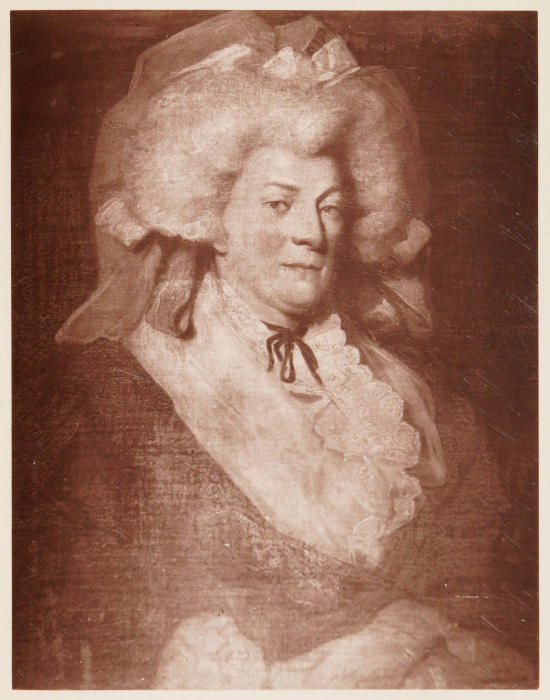
LA CHEVALIÈRE D’EON. 1782.
From a Painting in the possession of Charles Liston, Esq.
(LATE THE PROPERTY OF CHARLES READE.)
See Appendix.
THE
STRANGE CAREER OF THE
CHEVALIER D’EON DE BEAUMONT
MINISTER PLENIPOTENTIARY FROM FRANCE TO GREAT BRITAIN
IN 1763
BY
CAPTAIN J. BUCHAN TELFER, R.N. F.S.A., F.R.G.S.
AUTHOR OF ‘THE CRIMEA AND TRANSCAUCASIA’ ‘THE BONDAGE AND
TRAVELS OF JOHANN SCHILTBERGER’ ETC.
‘L’homme d’esprit a dans sa plume
un juge toujours prêt à le venger des
affronts qu’on lui fait’—D’Eon
With Portraits and Facsimile
LONDON
LONGMANS, GREEN, AND CO.
1885
All rights reserved
A
LA VILLE DE TONNERRE
PREFACE.
The Secret Correspondence established by Louis XV.
in 1750-1752, originally for the purpose of gratifying
the Prince de Conti’s ambition for sovereignty, in the
interests of Poland, and of securing the alliance and
co-operation of several of the smaller Powers, against
the aggression of Austria and Russia, proved, in course
of years, of inestimable benefit to the King, personally.
Insuperable timidity, and the consciousness of a lack of
self-confidence, were weaknesses that ill-befitted an
absolute monarch, for Louis XV. could never summon
courage to confront his ministers. The Chevalier D’Eon
de Beaumont very tersely portrays the besetting sin of
his sovereign, where he describes it as a deficiency in the
needed strength of character to control, as became a
king, his ministers and ambassadors, all of whom he
mistrusted and avoided, making reparation in secret for
the follies they committed publicly. ‘Après nous le
déluge’ are the well-known words of comfort offered by
the Marquise de Pompadour, into whose hands the
direction of affairs was lapsing, when seeing the King
sorely oppressed with grief upon learning the news of
the disaster at Rosbach; and perhaps it is true that the
secret correspondence, of the existence of which the
favourite was entirely ignorant, was useful in averting
the coming storm during the term of his reign. Selfish
and self-indulgent almost beyond conception, Louis XV.
had no spirit to grapple with difficulties where they
presented themselves, except in regard to the relations
of France with Foreign Powers, when he could perfectly
well rouse himself to action; not openly, lest the views
of his ministers should be in opposition to his desires,
but covertly and frequently to their confusion. It was
the duty of the secret agents at the several capitals of
Europe, who were always connected in some way with
his Embassies, to keep his Majesty informed of all that
was passing, and it became his custom to instruct them
to bring about the realisation of his policy, regardless
of the directions of his ministers. Louis XV. took an
interest and a delight in foreign affairs, therefore to him
the secret correspondence had its uses; otherwise—it
was leading to destruction.
One of the earliest and most remarkable of the
King’s secret agents, for his employment as such dated
from the year 1754 or 1755, was D’Eon de Beaumont,
who, as a diplomatist, evinced spirit equal to that of
Lord Whitworth under circumstances that have passed
into history, and exhibited much of the bravery and
daring of the famous Hugh Elliot, without, however, the
similar advantage of being enabled to deal all his blows
by the light of day, his training from youth having
been in the direction rather of intrigue.
Since no history of Louis XV. can have any pretensions
to completeness if the name of D’Eon de Beaumont
be excluded, it is not a little surprising that the
individual acts, as well as the official services of so
extraordinary a personage have never been brought
together before the world. This blank the author
endeavours to fill.
In 1836, Gaillardet published a memoir of the
Chevalier D’Eon, meretricious and spurious in its details,
which speedily reached a second edition, and attained a
popularity that caused it to be pirated and reproduced,
very extensively, in ‘Un Hermaphrodite,’ Louis Jourdan
indiscreetly lending his name for its authorship! Although
Gaillardet announced that his book was produced
out of material supplied by the D’Eon family at
Tonnerre, its contents proved to be in great measure
scandalous fabrications. Feeling himself, as he advanced
in years, called upon to make some kind of reparation,
this author gave, in 1866, a new edition under the title
‘Mémoires sur la Chevalière D’Eon. La Vérité sur les
Mystères de sa Vie,’ in the preface to which, styled
‘Un Acte de Contrition, &c.,’ he candidly avows that
his first edition was in great part a fiction. In this
later edition Gaillardet reproduces, together with other
interesting matter, numerous documents that are preserved
at the Ministry for Foreign Affairs, where, by
rare good fortune, he obtained permission to search the
archives; and that so distinguished an academician as
the Duke de Broglie (familiar to Englishmen as having
been first minister in the Conservative days of the
French Republic), as well as other well-known authors,
should have availed themselves of this work, may be
accepted as sufficient guarantee of its worth and reliability.
As becomes a conscientious biographer, Gaillardet
allows the documents he produces to speak for
themselves, without himself undertaking to pass judgment
on his subject; a safe course adopted in the
following pages, where scrupulous care is taken to
authenticate all that is adduced.
In his engaging work, ‘Le Secret du Roi,’ the Duke
de Broglie treats at some length on the part taken by
D’Eon in the secret correspondence of Louis XV. Unhappily,
the Duke seems desirous of avenging the agony
of mind his ancestor the Count de Broglio must have
endured, upon certain occasions of the threatening
attitude assumed by the Chevalier, and he evidently
finds it impossible to forgive the Minister Plenipotentiary,
D’Eon, for being more clever, abler, and
readier-witted than the French Ambassador with whom
it was his misfortune to be connected; for his Grace
takes frequent occasion to traduce him, and calls
attention to his ‘assertions mensongères,’ without
clearly substantiating the grave charges—a hard
measure where the person assailed is beyond the possibility
of vindicating the accusation. The fact is that
D’Eon related unpleasant truths, and exposed startling
facts, as will be manifested in due course.
Few persons, in all probability, have left behind
them so much matter in MS. as did the Chevalier
D’Eon, if we except perhaps the Duke of Berwick and
the noted Saint-Simon, of whom Chateaubriand said:
‘... il avait heureusement un tour à lui; il écrivit
à la diable pour l’immortalité.’ Like Saint-Simon, the
Chevalier sketched admirable portraits, and like Saint-Simon
too, he commenced in early youth to write his
impressions, keeping to himself, through life, all he had
written. There is evidence, amongst the papers the
author has consulted, that D’Eon never contemplated
an autobiography. ‘It has ever been my opinion,’ he
wrote, ‘and I am even persuaded, that it is impossible
for an author to write a just history of his own life; for
he is either lifted to the height of vanity by pride so
inseparable from the human heart, or else feigned
modesty debases him to hypocritical humility. There
are, at Versailles, public depôts of the Ministries for
War and for Foreign Affairs, and Louis XV. has left his
private papers of the Secret Correspondence. It is
there that the faithful historian should seek the truth if
he has the courage to tell it.’ Unfortunately, there is
reason for apprehending that many MSS., some of consequence,
are lost. Père Elisée, the Chevalière’s medical
attendant, had a large number of his papers, which
were seen in the possession of M. Nicolas de Chenart,
about the years 1824-1828, by a correspondent, in
‘Notes and Queries.’ They may now possibly form a
part or the whole of the collection of D’Eon MSS. at
the British Museum, and at Tonnerre where they are
numerous. Another large portion passed into the
hands of Mr. Christie, to whom the Chevalière was
indebted for many favours. The first and last of these
collections have been well sifted by the author,
the chief difficulty experienced being the making a
judicious selection. It was quite possible to have enlarged
on the acts and writings of the Chevalier or
Chevalière D’Eon, by the introduction of additional
portraits, anecdotes, and letters of interest, but—happy
is the biographer who escapes the charge of tedious
prolixity! The author feels that although the material
at his disposal has been greatly condensed, the thread
of the narrative is maintained in its completeness,
without the omission of any incident of importance
in the life of the most singular and of one of the most
extraordinary individuals of the last century.
There can be no exaggeration in the assertion that
the life of the Chevalier or Chevalière D’Eon de Beaumont
is unique in the history of the world. At any rate,
the author is prepared to confess his ignorance of any
record of its equal.
Cases of females having occupied the position of
men, whether for a limited period or during their entire
existence, are without number, striking instances of
both, within the recollection of the present generation,
being those of Captain (Marie Jeanne) Dubois, who
served in Napoleon’s Russian campaign, and of a
medical officer in the service of Her Most Gracious
Majesty the Queen, who have passed away of late
years. Upon the other hand, few men have disguised
themselves as females, the most notable example of the
kind, perhaps, being that afforded by the Comtesse des
Barres, who for thirty years led a dissolute and discreditable
life, but was perfectly well known to be the
Abbé de Choisy. The biographer of this creature,
Thoulier d’Olivet, says of him: ‘But what sort of a
hero is he whose portrait I am to describe? A Court
Abbé? ... what do I say? A Court Abbé! A
coquette who had one thousand times greater taste for
beauty spots and ribbons, one thousand times more the
desire to please, than any professional coquette. It
may be said that Nature made a mistake, and that it
was her intention to create a female;’ then, quoting a
lady’s estimate of the Abbé: ‘... male or female,
ever carrying matters to extremes, whether absorbed
in studies or in trifles. Deserving of esteem, because
of undaunted courage, contemptible because of the
coquetry of a young maiden, and in whichever character,
at all times engaged in the pursuit of pleasure.’
The Chevalier D’Eon, whose ambiguity of sex was
suggested in infancy and maintained until death, cannot
be classed with either of the above. Female or male,
D’Eon appeared as either in obedience to command,
having done good service to King and Country, and we
have the authority of John Britton, who was in the
habit of meeting the Chevalière almost daily, during a
period of three years, that she was respectable and
respected, and of refined manners. The uncertainty
of her sex occupied every mind. In branding the tale
of Pope Joan as being false and deserving the name,
Gibbon shows himself to be at fault with regard to
D’Eon. ‘... I would not pronounce it (the tale) incredible.
Suppose a famous French chevalier of our
own times to have been born in Italy, and educated in
the Church instead of in the army; her merit or fortune
might have raised her to St. Peter’s chair; her amours
would have been natural....’
D’Eon’s immediate ancestors were in the habit, it
would appear, of writing their family name, Déon.
Upon being accredited Resident, and afterwards Minister
Plenipotentiary at the Court of Great Britain,
Louis XV. was pleased to distinguish the Chevalier’s
name by substituting E for e, changing Déon to D’Eon,
orthography the author has observed with reference to
the Chevalier. Late in life, the Chevalière wrote her
name, occasionally d’Eon, at other times D’eon, until
the French Revolution, when, for a season, her signature
appears as Déon, bearing the prefix, La Citoyenne
Geneviève.
In concluding these introductory remarks, the author
has one pleasant duty left, that of offering his acknowledgments
to Mr. James H. B. Christie, of Framingham,
Norwich, and King Street, St. James’, and of expressing
his obligations to that gentleman for the liberality and
freedom with which he has been permitted to consult
the interesting MSS., short of which it would have been
simply impossible to produce, in its present form, the
account of this Strange Career.
London, December, 1884.
CONTENTS.
PAGE
CHAPTER I.
Birth of D’Eon de Beaumont and registry as a male child—Parentage—Consecrated
to the Virgin Mary and admitted to the Sisterhood—Pursues
studies as a boy—Early display of abilities—As secret
agent, is sent to Russia by Louis XV.—Reception at St. Petersburg—Enemies
and friends—Leaves for Versailles—Invited to
enter the service of Russia
Sir Hanbury Williams and Count Woronzoff—The Empress Elizabeth’s
message to France—Chevalier Douglas, French Chargé d’Affaires
in Russia, with D’Eon as Secretary—Commencement of the Seven
Years’ War—Count Apraxin’s defection—D’Eon leaves for Versailles—Trait
of character—Reception by Louis XV. and Ministers—Proceeds
to Russia—The will of Peter the Great—Bestoujeff’s
opinion of D’Eon—Poniatovsky and his diamond—D’Eon as a
fencer—Bestoujeff’s arrest—D’Eon again invited to take service in
Russia
Progress of the war—The Duke de Choiseul’s designs against England—Change
of policy—D’Eon’s advice to the French Ambassador—Approved
by Louis XV.—D’Eon’s failing health—The Marquis de
l’Hôpital—Baron de Breteuil admitted to the secret correspondence—The
King’s secret orders to D’Eon—Testimonies to his abilities—Leaves
Russia for the last time—Gift from the Empress—On the
staff of the Marshal and Count de Broglio—Distinguished services
during the campaign of 1761—Exile of the de Broglios—Death of
Elizabeth
Portrait of Catherine II.—Her opinion of D’Eon and its fidelity—Portrait
of Lord Sandwich—Of the Duke de Nivernois—D’Eon Secretary
of Embassy in London—Two ‘smart pieces of work’—Kindness
to French prisoners—Treaty of Peace with England—D’Eon takes
the ratifications to Versailles—Delight of King and Ministers—The
Marquise de Pompadour—The Count de Guerchy nominated Ambassador
at St. James’—The Duke de Praslin’s estimate of his
qualities—The Duke tests D’Eon’s loyalty towards himself—The
Prince de Soubise at Villinghausen—D’Eon’s respect for the de
Broglios—Is invested with the Cross of Saint Louis
D’Eon becomes Resident and Chargé d’Affaires at the British Court—Also
the King’s special secret agent—Plans for the invasion of
England—Nicknames to secret correspondents—Louis XV.’s letter
to D’Eon on the survey of England—De Pompadour discovers the
secret correspondence—The King’s vexation—D’Eon advanced to
be Minister Plenipotentiary—How he received his new honours—De
Broglio’s anxiety for the safety of the King’s papers—De Pompadour’s
conspiracy to ruin D’Eon—Claims against the Crown—Letter
of State in favour of D’Eon
D’Eon charged with extravagance at the Embassy—Irritating correspondence—Influx
of French visitors—Odious proposal to D’Eon—Is
to return to subordinate duties on being superseded—His remonstrances—The
Earl of Hertford—The Count de Guerchy’s arrival
in England, and D’Eon’s letters of recall—Secret despatch from
Louis XV.—Official recall on the plea of mental alienation—Disregard
of the Ministerial orders
D’Eon’s interview with the Earl of Halifax—Refuses to surrender the
King’s papers to de Guerchy—Declines to take leave of the King
of England—A scene at the French Embassy—Another at Lord
Halifax’s residence—A third at D’Eon’s—Summoned by a magistrate—De
Guerchy’s hostile measures—D’Eon is dangerously
drugged at the table of the French Ambassador—Designs against
his liberty—Removes to Brewer Street, Golden Square—Childishly
annoyed—His extradition demanded—Warned to that effect by
Louis XV
Refusal of the British Government to deliver D’Eon—A force organised
to kidnap him—Mines and garrisons his house against intrusion—De
Guerchy reports to Louis XV. his failure to obtain the secret
papers—D’Eon’s letter to his mother—Publication of official and
private letters of Ministers, Ambassadors, &c.—Consternation produced
in consequence—Applies to enter the service of a foreign
State—Appeals to de Broglio and Tercier on his situation—A conciliatory
letter the result
D’Eon’s intricate situation—Popular indignation in England at the late
peace—Letter of gratitude to Louis XV.; of reproach to the Count
de Broglio—Sued for libel—Retains the King’s papers as security
for his person—Illegal proceedings on the part of the French Ambassador—Out-of-door
precautions against being kidnapped—English
sympathy for D’Eon—Is found guilty of libel, absconds, is
searched after, and outlawed—Confession of Treyssac de Vergy—De
Guerchy’s charge against de Vergy
D’Eon challenges the French Ambassador—Institutes legal proceedings
against him—Strong appeal to the Count de Broglio, and indifference
of the latter—De Guerchy v. De Vergy—De Vergy’s affidavits—Secret
correspondence in danger—Undignified conduct of Louis
XV., who ‘feels he is in a mess’—True bill against the French
Ambassador for inciting to murder—D’Eon’s disregard of his King’s
intervention—De Guerchy applies for a nolle prosequi—Attorney-General
refuses a certificate—Miscarriage of justice, and state of
public feeling—Count de Broglio’s conciliatory proposals—A royal
pension conferred on D’Eon—De Broglio’s advice—D’Eon surrenders
his secret orders from the King
D’Eon continues in the royal confidence—Secret correspondence again
in peril—D’Eon’s mother persecuted—De Guerchy’s death—D’Eon’s
last letter to him—De Vergy’s dying deposition—His will—D’Eon
as secret correspondent—His public protest—The Musgrave scandal
D’Eon and Wilkes—Fickle Louis XV.!—Literary labours—Doubts
raised as to D’Eon’s sex—Princess Dashkoff—Heavy gambling
transactions on D’Eon’s sex—Insult resented—Irritation at being
thought a female—Indignant denial of being concerned in the bets
made—State of penury—Offers of relief from Poniatovsky, now
King of Poland—Saves England from war—Officially reported to
be a female—Personal appearance—Death of Louis XV.—D’Eon’s
estimate of the late King—Count de Broglio’s report on D’Eon to
Louis XVI.—System of secret correspondence abolished—D’Eon
to continue his reports in cypher
The Count de Broglio’s offers for the surrender of the King’s papers—D’Eon’s
conditions—Failure of the transaction—Proposal of
marriage to (Mademoiselle) D’Eon—Beaumarchais—The Madame
Dubarry scandal—De Vergennes’ instructions to Beaumarchais—That
Minister’s high opinion of D’Eon—Beaumarchais’ success in
treating with D’Eon
D’Eon surrenders the King’s papers—Earl Ferrers’ share in their custody—Covenant
between Beaumarchais and D’Eon, who receives permission
to return to France—and is ordered to resume female attire
Revival of gambling policies on D’Eon’s sex—Renewed protests—Admits
being a female to the Count de Broglio—Beaumarchais a hard
master—He demands final instructions from the King—Differences
of opinion, and angry interchange of letters
Beaumarchais’ reprehensible behaviour—D’Eon challenges Morande—Miss
Wilkes’ curiosity—Feeling against D’Eon—Fresh difficulties
with Beaumarchais—Speculators on D’Eon’s sex seized with panic—Lord
Mansfield’s decision on the policies effected—D’Eon appears
in public as a female—Leaves for France, wearing military uniform—The
King’s second order to resume female attire—Marie
Antoinette furnishes Mademoiselle D’Eon’s trousseau—Visits her
native town—Rejoicings at her appearance—Presented at Court as
a lady—The Queen’s household—Deportment in society—Another
trial before Lord Mansfield
Epistle to Lord Mansfield—Voltaire on D’Eon—Anxiety to get quit of
petticoats—Mademoiselle D’Eon de Beaumont in peaceful retreats—Applies
for active service in the fleet—Returns to male attire, is
arrested, and confined—Being liberated, goes home—Arrival in
London—Fences before the Prince of Wales—Mr. Angelo—Mademoiselle
D’Eon and Phillidor at chess—Advertised sale of library—Treatment
by a British peer the cause thereof—Earl Ferrers’
bond—Sale of jewellery
D’Eon (la citoyenne Geneviève) offers her services to the Legislative
Assembly—Is ordered to join General Dumouriez—Detained in
England—Her English friends—Fences in public—Is seriously
wounded—Distressing times—Last days—Death—Autopsy and
appearance of the body—Administration of property—General
character—Pursuits and habits late in life—Maxims on religion—Coldness
of temperament—Reflections—Fugitive pieces
For 32 Brewer Street, Golden Square, as being the residence in London of
the Chevalier D’Eon during thirty-three years, read 38 Brewer Street, Golden
Square.
WORKS REFERRED TO IN THE FOOTNOTES.
B.M. MSS., D’Eon MSS. at the British Museum.
Ch. MSS., D’Eon MSS. in the possession of Mr. Christie.
Angelo, Henry, Reminiscences of—with Memoirs of his late Father and
Friends. London, 1828. 2 vols.
Boutaric, M. E., Archiviste aux Archives de l’Empire.Correspondance secrète
inédite de Louis XV. sur la politique étrangère, etc. Paris, 1866. 2 vols.
Broglie, Le Duc de, Le Secret du Roi, correspondance secrète de Louis XV.
avec ses agents diplomatiques, 1752-1774. 3ᵉ édition. Paris, 1879. 2 vols.
Campan, Madame, Mémoires sur la vie privée de Marie-Antoinette, etc.
Paris, 1822. 3 vols.
Dutens, Louis, Mémoires d’un Voyageur qui se repose, contenant des
Anecdotes Historiques, Politiques et Littéraires, relatives à plusieurs des
principaux personnages du siècle. Londres, 1806. 3 vols.
Flassan, Raxis de, Histoire Générale et Raisonnée de la Diplomatie
Française, etc. etc. Paris, 1811. 2 vols.
Fortelle, De la, La Vie Militaire, Politique et Privée de Mademoiselle
Charles Geneviève Louis Auguste Andrée Timothée D’Eon de Beaumont, etc.
etc.O quam te memorem Virgo! Paris, MDCCLXXIX.
Gaillardet, Fred., Mémoires sur la Chevalière D’Eon, etc. Paris, 1866.
Kirby, R., Wonderful and Eccentric Museum, etc. London, 1803.
Lacretelle, Chas., Histoire de France pendant le dix-huitième siècle, etc.
Paris, 1819. 6 vols.
La Messalière, Voyage à Pétersbourg, etc. Paris, 1803.
Lettres, Mémoires, et Négociations Particulières du Chevalier D’Eon, etc.
etc., with MSS. Notes by D’Eon. Londres, 1764.
Loménie, Louis de, Beaumarchais et son Temps, etc. 4ᵉ édition. Paris,
1879. 2 vols.
Mémoires de la Chevalière D’Eon, MSS. work addressed to the Count de
Vergennes by the Chevalière, and preserved at the Ministère des Affaires
Étrangères. Quoted by Gaillardet and De Broglie.
Pièces Relatives aux Lettres, Mémoires et Négociations Particulières du
Chevalier D’Eon, etc. etc. Londres, MDCCLXIV.
Rede, L. T., Anecdotes and Biography, etc. London, 1799.
Roche, James, Critical and Miscellaneous Essays by an Octogenarian, etc.
Cork, 1850. 2 vols.
Taylor, John, Records of my Life, etc. London, 1832. 2 vols.
Vandal, Albert, Louis XV. et Elizabeth de Russie, etc. Paris, 1882.
24 livres tournois
=
1l. 1s.
3 ditto
=
1 écu
1 écu
=
2s. 7½d.
Charles-Geneviève-Louis-Auguste-André-Timothée Charlotte-Geneviève-Louisa-Augusta-Andrée-Timothée-Marie D’EON DE BEAUMONT.
Doctor of Civil and of Canon Law, and Advocate of the Parliament of Paris.
Censor Royal for History and Belles-Lettres.
Sent to Russia, first secretly, then officially, with the Chevalier Douglas
for the Purpose of re-establishing friendly Relations between that Country and France.
Secretary of the Embassy Extraordinary at the Court of Her Imperial Majesty, the Empress Elizabeth.
Captain of Dragoons and Aide-de-Camp to Marshal the Duke and to the Count de Broglio.
Secretary of the Embassy Extraordinary from France to Great Britain for concluding the Peace of 1763.
Knight of the Royal and Military Order of Saint Louis.
Resident, and afterwards Minister Plenipotentiary from France to Great Britain,
and, finally,
a Lady at the Court of Marie Antoinette,
and an occasional and honoured Inmate
at
L’Abbaye Royale des Dames de Hautes Bruyères,
La Maison des Demoiselles de St. Cyr,
and at the
Monastère des Filles de Ste. Marie.
THE CHEVALIER D’EON DE BEAUMONT.
CHAPTER I.
Birth of D’Eon de Beaumont and registry as a male-child—Parentage—Consecrated
to the Virgin Mary and admitted to the Sisterhood—Pursues
studies as a boy—Early display of abilities—As secret agent, is
sent to Russia by Louis XV.—Reception at St. Petersburg—Enemies
and friends—Leaves for Versailles—Invited to enter the service of
Russia.
‘The deeper the search in the annals of my family,’ wrote the
subject of this Memoir, ‘the purer, more stainless, and more
distinguished will it prove to be. One member only, Eon de
l’Étoile,[1] was condemned by the Council of Rheims in the year
1148; but how many emperors, kings, and men of letters have
been condemned and proscribed by popes and councils, legally
or illegally. There is a vast difference between condemnation
by the priesthood for gross errors in matters of religion, and
condemnation by judges for the crimes of high treason, assassination,
murder, and poisoning.
‘The possession of a name and noble descent, of which the
origin is lost in obscurity, has ever been considered amongst
civilised nations a more respectable title than one of recent date,
owed to the favour of a king—favour accorded more frequently
to weakness than to courage, to vice than to virtue. We know
the secret motives by which kings are guided in their public
acts, since the time that they have become attended by valets,
mistresses, ministers, cabinet ministers, and historiographers.’[2]
On the first page of a well-thumbed devotional
pamphlet in MS., given to D’Eon de Beaumont upon
his entering the Collège Mazarin, at Paris, in 1740,
appears the following in that person’s own hand:—
‘I was born on the 5th, and baptised on October 7, 1728,
at the parish church of Notre Dame, Tonnerre. I was confirmed
in front of the high altar of the parish church of St. Sulpitius in
Paris; and on Thursday, June 18, 1744, I communicated for
the first time in the chapel of the Virgin at the parish church
of St. Sulpitius, Paris.’[3]
The baptismal certificate is as follows:—
‘On October 7, 1728, was baptised Charles-Geneviève-Louis-Auguste-André-Thimothée,
son of the noble Louis Déon de
Beaumont, director of the King’s demesnes, and of dame Françoise
de Charenton, his father and mother legitimately married,
born on the 5th of the present month. His godfather is M.
Charles Regnard, advocate of Parliament, bailiff of Cruzy; and
godmother, dame Geneviève Déon, wife of M. Mouton, wine
merchant at Paris, all of whom affix their signatures:—
‘G. Déon. ‘C. Regnard. ‘Mouton.
‘Bordes, Dean of Tonnerre.’
PARENTAGE AND EARLY YEARS.
Louis Déon de Beaumont was advocate in Parliament,
King’s counsellor, sub-delegate of the Intendance
of the generality of Paris, and for some time mayor of
Tonnerre. His brothers were André-Thimothée Déon
de Tissey, advocate in Parliament, censor-royal, chief
secretary of police in Paris, and principal secretary to
H.R.H. the Duke d’Orleans; Jacques Déon de Pommard,
advocate in Parliament, one of the first secretaries to
the Count d’Argenson, Minister of War; Michel Déon
de Germigny, knight of the Royal and Military Order of
St. Louis, one of the twenty-five gentlemen of the King’s
Scottish Guard. They were the four sons of André
Déon, advocate in Parliament, who died in 1720; whose
father was Louis Déon, lord of Ramelu, esquire, captain
of infantry: all of whom lie interred within the church
of L’Hôpital Notre Dame de Fontenilles, at Tonnerre.[4]
In the preamble to her holograph will, headed ‘Soli
Deo Honor et Gloria,’ in which she styles herself
Charlotte-Geneviève-Louise-Augusta-Andrée-Timothea-Marie
D’Eon de Beaumont, it is stated:—
‘Although already provided with six names, my mother
having in her special devotion consecrated me in my infancy to
the Virgin, the additional name of Marie was given to me at
my confirmation by Panquet de Gersy, archbishop of Seurre.
This name has become precious to me, because Marie has
become my protectress in heaven, as Marie Antoinette was my
queen protectress on earth, after my return to France.’
In another place D’Eon states that when in her
fourth year she was publicly consecrated to the Virgin
Mary, in front of the high altar, at a solemn service held
for the occasion. She wore the robe of the sisterhood
of the Virgin Mary until her seventh year, when she
resumed boy’s apparel by direction of her father. To
her mother’s fervent devotion and enlightened piety in
the protection of the Virgin Mary was attributed the
safety of the ‘disguised daughter’ in all the perils she
encountered in the course of her extraordinary career—by
sea and by land, at foreign courts, at sieges, in combats
and in battles.[5]
From the age of seven to twelve D’Eon remained in
charge of M. Marceney, curé of the Church of St. Peter,
and was then sent to the Collège Mazarin. He completed
his studies with considerable credit, obtaining
the degrees of Doctor of Civil and of Canon Law, and
being subsequently called to the bar of the Parliament
of Paris. He also became royal censor for works on
history and belles-lettres. In 1749, whilst serving as
secretary to M. Bertier de Savigny, he had the misfortune
to lose in the course of five days his father, an
uncle, and an income of fifteen thousand livres. Louis
Déon had rendered himself so beloved by the poor in
his district that for some time after his death they used
to resort in crowds to his grave and weep over it, and
lament the loss of their friend and benefactor. It is
related of him that when on his death-bed, and after
having received the last sacrament, he sent for his
daughter (afterwards the Chevalier), and taking her by
the hand, said tenderly, ‘Do not be uneasy, my daughter—it
is as natural to die as it is to live. I am quitting a
bad for a better land. I have been at much pains to
teach you how to live, and I must likewise teach you
how to die.’ And giving her his blessing, he expired.[6]
Although D’Eon had lost his father, he was not left
friendless; for he remained under the protection of
several persons of influence, who had known the relatives
he had lost, there being amongst them the Prince
de Conti, the Abbé de Bernis (subsequently Minister for
Foreign Affairs), the Marshal de Belle-Isle (afterwards
Minister for War), also the Duchess de Penthièvre and
the Count d’Ons-en-Bray, whose funeral eulogiums, inserted
in the ‘Année Littéraire,’ were the earliest products
of his pen. These writings were succeeded by an
historical essay on finance in France, and ‘Notes on the
Life and Works of the celebrated Abbé Lenglet de
Fresnoy,’ printed in the ‘Année Littéraire’ for 1755,
literary labours which served to bring him into notice
at an early age as a thoughtful and careful writer.
D’Eon was passionately fond of study, and would
only quit his books for what became his sole recreation
in life—the art of fencing, in which he proved a great
expert, as shown by his election to the superintendence
of the School of Arms. D’Eon’s tastes inclined him to
a military life, rather than to what the necessities of his
situation were calling him; but his destiny summoned
him to take a part in the political transactions of his
country, with what success it is the object of this work
to show.
FRENCH ENVOYS TO RUSSIA.
In his desire to renew with Russia the friendly relations
interrupted since the day when the Marquis de la
Chétardie was unceremoniously escorted to the frontier
(June 13, 1744), Louis XV. had dispatched to St. Petersburg,
in the year 1754, the Chevalier de Valcroissant on
a secret mission for that purpose—a mission, however,
that came to an untimely end; for the Chevalier, being
unprovided with any kind of credential or letter of
recommendation, was taken up on suspicion of being a
French spy, and confined in the fortress of Schlusselburg,
on the Ladoga, whence it was not deemed prudent, for
the time being at least, to seek to liberate him.[7] The
Empress Elizabeth had already made advances of a
friendly nature to the French Court, and in view of her
possible treaty of subsidies with England, the King resolved
upon another effort towards reconciliation, taking
more effectual precautions to ensure success.
The person selected for this important, secret, and
even hazardous service, was a native of North Britain,
named Mackenzie, but known as the Chevalier Douglas,
who represented himself as having followed the fortunes
of the Pretender and obliged to seek refuge in France,
bringing with him ‘nothing but his nobility,’ when in
reality he was a Jesuit in disguise, had lived at Liège
during the late war, employed as a spy by Holland, and
had afterwards entered the service of the Prince Waldeck.[8]
When invited to proceed to Russia he was tutor
in the family of the Intendant of Paris, and passing under
the name of Michel.
The importance and delicate nature of the negotiations
upon which Douglas was about to be employed—and
not Douglas only, but D’Eon also, sent with the
King’s approval, at the strong recommendation of the
Prince de Conti (whose special protégé he was), to
accompany Douglas—will best be estimated upon knowledge
of the instructions—widely though they differed—supplied
for their respective guidance. They show that
whilst Douglas was secretly to watch and note events
as an apparently indifferent observer, it was intended
that D’Eon should pass his time in closest intimacy with
such Russian ministers as might be favourably disposed
towards France, and reach, were it possible, even the
Empress herself.
THE CHEVALIER DOUGLAS’ INSTRUCTIONS.
Instructions to the Chevalier Douglas on proceeding to Russia.
‘June 1, 1755.
‘The general situation of Europe, the troubles in Poland
during the past year, others apprehended in the same quarter,
the part taken in them by the Court of Petersburg, the probability
that it is about to conclude, shortly, a treaty of subsidies
with England through the Chevalier Williams, appointed Ambassador
by his Britannic Majesty to the Emperor of Russia;
everything points to the necessity for watching the proceedings
and attitude of that Court with the closest attention.
‘His Majesty has not been represented there by any ambassador,
minister, or even a consul, for a long time past, so
that its condition is almost entirely unknown, especially as the
character of the people, and the jealous and suspicious despotism
of their ministers, disallows such correspondence as is customary
in other countries.
‘It is considered desirable to despatch a competent person,
with the view of obtaining reliable information on what is passing
at the Court of Russia; he will not let it appear that he is
in any public or private capacity, and will return immediately
to make his report. A Frenchman would not answer the purpose.
Notwithstanding the friendship which the Empress of
Russia is supposed to entertain towards his Majesty, and her
partiality towards the French nation, a subject of the King
would be watched too closely by the ministry in Russia to be of
any service, under whatsoever pretext he might cloak the object
of his journey. It is on this account that —— has been
chosen, who, being a subject of the King of Great Britain, will
not excite suspicion. The favourable reports that have been
received of his intelligence and zeal give reason to hope that he
will execute this commission with success.
‘It is intended that he should take his departure in the
quietest manner possible, as a gentleman travelling solely for
his health and amusement. Such is the custom amongst many
of his countrymen, so that he will not attract attention. He
must not appear to have any relations with his Majesty’s
ministers, whether in France or in the course of his travels, and
he must not see any of them at the several places through which
he will pass. He will be supplied with an ordinary passport.
To avoid being interrogated at any of the great courts in
Germany, his presence perhaps exciting curiosity, it is desirable
that he should enter Germany through Swabia, whence he will
pass into Bohemia under pretext of visiting for his own instruction
the several mines in that kingdom. His acquaintance
with mineralogy will afford a pretext for this journey. From
Bohemia he will pass into Saxony, visiting the mines at Freiberg
for similar reasons. Having there satisfied his curiosity, he will
go on to Dantzig, either by way of Silesia, Warsaw, and Thorn,
or by Brandenburghian Pomerania, proceeding to Frankfort-on-the-Oder,
and thence to Dantzig by such route as may best suit
him. He will make a stay of some days in this city for the
purpose of thoroughly examining the causes that have led for
some years past to the continued strife between the chief magistrate
and the burgesses, and to discover, if possible, the cause
of these dissensions, what it is that foments them, and if they
are encouraged by any foreign power. Thence he will continue
his journey through Prussia and Courland, where he will also
make a stay under pretext of needing rest; but for the purpose
of learning the state of that duchy, what the nobles think of the
exile and deposition of the Prince of Courland, and the views of
the Russian Ministry for the government of that principality.
He will also make himself acquainted with the manner in which
justice and the revenues are there administered, and the number
of Russian troops in occupation. From Courland he will pass
into Livonia, and follow the high road to St. Petersburg. His
first care on arrival will be to make known, without any affectation,
the reasons for undertaking his journey, which is one of
pure curiosity. He will endeavour to make the acquaintance
of those able to supply him with the information of which he is
in search. He cannot observe too great caution in his mode of
procedure to obtain information; he must not evince partiality
for any one nation more than for another. Although the causes
that have necessitated his departure from England would appear
to prevent him from making the acquaintance of the Chevalier
Williams; still, if as he asserts, he is quite unknown, he might
make it a point to see him as every Englishman would his
minister. He will make himself acquainted as secretly as possible
with the success of that minister’s negotiations for the
troops with which England is to be supplied, and with the
number of troops that Russia has actually at command; with
the condition of her fleets, her ships and galleys; with the state
of her finance, commerce, and the disposition of the nation
towards the present ministry; the degree of Count Bestoujeff’s
influence; that of Count Woronzoff; of the Empress’ favourites,
whether in affairs of State or in the pursuit of pleasure; their
probable influence on ministers; the concord or jealousy that
exists amongst ministers, and their bearing towards the
favourites; with the fate of Prince Ivan, the late Tzar, and
of the Duke of Brunswick, his father; the affection of the
nation towards the Grand Duke of Russia, and especially
since the birth of his son; whether Prince Ivan has secret
partisans, and if they are supported by England; the desire
of the Russians to live in peace, and of their disinclination
for war, more especially in Germany; the views of Russia in
regard to Poland, for the present, and in whatsoever eventuality
in the future; with her projects on Sweden; with the
impression produced by the death of the Sultan Mahmoud, and
Osman’s accession to the throne; with her conduct in regard to
the Porte; with the causes that have led to the recall from the
Ukraine of Count Razoumoffsky, hetman of Cossacks; with
what is thought of the loyalty of those people, and the manner
in which they are treated by the Court of Petersburg; with the
Empress’ sentiments towards France, and those with which she
is in all probability inspired by her ministry, to prevent her
from renewing correspondence with his Majesty; with the
factions by which the Court may be divided; with those of her
subjects, male or female, in whom the Empress is able to confide;
with her sentiments and those of her ministers towards the
Courts of Vienna and London; with all, in short, that can be
of interest to his Majesty’s service, and satisfy his curiosity.
He will obtain all this information so far as such an uncommunicative
country will allow him to. He will take notes on all
these subjects to serve for a memoir which he will draw up, and
send to France only after he will have quitted Russia, unless the
Swedish minister at Petersburg, who will receive instructions to
forward despatches to Stockholm by courier, should send any to
Sweden. He must never risk anything through the ordinary post
except notice of his arrival, and a report of the progress he is
making in obtaining information as required above; and to do
this he must employ, in a few words, figurative language, agreed
upon beforehand, and send his letters to addresses with which he
will be furnished.
‘So soon as he feels that he has fairly well obtained all the
required information, he will make a report to that effect, and
will then receive orders to return to France, either by the same
route or through Sweden, again under pretext of visiting mines,
that he may continue to conceal the real object of his journey.
On the manner in which he will execute so important and
delicate a commission, will depend the prospect of his Majesty
again making use of his talents and zeal, as also the favours
with which his Majesty will mark his appreciation of his
services.’
SECRET AGENT TO LOUIS XV.
Figurative language to be employed by the Chevalier Douglas
in his correspondence committed to the ordinary post.
‘The basis of the figurative language will be the purchase
of furs. The “black fox” will signify the Chevalier Williams;
if he succeeds, the “black fox” will be dear, because orders to
purchase have been received from England.
‘The words “ermine is in demand,” will signify that the
Russian party dominates, and that consequently no foreigners
are in favour. If, on the contrary, the Austrian party, at the
head of which is M. de Bestucheff, preponderates, word must be
sent that the “lynx” is also in demand.
‘To designate the waning influence of M. de Bestucheff,
this phrase is to be employed: “the price of sobols or sables is
falling;” or “they stand at the same price,” to indicate that
his influence continues the same. “Squirrel skins” are to
signify troops in the pay of England. To understand this
clearly, the number of skins to be sent will always be augmented
by two-thirds to signify the number of troops, so that
ten skins will signify thirty thousand men, and twenty, sixty or
seventy.
‘—— will not write to say that he will send the furs, but
he will simply advise that he will bring them with him upon
his return.
‘In passing through Dantzig —— will send one of his
servants to Graudenz, a small town in Polish Prussia, there to
post a letter, in which he will advise as to what he may have
learnt at Dantzig on the subject of the existing dissensions
between the chief magistrate and the burgesses. This letter to
be addressed to ——.
‘These letters will be in the form of bills of exchange, and
according to the greater or less success in the inquiries made,
upon which will depend the length of stay; notice should be
given whether or no remittances are needed. If nothing can
be done, —— will report that the climate is injurious to his
health, and that he is in want of a remittance to enable him to
go elsewhere.
‘If —— is not to go to Sweden, he will receive for answer
that since his health suffers, it is considered to his advantage
that he should return directly. If, on the contrary, it is
deemed expedient that he should proceed, the same will be
intimated to him in the form of advice. If it is considered
necessary that he should return, the remark will be made to
him that a muff has been obtained here, and that consequently
he is requested not to purchase one.
‘The whole of this, written in small characters and epitomised,
will be placed by —— in the false bottom of a tortoise-shell
snuff-box, which will not induce any suspicion.’[9]
The duties confided to D’Eon were entirely distinct
and of a more intimate nature. He was supplied by
M. Tercier, chief clerk at the Foreign Office and in
charge of the King’s secret correspondence, with a
quarto copy of Montesquieu’s ‘Esprit des Lois,’ the
binding, in double boards, being cunningly devised to
hold papers. The documents thus concealed and entrusted
to D’Eon included private letters from the King
to the Empress Elizabeth; a cypher for the intelligence
of her Imperial Majesty and Count Woronzoff,
the Vice-Chancellor, in their correspondence with
Louis XV.;[10] a cypher for D’Eon’s own correspondence
with the King and Tercier, and another cypher for
D’Eon’s use in communicating with the Prince de Conti,
Tercier, and M. Monin. He received strict injunctions
that none of the King’s ministers, not even any ambassador
his Majesty might have at St. Petersburg,
should be allowed to entertain the slightest suspicion of
this secret intercourse; he was ordered to furnish the
King with copies of all letters received from the Minister
for Foreign Affairs, together with the Ambassador’s
replies, noting thereon his own observations, and he was
further required to thwart clandestinely any transactions
on the part of the King’s ministers, so long as
they were in opposition to the secretly known royal will
and pleasure.[11]
Douglas then left Paris in the summer of 1755 as a
British tourist, an amateur geologist travelling in search
of health and amusement, and having got to Anhalt, he
there waited until D’Eon joined him. Proceeding on
his journey, Douglas strictly followed the route traced
out in his instructions, and when at Dantzig, where as
at Amsterdam and Leipzig he had large credits, he announced
his intention to visit the mines in Sweden; but
suddenly changing his mind, he started for St. Petersburg,
where he arrived in the earliest days of October.
He lost no time in making his appearance at the British
embassy, and introducing himself as a subject of the
King and a relative of the Earl of Morton, requested Sir
Hanbury Williams to present him at Court. This the
British Ambassador refused to do unless he was properly
assured of his identity. Scarcely was Douglas gone,
than the Swedish minister called to ask Sir Hanbury
whether he objected to his presenting the Chevalier
Douglas at Court. Sir Hanbury promptly replied that
he did not see what business the Swedish minister had
to present the King’s subjects, and if he ever attempted
such a thing, he would take it very ill; upon which the
Swedish minister said that he should no longer meddle
in the affair. Douglas then went to see Count Esterhazy,
the Ambassador from Vienna, whose suspicions he
immediately awakened by explaining his presence at
St. Petersburg as due to the advice of his physicians
that he should seek a cold climate for the benefit of his
health. Finding all access to the Russian Court thus
closed against him, Douglas precipitately left the capital
and returned to France, bitterly complaining of Sir Hanbury’s
treatment in every town through which he passed.[12]
AT THE COURT OF RUSSIA.
We are left quite in the dark as to the means by
which D’Eon succeeded in obtaining admission at Court,
but the matter was doubtless arranged by the Vice-Chancellor
Woronzoff, friendly to France, through the
Swedish minister, to whom Douglas had brought letters
of introduction from the Swedish minister at Paris, or
possibly through Michel, a French banker, as stated by La
Messalière. There is good evidence in support of the tradition
that D’Eon was received by the Empress in female
habiliments, that in this disguise she ingratiated herself
with her Majesty, gained her confidence, and interesting
her in the object of his mission, had succeeded in reviving
her old feelings of attachment towards France and towards
Louis XV., her suitor of days gone by.[13] It is certain
that the ill-humour and coldness of the Russian Court
towards England in the course of the year 1756, was of
much earlier date than the Neutrality Convention
between Prussia and England (January 16, 1756), and
this was attributed by Sir Hanbury, together with the
Empress’s delay in signing the ratifications to her
Treaty of Subsidies with Great Britain, entirely to the
success of French influence after Douglas had first made
his appearance;[14] but Douglas not being at all in Russia
between the end of October 1755, and the end of April
1756, such exercise of French influence could only have
been due to elaborate intrigues on the part of D’Eon
during the several months he spent at Court as reader
(lecteur) to the Empress,[15] an appointment conferred
upon him, perhaps, with the design of cloaking his real
profession.
In early life D’Eon was of peculiarly prepossessing
appearance; his manners were gentle and engaging,
his disposition soft and amiable, all of which, with his
general physique, eminently adapted him to personify a
female; and if there is no direct proof in substantiation
of the oft-told tale that D’Eon appeared at the Court of
Elizabeth in female attire, there is at least valuable
evidence in support of it.
It may be mentioned in regard to D’Eon’s looks, that
during his second stay at St. Petersburg, when secretary
of Embassy, a Russian officer one day observed to
him that with his hair so neatly powdered he greatly
resembled the infant Jesus. D’Eon, who throughout
his career showed the greatest aversion to any kind of
remark on his feminine appearance, and disliked, besides,
all that was Russian, very pertly replied: ‘Yes, you
are right, for I happen to be in a very dirty manger.’[16]
During Douglas’ absence D’Eon was putting his
intelligence and tact to the best use in the service of
his master, his task being rendered somewhat easier by
Elizabeth’s kindly feelings towards France and the
French, which had never entirely changed,[17] even though
her two favourites, the Marquis de la Chétardie and the
Count Lestocq, had long since been disposed of; the
first, as already stated, by being thrust out of the
empire, the latter—of whom in allusion to his treachery
her Majesty said: ‘If Lestocq could have poisoned all
Russia with one dose, he would assuredly have done so’—by
being tortured and exiled to Oustouk. D’Eon had
wisely commenced by insinuating himself in the good
graces of the Vice-Chancellor, whose predilections were
completely French, and who being married to the
Countess Skavronsky, a cousin of the Empress, proved
his powerful support and shield against the Grand
Chancellor Bestoujeff Riumin, the known leader of the
Prussian party hostile to France.
But five years before this Bestoujeff had so effectually
prejudiced the mind of Elizabeth against Prussia, that
her ambassador, Gross, very hastily and unceremoniously
took his departure one morning from Berlin,
without in the least troubling himself to announce his
intentions to anybody. Since that time, Bestoujeff
fancied he saw good cause for changing his views.
THE GRAND-DUCHESS CATHERINE.
Peter, the son of Anna Petrovna, by her marriage
with Charles Frederick, Duke of Holstein-Gottorp, could
never forget his German birth and parentage, and even
after being created a Grand Duke of Russia, he continued
to attach far greater importance to his title of
Holstein-Gottorp, remaining perfectly indifferent to the
interests of the Russian people, and maintaining about
him a suite and retinue consisting entirely of Germans.
His consort, Catherine of Anhalt-Zerbst (afterwards
Catherine II.), sought, on the contrary, to identify herself
with the country of her adoption, embracing the
religion, and following the manners and customs of the
people. Politically, she desired a good understanding
with England, entirely deprecating alliance with France
and Austria; and when the report of the probable
arrival of a French ambassador was gaining ground,
she expressed her uneasiness to Sir Hanbury, saying she
should act up to anything he might suggest to prevent
such a thing. Sir Hanbury reminded Catherine that
her known confidence in Bestoujeff had made the
Schouvaloffs her secret enemies; but that the latter, in
themselves, had neither sense, courage, nor money
enough to do any harm to her succession, although the
arrival of a French ambassador might change the scene,
for he would do all in his power, sparing neither pains
nor money, to injure her. Catherine’s feelings were
perfectly well known to Elizabeth, who used to say of
her that ‘she was a clever woman, only she prided herself
on being more clever than anybody else.’ The
most powerful man at Court because the greatest
favourite was Ivan Schouvaloff. He was fond of everything
that was French, understood their language, followed
all their fashions, and was known to have always
wished that a French ambassador might arrive at St.
Petersburg. Small causes produce great effects, and
the reconciliation proceeding between Russia and France
was partly owing to the caprice of that young man.[18]
RETURN TO VERSAILLES.
Bestoujeff, foreseeing the more probable course of
events, seized the opportunity for turning his coat, and
assuring the grand-duchess of his devotion to her person
and to her views, and for expressing to the grand-duke,
her husband, his own desire for the maintenance of
good relations with Prussia. English, French, Austrian,
and even Prussian gold was being freely scattered at
St. Petersburg,[19] but in the end D’Eon, Schouvaloff, and
Woronzoff obtained every advantage over the grand-ducal
party. Consenting to receive a French representative
at her Court, Elizabeth wrote privately to Louis
XV. to that effect, the letter being carried to its
destination by D’Eon, in his volume ‘Esprit des Lois,’
after Douglas’ return from Versailles. We cannot
undertake to fix the date of D’Eon’s departure from
St. Petersburg nearer than that a letter of June 12,
1756, from Sir Hanbury Williams to the Earl of
Holdernesse, announces ‘a creature of the Vice-Chancellor
is soon to set out from hence to Paris to
negotiate this affair.’ In parting with D’Eon, the
Empress invited him to enter her service, promising
honourable and lucrative employment; but D’Eon was
too deeply attached to his own country to entertain such
a proposal; and resisting the offer, said that the renewal
of friendly relations between the two countries, the
advantages of which he had already pointed out, would
afford him the opportunity for serving the interests of
Russia without neglecting those of the Court of France;
a reply which served to increase the esteem already
entertained for him by Elizabeth.
CHAPTER II.
Sir Hanbury Williams and Count Woronzoff—The Empress Elizabeth’s
message to France—Chevalier Douglas, French Chargé d’Affaires in
Russia with D’Eon as secretary—Commencement of the Seven Years’
War—Count Apraxin’s defection—D’Eon leaves for Versailles—Trait of
character—Reception by Louis XV. and ministers—Proceeds to Russia—The
will of Peter the Great—Count Bestoujeff’s opinion of D’Eon—Prince
Poniatovsky and his diamond—D’Eon as a fencer—Bestoujeff’s arrest—D’Eon
again invited to take service in Russia.
Leaving Paris under the name of Léonard, for the second
time as the King’s secret envoy to Russia, but armed
upon this occasion with private credentials from M.
Rouillé, Minister for Foreign Affairs, and ‘a great deal
of money to dispose of,’ Douglas passed through Dantzig,
and Riga where he falsely represented himself as envoy
extraordinary from France to Russia, and was accordingly
received as such by the governor of that town.
With equal disregard to the truth, he made it his
business upon this journey to spread the report that in
the treaty concluded between England and Prussia there
was a secret article whereby the former Power was to
pay to the latter an annual subsidy of 200,000l.! He
arrived at St. Petersburg on April 22 (N.S.), requested
an interview of the Vice-Chancellor at 9 P.M. for the
same evening—obtained it—and forthwith delivered a
letter from M. Rouillé, with friendly messages on the
part of the King. Shortly afterwards he was presented
at Court as a Scottish gentleman in the service of France,
to the delight of Louis XV. and his ministers.[20]
When questioned by Sir Hanbury Williams, the Vice-Chancellor
admitted that Douglas was entrusted with a
commission from the King of France, although not in an
official capacity. He could give no information on the
nature of that commission, but Sir Hanbury might rest
assured that the Court of Russia would not enter into
anything with France that could be prejudicial to the
interests of England. It was not the first time, he said,
that France had made overtures to Russia, but he was
too well acquainted with the French nation ever to be
their dupe, and he should not fail to give further information
when in a position to do so. Within twenty-four
hours of this conversation, the Chancellor Bestoujeff
declared to Sir Hanbury that he was kept quite out of
the secret, and knew nothing of Douglas’ return until
his arrival at Riga.[21]
SECOND JOURNEY TO RUSSIA.
When D’Eon again made his appearance at St.
Petersburg, Douglas was simply delighted. ‘I am very
greatly pleased at the arrival of M. D’Eon,’ he wrote to
M. Rouillé; ‘I have been long acquainted with his intelligence,
his zeal, and attachment to his work. He will
be very useful to me, and also of good service to the
King. He is steady and prudent....’[22]
Chancing to call one morning on Count Woronzoff,
the British ambassador was not admitted. In the
court-yard was Douglas’ coach. The next day Woronzoff
sent for Baron Wolff, to tell him the reason he had
not received Sir Hanbury was because Douglas being
with him, he did not know whether the English ambassador
would have liked to meet him. Sir Hanbury,
who naturally looked upon Douglas as a rebel of the
first water, since he was actually in the service of
England’s enemies, replied that if such was the message,
the excuse was worse than the fault, for he refused to
be put upon a level with such a fellow as Douglas.
The Treaty of Versailles (May 1, 1756) had placed
Douglas and Count Esterhazy upon an entirely new
footing. Their lengthened conferences, at first held
secretly in a third place, and their growing intimacy,
prevented Sir Hanbury from conversing any longer with
the Austrian minister on matters of business. French
subjects were invited to consider themselves under the
protection of the Empress-Queen’s ambassador, and
Russia’s ministers at foreign courts were instructed to
live on good terms with those of France. Such were
the political changes in progress, when Elizabeth openly
professed her desire to renew diplomatic relations with
the King of France.
M. Rouillé’s courteous letter of February 9, presented
to the Vice-Chancellor by Douglas upon the same
evening of his arrival at St. Petersburg, and in which,
by way of precaution, should the letter have miscarried,
the secret envoy was spoken of as being a librarian, was
as courteously answered under date of April 20 (O.S.).
A long ‘Mémoire,’ also handed to Douglas for transmission
to the French minister, in reply to the friendly
advances made by Louis XV., and in which are expressed
her Imperial Majesty’s views on drawing closer
together the improving relations between Russia and
France, contains this passage:—
‘It would be very agreeable to her Imperial Majesty if the
Chevalier Douglas was more fully authorised or accredited as
Chargé d’Affaires, so as to render it possible for both sides to
treat with greater authority on the other matters included in
his instructions, and serve not only to the glory and to the
mutual advantage of the two Courts, but also to their prompt
reunion. Yet, notwithstanding the insufficiency of the Chevalier’s
authorisation, he will continue to be treated with distinction,
and listened to with consideration, as being a person sent
to this country on the part of his Most Christian Majesty.’[23]
APPOINTED SECRETARY OF LEGATION.
In July, Douglas was accredited Chargé d’Affaires
to the Court of Russia, taking up his residence at the
Apraxin Palace, near the Summer Palace, D’Eon being
appointed Secretary of Legation, and entrusted with the
secret correspondence; communicating with the Prince
de Conti, and with the King through Tercier, and still
the medium of intercourse between the Empress and
Woronzoff on the one hand, and Louis XV. on the
other; by which arrangement Douglas was enabled to
entertain uninterrupted relations with Elizabeth and
Woronzoff on subjects of a nature to be kept concealed
from Bestoujeff Riumin.
As the Treaty of Subsidies, an acknowledged fact
between England and Russia, was set at naught by
England’s Neutrality Treaty with Prussia, so did Elizabeth
cast the former to the winds, and in due course
unite herself to the French-Austrian alliance, in
spite of all that Catherine and Bestoujeff could do to
prevent such a thing. Frederick’s sarcasms had no
more spared the Empress of Russia and the Empress-Queen
than Madame de Pompadour, and the licentious
Elizabeth thought it worth her while to retaliate by
expressing her indignation at the King of Prussia’s little
concern in matters of religion. ‘He does not believe
in God! He never goes to Church! There is nothing
that is sacred in his eyes!’ Some years had passed
since she uttered those words; she had not forgiven
him, now she was joining the coalition against that
monarch, and so was about to begin what is known as
the Seven Years’ War.
The eighty thousand men for whom Sir Hanbury had
bargained were assembled in Livonia under Count
Apraxin,[24] the firm friend of Bestoujeff, when they
shortly entered Poland. The war was commenced by
the Austrians, the first to receive Frederick’s fire and
under Marshal Daun to defeat him at Kolin (June 18),
afterwards marching upon Berlin and bearing away all
the tribute money they could collect. Their German
allies invaded Prussia from Saxony, the Swedes not
long delaying in entering Pomerania, and the French
attacking out of Hanover after having occupied Embden
(July 3). Hearing that Apraxin had taken Memel,
Frederick sent Field-Marshal Lewald with twenty-five
thousand men to keep him in check, and a battle was
fought at Gross-Jägersdorff near Königsberg (August
30), in which the Russians overpowered the enemy
simply through force of numbers. Frederick being left
with about twenty thousand men only, began to fear
that all was lost, when the astounding intelligence
reached him that the Russians, ‘who were more easily
killed than beaten,’ were withdrawing towards their
own frontier—a movement executed during the illness,
believed to be serious, of Elizabeth, who no sooner heard
of Apraxin’s strange doings, than she ordered him to
be recalled and his conduct investigated. But the
field-marshal did not long survive his return, and why
he failed to follow up the advantages he had gained by
the most complete of victories, was never explained by
himself. Later, his reasons were guessed!
SECOND RETURN TO VERSAILLES.
D’Eon had quitted St. Petersburg in April, entrusted
by the Empress with private letters to Maria Theresa
and Louis XV.; he was the bearer to the Courts of
Vienna and Versailles of Elizabeth’s friendly assurances
that the Treaty of Subsidies with England was no longer
of effect, and that the eighty thousand men she had
assembled in Livonia and Courland should henceforth
act in concert with the forces of Austria and France.
He was also charged to deliver the ratification to the
Treaty of Versailles, the plan to be pursued by the
Russian army in its operations with the Austrian and
French troops, and other papers of considerable importance
relating to secret transactions in which he had
borne a part; and, further, he was commissioned by
Count Schouvaloff to take with him fifty thousand livres
in gold, being a gift from the Empress to Voltaire, who
had received her Majesty’s commands to write the life
of Peter—specie D’Eon lodged with the bankers Hermani
and Dietrich, at Strasburg, on his way through that town.
In her letter to the King, Elizabeth referred to D’Eon
in flattering terms as having been instrumental in conducing
to the happy results which necessitated the
journey he was about to take, and ‘as a mark of her
favour’ she presented him with a gratuity of three
hundred ducats.[25]
When D’Eon first went to Russia, one commission
entrusted to him was to obtain for the Prince de Conti,
from the Empress, the command-in-chief of the Russian
army and the principality of Courland; the secret aim
of the prince being, through such means, to work his
way gradually to the throne of Poland, and to that of
Russia by marrying Elizabeth. Douglas and D’Eon had
met with success on the two first points, which alone
had been mooted to the Empress, and D’Eon’s errand
to Versailles included the Empress’ and Woronzoff’s
assurances to the prince that he should have the command
of the army and the principality of Courland, if
the King would....[26] The rest is obliterated by
D’Eon in his letter.
One result of Douglas’ and D’Eon’s labours was the
appointment of an ambassador to the Court of Russia in
the person of the Marquis de l’Hôpital; but a whole
year having elapsed between that minister’s nomination
and departure for his post, it so happened that when
D’Eon got to Bieloyēstok on his way to Vienna, the two
met, to the great advantage of the marquis, as he himself
subsequently avowed; for he was supplied with so
much useful practical information, upon a country of
which he knew literally nothing, as a somewhat hurried
interview would allow.
It was nightfall on the day that D’Eon got to the
gates of Vienna, where a little incident occurred which
serves to illustrate at least one trait in his character.
Although provided with passports that should have
assured freedom from all kind of molestation or delay,
the Customs’ officers refused to allow him to enter the
city without first searching his effects. Obstinately
objecting to submit to what he considered a gross indignity,
but feeling himself under the circumstances to
be the weakest, he made up his mind to pass the night
outside the walls. A sergeant of hussars going his
rounds offered the stranger a shelter in the guard-room.
There being no French ambassador at Vienna, D’Eon
sent, in the early morning, an account of his night’s
adventure to Baron de Toussaint, a favourite of the
Emperor, which resulted in the dismissal of the two
Customs’ officers and the promotion of the sergeant to
the rank of lieutenant.[27]
TIMELY ARRIVAL AT VIENNA.
At Vienna D’Eon found the Count de Broglio,
French minister to Poland, who had received orders to
pass through that capital, and there concert such alterations
as might be considered advisable in the plan prepared
by Marshal D’Estrées for the ensuing campaign;
a measure facilitated by D’Eon’s timely appearance
with the Russian plan of operations and his intimate
knowledge of Russian affairs, which proved of invaluable
service to the count. During his hurried stay at
Vienna, news were received of the battle of Prague
(May 6), ‘the bloodiest battle of the age,’ as Frederick
called it, and de Broglio at once despatched him to carry
the gratifying intelligence to Versailles. The hot haste
in which he had travelled from St. Petersburg was not
to be compared to the diligence he employed in bearing
such additional good tidings; he managed to outstrip
by thirty-six hours the special courier sent by Prince
Kaunitz to Count Staremberg, Austrian ambassador at
Paris, although he reached his destination with a
broken leg, caused by the overturning of the coach in
his headlong journey; the accident and its cause only
serving to intensify the interest already felt in the young
secretary, who was attended by the King’s own surgeon
immediately upon arrival.
D’Eon met with a most flattering reception by the
Cardinal de Bernis, Foreign Minister, and Marshal de
Belle-Isle, Minister of War, and a month or two later he
received a handsome gold snuff-box, with portrait, from
the King, inside which he found a gratuity from the
privy purse, and, what he prized most, a commission
as lieutenant of dragoons.
D’Eon’s employment being still secret, and chiefly so
in the King’s service, as well as public in the quality of
Secretary of Legation, he was bound to apply for permission
to convey to the Prince de Conti the message
entrusted to him at St. Petersburg. It was granted by
the King.
Louis XV. to Tercier.
‘July 20, 1757.
‘Since M. D’Eon is commissioned by M. Woronzoff to see
Prince de Conty, he must see him, but he is to give you an
exact account of the Prince de Conty’s reply. As this will
some day become publicly known, I must be informed of it by
other means than these....’
‘August 7, 1757.
‘... The Sieur D’Eon must not communicate to anybody
what he knows of the secret....’[28]
D’Eon had several interviews and some secret correspondence
with the Prince de Conti upon the success
of his mission to St. Petersburg; but the Prince and
Madame de Pompadour were no longer on good terms,
she being too exacting to suit his pride, and the King
would or could not make up his mind in favour of his
kinsman.
Louis XV. to Tercier.
‘Fontainebleau, September 15, 1757.
‘... If the Empress of Russia really summons the Prince
de Conty to the command of her armies, and desires to give him
Courland, until something better turns up, I shall be very glad;
but for the present I can no longer take a direct part other
than that of not offering any opposition, and give my consent
when nothing else will be wanted.... I approve of your
giving a cypher to the Sieur D’Eon, if he has not yet left....’
‘September 21, 1757.
‘... When I am morally satisfied that the Empress of
Russia destines him (the Prince de Conti) for the command
of her army and for Courland, I will give all authority and permission
required of me. Until then I am quite averse to it,
for fear of taking a false step, which might do us more harm
than good....’[29]
D’Eon was anxious to take to Russia a decided
answer of some sort, and when on his next journey he
halted five days at Strasburg by desire of the Prince,
who hoped to overtake him there with some favourable
settlement of his case. But nothing came.
THE WILL OF PETER THE GREAT.
D’Eon never wasted his time. Whilst laid up under
surgical treatment, enduring no little suffering from the
resetting of a broken limb, he worked at collating a
mass of useful information he had obtained in Russia
from various sources, producing a valuable ‘Mémoire,’
upon which he was complimented by King and ministers.
In this ‘Mémoire,’ Gaillardet includes a document which
has been the subject-matter of frequent controversy,
its authenticity being discredited and derided—the will
of Peter the Great; but he negligently omits to state
where he consulted the copy of the will in D’Eon’s own
hand, and as we have been unable to verify the existence
of such a copy we forbear reproducing it, because otherwise
it has no place here, and leave the task to some
one more favoured than we could expect to be, in
searching amongst the French archives.
In a monograph which appeared at Brussels in 1863,[30]
the author fathers the will of Peter the Great on Napoleon
I., and ascribes the earliest publication of it to
Lesur in his ‘Des Progrès de la puissance Russe, depuis
son origine jusqu’au commencement du XIXᵐᵉ siècle,’
printed in 1812 under the immediate superintendence of
the French Government, at the time that the Emperor
was preparing for the invasion of Russia. In this
pamphlet Gaillardet (in whose fanciful story of the
Chevalier D’Eon, edition of 1836, the author read the
will) is charged with having reproduced the will from
the pages of Lesur.
On receiving his commission in the army D’Eon
applied for active service, having grown tired and
become disgusted with the intrigues of a life at Court,
and the sight of troops in Courland, Prussia, Silesia, and
Moravia, when upon his journey from Russia, having
‘only served to inspire him with martial ardour.’ But
he was too precious and too useful in Russia to be
allowed to have his own way. The Marquis de l’Hôpital
was pressing him to return to St. Petersburg. ‘My
dear little fellow, I have learnt with pain of your accident,
and with great pleasure of your interviews with
the Old and New Testaments.[31] Come, live out the
Gospel with us, and rely upon my friendship and esteem.’
To which Douglas added: ‘I also embrace you, my dear
cripple, and hope you will have left before the arrival
of this letter to join your worthy protector, who will be
a father to you.’ Over and above all, the King’s
ministers expressed the wish that D’Eon should return
to Russia with the least possible delay to perform a
particular piece of service, for which he was specially
qualified.
THIRD JOURNEY TO RUSSIA.
It so happened that D’Eon had discovered the
existence of a secret correspondence between the grand-duke,
assisted by Bestoujeff, and the King of Prussia,
whose interests they preferred to serve, Apraxin and
Todleben, the Empress’s two generals in command of
her army on the field; the design being to keep the
Russian troops in a state of inaction, and thus deprive
the newly-allied Courts of the advantages to be derived
from the treaties so happily brought about by Douglas
and himself. D’Eon alone seemed to have knowledge
of this surreptitious intercourse, and being required to
bring it to light it was manifest that he should return to
Russia.
Cardinal de Bernis to the Marquis de l’Hôpital.
‘Compiègne, July 24, 1757.
‘Sir,—The King has been pleased to take into favourable
consideration your request that M. D’Eon de Beaumont should
serve under your orders as First Secretary to your Embassy, and
his Majesty has the more willingly resolved upon so doing, as
the knowledge acquired by M. D’Eon on the government and
administration of Russia, gives just grounds for assuming that
he will be of great use to you and to the King’s service....’[32]
In September D’Eon left Paris, again as the sole
confidential correspondent of Louis XV. He was supplied
with copies of the instructions sent to the French
ambassador at St. Petersburg and of those from Prince
Kaunitz to Count Esterhazy, and he was ordered to concert
measures with Count Woronzoff for disclosing to
the Empress the Grand Chancellor’s treachery. He also
took with him a letter to Woronzoff, in which Tercier
repeated the King’s desire to entertain a secret correspondence
with the Empress.[33] Douglas was at the same
time on his way to Versailles, having been recalled at
the request of Bestoujeff, who was informed by the
French ambassador that the recall was an accomplished
fact, done as a favour to him.[34]
Cardinal de Bernis to the Marquis de l’Hôpital.
‘Fontainebleau, September 13, 1757.
‘I send to you, my dear ambassador, our dear little D’Eon,
with whom I hope you will be pleased. He is most intelligent,
zealous, and of a highly amiable disposition. His
fortune[35] lies in his hands as it does in yours. If you are as
satisfied with his conduct and diligence as I hope and wish you
may be, he may depend upon my being careful to, &c....’[36]
The announcement of D’Eon’s approaching arrival
was received with ill-concealed concern by the Grand
Chancellor, who suggested to the Marquis de l’Hôpital
the desirability of this appointment being cancelled.
He represented D’Eon to be a dangerous person whom
they would not cease to mistrust, for they believed him
capable of overturning the empire; an unguarded speech,
producing a result contrary to what was desired by
Bestoujeff, for de l’Hôpital only called the more loudly
for his new secretary, whose presence was feared by the
Prussian party.[37]
D’Eon was now in Russia for the third time.
Meeting the English ambassador at dinner one evening,
the conversation turned upon the trial and execution
of Admiral Byng. D’Eon observed that for his part he
was very sorry for the admiral. ‘Why?’ inquired the
ambassador. ‘Because,’ replied D’Eon, ‘he was a great
friend to France: he never did her any harm!’
Invited upon another occasion to join in an English
dance, D’Eon said that his business at St Petersburg was
not to dance English dances, but to make the English
jump!’[38]
PRINCE PONIATOVSKY’S DIAMOND.
D’Eon relates an incident that occurred in November,
shortly after his arrival at St. Petersburg. Prince
Poniatovsky, envoy extraordinary from Poland, wrote
to ask him for certain information on events then passing,
his letter being accompanied by a diamond of the
value of eight thousand livres. As a matter of course
D’Eon handed over the letter and the bribe to the
ambassador, by whom the gem was immediately returned
to the Polish minister, who got into such a
passion that he threw it into the fire. De l’Hôpital reported
the circumstance to the Cardinal de Bernis, and
the King’s promise was made that such an act of fidelity
should be rewarded by the presentation to the secretary
of a sum of equal value to the diamond; but Bernis’
disgrace and exile caused the matter to be forgotten.[39]
D’Eon was well known to Poniatovsky, who did not
forget him in after years, his proficiency in the art of
fencing being one of the accomplishments that rendered
him a favourite with those at Court, and he frequently
dined with the grand-duke, with Prince Charles (for a
time Duke of Courland), or with Poniatovsky, the
evenings being spent in fencing. If pressure of work
prevented him from accepting the invitations he received,
the French ambassador was scolded by those personages
for having detained him at the Embassy.[40]
On February 24, 1758, the Grand Chancellor, Bestoujeff
Riumin, was arrested by order of Elizabeth, whilst
presiding at a council of ministers. Amidst his papers,
which were all seized, was found a scheme for disposing
of certain persons obnoxious to him, amongst whom
were included Douglas and D’Eon.[41] He was charged
with high treason, the French and Austrian ambassadors
being loud in their condemnation of his criminal purposes.
At the same time were arrested several other
persons having constant access to the Grand-Duchess
Catherine, such, for instance, as her secretary, her tutor
in the Russian language, jeweller, &c., and she herself
became the object of so great obloquy that she demanded
permission to withdraw to Germany, a step the
Empress refused to sanction.
The conjectures formed to account for Bestoujeff’s
perfidy were various, but it was generally accepted that
Elizabeth, having been seriously indisposed and her
death apprehended, the Grand Chancellor was anxious to
secure Catherine’s favour by withholding the Russian
forces from taking part in further hostilities against
Frederick. He also aimed at securing the succession of
her child to the exclusion of the grand-duke, his father,
with the nomination of herself to the regency, or even
her own elevation to the throne. This view of the case
received confirmation in after years, for Bestoujeff was
never permitted to return from exile until the accession
of Catherine.
THE ARREST OF COUNT BESTOUJEFF.
When under arrest, Bestoujeff was treated with unusual
consideration, notwithstanding the general feeling
against him from his known intimacy with Apraxin, the
cause of so much national disgrace. He was detained
for a time a prisoner in his own house, escaping the
tortures to which others, equally compromised with
himself, had been subjected; and, although designated
‘a traitor grown old in iniquity,’ it was decreed in the
imperial manifesto ordering his trial, that ‘no severity
was to be employed for the purpose of exacting his
evidence or confession; but whatever he chose to say
was to be noted.’
Bestoujeff was exiled to one of his estates, and
Woronzoff succeeded him as Grand Chancellor.
After the Bestoujeff affair, the Empress renewed her
efforts—this time through his superiors—to induce
D’Eon to enter her service.
The Marquis de l’Hôpital to the Cardinal de Bernis.
‘St. Petersburg, June 29, 1758.
‘... I have proposed to M. D’Eon, in compliance with
your wishes, again to attach him to the Court of Russia; but
he says that he will not serve other master than the King for
all the gold in the world; that he is sensible of his obligations
towards you, and that he is too respectfully devoted to you to
think of seeking elsewhere the rewards you will bestow upon
him for serving under your orders and to your satisfaction as he
is now doing.
The Cardinal’s Reply.
‘Versailles, August 1, 1758.
‘I cannot do otherwise than approve the motives which
induce M. D’Eon to refuse employment offered to him by the
Court of Russia. They are the results of his zeal to the King’s
service, and of his attachment towards yourself....’[42]
M. D’Eon to M. Tercier.
‘I have given the Marquis de l’Hôpital to understand all
my reasons, and this without any difficulty. I am satisfied,
considering his friendship towards me, that he would be sorry
were I to leave him, and in forfeiting his friendship I should
gain his secret contempt. I have therefore declared to him,
not on political grounds, but with all the candour and truth
of which a Burgundian is capable, that I will never leave the
service of France for that of all the emperors and empresses in
the universe, and that no motives can cause me to change my
way of thinking—neither honours nor riches. I tell you what
I think. I prefer to live from hand to mouth in France to being
in the enjoyment of an income of one hundred thousand livres in
fear and bondage. Regnare nolo, dum liber non sum mihi. This
is the profession of my faith. I am satisfied that neither the
Abbé de Bernis nor you will take my way of thinking amiss.
Had I a bastard brother, be assured I should prevail upon him
to accept such an offer, but for myself, who am legitimate, I
am glad to die like a faithful dog in a ditch in my native
land.’[43]
M. D’Eon to the Cardinal de Bernis.
‘... Whilst having the honour of thanking you for your
good intentions, and the prospects you have in view in my
behalf, I entreat you at once to do me the favour to dismiss
me from your memory whenever there is a question of my
destiny removing me entirely from France. Since I came to
St. Petersburg, my maxim has ever been to keep my back
turned upon Siberia, too happy to have escaped being sent
there. I long for and look towards my native country....’
The Cardinal de Bernis to M. D’Eon.
‘Versailles, August 1, 1758.
‘... You will be informed by the Marquis de l’Hôpital
that, far from being distressed at your refusal to accept the post
offered to you at the Court of Russia, the motives which induce
you not to accept it meet with entire approbation. Continue
to serve his Majesty with the same zeal you have hitherto displayed.
It will at all times be a pleasure to me to bring to the
favourable notice of the King your services, your labours, and
your abilities.’[44]
HONOUR AND REWARD.
It was not at the hands of the Empress of Russia
that D’Eon cared to receive honours. For his important
services at the Court of that monarch he was promoted
by Louis XV. to the rank of captain of dragoons, and
awarded a pension of two hundred ducats, to be paid by
the Count de Broglio out of the secret service money.
In the course of this year D’Eon found time to
publish a work, in two volumes, entitled ‘Confédérations
Historiques sur les Impôts des Egyptiens, des Babyloniens,
des Perses, des Grecs, des Romains, et sur les
différentes situations de la France, par rapport aux
Finances, depuis l’établissement des Francs dans la
Gaule jusqu’à present.’[45]
CHAPTER III.
Progress of the war—The Duke de Choiseul’s designs against England—Change
of policy—D’Eon’s advice to the French ambassador—Approved
by Louis XV.—D’Eon’s failing health—The Marquis de l’Hôpital—Baron
de Breteuil admitted to the secret correspondence—The King’s
secret orders to D’Eon—Testimonies to his abilities—Leaves Russia for
the last time—Gift from the Empress—On the staff of the Marshal
and Count de Broglio—Distinguished services during the campaign of
1761—Exile of the Broglios—Death of Elizabeth.
Apraxin’s defection was a fine thing for Frederick. Two
great events followed—the humiliating defeat of the
French at Rosbach (October 31), by Seidlitz and
his cavalry, shall we say? and the battle of Leuthen
(December 5), in which eighty thousand Austrians were
worsted by thirty thousand Prussians. And thus ended
the campaign of 1757. The following year Field-Marshal
Fermor, Apraxin’s successor, entered Eastern Prussia,
occupied Königsberg, and was beaten by Frederick at
Zorndorff (August 25, 1758). Prince Soltikoff, who replaced
Fermor, was also about to lose a battle at Künersdorff
(August 12, 1759); but the day ended happily for
him, his ninety thousand men having almost annihilated
the forty-eight thousand Prussians by whom he
was opposed.
This much of what the Russians did, and we shall
have got to the end of 1759, after an illustration, from
concurrent testimony, of D’Eon’s share in the progress
of the war.
On December 30, 1758, was signed by Louis XV.
and Maria Theresa a treaty in confirmation of their
previous treaty still in force, except that it determined
with greater precision respective obligations;
France, for instance, binding herself to keep an army of
100,000 men in Germany. Elizabeth was invited to
join, and she did so. Of this matter the Duke de
Choiseul, for some months Minister for Foreign Affairs,
was completely ignorant. There was a time, it was but
short, when the duke in his patriotic desire to recover
influences lost to France through the feeble administration
of the Cardinal de Bernis, his predecessor, had
determined upon not entertaining any idea of capitulating
with England, so long as soldiers, guns and ships
remained, and on prosecuting the war against Prussia
until France met with success. A partisan of Austria,
his feelings towards Russia were of a different nature,
but he was wisely inclined to turn to the best account
the alliance with those Powers. As regards Russia, he
instructed the ambassador at St. Petersburg (January 9,
1759) to tell Woronzoff, for the information of the
Empress, that if the King were to desire peace for the
happiness of his people and the repose of Europe, it
should only be on conditions honourable to his Majesty
and his allies, and which would ensure general tranquillity;
but that so far from contemplating such a
thing, every arrangement was made for effectively
continuing the war during the present and a succeeding
campaign, to the end of bringing the enemy to just and
reasonable terms. That the Empress might have undoubted
proofs of his Majesty’s sentiments on the
subject, and to do away with every possible misunderstanding,
the King was disposed to conclude, jointly
with the two Empresses, or with the Empress of Russia
alone, such convention as might be considered necessary
for strengthening their union, thereby giving fresh
assurances that his Majesty would only act in concert
with his allies, communicating with them on all points
with that entire confidence which should exist between
Powers bound by friendly ties, and whose interests
were in common.
Unable to cope with Great Britain on the seas, the
Duke de Choiseul formed a plan of invasion, in which
he sought the co-operation of Russia and Sweden, whose
spheres of action would be the Scottish coast. ‘Should
fifty thousand men perish in the first expedition,’ he
wrote to Count Bernstorff, ‘the King has signed the
determination to send other fifty thousand, and we shall
not be discouraged so long as we have men in France.’[47]
The hesitations of those Powers, the destruction of the
French fleets in the East Indies, off Cape Lagos, and
in Quiberon Bay, and of the flotilla prepared for the
invasion of England, upset the whole of the duke’s
schemes, and gave him good cause to change his tactics.
He would now hail peace if he could. He turned to
de l’Hôpital (July 8, 1759), and desired him to seize an
early opportunity for feeling his way with the Grand
Chancellor, and suggesting to that minister, as a private
opinion of his own, the desirability of Russia’s mediation
between Austria and Prussia, whereby she would secure
to herself the gratitude of Europe. De Choiseul believed
that if the Germanic Powers could but arrange
their differences, Russia might become useful in bringing
about an understanding between France and England.
THE DUKE DE CHOISEUL AT FAULT.
De l’Hôpital—gouty, good-natured, and easy-going—had
made it a practice never to act without first consulting
his confidential secretary. That secretary, at the
present time, was D’Eon, who recommended that no
notice whatever should be taken of the minister’s letter.
De l’Hôpital agreed. At the expiration of a couple of
months de Choiseul again wrote, this time impatiently
and reproachfully.
‘Allow me to tell you, my dear Marquis, that you amuse
yourself somewhat too much at playing the ambassador, and
that you do not sufficiently attend to its responsibilities. My
despatch, No. 48, will have given you some idea of the King’s
system, which, however, you have not as yet turned to profit.
Apparently, you have not been able to do so, but you should
have informed me whether you understand, and how you understand
his Majesty’s instructions upon a project as delicate as it
is advantageous. Reflect seriously upon it; I speak to you as
a friend, I unfold to you our system, and if you are not so
thoroughly satisfied with it as we are, you are too good a
servant to the King not to say so; and in such a case, since you
do not wish to change your ideas, t’were far better that you
should, under pretext of illness, give up your Embassy rather
than be employed in a task, of the advantages of which you are
not persuaded. This avowal on your part would, I assure you,
please the King as much as your success, for which we hope, in
the negotiations. The Marchioness de l’Hôpital has spoken
to me of your desire to be created a duke; I wish with all my
heart I could serve you. Enable yourself to solicit this favour
by the obligations under which the King will be to you. I tell
you simply this: there are but two ways; either to carry out
the views contained in the despatch No. 48, and in this private
letter, or come away. I prefer the first to the last, but the last
will also succeed if you promptly give up the first, for I shall
certainly represent that you cannot return without receiving
some special reward.’[48]
We will let D’Eon lift the veil of Louis XV.’s diplomacy
in his own words:—
‘In 1759, the Duke de Choiseul had prevailed upon the
Empress of Russia, by means of negotiations through the Marquis
de l’Hôpital, to offer her mediation towards securing peace,
when I at the same time received the King’s orders to use my
best efforts with the Empress, and the Grand Chancellor Woronzoff,
to prevail upon her Majesty to withdraw her mediation,
and to exhort her to continue the war, without allowing the
Duke de Choiseul or the Marquis de l’Hôpital to know what I
was about—all of which I executed to the great satisfaction of
the King, as I can prove by evidence bearing his signature;
and for these incontestable facts I appeal to the reliable testimony
of the Count de Broglio.’[49] ‘... It was I, who, by
secret orders from my master, unknown to the great Choiseul,
caused the late war to last three years longer.’[50]
Turning again to Vandal, we find the King’s approval
of D’Eon’s counsel to de l’Hôpital, and verification
of the former’s statement in the paragraph above
quoted.
‘No reference is here made, either to the instructions sent to
the Marquis de l’Hôpital, directing him to enter upon negotiations
for terminating the German war, by means of, and by the
mediation of the Empress of Russia, or to what has prevented
them. The inconvenience which might have resulted from the
influence and dangerous preponderance which Russia would in
this way have acquired, and the real advantages she would have
procured for herself, are too well known to be repeated here.
It is, therefore, a matter for congratulation, so far as the interests
of the King are concerned, that the Marquis de l’Hôpital,
yielding in this instance to the prudent advice of the Sieur
D’Eon, had allowed the opportunity to slip, which he had been
eagerly enjoined to seize.’[51]
DISLIKE TO RUSSIA.
Four years of anxious and hard toil in a climate
which did not suit him had told on D’Eon’s health,
until he felt seriously inconvenienced from scurvy and
an affection of the eyes, and his return to France became
but a question of time. He was longing for home.
Apart from his dislike to life at Court, where he felt
that ‘it was impossible for a simply virtuous, non-intriguing
and dispassionate man to succeed,’ he had made
up his mind that Russia was not a country for a freeman
to live in. He could not forget that he and five other
officers attached to the Embassy had to lay aside their
uniforms, to avoid the insults offered by soldiers and
people of the lower class, at times when France was
meeting with reverses, such as those at Rosbach and
Minden; and the mortification he endured at hearing
the Empress’ words of comfort to his chief, the French
ambassador. It was reported that D’Eon had determined
upon not remaining in Russia because he had
seen the daughter of Pope Urban X. (sic), who was
married to the gardener of a boyar, receive twenty
blows with a stick for several days consecutively; and
because the said boyar and thirty other boyars were
broken on the wheel, two years afterwards, for their
share in some Court broil. He mentions this report of
himself without adding any comment, but relates an
anecdote which clearly confirms his unfavourable
opinion of the country he was in. A Russian nobleman
said to him one fine summer’s day:—
‘Sir, all Europe is exasperated against us; but look around,
where you will, and you see beautiful fertile plains teeming with
corn and game.’ ‘Prince,’ replied D’Eon, ‘I see a crow yonder
on the plain, and I regret that I have not my gun with me. I
would shoot it off-hand, because, having wings, it remains in a
country of slavery, instead of making use of them and flying
away into Poland, a land of liberty!’[52]
D’Eon applied for permission to resign on the score
of ill-health, and to be allowed to join his regiment, but
his departure was necessarily postponed until a suitable
successor could be found. For his own part de Choiseul
became convinced that de l’Hôpital was no longer fitted
for the post of ambassador at St. Petersburg, an opinion
shared by the King for quite different reasons, which
need not be entered into here. De l’Hôpital, however,
was an old and faithful servant to the Crown and deserving
of every consideration, so that it was felt to be
impossible to recall him abruptly, and such a step was
likely to give offence to the Empress, who had taken a
fancy to him, and received him at her Court with favour
and distinction. As a solution of the difficulty, de
Choiseul conceived the idea of appointing a colleague
to the marquis with subordinate rank, who should
eventually succeed him on his resignation, which, considering
his age and increasing infirmities, could not long
be delayed. This colleague should be a personal friend of
his own, to whom he might confide and entrust his policy
and intentions, and he nominated the Baron de Breteuil,
a young man of twenty-seven, of distinguished appearance
and refined manners. The Count de Broglio, however,
also had his candidate, M. Durand, a gentleman
attached to the Embassy at Warsaw, the King’s secret
agent in that capital, initiated in the system, well conversant
in Russian affairs, and therefore eminently qualified
to serve the King’s private interests at the Court of
Russia in the room of D’Eon. This nomination the duke
resolutely refused to entertain. He had undeniably
good cause to suspect the existence of some occult influence
to his disadvantage, having already found himself
thwarted in his plans, in various quarters, without being
able to trace the obstruction to its source, and had
determined upon carrying his point, which he completely
succeeded in doing, by prevailing upon the King to sign
the Baron de Breteuil’s credentials as minister plenipotentiary.
No sooner had the minister’s choice become
an irrevocable fact, than the Count de Broglio and
Tercier urged upon the King the expediency of admitting
the baron to the secret correspondence, and informing
him that he should best be pleasing his master
by not carrying out the orders of the minister. The
King had great objection to the admission of new
disciples, but there appeared to be no alternative, and
after a little hesitation his Majesty yielded to the
recommendations of his advisers.[53]
THE BARON DE BRETEUIL.
Louis XV. to the Baron de Breteuil.
‘February 26, 1760.
‘Monsieur le Baron de Breteuil,—In consideration of the
favourable reports I have received with reference to yourself, I
have decided upon nominating you my minister plenipotentiary
in Russia, and admitting you to a secret correspondence with
me, which I have never wished to conduct through my Minister
for Foreign Affairs. The Count de Broglio, who will deliver to
you this letter, and M. Tercier, are alone concerned in the
management, and you will accept whatever they may say to you
as coming from me. You will deliver to them the instructions
you have already received, and which you will yet receive from
the Duke de Choiseul before your departure, and you will communicate
to them any verbal instructions you may have received
from him, upon the subject of your mission, so that being
acquainted thereupon, they may prepare special and secret
instructions, from their knowledge of my wishes, on the affairs
of Russia and Poland. Those instructions will be supplied to you
with all despatch, so soon as I shall have approved them.
‘In the meantime, I order you to postpone your departure
until you receive them, under any pretext convenient to yourself,
and I charge you, at your peril, to keep this secret from
everybody, no matter who, with the exception of the Count de
Broglio and M. Tercier, and I rely upon your fidelity and your
obedience.[54]
Louis.’
Louis XV. to M. D’Eon.
‘Sieur D’Eon,—Reasons of a private nature, in addition to
my confidence in the abilities of the Baron de Breteuil and in
his zeal for my service, have induced me to make known to him
the direct correspondence I hold with Russia, unknown to my
Minister for Foreign Affairs, and to my ambassador. He is
also informed of your having been admitted to this secret, for
the purpose of facilitating the correspondence, as well as for
communicating to me, directly, such particulars as you may
consider it necessary to lay before me. The exactitude with
which you have acquitted yourself of this duty, so far as your
position and the distances that divide places have enabled you,
satisfies me that you will afford me fresh proofs of your zeal
during the stay of the Baron de Breteuil at the Court of Petersburg.
I have given him to understand it is my intention that
you should serve under his orders as secretary, for the sole
purpose of carrying on the secret correspondence. You will
receive a salary of three thousand livres from the Minister for
Foreign Affairs, to which I will add two hundred ducats annually,
as a mark of my satisfaction at the manner in which you
have served me, and because I rely upon your continuing to do so.
You will communicate to the Baron de Breteuil, with the greatest
exactitude of which you are capable, laying aside partiality and
prejudice, all the ideas you have formed on the character of the
Empress of Russia, of her ministers, and of those who are
employed in public affairs. You will also communicate your
views on the conduct pursued from the commencement of the
war to the present time, and what you believe might have been
done to ensure success to the common cause, and what it is that
has retarded it. You will write out the whole of this in a
memorandum which you will give him, sending to me a copy, in
cypher, by the earliest safe opportunity; in fact, you will communicate
to him everything that you may consider of benefit to my
service, whether as regards the past or the future. You will,
however, await the information he will give you upon the subject
of his secret instructions, that you may supply yourself
with a copy, and take into consideration the best means to be
adopted for their being carried out successfully. They will
serve as your guide in all you will say, whether as regards what
has been done or what is to be done.
‘This, my mark of confidence in the Baron de Breteuil, is a
proof of how fully I am persuaded that he will execute my
orders with zeal and ability. Notwithstanding the sincerity of
his intentions, which I do not doubt, it is just possible that he
may err as to the means to be adopted for giving effect to my
secret instructions; you will in such a case expose to him,
deferentially, your views.[55]
‘In the King’s hand. Approved 7th March, 1760.’
FAILING HEALTH.
On August 23, 1760, de l’Hôpital informed the
Minister for Foreign Affairs that M. Poissonnier,[56] the
Empress’s private physician, had recommended D’Eon’s
instant departure from Russia, his ailments threatening
serious consequences.
‘I have already had the honour of acquainting you with
M. D’Eon’s services and abilities. I entreat that you will be
good enough to recommend him to the favourable notice of the
King, and ask his Majesty to reward his services and zeal by
granting him a pension equal to the whole or part of the annual
salary he has enjoyed since he has been with me.’
In a private communication to the same minister,
de l’Hôpital reminded the duke that D’Eon’s services in
foreign affairs were well known; he had not a little
contributed to a renewal of the alliance with Russia, and
had exerted himself with zeal equal to his activity and
intelligence. Such men were deserving of the protection
of ministers such as he was, and of the favours he
had a right to expect.... The state of poor D’Eon’s
health was unsatisfactory, and his private affairs were
in a bad condition; and yet his family had long and
usefully served the King and State.[57]
‘I cannot write in too high terms of his merits, his industry,
and integrity,’ said de l’Hôpital in a letter to the Minister for
War; ‘he seems bent on following a military career.... He
is anxious to serve in a regiment of foot by purchase of a
captain’s commission.... You must remember that in 1757
he brought to you a treaty and the news of the battle of
Prague, with a broken leg, and diligence that astonished you....
I will answer for it that M. D’Eon will never disgrace his
supporters....’
The old marquis followed up these strong recommendations
of his young friend with a graceful tribute
to his mother at Tonnerre.
‘Madame,—I send back to you a son worthy of all your
tenderness; I feel that I should give him back to you, so that
we may preserve him for the King’s service, for yourself, and
for me.... I could not part with your son without giving
you a proof of my sincere friendship and esteem for him....’
The Baron de Breteuil to the Duke de Choiseul.
‘St. Petersburg, August 2, 1760.
‘... This secretary was sent here secretly by M. Rouillé
together with the Chevalier Douglas, at the commencement of
the negotiations with this Court. M. de l’Hôpital is greatly
concerned. I have known him only since my arrival here, but
he appears to me to be steady, clever, and talented, and one
who has applied himself with advantage to political affairs, and
to special acquaintance with this country.... He has gained the
esteem and friendship of a great many persons at this Court.’[58]
FINAL DEPARTURE FROM RUSSIA.
Previous to quitting the capital, D’Eon went to
Peterhof to take leave of the Empress, who required he
should promise to return to Russia so soon as he had
recovered his health. In parting from Woronzoff, the
colleague with whose aid he had accomplished so much,
the Grand Chancellor said:—
‘I am sorry you are going away, even though your first trip
here, with Douglas, cost my Sovereign more than two hundred
thousand men and fifteen million roubles.’ ‘I agree,’ replied
D’Eon, ‘but your Excellency should at the same time admit,
that your Sovereign and your Excellency yourself have thereby
acquired fame and glory that will last as long as the world.’[59]
D’Eon carried away with him a souvenir from the
Empress, consisting of a snuff-box with her cipher in
diamonds.
Sick and faint, D’Eon left St. Petersburg for the
third and last time in August 1760, taking with
him the ratifications to the Treaty of December 30,
1758, and the ratifications to the Maritime Convention
concluded between Russia, Sweden, and Denmark.
Travelling through Finland, Livonia, Courland, Poland,
and Hungary, as fast as horses could carry him, he
reached Vienna completely exhausted and scarcely able
to move. His friend, the Count de Choiseul,[60] received
him in comfortable quarters and supplied all his wants;
but he was restless and impatient to complete his
journey, which he did in equally imprudent haste.
Sickening of small-pox at Paris, a long illness and convalescence
entirely unfitted him during several months
for any kind of employment.
Upon his recovery, D’Eon was received by the King,
who was pleased to confer upon him a life pension of
two thousand livres, under warrant dated December 24,
1760, ‘in acknowledgment of his zeal and ability as
secretary of Embassy in Russia, a post he has held for
several years,’[61] and by the following February he was
well enough to be able to realise his dearest and long-deferred
wish, that of active service on the field. He
requested the Minister for War to transfer him from his
own regiment, the dragoons of the Colonel-General,
doing duty on the coasts of France, to the regiment of
dragoons of the Marquis d’Autichamp, in the army on
the Upper Rhine, and applied for permission to serve as
aide-de-camp to the Marshal and the Count de Broglio,
with both of which solicitations the Minister readily
complied, the King specially approving of D’Eon’s being
on the staff of those officers, remarking that they should
know where to find him if he were wanted.[62] This appointment
was a great compliment, for the marshal was
intractable in the selection of officers to serve on his
staff, and most punctilious in surrounding himself with
scions of the noblest families.[63]
DISTINGUISHED MILITARY SERVICES.
We first hear of D’Eon after joining the army as
having been present at the battle of Villinghausen,[64]
then with the French force that crossed the Weser on
August 19. He was under orders that day to remove
the powder waggons to a place of safety on the opposite
side of the river, and this under the heavy fire of the
enemy—‘a perilous operation,’ as allowed by the Duke
de Broglie; and being across he was to find the Count
de Guerchy, and deliver to that officer a written order
from the marshal.
‘The Marshal requests the Count de Guerchy to cause the
immediate distribution by the storekeeper, amongst the brigades
of infantry on the right bank of the Weser, of four hundred
thousand cartridges, deposited in a place that M. D’Eon, the
bearer of this note, will point out.
‘Done at Höxter, August 19, 1761.
‘The Count de Broglio.’
‘P.S.—It is desirable that a staff officer should at once
accompany M. D’Eon to effect this distribution to the troops
under your orders.’[65]
Had de Guerchy promptly carried out the marshal’s
instructions the ammunition would have been instantly
removed, the enemy’s fire would have ceased, and the
lives of one officer and several grenadiers, occupying a
redoubt which covered the two bridges of boats on the
Weser, to the right and left of Höxter, would have been
spared. But upon reading the note the general preferred
to gallop out of the way, shouting, as he went:
‘If you have a supply of ammunition, you have only to
remove it to a park of artillery you will find at half a
league’s distance.’ D’Eon gave spur after him, saying,
that since he did not wish to, or was unable to execute
the marshal’s order, he might return it, and he should
do his best to execute it or cause it to be executed.
‘Take the order, sir,’ said de Guerchy, returning the
note, ‘and carry it out according to your own judgment.’
The enemy’s fire being largely directed to where
the powder waggons had been removed, and there being
no time to lose, D’Eon took it upon himself to distribute
the cartridges, with the assistance of several officers of
artillery who had volunteered their services.[66]
D’Eon was next engaged in a reconnaissance and
action at Ultrop, where he was wounded in the head and
thigh; and later (November 7), when at the head of the
grenadiers of Champagne and of a body of Swiss, he
dislodged the Scottish highlanders in the gorge of the
mountain at Einbeck, near Meintos, and pursued them
to the English camp; a service he performed with the
greatest difficulty, owing to the tenacity of the enemy in
keeping up a rapid fire. In the latter engagement he
carried the following despatch:—
The Count de Broglio to the Marshal de Broglio.
‘On nearing the village of Eime, I found the Marquis de
Lostanges watching the advanced posts of the enemy, which he
took to be their rear-guard, with the cavalry, carabineers, and
other troops he had with him during the night. I united him
with M. Despies and the six battalions of grenadiers. We
agreed upon the plan for attacking this pretended rear-guard,
and drove it back beyond the village of Meintos. M. de
Lostanges, who commanded the right column, was the first to
perceive the enemy’s camp in two lines, masking the two roads
to Vikensen and Kapelagen on a level with Furvol; this
retarded our projects. It being already late and the days now
short we purpose retreating. I send M. D’Eon to withdraw the
Swiss and grenadiers of Champagne, who are holding in check
the Scottish highlanders lining the wood on the crest of the
mountain, whence they have caused us much annoyance. I
say no more, because M. D’Eon, who will afterwards give you
this note, will himself relate the incidents of this attack. I
send him off at once that he may have time to look for you and
find you before night.
‘The Count de Broglio.’
‘Written on the field of battle near the village of Meintos, in
the gorge of the mountains of the camp of Einbeck, November 7,
1761.’
At Osterwiek, some six to seven hundred Frankish
Prussians having intercepted communication with Wolfenbüttel,
which was being besieged by Marshal Xavier
de Saxe, M. de Saint-Victor was ordered to dislodge
them from their position with a few volunteers, twenty
hussars, and eighty dragoons of the regiment of d’Autichamp
and of de la Ferronaye, in charge of D’Eon.
The little detachment of horse was bravely led, and the
exploit proved a brilliant one, for the enemy’s battalion
was completely routed and every man made a prisoner.
The dispute between the Marshals de Soubise and de
Broglio as to who was in the right and who in the
wrong at the battle of Villinghausen, had never come
to an end; for de Broglio, as became the first soldier of
France, refused to be put on a par with the hero of
Rosbach. The campaign of 1761 being virtually over,
de Broglio felt it was quite time the matter were
resolved; and having obtained permission to return to
Versailles, hoping to justify his conduct in person, he
delivered to the Duke de Choiseul, now Minister for
War, for delivery to the King, a lengthy statement
particularising the events of July 15 and 16; but
the Marquise de Pompadour had taken care that her
favourite should not be the sufferer, and nothing the
marshal could have urged was likely to serve his cause,
or alter de Pompadour’s determination to punish him.
His Majesty disapproved of the marshal’s ‘Mémoire’ as
being contrary to the interests of his service and a bad
example in his kingdom, and ordered him to retire to his
country seat, there to remain until further notice.[67]
On leaving Cassel for Versailles, the Marshal and
Count de Broglio were accompanied by their aide-de-camp
D’Eon, who separated himself from the army
never to return to it, through no fault, however, or wish
of his own. Short as was his military career, it was at
least brilliant, the qualities he displayed of a brave
soldier meeting with the high commendation of his
superiors, to whom he had become so closely attached
by the nature of his duties.
‘We certify that M. D’Eon de Beaumont, captain of the
regiment of dragoons of d’Autichamp, formerly Caraman, has
served under our orders as our aide-de-camp; that during the
whole of the campaign of 1761 we very frequently employed
him in carrying the orders of the general, and that he has,
upon several occasions, given proofs of the greatest intelligence
and of the greatest valour; notably at Höxter, in executing, in
presence of, and under the fire of, the enemy, the perilous
operation of removing the powder and other stores of the King;
at the reconnaissance and at the battle of Ultrop, where he was
wounded in the thigh; and near Osterwiek[68] where, as second
captain of a troop of eighty dragoons, under the orders of M. de
Saint-Victor, commanding the volunteers of the army, they
charged the Frankish Prussian battalion of Rhes with such
effect and determination that they took them prisoners of war,
notwithstanding the superior number of the enemy.
‘In testimony whereof, we have delivered to him this certificate,
signed with our hand, countersigned by our secretary,
and have affixed thereunto our seals.
‘Done at Cassel, December 24, 1761.
‘L.S. The Marshal Duke de Broglio. ‘L.S. The Count de Broglio.
‘By Order, Drouet.’
It was the fate of the Count de Broglio, for no
ostensible reason, to share the exile of his brother, but
with that spirit of contradiction and fickleness inherent
in Louis XV., he was retained on the staff of the secret
correspondence and ordered to continue his customary
duties, the King telling Tercier he was forced to act as
he did. The truth is that the King could scarcely do
without him, and had felt the force of the remonstrance
the count had the courage to offer when on the point
of leaving Paris for the family estate. ‘Your Majesty
may recollect that for several years past I have foreseen
the storm which to-day bursts over me. The very
marks of your Majesty’s favour have gathered it about
me,’—words that were but the echo of others the
count had addressed to the King years before, when
similarly misunderstood and suspected by his Majesty’s
ministers.
‘... I only know how to obey, and I should never have
been placed in the position of upholding, even in the smallest
degree, the reputation I have gained for obstinacy and hardness
of heart, were I not obliged to execute secret instructions that
are frequently in opposition to direct orders, with which it is
difficult to reconcile them....’[69]
We are purposely dwelling on these murmurings of
the Count de Broglio that we may be the better able to
show hereafter that he was not the only victim, amongst
the confidential correspondents and agents, to the King’s
caprice and selfish indifference.
ACCESSION OF CATHERINE II.
The new year opened with an event—perhaps upon
the whole unfortunate for France—the not altogether
unexpected death of Elizabeth (January 5); and the
accession of Peter III. was the signal for a cessation of
hostilities and a complete change of front on the part
of Russia. The new Tsar agreed with Frederick to a
truce, which developed into an alliance, and afforded
him the opportunity for gratifying his tastes for all that
was German, and further alienating the respect and
sympathy of his people. In her struggle against her
husband, for liberty and even life, Catherine turned to
France for succour—a circumstance that called for
decision and steadfastness of purpose on the part of the
French representative at her Court; but the Baron de
Breteuil proved himself unequal to the occasion by his
pusillanimity and hesitation,[70] and Catherine effected her
will independently of French support. The disease was
quickly acknowledged and the remedy as quickly found.
De Breteuil was to be replaced by D’Eon upon the recommendations
of the Duke de Choiseul and of the Count
de Broglio, although on different grounds; the King
readily approving, because in him would be combined
with the minister plenipotentiary what was of greatest
importance to his Majesty—a well-tried secret correspondent.[71]
Other events, however, bid fair to change
these plans. The Emperor was disposed of, and Catherine,
in grasping the sceptre, said: ‘If I go to war it will
be to suit my own convenience, and not to please others,
as was the case with the Empress Elizabeth.’ From
various causes Louis XV. refused to continue with
Catherine the secret correspondence he had entertained
with her predecessor, and D’Eon’s services were consequently
no longer required at the Russian capital.
De Breteuil was suffered to remain at his post until,
too glad to escape the ever-increasing difficulties of his
position, he was removed, at his own request, to Stockholm.
CHAPTER IV.
Portrait of Catherine II.—Her opinion of D’Eon and its fidelity—Portrait
of Lord Sandwich—Of the Duke de Nivernois—D’Eon, secretary of
Embassy in London—Two ‘smart pieces of work’—Kindness to French
prisoners—Treaty of Peace with England—D’Eon takes the ratifications
to Versailles—Delight of King and Ministers—The Marquise de
Pompadour—The Count de Guerchy nominated ambassador at St.
James’—The Duke de Praslin’s estimate of his qualities—The Duke
tests D’Eon’s loyalty towards himself—The Prince de Soubise at
Villinghausen—D’Eon’s respect for the Broglios—Is invested with the
Cross of Saint Louis.
Among D’Eon’s acquirements was accuracy in the delineation
of portrait character, amusement in which he
freely indulged. Describing Catherine II. during the
last days of Peter’s short reign, he says:—
‘The Empress is of prepossessing appearance; she is generally
of an amiable disposition, although very cunning, intriguing,
and vindictive. Her greatest ambition is to control affairs
of importance; she is competent for administration. Her
sympathies are entirely English, although she speaks French
with great facility of expression. She is very fond of reading,
and most of her time, since her marriage, has been spent in devouring
the works of such modern French and English authors
as treat most vigorously and most liberally on morality, nature,
and religion. A work condemned in France is sure to meet
with her entire approval. She is never without the works of
Voltaire, ‘De l’Esprit’ of Helvetius, encyclopædias, and the
writings of Jean Jacques Rousseau. She prides herself on her
courage, on being strong-minded and a philosopher; in a word,
she is by nature a little savante. She suggests to her husband
changes that may result in the fall of this Emperor of apes,
in the hope of reigning in his stead as regent.’[72]
Notwithstanding the sagacity and exactitude, to use
the Duke de Broglie’s own words, with which this
portrait is drawn, testifying to a certain amount of
personal knowledge of the subject, the duke, in support
of his theory that D’Eon could not at any time have
been reader (lectrice)[73] to Elizabeth, reproduces a letter
of questionable accuracy from Catherine II. to Grimm,
to show how complete a cipher he must have been at
the Russian Court. It is dated April 13, 1778.
‘The Empress Elizabeth never had a reader’ (lectrice)
wrote her Majesty, ‘and M. or Mademoiselle D’Eon was not
better known to her than to me, who have only known him as a
sort of political drudge (galopin politique) in the service of the
Marquis de l’Hôpital and of the Baron de Breteuil.’[74]
CATHERINE’S DEPRECIATION OF D’EON.
We need not stop to inquire why the Empress
Catherine, attached as she was, when grand-duchess,
to the party against which all D’Eon’s assaults, by command
of his sovereign, were directed; and who sat up
for nights, translating into French from the Russian,
for the edification of Sir Hanbury Williams, all such
decisions of the Council as were favourable to France,
should have thus expressed herself with regard to the
secretary of a brilliant French Embassy; and this in his
adversity, twenty-two years after his certain appearance
at the Court of Russia for the first time. Apart from
D’Eon’s own observation that he dined occasionally at
the table of the grand-duke, there exists a letter which
tends to controvert the assertion of her Majesty.
The Marquis de l’Hôpital to M. D’Eon.
‘Plombières, August 13, 1762.
‘... And so the bully[75] has ceased to exist! What a page
he will fill in history! Now let us see to the new Catherine.
She has all the courage and the qualities requisite for making a
great Empress, and I have agreeable recollections of having
heard you frequently say so; her firmness, on certain occasions,
has always been to your taste. It should also be admitted that
you discovered the hidden virtues of the Princess Dashkoff; it
is true that you have known her and cultivated her friendship
since her earliest youth, and that you and the Chevalier Douglas
encouraged her romantic temperament.’[76]
We have here, at any rate, the testimony of the
French ambassador to D’Eon’s personal knowledge of
the Empress Catherine, and of his intimacy with the
Princess Dashkoff,[77] of whom we will have something to
say hereafter.
In taking leave of Russia and its concerns, as we
must now do, we are brought to the close of the
Seven Years’ War, and our attention turns for a time to
the relations of France with Great Britain during the
administration of Lord Bute.
THE EARL OF SANDWICH.
The preliminaries of the notable peace of 1763,
between France and England, were signed at Fontainebleau
on November 3, 1762, the ambassador selected
to conduct the negotiations in England being the Duke
de Nivernois, once ambassador at Rome, and sent to
Berlin in trying circumstances (1756) to endeavour to
treat with Frederick. Gaillardet and the Duke de
Broglie fall into the same singular error in attributing
to this nobleman a portrait by D’Eon, the latter adding
disdainfully—‘the portrait was in all probability one
that pleased D’Eon, for in his official correspondence
the same is applied, word for word, to Lord Sandwich.’
That it was intended for the libertine English peer, of
whom it was said
Search earth, search hell, the devil cannot find
An agent, like Lothario, to his mind,
is clear enough, although even upon its first appearance
the Duke de Praslin thought fit to apply the sketch to
himself, and showed his resentment towards the author
of it in a very tangible manner.
‘Sincerity and cheerfulness are the chief characteristics of
this minister, who in every office and embassage enjoyed by
him has always appeared, like Anacreon, crowned with roses
and singing of joys in the midst of the most arduous labours.
He is by nature inclined to idleness; nevertheless, he toils as if
unable to live at rest, and abandons himself to this easy and
idle life so soon as he feels he is free. His natural capacities
and his happy state of cheerfulness, his sagacity and his activity
in affairs of importance, never give him cause for uneasiness,
nor do they produce wrinkles on his forehead; and although it
is necessary to have lived a long time with a minister to be able
to describe his character, to say what degree of courage or weakness
he possesses, how far he is prudent or cunning, I am able
to say, from the present moment, that —— is shrewd and
discerning without being deceitful or crafty. He is but little
susceptible to hatred and to friendship, although on several
occasions he has appeared to be completely under the influence
of the one or the other; for, on the one hand, he is separated
from his wife, he hates her and does her no harm; on the other,
he has a mistress, he cherishes her and does her no great good.
Upon the whole, he is certainly one of the merriest and most
agreeable ministers in Europe.’[78]
Repudiating the charge of the Minister for Foreign
Affairs, D’Eon says:—
‘Unable to apply to himself all the good in this portrait,
the Duke de Praslin has applied to himself all the evil as suiting
him best; such, for instance, as the wrinkles or horns on
his forehead, weakness and knavery, the little loved wife, the
much loved mistress, neither of which is the better nor the worse
in consequence. M. D’Eon will learn by this how circumspect
one should be. He will take it as a rule that every time the
portrait of a ridiculous man at a foreign court is depicted, there
will always be somebody at Versailles to resemble him.’[79]
D’Eon has not left us without a rough outline of the
Duke de Nivernois, to whom he was devotedly attached.
‘... His only fault is the coquetry to please everybody;
coquetry which often secures to us more enemies than true
friends, but which, notwithstanding, has never chilled the sentiments
of admiration and gratitude that I have vowed to him....
Is any greater proof needed of the coquetry and desire to
please everybody than this exemplum?
‘In Paris the duke houses and boards a Jesuit, who dines
regularly every day at his table; and yet he is a friend of
thirty years’ standing of the destructor of the Order of Jesuits.[80]
Whilst in London he absolutely wished to be a friend at Court
and in favour in the city; a friend of the party in the majority,
and of the party in the minority; he also sought, comically
enough, to reconcile the Duke of Newcastle and Lord Bute,
Mr. Pitt and the Duke of Bedford. He was enamoured of thirty
thousand maidens, and pretended to be dying of love whenever
he met the charming Duchess of Grafton, and this because the
duke, her husband, was one of the leaders of the Opposition.’[81]
D’Eon would have preferred a soldier’s career had
he been free to choose. Ministers combined to dissuade
him, the Duke de Praslin bidding him ‘hang up his sword,’
there being nothing for him to do in the army, and the
Duke de Nivernois invited him to become his secretary
of Embassy in London. D’Eon felt that four years’ service
as secretary in Russia, ‘under critical and most important
circumstances,’ to use de Nivernois’ own words,
entitled him rather to advancement, and in accepting
the post in London purely from personal regard for the
duke, he took the liberty of making it a condition that
he should return to France with the ambassador at the
termination of his mission.
ARRIVAL IN ENGLAND.
Accompanied by this secretary the duke crossed
the Channel in September. When his lean figure
appeared at the place of embarkation at Calais, an
English sailor said to his mate, ‘I say, d’ye see how
thin that duke is? I remember him as a fine fat fellow.
This is how we’ve skinned the French swells in the war.’
And so greatly struck by his appearance was an English
gentleman (Mr. C. Townsend, one of the Flag party)
on seeing him for the first time that he exclaimed:
‘What! the French have sent over the preliminaries
of a man to sign the preliminaries of peace!’
In the course of the transactions on the Treaty of
Peace, D’Eon executed a somewhat adroit, though entirely
indefensible act, which caused no little mirth and secret
joy at Versailles. The negotiations so happily commenced
met with an obstacle, and being checked in
their progress a sort of crisis supervened, when Mr.
Wood, Under Secretary of State, called on the Duke de
Nivernois to confer on certain contested points, and
having his portfolio with him was indiscreet enough to
say that it contained the final instructions and ultimatum
which Lord Egremont had directed him to transmit to
the Duke of Bedford, the King’s ambassador at the Court
of Versailles. Upon hearing this the duke looked at
D’Eon, and then cast his eye on the portfolio. D’Eon
quickly caught at the sense of this pantomime. It would
be a matter of great importance to the French Court to
know the nature of the instructions and the terms of
this ‘fatal ultimatum.’ He made a sign to the duke, who
at once invited Mr. Wood to stay to dinner and talk
over matters. He wished him, he said, to taste some
samples of good wine from Tonnerre.... The bait took,
and whilst the duke and Mr. Wood were enjoying their
bumpers, D’Eon extracted from the portfolio Lord Egremont’s
despatches, caused exact copies to be taken, and
forwarded them instantly to Versailles, the French
courier arriving twenty-four hours earlier than Mr.
Wood’s. When the Duke of Bedford called to broach
the subject, de Choiseul and de Praslin, already apprised
of the difficulties about to be raised, and of the British
ambassador’s final instructions, were readily enabled to
come to terms. This was a smart piece of work in de
Nivernois’ opinion,[82] and de Praslin declared there was
nobody like D’Eon, and that he was quite deserving of
all the King’s favours.
A HARD-WORKING SECRETARY.
D’Eon was instrumental in smoothing away another
difficulty. The Duke de Nivernois had altered several
articles in the ultimatum of the treaty, an act which
gave umbrage to the English ministers, and Count Viri
apprised him that if he did not withdraw the alterations
he might as well leave the country; to which the duke
replied that neither his honour nor dignity would allow
of his withdrawing an ultimatum given in the name of
the King. Matters were looking serious, when D’Eon
proposed that the duke should tell Lords Bute and
Egremont of his secretary’s excess of zeal in making
alterations unknown to himself. ‘Every tongue will rail,
every mouth open upon me,’ continued D’Eon. ‘With
all my heart; and if you choose you may also say that
you will send me back to France.’ The duke caught
at the idea, and had the generosity to explain to de
Praslin and to the King his indebtedness to D’Eon.[83]
The conduct of the secretary of Embassy during
progress of the negotiations was all that his superiors
could desire, and he earned the gratitude of many a
French prisoner by his exertions in administering to
their comfort. Scarcely a letter left the ambassador
that was not replete with the highest encomiums.
The Duke de Nivernois to the Duke de Praslin.
‘D’Eon is at work as usual from morning to night. I
cannot sufficiently extol his zeal, vigilance, amiability of disposition,
and activity.... When the state of my health will
force me to quit this country, in the spring, I will, with your
permission, leave our little D’Eon until my successor is appointed,
and I promise that he will do well and be favourably
received. He is very active, very discreet, never exhibiting
curiosity or officiousness; never giving cause for mistrust or
acting defiantly, quod est inveniendum, because here the majority
of men are like the most unmanageable of horses....’[84]
On February 10, 1763, Mr. Richard Neville Neville
left Paris for London with the Treaty of Peace signed
that same evening by the plenipotentiaries of Great
Britain, France, and Spain;[85] a treaty that compelled
France to part with all the territory she had acquired
in Germany, England retaining the whole of Canada,
Nova Scotia, Cape Breton, the Gulf and River of St.
Lawrence, Grenada, St. Vincent, Dominica, Tobago,
Senegal, some territory to the east of the Mississippi,
and Minorca. Spain received Louisiana from France in
exchange for Florida, given up to England, France being
permitted to retain Belle-Isle, Martinique, and Guadaloupe—also
Chandernagor and Pondicherry, on condition
that they should not be fortified, and further engaging
to demolish the defences at Dunkirk.
‘Such were the results,’ says an eminent French writer of
our times, ‘of the Seven Years’ War. Fortunate for England
and Prussia, of little cost to Austria, to whom an irreparable
loss was simply made too evident; of no moment to Russia,
who had availed herself of it for training her army, but most
fatal to France, which had entrusted her colonies, her navy, her
finances, and her military honour, to her debased nobles....
The minister himself who signed the Treaty of Paris will in
time be considered too intelligent and too proud to be the
servant of Louis XV. when France, falling a step lower, will
have passed out of the hands of Madame de Pompadour into the
still viler hands of Madame Dubarry.’
TAKES TREATY OF PEACE TO FRANCE.
It was an unprecedented mark of favour on the
part of George III. to confide to D’Eon the ratifications
to the Treaty for conveyance to his Majesty’s ambassador
at Versailles.[86] In announcing to de Praslin the
approaching departure of his secretary on the proud
mission, de Nivernois claimed for him, in accordance
with usage, a gratuity of equal value—one thousand
crowns—to that about to be received from his own
Government by Mr. Neville for having brought the
Treaty to London. De Praslin insisted that no English
minister would ever think of entrusting such precious
documents to a foreigner; it would be contrary to rule
and custom, and it would therefore be idle to expect
that D’Eon should be selected for the duty. It was the
duke’s anxiety, he said, to serve his secretary, that had
blinded him to facts and precedent. D’Eon was still
young enough to be of good service, and he should take
care to afford him the opportunity for earning distinction.
When, later, the Foreign Minister had to acknowledge
his mistake, he considered the choice of D’Eon to be
a very straightforward proceeding on the part of the
King of England and of his ministers, who were giving
proofs of the nobility of their sentiments, and inspiring
the desire and hope for the establishment and maintenance
of good relations and lasting concord between
the two Courts. ‘I am very glad you were stupid
enough[87] to believe it impossible that the French secretary—my
little D’Eon—should be the bearer of the
King of England’s ratifications,’ wrote De Nivernois in
reply.[88]
The Duke de Nivernois to Louis XV.
‘London, February 17, 1763.
‘Sire,—M. D’Eon, Captain in the d’Autichamp regiment of
dragoons, and my Secretary of Embassy, takes to the Duke of
Bedford the ratifications to the Treaty of Peace; it is a compliment
on the part of the King of England. This prince
avails himself with pleasure of a Frenchman for so honourable
and important a mission, and I consider such a step, which is
out of the usual course, as striking evidence of his desire for
unity and cordial relations. I cannot refrain, Sire, upon this
occasion, from bearing witness to the zeal and abilities of
M. D’Eon, and I must truthfully assure your Majesty that he is
in every way most worthy of your Majesty’s protection and
favour as a diplomatist and soldier.’
D’Eon attributed his good luck to the kindness of
the King of England, of Lord Bute, Count Viri, the Duke
de Nivernois, and to his own savoir-faire. ‘He brings
me luck,’ said Louis XV., who received him warmly, and
shortly afterwards conferred upon him the Cross of the
Royal and Military Order of Saint Louis, a gratuity of six
thousand livres, and raised his salary to the maximum
of one thousand crowns. De Praslin was delighted, said
D’Eon was a good-looking fellow, a hard worker who
had performed his mission with great diligence, and
awarded him a gratuity of two thousand crowns. Even
the Marquise de Pompadour expressed her satisfaction, in
a letter to de Nivernois, at seeing one who it was said
was an excellent person, and had served his King in
several countries, employed to bring the Treaty to
France. She considered it a great act of politeness on
the part of the English to entrust him with the Treaty.
She liked the King of England, who was full of candour
and humanity, and possessed every virtue that constituted
a good king.[89]
THE COUNT DE GUERCHY.
It had been arranged from the beginning that the
Duke de Nivernois’ embassage should end with the
completion of the negotiations, the minister nominated
to succeed him being the Count de Guerchy, with whom
we are already acquainted. ‘I must do him the justice
to say,’ wrote the British ambassador in Paris, ‘that
de Guerchy has a universal good character as a soldier
and a man of honour.’[90] But the Duke of Bedford was
greatly led into error in this estimate of the character
of a nobleman who was selected regardless of any qualification
but that of rank, his strongest recommendation
being his marriage with a lady of the House of Harcourt,
and his only claims to the highest ambassadorial post in
the gift of the King being the favour of the Marquise de
Pompadour and a short period of obscure service in the
war. He is described by Gaillardet as one of those
gentlemen who live nobly in noble idleness, who are
charitable until their own purse is touched, ostentatious
until called upon to spend, ambitious of high office for
the sake of the title, and of the title for the sake of the
emolument; esteeming a good estate preferable to a good
education; and persuaded that one always knows enough
when of good birth, in good health, and possessing a good
income. De Praslin’s own opinion of the man he was
about to employ as ambassador in London is best
gathered from what he says of him to de Nivernois:—
‘I am still very much concerned about de Guerchy. I am
not sure, however, that we are doing him good service by
appointing him ambassador in London. He is not liked in this
country. I dread his despatches like fire, and you know how
defective despatches disparage a man and his office. A minister
is often judged less by the manner in which he conducts business
than by the account he gives of it. I believe that our dear
friend will do well. I do not think I have anybody better
fitted. But he cannot write at all; we must not deceive ourselves
on this point.’[91]
De Nivernois was out of health when he accepted
the mission to England at the urgent instance of the
King and of his old friend the Count de Choiseul, shortly
afterwards created Duke de Praslin, and he never ceased
to complain of his physical sufferings from the day he
began to live in a climate that did not suit him. He had
always hoped to leave ‘his little D’Eon’ in charge until
de Guerchy’s nomination was officially notified. He
trembled for that poor novice in politics when he
thought of the difficulties he should experience in a
country where people were far from being like ordinary
men; for this envoy of an absolute monarch, puzzled
and perplexed in all probability at the large distribution
of political power in England, and the number of
those who shared in the responsibilities of government,
gave it as his opinion that to conduct negotiations in the
country to which he had been accredited was nothing
short of hard labour!
We cannot resist quoting here, in their place, a few
lines from a letter of de Praslin to his friend in London,
which serve to expose, with what has already been
said, the worth and honesty of purpose of the men who
were directing the affairs of France.
‘You make me ill, my dear friend, in continually telling
me that you are so.... it is true that we are both engaged in
a calling that does not suit us; you will soon be out of it, and
I assure you that I should be pleased had I a similar prospect.’[92]
THE DUKE DE PRASLIN’S SUSPICIONS.
The opportunity for leaving D’Eon in charge on the
departure of the ambassador seeming to be lost, de
Nivernois recommended him for appointment as Resident,
an arrangement desirable in the interests of the King’s
service, and one which would enable de Guerchy to
receive such valuable assistance as no other person but
the secretary of Embassy was qualified to render, for
he was fully competent to continue the work he, the
ambassador, had commenced. D’Eon’s presence was
preferable to that of a stranger. Lord Bute had taken
a fancy to him, which was saying a great deal, and was
a piece of luck that might not fall to a new-comer. On
the other hand, D’Eon was being informed by M. Sainte
Foy, senior clerk at the Foreign Office, that it was
earnestly desired he should remain with de Guerchy,
and yet de Praslin was slow in paying the smallest
attention to de Nivernois’ frequent recommendations
in his favour. De Praslin had his reasons; he doubted
D’Eon’s loyalty towards himself, and suspected him of
being in correspondence with the exiled de Broglios.
He should put him to the test, and how this was accomplished
shall be related in D’Eon’s own words:—
‘One evening about midnight, towards the end of March,
the Duke de Praslin put me through a kind of interrogatory.
Sainte Foy was a witness. The duke said: “You were at the
battle of Villinghausen, M. D’Eon; tell me all you saw and all
you know with regard to that action.” I did so conscientiously,
relating to him all I saw with my own eyes. My recital not
being either to his taste or to that of the Count de Guerchy, his
satellite, who was present, he interrupted me frequently by
stamping his foot; and rising from his chair he said to me several
times: “I know it to have been the contrary to what you say,
and this from one of my intimate friends who was also there.”
He alluded to the Count de Guerchy. He then looked at
Sainte Foy. At every reply I made, the duke looked cross and
gave a sardonic smile. “But, my dear D’Eon, you surely did
not witness all you relate?” I persisted in assuring him, as I
should do to my life’s end, that I had perfectly well seen and
heard what I had told him. The duke concluded by saying:
“It is your attachment to the de Broglios that makes you speak
as you do.” “Faith, sir!” I replied; “it is my attachment to
the truth. You question me, and I can only tell you what I
myself know.” After we had left the minister, Sainte Foy
scolded me in a friendly way for my want of policy. “My dear
D’Eon,” he said, “I fear you will never make your fortune in
this country. Be off to England as quickly as you can.” “I
wish for nothing better,” was my reply.’[93]
Eighteen years after the battle of Villinghausen,
D’Eon wrote:—
‘I maintain in 1779 what I asserted in 1763 at Versailles;
yes, I say and maintain, notwithstanding my regard for the
Prince de Soubise, notwithstanding my contempt for the Marquise,[94]
notwithstanding my indifference as to the good or evil
the Choiseuls may do to me, that had Soubise’s army actually
attacked the enemy on the morning of July 16, 1761, in compliance
with the Marshal de Broglio’s urgent request on the
nights of July 15 and 16 (of which the Chevalier Nort, aide-de-camp
to the Marshal, was the bearer), after the important
advantage obtained by the Marshal at Villinghausen the evening
of the 15th, it was clear to the whole of de Broglio’s army,
with the exception of the cowardly fawners to the party at that
time in power at Court; I say it was clear that the English
and Hanoverian army would have been beaten and irremediably
routed. I am far from being wanting in gratitude to my protectors
and from entertaining the slightest feeling of hatred
towards the Prince de Soubise. I respect his heart-bred virtues
as I do his distinguished birth. Had he been as great a general
as he is brave and attached to his King and country, and generous
towards his friends and enemies, he would be worthy of
being at the head of all the armies of Europe. Too much kind-heartedness,
too much faith in the ignorant and in those intriguers
who were obsequious to him, restrained him a hundred
times, as on the morning of July 16, from executing what he
had wished and what he had already ordered; that is to say, to
advance on the enemy, to attack and defeat him in concert with
the Marshal de Broglio.’[95]
A few days after his interview with de Praslin,
D’Eon was asked confidentially by the Duchess de
Nivernois if he was not in correspondence with M. de
Broglio. ‘No, madam,’ said D’Eon, ‘and I am sorry
for it, as I am very fond of the Marshal de Broglio, but
I do not wish to trouble him with my letters; I am
satisfied with writing to him on each New Year’s Day.’
‘I am very glad to hear this for your sake, my dear
little friend,’ continued the duchess. ‘Let me tell you in
confidence that intimacy with the House of de Broglio
might be of injury to you at Court, and in the mind of
de Guerchy, your future ambassador.’
THE PRINCE DE SOUBISE.
D’Eon had not strayed from the truth, for it was the
Count de Broglio, whose name had not been mentioned in
the two conversations just related, who was his frequent
correspondent, and not the marshal, with whom he communicated
but seldom, supplying him with the news
of the day, but chiefly with Court gossip. Speaking of
de Soubise in a letter to the marshal, D’Eon says:—
‘’Twere well if the prince fought the enemy single-handed,
because this athlete before girding himself for the fight was
anointed with Court oil only, and it is not adapted to ward off
the blows of an enemy. It might be said—there is a chance of
luck, because the fate of arms is uncertain. This is not true.
The fate of arms is uncertain to a great captain; but to a bad
captain it is always certain.’[96]
Referring in after years to his interview with de
Praslin, on the subject of the battle of Villinghausen,
we find D’Eon saying:—
‘They tried to induce or to force me to speak ill of the
Marshal de Broglio and his campaigns. I could not have done
so even had I wished it, because I have always known the
Marshal and his brother to be solely engaged in the interests of
the King’s service, and in all such plans and operations as
should best accrue to the advantage and to the glory of the
French arms, and of those of their allies. The Marshal practised
every military virtue in his own person, and it was an
admirable thing to witness that, although beyond the reach of
all competitors, he contested with himself for glory of which he
sought to deprive his earlier actions, by the performance of still
more brilliant deeds. I have always been devotedly attached to
the late dear Count de Broglio,[97] not so much because he liked
me and because he was the secret minister of Louis XV., but
because I ever found in him the vir probus et propositi tenax
of whom Horace speaks; and this, notwithstanding his numerous
enemies, or, rather, the number of those who envied him
for his merits. Ever as brave in the Cabinet as on the field, he
was at all times faithful to God, the King, his country, his brave
soldiers and his word. When, in days gone by, we were serving
together, and he called me the Chevalier Bayard sans peur et
sans reproche, he did so because he did not know me as
thoroughly and as well as I knew him.’[98]
On March 30 D’Eon arrived in London, and was
on the same day invested with the Cross of the Royal
and Military Order of Saint Louis[99] by the Duke
de Nivernois, at his own request as had been pre-arranged.
He had brought with him some costly
presents from his royal master to the Count Viri, Envoy
Extraordinary from the King of Sardinia (well known
in English history as being engaged in secret negotiations
with Lord Bute), in recognition of his valuable
services, being the first to mediate for peace between
Great Britain and the two illustrious Houses of Bourbon,
the King’s thanks being conveyed to the Sardinian
minister in a letter from de Praslin.[100]
CHAPTER V.
D’Eon becomes Resident and Chargé d’Affaires at the British Court—Also
the King’s special secret agent—Plans for the invasion of England—Nicknames
to secret correspondents—Louis XV.’s letter to D’Eon on
the survey of England—De Pompadour discovers the secret correspondence—The
King’s vexation—D’Eon advanced to be Minister Plenipotentiary—How
he received his new honours—De Broglio’s anxiety for
the safety of the King’s papers—De Pompadour’s conspiracy to ruin
D’Eon—Claims against the Crown—Letter of State in favour of D’Eon.
The appointment, dated April 17, of the Chevalier
D’Eon as Resident and Chargé d’Affaires, relieved de
Nivernois of his functions and left him free to return
to his home and ‘get rid of the violent and well-seasoned
cold from which he was suffering—an English
cold that seemed to have no end;’ but he delayed his
departure for the purpose of proceeding to Oxford and
receiving the degree of Doctor, in facultate juris. The
duke, who had never been in England before, declared
the journey had been most instructive to him. He saw
some of the finest things in the world, was greatly
astonished at the general high state of cultivation, and
at the absence of poor people in the districts through
which he travelled—the poorest seemed well to do, and
would pass for burgesses in any small French provincial
town. De Nivernois left London in May, travelling
leisurely to Dover, chiefly in consequence of the state of
his health, but also from a wish to see places on the
road, and especially Chatham dockyard, and was no doubt
the identical French ambassador of whom Smollett, who
posted over the same ground a week or two later, relates
in one of his letters that he was charged forty pounds
by a knave of a publican at Canterbury for a supper
that was not worth forty shillings!
On leaving for England, D’Eon had become the
secret correspondent of Louis XV., with whom and
with the Count de Broglio and Tercier he was to communicate,
in cypher or otherwise, as occasion might
require, his instructions being similar in every particular
to those he received when on his earliest journey to St.
Petersburg in 1755.
The first duty upon which the Chevalier was engaged
in the capacity of secret agent was to assist in the perfection
of a scheme for the invasion of England, devised
by the Count de Broglio, approved by the King, whose
hatred towards England had greatly intensified since the
conclusion of peace, and a task ultimately accomplished
to the satisfaction of his Majesty in the face of numerous
difficulties. Two persons were selected by de Broglio
to effect, in concert, the great work in hand—one, the
active agent, was a young officer of Engineers of considerable
ability and established reputation, Carlet de la
Rosière, who had served during the war, and had been
attached for a time as aide-de-camp to the Duke de
Broglio. A prisoner of the Prussians, Frederick refused
to sanction his exchange. ‘When an officer of distinction
is taken,’ said that monarch, ‘he is retained as long
as possible.’[101] The other, the passive agent, was de la
Rosière’s kinsman, the Chevalier D’Eon. The undertaking
was to be completed without the knowledge of
any of the King’s ministers, and besides the two named,
one other person only was admitted into the secret,
according to the King’s will.
SURVEYS FOR THE INVASION OF ENGLAND.
‘M. Durand,—The Count de Broglio having communicated
to me the ideas you have originated as to the more desirable
means to be employed for resisting the ambition and arrogance
of the English nation, I have approved of the plans he has proposed
to me on this subject, and have ordered him to proceed
with the work. I have enjoined him not to communicate on
the matter with anybody except the Sieur D’Eon and Tercier.
But as I am aware of the knowledge you possess with regard to
this object, and of the service you can render, I desire to send
direct word to you, that you are to work in concert with the
Count de Broglio and the Sieur Tercier in all that concerns this
affair, and that you will communicate to them all you may find
having reference thereto, in the depôt of foreign affairs of which
you are in charge. You will continue to maintain the most
profound secrecy towards everybody, no matter who, with the
exception of the persons named above.[102]
Louis.’
‘June 5, 1763.’
Every conceivable precaution was taken to avoid discovery
and ensure success, and that de la Rosière might
not incur the smallest risk of detection by papers of a
compromising character being found about his luggage
or person, he was ordered to make his periodical reports
orally, if possible, to the Chevalier D’Eon, who was to
note and retain them within the inviolable precincts of
the Embassy, of which he was the genius loci. The King
was not indifferent to his own safety.
Louis XV. to M. Tercier.
‘... The Sieur de Rozières runs the risk of being arrested
in the course of his researches and travels; I do not wish that,
in such a case, anything in my hand should be found in his
possession; it is my desire, therefore, that he leaves everything
with the Sieur D’Eon, who, being officially accredited, cannot be
arrested in the same manner.’[103]
The special cypher to be employed being considered
scarcely sufficient security, a nickname was assigned to
each person likely to be named in the correspondence:
The Chevalier’s instructions were contained in the
following letters:—
The Count de Broglio to the Chevalier D’Eon.
‘May 17, 1763.
‘I have to thank you for your zeal and friendship towards
my brother and myself, for which we are very grateful; we are
only afraid lest you should follow the impulse of your heart and
be led into taking some step or forming some design that
might prove prejudicial to you, and which we should deeply
regret. Be sure to observe the greatest prudence on this
point.... I need not speak to you of the new ambassador
with whom you have to do, for it appears to me that you have
already formed a pretty correct estimate of his character. I will
only add that he is the most astute man I know, and at the same
time the most mistrustful; you therefore cannot be too much
upon your guard against his suspicious and uneasy disposition.
You must make such arrangements in the house in which you
are living as will secure you from being surprised by him or by
any other person, at such times as you may be engaged in the
secret affairs entrusted to you by the King. Every precaution
should be taken to keep all papers connected therewith entirely
separate from others; and provision should be made for their
safety in case of death or other accident.’
The count recommended D’Eon to invite his cousin,
D’Eon de Mouloise, to stay with him, so that in the
event of any unforeseen circumstance he might give him
charge of the correspondence, with the strictest injunctions
not to pass it on to any person whatsoever, and
more especially not to de Guerchy. The count concluded
by recommending to D’Eon’s protection the
Marquis de la Rosière—
‘whose governor I appoint you.... It only remains for
me to testify to the pleasure I experience in having you for one
of my lieutenants, on service of such importance as is likely to
contribute to the prosperity and glory of the nation....’[106]
Louis XV. to the Chevalier D’Eon.
‘The Sieur D’Eon will receive through the Count de Broglio
or M. Tercier, my orders on the surveys to be made in England,
whether on the coasts or in the interior of that country, and he
will comply with the instructions he will receive to that end, as
if he received them direct from me. It is my desire that he
shall observe the greatest secrecy in this affair, and that he will
not make any communications thereon to any person living, not
even to any ministers wheresoever they may be.
‘He will receive a special cypher for corresponding on this
subject, under cover of addresses to be indicated to him by the
Count de Broglio or the Sieur Tercier, and he will communicate
to them, by means of this cypher, all the information he is able
to obtain on the designs of England, as regards Russia and
Poland, the North, and the whole of Germany, so far as will, in
his opinion, conduce to the interests of my service, of his zeal
and attachment to which I am sensible.’[107]
‘Versailles, June 3, 1763.’
De Praslin failed, as we have seen, to incriminate
the Chevalier in a correspondence with the exiled de
Broglios, but it so happened that shortly after receiving
the duke’s report of his midnight interview with D’Eon,
on the subject of the battle of Villinghausen, de Pompadour
obtained certain information tending to confirm
her suspicions, without, however, affording sufficiently
tangible evidence. Unsuccessful in securing this, whichever
way she directed the scrutiny of those at Court
too pliant to her will, her spirit of malevolence impelled
her not to stop short of anything in the attainment of
her wishes.
‘The delightful discovery,’ says D’Eon, ‘was made by the
fair Marquise de Pompadour, who, one evening in June 1763,
relieved the pocket of her lover, as he lay fast asleep, of several
papers, amongst which was a letter from me in cypher, deciphered,
signed Auguste. To rid himself of the importunate questions of
this second Maintenon, Louis XV. simply replied: “It is from
a woman of letters who is of no importance in England, and
who has my permission to give me special news.” This new
Herodias—inquisitive, restless, jealous and piqued—with the aid
of the enlightened Duke de Choiseul fixed her suspicions on
me; and as she could not have my head brought by her
daughter on a charger, had recourse to one of her worthless
adulators,[108] who readily undertook to dispose of me by poison,
and thus possess himself of all my letters as he would have the
right to do, in the position of ambassador which he was about to
occupy in London.’
BETRAYED TO THE MARQUISE.
D’Eon attributed de Pompadour’s attention being
directed towards himself to the action of an informer
with whom he had long been acquainted. We quote
his own narrative:—
‘During the time that the negotiations in support of the
pretensions of the Prince de Conti to the throne of Poland and
to the hand of the Empress Elizabeth were being conducted,
a secret correspondence had been organised between the King,
the Prince, M. Tercier, the Count Woronzoff, the Chevalier
Douglas, and myself. The Sieur Monin, private secretary to
the Prince de Conti, was not only privy to it, but was also the
most active agent at work with the Chevalier Douglas, in behalf
of myself, and of M. Tercier who had unlimited confidence in
him. M. Tercier, the most honest of men, and who fancied
that everybody else was like himself, had concealed nothing
from friend Monin. He had frequently shown him, in my
presence, the various communications received from ambassadors
and ministers, whether in Poland or in Russia. Unhappily,
friend Monin had formerly been tutor to the Count de Guerchy,
who had received from him his fine education, and in token of
gratitude to the Prince de Conti, the Count de Guerchy turned
this counsellor over to him. Monin, in his turn, wishing to
testify to his own gratitude, considered it his duty to apprise
the Count de Guerchy of what he knew concerning me, so soon
as his pupil had become an ambassador and he himself was
aware of the inquisition instituted by Madame de Pompadour.
He declared to de Guerchy that I had been for a long
time in secret correspondence with the King, and that he
strongly suspected me of being a link in the mysterious
chain which united the House of Broglio to the sovereign.
Count de Guerchy lost no time in communicating his conjectures
to his friend of thirty years’ standing, the Duke de
Praslin, who passed them on to Madame de Pompadour. She
resolved upon verifying them, and employed every effort to
ascertain the truth; but neither the woman’s cunning, nor the
caresses of the mistress, nor the stratagems of ministers, were
able to wrench the secret from the King, and de Pompadour
determined upon resorting to other measures. She had noticed
that Louis XV. habitually carried about him the small golden
key of an elegant piece of furniture, a sort of escritoire, in his
private apartments. Never could the favourite succeed, even
in moments of her greatest influence, in obtaining access to
this piece of furniture. It was a kind of sanctuary, a holy ark,
the refuge, as if a place of exile, of the sovereign’s wishes.
Louis XV. no longer reigned except over this escritoire. He
remained king of this article of furniture only; it was the sole
portion of his states wherein he had not allowed the courtesan
to trespass and defile; the only jewel of his crown he had not
laid at her feet. “It contains State papers!” This was his
reply to her frequent questions, his laconic and decisive refusal
to all her solicitations. Now those were no other papers than
the Count de Broglio’s and my own correspondence. The
Marquise was mistrustful. Besides, it was enough that access
to the escritoire should be forbidden to make her the more
anxious to get at the inside of it. To her policy and hatred
was united the feeling of curiosity; forbidden fruit has irresistible
charms to a woman. This is a fact since the beginning
of the world, and will be to the end.’[109]
THE MARQUISE’S CURIOSITY SATISFIED.
After relating de Pompadour’s act for satisfying her
cupidity, the Chevalier continues:—
‘From that day my ruin was resolved upon. I was pointed
out to the Duke de Praslin and the Count de Guerchy as an
enemy, and I should, no doubt, have incurred immediate
disgrace if the favourite’s first object had not been to possess
herself of the correspondence and papers in my possession.
From that time were lavished upon me delusive attentions
alternately with real vexations, the preludes of the enormities
and villainies about to follow. The Count de Guerchy had been
recommended to practise dissimulation until such time as he
should be with me in England; but the inexperienced diplomatist
was unable to restrain himself from being overbearing
and insulting towards a man whom he considered as hopelessly
lost. The secret confided to him showed itself through all the
wretched vexations with which he annoyed me upon the slightest
pretext, and I should have guessed it, had not M. Tercier spared
me the trouble, in making the following revelation, under date
of June 10: “The King sent for me this morning; I found him
very pale and very agitated. He told me in an unusual tone
of voice that he feared the secret of our correspondence had
been violated. He related that having sat down to a tête-à-tête
supper with Madame de Pompadour a few days ago, he became
drowsy after having slightly indulged, the Marquise, he thought,
not being altogether innocent in the matter. She took advantage
of his nap to relieve him of the key of a particular piece
of furniture[110] which his Majesty keeps closed to everybody,
and in this way made herself acquainted with your relations
with the Count de Broglio. His Majesty suspects this from
the state of confusion in which he has found his papers. I am
accordingly commanded to require you to observe the greatest
prudence and the greatest discretion in your intercourse with
his ambassador, who is about to leave for London and who, he
has reason to believe, is entirely devoted to the Duke de Praslin
and Madame de Pompadour. His Majesty has also declared
most positively that he should never have decided upon sending
him to England if he had not entirely relied upon you.”’[111]
The Chevalier’s nomination as Resident at the Court
of St. James’ was succeeded by that, on May 31, of
Mr. Neville, in succession to the Duke of Bedford, as
Resident and Chargé d’Affaires at the French Court, the
same rank with which D’Eon was invested, and with
whom Neville was placed in every respect on the
same footing. D’Eon had been received by George
III., but when, in due course, Neville demanded an
audience, he was informed by the ‘Introducteur des
Ambassadeurs’ that there never was an instance of a
resident having had an audience to present his credentials.
Neville pressed his rights until, finding it impossible
to approach the King, he reported the difficulty of
his situation. De Praslin had in the meantime given
official intimation to the above effect to Lord Egremont
through D’Eon, and afterwards suggested as a means
out of the dilemma that Neville should be accredited
minister plenipotentiary, the lowest rank that could be
received at the French Court. Lord Egremont quickly
reminded the French ministers that since a resident
could not be received in audience at the Court of France,
they should have better considered their action when
making such an appointment. The error was theirs,
and it was for them to rectify it by being the first to
appoint a minister plenipotentiary, in which case
England could reciprocate. An active interchange of
letters between the two ministers, from June 13 to
July 22, resulted to the great advantage of D’Eon, who
received new credential letters giving him the character
of minister plenipotentiary, in which quality he was
again presented to the King of England; after which,
other credentials were furnished to Neville, then for the
first time received by his Most Catholic Majesty.[112]
A FAVOURITE IN ENGLISH SOCIETY.
We have reached that period of D’Eon’s life—he
was but in his thirty-fifth year—when he had become
minister plenipotentiary from France at the Court of
Great Britain; he had obtained the coveted knighthood
of Saint Louis; he was the secret correspondent of
Louis XV., and the secret agent of his Majesty and of
the Count de Broglio in the drafting of plans for the
invasion of England. Numerous congratulations poured
in upon him, among them being those of Count Woronzoff
and the Marquis de l’Hôpital, his fellow-workers in
Russia. How he took his promotion appears in the
following letter—a free and outspoken denunciation of
what he felt might be in store for him—to the man he
most esteemed and loved.
D’Eon to the Count de Broglio.
‘Providence rewards me above my merits; it is useless for
me to shut out fortune; she razes walls to get at me. When
I say fortune, I do not mean wealth, for you know that our
minister is more than economical; but by fortune I mean honour,
preferment. You are aware of my latest promotion in the
diplomatic service, for which I neither sought nor asked. A
fortuitous chance gave birth to it, another chance will destroy
it. I will be none the less the slave of events. You will take
notice that I frankly speak the truth when necessary, and
whether it be found good or bad, I will go on my own way, and
it is quite immaterial to me whether I be retained or sent about
my business. I look upon fortune as my waiting-woman, and
on truth as my mistress, and it will ever make me sick at heart
to have to do my duty under certain chiefs; you understand
me. They would turn the course of events to their own special
advantage, or to their private views; it is precisely in this that
lies what is revolting to my sense of truth, and many take for
pride what is but integrity of heart and purpose.’[113]
The Chevalier was greatly liked in English society,
and had become a favourite of good George III. We
find him included by Horace Walpole amongst the distinguished
guests at the Strawberry Hill breakfast given
to Madame de Boufflers, and his countrymen were proud
of their representative; but a storm was gathering
which was about to engulf him, and turn the tide of his
fortunes, so brilliant at the outset, in a completely different
direction.
The Count de Broglio’s apprehensions for the safety
of de la Rosière’s reports and other private papers of the
King, increased as the time of de Guerchy’s departure
for England drew nigh. In his restless anxiety, he
instructed D’Eon to remove himself and every private
document in his charge from the French Embassy,
before the ambassador made his appearance, to apartments
where they should be absolutely beyond his
interference and reach. Any excuse would do to
account for his change of residence, and he was recommended
to take to live with him either of his kinsmen,
D’Eon de Mouloise or Carlet de la Rosière, who would
be valuable protection against any attempt at a surprise,
and trusty substitutes in the event of any unforeseen
accident to himself; in fact, every precaution was to be
taken to prevent the secret correspondence from falling
into the hands of strangers, and especially of the King’s
ambassador and ministers. In a few days the precious
documents were securely deposited in a house in Dover
Street, to which D’Eon removed immediately upon the
arrival of the Count de Guerchy.
So thoroughly was the secret maintained that after
four months even the late ambassador, the Duke de
Nivernois, who was on the most intimate and friendly
terms with all at Court, expressed his surprise at D’Eon’s
having quitted the Embassy. ‘Why do you always
wish to live by yourself and remain in loneliness?’ he
wrote; ‘how can you live separated from your work,
and where can your work be, but under the ambassador’s
roof?’ The Chevalier quotes Psalm cii. 7,
and adds cynically: ‘I prefer the solitude of my little
library to the society of the great. Men are not good
for much. Knaves or fools; so much for three-fourths
of them; as for the other fourth, they stay at home.’
D’EON’S FALL DECREED.
The Marquise de Pompadour had condemned the
Chevalier D’Eon for acts he had not committed—he had
not betrayed his connection with the de Broglios, he refused
to betray the King his master—both ever existing
grievances in her mind, and she decreed his fall and
disgrace. Men willing to stoop to do her will, and
sufficiently powerful to carry it out, were not wanting
at Versailles. With such as the Duke de Praslin, the
Count d’Argental, and the Count de Guerchy, pretexts
could never fail, and the Chevalier’s epistolary dissensions
with de Praslin on certain monetary claims
against the State, which he honestly persisted in making,
as also his just resentment of de Guerchy’s censures
on what the latter considered excessive outlay at his
expense, during the term of D’Eon’s office as French
representative in London, readily made up the sum of
heavy charges wherewith to crush him. We would
avoid anticipating events, but let us say here, that
designs even on the life of the minister plenipotentiary
were contemplated by two, at the least, of the triumvirate
which had bound itself to wreck him.[114]
When D’Eon was first sent on secret service to
Russia, he had to contract a loan of ten thousand livres
on his own account to meet his expenses. Ordered by
M. Rouillé, Minister for Foreign Affairs, when despatched
to Russia for the second time officially, to remain with
the Chevalier Douglas until the arrival of the ambassador,
Douglas considered it desirable, in view of
the coming changes, that D’Eon’s application for
reimbursement should not be made except to his own
Court, feeling persuaded that sooner or later his claim
would be acknowledged by the latter. Acquiescing in
this, D’Eon deferred pressing for money, and contented
himself by zealously carrying out what he knew to be the
wishes of M. Rouillé, who had frequently and authoritatively
promised him promotion and rewards, should the
mission upon which he was employed turn out a success;
but upon his return to France that minister was
no longer in office, and when he solicited the Cardinal
de Bernis and the Duke de Choiseul for a settlement, was
met by each with the reply, ‘You should have obtained
payment of my predecessor.’
CREDITORS KEPT AT BAY.
From the time that de Praslin, as Count de Choiseul,
had succeeded his cousin, the Duke de Choiseul, in the
Ministry for Foreign Affairs, D’Eon took frequent occasion
to remind him of his entangled situation, arising
from having to pay interest on the original loan of ten
thousand livres expended in the interests of the Crown.
His debt had increased to fifteen thousand livres, and
he found himself seriously compromised and threatened
by his creditors, with no prospect whatever, considering
his own limited resources, of being able to satisfy their
just demands. Having settled his small property on
his mother, he was entirely dependent on his own exertions,
and, notwithstanding the estimation in which his
services were held, he had always been kept a poor
man. His salary as secretary of Embassy in Russia
never exceeded three thousand livres, and even that
was reduced to one thousand crowns upon the Duke de
Choiseul assuming office. When on leave of absence
from his regiment, awaiting orders to proceed to St.
Petersburg, his pay was stopped; and as secretary of
Embassy in London he was in receipt of three thousand
livres only. ‘Three thousand livres a year,’ wrote de
Nivernois to de Praslin, when pressing the Chevalier’s
claims to greater consideration, ‘does not go so far in
London as would fifteen thousand livres in Paris. These
are but the wages of an ordinary clerk ... his salary
should be more in accordance with the style of living
in England, where everything is singularly expensive.’
De Praslin was not to be moved, and yet what stronger
proof was needed of his sense of the wrongs under
which D’Eon was suffering, and of the recognised
serious nature of his embarrassments, than is to be
found in the singular document supplied to him as protection
in France against arrest and detention, at a
moment when he was required to proceed to Versailles,
with the ratifications to the Treaty of Peace.
Letter of State, in favour of the Sieur D’Eon de Beaumont.
‘Louis, by the grace of God, King of France and of Navarre,
to our well-beloved and trusty Councillors, the bodies holding
our Courts of Parliament, the Grand Council, the Court of Aids,
ordinary Requests of our House and of our Palaces, Bailiffs,
Seneschals, Prevosts, Judges, their Lieutenants, and all other our
Officers and Justiciaries whom it may concern, Greeting. Our
dear and well-beloved Charles, Geneviève, Louis, Auguste,
André, Timothée D’Eon de Beaumont, captain in the regiment
of the d’Autichamp dragoons, Censor Royal, and Secretary of our
Embassy in England, being at present in London in the performance
of the functions of his office, and unable, in consequence,
to attend to his own private affairs: We desire and
command by these presents, signed with our hand, that all and
each of the actions at civil law instituted, or about to be
instituted before you, in which he shall appear, whether as
plaintiff or as defendant, shall be holden by you, as they are
holden by Us, in their present state and in suspension for the
space of six months, during which time We very expressly forbid
you to have any knowledge thereon, or that you take any
proceedings thereon, under pain of nullity, annulment of procedure
and of all expenses, damages, indemnities, and interests.
We also desire and require that all processes moved, or about
to be moved, in our Council concerning his civil interests, be
and remain in suspension for the said term, during which we
also forbid his accusers, under the said penalties, to take any
proceedings; nevertheless, it is not our intention to derogate in
the least degree, by these presents, from the declaration of the
twenty-third December, one thousand seven hundred and two,
containing general instructions as to Letters of State, and which
we require to be observed and executed according to their form
and tenour. We command our principal usher or sergeant,
upon being required, to issue in execution of these presents all
summonses, notification, and other requisite and necessary acts
without asking further leave or permission. For such is our
pleasure. Given at Versailles, the twenty-second February, in
the year of grace one thousand seven hundred and sixty-three,
and the forty-eighth of our reign.
‘Louis.’
‘In the King’s name.
‘Choiseul, Duke de Praslin.’
A ‘CHURLISH’ LETTER.
Pursued and worried by his creditors at home and
abroad, and in despair at the extremities to which he
was being reduced, the Chevalier lost all control over
himself in his communications with the Foreign Minister,
who, he considered, had failed to keep his word.
‘You were good enough to hold out hopes of payment being
made to me, when I was leaving for Paris with the ratifications
to the Treaty of Peace. I have been paying interest for
nearly nine years, on the money I borrowed to enable me to
serve the King in the extreme north, when nobody dared to go
there.... The appointment of Minister Plenipotentiary, for
which I never asked, has certainly not turned my head, thanks
to a little philosophy; it has only involved me in heavier expenses....
If the affairs of the King are in a bad state, mine
are going from bad to worse.... Soon I shall complete ten
years’ service as a diplomatist, without having become richer or
sharper.... I have incurred debts to the amount of 20,000
livres for having dabbled in politics.... I entreat you to decide
upon my present and future prospects, and upon the favours I
am to expect from your sense of justice; otherwise, I admit to
you frankly, Monsieur le Duc, it will be impossible to carry on
the war at my expense, during a time of peace.... If you are
not good enough to think of me, I will die of consumption[115] instead
of dying of molten grease as was the case with ——. I
do not ask to be fattened at the King’s expense; I only wish
for sufficient flesh to keep body and soul together.’
A friendly note of reproof from his late chief, de
Nivernois, for having written so ‘churlish’ a letter to
de Praslin, was met by D’Eon’s regret that his ‘churlish’
letter had given cause for vexation. The truths he
exposed, and the integrity of his demands, were not
intended to vex two just and enlightened ministers....
He respectfully demanded justice of a minister he respected
... he respected the minister’s economy that
refused to pay his debts, but he respected much more
his justice that should pay them. So soon as he received
the money, he would become as meek as a
paschal lamb.
‘If you are curious to know,’ continued the Chevalier, ‘what
is passing in this country, the accounts are too long to repeat
here, see my letters to the Duke de Praslin, and if you can then
say I am an idle fellow, I will ask nothing more of the minister.
When one serves the King well, one should at least have the
wherewithal to meet the little liabilities incurred in unbounded
zeal for his service.’[116]
‘D’Eon,
‘Ne variatur.’
CHAPTER VI.
D’Eon charged with extravagance at the Embassy—Irritating correspondence—Influx
of French visitors—Odious proposal to D’Eon—Is to return to
subordinate duties on being superseded—His remonstrances—The Earl
of Hertford—The Count de Guerchy’s arrival in England, and D’Eon’s
letters of recall—Secret despatch from Louis XV.—Official recall on
the plea of mental alienation—Disregard of the ministerial orders.
IRRITATING CORRESPONDENCE.
Simultaneously with the griefs that were being so
vigorously laid before de Praslin, the Chevalier was
indulging in a brisk interchange of letters with de
Guerchy, in which he vindicated himself with no little
dexterity against the charges of wanton extravagance
as host at the embassy in London, for the general maintenance
of which the count was solely responsible, the
liberal allowance of a minister at one of the first Courts
in Europe being enjoyed by him, though only ambassador
in petto, and not by the minister plenipotentiary
in situ. The spirit of satire and sarcasm in which D’Eon
had latterly indited his letters to both those ministers
was more than either could bear with; but, forgetting
their dignity in the face of what, after all, was gross
insubordination, they gave way to a feeling of resentment,
the former in admonitions and threats, after
receipt of the ‘churlish’ note; the latter, by being
offensive and insulting, and persisting in peevish and
unbecoming lamentations on the frequent requisitions
to which his pocket was subjected. We cannot undertake
to reproduce in full the mutual recriminations,
brimming with scorn, that brought to a close the unseemly
paper war which irrevocably sealed the fate of
the Chevalier D’Eon; but we must at least find room
for a few of the ugly things that were said by the strong,
as well as by him who was on the defensive, and whom
they were deliberately luring to his destruction.
The Duke de Praslin to the Chevalier D’Eon.
‘Paris, September 17, 1763.
‘Sir,—I never could have believed that the title of Minister
Plenipotentiary would cause you so quickly to forget the point
whence you have started, and I had no reason to expect that
your aspirations would increase in proportion as you received
new favours.... I cannot conceive the necessity for the
extraordinary outlay at the expense of the Count de Guerchy,
and which is quite out of place. I do not conceal from you my
displeasure at your having involved in so great expenditure one
to whom I am attached, and in whom I take such an interest,
and who trusted in you on my recommendation.... I hope
that you will take better care of other people’s money for the
future, and that you will endeavour to be as useful to him as
you have been to the Duke de Nivernois, &c. &c.’
This and much more was irritating matter enough,
and might perhaps have been borne with patience by
the Chevalier; but one other paragraph there was
which placidly gave him the lie, and banished all hopes
of relief out of his financial difficulties, so long as de
Praslin remained at the Foreign Ministry.
‘I gave you no reason to expect the reimbursement of your
former journey to Russia, because three of my predecessors upon
whom you made a similar demand had not, it appeared, found it
legitimate.’
CLAIMS UPON THE STATE.
It was not in D’Eon’s nature to receive this prevaricating
statement with composure. He was not
sufficiently cool-headed to make a perfectly good
courtier. Smarting under insult and what he considered
undeserved injury, he relieved his agitated mind
in emphatic language such as this:—
‘London, September 25, 1763.
‘I received, the day before yesterday, the private letter you
did me the honour to write to me on the 17th inst.; I can only
look upon it as a Testament ab irato.[117]The point whence I
started, when very young, was my native town, Tonnerre, where
I have a small property and a house fully six times larger than
that occupied in London by the Duke de Nivernois. The point
whence I started, in 1756, was the Hôtel d’Ons-en-Bray, Rue de
Bourbon, Faubourg St. Germain. I am the friend of the owner
of that mansion, and I left him, against his will, to make three
journeys to Russia and to other Courts in Europe, to join the
army, to come to England, to bring four or five treaties to Versailles,
not as a courier, but as a man who had contributed to
the framing of them. I have frequently travelled although
sick to death, and upon one occasion with a broken leg; nevertheless,
I am prepared to return to the point whence I started, if
such be my fate. I can only certify, as a geometrician, that all
points proceed from and should meet in a common centre.
The points whence I started are those of being a gentleman, a
soldier, and a secretary of embassy; all so many points which
naturally lead to becoming a minister at foreign courts. The
first gives a claim, the second strengthens consciousness and
endues with the necessary firmness for such a post, but the
third is the school for it. I acquitted myself so creditably in
the latter, according to your own judgment, Monsieur le Duc,
as to merit reward.... But whatever may have been the point
whence I started, the King, my master, having chosen me to
represent him, I should have forgotten everything, and kept in
sight only the point I have reached. This is my rule of right,
and you will remind me of it if I forget it.... I venture to
assure you, that you were good enough to promise that you
would again inquire into the matter of my first journey to
Russia, and that you should do me justice.... At Vienna you
told me that were you minister I should very soon be paid ...
you repeated your promise the last time I had the honour of
dining with you at Versailles ... the Duchess was present....
I reminded you that I had been paying interest for nearly
nine[118] years on 10,000 livres borrowed for my first Muscovite
journey. The Duchess’ heart was touched, and she said to you:
“Really you should see that poor M. D’Eon, who has served his
King so well, is paid.” You, also, were touched, and kindly
replied: “I will make inquiries. I should be very glad to see
that he is paid, but how is it to be done!” That same evening
I left for England, and have remained crushed ever since under
the burden of my debts.... It is no proof that my claims are
groundless, because your predecessors failed to do me justice.
They succeeded each other in office with such rapidity, as rarely
to have had time to inquire into the many matters on hand, and it
is precisely because they failed in their justice towards me, that
I seek it at your hands.... Whether you be pleased or displeased,
Monsieur le Duc, I will respectfully continue to appeal
to your sense of justice ... and I will not cease to serve the
King with my wonted zeal.... I respect your economy which
is not disposed to pay my debts, but I have greater regard for
your justice, which should pay them ... for mercy’s sake let
me be paid my first expenses to Russia, that I may satisfy my
creditors ...;’ then, defending himself against the charge of
extravagance, he says: ‘Life and style of living in Paris is very
different to what both are in London ... my accounts should
be seen and examined.... I defy any housekeeper to find in
my accounts a single item of useless expenditure of fifteen or
twenty guineas throughout.... I have never been at the head
of any house except that of my father, and in a twelvemonth it
came to grief.... If you desire to know me, Monsieur le Duc,
I tell you frankly that I am of use only for thinking, imagining,
questioning, reflecting, comparing, reading, writing, or to
run from east to west, from north to south, to fight on hill
and dale. Had I lived in the time of Alexander or of Don
Quixote, I should certainly have been Parmenion or Sancho
Panza. If you remove me out of my element, I will squander
the entire revenue of France in the course of a twelvemonth
without committing a single folly, and afterwards present you
with an able treatise on economy....’
One extract, I think, suffices as an illustration of the
general character of de Guerchy’s letters to D’Eon:—
‘Jouy, September 4, 1763.
‘... The Duke de Nivernois informs me that he has lately
written to you on the subject of your communication, having
reference to the position to which chance has called you, and
to your wishes therewith so soon as I shall have arrived in
London.... I have shown the accounts you have sent to the
Duke de Praslin ... we find the expenditure excessive, the
half of my emoluments having been consumed ... nobody
here expects you to keep up any state.... I do not approve of
the numerous gratuities with which I am charged, and do not
hold myself responsible for them....’
PLENIPOTENTIARY v. AMBASSADOR.
D’Eon’s Reply.
‘London, September 25, 1763.
‘... I take the liberty of observing to you on the subject
of the position to which chance has called me, that Solomon said a
long time ago—everything here below was chance, opportunity,
good luck, happiness, and misfortune, and that I am more than ever
persuaded Solomon was a great preacher. I will modestly add
that the chance which gave the title of minister plenipotentiary
to a man who has negotiated successfully during the past ten
years, was in probability not one of the most mistaken. What
has come to me by chance might come to another by good luck.
He who becomes a minister or ambassador by chance can never
countenance arrangements repugnant to himself, without giving
but a poor idea of his heart and mind.... I am sorry that the
expenditure should seem heavy, but it has been indispensable....
I appeal to ample written testimony to this effect ...
there is a large staff here to be paid and boarded at the expense
of the coming ambassador ... the chance which created me a
minister should have been at the same time charitable enough
to guarantee to me some kind of condition, because a minister
who keeps no state is a being that has never existed.... I
have been obliged to assume to myself certain state, just as all
bodies take position according to respective gravitation. Not
feeling the least remorse, I must be proof against reproach....
A man, no matter who, can only form an estimate of himself,
even so far as his opinion goes, by comparing himself to one or
more other men. There are several proverbs which serve to
prove the truth of this. It is commonly said: He is as stupid
as any thousand—he is as wicked as any four—he is as shabby
as any ten—men. This is the only scale by which we can be
guided, except in certain cases where men measure themselves
by women. An ambassador, no matter who, may be worth half
a man, a whole man, twenty, a thousand, or ten thousand men.
It is necessary to determine how a minister plenipotentiary,
who is a captain of dragoons, and has completed ten political
campaigns (without counting campaigns in the field), stands
relatively to an ambassador who is a lieutenant-general, and is
making his début. Admitting proportions to be one to ten, the
assessment would always be in favour of the minister plenipotentiary,
papers being at hand, C.Q.F.D. Everybody will
understand that domestics, horses, and secretaries have consumed
and continue to consume the same amount of food under
the management of the Plenipotentiary D’Eon as under that of
the Duke de Nivernois. They have remained ever since under the
same sky and with an equally good appetite.... There are
occasions upon which gratuities must be distributed.... I had
to do so on delivering my credentials, first as resident, then as
minister plenipotentiary—on the King’s birthday, the day the
Queen gave birth to Prince Frederick, and on the anniversary
of the King’s coronation. You must give people something,
otherwise they refuse to leave the door, make an abominable
row, and end with obscene dances. Happily, I am a bachelor;
but you will have to see to this when you arrive....’
In another letter to de Guerchy, the Chevalier
writes:—
‘I dined with Lord Hertford to-day and met the diplomatic
corps, Lords Sandwich and March, and several other noblemen....
Yesterday, the day of St. Louis, Lords Hertford and March
did me the honour to call at the embassy with several illustrious
Scotsmen, amongst them David Hume, who will ever be
the ornament and glory of his country. Some members of
the diplomatic corps had thought proper to tell me that they
would call at the French Embassy to celebrate the day of St.
Louis. I did not invite, I did not refuse to receive them, and
I gave no extraordinary reception. If the minister finds fault
with this, I am not to blame.... I could not have acted otherwise.’
Unyielding as the Duke de Broglie shows himself to
be in his general condemnation of D’Eon, we find him
admitting[119] that French persons of distinction abounded
in London during several months after the re-establishment
of peace, all eager to visit the country so little
known and until then so little understood, and whose
customs and literature had only just been brought into
fashion by Voltaire and Montesquieu. It became the
rage, as sometimes happens with society in Paris; and
the idea that they were rendering homage to conquerors
did not restrain any of the generation of that day, more
interested in political and philosophical innovations
than in national honour. The Countess de Boufflers[120]
had given the signal, arriving with a number of literary
people in her train.
‘I was obliged,’ again wrote D’Eon, ‘to acquit myself of my
duty to the Countess de Boufflers, a thousand times more of a
philosopher and more learned than I am, and quite a match for
any academician; as well as to other persons of quality in
London, without including Duclos, de la Condamine, Le Camus,
Lalande, &c.’
AN ODIOUS PROPOSAL.
Mistrustful, too, of the Chevalier’s veracity, the Duke
de Broglie informs his readers that until he had seen
the original letter to de Guerchy, dated September 25,
in the official archives, he could not believe in the
authenticity of the copy published by D’Eon himself in
his ‘Lettres, Mémoires et Négotiations Particulières,’
the work to which we are frequently having recourse.
The duke’s, and our own readers, will perhaps feel
inclined to sympathise with his grace’s amazement at
D’Eon’s audacity in holding such language towards his
superiors, until they learn the vantage afforded by a
vitiated and unscrupulous minister, when he again insulted
the Chevalier by seeking his co-operation in an
odious and dishonourable transaction. De Guerchy’s
complaints of the Chevalier’s extravagance as his locum
tenens became so loud and frequent that an idea—a most
foul idea—was conceived by de Praslin for making good
the supposed losses sustained by his old friend. Incredible
as it appeared at the time, de Nivernois lent
something more than his countenance in support, for it
was he who first proposed it to D’Eon. His letter bore
three dates, September 9, 10 and 11, which the Chevalier
interpreted by saying that the late ambassador’s hand
had refused its office twice, even his ink-horn had
shrunk from him, until at last his noble heart had
humbled itself to please old friends—the minister and
ambassador.
‘... Give me leave to tell you, my dear friend,’ wrote de
Nivernois after a three days’ struggle with his conscience, ‘that
you are wrong in dissipating nearly one-half of M. de Guerchy’s
monthly allowances. But it is not enough to find fault, we
must appeal to facts and find a remedy.... I think that a
gratuity, be it in your name or in that of M. de Guerchy, but
in either case for his benefit, will serve to fill up the gap made
by your dinners, and nothing more will be said on the matter....’
‘There are remedies that are worse than the disease,’
was the Chevalier’s reply, also of September 25: ‘Are not those
you propose, Monsieur le Duc, of this kind? ... application to be
made to the King for a gratuity in my behalf, but which is to be
for the benefit of another man’s pocket! I could not conscientiously
agree to such an expedient, unless I were furnished with
a duly legalised receipt; for I am a man of order, and think it
preferable to leave open the gap made by my dinners rather than
to stop it up with such a plug.... I will never consent to the
King being asked for a gratuity in my name for the benefit of
another....’
So far as the Chevalier was personally concerned,
he felt that all he had to reproach in the Duke de
Nivernois was the Italian shrewdness of his great-uncle the
Cardinal Mazarin, and the extreme weakness and tenderness
of his poor nerves and understanding. He thought
the duke must have been endowed to a marvellous
extent with a natural fund of honesty, for it was a
wonderful fact that, although he had been the friend of
three illustrious rascals during the past thirty years,
the purity of his soul had never become contaminated
by so long and so close a friendship, by so foul and
unnatural an alliance. The astounding virtue of the
amiable duke reminded him of that of St. Ives. Sanctus
Ivo erat advocatus et non latro. O res miranda![121]
One other mortification, the climax to the persecution
he was undergoing, the Chevalier was about
to endure, and when we shall have become acquainted
with it, there will no longer be room for surprise at the
bold and unflinching attitude he had been assuming,
and at the factious spirit in which he had been addressing
his superiors.
DISCOURAGING INTELLIGENCE.
When the Chevalier’s credentials as Resident reached
England, de Nivernois, perceiving that his protégé’s
mission was to end with the appearance of a new ambassador,
took occasion to express himself in unmistakable
terms to de Praslin on the unfairness of the
arrangement, and urged, considering the past valuable
services of his secretary and the conditions upon which
he had accepted his appointment the preceding autumn,
that promotion, to which he was fully entitled, should be
permanent. Never ceasing to concern himself in all that
related to ‘his little D’Eon,’ de Nivernois, although
no longer ambassador, continued his exertions long
after returning to France, with the success only of receiving
intimation from the minister that the Chevalier
was shortly to become minister plenipotentiary, when
he should have to abandon his old claim to travelling
expenses in Russia; but that upon de Guerchy’s arrival
he must return to his duties as secretary of Embassy.
Whatever the occasion, however, of the ambassador’s
absence from his post in the future, D’Eon should be
left in charge with the temporary rank of resident; and
this was all he could expect. Feeling how unpalatable
such news would be, de Nivernois earnestly recommended
the Chevalier to accept the situation and hope
for better days. It was true that in again becoming
secretary after having been minister plenipotentiary, he
was descending from a bishopric to become a miller,
but millers who had been bishops were not to be found
by the dozen! He warned him against further disposition
to rebel, repeating what he had already said more
than once: ‘I know the man with whom you will have
to deal’—an opinion of de Guerchy much of the same
substance as that expressed by the Count de Broglio.
It was very singular, thought the Chevalier, that
when engaged in war he was at peace with everybody,
but since he had toiled at the re-establishment of peace,
he seemed to be at war with everybody.
The Chevalier D’Eon to the Duke de Nivernois.
‘August 1, 1763.
‘... This is a difficult and an impossible negotiation, and
when I had the honour to tell you that I considered the rank
of Minister Plenipotentiary to be a misfortune, rather than a
benefit, I was right. I never sought the title nor did I wish
for it. It was bestowed upon me, and having been obliged to
assume it, I cannot again become a secretary, then minister,
again secretary, and so on.... I should be a general laughing-stock,
and no longer in a position to serve the King usefully....
Should my letters of recall not be sent, and I am permitted to
retain my title, without, however, discharging the office except
at certain intervals, I shall remain and cheerfully do my duty
under the Count de Guerchy’s orders, and the Duke de Praslin
may allot any such salary as he thinks proper. I am tractable
as regards money, but intractable on points of honour. ... I
have made every effort to please you, the Duke de Praslin and
the Count de Guerchy, and after mature reflection and having
well weighed every circumstance, I cannot but be persuaded that
what is demanded of me is an impossibility and not in my
power to agree to, without compromising the dignity of the
King, a matter of great moment to me, and without compromising
the title of Minister Plenipotentiary.... I shall certainly
serve the Count de Guerchy with zeal and attachment
equal to that I entertain towards the Duke de Nivernois,
because when I serve, I do not say with the priests, ad utilitatem
quoque nostram. I serve solely for honour and for the greater
glory of the King.... My heart is deeply touched at the
trouble you have been kind enough to take, and at the advice
you give ... your counsels may be useful at Versailles, but
suffer me to say that they will not do in London.’
D’Eon further informed the duke that his loins were
not sufficiently supple to enable him to vault politically,
at one time on the mule of a bishop, at another on the
ass of a miller!
AN UNENVIABLE SITUATION.
Without seeking to justify the Chevalier’s conduct
in addressing such flippant letters to his superiors, even
to those he loved so well, some indulgence may be
claimed under provocation of no ordinary character.
His pension, ever in arrear, was irregularly paid; his
salary as resident was fixed at the inadequate sum of
12,000 livres, and he was to live at the charge of the
ambassador, whose pocket, by desire of de Praslin and
de Nivernois, should be spared to the utmost, and for
whose sole benefit a gratuity was to be obtained from
the King, by a fraud in which it was expected he would
connive. It was too true that de Guerchy was totally
unfitted for the high office he had been called upon to
fill, but ‘little D’Eon, experienced, zealous, and useful,’
would be retained to do the work, and steer the count
clear of all eventual troubles; not, however, with the
title of minister or resident, to which he had been
raised, but as secretary of Embassy, to which he would
have to descend, resuming the former rank at such
times only as the ambassador might be absent from his
post. ‘Little D’Eon, an easy, good-natured fellow,’
would have peaceably resigned himself almost to any
arrangement in accordance with the pleasure of ministers;
but the prospect of degradation to secretary, at the same
Court at which he had become plenipotentiary, was
more than his proud spirit could bear. This was the
open wound that never healed.... He had been
directed by the King to receive his instructions from
Tercier as if they came from himself; he accordingly
wrote to Tercier for guidance, received expressions of
sympathy and confessions of indignation, and being
supported by further secret orders from his sovereign,
he determined on his course of action.
For several months past an ambassador to France
had been talked about, and so early as April 14, D’Eon
had intimated to de Guerchy that it was commonly
believed Lord Hertford would be named, accompanying
the information, as was his custom, with a sketch of that
nobleman. The earl was a Knight of the Garter, the
father of six sons and six daughters all living, without
counting those to come, for her ladyship was still young
and in an interesting condition. His lordship spoke
French well, and was just the man to preserve the peace
so happily arranged between the two nations. He was
a very courteous and amiable man, and of the same
illustrious family as the beautiful Seymour, one of the
empty-headed wives of a heartless king—he alluded to
Henry VIII.[122]
The official notification of the Earl of Hertford’s
appointment, September 29, as ambassador to the Court
of France, was quickly followed by the official nomination,
October 3, of the Count de Guerchy. Speaking of
the new minister, George III. asked the French plenipotentiary
if he was a good officer as general of infantry,
to which D’Eon replied that he was so good as never to
have harmed anybody, and although a general of infantry
he considered him better qualified to command cavalry,
because at the battle of Minden he recommended the
cavalry to be placed in the centre and infantry on the
wings. De Guerchy arrived in London on October 17,
and put up at Lord Holland’s. The Chevalier hastened
to wait upon his new chief, and the two men stood face
to face, not for the first time in their lives, de Guerchy
at once betraying the spirit by which he was animated,
in expressing his surprise at D’Eon not being present
when he alighted from his coach, and then asking
whether he did not regret having written to him his
letter of September 25. ‘No, sir, and were you to
write me such another letter as that of September 4,
from Jouy, I should be obliged to send you a similar
reply.’ De Guerchy added that he should preserve the
original as long as he lived; to which D’Eon replied
that if he feared to lose it he begged to offer copies in
quadruplicate, with his own attestation ne variatur!
And so ended the first interview in England between
these two men, whose malignant hatred of each other
was not even swallowed up in death.
LETTERS OF RECALL.
In the course of the evening, de Guerchy informed
D’Eon that he had brought his letters of recall. ‘A la
bonheur (sic), Monsieur le Comte!’ said the latter. ‘I
will call for them in the morning, and at the same
time hand over all papers likely to be of consequence
to you.’ The following day, after de Guerchy had
received the Embassy archives and assumed official
charge, the Chevalier demanded his letters of recall.
The ambassador, strangely agitated, searched drawers,
portfolios, and elsewhere, and finding them at last in
his pocket, gave them to D’Eon, at whose quiet acceptance
of them he seemed disconcerted. D’Eon believed
that the pretended search was to give him time to
make some kind of apology for the past.
The Duke de Praslin to the Chevalier D’Eon.
‘Versailles, October 4, 1763.
‘Sir,—The arrival of the King’s ambassador putting an end
to the commission entrusted to you by his Majesty as his
Minister Plenipotentiary, I send to you your letters of recall,
which you will deliver to his Britannic Majesty according to
custom, and with the least possible delay. You will herewith
find a copy of that letter. You will quit London immediately
after your audience, and you will at once proceed to Paris,
whence you will report your arrival, and where you will await
my instructions without coming to Court.’[123]
The Chevalier was recalled, and yet expressly forbidden
to appear at Court! There was apprehension
lest he should bring to light the iniquities of which he
was the victim! He was greatly moved at the contents
of this letter, for even the despatch he had received
some days previously, through the hands of a secret
courier, had scarcely prepared him for so overwhelming
a blow.
To the Chevalier D’Eon, my Minister Plenipotentiary, London.
‘Versailles, October 4, 1763.
‘You have served me as usefully in the guise of a female as
in the dress you now wear. Reassume it immediately, and
withdraw into the city. I warn you that the King has this day
signed, not with his hand, but with the stamp, the order to
compel you to return to France; but I command you to remain
in England, with all your papers, until such time as you receive
further instructions from me. You are not in safety at your
residence, and here you will find powerful enemies.[124]
‘Louis.’
‘I have frequently heard the Chevalier D’Eon repeat
to my father,’ says Madame Campan, ‘the contents
of this letter, in which Louis XV. thus separated his
individuality from the person of the King of France.
The Chevalier or Chevalière had kept all the King’s
letters ...’[125] yet the Duke de Broglie refuses to acknowledge
its authenticity, and labours to prove that
it is an imposture.[126]
FORSAKEN?
No sooner had the Chevalier read de Praslin’s letter
than it fell from his hands. He began to suspect,
for the first time, the evils that menaced him. What
was he to hope from the strength of character of a
monarch who deserted him when he had done nothing
but obey his commands, and whose only exhibition of
courage consisted in signing away his downfall with the
stamp instead of with the sign-manual. Unable to adopt
and digest the idea that the King would submit himself
to the will of others, and sacrifice one who was dear to
him and whom he supported in secret, the Chevalier
concluded that the affixing of a stamped signature
could only have been an act of momentary weakness,
a concession to temporary necessities, and he felt that
he should be the more surely justified, from having
been so unjustly condemned. Reflections such as these
gave him courage and hope; he resumed his habitual
gaiety, his usual indifference, and resolved upon adhering
to all the King’s instructions, whatever the
damaging situations in which they might place him.
He did not, however, resign himself to this sort of
humiliation without a struggle, being specially sensitive
on points of honour and self-esteem, feelings to which
he was prone, and which were readily excited within
him.... He awaited his enemies with resignation,
having made up his mind to yield, step by step, inch
by inch, and make them pay dearly for a triumph he
some day hoped to avenge.[127]
It had become de Praslin’s object to crush the
Chevalier, first by degrading him, then seizing his
person, when he would have thrown him in all probability
into the Bastille. To effect this, he showed
D’Eon’s two letters of September 25 to the King—the
one to himself, the other to de Guerchy—and maintained
that both sufficiently betrayed aberration of
wind in the plenipotentiary, who could not possibly
continue at a foreign court. It was under pressure
such as this that Louis XV., feigning to believe in the
imputation, suffered the despatch of the letter of recall,
signed, not with his hand, but with the stamp.
Louis XV. to George III.
‘Sir, my Brother,—The arrival of the Count de Guerchy, my
ambassador at your Court, causing the functions of my Minister
Plenipotentiary to cease, I do not delay to divest him of his
office, and to require his immediate presence in France; but as
he is not in a condition to present his letters of recall, in person,
I instruct the Count de Guerchy to deliver them to you, and to
renew to you upon this occasion the assurances of the inviolable
friendship with which you have inspired me, and of my sincere
desire to render it for ever durable.[128]
‘I am Sir, my Brother,
‘Your good Brother,
‘Louis.’
‘Fontainebleau, October 3, 1763.’
‘Instead of bringing the Chevalier to trial and proving
his guilt, de Praslin contented himself by causing
forged letters of recall to be presented to the King of
England by the Count de Guerchy. There was nothing
in this to manifest the majesty of ministerial justice—it
was the feeble apology of a desperate cause.’[129]
KING, MISTRESS, AND MINISTERS.
It was enough for the Chevalier to have learnt from
the King himself that his letters of recall were not signed
with the sign-manual; he felt assured that his Majesty
could not be prevailed upon to sign away, with his own
hand, his perdition, whilst want of firmness and feebleness
of character had precluded him from fairly interposing
in the action of his minister, and he refused to
recognise the authenticity of the document.[130]
‘My letters of recall in the form of disgrace,’ he wrote, ‘not
having been preceded on the part of the Duke de Praslin by
necessary investigation, inquiry, or complete knowledge of all
circumstances, whence the decision may be imputed to his own
free act and will, are manifestly obreptitious, void, and of no
effect. A decision of so great gravity would never have prevailed
if truth, in seeking to approach the throne, had not been
checked by innumerable obstacles. To have the right to persecute,
one should be in the right, and to be in the right, it is
sufficient not to be in the wrong. Ministers, like priests, are
never in the wrong, and especially when they are strong
enough to prove that they are in the right. Pompadour, who
imagined that Louis XV. was unable to think, without her permission—those
great ministers at Versailles who fancied that
the King could do nothing without them, would be greatly
astonished were I to prove to them, as clearly as is the light of
the sun, and in the King’s own handwriting, that he mistrusted
them all as he would a band of robbers; that he avoided them
as he would a body of spies; and wishing to enjoy a little
domestic peace, he allowed them to go the way of their own
follies, for which he would afterwards try to make amends
secretly. He had a hundred times more esteem, friendship,
and real confidence in the intelligence, wisdom, and probity of
the Count de Broglio, and in the valiant qualities of his little
D’Eon, than in the whole of his mistresses and ministers put
together, the majority of whom he kept about him from the
same force of habit, largeness of heart, and regal grandeur,
which induced him to keep other strange animals in his menagerie.
When, under a despotic monarch, ministers and other
great people at Court are corrupt and of prejudiced minds, no
other alternative is left to oppressed innocence than an appeal
to the King and to God. Under a republic, it is possible to
appeal to God, to the people and to the sword; this last appeal
being frequently attended with success, when battalions are
strong, well disciplined, and artillery is well served.’[131]
Had D’Eon gone on to state how injured innocence
was to reach a despotic monarch, his experience would
have been of service to many, even in this the last but
one decade of the nineteenth century; for the absolutism
of his adored master, his Most Christian Majesty
Louis XV., is not to be compared to that of one Christian
ruler of these our times, the Imperial ruler, who,
whatever the disposition of his heart, is condemned by
tradition and long custom to spend his days in lonely
grandeur, invisible and unapproachable to all but one
or two dissembling and unfaithful ministers, too often
shunned by even his nearest relatives, and therefore
unjustly mistrusted and despised by his subjects of
every class.
CHAPTER VII.
D’Eon’s interview with the Earl of Halifax—Refuses to surrender the King’s
papers to de Guerchy—Declines to take leave of the King of England—A
scene at the French Embassy—Another at Lord Halifax’s residence—A
third at D’Eon’s—Summoned by a magistrate—De Guerchy’s hostile
measures—D’Eon is dangerously drugged at the table of the French
ambassador—Designs against his liberty—Removes to Brewer Street,
Golden Square—Childishly annoyed—His extradition demanded—Warned
to that effect by Louis XV.
With his usual alacrity and wariness in anticipating
difficulties, by strengthening the position into which he
sometimes fancied he was forced by chance, the Chevalier
took occasion to represent to Lord Halifax, at a special
interview for which he had asked, that he could not
consider his letters of recall as authentic. In the first
place, they had been brought by the Count de Guerchy,
which was absolutely contrary to all precedent, and in
these letters he was styled, simply, Minister Plenipotentiary,
the titles of Knight of the Order of Saint Louis
and Captain of Dragoons being omitted, although they
appeared in his credentials; and what was of most importance,
they were not signed with the King’s own
hand. Lord Halifax expressed surprise at these informalities,
and said that any English minister rash
enough to make use of the King’s signature under
similar circumstances would be doing so at the risk of
his head; the King of England signed with his own
hand all letters to foreign princes, and all special instructions
to his ministers. Such an expression of
opinion was exactly what the Chevalier wanted.[132]
The Embassy archives received by de Guerchy were
contained in the same four despatch-boxes in which
they had been delivered to D’Eon by de Nivernois, and
consisted only of the official cypher and ordinary correspondence;
but on taking leave of Madame de Pompadour
and the Minister for Foreign Affairs, de Guerchy
had engaged to secure, not only the Chevalier’s person,
but every scrap of paper in his possession. Failing to
obtain them coaxingly, he imperiously demanded, in
the many angry altercations on the subject, that all the
documents which had passed into his hands during his
term of office, should be immediately and unconditionally
given up! D’Eon quietly persisted in his refusal to
surrender all such other papers as he conceived he had
a right to retain, unless he received orders to the
contrary direct from the King, and on October 23 he
furnished the ambassador with this decision in writing.
The nature of the papers they coveted was a mystery
to de Pompadour, de Praslin, and de Guerchy, except
that it was believed they incriminated D’Eon in a correspondence
with the proscribed de Broglios. Such
would certainly have been the case, but they also included
the detailed plans for an invasion of England,
contemplated, as we are aware, and being completed
during the few months that had transpired since the
treaty of peace had been signed.
Finding D’Eon intractable and resolute, de Guerchy
was urgent in requiring him to present his letters of
recall and return to France with the least possible
delay; and meaning to hasten his departure, he requested
the Secretary of State to obtain an audience for
the minister plenipotentiary on the earliest day possible.
The following communication was the result:—
‘Lord Halifax presents his compliments to the Chevalier
D’Eon, and has the honour to inform him that, in consequence
of unforeseen pressure of business, it will be more convenient to
the King to grant an audience to M. D’Eon to-morrow, Wednesday,
than on Friday next.’
‘St. James’, October 25, 1763.’
‘This note is a sufficiently genuine proof,’ wrote D’Eon a
few months later, ‘that my presence at this Court was a terrible
burden on the shoulders of M. de Guerchy. We are in the
month of February, 1764, and I have not yet had my audience
for taking leave.... Judging by appearances, M. de Guerchy
will show the example.... The English minister wrote to me
on October 25, and on the 24th I had received from the Duke
de Choiseul a letter of the 18th of the same month, that is to
say, fourteen days later than the date of the pretended letter of
recall, in which I received fresh assurances of the satisfaction, at
Court, with the manner in which I performed my duties, and
requiring me to continue my correspondence. On that same
day, the 24th, I received another letter, dated October 15, that
is to say, eleven days after the doubtful letter of recall, in which
the Controller-General entrusted me, in the King’s name, with
fresh work.... Lord Halifax’s note might have influenced me
to comply with Guerchy’s wishes, had I not believed it to be my
duty to remain inflexible to his entreaties.’[133]
‘AWAITING FURTHER INSTRUCTIONS.’
D’Eon declined the Secretary of State’s invitation
to take leave of the King on the 26th, but he attended
his Majesty’s levée on that day, and a dinner party in
the evening at Lord Halifax’s, where the company included
Mr. Grenville, the Prime Minister, Lord Sandwich,
and others, and several foreign representatives.
Scarcely had he entered the room at Lord Halifax’s,
than de Guerchy, advancing rapidly towards him,
asked why he had not taken leave of the King at the
appointed audience. The Chevalier made his usual
laconic reply: ‘Because I am awaiting further instructions,’
which led to an agitated and unseemly disputation,
until D’Eon brought it to a close by addressing
himself to the three English ministers who happened to
be conversing together. ‘The Count de Guerchy forces
me to the honour of declaring to your Excellencies,
that I do not take leave at any audience, because I am
awaiting further instructions,’ which little speech ‘de
Guerchy confessed he was quite unable to comprehend,
being himself a novice in diplomatic matters.’ Lord
Halifax showing some inclination to take de Guerchy’s
part, D’Eon drew from his pocket the invitation to
dinner he had received, and said to his lordship: ‘Your
Excellency has invited the minister plenipotentiary to
dinner; I entreat that it be not delayed. It is late,
and personally, I wish to avail myself peaceably of the
honour you have done me. I do not come here to
excite a disturbance but to bring peace.’ For such
bold words as these, Lord Halifax, who as yet knew but
little of D’Eon, was scarcely prepared; but they sufficed
to put him on his guard, as the sequel will show, for he
was beginning to discover that he had to do with a
somewhat strange, perhaps violent, and at any rate very
singular character.
There called at the French Embassy one day in
August, a tall, lean Frenchman, who announced himself
as M. Treyssac de Vergy, a great friend of the Duke de
Praslin and the Count de Guerchy, and other French
ministers, and as having come to England to visit a
country of which so little was known. The Chevalier
D’Eon received him politely, but reminded him that it
was customary to bring letters of introduction to a
minister, and hoped that he would make it his business
to do so; to which de Vergy replied that he did
not consider such letters at all necessary from his being
on terms of great intimacy with the Count de Guerchy,
whom he had met at supper at the house of the Marquises
de Villeroy, de Lirré, &c., and who was sure to
embrace him on both cheeks the next time they met.
He repeated his calls, still without producing any letters,
until the Chevalier gave him clearly to understand, in
the presence of several members of the Embassy, that
he should have to refuse him admittance if he again
made his appearance without some kind of recommendation.
A MYSTERIOUS VISITOR.
On October 23 the Chevalier dined with de Guerchy,
and in the course of the evening M. de Vergy was
announced. The Countess de Guerchy asked D’Eon,
aside, if he knew him. ‘No, Madame, but I have my
suspicions about him.’ ‘Hush! M. D’Eon; pray do
not speak so loud.’ De Guerchy then inquired of
D’Eon if he was acquainted with de Vergy. ‘No,
Monsieur le Comte, and I have already informed him
that he must bring letters of recommendation.’ Then,
turning to de Vergy, he said: ‘Here is the Count de
Guerchy who you know so well, and with whom you
have supped at the Marquise de Villeroy’s. I do not
see that he flies to embrace you.’ An awkward silence
of some moments was broken by de Guerchy: ‘Monsieur
de Vergy, I do not know you at all, nor have I
met you at supper at the Marquise de Villeroy’s, although
I have the honour of knowing that lady, and have frequently
supped at her house.’ Foolish de Guerchy!
How dearly this utterance cost him, so untrue was it.
De Vergy fixed his eyes steadily on the ambassador,
made a profound obeisance, and said: ‘I beg your Excellency’s
pardon, I thought I had the honour of being
acquainted with you.’ Then, turning to D’Eon: ‘I
have heard it said that you were a polite man; there
never was a greater mistake. You do not know, M.
D’Eon, the fate that awaits you in France.’ These last
words he repeated a second time. The Chevalier, who
was a perfect stranger to de Vergy’s business in England,
took the latter by the arm. ‘My politeness does
not extend to lying in behalf of others. I do not give
you the lie, because you do not know what it is to tell
the truth.... I have nothing with which to reproach
myself, and am by no means anxious as regards my
fate, in France or elsewhere.... Were we not in the
presence of the ambassador and of his lady, I should
very soon prove to you that I am not afraid of your
threats.’ Other visitors being announced, the ambassador
authoritatively put an end to the altercation, and
to D’Eon’s great surprise, de Vergy was permitted to
spend the evening in the general company.
On the morning of the 26th, whilst the Chevalier
was absent from home attending the King’s levée, de
Vergy called at his residence in Dover Street, and being
informed, in answer to his inquiries, that D’Eon was
always at home at nine o’clock, left word that he should
call at that hour the following day, fully expecting to
find him in. D’Eon took in the significance of this
message, and in the evening, after dinner at Lord
Halifax’s, he privately related to his lordship the whole
of the de Vergy incidents, and the challenge openly
left at his house that morning. For once, the Chevalier
neglected his measures of prudence. Lord Halifax had
scarcely time to forget the mild reproof D’Eon found
the courage to administer to him that evening, before
being unconcernedly told of an intended breach of the
peace by one in whose own country duelling was forbidden
under pain of death.[134]
THE GUARDS TURNED OUT.
Lord Halifax thanked the plenipotentiary for the
information he had communicated, and shortly invited
the French ambassador into another room, where they
remained closeted for some minutes, and on coming out
again the two joined Mr. Grenville and Lord Sandwich
in close conversation. Lord Halifax then asked the
Chevalier to abandon his intention of meeting de Vergy.
‘I have no intention of going in search of de Vergy,
but since he has appointed an hour to see me, I shall
certainly await him.’ ‘Well, then,’ said Lord Halifax,
‘were you even the Duke of Bedford, I should have
to give you in charge of the Guards.’ ‘I have not the
honour of being the Duke of Bedford; I am M. D’Eon,
and can take perfectly good care of myself;’ adding,
wishing to escape all further interference: ‘I have an
engagement at the play-house this evening, and beg to
take leave of your Excellency.’ On turning to leave
the room he was surprised to find the door locked, and
said somewhat testily to the ministers, that he never
could have believed it possible for a minister plenipotentiary
from France to find himself a prisoner in
England, in the house of a Secretary of State; whereupon
Lord Halifax handed him a slip of paper, with the
request that he would attach his signature to what was
written on it. D’Eon read the note, and as he persisted
in refusing to sign it, although repeatedly pressed to do
so by the ministers, the door was thrown open, and a
detachment of the Guards, with bayonets fixed, occupied
the room in which the company was assembled, and
the adjoining chambers as well. There were no means
of retreat. On seeing the officer, D’Eon said: ‘Do your
duty and I will do mine. If it is to see me home that
you have come I need no soldiers, for I can go perfectly
well alone and on foot.’ Then, addressing the ministers,
he intimated that when his regiment again looked upon
the uniform he was wearing, it should either be unsullied
or drenched in blood! A compromise was
effected, the soldiers were withdrawn, and the Chevalier
signed the following declaration ‘in obedience to
orders.’
‘The Chevalier D’Eon gives his word of honour to the Earls
of Sandwich and Halifax that he will not fight M. de Vergy
or insult him in any way, without previously communicating
his intention to the said earls, in order that they may be able to
prevent any evil consequences resulting from the Chevalier
D’Eon’s intentions and conduct.
‘(Signed) ‘The Chevalier D’Eon de Beaumont,
‘By order and through the respect I owe to
the ambassador of the King my master.’
‘(Signed) ‘Dunk Halifax. ‘Sandwich. ‘Guerchy.’
‘Great George Street, October 26, 1763.’
Beyond reporting the circumstance of the Guards
being summoned during the evening of October 26 to
keep the peace, the daily papers gave no details of what
passed in the reception-rooms of one of the King’s
ministers;[135] a variety of inaccurate versions found easy
credence, and one other blunder was added to the acts
of a blundering ministry.
AN IMMATURE DUELLIST.
De Vergy was true to his tryst. ‘Here am I, sir,
in fighting trim, only let me ask you a question. Are
you minister plenipotentiary or a captain of dragoons?
because if you are a minister I retire.’ ‘I am delighted
to see you, for I have been expecting you. To you, I
am simply a dragoon.’ D’Eon then secured the door,
intending to detain his visitor until he had sent word to
the Embassy that de Vergy was with him. ‘Do not
touch me!’ cried de Vergy in alarm; ‘do not touch
me!’ ‘What!’ said D’Eon smiling, ‘you come to me
in fighting trim, and are afraid lest I should touch you?
No. I merely intend that you shall be arrested.’ Then,
leading him into his bed-chamber where were writing
materials: ‘I require you to read this note, and sign it
in duplicate.’ De Vergy started at seeing a brace of
cavalry pistols and a sabre. ‘Do not kill me!’ D’Eon
lay a pistol on the floor, and putting his foot on it said:
‘There, it won’t bite you. Now, sign with a will.’
‘I, the undersigned, promise the Chevalier D’Eon, Captain
of Dragoons, on my word of honour, that I will produce at the
French Embassy in London, in the course of fifteen days, or at
the furthest, one month, proper letters of recommendation from
persons well known, or in office, at Versailles or Paris; failing
which, I again give my word of honour to M. D’Eon that I
shall never in future make my appearance before the Count and
Countess de Guerchy, except as a very great, one of the greatest
of adventurers.’
‘London, October 27, 1763,
At a quarter past ten in the morning.’
De Vergy quickly put his name to both slips, and
was making for the door when D’Eon stopped him.
‘I must trouble you to leave by the back way; my
friends only pass through that door. Tell me who you
are, or I shall hand you over to the Embassy.’ ‘M.
D’Eon, do not detain me here or I am a lost man.’
‘Well, Mr. Adventurer, you may go; I do not wish for
the death of a sinner, but rather for his conversion. If
you bring letters and prove to me that you are an
honest man, I shall be a good friend to you.’ D’Eon at
once sent the duplicate of de Vergy’s declaration to the
ambassador, who complimented him upon his honourable
behaviour; and de Vergy, having made the best
of his way to the police-court, to lodge a complaint
against the man who had been bullying him that
morning, the Chevalier received the following notice in
the course of the day:—
‘Mr. Kynaston, Justice of the Peace, presents his compliments
to the Chevalier D’Eon, and has to inform him that M. de
Vergy has sworn information against him for wishing to break
the peace. Mr. Kynaston therefore requests that M. D’Eon
will appear before him at six o’clock precisely, this evening, at
Sir John Fielding’s, Bow Street, Covent Garden, to answer the
charge of the said M. de Vergy.’[136]
‘Bow Street, Covent Garden, October 27, 1763.’
No notice was taken of this summons by the
Chevalier, in the first place because it was not authenticated
by any signature, and because as minister plenipotentiary
he did not consider himself bound to answer
it. The matter went no further.
THE COUNT DE GUERCHY BALKED.
Regardless of his dignity, the ambassador continued
to importune D’Eon for the surrender of his papers,
advances that were now met in that spirit of defiance the
Chevalier thought himself safe in assuming, armed as
he was with the King’s secret commands. De Guerchy
was furious at D’Eon’s obstinacy and intractability, and
resorted to endless expedients for injuring him in public
and private estimation. Acting as he did, in concert
with de Praslin, his first care was to circulate the report
of the Chevalier’s insanity, which he even carried to
the Princess Augusta at Court. He caused two damaging
pamphlets to be published,[137] and further annoyed
him in a hundred different ways, even to the jeopardy
of his person, hoping to drive him out of the country
and back to France. De Guerchy, however, was no
match for his dexterous subordinate, and he so far
forgot himself as to entreat the Duke de Choiseul to
write a flattering and coaxing letter to the Chevalier,
under the title of minister plenipotentiary, to invite him
to repair to Versailles and lay his grievances before the
King. ‘You will perhaps think me a fool for asking
you to resort to means so little consonant with your
character, but I do not see my way to anything else
for the present.’[138]
The Chevalier did lay his grievances before the King,
but in a manner very different to that intended by de
Guerchy, for he reported in a long despatch, taken to
Versailles by his kinsman and collaborator, de la Rosière,
the treatment he had received at the hands of the ambassador,
and his own conduct under the circumstances.
We give a few extracts only, such as are indispensable
to our narrative:—
Secret and Important. To the Counsellor and his Deputy.[139]
‘London, November 18, 1763.
‘M. de la Rosière will give you an account of all the
tricks, entreaties, threats, promises, &c., to which the Count de
Guerchy has resorted, in his endeavours to discover the secret
motives of my conduct. He will also inform you of the manner
in which I have eluded all his questions, and the little importance
I have attached to his promises and threats. I do not
think it possible to carry matters further than I have done, nor
for any ambassador, or indeed for any man in the world to be
more humiliated and mystified than is the Count de Guerchy.
As to his threats, I scorn them; I have told him personally
that I am firmly determined to resist him, and that should he
make his appearance with another detachment of the Guards, I
would not attack him, but if he cared to call upon me, he
should see how I received him at my door. My door is narrow,
and only sufficiently wide to enable one person to enter at a
time. I am still Minister Plenipotentiary, for I have not
taken leave, and if I choose, I shall take my stand on political
grounds, for the next twelve months, before I apply for an
audience of leave. All I need is sufficient to meet the expenses
of my lodgings and board. La Rosière will tell you that I have
prepared eighteen points of defence, which must be carried
before I can be compelled to take my leave. I alone, and
La Rosière, if he remembers them, know what are those points
of defence, and when the Count de Guerchy and Lord Halifax
attacked me for the first time, I unmasked one redoubt, and
they met with a reverse. M. de Guerchy, S——, and M——
being greatly irritated at my stay at this Court, where the
King, the Queen, and the royal family continue to treat me
with the same consideration as hitherto, and at a loss to know
to what saint they should offer a vow to ensure my retirement,
have resorted to the darkest and most iniquitous expedients.’
ANGUIS IN HERBA.
‘On Friday, October 28, the Count de Guerchy was dining
with Lord Sandwich, and I went to dine at the French Embassy,
where the company included the Countess de Guerchy,
her daughter, M. de Blosset, the Count d’Allonville, and M.
Monin. Soon after dinner, the Countess went out with her
daughter, and I remained with the gentlemen who chattered
like magpies. I began to feel unwell and very drowsy. On
leaving the house, the use of a sedan-chair at the door was offered
me, but I refused, preferring to walk home, where, in spite of
myself, I fell sound asleep in my easy chair. Feeling worse, and
as if my stomach were on fire, I went to bed early, and although
in the habit of rising at six or seven, I slept soundly until
midday, when La Rosière awoke me by violently kicking at the
door. I have since discovered that M. de Guerchy, who has a
physician in his house, caused opium to be put into my wine, in
the belief that I should fall into a deep sleep after dinner, when
I would have been placed in a chair, and instead of being taken
to my own home, carried to the Thames, where it appears there
was a boat in readiness to take me away. La Rosière will
corroborate what I say.[140]
‘The following evening M. Monin came to dine with me.
I spoke to him of my indisposition, and he told me that he had
experienced similar, but not so serious symptoms. Several
days elapsed, and the Count de Guerchy, accompanied by his
two aides-de-camp, came to me before nine in the morning.
They inspected my rooms, and the ambassador asked what ailed
me. I replied with Burgundian candour: “I have been very
unwell since I dined at your Excellency’s table on the 28th; it
would appear that your scullery maids are not careful to scour
their pots and pans. This comes of keeping a large establishment;
one is poisoned without knowing or wishing it.” The
Count de Guerchy then said: “I have ordered my butler to
keep a better eye on the kitchen department, for these gentlemen
and M. Monin have also felt unwell. We are going to
walk to Westminster, and had you not been indisposed, I
should have asked you to accompany us....”
‘Two days subsequently to the ambassador’s visit, a locksmith
called to fit some screws to my door. I guessed what
was to happen, but admitted the man, and feigning to be at
work at my writing table, kept my eye on him. He oiled the
lock, removed the key from inside to outside the door, and in
doing so very smartly took a wax impression of it. I contained
myself sufficiently to ask what I owed him for his labour.’
These incidents, the attempts made to bribe his
servants, the fact of a sedan being continually stationed
at his door, although it was not ordered, convinced him
of some bold design on his person and papers, and he
resolved upon leaving his apartments in Dover Street,
which he did on November 9, removing to the house of a
Mr. Lautem, wine merchant, 32 Brewer Street, Golden
Square, which became his abode for many years after.
A puerile annoyance to which D’Eon had been subjected
during the last few days of his stay in Dover
Street, was a rapping and plaintive sounds at two
o’clock every morning, which proceeded from the flue
of a chimney communicating between his own bedroom,
and the apartments in the floor below occupied by
L’Escallier, private secretary to the ambassador, who,
as the zealous auxiliary in the plots of his master, employed
a young sweep to ascend the chimney and make
‘ghostly noises.’ The count was trying very hard to
pass off D’Eon for a madman, and that he might obtain
evidence to that effect, had conceived this bright idea
for frightening the Chevalier, imagining that such
noises and groans in the dark would terrify him, cause
him to leave his bed and summon the servants. Monin,
the count’s old tutor, who lodged in the room above
L’Escallier and the other dependants devoted to him,
would be able to depose that nothing was found; that
there was no cause for alarm, and thus prove the
minister plenipotentiary’s insanity, or at any rate his
being a visionary, which would go far towards completing
the success of the scheme for having him
arrested and confined as a lunatic. ‘This incident of
itself suffices to illustrate the meanness and wickedness
of the count and his party.’[141]
MAD, OR NOT MAD?
Although a good deal of trouble was taken to persuade
Louis XV. that his minister plenipotentiary in
London was demented, he does not appear ever to
have seriously believed in the accusation. After seeing
D’Eon’s letters of September 25 to de Praslin and
de Guerchy, we find the King writing to Tercier,
October 11, 1763:—
‘ ... D’Eon has written several singular letters; it is
apparently his office of Minister Plenipotentiary that has turned
his head. M. de Praslin has in consequence proposed that he
should be made to come here, when his condition will be inquired
into. If he is mad, be on your guard lest he should
divulge anything....’ In another letter, dated October 12:—‘...
You will see D’Eon upon his arrival in Paris, and I
authorise you to concert with him for taking every precaution
that the secret be guarded....’ Again, October 21:—‘...
You may send the letter to D’Eon if you are quite certain that
he has not already taken his departure....’ Finally, December
30:—‘... M. D’Eon is not mad, but he is proud and a very
extraordinary person....’[142]
It is possible that the representations of the French
ministers on D’Eon’s mental condition, received some
support from Walpole’s chit-chat to the Earl of Hertford,
ambassador in Paris.
‘D’Eon is here still,’ wrote the former, on November 25,
1763; ‘I know nothing more of him, but that the honour of
having a hand in the peace overset his poor brain. This was
evident on the fatal night at Lord Halifax’s; when they told him
his behaviour was a breach of the peace, he was quite distracted,
thinking it was the peace between his country and this.’
As Walpole was not present at Lord Halifax’s the
evening of October 26, he probably obtained these
details from his friend de Guerchy.
Thwarted at all points by the Chevalier, who was
proving himself to be his superior in shrewdness and
audacity, and indeed in every other quality that the
circumstances during their sensational disputes necessitated,
and dreading the certain exposure, by his
intended victim, of the criminal act of which he had
been guilty, the ambassador, miserably perplexed,
entreated his valued friend de Praslin to extricate him
out of a position which had become quite unendurable.
The result was a joyous one to de Guerchy, a special
courier having brought a request to the British Government
for the extradition of D’Eon and the seizure of all
his papers; but with his habitual foresight and caution,
the King took care to forestall the ministers by despatching
a secret messenger with written instructions
to his ambassador and to his minister plenipotentiary,
neither of whom was to be made aware of the communication
received by the other.
Louis XV. to the Count de Guerchy.
‘Fontainebleau, November 4, 1763.
‘Monsieur le Comte,—The Duke de Praslin transmits to
you, this day, a demand for extradition addressed by us to the
ministers of our brother, his Majesty the King of Great Britain,
having reference to the person of the Sieur D’Eon de Beaumont.
If, as we think, his Britannic Majesty accedes to our demand,
it will be particularly agreeable to us that you retain the papers
you will find in the possession of the Sieur D’Eon, without communicating
their contents to anybody. It is our will that they
be kept entirely, and without exception, secret, and that the
said papers being previously carefully sealed, shall remain in
your keeping until you take your next annual trip, when you
will deliver them to ourselves in person. We have learnt that
M. Monin, your secretary, has some knowledge of the place
where these papers are likely to have been deposited by the
Chevalier D’Eon. If it is true that M. Monin has any idea of
the sort, we request you to make the same known to us, after
having communicated to him the contents of this letter in our
hand. In thus doing, we shall be specially pleased.
‘Louis.’
Louis XV. to the Chevalier D’Eon.
‘Fontainebleau, November 4, 1763.
‘I warn you that a demand for extradition, having reference
to your person and signed with my stamp, has this day been
addressed to Guerchy to be transmitted by him to the ministers
of his Britannic Majesty, the said demand being accompanied
by police officers to assist in its execution. If you cannot make
your escape, save at least your papers, and do not trust M.
Monin, Guerchy’s secretary and your friend. He is betraying
you.[143]
‘Louis.’
Thus was the Chevalier about to be dealt with as an
ordinary malefactor for having braved the fury of de
Praslin and of the ambassador, losing also his best friend
de Nivernois, in his intense devotion to the King whose
secret correspondence and interests in England he was
protecting; and because his freedom was imperilled by
the ministers of France, the selfish, vacillating, and
weak monarch was secretly scheming for the transfer
of the compromising papers into the custody of the
very man from whom it had cost D’Eon so much to
withhold them, and for doing which he had been fast
ensuring his own ruin. The King was feeling that the
step he had taken threatened imminent danger to the
other secret agents immediately concerned—the Count
de Broglio and Tercier, but his conscience was easily
relieved, and in addressing a few words of explanation
and comfort to the latter, he fancied he was justifying
his course of action, and reassuring those who were
serving him far more faithfully than he deserved.
‘I am writing to Guerchy, and order him to keep the secret
from everybody. I am instructing him to keep all the papers
sealed, until his return to Paris upon the annual trip he proposes
taking.... If Guerchy betrays the secret, he betrays me, and
will be a lost man. If he is a man of honour, he will not do
so; if he is a knave, he deserves to be hanged. It is very clear
that you and the Count de Broglio are uneasy. Be reassured,
I am much more unconcerned.... Having so freely entrusted
Guerchy with the secret, he will keep it.... The case is different
with Madame de Guerchy. I hope he will not tell his
wife anything about it....’[144]
De Broglie was of an entirely different opinion.
Upon hearing of what the King had done, he declared
to Tercier, in a note he wrote from his place of exile,
that de Guerchy would assuredly divulge the secret,
and that his wife was as assuredly already acquainted
with it.[145]
CHAPTER VIII.
Refusal of the British Government to deliver D’Eon—A force organised to
kidnap him—Mines and garrisons his house against intrusion—De
Guerchy reports to Louis XV. his failure to obtain the secret papers—D’Eon’s
letter to his mother—Publication of official and private letters
of ministers, ambassadors, &c.—Consternation produced in consequence—Applies
to enter the service of a foreign State—Appeals to de
Broglio and Tercier on his situation—A conciliatory letter the result.
In hastening to make a formal demand for the arrest
of D’Eon and seizure of all his papers, the French
ambassador was feeling satisfied that the days of his
obnoxious subordinate were numbered, but ‘one of
the qualities of a great general is the glance, in war,
that reveals to him the advantages and disadvantages
of the field on which the contest is about to take place.
Had General de Guerchy known this, would he ever
have selected the ground of liberty in London and Westminster
to wage an unjust and despotic war against the
Chevalier D’Eon? But this would not be matter for
surprise, when it was once known that at the battle
of Minden he gave the marvellous advice to place
cavalry in the centre and infantry on the wings. The
result of the two actions could not but be similar.’[146]
The Chevalier was perfectly safe. Lord Halifax
sent the case, ‘which was of a very extraordinary kind
and without any known precedent,’ for the consideration
of the Advocate and Solicitor-General, and eventually
had to inform the French ambassador that,
‘according to the law of the kingdom, it would be
impossible to justify the seizure either of the person or
of the papers’ of the Chevalier D’Eon.[147]
Since he could not be legally apprehended, the
attempt was to be made, under de Guerchy’s authority,
to kidnap the Chevalier, and for this purpose some
twenty-five to thirty French police officers and spies, in
charge of an officer, and who had already been some
days in London, were watching a favourable opportunity
for seizing and putting him into a six-oared boat
in readiness at Westminster, whence he was to be conveyed
to a small vessel, manned by twenty armed men,
lying at Gravesend.
The Chevalier was fully aware of the proceedings of
his enemies, and took his precautions accordingly. The
security of the King’s papers being his first care, he
confided a portion of them to de la Rosière, and actually
sent him to France, there to remain, at least for a time.
Then, to ensure himself from the abduction with which
he was now threatened by an organised force, having
concealed the remainder of the papers in his apartments,
he converted them into a stronghold after the
following manner:—His bedroom, sitting-room, and
study on the first floor were mined, also the staircase,
which he further intrenched. He kept a lamp burning
throughout the night, and had a red-hot poker at his
side during the day. His arsenal included four brace
of pistols, two guns, and eight sabres. The garrison
consisted of several dragoons of his old regiment, for
whom he had sent, and some deserters he picked up in
London, all trusty men, who occupied the basement
with orders to admit the police officers should they at
any time seek to enter, and then cut off their retreat
while he defended the intrenchment. It was arranged
that, in the event of his being worsted, he should make
a preconcerted signal to intimate that they were to run
for their lives, whilst he fired the mine.[148]
‘NOT SO BLACK A DEVIL.’
Thus prepared, D’Eon resolutely awaited eventualities.
De Guerchy made one other advance, after
failure of the demand for extradition. He sent a conciliatory
letter to the Chevalier, by one of the gentlemen
at the Embassy, in which he renewed application for the
surrender of the King’s papers. The reception with
which the attaché met may well be gathered by the
nature of D’Eon’s reply:—
‘London, December 1, 1763,
‘At four o’clock in the morning.
‘Sir,—M. Prémarets fled from my house in such a hurry last
night that he gave me no time, either to read the whole of your
Excellency’s letter or to speak to him. I invited him, however,
to dinner, and to drink some good wine from Tonnerre; but he
became unnecessarily alarmed, and insisted upon running away.
Although a dragoon, I am not so black a devil as people would
make me, and if your Excellency could see into my heart, you
would find a very pure and a very clear conscience.... With
regard to the King’s papers for which you ask me, it is with an
aching heart that I am obliged to tell your Excellency I cannot
have the honour of delivering them without an express order
from the King, and I beg that you will communicate this to
those at Court. If you have such an order, be good enough to
send it to me by my friend M. Monin; he has known me long,
and must be fully persuaded that I will not only obey the orders
of my master, but will die for him if needs be. I value my life
at four sous, and those four sous I give to the poor. Your Excellency
requires no length of time to obtain an order from the
King, and if in the interim you should require any information
in the interests of the service, I will give all it is in my
power to communicate. Do not judge me hastily, and do not
condemn me as yet; the future may teach you something. I
repeat to you my entreaty to be thoroughly persuaded, that I
have never wished to fail in my respect towards the Duke de
Praslin and towards yourself; but bear in mind that I am determined
to be otherwise, if you persist in continually seeking
to force me to forget my duty, my sense of honour, of equity,
and of liberty. Recollect, that when St. Peter was asleep on
the Mount of Olives, he was thus reproached by his Master:
“Spiritus quidem promptus est, caro vero infirma.” I therefore
beg of you, sir, to allow me to sleep in peace in London, where
I will firmly await the spies that have been sent to watch
me....’[149]
The Chevalier was thus proving himself to be more
than a match for the ambassador, who was finally
obliged to confess to the King his complete failure in
every effort he had made to execute his Majesty’s
commands.
The Count de Guerchy to Louis XV.
‘London, December 6, 1763.
‘Sire,—I have been expecting to execute the orders contained
in the letter your Majesty did me the honour to address
to me from Fontainebleau on November 4, before replying to it;
but I have found it quite impracticable to do so, notwithstanding
the various means employed. Your Majesty will have been
informed, by my despatch, of the obstacles with which I meet
in my endeavours to possess myself of D’Eon’s papers, for he
persistently refuses to deliver them to me, in spite of the order
he has received from M. de Praslin in the name of your Majesty.[150]
This is one of the peculiarities of his insanity, which, however,
does not affect him on all points. Your Majesty will also have
been informed that the Court of London has authoritatively
refused my request, in saying that it was against the laws of the
country. At any rate, the King of England and his ministers
are very anxious to get rid of this individual. I have not been
able to seize upon his person, either by force or by stratagem,
because he is no longer with me, nor has he been here since
going to such extremes. I have communicated to Monin your
Majesty’s commands as directed; he tells me he has good reason
for believing, as the result of several questions he has put to
D’Eon, that no papers concerning your Majesty, personally,
have been brought to London, and he thinks it more probable
that they have been left in Paris.... I deem it expedient to
send this letter by M. le Bel. I am deeply grieved, Sire, at not
being able to furnish your Majesty upon this occasion with proofs
of the fervent zeal by which I will be actuated through life.’
Enclosure. Memorandum from M. Monin to the King.
A FAITHFUL DEPOSITARY.
‘In consequence of his Majesty’s commands signified to
Monin, he has been doubly diligent in devising means for
recovering the papers his Majesty desires to possess. The
glimmers of hope he has sometimes entertained, warranted as
they were by a certain air of confidence and openness of heart
on the part of M. D’Eon, have vanished, and all those means to
which the ambassador has had recourse have proved unavailing.
Monin has restricted himself to seeking to discover where the
papers are kept or concealed. M. D’Eon has admitted to having
deposited them in different places without naming them, but of
one fact Monin is certain, and it is this. Previous to M. de
Guerchy’s departure for England, M. D’Eon lodged a box, containing
papers, with M. Tercier, where he, Monin, saw it; and
so soon as he had learnt of M. D’Eon’s recall, he deemed it his
duty, as a faithful and zealous subject, to recommend to M.
Tercier that he should obtain his Majesty’s instructions as to
its contents. I have no doubt [sic] that M. Tercier, who considered
the recommendation as expedient and important, has
acted accordingly; this portion of his Majesty’s secrets should
therefore be in his hands.’[151]
We have been obliged to reproduce, almost at length,
the communications received by the King from de
Guerchy, because they show how successfully D’Eon
was keeping at bay, or misleading all those, whose hands
he considered were lifted against him. ‘I have at last
received a letter from M. de Guerchy with Monin’s
memorandum enclosed, which I send to you,’ wrote
Louis XV. to Tercier; and then the King betrays his
uneasiness and restless anxiety for the safety of his
papers, and yet his objection to having them in his own
possession or anywhere about him, fearing perhaps a
repetition of the scene in the month of June. ‘Take
care of the Sieur de la Rosière, or rather of his papers,
for it is known that he is here, and if he were visited all
might be discovered.’[152]
De Guerchy’s next step was to submit to Lord
Halifax, so far as the wording was concerned, and with
the desire that it should be inserted in the official newspaper,
a paragraph to the effect that the Chevalier was
to be excluded, in the future, from the British Court.[153]
His request was complied with, and an exact translation
of the notice, under date of the ambassador’s letter,
appeared in an early number of the Gazette:—
‘St. James’, December 6.
‘The Most Christian King having, upon his Ambassador
Count de Guerchy’s arrival here, sent to the Chevalier D’Eon
de Beaumont, who had the character of Minister Plenipotentiary
to this Court, his revocation from hence, with a letter
addressed to his Britannic Majesty; and having been informed
that M. D’Eon persisted in refusing to pay obedience to his
orders, and to present the King his master’s letter; his said
Most Christian Majesty therefore wrote a second letter to the
King, and commanded his Ambassador to present the same
immediately, which, having been accordingly done, his Majesty
has been pleased to declare that the said M. D’Eon has no longer
any character here, and has forbid him the Court.’[154]
THE COUNT DE BROGLIO’S ALARM.
Thus divested of his dignity, the Chevalier was also
declared guilty of high treason, and all arrears of
emoluments due to him were forfeited to the Crown—a
pitiful situation naturally evoking very warm sympathy
on the part of his old chief and well-wisher, the Count
de Broglio, who himself had long been paying the
penalty of his devotion to their mystery-loving royal
master.[155] But, apart from personal considerations for
D’Eon, the dangers to be apprehended from such
limitless persecution were considerable, as the count took
immediate occasion to remind the King.
‘It is an incontestable fact that the Sieur D’Eon is driven
to despair; that without your Majesty’s favour he will meet
with a miserable fate in France, and that he possesses sure
means of making a large fortune in England.... If, in revenge
for the bad treatment he is experiencing, and impelled by the
necessity of obtaining a living, he should publish your Majesty’s
instructions, which he holds, were he even to communicate them
to English ministers, what might not be the unfortunate results?
Should we not have to apprehend that the sacred person of your
Majesty would be compromised, and that a declaration of war
on the part of England would be inevitable?’
The count concluded his letter by enjoining that
the ambassador should leave D’Eon in peace, and that
one of his friends should be sent with an order signed
by the King, requiring him, in warm-hearted terms, to
return to France, with the special assurance that royal
protection should not fail him.[156]
The calamity which befell the Chevalier did not
visit him alone; it encompassed his mother and other
relatives, and even their dependants at home. He was
tenderly attached to his only parent, upon whom he
had long since settled his little property, yet to her
solicitude and gentle warnings he replied with all the
vehemence of his strong and stormy nature.
‘TO MY DEAR MOTHER.’
To Madame D’Eon de Beaumont, Tonnerre.
‘London, December 30, 1763.
‘I have received, my dear mother, all the woeful and piteous
letters you have taken the trouble to write to me. Why weepest
thou, woman of little faith? as it is said in Scripture. Remember
that our Lord, in the famed Temple of Jerusalem, said to
his mother: Woman, what have I to do with thee? yet the
mother was older than the Son. How this word woman, &c.,
caused the Scribes and Pharisees to laugh, and has shocked all
the Doctors of the New Law, even those of Sorbonne! I will
say to you with greater tenderness: my mother, what is there
in common between your affairs at Tonnerre, and my political
affairs in London? Do go on planting your cabbages in peace,
weeding your garden and enjoying its fruit; drink the milk of
your cows and the wine of your vines, and leave me in peace to
the foolish sayings at Paris and Versailles. Dry up your tears,
which grieve without comforting me. I am not in need of
consolation, because I am not in the least sad.... I do my
duty, and my adversaries, who call themselves great men, do not
perform theirs—being guided in their actions by caprice and
personal interests, and not in the least degree in the interests of
justice, and for the welfare of the King and country. Let them
do as they please, I will do as I think proper.... I do not fear
the thunderbolts of these little Jupiters, be they far or near.
This is all I have to say, therefore have your mind at ease, as is
mine, and if you come to see me in London I shall be delighted,
and I will take as good care of you as I do of the Court papers,
which M. de Guerchy will not have except on good grounds, with
colours flying, match alight, ammunition at hand, and drums
beating. He shall not even have the envelopes of the letters, I
swear it to you by all that is sacred, unless he brings to me an
authentic order from the King, my master and his, and this
is what he has not been able to effect hitherto.
‘Do not believe I am insane, because reports to that effect
have reached Paris. I can assure you that my acts, in my
supposed state of madness, would be acts of wisdom on the part
of certain ambassadors. I am, and shall continue to be, the
faithful servant of the King, but I am not, nor do I wish to be, the
sordid servant of certain nobles, his worthless varlets. To those
who tell you that your son is a wild animal reared in the forests
of Burgundy or of Champagne (M. de Guerchy has already said
this to me), reply as I and my friend Jean Jacques do, that nature
treats all animals abandoned to her care with a certain predilection
that seems to show how jealous she is of this right. The
horse, the cat, the bull, and even the ass, should they become
ambassadors, are usually taller, of a more robust constitution,
more vigorous, stronger, and more courageous in forest-land than
when living amongst us; they lose half these advantages in
becoming domesticated; and it might be said that all our concern
in well treating and feeding those animals, only tends to
degenerate them. It is the same with man; in becoming social
and the slave of the great, or of those who ape to be so, he
becomes weak, timid, servile, and his inactive and effeminate
style of living suffices to unnerve his strength and courage....
As to my huge brother-in-law, Mr. Gorman,[157] let him attend to
his own affairs in Paris, I do not need his advice or that of any
other person.... Let everybody mind his own business. I
know my own affairs, not a soul in the world shall poke his nose
into them, or I will singe his moustache.... Since you cannot
voler as birds do, as great ladies and great gentlemen do, I will
turn over to you, with great pleasure, my pension of 2,000 livres
on the privy purse, which, in addition to what you possess, will
enable you to live comfortably in some convent near Paris....
If you wish to do what is best, remain quietly in your charming
retreat at Tonnerre, and do not return to Paris unless the Court
pays your travelling expenses in some surer way than it has
mine, and remember, that whether men praise or blame you,
you are none the better or the worse. The glory of the righteous
is in their conscience, and not in the praise of man. I
embrace you tenderly.... If you continue to weep, I shall
have to supply you with some of the English East India Company’s
pocket-handkerchiefs, and you will no longer be my
mother if you are not the virtuous woman spoken of by Solomon,
and which I have not as yet been able to find anywhere....
Be at ease—these enemies are harmless as sheep; they are
mischievous rather than dangerous.’[158]
D’Eon’s determination not to deliver any of the
papers in his possession, left no alternative to de
Guerchy other than to obtain from him an official
statement in writing of his refusal to obey the King’s
orders. This was effected at the residence of the
Chevalier, who, ever apprehensive of treachery on the
part of the ambassador’s emissaries, whenever and
wherever he met them, held himself in readiness armed,
and levelling his gun at the witnesses, cried, ‘It is at
the end of this that you will find the King’s papers;
come and take them.’[159]
Mention has been made of the publication of a
couple of pamphlets by direction of de Guerchy, as being
one of the measures to which his Excellency resorted
for bringing the Chevalier into disrepute.[160] They had
reference to the scene at Lord Halifax’s house on the
evening of October 26, and to the minister plenipotentiary’s
intercourse with Treyssac de Vergy. D’Eon
never missed the opportunity for committing pen to
paper, and in his turn published a lengthened statement,
likewise in the form of a pamphlet.[161] It was a faithful
recital of facts, and as such, he immediately forwarded
a copy to his good friend the Duke de Choiseul, who,
not being one of the executive triumvirate engaged in
doing the will of the Marquise de Pompadour, had but
a few weeks previously offered the Chevalier his protection
and restoration to the army.[162] On issuing the ‘Note,’
he wrote to the King and to his secret confidants that
he was avenging his honour thus infamously attacked,
and hoped to receive orders which he had no desire to
see nullified by any precipitate conduct on his part....
Great was his dismay at the nature of Tercier’s communication
in reply.
‘Versailles, December 27, 1763.
‘Your enemies have become all-powerful; far from diminishing,
their influence over the King has increased, and they rule
him completely. You are not unaware that Madame de Pompadour
is the cause of all your troubles. You and the Count
de Broglio are lost, if you do not avail yourself of all the courage
and all the prudence with which you are endowed by Heaven, to
save yourself from being compromised, or from having your
person seized and your papers carried off. You and the Count
de Broglio have only to rely, but in secret, upon the King who
cannot abandon you, but whose policy would sacrifice you
entirely, perhaps, to his mistress and to his ministers, notwithstanding
his great regard for you. Rely upon my unalterable
devotion.’
‘Such is the language of one of those in whose words it is
his Majesty’s pleasure that I should place the most implicit confidence!’
observes D’Eon. ‘I weigh it with all the respect due
to the throne. The safety of the King’s correspondence, of
that of the Count de Broglio, and of my own, is entrusted to
me, to my prudence and to my courage. Secretly, my King
will support me if I escape out of the hands of his ministers,
who will exact from him, though to his regret, the sacrifice of
my person. What could be more outrageous! No matter, my
mind is made up. My enemies invite me into the arena; I will
rush upon them and overwhelm them if I can; but I will not
contend except with my own weapons, and I will not expose my
sovereign. I am recommended to be bold and prudent. My
answer to the Count de Guerchy’s “Contre-Note” will be the
publication of my “Letters and Memoirs.” I avenge every imputation
and crush my adversary; so much for courage. My
chiefs, my relatives, my protectors and my friends speak in my
favour by their letters and by mine, and if the base and ridiculous
character of my adversary becomes thus revealed, he will
only owe the exposure to the pure and simple publication of his
friends’ and his own letters; so much for prudence.’
The ‘Contre-Note’[163] was a third pamphlet de Guerchy
had the weakness to employ Goudard to write, in vindication
of himself and in severe condemnation of D’Eon;
it was a retort to the ‘Note’ that had been addressed to
him. D’Eon kept his word. The ‘Lettres, Mémoires,’
&c., which made their appearance, in quarto and octavo
editions, are frequently referred to in this work. The
volume, divided into three parts, opens with a violent
and virulent attack on the French ambassador, giving
rise, in due course, to an action for libel, and is followed
by the Chevalier’s correspondence with the Dukes de
Praslin and de Nivernois, M. de Sainte-Foy, the Count
de Guerchy, and others. Part II. relates to D’Eon’s
personal interests during his residence in London, and
Part III. gives some particulars of his services, with copies
of certificates, despatches, and letters, all favourable to
himself. The epigraph consists of three lines borrowed
from Voltaire:—
‘Pardonnez; un soldat est mauvais courtisan.
Nourri dans la Scythie, aux plaines d’Arbazan,
J’ai pu servir la cour, et non pas la connaître.’
The motto is Vita sine litteris mors est, and the post
face at the end of Part II. is inscribed:—
‘If the precious selection that forms this little correspondence
greatly offends the authors of the injustice from which I
am suffering, I will give a second edition of Letters, without extracts
and without blanks; the text will be as genuine as the
book of Genesis, where the points of the Massorets will not be
employed.’
The Chevalier was at no loss to justify himself for
having thus exposed the private correspondence of
French ministers. When he saw that de Guerchy and
de Praslin made it their business to despatch courier
after courier to each other, and secretly spread reports
upon the subject of his affairs, he made up his mind to
publish what disconcerted their measures. Nobody was
able to conceive how a young captain of dragoons could
have the temerity to be the first to impugn an old lieutenant-general,
Knight of the King’s Orders, his Majesty’s
Ambassador Extraordinary, a friend of thirty years’
standing of the Ministers of France, a favourite of the
King, and allied to several powerful houses; but everybody
was able to perceive, without any difficulty, that it
was the lieutenant-general and favourite ambassador
who had commenced the attack, and that the captain,
minister plenipotentiary, was obliged to defend himself.
Was there cause for libel in writing against a poisoner,
an assassin, who commenced by hiring scribblers to
tarnish his reputation? Was there cause for libel in
publicly defending, when openly and publicly assailed,
one’s honour, life, and liberty? Every law, human and
divine, justifies such defence. In every suit, in every
contention, in every quarrel, the aggressor is specially
to be distinguished from the aggressed, the oppressor
from the oppressed! Offensive war is the act of a
tyrant; he who defends himself is justified. Had the
count given the Chevalier good wine at his table, in
the place of poison, there never would have been any
dissension between them. The chief cause of the
Chevalier’s falling into disgrace with the French
ambassador, lay in the former’s evil or good luck, in
seeing the latter take to flight on the right bank of the
Weser, when, being under fire of the English and
Hanoverians at the passage of that river, the Marshal
de Broglio’s order was delivered, directing him to give
his support and distribute ammunition to the troops.
The recollection of that incident must have been exceedingly
disagreeable to the count, for when the
Chevalier reminded him, upon the memorable evening
at Lord Halifax’s, that they had served together during
the war, de Guerchy told Lord Halifax, in the presence
of the other English ministers, that he had never met
D’Eon, nor was he at all concerned to know who were
the aides-de-camp to the Count and the Duke de Broglio.
In reply, D’Eon maintained that he might perhaps remember
having entertained him at his head-quarters
upon more than one occasion, to discuss the hot pastry
for which his cook was famous, and that when retreating
from Einbeck, his column having missed its way, he had
put it on the right road to Northeim.[164]
The giving his volume to the world produced the
greatest consternation amongst those of the ruling
powers whose private letters, several of an exceedingly
delicate nature, had thus been made public, and in
exposing the secrets of ministers, D’Eon spared his
friends as little as he did his bitterest enemies, the
King only, in whom his faith was implicit, being held
sacred by his daring spirit. The publication was no
leap in the dark, but an ill-considered act, an irreparable
blunder which brought upon him the extreme of
gratuitous misery, and desertion by all those in authority.
No sooner was this book out of the printer’s hands
than the Count de Guerchy secured a copy, and sat for
several hours with his wife poring over its contents.
Some satirical passages on their love of economy having
led to a quarrel between the two, they threw the
volume at each other’s heads. ‘Could I have foreseen
such a thing,’ said the Chevalier upon being informed
of the circumstance, ‘I should have issued the book in a
wooden binding!’[165]
HORACE WALPOLE.
As the publication caused a panic at Versailles, so
was the sensation in London enormous. This is what
Walpole had to say about it:—
‘D’Eon has published (but to be sure you have already
heard so) a most scandalous quarto, abusing Monsieur de
Guerchy outrageously, and most offensive to Messieurs de Praslin
and Nivernois. In truth I think he will have made all three
irreconcilable enemies. The Duke de Praslin must be enraged
as to the Duke’s carelessness and partiality to D’Eon, and will
certainly grow to hate Guerchy, concluding the latter can never
forgive him. D’Eon, even by his own account, is as culpable as
possible, mad with pride, insolent, abusive, ungrateful, and dishonest—in
short, a complication of abominations, yet originally
ill-used by his Court, afterwards too well; above all, he has
great malice, and great parts to put that malice in play.
Though there are even many bad puns in his book, a very uncommon
fault in a French book, yet there is much wit too.
Monsieur de Guerchy is extremely hurt.... I could write
pages to you upon this subject, for I am full of it—but I will
send you the book. The Council have met to-day to consider
what to do upon it. Most people think it difficult for them to
do anything. Lord Mansfield thinks they can’—Walpole disliked
the judge, and adds—‘but I fear he has a little alacrity on
the severe side in such cases.’[166]
As I shall have occasion to return to Walpole, or
rather to his letters, I would limit myself in the interests
of this history, seeing that the opinions to which
he gave expression were immatured except by his own
specious judgment, hastily and prematurely formed, to
quoting Macaulay’s estimate of that gentleman usher at
heart. ‘He sneered at everybody, put on every action
the worst construction which it could bear,’ and we are
told, further, that he ‘spelt every man backward.’
DRIVEN TO SEEK EXPATRIATION.
A painful sense of oppression was produced on
D’Eon by Tercier’s letter of December 27, and nothing,
not even his vigorous mind, could rouse him out of the
state of despondency into which he had fallen. To his
kindest of protectors, the Duke de Nivernois, he said,
‘... all my trust is in your tender friendship for me,
and all my fear lies in your weakness for your friends.’
If the power of his enemies was too great, he continued,
to enable the duke to break asunder the chain
of error, of falsehood, and of iniquity, he should only
ask permission, for himself and his two cousins, to enter
the service of a foreign State, a request they made with
their hearts plunged in the bitterest grief; for there were
none more ready than they to shed the last drop of
their blood for the King they adored, and their native
land which they cherished.
‘... Since my zeal, my services, and my disinterestedness
have incriminated me in my own country, I must, in spite of
myself, seek a country where I shall be at liberty to lead the
life of a good citizen. That country is found for me, Monsieur
le Duc, this you know, and I will not hide it from you....’
In an enclosure, under flying seal, addressed to his
other good friend the Duke de Choiseul, he thus expressed
himself:—
‘... Your cousinship to the Duke de Praslin, and private
reasons, will no doubt have prevented you from rendering to me
that justice which is my due, and which exists in your heart....
Forced as I am, by the revolting injustice I am experiencing,
by the suppression of my pension out of the privy purse,
and by the numerous enemies that my zeal, blind no doubt in
the cause of my country, or that the envy of traitors to that
same country have excited against me; I find myself under the
grievous necessity of entreating you to do me the favour, to
send the King’s permission that I, and two of my cousins, may
enter the service of a foreign Power....’[167]
To D’Eon’s surprise, these letters remained unnoticed.
He appealed to the King, to the Count de
Broglio, to Tercier, for support in his perplexing situation,
but nothing came. All were silent. Yet, for his
own sake, the count had never been callous to the cries
of the Chevalier, nor was he so now, for D’Eon’s doom,
were the designs against him carried to a successful issue,
would be the harbinger of his own fate. He followed
up his suggestion of December 6 to the King, by proposing
that his secretary, the Chevalier Nort, should be
sent to England to conciliate D’Eon. The King approved,
but with his customary dilatoriness nothing was done.
Then were brought the news of the recall from exile of
the de Broglios, and of the moribund condition of the
Marquise de Pompadour, and wearisome darkness, the
poor proscribed one thought, would give place to light,
and relief be at hand! Still nothing came, though
weeks had passed; to remain thus disregarded and
treated with silent contempt was more than the
Chevalier’s nature could endure. He again addressed
himself to Tercier, this time openly throwing the gauntlet,
with what results will be known hereafter.
‘Sir,—Although the recall of the Marshal and of the Count
de Broglio should be as useful and as necessary to the King’s
service as to the ends of justice, in the settlement of my affairs,
I cannot conceal from you my surprise at the complete silence
of yourself and of the Count de Broglio, in the cruel position
into which the wickedness, to say nothing more, of the Count
de Guerchy has plunged me, and his enmity, particularly to the
house of Broglio, which is the real origin of my misfortunes.
‘Your silence and my position are such, that I send M.
Nardin[169] to Paris, to his friend la Rosière; he will relate to him,
in person, all that has taken place since his departure, and the
latter will deliver to you this letter, to request urgently that
you will give me a categorical reply as to what I am or am not
to expect, so that I may be guided accordingly. It is very
sad, that after having sacrificed myself so willingly for the
benefit and honour of the King’s service, I should have recourse
to such explanations, or rather to such extremities.
You must feel all the force of what I wish to say. I will never
be the first to desert the King or my country, but if, unhappily,
the King and my country should think proper to sacrifice me
by deserting me, I shall be obliged, in spite of myself, to
abandon the latter, and in doing so, I will justify myself before
the whole of Europe, and nothing will be easier to me, as you
are well aware. I admit that such a sacrifice will be hard for
me, but it will also cost France dearly, and the very idea of this
makes me shed tears. Yet, such are the extremes and the fatal
resolutions which might be engendered by the ingratitude and
intrigue that sustains an ambassador, so unworthy of the title
as is the Count de Guerchy.
‘I will not conceal from you, sir, that the enemies of
France, believing they may be able to take advantage of the
cruel position in which I find myself, have invited me to enter
their service. Whatever the benefits they offer, I cannot be
influenced, and I shall be guided under these circumstances by
my honour only; I have answered as became me, and have said
that I could not enter into any engagement, as I still considered
myself in the service of the King; and my King abandons me!
And yet, from the very first, I have only acted in conformity
with his great secret project, and his written orders which I
will defend with my life.
‘You ought to know that scarcely had the Count de Guerchy
superseded me here, than the subject was broached to him of
the second demolition of the lunette and other works at Dunkirk,
and that this second demolition, which I had successfully
averted and set aside during the period of five months, was
accomplished to the shame and prejudice of France.[170] I am
truly ashamed for my country.
‘The leaders of the opposition have offered me any money I
require, on condition that I deliver to them my papers and
letters, under seal, promising to return them to me in exactly
the same state when the money is brought to me.[171] I unbosom
myself to you, and you must feel how repugnant to me must be
such an expedient. And yet, if I am forsaken, what would you
have me do? As to the papers of the Counsellor and of his
deputy, I guard them more jealously than ever; I have them
all, also Rosière’s. The cypher alone I burnt in his presence,
and the whole are so well concealed in my study, that by means
of a mine I have myself contrived, and several trains that lead
to it from different parts of my room, I can in an instant blow
my little study, the would-be rescuers, the papers and my own
self, fifty feet into the air. But, if I am entirely forsaken, and
if, between this and April 22, Easter Sunday, I do not receive
a promise, signed by the King or by the Count de Broglio, to
the effect that reparation will be made to me for all the ills I
have endured at the hands of M. de Guerchy, then, sir, I declare
to you formally and authentically, I shall lose all hope,
and in forcing me to embrace the cause of the King of England,
of his ministry and of the Houses of the Lords and Commons,
you must make up your mind to a war at no distant period, of
which I shall surely be but the innocent cause, and this war will
be inevitable. The King of England will be driven into it by
the nature of circumstances, by the voice of the nation, and by
the opposition which is gaining, rather than losing, in strength.
Here, sir, is my confession, and here are all the evils that will
have been prepared by M. de Guerchy and his gang. Behold
your great project, so glorious for the King and so advantageous
to France, turning against you. Your reply, sir, fully authentic,
and signed by the Counsellor, or at least by his deputy, will
inform me if, by next Easter at the latest, I am to remain an
honest Frenchman, or become, in spite of myself, an honest
Englishman.’[172]
The King took the matter coolly enough. He knew
his man, and must have been full well persuaded that
he could safely rely upon his loyalty and attachment to
his person, and that there was consequently no immediate
cause for alarm. When informed for the first
time of the tempting offers made to the Chevalier in
England, he merely said: ‘I do not believe that D’Eon
will become an Englishman, for he has nothing to gain
from the ministry, and what will he do if he joins the
opposition? Send him two hundred ducats ...’ and
then he wrote word to Tercier, ‘... I have nothing to
say as regards the Sieur D’Eon. I doubt that we should
have war, no matter what he were to say; but we must
prevent such an exposure.’ Still, as if impressed with
the obvious necessity for being wise in time, his
Majesty added, ‘I approve of the despatch of the Sieur
de Nort; make every necessary arrangement accordingly.’[173]
PUBLICATION OF ‘LETTRES,’ ETC., JUSTIFIED.
It is possible that Tercier, who was in the habit of
keeping D’Eon informed of all that was passing at
Court, so far as he was concerned, had told him before
their correspondence was interrupted that the King
‘did not at all care to see the “Mémoires” in print.’[174]
At any rate, in a second letter in which he pressed his
case, and which quickly followed the first, we find the
Chevalier offering some passing words of explanation on
the course he had pursued.
‘Sir,—I hope that M. Nardin, whom I despatched on the
morning of the 23rd to rejoin his friend La Rosière, and to
cause to be remitted to you through him a very urgent letter
from myself, is actually with you, and in a position to relate to
La Rosière all that has occurred here during the last four
months. The Count de Guerchy having thought proper to publish
a lying apology for his conduct, or what is rather a libel against
myself, full of wickedness and slander, I patiently waited awhile,
and was then obliged to reply to it by unanswerable statements
and letters. I have consequently published what I had to say,
and have expressly made a bulky volume of it, that the project
of our great secret affair may be the more completely screened.
‘Our poor ambassador, quite at his wit’s ends, has no idea
beyond that of blind vengeance; he has been to his friend the
Duke of Bedford, a man even more violent than himself; he has
been to all the other ministers to get them to see the book; but
all this has only turned to my advantage. He is at present
moving heaven and earth, together with the Duke of Bedford,
to have me seized by force or by stratagem, that I may be sent
to France. I was warned last night by a friend of the Duke of
Bedford, that the Count de Guerchy has not left a stone unturned
to excite the duke’s wrath against me. This same
person also warned me yesterday morning that at a council
held at St. James’, the ministers had deliberated upon the
means to be employed for arresting me and handing me over to
France; but he could not tell me to what decision they had
arrived. This, sir, is of the greatest consequence, and it is important
that his Majesty should be good enough to order the
Count de Guerchy to leave me in peace. I give you notice,
most earnestly, that the first person who comes to my house, or
attacks me in the street, will at once fall, no matter who he is,
and I am quite indifferent as to the consequences. I again give
you notice, that several leaders of the opposition send daily to
see whether I am safe, and at the first attempt at violence
against me, the embassy and all that it contains will be torn to
pieces by what is here known as the mob, that is to say, the
mariners and rabble from the city, who are at the call of the
opposition. You are sensible of all the disasters about to take
place. The Count de Guerchy ignores the whole of this; he is
not bright enough to apprehend all that is going on, and even
if he were, he would not report, but rather conceal from the
King what he knew. You are aware that I have never deceived
you; I should be loth to do so under such important and pressing
circumstances, and I must not conceal from you, that if I
am once taken, after having so long and carefully cautioned
you, and the King affords no relief, in such a case I will no
longer consider myself bound to preserve the secret, and shall
be obliged, thus driven to extremities, to justify my conduct; a
still greater misfortune than the firing of the French embassy
by the people.’
THE PERSECUTING DUKE DE PRASLIN.
These resolute letters had their consequences. M.
Nort was hurried off to London with the King’s secret
instructions, taking with him a conciliatory letter from
the Count de Broglio, a sum of money for D’Eon, and
special directions to effect an arrangement, if possible,
between the ambassador and the turbulent captain of
dragoons.[176] De Praslin, on his part, had sent his own
agent to England, with orders to take D’Eon alive, above
everything, it being his intention to confine him when
secured, in the Bastille.[177] ‘You must admit that his
private letters are deserving of this,’ said Louis XV. to
Tercier; ‘but it is more essential that he should be
conciliated and my papers recovered.’
CHAPTER IX.
D’Eon’s intricate situation—Popular indignation in England at the late
peace—Letter of gratitude to Louis XV.; of reproach to the Count de
Broglio—Sued for libel—Retains the King’s papers as security for his
person—Illegal proceedings on the part of the French ambassador—Out
of door precautions against being kidnapped—English sympathy for
D’Eon—Is found guilty of libel, absconds, is searched after, and outlawed—Confession
of Treyssac de Vergy—De Guerchy’s charge against
de Vergy.
We may well pause awhile to recapitulate, and realise
the parts that were being severally played by King,
minister, ambassador, and late minister plenipotentiary,
in this most extraordinary political drama. In the first
place we see the late minister plenipotentiary as the
custodian, not only of the King of France’s written
secret instructions and correspondence, extending over
a series of years, but also of highly compromising
documents, the property of his Majesty,[178] of which, had
their signification been known to the people of England,
still agitated and discontented at the terms of the late
peace, would inevitably have plunged the two countries
in afresh and sudden war. Then we find the French
Minister for Foreign Affairs, the willing instrument of
the King’s malicious mistress, employing his old friend,
the ambassador in London, to carry out her bidding
by seeking to obtain the whole of the plenipotentiary’s
papers, first by authoritatively demanding them, then
by gentle measures, and afterwards at any hazard. The
plenipotentiary and King’s secret agent proves true to
his trust in refusing to make any surrender, without
the express orders of his sovereign, whose secret commands
to that effect he holds. Of this the Minister for
Foreign Affairs knows nothing. The plenipotentiary
cannot serve two masters, and elects to submit himself
to the King’s will, of which he alone is cognisant. For
refusing to yield to his superiors in office he is regarded
as a rebel, then a traitor, is degraded, disgraced, and
to be treated as if he were a common criminal, and this
through orders wrested from the King by his minister!
Thus Louis XV., a cowardly stranger to every emotion
of the heart, suffers his name to be used as the authority
for dishonouring the most faithful of his servants, and
because apprehensive of the fate of his papers, and
fancying he is no longer able to protect the custodian of
them, secretly puts him on his guard, and although he
recommends him to save himself if he can, remains carelessly
indifferent to what might befall him; turns to
his ambassador, admits him into the secret as the sole
alternative that presents itself for ensuring himself
from being compromised, directs him to secure the
papers, to keep their existence and his possession of
them a profound secret, and retain them until such
time as he shall return to France, when he is to
deliver them in person; this ambassador being the
very man who, from the beginning, was the confidant
and tool of de Pompadour and de Praslin, and against
whose acquisition of the royal documents the plenipotentiary
had long and successfully struggled, braving
the hostility of ministers until he had effected his own
ruin.
Had D’Eon been so inclined he might, solitary outcast
as he was, have constituted himself master of the
situation, and dictated his own terms. Offers amounting
to forty thousand pounds were now made, if he would say
what he knew regarding the late peace. Lords Bute,
Egremont, and Halifax, the Duke of Richmond, Count
Viri, and even the Princess of Wales, were accused, in
the general excitement, of having received bribes from
the French Court for their share in the negotiations;
so great indeed was the popular indignation against the
Duke of Bedford, who had conducted them at Versailles
as the King’s ambassador, that he seldom dared to
appear in the streets of London, where he had been
hissed, and worse might have befallen him. It was
believed, and with good reason, that the Chevalier D’Eon
was in a position to settle any doubts on the matter,
and it was sought to take advantage of his abandoned
and penniless situation by tempting him with plenty;
but the love of lucre was not a trait in the Chevalier’s
character. ‘I am intractable as regards my honour,’
he wrote more than once; and even though his royal
master, for whom he was enduring all things, should
forsake him in time of greatest need, he loved his
country too well to expose it to danger and to the scorn
of the world, by betraying the King.
No sooner had the Chevalier received from M. Nort
the Count de Broglio’s letter and substantial succour
from the King—for it should be remembered that his
emoluments and pension were stopped—than, brimful
of emotion, and believing that in this material assistance
he saw fresh earnest of interest in his behalf on the
part of the monarch, now no longer trammelled by de
Pompadour,[179] he expressed his heartfelt gratitude in
these words:—
‘Sire,—I am innocent, and have been condemned by your
ministers; but from the moment that your Majesty wishes it, I
place my life, and the recollection of every outrage I have experienced
from the Count de Guerchy, at your Majesty’s feet.
Be persuaded, Sire, that I will die your faithful subject....’
His behaviour was very different towards the Count
de Broglio, in whose letter he found no reference whatever
to his contentions with de Guerchy; his solicitations
for redress against the injuries he had suffered at
the hands of the ambassador remained unheeded, nor
was there one word of encouragement that might be
construed into probable consideration of the services he
had rendered, privately to the King, and to his country.
It simply contained a proposition that he should
surrender the papers in his possession for a sum of
money not stated, and as to his prospects in the future,
they were left undetermined. He returned the count’s
letter to Nort, under cover of a written declaration that
he refused to consider it.
‘I gave him to understand that I was not being dealt with
fairly, that the turn the count was pleased to give to my affairs,
in connection with the King, was by no means agreeable to me,
and not in the least in conformity with facts and with the consequences
of the secret order of June 38, 1763, and secret
instructions relating thereto, which had obliged me not to take
my leave at an audience, but to remain in London. The count
passes over, with inconceivable indifference, the complaints I
have laid at the foot of the throne against M. de Guerchy,
treating them as petty quarrels, money matters, delicate questions
to arrange, when he conscientiously knew the contrary to
be the case.... I was being innocently sacrificed to policy and
expediency. The count was leaving me, like the goat in the
fable, at the bottom of the well into which the King’s and his
own political orders, and the mutual hatred of the Broglios and
Guerchiens had cast me; but I was delighted to see him, like
the fox, climb on to my shoulders to escape from exile, and out
of the precipice in which I remained, awaiting with confidence
and steadiness the pleasure of God and the King.’[180]
The French ambassador having been advised that
the language employed in the Introduction to the
‘Lettres, Mémoires,’ &c. was libellous, immediately instituted
proceedings against D’Eon, in which he was
supported by the whole diplomatic corps in London.[181]
The trial[182] was pending, and D’Eon, deserted and friendless,
was careful to keep himself armed at all points, so
far as lay in his power, against the coming struggle.
He was satisfied that, provided he had custody of the
papers, he was comparatively safe from any very great
harm. Nort had brought to him no promise of protection,
at a time that his liberty was in hourly peril; he should
therefore continue to keep the papers until security of
his person was guaranteed to him. Finding it impossible
to treat with the Chevalier, Nort returned to
Paris from his bootless errand, defeated and empty-handed.
‘Were you in my place,’ wrote D’Eon to de Broglio, ‘you
would not do otherwise ... nothing in the world will induce
me to give up these papers, so long as M. de Guerchy is ambassador
in England. Should his Majesty determine upon
appointing you, Monsieur le Comte, or the marshal, as ambassador,
I can truly assert that considering the marshal’s great
reputation in England, the affairs of France would at once take
an entirely new direction. The action against me would break
down, I should surrender my papers, and all would be well.’[183]
Apart from his action for libel, the ambassador
caused yet another pamphlet to be written and published
by Goudard[184] (who wrote, says D’Eon, pro fame
rather than pro fama), a vicious criticism on the volume
of ‘Lettres, Mémoires,’ &c. The Chevalier ‘would not
take the trouble to reply to this senseless rather
than discriminating disquisition on his book, but availed
himself of the opportunity afforded him on Easter Day,
1764, in chancing to meet Goudard in the Green Park,
St. James’, to give him a sound caning in the presence
of several respectable witnesses, to which the mercenary
scribe never made any answer;’ and Goudard having
boasted in a coffee-house that he had completely rebutted
every argument advanced in the work, D’Eon
gave out that since he had thus proved the vigorous
nature of his jaw, he should borrow that ass’s jaw
whenever he would have to combat des Philistins des
Guerchiens et des chiens de Guerchy.[185]
‘My enemies maintain that I am ambitious and delight in
honours only, and this they say, because I became Minister
Plenipotentiary at an early age without having sought the rank.
The fact is, I have never nourished in my heart other than that
noble emulation which spurs a man on to action. During my
military and political career I have always aspired to the highest
rank, without any idea of injuring anybody, and without feelings
of envy or jealousy. The spirit of emulation is not forbidden by
any law, Divine or human. The oak that reaches to the sky and
raises its branches to the clouds, had once been but an acorn in
the bowels of the earth. If the grass and the neighbouring
small trees were to complain to Jupiter against this oak, would
their murmurs be regarded? Thus should it be with those men
who, born without common sense, unreasonably grudged me my
elevation.’[186]
At the time of which we write, the trial of John
Wilkes at the Old King’s Court had already taken place,
and the country was convulsed by what are known as
the Wilkes’ riots.
The Chevalier was increasing in popularity, ‘for it
is engraven in the hearts of the English to take part
with the oppressed,’ at a time that de Guerchy’s conduct
was not of a nature to gain for him the esteem of
the ministers or people of England. He had come into
disagreeable collision with the authorities, and found
pleasure in persecuting several of his own countrymen
in London,[187] who refused to be tyrannised over by him
in a manner that was offending the sensibilities of the
liberty-loving people amongst whom they lived, and
especially at a time when that people believed they were
engaged in a struggle for liberty, represented in their
idol of the day—John Wilkes.
Some weeks previous to de Guerchy’s arrival, D’Eon
wrote to apprise him that he might rely upon exemption
from duty in accordance with the privileges of an
ambassador, on all such goods as he might require to
pass into the country, provided it was indisputably
shown that they were for his sole use and benefit.
The abuse of this privilege upon more occasions than
one, after his arrival in England, called forth a strong
remonstrance from the department concerned, to which
de Guerchy replied by the assertion of privilege; the
matter was consequently referred to the Lords of the
Treasury, who terminated the discussion by informing
Lord Halifax that their lordships would not enter into
the consideration of all that had passed on the subject
since his Excellency’s arrival, although, if it were necessary,
they could produce instances which would be
sufficient to convince his lordship that their officers
were not to be charged with any unusual strictness in
their treatment of his Excellency; neither would they
enforce the necessity of the exact observance of the
laws, or the propriety of the orders lately given for the
strict execution of them, showing the many and notorious
abuses which had been committed under pretence of
the privilege; for they were only desirous to prevent
the evil for the future, and not to complain of what was
past.[188]
FRENCH AMBASSADOR’S ABUSE OF PRIVILEGE.
Upon another occasion, three constables were sent
to the French Embassy to arrest the ambassador’s
‘gentleman of the horse,’ for having threatened the life
of a woman and to set her house on fire, when the
ambassador caused the gate to be closed, his servants
assaulted the constables and confined them, and he
himself tore up the warrant they presented. This outrage
was followed up by de Guerchy’s complaint of the
violation of the privileges of an ambassador, in the
attempt to arrest his écuyer within the court-yard of his
Excellency’s house. The law officers of the Crown having
been consulted, the Foreign Secretary informed the
King’s ambassador at the French Court that—
‘the Attorney-General was doubtful whether the ambassador’s
privileges had been violated, but it was clear that his Excellency’s
conduct in the transaction had been highly improper and
illegal.’[189]
It was George III.’s birthday (June 4), and de
Guerchy being recognised in the streets was insulted,
and the windows of the Embassy were broken.
‘M. de Guerchy maintains that it is I who excited the
people, because they rather like me, and publicly drink my
health and that of Wilkes. Nothing is more false.’[190]
Writing to Tercier upon these events, D’Eon says:—
‘De Guerchy has written to tell his friend (de Praslin) that I
have threatened to thrust him out of the sanctuary afforded
him by the embassy, which he profanes. This is absolutely
false, but were it even true, is it not still more true that he has
openly violated the dignity of the position confided to him by
the King—(1) in causing a detachment of grenadiers to be
summoned to arrest me, a minister of France, and in whose
house? In that of the minister of the King of England. (2) In
causing me to be poisoned, two days later, at his own table, to
which he had invited me; (3) in wishing to pass me off for a
lunatic; (4) in converting the embassy into a store for contraband
goods. If our Lord chastised the Scribes and Pharisees,
if He scourged the dealers out of the temple, if our holy father
the Pope justly fulminates against the enemies and profaners
of things sacred, does not de Guerchy deserve to be driven back
all the way to Dover at a gallop, with a whip made of ass’s
hide? I have read in the papers that the King has sent into
the Gévaudan M. Antoine with a good pack of harriers to take
the wild beast of Gévaudan.[191] I entreat you to represent to
him that it would be worthy of his good heart to send hither a
second M. Antoine, with a good pack of hounds, to drive out of
England the Count de Guerchy, a thousand times more cruel
and more dangerous than the monster of Gévaudan. Indeed, I
cannot conceive how it is that the English, who have destroyed
all the wolves in England, suffer this new man-wolf to exist in
their midst.’[192]
IN DANGER OF BEING KIDNAPPED.
The spies and officers of police sent by the French
minister and acting under the directions of de Guerchy,
continued to watch every movement of the Chevalier,
who they no doubt still hoped to kidnap, as had been
the Marquis de Fratteau[193] some years previously. Five
were lodged in Gerrard Street, close to Brewer Street,
where he resided. His precautions he describes to an old
friend, Captain Pommard, in Paris. When he went out,
as he did daily, it was with all the vigilance a captain
of dragoons should observe in time of war. His own
spies were about. He had met his enemies, and had any
attempt been made against his person, they would have
been cut to pieces by the party he led. Every evening
he reconnoitred at Ranelagh and Vauxhall; but acts of
violence were not to be apprehended in England, and
he was more on his guard against the stratagems of
those with whom he was unacquainted, and of his false
and therefore dangerous friends. That French emissaries
were actually on the look-out to seize the Chevalier
and carry him off to France in a vessel appointed
for the purpose, does not appear to have been generally
credited in London, judging by the obituary notices
which appeared in the newspapers, where it is stated
that if the Chevalier was not the author of the reports to
that effect, he at any rate believed in them.[194] Were
official confirmation of the plan for his abduction
needed, it is to be found in de Guerchy’s handwriting,
and in the instructions he asks, under date June 23,
1764, as to whether D’Eon is to be seized before or
after his trial for libel.
The Chevalier’s case met with a good deal of sympathy,
which found its way into the papers, and
exhibited itself in anonymous letters cautioning him to
be wary against his countrymen. His unknown correspondents
recommended him to withdraw to Oxford,
Bath, or other distant town, taking care not to allow
even his most discreet friend to know the time of his
departure or his destination.
‘... The people are already agitated, and favourably, in your
behalf, and the greater the agitation the more will the people
be on the qui vive to protect you against any kind of abduction,
by stratagem or by force. Even the ministry will be obliged,
in the interests of the public, to watch against any such attempts
as are contrary to the rights of persons and the laws of the
country....’
He should not leave his house unless accompanied
by some trustworthy person who spoke English and
knew London well, and he should never think of going
out at night.... Were any scoundrel sufficiently rash
and villainous to dare to attack him, he should pitilessly
shoot him or cut him in two with his sword.[195] That the
Chevalier would have killed the first man who dared to
lay hands upon him was no bombast on his part. He had
written to Lord Mansfield, to the Earl of Bute, Mr. Pitt,
and Earl Temple, to represent what were the designs
of the French ambassador, the risk he hourly incurred
of being kidnapped, and to seek their advice.
He informed Lord Mansfield that he did not contract any
debts, and avoided everything that could possibly lead
him to an infringement of the laws. If, therefore, the
law would appear to arm itself against his liberty, he
must necessarily conclude it did so under a false pretence,
being won over by the hatred of his enemies to deliver
him to them. Such being the case, might he presume
to ask his lordship, he who was the administrator of
those laws which but interpreted primitive and natural
laws, might he presume to inquire whether the necessity
for self-defence did not place him in the position
of repelling force by force? He ventured to think
that his lordship’s heart contemplated such extreme
measures with dread; but his equity, as was natural,
would readily forgive any evils resulting therefrom.
Such was his position, which he was obliged to bring
to notice, in the hope that his lordship’s equity
would offer some counsel that he was able to follow,
and which should be equally in conformity with the
requirements for his safety and with the laws of a
country he loved and to which he owed so much.
TRIAL FOR LIBEL.
Towards the end of June, the Chevalier received
notice of the charges upon which he was to be tried,
and a summons to appear on July 9, that being the
end of Trinity term. He made an affidavit asking
for adjournment to another term, to enable him to
produce four witnesses who had been expelled the
country by orders of the French ambassador. His
application was refused, and it being simply impossible
for his counsel, who knew nothing of French, to read
and digest in the course of eight days his book of six
hundred pages in quarto, he made up his mind not to
appear. The trial came on before Lord Chief Justice
Mansfield at the King’s Bench bar on the day appointed,
upon information filed against him by the King’s command,
as author of a libel on the Count de Guerchy,
and in default was found guilty.[196]
D’Eon disappeared, and although not readily found,
was by no means idle, for in this same month, July, the
Marquis de Blosset, in diplomatic charge during de
Guerchy’s absence on leave,[197] made application to Lord
Halifax that the Chevalier might be compelled to cease
printing certain papers which he believed to be the
‘Négotiations,’ in which his cousin, D’Eon de Mouloise,
and M. la Rochette were also concerned. The English
minister replied that it was impossible to stop the
printing of books when the subject was not known,
and on suspicion only;[198] and here the matter dropped.
After a time, a clue having been obtained to the Chevalier’s
place of concealment, the Solicitor-General was
consulted on the legality of force being employed for
arresting him and bringing him to the bar of the Court
of King’s Bench to receive sentence upon the conviction.
Sir Henry Norton gave it as his opinion that
the officer having the paper process of the Court of
King’s Bench for apprehending the Chevalier D’Eon, was
thereby authorised and might legally break open the
doors of a house though within the verge of the Court
or of any other house, in order to take the Chevalier,
if, upon request, the doors of such house should
be refused to be opened; and it being believed that the
house in which D’Eon was secreted stood within the
verge of the Court, the Solicitor-General ruled that any
objection on that account might be easily obviated by
a proper application for the purpose.[199] No time was
lost, and on the evening of the same day, November 20,
a house in Scotland Yard, Whitehall, occupied by a
Mr. Eddowes, was entered by an officer and five men,
who said they had come with orders to seek and arrest,
or take, dead or alive, the Chevalier D’Eon. They spent
an hour on the premises, bursting open every door, not
excepting even that of the room in which Mr. Eddowes,
many years bed-ridden, was lying; and they were about
to force open a closet and bureau, but that Mrs. Eddowes
cautioned them against so doing, as the room
contained papers and money belonging to the King.
D’Eon was nowhere about the house, and she had not
seen him for more than two months. The officer,
whose conduct had been outrageous, then left with the
search party.[200]
OUTLAWED.
Having absconded from justice and failed to surrender
himself to the Court of King’s Bench to receive
judgment, the Chevalier was in due course, that is to
say, on June 13, 1765, declared to be outlawed by
judgement of the coroners for the county of Middlesex.[201]
The story must go back a few pages, that we may
become the better acquainted with Treyssac de Vergy
with whom we parted at the door of D’Eon’s back
premises, through which he was ignominiously made to
pass on the morning of October 27, 1763, when he had
presented himself to settle an affair of honour pending
between himself and the Chevalier. Whatever the
latter’s hiding-place for several months after his conviction,
it is very certain that de Vergy found him out the
following September, and to his great astonishment
favoured him one day with a call. Smitten with remorse
and driven by despair, de Vergy had a confession
to make which throws all the light needed on
the designs of the triumvirate at Paris against the
liberty and life even of the Chevalier D’Eon.
‘You must be surprised, sir, at this visit,—D’Eon admitted
he was, greatly so—‘but when you are acquainted with the
reason for it, I hope I shall regain in your estimation some of
the respect I justly forfeited upon the occasion of our last
interview. I am a miserable wretch, and you will greatly
despise me for all I am about to say, unless you give me credit
for the remorse I feel and the heroic repentance which compels
me to speak. May my latest acts make amends for the past!’
BLOOD-THIRSTY MINISTERS.
De Vergy then placed before the Chevalier the necessary
papers to prove his identity, as he promised he should
do in the declaration he had signed when they last met.
He described himself as being a man of good birth, an
advocate of the parliament of Bordeaux, and son-in-law
to the Baroness Fagan; but having squandered his own
and his wife’s fortune in riotous living, had tried his
hand at literature, and published, in 1762, a work entitled
‘Les Usages,’ which brought him into favour with
the Count d’Argental, not altogether, perhaps, the most
desirable of patrons; still, he was an intimate friend of
de Praslin, and as de Vergy was a candidate for any
employment he could get, his friends advised him to
stick to the count, since he had chanced to please
him. De Vergy did so, and asked for his interest with
de Praslin to obtain a nomination as consul or secretary
of Embassy, which resulted in an introduction to de
Guerchy, the new ambassador to London, through
whom he was informed he might possibly obtain the
secretaryship of Embassy, in the room of D’Eon, who
had given displeasure at Court. De Guerchy referred
him to d’Argental, and the latter, in a somewhat long
interview they had, told de Vergy that he might have
to pay for such an appointment, in case of need, with
personal courage and blind devotion to the orders of
the Count de Guerchy.
‘I have made myself responsible to M. de Guerchy for your
discretion, and have assured him that you will fall in with his
views, and that you will serve him as readily with your sword as
with your pen, according to circumstances.’
‘I cannot understand that a secretary of Embassy need
resort to the first.’
‘You do not know but that you may find yourself in a
position to have to do so.’
‘I do not understand this mystery; pray, sir, explain yourself.’
‘Do you know D’Eon?’
‘No, sir.’
‘They are displeased with him at Court.’
‘Am I to be specially instructed on this point?’
‘He must be ruined.’
‘But is he not already ruined, since he has incurred displeasure
at Court?’
‘It is not this ... it is something else....’
‘I do not understand you.’
‘It is necessary that he should commit himself so seriously....’
‘But how is this to be managed?’
‘I cannot say.’
‘I think, sir, you should express yourself more clearly.’
‘I thought you understood me.’
‘It is really difficult to do so.’
‘Well, then, M. de Guerchy is under orders to bring D’Eon
into disgrace; but a stranger and a skilful hand must do this.’
‘Do you mean to say, sir, that the man about to replace
him should commit a base action?’
‘I do not mean anything; you misunderstand me....’
An awkward silence of some moments ensued, and the count,
rising from his chair and steadily eyeing de Vergy, said, ‘I was
under the impression, de Vergy, that you were ambitious, and
that you were to be relied upon.’
‘You are not mistaken, sir, but I cannot stray from what I
owe to honour and to my name.’
‘But you are not required to do anything wrong, only lend
yourself to whatever may arise, and take honourable advantage
of it. Go to London, await there the ambassador, and see him
when he arrives. The secretaryship is yours, but you will have
to make yourself worthy of it. You are clever, and I have
explained myself.’
De Vergy went on to say that he was persuaded
from this ambiguous language and the few words de
Guerchy had said to him, that he was required to take
part in some machinations, but to what end he could
not conceive. He explained his dilemma to d’Argental,
who put him at his ease by assuring him that he had
nothing to fear, and as he was literally starving, he
overcame his scruples and consented to leave for England
where he preceded de Guerchy by several weeks.
He was to assist in encompassing the ruin of D’Eon,
and through him of the Count de Broglio; he was to
spread reports injurious to the Chevalier’s reputation;
if possible, to pick a quarrel with him, and write a
pamphlet to his prejudice. It was thus that advantage
was to be taken of his necessitous situation. It was his
conscience, not his courage, that made him wince
whilst doing the will of the ambassador, and when he
had said to the Chevalier the evening they met at the
Embassy, You do not know the fate that awaits you in
France, it was his conscience that spoke and would
warn him, and had the Chevalier replied in an encouraging
and conciliatory manner, de Vergy would
have confessed all to him. But he was depending
upon the Count de Guerchy for his very existence.
‘At five-and-twenty,’ he said, ‘the stomach is an integral
part of the conscience. It has a deliberative voice in its internal
decisions, and when to its sharp cry is added the hoarse and
hollow sound from the bowels, their voices united generally
have the preponderance.’
DE VERGY’S CONFESSION.
‘I could not help laughing,’ notes D’Eon, ‘at this
theory in explanation of the verdict of our conscience,
and de Vergy laughed quite as heartily.’
‘The more pliable to his will did the ambassador find me,’
continued de Vergy, ‘the more exacting did he become. After
having in vain attempted many things against you, even to
poisoning (for let me tell you, sir, that you were poisoned with
opium; I know it from the ambassador himself, and I now tell
you so), it was proposed that I should waylay and assassinate
you. This infamous proposition was made to me at a moment
when all the money I had borrowed for my current expenses
was exhausted, and not having as yet received anything from
the ambassador, I was in the greatest distress. I had given
promissory notes to my landlord for lodging and board since my
arrival in London, notes I hoped to meet with the salary I
expected to receive. Their term had expired, and unless the
money was forthcoming I was in danger of imprisonment. The
Count de Guerchy knew this, and offered me a purse with one
hand, and with the other—a dagger. I rejected the purse and
the dagger. I am a wretch, a villain if you will, but not an
assassin. In a few days I was arrested and imprisoned for debt.
In vain did I appeal to him who made me leave France and
attach myself to his service. My entreaties and my threats
were equally powerless. The first he rejected because he made
sure of your being carried off by the men sent for the purpose,
and I could therefore no longer be of use to him; he scorned
the latter, because I was in confinement and precluded from
doing him harm. But if I could no longer see and speak to
him, I was at least free to write, and I did so. Having heard
of the action against you, I prepared, whilst in prison, a “Lettre
aux Français”[202] in your vindication. The printing of it was
secretly undertaken by Haberkorn of Grafton Street, when a
fellow-prisoner betrayed me. My manuscript was taken from
the printer in virtue of an order from the Chevalier Norton, and
your judge, Lord Mansfield. A warrant was issued for my removal
to Newgate, where I should have found myself amongst
thieves and murderers; but thanks to the assistance of my relatives
and friends I obtained my liberty, and the first use I make
of it is to place myself at your service. The Count de Guerchy
has broken the engagements by which he was in honour bound
to me, and released me from mine. His Excellency has dared
to summon you before the tribunals; make any use you please
in self-defence of the disclosures I have made. I am at your
disposal. I will admit my own faults, and prove your innocence
in London, Paris, or Versailles, over the whole earth if necessary.
Happy, indeed, shall I be to make reparation, by some little
good, for a part of the injury I have caused you!’
‘Are you prepared,’ inquired D’Eon, deeply impressed by
these revelations, ‘to affirm and attach your signature to all you
have been saying to me?’
‘I am prepared to affirm the same, before God and man, to
sign with my hand and seal with my blood.’
‘Very well, M. de Vergy. Do you recollect my last words
to you on October 27, 1763. “If you prove to me that you are
an honest man, I will be the best of your friends.” You have
given me this proof, and henceforth I will keep my word.’
D’Eon took his hand, and the young man’s eyes filled with
tears.
‘My friends wish me to return to Paris; I have no means
of existence in London, but I will get on as best I can, and
remain with you until the time of your trial.’
‘Be it so. You shall share my bread with me.’
Indeed, D’Eon had nothing but a piece of bread to
offer, being himself in sore need; a refugee from the
world![203]
CHARGES AGAINST DE VERGY.
Whilst preparing his ‘Lettre aux Français’ for the
press, de Vergy enclosed extracts to de Guerchy, and
threatened its immediate publication unless his Excellency
would consent to buy it off by sending him the
sum of eighty guineas and granting him some other
favours, and he employed an attorney named Grojan to
call at the Embassy, receive the money, and give a
receipt for it. Such, at least, was de Guerchy’s statement,
eventually unsupported as will appear in the
sequel; but this circumstance being brought to the
notice of Lord Halifax, the matter was placed in the
hands of the Solicitor-General, by whom it was submitted
that de Vergy’s attempt to extort money from
the French ambassador by threats and vilifying his
Excellency and his Court if his demands were not complied
with, was highly criminal, and he might be legally
prosecuted for the same, either by indictment or by information
in the name of his Majesty’s Attorney-General,
and if convicted upon the trial would be brought to
condign punishment. Lord Halifax immediately instructed
the Attorney-General to prosecute M. de Vergy
by way of information in his name, and at the expense
of the King, giving at the same time notice to this effect
to the French ambassador.[204] Actions for libel, however,
were of such ordinary occurrence at this period of social
disorder, that as many as two hundred informations were
filed against printers and others in the course of the
year.
CHAPTER X.
D’Eon challenges the French ambassador—Institutes legal proceedings
against him—Strong appeal to the Count de Broglio and indifference
of the latter—De Guerchy v. De Vergy—De Vergy’s affidavits—Secret
correspondence in danger—Undignified conduct of Louis XV., who
‘feels he is in a mess’—True bill against the French ambassador for
inciting to murder—D’Eon’s disregard of his King’s intervention—De
Guerchy applies for a nolle prosequi—Attorney-General refuses a certificate—Miscarriage
of justice, and state of public feeling—Count de
Broglio’s conciliatory proposals—A royal pension conferred on D’Eon—De
Broglio’s advice—D’Eon surrenders his secret orders from the King.
Provided with de Vergy’s statement in writing and
bearing his signature, the first step taken by the
Chevalier was to call upon de Guerchy to settle their
differences by recourse to arms, as became two soldiers.
The latter objected to draw swords with a fencing-master.
The Chevalier observed he was right, and
proposed, to ensure perfect equality, that the ambassador
should choose his own fire-arms and they
should fight on horse-back, if he objected to do so on
foot; and further intimated to him, through his seconds,
that if he promised to meet him on the ground with a
good grace, he gave his word of honour, privately, that
he should wound him only; whereas de Guerchy would
be at liberty to do his worst. The count’s reply to this
was that D’Eon must be a fool to suppose a general
would agree to fight a simple captain of dragoons, which
persuaded the Chevalier that it would be as impossible
for such a man to perform an act of courage and of
justice, as it is to extract oil from stones. De Guerchy
could not be prevailed upon to fight! Then, ‘out of consideration
for the Court of France and for the count’s
family, D’Eon was careful to lay at the feet of his august
master his private wrongs on the subject of poisoning,
assassination, kidnapping, and other not generally
known dark designs against his honour, his life, his
person, and his papers. This he did before appealing to
the tribunals of England for that liberty and the safety
of his person and papers which the law could ensure to
him.’ It does not appear that Louis XV. took any
notice of these representations, and D’Eon determined
on having de Guerchy prosecuted for a craven-hearted
criminal, and he took proceedings accordingly.
PROSECUTION OF THE FRENCH AMBASSADOR.
A copy of de Vergy’s deposition was sent to the
Duke de Choiseul, and another to the Count de Broglio
under cover of one of the most pitiful of appeals.
‘London, November 2, 1764.
‘Sir,—I have the honour to enclose for your sole information,
‘The[205] horrible plot is at last disclosed. I can now say to M. de Guerchy what the Prince de
copy of my last letter to the Duke de Choiseul, and of that
Conti said to the Marshal de Luxembourg before the battle of Steenkerque: “Sangaride! this is a great
of M. de Montmorin, Bishop of Langres, who is intimately acquainted
day for you my cousin! You will be a fine fellow if you get out of the mess!” None are more concerned
with my family, and has known me since childhood.
than you and the marshal, in employing all means for protecting yourselves against the
He is good enough to employ his interest in my behalf with the
enemies of your house. The King cannot but be persuaded now of the truth; it is as clear as daylight.
Dauphin, who has great regard for him. I am aware that the
I am taking my own measures. I have informed the Duke of York and his brothers of the
Bishop of Langres is a strong partisan of the marshal; you may
truth and atrociousness of the conspiracy against you, the Marshal de Broglio, and myself. They will
therefore, sir, recommend my case to the Bishop with perfect
inform the King, the Queen, and the Princess of Wales. M. de Guerchy, who has been unfavourably
safety, and he will be delighted to support your good-will in my
received since his return,[206] is disturbed beyond conception, notwithstanding his audacity, and I know
behalf. I have the honour to be, with profound respect,
that the King of England is disposed to be just towards the marshal and myself. Do your part, do
Sir,
something and do not desert me as you seem to be doing. I will defend myself to the last drop of my
Your most humble,
blood, and fearlessly serve your house in spite of you! You desert me! You send me no money,
and most obedient servant,
whereas I am struggling in your behalf. Do not desert me and do not drive me to despair. Send me
D’Eon.’
sufficient money to enable me to fight your battles and mine, unless you wish to be crushed under the
weight of injustice. I have expended more than twelve hundred pounds in carrying on my war, and
you send me nothing. It is abominable, and allow me to say that I should never have believed it!’[207]
A long time had elapsed since the date of de
Broglio’s last letter to the Chevalier, and now his reply
was laconic enough. He declined, in the future, to
submit to the King any of his letters in which allusion
was made to de Guerchy, but he would take extracts
and show them to his Majesty. D’Eon remained
puzzled at this system of neutrality, having noticed that
the very dispatches which informed him that any reference
he might make to his squabbles with de Guerchy
should not be seen by the King, were approved with the
own hand of the sovereign, who must consequently have
been aware of the correspondence on this particular
subject being concealed from him.
QUALMS OF CONSCIENCE.
The reports on the threatening attitude assumed by
D’Eon and the probable use he would make of de Vergy’s
deposition, caused no little alarm in the mind of de
Guerchy and at the French Court. It became a matter of
greater moment than ever to the ambassador that he
should rid himself of the hateful Chevalier, and he urged
upon Lord Halifax, in pressing terms, that de Vergy,
who was making common cause with D’Eon, should be
prosecuted as his lordship stated might be done. To
his old friend de Praslin he represented that nothing
in D’Eon’s past villainous conduct could be compared
to his latest fabrications, which were enough to make
one shudder. De Praslin (?) and de Choiseul were so
firmly persuaded of de Vergy’s criminality, that they
angrily complained to Lord Hertford of the difficulty
de Guerchy and they experienced in obtaining justice
in England; to which they received assurances that the
measures pursued and pursuing against D’Eon and de
Vergy, were fully sufficient to repair the insult offered
to the King of France in the person of his representative;
but scarcely had this explanation been given than the
impatient de Guerchy, apprehensive and insecure, importuned
the English minister to take steps against de
Vergy in accordance with the opinion of the Attorney-General.
This affair, however, eventually fell to the
ground. De Guerchy failed to make out his case, and
was in the end informed by Lord Halifax that the
affidavits made did not suffice for entering an action.[208]
De Vergy had, in the meantime, made other depositions
upon oath, in which he gave ‘a true and circumstantial
account of the plot against the life of the
Chevalier D’Eon’—the one on November 12, before
Judge Wilmot, of the Court of King’s Bench; the other
on November 27, before Judge Yates, also of the Court
of King’s Bench; and he sent a report of his proceedings
to the Duke de Choiseul, dated November 15.
‘... Last Monday, I made an affidavit at the King’s
Bench against M. de Guerchy, and proved by his words and
certain circumstances to which I swore, that he ordered me to
assassinate M. D’Eon, assuring me that the opium he had caused
to be given to him at dinner, on Friday, October 28, had had no
effect. This circumstance was made known at the time by
M. D’Eon’s complaint to his Excellency himself, that he had
been poisoned at his table. In meeting this charge by saying
that I am mad, that I have lost my senses, M. de Guerchy condemns
himself, and if I am flattered at the compliment, believe,
sir, in my regret at not being able to return it. I show myself
in London publicly. I am to be seen everywhere, at the promenades,
at the play, in coffee-houses; yet M. de Guerchy does
not sue me before the law. Do you know, sir, the reason why?
Because by the law of retaliation and English justice, M. de
Guerchy not having it by any means in his power to convict
me of making false statements, would have the honour of being
sent to the pillory and transported, were he to accuse me of
perjury.’[209]
De Guerchy’s hour of retribution was at hand, and
the Chevalier was satisfied. Louis XV., ever selfish and
unconcerned, but ill concealed his uneasiness at the
serious aspect of affairs, and gladly approved of the
Count de Broglio’s offer to proceed to London and bring
D’Eon to his senses, to arrange with him for the surrender
of the compromising papers, and mediate between him
and his tormentor. One difficulty presented itself to
the King, who asked Tercier: ‘On what plea is the
despatch of the Count de Broglio to England to be
proposed to M. de Praslin?’—but ere this new design
could be matured it had to be abandoned, an awkward
incident that had the effect of seriously disturbing the
King’s equanimity, having well-nigh led to disclosures
which would certainly have unravelled the mystery of
the long- and well-maintained secret.
THE SECRET CORRESPONDENCE IN DANGER.
D’Eon’s valet, a man named Hugonnet, had been
for some time employed carrying despatches on the
King’s secret service between the two countries. Long
suspected of being engaged in this duty, orders were
issued by the ministry to the police at Calais to watch
for him, and arrest him if they at any time found
sufficient cause. On January 10, as he was preparing
to return to England, he was taken up, and in his
possession was found a letter in the handwriting of
M. Drouet, private secretary to the Count de Broglio.
It was intended, ostensibly, for D’Eon de Mouloise in
London, bore no signature, but contained the names
of Tercier and Durand, and allusions to the Counsellor,
the deputy, &c. Drouet was in consequence also
arrested and his papers seized, and the two were lodged
in the Bastille. Being kept promptly informed by de
Broglio of what was passing, and fearing that all was
surely about to be discovered, Louis XV. resorted to
the only expedient left to him—to secure the co-operation
in his cause of the officials in charge of the prisoners.
He immediately sent for M. de Sartines,[210] officer of
police, and had to endure the humiliation of admitting
him into his confidence, and asking him to lay hold of
all such papers as were likely to compromise, in the
sight of his ministers, those of his secret agents he
named.
‘I have unburdened myself and confided in him (de Sartines).
He seemed pleased, and we must hope that his discretion and
this mark of confidence will guide him aright. If we are disappointed,
we will see what is to be done, and write to de
Guerchy. Have your mind at ease.’
So wrote Louis XV. to Tercier; and again, in a day
or two:—
‘I am afraid that we are getting into a mess. I have instructed
M. de Sartines to send for you and see you secretly,
and that you will give him the fullest particulars.... You
cannot possibly be present at the investigation and the patching
up of this business, but tell de Sartines everything, arrange
matters with him, and let him make his report to me.... At
the preliminary inquiry M. de Praslin said he treated them with
contempt, but what passed between him and de Sartines should
suffice to tranquillise you.... I am quite sure that Drouet is
in a mess, but he will get out of it (I rather feel that I am
getting somewhat into a mess).’[211]
A PLAY AT THE BASTILLE!
De Sartines found himself painfully embarrassed at
the peculiar position into which he was forced by the
King, and showed no little diffidence and hesitation in
his action. ‘I find him a very timid man,’ was de Broglio’s
remark to the sovereign, ‘and yet I do not see what he
has to fear, having received his master’s orders.’ Louis
XV. was little apprehensive that the police officer would
fail in his duty towards himself, for he had already received
from him a bundle of recovered papers. Fortunately
for the royal schemes in hand, de Praslin was at
Versailles with the Court, and although he had announced
his intention of being present at the examination
of the prisoners, the day was not fixed. Advantage
was taken of this respite by the sneaking monarch to
corrupt yet another of his officials, so urgent was he in
seeking to lift, at least his own self, out of the mire.
His Majesty authorised M. Jumilhac, Governor of the
Bastille, to admit Tercier to a conference with Drouet
and Hugonnet, thereby requiring him to violate his
trust! Every precaution was to be taken that Tercier
might enter and leave the prison unnoticed, for fear
that some busybody should carry the tale to the
ministers. De Broglio was to appoint to each actor in
the farce about to be played his part for misleading
de Praslin. Drouet was to declare that he had been
acting on his own responsibility and to oblige a friend;
Hugonnet would insist that he was employed by Drouet,
and by him alone, without reference to any other
person; the titles had reference to certain friends of
D’Eon; and, finally, de Sartines was to countenance
these fanciful declarations and not conduct too searching
an interrogatory. ‘I have been at work for fifteen
hours consecutively, wrote de Broglio to the King,
‘preparing material for the investigation, the replies
to be given by the Sieur Drouet, the depositions to be
made by Hugonnet, all of which will be in keeping with
what has already transpired, and I have prepared a
sort of interrogatory for M. de Sartines.’
‘They are playing the fool with me!’ said de Praslin
to de Sartines, peevishly, as he went away at the close
of the investigation, and on making his report the following
day, Sunday, at a Cabinet Council, he insisted
that Drouet had not been telling the whole truth.
‘There is some truth in this!’ observed the King, in communicating
de Praslin’s impressions to Tercier. ‘Drouet is to
undergo another examination, and will be discharged from prison
towards the end of this week. Hugonnet will be detained a little
longer, but I hope we see the end. Everything went off well
at the council, and there was no distrust. I did not think it
desirable to order Drouet’s liberation, so as not to excite any
suspicion.’[212]
Drouet did get away, having threatened to disclose
everything if detained in durance, and so he had nothing
for which to thank the King whom, as was the case
with others, he was serving but too faithfully. Hugonnet’s
detention was a cruelly long one.
‘Could there be a greater act of despotism than that of detaining
at the Bastille, for over a twelvemonth, the valet of the
Chevalier D’Eon?... Guerchy had written to ask his friend
Praslin to arrest Hugonnet; he distrained the effects the man
had left behind, and refused to give them back until one hundred
guineas had been paid to L’Escallier, his secretary; and further
gave orders, that neither Hugonnet nor his wife should be
allowed to attend the services at the chapel in the Embassy.’[213]
I have said that D’Eon was about to institute proceedings
against the French ambassador on a criminal
charge. Those proceedings had commenced and followed
their course. De Guerchy was indicted on
February 12, and on March 1, following, a true bill was
found against him by the grand jury of Middlesex,
at Hick’s Hall, for a conspiracy against the life of the
Chevalier D’Eon—a verdict that greatly perplexed the
ministry; for, by the law of England, a person accused
upon oath of any criminal offence must take his trial
for the same when the bill of indictment is found against
him by a grand jury; but by the law of nations, ambassadors
are exempted from the ordinary forms of law
in the countries where they are resident. The most
eminent lawyers had been consulted, but the decision
was left to the wisdom of the two courts.[214]
The Duke de Broglie asserts that ‘this audacious
verdict was received in London with a sort of stupor;’
but if the English papers of the day are consulted, this
will scarcely be found to have been the case, for de
Guerchy was by no means a favourite with the general
public. At Versailles, on the contrary, the sensation
caused was immense. The Count de Broglio and M. de
Beauvau talked themselves hoarse one evening in trying
to make Hume[215] feel that, independently of the quality of
the accusers, and the little similarity in the depositions
they had made, it was inconceivable that an ambassador
could be subjected to any other jurisdiction than that of
his own master. Hume kept repeating in reply that
the laws of England in this respect were immutable, and
that the authority of the King would not suffice to
effect any alteration.[216]
TRUE BILL AGAINST THE FRENCH AMBASSADOR.
The Chevalier sought to improve the occasion by
sending what may be regarded as a note of intimidation:—
‘Considering the actual state of affairs, it is absolutely necessary
that the arrangement[217] proposed by you should be at once
concluded, and that you should be here without loss of time, say
by the 20th of this month. This is the last letter I shall have
the honour of writing to you on the subject of the poisoner, the
villain Guerchy, who would have been broken alive on the wheel
in France, did he meet with his deserts. But, thanks be to God,
he will only be hanged in England, as was the case with Count
de Sea in Cromwell’s time.... All the intriguing powers of
France will not prevail in favour of Guerchy against the power
of the laws of England, when their execution is confided to
independent arbiters. I give you my word of honour, that
very shortly Guerchy will be arrested as he leaves court, and
taken to the prison for criminals in the city of London. His
friend Praslin will come to deliver him, if he can; it is more
likely that the friend to deliver him will be the executioner.’[218]
D’Eon was satisfied that his bitter enemy was in his
power, and had made up his mind that nothing should
induce him to alter his determination to run him to
earth. ‘He should either triumph through the evidence
in favour of his innocence and the strength of the laws,
or know how to bear himself nobly on the scaffold.’
‘When my good Louis XV. asked me not to hunt his
ambassador to death, and that, for the honour of France, he
should not be hanged in London, I replied to my august master:
“I am ready to obey you in all things but this, for I am bound,
before God and man, to have him hanged for the salvation of
France, and it would be the duty of a most Christian King to
assist me to hook on, and not unhook off, the forked gibbet, a
notorious poisoner. If, Sire, you had had the courage to hang
those who poisoned the Dauphin and Dauphiness,[219] I should not
have been poisoned in London, nor would many others have been
poisoned at Versailles, Paris, and elsewhere.”’[220]
Writing to his son, in allusion to the subject that
was engrossing the mind of the public throughout the
kingdom, the Earl of Chesterfield[221] says:—
‘You inquire about M. de Guerchy’s affair, and I will give
you as succinct an account as I can of so extraordinary and perplexed
a transaction; but without giving you my opinion of it
by the common post. You know what passed at first between
M. de Guerchy and M. D’Eon, in which both our ministers and
M. de Guerchy, from utter inexperience in business, puzzled
themselves into disagreeable difficulties. About three or four
months ago, M. de Vergy published in a brochure a parcel of
letters from himself to the Duke de Choiseul, in which he positively
asserts that M. de Guerchy prevailed with him (Vergy)
to come over into England to assassinate D’Eon. The words
are, as well as I remember: ‘Que ce n’était pas pour se servir
de sa Plume, mais de son Epée, qu’on le demandait en Angleterre.’[222]
Lord Chesterfield was wrong. De Vergy went to
London to be secretary to de Guerchy, and was desired,
solicited, commanded to assassinate D’Eon, not hired to
do so, as the price for the appointment he coveted.
FAIR ADMINISTRATION OF ENGLISH LAWS.
The indictment against de Guerchy was afterwards,
in Easter term, at the instance of the Attorney-General,
removed from the Old Bailey by writ of certiorari into
the Court of King’s Bench. The ambassador applied
to the King for a nolle prosequi, and an order of reference
was made to the Attorney-General, Sir Fletcher Norton,
and the Solicitor-General, William de Grey, Esq., who
issued summons on April 26, to the prosecutor and his
witnesses, to attend at Lincoln’s Inn at eight o’clock in
the evening of the following Tuesday, the 30th, to show
cause why the nolle prosequi should not be granted;
and upon hearing counsel on both sides and witnesses,
the proofs appeared so clear against de Guerchy, that
the Attorney-General refused to certify to the King in
favour of the ambassador or of a nolle prosequi, so that
the indictment for the intended murder of the Chevalier
D’Eon, minister plenipotentiary, undefended, undischarged,
and open to further proceedings, remained on
record among the archives as a lasting monument of
the villainous designs of the French ambassador. A
correspondent in a newspaper of the day observed that
the verdict ‘was a remarkable instance of the spirit of a
grand jury of the city of London, as well as of fair
administration of our laws.’[223]
‘Such a fact suffices of itself to characterise the justice and
virtue of the young monarch and of his magistrates. No less
honour is due to him than was due of old to Philip of Macedon,
who, being besought by a courtier that his case should not be
tried, very pertinently replied, that it was better the courtier
should lose his suit than the King his reputation.... Tiberius
declared before the Senate one day, during the first ten years
that he reigned with justice, and not with tyranny: Nec utendum
imperio, ubi legibus agi posset—and that the pardon of great
criminals was more insupportable than their crimes. Salvien
declares that the punishment of persons of distinction should be
the more severe, inasmuch that besides being criminals, they
dishonour their blood. The code of Westphalia expressly decrees
that persons enjoying dignities, or who have been raised
to the magistracy, should be executed on a gibbet seven feet
higher than others.’[224]
THE FRENCH AMBASSADOR MOBBED.
The London papers testify to the public discontent
at this miscarriage of justice, and when it became
generally known that Chazal, the ambassador’s butler,
suspected by D’Eon of having administered opium to
him by direction of de Guerchy, at the Embassy
dinner, had fled, leaving behind him his youthful wife
to whom he had just been married, the people no
longer hesitated to resort to violence. De Guerchy was
mobbed whilst out driving, and owed his safety simply
to the declaration that he was not indeed the French
ambassador but only his secretary; the crowd nevertheless
followed the coach, and would have entered the
court-yard of the Embassy had not the iron gates been
immediately closed. Failing to reach his Excellency,
the people somewhat relieved their feelings by breaking
every window they were able to reach with missiles
from the street.
To the storm succeeded a calm. De Guerchy, too
glad to get out of the way, proceeded on leave of
absence, leaving in triumph the Chevalier, who spent
the summer at Byfleet[225] in Surrey, where he was a
welcome guest the chief part of the two succeeding
years. When de Guerchy returned to England in the
autumn, he found his way to London without receiving
any of the honours that were strictly paid to the
French King’s ambassadors. Not a gun was fired, not
a soldier was in attendance upon him, either at Dover
or at Canterbury.[226]
Meeting D’Eon one day, Lord Lincoln said to him:
‘How is it that the Count de Guerchy has again returned
to weary us with his sad countenance?’ ‘Ma
foi! my Lord, indeed I cannot say. He must be like a
top; the more it is whipped the better it goes!’[227]
At this juncture, de Broglio bethought him of
making fresh proposals to the Chevalier. He invited
him to forget the past, to desist in the future from all
allusion to de Guerchy, whether for good or for evil—to
forget the action for libel—the trial for attempt to
murder, &c. &c.; and upon these conditions he should
obtain the King’s sanction to entrust him anew with the
secret correspondence, whereby he would be required
to report on the state of public opinion in England,
and what the members of the opposition were about.
This species of capitulation coming from no less a
person than the Count de Broglio, served to swell still
more the Chevalier’s sense of his own importance, and
he replied:—
‘Your friendship for me is as great as my assurance in
maintaining a secret correspondence in the position in which I
happen to be. You risk nothing in enlisting my zeal, whereas
I risk a great deal in following the natural inclinations of my
inviolable fidelity to the sacred person of his Majesty. But it is
as sad, as it is inconceivable, that you should forbid me, in the
name of the King, to complain of having been poisoned.’
D’Eon concluded by insisting that de Guerchy
should be permanently recalled, and that in his stead
should be appointed an ambassador to whose hands he
might confidingly entrust what he still held in his
charge.[228]
TARDY JUSTICE.
But even before de Broglio’s, had come a letter
from Louis XV. D’Eon, ever generous towards the
shortcomings of the monarch he adored, thus accounts
for the King’s having refrained from any kind of interference
or expression of opinion during the period of
his own grave strife with the ambassador:—
‘I knew the man, and was not deceived in attributing this
affected reserve to approbation that was not to be denied to me,
but which was not either to be accorded to me. Louis XV.
liked that his thoughts should be guessed. His silence was
speech, it was necessary to know how to take it, and I was not
long in finding out that I had conjectured rightly. On June
25, 1765, that is to say, some weeks after I had covered his
ambassador in London with shame and infamy, his Majesty
abruptly broke the silence he had been pleased to maintain for
a time, and wrote to tell me that “he approved of my resuming
and continuing with him my secret correspondence.” On November
9 he sent word that he was “well pleased with me,” and
on December 4 that I was “an instrument useful to my country.”
These expressions of manifest satisfaction drew on one side, at
last, the curtain that had so long concealed the royal thought.
His Majesty crowned them with the greatest and most genuine
testimony of his approbation, by sending to me soon afterwards
the subjoined certificate, written entirely and signed with his
own hand, and which will be for me and my family the most
eloquent and precious memorial of my innocence and loyalty.’
‘As a reward for the services rendered to me by M. D’Eon
in Russia, in my army, and in the execution of other trusts, I
am pleased to bestow upon him a yearly allowance of twelve
thousand livres, which I shall cause to be paid to him punctually
at the expiration of every six months, wherever he may be,
except in a country with which I am at war; and this until
such time as I may think proper to nominate him to some post,
the emoluments of which will greatly exceed the present allowance.
‘Louis.’
‘Versailles, April 1, 1766.’
‘I, the undersigned, Minister Plenipotentiary of the King at
this Court, hereby certify upon my honour and upon oath, that
the above promise is really written and signed with the own
hand of the King my master, whose orders I have received to
deliver it to M. D’Eon.
‘Durand.’
‘London, July 11, 1766.’
‘With reference to this royal avowal,’ continues D’Eon, ‘the
Count de Broglio wrote to me: “Your stay in England rendered
necessary an extension of the King’s generosity. But you will
perceive that the proof he has himself been pleased to give you,
and which remains in your keeping, will for ever be to you a
glorious title-deed.... When your mind is at rest, and the
noise you have made and are still making in the world will have
subsided, we will see to arranging some plan whereby your services
may prove still more useful to your country and to the
best of masters. Conduct yourself prudently and wisely; win
over the prejudiced; do not be minister or captain of dragoons
any longer; give up the romantic; assume the attitude
and speech of a quiet and sensible man—thus, and in course of
time, your talents will be remembered, your old friends will
return to you, your enemies will forget you, and your master
will find a subject worthy of serving him, and worthy of the
benefits he has already conferred upon him. Like yourself, and
even more than yourself, I have experienced reverses; I have
felt that it was quite possible for a private individual to be sacrificed
in the general vortex; I have never supposed that this
would entail the principal misfortune, that of incurring the just
displeasure of his Majesty. I have ever had confidence in his
justice and goodness, and I am fortunate enough to experience
the effects of this at present.... With an honest heart and a
spirit a little daring, but not fierce or violent, one may hope to
overcome the hatred and envy of the whole universe.”’[229]
D’Eon thanked the count for his friendly advice
and good wishes, and took occasion to remind him of
the undertaking that the stipulated pension should be
paid with regularity; then, making up a sealed packet
of the papers in his possession, he entrusted them to
the custody of his friend, Mr. Cotes,[230] who unceasingly
urged him to become a British subject, and give up
France, a country in which nobody was certain of sleeping
in his own bed.
Testimonials such as that received from the King,
and his continued employment in matters necessitating
the greatest tact and circumspection, should suffice to
acquit the Chevalier of having been a half-witted adventurer,
as we find asserted by some writers. However
impetuous, and of almost ungovernable passions,
D’Eon was not a fool, nor, in the course of his history
does it appear that any of his contemporaries seriously
thought him one, if we except the exasperated de
Guerchy, who thus sought to brand him, after having
failed in his ‘blind authority,’ to ‘beat with a staff the
child that might have led him.’
Whilst D’Eon was receiving from the King of
France the highest marks of his royal confidence and
favour, ministers at Versailles were officially, but clandestinely,
seeking to secure his person; and so late as
November 1765, de Praslin, in conversation with the
Duke of Richmond, the British ambassador, remonstrated
upon England not surrendering the Chevalier to
whom the Christian King had a hundred times a greater
right, than had England to John Rice, ‘a thief of the
Publics,’[231] who was given up by France. Ever watchful,
D’Eon was perfectly conscious of all that was
passing.
‘These poor ministers have read somewhere, and have heard
it said, that Cardinal Richelieu had caused several members of
his ministry to be assassinated and poisoned, and yet, notwithstanding,
posterity considered him a great man. They have
imagined they might do likewise, and also be taken for great
men, but one cannot deceive one’s self, there being nothing in
common between them but the dagger and poison?’[232]
A GRUMBLING FRENCH MINISTER.
De Guerchy having quitted England ‘on leave,’
Durand succeeded him as minister plenipotentiary, by
royal warrant dated June 8. One of the King’s old
correspondents on secret service, Durand was well
known to D’Eon, with whom he had had frequent intercourse
in former days. Recalled from Poland by
the Duke de Choiseul, who suspected him of being
upon intimate terms with the Count de Broglio, we now
see him minister in England, specially charged, though
secretly, by the King, as had been de la Rosière,
Nardin, and Nort, to watch over and protect D’Eon.
De Guerchy was virtually superseded.
Durand was not long in coming to terms with
D’Eon, upon whom he prevailed to give up that most
compromising of all papers, so far as the King was personally
concerned—His Majesty’s secret instructions of
June 3, 1763,[233] and for which the Chevalier received, in
exchange, the royal warrant granting him an annual
pension. Durand’s written report was as follows:—
‘In compliance with the orders of the King, which I hold,
M. D’Eon, late minister plenipotentiary from France at this court,
has this day delivered into my own hands the private and secret
order of the King, written and signed with his own hand, and dated
June 3, 1763, addressed to the Sieur D’Eon. I further certify
that the said order has been given to me in good condition,
folded in a parchment cover addressed to his Majesty, and that
it was shown to me enclosed and cemented within a brick
adapted for the purpose, removed from the walls of the cellar
and afterwards replaced.’
CHAPTER XI.
D’Eon continues in the royal confidence—Secret correspondence again in
peril—D’Eon’s mother persecuted—De Guerchy’s death—D’Eon’s last
letter to him—De Vergy’s dying deposition—His will—D’Eon as secret
correspondent—His public protest—The Musgrave scandal.
Once again was D’Eon admitted into the royal confidence—he
had never lost the royal favour—without
any knowledge thereof on the part of the King’s
ministers, and this by means of the very representative
they had themselves nominated to the Court of Great
Britain! A few weeks elapsed, and there occurred an
incident which seemed pregnant of import to the Duke
de Praslin, who put his whole heart into any action
that had for its object the pursuit of those rash enough
to resist his authority. The event proved to be of
passing moment only, but merits notice as receiving
importance from the Chevalier’s subsequent history.
It was brought to the knowledge of the duke by a
French woman named Dufour who kept furnished
apartments in London, that the Chevalier D’Eon had
been concealed for some days in her house, disguised
as a female; that he had been in the habit of corresponding
with the Count and the Marshal de Broglio,
and receiving money from them. Upon being informed
by Tercier, in behalf of the King, of these fresh indications
of a possible exposure of their secret transactions,
the Count de Broglio flew into a violent passion, and
was well-nigh making a clean breast of the matter and
admitting his share in them, regardless of all consequences.
He wrote to Tercier on October 22:—
‘It must be confessed that in executing the orders which it
is the King’s pleasure to convey to us, we encounter the most
unforeseen and embarrassing difficulties, but the secret we are
keeping is his Majesty’s, and nothing is easier than to make it
known, should he desire to do so. One word from him will put
an end to the inquisitiveness of his ministers, inquisitiveness
of which he not only knows the particulars, but also the motives.
Well! supposing M. de Choiseul were to know to-morrow that
we are in correspondence with D’Eon! Supposing he were to
know that I have elaborated, by order of the King, a plan for
the invasion of England, what else could happen but that his
Majesty would forbid all reference to the subject? They would
no doubt be jealous and uneasy at the confidence with which
he would appear to honour us, but I see no harm in this.’
De Sartines had been directed by de Praslin to
inquire into the statements made by Dufour, saying,
‘Nothing essential is to be omitted this time!’ The
officer of police insisted that the woman was of very
doubtful reputation; no evidence, therefore, she was
able to adduce could be accepted, and before involving
persons of so high consideration, as were the de
Broglios, in an affair of this kind, it would be necessary
to obtain a written order from the King that he
himself, at least, might be protected against all responsibility.
Such pleas were worthy of a poor perplexed
detective, for since the Hugonnet business, de Sartines
felt himself bound, whatever his proper sense of duty,
to consult, in the first place, the sovereign’s private
interests and obey his secret commands, and he discerned,
plainly enough, that the present was an instance
which called for the exercise of his utmost discretion and
prudence. Too well persuaded, on his part, of the
futility of applying to the King for the order suggested
by the officer of police, de Praslin had to content
himself with a simple re-examination of Dufour, from
whom nothing more was to be learnt, and the summoning
of Hugonnet, who declared his incompetence to
supply any kind of information, as the woman was
entirely unknown to him, nor had he ever heard of
her. At the close of the inquiry, de Praslin said: ‘I am
not being duped, because, as a fact, this affair causes
me very little anxiety. It is not D’Eon who will ruin
the State.’[234]
DEATH OF THE COUNT DE GUERCHY.
Although de Guerchy and D’Eon had become
separated never again to meet on this earth; although
their unprofitable bickerings had come to an end and
the time for recriminations was over, to cast each other
into oblivion was too impossible a task for either.
Upon his return to France, de Guerchy entered on a
course of persecution, selecting for his victim D’Eon’s
aged mother, who was suddenly deprived of the enjoyment
of certain free tenures, while the taxes on her little
estate at Tonnerre where she was living in quiet retirement,
were inordinately increased. The poor lady was
in fact hunted to misery and despair.
‘De Guerchy died at Paris in September 1767 in great
anguish of body and mind. May our merciful God spare his
soul in heaven, as I spared his body on earth!’[235]
D’Eon had sent the count a final challenge in the
form of a letter, dated August 5, 1767, which reached
him a few weeks only before his death, when his
youthful son swore that he would some day avenge his
father. This letter, in which all the events of the past
were recapitulated, covered copies of the indictment, of
the writ of certiorari, and of other documents connected
with his trial in London, and called upon de
Guerchy to justify himself.
‘Three weeks or one month from the date hereof should
suffice to enable you to determine upon the line of conduct it is
your intention to pursue. There are but two courses—justice,
or an appeal to arms. Failing a reply at the expiration of the
time stated, I will be persuaded of the hardness of your heart,
and conclude that the world is to judge between us.’
No answer came, and D’Eon sent his letter to
Amsterdam to be printed in the form of a pamphlet by
his friend Wan, the publisher. Whilst it was in the
press, Wan heard of de Guerchy’s death, and wrote
(September 23) to ask the Chevalier whether the publication
was still to be proceeded with. The reply was
in the affirmative, because he owed a full and complete
justification to the King his master, to his country, to
himself, to his family, to his protectors, and to the
position he had held in England.
‘The ashes of a dead man should not be disturbed, and I
am aware that to recall him to memory for the sake of retracing
his ignominy is the measure of barbarism; but if the evil he
wrought has influenced to such an extent the misfortunes of
one who has survived him, as to make it appear that his parched
bones perpetuate them even out of the depths of the tomb,
personal interest, which is the first law of nature, requires,
however reluctantly, that the corpse should be summoned to
appear before the tribunal of mankind, not for the purpose of
being defamed, but that the survivor may justify himself against
the reproach cast upon him. Did not the Egyptians, so
reverential towards their dead, summon, judge, and condemn
the manes even of their monarchs? Let the inevitable therefore
be answerable for whatever is done against M. de Guerchy,
though he be dead. Even in his grave he is guilty of the ills
that are being endured. Had he made any reparation his
death would have been respectfully considered, although his
acts would have been abhorred.’[236]
Hatred usually ends with the death of the one hated,
says Boccaccio; it was not so, however, with D’Eon,
who to the close of his days never forgot, though
he had long forgiven, the enemy that had been the
cause of all his troubles.
AN UNWAVERING WITNESS.
Treyssac de Vergy died at Blackheath in October
1774.[237] Two magistrates, at the request of Sir John
Fielding, attended to receive his dying statements,
when, after confirming the depositions he had made
upon oath, he said that being benevolently forgiven by
the Chevalier D’Eon, who was present, for all the injury
he had done to him, he met death with great pleasure.
In his will, dated July 21 of the same year, and proved
at Doctors’ Commons on October 10, we find him
strictly adhering to the substance of the evidence he
had given ten years previously.
‘... I declare that all which I have wrote and had
printed at London in 1763 against the Chevalier D’Eon, then
Minister Plenipotentiary of France to this court, I said it,
wrote it, and had it printed only in consequence of the orders
and money that were given to me by the Count de Guerchy, and
in consequence of the plot formed at Paris in July 1763 between
the Count de Guerchy and the Count d’Argental, and into
which plot the said Count d’Argental drew me at Paris, and
the above-said Count de Guerchy on his arrival at London. I
declare and protest that I persist, and always will persist, in
the truth of two depositions upon oath which I made and swore
to, November 12, 1764, before Mr. Justice Wilmot, judge of the
Court of King’s Bench of England, and November 27, 1764,
before Mr. Justice Yates, also judge of the Court of King’s
Bench of England, in which I have given a true and circumstantial
account of the said plot. In consequence of which I
earnestly beg the Chevalier D’Eon to forget, and to pardon me
all the wrong which I have done to him, to his fortune, to
himself, and to all his family, by being concerned in designs
which were so hurtful to him—designs whose blackness I was
ignorant of till the moment when the Count de Guerchy thought
that the destruction of the Chevalier D’Eon ought not to be
retarded any longer. The knowledge of this struck me with
horror, restored me to myself, and made me undertake my
defence and that of the Chevalier D’Eon....’
The Chevalier was firmly established as secret correspondent
in London, performing his duty loyally and
competently, even though frequently suffering from
absolute want in consequence of his pension never
being paid with regularity, and always in arrears; and
had it not been for the hospitality of some of his
English friends, foremost amongst whom was the
Marquis of Tavistock,[238] he would have had to endure
many a sad privation. The Duke de Broglie admits
that D’Eon accomplished his task as correspondent and
newsmonger with considerable ability, and that he was
the precursor, if not actually the first of political reporters,
and the most trustworthy and wittiest, if not
the most useful, of correspondents. The contents of his
letters, of which we give an example, verified as they may
be by the history of the times, testify clearly enough to
his qualities as a shrewd and correct observer, to the
facility with which he obtained information and the
unlimited sphere of his operations, and are probably
unique, regard being had to the times in which he lived,
in their resemblance to the efficient productions of our
own modern newspaper reporters.
WHAT WAS PASSING IN LONDON.
The Chevalier D’Eon to the Count de Broglio.
‘London, March 15, 1766.
‘Sir,—You are perhaps astonished at my not having acknowledged
the receipt of your letter of the 4th inst. Let me give
you my reasons; I hope you will find them legitimate, and
that you will consider my silence to be the effect of my
prudence.
‘The notorious question of General Warrants for the arrest
of persons and seizure of their papers, has at last been determined,
and it is decided that in scarcely any instance may a person and
his papers be seized, except for high treason against the king
and country. But it has also been decided that unauthorised
persons, convicted of corresponding in cypher with foreign
countries, are liable to arrest and to have their papers seized,
and to be judged according to the nature of their correspondence.
This decision, which I cannot but admit as being very just and
very reasonable, has checked my zeal, and has even caused me
some alarm, and especially since the rupture between Messieurs
Pitt and Temple. The one may, ere long, be called to the
ministry, suspect me, and cause me to be arrested for the
sake of vexing the other; add to this, that as Messieurs Pitt
and Temple do not at any time spare the ministers in office, I
am equally liable to being suspected and inconvenienced by the
latter. You must be aware of the evil results were I arrested
with all the old secret correspondence!... Under these
circumstances I deemed it wiser to keep still and thus remove
the slightest cause for suspicion.... What will most astonish
is this, that the ministers actually in office, in their anxiety for
popularity, have acted against the opinion, the wishes, and the
orders of the King, in causing the repeal, by the House of
Commons, of the Acts of Parliament whereby fresh taxes have
been imposed in America, the people having rebelled to a degree
without parallel in history; and they have had the assurance to
make use of their resources and favour at Court for the purpose
of securing votes! In this remarkable business they have made
so sorrowful a personage as his Britannic Majesty play a part
similar to that assigned in Virgil’s Æneid to King Latinus.
Truly, they treat the King as if he were a silly child, incapable
of discerning what is of advantage to the State, and they do not
in the least conceal their views in the matter.... The King
is incensed against his mother (the Princess of Wales), and his
favourite (Lord Bute); but they do not know how to form a
new ministry that will be well considered and durable. The
King will have nothing to do with Mr. Pitt just now, and is
even very angry with him in consequence of what he has dared
to say and substantiate in the House of Commons—that the
Americans were not rebels, seeing that the King, or the late
ministry and parliament, had broken faith with them; that it
was common justice to repeal the Acts of Parliament, which he
could not consider otherwise than as acts of fraud on the
Americans. At first every member in the House felt indignant
at these sentiments, and it was thought that his popularity was
gone; being henceforth no longer feared, he will no longer
be necessary. He was supported by four or five members
only, and his opponents expressed the opinion, in a full House,
that Mr. Pitt deserved to be sent to the Tower. He retired
to the country for eight days, and then returned to declaim
before the House more emphatically than ever, supporting
his opinions by all manner of arguments founded on
natural, civil, and political laws, even quoting the Holy Scriptures
frequently, that he might the more ably imitate the great
seer, Cromwell. He also pretended to be suffering from gout,
that he might enjoy the privilege of assisting at the deliberations
at his ease, holding forth, at one moment seated, at another
standing, wrapped up in a blanket; he would then fall into a
swoon, or sink into deep meditations. During this time, his
friends and a large number of city merchants having property
in America or interested in its trade, won over a crowd of
partisans from amongst the people, and proceeded to the House
to sing aloud the praises of Mr. Pitt. This political and
periodical gout, and all this charlatanerie, which does not fail to
excite the people, had so great an effect on the House of
Commons that nearly all the members have sided with Mr. Pitt,
and the repeal of the Act has already passed the House. Thus
has the fault strenuously charged against the distinguished
patriot served to crown him with glory, at least in the eyes of
the people.
‘A few days ago the King and Queen dined with the Princess
of Wales, who is unwell. The after-dinner conversation between
the august personages became so animated, that the
servants in the ante-room overheard the discussions which were
being conducted with warmth far from royal. Although the
King enjoys an income of 120,000l. sterling, I know from
Temple, who has learnt it from his brother, lately paymaster at
the Treasury, who has verified the fact, that his personal debts,
contracted since he ascended the throne, amount to upwards of
half a million sterling, and this in consequence of having followed
the advice of Lord Bute, and distributed sums of money for the
sake of securing votes in Parliament and establishing royal authority,
all of which has turned out very amiss. These debts,
the wish to bribe, as well as the economical education given him
by the Princess of Wales, oblige him to live in London and at
Richmond with a niggardliness unworthy of royalty. He never
has any kind of supplies, but sends for six bottles of wine at a
time, and for one bottle of rum with which to brew punch, so
that he is the laughing-stock of all the city dealers, who are
great feeders, heavy drinkers, and whose jokes are as light as
their roast-beef. Numerous pamphlets and prints have been
published on the subject, and the matter has been turned into
jest on the stage. In his almost daily drives between London
and Richmond, the King takes for his body-guard a detachment
of five-and-twenty light horse of the élite or of the bourgeois; it
is only a few days since a whole detachment of these supposed
guards was placed under arrest for playing at highway robbery,
pistol in hand.
‘Just fancy into what hands the King and the royal family
have fallen! It is whispered by profound politicians or great
enemies to Lord Bute, that the latter, who is allied to the house
of Stuart, is, from the bottom of his heart, deeply attached to the
Pretender; that he very ably serves this old master whilst shaping
the conduct of the King of England as he does, which may
in the end result in the Crown being lost to the House of Hanover.
God alone is able to search the heart of this Scotchman.
I consider Lord Bute to be as clever as he is shrewd; I certainly
consider him even more shrewd than he is clever; but, notwithstanding
his skill at intrigue, which I admit, I do not think he
has a very bad heart—were it so, we should be forced to acknowledge
that there never existed a more cunning rascal. It must,
however, be admitted that we find, especially in the history of
Scotland, traits of character still more odious. Ambition or
religion is capable of the greatest crimes, even more than of the
greatest virtues. You may make what reflections you please on
the above, but I think it my duty to communicate to you the
opening before me, upon a subject of such importance.
‘I am, &c.’
‘P.S.—A few evenings ago the Duke of York, not very particular
in his love affairs, was surprised with a lady by her
husband, a captain, who wounded him slightly on the shoulder
with a stroke of his sword, so that he has had to keep his room
for some days; but this affair was hushed up immediately. His
brother, the Duke of Gloucester, has fallen violently in love with
the young dowager Lady Waldegrave, and as it is feared he
might contract a secret marriage, it is arranged that he is to
travel abroad with the Duke of Brunswick, who will return to
England to conduct his consort to Germany. So far as this
duke is concerned, he does not live on good terms with the
Princess Augusta, his wife, who, however, is jealous of her husband.
Persons in the palace have assured my friend that the
prince’s love for his wife has cooled because he has discovered
that she has an issue on the leg, and that their two children are
already attacked with the King’s evil, that is to say, scrofula, of
which the King’s younger brother has lately died.’
De Broglio lost no time in replying. He desired
D’Eon to seek to discover, by diligent research, in
which he was to observe the greatest circumspection,
what prospect there would be of success were the restoration
of the Stuarts to be attempted; and he further
wished to know whether it would be dangerous to sound
Lord Bute as to his secret intentions, or whether it
would be better to watch and wait. The Chevalier
recommended the latter course, saying that according
to his judgment men and things were not sufficiently
matured.[239]
THE CHEVALIER SLANDERED.
The number of D’Eon’s friends in every class of
London society, clearly exceeded that of his enemies
who were seeking to discredit him in public opinion,
by resorting to the daily papers as a vehicle for their
malice. We may mention as an example, that in October
of this year there appeared in the ‘St. James’
Chronicle’[240] the announcement of a work preparing for
the press, and in due time to be published and dedicated
to Parliament, which would contain amongst other matter:
‘An Account of the Chevalier D’Eon’s overtures to
impeach three persons, by name, of selling the Peace
to France—an Account of the Bill of Indictment found
against a great foreigner for a conspiracy to assassinate
the Chevalier D’Eon—an Account of the nolle prosequi
granted to stop proceedings against the said foreigner—an
Account of the attempt made to seize the person
and papers of the Chevalier D’Eon, on November 20,
1764, by a warrant from the then ministry—an Account
of the pension granted to Count Viri for his services in
making the Peace—Extract of a letter from the Duke
of N——s to the Duke de Praslin, dated London,
February 20, 1763.’
D’Eon’s indignant notification and protest at the
liberty taken with his name, and disowning all participation
in the forthcoming pamphlet, was prompt
and conclusive, and inserted in the same paper in
French with an English translation.
To the Author of the ‘St. James’ Chronicle.’
‘Sir,—I have seen with much surprise, in your paper of the
7th inst., an advertisement of a work said to be preparing for
the press, dedicated to your Parliament, containing, amongst
other extraordinary pieces, An account of the Chevalier D’Eon’s
overtures to impeach three persons, by name, of selling the Peace
to the French, and other papers of that nature. If I had been
the author, I should not have had the impertinence to have
dedicated them to your Parliament, nor to have inserted names
so respectable as those in your said advertisement. I declare
to you, sir, as well as to your public, upon my honour, that I
have no concern, directly or indirectly, in the impression of any
such work, nor in any other which may be published in my
name, or in any way insinuating that I have had, or will have
any concern therein. And to authenticate as much as possible,
this my declaration, I beg you will immediately print the above
in your paper.[241]
‘I am, Sir,
‘Your humble servant,
‘The Chevalier D’Eon.’
‘York, October 18, 1766.’
DR. MUSGRAVE’S ADDRESS.
The author of the notice publicly disavowed by
D’Eon was believed by some to be a Dr. Musgrave,[242]
who, availing himself three years later of a general
election, issued an Address to the Gentlemen, Clergy,
and Freeholders of the County of Devon, under date,
Plymouth, August 12, 1769, which he caused to be
extensively circulated about the kingdom. In this
document, intended in reality for the people of England,
Dr. Musgrave represented that whilst residing in Paris, in
1764, he discovered that the Peace signed the previous
year had been sold to the French by some persons of
high rank. He had at different times been informed by
Sir George Younge, Mr. Fitzherbert, and other members
of Parliament, that overtures were made to them during
the summer of 1764, in the name of the Chevalier
D’Eon, imputing that he, the Chevalier, was ready to
impeach three persons, two of whom were peers and
members of the Privy Council, for selling the Peace to
the French, Sir George Younge having in particular
told him that he understood the charge could be supported
by written as well as by living evidence. By
direction of Dr. Blackstone[243] he waited, May 10, 1765,
on Lord Halifax, Secretary of State, and delivered
to him an exact narrative of the intelligence he had
received at Paris, with copies of four letters to and
from Lord Hertford; seven days after which interview,
he was informed by Mr. Fitzherbert that overtures
were then being made to the Chevalier D’Eon to get
his papers from him for a stipulated sum of money.
When pressed by Dr. Musgrave, at a second interview,
to inquire into the truth of the charge, Lord Halifax
objected to all public steps that might cause alarm,
and asked him to point out a way of prosecuting the
inquiry in secret, and whether, in so doing, there was
any probability of obtaining positive proof of the alleged
facts. The Doctor urged Lord Halifax to send for the
Chevalier D’Eon and examine him upon the subject, to
peruse his papers, and then proceed according to proofs,
it being well known that the Chevalier had the negotiations
on the part of the French, also the despatches of
the Duke de Nivernois. This his lordship refused to
do; the Doctor therefore took it upon himself to accuse
the Secretary of State of wilful obstruction of national
justice in delaying inquiry, such obstruction not only
giving a temporary impunity to offenders, but tending
also to make the impunity perpetual, seeing that living
witnesses were exposed to the chances of mortality, and
written evidence to the not uncommon casualty of fire.
The Doctor went on to say that the papers upon which
the whole of the written evidence depended were anything
but secure—they were not in safety. Did it not
stand upon record that the Count de Guerchy had conspired
to assassinate the Chevalier D’Eon, a charge that
had not been either refuted or answered; which, not
succeeding, a band of ruffians was hired to kidnap that
gentleman and carry off his papers! Lord Halifax’s
refusals did not deter him from carrying his own
papers to the Speaker to be laid before the late House
of Commons. The Speaker was pleased to justify his
conduct by allowing that the affair ought to be inquired
into, although refusing to be instrumental in promoting
the inquiry. Dr. Musgrave concluded his address by
submitting the prosecution of the affair to the judgment
of those for whom his message was intended, in full
confidence that the result of their deliberations would
do honour at the same time to their prudence, candour,
and patriotism.[244]
Dr. Musgrave’s paper was intended to persuade the
people of England that what many already believed
was true—that the French Court had paid immense
sums of money to the Princess of Wales, Lord Bute,
the Duke of Richmond, Lords Egremont and Halifax,
and Count Viri, towards bringing about a general peace,
a remonstrance which set the whole nation in a flame.
The Court of St. James, the Peace of 1763 and all who
had a hand in it, became the objects of universal hatred,
and in 1770 Parliament was obliged to take serious
notice of the movement.[245] D’Eon, regardless of expense,
was not content to oppose Musgrave’s popular
scandal and that of a throng of writers, who, without
any proof whatever, attempted to support such rash
and dishonourable reports, but he also, by his depositions,
in a great measure contributed to the discrediting
of the Doctor’s virulence, and the latter was reprimanded
by the Speaker of the House of Commons as the disturber
of public tranquillity, D’Eon on his part gaining
the approbation of the two courts and of the people in
general.[246]
D’EON’S LETTER TO DR. MUSGRAVE.
D’Eon’s letter to Dr. Musgrave.
‘Sir,—You will permit me to believe that you never knew
any more of me than I have the honour of knowing of you, and
if in your letter of August 12 you had not made a wrong use of
my name, I should not now find myself obliged to enter into a
correspondence with you. You pretend that in the summer of
1764, overtures were made in my name to several members of
Parliament, importing that I was ready to impeach three persons,
two of whom were Peers and members of the Privy Council, of
having sold the Peace to the French, and you seem to found
thereupon the evidence of a charge which you say you carried
yourself to Lord Halifax. I declare, therefore, here, that I never
made or caused to be made, any such overture, either in the
winter or the summer of 1764, nor at any other time. I am on
one side too faithful to the office I filled, and on the other too
zealous a friend to truth.... I assure you I do not know
either Sir George Younge or Mr. Fitzherbert, and never authorised
any person whatever to make in my name such overtures,
which the abhorrence alone I have for calumny would
make me detest. I call upon you, therefore, to lay before the
public the name of the audacious person who has made use of
mine to discover his own odious offers. The gentlemen whom
you have given as your witnesses cannot deny you this justification
of their own veracity and yours.... It appears to me
an act of the last imprudence, in an affair of so much weight,
to build upon report for naming publicly a person of my character,
without having previously consulted him. If you had
recollected the contradictions I gave in ‘St. James’ Chronicle’
of October 25, 1760, No. 881, to an advertisement in the same
paper, No. 875, you had saved me the trouble of replying to you
at this time. What must be the result? The public will have
read greedily your letter; will have believed its contents because
you appeal therein to my testimony. But what will they think
now, when your own interest, my honour and truth oblige me
to deny all that you have advanced therein with respect to me.
It is the same with your pretence that about May 17, 1765, Mr.
Fitzherbert told you he knew that overtures had been made to
me, to sell for a sum of money the papers that were in my
hands.... I here certify to you, on my word of honour, and
in the face of the public, that I cannot be of any sort of use to
you, that I never entered into any treaty for the sale of papers,
and never either by myself, or any agent authorised on my part,
offered to make appear that the Peace had been sold to France.
If Lord Halifax or the Speaker had caused me to be cited, he
might have known by my answers what my thoughts were, that
England rather gave money to France than France to England,
to conclude the last Peace, and that the happiness I had in
concurring to the great work of peace, has inspired me with
sentiments of the justest veneration for the English commissioners
who had been employed in it, and with the most lively
esteem and sincerest admiration for the late Count Viri, who,
in his attachment to the welfare of the two nations then at war,
and thanks to his indefatigable zeal, had the glory of bringing
that peace to a happy conclusion.... In order to enable you
to be as prudent as patriotic, I sign this letter and therein give
you my address, that for the maintenance of your own veracity
you may furnish me with the means of convicting publicly those
slanderers who have dared to make use of my name, in a manner
still more repugnant to real facts than the dignity with which I
have ever supported my character.[247]
‘I have, &c.,
‘The Chevalier D’Eon.’
‘In Petty France, Westminster.’
CHAPTER XII.
D’Eon and Wilkes—Fickle Louis XV.!—Literary labours—Doubts raised
as to D’Eon’s sex—Princess Dashkoff—Heavy gambling transactions on
D’Eon’s sex—Insult resented—Irritation at being thought a female—Indignant
denial of being concerned in the bets made—State of penury—Offers
of relief from Poniatovsky, now King of Poland—Saves England
from war—Officially reported to be a female—Personal appearance—Death
of Louis XV.—D’Eon’s estimate of the late king—Count de
Broglio’s report on D’Eon to Louis XVI.—System of secret correspondence
abolished—D’Eon to continue his reports in cypher.
The expulsion of John Wilkes from the House of
Commons and his trial for libel, and D’Eon’s conviction
on a similar charge, both of which took place in 1764,
were almost contemporary events, and although the
Chevalier abstained from taking any part in the riots of
that year, he never failed, when opportunity offered, to
show his sympathy for Wilkes and Liberty! After the
great agitator had returned to England in 1768, and
was undergoing his sentence of twenty-two months’
imprisonment in King’s Bench for seditious libel and
blasphemy, D’Eon one day sent him a present of twelve
smoked tongues, with a note in which he expressed the
wish that ‘the tongues might have the eloquence of
Cicero and the nicety of speech of Voltaire,’ to laud
him worthily upon the anniversary of his birth, which,
in the future, would ever be regarded as that of English
liberty.’[248]
A singular letter from Louis XV. to the Count de
Broglio, dated February 12, 1767, commences thus:—
‘You know that D’Eon is a madman, and perhaps a dangerous
one, but there is nothing better to be done with madmen
than to lock them up, and certainly in England he is recognised
as such, and cannot be of any use to the English except to afford
them amusement, and enable them to make fun of M. de
Guerchy. I do not know what instructions M. de Fuentes
has had, or expects to receive, in regard to him.[249] For all that,
all I have promised him must be performed, but nothing more.
I have a deadly hatred to madmen....’
Yet the man who was considered insane only when
it suited the King to say so, was retained as secret
agent enjoying the royal confidence, and upon the Baron
de Breteuil, nominated ambassador to Holland, being sent
to England in 1768 on a special mission, he was ordered
‘to see and confer with D’Eon,’ which, however, he was to
do ‘in the most secret manner possible.’[250]
BRIEF LULLS.
For the next few years D’Eon beguiled his leisure in
literary labours, spending his summers chiefly at
Staunton Harold, Earl Ferrers’ seat in Leicestershire.
He retired late and rose early, worked fifteen hours
a day, partook of one meal only, at two P.M., and refused
to receive any visitors except on Sundays. His
ordinary residence from July 1769, when he quitted 32
Brewer Street, and 1772, when he returned to those his
old quarters, was Petty France, Westminster, the house
he occupied having a garden bordering on the park,
and to which he removed to be near his friend, Mr.
Cotes. He produced ‘Les Loisirs du Chevalier D’Eon,
&c., in thirteen volumes,[251] which he dedicated to his
friend and protector, the now disgraced and exiled Duke
de Choiseul.
‘... It is, my lord, in the land of philosophy and liberty,
where one learns not to bestow praise except on virtue and
merit, that my mind, freed from prejudice, publicly exposes the
traits that characterise you.’
Commenting on this dedication, a newspaper article
thus eulogises D’Eon:—
‘There is as great a singularity in the character of the
Chevalier D’Eon, as in our ignorance of his sex. The rule of his
life is peculiar to himself; no other man or woman would, in
the same position, write and behave as he does. Is it reason,
virtue, or caprice that dictates his conduct, and makes him in
his manners the reverse of our men of fashion? Let our readers
judge from the following fact. Our courtiers adore the man upon
whom fortune smiles, and rail at him as soon as he is no longer
in favour; the Chevalier follows an unjustly disgraced minister
in his exile, and there pays him the tribute of praise he refused
him in the time of his prosperity. When the French Court
conceal their esteem for the Duke de Choiseul, and bend the
knee to the favourite they despise, to that duke the Chevalier
dedicates his “Loisirs”—him he openly dares to commend!
That oddity will not make a fortune at St. James’; it cannot
be applauded when folly holds the place of merit, and immorality
rides triumphant over the ruins of religion!’[252]
The work was well received, and especially, it was
said, at Berlin, where the notices it contained on political
administration, and particularly that branch relating
to finance, caused so favourable an impression
on the ministers, for they found therein a quantity of
new and extremely useful ideas, that his Prussian
Majesty ordered they should immediately be put into
operation for the benefit of the public and of the
Government.[253]
FEMALE OR MALE?
The Chevalier’s popularity, chiefly amongst those
who interested themselves in the politics of the day, had
never waned since his first introduction into English
society, much of the favour he enjoyed being due to
his genial and agreeable manners, his openness of
character, and the dignity and spirit of independence
with which he bore his trials; but in the year we have
reached—1769—his name, somewhat more freely canvassed,
began to attain unenviable notoriety, for doubts
were being seriously entertained as to the nature of his
sex, and what was at first whispered from mouth to ear
became openly revealed, until public opinion had fairly
fastened on the idea that the Chevalier D’Eon was not a
man at all but a woman! And when the Princess
Dashkoff, who chanced to arrive in England at this
juncture, related that D’Eon, whom she perfectly well
knew at St. Petersburg, had been received and entertained
by the Empress Elizabeth with all the intimacy
to which his believed in sex admitted him, further
doubts existed in the minds of a few only; and what had
been suspected was boldly advanced as a certainty, the
Count de Châtelet, French ambassador in London,
among the number, writing to tell Louis XV. he was
persuaded that the Chevalier was a fille. According to
a biographical memoir in the ‘Gentleman’s Magazine,’
vol. liii., the first indications that led to a suspicion of
D’Eon’s sex was a wound received in a duel.
John Taylor, the author of ‘Monsieur Tonson,’ who
had met the Chevalier in advanced life, was assured by
a very old friend of his father, one well acquainted with
D’Eon at this period, that his manners were captivating
and that he might have married most advantageously,
as several ladies of good family and with large fortunes
had made overtures to him at their country seats where
he visited; but that upon all such occasions he immediately
left the house, whence it was inferred he quitted the
place on account of his being really of the female sex.[254]
It was the fashion in England for all matters of
dispute to become the subject of betting, and gambling
transactions attained extraordinary proportions, the lead
being taken at Brooks’s, White’s, and other clubs, as
Walpole relates in some curious anecdotes. The uncertainty
of the sex of a noted character was too fair
an opportunity to be wasted, and gambling policies of
insurance were effected to large amounts, as shown in
the opposite statement, giving an idea of the extent to
which such transactions were carried within the first
few months of their being started, reaching, as they
subsequently did, considerably larger proportions.
Insurance on the Sex of Monsieur the Chevalier D’Eon.[256]
Dr.
1770.
£
s.
d.
March 28.
To premium on
600l.
at 15 gs. per cent
94l.
10s.
Policy.
10s.
6d.
95
0
6
March 30.
To premium on
200l.
at 15 gs. per cent.
31
10
0
Do.
300l.
do.
47
5
0
Do.
200l.
do.
31
10
0
Do.
100l.
do.
15
15
0
April 10.
Do.
500l.
do.
78l.
15s.
Policy.
10s.
6d.
79
5
6
April 30.
To premium on
500l.
at 20 gs. per cent. and Policy
105
10
6
Do.
1,000l.
at 10 gs. per cent.
105
0
0
3,400l.
510
16
6
To profit
658
13
6
1,169
10
0
Cr.
1770.
£
s.
d.
June 19.
By
300l.
compromised at 50 per cent.
150
0
0
”
2,300l.
sold at 40 per cent.
920
0
0
”
300l.
sold at 20 per cent.
60
0
0
”
500l.
sold at 20 per cent.
100
0
0
3,400l.
1,230
0
0
Brokerage at 5 per cent.
60
10
0
1,169
10
0
Whereof par ¼ of the profit is 164l. 13s. 4d.
To add to the chagrin endured at the gross liberties
taken with his name, the Chevalier was reproached by
his enemies with being an accomplice in the scandalous
jobbing affairs and a sharer in the plunder, charges he
indignantly repudiated when unburdening himself to
his old friend the count.[255]
‘... I am grieved to hear, and even to read in the English
papers, all the extraordinary reports that reach from Paris,
London, and even St. Petersburg, on the uncertainty of my sex,
and which gain ground in a country of enthusiasts such as this,
and to such an extent, that policies of insurance for considerable
sums are being publicly effected upon so indecent a subject,
both at Court and in the city. I held my peace for a long time.
My silence only served to increase suspicion and the number
of insurances. I consequently repaired, last Saturday, to the
Exchange and to the several neighbouring coffee-houses, where
all kinds of insurances and stock-jobbing take place, and there,
in uniform, walking-stick in hand, I obliged the money-broker
Bird, who was the first to start one of these impudent insurances,
to beg my pardon. Yielding the choice of weapons, I
challenged to fight anybody who might consider himself the
most incredulous, the bravest, or the most insolent of the entire
assembly, and several thousands were present. All treated me
with great courtesy, and in their amazement not one of those
male adversaries, in this great city, dared either to cross sticks
or to fight me, even though I remained in their midst from noon
until two o’clock, to afford them ample time to decide amongst
themselves. I took my leave, making my address generally
known in the event of any one changing his mind. This is
the way in which such people should be taken in hand and
silenced. They are most insolent in the liberties they take,
even with the greatest persons at Court, and the more reason
with me, a private individual whom they know to be exiled from
France, and lonely. Bird assured me, in the face of his apologies,
that he and his colleagues were able to effect the most
extraordinary insurances or wagers, even in regard to the royal
family, except, in observance of an Act of Parliament, so far
as concerned the life of the King, the Queen, and their children,
and that he was employed by a great lady, whose name he
refused to communicate, to effect an insurance on my sex....’
‘... I beg of you, sir, not to be displeased with your old
aide-de-camp, if you read in the Gazette, or elsewhere, that on
the 7th of this month I broke my cane across two Englishmen
for taking impudent liberties with my name. My conduct has
been approved by military men and others alive to a sense of
honour. Since making my two visits to the city, nobody has
dared, either at court or anywhere about town, to make a wager,
publicly, on the nature of my sex, of which I have stamped
virile proofs on the faces of two insolent fellows....’
‘Some of my discreet friends have recommended me to leave
London for a month or two, and travel quietly in Ireland under
an assumed name, for I am not known there. In spite of my
threats and the blows I have dealt, and of my conduct through
life, an inconceivable mania for effecting insurances to a considerable
amount on the uncertainty of my sex has again taken
hold of people in the city, and I am cautioned, from several
quarters, that some rich persons entertain the idea of having me
carried off, by artifice, force, or stratagem, so that the point may
be settled in defiance of me, a thing I will not tolerate, and
which, should the attempt be made, will place me under the
cruel necessity of killing somebody.... I can declare to you,
sir, upon my honour, that I am not interested to the value of
even one sou in these bets and insurances.... I am sufficiently
mortified at being what nature has made me, and that
the dispassion of my natural temperament should induce my
friends to imagine, in their innocence, and this in France, in
Russia, and in England, that I am of the female sex. The
malice of my enemies has confirmed all this since the beginning
of my misfortunes, which I have not by any means deserved,
and of which I should have been rid long ago. I leave all to
the King’s and to your own kindness of heart....’[257]
ON THE DEFENSIVE.
The tone of swagger repeated in the above letters,
would dispose to the belief that D’Eon was exaggerating
the degree of front he had shown to those Englishmen
who were taking unwarrantable liberties with his name;
but the measure of his veracity would appear to be out
of the question. In the ‘Public Advertiser’ of November
16, 1774, it was stated that—
‘the Chevalier D’Eon with justice complains of our public
prints; they are eternally sending him to France, when he is
body and soul fixed in this country; they have lately confined
him to the Bastille, when he fled to England as a country of
liberty, and they lately made a woman of him, when not one of
his enemies dared to put his manhood to the proof. He makes
no complaint of the English ladies.’
That the calumnies of which D’Eon continued to be
the object were not chargeable to all classes of society, is
to be inferred from a notice which appeared in the papers
a few days later, announcing—
‘Earl Ferrers, Sir John Fielding, Messieurs Addington and
Wright, and other worthy magistrates and gentlemen, and their
ladies, did the Chevalier the honour to dine with him in Brewer
Street, Golden Square, a convincing proof that he is not confined
in the Bastille, as certain weak and wicked persons have popularly
asserted, ignorant of the justice and honour his worth and
merit have deserved.’
Being at dinner one day with his friend Angelo,
D’Eon was informed of the presence, in the next room, of
a Jew named Treves who would, on condition that he
discovered his sex, on the instant pay him one thousand
pounds; when, says Henry Angelo, he flew into such a
violent passion, that it was with much difficulty his
father could restrain him in his rage against the
Israelite.
For the second time in his life the Chevalier found
himself to be in imminent peril of being kidnapped in
the interests of those who had heavy stakes on his sex,
and were pressing for having the question resolved off-hand.
Leaving London, he wandered restlessly in the
north, until he saw in the papers that his disappearance
was causing anxiety to his friends, who were offering a
handsome reward and the payment of all reasonable
expenses for any intelligence that should lead to his
recovery, if concealed or restrained of his liberty. He
was described as being dressed, upon leaving his home,
in scarlet faced with green, and wearing the cross of
Saint Louis; he had a new plain hat with silver button,
loop and band, and his sword, but no cane. Inquired
after and sought, and no trace of him being obtainable,
a caveat was entered at Doctors’ Commons against his
goods, on the supposition that he was dead. Hastening
back he informed his friend, Mr. Fountain, of Litchfield
Street, who had been most active in searching after him,
of his arrival in London, in a note which appeared in
the papers[258] the following morning with the announcement:—
‘This night, about eleven o’clock, the Chevalier D’Eon, whose
extraordinary disappearance above six weeks ago has been the
subject of much conversation and inquiry, arrived in good health
at his house in Petty France, Westminster.’
A PROTEST.
Then, in due course, he presented himself before
Lord Mayor Crosby,[259] as the most public way of testifying
that he was alive, and made an affidavit to the
effect that—
‘he never had, and never would have any part, directly or
indirectly, in the policies of insurance made on his sex;
that he had never touched and never would touch a single
guinea from any person or persons, on account of the said
insurances; that he never would enter into any negotiations
with any person or persons, however considerable the sums that
had been offered to him, and which had amounted to 25,000l., to
prove, judicially, his sex.’
In reporting his proceedings to de Broglio the
Chevalier wrote:—
‘I have only had time to travel over the North of England,
and a part of Scotland. Two important reasons prevented me
from going to Ireland as I had intended. 1. My funds were
insufficient. 2. Because, whilst on my travels, I noticed in the
English papers that the public, ever jealous of its liberties, was
much alarmed, and that my own friends were greatly concerned
at my supposed abduction, and that all the doors of the house I
occupy had been sealed. I returned immediately to reassure
the public and my friends, as well as to attend to my private
affairs. With regard to the cypher and King’s papers, I had, as
you are aware, insured their safety before I went away, and they
would not have been found, at least not unless the house was
razed to the ground.
‘By last Tuesday’s post I sent to you the “Public Advertiser,”
which contains the declaration I made, under oath, before the
Lord Mayor, that I am not interested to the value of one
shilling, directly or indirectly, in the policies of insurance that
have been effected on my person. It is not my fault if the rage
for betting, on all matters, is a national disorder amongst
Englishmen, who will frequently risk even more than the
fortune they possess on a single horse-race. I do not care
for all their policies of insurance, their articles, newspapers,
prints, or themselves either, and they are aware of it. I have
given proof, and will again do so to their hearts’ content, that I
am not only a man, but a captain of dragoons with sword in
hand. It is not my fault if the Court of Russia, and notably,
the Princess Dashkoff, has assured the English Court that I am
a female. It is not my fault if the Duke de Praslin has caused
secret, and almost public, inquiry to be pursued in France to
confirm this fact, whilst his friend de Guerchy sneakingly spread
the report at this Court that I am a hermaphrodite! Anyhow,
it is not my fault if I exist such as nature formed me;
perfectly or imperfectly formed, I have ever, heart and soul,
faithfully served the King in politics as in war. I am in a condition
to serve him better than ever, and shall be at all times
ready to fly, at his bidding, whithersoever he may send me.’[260]
THE KING OF POLAND TO THE RESCUE.
D’Eon never allowed anything to interfere with his
first object in life, that of supplying his royal master
with the fullest information on every subject of interest;
this, however, was not to be effected without resources
of some kind; and as it was his misfortune ever to be left
without funds, even to not receiving his pension with any
degree of regularity, he became fast involved in serious
difficulties, which obliged him to live in a state of misery
that became a terrible burden for one of his past life
and habits to bear. He might have been the possessor
of thousands had he been less patriotic, less scrupulous,
and less resolved to put up with his every-day distressing
privations. Patent as the Chevalier’s condition was to
everybody, still did he stand accused of being a confederate
in the dishonest transactions of which he was
the innocent cause. At length relief appeared to be at
hand. Poniatovsky, King of Poland, who had not forgotten
the pleasant evenings he had enjoyed at sword
practice with D’Eon at St. Petersburg, wrote with his
own hand to offer him an asylum and employment, and
for the second time, driven by want and despair, did the
faithful servant’s loyalty waver, for he asked permission
of his cruel master to accept the invitation. But it was
not to be, as de Broglio notified in his reply, approved
in the King’s hand.
‘... I am not surprised that the King of Poland should
have said such kind things to you through his chamberlain.
This prince is acquainted with you, has heard you well spoken
of in Russia, and knows how useful you might be to him; but
you should also bear in mind that you cannot serve the King
elsewhere so usefully as in London, especially under present
circumstances; nor is there any other place where you can be in
greater safety against the malice of your enemies than in London.
Continue, therefore, your correspondence with me and his
Majesty; it is the wish of the King, who again bids you not
leave England without his orders. But his Majesty approves of
the correspondence you have been invited to entertain with the
King of Poland. There is nothing to be apprehended in this.
Being convinced of your attachment and loyalty, his Majesty
authorises me to leave you at full liberty in this matter. I have
only to call your attention to all that may be of interest to his
Majesty, and to assure you that I shall have much pleasure in
bringing to the notice of the King your services upon the
present and upon all future occasions.’[261]
Much of D’Eon’s correspondence with the King at
this time was pseudonymous, the assumed name being
William Wolff. There is no probability, whatever, of
the subjects of it becoming generally known, but it may
be said that the Chevalier saved England, France, and
Spain from a ruinous war that was nearly taking place
on account of the dispute relative to the Falkland
Islands. This was done through his secret communications
with Louis XV., to whom he represented the
worthlessness of those islands and their barrenness.[262]
De Broglio’s letter of May 11, given above, was
entrusted to Drouet[263] for delivery to the Chevalier, the
startling report he made upon quickly returning to
France, as the result of his interview with D’Eon, being
immediately communicated by de Broglio to Louis XV.
‘... I must not omit to inform your Majesty that the
suspicions entertained on the sex of this extraordinary personage
are well founded. M. Drouet, who had received my instructions
to do his best to verify them, has assured me, since his return,
that he has succeeded and is able to certify ... that M. D’Eon
is a female, and nothing but a female (fille), of which he has all
the attributes ... we must admit that this statement forms
the climax to his history.... He begged M. Drouet to keep
the secret, justly observing that if discovered his occupation
were gone. May I entreat your Majesty to be pleased to allow
that the confidence he has reposed in his friend be not betrayed,
and that he will have no cause to regret what he has done....’[264]
PERSONAL APPEARANCE.
Let us here note that although D’Eon was described
at this period as having a rather effeminate countenance,
blue eyes, small features, and as being pale, he had a
dark beard, wore a wig and cue, and ever appeared in
the same dress—that of an officer of dragoons, red with
pea-green lapels and silver lace. He stood about five
feet seven inches, and was rather inclined to corpulency.[265]
Whether or no de Broglio and the King believed in
Drouet’s bewildering assertion, made with so much circumstance,
it is certain that no action was taken either
to the prejudice or in favour of D’Eon, who was left in
trust of his old office, and again forced to appeal pitifully
to the count.
‘... I am in want ... having ceded to my mother the whole
of my patrimony, and pensioned my old nurse, and having to
support my nephews.... I venture to say, that had I been
born actually as weak and timid as I appear to have been
destined by nature, great evils would have been the consequences.
I shall never regret having sacrificed myself to save
the counsellor from sorrows and your family from troubles....’[266]
D’Eon was sighing to leave England, and negotiations
with a view to his being permitted to return to France
had been conducted from time to time since the fall
of de Choiseul (1770) by the new minister, the Duke
d’Aiguillon; but the Chevalier comprehensively notes,
with reference to that minister’s proposals—Timeo
Danaos et dona ferentes.[267] When the reiterated appeal
for succour reached its destination, the count was again
in exile at his seat, Ruffec.
In the early part of 1774, Versailles was visited by
an epidemic which ran through the palace, infecting some
fifty or more of its inmates (amongst them the King’s
daughters, Adelaide, Victoire, and Sophie), and of whom
about a dozen, including Louis XV., were carried off.[268]
Those curious to know what were the last days of the
profligate and careless monarch will find, on consulting
Sismondi, how a death-bed repentance was wrested
from him by his confessor, the unflinching and unimpeachable
Abbé Mandoux; how the old Marshal
de Richelieu remonstrated angrily, and how the fils
emancipé received absolution at the hands of the
disconcerted Cardinal de la Roche-Aymon, the grand
aumônier, who read the royal confession.
‘Although the King owes an account of his conduct to God
only, he declares that he repents having been the cause of any
scandal amongst his subjects, and that he wishes to live solely
for the maintenance of religion and the happiness of his people.’
The interment was anything but royal, for the corpse
of le Bien-aimé was hurried in the darkness of the night
to the tomb—not its last resting-place—amidst the execrations
of the numbers who had turned out to see the
procession as it hastily passed their way, and who kept
shouting the late King’s favourite cry on the hunting
field, tayau! tayau!—and hallali! hallali! his favourite
cry at the death, as his remains were being borne into
St. Denis.
Wishing to rid himself of a tipsy customer, the
keeper of a drinking-shop warned the troublesome
fellow that the funeral of Louis XV. was about to pass.
‘What!’ was the answer, ‘we were dying of hunger so
long as ce b—— là lived, and are we to die of thirst
now that he is dead?’[269]
D’Eon’s faith in the good intentions of his master
had never deserted him, but now that master was dead;
and yet, though the Chevalier lived to see the country
he loved so well reap what Louis XV. had sown, his
estimate of that monarch’s character never changed!
‘After having been so long concealed under the shadow of
the wings and of the secret protection of Louis XV., in losing
him I lost all. Soon after his death I became like a victim who
has been publicly sacrificed. An unjust idea has ever been
entertained of the character and talents of Louis XV. If the
truth were but known, it would be allowed that this prince was
endowed with great penetration, great judgment, and a profound
knowledge of men and things. The only quality in which
he was deficient, was the needed strength of character to control
his ministers and ambassadors as became a King. Had Heaven
endowed me with one-half the goodness of the King, my master,
and my master with one-half of my firmness, not one-half of all
that occurred would ever have come to pass. I need not be
miserable for the rest of my days, nor fancy that my honour is
tarnished, because Louis XV. would never disclose to his ministers
the nature of my extraordinary position, or openly uphold
the secret orders and instructions he caused to be secretly conveyed
to me.’[270]
THE COUNT DE BROGLIO AND LOUIS XVI.
Scarcely had Louis XVI. ascended the throne, than
the Count de Broglio addressed a memorandum to the
new King, in which was recapitulated the history of the
late sovereign’s secret correspondence from the beginning,
and describing the mode in which it had been conducted.
The count exposed the anomaly of his position, then
and during the two-and-twenty years that he had been
secretly employed by Louis XV.; suggested the probable
causes of his exile, maintained he had never fallen
away from the royal favour, and asked his Majesty’s
instructions, for his guidance, under the peculiar circumstances
in which he found himself. The King’s
reply—laconic, formal, and unsigned—simply acknowledged
the receipt of the despatch, enjoined the count
to continue to observe the strictest secrecy, and informed
him that inquiries should be made in the proper quarter
for the reasons that induced the late King to order him
into exile.[271] De Broglio followed up his memorandum
with several letters, soliciting permission in one of them
to communicate certain matters with which he considered
it necessary his Majesty should become acquainted:—
‘... I will commence with what concerns the Sieur D’Eon.
I conceive it to be possible that your Majesty has heard him unfavourably
spoken of, and that you are therefore astonished at
finding him included amongst the number of those persons
honoured with the confidence of the late King. I cannot forbear
observing that he was initiated in the secret correspondence
at the time it was under the direction of the Prince
de Conti. He was sent to Petersburg by that prince in 1756,
after which he was specially chosen by the Dukes de Praslin
and de Nivernois for the negotiations for peace in London, in
1762; and the late King having at that time important designs
on England, ordered him to make direct reports. He was then
made Minister Plenipotentiary in England, during the interval
between the Embassage of the Duke de Nivernois and the arrival
of the Count de Guerchy. It is evident that it was this special
mark of confidence which gave him reason to hope he would
receive support in his misplaced contentions with that ambassador,
who, on his part, exhibited perhaps too much hastiness at
first, and a little want of tact afterwards; but this does not
excuse the faults of the Sieur D’Eon, whose excessive hastiness
was beyond all bounds, and gave rise to unseemly incidents
between persons honoured as they were by the offices they
respectively held. The Duke de Praslin exercised such extreme
severity upon that occasion, that the Sieur D’Eon was not to be
tranquillised, and the latter, unable to return to France, and
driven to despair and into difficulties, was well-nigh failing in
his allegiance to his Majesty and about to divulge the secret
confided to him, which would have shockingly compromised the
sacred name of the late King, and especially in such a country
as England. I was for a long time in the greatest fear. I
asked his Majesty what I was to do, and took the liberty to
represent to him that anything was preferable to allowing the
subject of the secret correspondence to be known in England.
I received orders to send my secretary to England. He knew
the Sieur D’Eon, and appeased him a little, and it was at length
arranged that he should remain in London for the purpose of
communicating intelligence; but it was necessary to guarantee
to him, in the late King’s own hand, a monthly allowance of one
thousand livres, which he has enjoyed ever since.[272]
‘This singular being (because the Sieur D’Eon is a female)
is, more so than many others, a compound of good qualities and
of faults, and he carries the one and the other to extremes. It
will be necessary that I should have the honour of entering into
the minutest details on this subject, so soon as your Majesty
will have definitely decided in the matter of the secret correspondence.
In the meantime, I venture to take the liberty to
entreat that his case be not determined until I shall have submitted
my respectful observations thereon to your Majesty. I
must not conclude these observations on the Sieur D’Eon without
having the honour of stating that he occasionally signs
his letters, “William Wolff.” ...’[273]
ABOLITION OF THE SECRET CORRESPONDENCE.
All the details of the secret correspondence, as they
were fully treated upon by the Count de Broglio, proved
entirely novel to the King, who promptly put an end to
the system. The money allowed for this secret service
by Louis XV. amounted to 120,000 livres annually, his
confidential agents, with one sole exception, being in the
service of the State, and in receipt of established salaries—as
ambassadors, ministers, residents or secretaries of
Embassy; but to several, the reduction of their emoluments
by discontinuance of the secret correspondence
allowances would prove a serious inconvenience, the
count therefore submitted a plan for ensuring to his
former colleagues, the faithful depositaries of State
secrets, a life-pension as a reward for their loyalty and
discretion. Approving the scheme, the King responded
liberally, and life-pensions, varying from 1,100 livres to
20,000 livres per annum, were settled upon the various
members of the abolished department, D’Eon excepted,
whose case necessitated special and careful consideration.
As to the count himself and his recall from exile,
he insisted upon a thorough investigation into his conduct,
whether as regarded his personal acts or his
correspondence, both of which too clearly proved how
completely removed from the slightest taint had been
his loyalty and integrity of purpose.
‘I have found amongst the King’s effects,’ wrote Louis XVI.,
‘several maps and papers, such as you have intimated to me,
and have tied them together. I have since made every inquiry
respecting yourself, and find that in all you did you acted in
accordance with the King’s orders. You have therefore my
permission to return to Paris or to Court at Compiègne.... I
approve of your writing to the several ministers to instruct
them to discontinue the correspondence. I send you a rough
draft of the letters which you must send to me for my signature.
As regards yourself, sir, you will collect the whole of
your papers upon your arrival in Paris, for delivery to M. de
Vergennes, after which you may take your rest.’[274]
CLAIMS TO CONSIDERATION.
The Count de Vergennes had succeeded as Minister
for Foreign Affairs[275] upon the disgrace and exile of the
Duke d’Aiguillon, the avowed enemy of the de Broglios,
and whose attitude towards D’Eon had been one of
dangerous hostility. Rejoicing in his fall and full of
hope in the new order of things, the Chevalier appealed
to de Broglio for intercession in his behalf with the
young King.
‘His late Majesty and you have deigned to approve, by your
letters of August 22, 1766, &c., my conduct in delivering to
M. Durand and the Baron de Breteuil the secret papers you
required. You equally approved my conduct, by letter of
February 10, 1767, in communicating to the Prince de
Masseran[276] the discovery I had made of England’s design to
invade Mexico and Peru in the approaching war, on the plan
devised by the Sieur Caffaro, that is to say, the Marquis
d’Aubaret, for which he receives 600l. sterling per annum
from the English ministry.... You also approved, by letter of
September 23, 1769, my vigilance in giving you eight months’
notice of the naval expedition projected by Russia against the
Turks, and of which you were a witness. His Majesty, as also
the King of England, deigned to approve my conduct in the
affair of Dr. Musgrave on the subject of the peace, which
created so great a sensation in London in 1769 and 1770. I
will not worry you by entering into particulars on the various
testimonies of approbation you have deigned to give me, on
behalf of his Majesty, as to my zeal in keeping you informed of
interesting events that have already occurred, that are now
passing, and are yet to take place.
‘It is time, after the cruel loss we have experienced of our
Counsellor-in-Chief[277] at Versailles, who, in the midst of his own
court, had less power than a king’s advocate at the Châtelet;
who, through incredible weakness, ever suffered his faithless
servants to triumph over his secret servants who were true
to him, and who had ever more largely favoured his declared
enemies rather than his real friends; it is time, I say, that you
should inform the new King, who loves truth, and of whom it is
said that he is as firm as his illustrious grandfather was weak;
it is time, for us both, that you should inform this young
monarch of your having been the secret minister of Louis XV.
during upwards of twenty years, and of my having been under-minister,
under his orders and yours; that during the last
twelve years I have sacrificed my fortune, advancement, and
happiness, in desiring to obey, to the letter, his secret order of
June 3, 1763,[278] and the secret instructions relating thereto;’ ...
that for particular reasons, known only to the late King,
he thought it his duty to sacrifice him, openly, to the
wrath of his ambassador de Guerchy, to that of his
ministers, and to the hysterics of de Pompadour; but
that his sense of justice and kindness of heart had
never, in secret, allowed him to abandon him, but that
he had, on the contrary, given him, in his own hand
his royal promise to reward and justify him in the
future.
‘... Posterity could never believe in these facts, had not you
and I all the necessary documents to establish them, together
with others still more incredible.... Had the late good King
not expelled the Jesuits from his kingdom, and had he a Caramuel
or a Malagrida for his confessor, nobody would have been
surprised; but, thank God, I hope the new King will soon
deliver you and me out of our embarrassments. I trust that no
Jesuit will ever be his confessor, friend, or minister, whether he
be disguised as priest, chancellor, duke and peer, courtier or
courtesan.’[279]
De Broglio had said much more in his favour to Louis
XVI. than he chose to tell D’Eon, and he now conveyed
to him the King’s desire that he should continue to make
his reports in cypher, addressing all such communications
to the Count de Vergennes.
CHAPTER XIII.
The Count de Broglio’s offers for the surrender of the King’s papers—D’Eon’s
conditions—Failure of the transaction—Proposal of marriage to
(Mademoiselle) D’Eon—Beaumarchais—The Madame Dubarry scandal—De
Vergennes’ instructions to Beaumarchais—That minister’s high
opinion of D’Eon—Beaumarchais’ success in treating with D’Eon.
So far as the ministers were concerned, the Chevalier
D’Eon was regarded in the light of a rebel and traitor,
when all of which he could have stood convicted was,
like poor Clinker, ‘hunger, wretchedness, and want;
but de Broglio and the King knew otherwise. The
compromising papers with the existence of which we
have become so familiar, were still in his possession, and
their immediate recovery having become an absolute
necessity, the count was directed to arrange in a kindly
and generous spirit for their surrender. He accordingly
sent to London the Marquis de Prunevaux, an officer of
distinction and a kinsman of the Duke de Nivernois, to
propose the following conditions:—D’Eon to give up
every document relating to the late King’s private or
official correspondence; to give his word of honour to
abstain, ever thereafter, from writing anything of a
nature likely to awaken the recollections of his contentions
with de Guerchy and de Praslin, and to avoid
all such places where he would be liable to meet the
Countess de Guerchy and her children. In return, he
should receive a life-pension of twelve thousand livres,[280]
have his military rank restored to him, all charges
pending against him should be withdrawn, and a safe
conduct signed by the King granted, enabling him to
return to France and live in any part of the country
most agreeable to himself. But D’Eon had lost his
beloved master, whose slightest wish had ever been a
law to him; he knew that his occupation was gone,
but he thought he might recover the position he had
lost if he played his cards well, and accordingly rejected
the terms, substituting his own instead, in which he
asked—(1) that his conduct should be purged of the
calumnies imputed to it by the Duke de Praslin and the
Count de Guerchy, and that he should be reinstated in
the diplomatic rank and title he had held, as was done
to the celebrated La Chalotais;[281] and (2) that all sums
and indemnities due to him during the past twenty-one
years, amounting altogether to 13,933l. sterling, or
318,477 livres, should be paid to him in full.
In urging his claims to a sum of such large proportions,
the Chevalier’s argument was a repetition of what
he had advanced in days gone by, when soliciting Louis
XV. and de Broglio for pecuniary assistance:—
‘All the debts I have contracted in England are the natural
consequences of the orders I received from the King being contradictory
to those of the Duke de Praslin; a natural consequence
of the means to which I had recourse in defence of my
honour and of my life; a natural consequence of the measures
I adopted to prevent my person and papers from being carried
off out of England, and a natural consequence of the criminal
proceedings I was obliged to institute against the late Count de
Guerchy, for having poisoned me at his table, and for having
ordered and bribed de Vergy to assassinate me in London; also
for having sought to kidnap me—all atrocious crimes of which I
adduced proofs at the trial, notwithstanding the indignation of
the French Court, notwithstanding the presence of the ambassador,
who owed his escape from the punishment he richly merited
simply to a nolle prosequi mercifully granted by the King of England,
in answer to his supplication, and to the everlasting disgrace
of the said ambassador.’[282]
NEGOTIATORS NONPLUSSED.
De Prunevaux remonstrated that the sum demanded
was prodigious.
‘Prodigious for you,’ replied D’Eon, ‘who insist on crown
pieces doing duty in a country where guineas are fingered!
Prodigious in your native Morvan, where a horse costs two louis,
an ox six livres, and an ass a crown; but as for me, I have been
living for the last thirteen years in London, where a turkey
costs six livres before it is roasted!’
Notwithstanding a four months’ residence in London,
De Prunevaux could not prevail upon the Chevalier to
leave England, for he insisted, after the example of the
brave and virtuous La Chalotais, on a temporary re-establishment
in his post of plenipotentiary which he
occupied with distinction, and from which Madame de
Pompadour, with a cabal of the great, by little and
base intrigues expelled him; deeming all pecuniary
satisfaction beneath his honour, gold being but a means
and not the object of great souls.[283]
De Broglio’s friendly remonstrances and reproaches
were without effect upon D’Eon, who became the more
obdurate from the moment that de Prunevaux resolutely,
and once for all, refused to entertain any such idea as his
reinstatement to his former official position. De Prunevaux
was succeeded by Captain Pommereux of the Grenadiers,
ordered to treat with D’Eon on the basis of an
indemnity; but the only concession the Chevalier would
make being to reduce his claim to 256,000 livres, de
Vergennes submitted to the King that since a high sum
was still persisted in, it would be unwise to underrate
the importance of keeping on good terms with the
Chevalier, and recommended that for the present, at
least, his quarterly allowance should be paid as before,
anticipating that he would become more tractable
with time, and if less importance were attached to
the recovery of the papers of which he was the depositary.
Louis XVI. approved, but said that he had
never read a more impertinent or ridiculous letter than
D’Eon’s,[284] and were it not for the safety of the documents,
he should certainly send him about his business.[285]
I cannot conclude this paragraph without noticing that
the gallant captain became so thoroughly persuaded,
during his stay in London, of the truth of the reports on
the presumed sex of the Chevalier, that he became
enamoured of the heroine, and actually proposed marriage
before taking his departure for France!
THE DUBARRY SCANDAL
There now appears on the scene a remarkable man,
one who, relying upon his abilities, of which he was
singularly vain, was prepared to act as mediator, and
by pursuing a policy of something like oppression, bring
D’Eon to his bearings. This was no less an individual
than Beaumarchais, the watchmaker’s apprentice, lieutenant-general
of the royal hunt, champion of the
Americans in revolt against Britain, and in the secret
service of Louis XVI., but more universally known, perhaps,
as the author of ‘Le Barbier de Seville,’ a play
first published with the authority of that sovereign, and
unjustly condemned for a season as being a plagiary on
Molière’s ‘École des Femmes.’ When D’Eon and Beaumarchais
met for the first time, the latter was in London
on a mission from the King, in which D’Eon was likewise
concerned, and it is scarcely to be doubted he
was under instructions from de Vergennes to make the
Chevalier’s acquaintance with a view to entering eventually
into further relations with him. By Beaumarchais’
management were shaped the destinies of D’Eon,
who has left a record of how they met and what their
intercourse, in a written statement he addressed to the
Count de Vergennes, on May 27, 1776,[286] and from which
we quote the following passages:—
‘There was in 1773, and there still is, in England, a libelling
adventurer named Théveneau de Morande, the counterpart of
the Sieur Goudard described by me elsewhere. He had set up
a newspaper called “Le Gazetier Cuirassé,” a sort of laboratory
for defamation of character, in which he abused everybody and
dealt in slander. Before printing “Le Gazetier Cuirassé,” he
wrote to all those persons (including M. de Voltaire) whom it
was his intention to defame, to demand a certain sum of money
if they did not wish such abominations to be made public.
The Marquis de Villette, one of those to whom he had written,
replied:—
‘“You scoundrel! You demand fifty louis that you may not
publish certain facts in which I am concerned; if you give me
one hundred, I will supply you with many other facts far more
curious and private, which you can add to your manuscript. I
await your answer.”
‘2. In a letter dated July 6, 1773, Louis XV. and his secret
minister, the Count de Broglio, instructed the Chevalier D’Eon
to find out whether M. de Morande was really at work on
“Notes on the Life of Madame la Comtesse Dubarry,”[287] and what
sum would suffice to induce M. de Morande to give up his MS.
and the publication of it.’
To which the Chevalier D’Eon replied, under date
of July 13-18, 1773:—
‘You could not have recourse to anybody more able to
assist and bring to a satisfactory termination the affair you have
mentioned to me, M. Morande being a countryman of mine, who
boasts of being connected with a branch of my family in Burgundy....
For two months I refused to make his acquaintance
for very good reasons. He has so frequently called since,
that I have occasionally received him rather than be annoyed
by a young man of an exceedingly turbulent and impetuous disposition,
who knows no bounds, and without any respect for
things sacred or profane. Such is the man.... Fœnum habet
in cornu, tu Romane, caveto. This is why I keep him at a
certain distance....
‘He is a man who swindles several rich people in Paris
through fear of his pen. He has produced the most outrageous
libel it is possible to conceive against the Count de Lauraguais,
with whom he picked a quarrel. The King of England (himself
so frequently attacked in the papers) asked, with reference
to this affair, what he thought of English liberty.’
‘I have nothing to complain of, Sire,’ replied the count, ‘it
treats me like a King.’
‘I am not aware that Morande is at work on the scandalous
account of the Dubarry family; but I have very strong suspicions
that such is the case. If it should be so, there is
nobody in a better position than I am to negotiate for its being
relinquished; he is very fond of his wife, and I undertake to
get her to do anything I wish.... I believe that if he were
offered 800 guineas he would be quite satisfied. I know that
he is in want of money just now, and I will do my best to
arrange for a smaller sum. But, sir, to tell you the truth, I
should be delighted if the money were given to him by some
other person, so that nobody will suppose that I have made a
single guinea by such a business.’
‘3. M. D’Eon is on the point of concluding the bargain in
consideration of the sum of 800l. sterling, M. Morande giving
his bond that he will pay 1,000l. sterling to the poor of the
parish, should he hereafter be convicted before a tribunal, of
having caused to be printed any work to the prejudice of the
late King, of his mistresses or ministers.’
‘4. M. D’Eon receives another letter from the Count de
Broglio, dated August 26, 1773, approved by the King, in
which he is instructed to suspend his negotiations with Morande,
seeing that the celebrated Count Dubarry had taken other
measures; but he is to watch Morande and his publications.’
‘5. Secret emissaries of police arrive in London for the
purpose of kidnapping Morande. The scheme fails, and the
frightened emissaries promptly make their escape to Paris.’
‘6. Under censure of the Parliament of Paris, Beaumarchais
is on the point of being arrested, when he takes refuge in the
King’s wardrobe, an asylum worthy of such a personage.’
‘7. M. de la Borde, the late King’s valet-de-chambre,[288] confides
to Beaumarchais, in the gloom of the wardrobe, that the
King’s heart is saddened by a rascally libel on the amours of the
charming Dubarry, in the course of being written in London by
the scoundrel Morande.’
‘8. ... The Sieur Caron entertains hope of success in
fawning to his master’s love affairs, humbling his enemies and
increasing his own fortune. He communicates to la Borde his
design of going to London, and secretly bribing with gold the
already corrupted Morande. This project is communicated by
la Borde to Louis XV., who deigns to give his approval.’
‘9. Accordingly, Beaumarchais arrives in London incognito,
escorted by the Count de Lauraguais in publico.’
‘10. The day of their arrival, Morande calls on M. D’Eon
to inform him that two French noblemen had been to see
him that morning, with their pockets full of gold, to invite him
to suppress his work against the Countess Dubarry; but not
wishing to conclude any arrangement without first consulting
M. D’Eon, who was the first to commence negotiations on this
business, the two noblemen had remained in their coach at the
corner of the street, and desired to confer with him.’
‘11. M. D’Eon asks Morande the names of these two
French noblemen, and whether they bring letters to him from
Versailles or Paris.... Morande declares they wish to preserve
the strictest incognito.’
‘12. M. D’Eon replies that he has no wish to confer with
unknown individuals; they might be emissaries of police who
would induce him to say what he would rather leave unsaid;
that the love affairs of kings were ticklish matters to meddle in....
The only advice he could offer to Morande, encumbered as
he is with a wife and family and debts, in so expensive a
place as London, and pursuing a dangerous avocation comparable
to that of a highwayman, would be to exact the largest
sum out of the richest gilt coach he might meet. His own coach
could only offer 800l. sterling for the suppression of the libel....’
‘13. A few days later, M. D’Eon learns that the two unknown
nobles are, the unknown noble, Caron de Beaumarchais,
and the most illustrious and well-known noble, Louis
François Brancas, Count de Lauraguais, and that they had concluded
an agreement with Théveneau de Morande, in the name
of Louis XV., for the suppression of his libel in consideration of
the sum of 1,500 louis, in cash, and a life-pension of 4,000
francs, to be reduced to a life-pension of 2,000 livres in favour
of his wife, should she survive him....’[289]
‘14. Morande not ceasing to trouble M. D’Eon with his
obtrusive visits, the latter was induced to tell him that he was
curious to make the acquaintance of such a man as Beaumarchais,
because the papers he had published gave him reason
to suppose, judging by the boldness of his style and opinions,
that there was still a man left in Paris.’
‘15. ... Morande brought him to my house when he came
to London for the third time, and thus we saw each other, led no
doubt by a curiosity natural to extraordinary animals to meet
one another.’
‘16. In May, 1775, I saw this rake whom I might call,
without offence, by the name of that animal who with his eyes
turned up, and his snout to the ground, searches for truffles in
my country. After several interviews and conferences, he became
acquainted with some of the circumstances of my political
and physical condition.’
‘17. He was profuse in his offers to be of service at Versailles,
and I accepted. Like a drowning man abandoned, so
to say, by the late King and his private minister for high
reasons of state, to the current of an infected river, I hung on
for an instant to the boat of Caron as I would to a red-hot rod
of iron. Although I took the precaution to protect my hands
with gauntlets, I had my fingers burnt after all....’
BEAUMARCHAIS’ HEART TOUCHED.
According to Loménie,[290] D’Eon solicited the assistance
of Beaumarchais, and that he might the more
effectively enlist his sympathies, confessed to him, with
tears, that he was a female, which, never doubting, and
delighted at the prospect of obliging a woman become
interesting by her daring courage, political talents and
misfortunes, and wishing also to bring to a successful
issue a somewhat difficult task, Beaumarchais wrote
some touching words to Louis XVI. in favour of his
client.
‘When it is considered that this creature, so persecuted, is
of a sex to which all is forgiven, the heart is moved with sweet
compassion.... I venture to assure you, Sire, that in treating
this wonderful creature with tact and gentleness, even though
she be soured by twelve years of misfortune, she will be easily
prevailed upon to submit herself, and give up the whole of the
late King’s papers on reasonable conditions.’
Having familiarised himself with D’Eon’s story, his
difficulties and necessities, Beaumarchais returned to
Versailles, and exaggerating the importance of the
hidden secret correspondence, although he had not
seen any of it, pleaded the cause of his new client, and
secured for himself the congenial employment of treating
for the King’s papers by instructions contained in a
letter from the Count de Vergennes, in which allusion
is made for the first time to the Chevalier’s change of
sex, although spoken of throughout in the masculine
gender.
‘... You have the King’s authority to agree to every
reasonable guarantee upon which M. D’Eon may insist, for the
regular payment of his pension of 12,000 livres, on the understanding,
however, that he will not claim an annuity to that
amount when out of France; the capital to be devoted to the
realisation of this sum is not at my disposition, and I shall experience
much difficulty in obtaining it; but it is easy enough
to convert the pension into a life-annuity, of which the title-deed
would be given up. The liquidation of debts will be a
difficult matter, M. D’Eon’s claims in this respect being very
great, and he must reduce them considerably to enable us to
come to terms. As you are not to allow it to appear that you
are sent to him on a mission, you will enjoy the advantage of
his having to wait upon you, and you will thus be in a position
to dictate terms. M. D’Eon is of a violent disposition, but I
believe him to be an honest fellow, and I will do him the justice
to say that I am quite persuaded he is incapable of treachery.
It is impossible for M. D’Eon to take leave of the King of England;
the disclosure of his sex renders such a thing impracticable;
it would be casting ridicule upon the two Courts ...
a certificate will be granted, provided he remains satisfied with
the praise that his zeal, intelligence, and loyalty have merited;
but we cannot compliment him on his moderation and submission,
and in no case must there be any allusion to his disputes
with M. de Guerchy. You are an enlightened man, and
I have no misgivings that you will make a good bargain with
D’Eon, if such a thing is to be done at all. If you fail, then we
must take it for granted that we cannot expect to meet with
success, and make up our minds for the worst. Our first feelings
will be disagreeable, but the consequences will be terrible
to D’Eon. It is very humiliating to an exile to turn traitor.
He becomes an object of contempt.’[291]
STILL APPRECIATED.
Even though the Count de Vergennes was thus
engaged in determining the final disposal of D’Eon,
such was the opinion continued to be entertained of his
devotion to his country, of his abilities and usefulness,
that we see him recommended by that minister to the
new French ambassador in London, as being a man
fully competent to obtain information of which they
stood in need, and this at a time that France was still
guided by a feeling of hostility towards the rebels
against British authority in America.
The Count de Vergennes to the Count de Guines.
‘Versailles, June 23, 1775.
‘... You will be good enough not to neglect any opportunity
for assuring his Britannic Majesty of the King’s sentiments
towards him, and his wish for the establishment of the most
perfect understanding between them as sovereigns, on the basis
of the peace and friendship that so happily exists. The
principles of moderation and justice by which the King is
constantly guided, and which directs him in all his resolutions,
should serve to reassure his Britannic Majesty on the nature of
our views, sought to be misrepresented by the enemies to public
peace. Far from desiring to take advantage of England’s
difficulties under the present aspect of affairs in America, we
would rather be able to assist in extricating her. The spirit of
revolt, wherever it may break out, is always a dangerous
example. There are mental as well as physical maladies, and
both may become contagious.... We have no wish to carry
our precautions to such a point as to alarm the English. I
request that you will keep a strict watch over the changes we
may expect to see, and especially over what Lord Chatham
might effect on the mind of the King of England, should he
yield, as reported, to the solicitations of that prince for the
purpose of drawing him towards himself. Perhaps M. D’Eon
will be able to procure for you some interesting information on
this subject. If you believe in the possibility of entertaining
direct relations with him, I know that he will not refuse to be
of service to you. His heart is ever French, although his
misfortunes and hasty temperament seem sometimes to have
estranged him. He has friends in the opposition, which is by
no means a bad channel for obtaining information.’[292]
To resume. Beaumarchais’ earliest success consisted
in obtaining from the Chevalier the keys of an
iron safe said to contain the King’s secret papers, and
which Lord Ferrers was supposed to hold as security
from D’Eon for the loan of five thousand pounds.
‘... I place at your disposal, Captain D’Eon, a brave
officer, an accomplished diplomatist, and possessing all the
virile qualities of manhood so far as his head is concerned. I
bring to the King the keys of an iron safe securely sealed with
my own seal, and in safe deposit, and containing all the papers
it is necessary for the King to have. It is thus that I served
the late King in the case of another exile whose pen was
dreaded.[293] At any rate, the King and you may remain perfectly
well assured that matters in England will remain in statu quo
during my absence, when completing with you the task I have
commenced with D’Eon.... I take advantage of the first sure
opportunity for having a letter posted at Calais to inform you,
without its being known in London, that I have placed in the
King’s hands certain papers, and an individual whom it was
sought, at any price, to employ against him ... people are
curiously inquiring what I am doing here!...’[294]
SUBMISSION!
The letter intimating to Beaumarchais, for the first
time, that D’Eon should, in the future, be considered a
female, was succeeded two months later by another
ministerial despatch, in which allusion is made, also for
the first time, to the necessity for his complete change
of sex by the assumption of female attire; the Count
de Vergennes, as will be noticed, still referring to the
Chevalier by employing the personal pronoun of the
masculine gender.
‘... However great my desire to see, to know, and to
converse with M. D’Eon, I do not conceal from you that I have
one cause for anxiety. His enemies are on the alert, and will
not easily forgive him for all he has said of them. Should he
come here, however prudent and circumspect he may be, they
might impute to him conduct in opposition to the reserve
imposed by the King; denials and justifications are always
embarrassing and odious to the well-meaning. Should M. D’Eon
consent to disguise himself, all would be well; it is a proposition
that can emanate from himself alone; but in his own interest
it is desirable that he should avoid, at least for some years, a
residence in France and necessarily in Paris. You may make
such use of these observations as you think proper.’[295]
Having displayed his keys at Versailles, and assured
de Vergennes that four days would suffice to regulate
affairs finally with D’Eon, Beaumarchais returned to
London, the first step he took being to inform the
Chevalier, in the clearest terms, that as the primary
condition of all future negotiations it was absolutely
necessary she should agree to resuming female attire.
D’Eon became very noisy upon receiving intimation
for which he was so little prepared, and persistently
refused to assent; but the determined attitude and
dictatorial bearing assumed by Beaumarchais were not
without effect, and for the first time in his life, perhaps,
he quailed, and in the end, yielded.
‘All this has afforded me the opportunity for becoming
better acquainted with the creature with whom I have to deal ...
the feeling of resentment against the late ministers and
their friends of thirty years’ standing is so strong in her, that
too great a barrier cannot be placed between the contenders.
Written promises to be prudent do not suffice to keep in check
one whose blood boils at the simple mention of Guerchy. The
positive declaration of her sex, and her promise to live for ever
after in female attire, will be the only means of putting an end
for the future to all kind of clamour and its consequences. I
have been resolute in exacting this, and have succeeded.’[296]
CHAPTER XIV.
D’Eon surrenders the King’s papers—Earl Ferrers’ share in their custody—Covenant
between Beaumarchais and D’Eon, who receives permission
to return to France—and is ordered to resume female attire.
The next few weeks were employed in arranging the
terms of that Covenant by which D’Eon irrevocably
bound himself to renounce his style as a man, and
appear for ever thereafter in the character of a female,
that being the sex to which he more properly belonged.
During this interval also the iron safe was opened, and
its contents declared by Beaumarchais to be far from
meriting the importance attached to them. D’Eon
insisted, on the contrary, that they were very precious,
including, as they did, the earliest instructions supplied
to the Duke de Nivernois on his proceeding to England;
the earliest despatches of that minister giving
the secret details of the negotiations for peace; and
the family pact of the House of Bourbon, together
with the secret convention—the whole of which were
made up into four bundles; but he admitted that the
papers of the greatest consequence were not in the
iron safe at all. To produce these he took Beaumarchais
to his residence, led him into his bedroom, and
from beneath the flooring withdrew four parcels
securely sealed and directed: Secret papers to be given
to the King only, which, he avowed, completed the collection.
D’Eon then drew up a list of the whole, in
detail, Beaumarchais affixing his initials and a numeral
to each sheet as he hastily perused it.
In conferring with Lord Ferrers, whose name appeared
on D’Eon’s list as one of his principal creditors,
Beaumarchais shrewdly observed that either the debt
owed to him was imaginary, or his debtor had been
imposing upon him, by obtaining large sums of money
on the security of papers held to be of considerable
importance, but which papers had never really been
consigned to him, they having been concealed in his
own residence. To this Lord Ferrers replied that he
regretted Beaumarchais should seek to create a breach
between his friend the Chevalier and himself—he little
cared to which sex he belonged—as he valued him for
the spirit he showed and for his virtues. He had not
been deceived, he said, on the nature of the papers in
the iron safe, represented to have been State papers,
and having seen the inventory of them, signed by Beaumarchais
himself, he was more than ever convinced of
the Chevalier’s honesty and truthfulness, such papers
being all he could have desired as security for his
money. Even had his creditor died, he might have
easily recovered what was owed to him, for the Court
of France, or at any rate, the British Court, would
have paid ten times the sum he claimed, rather
than that publicity should be given to their contents.
He was surprised, he added, at the dishonourable
treatment by the French Court and its ministers of so
extraordinary a person as the Chevalier D’Eon, who
had worthily served his country, and yet had been so
badly used.
Defending himself against the charge of having
deceived Lord Ferrers, D’Eon says:—
‘M. de Beaumarchais makes me aver, upon his own private
authority, what I never thought of or said. When I deposited
the iron safe with his lordship he never even asked to see the
outside coverings of the papers. He trusted entirely to my
word when I declared to him that it contained State papers, and
the detailed list signed by M. de Beaumarchais has proved to
his lordship that I told the truth.... I know how to conduct
myself abroad, and especially amongst the natural enemies of
France, with the prudence and policy acquired by long experience
and a residence of twenty-two years in foreign lands.
Mine was consequently an act of wisdom and prudence, in
not revealing to an admiral, an English peer allied to the royal
family, the fact of my holding secret correspondence with the
King, and that the said voluminous correspondence was hidden
beneath the flooring of my bed-chamber. It was for me alone
to know this, and that the papers were near a mine of gunpowder
which would have blown all into the air had any
attempt been made to drive me out of my last retrenchment.
How can M. de Beaumarchais distinguish by the name of
deceit the reticence I have necessarily observed towards everybody
except himself, coming to me as he did, in behalf of the
King and of his minister? Should he not rather blush at
having betrayed to an English nobleman, through a feeling of
revenge, my secret, which was that of the late King, who
commanded me not to breathe a word thereon to any living
soul? But M. de Beaumarchais thinks that all secrets, even
the most important of State secrets, are but green-room secrets.’[297]
BEAUMARCHAIS’ COVENANT WITH D’EON.
In the Covenant[298] between Beaumarchais and D’Eon,
settling the terms for the surrender of the King’s
papers, and the return of the latter to France, the
emendations and alterations, as they appear in footnotes,
are written in the Chevalier’s hand.
‘We, the undersigned, Pierre-Augustin Caron de Beaumarchais,
specially entrusted with the private instructions of
the King of France, dated Versailles, August 25, 1775, communicated
to the Chevalier D’Eon in London, and of which a
copy certified by me shall be annexed to the present act—on
the one part:
STIPULATIONS IN THE COVENANT.
‘And Demoiselle Charles-Geneviève-Louise-Auguste-André-Timothée
D’Eon de Beaumont, spinster of age, hitherto
known by the name of the Chevalier D’Eon, squire, formerly
captain of dragoons, knight of the royal and military order of
Saint Louis, aide-de-camp to Marshal the Duke and to the Count
de Broglio, minister plenipotentiary from France at the Court of
Great Britain, late doctor of civil law and of canon law, advocate
in the Parliament of Paris, Censor Royal for history and belles-lettres;
sent to Russia with the Chevalier Douglas for effecting
the reconciliation of the two Courts, secretary of Embassy to
the Marquis de l’Hôpital, ambassador plenipotentiary from
France at the Court of her Imperial Majesty of all the Russias,
and secretary of Embassy to the Duke de Nivernois, ambassador
extraordinary and plenipotentiary from France to England for
the conclusion of the late peace, are agreed upon what follows,
and have subscribed our names:
‘Art I. That I, Caron de Beaumarchais, do require, in
the name of the King, that all official and private papers having
reference to the several political negotiations with which the
Chevalier D’Eon has been entrusted in England, notably those
concerning the peace of 1763, correspondence, minutes, copies of
letters, cyphers, &c., at present deposited with Lord Ferrers,
Earl, Peer, and Admiral, of Upper Seymour Street, Portman
Square, London, ever a particular friend of the said Chevalier
D’Eon in the course of his troubles and law-suits in England, that
the said papers, enclosed in a large iron safe of which I have the
key, be delivered to me after having been initialled by me and
by the said Chevalier D’Eon, and of which the inventory shall
be added and annexed to the present act, as a proof that the
said papers have been faithfully delivered.
‘Art. II. That all papers of the secret correspondence
between the Chevalier D’Eon, the late King, and the several
persons entrusted by his Majesty to entertain that correspondence,
designated in the letters by the names deputy, solicitor,
in the same way in which his Majesty himself was styled the
counsellor—which secret correspondence was concealed beneath
the flooring of the bed-chamber of the said Chevalier D’Eon,
whence it was withdrawn by him, on October 5 of the present
year, in my presence alone, being carefully sealed and addressed,
To the King only, at Versailles—That all the copies of the said
letters, minutes, the cyphers, &c., shall be delivered to me,
equally attested with initials, and with an exact inventory, the
said secret correspondence consisting of five portfolios or thick
volumes in quarto.
‘Art. III. That the said Chevalier D’Eon is to desist from
every kind of proceeding, judicial or personal, against the
memory of the late Count de Guerchy, his adversary, the successors
to his title, the members of his family, &c., and undertakes
never to revive any such proceedings under whatsoever
form, unless he be forced thereto by judicial or personal provocation
on the part of some relative, friend, or adherent of that
family; for which there can be no longer any apprehension, his
Majesty having, in his wisdom, taken every necessary precaution
to prevent the recurrence, in the future, of any such unseemly
quarrels, whether on the one side or on the other.
‘Art. IV. And to the end that an insurmountable barrier
be for ever raised between the contending parties, and that all
ideas of law-suits or personal quarrels, no matter whence they
arise, be permanently nullified, I require, in the name of his
Majesty, that the disguise which has to this day enabled a
female to pass for the Chevalier D’Eon, shall entirely cease, and
without seeking to blame Charles-Geneviève-Louise-Auguste-André-Timothée
D’Eon de Beaumont for a concealment of
condition and sex, the responsibility of which rests entirely
with her relatives,[299] and whilst rendering justice to the prudent,
decorous, and circumspect conduct she has at all times observed
in the dress of her adoption whilst preserving a manly and
vigorous bearing; I require, absolutely, that the ambiguity of
her sex, which has afforded inexhaustible material for gossip,
indecent betting, and idle jesting liable to be renewed, especially
in France, which his pride would not tolerate, and which would
give rise to fresh quarrels that could only serve, perhaps, to
palliate and renew former ones; I require, absolutely, I say, in
the name of the King, that the phantom Chevalier D’Eon shall
entirely disappear, and that the public mind shall for ever be set
at rest by a distinct, precise, and unambiguous declaration,
publicly made, of the true sex of Charles-Geneviève-Louise-Auguste-André-Timothée
D’Eon de Beaumont before she returns
to France—her resumption of female attire settling for ever
the public mind with regard to her; with all of which she
should the more readily comply just now,[300] considering how
interesting she will appear to both sexes, all being in like
manner honoured by the incidents of her life, her courage, and
her talents. Upon which conditions I will deliver to her the
safe-conduct on parchment, signed by the King and his Minister
for Foreign Affairs, which allows her to return to France and
there remain under the special and immediate protection of his
Majesty, who is desirous not only of according protection and
security under his royal word, but who is good enough to
change the yearly pension of 12,000 livres, granted by the late
King in 1766, and which has been paid to her punctually to
this day, into a life-annuity of the same amount, with an
acknowledgement that the capital for the said annuity has
already been provided and advanced by the said Chevalier D’Eon
in furthering the concerns of the late King, besides other
larger sums,[301] the total of which will be remitted by me for the
liquidation of her debts in England, with a copy on parchment
of the deed for the said annuity of 12,000 livres tournois,
dated September 28, 1775.
THE CHEVALIER’S CONDITIONS.
‘And I, Charles-Geneviève-Louise-Auguste-André-Timothée
D’Eon de Beaumont, spinster of age, hitherto known as
the Chevalier D’Eon as above styled, submit to the whole of
the above conditions imposed in the name of the King, solely
that I may afford to his Majesty the greatest possible proofs of
my respect and submission, although it would have been far
more agreeable to me had he deigned to employ me again in
his army or in the diplomatic service, in compliance with my
earnest solicitations and in accordance with my seniority—And
because, excepting some exhibition of feeling rendered in a
measure excusable from a legitimate and natural desire to defend
oneself, and the most justifiable resentment, his Majesty is
pleased to allow that, as an officer, I have always behaved with
bravery, and that I have been a laborious, intelligent, and discreet
political agent.
‘I submit to declaring publicly my sex, to my condition
being established beyond a doubt, to resume and wear female
attire[302] until death, unless, taking into consideration my being
so long accustomed to appear in uniform, his Majesty will consent,
on sufferance only, to my resuming male attire should it
become impossible for me to endure the embarrassment of adopting
the other, after having tried to accustom myself to it at the
abbaye-royale of the Bernardine ladies of Saint-Antoine-des-Champs,
Paris, or at any such other convent as I might select, to
which I wish to withdraw for some months on arriving in France.
‘I declare that I entirely relinquish all proceedings, judicial
or personal, to the prejudice of the late Count de Guerchy and
of his successors, promising never to renew them unless forced
to such a step by judicial proceedings as above stated.
‘I further pledge my word of honour, that I will deliver to
M. Caron de Beaumarchais all official and secret papers, whether
concerning the Embassy or the above said secret correspondence,
without reserving or retaining to myself a single document, upon
the following conditions, to which I entreat his Majesty’s approval:—
‘“1. Seeing that the letter of the late King, my most honoured
lord and master, dated Versailles, April 1, 1766, by which he
insured to me the annual pension of 12,000 livres until such
time as he should improve my position, is of no further service
to me so far as the said pension is concerned, which has been
changed, to my advantage, by the King his successor, into a life-annuity
of like amount—That the original letter should remain
in my possession as testimony of the honour the late King
deigned to bestow on my loyalty, my innocence, and my irreproachable
conduct during all my troubles, and in all matters he
deigned to confide to me, whether in Russia, whilst serving in
his army, or in England.
‘“2. That the original receipt given to me in London on
July 11, 1766, by M. Durand, minister plenipotentiary in England,[303]
in exchange for the secret order of the late King, dated
Versailles, June 3, 1763, delivered by me to him, intact, and of
my own free-will, shall remain in my possession, as authentic
testimony of the complete submission with which I gave up the
secret order in the own hand of the King my master, which of
itself justified the course of my conduct in England, so often
described as being obstinacy by my enemies, and which, in their
ignorance of my extraordinary situation in relation to the King,
they have even dared to qualify as high treason.
‘“3. That his Majesty will deign, as a special favour, to
satisfy himself at the expiration of every six months, as did the
late King, of my being alive and of my whereabouts, to prevent
my enemies from ever again being tempted to undertake anything
to the prejudice of my honour, my liberty, my person, and
my life.
‘“4. That the cross of Saint Louis, won by me at the peril
of my life, in combats, sieges, and battles in which I took part,
where I was wounded, and served as aide-de-camp to the general
and as captain of dragoons and of volunteers in Broglio’s army,
with bravery to which all those generals under whom I served
have borne witness, shall never be taken from me, and that the
right to wear it on any garments I may adopt shall be conceded
to me for life.
‘“And if I may be permitted to add a respectful demand to
these conditions, I would venture to observe that, at the moment
I am about to obey his Majesty in consenting to abandon for
ever my male attire, I am entirely destitute of everything—linen,
clothing, and apparel suited to my sex, and that I have no money
to procure even ordinary necessaries, M. de Beaumarchais being
well aware who is to receive the amount destined in part payment
of my debts, and of which I do not wish to touch one sou.
Consequently, although I have no right to expect further favours
from his Majesty, I do not refrain from soliciting at his hands the
gift of a sum of money for the purchase of my female outfit,
this unexpected, extraordinary, and compulsory expense not
being my own idea, but uniquely in obedience to his orders.”
BEAUMARCHAIS’ CONCESSIONS.
‘And I, Caron de Beaumarchais, still as above styled, I leave
with the said Demoiselle D’Eon de Beaumont the original letter
conferring so much distinction, which the late King wrote to
her from Versailles, April 1, 1766, when awarding her a pension
of twelve thousand livres in acknowledgment of faithful services.
‘I further leave with her M. Durand’s original document.
Neither of these papers can be taken from her by me without
harshness that would ill accord with the benevolent and equitable
intentions at present entertained by his Majesty towards the
said Demoiselle D’Eon de Beaumont. As to the cross of Saint
Louis, which she desires to retain with the right of wearing it in
female attire, I must admit that, notwithstanding the exceeding
kindness with which his Majesty has deigned to trust to my prudence,
zeal, and intelligence in the conduct of this affair, I am
afraid I should be exceeding my powers in determining so delicate
a question.
‘Considering, on the other hand, that the cross of the royal
and military order of Saint Louis has ever been regarded
uniquely as the proof of, and reward for, valour, and that several
officers who were thus decorated, having abandoned the military
career for the church or the law, continued to wear on their
new garments this honourable evidence that they had worthily
performed their duties in a calling fraught with greater dangers;
I do not think that there can be any objection to a like indulgence
being granted to a valorous maiden who, having been
brought up in male attire by her parents, and having courageously
fulfilled all the perilous duties imposed by the profession
of arms, may not have been aware of the impropriety of adopting
the attire in which she had been compelled to live, until it
became too late to change, and is therefore not in the least to
blame for not having done so until now.
‘Considering, also, that the rare example offered by this extraordinary
maiden is not likely to be followed by those of her
sex, and can have no consequences; that had Jeanne d’Arc, who
saved the throne and the states of Charles VII., fighting in male
attire, obtained during the war, as has the said Demoiselle D’Eon
de Beaumont, some military reward or decoration such as the
cross of Saint Louis; it does not appear that, her task being
completed, the King would have deprived her of the honourable
guerdon for valour when requiring her to resume the garments
of her sex, nor that any chivalrous French knight would have
considered the distinction as being profaned, because it ornamented
the breast and dress of a female who, on the field of
battle, had ever shown herself worthy of being a man.
‘I therefore venture to take it upon myself, not in the
quality of envoy, lest I should abuse the power confided to me,
but as a man persuaded of the rectitude of the principles I
have just enunciated; I take it upon myself, I say, to leave
with the Demoiselle Charles, &c. D’Eon de Beaumont the
cross of Saint Louis, and liberty to wear it on her female attire,
without, however, its being understood that I bind his Majesty to
this act should he disapprove my conduct on this point; promising
only, in the event of any difficulty arising, that I will
plead with his Majesty in her behalf, and, if necessary, establish
her right thereto, which I believe to be legitimate, with all the
power of my pen and the strength of my heart.
‘With regard to the request made by the said Demoiselle
D’Eon de Beaumont to the King, for a sum of money to enable
her to procure a female outfit—although such a matter is not
included in my instructions, I will not delay taking it into consideration,
such an outlay being, as a fact, the necessary consequence
of the instructions of which I am the bearer, to the
effect that she is to assume the garments of her sex. I therefore
allow her, for the purchase of a female outfit, a sum of 2,000
crowns, on condition that she will not bring away with her from
London any of her clothing, arms, or any male apparel, lest the
desire to wear them should at any time be stimulated by the
sight of them. I consent to her retaining one complete suit of
uniform of the regiment in which she has served, the helmet,
sabre, pistols, musket and bayonet, as souvenirs of her past life,
just as are preserved the relics of loved ones now no more.
Everything else will be given up to me in London, to be sold,
the proceeds to be disposed of in such way as his Majesty may
direct.
‘And this act has been made out in duplicate, between us,
Pierre-Augustin Caron de Beaumarchais, and Charles-Geneviève-Louise-Augusta-André-Timothée
D’Eon de Beaumont, under
private seal, giving to it, on one side and the other, the most
complete force and assent, and we have, each of us, affixed the
seals of our arms, in London, the fifth day of October, 1775.[304]
‘(Signed) Caron de Beaumarchais. ‘D’Eon de Beaumont.’
THE KING’S WARRANTS.
When the wording of this Covenant had been first
agreed upon, Beaumarchais went to Staunton Harold,
paid a large portion of the sum presumably owing to
Lord Ferrers, then left for France, returning almost
immediately, bringing with him three warrants the
production of which was indispensable to the signing
of the Covenant no longer delayed, and effected on
November 4. Those warrants, all bearing the same
date, we reproduce in full—the first confers on Beaumarchais
full powers to negotiate with D’Eon for the
surrender of the official and secret correspondence of
Louis XV.—the second grants permission to D’Eon to
return to France—the third requires the Demoiselle
D’Eon to reassume female attire, the right to wear the
cross of Saint Louis being at the same time conceded
to her.
I.
In the King’s Name.
‘His Majesty being informed that there are in the possession
of the Sieur D’Eon de Beaumont sundry papers relating to
secret negotiations and correspondence with the late King, his
most honoured grandfather, and with some of his Ministers of
State, and it being his Majesty’s desire that these papers should
be withdrawn, he has to this end empowered and commissioned
by these presents the Sieur Pierre-Augustin Caron de Beaumarchais
to proceed to London, there to discover all the documents
in question, to withdraw them out of the hands or custody of
whoever may have them, to take charge of them, to bring them
to France, and to deliver them for his Majesty. His Majesty
authorises the Sieur Caron de Beaumarchais to make all such
arrangements and dispositions as he may deem necessary, with
the view of enforcing all the conditions that prudence will
suggest, for the complete execution of the commission confided
to him, his Majesty being pleased to trust to his intelligence and
zeal in this matter. And as assurance of his will, his Majesty
has of his own hand signed the present order, which he has
caused to be countersigned by me, Councillor, Secretary of State
for his commands and finance.
‘Louis.
‘(Signed) Gravier de Vergennes.’
‘At Versailles, August 25, 1775.’
To a certified copy of the above warrant was
appended the following affirmation:—
‘And upon the 4th day of November, 1775, all minutes
and the original ministerial correspondence during the embassage
of the Duke de Nivernois, and during the ministry of the
Chevalier D’Eon; the despatches, letters, memorandums, notes
and instructions of the Dukes de Choiseul and de Praslin, and
of the Ministers of the English Court, as well as the minutes of
the correspondence between the Chevalier D’Eon and the King,
Louis XV., from 1762 to 1774, have been faithfully delivered to
me.[305]
‘Caron de Beaumarchais.’
SAFE-CONDUCT GRANTED BY LOUIS XVI.
II.
In the King’s Name.
‘His Majesty having been pleased to cause information to be
laid before him of the different commissions, both public and
private, which the late King, his most honoured grandfather,
heretofore most graciously confided for his service, as well in
Russia as in England and other places, to Charles-Geneviève-Louise-Auguste-André-Timothée
D’Eon de Beaumont, and of
the manner in which he executed them, as also of the said
D’Eon de Beaumont’s military service, his Majesty was convinced
that, as an officer and as a minister, in politics, in war,
and upon every occasion, he has given such indisputable proofs
of attachment to his country, and of zeal for the King’s service,
as render him worthy of the protection which his Majesty is
pleased to grant him; and his said Majesty, willing that the
said D’Eon de Beaumont should partake of his royal favour,
deigns to continue the pension of twelve thousand livres per
annum, which the late King, his grandfather, granted to him in
1766, and which has been paid to him to this day without interruption.
His Majesty, moreover, being willing that the unhappy
quarrels which broke out so publicly, to the scandal of Europe,
should be for ever buried in oblivion, imposes absolute silence
for the future in that respect, not only upon the said D’Eon de
Beaumont, but also upon all his officers and subjects; upon this
condition his Majesty grants permission to the said D’Eon de
Beaumont to return into his kingdom, to remain there, and to
attend to his affairs in full liberty, as also to choose any other
country which he shall think proper, according to the choice
given him by the late King, dated April 1, 1766. His Majesty,
moreover, willing that, upon no occasion, at no time, and in no
place whatever, the said D’Eon shall be troubled, disquieted, or
molested in his honour, his person, or his fortune, by any of the
ministers—past, present, or future, or by any other person, either
about the negotiations or commissions, whether public or secret,
with which the late King had honoured him, or from any other
cause resulting from his quarrels, disputes, and law-suits, which
by these presents are for ever abolished, as hath been said
above; is pleased to grant to the said D’Eon de Beaumont
safeguard and entire security for his person, and to put him
under his said Majesty’s special and immediate protection and
safeguard, charging the said D’Eon de Beaumont to observe the
strictest silence, and to demean himself upon all occasions like
a submissive, respectful, and faithful subject; and as an assurance
of the authenticity of his royal will in this respect, his
Majesty has signed this order and safeguard with his own hand;
and in order to prevent all persons from pretending ignorance,
hath caused it to be countersigned and delivered to the said
D’Eon de Beaumont by me, Councillor, and Secretary of State
for his Foreign Affairs, and for his commands and finances.[306]
‘Louis.
‘(Signed) Gravier de Vergennes.’
‘At Versailles, the 25th day of August, 1775.’
ORDERS TO RESUME FEMALE ATTIRE.
III.
In the King’s Name.
‘Demoiselle Charles-Geneviève-Louise-Auguste-André-Timothée
D’Eon de Beaumont, spinster of age, hitherto known
as the Chevalier D’Eon, formerly captain of dragoons, knight of
the royal and military order of Saint Louis, and minister
plenipotentiary in England, &c., is hereby required to resume
immediately the garments of her sex, never again to lay them
aside, and she is forbidden, under pain of disobedience, to reappear
in France otherwise than in female attire. Upon this
condition only, and others fully set forth in the special safe-conduct
which we have this day granted to her, she may, in
perfect security on my royal word, return to her own country,
there to enjoy the freedom, the honours, favours, and benefits
that have been accorded to her by our illustrious and most
honoured grandfather, as well as by ourselves, in consideration
of her military and political services, without any fear of molestation
to her person, honour, and property by any of my late,
present, or future ministers, or by any other person of whatsoever
rank or quality. And his Majesty, desiring to mark by
special favour his sense of the public and secret services, in
war and in diplomacy, which the said Demoiselle D’Eon de
Beaumont has had the good fortune to render during upwards
of twenty consecutive years to the late King, his most honoured
grandfather, decrees that the cross of his royal and military
order of Saint Louis, won by the said Demoiselle D’Eon de
Beaumont at the peril of her life, in combats, sieges, and battles
in which she took part, when she was wounded and employed as
aide-de-camp to the general, also as captain of dragoons and of
volunteers in the army of de Broglio, with bravery to which all
the generals under whom she has served have attested, shall never
be taken from her, and that the right to wear it in female attire
shall belong to her until death.[307] And as an assurance of the
authenticity of his will in this respect, his Majesty has of his
own hand signed the present order; and to prevent all persons
from pretending ignorance, hath caused it to be countersigned
and delivered to the said Demoiselle D’Eon de Beaumont by me,
Councillor, Secretary of State for his Foreign Affairs, and for his
commands and finances.[308]
‘Louis.
‘(Signed) Gravier de Vergennes.’
‘At Versailles, the 25th day of August, 1775.’
CHAPTER XV.
Revival of gambling policies on D’Eon’s sex—Renewed protests—Admits
being a female to the Count de Broglio—Beaumarchais a hard master—He
demands final instructions from the King—Differences of opinion
and angry interchange of letters.
D’Eon’s burning desire to see his beloved France was
at length about to be gratified, and as these fresh news
got bruited about, the press announced that the
Chevalier had been recalled, it being the King’s intention
to load him (or her) with honours, and that the
heroine would be shortly leaving for her native land,
where the French Court was impatient to see her.
Such rumours only served to revive all the old squabbles
over the policies on his sex, and bets ran seven to four
that D’Eon was a woman and not a man,[309] which, though
fairly heavy odds, showed that there still existed a
pretty strong feeling in favour of his being a man rather
than a woman. He again became the subject of numerous
objectionable proposals, advances he repelled with
infinite disgust, and which he did his best to discountenance
and discourage by a protest to which he gave
the greatest possible publicity.
FRESH PROTESTS.
‘The Chevalier D’Eon desires, with most earnest entreaty,
the people of England, who hitherto have testified their benevolence
towards him, and have taken so great a part in his misfortunes,
not to renew any policies on his sex, since the desire
to discountenance those that were made in 1771 has been the
principal cause of his remaining four years longer in England
than intended. He is convinced that there are amongst the great
in France some that abuse the perfect knowledge they have of
his sex, so as to engage certain bankers in Paris to correspond
with certain bankers in London. Some of those great men
have a design, perhaps, to hurt his peace by what remains of
their impotent revenge, and think the people of England would
thereby become accomplices in their malice. The Chevalier
D’Eon cannot believe it, but, whatever are the grounds for fresh
reports, the Chevalier D’Eon publicly declares, as in justice he
ought, that he has recently refused great sums of money which
have been offered to him to be concerned in such policies; offers
that he could never hear of but with the most sovereign contempt.
He declares that he will never manifest his sex till
such time as all policies shall be at an end. If that is impossible,
the Chevalier D’Eon will be forced to quit secretly a
country which he deems second to his own, as it has proved a
bulwark against the persecution of his malicious enemies; and
this act would be so much the more painful, as his Sovereign
(who is as equitable as he is benevolent) has just rendered to
him a most signal act of justice, which will soon be made public,
as will his condition and extraordinary situation with respect to
the late King, a situation unknown to this day to all the
ministers and ambassadors, and to the public. If after a desire
and declaration so formal, that same public will continue to
deceive itself, they are entirely at liberty to do as they please.[310]
‘The Chevalier D’Eon.’
‘London, November 11, 1775,
‘32 Brewer Street, Golden Square.’
In less than a month after the appearance of this
address, by which it might be inferred that if D’Eon
was anything at all he was more probably a man than
a woman, his old chief and firmest of friends, the Count
de Broglio, received his humble confession that he was
not a man but a woman—a confession that could only
have been to one of the count’s discernment and sensibility
but transparent veneer over the sarcasm the
letter was intended to convey.
‘It is time to undeceive you. For a captain of dragoons,
and aide-de-camp in war and politics, you have had but the
semblance of a man. I am only a maiden who would have perfectly
well sustained my part until death, had not politics and
your enemies rendered me the most unfortunate of women....
You will admit, by the facility with which I separate myself
from the world, that I remained in it for your sake only; and
since I can no longer work or fight under your orders and under
those of the marshal, your brother, I will renounce without any
pain this deceitful world, which, however, has never deluded me,
except in my youth so sorrowfully spent. I no longer believe it
possible to die of grief, since I have the strength to endure so
much. I know not how long I shall be able to sustain this
cruel shock, as I have been confined to my bed through illness
for the last twelvemonth.
‘I am respectfully, Monsieur le Comte, your most humble and
most obedient servant (serviteur),
‘Geneviève-Louise-Auguste D’eon de Beaumont.’
‘London, December 5, 1775.’
‘P.S.—You seemed to be astonished, Monsieur le Comte, at
M. de Beaumarchais having meddled in my affairs; but you will
cease to be so when you know that this has been the will of the
King and of the Count de Vergennes, and that I had been
enjoined not to write to anybody upon the arrangement of my
affairs until all was settled. Everything soon will be, and very
differently to the extraordinary propositions made by the Marquis
de Prunevaux.’[311]
This was the last letter of any consequence addressed
by D’Eon to the Count de Broglio,[312] who gave little encouragement
to his correspondent of many years’ standing,
if we except one written in 1778, and which will
be touched upon in its proper place.
Facsimile of an autograph title-page
in the Christie collection of D’Eon M.S.S.
BEAUMARCHAIS’ ARTIFICE.
Although the Covenant between Beaumarchais and
D’Eon had been formally signed, there still remained
certain conditional clauses to be ratified. Beaumarchais
informed the Count de Vergennes that he had
assured the lady with whom he was in treaty, that if
she were wise, discreet, silent, and well conducted, he
should give so good an account of her to the King’s
minister, and even to his Majesty himself, as to lead
to the hope that he should succeed in obtaining for her
other benefits. He did not hesitate to hold out such a
promise, having a balance on hand of 41,000 livres
tournois, with which he purposed rewarding each submission
she made, by supposed concessions on the part
of the King and of his minister; only, however, as
favours that were being granted, and not in satisfaction
of any claim. It was by such artifice only that he
could expect to prevail, and subdue the unruly and
crafty creature. The triumph of Beaumarchais was
complete, for D’Eon, even in spite of himself, was
effectively within his grip; and he who had spent a lifetime
in the direction of affairs, and whose ambition and
restlessness would never brook interposition, became at
length persuaded that his only chance in life—and yet
at what a fearful sacrifice—lay in meekly submitting to
the only man who had ever succeeded, being favoured
by the most exceptional circumstances, in daunting his
rebellious spirit.
Beaumarchais again left London, taking with him
upon this occasion his prize, the iron safe, which he
delivered into the custody of de Vergennes, tendering at
the same time to that minister a series of questions for the
consideration of the King, who was entreated to insert
replies in his own hand, that he might be armed with
further incontestable authority for bringing his transactions
with D’Eon to a speedy termination. The text of
the original, which is preserved, was written by Beaumarchais
himself and bears his signature, ‘the replies to
each question, on the margin, being in a small, tremulous,
and undecided hand, in which the letters t and v are
scarcely indicated—it is the writing of the good, weak,
and unhappy monarch....’
There were other questions to which Beaumarchais
sought for answer, but as they are in connection with
his enterprises in the American cause, and entirely irrelevant
to our story, we pass them over.
‘Essential points which I entreat the Count de Vergennes
to submit for the decision of the King, previous to my departure
for London, this 13th day of December, 1775. The replies to
be inserted in the margin:—
‘Does the King grant permission to the Demoiselle
D’Eon to wear the cross of Saint Louis in female
attire?
In the provinces only.
‘Does his Majesty approve of the gift of 2,000
crowns which I have placed to the credit of that lady
for her female outfit?
Yes.
‘If in the affirmative, does his Majesty leave
to her disposal the whole of her male garments?
She must sell them.
‘As the granting of these favours must depend upon
a certain frame of mind I would impose for ever on the
Demoiselle D’Eon, will his Majesty be pleased to leave
me at liberty to concede or refuse them, as I may deem
most desirable to the interests of his service?
Yes.
‘Since the King cannot refuse to direct his Minister
for Foreign Affairs to furnish me with a receipt for all
the papers I have brought to him from England, I have
requested the Count de Vergennes to entreat his Majesty
to have the goodness to add at the foot of the said
receipt a few words in his own hand, expressive of his
satisfaction at the manner in which I have accomplished
my mission. This reward, the dearest to my heart, may
some day prove of the greatest service to me. Should
some powerful enemy at any time hereafter call upon
me to render an account of my conduct in this affair, I
should, with one hand, show him the King’s order, and
with the other tender the certificate of my master, testifying
that I executed his orders to his satisfaction. All
extraneous interference would in such a case be futile,
and people will be at liberty to say what they please,
without my being called upon to offer any explanation
or being in the least degree concerned.’
Good.
In countersigning this document, de Vergennes added:
‘The marginal replies are in the King’s own hand,’ and
Beaumarchais was granted a certificate to the effect that
‘the King was entirely satisfied with the zeal he had
exhibited on this occasion, and with the intelligence
and skill displayed in accomplishing the mission entrusted
to him.’[313] With these precious papers Beaumarchais
took flight for the English capital, where he
arrived on December 29.
A TIFF.
D’Eon’s action in rushing into print during the
absence of Beaumarchais, was scarcely in accordance
with the stipulations of the latter that she should preserve
a discreet and silent demeanour, and he told her
so. In justification, D’Eon said he should never have
thought of having recourse to the press had not several
persons, he knew well, been at some pains to revive the
policies on his sex. Leaving his chair abruptly, and
putting on his hat in a passion, Beaumarchais qualified
the notice she had inserted in the ‘Morning Post’ as a
badly-worded, stupid, senseless, and impertinent production
from beginning to end—to which sentiment
D’Eon responded by also rising and putting on his hat,
and terminating the interview by saying that the
negotiations and such negotiators as he was, might go to
the d——l! The next morning he hired a post-chaise,
and leaving Beaumarchais to his own devices, went to
Lord Ferrers’ seat in Leicestershire, where we shall find
him for the next two months.
D’Eon had hardly left the room than Beaumarchais
felt that he had gone too far, and hastened to make
some friendly advances. He was greatly affected, he
wrote, at the exhibition of feminine choler on her part,
and at the masculine terms of the compliment she had
paid him. He reminded her that she had always found
him agreeable and cheerful, straightforward and liberal
in his dealings—and having said so much by way of
apology, he awaited with curiosity any explanations she
might have to offer. None came, and at the expiration
of another week Beaumarchais again wrote, to say that
in whatever part of England she might be, she had had
ample time to answer his letter, and since she had not
done so, he concluded they were in future to consider
themselves strangers to each other. He was too gallant
to differ with her on such a point! But she should not
fail to remember how greatly she was indebted to him
for the many favours the King had granted, and she
was to beware lest she conducted herself with ingratitude
towards the King, as she had done towards himself.
To Lord Ferrers he also wrote, requesting his lordship
to supply him with a receipt in full for the money he
had paid him,[314] a request, he said, he had intended to
prefer through M. D’Eon, but who suddenly disappeared
out of his sight without leaving word as to whither she
had gone—and this, simply because he had reproved
her, as a matter of necessity, for certain indiscretions
committed during his, Beaumarchais’, absence.
UNAVAILING REGRETS.
Lord Ferrers replied—and we would draw attention,
for future reference, to that part of his letter we have
italicised:—
‘I can only say that M. D’Eon arrived at Staunton on the
2nd, feeling very unwell, and he is so still.... I do not find
that he has behaved ungratefully towards you, but I find that
he has not sufficient money to pay what he owes me. He has
told me of some differences of opinion with you in regard to an
article that has appeared in the papers, on the policies made as
to his sex, which, I hope, will not lead to any rupture between
you.’
The surrender of the precious deposit which had
constituted his strength over the space of many years,
and emboldened him in his seeming insubordination and
fearless demeanour towards the ministers of France, had
brought the affairs of D’Eon to a crisis, where the
making or unmaking of him for the remainder of his
days depended almost entirely upon submission to the
man into whose hands was committed his destiny, and
in whom he himself pretended to confide. The Chevalier’s
meekness whilst settling terms with Beaumarchais
was, it might be supposed, an exemplification of
the moral derived from La Fontaine’s fable—
‘Patience et longueur de temps
Font plus que force ni que rage.’
But D’Eon’s submission was a sham, for his mind
was racked with positive pain—suffering which grew in
intensity the more completely he realised the wretchedness
of his situation. He had allowed himself to be
persuaded to admit that he belonged to the female sex,
and to pledge himself to the assumption, for life, of
female attire; irrevocable facts, under pain of forfeiting
the only means of existence left to him! Yet there remained
matters touching his honour in which he knew
he should never be able to vindicate himself, from the
moment it became publicly established that the Chevalier
D’Eon was no longer a man; because it would be impossible
for him, being a woman, to take the law into
his own hands as was his wont in certain cases. Whether
he were a male or a female, the King cared little enough,
but the Chevalier was to be put into petticoats by his
orders, that the scandal in which a late French ambassador
in London had figured so objectionably, should
never by any possibility be revived. Beaumarchais had
stated what was perfectly true—D’Eon’s blood boiled at
the bare mention of the name of Guerchy—while the
vehement longing of the young count to avenge his
father had never been gratified, and his tongue had not
ceased openly to slander the enemy he would chastise.
D’Eon had so far failed also in disabusing the public
mind generally of the imputation of his being concerned
in the gambling policies on his sex, and had not succeeded
in lifting himself above the cloud that tarnished
his reputation and saddened his days. Moreover, in
charging him with having failed to render certain papers
which were found to be missing, upon the verification of
the inventories at Versailles, Beaumarchais had exercised
his authority oppressively and offensively. D’Eon would
have called him to account for this, after an unmistakably
manly fashion—but he bethought himself, as being
more to his advantage, of allowing that he still held
some of the secret correspondence,[315] hoping against hope
that he might yet prevail upon the pitiless King’s agent
to yield to other demands, for which he thought he
had a right to press. Nevertheless, he did inflict upon
him a gentle kind of punishment in the shape of a sorrowful
despatch, consisting of no less than thirty-eight
pages—the first of a series that was maintained well
into the year 1778.
LETTERS TO BEAUMARCHAIS.
‘Staunton Harold, Leicestershire, January 7, 1776.
‘... You will allow me to tell you that the tone of despotism
you have assumed since we signed our preliminary contract, and
since your return from Paris, is exceedingly revolting to me, and
causes you to be as intractable as was Mr. Pitt in 1761, during
the negotiations for peace.... You know how sensitive I am,
and you are losing your time and your pains in seeking to alter
my views on a matter that solely concerns my scruples on
personal honour. I am determined that upon no account, and
not for any money in the world, shall it be possible for people
to believe I am interested in the infamous policies on my sex....
I cannot depart from the principles of honour I have traced
out for myself, and of which I told you before you left for Paris....
It is possible that the wits and financiers of Paris ridicule
my article in the “Morning Post” of November 13, and that they
think my peculiar situation affords them the opportunity for
robbing the English. I will never consent to anything of the
sort, even should all France blame me.... I prefer being taken
for a stupid and senseless creature, rather than for a thief and
knave.... If what I say is right, I am justified; if not, my
error must be my excuse.... I am staying with Lord Ferrers,
who has invited me for a month past to come here and recruit
... but I have also several affairs to settle with his lordship....
I purpose taking advantage of my being in the country to
lay open to you my heart, and address you with all the sensitiveness
of Mademoiselle de Beaumont, and the frankness of the
Chevalier D’Eon. I will begin by making some observations on
the contents of your letter ...;’ and here the Chevalière
plied with the essence of flattery the man she had already so
successfully cajoled. ‘I can truly swear that in the whole
course of my life I have never come across a more cheerful,
better informed, and more agreeable man in society than M. de
Beaumarchais. As to your generosity in matters of business, if
by this you mean the favourable reports you were good enough
to make of me to the young monarch and to his worthy minister;
if you allude to the lofty, energetic, pleasing, striking, and
creditable composition of our preliminary agreement of October 5,
I admit with pleasure, although with the pain, the shame, and the
tears that the avowal and admission of my own weakness have
wrung from me, that you alone were capable of producing such
a document ... but if you mean generosity in money matters,
as the term you employ would seem to imply, I confess to you
my dear, my very dear Beaumarchais, that with the exception
of the Duke de Praslin and his friend the late Count de Guerchy,
I have never found any person more tenacious of money than
yourself.... You will no doubt say that you have had the
generosity to promise in the King’s name, but on your own
responsibility, the sum of 2,000 crowns, equal to 250 guineas,
for my female outfit, and you thereby give yourself credit for extraordinary
generosity! My reply is—It is not I who have
sought this metamorphosis; it was the late King and the Duke
d’Aiguillon, it is the young King and the Count de Vergennes,
it is you yourself in virtue of your powers, it is the family of
Guerchy which trembles at all that remains to me from my baptism—the
title of man, &c. &c. Let the diplomatic appointment from
which I was unjustly removed before the eyes of all Europe be
restored to me; let me follow my military career; I ask for
nothing else, and shall be content. I shall feel in greater safety
clad as a dragoon, than in petticoats, for I should not be subjected
to that kind of conversation to which women are generally
entertained.... This malady is not of my making, and my past
life bears witness that I am more worthy of wearing a helmet
than a cap, and of dying on the field of battle than on a feather-bed
in a nunnery. It appears that fate is continually making
sport of me, and my resignation to its cruel decrees, more
grievous to me than death itself, is the most complete proof of
my devotion and entire obedience to the orders of the King....
I hope that so just a King will give heed to me in so extraordinary
a case.... I cannot forgive the generous Beaumarchais,
who knows that I have often despised my sex, fortune, and
death in the pursuit of glory; no, I cannot forgive the generous
Beaumarchais, who knows how I have, upon six occasions, flown
from one end of the world to the other, travelling night and day
to hasten, in 1755 and 1756, the reunion of France and Russia,
and arrange for the marching of one hundred thousand Muscovites
against the common enemy; and that by secret orders
from my master, unknown to the great Choiseul, I caused the
last war to be prolonged by three years, and that I then toiled,
day and night, towards the conclusion of peace.... Alas! had
it not been for the insurmountable timidity of my late good
master, Louis XV., so fatal to my welfare, which kept him from
openly avowing me, whilst ever supporting me in secret ... he
would have given me two or three times the amount, for the
outfit of a female such as I am, with whose history he had been
acquainted from his accession to the throne; a maiden whose
conduct has been irreproachable at all times and in all places, in
town or country, in the north or in the south, on the field or in
the cabinet of princes, of ministers, and of ambassadors; a
maiden who never tickled the ears of her King but with her
pen, or his enemies but with her sword!... I think that this
good King would have been a hundred times more liberal than
the generous Beaumarchais, towards a person who has been
girl, man, woman, soldier, diplomatist, secretary, minister,
author—according to the exigencies of the public or secret
service of his master.... If through pure obedience to the
orders of the King, I condemn myself to life in a cloister with
companions in adversity, I too clearly foresee that I am likely
to repent and be unhappy; but it is apparently the will of
Providence, and I am left without means of escape!’
After charging Beaumarchais with failing to carry
out Article IV. of their Covenant, inasmuch as a
portion only of her debts had been paid and not the
whole, the Chevalière points out that for the purpose
of legalising the document to which they had affixed
their signatures, it was essential that the sentence of
outlawry passed upon herself, in default, for the publication
of the volume entitled ‘Lettres, Mémoires,’ &c.,
should be rescinded, and that Beaumarchais should be
relieved from the ban of censure pronounced by the
Parliament of Paris, the deprivation of civil rights
under which they were suffering rendering null and
void any and all their acts.
‘I have but one other request to make,’ she continued; ‘I
beg that the son of the Count de Guerchy will explain himself
clearly and honestly, through you, as I am about to do. I am
aware that, accompanied by his mother and by the Duke de
Nivernois, he called on the Counts de Maurepas and de Vergennes,
to give those ministers to understand that he felt
bound in honour to fight me; that those two ministers were
good enough to tranquillise Madame de Guerchy by saying that
they believed her son to be too just and honourable a man to
draw his sword upon a woman, whereupon she withdrew expressing
her thanks and greatly comforted. I now wish to
give you my true and unchangeable opinion on this matter. I
have always respected the birth, the qualities, and the virtues of
the Countess de Guerchy. Her son was so young at the time
of my differences with his father, that, far from wishing to hurt
that dear and only son, I should save his life were it in danger,
and in my power to do so. I will never think of attacking
him, but I will defend myself at any moment that he may be
the aggressor. Nothing can be more just or natural than that
the son should take to heart the defence of his father; therefore,
that he may feel perfectly easy—should he think that he is in
honour bound to vindicate the wickedness and the crimes of the
late Count de Guerchy, by resorting to arms, I give him my
word of honour that I shall have the pleasure of fighting him
whenever he pleases, provided he comes to England, the theatre
of the scenes of horror acted to my prejudice, and the best field
in Europe for such a proceeding, for you must perfectly well
understand that to meet in France, or elsewhere than in my
island, would be a delusion and a snare.... I further give
him my word of honour not to lay aside my uniform, and will
never, from lack of courage, look for protection in the dress of
my sex.... I await, through you, a categorical answer, from
him, upon a matter of such importance to myself. Through life
I have been as touchy on the subject of military honour, as
should be a maiden on her chastity....’
Referring to the intemperate language Beaumarchais
had employed with regard to the notice in the daily
papers:—
‘Nobody has ever dared to speak to me in such terms. I
hope it will be the last time, unless you are inclined to fight me
before young de Guerchy makes his appearance....’ Then
warming up amorously—‘it would be a fearful blow to my feelings
to have to fight the one I love best, to confront him who
calls himself my deliverer, and this deliverer would never think
of fighting his little dragonne, however redoubtable she may be
in her uniform.... I repeat to you what Rosina is made to say
in your “Barber of Seville”—“You are made to be loved....”
Such contrasts in an irritable disposition, which, in spite of me,
exists in me and is precisely that of my mother and sister, will
no doubt provide material to such a philosopher as yourself, for
a thousand reflections on the unintelligible character of women.
Attribute everything to our hysterics and weaknesses. Quid
levius fumo? Flamen. Quid flamine? Ventus. Quid vento?
Mulier. Quid muliere? Nihil....’
Beaumarchais reminded Mademoiselle D’Eon, in his
reply to this interminable composition so full of recriminations,
of his ceaseless efforts in her behalf to
obtain advantageous concessions from the King—he
called her to a sense of her duty, and allowed her eight
days to express her regret at what she had written.
He bitterly reproached her for allowing that she had
not given up the whole of the King’s papers, since she
had signed a declaration to that effect. Confiding in
her good faith, which, however, had proved bad, he
had given the deed for a life-annuity of 12,000 livres,
paid 128,000 livres in liquidation of her debts, and supplied
her with the safe-conduct....
‘Far from placing to the King’s account the 120,000 livres
I have so foolishly handed over, I must acknowledge my culpable
excess of confidence, and as a matter of course reimburse his
Majesty, unless I avail myself of your situation. This I shall be
able to do by means of the very service I have rendered to you,
in causing a precarious pension to be converted into a bond that
is now absolutely your private property. This beneficial change
having freed you from dependence on ministers, places you, as
are all investors in this kingdom, in dependence on the law and
its tribunals. I shall forbid the payment of dividends, and with
your notes and Lord Ferrers’ receipt in hand, shall enter an
action against you and claim the repayment of 120,000 livres
disbursed on your account—this, or the entire observance of the
terms of our Covenant. You will thus learn, to your cost,
whether my acts are of weight in France....’
Again a few passages from D’Eon’s lengthy rejoinders,
also dated at Staunton Harold, and we close,
for a time at least, the ill-humoured correspondence
of two royal secret agents, who were simply practising
towards each other ruse contre ruse.
‘... I offer no reply to your reproaches nor to your misplaced
invectives. I consider them to be the effects of bad
humour on the part of the cleverest and most agreeable ape I
have ever met in my life.... I have already had the honour
to inform you, that so long as Art. IV. of our Covenant, which
distinctly states that you are to supply me with larger sums for
the liquidation of my debts, is not executed, I do not feel bound
to observe any of the terms in the transaction. You are the
contracting power, I am the executrix; it is therefore for you
to act and for me to execute.... Your reproaches on the incomplete
delivery of papers are badly founded; in the first place,
because neither you, nor any ministers—past, present, or future—nor
the Prince de Conti, not even the Count de Broglio, can be
aware of all that passed in 1755 and 1756, of a secret nature,
between the late King, the Empress Elizabeth and the Grand
Chancellor of Russia, Count Woronzoff. M. Tercier, the Chevalier
Douglas and I were alone engaged in this important secret
negotiation, of which M. Rouillé, at that time Minister for
Foreign Affairs, had not the slightest cognisance. It was only
in 1757 that the Count de Broglio was partly admitted into the
secret, and that he, by order of the King, associated me in his
own secret correspondence.... I have not deceived you,
because with twenty letters I have warned the Count de Broglio,
the minister at Versailles and you as well, that so long as the
sum to which I lay legitimate claim is not paid, I shall never
make a complete surrender of my papers.... When you will
have aged and become grey by long service in the army and
diplomacy, you will have learnt that where a third-class power
treats for peace with a first-class power, the third-class power
always secures the guarantee of two second-class powers for the
observance of the conditions.... Now, since I consider my
power to be the weakest, and least important on earth, as compared
to that with which I have the honour to treat, and that I
am unable to secure the guarantee of any power, great or small,
I entrust myself to my own prudence and experience. Consult
all good diplomatists at Versailles or elsewhere in Europe, to
find out whether I am in the wrong and as silly as you take me
to be.... Should his Majesty and his ministers persist in the
consummation of our Covenant, I will fulfil my part from a
sense of obedience, but you are equally bound to concede to me
my just demands....[316]
‘Le Chevalier et Chevalière D’Eon.’
The astute and yet outwitted Beaumarchais had
become thoroughly persuaded that not only was the
Chevalier a female, but also one of the most unmanageable
of her sex. For her own part, D’Eon was now
as thoroughly convinced that the end of Beaumarchais’
mission would be the consummation of all her hopes,
all her desires. She still needed a good sum of money
for satisfying her creditors, and yet, what prospect had
she of obtaining it from one whose harshness as taskmaster
was only to be equalled by his exceeding great
parsimony as purse-bearer! However stern and unflinching,
Beaumarchais had seldom behaved otherwise
than with consideration towards the distinguished
heroine with whom he had undertaken to treat, whose
past services and misfortunes had awakened in him a
feeling of something more than ordinary interest, and
which, through vanity, he had not the sense to dissemble.
Keenly alive to all this, D’Eon was resolved
to profit by the favourable impression she had made,
therefore, changing her tone from bluster to gentleness,
she coyly approached Beaumarchais:—
‘... I own that a woman sometimes finds herself in such
an unfortunate position, that the force of circumstances obliges
her to avail herself of services of which she is the first to feel
the absurdity, because she knows what prompts the offer of
them. The more clever and attentive the man who wishes to
serve her, the greater her danger. But what thoughts do not
these recollections awaken? They remind me that through
blind confidence in you and in your promises, I revealed to you
the mystery of my sex, that in token of gratitude I gave you
my portrait, and that you promised yours as a mark of your regard.
There never has been any other engagement between us.
All you have alleged in addition, on the subject of our approaching
marriage as related to me from Paris, cannot be considered
by me otherwise than as idle jesting on your part. If you
thought I was in earnest in offering a token of remembrance
and gratitude, your conduct is pitiful; it is contemptible and
faithless, such as no Parisian would forgive, however accustomed
she might be to the ways now in fashion amongst husbands;
how much less a maiden with so strict a sense of virtue as is
mine, and whose spirit is haughty when her integrity and
tender-heartedness is assailed. Why did I not remember that
men are only fit to deceive womankind!... So far, I only
thought of doing justice to your merits, admiring your talents
and your generosity; I no doubt already loved you—but the
feeling was so novel to me, and I was a long way from believing
that love could be begotten in the midst of distress and
pain....’
RUMOURS OF MARRIAGE.
Beaumarchais had married three wives—and lost
them, and was evidently a man who sought after
feminine sympathy, a craving that became manifest to
D’Eon, who deemed it worth her while to gratify it—and
she succeeded.
‘Everybody tells me,’ he wrote to Vergennes, ‘that this
insane woman is in love with me. She fancies that I have
slighted her, and women never forgive an offence of that sort.
I am far from slighting her, but who the d——l would ever
have supposed that for the sake of serving my King zealously
I should have to become the gallant knight of a captain of
dragoons? The case is so ridiculous that I find it very difficult
to write seriously.’[317]
That marriage was contemplated became a common
topic in Paris, and while none believed, few were prepared
to doubt, or treat such gossip with contempt.
We are able to quote from two letters in which the
subject is mentioned by the writers, who had known
D’Eon intimately during many years.
‘Two pieces of news to communicate, my dear Chevalier!
The first is, that I have become a widow; the second, it is reported
in Paris, and word has been written to me from London,
that you wish Constance (her daughter) to be one also, you
being about to marry Caron de Beaumarchais. Really, this
sort of thing is never done....’[318]
And her landlord, Mr. Lautem, in whose house she had
lived almost unintermittingly since the autumn of 1763,
says to her:—
‘... Every letter from Paris gives us to understand that
M. Beaumarchais is come to London to be married to you. My
reply is that I do not consider him sufficiently handsome (beau).
M. de Morande told me this morning that M. de Beaumarchais
was about leaving, and would not be here upon your return. I
told him I had not heard from you....’[319]
So long as Beaumarchais abstained from advancing
the ‘other large sums’ promised in Article IV. of the
Covenant, so long did the Chevalière refuse to carry
out her engagement to discard her uniform for female
attire; a refusal adopted by the King’s envoy as his
motive for forbearing from taking any further interest
in his refractory client. Loménie argues that it was
precisely because she could not be prevailed upon to
clothe herself in the garments of her sex, that no money
was forthcoming; but it may fairly be contended, upon
D’Eon’s argument, that Beaumarchais being the contracting
power, were he to prove true to his obligations,
she, as executrix, would necessarily be obliged to
observe her engagements under pain of being deprived
of the enjoyment of her annuity. It is not easy to
account for the meanness and want of generosity displayed
by Beaumarchais in his dealings with the
Chevalière, his penuriousness leading him even to
neglect the bonds he had given to Lord Ferrers, and
upon the faith of which he was allowed to have the
iron safe.
BEAUMARCHAIS IMPUGNED.
Baser conduct in Beaumarchais was his participation
in the interminable and ever-increasing sex policies, the
Chevalière entreating him, over and over, to abstain
from mixing himself up in affairs that sorely afflicted
her. Thoroughly persuaded that D’Eon was of the
female sex, Beaumarchais added insult to injury by
offering her eight thousand louis d’or and a share in all
his profits, if she would submit herself to the verdict of
a qualified jury nominated for the purpose by the policy-holders—proposals
that were repelled with the contempt
they deserved, and in the same spirit in which similar
advances were repulsed in 1771, when the accommodation
bribe amounted to fifteen thousand guineas. As bad
was the confederacy into which Beaumarchais suffered
himself to be drawn, having become associated in these
foul speculations with the needy adventurer Morande;
and it being the Chevalier’s practice, with his cacoëthes
scribendi, to commit to paper every circumstance, every
incident, small or great, in which he chanced to be
concerned, he drew up and afterwards distributed a
declaration, which was to show forth how Morande
and Beaumarchais had endeavoured, in defiance of him,
to practise fraud in their speculations on his sex.
‘We, the undersigned, Charles-Geneviève, &c. D’Eon de
Beaumont, formerly captain of dragoons, &c.; François de la
Chèvre, of Queen Street, Golden Square; Jacques Dupré, Esq.,
of New Bond Street; and Jean de Vignolles, Esq., of Warwick
Street, do hereby declare on our word of honour, that being at
dinner with the Chevalier D’Eon, of Brewer Street, Golden
Square, on Thursday, April 11, of the current year, 1776, and
being in the company of the said Chevalier D’Eon and of M.
Charles Théveneau de Morande, Esq., of Duke Street, Oxford
Road, whom we know to be the intimate friend and confidant
of M. Caron de Beaumarchais, known to us as having been entrusted
by the King of France to treat with the said Chevalier
D’Eon for his return to France—the conversation turned on the
revival, in November 1775, of the policies in regard to the sex
of the said Chevalier D’Eon; that the said Chevalier D’Eon
then declared to us that M. Caron de Beaumarchais and M. de
Morande, who were present, had tried to induce him, the said
Chevalier D’Eon, to associate himself with them in the traffic of
these policies, representing to him that such a measure would
infallibly lead to the gain of large sums of money. The said M.
de Morande having eluded giving a categorical answer, the said
Chevalier D’Eon sharply called upon the said M. de Morande to
declare, frankly and clearly, whether he, Charles Théveneau de
Morande, had not proposed to the said Chevalier D’Eon, in
October 1775, at the time that M. Caron de Beaumarchais was
in this country engaged in his negotiations, that he should make
common cause with him in the policies on his sex? To which
M. de Morande gave an affirmative and unequivocal answer.
Whereupon, the Chevalier D’Eon having said that he had too
much respect for himself ever to have dreamt of participating in
the infamy with which the said Caron de Beaumarchais and the
said de Morande sought to cover him, inquired whether, notwithstanding
his refusal, he and his friend M. de Beaumarchais
had not been foolish enough to deal in the said policies on
his sex—to which we heard M. de Morande reply, that such,
had in reality, been his intentions; but, to avoid all risks, he
had consulted several eminent English lawyers as to whether, in
the event of those policies being won, the law would constrain
the losers to meet their liabilities, and that a unanimous reply
in the negative was alone the cause of his having abandoned
the idea of making money by the said policies; and he showed
a good deal of ill-humour at the persistent refusal of the Chevalier
D’Eon to countenance the disreputable transactions which
he, de Morande, and his confederate de Beaumarchais, contemplated,
on the female sex of the said Chevalier.[320]
‘Jacques Dupré. ‘J. de Vignolles. ‘De la Chèvre.
‘Le Chevalier D’Eon.’
‘London, May 8, 1776.’
CHAPTER XVI.
Beaumarchais’ reprehensible behaviour—D’Eon challenges Morande—Miss
Wilkes’ curiosity—Feeling against D’Eon—Fresh difficulties with
Beaumarchais—Speculators on D’Eon’s sex seized with panic—Lord
Mansfield’s decision on the policies effected—D’Eon appears in public as
a female—Leaves for France wearing military uniform—The King’s
second order to reassume female attire—Marie Antoinette furnishes
Mademoiselle D’Eon’s trousseau—Visits her native town—Rejoicings at
her appearance—Presented at Court as a lady—The Queen’s household—Deportment
in society—Another trial before Lord Mansfield.
The breach was now complete. Beaumarchais had
proved himself to be perfectly indifferent in the matter
of his reputation, so far as his relations with the
Chevalière were concerned, and it is certain, after the
admission made by Morande, that D’Eon would never
have entered into further negotiations, even to her own
benefit, with the man who was regardless of the injury
he was causing, instead of affording his protection by
virtue of the powers with which he was invested. D’Eon
sent a copy of the declaration to de Vergennes, under
cover of a letter, in which, after recapitulating the
shameless conduct of Beaumarchais towards herself
and Lord Ferrers, conduct by no means adapted to
re-establish the good name of a man who had fallen
a victim to the passions of the great, much less of a
virtuous female, and his little scrupulousness in betraying
Court secrets, she informed the minister that she
declined to have further intercourse with one whose
life in London, in the company of his friend Morande,
was licentious and discreditable to the last degree. She
entreated the count to be persuaded that, although a
female, she had all the qualities and the courage of the
most fearless of men, and that notwithstanding her refusal
to consent to a verification of her sex, she would
be willing to do so as a favour or from necessity. This
letter, written throughout in the feminine gender, is
signed, ‘Votre dévoué Serviteur, le Chev. D’Eon.’[321]
When de Vergennes had communicated to Beaumarchais
its contents, so full of abuse directed against
him, the latter replied with resignation: ‘She is a
woman, and so horribly influenced, that I forgive her
with my whole heart; she is a woman, and this explains
everything.’
But Beaumarchais’ words were inconsistent with his
actions. In the first place he had betrayed his trust in
confiding to Morande the nature of his private dealings
with D’Eon, together with many particulars of D’Eon’s
past intercourse with the Court of France, details which
Morande made it his business to repeat in public, the
gossip thus spread only serving to increase the agitation
in the public mind on the Chevalier’s sex. Then,
Beaumarchais and Morande having become thoroughly
persuaded that all hope of amassing riches at the expense
of Mademoiselle had vanished, and Beaumarchais
being about to return to France, it was arranged that
Morande should publish a pamphlet in disparagement
of D’Eon, to whom a copy was sent by the writer, with
the request for an interview at which terms for permanent
reconciliation between them might be agreed
upon. The Chevalier sent his brother-in-law O’Gorman,
and his friend the Chevalier de Piennes, with a message
to the effect that the only place where Mademoiselle
D’Eon could meet Morande was in Hyde Park, those
gentlemen being at the same time instructed to invite
him to appoint an early day and the hour, and make
his choice of weapons. Morande’s reply was an outrage
on all decency and the foullest insult that could be
offered to a woman;[322] and when D’Eon found himself
bound over to keep the peace in 200l., and two sureties
in 100l. each, he became excited beyond all control, and
committed the fatal error of writing to Morande in language
very similar to that employed in the pamphlet.
BOUND OVER TO KEEP THE PEACE.
Morande having declined to fight a woman, O’Gorman
took her place; but Morande avoided the risk of an
encounter by apprising the police of the bellicose
designs of the big Irishman, who was also, in his turn,
bound over to keep the peace.
The widespread and unenvied notoriety that had
rendered D’Eon’s situation in London perfectly intolerable,
was increasing in spite of himself, and his
yearning to leave the country and return to France
became all the greater as fresh dangers threatened the
liberty of his person. He was the centre of attraction,
the chief object of public curiosity, and having become
more familiarly known to the multitude, was more liable
to be seized at some unguarded moment, to be maltreated
and insulted by those whose interests, heavily
staked, demanded an expeditious solution of the problem—Of
which sex is the Chevalier? One pretty and
innocent little note from Miss Wilkes, daughter of the
patriot, who had been brought up in a French convent
and knew the language perfectly, puts the question
point blank.
‘Miss Wilkes presents her compliments to Monsieur the
Chevalier D’Eon, and is very anxious to know if he is really a
woman as everybody asserts, or a man. It would be very kind
of Monsieur the Chevalier D’Eon to communicate the truth
to Miss Wilkes, who entreats, with all her heart, to be informed
of it. It would be still more kind of him if he would come and
dine with her and her papa, to-day or to-morrow, or, in fact, as
soon as he is able to do so.’[323]
THE COUNT DE VERGENNES’ EXPOSTULATIONS.
By some the Chevalier was accused of being a spy
in disguise, who should be made to appear in the garments
proper to her sex. By others she was suspected
of being a natural daughter of Louis XV.; and one
night a party of stragglers broke the windows and
wrenched off several bars of the railing in front of her
house in Brewer Street, violence repeated the second
night after, the perpetrators not being discovered, even
though D’Eon offered a reward of twenty guineas for
their apprehension.[324] His aversion to the assumption of
female attire was insurmountable, but he was pledged
to it and had been strengthening his mind for the inevitable,
the essential point ever present to his imagination
being the driving of every bargain to his own
special advantage. He sought to resume the negotiations
of 1774-1775 for his return from exile, by direct
communication with the Count de Vergennes, and
claimed that if he were absolutely required to dress as a
female, there should at least be inserted, in the written
order to that effect, the words as had been required of
her in the reign of the late King, after the words, ‘to
resume immediately the garments of her sex never
again to lay them aside.’ In making this request it
was clearly the object of D’Eon, now about to enter
upon the world’s stage, openly and permanently, in the
character of a female, to shield herself against the imputation
of having of her own accord, and at any time
disguised her sex to pass the life of a brave and distinguished
man, and he shrank from accepting the
smallest responsibility in his approaching compulsory
transformation. The minister found it impossible to
accede, and Beaumarchais was instructed to explain to
the Chevalière the impracticability of her request being
entertained, which he did, by repeating, textually, the
minister’s own words, after saying that he wished the
Count de Vergennes had employed some person less odious
than he must be to her, to communicate his reply:—
‘... Can the King of France grant to a female a safe-conduct
intended for an officer? Who is it that served the
King? Is it Mademoiselle or M. D’Eon? If his Majesty in
learning, but too late, the offences committed by her parents to
the prejudice of good manners and against the laws, is desirous
of forgetting the past and unwilling to impute to her the fault
of having wilfully persevered in such a course—is it to be expected
that the King’s leniency is to extend to laying to the
charge of the late King the ridicule that attaches to her indecent
disguise, by employing the words she has suggested?... Never
has the King’s service required that a female should usurp the
title of man, the uniform of an officer, the status of an envoy!
It is in thus increasing the number of her rash claims, that this
woman has succeeded in trying the King’s and my own patience
and the good-will of her partisans. Whether she remains in
England or goes elsewhere is, as you well know, a matter of
perfect indifference to us. As to her eagerness to return to
France, I gave her to understand, through you, it was the King’s
desire that she should not do so unless in the character of her
sex, and that she should here lead a quiet, virtuous, and circumspect
life, such as she should never have departed from.’
Beaumarchais added, that for his own part he did
not believe, more than the minister, that any fresh
claims she made could be of the least advantage to her,
and with many kind words expressed his readiness to
serve her as he had hitherto done, provided she did not
persist in creating further difficulties.[325]
This refusal of Louis XVI. to accede to the request
made by D’Eon, reached him at a moment that Morande
had successfully defeated all his plans to punish him.
Foiled in his purpose of chastising Morande by resort to
arms, the Chevalier sued him for libel, and Lord Mansfield
directed rule to be granted; but when it was
shown that D’Eon had written equally libellous matter
to Morande, the Court discharged the rule, and the
Chevalier had the mortification of seeing his enemy reap
the advantage of his own imprudence. It was whilst
smarting under a sense of these failures that D’Eon
wrote to his tormentor:—
‘I have not replied sooner to the letter you gave yourself
the trouble to write, because at the time you were writing sweet
things to me, you wrote to your protégé Morande in such a way
as to shake the phial or rather the pitcher of venom he carries
in his breast. This was neither honourable nor fair. You even
urged him to write libellous matter against me in the papers.’...
Then in his old spirit of derision: ‘You, personally, have
never been odious to me as you suppose; it was your conduct, your
speech, your actions, your letters to Lord Ferrers and to myself
that were odious to me. Good-night, too dear M. de Beaumarchais;
it is two o’clock in the morning, I am tired and am going
to bed inveighing against all those men who have treated me so
badly, and above all, you yourself, who I truly esteemed and
loved, and who have exasperated me beyond measure by your
own and Morande’s behaviour....’
TRIAL ON THE LEGALITY OF SEX POLICIES.
In ever increasing anxiety to make his escape out of
the difficulties and threatening dangers by which he was
surrounded, the Chevalier applied to the Minister for
Foreign Affairs to ask whether he might rely upon the
Government for protection, it being his intention to
return shortly to France.
‘... Had you not, Mademoiselle,’ replied the unflinching
de Vergennes, ‘abandoned yourself to feelings of mistrust,
which, I am persuaded, you did not maturely consider, you
might have been enjoying for some time past, in your own
country, that tranquillity which should now, more than ever, be
the object of your desires. If you are seriously thinking of
returning, the way is still open to you, and you know the conditions
imposed. The most absolute reserve on the past; every
precaution to be taken to avoid meeting those persons whom
you regard as being the cause of your misfortunes; and, finally,
the resumption of the garments of your sex. You can no
longer hesitate, seeing the publicity given to this in England.
You are doubtlessly aware that our laws do not tolerate such
disguises. I have only to add that if, after a trial, you do not
feel at home in France, there will be no objection to your proceeding
elsewhere to suit your own pleasure. I have written
the above in conformity with the King’s orders. Let me add
that the safe-conduct with which you have been supplied suffices,
so that you may now do as you please. If you decide upon
pursuing a wise course, I will congratulate you; otherwise, I
shall only be able to pity you for not responding to the good
master who offers you a helping hand. Set your mind at rest,
because when in France you will be able to communicate with
me directly, without the intercession of any person.’[326]
D’Eon was unable to leave England unless he made
some arrangement with his creditors, still oppressed as
he was by the liabilities he had incurred in the furtherance
of the late King’s service, and no sooner had his
imminent departure become extensively known, than
something like a panic seized upon all who had engaged
in the speculations on his sex. Three several actions
were commenced in Easter term, against three underwriters
in the city, for the recovery of the respective
sums underwritten by them. Upwards of 120,000l. had
been underwritten at various times on this mysterious
question, but rather than ‘risk a heat over the Bacon
course in Westminster Hall,’ several eminent merchants
forfeited sixty per cent., and even seventy per cent.,
to have their names cancelled from the policies they
had underwritten.
One trial on the legality of these policies took place
before Lord Mansfield, on July 1, when it was believed
that the sex of the Chevalier was established beyond
the possibility of a doubt. The action was brought by
Mr. Hayes, a surgeon in Leicester Fields, against Mr.
Jacques, broker and underwriter, for the recovery of
700l., the said Jacques having, about six years previously,
received a premium of fifteen guineas, on the engagement
to return one hundred guineas for every guinea,
whenever it should be proved that the Chevalier was
actually a female. Mr. Buller, as counsel for Hayes,
opened the cause by stating the fairness of the transaction
and the justifiable nature of the demand, the
plaintiff believing himself to be in possession of sufficient
proof to establish the sex of the Chevalier. He called
for his first witness a surgeon named Le Goux,[327] who
gave evidence to the effect that he had been acquainted
with the Chevalier D’Eon from the time that the Duke
de Nivernois was ambassador in London; that about
five years previously he was called in by the Chevalier
to lend professional aid, when she was labouring under
a disorder which led to the discovery of her sex, of
which he, Le Goux, was able to give satisfactory
testimony. Another witness was Morande, with whom
we are so intimately acquainted, who deposed that so
far back as July 3, 1774, the Chevalier had made to
him a free disclosure of her sex, even to displaying her
bosom, and exhibiting her female wardrobe, which consisted
of sacks, petticoats, and other garments for
feminine use. On the part of the defendant, Mr. Mansfield
pleaded that this was one of those gambling, indecent,
and unnecessary cases that ought never to be
permitted to come into a court of justice; that besides
the inutility and indecency of the case, the plaintiff
had taken advantage of his client, being in possession
of intelligence that enabled him to lay with greater
certainty, although with such great odds on his side;
that the plaintiff, at the time of laying the wager,
knew that the Court of France treated with the
Chevalier as a woman to grant her a pension, and that
the French Court must have some strong circumstances
to imbibe that idea; he therefore hoped that the jury
would reprobate such wagers.
LORD MANSFIELD’S CHARGE TO THE JURY.
In charging the jury, Lord Mansfield expressed his
abhorrence of the whole transaction, and of its being
brought into a Court of Justice when it might have been
settled elsewhere, and wished that their verdict could
so operate that neither party might be the winner; but,
as the law did not expressly prohibit, and the wager
was laid, the question before them was, who had won?
His lordship observed that the indecency of the proceeding
arose more from the unnecessary questions asked
than from the case itself. There was every external
proof that the defendant was right in his conjecture.
D’Eon was dressed as a man, would have fought duels,
was captain of dragoons, and had resided here as an ambassador;
therefore, to all appearances the defendant
had the best of the wager. On the part of the plaintiff
there was a considerable difficulty. Suppose him
to have been right, yet the proof of the fact was
not easy. It was not in the power of any person to
compel D’Eon to disclose her sex, and was it known,
the proof still rested on the plaintiff. It had been
thrown out that he was sure of the fact at the time he
laid the wager. The contrary has appeared, for he
had no proofs in his power at the time the contract was
entered into.... The Court of France considered D’Eon
as a man; there were reasons afterwards to believe the
contrary.... It might have been difficult to prove the
sex, if private quarrels of the parties had not furnished
collateral evidence as put the question out of doubt.
The witnesses were either perjured, or their testimonies
must be credited. As was the case in all wagers, both
parties conceived themselves certain of winning. His
lordship called upon the jury to consider all the circumstances,
and if they thought that the bet was fairly
won to decide in favour of the plaintiff, for whom a
verdict was given, without any hesitation on the part
of the jury—for 700l. and forty shillings—a verdict
awaited with intense interest, as numerous sums on
policies were depending on this suit. When, however,
this policy business came to be solemnly signed before
Lord Mansfield, in the Court of King’s Bench, the
defendant pleaded a late Act of Parliament for the non-payment
of the policy he had underwritten, a statute
which provided that ‘no insurance shall be valid, where
the person insuring cannot prove an antecedent interest
in the person or thing insured.’ The Chief Justice
having admitted the statute to be binding in the present
instance, the decision at once and for ever deprived all
insurers in the ‘D’Eon policies’ of the golden harvest
they so long and patiently expected.[328]
LA CHEVALIÈRE D’EON!
D’Eon received the intimation that he was declared
by the law to be a female with perfect equanimity.
‘What does it matter to me that the King’s Bench has
proclaimed me to be a female! I am none the better
or the worse. I am in the same condition as before the
war—in eodem statu ante bellum.’ He had failed in his
application for a postponement of the trial until he
should return from France, and having abstained from
taking any part in the proceedings, it was bruited about
that such discretion was to be rewarded with a bonus
of twenty thousand pounds!
D’Eon appeared in London in ‘her real character as
a female, for the first time on August 6, being dressed
in an elegant sack, her head-dress adorned with
diamonds, and bedecked in all the other elegant paraphernalia
of her sex;’ but with the laudable desire of
completely disconnecting herself from the smallest
suspicion of wishing to countenance either of the contending
parties in the gambling policies, when the day
fixed upon for her departure from London had arrived,
she drove off from her house in Brewer Street, in a
neat post-chaise and four, wearing her uniform with the
cross of Saint Louis, and suitably attended.[329] The whole
of her effects remained in England, her stock of wine,
which was large and valuable, being left with her landlord
to be sold for the benefit of her creditors.
Henry Angelo tells us that the first time he saw
D’Eon dressed as a woman was in Brewer Street.
‘To my surprise I beheld a lusty dame dressed in black silk,
the head-dress in rosed toupet and laced cap. He had not the
least beard—a diamond necklace, long stays, and an old-fashioned
stomacher. My father leading me to the assumed lady, I received,
à la Française, a kiss on each cheek. Ever afterwards,
when he dined at our house, though dressed as a woman, when
the ladies retired he remained to enjoy the glass and conversation.
He always dressed in black silk, and when I last saw him,
looked like a woman worn out with age and care.’
Angelo was entertained to ‘an excellent dinner’ one
day after D’Eon had donned the petticoat, there being
amongst the guests Bach, Abel, and Cramer.
The Chevalier left London on August 13, and in
the ‘Morning Post and Public Advertiser,’ &c., of the
15th, appeared her protest against the malicious charge
of being interested in the issue of the late trial.
‘I requested with the greatest earnestness the people of England,
who have always shown me the greatest respect, not to
renew any policies respecting my sex; I declared that I would
not agree to a judicial manifestation of it; requested there
should be no fresh policies entered into, and that the old ones
should be annulled, and that if this was not agreed to, I should
be obliged to quit a place which I regard as my second country.
The auri sacra fames which possesses my enemies has unhappily
prevailed. They have not only renewed the ancient policies,
but have obtained a judgment in the Court of King’s Bench,
July 1, to determine my sex. In consequence, I with regret
keep my promise. I quit with grief my dear England, where I
thought to have found repose and liberty, to return to my native
country.... If those interested in the policies would take my
advice, it should be to pay nothing; because the judgment in
the King’s Bench was made without my participation, and
against my consent, which I opposed at the time of the sitting
of the Court, desiring it to be delayed till my master should
permit me again to return to England.... I would rather
perish than rise triumphant by the weakness of that sex which
I am accused to be of.... I here absolutely declare, and probably
for the last time, that if any person, whether in France
or England, can prove before any tribunal that I have been
interested to the value of one shilling, in any policies, I will
agree to distribute all I am possessed of to any public charity the
said tribunal shall name.
The Chevalier D’Eon.’
‘London, August 10, 1777.’
AGAIN ORDERED TO RESUME FEMALE ATTIRE.
D’Eon’s residence in England had extended over
fifteen years, and it was with no inconsiderable feelings
of emotion that he again touched his native soil.
Hurrying to Versailles, he presented himself, equipped
as a dragoon, before the Count de Vergennes, who
received him affably and with distinction, but at once
enjoined him to execute the terms of his Covenant, and
not appear unless in female attire. D’Eon demurred,
pleading, first one thing, then another, but the minister
was obdurate, and soon the Chevalière was favoured
with the following order:—
In the King’s Name.
‘Charles-Geneviève-Louise-Auguste-André-Timothée D’Eon
de Beaumont is hereby commanded to lay aside the uniform of
a dragoon, which he has been in the habit of wearing, and resume
the garments of her sex, and is forbidden to appear in any part
of the kingdom in any other garments than those suitable to
females.
‘Louis.
‘Gravier de Vergennes.’
‘Done at Versailles, August 19, 1777.’
The Count de Vergennes had asked M. Genest, chief
clerk at the Ministry for Foreign Affairs, to receive his
old friend the Chevalier in his own house, and manage
him as best he could. Upon hearing of his arrival, the
Queen sent word to Genest that he was to bring the
Chevalier to her. Genest, having informed the minister
of her Majesty’s commands, received instructions to
accompany the Chevalier; but the count having previously
had a few minutes’ audience of the Queen, she
left the room with him, and finding Genest in the
adjoining apartment, her Majesty told him, smiling,
that she was sorry to have given him any trouble, the
few words the count had just said to her having for
ever cured her of her curiosity.[330] And yet she did not
remain unmindful of him. When D’Eon sought to put
off the evil hour of his transformation by pitiably pleading
that she had no suitable clothes in which to appear,
even the Queen’s eagerness for novelty and amusement
seemed to conspire against her. Her Majesty seized
upon so exceptional an opportunity ‘for exercising the
nobility of her soul and the generosity of her heart,
in causing Mademoiselle Bertin, one of her ladies-in-waiting,
to complete an outfit which would have sufficed
for any four girls of the royal house of St. Cyr.’[331]
D’Eon was delighted at the respite afforded by the
time required for preparing a trousseau in accordance
with the Queen’s commands, and he made the most of
it by paying a visit to his mother, whom he had not
seen for many years. In acknowledging the receipt of
the King’s order of August 19, the Chevalier informed
the minister that the few articles of female attire he
had by him were quite unsuitable for making his
appearance at Versailles. Mademoiselle Bertin had
consequently undertaken to procure the clothing necessary
for his new condition of life, and to turn him into
a fairly modest and obedient woman; and to her, after
Heaven, the King, and his ministers, would belong the
greatest merit in connection with his miraculous conversion.
His earnest desire to appear irreproachable
in the eyes of the King and of the Counts de Vergennes
and de Maurepas, sufficed to endue him with
the strength required to overcome himself, and adopt a
sweetness of disposition in conformity with the new
existence into which he was forced.[332] This letter was
signed, ‘The Chevalier D’Eon for a little while longer.’
RECEPTION AT TONNERRE.
D’Eon likens his reception at his home to that given
to the prodigal son. In transports of joy his mother
calls all her friends together to rejoice with her over
the sheep that was lost, and was found again—her
daughter—who had been her son for a time only,
but now was, and should for ever be, a daughter to
her! She holds three days’ feasting, to which all the
authorities of the town and neighbourhood are invited.
The mayor and aldermen, the ecclesiastical, monastical,
military, and civil bodies, and a deputation formed of
the married and maiden ladies of Tonnerre, call upon
Madame D’Eon and overwhelm her with their congratulations.
Each evening, two casks of wine are
placed at the gate of the house, and bread and meat
is distributed to the people, who give vent to their
enthusiasm by firing guns and crackers, and nearly
causing a conflagration in the stable-yard and granaries.
It was only after these memorable incidents at
the place of her birth, that the Chevalier’s heart felt
less heavy; but he was very shortly ordered back by
the ministers, and having returned to Versailles, he
bound himself, in a written declaration, never to transgress
the orders of the King, to whom he swore, in the
presence of the Counts de Maurepas and de Vergennes,
that he should die, as in duty bound, a female.[333]
The choice of the day upon which, from Chevalier,
D’Eon was to be formally and effectively transformed
into Chevalière, was made by his relative, Christopher
de Beaumont,[334] Archbishop of Paris, Madame Louise[335]
having greatly interested herself in his behalf. On the
morning of October 21, 1777, the Feast of St. Ursula,
Mademoiselle D’Eon having been deprived, by order of
the King, of all her male attire, was clothed by Mademoiselle
Bertin in her new female habiliments, with the
injunction never to lay them aside, but to wear them
to the end of her days. She was anointed with fragrant
perfumes, her hair was curled, and a magnificent head-dress
put on her; her gown, petticoats, and stockings
were of the richest materials, and she was adorned with
bracelets, a necklace, earrings, and rings. At the
moment of her transformation, apparelled like a bride
for her bridegroom, she excelled the Queen of Sheba
herself, in all her glory. In this quality she was
presented at Court, and there compelled to remain two
years, that she might become moulded into her new
condition.
‘I cannot express my repugnance, my grief, my pain, my
troubled state, my vexation, and my shame, at having to appear
thus publicly at Court in the dress and position of a female; but
the King’s council considered such a change indispensable....
What appeared to some as extraordinary and degrading in an
old chevalier of Saint Louis, appeared to others as most natural,
reasonable, and noble, and the refrain of the ladies at Court to
the chevaliers of Saint Louis was to this effect: “Since your
Chevalier D’Eon is a female, it is but right she should dress as
one, and we wish it for our glory.”
‘My first duty on resuming female attire was to communicate
in the chapel of the Virgin behind the choir of the cathedral
at Paris; then at that of St. Sulpitius, where I had been confirmed
and had taken the name of Mary, and where I had also
communicated for the first time. I afterwards communicated in
the chapel of St. Geneviève in Paris, in the beautiful chapel of
the Virgin at St. Roch, and again in the church of the sisterhood
of St. Mary at Chaillot. In being stripped of man’s estate
and of my uniform, I am divested of every vice and of every
danger incidental to such a condition; and being invested with
the character of a female, am forced, in spite of myself, to adopt
the vocations and virtues incumbent thereon.’[336]
MARIE ANTOINETTE’S HOUSEHOLD.
Household of Marie Antoinette at the time of the
Chevalière’s introduction:—
The Chevalière, we are told by those who saw her
at this period, was slow enough in adapting herself to
the requirements of her sex; it would be long, she
used to say, before she became accustomed to them, and
would have continued to dress as a man had it been
possible. At first she laughed at her petticoats and
cap, saying it was very hard to be degraded from
captain to a cornet! (cornette), and was altogether
careless in her demeanour. She was of a fair complexion,
with fair hair slightly grey, and having a
handsome neck and bosom appeared to advantage as
a female; she had formerly made herself a beard, and
her chin being provided with some hairs, she employed
herself in nipping them. Wearing low, though somewhat
large heels, her stature did not exceed five feet
four inches, and those who had not seen her in uniform,
could not conceive how she could have looked well in
it.[338] Her accent was peculiar, but not unbecoming as
her voice was agreeable,[339] and in making a courtesy she
would bend her knees forward quickly without otherwise
moving her limbs. Being recommended to put on
some rouge, she replied that she had tried it, but it
would not stick to her face; she despised her body, she
said, which she considered as the case or shell only of
her soul.
DEPORTMENT IN SOCIETY.
Being one day in a room where several gentlemen,
strangers to her, were present, a lady having remarked,
‘Chevalière, to the best of my recollection when you
were dressed as a man you had a very handsome leg!’
‘Parbleu!’ replied D’Eon with vivacity, pulling up her
petticoats, ‘if you are curious to see it, here it is!’
Upon another occasion a lady observed to her, ‘If you
wished to demand satisfaction, would you not regret
your former condition and your arms?’ ‘I have
already considered this matter,’ she replied; ‘when I
quitted my hat and sword, I own it gave me some
concern, but I said to myself, what does it signify? I
may do as much, perhaps, with my slipper?’ And to
another lady who gave some advice with regard to her
behaviour, she said: ‘Madam, I shall always be sage,
no doubt, but I can never be modest.’ Upon the
whole, however, the Chevalière seldom appeared in
public, limiting herself to dining with her old friends.
If she chanced, upon such occasions, to be in the same
room with some other knight who happened to be
addressed as ‘Monsieur le Chevalier,’ she would instantly
turn round thinking she was meant, and would equally
forget herself in her assiduity towards the fair sex,
never failing to assist a lady to wine, when sitting at
table, or rising with alacrity to relieve her of her empty
coffee cup.[340] She was a great eater, and usually partook
of every dish, even if she sent her plate away
directly after.
Since D’Eon was not visible to the world at large in
Paris, it became the fashion to personate her at masquerades,
and even at ordinary evening parties, when
Beaumarchais would also be brought into ridicule by
the pretended Chevalière relating, for the amusement of
the company, the incidents of her courtship with that
individual. The tales told, however, were not always
harmless, and one report spread, was to the effect that
a portion of the money destined by the King for the
Chevalière’s use in England, and confided to Beaumarchais,
had been appropriated by the latter, who
accordingly complained to de Vergennes of the base
accusation, charging D’Eon with being the author of
it. He was at once reassured by that minister, who
wrote word that his Majesty’s satisfaction at the correctness
of the accounts he had rendered should suffice to
vindicate his character from any such attacks; and
having obtained permission to publish the minister’s
letter, he sent a copy to D’Eon under cover of some
offensive and very angry lines. Calmer judgments had
certainly not as yet prevailed in the unsettled mind that
was ever craving after excitement; and in malicious
enjoyment of Beaumarchais’ participation in his own
unenviable notoriety, D’Eon seized the opportunity for
indulging in his favourite recreation, by treating the
Minister for Foreign Affairs to one of the most tedious
effusions of which he had ever been guilty, but
humorous and satirical withal.
‘Now that I have obeyed the King’s commands in resuming
female attire on the feast day of St. Ursula, patroness of the
eleven thousand virgins and martyrs in England; now that I
am living in tranquillity and peace in the uniform of a vestal,
and that I had completely forgotten Caron and his boat, judge
of my surprise in receiving an epistle from the said Caron, enclosing
copies, duly certified, of a letter he addressed to you and
of your reply.... What has he done for me?... He has
made me blush for my country by paying a sum of money in the
name of the State, in bills at six, twelve, eighteen, and twenty-four
months date, charging seven per cent. discount, and finally
swindling an English peer out of two hundred and thirty-three
louis.... Was it not M. Beaumarchais who, unable to persuade
me to be dishonest in supporting him in his speculations
on my sex, spread the report everywhere in Paris that he was to
marry me after I should have spent seven months at the abbey
of the Ladies of St. Anthony, when, as a fact, he was within an
inch of being espoused to my cane, whilst in London?... Let
me tell you that fictitious Demoiselles D’Eon, wearing the cross
of Saint Louis, have made their appearance in more than one
fashionable house in Paris. They were jesters who said the
most absurd things of the real Chevalière, and chiefly with reference
to the agreeable and honourable Caron de Beaumarchais,
who proposed marriage to the Demoiselle D’Eon when on his
late embassage in England; and whose coming embassage to
Congress in America is for the purpose of importing snuff of a
quality that will make the entire audience sneeze each time his
plagiary, the “Barber of Seville,” is performed. The scene of the
false Demoiselle D’Eon was repeated, I am informed, last week,
in a house where Madame de F—— was hoaxed by Musson, the
well-known painter, who personated the Demoiselle at the time
that I, lonely and peaceful, was at work and asleep in my hermitage
at Petit Montreuil.... Does M. de Beaumarchais, so
fond of hoaxing others, desire to enjoy the exclusive privilege?...
Let me tell you, sir, that all the integrity of the four
ministers put together, adding to it that of their chief clerks,
would fail to make an honest man of Caron, so far as I am concerned.
People in England are convinced of this, for they have
nicknamed him bon marché....
‘La Chevalière D’Eon.’
Passing over the reply sent to Beaumarchais, we
find ‘The Appeal of Mademoiselle D’Eon to her Contemporaries,’
which also went through the press:—
‘Where is the woman who, having read the famous letters
of M. Carillon[341] or Caron de Beaumarchais, of January 3 and 13,
addressed to the minister and to me, has not said, She will
reply!... He has sought, by base artifice, to deprive me of
that consideration so conducive to my peaceful existence. I
put him to confusion by ridiculing his impotent rage. He is a
Thersites who should be whipped, for having dared to be insolent
to his betters whom he ought to respect. I denounce and abandon
him to all womankind of my day, as one who would fain have
exalted himself at the expense of a woman, enriched himself by
sacrificing a woman’s honour, and avenged his frustrated hopes
by crushing a woman, who, of all others, has at heart the triumph
of her sex.
‘N.B.—Caron has certified to and signed the copies of the
two letters he has published; I cause copies of my two letters
to be certified and signed by Barth. Pille, surnamed La Grenade,
my valet, whose signature has always been respected.’
‘I certify that these two letters are true copies of the
originals in my hands, this 2nd day of February, 1778.
‘Pille, surnamed La Grenade.’
Amongst the later causes tried in London for the
recovery of sums forfeited by the wagers on D’Eon’s
sex, was that of Jones and Dacosta, in which a verdict
was given in favour of the plaintiff; but a motion
having been made in the Court of King’s Bench for an
arrest in judgment, Lord Mansfield delivered his
opinion in its favour, in which all the other judges
concurred. The decision, he said, tended to indecency,
and to make the courts of justice subservient to the
purposes of gamblers and swindlers—a conclusion that
was heartily approved by all right-minded persons
throughout the country.
No sooner had the news reached D’Eon than he
issued a ‘Second Letter to Women,’ dated Paris,
February 10, 1778, opening with these words:—
‘Victory! my contemporaries, victory! My honour, your
honour, triumphs. The Lord Chief Justice of England has himself,
in the presence of the twelve judges of England, rescinded
and annulled his own decisions on the validity of the policies
raised on my sex....’[342]
CHAPTER XVII.
Epistle to Lord Mansfield—Voltaire on D’Eon—Anxiety to get quit of
petticoats—Mademoiselle D’Eon de Beaumont in peaceful retreats—Applies
for active service in the fleet—Returns to male attire, is
arrested, and confined—Being liberated goes home—Arrival in London—Fences
before the Prince of Wales—Mr. Angelo—Mademoiselle D’Eon
and Phillidor at chess—Advertised sale of library—Treatment by a
British peer the cause thereof—Earl Ferrers’ bond—Sale of jewellery.
There appeared at about this time in England the
translation of a letter in verse from D’Eon to Lord
Mansfield, on the decision he had pronounced in the
late trial. In his preface the translator frankly states
that he has taken the liberty of deviating a little from
the original, especially where Mademoiselle, in her
address to his lordship, and in the warmth of her
imagination, had seemed to have forgotten that she
was in petticoats. The title page is illustrated with a
plate representing the Chevalière in a double character,
the right half of her body being in the dress of a
dragoon with drawn sword in hand, the left half
appearing as a buxom woman waving a fan.[343]
A variety of similar grotesque likenesses made their
appearance, one by Bradel, in Paris, also representing
the Chevalière in both sexes. Other portraits, however,
were in glorification of the heroine, the most remarkable
being that published in mezzo-tinto by S. Hooper,
of Ludgate Hill, in which she appears as Pallas.[344]
One of these prints having found its way to Voltaire,
to whom D’Eon was not entirely a stranger, the
old sage wrote to his friend d’Argental:—
‘They have sent me a Chevalier D’Eon represented as
Minerva, and a supposed warrant of the King conferring a
pension of twelve thousand livres on this amazon, and commanding
her to observe the most respectful silence, as was
enjoined on the Jansenistes in other times. Here is a nice
problem for history. Some Academy of Inscriptions will prove
the case to be most authentic. D’Eon will be a Maid of Orleans
who will not have been burnt. It will be seen how we have improved
in our customs.’[345]
D’Eon’s affected gaiety at length gave way; she fell
into a state of melancholy, and then became quite
ill, physically and morally. The Queen’s physician,
Lasone, and the King’s physician, Lieutard, were
ordered to hold a consultation, and terminated their
visit by saying to the patient: ‘Be comforted, dear
lady; yours is an incurable complaint, and will disappear
as it came.’[346]
But it was not in D’Eon’s nature to repose in
moody silence, and she poured out her sorrows in
pitiful appeals to the Counts de Sartines, de Vergennes,
and de Broglio, praying, for the sake of her health,
which was being seriously injured from want of exercise
and the compulsory abandonment of the active
habits of a lifetime, that she should be permitted to
wear male attire, at least on Sundays and festivals;
she was ashamed and sick at heart to be in petticoats,
idly enjoying a pension instead of serving her King and
country as she had been doing for so many years; and,
further, she asked to be employed in the war that was
on the eve of breaking out, France being about to
become the active ally of the Americans.
SIGHING FOR ENGLAND.
The Chevalière had been exerting herself to save
France from meddling in the War of Independence,
undertaking to prove that the reasons alleged in the
manifesto of the French Court were not founded either
on philosophical or political arguments,[347] representations
to which de Vergennes, who was easily accessible to
her, was disposed to give his attention. But Beaumarchais
had everything to gain by the prosecution of
the war, and secured to himself all access to the French
Court, to the exclusion of D’Eon, who found it impossible
to approach either King or ministers. Individually,
de Vergennes’ treatment of D’Eon had always
been considerate, and at times indulgent, and since
all her supplications to the several ministers had been
treated with callous indifference, she imagined she
might succeed in disburdening herself of the yoke
imposed upon her by getting back to London if she
could but secure his interest and influence. ’Tis said
that James I. of England thought that if he were ever
to be confined in a prison, he should wish that prison to
be a library. D’Eon pleaded hard that her books and
some valuable MSS., all ‘so dear to her purse and to
her heart,’ were in London, where she desired to live
in retirement with them for her companions. Her
metamorphosis, her long illness, the war, the almost
sudden death of Lord Ferrers, and the non-payment of
monies legitimately due to her, had despoiled her of
health and fortune, and she reminded the minister that
the pledges contained in his letter of July 12, 1777,
confirming the intentions of the late King in his order
of April 1, 1766, left her at liberty to go whithersoever
she would.[348]
The reply, in his Majesty’s name, was a firm
refusal.
ADDRESS TO THE LADIES OF ST. CYR.
If D’Eon had sinned, she was as surely suffering.
There was no hope whatever of escape from her bondage,
and with her high spirit seemingly humbled, she
sought, or pretended to seek for comfort in the consolations
of religion. She retired, she says, speaking
of herself, to different convents, that she might acquire
the customs, habits, occupations and virtues which
most became her, and if she had offered a bad example
in wearing the King’s uniform in time of war, she made
ample reparation by wearing, in time of peace, the
Queen’s uniform amongst the ladies at Court; then she
adds, comically enough, that it was to the edification of
the Church and of her neighbours she retired frequently
to the ‘Abbaye Royale des Dames de Hautes-Bruyères,’
to the ‘Maison des Demoiselles de St. Cyr,’ and to the
‘Monastère des Filles de Ste. Marie.’ In accepting the
invitation to visit the ladies at St. Cyr, D’Eon thus
wrote to Madame ——, one of the inmates:—
‘I cannot in any other way acknowledge the kindness and
courtesy of yourself, Madame, of the Lady Superior, and of the
ladies of St. Cyr, than in giving you my word as a chevalier
that I shall do myself the honour, and consider it my duty, to
be at St. Cyr on Monday next, the 14th, at such hour as may
be most convenient to you. I purpose going alone, so that
nothing shall divert my attention whilst on my way to the
house of the Lord’s elect, and that I may be the better able to
benefit by the holiness of your conversation, which is the living
expression of the peace that reigns in your hearts, and in the
purity of your existence. When I compare the happiness of
the solitude you enjoy, and in which I have ever delighted,
without being able to experience the pleasure of it, to my
terribly agitated existence in the several armies and European
Courts during the last forty years, I feel how much I have been
removed from the God of humility by the demon of glory; I feel
that if I had done for Him the hundredth part of what I had the
happiness to do for Louis XV. and for myself, instead of now
wearing a red ribbon, I might some day have worn, together
with yourselves, the crown of immortality which God has
promised to wise virgins. Like a foolish virgin, I have been
running after the shadow of things, whilst you, wise virgins,
possess the substance through steadfastly abiding in the house
of the Lord, and in the path of virtue. Erravi a viâ justitiæ et
sol intelligentiæ non luxit in me. My only consolation to-day is,
that I have had the happiness of preserving intact the flower of
purity, the pledge so precious and frail, alas! of our existence
and of our faith—and this in the confusion of camps, battles,
and sieges.... The only mercy I now ask of God is, not to die
in the hands of physicians, surgeons, and apothecaries, but that
a cannon ball may carry me off; otherwise, to let me die in
solitude.... I pray, Madame, that God may preserve all of our
sex from the passion for vain glory, and the love of arms, which
is the most serious and dangerous. I alone know what it has
cost me to rise above myself. Alas! what restless nights have I
not passed for the sake of a few bright and happy days! Truly,
it is better to admire from afar the example I have given, than
to imitate it. My happiness is nothing but smoke, fumus, and
I admit that all is vanity of vanities in this world! Until I am
able to present to you the original, allow me to offer you the
best portrait that has been issued of me in England. I am represented
as Pallas. Another is about to be published in Paris,
as announced in the “Gazette de France,” and of which you shall
have a copy....[349]
‘La Chevalière D’Eon.’
‘Versailles, Rue de Noailles,
‘Pavillon Marjon, September 12, 1778.’
D’Eon’s strength of character enabled her to shape
her deportment at the several retreats she visited with
honourable and scrupulous observance of the rules of
those institutions, conduct induced from prudential
considerations, and she spent her time in the profuse
waste of paper, writing prayers of her own composition,
cunningly adapted to one in her singularly anomalous
position, e.g.:—
‘God of armies, it was through Thy inspiration that I
followed the standards of the most Christian King, in the last
war. It was Thou who gavest me the shield of faith, the
breast-plate of chastity, the helmet of truth, the sword of
justice, and the courage du dragon. I earnestly long to rejoin
the army in this new war; give me the prudence of Judith, the
wisdom of Deborah, the courage of Jeanne d’Arc, and the valour
of Jeanne Hachette, so that it may be said that by the weakness
of my arm Thou hast wrought great things. Quia fecisti mihi
mirabilia!’[350]
At each of the homes where she stayed the
Chevalière was supplied with formulas of prayer in MS.,
copied for her own special edification, as stated on
the title-page of each pamphlet:—‘Oraisons de l’Eglise
pour tous les temps de l’année Mpt. copié pour Mademoiselle
D’Eon pendant sa retraite, en 1778, à l’Abbaye
Royale des Dames de Hautes-Bruyères, dépendante de
la célèbre Abbaye de Fontevrault fondée l’an 1100, par
le bien-heureux Robert d’Arbrissel. Réflexions Morales.
Sentiments de Piété. Sentiments sur l’Oraison Mentale.’
A VOLUNTEER FOR SERVICE AFLOAT.
It is clear that the Chevalière was by no means
yielding to the supposed advantageous influences by
which she was surrounded, no benefit being conferred
on her agitated mind by the religious austerity in the
midst of which so many of her days were being passed.
The profound meditations in which she indulged with
others were not those of the cloister, her thoughts
being too actively engaged in evolving to herself scheme
after scheme for obtaining freedom from the restraint
imposed by her hated petticoats, chafing as she was to
join the King’s forces. It is true that the war being
necessarily a naval one, it was not the soldiers of France
who were called to the strife; but D’Eon showed herself
equal to the occasion when addressing herself, this
time to the Count de Maurepas, president of the council,
more pathetically and entreatingly than to any of the
other ministers:—
‘... I must represent to you most humbly and most
firmly that the year of my female novitiate having expired, it
is impossible for me to continue a profession of that sex. The
expenses are beyond my means, and my income is too limited....
This very sedentary life is completely ruining the elasticity
of my body and mind.... I renew this year my entreaties
that you will obtain the King’s permission for me to re-enter
his service, and there being no fighting on land, that I be
allowed to serve as a volunteer in the fleet of the Count
d’Orvilliers.[351] I have managed to live in petticoats in time of
peace, from a desire to obey the orders of the King and of his
ministers, but I find it impossible to do this in time of war....
Assist me, Monseigneur, to escape out of the lethargic state into
which I have been plunged ... it is a matter of great moment
to the glory of the house of de Guerchy that I should be allowed to
continue my military career; at least such is the general opinion in
the army in France, and I might say all over enlightened Europe;
whereas my present inconsistent course of life gives cause for the
gravest misconstructions, and affords material to the maliciously
disposed. I have always thought and acted as did Achilles. I
am not at war with the dead, and I do not destroy the living
unless they are the first to attack me. You have my written
word of honour for this.... You are not aware that it is I
who support my mother, my sister, my brother-in-law, and my
three nephews in the King’s service; that I am still in debt in
London, where I have left the whole of my library and my
papers in chambers, for which I am paying 24 francs a week....
You must be aware that to play the part of a maid at
Court is one of the most stupid imaginable, so long as I am still
able to play that of a lion in the army....’[352]
D’Eon must have been fully persuaded that escape
out of her state of wretchedness was impossible, and
that the pen and ink agitation, in which she was repeating
so much sad nonsense, would prove fruitless,
for, in writing, on the very next day, to her nephews
who were about leaving to take part in the war, she
playfully observed that the King, or rather his presiding
minister, absolutely refused to allow her to join the
forces, through fear, no doubt, that the indomitable
English who in other days had burned, in Normandy,
the Maid of Orleans, might now be guilty of drowning,
in America, the Maid of Tonnerre! Whatever the
intentions of the ministers with regard to the epicene
D’Eon, her allusions to the de Guerchy family, and her
ill-concealed desire to avenge herself on the son of her
old and deceased enemy, could only have served to confirm
them in their earliest resolution that she should
not, under any circumstances, be liberated from the
thraldom into which she had yielded her person.
AT HOME!
Neglected by all at Court, and perhaps despised, as
she conceived herself to be, the Chevalière resolved
upon throwing off the badges of her servitude, and
again appearing as a captain of dragoons; but she was
immediately arrested and conveyed to the castle of the
old Dukes of Burgundy, at Dijon, where she remained
confined during the space of two months. Consenting
to take things in a more philosophic spirit, and return
to her laces and skirts, she was permitted to reappear in
Paris, and there, on September 20, was confirmed, by
order of the King and the Count de Vergennes, the draft
of a deed granting a life-annuity of twelve thousand
livres, out of the funds of the Department for Foreign
Affairs, unto ‘Charlotte-Geneviève-Louisa-Augusta-André-Timothée
D’Eon de Beaumont, formerly known
as the Chevalier D’Eon;’ this being the first occasion
upon which she was officially styled by her new
appellations. After this D’Eon completely disappeared
from society, having gone to live with her aged mother
at Tonnerre, where travellers, impelled by natural
curiosity, made it a point to see her if they could. In
this way she entertained at her table Prince Henry of
Prussia, brother to Frederick the Great, who had met
her in Germany during the war.
D’Eon does not appear to have absented herself from
Tonnerre until about the middle of 1785, when she
went to stay with the Duchess de Montmorency-Bouteville,
and at the Hôtel des Dames de France, in the Rue
de Baume, Paris. France and England being again at
peace, since September 1783, she was maturing her
plans for obtaining permission to return to London,
where she was anxious to recover the money that was
owed to her, and save from dispersion the property she
had left in charge of her landlord, who, unable to obtain
any advance upon the rent due, had already, upon one
occasion, publicly advertised for sale the ‘valuable
library and curious manuscripts of the Chevalière D’Eon,
to refund himself for the space occupied by the said
library in his house during seven years’—a sale the
Chevalière succeeded in arresting by some arrangement
with her creditor.[353] It was not, however, until the
rulers of France conceived the right moment had
arrived, and they were as good as their word, that
D’Eon received official intimation of her movements
being relieved from all restriction, with freedom to
leave France if she chose, and with scarcely a day’s
delay she made her exit from Paris in a post-chaise,
attended by her maid, arriving in London on November
17, and putting up at her old chambers in Brewer
Street. She was well received by her friends of former
days, amongst whom are specially named Lord Tamworth,
Colonel Kemys Tynte,[354] and Mrs. Church.
CARLTON HOUSE.
With no other resources but the modest pension of
12,000 livres, D’Eon was hard pushed for very existence
in the face of her liabilities, many of ancient date, notwithstanding
the five thousand pounds sterling paid by
Louis XVI. to extricate her out of her difficulties, for
the monetary transactions between the French Chevalière
and the English peer resulted in grievous distress to
the former, as we shall presently see. Forced by reason
of this to live in strict seclusion, we almost lose sight
of her until April 9, 1787, the day appointed for an
assault-at-arms in the presence of the Prince of Wales
at Carlton House, and to which, as a fencer of distinguished
reputation, she was invited. D’Eon and Mr.
Angelo, Sen., were nominated by his Royal Highness
judges for the occasion, there being present several of the
most accomplished fencers of the day, such as the
mulatto, the celebrated Saint-George, and his companions
Fabien and de la Motte; also Angelo, Jun.,
Nogee, Reda, Rolland, and Goddard. The novelty of a
lady in petticoats engaging the most experienced and
able masters excited much mirth, even those who had
known her en culottes being not a little surprised at the
skill she displayed in fencing with Saint-George. Her
petticoats did not incommode her in the least, but it
was clear that the late captain of dragoons proved herself
to be more expert at the risposte than a courtesy,
and at handling a foil more gracefully than she did a
fan. Quoting from another newspaper:—
‘The most remarkable occurrence of the fencing match at
Carlton House was the assault between Monsieur de Saint-George
and Mademoiselle D’Eon, the latter though encumbered,
as she humorously declared herself, with three petticoats, that
suited her sex much better than her spirit, not only parried
skilfully all the thrusts of her powerful antagonist, but even
touched him by what is termed a coup de temps, which all his
dexterity could not ward off. We hear that a celebrated
painter has undertaken to hit off the semblance and attitude of
the hero and heroine in this very interesting scene.[355] Mademoiselle
D’Eon had modesty enough, on her hitting Monsieur
de Saint-George, to set it down to his complaisance; but the
latter candidly declared that he had done all in his power to
ward against it. A gentleman present assures us that nothing
could equal the quickness of the repartee, especially considering
that the modern Pallas is nearly in her sixtieth year, and had
to cope with a young man equally skilful and vigorous.’
Upon another occasion of the Chevalière’s appearing
before the Prince of Wales, this time at the King’s
Theatre, she was dressed in armour, with a casque and
feather, representing Minerva or the Maid of Orleans.[356]
When Mr. Angelo died near Eton, in 1801, D’Eon
deplored the loss of one of her oldest and best friends,
for they had known each other fifty-five (sic) years,
and she was indebted to him for many acts of kindness.
The Chevalière, Wilkes, and the elder Sheridan were
frequent guests at Angelo’s table, in his house in Carlisle
Street, Soho Square, where they often sat for hours
over the bottle, in lengthened arguments upon the
politics of the day. D’Eon was Angelo’s most constant
guest and bosom friend, staying at his house sometimes
for weeks, and materially assisted him in his Treatise on
Fencing. It was there that old Hone and Cosway met
her. She had experienced the greatest pleasure in
teaching young Angelo how to handle a foil, until at
last they became strong antagonists, the latter, after
reaching manhood, often taking much pains to put her
out of humour. Speaking of her as a maître d’armes,
Angelo found that he was violent and bien opiniâtre,
though by no means a ferrailleur. Whatever he executed
was correct and scientific.
Other announcements in the papers of the day show
how the Chevalière turned to equally good account her
skill in chess.
Madame la Chevalière D’Eon.
Chess Club, Parsloe’s House, St. James’ Street.
This day, at two o’clock precisely, Mr. Phillidor will play
three games at once against three good chess-players, two of
them without seeing the boards, and the third on looking over
the table. He most respectfully invites the members of the
chess-club to honour him with their presence. Ladies and
gentlemen who are not members of this club may be provided
with tickets at five shillings each at the above-mentioned house
to see the match. Madame la Chevalière D’Eon will be one of
Mr. Phillidor’s adversaries.[357]
In 1788, when the country was sorrowing at symptoms
of aberration in George III., the Chevalière issued
an ‘Epître aux Anglais dans leurs tristes circonstances
présentes’ (8vo. 48 pp.), complimentary to the Prince of
Wales, which was well received and quickly reached a
second edition.
CATALOGUE OF THE SCARCE BOOKS AND VALUABLE MANUSCRIPTS OF
THE CHEVALIÈRE D’EON, formerly Minister Plenipotentiary from France to England
at the Peace of 1763, &c. &c.
Who is about to quit London, and to return to Paris,
containing
A great number of curious Manuscripts, both Ancient and Modern, and a
very large Collection of Dictionaries and French Books, and many in
the Greek, Latin, and English, and also in the Oriental Languages,
collected by herself, in the course of her Travels.
Which will be publicly sold by Auction,
By Mr. CHRISTIE,
At his Great Room in Pall Mall, on Thursday, the 5th of May, and
following days, 1791.[358]
At the same time will be sold her Mahogany Book Cases, her Prints,
Household Furniture, Swords, Trinkets, Jewels, and, in general, all
her Wearing Apparel, constituting the Wardrobe of a Captain of
Dragoons and a French Lady.
Quale decus rerum, si Virginis Auctio fiat,
Balteus, et Manicæ, et Cristæ, Crurisque sinistri
Dimidium Tegmen!...
... Tu felix, Ocreas vendente Puella.—Juv.
N.B.—Mr. Christie assures the Public that the name of the Chevalière
D’Eon is written with her own hand, in the first page of every one of her
Books; and that the Preface to the Catalogue of them contains An
Interesting Narrative of the Very Extraordinary Case of Mdlle.
D’Eon. The Catalogue has been divided into Six different Parts, to facilitate
the transport of it into Foreign Countries: they are now united in one
catalogue.
Price One Shilling.
Catalogues may be had at the Place of Sale; at Mr. Debrett’s,
Piccadilly; at Mr. Sewell’s, in Cornhill; and at M. De Boffe’s, Gerard
Street.
Printed by T. Spilsbury & Son, No. 57, Snow Hill, London. M.DCC.XCI.
A SAD TALE.
We pass over the intermediate years until 1791,
when the Chevalière burst upon London with the
sudden announcement that her precious books and
MSS. were about to be sold by public auction. The
catalogue, prepared by herself, opens with an address to
the Public,[359] in which are given the reasons which place
her under the necessity of disposing, during her lifetime,
of all she possesses. She had returned to London
in 1785 for no other purpose than that of paying her
creditors and collecting what was due to her, but she
had been unable to succeed in this double object of her
wishes. The reigning King of France, she went on to
say, sensible of her military and political services, as
well as of her innocence and the misfortunes she had
experienced, had generously caused to be remitted to
Washington, Earl Ferrers, through M. de Beaumarchais,
on October 17, 1778, the sum of 5,000l.
sterling, to be employed by the said Earl Ferrers,
according to his promise, towards the discharge of her
debts, so that she might be in a position to leave
England honourably. Notwithstanding, however, the
earl’s honour and probity, and his friendship for the
Chevalière, he discharged a part only of her debts, and
without first asking her consent, kept 3,000l. for his own
private use, undoubtedly with the intention of returning
the money, D’Eon having asked him to settle with her
creditors, and especially with Mr. Duval, the King’s
jeweller, who had advanced several sums during the
Chevalière’s law-suits and distresses in London. Being
urged to satisfy these claims, his lordship acknowledged
that he had applied 3,000l. towards completing the
furniture of his seat,[360] the working of a lead-mine, and
of a lime-pit in his park of Staunton Harold, which had
since produced an income of 600l. Being dissatisfied
with this employment of her money, D’Eon wrote from
London to entreat that upon his lordship’s return to
town, he would afford to herself and to her creditors
some security for the speedy reimbursement of the
money. Lord Ferrers replied in three separate letters.
BREACH OF TRUST.
‘Staunton Harold, December 24, 1775.
‘I have so much business to settle here that if I am not
obliged to go to London on account of the Duchess of Kingston’s
trial,[361] I think I shall not come there before the month of May;
and it being requisite for you to have some voucher to produce
for the money you have in my hands, in case anything should
happen to me, you will be pleased to let me know your Christian
name, in order that I may send you by the stage a bond for the
sum due to you, which bond will bear an interest of five per
cent. And having been disappointed with respect to a sum of
money which was to be paid to me last month for an estate
sold for the purpose of settling my affairs, I should take it as a
particular favour of you to leave this money in my hands for
one year at the above-mentioned interest. It is all the same to
me, as I receive of others the same interest I pay you. Should
you in the interim want any money for the settlement of your
affairs, you may draw on me whenever you please, which indeed
seems to me to be much better than to remit you at present in
bank notes, for reasons which I once told you. The gout has
left me; I find myself, thank God, very well, and am,
‘Your sincere and very affectionate,
‘Ferrers.’
‘... You inform me of your coming here very soon; as
you know that I shall always be happy to see you, there is no
occasion for me to say anything on that subject....
Newcomb[362] is at present in Derby, and had some time ago the
misfortune of breaking his arm.... This has prevented me
from sending you the hundred guineas you want for the present,
but shall remit you this sum in the course of next week. I
have at present no money in the hands of my bankers in
London, having withdrawn the same from them to have here a
ready supply of cash for the mine, which proves already richer
than I expected.... Having no furnace built, I cannot yet
make money of it. This has rendered me very poor at present,
that is to say, until the time when I shall receive my rents....
Farewell, and be assured of my being your sincere friend,
‘Ferrers.’
‘... Since the time I had the honour of seeing you
last, I have been very ill, the gout having attacked my lungs
so seriously that I did not know what to think of it. I have
by this time deposited the bond of 3,000l. with Mr. Woty[363] for
you, in case I should die. It has been ready this great while,
and is dated December 26, 1775, bearing interest of five per
cent. for that time.... If the gout permits I shall in a month
be in London.... Assuring you that I am,
‘Your very faithful,
‘Ferrers.’
A PEER’S BOND.
Alarmed at this intelligence, D’Eon repaired to the
seat of his lordship,[364] who, fearing he should die, had
signed a bond at five per cent. interest, payable at the
expiration of five years instead of one year, as he had
promised. D’Eon was not greatly pleased at this fresh
delay, but finding there was no alternative, she accepted
this bond, dated December 26, 1775, and payable in
1780, and transferred it, jointly with Lord Ferrers, to
Mr. John Duval, on August 11, 1777, as security for the
Chevalière’s debt to him, Lord Ferrers binding himself,
verbally also, to be punctual to his engagement.
Earl Ferrers’ Bond.
‘Know all men by these presents, that I, the Right Honourable
Washington, Earl Ferrers, am held and firmly bound to
Charles Genovesa Louisa Augusta Andrea Timothea D’Eon de
Beaumont, Knight of the Royal and Military Order of Saint
Louis, now of Brewer’s Street, Golden Square, in the County
of Middlesex, in the penal sum of Six Thousand Pounds, of
good and lawful money of Great Britain, to be paid to the said
Charles Genovesa Louisa Augusta Andrea Timothea D’Eon de
Beaumont, or his certain Attorney, Executors, Administrators,
or Assigns. For which payment to be well and faithfully made,
I bind myself, my Heirs, Executors, and Administrators, firmly
by these presents. Sealed with my Seal; dated this twenty-sixth
day of December, in the sixteenth year of the reign of our
Sovereign Lord George the Third, by the Grace of God of Great
Britain, France, and Ireland, King, Defender of the Faith, and
so forth; and in the year of our Lord one thousand seven
hundred and seventy-five.
‘The condition of this obligation is such, that if the above
bounden Washington, Earl Ferrers, his Heirs, Executors, and
Administrators, shall and do well and truly pay or cause to be
paid to the said Charles Genovesa Louisa Augusta Andrea
Timothea D’Eon de Beaumont, his certain Attorney, Executors,
Administrators, or Assigns, the full sum of Three Thousand
Pounds, of good and lawful money of Great Britain, on or
before the twenty-sixth day of December, which will be in
the year of our Lord, one thousand seven hundred and eighty,
with interest for the same after the rate of five pounds per
centum, per annum, then this obligation to be void, or else to
remain in full force.
‘(Signed) Ferrers.’
‘Sealed and delivered (being first duly stamped) in the
presence of
‘(Signed) W. Woty.
‘(Signed) John Newcomb.’
‘Passed by order of Mr. John Duval and Son, at London,
August 11, 1777.
‘(Signed) The Chevalier D’Eon.’
Relying upon his lordship’s honour and Mr. Duval’s
probity, D’Eon left London for France with her mind
quite at ease. The following year Lord Ferrers died,
as did also Mr. Duval. It was impossible for D’Eon to
return to England to obtain payment of the bond and
reimburse the heirs of Mr. Duval, the King’s ministers
having ordered his detention in France, and it was not
until 1785 that she was able to attend to the affair in
person. Being then again in England, she prevailed
upon a common friend to treat with Robert, Earl
Ferrers, brother and heir to the late earl, to obtain
payment, but finding that his lordship only wished to
gain time and keep her out of her money, she was
obliged to bring an action against him in the Court of
Common Pleas at Westminster, which she gained, on
February 6, 1787, the funds for conducting the prosecution
having been supplied by Lord Tamworth, in
entire disapproval of his father’s conduct. Two months
later this earl, who, according to Walpole, ‘deserved
his ancient honours,’ died, referring to which event a
daily paper observed:—
‘The death of Lord Ferrers, announced in the papers a few
days ago, will, in all likelihood, prove an unfortunate event for
the Chevalier D’Eon. The principal object of her return to
England was to solicit the payment of four thousand pounds,
deposited, by order of the present King of France, in the hands
of the late Earl Ferrers to pay the debts of the Chevalière, which
hath not been effected to this day. The son, Lord Tamworth,
now Earl of Ferrers, who, to his honour be it said, highly
blamed the legal contestation maintained on this subject by his
late father, will, by putting an end to all further delay, derive
great credit from this act of justice in favour of so extraordinary a
character, whose concerns cannot but be warmly espoused by
all who are acquainted with her, and the sufferings she has
undergone, after having fought the battles of her country, and
managed its interests as an able negotiator.’[365]
AN HEIR’S FAITHLESSNESS.
The will of the late earl contained directions that
all his late brother’s and his own debts should be paid,
and although the new earl, as Lord Tamworth, had
befriended D’Eon and made handsome promises, he no
longer thought it his duty, after succeeding to the title,
to discharge the debt of honour. It should be stated
that the only sums received by the Chevalière from the
day that Washington, Earl Ferrers, had appropriated
the 3,000l. in 1775, to the year 1791, amounted to
150l., paid in three instalments of 50l. each, between
April 21 and November 26, 1776. After her return
from France, she endeavoured to recover her money or
the interest due; but all was in vain, and being determined
that her creditors should not be the sufferers,
she felt obliged to offer even her beloved library for
sale, resolved ‘to carry nothing with her out of the
island but her integrity and her regret at leaving it.’
It is impossible not to feel some sympathy for the
unfortunate Chevalière in this ignoble treatment by a
succession of British peers, with all of whom she had
long been on terms of intimate friendship, even though
the moral to be deduced by the circumstances is, that
the would-be biter herself became the bitten one! Turning
back a few pages to the time when Beaumarchais was
conducting the mission entrusted to him by Louis XVI.,
Lord Ferrers appears as a creditor of D’Eon for 5,000l.,
and as if to give colour to the claim, it was represented
by the supposed creditor and debtor that the iron safe
filled with important documents had been deposited
with the English nobleman in security for the debt, a
story that cannot be regarded otherwise than as a pure
invention. It is clear enough that in her anxiety to
secure a sufficiently large advance out of the funds
supplied by the King, who was fully disposed to liberality,
but with which Beaumarchais was most unwilling
to part, D’Eon had secured the earl’s sanction to the
entry, in her list of liabilities, of this imaginary debt.
Never for a moment doubting the genuineness of the
claim after his first suspicions had been removed, or
suspecting complicity in any kind of deception, Beaumarchais
paid the money, but instead of immediately
passing on the whole to D’Eon’s creditors, as he had
promised to do, his lordship boldly retained 3,000l. for
his own use and benefit, in the conviction that the
Chevalière would be in no hurry to expose her own
share in the double dealing, by publicly resenting the
breach of trust of which he had been guilty. The
Chevalière discovered, but too late, the blunder she
had committed in trusting to her would-be friend, and
submitted tamely enough to the earl’s shameless and
unfeeling settlement, by which she was required to
wait five years for her little capital, and not one year
as originally convened.
DONE!
The breach of trust became something worse as
years rolled by, and none of Washington, Earl Ferrers’
successors, after having adorned themselves with the
coronet, cared to recognise their obligation towards
the needy and ill-used knight. D’Eon had awaited the
pleasure of the several earls during fifteen years, before
making the fearless exposure of their conduct and
giving public expression to her feelings thereon, in
the preface to her catalogue. When bitterly tried, a
decade later, by fresh reverses of fortune, she renewed
her efforts (October 1802) to recover what was her own,
this time through Admiral Shirley, a brother of the
deceased earl, Washington. She sent to him a copy of
the bond, a calculation of the interest due on her
capital of 3,000l. during twenty-seven years, and a
proposal for the final adjustment of the affair. The
encumbered condition of the Ferrers’ estates would
have rendered nugatory any further promises, even if
any such had been held out to the Chevalière, who
reduced her demands to a minimum by asking for
500l. wherewith to pay pressing calls, and a yearly
allowance of 100l. for the remainder of her days, no
great exaction, seeing that she was then in her seventy-fifth
year! Upon these conditions she was prepared to
surrender the bond to the admiral, to be disposed of as
he might think proper. It does not appear what notice
was taken of this proposition by the deceased earl’s
brother, but it is very certain that so late as January
1805, the Chevalière had not received one farthing from
the Ferrers family![366]
Scarcely had the distribution of D’Eon’s Catalogue
taken place, than sympathising friends made up a purse
to meet her immediate necessities; a subscription list
was opened at Mr. Hammersley’s, the banker, Pall
Mall, where, in a very short time, the sum of 465l. 5s.
was collected, 100l. being a contribution from the
Prince of Wales. Another expression of feeling was
a public entertainment given for D’Eon’s benefit, on
June 29, 1791, by the managers of Ranelagh,[367] ‘in consideration
of her having been deprived of a considerable
part of her fortune by the odious detention of a
deposit.’
SALE OF JEWELLERY.
The troubles with which France was being agitated
found an echo in the heart of the unfortunate Chevalière.
The news of the King’s flight, and the abolition of all
orders of chivalry by the National Assembly, she received
as sure warnings of coming distress to herself;
and when the Legislative Assembly summoned all emigrants
to make their appearance in France by a certain
date, under pain of death if they disregarded the decree,
she quickly made up her mind to obey the national will
and return to her country. In the midst of her many
apprehensions there seemed to be one gleam of comfort—for
she became persuaded that the hour was at hand
when she should be liberated from her state of womanhood.
The sale of some of her property took place
on February 17, 1792, when were disposed of at Mr.
Christie’s, in Pall Mall, seventy-three lots of ‘valuable
and elegant jewels, a few fine prints, valuable coins,
medals, plate, &c., the property of Mademoiselle the
Chevalière D’Eon,’ which realised the sum of 348l. 17s. 7d.,
some of the more valuable lots having been bought in.
The latter included—
A pair of single drop brilliant earrings of singular
beauty, colour and perfection, 155l.
A diamond cross and chain, the stones of matchless
beauty and perfection, 110l.
A pair of single drop brilliant earrings, 109 guineas.
A tortoise-shell lined snuff-box mounted in gold
with miniature, and cypher on the reverse side (the
gift of the Empress Elizabeth), 2½ guineas.
The personal ornaments sold comprised five pairs of
gold drops, one pair in brilliants; eleven pairs of earrings,
one pair in brilliants and one pair in roses; two
crosses, one being in diamonds, with chain; five necklaces;
one bracelet with miniature of the Chevalière in
military uniform; two hoop brilliant rings; three
watches, one being set in brilliants.[368]
CHAPTER XVIII.
D’Eon (la citoyenne Geneviève) offers her services to the Legislative
Assembly—Is ordered to join General Dumouriez—Detained in England—Her
English friends—Fences in public—Is seriously wounded—Distressing
times—Last days—Death—Autopsy and appearance of the
body—Administration of property—General character—Pursuits and
habits late in life—Maxims on religion—Coldness of temperament—Reflections—Fugitive
pieces.
Having satisfied some of her creditors with the proceeds
of the sale, D’Eon occupied herself in packing the
remainder of her effects in fifteen cases for conveyance
to France. War had been declared, and the Citoyenne
Geneviève at once sent her nephew O’Gorman to Paris,
with the offers of her services in the form of a petition
addressed to the Legislative Assembly, an extract from
which was read at a sitting of that body. It stated
that although she had worn the dress of a woman for
fifteen years, she had never forgotten that she was formerly
a soldier; that since the Revolution she felt her
military ardour revive, and demanded, instead of her
cap and petticoats, her helmet, sabre, horse, and the
rank in the army to which her seniority, her services,
and her wounds entitled her; and she also requested
permission to raise a legion of volunteers. Unconnected
with any party, she had no desire to brandish her
sword in procession in the streets of Paris, and wished
for nothing but actual service—war nobly made and
courageously supported.
‘In my eager impatience,’ she continued, ‘I have sold everything
but my uniform, and the sword I wore in the last war,
which I wish again to wear in the present. Of my library
nothing remains but the shelves,[369] and the MSS. of Marshal
Vauban, which I have preserved as an offering to the National
Assembly, for the glory of my country, and the instruction of
the brave generals employed in her defence. I have been the
sport of nature, of fortune, of war, of peace, of men and women,
of the malice and intrigue of Courts. I have passed successively
from the state of a girl to that of a boy, from the state of
a man to that of a woman. I have experienced the strange
vicissitudes of human life. Soon, I hope, with arms in my
hand, I shall fly on the wings of liberty and victory to fight and
die for the nation, the law, and the King.’
This petition, the reading of which was interrupted
by repeated bursts of applause, was ordered to be
honourably mentioned in the minutes, and referred to
the military committee.[370]
UNDER THE ORDERS OF THE REPUBLIC.
Early in the following year the Citoyenne Geneviève,
in a transport of delight, informed her friend, M. Beauvais,[371]
that in consequence of instructions received from
the Minister of War for the Republic of France, she
was about to proceed to Paris, thence to join the army
of General Dumouriez,[372] and begged leave to forward to
his care six cases for despatch to France, viâ Rouen
or Havre de Grace, as she might determine after her
arrival in that country. Nine other cases were at the
same time sent to Mr. Christie, who had promised to
find room for them. She was also invited by the ladies
of Paris to return to them, the invitation, dated in the
month of April, having been entrusted for personal
delivery to her old friend, Captain Arden, of the Royal
Navy. The Chevalière did not return to France, having
been detained in all probability by her creditors, who
would have acted with greater wisdom and profit to
themselves had they trusted to her honour, and left
her free to seek for better days under the changed
fortunes of her country. It was doubtlessly her late
surrender of State papers, and the nature of their contents,[373]
that had influenced the administrators of the Republic
in her favour; but her right to a pension was
no longer recognised under the new form of Government
in France, her property had been confiscated, and
she was thus left without resources of any description,
now verging on her sixty-fifth year. The Chevalière
appears to have existed at this time chiefly upon the
hospitality of her friends, there being amongst those
who entertained her more frequently the names of
Lady Constable, Mr. Christie, Lord and Lady Glencairn,
Lady Wallis (sister to the Duchess of Gordon),
Colonel and Mrs. Kemys-Tynte, General Melville,
General Rainsford, at whose house she met Horne
Tooke and Paine; Mr. Fitzmaurice (brother of Lord
Lansdowne), Colonel Macbean, of the Artillery; Mr.
Lockhart, banker, Pall Mall; Mr. Dent, banker, Clarges
Street; Sir William Ffloyd, Count Zenobio, envoy
from Venice; Colonel du Bathe, M. Hirsinger, Chargé
d’Affaires from France, &c. &c.
By the end of the year 1792 the Chevalière’s remaining
means and credit were completely exhausted,
and there was no alternative but to make public exhibition
of her pre-eminent skill in fencing, a resolution
in which she appears to have been supported by Mrs.
Bateman, the noted actress and female fencer. Her
first appearance, in a series of performances, was at a
déjeuner given by Mrs. Bateman in her house, Soho
Square, to a party of English and French officers of
both services, several ‘literary characters, and gentlemen
of first-rate stage talents,’ upon which occasion,
as announced in the papers,
‘Sir George Kelly pushed carte and tierce with Mademoiselle
D’Eon to the great entertainment of the company. An assault
between Captain Walmsley and Mademoiselle D’Eon concluded
this scientific display, and it was astonishing to observe with
what vigour the captain’s repeated thrusts were repulsed. The
assault lasted nearly fifteen minutes, during which time Mademoiselle
D’Eon did not appear to be out of breath; she only once
exclaimed, “Ah! mes jambes!” which was when the conflict
had subsided. This celebrated character cannot be termed
Madame Egalité, for in this, as in any other country, she has not
her equal.’[374]
January 22.—She was next invited to an Assaut
d’armes with Captain Walmsley, at Mr. Towneley’s house
in Devonshire Place, when one hundred guests were
present, nearly all of whom were Roman Catholics.
‘CUTTING HER BREAD WITH HER SWORD.’
February 11.—Fenced Captain Walmsley at the
Club d’Armes, Brewer Street, and although very much
indisposed, astonished numerous spectators with her
science and activity. The captain was foiled four or
five times successively, and it was not till the female
Chevalier was nearly exhausted that he had the opportunity
of a retort. Confident of success, Mademoiselle
D’Eon refused the mask, of which her opponent availed
himself.[374]
May 30.—Fences at the Haymarket on Mrs. Bateman’s
benefit night. Never, since the death of Garrick,
had the house been so full.
June 26.—Fences at the Ranelagh, in the presence
of the Prince of Wales and Duke of Gloucester.
August 23.—Fences with Mr. Bateman and his son.
September.—Fences with Mrs. Bateman and an
English officer, under the patronage of the Prince of
Wales, who sat in the stage box (Brighton theatre)
with Mrs. Fitzherbert and Miss Piggot.
October 19.—Fences at her own benefit in the
theatre, Margate, a prologue being spoken by Mrs.
Bateman.
November 2.—Fences at the Assembly Rooms, Deal.
November 11 and 21.—Fences at the theatre, Dover.
November 30.—Fences at the Fountain Inn, Canterbury.
After which, Mrs. Bateman[375] and the Chevalière, who
had been on a professional tour together, returned to
London.
In the Chevalière’s journals, from which the above
dates are taken,[376] there appear two entries only during
the year 1794 of her having publicly exhibited—at
Ranelagh on May 26, and at the Brighton theatre on
August 8. In 1795, she fenced at the Lower Rooms
(Bath?) on April 24, at Birmingham on July 6, and at
Worcester on August 13. In January 1796, she performed
in the Lower Rooms, Bath, under the patronage
of the colonel and officers of the Essex Dragoons,
whose band was in attendance, Bath still being what
it had been for many years, incomparably the most
fashionable and favourite watering-place in England,
and frequented by people of all classes of society.
After giving four performances, D’Eon travelled to
Oxford for April 22 and three other evenings, thence
to Southampton to keep an engagement on August 26,
when an unlucky accident brought to an end, for
ever, these exhibitions of her skill.
A DANGEROUS WOUND.
In receiving a thrust from her adversary that
evening, the foil broke off, inflicting a serious wound,
by which she was completely disabled. It is well to
reproduce her address to the public upon that occasion,
and the surgical certificate given to satisfy that
public; the first, because it so very clearly, and in her
own words, exposes her sad necessities; the second, because
it is evident that the physician and surgeons who
examined the wound were satisfied with regard to the
sex of their patient.
‘Mademoiselle D’Eon takes this Opportunity of returning her
sincerest and respectful Thanks to the Benevolent Gentry of the
Town and Neighbourhood, for having honoured her with their
Presence at her late Grand Assault d’Armes; and also for the
kind Interest they were so good as to take in the dangerous
Wound she received that Day. Alas! She is now obliged to cut
her Bread with her Sword; which is indeed to her a Bread full of
Repugnancy and Bitterness, that Necessity alone can make her
swallow. But preferring that Shift so unfit for her sex, and so
against her Feelings, at the Age of Sixty-nine, to a State of
Dependence, whilst she has Strength to hold a Sword she is
forced to make it useful, to the Support of an unhappy and
injured Woman; bathed, as it often may be with Truth said,
with her Tears. Her Misfortunes began with her Birth, and are
only likely to end with her Life. The Friends Prosperity had
given her, Adversity has deprived her of.’
‘We certify, that having been present at a Grand Assault
d’Armes, or Fencing-Match, exhibited by Mademoiselle D’Eon in
public, on Friday, August 26, at the Long Rooms, Southampton,
we witnessed her receiving a dangerous Thrust from the Foul of her
Antagonist, the Button having broken off, unperceived, about an Inch
from the Extremity. On Examination, the Wound was found to be
situated in the Arm-pit, on the Right Side, extending itself laterally
about four Inches. The muscular Irritation, in Consequence of this
Accident, occasioned intense Pain for some Days, which she sustained
with the utmost Fortitude, Patience, and Resignation.[377]
D’Eon had to keep her bed for four months, and
after being removed to London was confined, through
great debility, to the house, which she left four times
only during the next four years, and then only in a
coach. She spent her long convalescence with Mrs.
Mary Cole[378] at her own invitation, an old friend from
whom she never again parted, and these two thereafter
shared alike in each other’s sorrows, for of joys they
had none! ‘My life was spent in eating, drinking, and
sleeping, praying, writing, and at work with Mrs. Cole,
repairing linen, gowns, and head-dresses.’
The Chevalière was in the habit of pawning her
diamonds from time to time when hard pressed, taking
care to redeem and keep them in reserve until she
could dispose of them at a fair price. In 1799, being
absolutely obliged to part with those jewels, after
failing to treat with Rundell and his friend Sharp, the
well-known jewellers, she made some satisfactory arrangement
with a Mr. Moses, who called to see them.
After this, it may be said that D’Eon lived entirely
upon charity. Forced to give up the chambers she
had occupied in Brewer Street during thirty-three
years, she went to stay for a time with Colonel Thornton,
on the Surrey side of the Thames, and then took
up her residence permanently with Mrs. Cole, first at
33 Westminster Bridge Road, then at 5 Mead’s Place,
opposite to the Apollo Gardens, and near the Asylum,
Lambeth, and finally at 26 New Milman Street, Foundling
Hospital. Her two nephews, Major O’Gorman,
and Captain Augustus O’Gorman of the 18th regiment
of foot, called to see her occasionally, but it does not
appear that they ever afforded any relief or comfort to
their aged aunt, who had been in the habit of assisting
them very materially in their younger days.
PASSPORT TO FRANCE.
D’Eon had never abandoned the idea of possibly
returning to France, the Treaty of Amiens and the
First Consulate seeming to afford a glimmer of hope.
She had made some kind of declaration before M. Otto,
the French minister plenipotentiary, on the 7th Fructidor
(August 24), 1802, which resulted in her being supplied
with a passport to Paris and Tonnerre, good for
three decades (thirty days), dated the 25th Brumaire
(November 15) of the same year, and she received five
pounds from Mr. R. Slade ‘to enable her to return to
her country;’ but she remained hopelessly involved, as
appears from several touching entries in her note-book,
of which we quote two. M. Blacher, the
exiled curé of St. Martin le Gérard in the diocese of
Constance, called at the house of the sheriff’s officer for
Surrey, on November 15, 1804, and inquired if it was
true that Mademoiselle D’Eon was in detention. Upon
learning that she had been in custody five months, and
only just set at liberty, the curé asked to see her, and
being shown into the Chevalière’s chamber, said that
he had come at the instance of an English lady to
know the particulars of her arrest. On taking his
leave, and pleading that he also was an exile and poor,
he quietly placed on the table a gold seven-shilling
piece which he refused to take up again, although
pressed to do so by D’Eon. Acknowledging the
receipt of ten guineas from the Marchioness Townshend,
D’Eon wrote, July 18, 1805:—
‘This relief is a gift from Heaven which comes to me at the
right moment, in the sorrow of my great age and of the great
revolution that has taken place in my country, and which has,
at one blow, swallowed up my little property in Burgundy, and
the pensions I had received from Louis XV. and Louis XVI.’
The note was signed: Chevalier D’Eon, who has not
quitted his bed, his room, or his house nine times during
the last nine years.
Writing to Major Clive, M.P.,[379] she complains of her
reduced circumstances, and of having lost her all by the
French Revolution, she cannot say, why?
‘It is a secret hidden, I will not say in the womb of Providence,
but in the foolishness of the French, who, like weather-cocks,
turn to every wind.’[380]
Amongst those who occasionally supplied her with
funds, or whose attentions the Chevalière more particularly
appreciated, were Mrs. Crawford, of Hertford
Street, Mayfair, a daughter of Mrs. Holland; the
Misses Dodwell; Mrs. Tryon, of Glaston, Uppingham;
Colonel Kemys-Tynte; and Miss Shirley, a natural
daughter of Admiral Shirley. The good Queen Charlotte
had never forgotten her, and she enjoyed an annuity
of fifty pounds from the Duke of Queensberry.
DEATH.
For the two last years of her life, D’Eon was almost
bed-ridden through infirmity, but affectionately nursed
and tended by Mrs. Cole. About a year before her
death she sent for Père Elisée, formerly surgeon to the
‘Pères de la Charité’ at Grenoble, who was enjoying a
comfortable allowance from the Duke of Queensberry
as his grace’s physician, and with whom he dined
almost daily.[381] Elisée and Dr. Perigalese attended her
as her strength failed from day to day, and until she
quietly expired at 10 P.M. of May 21, 1810.
When the last offices were being performed to the
remains of her deceased friend, Mrs. Cole learnt for the
first time, and to her utter astonishment, that her late
most intimate companion was a man. Upon making
his appearance the following morning, Père Elisée
equally expressed his great surprise, and at once recommended
the expediency of the Chevalier’s sex
being professionally determined; the body was accordingly
dissected in the presence of several medical gentlemen,
the Earl of Yarborough, Sir Sidney Smith, the
Honourable Mr. Lyttleton, Mr. Douglas, and other
persons of consideration, the following certificate being
forthwith made public:—
‘I hereby certify that I have inspected and dissected the
body of the Chevalier D’Eon, in the presence of Mr. Adair, Mr.
Wilson, and Le Père Elisée, and have found the male organs in
every respect perfectly formed.[382]
‘(Signed) ‘T. Copeland,
‘Surgeon, Golden Square.’
‘May 23, 1810.’
In the Slade collection of autograph papers at the
British Museum is preserved this letter:—
‘My dear Sir,—Introduced by a friend of the late Chevalier
D’Eon, I attended in the evening of yesterday at lodgings in
two pair of stairs at No. 26 New Milman Street, Foundling
Hospital, and being permitted to inspect the corpse, can assure
you that the late Chevalier, called when living, Mademoiselle
D’Eon, had the visible organs of generation of a male, and was a
very man. Mrs. Cole, with whom he lived for many years,
being as well as the Chevalier aged above eighty, assured me
that it was with the utmost astonishment that she received the
information, just after her companion’s death, that he, a Mademoiselle
D’Eon as she called him, was discovered to be as I saw
him—a man—that she did not recover the shock for many hours.
The above, being interesting to you, as you can have no doubt of
its authenticity, I have sent in writing. The Prince de Conti,
&c. &c. had attended on the same day at the lodgings.
‘Yours very truly,
‘Geo. Silk,
‘Notary Public.’
‘Doctors’ Commons, May 27, 1810.
‘Robert Slade, Esq.’
The body was privately interred in the churchyard
of St. Pancras on the morning of May 28, the coffin
being inscribed, ‘Charles Geneviève Louis Auguste
André Timothée D’Eon de Beaumont. Né 17 Octobre,
1727, mort 21 Mai, 1810.’
Before the devastating spade and shovel of the
Midland Railway Company had commenced its work in
1868, to make a cutting through the churchyard at
St. Pancras, a slab, in situ, was to be seen bearing this
inscription:
CHARLES GENEVIEVE LOUISE AUGUSTE ANDRE
TIMOTHEE D’EON DE BEAUMONT, Died, May 21; Buried, May 28, 1810,
Aged 83 Years.[383]
but, like numerous other monuments, it has disappeared,[384]
‘and the place thereof shall know it no more.’
APPEARANCE OF THE BODY.
A cast was taken after death, of which an engraving
was made, and a tinted engraving of the torso, from
a drawing by C. Turner, was also published, with the
surgical attestation as to sex. The body presented
unusual roundness in the formation of limbs; the
appearance of a beard was very slight, and hair of so
light a colour as to be scarcely perceptible on the
arms, legs, and chest. The throat was by no means
masculine; shoulders square and good; breast remarkably
full; arms, hands, and fingers, those of a stout
female; hips very small, and legs and feet corresponding
with arms.
So early as 1763, D’Eon had a tendency to being
round-shouldered, a deformity induced by much sedentary
work, but that did not greatly increase with years,
or interfere with his carriage, which was good. The
low body, in red cloth, lined with coarse canvas, of one
of the last gowns he wore, exhibits dimensions showing
the obesity of his condition at death.
Circumference at the breast
38
inches.
” at the waist
31
”
Depth of centre whalebone in front
16½
”
”””
at the back, pierced for lacing
14
”
Diameter of arm-hole
9
”
This garment is stiffened with seven whalebones;
three being in front, one upon each side, from arm-pit
to waist, and two behind for lacing.[385]
D’Eon left a holograph will of some length, preceded
by a preamble, and appointed Sir Sidney Smith to be
his executor, but the will was unsigned. The preamble
is headed, Soli Deo Gloria et Honor, and the testament
commencing, Mors mihi lucrum, ends with these four
lines:—
‘Nu du ciel je suis descendu
Et nu je suis sous cette pierre,
Donc pour avoir vécu sur terre,
Je n’ai ni gagné ni perdu.’
The preamble directs:—
‘When God will have received my soul, inter my body
within the coffin upon which I sleep. There you will find the
articles with which I wish to be buried, viz., a large woollen
blanket in which to wrap me up according to custom in England.
If I die in London, bury me at St. Pancras near my
cousin D’Eon de Mouloise, who died in 1765 in London, whither
he was sent by the late Count de Broglio to watch over my
person and papers. If I die in Switzerland, I desire to be
buried in the garden of the Hermitage at Friburg. If I die in
Paris, I desire to be buried in the cemetery of the old church of
St. Geneviève, my patroness. If I die at Tonnerre, I desire to
be buried in my mother’s grave. Being in my coffin, place my
New Testament near my heart, and between my hands joined
together in supplication, my Christ, and my Imitation of Jesus
Christ, whom I have so badly imitated.’
After bequeathing his estates (?) at Chambeaudon,
Tissey, and at the chapel Flogny, to his native town,
Tonnerre, for a certain purpose distinctly specified, he
leaves to his three nephews O’Gorman the sum of sixty
thousand livres, owed to him by their father, his
brother-in-law, the Chevalier O’Gorman.
ADMINISTRATION OF EFFECTS.
On August 14, 1811, administration of the goods
and chattels (value 300l.) of the Chevalier D’Eon,
bachelor, deceased, was granted to Thomas William
Plummer, Esq., the lawful attorney of Lewis Augustus
O’Gorman, residing at Cadiz, the nephew and one of
the next of kin of the deceased. The sale of his
library, which included five hundred editions of Horace
(see note, p. 323), was held at Mr. Christie’s rooms on
February 19, 1813, the proceeds amounting to 313l.
This library and his own MSS. included all the
Chevalier’s possessions. The latter, refused in all probability
by Mr. O’Gorman at Cadiz, on account of the
expense that would be entailed in their transport,
appear to have been divided amongst Père Elisée,
Mr. Christie, and others who had most befriended the
destitute exile.
What further remains to be said of the Chevalier
D’Eon will be briefly and exhaustively done.
Writing to the Bishop de Langres, Seigneur de
Montmorin, D’Eon sums up very curtly a sketch of
himself:—
‘Whatever my troubles, I never despair. I am inflexible in
my principles, which I believe to be those of honour and of
virtue. As a rule, I submit myself in all things to the will of
God. Summer succeeds winter, night is followed by day, after
a storm comes a calm! Of what use would my faith be, did I
not live in hope? I will strive to be a man of character, and
practise perseverance, and I shall meet with solace in good
time.’[386]
Let us now turn to one of his contemporaries and
to those personally acquainted with him, and see what
they have recorded.
‘This ambiguous creature,’ says Lacretelle, ‘had been by
turns and sometimes simultaneously, a diplomatist, student,
statesman, jurisconsult, and soldier. Few of his contemporaries
devoted themselves so much to study and manly exercise.
His mind was reasoning and profound, without being elegant;
he was of a robust constitution and endured to all kinds of
fatigue; his face was repulsively coarse. Of an unmanageable
disposition, he was a pertinacious quarreller. There was one
blemish in his courage—it was restless impatience that had
constituted him almost a professed duellist.’[387] ‘As a soldier,’ says
his intended biographer,[388] ‘his personal courage and thorough
knowledge of the military profession had distinguished him on
many occasions, and in the art of fencing his skill was eminently
conspicuous. His political reputation was sufficiently established,
not only by the public missions in which he was employed,
but also by the confidential situations he maintained in
the secret correspondence of Louis XV., whose private protection
and support he continued to enjoy, even during the inveterate
persecution he experienced from the ministers of the
French Court. In private life D’Eon was much esteemed, not
only as a man, but during his assumed character of a woman;
and though his natural inclinations, and the restraint he must
ever have felt himself under, on account of his concealed sex, led
him very much into retirement, yet in those societies where he
did mix, his suavity of manner and obliging disposition always
rendered him a welcome guest, whilst his various attainments,
and the discordant characters he had sustained, gave to his
person, especially as a supposed female, a degree of interest
rarely excited by any individual. The shades in his character
were, most inflexible tenacity of disposition, and a great degree
of pride and self-opinion; general distrust and suspicion of
others, and violence of temper which could brook no opposition.
To these failings may be traced the principal misfortunes of his
life; a life of much labour and suffering, mixed with very little
repose.’[389]
John Taylor had met the Chevalier in his advanced
life at Mr. Angelo’s, when he found that his former
captivating manners must have undergone great alteration,
for, although dressed as a woman, he spoke and
acted with all the roughness of a veteran soldier. He
was generally considered to be most intelligent, full of
anecdote and fertile conversation, and it was believed
that his name and extraordinary appearance would
never be forgotten.
TASTES AND HABITS.
As to the tastes and habits of our subject, he certainly
through life eschewed low society of whatsoever
class. He was fond of good living, and in his palmy
days kept his cellar well stocked with expensive
Burgundies and Champagnes. He was hospitable and
charitable, never forgetting more especially his poor
relations; but it does not appear that he ever had the
generosity to admit a fault to his neighbour, although
frequently confessing his imperfections to God. He
was an accepted free-mason at the Lodge of Immortality
at the Crown and Anchor in the Strand, not
very zealous in his attendance. As a woman he rarely
left the house except when socially called, was a confirmed
smoker, and no doubt employed cosmetics and
wore feminine garments other than stays, as we are led
to believe by the numerous cuttings of newspaper advertisements
he has left behind. (A small red cross
marked every piece of linen.) He spent his leisure
indulging largely in writing, and in the study of his
favourite authors, such as Cicero, Lucretius, Sallust,
Virgil, Horace, Ovid, Juvenal, Tacitus—La Fontaine,
Boileau, Racine, and Voltaire—Swift, and Addison from
whom I have found quoted the apothegm that must
have been like salve to his turbulent spirit: ‘A disturbed
liberty is preferable to quiescent slavery.’ He was fond
of reading the Psalms, frequently transcribing passages
adapted to his changed condition and circumstances,
and had perhaps realised—but how much too late!—his
neglect of the admonition: ‘Put not your trust in
princes’ ... when, in writing his will, he expressed
the hope that he might be able to retire to the Hermitage
at Friburg, there to forget the world, and
devote himself solely to God, ‘alone worthy of his
homage.’
‘In religion,’ continues the intended biographer, ‘the Chevalier
was a sincere Catholic, but divested of all bigotry; few were
so well acquainted with the biblical writings or devoted more
time to the study of religious subjects.’
SENTIMENTS ON RELIGION.
A few extracts from the voluminous MSS. on
sacred subjects in the Christie collection, should suffice
to persuade us that D’Eon had indeed studied the Holy
Scriptures, and faithfully interpreted, generally speaking,
the doctrine of our Lord; but without entirely
divesting himself of some of the teachings of the Church
of Rome, upon whose servants he unsparingly casts
obloquy similar to that heaped upon their successors
at the present day, in both hemispheres; for there is
no exaggeration whatever in asserting that it is in
Great Britain alone, where the spirit of ‘fair play’
rules every heart, that the Romish priesthood enjoys
anything like consideration at the hands of its fellow
subjects at large.
‘1. I trust that wise measures will be taken for diminishing
the large number of religionists of both sexes, who are depopulating
the State to people monasteries, and that mankind will at
last be persuaded of the preferableness of serving their King
and country, to becoming voluntary eunuchs, unserviceable to
the world, and frequently useless in the cause of religion.
‘2. It is entirely repugnant to common sense, to the Word of
God, and to custom in the primitive church, that public prayers
should be offered up in public places, in a tongue not understood
by those assembled for prayer.
‘3. Were every priest, every confessor, an angel upon earth,
I should advise everybody to confess; but as the greater number
are demons, and men-wolves disguised in lamb-skins, I do not
recommend men to do so—still less women—and still less again,
young girls. Let all read the gospels, and especially the
epistles of St. Paul; let them retire into their innermost
chamber, let them confess their sins to God, abase themselves
before Him, repair their faults, and exhort themselves to lead a
better life.
‘4. In Catholic countries, priests and apothecaries alike
tease the sick.
‘5. I see in the Church of Rome a chronological succession
of the apostles of Jesus Christ, but I do not see the hereditary
succession to their virtues. If Catholic priests are the precious
depositaries of faith, it is to be found on their lips rather than
in their hearts, or else they conceal the treasure so effectually
that it is impossible to discover it in their conduct. Thus their
faith, as well as their charity, is dead rather than living.
‘6. Did religion not exist, independently of priests and
monks, it would have been annihilated long since.
‘7. Although he is the head of the Church, the Pope will
soon be obliged to remain satisfied with his spiritual power, and
renounce all temporal power so incompatible with the maxims
of Christ.
‘8. Ecclesiastics have no difficulty in reminding themselves
that they are but men, and thus forget they are priests.
‘9. The study of the Holy Scriptures cannot be too strongly
recommended, for it is the quickest and safest mode of becoming
acquainted with the New Testament by means of the Old Testament,
and with the Old Testament by means of the New, which
is the fulfilment of prophecy. I have spent a portion of my life
in reading commentaries on the Bible, chiefly those on the New
Testament, and have found that commentators express themselves
a hundred times less lucidly and with less force, than does
the text itself, of the evangelists and apostles. Of what use,
therefore, can be the piles of commentaries in the libraries of
the Vatican, at Paris, Vienna, Madrid, London, Oxford, Cambridge,
&c., except for burning, if they only serve to guide us
by their obscure light, and are pernicious to the text.’[390]
About the year 1764 D’Eon wrote:—
‘Since the time when I discovered that Love, the comforter
of the human race, the regulator of the universe ... Love, that
ruler of hearts, that soul of our soul, to be worth no more than
a kiss and twenty kicks ... I have never wished for wife or
mistress.’
And later, in 1777, upon assuming the garb of a
female:—
‘... I have never mixed myself up with those fond of
dancing and similar amusements, and have never had anything
to do with people of light character, who conduct themselves
indiscreetly, and give way to their passions, following the
maxims of the world.’[391]
The most perfect stranger to Charles XII. was
Love! They had never nudged one another! This
was not the case with the Chevalier D’Eon, who resembled
Swift perhaps in more ways than one. In
Mademoiselle Constance de Courcelles and the Countess
de Rochefort (the latter, by the way, was a young
widow), D’Eon had his Stella (short of wedlock) and
Vanessa. Of the scenes of their love, we know nothing.
He may have had a dozen Varinas, but I very much
doubt it. Of Mademoiselle de Courcelles’ letters he
preserved a large packet for twenty years, and it may
be, for longer, after their correspondence had ceased
upon his assuming female attire. The Duke de Nivernois
was in the habit of teasing him by introducing the
name of the Countess, but this was the shortest-lived
flirtation of the two, because the Chevalier remained
in England and the Countess resided chiefly in France.
Without actually avoiding the society of ladies, he
never sought it—he could not speak of that he did not
feel—and was never known, in the course of his career,
to have been engaged in any amorous adventure or
affair of gallantry as it was termed, whether at Court or
in the camp, and this in an age when courtiers, like
their sovereigns, were strangely given to profligacy.
The old Marquis de l’Hôpital, an antiquated debauchee,
who will be remembered as French ambassador at St.
Petersburg, frequently twitted D’Eon on his cold temperament,
but the latter preferred close application to
his duty, working early and late, with fencing for recreation,
to any kind of unsavoury indulgence. He never
sought to wrong the decencies of life.
DISPASSIONATE TEMPERAMENT.
I am not aware that Swift’s unfeeling treatment of
the two women he after a fashion loved has ever been
satisfactorily explained; whereas D’Eon himself, upon
various occasions, assigns to physical causes his state of
insensibility. Two examples will probably suffice:—
‘I am sufficiently mortified at being what nature has made
me, and that the dispassion of my natural temperament should
induce my friends to imagine in their innocence, and this in
France, in Russia, and in England, that I am of the female sex.
The malice of my enemies has confirmed all this....’ ‘If the
Great Master of the universe has not endowed me with all the
external vigour of manhood, He has amply made amends by gifting
my head and heart. I am what the hands of God have
made me; satisfied with my weakness, I would not exchange
it for the dangerous strength of Marshal Saxe, even were it in
my power to do so.’[392]
Most accounts agree, the one being taken from the
other, that D’Eon’s attainments included an acquaintance
with ancient and modern languages. That this
was not the case is evidenced by the contents of his
library and the almost complete absence, amongst his
MSS., of any note or quotation except in French or
Latin; while forty years’ residence in England did not
suffice to teach him English.
REFLECTIONS.
A few reflections, written at intervals of time, might
assist us in passing judgment on a life of so rare adventure,
for t’were well, if we would be just, to estimate
each touch of character at its true proportions, for entry
whether on the credit or on the debtor side of the
moralist’s ledger.
‘1. So long as a kingdom is under the domination of a
woman, all will go well. Why? Because it is then that men
will govern. (Written at St. Petersburg.)
‘2. Nothing so much shows the sound judgment of a man, as
to know how to choose between two evils.
‘3. Freedom may be preserved, even where there is esteem
and regard.
‘4. An energetic will suffices to put into execution an object
in view, but should anything chance to check it, force must
absolutely be resorted to; and when I speak of force, I mean
the force that is to be obtained from the consideration in which
one is held, by those very persons who have occasioned the
wrong sought to be remedied, and of which they cannot deprive
you since it already belongs to you, notwithstanding any personal
dislike they may entertain, and which has arisen solely because
of the opposition to their wishes.
‘5. It is the destiny of popular governments to be believed
in only when they make themselves felt; and it is often to their interest
and honour rather to make themselves believed in than felt.
‘6. Power in a people is to be deplored, since they do not
consider themselves answerable even for acts they commit in
spite of us.
‘7. Does familiarity with great dangers accustom us to be
ready in resources? Well, do brilliant motives, glory, exertions,
great sights, the destiny of nations in one’s power, raise
humanity and elevate the soul by the vigorous exercise of all its
faculties?’
And here we have a reflection after Raphael Aben-Ezra’s
own heart!
‘8. ’Tis said, truthfully enough, that death makes all men
equal; but it might also be said, with even greater truth, that
it is his origin should humiliate man; for we are nothing but
vile insects, more agile and more fortunate than thousands of
millions of other similar insects, who have succeeded in insinuating
ourselves into worthless vehicles where we have
grown, and where we have become worthy of receiving from
God a soul, that raises us to the dignity of humanity.
‘9. The absent are ever in the wrong, and untruths told
with assurance easily silence truths told with disdain.
‘10. He who writes is certain to have as many judges as
readers; but among this great number of judges, how many,
may it be said, are really competent?
‘11. A master-mind looks upon minor incidents as victims to
be sacrificed to affairs of greater importance.
‘12. To be above the caprice of fortune, not to be moved by
her smiles or frowns, is to be high-souled. They who too easily
betray their joy or sorrow, according to circumstances, possess
neither strength of character nor courage, whatever their other
merits.
‘13. In France, we can construct perfectly good ships of war,
but we cannot turn out efficient naval officers. This is the great
misfortune in our country, which will ever give to the English
the superiority at sea, through the excellence of their seamen
and naval officers. In England, the son of the wealthiest and
greatest nobleman will commence life as a sailor in a vessel of
war under a good officer—but notwithstanding his influence,
the king of France will never be able to do away with the prejudices
and pride of our nobles, who aspire to being sea officers
without knowing how to sail, even on fresh water.’
FUGITIVE PIECES.
From the first moment when society, not in England
only, stood perplexed at the enigma presented in the
person of the Chevalière D’Eon, a variety of fugitive
pieces, some acrimonious, others laudatory, of which
she was the subject, appeared in the public prints on
both sides of the Channel. With the necessarily limited
selections for which we can find space, because we
believe they form a fit sequel to the history of our
archetype, we gratefully take leave of the reader, who
will have had the kindness to accompany us thus far.
Verses believed to have been written by an eminent Doctor of
Divinity of the University of Oxford, and addressed to a
friend of the Chevalier.
Exul ades, nimium felix! tu victima veri,
Causa boni, patriæ facta, D’Eone, tua est.
Curia quondam habuit magnum Romana Catonem:
Majorem sed habet jam Gallicana suum.
Political Register, 1768.
A Mademoiselle —— qui s’était déguisée en homme.
Bonjour, fripon de Chevalier,
Qui savez si bien l’art de plaire,
Que, par un bonheur singulier,
De nos beautés la plus sévère
En faveur d’un tel écolier,
Déposant son ton minaudier
Et sa sagesse grimacière,
Pourrait peut-être s’oublier,
Ou plutôt moins se contrefaire.
Mon cher, nous le savons trop bien:
(Le ciel en tout est bon et sage)
Pour un si hardi personnage,
Dans le fond vous ne valez rien.
Croyez-moi: reprenez un rôle
Que vous jouez plus sûrement:
D’un imposteur déguisement
Que votre sexe se console;
Du mien vous faites le tourment;
Et le vôtre, sur ma parole,
Vous doit son plus bel ornement.
Hélas! malheureux que nous sommes!
Vous avez tout pour nous charmer:
C’est bien être au-dessus des hommes
Que de savoir s’en faire aimer!
M. D’Arnaud. Almanach des Muses, 1771.
Lines on hearing a greyheaded lady called Miss.
In humdrum, ancient days, the pretty name
Of Miss at twenty was exchang’d for Dame,
But these wise times to compliment exhort ye,
For modern Misses are full five-and-forty.
Eleven’s a Nick. The Westminster Gazette, October 8-12, 1776.
Quatrain pour le buste de Mademoiselle D’Eon, exécuté par
Madame Falconet.
Ce marbre, où de D’Eon le buste est retracé,
A deux femmes assure une gloire immortelle;
Et par elles vaincu, l’autre sexe est forcé
D’envier à la fois l’artiste et le modèle.
M. Blin Le Sainmore. Almanach des Muses, 1781.
Impromptu sur Mademoiselle D’Eon, qui lui a été remis à Londres
par M. Angelo, père, maître d’armes de la famille Royale
d’Angleterre.
D’EON, ce double habit, qui frappe nos regards,
Semble nous annoncer ton double caractère.
Oui, tu sus dans la paix, au milieu des hazards,
Cultiver d’une main politique et guerrière
L’olive de Minerve, et les lauriers de Mars.
Ch. MSS.
On Mademoiselle D’Eon’s skill in fencing.
A prodigy! this Chevalier,
A most unrivalled peerless Peer
Is surely Monsieur D’Eon;
In arts of peace and war renown’d,
As well as politics profound,
And brave as Cœur-de-Lion.
In vain may time his page explore,
To find a precedent of yore,
As yet out-done by no man;
Let Britain boast her warlike sons,
Or Asia of her amazons,
While France can boast a woman.
Both sexes’ admiration thou,
A female and a manly brow,
At once so oddly met;
Say, can ye sages yet decide
Which, best or both, can D’Eon guide,
The camp or cabinet.
Old Newspapers.
ARGUMENT.
‘Toute histoire qui n’est pas contemporaine est
suspecte.’—Pascal.
Two events in the career of the Chevalier D’Eon, undisputed
by his contemporaries, but controverted of
late years, must ever give cause for despair to biographers,
so long as they seek to determine, by written
evidence alone—(1) That D’Eon went to St. Petersburg
for the first time in 1755, appearing there in the disguise
of a female. (2) That he declared himself to be
a female, and permanently adopted female attire in the
year 1777, solely in obedience to the commands of
Louis XVI. and his ministers.
The objections raised by the non-contents to these
earliest traditions is based uniquely on the complete
absence of any documents in their direct support; how
far such documents are indispensable the reader will
judge in the face of much incidental evidence in their
favour.
Boutaric (i. 81), writing in 1866, says: ‘About the
year 1755 (vers 1755) was conducted a negotiation
(during the interrupted diplomatic relations between
France and Russia), from which the Count de Broglie
was excluded, but wherein took part a personage whose
name has become celebrated, the Chevalier D’Eon.’
It was with no greater precision, that the Archivist
of the Empire was enabled to fix the date of the Chevalier
Douglas’ departure for Russia (no great matter
for surprise) seeing that neither amongst the national
archives, nor at the ministry for foreign affairs, are to be
found any papers whatever relating to Douglas’ first
journey to Russia![393] A deficiency, however, that has
been supplied by Vandal (p. 263), and at p. 12 of this
book upon the authority of the British ambassador at
St. Petersburg, the arrival at the Russian capital of the
King of France’s secret agent having unquestionably
taken place in October, 1755. That D’Eon went with
Douglas appears from several of the Chevalier’s indirect
statements to that effect, and by some fortuitous but
very forcible testimony.
D’Eon.
To the Duke de Praslin, August
28, and September 13, 1763. Appeals
earnestly for pecuniary assistance
to enable him to pay off a loan
he had contracted nine years previously,
to enable him to proceed to
Russia on duty for the King, upon
his first journey with the Chevalier
Douglas, which was the origin of all
the negotiations of the Court of Versailles
with that of St. Petersburg.
(See also ‘Covenant,’ p. 246.)
In the Note to the Count de
Guerchy, 1763, D’Eon styles himself
as having been ‘sent to Russia with
the Chevalier Douglas for the reunion
of the two Courts,’ and being afterwards
secretary of Embassy at the
Court of Elizabeth.
In the ‘Discours Préliminaire’
to the ‘Lettres, Mémoires,’ &c., published
in 1764. ‘Towards the end of
the year 1755, my destiny dragged me
into diplomacy, although I was inclined
rather for a soldier’s life.’
To Beaumarchais, January 7,
1776. (See pp. 267 and 271.) ‘You
know how I have upon six occasions
flown from one end of the world to
the other, travelling night and day, to
hasten in 1755 and 1756 the reunion
of France and Russia.’
Note written in 1776. ‘I know
how to conduct myself abroad ...
with the prudence and policy acquired
by long experience and a
residence of twenty-two years in
foreign lands,’ see p. 243.
To the Count de Vergennes, May
28, 1776. ‘... None but those concerned
were informed of this political
intrigue, commenced in 1755 by
the Prince de Conti and Tercier, and
executed by the Chevalier Douglas
and myself only.’
Other Authorities.
La Messalière, p. 74. ‘Douglas
awaited at Anhalt the arrival of
D’Eon from Paris, and on reaching
St. Petersburg they pretended to be
merchants of low degree,’ &c.
Flassan, vi. 110. ‘Woronzoff and
D’Eon were the intermediaries in the
correspondence between Louis XV.
and Elizabeth.’
The Marquis de l’Hôpital to the
Duke de Choiseul, August 23, 1760.
‘The services of M. D’Eon in foreign
affairs are well known. He has not
a little contributed to the renewing of
the alliance with Russia.’
The Chevalier Douglas to M.
Rouillé, St. Petersburg, 1756, ‘I am
very greatly pleased at the arrival of
M. D’Eon. I have been long acquainted
with his intelligence, his zeal,
and attachment to his work.’
‘Gazette d’Utrecht,’ No. xlii.,
1757. ‘M. D’Eon de Beaumont who
has been at work under the Chevalier
Douglas, Minister Plenipotentiary for
France, during the whole time of his
negotiations with this Court, &c.
The Empress’ gift of 500 ducats is
the result of the esteem and good-will
he has gained for himself at this
Court during his stay.’ St. Petersburg
Correspondence.
The Duke de Nivernois to M. de
Bertin, Controller-General of Finance,
October 12, 1762. ‘M. D’Eon
has already been employed upon several
occasions at the Court of Russia, under
critical and most important circumstances.’
Royal warrant of August 25,
1775, granting permission to Mademoiselle
D’Eon to wear the cross of
St. Louis in female attire. ‘His
Majesty desiring to mark by special
favour his sense of the public and
secret services, in war and in
diplomacy, which the said Mademoiselle
D’Eon de Beaumont has had
the good fortune to render during upwards
of twenty years, consecutively,
to the late King,’ &c., see p. 254.
I would add under this head, for what it is worth,
that the anecdotes related by D’Eon concerning himself
in Russia have been taken from a note-book,
‘Recueil de mes Pensées,’ dated 1754.
The non-contents maintain, that until he became
secretary of Embassy, nothing was known of D’Eon.
I ask in reply: How came a young, untried, and unknown
individual to be appointed secretary to the
French Embassy in Russia, during a crisis in the affairs
of the two countries?
A first incitement to the persuasion that D’Eon’s
earliest introduction at St. Petersburg was in the character
of a female, exists in the portrait by La Tour.
When D’Eon was in his twenty-fifth (or more probably
twenty-seventh[394]) year, La Tour was a greatly esteemed
and general favourite; he had painted a full length
picture of Louis XV., and portraits of Madame de Pompadour
and many others at Court, and as it is scarcely
credible, from what we know of his circumstances in
those days, that D’Eon was in a position to employ
an artist of established reputation to paint a fancy portrait
of himself for himself, and this apart from his
known innate dislike to any such travesty, we perhaps
see personified in the comely young woman at page 14,
a representation of le petit D’Eon, as he was expected,
by the Prince de Conti, shortly to make his appearance
at the Russian capital.
In recapitulating his services to the Duke de Praslin
(June 5, 1763) D’Eon showed that when sent to
Petersburg by M. Rouillé, in 1756, for secret and important
motives, reasons of policy required that certain
views entertained with regard to himself, and for which
he felt some repugnance, should be abandoned; whereupon
he received the minister’s orders to remain with
Douglas until the arrival of the new ambassador.
What but a repetition of the part he played in
1755 is to be understood from his repugnance to perform
duties assigned to him! It was quite beyond
D’Eon’s power to endure from others any allusion to
his effeminate appearance or physical defects, and he
studiously eschewed all reference to his assumption of
female attire, by rarely specifying his first visit to St.
Petersburg as having been in 1755, preferring to allude
in general terms to his ‘earliest journeys to Russia.’
Instances there are, as we have shown, to the contrary,
but this was at a time when there no longer existed
any object in concealing the past so very carefully, and
when admission to that effect was only too likely, as he
thought, to turn to his advantage. See p. 247 note,
and p. 267.
It was not his fault, he told the Count de Broglio,
if the Princess Dashkoff assured people in England that
he was a female; and it is true that after the arrival of
that lady in London, fresh reports were circulated tending
to confirm the suspicions already entertained that the
Chevalier was indeed a woman.
There is preserved in the public library at Tonnerre
a note from the old Marquis de l’Hôpital to D’Eon, written
in a spirit of pleasantry, and although undated, is
obviously of the last half of 1759, or of the first half of
1760.
‘Noon.
‘However great my pleasure would be at seeing you, I have
no wish, ma chère Lia, to have to reproach myself with committing
another folly. Therefore remain shut up until your
eyes are quite well again.... I shall perhaps call to see you,
some day after to-morrow, so soon as my lame courier will have
left. This will depend upon what the Chancellor is going to do,
and on my fancy. Adieu, ma belle de Beaumont. I embrace
you.
L’Hôpital.’
‘A Monsieur D’Eon, St. Petersburg.’
Could Lia have been the name adopted by D’Eon
during his disguise in 1755, or are we to believe that
it was playfully applied by the ambassador to the
secretary suffering from ophthalmia, because ‘Leah was
tender-eyed?’
The secret autograph order of Louis XV., dated
October 4, 1763 (p. 104), is sufficiently significative, and
can only have reference to the Chevalier’s earliest connection
with Russia, because from August, 1756, he
was officially recognised as secretary of Embassy, until
his final departure for France in August, 1760, after
which he fell ill of small-pox. Early in 1761 he joined
the army in the field, served as aide-de-camp to the de
Broglios throughout the campaign of that year, and
upon his return to France went on leave, whilst awaiting
the appointment of minister plenipotentiary to
Russia, which, he wrote to tell his colonel, the Marquis
d’Autichamp, would take him to St. Petersburg for the
fourth time. See ‘Lettres, Mémoires,’ &c.
Madame Campan had frequently heard the Chevalier
repeat to her father, M. Genest, the contents of
Louis XV.’s order, in which that monarch separated
his individuality from the person of the King of France.
She had special opportunities afterwards, as lady-in-waiting
to the queen, for becoming acquainted with
D’Eon’s character during his two years’ residence at the
Court of Marie Antoinette and in its precincts, and she
long survived him, dying in 1822; we may therefore
legitimately assume that had his veracity been generally
mistrusted, or had she doubted the existence of
such an order, she would assuredly have qualified his
statement, unless she had cause to be satisfied that the
order, which it is pretty certain she never saw, was
indeed in the King’s own hand.
Dutens’ version is to this effect. The King had a
secret minister at the several Courts, who carried out
his views without the knowledge of his ambassador.
This was the position at the Court of Russia of the
Chevalier D’Eon, sent thither upon the recommendations
of the Prince de Conti, who was not even aware of
his sex. He spent several months at St. Petersburg,
and was clever enough to secure presentation to the
Empress Elizabeth in the character of a female, and
conclude in fifteen days an affair upon which the ambassador
had been for a long time engaged.
The earliest intimation of D’Eon’s somewhat familiar
intercourse with Elizabeth appears in the work of de la
Fortelle, of whom the Chevalier says:—‘Il m’a élevé un
monument de gloire dans son grand ouvrage.’ According
to this author, D’Eon was received at the Russian Court
in a secret capacity, and having succeeded in making
himself agreeable in the sight of the Empress, and
secured the good-will of her favourite minister, his
consummate tact enabled him to approach the sovereign,
to converse with and gradually interest her, and
having secured her Majesty’s confidence, he prepared
her mind to receive impressions favourable to the cause
he had at heart.
Did D’Eon permanently adopt female attire in
1777, solely in obedience to the commands of Louis
XVI. and his ministers?
In Kirby’s ‘Wonderful and Eccentric Museum’ is
quoted from the ‘Gazette de Santé,’ a periodical of the
day, an article that appeared soon after the Chevalier’s
decease, and which we feel bound to give at length.
It is singular enough that while all Europe was making a
woman of this dubious character, there existed in Paris many
unimpeachable witnesses who would have vouched for his manhood
long before it was put in question. We have had the following
details from the Baron de Cleybrocke, who has authorised
us to publish them:—
‘The Chevalier D’Eon received his first education at M.
Tarnier’s, the schoolmaster, Rue de Nevers, Paris; there was in
that school an usher, M. Vicaire, since rector of the University,
and previously tutor to young Cleybrocke, to whom he had often
affirmed, when the question was started in London on the sex of
the Chevalier, that he had many a time conducted D’Eon to
bathe with his other scholars, and was positive that he was a
man. What reason then could have induced Government to
condemn a soldier who had obtained military orders, and a respectable
diplomatic character, to assume the dress of a woman,
when his boldness, his propensities, his constant habits, his love
intrigues, and even his beard and his figure, gave the lie to his
dress! Some politicians think that they have found the reason
of this strange conduct on the part of the Government in the
means that intriguing character had made use of to succeed in
his secret diplomacy, and which were such, they say, that the
discovery of his real sex might have lowered the dignity of the
French Government, and disturbed the peace, as well as sullied
the honour of many families, in which D’Eon had been received
with that unbounded confidence which women grant to a woman
only. They strengthen their opinion by the report current in
Paris, when the Chevalier was ordered to assume female attire,
that he had the alternative of obeying, or ending his days in the
Bastille, in consequence of the irregularities he had committed
under cover of the sex to which he had pretended to belong, to
ensure the success of his secret diplomatic negotiations. This
conjecture is still further confirmed by the testimony of two of
his former schoolfellows, who, on hearing a report which they
were positive was unfounded, were impelled by curiosity to visit
D’Eon. They found him in bed. “What will you have me
do?” said he, when they had explained the object of their visit;
“they have ordered me to be a woman, and I wear petticoats by
command of the King.”’
From this kind of declaration D’Eon never swerved,
always maintaining that he was forced to pass for a
woman, and it will be remembered that when resisting
the pressure put upon him by Beaumarchais, he reminded
that unyielding negotiator that it was Louis XV.
and the Duke d’Aiguillon, Louis XVI. and the Count
de Vergennes, and the de Guerchy family who demanded
his metamorphosis.
The theory put forward by Gaillardet, that D’Eon
himself confirmed the general belief in his being a
female, is based upon two passages in letters to Beaumarchais:
‘I admit with pleasure, although with the
pain, the shame, and the tears that the avowal and admission
of my own weakness have wrung from me,’ and,
‘I have made known to you the mystery of my sex.’
That Beaumarchais seriously believed D’Eon to be a
woman is beyond any manner of doubt, but that
D’Eon confessed so much to him spontaneously, the
idea having emanated from himself, is anything but
proved, if proof rests solely on the above two short
extracts. Dutens, styled by D’Eon, ‘mon honorable ami,’
and who was well acquainted with Beaumarchais (‘j’ai
beaucoup connu Beaumarchais’), was told by the dramatic
writer that he was perfectly assured of the sex of
the extraordinary woman—but that was all! And he
relates, as he had heard it, the cause which led to the
Chevalier’s change of sex.
The Countess de Guerchy attributed the death of
her husband to grief, consequent upon the ridicule with
which he had been covered by the Chevalier D’Eon, and
she warned the Count de Maurepas that if D’Eon dared
to land in France, her son should await him at Calais to
fight him, and if her son fell, she had a son-in-law ready
to take his place. Greatly amused at hearing this,
D’Eon was reported to have said: ‘Very well, I will
put an end to all this. I declare I am a woman.’ Unfortunately,
Dutens does not give his authority for this
story, the latter part of which is entirely inconsistent
with the impatience we have seen exhibited by D’Eon
to fight young de Guerchy, and to afford him the
opportunity for avenging his father.
If we look at the order of Louis XVI., dated August
25, 1775, instructing Beaumarchais to recover the
papers out of D’Eon’s hands, we find the latter named
in the masculine gender; and although Beaumarchais
distinctly individualises D’Eon as being a woman, in
none of de Vergennes’ despatches is he spoken of otherwise
than as if he were a man, and that minister goes
so far as to say that if the Chevalier would disguise
himself—‘si M. D’Eon voulait se travestir’—all should
be well. (See p. 239.)
The author of the attractive and somewhat laborious
work, ‘Beaumarchais et son Temps,’ calls attention to
the piquancy in D’Eon’s letters to Beaumarchais, acting
admirably, as he does, the part of a woman concealed
under the guise of a man; at the same time adopting
an ambiguous style, as if with the view of making it
clear at any such time eventually as his fraud would be
discovered, that he had been duping so astute a man as
the author of ‘Le Barbier de Seville,’ and that whilst
duping him, to his face, he was also making fun of
him, without his being sensible of it. On the other
hand, Beaumarchais amused himself at the expense of
the love-sick vieille dragonne, becoming the more confirmed
in his error, as D’Eon continued to counterfeit
the wrath of an offended old maid.
The Chevalier’s letters to Louis XVI. (Ch. MSS.)
make it sufficiently clear that the King could not have
been positively assured on his sex. In one letter
D’Eon informs his Majesty that he continued to maintain
silence in respect to his position, which was so
singular and extraordinary, as to be without parallel in
ancient or modern history. He had kept his secret
profoundly, because it was the secret of secrets of the
late King, and he entreated his Majesty either to allow
two Councillors of State, in whom he had implicit confidence,
to write down his depositions and the proofs to
them, before he returned to France, or permit him to
publish his defence.
In another letter, the King is told that the question
of sex will soon be decided, after the Court will have
restored the honour and money due to him. ‘I can
then think of settling down, and in marrying, make
known to which sex I belong.’
In a third letter, the Chevalier points out that
negotiations for his return to France were conducted
from 1770 to 1775, and that his letter to the Count de
Broglio of January 1775, was sent under flying seal to
the Count de Vergennes, to enable that minister to
become well acquainted with the validity of some of his
arguments, and communicate them for his Majesty’s
consideration.
Lacretelle, Taylor, and others, are unable to account
for the Chevalier’s change of sex, otherwise than that it
was produced by some unexplained intrigue, and that
he was directed by the French Government to appear
as a woman, for reasons which have never been satisfactorily
determined. Voltaire wrote, that the whole
affair puzzled him. He was unable to picture to himself
either D’Eon, or the ministers of his day, or the
acts of Louis XV., or what was passing then (1777).
He knew nothing of any of them. In returning, however,
to the pages of Madame Campan, we seem to find
the key to the situation.
‘This strange personage,’ says that lady, ‘had for a long
time solicited permission to return to France, but it was considered
necessary to spare the family (de Guerchy) he had
offended the insult it would feel were he to make his appearance;
he was therefore compelled to resume the costume of a
sex to which everything is forgiven in France. Anxiety to see
his native country no doubt influenced him in submitting to
such a condition; but he had his revenge, for, whilst wearing
a gown with its long train, and a triple row of sleeves, he bore
himself and behaved like a grenadier, giving himself an air of
unmistakable vulgarity.’
Might not every secret in which this mystery was
involved have been hidden in the valise containing
‘papers that had belonged to the King and Court,’
given to the French minister plenipotentiary by D’Eon,
on February 1, 1792? (See note, p. 264, p. 324.)
The Count de Vergennes, the minister immediately
responsible for the ludicrous innovation, confessed to
Beaumarchais his concern lest D’Eon should make his
appearance in France as a man, his enemies being on
the alert, and not likely to forgive him easily for all he
had said of them; and when writing to the Chevalier,
two years later, he impressed upon him the conditions,
should he think of returning to his native land. (See
p. 283.)
The question has also arisen—Granted that D’Eon
was obliged to appear as a woman, by command of King
and ministers, such being the stipulation for his receiving
the royal grant of twelve thousand livres, annually;
why, after the fall of the monarchy and having lost all
by the French Revolution, did he continue in the anomalous
character of a female? We, in England, are
able to understand, that to one who had spent so many
years of his life in this country, and had become familiar
with the sentiments and susceptibilities of English men
and women, there was no choice. It had long been
known and admitted that the Chevalière had been treated
by French ministers with peculiar harshness, and she
was seen to be reduced to absolute want at the advanced
age of sixty-four! Under circumstances such as these,
he must have felt that so long as he was believed to
be a female, commiseration and assistance were to be
expected; but to declare himself a man, after having
adopted female attire and been admitted into the intimacies
of female society over a period of sixteen years,
would have been to expose himself—to summary castigation?
That he did not fear; but to what would have
been dreaded infinitely more than famine by one with
his antecedents—the ridicule and scorn of all who knew
anything about him; and so he elected to continue to
the end of his days, dressing, writing, and speaking as
if he were a woman, but otherwise conducting himself
in all respects with the freedom belonging to a man.
We adhere to our engagement not to judge the individual
who presents such startling episodes in his life,
and contrasts in his character. It has hitherto been his
fate to be classed, it may be said, amongst the adventurers
of which the last century was sufficiently prolific;
these pages will perhaps assist to remove him out of
that order and place him where he should stand—alone,
as a physiognomical marvel. We would in a measure
plead for him, in Johnson’s words in behalf of poor Goldsmith—‘Let
not his failings be remembered’—for his
faults were but failings. Of this victim to envy, malice,
and all uncharitableness, we have read clearly enough
how sinned against he was, far more than he had ever
himself sinned against others. All he suffered he had
to endure for serving an ungrateful King too faithfully,
oblivious that promesse des grands n’est pas héritage,
while his attachment to his country was sublime, entitling
him amongst his countrymen at home to Florian’s
epitaph,
Il vécut toujours en Angleterre,
Mais son cœur fut toujours ici.
Loyal beyond compare, he ever continued true to
one and the other, frequently under unexceptionably
trying circumstances, repeating and again repeating:
‘Comme Français, je puis regarder le sacrifice de ma
fortune comme la dette de mon amour pour le Roi.
Comme militaire et Chevalier de Saint Louis, je dois
même lui sacrifier ma vie; mais pour celui de mon honneur,
il n’est pour personne!’
WORKS AND PUBLICATIONS BY THE CHEVALIER D’EON DE BEAUMONT. — MSS.
Eloge de Marie d’Est, Duchesse de Penthièvre. In the Année
Littéraire.
Eloge du Comte d’Ons-en-Bray, Président de l’Académie des
Sciences à Paris. In the Année Littéraire.
Situation de la France par rapport aux Finances sous le règne
de Louis XIV. et la Régence du Duc d’Orléans. 1753. 8vo.
Mémoire sur la Vie et les Ouvrages de Lenglet Dufresnoy.
In the Année Littéraire, 1755.
Considérations Historiques sur les Impôts des Egyptiens, des
Babyloniens, des Perses, des Grecs, des Romains, et sur les
différentes situations de la France, par rapport aux Finances,
depuis l’établissement des Francs dans la Gaule jusqu’à
présent. 2 tomes. 1758. 12mo.
Les Espérances d’un bon Patriote (dans une lettre à M.
Fréron, et publiée dans son Année Littéraire, 1759, tom. vi.).
Note remise à son Excellence Monsieur le Comte de Guerchy,
par Monsieur le Chevalier D’Eon. 1763.
Lettres, Mémoires et Négotiations Particulières du Chevalier
D’Eon, Ministre Plénipotentiaire de France auprès du Roi
de la Grande Bretagne; avec Mrs. les Ducs de Praslin, de
Nivernois, de Sainte-Foy, et Regnier de Guerchy, etc. etc.
Vita sine litteris mors est.
A Londres, M.DCC.LXIV. In 4to and 8vo.
Pièces Relatives aux Lettres, Mémoires et Négotiations Particulières
du Chevalier D’Eon, Ministre Plénipotentiaire de
France auprès du Roi de la Grande Bretagne, contenant La
Note, Contre-Note, Lettre à Mr. le Duc de Nivernois, et
Examen des Lettres, Mémoires, etc. A Londres, M.DCC.LXIV.
8vo.
Pièces Autentiques pour servir au Procès Criminel intenté au
Tribunal du Roi d’Angleterre par le Chevalier D’Eon de
Beaumont, Ministre Plénipotentiaire de France, contre
Claude Louis François Regnier, Comte de Guerchy, Ambassadeur
Extraordinaire de France auprès de Sa Majesté
Britannique.
Le trône a-t-il été pour vous associé à l’iniquité? Vous qui vous servez de
l’autorité qui vous a été conférée pour exercer des injustices.
A Londres, 1765. 12mo.
Dernière Lettre du Chevalier D’Eon à M. le Comte de Guerchy,
en date du 5 Août 1767, avec l’extrait de la Procédure en
bonne forme.
Le sacrifice de ma vie a été et sera pour mon roi et ma patrie; celui de
mon honneur ne sera pour personne.
A Londres, 1767. 4to.
Les Loisirs du Chevalier D’Eon de Beaumont, Ancien Ministre
Plénipotentiaire de France, sur Divers Sujets importans
d’Administration etc., pendant Son Séjour en Angleterre.
Eruditio inter prospera ornamentum, inter adversa refugium.—Laertius.
A Amsterdam, M.DCC.LXXIV. 13 tom. 8vo.
Recueil des Pièces relatives aux Démêlés entre Mademoiselle
D’Eon et M. de Beaumarchais, imprimées à Londres, 1778.
12mo.
Epître aux Anglois dans leurs tristes Circonstances présentes.
1788. 8vo.
Vade Mecum, ou Dictionnaire Portatif de la Créance des Saints
Pères, puisé dans les livres mêmes des Ministres Protestans.
Divisé par Chapîtres et digéré par ordre alphabétique. Ou,
Manuel des Chrétiens catholiques; ou Nomenclature Théologique.
pp. 454, 8vo.
Mémoires, Documens, Remarques, Extraits et Notes Instructives,
recueillis par la Chevalière D’Eon, pour servir à la Vie du
Comte de Vauban né le 12 Mai 1633, mort Maréchal de
France, à Paris, le 30 Mars 1707, âgé de 74 ans.
La chevalière D’Eon s’est occupée long-tems de ce grand Travail; mais
ses anciennes Occupations militaires, politiques et littéraires, sans compter
les querelles d’Allemans et la guerre civile et incivile qu’elle a soutenue
pendant des longues années en Angleterre, ont consommé et consumé ses
plus belles années. Après 36 ans de Travaux militaires et politiques,
elle ne se trouve pas assez riche, et elle est trop vieille aujourd’hui, pour
entreprendre et finir un Ouvrage aussi savant et aussi considérable etc.
etc. etc.
APPENDIX. — CARICATURES.
They who have seen the face of the eiserne jungfrau in the
dread dungeon of the Inquisition at Nuremberg, even though
by the lurid light of the keeper’s candle-stuffs, will experience
little difficulty in figuring to themselves the habitual expression
of the Chevalier D’Eon’s features, where every sentiment implanted
by nature and conveyed in the open face, intelligent
eyes, and well-shaped nose, was subjugated by the agitated
spirit of sarcasm and disdain that kept rippling, as it were, out
of the spacious brow, and overspreading the otherwise attractive
countenance.
In the various portraits herewith described, the Chevalier
or Chevalière D’Eon is represented in female attire except in
those marked *.
1. Angelica Kauffmann after Latour. Francis Haward, R.A., sculpsit (mezzo-tinto)
published (by the engraver), January 18, 1788, from the picture in the collection
of George Keate, Esq.
Carola Genovefa Louisa Augusta Andrea Timothea D’Eon de Beaumont,
Knight of the Royal and Military Order of St. Louis, Captain of Dragoons
and the Volunteers of the Army, Aide-de-Camp to the Maréchal Duke and
Count de Broglio, Minister Plenipotentiary from the King of France to the
King of Great Britain in 1763. Born at Tonnerre, October 5, 1728. Painted
in her twenty-fifth year. (See p. 14, from a photograph by C. Prætorius.)
To represent D’Eon de Beaumont as a Chevalière of the
Royal and Military Order of Saint Louis at the age of twenty-five,
is an anomaly. The cross in this picture may have been
introduced by Angelica Kauffmann[395] when she copied La Tour’s
portrait, or it may have been added many years after its execution,
by La Tour himself, before Angelica Kauffmann saw it.
His biographer gives authority for such a conjecture where he
says: ‘Towards the close of his life, the mind of this artist
began to give way. He vitiated a large number of his works
by retracing them, under the pretext that in a portrait everything
should be sacrificed to the head.’
2. *Mackenzie sc. LE CHEVALIER D’EON (beardless).
3. Printed for S. Hooper, 25 Ludgate Hill, 25 January, 1771 (mezzo-tinto,
full length). The Discovery or Female Free-mason, Lady Charles
Louis Cezar Augustus Alexander Timotheus D’Eon de Beaumont (here
follow style and titles) and accepted free-mason at the lodge of Immortality
at the ‘Crown and Anchor’ in the Strand.
4. *Huquier, pinxt; Burke, fect. Published as the Act directs, August 7, 1771, by
I. Wesson. THE CHEVALIER D’EON. (See p. 208, from a
photograph by C. Prætorius.)
5. Published as the Act directs by S. Hooper, Ludgate Hill, 20 March, 1778 (mezzo-tinto).
Represented as Minerva, with lance and shield, upon the
latter this legend: At nunc dura dedit vobis discrimina Pallas. On one
side: Impavidam ferient ruinæ. A long inscription in English, concludes:
Læsæ sed invictæ Palladi, per bella, per acta publica in patriæ
suæ honorem et famam inclytæ, cujus virtutes nec inimici vituperare, pauci
homines imitari possunt. Exul mi Deone, ne quidem ossa patria habeat!
In perpetuum amoris monumentum offerebant amici sociales milites.
6. Dessiné et Gravé par J. B. Bradel d’après nature et les Originaux communiqués
par Mademoiselle D’Eon à ce Seul Artiste. Charlotte Geneviève Louise Auguste
Andrée Timothée D’Eon de Beaumont (here follow style and titles)
Ætatis 35.[396] A la Mémoire des Héroines Françoises, Jeanne D’Arc, Jeanne
Hachette, etc. etc.
7. Frontispiece to ‘La Vie Militaire, Politique et Privée de
Mademoiselle D’Eon de Beaumont, etc.’: by de la Fortelle, 1779.
LA CHEVALIÈRE D’EON DE BEAUMONT, Née en 1728.
8. A. Stöttrup sc. 1779. Same as 7.
9. Painting in oils, life size. CHEVALIER D’EON, 1782.
(See Frontispiece, from a photograph by Arthur King.)
In a short biographical notice of the Chevalier D’Eon, dated
1812 (?), at the back of this canvas, allusion being made to the
trial on sex policies, it is asserted—‘Sir Joshua Reynolds was
in Court during the trial and requested the Chevalier to pay
him a visit, which he did in female attire on 4 August, 1777,
when this Sketch was taken of the Chevalier by Sir Joshua, and
presented by him in 1782 to his friend Sir Wm. Chambers.’
According to this statement, the signature to which is indistinct,
the sketch of the Chevalier was taken when in his
fiftieth year, and completed in 1782, the date inscribed by the
artist to the left of the figure, whilst the Chevalière, then in her
fifty-sixth year, was residing in France!
This picture is now the property of General Meredith Read,
New York, U.S.A.
10. Dupin (Pierre?) artist and engraver. Charles-Geneviève-Louis-Auguste-César-André-Timothée
D’Eon de Beaumont, née à Tonnerre,
en 1728 (here follow style and titles). A Paris chez Esnauts et Rapilly.
11. Peint par Ducreux, de l’Académie Impériale et Royale de Vienne. Gravé par
Cathelin, de l’Académie Royale de Peinture et Sculpture à Paris. Læsæ sed invictæ
Palladi. Name, style, and titles close with.... plus célèbre
encore par sa Vertu que par son nom. Pensionnaire de Louis XV. et de
Louis XVI. Née à Tonnerre, le 5 8ᵇʳᵉ, 1728, Ætatis 58.
12. Cosway, R.A., 1787. Thos. Chambers sculpsit. Published July 12, 1787.
LA CHEVALIÈRE D’EON.
13. Painted by Robineau. Engraved by V. M. Picot. From a picture of Robineau’s
in the possession of His Royal Highness the Prince of Wales. Published June 20,
1789, by V. M. Picot. Dedicated by Permission to His Royal Highness the
Prince of Wales. The assault or Fencing-Match which took place between
Mademoiselle La Chevalière D’Eon de Beaumont and Monsieur de Saint-George,
on the 9th of April, 1787, at Carlton House, in the presence of His
Royal Highness, several of the Nobility, and many eminent Fencing Masters
of London.
14. J. Condé delin. et sculp. LA CHEVALIÈRE D’EON, née à Tonnerre,
le 5 8ᵇʳᵉ, 1728.
15. Published by I. Sewell, March 1, 1791 (for the ‘European Magazine’).
Same as 14.
16. Medallion portrait. Vigil audax—by J. Condé, published
June 24, 1791, upon the occasion of the entertainment given
by the Managers of Ranelagh for the benefit of the Chevalière
D’Eon ... deprived of a considerable part of her fortune by the odious
detention of a deposit. Minerve Gauloise, née a Tonnerre, le 5 8ᵇʳᵉ, 1728.
Proprio Marte Tuta. The French artist who engraved this plate designed
it for a monument of English generosity and French gratitude.
Dic mihi, Virgo ferox, cum sit tibi cassis et hasta,
Quare non habeas Ægida? Cæsar habet.
Pax est fœminei generis, dat fœmina pacem;
Quæ Bellona fuit nunc Dea pacis erit.
17. Dance, R.A., 26 May, 1793. Engraved by William Daniell, August 15, 1810.
THE CHEVALIÈRE D’EON. This profile, to the left, was
drawn at the request of Mr. W. Seward, F.R.S.
18. Robert Cooper sculp. Published July 2, 1810, by J. Bell, Southampton Street,
Strand. Engraved for La Belle Assemblée. Same as 14.
19. From a Cast taken after death. Engraved by C. Turner
from the Cast taken May 24, 1810, in the presence of J. C. Carpuc, Esq. and
Dr. Pearson. Published June 29, 1810, by C. Turner. THE CHEVALIER
D’EON.
A tinted engraving of the torso, from a drawing by C. Turner,
was published with the surgical attestation (see p. 331) by C.
Turner, June 14, 1810. This print was never sold publicly,
and was not to be obtained without an order from a magistrate.
In September 1777 was executed for the ‘London Magazine’—Mademoiselle
de Beaumont, or the Chevalier D’Eon. Female Minister
Plenipo., Capt. of Dragoons, etc. etc.—a full-length figure, the right
half being a lady holding a fan, and the left half a man in
uniform, with hat under the arm.
In Paris was published a print similar to the above, illustrating
both sexes, inscribed—Dédié aux dragons de l’armée.
Another sketch that appeared in London, in 1778, represented
the right half of a dragoon, with drawn sword in hand,
back to back with the right half of a lady.
Hail! Thou production most uncommon,
Woman half-man and man half-Woman!
In a caricature, by Gillray, of the Assaut d’armes at Carlton
House in April 1787 (see pp. 308, 367), we see ‘the Chevalière
D’Eon making a successful thrust and hitting Saint George in
his right arm. A railing divides the combatants from a highly
select audience, in which the Prince of Wales occupies the post
of honour, while Mrs. Fitzherbert sits on his right hand, and a
crowd of political and fashionable worthies exhibit the greatest
interest in the contest.’
Other ludicrous drawings of this fencing-match made their
appearance at about the same time.
Needless to observe that the Chevalière D’Eon did not
escape being made the subject of foul and obscene illustrations,
in the same way in which it had become the fashion to treat
the most distinguished and highest in the land!
FOOTNOTES
[1] Accused of being a fanatic, Eon de l’Estoile was committed to prison
by the Council of Rheims on March 22, 1148, and died a few days later of
the ill-treatment to which he was subjected by those in whose charge he was
placed. See De Bois de la Chesnaye’s Genealogical Dictionary, for the
D’Eon family.
[10] This correspondence, arranged by Woronzoff and D’Eon, was not fully
commenced until 1757. See Mémoire on the Secret Correspondence in Russia,
1757-1774, by the Count de Broglio. Boutaric, ii. 465.
[11] D’Eon to the Count de Vergennes, May 28, 1776: Archives des affaires
étrangères. Gaill. 23. D’Eon to Louis XVI.: Ch. MSS. 861.
[17] Elizabeth was much prepossessed in favour of the English. Being a
great admirer of their fashions, and wishing to introduce them at her Court,
she had dolls sent to her in the various dresses worn, and which were fitted
by Miss Church of St. James’s Street.
[19] A tradition exists to the effect that Count Woronzoff’s palace in the
Sadovaya Oulitza, St. Petersburg, now occupied by the Corps des Pages, was
constructed with English guineas. Later, in 1758, the count received a
gratuity of fifty thousand roubles from Louis XV.
[20] In acknowledging the receipt of despatches of May 12 and 18, brought
to Paris by Michel the merchant, M. Rouillé warmly congratulates Douglas,
in the name of the King, by letter dated June 18, on the distinction with
which he had been received by the Ministers of Russia and even the Empress
herself.—Copies of French Correspondence, Public Record Office.
[23] Copies of French Correspondence in Russia Correspondence, Public
Record Office.
[24] Prince Tcheckbatoff says of Apraxin: The field-marshal was entirely
devoid of military talents. Whilst awaiting orders at Riga he astonished
the people by his display of wealth, and when moving with the army
indulged in all the comforts and luxuries to be found only in a large city,
and this in the midst of the sound of arms or in fatiguing marches. His
tents extended over the space of a small town, five hundred horses being
required to transport his baggage. Apraxin was a heavy, unwieldy man,
fond of ladies’ society. Apraxin is described by Sir Hanbury Williams as
very corpulent, lazy, luxurious, and certainly not brave.
[25] M. Wolkhoff to D’Eon, April 15/27, 1757. Lett. Mém. &c. iii. 6. Gazette
d’Utrecht, xiii. 1757.
[26] D’Eon to the Count de Broglio, June 12, 1775: Archives des affaires
étrangères. Gaill. 71.
[35] This is the fifth or sixth minister who is anxious to make my fortune.
Fortune, however, unhappily wears a wig, and is continually slipping away
from my grasp. The next time we meet I shall seize her by the hair.—Note
by D’Eon.
[40] Ch. MSS. In his Mémoires Secrets, &c. (London, 1781), Petit de
Bachaumont states that D’Eon was sent as fencing-master to the Grand-Duke
Peter, who had wished for one; a piece of information he obtained
in all probability from the Count de Guerchy, who told George III. a similar
story. He adds that D’Eon was at the same time entrusted to arrange with
the grand-duke for the reception of a French ambassador at St. Petersburg;
as manifest an absurdity, there being at the Russian Court no person more
hostile to French interests than Peter.
[47] Duke de Choiseul to Count Bernstorff, July 29, 1759. ‘Si j’étais maître,’
de Choiseul used to say, ‘nous serions vis-à-vis de l’Angleterre comme
l’Espagne vis-à-vis des Maures; si l’on prenait ce parti, l’Angleterre serait
détruite d’ici à trente ans.’ Louis XV. thought differently.
[48] Private, from the Duke de Choiseul to the Marquis de l’Hôpital,
October 2, 1759. Vandal, 360.
[56] A distinguished physician at the French Court, sent by Louis XV. to
attend upon the Empress, who had complained to the King of her physical
sufferings.
[59] De la Fortelle, 40. Writing under the persuasion that D’Eon was of the
female sex, Flassan, vi. 110, says:—‘Woronzoff and D’Eon were the intermediaries
in the correspondence between Louis XV. and Elizabeth.’ Capefigue,
Louis XV. et la Société du XVIIIᵐᵉ Siècle, Paris, 1842, says, iv. 32:
‘By means of his renown, D’Eon was enabled to accomplish the most delicate
and most difficult missions ... his correspondence with Louis XV. is
eminently remarkable ... he was chiefly instrumental in arranging the
treaty of alliance between France and Russia.’
[60] French ambassador at Vienna, afterwards created Duke de Praslin.
[66] D’Eon to the Duke de Choiseul, January 12, 1764, and MS. notes.
Lett. Mém. &c. i. 145.
[67] Louis XV. to Marshal de Broglio. De Broglie, i. 438.
[68] I would here say what I have said to my generals, that the success of
this little enterprise is due chiefly to the Chev. de la Tulley, Captain of the
de la Ferronaye dragoons, and to M. Casette, formerly Lieutenant of the
d’Autichamp dragoons. Note by D’Eon, Pièces Relatives, &c. 31.
[69] The Count de Broglio to Louis XV., February 19, 1762, and March 24,
1758. De Broglie, ii. 5; i. 300.
[70] The Marquis de l’Hôpital had retired the preceding autumn.
[71] Louis XV. to Tercier, June 1, June 19, July 28, 1762. Boutaric, i.
274, 275, 277. D’Eon received a gratuity of three thousand livres from the
King (probably as a salve to the disappointment he must have felt at missing
promotion). Louis XV. to Tercier, August 31, 1762. Ibid. i. 278.
[72] D’Eon to the Count de Broglio, July 1, 1762. De Broglie, ii. 105.
Peter III. was assassinated July 14, 1762.
[73] Madame Campan, the contemporary who notices the employment of
D’Eon as reader to Elizabeth, employs the term lecteur. I do not know
on what equally reliable authority the duke uses the word lectrice.
[74] De Broglie, ii. 607. I have not been able to consult the original work.
[80] The Duke de Choiseul, during whose ministry (1764) the Jesuits were
expelled from France, the Order being wisely suppressed by Clement XIV.
in 1773.
[81]Lett. Mém. &c. MS. note, i. v. Junius taunts the Duke of Grafton on
his wife’s infidelity. This lady, a daughter of Lord Ravensworth, obtained
a divorce from the duke in 1769, and was afterwards married to the Earl of
Ossory.
[82] The Duke de Nivernois to the Duke de Praslin, January 12, 1763.
De Broglie, ii. 107. Gaill. 92.
[84] The Duke de Nivernois to the Duke de Praslin, October 2, November 14,
1762. Lett. Mém. &c. i. 246.
[85] The signatories were—the Duke of Bedford, the Duke de Praslin, and
the Marquis Grimaldi.
[86] D’Eon left London with the ratifications of the definite treaty on
February 23rd, and delivered them to the Duke of Bedford on the 26th.
France Correspondence, Public Record Office.
[87] The Duke de Nivernois was little aware that he was saying a great
truth. Note by D’Eon.
[88] The Duke de Nivernois Correspondence. Lett. Mém. &c.
[89] The Duke de Nivernois Correspondence. Lett. Mém. &c.
[99] This highly esteemed order, instituted in 1693 by Louis XIV., fell in
abeyance in 1830.
[100] The presents, valued at fifty thousand crowns, consisted of his Majesty’s
portrait set in diamonds, a costly Savonnerie carpet, and superb Gobelin
tapestry. They were shown by Lord Bute to the King, who considered they
were magnificent, and the letter charming.
[104] ‘His brain of whipped cream enclosed within a head of Rouen porcelain,
relates pleasantly a quantity of tittle-tattle, accompanied by little nothings.’—D’Eon
on the Duke de Choiseul. Ch. MSS.: ‘Comparing what has passed
between the Duke de Choiseul and us at different times, there does not
appear to have been the same frankness and veracity in the latter part of
this negotiation as we had hitherto experienced in that minister.’—Duke of
Bedford to the Karl of Egremont, Paris, February 16, 1763. France Correspondence,
Public Record Office.
[108] Regnier, Count de Guerchy, was frequently admitted into the private
apartments of the Pompadour. He never missed the opportunity for replacing
on her foot her fallen slipper, or carrying her candlestick to her small
boudoir or private closet. Such little services were of great weight in the
mind of de Pompadour and of every Messaline at Court. Ch. MSS. ‘Preamble
to Will.’
[109] Gaill. 117. The Duke de Broglie maintains (Le Secret du Roi, ii. 138)
that not a word of this pretty tale can be accepted as true—in the first place,
because in the year 1763, de Pompadour, already in failing health, enjoyed
in appearance only the honours to which she had been accustomed; and
because the discovery of the secret by de Pompadour, on becoming known to
Tercier, would have been immediately communicated by that gentleman to
the Count de Broglio, amongst whose papers is not to be found the least
trace of any reference to so important an incident. The duke’s assumptions,
unsupported by counter-evidence, do not appear to justify his unqualified
rejection of the story. His Grace deplores more than once the want of other
papers, for the absence of which he is unable to account.
[113] D’Eon to the Count de Broglio, July 21, 1763. De Broglie, ii. 125.
[114] Treyssac de Vergy to the Duke de Choiseul, p. 25. Pièces Relatives,
&c.
[115] De Praslin, who was exceedingly lean, took a great dislike to fat
people. The first time he saw Favier, secretary to the Count de Broglio, a
man of stout proportions, he said, ‘You appear to me to be a worthless
fellow, for you are very fat.’ This fat and a good appetite was the cause of
all that worthy man’s misfortunes at the hands of Praslin.... The best
thing he can do to recover the good graces of the duke is to die of consumption.
Note by D’Eon. See Boutaric, for de Praslin’s persecutions of
this man.
[116] The Duke de Nivernois Correspondence. Lett. Mém. &c.
[117] A Testament ab irato is one drawn up under the influence of choler;
it is not only null and void according to custom and written law, but it is
rescinded and destroyed in the Parliament of Paris. Note by D’Eon.
[118] ‘Eight’ in 4to. and 8vo. editions of Lett. Mém. &c.; altered by D’Eon
to ‘nine.’ Ch. MSS.
[130] ‘You will see by my letter of yesterday that I was aware of the Sieur
D’Eon’s recall....’—Louis XV. to Tercier, October 12, 1763. Boutaric, i.
299. It seems clear enough that the order of recall did not originate with
the King. How just were the Chevalier’s conclusions!
[134] No authorised duel had taken place in France since the reign of Henri II.,
when La Châteigneraie was killed in single combat with Jarnac. A
decree of the Legislative Assembly, dated September 17, 1792, abolished
prosecution for duelling, and rescinded all punishments for duels fought after
July 14, 1789. Since 1832-33, the Court of Cassation has decreed death at
a duel to be murder anticipated by the law.
[135] ‘High words arose at a nobleman’s house in Great George Street
between two foreign gentlemen, and some hard expressions dropping, a
challenge ensued; but the company present interposing, and a party of the
Guards being sent for, further mischief was prevented.’ Scots Magazine,
vol. xxv.; Daily Advertiser, October 28, 1763, and other newspapers.
[137]Lettre d’un Français à M. le Duc de Nivernois à Paris (October 1763,
by M. Goudard.) 2. Lettre à M. de la M——, Ecuyer, &c. (by M.
Treyssac de Vergy, November 19, 1763) D’Eon sent copies to the Duke
de Choiseul, ‘that he might have an idea of the real liberty enjoyed in
England.’
[138] The Count de Guerchy to the Duke de Choiseul, November 12, 1763.—De
Broglie, ii. 151.
[140] D’Eon acquits the Countess of having had any part in the plot against
his life. Of a house rendered illustrious by its virtues and courage, she
would never have consented to such an act. Was she to be reproached for
having married an unknown poisoner? She was, perhaps, to be reproached
for avarice and ugliness, but for this, nature was to blame. As for her soul
it was pure and Christian.—‘Preamble to Will.’ Ch. MSS.
[148] Ch. MSS. 669. So late as September 1764, the Chevalier made a
declaration before his friend Sir John Fielding, and other magistrates, to the
effect that with the support of a band of men he was retaining for the
purpose, he should resist by force any attempt on the part of the French
constables to kidnap him. The house, 32 Brewer Street, remains unchanged.
[156] The Count de Broglio to Louis XV., December 6, 1763. De Broglie,
ii. 155.
[157] Chevalier, or as he was sometimes called Doctor, O’Gorman, related to
the Thomond family, was married in 1757 to D’Eon’s sister, whose dowry
was a valuable property in Burgundy. O’Connell maintained he had thereby
spoiled his pedigree. Roche, who was well acquainted with him, describes
his stature as exceeding six feet five inches. O’Gorman spent his time in
genealogical studies, when not more profitably employed in Ireland, selling
the produce of his wife’s vineyards.
[169] Colonel Nardin had been employed by Louis XV. to watch over the
security of D’Eon and his papers.
[170] According to the terms of the late treaty, the town and port of Dunkirk
were to be restored to the state fixed by the treaty of Aix-la-Chapelle and
other treaties, and particularly the lunette should be destroyed immediately
after the exchange of ratifications, as well as the forts and batteries
which defended the entrance from the sea. The work proceeded so slowly,
that it was considered it would take seven years to complete; eventually
all the fortifications were demolished by September 1764.
[173] Louis XV. to Tercier, December 30, 1763; March 25, 1764. Boutaric,
i. 311, 316.
[174] Louis XV. to Tercier, December 30, 1763. Ibid. 311.
[175] ‘This letter was addressed to the Rev. Father Loris, Rue du Regard,
and was sent to me by his Majesty on April 5, 1764.’ Endorsement in the
hand of Tercier. Loris was probably a fictitious name. Ibid. 317.
[176] ‘The Sieur de Nort will leave for England as soon as he receives my
orders to that effect through the Count de Broglio, and he will strictly comply
with the instructions he will receive from him in my name, and in behalf of
my service, so that he may be guided in his proceedings, whether as regards
the Sieur D’Eon, or the Count de Guerchy, my ambassador. He will also
execute whatever he may receive by word of mouth, or in writing, from the
Sieur Tercier on this subject, and will preserve the most profound silence on
this mission towards everybody, without any exception, but the persons above
named.’—Louis XV. to M. de Nort, Versailles, April 9, 1764. Boutaric, i.
319.
[177] In 1769, after the destruction of the Bastille, D’Eon wrote a letter to
Lord Stanhope, as President of the Revolution Society, and presented him
with a stone from its ruins.
[179] The Marquise de Pompadour died April 15, 1764, ‘d’une maladie de
cœur,’ says Guizot.
[180]Mém. de la Chevalière D’Eon, Ministère des affaires étrangères.—De
Broglie, ii. 173.
[181] ‘The foreign ministers agreed, as to be sure you have been told, to
make Monsieur de Guerchy’s cause commune.’—Walpole to the Earl of Hertford,
April 20, 1764. See Pièces Relatives, &c. p. 218.
[182] ‘I do not wish that any steps should be taken to arrest the judicial
proceedings commenced.’—Louis XV. to Tercier, May 1, 1764. Boutaric,
i. 322.
[183] May 15, 1764. Mém. de la Chevalière D’Eon.—De Broglie, ii. 174.
[184]Examen des Lettres, Mémoires, et Négotiations Particulières du Chevalier
D’Eon, Ministre Plénipotentiaire de France auprès du Roi de la Grande
Bretagne, dans une Lettre à M. N——, 1764, pp. 52. Goudard received
twenty guineas from the ambassador for his work, and was arrested at the
instance of Becket, printer, in the Strand, for non-payment of expenses!
[187] De Guerchy’s treatment of D’Eon de Mouloise, lieutenant of cavalry,
a cousin of D’Eon, one of the secret agents sent by Louis XV. to watch over
the safety of the Chevalier and his papers, was scandalous and cruel.
[188] Lords of the Treasury to Lord Halifax, May, 1, 1764.—France Correspondence,
Public Record Office.
[189] Lord Halifax to Lord Hertford, July 5, 1764.—France Correspondence,
Public Record Office.
[190] D’Eon to the Count de Broglio, June 8, 1764.—Ministère des affaires
étrangères. De Broglie, ii. 175.
[191] When in Paris Walpole saw this beast, which he declared to be a wolf
of enormous proportions.
[193] This was a singular case of kidnapping. The Marquis de Fratteau
had been carried out of France and imprisoned in Spain on account of some
family quarrel, but having made his escape, he fled to England. On March
27, 1752, a marshal’s court officer called at his apartments in London, and
presented a writ. Having consulted the French pastor, who recommended
him to go quietly, since some mistake had surely been made, he did so. Upon
his disappearance becoming known, Justice Fielding granted a warrant on
the supposition that the marquis was murdered, and an application was also
made to prevent his being carried out of the kingdom. It was all to no
purpose, for he was put on board of a small vessel at Gravesend, conveyed
to Calais where he was landed during the night of the 29th, and thence
sent on to the Bastille.—Scots Magazine, xiv. 212.
[200]Scots Magazine, vol. xxvi.; from London papers.
[201]Gentleman’s Magazine, vol. xxxv. It was absurdly reported that D’Eon
was to be delivered to France in exchange for Wilkes.
[202]Lettre aux Français, par M. Treyssac de Vergy, en réponse à une Note,
Contre-Note, etc., et servant à la justification de M. D’Eon: Londres, 16
Décembre, 1763.
Dicere verum quis vetat,
Spectatum admissi risum teneatis amici?
Londres: Se vend chez W. Nicoll, St. Paul’s Churchyard.
[203]Seconde Lettre à Monseigneur le Duc de Choiseul, Ministre et Secrétaire
d’Etat en France; par M. Treyssac de Vergy, Avocat au Parlement de
Bordeaux. ‘Solventur risu tabulæ, tu missus abibis.’ Hor.—1764, pp. 38.
De Vergy was sworn before William Bridgen Major, Lord Mayor of London,
by George Schuts, Notary Public, on October 11, 1764, that he was the
author of two letters in manuscript addressed to the Duke de Choiseul—which
letters, with the attestations of the Lord Mayor and Notary Public,
were afterwards published for general circulation.
[215] David Hume was doing duty as secretary of Embassy in Paris.
[216] The Count de Broglio to Louis XV., March 22, 1765. De Broglie, ii. 194.
[217] This arrangement requires explanation. At the time of the Hugonnet
incident, de Broglio, full of concern lest the history of the secret correspondence,
in which he was the most prominently concerned, should become
generally known, and rather than that any such other accident should occur,
expressed to the King his readiness to proceed to London, and to guarantee,
by a mortgage on his own estates, the annual pension to D’Eon of 12,000
livres, by way of effectually obtaining from him the desired papers. Louis
XV. had the meanness to approve of this security on his royal word, and
this proposed settlement being communicated to the Chevalier, he readily
acquiesced, save that he required the mortgage to extend to the estates of
the countess, which were larger than those of her husband.
[218] D’Eon to the Count de Broglio, April 1, 1765. De Broglie, ii. 194.
[219] The Duke and Duchess of Burgundy, father and mother of Louis XV.,
died of the measles (?) within six days of each other; it was long believed
they had been poisoned.
[222] D’Argental’s words to de Vergy as they appear in the brochure, p. 25,
are: ‘Je l’ai assuré [de Guerchy] que vous vous prêteriez à ses projets; et
que, suivant les circonstances, vous vous serviriez aussi bien de l’épée que de
la plume.’
[223]Political Register, September 1767. London Evening Post, and other
old newspapers. The Duke de Broglie gives a different account of de
Guerchy’s extrication out of his difficulty.
[224] D’Eon to the Duke de Choiseul, July 4, 1767, published with Dernière
Lettre du Chevalier D’Eon à M. le Comte de Guerchy, &c.
[229]Archives des affaires étrangères. Gaill. 182. De Broglie, ii. 204.
[230] These papers were afterwards lodged with Earl Ferrers.
[231]France Correspondence, Public Record Office. John Rice, a London
broker, having absconded in December 1762, was arrested at Cambray, and
being taken to England was tried for forgery, convicted, and executed at
Tyburn the following May.
[235] Preamble to Will. Ch. MSS. Of de Guerchy’s father D’Eon relates
the following anecdote: At Madame de Sévigné’s house in Paris one evening,
the guests entertained each other by telling their dreams of the preceding
night. ‘I dreamt’, said the old count, who was a very wealthy man,
‘that I was the Golden Calf.’ ‘J’en suis persuadée,’ observed the hostess,
‘il n’y a que la dorure de trop.’
[236]Dernière lettre du Chevalier D’Eon à M. le Comte de Guerchy, en date
du 5 Août, 1767, avec l’extrait de la Procédure en bonne forme [qui a été
imprimé en un vol. in 4to en 1765, le Comte de Guerchy étant alors Ambassadeur
de France à Londres]. Le sacrifice de ma vie a été et sera pour mon roi
et ma patrie; celui de mon honneur ne sera pour personne. A Londres, 1767.
The words in brackets are in D’Eon’s hand, on the copy consulted by the
author.
[237] De Vergy’s body, enclosed in a leaden coffin, was kept at the undertaker’s
in Church Street, St. Ann, and not interred at St. Pancras until the
following March! He desired that his remains should be removed to the
family vault at Bordeaux, but his widow, although in easy circumstances,
persisted in refusing to supply the necessary funds.
[238] By the untimely death of this nobleman in the hunting-field, in March
1767, the Chevalier lost a kind and sympathetic supporter. He was the
author of the epitaph inscribed on the Marquis’ tomb at Chenies.
[239]Archives des affaires étrangères. Gaill. 388.
[242] Dr. Musgrave had practised in Paris, and was known for the publication
of some tragedies of Euripides. ‘A weak and credulous man.’ He died in
1780.
[243] Solicitor to her Majesty the Queen, and later, Lord Chief Justice.
[245] The charges were declared in Parliament to be ‘frivolous’; yet Lord
Camden was not to be persuaded, even when years had passed, that there
had been no foundation whatever for them.
[249] An incident in Spanish affairs further explained by D’Eon in his letter
to the Count de Broglio of July 7, 1774, which see.
[250] Louis XV. to the Count de Broglio, May 5, 1768. Boutaric, i. 354,
361.
[251]Les Loisirs du Chevalier D’Eon de Beaumont, ancien Ministre Plénipotentiaire
de France, sur divers sujets importants d’Administration, &c., 13 vols.
8vo., Amsterdam, 1774.
[257] March 25, April 16, May 7, 1771. These letters, all in cypher, were
addressed to M. Koppfing, banker, Rue Quincampoix, Paris. Archives des
affaires étrangères. Gaill. 190.
[262]European Magazine, vol. xix. The Falkland Islands were taken
possession of by Captain Byron in 1765, and garrisoned in the following
year. Spain demanded their evacuation in 1769, which, not being complied
with, the English in occupation were attacked and made prisoners. War
was averted by the King of Spain disowning the acts of his commander.
[268] Louis XV. died May 10, 1774. His three daughters were more
familiarly known as nicknamed by their father, Loque, Chiffe, and Graille,
interpreted into English, as Rag, Tag, and Bobtail.
[269]Hist. des Français, xxix. 507. Dutens, ii. 55. Vie privée de Louis XV.
&c. iv. 195.
[280] This was the largest pension about to be conferred upon any of the
secret agents, with one exception, that of General Mokronosky, ‘a Polish
patriot,’ who was awarded twenty thousand livres a year.
[281] La Chalotais, procureur-général of the Parliament of Brittany, arrested
on a charge of having written seditious letters to the King. Although
falsely accused, he was exiled by Louis XV., but recalled and reinstated by
Louis XVI.
[286] ‘The Campaigns of the Sieur Caron de Beaumarchais in England during
the years 1774, 1775 and 1776; or, a Summary of what preceded and
followed the singular proceedings of M. Caron de Beaumarchais during his
pretended Negotiations in London with the pretended Chevalier D’Eon de
Beaumont.’—Mém. de la Chevalière D’Eon, ii. 179. Archives des affaires
étrangères. Gaill. 218.
[287] Madame Dubarry became the favourite of Louis XV. in 1769, five
years after the death of de Pompadour. According to Boutaric the title of
the pamphlet was: Secret Memoirs of a Courtesan.
[288] The King’s head valet enjoyed the privilege of being in constant
communication with the sovereign, frequently playing the part of a spy at
Court. The coveted office was held in the preceding reign by the Marquis
de Termes, who was in great favour with Louis XIV.
[289] Morande gave up six thousand impressions of this pamphlet, the whole
of which, with one exception, were destroyed in a glass-house at Marybone.
The one copy preserved was cut into two parts, one part being kept by
Beaumarchais, the other by Morande, for the purpose of verifying other
editions should the issue of them be attempted. Had any appeared, Morande
would have forfeited his pension.
[300] ‘Seeing that his/her (son sexe) sex has been proved by witnesses, physicians,
surgeons, matrons and legal documents.’—Inserted in the margin by
D’Eon and cancelled by Beaumarchais.
[301] Tardy admission of the justice of D’Eon’s claims against the State,
vainly urged during many years.
[302] ‘That I have already worn upon several occasions known to his
Majesty.’—Inserted by D’Eon and cancelled by Beaumarchais.
[304] ‘This Covenant was not actually signed until November 4, after the
return of Beaumarchais, who had brought from Paris the instruments of his
authority. But M. D’Eon having been born on October 5, 1728, and as the
said Covenant endowed him with an existence conformable to his sex, M. de
Beaumarchais wished to pay Mademoiselle D’Eon the compliment of dating
this document, which was to her a sort of new baptismal certificate, with
the same date as that of her birth.’—Note by D’Eon.
[306] From a leaflet printed in English and French for circulation by D’Eon,
who added: ‘N.B.—This judgment given by the King himself serves to
authenticate the justice of Chevalier D’Eon’s cause, and ought not to leave
him a single enemy under the reign of Louis XVI., when the choice of
ministers seems to characterise the monarch’s virtues, and to proclaim that
the brave and virtuous citizen is assured of a protector.’
[307] One English and ten French ladies are decorated with the cross of the
Legion of Honour at the present time.
[312] The Count de Broglio remained passive. ‘He is not a genius of the
first water, but lively, and sometimes agreeable,’ said Walpole, who met the
count in Paris, to the Hon. H. S. Conway.
[314] The Chevalier’s debt to Lord Ferrers was represented as amounting to
5,333l. minus interest, &c. Beaumarchais paid the earl about 5,000l., and
gave a bill for the balance, which, however, he failed to meet. D’Eon stated
his liabilities to be 13,933l.
[315] It is certain that D’Eon did not deliver every paper of importance.
Having dined with M. Hirsinger, French Chargé d’Affaires, on February 1,
1792, she consigned to that minister ‘a valise containing papers of the Court
and King.’—Journal for 1792. D’Eon MSS. B.M.
[320]Déclaration qui prouve que les Sieurs Morande et de Beaumarchais
voulaient absolument, et malgré le Chevalier D’Eon, s’établir une fortune par
les polices sur son sexe. B.M. MSS. ii. 341.
[321] This, and subsequent correspondence between Beaumarchais, D’Eon,
and the Count de Vergennes was published under the title:—Pièces relatives
aux démêlés entre Mademoiselle d’Eon de Beaumont, Chevalière de l’Ordre
Royal et Militaire de Saint-Louis, et Ministre Plénipotentiaire de France,
&c., et le Sieur Caron dit de Beaumarchais, &c., 1778 (12mo). B.M. MSS.
ii. 341, and reproduced in de la Fortelle’s latest edition (1779) of La Vie
Militaire, Politique, et Privée de Mademoiselle, &c., D’Eon de Beaumont, &c.
[337] Daughters of M. Genest, at whose house the Chevalière was residing.
[338] I will quote from one among the several sensational descriptions of
D’Eon’s personal appearance, scarcely thinking it necessary to remind the
reader that she was not a colonel, nor had she been at Fontenoy. ‘... He
was at the period referred to about forty-seven years of age, tall and
muscular, swarthy, sunburnt, weather-beaten, scarred, having been wounded
in several engagements, since, as a youth of fifteen, he began his career at
Fontenoy.... For many years this bold colonel of dragoons has been
known as the Chevalier Eon de Beaumont.... From under the shade of
his thick shaggy eyebrows gleam a pair of bright bold-looking eyes ... in
his triple row of ruffles, mantelet à la reine, and bonnet à la baigneuse surmounting
a row of grizzly curls, he looks a very odd figure of fun.’—French
Court and Society, Reign of Louis XVI. and First Empire, by Catherine
Charlotte, Lady Jackson. 1881.
[339] Gudin, quoted by Loménie, i. 417, says it was ‘une voix de femme.’
[343]An Epistle from Mademoiselle D’Eon to the Right Hon. L——d
M——d, C——f J——e of the C——t of K——g’s B——h, on his determination
in regard to her sex. London, 1778.
[351] A drawn battle was fought between Keppel and d’Orvilliers off
Ushant, in July 1778, previous to which the French admiral in command
of the combined squadrons of France and Spain, consisting of sixty-five
ships of the line, besides frigates, &c., had ridden master of the Channel for
a considerable time.
[352] This unpublished letter, dated Rue de Noailles, Versailles, February 8,
1779, in the Egerton Collection at the B.M., appears to be the original. At
the top of the first page is written in another hand: ‘Parler à M. le Comte
de Vergennes.’ How did it get into the Egerton Collection?
[353] Ch. MSS. Courier de l’Europe, November 9, 1784.
[354] Of Kavenmally, near Newport, Monmouthshire. Lord Mount Edgecumbe
humorously observed one day, that ‘D’Eon was her own widow!’
[355] Robineau, a French artist, executed a painting on this subject, from
which a print was published.
[357] D’Eon played Mr. Phillidor at another great match on April 13, 1793.
Phillidor, a composer of music, was one of the greatest chess players
who ever lived, and founder of a school which has proved itself second to
none. He died almost literally in a garret. He was the author of a
Treatise on Chess, 1749.
[359] To the Public. An Historical Account of the Facts, Motives, and Reasons
which lay Mademoiselle la Chevalière D’Eon under the necessity of making,
in her lifetime, a public sale of all she possesses in London, in order to
satisfy and pay her creditors, before her departure for Paris.—Justitiæ Soror
Fides!
[360] Earl Ferrers had rebuilt the mansion of Staunton Harold according
to a plan of his own, and lived to see it nearly finished.
[361] This lady was put upon her trial for bigamy.
[367] ‘I am a great friend to these public amusements, sir,’ said Dr. Johnson,
(who often went to Ranelagh, which he deemed a place of innocent recreation)
to Boswell; ‘they keep people from vice.’ And a few years later we
read of Walpole’s four nieces being at Ranelagh the night of the Gordon
riots, together with the Duke of Gloucester.
[369] By a strange contradiction, D’Eon purchased later in the year, at
Christie’s rooms, the Mead and Douglas collections of Horace in 8vo, 4to,
and folio; for which she paid 100l., having herself assisted in the preparation
of the catalogue.
[371] M. Beauvais, père, Jermyn Street, January 12, 1793. Ch. MSS.
[372] Beaten at Nerwinde, on March 18. It was said of this general under
the Republic: ‘Qu’il cherchait à sauver sa tête en négociant au dehors avec
le Général Cobourg, et dedans avec la faction d’Orléans.’
[375] John Taylor freely expresses it as his opinion that D’Eon disgraced his
character by exhibiting himself with Mrs. Bateman in fencing matches at
several provincial towns. In March 1794, D’Eon wrote to ask Warren
Hastings, with whom he was well acquainted, for a letter of introduction to
Mr. Peter Speke, of the Supreme Council at Calcutta, in behalf of the
Batemans, who were proceeding to India to claim some property. After
Mr. Bateman’s death, his widow was married to Mr. Ester, and died at
Calcutta in 1801.
[378] Mrs. Cole, a native of Lorraine, born in the same year as D’Eon, was
the widow of Mr. W. Cole, pump maker to the Royal Navy, and an ingenious
inventor. She had long been on intimate terms of friendship with Mrs.
Robinson, of Denston Hall, Suffolk, the daughter of Lord Clive.
[379] D’Eon had sold to Major Clive, in 1794, Marshal Saxe’s sword, a huge
sabre and a large carbine, for which she received sixty pounds.
[383] See Cansick’s interesting and painstaking work, A Collection of curious
and interesting Epitaphs ... in the Ancient Church and Burial Grounds of
St. Pancras. London, 1869. ‘It is lamentable,’ says the author, ‘to see the
dilapidated state of the monuments in this ground, belonging to wealthy
and well-known families, which for a few pounds might be restored and
made a credit to the churchyard.’
[384] The Baroness Burdett-Coutts who is here, there, and everywhere in
the practice of benevolence, not unmindful of the desecration to which the
remains of the illustrious dead had been subjected, caused to be erected at
considerable expense, in St. Pancras churchyard, a monument which bears
the names of those whose ashes lie scattered about the parish playground.
[387]Histoire de France pendant le dix-huitième siècle. Paris, 1819.
[388] Mr. Thomas William Plummer, intimately acquainted with the
Chevalier, had undertaken, in 1804, to translate the ample material placed
at his disposal, and produce a biography. From some unexplained cause
this was never done.
[389]History and Topography of the Parish of St. Pancras. London,
1729-1830.
[394] Frequent errors have been made in the Chevalier’s age. The date of
birth on his coffin-plate was October 17, 1727; and the Duke de Broglie
imputes to him forty-three years, bien sonnés, in 1775.
[395] Angelica Kauffmann was for a long time a neighbour of the Chevalier,
her residence being in Golden Square.
LONDON: PRINTED BY
SPOTTISWOODE AND CO., NEW-STREET SQUARE
AND PARLIAMENT STREET
STANDARD BIOGRAPHICAL WORKS.
THE LIFE AND LETTERS OF LORD MACAULAY.
By the Right Hon. G. O. Trevelyan, M.P.
LIBRARY EDITION, 2 vols. 8vo. 36s.
CABINET EDITION, 2 vols. crown 8vo. 12s.
POPULAR EDITION, 1 vol. crown 8vo. 6s.
THE EARLY HISTORY OF CHARLES JAMES FOX.
By the Right Hon. G. O. Trevelyan, M.P.
LIBRARY EDITION, 8vo. 18s.
CABINET EDITION, crown 8vo. 6s.
REMINISCENCES.
By Thomas Carlyle. Edited by J. A. Froude, M.A. 2 vols. crown 8vo. 18s.
THOMAS CARLYLE:
A History of the First Forty Years of his Life, 1795 to 1835. By J. A. Froude,
M.A. With 2 Portraits and 4 Illustrations. 2 vols. 8vo. 32s.
THOMAS CARLYLE:
A History of his Life in London, 1834 to 1881. By James A. Froude, M.A.
With Portrait engraved on Steel. 2 vols. 8vo. 32s.
LETTERS AND MEMORIALS OF JANE WELSH CARLYLE.
Prepared for publication by Thomas Carlyle, and Edited by J. A. Froude,
M.A. 3 vols. 8vo. 36s.
BIOGRAPHICAL ESSAYS.
By F. Max Müller, K.M. Hon. Doctor of Law in the Univ. of Cambridge;
Foreign Member of the French Institute. 1 vol. crown 8vo. 7s. 6d.
AUTOBIOGRAPHY.
By John Stuart Mill. 8vo. 7s. 6d.
JAMES MILL;
A Biography. By A. Bain, LL.D. Crown 8vo. 5s.
JOHN STUART MILL;
A Criticism, with Personal Recollections. By A. Bain, LL.D. Crown 8vo. 2s. 6d.
OUTLINES OF THE LIFE OF SHAKESPEARE.
By J. O. Halliwell-Phillipps, F.R.S. 8vo. 7s. 6d.
LIFE OF THE DUKE OF WELLINGTON.
By the Rev. G. R. Gleig, M.A. Crown 8vo. Portrait, 6s.
MEMOIRS OF SIR HENRY HAVELOCK, K.C.B.
By John Clark Marshman. Crown 8vo. 3s. 6d.
ESSAYS IN ECCLESIASTICAL BIOGRAPHY.
By the Right Hon. Sir J. Stephen, LL.D. Crown 8vo. 7s. 6d.
BIOGRAPHICAL STUDIES.
By the late Walter Bagehot, M.A. 8vo. 12s.
A DICTIONARY OF GENERAL BIOGRAPHY.
By W. L. R. Cates. Fourth Edition. With Supplement brought down to the end
of 1884. 8vo. 28s.
London: LONGMANS, GREEN, & CO.
STANDARD HISTORICAL WORKS.
By Lord MACAULAY.
HISTORY of ENGLAND from
the Accession of James II.
Student’s Edition, 2 vols. cr. 8vo. 12s.
People’s Edition, 4 vols. cr. 8vo. 16s.
Cabinet Edition, 8 vols. post 8vo. price 48s.
Library Edition, 5 vols. 8vo. £4.
By JAMES A. FROUDE.
HISTORY of ENGLAND
from the Fall of Wolsey to the Defeat
of the Spanish Armada.
Popular Edition, 12 vols. cr. 8vo. price £2. 2s.
Cabinet Edition, 12 vols. crown 8vo. £3. 12s.
The ENGLISH in IRELAND
in the Eighteenth Century. 3 vols.
crown 8vo. 18s.
By SAMUEL R. GARDINER.
HISTORY of ENGLAND
from the ACCESSION of JAMES I.
to the OUTBREAK of the GREAT
CIVIL WAR. Cabinet Edition, in
Ten Volumes, crown 8vo. 6s. each.
By W. E. H. LECKY.
HISTORY of ENGLAND in
the 18th Century. 4 vols. 8vo.
1700-1784. £3. 12s.
The HISTORY of EUROPEAN MORALS
from Augustus to
Charlemagne. 2 vols. crown 8vo.
price 16s.
HISTORY of THE RISE
AND INFLUENCE of the Spirit of Rationalism
in Europe. 2 vols. crown
8vo. 16s.
By Sir T. ERSKINE MAY.
The CONSTITUTIONAL
HISTORY of ENGLAND since the
ACCESSION of GEORGE III.
1760-1870. 3 vols. crown 8vo. 18s.
DEMOCRACY IN EUROPE:
a History. 2 vols. 8vo. 32s.
By A. DE TOCQUEVILLE.
DEMOCRACY in AMERICA,
translated by H. Reeve. 2 vols.
crown 8vo. 16s.
By HENRY T. BUCKLE.
HISTORY of CIVILISATION
in England and France, Spain
and Scotland. 3 vols. cr. 8vo. 24s.
By Rev. M. CREIGHTON.
HISTORY of THE PAPACY
during the REFORMATION. Vols.
I. & II. 1378-1464. 2 vols. 8vo. 32s.
By EDWARD A. FREEMAN.
The HISTORICAL GEOGRAPHY
of EUROPE. With 65 Maps.
2 vols. 8vo. 31s. 6d.
By Dean MERIVALE.
HISTORY of THE ROMANS
UNDER the EMPIRE. 8 vols. post
8vo. 48s.
By SPENCER WALPOLE.
HISTORY of ENGLAND
from the Conclusion of the Great War
in 1815 to the Year 1841. 3 vols.
8vo. £2. 14s.
By Sir W. STIRLING MAXWELL.
DON JOHN OF AUSTRIA:
or, Passages from the History of
the Sixteenth Century, 1547-1578.
With numerous Illustrations engraved
on Wood, taken from Authentic
Contemporary Sources. Library
Edition. 2 vols. royal 8vo. 42s.
By GEORGE LEWES.
The HISTORY of PHILOSOPHY,
from Thales to Comte. 2 vols.
8vo. 32s.
By Prof. G. RAWLINSON.
The SEVENTH GREAT
ORIENTAL MONARCHY; or, a
History of the Sassanians. With
Map and 95 Illustrations. 8vo. 28s.
London: LONGMANS, GREEN, & CO.
Catalogue of Books PUBLISHED BY MESSRS. LONGMANS, GREEN, & CO. — TEXT-BOOKS OF SCIENCE. — EPOCHS OF ANCIENT HISTORY. — EPOCHS OF MODERN HISTORY. — EPOCHS OF ENGLISH HISTORY. — EPOCHS OF CHURCH HISTORY.
July 1887.
39 PATERNOSTER ROW, LONDON, E.C.
Abbey.—The English Church and
its Bishops, 1700-1800. By Charles
J. Abbey, Rector of Checkendon. 2
vols. 8vo. 24s.
Abbey and Overton.—The English
Church in the Eighteenth
Century. By Charles J. Abbey,
Rector of Checkendon, and John H.
Overton, Rector of Epworth and
Canon of Lincoln. Crown 8vo. 7s. 6d.
Abbott.—The Elements of Logic.
By T. K. Abbott, B.D. 12mo. 3s.
Acton.—Modern Cookery for
Private Families. By Eliza Acton.
With 150 Woodcuts. Fcp. 8vo. 4s. 6d.
Æschylus.—The Eumenides of
Æschylus: a Critical Edition, with
Metrical English Translation. By John
F. Davies, M.A. Professor of Latin in
the Queen’s College, Galway. 8vo. 7s.
A. K. H. B.—The Essays and Contributions
of A. K. H. B.—Uniform
Cabinet Editions in crown 8vo.
Autumn Holidays of a Country Parson, 3s. 6d.
Changed Aspects of Unchanged Truths,
3s. 6d.
Commonplace Philosopher, 3s. 6d.
Counsel and Comfort from a City Pulpit,
3s. 6d.
Critical Essays of a Country Parson, 3s. 6d.
Graver Thoughts of a Country Parson.
Three Series, 3s. 6d. each.
Landscapes, Churches, and Moralities,
3s. 6d.
Leisure Hours in Town, 3s. 6d.
Lessons of Middle Age, 3s. 6d.
Our Little Life. Two Series, 3s. 6d. each.
Our Homely Comedy and Tragedy, 3s. 6d.
Present Day Thoughts, 3s. 6d.
Recreations of a Country Parson. Three
Series, 3s. 6d. each.
Seaside Musings, 3s. 6d.
Sunday Afternoons in the Parish Church of
a Scottish University City, 3s. 6d.
Amos.—Works by Sheldon Amos.
A Primer of the English Constitution
and Government. Crown
8vo. 6s.
A Systematic View of the
Science of Jurisprudence. 8vo. 18s.
Aristophanes.—The Acharnians
of Aristophanes. Translated into
English Verse by Robert Yelverton
Tyrrell, M.A. Crown 8vo. 2s. 6d.
Aristotle.—The Works of.
The Politics, G. Bekker’s Greek
Text of Books I. III. IV. (VII.) with
an English Translation by W. E.
Bolland, M.A.; and short Introductory
Essays by A. Lang, M.A. Crown 8vo.
7s. 6d.
The Politics; Introductory Essays.
By Andrew Lang. (From Bolland and
Lang’s ‘Politics.’) Crown 8vo. 2s. 6d.
The Ethics; Greek Text, illustrated
with Essays and Notes. By Sir Alexander
Grant, Bart. M.A., LL.D. 2 vols.
8vo. 32s.
The Nicomachean Ethics, Newly
Translated into English. By Robert
Williams, Barrister-at-Law. Crown
8vo. 7s. 6d.
Armstrong.—Works by George
Francis Armstrong, M.A.
Poems: Lyrical and Dramatic. Fcp.
8vo. 6s.
King Saul. (The Tragedy of Israel,
Part I.) Fcp. 8vo. 5s.
King David. (The Tragedy of Israel,
Part II.) Fcp. 8vo. 6s.
King Solomon. (The Tragedy of
Israel, Part III.) Fcp. 8vo. 6s.
Ugone: A Tragedy. Fcp. 8vo. 6s.
A Garland from Greece; Poems.
Fcp. 8vo. 9s.
Stories of Wicklow; Poems. Fcp.
8vo. 9s.
Victoria Regina et Imperatrix:
a Jubilee Song from Ireland, 1887. 4to.
5s. cloth gilt.
The Life and Letters of Edmund
J. Armstrong. Fcp. 8vo. 7s. 6d.
Armstrong.—Works by Edmund
J. Armstrong.
Poetical Works. Fcp. 8vo. 5s.
Essays and Sketches. Fcp. 8vo. 5s.
Arnold.—Works by Thomas
Arnold, D.D. Late Head-master of
Rugby School.
Introductory Lectures on Modern
History, delivered in 1841 and
1842. 8vo. 7s. 6d.
Sermons Preached mostly in
the Chapel of Rugby School. 6
vols. crown 8vo. 30s. or separately, 5s. each.
Miscellaneous Works. 8vo. 7s. 6d.
Arnold.—A Manual of English
Literature, Historical and Critical.
By Thomas Arnold, M.A. Crown 8vo.
7s. 6d.
Arnott.—The Elements of Physics
or Natural Philosophy. By
Neil Arnott, M.D. Edited by A. Bain,
LL.D. and A. S. Taylor, M.D. F.R.S.
Woodcuts. Crown 8vo. 12s. 6d.
Ashby.—Notes on Physiology
for the Use of Students Preparing
for Examination. With 120 Woodcuts.
By Henry Ashby, M.D. Lond.
Fcp. 8vo. 5s.
Atelier (The) du Lys; or, an Art
Student in the Reign of Terror. By the
Author of ‘Mademoiselle Mori.’ Crown
8vo. 2s. 6d.
Bacon.—The Works and Life of.
Complete Works. Edited by
R. L. Ellis, M.A., J. Spedding,
M.A. and D. D. Heath. 7 vols. 8vo.
£3. 13s. 6d.
Letters and Life, including all
his Occasional Works. Edited by J.
Spedding. 7 vols. 8vo. £4. 4s.
The Essays; with Annotations. By
Richard Whately, D.D., 8vo. 10s. 6d.
The Essays; with Introduction,
Notes, and Index. By E. A. Abbott,
D.D. 2 vols. fcp. 8vo. price 6s. Text
and Index only, without Introduction
and Notes, in 1 vol. fcp. 8vo. 2s. 6d.
Bentley.—A Text-Book of Organic
Materia Medica. Comprising a Description
of the Vegetable and AnimalDrugs of the British Pharmacopœia,
with some others in common use. Arranged
Systematically and especially Designed
for Students. By Robt. Bentley,
M.R.C.S.Eng. F.L.S. With 62 Illustrations.
Crown 8vo. 7s. 6d.
The BADMINTON LIBRARY,
edited by the Duke of Beaufort, K.G.
assisted by Alfred E. T. Watson.
Hunting. By the Duke of Beaufort,
K.G. and Mowbray Morris.
With Contributions by the Earl of Suffolk
and Berkshire, Rev. E. W. L. Davies,
Digby Collins, and Alfred E. T. Watson.
With Coloured Frontispiece and 53 Illustrations
by J. Sturgess, J. Charlton, and
Agnes M. Biddulph. Crown 8vo. 10s. 6d.
Fishing. By H. Cholmondeley-Pennell.
With Contributions by the
Marquis of Exeter, Henry R. Francis,
M.A., Major John P. Traherne, and G.
Christopher Davies.
Vol. I. Salmon, Trout, and Grayling. With 150 Illustrations. Cr. 8vo. 10s. 6d.
Vol. II. Pike and other Coarse Fish. With 58 Illustrations. Cr. 8vo. 10s. 6d.
Racing and Steeplechasing. By
the Earl of Suffolk, W. G. Craven,
The Hon. F. Lawley, A. Coventry,
and A. E. T. Watson. With Coloured
Frontispiece and 56 Illustrations by J.
Sturgess. Cr. 8vo. 10s. 6d.
Shooting. By Lord Walsingham
and Sir Ralph Payne-Gallwey,
with Contributions by Lord Lovat, Lord
Charles Lennox Kerr, The Hon. G.
Lascelles, and Archibald Stuart-Wortley.
With 21 full-page Illustrations and 149
Woodcuts in the text by A. J. Stuart-Wortley,
Harper Pennington, C. Whymper,
J. G. Millais, G. E. Lodge, and J. H.
Oswald-Brown.
Vol. I. Field and Covert. Cr. 8vo. 10s. 6d.
Vol. II. Moor and Marsh. Cr. 8vo. 10s. 6d.
Cycling. By Viscount Bury,
K.C.M.G. and G. Lacy Hillier. With
19 Plates and 61 Woodcuts in the Text,
by Viscount Bury and Joseph Pennell.
Crown 8vo. 10s. 6d.
⁂ Other volumes in preparation.
Bagehot.—Works by Walter
Bagehot, M.A.
Biographical Studies. 8vo. 12s.
Economic Studies. 8vo. 10s. 6d.
Literary Studies. 2 vols. 8vo.
Portrait. 28s.
The Postulates of English Political
Economy. Crown 8vo. 2s. 6d.
Bagwell.—Ireland under the
Tudors, with a Succinct Account of
the Earlier History. By Richard Bagwell,
M.A. Vols. I. and II. From the
first invasion of the Northmen to the year
1578. 2 vols. 8vo. 32s.
Bain.—Works by Alexander
Bain, LL.D.
Mental and Moral Science; a
Compendium of Psychology and Ethics,
Crown 8vo. 10s. 6d.
The Senses and the Intellect.
8vo. 15s.
The Emotions and the Will.
8vo. 15s.
Practical Essays. Cr. 8vo. 4s. 6d.
Logic, Deductive and Inductive.Part I.Deduction, 4s.Part II.Induction,
6s. 6d.
James Mill; a Biography. Cr. 8vo. 5s.
John Stuart Mill; a Criticism,
with Personal Recollections. Crown
8vo. 2s. 6d.
Baker.—Works by Sir Samuel
W. Baker, M.A.
Eight Years in Ceylon. Crown
8vo. Woodcuts. 5s.
The Rifle and the Hound in
Ceylon. Crown 8vo. Woodcuts. 5s.
Ball.—The Reformed Church of
Ireland (1537-1886). By the Right Hon.
J. T. Ball, LL.D. D.C.L. 8vo. 7s. 6d.
Barrett.—English Glees and
Part-Songs. An Inquiry into their
Historical Development. By William
Alexander Barrett. 8vo. 7s. 6d.
Beaconsfield.—Works by the
Earl of Beaconsfield, K.G.
Novels and Tales. The Hughenden
Edition. With 2 Portraits and 11
Vignettes. 11 vols. Crown 8vo. 42s.
Endymion.
Lothair.
Coningsby.
Sybil.
Tancred.
Venetia.
Henrietta Temple.
Contarini Fleming, &c.
Alroy, Ixion, &c.
The Young Duke, &c.
Vivian Grey.
Novels and Tales. Cheap Edition,
complete in 11 vols. Crown 8vo. 1s.
each, boards; 1s. 6d. each, cloth.
The Wit and Wisdom of the
Earl of Beaconsfield. Crown 8vo.
1s. boards, 1s. 6d. cloth.
Becker.—Works by Professor
Becker, translated from the German by
the Rev. F. Metcalf.
Gallus; or, Roman Scenes in the
Time of Augustus. Post 8vo. 7s. 6d.
Charicles; or, Illustrations of the
Private Life of the Ancient Greeks.
Post 8vo. 7s. 6d.
Boultbee.—A Commentary on the
39 Articles of the Church of England.
By the Rev. T. P. Boultbee, LL.D.
Crown 8vo. 6s.
Bourne.—Works by John
Bourne, C.E.
Catechism of the Steam Engine
in its various Applications in the Arts, to
which is now added a chapter on Air and
Gas Engines, and another devoted to
Useful Rules, Tables, and Memoranda.
Illustrated by 212 Woodcuts. Crown 8vo.
7s. 6d.
Handbook of the Steam Engine;
a Key to the Author’s Catechism of the
Steam Engine. With 67 Woodcuts. Fcp.
8vo. 9s.
Recent Improvements in the
Steam Engine. With 124 Woodcuts.
Fcp. 8vo. 6s.
Bowen.—Harrow Songs and
other Verses. By Edward E.
Bowen. Fcp. 8vo. 2s. 6d.; or printed
on hand-made paper, 5s.
Brabazon.—Social Arrows: Re-printed
Articles on various Social Subjects.
By Lord Brabazon, Crown 8vo. 1s.
boards, 5s. cloth.
Brabourne.—Friends and Foes
from Fairyland. By the Right Hon.
Lord Brabourne. With 20 Illustrations
by Linley Sambourne. Crown 8vo. 6s.
Brassey.—Works by Lady
Brassey.
A Voyage in the ‘Sunbeam,’ our
Home on the Ocean for Eleven
Months.
Library Edition. With 8 Maps and Charts, and 118 Illustrations, 8vo. 21s.
Cabinet Edition. With Map and 66 Illustrations, crown 8vo. 7s. 6d.
School Edition. With 37 Illustrations, fcp. 2s. cloth, or 3s. white parchment with gilt edges.
Popular Edition. With 60 Illustrations, 4to. 6d. sewed, 1s. cloth.
Sunshine and Storm in the East.
Library Edition. With 2 Maps and 114 Illustrations, 8vo. 21s.
Cabinet Edition. With 2 Maps and 114 Illustrations, crown 8vo. 7s. 6d.
Popular Edition. With 103 Illustrations, 4to. 6d. sewed, 1s. cloth.
In the Trades, the Tropics, and
the ‘Roaring Forties.’
Library Edition. With 8 Maps and Charts and 292 Illustrations, 8vo. 21s.
Cabinet Edition. With Map and 220 Illustrations, crown 8vo. 7s. 6d.
Popular Edition. With 183 Illustrations, 4to. 2s. 6d. sewed, 1s. cloth.
Three Voyages in the ‘Sunbeam.’
Popular Edition. With 346 Illustrations, 4to. 2s. 6d.
Browne.—An Exposition of the
39 Articles, Historical and Doctrinal.
By E. H. Browne, D.D., Bishop of
Winchester. 8vo. 16s.
Buckle.—Works by Henry Thomas
Buckle.
History of Civilisation in England
and France, Spain and Scotland.
3 vols. crown 8vo. 24s.
Miscellaneous and Posthumous
Works. A New and Abridged Edition.
Edited by Grant Allen, 2 vols. crown
8vo. 21s.
Buckton.—Works by Mrs. C. M.
Buckton.
Food and Home Cookery. With
11 Woodcuts. Crown 8vo. 2s. 6d.
Health in the House. With 41
Woodcuts and Diagrams. Crown 8vo. 2s.
Our Dwellings. With 39 Illustrations.
Crown 8vo. 3s. 6d.
Bull.—Works by Thomas Bull,
M.D.
Hints to Mothers on the Management
of their Health during the
Period of Pregnancy and in the Lying-in
Room. Fcp. 8vo. 1s. 6d.
The Maternal Management of
Children in Health and Disease.
Fcp. 8vo. 1s. 6d.
Bullinger.—A Critical Lexicon
and Concordance to the English
and Greek New Testament. Together
with an Index of Greek Words
and several Appendices. By the Rev.
E. W. Bullinger, D.D. Royal 8vo. 15s.
Burnside and Panton.—The
Theory of Equations. With an Introduction
to the Theory of Binary
Algebraic Forms. By William Snow
Burnside, M.A. and Arthur William
Panton, M.A. 8vo. 12s. 6d.
Burrows.—The Family of Brocas
of Beaurepaire and Roche Court,
Hereditary Masters of the Royal Buckhounds.
With some account of the English
Rule in Aquitaine. By Montagu
Burrows, M.A. F.S.A. With 26
Illustrations of Monuments, Brasses,
Seals, &c. Royal 8vo. 42s.
Cabinet Lawyer, The; a Popular
Digest of the Laws of England, Civil,
Criminal, and Constitutional. Fcp. 8vo. 9s.
Caddy.—Through the Fields
with Linnæus.—By Mrs. Caddy.
With 6 Illustrations and 2 Maps. 2 vols.
crown 8vo. 16s.
Carlyle.—Thomas and Jane
Welsh Carlyle.
Thomas Carlyle, a History of the
first Forty Years of his Life, 1795-1835.
By J. A. Froude, M.A. With 2 Portraits
and 4 Illustrations, 2 vols. 8vo. 32s.
Thomas Carlyle, a History of his
Life in London: from 1834 to his death
in 1881. By J. A. Froude, M.A. 2 vols.
8vo. 32s.
Letters and Memorials of Jane
Welsh Carlyle. Prepared for publication
by Thomas Carlyle, and edited
by J. A. Froude, M.A. 3 vols. 8vo. 36s.
Cates.—A Dictionary of
General Biography. Fourth Edition,
with Supplement brought down to the
end of 1884. By W. L. R. Cates. 8vo.
28s. cloth; 35s. half-bound russia.
Cicero.—The Correspondence of
Cicero: a revised Text, with Notes and
Prolegomena. By Robert Y. Tyrrell,
M.A. Fellow of Trinity College, Dublin.
Vols. I. and II. 12s. each.
Clerk.—The Gas Engine. By
Dugald Clerk. With 101 Illustrations
and Diagrams. Crown 8vo. 7s. 6d.
Coats.—A Manual of Pathology.
By Joseph Coats, M.D. Pathologist
to the Western Infirmary and the Sick
Children’s Hospital, Glasgow. With 339
Illustrations engraved on Wood. 8vo.
31s. 6d.
Colenso.—The Pentateuch and
Book of Joshua Critically Examined.
By J. W. Colenso, D.D.
late Bishop of Natal. Crown 8vo. 6s.
Comyn.—Atherstone Priory: a
Tale. By L. N. Comyn. Crown 8vo.
2s. 6d.
Conder.—A Handbook to the
Bible, or Guide to the Study of the Holy
Scriptures derived from Ancient Monuments
and Modern Exploration. By F.
R. Conder, and Lieut. C. R. Conder,
R.E. Post 8vo. 7s. 6d.
Conington.—Works by John
Conington, M.A.
The Æneid of Virgil. Translated
into English Verse. Crown 8vo. 9s.
The Poems of Virgil. Translated
into English Prose. Crown 8vo. 9s.
Conybeare & Howson.—The
Life and Epistles of St. Paul.
By the Rev. W. J. Conybeare, M.A.
and the Very Rev. J. S. Howson, D.D.
Library Edition, with Maps, Plates, and Woodcuts. 2 vols. square crown 8vo. 21s.
Student’s Edition, revised and condensed, with 46 Illustrations and Maps. 1 vol. crown 8vo. 7s. 6d.
Cooke.—Tablets of Anatomy.
By Thomas Cooke, F.R.C.S. Eng.
B.A. B.Sc. M.D. Paris. Fourth Edition,
being a selection of the Tablets believed
to be most useful to Students generally.
Post 4to. 7s. 6d.
Cox.—The First Century of
Christianity. By Homersham Cox,
M.A. 8vo. 12s.
Cox.—A General History of
Greece: from the Earliest Period to the
Death of Alexander the Great; with a
Sketch of the History to the Present
Time. By the Rev. Sir G. W. Cox,
Bart., M.A. With 11 Maps and Plans.
Crown 8vo. 7s. 6d.
Creighton.—History of the
Papacy During the Reformation.
By the Rev. M. Creighton, M.A.
8vo. Vols. I. and II. 1378-1464, 32s.;
Vols. III. and IV. 1464-1518, 24s.
Crookes.—Select Methods in
Chemical Analysis (chiefly Inorganic).
By William Crookes, F.R.S. V.P.C.S.
With 37 Illustrations. 8vo. 24s.
Crump.—A Short Enquiry into
the Formation of Political Opinion,
from the Reign of the Great Families to
the Advent of Democracy. By Arthur
Crump. 8vo. 7s. 6d.
Culley.—Handbook of Practical
Telegraphy. By R. S. Culley,
M. Inst. C.E. Plates and Woodcuts.
8vo. 16s.
Dante.—The Divine Comedy of
Dante Alighieri. Translated verse for
verse from the Original into Terza Rima.
By James Innes Minchin. Crown
8vo. 15s.
Davidson.—An Introduction to
the Study of the New Testament.
Critical, Exegetical, and Theological.
By the Rev. S. Davidson, D.D. LL.D.
Revised Edition. 2 vols. 8vo. 30s.
Davidson.—Works by William
L. Davidson, M.A.
The Logic of Definition Explained
and Applied. Crown 8vo. 6s.
Leading and Important English
Words Explained and Exemplified.
Fcp. 8vo. 3s. 6d.
Decaisne & Le Maout.—A
General System of Botany. Translated
from the French of E. Le Maout,
M.D., and J. Decaisne, by Mrs.
Hooker; with Additions by Sir J. D.
Hooker, C.B. F.R.S. Imp. 8vo. with
5,500 Woodcuts, 31s. 6d.
De Salis.—Works by Mrs. De
Salis.
Savouries à la Mode. Fcp. 8vo.
1s. boards.
Entrées à la Mode. Fcp. 8vo.
1s. 6d. boards.
De Tocqueville.—Democracy in
America. By Alexis de Tocqueville.
Translated by Henry Reeve,
C.B. 2 vols. crown 8vo. 16s.
D’Herrisson.—The Black Cabinet.
By M. le Comte d’Herrisson.
Translated from the French. Crown 8vo.
7s. 6d.
Dickinson.—On Renal and
Urinary Affections. By W. Howship
Dickinson, M.D. Cantab. F.R.C.P. &c.
With 12 Plates and 122 Woodcuts. 3
vols. 8vo. £3. 4s. 6d.
Dixon.—Rural Bird Life; Essays
on Ornithology, with Instructions for
Preserving Objects relating to that
Science. By Charles Dixon. With
45 Woodcuts. Crown 8vo. 5s.
Dowell.—A History of Taxation
and Taxes in England, from
the Earliest Times to the Present
Day. By Stephen Dowell, Assistant
Solicitor of Inland Revenue. 4 vols.
8vo. 48s.
Dublin University Press Series
(The): a Series of Works, chiefly
Educational, undertaken by the Provost
and Senior Fellows of Trinity College,
Dublin:
Abbott’s (T. K.) Codex Rescriptus Dublinensis
of St. Matthew. 4to. 21s.
—— Evangeliorum Versio Antehieronymiana
ex Codice Usseriano (Dublinensi).
2 vols. crown 8vo. 21s.
Burnside (W. S.) and Panton’s (A. W.)
Theory of Equations. 8vo. 12s. 6d.
Casey’s (John) Sequel to Euclid’s Elements.
Crown 8vo. 3s. 6d.
—— Analytical Geometry of the
Conic Sections. Crown 8vo. 7s. 6d.
Davies’s (J. F.) Eumenides of Æschylus.
With Metrical English Translation. 8vo.
7s.
Dublin Translations into Greek and Latin
Verse. Edited by R. Y. Tyrrell. 8vo.
12s. 6d.
Graves’s (R. P.) Life of Sir William
Hamilton. (3 vols.) Vols. I. and II.
8vo. each 15s.
Griffin (R. W.) on Parabola, Ellipse, and
Hyperbola, treated Geometrically. Crown
8vo. 6s.
Haughton’s (Dr. S.) Lectures on Physical
Geography. 8vo. 15s.
Hobart’s (W. K.) Medical Language of St.
Luke. 8vo. 16s.
Leslie’s (T. E. Cliffe) Essays in Political
and Moral Philosophy. 8vo. 10s. 6d.
Macalister’s (A.) Zoology and Morphology
of Vertebrata. 8vo. 10s. 6d.
MacCullagh’s (James) Mathematical and
other Tracts. 8vo. 15s.
Maguire’s (T.) Parmenides of Plato, Greek
Text with English Introduction, Analysis,
and Notes. 8vo. 7s. 6d.
Monck’s (W. H. S.) Introduction to Logic.
Crown 8vo. 5s.
Purser’s (J. M.) Manual of Histology. Fcp.
8vo. 5s.
Roberts’s (R. A.) Examples in the Analytic
Geometry of Plane Curves. Fcp. 8vo. 5s.
Southey’s (R.) Correspondence with Caroline
Bowles. Edited by E. Dowden. 8vo.
14s.
Thornhill’s (W. J.) The Æneid of Virgil,
freely translated into English Blank
Verse. Crown 8vo. 7s. 6d.
Tyrrell’s (R. Y.) Cicero’s Correspondence.
Vols. I. and II. 8vo. each 12s.
—— The Acharnians of Aristophanes,
translated into English Verse.
Crown 8vo. 2s. 6d.
Webb’s (T. E.) Goethe’s Faust, Translation
and Notes. 8vo. 12s. 6d.
—— The Veil of Isis: a Series
of Essays on Idealism. 8vo. 10s. 6d.
Wilkins’s (G.) The Growth of the Homeric
Poems. 8vo. 6s.
Doyle.—The Official Baronage
of England. By James E. Doyle.
Showing the Succession, Dignities, and
Offices of every Peer from 1066 to 1885.
Vols. I. to III. With 1,600 Portraits,
Shields of Arms, Autographs, &c. 3 vols.
4to. £5. 5s.
Doyle.—Reminiscences and
Opinions, 1813-1885. By Sir Francis
Hastings Doyle. 8vo. 16s.
Doyle.—Works by J. A. Doyle,
Fellow of All Souls College, Oxford.
The English in America: Virginia,
Maryland, and the Carolinas.
8vo. 18s.
The English in America: The
Puritan Colonies. 2 vols. 8vo. 36s.
Edersheim.—Works by the Rev.
Alfred Edersheim, D.D.
The Life and Times of Jesus
the Messiah. 2 vols. 8vo. 24s.
Prophecy and History in relation
to the Messiah: the Warburton
Lectures, delivered at Lincoln’s Inn
Chapel, 1880-1884. 8vo. 12s.
Ellicott.—Works by C. J.
Ellicott, D.D. Bishop of Gloucester
and Bristol.
A Critical and Grammatical
Commentary on St. Paul’s Epistles.
8vo.
I. Corinthians. 16s.
Galatians. 8s. 6d.
Ephesians. 8s. 6d.
Pastoral Epistles. 10s. 6d.
Philippians, Colossians, and Philemon. 10s. 6d.
Thessalonians. 7s. 6d.
Historical Lectures on the Life
of Our Lord Jesus Christ. 8vo. 12s.
English Worthies. Edited by Andrew
Lang, M.A. Fcp. 8vo. 2s. 6d. each.
Darwin. By Grant Allen.
Marlborough. By G. Saintsbury.
Shaftesbury (The First Earl). By
H. D. Traill.
Admiral Blake. By David Hannay.
Raleigh. By Edmund Gosse.
Steele. By Austin Dobson.
Ben Jonson. By J. A. Symonds.
Canning. By Frank H. Hill.
⁂ Other Volumes are in preparation.
Epochs of Ancient History.
10 vols. fcp. 8vo. 2s. 6d. each. See p. 24.
Epochs of Church History. Fcp.
8vo. 2s. 6d. each. See p. 24.
Epochs of Modern History.
18 vols. fcp. 8vo. 2s. 6d. each. See p. 24.
Erichsen.—Works by John Eric
Erichsen, F.R.S.
The Science and Art of Surgery:
Being a Treatise on Surgical Injuries,
Diseases, and Operations. With
984 Illustrations. 2 vols. 8vo. 42s.
On Concussion of the Spine, Nervous
Shocks, and other Obscure Injuries
of the Nervous System. Cr. 8vo. 10s. 6d.
Evans.—The Bronze Implements,
Arms, and Ornaments of Great
Britain and Ireland. By John
Evans, D.C.L. 540 Illustrations. 8vo. 25s.
Ewald.—Works by Professor
Heinrich Ewald, of Göttingen.
The Antiquities of Israel.
Translated from the German by H. S.
Solly, M.A. 8vo. 12s. 6d.
The History of Israel. Translated
from the German. 8 vols. 8vo.
Vols. I. and II. 24s. Vols. III. and
IV. 21s. Vol. V. 18s. Vol. VI. 16s.
Vol. VII. 21s. Vol. VIII. with Index
to the Complete Work. 18s.
Fairbairn.—Works by Sir W.
Fairbairn, Bart., C.E.
A Treatise on Mills and Millwork,
with 18 Plates and 333 Woodcuts.
1 vol. 8vo. 25s.
Useful Information for Engineers.
With many Plates and Woodcuts.
3 vols. crown 8vo. 31s. 6d.
Farrar.—Language and Languages.
A Revised Edition of Chapters
on Language and Families of Speech. By
F. W. Farrar, D.D. Crown 8vo. 6s.
Fitzwygram.—Horses and
Stables. By Major-General Sir F.
Fitzwygram, Bart. With 19 pages of
Illustrations. 8vo. 5s.
Ford.—The Theory and Practice
of Archery. By the late Horace
Ford. New Edition, thoroughly Revised
and Re-written by W. Butt, M.A. With
a Preface by C. J. Longman, Senior
Vice-President Royal Toxophilite Society.
8vo. 14s.
Fox.—The Early History of
Charles James Fox. By the Right
Hon. Sir G. O. Trevelyan, Bart.
Library Edition, 8vo. 18s.
Cabinet Edition, cr. 8vo. 6s.
Francis.—A Book on Angling;
or, Treatise on the Art of Fishing in every
branch; including full Illustrated Lists
of Salmon Flies. By Francis Francis.
Post 8vo. Portrait and Plates, 15s.
Freeman.—The Historical Geography
of Europe. By E. A. Freeman,
D.C.L. With 65 Maps. 2 vols.
8vo. 31s. 6d.
Froude.—Works by James A.
Froude, M.A.
The History of England, from
the Fall of Wolsey to the Defeat of the
Spanish Armada.
Cabinet Edition, 12 vols. cr. 8vo. £3. 12s.
Popular Edition, 12 vols. cr. 8vo. £2. 2s.
Short Studies on Great Subjects.
4 vols. crown 8vo. 24s.
Cæsar: a Sketch. Crown 8vo. 6s.
The English in Ireland in the
Eighteenth Century. 3 vols. crown
8vo. 18s.
Oceana; or, England and her
Colonies. With 9 Illustrations. Crown
8vo. 2s. boards, 2s. 6d. cloth.
Thomas Carlyle, a History of the
first Forty Years of his Life, 1795 to
1835. 2 vols. 8vo. 32s.
Thomas Carlyle, a History of his
Life in London from 1834 to his death in
1881. With Portrait engraved on steel.
2 vols. 8vo. 32s.
Ganot.—Works by Professor
Ganot. Translated by E. Atkinson,
Ph.D. F.C.S.
Elementary Treatise on Physics.
With 5 Coloured Plates and 923
Woodcuts. Crown 8vo. 15s.
Natural Philosophy for General
Readers and Young Persons.
With 2 Plates and 471 Woodcuts. Crown
8vo. 7s. 6d.
Gardiner.—Works by Samuel
Rawson Gardiner, LL.D.
History of England, from the
Accession of James I. to the Outbreak of
the Civil War, 1603-1642. Cabinet
Edition, thoroughly revised. 10 vols.
crown 8vo. price 6s. each.
A History of the Great Civil
War, 1642-1649. (3 vols.) Vol. I.
1642-1644. With 24 Maps. 8vo. 21s.
Outline of English History,
B.C. 55-A.D. 1880. With 96 Woodcuts,
fcp. 8vo. 2s. 6d.
Garrod.—Works by Alfred
Baring Garrod, M.D. F.R.S.
A Treatise on Gout and Rheumatic
Gout (Rheumatoid Arthritis).
With 6 Plates, comprising 21 Figures
(14 Coloured), and 27 Illustrations engraved
on Wood. 8vo. 21s.
The Essentials of Materia
Medica and Therapeutics. New
Edition, revised and adapted to the New
Edition of the British Pharmacopœia,
by Nestor Tirard, M.D. Crown 8vo.
12s. 6d.
Gilkes.—Boys and Masters: a Story
of School Life. By A. H. Gilkes, M.A.
Head Master of Dulwich College. Crown
8vo. 3s. 6d.
Goethe.—Faust. Translated by T.
E. Webb, LL.D. 8vo. 12s. 6d.
Faust. A New Translation, chiefly in
Blank Verse; with Introduction and
Notes. By James Adey Birds, B.A.
F.G.S. Crown 8vo. 12s. 6d.
Faust. The German Text, with an
English Introduction and Notes for Students.
By Albert M. Selss, M.A.
Ph.D. Crown 8vo. 5s.
Goodeve.—Works by T. M. Goodeve,
M.A.
Principles of Mechanics. With
253 Woodcuts. Crown 8vo. 6s.
The Elements of Mechanism.
With 342 Woodcuts. Crown 8vo. 6s.
A Manual of Mechanics: an
Elementary Text-Book for Students of
Applied Mechanics. With 138 Illustrations
and Diagrams, and 141 Examples.
Fcp. 8vo. 2s. 6d.
Grant.—The Ethics of Aristotle.
The Greek Text illustrated by Essays
and Notes. By Sir Alexander Grant,
Bart. LL.D. D.C.L. &c. 2 vols.
8vo. 32s.
Gray.—Anatomy, Descriptive
and Surgical. By Henry Gray,
F.R.S. late Lecturer on Anatomy at
St. George’s Hospital. With 569 Woodcut
Illustrations, a large number of
which are coloured. Re-edited by T.
Pickering Pick, Surgeon to St. George’s
Hospital. Royal 8vo. 36s.
Green.—The Works of Thomas
Hill Green, late Fellow of Balliol
College, and Whyte’s Professor of Moral
Philosophy in the University of Oxford.
Edited by R. L. Nettleship, Fellow
of Balliol College, Oxford (3 vols.)
Vols. I. and II.—Philosophical Works.
8vo. 16s. each.
Greville.—Works by C. C. F.
Greville.
A Journal of the Reign of Queen
Victoria, from 1837 to 1852. 3 vols.
8vo. 36s.
A Journal of the Reign of Queen
Victoria, from 1852 to 1860. 2 vols.
8vo. 24s.
Grove.—The Correlation of
Physical Forces. By the Hon. Sir
W. R. Grove, F.R.S. &c. 8vo. 15s.
Gwilt.—An Encyclopædia of
Architecture. By Joseph Gwilt,
F.S.A. Illustrated with more than 1,100
Engravings on Wood. Revised, with
Alterations and Considerable Additions,
by Wyatt Papworth. 8vo. 52s. 6d.
Haggard.—Works by H. Rider
Haggard.
She: A History of Adventure.
Crown 8vo. 6s.
Allan Quatermain. With 31 Illustrations
by C. H. M. Kerr. Crown
8vo. 6s.
Halliwell-Phillipps.—Outlines of
The Life of Shakespeare. By J. O.
Halliwell-Phillipps, F.R.S. 2 vols.
Royal 8vo. 10s. 6d.
Hamilton.—Life of Sir William
R. Hamilton, Kt. LL.D. D.C.L.
M.R.I.A. &c. By the Rev. R. P.
Graves, M.A. (3 vols.) Vols. I. and
II. 8vo. 15s. each.
Harte.—Novels by Bret Harte.
In the Carquinez Woods. Fcp.
8vo. 1s. boards; 1s. 6d. cloth.
On the Frontier. Three Stories.
16mo. 1s.
By Shore and Sedge. Three
Stories. 16mo. 1s.
Hartwig.—Works by Dr. G.
Hartwig.
The Sea and its Living Wonders.
With 12 Plates and 303 Woodcuts. 8vo.
10s. 6d.
The Tropical World. With 8 Plates,
and 172 Woodcuts. 8vo. 10s. 6d.
The Polar World. With 3 Maps,
8 Plates, and 85 Woodcuts. 8vo. 10s. 6d.
The Subterranean World. With
3 Maps and 80 Woodcuts. 8vo. 10s. 6d.
The Aerial World. With Map,
8 Plates, and 60 Woodcuts. 8vo. 10s. 6d.
Sea Monsters and Sea Birds.
Fully Illustrated. Crown 8vo. 2s. 6d.
cloth extra, gilt edges.
Denizens of the Deep. Fully
Illustrated. Crown 8vo. 2s. 6d. cloth
extra, gilt edges.
The following books are extracted from the
above works by Dr. Hartwig:—
Dwellers in the Arctic Regions.
Fully Illustrated. Crown 8vo. 2s. 6d.
cloth extra, gilt edges.
Winged Life in the Tropics.
Fully Illustrated. Crown 8vo. 2s. 6d.
cloth extra, gilt edges.
Volcanoes and Earthquakes.
Fully Illustrated. Crown 8vo. 2s. 6d.
cloth extra, gilt edges.
Wild Animals of the Tropics.
Fully Illustrated. Crown 8vo. 3s. 6d.
cloth extra, gilt edges.
Hassall.—The Inhalation Treatment
of Diseases of the Organs of
Respiration, including Consumption.
By Arthur Hill Hassall, M.D.
With 19 Illustrations of Apparatus. Cr.
8vo. 12s. 6d.
Haughton.—Six Lectures on
Physical Geography, delivered in 1876,
with some Additions. By the Rev. Samuel
Haughton, F.R.S. M.D. D.C.L. With
23 Diagrams. 8vo. 15s.
Havelock.—Memoirs of Sir
Henry Havelock, K.C.B. By John
Clark Marshman. Crown 8vo. 3s. 6d.
Hearn.—The Government of England;
its Structure and its Development.
By William Edward Hearn, Q.C.
8vo. 16s.
Helmholtz.—Works by Professor
Helmholtz.
On the Sensations of Tone as a
Physiological Basis for the Theory
of Music. Royal 8vo. 28s.
Popular Lectures on Scientific
Subjects. With 68 Woodcuts. 2 vols.
Crown 8vo. 15s. or separately, 7s. 6d. each.
Herschel.—Outlines of Astronomy.
By Sir J. F. W. Herschel,
Bart. M.A. With Plates and Diagrams.
Square crown 8vo. 12s.
Hester’s Venture: a Novel. By
the Author of ‘The Atelier du Lys.’
Crown 8vo. 2s. 6d.
Hewitt.—The Diagnosis and
Treatment of Diseases of Women,
including the Diagnosis of Pregnancy.
By Graily Hewitt, M.D.
With 211 Engravings. 8vo. 24s.
Historic Towns. Edited by E. A.
Freeman, D.C.L. and Rev. William
Hunt, M.A. With Maps and Plans.
Crown 8vo. 3s. 6d. each.
London. By W. E. Loftie.
Exeter. By E. A. Freeman.
Bristol. By W. Hunt.
Oxford. By C. W. Boase.
⁂ Other Volumes in preparation.
Hobart.—Sketches from My Life.
By Admiral Hobart Pasha. With
Portrait. Crown 8vo. 7s. 6d.
Hobart.—The Medical Language
of St. Luke: a Proof from Internal
Evidence that St. Luke’s Gospel and the
Acts were written by the same person,
and that the writer was a Medical Man. By
the Rev. W. K. Hobart, LL.D. 8vo. 16s.
Holmes.—A System of Surgery,
Theoretical and Practical, in Treatises by
various Authors. Edited by Timothy
Holmes, M.A. and J. W. Hulke,
F.R.S. 3 vols. royal 8vo. £4. 4s.
Homer.—The Iliad of Homer,
Homometrically translated by C. B. Cayley.
8vo. 12s. 6d.
The Iliad of Homer. The Greek
Text, with a Verse Translation, by W. C.
Green, M.A. Vol. I. Books I.-XII.
Crown 8vo. 6s.
Hopkins.—Christ the Consoler;
a Book of Comfort for the Sick. By
Ellice Hopkins. Fcp. 8vo. 2s. 6d.
Howitt.—Visits to Remarkable
Places, Old Halls, Battle-Fields, Scenes
illustrative of Striking Passages in English
History and Poetry. By William
Howitt. With 80 Illustrations engraved
on Wood. Crown 8vo. 7s. 6d.
Hudson & Gosse.—The Rotifera
or ‘Wheel-Animalcules.’ By C. T.
Hudson, LL.D. and P. H. Gosse,
F.R.S. With 30 Coloured Plates. In 6
Parts. 4to. 10s. 6d. each. Complete in
2 vols. 4to. £3. 10s.
Hullah.—Works by John Hullah,
LL.D.
Course of Lectures on the History
of Modern Music. 8vo. 8s. 6d.
Course of Lectures on the Transition
Period of Musical History.
8vo. 10s. 6d.
Hume.—The Philosophical Works
of David Hume. Edited by T. H.
Green, M.A. and the Rev. T. H.
Grose, M.A. 4 vols. 8vo. 56s. Or
separately, Essays, 2 vols. 28s. Treatise
of Human Nature. 2 vols. 28s.
In the Olden Time: a Tale of
the Peasant War in Germany. By the
Author of ‘Mademoiselle Mori.’ Crown
8vo. 2s. 6d.
Ingelow.—Works by Jean Ingelow.
Poetical Works. Vols. 1 and 2.
Fcp. 8vo. 12s.
Lyrical and Other Poems. Selected
from the Writings of Jean
Ingelow. Fcp. 8vo. 2s. 6d. cloth plain;
3s. cloth gilt.
The High Tide on the Coast of
Lincolnshire. With 40 Illustrations,
drawn and engraved under the supervision
of George T. Andrew. Royal
8vo. 10s. 6d. cloth extra, gilt edges.
Jackson.—Aid to Engineering
Solution. By Lowis D’A. Jackson,
C.E. With 111 Diagrams and 5 Woodcut
Illustrations. 8vo. 21s.
Jameson.—Works by Mrs. Jameson.
Legends of the Saints and Martyrs.
With 19 Etchings and 187 Woodcuts.
2 vols. 31s. 6d.
Legends of the Madonna, the
Virgin Mary as represented in Sacred
and Legendary Art. With 27 Etchings
and 165 Woodcuts. 1 vol. 21s.
Legends of the Monastic Orders.
With 11 Etchings and 88 Woodcuts.
1 vol. 21s.
History of the Saviour, His Types
and Precursors. Completed by Lady
Eastlake. With 13 Etchings and 281
Woodcuts. 2 vols. 42s.
Jeans.—Works by J. S. Jeans.
England’s Supremacy: its Sources,
Economics, and Dangers. 8vo. 8s. 6d.
Railway Problems: An Inquiry
into the Economic Conditions of Railway
Working in Different Countries.
8vo. 12s. 6d.
Johnson.—The Patentee’s Manual;
a Treatise on the Law and Practice
of Letters Patent. By J. Johnson and
J. H. Johnson. 8vo. 10s. 6d.
Johnston.—A General Dictionary
of Geography, Descriptive, Physical,
Statistical, and Historical; a complete
Gazetteer of the World. By Keith
Johnston. Medium 8vo. 42s.
Jordan.—Works by William
Leighton Jordan, F.R.G.S.
The Ocean: a Treatise on Ocean
Currents and Tides and their Causes,
8vo. 21s.
The New Principles of Natural
Philosophy. With 13 plates. 8vo. 21s.
The Winds: an Essay in Illustration
of the New Principles of Natural Philosophy.
Crown 8vo. 2s.
The Standard of Value. Crown
8vo. 5s.
Jukes.—Works by Andrew Jukes.
The New Man and the Eternal
Life. Crown 8vo. 6s.
The Types of Genesis. Crown
8vo. 7s. 6d.
The Second Death and the Restitution
of all Things. Crown 8vo.
3s. 6d.
The Mystery of the Kingdom.
Crown 8vo. 2s. 6d.
Justinian.—The Institutes of
Justinian; Latin Text, chiefly that of
Huschke, with English Introduction,
Translation, Notes, and Summary. By
Thomas C. Sandars, M.A. 8vo. 18s.
Kalisch.—Works by M. M.
Kalisch, M.A.
Bible Studies. Part I. The Prophecies
of Balaam. 8vo. 10s. 6d. Part
II. The Book of Jonah. 8vo. 10s. 6d.
Commentary on the Old Testament;
with a New Translation. Vol. I.
Genesis, 8vo. 18s. or adapted for the
General Reader, 12s. Vol. II. Exodus,
15s. or adapted for the General Reader,
12s. Vol. III. Leviticus, Part I. 15s. or
adapted for the General Reader, 8s.
Vol. IV. Leviticus, Part II. 15s. or
adapted for the General Reader, 8s.
Hebrew Grammar. With Exercises.
Part I. 8vo. 12s. 6d. Key, 5s.
Part II. 12s. 6d.
Kant.—Works by Emmanuel Kant.
Critique of Practical Reason.
Translated by Thomas Kingsmill Abbott,
B.D. 8vo. 12s. 6d.
Introduction to Logic, and his
Essay on the Mistaken Subtilty
of the Four Figures. Translated by
Thomas Kingsmill Abbott, B.D. With
a few Notes by S. T. Coleridge. 8vo. 6s.
Killick.—Handbook to Mill’s
System of Logic. By the Rev. A. H.
Killick, M.A. Crown 8vo. 3s. 6d.
Kolbe.—A Short Text-book of
Inorganic Chemistry. By Dr. Hermann
Kolbe. Translated from the
German by T. S. Humpidge, Ph.D.
With a Coloured Table of Spectra and
66 Illustrations. Crown 8vo. 7s. 6d.
Ladd.—Elements of Physiological
Psychology: a Treatise of the
Activities and Nature of the Mind from
the Physical and Experimental Point of
View. By George T. Ladd. With 113
Illustrations and Diagrams. 8vo. 21s.
Lang.—Works by Andrew Lang.
Letters to Dead Authors. Fcp.
8vo. 6s. 6d.
Books and Bookmen. With 2
Coloured Plates and 17 Illustrations. Cr.
8vo. 6s. 6d.
Custom and Myth; Studies of Early
Usage and Belief. With 15 Illustrations.
Crown 8vo. 7s. 6d.
Latham.—Handbook of the English
Language. By Robert G.
Latham, M.A. M.D. Crown 8vo. 6s.
Lecky.—Works by W. E. H. Lecky.
History of England in the
Eighteenth Century. 8vo. Vols.
I. & II. 1700-1760. 36s. Vols. III.
& IV. 1760-1784. 36s. Vols. V. & VI.
1784-1793. 36s.
The History of European Morals
from Augustus to Charlemagne.
2 vols. crown 8vo. 16s.
History of the Rise and Influence
of the Spirit of Rationalism
in Europe. 2 vols. crown 8vo. 16s.
Lewes.—The History of Philosophy,
from Thales to Comte. By
George Henry Lewes. 2 vols. 8vo. 32s.
Liddell & Scott.—A Greek-English
Lexicon. Compiled by Henry
George Liddell, D.D. Dean of Christ
Church; and Robert Scott, D.D. Dean
of Rochester. 4to. 36s.
Liveing.—Works by Robert Liveing,
M.A. and M.D. Cantab.
Handbook on Diseases of the
Skin. With especial reference to Diagnosis
and Treatment. Fcp 8vo. 5s.
Notes on the Treatment of Skin
Diseases. 18mo. 3s.
Lloyd.—A Treatise on Magnetism,
General and Terrestrial. By H.
Lloyd, D.D. D.C.L. 8vo. 10s. 6d.
Lloyd.—The Science of Agriculture.
By F. J. Lloyd. 8vo. 12s.
Longman.—History of the Life
and Times of Edward III. By
William Longman, F.S.A. With
9 Maps, 8 Plates, and 16 Woodcuts. 2
vols. 8vo. 28s.
Longman.—Works by Frederick
W. Longman, Balliol College, Oxon.
Chess Openings. Fcp. 8vo. 2s. 6d.
Frederick the Great and the
Seven Years’ War. With 2 Coloured
Maps. 8vo. 2s. 6d.
A New Pocket Dictionary of
the German and English Languages.
Square 18mo. 2s. 6d.
Longman’s Magazine. Published
Monthly. Price Sixpence.
Vols. 1-9, 8vo. price 5s. each.
Longmore.—Gunshot Injuries;
Their History, Characteristic Features,
Complications, and General Treatment.
By Surgeon-General Sir T. Longmore,
C.B., F.R.C.S. With 58 Illustrations.
8vo. 31s. 6d.
Loudon.—Works by J. C. Loudon,
F.L.S.
Encyclopædia of Gardening;
the Theory and Practice of Horticulture,
Floriculture, Arboriculture, and Landscape
Gardening. With 1,000 Woodcuts.
8vo. 21s.
Encyclopædia of Agriculture;
the Laying-out, Improvement, and
Management of Landed Property; the
Cultivation and Economy of the Productions
of Agriculture. With 1,100 Woodcuts.
8vo. 21s.
Encyclopædia of Plants; the
Specific Character, Description, Culture,
History, &c. of all Plants found in Great
Britain. With 12,000 Woodcuts. 8vo. 42s.
Lubbock.—The Origin of Civilization
and the Primitive Condition
of Man. By Sir J. Lubbock, Bart.
M.P. F.R.S. With Illustrations. 8vo.
18s.
Lyra Germanica; Hymns Translated
from the German by Miss C.
Winkworth. Fcp. 8vo. 5s.
Macalister.—An Introduction
to the Systematic Zoology and
Morphology of Vertebrate Animals.
By A. Macalister, M.D.
With 28 Diagrams. 8vo. 10s. 6d.
Macaulay.—Works and Life of
Lord Macaulay.
History of England from the
Accession of James the Second:
Student’s Edition, 2 vols. crown 8vo. 12s.
People’s Edition, 4 vols. crown 8vo. 16s.
Cabinet Edition, 8 vols. post 8vo. 48s.
Library Edition, 5 vols. 8vo. £4.
Critical and Historical Essays,
with Lays of Ancient Rome, in 1
volume:
Authorised Edition, crown 8vo. 2s. 6d. or 3s. 6d. gilt edges.
Popular Edition, crown 8vo. 2s. 6d.
Critical and Historical Essays:
Student’s Edition, 1 vol. crown 8vo. 6s.
People’s Edition, 2 vols. crown 8vo. 8s.
Cabinet Edition, 4 vols. post 8vo. 24s.
Library Edition, 3 vols. 8vo. 36s.
Essays which may be had separately
price 6d. each sewed, 1s. each cloth:
Addison and Walpole.
Frederick the Great.
Croker’s Boswell’s Johnson.
Hallam’s Constitutional History.
Warren Hastings. (3d. sewed, 6d. cloth.)
The Earl of Chatham (Two Essays).
Ranke and Gladstone.
Milton and Machiavelli.
Lord Bacon.
Lord Clive.
Lord Byron, and The Comic Dramatists of the Restoration.
The Essay on Warren Hastings annotated
by S. Hales, 1s. 6d.
The Essay on Lord Clive annotated by
H. Courthope Bowen, M.A. 2s. 6d.
Speeches:
People’s Edition, crown 8vo. 3s. 6d.
Miscellaneous Writings:
Library Edition, 2 vols. 8vo. 21s.
People’s Edition, 1 vol. crown 8vo. 4s. 6d.
Lays of Ancient Rome, &c.
Illustrated by G. Scharf, fcp. 4to. 10s. 6d.
—— Popular Edition, fcp. 4to. 6d. sewed, 1s. cloth.
Illustrated by J. R. Weguelin, crown 8vo.
3s. 6d. cloth extra, gilt edges.
—— Cabinet Edition, post 8vo. 3s. 6d.
—— Annotated Edition, fcp. 8vo. 1s. sewed, 1s. 6d. cloth, or 2s. 6d. cloth extra, gilt edges.
Selections from the Writings
of Lord Macaulay. Edited, with Occasional
Notes, by the Right Hon. Sir
G. O. Trevelyan, Bart. Crown 8vo. 6s.
Miscellaneous Writings and
Speeches:
Student’s Edition, in One Volume, crown 8vo. 6s.
Cabinet Edition, including Indian Penal Code, Lays of Ancient Rome, and Miscellaneous Poems, 4 vols. post 8vo. 24s.
The Complete Works of Lord
Macaulay. Edited by his Sister, Lady
Trevelyan.
Library Edition, with Portrait, 8 vols. demy 8vo. £5. 5s.
Cabinet Edition, 16 vols. post 8vo. £4. 16s.
The Life and Letters of Lord
Macaulay. By the Right Hon. Sir
G. O. Trevelyan, Bart.
Popular Edition, 1 vol. crown 8vo. 6s.
Cabinet Edition, 2 vols. post 8vo. 12s.
Library Edition, 2 vols. 8vo. 36s.
Macdonald.—Works by George
Macdonald, LL.D.
Unspoken Sermons. First Series.
Crown 8vo. 3s. 6d.
Unspoken Sermons. Second Series.
Crown 8vo. 3s. 6d.
The Miracles of Our Lord.
Crown 8vo. 3s. 6d.
A Book of Strife, in the form
of The Diary of an Old Soul:
Poems. 12mo. 6s.
Macfarren.—Lectures on Harmony,
delivered at the Royal Institution.
By Sir G. A. Macfarren. 8vo. 12s.
Macleod.—Works by Henry D.
Macleod, M.A.
Principles of Economical Philosophy.
In 2 vols. Vol. I. 8vo. 15s.
Vol. II. Part 1. 12s.
The Elements of Economics. In
2 vols. Vol. I. crown 8vo. 7s. 6d. Vol.
II. Part 1, crown 8vo. 7s. 6d.
The Elements of Banking.
Crown 8vo. 5s.
The Theory and Practice of
Banking. Vol. I. 8vo. 12s. Vol. II. 14s.
McCulloch.—The Dictionary
of Commerce and Commercial Navigation
of the late J. R. McCulloch,
of H.M. Stationery Office. Latest Edition,
containing the most recent Statistical
Information by A. J. Wilson. 1 vol.
medium 8vo. with 11 Maps and 30 Charts,
price 63s. cloth, or 70s. strongly half-bound
in russia.
Mademoiselle Mori: a Tale of
Modern Rome. By the Author of ‘The
Atelier du Lys.’ Crown 8vo. 2s. 6d.
Mahaffy.—A History of Classical
Greek Literature. By the Rev.
J. P. Mahaffy, M.A. Crown 8vo.
Vol. I. Poets, 7s. 6d. Vol. II. Prose
Writers, 7s. 6d.
Malmesbury.—Memoirs of An
Ex-Minister: an Autobiography. By
the Earl of Malmesbury, G.C.B. Crown
8vo. 7s. 6d.
Manning.—The Temporal Mission
of the Holy Ghost; or, Reason
and Revelation. By H. E. Manning,
D.D. Cardinal-Archbishop. Crown 8vo.
8s. 6d.
Martineau.—Works by James
Martineau, D.D.
Hours of Thought on Sacred
Things. Two Volumes of Sermons.
2 vols. crown 8vo. 7s. 6d. each.
Endeavours after the Christian
Life. Discourses. Crown 8vo. 7s. 6d.
Maunder’s Treasuries.
Biographical Treasury. Reconstructed,
revised, and brought down to
the year 1882, by W. L. R. Cates.
Fcp. 8vo. 6s.
Treasury of Natural History;
or, Popular Dictionary of Zoology. Fcp.
8vo. with 900 Woodcuts, 6s.
Treasury of Geography, Physical,
Historical, Descriptive, and Political.
With 7 Maps and 16 Plates. Fcp. 8vo. 6s.
Historical Treasury; Outlines of
Universal History, Separate Histories of
all Nations. Revised by the Rev. Sir G.
W. Cox, Bart. M.A. Fcp. 8vo. 6s.
Treasury of Knowledge and
Library of Reference. Comprising
an English Dictionary and Grammar,
Universal Gazetteer, Classical Dictionary,
Chronology, Law Dictionary, &c. Fcp.
8vo. 6s.
Scientific and Literary Treasury:
a Popular Encyclopædia of Science,
Literature, and Art. Fcp. 8vo. 6s.
The Treasury of Bible Knowledge;
being a Dictionary of the Books,
Persons, Places, Events, and other matters
of which mention is made in Holy Scripture.
By the Rev. J. Ayre, M.A. With
5 Maps, 15 Plates, and 300 Woodcuts.
Fcp. 8vo. 6s.
The Treasury of Botany, or
Popular Dictionary of the Vegetable
Kingdom. Edited by J. Lindley, F.R.S.
and T. Moore, F.L.S. With 274 Woodcuts
and 20 Steel Plates. Two Parts,
fcp. 8vo. 12s.
May.—Works by the Right Hon.
Sir Thomas Erskine May, K.C.B.
The Constitutional History of
England since the Accession of
George III, 1760-1870. 3 vols. crown
8vo. 18s.
Democracy in Europe; a History.
2 vols. 8vo. 32s.
Melville.—Novels by G. J. Whyte
Melville. Crown 8vo. 1s. each, boards;
1s. 6d. each, cloth.
The Gladiators.
The Interpreter.
Good for Nothing.
The Queen’s Maries.
Holmby House.
Kate Coventry.
Digby Grand.
General Bounce.
Mendelssohn.—The Letters of
Felix Mendelssohn. Translated by
Lady Wallace. 2 vols. crown 8vo. 10s.
Merivale.—Works by the Very
Rev. Charles Merivale, D.D.
Dean of Ely.
History of the Romans under
the Empire. 8 vols. post 8vo. 48s.
The Fall of the Roman Republic:
a Short History of the Last Century
of the Commonwealth. 12mo. 7s. 6d.
General History of Rome from
B.C. 753 to A.D. 476. Crown 8vo. 7s. 6d.
The Roman Triumvirates. With
Maps. Fcp. 8vo. 2s. 6d.
Mill.—Analysis of the Phenomena
of the Human Mind. By
James Mill. With Notes, Illustrative
and Critical. 2 vols. 8vo. 28s.
Mill.—Works by John Stuart
Mill.
Principles of Political Economy.
Library Edition, 2 vols. 8vo. 30s.
People’s Edition, 1 vol. crown 8vo. 5s.
A System of Logic, Ratiocinative
and Inductive. Crown 8vo. 5s.
On Liberty. Crown 8vo. 1s. 4d.
On Representative Government.
Crown 8vo. 2s.
Autobiography. 8vo. 7s. 6d.
Utilitarianism. 8vo. 5s.
The Subjection of Women. Crown
8vo. 6s.
Examination of Sir William
Hamilton’s Philosophy. 8vo. 16s.
Nature, the Utility of Religion,
and Theism. Three Essays. 8vo. 5s.
Miller.—Works by W. Allen
Miller, M.D. LL.D.
The Elements of Chemistry,
Theoretical and Practical. Re-edited,
with Additions, by H. Macleod, F.C.S.
3 vols. 8vo.
Vol. I. Chemical Physics, 16s.
Vol. II. Inorganic Chemistry, 24s.
Vol. III. Organic Chemistry, 31s. 6d.
An Introduction to the Study
of Inorganic Chemistry. With 71
Woodcuts. Fcp. 8vo. 3s. 6d.
Mitchell.—A Manual of Practical
Assaying. By John Mitchell,
F.C.S. Revised, with the Recent Discoveries
incorporated. By W. Crookes,
F.R.S. 8vo. Woodcuts, 31s. 6d.
Molesworth.—Marrying and
Giving in Marriage: a Novel. By
Mrs. Molesworth. Fcp. 8vo. 2s. 6d.
Monsell.—Works by the Rev.
J. S. B. Monsell, LL.D.
Spiritual Songs for the Sundays
and Holydays throughout the
Year. Fcp. 8vo. 5s. 18mo. 2s.
The Beatitudes. Eight Sermons.
Crown 8vo. 3s. 6d.
His Presence not His Memory.
Verses. 16mo. 1s.
Mulhall.—History of Prices since
the Year 1850. By Michael G.
Mulhall. Crown 8vo. 6s.
Müller.—Works by F. Max
Müller, M.A.
Biographical Essays. Crown 8vo.
7s. 6d.
Selected Essays on Language,
Mythology and Religion. 2 vols.
crown 8vo. 16s.
Lectures on the Science of Language.
2 vols. crown 8vo. 16s.
India, What Can it Teach Us?
A Course of Lectures delivered before the
University of Cambridge. 8vo. 12s. 6d.
Hibbert Lectures on the Origin
and Growth of Religion, as illustrated
by the Religions of India. Crown
8vo. 7s. 6d.
Introduction to the Science of
Religion: Four Lectures delivered at the
Royal Institution. Crown 8vo. 7s. 6d.
The Science of Thought. 8vo. 21s.
A Sanskrit Grammar for Beginners.
New and Abridged Edition,
accented and transliterated throughout,
with a chapter on Syntax and an Appendix
on Classical Metres. By A. A.
MacDonelll, M.A. Ph.D. Crown 8vo. 6s.
Murchison.—Works by Charles
Murchison, M.D. LL.D. &c.
A Treatise on the Continued
Fevers of Great Britain. Revised
by W. Cayley, M.D. Physician to the
Middlesex Hospital. 8vo. with numerous
Illustrations, 25s.
Clinical Lectures on Diseases
of the Liver, Jaundice, and Abdominal
Dropsy. Revised by T. Lauder
Brunton, M.D. and Sir Joseph Fayrer,
M.D. 8vo. with 43 Illustrations, 24s.
Napier.—The Life of Sir Joseph
Napier, Bart. Ex-Lord Chancellor
of Ireland. From his Private Correspondence.
By Alex. Charles Ewald,
F.S.A. With Portrait on Steel, engraved
by G. J. Stodart, from a Photograph.
8vo. 15s.
Nelson.—Letters and Despatches
of Horatio, Viscount Nelson. Selected
and arranged by John Knox Laughton,
M.A. 8vo. 16s.
Nesbit.—Lays and Legends. By
E. Nesbit. Crown 8vo. 5s.
New Testament (The) of our
Lord and Saviour Jesus Christ. Illustrated
with Engravings on Wood after
Paintings by the Early Masters. 4to. 21s.
cloth extra.
Newman.—Works by Cardinal
Newman.
Apologia pro Vitâ Suâ. Crown
8vo. 6s.
The Idea of a University defined
and illustrated. Crown 8vo. 7s.
Historical Sketches. 3 vols.
crown 8vo. 6s. each.
Discussions and Arguments on
Various Subjects. Crown 8vo. 6s.
An Essay on the Development of
Christian Doctrine. Crown 8vo. 6s.
Certain Difficulties felt by
Anglicans in Catholic Teaching
Considered. Vol. 1, crown 8vo 7s. 6d.;
Vol. 2, crown 8vo. 5s. 6d.
The Via Media of the Anglican
Church, illustrated in Lectures
&c. 2 vols. crown 8vo. 6s. each.
Essays, Critical and Historical.
2 vols. crown 8vo. 12s.
Essays on Biblical and on Ecclesiastical
Miracles. Crown 8vo. 6s.
An Essay in Aid of a Grammar
of Assent. 7s. 6d.
Noble.—Hours with a Three-inch
Telescope. By Captain W. Noble,
F.R.A.S. &c. With a Map of the Moon.
Crown 8vo. 4s. 6d.
Northcott.—Lathes and Turning,
Simple, Mechanical, and Ornamental.
By W. H. Northcott. With 338
Illustrations. 8vo. 18s.
O’Hagan.—Selected Speeches and
Arguments of the Right Hon.
Thomas Baron O’Hagan. Edited by
George Teeling. 8vo. 16s.
Oliphant.—Novels by Mrs. Oliphant.
Madam.—Crown 8vo. 1s. boards;
1s. 6d. cloth.
In Trust.—Crown 8vo. 1s. boards;
1s. 6d. cloth.
Outlines of Jewish History.—From
B.C. 586 to C.E. 1885. By the
Author of ‘About the Jews since Bible
Times.’ Revised by M. Friedländer,
Ph.D. With 3 Maps. Crown 8vo. 3s. 6d.
Overton.—Life in the English
Church (1660-1714). By J. H. Overton,
M.A. Rector of Epworth. 8vo. 14s.
Owen.—The Comparative Anatomy
and Physiology of the
Vertebrate Animals. By Sir
Richard Owen, K.C.B. &c. With 1,472
Woodcuts. 3 vols. 8vo. £3. 13s. 6d.
Paget.—Works by Sir James
Paget, Bart. F.R.S. D.C.L. &c.
Clinical Lectures and Essays.
Edited by F. Howard Marsh, Assistant-Surgeon
to St. Bartholomew’s Hospital.
8vo. 15s.
Lectures on Surgical Pathology.
Re-edited by the Author and
W. Turner, M.B. 8vo. with 131
Woodcuts, 21s.
Pasteur.—Louis Pasteur, his Life
and Labours. By his Son-in-Law.
Translated from the French by Lady
Claud Hamilton. Crown 8vo. 7s. 6d.
Payen.—Industrial Chemistry;
a Manual for Manufacturers and for Colleges
or Technical Schools; a Translation
of Payen’s ‘Précis de Chimie Industrielle.’
Edited by B. H. Paul. With
698 Woodcuts. Medium 8vo. 42s.
Payn.—Novels by James Payn.
The Luck of the Darrells. Crown
8vo. 1s. boards; 1s. 6d. cloth.
Thicker than Water. Crown 8vo.
1s. boards; 1s. 6d. cloth.
Pears.—The Fall of Constantinople:
being the Story of the Fourth
Crusade. By Edwin Pears, LL.B.
Barrister-at-Law, late President of the
European Bar at Constantinople, and
Knight of the Greek Order of the
Saviour. 8vo. 16s.
Perring.—Hard Knots in Shakespeare.
By Sir Philip Perring, Bart.
8vo. 7s. 6d.
Piesse.—The Art of Perfumery,
and the Methods of Obtaining the Odours
of Plants; with Instructions for the
Manufacture of Perfumes, &c. By G.
W. S. Piesse, Ph.D. F.C.S. With
96 Woodcuts, square crown 8vo. 21s.
Pole.—The Theory of the Modern
Scientific Game of Whist.
By W. Pole, F.R.S. Fcp. 8vo. 2s. 6d.
Proctor.--Works by R. A. Proctor.
The Sun; Ruler, Light, Fire, and
Life of the Planetary System. With
Plates and Woodcuts. Crown 8vo. 14s.
The Orbs Around Us; a Series of
Essays on the Moon and Planets, Meteors
and Comets. With Chart and Diagrams,
crown 8vo. 5s.
Other Worlds than Ours; The
Plurality of Worlds Studied under the
Light of Recent Scientific Researches.
With 14 Illustrations, crown 8vo. 5s.
The Moon; her Motions, Aspects,
Scenery, and Physical Condition. With
Plates, Charts, Woodcuts, and Lunar
Photographs, crown 8vo. 6s.
Universe of Stars; Presenting
Researches into and New Views respecting
the Constitution of the Heavens.
With 22 Charts and 22 Diagrams, 8vo.
10s. 6d.
Larger Star Atlas for the Library,
in 12 Circular Maps, with Introduction
and 2 Index Pages. Folio, 15s. or Maps
only, 12s. 6d.
New Star Atlas for the Library,
the School, and the Observatory, in 12
Circular Maps (with 2 Index Plates).
Crown 8vo. 5s.
Light Science for Leisure Hours;
Familiar Essays on Scientific Subjects,
Natural Phenomena, &c. 3 vols. crown
8vo. 5s. each.
Chance and Luck; a Discussion of
the Laws of Luck, Coincidences, Wagers,
Lotteries, and the Fallacies of Gambling
&c. Crown 8vo. 5s.
Studies of Venus-Transits; an
Investigation of the Circumstances of the
Transits of Venus in 1874 and 1882.
With 7 Diagrams and 10 Plates. 8vo. 5s.
The ‘KNOWLEDGE’ LIBRARY. Edited
by Richard A. Proctor.
How to Play Whist: with the
Laws and Etiquette of Whist.
By R. A. Proctor. Crown 8vo. 5s.
Home Whist: an Easy Guide to
Correct Play. By R. A. Proctor. 16mo. 1s.
The Poetry of Astronomy. A
Series of Familiar Essays. By R. A.
Proctor. Crown 8vo. 6s.
Nature Studies. By Grant Allen,
A. Wilson, T. Foster, E. Clodd, and
R. A. Proctor. Crown 8vo. 6s.
Leisure Readings. By E. Clodd,
A. Wilson, T. Foster, A. C. Runyard,
and R. A. Proctor. Crown 8vo. 6s.
The Stars in their Seasons.
An Easy Guide to a Knowledge of the
Star Groups, in 12 Large Maps. By R.
A. Proctor. Imperial 8vo. 5s.
Star Primer. Showing the Starry
Sky Week by Week, in 24 Hourly Maps.
By R. A. Proctor. Crown 4to. 2s. 6d.
The Seasons Pictured in 48 Sun-Views
of the Earth, and 24 Zodiacal
Maps, &c. By R. A. Proctor. Demy
4to. 5s.
Strength and Happiness. By
R. A. Proctor. Crown 8vo. 5s.
Rough Ways Made Smooth. Familiar
Essays on Scientific Subjects. By
R. A. Proctor. Crown 8vo. 6s.
Our Place Among Infinities. A
Series of Essays contrasting our Little
Abode in Space and Time with the Infinities
Around us. By R. A. Proctor.
Crown 8vo. 5s.
The Expanse of Heaven. Essays
on the Wonders of the Firmament. By
R. A. Proctor. Crown 8vo. 5s.
Pleasant Ways in Science. By
R. A. Proctor. Crown 8vo. 6s.
Myths and Marvels of Astronomy.
By R. A. Proctor. Cr. 8vo. 6s.
Pryce.—The Ancient British
Church: an Historical Essay. By John
Pryce, M.A. Canon of Bangor. Crown
8vo. 6s.
Quain’s Elements of Anatomy.
The Ninth Edition. Re-edited by Allen
Thomson, M.D. LL.D. F.R.S.S.L.&E.
Edward Albert Schäfer, F.R.S. and
George Dancer Thane. With upwards
of 1,000 Illustrations engraved on
Wood, of which many are Coloured.
2 vols. 8vo. 18s. each.
Quain.—A Dictionary of Medicine.
By Various Writers. Edited by R.
Quain, M.D. F.R.S. &c. With 138
Woodcuts. Medium 8vo. 31s. 6d. cloth,
or 40s. half-russia; to be had also in
2 vols. 34s. cloth.
Reader.—Works by Emily E.
Reader.
The Ghost of Brankinshaw and
other Tales. With 9 Full-page Illustrations.
Fcp. 8vo. 2s. 6d. cloth extra, gilt
edges.
Voices from Flower-Land, in
Original Couplets. A Birthday-Book and
Language of Flowers. 16mo. 2s. 6d. limp
cloth; 3s. 6d. roan, gilt edges, or in vegetable
vellum, gilt top.
Fairy Prince Follow-my-Lead;
or, the Magic Bracelet. Illustrated
by Wm. Reader. Crown 8vo. 2s. 6d.
gilt edges; or 3s. 6d. vegetable vellum,
gilt edges.
The Three Giants &c. Royal
16mo. 1s. cloth.
The Model Boy &c. Royal 16mo.
1s. cloth.
Be Yt Hys who Fynds Yt. Royal
16mo. 1s. cloth.
Reeve.—Cookery and Housekeeping.
By Mrs. Henry Reeve. With
8 Coloured Plates and 37 Woodcuts.
Crown 8vo. 7s. 6d.
Rich.—A Dictionary of Roman
and Greek Antiquities. With 2,000
Woodcuts. By A. Rich, B.A. Cr. 8vo.
7s. 6d.
Richardson.—Works by Benjamin
Ward Richardson, M.D.
The Health of Nations: a Review
of the Works—Economical, Educational,
Sanitary, and Administrative—of Edwin
Chadwick, C.B. With a Biographical
Dissertation by Benjamin Ward Richardson,
M.D. F.R.S. 2 vols. 8vo. 28s.
The Commonhealth: a Series of
Essays on Health and Felicity for Every-Day
Readers. Crown 8vo. 6s.
Riley.—Athos, or the Mountain
of the Monks. By Athelstan Riley.
With Map and numerous Illustrations.
8vo.
Rivers.—Works by Thomas
Rivers.
The Orchard-House. With 25
Woodcuts. Crown 8vo. 5s.
The Miniature Fruit Garden;
or, the Culture of Pyramidal and Bush
Fruit Trees, with Instructions for Root
Pruning. With 32 Illustrations. Fcp.
8vo. 4s.
Robinson.—The New Arcadia,
and other Poems. By A. Mary F.
Robinson. Crown 8vo. 6s.
Roget.—Thesaurus of English
Words and Phrases, Classified and
Arranged so as to facilitate the Expression
of Ideas and assist in Literary Composition.
By Peter M. Roget. Crown
8vo. 10s. 6d.
Ronalds.—The Fly-Fisher’s
Entomology. By Alfred Ronalds.
With 20 Coloured Plates. 8vo. 14s.
Saintsbury.—Manchester: a Short
History. By George Saintsbury. With
2 Maps. Crown 8vo. 3s. 6d.
Schäfer.—The Essentials of
Histology, Descriptive and Practical.
For the use of Students. By E.
A. Schäfer, F.R.S. With 281 Illustrations.
8vo. 6s. or Interleaved with
Drawing Paper, 8s. 6d.
Schellen.—Spectrum Analysis
in its Application to Terrestrial
Substances, and the Physical Constitution
of the Heavenly Bodies. By Dr.
H. Schellen. Translated by Jane and
Caroline Lassell. Edited by Capt.
W. De W. Abney. With 14 Plates
(including Angström’s and Cornu’s Maps)
and 291 Woodcuts. 8vo. 31s. 6d.
Seebohm.—Works by Frederic
Seebohm.
The Oxford Reformers—John
Colet, Erasmus, and Thomas More;
a History of their Fellow-Work. 8vo. 14s.
The English Village Community
Examined in its Relations to the Manorial
and Tribal Systems, &c. 13 Maps and
Plates. 8vo. 16s.
The Era of the Protestant Revolution.
With Map. Fcp. 8vo. 2s. 6d.
Sennett.—The Marine Steam
Engine; a Treatise for the use of Engineering
Students and Officers of the
Royal Navy. By Richard Sennett,
Engineer-in-Chief of the Royal Navy.
With 244 Illustrations. 8vo. 21s.
Sewell.—Stories and Tales.
By Elizabeth M. Sewell. Crown 8vo.
1s. each, boards; 1s. 6d. each, cloth plain;
2s. 6d. each, cloth extra, gilt edges:—
Amy Herbert.
The Earl’s Daughter.
The Experience of Life.
A Glimpse of the World.
Cleve Hall.
Katharine Ashton.
Margaret Percival.
Laneton Parsonage.
Ursula.
Gertrude.
Ivors.
Shakespeare.—Bowdler’s Family
Shakespeare. Genuine Edition,
in 1 vol. medium 8vo. large type, with
36 Woodcuts, 14s. or in 6 vols. fcp. 8vo.
21s.
Outlines of the Life of Shakespeare.
By J. O. Halliwell-Phillipps,
F.R.S. 2 vols. Royal 8vo.
10s. 6d.
In the Carquinez Woods. 1s. boards; 1s. 6d. cloth.
On the Frontier (Three Stories). 1s. sewed.
By Shore and Sedge (Three Stories). 1s. sewed.
By Mrs. Oliphant.
In Trust.
Madam.
By James Payn.
Thicker than Water.
The Luck of the Darrells.
Price 1s. each, boards; 1s. 6d. each, cloth.
Short.—Sketch of the History
of the Church of England to the
Revolution of 1688. By T. V. Short,
D.D. Crown 8vo. 7s. 6d.
Smith, H. F.—The Handbook for
Midwives. By Henry Fly Smith,
M.B. Oxon. M.R.C.S. late Assistant-Surgeon
at the Hospital for Sick Women,
Soho Square. With 41 Woodcuts.
Crown 8vo. 5s.
Smith, R. Bosworth.—Carthage
and the Carthaginians. By
R. Bosworth Smith, M.A. Maps,
Plans, &c. Crown 8vo. 10s. 6d.
Smith, Rev. Sydney.—The Wit
and Wisdom of the Rev. Sydney
Smith. Crown 8vo. 1s. boards; 1s. 6d.
cloth.
Smith, T.—A Manual of Operative
Surgery on the Dead Body.
By Thomas Smith, Surgeon to St.
Bartholomew’s Hospital. A New Edition,
re-edited by W. J. Walsham.
With 46 Illustrations. 8vo. 12s.
Southey.—The Poetical Works
of Robert Southey, with the Author’s
last Corrections and Additions. Medium
8vo. with Portrait, 14s.
Stanley.—A Familiar History
of Birds. By E. Stanley, D.D.
Revised and enlarged, with 160 Woodcuts.
Crown 8vo. 6s.
Steel.—A Treatise on the Diseases
of the Ox; being a Manual of
Bovine Pathology specially adapted for
the use of Veterinary Practitioners and
Students. By J. H. Steel, M.R.C.V.S.F.Z.S.
With 2 Plates and 116 Woodcuts.
8vo. 15s.
Stephen.—Essays in Ecclesiastical
Biography. By the Right Hon.
Sir J. Stephen, LL.D. Crown 8vo.
7s. 6d.
Stevenson.—Works by Robert
Louis Stevenson.
A Child’s Garden of Verses.
Small fcp. 8vo. 5s.
The Dynamiter. Fcp. 8vo. 1s. swd.
1s. 6d. cloth.
Strange Case of Dr. Jekyll and
Mr. Hyde. Fcp. 8vo. 1s. sewed; 1s. 6d.
cloth.
‘Stonehenge.’—The Dog in
Health and Disease. By ‘Stonehenge.’
With 84 Wood Engravings.
Square crown 8vo. 7s. 6d.
The Greyhound. By ‘Stonehenge.’
With 25 Portraits of Greyhounds, &c.
Square crown 8vo. 15s.
Stoney.—The Theory of the
Stresses on Girders and Similar
Structures. With Practical Observations
on the Strength and other Properties
of Materials. By Bindon B. Stoney,
LL.D. F.R.S. M.I.C.E. With 5 Plates,
and 143 Illustrations in the Text. Royal
8vo. 36s.
Sturgis.—Thraldom: a Story. By
Julian Sturgis. Crown 8vo. 6s.
Sully.—Works by James Sully.
Outlines of Psychology, with
Special Reference to the Theory of Education.
8vo. 12s. 6d.
The Teacher’s Handbook of
Psychology, on the Basis of ‘Outlines
of Psychology.’ Crown 8vo. 6s. 6d.
Supernatural Religion; an Inquiry
into the Reality of Divine Revelation.
Complete Edition, thoroughly
revised. 3 vols. 8vo. 36s.
Swinburne.—Picture Logic; an
Attempt to Popularise the Science of
Reasoning. By A. J. Swinburne, B.A.
Post 8vo. 5s.
Taylor.—Student’s Manual of
the History of India, from the Earliest
Period to the Present Time. By Colonel
Meadows Taylor, C.S.I. Crown 8vo.
7s. 6d.
Text-Books of Science: a Series
of Elementary Works on Science,
adapted for the use of Students in Public
and Science Schools. Fcp. 8vo. fully
illustrated with Woodcuts. See p. 23.
Thompson.—Works by D. Greenleaf
Thompson.
The Problem of Evil: an Introduction
to the Practical Sciences. 8vo.
10s. 6d.
A System of Psychology. 2 vols.
8vo. 36s.
Thomson’s Conspectus.—Adapted
to the British Pharmacopœia of 1885.
Edited by Nestor Tirard, M.D. Lond.
F.R.C.P. New Edition, with an Appendix
containing notices of some of the
more important non-official medicines
and preparations. 18mo. 6s.
Thomson.—An Outline of the
Necessary Laws of Thought; a
Treatise on Pure and Applied Logic. By
W. Thomson, D.D. Archbishop of
York. Crown 8vo. 6s.
Three in Norway. By Two of
Them. With a Map and 59 Illustrations
on Wood from Sketches by the
Authors. Crown 8vo. 2s. boards; 2s. 6d.
cloth.
Todd.—On Parliamentary Government
in England: its Origin,
Development, and Practical Operation.
By Alpheus Todd, LL.D. C.M.G.
Librarian of Parliament for the Dominion
of Canada. Second Edition, by his Son.
In Two Volumes—Vol. I. 8vo. 24s.
Trevelyan.—Works by the Right
Hon. Sir G. O. Trevelyan, Bart.
The Rights and Duties of Nations,
considered as Independent Communities
in Time of War. 8vo. 21s.
The Rights and Duties of
Nations in Time of Peace. 8vo.
15s.
Tyndall.—Works by John Tyndall,
F.R.S. &c.
Fragments of Science. 2 vols.
crown 8vo. 16s.
Heat a Mode of Motion. Crown
8vo. 12s.
Sound. With 204 Woodcuts.
Crown 8vo. 10s. 6d.
Essays on the Floating-Matter
of the Air in relation to Putrefaction
and Infection. With 24 Woodcuts.
Crown 8vo. 7s. 6d.
Lectures on Light, delivered in
America in 1872 and 1873. With 57
Diagrams. Crown 8vo. 5s.
Lessons in Electricity at the
Royal Institution, 1875-76. With
58 Woodcuts. Crown 8vo. 2s. 6d.
Notes of a Course of Seven
Lectures on Electrical Phenomena
and Theories, delivered at the
Royal Institution. Crown 8vo. 1s. sewed,
1s. 6d. cloth.
Notes of a Course of Nine Lectures
on Light, delivered at the Royal
Institution. Crown 8vo. 1s. sewed, 1s. 6d.
cloth.
Faraday as a Discoverer. Fcp.
8vo. 3s. 6d.
Ville.—On Artificial Manures,
their Chemical Selection and Scientific
Application to Agriculture. By Georges
Ville. Translated and edited by W.
Crookes, F.R.S. With 31 Plates.
8vo. 21s.
Virgil.—Publi Vergili Maronis
Bucolica, Georgica, Æneis; the
Works of Virgil, Latin Text, with
English Commentary and Index. By
B. H. Kennedy, D.D. Crown 8vo.
10s. 6d.
The Æneid of Virgil. Translated
into English Verse. By J. Conington,
M.A. Crown 8vo. 9s.
The Æneid of Virgil freely
Translated into English Blank
Verse. By William J. Thornhill,
B.A. Crown 8vo. 7s. 6d.
The Poems of Virgil. Translated
into English Prose. By John Conington,
M.A. Crown 8vo. 9s.
Vitzthum.—St. Petersburg and
London in the Years 1852-1864:
Reminiscences of Count Charles Frederick
Vitzthum von Eckstoedt, late
Saxon Minister at the Court of St. James’.
Edited, with a Preface, by Henry Reeve,
C.B. D.C.L. 2 vols. 8vo. 30s.
Walker.—The Correct Card;
or, How to Play at Whist; a Whist
Catechism. By Major A. Campbell-Walker,
F.R.G.S. Fcp. 8vo. 2s. 6d.
Walpole.—History of England
from the Conclusion of the Great
War in 1815. By Spencer Walpole.
5 vols. 8vo. Vols. I. and II. 1815-1832,
36s.; Vol. III. 1832-1841, 18s.; Vols. IV.
and V. 1841-1858, 36s.
Waters.—Parish Registers in
England: their History and Contents.
With Suggestions for Securing their better
Custody and Preservation. By Robert
E. Chester Waters, B.A. 8vo. 5s.
Watts.—A Dictionary of Chemistry
and the Allied Branches of
other Sciences. Edited by Henry
Watts, F.R.S. 9 vols. medium 8vo.
£15. 2s. 6d.
Webb.—Celestial Objects for
Common Telescopes. By the Rev.
T. W. Webb. Map, Plate, Woodcuts.
Crown 8vo. 9s.
Webb.—The Veil of Isis: a
Series of Essays on Idealism. By Thomas
W. Webb, LL.D. 8vo. 10s. 6d.
Wellington.—Life of the Duke
of Wellington. By the Rev. G. R.
Gleig, M.A. Crown 8vo. Portrait.
6s.
West.—Works by Charles West,
M.D. &c. Founder of, and formerly
Physician to, the Hospital for Sick
Children.
Lectures on the Diseases of Infancy
and Childhood. 8vo. 18s.
The Mother’s Manual of Children’s
Diseases. Crown 8vo. 2s. 6d.
Whately.—English Synonyms.
By E. Jane Whately. Edited by her
Father, R. Whately, D.D. Fcp. 8vo.
3s.
Whately.—Works by R. Whately,
D.D.
Elements of Logic. Crown 8vo.
4s. 6d.
Elements of Rhetoric. Crown
8vo. 4s. 6d.
Lessons on Reasoning. Fcp. 8vo.
1s. 6d.
Bacon’s Essays, with Annotations.
8vo. 10s. 6d.
White and Riddle.—A Latin-English
Dictionary. By J. T. White,
D.D. Oxon. and J. J. E. Riddle, M.A.
Oxon. Founded on the larger Dictionary
of Freund. Royal 8vo. 21s.
White.—A Concise Latin-English
Dictionary, for the Use of Advanced
Scholars and University Students.
By the Rev. J. T. White, D.D. Royal
8vo. 12s.
Wilcocks.—The Sea Fisherman.
Comprising the Chief Methods of Hook
and Line Fishing in the British and other
Seas, and Remarks on Nets, Boats, and
Boating. By J. C. Wilcocks. Profusely
Illustrated. Crown 8vo. 6s.
Wilkins.—The Growth of the
Homeric Poems: a Discussion of their
Origin and Authorship. By George
Wilkins, M.A., late Scholar, Trinity
College, Dublin. 8vo. 6s.
Wilkinson.—The Friendly Society
Movement: Its Origin, Rise, and
Growth; its Social, Moral, and Educational
Influences.—The Affiliated Orders.—By
the Rev. John Frome Wilkinson,
M.A. Crown 8vo. 2s. 6d.
Williams.—Manual of Telegraphy.
By W. Williams, Superintendent
of Indian Government Telegraphs.
Illustrated by 93 Wood Engravings. 8vo.
10s. 6d.
Willich.—Popular Tables for
giving Information for ascertaining the
value of Lifehold, Leasehold, and Church
Property, the Public Funds, &c. By
Charles M. Willich. Edited by
H. Bence Jones. Crown 8vo. 10s. 6d.
Wilson.—A Manual of Health-Science.
Adapted for Use in Schools
and Colleges, and suited to the Requirements
of Students preparing for the Examinations
in Hygiene of the Science
and Art Department, &c. By Andrew
Wilson, F.R.S.E. F.L.S. &c. With
74 Illustrations. Crown 8vo. 2s. 6d.
Witt.—Works by Prof. Witt.
Translated from the German by Frances
Younghusband.
The Trojan War. With a Preface
by the Rev. W. G. Rutherford, M.A.
Head-Master of Westminster School.
Crown 8vo. 2s.
Myths of Hellas; or, Greek Tales.
Crown 8vo. 3s. 6d.
The Wanderings of Ulysses.
Crown 8vo. 3s. 6d.
Wood.—Works by Rev. J. G.
Wood.
Homes Without Hands; a Description
of the Habitations of Animals,
classed according to the Principle of Construction.
With 140 Illustrations. 8vo.
10s. 6d.
Insects at Home; a Popular
Account of British Insects, their Structure,
Habits, and Transformations. With
700 Illustrations. 8vo. 10s. 6d.
Insects Abroad; a Popular Account
of Foreign Insects, their Structure,
Habits, and Transformations. With
600 Illustrations. 8vo. 10s. 6d.
Bible Animals; a Description of
every Living Creature mentioned in the
Scriptures. With 112 Illustrations. 8vo.
10s. 6d.
Strange Dwellings; a Description
of the Habitations of Animals, abridged
from ‘Homes without Hands.’ With
60 Illustrations. Crown 8vo. 5s. Popular
Edition, 4to. 6d.
Horse and Man: their Mutual
Dependence and Duties. With 49 Illustrations.
8vo. 14s.
Illustrated Stable Maxims. To
be hung in Stables for the use of Grooms,
Stablemen, and others who are in charge
of Horses. On Sheet, 4s.
Out of Doors; a Selection of
Original Articles on Practical Natural
History. With 11 Illustrations. Crown
8vo. 5s.
Common British Insects: Beetles,
Moths, and Butterflies. With 130
Illustrations. Crown 8vo. 3s. 6d.
Petland Revisited. With 33
Illustrations. Crown 8vo. 7s. 6d.
The following books are extracted from other
works by the Rev. J. G. Wood (see p. 21):
The Branch Builders. Fully
Illustrated. Crown 8vo. 2s. 6d. cloth
extra, gilt edges.
Wild Animals of the Bible.
Fully Illustrated. Crown 8vo. 3s. 6d.
cloth extra, gilt edges.
Domestic Animals of the Bible.
Fully Illustrated. Crown 8vo. 3s. 6d.
cloth extra, gilt edges.
Birds of the Bible. Fully Illustrated.
Crown 8vo. 3s. 6d. cloth
extra, gilt edges.
Homes Underground. Fully Illustrated.
Crown 8vo. 3s. 6d. cloth extra,
gilt edges.
Wood-Martin.—The Lake
Dwellings of Ireland: or Ancient
Lacustrine Habitations of Erin, commonly
called Crannogs. By W. G. Wood-Martin,
M.R.I.A. Lieut.-Colonel 8th
Brigade North Irish Division, R.A.
With 50 Plates. Royal 8vo. 25s.
Wright.—Hip Disease in Childhood,
with Special Reference to its Treatment
by Excision. By G. A. Wright,
B.A. M.B.Oxon. F.R.C.S. Eng. With
48 Original Woodcuts. 8vo. 10s. 6d.
Wylie.—History of England
under Henry the Fourth. By James
Hamilton Wylie, M.A. one of Her
Majesty’s Inspectors of Schools. (2 vols.)
Vol. 1, crown 8vo. 10s. 6d.
Wylie.—Labour, Leisure, and
Luxury; a Contribution to Present
Practical Political Economy. By
Alexander Wylie, of Glasgow. Crown
8vo. 1s.
Youatt.—Works by William
Youatt.
The Horse. Revised and enlarged
by W. Watson, M.R.C.V.S. 8vo.
Woodcuts, 7s. 6d.
The Dog. Revised and enlarged.
8vo. Woodcuts. 6s.
Younghusband.—The Story of
Our Lord, told in Simple Language
for Children. By Frances Younghusband.
With 25 Illustrations on Wood
from Pictures by the Old Masters, and
numerous Ornamental Borders, Initial
Letters, &c. from Longmans’ Illustrated
New Testament. Crown 8vo. 2s. 6d. cloth
plain; 3s. 6d. cloth extra, gilt edges.
Zeller.—Works by Dr. E.
Zeller.
History of Eclecticism in Greek
Philosophy. Translated by Sarah
F. Alleyne. Crown 8vo. 10s. 6d.
The Stoics, Epicureans, and
Sceptics. Translated by the Rev. O. J.
Reichel, M.A. Crown 8vo. 15s.
Socrates and the Socratic
Schools. Translated by the Rev. O. J.
Reichel, M.A. Crown 8vo. 10s. 6d.
Plato and the Older Academy.
Translated by Sarah F. Alleyne and
Alfred Goodwin, B.A. Crown 8vo.
18s.
The Pre-Socratic Schools; a History
of Greek Philosophy from the Earliest
Period to the time of Socrates. Translated
by Sarah F. Alleyne. 2 vols.
crown 8vo. 30s.
Outlines of the History of
Greek Philosophy. Translated by
Sarah F. Alleyne and Evelyn
Abbott. Crown 8vo. 10s. 6d.
Photography. By Captain W. De Wiveleslie
Abney, F.R.S. late Instructor in Chemistry
and Photography at the School of Military
Engineering, Chatham. With 105 Woodcuts. 3s. 6d.
On the Strength of Materials and
Structures: the Strength of Materials as depending
on their quality and as ascertained by Testing
Apparatus; the Strength of Structures, as depending
on their form and arrangement, and on the
materials of which they are composed. By Sir J.
Anderson, C.E. 3s. 6d.
Introduction to the Study of Organic
Chemistry; the Chemistry of Carbon and its Compounds.
By Henry E. Armstrong, Ph.D.
F.C.S. With 8 Woodcuts. 3s. 6d.
Elements of Astronomy. By Sir R. S.
Ball, LL.D. F.R.S. Andrews Professor of Astronomy
in the Univ. of Dublin, Royal Astronomer
of Ireland. With 136 Woodcuts. 6s.
Railway Appliances. A Description of
Details of Railway Construction subsequent to the
completion of Earthworks and Masonry, including
a short Notice of Railway Rolling Stock. By J.
W. Barry. With 207 Woodcuts. 3s. 6d.
Systematic Mineralogy. By Hilary
Bauerman, F.G.S. Associate of the Royal School
of Mines. With 373 Woodcuts. 6s.
Descriptive Mineralogy. By the same
Author. With 236 Woodcuts. 6s.
Metals, their Properties and Treatment.
By C. L. Bloxam and A. K. Huntington,
Professors in King’s College, London. With
130 Woodcuts. 5s.
Practical Physics. By R. T. Glazebrook,
M.A. F.R.S. and W. N. Shaw, M.A.
With 62 Woodcuts. 6s.
Physical Optics. By R. T. Glazebrook,
M.A. F.R.S. Fellow and Lecturer of Trin. Coll.
Demonstrator of Physics at the Cavendish Laboratory,
Cambridge. With 183 Woodcuts. 6s.
The Art of Electro-Metallurgy, including
all known Processes of Electro-Deposition.
By G. Gore, LL.D. F.R.S. With 56 Woodcuts.
6s.
Algebra and Trigonometry. By the Rev.
William Nathaniel Griffin, B.D. 3s. 6d.
Notes on the Elements of Algebra
and Trigonometry. With Solutions of the more
difficult Questions. By the Rev. W. N. Griffin,
B.D. 3s. 6d.
The Steam Engine. By George C. V.
Holmes, Whitworth Scholar; Secretary of the
Institution of Naval Architects. With 212 Woodcuts.
6s.
Electricity and Magnetism. By Fleeming
Jenkin, F.R.SS. L. & E. late Professor of
Engineering in the University of Edinburgh. 3s. 6d.
Theory of Heat. By J. Clerk Maxwell,
M.A. LL.D. Edin. F.R.SS. L. & E. With 41
Woodcuts. 3s. 6d.
Technical Arithmetic and Mensuration.
By Charles W. Merrifield, F.R.S.
3s. 6d.
Key to Merrifield’s Text-Book of
Technical Arithmetic and Mensuration. By the
Rev. John Hunter, M.A. formerly Vice-Principal
of the National Society’s Training College,
Battersea. 3s. 6d.
Introduction to the Study of Inorganic
Chemistry. By William Allen Miller,
M.D. LL.D. F.R.S. With 71 Woodcuts. 3s. 6d.
Telegraphy. By W. H. Preece, C.E.
and J. Sivewright, M.A. With 160 Woodcuts.
5s.
The Study of Rocks, an Elementary
Text-Book of Petrology. By Frank Rutley,
F.G.S. of Her Majesty’s Geological Survey. With
6 Plates and 88 Woodcuts. 4s. 6d.
Workshop Appliances, including Descriptions
of some of the Gauging and Measuring Instruments—Hand
Cutting Tools, Lathes, Drilling,
Planing, and other Machine Tools used by Engineers.
By C. P. B. Shelley, M.I.C.E. With
292 Woodcuts. 4s. 6d.
Structural and Physiological Botany.
By Dr. Otto Wilhelm Thomé, Professor of
Botany, School of Science and Art, Cologne.
Translated by A. W. Bennett, M.A. B.Sc.
F.L.S. With 600 Woodcuts. 6s.
Quantitative Chemical Analysis. By
T. E. Thorpe, F.R.S.E. Ph.D. Professor of
Chemistry in the Andersonian University, Glasgow.
With 88 Woodcuts. 4s. 6d.
Manual of Qualitative Analysis and
Laboratory Practice. By T. E. Thorpe, Ph.D.
F.R.S.E. Professor of Chemistry in the Andersonian
University, Glasgow; and M. M. Pattison
Muir. 3s. 6d.
Introduction to the Study of Chemical
Philosophy; the Principles of Theoretical
and Systematical Chemistry. By William A.
Tilden, B.Sc. London, F.C.S. With 5 Woodcuts.
3s. 6d. With Answers to Problems, 4s. 6d.
Elements of Machine Design; an Introduction
to the Principles which determine the
Arrangement and Proportion of the Parts of
Machines, and a Collection of Rules for Machine
Designs. By W. Cawthorne Unwin, B.Sc.
Assoc. Inst. C.E. With 325 Woodcuts. 6s.
Plane and Solid Geometry. By the Rev.
H. W. Watson, formerly Fellow of Trinity
College, Cambridge. 3s. 6d.
Edited by the Rev. Sir G. W. Cox, Bart. M.A. and by C. Sankey, M.A. 10 Volumes,
fcp. 8vo. with numerous Maps, Plans, and Tables, price 2s. 6d. each volume.
The Gracchi, Marius, and Sulla. By
A. H. Beesly, M.A.
The Early Roman Empire. From the
Assassination of Julius Cæsar to the Assassination
of Domitian. By the Rev. W. Wolfe Capes, M.A.
The Roman Empire of the Second Century,
or the Age of the Antonines. By the Rev.
W. Wolfe Capes, M.A.
The Athenian Empire. From the Flight
of Xerxes to the Fall of Athens. By the Rev.
Sir G. W. Cox, Bart. M.A.
The Greeks and the Persians. By the
Rev. Sir G. W. Cox, Bart. M.A.
The Rise of the Macedonian Empire.
By Arthur M. Curteis, M.A.
Rome to its Capture by the Gauls.
By Wilhelm Ihne.
The Roman Triumvirates. By the Very
Rev. Charles Merivale, D.D.
The Spartan and Theban Supremacies.
By Charles Sankey, M.A.
Rome and Carthage, the Punic Wars.
By R. Bosworth Smith, M.A.
Edited by C. Colbeck, M.A. 18 vols. fcp. 8vo. with Maps, price 2s. 6d. each volume.
The Normans in Europe. By Rev. A.
H. Johnson, M.A.
The Crusades. By the Rev. Sir G. W.
Cox, Bart. M.A.
The Beginning of the Middle Ages.
By R. W. Church, D.D. Dean of St. Paul’s.
The Early Plantagenets. By W.
Stubbs, D.D. Bishop of Chester.
Edward the Third. By the Rev. W.
Warburton, M.A.
The Houses of Lancaster and York.
By James Gairdner.
The Early Tudors. By the Rev. C. E.
Moberly, M.A.
The Era of the Protestant Revolution.
By F. Seebohm.
The First Two Stuarts and the Puritan
Revolution, 1603-1660. By Samuel Rawson
Gardiner.
The Age of Elizabeth. By the Rev. M.
Creighton, M.A. LL.D.
The Fall of the Stuarts; and Western
Europe from 1678 to 1697. By the Rev. Edward
Hale, M.A.
The Age of Anne. By E. E. Morris,
M.A.
The Thirty Years’ War, 1618-1648. By
Samuel Rawson Gardiner.
The Early Hanoverians. By E. E.
Morris, M.A.
Frederick the Great and the Seven
Years’ War. By F. W. Longman.
The War of American Independence,
1775-1783. By J. M. Ludlow.
The French Revolution, 1789-1795. By
Mrs. S. R. Gardiner.
The Epoch of Reform, 1830-1850. By
Justin M’Carthy, M.P.
Edited by the Rev. Mandell Creighton, M.A.
Early England to the Norman Conquest.
By F. York Powell, M.A. 1s.
England a Continental Power, 1066-1216.
By Mrs. Mandell Creighton. 9d.
Rise of the People and the Growth of
Parliament, 1215-1485. By James Rowley,
M.A. 9d.
Tudors and the Reformation, 1485-1603.
By the Rev. Mandell Creighton. 9d.
Struggle against Absolute Monarchy,
1603-1688. By Mrs. S. R. Gardiner. 9d.
Settlement of the Constitution,
from 1689 to 1784. By James Rowley, M.A. 9d.
England during the American and
European Wars, from 1765 to 1820. By the
Rev. O. W. Tancock, M.A. 9d.
Modern England from 1820 to 1874.
By Oscar Browning, M.A. 9d.
⁂ Complete in One Volume, with 27 Tables and Pedigrees, and 23 Maps. Fcp. 8vo. 5s.
The Shilling History of England; being an Introductory Volume to the Series of
‘Epochs of English History.’ By the Rev. Mandell Creighton, M.A. Fcp. 8vo. 1s.
Edited by the Rev. Mandell Creighton, M.A. Fcp. 8vo. price 2s. 6d. each volume.
The English Church in other Lands;
or, the Spiritual Expansion of England. By
Rev. W. H. Tucker, M.A.
The History of the Reformation in
England. By George G. Perry, M.A.
The Church of the Early Fathers. External
History. By Alfred Plummer, M.A. D.D.
The Evangelical Revival in the
Eighteenth Century. By the Rev. John Henry
Overton, M.A.
The History of the University of
Oxford. By the Hon. G. C. Brodrick, D.C.L.
The Church and the Roman Empire.
By the Rev. Arthur Carr, M.A.