Prunus avium × Prunus cerasus
- 1. Mortillet Le Cerisier 2:182. 1866. 2. Leroy Dict. Pom. 5:161, 162 fig. 1877. 3. Hogg Fruit
Man. 276, 277. 1884. 4. Mich. Pom. Soc. Rpt. 329. 1888. 5. Budd-Hansen Am. Hort. Man. 2:284.
1903. 6. Ia. Sta. Bul. 73:62 fig. 1907. 7. N. Y. Sta. Bul. 385:307, 308, Pl. 1914.
Abbesse d'Oignies has so many good characters that it is well worth
trying commercially wherever cherries are grown in the United States.
Curiously enough, it seems so far to have been tried only in the Middle
West, Professor Budd having introduced it in Iowa from Russia in 1883.
In the unfavorable soil and climatic conditions of the Mississippi
Valley, Abbesse d'Oignies grows as well as any cherry of its class, if we
may judge from the accounts of it. We do not know of its having been
tried elsewhere in the East than on our grounds and here we find it, in
competition with practically all of the varieties of its class, one of the
best of the Dukes. At this Station it does so well that we described it,
in the reference given, as one of the noteworthy fruits in our collection.
The trees are large, vigorous, hardy, fruitful and very free from fungus
diseases. The cherries are large, dark red, of most excellent quality,
combining the flavor of the Dukes with a firmer and yet tenderer flesh
than the Montmorency. The high quality, handsome appearance and
good shipping qualities of the fruit, combined with the splendid characters
of the tree, ought to make Abbesse d'Oignies a very good commercial
variety.
This cherry probably originated in Belgium about the middle of the
Nineteenth Century. At least it was first listed in Belgian nursery catalogs
in 1854. It is now a greater or less favorite wherever cherries are
grown in the Old World, Professor Budd having found it, as we have said,
in 1883, in Russia and immediately transported it to America.
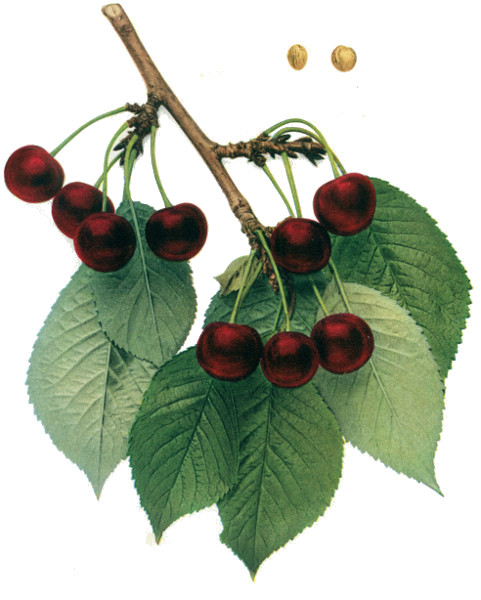
ABBESSE d'OIGNIES
Tree characteristically large and vigorous, upright-spreading, round-topped but with
drooping branchlets, hardy, productive; trunk stocky, with shaggy bark; branches thick,
smooth, ash-gray over reddish-brown, with many lenticels; branchlets short, with short
internodes, brownish, roughened by transverse wrinkles and by numerous conspicuous,
small, raised lenticels.
Leaves two and one-half inches wide, five and one-half inches long, folded upward,
obovate, thick; upper surface glossy, dark green; lower surface light green, slightly pubescent,
distinctly ribbed by the larger veins; apex taper-pointed, base acute; margin with
small, black glands, coarsely and doubly serrate; petiole one and one-quarter inches long,
thick, lightly tinged with red, grooved, with one or two small, globose, reddish-orange
glands.
Buds rather long, pointed, free, arranged often in elongated clusters at the ends of
long spurs; leaf-scars very prominent; season of bloom medium, averaging five days in
length; flowers white, one and three-sixteenths inches across; borne in dense clusters at
the ends of long spurs or spur-like branches, well distributed, varying from one to three;
pedicels one-half inch long, glabrous, greenish; calyx-tube reddish, campanulate, glabrous;
calyx-lobes tinged red, long, narrow, somewhat acuminate, glabrous within and without,
reflexed; petals roundish-oval, entire, nearly sessile, with a broad, shallow notch at the
apex; filaments one-quarter inch long; pistil glabrous, equal to the stamens in length.
Fruit late; three-fourths inch long, seven-eighths inch thick, roundish-oblate, slightly
compressed; cavity of medium depth, wide, regular; suture a line; apex roundish, slightly
depressed; color dark red; dots numerous, small, light russet, conspicuous; stem slender,
one and one-half inches long, adhering to the fruit; skin tough; flesh yellowish-white, with
colorless juice, slightly stringy, tender and soft, sprightly subacid; of very good quality;
stone free, about three-eighths inch in diameter, roundish, turgid, slightly pointed, with
smooth surfaces; ridged along the ventral suture.
Prunus avium × Prunus cerasus
- 1. Parkinson Par. Ter. 571. 1629. 2. Rea Flora 205. 1676. 3. Prince Pom. Man. 2:135. 1832.
4. Downing Fr. Trees Am. 189, 190. 1845. 5. Floy-Lindley Guide Orch. Gard. 97, 98. 1846. 6. Mag.
Hort. 13:398 fig. 1847. 7. Elliott Fr. Book 203. 1854. 8. U. S. D. A. Rpt. 135. 1867. 9. Am. Pom.
Soc. Cat. 12. 1871. 10. Hogg Fruit Man. 278, 279. 1884.
- Griotte de Portugal. 11. Duhamel Trait. Arb. Fr. 1:190, 191, Pl. XIII. 1768. 12. Leroy Dict.
Pom. 5:297, 298 fig. 1877.
- Portugiesischer Griottier Weichselbaum. 13. Kraft Pom. Aust. 1:6, Tab. 16 fig. 1. 1792.
- Herzogskirsche. 14. Christ Handb. 670. 1797. 15. Christ Wörterb. 282. 1802. 16. Truchsess-Heim
Kirschensort. 371-376. 1819.
- Portugiesische Griotte. 17. Christ Handb. 674. 1797.
- Cerise Royale de Hollande. 18. Ann. Pom. Belge. 1:81, Pl. 1853.
- Cerise de Portugal. 19. Mortillet Le Cerisier 2:148 fig. 37, 149, 150. 1866.
Parkinson, nearly three hundred years ago, thought the Arch Duke
"one of the fairest and best of cherries." It is now, however, quite surpassed
by several others of the Dukes. The concensus of opinion of those
who have known the true fruit of this name is that either May Duke or
Late Duke is better. We give it prominence only because of its worthy
past and that it may be better distinguished from May Duke with which
it is often confused. As compared with the last-named variety it is two
weeks later; the tree is more vigorous but not as productive; and the branches
are larger, more divergent and more pendulous. The cherries are not as
well flavored but are larger and have a shorter stalk.
This old English variety was first mentioned by Parkinson in Paradisus
Terrestris, 1629. For many years previous to the middle of the last century
the true Arch Duke cherry was very scarce and was often confused with
other varieties, some writers asserting that it was the May Duke; others,
the Late Duke. In 1847, however, the true Arch Duke cherry was discovered
in the nurseries of Thomas Rivers, Sawbridgeworth, England,
having been grown there, according to Mr. Rivers, by his ancestors for
nearly a century. It was then found that the fruit was quite unlike that
of either May Duke or Late Duke, though the habit of the tree was similar.
It is not known when Arch Duke was introduced into America but the
American Pomological Society placed it upon its fruit list in 1871.
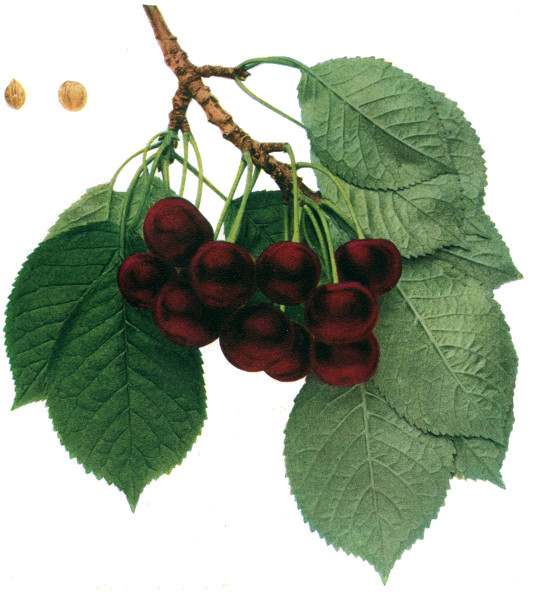
ARCH DUKE
Tree medium in size, vigorous, somewhat upright, hardy, productive; trunk stocky,
smooth; branches slender, long, smooth, reddish-brown, marked with considerable scarf-skin,
with numerous, rather large lenticels; branchlets of medium length, curved, with
short internodes, brown mottled with ash-gray, smooth, glabrous, with few small, slightly
raised, inconspicuous lenticels.
Leaves numerous, about two inches wide, three inches long, folded upward, short-oval
to obovate, of medium thickness; upper surface dark green; lower surface light green,
very slightly pubescent; apex acutely pointed; margin finely and doubly serrate, glandular;
petiole one inch long, tinged with dull red, slender, with one or two, rarely three small,
globose, brownish glands at the base of the blade.
Buds small, short, conical, plump, free, arranged singly as lateral buds or in clusters
of variable size; leaf-scars rather prominent; season of bloom medium; flowers white, one
and one-sixteenth inches across; borne in clusters of twos and threes; pedicels three-fourths
inch long, rather slender, glabrous, greenish; calyx-tube with a faint tinge of red, obconic,
glabrous; calyx-lobes with a trace of red, of medium length and breadth, acute, serrate,
glabrous within and without, reflexed; petals roundish, entire, nearly sessile, the apex
entire or with a shallow, wide notch; anthers yellowish; filaments three-sixteenths inch
long; pistil glabrous, longer than the stamens.
Fruit matures in mid-season; one and one-eighth inches in diameter, obtuse-cordate,
slightly compressed, flattened at the extremities; cavity of medium depth, narrow, somewhat
obtuse; suture distinct; apex flattened or depressed; color light red becoming dark
red or almost black at full maturity; dots numerous, of medium size, russet, rather inconspicuous;
stem slender, one and one-half inches long, rather stout at its point of insertion
in the fruit, adherent to the fruit; skin moderately thick; flesh light to dark red, firm,
crisp, slightly astringent at first, becoming a very pleasant subacid at full maturity, juicy,
good to very good in quality; stone semi-clinging, seven-sixteenths inch long, three-eighths
inch wide, oval, compressed, with smooth surfaces.
Prunus cerasus
1. Kan. Hort. Soc. Rpt. 23:81. 1898. 2. Kan. Hort. Soc. Cherry, The, 15, 16, Pl. 1900. 3. Ia. Sta.
Bul. 73:63. 1903. 4. Am. Pom. Soc. Cat. 27. 1909.
Baldwin is supposed to have grown from a sprout of a stock on which
Early Richmond had been budded on the farm of S. J. Baldwin, Seneca,
Kansas. The Early Richmond bud was in some manner broken off and
the sprout, springing from the stock, was allowed to grow and first fruited
in 1891. On the grounds of this Station Baldwin trees which came fairly
direct from the originator turned out to be Olivet. The published
descriptions that can be found are so scant and fragmentary that we cannot
make out whether the variety is really distinct or, as in the case of our
trees, is Olivet renamed. The variety has been rather widely disseminated
in the Middle West but has not shown much merit either for home or for
commercial orchards in the rather lengthy probationary period it has had
in the East. The American Pomological Society added Baldwin to its
fruit list in 1909. The description we give is a compilation.
Tree vigorous, upright, round-topped; leaves large, broad; flowers white, changing
to pink.
Fruit ripens early; usually borne in pairs; large, round; stem of medium length, rather
thick; color very dark red, yet almost transparent; flavor slightly acid, yet considered
one of the sweetest and richest of the Morello class.
Prunus avium
- 1. Downing Fr. Trees Am. 168 fig. 60. 1845. 2. Am. Pom. Soc. Cat. 74. 1862. 3. Hogg Fruit
Man. 279. 1884.
- Frühe Maiherzkirsche. 4. Kraft Pom. Aust. 1:1, Tab. 1. 1792. 5. Truchsess-Heim Kirschensort.
140, 141, 142. 1819. 6. Ill. Handb. 49 fig., 50. 1860. 7. Mathieu Nom. Pom. 348, 349. 1889.
- Süsse Maiherzkirsche. 8. Christ Handb. 662. 1797.
- May Bigarreau. 9. Kenrick Am. Orch. 234. 1841. 10. Mag. Hort. 7:288. 1841. 11. Cultivator
N. S. 4:280 fig. 1. 1847. 12. Hovey Fr. Am. 1:55, 56, Pl. 1851.
- Guigne Précoce de Mai. 13. Mortillet Le Cerisier 2:54 fig. 2, 55, 56. 1866. 14. Mas Pom. Gen.
11:51, 52, fig. 26. 1882.
- Bigarreau Baumann. 15. Leroy Dict. Pom. 5:176 fig., 177. 1877.
- Guigne de Mai. 16. Soc. Nat. Hort. France Pom. 102 fig., 103. 1904.
Baumann May is an early Sweet Cherry which at one time held high
place among its kind but a century of culture proved that it had little
value except for extreme earliness and it is now but sparingly or not at
all grown either in America or abroad. If the variety could be obtained it
might be worth growing for breeding work because of its earliness and
great productiveness. At one time this variety was rather largely grown
in central and western New York and specimens of it must yet remain in
this region.
From the latter part of the Eighteenth Century, when we first find
an account of this variety in Kraft's Pomona Austriaca, to the last of the
Nineteenth, writers have described Baumann May under many different
names. From all accounts it originated toward the latter part of the
Eighteenth Century, in Germany. From Germany it was introduced into
Alsace where F. J. Baumann, a nurseryman at Bollweiler, grew it in his
nursery under the name Bigarreau Baumann and disseminated it throughout
the French provinces. The cherry was received in America, with
several others, by Colonel M. P. Wilder of Boston, Massachusetts, from
Messrs. Baumann, about the year 1838. The American Pomological
Society listed the variety, in 1862, in its fruit catalog as Bauman's May
but dropped it again in 1871. The following description is a compilation:
Tree vigorous, somewhat spreading, regular in form, compact, very productive;
branches stocky, nearly horizontal but often curved downward; branchlets with short
internodes, reddish-brown nearly covered with silver-gray scarf-skin; leaves medium to
large, dark green, ovate-oblong, coarsely and deeply serrate; petiole rather short, with
two large, reniform glands near the base of the leaf; buds large, ovate; flowers of medium
size, opening very early.
Fruit matures very early; medium to rather small, ovate-cordate, angular, irregular
in outline; color dark red becoming nearly black when fully ripe; stem one and three-quarters
inches long, rather thick; flesh purplish-red, with abundant juice, soft and tender,
sweet, well flavored; of good quality; stone medium in size, roundish-ovate.
Prunus cerasus
- 1. Ia. Agr. Col. Bul. 53. 1885. 2. Ia. Sta. Bul. 2:38. 1888. 3. Ibid. 19:549. 1892. 4. Can.
Exp. Farm Bul. 17:6. 1892. 5. Mich. Pom. Soc. Rpt. 244. 1894. 6. U. S. D. A. Pom. Rpt. 39, 40.
1895. 7. Am. Pom. Soc. Cat. 17. 1897. 8. Del. Sta. An. Rpt. 12:122, 123 fig. 8, 124. 1900. 9. Wash.
Sta. Bul. 92:12. 1910.
By general consent Bessarabian has a place in home orchards in the
colder parts of the Mississippi Valley and the Great Plains. It is very
hardy and is said to thrive even under neglect—standing as much abuse
as a forest tree. As compared with standard commercial cherries of the
East the fruit is distinctly inferior in size and quality, being hardly fit to
eat out of hand, and is sour and astringent even when cooked. The trees,
though hardy and healthy, are dwarfish and not productive because of the
smallness of the cherries. It is an early cherry but the fruit hangs long.
The variety is said to root well from cuttings, which, if true, might make
it worth while trying as a stock. Bessarabian is a variant of English
Morello, the fruit of which sort greatly excels it wherever the trees can
be equally well grown.
This variety was brought to America from Russia about 1883, by
Professor J. L. Budd of Ames, Iowa, who believed it to belong to a race
of cherries originally found in central Asia.
Tree of medium size, upright, becoming somewhat spreading, compact, healthy,
unproductive, very hardy; branches somewhat drooping, long, slender; leaves abundant,
medium to small, oval, coarsely serrate, dark green, broad, flat; glands few, usually on
the stalk at the base of the leaf.
Fruit matures medium early, remaining on the tree a long time in good condition;
medium in size, roundish-oblate to cordate, irregular, bright red becoming dark red;
stem long, varying from one and three-fourths to two inches in length, slender, curved;
skin tender; flesh light to dark red, with abundant colored juice, variable in firmness,
sprightly subacid becoming milder when fully ripe; fair in quality; stone variable in
size, roundish-oval, semi-clinging.
Prunus avium
- 1. Soc. Nat. Hort. France Pom. 92 fig., 93. 1904. 2. Cat. Cong. Pom. France 30 fig. 1906.
- Pélissiers Knorpelkirsche. 3. Proskauer Obstsort. 57. 1907.
This variety originated in France as a chance seedling about 1883 and
fruited first in 1891. It was introduced a few years later by M. Auguste
Pélissier, a nurseryman at Château-Renard, Bouches-du-Rhône, France.
Although not yet well established even in France, this cherry is considered
promising for market, because of its firm flesh, handsome appearance,
high quality and good tree-characters. It is included among the major
varieties in The Cherries of New York that the attention of American
cherry-growers may be called to it. As yet it seems not to have been tried
in this country. The following description is compiled:
Tree upright, vigorous, very productive; branches rather long, large, bearing large,
oval leaves; flowers large, semi-open; blooming season early.
Fruit matures from early June to the last of June; large or very large, obtuse-cordate,
slightly depressed at the apex, with a shallow yet distinct suture; stem short, thick; skin
rather thick, firm, yellowish almost entirely overspread with vivid red which becomes
darker at maturity but often showing streaks of clear red; flesh fine-grained, firm, juicy,
red with streaks of white, sweet, aromatic; quality good to very good; stone of medium
size, oval, with a pronounced suture.
Prunus avium
- 1. U. S. D. A. Rpt. 262, Pl. 4 fig. a. 1892. 2. Wash. Bd. Hort. Rpt. 126, 128. 1893. 3. Am. Pom.
Soc. Cat. 24. 1899. 4. W. N. Y. Hort. Soc. Rpt. 112. 1900. 5. Ibid. 26. 1904. 6. Am. Pom. Soc.
Rpt. 192. 1907. 7. Wickson Cal. Fruits 187. 1908. 8. Am. Pom. Soc. Cat. 26. 1909. 9. Wash. Sta.
Bul. 92:23. 1910.
Bing is one of the best of the several very good cherries from the Pacific
Northwest. But few Sweet Cherries equal it in size and attractiveness
and none surpass it in quality, so that it may be said to be as good as any
of the dessert cherries. It is, too, a very good shipping fruit, ranking with
the best of the Bigarreaus, to which group it belongs, as a cherry for distant
markets. Another quality commending the variety is that it hangs well on
the trees and the crop ripens at one time so that the harvest consists of but
one picking. While many cherry-growers speak well of the trees, unfortunately
we cannot do so from their behavior on the grounds of this Station.
They have not been as vigorous, as healthy or as productive as cherry trees
should be in a commercial variety of first rank. The cause, however, may
be in the location rather than in the variety, for in an orchard but a few
miles distant Bing does much better than on these grounds. The variety,
though comparatively new, is no longer on probation. It has a niche in
the cherry flora of the country, deserving a place in the collection of every
amateur by virtue of its splendid fruit. When it is happy in soil and
climate, Bing is bound to be one of the leading commercial cherries.
Seth Lewelling of Milwaukee, Oregon, the originator of several of our
finest cherries, grew Bing from the seed of Republican in 1875. The variety
was named after a Chinese workman. In 1899 the American Pomological
Society placed the variety on its fruit list.
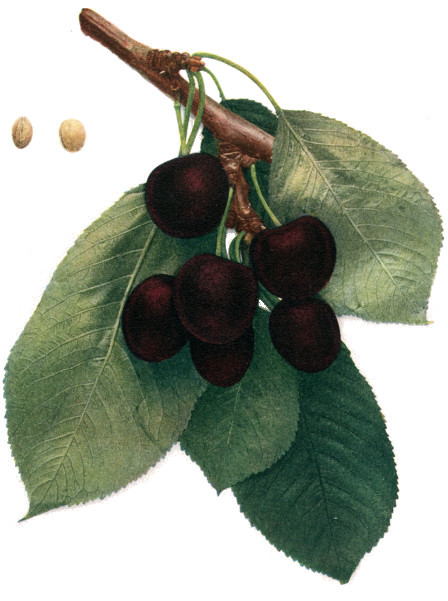
BING
Tree large, vigorous, erect becoming upright-spreading, rather open, productive;
trunk and branches thick, smooth; branches brownish with numerous, small lenticels;
branchlets thick, long, with long internodes, greenish-brown, smooth, pubescent, with
small, raised, conspicuous lenticels.
Leaves abundant, large, folded upward, ovate to obovate of medium thickness;
upper surface dark green, smooth; lower surface light green, pubescent; apex abruptly
pointed, or acute, base abrupt; margin slightly serrate, glandular; petiole long, pubescent,
thickish, tinged red, with from one to three large, reniform, reddish glands on the stalk.
Fruit matures in mid-season or later; very large, one inch in diameter, broadly cordate,
somewhat compressed, slightly angular; cavity deep, of medium width, abrupt,
regular; suture a dark line; apex roundish or slightly depressed; color very dark red,
almost black; dots small, russet, inconspicuous; stem variable in thickness, one and one-fourth
inches long; skin of medium thickness, tough, adherent to the pulp; flesh purplish-red
with dark purple juice, rather coarse, firm, very meaty, brittle, sweet; of very good
quality; stone semi-free, large, ovate to oval, blunt, with smooth surfaces.
Prunus avium
- 1. Prince Pom. Man. 2:112. 1832.
- Scheur-Kers. 2. Knoop Fructologie 2:36, 43. 1771.
- Frühe Schwarze Herzkirsche. 3. Christ Wörterb. 274. 1802.
- Guigne Bigaudelle. 4. Prince Pom. Man. 2:113. 1832.
- Coburger Maiherzkirsche. 5. Ill. Handb. 51 fig., 52. 1860. 6. Oberdieck Obst-Sort. 377. 1881.
7. Lauche Deut. Pom. III:No. 1, Pl. 1882.
- Guigne Noire Commune. 8. Leroy Dict. Pom. 5:328, 329 fig., 330. 1877.
- Noire Hâtive de Cobourg. 9. Mas Pom. Gen. 11:123, 124, fig. 62. 1882.
There is much confusion in the history of this old cherry. It
undoubtedly originated in France and in that part of the country later conquered
by the Germans, though Mas, in his Pomologie Générale, mentioned
it as probably of German origin. In the time of Louis XIII this variety
was known as the Guigne Noire Commune and was cultivated quite
extensively in France and northern Italy. It was esteemed both for its
earliness and its fine quality and was known as Guigne Guindoulle by the
peasants of central France and by the Tuscans in Italy as Corbini because
of the color of its skin. Black Guigne, Black Heart, and Early Purple,
which, while similar in many characters, are entirely distinct, have been
badly confused by both French and German writers and it is only with
the greatest difficulty that the three can be separated. While this cherry
was formerly considered of worth in Continental Europe, it is scarcely
recognized there now and was probably never brought to America. The
following description is compiled from European fruit-books:
Tree very large, round-topped, spreading, irregular in outline, productive; branches
long, large, straight, brownish, mottled with gray scarf-skin; internodes long and unequal;
leaves large, oval or oblong, acuminate; margin irregularly serrate; petiole long, slender,
with large glands; blooming season late; flowers small.
Fruit matures the last of June to the middle of July, usually attached in pairs but
sometimes in threes; medium to large in size, obtuse-cordate; color bright reddish-black
changing to deep purple; suture indistinct; stem slender, inserted in a deep, broad cavity;
skin thin, tender; flesh dark purple, with abundant colored juice, half-tender, somewhat
stringy, sweet yet sprightly, pleasantly flavored; quality good; stone small, oval.
Prunus avium
- 1. Horticulturist 6:360, 361 fig. 1851. 2. Am. Pom. Soc. Rpt. 45, 235. 1854. 3. Elliott Fr. Book
190 fig. 1854. 4. Hooper W. Fr. Book 258, 270, 271. 1857. 5. U. S. D. A. Rpt. 382. 1875.
- Épervier Noir. 6. Mas Pom. Gen. 11:41, 42, fig. 21. 1882.
Despite the fact that Black Hawk was lauded by the horticulturists
in the middle of the last century as one of the best of all black Sweet
Cherries, it is now almost unknown. According to the older pomologists
it was unsurpassed for eating out of hand but was only mediocre in all other
characters of either fruit or tree. In particular it was surpassed in many
ways by the better-known Eagle which fills about the same place in cherry
culture. The variety was very popular in southern Ohio about Cincinnati
where many trees may still be found and where it is still more or less planted.
Possibly because of the excellent quality of the fruit, the amateur might
well try a tree or two. The description is compiled.
Black Hawk originated with Professor J. P. Kirtland of Cleveland,
Ohio, sometime previous to 1845. It is one of the best of the many seedlings
fruited by him. The American Pomological Society in 1854 named
this sort as one of the promising new fruits and it still remains on the fruit-list
of this organization.
Tree large, vigorous, spreading, round-topped, resembling Yellow Spanish in habit,
productive, healthy; branches stout, smooth, dark reddish-brown, straight; branchlets
slender, with short internodes.
Leaves large, folded upward, obovate, rather thick; upper surface dark green; lower
surface pale green; apex abruptly pointed; margin coarsely and deeply serrate; petiole
short, stout, bright red, with two or more orange-red, reniform glands.
Buds of medium size, rather short, free; flowers small or medium in size; pedicels
long, very slender; calyx-lobes straight, finely serrate, obtuse; petals roundish, broadly
and deeply notched at the tip.
Fruit matures about the middle of June, a few days later than Black Tartarian;
medium to large, obtuse-cordate, surface uneven, sides compressed; cavity deep, broad,
abrupt, nearly regular; color glossy, dark purplish-black changing to almost black at complete
maturity; stem usually thick but often variable, of medium length; skin thick,
adhering to the pulp; flesh purplish-black, tender, with abundant colored juice, aromatic,
well flavored, sweet; of very good quality; stone of medium size, with uneven surfaces.
Prunus avium
- 1. Rea Flora 205. 1676. 2. Prince Pom. Man. 2:115. 1832. 3. Downing Fr. Trees Am. 169 fig.
1845. 4. Am. Pom. Soc. Rpt. 195. 1854. 5. Thompson Gard. Ass't 526. 1859. 6. Am. Pom. Soc.
Cat. 74. 1862.
- Guignier à Fruit Noir. 7. Duhamel Trait. Arb. Fr. 1:158, 159, 160, Pl. 1 fig. 1. 1768.
- Frühe Schwarze Herzkirsche. 8. Truchsess-Heim Kirschensort. 116-119. 1819. 9. Mathieu Nom.
Pom. 340, 349. 1889.
- Guigne Noire Ancienne. 10. Mortillet Le Cerisier 2:66 fig. 7, 67, 68. 1866.
- Bigarreau Noir d'Espagne. 11. Leroy Dict. Pom. 5:223 fig., 224. 1877.
Although one of the oldest cherries under cultivation, Black Heart is
still largely grown the world over. Prince, in 1832, said that it was more
widely cultivated in the United States than any other variety and Downing,
in 1845, said Black Heart was then better known than any other cherry
in the country. While neither of these two statements would hold for
Black Heart now, it having long since passed its heyday of popularity, it
is still, because of the fruitfulness of the tree and the high quality and
beauty of the fruit, a variety of much merit. Black Heart fails in the
commercial fruit growing of nowadays, as compared with the cherry culture
of the fruit connoisseurs of a generation ago, because it does not meet
market demands, failing to do so through two defects: it does not ship
well and when brown-rot is rife it quickly succumbs to this fungus. It is,
too, now difficult to obtain the variety true to name, the trees at this Station,
as an example, in several attempts, turning out untrue, which forces
the use of a compiled description in this text.
This cherry was mentioned by John Rea in 1676 but there can be no
doubt but that it originated many years previous to this date. Probably
it is the cherry mentioned by Robert Dodonée, a naturalist of Malines,
Belgium, in 1552. When or by whom it was introduced to America is not
known but it was being grown here very early in the Nineteenth Century
and ever since has been considered a valuable variety for general planting.
Nearly every nurseryman throughout the United States lists Black Heart,
a fact attesting its popularity. The American Pomological Society placed
Black Heart on its catalog of fruits in 1862, a place which it has since
retained.
Tree large, very vigorous, tall, wide-spreading, productive; branches stout, brownish,
mingled with yellow, mottled with gray scarf-skin; lenticels numerous, small.
Leaves very large, oblong, waved, acuminate, nearly flat; upper surface dark green;
margin deeply and coarsely serrate; petiole of medium length, lightly tinged with red,
with greenish glands.
Buds large, oval, pointed; season of bloom early or very early; flowers medium in
size; petals roundish, imbricated.
Fruit matures early, season long; large, obtuse-cordate, somewhat compressed; cavity
broad; suture deep; surface somewhat irregular; color dark purple becoming black; stem
one and three-fourths inches long, slender; skin slightly shrivelled; flesh dark red, firm
to very firm becoming tender at full maturity, with abundant colored juice, sweet; good
in quality; stone large, roundish-ovate; dorsal suture deep.
Prunus avium
- 1. Truchsess-Heim Kirschensort. 130-132. 1819. 2. Pom. Mag. 1:44, Pl. 1828. 3. Lond. Hort.
Soc. Cat. 55. 1831. 4. Prince Pom. Man. 2:113, 114. 1832. 5. Proc. Nat. Con. Fr. Gr. 52. 1848.
6. Dochnahl Führ. Obstkunde 3:21. 1858. 7. Ill. Handb. 61 fig., 62. 1860. 8. Leroy Dict. Pom.
5:228, 229 fig., 230. 1877. 9. Mathieu Nom. Pom. 377, 378. 1889. 10. Cat. Cong. Pom. France 37.
1906.
- Ronald's Large Black Heart. 11. Forsyth Treat. Fr. Trees 42, 43. 1803.
- Guigne Noire à Gros Fruit. 12. Cat. Cong. Pom. France 36. 1906.
- Tartarian. 13. Am. Pom. Soc. Cat. 26. 1909.
Black Tartarian is probably the favorite dooryard and roadside Sweet
Cherry in New York and ranks second or third among commercial cherries
in the State, as it probably does for the whole region east of the Mississippi.
It is known by all who grow or eat cherries. The preeminently meritorious
characters which give it so high a place in cherry culture are: first, and
most important, the elasticity of its constitution whereby it adapts itself
to widely different soils and climates; second, the fruitfulness, healthfulness
and robustness of the trees which also bear regularly, live to an old age
and grow to a prodigious size, oftentimes attaining a diameter of two feet;
third, this variety is comparatively free from the worst of cherry diseases,
brown-rot; lastly, the cherries, though not as large as some similar sorts,
are tempting to the eye through their rotund form and glossy black color
and are a delight to the palate, the handsome purplish-red flesh being firm
and crisp, yet juicy, with a sweet, rich flavor which all agree gives the quality
the rank of "very good to best." It is a virile variety and from it have
come several promising seedlings and it is one of the parents of a number
of cross-bred cherries. Black Tartarian is earlier than most of the Sweet
Cherries with which it must compete—under most conditions a help in
marketing. Unfortunately it is a little too soft to handle well in harvesting
and marketing or to hold its shape as a canned product. Its small size
is also against it for the canner's trade. The several defects noted prevent
Black Tartarian from taking first rank in commercial orchards but for the
home plantation it is one of the best.
Black Tartarian came originally from Russia. It was introduced into
England in 1794 from Circassia, by Hugh Ronalds of Brentford, Middlesex,
as Ronald's Large Black Heart. Two years later, John Fraser introduced
a variety, a native of Crimea, which he purchased in St. Petersburg, as
Fraser's Black Tartarian. This turned out to be the same as the cherry
from Circassia. Some go farther back and say that Black Tartarian was
carried to Russia from Spain, thence to England. It owes its introduction
into this country to William Prince of Flushing, Long Island, probably
in the early part of the Nineteenth Century. It was recognized in 1848
and placed on the schedule of fruits at the National Convention of Fruit
Growers which later became the present American Pomological Society.
The variety still retains a place among the recommended cherries but
under the name Tartarian. The variety quickly became popular in America,
finding a place in every orchard and in the lists of all nurserymen. Some
nurserymen claim to have superior strains of the old variety; as, Green's
Tartarian and Black Tartarian Improved. Comparisons show no differences.
Black Russian, listed by some firms, is probably Black Tartarian
as it is used many times as a synonym by foreign writers.
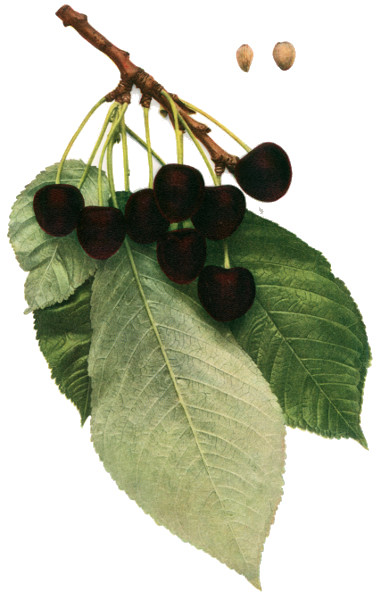
BLACK TARTARIAN
Tree characteristically large, vigorous, upright, vasiform, productive; trunk of medium
thickness, smooth; branches smooth, reddish-brown, slightly overspread with ash-gray,
with large lenticels; branchlets rather long, brown almost entirely overspread with ash-gray,
smooth, glabrous, with inconspicuous, slightly raised lenticels.
Leaves numerous, five and one-half inches long, two and one-half inches wide, folded
upward, obovate to elliptical, thin; upper surface dark green, rugose; lower surface light
green, slightly pubescent; apex acute, base abrupt; margin varies from serrate to crenate;
petiole two inches long, thick, tinged with red, with a few hairs, with from one to three
reniform, reddish glands of medium size usually on the stalk.
Buds pointed or obtuse, plump, free, arranged singly as lateral buds, or in small
clusters on spurs of variable length; leaf-scars very prominent; season of bloom medium;
flowers white, one and one-fourth inches across, borne in scattering well-distributed clusters
in twos and threes; pedicels one inch long, slender, glabrous, greenish; calyx-tube faintly
tinged with red, campanulate, glabrous; calyx-lobes with a trace of red, long, broad,
obtuse, glabrous within and without, reflexed; petals roundish, entire, with short, blunt
claws; anthers yellowish; filaments nearly one-half inch long; pistil glabrous, shorter than
the stamens.
Fruit matures early; less than one inch in diameter, cordate, compressed; cavity
intermediate in depth and width, flaring; suture indistinct; apex pointed and slightly
depressed; color purplish-black; dots numerous, small, russet, obscure; stem slender, one
and one-half inches long, adherent to the fruit; skin thin, separating readily from the
pulp; flesh purplish-red, with dark colored juice, firm, meaty, crisp, pleasant flavored,
mild, sweet; of very good quality; stone free, ovate, slightly flattened and oblique, with
smooth surfaces.
Prunus avium
- 1. Rea Flora 205. 1676. 2. Forsyth Treat. Fr. Trees 42. 1803. 3. Floy-Lindley Guide Orch. Gard.
104. 1846. 4. Elliott Fr. Book 215. 1854.
- Gascoigne. 5. Parkinson Par. Ter. 571, 572. 1629. 6. Gerarde Herball 1504. 1636. 7. Hogg
Fruit Man. 298. 1884.
- Red Heart. 8. Rea Flora 206. 1676. 9. Brookshaw Hort. Reposit. 2:183, Pl. 96 fig. 1. 1823.
- Blutherzkirsche. 10. Truchsess-Heim Kirschensort. 224, 225, 226. 1819.
- Gascoigne's Heart. 11. Downing Fr. Trees Am. 174. 1845.
- Blutrothe Molkenkirsche. 12. Dochnahl Führ. Obstkunde 3:29. 1858.
- Guigne Rouge Hâtive. 13. Leroy Dict. Pom. 5:338 fig., 339. 1877.
Bleeding Heart goes back almost as far as the history of cultivated
cherries. It is only of historical interest now and this chiefly because it
has been the parent of many sorts of present worth. According to the old
writers it took highest rank in the cherry lists of a century and more ago
by virtue of its high quality and handsome appearance, the name being
indicative of color and form. So far as can be made out at this late date
the variety has been grown but little or not at all in America, the description
here given coming from old pomologies.
This, like the preceding sort, is a cherry of several names, having been
mentioned first by Parkinson in 1629 as the Gascoign Cherry. In England
three different names have been applied to this variety, Gascoigne, Red
Heart and Bleeding Heart. At least there seems to be little doubt that
the Bleeding Heart and Red Heart listed by John Rea in 1676 were the
Gascoign of Parkinson and Gerarde.
Tree of largest size, very vigorous, not very productive; branches numerous, large,
long, diverging, brownish-red, mottled with gray scarf-skin; leaves very large, oblong,
acuminate; margin crenate; petiole thick, long, reddish, with well-developed glands; blooming
season early.
Fruit matures the latter half of July; usually in pairs, large, elongated heart-shaped,
with pointed apex; color bright red changing to dark red, somewhat mottled; stem two
inches long, slender; flesh reddish, rather tender although firm, with abundant juice, highly
flavored, sweetish; good in quality; stone large, oblong.
Prunus cerasus
- Cerise de Bourgueil. 1. Mortillet Le Cerisier 2:205. 1866.
- Montmorency de Bourgueil. 2. Mas Le Verger 8:123, 124, fig. 60. 1866-73. 3. Leroy Dict. Pom.
5:364, 365 fig. 1877.
Bourgueil is a variant form of Montmorency hardly differing enough
in fruit from Large Montmorency to be distinguished from it and yet
since it seems to be more productive than the last-named sort it is possibly
worth adding to the cherry flora of the country. The variety, it must be
remembered, is still on probation, but if trees true to name can be obtained
it is worth planting in small numbers where growers want a cherry of the
Montmorency type.
This variety was found by a Doctor Bretonneau about 1844 in Bourgueil,
Indre-et-Loire, France. It is known by the name of the finder as
well as that of the locality in which it originated and through having the
same place of origin is often confused with Cerise Rouge Pale. The United
States Department of Agriculture received this variety in 1905 from Ferdinand
Jamin, Bourg-la-Reine, Seine, France, and in turn forwarded it to
this Station where it has been fruiting for the past few seasons. Nurserymen
do not as yet offer it for sale and it is doubtful if it is known in more
than a few places in America.
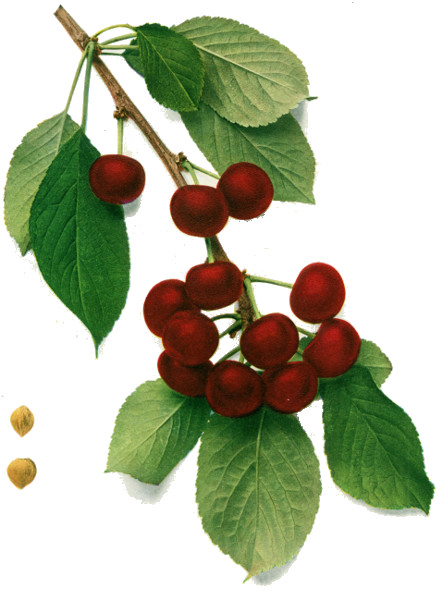
BOURGUEIL
Tree vigorous, upright-spreading, vasiform, productive; branches slender, smooth,
reddish-brown partly covered with ash-gray, with numerous lenticels; branchlets slender,
long, brown, with some ash-gray, smooth, with numerous inconspicuous, raised lenticels.
Leaves numerous, four inches long, two inches wide, folded upward, obovate to ovate,
thick; upper surface dark green, smooth; lower surface light green, pubescent along the
veins; apex and base variable in shape; margin doubly crenate; petiole one inch long,
thick, with a dull tinge of red, pubescent, with none or with from one to three globose,
yellow or brownish glands on the base of the blade.
Buds small, short, variable in shape, plump, free, arranged singly as lateral buds
and on short spurs in clusters variable in size; leaf-scars prominent; season of bloom late;
flowers white, one and one-fourth inches across; borne in scattering, well-distributed
clusters, usually in threes; pedicels short, one-half inch long, glabrous, greenish; calyx-tube
faintly tinged with red, campanulate, glabrous; calyx-lobes with a trace of red, broad,
serrate, glabrous within and without, reflexed; petals crinkled, roundish, entire, sessile,
with apex entire; filaments one-fourth inch long; pistil glabrous, equal to the stamens
in length.
Fruit matures in mid-season; three-fourths inch long, one inch wide, nearly oblate,
somewhat compressed; cavity deep, wide, medium flaring, regular; suture indistinct;
apex roundish to flattened; color bright red; dots small, russet, inconspicuous; stem stout,
one and one-eighth inches long, adherent to the fruit; skin tender, free; flesh yellowish-white
with colorless juice, tender and melting, sprightly, sour; of good quality; stone free,
large, roundish-ovate, pointed, with smooth surfaces, tinged with red, with a prominent
ventral suture.
Prunus cerasus
- 1. Christ Handb. 676. 1797. 2. Christ Wörterb. 288. 1802. 3. Truchsess-Heim Kirschensort.
533-536. 1819. 4. Dochnahl Führ. Obstkunde 3:63, 64. 1858. 5. Mathieu Nom. Pom. 333, 341.
1889. 6. Am. Pom. Soc. Cat. 24. 1899. 7. Del. Sta. An. Rpt. 12:124, 125, fig. 8. 1900.
- Brüsselsche Bruyn. 8. Krünitz Enc. 75, 76. 1790.
- Zweite Grösser Herzkirschweichsel. 9. Kraft Pom. Aust. 1:9, Tab. 22 fig. 1. 1792.
- Ratafia. 10. Hogg Fruit Man. 309, 310. 1884.
From the standpoint of commercial cherry culture, Brusseler Braune
has little value. The trees are uncertain in bearing; the cherries are small,
sour, and astringent; and, worse than the faults named, the crop ripens
very unevenly. It is of the English Morello type but in New York, at
least, is far inferior to this well-known sort. Brusseler Braune has been
much advertised for cold climates but there are many better cherries that
stand cold nearly or quite as well and are better in both tree and fruit
characters and, in particular, that will not vex the souls of growers by ripening
so unevenly. The variety has two marked peculiarities: the leaves on the
two-year-old wood are very small and the fruit-stems bear a small leaflet
at their base. These leaflets on the fruit-stem would have to be removed
in marketing the crop—another serious defect.
No doubt Brusseler Braune originated in Holland but there is nothing
definite as to the time though Truchsess, a German, writes of having
received it in 1785 as Brüsselsche Bruyn. The synonyms of this variety
are more or less confused with those of English Morello. This cherry was
brought to America in 1883 by the late J. L. Budd with several other
varieties. In the collection of trees sent out from the original importation,
of which this was one, or from trees budded from them, were Griotte du
Nord, Large Long Late, Shadow Amarelle, Lutovka, George Glass, Orel
No. 27, or Gibb, and Bessarabian. Unfortunately the varieties were badly
mixed and much confusion has resulted. It is not impossible that the
first three are synonyms but the Lutovka, George Glass, Bessarabian and
possibly the Gibb are distinct varieties. In 1895, this Station recommended
a new cherry for trial for home and market and distributed buds throughout
the state under the name Lutovka. Later it was found that an error had
been made regarding the trees sent us as Lutovka, they being the Brusseler
Braune. The American Pomological Society added Brusseler Braune
to its fruit catalog list in 1899 but dropped it in 1909.
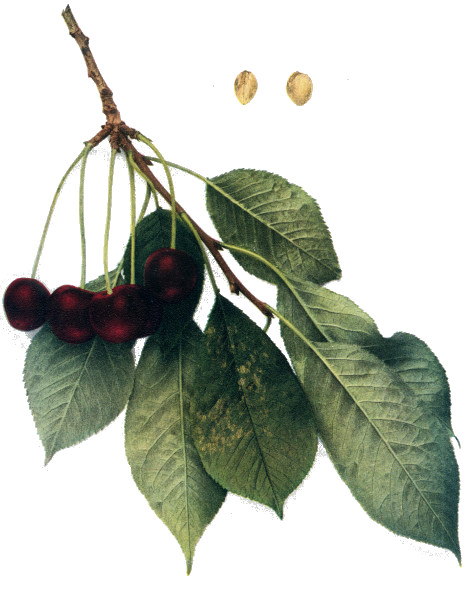
BRUSSELER BRAUNE
Tree of medium size, vigorous, upright-spreading but with drooping branchlets,
dense, round-topped, unproductive; trunk and branches smooth, stout; branches brownish,
overspread with ash-gray, with numerous small lenticels; branchlets slender, with short
internodes, nearly covered with ash-gray, smooth, glabrous, with small, lightly raised,
inconspicuous lenticels.
Leaves three and one-half inches long, one and three-fourths inches wide, folded
upward, obovate, thick, grooved along the midrib; upper surface very dark, dull green;
lower surface light green, pubescent; apex taper-pointed, base acute; margin finely and
doubly serrate; petiole one and one-eighth inches long, tinged with dull, dark red, grooved
along the upper surface, with from one to four small, globose, yellowish-green glands.
Buds pointed, plump, free, arranged as lateral buds and in clusters on scattering,
short spurs; leaf-scars prominent; season of bloom late; flowers one inch across, white;
borne in scattering clusters in threes and fours; pedicels one and one-eighth inches long,
slender, glabrous, greenish; calyx-tube furrowed, tinted with red, obconic, glabrous; calyx-lobes
with a trace of red, acuminate, serrate, glabrous within and without, reflexed; petals
oval to obovate, entire, nearly sessile, with a shallow, wide notch at the apex; filaments
one-fourth inch long; pistil glabrous, equal to the stamens in length.
Fruit matures very late; nearly one inch in diameter, although variable in size,
roundish-cordate, slightly compressed; cavity of medium depth, narrow, abrupt; suture
very shallow, indistinct; apex roundish, with a small depression at the center; color light
red changing to dark red as the season advances; dots numerous, small, dark russet,
inconspicuous; stem two and one-fourth inches long, with small leaflets at the base,
strongly adherent to the fruit; skin thin, tender, separates readily from the pulp; flesh
dark red, with dark colored juice, tender and melting, somewhat astringent, sour; of fair
quality; stone nearly free when fully mature, fifteen-thirty-seconds inch long, roundish-oval,
rather plump, blunt-pointed; surfaces smooth; ventral suture slightly enlarged near
the base.
Prunus cerasus
1. Truchsess-Heim Kirschensort. 652-655. 1819. 2. Ia. Hort. Soc. Rpt. 330. 1885. 3. Ia. Sta.
Bul. 2:40. 1888. 4. Budd-Hansen Am. Hort. Man. 2:272. 1903.
So far Bunte Amarelle has found a place only in the trying cherry
climate of Iowa and neighboring States. It is not attractive enough in
appearance, good enough in quality, or certain and fruitful enough in bearing
to compete with other Amarelles, to which group this variety belongs.
Its saving grace is extreme hardiness of tree, though vigor and health help
make it somewhat desirable in cold, prairie regions of the Mid-West where
cherry growing is more or less precarious. There has been much uncertainty
as to the true variety and we have had to discard the trees on the
Station grounds and compile a description.
This variety probably originated in Germany in the latter part of the
Eighteenth Century. Truchsess, a German, in 1819, called the cherry
Bunte Amarelle because of its variegated color before full maturity. The
variety was introduced from Poland to America sometime previous to 1885
and has usually gone under the name of Amarelle Bunte. From all accounts
Professor J. L. Budd of Ames, Iowa, the authority on these hardy cherries
during his time, had two different cherries under the name Amarelle Bunte;
for in his report at the Iowa Horticultural Society in 1885, he mentioned
a variety under that name as being a large, dark purple and nearly sweet
sort which could not have been the true Bunte Amarelle of Truchsess.
Budd and Hansen in 1903 described a variety which agrees very closely
with the true variety of Truchsess which we herewith describe.
Tree vigorous, upright, hardy; foliage large, coarse.
Fruit matures the second week in June; medium to large, roundish, flattened at the
base; cavity variable in depth; suture shallow, indistinct; apex depressed; color yellow
overspread with light red; stem green, straight, rather slender, one and one-half to two
inches long; flesh slightly colored, juicy, firm but tender, pleasantly subacid; very good
in quality; stone variable in size, broad.
Prunus avium
- 1. Wickson Cal. Fruits 289, 292. 1889. 2. Wash. Sta. Bul. 92:25. 1910.
- Advance. 3. Am. Pom. Soc. Rpt. 130. 1897.
- Ulatis. 4. Mich. Sta. Bul. 177:32. 1899.
California Advance is a Sweet Cherry, one of the "Hearts" of common
parlance, distinguished and worth growing only because it is extra early,
though when fully ripe it is of very good quality. It is usually described
as a cherry of "large size" but on the grounds of this Station the cherries
run small, as they are occasionally reported elsewhere to do, suggesting
that the variety requires good care and a choice cherry soil for a finely
finished product. On these grounds the variety seems to be preeminently
free from fungus diseases but the robin and other birds take greater toll
from it than from almost any other cherry, beginning their harvest long
before the fruit is fit for human fare. California Advance might well be
planted in a small way for a local market in New York, or a tree or two
for home use, but it has no place in large numbers in this State.
California Advance came from a seed of Early Purple sown by W. H.
Chapman of Napa, California, the seedling being saved because the cherries
were larger and ripened earlier than those of its parent. It has sometimes
been confused with the Chapman cherry, of somewhat similar characteristics,
which also originated in Napa, but the two are quite distinct.
Tree large, vigorous, upright-spreading, dense, productive; trunk and branches stout,
smooth; branchlets of medium thickness, brownish-bronze partly covered with ash-gray,
glabrous; leaves numerous, five and one-half inches long, two and one-half inches wide,
long-obovate to elliptical, thin, medium green, slightly rugose; margin serrate, glandular;
petiole nearly two inches long, slender, tinged with red, pubescent along the upper side
and with a shallow groove, with from two to four large, reniform, reddish glands, usually
on the stalk; buds large, obtuse or pointed, plump, arranged singly as lateral buds or in
clusters of variable size on numerous short spurs; leaf-scars prominent; season of bloom
early; flowers one and one-eighth inches across; pistil equal to the stamens in length.
Fruit ripens very early, season averaging eleven days; about three-fourths inch in
diameter, roundish-cordate, compressed; color purplish-black; stem of medium thickness,
often one and one-half inches long, adherent to the fruit; skin thin, tender, separates from
the pulp; flesh reddish, with dark red juice, meaty, tender, mild, sweet; of very good quality;
stone semi-clinging, three-eighths inch by eleven-thirty-seconds inch in size, roundish-oval,
compressed, oblique, with smooth surfaces.
Prunus cerasus
- 1. Rea Flora 205. 1676. 2. Langley Pomona 86, Pl. 16 fig. 3. 1729. 3. Forsyth Treat. Fr. Trees
42. 1803. 4. Coxe Cult. Fr. Trees 251. 1817. 5. Prince Pom. Man. 2:138, 139. 1832. 6. Downing
- Fr. Trees Am. 194 fig. 83. 1845. 7. Thompson Gard. Ass't 529. 1859. 8. Am. Pom. Soc. Cat. 74.
1862. 9. Mas Le Verger 8:91, 92, fig. 44. 1866-73. 10. Hogg Fruit Man. 289. 1884.
- Cerise d'Orange. 11. Knoop Fructologie 2:36, 41. 1771.
- Rothe Oranienkirsche. 12. Krünitz Enc. 55, 56. 1790. 13. Truchsess-Heim Kirschensort. 456-463.
1819. 14. Ill. Handb. 175 fig., 176. 1860.
Carnation is a conspicuous cherry because of its beautiful color—red,
a little variegated with white or yellow, hence the name. It is one of the
Amarelles, similar to Montmorency except in color in which character it
is more pleasing than the better-known sort. The stone separates from
the pulp very readily leaving the flesh unusually bright and clean. Because
of their sprightly refreshing flavor, the cherries are pleasing to the palate,
as well as attractive to the eye. Unfortunately the trees are but
moderately vigorous and fruitful and these qualities count so heavily
against it as a commercial cherry that Carnation cannot be more than
a fruit for amateurs unless under exceptional conditions. For a home
plantation, however, it would be hard to name a better cherry of its kind.
Carnation is another of the choicely good, old cherries, being first
mentioned by John Rea in 1676 and later by Langley in 1729. Having
been cultivated for so long and disseminated among so many growers who
kept meagre records in early days, this sort became badly confused with
other varieties, especially with the "Cerisier à gros fruit rouge-pale," mentioned
by Duhamel in 1768. How old the variety truly is or where it
originated cannot be said. Carnation seems to have been first mentioned
in America by William Coxe in 1817 and a few years later it was growing
on the grounds of William Prince, Flushing, New York. Since that time
it has been quite widely disseminated throughout the United States but is
grown less extensively now than formerly. The American Pomological
Society, in 1862, placed Carnation on its list of recommended fruits where
it still holds a place.
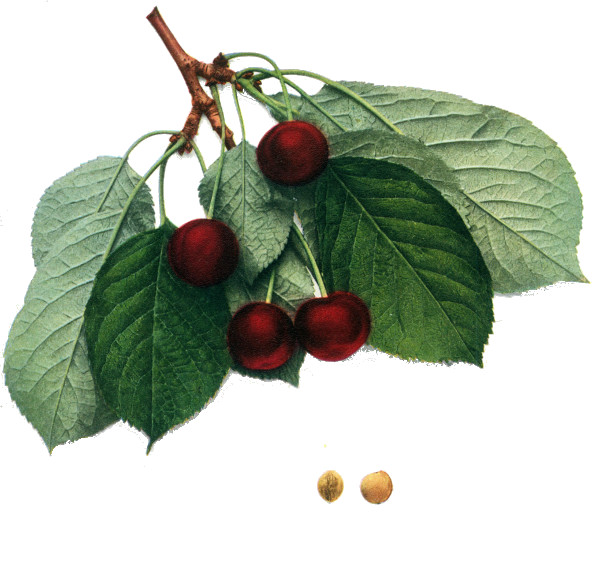
CARNATION
Tree medium in size, spreading, becoming drooping, not very productive; trunk intermediate
in thickness; branches reddish-brown overspread with ash-gray, with numerous
lenticels variable in size; branchlets brown or ash-gray, smooth, with numerous conspicuous,
raised lenticels.
Leaves very numerous, four inches long, two inches wide, folded upward, oval to
obovate, thin; upper surface dark green, roughened; lower surface dull, light green, thinly
pubescent; apex acute; margin finely and doubly serrate, glandular; petiole two inches
long, slender, dull red on the upper surface, with one or two large, reniform, reddish glands
on the stalk.
Buds small, short, obtuse, plump, free, arranged singly as lateral buds, or in small
clusters on numerous, short spurs; season of bloom late; flowers white, one and one-fourth
inches across; borne in scattered clusters in twos and threes; pedicels one inch long, of
medium thickness, glabrous, green; calyx-tube light reddish-green, campanulate, glabrous;
calyx-lobes tinged with red, of medium length, broad, acute, glabrous within and without,
reflexed; petals roundish-oval, entire, with short, broad claws, the apex notched; filaments
in four series, the longest averaging one-half inch in length; pistil glabrous, shorter than
the stamens.
Fruit matures in mid-season or later; three-fourths of an inch long, one inch in thickness,
roundish-oblate, compressed; cavity deep, abrupt; suture indistinct; apex flattened
or with a deep depression; color medium to dark red; dots numerous, small, russet, inconspicuous;
stem one and one-half inches long, adherent to the fruit; skin tender, separating
readily from the pulp; flesh yellowish-white, with abundant colorless juice, tender and
melting, sprightly; of very good quality; stone free, nearly one-half inch in diameter,
roundish, blunt, with smooth surfaces.
Prunus avium
- 1. Am. Pom. Soc. Rpt. 17, 159. 1885. 2. Wickson Cal. Fruits 289. 1889. 3. Am. Pom. Soc. Cat.
24. 1899.
In California, Centennial is passing from the period of probation to
one of general acceptance as a standard variety. Unfortunately it has not
been well tested in the East but trees growing in a commercial orchard at
Geneva show the variety to be a close competitor, in this instance at least,
with its parent, Napoleon, the mainstay of Sweet Cherry growers in New
York. In some respects it quite surpasses Napoleon. It is larger, sweeter
and better flavored and has a smaller pit. The trees fall short of those
of its well-known parent, however, in being less fruitful. Even more
serious defects are, in the orchard under observation, that Centennial
cracks and is less successful in resisting brown-rot than Napoleon though
it surpasses many other well-known sorts in these respects. The two
varieties under comparison may be further distinguished by the more
oblate fruits of Centennial, by a more mottled color and by the pits which
are longer and more pointed in the newer variety. Centennial is recommended
for home orchards and experimentally for commercial plantations.
Centennial is a seedling of Napoleon grown by Henry Chapman,
Napa, California. It came in fruit in 1876 but was not introduced until
1885, Leonard Coates of Napa, California, being the introducer. Despite
its many merits, Centennial did not win a place on the fruit list of the
American Pomological Society until 1899.
Tree large, vigorous, upright-spreading, open-topped, productive; trunk thick, roughish;
branches stout, smooth, brownish, with many large lenticels; branchlets thick, with internodes
of medium length.
Leaves numerous, large, flattened, long-oval to obovate, thick; upper surface dark
green, rugose; lower surface pale green, thinly pubescent; apex taper-pointed; margin
coarsely serrate, with small and inconspicuous glands; petiole one and one-fourth inches
long, pubescent, tinged with red, with from two to four large, reniform, greenish-red,
flattened glands, usually on the stalk.
Buds large, long, pointed, plump, free, arranged singly as lateral buds or in small
clusters on short spurs; leaf-scars prominent; blooming season about the middle of May;
flowers one and one-fourth inches across, usually arranged in twos and threes; pedicels
variable in length averaging one and one-eighth inches, slender, glabrous, greenish; calyx-tube
faintly tinged with red, obconic, glabrous; calyx-lobes long, acute, glabrous on both
surfaces, reflexed; petals oval, entire, tapering to short, narrow claws, with a slightly crenate
apex; anthers greenish; filaments one-eighth inch long, shorter than the petals; pistil
glabrous, equal to the stamens in length.
Fruit matures the last week in June, length of season rather short; very large, short-cordate,
compressed; cavity deep, wide; suture distinct, broad, shallow; apex roundish or
slightly depressed; color amber-yellow, speckled and overlaid with crimson; dots whitish,
inconspicuous; stem thick, one and one-fourth inches long, adherent to the pulp; skin thin,
tender, cracks badly, adherent to the pulp; flesh whitish, with colorless juice, meaty,
crackling, sprightly, sweet; of very good quality; stone semi-clinging, three-eighths inch
in length, eleven-thirty-seconds inch in width, ovate, plump, oblique, with smooth surfaces;
ridged on the ventral suture.
Prunus avium × Prunus cerasus
- Cerisier à Fruit Ambré, à Fruit Blanc. 1. Duhamel Trait. Arb. Fr. 1:185, 186, 187, Pl. XI. 1768.
- Schöne von Choisy. 2. Truchsess-Heim Kirschensort. 452-455. 1819. 3. Mathieu Nom. Pom. 333,
334, 376. 1889.
- Belle de Choisy. 4. Pom. Mag. 1:42, Pl. 1828. 5. Prince Pom. Man. 2:137. 1832. 6. Cultivator
10:150 fig. 1843. 7. Downing Fr. Trees Am. 190 fig. 79. 1845. 8. Poiteau Pom. Franc. 2: No. 27, Pl.
1846. 9. Am. Pom. Soc. Rpt. 37, 38, 102. 1852. 10. Ann. Pom. Belge 1:63, fig. 2. 1853. 11. Elliott
Fr. Book 189. 1854. 12. Am. Pom. Soc. Cat. 74. 1862. 13. Mortillet Le Cerisier 2:169, 170 fig. 45,
171, 172. 1866. 14. Mas Le Verger 8:113, 114, fig. 55. 1866-73. 15. Hogg Fruit Man. 276, 280. 1884.
16. Soc. Nat. Hort. France Pom. 80 fig., 81. 1904. 17. Cat. Cong. Pom. France 18. 1906.
It seems to be the consensus of opinion of a score or more of European
and American pomologists who have known Choisy that it is the handsomest
and most delicious of all Duke cherries—one of the very best of
all dessert cherries. In it are delicately combined the richness of the
Sweet Cherry and the sprightliness of the Sour Cherry. Unfortunately,
while it bears early and regularly, the trees are seldom fruitful. As an
offset to unfruitfulness, however, the trees are vigorous, hardy and healthy.
The cherries keep and stand the wear and tear of marketing as well as those
of any other Duke. Its qualities all commend it for the home orchard
and for a local market. In particular it may be recommended for cold
climates where a true Sweet Cherry is not quite hardy, this hybrid being
nearly as hardy as the other parent, the Sour Cherry. Unfortunately
suitable specimens of this beautiful cherry could not be obtained for a
color-plate and the description has had to be compiled in part.
Duhamel describes two amber-colored cherries, one of which is listed
by Leroy as Belle de Choisy. The Cerise Blanche, or Cerise Ambrée
(Grosse), according to Leroy, was cultivated in Central France as early
as 1628 and in 1667 Merlet wrote of it as the most curious and rare of all
cherries. Kenrick, American Orchardist, 1832, lists a variety, Ambrée,
which according to Floy-Lindley's and Duhamel's descriptions must be
Choisy. Some writers, however, say that Choisy was first grown by M.
Gondouin, a gardener for Louis XV, in 1760, at the village of Choisy near
Paris. The American Pomological Society, in its report for 1852, mentioned
this variety as having promise and ten years later listed it in the Society's
fruit catalog where it has since remained.
Tree large, vigorous, spreading, somewhat open, hardy, but moderately productive;
branches thick, of a clear grayish color with brownish-red tips; lenticels very numerous,
large, roundish.
Leaves numerous, very broad, obovate, rather abruptly pointed; upper surface shining
dark green, deeply and regularly serrate to rather dentate.
Buds large, thick, conical, clear brown somewhat covered with gray; season of bloom
rather early; flowers white, large, numerous, borne in large clusters; petioles short, scarcely
an inch in length; petals broadly round, edges dentate; calyx-lobes short, large; pistil
longer than the stamens.
Fruit matures in some localities just before May Duke, in others just after that variety,
ordinarily ripe, however, at the end of June; usually attached in pairs, large, roundish to
somewhat oval, flattened toward the base; cavity shallow, wide; suture shallow, indistinct;
apex depressed; color attractive bright red mottled with yellow and amber; stem thick
at the base, one and one-half to two inches long, generally forking at about one-half
inch from the base; skin thin, somewhat firm, semi-transparent showing the netted texture
of the pulp beneath; flesh pale amber, with abundant colorless juice, tender, melting, sweet,
pleasant flavor; very good in quality; stone medium to small, roundish, pointed at the
apex; dorsal suture indistinct; surfaces nearly smooth.
Prunus avium
- 1. Horticulturist 2:60 fig. 1847-48. 2. Elliott Fr. Book 191 fig., 192. 1854. 3. Am. Pom. Soc. Cat.
74. 1862. 4. Mortillet Le Cerisier 2:131. 1866.
- Knorpelkirsche von Cleveland. 5. Ill. Handb. 45 fig., 46. 1867.
Cleveland is a Bigarreau which falls so far short of its near kin, as it
grows in New York at least, as not to be worth planting except as an early
cherry of its type—earliness being its one saving asset. The cherries closely
resemble Rockport in size, color, shape and flavor, are in no way better
than that somewhat mediocre sort and are even more subject to brown-rot.
It ripens with Black Tartarian and can never compete in orchard or market
with that sort. Possibly Cleveland has too much merit to be wholly
neglected yet it certainly is not worth planting in New York unless in a
locality where it does exceptionally well and when an early cherry of its
kind is wanted.
Cleveland is said by its introducer, Professor J. P. Kirtland, to be a
seedling from Yellow Spanish. Its close similarity to Rockport suggests
that it may have come from a pit of that variety. It was brought out in
1842 but was not adopted by the American Pomological Society for its
fruit list until 1862. Despite rapidly passing popularity it is still on this
list.
Tree of medium size and vigor, upright-spreading, open, very productive; trunk of
medium diameter and smoothness; branches smooth, reddish-brown partly overspread
with ash-gray, with many small lenticels; branchlets slender, brown partly overspread
with ash-gray, smooth, with numerous small, inconspicuous lenticels.
Leaves numerous, five inches long, two and one-half inches wide, folded upward,
obovate to long-elliptical, thin; upper surface medium green, slightly rugose; lower surface
light green, lightly pubescent; apex acute, base abrupt; margin coarsely and doubly serrate,
glandular; petiole often two inches long, reddish, rather slender, hairy, grooved, glandless
or with from one to four reniform, reddish glands, usually on the stalk.
Buds small, short, pointed, plump, free, arranged singly as lateral buds or in clusters
of variable size on rather short spurs; leaf-scars prominent; flowers white, one and one-fourth
inches across; borne in scattered clusters, usually in twos; pedicels three-fourths
inch long, glabrous, greenish; calyx-tube green, tinged with red, light green within, broadly
campanulate, glabrous; calyx-lobes tinged with red, broad, acute, glabrous within and
without, reflexed; petals roundish, entire, with short, broad claws, notched and crinkled
at the apex; filaments in four series, the longest averaging one-half inch in length; pistil
glabrous, shorter than the stamens.
Fruit matures early; about three-fourths of an inch in diameter, cordate, compressed,
cavity wide, flaring, irregular; suture shallow, indistinct; apex
somewhat obtusely-pointed; color light red overspreading yellow; dots numerous, small,
yellowish, obscure; stem slender, one and one-half inches long, adherent to the fruit;
skin thin, tender, separating readily from the pulp; flesh light yellow, with colorless juice,
tender and melting, sweet; of good quality; stone clinging, large, one-half inch long, oval,
flattened at the base, plump, with smooth surfaces.
Prunus cerasus
- 1. Parkinson Par. Ter. 572, fig. 10. 1629. 2. Gerarde Herball 1505 fig. 6. 1636. 3. Prince Pom.
Man. 2:132, 133. 1832. 4. Downing Fr. Trees Am. 194 fig., 195. 1845. 5. Hogg Fruit Man. 290.
1884.
- Flanders Cluster. 6. Ray Hist. Plant. 1539. 1688.
- Cerisier à Bouquet. 7. Duhamel Trait Arb. Fr. 1:176, 177, 178, Pl. VI. 1768. 8. Poiteau Pom.
Franc. 2: No. 16, Pl. 1846. 9. Mas Le Verger 8:47, 48, fig. 22. 1866-73.
- Tros-Kers. 10. Knoop Fructologie 2:43. 1771.
- Trauben oder Bouquet Amarelle. 11. Truchsess-Heim Kirschensort. 621-629. 1819. 12. Dochnahl
Führ. Obstkunde 3:70, 71. 1858. 13. Mathieu Nom. Pom. 340. 1889.
- Griotte à Bouquet. 14. Leroy Dict. Pom. 5:278, 279 fig., 280, 281. 1877.
Cluster is a curiosity, characterized by fruits borne in clusters at the
extremity of a single peduncle. The pistils vary from one to a dozen,
setting from one to five perfect fruits in the cluster or from eight to twelve
as the trees become older. The variety is little known in America but is
well known in Europe, having first been described by Daléchamp in 1586,
according to Leroy. Its origin is uncertain. Parkinson speaks of it as
Flanders Cluster, in 1629, and as it was cultivated in Germany before
1613 and nearly as soon in Switzerland it may be assumed that either
South Germany or Flanders is its native home. It appears under several
names in European fruit books, the terms trochet, bouquet, buschel, and
trauben all signifying that the fruits are borne in clusters and usually referring
to this variety. The Cerisier à Trochet of Duhamel is probably a
distinct variety. The fruit has little value and is cultivated chiefly as a
curiosity. The following description is compiled:
Tree small and bushy, moderately vigorous, dense, productive; branches numerous,
long, slender, somewhat curved, drooping and often breaking under a load of fruit; internodes
long; leaves small, oblong, acuminate; margin doubly serrate; petiole thick, short,
rigid, with small, roundish, conspicuous glands; blooming season late; flowers small.
Fruit matures the last of June, attached in twos or threes, with from two to eight
fruits per cluster; variable in size, roundish, flattened at the extremities; suture prominent;
color clear red becoming darker at maturity; skin tough, transparent; stem long, inserted
in a deep cavity; flesh nearly white, transparent, with abundant juice which is usually
uncolored but sometimes tinged red, very tender, sour, yet agreeable; quality fair; stone
small, roundish, compressed.
Prunus avium
- 1. Am. Pom. Soc. Cat. 26. 1909.
- Coe's Transparent. 2. Horticulturist 2:71, 72 fig. 1847-48. 3. Am. Pom. Soc. Cat. 211. 1856.
4. Mortillet Le Cerisier 2:87 fig., 88. 1866. 5. Cult. & Count. Gent. 36:326. 1871. 6. Thomas Guide
Prat. 15, 206. 1876.
- Guigne Coé. 7. Leroy Dict. Pom. 5:319 fig., 320. 1877.
- Coe's Bunte Transparent. 8. Mathieu Nom. Pom. 343. 1889.
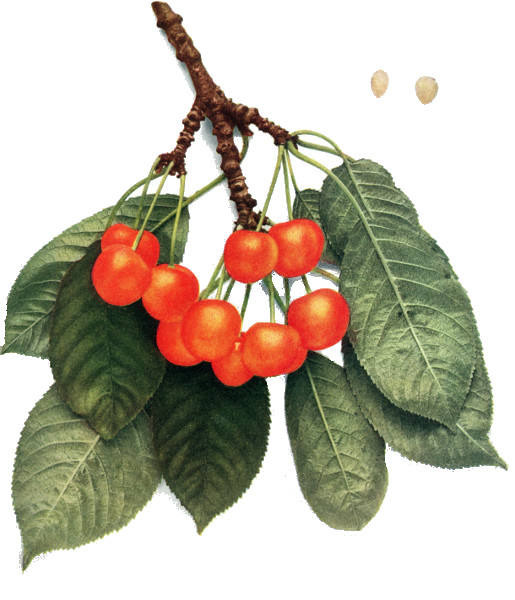
Even earlier and certainly better than Cleveland, which we have just
discussed, is Coe, long known as Coe's Transparent. This is the first of
the light-colored cherries to ripen and is a splendid fruit in quality and
appearance. The color-plate shows this variety very well—possibly too
well, since one of its defects is variability in color, the variant usually being
very light colored and not as attractive as the type. A second defect is
that the fruit runs rather small. The tree-characters are in the main very
good. The variety can be distinguished, as a rule, by the large, spreading
tree and to a lesser extent by its hardiness, vigor, healthfulness and fruitfulness.
Coe is worthy of a place in every home plantation, in orchards
for local markets and in favored localities as an early cherry for the general
market.
Curtis Coe of Middletown, Connecticut, grew this variety early in the
Nineteenth Century from a pit of what he supposed to be Ox Heart. The
American Pomological Society included Coe in its list of recommended
fruits in 1856.
COE
Tree large, vigorous, upright-spreading, open, very productive; trunk stocky, shaggy;
branches thick, smooth, dark reddish-brown overlaid with ash-gray, with many raised
lenticels; branchlets stout, short, brown nearly covered with gray, smooth, glabrous, with
numerous small, conspicuous, raised lenticels.
Leaves numerous, four and one-fourth inches long, two and one-fourth inches wide,
folded upward or flattened, long-elliptical to obovate, thin; upper surface medium green;
lower surface light green, thinly pubescent; apex acute, base abrupt; margin coarsely
serrate, with small, black glands; petiole one and three-fourths inches long, thick, tinged
with red, grooved, hairy, with from one to three large, reniform, greenish-yellow or reddish
glands on the stalk.
Buds large, long, conical, plump, free, in clusters on spurs variable in length; leaf-scars
very prominent; season of bloom intermediate; flowers one and one-fourth inches
across, white; borne in dense clusters, thickly distributed over the tree in twos and threes;
pedicels one inch long, slender, glabrous, green; calyx-tube green, broadly campanulate,
glabrous; calyx-lobes tinged with red, broad, obtuse, glabrous within and without, reflexed;
petals roundish, entire, with a shallow notch at the apex; filaments one-quarter inch long;
pistil glabrous, equal to the stamens in length.
Fruit matures early; nearly one inch in diameter, roundish-cordate, slightly compressed;
cavity regular, abrupt; suture indistinct; apex blunt-pointed or slightly depressed;
color pale amber faintly mottled with red; dots small, light yellow, inconspicuous; stem
slender, one and one-half inches long, adherent to the fruit; skin thin, of medium toughness,
separating from the pulp; flesh pale yellow, with colorless juice, tender, meaty, mild,
sweet; good to very good in quality; stone semi-free or free, one-half inch long, less than
one-half inch wide, roundish, somewhat flattened, blunt, with smooth surfaces; ridged
along the ventral suture.
Prunus avium
- 1. Del. Sta. Bul. 35:16, 17 fig. 1897.
Dikeman has some merit as a very late Sweet Cherry but here its usefulness
ends. The cherries are too small and the pits too large for this
variety to have great worth. The tree is somewhat remarkable for its
spreading habit and stout branches. Plant-breeders seeking for a very
late sort might well choose Dikeman as a parent.
Two very similar cherries, with a variation in the spelling, pass under
this name. Late in the Eighteenth Century there appeared a cherry on
the Dyckman farm near New York City. Some thought it to be identical
with Black Tartarian; others said it was distinct and called it Dyckman.
It was never more than of local note. Some few years ago the late S. D.
Willard of Geneva introduced the Dikeman cherry from the farm of George
B. Dikeman, Oceana County, Michigan. This variety often goes under
the name Dykeman but from the information at hand we feel certain that
Dikeman is the correct spelling. On our grounds this variety and Black
Tartarian, although similar, are two distinct sorts, the Dikeman being
later, firmer and a clingstone.
Tree large, vigorous, broadly-spreading, open-topped, productive; trunk and branches
thick, smooth; branches reddish-brown covered with ash-gray, with numerous lenticels
which are variable in size; branchlets short, brown, partly covered with ash-gray, smooth,
glabrous, with inconspicuous, slightly raised lenticels.
Leaves numerous, four and one-half inches long, two and one-fourth inches wide,
folded upward, obovate to long-elliptical, thin; upper surface medium green, slightly rugose;
lower surface light green, faintly pubescent; apex acute, base abrupt; margin coarsely
and doubly serrate; petiole about one and one-half inches long, tinged with red, with a few
hairs, with from one to four reniform, reddish glands, usually on the stalk.
Buds large, pointed, plump, free, arranged singly as lateral buds or in clusters
variable in size on short spurs; leaf-scars prominent; season of bloom intermediate; flowers
white, one and three-eighths inches across; borne in scattering clusters, in ones, twos or
threes; pedicels one and one-fourth inches long, glabrous, greenish; calyx-tube tinged
with red, campanulate, glabrous; calyx-lobes with reddish tinge, broad, acute, glabrous
within and without, reflexed; petals roundish, entire, nearly sessile, with a shallow notch
at the apex; filaments one-half inch long; pistil glabrous, shorter than the stamens.
Fruit matures late; about three-fourths of an inch in diameter, cordate; cavity wide,
flaring; suture shallow, indistinct; apex slightly pointed, with a small depression at the
center; color purplish-black; dots numerous, small, dark russet, inconspicuous; stem slender,
one and one-fourth inches long, adherent to the fruit; skin thin, tender, adherent to the
pulp; flesh dark red, with dark colored juice, very meaty, crisp, mild, somewhat aromatic,
sweet; of good quality; stone clinging, longer than wide, ovate, flattened, with smooth
surfaces, somewhat marked with a reddish tinge.
Prunus avium × Prunus cerasus
- 1. Truchsess-Heim Kirschensort. 440-451, 487-490, 689. 1819. 2. Dochnahl Führ. Obstkunde 3:51,
52. 1858. 3. Ill. Handb. 163 fig., 164. 1860. 4. Mich. Hort. Soc. Rpt. 329. 1888. 5. Ia. Hort. Soc.
Rpt. 80. 1890. 6. Can. Exp. Farm Bul. 17:7. 1892. 7. Budd-Hansen Am. Hort. Man. 2:274. 1903.
- Amarelle Double de Verre. 8. Mortillet Le Cerisier 2:197-201, fig. 55. 1866.
- Great Cornelian. 9. Hogg Fruit Man. 299. 1884.
- Glass. 10. Ia. Sta. Bul. 73:70. 1903.
Double Glass is a Duke, a hybrid more nearly resembling the Sweet
Cherry than the Sour Cherry. The trees grow remarkably well in nursery
and orchard and their behavior so pleased growers when the variety was
brought to notice that it became for a time quite the vogue. But the
trees turned out to be unproductive and the cherries so mediocre that
the variety rapidly passed through its heyday of popularity. The fruits
are curiously marked, the suture being so deep as to make them appear
double—hence the name. The variety has no value where sweet sorts
are hardy but possibly might find a niche somewhere in regions where a
more tender Sweet Cherry cannot be grown.
This variety, of ancient and unknown origin, dates back at least to
1792 when Truchsess received it from Christ under the names Grosse
Frühkirsche and Englische Erzherzogskirsche, both of which were incorrect,
the first because it was not characteristic since the fruit did not ripen early,
and the second because it denoted a class of dark-fleshed cherries. In
France, Double Glass has long been cultivated under the name Amarelle
Double de Verre. The variety was brought to America from Russia in
1883 by Professor J. L. Budd. While grown for a time in the Central
States it was never highly regarded and has now nearly passed from
cultivation. The following description is a compilation:
Tree large, vigorous, upright-spreading becoming divergent with age, usually hardy,
rather unproductive; branchlets thick, reddish-brown; leaves healthy, small to medium,
ovate, with serrated margins; buds large, prominent.
Fruit matures the latter part of June; usually large, roundish-oblate, with a very
deep suture; color light red becoming much darker at maturity; stem long, thick; skin
thin, tough, translucent; flesh yellowish, with abundant uncolored juice, firm, tender,
sprightly; good in quality; stone medium in size, roundish.
Prunus cerasus
- 1. Truchsess-Heim Kirschensort. 538, 539. 1819. 2. Hogg Fruit Man. 292. 1884. 3. Mich. Hort.
Soc. Rpt. 327. 1888. 4.Ia. Sta. Bul. 73:67. 1903.
- Cerise van der Nat. 5. Knoop Fructologie 2:41. 1771.
- Kirsche von der Natte. 6. Krünitz Enc. 69, 70. 1790. 7. Truchsess-Heim Kirschensort. 539-542.
1819. 8. Ill. Handb. 509 fig., 510. 1861.
Budd's importations of Russian cherries, to which reference is so often
made in this text, brought forth almost universal praise for any and all
of the foreign sorts. Cultural tests soon demonstrated, however, that most
of the varieties were comparatively worthless; Double Natte is one of
these. It is a very mediocre cherry of the Morello group in nowise equal
to English Morello except when earliness is a prime requisite, this sort
being one of the earliest of the Morellos. In flavor it is equal to English
Morello but is no better. At Geneva the trees are seldom very fruitful.
From the eulogistic reports of its behavior in the Middle West it would
seem that it was better adapted to Iowa, for instance, than for New York.
This variety was first mentioned by Knoop, the Dutch pomologist,
in 1771—origin not given. Some years ago Professor J. L. Budd also
imported from Russia a cherry under the name Riga No. 18. This cherry
has been grown as a separate variety under the name Riga but the
descriptions of it are all identical with those of Double Natte and there
can be no doubt but that they are one and the same.
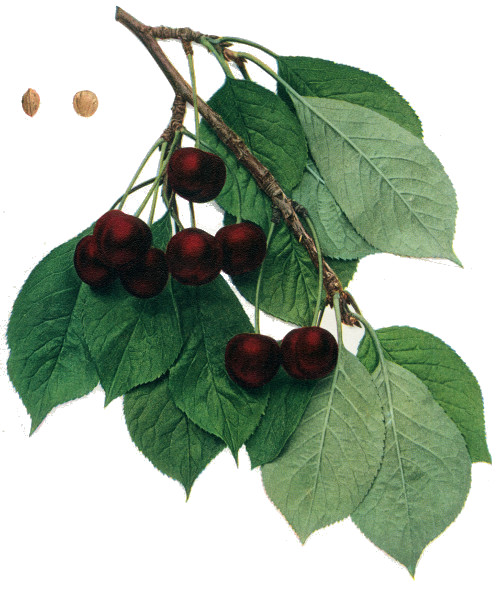
DOUBLE NATTE
Tree large, vigorous, upright-spreading, open-topped, somewhat vasiform, productive;
trunk and branches smooth; branches brown nearly covered with ash-gray, with a few
large lenticels; branchlets long, with short internodes, brown partly covered with ash-gray,
smooth, with a few very large, raised lenticels.
Leaves numerous, three and three-eighths inches long, one and three-fourths inches
wide, folded upward, short-obovate, thick, stiff; upper surface glossy, slightly rugose;
lower surface pale green, thinly pubescent; apex sharp-pointed, tapering toward the base;
margin coarsely serrate, glandular; petiole thick, dull red, grooved on the upper surface,
nearly one inch long, glandless or with one or two small glands at the base of the blade.
Buds conical or pointed, plump, free, arranged singly as lateral buds and in small
clusters on spurs; leaf-scars inconspicuous; season of bloom intermediate; flowers white,
one and one-fourth inches across; borne in scattering clusters in twos and threes; pedicels
one inch long, slender, glabrous, greenish; calyx-tube with a faint reddish tinge, campanulate,
glabrous; calyx-lobes tinged red, long, acute, glabrous within and without,
reflexed; petals obovate, entire, tapering to short, narrow claws, with a broad but shallow
notch at the apex; filaments about one-fourth inch long; pistil glabrous, shorter than
the stamens.
Fruit matures early; three-fourths of an inch in diameter, cordate to conical, compressed;
cavity somewhat abrupt, regular; suture deep, distinct, often extending entirely
around the fruit; apex depressed; color dark red; dots numerous, small, brownish, obscure;
stem slender, one and three-fourths inches long, adheres strongly to the fruit; skin thin,
tough, separating readily from the pulp; flesh dark red, with reddish juice, tender and
melting, sprightly, sour; good to very good in quality; stone nearly free, longer than wide,
nearly round, slightly flattened, with smooth surfaces; somewhat ridged along the ventral
suture.
Prunus avium
- 1. Kenrick Am. Orch. 218. 1835. 2. Hovey Fr. Am. 2:93, 94, Pl. 1851.
- Downer's Red Heart. 3. Kenrick Am. Orch. 276. 1832.
- Downer's Late. 4. Proc. Nat. Con. Fr. Gr. 52. 1848. 5. Ann. Pom. Belge 2:65, Pl. 1854.
- Guigne Tardive de Downer. 6. Mortillet Le Cerisier 2:95 fig., 96, 97. 1866.
Downer is a Sweet Cherry, one of the so-called "Hearts" much prized
by those who know it as a late cherry delicately and richly flavored. Possibly
it is the best of the late Sweet Cherries. Several defects keep it from
being of any considerable worth; it thrives only in the choicest soils; the
trees are often unhealthy as well as lacking in vigor; the flesh is thin and
the stone is large; and, though the cherries set abundantly, the yield is small
because the fruits are small. So, while the variety is almost indispensable
in a home orchard, ripening after almost all of the dessert cherries have
gone, Downer has small place in a commercial plantation. It should be
said further in its favor, however, as a commercial fruit, that it stands
harvesting and shipping very well.
Downer takes the name of Samuel Downer, Dorchester, Massachusetts,
who grew it some time before 1832 when it first found a place in pomological
works. It was included by the American Pomological Society in its
schedule of fruits in 1848 as Downer's Late. It now appears as Downer
with Downer's Late Red as a synonym in accordance with the rules of
the Society.
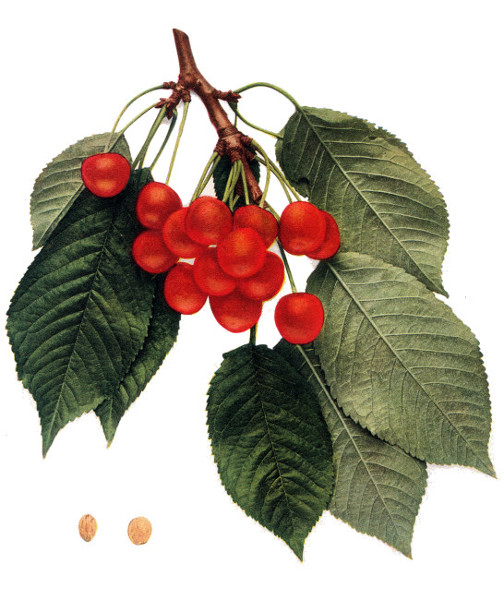
DOWNER
Tree large, vigorous, upright-spreading, dense-topped, productive; trunk thick, with
shaggy bark; branches thick, roughened, dark brown overspread with dark gray, with
numerous large lenticels; branchlets slender, long, brown partly covered with ash-gray,
smooth, with inconspicuous, raised lenticels.
Leaves numerous, three inches long, one and three-fourths inches wide, folded upward,
obovate, rather stiff; upper surface dark green; lower surface light green, hairy along
the veins; apex acute, base abrupt; margin doubly serrate, glandular; petiole one inch
long, thick, dark red, grooved, glandless or with from one to three large, globose or reniform
glands on the stalk.
Buds small, except the terminals which are large, pointed, plump, free, arranged singly
as lateral buds, or in small clusters on short spurs; leaf-scars prominent; flowers white,
one and one-fourth inches across; borne in thin clusters in ones and in twos; pedicels
variable in length often one inch long, glabrous; calyx-tube faintly tinged with red, campanulate,
glabrous; calyx-lobes tinged with red, acuminate, glabrous within and without,
reflexed; petals roundish, entire, somewhat sessile, with a shallow notch at the apex; pistil
glabrous, nearly equal to the stamens in length, often defective.
Fruit matures among the latest; three-fourths of an inch in diameter, roundish-cordate,
slightly compressed; cavity very shallow, flaring; suture obscure; apex variable
in shape usually somewhat pointed; color light to dark red frequently showing an amber
background on the shaded side; dots numerous, small, russet, inconspicuous; stem one
and three-fourths inches long, adherent to the fruit; skin tough, separating from the pulp;
flesh pale yellow, with colorless juice, somewhat stringy, tender, with soft flesh, mild and
pleasant, sweet when fully ripe; good to very good in quality; stone large, free, ovate,
flattened, with smooth surfaces; somewhat ridged along the ventral suture.
Prunus cerasus
- 1. Horticulturist 25:176, 177. 1870. 2. Downing Fr. Trees Am. 3rd App. 161. 1881. 3. Am. Pom.
Soc. Cat. 17. 1897.
Dyehouse is conspicuous among cherries for its earliness and for the
beauty of its fruit. Early Richmond is the standard early cherry yet
Dyehouse is a week earlier, just as attractive in appearance and equally
well flavored. It is near of kin to Early Richmond but the two may be
distinguished by the difference in time of ripening and by its brighter,
clearer color, greater opaqueness, more highly colored juice and slightly
smaller size. Possibly this cherry would supersede the better-known Early
Richmond were it not for the defect in size and for the further faults of
being less productive and more capricious to environment, as it fails to
thrive in localities where the older sort is quite at home. It is a worthy
rival of Early Richmond, however, and ought to be grown both for home
and commercial purposes far more than it is.
To H. T. Harris of Stamford, Kentucky, belongs the honor of introducing
this well-known cherry. Although its parentage is unknown, it is
almost certain that a Mr. Dyehouse, Lincoln County, Kentucky, raised
the tree from a pit sixty or more years ago. At the time of its introduction
its characteristics were not clearly drawn and many believed it to be the
Early Richmond. In time, however, differences were shown, as we have
set forth in the preceding paragraph. It was added to the fruit list of the
American Pomological Society in 1897.
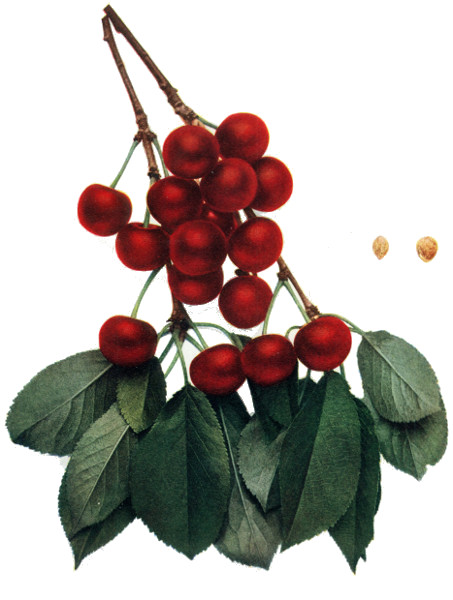
DYEHOUSE
Tree small, vigorous, spreading, with drooping branchlets, dense, round-topped,
productive; trunk and branches slightly roughened; branches reddish-brown covered
with dark ash-gray, with large, elongated, raised lenticels; branchlets slender, willowy,
variable in length, brown overspread with ash-gray, smooth, with a few small, inconspicuous
lenticels.
Leaves numerous, three inches long, one and one-half inches wide, slightly folded
upward, obovate to long-oval; upper surface very dark green, smooth; lower surface light
green, with a few hairs along the midrib; apex acute, base variable in shape; margin finely
serrate, with small, dark glands; petiole one-half inch long, tinged with dull red, with
a few hairs along the grooved upper surface, with from one to three small, globose, greenish-yellow
glands at the base of the blade.
Buds small, short, obtuse, plump, free, arranged singly and in clusters on short spurs;
leaf-scars prominent; season of bloom intermediate; flowers one inch across, white; borne
in dense but well-distributed clusters, usually at the ends of spur-like branches, in twos,
threes or fours; pedicels one and one-half inches long, glabrous, greenish; calyx-tube green,
obconic, glabrous; calyx-lobes tinged with red, serrate, glabrous within and without,
reflexed; petals roundish-obovate, entire, almost sessile, with entire apex; filaments one-fourth
inch long; pistil glabrous, nearly equal to the stamens in length.
Fruit matures early; more than one-half inch in diameter, oblate, slightly compressed;
cavity of medium depth, narrow, abrupt, regular; suture indistinct; apex flattened, with
a small depression at the center; color dark red; dots numerous, small, obscure; stem one
inch long, adhering to the pulp; skin thin, tough; flesh light yellowish-white, with pinkish
juice, tender, sprightly, tart; of very good quality; stone nearly free, ovate, slightly
flattened, with smooth surfaces; somewhat ridged along the ventral suture.
Prunus avium
- 1. Mich. Sta. Bul. 104:84. 1894. 2. Am. Pom. Soc. Cat. 17. 1897.
- Black Eagle. 3. Prince Treat. Hort. 31. 1828. 4. Pom. Mag. 3:127, Pl. 127. 1830. 5. Kenrick
Am. Orch. 274, 275. 1832. 6. Downing Fr. Trees Am. 170 fig. 62. 1845. 7. Floy-Lindley Guide Orch.
Gard. 102. 1846. 8. Mag. Hort. 14:386, 387 fig. 37. 1848. 9. Proc. Nat. Con. Fr. Gr. 52. 1848.
10. Hovey Fr. Am. 1:85, Pl. 1851. 11. Horticulturist N. S. 4:287. 1854. 12. Am. Pom. Soc. Rpt.
108, 186. 1856. 13. Mortillet Le Cerisier 2:77-79, fig. 12. 1866. 14. Mas Pom. Gen. 11:83, 84, fig.
42. 1882. 15. Hogg Fruit Man. 285, 286. 1884. 16. Cornell Sta. Bul. 98:491 fig. 86. 1895.
We hesitatingly follow the American Pomological Society in calling
this variety Eagle when it has so long been known as Black Eagle, the
name given it by the great pomologist, Knight. Were this choicely good
cherry larger in size, it would still be a prime favorite with growers for in
many respects it is one of the best varieties of its species. Its flavor is
excellent; the trees are usually fruitful; it ripens at a good time in the
cherry season, just after Black Tartarian; the cherries are less liable to
crack than many of its rivals; and the trees are as hardy, healthy and
vigorous as those of any Sweet Cherry. Some complain that the trees do
not bear well at first but are productive only with age. But, after all, it
is its high quality that gives Eagle so much merit that it ought not to be
forgotten—makes it worth a place in every home orchard and commends
it highly to commercial growers of cherries who want a finely finished
product for either local or general market. The fruit-stems of this variety
are characteristically long.
Eagle was grown about 1806 by Sir Thomas Andrew Knight at Downton
Castle, Wiltshire, England, by fertilizing the Bigarreau of the old
writers, our Yellow Spanish, with pollen of the May Duke. The correctness
of the parentage as given has been questioned because of its inherited
characteristics. But if the May Duke is a hybrid between a Sweet and a
Sour, a pure Sweet offspring is not an impossibility. In 1823, Honorable
John Lowell of Massachusetts received Eagle from Knight. Prince mentioned
this cherry in his Treatise of Horticulture, 1828, but the exact date
of its introduction into New York is unknown. In 1848 it was placed on
the list of fruits adopted by the National Convention of Fruit Growers
and since then it has been retained on the fruit list of the American Pomological
Society.
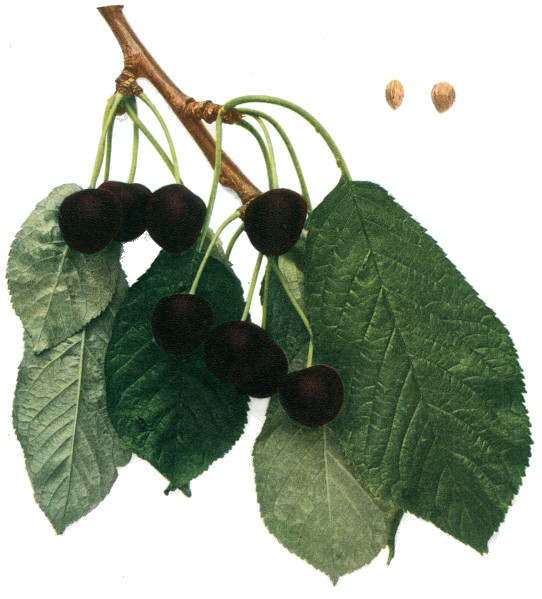
EAGLE
Tree large, vigorous, upright-spreading, dense, unproductive at first but improving
with age; trunk and branches thick, smooth; branches reddish-brown partly covered
with ash-gray, with numerous small lenticels; branchlets thick, brownish partly covered
with light ash-gray, the surface slightly ribbed and with small, raised, inconspicuous
lenticels.
Leaves numerous, five inches long, two and one-half inches wide, folded upward,
long, obovate to elliptical, thin; upper surface dark green, rugose; lower surface light
green, thinly pubescent; apex variable in shape; margin coarsely and doubly serrate, with
dark glands; petiole nearly two inches long, tinged with red, with a few hairs, with from
two to four reniform, brownish glands usually on the stalk.
Buds large, conical or pointed, plump, free, arranged singly as lateral buds and in
clusters on spurs of medium length; leaf-scars prominent; season of bloom medium; flowers
white, one and one-eighth inches across; borne in scattered clusters in twos and threes;
pedicels one inch long, slender, glabrous, greenish; calyx-tube green faintly tinged with
red, campanulate; calyx-lobes with a trace of red, obtuse, glabrous within and without,
reflexed; petals irregular-oval, crenate, with short, blunt claws and with a crenate apex;
anthers yellowish; filaments one-fourth inch long; pistil glabrous, equal to the stamens
in length.
Fruit matures in mid-season; nearly one inch in diameter, oblate, somewhat cordate,
compressed; cavity regular, flaring; suture a faint groove; apex pointed or slightly
depressed; color dark red almost black; dots small, russet, medium in number, obscure;
stem slender, two inches long; skin thin, tender; flesh dark red, with wine-colored juice,
meaty, tender, crisp, pleasant flavored, mild, sweet; very good to best in quality; stone
free except along the ventral suture, rather small, ovate, slightly flattened, blunt, with
smooth surfaces; ridged along the ventral suture.
Prunus fruticosa
- 1. Langley Pomona 86, Pl. 17 fig. 2. 1729. 2. Prince Pom. Man. 2:131. 1832. 3. Downing Fr.
Trees Am. 479. 1869. 4. Hogg Fruit Man. 295. 1884.
- May. 5. Parkinson Par. Ter. 571. 1629.
- Cerisier Nain à Fruit Rond Précoce. 6. Duhamel Trait. Arb. Fr. 1:168, 169, 170, Pl. III. 1768.
- Frühe Zwergweichsel. 7. Truchsess-Heim Kirschensort. 492-498. 1819. 8. Mathieu Nom. Pom.
349, 350, 372. 1889.
- Amarell-Weichsel. 9. Dochnahl Führ. Obstkunde 3:57, 58. 1858.
- Précoce de Montreuil. 10. Mas Le Verger 8:141, 142, fig. 69. 1866-73.
- Griottier Nain Précoce. 11. Leroy Dict. Pom. 5:293 fig., 294. 1877.
As the only cultivated representative of the European Dwarf Cherry,
Early May should be of especial interest to cherry-growers. It is a true
dwarf variety, the trees seldom attaining a height of more than six or seven
feet. Both tree and branches are very flexible so that Early May is well
adapted to the wall-training of European countries. It has further value
in its earliness, being the earliest of all cherries. It is doubtful whether
the variety can now be obtained in America but it ought to be reintroduced
both for the fruit and because it is a handsome ornamental. Early May
has several characters to recommend it to plant-breeders. The description
herewith given is compiled from European fruit-books.
Pliny in his Natural History mentions the Macedonian and the Chamaecerasus
cherries, both of which we now believe to have been Prunus
fruticosa, the European Dwarf Cherry. Early May, according to European
botanists, is a variety of this dwarf species and may be the identical cherry
that Pliny described. Following Pliny it was mentioned by Estienne, a
Frenchman, in 1540, by Knoop, the Dutch pomologist, in 1771, by Parkinson,
the English herbalist, in 1629, and, as the references show, by most
pomologists since. The names May and Early May have been applied to
several varieties, and especially in the West to the Early Richmond but
all are distinct and ought not to be confused with this, the true variety.
Tree very small, rather weak; branches numerous, slender, somewhat curved, flexible,
branchlets slender, pendant; leaves abundant, very small, obovate or oblong, acuminate;
margin irregularly and deeply serrate; petiole short, slender, without glands; blooming
season very early; flowers small; petals oval.
Fruit matures very early, usually attached in pairs; small, roundish, slightly flattened;
suture indistinct; color bright red becoming dark red at full maturity; stem one inch long,
slender, set in a small, regular cavity; skin thin; flesh yellowish-white, sometimes tinged
red under the skin, tender, juicy, brisk but pleasant subacid; quality fair; stone very small,
roundish.
Prunus cerasus
- 1. Del. Sta. An. Rpt. 12:118. 1900. 2. Budd-Hansen Am. Hort. Man. 2:275. 1903.
- Orel No. 23. 3. Mich. Hort. Soc. Rpt. 327. 1888. 4. Ia. Sta. Bul. 73:68, 77 fig. 17. 1903.
This, which we think is the true Early Morello, is worthy an extended
description in The Cherries of New York chiefly because there are several
cherries of this name. The confusion results in much vexation to cherry-growers
in the West where, only, these cherries have been planted. The
full description should make clear at least the character of the variety
which is being grown at this Station as Early Morello. About all that
can be said of the variety as it grows here is that the trees are hardy, healthy,
vigorous, fruitful and regular in bearing. The cherries show the variety to
be of the Amarelle group but are such as to make it far inferior to Montmorency
and other well-known Amarelles. The name is misleading, as
the variety has little in common, in tree or fruit, with the true Morellos.
The cherry described here as Early Morello was introduced by
Professor J. L. Budd from Orel, Russia, as Orel No. 23. It has proved
very productive and hardy throughout the West and resembles Early
Richmond, though smaller, a trifle darker, less acid and a week later. A
dark-fleshed variety from Erfurt, Prussia, was sent out from Rosedale,
Kansas, where it is known as Early Morello. This, and one by D. U.
Reed, Blue Springs, Nebraska, appear to be very similar to the Northwest,
or Wier No. 29.
Tree of medium size and vigor, upright-spreading, very productive; trunk rather
thick, shaggy; branches with numerous large lenticels; branchlets slender, short; leaves
two and three-fourths inches long, one and one-half inches wide, thick, stiff, dark green,
rather glossy, smooth; margin finely and doubly serrate, with small, dark glands; petiole
glandless or with from one to three small, globose, brown or yellowish glands variable
in position; buds small, short, obtuse, in small clusters at the ends of slender, branchlike
spurs; leaf-scars prominent; season of bloom late; flowers one inch across; pistil equal
to or slightly longer than the stamens, sometimes defective.
Fruit matures in mid-season; about three-fourths of an inch in diameter, oblate,
compressed; color attractive dark red; stem one inch long, adhering to the fruit; skin
thin, tender, separating from the pulp; flesh light yellow, with pinkish juice, tender and
melting, sprightly, tart; of very good quality; stone free, ovate, flattened, slightly pointed,
with smooth surfaces, somewhat tinged with red.
Prunus avium
- 1. Am. Pom. Soc. Cat. 26. 1909.
- Purple Cherry. 2. Ray Hist. Plant. 1540. 1688.
- Early Purple Guigne. 3. Cultivator N. S. 4:280 fig. 2. 1847. 4. Hovey Fr. Am. 1:93, 94, Pl. 1851.
5. Am. Pom. Soc. Rpt. 55. 1852. 6. Am. Pom. Soc. Cat. 211. 1856. 7. Mas Le Verger 8:129, 130,
fig. 63. 1866-73. 8. Mortillet Le Cerisier 2:57 fig. 3, 58, 59. 1866. 9. Horticulturist 25:71 fig. 1870.
10. Leroy Dict. Pom. 5:334, 335 fig., 336. 1877. 11. Hogg Fruit Man. 295. 1884. 12. Guide Prat.
6, 193. 1895.
- Purple Guigne. 13. Elliott Fr. Book 195 fig. 1854.
Early Purple is a valuable cherry on account of its earliness, its attractive
color and high quality. The trees bear well and regularly after having
become established in the orchard. The variety has the reputation of
being a poor grower in the nursery and as a young tree in the orchard but
with age it takes on vigor and at all times is as healthy as those of any
Sweet Cherry. More than most cherries, this variety responds to good
care and a choice cherry soil—a warm, free-working loam being best. A
rather unusual and serious defect of this variety is that the fruit-spurs
are easily broken during picking and the crop of the next season thereby
cut short. Another fault is that it is the favorite food of the robin where
this, the worst of all cherry pests, abounds. The cherries of this variety
do not attain their rich purple color until full maturity is reached. Hogg,
the English pomologist, maintains that Early Purple does better on the
Mahaleb than on the Mazzard stock. No home collection should be
without this variety and it can often be profitably grown as an early cherry
for the local market.
Early Purple is the Early Purple Guigne of most fruit-books, the
name having been shortened by the American Pomological Society, though,
since the variety goes back to the Early Purple of Ray in 1688, the name
here used has the right of precedence. As to what the origin and history
of the variety were before Ray mentioned it, we can find no record. Early
Purple was brought to America over a hundred years ago. According to
Elliott, eastern growers received it directly from England, while in the
West it was brought over by a party of German emigrants, under the name
"German May Duke" and as such it is still much grown in localities in
the Central West. In 1852, the American Pomological Society listed
Early Purple as one of the promising new fruits and later, in 1856, it was
given a place, which it has since retained, on the Society's catalog of fruits
recommended for general cultivation.
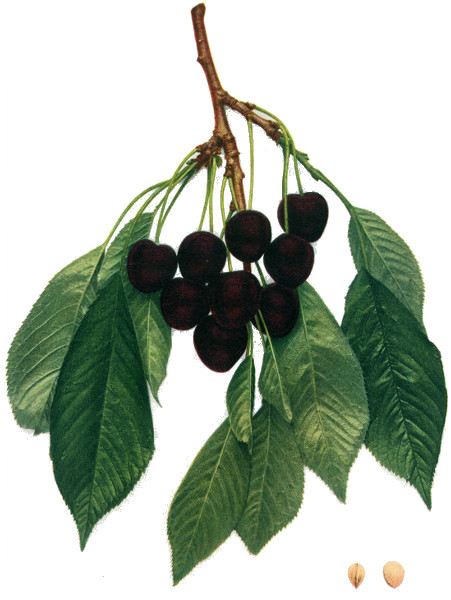
EARLY PURPLE
Tree large, vigorous, upright-spreading, open-topped, very productive; trunk thick,
smooth; branches smooth, reddish-brown partly covered with ash-gray, with large lenticels;
branchlets short, brown partly covered with ash-gray, roughened, with a few small, inconspicuous
lenticels.
Leaves numerous, four inches long, one and three-fourths inches wide, folded
upward, oval to obovate, thin; upper surface dark green, rugose; lower surface light green,
very lightly pubescent; apex and base acute; margin finely serrate, with small, dark
colored glands; petiole one and three-fourths inches long, slender, tinged with red, with
few hairs, with two or three small, globose, reddish glands on the stalk.
Buds variable in size and shape, rather long, plump, free, arranged singly as lateral
buds and in small clusters on spurs variable in length; season of bloom early; flowers
white, one and one-fourth inches across; borne in scattering clusters, usually in twos;
pedicels characteristically long, often one and one-fourth inches, slender, glabrous; calyx-tube
with a faint tinge of red, campanulate; calyx-lobes tinged with red, long, acute,
serrate, glabrous within and without, reflexed; petals broadly oval, serrate, with short,
blunt claws and a shallow, notched apex; filaments one-fourth inch long; pistil glabrous,
shorter than the stamens.
Fruit matures very early; one inch in diameter, cordate, slightly compressed; cavity
regular; suture a faint line; apex pointed; color purplish-black; dots numerous, small,
grayish, obscure; stem tinged with red, slender, nearly two inches long, adhering to the
fruit; skin thin, tender, separating readily from the pulp; flesh dark reddish-purple, with
dark colored juice, tender, melting, mild, sweet; of very good quality; stone free except
along the ventral suture, rather large, broadly oval, compressed near the apex, with smooth
surfaces.
Prunus cerasus
- 1. Thacher Am. Orch. 217. 1822. 2. Prince Pom. Man. 2:142. 1832. 3. Elliott Fr. Book 194,
195 fig. 1854. 4. Am. Pom. Soc. Cat. 12. 1871. 5. Del. Sta. An. Rpt. 12:115 fig., 116. 1900.
- Flanders. 6. Parkinson Par. Ter. 571. 1629.
- Kentish. 7. Miller Gard. Kal. 154. 1734. 8. Truchsess-Heim Kirschensort. 660, 661. 1819.
9. Downing Fr. Trees Am. 196 fig., 197. 1845. 10. Am. Pom. Soc. Cat. 74. 1862. 11. Mas Le Verger
8:25, 26, fig. 11. 1866-73.
- Cerisier Hâtif. 12. Duhamel Trait. Arb. Fr. 1:170, 171, Pl. IV. 1768. 13. Truchsess-Heim
Kirschensort. 657, 658, 691. 1819. 14. Poiteau Pom. Franc. 2: No. 13, Pl. 1846. 15. Leroy Dict.
Pom. 5:343, 344 fig., 345. 1877.
- Cerise de Volger. 16. Knoop Fructologie 2:36, 43. 1771.
- Frühzeitige Amarelle. 17. Truchsess-Heim Kirschensort. 616-618. 1819. 18. Dochnahl Führ. Obstkunde
3:70. 1858.
- Early Griotte. 19. Prince Pom. Man. 2:131, 132. 1832.
- French. 20. Quebec Pom. & Fr. Gr. Soc. Rpt. 122, 123. 1906.
Early Richmond has long been the leading Sour Cherry of its season—the
first of its kind in the markets. It is not a remarkable variety in
its fruit-characters, the cherries being but medium in size, mediocre in
quality and not handsomer than other Amarelles with which it belongs.
It is, however, a very good culinary fruit and when well ripened may be
eaten out of hand with relish by those who like the refreshing acidity of
a Sour Cherry. Though not in nearly as great demand for canning as
Montmorency it still makes a very good canned product, being used more
than it otherwise would be to prolong the canning season because of its
earliness. Before cherries were largely canned for the markets, Early
Richmond was much used in making dried cherries, the product, rightly
cured, making a delicious sweetmeat which would keep for several months.
The cherries are remarkable for the tenacity with which the stone clings
to the stem. It is the tree in which the Early Richmond particularly
surpasses. It thrives in varied soils and climates from the St. Lawrence
to the Carolinas and from the Atlantic to the Pacific—possibly the most
cosmopolitan of all cherries—and everywhere vigorous, healthy and fruitful.
For the many purposes for which it may be used and because of the
characters of the tree, Early Richmond is indispensable in every home and
commercial orchard for an early cherry. After Montmorency it is more
largely grown than any other cherry, Sweet or Sour, in New York.
Early Richmond is the old Kentish of English writers, confused more
or less with the different Montmorencies. Whether or not this variety
was introduced into Kent, England, by the Romans and became thus
early the Kentish or whether it came from Flanders or Holland where it
was called Cerise de Volger, is not now certain. Probably, however, it is
one of the many seedlings of the Cerise Commune, as are the Montmorencies,
and was first known as Cerisier Hâtif. Early in the Sixteenth
Century the gardener of Henry VIII made extensive plantings in Kent
with trees supposed to have come from Flanders, and Parkinson, in 1629,
mentions a variety as Flanders which was probably this cherry. The
variety, soon known by many English writers as Kentish, was confused by
the French who seem to have had two Kentish cherries. In English nurseries
Kentish was soon confused with Montmorency. In this way the
terms Kentish, Flanders, Flemish and Montmorency came into use for this
sort. It was early brought to America where it became known as Early
Richmond but even here it has several names. The belief that it originated
at Richmond, Virginia, was due to the fact that William Prince
secured his first trees from that source. By whom the variety was introduced
into this country is unknown, although Thacher speaks of it as early
as 1822. In the South it became known as Virginia May, while in the
West it has been called Early May. The variety appeared on the fruit list
of the American Pomological Society as Kentish in 1862 but in 1871 the
name was changed to Early Richmond. It is listed by all prominent nurseries
in this country as Richmond or Early Richmond while in England
it is still known as Kentish. The French cherry, often spoken of as
"the common French cherry," introduced into the lower St. Lawrence
region, is very similar to Early Richmond. This strain, propagated from
seed or sprouts, seems to be somewhat hardier than Early Richmond and
varies slightly from it in size and quality.
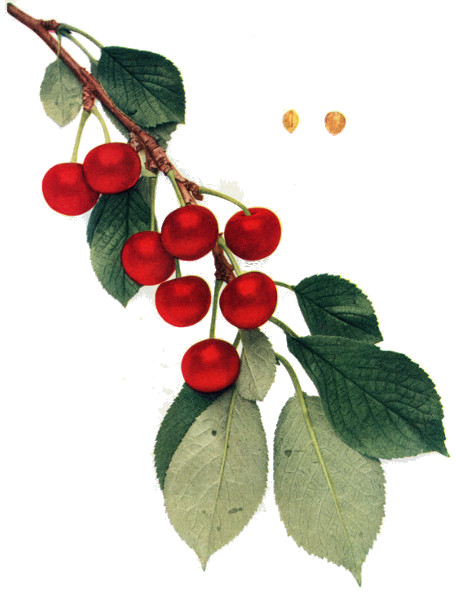
EARLY RICHMOND
Tree of medium size, vigorous, upright-spreading, dense, round-topped, productive;
trunk and branches smooth; branches reddish-brown lightly overspread with dull gray,
with numerous lenticels; branchlets slender, long, grayish, smooth, with numerous small,
inconspicuous lenticels.
Leaves numerous, three and one-half inches long, one and three-fourths inches wide,
folded upward, obovate, thick; upper surface dark green, smooth; lower surface pale
green; apex variable in shape, base abrupt; margin finely and doubly serrate, glandular;
petiole glandless or with one or two globose, greenish-yellow glands at the base of the
blade.
Buds small, short, obtuse, very plump, free, arranged singly and in clusters on very
short spurs; blooms appearing in mid-season; flowers one and one-fourth inches across,
white; borne in scattering clusters, usually in twos and threes; pedicels five-eighths inch
long, glabrous; calyx-tube green or faintly tinged with red, obconic, glabrous; calyx-lobes
with a trace of red, obtuse, serrate, glabrous within and without, reflexed; petals roundish,
entire, sessile, with a shallow, wide notch at the apex; filaments over one-fourth inch long;
pistil glabrous, equal to the stamens in length.
Fruit matures early; three-fourths inch in diameter, roundish-oblate, compressed;
cavity abrupt, regular; suture indistinct; apex roundish or flattened, with a slight depression
at the center; color light red changing to dark red; dots numerous, small, russet,
inconspicuous; stem slender, one inch long, adherent to the fruit; skin thin, rather tough,
separating from the pulp; flesh pale yellow, with light pinkish juice, stringy, tender and
melting, sprightly, pleasant flavored; good to very good in quality; stone free, small,
roundish-ovate, slightly pointed, with smooth surfaces; somewhat roughened along the
ventral suture.
Prunus avium
- 1. Prince Pom. Man. 2:117. 1832. 2. Elliott Fr. Book 213. 1854. 3. Am. Pom. Soc. Cat. 24.
1899.
- John Tradescantes Cherrie. 4. Parkinson Par. Ter. 574. 1629.
- Hertogs-Kers. 5. Knoop Fructologie 2:36, 40. 1771.
- Grosse Schwarze Knorpelkirsche. 6. Truchsess-Heim Kirschensort. 180-192. 1819. 7. Dochnahl
Führ. Obstkunde 3:36. 1858. 8. Ill. Handb. 89 fig., 90. 1860. 9. Lauche Deut. Pom. III: No. 6, Pl.
1882. 10. Mathieu Nom. Pom. 357, 358. 1889.
- Tradescant's Black Heart. 11. Downing Fr. Trees Am. 188 fig., 189. 1845. 12. Thompson Gard.
Ass't 526. 1859. 13. Am. Pom. Soc. Cat. 74. 1862.
- Gros Bigarreau Noir. 14. Mortillet Le Cerisier 2:108-111, fig. 24. 1866. 15. Leroy Dict. Pom.
5:224, 225 fig., 226. 1877.
- St. Margaret's Cherry. 16. Flor. & Pom. 105, Pl. 542. 1881.
Elkhorn has served its day and is now being rapidly superseded by
other cherries of the Bigarreau group to which it belongs. It was valued
by the old pomologists because of the large size of the fruit, the firm flesh,
late ripening, rich flavor, and because it hangs well on the tree long after
maturity. But it fails in competition with other Bigarreaus in bearing
cherries quite variable in size, in the diminishing size of the fruit as the
trees attain age and more than all else in being but moderately productive.
The bark of the trunk and main branches is so heavily overspread with
gray as to make this a distinguishing mark. The fruit, too, is distinct in
appearance by reason of the irregular surface of the skin. The variety
possesses no characters, as it usually grows, to make it worth planting
either for home or market.
The history of this old cherry was almost hopelessly confused by
the early horticulturists by the vast number of names they used for it,
many of which belonged to other varieties. Elkhorn is supposed to have
been raised by John Tradescant, gardener to Charles I of England, under
the name Tradescant's Black Heart. Of this cherry, John Parkinson in
1629 says: "John Tradescantes Cherrie is most usually sold by our
Nursery Gardiners, for the Archdukes cherrie, because they have more
plenty thereof, and will better be increased, and because it is so faire and
good a cherrie that it may be obtruded without much discontent: it is a
reasonably good bearer, a faire great berrie, deepe coloured, and a little
pointed." It is not known when or how Elkhorn got to America. The first
cherry-grower in this country to mention it was William Prince, in 1832,
who says that his father noticed the variety growing in a garden next to
a hotel in Maryland about 1797 and brought cions of it to New York afterwards
propagating and selling it under the name Elkhorn given to the
cherry by the hotel proprietor. Elkhorn was at one time very popular
and well disseminated throughout the United States and is sold now by a
large number of nurserymen either under the name Tradescant's Black
Heart or as Elkhorn. In 1862, the American Pomological Society listed
in its fruit catalog Tradescant's Black Heart but dropped it in 1877. In
1899 this Society placed the variety in its catalog under the name Elkhorn
and it still remains on its list of recommended fruits. From its history
it is apparent that this cherry is rightly called Tradescant or Black Heart
or by some combination of these terms but Elkhorn has been adopted by
the American Pomological Society, is everywhere in common use on this
continent and is so distinctive that we choose for this text the newer name.
Tree large, very vigorous, upright, open-topped, moderately productive; trunk stocky,
smooth; branches stout, smooth, with numerous small lenticels, reddish-brown heavily
overspread with ash-gray; branchlets thick.
Leaves numerous, three and three-fourths inches long, two and one-fourth inches
wide, short-oval to obovate, thin; upper surface medium green, roughish; lower surface
dull, light green, lightly pubescent; apex acute; margin coarsely serrate, glandular; petiole
with from one to three raised glands of medium size, variable in shape, usually on the
stalk.
Fruit matures in late mid-season; three-fourths of an inch in diameter, cordate to
conical, slightly compressed; cavity deep, wide, flaring; suture indistinct; apex roundish
or pointed, with a slight depression at the center; color purplish-black; dots numerous,
small, dark russet, inconspicuous; stem one and three-eighths inches long, adhering to
the fruit; skin thin, tender, adhering somewhat to the pulp; flesh a characteristically dark
purplish-red, with very dark colored juice, meaty, firm, crisp, mild, sweet; of good quality;
stone semi-free, ovate, flattened, slightly pointed, with smooth surfaces, tinged with red.
Prunus avium
- 1. Lond. Hort. Soc. Cat. 49. 1831. 2. Prince Pom. Man. 2:121, 122. 1832. 3. Pom. Mag. 2:92, Pl
1839. 4. Downing Fr. Trees Am. 186 fig. 77. 1845. 5. Proc. Nat. Con. Fr. Gr. 52. 1848. 6. Am. Pom.
Soc. Rpt. 75. 1850. 7. Am. Pom. Soc. Cat. 54. 1852. 8. Elliott Fr. Book 194 fig. 1854. 9. Thompson
Gard. Ass't 528. 1859. 10. Ill. Handb. 105 fig., 106. 1860. 11. Mortillet Le Cerisier 2:91 fig. 17, 92,
93. 1866. 12. Downing Fr. Trees Am. 463 fig. 1869. 13. Leroy Dict. Pom. 5:196, 197 fig. 1877.
- Flesh Coloured Bigarreau. 14. Prince Pom. Man. 2:128. 1832. 15. Downing Fr. Trees Am. 182
fig. 74. 1845. 16. Leroy Dict. Pom. 5:192, 193 fig. 1877.
Elton has been freely recommended and widely cultivated in Europe
and America for the past century and probably no cherry has given more
general satisfaction. The variety is distinguished by the form, color, flesh
and flavor of its fruit. The cherries are oblong-heart-shaped—possibly
too much drawn out for best appearance and often too oblique; the color,
very well shown in the color-plate, is most attractive and makes up for
any defect in shape—a dark red mottled with amber, very bright, clear
and glossy; the flesh, a little too soft to ship well, is delicate and most
pleasing to the palate; the flavor is peculiarly rich and luscious being hardly
surpassed by that of any other cherry. The trees may be as readily told
as the fruit, by the unusually dark red color of the petioles of the leaves.
The branches are stout and bear the crop thickly placed close to the wood and
in prodigious quantities. Unfortunately it has a fault which in America, at
least, makes it almost unfit for a commercial plantation. Brown-rot, the
scourge of the Sweet Cherry, attacks this variety more aggressively than
almost any other sort and for this reason, while its merits can hardly be
too highly spoken of, Elton must remain for most part a variety for the
home orchard. The tree, perfect in most respects, is a little tender to
cold. Leroy, the French pomologist, thinks it does better on Mahaleb than
on the Mazzard stock.
This is another cherry from Thomas Andrew Knight, the great English
pomologist. Knight fruited it first about 1806, the tree coming from a pit
of Yellow Spanish, the paternal parent being White Heart. From the
first it took a high place in English and continental pomology as it did
also in America upon being brought here in 1823. The variety is everywhere
known and grown in America and is for sale by many nurserymen.
Elton was one of the fruits to receive attention at the first meeting of the
American Pomological Society in 1848, and in 1852 was put on the list of
recommended fruits where it still remains.
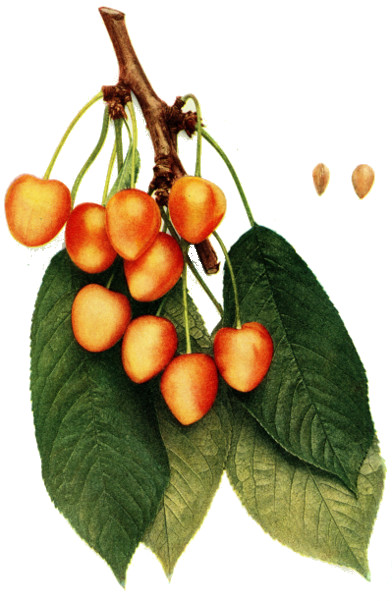
ELTON
Tree large, vigorous, upright-spreading, open-topped, very productive; trunk thick,
smooth; branches smooth, reddish-brown covered with ash-gray, with small lenticels;
branchlets long, brown partly covered with ash-gray, smooth, with inconspicuous, raised
lenticels, intermediate in number and size.
Leaves numerous, five and one-half inches long, two and one-half inches wide, folded
upward, long-obovate to elliptical, thin; upper surface dark green, rugose; lower surface
light green, thinly pubescent; apex acute, base abrupt; margin doubly serrate, with small,
dark glands; petiole two inches long, heavily tinged with red, with a few scattering hairs
along the upper surface, with from two to four reniform or globose, reddish-brown glands
on the stalk.
Buds large, long, pointed, plump, free, arranged singly as lateral buds and on very
short spurs variable in size; leaf-scars prominent; mid-season in blooming; flowers one
and one-half inches across, white; borne in twos and threes; pedicels one inch long, slender,
glabrous, greenish; calyx-tube green, campanulate, glabrous; calyx-lobes tinged with
red, long, broad, acute, serrate, glabrous within and without, reflexed; petals roundish,
entire, nearly sessile, with a shallow notch at the apex; filaments about one-half inch long;
pistil glabrous, shorter than the stamens.
Fruit matures early; about one inch long, three-fourths inch wide, cordate to conical,
somewhat compressed and oblique; cavity rather abrupt, regular; suture indistinct; apex
distinctly pointed; color dark red with an amber tinge, faintly mottled; dots numerous,
small, light yellow, obscure; stem slender, one and three-fourths inches long; skin thin, tender,
separating from the pulp; flesh white with a tinge of yellow, with colorless juice, slightly
stringy, tender, very mild, sweet; of good quality; stone free except along the ventral
suture, one-half inch long, long-ovate, slightly flattened, with smooth surfaces; somewhat
ridged along the ventral suture.
Prunus avium × Prunus cerasus
- 1. Gard. Mon. 7:277. 1865. 2. Mortillet Le Cerisier 2:159 fig. 41, 160. 1866. 3. Mas Le Verger
8:5, 6, fig. 1. 1866-73. 4. Pom. France 7: No. 10, Pl. 10. 1871. 5. U. S. D. A. Rpt. 383. 1875.
6. Am. Pom. Soc. Cat. 20. 1877. 7. Leroy Dict. Pom. 5:348 fig., 349. 1877. 8. Hogg Fruit Man.
296, 297. 1884. 9. Gaucher Pom. Prak. Obst. No. 78, Pl. 29. 1894.
- Eugenie. 10. Am. Pom. Soc. Cat. 22. 1883.
This old French cherry, for many years largely advertised and widely
sold in America, does not thrive in the New World as well as the reports
say it does in the Old World. The two faults that condemn it, as it grows
here, are that the cherries ripen very unevenly making several pickings
necessary and the trees are so small that, though loaded with fruit, the
total yield is not large. Lesser faults are that the cherries are not uniform
in shape and are borne thickly in close clusters so that when brown-rot is
rife this variety suffers greatly. The short stem, too, prevents easy picking.
To offset these faults Empress Eugenie has to its credit the reputation of
being about the most refreshing and delicious Duke. In a home plantation
where the unevenness in ripening can be utilized to prolong the season and
where dwarfness may not be undesirable, Empress Eugenie may well find
a place.
This cherry appeared in 1845 as a chance seedling on the grounds of
M. Varenne at Belleville, near Paris, France. It first fruited about 1850
and four years later the Horticultural Society of Paris placed it, under
the name Impératrice Eugenie, on its list of recommended fruits. M. A.
Gontier, a nurseryman at Fontenay-aux-Roses introduced it to commerce
in 1855. Empress Eugenie soon became quite generally disseminated
throughout Europe and was considered nearly as good as May Duke, with
which it has occasionally been confused. It must have been brought to
America towards the beginning of the last quarter of the Nineteenth Century
and here it gradually became widely distributed until today it is
found in all the leading cherry plantations and is propagated by a large
number of nurserymen throughout the United States. The American
Pomological Society added this cherry to its fruit catalog list in 1877 under
the name Empress Eugenie. In 1883 this name was shortened to Eugenie
under which term it has since appeared in the Society's catalog. In The
Cherries of New York we have not adopted the shortened name as, by such
a change, all trace is lost of the person after whom the cherry was christened.
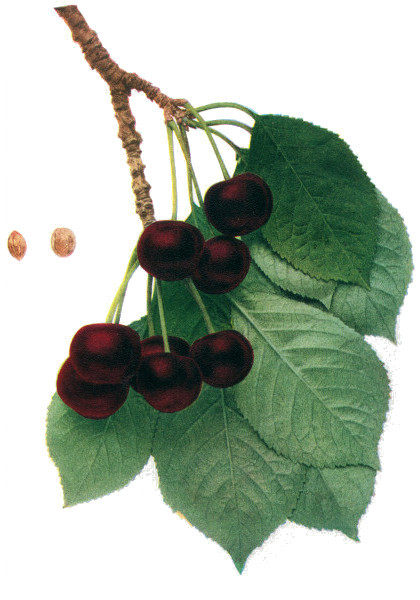
EMPRESS EUGENIE
Tree small, not very vigorous, upright, becoming round-topped, very productive;
trunk slender, roughish; branches slender, much roughened, reddish-brown partly covered
with ash-gray, with numerous small lenticels; branchlets with short internodes, brown
slightly covered with ash-gray, smooth except for the numerous small, conspicuous, much-raised
lenticels.
Leaves numerous, three and one-half inches long, one and three-fourths inches wide,
folded upward, obovate, thick; upper surface dark green, slightly rugose; lower surface
light green, thinly pubescent; apex abruptly pointed, base variable in shape; margin doubly
serrate, with small, dark glands; petiole three-fourths of an inch long, tinged with red,
with a few hairs along the upper surface, glandless or with one or two small, globose,
greenish-yellow or reddish glands, usually at the base of the blade.
Buds obtuse, plump, free, arranged singly as lateral buds and on long or short spurs,
in clusters variable in size; leaf-scars obscure; blooming in mid-season; flowers one and
one-fourth inches across, white; borne in very dense clusters, in threes and fours; pedicels
one inch long, glabrous, greenish; calyx-tube with a faint tinge of red, obconic, glabrous;
calyx-lobes with a trace of red, acute, glabrous within and without, reflexed; petals roundish,
entire, with short but distinct claws; apex nearly entire; filaments one-fourth inch long;
pistil glabrous, equal to the stamens in length.
Fruit matures in mid-season; three-fourths of an inch in diameter, roundish-conic
to oblate-conic, compressed; cavity narrow; suture very shallow, indistinct; apex flattened
or depressed; color dark red; dots numerous, small, dark russet, obscure; stem one and
one-fourth inches long, adherent to the fruit; skin tough, separating from the pulp; flesh
pale red, with pinkish juice, tender, meaty, sprightly, pleasant flavored, tart; of good
quality; stone semi-clinging, small, ovate, flattened, somewhat oblique, with smooth
surfaces.
Prunus cerasus
- 1. Parkinson Par. Ter. 572. 1629. 2. Langley Pomona 85. 1729. 3. Christ Handb. 677. 1797.
4. Lond. Hort. Soc. Cat. 54. 1831. 5. Downing Fr. Trees Am. 197, 198 fig. 1845. 6. Am. Pom. Soc.
Cat. 74. 1862. 7. Hogg Fruit Man. 306, 307. 1884. 8. Am. Pom. Soc. Cat. 27. 1909.
- Grosse Cerise à Ratafia. 9. Duhamel Trait. Arb. Fr. 1:189. 1768.
- Grosse Lange Lothkirsche. 10. Truchsess-Heim Kirschensort. 599, 600, 601. 1819. 11. Mich. Hort.
Soc. Rpt. 326. 1888. 12. Mathieu Nom. Pom. 356, 357. 1889.
- Large Morello. 13. Prince Pom. Man. 2:144. 1832.
- Ratafia Griotte. 14. Prince Pom. Man. 2:147. 1832. 15. Poiteau Pom. Franc. 2: No. 17, Pl.
1846. 16. Leroy Dict. Pom. 5:299, 300 fig., 301. 1877.
- Northern Griotte. 17. Prince Pom. Man. 2:146. 1832. 18. Poiteau Pom. Franc. 2: No. 18, Pl.
1846. 19. Mortillet Le Cerisier 2:188 fig. 189, 190. 1866. 20. Pom. France 7: No. 15, Pl. 15. 1871.
21. Thomas Guide Prat. 18, 195. 1876. 22. Ia. Hort. Soc. Rpt. 331. 1885.
- Colorado Morello. 23. Rogers Cat. 18. 1900.
English Morello is the best of all its group and is the standard late
Sour Cherry in North America, occupying at the close of the season the
place held by Montmorency in mid-season for home, market and cannery.
It is not a table fruit and can hardly be eaten out of hand until it loses
some of its astringency and acidity by thorough ripening. In any way
the cherries are prepared by cooking, however, it is one of the best, culinary
processes giving the fruits a rich, dark wine color, very attractive in
appearance, and a most pleasant, sprightly, aromatic flavor. The fruit is
handsome in appearance, bears harvesting and shipping well, is resistant
to brown-rot and hangs long on the trees after ripening, often until the last
of August if robins can be kept away. Once seen, one may always know
the trees. They are small, round-headed, with branches that distinctly
droop. To be sufficiently productive an English Morello orchard must be
closely set; for, though the trees are vigorous and productive for their
size, they are too dwarf to yield heavily. The trees are hardy but not
always healthy and are not adapted to as great a diversity of soils as might
be wished. The variety distinctly fails in its tree-characters. The demand
for English Morello has recently decreased and it is doubtful if it ever
regains its popularity of a decade ago. There is a place for a late cherry
which English Morello now fills but not sufficiently well.
All of the early pomologists describe a Morello or a Morella but no
one of them definitely gives its place of origin. The concensus of opinion
is that it originated in either Holland or Germany from whence it was
introduced into England and later into France. The early German writers
listed a Grosse Lange Lothkirsche which is English Morello. Preceding
them, Duhamel described the Grosse Cerise à Ratafia "as one praised for
confitures and preserving," which is probably this cherry. Leroy believed
English Morello to be the cherry that Mortillet brought to Paris from
Holland calling it Griotte du Nord though he thought the variety had
been grown in France for many years previous but under another name.
It is possible that the term Du Nord originated through its being widely
grown as an espalier demanding a northern exposure, rather than as some
have thought, because it came from northern Germany. In 1862 English
Morello was put on the fruit list of the American Pomological Society
where it still remains. Wragg is thought to be identical with this cherry
by some and, if not, it differs but little. Northern Griotte and Grosse
Lange Lothkirsche, introduced by Budd from Russia, are English Morello.
Morris, or Colorado Morello, put out by John Morris of Golden, Colorado,
once thought to be distinct, is also English Morello.
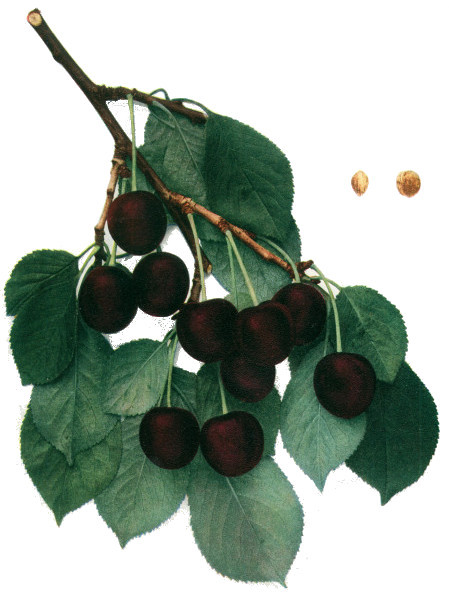
ENGLISH MORELLO
Tree small, upright-spreading, with drooping branchlets, dense-topped, productive;
trunk slender, rough; branches slender, smooth, dark brown overlaid with dark ash-gray,
with numerous small lenticels; branchlets slender, willowy, with short internodes, brownish,
smooth, with numerous conspicuous, small, slightly raised lenticels.
Leaves numerous, two and three-fourths inches long, one and one-half inches wide,
folded upward, obovate to oval; upper surface dark green, smooth; lower surface light
green; apex acute, base variable in shape; margin finely serrate, with small, dark glands;
petiole one-half inch long, tinged with dull red, grooved, with from one to three small,
globose or reniform, greenish-yellow glands at the base of the blade.
Buds small, short, obtuse, plump, free, arranged singly as lateral buds; leaf-scars
obscure; season of bloom late; flowers one inch across, white; borne in scattering clusters
in twos and threes; pedicels nearly one inch long, glabrous, greenish; calyx-tube with
a faint tinge of red, somewhat campanulate, glabrous; calyx-lobes with a trace of red,
obtuse, serrate, glabrous within and without, reflexed; petals distinctly veined, roundish,
crenate, sessile, with crenate apex; filaments one-fourth of an inch long; pistil glabrous,
shorter than the stamens.
Fruit matures very late; about three-fourths of an inch in diameter, sometimes running
larger, roundish-cordate, slightly compressed; cavity shallow, narrow, flaring, regular;
suture a shallow groove; apex roundish, with a small depression at the center; color very
dark red becoming almost black; dots numerous, small, dark russet, conspicuous; stem
slender, one inch long, adhering well to the fruit; skin thin, tender, separating from the
pulp; flesh dark red, with dark colored juice, tender and melting, sprightly, tart; of good
quality; stone free, small, ovate, slightly flattened and pointed, with smooth surfaces,
slightly tinged with red.
Prunus avium
- 1. Prince Treat. Hort. 29. 1828. 2. Kenrick Am. Orch. 277. 1832. 3. Downing Fr. Trees Am.
187. 1845. 4. Thomas Am. Fruit Cult. 365. 1849. 5. Am. Soc. Cat. 22. 1885.
- Knevett's Late Bigarreau. 6. Lond. Hort. Soc. Cat. 46. 1831.
- Bigarreau de Florence. 7. Leroy Dict. Pom. 5:204 fig., 205. 1877.
- Florence Heart. 8. Bunyard-Thomas Fr. Gard. 43. 1904.
Florence is a Bigarreau so similar to Yellow Spanish as to be hardly
worth planting, since it is, all and all, surpassed by its better-known rival.
The fruit hangs on the tree in edible condition an almost phenomenal length
of time which has given rise to much divergence of opinion as to its season,
some pomologists rating it as early, others as mid-season and still others
as late. At Geneva the trees of this variety are not as healthful, vigorous
or as fruitful as those of Yellow Spanish, with which it must compete,
nor are the cherries quite as fine in appearance or quality.
This variety was found in Florence, Italy, early in the Nineteenth
Century by John Houblon, who took it to England from whence it was
brought to America. It found a place in 1885 on the fruit list of the American
Pomological Society where it remained until 1891, when it was
discarded, with quite sufficient reason.
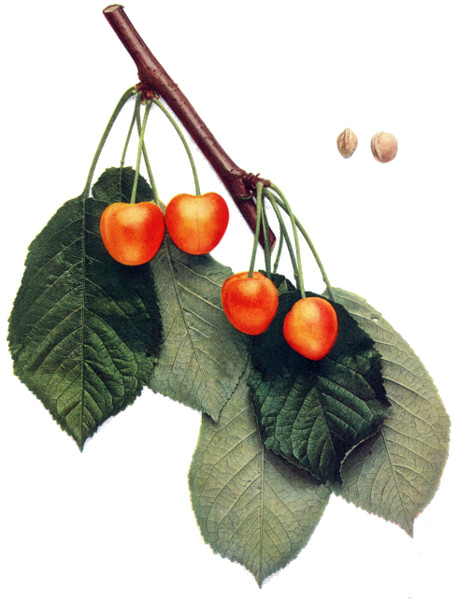
FLORENCE
Tree vigorous, upright, open-topped, productive; trunk and branches thick, smooth;
branches reddish-brown partly overspread with ash-gray, with numerous lenticels; branchlets
thick, long, brown partly covered with ash-gray, smooth, with inconspicuous, raised
lenticels.
Leaves numerous, variable in size, averaging four and one-fourth inches long, two
and one-fourth inches wide, folded upward, long-oval to obovate, thin; upper surface
rather dark green, rugose; lower surface dull light green, thinly pubescent; apex acute,
base abrupt; margin coarsely and doubly serrate, glandular; petiole one and three-fourths
inches long, thick, pubescent, dull red, with from two to four large, reniform, reddish
glands on the stalk.
Buds pointed, plump, free, arranged as lateral buds and grouped in large clusters
on numerous short spurs; season of bloom intermediate; flowers one and one-fourth inches
across, white; borne in dense clusters in twos and threes; pedicels three-fourths of an inch
long, slender, glabrous, greenish; calyx-tube green, obconic, glabrous; calyx-lobes greenish,
acute, glabrous within and without, reflexed; petals broad-obovate to oval, entire, with
very short, blunt claws, distinctly notched at the apex; filaments nearly one-half inch long;
pistil glabrous, usually shorter than the stamens.
Fruit matures early; one inch in diameter, cordate, compressed; cavity deep, wide;
suture very shallow; apex somewhat pointed; color reddish over an amber background,
marked with indistinct, whitish spots and streaks; dots numerous, small, whitish, inconspicuous;
stem one and one-half inches long, adherent to the fruit; skin thin, separating
from the pulp; flesh yellowish-white, with colorless juice, tender, meaty, crisp, sprightly,
sweet; of very good quality; stone clinging, cordate, flattened, blunt, with roughish
surfaces; enlarged along the ventral suture.
Prunus cerasus
- 1. Mich. Hort. Soc. Rpt. 328, 329. 1888. 2. Ia. Hort. Soc. Rpt. 79. 1890. 3. Mich. Hort. Soc.
Rpt. 245. 1894. 4. Ia. Sta. Bul. 31:341. 1895. 5. Del. Sta. An. Rpt. 12:125. 1900. 6. Budd-Hansen
Am. Hort. Man. 2:276, 277. 1903. 7. Ia. Sta. Bul. 73:70. 1903.
George Glass has been widely heralded as a desirable variety in the
Middle West but in New York, where it has passed through a rather
lengthy probationary period, practically all who have tried it are ready to
declare it worthless. It is of the Amarelle group and cannot compete
with the many good varieties of its kinship, as the Early Richmond or
the several Montmorencies. Its season is between Early Richmond and
Montmorency. As compared with the last-named variety, the standard
Sour Cherry, the fruit of George Glass is smaller, sourer, less attractive in
appearance and the trees are far less fruitful. Possibly the trees are more
hardy, this character commending it for the colder parts of the Mississippi
Valley.
The origin of this variety is uncertain but it is supposed to have been
introduced into Iowa by immigrants from northeastern Germany. In
American collections it has often been confused with Brusseler Braune
and Bessarabian and by some is declared to be identical with the latter
sort. It is supposed to be a cross between a Duke and a Morello cherry.
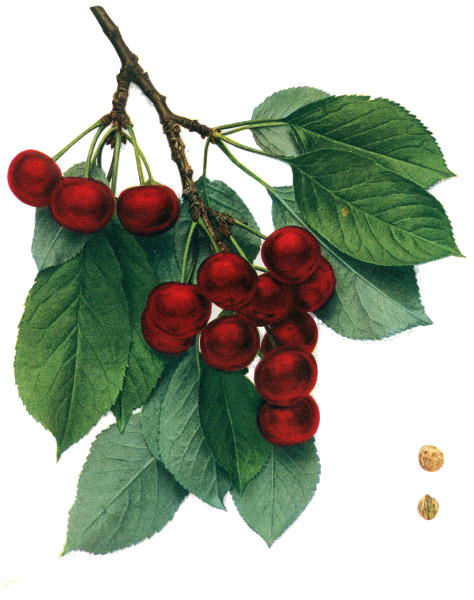
GEORGE GLASS
Tree large, vigorous, upright-spreading, rather open, hardy, appears unproductive;
trunk thick; branches thick, roughened, with numerous conspicuous, raised lenticels;
leaves numerous, four inches long, two inches wide, obovate, thick, stiff, dark green;
petiole three-fourths of an inch long, tinged with red, with a few hairs along the upper
surface, with one or two small, globose, reddish-orange glands, usually at the base of the
blade; buds intermediate in size and length; leaf-scars prominent; season of bloom intermediate;
flowers one and one-fourth inches across; borne in dense clusters.
Fruit matures in mid-season; three-fourths of an inch long, one inch wide, oblate,
compressed; cavity deep; color light red changing to dark red; stem one and one-eighth
inches long, adherent to the fruit; skin separating from the pulp; flesh yellowish-white,
with abundant colorless juice, stringy, tender and melting, rather mild for a sour cherry;
good to very good in quality; stone free, roundish or slightly oblate, plump, blunt, with
smooth surfaces; ventral suture prominent.
Prunus cerasus
- 1. Truchsess-Heim Kirschensort. 573-577. 1819. 2. Dochnahl Führ. Obstkunde 3:60, 61. 1858.
3. Mich. Hort. Soc. Rpt. 328. 1888. 4. Wash. Sta. Bul. 92:17. 1910.
- Herzförmige Sauerkirsche. 5. Christ Wörterb. 288. 1802.
- Heart-Shaped Griotte. 6. Prince Pom. Man.. 2:149. 1832. 7. Mas Le Verger 8:103, 104, fig. 50.
1866-73.
This Sour Cherry, of the Morello group, is too poor in quality to
recommend it for any purpose. The fruit is scarcely edible until dead ripe
and even then is too puckering to eat out of hand with relish. The cherries
are very attractive, being large for the kind, heart-shaped, of a handsome,
clear, glossy dark purple color and very uniform in all characters. The
tree is conspicuous because of its symmetrical shape, large size, round head
and its many branches and branchlets. The leaves are characteristically
small, as are the flowers, which are further distinguished by very narrow
petals. The tree is hardy and productive and quite worth a place on a
lawn as an ornamental if not in the garden for its fruit. The variety has
several characters to commend it to plant-breeders.
This variety came to light in written records in the early part of the
Nineteenth Century in German fruit-books under the name Saure Herzkirsche
or Herzkirschweichsel and was highly recommended for its fine
flavor. Professor J. L. Budd of Iowa, in one of his European trips, was
impressed with its symmetrical habit of growth and its abundant foliage
where he found it growing in eastern Europe as a lawn tree. He
included it among his importations but it has not proved valuable in the
New World.
Tree large, vigorous, upright-spreading, open-topped, unproductive; branches rather
slender, smooth except for the large, conspicuous lenticels; branchlets slender, long; leaves
numerous, two and three-fourths inches long, one and three-eighths inches wide, obovate
to oval, thin, dark green, smooth; petiole over one-half inch long, tinged with red, with
from one to three small, globose, greenish-yellow or brownish glands at the base of the
blade; buds intermediate in size and length, usually obtuse; season of bloom late; flowers
one inch across; borne in scattered clusters; filaments one-fourth inch long; pistil slightly
shorter than the stamens, often defective.
Fruit matures in mid-season; about three-fourths of an inch in diameter, roundish-conic,
slightly compressed; color very dark, dull red; stem slender, one and one-fourth
inches long, adhering to the fruit; skin thin, tough; flesh very dark red, with dark wine-colored
juice, tender, rather meaty, very astringent, sour; of poor quality; stone nearly
free, small, ovate, flattened, pointed, with roughish and colored surfaces.
Prunus avium
- 1. Prince Pom. Man. 2:131. 1832. 2. Elliott Fr. Book 196. 1854.
- Guignier à Fruit Rouge Tardif. 3. Duhamel Trait. Arb. Fr. 1:162. 1768.
- Agathe. 4. Knoop Fructologie 2:37. 1771.
- Doppelttragende Kleine Rothe Spätkirsche. 5. Truchsess-Heim Kirschensort. 281, 282, 283. 1819.
- Hildesheimer Ganz Späte Knorpelkirsche. 6. Truchsess-Heim Kirschensort. 321, 322, 323. 1819.
- Late Red Guigne. 7. Prince Pom. Man. 2:113. 1832.
- Bigarreau Tardif de Hildesheim. 8. Downing Fr. Trees Am. 184. 1845.
- Merveille de September. 9. Elliott Fr. Book 210. 1854.
- Belle Agathe de Novembre. 10. Ann. Pom. Belge 3:9, Pl. 1855.
- Hildesheimer Späte Knorpelkirsche. 11. Ill. Handb. 139 fig., 140. 1860.
- Kratos Knorpelkirsche. 12. Ill. Handb. 59 fig., 60. 1867.
- Schöne Agathe. 13. Ill. Handb. 63 fig., 64. 1867.
- Bigarreau de Fer. 14. Leroy Dict. Pom. 5:199, 200 fig. 1877.
- Belle Agathe. 15. Mas Pom. Gen. 11:99, 100, fig. 50. 1882.
- Bigarreau de Hildesheim. 16. Hogg Fruit Man. 282. 1884.
This variety, one of the oldest, has been called by a great number of
names by European writers. The cherry mentioned by Duhamel, in 1768,
as a late Guigne with red fruit, otherwise known as Guigne de Fer, can
be no other than Hildesheim. The exact origin of the variety has never
been known, though it is supposed to have sprung up in the neighborhood
of Hildesheim, Prussia. It was brought to America early in the Nineteenth
Century, probably by William Prince. With it came some of
the numerous foreign names. It seems certain that Late Red Guigne
mentioned by Prince was Hildesheim. Ripening late and being small
and of rather undesirable texture, Hildesheim did not meet with much
favor in America, never being widely disseminated, and has long since
passed from cultivation. This variety, under the name Belle Agathe, was
propagated in Belgium by M. Thiery about 1852 and for some time was
supposed to be a separate sort. The following description is compiled:
Tree very large, vigorous, upright, hardy, an annual bearer, unproductive while
young producing good crops later; branches thick, large, long, straight; leaves numerous,
of medium size, oval or elongated-oval, acuminate; margin finely and regularly serrate;
petiole slender, rather short, tinged red, with large, flattened glands; blooming season
early.
Fruit matures very late, usually attached in fives but sometimes in threes and fours;
small to medium, roundish-cordate, flattened on one side, somewhat irregular; color
yellowish, mottled and marbled with dark red; stem two inches long, slender, somewhat
curved; skin thick; flesh pale yellow, slightly tinged with red at the pit, firm, somewhat
stringy, rather dry, with uncolored juice, pleasant flavored, sweet; quality good; stone
medium to large, with reddish surface, long, compressed.
Prunus avium
- 1. Gard. Mon. 20:270, 271. 1878. 2. Downing Fr. Trees Am. 3rd App. 162. 1881. 3. Am. Pom.
Soc. Cat. 26. 1909.
Ida is a handsome, large, light red cherry resembling Napoleon in shape
and Rockport in color, but differing from both in having soft flesh which
places it among the Hearts rather than the Bigarreaus. Because of beauty
of the fruit, earliness and good tree-characters, Ida promises to become a
rather general favorite in home orchards though it falls short of several
others of its near of kin in flavor and flesh-characters. It can never take
a high place among commercial kinds because the cherries are too soft to
handle well, show bruises plainly, are somewhat susceptible to brown-rot
and come when better cherries are plentiful. The trees are vigorous,
hardy and bear full crops regularly and in various environments. The
variety is readily told by the upright habit of growth and by the large
lenticels on trunk and branches. Ida has been very well tried as a commercial
variety in this State but in the ups and downs of the industry has
not held its own with other sorts and can be recommended only for home
plantations.
E. H. Cocklin of Shepherdstown, Pennsylvania, grew this variety as
a seedling of Cocklin's Favorite, another of his cherries. The cherry was
named after his daughter, Ida. It seems to have proved worthy of general
culture, as it is now listed by many nurserymen. The American Pomological
Society placed Ida on its fruit list in 1909.
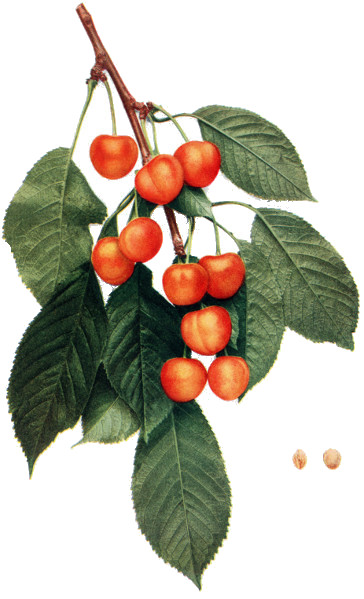
IDA
Tree large, vigorous, upright, open-topped, somewhat vasiform, very productive;
trunk stout; branches very stocky, smooth, light ash-gray over brown, with large, much-raised
lenticels; branchlets very stout, short, brown partly covered with ash-gray, roughish,
with a few raised lenticels.
Leaves five and one-half inches long, two and one-half inches wide, folded upward,
elliptical to obovate, thin; upper surface dark green, smooth; lower surface light green,
pubescent along the midrib and larger veins; apex taper-pointed, base acute; margin doubly
crenate, with small, black glands; petiole two and one-fourth inches long, thick, tinged
with red, somewhat hairy along the grooved upper surface, usually with two large,
reniform, reddish glands on the stalk.
Buds large, long, pointed, plump, free, arranged singly as lateral buds and in dense
clusters on numerous short spurs, also with many small, round, lateral leaf-buds on the
secondary growth; leaf-scars not prominent; blooming in mid-season; flowers white, one
and one-fourth inches across; borne in clusters usually in twos; pedicels three-fourths
of an inch long, glabrous, greenish; calyx-tube green, whitish within, campanulate,
glabrous; calyx-lobes with a tinge of red, acute, reflexed; petals roundish, entire, dentate
at the apex, nearly sessile; filaments nearly one-half inch long; pistil glabrous, shorter
than the stamens.
Fruit matures early; three-fourths of an inch in diameter, cordate, slightly compressed;
cavity deep, flaring, regular; suture a distinct line; apex variable in shape; color amber
overspread with light red, mottled; dots numerous, rather large, yellowish, somewhat
conspicuous; stem one and one-half inches long; skin thin, separating readily from the
pulp; flesh whitish, with colorless juice, tender and melting, mild, sweet; of good quality;
stone free or semi-free, roundish, slightly flattened, blunt, with smooth surfaces; with
distinct ridges along the ventral suture.
Prunus avium × Prunus cerasus
- 1. Lond. Hort. Soc. Cat. 52. 1831. 2. Mag. Hort. 9:204. 1843. 3. Downing Fr. Trees Am. 190,
191. 1845. 4. Am. Pom. Soc. Cat. 74. 1862. 5. Mas Pom. Gen. 11:119, 120, fig. 60. 1882. 6. Hogg
Fruit Man. 302. 1884.
- Royale. 7. Duhamel Trait. Arb. Fr. 1:193, 194, Pl. XV. 1768. 8. Truchsess-Heim Kirschensort.
482-484. 1819. 9. Leroy Dict. Pom. 5:386, 387 fig., 388. 1877.
- Königliche Süssweichsel. 10. Truchsess-Heim Kirschensort. 427-429. 1819. 11. Ill. Handb. 73
fig., 74. 1867.
- Jeffrey's Royal. 12. Floy-Lindley Guide Orch. Gard. 99. 1846.
- Royale Hâtive. 13. Mortillet Le Cerisier 2:134-138, fig. 32. 1866.
This old variety, which has almost passed from cultivation, may have
had its origin in France about the middle of the Eighteenth Century,
though more likely it originated in England much earlier. Leroy mentions
a Royale cherry which was introduced from England to France about
1730 and was first grown by M. le Normand in the garden of Louis XV.
The name Royale was first used by the French about 1735 from the fact
that it was grown in the royal gardens and since that time this name has
clung to the variety in most of the French plantations. According to
English writers, the variety was brought to notice in England by Jeffrey,
proprietor of the Brompton Nursery at Brompton Park, England, and
from that time it was known as Jeffrey's Duke. English pomologists maintain
that Jeffrey renamed the old Cherry Duke of England, giving it
his name. Jeffrey Duke appeared on the American Pomological Society's
fruit catalog list in 1862 but was dropped in 1871. It is doubtful if the
variety can now be found in America. The following description is compiled
from the authors given in the references:
Tree large, vigorous, very upright, unusually compact, slow-growing, productive;
branches very numerous, stocky, straight, thickly set with fruit-spurs; internodes short;
branchlets very short; buds closely set; leaves numerous, medium in size, oval or obovate,
acuminate; margin finely and irregularly serrate; petiole short, slender, with small, flattened
or globose glands; blooming season late; flowers small, very open.
Fruit matures in mid-season, usually attached in pairs; medium in size, roundish,
slightly flattened at the apex and base; suture a well-marked line; color lively red becoming
dark red or almost black when fully ripe; stem slender, inserted in a moderately broad,
deep cavity; skin thin; flesh firm but tender, yellowish-amber, with abundant colored
juice, slightly stringy, highly flavored; good in quality; stone small, roundish, tinged
with red.
Prunus cerasus
- 1. Christ Wörterb. 293. 1802. 2. Truchsess-Heim Kirschensort. 610-615. 1819. 3. Liegel Syst.
Anleit. 174. 1825. 4. Ill. Handb. 533 fig., 534. 1861. 5. Lauche Deut. Pom. III: No. 23, Pl. 1882.
6. Am. Gard. 9:264. 1888. 7. Can. Exp. Farm Bul. 2nd Ser. 3:62. 1900. 8. Ia. Sta. Bul. 73:72. 1903.
9. Am. Pom. Soc. Cat. 27. 1909.
- King's Cherry. 10. Rea Flora 205. 1676.
King Amarelle is an old European cherry that has taken on new life
in America. It is of the Early Richmond type, differing from this standard
Amarelle in bearing fruit a little earlier, lighter in color and with a longer
stem. The fault which all but condemns the variety as a commercial cherry
is the small size of the fruit, the cherries running smaller than those of
Early Richmond which, in its turn, is rather too small. The tree is very
like that of Early Richmond—quite as vigorous and productive, the
same in size and shape and, if anything, a little more hardy. The variety is
told from afar in blossoming-time by the peculiar distribution of the flower-clusters,
which are numerous and dense but always separated by several
inches or a foot of bare wood. King Amarelle can never displace Early
Richmond but might be tried where a somewhat hardier cherry is wanted
or it might be planted as a substitute where the better-known sort fails.
This variety, of old and uncertain origin, sprang up in France about
the same time as the Montmorencies and became confused with them.
In both fruit and tree-characters, however, King Amarelle is very different
from the Montmorencies, being more like Early May but ripening later
and making a larger tree. The cultivation of King Amarelle never became
extended in Europe because of the inferior quality of the fruit and poor
tree-characters. Professor J. L. Budd brought the variety to America
from Russia about 1883. The Royal Amarelle, grown on the Canadian
Experiment Station grounds in 1900, is undoubtedly King Amarelle. The
American Pomological Society placed it on its list of recommended
fruits in 1909.
Tree of medium size and vigor, upright-spreading, open-topped, very productive;
trunk roughish; branches rather slender, smooth, reddish-brown overlaid with dark ash-gray;
branchlets slender, of medium length, with short internodes, brown partly covered
with ash-gray, smooth, with numerous conspicuous, small, raised lenticels.
Leaves three and one-half inches long, one and one-half inches wide, folded upward,
obovate, somewhat glossy, thick; upper surface dark green, rugose; lower surface light
green, with a few scattering hairs; apex acute, base abrupt; margin finely and doubly
serrate, with small, dark glands; petiole one inch long, somewhat slender, lightly tinged
with red, with a few hairs on the grooved upper surface and with from one to three small,
globose, greenish-yellow glands at the base of the blade.
Buds small, short, obtuse, very free, arranged singly as lateral buds and in clusters
on few, short spurs; leaf-scars prominent; season of bloom intermediate; flowers white,
one and one-fourth inches across; borne in dense clusters usually in threes; pedicels over
one-half inch long, glabrous, greenish; calyx-tube with a tinge of red, obconic, glabrous;
calyx-lobes faintly tinged with red, acute, serrate, glabrous within and without, reflexed;
petals somewhat obovate, entire, with an entire apex; filaments one-fourth inch long;
pistil glabrous, equal to the stamens in length.
Fruit matures early; three-fourths inch in diameter, roundish-oblate, compressed;
cavity regular, somewhat abrupt; suture indistinct; apex roundish or flattened; color
bright red; dots numerous, small, light russet, rather conspicuous; stem one inch long,
adhering to the fruit; skin thin, tender, separating from the pulp; flesh pale yellow, with
colorless juice, tender and melting, sprightly; fair to good in quality; stone free, ovate,
somewhat flattened, pointed, with smooth surfaces, faintly tinged with red; ridged along
the ventral suture.
Prunus avium
- 1. Am. Pom. Soc. Sp. Rpt. 22. 1904-05.
- Kirtland's Mary. 2. Horticulturist 2:123, 124 fig. 21. 1847-48. 3. Thomas Am. Fruit Cult. 365.
1849. 4. Cole Am. Fr. Book 231. 1849. 5. Am. Pom. Soc. Rpt. 39. 1852. 6. Ibid. 235. 1854.
7. Elliott Fr. Book 198 fig. 1854. 8. Hooper W. Fr. Book 262, 263. 1857. 9. Mas Le Verger 8:55,
56, fig. 26. 1866-73.
- Mary. 10. Hogg Fruit Man. 69, 86, 87. 1866.
In the collection of cherries at this Station, Kirtland stands among
the best of the Bigarreaus in quality of fruit—in fact is hardly surpassed
in richness and delicacy of flavor. The fruit, too, as may be seen from
the color-plate, is handsome, the cherries resembling the well-known
Napoleon but being a little darker in color. The flesh is firm and meaty
and stands handling well and also resists the brown-rot as well as any
other cherry. With these splendid qualities of fruit, Kirtland would long
ago have been one of the standard commercial cherries were its tree-characters
better. Wherever tried, the complaint comes that the trees lack
vigor and can be grown successfully only on choice cherry soils and under
the best of care. With these faults the variety can be recommended only for
home orchards and for local markets where there is demand for a very early
Bigarreau, since this variety ripens before most other cherries of its kind.
Kirtland was grown in 1842 by Professor J. P. Kirtland of Cleveland,
Ohio, and ranks foremost in quality and appearance of all the seedlings
raised by this well-known cherry-breeder. The American Pomological
Society, in 1852, mentioned this sort as deserving of further trial and, in
1854, listed it among the varieties of promising fruits. Elliott, in his
Fruit Book, noted this cherry under the name Kirtland's Mary, in honor
of Professor Kirtland's daughter, and classed it as a variety worthy of
general cultivation. Hogg, in 1866, dropped the name Kirtland and listed
it as Mary, while in the American Pomological Society's Special Report
for 1905 it is called Kirtland. According to the rules of pomological
nomenclature, Hogg was correct in holding the name Mary but, since
there is another Mary and no worthy sort bearing the name of so eminent
a horticulturist as Professor Kirtland, this Station follows the American
Pomological Society in the use of Kirtland.
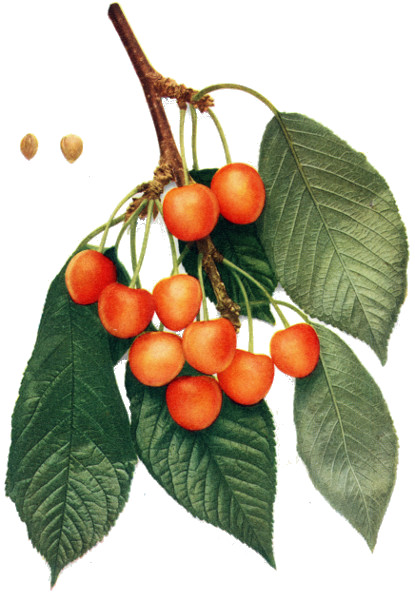
KIRTLAND
Tree small, rather weak, upright-spreading, open-topped, productive; trunk and
branches slender, smooth; branches reddish-brown partly overspread with ash-gray,
with numerous lenticels; branchlets thick, brown almost entirely overspread with ash-gray,
smooth except for the longitudinal, conspicuous, raised lenticels.
Leaves five inches long, two and one-fourth inches wide, folded upward, elliptical
to obovate, thin; upper surface medium green, somewhat glossy, smooth; lower surface
light green, thinly pubescent; apex acute, base abrupt; margin doubly serrate, with small,
dark glands; petiole one and three-fourths inches long, slender, tinged with red, lightly
pubescent along the upper side, with two or three reniform, reddish glands on the stalk.
Buds pointed, plump, free, arranged singly as lateral buds or on numerous, very
short spurs in clusters variable in size; leaf-scars prominent; blooming in mid-season;
flowers white, one and one-fourth inches across; borne in dense clusters; pedicels one inch
long, pubescent, reddish-green; calyx-tube tinged with red, light green within, campanulate,
glabrous; calyx-lobes reddish, obtuse, glabrous within and without, reflexed; petals
roundish-oval, entire, with short, broad claws and a notched apex; filaments in four series,
the longest one-half inch; pistil glabrous, shorter than the stamens.
Fruit matures in mid-season; three-fourths of an inch in diameter, cordate, compressed;
cavity wide, flaring; suture a more or less distinct line; apex roundish or pointed,
with a small depression at the center; color amber overspread with bright red; dots
numerous, small, grayish, conspicuous; stem one and three-fourths inches long, adhering
to the fruit; skin tough; flesh whitish, with colorless juice, tender, meaty, with a pleasant
and refreshing flavor; very good to best in quality; stone free, small, roundish-ovate, with
smooth surfaces; ridged along the ventral suture.
Prunus avium
- 1. Am. Pom. Soc. Cat. 26. 1909.
- Knight's Early Black. 2. Lond. Hort. Soc. Cat. 52. 1831. 3. Prince Pom. Man. 2:120. 1832.
4. Proc. Nat. Con. Fr. Gr. 52. 1848. 5. Dochnahl Führ. Obstkunde. 3:19. 1858. 6. Mortillet Le Cerisier
2:83. 1866. 7. Mas Pom. Gen. 11:85, 86, fig. 43. 1882.
- Knights Frühe Herzkirsche. 8. Ill. Handb. 3 fig., 4. 1867.
This old English variety has long been popular in America, where it
is generally known as Knight's Early Black, this name having been shortened
by the American Pomological Society to Knight. Possibly Knight is
to be found in dooryards and home gardens in Eastern United States as
often as any other Sweet Cherry with the exception of Black Tartarian.
The characters which give it popularity are excellent quality, handsome
appearance because of its glossy, dark purple color and uniformity in color,
shape and size, and its earliness, it being the earliest good Sweet Cherry.
Unfortunately, even in the best soil and under the most painstaking treatment,
the cherries run small, a defect for American markets. The small
size also leads to comparatively low yields even though the fruits are often
borne in prodigious numbers. Knight, in size, color and flavor, is much
like Black Tartarian but the cherries are smaller and ripen earlier. As
the trees grow on the grounds of this Station they are about all that could
be desired in a Sweet Cherry. The trees are characteristically marked by
smooth bark which is dotted with large lenticels. There are now
better sweet varieties than Knight for most purposes but still this old
variety has too many merits, especially for home grounds, to be wholly
forgotten.
Knight comes from a seed of May Duke crossed with Yellow Spanish
by T. A. Knight, Downton Castle, Wiltshire, England, about 1810. The
new variety sprang into prominence almost immediately, being mentioned
by French, German and English writers. Knight is still one of the well-recognized
sorts in Europe and America and has appeared continuously
on the fruit list of the American Pomological Society since 1848. Mathieu
has included several synonyms under this head which we question as we
believe they belong to the Guigne Noir Hâtive, a distinct variety though
very similar.
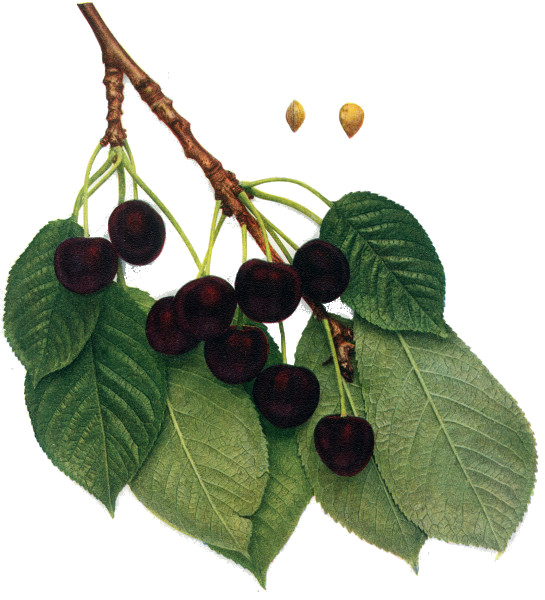
KNIGHT
Tree of medium size, upright-spreading, open-topped, very productive; trunk stocky,
variable in smoothness; branches smooth, light reddish-brown nearly overspread with
ash-gray, with small lenticels; branchlets thick, brown lightly covered with ash-gray,
variable in smoothness, with small, raised, inconspicuous lenticels.
Leaves numerous, five and one-half inches long, two and one-half inches wide, folded
upward, obovate to long-oval, thin; upper surface dark green, rugose; lower surface light
green, thinly pubescent; apex and base variable in shape; margin doubly serrate, with
small, dark glands; petiole two inches long, slender, tinged with red, with a shallow groove
and with few hairs, with two or three large, reniform, reddish glands, usually on the
stalk.
Buds long, conical or pointed, plump, free, arranged singly as lateral buds and in
small clusters on spurs variable in length; leaf-scars prominent; season of bloom intermediate;
flowers white, one and one-fourth inches across; borne in dense clusters, usually
in twos; pedicels one inch long, slender, glabrous; calyx-tube green, campanulate, glabrous;
calyx-lobes lightly tinged with red, long, acute, glabrous within and without, reflexed;
petals oval, entire, deeply notched at the apex; filaments nearly one-half inch long; pistil
glabrous, equal to the stamens in length.
Fruit matures early; three-fourths of an inch in diameter, cordate to conical; cavity
wide, rather abrupt; suture indistinct; apex flattened, with a small depression at the
center; color dark reddish-black, obscurely mottled; dots numerous, small, russet, obscure;
stem slender, one and one-half inches long, adhering well to the fruit; skin thin, tender,
separating from the pulp; flesh dark red, with dark colored juice, tender, meaty, mild,
sweet; of good quality; stone free except along the ventral suture, small, roundish-ovate,
with smooth surfaces.
Prunus avium
- 1. U. S. D. A. Pom. Rpt. 24. 1894. 2. Am. Pom. Soc. Cat. 24. 1899. 3. U. S. D. A. Yearbook
307-309, Pl. 31. 1907.
Nowhere else in America, possibly nowhere else in the world, can the
Sweet Cherry be grown as well as in Oregon and Washington. From these
States, more particularly Oregon, several meritorious cherries have been
added to pomology. One of the best of these is Lambert, now a standard
sort in its native State but still on probation in Eastern America. Lambert
is a Bigarreau, a seedling of Napoleon by Black Heart, and a worthy
rival of its parents in most respects and superior in some. In appearance,
Lambert is more like its male than its female parent, having much the
same shape and color, but it is larger, more rotund, smoother, clearer
and brighter—one of the handsomest of the dark-colored Sweets. The
flesh and flavor leave little to be desired; the flesh is purplish-red marbled
with lighter red, firm, meaty and juicy, with a sweet, rich flavor that at
the first taste one marks very good. The tree is strong, vigorous, healthy
and usually fruitful and regular in bearing. The fruit sets in great, loose
clusters—often a dozen or more cherries to the fruit-spur. The leaves
are remarkably large and dark green, the foliage betokening the vigor of
the variety. Lambert is well worthy thorough testing for either home or
market wherever the Sweet Cherry can be grown.
Lambert originated as a seedling under a Napoleon tree which was
planted by the late Henderson Lewelling80 about 1848 in the orchard of
J. H. Lambert, Milwaukee, Oregon. This seedling, supposed to have been
a cross between Napoleon and Black Heart, was grafted to May Duke
and later transplanted. About 1880, the top died and a sprout from the
seedling stock formed a new top. Mr. Lambert gave the new variety his
name and in 1895 turned over his stock to the Oregon Horticultural Society
with the exclusive right to propagate. The variety was placed on the
fruit list of the American Pomological Society in 1899 where it still remains.
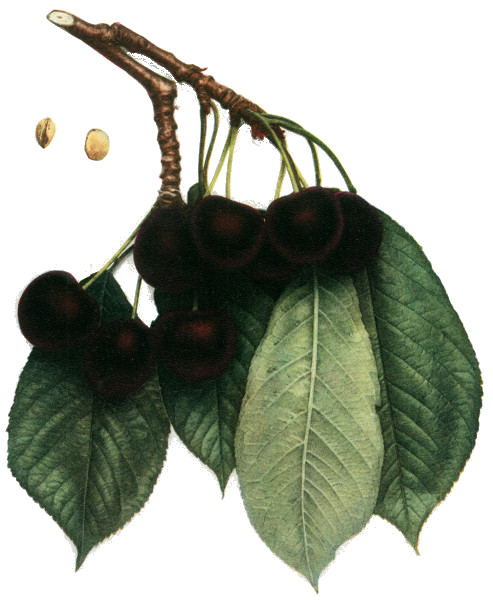
LAMBERT
Tree medium to large in size and vigor, upright-spreading, very productive; branches
smooth, dull reddish-brown, with numerous small lenticels; branchlets thick, long, dark
reddish-brown nearly covered with ash-gray, smooth, glabrous, with a few inconspicuous
lenticels.
Leaves four and one-fourth inches long, two and one-half inches wide, folded upward,
oval to obovate, thin; upper surface medium green, smooth; lower surface light green,
lightly pubescent; apex acute, base abrupt; margin doubly serrate, glandular; petiole
one and one-half inches long, dull red, glandless, or with from one to three rather small,
globose, reddish glands on the stalk.
Buds large, pointed or conical, free, arranged singly as lateral buds or in small
clusters on short spurs; leaf-scars prominent; season of bloom intermediate, short; flowers
one and one-fourth inches across, white; borne usually in twos; pedicels three-fourths
of an inch long, glabrous, greenish; calyx-tube green, campanulate, glabrous; calyx-lobes
long, broad, obtuse, finely serrate; petals roundish, entire, with short claws and with
dentate apex; filaments one-half inch long; pistil glabrous, equal to the stamens in length.
Fruit matures in mid-season; one inch in diameter, roundish-cordate, compressed;
cavity rather deep, slightly flaring; suture shallow, often a mere line; apex roundish,
depressed at the center; color very dark red changing to reddish-black; dots numerous,
small, russet, obscure; stem tinged with red, slender, one and one-fourth inches long,
adherent to the fruit; skin thin, adhering to the pulp; flesh dark red, with scant dark red
juice, meaty, firm, pleasant flavored, sweet; of very good quality; stone clinging, large,
wide, ovate, flattened, blunt, oblique, with smooth surfaces; prominently ridged along
the ventral suture.
Prunus cerasus
- 1. Am. Pom. Soc. Cat. 22. 1885. 2. Ibid. 25. 1899. 3. Del. Sta. An. Rpt. 12:110, 114. 1900.
4. Am. Gard. 22:266, 267. 1901.
- Flemish. 5. Bradley Gard. 211. 1739. 6. Lond. Hort. Soc. Cat. 49. 1831. 7. Thompson Gard.
Ass't 530. 1859.
- Grosse Glaskirsche von Montmorency. 8. Truchsess-Heim Kirschensort. 465-470. 1819. 8. Dochnahl
Führ. Obstkunde 3:54, 55. 1858. 10. Ill. Handb. 165 fig., 166. 1860.
- Short Stem Montmorency. 11. Prince Pom. Man. 2:139, 140. 1832. 12. Ia. Sta. Bul. 73:75. 1903.
- Grosser Gobet. 13. Ill. Handb. 543 fig., 544. 1861.
- Montmorency. 14. Mortillet Le Cerisier 2:195 fig. 54, 196, 197. 1866.
As its synonyms show, Large Montmorency has been grown under
various names in Europe and America—a testimony to its merits. Were
it not that the true Montmorency is so much more fruitful than this larger-fruited
offshoot of the same race of Amarelle cherries, Large Montmorency
would be a leading commercial Sour Cherry, for it is equal to the smaller-fruited
strain in all other characters with the advantage of size. The
relationship between this and the other Montmorencies is apparent but
Large Montmorency is easily distinguished by several marked characters
from the common Montmorency, known by all, with which it is most
often confused. Its fruits are more often borne singly, are larger, have a
shorter, thicker stem, are more oblate and ripen a little earlier. The trees
are more upright, with stouter branches and are far less fruitful. The
flesh-characters of the two kinds are much the same—excellent in both,
the flavor being particularly refreshing to those who like the acidity of the
Sour Cherry. Large Montmorency has been tried and found so wanting
in productiveness that it can rarely be recommended as a commercial
variety but it is much too good a fruit to be wholly lost and should be
grown by connoisseurs who want a large, finely flavored Sour Cherry.
This variety has been much confused with other cherries, particularly
Montmorency, Early Richmond and Short Stem Montmorency. Bradley,
in 1739, mentioned a Flemish cherry which undoubtedly was the Large
Montmorency of today, for the name Flemish has rather commonly been
applied to this sort since Bradley's time. There is no doubt but that
Large Montmorency sprang up about the same time as the true Montmorency,
in the Montmorency Valley in France. It may have been a
seedling of the Cerise Hâtive, afterwards known as Early Richmond, though
some writers are of the opinion that the Montmorencies and Cerise Hâtive
were all seedlings of the old Cerise Commune. At any rate, there have
come to be at least three distinct types of Montmorency: the true Montmorency
with long stems and moderate-sized fruit, called Montmorency à
Longue Queue or, in America, Montmorency Ordinaire; the Large Montmorency
with its large fruit and shorter, thicker stems, commonly known
by the French and German writers as Montmorency à Gros Fruit, Gros
Gobet, Grosse Glaskirsche von Montmorency and sometimes as Montmorency
à Courte Queue; and the Short-Stem Montmorency, often called
Montmorency à Courte Queue and sometimes Gros Gobet. Large Montmorency
has often been sold for Montmorency, or for Early Richmond,
hence the three varieties are more or less confused. Large Montmorency
probably came to America about the same time as Montmorency
and Early Richmond, early in the Nineteenth Century. In 1875,
Ellwanger & Barry, Rochester, New York, disseminated this sort quite
extensively but later it proved too unproductive for commercial use. It
was soon replaced by the true Montmorency but often the names were
interchanged and large forms of the Montmorency were thought to be
this variety. The unproductiveness of this cherry has been consistently
mentioned by nearly every writer from Duhamel's time to the present.
Large Montmorency was added to the American Pomological Society's
catalog list of fruits in 1885 as Montmorency Large but in 1899 this name
was changed to Large Montmorency.
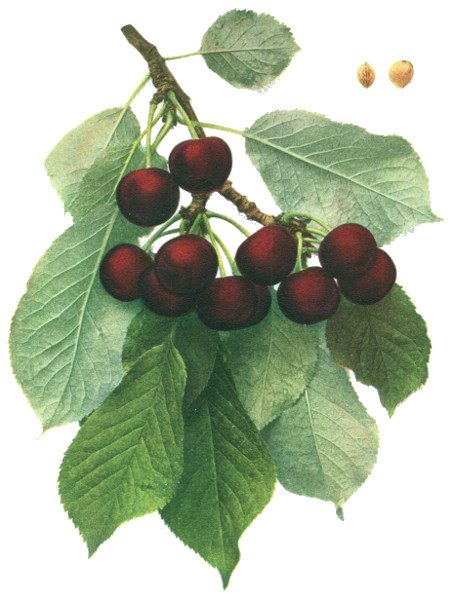
LARGE MONTMORENCY
Tree rather large, vigorous, upright, vasiform, unproductive; trunk thick, roughened;
branches stocky, nearly smooth, reddish-brown overspread with dark ash-gray, with
numerous large, raised, conspicuous lenticels; branchlets thick, short, brown tinged
with bronze, smooth except for the large, numerous yellowish, conspicuous, raised
lenticels.
Leaves numerous, three and one-half inches long, one and three-fourths inches wide,
folded upward, broad-oval to obovate, thick, stiff; upper surface dark green, slightly rugose;
apex acute, base variable in shape; margin serrate, glandular; petiole one inch long, tinged
with dull red, glandless or with from one to three globose, yellow or brownish glands,
usually at the base of the blade.
Buds usually pointed, plump, free, arranged singly as lateral buds and in small clusters
on short spurs; leaf-scars prominent; season of bloom intermediate; flowers white, one
inch across; borne in scattering clusters, usually in threes; pedicels five-eighths inch long,
glabrous, green; calyx-tube tinged with red, obconic, glabrous; calyx-lobes with a trace
of red, long, broad, acute, serrate, glabrous within and without, reflexed; petals obovate,
entire or slightly crenate, sessile, with a crenate apex; filaments one-fourth inch long;
pistil glabrous, equal to or longer than the stamens, often defective.
Fruit matures in mid-season; three-fourths of an inch in diameter, oblate, compressed;
cavity wide, flaring; suture shallow; apex flattened or depressed; color dark red; dots
numerous, small, russet, somewhat conspicuous; stem thick, one inch long, adhering fairly
well to the fruit; skin thick, separating from the pulp; flesh whitish, showing distinctly
the fibers in the pulp, with abundant colorless or slightly tinged juice, tender and melting,
sprightly, pleasant flavored, tart; of very good quality; stone free, roundish, plump, with
smooth surfaces, tinged with red.
Prunus avium × Prunus cerasus
- 1. Pom. Mag. 1:45, Pl. 1828. 2. Lond. Hort. Soc. Cat. 48, 49, 55, 56. 1831. 3. Prince Pom.
Man. 2:134, 135. 1832. 4. Hort. Reg. (Eng.) 1:257, fig. 1833. 5. Downing Fr. Trees Am. 191 fig.
80. 1845. 6. Mag. Hort. 13:397 fig. 33, 398. 1847. 7. Gard. Chron. 556. 1848. 8. Hovey Fr. Am.
1:37, 38, Pl. 1851. 9. Am. Pom. Soc. Cat. 74. 1862.
- Wahre Englische Kirsche. 10. Christ Handb. 682. 1797. 11. Christ Wörterb. 284. 1802. 12.
Truchsess-Heim Kirschensort. 405-410. 1819. 13. Dochnahl Führ. Obstkunde 3:50. 1858. 14. Ill.
Handb. 499 fig., 500. 1861.
- Späte Herzogenkirsche. 15. Truchsess-Heim Kirschensort. 434-437. 1819.
- Anglaise Tardive. 16. Mortillet Le Cerisier 2:179-181, fig. 48. 1866. 17. Mas Le Verger 8:67,
68, fig. 32. 1866-73.
Late Duke is a variant of the well-known May Duke, ripening from
two weeks to a month later. The size, color, flavor and season of the
fruit all commend it, as do the vigor, health and fruitfulness of the trees.
The cherries are not quite as sweet as those of May Duke, a little more
marbled in color of skin and ripen through a longer season. The trees
are readily told from those of the earlier Duke, being more open and spreading,
scanter of foliage, with slender branches and with fruit more thickly
clustered along the branchlets. Ripening in a season when hybrid varieties
are gone or rapidly going, Late Duke is a valuable acquisition in the home
orchard and for nearby markets to which tender-fleshed varieties can be
shipped. If those who want late cherries will plant this variety on a northern
slope, against a northern wall or where in any way shaded or in a cool
soil, these delicious cherries can be had until well toward August. The
tree is hardy and its blossoming-time is late so that the variety is well
adapted to northern latitudes.
The origin of this variety is unknown. In 1797, Christ mentions
"a true English cherry" which is probably Late Duke. At least Oberdieck,
in 1861, states that the true English cherry is identical with the Late
Duke, or Anglaise Tardive. In 1823, Late Duke was introduced into
England by the London Horticultural Society from M. Vilmorin, of Paris,
under the name Anglaise Tardive. Though the French name of this
variety seems to indicate an English origin, the old English writers were
not aware of any cherry of this kind being in existence in England previous
to its introduction by the Horticultural Society. Because of the close
resemblance of Late Duke to May Duke it has often been confused with
that sort and by some writers was supposed to be a late strain of May
Duke. The American Pomological Society listed Late Duke in its fruit
catalog in 1862.
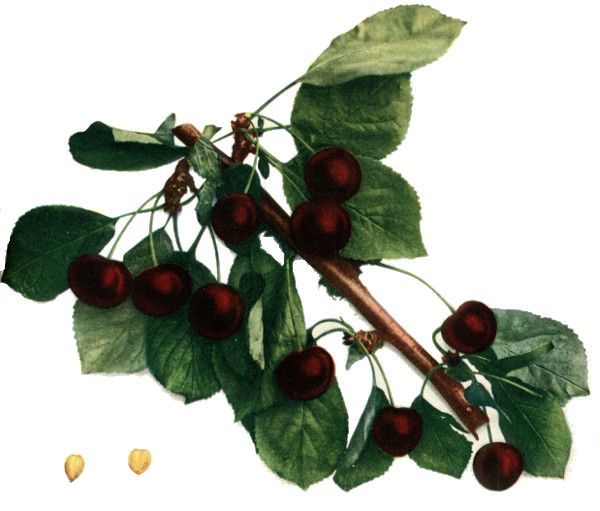
LATE DUKE
Tree vigorous, upright-spreading, becoming spreading at maturity, open-topped,
productive; trunk and branches slender; branches brown overlaid with dark ash-gray,
with numerous small lenticels; branchlets slender, short, reddish-brown, with ash-gray
scarf-skin, with numerous conspicuous, small, raised lenticels.
Leaves numerous, three inches long, one and three-fourths inches wide, folded upward,
obovate, thick; upper surface very dark green, smooth; lower surface light green, with
a few scattering hairs; apex abruptly pointed; margin doubly crenate, with small, dark
glands; petiole one inch long, lightly tinged with red, grooved and somewhat hairy on
the upper surface, glandless or with one or two small, reniform, greenish glands, usually
at the base of the blade.
Buds small, short, obtuse or conical, plump, free, arranged singly and in clusters;
leaf-scars prominent; season of bloom late; flowers white, one inch across; borne in numerous,
dense clusters, in twos, threes and fours; pedicels one inch long, slender, glabrous,
green; calyx-tube reddish, campanulate; calyx-lobes broad, obtuse, serrate, reflexed;
petals roundish, entire, almost sessile; filaments one-fourth inch long; pistil glabrous,
equal to the stamens in length.
Fruit matures very late; one inch in diameter, blunt-cordate, somewhat compressed;
cavity wide; suture shallow; color dark red; stem slender, one and one-half inches to two
inches long, deeply inserted; flesh amber-colored, with abundant juice, tender, rich,
sprightly subacid; stone semi-clinging, medium to large, roundish-ovate, compressed.
Prunus cerasus
- 1. Downing Fr. Trees. Am. 197. 1845. 2. Am. Pom. Soc. Cat. 27. 1909.
- Kentish Red. 3. Coxe Cult. Fr. Trees 249. 1817.
- Pie Cherry. 4. Thomas Am. Fruit Cult. 371. 1849.
- Red Pie Cherry. 5. Am. Pom. Soc. Rpt. 103. 1852.
- Kentish. 6. Elliott Fr. Book 217. 1854.
This old cherry served well the needs of Americans in colonial times
when all cherries were grown from pits or suckers. Though but little
improvement on the wild Prunus cerasus, the trees were so hardy, vigorous,
healthy and productive that any who had a bit of spare land could have
cherries. This, therefore, became preeminently the "pie cherry" of New
England and the North Atlantic States. The trees are long-lived and even
so late as a generation ago Downing says that this variety is "better known
among us than any other acid cherry, especially abundant on the Hudson
and near New York." The variety is never planted now, having long
since been superseded by better sorts, Early Richmond and Montmorency
in particular, but it is still to be found as old trees or self-sown near where
a tree of the variety formerly stood.
Late Kentish and Early Richmond, the latter the Kentish of some
authors, are much confused. Late Kentish is the old Pie Cherry of Colonial
times. It is a seedling sort belonging to America, having been planted
along fences and roadsides in the earliest times. This cherry is mentioned
by the Pilgrims in 1620 and this and the May Duke were listed as market
varieties in Massachusetts. Many believe it to be a seedling of Early
Richmond, sometimes, as we have seen, called Kentish, but this variety
being two weeks later, received the name Late Kentish. The name was
put on the fruit list of the American Pomological Society in 1873. The
following description is a compilation:
Tree small, bears annually, very productive, hardy.
Fruit matures about two weeks after Early Richmond; medium or below in size,
roundish, flattened; stem one inch to one and one-half inches in length, stout, straight;
color deep, lively red; flesh light colored, with abundant colorless juice, very tender, sour,
remaining quite acid even when fully ripe; stone does not adhere to the stalk.
Prunus cerasus
- 1. Mich. Hort. Soc. Rpt. 328. 1888. 2. Can. Exp. Farm Bul. 17:9. 1892. 3. Mich. Hort. Soc. Rpt.
245. 1894. 4. Del. Sta. An. Rpt. 12:128. 1900. 5. Am. Pom. Soc. Sp. Rpt. 33. 1904-05. 6. Am.
Pom. Soc. Cat. 27. 1909.
It is barely possible that Lithauer, if the trees can be obtained, may
have some value in the coldest and bleakest parts of New York where
less hardy sorts cannot be grown. The variety is too poor in quality to
be worth planting where the better but less hardy cherries will grow.
We greatly doubt whether it is worthy a place in the recommended list
of fruits of the American Pomological Society. It is included here only
because of the prominence given it by a place in the fruit list named.
This is one of the varieties imported from Russia by Professor J. L.
Budd of Iowa, who reported that it was much grown in southwest Russia
for drying and in making cherry wine. As tested in various parts of this
country Lithauer has proved of little value except in the extreme north.
The American Pomological Society, in 1909, listed this sort in its catalog
of recommended fruits for northern fruit regions. The following
description is compiled:
Tree large, vigorous, tall, weeping, hardy.
Fruit matures from the middle to the last of July; small, roundish, slightly oblate;
stem long, averaging one and one-half inches, slender; color dark purplish-red becoming
almost black at maturity; skin thick, tough; flesh dark red, with reddish juice, firm, meaty,
quite acid or bitter even when fully ripe; poor in quality; stone variable in size, roundish.
Prunus avium × Prunus cerasus
- 1. Elliott Fr. Book 218. 1854. 2. Am. Pom. Soc. Cat. 74. 1862. 3. Horticulturist 22:289, 290
fig. 1867. 4. Thomas Guide Prat. 26, 195. 1876. 5. Cult. & Count. Gent. 42:378. 1877. 6. Am.
Pom. Soc. Cat. 27. 1909.
Here again we have a very evident hybrid between some Sweet Cherry
and a Sour Cherry of the Morello type in which Morello characters are
most prominent. If the description and color-plates of this variety and
Olivet be compared it will be found that the two cherries are nearly identical.
They differ only in season of ripening and in minor tree-characters
which may be best summarized by the statement that this cherry has in
the tree more of the aspect of a Morello than has Olivet. It may be suspected
that one or the other of the two varieties on our grounds is misnamed
but the descriptions of all who have described the two show that they
are very similar, if not identical. The history of Louis Philippe, long known
in America but little or not at all known in Europe, throws some light on the
question of its distinctness from Olivet, the origin of which is known, inasmuch
as Louis Philippe seems to be the older of the two. The value
of the two varieties to cherry-growers is the same and is indicated in the
discussion of Olivet.
Elliott,82 the American pomologist, imported Louis Philippe from France
in 1846 but the cherry does not seem to have been known at that time in
Europe and it is possible that Elliott gave it its name. For the first few
years the variety was not given the recognition it deserved but, in 1862,
it was recognized by the American Pomological Society by a place on its
list of recommended fruits which it still holds under the name, Philippe.
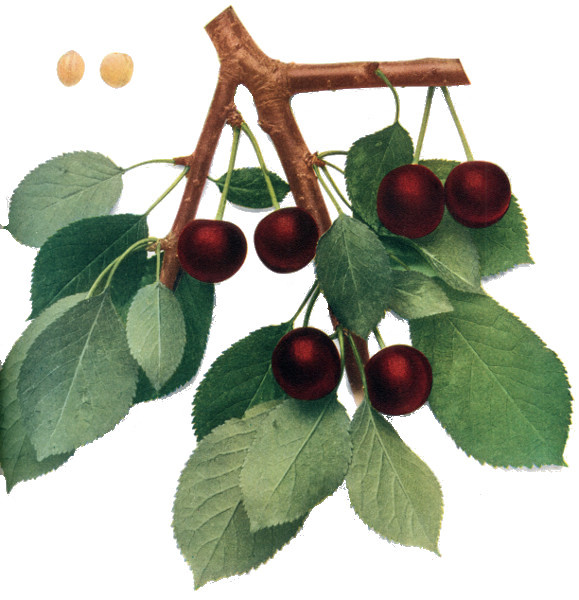
LOUIS PHILLIPE
Tree vigorous, upright-spreading, open-topped; trunk and branches intermediate in
thickness; branches with numerous very large, elongated, raised lenticels.
Leaves numerous, four and one-half inches long, two and one-eighth inches wide,
oval to obovate, thick, leathery; upper surface dark, shiny green, smooth; lower surface
olive-green, with a large, prominent midrib; apex taper-pointed; margin finely serrate,
with reddish-brown glands; petiole one inch long, usually with one or two large, globose,
yellowish-red, glands, variable in position.
Flowers one and one-fourth inches across, white, well distributed, mostly in threes;
pedicels one inch long, thick, glabrous, greenish; calyx-tube green, obconic, glabrous;
calyx-lobes broad, obtuse, glabrous within and without, reflexed; petals slightly obovate,
entire, broad, slightly notched at the apex; stamens one-fourth inch long; pistil glabrous,
equal in length to the stamens.
Fruit matures in mid-season or later; nearly one inch in diameter, roundish-ovate;
cavity abrupt; suture very shallow to a mere line; apex flattened, depressed; color very
dark red; dots numerous, unusually small, obscure; stem one and one-fourth inches to
one and one-half inches long, adhering well to the fruit; flesh light red, with much wine-colored
juice, fine-grained, tender and melting, sour at first, becoming pleasantly tart
at full maturity; good in quality; stone separates readily from the flesh, small, roundish-ovate,
plump; ventral suture grooved; dorsal suture with a small ridge.
Prunus cerasus
- 1. Ia. Hort. Soc. Rpt. 328. 1885. 2. Am. Pom. Soc. Cat. 17. 1897. 3. Am. Pom. Soc. Sp. Rpt.
32, 33. 1904-05. 4. Am. Pom. Soc. Cat. 27. 1909.
- Galopin. 5. Thomas Guide Prat. 21. 1876. 6. Kan. Sta. Bul. 73:189. 1897.
For a time Lutovka and Galopin were listed as two distinct varieties.
Unquestionably they are the same despite the seeming difference in origin.
All we know of Galopin is that it was said to have been originated by a
nurseryman in Belgium whose name it bears. The Lutovka was introduced
into this country by J. L. Budd of Iowa, in 1883, and, according to the
introducer, was well known in Poland and Silesia as a roadside tree. Nothing
is said of it in foreign literature. As was the case with many of Budd's
importations, this variety did not stand the test of culture. It is a shy
bearer and is now seldom recommended, although it was placed on the
list of desirable fruits of the American Pomological Society in 1897 where
it still remains. The variety has no value in New York. In 1895, this
Station sent out buds which they had been led to believe were the Lutovka
and which they later found to be Brusseler Braune. The following
description is compiled:
Tree large, upright, slightly spreading; leaves large, ovate, leathery, produced from
short spurs along the main branches.
Fruit ripens the forepart of July; medium to above in size, roundish-oblate; suture
often a line, sometimes lacking; stem short, stout, set in a large, deep cavity; skin dark,
clear red, thin, tough, translucent; flesh colorless, meaty, juicy, slightly acid; quality
good; pit large, roundish, free.
Prunus avium
- Bigarreau de Lyon. 1. Mag. Hort. 16:358. 1850. 2. Am. Pom. Soc. Rpt. 61, 62 fig. 1854.
- Bigarreau Jaboulay. 3. Hogg Fruit Man. 74. 1866. 4. Mortillet Le Cerisier 2:100 fig. 20, 101.
1866. 5. Mas Le Verger 8:17, 18, fig. 7. 1866-73. 6. Pom. France 7: No. 16, Pl. 16. 1871. 7. Leroy
Dict. Pom. 5:213 fig., 214. 1877. 8. Flor. & Pom. 117. 1878.
- Early Lyons. 9. Flor. & Pom. 193, fig. 1. 1875. 10. Hogg Fruit Man. 294, 295. 1884.
- Early Jaboulay. 11. Hogg Fruit Man. 294. 1884.
Of the one hundred and twenty-five cherries tested on the grounds
of this Station during the past ten years, Lyons is one of the best. Though
grown for nearly a century in Europe it seems never to have been well
tried in America probably because it has not been considered particularly
valuable in the Old World. From its behavior at this Station it appears
to deserve extensive trial as an extra early market cherry for dessert
purposes, as it is one of the few tender-fleshed cherries that give promise
of standing handling for distant markets. Though commonly classed as
a hard-fleshed Bigarreau it is really an intermediate between the firm-of-flesh
cherries and the soft-fleshed Hearts. In the tree it is a typical Bigarreau.
Besides being one of the earliest of the Heart-like cherries it is one
of the largest, handsomest and best flavored. Unfortunately, because of
an accident, we cannot show a color-plate of this splendid cherry. On
these grounds the tree-characters are about all that could be desired,
though we are making allowance for a slight lack of productiveness in the
young tree which is one of the faults commonly attributed to Lyons by
European writers; however, all agree that the trees become fruitful with age.
The blossoms of this variety are conspicuously large and showy, with
pistils unusual in being longer than the stamens. The merits of Lyons
have been so pronounced in the several years we have watched it that we
feel quite warranted in recommending it for both home and commercial
orchards.
About 1822, M. Jaboulay, a nurseryman at Oullins, near Lyons, France,
grafted over a number of seedling cherries which had sprung up on his
grounds. Five years later, having decided to dig out the trees, he was
attracted by the superb growth made by one of them upon which the graft
had not started and ordered the tree to be saved. This tree produced a
full crop of exceedingly large and attractive fruit which matured far in
advance of other varieties. Jaboulay decided to save all the grafts for
propagation the succeeding year but found upon going to the tree the following
spring that the wood had been stolen. About five years later M.
Riviére, also a nurseryman at Oullins, placed upon the market at Lyons
a very early cherry which he called Bigarreau Anglaise but which was recognized
as the same as the one found by Jaboulay. Thus have come the
several names given in the synonyms. Lyons has never been much grown
in this country. Lewis B. Eaton of Buffalo, New York, in importing
cherry trees from France in 1841 and 1842, found among them one without
a label which turned out to be Bigarreau de Lyon, later the Lyons. Trees
of this variety were received for testing at this Station from the United
States Department of Agriculture under the name Hâtive de Lyons.
These, as grown here, have proved identical in both tree and fruit characters
with the many descriptions of Bigarreau Jaboulay, or Bigarreau de
Lyon.
Tree vigorous, a rapid grower, upright-spreading; branches straggling, reddish-brown;
branchlets thick, long, with long internodes, grayish-brown, with numerous rather large,
conspicuous, raised lenticels.
Leaves numerous, variable in size, averaging five and one-half inches long, two and
one-half inches wide, folded upward, long-elliptical to obovate, thin; upper surface dark
green, smooth; lower surface light green, with few hairs; apex distinctly elongated, base
abrupt; margin coarsely serrate, with small, dark glands; petiole often two inches long,
thickish, pubescent on the upper surface, glandless or with from one to six large, reniform,
reddish glands usually on the stalk.
Buds large, long, conical, free, arranged singly as lateral buds and in small, scattering
clusters; leaf-scars obscure; season of bloom intermediate; flowers large, often one and
one-half inches across, white; borne in dense clusters, in twos and threes; pedicels one
inch long, glabrous, green with a trace of red; calyx-tube distinctly reddish, somewhat
obconic, glabrous; calyx-lobes strongly tinged with red, broad, acute, glabrous within
and without, reflexed; petals obovate, entire, tapering to distinct but short claws; apex
entire or with a shallow, wide notch; filaments five-sixteenths of an inch long; pistil
glabrous, equal to or longer than the stamens.
Fruit matures early; one inch in diameter, cordate, compressed; cavity flaring; suture
shallow, or a mere line, often extending around the fruit; apex roundish or pointed; color
very dark red; dots numerous, small, russet; stem thick, one and one-half inches long;
skin thin, rather tender, separating from the pulp; flesh reddish, with dark colored juice,
meaty, sprightly, sweet; of very good quality; stone semi-clinging, large, ovate, plump,
with smooth surfaces; ridged along the ventral suture.
Prunus avium × Prunus cerasus
- 1. Am. Pom. Soc. Cat. 27. 1909.
- Belle et Magnifique. 2. Kenrick Am. Orch. 279, 280. 1832. 3. Ibid. 239. 1841.
- Belle Magnifique. 4. Downing Fr. Trees Am. 193. 1845. 5. Am. Pom. Soc. Cat. 54. 1852.
6. Elliott Fr. Book 191. 1854. 7. Downing Fr. Trees Am. 272. 1857. 8. Soc. Nat. Hort. France Pom.
82 fig., 83. 1904.
- Belle de Magnifique. 9. Ann. Pom. Belge 1:61, fig. 1. 1853. 10. Pom. France 7: No. 19, Pl. 19.
1871.
- Belle de Chatenay. 11. Ill. Handb. 179 fig., 180. 1860. 12. Mortillet Le Cerisier 2:175-178, fig.
48. 1866. 12. Mas Le Verger 8:57, 58, fig. 27. 1866-73. 13. Mathieu Nom. Pom. 334, 343. 1889.
14. Guide Prat. 9, 181. 1895.
This good, old cherry has never been considered a commercial fruit
in the United States; yet it is, and has been, surprisingly popular with nurserymen,
most of whom for nearly a century have offered it for sale. A
generation ago, when American fruit-growing was in the hands of connoisseurs,
Magnifique was more popular than now. It has failed as a
commercial cherry because the crop ripens very unevenly, there being
sometimes green and fully ripe cherries on the tree at the same time, though
the season is usually given as very late. This is one of the lightest in
color of the hybrid Dukes, the Sour Cherry parent very evidently having
been an Amarelle—a conclusion to which both fruit and tree point. The
quality is usually counted as very good though it is too acid to be a first-rate
dessert cherry for some. The trees are very vigorous and usually
are fruitful. Magnifique has been grown so long that its place in the
orchard would seem to have been fixed by experience; yet it might be made
more than a cherry for the home orchard if some commercial grower would
plant it in a shaded place and a cool soil and thereby retard ripening time
until other cherries were gone.
This valuable cherry was brought to notice in 1795 by Chatenay,
surnamed Magnifique, a nurseryman near Paris. It seems, at first, to
have been quite commonly called Belle de Chatenay but Belle de Magnifique
became the commoner appellation ending in America at least with
the universal name "Belle Magnifique." The variety was introduced
into America from France sometime before 1830, by General H. A. S.
Dearborn, Boston, Massachusetts, President of the Massachusetts Horticultural
Society. The cherry is typically a Duke sort and is so listed by
most writers, though Downing in 1845 placed it with the Morello cherries.
Magnifique was placed upon the fruit list of the American Pomological
Society in 1852 where it has since remained.
Tree large, vigorous, upright-spreading, dense, productive; trunk and branches stocky,
brown overlaid with dark gray; branchlets with many, small conspicuous lenticels.
Leaves numerous, three and one-half inches long, two inches wide, obovate to oval,
thickish; upper surface dark green, slightly rugose; lower surface finely pubescent; apex
abruptly pointed, base variable in shape; margin finely serrate, with small, dark glands;
petiole one inch long, tinged with dull red, grooved on the upper surface and with a few
hairs, glandless or with one or two small, reniform, greenish glands usually at the base
of the leaf.
Buds obtuse or conical, plump, free, arranged as lateral buds or in rather dense
clusters on short spurs; leaf-scars obscure; season of bloom late; flowers white, one inch
across, wide open; borne in dense clusters on short spurs, usually in threes or fours; pedicels
one inch long, slender, glabrous, light green; calyx-tube greenish, campanulate, glabrous;
calyx-lobes broadly and shallowly dentate, glabrous within and without, reflexed; petals
obovate, entire, with very short claws, indented at the apex; filaments one-fourth inch
long; pistil glabrous, equal to the stamens in length.
Fruit matures late; nearly one inch in diameter, cordate; cavity rather deep; suture
very shallow; color pale red changing to bright red; dots numerous, small, russet, conspicuous;
stem one and one-fourth inches long; skin thick, tough, adherent to the pulp;
flesh whitish, with abundant colorless juice, fine-grained, meaty but tender, pleasantly
tart, sprightly; very good in quality; stone free, small, oval, plump, slightly pointed, with
smooth surfaces; slightly notched near the base of the ventral suture.
Prunus avium × Prunus cerasus
- 1. Bradley Gard. 211. 1739. 2. Duhamel Trait. Arb. Fr. 1:194. 1768. 3. Prince Pom. Man. 2:133,
134. 1832. 4. Gard. Chron. 57. 1843. 5. Cultivator N. S. 2:319 fig. 93. 1845. 6. Downing Fr. Trees
Am. 191, 192 fig. 81. 1845. 7. Bridgeman Gard. Ass't Pt. 3: 53, 54. 1847. 8. Proc. Nat. Con. Fr. Gr.
52. 1848. 9. Elliott Fr. Book 211. 1854. 10. McIntosh Bk. Gard. 2:542, 543. 1855. 11. Mas Le
Verger 8:133, 134, fig. 65. 1866-73. 12. Hogg Fruit Man. 305, 306. 1884. 13. Guide Prat. 8, 195,
196. 1895.
- Duke Cherry. 14. Ray Hist. Plant. 2:1540. 1688.
- May Cherry. 15. Miller Gard. Dict. 1:1754. 16. Mortillet Le Cerisier 2:138-140, fig. 33. 1866.
- Rothe Maikirsche. 17. Christ Handb. 669. 1797. 18. Christ Wörterb. 282. 1802. 19. Truchsess-Heim
Kirschensort. 377-389. 1819. 20. Ill. Handb. 151 fig., 152. 1860. 21. Mas Le Verger 8:135,
136, fig. 66. 1866-73. 22. Lauche Deut. Pom. III: No. 16, Pl. 1882. 23. Mathieu Nom. Pom. 374.
1889.
- Royale Hâtive. 24. Poiteau Pom. Franc. 2: Nos. 23, 24, Pl. 1846. 25. Pom. France 7: No. 4,
Pl. 4. 1871. 26. Leroy Dict. Pom. 5:389 fig., 390, 391. 1877.
- Royale Cherry Duke. 27. Mas Pom. Gen. 11:127, 128, fig. 64. 1882.
- Esel Kirsche. 28. Ohio Hort. Soc. Rpt. 22. 1892-93.
- Anglaise Hâtive. 29. Soc. Nat. Hort. France Pom. 78 fig., 79. 1904.
May Duke is one of the oldest and, the world over, one of the most
popular cherries. There are several reasons why it has attained and holds
its popularity. It is finely flavored, especially when prepared for the table,
and even before ripe; it is also delicious to eat out of hand if the cherries
are dead ripe, when it is one of the best of the subacid cherries; while one
of the earliest of its class, it may be left to hang for a month or six weeks,
becoming daily sweeter and more aromatic; few or no cherries thrive in
greater variations of soil and climates, this fact accounting in greatest
measure for its world-wide distribution in temperate regions; despite its
tender flesh, it ships well though it is grown only for local markets since
its long period of ripening makes necessary several pickings—a fatal
defect for a canning cherry or one for the general trade; lastly, the trees are
as fruitful as any, and are hardy, vigorous and healthy. The fruit is remarkably
well distributed in dense clusters on trees characteristically upright
and vasiform and bearing a heavy canopy of dark green, luxuriant foliage.
May Duke fills a particular place in the cherry orchard as a fruit for the
local market and hundreds of new-comers have not been able to supplant
it. The fact that it has lost none of its pristine vigor, health and productiveness
in the two hundred and more years it has been known contradicts
the idea that varieties of fruit degenerate or wear out with age. When
we pass in review all of the varieties of cherries, all characters and purposes
considered, May Duke remains one of the best.
This variety seems to have been first mentioned by Ray in 1688.
May Duke is supposed by some English writers to have originated in a
district in France known as Médoc and the name to have been derived
from the place. When this cherry first received attention, the old style
of reckoning time was in vogue and the 11th of June was the last day of
May. It may, therefore, be presumed that the variety derived its name
from its season of ripening rather than from a corruption of Médoc. A
few years ago Professor J. L. Budd of Iowa imported from Russia several
cherries among which was one called Esel Kirsche. Later this cherry was
distributed by the United States Department of Agriculture. As grown
on the grounds of this Station, Esel Kirsche has proved to be May Duke.
In Ohio the two could not be distinguished and with this evidence we have
listed Esel Kirsche as a synonym of May Duke. In 1832, William Prince
mentioned May Duke as being among the first of the cherries introduced
to America from Europe. From the references to this variety in the horticultural
literature and in the nursery catalogs throughout the United
States we may say that it is one of the most widely distributed and best-known
cherries in the country. The American Pomological Society placed
May Duke on its fruit catalog list in 1848.
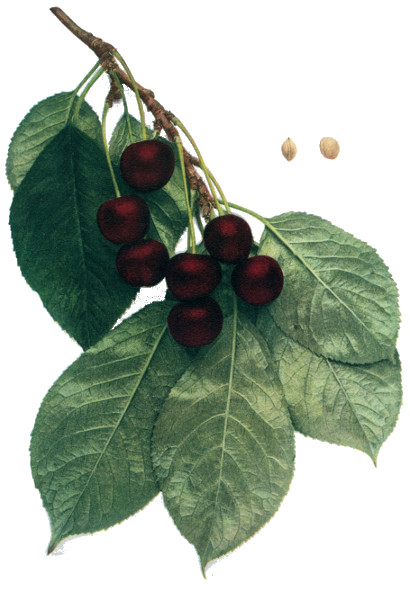
MAY DUKE
Tree large, upright becoming somewhat vasiform and spreading with age, open-topped,
very productive; trunk of medium thickness, somewhat shaggy; branches smooth
or roughish, reddish-brown partly covered with ash-gray, with numerous lenticels variable
in size; branchlets short, brown partly covered with light gray, smooth, with small, inconspicuous,
raised lenticels.
Leaves numerous, three and one-half inches long, two inches wide, folded upward,
obovate; upper surface very dark green, rugose; lower surface thinly pubescent; apex
abruptly pointed, base acute; margin finely serrate, with small, dark glands; petiole one
inch long, slender, tinged with red, grooved, glandless or with one or two small, globose,
brownish glands, usually at the base of the blade.
Buds obtuse, plump, free, in large clusters on short spurs; leaf-scars prominent; season
of bloom intermediate; flowers white, one and one-fourth inches across; borne in dense
clusters, in twos and threes; pedicels one inch long, slender, glabrous, greenish; calyx-tube
with a tinge of red, obconic, glabrous; calyx-lobes with a trace of red, rather long,
narrow, acuminate, glabrous within and without, reflexed; petals broad-oval, entire, nearly
sessile; apex crenate; filaments one-fourth inch long; pistil glabrous, equal to the stamens
in length.
Fruit matures early, although variable in habit; three-fourths of an inch in diameter,
cordate to conical, compressed; cavity abrupt, regular; suture indistinct; apex roundish,
with a small depression at the center; color light changing to dark red at full maturity;
dots numerous, russet, obscure; stem slender, one and one-half inches long, adhering
strongly to the fruit; skin thin, tender, separating from the pulp; flesh medium to dark
red, with pinkish juice, tender and melting, sprightly subacid, pleasant flavored; of very
good quality; stone nearly free, small, roundish to elliptical, with smooth surfaces; slightly
ridged along the ventral suture.
Prunus avium
- 1. U. S. D. A. Rpt. 262, Pl. 5. 1892. 2. Am. Gard. 14:39 fig. 1893. 3. Can. Hort. 17:322 fig.
693. 1894. 4. Black & Son Cat. 22 fig. 1909.
This comparatively new Bigarreau is on probation in many parts of
the State and country, otherwise we should not give it prominence in
The Cherries of New York, as the variety is all but worthless as it grows
on the grounds of this Station. The trees are not sufficiently fruitful, the
cherries are too small, the flavor in none too good and the fruit is not at all
resistant to brown-rot—four fatal defects for a commercial cherry.
This variety is reported to have sprung from a pit of a Mazzard tree
and was introduced several years ago by Black & Son of Hightstown, New
Jersey. The name, Mercer, after the county in New Jersey from which
it was introduced, was given the cherry by H. E. Van Deman, then United
States Pomologist.
Tree vigorous, healthy, not always productive; branches long, grayish-brown,
smooth, with a few small, inconspicuous lenticels.
Leaves numerous, four and one-half inches long, two and one-fourth inches wide,
folded upward, long-oval, leathery; upper surface dark green, smooth; lower surface light
green, pubescent, grooved along the midrib; apex taper-pointed, base abrupt; margin
coarsely and doubly serrate, glandular; petiole one and one-half inches long, tinged with
dull red, thick, with from two to five very large, reniform, reddish glands, variable in
position.
Buds of medium size and length, conical, plump, free; leaf-scars rather prominent;
season of bloom early; flowers one and one-fourth inches across, in scattering clusters
in twos and threes; pedicels three-fourths inch long, glabrous; calyx-tube green or faintly
tinged red, campanulate, glabrous; calyx-lobes greenish streaked with red along the edges,
long, obtuse, glabrous within and without, reflexed; petals broad-oval, entire, slightly
indented at the apex, tapering to short, blunt claws; filaments one-half inch long, shorter
than the petals; pistil glabrous, shorter than the stamens.
Fruit matures in mid-season; small, cordate to blunt-conic, compressed; cavity
shallow, narrow, abrupt; suture an indistinct line; apex flattened or depressed; color black;
dots small, numerous, obscure; stem slender, one and one-fourth inches long, adherent
to the fruit; skin thin, rather tender; flesh reddish, with dark colored juice, tender, meaty,
crisp, aromatic, mild flavored, sweet; fair to good in quality; stone free or semi-clinging,
variable in size, ovate, flattened, blunt-pointed, with smooth surfaces, tinged with red.
Prunus avium
- 1. Am. Pom. Soc. Cat. 26. 1909.
- Bigarreau Monstrueux. 2. Lond. Hort. Soc. Cat. 46. 1831.
- Bigarreau of Mezel. 3. Horticulturist 1:475 fig., 476. 1846-47. 4. Mortillet Le Cerisier 2:107 fig.,
108. 1866. 5. Downing Fr. Trees Am. 454. 1869. 6. Leroy Dict. Pom. 5:218 fig., 219. 1877.
- Great Bigarreau. 7. Horticulturist 6:20 fig., 21. 1851. 8. Downing Fr. Trees Am. 253. 1857.
- Monstreuse de Mezel. 9. Am. Pom. Soc. Cat. 74. 1862.
- Schwarze Knorpel von Mezel. 10. Mathieu Nom. Pom. 377. 1889.
Mezel seems to have made a stir in pomological circles in the middle of
the Nineteenth Century by reason of the great size and beautiful appearance
of the cherries. Though on the recommended list of the American Pomological
Society and frequently spoken of in the pomological works of the day and
offered by some nurserymen, we have not been able to find many trees of
this variety now growing in New York. We glean from the literature
that Mezel pleased the eye more than the palate and that the trees, while
vigorous and healthy, were not productive. At any rate after a decade or
two of much advertising and what would seem to have been a very thorough
trial, Mezel failed to receive very general approbation from cherry-growers
and has now almost passed from cultivation. Contrary to the general
behavior of the variety in New York, the tree and fruit from which the
accompanying description was made have so many merits that one can well
wish that the variety will not wholly pass out of cultivation.
This variety was found at Mezel, Puy-de-Dôme, France, by M. Ligier
sometime prior to 1846 when it was brought to notice. Even so, it had
grown in a vineyard at that place for thirty years and was only made public
after an excursion of several members of a horticultural society to the
vineyard. It was immediately heralded as a coming variety and grafts
were distributed. Great Bigarreau, which made its appearance a few
years later, is here included as a synonym though many writers list it as
a distinct sort. Bigarreau Monstrueux, first listed in the London Horticultural
Society catalog for 1831, is held by many pomologists to be identical
with Mezel which, if true, casts some doubt on the generally accepted history
of the variety. Mezel appeared on the fruit list of the American Pomological
Society in 1862 but was discarded in 1869; it was replaced in 1883
and is still on the list though it is scarcely known in any part of the United
States.
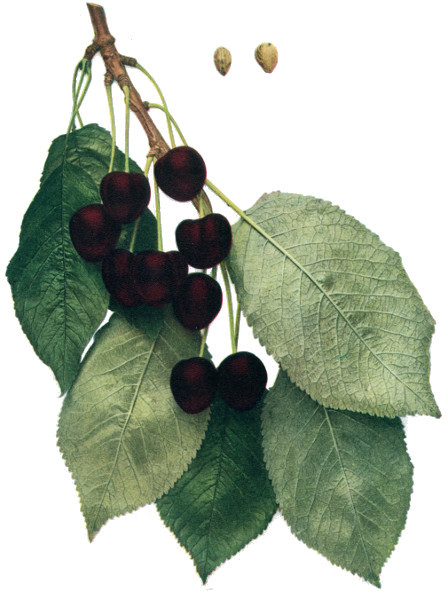
MEZEL
Tree large, vigorous, upright-spreading, hardy, variable in productiveness; trunk
stocky, nearly smooth; branches thick, smooth, reddish-brown partly overspread with
dark ash-gray, with lenticels medium in number and size; branchlets of average thickness,
variable in length, with internodes of medium length, brown partly covered with
ash-gray, smooth, glabrous, with small, inconspicuous, raised lenticels medium in
number.
Leaves numerous, five inches long, often two and one-half inches wide, long-oval,
thin; upper surface dark green, strongly rugose giving a crumpled appearance; lower
surface dull, light green, with slight pubescence; apex varies from abrupt to taper-pointed,
base abrupt; margin glandular, coarsely serrate; petiole long, averaging one and one-half
inches, slender, tinged with red, with from one to four reniform glands of medium size
on the petiole.
Buds intermediate in size and length, plump, pointed, arranged singly as lateral
buds or in clusters of various sizes on both long and short spurs; leaf-scars prominent;
season of bloom intermediate; flowers one and seven-sixteenths inches across, well distributed
in scattering clusters in twos and threes; pedicels one and one-eighth inches
long, medium in thickness, glabrous, greenish; calyx-tube with a slight tinge of red, campanulate,
glabrous; calyx-lobes long, medium in width, acute, slightly serrate, glabrous
within and without; petals somewhat obovate, crenate, nearly sessile, with a very shallow
notch at the apex; anthers yellow; filaments shorter than the petals; pistil glabrous,
shorter than the stamens, often defective.
Fruit matures in mid-season; large, seven-eighths inch long, thirteen-sixteenths inch
wide, cordate, compressed, the surface markedly irregular and broken into ridges; cavity
very deep, wide, irregular, abrupt; suture variable, shallow to very deep and wide and
at times double; apex blunt-pointed, usually not depressed; color attractive purplish-black;
dots numerous, very small, somewhat russet, obscure; stem medium in thickness,
long, averaging two and one-eighth inches, adheres well to the fruit; skin medium in
thickness, rather tender but not inclined to crack, adheres slightly to the pulp; flesh
purplish-red, with abundant dark red juice, tender, meaty, mild, very pleasant, sweet;
very good to best in quality; stone clinging, large, strongly ovate, with slightly roughish
surface.
Prunus cerasus
- 1. Duhamel Trait. Arb. Fr. 1:181, 182. 1768. 2. Kraft Pom. Aust. 1:6, Tab. 15 fig. 1. 1792.
3. Christ Wörterb. 292. 1802. 4. Truchsess-Heim Kirschensort. 656, 657, 691. 1819. 5. Kenrick Am.
Orch. 281. 1832. 6. Poiteau Pom. Franc. 2: No. 14, Pl. 1846. 7. Mas Le Verger 8:53, 54, fig. 25.
1866-73. 8. Pom. France 7: No. 3, Pl. 3. 1871. 9. Leroy Dict. Pom. 5:361, 362 fig., 363, 364. 1877.
10. Mathieu Nom. Pom. 369. 1889. 11. Guide Prat. 9, 196. 1895. 12. Del. Sta. An. Rpt. 12:112
fig. 4, 113, 114. 1900. 13. Am. Gard. 22:266, 267. 1901. 14. Am. Pom. Soc. Cat. 27. 1909.
- Kleine Glaskirsche von Montmorency. 15. Truchsess-Heim Kirschensort. 463, 464, 465. 1819.
- Long Stem Montmorency. 16. Prince Pom. Man. 2:139. 1832.
- Amarelle Royale. 17. Mortillet Le Cerisier 2:191-195, fig. 53. 1866.
- Montmorency Ordinaire. 18. Am. Pom. Soc. Cat. 17. 1897. 19. Ia. Sta. Bul. 73:75, fig. 15. 1903.
20. Am. Pom. Soc. Sp. Rpt. 33, 34, Pl. 2. 1904-05.
Montmorency is the most popular Sour Cherry grown in America.
No one questions its supremacy. Probably half of the cherry trees in
New York, Sweet or Sour, are Montmorencies and at least three-fourths
of all the trees of the Sour Cherry are of this variety. It leads in the
demands for this fruit in the markets, for the cannery and for home use as a
culinary cherry. Several characters give it first place. It is surpassed
by no other Sour Cherry, in New York at least, in vigor, health and productiveness
of tree. In the last character, in particular, it is supreme.
Year in and year out, Montmorency trees are fruitful. Possibly, too, no other
Sour Cherry is adapted to a greater diversity of soils than Montmorency,
which, with capacity to stand heat and cold, makes the variety suitable
to wide variations in environment. The cherries are in no way remarkable—not
much above the average for an Amarelle in size, appearance or
quality, in all of these characters being much inferior to Large Montmorency.
The fruit has the advantage of being presentable in appearance
and fit for culinary purposes several days before it is fully ripe and this
adds to the value of the variety for the market. Brown-rot takes less
toll from this cherry than of others of its kind probably because of relatively
firm flesh and thick skin. These characters, also, make the fruit
stand handling well in harvesting, shipping and on the markets. The
preserved product, whether canned at home or commercially, is attractive
in appearance and very good. Montmorency is not a dessert cherry but
for those who like Sour Cherries it may be eaten out of hand with relish
when it is fully matured. Some maintain that the variety falls short in
the size of the tree, which is seldom more than medium, but the head is
spreading and much-branched and the fruit is borne in clusters thickly
scattered throughout the whole head so that the total yield from a tree is
greater than would be thought from its size. For any and all purposes
to which Sour Cherries are put Montmorency may be recommended as
the best in its season.
Unfortunately several quite distinct cherries bear the name Montmorency
and it has been most difficult to separate them in pomological
literature. To make matters worse, all of them have been much confused
with other varieties, Early Richmond in particular. The different Montmorencies
and Early Richmond originated in the Montmorency Valley,
France, several centuries ago, at least before the Seventeenth Century,
probably as seedlings of Cerise Hâtive or of Cerise Commune. These Montmorency
cherries differ from each other principally in their stems and fruit,
one having long stems and moderate-sized, regular fruit; one shorter stems
and larger fruit; and the third, very short, thick stems and oblate, irregular
fruit showing a distinct suture. The first cherry has been generally known,
particularly among the French, as Montmorency à Longue Queue or sometimes
Cerise de Montmorency. This is the Montmorency of this sketch.
Duhamel, in 1768, was the first writer to mention this cherry directly and
according to his statement it was then esteemed around Paris, being superior
in productiveness to the Large Montmorency.
Montmorency early found its way into England, where it soon became
confused with its probable parent, the French Cerise Hâtive or the English
Kentish. In a short time it had replaced Kentish in many nurseries and
came to be called Kentish in much of the literature of the time. Just
when Montmorency was introduced to this country is not known but it
has been cultivated here under various names for many years. William
Prince spoke of it in 1832 as the Long Stem Montmorency and it has long
and commonly been known here as Montmorency Ordinaire. Montmorency
is to be found in nearly every nursery in the United States under
various names, some nurserymen using the French name, others the English,
while still others are selling the variety as Large Montmorency. Many
supposed strains have been given new names but it is doubtful if any distinct
strains of this cherry exist. The American Pomological Society added
Montmorency to its fruit catalog list in 1897 using the qualifying term
Ordinaire which was dropped in 1909.
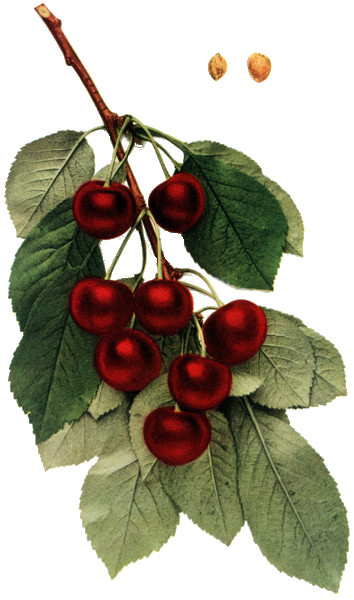
MONTMORENCY
Tree large, vigorous, upright-spreading, with the lower branches inclined to droop,
round-topped, productive; trunk and branches smooth; branches reddish-brown tinged
with light ash-gray, with a few lenticels of medium size; branchlets slender, reddish-brown
partly overspread with ash-gray, smooth, with a few small, inconspicuous lenticels.
Leaves three inches long, one and one-half inches wide, folded upwards or flattened,
oval to obovate, leathery; upper surface dark green, smooth; lower surface pale green,
with a few scattering hairs; apex and base variable in shape; margin doubly crenate,
glandular; petiole one inch long, tinged with dull red, glandless or with from one to three
small, globose, brownish or yellowish glands, usually at the base of the blade.
Buds obtuse, plump, free, arranged singly or in clusters on short spurs; leaf-scars
obscure; season of bloom intermediate; flowers white, one and one-fourth inches across;
borne in scattered clusters in twos and threes; pedicels one inch long, glabrous, greenish;
calyx-tube green, obconic, glabrous; calyx-lobes tinged with red, broad, serrate, glabrous
within and without, reflexed; petals roundish to obovate, crenate, with short, blunt claws
and shallow, crenate apex; filaments one-fourth inch long; pistil glabrous, equal to or
slightly longer than the stamens.
Fruit matures in mid-season; three-fourths of an inch in diameter, roundish-oblate,
slightly compressed; cavity abrupt; suture very shallow; apex roundish; color light to
rather dark red; dots numerous, small, russet, inconspicuous; stem thick, usually with
a faint tinge of red, one inch long, adhering well to the fruit; skin thin, tender, separating
from the pulp; flesh pale yellow, with a reddish tinge, with abundant light pink juice,
tender and melting, sprightly, tart; of very good quality; stone free, small, roundish-ovate,
flattened, pointed, with smooth surfaces which are tinged with red.
Prunus avium
- 1. Prince Treat. Hort. 30. 1828. 2. Kenrick Am. Orch. 273, 274. 1832. 3. Downing Fr. Trees
Am. 183. 1845. 4. Thomas Am. Fruit Cult. 365. 1849. 5. Ann. Pom. Belge 1:27, 28, fig. 2. 1853.
6. Elliott Fr. Book 215. 1859. 7. Thompson Gard. Ass't 527. 1859. 8. Am. Pom. Soc. Cat. 74. 1862.
9. Mortillet Le Cerisier 2:132. 1866. 10. Downing Fr. Trees Am. 470. 1869. 11. Pom. France 7:
No. 9, Pl. 9. 1871. 12. Leroy Dict. Pom. 5:219, 220 fig., 221. 1877. 13. Flor. & Pom. 57, Pl. 465.
1878. 14. Mas Pom. Gen. 11:109, 110, fig. 55. 1882. 15. Cornell Sta. Bul. 98:493, fig. 87. 1895.
16. Ont. Fr. Gr. Assoc. Rpt. 5:38 fig. 1898.
- Gros Bigarreau Blanc. 17. Duhamel Trait. Arb. Fr. 1:165. 1768. 18. Truchsess-Heim Kirschensort.
308-310. 1819. 19. Mortillet Le Cerisier 2:123-126, fig. 29. 1866. 20. Leroy Dict. Pom. 5:179,
180 fig., 181. 1877. 21. Mathieu Nom. Pom. 354. 1889.
- Lauermannskirsche. 22. Christ Handb. 664. 1797. 23. Christ Wörterb. 280. 1802. 24. Truchsess-Heim
Kirschensort. 292-295, 323-328. 1819. 25. Mathieu Nom. Pom. 367. 1889.
- Lange Marmorkirsche. 26. Christ Handb. 655. 1797. 27. Truchsess-Heim Kirschensort. 330-333.
1819.
- Holländische Grosse Prinzessinkirsche. 28. Christ Wörterb. 281. 1802. 29. Truchsess-Heim Kirschensort.
295-299. 1819. 30. Ill. Handb. 125 fig., 126. 1860. 31. Mas Pom. Gen. 11:117, 118, fig. 59.
1882. 32. Mathieu Nom. Pom. 357. 1889.
- Harrison's Heart. 33. Forsyth Treat. Fr. Trees 42. 1803. 34. Brookshaw Hort. Reposit. 1:69, 70,
Pl. 34 fig. 2. 1823. 35. Mas Le Verger 8:145, 146, fig. 71. 1866-73. 36. Mathieu Nom. Pom. 362.
1889.
- Grosse Weisse Marmorkirsche. 37. Truchsess-Heim Kirschensort. 316, 317, 682. 1819.
- Holland Bigarreau. 38. Downing Fr. Trees Am. 181 fig., 182. 1845.
- Bigarreau d'Esperen. 39. Mortillet Le Cerisier 2:119, 120 fig., 121. 1866. 40. Downing Fr. Trees
Am. 463. 1869. 41. Mas Le Verger 8:11, 12, fig. 4. 1866-73. 42. Leroy Dict. Pom. 5:198 fig., 199.
1877. 43. Mathieu Nom. Pom. 347. 1889. 44. Rev. Hort. 321, 322. 1912.
- Bigarreau Gros Coeuret. 45. Mortillet Le Cerisier 2:126-129, fig. 30. 1866. 46. Pom. France 7:
No. 23, Pl. 23. 1871. 47. Leroy Dict. Pom. 5:208, 209 fig., 210. 1877.
- Royal Ann. 48. Cal. Bd. Hort. Rpt. 59, Pl. 18. 1893-94. 49. Am. Pom. Soc. Rpt. 192. 1907.
50. Wash. Sta. Bul. 92:31, fig. 8. 1910.
Napoleon is the leading firm-fleshed Sweet Cherry. It takes its place
by virtue of the large size, handsome appearance and high quality of the
fruit and the phenomenal productiveness of the trees. The accompanying
plate shows well the large size and beautiful color of the cherries—unsurpassed
in either character by any other Bigarreau and possibly by any
other cherry. The flavor is rich and sweet which, with the abundant
juice and firm, crackling flesh, makes this a most delicious and refreshing
cherry for dessert and, with the great size and attractive color, gives it
preference over all other Sweet Cherries for culinary purposes. In particular,
cherry-canners find that Napoleon makes a finely finished product.
The cherries carry well and keep long and are, therefore, well thought of
by fruit-dealers. Besides being very productive, the trees come in bearing
early and are as vigorous, hardy and healthy as those of any other Sweet
Cherry. They may usually be known by their upright growth and large,
sturdy limbs. Napoleon, however, is not without its faults. The cherries
crack badly in wet weather and the variety can be grown with certainty
only in the dry summer climate of the Pacific Coast, where, especially in
Oregon and Washington, it reaches truly wonderful perfection. In the
East, too, Napoleon is more susceptible to brown-rot than several of its
rivals. Possibly the greatest fault, however, is in the tree, which is very
fastidious as to soils, thriving only in choice cherry land and in a congenial
cherry climate. Despite these rather serious faults, cherry-growers agree
that Napoleon takes first place among Sweet Cherries for both home and
commercial plantings.
Napoleon is of unknown origin. Early in the Eighteenth Century
it was grown by the Germans, French, Dutch and English, proof that it
is a very old variety. Leroy believes that it was described by Merlet in
1667 but under another name. The great number of synonyms in several
languages gives some idea of the countries in which the variety has been
grown as well as the esteem in which it has been held. There are several
accounts as to when the cherry was given the name Napoleon. Probably
the best authenticated is that in which it is held that Parmentier, a Belgian,
gave the cherry the name of the famous emperor in 1820. When
the variety was taken to England, where at that time Napoleon was
not in good repute, the name of his conqueror, Wellington, was substituted
but seems to have been little used. As if not content with the
score or more of European names, cherry-growers in America have added
at least two more. In many parts of the country it is locally called the
Ox Heart. On the Pacific Coast it is grown and sold by nurserymen and
fruit-growers alike as Royal Ann, a name given it by its introducer, Seth
Lewelling, of Milwaukee, Oregon, who lost the label bearing the old name
in taking it across the Continent in early days and gave it a new name.
With incomprehensible persistency Western horticulturists maintain this
synonym to the confusion of horticultural nomenclature. The American
Pomological Society placed Napoleon on its fruit list in 1862, it having
been grown in America for at least 40 years before receiving this honor.
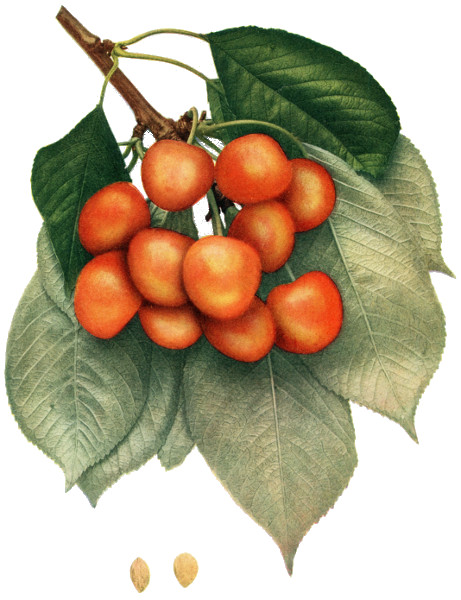
NAPOLEON
Tree large, vigorous, upright-spreading, open-topped, very productive; trunk thick,
shaggy; branches thick, roughened by the lenticels, dull brown overlaid with ash-gray,
with numerous large, raised lenticels; branchlets thick, long, light brown overspread
with gray, smooth, with a few inconspicuous, small lenticels.
Leaves numerous, five and three-fourths inches long, two and one-half inches wide,
folded upward, elliptical to obovate; upper surface dark green, rugose; lower surface light
green, somewhat pubescent; apex acute, base variable in shape; margin doubly serrate,
with small, dark glands; petiole one and one-fourth inches long, thick, tinged with dull
red, hairy along the upper surface, with from one to three large, reniform, reddish-orange
glands, usually on the stalk.
Buds variable in size, conical, free, arranged singly or in thin clusters from lateral
buds and from spurs; leaf-scars prominent; season of bloom intermediate; flowers white,
one and one-half inches across; borne in scattering clusters in ones or in twos; pedicels
variable in length, averaging one inch long, glabrous, greenish; calyx-tube green, campanulate,
glabrous; calyx-lobes tinged with red, long, rather narrow, acuminate, serrate,
reflexed; petals oval, entire, dentate at the apex, with short, narrow claws; filaments one-half
inch long; pistil glabrous, shorter than the stamens, often defective.
Fruit matures in mid-season; over one inch in diameter, conical to long-cordate,
compressed; cavity deep, wide, flaring; suture a distinct line; apex much pointed; color,
varying shades of bright red over a yellowish background, distinctly mottled; dots obscure;
stem slender, more than one inch long, adherent to the fruit; skin thin, rather adherent;
flesh whitish, with a faint yellow tinge, with colorless juice, tender, meaty, crisp, mild,
the flavor improving as the season advances, sweet; good to very good in quality; stone
semi-clinging, small, ovate, flattened, pointed, with smooth surfaces.
Prunus avium × Prunus cerasus
- 1. Flor. & Pom. 72, Pl. 1862. 2. Gard. Mon. 7:248. 1865. 3. Hogg Fruit Man. 70, 88. 1866.
4. Mas Le Verger 8:147, 148, fig. 72. 1866-73. 5. Downing Fr. Trees Am. 484. 1869. 6. Am. Pom.
Soc. Rpt. 31. 1875. 7. Gaucher Pom. Prak. Obst. No. 80, Tab. 33. 1894. 8. Guide Prat. 9. 1895.
If this cherry were to be judged by its behavior on the grounds of this
Station, it would be called one of the best of the hybrid Dukes. In particular,
it would be commended by its product, the trees not making as good
a showing as the fruit. The cherries are distinguished by their large size,
dark red color, glossy surface, good quality, lateness in maturity and,
even more particularly, sweetness, keeping in mind that the variety is a
hybrid and not a true Sweet Cherry. The shape, too, offers a distinguishing
character, the fruits being more oblate than in any other Duke.
The long, stout stem is still another characteristic. Unfortunately the
tree, while satisfactory in all other respects, is unproductive—a fatal fault in
these days of commercial fruit-growing. Nouvelle Royale is not widely known
in America and may well be given trial by those who want a late Duke.
This variety is supposed from its fruit- and tree-characters to be a hybrid
between Early Richmond and May Duke but where, how and when it
came to light is not known. Downing, in 1869, mentions the Nouvelle
Royale as having recently been introduced into this country and it was
noted in the Report of the American Pomological Society for 1875 but
has never received a place upon the Society's fruit catalog list.
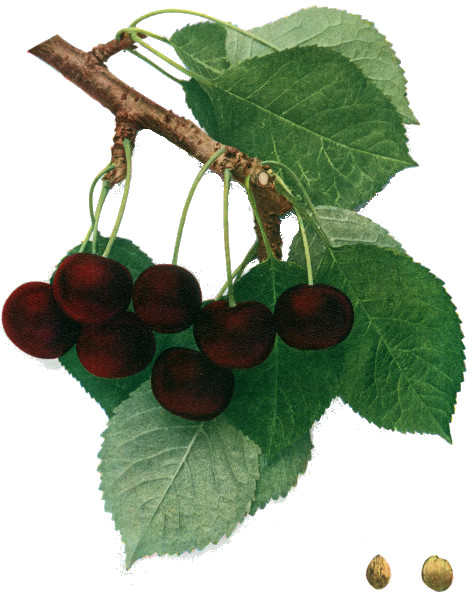
NOUVELLE ROYALE
Tree large, vigorous, upright, compact, moderately productive; trunk of medium
size; branches upright, thickish; branchlets slender, long, brown partly covered with ash-gray,
with very numerous conspicuous, raised lenticels.
Leaves numerous, three and one-half inches long, two inches wide, folded upward,
obovate; upper surface dark green, glossy, rugose; lower surface light green, lightly
pubescent; apex abruptly pointed, base acute; margin finely and doubly serrate, glandular;
petiole one and one-fourth inches long, slender, tinged with dull red, grooved and with
few hairs along the upper surface, glandless or with from one to four globose, greenish-yellow
or reddish glands variable in size usually at the base of the blade.
Buds small, short, obtuse, plump, free, arranged singly as lateral buds and on short spurs
in clusters variable in size; leaf-scars obscure; season of bloom intermediate; flowers white,
one inch across; borne in dense clusters in threes and fours; pedicels three-fourths of an
inch long, slender, glabrous, greenish; calyx-tube with a tinge of red, obconic, glabrous;
calyx-lobes somewhat reddish, broad, acute, serrate, glabrous within and without, reflexed;
petals roundish, entire, nearly sessile, apex entire; filaments one-fourth inch long; pistil
glabrous, longer than the stamens.
Fruit matures in mid-season; nearly one inch in diameter, oblate, strongly compressed;
cavity deep, narrow, abrupt; suture shallow; apex flattened or slightly depressed; color
dark red; dots numerous, small, russet, inconspicuous; stem one and three-fourths inches
long, adherent to the fruit; skin thin, tender, separating from the pulp; flesh pale yellowish
or with a tinge of red, with light pink juice, slightly stringy, tender and melting, pleasantly
flavored, mildly tart; of very good quality; stone free, roundish-oval, plump, blunt, oblique,
with smooth surfaces often tinged with red, with small ridges radiating from the base.
Prunus avium × Prunus cerasus
- 1. Gard. Mon. 19:19. 1877. 2. Am. Pom. Soc. Cat. 20. 1881. 3. Downing Fr. Trees Am. 3rd
App. 164. 1881. 4. Can. Exp. Farm Bul. 17:11. 1892. 5. Cal. Sta. An. Rpt. 316. 1895-97. 6. Va.
Sta. Bul. 133:27. 1902. 7. Ia. Sta. Bul. 73:76, 77. 1903. 8. Am. Pom. Soc. Sp. Rpt. 24. 1904-05.
9. Wash. Sta. Bul. 92:21. 1910.
Olivet is a large, globular, deep red, glossy cherry with a rich, vinous,
subacid flavor. Some writers call Olivet a Duke while others place it
with the Morellos. The fruit, on the grounds of this Station, shows many
characteristics of the Morellos while the tree appears to be a Duke, suggesting
that it is a hybrid between trees of the two groups. The fruit,
eaten out of hand, would be rated as a very good Morello or a subacid
and somewhat mediocre Duke, a fruit hardly good enough for dessert and
not as good as some of the sourer cherries for culinary purposes. It is
one of the earliest of the Morello-like cherries and this may give it a place
in the cherry flora of the country. The trees are large and vigorous and
their much-branched, round tops would seem to give the maximum amount
of bearing surface, but, unfortunately, the cherries do not set abundantly.
On the grounds of this Station the variety is not fruitful, this being its chief
defect. In other parts of the country, however, it is reported to be either
very productive or moderately so. The descriptions of this cherry as given
by American experiment stations and nurserymen show plainly that there
are several distinct sorts passing under the name Olivet in this country.
Olivet, of comparatively recent origin, was found at Olivet, Loire,
France. American nurserymen introduced this variety sometime previous
to 1877, for in that year the Gardener's Monthly mentioned the cherry as
being "a valuable Duke sort filling an unoccupied place among the list
of early cherries in central New York." Olivet was entered on the American
Pomological Society's catalog list of fruits in 1881 where it is still
retained.
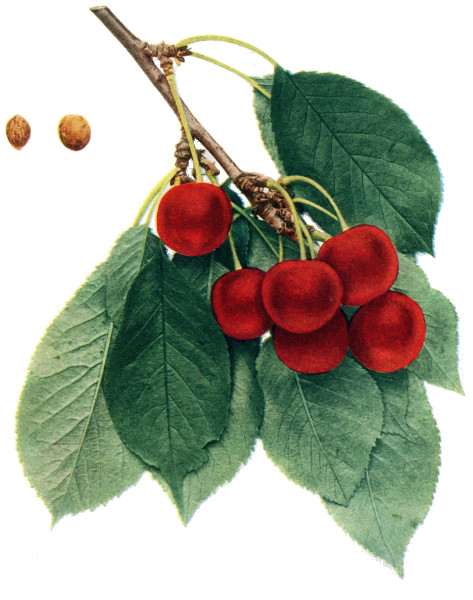
OLIVET
Tree large, vigorous, upright-spreading, round-topped, unproductive; trunk thickish,
rather rough; branches thick, smooth, reddish-brown partly overspread with ash-gray,
with numerous small lenticels; branchlets short, brown partly overspread with ash-gray,
smooth, with numerous raised lenticels.
Leaves numerous, three and one-half inches long, one and three-fourths inches wide,
folded upward, obovate to oval, thin; upper surface dark green, smooth; lower surface
light green, glossy, with a few scattering hairs; apex acute; margin doubly serrate,
glandular; petiole one and one-fourth inches long, greenish, glandless or with one or two
globose, brownish glands variable in position.
Buds usually pointed, plump, free, arranged singly as lateral buds and in small
clusters on short spurs; leaf-scars prominent; season of bloom intermediate; flowers white,
one inch across; borne in dense clusters, usually in threes; pedicels one-half inch long,
glabrous, greenish; calyx-tube with a tinge of red, obconic, glabrous; calyx-lobes with
a trace of red, long, of medium width, acute, serrate, glabrous within and without, reflexed;
petals oval to slightly obovate, entire, nearly sessile; apex entire; filaments one-fourth
inch long; pistil glabrous, equal to the stamens in length.
Fruit matures in mid-season; nearly one inch in diameter, roundish to slightly oblate,
somewhat compressed; cavity abrupt, regular; suture a line; apex roundish, with a small
depression at the center; color bright red; dots russet, obscure; stem thickish, one and
one-fourth inches long, adhering well to the fruit; skin tough, separating from the pulp;
flesh light red, with abundant light red or wine-colored juice, tender and melting,
sprightly, astringent, tart; of fairly good quality; stone free, small, roundish, slightly
flattened, somewhat pointed at the apex, with smooth surfaces; somewhat ridged along
the ventral suture.
Prunus cerasus
- 1. Christ Obstbäume 159. 1791. 2. Christ Handb. 676. 1797. 3. Truchsess-Heim Kirschensort.
512-517. 1819. 4. Prince Pom. Man. 2:145. 1832 5. Dochnahl Führ. Obstkunde 3:60. 1858. 6. Ill.
Handb. 187 fig., 188. 1860. 7. Leroy Dict. Pom. 5:295, 296 fig. 1877. 8. Mathieu Nom. Pom. 371.
1889. 9. Am. Pom. Soc. Cat. 25. 1899. 10. Del. Sta. An. Rpt. 12:121, 122. 1900. 11. Ia. Sta. Bul.
73:78 fig. 18, 79. 1903. 12. Wash. Sta. Bul. 92:14, 21, 22. 1910.
Ostheim finds considerable favor in the prairie states of the Middle
West but is all but worthless as grown in New York and other eastern
states. It is one of the Morellos and falls far short of the best of its group,
the cherries being too small and of but mediocre quality. The trees are
typical Morellos, round-headed, with slender, drooping branches and branchlets
and very dark green foliage. The fruit is borne toward the ends of
short branches which are not well distributed over the main branches,
leaving much bare wood. Like all Morellos the fruit hangs long after
maturity and since the ripening season is late the variety may be worth
growing because of its lateness; as it may, also, in cold climates because
of great hardiness. The trees on their own roots throw up many suckers
which are often used in propagation. The variety has the reputation,
too, of coming true to name from seeds.
Ostheim is a native of Spain and not of Germany as many have
supposed. The trees were found in the region of the Sierra Morena Mountains,
Spain, and were taken to Germany by a Dr. Klinghammer after the
Wars of the Succession, 1701-1713. The cherry took the name Ostheim from
the German town of that name where it was widely grown. The variety,
being easily propagated, spread throughout Germany and soon became
one of the best-known cherries. Later, the name seems to have come to
be a class term for all cherries similar to the original Ostheim. The names
Ostheim, Ostheimer, Griotte Ostheim and Ostheimer Weichsel are used
interchangeably by foreign writers for this variety. American writers,
however, have given these names to two very similar but distinct varieties.
Ostheim was brought to the United States by William Robert Prince of
the Linnean Botanical Gardens early in the Nineteenth Century. It
has proved very satisfactory in some sections of the West and Canada,
while in the East it is but a mediocre variety at best. At different times
either buds or trees of so-called Ostheims have been imported to this
country which have turned out not to be the true variety. What these
sorts really are will remain uncertain until the several forms can be brought
together and compared. Professor Budd imported a variety in 1883,
which since has become known as Ostheim, carrying Griotte d'Ostheim
as a synonym. Whether or not this is the old variety or a distinct strain
of the Ostheim class we are unable to say. The Cerise d'Ostheim received
by this Station has proved identical with this variety. Ostheim was first
listed by the American Pomological Society in 1899. A cherry known
as Minnesota Ostheim, introduced into Minnesota from Germany, is now
recognized as a distinct sort. The variety as it is known in Kansas
and Missouri is often called the German Ostheimer though some believe
this to be different from the true sort.
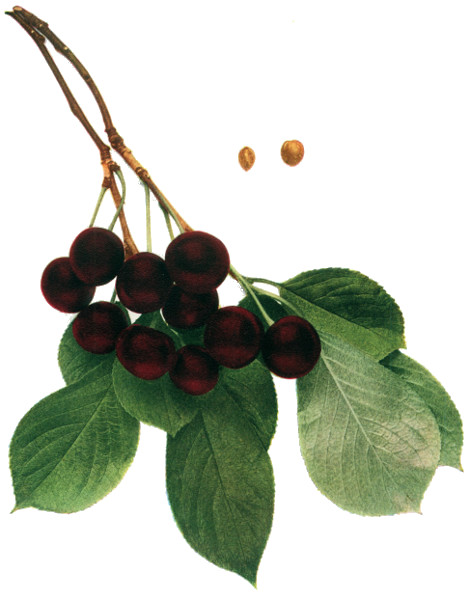
OSTHEIM
Tree below medium in size, vigorous, upright-spreading, with drooping branchlets,
dense, very productive; trunk smooth; branches rather slender, smooth, dark ash-gray
partly overspreading reddish-brown, with small, raised lenticels; branchlets slender, willowy,
long, brown partly overspread with ash-gray, smooth, glabrous, with small, inconspicuous
lenticels.
Leaves very numerous, three and one-fourth inches long, one and one-half inches
wide, folded upward, obovate to oval; upper surface very dark green, smooth; lower surface
pale green, with a few scattering hairs; apex taper-pointed, base variable in shape;
margin finely serrate, with small, dark glands; petiole slender, one-half inch long, short,
tinged with dull red, grooved, with a few scattering hairs, with from one to three small,
globose, greenish-yellow glands at the base of the blade.
Buds small, short, usually obtuse, plump, free, arranged as lateral buds and in small
clusters on short spurs; leaf-scars prominent; season of bloom medium; flowers one inch
across, white; borne in scattering clusters, in twos and threes; pedicels five-eighths of
an inch long, rather slender, glabrous, greenish; calyx-tube green with a faint tinge of
red, obconic, glabrous; calyx-lobes with a trace of red, rather long, serrate, glabrous within
and without, reflexed; petals obovate, entire, nearly sessile, apex entire; filaments one-fourth
inch long; pistil glabrous, nearly equal in length to the stamens.
Fruit matures very late; nearly three-fourths of an inch in diameter, roundish to
slightly oblate, compressed; cavity very shallow and narrow, flaring; suture indistinct;
apex roundish with a small depression at the center; color very dark red approaching
black; dots numerous, small, dark russet, inconspicuous; stem slender, one and one-fourth
inches long, but slightly adherent to the fruit; skin thin, tender, separating readily from
the pulp; flesh dark red, with much very dark colored juice, tender and melting, sprightly,
tart, losing its astringency when fully ripe; of fair quality; stone free, nearly one-half inch
in diameter, roundish-oblate, somewhat pointed, with smooth surfaces slightly stained
with red.
Prunus avium
- 1. Miller Gard. Kal. 154, 1734. 2. Christ Handb. 663. 1797. 3. Brookshaw Hort. Reposit. 1:36,
Pl. 18 fig. 2. 1817. 4. Coxe Cult. Fr. Trees 249. 1817. 5. Truchsess-Heim Kirschensort. 132-135.
1819. 6. Downing Fr. Trees Am. 176. 1845. 7. Am. Pom. Soc. Rpt. 244. 1858. 8. Mas Pom. Gen.
11:57, 58, fig. 29. 1882. 9. Oberdieck Obst-Sort. 365, 366. 1882. 10. Mathieu Nom. Pom. 339, 371.
1889.
- Bigarreau Gros Commun. 11. Mag. Hort. 9:203. 1843.
Ox Heart is very commonly used as a class name for the large, meaty
varieties of cherries which are cordate in shape. In America the name is
most often given to the light-fleshed cherries, such as Yellow Spanish,
Napoleon or White Bigarreau. At one time, however, the name was
applied to a distinct variety known throughout England, Germany and
America, being first mentioned by Miller, an Englishman, in 1734. Coxe,
in 1817, was the first American writer to list the variety but it never
became popular in the New World. Ox Heart appeared among the fruits
rejected by the American Pomological Society in 1858 and from then on
it gradually gave way to better varieties. The synonyms of the true Ox
Heart are badly confused not only with other dark-fleshed varieties but
with those of the Yellow Spanish type. As some of these varieties are
merely listed while others have but a meager description, it is impossible
to separate or group them with any degree of certainty. In the 1909
catalog of the American Pomological Society there appears an Ox Heart
of American origin and of recent introduction, known in the West as Major
Francis. There are also in several nursery catalogs a "white-fleshed Ox
Heart." What this variety is we are unable to say. The following is a
description of Ox Heart compiled from European fruit books:
Tree medium in vigor, round-topped, spherical, productive; branches somewhat
curved; internodes of medium length; leaves obovate, obtusely pointed, margin finely
serrate; petiole short, rather slender, flexible, tinged red, with two reniform glands; flowers
small; petals irregularly elliptical.
Fruit matures the last of June or early in July; medium to large, cordate, pointed,
sides unevenly compressed; color lively red changing to intense purple or nearly black;
stem of medium length and thickness, usually tinged red, inserted in a broad, deep cavity;
skin tough; flesh dark red, with abundant colored juice, half-tender but firmer than most
Hearts, sweet though slightly bitter before complete maturity; quality good; stone medium
in size, broadly cordate, adhering to the flesh along the ventral suture.
Prunus avium × Prunus cerasus
- 1. Gen. Farmer 11:191 fig. 1850. 2. Am. Pom. Soc. Rpt. 55. 1856. 3. Am. Pom. Soc. Cat. 211.
1856. 3. Dochnahl Führ. Obstkunde 3:54. 1858. 4. Ill. Handb. 167 fig., 168. 1860. 5. Thomas
Guide Prat. 17, 204. 1876. 6. Leroy Dict. Pom. 5:379-382, fig. 1877.
- D'Aremberg. 7. Lond. Hort. Soc. Cat. 45. 1831. 8. Kenrick Am. Orch. 215. 1835.
- Hortense. 9. Elliott Fr. Book 196, 197 fig. 1854. 10. Am. Pom. Soc. Cat. 27. 1909.
Were there not so many good Duke varieties of its season Reine Hortense
would take high rank among hybrid cherries. Several qualities fit
it admirably for home and somewhat for commercial plantations. To
begin with, it is most excellent in quality, its flavor being a commingling
of the refreshing acidity of the Sour Cherry and the richness of the Sweet
Cherry, though to some there may be a little too much acidity for a first-class
dessert fruit. The cherries are also handsome—large, round, bright,
glossy red with a shade of amber and very uniform in size, color and
shape. The fruit is especially attractive on the tree as it hangs on long
stems in twos and threes thickly scattered and never much clustered.
Unfortunately the fruit does not stand handling in harvesting and marketing
quite as well as that of some other Dukes and is a little too susceptible to
brown-rot for a good commercial cherry. The chief faults of the variety,
however, are in the trees rather than in the fruit. The trees are but of
medium size, are not as productive as some others of the hybrid sorts, are
at their best only in choice cherry soils and demand good care. In Europe,
Reine Hortense is much used as a dwarf and for training on walls. It
would seem that its merits and faults, as it grows in America, are such as
fit it preeminently well only for the amateur.
Of the several accounts of the origin of Reine Hortense the one giving
France as its home and Larose as its originator is here accepted as authentic.
M. Larose of Neuilly-sur-Seine, Seine, a gardener of the imperial court,
grew the original tree early in the Nineteenth Century from a seed of the
Cerise Larose, a seedling of his introduction. Soon after the first mention
of this variety, about 1841, there appeared the Louis XVIII, Morestin,
Guigne de Petit-Brie and several others. The variety was seemingly
rechristened by every nurseryman who got hold of it. At one time the
name Monstreuse de Bavay was acceptable to many, it having been given
to the variety by a Mr. Bavay of Vilvorde, Brabant, Belgium, about 1826.
The theory that Reine Hortense comes true to seed and therefore has
several strains has been discredited. The American Pomological Society
recognized Reine Hortense in 1856, only a few years after being introduced
into this country, by placing it on the recommended fruit list. In
1909, the Society shortened the name from Reine Hortense to Hortense
but in this text we prefer to use the full name, thereby indicating clearly
the person for whom the cherry was christened.
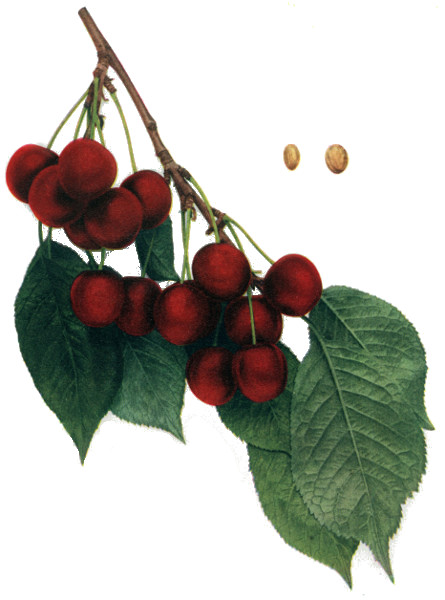
REINE HORTENSE
Tree of medium size, upright-spreading, productive; trunk shaggy; branches smooth,
dark reddish-brown covered with ash-gray, with a few large lenticels; branchlets rather
slender, with short internodes, brown partly overspread with ash-gray, smooth, with
inconspicuous, raised lenticels.
Leaves numerous, four and one-half inches long, two and one-half inches wide, folded
upward, oval to obovate, thin; upper surface dark green, rugose; lower surface light green,
pubescent along the midrib; apex taper-pointed, base abrupt; margin coarsely serrate,
with dark glands; petiole one inch long, tinged with red, pubescent along the grooved
upper surface, with none or with from one to four small, globose, greenish-yellow or
brownish glands, usually at the base of the blade.
Buds large, long-pointed, plump, free, arranged singly as lateral buds and in small
clusters on few long spurs; blooms appearing in mid-season; flowers white, one and one-fourth
inches across; borne in dense clusters usually in threes; pedicels one inch long,
slender, glabrous; calyx-tube with a tinge of red, campanulate, glabrous; calyx-lobes long,
acuminate, glabrous within and without, reflexed; petals roundish, entire, sessile, with
entire apex; filaments one-fourth of an inch long; pistil glabrous, shorter than the stamens.
Fruit matures in mid-season; nearly one inch in diameter, oblong-conic to obtuse-conic,
compressed; cavity somewhat shallow, narrow, abrupt, often lipped; suture indistinct;
apex roundish with a small depression at the center; color amber-red; dots numerous,
light russet, conspicuous; stem tortuous, slender, one and one-half inches long, adherent
to the fruit; skin tender, separating from the pulp; flesh pale yellow, with colorless juice,
tender and melting, sprightly subacid; of very good quality; stone free, rather large, oblong
to oval, flattened, blunt, with smooth surfaces.
Prunus avium
- 1. Am. Pom. Soc. Cat. 26. 1909.
- Black Republican. 2. Cult. & Count. Gent. 35:534. 1870. 3. Am. Pom. Soc. Cat. 20. 1875.
4. Am. Gard. 9:357 fig. 1888. 5. Wickson Cal. Fruits 289. 1889. 6. Wash. Sta. Bul. 92:23, 25. 1910.
- Lewelling. 7. Am. Pom. Soc. Rpt. 127. 1875. 8. Gard. Mon. 17:336. 1875. 9. Am. Pom. Soc.
Cat. 26. 1909. 10. Wash. Sta. Bul. 92:28, 29, fig. 7. 1910.
For some reason Republican does not make headway in the favor
of cherry-growers though all who have described it speak well of it. Judged
by the palate, Republican is one of the best of the Bigarreaus. The cherries
are rich and sweet in flavor, firm of flesh and with an abundance of
refreshing juice. Judged by the eye, too, it holds its own with the best of
its class, the fruit having a pleasing rotundness of shape and a beautiful
dark red, almost black, glossy color. In size the variety very often falls
short; for, though often given as one of the largest, it turns out to be, in
many orchards, but of medium size and sometimes is small. Here seems
to be its fatal defect. It is exceedingly capricious as to soils, failing wholly
or in part in all but the very choicest cherry environments. The trees
are large, spreading and vigorous but on the grounds of this Station are
more susceptible to the shot-hole fungus than any other Sweet Cherry.
It has been reported to be very subject to this disease at the Washington
Station also. The failure of this cherry to meet the demands of commercial
cherry-growers during a probationary period of nearly a half a century
means that it is, at most, of but local value.
This variety, known under two other names, Black Republican and
Lewelling, originated about the middle of the Nineteenth Century in the
orchard of Seth Lewelling, Milwaukee, Oregon. In traveling across the
continent in 1849, Mr. Lewelling took with him to Oregon, Bigarreau,
Morello and Mahaleb cherries and from seeds of one of the Bigarreaus
sprang several seedlings, among them one which was named Black
Republican. The parentage of the sort is not known though it was thought
to be a cross between Napoleon and Black Tartarian, having sprung
up near these two trees. Some cherry-growers and nurserymen describe
a cherry which they call Lewelling but in every case the descriptions agree
very closely with Republican. Many list the two names separately as
designating two distinct varieties of diverse origin. Of these, some have
supposed Republican to be a seedling of Eagle originating in 1860. The
American Pomological Society for many years listed Black Republican
alone beginning in its catalog of 1875 but in 1909 the catalog contained
the two names, Republican and Lewelling. Inasmuch as the consensus
of opinion is that both names apply to a single cherry this Station has
decided to list Republican only.
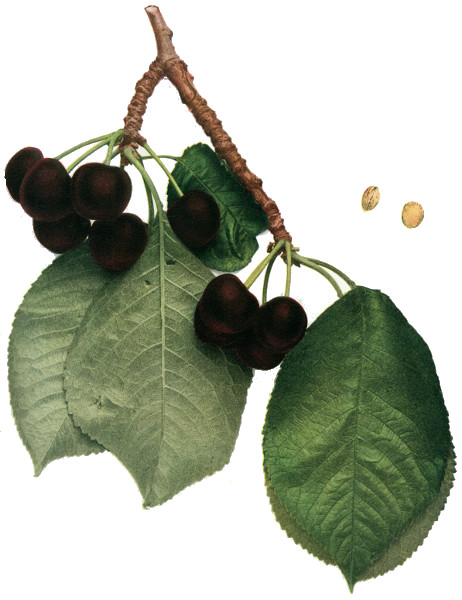
REPUBLICAN
Tree large, vigorous, upright-spreading, open-topped, very productive; trunk thick,
somewhat shaggy; branches stout, roughened, brown covered with ash-gray, with large,
raised lenticels; branchlets stout, with long internodes, brown nearly overspread with ash-gray,
smooth except near the base, with a few small, raised, inconspicuous lenticels.
Leaves numerous, five inches long, two and five-eighths inches wide, folded upward,
obovate to oval, thin; upper surface dark green, smooth; lower surface slightly hairy;
apex acute, base abrupt; margin coarsely and doubly serrate, glandular; petiole one and
one-fourth inches long, thick, tinged with dull red, with two or three large, reniform, light
green or reddish glands on the stalk.
Buds pointed or obtuse, plump, free, arranged singly on the branchlets, or in small
clusters on spurs of medium length; season of bloom intermediate; flowers white, one
and one-half inches across; borne in scattering clusters in ones and twos; pedicels variable
in length, averaging one inch long, characteristically thick, glabrous; calyx-tube tinged
with red, campanulate, glabrous; calyx-lobes variable in width, tinged with red, long-obovate
to acute, finely serrate, glabrous within and without, reflexed; petals obovate,
entire, with short, blunt claws, with shallow, notched apex; filaments five-sixteenths of
an inch long; pistil glabrous, equal to the stamens in length, often defective.
Fruit matures late; about one inch in diameter, wide, variable in shape, cordate or
roundish-cordate, compressed, with angular and uneven surfaces; cavity deep, wide, flaring;
suture a shallow groove, often extending around the fruit; apex with a small depression
at the center; color purplish-black; dots numerous, small, dark russet, inconspicuous;
stem thick, one and one-eighth inches long, adherent to the fruit; skin thin; flesh purplish-red,
with dark colored juice, tender, meaty, crisp, mild, sweet or with slight astringency
before fully mature; of good quality; stone semi-free, small, ovate, flattened, rather blunt,
with smooth surfaces.
Prunus avium
- 1. Horticulturist 2:59 fig., 60. 1847-48. 2. Elliott Fr. Book 201, 202 fig. 1854. 3. Hooper W. Fr.
Book 270, 271. 1857. 4. Am. Pom. Soc. Cat. 74. 1862. 5. Mortillet Le Cerisier 2:131. 1866. 6. Oberdieck
Obst-Sort. 372. 1881.
Rockport is of very doubtful commercial value and has too many
faults to be included with the best sweet sorts for a home orchard. It
is more easily characterized by its faults than its merits. Compared
with the well-known Yellow Spanish, of which it is a seedling and to which
it is similar, the cherries are smaller and the pits are larger than those of
the parent variety,—quite too large for the amount of pulp. Worst of
the faults of the variety is, however, that the cherries are not sufficiently
firm of flesh to withstand harvesting, shipping and the attacks of the
brown-rot fungus. To offset the defects of the fruit the flesh is rich, sweet
and tender, making it, all in all, as good as any other Sweet Cherry for
dessert. The trees, too, are very satisfactory, being large, vigorous and
very fruitful, though with the reputation of requiring good soil and the
best of care, of lacking a little in hardiness to cold, and of having the period
of maturing the crop more or less changed by soil and culture. Rockport
has been, and is, more or less popular in New York but it can be recommended
only for a home orchard.
Rockport is another of Professor Kirtland's introductions, having been
raised by him at Cleveland, Ohio, about 1842, from a seed of Yellow Spanish.
It soon won a place, in 1862, on the fruit list of the American Pomological
Society where it still remains. It is mentioned by several foreign authors
and many American nurserymen offer it for sale. Swedish is given as a
synonym of Rockport by Hooper.
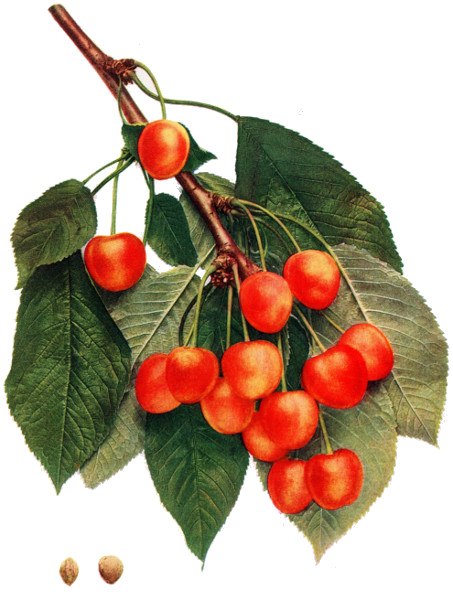
ROCKPORT
Tree large, vigorous, upright, very productive; trunk somewhat slender, roughish;
branches smooth, reddish-brown, with numerous small lenticels; branchlets stout, variable
in length, with long internodes, brown almost entirely overspread with ash-gray, smooth,
with conspicuous, raised lenticels.
Leaves numerous, three and one-half inches long, one and three-fourths inches wide,
folded upward, long-oval to obovate; upper surface dark green, somewhat rugose; lower
surface dull, light green, pubescent along the veins; apex acute to taper-pointed, base abrupt;
margin coarsely serrate, glandular; petiole two inches long, tinged with red, with a few
hairs on the upper surface, glandless or with from one to four large, reniform, reddish
glands variable in position.
Buds large, long, pointed, plump, free, arranged singly and in clusters from lateral
buds and short spurs; leaf-scars prominent; season of bloom intermediate; flowers white,
one and one-fourth inches across; borne in clusters usually in twos; pedicels one inch long,
glabrous, greenish; calyx-tube green, campanulate, glabrous; calyx-lobes acute, glabrous
within and without, reflexed; petals roundish, entire, dentate at the apex, nearly sessile;
filaments nearly one-half inch long; pistil glabrous, shorter than the stamens, often
defective.
Fruit matures early; one inch in diameter, cordate to conical, compressed; cavity
shallow, wide, flaring, regular; suture a distinct line; apex roundish, with a small depression
at the center; color bright red over an amber-yellow background, mottled; dots very
numerous, small, light yellowish, somewhat conspicuous; stem one and one-half inches
long, adhering well to the fruit; skin thin, tender; flesh pale yellowish-white, with colorless
juice, tender, somewhat melting, aromatic, mild, sweet; good to very good in quality;
stone free, ovate, plump, with smooth surfaces.
Prunus avium × Prunus cerasus
- 1. Mag. Hort. 9:204, 205. 1843. 2. Downing Fr. Trees Am. 192. 1845. 3. Thomas Am. Fruit
Cult. 369. 1849. 4. McIntosh Bk. Gard. 2:543. 1855. 5. Thompson Gard. Ass't 530. 1859. 6. Am.
Pom. Soc. Cat. 12. 1871. 7. Mas Pom. Gen. 11:125, 126, fig. 63. 1882. 8. Hogg Fruit Man. 311.
1884.
- Royale d'Angleterre. 9. Christ Obstbäume 159. 1791.
- Cerise Royale. 10. Christ Wörterb. 284. 1802. 11. Cat. Cong. Pom. France 40 fig. 1906.
- Königskirsche. 12. Truchsess-Heim Kirschensort. 422, 423, 424. 1819.
- Ungarische Süssweichsel. 13. Dochnahl Führ. Obstkunde 3:51. 1858.
- Anglaise Hâtive.. 14. Mortillet Le Cerisier 2:161-163, fig. 42. 1866. 15. Mas Le Verger 8:83, 84,
fig. 40. 1866-73. 16. Pom. France 7: No. 24, Pl. 24. 1871. 17. Guide Prat. 17, 180. 1895.
- Belle de Worsery. 18. Mortillet Le Cerisier 2:181. 1866. 19. Mas Pom. Gen. 11:39, 40, fig. 20.
1882.
Royal Duke has a place in the cherry flora to follow in season the
well-known May Duke and to precede another standard sort, Late Duke.
It is so nearly like these two sorts, except in season, and so similar to Arch
Duke, as well, that there is much difficulty in getting the variety true
to name. It is more often taken for May Duke than for the other kinds
named but it differs from this well-known sort in being a little later in
season, and the cherries are larger, a little lighter in color, do not hang as
thickly, being scattered along the branches, often singly, and are more
oblate. The trees are markedly upright and the foliage is very dense.
None of the Dukes are popular in America for market fruits and this is
no exception though, among all, Royal Duke is as good as any—pleasantly
flavored, juicy, refreshing and very good. The trees, too, are very satisfactory.
The variety has a place in home orchards and for local markets.
The French say that the tree makes a very weak growth budded on the
Mahaleb and that it should be worked on the Mazzard, which is generally
true of all Dukes. The buyer will have difficulty in getting the true Royal
Duke in America.
The origin of this variety is unknown but the Royale d'Angleterre,
mentioned by Christ in 1791, was probably the variety now known as
Royal Duke, although the description is too meager to be certain.
According to Thompson, Royal Duke was one of the varieties formerly cultivated
in England under the names Late Duke, Arch Duke, or Late Arch
Duke and was probably introduced by the London Horticultural Society
from France under the name of Anglaise Tardive. When or by whom
this variety was introduced into America is not known but according to
Downing it was very rarely found here in the first half of the Nineteenth
Century. The American Pomological Society placed Royal Duke upon
its catalog list of recommended fruits in 1871.
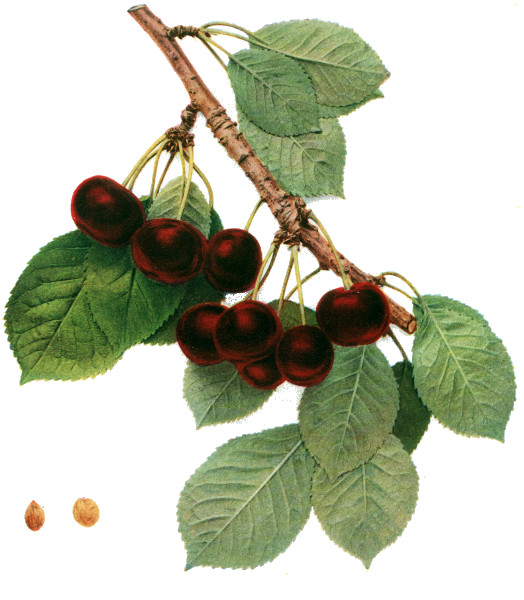
ROYAL DUKE
Tree of medium size, vigorous, upright, vasiform, unproductive at this Station; trunk
slender, roughish; branches stocky, with roughened surface, dark reddish-brown covered
with ash-gray, with lenticels of medium number and size; branchlets stout, long, brown
partly overspread with ash-gray, smooth except for the lenticels which are inconspicuous.
Leaves numerous, variable in size, averaging four and one-half inches long, two
inches wide, folded upward, oval to obovate; upper surface dark green, slightly rugose;
lower surface medium green, pubescent along the midrib; apex abruptly pointed, base
acute; margin serrate or crenate; petiole variable in length, often one and one-half inches
long, not uniform in thickness, tinged with red, glandless or with one or two small, reniform,
greenish-yellow or reddish glands, usually at the base of the blade.
Buds rather small, pointed, plump, free, arranged singly as lateral buds and in very
dense clusters on numerous short spurs; leaf-scars obscure; time of bloom mid-season;
flowers white, one inch across; borne in very dense clusters, closely grouped in fours and
fives; pedicels over one-half inch long, glabrous, green; calyx-tube green or with a tinge
of red, obconic, glabrous; calyx-lobes with a trace of red, acute, serrate, glabrous within
and without, reflexed; petals roundish, entire, sessile, apex entire; filaments nearly one-fourth
inch long; pistil glabrous, longer than the stamens.
Fruit matures early; three-fourths inch in diameter, oblate, compressed; cavity rather
narrow, abrupt, regular; suture a mere line; apex flattened or depressed; color bright
red becoming darker at maturity; dots few, small, obscure; stem one and one-half inches
long, adhering to the fruit; skin thin, rather tough, separating from the pulp; flesh pale
yellowish-white with tinge of red, pinkish juice, tender, sprightly, pleasantly acid; good
to very good in quality; stone semi-free, small, ovate, slightly flattened, with smooth
surfaces.
Prunus avium
- 1. Dochnahl Führ. Obstkunde 3:38. 1858. 2. Ill. Handb. 37 fig., 38. 1867. 3. Jour. Hort. N. S.
23:169 fig. 1872. 4. Flor. & Pom. 121, fig. 2. 1874. 5. Am. Pom. Soc. Cat. 17. 1897. 6. Budd-Hansen
Am. Hort. Man. 2:290. 1903.
- Smith. 7. Am. Pom. Soc. Cat. 26. 1909.
Schmidt, shortened in accordance with the rules of the American
Pomological Society from Schmidt's Bigarreau, is not new nor can it be
said to be little known, since it has been rather widely planted in America
for a score of years. Yet in New York, at least, it is not receiving the
attention that it deserves from commercial cherry-growers, being relegated
to the rear of ten or a dozen kinds when it should be in the front rank.
Indeed, about Geneva, where many Sweet Cherries are grown, while not
the leading market variety, it is one of the best. The characters which
entitle it to a high place as a money-maker are: large size, being unsurpassed
in this respect by any other black cherry in this region; its round, plump
form and glossy, black color which tempt the eye; crisp, firm, juicy flesh
and sweet, rich flavor, delicious to the taste; dark ruby-red color under
the skin which makes it as pleasing inwardly as outwardly; freedom from
brown-rot, in this respect excelling any other market sort; and a vigorous,
healthy, productive tree. The tree is further characterized by its abundant,
large leaves of dark, luxuriant green. The fruit is often picked before
it is ripe, at which time it is dark red and not black. There is a good
deal of enthusiasm in New York over several new Sweet Cherries from
the Pacific Coast but in this vicinity none of these is equal to Schmidt.
Schmidt is a seedling of Festfleischige Schwarze Knorpelkirsche and
was raised by Herr Schmidt, Forester at Casekow, Prussia, Germany,
about 1841. It was introduced into England by Thomas Rivers of Sawbridgeworth
and eventually found its way to America but how and when
is not known. Schmidt appeared on the fruit list of the American Pomological
Society in 1897 but only for two years when for some reason it was
dropped. In 1909, a Smith was listed, with Smith's Bigarreau as a synonym.
Budd-Hansen in the publication of 1903 also mentioned a Smith which is
probably Schmidt. We are inclined to hold to the German spelling, Schmidt.
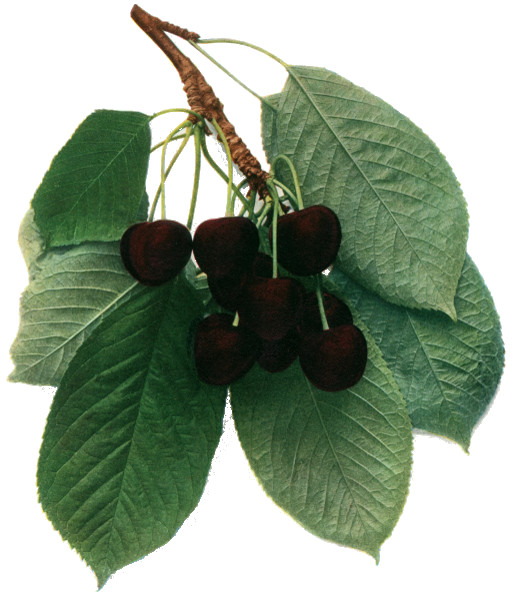
SCHMIDT
Tree large, vigorous, upright-spreading, open-topped, productive; trunk and branches
stocky, smooth; branches dull reddish-brown covered with ash-gray, with numerous lenticels;
branchlets thick, short, smooth, with rather conspicuous, raised lenticels.
Leaves numerous, six inches long, three inches wide, folded upward, obovate; upper
surface light green, smooth; lower surface pale green, pubescent along the midrib and
larger veins; apex acute, base abrupt; margin serrate, glandular; petiole one and one-half
inches long, thick, dull red, with a narrow, deep groove along the upper surface,
glandless or with one or two large, reniform, reddish glands on the stalk.
Buds large, long, obtuse to conical, plump, free, arranged singly as lateral buds and
in numerous small clusters; leaf-scars prominent; time of blooming mid-season; flowers
white, one and one-half inches across; borne in scattering clusters in twos and threes;
pedicels one inch long, thick, glabrous; calyx-tube green or with a tinge of red, campanulate,
glabrous; calyx-lobes long, broad, acute, serrate, glabrous within and without, reflexed;
petals oval, crenate, with short, narrow claws; filaments three-eighths inch long; pistil
glabrous, shorter than the stamens.
Fruit matures in mid-season; one inch in diameter, cordate, compressed, often slightly
oblique; cavity deep, wide, flaring; suture indistinct; apex bluntly pointed; color purplish-black;
dots numerous, small, dark russet, obscure; stem slender, one and one-half inches
long, strongly adherent to the fruit; skin tough, separating from the pulp; flesh purplish-red,
with dark colored juice, very meaty, crisp, firm, mild, sweet; of good quality; stone
semi-clinging, ovate, slightly oblique, with smooth surfaces; ventral suture prominent.
Prunus cerasus
- 1. Christ. Handb. 679. 1797. 2. Prince Pom. Man. 2:141, 142. 1832. 3. Leroy Dict. Pom.
5:365, 366 fig., 367. 1877.
- Gobet à Courte Queue. 4. Duhamel Trait. Arb. Fr. 1:180, 181, Pl. VIII. 1768. 5. Kraft Pom.
Aust. 1:7, Tab. 18 fig. 1. 1792.
- Gros Gobet. 6. Truchsess-Heim Kirschensort. 634-638. 1819. 7. Dochnahl Führ. Obstkunde 3:71,
72. 1858. 8. Mortillet Le Cerisier 2:204, 308. 1866. 9. Mas Le Verger 8:51, 52, fig. 24. 1866-73.
10. Hogg Fruit Man. 299, 300. 1884. 11. Mathieu Nom. Pom. 358. 1889. 12. Guide Prat. 9, 190.
1895.
- Flemish. 13. Downing Fr. Trees Am. 195 fig. 85, 196. 1845.
- Cerise à Courte Queue. 14. Poiteau Pom. Franc. 2: No. 15, Pl. 1846.
- Cerise Gros Fruit. 15. Pom. France 7: No. 11, Pl. 11. 1871.
In tracing the history of the Montmorency cherries from Duhamel's
time to the present we have been led to conclude that three distinct types
are now being cultivated. Of these closely related strains, all of which
probably originated about the same time in Montmorency Valley, France,
Montmorency is by far the most important and the one now grown commercially
in all parts of the country. Large Montmorency, while quite
similar to Montmorency, is much less grown because of its unproductiveness,
although in quality it is quite equal or perhaps superior to Montmorency.
Short-Stem Montmorency, under discussion here, varies considerably
both in tree and fruit from either of the other two, although
it is frequently taken for Large Montmorency. The tree is smaller and
more drooping but usually very productive. The fruit, similar in size to
Large Montmorency, differs from it by being more oblate and irregular,
and in having a very deep, wide suture which becomes an indistinct line
towards the apex. The skin seldom becomes as dark red even at perfect
maturity. The flavor is more sprightly but its quality is not as high.
All three varieties have long lists of synonyms, many of which have been
used for each of the three sorts. Many writers believe that only two
distinct strains of Montmorency exist and that Short-Stem Montmorency
is identical with Large Montmorency. The variety is little grown in
North America and is not as worthy for any purpose as either of the other
two better-known sorts.
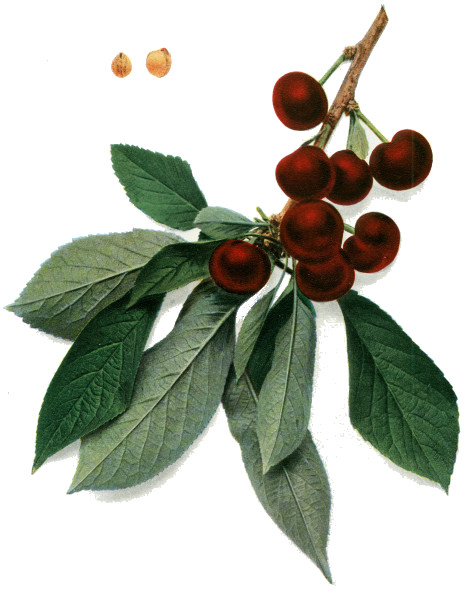
SHORT-STEM MONTMORENCY
Tree upright-spreading, round-topped, productive; trunk shaggy; branches roughish,
reddish-brown covered with ash-gray, with numerous lenticels; branchlets slender, long,
brown partly overspread with ash-gray, smooth, with conspicuous, numerous, small,
raised lenticels.
Leaves numerous, variable in size, averaging four inches long, one and three-fourths
inches wide, long-oval to obovate, thick; upper surface dark green, smooth; lower surface
medium green, with a prominent midrib; apex taper-pointed, base acute; margin doubly
crenate, glandular; petiole one inch long, tinged with dull red, variable in thickness, lightly
pubescent, glandless or with from one to three large, raised, reniform glands on the
stalk.
Buds small, short, variable in shape, free, arranged as lateral buds and on few, if any,
spurs; leaf-scars obscure; season of bloom late; flowers white, one inch across; borne in
a few scattering clusters, variable in number of flowers per cluster; pedicels one-half inch
long, thick, greenish; calyx-tube green or with a tinge of red, campanulate, glabrous; calyx-lobes
with a trace of red, obtuse, serrate, glabrous within and without, reflexed; petals
roundish-oval, crenate, sessile, with a distinctly notched apex; filaments one-fourth inch
long; pistil glabrous, equal to the stamens in length, often defective.
Fruit matures in mid-season; over three-fourths of an inch in diameter, decidedly
oblate, irregular in outline, slightly compressed; cavity deep, wide, irregular, flaring;
suture very deep near the stem but shallow at the apex which is flattened or depressed;
color light to dark red; dots numerous, small, russet, inconspicuous; stem very thick, less
than three-fourths of an inch long, adhering strongly to the fruit; skin rather tender,
separating from the pulp; flesh pale yellow, with colorless juice, tender and melting,
sprightly, sour; of fair quality; stone clinging along the ventral suture, small, roundish,
plump, blunt, with smooth surfaces, faintly tinged with red; ventral suture very prominent.
Prunus cerasus
- 1. Ia. Hort. Soc. Rpt. 330. 1885. 2. Mich. Hort. Soc. Rpt. 327. 1888. 3. U. S. D. A. Pom. Rpt.
40, 41. 1895. 4. Del. Sta. An. Rpt. 12:116 fig. 6, 117. 1900. 5. Ia. Sta. Bul. 73:83 fig. 21, 84. 1903.
Sklanka is evidently a cross between a cherry of the Amarelle group
and one of the Morellos—another indication of the frequency of hybridization
in this fruit. The cherries of Sklanka have the light-colored skin
and juice of the Amarelles while the dwarfish, round-topped trees with
pendant branches and abundant, small leaves are typical of the Morellos.
The variety is in no way remarkable unless it be in hardiness, the pomologists
of the colder parts of the Mississippi Valley holding that it is one
of the hardiest of cherries. The fruit is not on a par with that of a score
of other Amarelles and the trees, in New York at least, are too small and
unproductive to be worth planting. The cherry has value, then, only
where hardiness is a prime requisite.
Sklanka was imported to this country from Russia in 1883 by Professor
J. L. Budd of Ames, Iowa. Its parentage and origin are uncertain.
It does not seem to have been grown in continental Europe outside of
Russia but in certain sections of that country it is reported as being one
of the hardiest and most productive of the Sour Cherries. As grown in
our Northern Central States it has proved one of the hardiest of all varieties
but has not, as yet, gained much reputation commercially even in these
cold regions. It is mentioned but seldom in the literature and is listed by
but few nurserymen.
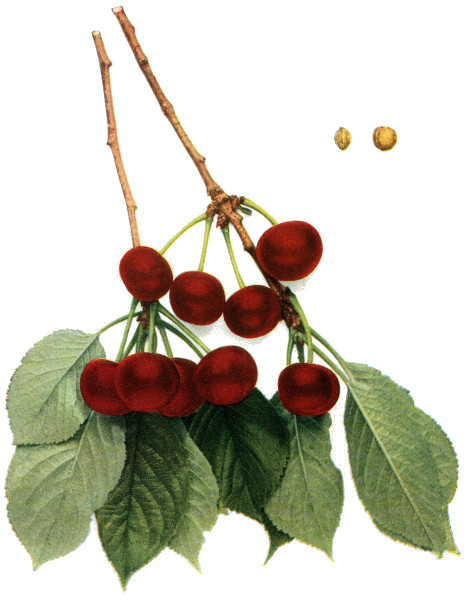
SKLANKA
Tree of medium size, vigorous, spreading, with drooping branchlets, open-topped,
unproductive; trunk thick and smooth; branches rather slender, long, slightly roughened,
reddish-brown partly overspread with ash-gray, with numerous rather small lenticels;
branchlets slender and willowy, with short internodes, brown nearly covered with ash-gray,
smooth except for the lenticels, which are small, numerous, raised, conspicuous.
Leaves of medium number, three and one-fourth inches long, one and three-fourths
inches wide, folded upward, obovate to elliptical, thick, stiff; upper surface very dark
green, glossy, smooth; lower surface medium green, finely pubescent along the midrib and
larger veins; apex and base acute; margin finely and doubly serrate, with small, dark glands;
petiole three-fourths of an inch long, thick, tinged with dull red, grooved, with a few hairs
along the upper surface, with from one to four small, globose, orange-colored glands usually
at the base of the blade.
Buds small, short, variable in shape, plump, free, arranged singly as lateral buds and
in few, very small clusters; time of blooming mid-season; flowers one and three-sixteenths
inches across, white; borne in dense clusters usually at the ends of branches or spurs, well
distributed, usually in threes; pedicels over one-half inch long, glabrous, greenish; calyx-tube
green, obconic, glabrous; calyx-lobes broad, obtuse, serrate, glabrous within and
without, reflexed; petals roundish, entire, nearly sessile, with almost entire apex; filaments
one-fourth inch long; pistil glabrous, equal to the stamens in length.
Fruit matures early; about three-fourths of an inch in diameter, oblate, not compressed;
cavity of medium depth, narrow, abrupt; suture lacking; apex flattened or strongly
depressed; color bright currant-red; dots numerous, light colored, slightly conspicuous; stem
thick, less than one inch long, adherent to the fruit; skin rather tough, separating from the
pulp; flesh pale yellow, with colorless juice, tender and melting, sour; of good quality;
stone semi-free, clinging only along the ventral suture, about one-third inch in diameter,
roundish, slightly flattened, blunt, with smooth surfaces.
Prunus avium
- 1. Kenrick Am. Orch. 219, 220. 1835.
- Sparhawk's Honey. 2. Downing Fr. Trees Am. 177. 1845. 3. Am. Pom. Soc. Cat. 74. 1862.
4. Mas Le Verger 8:143, 144, fig. 70. 1866-73.
- Honey Heart. 5. Cole Am. Fr. Book 234 fig. 37, 235. 1849.
Sparhawk has little to recommend it for either a home or commercial
orchard; but the rich and honeyed sweetness of the cherries, scarcely surpassed
in flavor, might make it worth planting by plant-breeders and
connoisseurs of choicely good fruits. The name "honey" which appears
in several of the synonyms is indicative of the flavor of the fruit. The
cherries are quite too small and the pits altogether too large for a commercial
product. The tree is upright-spreading, with numerous thick
branches over which the cherries are rather thickly scattered in ones, twos
and threes and never in clusters. The fruit-stems are characteristically
long and slender. Though of the Bigarreau group the flesh is too tender
to well withstand harvesting, shipping and the brown-rot.
This cherry was introduced by Edward Sparhawk, for whom it was
named, of Brighton, Massachusetts. The variety has been known under
a number of different names, the number being no measure of its merit,
however, for it has never been extensively cultivated. The American
Pomological Society placed it in its fruit catalog list of recommended
varieties in 1862 but dropped it in 1871 and for many years but little
attention has been given it. It is now for sale in but few of the nurseries
of the country.
Tree large, vigorous, upright, rather open-topped, hardy, unproductive; trunk stocky,
slightly shaggy; branches thick; branchlets medium in thickness and length; leaves
numerous, five inches long, two and one-fourth inches wide, long-oval to obovate, thin,
medium green; margin coarsely and doubly serrate, glandular; petiole two inches long, thick,
overlaid with red, with one or two large, reniform, reddish glands on the stalk; buds intermediate
in size and length; season of bloom intermediate, average length five days; flowers
one and one-fourth inches across; pistil shorter than the stamens.
Fruit matures in mid-season, average length about nineteen days; nearly seven-eighths
inch in diameter, somewhat conical, compressed; color dark red over a yellowish background,
finely mottled; stem of medium thickness, one and three-eighths inches long,
adherent to the fruit; skin thin, tough, separates from the pulp; flesh pale yellowish-white,
with colorless juice, tender, crisp, highly flavored, mild, aromatic, sweet; very good in
quality; stone nearly free, large for the size of the fruit, ovate, flattened, slightly oblique,
with smooth surfaces.
Prunus cerasus
- 1. Christ Handb. 679. 1797. 2. Christ Wörterb. 294. 1802. 3. Truchsess-Heim Kirschensort. 629-632.
1819. 4. Dochnahl Führ. Obstkunde 3:67, 68. 1858. 5. Ill. Handb. 541 fig., 542. 1861. 6. Mas
Le Verger 8:149, 150, fig. 73. 1866-73. 7. Lauche Deut. Pom. III: No. 24, Pl. 1882. 8. Am. Gard.
9:264. 1888. 9. Ia. Sta. Bul. 2:36. 1888. 10. Del. Sta. An. Rpt. 12:126, 127. 1900.
- Späte Morello. 11. Ia. Hort. Soc. Rpt. 78. 1890. 12. Budd-Hansen Am. Hort. Man. 2:282, 283.
1903.
This is another variety with Amarelle fruit and a Morello-like tree
and is unquestionably a hybrid between varieties of the two groups. Several
references from the Middle West mention Späte Amarelle as very
promising but in New York, where such sorts as Early Richmond and
the Montmorencies thrive, it is unpromising for any purpose. The cherries
are quite too poor in quality, being very sour, and the trees too unproductive
to make the variety even a poor rival of a score or more of Amarelles
and Dukes with which it would have to compete in this State.
The origin of this cherry is unknown but according to Truchsess it
was sent out from Hanover as Späte Morelle in 1785. In 1797, Christ
mentions a cherry under this name the description of which agrees with
that of Späte Amarelle. Lauche states that Truchsess received the variety
from Hanover under the name Späte Morelle and later changed the name
to Späte Amarelle. This cherry was grown in the Paris National Nursery
under the name Cerise Amarelle Tardive and at one time was commonly
grown in gardens in France. In the spring of 1883, Professor J. L.
Budd of Iowa brought to America a large number of cherries from central
and eastern Europe. Somehow there was confusion in the description
of these imported cherries and two kinds were described under the name
Späte Amarelle, one a light-fleshed sort, the other with red flesh and colored
juice. The true variety has light flesh and juice and a pleasant, acid flavor
and is probably identical with the old French sort, Cerise Amarelle Tardive.
The cherry sometimes called Späte Morello can be no other than
the Späte Amarelle.
Tree of medium size, vigorous, upright-spreading, round-topped, rather unproductive;
trunk stocky, somewhat shaggy; branches smooth, dark brown overspread by ash-gray,
with numerous lenticels variable in size; branchlets slender, rather short, brown nearly
covered with ash-gray, smooth, with slightly raised, inconspicuous lenticels.
Leaves numerous, small, folded upward, oval to somewhat obovate, rather stiff; upper
surface dark green, smooth; lower surface medium green, pubescent only on the midrib
and larger veins; apex acute, base variable in shape; margin finely serrate, glandular;
petiole greenish or with a slight bronze tinge, glandless or with from one to four small,
globose, brown or yellowish glands usually at the base of the blade.
Buds small, pointed, plump, free, arranged singly as lateral buds and in clusters on
long or short spurs; leaf-scars prominent; season of bloom late; flowers one inch across,
white; borne in scattered clusters, usually in threes; pedicels three-fourths of an inch long,
slender, glabrous, greenish; calyx-tube green with a tinge of red, obconic, glabrous; calyx-lobes
with a trace of red, rather narrow, acute, serrate, glabrous within and without,
reflexed; petals broad-oval, entire, slightly crenate at the apex; filaments one-fourth inch
long; pistil glabrous, equal to or longer than the stamens.
Fruit matures in mid-season; one-half inch long, oblate, slightly compressed; cavity
shallow, narrow; suture indistinct; apex roundish or depressed; color dark red; dots
numerous, very small, obscure; stem slender, one and one-half inches long; skin thin, tender;
flesh light red, with light colored juice, tender, tart; of good quality; stone free, roundish,
flattened, with smooth surfaces; distinctly ridged along the ventral suture.
Prunus cerasus
- 1. Am. Pom. Soc. Cat. 27. 1909.
- Suda Hardy. 2. Ohio Hort. Soc. Rpt. 21. 1892-93. 3. Am. Pom. Soc. Cat. 25. 1899. 4. Stark
Brothers Cat. 1899. 5. Ia. Sta. Bul. 73:84 fig., 85. 1903. 6. Am. Pom. Soc. Sp. Rpt. 36. 1904-05.
Suda has been widely advertised as an improved English Morello but,
while there seem to be some slight differences between the two, the new
variety is not an improvement on the old so far as can be discovered at
this Station. The trees of Suda in general aspect are more upright and
the stems of the cherries longer and more slender than those of English
Morello, being but an inch in length in the one variety and an inch and three-fourths
in the other. The trees on the grounds of this Station are not as
productive as those of English Morello. The cherries, if anything, are
not as high in quality as those of the older and probably the parent variety.
It is doubtful if there is a place for Suda in the cherry industry of New York.
This cherry originated in the garden of a Captain Suda, Louisiana,
Missouri, about 1880. The American Pomological Society listed Suda in
its fruit catalog of 1899 as Suda Hardy but in 1909 shortened the name
to Suda, a change which has generally been accepted.
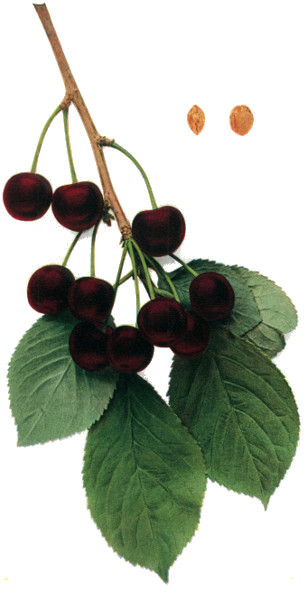
SUDA
Tree vigorous, rather unproductive; branches slender, with numerous small lenticels;
branchlets slender, long; leaves numerous, four inches long, two and one-fourth inches
wide, obovate to oval, dull, dark green; margin doubly serrate, with dark glands; petiole
one inch long, of medium thickness, tinged with dull red, glandless or with one or two
reniform, yellowish-brown glands usually at the base of the blade; buds small, short, obtuse,
arranged singly as lateral buds and on but very few, if any, spurs; season of bloom late;
flowers white, one inch across; filaments one-fourth inch long; pistil shorter than the
stamens.
Fruit matures very late; three-fourths inch in diameter, roundish-cordate, slightly
compressed; cavity flaring; suture indistinct; color dark purplish-red; stem slender, one
and three-fourths inches long, adherent to the fruit; skin separating from the pulp; flesh
dark red, with dark colored juice, tender, somewhat meaty, sprightly, astringent, very
sour; poor in quality; stone free or nearly so, ovate, slightly pointed, with smooth surfaces.
Prunus cerasus
- 1. Ia. Sta. Bul. 73:85, 86. 1903. 2. Am. Pom. Soc. Cat. 27. 1909.
Timme can hardly be distinguished from Early Richmond, differing
only in smaller fruits, and probably is a seed variation of that variety.
On the grounds of this Station the trees of Timme are even more productive
than those of Early Richmond, one of the most fruitful of all cherries,
but the greater fruitfulness of the tree hardly offsets the smaller size of
the cherries. It is doubtful if this new strain can displace the older Early
Richmond, which is well established in the favor of cherry-growers
everywhere.
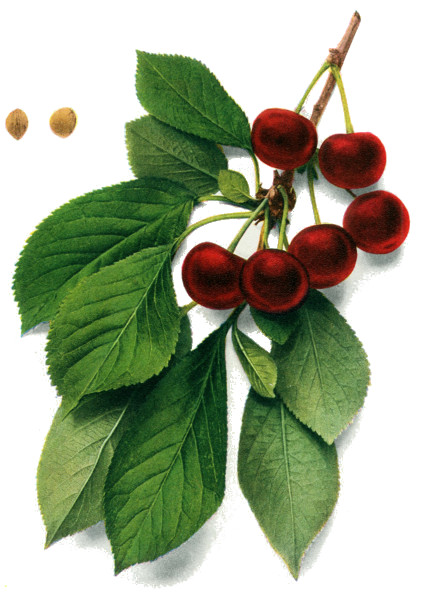
TIMME
This variety is supposed to have been brought to America from Germany
by a Mr. Timme of Omaha, Nebraska. It is of some local importance
in Iowa and Nebraska but as yet has not been widely distributed in America.
Possibly it will be found in time that it is some old German variety
renamed. It was placed on the fruit list of the American Pomological
Society in 1909.
Tree medium in size, rather vigorous, upright-spreading, open-topped, healthy; trunk
and branches thick, with numerous large lenticels; branchlets slender, long, willowy;
leaves three and one-half inches long, one and five-eighths inches wide, ovate to obovate,
thick, stiff, leathery, dark green; margin finely serrate, tipped with reddish-brown glands;
petiole three-fourths of an inch in length, with one or two large, globose glands variable
in position; flowers one inch across, in dense clusters.
Fruit matures medium early; over one-half inch in diameter, roundish-oblate; color
light red becoming dark red at full maturity; stem one inch long; flesh yellowish-white,
with abundant pinkish juice, tender and melting, pleasant flavored, sprightly; good in
quality; stone semi-clinging, roundish-ovate, plump; prominently ridged along the ventral
suture.
Prunus cerasus
- 1. Duhamel Trait. Arb. Fr. 1:178-180, Pl. VII. 1768. 2. Kraft Pom. Aust. 1:7, Tab. 18 fig. 2.
1792. 3. Poiteau Pom. Franc. 2: No. 21, Pl. 1846. 4. Ann. Pom. Belge 1:103, 104, Pl. 1853.
5. Mortillet Le Cerisier 2:205, 308. 1866. 6. Leroy Dict. Pom. 5:305, 306 fig., 307, 308. 1877. 7. Rev.
Hort. 250. 1906.
- Stäts Blühender Kirschbaum. 8. Krünitz Enc. 42, 43. 1790.
- All Saints. 9. Truchsess-Heim Kirschensort. 661-668. 1819. 10. Prince Pom. Man. 2:152, 153.
1832. 11. Dochnahl Führ. Obstkunde 3:72. 1858. 12. Hogg Fruit Man. 277. 1884. 13. Mathieu
Nom. Pom. 332. 1889.
Toussaint is a marked deviation from its species. Instead of bearing
blossoms normally this variety sends out small branches from the buds.
In the axis of the first four leaves are borne the buds destined to produce
similar branches the following spring. As the branches elongate these
buds remain dormant but others are borne which produce flowers in umbel-like
clusters of two or three. The trees begin blooming three or four weeks
later than other cherries and new buds and flowers appear continually
until August or thereabouts. The tree, too, is most striking in appearance,
being dwarfish in stature, thickly set with pendant branchlets and, all in
all, attractive enough to make it a rather handsome ornamental. The
cherries are of little or no value, being quite too acid to eat out of hand
but furnishing very late fruit which may be used for culinary purposes.
The description given is compiled.
The history of the variety is uncertain. Leroy says that it was mentioned
by Daléchamp, a French writer, as early as 1586. Duhamel seems
to have been the first pomologist to describe it which he did in 1768 under
the name Cerisier de la Toussaint. The variety is well known in Europe,
being widely distributed in Austria, Germany, Belgium, France and England,
pomologists and nurserymen in all these countries seeming to be
well acquainted with it. There are no records of its culture in America,
although Prince and Elliott describe it from European fruit books.
Tree small, hardy, moderately productive; branches slender, numerous, pendant.
Fruit small, flattened on the ends and sides; stem long; color clear red, darker on
maturing, rather transparent; flesh white somewhat red at the center, with reddish juice;
flavor, if mature, sour, though not excellent; stone large, long, clings to the flesh more
than to the stem. The fruit borne in October never reaches maturity.
Prunus cerasus
- 1. Ia. Hort. Soc. Rpt. 84, 85. 1882. 2. Am. Pom. Soc. Rpt. 75. 1883. 3. Ia. Hort. Soc. Rpt. 327,
328. 1885. 4. Ia. Sta. Bul. 19:550. 1892. 5. Ia. Hort. Soc. Rpt. 454. 1895. 6. Del. Sta. An. Rpt.
12:128, 129. 1900. 7. Ia. Sta. Bul. 73:87. 1903. 8. Am. Pom. Soc. Cat. 27. 1909.
Vladimir is a Morello-like cherry not more promising in New York,
at least in the orchard of this Station, than any other of the many competitors
of English Morello. The cherries are large, very similar in size
and appearance to those of English Morello; the pit is small, the skin very
thin and separating readily from the pulp. The variety is further characterized
by the very dark red flesh and dark colored juice which is too
astringent and sour to eat out of hand but does very well for culinary
purposes. The tree is much like that of English Morello but is far more
dwarfish and not as productive, these being fatal faults for commercial
planting in New York. It falls short of English Morello in another respect—the
fruit ripens very unevenly. Vladimir has the reputation of being
one of the hardiest of all cherries. It is said to come true from seed and
does better on its own roots than on either Mazzard or Mahaleb. The
Russians, according to Budd, succeed best with it when it is propagated
from sprouts and allowed to form a bushy plant with several stems, the
oldest of which are cut from time to time. There seems to be little in the
variety to commend it for either home or commercial plantings in New
York.
Vladimir is a generic name for a group of varieties grown in Russia,
principally in the province of Vladimir east of Moscow. Most of these
cherries are large, black fruits with highly colored juice and good quality,
much valued for market use in their native country. Professor J. L. Budd
imported a number of these Vladimir cherries from Orel in Central Russia
and grew them at the Experiment Station grounds in Iowa, giving to each
a seedling number as a distinguishing characteristic. One, Orel No. 25,
was selected as being superior in many respects to the others and was
finally named Vladimir. This variety, typical of these Russian cherries,
has been considerably propagated and is generally distributed throughout
this country. The American Pomological Society added Vladimir to its
list of recommended fruits in 1909.
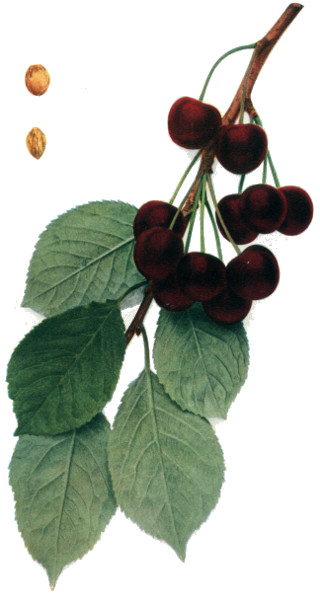
VLADIMIR
Tree dwarfish, round-topped, very hardy, productive; trunk medium or below in size;
branches willowy, drooping, reddish-brown slightly overspread with ash-gray; branchlets
slender, long, smooth, with a few small, raised lenticels.
Leaves numerous, three inches long, one and three-fourths inches wide, folded upward,
oval, thick; upper surface dull, dark green, smooth; lower surface light green, with a few
scattering hairs; apex acute, base slightly abrupt; margin finely serrate, with dark colored
glands; petiole one-half inch long, tinged with red, with a few scattering hairs along the
stalk, glandless or with from one to four small, reniform, greenish-yellow glands at the
base of the blade.
Buds small, short, very obtuse, plump, free, arranged singly as lateral buds and in
small clusters on small spurs; leaf-scars obscure; season of bloom intermediate; flowers
white, one and one-fourth inches across; borne in scattering clusters in twos, threes and
fours; pedicels three-fourths of an inch long, rather slender, glabrous, greenish; calyx-tube
with a tinge of red, somewhat obconic, glabrous; calyx-lobes reddish, broad, obtuse, serrate,
glabrous within and without, reflexed; petals roundish or slightly obovate, irregularly
crenate, with short, blunt claws, apex entire; filaments over one-fourth inch long; pistil
glabrous, shorter than the stamens.
Fruit matures very late; three-eighths of an inch long, seven-eighths of an inch wide,
roundish-cordate, slightly compressed; cavity rather shallow; suture a line; apex roundish;
color dark red almost black at full maturity; dots numerous, small, russet, inconspicuous;
stem slender, one and one-half inches or more in length, adherent to the fruit; skin thin,
separating from the pulp; flesh dark red, with very dark colored juice, slightly stringy,
melting, sprightly, astringent, sour; of fair quality; stone semi-clinging, rather large, long-ovate
to oval, with smooth surfaces, tinged with red.
Prunus avium × (Prunus avium × Prunus cerasus)
- 1. Prince Treat. Hort. 29. 1828. 2. Lond. Hort. Soc. Cat. 56. 1831. 3. Prince Pom. Man. 2:118.
1832. 4. Downing Fr. Trees Am. 178. 1845. 5. Floy-Lindley Guide Orch. Gard. 101, 102. 1846.
6. Elliott Fr. Book 213, 214. 1854. 7. Hogg Fruit Man. 314. 1884.
This old sort, seemingly well thought of in Europe, has not been
popular in America and has only historical value to cherry-growers of this
country. It is an interesting cherry resembling the Bigarreaus in tree and
leaf-characters while the flowers are more like those of the Dukes, the
fruit, too, taking on more the aspect of the Dukes than of the Sweet
Cherry. The variety has long since passed from general cultivation in the
United States and can now be found only in collections or as an occasional
dooryard tree.
This cherry was raised early in the Nineteenth Century by T. A.
Knight, Downton Castle, Wiltshire, England, and first fruited in 1815,
shortly after the Battle of Waterloo, hence its name. It was supposed
to be a cross between Yellow Spanish and May Duke. The variety was
brought to this country by Honorable John Lowell of Newton, Massachusetts,
though it was described by Prince in 1828 from European fruit books.
The following description is compiled:
Tree vigorous, thrifty, rather irregular and spreading, productive; branchlets thick,
stocky, grayish; leaves large, drooping, wavy; margin slightly serrate; flowers large;
stamens shorter than the pistil.
Fruit matures the last of June or early in July; large, obtuse-cordate, broad at the
base, convex on one side, flattened on the other; stem one and one-half to two inches in
length, slender; color dark purplish-red becoming nearly black at maturity; skin thin;
flesh purplish-red becoming darker next to the stone, firm but tender, juicy, fine flavored,
sweet; good in quality; stone separating readily from the pulp, small, roundish-ovate,
compressed.
Prunus avium
- 1. Thacher Am. Orch. 217. 1822. 2. Prince Pom. Man. 2:125. 1832. 3. Mag. Hort. 8:283. 1842.
4. Downing Fr. Trees Am. 180 fig., 181. 1845. 5. Thomas Am. Fruit Cult. 366. 1849. 6. McIntosh
Bk. Gard. 2:541. 1855.
- Tradescant. 7. Coxe Cult. Fr. Trees 250. 1817.
- White Oxheart. 8. Kenrick Am. Orch. 278. 1832.
White Bigarreau is a cherry of the past, having been considered one
of the good sorts of a century ago. Rivers, the English pomologist,
believed it to have come originally from Russia. It is reputed to have been
brought to America from France by Chancellor Livingston of Revolutionary
fame. Thacher, in 1822, described the variety first under its present
name. The variety, as the synonymy shows, has been grown under many
names both in America and Europe. In 1845, according to Downing,
this cherry was common in the neighborhood of New York and Philadelphia
but since Downing's time no one seems to have mentioned it. The
variety is usually spoken of in the United States as neither hardy nor
productive. The fruit books describe it as follows:
Tree medium in size, spreading, very tender, unproductive; leaves narrow, waved.
Fruit matures the last of June or early in July; large to very large, heart-shaped,
somewhat pointed; color yellowish-white with a bright red cheek, mottled; flesh very
firm, breaking, pleasantly flavored, sweet; very good in quality; stone separating readily
from the flesh.
Prunus avium
- 1. Bradley Gard. 211. 1739. 2. Downing Fr. Trees Am. 173, 174 fig. 1845. 3. Elliott Fr. Book
216. 1854. 4. Horticulturist 15:327, Pl. fig. 1. 1860. 5. Hogg Fruit Man. 315. 1884.
- Amber Heart. 6. Miller Gard. Kal. 154. 1734. 7. Jour. Roy Hort. Soc. 21:355. 1898.
- Frühe Bernsteinkirsche. 8. Truchsess-Heim Kirschensort. 304, 305. 1819. 9. Dochnahl Führ.
Obstkunde 3:39. 1858. 10. Mas Pom. Gen. 11:45, 46, fig. 23. 1882. 11. Mathieu Nom. Pom. 348.
1889.
- Kentish Bigarreau. 12. Bunyard-Thomas Fr. Gard. 43. 1904.
White Heart is mentioned in The Cherries of New York only because
of its reputation in Europe and the frequent references, therefore, that
American cherry-growers see to it in European publications. Bunyard and
Thomas, in the reference given, speak of it as one of the best and most
profitable cherries grown in the famous Kent cherry orchards. Early
American horticulturists describe it but it seems not to have been widely
grown in America and has probably long since passed from cultivation.
It failed, according to Elliott, because it was a "variable and uncertain
bearer" and while an early cherry "not early enough to compete with
many new varieties."
White Heart seems to have been mentioned first by Miller in 1734.
A little later it is found to be described in both Germany and France,
indicating that it must have been known and widely distributed before
the time given. It seems to have been brought to America before the
War of the Revolution and to have been grown in this country under the
several different names which are given in the list of synonyms. The
following description is compiled:
Tree large, vigorous, somewhat erect, very healthy, rather productive; branches
stocky, somewhat angular, with large, roundish, light colored lenticels; internodes of
unequal length; leaves medium in size, oval or obovate, sharply pointed; margin finely
serrate; petiole short, slender, tipped with two reniform, orange-red glands; flowers
medium in size; petals obovate.
Fruit matures early in June; rather small, roundish-cordate, often one-sided, with a
distinct suture; color whitish-yellow, tinged and speckled with pale red in the sun; stem
long, slender, inserted in a wide, shallow cavity; skin firm; flesh light colored, firm, half-tender,
breaking, juicy, sugary, pleasant; first quality; stone rather large, roundish-oval,
with a pointed apex.
Prunus avium
- 1. Gard. Mon. 24:208. 1882. 2. Cult. & Count. Gent. 49:636. 1884. 3. Am. Pom. Soc. Cat. 22.
1885. 4. Del. Sta. Bul. 35:16 fig. 7. 1897. 5. Ont. Fr. Exp. Sta. Rpt. 5:41 fig. 1898. 6. Am. Gard.
21:76. 1900. 7. Can. Hort. 25:3, 262 fig., 263. 1902. 8. Am. Pom. Soc. Rpt. 56, 57. 1907.
Windsor is the standard late Bigarreau and one of the most profitable
of the hard-fleshed cherries grown in New York. Both fruit and trees
deserve the approbation of cherry-growers. In color the cherries meet the
market demand, buyers preferring a dark-colored Sweet Cherry. None
would find fault with the appearance of Windsor. The flesh is firm and the
product stands harvesting and shipping well and at a season of the year
when brown-rot is usually rife this variety is fairly free from this
scourge of the Sweet Cherry. The quality is from good to very good,
equaled but not surpassed by others of its class. But it is in its tree-characters
that the superiority of Windsor is best shown. The trees have the
reputation of being the hardiest of the Bigarreaus and of thriving in many
soils. They are usually fruitful. To offset these merits, the trees have two
or three rather serious faults. Thus, they do not come in bearing early;
they are tall and upright in growth, being almost fastigiate, making it
difficult to harvest the crop; and the load of fruit is too much clustered.
Cherry-growers agree that the worst of all pests of this fruit is the robin
and that the Windsor, for some reason or other, is the freest of its kind
from this and other thieving birds. From the behavior of the variety
in New York, we can heartily join with practically all who are growing this
variety in recommending it as a late, market Sweet Cherry.
Windsor originated in the latter half of the Nineteenth Century on the
farm of James Dougall, Windsor, Ontario, Canada, and was introduced
to fruit-growers in 1881 by Ellwanger & Barry, Rochester, New York.
It has been planted extensively in many sections of this country for both
home and market use and is now offered for sale by a large number of
nurserymen. The American Pomological Society added Windsor to its
fruit catalog list in 1885 and the variety still holds a place there. Though
rather widely known in the United States the commercial culture of this
variety is almost wholly confined to New York. It seems as yet not to
have found its way to Europe, a fact to be regretted, for its many good
qualities would soon make it known in the Old World where the Sweet
Cherry is better grown and more appreciated than in America.
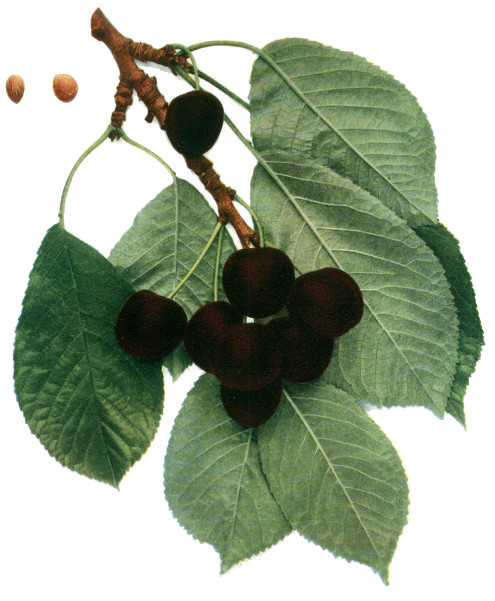
WINDSOR
Tree large, vigorous, upright-spreading, open-topped, very productive; trunk thick,
shaggy; branches stocky, very smooth, brown nearly overspread with ash-gray, with
large lenticels; branchlets thick, rather short, brown overspread with light ash-gray, smooth,
with few small, inconspicuous lenticels.
Leaves four inches long, two inches wide, folded upward, obovate to oval, thin; upper
surface dark green, slightly rugose; lower surface light green, pubescent; margin doubly
crenate, glandular; petiole one and one-fourth inches long, tinged with dull red, with from
one to three globose, reddish glands of medium size on the stalk.
Buds conical or pointed, plump, free, arranged singly as lateral buds and in very
numerous clusters variable in size, on short spurs; leaf-scars somewhat prominent; season
of bloom intermediate; flowers white, one and one-fourth inches across; borne in scattering
clusters, in ones and twos; pedicels one inch long, slender, glabrous, greenish; calyx-tube
green, campanulate, glabrous; calyx-lobes greenish or with a tinge of red, acute, glabrous
within and without, reflexed; petals broad-oval, slightly crenate, with short, blunt claws;
filaments five-sixteenths of an inch long; pistil glabrous, shorter than the stamens.
Fruit matures in late mid-season; three-fourths of an inch in diameter, slightly oblong
to conical, compressed; cavity deep, wide, flaring; suture a line; apex roundish, with a
depression at the center; color very dark red becoming almost black; dots numerous, small,
russet, obscure; stem slender, one and one-fourth inches long, adherent to the fruit; skin
thin, adhering to the pulp; flesh light red, with reddish juice, tender, meaty, crisp, mild,
sweet; good to very good in quality; stone semi-free, ovate, flattened, blunt-pointed, with
smooth surfaces; ventral suture rather prominent near the apex.
Prunus avium
- 1. Am. Pom. Soc. Cat. 26. 1909.
- Governor Wood. 2. Elliott Fr. Book 196 fig. 1854. 3. Am. Pom. Soc. Cat. 108. 1856. 4. Leroy
Dict. Pom. 5:324 fig. 1877.
Wood is preeminently a Sweet Cherry for the amateur, having many
qualities that fit it for the home orchard and but few to commend it to
commercial growers. The trees are a little tender to cold, are not quite
productive enough to make the variety profitable and are, too, somewhat
fastidious as to soils. To offset these defects, they are vigorous and
healthy and bear early. But the chief fault of the cherry from the cherry-grower's
standpoint is to be found in the fruit. The flesh is soft and the
cherries will not stand handling in harvesting and shipping and are very
susceptible to brown-rot and crack badly in wet weather. Wood has
special merit in the home collection, however, because of its earliness, its
beautiful appearance and delicious flavor. It is one of the first of the
Sweet Cherries, is large and, as the color-plate shows, is a beautiful yellowish-white
tinted with shades of crimson, with conspicuous russet dots—a
beautiful fruit. The flesh separates readily from the skin, is tender, juicy,
with an abundance of colorless juice and a flavor that has given it the
reputation, wherever grown in America, of being one of the best in quality.
It would be hard to name another cherry better suited for small plantations
and it is to be hoped that it will long be kept in the gardens of connoisseurs
of good fruit.
Wood is one of the best of Professor J. P. Kirtland's83 seedlings. It
was raised by him in 1842 at Cleveland, Ohio, and named in honor of
Reuben Wood, at one time Governor of Ohio. In 1856, it was added to
the fruit list of the American Pomological Society where it still remains,
being changed in 1909 to Wood with Governor Wood as a synonym. Its
popularity is shown in the United States by the fact that practically every
nurseryman in this country lists this variety.
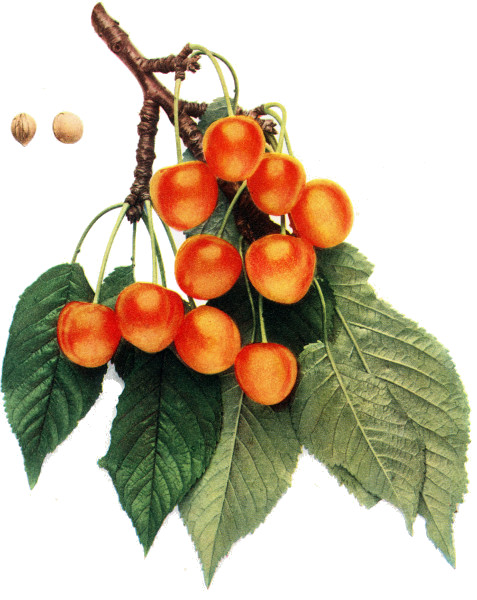
WOOD
Tree vigorous, upright-spreading, open, productive; trunk stout; branches thick,
smooth, dull reddish-brown covered with ash-gray, with a few small lenticels; branchlets
thick, reddish-brown slightly overspread with ash-gray, smooth, glabrous, with a few
inconspicuous, raised lenticels.
Leaves numerous, four and one-half inches long, two and one-half inches wide, folded
upward, obovate, thin; upper surface light green, smooth; lower surface dull green, lightly
pubescent; apex acute, base abrupt; margin coarsely and doubly serrate, glandular; petiole
one and one-half inches long, slender, tinged with dull red, with from one to three reniform,
reddish glands on the stalk.
Buds large, long, pointed, very plump, free, arranged singly as lateral buds or in
small clusters on short spurs; leaf-scars prominent; season of bloom intermediate; flowers
one inch across, arranged in twos and threes; pedicels one inch long, slender, glabrous,
greenish; calyx-tube tinged with red, obconic, glabrous; calyx-lobes reddish, long, acute,
glabrous on both surfaces, reflexed; petals roundish, crenate, with short, blunt claws;
anthers yellowish; filaments one-eighth inch long; pistil glabrous, equal to the stamens in
length, sometimes defective.
Fruit matures in early mid-season; nearly one inch in diameter, roundish-cordate,
compressed; cavity of medium depth, wide, flaring; suture variable in depth, distinct,
wide; apex roundish; color shades of crimson on a yellowish-white background; dots
numerous, small, light russet, somewhat conspicuous, especially just before maturity; stem
slender, one and one-half inches long, adhering well to the fruit; skin thin, tender, separating
from the pulp; flesh whitish, with colorless juice, tender, meaty, mild, sweet; very good in
quality; stone clinging, rather large, roundish, blunt, with smooth surfaces; with a broad,
ventral suture.
Prunus cerasus
- 1. Ia. Hort. Soc. Rpt. 171. 1884. 2. Am. Pom. Soc. Rpt. 95. 1887. 3. Can. Exp. Farm Bul. 17:15
fig. 8. 1892. 4. Neb. Hort. Soc. Rpt. 39. 1892. 5. Am. Gard. 20:178. 1899. 6. Del. Sta. An. Rpt.
12:119, 120. 1900. 7. Ia. Sta. Bul. 73:89, fig. 26. 1903. 8. Am. Pom. Soc. Sp. Rpt. 38. 1904-05.
9. Wash. Sta. Bul. 92:22, 23. 1910.
Wragg is either English Morello or a strain of that variety. Trees
on the grounds of this Station are identical with English Morello but it
may be that here, and occasionally elsewhere, the older sort has been substituted
for Wragg. In Iowa, where the new variety is most largely grown,
pomologists claim that it is distinct and that it is an improvement on English
Morello. Professor J. L. Budd, an authority on Russian cherries, believed
that this sort is distinct and of Russian origin having, according to him,
been brought to America by Ellwanger & Barry of Rochester, New York,
in an importation of Russian trees. Captain C. L. Watrous of Des Moines,
Iowa, another prominent pomologist of that State, was of the opinion that
Wragg came to light on the grounds of J. Wragg, Waukee, Iowa, as a sprout
from another tree. Colonel G. B. Brackett, pomologist of the United
States Department of Agriculture, who visited Mr. Wragg's place some
years ago and compared the new cherry with the English Morello, could
find no distinguishing characters between the two. On the other hand,
Mr. Wragg insisted that they were distinct. The American Pomological
Society calls Wragg and English Morello the same. Those who believe
that the two are distinct say that the fruit of Wragg is larger, the trees
hardier and that the cherries ripen a little later than those of English
Morello. With the information now at hand it is impossible to say here
whether or not Wragg is distinct. A compiled description taken from the
text describing this cherry is so unsatisfactory that we offer none and refer
the reader to that of English Morello from which it differs but little, if
at all.
Prunus avium
- 1. Miller Gard. Dict. 1:1754. 2. Forsyth Treat. Fr. Trees 42. 1803. 3. Prince Treat. Hort. 28.
1828. 4. Prince Pom. Man. 2:125. 1832. 5. Thomas Am. Fruit Cult. 372. 1867. 6. Am. Pom. Soc.
Cat. 17. 1897. 7. Budd-Hansen Am. Hort. Man. 2:291. 1903.
- Biguarre Cherrie. 8. Parkinson Par. Ter. 572. 1629. 9. Rea Flora 205. 1676.
- Spanish. 10. Gerarde Herball 1503, fig. 3. 1636.
- Bigarreau Commun. 11. Duhamel Trait. Arb. Fr. 1:167, 168. 1768. 12. Prince Pom. Man. 2:128.
1832. 13. Poiteau Pom. Franc. 2: No. 5, Pl. 1846. 14. Mortillet Le Cerisier 2:115-119, fig. 26. 1866.
15. Pom. France 7: No. 2, Pl. 2. 1871. 16. Leroy Dict. Pom. 5:188-191, fig. 1877. 17. Cat. Cong.
Pom. France 20, fig. 1906.
- Gemeine Marmorkirsche. 18. Truchsess-Heim Kirschensort. 301-303. 1819. 19. Ill. Handb. 123
fig., 124. 1860.
- Graffion. 20. Truchsess-Heim Kirschensort. 338-340. 1819. 21. Brookshaw Hort. Reposit. 1:69, Pl.
34 fig. 1. 1823. 22. Prince Pom. Man. 2:137, 138. 1832. 23. Cultivator N. S. 6:21, fig. 6. 1849.
24. Elliott Fr. Book 208. 1854.
- Bigarreau. 25. Mag. Hort. 9:202. 1843. 26. Downing Fr. Trees Am. 179 fig., 180. 1845.
27. Floy-Lindley Guide Orch. Gard. 102. 1846. 28. Proc. Nat. Con. Fr. Gr. 52. 1848. 29. Cole Am.
Fr. Book 233 fig. 31. 1849. 30. Hogg Fruit Man. 281, 282. 1884.
For centuries Yellow Spanish must have been the best of all the
Bigarreaus and it is only in comparatively late years that it has had rivals.
Even yet in tree-characters it is hardly equaled, surpassing Windsor, which
has a notable tree, in several respects and falling short of it only in hardiness.
The trees are large,—perhaps the largest of all the varieties of
Prunus avium,—having an upright-spreading top which gives a large bearing
surface and forms a canopy of splendid foliage. The trees are vigorous,
bear abundantly and regularly and come in bearing young, with the crop
well distributed and not in clusters as is the case and the fault of Windsor.
Unfortunately, the cherries, though very good in most characters,
do not come up to the trees in points of superiority. They are rather
smaller than those of Napoleon, the greatest competitor of Yellow Spanish,
and are more subject to attacks of brown-rot than several others of the
Bigarreaus. As may be seen by comparing the color-plates, however,
Yellow Spanish is rather the handsomer of the two cherries, the crimson
color being more evenly distributed and the skin not having the mottled
appearance of Napoleon. In quality Yellow Spanish is the better of the
two, having tenderer flesh and a sweeter and richer flavor. Yellow Spanish
is notable in the nursery for its strong, upright growth and its large leaves,
the leaves of no other cherry attaining so great a size. In blossoming
time the variety may be distinguished by the whiteness of the blossoms
as they open and a reddish tint as they drop. It is a mid-season cherry,
ripening after Wood and a few days before Napoleon. Despite the great
age of the variety it still remains one of the best, furnishing proof, by the
way, that varieties of cherries do not degenerate with age. In New York
Yellow Spanish cannot be spared from either home or commercial plantings.
Yellow Spanish is so old and so widely disseminated that its origin
can only be conjectured. From the name we naturally infer a Spanish
nativity and yet it is almost equally well known as Bigarreau, a word of
French derivation. Under the last name French pomologists believe that
they trace its history to the First Century of the Christian Era as the
variety described by Pliny under the name Cerasum Duracinum. The
Germans and Austrians certainly knew this variety in the Eighteenth
Century and probably much earlier, an inference to be drawn from the
references given. Parkinson, the English herbalist, described a cherry in
1629 which he called the Biguarre Cherrie which later came to be known
as the Bigarreau or Graffion by English writers and which we now know
to be Yellow Spanish. Seven years later Gerarde described a Spanish
cherry the description of which is not unlike our Yellow Spanish. Miller
and Forsyth, English writers, also at an early date described a Spanish
cherry which may be the fruit of this discussion.
Fortunately we are well informed as to the history of Yellow Spanish
in America. Prince, one of the most accurate of American pomologists,
in 1832, gave the following historical account of the Graffion, or Yellow
Spanish: "This tree was imported from London by the father of the
author, in the year 1802, under the name Yellow Spanish, and one of the
original trees is now growing in his garden, where it produces abundantly,
and there is little doubt that from his stock have originated most of the
trees of this kind now in our country, as he has taken much pains to
recommend it." Why Prince and other Americans came to call the variety
introduced by the elder Prince of Europe as Yellow Spanish, as Bigarreau
and Graffion, does not appear unless the younger Prince wanted to make
the name in this country conform to that in most common usage in England
at the time. Besides the names already given, Yellow Spanish has been
rather widely grown in America as Ox Heart and White Caroon. This
variety was placed on the recommended list of the National Congress of
Fruit Growers, which afterwards became the American Pomological Society,
in 1848, under the name Bigarreau. The name was changed in 1897 to
Yellow Spanish and it now appears on the list of that organization as
Spanish.
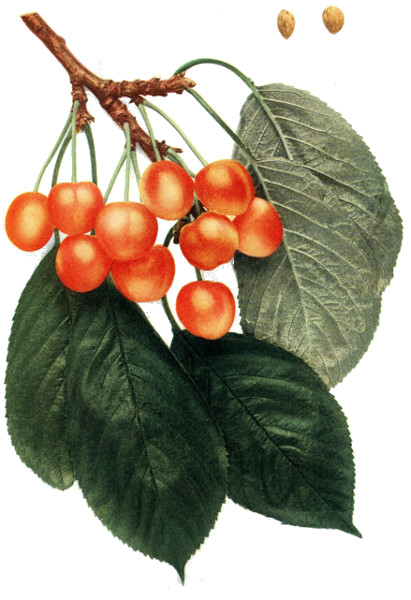
YELLOW SPANISH
Tree very large and vigorous, upright-spreading, rather open-topped, productive;
trunk thick, of medium smoothness; branches stocky, reddish-brown covered with ash-gray,
smooth except for the numerous large lenticels; branchlets short, brown nearly
overspread with ash-gray, smooth, with small, slightly raised, inconspicuous lenticels.
Leaves numerous five and one-half inches long, two and one-half inches wide, folded
upward, obovate to elliptical; upper surface dark green, nearly smooth, grooved along
the midrib; lower surface light green, lightly pubescent; apex acute, base variable in shape;
margin coarsely and doubly serrate, with small, dark glands; petiole one and three-fourths
inches long, thick, heavily tinged with dull red, grooved along the upper surface, with from
one to four large, reniform, reddish-yellow glands variable in position.
Buds conical, plump, free, arranged singly or in small clusters as lateral buds and
from short spurs; leaf-scars prominent; season of bloom intermediate; flowers white, one
and one-fourth inches across; borne in well-distributed clusters, in twos and in threes;
pedicels about one inch long, glabrous, green; calyx-tube greenish, obconic, glabrous; calyx-lobes
acute, reflexed; petals oval, entire, strongly dentate at the apex, tapering to short,
blunt claws; filaments three-eighths inch long; pistil glabrous, equal to the stamens in
length.
Fruit matures in mid-season; one inch or over in diameter, cordate, compressed;
cavity deep, wide, flaring; suture a mere line; apex roundish, not depressed; color bright
amber-yellow with a reddish blush, slightly mottled; dots numerous, small, light russet,
obscure; stem one and one-half inches long, adherent to the fruit; skin thin, tough, separating
from the pulp; flesh whitish, with colorless juice, tender, meaty, crisp, aromatic,
sprightly, sweet; very good to best in quality; stone free, ovate, slightly flattened, oblique,
with smooth surfaces; with two small, blunt ridges along the ventral suture near the apex.