In which Phillips descants on his route to Scandinavia from Berlin;
on the gastronomic delights of a Swedish railway restaurant; on
the lavish comfort and economy as well as the safety of travel
in Sweden; on the quiet charms of the scenery in southern
Sweden, as well as on the well-earned social position and independence
of the Swedish farmer.
Stockholm, January 1.
My dear Judicia,
You have brought this upon yourself, you know, for
it was your proposition that Aylmer and I should try
to make you feel the charm of Scandinavia as we have
felt it. But do not suppose that we are going to enter
upon a contest of wits in order to make our respective
countries shine upon the written page, or that we are
going to indulge in high-flown descriptions. We shall
try to tell you of things as we see them; of the peasant
in his low-thatched roof, who is as interesting as the
king in his palace. We may not even think it beneath
our dignity to tell you of the Smörgåsbörd, and of the
different kinds of cheese of many colors which grace
the breakfast table, for all these different, homely, commonplace
things enter into the spell of Scandinavia.
As you know, we started on this long northern journey
at Berlin. This trip has been robbed of all its terrors,
since keen competition has compelled the railway and
steamboat companies to exchange the little Dampfschiff,
little bigger than tugboats, which used to connect Germany
with Scandinavia, for great ferry steamers, which
take within their capacious maws whole railway trains,
so that now we can go to sleep in Berlin, in a very comfortable
sofwagn, and wake up the next morning on
Swedish soil, with no consciousness of the fact that in
the middle of the night we had a four hours’ voyage
across a bit of blue sea which is often as stormy as the
broad Atlantic itself.
You remember that I wrote you about a former
journey across this same bit of water during an equinoctial
gale, how our boat was tossed about like a cork,
how the port was stove in, and I was washed out of my
bunk. Well, last night I was reminded of that former
journey by contrast, for I never knew when we were
trundled aboard ship at Sassnitz, or when we were
trundled on to dry land again at Trelleborg. I was sorry
to cross the island of Rügen in the night, for this bit
of wind-swept, sea-washed land will always be associated
for us with “Elizabeth” and her adventures,
though to be sure her German garden was not on Rügen,
but on the mainland near by.
However, if I did not know when we passed from
Germany to Sweden, it was very evident that we were
in a different country when the window curtain was
raised in the morning, and the porter informed me
deferentially, in his musical Swedish voice, that “caffe
and Smörbröd” would be served in the compartment if
I wished. Everything is different here. This little four
hours’ voyage in the middle of the night seems to have
put a wide ocean between the experiences of to-day
and yesterday. The brick houses are exchanged for
wooden ones. The pine trees which abound in the sandy
wastes north of Berlin have been exchanged for graceful
white birches, sprinkled with spruce and fir. Instead
of the gutturals of the south we hear the open,
flowing vowels of the north. Even the signs with which
the railway stations are so abundantly plastered that
one has difficulty in finding their names, are different
from those in Germany, and our attention is called to
wholly different brands of beer, whisky, and margarine.
One thing you will rejoice in, I am sure, Judicia, and
that is, that I am assured by every responsible authority
that railway accidents are almost unknown in Sweden,
or at least that the risk is quite infinitesimal. It is
said that even in America, which has such an evil reputation
for railway smashups, you can travel by rail
on the average a distance one hundred and fifty-six
times around the world without getting a scratch. I
wonder how many thousands of times one would have
to travel twenty-five thousand miles in Sweden before
the train would run off the track or bump into another
train. One would think that the railway accident insurance
companies in Sweden would get very little
business.
I concluded not to accept the porter’s kind invitation
to “caffe and Smörbröd,” for I wanted to indulge at the
first opportunity in a genuine Swedish railway restaurant.
Think of anticipating with pleasure a railway
restaurant breakfast in America or England!
I waited for breakfast until we reached Alfvesta,
well on toward noon, and then made the most of the
twenty-five minutes generously allowed for refreshments.
“Can this be a railway restaurant?” a stranger
would say to himself. Here is a bountifully filled table
covered with all sorts of viands, fish, flesh, and fowl,
and good red herring besides. And around this tempting
table a number of gentlemen, hats and overcoats laid
aside, are wandering nonchalantly, as though they had
the whole day at their disposal; picking up here a ball
of golden butter and there a delicate morsel of cheese;
from another dish a sardine, or a slice of tongue or cold
roast beef, or possibly some appetizing salad. If you
would do in Sweden as the Swedes do and not declare
your foreign extraction, you, too, will wander around
this table in a most careless and casual way, and, when
you have heaped your plate with the fat of the land,
and spread a piece of crisp rye flatbread thick with
fresh and fragrant butter, when you have poured out
a cup of delicious coffee reduced to exactly the right
shade of amber by abundant cream, then you take your
spoil to a side table near by and try to feel as much at
leisure in eating it as your Swedish fellow passengers
appear to be.
But this is only the beginning. This is just to whet
the appetite for what is to come. I counted twenty-seven
different dishes on the Smörgåsbörd table from
which one might choose; or one might take something
from each of the twenty-seven if he so desired. Then
comes the real meal: fish and potatoes, meat and vegetables
of several different kinds, salad, puddings, and
cheese—and to all of these viands you help yourself.
No officious waiter hovers over you, impatient for your
order and eager to snatch away your plate before the
last mouthful is finished, an eagerness only equaled by
his rapacious desire for the expected tip. No, the
only official in the room is the modest young lady
who sits at a table in the far corner, and who seems
to take no notice of your coming and going. If you
get up a dozen times to help yourself from either end
of the table; if you pour out half a dozen cups of
coffee, or indulge in a quart of milk from the capacious
pitchers, it seems to be no concern of hers.
Her only duty is to sit behind the table and take
your money when you get through, and a very small
amount she takes at that.
If you have “put a knife to your throat,” and have
contented yourself with coffee and cakes, the charge
will be fifty öre, or thirteen and a half cents. If you have
helped yourself, however liberally, only from the cold
dishes, the Smörgåsbörd, the charge will be seventy-five
öre, or twenty cents, while even the most extravagant
meal, where everything hot and cold is sampled, would
be but two kronor, or a trifle over fifty cents.
I shall not tell you, Judicia, how much I paid for that
particular breakfast, for I know that your first remark
would be: “All that in twenty-five minutes, and you a
Fletcherite!”
What strikes the uninitiated traveler with wonder and
amaze on reaching Sweden is the lavishness of everything
and its cheapness. On this table in Alfvesta, for
instance, there were great mounds of butter nearly a
foot high, instead of the little minute dabs that we see
on most continental tables, with which you are supposed
to merely smear your bread. The big joints of beef,
the great legs of mutton, the bright silver pudding
dishes of capacious size, all seem to say to the tourist:
“Help yourself, and don’t be stingy.” But elegance is
not sacrificed to abundance. Everything is neat and
clean. The silver is polished to the last degree. The
glasses are crystal clear. You do not have to scrub
your plate with your napkin, as is the custom at some
continental hotels, and the cooking is as delicious as
the food is abundant.
Am I dwelling too long upon these merely temporal
and gastronomic features of Sweden? Do you remind
me that the charm of a country does not depend upon
what we shall eat or what we shall drink? I reply that
the first thing for a traveler, like an army, to consider,
is the base of supplies. What famous general was that
who made the immortal remark that every army
marched upon its stomach? Why is not that equally
true of a traveler?
But though the dinner table is one of the initial experiences
in Sweden, it does not often need to be described.
Ex uno disce omnes, and from this one meal
you may learn what to expect from Trelleborg on the
south to Riksgränsen, some twelve hundred miles
farther north, the Dan and Beersheba of Sweden. At
every stopping-place, large or small, which the railway
time-table kindly marks with a diminutive knife and
fork, to show that the needs of the inner man are here
met, you will find just such lavish, well-cooked, moderate-priced
refreshments. Indeed the favorite English
phrase, “cheap and nahsty”, has no equivalent in
Swedish, for there is no such thing known. Cheapness
does not imply poor quality or slatternly service.
You are reminded of this fact even before you leave
Berlin, for a sleeping-car berth which costs more than
twelve marks, something over three dollars on the south
side of Berlin, costs for a longer distance on the north
side, since most of the journey is to be in Sweden, less
than six marks, or not quite one half as much, while
the compartments are even more comfortable and better
fitted. Yes, dear Judicia, Scandinavia is the country
for you and me to travel in as well as for the very few
other Americans, who, according to European notions,
are not millionaires.
When I took my seat again after breakfast at Alfvesta,
in the comfortable second-class compartment, we were
soon flying, as rapidly as Swedish trains ever fly, which
is rarely more than thirty miles an hour, through the
heart of southern Sweden, and I had time to refresh my
memory concerning this great Scandinavian peninsula,
which, as some people think, hangs like a huge icicle
from the roof of the world. The icicle idea, however, is
entirely erroneous, so far at least as the southern part of
Sweden and Norway go. The average temperature is
about that of Washington, though it is cooler in summer;
and very often in the neighborhood of the west coast,
where the Gulf Stream, that mighty wizard of the Atlantic,
does its work, there is little snow or ice from one
year’s end to another.
This southern section of Sweden is called Gothland,
or, literally, the Land of the Gota or Goths, a name
which we always couple with the Vandals. Indeed, one
of the titles by which the King of Sweden is still addressed
at his coronation is “Lord of the Goths and
Vandals.” Truly these old Goths and Vandals were
the “scourge of God”, as Attila their leader was called,
when they sailed away in their great viking ships, carrying
their conquests as far as the Pillars of Hercules, and
founding colonies and kingdoms along all the shores of
Europe, and even across the Mediterranean, in Africa.
Scandinavia, when judged by its square miles, is certainly
no mean country. Sweden alone, which claims
a little more than half of the great peninsula, is as large
as France or Germany, and half as large again as all
Great Britain. If we should compare Sweden with some
of our own more familiar boundaries, we should see that
it is a little larger than California, and not unlike that
Golden State in its geographical outlines. We should
see also that it is about three times as large as all New
England, and more than three times as large as Illinois.
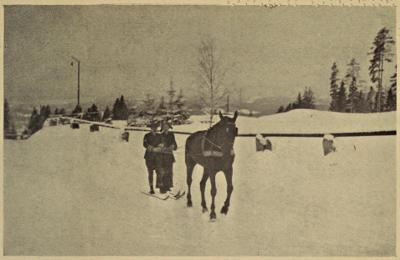
Skikjoring, a Highly Enjoyable Sport.
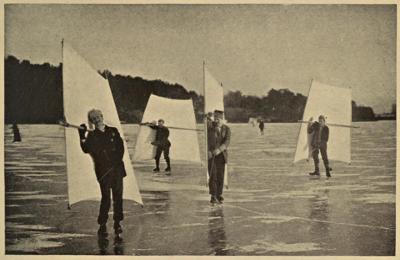
Skate Sailing, a Favorite Sport in Sweden.
Before I finish this journey I shall have a realizing
sense of Sweden’s long-drawn-out provinces, for it takes
nearly sixty hours of continuous railway travel to go
even as far north as the railway will carry us.
Gothland in the south, Svealand in the center, and
Norrland in the north are the three great divisions
of Sweden, the latter larger than the other two put
together.
From the car window I see many charming sights,
even in this wintry season. Indeed I am not sure that
Sweden is not quite as lovely in winter as in summer.
The red farmhouses, half buried in snow (for the winter
is more severe now that we are getting away from the
coast); the great stacks of hay that enable the patient
cows to chew the cud contentedly through the long
winter days; the splendid forests of white birch, the
most graceful tree that grows; the ice-locked lakes,
and the rushing streamlets that are making their way
to the Baltic—all these combine to give us a landscape
which is charming in the extreme.
I suppose that Aylmer will surfeit you with eloquent
descriptions of far-reaching fjords, mighty mountains,
and abysmal cañons when he comes to write about
his beloved Norway, but I am sure he will find nothing
more peacefully lovely and harmonious than the farmlands
of southern and central Sweden. These are the
lands, too, which raise not only grass and turnips and
sugar beets, but a grand crop of men and women, who
are the very backbone of the Swedish commonwealth.
More than eighty-five per cent of the land is owned and
farmed by its proprietors, and mostly small proprietors
at that. Absentee landlordism is little known. A
country whose people thus have their roots in the soil
has little fear from anarchists and revolutionists.
These peasant proprietors, as they are called, are by
no means the dense yokels with which we associate
the word “peasant” in many parts of Europe. The
peasants of Sweden are simply farmers, and not always
small farmers at that, for they sometimes own hundreds
of acres. They are farmers who enjoy the daily newspapers
and the monthly magazines, whose children all
go to school, and who can aspire to the university for
their sons and daughters, if they so elect. They are
farmers who hold the balance of power among the law-makers
of Sweden, and who always have a hundred or
more of their own number in the Riksdag, some of whom
are among the best orators and debaters in the Assembly.
They know that no important piece of legislation
to which they are opposed can ever be enacted in
Sweden, and they are as proud as the nobility itself of
their ancient history, and more tenacious of their ancient
privileges.
Honorable W. W. Thomas, for many years the American
Minister to Sweden and Norway, and who has
written entertainingly concerning the people of the
country, which he came to consider his adopted land,
tells a good story that illustrates the independence of
the Swedish peasant. It is worth quoting to you, as
the train rushes by hundreds of just such peasant
homes.
“Clad in homespun, and driving a rough farm wagon,
this peasant pulled up at a post station in the west of
Sweden. There were but two horses left in the stable,
and these he immediately ordered to be harnessed into
his wagon. Just as they were being hitched up, there
rattled into the courtyard in great style the grand
equipage of the Governor of the Province, with coachman
and footman in livery. Learning the state of affairs,
and wishing to avoid a long and weary delay, the coachman
ordered these two horses to be taken from the
peasant’s cart and harnessed into the Governor’s carriage,
but the peasant stoutly refused to allow this to be
done.
“‘What,’ said the Governor, ‘do you refuse to permit
those horses to be harnessed into my carriage?’
“‘Yes, I do,’ said the peasant.
“‘And do you know who I am,’ quoth the Governor,
somewhat in a rage; ‘I am the Governor of this Province;
a Knight of the Royal Order of the North Star,
and one of the chamberlains of his Majesty the King.’
“‘Oh ho,’ said the peasant, ‘and do you, sir, know
who I am?’
“He said this in such a bold and defiant manner that
the Governor was somewhat taken aback. He began
to think that the fellow might be some great personage
after all, some prince perhaps, traveling in disguise.
“‘No,’ said he in an irresolute voice, ‘I do not know
who you are. Who are you?’
“‘Well,’ replied the peasant, walking up to him and
looking him firmly in the eye, ‘I’ll tell you who I am—I
am the man that ordered those horses!’
“After this there was nothing more to be said. The
peasant quietly drove away on his journey, and the
Governor waited until such time as he could legally procure
fresh means of locomotion.”
As I said, I thought of this characteristic story of
peasant independence as my train sped by many a comfortable
farmhouse, whose occupants, I have no doubt,
would defy the authority of the governor, or of the king
himself, if he should attempt to trample upon their
rights.
But we are now drawing near to Sweden’s capital,
and perhaps you will think that this letter is quite
long enough for my first promised installment concerning
the charms of Sweden.
Faithfully yours,
Phillips.
In which Phillips lauds Stockholm as the most beautiful of European
cities; tells the tragic story of the royal palace; remarks
casually upon the superabundance of telephones, for which
Stockholm is famous; describes the Riksdag and the medieval
ceremony of opening Parliament, and comments briefly on the
relations of Church and State in Sweden.
Stockholm, January 3.
My dear Judicia,
When last I wrote you, if I remember rightly, I was
just approaching Stockholm, after the six-hundred-mile
journey from Berlin. It was quite dark, and for that I
was not sorry, for Stockholm is so brilliantly lighted that
it is almost as beautiful by night as by day. As we approached,
the many quays, from which scores of little
steamers are constantly darting to and fro, were all
picked out by globes of electric light. Old Stockholm,
climbing the hill to the left, looked like a constellation
of stars in the bright heavens, and the occasional glimpses
of broad streets which one gets as he approaches the
central station were flooded with the soft glow of the
incandescent burners. Nevertheless, beautiful as was
the night scene, I was quite impatient for the morning
light to reveal the glories of the most beautiful capital
of Europe, which I remembered so well, but was none
the less anxious to see again.
“The most beautiful capital in Europe!” did I hear
you say, Judicia, with a suspicion of skepticism in your
rising inflection? “Have you forgotten Paris, and Rome,
and Budapest, and Vienna? Are you not somewhat
carried away by your desire to make out a good case for
Sweden?” No, I cannot plead guilty to any of these
charges, which I am sure are lurking in your mind, for
ever since my first visit, years ago, I have considered
Stockholm, for beauty of situation, for freshness and
vigor, and (though this might be disputed) a certain
originality of architecture, not only in the first rank of
cities, but the first in the first rank. To be sure, it is not
as large as many another city, but bigness is not beauty.
It has not the picture galleries of Florence, or the antiquities
of London, or the palaces of Paris, but it has
charms all its own, which, in my opinion, weave about
it a spell which no other city possesses.
The morning light did not dissipate the impressions
of the evening before, nor the happy memories of the
past, for I found that Stockholm had improved in its
architecture since my last visit, though its glorious situation
can never be improved.
Through half a dozen different channels the waters of
the great lake Mälar rush to join the Baltic, for, though
the lake is only eighteen inches above the sea, so great
is the volume of water that it is always pressing through
the narrow channels in swirls and eddies, and it dances
forward with an eager joy that gives one a sense of
marvelous life and abounding vigor and seems to impart
its character to the whole city. Around the
city on one side are the stern, fir-clad promontories,
the great lake and the black forests to the west, and
one can seem to step from the heart of nature’s
wilds into the heart of the most advanced civilization.
Out toward the Baltic on the east is an archipelago
forty miles in length, dotted with islands and headlands,
smiling and peaceful in summer, ice-bound and storm-lashed
in the winter, but equally beautiful in January
or June.
The first building that strikes the eye is naturally the
royal palace, which, I must say, to republican eyes, looks
square and somber and lacking in ornamentation, but
which connoisseurs in palaces say is one of the most
beautiful in Europe.
Do you remember my writing you some years ago
about my interview with good King Oscar in this old
palace? After waiting in the public reception room for a
little while I was announced by the lord chamberlain
and stepped into a little room leading off the large reception
hall, and there, all alone, stood a very tall and
very handsome man in a light blue military uniform,
with two or three jeweled decorations on his breast.
This was Oscar II, by the grace of God, King of Sweden
and Norway, of the Goths and Vandals. He bowed and
smiled with a most winning and gracious expression,
and, coming forward, took me by the hand and led me
to a seat on one side of a small table, on the other side
of which he seated himself. I do not think it was the
glamour of royalty that dazzled my eyes when I wrote
of his winning smile. Many others have spoken of his
charm of manner, and he was noted as being the most
courtly, affable, and gracious monarch that sat upon
any throne of Europe.
But alas, the good king has died since my last visit
to Stockholm, his later years being embittered by the
partition of his kingdom, when Norway decided to set
up a king of her own. But though kings may come and
kings may go, the grim old palace which has harbored
all the rulers of Sweden for eight hundred years still
stands on the banks of the tumultuous Mälar.
When the palace was rebuilt, or restored, some two
hundred and twenty years ago, it was the scene of a most
tragic event. In 1692 Charles XI decided that it was
time to remodel the old home of the Swedish kings,
which had already stood upon that spot for six centuries.
He commanded Tessin, a great architect, who has left
his impress upon Stockholm and all Sweden, to rebuild
the palace. Accordingly the architect traveled in Italy
and France and England to make a study of the best
palaces he could find. When his plans were completed,
he showed them to Louis XIV of France, who was so
much pleased with them that he commanded his ambassador
to Sweden to congratulate Charles XI “on
this beautiful edifice he was proposing to erect.”
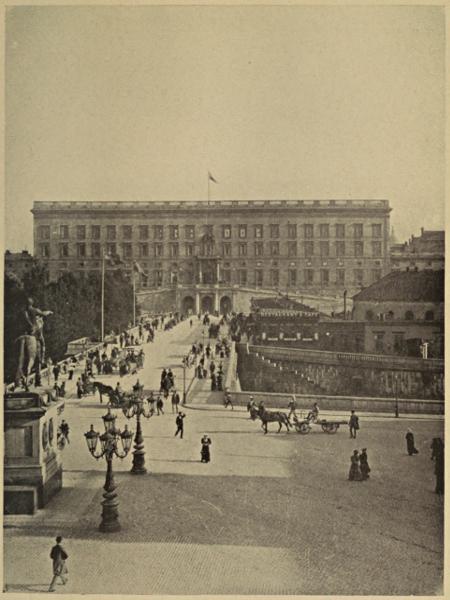
Copyright by Underwood & Underwood, N. Y.
The Royal Palace, Stockholm.
But Charles XI never lived to see the plans carried
out. He died after the work had been well begun, and
when the scaffoldings surrounded the palace on every
side. The work of reconstruction was of course interrupted
while the king’s body was lying in state, but just
before the funeral procession moved out of the palace a
fire broke out, and the whole edifice was destroyed, save
the great walls, which are standing to this day. With
extreme difficulty the king’s body was saved and carried
into the royal stables, where his grandson, a lad fifteen
years of age, who was destined to become Charles XII,
one of the most famous kings of Sweden, had taken
refuge.
A picture in the National Museum makes the scene
live over again: the old queen, frightened by the double
catastrophe; the boy king, helping his frightened grandmother
down the steps, while the tongues of fire leap
out at them from behind; the courtiers in hot haste carrying
the coffin of the old king, while the little princesses
look on with childish interest, scarcely realizing the
gravity of the situation.
Again the great architect had to go to work on his
task, so sadly interrupted. For thirty years it was pursued,
during the days of Sweden’s greatest poverty, and
only in 1754, nearly sixty years after Tessin began his
work of rebuilding, was it completed, and nearly thirty
years after the death of the master builder.
The palace has at least the merit of commodiousness,
for we are told that “when King Oscar celebrated his
Jubilee in 1897, all his guests, including more than twenty
princes and half as many princesses, belonging to all the
thrones of Europe, were lodged there with their numerous
suites.”
But your republican soul, Judicia, will be more interested
in some of the other buildings of Stockholm, perhaps
even in the hideous excrescence which towers up
above the roofs of the houses, and which shows us where
the telephone exchange is situated, to which ten thousand
wires, more or less (I did not count them), converge. I
should think, however, that it would require at least
ten thousand wires to satisfy the rapacious demands of
the Stockholmers for telephone service. Every hotel
room, even in the modest hostelries, has one, and most
of them have two telephones, a city telephone and a
long-distance one.
In every little park and open space are two telephone
booths, for long and short distances. Stockholm, with a
population about the twentieth part of greater London,
has nearly twice as many telephones as the British
metropolis, and the service is always prompt, cheap,
and obliging.
Then there is the great Lift, a conspicuous feature of
Old Stockholm, which hoists passengers in a jiffy from
the level of the Baltic to the heights of the old town.
That, too, would interest you, Judicia, for I remember
your strenuous objections to hill-climbing.
To turn from structures, useful but hideous, to one
more beautiful, and, shall I say, less useful? there is the
Riksdag, a modern building of very handsome and generous
proportions, where the law-makers of Sweden assemble,
and where, I suppose, rival parties fire hot
shot at one another as freely as they do in Washington
or London. Every year the Swedish parliament meets
in the middle of January and closes its sessions on the
fifteenth of May, and this is the one place which the
king may not enter, as one of the guardians of the Riksdag
proudly informed me. Both houses of Parliament
go to him, but he may not return to them. At the opening
of Parliament, the legislators assemble in the palace,
where the king addresses them, and the medieval ceremony
connected with this function is worth telling you
about.
After prayers and a special sermon in the cathedral
relating to the duties of legislation (a religious custom
that reminds us of the old Election Day Sermon of the
good State of Massachusetts, a custom now unhappily
abolished), the members of the upper and lower houses
march into a great hall in the palace, the speakers of the
two houses leading the way, and take their seats on
either side of the throne. This throne is of solid silver,
on a raised platform, and on either side of it are seats
for the princes and members of the royal family. The
queen and princesses sit in the gallery, surrounded by
members of the court. “All sorts and conditions of
men are represented—bishops and country clergymen,
provincial governors and landed noblemen, freehold
peasants, rural schoolmasters, university dons, and industrial
kings.”
We are reminded of the past history of Sweden by the
uniforms of the military guards, some of whom are in
the costume of Charles XII, and others in that of Gustavus
III. The courtiers are arrayed in gorgeous uniforms,
and their breasts blaze with their many decorations.
After the guard and the gentlemen-in-waiting
come the princes, in the march to the throne room, and
last of all the king himself. He seats himself upon the
throne and commences his address, which always begins
with the words, “Good Sirs and Swedish Men” and
ends with his assurance of good will to all.
The presidents of the two houses respond to the speech
of the king. The heads of the departments read their
reports and present their budgets. Then, the stately
ceremony being over, the gorgeous procession files out
in the same order in which it came in, and the two
houses proceed to the Parliament Building to begin the
work of the new session.
If the fad that prevailed among our novelists a few
years ago in finding titles for their stories should ever
reach Sweden, I am sure that there would be a novel
called “The Man from Dalecarlia,” for he is certainly
the most picturesque figure in the Riksdag. In the midst
of the sober, black coats and white shirt fronts and patent-leather
shoes and top hats, he stands out like a
very bird of paradise in his navy blue coat, trimmed with
red piping, bright red waistcoat, knee breeches tied with
heavy tassels, and bright shoe-buckles. He might have
stepped into the Riksdag out of the century before last.
But I am glad he has not discarded his national costume,
and, whenever I see a Dalecarlian girl on the street in
her bright striped apron and piquant cap (and these
girls often seek service in Stockholm), I am again grateful
for the bit of color which they bring into the gray,
wintry streets.
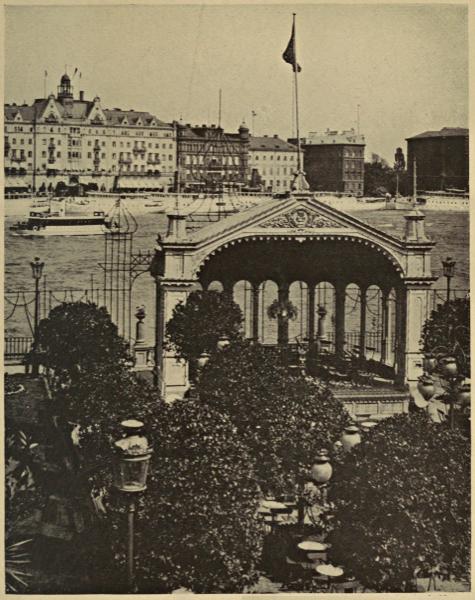
Copyright by Underwood & Underwood, N. Y.
Tea House on Banks of Mälar. In the distance, the Grand
Hotel, Stockholm.
Most of the Swedes are decidedly conventional in
their costume in these days, and you see more shiny
beavers and Prince Albert coats than you would in the
streets of London, though it cannot be said that Swedes
despise brilliant uniforms on state occasions. At such
times the diplomatic representatives of the United States
look like crows in a flock of peacocks.
While I am writing you about the government and
the court, let me tell you a few words about the church,
for Church and State are very closely connected in
Sweden. To be sure, there are many free churches—Independent
(or Congregational), Baptist, and Methodist—but
the prevailing religion, to which I suppose
three fourths of the people in the country adhere, is the
State Lutheran Church. There are some exceedingly
fine churches in Stockholm, though, considering the size
of the city, it strikes a visitor that there are surprisingly
few. Some of the parishes are very large, and contain
twenty or thirty thousand nominal adherents. The
Church of the Knights is perhaps the most interesting
one, where many of the kings of Sweden, even down to
our own time, are buried.
The parish priest is appointed by the king, or consistory,
at least nominally, and is paid out of the taxes.
Yet there is a good degree of self-government in the
churches, for the parish elects the boards of administration
of church affairs, and even votes on ministerial candidates.
Each candidate has to preach a trial sermon
before the congregation, while the king, if it is a royal
benefice, as many of the churches are, appoints one of
the three candidates who receive the highest number of
votes, usually appointing the one who is the candidate
of the majority.
It must be even a more trying thing to “candidate”
in Sweden than in America, for here it is frankly admitted
that the preacher and his sermon are on trial, and there
is no polite fiction about an exchange with a brother
minister, with a suggestion that the health of the candidate’s
wife requires a change of parishes.
I had it in mind, Judicia, to tell you in this letter
about certain things less lofty than affairs of Church and
State, but must reserve the story for another epistle.
Faithfully yours,
Phillips.
In which Phillips suggests that Stockholm should be called the
“Automatic City”; describes the queer statistical animals,
called “unified cattle”; extracts some interesting facts from the
census; does not consider the stores or the bathtubs beneath
his notice; treats of the effective temperance legislation of
Sweden, and tells why a fire is so rare an excitement in
Stockholm.
Stockholm, January 7.
My dear Judicia,
You know how our American cities often strain themselves
to find an appropriate name or nickname by which
they shall be known among their sister municipalities.
Stockholm is certainly the “Queen City of the North,”
and is deserving of any other high-flown title you have
a mind to give her. But if we descend to more prosaic
designations, we might well call it the “Automatic City.”
Nowhere in the world can you drop a penny in the slot
and get so much back for it as you can in Stockholm.
The automobile, which abounds everywhere, is an
automatic machine which registers in its taximeter the
distance run, and thus avoids all disputes with the chauffeur.
The telephones, whose little green pagodas dot
the city in every direction, are also penny-in-the-slot
affairs, and you can talk, as I think I have already told
you, with any town on the map of Scandinavia for a
very reasonable sum.
But when it comes time for frokost (breakfast), or
middag (dinner), then the automat is very much in evidence.
It seems at first to the traveler that the keeping
of automat restaurants is the chief business in Stockholm,
for we find one at almost every corner. Drop a
ten öre piece in the slot, and, according to your choice
of viands, a glass of milk, a cup of tea or coffee, a cheese
sandwich, a sausage, or a boiled egg drops out of the
spout. Or, if you wish a more extravagant meal, twenty-five
öre (about seven cents) will give you your choice of
a dozen hot dishes. One writer with a sense of humor
speaks of such establishments as I have described as
the “rich man’s automat,” but he is not far from wrong
when you compare this establishment with the little
wooden buildings which you see in the market squares
and along the docks of Stockholm, for this is the automat
reduced to its lowest terms for cheapness and simplicity.
There is no apparent opening in this wooden
box, but a shelf runs around it, and large cups are
chained to it, with a tap in the wall at every few feet.
Inside is a tank of hot milk. The marketmen drop a
five öre piece (a trifle over a cent) into the slot, and out
runs nearly a pint of rich, hot milk. No wonder that
there are enough cattle to give every man, woman, and
child in Sweden on the average one milch cow, or else
the “poor man’s automat” could never be maintained
at any such figures.
The process of arithmetic, however, by which this
milch cow is allotted to every man, woman, and child, is
interesting and peculiar, since for the purpose of comparative
statistics the Swedish Bureau has invented
fictitious animals called “unified cattle.” This is explained
by Mr. Sundbarg in his Swedish Land and Folk
as follows: The milch cow is the unit, and all other animals
the multiples. For instance, a horse is equal to a
cow and a third; a sheep is reckoned as a tenth of a
cow; a goat as only a twelfth of a cow, while it takes
four pigs to make a cow. I cannot for the life of me see
why a pig should be worth two and a half sheep; can you?
A reindeer is only worth a fifth of a cow, which seems to
me altogether too small a value to put upon these indispensable
animals of snowland.
Well, the result is that in the last census which is
available to me Sweden possessed something over five
millions of these composite animals called “unified
cattle,” and, as I before told you, every mother’s son and
daughter in Sweden, on the average, possesses one milch
cow, or it may be three quarters of a horse, ten sheep,
twelve goats, four pigs, or five and a half reindeer. If I
were a Swede I think I would choose to have my share
in reindeer.
While we are dealing with statistics, Judicia, let us
have it out and squeeze the census dry of interesting
facts and be done with it. How many wealthy persons
do you suppose there are among the five and a half millions
of Swedes who have not yet crossed the Atlantic
to seek a home in the New World? Well, if at your
leisure you can find out what 13.75 per cent of five and a
half millions is you will know exactly the number of
people that can be called “wealthy.” It would not be
far from seven hundred thousand. Then in “easy” circumstances
we find sixty-seven per cent of the people,
or about three and a half millions. In “straightened”
circumstances there are rather more than could be called
wealthy, while we find that there are only about three
per cent of the people who are in genuine poverty and
have to receive help from the State or from their richer
neighbors.
I think these statistics speak exceedingly well, for the
Swedes. Agur’s prayer, “Give me neither poverty nor
riches; feed me with food convenient for me,” seems to
have been answered for them. Even those in wealthy
circumstances are not so enormously rich that they are
in danger of losing heaven by such a burden of wealth
as would prevent the camel from passing through the eye
of the needle.
Since I have told you how many cows, how many
fractions of a pig or of a reindeer every Swede possesses,
you may also be glad to know that if all the land were
divided up evenly every old grandam and every baby
in the cradle would have twenty and a half acres. Only
two and a quarter acres of these are under cultivation,
but he would have nearly ten acres of woodland, which
would surely furnish him with enough fuel, while his
seven and a half acres of uncultivated land would furnish
plenty of pasturage for his cow, or his three-quarters
of a horse.
Speaking of fuel, I must launch into a mild eulogy of
these Swedish stoves. Even Aylmer will admit that
they are better than the air-tight, iron monstrosities
which they have in Norway, and in America too, for
that matter, where “central heating” has not replaced
them. These Swedish stoves are much like the German
porcelain heaters, only they are built on a more generous
scale. They occupy a whole corner of the room, and often
extend from floor to ceiling. Usually they are of white
porcelain, though often other colored tiles are used,
and sometimes they are highly ornamented with cupids
or dragons, or like allegorical animals.
In the morning, quite early, the pretty chambermaid
makes a fire of short birch sticks, filling the firebox up to
the top. Then the drafts must be left open until all the
gases and smoke have escaped, which have such a tortuous
course to travel through the many pipes concealed within
the porcelain that gradually they heat the great white
monument through and through. When the birch is
reduced to living coals, the dampers are shut off; the
heat is thus retained, and a genial warmth is given out
for the rest of the day. Even at night the tilings of the
stove are quite warm, and you seldom want more than
one “heating” in the course of the twenty-four hours,
except in the most extreme weather.
After this little excursion into stoveland, let me return
for a moment to our fascinating statistics. It is
said that the Swedes are the longest-lived people in the
world, and within a hundred years they have reduced
the death rate nearly one half. I wonder if this low
death rate is not due in part to their cleanly habits. I
suppose the fresh, northern mountain air, crisp and
frosty in the winter, and the out-of-door life which a
people largely agricultural live has much to do with it,
but I am also inclined to think that their love of the
prosaic bathtub is partly responsible, for I suppose that
the Scandinavians, with the exception of the Japanese,
and perhaps the Finns, are the cleanliest people in the
world.
I have seen a funny picture which represents a school
bath. It is a photograph, too. Here is a big school
bathroom with a dozen tubs shaped like washtubs setting
on the floor, each one occupied by a sturdy little
youngster of some ten summers. Each one is industriously
scrubbing the back of his next neighbor, while
he is immersed up to his middle in the warm water.
Over each boy’s head is a shower bath, and if friendly
competition does not make the back of each of those
boys immaculate I do not know how cleanliness can be
achieved.
However much the school tub may have to do with the
longevity of the Swede, I know that the blue ribboners
would ascribe the increasing span of his years to the
temperance law which the last parliamentary half-century
has seen enacted and enforced. Sweden once had
the sad reputation of being the most drunken country in
Europe, and no wonder, for in 1775 Gustavus III made
liquor selling and liquor making a State monopoly, and
much revenue was derived from intoxicating fluids.
The heaviest drinker was the greatest benefactor of the
State, for he was thus adding with every dram to the
public revenues. Tea and coffee were shut out of the
country by the laws, lest some poor toper should prefer
them. Beer even was unknown, and wine was rare and
costly.
Who do you think was the first man to protest against
this wholesale drunkard making? It was no other than
Linnæus, the gentle botanist, to whom the world is indebted
for naming more plants than Adam ever named.
He tried to convince the people of the awful effects of
alcoholism upon the national life. After about a decade
and a half the government became ashamed of itself and
abolished its monopoly. But then things went from bad
to worse, for the making and selling of liquor became
absolutely free. Everybody who had a little grain
made it into whisky. Every large farm had its distillery,
and to make drunkards became, not the business
of the State, but of everybody who wished to
make money.
Thus things went on for some forty years, when the
Neal Dow, or more properly the Father Matthew of
Sweden, came to the front. This was Canon Wieselgren,
who in 1830 began to write and lecture against this awful
national evil, and at last, aided by famous men of science,
who made exhaustive studies of alcoholism, he
brought about a complete and blessed reform in the
liquor laws. The tax on whisky was raised so high that
private individuals could neither make nor sell it. Local
option was allowed, and many communities forbade
altogether the sale of liquor. At last the famous Gothenburg
system was adopted, and “the monopoly of the
manufacture and sale of spirits was given to a company
which is allowed to make only a fair rate of interest out
of the capital employed, and must hand over the surplus
to the community, to be used in the support of
such institutions as may tend to diminish the consumption
of liquor and combat drunkenness.” The company
is guaranteed five per cent on its capital should the sale
fall below a certain minimum. This system has the
great advantage that it precludes all desire on the
part of the company and its retail sellers to increase the
sale of drink, as the interest on the capital employed is
secured and is not liable to be increased by a larger
output.
There are various other regulations which are of interest
to all in our country, since the liquor problem is
always a burning question. The retail seller must provide
food as well as drink, and is not allowed to sell
liquor without food, and then only in a small glass to
each customer. Youths under eighteen years of age
cannot buy, and the retail shops must close at six
o’clock. The profits that are made by the company
must be used in providing rooms, free libraries, lectures,
sports, and games, and it is said that the visitors to
the seven reading rooms thus provided in Gothenburg
reach half a million every year. Now Sweden and
Norway are the most temperate countries in Europe.
A drunken man is a rara avis. Crime has diminished
in like proportion, as is to be expected.
Let me tell you of one more Swedish phenomenon before
I close this letter. During all this visit to Stockholm,
and in my previous visits as well, I have never
seen a fire engine go tearing through the streets, though
one could hardly live for a day in Boston or New York
without such an excitement. And yet they have fire
engines and horses ready harnessed day and night in
Stockholm, and men sleeping in their boots ready to
drop down through a hole in the floor on to their seat
on the fire engine at any moment. One would think
that the men would get tired of waiting for an event that
so seldom happens, and that the horses would die for
lack of exercise, as they undoubtedly would if they had
to wait for a fire to give them a good run.
Do you want to know, Judicia, why the excitement of a
fire is so rare in Stockholm? I will tell you, as my friend,
Mr. Thomas, the ex-Minister to Sweden, has told me.
“Once a year, if you live here, two gentlemen will call
on you with book and pencil in hand and carefully examine
every stove in your rooms. They also examine
all the flues and chimneys. They are officers of the municipality,
and the patriarchal government of Stockholm
wishes to see that there is no danger of your burning
yourself up.”
If they find that your chimneys are foul, a little boy
with a sooty face, with white teeth and eyeballs shining
through the grime, will wait on you. He will have a rope
wound around his neck, with an iron hook on the end,
and you must let him go down your chimney and clean
out all the soot and cinders. You must also comply
with twelve regulations when you build your house,
which relate to the material for the walls and the roof,
the construction of the cellar, etc., and the house must
not be more than sixty-eight feet high. If you think
these regulations are too severe, they will at least reduce
the size of your insurance bill, for $1.25 will insure
your house for $2500 for a year; that is, the premium is
a twentieth of one per cent—less than a quarter part
of what it would be in America. For $17.50 you may
insure your house forever for $1000. If it stands for two
hundred years you will never have to pay another cent;
so you see there are some advantages, even if there are
some annoyances, in a paternal government.
I know your aversion to statistics, my dear Judicia,
and in spite of their proverbial dullness it does seem
to me rather necessary for one who would feel the
deepest charm of Sweden to know something about the
characteristics of the Swedes and their comparative
standing in matters material and moral with the other
nations of Europe. But since, in an early letter, these
matters have been disposed of, I can promise you in my
next something to which your romantic soul will respond
more generously.
Faithfully yours,
Phillips.
Wherein Phillips tells of the many beautiful excursions from
Stockholm, and soon takes Judicia into the heart of Dalecarlia,
noted for the fertility of its soil and the bright costumes of its
maidens. He also rehearses the romantic story of Gustavus
Vasa, involving the treacherous cruelty of Christian II and the
many hairbreadth escapes of Gustavus, until he roused the
Swedes to fight for and win their freedom.
Mora, Dalecarlia, January 10.
My Dear Judicia,
I told you in a former letter, did I not, about the pretty
maidens from Dalecarlia whom one often meets in their
bright costumes on the streets of Stockholm, as well as
the “Member from Dalecarlia,” who relieves the solemn
monotony of the Riksdag with his ancient provincial
costume. Attracted by these brilliant birds of passage,
I am going to take you to-day to the very heart of Dalecarlia,
where they live, for it is the most interesting
province in all Sweden.
Stockholm has the distinct advantage, not only of
being a most interesting city in itself, but of being a
center from which you can easily make excursions to
any part of Scandinavia, east or west, or north or south;
and, believe me, in whichever direction you start you
will have no regrets that you did not take some other
excursion, for each one has its own peculiar fascination.
A story is told of a young English couple who came
to Stockholm for their honeymoon. They thought a
week would be sufficient to exhaust the attractions of
the city and its environs. Without guide or guide book
they started out one morning, taking one of the little
steamers, not knowing or caring whither they went or
where they would bring up. So delighted were they with
this trip that the next day they took another, and the
next still another, and so on every day for three months
they made a different excursion over the waterways of
Sweden, coming back to Stockholm every night; and even
then they had not exhausted the possible trips. Indeed
there are more than two hundred of these little steamers
that ply through the canals and the lakes, and along the
Baltic coast. One of the delights of Sweden is its infinite
variety.
If it were summer time we would take one of these
little steamers along the coast directly north to Gafle;
but at this time of year it is more convenient to take the
comfortable train, which in a few hours will land us in
the very heart of Dalecarlia, or Dalarne, as the Swedes
usually call it.
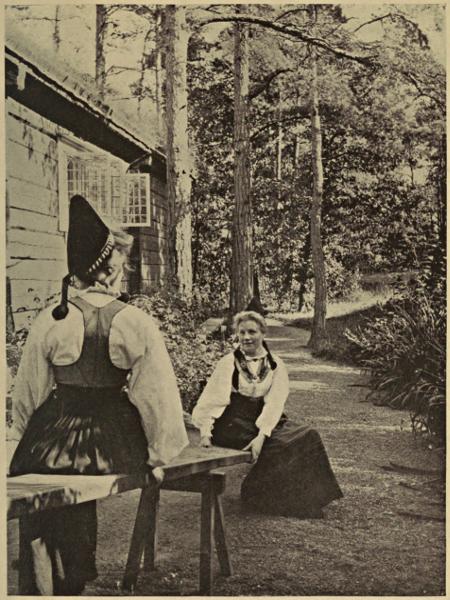
Copyright by Underwood & Underwood, N. Y.
Some Girls of Dalecarlia.
The province has many attractions. Smiling valleys,
which one can see even under their blanket of snow must
be abundantly productive, are frequently crossed by
strong rivers rushing to the Baltic. The Dal especially
is a splendid stream, while Lake Siljan, a great sheet of
water in the very heart of the province, with peaceful
shores sloping gently back from its blue waters on every
side, adds the last touch to the sylvan scene. I am writing
of it as it is in summer, but I am always in doubt
whether these Swedish landscapes are more beautiful in
white or green.
The quaint costumes of the Dalecarlians, as you can
imagine, add immensely to the interest of the country.
It is the only province of Sweden, so far as I know, that
retains its ancient dress and glories in it. In some parts
each parish has its own peculiar costume, and, as is
natural and appropriate, the ladies are far brighter in
plumage than the men.
As you know, I am not good at describing a lady’s
dress. How often have you upbraided me for not being
able to tell you what the bride wore? Let me then
borrow the description of a connoisseur in these matters:
“Bright bits of color were the maidens we met along
the road. The skirts of their dresses were of some dark-blue
stuff, except in front. Here, from the waist down,
for the space that would be covered by an ample apron,
the dress was white, black, yellow, red, and green, in
transverse bars about two inches wide. Each bar was
divided throughout its entire length by a narrow rib or
backbone of red, and these gaudy stripes repeated
themselves down to the feet. The waist of these dresses
was very low, not much more than a broad belt, and
above this swelled out their white chemise, covering the
bust and arms, and surmounted with a narrow lace
collar around the neck. Outside the collar was a gaudy
kerchief, caught together on the breast by a round silver
brooch with three pendants. On their heads was a
black helmet of thick cloth, with a narrow red rib in the
seams. The helmet rose to a point on top, and came
low down in the neck behind, where depended two black
bands ending in red, woolly globes that played about
their shoulders. Under the helmet might be seen the
edge of a white kerchief bound about their brows, and
beneath the kerchief escaped floods of golden ringlets
that waved above bright blue eyes and adown brown,
ruddy cheeks. In cold weather the maids and the
matrons also wear a short jacket of snowy sheepskin
with the wool inside.”
But the greatest charm to me about Dalecarlia is not
in the lovely pastoral scenery, or even in the bright
costumes and brighter faces of its maidens, but in its
noble, soul-stirring history, for here is where Sweden’s
Independence Day dawned, and to the devout Swede
every foot of the province is sacred soil.
To get fully into this tonicky, patriotic atmosphere we
must go around the great lake to Mora, on its northwestern
shore. Then we will walk a mile out into the
country, for you will not mind a little walk through the
snow on a beautiful crisp morning like this, until we
come to a square, stone building, which is peculiar in
having a large door but no windows. The custodian,
who lives near by, unlocks the massive door, and we
find on entering that what we have come to see is all
underground.
Opening a trapdoor in the center of the building,
our guide precedes us down half a dozen steps until we
stand on the floor of a small cellar, less than ten feet
square and perhaps seven feet high. Here was enacted
the homely scene which was the turning point in
Sweden’s history. The cackling geese that saved Rome,
the spider that inspired Bruce to another heroic effort
for Scotland’s freedom, were not more necessary to the
story of these nations than was Margit, wife of Tomte
Matts Larsson, who placed a big tubful of Christmas
beer which she had been brewing over this trapdoor so
that the bloodthirsty Danes, who were eagerly searching
for Gustavus Vasa, never suspected that he was
hidden in the cellar beneath.
But in order to understand the full significance of this
rude cellar and the importance to the history of Sweden
of Margit’s ready wit, we must go back to Stockholm
in imagination and transport ourselves by the same
ready means of conveyance back nearly four hundred
years to the later months of 1520, when Christian II of
Denmark, who was a Christian only in name, was crowned
king of Sweden in the Church of St. Nikolaus at Stockholm.
Christian had been provoked by the opposition of
the leading Swedes to the union of their country with
Denmark and with their attempt to set up a king of
their own. At last he determined to crush out all opposition,
and with a great army he ravaged the country,
conquered the provinces one after the other, and, as we
have seen, was at last crowned king in Stockholm.
He appeared to be on especially good terms with the
nobles of the country that he had conquered, and invited
them all, together with the chief men of Stockholm
and the most distinguished ecclesiastics of the
country, to the great festivities connected with his coronation.
Suddenly, and mightily to their amazement,
they all found themselves arrested and thrown into
various dungeons on the charge of treason to the king.
The city was put in a state of siege. The muzzles of
big guns threatened the people at every street corner.
But the prisoners were not kept long in suspense.
Soon the gates of the palace, in whose dungeons
they were confined, were flung open and, surrounded
by soldiers and assassins, they were marched to a central
square.
First Bishop Matthias was brought forth. “As he
knelt with hands pressed together and uplifted as in
prayer, his own brother and his chancellor sprang forward
to take a last farewell. But at that very moment
the headsman swung his broadsword. The bishop’s head
fell and rolled on the ground toward his friends, while
his blood spurted from the headless trunk.”
One by one the other victims followed—twelve senators,
three mayors, and fourteen of the councilors of
Stockholm—until, before the sun set on that black
Thursday, November 8, 1520, eighty-two of Sweden’s
best and noblest men had paid the penalty of their love of
freedom and their hatred of tyranny. This was but the
beginning. Other outrages followed. The noble ladies
of Sweden were carried off to Copenhagen and there
thrown into dungeons. This massacre is called in history
“Stockholm’s Blood Bath.”
The unchristian Christian by this massacre seems to
have merely whetted his appetite for blood, for on his
return to Denmark the next month he glutted his insane
desire for the lives of his best people by many another
murder.
A touching story is told of such a scene in Jönköping.
He beheaded Lindorn Rabbing and his two little boys,
eight and six years of age. The elder son was first decapitated.
“When the younger saw the flowing blood
which dyed his brother’s clothes, he said to the headsman,
‘Dear Man, don’t let my shirt get all bloody like
brother’s, for mother will whip me if you do.’ The childish
prattle touched the heart of even the grim headsman.
Flinging away his sword, he cried: ‘Sooner shall my own
shirt be stained with blood than I make bloody yours,
my boy.’ But the barbarous king beckoned to a more
hardened butcher, who first cut off the head of the lad,
and then that of the executioner who had shown mercy.”
Do you wonder, Judicia, that the hearts of the Swedes
were mad with grief and anger? Yet they seemed
utterly cowed, stunned, so terrible were their disasters,
and it appeared impossible that help should arise from
any quarter.
But Sweden’s darkest day was just before its dawn,
and the one who was to accomplish her deliverance from
tyrants forever was a young man four and twenty years
of age. His father, Erik Johansson, was one of the noblemen
whose blood reddened the streets of Stockholm on
that awful November day, while his mother and sisters
were carried off to languish in the dungeons of Copenhagen.
Just as the ax was about to strike its fatal blow,
a messenger came in hot haste from the king offering
pardon to Erik Johansson, but he would not accept it
from such a monster, and he cried out: “My comrades
are honorable gentlemen. I will, in God’s name, die the
death with them.”
His son, Gustavus, had also been summoned to Stockholm
by the king; but he suspected mischief, for he had
already been a wanderer for two years in the wilds of
Sweden to escape Christian’s wrath, so he did not obey
the order. When he heard of the massacre, he at once
fled from his hiding-place on the banks of Lake Mälar and
sought refuge in Dalecarlia. Here he adopted the costume
of the country as a disguise. He put on a homespun
suit of clothes. He cut his hair squarely around
his ears, and with a round hat, and an ax over his
shoulder he started out to arouse the Swedish people
to make one more last stand for liberty.
Here in beautiful Dalecarlia he had innumerable
adventures. I should have to write a volume if I attempted
to tell them all. On one occasion he was let
down from a second-story window of a farmhouse by a
long towel held by Barbro Stigsdotter, a noble Swedish
woman whose husband had taken the side of the king.
She deserves a place beside our own Barbara Frietchie,
and I wish I were another Whittier to immortalize her.
When her dastardly husband returned with twenty
Danish soldiers to arrest the young nobleman, Gustavus
was nowhere to be found, and we are told that
Arendt Persson never forgave his wife this deed.
Another good story is told about Gustavus at Isala
not far away. Here the hunted fugitive was warming
himself in the little hut of Sven Elfsson, while Sven’s
wife was baking bread. Just at this unlucky moment
the Danish spies who were searching for him broke into
the hut. But with rare presence of mind and noble
patriotism, with which Swedish women seem to have
been preëminently endowed, she struck him smartly
on the shoulder with the long wooden shovel with which
she was accustomed to pull her loaves out of the oven,
at the same time shouting in a peremptory voice: “What
are you standing here and gaping at? Have you never
seen folks before? Out with you into the barn!”
The Danish soldiers could not believe that a peasant
woman would treat a scion of the nobility like that, and
concluded that after all he was not the man they were
looking for. Sven himself seems to have been as patriotic
as his wife, for when the soldiers had retired for a
little he covered Gustavus up deep in a load of straw
and drove him out farther into the forest. But the
suspicious soldiers could not be so easily put off their
scent, and, suspecting that there might be somebody
or something of importance under the straw, they stuck
their spears into it over and over again. At last, satisfied
that there was nothing there, they rode on.
But soon drops of blood began to trickle through the
straw upon the white snow, and in order to allay the
suspicions of the Danes, who might come up with him
at any moment, Sven gashed his horse’s leg, that they
might suppose that the blood came from the animal and
not from anything concealed in his sledge. At Isala to-day
we see the barn of good Sven Elfsson, and just in
front of it a monument telling of Gustavus’ hairbreadth
escape. Fortunately the wounds received by him under
the straw were not serious, and after many days and
many adventures he reached Lake Siljan and the little
village of Mora, where we first saw him concealed in
Larsson’s cellar, over whose door good Margit had put
her tub of Christmas beer.
Christmas Day came at last in the sad year of 1520,
as it has in many a glad year since for the people of
Sweden, and the Dalecarlians flocked to the church at
Mora. After the church service, as they streamed along
the road to their homes, a young man of noble mien
suddenly mounted a heap of snow by the roadside and
in burning words, made eloquent and forceful not only
by his bitter indignation but by his terrible sufferings
as well, he rehearsed the perfidy and cruelty of the
Danes, and urged the Swedes to assert their rights as
free men and save their country.
But the people were tired of fighting and overawed
by the savage Christian and his myrmidons, and they
begged him to leave them in peace. The poor young
nobleman had exhausted his resources; he had fired his
last shot, and so in despair of arousing the people to
fight for freedom, since in Dalarne of all the provinces
he expected to find the spirit of liberty not quite dead,
he fastened his long skis on his feet, took a staff in his
hand, and disappeared into the forest.
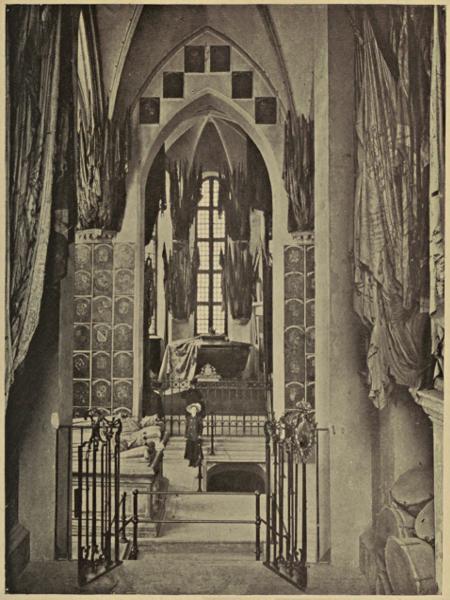
Copyright by Underwood & Underwood, N. Y.
Where Gustavus Adolphus Rests among Hard-Won
Battle Flags.
Day after day he made his solitary way through the
woods and over the snow fields, for he knew that the
spies of Denmark were on his track. He had almost
approached the borders of Norway, where he intended to
seek an asylum, when he heard a sound of approaching
runners, and then the glad cry, which must have sounded
like music in his ears: “Come back, Gustav; we of Dalecarlia
have repented. We will fight for Fatherland if
you will lead us.” We can imagine how gladly he responded
and how eagerly he returned with the two ski-runners
to Mora. Here the people elected him “lord
and chieftain over Dalarne and the whole realm of
Sweden.”
As a snowball grows in size as it rolls down the hill
until it becomes an irresistible avalanche, so the peasants
of Sweden gathered around Gustavus, sixteen at
first, then two hundred. In a month there were four
hundred, and he had won his first victory at Kopparberget.
There he spoiled the Egyptians and divided the
spoil among his followers, which of course did not diminish
his popularity. Soon the four hundred grew to
fifteen hundred, and the hundreds became thousands.
But the Danes were not to give up without a struggle.
Six thousand men were sent out against the patriots,
who had now mustered five thousand men to oppose them
on the banks of the river Dal, on the edge of the province
nearest to Stockholm. The Danes were mightily
surprised when told that the Swedes were so determined
to win that they would live on water and bread made
from the bark of trees. One of their commanders cried
out: “A people who eat wood and drink water, the devil
himself cannot subdue, much less any other.”
The Danes were utterly defeated, their morale very
likely being affected by these terrible stories of the wood-eating
Dalecarlians. Some of them were driven into the
river and drowned, and the rest flew helter-skelter,
broken and defeated, back to their headquarters. Of
course the war was not entirely over, but the young hero
knew no defeat, and finally, on June 23, 1523, on Midsummer’s
Eve, which is a holiday in Sweden second
only to Christmas, Gustavus Vasa, who had been unanimously
elected king by the Riksdag, rode triumphantly
into his nation’s capital.
He showed his religious character by going first to the
cathedral, where he kneeled before the high altar and
returned thanks to Almighty God; and here in my
story I may well leave the man who freed his country
from the Danish yoke—the George Washington of
Sweden.
You are such a stanch patriot, Judicia, and such
a hater of tyrants, dead or alive, that I know I need
not apologize for writing somewhat at length of this
glorious period in Swedish history.
Faithfully yours,
Phillips.
Wherein are described the glories of an Arctic winter; the comfort
of traveling beyond the polar circle (with a brief philological
excursion); the inexpressible beauties of the “European Lady of
the Snows”; the unique railway station of Polcirkeln, and the
regions beyond.
Kiruna, Lapland, January 15.
My dear Judicia,
I wonder if you remember how I wrote you some years
ago about a journey I made toward the arctic circle
in midwinter, and how enraptured I was with the still,
cold days, the wonderful frosty rime on every bush and
fence rail, and the dawn and twilight glories of the low-running
Arctic sun.
Well, finding myself in Sweden again in winter, I
resolved to push my explorations a little farther toward
the North Pole and to enjoy once more, if possible, one
of the most delightful experiences of my life. The
former journey was made about the middle of February,
if I remember rightly, and certain engagements obliged
me to turn my face southward before I had nearly
reached the “farthest north” which I longed for. This
time I resolved that I would not be robbed of a single
zero joy, but would, if possible, catch the sun napping;
that is, that I would get beyond that degree of latitude
where for days at a time he never shows his face above
the rim of the horizon, and where the mild-mannered
moon almost rivals his power at midday.
In order to do this, and to find the sun hibernating, I
had to leave Stockholm early in January, for, though he
goes to bed in many parts of Lapland late in November,
he rises and shakes out his golden locks before the
middle of January, unless you go to the most northern
point of Scandinavia, and then you get out of Swedish
Lapland into Norway. So you see I had no time to
lose, if I would catch the sun in bed, and must leave
other charms of Sweden in winter as well as in summer
for later letters.
To go far beyond the arctic circle in winter is not
much to brag about in Sweden, for you can make the
journey quite as comfortably as you can go from New
York to Chicago, and the distance, by the way, from
Stockholm to Kiruna is about the same.
Do not suppose, however, that we have any “Twentieth
Century Limited” in this part of the world. The
Lapland flier takes about thirty-eight hours to make
the distance, but one need have no fear of dashing into
another flier at the rate of fifty miles an hour, for the
Lapland express runs only three times a week in either
direction.
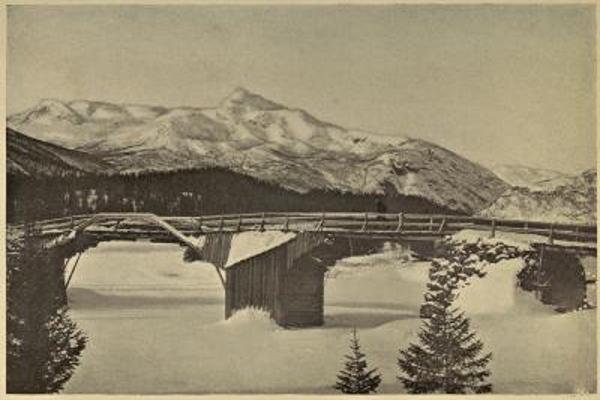
A Typical Swedish Landscape in Winter.
Though the speed is not hair-raising, the accommodations
are all that could be desired. Only second and
third-class cars are run on most of the roads of Sweden,
though, by a polite fiction, you can buy a first-class
ticket if you insist upon it. If you are “a fool, a lord,
or an American,” you may possibly do so, in which case
you will pay the combined fare of a second and third-class
ticket. The guard will put you in a second-class
compartment just the same as those of your fellow
travelers and paste up on the window the words “First
Class.” It is said that at the same time he sticks his
tongue in his cheek and winks derisively at the brakeman.
I cannot vouch for this fact, for I have never bought
a first-class ticket in Sweden, and I never should, even
if I had money “beyond the dreams of avarice,” as
the novelist would say. For the second-class compartments
are entirely comfortable, upholstered in bright
plush, with double windows and ample heat, which each
traveler can turn on or off for himself, a little table
on which to put your books and writing materials, a
carafe of fresh water, which is changed several times a
day, and a crystal-clear tumbler. What more can you
ask? To be sure your privacy is more likely to be invaded
than if you are a “first-class” snob, and you may
sometimes have as many as three other people in your
compartments, which easily accommodates six. But to
see the people and hear them, even if you cannot understand
their tongue, is part of the joy of traveling, and
the Swedish language is so musical with its sing-song
rhythm that it never grates upon the ear, and if one is
disposed for a nap it will quite lull him to sleep.
My friend, ex-Minister Thomas, has so admirably described
one inevitable and absolutely unique Swedish
expression that I think I must quote for you his sprightly
account of it. “Should you ever hear two persons
talking in a foreign tongue,” he says, “and are in doubt
as to what nation they belong, just listen. If one or
the other does not say ‘ja så,’ within two minutes, it is
proof positive they are not Swedes. There is the ‘ja
så’ (pronounced ya so) expressing assent to the views
you are imparting, ‘just so’; the ‘ja så’ of approval
and admiration, with a bow and a smile; the ‘ja så’
of astonishment, wonder, and surprise at the awful tale
you are unfolding. Now the Swede’s eyes and mouth
become circles of amazement, and he draws out his
reply, ‘ja so-o-o-o-o-o-o!’ There is the hesitating ‘ja
så’ of doubt; the abrupt ‘ja så, ja så!’ twice repeated,
which politely informs you that your friend does not
believe a word you are saying; the ‘ja så’ sarcastic,
insinuating, and derogatory; the fierce ‘ja så’ of denial;
the enraged ‘ja så,’ as satisfactory as swearing; the
threatening ‘ja så,’ fully equivalent to ‘I’ll punch your
head’; and the pleasant, purring, pussycat ‘ja så,’ chiefly
used by the fair—a sort of flute obligato accompaniment
to your discourse, which shows that she is listening
and pleased, and encourages you to continue. And
other ‘ja sås’ there be, too numerous for mention. I
am inclined to think there is not an emotion of the human
soul that the Swedes cannot express by ‘ja så,’ but the
accent and intonation are different in every case. Each
feeling has its own peculiar ‘ja så,’ and there be as many,
at least, as there are smells in Cologne, which number,
the most highly educated nostrils give, if I mistake not,
as seventy-three.”
Some other phrases in Swedish are almost equally
useful, and if we should hear a fellow traveler say
lagom over and over again we would know that somebody
or something was “just about right,” though
we might not be able to determine from the context
whether he was referring to the scenery, to his wife’s
disposition, or to the frokost which he enjoyed at the
last railway station.
Another very useful Swedish word, which it is a pity
we cannot introduce into our English vocabulary, is
syskon. This is a collective noun, referring to brothers
and sisters alike and embracing all of them that belong
to one family. As “parents” refers to both father and
mother, so syskon means all the brothers and sisters of
the family.
However, if I keep on with this rambling philological
discussion I shall not get you to Kiruna, my dear
Judicia, even within the thirty-eight hours which the
Swedish time-table allows. I must tell you though that,
since this is a journey of two nights and parts of two
days, the “lying down” accommodations are quite as
important as those for sitting up. But for five crowns
additional, or about $1.30, you can secure a comfortable
berth, nicely made up in your compartment, with clean
linen.
The black porter with his whisk brush is not at all in
evidence, for there is no dust in these trains, at least in
winter time, and the white porter who makes up your
bed, who is, I suspect, also a brakeman, is never seen
except night and morning, when he makes and unmakes
it. When you alight you never hear the familiar phrase,
“Brush you off, sah?” and you have to search for your
bed-maker if you desire to slip a kroner into his hand—a
piece of superogatory generosity which quite surprises
him.
Something over an hour after leaving Stockholm on
our journey north we came to the famous old university
city of Upsala, but I could not stop here if I wished to
see the Midday Moon, and shall have to go back at some
future day in order to tell you about this most interesting
historic town in Sweden, the burial place of Gustavus
Vasa and the depository of one of the world’s chief
philological treasures, the Codex Argenteus.
The Lapland express leaves Stockholm at 6.30 in the
evening, which at this time of the year is several hours
after dark, and it was not until the next morning, between
nine and ten o’clock, that the landscape became
visible; yet the first signs of dawn come wonderfully
early in these northern latitudes, considering how near
we are to the land of perpetual night. By eight o’clock
in the morning one has a suspicion that the sun is
somewhere far, far below the horizon. By nine o’clock
the suspicion deepens into a certainty, and by ten
o’clock on your side of the arctic circle, where I found
myself early on the morning after leaving Stockholm,
the tiniest rim of the sun may be seen peering above the
horizon, as though uncertain whether it were worth
while to go the rest of the way or not.
I wish I had counted the number of minutes he required
to fairly get above the horizon after showing his
first segment. I remember that once in Iceland I timed
the setting sun, and it took him just seven minutes to
sink below the horizon. You remember how in the
tropics he plumps down and up, as we have seen him in
South America and in India. For a shrewd Yankee
guess I would say that it takes Phœbus from fifteen to
twenty minutes to really rise and shake out his golden
locks in Lapland, in wintertime.
The day was a short one, at least the daylight day—not
more than six hours in length; but what a glorious
day it was! The fairies were at work while I slept and
trimmed every twig and pine needle and every spray on
every bush with thick, white rime. Once in a lifetime
one sees such a sight in America, and then not in its
perfection. In Sweden it is an everyday occurrence,
but it is always inexpressibly lovely. So lavish are these
frosty decorations that no humblest stump or fence rail
is omitted. It is no little layer of frost either that you
have to examine with the microscope in order to see its
beauties, but a thick and heavy fringe, often fully two
inches deep. Neither is it an evanescent creation, for,
as the low-running sun is not very powerful, it does not
melt until well along toward high noon, and there is no
wind to dissipate it.
Even when this glory of the morning frost is gone, the
snow still remains on all the larger branches of the trees,
and one misses only the fine tracery of the frost, which
brings out in marvelous black and white the wonders
of this rarely beautiful scene.
The views on this journey are seldom imposing and
grand. There are no Alps, and even our own White
Mountains eclipse in majesty anything that I have seen
in northern Sweden. For the most part the landscape
is a peaceful, pastoral one. Little farmhouses with their
cluster of outbuildings abound, the stables for the cattle
and the hardy horses being built as warm as for the
hardy men and women. The smoke curls up straight
toward the zenith and hangs like a cloudy pillar over
every chimney. The people who come to the railway
stations are healthy and ruddy. Most of them come on
skis, and others with kick-sleds, which they shove before
them, standing upon one runner; often they make
marvelously good time, even with a heavy load on the
sled.
These farmhouses look so attractive with their dull
red walls and green roofs that I often wished the train
would stop and let me visit them. But I have seen
enough of them to know how they look inside. They
are usually one story high. In the middle is a large
living room with two or three smaller rooms opening
out of it. This living room is parlor and dining room,
and sometimes kitchen as well, and not infrequently, if
you look carefully, you will see two little alcoves, one
on either side, covered with a curtain during the day.
These, you must know, are the bedrooms, or bed
alcoves. The hole in the wall is just big enough to contain
a single bed, while the baby’s cradle is hung near
the mother’s bed, from a rafter in the ceiling, and a
touch of the hand will set it swinging. The walls are
hung with rude but interesting tapestries, made by the
housewife herself and representing Bible scenes, or
sometimes more familiar landscapes. Do you remember
how we saw just such a room in Cavalla, the old Neapolis
of St. Paul, and the famous Mahomet Ali’s cradle hanging
from the roof in just that way?
In Skansen, a beautiful park near Stockholm, where
are preserved things characteristically Swedish from
all parts of the kingdom, one may see houses of the
fifteenth and sixteenth centuries, built on exactly the
same plan, only that the modern farmhouse is ampler
and cleaner and has many conveniences which the Goth
of olden times would have doubtless considered effeminate
luxury. I wonder what he would have said if he
had heard the tinkle of a telephone bell, as he might
to-day in many a Swedish farmhouse, and had been told
that way up beyond the Arctic circle he could speak
into a little tube against the wall and be heard distinctly
in Stockholm or Christiania, or Berlin or Paris, for that
matter.
But I am getting ahead of my story, and this railway
ride is so delightful that I cannot bear to have you, any
more than myself, lose a mile of it. Though the scenery
for the most part is not majestic, at times it grows bold
and striking. Some hills of considerable size appear
upon the horizon. Charming valleys open up between
them, where the frequency of farmhouses shows that
the soil is peculiarly fertile. Wide, brawling rivers rush
to the sea so impetuously that even arctic cold cannot
fetter them. There are hours of such scenery, which
satisfy the desire of the most romantic imagination;
yet for the most part there is a mild and subdued loveliness
about the view from our car windows which has its
own peculiar charm and which needs no precipitous
cliffs or bleak mountainsides or cavernous gorges to
enhance its beauty.
At last we came to one of the most interesting stations
in the world. It is not very grand, to be sure, and it is
half buried in snow, and you see scarcely a house in the
vicinity. But it is exactly on the arctic circle, and
rejoices in the appropriate name of Polcirkeln. I almost
hugged myself as a polar explorer until I looked around
at my comfortable surroundings—luxurious plush seats,
a temperature of exactly 68° according to the thermometer
in my compartment, the soft glow of the electric
lamp overhead when the early twilight appears.
Someone who has written of these winter days in the
far north says: “It is not the cold and snow that make
the northern winter dreary; cold and snow are invigorating
and exhilarating. It is the short days and leaden
skies; the long darkness and the gloom; the perpetual
sense of being pursued by the dark as by a nightmare;
the perpetual hurry by day to accomplish something
before the darkness overtakes you; and the ever-present,
unformed, unreasoning, lurking fear, strongest
in December, lest the life-giving sun leave you forever.”
But I must say that I have never felt this depression
of spirits in the far north. For the most part the skies
are not leaden, but the long dawn and the longer twilight
paint them with all imaginable colors with which
the rainbow can scarcely vie. Why should one be in a
perpetual hurry in such a land? There are twenty-four
hours in the day here as in the tropics. Most things
you can do by electric light as well as by daylight, and
there is plenty of the former, not only on the trains but
in every considerable town. As for the fear that the
sun will never rise again, even if you do not see him for
a month he gives you abundant evidence that he is just
below the horizon and that you will soon see his cheerful
face again.
Of course I had three square meals during this arctic
day, and even beyond Polcirkeln in this wilderness of
ice and snow the railway restaurants flow with metaphorical
milk and honey. But I have already described
a Swedish railway eating-house, and I will only tell you
now that when I came to pay my modest bill at a
restaurant well into Lapland the pretty cashier, when
she saw that I spoke “American,” beamed all over with
delight and exclaimed in rapturous joy: “When did you
come over, and how are all the folks?” In the remaining
minutes before the train started I learned that she had
lived for several years in America, where she had many
relatives, and that she had only just returned to her
arctic home. I was glad to inform her that all the folks
in America were well, so far as my knowledge extended.
This artless little piece of Americanism amid the snows
of Sweden brightened the journey for many an hour.
And here, dear Judicia, I think I must end the story
of one of the most delightful of travel days. To-morrow
I will tell you something of what I have seen in Kiruna
and its wonderful mountain of solid iron.
Faithfully yours,
Phillips.
In this chapter Phillips describes a day without a sunrise; his
anxiety lest the sun should appear; the wonderful beauties of
sunrise and sunset where the sun never appears; the fitful glories
of the aurora borealis; the daily bombardment of Kiruna; the
great iron mountain from which the bombardment comes; Luleå,
the metropolis of the north, and a Lapp encampment in winter.
Kiruna, January 14.
My dear Judicia,
I wonder if, when you were a girl, you were as much
fascinated by Bayard Taylor’s travel books as I was.
Did you read Views Afoot, and especially did you gloat
over his Northern Travels? If you did, you remember
how when he got up toward the borders of the arctic
circle, though he did not get nearly as far north as
Kiruna, he went out of his hotel door one morning and
found that the thermometer had sunk to forty degrees
below zero. Do you remember with what a sort of
rapture he recorded this fact, as though he had now
actually reached the land of the aurora borealis, and
how he seemed to revel in every degree that the mercury
sank? I will not be sure of the exact degree of cold that
so rejoiced his soul, for I have not read my Bayard
Taylor for many a year, but I was conscious of an experience
something like his when I went out on the crisp,
frosty streets of Kiruna this morning and watched for
the sun which I devoutly hoped would not rise.
By nine o’clock the sky had begun to glow faintly.
I wandered about the streets, keeping my eye on the
eastern horizon as earnestly as a good Mohammedan
faces toward Mecca. Moment by moment the glow,
which was at first barely discernible, deepened, and the
fleecy clouds grew rosy. Evidently something was
doing just below the horizon; but very, very gradually
the dawn came on. By ten o’clock the sky was blushing
like a modest damsel in the presence of her lover, but
still the Lord of Day did not appear. Ten minutes
after ten, twenty minutes after, half-past ten! It seemed
as though the sun must break above the horizon line
at any moment, but still he delayed his coming, while
all along the east, and far up toward the zenith, the
sky was flushed with such a light, it seemed to me, as
never was on sea or shore.
Twenty minutes of eleven, and still he did not appear;
ten minutes of eleven, and I could see that the sunrise
glories were a trifle dimmed, and a little to the north the
beginning of the glorious pageant that attends the setting
sun. Eleven o’clock came, and I was sure of it.
The sun was setting and not rising. Though the skies
were all aflame, and sunset mingled with the dawn, it
was very evident that old Sol would not show his face in
Kiruna to-day. Hurrah! I have got beyond the sunrise.
I am in the land of the Midday Moon!
And why is it not as notable a thing to see a day without
a sunrise as to see a day without a sunset? Why
do not people travel to northern Sweden or Norway to
see the Midday Moon, as well as the Midnight Sun?
I venture to say that the phenomena of midwinter are
even more glorious than those of midsummer. I cannot
imagine that one would see any such wonderful sky
tints in summer as in winter. For hours the sun’s
beams played upon the feathery clouds of pale blue
sky and constantly changed them from glory to glory.
At one time the brilliant tints predominated and the
splashes of golden color lighting up the white snow
put even Turner’s pictures to the blush. After many
minutes these fiery colors changed to exquisite green
and blue, and broken, opalescent hues adorned the
clouds. Then a red gleam showed under one dark blue
cloud. The sun seemed to summon all its strength for
one last burst of glory, and the western sky, which I
thought had passed its acme, glowed once more with a
deep red, as though some vast furnace were throwing
its hidden light upon the clouds. For more than four
hours this wonderful display lasted, as sunrise faded into
sunset, and it was not until nearly three o’clock this
afternoon that the last beam of day had entirely faded.
But the beauty of the scene did not consist altogether
in the glorious colors of the sunset. All the accessories
have made it forever memorable. As I walked to
the top of a little eminence near Kiruna, the stillness
could almost be felt. A dog barking half a mile away
was distinctly audible. The axes of the workmen whom
I left building a log-house as I tramped on through the
snow and climbed the hillside made a melodious tapping,
which could be heard as far as the dog’s bark.
The trees everywhere were loaded with their beautiful
burden of snow. The pines and birches seemed in
the dim light of the setting sun to have blossomed out
like cherry trees in May. The mercury registered only
a little below zero, or perhaps some forty degrees of
frost, according to Celsius, by whose thermometers the
Swedes swear, for I have found no such cold weather as
that in which Bayard Taylor revelled. But the zero air
was so dry and still that the ordinary clothes which I
found necessary and none too much for Boston east
winds were entirely sufficient.
As I came down the hill, the workmen were still
busy on their log house in the deepening twilight. A
Yankee in a white slouch hat must be a rarity in these
altitudes in winter, but they did not pause in their work
or exhibit any curiosity at the sight of an outlander.
Perhaps their natures partake of the largeness and
solitude of their great forests and snow fields, and they
are not moved by the curiosity which affects other
mortals. After watching them for a few moments, I left
them fitting their logs together without nails or spikes,
sawing and cutting with bare hands in this zero weather
as though it were balmy June.
But even when the last ray of the setting sun (which
had never risen) had faded away, the glories of the
Arctic night did not disappear. Indeed they had but
just begun, for the aurora borealis began to shoot out
its wavy lines of fire in the northern sky. Higher and
higher the waves mounted toward the zenith, until they
arched overhead. Palpitating like a living thing, the
white would change to green, and the green to a reddish
glow, and all the time the streamers that seemed to be
shooting up as from a mighty volcano on either side of
the North Pole waved and wavered like banners in the
wind; now being folded in upon themselves, then
flaunted out to their full width, as though Erebus himself
were blowing upon them.
But the interests of Kiruna are not altogether centered
in the far horizon. At half-past eight in the morning,
and again at half-past four in the afternoon,
I was startled by a series of tremendous explosions.
They could not be thunderclaps, for there were few
clouds in the sky and not the slightest indication of
a storm.
Over and over again the thundering volleys rolled, and
as I looked toward the west I could see a vivid flash in
the darkness preceding the thunderclap by some seconds.
And yet the flash and the thunder did not seem to come
from the sky, but from a massive hill, which bulked dimly
against the horizon, across an intervening valley. You
have already guessed what the bombardment was. It
came from the mighty iron mountain of Kiruna and was
the explosion of the dynamite charges which every
morning and every afternoon are set off to loosen the
ore. More like a rapid-fire Gatling gun perhaps than
like thunderclaps the explosions became, after the first
few shots, and from various parts of the mountain, high
up and low down, and to the right and the left, one could
see the dull flashes and hear the reverberating roar,
scores of shots every minute, until perhaps two hundred
had been fired.
This iron mountain accounts for a lot of things in this
part of the world. This was the magnet which drew the
railway, the most northerly railway on the face of the
earth, up so far through the dreary Lapland wilds.
Do not suppose for a moment that the Swedes were so
philanthropic as to build the road for the sake of a few
Americans who wanted to see the Midday Moon or the
Midnight Sun (for you must know that you can see his
Majesty from the top of Kiruna’s iron mountain all day
long if you happen to be there any day during the
latter part of June). No, it was this great loadstone
mountain that compelled the thrifty Swedes to build a
railway through the snow a thousand miles north of
Stockholm. Their enterprise was well repaid, for this
mountain is from fifty to sixty per cent solid iron, and
the best iron in the world.
From Kiruna it is transported nearly one hundred miles
farther north to Narvik, across the Norwegian
border, where there is an ice-free port all the year round,
and where great ships are constantly waiting within its
quiet fjord to transport sections of Kiruna’s iron mountain
to New York and Philadelphia and London and
Hamburg and Boston. There is another iron hill some
five or six miles from Kiruna, from which the ore is
shipped by overhead electric skids to Kiruna and thence
transported by rail to Narvik. Indeed it is said by geologists
that all the hills about this little Arctic metropolis
are full of iron, and they are not likely to be exhausted for
a thousand years to come.
Kiruna reminds me of a hustling American town more
than any other that I have seen in this part of the
world. It is only fourteen years old, and yet it has ten
thousand inhabitants; hundreds of well-built houses; a
good electric tramway, which carries the miners back
and forth from the works on the mountain to their
homes in the little city; four fine schoolhouses, and a
big church with a huge bell tower, situated at some
little distance from the sanctuary.
Let us not plume ourselves on the thought that we
have all the enterprise in the world, or lay the flattering
unction to our souls that no one else can build a city in
a decade, for here is one with all the conveniences and
comforts and many of the luxuries of life; and if we go
another hundred miles farther north we shall find a still
larger town, less than twelve years old, with good blocks
of stores, large residences, and splendid wharves, to
which the commerce of the world pays tribute; for
Narvik, where the sun does not rise for a month or six
weeks in wintertime, is even younger than Kiruna.
To-morrow I intend to go to Luleå (pronounce it Luleo,
for the little circle over the a gives it the o sound), and I
will finish this arctic letter there.
Luleå on the Baltic.
A funny, if chilly, experience awaited me when I arrived
here last night. It was well on toward midnight,
and, though a crowd of fellow passengers disembarked
from the third-class cars, there was no hotel porter or
trager or dienstman to tell me where I should go. My
somewhat aged Baedeker had not informed me of the
name of a single hotel.
The only individual who took any interest in me was
a small boy, and from his voluble Swedish and more
comprehensible gestures I felt that he wished to lead
me to a hotel. Having nothing better to do, I followed
my diminutive guide. It was very cold, at least twenty
degrees below zero, the severest weather I have seen at
all in this northland. The streets were dark, for most
of the electric lights had been put out, but I followed the
small boy trustingly. When I seemed to waver in my
allegiance, he would run back and urge me on. At last
we came to a house which had few signs of being a hostelry.
I suspect it was his mother’s humble residence. I
followed him in at the door, and he discoursed fluently
to the lady of the house, apparently telling her of my
needs. She looked quite as blank as I did, but at last
she opened a door into a somewhat shabby parlor and
gave me to understand that I could sleep on the lounge
if I wished to.
I declined the invitation, for I remembered having
passed in the dark a house that looked more like a hotel.
Going back through the frosty air, I soon found it, and
over the door made out the legend Privat Hotellet.
Here, much to my joy, I found a large room, nicely
heated, with two beds, a huge, white monument of a
stove, and a whole picture gallery, though not all by the
old masters, on the wall, and all this for seventy-five
cents a day. To be sure I could get neither bite nor sup
in this Privat Hotellet, but what did that matter when
almost at the next door I found, in the morning, a
restaurant on whose generous tables were piled
mounds of butter, stacks of oat cakes at least two
feet high, a peck of small potatoes, unlimited milk
and coffee, pickled fish, fried fish, cold meat, everything
on the most lavish scale, and all for sixty öre,
or fifteen cents?
But you should have seen my fellow boarders eat!
They were all hardy tars, who had sailed the Baltic for
many a year, when the ice does not interfere with their
trade, and the way they made those viands disappear
was a caution to a dyspeptic. Even Aylmer, who has
just joined me here on his way south from northern
Norway (did I forget to give you this interesting piece
of information, Judicia?), could not keep up with them.
He said that they could give the boys in the college
commons a good handicap and then beat them in the
race through the breakfast, hands down—but then
they had the advantage of being able to use both knife
and fork with equal dexterity.
Luleå, as you have already gathered, is on the banks
of the Baltic; in fact, it is on its extreme northern
shore, and the sea here is so charged with fresh water
from the more than two hundred rivers that flow into
it from the Swedish and the Finnish shores that it is like
a great fresh-water lake, and freezes in its northern end
as solidly as Moosehead or Winnepesaukee. As we
wandered down to the shore the next morning after
our hotel adventure, we could see nothing but a vast
expanse of snow-covered ice. Only a few large schooners
and small steamers, frozen solidly into the ice, convinced
us that this was indeed the Baltic Sea.
Luleå is a very presentable town, quite the metropolis
of this part of the world. Many of the blocks are of
brick and stone. A splendid church of cathedral dimensions
stands in the center of the town, broad streets
lined with well-built houses radiate from it on every
side, and an enormous hotel overlooking the Baltic
makes an attractive bid for summer visitors, though at
this time of year it is closed as tight as a bank vault.
I must not forget to tell you about the glorious snow
and frost of Luleå. We have seen it everywhere throughout
northern Sweden, as I have before told you, but
never in such absolute perfection as in this favored town.
This is, indeed, the Spell of Sweden. The slight fogs
which often envelop this region for a little time and then
disappear leave their beautiful frescoing upon every tree
and bush and telegraph wire and fence post. Rather,
perhaps, I should say they do the work of a sculptor and
transform everything into pure white marble. Every
smallest twig is covered thick with rime, never less than
two inches deep. Strike the tree a sharp blow with your
cane and a perfect shower of snow will descend, powdering
you from head to foot, unless you quickly stand
from under. But the next morning the tree will be
covered once more by this invisible sculptor with powdery
marble, and again it stands statuesque and lovely
in its immaculate white against the sky.
When the rime is not so thick, magical nature transforms
the trees and shrubs into white coral, and the
little arctic bushes, which can never grow to any
great height, stand up above the snow in such a
way that you can scarcely believe that some ancient
sea has not receded and left a forest of coral exposed
to view.
The only spot of color in this white wilderness is made
by the mountain-ash tree which the Luleåns have induced
to grow in one of their parks. These trees are
covered thickly with bright red berries, which the English
sparrows—unfortunately even the Arctic cold and
snows cannot drive them away—rejoice in. They pick
out the kernels of the berries and cover the snow beneath
with the blood-red husks.
One most delightful excursion we must take you upon.
It can be made from almost any point in Lapland, but
Luleå is as good a starting point as any. It is a visit
to the nomadic Lapps who abound in this region. We
often see these little fellows, with their yellow faces,
about the color of snuff, of which I understand they are
inordinately fond, and their slanting Mongolian eyes,
as they come into the towns with their reindeer hitched
to long sledges. These patient animals furnish them
with almost all that they need—meat and tents and
clothing and milk; thread made from their sinews and
needles from their bones. When the Lapps want a little
money for tobacco or coffee they drive a deer into the
neighboring town and sell him for whatever his carcass
will bring.
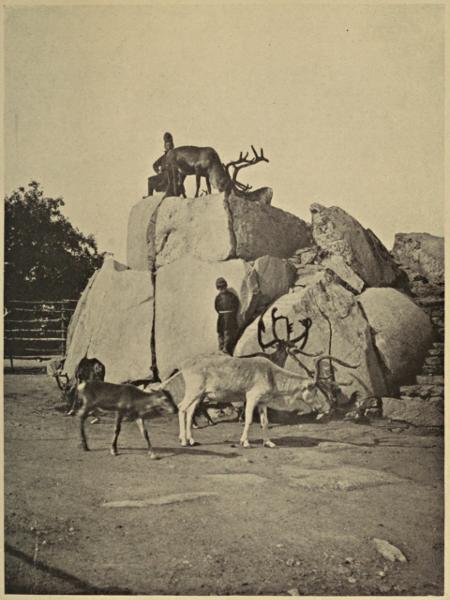
Copyright by Underwood & Underwood, N. Y.
Reindeer and Lapps from North Sweden, now in Skansen
Park, Stockholm.
But you must see them in their native habitat to
really know the Lapps. So we hired a sledge whose low
runners raise one but a few inches from the crisp snow,
stuck our feet into the abundant straw, tucked around
us the warm reindeer robes, pulled our caps over our
ears, and told our driver to do his best to find a Lapp
camp. This is not always easy, for the Lapps are
genuine gypsies in their liking for a nomadic life, and
they are here to-day, there to-morrow, and somewhere
else the next day.
However our driver had an idea in what direction they
might be found, and, after half a dozen English miles,
or about one Swedish mile, we heard a tremendous
barking of dogs and knew that we were approaching
our goal, for the one indispensable quadruped, aside from
the reindeer, in a Lapp encampment, is a barking dog,
and often a good many of him. It was not a large camp,
only a single family of Lapps with perhaps twenty or
thirty reindeer and half a dozen dogs. Their only
shelter, even when the mercury reaches fifty below zero,
is this reindeer-skin tent, with a hole in the top and
quite loose around the sides.
A miserable fire burned in the center of the tent, and
some of the smoke found its way through the hole in
the top. But hospitality is not unknown even in these
snowy wilds, and our hosts at once set to work to make
us a cup of coffee, their one luxury, which they knew
their visitors would appreciate. To be sure the cup and
coffeepot looked almost as dirty as the faces of our
hosts, but who minds a few microbes more or less among
the millions you are constantly swallowing. To be sure,
also, our hosts expected a gift of several times the value
of the cup of coffee, but that was purely a gift and not
by any means payment for value received.
I cannot say that I fell in love with the Lapps or their
surroundings, but I must confess that I conceived a
new admiration for the missionary spirit of Prince Bernadotte,
the brother of the King of Sweden, who I understand
has sometimes come to this far north region
to preach to the Laplanders.
He once informed me that the only time he was ever
in Russia was when he stepped across the boundary
of Swedish Lapland into Finnish Lapland, and then only
a few feet on the other side. I suppose that a Swedish
prince would very likely be persona non grata in the
dominions of the reactionary Czar.
A half-hour in the Lapp settlement was enough for a
complete disillusionment concerning the joys of nomadic
life in Lapland, and we were glad to turn our
faces once more toward the thriving little metropolis
of the north Baltic.
Faithfully yours,
Phillips.
Contains a glimpse of the history of Sweden as suggested by the
monuments of Stockholm; Birger Jarl; Bridget, the saint without
a monument; Gustavus Adolphus, the champion of Protestantism;
Charles XII, who conquered half of Europe; Linnæus,
the lover of flowers; John Ericsson, the inventor of the “Monitor.”
Stockholm, January 17.
My dear Judicia,
My last letter left us in a Lapp camp on the northern
edge of the Gulf of Bothnia, surrounded by dirty Lapps,
yelping dogs, and ruminating reindeer; and here I am,
after three days, in Stockholm again, while Aylmer has
gone back to his beloved Norway, striking across Sweden
and over the mountain by rail to Trondhjem, since he
was unwilling, as he said, to “waste any time in Sweden.”
Imagine, Judicia, the superciliousness of youth! To
waste time in Sweden, the land of heroes and patriots,
the land of Gustavus Adolphus and Charles XII, the
land that saved northern Europe for liberty and freedom
of conscience. Wasting time in Sweden, indeed!
What should you say to the idea of studying a little
Swedish history with me, with the help of the monuments
of Stockholm? Some people, I know, consider
monuments a great bore and hasten by them with
scarcely a glance, but that is because they do not know
the delightful stories that they can tell with their
bronze or marble lips.
Let us first call upon Birger Jarl. We find him on
Riddarholmen, standing erect on a lofty marble pillar,
with his shield and his sword, his steel armor and his
helmet, looking down from his lofty pedestal as though
he would say to us: “What have I to do with you, upstart
Americans, you children of a day, whose nearest
western shore even was not discovered by Columbus for
more than two hundred years after I sailed the seas in
my viking ships.”
The great Jarl seems to have been the first one to
have discovered the impregnable position which Stockholm’s
islands offered for defense. To be sure there was
quite a population on these islands before Birger’s
time, but he was a man of far-seeing vision, as his position
on his lofty monument indicates, so he made of Stockholm
one great fort. On every side it was surrounded
by water, the great Lake Mälar, and the two rushing
rivers that carried its waters to the Baltic.
Birger was never anything but a Jarl, but he was the
greatest of all the earls, and so powerful that he was
able to place his son Magnus above all his brother earls,
and made him the first king of Sweden. Magnus was not
unworthy of his name, for he too was a great ruler for
those rude times, though if the son was Magnus I
think the father should be called Major, if not Maximus,
for he really founded the kingdom of Sweden, as well as
the city of Stockholm.
Sweden of course had a history before the days of
Birger and Magnus, but it is so mixed up with that of
Norway and Denmark, who were really the predominant
partners in those early days, that I shall have to resign
St. Olaf and some of the other exceedingly interesting
worthies of that time to the pen of Aylmer, thus giving
him, my dear Judicia, a vast advantage in his efforts to
claim for Norway your favorable verdict.
I must remark in passing, however, that St. Olaf, or
King Olaf Haraldson of Norway, to give him his full
title, once found himself and all his fleet shut up in
Lake Mälar by chains stretched across its western outlet.
This was in the year 1007; so in order to get out of
his cul-de-sac, he dug a shallow channel across a neck of
land that prevented him from making his way into
the Baltic, that he might thus evade the clutches of Olaf
Skötkonung of Sweden. Nature favored his project,
and the strong current that sets from the great lake to
the Baltic Sea soon wore a wide thoroughfare, through
which the king and all his ships escaped into the Baltic
and thence home to Norway. This channel made of a
former peninsula the island of Staden, so that the Swedes
may thank St. Olaf for making one of the three great
islands of their capital which Birger Jarl found it so
easy to fortify and defend.
A monument that I have been looking for but have
not yet found, though there may be one somewhere in
Stockholm, is a memorial to St. Bridget. If any Swedish
woman deserves a monument, surely it is this same
saint “Birgitta,” as she is called in Swedish. In my
youth I naturally supposed that St. Bridget was an
Irish lady; but she was a pure Swede, and a Swede of
the mystical type, in some respects not unlike a fellow
countryman of more modern days—the great Swedenborg.
She devoutly believed that she received many
revelations from Christ and the Virgin Mary, which are
preserved to this day in large tomes.
She lived before the Reformation, but was none the
less a reformer of the first order. The rule of her abbey,
which she believed was enjoined by Christ himself,
made chastity, humility, and voluntary poverty the
first requisites. “No member of the convent could
possess the smallest piece of money; nor even touch
silver or gold except when necessary for embroidery, and
then only after permission obtained from the abbess.
The nuns ate the simplest food and fasted three days
in the week. To remind them of their mortality, a bier
always stood at the church door, and near the cloister
yawned an open grave. Thither these devout women
repaired every day, and the abbess threw a handful of
earth into the pit, while the sisters repeated psalms
and prayers.”[1]
In these days, when the social pendulum has swung
so far to the other extreme, there is something worthily
heroic in this story of good Birgitta. There is a tonic in
it, like a strong east wind, that blows away the miasma
of modern social life.
Whatever we may think of her, she made a tremendous
impression upon Sweden, an impression which is fresh
and vivid to this day, as anyone who studies the history
of Sweden speedily discovers. St. Bridget was a woman
of tremendous courage. She knew how to reprove the
Pope as well as the King. Moreover, her influence was
not confined to Sweden, for she spent much time in
Rome and is acknowledged throughout the whole
Catholic world as one of their greatest saints.
Again come with me to one of the chief squares of
Stockholm, and there we will see the figure of the noblest
Swede of them all, Gustavus Adolphus, the hero of
Protestantism, the victor of a score of hard-fought
battles. I will not take you to the monument of Gustavus
Vasa, the grandfather of Gustavus Adolphus, for
we have already traced his glorious career from the days
when he was a hunted fugitive in Dalecarlia to the day
when he mounted in triumph the Swedish throne at
Stockholm.
But great as was the grandfather, his grandson
Adolphus was greater still, as a general, as a reformer,
as a man. Between the days of the grandfather and the
grandson Sweden had thrown off the power of the
Roman church, whose possessions had been seized by
the crown; and two of the immediate disciples and
pupils of Luther, the brothers Olaus and Laurentius
Petri, had firmly established the reformed religion
throughout the kingdom.
An unhappy interregnum between grandfather Vasa
and grandson Adolphus, who ascended the throne in
1611, had left Sweden in a parlous state, with foes without
and fightings within. The great king and general
succeeded in shutting out Russia from the Baltic and
capturing one of the important provinces of Poland,
Livland, which also bordered on the Baltic. But it was
not until 1630 that Gustavus Adolphus became a
mighty figure in European history. For twelve years
the German Protestants had been putting up a courageous
but losing fight with the overwhelmingly superior
Catholic forces of Europe. Little by little they had
been beaten, and their power was being gradually
circumscribed.
“In 1630 it seemed as though the continent of Europe
was hopelessly doomed to fall beneath the united
supremacy of the Papacy and the Empire. From the
southern shore of the Baltic Wallenstein, the great
leader of the imperial forces, stretched his hand threateningly
to grasp the Baltic Sea and its approach, the
sound, which chief means of communication with the
ocean had become for Sweden a matter of vital importance
to keep open. As much to defend the independence
as the Protestantism of Sweden, Gustavus Adolphus
was forced to go to Germany and there assail the enemy
on his own ground. Within the short period of two
years he succeeded by his brilliancy both as a warrior
and a statesman in changing the fate of the world.”[2]
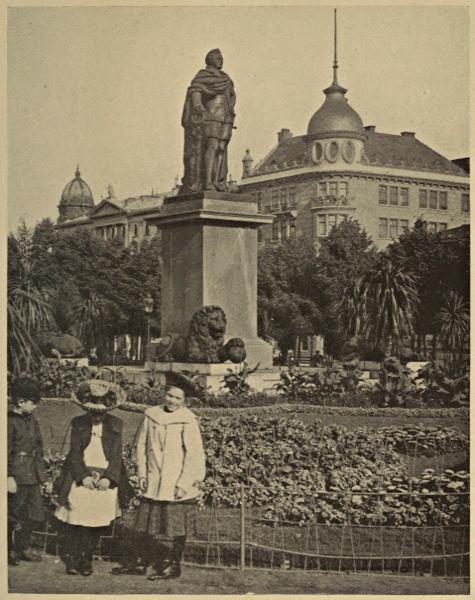
Copyright by Underwood & Underwood, N. Y.
Lion-Guarded Statue of Charles XIII in King’s Garden,
Stockholm.
His brilliant exploits in Germany were confined to
two short years. His great victory at Breitenfeld in
1631 was followed by the battle of Lützen in 1632,
which cost Sweden and the world the victor’s life. But
though the war raged for sixteen years longer, the Protestant
cause was never again hopeless. The victory of
Adolphus turned the tide, and his noble personal friend
and chancellor, Axel Oxenstierna, maintained the
prestige of Sweden as one of the great powers of the
world, fully recognized in the Peace of Westphalia,
which in 1648 closed the bloody Thirty Years’ War.
As I stand before the fine equestrian statue of Gustavus,
I take off my hat to that noble warrior and reformer,
even though it is frosty winter weather, and, as I look
at his majestic figure, I can hear the Swedish army on
the battlefield of Lützen singing the king’s own hymn
of triumph:
“Fear not, O little flock, the foe
That madly seeks your overthrow.”
It has been truly said the “sword of Gustavus Adolphus
was mighty as the pen of Luther.”
Every year on the sixth of November a great procession
of Swedes with bands and banners, led by the
famous choral societies of Stockholm, proceeds through
the streets on a triumphal march to the Church of the
Knights, where the great king lies buried, a spot forever
sacred to the lovers of freedom.
In the king’s park in Stockholm we find another
interesting statue, that of Charles XII. He stands
with his sword in one hand pointing with powerful
finger to the Baltic, on whose shores he gained his
greatest victories.
As I gazed at the noble statue, I thought how this
great-grandson of Gustavus Vasa came to the throne
as a boy of fifteen years of age. How three years after,
Russia, with Peter the Great for her emperor; Poland,
then the great power of central Europe; Saxony and
Denmark all united their forces to crush this eighteen-year-old
king and the country for which he fought so
bravely. But he was equal to them all. One after
another he conquered Denmark, Prussia, and Poland
in the field, and for nine years with Sweden, a little
nation of only two and a half millions of people at his
back, he held them all at bay.
“With an army of eight hundred half-starved, half-frozen
Swedes on a chill November morning he charged
upon forty thousand Russians behind intrenchments at
Narva and put them to utter rout, taking in prisoners
alone more than double his little army.”
Many were his vicissitudes; defeated after nine
years of victory by the Russians at Pultava, he had to
flee to Turkey, hoping to enlist the sympathies of the
Sultan against the Russians. For five years he remained
there in exile, and then, almost alone, in an incredibly
short space of time, made his way across Europe, and
for years more fought the battles of Sweden against
mighty odds, but with indomitable courage and often
with success, until a bullet at the battle of Fredrikshald
in Norway put an end to this heroic life and at the same
time closed the era of Sweden’s greatness.
I cannot take you to all the statues of Stockholm to-day,
Judicia, but there are two others which I think we
must visit. As a lover of flowers you would never forgive
me if we did not together make our obeisance before
the monument of Linnæus. It is true that he is
associated more particularly with Upsala and its university,
where I hope later to see his grave, but he has
a worthy statue in Stockholm in the Humlegård. There
he stands in a benignant attitude that befits a great
naturalist. I am glad that he is surrounded by the trees
and plants and flowers that he loved so well and did so
much to make us familiar with.
When a man is preëminently distinguished in one line,
his services to the world in other directions are apt to be
overlooked. Linnæus was not only a great botanist,
but a distinguished physician and a brilliant writer
on geographical subjects. He traveled much throughout
Sweden, and our knowledge of Swedish life in the
eighteenth century is largely due to his interesting and
accurate accounts of his travels. He is said also
to have created a new style of Swedish prose, and
to have been as eminent as a teacher as he was as an
investigator.
You would hardly recognize him under his Swedish
name, Carolus a Ljnné, or Carl von Linné, as he is more
commonly called. Linné was the most prominent
lecturer of his time, we are told. “When he took a
ramble, discoursing as he went and ‘demonstrating
Flora’s charming children’ then Botany became the
scientia amabilis, a knowledge of which was an honor
for all, from royalty down to the poorest peasant.”
As I gazed at his statue, however, I could not help
thinking, with a sense of mild pity, of the millions of
school children with no great gifts for botanical research
who have struggled over the two hard names which he
set the fashion of assigning to every plant, one for the
genus and one for the species; and who have studied,
with many a groan, his system of identifying plants
which seem to them as dry as the herbariums which they
have been compelled to collect and arrange.
One other statue, among the latest erected in Stockholm,
is of peculiar interest to Americans, for it commemorates
the man who, more than any other inventor,
saved the Union in the terribly black days of
’63. This man was Captain John Ericsson, the son of
a Swedish miner, “born and brought up in a miner’s hut
in the backwoods of Sweden.” On Sunday, September
14, 1890, the body of Ericsson was given over by America
to the perpetual care of Sweden, his native land. It
had been brought from New York in the warship
Baltimore by Captain Schley, who afterwards won his
laurels on the coast of Cuba.
The body was placed on a beautiful pavilion, directly
in front of the statue of Charles XII and very near one
of Stockholm’s principal quays. With solemn ceremonies
and appropriate words the body was conveyed
by Captain Schley to the American Minister, and by
him given over to the Swedish government, a Swedish
admiral accepting it in behalf of his country.
All around the catafalque were magnificent floral
emblems contributed by Americans and Swedes alike,
and on the coffin itself was a Monitor made of immortelles,
in the American and Swedish colors, a white dove perched
on the turret. This was the offering of the Swedish-American
ladies who had crossed the Atlantic with the
body. After these ceremonies the coffin was borne in
state through the streets of Stockholm and carried to
the little town of Filipstad, near which he was born.
On the spot where the great funeral pavilion stood, by
Stockholm’s quay, is now the monument to the inventor
of the Monitor, the savior of the American Union,
strong and massive as the man whom it commemorates.
It will always be to every American the most admired of
Stockholm’s many statues.
Faithfully yours,
Phillips.
Wherein a jump is made from midwinter to midsummer, and the
water journey from Stockholm to Upsala is described, during
which the palace of Drottningholm is passed, and the famous
ruins of Sigtuna, Skokloster Palace, with its rare art treasures,
until we reach Upsala, the university town of Sweden, the
“City of Eternal Youth,” with its thirteen “Nations.” Also
something about the Codex Argenteus, the noble cathedral with
its noted graces, as well as Gamla Upsala with the tumult of
Odin, Thor, and Frey.
Upsala, June 15.
My dear Judicia,
It is a long time, is it not, since last I tried to impress
you with the charm of Sweden. Do not think for a
moment, however, that I have given up the pleasant
task. It is, as you know, simply because other duties
have interfered with the pleasure of telling you about
this part of the great northern peninsula, and in my
more brief and fragmentary letters I could not attempt
to do justice to this interesting part of the earth’s surface.
Now it is approaching midsummer, the glad, high
days of all Scandinavia.
But to go back a little in my story. What a glorious
season is spring in these northern latitudes! I pity the
people who must spend all their lives in the tropics and
never know the joy of seeing old mother earth wake up
from her long winter’s nap.
Considering its latitude, spring comes wonderfully
early in Scandinavia. Even in February you can see
the yellowing of the willow trees, and the catkins begin
to show their downy faces on many a bush. Very early
in March you will see little girls from the country on
the streets of Stockholm and Upsala, selling the earliest
wild flowers, that look like our hepaticas. Soon the ice
in the great lakes in the southern part of Sweden breaks
up, and from the Mälar huge cakes, on which you might
build a little house and float out to sea, come rushing
down through the city to the Baltic.
Perhaps you remember that when in midwinter I
went to the far North to see a sunless day my railway
journey took me through the university city of Upsala.
In this balmy June weather I want you to go with me
by boat, for it is by far the most interesting and picturesque
way. Starting from the Riddarholmen quay
of Stockholm, we are soon out upon the great lake
which adds so much beauty to Stockholm’s environments.
On all sides of us are Sweden’s vast forests of
pine and birch, clothing the gentle hills to their very
top and coming down to the shore until their feet are
almost washed by Mälar’s ripples. On through a long,
narrow arm of the lake we steam, being admitted to
new beauties by floating bridges that open their doors
for us as we approach. Each turn in the channel
reveals something a little more beautiful than the
last scene.
Nor is it rural loveliness alone that enchants one with
this journey, for we are constantly getting glimpses of
charming villas, old chateaux, castles, and occasional
ruins, each one of which is alive with historic interest.
The great palace of Drottningholm, with its beautiful
gardens, a favorite residence of the kings of Sweden, is
one of the first palaces that we see. Soon after the
chateau of Lennartsnäs appears, and we remind ourselves
that it was once owned by Lennart Torstenson,
a hero of the Thirty Years’ War, with whom I fear
that neither you nor I are acquainted. And now we
come to the old city of Sigtuna, whose inhabitants, like
many of the people of Palestine, are indebted to their
ancestors for the modest degree of prosperity which
they enjoy to-day.
A famous American preacher once published an oft-quoted
sermon on the “dignity of human nature as
disclosed by its ruins,” if I remember the title correctly.
The former dignity of Sigtuna is certainly disclosed by
its ruins, for above the few and humble dwellings of
the present day rise the ruins of three mighty churches,
St. Olaf, St. Per, and St. Lars.
Sigtuna was destroyed by the Esthonians from Russia,
when they raided Sweden away back in the year 1181.
It is said that they carried off two great silver doors
from one of these churches, and if you go to Novgorod,
in Russia, perhaps you will see them doing duty in
some Greek Orthodox church of the present day.
But the most interesting palace that we see on our
way to Upsala is Skokloster. You will see that there is
more than a suspicion of a cloister in this name, for the
Cistercian nuns once lived in these woods in a forest
cloister. But the palace that we see was erected by
the great Field Marshal Carl Gustaf Wrangel, and by
studying its treasures you can learn more in half a day
about the Thirty Years’ War than by reading a small
library of books. It is still in the possession of the
descendants of the Field Marshal, and I venture to say
there is no more interesting collection in the world of
the relics of the titanic struggle that freed Europe from
her long thralldom.
I did not count them, but I am told that there are
over twelve hundred guns and eight hundred swords
and daggers, most of them the relics of this war. An
immense library, a splendid collection of old manuscripts,
rare pictures, and porcelain make the palace far
more interesting than most museums. There is one
treasure which I have since read about and which I
am very sorry I did not see. It is a little gold ring containing
a ruby set in diamonds. “This is the ring the
great Gustavus Adolphus gave to his first and only true
love, the beautiful and gifted Ebba Brahe, on their
betrothal. The diamond ring that Ebba gave to Gustavus
in return is preserved in the sacristy of the cathedral
at Upsala.”
Five of the love letters of Gustavus are still preserved,
and no lover ever wrote more ardently or charmingly.
But the course of true love is not any more likely to
run smoothly with princes than with other people. Indeed
I am not sure but the average man has a decided
advantage over a prince in that respect. For though
Gustavus and Ebba were betrothed, they were never
allowed to marry. The old queen would not allow Gustavus
to have a Swedish subject for his wife, but made
him marry a German princess with few brains and
small personal attractions compared with Ebba Brahe,
while Ebba married a Swedish Field Marshal. This
accounts for the fact that her engagement ring is treasured
at Skokloster to-day, for the son-in-law of Field
Marshal Wrangel belonged to the Brahe family, in
whose possession it has remained ever since.
Does not this little romance seem to bring the great
warrior a little nearer to us? As we think of that little
ruby ring, he is no longer a demigod, but a disappointed
lover, a lovelorn wooer, “sighing like a furnace”;
thinking, no doubt, unutterable things about the stern
old queen who would not let him have his own way.
It gives us a glimpse, too, of the influence of woman
in those old days. Even the most advanced suffragette
of the present time cannot make a British Prime Minister
bend to her will, while one woman in the olden days
was enough to make the greatest warrior of Christendom
quail and give up the one on whom he had set his
heart’s affection.
But if Skokloster detains us too long, I shall not be
able to bring you to Upsala to-day. A few hours after
leaving Skokloster, we enter the little Fyris River,
which winds through a wide plain and takes us close to
the heart of Sweden’s most famous university town.
One can tell that he is in a college town before the
boat ties up at the wharf, for students in white caps
have come down to the wharf to meet other students
in white caps, who are coming back to their college
duties. There are two thousand of them here, and
nearly one hundred and fifty professors and instructors.
A beautiful name has been given to Upsala by someone
who calls it the “City of Eternal Youth.” A happy
name indeed for any college town, where every six or
eight years the student body wholly changes, and with
every year new blood and young life is injected into the
veins of the old institution.
Some educationalists think that our college course in
America is too long, and that young men are consequently
obliged to begin their life work too late. What
would they say to Upsala, I wonder, where the course
is from six to ten years, though the average age of entering
is nineteen. Philosophy, law, and theology exact
six years of study on the average, before the examinations
can be successfully passed, while medicine requires
eight or ten. Surely the doctors of Sweden should be
well equipped for their life work.
Another unique feature of Upsala University is the
institution of the “Nations.” These Nations are
something like the Greek-letter societies of American
colleges, with the important distinction that every
student at Upsala must join one of the Thirteen Nations,
and there is none of the snobbishness which is beginning
to characterize some of our Greek-letter societies.
These Thirteen Nations all have buildings or rooms
of their own, and each one is named after one of the
provinces of Sweden, while a distinctive flag waving
over the building shows what Nation inhabits it. The
chief university building is worthy of any institution on
either side of the Atlantic, but there is no great group
of buildings or splendid quadrangle, and the first effect
of Upsala as a university town is rather meager and
disappointing. A homely brick building with a round
tower at either end was formerly a royal palace, but is
now used by the university.
Gustavus Adolphus, who had a hand in almost everything
of importance in ancient Sweden, gave the university
a splendid endowment, and sent back to it from
his battlefields many of the spoils of war, among others
a great library from Wurzburg, Germany. It is said
that at the same time he forwarded the Twelve Apostles
in silver and the golden Virgin Mary from the Wurzburg
cathedral to the Swedish mint to be coined into
kroner. He doubtless felt, like his great English prototype,
Cromwell, that the apostles should “go about
doing good.”
The chief treasure of Upsala is an old, time-worn
parchment manuscript, in many respects the most interesting
book in the world, for it is the only original
Gothic manuscript extant and the only early source
of information concerning the Gothic language, the
oldest of all Teutonic tongues.
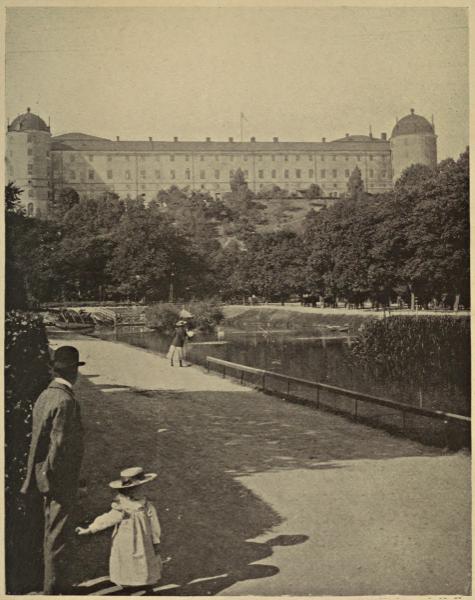
Copyright by Underwood & Underwood, N. Y.
The Castle at Upsala.
The manuscript contains a translation of the four
Gospels in Gothic by Bishop Ulphilas. The good bishop
died in the year 388, and this copy was made undoubtedly
within a century of his death. Not only did
Ulphilas make this translation, but he invented the
Gothic alphabet, some of whose letters show his indebtedness
to the Greek. The letters are stamped in
silver upon purple parchment, while some of the capitals
and more important words are in gold or otherwise
illuminated.
It has been said: “The old monk who laboriously
stamped this parchment with his single types, a letter
at a time, little knew how near he came to inventing
printing, yet had he only combined three or four types
together and stamped a word at once, the great invention
would have been made there and then.”
I am not so sure of this, for our modern printing-press
uses letters set one at a time, as the old monk used his
hot metal types. But evidently the world was not yet
ripe for Gutenburg and his printing-press, and it had
to wait another thousand years for the invention that
opened the aristocratic halls of learning to the democracy
of the world. A saying of Max Müller’s is worth
quoting for you here: “To come to Upsala,” he says,
“and not see the Codex Argenteus would be like going
to the Holy Land without seeing the Holy Grave.”
I am glad that the guardians of the Codex are fully
alive to its unique value. Every night, in its silver case,
it is locked up in a fire and burglar-proof safe, for the
authorities remember that many years ago a watchman
stole ten leaves of the Codex. For twenty years they
were lost, and only on his death-bed the thief confessed
his folly and drew them out from the pillow beneath
his head. Such a theft seems to me a good deal like
stealing a red-hot stove, or, perhaps the Mona Lisa,
for how a thief could expect to dispose of any of these
treasures or profit by them without discovery is a
mystery.
Another building here, to which I must not fail to
introduce you, is the splendid cathedral, the noblest
church in Sweden and the historic center of the kingdom.
It has recently been so thoroughly restored that all the
old cathedral has been renovated out of it, except its
memories and its tombs. Yet from the modern standpoint
it is a magnificent building, nearly four hundred
feet long, and with three beautiful Gothic spires that
soar as many feet into the air.
The tombs have interested me the most, however.
Here lies Gustavus Vasa, in a granite sarcophagus
between his two wives, who in effigy lie on either side
of him, while no thoughts of jealousy or rivalry stir
their granite hearts. Here, too, is the charming philosopher
and naturalist, Linnæus, whose statue in Stockholm
I described, and Swedenborg, the great mystic,
who could look into heaven and hell and describe what
he saw there, and whose works, which have so strong a
hold on a multitude of Americans to-day, are published
and re-published in a multitude of languages.
I have been introducing you only to “new” Upsala,
and to people and books that are not more than a thousand
or fifteen hundred years old; but there is an old
Upsala about three miles from the cathedral, which I
have greatly enjoyed visiting. It is within easy walking
distance on this bright June day, and I set out to find
my own way to Gamla Upsala, which was not a difficult
task in spite of my slight knowledge of the Swedish
language, since the average Swede will take unlimited
pains to tell a traveler what he wishes to know.
One of these polite gentlemen upon the street happened
to hear me asking the way to Gamla Upsala.
He was walking with his wife, and he told me to follow
them and they would show me the way. I naturally
supposed that they were going in that direction themselves,
and trudged on behind them, since our limited
knowledge of each other’s tongues did not allow much
personal intercourse. They turned from one road into
another, walking a good mile and a half, I should judge,
until we came in sight of three singular mounds in the
distance, a mile or more away. “These,” they said,
pointing to them, “mark the site of Gamla Upsala.”
Then they bade me a polite good afternoon and turned
around to pursue their homeward journey. Apparently
they had come all this way to show a solitary American
the site of the ancient city and to make sure that he
would not get lost on the straight and narrow road that
leads to it.
As I approached the King’s Mounds, or Kungs Högar,
I found that they were not unlike the Bin Tepe, or
the Graves of the Thousand Kings on the Lydian plain,
near old Sardis in Asia Minor. To be sure the tumuli
of Lydia are for the most part far larger than the mounds
of Gamla Upsala. Still these are very considerable
tumuli, about sixty feet high and two hundred and
twenty-five feet in diameter.
They are called the Mounds of Odin, Thor, and Frey,
but you must not suppose, Judicia, that the old viking
gods are buried here. By the way, where do you suppose
such mythical personages are buried? But someone,
not knowing who the ancient occupants of these
graves might be, gave them these names, which certainly
add to the interest of Gamla Upsala. I almost felt, as
I scrambled to the top of Odin’s Hill, which is the
largest of the three, that I was standing on the grave
of one of the ancient gods.
Of course inquisitive moderns have not allowed the
ancient bones in these tombs to rest in peace, but all
that they found when they opened them were the half-burnt
remains of some old kings whose names and dates
nobody is wise enough to know, together with some
pieces of gold and copper ornaments, some glass dishes,
and bones of the kings’ horses and dogs, all of which
were burnt apparently in the same great holocaust
which consumed his mortal remains. Whether his
wives had to share the fate of his horses and dogs,
deponent saith not.
There is another interesting mound not far from
Odin’s tumulus. It is twenty feet lower than his grave
and has a large level space on the top. This is the hill
where the ancient, open-air parliament was held and
where, as late as the days of Gustavus Vasa, the kings
were accustomed to address the people.
Gamla Upsala is now a very small hamlet with a little
stone church, whose high and narrow windows and
massive tower make it look more like a fort than a
sanctuary. Upon this spot, we are told, once stood a
splendid temple to the stalwart old gods who have
given their names to the tumuli—Odin, Thor, and Frey.
It is only a little more than a hundred years since this
temple was destroyed and since priests still offered
sacrifices, perhaps of human victims.
Let me close my story of Gamla Upsala with a sentence
from the story of Adam of Bremen, who wrote
his Chronicle in the very last days of heathendom,
about the year 1070. “In this sacred house,” he says,
“which everywhere is adorned with gold, the people
worship the images of three gods, and this so that Thor,
who is the mightiest of them, occupies the seat of honor
in the middle, while Odin and Frey have their places
on each side of him. When pest or famine is at hand,
they offer to Thor’s image; when it is war, to Odin’s;
at wedding celebrations, to Frey.”[3] Adam also relates
that near the temple stood a grove in which the bodies
of victims, human beings as well as beasts, were hung
up, “and this grove is sacred in the eyes of the heathen.”
He says that “every tree in it is held to be divine on
account of the death or blood of those offered there.”
What a tremendous gap in the history of the world is
indicated by the little distance between Odin’s Mound
and that homely Christian church! What a tremendous
advance from the big Gamla Upsala of the eleventh
century to the little Gamla Upsala of the twentieth!
Faithfully yours,
Phillips.
Which tells of Swedish lakeland; the commodious craft on which
one sails through it; with some side remarks on the coinage of
the country and the honesty of the people. Returns to the four
great lakes, and tells of hill-climbing by steamer and going down
hill by the same route across Vettern and Venern until the falls
of Trollhätten and Gotenburg are reached.
Lake Venern, June 20.
My dear Judicia,
While I am sailing across this magnificent lake I must
indite another epistle to you, telling you of the fascinations
of Swedish lakeland. There will be plenty of
time, too, to write you all about it, for Lake Venern is
eighty miles long, the largest lake, if I am not mistaken,
in all Europe, and our steamer traverses almost
its whole length. Let me advise you, if you ever have
another long holiday, to spend it among Sweden’s lakes.
You have seen the Swiss lakes more than once, and the
Italian lakes and the Cumberland Lake region of England,
but in many respects Sweden’s lakes surpass them
all in size, in picturesqueness, and in the convenient
and delightful way one may get from one to the
other. It is true that there is no Mount Pilatus in
Sweden, or Monte Rosa, but there are other charms
which fully make up for the lack of the mountain
scenery one finds in France and Italy. And as for
the little “waters” which one finds in Cumberland,
they pale into insignificance beside these great reservoirs
of the purest, most translucent water on the
earth’s surface.
But the great advantage that they have over every
other lake region in the world is that you can see all the
great lakes in a three-days’ journey without leaving the
very comfortable steamer on which you embark at
Stockholm.
At Lucerne you can have a fine excursion on the
Vierwaldstättersee, but, unless you come back by
land, you must return by the same route to Lucerne.
Your steamer cannot climb the hills and get over into
Lake Geneva, or strike across country and find its way
into Lake Thun and Lake Brienz; but that is just what
you can do in Sweden. You can journey clear across
the lower end of Scandinavia, from the Baltic to the
Kattegat, passing through a continuous succession of
the most delightful scenes, through rivers and canals,
across lake after lake, past ancient castles that will
tell you the whole story of Sweden, until at last you
come out on the western sea and land at Sweden’s
second greatest city, Gotenburg. In this journey you
even climb some considerable hills without leaving your
stateroom, unless you choose, or your comfortable seat
on the steamer’s deck, and at some places in your journey
you are more than three hundred feet above your
starting point on the Baltic, or your arrival point on the
Kattegat.
But let us begin at the beginning, for this journey is
worth describing in detail. To begin with, the craft on
which we set sail is no little motor boat or steam launch,
as you might imagine when I tell you of its ability to
climb hills, but a very substantial and commodious little
steamer, with quite elegant staterooms, upholstered
abundantly in red satin, and with two wide berths and
ample toilet accommodations.
What a travesty it is, Judicia, to speak of many of the
steamer cabins even on Atlantic steamers as “staterooms.”
Rooms of state! Call them vaults, closets, or
any other appropriate name. But, really, it is not very
much of an exaggeration to call the cabins on the great
Göta Canal line of Sweden staterooms. They are
quite good enough for statesmen of average quality, and
even royalty need not object to them for a three days’
occupancy.
The berths are not one above the other, to which the
unfortunate man in the upper berth must climb by a
precarious ladder, but are on either side of the room, and
make very comfortable lounges by day. The table, too,
on these steamers, is everything that could be desired;
but that is to be taken for granted in Sweden. The
Smörgåsbord is abundant and varied, and the hot
dishes are always admirably cooked. When your meal is
finished you simply write down on a long account book
which hangs on the wall what you have had, whether
merely coffee (which includes all the cakes and sweet
bread that you wish), or Smörgåsbord, or perhaps a full
dinner.
At the end of the voyage the amount is reckoned up,
and the cashier takes your word for what you have
eaten. You are very likely to be surprised at the smallness
of your bill, whether she is or not.
This trustfulness in your probity tempts me to dilate
upon the refreshing honesty of these Scandinavian
nations. Especially if you come direct from Italy, the
contrast is most refreshing. You never have to scan your
bills and add up the items to see that the cashier has
not slipped in a few extra francs for his or her perquisite.
You need not even count your change, unless
you want to make sure that the change-maker has not
cheated himself. You need never bite your money or
ring it on the pavement to be certain that it is not bad;
or examine the date on the coins to find out whether the
smiling clerk who gives you the change is not working
off some obsolete coins on you which you cannot honestly
dispose of without a loss of fifty per cent.
In Scandinavia a kroner is a kroner and an öre is an
öre, and I should be as much surprised to find a bad
coin in any of these kingdoms as to find one of the unmentionable
little creatures, so common in some other
countries, in a Scandinavian bed.
The coinage of Denmark, Sweden, and Norway is
interchangeable. At any bank in any of the three kingdoms,
or at any store where you may trade, you will
receive money that is good in every other place, from
Korsör to Hammerfest.
Each of these three kingdoms had its own money,
with the head of its king stamped on its own coins, and
its bank notes issued by its own banks. But Denmark’s
money is exactly the same value as Sweden’s, and
Sweden’s of precisely the same worth as Norway’s, and
the money of each passes current at its face value in all.
If, my dear Judicia, you will bring this idea of an
assimilated currency to the attention of all the great
nations, and persuade them to accept it, you will confer
an enormous boon upon every traveler.
During this monetary discussion we have not made
much headway along the Göta Canal. Now I will
make up for lost time. A few minutes after our steamer
left the quay at Stockholm we found ourselves among
the islands of beautiful Lake Mälar, famous in Sweden’s
story, but before long we came to the deep cut by
which the waters of the lake join a bay of the Baltic.
Lake Mälar covers nearly five hundred square miles, and
though less than a fifth part as large as Lake Venern,
it is yet one of the greatest lakes in Europe. Let me at
least make you acquainted with the names of Sweden’s
four inland seas, which ought to be as familiar to a
traveler like yourself, as Lake Como or Maggiore.
They are the Venern, the Vettern, the Hjelmar, and
Mälar.
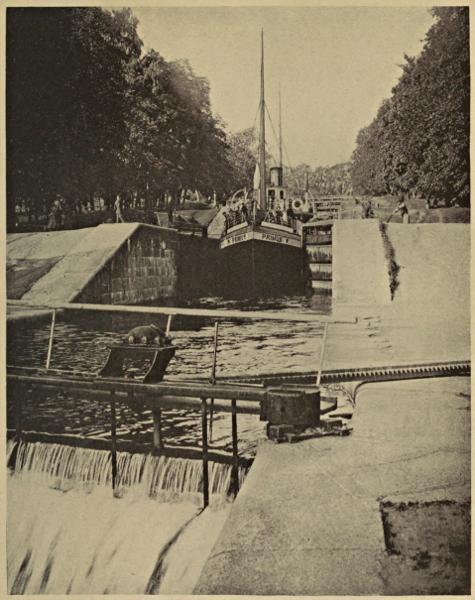
Copyright by Underwood & Underwood, N. Y.
The Locks, Borenshult, Göta Canal.
Mr. Von Heidenstam, in Swedish Life in Town and
Country, says: “It is a common saying that you cannot
stand on any given spot in these districts without having
a lake in view somewhere, for by the side of the giant
lakes smaller ones abound, spread over the face of the
whole country. Of the hundred and ten millions of
acres forming the surface of the country, over eight and
a half millions are covered by lakes. Large and small,
they dot the green earth with blue wherever the eye
turns. The peasants call them the ‘eyes of the earth,’
and limpid and blue they are, like the eyes of the
northern maidens.”
If you will consult the map you will easily understand
our tortuous but delightful course across southern
Sweden from Stockholm to Gotenburg.
The deep cut which I have told you about that leads
from Lake Mälar to the Baltic Sea was soon passed
(for in order to reach the great canal we must first get
into the Baltic), and we found ourselves sailing among
the beautiful islands and past the charming villas which
dot the coast in this region. A few hours more and we
entered another long, narrow gulf or fjord, until at Norrköping
we struck the canal again. Before long we came
to the fifteen steps by which our steamer climbs from
little Lake Roxen to the level of the Vettern.
This is indeed the most delightful hill-climbing that
I have ever enjoyed. From one lock to another the
steamer rises, while the passengers can either stay on
deck or they can get off and stroll up on foot.
We had plenty of time to visit Vreta Klosterkyrka,
which is celebrated as the place where Ebba Leijonhufvud
spent her widowhood and died in 1549. I do not know
that Ebba was particularly celebrated for her exploits or
for beauty of face or form, but she was the mother-in-law
of Gustavus Vasa, and even that oft-derided relationship
adds an interest to the place.
The beautiful church, which is built upon the ruins
of the old cloister, contains the ashes of several kings,
but these old forgotten worthies are not of so much interest
as the coffins that we saw in another chapel of
the church. There are five of them, piled one above the
other, and each one contains a Douglas. The most
famous Douglas of them all, a younger son of the head
of the great Scottish clan, fought under Gustavus Adolphus
in the Thirty Years’ War. For his bravery he was
made a Swedish count, and many a Swedish noble with
Douglas blood in his veins lives in Sweden to-day.
By the time we had sauntered slowly up the hill and
had visited the site of Gustavus Vasa’s mother-in-law’s
cloister, and ruminated sufficiently on the past, we
were ready to take the steamer again for another lovely
sail down an arm of Lake Vettern to Vadstena, and
here we had time enough to go ashore and see another
castle of Gustavus Vasa’s, who seems to have sprinkled
his residences all over this part of Sweden. Here, we
are told, “he celebrated his marriage with his third
wife, Catarina, a blushing bride of sixteen, though the
bridegroom was almost four times as old, and this, too,
notwithstanding that the girl was already betrothed to a
noble youth, and ran away and hid herself in her father’s
garden when the old king came to court her.”[4]
In Vadstena are two churches, each some five hundred
years old, one of which is famous as the last resting place
of St. Bridget, to whom I have already introduced you,
for here she had founded the celebrated nunnery, whose
inmates had to take such strict, ascetic vows.
Across Lake Vettern we sailed through another canal,
that led us between charming pastures, musical with
the tinkle of cowbells; past fine farms, the red farmhouse
making a spot of color on the rich green turf; past gently
wooded hills, until we came to magnificent Lake Venern.
But we had to get downhill before we reached the Kattegat,
for we were one hundred and forty-four feet above
the sea, and eleven great locks, each of them one hundred
and twelve feet long, is the stairway by which we
descended.
Since it took some time for our steamer to go down the
hill, we walked instead, for we get many a glimpse from
the shore of some of the most beautiful rapids I have
ever seen. These are the falls of Trollhätten. Is not
that a name that lingers upon your lips and suggests all
sorts of trolls and sprites and water nymphs? A tremendous
volume of water comes rushing down over the
falls, for Europe’s largest lake, as I have before told you,
here empties itself, or rather throws itself into the sea.
Except for its one majestic fall, Niagara cannot show us
anything more exciting in the way of cataracts than
Trollhätten. There are five of them, the smallest
twenty-five feet high, and the biggest forty-two feet of
steep incline, while the river is lined on either side by
jagged rocks and high cliffs, past which it comes surging
and swirling with deafening roar, hurling its spray high
in the air.
I wish the poet-laureate Southey had seen the falls at
Trollhätten and had expended some of his adjectives
upon them instead of wasting them all upon that little
streamlet at the end of Derwent Water when he wrote
“How the Waters come down at Lodore.”
At the foot of the falls we took the steamer again for a
few hours’ sail down the Göta River, until we came to
Sweden’s greatest commercial city, Gotenburg, where
steamers are waiting to carry Sweden’s products and
Sweden’s emigrants to the ends of the earth.
I fear I may have given you the impression, as I have
described the getting up and downhill across Sweden’s
broad southern end, of merely a holiday waterway, but
the Göta Canal is the great artery of Sweden. Through
it, up and down these gigantic steps, pass twelve thousand
vessels every year, some of them steamers capable
of making an Atlantic voyage, some of them full-rigged
schooners or brigs.
The charm of the trip, too, is not by any means confined
to the scenery or the ancient castles, for our fellow
passengers, by their gentle politeness, do much to make
the journey memorable. If you had been with us, they
would have taken pains to find out any titles which the
American colleges may have incautiously conferred
upon your husband, and would always address you as
the “Lady Doctor.” They would not think of using the
word ni (you) in addressing you. We are told about
one of the young lady clerks in a great store in Stockholm
who sent word to a gentleman that his son had insulted
her. On asking the girl what the insult was, she
replied: “He addressed me as ni.” I am speaking now
of the way in which chance acquaintances or strangers
address one another.
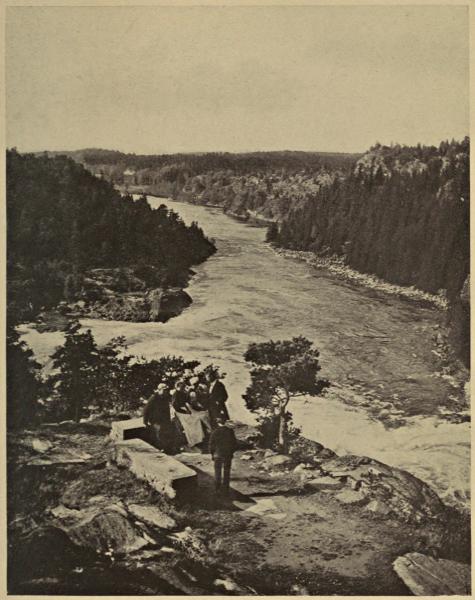
Copyright by Underwood & Underwood, N. Y.
The Gorge of the Göta at Trölhatten.
But now and then, as we hear our fellow passengers
talking together, we notice a peculiarly affectionate
stress of accent upon the little word du, and we know
that the two men who are talking together are fast friends,
or they would never address each other as “thou.”
“The event marks an important stage in their friendship,
it is said, and is accompanied by a little ceremony. The
higher in rank, or the elder of the two, says, ‘Let us
lay aside our titles.’ Pouring out bumpers (let us hope
it is always in Sweden’s temperance beverage), they
stand erect, and clinking glasses drink the brothers’
Skol. Then, grasping each other warmly by the hand,
they say: ‘Thanks, brother.’ Thereafter they are ‘du
brothers’; they always address each other as du, or
‘brother.’”
This custom of fosterbrödralag, or foster brotherhood,
is as old as Sweden itself, but in olden times the foster
brothers instead of clinking glasses cut gashes in their
arms and let their blood mingle together as it fell to the
earth, a too strenuous ceremony for these milder-mannered
days.
Have I not told you enough, Judicia, to prove the
proposition with which I set out: that there is no more
charming journey in the world, when we consider the
scenery, the historic associations, our means of conveyance,
and our fellow passengers, than this trip through
Sweden’s magnificent Göta Canal?
Faithfully yours,
Phillips.
Describes the ancient city of Visby; the Gotlanders of old; their
wonderful wealth; their defeat by King Valdemar, and the vats
of gold that he demanded for the city’s ransom. Returning to
more modern days, Midsummer’s Day, the great holiday of
Sweden, is described.
Visby, June 24.
My dear Judicia,
Please refer to the map once more, and you will see
in the blue water, nearly halfway between the Swedish
coast and the Baltic province of Russia, a long, scraggly
island, with many capes and indentations. You will see
that it is called Gotland, and on its western shore you
will see that there is a city called Visby. I do not know
that I can give such a traveler and geographer as yourself
any real information about Gotland, but I will at
least venture to refresh your memory concerning this
most interesting island, for a very considerable part of
the world’s history for a good many scores of years centered
in this piece of sea-washed land, which contains
barely twelve hundred square miles of surface.
At one time Visby, which has now dwindled to a
somewhat obscure tourist resort, was the London of
northern Europe. The East and the West paid their
tribute to it. Russia sent her timber and her furs,
and England and Germany and Flanders their precious
stuffs, which were here exchanged for other precious
stuffs and then went their several ways to all parts of
Europe.
One of their old ballads tells us:
“The Gotlanders weigh their gold with twenty pound weights,
And play with choicest jewels,
The pigs eat out of silver troughs,
And the women spin with golden distaffs.”
That the old ballad had some foundation in fact is shown
us by the splendid ruins that tell us of Visby’s former
greatness.
Throughout Gotland there are no less than ninety
great Gothic churches, most of them in ruins, while in
Visby alone were sixteen of these churches, some of them
among the largest in Europe. So much has the city
dwindled that in only one of these churches is heard the
voice of prayer and praise to-day. The walls of ten
others can still be seen, but they are merely magnificent
ruins.
That the ancient Gotlanders were proud of their
splendid isolation, in the middle of the Baltic, and were
not inclined to bend the supple knee to any potentate,
is indicated by a tradition that has come down to us,
of the ambassador whom these island people sent to
the king of Sweden to seek an alliance for mutual offense
and defense. This ambassador was named Strabagn,
which being interpreted means “Long Legs.”
When he reached Upsala, where was then the royal
palace, he found the king and queen dining in their
great banquet hall. The king had a grudge against
the Gotlanders, whom he considered too toplofty and
independent, and so Mr. Longfellow was kept standing
in the hall while the royal pair continued their sumptuous
meal. At last the king condescended to ask gruffly,
“What’s the news from Gotland?” “Nothing” replied
Strabagn, “except that a mare on the island has
foaled three colts at a birth.” “Ah,” said the king,
“and what does the third colt do when the other two
are sucking?” “He does as I do,” answered Long
Legs; “he stands and looks on.” This stroke of wit
pleased the king and queen so much that they invited
the ambassador to make a third at their table, and were
finally willing to conclude a treaty which was as much to
the advantage of Sweden as of Gotland.
The thirteenth century was the Golden Age of Gotland.
In this century the great warehouses were built,
and it became the commercial metropolis of northern
Europe. There were few stronger fortresses in the world,
for an enormous stone wall thirty feet high surrounded
the city, and from the wall no less than forty-eight huge
towers arose.
It does not take much imagination to reproduce
ancient Visby, for thirty-eight of the forty-eight towers
are still standing. They are more than sixty feet high,
and one can see in each of the five stories the holes
through which the archers fired their arrows, doubtless
winged with death for many a foe, while from the battlemented
top of the towers huge stones were thrown from
the catapults.
But in spite of Visby’s isolation, and in spite of her
mighty fortifications, she was not impregnable as she
supposed, for in 1361 Denmark, which in those early
days seems to have always been the evil genius of
Sweden, sent an army under the command of King
Valdemar Atterdag to capture the city. The people
behind their strong fortifications at first laughed at him
and mustered all their troops to defend the city, but
Valdemar was victorious, nearly two thousand of
Visby’s noblest defenders were slain, and the city was
at the mercy of the Dane.
He would not accept its surrender and accord it the
honors of war, even after it had capitulated, but tore
down a part of the wall to prove his ruthless might and
marched as a conqueror to the center of the city.
One is reminded by Valdemar’s conquest of the hard
terms that Pizarro made when he conquered the Peruvians.
You remember that for the ransom of King
Atahualpa he went into a great room, and drawing a
red mark on the wall as high as he could reach he told
the Peruvians that they must fill that room with gold
as high as the red mark if they would release their king
from bondage and save him from death.
King Valdemar did something of the same sort to the
Visbyites, for he took the three biggest ale vats that he
found in the city and commanded the people to fill them
with gold and silver within three hours. So frightened
were the inhabitants by his bloodthirsty cruelty that
they obeyed, stripping themselves of their golden ornaments,
rifling their churches and their treasure-houses,
until the big vats were full to the brim.
But even this did not avail to save them from further
rapine, for Valdemar made a clean sweep of all that was
left and poor Visby was plundered by the rapacious
troops of all her riches.
I should like to be able to tell you that I saw the bones
of Valdemar Attardag safely encoffined where he could
do no more harm, but the next best thing was to see the
Jungfrutornet, or the “Maiden’s Tower,” where, according
to tradition, the noble maid who opened the
gates of Visby to the Danish king, whom she loved, was
walled up alive. You need not waste much sympathy
on this maiden, however, for I am told on good authority
that she is a strictly mythical girl, and that her story
was invented by the people of Visby to account for
what many believed was a somewhat cowardly capitulation
of the city to the Danes.
King Valdemar, however, must have had one or two
redeeming traits of character, for he erected a great
stone cross on the battlefield to commemorate the
death of the eighteen hundred citizens whom he slew.
The cross can still be seen, scarcely marred by the passage
of these five hundred years, and the inscription on
it is not a record of triumph so much as a memorial to
the dead.
You have noticed, perhaps, that this letter is dated
“June 24.” This date may not have any great significance
for you, but it is a high day in Sweden, perhaps
the most joyous of all the year, for it is Midsummer’s
Day, the day without a night in many parts of this
northern land.
In almost every village in Sweden you will see to-day
a Majstang. Perhaps you can guess that a Majstang is
a Maypole, though I think I hear you say, “Why have
a Maypole in June?” The Swedish word for May,
Maj, is an ancient term meaning “green leaf,” and
June 24 is preëminently the Feast of the Green Leaf.
It is not the somber evergreens, however, that decorate
the windows at Christmas time and that stand
dressed with Christmas candles and Christmas gifts;
the Midsummer Tree is the birch. If it should ever be
put to a vote in Sweden, I think the Swedes would
decide that the birch is their most beloved tree. It is
equally beautiful in summer and in winter. In the
former its delicate drooping branches are covered with
green, and in the latter with white. There is nothing
quite so lovely in the northern latitudes as the birch trees
silvered with a thick coating of frost in midwinter, unless
it be these same birch trees in their glad green livery in
midsummer.
On June 23, in preparation for Midsummer’s Day, all
the lads and lassies that you see in the country will have
a load of birch boughs on their shoulders. In Stockholm
hundreds of wagons and little steamers bring tens of
thousands of young birch trees to the city, and every
window and doorway is decorated with its delicate
green. Even the dray horses are decked out in green,
and “the wearing of the green” is more popular in
Sweden on June 24 than in Ireland on March 17.
This is the out-of-door festival of the country. At
Luleå in the far north the people all flock on Midsummer’s
Eve to a mountain near by called Mjaolkudds
Berget. Here each family builds a small bonfire and
over it makes their coffee, which is supposed to have a
peculiar flavor and potency on Midsummer’s Eve. The
midnight sun cannot quite be seen from Mjaolkudds
Berget, but according to the ancient custom the coffeepot
must be placed on the hot coals just as the last rim
of his upper disk disappears. Before the coffee is brewed,
the upper disk is again visible above the horizon, and
then the coffee can be drunk by every member of the
family, from the great-grandmother to the youngest
scion.
This of all days is a day of life and color in Sweden.
Let us not stay in little Visby, with its mournful ruins
reminding us of the golden days of Gotland, but go out
into the country, for nature is ever fresh and new. She
knows nothing about ruins, or, if she does allow some
giant tree to totter and fall in the forest, she soon covers
up his decaying form with moss and creepers. The colors
that we see are not all green by any means, for this is the
day when Swedish maidens adopt the bright, ancient
costumes of their country, the Crown Princess herself
having set the example. The Maypole is set up on
every village green, and the children first are given the
right of way. Hand in hand they romp around the Maypole,
singing the folk songs and the glees which Sweden’s
children for many a generation have sung on Midsummer’s
Day. Then the older ones take their place, and
all is motion and gladness and color and song.
If we should find ourselves in the woods after the
day’s festivities are over, we should very likely see some
silent, solitary maidens wandering through the fields,
in the long twilight which here lasts till midnight. Do
not think that they are lovelorn lasses deserted by their
swains, for they are simply seeking to know their own
fortunes, which Midsummer’s Night reveals to them.
In one of the provinces the maiden must pick three
flowers each, of three different kinds, and must speak
to no one until the next morning. These flowers she
puts under her pillow when she goes to bed, and if she
has been conscientiously tongue-tied, and has been
quite alone when she picked the flowers, and has replied
to every question which teasing suitors would put
to her only by signs, she will dream of her future husband,
and the next morning will know who he is to be.
In other provinces she has to pick nine different kinds
of flowers from as many different farms, and this bouquet
is even more efficacious than a smaller one. Why should
we not have such a midsummer holiday in America?
It is true that we have our Fourth of July, which is not
very far from the right date, but, however “safe and
sane” we may make it, the Fourth of July can never be
anything but a patriotic holiday, nor should it be.
Thanksgiving Day is too late in the year for an out-of-door
holiday, and the thirtieth of May is dedicated to
a sacred celebration all its own. But why should we not
have one genuine out-of-door day, a day when we shall
see to it that every city child may romp and play in
God’s green fields, and when we may make it a joyous
duty to thank the Giver of all, not only for the harvests
and for the full granaries as on Thanksgiving Day, but
for the sun and the green trees and the flowers and grass
and everything that makes us glad to be alive? What
day could be so good for such a celebration in America
as well as in Sweden as Midsummer’s Day?
Before we bid good-by to Gotland and Visby, let us
climb in the late evening twilight the ruined towers of
the church of St. Nikolaus. From the old wall we can
look out to sea, and if our imagination is strong enough,
supplemented by a sufficient knowledge of old traditions,
perhaps we shall see an eerie, reddish light on the calm
waters of the Baltic. This light comes from two great
carbuncles in the bottom of the Baltic. These carbuncles
once adorned the western gable of the church
of St. Nikolaus, where, according to the tradition,
“these carbuncles shone with the brightness of the sun
at noonday, throughout the night, and served as guiding
lights to storm-tossed mariners far out on the Baltic
wave. Twenty-four soldiers stood constantly on guard
to watch these ruddy gems, the most precious possessions
of the church, and no one, on pain of death, might
approach the sanctuary after the going down of the
sun.”
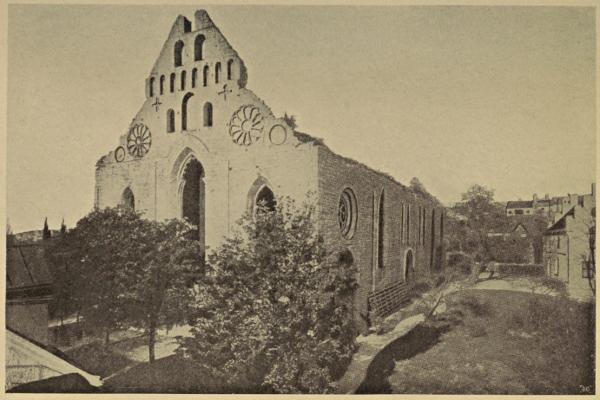
Ruins of St. Nikolaus Cathedral, Visby, Gotland.
King Valdemar could not leave such priceless jewels
to St. Nikolaus, and so he snatched them from the rose
windows which they adorned, put them on his biggest
ship, and sailed away to Denmark. But justice followed
the sacrilegious freebooter; his ship was wrecked on one
of the little islands which line the coast of Gotland, and
the king himself barely escaped with his life. The carbuncles
sank to the bottom of the sea, which accounts
for that strange glow which any one with a vivid imagination
can see from the ruined tower of St. Nikolaus as he
looks off on the peaceful Baltic.
Faithfully yours,
Phillips.
Wherein something is told of Sweden’s art and artists; the ancient
rock-cutting of Bohus; the art treasures collected by the heroes
of the Thirty Years’ War; Cederstrom’s picture of Charles XII;
Carl Larsson’s pictures of the home; the mural paintings of the
schoolhouses; also something about Sweden’s great authors and
singers.
Stockholm, June 30.
My dear Judicia,
With your love for libraries and picture galleries I
should not dare to send you this last letter from Sweden
without telling you something about the Swedes who
have contributed to literature and art, though, if I
should attempt to go into the subject exhaustively, I
fear that many names of Swedish artists and authors
would be unfamiliar even to you.
Sweden’s first and original art gallery is a strange one
indeed, for it is unroofed except by the blue dome of
heaven, and not a canvas hangs upon its walls. Nevertheless
it is one of the most interesting galleries in all
Europe. It is found in the province of Bohus, on the
west coast of Sweden, north of Gotenburg. Shall we
call these old artists sculptors or painters? The material
that they used was the solid rock, the face of the cliffs
that slopes up gently from level fields. They did not
chisel out a statue, but with some bronze tools in lieu
of brushes they cut the figures which they would portray
in the rock, not making them stand out as does the
Lion of Lucerne, but cutting them like solid intaglios
in the face of the rock itself.
So shallow are the cuttings that water has to be
poured upon them to bring the figures out from the gray
rock in which they are cut, but as the water trickles
down from the bucket which the stout maiden who acts
as guide and guardian of this picture gallery splashes
upon the rock, wonderful shapes appear: viking ships,
some large enough to be manned by a crew of one hundred
men, evidently the warships of the long ago; men
on horseback and men on foot; men plowing with
yokes of oxen, while now and then there towers above
all the men and beasts a gigantic figure with an ax or
a thunderbolt in his hand, no doubt the God of War
under whose ægis the old Northmen went out to battle.
The most common of these rock pictures are the representations
of the viking ships, showing that in those
days, as in these, the Scandinavians were great sea-faring
people. The prows of these ancient piratical craft one
often sees reproduced on the roofs of Swedish and Norwegian
houses to-day. Of course these pictures are very
crude, very much such as a child of five years of age
would draw upon his slate to-day. But that is natural,
for you must remember that they were drawn in
the childhood of Scandinavia, at least twenty-five
if not thirty-five hundred years ago, for it has been
proved conclusively that they were chiseled by men of
the Bronze Age of Sweden, which lasted from fifteen
hundred to five hundred years before Christ.
We are very grateful to you, crude artists of the older
time, for your pictures, for they tell us many things
about ancient Sweden. They tell us that you sailed
the seas in great ships rowed by a hundred men, though
you do not seem to have known how to harness the
winds to your craft, for we see no signs of masts or
sails. We know that you had dogs and cows and horses,
and that you plowed your fields with a crooked stick
drawn by a pair of oxen. We know that you had carts
that ran on two wheels, and that you were expert with
spear and shield, and I venture to say that your art
museum, old as it is to-day, will last longer than the
Pitti or the Uffizi; and long after Macaulay’s New Zealander
has gazed upon the ruins of London from his picturesque
position upon the bridge, the pictures in your
gallery will still lead mankind to speculate upon the
kind of folk whom you chiseled in the everlasting rocks.
No fire can destroy your gallery, no thief can steal your
Mona Lisa, no conqueror can carry away your art
treasures.
It is a far cry from the rock galleries of Bohus to the
fine collections of old and new masters of which Stockholm
and Gotenburg boast. Some of the finest pictures,
too, are not found in the metropolis of either
eastern or western Sweden, but in the palaces and
castles which dot the interior of the country. I have
already told you about some of these palaces like Skokloster
and others, which contain Correggios and Titians
and pictures of Paul Veronese, for in the Thirty Years’
War the mighty Swedish generals fell heir to many of
the splendid picture galleries of southern Germany, and
all they had to do was to pick out the best pictures
by the greatest masters and send them to their northern
home.
In those days “looting” was not “stealing,” at least
in the eyes of the victors, and they had this excuse at
least, that the pictures and works of art, if they had not
taken them, would have fallen into worse hands. They
would have reminded you that their great opponent
Tilly, when he captured Heidelberg and destroyed the
library, could find no better use for the most valuable
manuscripts than to use them as a litter for his horses.
In this way the Codex Argenteus, of which I have before
written you, was taken when the Swedes captured
Prague and sent on its far journey to Upsala.
I am afraid that most of the names of Swedish artists
would hardly be recognized by you, though I think you
would admire some of their paintings as much as I do.
I have time and room in this letter to tell you of only
two that greatly interested me.
Baron Cederstrom devoted himself to the period of
Charles XII, whose tragic story you remember. Cederstrom’s
greatest picture shows the body of the king
borne on a stretcher by a dozen soldiers over the
dreary, snow-covered, mountainous defiles that separate
Norway from Sweden. “The pathos of this pitiable
end to so glorious a career appears in the attitude of a
solitary mountain huntsman, who, with his boy and
dog, stands by the wayside as the procession passes.
He is the only one to doff his fur cap and salute the
remains of one who but a short time before made half
Europe tremble, while the other half was lost in amazement
at his extraordinary fortunes and prodigious
victories.”
Another artist whose pictures are of unusual interest
is Carl Larsson, the most popular artist in Sweden
to-day. He is the painter of the home, of the fireside
and the nursery, of the sitting room and the kitchen,
of the boy and girl and the grandmother as well. His
own son and daughter figure in many of his pictures.
One that especially impressed me was a canvas representing
this same son and daughter gazing at a skull
on the center table in their home. The look of serious
half-comprehension on the girl’s face as she points out
the skull to her brother, and of half-frightened awe
with which he gazes at it, will not soon fade from my
mind. Another portrait of his daughter leaning against
a birch tree, the white bark and new leaves no purer
than her own sweet face, is also a picture to be remembered.
It has been copied upon so many postcards
that the Swedes, at least, are not likely to forget it.
Mr. Von Heidenstam well characterized Larsson
when he says: “His audacity, his love of novelty and
adventure, the freshness of his impressions, the youthfulness
of his enthusiasms, and his whole vision of life
are Scandinavian to the core. In his pictures of home
life, mostly taken from his own home, he is genial, happy,
fond of bright colors, of flowers and sunshine, enraptured
with existence, and prone to see its bright side.”
The Swedes are wise in not relegating all the paintings
of their best artists to museums or picture galleries,
which are seldom visited by the people, but many of
the higher and even primary schools in Stockholm and
other cities have been adorned with mural paintings by
their best artists: Larsson, Prince Eugene, Oscar Björck,
Thegerstrom, and Nils Kreuger are all well-known
painters, who have put some of their best work upon
the walls of Sweden’s schoolhouses, picturing landscapes,
national customs, and some of the great events
in Sweden’s history, and placing them where Sweden’s
children cannot help being impressed by them.
I cannot honestly say that the chief charm of Sweden
consists in the spell which her artists have woven about
her, and I suppose few people would come to Sweden
to study art. Her real fascination lies in her glorious
out-of-doors—in her noble forests, her shimmering
lakes, her glorious snow fields and frost sculpture in
winter, her rushing rivers and turbulent rapids—all
these things I have tried to tell you about, and this is
the raw material of the artist.
Compared with Italy or Spain, Sweden’s art is yet
very young, but, with such models as nature’s lavish
hands has furnished on every side, it seems to me very
probable that the great artists of the future will be
found in these Scandinavian lands.
I wish they would spend more time in Lapland in
midwinter. I wish they would paint for us the little
trees that Jack Frost converts into white coral every
day. I wish they would paint for us the rare combination
of sunrise and sunset, and the glowing sky where the
sun never rises at all. I wish they would show him to
us not only on the longest day of the year at midnight,
as they have often done, but on the shortest days, as
he peers timidly above the horizon, or goes bowling
along for an hour or two on its very edge. These are
pictures which no country but Sweden furnishes in their
perfection, and pictures which the Swedish artist could
most easily reproduce and which would make his canvas
immortal.
The authors of Sweden are many and well beloved.
I can name but two of them here, though I fear the
Swedes will never forgive me if I do not mention Bellman,
their Robert Burns, and some others. I pick out
these two because they are as well beloved in America
as in Sweden. Tegnér is one of them. He may be
called, perhaps, the Macaulay of Sweden, only his lays
are not those of ancient Rome, but of ancient Sweden.
Someone has said that “his heroic poems sent a thrill
through old and young when first they were published.”
He became popular throughout all Europe, and more
than fifty translations of his poems are found in a dozen
different European languages.
Longfellow made him known and loved by American
readers by his beautiful translation of the Children of
the Lord’s Supper. “The scene in the country church,
decked out with flowers and evergreens for the solemn
ceremony, the rustic boys and girls bowing and curtsying
as they made their responses before the assembled
congregation, and the attitude and words of the patriarchal
pastor are all true to life.”
Another of your best-loved authors, Judicia, I must
remind you, was also a Swede—Frederika Bremer.
She was also more than a writer of charming tales.
She was an ardent champion of woman’s rights, but I
warrant you she would never have used dynamite in
obtaining them, or have poured paint into letter boxes
to secure “votes for women.” Her good work for their
uplift is still carried on by the “Frederika Bremer
Union.” It protects and encourages women who are
struggling to make a place for themselves in the world,
and seeks in every way to raise the standard of woman’s
work and wages. Our former American Minister, Mr.
Thomas, gives an interesting account of a call he made
upon her in 1864, nearly fifty years ago, only a year
before her death:
“Up three flights of a stone stairway to a little landing,
I make my way,” he says. “A curtsying Swedish
maid answers my knock and shows me into a cozy sitting
room. Presently a little old woman with a decided
stoop in her shoulders enters and meets me with extended
hand and a pleasant smile, bidding me welcome
with one of the sweetest voices I ever listened to. This
was one forenoon in January, 1864. The cozy sitting
room was in Stockholm in the fourth story of a brick
house, on the long Drottning-Gatan, and the little old
woman was Frederika Bremer, the great Swedish
novelist.”
This was in the darkest period of our Civil War. Mr.
Thomas asked Miss Bremer for her autograph for the
Sanitary Commission Fair, soon to be held in New
York, explaining that the proceeds would be devoted to
the sick and wounded soldiers. “It will give me real
joy,” she said, “to do anything to help on liberty in
America, or to comfort the soldiers who have become
disabled in fighting for it.” Her eyes beamed brightly
as she spoke, and her whole manner showed how actively
she was interested in our cause and country.
“This interesting tête-à-tête gave me the best opportunity
for observing Miss Bremer,” continues Mr.
Thomas. “The stoop of her shoulders was hid in the
ample cushions of her easy chair. A neat, white lace
cap covered her head. Her gray hair was brushed
straight back from a noble, lofty forehead, white as
marble, and her mild blue eyes beamed with a tender
compassion that made one forget the great author in
the sympathizing friend and compelled me to call her
beautiful, for beauty of soul shone forth in every
glance.”
I have quoted this intimate description, for there are
few living Americans who have actually seen and talked
with the gentle authoress, and I fear me there are few
Americans who read her books to-day, but you have
not forgotten how, in our early days, her pure and
wholesome novels were justly admired and loved.
Do you remember the little girl who for some childish
misdemeanor was shut up in a dark closet as a punishment,
and how she found there Miss Bremer’s Home
Life, and how she lay down at full length on the floor,
placing the book as near the crack of the door as she
could, reading the story nearly half through before the
time of her punishment had expired? She gained more
from her punishment than anyone but herself knew, for
Frederika Bremer’s charming picture of home life remained
with her as an inspiration through all her life.
Speaking of our early days, Judicia, I was reminded
that we must belong to a former generation when I
asked Aylmer when we were together in Luleå what he
knew about Jenny Lind, the great Swedish soprano.
Would you believe it, he had never heard of her? The
singer who made the greatest sensation in America of
anyone that ever crossed the ocean; the singer who
was as good as she was beautiful, and whose voice was
no purer or sweeter than her life! We at least know
how the ticket offices were besieged by eager thousands
who wished to hear her voice, and what extravagant
prices, as they were then considered, were paid for her
concerts. And yet Aylmer had never heard of this most
famous of all northern warblers, of this great philanthropist,
as she became in her later life! Moreover he
confided to me that he had never heard of Christine
Nilsson, a more modern singer of almost equal fame.
Well, well, we must be growing antiquated!
There is one man who to be sure cannot be classed
as an artist or an author, and yet I suppose he has done
more for literature as well as for science and the cause
of peace than any other man in Sweden. This is Alfred
Nobel, the inventor of dynamite, an article which we
chiefly associate with war, but which has really done
more to revolutionize mining and engineering. Thanks
to dynamite, it has been possible to bore the mighty
tunnels through the Alps; to knock down the iron
mountains of northern Sweden and send them off piecemeal
to other parts of the earth; to dig the subways of
New York and Boston and Chicago, and to tunnel the
North River for the commuters of Manhatten. No
man ever did more good with his vast wealth, or disposed
of it more wisely when he died, than Alfred Nobel,
and now each year magnificent awards of some forty
thousand dollars each are given by this foundation to
people who have achieved great things in physics, in
medicine, in literature, and for peace.
You will observe, Judicia, that I have not bored you
with any stories of Swedish games and sports, of skiing
and ski jumping, of bobsleighing and rodeling, and
that I have not even alluded to Swedish gymnastics.
There is a method in my seeming madness, for though
I am much interested in these matters, especially in the
out-of-door sports, I am not quite so wild about them
as is Aylmer, and, since they are common to all Scandinavia,
I will leave them for him to describe and thus
give his Norway a great advantage, when you come to
hold the scales of justice between the eastern and western
lands of the peninsula. But I beg you to remember
that Sweden is quite as famous in these particulars as
her sister kingdom across the mountains.
Faithfully yours,
Phillips.
Relates to Finland; why it should be included in Scandinavia; its
earlier and later history; its degradation by Russia; the charming
journey from Stockholm to Åbo; and tells of a winter adventure
in the Gulf of Bothnia.
Åbo, Finland, July 1.
My dear Judicia,
I wonder if you are asking why I include Finland in
the letters which we submit to you in regard to the relative
merits of the different parts of Scandinavia. Do
I hear you say that Finland is a part of Russia, and that
the Finns are not even of Aryan stock like the Swedes,
but are descendants of Turanian tribes, “first cousins to
the Hungarians, and forty-second cousins to the Turks”?
Nevertheless, in spite of all this, I must maintain that
Finland is more a part of Scandinavia and more nearly related
to the Swedes in customs, temperament, and manner
of life than to any other nation. The Swedes were the
people who found the Finns in barbaric heathenism, who
Christianized and civilized them, though it must be
acknowledged that, in doing this, they conquered and
sometimes exploited them at the same time. For four
hundred and fifty years after this conquest by Sweden
the Finns constituted a loyal and devoted part of the
Swedish kingdom, speaking the Swedish language almost
as freely as their own, adopting Swedish laws and
customs, and equal in political and social rights to their
neighbors across the Gulf of Bothnia.
It was only about a hundred years ago that they were
conquered by the Russians, when, after centuries of
struggle, Sweden’s domains were rent in twain.
To prove my contention that to all intents and purposes
Finland should be considered a part of Scandinavia,
I must remind you that long before the Finns came
to Finland the southern part of their country was doubtless
inhabited by Scandinavians. One writer tells us
that they were there “thousands of years before the
Finns arrived.” But way off beyond Persia were
some Turanian tribes, related to the Mongols and the
Manchus, who started on that everlasting trek toward
the west, which, since the days of the Pharaohs, seems
to have urged the Eastern peoples on toward the setting
sun.
They seem to have tarried in Persia for awhile and
to have brought with them some Persian coins, which
to this day are occasionally unearthed in Finland. On
and on they pressed, the first of the Eastern hordes to
cross the Ural mountains, until they came, some to the
banks of the Danube and others to the shores of the
Baltic. The tribes who settled the fertile plains of
Hungary are the Magyars of to-day; those who pushed
on to the Baltic Sea are the Finns.
Eric XI of Sweden was the first king to turn his attention
particularly toward Finland. He seems to
have desired not only the conquest of the Finns but
their conversion to Christianity, and so he is known
both as King Eric and St. Eric. It was no easy job,
however, to conquer this slow, obstinate, patient race,
and it was one hundred and fifty years, or, to be exact,
in 1293, that Sweden’s conquest was complete. She
soon set an example to all future conquerors, an
example by which Great Britain has so well profited
in these later days by giving perfect liberty to the
conquered peoples and confirming their liberties by an
irrevocable law.
Nothing better ever happened to the Finns than this
conquest by the Swedes. Christianity, civilization,
education, and an invaluable training in liberty under
law was the result, until the descendants of those wild
tribes from the steppes of Asia have become one of the
most civilized, enlightened, and perhaps the best educated
nation in the world.
Says Ernest Young, in his interesting book on Finland:
“It is a remarkable fact that the Finnish and Swedish
populations of Finland, though running like two different
streams beside each other without blending,
never rose against each other, but, on the contrary, always
stood side by side in the same rank whenever
sword was drawn at home or abroad. There was rivalry
between them, but no oppression.… The laws and
social order of Sweden were introduced without resistance
into a country where law and society did not exist
before. The people grew into these new forms, applied
them according to their characters, and became
familiar with them as their own.”
Would that Russia could have learned a lesson that
Sweden taught to all the world, concerning conquered
provinces. At first it seemed as though she had done so,
and no one ever spoke fairer words to a conquered people
than Czar Alexander I spoke to the Finns through the
Governor-general in the “Act of Assurance,” given to
the first Finnish Diet that convened after the cession
of Finland to Russia by the Swedes.
At first it seemed as though these fair promises would
be fulfilled, and for a time, doubtless, Finland was better
off under Russian rule than she had been during the
hundreds of years previously when she had been the
battleground, continually tramped over by Swedish and
Russian soldiers, and reddened with their blood as well
as by that of her own citizens.
Each succeeding Czar seems to have treated Finland
according to his own whims, or those of his prime minister,
and with little consideration to the fundamental
laws of the land so solemnly guaranteed and sworn to by
each Czar as he came to the throne.
Little by little the Russians have been filching away
the liberties of the Finns, depriving them of one boon
after another, and ever threatening them with still direr
evils. Finnish soldiers are no longer allowed to enlist
for the defense of their fatherland, but instead they
must pay a tribute to Russia and allow uncleanly Russian
soldiers to be quartered in the beautiful barracks
built for their own troops. Finnish stamps are no longer
good for letters that go outside of Finland, and the marks
and pennys in which they have reckoned their currency
from time immemorial must give way to the more
awkward ruble and kopeck with which they would
prefer to have nothing to do.
In mean and picayunish ways the government interferes
with their liberties. For instance, the people voted
not long ago for the prohibition of alcoholic drinks, but
the Czar, in his superior wisdom, doubtless absolutely
inspired by his ministers, decreed that prohibition was
not good for the Finns (and very likely not good for the
Russian revenues), and so vetoed the law which had met
with universal favor.
The Finnish Diet meets in a rather shabby and antequated
building, but the people have obtained a good
site for a new parliament house and have raised the
money for the construction of a splendid building that
would ornament the fine city of Helsingfors. Now the
Czar tells them that they cannot afford a new building,
and withholds his approval, so that they cannot do what
they please with their own money. Some think that
since he has had no use for a Finnish parliament, and
soon intends to suppress it altogether, he sees no use
for a parliament house.
The Finns number only three millions of people, and
the Russians on their very borders, people of an alien
race and an alien religion, who have scarcely yet emerged
from barbarism, are more than a hundred million strong,
and that tells the whole story.
The trek that was begun by the Finns before the
Christian Era has been again taken up since Russia
began to stamp out their liberties. More than three
hundred thousand of them have come to our shores, and
no people should receive a heartier welcome in Yankee
land than they.
“In 1894 a statue to their beloved Czar, Alexander II,
was unveiled at Helsingfors, a statue which is one of the
noblest works of art in the capital and which is still often
decorated with wreaths and flowers by the grateful
Finns. It is almost unbelievable that when this statue
was unveiled the Governor-general forbade the singing
of an ode written for that occasion, because he took the
phrase ‘The Father of Finnish liberties’ to imply a condemnation
of his less enlightened successor.”
Perhaps you would like to read a translation of one
verse of this ode, which tells of the gratitude of the Finnish
people to the one who restored their liberties, while
at the same time it shows how far removed from such
praise is a government which could prohibit the singing
of such a hymn. Here is the first verse:
“Hail noble prince! From town and land
Our greetings come, from isle and strand,
From forest, hill and dale.
Wherever Finland’s folks may rest,
Their debt for all they value best,
In love to thee they pay.”
This excursion into Swedish history is longer than I
intended, and has prevented me from telling you before
that I left Stockholm last night on one of the delightful
little steamers that ply across the Gulf of Bothnia from
Sweden’s capital to Åbo, the ancient capital of Finland.
It is a charming sail. Much of the time we were within
sight of land, and some of the most picturesque land in
the world. A perfect swarm of islands of all sizes and
shapes guard the coasts both of Finland and Sweden.
Some of these islands are tree-clad down to the water’s
edge; others are bare, gaunt, smooth rocks, whose surface
has been washed by ten thousand storms—I was
about to say ten thousand tides when I remembered that
the Baltic is almost a tideless sea. It is a sea, too, that
is being constantly conquered by the land, for, through
some unexplained action of mighty subterranean forces,
without volcanic shock or earthquake tremor, the
land both of the Swedish and Finnish shores is gradually
rising. On the northern end of the Baltic the land gains
on the water at the rate of about four feet in a hundred
years, and that the sea is at a very different level from
what it was some thousands of years ago is shown by the
fact that the remains of viking ships are found on the
tops of very considerable hills at some distance from the
shores.
After sailing across a strip of clear water free from
islands, between which we thread our way for three hours
after leaving Stockholm, we come to Mariehamn,
about halfway between the two shores. Then comes
another little stretch of clear water, and then another
great archipelago like the one on the Swedish shore, and
between hundreds of little islands and great islands our
steamer makes its way to its berth in the port of Åbo.
Very much like its neighboring shore on the opposite
side is the approach to Åbo. Some of the islands are
mere bare rocks, sticking their heads only a few feet above
the surface of the sea, while others contain farms and
forests and a considerable population. Many beautiful
villas adorn some of these islands, and a rare place they
afford for a holiday or a summer residence.
But the Finnish shore can boast islands enough to
furnish one for every day of a decade, and before the next
decade is over very likely some new ones will arise above
the surface of the water, like the one which had almost
come to the surface in 1907, but not near enough to be
charted, or to prevent the wreckage of the Czar’s yacht
upon it.
Sweden and Finland rest upon the same submerged
plateau of solid rock, which adds another proof to my
contention that, for all practical and descriptive purposes
at least, Finland must still be considered a part of
Scandinavia.
Though one crosses the Gulf of Bothnia in the night,
he does not cross in the dark, for at this midsummer season
there is no real darkness in this fairyland of midnight
dawn. I was reminded very forcibly by contrast
of the last time I crossed this bit of blue sea, for it was
then a white sea. As far as the eye could reach, it could
rest upon nothing but ice, solid fields of it, to the north
and south, to the east and west.
Soon after we started it grew dark, for it was midwinter
then. A blinding snowstorm came on; the road-way
between the ice floes was a narrow one, and, that we
might keep a straight course, a powerful searchlight
rigged to the foremast was set blazing, and its blinding
white light, far out over the expanse of ice and snow,
showed the narrow line of blue through which we must
steer. Sometimes we would pass a steamer with a
searchlight of her own, dazzling us for a moment with
her radiance, while we returned the compliment by
throwing our searchlight into her eyes.
Men with lanterns and sledges came from the towns
on the shore, far out from the land, to get the cargo meant
for their port, and could come right up to the steamer’s
side, for the ice made a continual wharf forty miles long
to the sea.
When we struck the ice on the Finnish shore we found
a different “proposition,” which the little Wellamo attacked
right bravely, and for six hours or more we made
good headway. When the ice was only three or four
inches thick she would go through it as a cat would go
through a pan of cream; when it was six or eight inches
thick it was like plowing through soft butter; when
it grew to be a foot thick it was like cutting our way
through a stiff old cheese; and when the ice became two
feet thick or more it was too much for the Wellamo,
powerful as her engines were.
She would fall back and butt the ice again and again
and again, but it was of no use. She would crunch it
under her forefoot, and would almost rise on top of it,
but it would always pile itself up in resistless masses in
front of her.
Another ice-breaker came out from the Finnish shore
to help us, but she proved of no avail, and was soon fast
and tight in the ice two hundred yards from us. All day
long the captain and crew worked to get us free. A
dozen men with ice picks and axes hewed away at the
frosty enemy that held us fast, but why the captain let
them wear out their muscles in attempting the impossible
I could not understand, for a tribe of Brownies
might just as well attempt to level the Andes.
Families of seals came up through their breathing holes
to look at us. They usually consisted of the old father
and mother seal and one or two white, shaggy little
babies, that looked like little polar bears. They were
very tame and would let me go within twenty feet of
them, when I left the steamer to pay them a visit.
Then they would waddle off into the water. Sometimes
a mother seal would poke her baby off the ice floe into the
water out of harm’s way, which the little fellow apparently
resented, for he would shake his shaggy head and
scramble up on the ice again.
Surrounded by these interesting and novel scenes, we
spent thirty hours ice-bound in the Baltic. Then the
biggest ice-breaker of all, the Sampo, came to our rescue
and landed us safely in Finland, after two nights and a
day in the ice floe.
I was forcibly reminded of this memorable journey, because
last night we sailed on the same stanch little
steamer, the Wellamo, across smiling waters and between
charming islands, with the sun to light our way
for the most part instead of the electric lights, and when
we reached the harbor there was that same benevolent
old Sampo, the ice-breaker, that released us from our
imprisonment, lying at the wharf. Her occupation is
gone for the present, for, until next winter at least, she
will not have to relieve any smaller steamers in distress,
but can shove her ugly but useful nose in and out among
the islands, whose people doubtless welcome her coming
as we so gladly welcomed her on that January night
which I have described.
The interesting sights and peoples whom I found on
my arrival in Åbo I must describe in another letter.
Faithfully yours,
Phillips.
Relates to Åbo, the ancient capital of Finland; tells of its famous
castle and the picture of the scene once enacted there; its market
place; its hospitable people; its fine old Cathedral; the tombs
of the heroes of the Thirty Years’ War and of Queen Katherine,
the peasant queen of Sweden.
Åbo, Finland, July 10.
My dear Judicia,
Finland has four important commercial ports—Åbo,
Hangö, Helsingfors, and Viborg. The two former are
available in winter, for though not ice free, as the experience
I related in the last chapter proves, the icebreakers
can usually plow their way through and reach
their berths in the course of time. Helsingfors and
Viborg, however, are usually impossible in the winter
time.
I was not sorry that my engagements led me first to
Åbo, for historically it is the most interesting town in
Finland. It is true that it is robbed of its ancient glory
as the capital of the country and the seat of its great
university, for both the capital and the university have
been removed within the last hundred years to the more
eligible site of Helsingfors. But Åbo has lost little time
in crying over spilt milk or bewailing its ancient glories.
Especially of late she has been making the most of her
fine situation, as the city nearest to its neighbor, Sweden,
and has greatly developed its commercial possibilities.
The port is a mile or more away from the heart of the
city, with which it is connected by a line of electric cars.
Almost the first thing that I saw on landing was a huge
building covered with gray plaster. I found it difficult
to decide whether it was a warehouse, a factory, or a
prison. I was wrong in all my guesses, for it was Åbo’s
famous castle, one of the great historic landmarks of
Finland, and now converted into a museum, where one
can study the costumes, the ancient armor, the furniture,
and the articles of home life of this hardy, vigorous race.
The scene of one of the most interesting pictures that
I ever saw is laid in this old castle. It is by Edelfelt,
and now hangs in the national gallery at Helsingfors.
In a room of state in the old fortress lies an open
coffin, in which is seen the face of a stern warrior with
a long, flowing beard. Another soldier is standing by,
with wrath upon his features, and, violating the sanctity
of death, he pulls violently at the dead man’s beard. A
lady of noble mien is standing near, resentment and
haughty indignation depicted on her queenly face.
The great picture, perhaps the most famous and
dramatic one ever painted by a Finnish artist, tells its
own story, and when we know a little of Finnish history
we can easily interpret it. The old man in the coffin is
Klas Fleming, the commander of the castle; the soldier
standing by and pulling the dead man’s beard is Duke
Carl of Sweden, afterwards King Charles IX, who was
striving to gain the throne and whom the Finns had
vigorously opposed in favor of Sigismund their king.
The duke could not capture the castle while the old
commander was alive, but when he was killed it soon
capitulated.
Angry at the long resistance, Duke Carl could only
vent his wrath by showing an indignity to the dead.
Turning to the commandant’s wife, who was standing
by, he said, “If your husband were living his head
would not be as safe as it is now.” But the countess,
undaunted, replied, while her eyes flashed fire, “If he
were living, your highness would not be here.”
There are two more very interesting centers in Åbo
of which I must tell you. One is the market place, and
the other the ancient cathedral. In the market place
one can learn what people are to-day; in the cathedral
one can learn from the monuments and the inscriptions
something of what they were seven hundred years ago.
These open markets in the central square of most
European cities are a great institution, and if Americans
really want to reduce the cost of living, about which we
all talk so much and so vehemently, they cannot do
better than to establish such a country market in every
considerable town throughout the Union.
To the market place in the center of Åbo come the
farmers and their wives from all the surrounding country,
some with large loads and some with little loads, but all
ready to sell to any customer an infinitesimal quantity
of their produce for an infinitesimal price. You can
buy a single egg, or one carrot, or three or four potatoes,
or a pat of butter that would not weigh an eighth of a
pound, and you pay only what a single carrot is worth,
or the price of an eighth of a pound of butter.
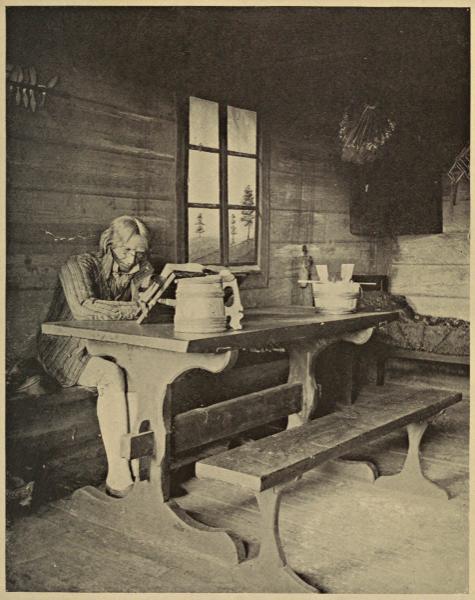
Copyright by Underwood & Underwood, N. Y.
Interior of a Finnish Cottage.
The lady of the house, even if she be a lady of high
degree, does not consider it beneath her dignity to go
to market herself, though she may often send her maid,
or take her along to carry the market basket. In this
sort of marketing you do not have to pay two or three
middlemen’s profits, nor do you have to pay your grocer
or butcher for the salary of several high-priced attendants
and for an automobile, or a two-horse team to
deliver the goods.
The most curious thing I saw in the Åbo market was
the bread, which was being peddled by many an old
woman from the back of her cart. The cheaper kinds
are made of rye meal, and are as hard as the nether millstone.
The loaves are flat and about the size of a dinner
plate, with a large round hole in the middle. They
would make admirable quoits, which you know is my
favorite game, and if my Finnish friends would not
have considered it altogether too frivolous I should have
bought some of these loaves and inaugurated a quoit
tournament on the spot.
In some places the bread is baked only once in six
months, and the older the bread the harder to masticate.
Some edibles are “not as nahsty as they look,” as our
English friends say of certain of our American dishes,
but to the uninitiated this Finnish black bread is quite
as nasty as it looks, for it is sour as well as hard, and in
the back districts, when harvests are poor, chopped straw
and bark are mixed with the meal.
I would not have you imagine, however, for a
moment, that in the well-to-do families, or in the
comfortable hotels and restaurants, we are reduced
to such fare as this. In fact, I know of no
country in the world, unless it be Sweden, where
food is so abundant, so varied, and so deliciously
cooked.
As I wandered in and out among the stalls of meat
and vegetables and bread and cheese, woolen stockings
and aprons, and butter and sausages, where one could
find almost anything he might want to eat or drink or
wear, I was most interested in the faces of these rugged,
weather-beaten peasants.
Ernest Young has well described the character of the
Finnish people when he says: “Nature, fate, and tradition
have stamped a common mark on the Finnish type
of character, which, indeed, varies considerably in the
country, but is easily recognized by the foreigner. The
general traits of character are hardened, patient, passive
strength; resignation; perseverance, allied to a certain
obstinacy; a slow, contemplative way of thinking; an
unwillingness to become angry and a tendency, when
anger has been aroused, to indulge in unmeasured wrath;
coolness in deadly peril, but caution afterwards; …
adherence to the old and well known; attention to duty;
a law-abiding habit of mind; love of liberty, hospitality,
honesty; a predilection for religious meditation, revealing
itself in true piety, which, however, is apt to have too
much respect for the mere letter.”
My own briefer acquaintance with the Finns has confirmed
Mr. Young’s study of their traits of character,
and I could imagine that even in the market place, as I
walked back and forth, I could discover in the faces many
of these admirable traits.
When one meets the upper, I will not say better classes,
one is sure to be charmed with his Finnish friends.
Their abundant hospitality, which always presses upon
us two cups of coffee (delicious coffee at that) when you
really only want one; their deferential courtesy, shown
not only in words, but in a multitude of kind and thoughtful
actions; their intelligence; their intimate knowledge
of the great world outside their own boundaries; their
pleasing vivacity (for in this respect they differ from the
quiet stolidness of the less educated peasantry) all these
qualities combine to make them the most charming of
hosts and companions.
The cathedral of Åbo stands not far from the market
place, across the little river that runs through the town,
and on a sightly eminence of its own. It was begun in
1229, and was not finished until the year 1400. How
patient these old builders were! They did not run up
their jerry-built houses and churches in a month, but
when they were built they stood for centuries.
This cathedral is of purely Gothic architecture, much
like the cathedral in Upsala, and it dates from about
the same period. It has not been renovated out of all
resemblance to its original self, however, like the Upsala
dome, and on that account is more interesting, in
my opinion. The lofty brick walls are scarred by
the storms of the centuries and eaten out here and
there by the tooth of time, but the church is well
preserved in spite of its nearly seven hundred years,
and is filled, Sunday after Sunday, with a throng of
honest worshipers.
The mural paintings about the altar, though of
modern date, are well worth studying, one of them,
especially, which represents the first baptism in Finland
at a spot very near to Åbo by Bishop Henrik, an English
missionary, who in 1157 undertook the perilous task
of converting the heathen Finns. The good bishop died
in Finland, and was buried in this old church, where his
bones rested in peace until 1720, when the Russians,
for some unexplained reason, dug them up and carried
them off. No man in these days knows his sepulchre.
In some of the side chapels are buried heroes of the
Thirty Years’ War, famous generals—whose suits of
armor, scarred and dented by the enemy’s bullets, still
stand beside their tombs.
The most famous tomb of all in the old Dom Church
is that of Queen Katherine of Sweden, wife of Eric XIV,
the oldest son of Gustavus Vasa. Eric had a checkered
career, both politically and matrimonially. He was
finally deposed from the throne, but while he occupied
it his hand had been refused by Queen Elizabeth, by
Mary Queen of Scots, and by two German princesses.
He seems to have been very cosmopolitan in his love
affairs, wooing Protestant and Catholic, Anglo-Saxon
and Teuton with equal avidity. At length, having apparently
no luck in court circles, he turned to a beautiful
girl among his own people, and married a peasant’s
daughter named Karin (or Katherine) Månsdotter. The
following is the story which one often hears in Finland:
“One day King Eric was strolling through the market
place at Stockholm, when his attention was attracted
by a singularly fair and graceful child, the daughter of
a common soldier, who was selling nuts. He sent her to
his palace to be educated, and when she was old enough
he asked her to marry him. All kinds of objections were
raised by his nobles and his relatives, and accusations of
witchcraft were made against Karin, but the wild and
passionate monarch took his way and married the little
nut-seller. Then a brother prince, who felt deeply the
disgrace that had been brought upon the royal order by
this unseemly match, sent Eric a present of a handsome
cloak in the back of which was sewed a patch
of rough, homespun cloth. Eric accepted the gift,
had the patch of homespun embroidered with gold
and studded with jewels until it was the most brilliant
and valuable part of the garment, and then returned
it to the donor.”[5]
The peasant queen well repaid his love and devotion.
She was buried in Åbo Cathedral, where her great black
marble sarcophagus reminds every visitor of the little
nut-seller who became a queen and who showed her
queenly qualities in adversity and exile. A stained-glass
window in the cathedral shows her dressed in white
robes, with a crown upon her head, stepping down from
her throne on the arm of a Finnish page.
The country round about Åbo is, for Finland, fertile
and productive, and in this region is made much of the
delicious butter that is sent to England, and often much
farther afield, but which on its way through Denmark
often gets labeled “Danish butter.”
It is interesting for those who butter their bread with
the Finnish product to know that in the many steam
creameries “the dairymaids in spotless white linen
dresses and aprons receive, weigh, and sterilize the milk
before it is made into butter, while all the churning,
scalding, and butter-packing rooms are models of cleanliness.”
It is always a wonder to me why countries that
make such delicious butter seem to be so fond of margarine,
for everywhere on the railway stations, in the
tramcars and in the newspapers in Scandinavia one
sees “Pellerin’s Margarine” advertised. But there are
some questions which polite travelers must not be too
inquisitive about, and this is one of them.
Butter would naturally lead us to cows (unless the
suspicions excited by these advertisements turn us aside),
and cows lead into the country, but I have not room in
this letter to tell you of country life in Finland, a fascinating
theme, which must be reserved for another letter.
Faithfully yours,
Phillips.
Wherein something is told of the charming lakes of Finland and
the canals that link them together; of the “Kalevala,” the great
Finnish epic; of the Finnish farmhouse, without and within; of
the inevitable bathhouse; of a melancholy Finnish wedding
and the more cheerful Finnish funeral.
In Finnish Lakeland, July 10.
My dear Judicia,
If you will study for a moment your Universal Atlas
you will see that “Lakeland” is a most appropriate
name for Finland, for, if the land in your atlas is represented
as white and the water as blue, you will find
Finland more than a quarter blue. In the southern
and most populous part of the peninsula there is more
lake than land in many sections.
The country has been called, poetically, the “Land
of a Thousand Lakes,” but this title has “the power of
an understatement.” To call it the “Land of Ten
Thousand Lakes” would still be below the truth. Why
could not the geographers, while they were about it,
have given this romantic country a more romantic
name? “Finland” or Fen-land, as the word means,
suggests bogs and swamps and impassable morasses.
The name “Suomi,” by which the Finns designate their
beloved country, is no better in its implications, for
that, too, means “Swamp-land.”
However, since we cannot change the name we must
take out of it all suggestions of miasmatic swamps and
read into it suggestions of sparkling waters, cold and
limpid; of birch-bordered lakes, studded with emerald
islands; of quiet thoroughfares of water that lead from
one lovely piece of water to another; a country where
you can journey for three days through a constant succession
of beautiful lakes without retracing your steps.
Man has assisted nature in making this waterway,
and it is especially interesting to Americans to know
that the great Saima Canal, which links together the
longest stretch of lakes, was built by Nils Ericsson, the
brother of the immortal engineer who built the Monitor,
and who invented the screw which to-day drives every
ship across the Atlantic.
None need ask for a more delightful trip than on
these lake-linked canals, where one is continually passing
from one lovely sheet of water to another, which
now expand into a little wave-lashed sea, now narrow
to the dimensions of a river. Again our boat twists
around a granite headland, stern and precipitous; then
skirts a tree-clad shore, or a meadow spangled with
flowers of many colors, and again threads a narrow,
tortuous passage for a mile or two, or is hoisted by a
convenient lock to a higher level and another equally
beautiful lake. The scenery is wilder but no less beautiful
than in Swedish lakeland, which I have before
described.
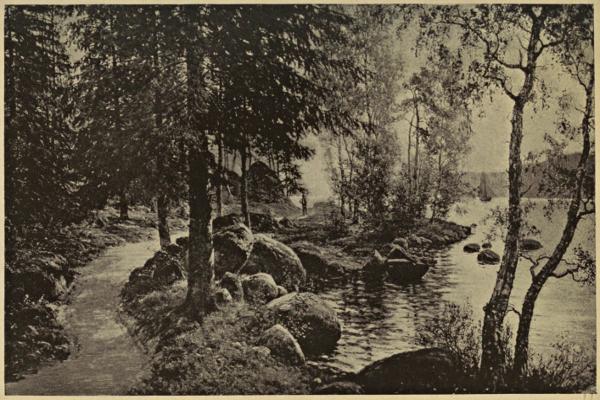
In Finnish Lakeland.
Though our vessel is driven by steam and not by
wind, one can appreciate the lines of the ancient Finnish
poet who wrote:
“Pleasant ’tis in boat on water,
Swaying as the boat glides onward,
Gliding o’er the sparkling water,
Driving o’er its shiny surface,
While the wind the boat is rocking,
And the waves drive on the vessel,
While the west-wind rocks it gently,
And the south-wind drives it onward.”
What poem do these lines remind you of, Judicia? I
know that you will promptly respond Hiawatha. But
the Finns would put it the other way about, and tell us
that Hiawatha reminded them of the Kalevala, and they
would be right, for Longfellow learned this meter from
a German translation of Kalevala, a meter in which all
varieties of Finnish verse are written. Kalevala means
the “Land of Heroes,” and is a long poem describing
every phase of Finnish life, animate and inanimate.
It is a collection of the folk lore and ancient
runes of the people, gathered together with infinite
pains and put into modern rhyme and meter by Elias
Lönnrot, a poor country doctor, who spent all his life
in an inland village but yet made the greatest of all
contributions to Finnish literature. We must take
the Kalevala along with us as we travel through Finnish
lakeland.
This unknown old poet of the folk songs, who wrote
before the recorded history of Finland began, serves as
a pretty good botanical guide to the trees and shrubs
along the banks of this great waterway when he tells us
that Sampsa, the good and all-powerful genius of the
older time, planted the trees which delight us in these
later days.
“On the hills he sowed the pine-trees,
On the knolls he sowed the fir-trees,
And in sandy places heather;
Leafy saplings in the valley.
In the dales he sowed the birch-trees,
In the loose earth sowed the alders,
Where the ground was damp, the cherries,
Likewise in the marshes, sallows.
Rowan-trees in holy places,
Willows in the fenny regions,
Juniper in stony districts,
Oaks upon the banks of rivers.”
When we think of the way in which a noble birch tree
is often stripped and scarified by the boys who covet
its bark, and the deer that love its leaves, and the
winter frosts that make its gaunt boughs shiver in the
cold winds, what can be prettier than the “Birch Tree’s
Lament,” as described in this ancient poem:
“Often unto me defenceless,
Oft to me unhappy creature,
In the short spring come the children,
Quickly to the spot they hurry,
And with sharpened knives they score me,
Draw my sap from out my body,
Strip from me my white bark-girdle,
Cups and plates therefrom constructing,
Baskets too for holding berries.”
“And the wind brought ills upon me,
And the frost brought bitter sorrows,
Tore the wind the green cloak from me,
Frost my pretty dress tore off me,
Thus am I of all the poorest,
And a most unhappy birch-tree,
Standing stripped of all my clothing,
As a naked trunk I stand here,
And in cold I shake and tremble,
And in frost I stand lamenting.”
In the course of our lake journey we pass countless
farmhouses, all of which have common characteristics.
Many are painted red and make vivid spots of color
on the landscape, either in the midst of the green of
summer or the white of winter. One large corner of
the living room is devoted to a huge fireplace, in which
great logs glow and cheerily crackle throughout the
long, cold winter. On the rafters overhead dried vegetables
are strung in festoons, or hoes, rakes, and fishing
tackle adorn the ceiling.
The one piece of furniture of distinction and honor
is the long sofa which graces one side of the room.
What the throne is to the king’s palace, the sofa is to
the peasant’s home. Says Paul Wainemann in his
Summer Tour in Finland: “The right-hand corner of
the sofa is the Holy of Holies and is always reserved for
the governor’s wife, if she graces an assembly with her
presence. Beside her would sit the wife of the official
next highest in rank. An unmarried lady under no
provocation would be tempted to seat herself on the
sofa, it being considered the height of indecorum to do
so, as well as being a sure and certain sign that she
would remain a spinster to the end of her days. Needless
to say, a mere man would be hounded out of the
room if he even attempted to commit such an appalling
breach of etiquette.”
I must say that in the last respect, though a mere
man myself, my experience has been different from that
of Mr. Wainemann, for I have frequently been urged
and sometimes almost compelled by my Finnish hostesses
to take the honored seat on the sofa, a seat which
I could not refuse without an undue struggle to show
humility and politeness.
An interesting and admirable addition to almost
every Finnish home in the country is the bathhouse,
which is usually built separate from the dwelling house.
The Finns and the Japanese are the only two peoples
whom I know who realize the virtue of a hot bath and
almost daily indulge in it. The Englishman enjoys his
cold tub, and carries his absurd bathtub with him,
whether he is going to Timbuctoo or to the next town
in his own country. The modern American can hardly
exist in a house that does not contain one or more set
bathtubs with hot and cold water, but the Finn and the
Jap are the only peoples who believe in the hottest kind
of a hot bath, though the Russians and Turks indulge
in them occasionally.
In the country bathhouse unhewn pine logs often
form the walls. A big, inclosed fireplace or stove of
rough stones is built in the middle or on one side. When
the stones are sizzling hot, an abundance of water is
poured upon them, and in the steam, which seems
almost scalding, the Finn lies down and enjoys the moist
relaxation to his heart’s content. When he has enjoyed
this sufficiently, he beats himself or his next neighbor
with bunches of fragrant birch twigs, while his neighbor
returns the favor. When he has been sufficiently soaped
and rubbed and flogged with twigs, he jumps into the
cold lake, if it be summertime, or rolls in the snow in
winter. I have never seen it myself, but I am told on
good authority that in the evening it is no uncommon
sight in the country to see a row of naked men sitting
outside the house, having just completed their cold
plunge.
That this Finnish bath is an immemorial custom is
shown by the fact that in one of the folk songs of the
Kalevala, Anniki, the little sister of Ilmarinen, “the
great primeval craftsman,” says to him:
“Now the bath-room’s filled with vapor,
And the vapor-bath I’ve heated,
And have steeped the bath-whisks nicely,
Choosing out the best among them.
Bathe, O Brother, at your pleasure,
Pouring water as you need it,
Wash your head to flaxen color,
Till your eyes shine out like snow-flakes.”
In these pleasant farmhouses by which we glide so
rapidly in our little steamer how many human comedies
and tragedies must have been enacted; how many joys
and sorrows have found place beneath these roofs?
Births and betrothals, weddings and funerals, each has
brought as much ecstasy or grief as the same events
bring to the noble chateau or lordly palace.
You remember, Judicia, how we have sometimes been
amused at the profound melancholy which occasionally
invests a wedding at home. Do you remember how we
have seen the weeping mother of the bride or groom
sobbing out her congratulations, and how sometimes
the whole assembly was almost dissolved in tears.
Well, in the olden times the Finns carried the mournful
wedding to the nth degree of melancholy. As late
as 1899 a writer in a popular magazine, speaking of a
Russian wedding just across the Finnish border, says:
“Such a thing as a radiant bride is unknown in those
regions, and the chief idea seems to be to make as great
a show of grief as possible, and to make the function as
dismal as a funeral.”
A weeping wedding is not now known in Finland
except in the remotest districts, but I am told that not
long ago a company of professional wedding weepers
were brought to Helsingfors from the far north to show
how they could enliven marriage festivities and to remind
a modern bride of the customs of long ago.
The Kalevala, that thesaurus of rhythmical information
concerning ancient customs, tells us what was said
to the bride before she left for her new home, to make
her thoroughly appreciate the old homstead, and also
the way in which she replied to the jeremiad. I will
quote for you a few more lines:
“Hast thou never, youthful maiden,
On both sides surveyed the question,
Looked beyond the present moment,
When the bargain was concluded?
All thy life must thou be weeping,
And for many years lamenting,
How thou left’st thy father’s household,
And thy native land abandoned,
From beside thy tender mother,
From the home of her who bore thee.”
And the lugubrious maiden replies,
“Blackest trouble rests upon me,
Black as coal my heart within me,
Coal-black trouble weighs upon me.”
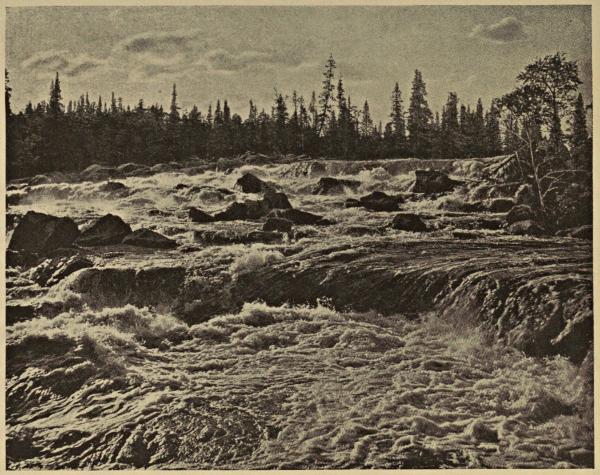
In Eastern Finland.
A funeral could hardly by any possibility have been
more solemn in the ancient times than a wedding. Indeed
often it must have been a more joyous occasion,
for I am told that in some sections, even to this day,
after the relatives have kissed the corpse, all the guests
present shake him by the hand, and that the friends
usually speak of him not as dead, but as one “whom it
hath pleased God to take.”
You can see what a delightful experience a voyage
through lakeland must be, in the midst of such charming
and ever-changing scenery, the human interest constantly
kept alive, not only by the abundant life along
the shore, but by the unforgotten customs of the past
which the Kalevala has so beautifully preserved for us.
There are other and more thrilling voyages through
the “Land of a Thousand Lakes” than the one I have
taken you upon to-day. The trip, for instance, down
the rapids of Uleå, which is made every day of the
tourist season in long, narrow rowboats, under the care
of skillful licensed pilots. The canoe trip from Moosehead
Lake in Maine to the St. John River in New
Brunswick through the Allegash waters is not unlike
this journey down the Uleå River, though the passage
of the many rapids is usually less thrilling. But in Finland,
as in Maine, it takes a cool and skillful hand to
pilot the frail craft down these ripping, roaring rapids.
Now it looks as though the way was blocked up by a
jutting headland; again it seems as if our craft would
be dashed to pieces against a gigantic boulder in mid-stream,
but always in the Uleå, as in the Allegash, the
turn of a paddle avoids the threatened danger, and our
boat floats out into smooth waters to the peaceful
thoroughfare below the rapids.
But it is hopeless to attempt to describe all the interesting
matters that cluster around country life in Finland.
Here is a country as big as all Great Britain,
with the Low Countries across the Channel thrown in.
Who would have the nerve to attempt to describe country
life in Belgium, Holland, Ireland, Scotland, and
England in one letter? The very magnitude of the task
must be my excuse for the fragmentary incompleteness
of my attempt.
Faithfully yours,
Phillips.
Which has to do with Tammerfors, the “Manchester” of Finland, and
the railway which takes one thither; its remarkable church; the
Wounded Angel and the Garden of Death; also something about
the church boats of the country districts, and the strange notice
given from the pulpit.
Tammerfors, Finland, July 15.
My dear Judicia,
Tammerfors is an inland city on the edge of the great
lake region of which I wrote you in my last letter. I had
to come here by rail, and perhaps you will be interested
to know something about the railways of Finland. I
must confess that as means of communication they cannot
rival the steamers on the lakes and canals, but, as
in most other countries, they are a very necessary evil,
and, since in Finland they run on well-ballasted roads
for the most part and burn fragrant wood instead of
ill-smelling coal, their nuisance as smoke and dust producers
is reduced to a minimum.
They are practically all owned by the State, and as the
State is in no hurry to get its inhabitants from one place
to another, or to get them out of the country, should they
be bound to emigrate, the average rate of speed is not
more than fifteen miles an hour. Even the express
trains between Helsingfors and St. Petersburg are no
cannon balls or “Flying Yankees,” for a mile in three
minutes and ten seconds is the best they attempt to do
for the whole journey.
Still if you have time enough at your disposal you
can travel a surprisingly long distance in Finland for a
surprisingly small amount of money. The third-class
fares (and the third class is patronized by the great
majority of people) costs less than a cent a mile, and
you can go clear around the east coast of the Gulf of
Bothnia to its northern tip, if you are so disposed, and
at Haparanda can almost shake hands with our Swedish
friends, whom I visited in Luleå a few months ago.
I would not advise you to take a third-class car if you
intend to take a long journey in Finland, for the hard,
yellow, wooden seats get decidedly tiresome before you
have jolted over a hundred miles of Finnish scenery.
The second-class cars are entirely comfortable and even
luxurious on the principal lines, and you can settle down
happily in your plush, springy comfort, usually having a
whole seat to yourself.
The first-class accommodations, as in Sweden, are
only distinguished from the second by the placard on the
door or the window and by your own inner consciousness
that you have paid considerably more than your neighbors
for the same accommodations. Most of the cars
are more like our American cars than the ordinary European
coaches, with an aisle down the middle and seats
on either side, though the same car may be divided into
two or three compartments with doors between.
The stations are modest, wooden buildings, and, except
for the numerous signs of margarine, beer, and other comestibles
with which they are decorated, I could readily
mistake them for railway stations in northern New
Hampshire or western Dakota.
One could never, however, mistake a Finnish railway
restaurant for a similar institution in America. Here
one sees no quick-lunch counter, no aged sandwiches
made the day before yesterday, no greasy doughnuts or
any impossible concoction misnamed “coffee.” Here
everything is neat, nice, and orderly. The coffee is
sure to be delicious, for in the meanest Finnish hut,
even in far Lapland, the proprietor would be ashamed to
give you anything but a steaming and fragrant cup of
their national beverage. With the coffee, and for the
same price, you get an unlimited supply of little cakes
or sweetbread, while if you want a full dinner of three
or four courses, superbly cooked and elegantly served,
it will cost you only two and a half Finnish marks, or
about fifty cents, for a Finnish mark differs from a German
mark in being of the same value as a franc.
Outside the station, in rows along the platform, I often
see old women with baskets of apples or plates of fried
meat or cakes, or loaves of coarse bread and bottles of
milk, just as we saw them in that long journey across
Siberia in the early days of the Trans-Siberian Railway.
You remember how eagerly we used to race for the bread
and milk stalls to get our supply before the little tables
were swept bare by the hungry travelers? In Finland
one does not have to be a sprinter in order to get his
share of the food, for there is always an abundant supply
at the restaurants. The old women on the outside, because
of the cheapness of their wares, are largely patronized
by the poorer people.
The notices in the stations and in the cars about smoking,
spitting, putting your head out of the window,
standing on the platform, and so on, are printed in six
languages: Finnish, Swedish, Russian, German, French,
and English, and the maps and diagrams and time-tables
are so full of helpful information that no wayfaring man
need go astray.
In one respect the Finnish railways differ from the
Swedish, though they are such near neighbors. The
Swedish trains glide away like the Arab when he has
folded his tents, without making any fuss about it. No
bell is rung, no whistle blown, no word of command
given. The station master simply waves his hand when
the exact second for departure has come, and unless you
keep your eyes wide open, and your watch exactly with
railway time, you are likely to see the rear car of the
train vanishing in the distance while you make frantic
but unavailing attempts to catch it. In Finland, on the
contrary, there is no danger of your being left, for first
the station bell rings, then it rings again, then the conductor
blows his whistle, then the engineer answers him
with the locomotive whistle, and by that time, everything
being good and ready, the train will slowly get
under way.
Tammerfors might well be called “Grand Rapids,” a
name indeed which is not far from its Finnish significance,
for through the center of the city rushes a tremendous
stream of water, over rapids that make it swirl and eddy
and shoot its spray high in the air. This river Tam
affords a splendid water power for the principal manufacturing
city in Finland, and is lined with great cotton
and woolen mills and paper factories, which rightly give
the city the nickname, even among its own inhabitants,
of the “Manchester” of Finland.
In size, however, the Finnish Manchester is nearer
the New Hampshire than the English Manchester, and
its river rushes and tumbles through the city much as
the Merrimac throws itself with mighty force against
the water wheels of the New England city.
But neither Manchester, New Hampshire, nor Manchester,
England, can boast such a remarkable church as
the “Manchester” of Finland. Indeed, I doubt if such
a church can be found in any one of the five continents.
It is a very expensive church, built of solid granite, with
enormous pillars that would not be put to the blush by
the ruins of Baalbec, or the ancient temple of Sardis.
In this church a great Christian Endeavor meeting was
held which completely filled the audience room, as has
been the case in the other cathedral churches of Finland,
and I must say that it was rather a unique experience as
I spoke to the living audience to see also a painted audience
of naked men and half-clothed women coming out
of their graves forming the great altar piece, representing
the Resurrection morning.
Around the huge gallery, supported by enormous
stone pillars, is a row of naked boys carrying a large
garland which completely surrounds the gallery. This
garland is supposed to signify the “Burden of Life,”
and is composed of roses and thorns. Some of the boys
are carrying it lightly, and others are staggering under
its weight.
In other parts of the church are two remarkable frescoes,
one representing two boys carrying a wounded
angel on a kind of litter between them. The angel’s
drooping wings, spotted with blood, and her sweet,
patient expression contrast strangely with the rugged
little Finnish boys who are carrying her. One of them has
a resentful expression on his face, as though he were
deadly tired of his burden. Did the artist mean to tell
us that every boy carries an angel with him, though he
often resents her presence and would be glad to get rid
of her?
The other mural painting represents the “Garden of
Death,” and shows us three grinning skeletons with
watering-pots in their hands, sprinkling flowers of
various kinds as they wander through their garden.
One writer calls this a “perfectly hideous piece of symbolism,”
but it did not so strike me. Though unpleasant
in some of its features, it is not nearly so hideous as the
pictures of the Last Judgment depicted by many of the
old masters, and it teaches the worth-while lesson that
“life evermore is fed by death.”
This church is characteristic of the new and audacious
architecture of Finland. Ernest Young well describes
it when he says: “Without a mass of photographs it is
difficult to convey to the reader any idea of the curious
character of this modern work. One man calls it “hideous”;
another “lovely.” The choice of the epithet
probably depends on your education, your prejudices,
and your ability to seek sympathetically for the meaning
of the builder. It falls into no category of known
style; hence if you be but of the schools it will probably
appal you.”
“To me,” he continues, “it is an intense joy, even
when it is ugliest and least effective, for it is daring.
It is only a man of courage who dares to do the things
that these men do. It is full of the spirit of youth, and
though it be not Gothic, nor Moorish, nor anything but
Finnish, I could wander all day amongst the houses
and streets where it is prevalent, feeling as though I
were once more in the presence of an age when men dared
to be original in defiance of all accepted traditions.”
I ought to tell you, perhaps, before I get through with
this remarkable church that there was strong opposition,
especially on the part of the clergy, to the extreme nudity
of the decorations, but the persistence of the artists,
and the pride of the people in their original productions,
prevailed over all objections, and the paintings remain
there, naked and unashamed.
Tammerfors, or the Rapids of the Tam, affords a good
point of departure for the more remote interior of Finland,
and here we should find churches and churchgoers
of a different type from those which the large cities
afford. The churches, like the houses of the people, are of
wood, and some of them are enormous buildings in which
the peasants from many miles around gather to worship
and to be instructed by their honored pastors. With
some families, as with our Puritan ancestors, Sunday
begins on Saturday afternoon. This is perhaps a matter
of necessity rather than of conscience, because not a
few live at such a distance that they have to start on
Saturday afternoon in order to get to church in season
for the Sunday service. No sight in Finland is more
unique than the great “church boats” that leave the
remote villages on Saturday evenings for a journey
through the long summer twilight to the distant church.
These boats sometimes contain twenty or thirty worshipers,
and the rhythm of the splashing oars is accentuated
by the sweet voices of the maidens as they sing
the psalms and hymns of ancient Finland. Practically
all the people are Lutherans, though there are Free
Church Lutherans and State Church Lutherans, and
you may be sure that Luther’s famous hymn, “A
Mighty Stronghold is our God,” often resounds along
the peaceful waterways and is echoed from the pine-clad
hills as the “church boat” makes its way to the sanctuary.
In these days the “church boat” is often a steamer
of considerable size, which starts early Sunday morning
and collects three or four hundred worshipers from the
different hamlets and farms within its circuit.
If we should attend church in one of these remote districts
in the winter we would very likely hear the minister
give out a singular notice from the pulpit. It
would not be concerning a “Ladies’ Sewing-circle,” or
a “Men’s Club,” or a “Turkey Supper,” or a “Strawberry
Festival,” but, strangest of all strange pulpit
“intimations,” as our Scotch friends would call it, it
would relate to a bear hunt.
To be more specific, the minister would announce that
a certain farmer had found a “ring,” and that no one
must trespass upon his “ring.” This would mean that
a certain member of the church had been lucky enough
to track a bear to its lair, and that, without disturbing
him, he had drawn a wide circle around him in the snow.
Henceforward that bear is his property, either to kill or
to sell to some sportsman who wants the excitement
of a bear hunt.
Bruin himself, it seems, is not very particular about
his winter quarters. When he is ready for his winter’s
nap he lies down and lets the snow cover him up as it
will. It often makes a large heap over his improvised
bedroom, and his breath, escaping like steam from a
hole in the snow which it has melted, often reveals his
hiding place to the sharp-eyed farmer, who is always on
the lookout for it.
The discoverer rarely disturbs Bruin himself, but he
sends word to the Tourist Association of Helsingfors
that he has a “ring” for sale, and there are many keen
hunters, some of whom come from Russia and some
from England, who are glad to pay from seventy-five
to eighty dollars for the ring. When the huntsman
reaches the bear’s winter quarters, the dogs and the
beaters rout out the bear, who usually puts up a very
stiff fight, and not altogether a one-sided one before
he is dispatched by the hunter.
I must say it seems to me something like burglary, if
not highway robbery and murder, to drive inoffensive
Bruin in the dead of his long winter night out of his
cozy sleeping apartment. Especially I am sorry for the
mother bear, who always keeps her cubs with her during
the long night, while the father bear keeps a bedroom
of his own. As a result of these bear hunts, it is said
that “in Viborg and other towns it is not uncommon to
see young bears which have been caught in this manner
acting as playmates for the children, and running at
large in the gardens and on the hills.”
I suppose that Aylmer told you all about skiing when
he wrote you of his winter in Norway, and I will simply
remind you, and Aylmer, too, if you will communicate
the fact to him, that the “ski is a Finnish invention,
and was known here many years before it was introduced
into Norway.” So that fact counts at least one point
for my side of Scandinavia.
Faithfully yours,
Phillips.
Deals with Helsingfors, the capital of the Grand Duchy, and its
strongly fortified islands; with Woman’s Suffrage in progressive
Finland; with universal education; with the folk schools and the
extreme attention given to them; with the university and its
degrees; with the literature of the Finns and the more interesting
Finn himself.
Helsingfors, Finland, July 20.
My dear Judicia,
Helsingfors is the best place in the world from which
to write you my last letter about greater Scandinavia,
for it is not only the capital and chief city of the Grand
Duchy of Finland, but it is the best point of departure
from the country for one whose pleasant tasks in these
northern lands are nearly finished. From here I can go
by rail to St. Petersburg, and thence to any other desirable
spot on the earth’s surface; or I can sail to Riga, to
Stockholm, to a number of places on the German coast,
or to Hull in England, and, with only one change of
steamer, can get back to our best-loved America.
But I cannot leave Scandinavia without telling you
something of this interesting city, the center not only
of the political life but of the educational, literary, and
artistic life of Finland.
The Russians have taken pains to make Helsingfors’
strong, strategic position, impregnable from the military
point of view. The entrance to the inner harbor is so
narrow that only one ship at a time can pass between
the frowning rocks, and the murderous guns of the forts
are so mounted that they can be turned against the foe,
whether he approach by land or sea.
A little way out from the inner harbor is a scattered
group of frowning, rocky islands fortified with the
latest type of death-dealing cannon. At the time of
the Crimean War both France and England mustered
their fleets to take one of these islands, but found it
impossible. To-day it would be a still more difficult
task.
If poverty makes strange bedfellows, international
complications and affiances make still stranger chums.
Here are the bitter enemies of sixty years ago hobnobbing
together in these days of the Entente cordiale.
Republican France, constitutional Britain, and autocratic,
reactionary Russia, “as thick as thieves” (no
opprobrious implication intended), and working together
with all the wiles and all the might of diplomacy to offset
and hold in check the Triple Alliance.
Speaking of politics and government, I would modestly
recommend both the suffragettes and the anti-suffragettes
of England to study the experience of
Finland in regard to this burning subject. Here is the
only European country that totally ignores the word
“male” in its suffrage regulations. Every adult has a
vote, and, as fifty-three per cent of the inhabitants are
women, they hold the much-dreaded balance of power
which is such a bugbear to the “antis” of Great Britain.
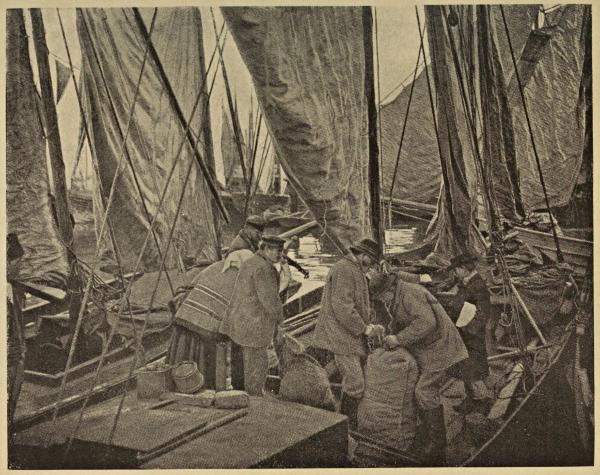
Fish Harbor, Helsingfors.
Here is a country that is theoretically ruled by women,
and yet there has been no tremendous cataclysm of the
forces of nature. The sun rises and sets in Finland just
as it used to do. People buy and sell and get gain, fall
in love, are married and given in marriage, die and are
buried, just as in the olden days. Theoretically the
women could tip every man out of his parliamentary
seat and run the government to suit themselves, but,
strange to say, there are only seventeen women in the
Finnish Diet. Less than one tenth of all the members
belong to the terrible window-smashing sex, and one
writer says of these seventeen: “They are mostly of
middle age, grave, and even portentously solemn. They
are apparently proof against all temptations of vanity.
They dress with Quakerish simplicity and are completely
absorbed in their duties.”
Whether it is due to the influence of woman or not,
Finland is an exceedingly orderly and well-governed
country, and it would be ruled still better did not the
medieval government at St. Petersburg veto various
measures relating to education and morals which would
be for the welfare of the country. For instance, as I
told you before, the Diet wants a larger measure of the
prohibition of intoxicants, which the Czar has forbidden.
The Diet has voted for compulsory education,
which the imperial Romanoff, “with and by the consent
of his ministers,” has also disallowed.
Nevertheless, in spite of this handicap Finland is in
many respects the most progressive and best educated
nation in Europe. Let the woman suffragists get what
comfort they can from these facts, and let the suffragettes
remember that in getting “votes for women” in
Finland not a single bomb was exploded, or a house
burned to the ground, or a single window broken by a
wild and whirling female.
Until very recently there have been four estates in
the Diet of Finland: Nobles, Clergy, Burghers, and
Peasants. In the last-named house Finland was entirely
unique. I have never heard of another nation
that had a “House of Peasants” to legislate for it, but
it must be remembered that many of these so-called
peasants are very substantial farmers, and that their
power in a country like Finland is paramount, as it
ought to be.
In 1906 the four estates were abolished, and now
there is only one legislative chamber, where representatives
of all the people meet together to legislate for the
welfare of their beloved fatherland.
You may have thought that I was drawing a “long
bow” when I said that Finland was the best educated
nation in the world, but I am prepared to defend the
proposition. I do not mean to say that classical or
technical education for the few has been carried to so
high a point as in Germany, though in this respect Finland
is not lacking. But in the rudiments of a sound
education she is unsurpassed. It is scarcely an exaggeration
to say that every man, woman, and child of
school age in Finland knows the three “R’s”—“readin’,
’ritin’ and ’rithmetic”—and he can pursue his education
as much further as his time and inclination allow.
Think of the black belts of illiteracy in our own
southland, of the “Crackers” who have never tried to
learn their letters, of the hordes of newcomers to our
shores, who could never get in if the reading test were
applied to them! I acknowledge that America has a
far different educational problem to deal with than
compact, homogeneous Finland, but it nevertheless
remains true that from the standpoint of elementary
education Finland stands at the head of the class in
the school of the nations.
Most exemplary and commendable care is taken to
provide for the physical as well as the intellectual health
of the children. I have not visited many of these schools
myself, and am indebted to Mr. Ernest Young for the
following facts. In the folk schools, which correspond
to our public primary and grammar schools, manual
work and gymnastics are required, as rigidly as study
hours and recitations.
The General Architectural Council of Finland draws
the plans for the schoolhouses. These plans provide
for such minute affairs as the decorations of the rooms.
In rooms facing the north, which will receive little sunlight,
especially in the long winter days, warm reds,
yellows, and greens are the prevailing tints; in the
warmer rooms that face the south colder tones are
used. There are no square corners for the accumulation
of dust. The boys and girls have separate dressing
rooms, and the newer buildings are provided with
shower baths. Overcoats are hung up in the cloakrooms
or corridors, and there is not only a separate
place for each class, but a little closet for each pupil.
Each of these is provided with a peg, a shelf for caps
and bags, a stand for the umbrella, and a pigeonhole
for the indispensable goloshes. Accommodations for
snowshoes, sledges, skis, and bicycles are also provided.
Every folk school in the country must have a playground
and enough free land connected with it to furnish
a garden plot for the teacher and pupils. The
government is so fatherly, not to say motherly, as to
ordain that the girls’ desks shall be provided with a
pincushion.
Coeducation has no terror for the Finns, and boys
and girls are educated together from the primary school
to the time of their graduation at the university.
Parents who are afraid of the effects of “calf love”
from coeducation may perhaps be reassured by a remark
quoted from a Finnish schoolgirl: “We may fall
in love when we are at school,” she said, “but never
with a boy in the same school as ourselves. You see,
we know them too well.” You may be permitted,
Judicia, if you desire to do so, to doubt the sweeping
generalization of this young lady.
Finland must be a perfect paradise in summertime
for poor and sickly children. They are not left to the
occasional ministrations of some benevolent individual
or voluntary society for a glimpse of the country, but,
if they need an out-of-door holiday, they are sent by
the municipality of Helsingfors into the country for a
week, or a month, or three months, as the case may be,
to recover health and strength in the holiday camps.
That there is nothing haphazard about this municipal
benevolence is shown by the fact that a public medical
officer sends these poor children into the country and
weighs and measures them before each holiday to know
how much they have profited by it.
The morals of the children are looked after as well
as their physical and mental training. Children who
wish to go to any place of public amusement must ask
permission of the head master of the school, unless they
have distinct permission from their parents, and in
many schools, even where parents give permission, the
head master must be informed of it before the pupil
goes to any public show. Every encouragement is
given to poor and ambitious children who desire to pursue
their education through the university. Free food,
free clothes, and school books are provided for those
whose parents absolutely cannot furnish them.
Helsingfors is the center of educational Finland, for
here is the great college called the Alexander University,
in grateful remembrance of Finland’s first Russian
Grand Duke, the well-beloved Alexander I. When
graduation time comes, each faculty in the schools of
theology, law, medicine, and philosophy confers separate
degrees. When the degrees are conferred, a cannon
booms from the parapet near by in honor of each graduate,
and the band welcomes him to his new honors
with stately music. Instead of the gorgeous hoods displaying
as many colors as Joseph’s coat, with which
our own degrees are conferred, the Masters of Arts in
Finland receive a gold ring, and the Doctors a silk-covered
hat.
A beautiful motto is set over the door of Studentshuset,
or “Students’ House,” the common meeting place
of the students of both sexes. This was built by subscriptions
voluntarily given by people in all parts of the
country, and the motto over the door is, “Given by the
Fatherland to its Hope.” No motto could better tell
the ardent love of Finland for the higher education of
its youth.
But you ask me, Judicia, “What of Helsingfors itself?”
the city from which I have dated my letter. Well,
it does not differ greatly from other European cities,
when you look upon it superficially, for in its present
aspect it is distinctively modern. Like all large Finnish
towns, it has been burned down more than once, and
after its last great conflagration, less than a century
ago, its architects seem to have copied for the most
part the models set them by other cities, for that was
before a distinctive type of Finnish architecture began
to make its appearance. Many of the streets are broad
and lined with handsome houses and business blocks
and public buildings. The University and the Art
Museum are substantial but not imposing buildings,
while the inadequate Diet House, as I told you, would
soon be replaced by another if only Czar Nicholas would
give his imperial permission.
In the center of one of the principal squares is a splendid
statue of Alexander II, which a grateful people often
decorate with wreaths to this day, as they remember
the man who gave them back their liberties. One would
think that no Russian bureaucrat to-day, intent upon
taking away the liberties of the people, could look on
this statue without a glow of inward shame.
The great church which dominates Helsingfors is St.
Nicholas, which stands on a sightly eminence near the
center of the city, and is a fine specimen of the Greek
style of architecture. Here the state functions are observed,
and here during my stay a great Christian
Endeavor meeting was held which gave me an opportunity
to see as fine a congregation of men and women,
young and old, as one could see in any land beneath the
sun.
Though the St. Nicholas is the largest and most popular
church in the city, there is another whose architecture
is far more remarkable, for it is the latest Finnish
word in church building. It has the most massive and
stately granite tower that I have seen on any church in
Europe. It, too, stands upon a hill, and half a dozen
streets seem to converge to it, so that whenever you lift
up your eyes from almost any quarter of the city there
is this magnificent tower, solemn, imposing, majestic, a
conception which only a Finnish architect would dare
to execute. The tower quite dwarfs the rest of the
church, and from some points of view it seems to be all
tower.
The audience room is of no inconsiderable size, and is
better adapted for singing than for speaking. A fine
organ in three sections, one in the front of the church,
one in the rear, and one in the tower, whose notes seem
to drop down as from heaven, render the musical services
of unusual interest. If you should hear “Suomi’s
Song” in this unique church, with its solemn and intensely
patriotic cadences and words, you would better
understand the love of the Finns for their country.
I have not space to tell you much of the literature of
Finland, nor could I were my space unlimited, for much
of the best of it has not been translated into English.
As one has said: “A mere glance at a Finnish grammar,
with its sixteen cases for the nouns and its host of grammatical
complexities, gives one a humorous notion that
it might have been perfected for the purpose of preventing
any other nation from knowing anything about the
beauties that it enshrines.”
However, some of the works of the beloved author
Runeberg have been translated under the title Ensign
Stals Song. I have already quoted from the Kalevala,
the great epic of Finland, so admirably translated by Mr.
Kirby and published in the “Everyman Library.” Of
this poem Max Müller says: “It should have a place in
the literature of the world, on the same shelf with the
poems of Homer, the Niebelungen, and other great epics
which the world will not willingly let die.”
After all, interesting as is the country, the architecture,
the literature, and the social customs, the most
interesting thing about Finland is the Finn himself.
His sturdiness, his good sense, his progressive spirit, his
willingness to try experiments, but always under the
ægis of the Goddess of Law and Order; his healthy conservatism,
his wise radicalism, his love of liberty, his
hatred of tyranny—all combine to make one of the most
interesting individuals on the face of the earth. I am
glad that so many Finns have come to America, and
that more are coming. They add the best possible element
to our body politic. They do not herd together in
the purlieus of our great cities, but for the most part
spread themselves out over the limitless farmlands of
the west, though some of them find employment in our
manufacturing cities. Driven away from their home
land by hard conditions of life or by the tyranny of
their oppressors, three hundred thousand of them have
found homes in the United States. Intelligent, law-abiding,
liberty-loving, there is no better American than
the Finnish American.
I do not know, Judicia, whether my poor letters have
made you feel the charm of these sturdy, wholesome,
homelike nations of the far north, whose fascination lies
not so much in their art as in the varied beauties of
the natural scenery and in the character of the people
themselves, but, as for me, I must confess that I have
fallen completely under the spell of Greater Scandinavia.
Faithfully yours,
Phillips.