LISSOY AND CLONMACNOISE
Since we could not get to Athlone by water, we must
needs get there by rail; so, most regretfully, next morning,
we bade good-bye to Castleconnell and took train
for Limerick. Half an hour later, we pulled out of
the Limerick terminus, circled about the town, crossed
the Shannon by a long, low bridge, and were in County
Clare.
Ruins are more numerous here than almost anywhere
else in Ireland, for this western slope of the Shannon
valley, so fertile and coveted, was famous fighting-ground.
There are one or two in sight all the time,
across the beautiful rolling meadows. Near Cratloe
there are three, their great square keeps looming above
the trees, and looking out across the wide Shannon
estuary. A little farther on is the famous seat of the
Earls of Thomond, Bunratty Castle, a fine old fortress,
with all the approved mediæval trimmings of
moat, guard-room, banqueting-hall, dungeons and torture-chamber,
and I am sorry we did not get to visit it.
Indeed, there are many places in the neighbourhood
worth a visit—but if one is going to visit every Irish
ruin, he will need ten years for the task. Only it does
cause a pang of the heart to pass any of them by.
We must have passed at least fifty by, that day;
but I found that the train stopped for a while at Ennis,
the chief town of Clare, and I hurried out to see what
I could of it. It is certainly a picturesque place, with
narrow winding streets, and queer little courts, and
houses painted pink or washed with yellow ochre. I
glanced in at the new Catholic cathedral, whose most
impressive feature is a rather good picture of the ascension
over the high altar; and then spent a few minutes
among the ruins of the Franciscan friary, a queer jumble
of buildings which I did not have time to untangle.
As usual, the two biggest buildings in the town are
the jail and the lunatic asylum, and I passed them both
on my way back to the station. Some of the lunatics
were languidly hoeing a big potato patch that day,
with five or six guards looking on. I have never looked
up the statistics of lunacy in Ireland, but if all the asylums
are full, the rate must be very high.
About half a mile beyond Ennis, the train passes
a most imposing ruin, very close to the railway. It is
the ruin of Clare Abbey, and is dominated by a great
square tower, which must be visible for many miles
around. There is still another ruin, that of Killone
Abbey, only a few miles away, and for a connoisseur
in ruins, Ennis would be an excellent place to spend
a few days.
From Ennis, we turned almost due northward toward
Athenry, and the landscape became the rockiest I have
ever seen. Every little field was surrounded by a high
stone wall, and as these walls did not begin to exhaust
the supply, there were great heaps of rocks in every
available corner—every one of them dug from the shallow
soil with almost incredible labour. The fact that
any one would try to reclaim such land speaks volumes
for the hard necessities of the people who settled
here. I don't suppose they enjoyed the labour, but
they had no choice—at least, their only choice was to
wrest a living from these rocky fields or starve. No
doubt many of them did starve, but the rest kept labouring
on, with insect-like industry, reclaiming this
corner and that, adding to the soil of their fields inch
by inch.
There is an old saying that in this district, and in
others like it in Connaught, the first three crops are
stones, and I can well believe it. The green appearance
of these hillsides is a delusion and a snare, for it
is nothing but a skin of turf over the rocks, and these
rocks must be dug away to the depth of two feet,
sometimes, before the soil is reached. In any other
part of the world, a man who would attempt to convert
such a hillside into an arable field would be thought
insane; here, in the west of Ireland, it is the usual
thing. Most tragic of all, after it was fit for tillage,
it did not belong to the man whose labour had made it
so, but to his English landlord, who promptly proceeded
to raise the rent!
We ran out of this rocky land, at last, and crossed a
vast bog, scarred with long, black, water-filled ditches,
from which the turf had been taken. There were a
few people here and there cutting it, but a woman who
had got into the compartment with us said that the
continued wet weather had made the work very difficult
and dangerous. All the people hereabouts, she added,
lived by the turf cutting, at which they could earn,
perhaps, ten-pence a day; but in bad seasons they were
soon close to starvation. I remarked that, with such
wages, they must be close to it all the time, and she
smiled sadly and said that that was true. Only, of
course, in the bogs the children can work, as well as
the men and women, and that helps. Indeed, we saw
them many times—little boys and girls who should
have been at school or running free, gaining health and
strength for the hard years to come, tugging at the
heavy, water-soaked blocks of peat, and laying them
out in the sun to dry. It takes a month of sun to dry
the peat; in wet weather it won't dry at all, and so isn't
salable. Truly, the lives of the poor Irish hang on
slender threads!
There are ruins of castles and monasteries and raths
and cashels all through this region, and a lot of them
cluster about the dirty little town of Athenry, which
can boast a castle, two monasteries, city walls and an
old gate. Such richness was not to be passed by, and
we left the train, checked our luggage at the parcel
office, fought off a jarvey who was determined to drive
us to the ruins which we could see quite plainly just
across the track, crossed the road by the overhead
bridge, and came out in the streets of the village.
Athenry is typically Irish, with streets running every
way, houses built any way, and their inhabitants leaning
over the half-doors, or braced against the walls at
the street corners, or going slowly about such business
as they have. Life has stood still here for at least a
century; and yet Athenry was once a royal town—"The
Ford of the Kings" its name signifies—and a
royal court was held here in the great castle, and a
beautiful monastery was built near by at the express
wish of St. Dominick himself, and it became a famous
place of learning, to which scholars flocked from all
over Europe. Alas and alack!
Vanished, those high conceits! Desolate and forlorn,
We hunger against hope for that lost heritage.
For the red tide of war swept over Athenry more
than once, and left it but smoking ruins. Eleven
thousand Connaughtmen lay piled about the walls one
summer day in 1316, all that was left of the army that
tried to make Edward Bruce king of Ireland; two centuries
later, when the Earls of Clanricarde swept Connaught
with fire and sword, Athenry fell before them,
and was left in ashes; and when it struggled to its feet
again, it was only to fall before the destroying hand
of Red Hugh O'Donnell, who left scarcely one stone
upon another, and from that blow it never rallied.
One of the old gates still survives, well preserved in
spite of war and weather, and near it is a quaint old
market cross, with the Virgin and Child on one side
and Christ on the other. All that is left of the thirteenth
century castle is the gabled keep, looming high
on a rock just back of the town, and some fragments
of the battlemented curtains. All the floors have
fallen in, and its four massive walls are open to the
heavens. Red Hugh, when he destroyed it, did his
work well!
The ruins of the abbey nestle in the shadow of the
rock on which the castle stands, and we made our way
down to them, along disordered streets swarming with
geese, ducks, dogs, chickens and children, only to find
the way closed by an iron gate, securely padlocked.
But a passer-by told us that the village blacksmith had
the key, and indicated vaguely the way to his shop,
which we found after some circuitous wanderings. The
smith was a gnarled little man, quite the reverse of
Longfellow's, and as soon as we had made our errand
known, he snatched down the keys and hastened to lead
the way to the ruins, leaving his work without pausing
to remove his apron, and without a backward glance
at his helper, who stood open-mouthed by the forge.
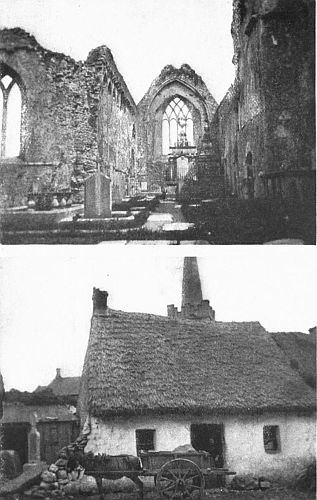 THE CHOIR OF THE ABBEY AT ATHENRY
A COTTAGE AT ATHENRY
There were three gates to unlock before we reached
the ruins, and then the blacksmith hurried back to his
work, leaving his daughter to keep an eye on us. The
church is all that is left of the monastery, for the domestic
buildings, and even the cloisters have been swept
entirely away by the rude hand of time, and the far
ruder ones of the villagers who needed stone for their
houses. The church itself has suffered more than most,
for not only is the roof gone, but the tower and one
transept and most of the window-tracery, and the whole
interior has been swept by a savage storm, the tombs
hacked and hewed, and the carved decorations knocked
to fragments. Doubtless if we had questioned the girl
who stood staring at us, she would have said that
"Crummell did it," and in this case, history would
bear her out, for the Puritan soldiery did do a lot of
damage here. They and the sans-culottes suffered from
the same mania—a sort of vertigo of destructiveness
before memorials of kings or Catholics!
But they couldn't destroy everything, and what is
left in this old church is well worth seeing, for there
are some graceful pointed windows, and six narrow lancets
in a lovely row along the north wall of the choir,
and a fine arcade in the north transept, and many details
of decoration beautiful in spite of mutilation.
The place is crowded with tombs, for this was the burial
place of the Dalys and the Lynchs and the De Burgos,
and is still in use as such. The tomb of the "noble
family of De Burgh" is in one corner, and there are
many mural tablets, with inscriptions in French and
Latin and Gaelic, as well as English. In fact one of
them announces in French and Latin and English,
presumably so that every one except the Irish might
read, that "here is the antient Sepulchre of the Sept of
the Walls of Droghty late demolished by the Cromellians."
We went back through the town, at last, and while I
was manœuvring for the picture opposite page 270,
Betty got into talk with a girl who was leaning over a
half-door, and found, marvellous to relate, that she had
once lived in Brookline, Mass. We asked her why she
had come back to Ireland, and after a moment's thought
she said it was because "America wasn't fair." We
thought of aristocratic Brookline, the abode of millionaires,
and then we looked about us—at the ragged
donkey standing across the way, at the pig wandering
down the middle of the dirty street, at the low little
houses and the shabby people—and perhaps we
smiled, but be sure it was in sympathy, not in derision.
We crossed over to the railway hotel, finally, and
had lunch, and when we came out, the woman who
managed the place waylaid us at the front door for a
chat. She told us of a woman from the village who
was on the Titanic, but was saved, and discussed various
scandals in high life, which she had gleaned from
the half-penny press; and then we spoke of the girl we
had met in the village, and she deplored the high-and-mighty
airs which some of the girls who come home
from America give themselves.
"But I once heard one of them put well in her place,"
she added, "when she came back with her hat full of
flowers and her petticoat full of flounces, and walked
about the town as though we were all dirt beneath her
feet. Well, one day an old man stopped her for a
word, a friend of the family who wished her well, but
she put up her nose at him—and perhaps he was not
very clean—and was for going past. But he put out
his hand and caught her by the arm. 'You're after
bein' a fine lady now,' says he, 'but I mind the time,
and that but a few years since, when I've seen ye
sittin' on your bare-backed ass, with your naked legs
hangin' down—yes, and I can be tellin' ye more than
that, if so be ye wish to hear it!' She didn't stay long
in the village after that," added the speaker, with a
chuckle of relish.
Our train came along, presently, and we were soon
running over as dreary, bleak and miserable a land as
any we had seen in Ireland. Vast boggy plains, bare
rocky hillsides, with scarcely a house to be seen anywhere—only
a ruin, now and then, marking the site of
some ancient stronghold; and so, in the first dusk of
the evening, we came to Athlone.
One would have thought that, with so important a
town, the station would have been placed somewhere
near it; but habit was too strong for the builders of
the line, and so they put the station about a mile away,
at the end of a dreary stretch of road, beyond a great
barrack, along the river, past the castle, and over the
bridge.
Athlone has been famous for its widows ever since
the days of Molly Malone, ohone! who
Melted the hearts
Of the swains in them parts;
and we found that the best hotel in the place, which
was not as good as it might have been, was managed
by a widow, who might well have posed for the lovely
Molly. She had not been a widow long, and I judged
would not be if the swains of the town had any voice
in the matter, for the bar was very popular when she
was behind it.
We went out, after dinner, to see the town, and
found it one of the most ugly and depressing we had
yet encountered—a sort of cross between a town and
a village, but with the attractions of neither. The
water-front is its most interesting part, for a fragment
of the old castle which was built to guard the second
of the all-important fords of the Shannon still stands
there. Kincora, you will remember, guarded the other.
But Kincora was three days' march to the southward;
and for two days' march to the northward there was
no other place where the Shannon could be crossed; and
so here at the ford just below Lough Ree, in the old
days, a franklin named Luan set up a rude little inn,
and the place came to be known as Ath Luan, Luan's
Ford—Athlone. Here in the year 1001, hostages were
sent from all Ireland to meet Brian Boru and proclaim
him High King; and here, a century later, the O'Conors
built a rath and a tower to guard the ford and levy
tribute upon all who used it. In another hundred
years, the Normans had seized it, and put up the strong,
round-towered castle, parts of which still remain; and
for seven centuries after that, the English power "sat
astride the passage of Connaught," save for the brief
time, after the battle of the Boyne, it was held by the
Irish. But Ginkle captured it, as he was soon to capture
Limerick, and a few years later, most of what was
left of the town was destroyed when the magazine of
the castle blew up during a thunderstorm.
But though there is little in Athlone to delay the
visitor, there are two places in the neighbourhood worth
seeing. Nine miles to the north is Lissoy, made immortal
by Goldsmith as
Sweet Auburn! loveliest village of the plain;
and ten miles to the south, on the bank of the Shannon,
are the ruins of Clonmacnoise, whither, twelve
centuries ago, men in search of knowledge turned their
faces from all the corners of Europe.
It was for Lissoy we started next morning, on a car
for which I had bargained the night before. Our jarvey
was a loquacious old fellow, who talked unceasingly,
but in so broken a brogue that it was only with
the greatest difficulty we could follow him. He had
known some people who had gone down on the Titanic,
and he told us all about them; but most of his talk
was a lament for the hard times, the sorrowful state
of the country, the paucity of tourists, and the vagaries
of the landlady, of whom he spoke in the most mournful
and pessimistic way. She was not, I gathered,
a native of Athlone, but a Dublin woman whose ideas
were new-fangled and highfalutin, and who, I inferred,
did not look kindly upon the careless habits of her
"help."
The road lay through a pleasant, rolling country,
with glimpses of Lough Ree to the left, and on a hill
to the right a tall shaft which our jarvey told us
marked the exact centre of Ireland. When one looks
at the map, one sees that it is at least somewhere near
the centre. But it has been explained to other passers-by
in many ways: as the remains of a round tower,
as a tower which a rich man built in order to mount
to the top of it every day to count his sheep, as a pole
for his tent put up by Finn MacCool, as a wind-mill
in the old days, and as a dozen other things—anything,
in fact, that happened to occur to the man who
was asked the question. One answer, you may be sure,
he never made, and that was that he didn't know!
There are some remains of old windmills in the
neighbourhood—we saw one or two on near-by hillsides,
close enough to recognise them; and if I had
known at the time what a divergence of opinion there
was about that lonely tower in the distance, I would
have driven over to it and investigated it on my own
hook. But our jarvey's answer was so positive that
it left no room for doubt, so we drove on through a village
of tiny thatched houses, with the smoke of the
turf giving a pleasant tang to the air; then up a long
hill, to the left at a cross-roads, and at last our jarvey
drew up before a five-barred gate. We looked at him
questioningly, for there was no village in sight.
"'Tis here it was, sir," he said, "sweet Auburn, the
loveliest village of the plain. 'Twas up that path
yonder the village preacher's modest mansion rose,
though there is little enough left of it now; and over
yonder, behind that wall with the yellow furze atop
it, unprofitably gay, was where the village master
taught his little school, and there is nothing at all left
of that; and a little furder on is the 'Three Jolly
Pigeons,' where news much older than the ale went
round."
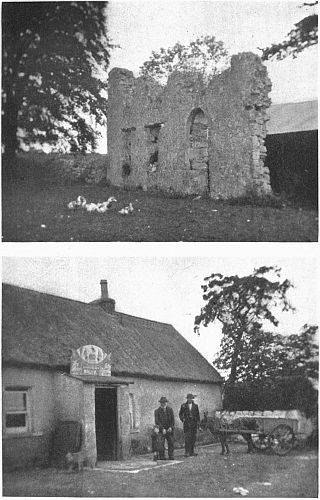 THE GOLDSMITH RECTORY AT LISSOY
THE "THREE JOLLY PIGEONS"
I looked at him wonderingly.
"Where did you pick up all that patter?" I asked.
He snickered.
"Ah, you would not be the first gintleman I have
driven out here, sir," he explained; "and many of them
would be speakin' parts of the poem."
"I suppose ale is still to be obtained at the 'Three
Jolly Pigeons'?"
"It is, sir, if so be your honour would be wantin'
some. And they have one of the big stones of the old
mill for a doorstep," he added, as an extra inducement
not to pass it by.
We got down from our seats, went through the gate,
and up the path which Goldsmith and his father trod
so many times; for, whether or not Lissoy was really
Auburn, there can be no doubt that the elder Goldsmith
was really vicar here, and that he lived in the
house, the rectory of Kilkenny West, of which only a
fragment of the front wall remains, and that Oliver
was a boy here. The ash trees which shadowed the
path have disappeared, but there are still plenty of
gabbling geese around, and a file of them went past as
I took a picture of the remnant of the rectory. A shed
with a hideous roof of corrugated iron has been built
behind it, and near by is a two-storied house where the
present tenant lives. We found an old woman, for
all the world like Goldsmith's "widowed, solitary
thing," carding wool in an outhouse, and she showed us
the old well, deep in the ground, walled around and
approached by a steep flight of steps.
There was nothing more to see, so we went back to
the gate, escorted by three friendly pigs, and clambered
up to our seats again, and looked out over the valley.
There is nothing in that valley but gently-rolling pastures,
and nothing lives there now but sheep and cattle.
And it sends a chill up the spine to realise that
once a village stood there, and that it has melted away
into the earth. Not a stone is left of its houses, not a
sod of its walls, not a flower of its gardens.
But that village was Lissoy, not Auburn. No such
village as Auburn ever existed in Ireland, where the
young folks sported on the village green, and the swain
responsive to the milkmaid sung, and the village master
taught his school during the day, and argued with
the preacher in the evening, and a jolly crowd gathered
every night at the inn to drink the nut-brown
ale. There is not a single Irish detail in that picture;
it is all English, just as Goldsmith intended it should
be, for it was of "England's griefs" he was writing,
not of Ireland's. In that day, few people here in Westmeath
spoke anything but Irish; the village children
knew nothing of schools, except hedge-row ones, taught
by some fugitive priest; the "honest rustics" had no
"decent churches," but only hidden caves in dark valleys,
where Mass was said secretly and at the risk of
life; and, rest assured, when any inhabitant of this
valley had money to spend for drink, he wasted it on
no such futile beverage as nut-brown ale!
I am sure that little of it is sold to-day at the "Three
Jolly Pigeons," where we presently arrived, a low wayside
tavern with thatched roof and plastered wall, kept
by John Nally, who welcomed us most kindly, and grew
enthusiastic when I proposed to take a picture. There
was a rickety donkey-cart standing by the door, and
its owner came out to be in the picture, too—raggeder
even than his donkey, disreputable, dirty, gin-soaked,
and with only a jagged tooth or two in his expansive
mouth, but carefree and full of mirth.
Betty, who had been admiring the supreme raggedness
of the donkey, asked its name.
"Top o' the Mornin', miss," answered the man, with
a shout of laughter, and I am sure the name was the
inspiration of the moment.
And then, while our jarvey drank his whiskey, I had
a talk with Mr. Nally, who, of course, for reasons of
trade perhaps, is firmly of the belief that Auburn is
Lissoy and no other. And he told me of another poet
who was born down on the banks of the Inny, a mile
or two away, and who, in the old days, spent many an
evening at the Pigeons—Johnny Casey he called him,
and it turned out to be that same John Keegan Casey,
who wrote "The Rising of the Moon," and "Maire
my Girl," and "Gracie og Machree," and "Donal
Kenny,"—Irish subjects all, and most of them local
ones, as well. Donal Kenny, for instance, was a bold
blade, a clever hand with the snare and the net, who
turned the heads of all the girls in the neighbourhood,
and broke those of most of the boys, until it was glad
they were when he went off with himself to America.
I have looked up the poem since, and I fear that Casey
enveloped the parting scene with exaggerated sentiment;
yet the verses have a swing to them:
Come, piper, play the "Shaskan Reel,"
Or else the "Lasses on the Heather,"
And, Mary, lay aside your wheel
Until we dance once more together.
At fair and pattern oft before
Of reels and jigs we've tripped full many;
But ne'er again this loved old floor
Will feel the foot of Donal Kenny.
We tore ourselves away, at last, taking a road which
ran along the border of the lake—a beautiful sheet of
bluest water, dotted with greenest islands, with the
rolling plains of Roscommon rising beyond. And then,
from the top of a long hill, we saw below us the spires
of Athlone, and soon we were rattling down into the
town.
That morning, while looking through our guide-book,
we had encountered a sentence which piqued our curiosity.
It was this:
"Some of the walls of St. Peter's Abbey remain, in which
can be seen one of those curious figures called 'Sheela-na-gig."
I remembered dimly that, back at Cashel, John
Minogue had called our attention to a grotesque figure
with twisted legs and distorted visage carved on a
stone, and had called it something that sounded like
Sheela-na-gig; but I wasn't sure, and so we started
out blithely to find this one.
Right at the start, we met with unexpected difficulties,
for nobody at the hotel, not even the ancient jarvey,
had ever heard of the Sheela-na-gig. The barmaid,
however, said that St. Peter's Abbey was on
the other side of the river, past the castle, so we went
over there, and found that part of the town much more
dilapidated and picturesque than the more modern portion
on the Westmeath side. We wandered around for
quite a while, asking the way of this person and that,
and finally we wound up at St. Peter's church, a new
structure and one singularly uninteresting. It was
evident that there was no Sheela-na-gig there; and at
this point Betty surrendered, and went back to the
hotel to write some letters.
But I had started out on the quest of the Sheela-na-gig,
and I was determined to find it. I thought possibly
it might be somewhere among the ruins of the
Franciscan Abbey, which stand close to the other side
of the river, so I crossed the river again, and after
walking about a mile along a high wall through a
dirty lane, reached a gate, only to find it locked.
There was a man inside, raking a gravelled walk, but
he said nobody was admitted to the ruins, and anyway
he was quite positive that there was no such thing as
a Sheela-na-gig among them. He added that a portion
of the ruins had been torn down to make room for
an extension of the Athlone Woolen Mills, and perhaps
they had the Sheela-na-gig there.
I had no faith in this suggestion, but for want of
something better to do, I turned in at the office of the
mills, and was warmly welcomed by the manager, who
invited me to inspect the place. It is an exceedingly
rambling and haphazard structure, but it gives employment
to hundreds of people, mostly girls and
women, whose pale faces and drooping figures bore
testimony to the wearing nature of the work. The mill
gets the wool in the raw state, straight from the grower,
and the processes by which it is cleaned and carded and
spun into thread, and dyed, and woven into cloth, and
inspected, and weighed, and finally rolled up ready for
the market, are many and intricate. The manager
told me that the mill turned out thirty thousand yards
of tweed a week, and he hoped to turn out even more,
as soon as a reduction of the tariff permitted him to
get into the American market. Even with a duty of
forty-five per cent., he could compete with American
tweeds, and with a lower duty he could undersell them.
It needed only a glance at the shabby, toil-worn men
and women working in his factory to understand why
this was true. I didn't ask him what wages his women
earned, but I did ask as to their hours of labour. They
go to work at 6:30 in the morning and work till six in
the evening, with a three-quarter hour interval for
breakfast and the same for lunch. I saw groups of
them, afterwards, strolling about the streets in the twilight,
and sad and poor and spiritless they looked.
Yet they are eager for the work, for at least it keeps
them alive, and one can scarcely blame the manager
for sticking to the market price, and so doing his best
to meet a remorseless competition. I confess that such
economic problems as this are too stiff for me.
As I was about to leave, I casually mentioned my
search for the Sheela-na-gig—and he knew where it
was! It was over on the other bank, it seemed, not far
from the river-front, and he directed me with great detail
how to get to it; but, alas, in such a town of
crooked streets, definite direction was impossible.
However, with hope springing eternal, I crossed the
bridge a third time, turned up-stream close beside the
river, wandered into a board-yard, extricated myself,
got into a blind alley that ended in a high wall and had
to retrace my steps; asked man after man, who only
stared vacantly and shook their heads; and finally
found a boy who knew, and who eagerly left his work
to conduct me to the spot.
Imagine with what a feeling of triumph I stood at
last before the Sheela-na-gig!
It is carved over the wide arch of the entrance to
what was once an abbey, but what I think is now a
laundry—an impish, leering figure, clasping its knees
up under its chin, and peering down to see who passes.
Underneath the imp are the words "St. Peter's Port,"
and underneath the words is a grotesque head. On
either side of the arch is a sculptured plaque, that to
the left bearing the words "May Satan never enter,"
and that to the right, "Wilo Wisp & Jack the Printer,"—the
two, of course, forming a couplet.
While I was staring at these remarkable inscriptions
and trying to puzzle out some meaning for them, an
old woman, who had been watching me with interest
from the door of her house, came out and tried to tell
me the history of the gate. But she spoke so incoherently
that I could make nothing of it beyond the
fact that the inscriptions originated in two men's rivalry
for possession of the property; so somebody else
will have to untangle that legend.
A little way up the street there was a shop which,
among other things, had post-cards displayed for sale,
and I stopped in, thinking I might get a picture of the
gate and perhaps learn something more of its story.
But when I asked for such a card, the proprietor stared
at me in amazement.
"There is no such gate hereabouts," he said.
"But there is," I protested; "right there at the end
of the street. Do you mean to say you have never
seen the Sheela-na-gig, nor read that line about Wilo
Wisp and Jack the Printer?"
He rubbed his head dazedly.
"I have not," he admitted. "Look at that, now,"
he went on; "here have I been going past that gate for
years, and you come all the way from America and see
more in one minute than I have seen in me whole life!"
Then he asked me if I had been up on top the castle,
which was just opposite his shop, and I replied that I
had not.
"Nor have I," he said; "but I am told there is a
grand view from up there."
"Why not go up with me now?" I suggested.
"I might," he agreed; and then he looked at the tall
keep of the castle and shook his head. "'Tis not to-day
I can be doing it; you see, I must stay with the
shop."
So I left him there, and essayed the heights of the
castle by myself. Only for a little way, however, was
I by myself, for some families connected with the garrison
live there, and they are all prolific; so I soon
found myself surrounded by a horde of ragged children,
who begged for ha'pennies in the queer bated voice
which seems to go with begging in Ireland. I distributed
a few, but that was a mistake; for when they
found I not only had some ha'pennies but was actually
willing to part with them, they grew almost ferocious;
I said "Oppenheimer!" in vain, and I was only saved
at last by a husky woman who issued forth from one of
the towers and swept down upon them, vi et armis, and
drove them headlong out of sight. She was red-headed
and curious, and she stopped for a bit of talk. (I
pass over the part about America.)
"How do you like living in the old castle?" I asked
her, finally.
"Sure, 'tis a grand place, sir."
"Do you ever see any ghosts?"
"Ghosts? Niver a one, sir."
"Nor hear any banshees?"
"Banshees is it? Sure, they niver come to this place,
sir, 'tis that healthy, bein' so high."
And it must, indeed, be healthier than the narrow,
gloomy, squalid streets below. I could look down into
them from the top of the tower, to which I presently
mounted, and see their swarming life—men and women
idling about, a girl drawing water from the public
pump, a boy skinning some eels at the corner, small
children playing in the gutters. On the other side lay
the river, empty save for a few small launches, and
beyond it the roofs of the newer part of the town, and
beyond the town the beautiful Westmeath hills.
Just at my feet was the bridge across the Shannon,
connecting east and west Ireland. It is a modern one,
but it stands on the site of the old one, built while
Elizabeth was queen, and the scene of a desperate
conflict when Ginkle stormed the town. Of the castle
itself, only the keep is old. The drum-towers, which
frown down upon the river, are of later date, though
one would never suspect it to look at them; but when
one gets to the top of them, one finds embrasures for
artillery, and the approach is up a graded way along
which the guns can be taken. The old drawbridge and
portcullis which guarded the entrance to the keep are
still in place, but there is little else of interest.
The ruins of the ancient abbey of Clonmacnoise lie
close beside the Shannon, some ten miles below Athlone,
and the road thither winds through a rolling country
down to the broad river, which here flows lazily between
flat banks. One would expect so noble a stretch
of water to be crowded with commerce, but it was quite
empty that morning, save for an occasional rude, flat-bottomed
punt, loaded high with turf, which a man
and a boy would be poling slowly upstream toward
Athlone.
It was a desolate scene; and Clonmacnoise looked
desolate, too, with its gaunt grey towers, and huddle of
little buildings, and cluttered graveyard. It seemed
incredible that this obscure corner of the world was
once a centre of learning toward which scholars turned
their faces from the far ends of Europe, to which
Charlemagne sent gifts, and within whose walls princes
and nobles were reared in wisdom and piety. Yet such
it was—the nearest to being a national university
among all the abbeys, for it was not identified with any
class or province, but chose its abbots from all Ireland,
and welcomed its students from all the world.
The abbey was founded by St. Kieran in 548. St.
Kieran belonged to what is known as the Second Order
of Irish Saints, founders of monasteries and of great
co-operative communities, as distinguished from the
First Order—St. Patrick and his immediate successors—who
were bishops and missionaries and founders of
churches, and the Third Order, who were hermits,
dwelling in desert places, often in small stone cells, just
as St. Molua did in his little cell near Killaloe. St.
Kieran had already started an abbey on an island in
Lough Ree, but grew dissatisfied with it, for some reason,
and he and eight companions got on board a boat
and floated down the river, rejecting this place and that
as not suited to their purpose, and finally reaching this
sloping meadow, where their leader bade them stop.
"Let us remain here," he said, "for many souls will
ascend to heaven from this spot."
So the abbey was started, and, though Kieran himself
died in the following year, it grew rapidly in importance.
Let me try to picture the place as it was
then. The students lived in small huts crowded about
the precincts; the classes were held in the open air;
only for purposes of worship were permanent buildings
built. Here, as at Glendalough, there was not one
large church, but seven small ones; and the students
seem to have attended divine service in the groups in
which they studied. It was a self-supporting community,
tilling its own lands, spinning its own wool,
weaving its own cloth, and building its own churches;
and its life, while not austere, was of the simplest.
The students, at times, numbered as many as three
thousand. The teaching was free, but from every student
a certain amount of service was required in the
interest of the community. The principal study, of
course, was that of religion, but from the very first
the heathen classics and the Irish language, arithmetic,
rhetoric, astronomy and natural science were taught
side by side with theology.
The life at Clonmacnoise was typical of that at all
the other monastic schools with which Ireland was then
so thickly dotted; and it is the more interesting because
the whole continent of Europe, at that time, was groping
through the very darkest period of the Middle
Ages. Culture there was at its lowest ebb—knowledge
of Greek, for instance, had so nearly vanished that any
one who knew Greek was assumed at once to have
come from Ireland, where it was taught in all the
schools. Those schools sent forth swarms of missionaries,
"the most fearless spiritual knights the world has
known," to spread the light over Europe; they established
centres at Cambrai, at Rheims, at Soissons, at
Laon, at Liége; they founded the great monastery at
Ratisbon; they built others at Wurzburg, at Nuremberg,
at Constanz, at Vienna—and then came the Vikings,
and put an end to Irish learning. For the Vikings
were Pagans, and the shrines of the churches, the
treasuries of the monasteries and schools, were the first
objects of onslaught.
For two centuries, the Danes made of Ireland "spoil-land
and sword-land and conquered land, ravaged her
chieftaincies and her privileged churches and her sanctuaries,
and rent her shrines and her reliquaries and
her books, and demolished her beautiful ornamented
temples—in a word, though there were an hundred
sharp and ready tongues in each head, and an hundred
loud, unceasing voices from each tongue, they could
never enumerate all the Gael suffered, both men and
women, laity and clergy, noble and ignoble, from these
wrathful, valiant, purely-pagan people." The Danes
aimed to destroy all learning, which they hated and
distrusted, and they very nearly succeeded.
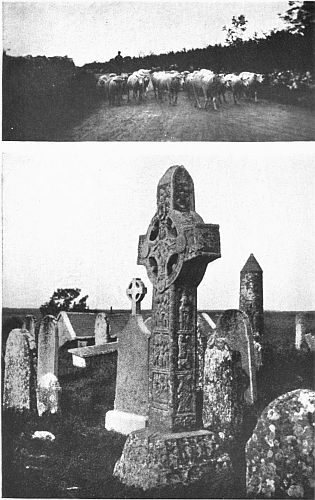 ON THE ROAD TO CLONMACNOISE
ST. KIERAN'S CATHAIR, CLONMACNOISE
I have already told how, under Brian Boru, the Irish
drew together, and finally managed to defeat the Danes
at Clontarf; and for a century and a half after that,
ancient Erin seemed rising from her ashes. The books
destroyed by the Danes were re-written, churches and
monasteries rebuilt, schools re-opened—and then came
Strongbow at the head of his Normans, and that dream
was ended. There was civilisation in Ireland after
that, but it was a civilisation dominated by England;
there was education, but not for the native Irish; there
were great monasteries, but they were built by French
or Norman monks—by Franciscans or Cistercians or
Augustinians; and finally even these were swept away
with the coming of the Established Church.
I shall not attempt to describe the ruins of the seven
churches of Clonmacnoise, except to say that, though
they are all small, they are crowded with interesting
detail; and there are two round towers, somewhat squat
and rude, as a witness to the danger of Danish raiders;
but the glory of the place is the magnificent sculptured
cross, erected a thousand years ago over the grave of
Flann, High King of Erin, and still standing as a
witness to Irish craftsmanship. It is ten feet high, cut
from a single block of stone, and elaborately carved
from top to bottom, and its date is fixed by an Irish
inscription which can still be deciphered: "A prayer
for Colman who made this cross on the King Flann."
It was Flann who built the largest of the stone churches,
near which the cross stands, about 909, and at that time
Colman was Abbot of Clonmacnoise. Flann died five
years later, and Colman honoured his memory with this
magnificent tribute.
Its maker's name is lost, but there can be no doubt
he was a great artist. On one side he has represented
scenes from the founding of Clonmacnoise, and on the
other scenes from the Passion of the Saviour. The
crucifixion, as usual, is depicted at the intersection,
while hell and heaven are shown on the arms themselves,
crowded with the damned or the blessed, as the
case may be. There is another cross in the graveyard
scarcely less interesting, though no one knows on whose
grave it stands, and there is the shaft of a third. And
all about them are crowded the lichened tombstones
marking the graves of the fortunate ones who won
sepulture in St. Kieran's cathair, and who, on the last
day, will be borne straight to heaven with him.
For this enclosure was once the very holiest in Ireland.
It was here that Kieran was laid, and then his
prophecy was remembered that many souls would
ascend to heaven from this spot; and the belief gradually
grew that no one interred "in the graveyard
of noble Kieran" would ever be adjudged to damnation.
In consequence, so many people wanted to be
buried there that there wasn't room for all of them,
and in the end, even powerful kings and princes were
forced to contend with great gifts for a place of sepulture.
Here Flann was laid; and hither was borne the
body of Rory O'Conor, the last who claimed the kingship
of all Ireland, after his death at Cong. The great
abbey at Cong served well enough as the retreat for his
declining years, but it was only at Clonmacnoise, in
the sacred cathair of Kieran, that he would be buried.
And, as I closed the chapter on the Shannon with some
verses of one of Ireland's truest poets, I cannot do better
than close this one with his lovely rendering of the
lament which Enock O'Gillan wrote many centuries
ago for
THE DEAD AT CLONMACNOISE
In a quiet-watered land, a land of roses,
Stands St. Kieran's city fair,
And the warriors of Erin in their famous generations
Slumber there.
There beneath the dewy hillside sleep the noblest
Of the clan of Conn,
Each below his stone with name in branching Ogham
And the sacred knot thereon.
There they laid to rest the seven kings of Tara,
There the sons of Cairbré sleep—
Battle-banners of the Gael that in Kieran's plain of crosses
Now their final hosting keep.
And in Clonmacnoise they laid the men of Teffia,
And right many a lord of Bregh;
Deep the sod above Clan Creidé and Clan Conaill,
Kind in hall and fierce in fray.
Many and many a son of Conn the Hundred-fighter
In the red earth lies at rest;
Many a blue eye of Clan Colman the turf covers,
Many a swan-white breast.