If on a fine day we take our stand on one of the
terraces, or battlements, of Mont Orgueil Castle—and
there is hardly a pleasanter spot in Jersey
in which to idle away a sunny summer afternoon—we
shall realize more completely than geography
books can tell us that the Channel Islands
really constitute the last remnants of the ancient
Norman dukedom that still belong to the English
Crown. For there, across the water, not more
than twenty miles away, and stretching from
north of Carteret far southwards towards Granville
and Mont St. Michel, is the long white line
of the Norman coast itself—on a clear day it is
even possible to make out the tall, twin spires of
Coutances, half a dozen miles inland, crowning,
like Lincoln or Ely, their far-seen hill. No part
of France, it is true, approaches so closely to Jersey
as Cap de la Hague (the extreme north-west
point of the Cotentin) approaches to the north-east
corner of Alderney. Still, under certain
atmospheric conditions—such, for example, as
Wordsworth experienced when he wrote his fine
sonnet headed Near Dover, September, 1802—the
"span of waters"—hardly greater than the
Straits of Dover themselves—really seems almost
to shrink to the dimensions of "a lake or river
bright and fair." Contrast with this proximity
the long stretches of open sea that separate these
islands from Weymouth or Southampton, and
we begin to realize how, physically at any rate,
Jersey is more properly France than England:
Elle est pour nous la France, et, dans son lit des fleurs,
Elle en a le sourire et quelquefois les pleurs.
The impression thus gained is hardly diminished
when we quit our lofty watch-tower and descend
to the plain. The Channel Islands are doubtless
destined in the end to be wholly anglicized, but
the process is one of imperceptible transition.
A curious French patois, that is really the last
relics of the ancient Norman speech, is still the
common language of the people. "It is probably,"
says Mr. Bicknell, in his charming Little
Guide, "the nearest approach now extant to the
French spoken at the time of the Norman Conquest
by the Normans in England." French is
also the language used commonly in the country
churches; and it is strange to follow the familiar
English liturgy rendered thus in a foreign tongue.
The Channel Islands, though jealously retaining
their ancient independence, and as separate in
many respects from England as are Canada and
Australia, are yet integrally part of the established
English Church. The Reformation freed them
from the yoke of Coutances only to subject them
to the yoke of Winchester. French, too, or
rather Norman, is the curious "Clameur de
Haro" that plays so strange a part in the ancient
island law. This is the regular machinery, in
actions connected with real estate, to maintain
the existing status in quo till the action can be
fought out at length; and in Jersey is set in
motion by the plaintiff himself, whereas in England
it is necessary to invoke the Courts of Law.
"At the disputed place the aggrieved person, in
the presence of two witnesses, orders the-aggressor
or his agent to desist by exclaiming: 'Haro!
Haro! Haro! A l'aide, mon Prince, on me fait
tort.' After this he denounces the aggressor by
exclaiming: 'Je vous ordonne de quitter cet
ouvrage'; upon which, unless he desist instantly,
he is liable to be punished for breach of the
King's authority, the property being supposed to
be under the King's special protection from the
moment the 'cry' is made." Afterwards the
action is tried; and, of course, if it prove that
the complainant has invoked the "haro" wrongly
(the word is said by some to be derived from the
Frankish "haran," to cry out, or shout; but by
others to be a corrupted form of "Ah Rollo"—the
first Norman Duke—or "Ah Rou"—Oh my
King), he is liable to be fined by the court. It
is sometimes said that this strange process was in
constant use in Normandy long before the arrival
of Rollo and his fierce followers from the North.
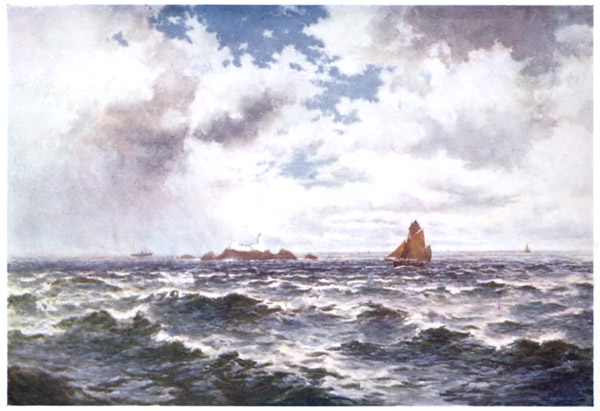
THE CASQUET ROCKS AND LIGHTHOUSE.
This group of rocks lies N.N.E. of Guernsey, and is passed by the steamers which serve the
islands from England.
French, again, is the architecture of the
churches, that in some ways has no parallel in
England. French, in many particulars, is the
aspect of the towns, whose long rows of whitewashed
houses, with their never-ending sun-blinds,
testify to a warmth and sunlight too conspicuously
rare in England. Actually French are many of
the faces that one encounters in the streets or on
the quays. The Channel Islands of late years
have become a favourite touring-ground for
summer visitors from France, who so seldom
venture to cross the Channel to explore the
beauties of England itself. The admirable little
Guides Joanne now include a volume on the Iles
Anglaises de la Manche. It is amusing, however,
to read in this work that in one respect at least
Jersey is still definitely English. "L'observation
stricte du dimanche règne à Saint-Hélier comme
en Angleterre. La ville déserte, avec ses boutiques
fermées, offre un silence sépulchral." But the
closed shops, if not the sepulchral silence, are
now becoming common in France itself.
Mont Orgueil, where we stand, is not a bad
starting-point from which to commence our exploration
of Jersey. Happy, indeed, the visitor
who arrives at this little port from France—and
the steamer comes from Carteret in little more
than an hour. Most English tourists, on the
other hand, make Jersey first at St. Helier, which
happens to be a town of considerable dulness,
and compares very badly with St. Peter Port, in
Guernsey. Mont Orgueil, however, may be
reached at once from St. Helier by one of the
two strange little railways that traverse the south
coast of the island. The traveller should quit the
train at the previous station of Gorey Village, and
walk thence across Gorey Common to the Castle.
This last, placed bravely on its boss of rugged
rock, grows more and more impressive the nearer
we approach it. Superb in situation, and unusually
picturesque, this "hill of pride" has yet
few features of real architectural interest. Parts
of it date from about the end of the twelfth
century, and the archæologist, of course, will
gather "sermons" from every stone of it. But
the ordinary sight-seer will be best delighted with
the picturesque approach up long flights of steps
past successive gateways; with the beautiful
views of land and sea to be got from its towers;
and, best of all, by the general view of the castle
itself, dominating the little harbour that crouches
below its walls. The structure is built of a soft-red
granite, that is very pleasant to look on, and
not least so in spring, when its broken walls are
beautifully variegated with a thousand brilliantly
orange wallflowers. One is reminded for a
moment of the famous verse—
A rose-red city, half as old as time—
which is said to have won the Newdigate prize
for Dean Burgon's poem on Petra. Nor
is Mont Orgueil by any means lacking in tragic
"foot-notes" to history. William Prynne had
been condemned to lifelong imprisonment by the
Star Chamber in 1634, and to lose both his ears
in the pillory. Two years previously he had
published his Histriomastix, "a volume of over
a thousand pages," in which he had upheld,
with many ancient and modern instances, the
immorality of the drama and of play-acting.
Unfortunately, at about this time Henrietta Maria
had herself taken part in some private theatricals,
and a certain passage in the index, "reflecting on
the character of female actors in general, was
construed as an aspersion on the Queen." For
this, and other offences, he received the savage
sentence, which was carried into execution with
unrelenting cruelty. At first he was imprisoned
in the Tower; but three years later (having in
the meanwhile been found guilty of another
"seditious libel," and branded on both cheeks) he
was removed, first to Carnarvon Castle, and afterwards
to Mont Orgueil. With the meeting of
the Long Parliament, in 1640, Prynne was immediately
set at liberty. In Jersey he had occupied
an enforced and tedious leisure by indulging
a propensity for verse-making. His Mount
Orgueil, or Divine and Profitable Meditations, was
published in 1641; and A Pleasant Purge for a
Roman Catholic in 1642; "Rhyme," says Mr.
C. H. Firth, in the Dictionary of National Biography,
"is the only poetical characteristic they
possess." A line or two may be quoted from
Mount Orgueil as a sample:
Mount Orgueil Castle is a lofty pile,
Within the Easterne parts of Jersy Isle,
Seated upon a Rocke, full large and high,
Close by the Sea-shore, next to Normandie.
The poet then goes on to tell us how this stronghold
is sometimes assaulted—but assaulted to no
purpose—by sea and wind, "two boystrous foes":
For why this fort is built upon a Rocke,
And so by Christs owne verdict free from shocke
Of floods and winds; which on it oft may beate,
Yet never shake it, but themselves defeate.
Less than a decade later and the walls of Mont
Orgueil witnessed still blacker tragedy. The
quarrel of the Bandinels and the Carterets is an
ugly page of history that almost recalls in its
unrelenting ferocity some of the worst clan
"vendettas" of the Highlands. The trouble
began, apparently, with the action of Sir Philip de
Carteret, when Governor of Jersey, in attempting
to deprive David Bandinel—the writer does not
know the rights and wrongs of the quarrel—of
part of his tithes as Dean of the island. Shortly
after this the Civil War began in England, and
the Channel Islands were immediately plunged
into internecine strife. Philip de Carteret was
leader of the Royalists, while Bandinel espoused
the cause of the Parliament. The latter at first
was triumphant, and Carteret and his wife,
Elizabeth, were respectively besieged by the Parliamentary
troops, the one in Elizabeth Castle,
and the other in Mont Orgueil. Carteret was
not quite sixty years old, but the severities of the
siege were too great for him. There were
wrongs, no doubt, on both sides; but the Puritans
seem certainly to have acted on occasion with a
surly lack of generosity that goes far to atone for
the brutal persecution by the Royalist party of a
man like Prynne. In 1644, when Colonel Morris
was besieged in Pontefract, we read in the diary
of Nathan Drake that "the enemy basely stayed
all wine from coming to the Castle for serving
of the Communion upon Easter Day, although
Forbus (their Governor) had graunted p'tection
for the same, and one Browne of Wakefield said
if it was for our damnation we should have it,
but not for our Solvation." Similarly, in Jersey,
the Parliamentary Committee, of whom Dean
Bandinel was one, refused the dying Sir Philip the
last consolations of religion, and even (according
to some accounts) the presence of his wife. This,
too, after an appeal so piteous as might well have
drawn
iron tears down Pluto's cheek,
And made Hell grant what Love did seek.
Send me Mr. La Cloche, implored the sick
man, "to administer unto me such comforts as
are necessary and usual in these extremities,
and that you would permitt my poor wife to
come unto me, to doe me that last duty, as to
close my eyes. The Lord forgive you, as I doe
forgive you all." One is glad to read, however,
in the Dictionary of National Biography, that
Lady Carteret was in fact allowed to visit her
husband, though almost at his very last gasp.
"When the flooring of [St. Ouen's] church was
altered 229 years afterwards, the body of Sir
Philip enclosed in a leaden shell was uncovered,
when it was found by the late Francis Le Maistre
to be as white as wax, to have suffered very little
decay, and to measure 6 feet 4 inches."
Presently the "jade Fortune" changed her
favours, and the island was recovered for the
King by Sir George Carteret, nephew and son-in-law
to its former Governor. Dean Bandinel
and his son James, the Rector of St. Mary's,
were immediately clapped into prison in Mont
Orgueil Castle, in the same cell that had formerly
been occupied by Prynne. It does not
appear that they were treated harshly, but Sir
George was a man of cruel severity, and it may
well be that they dreaded his further resentment.
Anyhow, father and son resolved on a romantic
escape. At about three o'clock in the morning,
on the stormy night of February 10, 1644, they
attempted to lower themselves from the window
of their cell by a rope made of knotted napkins,
sheets, and pieces of cord. "It is improbable
that they had reconnoitred this place in the daytime,"
says Durell, "for had they been aware of
the great elevation, they would never have made
the attempt, as long as they were in their senses."
Durell wrote in 1837, when the Tour de Mont
(completed by Henry Paulet in 1553) was
in existence for the whole of its height. This is
said to have been 200 feet high, and the place of
imprisonment of the Bandinels was immediately
under its battlements. The building was supposed
to be dangerous, and is now pulled
down to its basement. Anyhow, when James
Bandinel came to the bottom of the rope—he
was the first to venture on the perilous descent—he
found it was much too short. He allowed
himself to drop on the rocks below, and
was seriously hurt by the fall. His father, still
less fortunate, was only halfway down, when the
flimsy rope parted in two. He was thus dashed
to the earth from a much greater height than his
son, and was found lying there next morning in
a dying condition. The son, after wrapping his
insensible old father in his cloak, had attempted
to make good his own escape. He was caught,
however, a few days later, and conducted back in
triumph to his cell. That same day the gates of
Mont Orgueil had been opened to allow his
father's body to be taken to the grave. David
Bandinel was buried in St. Martin's Churchyard,
two miles to the north-west of Mont Orgueil by
the Faldouet road. I have searched for his grave
on the east side of the churchyard, but there
seems now to be no memorial, and the hawthorn
that once marked it has vanished. It is said,
however, to be in close proximity to the tombstones
of Lucy and Mary Roche Jackson. His
wife and son were afterwards laid by his side.
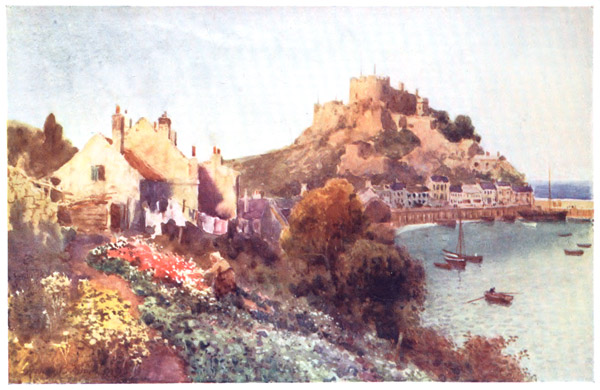
MOUNT ORGUEIL CASTLE, JERSEY.
The name, meaning "Mount of Pride," is said to have been given to the castle after Sir Reginald de Carteret's
successful defence of it against du Guesclin in 1374.
Mont Orgueil was unsuccessfully besieged by
the French under the leadership of the Duc de
Bourbon and the great Bertrand du Guesclin,
Marshal of France (whose splendid tomb may
still be seen in the north chapel of St. Laurent,
at Le Puy), in 1374. It was in honour of this
achievement that it received its present name
from Thomas, Duke of Clarence, and brother of
Henry V.
Looking southward from Mont Orgueil at
low tide it is possible to realize the extraordinary
difficulties that attend the navigation of the
Jersey seas. The coast from this point to St.
Aubin is flat, but as far as eye can see the
surface of the water is a vast archipelago of
broken rocks and reefs. Still farther out to sea
is the hardly submerged plateau of the Minquiers,
with here and there a point that just lifts above
high water. There is a second stretch of low
sandy coast on the west of the island, at St.
Ouen's Bay, guarded in its turn by a second reef
of rocks. Nor do these exhaust the possibilities
of coming to ruin on this iron coast. It is not
without reason that the steam-packets from
England run in the daytime only in summer,
when the long light evenings give every opportunity
of picking their way through the narrow
passages. The fate of the Stella (on the afternoon
of Maunday Thursday, 1899), somewhere in the
neighbourhood of the terrible Casquets, is still
too vivid in men's memories to need re-telling.
The exact point of striking is unknown. The
Stella settled down in the afternoon mist, and
no man has ever traced her, or identified her
grave in "the vast and wandering" main.
Most that is best in Jersey is identified with
its coast, except, perhaps, for the archæologist,
who will want to push a little inland, to investigate
the ancient churches of St. Mary, St.
Lawrence, and St. Peter. Inland, too, is the
Prince's Tower, built on the Hougue-Hambye
in the eighteenth century. The mound is associated
with a serpent legend, that perhaps has
points of contact with the well-known stories of
the Sockburn and Laidley "worms." The old
chapel that adjoins it was remodelled by Richard
Mabon, Dean of Jersey, in 1525. He had
returned from a pilgrimage to the Holy Land,
and constructed an imitation of the Holy
Sepulchre; just as Opice Adornes, a hundred
years earlier, had erected the Church of Jerusalem
at Bruges. Preserved in this now-deserted
chapel is a font for the exact parallel of which
we shall look in vain in England, though analogous
cases occur in our country, and some precisely
similar instances may be found in France.
Attached to the inside of the bowl is a smaller
bowl, which was probably meant to catch the
drippings of the consecrated water that ran off
the baby's head. This is the ceremony demanded
in terms by the Rituale Romanum, as cited in
Mr. F. Bond's beautiful book on Fonts (p. 60):
"Ne aqua ex infantis capite in fontem, sed vel in
sacrarium baptisterii prope ipsum fontem ex-structum
defluat, aut in aliquo vase ad hunc usum
parato recepta, in ipsius baptisterii vel in ecclesiæ
sacrarium effundatur." Modern Roman Catholic
fonts are now often constructed in two separate
partitions, and this is said to be the origin of
the plural fonts baptismaux, of such constant
occurrence in France.
Most of the interest of Jersey, however, except
its fields of giant cabbage-stalks, and its green
lanes of quaint little pollarded trees, will probably
be found on the sea-coast, or near it. Let
us, from Mont Orgueil, set our faces to the west,
calling, on our way towards modern St. Helier,
at the two ancient parish churches of Grouville
and St. Clement's. In Grouville churchyard are
buried seven soldiers who fell in a skirmish with
a detachment of the French who had been left
behind by Rullecourt, when he landed on this
spot and advanced on St. Helier on January 6,
1781. Grouville church itself has little interest.
Like other churches in the island, it is built of
granite, and has windows with good Flamboyant
tracery, except where this last has been cut away
for the insertion of ugly "church-warden" sashes.
It possesses, however, in the south wall of the
south chapel, a very curious feature, the object
of which is obscure. This is a niche on the level
of the floor, with a late segmental head, and with
what seems a broken cavity in the lower part at
the back. I do not know whether this was once
used as an oven for baking the sacramental wafer,
such as those that are sometimes thought to have
been found in the Surrey churches of Limpsfield,
Nutfield, and Dunsfold. St. Clement's, a mile
to the south, and lying off the direct road to
St. Helier, should be visited for the sake of its
ancient wall-paintings. One of these exhibits
St. Michael; another St. Margaret of Antioch,
emerging from the body of the dragon, who
had vainly tried to swallow her; and another
St. Barbara of Heliopolis, standing near her tower.
Still more interesting are the scanty relics of the
"Trois Vifs" and the "Trois Morts"—the legend
of the three Kings, who, when hunting in the
forest, were suddenly confronted by three open
graves, or by three hideous skeletons. The
classical instance of this morality is in the
Campo Santo at Pisa; and there is another fine
example, in a kind of vestry, on the south side
of the great abbey-church of St. Riquier, near
Abbeville. It was altogether rather a favourite
subject with medieval, religious artists, not less
than twenty-three examples being recorded in
England by Mr. Keyser, as well as one at Ste.
Marie du Chastel, in Guernsey. It must not be
confounded with the parallel "Dance of Death,"
of which there are only five recorded instances,
in addition to the one at old St. Paul's. There
is still a grand example of this last on the back
of the north choir stalls, in the strange old abbey-church
of La Chaise Dieu, in Central France.
St. Helier, we have hinted, is a somewhat
tedious town; by which we mean only that the
place contains few objects of special interest, and
is a trifle too large and urban for so very small
an island. No doubt some of its aspects are
agreeable enough. The parish church is a restored
building of small architectural interest, but contains
the grave of the gallant Major Pierson, who
fell in Jersey, in 1781, in the conflict with the
French in the Royal Square. His adversary,
Rullecourt, who also perished, is buried on the
north of the churchyard. Rullecourt landed
to the east of St. Helier during the night of
January 5, and took the town by a sudden assault.
The Governor, Major Moses Corbet, was captured
in his bed; and was forced to sign a capitulation,
as well as an order to Major Pierson to
surrender the troops in his charge. Pierson,
however, charged the enemy in the Royal Square,
where they had barricaded themselves, and fell at
the first assault. Undeterred by the loss of their
leader, the Jersey soldiers and militia-men continued
fighting, and cleared the French from the
town. St. Helier possesses yet other claims to
historical distinction, in the mystery of James de
la Cloche. This last was the eldest illegitimate
son of Charles II., and is known to have been
a Jerseyman. His story has recently attracted
much attention; and Mr. Andrew Lang, in his
Valet's Tragedy, once even went so far as to
suggest that de la Cloche was "The Man with
the Iron Mask." This theory he afterwards
abandoned; but it is still stoutly maintained by
Miss Edith Carey in her beautiful volume on
the Channel Islands. It is remarkable, indeed,
that James de la Cloche disappears finally from
history after November 16, 1668, whilst "The
Man with the Iron Mask" makes his first appearance
on the scene on July 19, 1669. De la
Cloche may also, when in London, have easily
learned secrets from his father, as to Romish
plots, that imperilled the crown of Charles II.,
and may well have caused anxiety to Louis XIV.
"Doubts," says Miss Carey, "may be cast on
a theory which involves an apparently affectionate
father consigning his son to a living tomb, and
a King of France spending money and trouble to
keep a King of England's secret. But in reply it
must be urged that Charles's conduct is consistent
with all we read in history respecting his cowardly
selfishness. In reply to complaints made to him of
Lauderdale's cruelty in Scotland, he said: 'I perceive
that Lauderdale has been guilty of many bad
things against the people of Scotland, but I cannot
find out that he has acted against my interests.'"
Charles' headquarters, when a boy in Jersey,
were in Elizabeth Castle, whither he was sent
by his father for greater safety in 1646. Later
in the same year he left for Fontainebleau, but
returned to the Channel Islands in September,
1649. In the meanwhile the elder Charles had
perished on the scaffold at Whitehall; and Jersey,
unlike Guernsey, still loyalist to the core, was
one of the few places—Pontefract Castle, in Yorkshire,
was another—where his son was immediately
proclaimed as King, on February 17,
1649. Elizabeth Castle itself is another of those
picturesque places of semi-insulation that are not
uncommon among historical sites—Holy Island,
and the two Mounts St. Michael, are other
famous examples. At time of low water it is
picturesquely approached by a rough and rocky
causeway across the sands; but the building itself
has been greatly altered, and presents very little
archæological interest.
From St. Helier westward, round the half-moon
curve of St. Aubin Bay, past West Park,
Millbrook, and Beaumont, is now largely a
crescent of continuous houses. St. Aubin's itself
is a picturesque little watering-place, with far
greater natural advantages than its bigger neighbour.
Immediately to the south of the town
begins at once the fine, red line of granite cliffs,
which, turning definitely westward at Noirmont
Point, continues, past Portelet and St. Brelade's
Bays, to the south-west corner of the island
at Corbière Point. Portelet Bay is a charming
recess, with the rocky little Ile au Guerdain in
its centre. On the summit of this last is Janvrin's
Tower. It is said that Philippe Janvrin, returning
home from Nantes, then desolated with
plague, was forced to undergo quarantine in this
bay in 1721; and that here the poor wretch died
within actual sight of home, but without ever
exchanging a word with his wife and children.
He was buried at first in the Ile au Guerdain,
but afterwards removed to St. Brelade's churchyard.
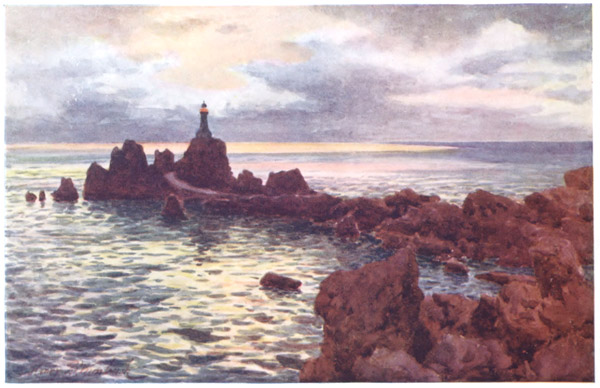
LA CORBIÈRE LIGHTHOUSE, JERSEY.
The white tower stands at the extremity of a particularly dangerous reef.
St. Brelade's Bay, nearly two miles across, if
we measure from Le Fret to La Moye Point,
is perhaps the most gracious on the Jersey coast.
The church has a very picturesque outline, with
a saddle-backed tower like that of St. Sampson's,
in Guernsey. It was admirably restored a few
years ago, when the plaster was stripped from the
vaulted roof that is common to most old churches
in the Channel Islands, and is probably analogous
to the vaulted roofs of the fortified churches of
Pembrokeshire. Mr. Bicknell, however, is wrong
in saying that "the interior walls ... look very
dignified in their original condition." Nothing
is more certain than that medieval churches—at
any rate in cases where the walls are of rubble
masonry—were plastered, and commonly covered
with wall-paintings. Such plastering and old
wall-painting may still be found at St. Brelade's
in the Chapelle ès Pécheurs, or Fishermen's
Chapel, that remains in the parish churchyard.
These, according to Mr. Keyser, represent parts
of two Dooms or Final Judgments, Our Lord
before Herod, an Annunciation, the Assumption
of the Virgin, and the Offering of the Magi.
They probably date from the fifteenth century,
and the attendant makes them visible by the
simple expedient of throwing the light on them
with a mirror. The existence of this old chapel
side by side with the parish church—the same
thing seems formerly to have happened at Grouville—is
a subject of curious inquiry. Chantrey
chapels were sometimes built in churchyards—there
is still a fourteenth-century example at
Carew, in Pembrokeshire, and there was formerly
one at Newdigate, in Surrey—but these would
be generally of later date; whereas the Fishermen's
Chapel is supposed to date from quite the
beginning of the twelfth century. In the grounds
of the St. Brelade's Hotel is an ancient cross of the
kind that is stated by Mr. Bicknell formerly to
have "stood at nearly every place where four
cross roads met in the island."
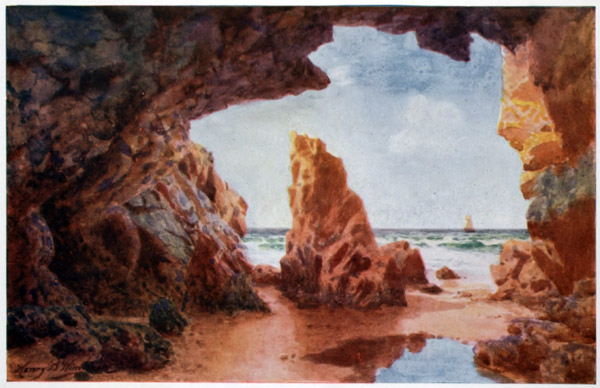
THE NEEDLE ROCK, GRÈVE AU LANÇON, JERSEY.
The walk across the south coast of Jersey, from
Mont Orgueil to the Corbière, taking the train for
the four dull miles, where there is nothing to see,
between St. Helier and St. Aubin, will probably
almost exhaust, except for the archæologist of the
Dry-as-Dust school, the artificial attractions of
the island of Jersey. Of course, there are other
antiquities to see: St. Ouen's Manor, for example,
now recently restored, and the ancient house of
the Carterets; the cromlechs at Gorey and the
Coupéron; and the seven old churches that we
have not yet visited. But when we have seen
the wall-paintings at St. Brelade's and St.
Clement's; have inspected Elizabeth Castle, and
the curious font at Prince's Tower; and, above
all, have made every stick and stone of Mont
Orgueil our own treasured possession, it will be
time for most of us to turn our attention, less to
the artificial attractions of Jersey, than to its
wonderful natural beauties. It is lucky that
these lie mostly on the north coast, which is well
out of reach of St. Helier. It would be sad
indeed if this silent succession of bays, stretching
in stern sublimity from Grosnez Point to the long
useless breakwater on the south of Fliquet Bay,
were infested with tea-gardens, and boarding-houses,
and villas. For this twelve miles of coast
is both wholly unspoilt, and one of the loveliest
imaginable. Brakes, no doubt, in the season,
with their hordes of jolly trippers, invade for a
few hours the sacred silences of Grève de Lecq
and Rozel Bay. These, however, are limited to
definite times and places; nor will it be hard for
the quiet lover of Nature to evade their unwelcome
gaieties. Every inch of this glorious
stretch of coast should be walked over, if possible;
should often be revisited; and should be lingered
over lovingly. Where else have these rose-red
cliffs a counterpart, jutting out into the bluest,
or most emerald, of seas, and haunted by myriads
of clanging sea-fowl, unless it be on the borders
of lost Lyonesse? Waters that rest on a granite
bed are always of amazing translucency—
Pleased to watch the waters sleep,
Round Iona green and deep—
and those that never rest round the igneous cliffs
of Jersey are no exception to this beautiful rule.
Here and there, of course, the explorer will come
across some special point of interest, though the
coast, to be enjoyed at its best, must always be
enjoyed as a whole. At Grève de Lecq is a cave
to visit which thoroughly entails some very rough
scrambling, and some rather giddy climbing up
an almost vertical cliff. Less than two miles to
the east, as the crow flies—it adds to the distance
enormously to follow all the sinuosities of this
deeply indented coast—is the Creux-du-Vis, or
Devil's Hole—one of those strange, roofless
caverns, connecting with the sea by a tunnel
through which the tide ebbs and flows, but set
back some little distance from the margin of the
cliff, that are found again in Sark, in the Creux
Derrible and Pot. In many respects they resemble
the famous "pot-holes" that occur in the mountain
limestone of the Craven district in North-West
Yorkshire, though their origin, it is clear,
is wholly different. Creux, of course, is connected
with the French creuser, to dig; and
"derrible," which has nothing whatever to do
with "terrible," is an old Norman word, unknown
to modern French, that really expresses the same
idea: "Cavité d'un rocher formée par un éboulement
de terre, attenant à un précipice." "Creux"
is used again of artificial cromlechs. East of the
Creux-du-Vis is the Mouriers Waterfall, where a
little stream leaps down the rocks into the sea.
The path along the cliff is rather giddy, and
those who take it must remember that a slip
may be followed by fatal consequences, like the
accident that happened to Mrs. Guille, in 1871,
at the Gouffre, in Guernsey. The steep grass
slopes in spring are plentifully sprinkled with the
dainty yellow blossoms of the little wild narcissus.
Beyond Sorel Point comes suddenly the deep
hollow of La Houle, guarded by granite cliffs of
sheer sublimity; and beyond this, in long succession,
round innumerable intervening points,
come Mourier, and Bonne Nuit, and Giffard, and
Bouley, and Rozel, and Fliquet Bays. A week
may well be spent, and more than a week, in
leisurely exploration of this gloriously broken
coast. Or the visitor who has less energy, or is
weary of much scrambling, may sit here day after
day in the sunshine, on promontory or cliff,
watching the "blind wave" at its never-ending
business of "feeling round its ocean hall." There
are less pleasant ways than this of spending a
summer holiday for those whose brains are fagged
by weeks of dull work in London. And always
across the water, far-seen on the dim horizon, are
the faint grey lines of the Cotentin, and the cliffs
of fairy-like Sark.
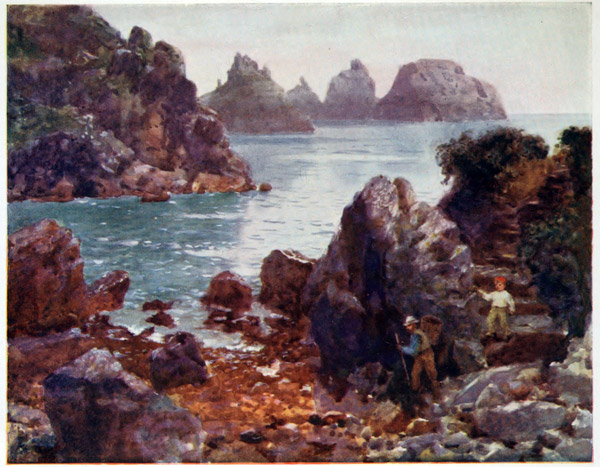
THE PEA STACKS (TAS DE POIS), JERBOURG, GUERNSEY.
Isolated and wall-sided masses of rock of this type are typical of the Channel Islands.
CHAPTER II GUERNSEY
Jersey, with larger acreage and a bigger population,
is content to form a kingdom by itself;
Guernsey is fain to ally itself with its immediate
neighbour, Sark, and even seek bonds of union
with Alderney, twenty miles away. The diversity
maintained jealously in these little islands, which
an Englishman is too hastily accustomed to regard
in a lump, is complex and even amusing. Just
a few trivial details must suffice. In Guernsey the
toad is altogether unknown, except for some few
stuffed specimens in the Guille-Allès Museum;
whereas Jersey exhibits an exaggerated species
that is supposed to be quite peculiar to itself.
The mole, again, though common in Jersey and
Alderney, is unknown in Guernsey, though the
last has a field-vole of its own. Guernsey, in fact,
is supposed to have become an island at least
14,000 years ago, whilst Jersey was torn asunder
from France not more than 3,000 years before
Christ. Guernsey thus received only the Continental
fauna that flourished at the period of its
final insulation. All the islands, like Iceland, are
exempt from poisonous snakes. In domestic
animals, again, the distinction is strongly marked.
Jersey has a picturesque cow of its own, mottled
white and yellow, placid, and rather big. Guernsey,
on the other hand, has a smaller breed of
cattle, much more wiry in movement, and a kind
of tawny red. Beasts from Guernsey and Alderney
are allowed to inter-breed, but the Jersey
cattle are looked on as undesirable aliens, and
sternly prohibited from the sister State. In all
three instances the cattle are tethered when at
pasture, as happens also in some parts of France.
The animal, thus driven to forage in a circle,
perhaps crops the ground more closely than when
free to range at will.
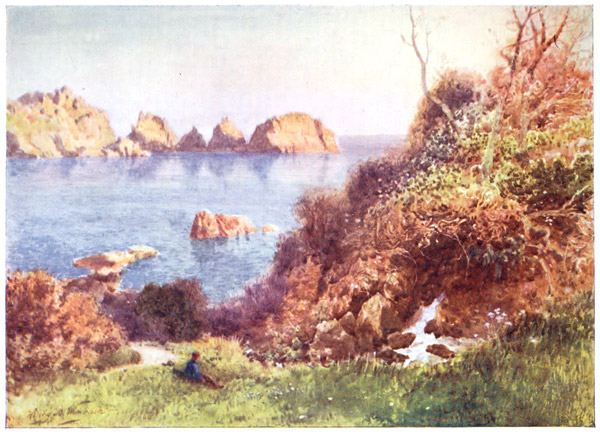
MOULIN HUET, GUERNSEY.
A particularly attractive bay on the southern side of the island.
Guernsey, whatever were its merits half-a-hundred
years ago, will now, perhaps, be found
the dullest of the Channel Islands. Owing to
the frenzy for intensive cultivation, the inland
parts of the island are now literally covered with
glass. Acre after acre of ugly rows of hothouses
have displaced over most of the interior
what once were pleasant fields. Attached to
each such settlement is an ugly concrete house,
and each has a skeleton iron windmill, for pumping
up water, that completes the repellent aspect
of the scene. The writer has travelled over most
of the island on foot to explore its twelve old
churches, and investigate its coast. Frankly, he
is driven to put on record that he found it
a dismal task. Features, of course, remain of
interest and beauty, if one is willing to walk
about in blinkers, and seldom raise one's eyes
above the ground. The old, granite-built farmhouses,
standing back, as a rule, but a little from
the road, are uncommon, and extremely picturesque.
Inland Guernsey, again, possesses one
single glory that is almost unknown in Jersey.
Everywhere in the island, commencing even with
the very suburbs of St. Peter Port itself, the low,
green, sod walls that divide the little fields are
covered with millions of saffron primroses. Such
a wealth of primroses I have never seen elsewhere—not
even in the remotest lanes of the
Surrey or Sussex Wealds. How the primrose
has survived in such excessive fertility, with so
huge a population, and with such bitter cultivation,
is a problem easily stated, but not very
easily solved. Whether it is likely long to
survive is a question one fears to ask. In Sark,
again, the primrose—though here it is no marvel—carpets
the ground like daisies on a "wet
bird-haunted English lawn"; like daisies, too,
in Switzerland, the stalks of the Sark primrose
grow to remarkable length. But as soon as we
cross to Jersey—and when the writer noted this
strong contrast, he crossed directly from Guernsey
to Jersey, and almost directly from Jersey to Sark—the
primrose is seen no more by thousands in
the hedge-side. The only spot where I have
noticed it growing in profusion in the larger
island was on the prehistoric "hougue" at
Prince's Tower.
Guernsey, however, though thus irritatingly
spoilt in its interior—for the visitor comes to see
beautiful scenery, and not to assist at a horticultural
triumph—still possesses in its south coast
a feature of distinction that neither recklessness
nor greed of money has so far been able to spoil.
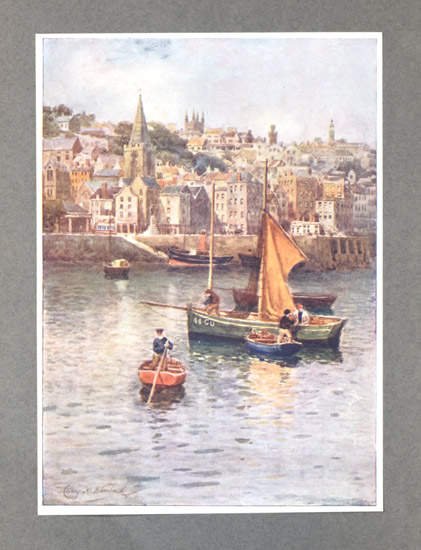
It also possesses in St. Peter Port a capital so
pleasant, and withal so picturesque, that it makes
one desiderate all the more keenly the beautiful
environment in which it was once set. Approaching
this port in the early morning light,
the colour and grouping of the little town seem
almost fantastically correct. Surely this more
resembles an imaginary sketch than a city actually
realized in this commonplace, workaday world.
St. Peter's Church, in the middle of the picture,
has just the required outline, and is set in just
the right place. The tall, brown houses behind
it, with their mellow red roofs, are of just the
right colour, and in just the right number. The
new church of St. Barnabas is just rightly
designed, and is built just exactly where it ought
to be built. And lastly, the wooded amphitheatre
behind all, with its sprinkling of white
villas, is just neither more nor less than such a
background ought to be. A composition like
this on the drop-scene of a theatre would scarcely
surprise us, but here we rub our eyes. We
land; and the cheerful anticipation of the sea-view
is hardly hurt at all by contact with actual
fact. A pleasanter little town than this, or more
full of bustling happiness, is not readily conceived.
Darker aspects no doubt are there, but
they do not obtrude on the casual view.
Castle Cornet, immediately on our left as we
approach the harbour, holds much the same
position to St. Peter Port as Elizabeth Castle
holds to St. Helier. Castle Cornet, indeed, is
connected with the mainland by a causeway;
but as a building it is equally uninteresting. In
fact, the only object of antiquarian interest in
St. Peter Port is the old parish church, so conspicuous
on the quay. This has a central tower,
with a good leaded spire, that is luckily not
twisted like the leaded spire at Chesterfield. At
the side is a small cote for the sanctus bell,
exactly as at Barnstaple, in Devonshire. More
frequently these cotes were placed on the east
gable of the nave, whilst at Oxenton, in
Gloucestershire, the sanctus bell swings to the
present day in a curious little opening high up
on the south face of the fifteenth-century tower.
It is possible, too, or even probable, that the
curious "low-side" windows—once absurdly
called "leper windows"—which generally occur,
when they occur at all, towards the south-west
corner of the chancel, were used to enable the
sanctus bell to be rung through their opening by
hand. On the ringing of this bell the passer-by
would bow his head in reverential awe, just as
the peasants in Millet's picture bow their heads
at the ringing of the Angelus. Inside, the chief
feature of St. Peter's Church is the strangeness of
the nave arcades, the arches of which spring from
piers that are only two or three feet high. Notice
also the Flamboyant tracery of the windows, so
typical of the Channel Islands, and the very
striking piscina in the south aisle of the choir.
Historically the chief interest of Guernsey is
comparatively recent, and centres round the residence
here of Victor Hugo. After the Coup d'État
Hugo settled first in Jersey, where he occupied
a house in Marine Terrace. But the English
Government, which maintained friendly relations
with the new French Imperialism, pleased him
little better than that of his native land. His
conduct, indeed, was as wantonly tactless as that
of an earlier fellow-poet. If Shelley flaunted
his tract on the Necessity of Atheism in the
face of grave clerical dons at Oxford, Hugo
and his comrades were equally reckless when
they imagined that la justice or la verité were
wronged. "Encore un pas," cried this enthusiast
bravely, "et l'Angleterre sera une annexe de
l'Empire français, et Jersey un canton de l'arrondissement
de Coutances." The occasion of this
outbreak was the banishment of three of his
compatriots from the island in 1855. "Et maintenant,"
thundered the poet in retort, "expulsez
nous." Whether he intended it or not, he was
taken at his word. The protest was written on
October 17, 1855, and Friday, November 2, 1855,
saw the expulsion of the whole band, 33,
who had signed the defiant document. Hugo
at once removed to St. Peter Port, and established
himself there in Hauteville House. Here he
resided from 1855 to 1870, when Sedan rendered
possible his return to France, and the house still
belongs to his family. To the Guernsey visitor
it is now a place of pious pilgrimage, not less
than that other old house, in Paris, in the charming
Place des Vosges. Much of the furniture
and fittings remains almost exactly as he left
them fifty years ago, and much is of real historic
interest. Thus a table in the Red Dining-room
once belonged to Charles II. of England; whilst
a fire-screen was worked by Madame Pompadour,
and some bead-work belonged to Queen Christina
of Sweden. From the upper windows it is possible
to enjoy the same lovely view towards Sark,
with Jethou and Herm in the middle distance,
that is got from all the upper parts of St. Peter
Port—as, for instance, from the grounds of the
Priaulx Library, or from the gardens of the Old
Government House Hotel.
It is pleasanter to picture Victor Hugo at
Guernsey, writing here his novel, Les Travailleurs
de la Mer—the scene of which is laid at
Torteval, in the extreme south-west corner of
the island—and always looking longingly towards
the invisible shores of France, than to dwell on
certain other episodes in the history of the island,
which, however disagreeable, cannot lightly be
put aside. The tale of Bailiff Gaultier de la Salle,
though wholly misconceived, will not quickly be
displaced from its niche in island tradition. He
is said to have resided in the Ville au Roi, though
it is hardly likely that the house now pointed out
as his is really as old as the fourteenth century.
A neighbour called Massey had an easement to
draw water which took him in front of the
Bailiff's windows. Annoyed at this invasion of
his treasured privacy, Gaultier laid a trap to get
rid of the intruder. Doubtless he had read the
old history of Joseph, and of the silver cup that
was hidden in the corn-sack of Benjamin. But
Gaultier's intention was far less kindly, and he
concealed the two silver cups in Massey's wheat-rick
in order that Massey might be accused of
their theft. Here is some deep confusion in the
story, for we should naturally have expected that
the discovery of the wine-cups would be made
the machinery for fixing the crime on the victim.
Why else should the cups be hidden in Massey's
wheat-rick, when they might easily have been
hidden in some much surer place? Anyhow,
the Bailiff, suborning perjured evidence, fixed
so black a case on Massey that the Judge pronounced
sentence of death. Then, at the last
moment, there burst into the court-house a witness
who had found the cups that very morning in
taking down the rick. Whatever evidence had
procured the condemnation of Massey might well
have seemed quadrupled by this new and damning
fact. But the inconsistent story makes the Bailiff
exclaim in anger: "Thou wretch, did I not tell
thee not to touch that rick?" Convicted thus
by the words of his own mouth, the Bailiff was
sent to the self-same death as he had schemed for
a fellow-citizen. The place of his execution—an
oblong recess in the wall, not unlike those in
which road-makers break stones—is still pointed
out at the "Friquet-au-Gibet"; and a rudely-scratched
cross on the pavement near at hand
indicates the spot where the criminal received
his last Communion on the way to the gallows.
Miss Edith Carey styles this story "pure
invention," and thinks that it "is probably
derived from a confused recollection of the doings
and motives of the rival 'wicked Bailiff' of Jersey,
Hoste Nicolle." There was really, however, as
Miss Carey establishes, a Gaultier (Walter) de la
Salle, who was condemned to death in 1320 for
having assisted in imprisoning a certain Ranulph
Gaultier in Castle Cornet, "and there wickedly
killing him by various tortures."
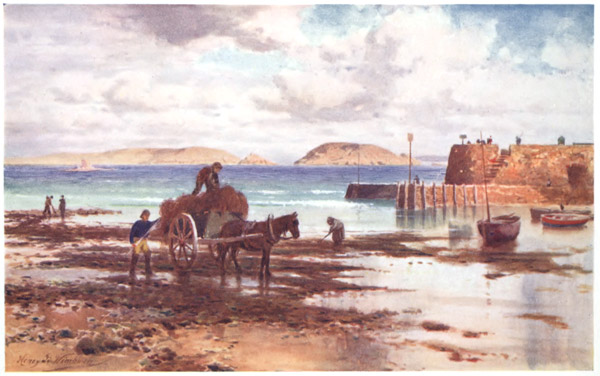
HERM AND JETHOU FROM GUERNSEY.
These two little islands add greatly to the picturesqueness of the scenery of the eastern shores of Guernsey.
Another dark picture, and unhappily more
authentic, is the burning, with attendant circumstances
of extraordinary brutality, of three poor
heretic women, by order of Dean Amy and Bailiff
Helier Gosselin, on July 18, 1556. The mother,
Katherine Cauches, was tied to a stake in the
middle, with a married daughter on either hand—Guillemine
Gilbert and Perotine Massey. An
attempt was made to strangle them before the
faggots were lighted—a merciful privilege that
was also extended to women in executions for
"petty treason"—but one of them, at least, fell
alive into the fire. This poor wretch, Perotine
Massey, the wife of a Protestant pastor, was
delivered of a baby in the middle of the flames.
The child was rescued from the burning by a
man called House, but cast back again by order
of the Bailiff. This repulsive incident is preserved
by Foxe, and is interwoven by Tennyson
in Queen Mary:
Sir, in Guernsey,
I watch'd a woman burn; and in her agony,
The mother came upon her—a child was born—
And, sir, they hurl'd it back into the fire.
St. Peter Port is an admirable centre from
which to visit every quarter of the compact little
island; but, indeed, as already adumbrated, there
is but little in Guernsey (except for the antiquarian)
that is really worth seeing outside its capital,
except the south coast. St. Sampson's may be
visited for its picturesque church, which is one of
the oldest and most interesting on the island. The
road by which we gain it is so ugly—one continued
line of houses—that no one need hesitate
to use the electric tram, which was one of the
earliest of its kind in the British dominions. It
is hardly worth while to get out on the way to
visit the poor remains of Ivy Castle: the situation
of the ruins is unusually unpicturesque, and the
ruins themselves are uninteresting. Opposite St.
Sampson's itself, across the busy little harbour, is
the rather better ruin of Vale Castle. This would
be exceedingly pleasant to look on, were it not for
the mammoth granite-quarries that pave the
streets of Westminster, but effectually disfigure
what were once the charms of Guernsey. The
Castle itself, like Ivy Castle, is little more than a
shell; in fact, the latter has the additional credit
of what is possibly a chapel, with a rudely vaulted
stone roof. Ivy Castle, moreover, boasts at least
authentic pedigree, having first been built—if
the date be really right—by Robert, Duke
of Normandy, before the Norman Conquest;
whereas of the origin of Vale Castle practically
nothing is known. Its ancient title, Le Château
de St. Michel l'Archange, is perhaps responsible
for the tradition that it was built by monks
from Mont St. Michel as a place of protection
for the neighbouring priory in case of a sudden
invasion. From Vale Castle, if we like, we
may cross the island—here less than a couple
of miles broad—to Vale Church, built on the
edge of what was once a sea-creek, but has long
since silted up, or been reclaimed. It is pleasanter,
however, to follow round the coast, past Bordeaux
Harbour, and across breezy L'Ancresse Common,
especially as this takes us past the L'Autel de
Déhus, and the L'Autel des Vardes, the two
finest remaining dolmens in the Channel Islands.
The finest of all is supposed to have been that
which was discovered behind St. Helier in 1785,
and which was "unanimously voted" to the
then Governor, Marshal Conway, "in a moment
of enthusiasm." The Marshal, unfortunately, in
another moment of enthusiasm, carried it off and
re-erected it at his country seat in Berkshire. These
Channel Island dolmens are of wholly different
type from the familiar cromlechs of the mushroom
pattern of Kits Coty House, near Aylesford,
or of Pentre Evan, in Pembrokeshire.
They are, in fact, considerable, stone-built, subterranean
burial-chambers, with traces in some
instances of a long succession of interments. The
islanders call them "pouquelayes"; which is
derived by Miss Carey from either the Celtic
pwca, a fairy, and lies, a place, or from pouq, an
excavation, and lekh, a stone. In this connection
it is interesting that they are supposed to be
haunted by fairies—one is called the Creux des
Fées, and another the Roche à la Fée—who are
supposed to "bring ill-luck on those who interfere
with them, a fact which has saved many of
them from the spoiler." "The restorer, however,"
adds Mr. Bicknell dryly, "has unfortunately
not been idle, and the Little People do
not appear to have found a punishment to 'fit the
crime' in this case." Unhappily the same must
be admitted in the case of the navvies employed
on the harbour works in Alderney, who "amused
themselves by smashing up all the megaliths that
they could lay their hands on." Many of the
relics from these cist-vaens—bones and pottery—have
found their way into the Lukis Museum at
St. Peter Port.
Vale church itself, not far from the Grand
Havre, and in a flat, unlovely neighbourhood, is
possibly the most interesting, architecturally, in
the island. The chancel arch should be noticed,
with its chevron ornament; the chancel, vaulted
in two compartments (in contrast with the rude,
pointed vaults of most of the other churches);
the piscina in the aisle; and the wall arcade.
Another striking feature is the brackets for images
on the columns of the arcade, between the nave
and its aisle. A series like this is uncommon;
though there is a group of churches in West
Yorkshire—sometimes supposed to have been
built by the Tempest family—Kirkby Malham
is the finest—which has traces of canopied niches
in the same position. The finest single niche
that the writer knows of this kind is on the south
side of the nave in the fine, fifteenth-century
church of Lechlade, in Gloucestershire. Towards
the west end of the churchyard is another tumble-down
dolmen. Thus Christians of the twentieth
century are buried in the same soil that received
the bones of their neolithic ancestors no one
knows how many thousands of years ago.
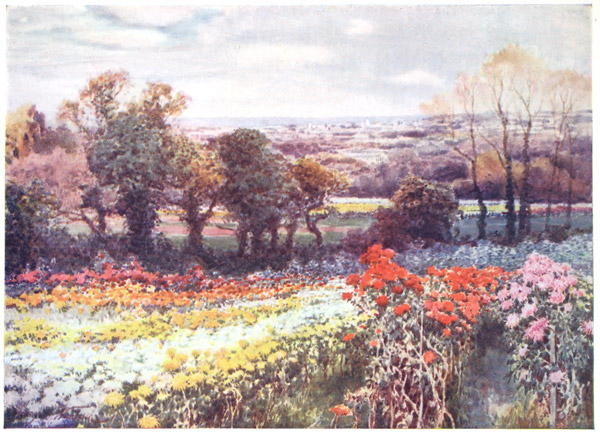
A FIELD OF CHRYSANTHEMUMS IN GUERNSEY.
The climate encourages the growing of flowers, and the northern half of the island is mostly
devoted to this industry.
Though Vale is not uninteresting, it is with a
feeling of relief that one turns one's back on this
north corner of the island that once perhaps was
so beautiful, but is now so hopelessly spoilt.
The glory of Guernsey, as already stated, is now
wholly confined to its south coast. Moulin Huet
is a gracious bay, too well known from photographs
to need further description; whilst the
little Saints Bay to the west of it—a shrine
within a shrine—is almost equally charming.
Westward from Icart Point, itself a splendid
promontory, the coast sweeps round in another
great curve to La Moye Point; beyond which,
again, to Pleinmont, at the south-west corner of
the island, the cliffs, though everywhere deeply
indented, continue, on the whole, a more uniform
direction. The great hollow between Icart and
La Moye Points is apparently nameless, unless it
be Icart Bay. There is no authoritative Ordnance
map of the Channel Islands, to which one might
adhere whether right or wrong; and the best
map of Guernsey with which I am acquainted,
in the late Mr. C. B. Black's guide-book, gives
the name Icart to the eastern recess of the great
main bay, and Petit Bot and Portelet to the two
small recesses to the west of it. Anyhow, Petit
Bot is the most secret and intimate of the three,
and entirely picturesque with its disused mill and
martello tower. This is one of the points on the
coast to which the chars-à-bancs descend from
St. Peter Port; and the drive down the glen by
which we approach it is delightful. The next
calling point is Le Gouffre, just beyond La Moye
Point, which here runs out into the sea in long
ribs of warm red granite. Here the cars generally
halt for a couple of hours, whilst the tripper
feasts on lobster in the pleasant little inn. The
Gouffre may be taken as roughly the centre of
the grand seven miles of cliff line of this splendid
south coast. The section hence to the west is
less frequently explored, though the picturesque
cave of the Creux Mahie, again roughly halfway,
is often paid a visit, and is well worth visiting.
Pleinmont and Torteval come into the
"Toilers of the Deep"; and this corner of the
island, the farthest of all from St. Peter Port, is
luckily less injured than the rest. The north-west
coast of Guernsey, from Pleinmont Point to
Vale, past the huge sweeping hollows—some of
them singularly symmetrical—of Rocquaine,
Perelle, Vazon, and Cobo Bays, is chiefly a matter
of rocky beach and of slight elevations shelving
down in gentle declivity to the sea. The glass-houses,
moreover, which have languished much
at Torteval, flourish again in amazing vigour as
we draw near Cobo Bay. There are two points
of interest, however, in this corner of the island
that justify even the dull, direct journey by which
we approach them from St. Peter Port. The
first of these is the little Chapel of St. Apolline,
which is stated in all the guide-books, on documentary
evidence, to have been founded by
Nicolas Henry in 1394, or thereabouts. Even
documentary evidence, in architectural matters,
is not always to be trusted. Only the day before
writing these lines the writer was re-visiting the
Lady Chapel at St. Albans Cathedral, which is
said to have been built—again on documentary
evidence—circa 1310; though the Inventory lately
published by the Royal Commission on Historical
Monuments adds cautiously: "The tracery of
these windows ... is very advanced in character
for the date." The tracery, indeed, is so advanced,
if the date be really right, as hopelessly to confuse
all previously held notions as to the
systematic evolution of English architecture.
That the building was at any rate finished by
this date is altogether incredible. I notice that
the late Lord Grimthorpe, in his pugnacious
little handbook, after setting out the evidence
from the Abbey Records, adds significantly,
"but the style of the windows suggests a much
later date." And the case is much the same
with this Chapel of St. Apolline. On October 13,
1392, Nicolas Henry received permission from
the monastery of Mont St. Michel, in Normandy,
to alienate certain fields to provide an endowment
for the Chapel of Notre Dame de la Perelle, which
he had recently erected; and in an Act of the Royal
Court, dated June 6, 1452, we come across the
phrase, "La Chapelle de Notre Dame de la
Perelle appellée la Chapelle Sainte Apolline."
Certainly the identification seems complete. On
the other hand, the writer believes that no one
visiting this chapel who has previously read
Professor Baldwin Brown's beautiful volume on
Saxon Architecture—and it so happened that the
writer paid his first visit to the Channel Islands
almost immediately after its perusal—can fail to
detect in this building quite a number of criteria
that are there set out as indicating, at any rate in
England, a pre-Conquest era of building. Unfortunately
I have kept no note of these features,
but the impression then made on my mind is
vivid. I may, of course, be wrong; but it seems
to me at least possible that we have here the
solitary survivor—far older than the Fishermen's
Chapel at St. Brelade's in Jersey—of those many
chapels that are known to have been built in the
Channel Islands in the eighth and ninth centuries
by the successors of St. Magloire.
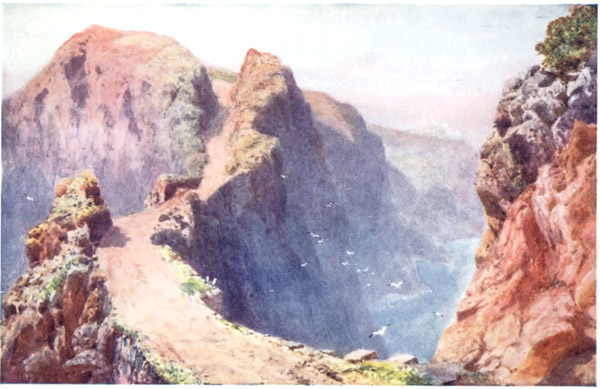
THE COUPÉE, SARK.
A romantic and almost terrifying pathway among the precipitous rocks of the island.
The other point of interest in the neighbourhood
of L'Erée is the rocky islet of Lihou,
approached by a causeway across the sands, or
more properly the rocks, but only at low tide.
Here are the scanty fragments of the Priory and
Chapel of Notre Dame de la Roche, apparently a
cell to the monastery of Mont St. Michel, which
seems to have had so much to do with the
spiritual matters of the Channel Islands. The
tide at St. Michael's Mount is said to rush up
across the level sands more quickly than the
fleetest horse can gallop, and visitors to Lihou
will be well advised to remember that here
again its onset is unexpected and swift. At
L'Erée village is another dolmen, the Creux des
Fées, to which passing allusion has already been
made. St. Peter's Church in this neighbourhood—in
full, St. Pierre du Bois—is perhaps the
handsomest, though not necessarily the most
interesting, of all the twelve churches in the
island, and exhibits some Flamboyant work of
a very pleasing character.
CHAPTER III ALDERNEY, SARK, AND THE LESSER ISLANDS
Hitherto, in dealing with the two larger of
the Channel Islands, we have found their claims
to natural beauty in their coasts. The interior
of Jersey is no doubt pleasant, with its lush-green
valleys running north and south, with its quiet
little villages, and with its never-ending potato-fields.
The interior of Guernsey, on the other
hand, is frankly hideous, save here and there a
cottage, or a picturesque old farm, hidden in the
folding of some safely secluded dell. But in both
cases alike the real distinction of the island is
limited to cliffs that for warmth of colour and
strangeness of contortion can surely be paralleled
in Cornwall alone. Sark, on the contrary, is
almost wholly coast; the interior in comparison
is a negligible quantity! And almost as much
may be said of Alderney. Both these islands are
exceedingly small—Sark being only a trifle more
than three miles in length, and about one and
three-quarters of a mile in breadth (measuring,
not precisely from east to west, but at right
angles to the axis); and Alderney being about
three and a half miles in length, from north-east
to south-west, and one and a quarter miles in
breadth. Alderney is undoubtedly the less beautiful
of the two, and is probably by far the least
frequently visited of all the different members
of the Norman archipelago. The voyage from
St. Peter Port, in a very small boat, and made only
two or three times in a week, is dreaded, and
not without reason, by those for whom rough
seas have no welcome. Alderney, again, is the
least foreign of the Channel Islands in local
colour, though nearest France in situation; and
here the old Norman patois has been entirely
replaced by English. It possesses in its capital,
St. Anne, a small, old-fashioned country town
that is wholly without parallel anywhere else
in the islands. The harbour is at Braye, a short
mile north from the centre of the town; and the
visitor, in strong contrast with what happens at
Sark, is landed in the least romantic corner of the
island. Of the old church nothing now remains
but a picturesque tower, and even this does not
seem to be mediæval. The new church was
erected from designs by Sir Gilbert Scott, and is,
perhaps, the most striking modern building in the
Channel Islands. The interior of Alderney, or
Aurigny, to use the French form—
Her crew hath seen Castile's black fleet, beyond Aurigny's isle—
is strongly individualized, and rather wild and
remote. One feels at once that this little island
has a flavour of its own—a state of things no
longer felt among the villadom and glass-houses
of Guernsey. The strength of Alderney, however,
lies chiefly in its west and south coasts; no
one would visit the island except to visit these,
or unless one happened to be an enthusiast for
the world's neglected and inaccessible spots. I
do not know how far the barbarous quarrying
that was projected some six or seven years ago
on the south side of the island has since been
carried out, or how far it has injured the amenities
of the coast. Anyhow, the Two Sisters,
towards the south-west corner of the island, are
hardly to be rivalled in their splintered grandeur,
even in Jersey or Sark.
To Sark we come at last in our long exploration
of the Channel Islands, and for Sark we
may well be content to have waited patiently, and
to have wandered far. For this, by universal
acclamation, is certainly the gem of the whole
group. Already we have often seen it in the
distance—a long, level line of cliff (save where
broken by the Coupée)—from the north coast of
Jersey, or from the piers at St. Peter Port. Now,
as we approach it more closely, threading the
narrow strait between Herm and Jethou, and
doubling the cliffs of Little Sark, at the south
corner of the island, this hitherto unbroken,
monotonous wall begins to resolve itself into
an infinity of broken cliffs and promontories,
isolating and half concealing a thousand fairy-like
bays. Surely nowhere else is another coast
like this—everywhere so irregular in its general
trend and outline—everywhere so deeply bitten
into by the mordant unrest of the sea. Sark,
we have said already, is little else than coast;
and certainly it is the coast which first arrests
and charms us, and the coast which lingers last and
most clearly in our memory, when other impressions
begin to be obliterated, or vanish altogether
in the steady lapse of years. Not a yard
of this gracious girdle of cliff is monotonous, or
repeats itself, or is even grim (as parts of the
coast of Alderney are grim), or is relatively less
interesting, or less beautiful, or dull; everywhere
and always it is singularly lovely, and everywhere
and always at the same high pitch. There is
really very little to be said about Sark, except
that the whole island is beautiful throughout:
there is nothing to be gained by giving a long
catalogue of successive promontories, caves, and
bays. It was thus that Olivia made a schedule
of her beauty—"item, two lips indifferent red;
item, two grey eyes, with lids to them; item,
one neck, one chin, and so forth"—and at the
end of the inventory we have no better picture
of the real Olivia than before she was thus
appraised in detail.
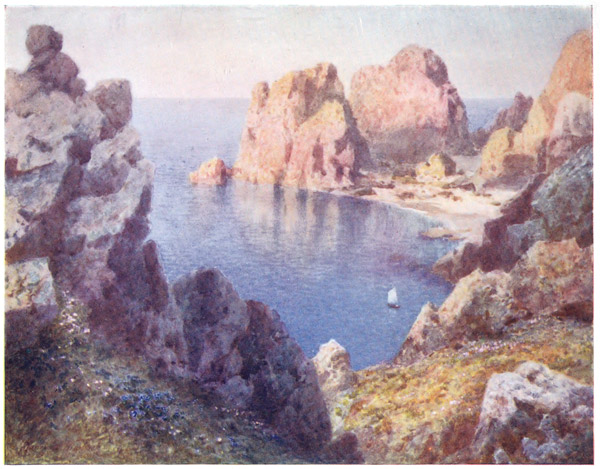
THE SISTER ROCKS, ALDERNEY.
This island is generally ignored by visitors to the group, but the quaint little town of St. Anne and the
fine rocks at the southern end are quite worth seeing.
The history of Sark, for so small an island, is
unusually interesting, and in some respects instructive.
It is set out by Miss Carey in an
interesting chapter, and some of its episodes may
be summarized here. Sark, like its sister islands,
must have been occupied by neolithic man, for
the remains of two poor dolmens still exist in the
island, and formerly, no doubt, there were very
many more. St. Magloire, in the sixth century,
built a chapel and founded a small monastery in the
island, but apparently he found it unpopulated
when first he arrived. In the middle of the
fourteenth century the island was inhabited by a
crew of lawless wreckers, who were a menace to
the navigation of the whole Manche. The merchants
of Rye and Winchelsea then put their
heads together, and agreed to do by subtlety what
they could not effect by force. Landing on Sark
with an armed force must well-nigh have been
impossible, till Helier de Carteret cut his tunnel
through the rocks, when he colonized the island
in the reign of Queen Elizabeth. The merchants,
accordingly, constructed a piece of strategy that
may well have been borrowed from the Trojan
horse, but in that case was certainly invested with
much ingenious detail of its own. The story is
told by Sir Walter Raleigh in his History of the
World, though, as Miss Carey points out, he postdates
the incident by some 200 years, and
describes it as having occurred to the crew of a
Flemish ship. "Yet by the industry of a gentleman
of the Netherlands [the island] was in this
sort regained. He anchored in the Road with
one Ship, and, pretending the death of his Merchant,
he besought the French that they might
bury their Merchant in hallowed Ground, and
in the Chapel of that Isle.... Whereto (with
Condition that they should not come ashore with
any Weapon, not so much as with a Knife), the
French yielded. Then did the Flemings put a
coffin into their Boat, not filled with a Dead
Carcass, but with Swords, Targets, and Harquebuzes.
The French received them at their Landing,
and, searching everyone of them so narrowly
as they could not hide a Penknife, gave them
leave to draw their Coffin up the Rocks with
great difficulty.... The Flemings on the Land,
when they had carried their Coffin into the
Chapel, shut the Door to them, and, taking their
Weapons out of the Coffin, set upon the French."
The final settlement of Sark—which the French
call Serq—dates only from the reign of Queen
Elizabeth, when Helier de Carteret established
himself on the then deserted island, and planted
there forty families, whom he brought from his
native Jersey. He also built a church, and instituted
a Presbyterian Vicar, Cosmé Brevint—being himself
a Presbyterian—who continued to hold office
till his death in 1576, being one who spared, or
flattered, no one, "great or small, in his reprehensions."
It is rightly said that the constitution
of Sark is still largely feudal in character. The
land is parcelled out into the original forty holdings,
and some of these are said still to be held
by descendants of the original holders. The lord
of the island is still the Seigneur, though the
lordship has passed from the hands of the de
Carterets—it is said that they were compelled to
part with it by reason of their lavish expenditure
on the thankless Stuart cause. In the so-called
"Battery" at the back of the Manor-House is
one of the old guns that were given by Elizabeth
to Helier de Carteret. It is inscribed, "Don de
Sa Majesté la Royne Elizabeth, au Seigneur de
Serq, A.D. 1572."
Of the smaller islands of the Norman archipelago
only a word or two need be added here.
Roughly halfway between Sark and Guernsey,
and separated from each other by a narrow
passage that is difficult to navigate by reason of its
hidden rocks and surging tides, are the small twin
islands of Jethou and Herm. The latter is now
occupied by a German Prince, the great-grandson
of the famous Prussian leader, the exact place of
whose meeting with Wellington after the field of
Waterloo—whether at Belle Alliance, or farther
along the road towards Genappe—has often been
made the topic of historical discussion, and is
anyhow the subject of a well-known picture.
Jethou is considerably the smaller of the two, and
is principally devoted to the purpose of a rabbit-warren.
In Herm are some remains of the old
Chapel of St. Tugual, incorporated with the outbuildings
of the present manor-house. Previous
to 1770 Herm was inhabited by deer; and
Mr. Bicknell tells us that they "used to take
advantage of the tide to swim over to the Vale in
Guernsey to feed, returning on the next tide."
Certainly it is lucky that there are now no deer
in Herm, since they would not find much pasture
now at Vale.
Jethou and Herm belong to Guernsey, and
once, no doubt, were physically parts of it. As
seen from St. Peter Port, with Sark dimly
descried on the distant horizon, they still contribute
largely to Guernsey's most charming seascape.
Alderney and Sark, again, have each their
attendant isle. Jersey alone, though the biggest
of them all, is a planet without a satellite. The
islet peculiar to Sark is Brecqhou, or the Ile des
Marchants, which lies off its west coast, and is
separated from it by the narrow Gouliot Strait,
only a few hundred yards wide. Though measuring
more than seventy acres, and possessed of a
small landing-place, it is at present as innocent of
human habitation as was Sark itself immediately
before the coming of Helier de Carteret. Burhou
is situated at a considerably greater distance to
the north-west of Alderney, from which it is
separated by the never-resting Swinge. This is,
perhaps, the least visited among all the lesser
islands, as is Alderney itself among the major
four.