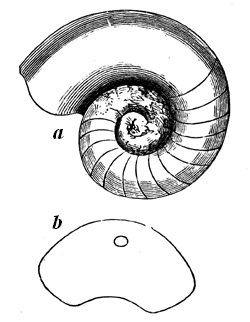
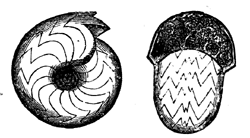
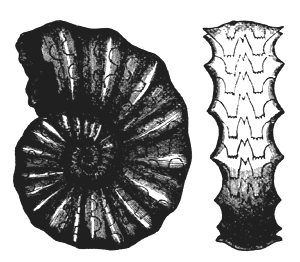
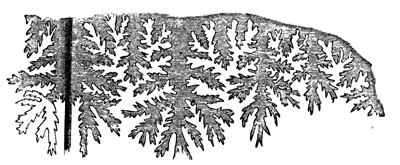
BY
C.M.G., LL.D., F.R.S., F.G.S., Etc.
AUTHOR OF
“ACADIAN GEOLOGY,” “THE STORY OF THE
EARTH,” “EGYPT AND SYRIA; THEIR
PHYSICAL FEATURES IN RELATION TO BIBLE HISTORY,”
ETC.
WITH NUMEROUS ILLUSTRATIONS
56 Paternoster Row; 65 St. Paul’s
Churchyard;
and 164 Piccadilly
1888
Richard Clay and Sons.
LONDON AND BUNGAY.
Questions as to the origin and history of life are not at the
present time answered by mere philosophical speculation and
poetical imagining. Such solutions of these questions as science
can profess to have obtained are based on vast accumulations of
facts respecting the remains of animals and plants preserved in
the rocky beds of the earth’s crust, which have been
successively accumulated in the course of its long geological
history. These facts undoubtedly afford the means of attaining to
very certain conclusions on many points relating to the history
of life on the earth. But, on the other hand, they have furnished
the material for hypotheses which, though confidently affirmed to
be indisputable, have no real foundation in nature, and are
indirectly subversive of some of the most sacred beliefs of
mankind.
In these circumstances it is most desirable that those who are
not specialists in such matters should be in a position to judge
for themselves; and it does not appear impossible in the actual
state of knowledge, to present, in terms intelligible to the
general reader, such a view of the ascertained sequence of the
forms of life as may serve at once to give
exalted
and elevating views of the great plan of creation, and to prevent
the deceptions of pseudo-scientists from doing their evil work.
Difficulties, no doubt, attend the attempt. They arise from the
number and variety of the facts, from the uncertainties attending
many important points, from the new views constantly opening up
in the progress of discovery, and from the difficulty of
presenting in an intelligible form the preliminary data in
biology and geology necessary for the understanding of the
questions in hand. In order, as far as possible, to obviate these
difficulties, the plan adopted in this work has been to note the
first known appearance of each leading type of life, and to
follow its progress down to the present time or until it became
extinct. This method is at least natural and historical, and has
commended itself to the writer as giving a very clear
comprehension of the actual state of our knowledge, and as
presenting some aspects of the subject which may be novel and
suggestive even to those who have studied it most deeply.
In selecting examples and illustrations, the writer has
endeavoured to avoid, as far as possible, those already familiar
to the general reader. He has carefully sought for the latest
facts, while rejecting as unproved many things that are
confidently asserted; and has endeavoured to avoid all that is
irrelevant to the subject in hand, and to abstain from all
technical terms not absolutely essential. In a work at once so
wide in its scope, so popular in its character, and so limited in
its dimensions, a certain amount of hostile criticism on the part
of specialists is to be expected, some portion of it perhaps
just, other portions arising from narrow prejudices due to
limited lines of study. The writer is willing to
receive such comments with attention and
gratitude, but he would deprecate the misuse of them in the
interest of those coteries which are at present engaged in the
effort to torture nature into a confession of belief in the
doctrines of a materialistic or agnostic philosophy.
The title of the work was suggested by that of Gaudry’s
recent attractive book, Les Enchaînements du Monde
animal. It seemed well fitted to express the connection and
succession of forms of life, without implying their derivation
from one another, while it reminds us that nature is not a
fortuitously tangled skein, and that the links which connect man
himself with the lowest and oldest creatures bind him also to the
throne of the Eternal.
In the few years that have elapsed since the publication of
the first edition of this work, great additions have been made to
our knowledge of fossil animals and plants. Many new species have
been described, and many new facts have been discovered,
respecting species previously known. This rapid progress of
discovery has, however, invalidated few of the statements made in
the first edition, and has certainly established nothing against
the general laws of the succession of life as stated in this
work.
Perhaps the most interesting phase of recent discovery is the
tracing back of certain forms of life to earlier periods of the
earth’s geological history. Some of the most recent facts
of this kind are the finding, by M. Charles Brongniart, of a
fossil insect, allied to the Blattae or cockroaches, in
the Silurian of Spain, that of true Scorpions in the Upper
Silurian of Sweden by Lindström, and in the Upper Silurian
of Scotland by Peach, who has also described fossil Millipedes
from the Lower Devonian. The tendency of such
discoveries is to carry farther back the origin of highly
specialised forms of life, and thus to render less probable their
origin by any process of gradual derivation.
Other discoveries serve to fill up blanks in our knowledge,
and thus to render the geological record less imperfect. Of this
kind is the close approximation now worked out in Western America
between the end of the reign of the great Mesozoïc reptiles
and the beginning of that of the mammals of the Tertiary—a
great and abrupt revolution, effected apparently by a coup de
main. I have myself had opportunity to show that a similarly
sharp line separates that quaint old Mesozoïc flora of
pines, cycads and ferns, which extends upward into the Lower
Cretaceous, from the rich and luxuriant assemblage of
broad-leaved trees of modern aspect, which takes its place in the
middle part of the same formation.
It is not too much to say that these and similar discoveries,
while they serve to bridge over gaps in the succession of organic
beings, do not favour the theory of slow modification of types.
They rather point to a law of rapid development of new forms
under special conditions as yet unknown to science, and this
accompanied with the extinction of older species. Recent
discoveries also present many remarkable instances of the early
introduction of highly specialised types, of higher forms
preceding those that are lower in the same class, and of the
persistence of certain types throughout geological time without
any important change.
J. W. D.
McGill College.
| CHAP. |
|
PAGE |
| I. |
Preliminary
Considerations as to the Extent and Sources of our
Knowledge |
1 |
| II. |
The Beginning of Life
on the Earth |
21 |
| III. |
The Age of
Invertebrates of the Sea |
45 |
| IV. |
The Origin of Plant
Life on the Land |
89 |
| V. |
The Appearance of
Vertebrate Animals |
117 |
| VI. |
The First
Air-breathers |
137 |
| VII. |
The Empire of the
Great Reptiles |
165 |
| VIII. |
The First Forests of
Modern Type |
185 |
| IX. |
The Reign of
Mammals |
207 |
| X. |
The Advent of
Man |
233 |
| XI. |
Review of the History
of Life |
253 |
| |
|
|
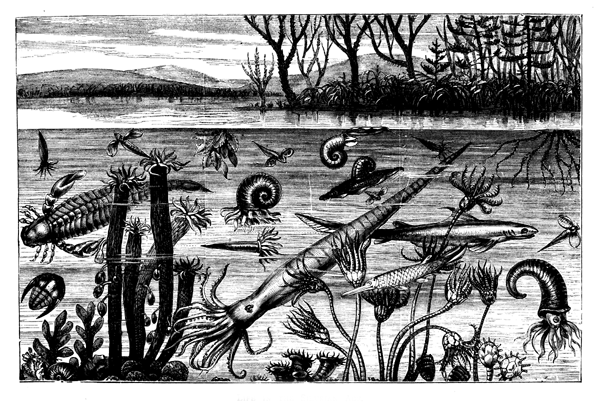
| Frontispiece.—Life in the Silurian
Age |
To face Title. |
| fig |
|
page |
| 1. |
Bank of stream or coast, showing
stratification |
4 |
| 2. |
Section of Niagara Falls |
4 |
| 3. |
Section obtained by boring, near Goderich,
Ontario |
5 |
| 4. |
Inclined beds, holding fossil plants |
6 |
| 5. |
Ideal section of the Apalachian
Mountains |
7 |
| 6. |
Generalised section across England from
Menai Straits to the Valley of the Thames |
9 |
| 7. |
Generalised section from the Laurentian of
Canada to the coal-field of Michigan |
9 |
| 8. |
Unconformable superposition of Devonian
Conglomerate on Silurian slates, at St. Abb’s Head,
Berwickshire |
10 |
| 9. |
Section of Trenton limestone,
Montreal |
14 |
| 10. |
Diagram showing different state of
fossilisation of a cell of a Tabulate Coral |
15 |
| 11. |
Cast of erect tree (Sigillaria) in
Sandstone |
16 |
| 12. |
Protichnites septem-notatus |
17 |
| 12a. |
Footprints of modern Limulus, or
king-crab |
18 |
| 13. |
Current markings on shale, resembling a
fossil plant |
18 |
| |
Frontispiece. Magnified and
restored section of a portion of Eozoon canadense |
20 |
| 14. |
Ideal section, showing the relations of
the Laurentian and Huronian |
24 |
| 15. |
Small weathered specimen of Eozoon |
28 |
| 16. |
Nature-printed specimen of Eozoon
slightly etched with acid |
29 |
| 17. |
Magnified group of canals in supplemental
skeleton of Eozoon |
31 |
| 18. |
Portion of Eozoon magnified 100
diameters |
31 |
| 19. |
Magnified portion of shell of
Calcarina |
32 |
| 20. |
Amœba, a fresh-water naked
Rhizopod; and Actinophrys, a fresh-water
Protozoon |
34 |
| 21. |
Nonionina, a modern marine
Foraminifer |
34 |
| 22. |
Stromatopora concentrica |
35 |
| 23. |
Caunopora planulata |
36 |
| 24. |
Archæocyathus minganensis. A
Primordial Protozoon |
37 |
| 25. |
Receptaculites. Restored |
38 |
| 26. |
Section of Loftusia Persica. An
Eocene Foraminifer |
39 |
| 27. |
Foraminiferal Rock Builders, in the
Cretaceous and Eocene |
41 |
| |
Frontispiece. Paradoxides Regina
(Matthew) |
44 |
| 28. |
Group of Cambrian Animals |
46 |
| 29. |
Portion of skeleton of Hexactinellid
Sponge (Cœloptychium) |
49 |
| 30. |
Protospongia fenestrata
(Salter) |
50 |
| 31. |
Astylospongia præmorsa
(Roemer) |
51 |
| 32. |
Spicules of Lithistid Sponge
(Trichospongia, Billings) |
51 |
| 33. |
Oldhamia antiqua (Forbes) |
52 |
| 34. |
Dictyonema sociale. Enlarged |
52 |
| 35. |
Dictyonema Websteri (Dn.) |
53 |
| 36. |
Group of modern Hydroids allied to
Graptolites |
54 |
| 37. |
Silurian Graptolitidæ |
55 |
| 38. |
Central portion of Graptolite, with
membrane, or float (Dichograpsus octobrachiatus,
Hall) |
55 |
| 39. |
Ptilodictya acuta (Hall).
Bryozoan |
55 |
| 39a. |
Fenestella Lyelli (Dn.). A
Carboniferous Bryozoan |
56 |
| 40. |
Chaetetes fibrosa. A Tabulate Coral
with microscopic cells |
56 |
| 41. |
a, Stenopora exilis (Dn.).
b, Chaetetes tumidus (Edwards and Haine) |
57 |
| 42. |
Living Anthozoan Coral
(Astræa) |
58 |
| 43. |
Tabulate Corals (Halisites and
Favosites) |
59 |
| 44. |
Rugose Coral (Heliophyllum
Halli) |
59 |
| 44a. |
Zaphrentis prolifica
(Billings) |
60 |
| 45. |
Rugose Corals (Zaphrentis Minas,
Dn., and Cyathophyllum Billingsi, Dn.) |
60 |
| 46. |
Modern Crinoid (Rhizocrinus
Lofotensis) |
61 |
| 47. |
Palæaster Niagarensis
(Hall) |
62 |
| 48. |
Palæchinus ellipticus
(McCoy) |
62 |
| 49. |
Pleurocystites squamosus |
63 |
| 50. |
Heterocrinus simplex (Meek) |
63 |
| 51. |
Body of Glyptocrinus |
63 |
| 52. |
Extracrinus Briareus |
64 |
| 53. |
Pentacrinus caput-medusæ |
64 |
| 54. |
Lingula anatina |
65 |
| 55. |
Cambrian and Silurian Lingulæ |
65 |
| 56. |
Terebratula sacculus (Martin) |
66 |
| 57. |
Brachiopods; genus Orthis |
66 |
| 58. |
Rhynchonella increbrescens
(Hall) |
66 |
| 59. |
Spirifer mucronatus (Conrad) |
67 |
| 59a. |
Athyris subtilita (Hall) |
67 |
| 60. |
Productus cora
(D’Orbigny) |
68 |
| 61. |
Group of Older Palæozoic
Lamellibranchs |
69 |
| 62. |
Conularia planicostata (Dn.). A
Carboniferous Pteropod |
70 |
| 63. |
Silurian Sea-snails |
70 |
| 64. |
Squid (Loligo) |
72 |
| 65. |
Pearly Nautilus (Nautilus
pompilius) |
72 |
| 66. |
Orthoceras |
73 |
| 67. |
Gomphoceras |
73 |
| 68. |
Lituites |
73 |
| 69. |
Nautilus Avonensis (Dn.) |
74 |
| 70. |
Goniatites crenistria
(Philips) |
74 |
| 71. |
Ceratites nodosus (Schloth) |
75 |
| 72. |
Ammonites Jason (Reinecke) |
76 |
| 72a. |
Suture of Ammonites componens
(Meek) |
76 |
| 73. |
Cretaceous Ammonitidæ |
77 |
| 74. |
Belemnite |
78 |
| 74a. |
Belemnoteuthis antiquus |
78 |
| 75. |
Cambrian Trilobites |
79 |
| 76. |
Transverse section of Calymene. A
Silurian Trilobite |
80 |
| 76a. |
Burrows of Trilobite and of modern
King-crab |
81 |
| 77. |
Silurian Trilobites |
82 |
| 78. |
Devonian and Carboniferous Trilobites |
83 |
| 79. |
Palæozoic Ostracod Crustaceans |
83 |
| 80. |
Pterygotus anglicus |
84 |
| 81. |
Amphipeltis paradoxus (Salter) |
85 |
| 82. |
Anthropalæmon Hilliana
(Dn.) |
85 |
| |
Frontispiece. Cordaites, of
the group of Dory-Cordaites |
88 |
| 83. |
Protannularia Harknessii
(Nicholson) |
91 |
| 84. |
American Lower Silurian Plants |
92 |
| 86. |
Fragment of outer surface of
Glyptodendron of Claypole |
93 |
| 87. |
Psilophyton princeps (Dn.) |
95 |
| 88. |
Trunk of a Devonian Tree-fern
(Caulopteris Lockwoodi, Dn.) |
97 |
| 89. |
Frond of Archæopteris
Jacksoni (Dn.) |
98 |
| 90. |
Portion of a branch of Leptophleum
rhombicum (Dn.) |
98 |
| 91. |
Calamites radiatus
(Brongniart) |
99 |
| 92. |
A Devonian Taxine Conifer (Dadoxylon
ouangondianum, Dn.) |
100 |
| 93. |
Group of Devonian fruits, &c. |
101 |
| 94. |
Structures of the oldest-known
Angiospermous Exogen (Syringoxylon mirabile, Dn.) |
102 |
| 95. |
Asterophyllites parvula (Dn.) and
Sphenophyllum antiquum (Dn.) |
103 |
| 96. |
Calamites |
104 |
| 97. |
Carboniferous Ferns |
105 |
| 98. |
Carboniferous Tree-ferns |
107 |
| 99. |
Lepidodendron corrugatum (Dn.) |
108 |
| 100. |
Sigillariæ of the
Carboniferous |
109 |
| 101. |
Trigonocarpum Hookeri (Dn.) |
111 |
| |
Frontispiece. Pteraspis.
Restored |
116 |
| 102. |
Siluro-Cambrian Conodonts |
118 |
| 103. |
Lower Carboniferous Conodont |
119 |
| 104. |
a, Head-shield of an Upper Silurian
Fish (Cyathaspis); b, Spine of a Silurian Shark
(Onchus tenui-striatus, Agass.); c, d,
Scales of Thecodus |
121 |
| 105. |
Cephalaspis Dawsoni
(Lankester) |
122 |
| 106. |
Devonian Placoganoid Fishes
(Pterichthys cornutus, Cephalaspis Lyelli) |
123 |
| 107. |
Devonian Lepidoganoid Fishes
(Diplacanthus and Osteolepis) |
124 |
| 108. |
Modern Dipnoi (Ceratodus Fosteri
and Lepidosiren annectus) |
124 |
| 109. |
Anterior part of the palate of
Dipterus |
125 |
| 110. |
Dental plate of Conchodus plicatus
(Dn.) |
126 |
| 111. |
Dental plate of Ceratodus
Barrandii |
126 |
| 112. |
Dental plate of Ceratodus
serratus |
127 |
| 113. |
Jaws of Dinichthys Hertzeri
(Newberry) |
127 |
| 114. |
Lower Jaw of Dinichthys
Hertzeri |
128 |
| 115. |
Jaws of Lepidosiren |
128 |
| 116. |
A small Carboniferous Ganoid
(Palæoniscus (Rhadinichthys)
Modulus, Dn.) |
129 |
| 117. |
Teeth and Spines of Carboniferous
Sharks |
130 |
| 118. |
Teeth of Cretaceous Sharks (Otodus
and Ptychodus) |
131 |
| 119. |
Tooth of a Tertiary Shark
(Carcharodon) |
132 |
| 120. |
A Liassic Ganoid (Dapedius) |
132 |
| 121. |
Cretaceous Fishes of the modern or
Teleostian type (Beryx Lewesiensis and Portheus
molossus, Cope) |
133 |
| 122. |
Modern Ganoids (Polypterus and
Lepidosteus) |
134 |
| |
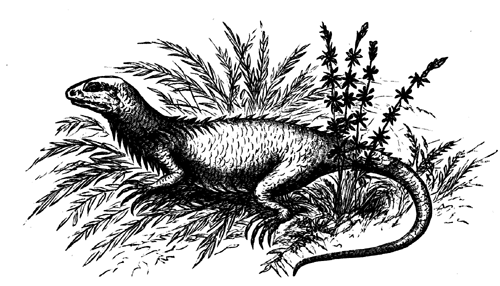
Frontispiece. A Microsaurian of the
Carboniferous Period (Hylonomus Lyelli) |
136 |
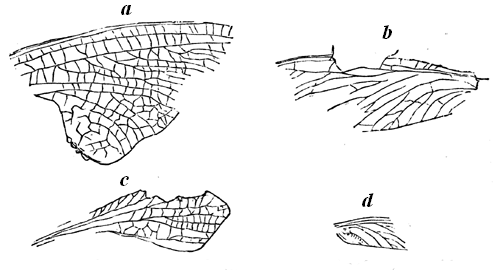
| 123. |
Wings of Devonian Insects |
140 |
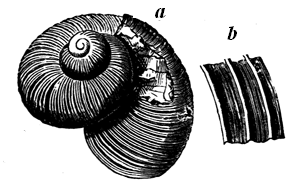
| 124. |
Land-snail (Pupa vetusta, Dn.) |
143 |
| 125. |
Land-snail (Zonites
(Conulus) priscus, Carpenter) |
143 |
| 126. |
Millipedes (Xylobius
sigillariæ, Dn.; Archiulus Xylobioides,
Scudder; X. farctus, Scudder) |
145 |
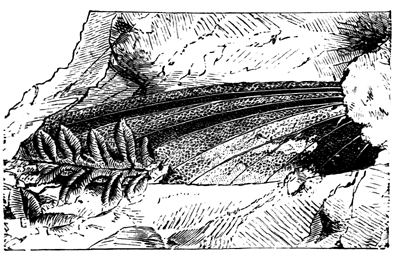
| 127. |
Wings of Cockroaches |
146 |
| 128. |
Wing of May-fly (Haplophlebium
Barnesii, Scudder) |
147 |
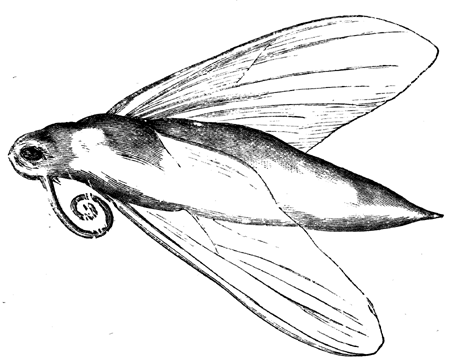
| 129. |
A Jurassic Sphinx-moth (Sphinx
Snelleri, Weyenburgh) |
148 |
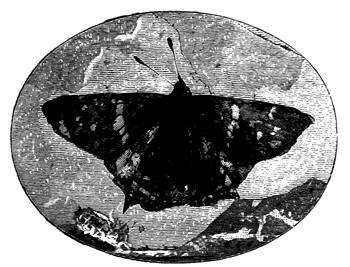
| 130. |
An Eocene Butterfly (Prodryas
persephone, Scudder) |
149 |
| 131. |
Abdominal part of a Carboniferous
Scorpion |
150 |
| 132. |
Carboniferous Scorpion (Eoscorpius
carbonarius, Meek and Worthen) |
151 |
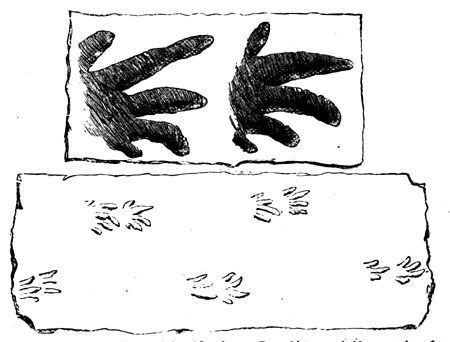
| 133. |
Footprints of one of the oldest known
Batrachians, probably a species of Dendrerpeton |
152 |
| 134. |
Archegosaurus Decheni |
154 |
| 135. |
Ptyonius |
154 |
| 136. |
A large Carboniferous Labyrinthodont
(Baphetes planiceps, Owen) |
155 |
| 137. |
Baphetes planiceps (Owen) |
156 |
| 138. |
A lizard-like Amphibian (Hylonomus
aciedentatus) |
157 |
| 139. |
Stelliosaurus longicostatus
(Fritsch) |
158 |
| 140. |
Section showing the position of an erect
Sigillaria, containing remains of land animals |
160 |
| 140a. |
Section of base of erect
Sigillaria, containing remains of land animals |
161 |
| |
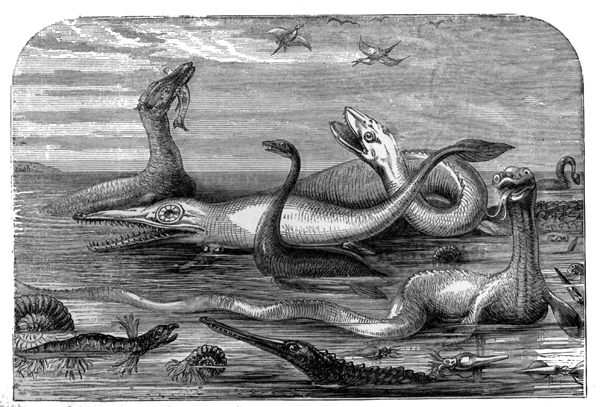
Frontispiece. Inhabitants
of the English Seas in the Age of Reptiles |
164 |
| 141. |
Arm of Proterosaurus Speneri |
166 |
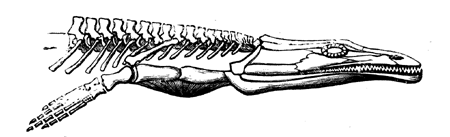
| 142. |
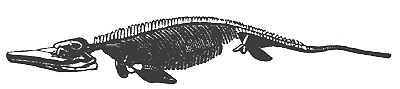
Skeleton of Ichthyosaurus |
167 |
| 142a. |
Head of Pliosaurus |
168 |
| 142b. |
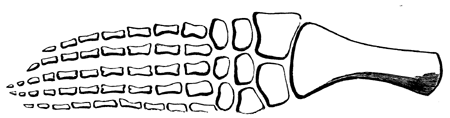
Paddle of Plesiosaurus
Oxoniensis |
168 |
| 143. |
Skeleton of Clidastes |
170 |
| 144. |
An Anomodont Reptile of the Trias
(Dicynodon lacerticeps, Owen) |
170 |
| 145. |
A Theriodont Reptile of the Trias
(Lycosaurus) |
170 |
| 146. |
Skeleton of Pterodochylus
crassirostris |
170 |
| 147. |
Restoration of Rhamphorhyncus
Bucklandi |
171 |
| 148. |
A Jurassic bird (Archæopteryx
macroura) |
172 |
| 149. |
Jaw of a Cretaceous Toothed Bird
(Ichthyornis dispar) |
173 |
| 150. |
Jaw of Bathygnathus borealis
(Leidy) |
174 |
| 151. |
Hadrosaurus Foulkii (Cope) |
175 |
| 152. |
Jaws of Megalosaurus |
176 |
| 153. |
Tooth of Megalosaurus |
177 |
| 154. |
Compsognathus |
179 |
| |
Frontispiece. Lower Cretaceous
Leaves |
184 |
| 155. |
Sassafras cretaceum (Newberry) |
190 |
| 156. |
Liriodendron primævum
(Newberry) |
191 |
| 157. |
Onoclea sensibilis |
191 |
| 158. |
Davallia tenuifolia |
192 |
| 159. |
Eocene Leaves |
194 |
| 160. |
An Ancient Clover (Trifolium
palæogæum, Saporta) |
195 |
| 161. |
An Eocene Maple (Acer sextianus,
Saporta) |
195 |
| 162. |
A European Magnolia of the Eocene (M.
dianæ, Saporta) |
195 |
| 163. |
Flower and Leaf of Bombax
sepultiflorum |
196 |
| 164. |
Branch and Fruit of Sequoia
Couttsiæ (Heer) |
197 |
| 165. |
Cinnamomum Scheuchzeri (Heer) |
198 |
| |
Frontispiece. Sivatherium
giganteum |
206 |
| 166. |
Jaw of Dromatherium sylvestre
(Emmons) |
209 |
| 167. |
Myrmecobius fasciatus |
209 |
| 168. |
Jaw and Molar of Phascolotherium
Bucklandi |
210 |
| 169. |
Jaw and Pre-molar of Plagiaulax
Becklesii |
210 |
| 170. |
Restoration of Palæotherium
magnum |
211 |
| 171. |
Skull of a Lower Eocene Perissodactyl
(Coryphodon Hamatus) |
214 |
| 172. |
Fore-foot of Coryphodon |
215 |
| 173. |
Skull of Upper Eocene Perissodactyl
(Dinoceras mirabilis) |
216 |
| 174. |
Fore-foot of Dinoceras |
217 |
| 175. |
Skull of Miocene Perissodactyl
(Brontotherium ingens, Marsh) |
217 |
| 176. |
Series of Equine feet |
218 |
| 177. |
Skull of generalised Miocene Ruminant
(Oreodon major) |
221 |
| 178. |
Lower Jaw of Megatherium |
222 |
| 179. |
Ungual Phalanx and Claw-core of
Megatherium |
222 |
| 180. |
Tooth of Eocene Whale (Zeuglodon
cetioides) |
223 |
| 181. |
Mastodon ohioticus |
225 |
| 182. |
Head of Dinotherium giganteum |
226 |
| 183. |
Wing of Eocene Bat (Vespertilio
aquensis) |
226 |
| 184. |
Skull of a Cymetar-toothed Tiger
(Machairodus cultridens) |
228 |
| 185. |
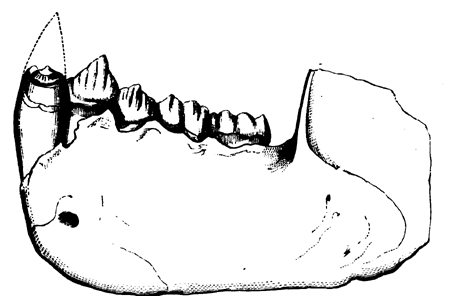
Lower Jaw of Dryopithecus
Fontani |
229 |
|
Frontispiece. Contemporaries of
Post-Glacial Man |
232 |
| 186. |
Elephas primigenius |
241 |
| 187. |
Tooth of Elasmotherium |
242 |
| 188. |
Engis Skull |
243 |
| 189. |
Outlines of Three Prehistoric European
Skulls compared with an American Skull |
244 |
| 190. |
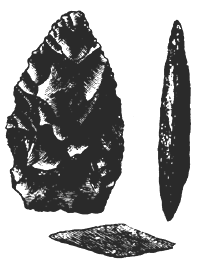
Flint Implement found in Kent’s
Cavern, Torquay |
245 |
| 191. |
Bone Harpoon (Palæocosmic) |
246 |
| 192. |
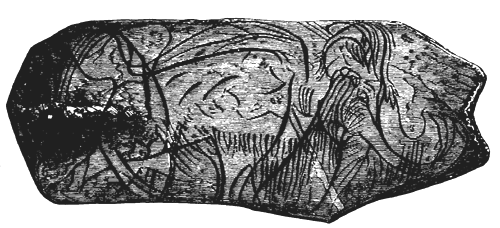
Sketch of a Mammoth carved on a portion of
a Tusk of the same Animal |
249 |
| Geological Periods. |
Animal Life. |
Vegetable
Life. |
Cainozoic
or
Neozoic |
Post-Tertiary
or
Tertiary |
┌Modern
└Post-Glacial |
Age of Man
and modern
Mammals. |
Age of
Angiosperms
and Palms. |
| Tertiary |
┌Pleistocene or
│Glacial.
│Pliocene.
│Miocene.
└Eocene.
|
Age of Extinct
Mammals.
(Earliest
Placental
Mammals.) |
| Mesozoic |
Cretaceous |
┌Upper,
│Lower, or
└Neocomian |
Age of
Reptiles
and Birds |
(Earliest
Modern Trees)
Age of
Cycads and
Pines. |
| Jurassic |
┌Oolite
└Lias |
| Triassic |
┌Upper,
│Middle or
│Muschelkalk.
└Lower. |
Age of Reptiles
and Birds
(Earliest
Marsupial
Mammals.) |
| PalÆozoic. |
Permian |
┌Upper,
│Upper,
│Middle, or
│Magnesian Limestone,
└Lower. |
(Earliest
true
Reptiles) |
Age of
Acrogens and Gymnodperms. (Earliest Land Plants.) Age
of Algæ. |
| Carboniferous |
┌Upper Coal-Formation.
│Coal-Formation.
│Carboniferous Limestome.
└Lower Coal-Formation. |
| Devonian |
┌Upper.
│Middle.
└Lower. |
Age of
Amphibians
and fishes. |
| Silurian |
┌Upper.
└Lower. |
Age of
Mollusks
Corals and
Crusyaceans. |
Siluro
Cambrian
or
Ordovician. |
┌Upper.
└Lower. |
| Cambrian. |
┌Upper.
│Middle.
└Lower.
|
| Eozoic. |
Huronian |
┌Upper,
│Upper,
└Lower. |
Age of
Protozoa. (First animal
remains) |
Indications
of
Plants not
determinable |
| aurentian. |
┌Upper.
│Middle,
│Lower. or
└Bojian.
|
 t is of the nature of true
science to take nothing on trust or on authority. Every fact must
be established by accurate observation, experiment, or
calculation. Every law and principle must rest on inductive
argument. The apostolic motto, “Prove all things, hold fast
that which is good,” is thoroughly scientific. It is true
that the mere reader of popular science must often be content to
take that on testimony which he cannot personally verify; but it
is desirable that even the most cursory reader should fully
comprehend the modes in which facts are ascertained and the
reasons on which conclusions are based. Failing this, he loses
all the benefit of his reading in so far as training is
concerned, and cannot have full assurance of that which he
believes. When, therefore, we speak of life-epochs, or of links
in a chain of living beings, the question is at once
raised—What evidence have we of the succession of such
epochs? This question, with some accessory points, must engage
our attention in the present chapter.
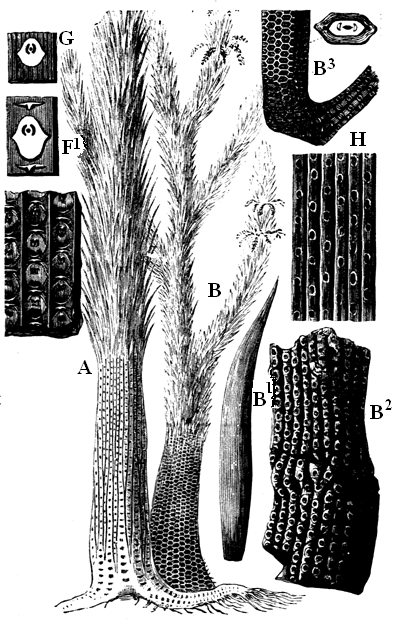
t is of the nature of true
science to take nothing on trust or on authority. Every fact must
be established by accurate observation, experiment, or
calculation. Every law and principle must rest on inductive
argument. The apostolic motto, “Prove all things, hold fast
that which is good,” is thoroughly scientific. It is true
that the mere reader of popular science must often be content to
take that on testimony which he cannot personally verify; but it
is desirable that even the most cursory reader should fully
comprehend the modes in which facts are ascertained and the
reasons on which conclusions are based. Failing this, he loses
all the benefit of his reading in so far as training is
concerned, and cannot have full assurance of that which he
believes. When, therefore, we speak of life-epochs, or of links
in a chain of living beings, the question is at once
raised—What evidence have we of the succession of such
epochs? This question, with some accessory points, must engage
our attention in the present chapter.
Geology as a practical science consists of
three leading parts. The first and most elementary of these is
the study of the different kinds of rocks which enter into the
composition of those parts of the earth which are accessible to
us, and which we are in the habit of calling the crust of the
earth. This is the subject of Lithology, which is based on
the knowledge of minerals, and has recently become a much more
precise department of science than heretofore, owing to the
successful employment of the microscope in the investigation of
the minute structure and composition of rocks. The second is the
study of the arrangement of the materials of the earth on the
large scale, as beds, veins, and irregular masses; and inasmuch
as the greater part of the rocks known to us in the earth’s
crust are arranged in beds or strata, this department may be
named Stratigraphy. A more general name sometimes employed
is that of Petrography. The third division of geology
relates to the remains of animals and plants buried in the rocks
of the earth, and which have lived at the time when those rocks
were in process of formation. These fossil remains introduce us
to the history of life on the earth, and constitute the subject
of Palæontology.
It is plain that in considering what may be learned as to
epochs in the history of life we are chiefly concerned with the
last of these divisions. The second may also be important as a
means of determining the relative ages of the fossils. With the
first we have comparatively little to do.
Previous to observation and inquiry, we might suppose that the
kinds of animals and plants which now inhabit the earth are those
which have always peopled it; but a very little study of fossils
suffices to convince us that vast numbers of creatures once
inhabitants of this world have become extinct, and can be known
to us only by their remains buried in the earth. When we place
this in connection with stratigraphical facts, we further find
that these extinct species have succeeded each other at different
times, so as to constitute successive dynasties of life. On
the one hand, when we know the successive ages of fossil forms,
these become to us, like medals or coins to the historian,
evidences of periods in the earth’s history. On the other
hand, we are obliged in the first instance to ascertain the ages
of the medals themselves by their position in the successive
strata which have been accumulated on the surface. The series of
layers which explorers like Schliemann find on the site of an
ancient city, and which hold the works of successive peoples who
have inhabited the place, thus present on a small scale a
faithful picture of the succession of beds and of forms of life
on the great earth itself.
Our leading criterion for estimating the relative ages of
rocks is the superposition of their beds on each other. The beds
of sandstone, shale, limestone, and other rocks which constitute
the earth’s crust have nearly all been deposited thereon by
water, and originally in attitudes approaching to horizontality.
Hence the bed that is the lower is the older of any two beds.
Hence also, when any cutting or section reveals to us the
succession of several beds, we know that fossil remains contained
in the lower beds must be of older date.
We can scarcely walk by the side of a stream which has been
cutting into its banks, or at the foot of a sea-cliff, or through
a road-cutting, without observing illustrations of this. For
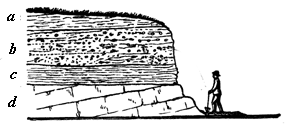
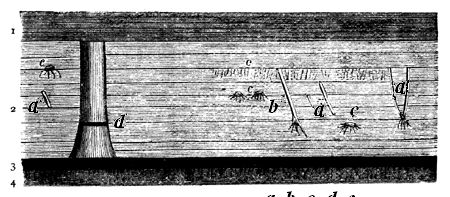
instance, in the section represented in Fig. 1, we see at
the surface the vegetable soil, below this layers of gravel and
sand, below this a bed of clay, and below this hard limestone. Of
these beds a is the newest, d the oldest; and if,
for example, we should find some marine shells in d, some
freshwater shells in c, bones of land animals and flint
arrowheads in b, and fragments of modern pottery in
a, we should be able at once to assign their relative ages
to these fossils, and to form some idea of the succession of
conditions and of life which had occurred in the locality.
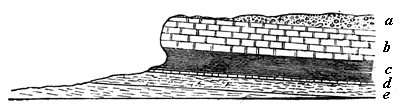
On a somewhat larger scale, we have in Fig. 2 a section
of the beds cut through by the great Fall of Niagara. All
of
these except that marked a are very ancient marine rocks,
holding fossil shells and corals, but now forming part of the
interior of a continent, and cut through by a fresh-water
river.
Fig. 1.—Bank of stream or coast,
showing stratification.
a, Vegetable soil. b, Gravel and
sand. c, Clays. d, Limestone rock, slightly inclined.
Fig. 2.—Section at Niagara Falls,
showing the strata cut through by the action of the Fall.
Thickness of beds about 250 feet.
| a, Boulder clay and
gravel—Post-pliocene. |
b, Niagara limestone
c, Niagara shale
d, Clinton limestone
e, Medina sandstone |
┐Upper Silurian,
│ with marine shells
│ and
┘ corals. |
In deep mines and borings still more profound sections may be
laid open, as in Fig. 3, which represents the sequence of
beds ascertained by boring with the diamond drill in search of
rock salt near Goderich in Canada. Here we have a succession of
1,500 feet of beds, some of which must have been formed under
very peculiar and exceptional conditions. The beds of rock salt
and gypsum must have been formed by the drying up of sea-water in
limited basins. Those of Dolomite imply precipitation of
carbonate of lime and magnesia in the sea-bottom. The marls must
have been formed largely by the driftage of sand and clay, while
some of the limestone was produced by accumulation of corals and
shells. Such deposits must not only have been successive, but
must have required a long time for their formation.
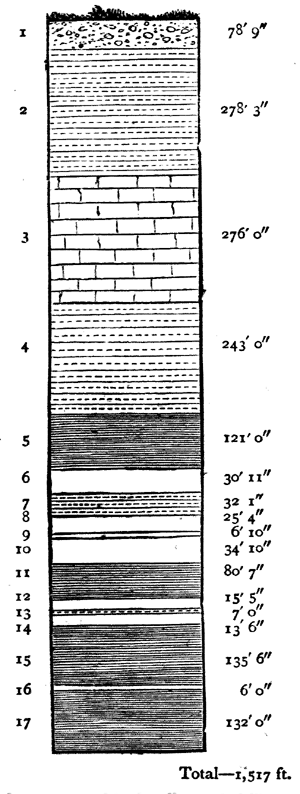
Fig. 3.—Section obtained by boring with
the diamond drill, near Goderich, Ontario, Canada, in the Salina
series of the Upper Silurian. From a memoir by Dr. Hunt in the
Report of the Geological Survey of Canada for 1876-7.
No. 1, Clay, gravel, and boulders—Post-pliocene.
Nos. 2, 4, 7, 9, 13, Dolomite or magnesian limestone, with layers of marl, limestone, and gypsum.
No. 3, Limestone with corals—Favosites, etc.
Nos. 5, 11, 15, 17, Marls with layers of Dolomite and anhydrous gypsum.
Nos. 6, 8, 10, 12, 14, 16, Rock salt.
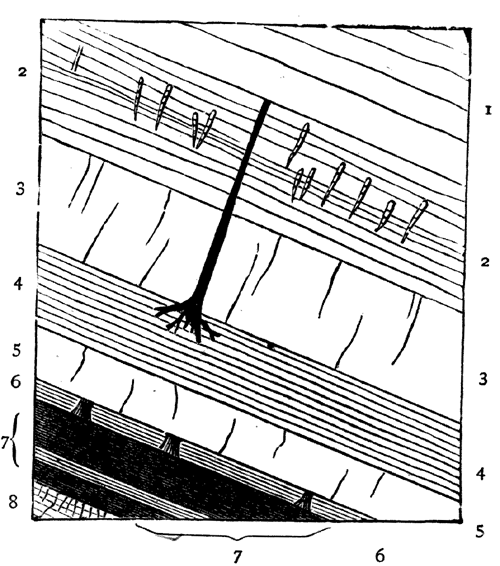
Fig. 4.—Inclined beds, holding fossil
plants. Carboniferous. South Joggins, Nova Scotia.
| 1. Shale and sandstone. Plants
with Spirorbis attached; rain marks (?). |
| 2. Sandstone and shale, 8 feet. Erect
Calamites. |
┐An erect coniferous (?)
tree, rooted
│ on the shale, passes up through 15
┘ feet of the sandstones and shale. |
| 3. Gray sandstone, 7 feet. |
| 4. Gray shale, 4 feet. |
| 5. Gray sandstone, 4
feet. |
| 6. Gray shale, 6 inches.
Prostrate and erect trees, with rootlets, leaves,
Naiadites, and Spirorbis on the plants. |
| 7. Main coal-seam, 5 feet coal
in two beds. |
| 8. Underclay, with
rootlets. |
In Fig. 4 we have a bed of coal and its accompaniments.
The coal itself was produced by the slow accumulation of
vegetable matter on a water-soaked soil, and this was buried
under successive beds of sand and clay, now hardened into
sandstone and shale, some of the beds holding trees and reed-like
plants, which still stand on the soils on which they grew, and
which must have been buried in sediment deposited in inundations
or after subsidence of the land. In this section we may also
observe that the beds are somewhat inclined; and that this
is not their original position is shown by the posture of the
stems of trees, once erect, but now inclined with the beds. This
leads to a consideration very important with reference to our
present subject; namely, that as our continents are mostly made
up of beds deposited under water and afterwards elevated, these
beds have in this process experienced such disturbances that they
rarely retain their horizontal position, but are tilted at
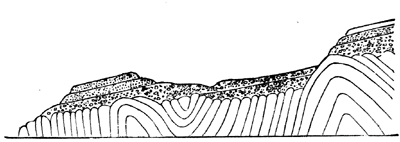
various angles. When we follow such inclined strata over large
areas, we find that they undulate in great waves or folds,
forming what are called anticlinal and synclinal lines, and that
the irregularities of the surface of the land depend to a great
extent on these undulations, along with the projection of hard
beds whose edges protrude at the surface. In point of fact, as
shown in Fig. 5, mountain ranges depend on these crumplings
of the earth’s crust; and the primary cause of these is
probably the shrinkage of the mass of the earth owing to
contraction in cooling. When the disturbances of beds are
extreme, they often cause intricacies of structure difficult to
unravel; but when of moderate extent they very much aid us in
penetrating below the surface, for we can often see a great
thickness of beds rising one from beneath another, and can thus
know by mere superficial examination the structure of the earth
to a great depth. It thus happens that geologists reckon the
thickness of the stratified deposits of the crust of the
earth at more than 70,000 feet, though they cannot penetrate it
perpendicularly to more than a fraction of that depth. The two
sections, Figs. 6 and 7, showing the sequence of beds in England
and in the northern part of North America, will serve, if studied
by the reader, to show how, by merely travelling over the surface
and measuring the upturned edges of beds, many thousands of feet
of deposits may be observed, and their relative ages distinctly
ascertained.
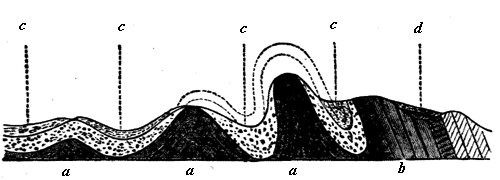
Fig. 5.—Ideal section of the Apalachian
Mountains showing folding of the earth’s crust.
a, Anticlinal axes. b,
Overturned strata. c, Synclinals. d, Unconformable
beds.
In studying any extensive section of rock we find that its
members may more or less readily be separated into distinct
groups. Sometimes these are distinguished by what is termed
unconformability, that is, the lower series has been disturbed or
inclined before the upper has been deposited upon it. This is
seen on a grand scale in the section Fig. 7, in the case of
the Laurentian and Cambrian formations, and on a smaller scale in
Fig. 8 in the unconformable superposition of Devonian
conglomerate on Silurian slates at St. Abb’s Head. In the
last section it is quite evident that the beds of the lower
series have been bent into abrupt folds and worn away to a
considerable extent before the deposition of the overlying
series. In such a case we know not merely that the upper series
is newer than the lower, but that some considerable time must
have elapsed after the deposition of the one before the other was
laid down; and we are not surprised to find that the fossils in
the groups thus unconformable to each other are very
different.
But even when the beds are conformable, they can usually be
separated into groups, depending upon differences of mineral
character, or changes which have occurred in the mode of
deposition. One group of beds, for example, may be largely
composed of limestone, another of sandstone or shale. One group
may be distinguished by containing some special mineral, as, for
example, rock salt or coal, while others may be destitute of such
special minerals. One group may show by its fossils that it was
deposited in the sea, others may be estuarine or lacustrine. Thus we obtain the means of dividing the
rocks of the earth into groups of different ages, known as
“Formations,” and marking particular periods of
geological time. By tracing these formations from one district or
region to another, we learn the further truth that the succession
is not merely local, but that, though liable to variation in
detail, its larger subdivisions hold so extensively that they may
be regarded as world-wide in their distribution.

Fig. 6.
Generalised section across England from Menai Straits to the
Valley of the Thames.—After Ramsay.
0 Huronian? or Laurentian? 1 Cambrian and
Lower Silurian. 2 Upper Silurian. 3 Devonian. 6, 7, 8 Trias and
lias. 9 and 10 Jurassic. 11 Cretaceous. 12 Eocene.
Fig. 7.—Generalised section from the
Laurentian of Canada to the coal-field of Michigan.
0 Laurentian (the Huronian is absent in the
line of this section). 1 Cambrian. 2 Lower Silurian. 3 Upper
Silurian. 4 Devonian. 5 Carboniferous.
Fig. 8.—Unconformable superposition of
Devonian conglomerate on Silurian slates, at St. Abb’s
Head, Berwickshire.—After Lyell.
Putting together the facts thus obtained, we can frame a
tabular arrangement of the earth’s strata, as in the table
prefixed to this chapter; and when we add the further discovery,
very early made by geologists, that the successive formations
differ from each other in their fossil remains, we have the means
of recognising any particular formation by its fossils, even when
the stratigraphical evidence may be obscure or wanting. Thus our
knowledge of Epochs of Life, and indeed of the whole geological
history of the earth, is based on the superposition of beds in
the earth’s crust, and on the diversity of fossil remains
in the successive beds so superimposed on each other; and it is
on these grounds that we are enabled to construct a Table of
Geological Formations representing the whole series of beds as
far as known, with the characteristic groups of fossils of each
period. Here I might close these preliminary considerations, but
there are a few accessory questions, important to our clear
comprehension of the subject, which may profitably occupy our
attention for a short time.
One of these relates to the absolute
duration of the time represented by the geological history of the
earth. Such estimates as our present knowledge enables us to form
are very indefinite. Whether we seek for astronomical or
geological data, we find great uncertainty. To such an extent is
this the case, that current estimates of the time necessary to
bring the earth from a state of primitive incandescence to its
present condition have varied from fifteen millions of years to
five hundred millions. Of the various modes proposed, perhaps the
most satisfactory as well as instructive is that based on the
rate of denudation of our present continents, as indicated by the
amount of sediment carried down by great rivers. The Mississippi,
draining a vast and varied area in temperate latitudes, is
washing away the American land at the rate of one foot in 6,000
years. The Ganges, in a tropical climate and draining many
mountain valleys, works at the rate of one foot in 2,358 years.
The mean of these two great rivers would give one foot in 4,179
years, at which rate our continents would be levelled with the
waters in about six millions of years. But the land has been in
process of renewal as well as of waste in geological time; and a
better measure will be afforded by the amount of beds actually
deposited. The entire thickness of all the stratified rocks of
Great Britain has been calculated by Ramsay at 72,000 feet. Now,
if we suppose the waste in all geological time to have been on
the average the same as at present, and that this material has
been deposited to the thickness of 72,000 feet on a belt of sea
margin 100 miles in width, we shall have about 86 millions of
years as the time required.1
This has the merit of approximating to Sir William
Thomson’s calculation, based on the rate of cooling of the
earth, that a minimum of 100 millions of years may represent the
time since a solid crust first began to form. As it is more
likely that the rate of denudation has on the average
been greater in former geological periods than at present, we may
perhaps estimate fifty or sixty millions of years as the time
required for the accumulation of all our formations. Some
geologists object to this as too little, but in this some of them
are influenced by the exigencies of theories of evolution, and
others appear to have no adequate conception of the vast lapse of
time represented by such numbers, in its relation to the actual
rates of denudation and deposition.
It should be mentioned here, however, that, on certain
theories now somewhat generally accepted, respecting the nature
and source of solar heat, the absolute duration of geological
time would be much reduced below the estimate of Sir Wm. Thomson.
Prof. Tait has based on such data an estimate of fifteen millions
of years. Prof. Simon Newcomb says that “on the only
hypothesis science will now allow us to make respecting the
source of the solar heat” (the gravitation hypothesis of
Helmholtz) “the earth was, twenty millions of years ago,
enveloped in the fiery atmosphere of the sun.” Dr. Kirkwood
has called attention to these results in connection with the
planetary hypothesis of La Place, in the Proceedings of the
American Philosophical Society.2
Should such views prove to be well-founded, geological
calculations as to the time required for the successive
formations may have to be revised.
If now we attempt to divide this time among the formations
known to us, according to their relative thicknesses, we have,
according to an elaborate estimate of Professor Dana, the time
ratios of 12, 3, and 1 for the Palæozoic, Mesozoic, and
Cainozoic periods respectively. Taking the whole time since the
beginning of the Cambrian as forty-eight millions of years, we
should thus have for the Palæozoic thirty-six millions, for
the Mesozoic nine, and for the Tertiary three. Another
calculation, recently made by Professors Hull and Haughton,
gives the following ratios:—
| Azoic |
34·3 per cent. |
| Palæozoic |
42·5 ” |
| Mesozoic and Cainozoic |
23·2 ” |
This calculation is, however, based on the absolute thickness
of the several series as ascertained in Great Britain, without
reference to the nature of the beds, as indicating different
rates of accumulation. Under either estimate it will be seen that
the Palæozoic time greatly exceeds the Mesozoic and
Cainozoic together, and consequently that changes of life seem to
have proceeded at an accelerated rate as time wore on.
Another inquiry of some importance relates to the manner of
preservation of fossils, and the extent to which they constitute
the material of rocks. This inquiry is doubly important, as it
bears on the genuineness of fossil remains, and on the means we
have of understanding their nature.
Some rocks are entirely made up of matter that once was alive,
or formed part of living organisms. This is the case with some
limestones, which consist of microscopic shells, or of larger
shells, corals, and similar calcareous organisms, either entire
or broken into fragments and cemented together with pasty or
crystalline limestone filling their interstices. This may be seen
in Fig. 9, which represents a magnified slice of a Silurian
limestone. Coal in like manner consists of carbonised vegetable
matter, retaining more or less perfectly its organic structure,
and sometimes even the external forms of its constituent parts.
More frequently, fossils are dispersed more or less sparsely
through the substance of beds composed of earthy matter; and they
have usually been more or less affected by chemical changes, or
by mechanical pressure, or are mineralised by different
substances which have either filled their pores by infiltration
or have more or less completely replaced their substance. Of
course, as a rule, the softer and more putrescible organic
matters have perished by decay, and it is only the harder and
more resisting parts that remain. Even these have often yielded
to the enormous pressure to which they have been subjected, and
if at all porous, have been changed by the slow action of
percolating water charged with various kinds of mineral matter in
solution.
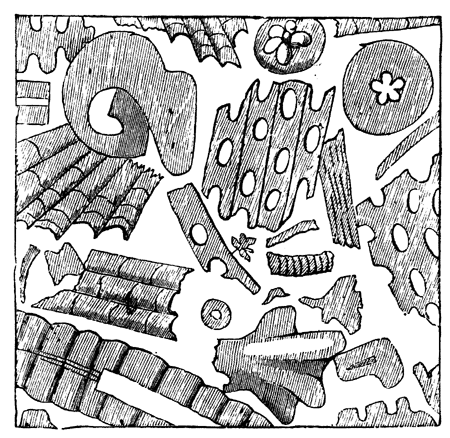
Fig. 9.—Section of Trenton limestone,
magnified, showing that it is composed of fragments of corals,
crinoids, and shells. Montreal.
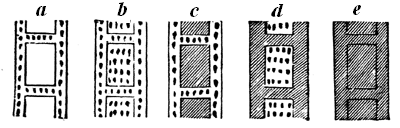
Fig. 10.—Diagram showing different
state of fossilisation of a cell of a tabulate coral
(Dawson’s Dawn of Life).
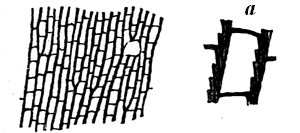
a Natural condition, wall calcite cell
empty. b Wall calcite, cells filled with the same.
c Walls calcite, cells filled with silica or a silicate.
d Wall silicified, cells filled with calcite. e
Wall silicified, cell filled with silica.
It thus happens that many fossils are infiltrated with mineral
matter. Wood, for example, may have the cavities of its cells and
vessels filled with silica or silicates, with sulphide or
carbonate of iron, or with limestone, while the woody walls of
the cells may remain either as coaly matter or charcoal. I have
often seen the microscopic cells of fossil wood not only filled
in this way, but presenting under a high power successive coats
of deposit, like the banded structure of an agate.
In some cases not only are the pores filled with mineral
matter, but the solid parts themselves
have been replaced, and the whole mass has actually become stone,
while still retaining its original structure. Thus silicified
wood is often as hard and solid as agate, and under the
microscope we see that the wood has entirely perished, and is
represented by silica or flint, differing merely in colour from
that which fills the cavities. In this case we may imagine the
wood to have been acted on by water holding in solution silica,
combined with soda or potash, in the manner of what is termed
soluble glass. The wood, in decay, would be converted into carbon
dioxide, and this as formed would seize on the potash or soda,
leaving the silica in an insoluble state, to be deposited instead
of the carbon. Thus each particle of the carbon of the wood, as
removed by decay, would be replaced by a particle of silica, till
the whole became stone. By similar chemical changes corals and
shells are often represented by silica, or by pyrite, which has
taken the place of the original calcareous matter; and still more
remarkable changes sometimes occur, as when the siliceous
spicules of sponges have been replaced by carbonate of lime. The
organic matter present in the fossils greatly promotes these
changes, by the substances produced in its decay, and thus it
often happens that the shells, corals, etc., contained in
limestone have been replaced by flint, while the inclosing
limestone is unchanged. Fig. 10 shows the various conditions
which a coral may assume under these
different modes of treatment.
The substance of a fossil may be entirely removed by decay
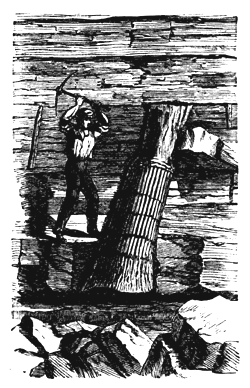 Fig. 11.—Cast of
erect tree (Sigillaria) in sandstone, standing on a small
bed of coal, South Joggins, Nova Scotia (Dawson’s
Acadian Geology). or solution, leaving a
mere mould representing its external form, and this may
subsequently be filled with mineral matter, so as to produce a
natural cast of the object. This is very common in the case of
fossil plants; and large trunks of trees may sometimes be found
represented, as seen in Fig. 11, by stony pillars retaining
nothing of the original wood except perhaps a portion of the bark
in the state of coal. It sometimes happens that the substance of
fossils has been removed, leaving mere empty cavities, sometimes
containing stony cores representing the internal chambers of the
fossils. Again, calcareous fossils imbedded in hard rocks are
often removed by weathering, leaving very perfect impressions of
their forms. For this reason the fossil remains contained in some
hard resisting rocks can be best seen as impressed moulds on the
weathered surfaces.
Fig. 11.—Cast of
erect tree (Sigillaria) in sandstone, standing on a small
bed of coal, South Joggins, Nova Scotia (Dawson’s
Acadian Geology). or solution, leaving a
mere mould representing its external form, and this may
subsequently be filled with mineral matter, so as to produce a
natural cast of the object. This is very common in the case of
fossil plants; and large trunks of trees may sometimes be found
represented, as seen in Fig. 11, by stony pillars retaining
nothing of the original wood except perhaps a portion of the bark
in the state of coal. It sometimes happens that the substance of
fossils has been removed, leaving mere empty cavities, sometimes
containing stony cores representing the internal chambers of the
fossils. Again, calcareous fossils imbedded in hard rocks are
often removed by weathering, leaving very perfect impressions of
their forms. For this reason the fossil remains contained in some
hard resisting rocks can be best seen as impressed moulds on the
weathered surfaces.
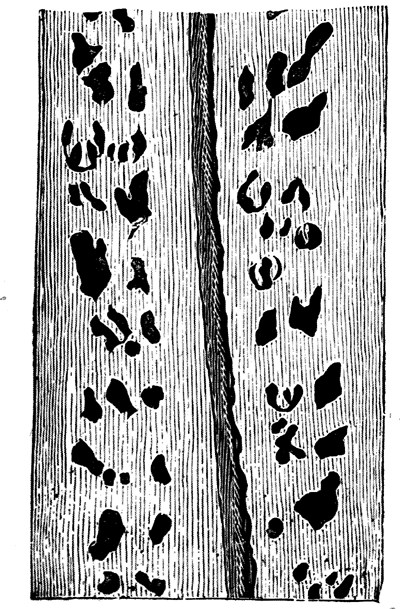
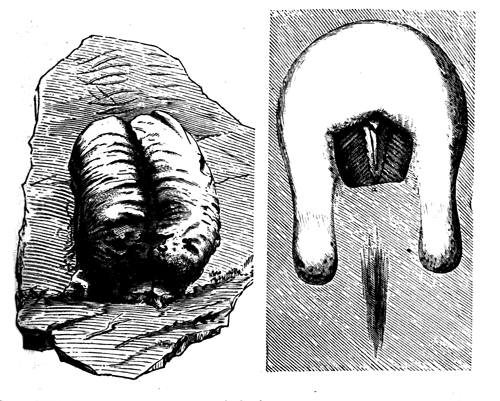
Fig. 12.—Protichnites
septem-notatus. A supposed series of crustacean foot-prints
made in sand, now hardened into sandstone. Cambrian.—After
Logan.
Lastly, we sometimes have impressions or footprints
representing the locomotion of fossil animals, rather than the
fossils themselves. In this way some extinct creatures are known
to us only by their footsteps on sand or clay, once soft, but
now hardened into stone; and in the case of
some of the lower animals the trails thus made are often not
easily interpreted (Figs. 12, 12a). It has been found that
even sea-weeds drifted by the tide make impressions of this kind,
which, when they occur in old rocks, are very mysterious. Even
rain-drops are capable of being permanently impressed on rocks,
and constitute a kind of fossils. Besides these we have many
kinds of imitative markings which simulate fossils, as those of
concretions or nodules, which are often very fantastic in shape,
those of dendritic crystallisation giving moss-like forms, and
the complicated tracery produced on muddy
shores by the little rills of water which follow the receding
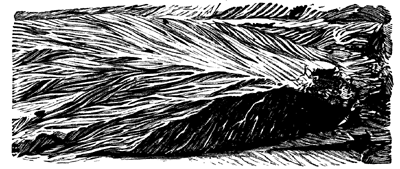
tide (Fig. 13). Such things are often mistaken by the
ignorant for fossil remains, but are easily distinguished by a
practised eye.
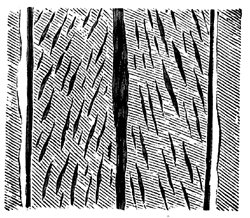
Fig.
12a.—Footprints of modern Limulus, or
king-crab, in the sand, which enable us to interpret those in
Fig. 12.
The reader who has followed these, perhaps somewhat dry,
details, will be rewarded for his patience by having some
conception of the conditions in which we find fossil remains, and
of the evidence by which we can refer these to different periods
in the history of the earth.
Fig. 13.—Current markings on shale,
resembling a fossil plant. Reduced from a photograph
(Dawson’s Acadian Geology).
Carrying this knowledge with us, and at the same time glancing
at the table of successive formations prefixed to this chapter,
we shall be prepared, without any additional geological study, to
understand the statements to be made in the following chapters,
and to appreciate the actual nature of the succession of life in
so far as it is at present known.
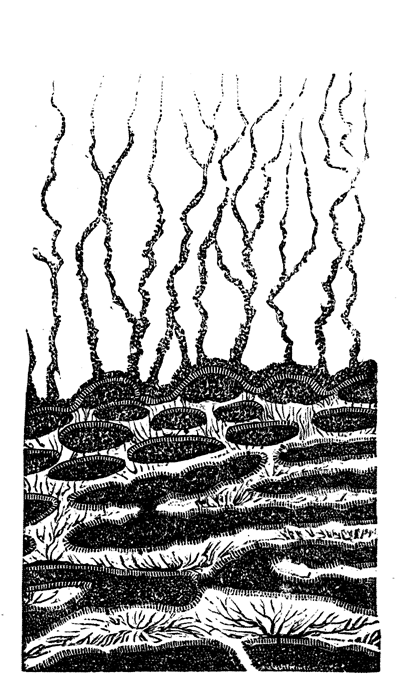
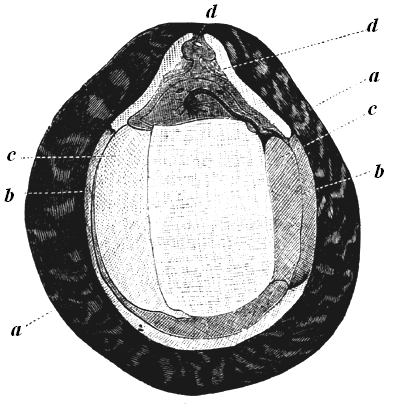
Magnified and Restored
Section of a Portion of Eozoon Canadense.
The shaded portions show the animal matter of
the Chambers, Tubuli, Canals, and Pseudopodia; the unshaded
portions the calcareous skeleton.
 he day must have been when the
first living being appeared for the first time on our planet. Was
it plant or animal? or a generalised organism uniting in some
mysterious way the properties and powers of two kingdoms of
nature, now so distinct, and even contrary to each other in their
manifestations? Did it appear suddenly, or was it slowly evolved
from dead matter by some process in which the albuminous or
protoplasmic matter, which we know forms the basal substance of
living beings, was first produced and then endowed with life? Did
the first living being appear in a mature state, or was it merely
a germ from which the mature individual could be produced? These
are questions which science in its present state has no means of
answering. We do not know any process by which the ingredients of
protoplasm can be combined so as to produce that substance
without a previous living being. We do not know what molecular
differences may exist between dead albumen and that which we see
growing and moving and instinct with life; still less do we know
how to set up or establish these differences. We do not know the
precise nature or relation to other forces of the energy which
actuates living organisms. In our experience the simplest
creatures that have life spring from previous germs, themselves
the products of previous generations of living beings. Thus we
are in the presence of great mysteries which it
might be impossible for us to solve, even if we were permitted to
visit some new planet on which the dawn of life was breaking.
he day must have been when the
first living being appeared for the first time on our planet. Was
it plant or animal? or a generalised organism uniting in some
mysterious way the properties and powers of two kingdoms of
nature, now so distinct, and even contrary to each other in their
manifestations? Did it appear suddenly, or was it slowly evolved
from dead matter by some process in which the albuminous or
protoplasmic matter, which we know forms the basal substance of
living beings, was first produced and then endowed with life? Did
the first living being appear in a mature state, or was it merely
a germ from which the mature individual could be produced? These
are questions which science in its present state has no means of
answering. We do not know any process by which the ingredients of
protoplasm can be combined so as to produce that substance
without a previous living being. We do not know what molecular
differences may exist between dead albumen and that which we see
growing and moving and instinct with life; still less do we know
how to set up or establish these differences. We do not know the
precise nature or relation to other forces of the energy which
actuates living organisms. In our experience the simplest
creatures that have life spring from previous germs, themselves
the products of previous generations of living beings. Thus we
are in the presence of great mysteries which it
might be impossible for us to solve, even if we were permitted to
visit some new planet on which the dawn of life was breaking.
Some things, however, we can infer as to the conditions of the
introduction of life.
First, there is every reason to believe that the earth we
inhabit was once a glowing, incandescent mass, condensing from a
vaporous condition, and quite unfit for the abode of living
beings, and which, even if in some previous state its materials
had constituted the mass of an inhabited world, must have lost
every trace of any living germ in the fervent heat to which it
had been subjected. There must, therefore, have been in some way
an absolute creation or origination of life and organisation.
Secondly, we may infer that in the earlier stages of the
earth, when it was perhaps wholly or almost entirely covered with
the waters, when it was still uniformly warmed with its own
internal heat, when it was surrounded with a pall of dense
vapours preventing radiation, and nursing its heat within itself,
though in a condition entirely unsuited to the higher forms of
life, it may have presented circumstances more favourable to the
origination and multiplication of living beings of low
organisation than at any subsequent time. This incubation of
creative power in the vaporous mantle over the primæval
ocean was a favourite imagination of old thinkers, and is not
obscurely hinted at in the Book of Genesis. It has been revived
and much insisted on by evolutionists in our own time, though it
has no certain foundation in scientific observation or
experiment.
Thirdly, from the fact that plant-life alone has the power of
subsisting on inorganic matter, and that plants furnish all the
nourishment of animals, we may fairly infer that the life of the
plant preceded that of the animal. It has, indeed, been suggested
that some of the humbler forms of life may combine in a rude and
simple way enough of the powers of the plant and the
animal to enable them to bridge over the double gap between the
animal and the plant, and the animal and the mineral, or that
such creatures may in their early stages carry on vegetable
functions, and in their later those of the animal. It is
theoretically possible that life may have begun with such
creatures, which some of the results of microscopical research
would lead us to believe still exist. It is, however, on the
whole more probable that simple plants first existed, and
furnished pabulum to animals of low grade introduced almost
contemporaneously.
Fourthly, all our knowledge of the succession of life leads us
to believe that it was not the higher plants and animals that
first sprang into existence from the teeming earth, but creatures
of low and humble organisation, suited to the then immature and
unfinished condition of the planet. It is also in accordance with
the amazing fecundity of the seas in all geological periods in
these lower forms of life, to suppose that the earliest living
things originated in the waters, and that the plants and animals
of the land are of later date.
Do we know anything from actual observation of this earliest
population of the world? Such knowledge we can hope to acquire
only by studying the oldest formations known to us; and these, it
must be confessed, exist in a state so highly crystalline, and so
much affected by internal heat, by mechanical pressure, and by
movement, as to render it little likely that organic remains
should be preserved in them in a state fit for recognition.
In many parts of the world, and notably in Canada and
Scandinavia, as well as in Wales, Scotland, and Bavaria, the
older Palæozoic rocks, the lowest containing plants in
great abundance, rest on still older crystalline beds, which have
become hard and crystalline in pre-Palæozoic times, and
have contributed sand and pebbles to the succeeding very ancient
deposits. These old rocks—the Eozoic series of our
table—may be grouped in two great systems, the Laurentian
and Huronian (Fig. 14). The former may be
conveniently divided into three members: First, the Bojian, or
Ottawa gneiss, consisting of stratified granite rocks, usually of
a red colour, and of very great thickness. This contains, so far
as known, no limestone, and has afforded as yet no trace of
fossils. Secondly, the Middle Laurentian, the greater part of
which consists of gneiss, but containing important beds of other
rocks, as quartzite, iron ore, and limestone. It is in this
series that we have the first evidence of life, and it is here
also that we find the greatest abundance of carbon, in the form
of graphite or plumbago, and also large quantities of calcium
phosphate, or bone earth. Thirdly, the Upper Laurentian or Norian
series. This consists in great part of Labadorite, or lime
feldspar, but has also beds of ordinary gneiss, limestone, and
iron ore.
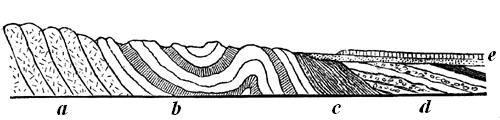
Fig. 14.—Ideal section, showing the
relations of the Laurentian and Huronian.
a, Lower Laurentian. b, Middle
Laurentian. c, Upper Laurentian. d, Huronian.
e, Cambrian and Silurian.
The latter, the Huronian, is much less crystalline, and is
divisible into two series—the Lower Huronian, which
includes many beds of volcanic origin, and the Upper Huronian,
which has afforded some obscure fossils. The Huronian was first
recognised by Sir W. E. Logan in Canada, but corresponding rocks
exist in Europe. The Pebidian series of Hicks in Wales is
probably of this age.
It is likely that much of the present appearance and condition
of the most ancient rocks may be attributed to metamorphism, that
is, to the slow baking under the influence of heat, heated water,
and pressure, to which they have been subjected in the lower
parts of the earth’s crust, when buried deeply under newer
deposits. It is also true, however, as Dr. Sterry
Hunt has pointed out in detail, that they present mineral
characters which show a mode of deposition different from that
which has prevailed subsequently, and probably indicating great
ejections of heated mineral matter into the primitive ocean, and
comparatively little of that deposit therein of mere sand and
clay which has prevailed in subsequent geological periods. In
short, these rocks have an unmistakably primitive aspect,
distinguishing them from those of later times, and conveying the
impression that they approach at least to the records of that
time when a heated ocean first rested on the thin and recently
solidified crust of our planet. If this is really the case, then
our Lower Laurentian—hard, compact, destitute of limestone,
and composed of material which may be little else than the
débris of products of internal heat merely spread
out into bedded forms by water—may represent a time when no
living thing as yet tenanted the waters; and the dawn of life may
have appeared in that period when the Middle Laurentian beds were
laid down. Here at least we find two kinds of evidence pointing
to the existence of certain forms of life in the waters.
The first depends on the mineral character of the beds
themselves. This formation holds several very thick beds of
limestone. Now although this kind of rock may, under certain
circumstances, be deposited directly from solution in water, it
is not ordinarily so deposited, but more usually through the
agency of living beings inhabiting the waters, and forming their
skeletons or hard parts of limestone derived from the water,
usually through the medium of humble forms of plant life. In this
way are formed reefs of coral and beds of shells and of chalky
ooze, all composed of material once constituting the skeletons of
animals. The study of limestones of all geological ages shows
that this has been the usual mode of their formation. If the
Laurentian limestones had a similar origin, the seas of that
period must have swarmed with animals having calcareous
coverings; and the study of more modern limestones
which have become highly crystalline shows that it is quite
possible that the forms and structures of these organisms may
have been obliterated.
Again, the Middle Laurentian abounds in carbon or coaly
matter. True, this is in the form of graphite or plumbago, but
this condition may be a result of metamorphism; and we know that
the carbon of coal-beds and bituminous shales of much more modern
times has been altered into graphite. Further, the graphite
occurs in the way in which we should expect it to occur if of
organic origin. It is found disseminated in the limestone, just
as bituminous matter is found in unaltered rocks of this kind. It
is found interlaminated with gneiss, as carbonaceous and
bituminous matters are found in the shales of the ordinary
fossiliferous rocks, where these substances are known to be of
organic origin. The graphite also occurs in a very pure form in
irregular veins, just as in some bituminous formations the rock
oil, oozing into fissures, has been hardened into asphalt or
coaly matter.3
To these facts may be added the presence of thick beds and
veins of iron ore and of apatite or calcium phosphate (bone
earth). Both of these substances occur in a disseminated state in
nearly all rocks, but they are concentrated into definite
deposits by the action of life. Iron is usually dissolved out and
redeposited by acids produced in the decay of vegetable matter,
as we see in the clay ironstones of the coal formation and in
bog-iron ores. Calcic phosphate is taken up by many animals, and
forms their shells or skeletons, and on their death is deposited
in beds on the sea-bottom, sometimes to a very considerable
extent.
The concurrence of all these phenomena in the Middle
Laurentian may be held to afford a strong
presumption that, could we discover these rocks in an unaltered
state, we should find the limestones filled with marine fossils
and the graphite showing the forms or structure of plants. The
only startling feature in this conclusion is, that if we admit
it, we must also admit that life was developed in the Laurentian
time in an exuberance not surpassed, if equalled, in any
subsequent period. Still, there is nothing incredible in this,
for if the forms of life were few and low, their increase may
have been rapid, because unchecked; and they no doubt found in
the ancient seas a surplusage of material on which to feed and
with which to construct their skeletons. Dr. Hunt has estimated
that the amount of carbon now sealed up as coaly matter would, if
diffused in the atmosphere as carbon dioxide, afford 600 times
the quantity of that gas at present floating in the air. A still
more vast amount is sealed up in the limestone of the several
geological formations. The same chemist has shown that the
quantity of lime held in solution in the ocean must have been
much greater in Laurentian times than at present. These facts at
least allow us to suppose that in the Eozoic times there were
great supplies of carbon and of lime available to such creatures
of low organisation as were capable of profiting by them; and we
have no reason to doubt that there may have been plants and
animals so constituted as to flourish in conditions of this kind,
in which perhaps scarcely any modern species could exist.
These probabilities have caused geologists anxiously to search
for any traces of fossil organic remains in the old Laurentian
rocks; and they have been rewarded by the discovery of one
species, Eozoon Canadense, still often referred to as only
a problematical fossil; but this arises to a large extent from
the prevalent want of knowledge sufficient to appreciate the
evidence for its organic character. This being once admitted, we
have in the existence of Eozoon alone a sufficient cause
for the accumulation of much of the Laurentian
limestone, though there is reason to believe that it was not the
only inhabitant of those ancient seas.
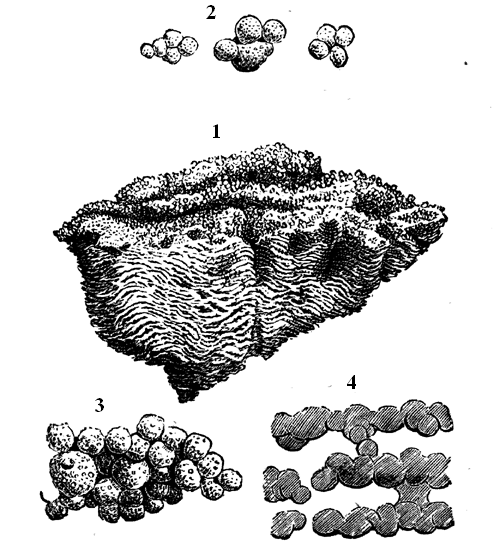
Fig. 15
(Nos. 1 to 4).—Small weathered specimen of Eozoon.
From Petite Nation.
1, Natural size; showing general form, and
acervuline portion above and laminated portion below. 2, Enlarged
casts of cells from upper part. 3, Enlarged casts of cells from
the lower part of the acervuline portion. 4, Enlarged casts of
sarcode layers from the laminated part.
The best specimens of Eozoon occur as rounded, flattened, or
more or less irregular lumps or masses in certain layers of the
Laurentian limestone. When weathered on the surface of the rock,
these lumps show a regular concentric lamination, caused by thin
fibres of limestone, alternating with other mineral substances,
filling up the spaces between them. When these intervening layers
are composed of such minerals as Serpentine, Loganite, Pyroxene,
or Dolomite, which are more resisting than the
limestone, they project when weathered, or when the limestone is
etched by an acid, so as to show the lamination very distinctly.
At the lower surface of the masses the layers are seen to be
thicker than they are above, and in perfect specimens they are
seen toward the surface to break up into small rounded vesicles
of calcite, like little bubbles, which constitute the so-called
acervuline condition of Eozoon (Fig. 15, No. 2). Slices of the
fossil etched with an acid show these appearances very perfectly,
and can even be printed from, so as to present perfect
nature-prints of the structure (Fig. 16).
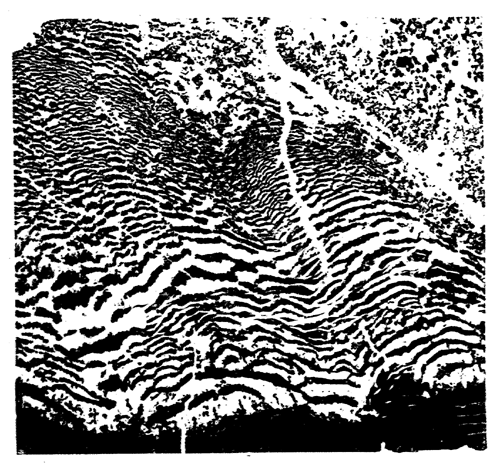
Fig. 16.—Nature-printed specimen of
Eozoon slightly etched with acid. It shows the lamination, and
at one side fragmental Eozoon (Life’s Dawn on
Earth).
On etching a small fragment or slice with very dilute acid,
so as to dissolve away the calcite
slowly, if the specimen be well preserved, we find that the
calcite layers have a very curious structure. This is indicated
by the appearance of little white or transparent threads of
Serpentine, Dolomite, or Pyroxene, which ramify throughout the
substance of the limestone layers, and are left intact when they
have been dissolved. These little processes must originally have
been pores in the limestone layers, which have been filled with
the substance which constitutes the alternate laminæ. In
addition to this, if we use a somewhat high microscopic power,
and especially if we study the structures as seen in thin
transparent slices, we can perceive a still finer tubulation
along the sides of the calcite layers, represented by extremely
minute parallel rods of mineral matter (Figs. 17, 18).
Now if we regard these structures as those of an infiltrated
fossil, as described in last chapter, their interpretation will
not be difficult. The original organism was composed of
calcareous matter in thin concentric laminæ, connected with
each other by pillars and plates of similar material. Between
these laminæ was lodged the soft, jelly-like substance of a
marine animal, growing by the addition of successive layers, each
protected by a thin calcareous crust. The layers were originally
traversed by very numerous parallel tubuli, permitting the soft
protoplasm to penetrate them; and when, in the progress of
growth, it was necessary to strengthen these layers, they were
thickened by a supplemental deposit traversed by larger and
ramifying canals. When the animal was dead, and its soft parts
removed by decay, the chambers between the laminæ, as well
as the minute canals and tubuli, became infiltrated with mineral
matter, in the manner described in the last chapter, and when so
preserved became absolutely imperishable under any circumstances
short of absolute fusion.
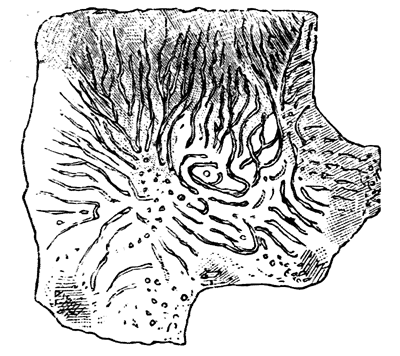
Fig. 17.—Magnified group of canals in
supplemental skeleton of Eozoon.
Taken from the specimen in which they were
first recognised (Life’s Dawn on Earth).
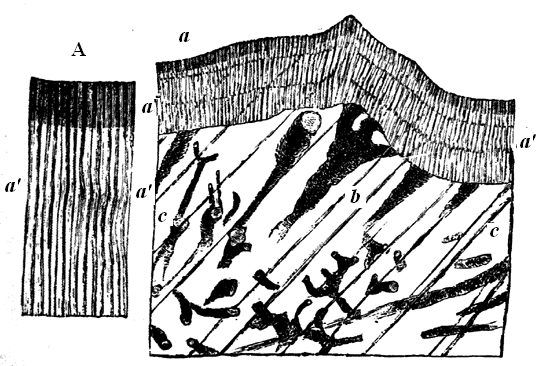
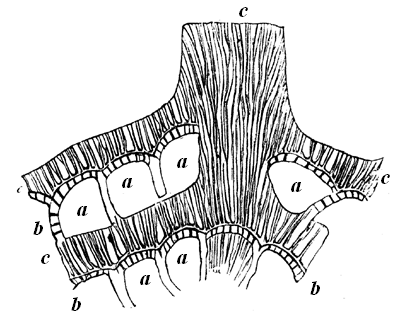
Fig. 18.—Portion of Eozoon magnified
100 diameters, showing the original cell-wall with tubulation,
and the supplemental skeleton with canals.—After
Carpenter.
a, Original tubulated wall or
“Nummuline layer.” More magnified in Fig. A.
b, c, Intermediate skeleton, with canals.
This interpretation leads to the conclusion, at which I
arrived from the study of the first well-preserved specimen ever
submitted to microscopic examination, that the animal which
produced the calcareous skeleton of Eozoon was a
member of that lowest grade of Protozoa known as Foraminifera;
and which, after living through the whole of geological time,
still abound in the sea. The main differences are, that Eozoon
presents a somewhat generalised structure, intermediate between
two modern types, and that it attained to a gigantic size
compared with most of these organisms in later periods. How near
it approaches in structure to some modern forms may be seen by
comparison of the recent species represented in Fig. 19, in
which the parts corresponding to the chambers, laminæ,
tubuli, and canals of Eozoon can be readily distinguished.
Fig. 19.—Magnified portion of shell
of Calcarina.—After Carpenter.
a, Cells. b, Original cell-wall
with tubuli. c, Supplementary skeleton with canals.
The modern animals of this group are wholly composed of soft
gelatinous protoplasm or sarcode, the outer layer of which is
usually somewhat denser than the inner portion; but both are
structureless, except that the inner layer may present a more
or less distinct granular appearance.
Many of them show a distinct spot or cell, called the nucleus,
and some have minute transparent vesicles, which contract and
expand alternately, and appear to be of the nature of circulatory
or excretory organs. They have no proper alimentary canal, but
receive their food into the general mass and digest it in
temporary cavities. Their means of locomotion and prehension are
soft thread-like or finger-like processes, extended at will from
the surface of any part of the body, and known as false feet
(pseudopodia). From these processes the whole group has obtained
the name of Rhizopods, or rootfooted animals. They may be
regarded as constituting the simplest and humblest form of animal
life certainly known to us.
The very numerous species of these creatures existing in the
waters of the modern world may be arranged under three principal
groups. The first and highest includes those which have lobate or
finger-like pseudopods, and a well-developed nucleus and
pulsating vesicle (Fig. 20, a). They are mostly
inhabitants of fresh water, and destitute of a hard crust or
shell. A second group, including many inhabitants of the sea as
well as of fresh waters, has thread-like radiating
pseudopodia4 (Fig. 20 b). Some
of these form beautiful silicious skeletons. A third group,
essentially marine, consists of those with reticulated
pseudopodia, and usually destitute of distinct nucleus and
pulsating vesicle (Fig. 21). They produce beautiful
calcareous skeletons, often very complex, or sometimes are
content to cover themselves with a crust of agglutinated grains
of sand. It is to this last group that Eozoon belongs, and to the
highest division of it—that which has the shell perforated
with minute pores, often of two kinds. It is curious that just as
we have the chambers and pores of Eozoon filled with serpentine,
so in all geological formations and in the modern seas it is not
uncommon to find Foraminifera having their cavities filled with
glauconite and other hydrous silicates allied to serpentine.
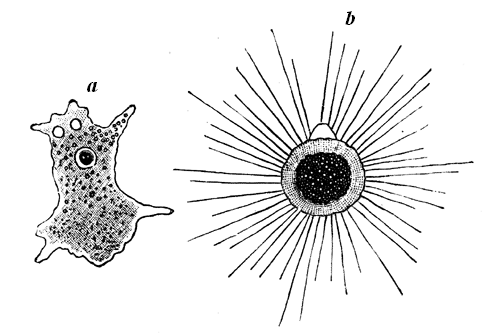
Fig. 20.—a, Amœba,
a fresh-water naked Rhizopod; and b, Actinophrys, a
fresh-water Protozoon of the group Radiolaria, with thread-like
pseudopodia.
Fig. 21.—Nonionina, a modern
marine Foraminifer. Showing its chambered shell and netted
pseudopodia.—After Carpenter.
If we attempt to trace the Rhizopods onward from the Middle
Laurentian, we are met with a great hiatus in the Upper
Laurentian. The species Eozoon Bavaricum
has, however, been found in rocks apparently of Huronian age; but
this is the last known appearance of Eozoon, properly so-called.
In the Cambrian or Siluro-Cambrian, however, we meet with many
gigantic Protozoa, more especially those known as
Stromatopora, Archæocyathus,
Receptaculites, and Cryptozoon.
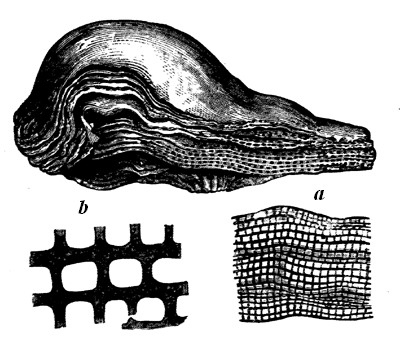
Fig. 22.—Stromatopora
concentrica.—After Hall.
a, Section of the same, magnified.
b, Small portion highly magnified, showing laminæ
and pillars.
The typical Stromatoporæ, or Layer-corals, consist, like
Eozoon, of concentric layers, connected by numerous pillars,
which are often, though not always, more definite and regular
than in the Laurentian fossil. The laminæ are perforated,
but more coarsely than in Eozoon, and they are often thickened
with supplemental deposit which, in some of the forms, presents
canals radiating from vertical tubes or bundles of tubes
penetrating the mass (Figs. 22, 23). The mode of growth of
Stromatopora must have closely resembled that of Eozoon, and the
forms produced are so similar that it is often quite impossible
to distinguish them by the naked eye. Like
Eozoon, they form the substance of important limestones, and
single masses are sometimes found as much as three feet in
diameter. The Stromatoporæ extend from the Upper Cambrian
to the Devonian inclusive. In the Carboniferous they are
continued by smaller and more regular organisms of the genus
Loftusia,5
and this genus seems to extend without marked change up to the
Eocene Tertiary. Recent students of the Stromatoporæ seem
disposed to promote them from the province of Protozoa to that of
the Hydroids.6
The reasons for this seem cogent in the case of some of the
forms, but in my judgment fail in others, more especially in the
older forms. It may ultimately be found that the group as now
held includes very different types of structure. In modern times
I know of no nearer representative than the animal whose skeleton
often adheres in red encrusting patches to our specimens of
corals, and which is known as Polytrema. In general
structure it is not very far from being a very degenerate kind of
Stromatopora.
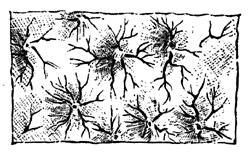
Fig. 23.—Caunopora planulata.
Showing the radiating canals on a weathered surface.
Devonian.—After Hall.
It is curious that in the line of succession above stated, the
beautiful tubulated cell-wall of Eozoon disappears; and this
structure seems, after the Laurentian, to be for ever divorced
from the great laminated Protozoans. It reappears in the
Carboniferous, in certain smaller
organisms of the type of the Nummulites, or Money-stone
Foraminifers, and is continued in this group of smaller and free
animals down to the present time. In the Cretaceous and early
Tertiary periods, the Foraminifera of different types have been
nearly as great rock-builders as they were in the Laurentian.
Some of these later rock-builders, however, have belonged to the
lower or imperforate group; others to the higher or Rotaline and
Nummuline groups; and, as a whole, they have been individually
small, making up in numbers what they lacked in size. Probably
the conditions for enabling animals of this type rapidly, and on
a large scale, to collect calcareous matter, were more favourable
in the Laurentian than they have ever been since.
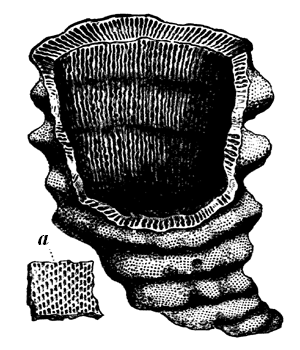
Fig. 24.—Archæocyathus
minganensis. A Primordial Protozoon.—After
Billings.
a, Pores of the inner wall.
In the Siluro-Cambrian age two other forms of gigantic
Foraminiferal Protozoans were introduced, widely different from
Eozoon, and destined apparently not to survive the period
in which they appeared. These were
Archæocyathus, the ancient Cup-corals, and Receptaculites,
which may perhaps be called the Sack-corals. Both are quite
remote from Eozoon in structure, wanting its complexity in the
matter of minute tubules, and having greater regularity and
complication on the large scale. Archæocyathus had the form
of a hollow inverted cone with double perforated walls, connected
by radiating irregular plates, also perforated (Fig. 24). It
has been regarded as a sponge, and some species are certainly
accompanied with spicules; but these I have ascertained to be
merely accidental, and will be referred to in the next chapter.
The true structure of Archæocyathus consists of radiating
calcareous plates enclosing chambers connected by pores.
Archæocyathus came in with the Later Cambrian, and seems to
have died out in the Siluro-Cambrian. The only more modern things
which at all resemble it are the Foraminifera called
Dactylopora, which belong to the Tertiary period.
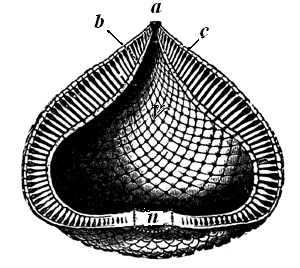
Fig. 25.—Receptaculites.
Restored.—After Billings.
a, Aperture. b, Inner wall.
c, Outer wall. n, Nucleus, or primary chamber.
v, Internal cavity.
Receptaculites is a still more complex organism. It has
a sack-like form, often attaining a large
size, and the double walls are composed of square or rhombic
plates, connected with each other by hollow tubes from which
proceed canals perforating the plates (Fig. 25). This
curious structure is confined to the Siluro-Cambrian, and is so
dissimilar from modern forms that its affinities have been
subject to grave doubts.
Fig. 26.—Section of Loftusia
Persica. An Eocene Foraminifer. Magnified five
diameters.—After Carpenter and Brady.
We thus have presented to us the remarkable fact that in the
Palæozoic age we have no precise representative of Eozoon,
but instead three divergent types, differing from it and from
each other, all apparently specialised to particular uses, all
temporary in their duration; while in later times nature seems to
have returned nearer to the type of Eozoon, though on a smaller
scale, and separating some characters conjoined in it. Some
portion of this curious result may be due to our ignorance; and
it would be interesting to know, what we may know
some day, how this type of life was
represented in the long interval between the Huronian and the
Upper Cambrian, when perhaps there may have been forms that would
at least enable us to connect Eozoon and Stromatopora.
Another link in the chain of being remains to be noticed here.
In the Laurentian limestones we meet with numerous minute
spherical bodies and groups of spheres with calcareous tubulated
tests.7 These may either be small
Foraminiferæ, distinct from Eozoon, or may be germs or
detached cells from its surface. Similar bodies are found in the
lower part of the Siluro-Cambrian, in the Quebec group at Point
Levis; and there they are filled with a species of glauconite
constituting a sort of greensand rock. Still higher, in the
Carboniferous, there are very numerous species of Foraminifera,
presenting forms very similar to those in the modern seas, so
that in the smaller shells of this group we seem to have evidence
of a continuous series all the way from the Laurentian to the
present time. The greater laminated forms co-exist with these up
to the Eocene Tertiary. Throughout the whole of geological
time—from the formation of the Laurentian limestones to
that of the chalky ooze accumulating in the modern
ocean—these humble creatures have been among the chief
instruments in seizing on the calcareous matter of the waters and
depositing it in the form of limestone.
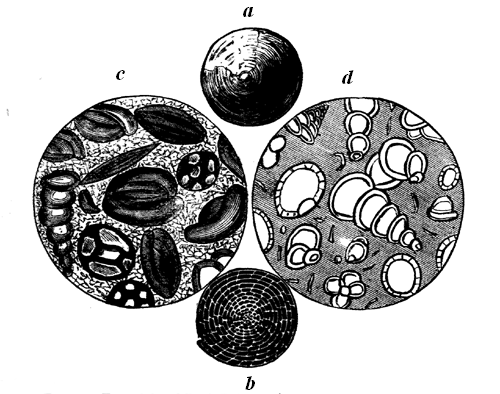
Fig. 27.—Foraminiferal Rock Builders,
in the Cretaceous and Eocene.
a, Nummulites
lævigata—Eocene. b, The same, showing
chambered interior. c, Milioline limestone,
magnified—Eocene, Paris. d, Hard Chalk, section
magnified—Cretaceous.
I have said nothing of the development of higher forms of
animal life from Eozoon, simply because I know nothing of it. We
shall see in the next chapter that these are introduced seemingly
in an independent manner. We may be content to trace
foraminiferal life along its own line of development, waxing and
waning, but ever confined within the same general boundaries,
from the Laurentian to the present time. It is likely that if, in
any of the ages constituting this vast lapse of time, a dredge
had been dropped into the depths of ocean, it would
have brought up Foraminifera not essentially different in form
and structure. If any one asks to what extent the successive
species constituting this almost endless chain may be descendants
one of the other, we have no absolutely certain information to
give. On the one hand, it is not inconceivable that such forms as
Stromatopora or Nummulina may have descended from Eozoon. On the
other hand, it is equally conceivable that the same power which
produced Eozoon at first, whether from dead matter or from some
unknown lower form of life, may have repeated the process in
later times with modifications. In any case it is probable that
the Foraminifera have experienced alternations of expansion and
shrinkage, of elevation and decadence, in the lapse
of geological time. There were times in which many new forms
swarmed into existence, and times in which old forms were
becoming extinct without being replaced by others. In so far as
the areas of the continents and the adjacent waters are
concerned, those periods when the land was subsiding under the
ocean must have been their times of prosperity, those in which
the crust of the earth shrunk and raised up large areas of land
must have been their times of decay. Still this lowest form of
animal life has never perished, but has always found abundant
place for itself, however pressed by physical change and by the
introduction of higher beings.
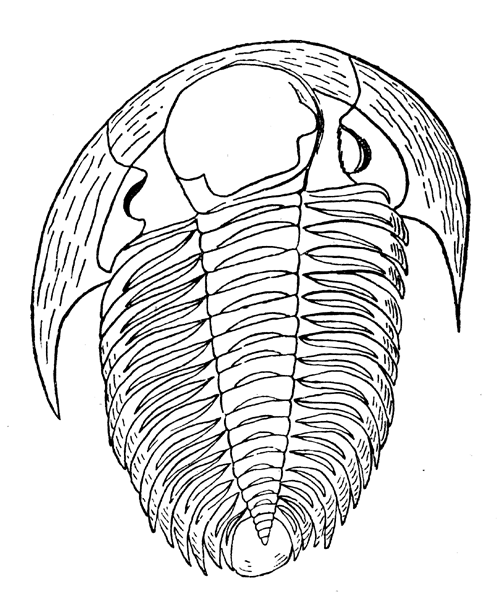
Paradoxides Regina (Matthews). Lower
Cambrian of New Brunswick.
1/6th Nat. Size.
f the middle portion of the
Laurentian age was really a time of exuberant and abounding life,
either this met with strange reverses in succeeding periods, or
the conditions of preservation have been such as to prevent us
from tracing its onward history. Certain it is, that according to
present appearances we have a new beginning in the Cambrian,
which introduces the great Palæozoic age, and few links of
connection are known between this and the previous Eozoic.
At the beginning of the Palæozoic we have reason to
believe that our continents were slowly subsiding under the sea,
after a period of general continental elevation which was
consequent on the crumbling of the earth’s crust at the
close of the Eozoic; and on the new sea-bottoms formed by this
subsidence came in, slowly at first, but in ever-increasing
swarms, the abundant and varied life of the early
Palæozoic.
In the oldest portion of the Cambrian series in Wales, Hicks
has catalogued species of no less than seventeen genera,
embracing Crustaceans, the representatives of our crabs and
lobsters, bivalve and univalve shell-fishes of different types,
worms, sea-stars, zoophytes, and sponges. If we could have walked
on the shores of the old Cambrian sea, or cast our dredge or
trawl into its depths, we should have found representatives of
most of the humbler forms of sea life still extant, though of
specific forms strange to us. Perhaps the nearest approach to
such experience which we can make is to examine the group of
Cambrian animals delineated in Fig. 28, and to notice, under
the guidance of the geologist above named, the sections seen at
St. David’s, in South Wales.
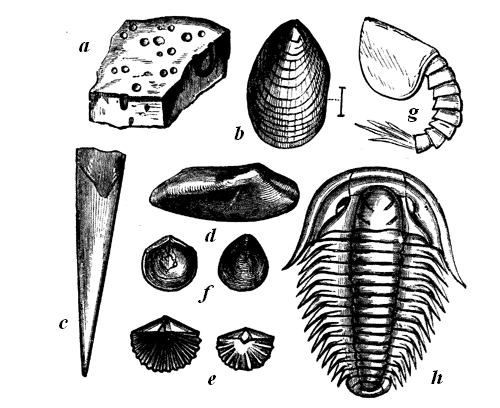
Fig. 28.—Group of Cambrian Animals
(from Nicholson).
a, Arenicolites didymus,
worm tubes. b, Lingulella ferruginea.
c, Theca Davidii.
d, Modiolopsis solvensis.
e, Orthis Hicksii. f, Obolella
sagittalis. g, Hymenocaris vermicauda.
h, Trilobite, Olenus micrurus.
Here we find a nucleus of ancient rocks supposed to be
Laurentian, though in mineral character more nearly akin to the
Huronian, but which have hitherto afforded no trace of fossils.
Resting unconformably on these is a series of partially altered
rocks, regarded as Lower Cambrian, and also destitute of organic
remains. These have a thickness of almost 1,000 feet, and they
are succeeded by 3,000 feet more of similar rocks, still classed
as Lower Cambrian, but which have afforded fossils. The lowest
bed which contains indications of life is a red shale, perhaps a
deep-sea bed, and possibly itself partly of organic origin, by
that strange process of decomposition or dissolution of
foraminiferal ooze and volcanic fragments, going on in the depths
of the modern ocean, and described by Dr. Wyville Thomson as
occurring over large areas in the South Pacific. The species are
two Lingulellæ, a Discina and a
Leperditia. Supposing these to be all, it is remarkable
that we have no Protozoa or Corals or Echinoderms, and that the
types of Brachiopods and Crustaceans are of comparatively modern
affinities. Passing upward through another 1,000 feet of barren
sandstone, we reach a zone in which no less than five genera of
Trilobites are found, along with Pteropods and a sponge. Thus it
is that life comes in at the base of the Cambrian in Wales, and
it may be regarded as a fair specimen of the facts as they appear
in the earlier fossiliferous beds succeeding the Laurentian.
Taking the first of these groups of fossils, we may recognise in
the Leperditia a two-valved Crustacean closely allied to forms
still living in the seas and fresh waters. The Lingulellæ,
whether we regard them as molluscoids, or, with Professor Morse,
as singularly specialised worms, represent a peculiar and
distinct type, handed down, through all the vicissitudes of the
geological ages, to the present day. The Pteropods and the sponge
are very similar to forms now living. The Trilobites are an
extinct group, but closely allied to some modern Crustaceans. Had
the primordial life begun with species altogether inscrutable and
unexampled in succeeding ages, this would no doubt have been
mysterious; but next to this is the mystery of the oldest forms
of life being also among the newest. Whatever the origin of these
creatures, they represent families which have endured till now in
the struggle for existence without either elevation or
degradation. Yet, though thus vast in their duration, they seem
to have swarmed in together and in great numbers, in the
Cambrian, without any previous preparation. From the Cambrian
onward, throughout the whole Palæozoic, there is no decided
break in the continuity of marine life; and already in
the Silurian period the sea was tenanted with all the forms of
invertebrate life it yet presents, and these in a teeming
abundance not surpassed in any succeeding age. Let us now, in
accordance with our plan, select some of these ancient
inhabitants of the waters and trace their subsequent history.
Remains of sea-weeds are undoubtedly present in the Cambrian
rocks. One of the lowest beds in Sweden has been named from their
abundance the Fucoidal Sandstone; and wherever fossiliferous
Cambrian rocks occur, some traces, more or less obscure, of these
plants may be found. Nearly all that we can say of them, however,
is, that, in so far as their remains give any information, they
are very like the plants of the same group that now abound in our
seas. In the fucoidal sandstone of Sweden certain striated or
ribbed bodies have been found, which have even been regarded as
land plants;8 but they seem rather to be
trails or marks left by sea-weeds dragged by currents over a
muddy bottom. The plants of the sea thus precede those of the
land, and they begin on the same level as to structure that they
have since maintained. I agree with Nathorst, however, in holding
that the Bilobites and many other forms believed by some to be
sea-weeds, are really trails and tracks of animals.9
The Foraminifera of the Palæozoic we have noticed in the
last chapter; but we now find a new type of Protozoan—that
of the Sponge. Sponges as they exist at present may be defined to
be composite animals, made up of a great number of one-celled or
gelatinous zoids, provided with vibrating threads or cilia, and
so arranged that currents of water are driven through passages or
canals in the mass, by the action of the cilia, bringing food and
aerated water for respiration. To support these soft sarcodic
sponge-masses, they secrete fibres of horny matter and needles
(spiculæ) of flint or of limestone, forming
complicated fibrous and spicular skeletons, often of great
beauty. They abound in all seas, and some species are found in
fresh waters.
Fig. 29.—Portion of skeleton of
Hexactinellid Sponge (Cœloptychium). Magnified.
After Zittel.
With the exception of a very few species destitute of
skeleton, and which we cannot expect to find in a fossil state,
the sponges may be roughly divided into three groups: 1, those
with corneous or horny skeleton, like our common washing sponges;
2, those with skeletons composed of silicious needles of various
forms and arrangement; 3, those with calcareous spicules. Of
these, the second or silicious group has precedence in point of
time, beginning in the Early Cambrian, and continuing to the
present. Two of its subdivisions are especially interesting in
their range. The first is that of the Lattice-sponges
(Hexactinellidæ), in which the spicules have six
rays placed at right angles, and are attached to each other by
their points, so as to form a very regular network
(Fig. 29). The second is that of the Stone-sponges
(Lithistidæ), in which the spicules are four-rayed
or irregular, and are united by the branching root-like ends of
the rays. The most beautiful of all sponges, the Venus
Flower-basket (Euplectella), is a modern Hexactinellid,
and the wonderful weaving of its spicules is as marvellous a
triumph of constructive skill as its general form is graceful.
The Lithistids are less beautiful, but are the densest and most
compact of sponges, and are represented by several species in the
modern seas. Both of these types go back to the Early Cambrian,
and have continued side by side to the present day, as
representatives of two distinct geometrical methods for the
construction of a spicular skeleton.
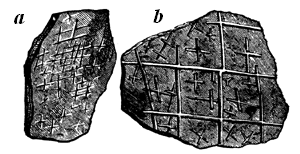
Fig. 30.—Protospongia fenestrata
(Salter). Menevian group.
a, Fragment showing the
spicules partially displaced. b, Portion
enlarged.
Fig. 31.—Astylospongia
præmorsa (Roemer). Niagara group.—After Hall.
a, Spicules magnified.
Fig. 32.—Spicules of Lithistid sponge
(Trichospongia of Billings). From the Cambrian of
Labrador.
Many years ago the keen eye of the late lamented Salter
detected in a stain on the surface of a slab of Cambrian slate
the remains of a sponge; and minute examination showed that its
spicules crossed each other, and formed lattice-work on the
hexactinellid plan. Salter boldly named it Protospongia (the
first sponge), and it is still the earliest that we know (Fig.
30). Thus the type whose skeleton is the most perfect in a
mechanical point of view takes the lead. It is continued in the
Silurian in many curious forms, of which the stalkless sponges
(Astylospongia) are the most common (Fig. 31). It
perhaps attains its maximum in the Cretaceous, from which the
beautiful example in Fig. 29 is taken, and it still
flourishes, giving us the most beautiful of all recent forms.
Before the close of the Cambrian there were other
sponges of the Lithistid type. Fig. 32 represents a group of
spicules from the Calciferous (Lowest Silurian or Upper Cambrian)
of Mingan,10 and which probably belong to a large Lithistid
sponge of that early time. The Lithistids have been recognised in
the Upper Silurian and Carboniferous, and continuing upward to
the Cretaceous, there become vastly numerous, while their
modern representatives are by no means
few. The silicious sponges with simple spicules appear to have
existed as far back as the Siluro-Cambrian, and there is believed
to be almost as early evidence of horny or corneous sponges. The
calcareous sponges have been recognised as far back as the
Silurian.11 Thus from the close of the Palæozoic all
the types of sponges seem to have existed side by side; and in
the Cretaceous period, when such large areas of our continents
were deeply submerged, they attained a wonderful development,
perhaps not equalled in any other era of the earth’s
history.
|
|
|
|
Fig. 33.—Oldhamia antiqua
(Forbes).
|
Fig. 34.—Dictyonema
sociale. Enlarged. Lingula flags.—After
Salter.
|
Sponges may be regarded as the highest or most complex of the
Protozoa or the lowest of the Coelenterates. We have no links
wherewith to connect them with the lower Protozoa of the Eozoic
period; and through their long history, though very numerous in
genera and species, they show no closer relationship with the
Foraminifera below, and the Corals above, than do their
successors in the modern seas. They thus stand very much apart;
and modern studies of their development and minute structures do
not seem to remove them from this isolation. Though we are
treating here of inhabitants of the sea, it may be proper to
mention that Geinitz has described two species from the Permian
which he believed to be early precursors of the Spongillæ,
or fresh-water sponges; but more recently he seems to regard them
as probably Algæ. Young has, however, recently found true
spicules of Spongilla in the Purbeck beds.12
Fig. 35.—Dictyonema Websteri
(Dn). Niagara formation.
a, Enlarged portion (Acadian
Geology).
Fig. 36.—Group of modern Hydroids
allied to Graptolites. Magnified, and natural size.
a, Sertularia. b,
Tubularia. c, Campanularia.
Fig. 37.—Silurian
Graptolitidæ.
a, Graptolithus. b,
Diplograpsus. c, Phyllograpsus. d,
Tetragrapsus. e, Didymograpsus.
|
|
|
Fig. 38.—Central portion of
Graptolite, with membrane, or float (Dichograpsus
octobrachiatus, Hall).
|
Fig. 39—Ptilodictya acuta
(Hall). Bryozoan. Siluro-Cambrian.
|
A stage higher than the sponges are those little polyp-like
animals with sac-like bodies and radiating arms or tentacles,
which form minute horny or calcareous cells, and bud out into
branching communities, looking to untrained eyes like delicate
sea-weeds—the sea-firs and sea-mosses of our coasts
(Fig. 36). These belong to a very old group, for in the
oldest Cambrian we have a form referred to this type
(Fig. 33), and in the Upper Cambrian another still more
decided example (Fig. 34).13 This style of life, once introduced, must have
increased in variety and extended itself with amazing rapidity,
for in the Siluro-Cambrian age we find it already as
characteristic as in our modern seas, and so abundant that vast
thicknesses of shale are filled and blackened with the
débris of forms allied to the sea-firs, and masses
of limestone largely made up of the more
calcareous forms of the sea-mosses. As examples of the former we
may take the Graptolites, so named from their resemblance
to lines of writing, and of which several forms are represented
in Fig. 37. The little teeth on the sides of these were
cells, inhabited probably by polyps, like those represented in
the modern Sertularia in Fig. 36. Some of them were
probably attached to the bottom. In others the branches radiated
from a central film which may have been a hollow vesicle or
float, enabling them to live at the surface of the water
(Fig. 38). These Graptolites are specially characteristic of
the Upper Cambrian and Lower Silurian. The netted ones
(Dictyonema), as may be seen from Figs. 34 and 35, came in
before the close of the Cambrian, and continue unchanged to the
Silurian, where they disappear. The branching forms, seen in
Fig. 37, have scarcely so great a range. They thus form most
certain marks of the period to which they belong, and being
oceanic and probably floaters, they diffused themselves so
rapidly that they appear to indicate the same geological time in
countries so widely separated as Europe, North America, and
Australia. It is curious, too, that while the Graptolites thus
mark a definite geological time, and seem to disappear abruptly
and without apparent cause, they are the first link in the long
chain of the Hydroids, which, though under different family
forms, continue to this day, apparently neither better nor worse
than their perished Palæozoic relatives. There is a group
of little Stony Corals (Monticuliporidæ), which were
possibly also the cells of Hydroids, that have a
similar history. They are the only known Corals that date so far
back as the Upper Cambrian; and they continue under very similar
forms all through the Palæozic, and are represented by the
millepore corals of the present day. Fig. 40 represents a
form found at the base of the Siluro-Cambrian, and Fig. 41
shows forms characteristic of the Carboniferous Limestone.
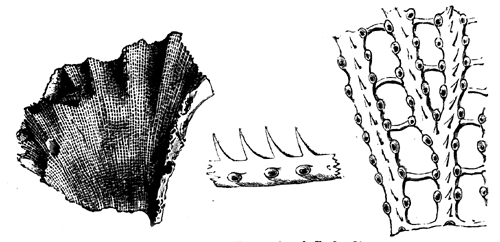
Fig. 39a.—Fenestella
Lyelli (Dawson). A Carboniferous Bryozoan.
If we turn now to the sea-mosses (Bryozoa), we have a group of
minute polyp-like animals 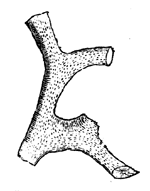 Fig. 40.—Chaetetes fibrosa. A
tubulate coral with microscopic cells.
Siluro-Cambrian. inhabiting cells not unlike those
of the Hydroids, and which form plant-like aggregates. But the
animals themselves are so different in structure that they are
considered to be nearer allies of the bivalve shell-fishes than
of the Corals. They are, in short, so different, that the most
ardent evolutionist would scarcely hold a community of origin
between them and such creatures as the Graptolites and
Millepores, though an ordinary observer might readily confound
the one with the other. These animals appear at the beginning of
the Siluro-Cambrian, and such forms as that represented
in Fig. 39, very closely allied to some
now living, are large constituents of some of the limestones of
that period. Other forms, like that represented in
Fig. 39a, are very characteristic of the
Carboniferous. These animals, individually small, though
complicated in structure and branching into communities, scarcely
ever of any great magnitude, humble creatures which have never
played any great part in the world, have, nevertheless, been so
persistent that, though specific and generic forms have been
changed, the group may be said to be in the modern seas exactly
what it was in those of the early Palæozoic, nor can it be
affirmed to have originated in anything different, or to have
produced anything.
Fig. 40.—Chaetetes fibrosa. A
tubulate coral with microscopic cells.
Siluro-Cambrian. inhabiting cells not unlike those
of the Hydroids, and which form plant-like aggregates. But the
animals themselves are so different in structure that they are
considered to be nearer allies of the bivalve shell-fishes than
of the Corals. They are, in short, so different, that the most
ardent evolutionist would scarcely hold a community of origin
between them and such creatures as the Graptolites and
Millepores, though an ordinary observer might readily confound
the one with the other. These animals appear at the beginning of
the Siluro-Cambrian, and such forms as that represented
in Fig. 39, very closely allied to some
now living, are large constituents of some of the limestones of
that period. Other forms, like that represented in
Fig. 39a, are very characteristic of the
Carboniferous. These animals, individually small, though
complicated in structure and branching into communities, scarcely
ever of any great magnitude, humble creatures which have never
played any great part in the world, have, nevertheless, been so
persistent that, though specific and generic forms have been
changed, the group may be said to be in the modern seas exactly
what it was in those of the early Palæozoic, nor can it be
affirmed to have originated in anything different, or to have
produced anything.
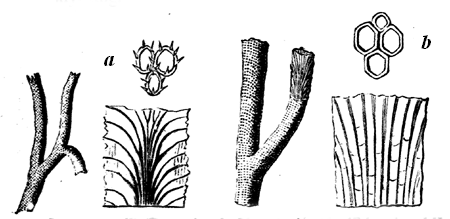
Fig. 41.—a, Stenopora
exilis (Dawson). b, Chaetetes tumidus (Edwards
and Haine). Carboniferous.
The true Stony Corals (Anthozoa) are as yet unknown in
the Cambrian. They entered on the stage in immense abundance in
the Siluro-Cambrian, where considerable limestones are largely
composed of their remains, mixed, however, and sometimes
overpowered with those of Bryozoa and Hydroids. An ordinary
coral, such as those of which coral reefs are built—the red
coral, used for ornament is not quite similar—is the
skeleton of an animal constructed on the plan of a sea anemone;
with a central stomach surrounded by radiating chambers, and
having above a crown of tentacles. The stony coral surrounds and
protects the soft body of the animal, and may either be a single
cell, for one animal, or an aggregation of such
cells, constituting a rounded or branching mass. The modern star
coral, represented in Fig. 42, is an instance of the latter
condition. It shows nineteen or twenty animals, each with a
central mouth and fringe of short tentacles, aggregated together,
and two of them showing the spontaneous division by which the
number of animals in the mass is progressively increased. The
living coral shows only the soft animals and the animal matter
connecting them; but if dead there would be a white stony mass
with a star-like cell or depression corresponding to each
animal.
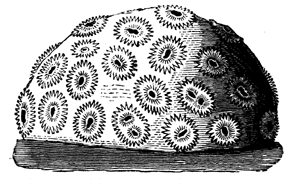
Fig. 42.—Living Anthozoan Coral
(Astræa).
In their general plan, the oldest Corals were precisely of
this character, but they presented some differences in detail,
which have caused them to be divided into two groups, which are
eminently characteristic of the Palæozoic age—the
tabulate or floored corals, and the rugose or wrinkled corals. In
the former (Fig. 43) the cells are usually small and
thin-walled, often hexagonal, like a honeycomb, and are floored
across at intervals with tabulæ or horizontal plates. A few
modern corals present a similar arrangement,14 but this kind of
structure was far more prevalent in the Palæozoic. In the
second type the animals are usually larger and often solitary,
the cell has strongly marked radiating plates, while the
horizontal floors are absent or subordinate, and there is usually
a thick external rind or outer coat (Figs. 44, 45). In general
plan, these rugose corals closely resemble those of
our modern reefs; but they differ in their details of structure,
and only a very few modern forms from the deep sea are regarded
as actual modern representatives.15 One curious point of difference is that their
radiating laminæ begin with four, and increase by multiples
of that number, while in modern corals the numbers are six and
multiples of six; a change of mathematical relation not easily
accounted for, and which assimilates them to Hydroids on the
one hand, and to a higher group, the
Alcyonids, on the other, both of which prefer four and eight to
six, or have had these numbers chosen for them. In the Mesozoic
period the tabulate and rugose corals were replaced by others,
the porous and solid corals of the modern seas; but, in so far as
we know, the animals producing these, though differing in some
details, were neither more nor less elevated than their
predecessors, and they took up precisely the same rôle as
reef-builders in the sea, though with probably more tendency to
the accumulation of great masses of coral limestone in particular
spots.
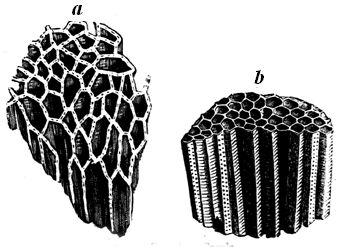
Fig. 43.—Tabulate Corals.
a, Halisites, and b,
Favosites. Upper Silurian.
Fig. 44.—Rugose Coral (Heliophyllum
Halli). Devonian.
Fig. 44a.—Zaphrentis
prolifica (Billings). Devonian.
Fig. 45.—Rugose Corals.
a, Zaphrentis Minas (Dn.), and
b, Cyathophyllum Billingsi (Dn.).
Carboniferous.
Leaving the corals, we may turn to the sea-stars and
seaurchins. These merely put in an appearance
in the Early Cambrian, but become vastly multiplied in the
Silurian, where the stalked feather stars (Crinoids)
(Fig. 46) seem to have covered great areas of sea-bottom,
and multiplied so rapidly that thick sheets of limestone are
largely made up of the fragments of their skeletons. The ordinary
star-fishes appear first in the Silurian (Fig. 47). The
sea-urchins begin in the Upper Silurian, the early species having
numerous and loosely attached plates, like some of those now
found in the deep sea16 (Fig. 48).
Fig. 46.—Modern Crinoid (Rhisocrinus
Lofotensis).—After Sars.
|
|
|
|
Fig. 47.—Palæaster
Niagarensis (Hall). One of the oldest star fishes.
|
Fig. 48.—Palæchinus
ellipticus (McCoy). One of the oldest types of
sea-urchins.
|
The most curious history in this group is that of the
feather-stars. In the Early Cambrian they are represented by a
few species known to us only in fragments, and these belong to a
humble group (Cystideans) resembling the larval or immature
condition of the higher Crinoids. Fig. 49 shows one of these
animals of somewhat later age. They have few or rudimentary arms
and short stalks, and want the beautiful radial symmetry of the
typical star-fishes. In the Silurian these creatures are
reinforced by a vast number of beautiful and perfect
feather-stars (Figs. 50, 51). These continue to increase in
number and beauty, and apparently culminate in the Mesozoic,
where gigantic forms exist, some of them probably having more
complicated skeletons, in so far as number of distinct parts is
concerned, than any other animals. Buckland has calculated that
in a crinoid similar to that in Fig. 52 there are no less
than 150,000 little bones, and 300,000 contractile bundles of
fibres to move them. In the modern seas the feather-stars have
somewhat dwindled both in numbers and complexity, and are mostly
confined to the depths of the ocean. On the other hand, the
various types of ordinary star-fishes and sea-urchins have
increased in number and importance. We thus find in this group a
certain advance and improvement from the Cystideans of the Early
Palæozoic to the sea-urchins and their allies. This advance
is not, however, along one line for the Cystideans
continue unimproved to the end. The Crinoids culminate in the
Mesozoic, and are not known to give origin to anything higher.
The star-fishes and sea-urchins commence independently, before
the culmination of the Crinoids, and, though greatly increased in
number and variety, still adhere very closely to their original
types.
|
|
|
|
Fig. 49.—Pleurocystites
squamosus. Siluro-Cambrian. After Billings.
|
Fig. 50.—Heterocrinus
simplex (Meek). One of the least complex crinoids of
that period. Siluro-Cambrian.
|
Fig. 51.—Body of
Glyptocrinus. Siluro-Cambrian.
|
The great sub-kingdom of the Mollusca, including the bivalve
and univalve shell-fishes, makes its first appearance in the
Cambrian, where its earliest representatives belong to a group,
the Arm-bearers or Lamp shells (Brachiopods), held by some to be
allied to worms as much as to mollusks. The oldest of all these
shells are allies of the modern Lingulæ
(Fig. 54), some of the earliest of which are shown in
Fig. 55. The modern Lingula is protected by a delicate
two-valved shell, composed, unlike that of most other mollusks,
of phosphate of lime or bone earth. It lives on sand-banks,
attached by its long flexible stalk, which it buries like a root
in the bottom. Its food consists of microscopic organisms,
drifted to its mouth by cilia placed on two arm-like processes,
from which the group derives its name. In the modern world about
one hundred species of Brachiopods are known, belonging to about
twenty genera, some of which differ considerably from the
Lingulæ. The genus Terebratula, represented at
Fig. 56, is one of the most common modern as well as fossil
forms, and has the valves unequal, with a round opening in one of
them for the stalk, which is attached to some hard object, and
there is an internal shelly loop for supporting the arms.
|
|
|
|
Fig. 52.—Extracrinus
Briareus. Reduced. Jurassic.
|
Fig. 53.—Pentacrinus
caput-medusæ. Reduced. Modern.
|
|
|
|
|
Fig. 54.—Lingula anatina.
With flexible muscular stalk. Modern.
|
Fig. 55.—Cambrian and Silurian
Lingulæ.
a, Lingulella Matthewi
(Hartt). Acadian group. b, Lingula quadrata
(Hall). Siluro-Cambrian. c, Lingulella prima
(Hall). Potsdam. d, Lingulella antiqua
(Hall). Potsdam.
|
These curious, and in the modern seas, exceptional shells,
were dominant in the Palæozoic period. Upwards of three
thousand fossil species are known, of which a large proportion
belong to the Cambrian and Silurian, nine genera appearing in the
Cambrian, and no less than fifty-two in the Silurian. The history
of these creatures is very remarkable. The Lingulæ, which
are the first to appear, continue unchanged and with the same
phosphatic shells to the present day. Morse, who has carefully
studied an American species, remarks in illustration of this,
that it is exceedingly tenacious of life, bearing much change of
depth, temperature, etc., without being destroyed. The genus
Discina, which is nearly as old, also continues throughout
geological time. The genus Orthis (Fig. 57), which
appears at the same time with the last, becomes vastly abundant
in Silurian times, but dies out altogether before the end of the
Palæozoic. Rhynchonella (Fig. 58), which comes
in a little later, near the beginning of the
Siluro-Cambrian, continues to this day. Spirifer and Productus
(Figs. 59 and 60) appear later, and die out at the close of the
Palæozoic. So strange and inscrutable are the fortunes of
these animals, which on the whole have lost in the battle of
life, that their place in nature is vastly less important than it
was. It has been suggested that if any group of creatures could
throw light upon the theory of descent with modification, it
would be these; but Davidson, who has perhaps studied them more
thoroughly than any other naturalist, found them
as silent on the subject as the sponges or the corals. In a
series of papers published in the Geological Magazine, a
short time before his death, he remarked as follows:
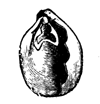
Fig. 56.—Terebratula sacculus
(Martin). Carboniferous.
Fig. 57.—Brachiopods; genus
Orthis.
a, O. Billingsi (Hartt). Lower
Cambrian. b, O. pectinella (Hall). Siluro-Cambrian.
c, O. lynx (Eichwald). Siluro-Cambrian.
Fig. 58.—Rhynchonella
increbrescens (Hall). Siluro-Cambrian.
Fig. 59.—Spirifer mucronatus
(Conrad). Devonian.
Fig.
59a.—Athyris subtilita (Hall).
Carboniferous.
a, b, Exteriors. c,
Interior, showing spirals.
“We find that the large number of genera made their
first appearance during the Palæozoic periods, and since
they have been decreasing in number to the present period. We
will leave out of question the species, for they vary so little
that it is often very difficult to trace really good distinctive
characters between them; it is different with the genera, as they
are, or should be, founded on much greater and more permanent
distinctions. Thus, for example, the family
Spiriferidæ includes genera which are all
characterised by a calcified spiral lamina for the support of the
brachial appendages; and, however varied these may be, they
always retain the distinctive characters of the group from their
first appearance to their extinction. The
Brachiopodist labours under the difficulties of not being able to
determine what are the simplest, or which are the highest
families into which either of the two great groups of his
favourite class is divided; so far, then, he is unable to point
out any evidence favouring progressive development in it. But,
confining himself to species, he sees often before him great
varietal changes, so much so as to make it difficult for him to
define the species; and it leads him to the belief that such
groups were not of independent origin, as was universally thought
before Darwin published his great work on the Origin of
Species. But in this respect the Brachiopoda reveal nothing
more than other groups of the organic kingdoms.
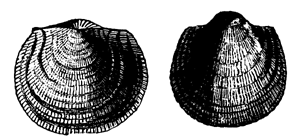
Fig. 60.—Productus cora
(D’Orbigny). Carboniferous.
“Now, although certain genera, such as
Terebratula, Rhynchonella, Crania, and
Discina, have enjoyed a very considerable geological
existence, there are genera, such as Stringocephalus,
Uncites, Porambonites, Koninckina, and
several others, which made their appearance very suddenly and
without any warning; after a while they disappeared in a similar
abrupt manner, having enjoyed a comparatively short existence.
They are all possessed of such marked and distinctive internal
characters that we cannot trace between them and associated or
synchronous genera any evidence of their being either
modifications of one or the other, or of being the result of
descent with modification. Therefore, although far from denying
the possibility or probability of the correctness of the
Darwinian theory, I could not conscientiously affirm that the
Brachiopoda, as far as I am at present acquainted with them,
would be of much service in proving it. The subject is worthy of
the continued and serious attention of every well-informed man of
science. The sublime Creator of the universe has bestowed on him
a thinking mind; therefore all that can be discovered is
legitimate. Science has this advantage, that it is continually on
the advance, and is ever ready to correct its errors when fresh
light or new discoveries make such necessary.” The late
Joachim Barrande, the great palæontologist of Bohemia,
bears similar testimony.
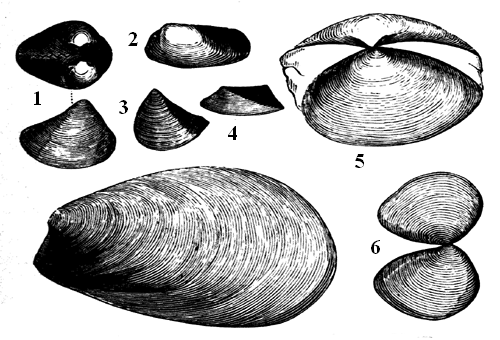
Fig. 61.—Group of Older Palæozoic
Lamellibranchs.—After Billings.
1, Cucullea opima.
2, Nucula oblonga. 3, Nucula lineata.
4, Cypricardia truncata. 5, Tellina
ovata. 6, Nucula bellatula. 7, Modiola
concentrica.
The ordinary bivalves, like the mussels and cockles, now so
very plentiful on our coasts, are rare in the Cambrian and
Silurian, and for the first time make a somewhat conspicuous
appearance in the Upper Silurian and Devonian. But from the first
they resemble very closely their modern successors, though on the
whole neither so large nor so ornate (Fig. 61). Their
fortunes have thus been precisely the opposite of those
of the Brachiopods, though in neither case
is there very marked elevation or deterioration in the individual
animals. A very similar statement may be made as to the
sea-snails, whether the curious winged snails (Pteropods) or the
ordinary crawlers (Gastropods). The former come in early, and are
represented by Palæozoic forms finer than any now extant.
The genus Conularia (Fig. 62) presents some Silurian
species six inches or more in length, which are giants in
comparison with any now living. The forms of more ordinary
Gastropods from the Silurian represented in Fig. 63 will
suffice to show that their styles are not very dissimilar from
those still extant.17 As in the case of the ordinary bivalves,
however, the modern Gastropods much exceed in numbers and
magnitude those of the Palæozoic.
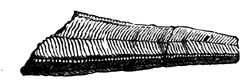
Fig. 62.—Conularia planicostata
(Dn.). A Carboniferous Pteropod.
Fig. 63.—Silurian Sea-snails.
Canada.
a, Murchisonia bicincta (Hall).
b, Pleurotomaria umbilicatula (Hall). c, Murchisonia gracilis (Hall). d, Bellerophon
sulcatinus (Billings).
The highest group of Mollusks, represented in the modern ocean
by the Nautili and Cuttle-fishes, has a history so strange and
eventful, and so different from what might have been anticipated,
that it perhaps deserves a more detailed notice, more especially
as Barrande has recently directed marked attention to it in his
magnificent work on the Palæontology of Bohemia.
The Cuttle-fishes and Squids and their allies are, in the
modern seas, a most important group (Fig. 64). The great
numbers in which the smaller species appear on many coasts, and
the immense size and formidable character of others; their
singular apparatus of arms, bearing suckers, their strange forms,
and the inky secretion with which they can darken the water, have
at all times attracted popular attention. The great complexity of
their structures, and the fact that in many points they stand
quite at the head of the invertebrates of the sea, and approach
most nearly to the elevation of the true fishes, have secured to
them the attention of naturalists. Some of these animals have
shelly internal supports, and one genus, that of the Argonauts,
or Paper Nautili, has an external protective shell. Allied,
though more distantly, to the Cuttle-fishes, are the true
Nautili, represented in the modern sea principally by the Pearly
Nautilus, though there are two other species, both of them very
rare. The modern pearly nautilus (Fig. 65) may be regarded
as a peculiar kind of cuttle-fish provided with a discoidal shell
for protection, and also for floatage. The shell is divided into
a number of chambers by partitions. Of these the animal inhabits
the last and largest. The others are empty, and are connected
with the body of the animal only by a pipe, or siphuncle, with
membranous walls and filled with fluid. Thus provided, the
nautilus, when in the water, has practically no weight, and
can move up or down in the sea with the
greatest facility, using its sucker-bearing arms and horny beak
to seize and devour the animals on which it preys. The buoyancy
of the shell seems exactly adapted to the weight of the animal;
and this proportion is kept up by the addition of new
air-chambers as the body increases in size. In the modern seas
this singular little group stands entirely isolated, and its
individuals are so rare that it is difficult to procure perfect
specimens for collections, though its mechanical structure and
advantages for the struggle for existence seem of the highest
order. But in the old world of past geological time the case was
altogether different.
|
|
|
Fig. 64.—Squid
(Loligo).
|
Fig. 65.—Pearly
Nautilus (Nautilus pompilius).
a, Mantle. b, Its dorsal fold.
c, Hood. o, Eye. t, Tentacles.
f, Funnel. g, Air chambers. h, Siphuncle.
|
The Nautiloid shell-fishes burst suddenly upon us in the
beginning of the Siluro-Cambrian, or Lower Silurian,
Barrande’s second fauna; and this applies to all the
countries where they have been studied. In this formation
alone about 450 species are known, and in the Silurian these
increase to 1,200; and here the group culminates. It returns in
the Devonian to about the same number with the Lower Silurian,
diminishes in the Carboniferous to 350, and in the Mesozoic,
where the Nautiloid forms are replaced by others of the type of
the Ammonites, becomes largely reduced. In the Tertiary there are
but nineteen species, and, as already stated, in the modern world
three. These statements do not, however, represent the
whole truth. In the Palæozoic, in addition to the genus
Nautilus, we have a great number of other genera, some
with perfectly straight shells, like Orthoceras
(Fig. 66), others bent (Cyrtoceras), others
differing in the style of siphuncle, or aperture, or chambers
(Endoceras, Gomphoceras, Lituites, Figs. 67
to 69), or inflated into sac-like forms (Ascoceras). There
is, besides, the family of the Goniatidæ
(Fig. 70), with the chambers thrown into angular folds and
the siphuncle at the back. Further, some of the early forms, as
the Orthoceratidæ, attain to gigantic dimensions, being
six feet or more in length, and nearly a foot in diameter. Thus
the idea that we should naturally form from the study of the
Nautilus, that it represents a type suited for much more varied
and important adaptations than those that we now see, is more
than realised in those Palæozoic ages when these animals
seem to have been the lords of the seas.
|
Fig. 66.—Orthoceras.
Siluro-Cambrian. The dotted line shows the position of the
siphuncle.
|
Fig.
67.—Gomphoceras.
|
|
Fig.
68.—Lituites.
|
Fig. 69.—Nautilus Avonensis
(Dn.). Carboniferous.
a, Shell, reduced. b, Section,
showing siphuncle.
Fig. 70.—Goniatites crenistria
(Philips). Carboniferous.
Fig. 71.—Ceratites nodosus
(Schloth). Triassic.
When we leave the Palæozoic and enter the Mesozoic,
though the Nautiloid shells still abound, we find them
superseded, in great part, by a nobler form, that of the
Ammonitidæ (Figs. 71, 72). These are remarkable for
the ornate markings on the surfaces of their shells, and for the
beautifully waved edges of the partitions (Fig. 72a),
which, by giving a much more complete support to the sides of the
shell, must have contributed greatly to the union of lightness
and strength so important to the utility of the shell as a float.
This type admits of all the same variety of straight, bent, and
curled forms with the simpler Nautiloid type, and some of the
species are of great size, Ammonites being known three feet or
more in diameter. These animals, unknown in the Palæozoic,
appear in numerous species in the Early Mesozoic, culminate in
hundreds of beautiful species in the middle of that era, and
disappear for ever at its close, leaving no modern successors.
Many and beautiful species of Ammonites and their allies have
been obtained from the Mesozoic rocks of British Columbia and
other parts of the west coast of North America, perfectly
representing this group as it occurs at the same period in
Europe, and closely resembling the Mesozoic Ammonites of India.
These animals have all perished, yet the Atlantic and the Pacific
roll between, apparently with conditions as favourable for their
comfortable existence as those of any previous time. They
perished long ago, at the dawn of the Tertiary; yet the genus
Nautilus, one of the oldest and least improved of the whole,
survived, and still testifies to the wonderful contrivance
embodied in these animals.
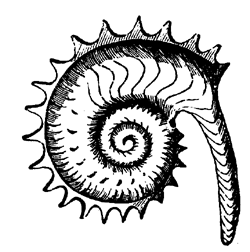
Fig. 72.—Ammonites Jason
(Reinecke). Jurassic.
Fig.
72a.—Suture of Ammonites componens (Meek), of
British Columbia. Showing the complicated folding of the edges of
the chambers to give strength to the shell. Cretaceous.
Fig. 73.—Cretaceous
Ammonitidæ.
a, Baculites. b,
Ancyloceras. c, Crioceras. d,
Turrilites.
These are merely general considerations, but Barrande, in his
Études Générales, goes much farther.
He sums up all the known facts in the most elaborate manner,
considering first the embryonic characters of the shell in the
different genera, then their distribution in space and time, then
all the different parts and characters of the shells in the
different groups—the whole with reference to any possible
derivation of the species; and he finds that all leads to the
result that in every respect these shells seem to have been so
introduced as to make any theory of evolution with respect to
them altogether untenable. In his concluding sentence this
greatest of Palæozoic palæontologists affirms
that, “The theoretical evolution of the Cephalopods is,
like that of the Trilobites, a mere figment of imagination,
without any foundation in fact.”18
Fig. 74.—Belemnite.—After
Philips.
Fig.
74a.—Belemnoteuthis antiquus. Supposed to be
a Belemnite, with soft parts
preserved.—Jurassic.—After Mantell.
I have reserved no space to notice the geological history of
the other and higher group of Cephalopods, including the true
Cuttles and Squids. This is perhaps less to be regretted, as,
from the absence of external shells, they are likely to be much
less perfectly known as fossils. So far as known, they are vastly
younger than the Nautiloids, for no examples whatever have been
found in the Palæozoic. They appear abundantly in the
Mesozoic, but are there represented principally by an extinct
group of squids (Belemnites and their allies, Figs. 74,
74a), remarkable for the great and complicated development
of their internal support, which has a chambered float as well as
a solid sheath. This family becomes extinct at the close of the
Mesozoic, though the cuttles as a whole
perhaps culminate in the modern.
Fig. 75.—Cambrian Trilobites.
a, Paradoxides.
b, Dikellocephalus.
c, Conocoryphe (head).
d, Agnostus (head and tail).
The remarkable group of the Trilobites had precedence in order
of time of the Nautiloid shell-fishes. No animal structures can
well be more dissimilar than those of the two great groups of
aquatic animals which popular speech confounds under the name of
“shell-fishes.” Take a whelk and a crab, for example,
and compare their general forms, the structure of their shells,
and their organs of motion, and it is scarcely possible to
imagine any two animals more unlike; and when we examine their
anatomy in detail this difference does not diminish. They have,
it is true, corresponding parts, and these parts serve similar
uses, but in plan of structure they are wholly different. Yet
both animals may live in the same pool, and may subsist on nearly
the same food. If we attempt to find some common type which both
resemble, we may trace the structure of the crab back to those of
some of the marine worms with which it has some affinity, and
those of the whelk to such creatures as the Lingula, which
are supposed to have a resemblance to the worms.
But still the two types, that of the Mollusk and the Articulate,
are distinct even from their first appearance in the egg, nor
have either any close affinities with the Protozoa, the Hydroids,
or the Corals.
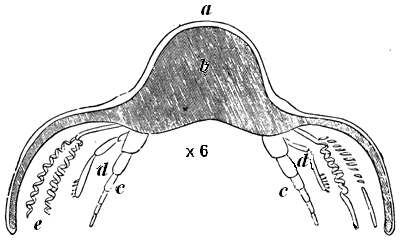
Fig. 76.—Transverse section of
Calymene. A Silurian Trilobite.—After Wolcott.
a, Dorsal shell.
b, Visceral cavity. c, Legs.
d, Epipodite—gill-cleaner or palp.
e, Spiral gills.
Both types meet us in the Early Cambrian, but while the
Mollusk is there represented only by low forms, the Articulate is
then not only in the humble guise of the worm, but in the complex
and highly organised form of the Trilobite (Figs. 28 and 75).
What older phases they may have passed through we know not; but
in the Lower Cambrian we have various forms of these animals,
including some of the largest known as well as some of the
smallest; some of the most complex in number of parts as well as
some of the simplest. These animals, in short, seem to have
appeared at once all over the world fully formed, and in a
variety of generic and specific forms; and nothing short of a
very large faith in the imperfection of the geological record can
suffice to account for their evolution.
Fig. 76a.—Burrows of Trilobite
and of modern King-crab. The Trilobite burrow is known as
Ruschinites, and has been supposed to be a sea-weed of the kind
called Bilobites.
A Trilobite is a creature in whose structure the number
three is dominant. Seen from above, it presents
three divisions from front to rear:—first, a cephalic
shield or head-piece; secondly, a thorax, divided into several
segments movable upon each other; and thirdly, a tail-piece or
pygidium, which, when brought against the head by the rolling up
of the body segments, effectually covers the lower parts. This
lower portion was until lately little known; but the discoveries
of Billings and of Wolcott have enabled us to restore the jaws
under the head, the jointed legs and spiral gills under the
thorax, and thus to complete the structure of the animal, and
understand better its relations to modern crabs and shrimps
(Fig. 76). Of these it certainly comes nearest to the
King-crabs and Horseshoe-crabs, a somewhat limited group at
present, and one which reaches back in geological time only to
the Upper Silurian, when the Trilobites had perhaps already
passed their culmination.
Constructed as above described, the Trilobite could swim, as
is supposed, usually on its back or side. It could crawl on the
bottom. Using its snout as a shovel, it could burrow like a
modern King-crab (Fig. 76a); and when pressed by
danger some species could roll themselves into balls and defy
their enemies.
Fig. 77.—Silurian Trilobites.
a, Isotelus.
b, Homalonotus.
c, Calymene.
This type of animal, entering on the stage in full force in
the Older Cambrian, continues under many forms through the whole
Palæozoic age, dying out finally in the Carboniferous.
Figs. 77 and 78 show a few of the forms of the Silurian,
Devonian, and Carboniferous.
Contemporaneously with the dawn of the Trilobite group, appear
some small shrimp-like forms (Fig. 28),19 and others with bivalve
shells (Fig. 79), which are closely allied to modern
forms,20 and, like the
Lingulæ, persist through the succeeding formations
with little more than specific change—presenting in this a
strange contrast to the Trilobites. While the latter were still
flourishing, about the close of the Lower Silurian, a remarkable
group of large and highly-developed creatures, allied to the
Trilobites, but suited for rapid swimming rather than creeping,
was introduced; and in the Upper Silurian and Devonian
these creatures21 attained to gigantic sizes, exceeding,
probably, any modern Crustaceans, and were tyrants of the seas.
Pterygotus anglicus (Fig. 80) is supposed to have
attained the length of six feet. Yet these noble representatives
of the Crustaceans became extinct in the Carboniferous. On the
other hand, a few small king-crabs appear in the Upper Silurian,
and this type still continues, and seems to culminate as to size
in modern times; so diverse have been the fortunes of these
various groups.
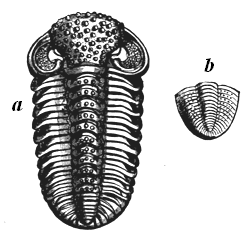
Fig. 78.—Devonian and Carboniferous
Trilobites.
a, Phaceps latifrons (Bronn). b, Philipsia Howi (Billings) (tail).
Fig. 79.—Palæozoic Ostracod
Crustaceans. Magnified.
a, Bairdia.
b, Cytherella inflata (Jones).
c, Cythere. Carboniferous.
d, Beyrichia Jonesii (Dn.). Carboniferous.
e, Beyrichia pustulosa (Hall). Silurian.
The higher, or decapod Crustaceans, now familiar to us in the
modern crabs and lobsters, are first found in a few small species
in the Devonian22 and Carboniferous, and they are accompanied in
the Devonian by at least one species of the allied group of the
Stomapods (Figs. 81, 82).
Fig. 80.—Pterygotus anglicus.
Reduced.—After Page and Woodward.
Fig. 81.—Amphipeltis paradoxus
(Salter). A Devonian Stomapod from New Brunswick.
Fig. 82.—Anthropalæmon
Hilliana (Dn). A Carboniferous Decapod from Nova Scotia. The
carapace only.
The Palæozoic age of geology is thus emphatically an age
of invertebrates of the sea. In this period they were dominant in
the waters, and until toward its close almost without rivals. We
shall find, however, that in the Upper Silurian, fishes made
their appearance, and in the Carboniferous amphibian reptiles,
and that, before the close of the Palæozoic, vertebrate
life in these forms had become predominant. We
shall also see that just as the leading groups of Mollusks and
Crustaceans seem to have had no ancestors, so it is with the
groups of Vertebrates which take their places. It is also
interesting to observe that already in the Palæozoic all
the types of invertebrate marine life were as fully represented
as at present, and that this swarming marine life breaks upon us
in successive waves as we proceed upward from the Cambrian. Thus
the progress of life is not gradual, but intermittent, and
consists in the sudden and rapid influx of new forms destined to
increase and multiply in the place of those which are becoming
effete and ready to vanish away or to sink to a lower place.
Farther, since the great waves of aquatic life roll in with each
great subsidence of the land, a fact which coincides with their
appearance in the limestones of the successive periods, it
follows that it is not struggle for existence, but expansion
under favourable circumstances and the opening up of new fields
of migration that is favourable to the introduction of new
species. The testimony of palæontology on this point, which
I have elsewhere adduced at length,23 in my judgment
altogether subverts the prevalent theory of “survival of
the fittest,” and shows that the struggle for existence, so
far from being a cause of development and improvement, has led
only to decay and extinction, whereas the advent of new and
favourable conditions, and the removal of severe competition, are
the circumstances favourable to introduction of new and advanced
species. This testimony of the invertebrates of the sea we shall
find is confirmed by other groups of living beings, to be noticed
in the sequel.24
Note.—The term
“Siluro-Cambrian,” as used in this and the next
chapter, is synonymous with “Ordovician” of Lapworth,
which is now coming into somewhat general use.
Cordaites, of the Group of
Dory-Cordaites. Branch Restored.—After Grand’
Eury.
f the graphite of the Laurentian
rocks was derived from vegetable matter, the further question
arises, Was this vegetation of the land, or of the sea? and
something may be said on both sides of this question. If there
were land plants in the Laurentian period, they must have grown
either on rocks older than the Laurentian itself, or on such
portions of the beds of the latter as had been raised out of the
sea, forming perhaps swampy flats of newly-made soil. But we know
no rocks older than the Laurentian, and there is no positive
evidence that any of the beds of that formation were other than
marine. Still it is not impossible that some of the beds which
are now graphitic gneisses may originally have been similar to
the bituminous shales, coals, or underclays of the coal
formation. The graphite occurring in veins, if of vegetable
origin, must have been derived from liquid bitumen oozing into
fissures; and veins of this kind occur in later formations, both
in marine and fresh-water beds. The only other positive argument
which has been adduced in favour of the existence of abundant
land plants in the Laurentian is that of Dr. Sterry Hunt, derived
from the great beds of iron ore, which it is difficult to account
for chemically except on the hypothesis of the decay in the air
of great quantities of vegetable matter. The question must remain
in doubt till some one is fortunate enough to find portions
of the Laurentian carbon retaining traces of organic structure.
My own observations, though somewhat numerous, allow me only to
say that the graphite sometimes presents fibrous forms, that it
occasionally appears as vermicular threads—which, however,
I suppose to be fillings of canals of Eozoon—and that in
the graphitic beds there are occasionally slender root-like
bodies of a lighter colour than the mass; but none of these
indications are sufficient to determine anything as to its
vegetable origin, or the nature of the plants from which it may
have been derived.
In any case, the quantity of carbon which has been accumulated
in the Laurentian rocks is very great. I have measured one bed at
Buckingham, on the Ottawa, estimated to contain 20 per cent. of
carbon, and which is at least eight feet in thickness. Sir
William Logan has described another similar bed from ten to
twelve feet thick, and more recent reports of the Geological
Survey of Canada mention a bed supposed to be twenty-five feet
thick, in which Mr. Hoffman finds 30 per cent. of carbon. On the
whole the quantity of carbon in the graphitic zone of the
Laurentian is comparable with that in certain productive
coal-fields, and we certainly have in the subsequent geological
history no examples of such accumulations except from remains of
the luxuriant vegetation of swampy flats.
The Upper Laurentian and Huronian have as yet afforded no
evidence of land vegetation. The Cambrian, as already stated,
abounds in remains of sea-weeds; but though the forms which have
been named Eophyton have been regarded as land plants,
this claim is, to say the least, very doubtful; and I have as yet
seen nothing of this kind which did not appear to me to be merely
markings made by objects drifted over the bottom or remains of
marine plants. Yet in the Upper Cambrian there are wide surfaces
of littoral sandstone often containing minute carbonised
fragments, and which might be expected to afford indications of
land vegetation, had such existed. I have myself devoted
many days of fruitless labour to the examination of the large
areas of Potsdam sandstone exposed in some parts of Canada. But
as these rocks were evidently formed along the borders of a
Laurentian continent capable of supporting vegetation, we may
still hope for some discovery of this kind, more especially if we
could find the point where some fresh-water stream ran into the
Cambrian sea.
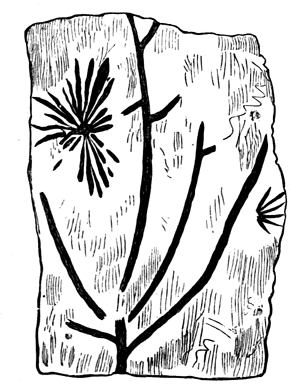
Fig. 83.—Protannularia
Harknessii (Nicholson). A Siluro-Cambrian Plant, from the
Skiddaw series.
The oldest plants, probably higher than Algæ, known to
me by their external forms, are those described by
Nicholson25 from the Siluro-Cambrian Skiddaw slates of the
north of England (Fig. 83). Their discoverer has named
them Buthotrephis Harknessii and B.
radiata,26 stating, however, that these two species are
not improbably portions of the same plant, and that its form is
rather that of a land plant than of an Alga. The specimens of
these plants which I have seen appear to me to support the
conclusion that they represent one species, and this allied to
the Annulariæ of the Devonian and Carboniferous
periods, which probably grew in shallow water with only their
upper parts in the air, and bore whorls or verticles of narrow
leaves. They were either relatives of the Mare’s-tails, or
of the Rhosocarps, of our modern swamps and ponds.
Fig. 84.—American Lower Silurian
Plants.—After Lesquereux.
a, Sphenophyllum
primævum. b, Protostigma
sigillarioides.
Somewhat higher up in the Lower Silurian, in the Cincinnati
group of America, Lesquereux finds objects which he refers to
the genus Sphenophyllum, which is closely allied to
Annularia (Fig. 84, a), and also a plant which he
terms Protostigma (Fig. 84, b), and believes
to be the stem of a tree allied to the club-mosses.27 He also finds minute
branching stems, which he refers to the genus Psilophyton,
to be mentioned in the sequel; but as to these I have some doubts
whether they may not be Zoophytes allied to the Graptolites,
rather than plants of that genus. These discoveries tend to show
the probable existence in the Siluro-Cambrian of plants
representing two of the three leading families of the higher
cryptogams or flowerless plants, namely, the Club-mosses and the
Mare’s-tails. Thus land vegetation begins with the highest
members of the lower of the two great series into which botanists
divide the vegetable kingdom.
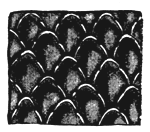
Fig. 86.—Fragment of outer surface of
Glyptodendron of Claypole. A Silurian Tree.
If we now turn to the Silurian, further evidence of land
vegetation presents itself. Near the base of this great series,
the club-moss family is represented by a plant discovered by
Claypole in the Clinton group, and referred to a new genus
(Glyptodendron, Fig. 86). Plants of this family have
also been noticed by Barrande in Bohemia, and by page in
Scotland; and a humble but interesting member of the family,
connecting it with the pillworts, Psilophyton
(Fig. 87), though more characteristic of the Devonian, has
been found in the Upper Silurian both in Canada and the United
States. No Ferns or Equiseta have as yet been found in the
Silurian; but in 1870 I recognised in some fragments of wood from
the Ludlow bone-bed, in the Museum of the Geological Survey of
Great Britain, the structure of that curious prototypal tree, to
which I have given the name Nematophyton, and which was
first recognised in the Devonian of Gaspé. Since that time
I have found in the Upper Silurian beds of Cape Bon Ami, in New
Brunswick, similar fragments of fossil wood, associated with
round seed-like bodies, having a central nucleus and a thick wall
or test of radiating fibres. These bodies show a structure
similar to that of those found in the Upper Ludlow of England,
and described by Hooker under the name Pachytheca. In my
judgment they are certainly true seeds.28 Seeds of this kind have also been found by
Hicks in the still older Denbighshire grits of North Wales, along
with fragments of the wood of Nematophyton, and with
remains of branching stems which have been described under the
name Berwynia, though it is not unlikely that they
represent the branches of Nematophyton. It is proper to
add that these ancient vegetable fossils are regarded by some
English botanists as gigantic algæ or sea-weeds, but I
confess I am unable to adopt this view of their nature. The
supposed fern of the Upper Silurian, figured in the first edition
of this work, has proved on further examination to be merely an
imitative form produced by crystallisation. On the other hand,
the recent discovery of a cockroach and two species of Scorpion
in the Silurian, proves the existence of land animals as well as
plants at this period.
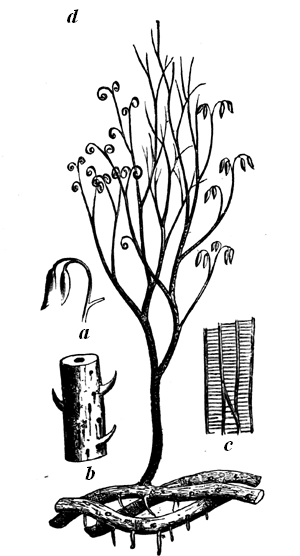
Fig. 87.—Psilophyton princeps
(Dn.) Silurian and Devonian. Restored.
a, Fruit, natural size.
b, Stem, natural size. c, Scalariform
tissue of the axis, highly magnified. In the restoration one side
is represented in vernation, and the other in fruit.
It is probable that these discoveries represent merely a small
proportion of the plants actually existing in the Silurian
period. All the deposits of this age at present known
to us are marine; and most of them were
probably formed at a distance from land, so that it is little
likely that land plants could find their way into them. At any
time the discovery of an estuarine or lacustrine deposit of
Silurian age might wonderfully extend our knowledge of this
ancient flora.
The Devonian or Erian age, that of the classic Old Red
Sandstone of Scotland, is that in which we find the first great
and complete land flora; and though this is inferior in number of
species to that of the succeeding Carboniferous, and greatly less
important with reference to its practical bearing on our welfare,
it is in some respects superior in that variety which depends on
diversity of soil and of station. To appreciate this, it will be
necessary to glance at the range and subdivisions of the modern
flora.
In the modern world we divide all vegetation into two great
series, that of the Flowering Plants (Phænogams),
which also produce true fruits and seeds, and that of the
Flowerless Plants (Cryptogams), which produce minute
spores instead of seeds. The latter is in every respect the lower
group. This lower series is again divisible into three
classes—first and lowest, that of the Seaweeds, Moulds, and
Lichens (Thallophytes). Secondly, that of the Mosses and their
allies (Anophytes). Thirdly, that of the Ferns, Equisetums and
Club-mosses (Acrogens). In like manner the second, or higher
series is divisible into three classes: that of the Pines and
Cycads (Gymnosperms), having naked seeds not covered by true
fruits, and woody tissue of simple structure; that of the Palms
and Grasses and their allies (Endogens); and last and highest,
that of the ordinary timber trees and other plants allied to
them, with exogenous stems, netted-veined leaves, and a
two-leaved embryo (Exogens). These last are in every respect the
dominant plants on our present continents. Carrying with us this
twofold division of the vegetable kingdom and its subdivisions,
we shall be prepared to understand the relation of the more
ancient floras to that now living.
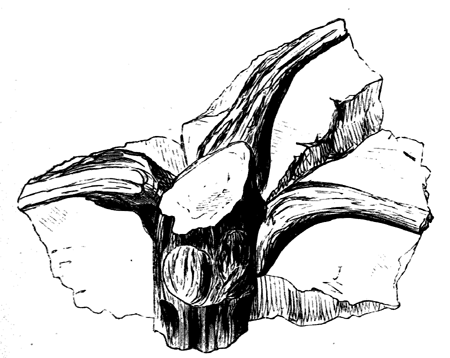
Fig. 88.—Trunk of a Devonian Tree-fern
(Caulopteris Lockwoodi, Dn.). Gilboa, New York. One-third
natural size.
Fig. 89.—Frond of Archæopteris
Jacksoni (Dn.). Devonian, of Maine.
Fig. 90.—Portion of a branch of
Leptophleum rhombicum (Dn.). A Lycopodiaceous tree of the
Devonian of Maine. Natural size.
Fig. 91.—Calamites radiatus
(Brongniart). Middle Devonian of N. Brunswick.
In the Devonian age we meet with no land plants of the
two lower classes of the Cryptogams, and with
scarcely any that can be referred to the two higher classes of
Phænogams, so that the vegetation of this period presents a
remarkable character of mediocrity, being composed almost
entirely of the highest class of the flowerless plants and the
lowest class of those that flower. Of the former there are
Tree-ferns and vast numbers of herbaceous forms (Figs. 88, 89),
great Lycopodiaceous plants, immensely better developed than
those now existing (Fig. 90), and gigantic Calamites, allied
to the Mares’-tails (Fig. 91), along with humbler
members of the same group (Fig. 95). Of the latter there
were Pines of great stature, known to us at present only by their
wood (Fig. 92); and that other allied trees existed we have
evidence in numerous seeds which must have belonged to this class
(Fig. 93), and in long flag-like leaves29 which modern
discoveries would refer to the same group. As yet we know no
Devonian Palms or Grasses; and only a single specimen has been
found indicating the existence of a plant of the highest
vegetable class, that of the true exogens. This unique
specimen, found by Hall in the Devonian of the shores of Lake
Erie, is a fragment of mineralised wood, the structures of which
are represented in Fig. 94. The large ducts seen in cross
section in Nos. 1, 2, and 3, and in longitudinal section in Nos.
4 and 5, and the medullary rays, seen in Nos. 1, 4, and 6,
testify to the fact that this chip of wood must have belonged to
a tree of the same type which contains our oaks, maples, and
poplars; a type which does not appear to have become
dominant till near the close of the Mesozoic, but which already
existed, though perhaps only in few species, and only in upland
and inland positions, as far back as the Middle Devonian. Perhaps
one of the most interesting discoveries in the Erian or
Devonian rocks has been that of the immense
abundance of spores of those humble plants the Rhizocarps,
represented in modern times by the Pillworts and Salviniæ,
&c. To these it is believed that Sphenophyllum and
Psilophyton were allied; but in addition to this there are
thick and vastly extended beds of bituminous shale which owe
their inflammable properties to countless multitudes of
Macrospores (Sporangites) of the genus
Protosalvinia.30 In Ohio there are beds of this kind 350 feet
thick, and extending across the State. They occur also in Canada,
where these forms were first recognised by the
writer in the bituminous shale of Kettle Point, Lake Huron.
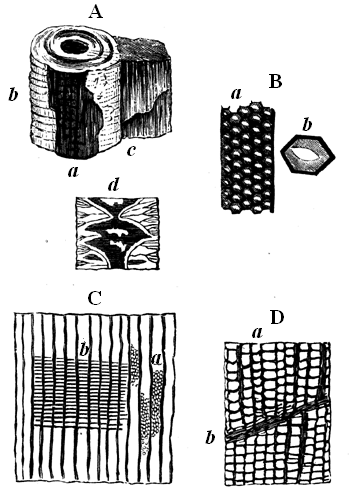
Fig. 92.—A Devonian Taxine Conifer
(Dadoxylon ouangondianum, Dn.). St. John, New
Brunswick.
A, Fragment showing
Sternbergia pith and wood; a, Medullary sheath; b,
Pith; c, Wood; d, Section of pith.
B, Wood cell
a, and hexagonal areole and pore b.
C, Longitudinal
section of wood, showing a, Areolation, and b,
Medullary rays.
D, Transverse section
showing a, Wood-cells, and b, Limit of layer of
growth.
Fig. 93.—Group of Devonian Fruits,
&c. Middle Devonian, New Brunswick.
|
A,
Cardiocarpum cornutum.
B,
Cardiocarpum acutum.
C,
Cardiocarpum Crampii.
D,
Cardiocarpum Baileyi.
E,
Trigonocarpum racemosum.
E1,
E2, Fruits enlarged.
|
F,
Antholithes Devonicus.
F1,
Fruit of the same.
G, Annularia
acuminata.
H, Asterophyllites acicularis
H1, Leaf.
K,
Cardiocarpum. (? young of A.)
L,
Pinnularia dispalans.
|
Fig. 94.—Structures of the oldest-known
Angiospermous Exogen (Syringoxylon mirabile, Dn.). From
Eighteen-mile Creek, Lake Erie.
1, Transverse section x 100. 2 and 3, Portions
of the same x 300. 4, Longitudinal section x 300. 5, Fragment of
duct from the same x 600. 6, Wood cells and medullary ray x
600.
The Devonian flora seems to have been introduced in the
northern parts of the American continent at a time of warm and
equable climate, and of elevation of new land out of the Silurian
sea. It spread itself to the southward, and was finally destroyed
in the great subsidences and disturbances which closed the
Devonian age, and which were probably accompanied with
refrigeration of climate. It was succeeded by the more massive
and richer, but more monotonous flora of the Carboniferous, a
period in which large areas of our continents were in the
state of swampy and often submerged flats, and in which the
climate was again warm and uniform.
Fig. 95.—Asterophyllites parvula
(Dn.), and Sphenophyllum antiquum (Dn.). Middle Devonian,
New Brunswick.
The Carboniferous age was, even more emphatically than the
Devonian, an age of Acrogens and Conifers. A few Carboniferous
Fungi have recently been discovered, but there are no known
Lichens or Mosses. There seem to be a few Endogens, but no true
Exogens. The great bulk of the plants consists of Acrogens and
Gymnosperms, as in the previous period. As this flora is so very
important and so much better known than any other of those
belonging to the infancy of the vegetable kingdom, we may notice
a little in detail some of its leading forms.
Fig. 96.—Calamites.
Carboniferous.
A, C.
Suckovii. B, C. Cistii
(Bt.). C, Base of Calamites.
D, E,
Structures.
Fig. 97.—Carboniferous Ferns.
A, Odontopteris
subcuneata (Bunbury). B,
Neuropteris cordata (Brongniart). C, Alethopteris tonchitica
(Brongniart).
Beginning with the Mares’-tails, we find these
represented in the Carboniferous by many gigantic species,
attaining to almost tree-like dimensions (Fig. 96). These are the
Calamites, which formed dense brakes and jungles on the margins
of the great swampy flats of this period. Their tall stems,
ribbed and jointed, bore whorls of leaves or branchlets. Sending
out horizontal root-stocks and budding out from the base, they
grew in great clumps, and had the capacity to resist the effects
of accumulating sediment by constantly sending out new stems at
higher and higher levels. The larger species assumed a complexity
in the structure of their stems unknown in their modern
congeners, and enabling them to grow to a great height;31 but their foliage and
fructification were not correspondingly advanced. Thus the family
of the Equisetaceæ culminated in the
Carboniferous, and thenceforth descended gradually in the
succeeding ages, leaving the comparatively humble
Mares’-tails and Scouring Rushes as its present
representatives.
The Ferns of the Carboniferous, like those of the Devonian,
presented both gigantic forms like those of the tree-ferns of the
modern tropics, and delicate herbaceous species, and these in
great profusion. On the whole, they do not strike the observer as
very dissimilar from those of modern times. A more critical
examination, however, shows that the bulk of the tree-ferns of
the Devonian and Carboniferous are allied not to the Polypod
type, which is the most common at present, but to certain
comparatively rare southern ferns, the Marattias and their
allies, characterised by a peculiar style of fructification,
perhaps adapting them to a moist and warm atmosphere
(Fig. 97).32 Thus the ferns, while a wonderfully persistent
type, were in their grander forms far more widely distributed in
the Carboniferous than at present; and genera now comparatively
rare, and limited to warm and moist climates, were then abundant,
and ranged over those temperate and boreal regions of the
Northern Hemisphere where only a few humble and hardy species can
now subsist. There were also some remarkable and anomalous
tree-ferns, of which that represented in Fig. 98 is an
example.
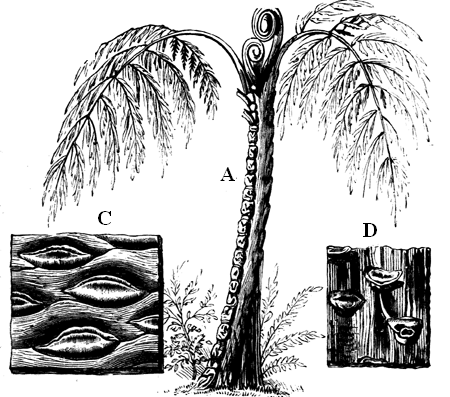
Fig. 98.—Carboniferous Tree-ferns.
A, Megaphyton
magnificum (Dn.). C,
Palæopteris Hartii (Dn.). D, P. Acadica (Dn.).
The family of the Club-mosses, already, even in the Devonian,
in advance of its modern development, experiences in the
Carboniferous a remarkable and portentous extension into great
trees of several genera and many species, constituting apparently
extensive forests, and having the woody tissues of their stems
developed to a degree unheard of in their present representatives
(Fig. 99). Further, they become closely linked, in external
form at least, with another and more advanced type, that of the
Sigillariæ. These remarkable trees were the most
abundant of all in the swamps of the coal-formation, and probably
those which most contributed to the
accumulation of coal. They presented tall pillar-like trunks,
often ribbed longitudinally, and with perpendicular rows of scars
of fallen leaves. Dividing at top into a few thick branches, they
were covered with long rigid grass-like foliage. Their fruit was
borne in rings or whorls of spikes surrounding the branches at
intervals (Fig. 100). Their roots were strangely symmetrical,
spreading out like underground branches into the soft soil by a
regular process of bifurcation, and were covered with rootlets
diverging in every direction, and so jointed to the main root
that when broken off they left round marks regularly arranged.
These roots are the so-called Stigmariæ, so
abundant in every coal-field, and especially filling the
“under-clays” of the coal-beds, which are the soils
on which the plants forming these beds were supported. The true
botanical position of the Sigillariæ has been a
matter of much controversy. Some of them undoubtedly have
structures akin to those of the tree-like Club-mosses, as
Williamson has well shown, and may have been cryptogamous. Others
have structures of higher character, akin to those of the modern
Cycads, and seem to have borne nutlets allied to those of these
plants. Yet the external forms of these diverse sorts are so
similar that no definite separation of them has yet been made.
Either these anomalous trees constitute a link connecting the two
great series of the vegetable kingdom, or we have been
confounding two distinct groups, owing to imperfect
information.
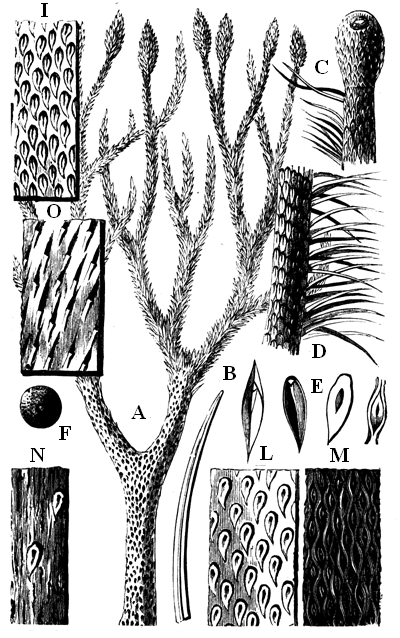
Fig. 99.—Lepidodendron
corrugatum (Dn.). A characteristic Lycopod of the Lower
Carboniferous of America.
A, Restoration.
B, Leaf, natural size. C, Cone. D, Leafy
branch. E, Forms of leaf-bases.
F, Sporangium. I,
L, M, N, O, Markings on stem and branches, in various
states.
Fig. 100.—Sigillariæ of
the Carboniferous.
A, Sigillaria
Brownii (Dn.). B, S.
elegans (Brongniart). B1, &c. Leaf and Leaf-scars.
Another curious, and till recently little understood, group of
Carboniferous trees is that known as Cordaites, which
existed already in some of its species in the Devonian. Their
leaves are long, and often broad as well, and with numerous
delicate parallel veins, resembling in this the leaves of
grasses. Corda long ago showed that one species at least has a
stem allied to the Club-mosses. More recently Grand’ Eury
has found in the South of France admirably preserved specimens,
which show that others more resembled in their structure the
Pines and Yews, and were probably Gymnosperms, approaching to the
Pines, but with very peculiar and exceptional foliage, of which
the only modern examples are the broad-leaved Pines of the genus
Dammara (Frontispiece to Chapter). Here again we have
either two very distinct groups, combined through our ignorance,
or a connecting link between the Lycopods and the Pines.
Fig. 101.—Trigonocarpum Hookeri
(Dn.). A Gymnospermous seed.
a, Testa. b, Tegmen. c, Nucleus. d, Embryo.
The Yews and their allies among modern trees, while members of
the great Cone-bearing order, bear nut-like seeds in fleshy
envelopes, sometimes, as in the Gínkgo of Japan,
constituting edible fruits. Seeds of this type seem to have
been extremely abundant in the Carboniferous
age in all parts of the world, and were probably produced by
trees of several genera (Dadoxylon, Sigillaria,
Cordaites, etc.) (Fig. 101). Charles Brongniart has
recently described no less than seventeen genera of these seeds
from the coal-field of St. Étienne alone, and it would be
a low estimate to say that we probably know as many as sixty or
seventy species in all, while the trunks of great coniferous
trees allied to Taxineæ, and showing well-preserved
structure, are by no means uncommon in the Devonian and
Carboniferous. Had these great Yews appeared for the first time
in the Coal-formation, we might have supposed that they had been
developed from such Lycopods as Lepidodendra, and that the
Cordaites are the intermediate forms; but unfortunately
the Pines go almost as far back in geological time as the
Lycopods, and it does not help us, when in search of evidence of
evolution, to find the link which is missing or imperfect in the
Early Devonian supplied in the Coal-formation, where, for this
purpose at least, it is no longer needed.
We have said something of what was in the Palæozoic
flora; but what of that which was not? We may
answer:—Nearly all that is characteristic of our modern
forests, whether in the ordinary Exogens, which predominate so
greatly in the trees and shrubs of temperate climates, or in the
Palms and their allies, which figure so conspicuously within the
tropics. The few rare, and to some extent doubtful,
representatives of these types scarcely deserve to be noted as
exceptions. Had a botanist searched the Palæozoic forests
for precursors of the future, he would probably have found only a
few rare species, while he would have seen all around him the
giant forms and peculiar and monotonous foliage of tribes now
degraded in magnitude and structure, and of small account in the
system of nature.
It must not be supposed that the Palæozoic flora
remained in undisturbed possession of the continents during the
whole of that long period. In the successive subsidences of the
continental plateaux, in which the marine limestones were
deposited, it was to a great extent swept away, or was restricted
to limited insular areas, and these more especially in the far
north, so that on re-elevation of the land it was always peopled
with northern plants. Thus there were alternate restrictions and
expansions of vegetation, and the latter were always signalised
by the introduction of new species, for here, as elsewhere, it
was not struggle, but opportunity, that favoured improvement.
In the Lower Silurian such plants as existed must have
experienced great restriction at the age of the Niagara or
Wenlock limestone. Those of the Upper Silurian suffered a similar
reverse at the time of the Lower Helderberg or Ludlow
limestones. This recurred at the close of
the Devonian and in the time of the Lower Carboniferous
limestone; and finally the Palæozoic flora disappeared
altogether in the Permian, to be replaced by new types in the
Mesozoic. While, therefore, there is a great general similarity
in the successive Palæozoic floras, there are minor
differences, so that the Devonian plants are for the most part
distinct specifically from those of the Lower Carboniferous,
those of the Lower Carboniferous from those of the
Coal-formation, and those of the latter from those of the
Permian.
With all these vicissitudes it is to be observed that there is
no apparent elevation of type in all the long ages from the
Devonian to the Permian, that the Acrogens and Gymnosperms of
these periods are in some respects superior, in all respects
equal, to their modern successors, and that their history shows a
decadence toward the modern period; that intermediate forms
arrive too late to form connecting links in time, that several
distinct types appear together at the beginning, and that all
utterly and apparently simultaneously perish at the end of the
Palæozoic, to make way for the entirely new vegetation of
the succeeding age. Theories of evolution receive no support from
facts like these, though their practical significance, as parts
of the one great uniform scheme of nature, is sufficiently
manifest.
Of what use then were these old floras? To the naturalist,
vegetable life, with regard to its modern uses, is the great
accumulator of pabulum for the sustenance of the higher forms of
vital energy manifested in the animal. In the Palæozoic
this consideration sinks in importance. In the Coal period we
know few land animals, and these not vegetable feeders, with the
exception of some insects, millipedes, and snails. But the
Carboniferous forests did not live in vain, if their only use was
to store up the light and heat of those old summers in the form
of coal, and to remove the excess of carbonic acid from the
atmosphere. In the Devonian period even these utilities
fail, for coal does not seem to have been accumulated to any
great extent, and the petroleum of the Devonian appears to have
been produced from aquatic vegetation. Even with reference to
theories of evolution, there seems no necessity for the long
continuance and frequent changes of species of acrogenous plants
without any perceptible elevation. We may have much yet to learn
of the life of the Devonian; but for the present the great plan
of vegetable nature goes beyond our measures of utility; and
there remains only what is perhaps the most wonderful and
suggestive correlation of all, namely, that our minds, made in
the image of the Creator, are able to trace in these perished
organisms structures similar to those of modern plants, and thus
to reproduce in imagination the forms and habits of growth of
living things which so long preceded us on the earth. We may
indeed proceed a step further, and hold that, independently of
human appreciation, these primitive plants commended themselves
to the approval of their Maker, and perhaps of higher
intelligences unknown to us; and that in the last resort it was
for His pleasure that they were created.

Pteraspis.
Restored.—After Lankester.
 onfessedly the highest style of
animal is that which possesses a skull and backbone, with brain
and nerve system to match, and which embodies the general plan of
structure employed in man himself. Yet among the fishes, which
constitute the lowest manifestation of this type, are some so
rudimentary that the brain is scarcely developed, and the
skeleton is merely a cord of gristle. These are represented in
the modern world only by the Lancelot,33 a creature which has sometimes been mistaken
for a worm, and by a slightly more advanced type, that of the
Lampreys.34 In these animals the Vertebrates make the
nearest approach to the lower domains of the animal kingdom,
collectively known as Invertebrates. We should naturally expect
that since the vertebrates succeed the inferior animals in time,
their lower types should appear first, and that these should be
aquatic rather than terrestrial. On the other hand, as the oldest
fishes that are certainly known are strongly protected with bony
armour, and had to contend against formidable Crustaceans and
Cuttles, we might suppose that the Lancelot and the Lampreys are
rather degraded types belonging to the modern period, than the
true precursors of the other fishes.
onfessedly the highest style of
animal is that which possesses a skull and backbone, with brain
and nerve system to match, and which embodies the general plan of
structure employed in man himself. Yet among the fishes, which
constitute the lowest manifestation of this type, are some so
rudimentary that the brain is scarcely developed, and the
skeleton is merely a cord of gristle. These are represented in
the modern world only by the Lancelot,33 a creature which has sometimes been mistaken
for a worm, and by a slightly more advanced type, that of the
Lampreys.34 In these animals the Vertebrates make the
nearest approach to the lower domains of the animal kingdom,
collectively known as Invertebrates. We should naturally expect
that since the vertebrates succeed the inferior animals in time,
their lower types should appear first, and that these should be
aquatic rather than terrestrial. On the other hand, as the oldest
fishes that are certainly known are strongly protected with bony
armour, and had to contend against formidable Crustaceans and
Cuttles, we might suppose that the Lancelot and the Lampreys are
rather degraded types belonging to the modern period, than the
true precursors of the other fishes.
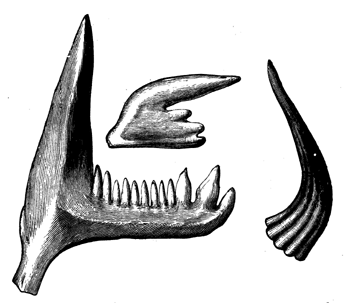
Fig. 102.—Siluro-Cambrian Conodonts.
Magnified.—After Pander.
But if fishes like the Lancelot preceded all others, we may
never find in a fossil state any traces of their soft and
perishable bodies; and even the Lampreys have no hard parts
except small horny teeth, which might easily escape observation.
But palæontologists have sharp eyes, and it has not escaped
them that certain microscopic tooth-like bodies are somewhat
widely distributed in the older rocks. In Russia, Pander has
found in the Upper Cambrian and Lower Silurian, and also in the
Devonian and Carboniferous, minute conical and comb-like teeth,
to which he has given the name of Conodonts
(Fig. 102), and which he supposes to be the teeth of ancient
Lampreys. Similar teeth have been found by Moore and others in
the Carboniferous of England, and by Newberry in Carboniferous
shales in Ohio. In point of form, these bodies certainly resemble
the teeth of the humble fishes to which they have been referred.
In the case of the Carboniferous specimens from Ohio—the
only ones I have had an opportunity to examinethe
material is calcium phosphate, and the structures are more like
those of teeth of Sharks than of Lampreys, so that there can be
no doubt that they are really teeth of fishes, and probably of
fishes of somewhat higher grade than the Lampreys.35 The Cambrian and
Silurian specimens are said to be composed of calcium carbonate,
which would render it more probable that, as has been suggested
by Prof. Owen, they may have been teeth of some species of
Sea-snail destitute of shell. It is, however, possible that they
may have originally been horny, and that the animal matter has
been replaced by carbonate of lime. Rohon and Zittel have
recently shown that many of these are more allied to the teeth of
worms than of any other animals.36
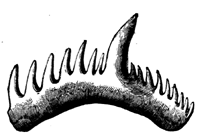
Fig. 103.—Lower Carboniferous Conodont.
Magnified.—After Newberry.
If these older Conodonts were really teeth of fishes, they
carry the introduction of these nearly as far back as that of the
Mollusks and Crustaceans. If they were not, then the earliest
known representatives of this class belong to a much later age,
that of the Silurian. Here we have undoubted remains of fishes
belonging to two of the higher orders of the class; and in the
succeeding Devonian these became multiplied and extended
exceedingly.
Besides the inferior tribes already referred to, the modern
seas and rivers present four leading types of
fishes:—first, the ordinary bony fishes (Teleostians), such
as the Cod, Salmon, and Herring; secondly, the Ganoid fishes,
protected with bony plates on the skin, as the Bony-pike37 and Sturgeon; thirdly,
the Sharks and their allies, the Dog-fishes and Rays; fourthly,
the peculiar and at present rare group of semi-reptilian fishes
to which the name of Dipnoi has been given, on account of
their capacity for breathing both in air and in water.
Of these four types the first is altogether modern, and
includes the great majority of our present fishes. It does not
make its appearance till the Cretaceous age, and then is at once
represented by at least three of the modern families, those of
the Salmon, Herring, and Perch. The history of the other three
groups is precisely the opposite of this. They abound exceedingly
at an early period, and dwindle to a much smaller number in the
modern time. This is especially the case with the Ganoids and the
Dipnoi. It is also remarkable that these groups of old-fashioned
fishes38 are in some respects
the highest members of the class, approaching the nearest to the
reptiles; but this accords with a well-known
palæontological law, namely, that the higher members of low
groups give way on the introduction of more elevated types, while
the lower members may continue. Thus the decadence of these
higher fish begins with the incoming of the reptiles, just as the
decadence of the higher Mollusks and predaceous Crustaceans began
with the incoming of the fishes. Further, the modern Ganoids and
Dipnoi are mostly fresh-water animals, though the Sharks are
largely pelagic. In the Palæozoic there seem to have been
abundance of marine species of all these types; but though
marine, they probably flourished most in bays and estuaries and
on shallow banks; and the existence of these implies continental
masses of land. This explains the curious coincidence that the
introduction of fishes and of an abundant land flora synchronise,
and that the ocean was still dominated by
Invertebrates long after the fishes had become supreme in bays,
estuaries, and rivers.
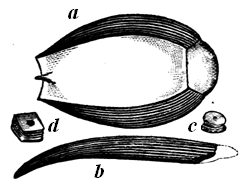
Fig. 104.—a, Head-shield of an
Upper Silurian fish (Cyathaspis). b, Spine of a
Silurian Shark (Onchus tenui-striatus, Agass.). c,
d, Scales of Thecodus, enlarged.
The first fishes that we certainly know are the Ganoids and
Sharks, which appear near the close of the Upper Silurian, in the
English Ludlow for example (Fig. 104). The Ganoids found
here all belong to an extinct group, characterised by the
covering of the head and anterior part of the body with large
bony plates. They are mostly small fishes, and probably fed at
the bottom, and used their long or rounded bony snouts for
grubbing in the mud for food. In this respect they present a
singular resemblance to the Trilobites, so that we seem to have
here animals of an entirely new type, the Vertebrate, and with
bony instead of shelly coverings, taking up the rôle
and, to some extent, the external form of a group about to pass
away. Yet I presume that no derivationist would be hardy enough
to affirm that the Trilobites could have been the ancestors of
these fishes. Nor indeed is any ancestry even hypothetically
known for them, for the doubtful Lampreys of the Cambrian
Silurian are too remote and uncertain to be used in that
way. The head-shield copied in outline in
Fig. 104, and the restoration after Lankester in the
frontispiece to this chapter, may serve to represent these
curious primitive Ganoids, which are continued in the Devonian
fishes represented in Figs. 105, 106.
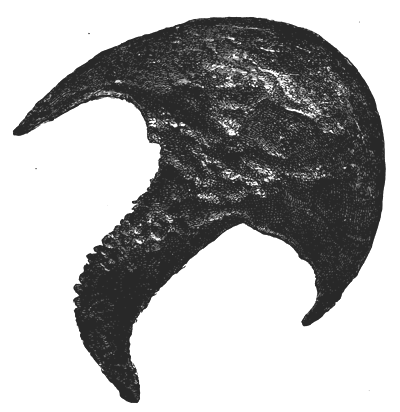
Fig. 105.—Cephalaspis Dawsoni
(Lankester). Lower Devonian of Gaspé.
Along with these, and not improbably their enemies, were
certain Sharks (Fig. 104), known to us only by the spines
which were attached to their fins as weapons of defence, and by
detached bony tubercles which protected their skin. These remains
are chiefly interesting as indications that two of the great
leading divisions of the class of fishes originated together.
In the Devonian age the Ganoids and Sharks, thus introduced in
the Silurian, may be said to culminate. The former,
more especially, are represented by a great
variety of species, some of them nearly allied to their Silurian
predecessors (Fig. 106), others of forms and structure not
dissimilar to those of the few surviving representatives of the
order, or altogether peculiar to the Devonian (Fig. 107). So
numerous are these fishes, and of so many genera and
species—and this not merely in one region, but in widely
separated parts of the world—that the Devonian has not
inaptly been called the reign of Ganoids. As an illustration at
once of the very peculiar forms of some of these fishes and of
their wide distribution, I figure here along with the British
species a Cephalaspis (Fig. 105) found in the Lower
Devonian of Gaspé, in the same beds with some of the
antique Devonian plants described in the last chapter.
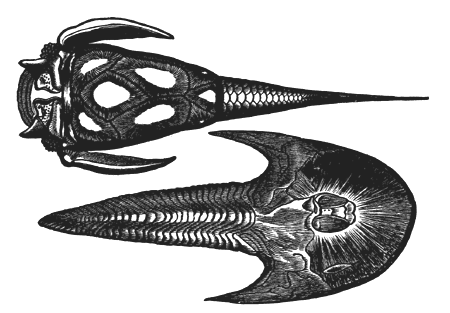
Fig. 106.—Devonian Placoganoid Fishes
(Pterichthys cornutus, Cephalaspis Lyelli), from
Scotland.
Fig. 107.—Devonian Lepidoganoid Fishes
(Diplacanthus and Osteolepis). After Page and
Nicholson.
Fig. 108.—Modern Dipnoi.
a, Ceratodus Fosteri. Australia.
b, Lepidosiren annectus. Africa.
A new and interesting light has recently been cast upon some
of the most anomalous of the ancient fishes by the study of the
now rare and peculiar species of the group of Dipnoi. Two of
these, belonging to the genus Lepidosiren, are
the “Mud-fishes” of the rivers
of tropical Africa and America (Fig. 108, b.) These
creatures have an elongated and elegant form, and the body is
covered with overlapping horny scales like those of ordinary
fishes; but the pectoral and ventral fins are rod-like, and are
supported by simple cartilaginous rays, while the tailfin forms a
fringe around the posterior part of the body. Unlike
ordinary fishes, they have lungs as well as gills, and their
mouths are armed with sharp, bony, beak-like teeth (Fig. 115),
with which they can inflict terrible bites on the small fishes
and frogs which furnish them with food. Their most remarkable
habit is that of burying themselves in the mud of dried-up ponds,
thus forming a sort of water-chamber or “cocoon,” in
which they remain in a torpid state until the return of the rainy
season sets them free.
Another example of these Dipnoi is the Barramunda, or
Ceratodus of the Australian rivers
(Fig. 108a). This fish resembles the Lepidosiren in
many essential points of structure; but its fins have lateral
rays, and are consequently of some breadth, though of peculiar
form, and its mouth is armed with flat, pavement-like teeth,
wherewith it browses on aquatic grasses.
Fig. 109.—Anterior part of the palate
of Dipterus. Showing the dental plates at a,
Devonian.—After Traquair.
These modern fishes have enabled us to understand several
mysterious forms met with in the older rocks. In the first place,
they show the meaning of certain flat-toothed fishes, like
Dipterus of the Devonian (Fig. 109), Conchodus
of the Carboniferous (Fig. 110), and Ceratodus of the
Carboniferous and Trias (Figs. 111, 112), previously of very
doubtful character. These must all have been of similar structure
and habits with the Barramunda, which is thus the sole
survivor, perhaps itself verging on extinction, of a group of
herbivorous fishes introduced, it may be, contemporaneously with
the first stream affording the requisite vegetable food, and
which have continued almost without improvement or deterioration
to the present time. These fishes are, however, very closely
connected with the Ganoids, and there are some of these, with
fringed fins and overlapping scales, which, while regarded as
true Ganoids, resemble the Dipnoi very closely.
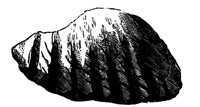
Fig. 110.—Dental plate of Conchodus
plicatus (Dn.). Coal-formation of Nova Scotia. Acadian
Geology.
Fig. 111.—Dental plate of Ceratodus
Barrandii. Coal-formation of Bohemia. After Fritsch.
Fig. 112.—Dental plate of Ceratodus
serratus. From the Trias.
Fig. 113.—Jaws of Dinichthys
Hertzeri (Newberry). Laterally compressed; one-sixth natural
size.
Again, certain huge fishes, whose remains are found in the
Devonian of Ohio,39 had jaws on the same plan with those of
Lepidosiren, but of enormous size and strength (Figs. 113, 114,
115), so that in this and some other
points of structure they may be regarded as colossal Mud-fishes,
and they must have had the same destructive powers, but on a far
grander scale. They were besides clothed with heavy armour of
bony scales, having some resemblance to that of those mailed
fishes of smaller size already referred to, and indicating that,
huge though they were, and formidable in destructive power,
they also had enemies to be dreaded. These
plates serve to ally them with the Ganoids, as their jaws do with
Lepidosiren.
Fig. 114.—Lower Jaw of Dinichthys
Hertzeri. One-sixth natural size.
Fig. 115.—Jaws of Lepidosiren.
Natural size.—After Newberry.
We are thus enabled to see in the streams, lakes, and bays of
the Palæozoic, harmless fishes, of the type of Ceratodus,
feeding on plants, and huge precursors of the Mud-fishes darting
from the depths, and provided with a dental apparatus more
formidable than that of any modern fish, sufficient to pierce the
strongest armour of the Ganoids, and to destroy and devour the
largest aquatic animals. These huge fishes, armed with shears two
or three feet in length, and capable of cutting asunder scale,
flesh, and bone, are the beau idéal of destructive
monsters of the deep, far surpassing our modern Sharks; and if,
by means of supplementary lungs, they could breathe in air as
well as in water, they would on that account be all the more
vigorous and voracious.
Newberry has well remarked that while in
the Devonian the Ganoids and Dipnoi were the real tyrants of the
sea, as well as of the streams, in the Carboniferous they already
diminish in size, though still abundant as to numbers, and are
more limited to estuaries and fresh waters. Thus their departure
from power had already begun, and went on until in modern times
the proportion of Ganoids to ordinary fishes is, according to
Günther, nine out of 9,000. The Carboniferous, indeed, very
specially abounds in small Ganoids, though there are many large
and formidable species. One of these smaller species, a very
beautiful little fish, of fresh-water ponds and streams in the
older part of the Carboniferous age, is represented of the
natural size in Fig. 116, and is not a restoration, being
found preserved entire, though flattened, in a fine bituminous
shale, which has perfectly preserved even the most delicate
sculpturing of its bony scales.
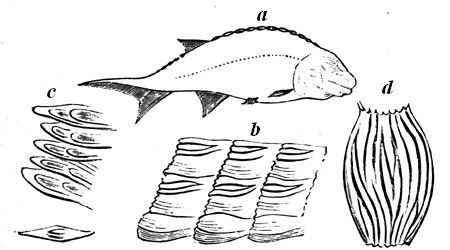
Fig. 116.—A small Carboniferous Ganoid
(Palæoniscus (Rhadinichthys) Modulus Dn.). Lower
Carboniferous, New Brunswick.
a, Outline. b,
c, d, Sculpture of scales magnified.
Fig. 117.—Teeth and Spines of
Carboniferous Sharks. Nova Scotia.
a, Diplodus penetrans. b,
Psammodus. c, Ctenoptychius cristatus.
d, Spine, Gyracanthus magnificus. One-eighth
natural size.—Acadian Geology.
The Sharks in the Carboniferous increase in number and
importance. Fig. 117 shows a few examples of their teeth and
spines. In the Carboniferous, however, there is a
great preponderance of those species with
flat, crushing teeth fitted for grinding shells,40 which in diminishing
numbers continue up to the present time, when they are
represented by the Port Jackson Shark and a few other species.
The increase toward the modern time of the true Sharks41 with sharp cutting
teeth, is obviously related to the increase of the ordinary
fishes which furnish them with food. Another curious difference,
connected probably with the same circumstance, is the fact that
in the sharp toothed Sharks of the Carboniferous the two side
fangs of each tooth are the largest, or are exclusively developed
(Fig. 117, a), while in later periods the central
point becomes dominant, or is developed to the
exclusion of the others (Figs. 118, 119).
The Ganoids and Dipnoi still, however, occupy a very important
place through the Mesozoic ages (Fig. 120), and it is only
at the close of the Cretaceous that they finally give place to
the Teleosts, or common fishes, which, though perhaps more fully
specialised in purely ichthyic features, have dropped the
reptilian characteristics of 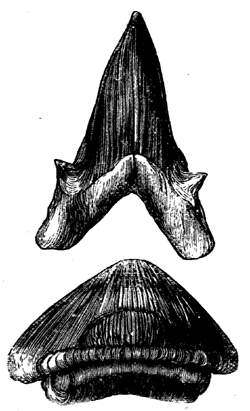 Fig. 118.—Teeth
of Cretaceous Sharks (Otodus and
Ptychodus).—After Leidy. their
predecessors (Fig. 121). It is interesting to observe that
these old-fashioned fishes had culminated before the advent of
air-breathing Vertebrates, which appear for the first time in the
Carboniferous. It is further to be observed that groups of fishes
furnished with means of aiding their gills by rudimentary lungs
were especially suited to waters more charged with carbonic acid,
and less with free oxygen, than those of more recent times. This
remark especially applies to the mephitic and sluggish streams
and lagoons of the Carboniferous swamps, where, in the midst of a
rank vegetation and reeking masses of decaying organic matter,
the half air-breathing fishes and the amphibious reptilian
animals met with each other and found equally congenial abodes.
Thus, independently of the fact that some of these fishes were
probably vegetable feeders, it is not altogether an accident, but
a wise adaptation, that caused the culmination of the reptilian
fishes and batrachian reptiles to coincide with the enormous
development of the lower forms of land-plants in the
Devonian and Carboniferous. Another curious illustration of the
diminishing necessity for air-breathing to the fishes, is the
change of the tail from the unequally-lobed
Fig. 118.—Teeth
of Cretaceous Sharks (Otodus and
Ptychodus).—After Leidy. their
predecessors (Fig. 121). It is interesting to observe that
these old-fashioned fishes had culminated before the advent of
air-breathing Vertebrates, which appear for the first time in the
Carboniferous. It is further to be observed that groups of fishes
furnished with means of aiding their gills by rudimentary lungs
were especially suited to waters more charged with carbonic acid,
and less with free oxygen, than those of more recent times. This
remark especially applies to the mephitic and sluggish streams
and lagoons of the Carboniferous swamps, where, in the midst of a
rank vegetation and reeking masses of decaying organic matter,
the half air-breathing fishes and the amphibious reptilian
animals met with each other and found equally congenial abodes.
Thus, independently of the fact that some of these fishes were
probably vegetable feeders, it is not altogether an accident, but
a wise adaptation, that caused the culmination of the reptilian
fishes and batrachian reptiles to coincide with the enormous
development of the lower forms of land-plants in the
Devonian and Carboniferous. Another curious illustration of the
diminishing necessity for air-breathing to the fishes, is the
change of the tail from the unequally-lobed 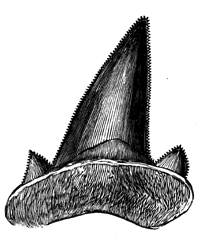 Fig. 119.—Tooth
of a Tertiary Shark (Carcharodon). or
heterocercal form, which prevailed in the Palæozoic, to the
more modern equally-lobed (homocercal) style in the Mesozoic. The
former is better suited to animals which have to rise rapidly to
the surface for air, and is still continued in some modern
fishes, which for other reasons need to ascend and descend, or to
turn themselves in the water; but the homocercal form is best
suited to the ordinary fish, whether Ganoids or Teleosts
(Fig. 122). It is curious also to find the beginning of the
dominancy of the ordinary fish to coincide with that of the
broad-leaved exogenous trees in the later Cretaceous, and to
precede immediately the appearance of the mammals on the land;
all these changes being related to the purer air, the clearer
waters, and the more varied continental profiles of the later
geological periods. Thus physical improvement and the changes of
animal and vegetable life are linked together by correlations
which imply not only design, but prescience, whether we attribute
these qualities to a spiritual Creator or to mere atoms and
forces.
Fig. 119.—Tooth
of a Tertiary Shark (Carcharodon). or
heterocercal form, which prevailed in the Palæozoic, to the
more modern equally-lobed (homocercal) style in the Mesozoic. The
former is better suited to animals which have to rise rapidly to
the surface for air, and is still continued in some modern
fishes, which for other reasons need to ascend and descend, or to
turn themselves in the water; but the homocercal form is best
suited to the ordinary fish, whether Ganoids or Teleosts
(Fig. 122). It is curious also to find the beginning of the
dominancy of the ordinary fish to coincide with that of the
broad-leaved exogenous trees in the later Cretaceous, and to
precede immediately the appearance of the mammals on the land;
all these changes being related to the purer air, the clearer
waters, and the more varied continental profiles of the later
geological periods. Thus physical improvement and the changes of
animal and vegetable life are linked together by correlations
which imply not only design, but prescience, whether we attribute
these qualities to a spiritual Creator or to mere atoms and
forces.
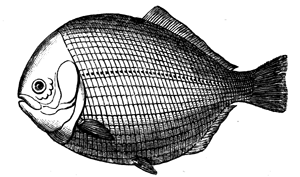
Fig. 120.—A Liassic Ganoid
(Dapedius). Restored.—After Nicholson.
Fig. 121.—Cretaceous Fishes of the
modern or Teleostian type.
a, Beryx Lewesiensis. English chalk. b, Portheus molossus (Cope). A large fish from the American
Cretaceous. One twenty-eighth natural size.
The history of fishes extends further through geological time
than that of any other Vertebrates, and is perhaps more
completely known to us, in consequence of the greater facilities
for the preservation of their remains in aqueous deposits. If we
receive Pander’s Conodonts as indicating a low type
of cartilaginous fishes, these must have
continued for vast ages without any elevation, and struggling for
a bare existence amidst formidable Cuttle-fishes and Crustaceans,
before, under more favourable conditions, they suddenly expanded
into the high and perfect types of Ganoids and Sharks. If we
reject the early Conodonts, then the two last-mentioned types
spring together and suddenly into existence, like the armed men
from the dragon’s teeth of Cadmus. They rapidly attain to
numbers and grandeur unexampled in later times, and become the
lords of the waters at the time when there was probably no
Vertebrate life on the land. As the reptiles establish themselves
on the land and in the waters, the Ganoids diminish, but the
Sharks hold their own. At length the reign of reptiles is over,
but the Ganoids, instead of resuming their pristine numbers, give
place to the Teleosts, and become reduced to insignificance;
while the Sharks, profiting by the decadence of the great marine
reptiles, remain the tyrants of the seas. This history is
strangely unlike a continuous evolution; but we are anticipating
facts which will fall to be discussed in a subsequent
chapter.
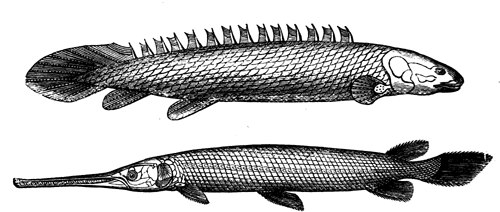
Fig. 122.—Modern Ganoids
(Polypterus. Africa. Lepidosteus.
America).
A Microsaurian of the
Carboniferous Period (Hylonomus Lyelli).
Restored from the skeleton and dermal
appendages found in an erect Sigillaria. Half natural
size.
 ere our experience limited to
the animals whose remains are found in the earlier
Palæozoic rocks, we might be unable to conceive the
possibility of an animal capable of living and breathing in the
thin and apparently uncongenial medium of air. More especially
would this appear doubtful if our experience of the atmosphere
presented it to us as loaded with carbonic acid, and less rich in
vital air than it is at present. Even the mechanical difficulties
of the case might strike us as considerable, in our ignorance of
the capabilities of limbs. Still, as time wore on, we should find
this problem worked out along three distinct lines of
advancement—those of the Mollusk, the Arthropod, and the
Vertebrate, and in each of these with different machinery,
related to the previous locomotive and water-breathing apparatus
of the type.
ere our experience limited to
the animals whose remains are found in the earlier
Palæozoic rocks, we might be unable to conceive the
possibility of an animal capable of living and breathing in the
thin and apparently uncongenial medium of air. More especially
would this appear doubtful if our experience of the atmosphere
presented it to us as loaded with carbonic acid, and less rich in
vital air than it is at present. Even the mechanical difficulties
of the case might strike us as considerable, in our ignorance of
the capabilities of limbs. Still, as time wore on, we should find
this problem worked out along three distinct lines of
advancement—those of the Mollusk, the Arthropod, and the
Vertebrate, and in each of these with different machinery,
related to the previous locomotive and water-breathing apparatus
of the type.
Respiration under water depends, not on the water itself, but
on the small percentage of free oxygen which it contains, and
this is utilised for the aëration of the blood of animals,
by that wonderful and often extremely beautiful apparatus of
delicate fibres or laminæ penetrated with blood-vessels,
which we call a gill. Except those lowest creatures which
aërate their blood merely at the general surface of the
body, all animals capable of respiration in water are provided
with gills in some form, though in many of the humbler
types, like that of the familiar Oyster, the gills are used for
the double purpose of aërating the blood and, by their
minute vibrating threads or cilia, drifting food to the
mouth.
In the great group of radiated animals, the Protozoa,
Cœlenterata, and Echinodermata, no
air-breathing creature exists, or, in so far as is known, has
existed, so that this vast group of animals is limited altogether
to the waters; and this is undoubtedly one mark of its
inferiority.
In the sub-kingdom of the Mollusks the highest class, that of
the Cuttle-fishes and Nautili, has been, singularly enough,
rejected as unfit for this promotion, though it was early
introduced, and attains to a high development of muscular energy
and nervous power. The group next in order, that of the Snails
and their allies, alone ventures in some of its families to
assume the rôle of air-breathing. As might be
expected, in creatures of this stamp the simplest means are
employed to effect the result. In the sub-aquatic species the
gills are contained in a chamber, where they are protected and
kept supplied with water. In the air-breathing species, this
gill-chamber is merely emptied of its contents and converted into
an air-sac or functional lung. Thus a rude and imperfect method
of air-breathing is contrived, which scarcely separates the
animals that possess it from their aquatic relatives, but which
nevertheless gives to us the beautiful and varied groups of the
Land-snails and of the air-breathing fresh-water Snails.
In the worms and Crustaceans the gills are placed at the sides
of the body, and connected with its several segments. But the
Crustaceans, like the Cuttle-fishes, though the highest aquatic
type, never become air-breathers. It is true some of them, like
the Land-crabs, live in the air; but they retain their gills, and
have to carry with them a supply of water to keep these
moist.
But in order to elevate the Annulose type to the true dignity
of air breathing, three new classes had to be introduced,
differing altogether in their details of
structure; and all three seem to have been placed on the earth
about the same time. They are: First, the Myriapods, or
Gallyworms and Centipedes; secondly, the Insects; and thirdly,
the Arachnidans, or Spiders and Scorpions.
In the Myriapods a system of air-tubes, kept open by elastic
spiral fibres, penetrates the body by lateral pores, thus
retaining the resemblance to the lateral respiration of the
Crustaceans and worms. In the Insects, where this type of
structure rises to its highest mechanical perfection, and where
the animal is enabled to be not merely an air-breather, but a
flier, the same system of lateral pores and internal air-tubes is
adopted, and is so extended and ramified as to give a very
perfect respiration. In the Spiders and Scorpions the system is
the same, except that in the latter and a part of the former the
whole or a part of the tracheal system becomes expanded into
air-chambers simulating true lungs.
Among the Vertebrates, the fishes are breathers by gills
attached to arches at the sides of the neck. But already in the
Devonian we have reason to believe that there were fishes having
the swimming-bladder opening into the back of the mouth to
receive air, and divided into chambers, so as to constitute an
imperfect lung. And here we have not, as in the lower types, an
adaptation of the old water-breathing organs, but an entirely new
apparatus. In the next grade of Vertebrates we find, as in the
Frogs, Water-lizards, etc., that the young are aquatic and
breathe by gills, while the adults acquire lungs, sometimes
retaining their gills also, but in the higher forms parting with
them. Thus in the vertebrates alone we have true lungs, distinct
structurally from gills; and these lungs attain to their highest
perfection in the birds and mammals.
Fig. 123.—Wings of Devonian Insects.
Middle Devonian of New Brunswick.
a, Platephemera antiqua
(Scudder). b, Homothetus fossilis (Scudder).
c, Lithentomum
Harttii (Scudder). d, Xenoneura antiquorum
(Scudder).
The oldest air breathers at present known are Scorpions and
insects allied to the modern May-flies, which have been found in
the Silurian. Next to these, and more important in
number and variety, are the insects of the
Erian plant beds of New Brunswick. They were discovered by the
late lamented Prof. C. F. Hartt in the plant-bearing shales of
the Middle Devonian (Fig. 123). The beds containing them
hold also a species of Eurypterus, an obscure Trilobite,
and a Crustacean allied to the modern Stomapods,42 besides a shell which
may possibly be that of a Land-snail, to be mentioned in the
sequel. They are also exceedingly rich in beautifully-preserved
remains of Devonian plants. The collection made by Prof. Hartt is
limited to a few fragments of wings; but these, in the skilful
hands of Mr. Scudder, have proved to be rich in geological
interest. One is a gigantic Ephemera or May-fly, which
must have been five inches in the expanse of the wings, which are
more complex in their venation than those of its modern allies
(Fig. 123, a). Another presents peculiarities between
those of the May-flies and Dragon-flies (Fig. 123,
b). A third is a Neuropter, not belonging to any known
family, but allied to some in the Coal-formation (Fig. 123,
c). A fourth (Fig. 123, d) is a
small and delicate wing, supposed to have belonged to an animal
having some points of resemblance to the modern crickets. Two
others are represented by mere fragments of wings, insufficient
to determine their affinities with certainty. No other insects of
this age have been discovered elsewhere; but it is to be borne in
mind that no other locality rich in Devonian plants has probably
been so thoroughly explored. The hard slaty ridges containing
these fossils are well exposed on the coast near the city of St.
John, and Messrs. Hartt and Matthew of that city, acting, I
believe, in concert with and aided by the Natural History Society
of the place, not only searched superficially, but removed by
blasting large portions of the richest beds, and examined every
fragment with the greatest care. Their primary object was fossil
plants, of which they obtained magnificent collections; and it is
scarcely possible that the insects could have been found but for
the exhaustive methods of exploration employed.
It is interesting to observe, respecting these oldest insects,
that they all belong to those families which have jaws, and not
suctorial apparatus, that they are not of those which undergo a
complete metamorphosis, and that their modern congeners pass
their larval stage in the water. Thus the waters gave birth to
the first insects, and their earliest families were not of those
which suck honied juices or the blood of animals, or which pass
through a worm-like infancy. These groups belong apparently to
much later times.
On one of the specimens collected by Messrs. Hartt and
Matthew, and placed by them in my hands, is a spiral form which
in every particular of external marking resembles a genus of
modern West Indian Land-snails.43 I have hesitated to describe it, as the
structure is lost and the form imperfect; but I cannot help
regarding it as an indication that this group of land animals
also will be traced back to the Devonian age.
Ascending from the Devonian to the Carboniferous, we at once
find ourselves in the midst of air-breathers of various types.
Here are Myriapods, insects of several orders, Spiders,
Scorpions, Land-snails, and Batrachian reptiles, and these of
many species, and found in many localities widely separated. We
can thus people those dark, luxuriant forests, to which we owe
our most valuable beds of coal, with many forms of life; and as
most of these belong to tribes likely to multiply abundantly
where food was plentiful, we can imagine multitudes of Snails and
Millepedes feeding on succulent or decaying vegetable matter,
swarms of insects flitting through the air in the sunnier spots,
while their larvæ luxuriated in decaying masses of leaves
or wood, or peopled the pools and streams. In like manner, in
imagination we can render these old woods vocal with the trill of
crickets and with the piping or booming of smaller and larger
Batrachians. Let us now, in accordance with our plan, inquire as
to the nature of these early air-breathers and the fortunes of
their families in the geological history.
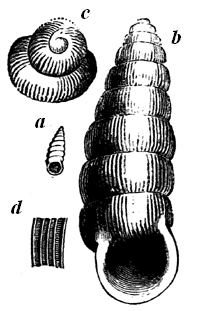
Fig. 124.—Land-snail (Pupa
vetusta, Dawson). From the Coal-formation.
a, Natural size. b, Magnified.
c, Apex. d, Sculpture. Enlarged.
Fig. 125.—Land-snail (Zonites
(Conulus) priscus, Carpenter). From the Coal-formation.
a, Shell. Enlarged; the line below
shows the natural size. b, Sculpture. Enlarged.
The Land-snails known as yet in the Carboniferous are limited
to five or six species, belonging to four genera, all American
and related to existing American forms. The two earliest known
are represented in Figs. 124 and 125.44 One of them is a Pupa, or elongated
Land-snail, so similar to modern forms that it does not merit a
generic distinction, and is indeed very near to some existing
West Indian species. The other is in like manner a member of the
modern genus Zonites. These are from the Coal-formation of
Nova Scotia, and the Pupa must have been very abundant, as it has
been found in considerable numbers in a layer of shale, and in
the stumps of erect trees, in beds separated from each other by a
thickness of 2,000 feet of strata. The Zonites is much more rare.
A second Pupa is found in Nova Scotia, and two species occur in
the Coal-field of Illinois. One of these is a Pupa still smaller
than P. vetusta, and, like some modern
species, with a tooth-like process on the inner lip. The other
has been placed in a new genus,45 but is very near to some of the smaller
American Snails still living. Its most special character is a
plate extending from the inner lip over half the aperture, a
contrivance for protection still seen in some modern forms. Thus
the Land-snails come on the stage in at least three generic
forms, similar to those which still live, but all of small size,
indicating perhaps that the conditions were less favourable for
such creatures than those of the temperate and warmer climates at
present. It may seem a small step in advance for Sea-snails to
lose their gills and to become Land-snails, and this without any
elevation of their general structure; but it must be borne in
mind that we have here not only the dropping of the gills for an
air-sac, but profound changes in teeth, mucous glands, shell, and
other particulars, to fit them for new food and new habits. It is
also singular that the Land-snails at once appear instead of the
intermediate forms of the air-breathing fresh-water snails. These
last may, however, yet be found.
The Millepedes, like the Land-snails, were first found in the
Coal-formation of Nova Scotia, but species have since been
discovered not only in Illinois, but also in Great Britain and in
Bohemia. In Nova Scotia alone two genera and five distinct
species have been found, all in the interior of erect trees, to
which these creatures probably resorted for food and shelter
(Fig. 126). All the species yet known are allied to the
modern Gallyworms, though presenting special features which seem
to separate them as a distinct family,46 and were probably vegetable-feeders. Some of
the species have the peculiarity, unknown among their modern
successors, of being armed with long spines.47 The moist, equable
climate and exuberant vegetation of the Coal-period would
naturally be very favourable to Millepedes, and it is likely that
the discoveries made as yet give but a faint idea of their actual
abundance. It is not improbable that they subsequently declined,
as we know of none between the Carboniferous and the Jurassic,
and they do not seem to have improved up to the modern period.
The Carnivorous Myriapods, however, or
Centipedes proper, a higher and essentially distinct type, are
not known until much more recent times.
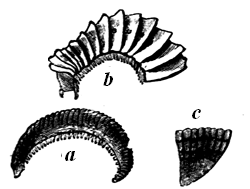
Fig. 126.—Millepedes. From the
Coal-formation.
a, Xylobius sigillariæ
(Dawson). b, Archiulus xylobioides (Scudder).
Anterior segments. Enlarged, c, X. farctus
(Scudder). Caudal portion. Enlarged.
The insects of the Carboniferous as yet known, belong to three
out of the ten or more orders into which the class is divided.
One of these is represented by a number of species of Cockroach,
another by May-flies and a Dragon-fly, and another by some
weevil-like Beetles. The Cockroach is characterised by Huxley as
one of the “oldest, least modified, and in many ways most
instructive forms of insects;” and both he and Rolleston
take its anatomy as typical of that of the class. That these
creatures should have abounded in the Coal-period we need not
wonder, when we consider the habits of those that infest our
houses, and when we further bear in mind the number of species,
some of them two inches in length, that exist in tropical
climates. So many species of this family have been found in the
Coal-formation on both sides of the Atlantic,48 that we may fairly
regard them as constituting one of its most characteristic
features, and as probably the oldest representatives
of the order to which they belong49 (Fig. 127). There were also in the
Coal-period insects allied to the Locusts and to the Mantids, a
carnivorous group. One of the latter (Lithomantis),
described by Woodward, is a magnificent insect, not unlike some
modern tropical species. It was found in the Coal-formation of
Scotland. A still larger species, probably the largest insect
known, has been described by Brongniart. The May-flies
(Ephemeridæ) are represented in the Carboniferous by
several very large species. That of which the wing is shown in
Fig. 128 must have been seven inches in expanse of wings.
The habits of the modern May-flies show us how animals of this
group, living as larvæ in the streams and lakes, must have
afforded large supplies of food to fishes, and when mature must
have emerged from the waters in countless myriads, filling the
air for the brief term of their existence in the perfect state.
The May-flies represent another insect order.50 The Coal-measures of
Saarbruck have afforded several species allied to the white ants
(Termites), insects which must have found abundant scope
for their activity in the dead trees of the
carboniferous forests. The occurrence of beetles,51 especially of the
weevil family, which have as yet been found only in Europe, might
have been expected, considering the habits and modern
distribution of this group. It has been asserted that
moths52 have been found in the
Carboniferous; but the proof of this, so far as known to me, is
the occurrence of leaves, noticed by Sternberg, with markings
similar to those made by the larvæ of minute leaf-mining
moths. This, however, is uncertain evidence. If we consider the
orders of insects not found in the Coal-formation, we can
perceive good reasons for the absence of some of them. Those
containing the lice and fleas, and other minute and parasitic
insects, we can scarcely expect to find. The bees and wasps, and
the butterflies and moths, are little likely to have been present
where there were scarcely any flowering plants; but such groups
as those of the two-winged flies, the plant-bugs and the ants, we
might have expected, but for the fact of their being highly
specialised forms, and for that reason likely to have appeared
later.53 There are, indeed, as
yet no haustellate or suctorial insects known in this early
period. Plausible theories of the phylogeny of insects are not
wanting; but they do not well suit the known facts as to their
first appearance; and perhaps we may venture without much blame
to apply to the insects of the Coal-period the remark made by
Wollaston with reference to the rich insect fauna of the isolated
rock of St. Helena: “To a mind which, like my own, can
accept the doctrine of creative acts as not necessarily
‘unphilosophical,’ the mysteries [of the existence of
these species in an island so remote from other lands], however
great, become at least conceivable; but
those which are not able to do this may, perhaps, succeed in
elaborating some special theory of their own, which, even if it
does not satisfy all the requirements of the problem, may at
least prove convincing to themselves.”
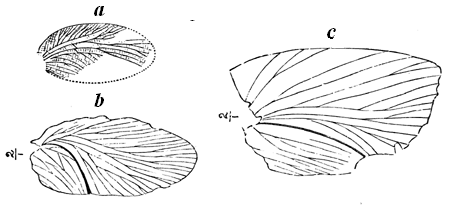
Fig. 127.—Wings of Cockroaches. From
the Coal-formation.
a, Archimulacris Acadicus
(Scudder). b, Blattina Bretonensis (Scudder).
c, B. Hesri (Scudder).
Fig. 128.—Wing of May-fly
(Haplophlebium Barnesii, Scudder). From the
Coal-formation.
Fig. 129.—A Jurassic Sphinx-moth
(Sphinx Snelleri, Weyenburgh).
Fig. 130.—An Eocene Butterfly
(Prodryas persephone, Scudder). From Colorado.
The suctorial insects make their first certain appearance in
the Jurassic; and the magnificent Sphinx Moth in Fig. 129 is
an example of the magnitude and perfection to which that tribe
attained in the age of the Solenhofen slate; though Weyenburgh,
who describes it, fancies that he sees evidence that it may,
unlike any modern moths, have been provided with a sting. The
most perfect and beautiful fossil butterfly known to me is that
represented in Fig. 130, from a photograph kindly given to
me by Mr. Scudder. It is from the Tertiary rocks of Western
America, and is laid out in stone as neatly as if prepared by an
entomologist, while its preservation is so perfect that even the
microscopic scales on the wings can be made out. It belongs to
one of the highest types of modern butterflies, that
to which the Vanessæ belong, but with some points of
structure pointing to the lower group of the
“Skippers” (Hesperiadæ). Scudder remarks
that while the fore-wings resemble those of the former group, the
hind-wings look more like those of the latter; and this seems to
be a common character of two or three others of the few fossil
species known, none of which are older than the Tertiary.
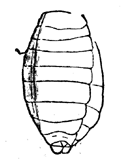
Fig. 131.—Abdominal part of a
Carboniferous Scorpion.54
We know too little of the spiders and scorpions of the
Carboniferous to say more than that they closely resemble modern
forms. Two of the scorpions are represented in Figs. 131 and 132;
and the only spider certainly known, which is from Silesia, is
said to belong to the group of the hunting or trap-door spiders
(Lycosa).55
The Batrachians of the Coal are its most characteristic and
remarkable air-breathers,—especially so as the precursors
of the reptiles of the Mesozoic age. Cope in a recent summary
enumerates no less than thirty-nine genera and about one hundred
species; and to these have to be added at least a dozen more
recently discovered in Europe; though it was only in 1841 that
the first indications of such creatures were found, and were then
regarded by geologists with the same scepticism which some of
them still apply to Eozoon. The first trace ever observed
of batrachians in the Carboniferous consisted of a series of
small but well-marked footprints found by the late Sir W. E.
Logan in the Lower Carboniferous shales of Horton Bluff, in Nova
Scotia. In that year this painstaking geologist had examined the
coal-fields of Pennsylvania and Nova Scotia, with the view of
following up his important discovery of the
Stigmariæ, or roots of Sigillaria, as
accompaniments of the coal-underclays. On his return he read a
paper, detailing his observations, before the Geological Society
of London. In this he mentioned the footprints in question; but
the paper was published only in abstract, and the importance of
the discovery was overlooked for a time, the anatomists evidently
being shy to acknowledge the validity of the evidence for a fact
so unexpected. Fig. 133 is a representation of another slab
subsequently found in beds of the same age in Nova Scotia, and
which may serve to indicate the nature of Sir William’s
discovery. In consequence of the neglect of this first hint by
the London geologists, the discovery of bones of a batrachian by
von Dechen at Saarbruck in 1844, and that of footprints by King
in Pennsylvania in the same year, are usually represented as the
first facts of this kind. My own earliest discovery of reptilian
bones in Nova Scotia was made in 1844, though
not published till some time afterward, and was followed up by
further collections in company with Sir Charles Lyell in 1851, at
which time also the earliest land-snail was found, and in the
following year the first millepede. Since that time the progress
of discovery has been astonishingly rapid, and has extended over
most of the principal coal-areas on both sides of the
Atlantic.
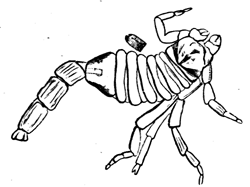
Fig.
132.—Carboniferous Scorpion (Eoscorpius carbonarius,
Meek and Worthen). Illinois.
Fig.
133.—Footprints of one of the oldest known Batrachians,
probably a species of Dendrerpeton. From the Lower
Carboniferous of Parrsboro, Nova Scotia. Upper figure natural
size.
We may, for convenience, call these animals reptiles, but they
are regarded as belonging to that lower grade of reptilian
animals, the Amphibians or Batrachians, which includes the modern
frogs and newts and water-lizards.56 Still it would be doing great injustice to the
carboniferous reptiles not to say, that while related to this
low type, they presented a much greater range of organisation
than it shows at present, evincing a capability to fill most of
the places now occupied by the true reptiles. Some of them were
aquatic, and with limbs rudimentary or little developed, but many
of them walked on the land, and were powerful and predaceous
creatures. They had large and complex teeth, they were protected
by external bony plates, and some of them had in addition a
beautiful covering of horny plates and spines, and ornamental
lappets. Many had well-developed ribs, indicating a condition of
respiration much in advance of that in the ribless batrachians.
Some of them attained to size and strength rivalling those of the
modern alligators, while some of the smallest species exhibit
characters approaching in some respects to the lizards.
Perhaps the most fish-like of these animals are those first
discovered by von Dechen (Archegosaurus, Fig. 134).
Their long heads, short necks, supports for gills, feeble limbs
and long flat tail, show that they were aquatic creatures
presenting many points of resemblance to the Ganoid fishes which
must have been their companions. Yet they show what no fish can
exhibit, fore and hind limbs with proper toes, and the complete
series of bones that appear in our own arms and legs, while they
must have had true lungs and breathed through nostrils. So
different are they from the fish in details, that a single limb
bone, a vertebra, a rib, or a fragment of a skull bone, suffices
to distinguish them. Much has been said recently of the genesis
of limbs; and here, as far as now known, we have the first true
limbs; but it is scarcely too much to say that the feet of
Archegosaurus differ more from the fins of any
carboniferous fish than they do from the human hand; while it is
certain that the feet which made the impressions represented in
Fig. 133, on the lowest beds of the Carboniferous, or that
from the upper coal-formation represented in Fig. 139, were
not less typical or perfectly formed feet than those of modern
lizards.
Leaving these fish-like forms, we find the remainder of the
carboniferous reptiles to diverge from them along three
lines.
Fig.
134.—Archegosaurus Decheni. Head and anterior limb
reduced. Coal-field of Saarbruck.
Fig.
135.—Ptyonius. A Snake-like Amphibian. Coal-measures
of Ohio.—After Cope.
The first leads to snake-like creatures, destitute of limbs,
and which must have been functionally the representatives of the
serpents in the Palæozoic, though batrachian in their
affinities (Fig. 135). They are found both in Europe and
America; and Huxley describes one from Ireland more than
twenty-one inches long, and with over one hundred
vertebræ.57 Some extraordinary traces are found on the
sandstones of the coal-formation,58 which appear to indicate that there may have
been species of this type much larger
than any represented by skeletons, and with bodies perhaps six
inches in diameter. It is not unlikely that they had the habits
of the modern water snakes.
Fig. 136.—A
large Carboniferous Labyrinthodont (Baphetes planiceps,
Owen).
a, Anterior part of the skull, viewed
from beneath. One-sixth natural size, b, One of the
largest teeth, natural size.
A second line leads upward to large crocodile-like creatures,
with formidable teeth, strong bony armour, and well-developed
limbs (Labyrinthodontia, Figs. 136, 137). Some of them
must have attained a length of ten feet. They were lizard-like in
form, could walk well, as is seen from the footprints of some of
the species which present a considerable stride, and moved over
mud without the belly touching the ground. Their tails were long,
and probably useful in swimming. Their heads were flat and
massive, and their teeth were strengthened by a remarkable
folding inward of the outer plate of enamel (Fig. 137
b). The belly was protected by bony plates and closely
imbricated scales. In some of the species at least the upper
parts were clothed with horny scales, and the throat and sides
were ornamented with pendent scaly fringes or lappets.59 Their general aspect
and mode of life must have resembled those of
modern alligators; and in the vast swamps of the Coal-period,
full of ponds and sluggish streams swarming with fish, they must
have found a most suitable abode. While rigid anatomy may ally
these animals rather with the batrachians than the true reptiles,
it is evident that their great size, their capacity for walking
with the body borne well above the ground, their bony and scaly
armour, their powerful teeth and their capacious chests, with
well-developed ribs, indicate conditions of respiration and
general vitality quite comparable with those of the highest
modern members of the class Reptilia.
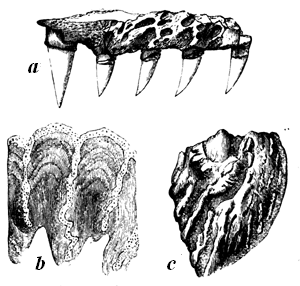
Fig.
137.—Baphetes planiceps (Owen).
a, Fragment of maxillary bone showing
sculpture, four outer teeth, and one inner tooth. Natural size.
b, Section of inner tooth. Magnified, c, Dermal
scale. Natural size.
The third line of progress leads to some slender and beautiful
creatures (Microsauria), chiefly known to us by remains
found in erect trees, and which resembled in form and habits the
smaller modern lizards. They have simple teeth, a well-developed
brain-case, limbs of some length, and bony and scaly
armour, the latter in some cases highly ornate.60 They were probably the
most thoroughly terrestrial, and the most active of the coal
batrachians, if indeed they were not strictly intermediate
between them and the lizards proper. Fig. 138 shows some
fragments of one of these animals; and the animal represented in
Fig. 139, recently figured by Fritsch, probably belongs to
this group.
Fig. 138.—A
lizard-like Amphibian (Hylonomus aciedentatus).
|
a, Maxillary bone; enlarged.
b, Mandible; enlarged.
c, Teeth; magnified, showing front
and side view of ordinary tooth and grooved anterior
tooth.
d, Section of tooth; magnified.
|
e, Scale; natural size and
magnified.
f, Pelvic bone (?); natural
size.
g, Rib; natural size.
h, Scapular bone (?); natural
size.
i, Palate; natural size.
|
Fig.
139.—Stelliosaurus longicostatus (Fritsch). Upper
Coal-formation of Bohemia.
The Labyrinthodonts of the Carboniferous continue upward into
the Permian, where they meet with the true reptiles; and in the
earlier Mesozoic some of the largest and most typical
examples are found.61 But here their reign ceases, and they give
place to reptiles of more elevated type, whose history we must
consider in the next chapter.
Nothing can be more remarkable than the apparently sudden and
simultaneous incoming of the batrachian reptiles in the
Coal-formation. As if at a given signal, they came up like the
frogs of Egypt everywhere and in all varieties of form. If, as
evolutionists suppose, they were developed from fishes, this must
have been by some sudden change, occurring at once all over the
world, unless indeed some great and unknown gap separates the
Devonian from the Carboniferous—a supposition which seems
quite contrary to fact—or unless in some region yet
unexplored this change was proceeding, and at a particular time
its products spread themselves over the world—a supposition
equally improbable. In short, the hypothesis of evolution, as
applied to these animals, is surrounded with geological
improbabilities.
A remarkable picture of the conditions of Palæozoic land
life is presented by the occurrence of remains of reptiles,
millepedes and land-snails in such erect trees as that
represented in Fig. 140. In the now celebrated section of
the South Joggins in Nova Scotia, trees of this kind occur at
more than sixty different levels; but only in one of these have
they as yet been found to be rich in animal remains. Fortunately
this bed is so well exposed and so abundant in trees, that I have
myself, within a few years, removed from it about twenty of them,
the greater number affording remains of land animals.
Fig.
140.—Section showing the position of an erect
Sigillaria, containing remains of land animals.
1. Underclay, with rootlets of Stigmaria,
resting on gray shale, with two thin coaly seams.
2. Gray sandstone, with erect trees, Calamites,
and other stems: 9 feet.
3. Coal, with erect tree on its surface: 6
inches.
4. Underclay with Stigmaria rootlets.
|
a, Calamites.
b, Stem of plant undetermined.
|
c, Stigmaria roots.
d, Erect trunk, 9 feet high.
|
The history of one of these trees may be shortly stated thus.
It was a Sigillaria, perhaps two feet in diameter, and its
stem had a dense and imperishable outer bark, a soft cellular
inner bark liable to rapid decay, and a slender woody axis not
very durable. It grew on the surface of a swamp, now represented
by a bed of coal. By inundations and by subsidence, this
swamp was exposed to the invasion of
muddy and sandy sediment, and this went on accumulating until the
stem of the tree was buried to the height of about nine feet,
before which time it was no doubt killed. After a time the top
decayed and fell, leaving the buried stump imbedded in the sandy
soil, which had now become dry, or nearly so. The trunk decayed,
its inner bark and axis rotting away and falling in shreds into
the bottom of the cylindrical hole, about nine feet deep, once
occupied by the stem, and now kept open like a shaft or well by
the hard resisting outer bank. The ground around this opening
became clothed with ferns and reed-like Calamites, partly masking
and concealing it. And now millepedes and land snails made the
buried trunk a home, or fell into it in their wanderings; and
small reptiles sporting around, in pursuit of prey, or themselves
pursued, stumbled into the open pitfall, and were unable to
extricate themselves, though I have found in some of the layers
in these trees trails which show that these
imprisoned reptiles had wearily wandered round and round, in the
vain search for means of exit, till they died of exhaustion and
famine. The bones of these dead reptiles, shells of land-snails
and crusts of millepedes, accumulated in these natural coffins,
and became mixed with vegetable debris falling into them, and
with thin layers of mud washed in by the rains; and this process
continued so long that a layer of six inches to a foot in
thickness, full of bones, was sometimes produced. At length a new
change supervened, the area was again inundated and drifted over
with sand, and the hollow trunk was filled to the top and buried
under many feet of sediment, never to be re-opened till, after
the whole had been hardened into sandstone and elevated to form a
part of the modern coast, when the old tree and its forest
companions which had shared the same fate with it, are made to
yield up their treasures to the geologist. This history is no
fancy picture. It represents the results of long and careful
study of the beds holding these erect trees, and of the laborious
extraction of great numbers of them, and the breaking-up of their
contents into thin flakes, to be carefully examined with the lens
under a bright light in search of the relics they contained.
Fig. 11 in Chap. I. represents the extraction of one of
these trees, which happened to be partially exposed by the
wasting of the cliff; but many others had to be laboriously mined
out of the rock by blasting with gunpowder.
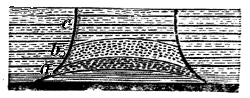
Fig.
140a.—Section of base of erect Sigillaria,
containing remains of land animals.
a, Mineral charcoal. b,
Dark-coloured sandstone, with plants, bones, &c. c,
Gray sandstone, with Calamites and Cordaites.
It is evident that the combination of circumstances referred
to above could not often occur; and it is
therefore not wonderful that only in one place and one bed has
evidence of it been found, and that even in this some of the
trees have been filled up at once by sand and clay, or so crushed
by falling in or lateral pressure, that they could receive no
animal remains. In one respect this is a striking evidence of the
imperfection of the geological record, since, but for what may be
called a fortunate accident, many of the most interesting
inhabitants of the coal forests might have been altogether
unknown to us. On the other hand, it shows how strange and
unexpected are the ways in which the relics of the old world have
been preserved for our inspection, and that there is probably
scarcely any animal or plant that has ever lived of which some
fragment does not exist, did we know where to look for it.
It may be well to remark, in closing this chapter, how many
new forms of life, air-breathing and otherwise, make their first
appearance in the Carboniferous, and have continued to prevail
until now. Here we find the first specimens of Amphibians,
Spiders, Myriapods, Orthopterous and Coleopterous Insects, and of
the Crabs among ten-footed Crustaceans. In the latter group
Woodward has recently described the oldest known crab, from the
Coal-formation of Belgium.
Inhabitants of the English
Seas in the Age of Reptiles.
Pliosaurus, Ichthyosaurus,
Plesiosaurus, Mososaurus, and
Teleosaurus.
 ad we lived in the Carboniferous
period, we might have supposed that the line of the great
Labyrinthodont Batrachians would have been continued onward and
elevated, perhaps, in the direction of the Mammalia, to which
some features of their structure point. But we should have been
mistaken in this. The Labyrinthodonts, it is true, extend into
the Trias; but there is perhaps a sign of their coming
degradation in the appearance in the Permian of the first known
mud-eel, a humble Batrachian form allied to the Newts and
Water-lizards.62 Their special peculiarities are dropped in the
Mesozoic in favour of those of certain small and feeble
lizard-like animals, appearing first in the Carboniferous, and
more manifestly in the Permian, and which are the true
forerunners, though they can scarcely be the ancestors, of the
magnificent reptilian species of the Mesozoic, which have caused
this period to be called “the age of reptiles.”
ad we lived in the Carboniferous
period, we might have supposed that the line of the great
Labyrinthodont Batrachians would have been continued onward and
elevated, perhaps, in the direction of the Mammalia, to which
some features of their structure point. But we should have been
mistaken in this. The Labyrinthodonts, it is true, extend into
the Trias; but there is perhaps a sign of their coming
degradation in the appearance in the Permian of the first known
mud-eel, a humble Batrachian form allied to the Newts and
Water-lizards.62 Their special peculiarities are dropped in the
Mesozoic in favour of those of certain small and feeble
lizard-like animals, appearing first in the Carboniferous, and
more manifestly in the Permian, and which are the true
forerunners, though they can scarcely be the ancestors, of the
magnificent reptilian species of the Mesozoic, which have caused
this period to be called “the age of reptiles.”
The leading reptilian animal from the European Permian has
long been the Proterosaurus, from the copper slates of
Thuringia (Fig. 141), a reptile of lizard-like form, with
well-developed limbs, and attaining a length of three or four
feet. It resembles more nearly those large modern lizards known
as “Monitors,” than any other
existing form. The fore-limb represented in the figure
foreshadows very closely the bones of the human arm and hand.
Besides this we find in the Permian certain lizards
(Theriodonts of Owen) which present the remarkable and
advanced peculiarity already predicted by some Carboniferous
Microsauria,63 of having distinct canine teeth, producing a
division into incisors, canines, and molars, in the manner of the
Carnivorous quadrupeds, which they seem also to have resembled in
some other parts of their skeletons. It is not impossible that
the footprints in the Permian sandstones of Scotland, which have
been referred to tortoises, were those of animals of this type.
Cope has recently described from the Permian of Texas a number of
reptiles which have the complex dentition of the Theriodonts, and
others which simulate that of Herbivorous mammals, by the
possession of flat grinding teeth supposed to be adapted to
vegetable food.64 The teeth of all these Permian reptiles were
set in sockets, also an advanced peculiarity. Thus already in the
Permian, before the final decadence of the Carboniferous flora,
and while the Palæozoic invertebrates still lingered in the sea,
the age of reptiles dawned, and gave promise of its future
greatness by the assumption on the part of reptilian species of
structures now limited to the Mammalia.
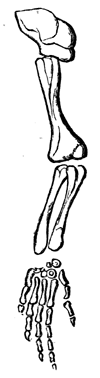
Fig. 141.—Arm of Proterosaurus
Speneri. Reduced. Permian.
But the great Mesozoic reptiles were not fully enthroned, till
the Permian, an unsettled and disturbed age, characterised by
great earth movements, had passed away, and until that period of
continental elevation, with local deserts and desiccation, and
much volcanic action, which we call the Trias, had also
passed.
Then in the Jurassic and early Cretaceous the reptiles
culminated, and presented features of magnitude and structural
complexity unrivalled in later times. At the same time the
Labyrinthodonts disappear, or are degraded into the humble
stations which the modern Batrachians now occupy.
To understand the reptiles of this age, it will be necessary
to notice the subdivisions of their modern representatives. The
true reptiles now existing constitute the following
orders:—1, the Turtles and Tortoises (Chelonia); 2,
the Snakes (Ophidia); 3, the Lizards (Lacertilia);
4, the Crocodiles and Alligators (Crocodilia). All of
these, except the snakes, are well represented among Mesozoic
fossils; but we have in this middle age of the earth’s
geological history to add to them from five to seven orders now
altogether extinct, and these not of low and inferior
organisation, but including species far in advance of any now
existing both in elevation and magnitude, and constituting the
veritable aristocracy of the reptile race. It will best serve our
purpose here to consider chiefly these perished orders and their
history, and then to notice very shortly those that now
survive.
Fig. 142.—Skeleton of
Ichthyosaurus. Lias. England.
The first of the extinct orders is that of the great
Sea-lizards,65 of which the now familiar Ichthyosaurus
and Plesiosaurus of the English seas, to be seen in all
museums and text-books, are the types (Figs. 142, 142a and
142b). These were marine animals of large size, but not
fishes or amphibians. They were true air-breathing reptiles, but
with paddles for swimming instead of feet, and some of them with
long flattened tails for steering and propulsion. They bore, in
short, precisely the same relation to the other members
of the class Reptilia which the Whales and Porpoises bear to the
ordinary quadrupeds. Some of these animals are believed to have
been fifty or sixty feet in length, thus rivalling the Whales,
while others were of smaller dimensions, like the Porpoises and
Dolphins. Some, like the Ichthyosaurus and
Pliosaurus (Fig. 142a), were strongly built
and powerful swimmers, and able to destroy the largest fishes,
while others, like Plesiosaurus, had the body short and
compact, the head small, and the neck long and flexible, and
probably preyed on small animals near the borders of the waters.
Catalogues of British fossils alone include about thirty species
of Enaliosaurs, which haunted the coasts of Mesozoic Europe, a
wonderful fact, when we consider the absence of these creatures
from the modern seas, and the probability that only a fraction of
the species are yet known to us.
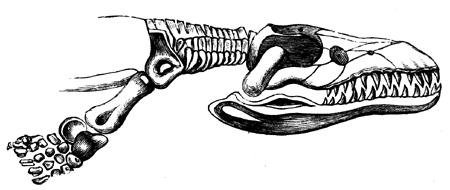
Fig. 142a.—Head of
Pliosaurus. Jurassic. Much reduced.
Fig. 142b.—Paddle of
Plesiosaurus Oxoniensis. Jurassic.—After Phillips.
One-tenth natural size.
Another remarkable group is that to
which Cope has given the name of Pythonomorpha, and which
he regards as allied to the serpents, or as gigantic sea-serpents
provided with swimming paddles, but which Owen considers more
nearly connected with the lizards. In either case they constitute
a group by themselves, remarkable not only on account of their
anatomical affinities with animals so unlike them in general
port, but also for their enormously extended length and
formidable dentition (Fig. 143). Such animals as the
Mososaurus of Maestricht and Clidastes of Western
America may have exceeded in length the largest Ichthyosaurs and
the most bulky of living Cetaceans, though their slender forms
and numerous vertebræ remind one of the semi-fabulous
sea-serpent, rather than of any known animal of our modern age.
They were characteristic of the Later Mesozoic, more especially
of the Cretaceous period, and must have been formidable enemies
to the fishes of their time.
Owen has formed two orders66 for the reception of some remarkable extinct
reptiles of this age, found especially in South Africa and India,
but also in Europe and America. The first includes large
lizard-like animals having horny jaws like those of turtles, and
in some of the species with great defensive tusks
(Fig. 144). Their mode of life is not well known, but they
may have been peaceable and harmless vegetable feeders. The
second has been already referred to, in connection with the
Permian, where it first appears, though it is continued in the
Trias (Fig. 145). The resemblance of the skulls of these
creatures to those of Carnivorous mammals is very striking, and
nothing can be more singular than their early appearance and
their decadence before the advent of those Tertiary mammals which
in more modern times occupy their place.
Fig. 143.—Skeleton of Clidastes.
A great Mososauroid Sea Reptile of the Cretaceous.—After
Cope, much reduced.
Fig. 144.—An Anomodont Reptile of the
Trias (Dicynodon lacerticeps, Owen). Reduced.
Fig. 145.—A Theriodont Reptile of the
Trias (Lycosaurus).—After Owen. Reduced.
Fig. 146.—Skeleton of Pterodochylus
crassirostris. Jurassic of Solenhofen. Reduced.
Fig. 147.—Restoration of
Rhamphorhyncus Bucklandi. Jurassic of England.—After
Phillips.
a, One of the teeth. Natural size.
Perhaps the most extraordinary of all the Mesozoic
modifications of the reptilian type was that of the flying
reptiles, or Pterodactyls. These were, in short, lizards
modified for flight, somewhat in the same manner with the bats
among the mammals. If the bat may be likened to a flying
shrew-mouse, a Pterodactyl may in like manner be compared to a
flying lizard; but the modification in the latter case is by much
the more remarkable, inasmuch as the lizard is a cold-blooded
animal, and far less likely to be endowed with the active
circulation and muscular power necessary to flight than is the
mouse. In point of fact, there can be no doubt that the
Pterodactyls must have been provided with some approach to a
mammalian or ornithic heart, as they certainly were with great
breast-muscles attached to a keel in the breast-bone for working
their large membranous wings. These wings were also somewhat
original in their construction. They were not furnished with
pinions, like those of the bird, but with a membrane like that of
the bat, and this, instead of being stretched over four
enormously lengthened fingers, as in that quadruped, was
supported on a single elongated finger, corresponding, singularly
enough, to the little finger, which usually inconspicuous member
constituted in some of these strange creatures a limb longer than
the whole body (Figs. 146, 147.) The other fingers of the hand
were left free for walking or grasping. They are thus believed to
have been able to walk as well as to fly, and even in case
of need, to swim; while they could
probably perch like birds on rocks and trees. Their heads, though
very lightly framed, were large and reptilian in aspect, and
furnished with sharp teeth, and sometimes probably with a beak as
well. Few creatures of the old world are of more hideous and
sinister aspect. Yet some of them must have been as light and
graceful on the wing as swallows or sea-gulls. There are many
species, most of them small, but some of those in the later
Mesozoic attained to so great a size that the expanse of their
wings must have exceeded twenty feet, making them veritable
flying dragons, probably formidable to all the smaller animals of
their time. Though these animals were strictly reptiles, they
combined in their structures contrivances for aërial
locomotion now distributed between the bats and the birds. They
had bat-like wings and bird-like chests. Some had horny beaks.
All had hollow limb bones, and air cavities to give lightness to
the skull. Their brains approach to those of birds, and, as
already stated, their respiration and circulation must have been
of a high order. These facts are very suggestive, and perhaps in
no point is the imagination or the faith of the devout
evolutionist more severely tested than in realising
the spontaneous assumption of these characters by reptiles, and
their subsequent distribution between the very dissimilar types
in which they are now continued.
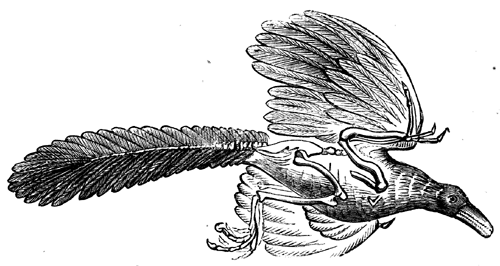
Fig. 148.—A Jurassic Bird
(Archæopteryx macroura).—After Owen.
Fig. 149.—Jaw of a Cretaceous Toothed
Bird (Ichthyornis dispar).—After Marsh. Natural
size.
The approximation of the winged reptiles to the birds is
further increased by the facts that in the Jurassic and
Cretaceous periods there were birds having reptilian tails and
probably toothed jaws (Archæopteryx macroura,
Fig. 148). The species just named, while in its limbs,
trunk, and feathers a veritable perching bird, resembles a
reptile in its head and tail. In the Cretaceous of Western
America, Marsh has recently discovered two distinct types of
toothed birds, one having the teeth in regular sockets, the other
having them implanted in a groove in the jaw. One of these birds
(Ichthyornis dispar, Fig. 149) was larger than a
pigeon, with powerful wings constructed like those of ordinary
birds. It had also the curious and old-fashioned peculiarity of
biconcave vertebræ, like those of fishes and some reptiles.
Another (Hesperornis regalis) stood five or six feet high,
and had rudimentary wings like those of the Penguins. These
toothed birds extend into the Eocene Tertiary, where the
Odontopteryx of Owen has been known for some time. In the
Eocene, however, this toothed bird is associated with others of
ordinary types, allied closely to the Ostriches, the Pelicans,
the Ibis, the Woodpeckers, the Hawks, the Owls, the Vultures, and
the ordinary perching birds. In the Later Mesozoic, indeed, some
reptiles became so bird-like that they nearly approached the
earliest birds; but this was a final and futile effort of the
reptile to obtain in the air that supremacy which it had
long enjoyed in earth and water; and its
failure was immediately succeeded in the Eocene by the appearance
of a cloud of true birds, representing all the existing orders of
the class.
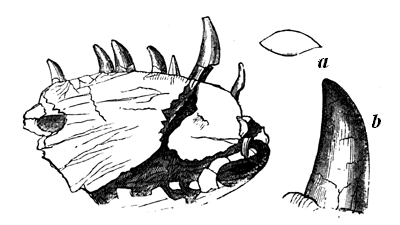
Fig. 150.—Jaw of Bathygnathus
borealis (Leidy). A Triassic Dinosaur from Prince Edward
Island.
a, Cross section of second tooth,
natural size. b, Fifth tooth, natural size.
We may close our notice of the winged reptiles of the Mesozoic
by quoting from Phillips his summary of the characters of
Rhamphorhyncus (Fig. 147)67: “Gifted with ample means of flight, able
at least to perch on rocks and scuffle along the shore, perhaps
competent to dive, though not so well as a palmiped bird, many
fishes must have yielded to the cruel beak and sharp teeth of the
Rhamphorhyncus. If we ask to which of the many families of birds
the analogy of structure and probable way of life would lead us
to assimilate Rhamphorhyncus, the answer must point to the
swimming races, with long wings, clawed feet, hooked beak, and
habits of violence and voracity; and for preference, the
shortness of the legs and other circumstances may be held to
claim for the Stonesfield fossil a more than fanciful similitude
to the groups of Cormorants and other marine divers which
constitute an effective part of the picturesque army of robbers
of the sea.”
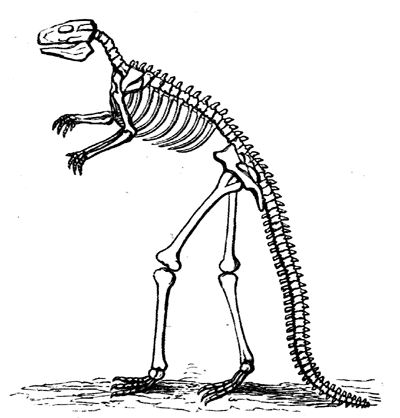
Fig. 151.—Hadrosaurus Foulkii
(Cope). An Herbivorous Dinosaur, 28 feet long.—After
Hawkins’s restoration.
Lastly, the reptiles, in this age of their imperial sway,
culminated in the Dinosaurians, animals far above any
modern Reptilia in the perfection of their organisation, and many
of them of gigantic size. Just as the Pterosaurs filled the place
now occupied by the birds, so the Dinosaurs filled that
represented by the mammals, or rather they took up a place
holding some close relations with both the birds and the mammals.
There were thus reptilian animals which on the one hand were the
elephants and lions of their time, and on the other bore a
grotesque resemblance to creatures so unlike these as the
Ostriches, in so far as their anatomical structure was concerned;
while it is evident that their whole organisation places them in
the highest position possible within the reptilian class.
Some of them must have been herbivorous, and
probably slow in movement and quiet in nature. Others were
carnivorous and of terrible energy, while furnished with the most
destructive weapons (Figs. 152, 153). Many had the power of
erecting themselves on their hind-feet and walking as bipeds; and
to adapt them to this end their hinder limbs were very large and
strong, and they had long pillar-like tails, while their
fore-feet were comparatively small, and used perhaps mainly for
prehension (Figs. 151, 154).
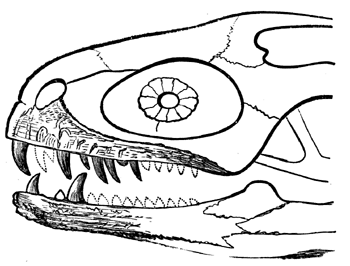
Fig. 152.—Jaws of
Megalosaurus.—After Phillips. One-tenth natural
size.
The size of some of these creatures was stupendous. The
Hadrosaurus of New Jersey, an Herbivorous species
(Fig. 151), when erected on its hind limbs and tail, must
have stood more than twenty feet in height. Megalosaurus
and Iguanodon, of the English Jurassic and Wealden, must
have been of still more gigantic size. The former was a
carnivorous animal, its head (Fig. 152) four or five feet in
length, armed with teeth, sabre-shaped, sharp and crenate on the
edges (Fig. 153), its hind limbs of enormous power, so that
if our imagination does not fail us in the attempt to realise
such a wonder, we may even suppose this huge animal,
much larger than the largest elephant, springing like a tiger on
its prey, a miracle of terrible strength and ferocity, before
which no living thing could stand. Its companion,
Iguanodon, was, on the contrary, a harmless herbivorous
creature, using its great strength and stature as a means of
obtaining leaves and fruits for food, and perhaps falling a prey
to the larger Carnivorous Dinosaurs its contemporaries. A still
more bulky animal was the Ceteosaurus, so admirably
described by Phillips. Its thigh-bone measures more than five
feet in length and a foot in diameter; and it must have stood ten
feet high when on all fours, while its length must have reached
forty or fifty feet. It seems from the forms of its bones to have
been able to walk on land, but probably spent most of its time in
the water, where it may be compared to a huge reptilian
hippopotamus. Very recently some bones found in rocks, possibly
of Wealden age, in Western America, and described by Cope
and by Marsh, indicate that even Ceteosaurus had not
attained to the maximum of Dinosaurian dimensions. These new
animals have vertebræ twenty inches in length and from
twelve inches to thirteen inches in the diameter of their bodies,
while their lateral processes stretched three and a half feet.
The shoulder-blade of one species is five feet in length, and its
thigh-bone is six feet long. From these measurements Cope
concludes that, unlike most other Dinosaurs, it had the fore-feet
larger in proportion than the hind-feet, so as to have somewhat
the appearance of a large giraffe. The bones of the back have a
remarkable cavernous structure, which Cope interprets as
indicating air cavities, to give lightness, as in the case of the
bones of birds; but Owen suggests that the cavities were filled
with cartilage, and that the animals were aquatic in their
habits. Evidently in point of size the Dinosaurs had a better
claim than even Behemoth to be called the “chief of the
ways of God.” Some of them, however, were of small size,
and probably active and bird-like in their movements. One of
these is the animal represented in Fig. 154, a species from
the lithographic limestone of Solenhofen.68
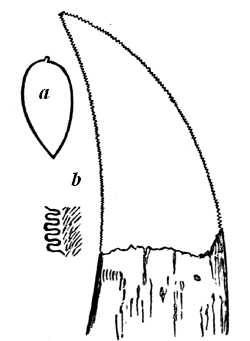
Fig. 153.—Tooth of Megalosaurus.
Natural size.
a, Cross section. b,
Crenellation of edges. Enlarged.
Nothing in the life of the Mesozoic has so seized on the
imagination of evolutionists as the links of connection between
birds and reptiles, which has even been introduced by Huxley into
the classification of animals, by his grouping these heretofore
very distinct classes in one gigantic and comprehensive class of
Sauropsida. It is necessary, therefore, to glance at these
connections, and if possible to arrive at some conception of
their true value. The links which connect the reptiles and the
birds are twofold. First, that between the Dinosaurs and the
ostrich tribe,69 and, secondly, that between the Pterodactyls
and their allies, and the peculiar Mesozoic
birds, such as Archæopteryx. The first would serve
to account for the few exceptional Struthious birds of the modern
world. The second would account for the Passerine and other more
ordinary birds; and thus, according to evolution, the now
somewhat homogeneous class of birds would have a double, or more
probably multiple, origin from several lines of reptilian
ancestors. This, no doubt, greatly complicates the links of
connection, whether these be supposed to indicate derivation or
not.
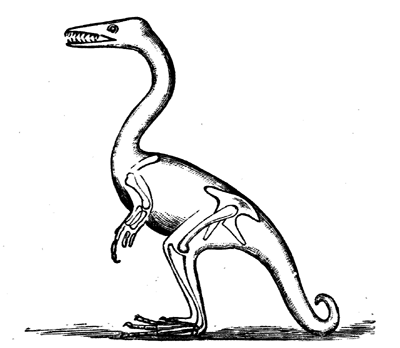
Fig. 154.—Compsognathus. One of
the smaller Dinosaurs.—After Wagner.
If we inquire as to the first connection above stated, we may
define it briefly in the words of Prof. Phillips, with reference
to Megalosaurus, which “was not a ground-crawler,
like the alligator, but moving with free steps, chiefly, if not
solely, on the hind limbs, and claiming a curious analogy, if not
some degree of affinity, with the ostrich.”70 But the question
arises, Was this resemblance merely that of two oviparous bipeds,
or anything more? and when we set off, against the resemblance in
haunch bones and hind limbs, the entire dissimilarity in head, in
fore limbs, in vertebræ, in tail, and probably in external
covering, we are disposed to agree with Huxley in his statement,
with respect to the Struthious birds, that their “total
amount of approximation to the reptilian type is but small; and
the gap between reptiles and birds is but very slightly narrowed
by their existence.” There is therefore here a great gap,
even in the linking together of the types, independently of any
question of derivation.
The second line of connection appears at first sight more
promising. Archæopteryx has a reptilian tail, and claws on
the wing; and, as it had toothed jaws, like some of the birds in
the Cretaceous, must have altogether made a much nearer approach
to a reptile than any modern bird does. The remarkable
“fish-bird” (Ichthyornis) of Marsh is also
very reptilian in some of its characters. But when we compare
these reptilian birds with the Pterodactyls and their allies, a
vast gap at once becomes apparent. Disregarding the external
clothing, we find the wing in the two groups entirely dissimilar
in details of construction, and this dissimilarity extends to the
hind limbs as well, so that the Pterodactyls resemble bats rather
than birds.
Without committing ourselves to any doctrine of development,
we might have rejoiced if our geological discoveries had
established a continuous chain, or two continuous chains, of
being between the reptiles and the birds; but this end is
evidently still far from being attained, though some
approximation has undoubtedly been made. To quote again the
admission of Huxley: “Birds are no more modified reptiles
than reptiles are modified birds, the reptilian and ornithic
types being both in reality somewhat different superstructures,
raised upon one and the same ground-plan”—that
ground-plan being the idea of the air-breathing oviparous
vertebrate, and the reptile representing the less
specialized and less ornate building. As yet the origin of that
idea, and the mode of carrying it out to completion, remain
unknown, except to the Architect and Builder, who may reveal them
to earnest seekers for truth in His own good time.
As to links of connection with the Mammalia, these are still
more obscure. In the Mesozoic the mammals are represented as yet
only by a few small species allied to the pouched (Marsupial) and
insectivorous quadrupeds of Australia, and these are closely
linked with some of the smaller carnivorous Mammalia of the early
Tertiary; but neither approach very closely to any known
reptilian types. Nor have we yet any connecting links between the
great marine reptiles and the Cetaceans and Sirenians which in
the Tertiary take their place in the sea.
It is an interesting fact, to come before us in our next
chapter, that the great land reptiles of the Mesozoic survived
long enough to become contemporary with the introduction and
first luxuriance of the modern types of vegetation in the later
Cretaceous. It would be natural to suppose that access to these
great supplies of better food would have stimulated the increase
and development of the herbivorous species, and would have
indirectly had the same effect on those that were carnivorous;
but the opposite result seems to have followed, and in the next
period the reptiles altogether gave place to the mammals, unless,
indeed, they were themselves by some mysterious and comparatively
rapid process transformed into Mammalia, to suit them to the
better conditions of an improved world.
So far as yet known, the reign of reptiles was world-wide in
its time; and the imagination is taxed to conceive of a state of
things in which the seas swarmed with great reptiles on every
coast, when the land was trodden by colossal reptilian bipeds and
quadrupeds, in comparison with some of which our elephants are
pygmies, and when the air was filled with the grotesque and
formidable Pterodactyls. Yet this is no fancy
picture. It represents a time which actually existed, when that
comparatively low, brutal, and insensate type of existence
represented by the modern crocodiles and alligators was supreme
in the world. The duration of these creatures was long, and in
watching the progress of creation, they would have seemed the
permanent inhabitants of the earth. Yet all have perished, and
their modern successors, except a few large species existing in
the warmer climates, have become subject to the more recently
introduced Mammalia.
How did the ancient reptile aristocracy perish? We are
ignorant of the details of the catastrophe, but their final
disappearance and replacement by the more modern fauna was
connected with a great continental subsidence in the Cretaceous
age, and with changes of climate and conditions preceding and
subsequent to it. Yet the struggle for continued dominion was
hard and protracted; and toward its close some of the champions
of the reign of reptiles were the greatest and most magnificent
examples of the type; as if they had risen in their might to defy
approaching ruin. Thus some of the most stupendous forms appear
in the later Cretaceous, after the great subsidence had made
progress and almost attained its consummation. Like the
antediluvian giants, they were undismayed even when the land
began to sink beneath their feet; and for them there was no ark
of deliverance.
Lower Cretaceous Leaves.
Reduced in size.—After Lesquereux.
a, Aralia Saporteana. b,
Sassafras araliopsis. c, Quercus
primordialis. d, Fagus polyclada. e,
Salix proteæfolia. f, Laurus
proteæfolia.
 or a long time it was believed
by geologists that a great and mysterious gap separated the Upper
Cretaceous from the oldest Tertiary formations; and in Western
Europe, in so far as physical conditions and animal life are
concerned, the severance seemed nearly complete. Oceanic
deposits, like the Upper Chalk, are succeeded by beds of littoral
and estuarine characters. The last and some of the greatest of
the Mesozoic Saurians have their burial-places in the Upper
Cretaceous, and appear no more on earth. The wonderful
shell-fishes of the Ammonite group, and the cuttle-fishes of the
Belemnite type, share the same fate. With the earliest deposits
of the Eocene Tertiary came in multitudes of large Mammalia
heretofore unknown, and the Cetaceans appear in the sea instead
of the great marine lizards; while shells, corals, and
crustaceans of modern types swarm in the waters. Thus it is true
that a great and apparently somewhat abrupt change takes place at
the close of the Cretaceous, and terminates for ever the
reptilian age. Even in regions like Western America, where
physically the later Cretaceous shades gradually into the earlier
Tertiary, so that there have been doubts as to the limits of
these several periods, the same great change in animal life
occurs.
or a long time it was believed
by geologists that a great and mysterious gap separated the Upper
Cretaceous from the oldest Tertiary formations; and in Western
Europe, in so far as physical conditions and animal life are
concerned, the severance seemed nearly complete. Oceanic
deposits, like the Upper Chalk, are succeeded by beds of littoral
and estuarine characters. The last and some of the greatest of
the Mesozoic Saurians have their burial-places in the Upper
Cretaceous, and appear no more on earth. The wonderful
shell-fishes of the Ammonite group, and the cuttle-fishes of the
Belemnite type, share the same fate. With the earliest deposits
of the Eocene Tertiary came in multitudes of large Mammalia
heretofore unknown, and the Cetaceans appear in the sea instead
of the great marine lizards; while shells, corals, and
crustaceans of modern types swarm in the waters. Thus it is true
that a great and apparently somewhat abrupt change takes place at
the close of the Cretaceous, and terminates for ever the
reptilian age. Even in regions like Western America, where
physically the later Cretaceous shades gradually into the earlier
Tertiary, so that there have been doubts as to the limits of
these several periods, the same great change in animal life
occurs.
But a link of connection has at length been found in the
history of the vegetable kingdom. The modern flora
came in with its full force in the later
Cretaceous, before the end of the reptilian age, and continued
onward to the present time. Thus the plant takes precedence of
the animal, and the preparation was made for the mammalian life
of the Eocene by the introduction of the modern flora in the
Cretaceous period. In like manner it is possible that the great
graphite deposits of the Laurentian indicate a vegetation which
preceded the swarming marine life of the Cambrian; and it is not
improbable that the Palæozoic land flora existed long
before the first land animals. Thus the plant, as in the old
Mosaic record, ever appears on the day before the animal, in each
stage of the development of the world.
In Chapter IV. we traced the
history of the old and rich vegetation of the Coal period. But
this vegetation consisted principally of cryptogams and those
lowest phænogams, of the pine and cycad groups, which have
naked seeds. In the modern flora we may arrange the several
groups of plants, somewhat naturally, as follows:—
| Class 1, |
Thallophytes, sea-weeds, lichens,
fungi. |
| ” 2, |
Anophytes, mosses, &c. |
| ” 3, |
Acrogens, ferns, lycopods,
horsetails. |
| Class 4, |
Gymnosperms, pines, cycads,
&c. |
| ” 5, |
Endogens, palms, grasses,
&c. |
| ” 6, |
Exogens, oaks, maples, &c. |
With reference to the history of these groups the record
stands as follows:—In the Palæozoic age classes 3 and
4 culminated, and constituted the great mass of the arboreal
vegetation. On entering the Mesozoic, No. 3 becomes
somewhat diminished, but No. 4 continues with unabated
prevalence, so that the Mesozoic has sometimes been characterized
as emphatically the age of Gymnosperms. With these appear some
Endogens, allied to the modern Yuccas and Screw pines and Arums.
But in the lower Mesozoic rocks we have no representatives of the
broad-leaved Exogens (Angiosperms), which constitute the great
mass of ordinary forest vegetation; and it is only in the
Cretaceous that we find them appearing in force, and that the
monotonous vegetation of the older style was replaced by the more
beautiful and varied forms of our modern woods.
In Europe, in the lower part of the Upper Cretaceous of
Bohemia (Cenomanian), have been found some leaves which
indicate the beginning of this change. These have been referred
to Cæsalpinias or Brasilettos, pod-bearing trees of India
and tropical America, Aralias or Ginsengs, Magnolias, Laurels, an
Ivy, and a peculiar and uncertain genus (Credneria). With
these are noble palms, both of the types with pinnate and palmate
leaves, and trees allied to the Giant Sequoias of California, and
to the Araucarian pines of the southern hemisphere. (See
Frontispiece to this Chapter.) These ancient Cretaceous forests
of Eastern Europe are compared by Saporta with those which now
live in the warmer portions of China or in South
America—truly a marvellous change from the sombre and
uniform vegetation by which they seem to have been immediately
preceded. A still further development of modern vegetation takes
place in the next or highest member of the Cretaceous, the
Maestricht beds (Senonian), where we find a crowd of
modern types. On this great change Count Saporta remarks with
truth that there seem to have been periods of pause and of
activity in the introduction of plants. The Jurassic period was
one of inactivity; and a new and vigorous evolution, as he
regards it, is introduced in the middle of the Cretaceous.
This new and grand elevation of the vegetable kingdom
in the Cretaceous age was not local
merely. In Moravia, in the Hartz, in Belgium and France, even in
Greenland, the same great renewing of the face of the earth was
in progress. In America it was proceeding on a grand scale, and
seems to have set in earlier than in Europe.71 In the Dakota group of
the West, one of the lower members of the Cretaceous, and
covering a vast area, a rich angiospermous flora has been
discovered by Hayden, and described by Lesquereux and Newberry,
and beds of coal have been formed from its remains. In
Vancouver’s Island in British Columbia, Cretaceous coal
measures occur, comparable in value and in the excellence of the
fuel they afford with those of the true coal formation. Some of
the beds of coal are eight feet in thickness, and the shales
associated with them abound in leaves of exogenous trees
generally similar to those still living in America. In these beds
are also found mineralized trunks, which present under the
microscope the familiar structures of our oaks, birches, and
other modern trees. Thus all over the northern hemisphere the
elevation of the land out of the waters of the great Cretaceous
subsidence was signalized by a development of noble and exuberant
forest vegetation, of the types still extant. The following list
of families found in the Cretaceous, after Saporta, will show the
botanist how fully our modern Exogens are represented:—
| Apetalæ. |
Gamopetalæ. |
Polypetalæ. |
| Myricaceæ. |
Apocynaceæ. |
Araliaceæ. |
| Cupuliferæ. |
Ericaceæ. |
Hamameliaceæ. |
| Betulaceæ. |
Ebenaceæ. |
Helleborineæ. |
| Salicaceæ. |
Myrsineæ. |
Magnoliaceæ. |
| Moreæ. |
|
Tiliaceæ. |
| Proteaceæ. |
|
Celastraceæ. |
| Lauraceæ. |
|
Anacardiaceæ. |
| |
|
Myrtaceæ. |
Of the plants in this list, some, like the oaks, birches,
willows, and heaths, are common and familiar members of the flora
of the northern hemisphere to-day, and even of the European
flora. Some, like the Magnolias, Myricas, and witch-hazels, are
characteristically American, and a few, like the Proteaceæ,
are now confined to the southern hemisphere. Some of these
families have dwindled since the Cretaceous time, so as to be
represented by very few species, or at least have not advanced,
while others have multiplied and prospered; and on the whole the
flora of the northern hemisphere seems to have been as rich in
this early beginning of our modern forests as it is at the
present day. Lesquereux’s results, with reference to the
American flora of the Dakota group, are very similar, and present
some surprising features of resemblance to modern American
forests, though he remarks that these Cretaceous trees are
generally characterized by the even or unserrated edges of their
leaves; and the same remark seems to apply to the oldest
Cretaceous leaves of Europe.
A very singular feature of the Cretaceous flora is the number
of species of some genera now represented by few or even a single
species; and this is the more remarkable when we consider how few
species, comparatively, of the older flora, are known to us. For
example, Lesquereux, though aware of the great variability of the
modern Sassafras of America, recognizes eight species of this
genus in the Dakota Cretaceous, one of which seems to be that
still living in America, so that it has continued unchanged,
while the others have perished (Fig. 155). Thus this genus
culminates at once in the Cretaceous, but continues still in one
of its species. Again, the tulip-tree, Liriodendron, one
of the most beautiful, unique, and invariable of American trees,
is represented by one sole species in the present world. There
seem to be no less than four in the Dakota beds, besides others
in the Cretaceous of New Jersey, and one species is found in the
Tertiary of Greenland as well as in that of Europe
(Fig. 156). There are probably four or five
species of plane-tree (Platanus) now extant, of which but
one occurs in America, unless P. Mexicana, the Mexican
plane-tree, is a good species as distinct from the ordinary, more
northern, form. There are seven species, according to Lesquereux,
in the Cretaceous of Dakota alone. This sort of evolution
backward, or from many species to few, would probably be greatly
increased, had we fuller knowledge of the Cretaceous flora, as
there are several genera already represented by as many species
as they can boast in modern times. We have already seen that this
abrupt and sudden culmination of genera and families, and their
subsequent decadence, is no rare thing in geology, and it
connects itself with that idea of periods of creative activity
which we have already had occasion to notice.
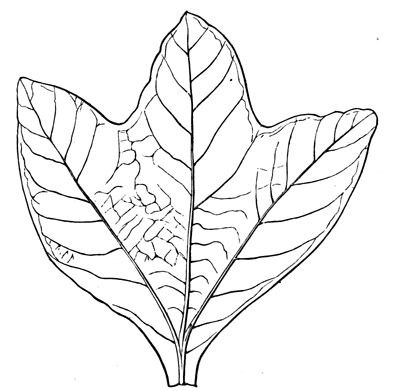
Fig. 155.—Sassafras cretaceum
(Newberry).
Fig. 156.—Liriodendron
primævum (Newberry). A Cretaceous Tulip-tree.
Fig. 157.—Onoclea sensibilis.
Eocene.—After Newberry.
Fig. 158.—Davallia tenuifolia.
Eocene.—After Dawson. Natural size and enlarged.
I have dwelt principally on the phænogamous plants of
the Cretaceous, as presenting the most noteworthy and new
features of the time; but we must not forget that though
cryptogams were deposed from the high position they held in the
Palæozoic, they still existed; and there are more
especially many interesting species of ferns and equisetums in
the Cretaceous and Eocene rocks. These are, however, of
modern types; and it is remarkable that some
of them appear to have continued without even specific change
from the later Cretaceous up to the present time. A striking
illustration of this is afforded by two ferns discovered side by
side in the oldest Eocene beds72 of the plains west of Red River, and described
in Dr. G. M. Dawson’s report on the 49th parallel. One of
these is the well-known and very common Onoclea sensibilis
(Fig. 157), or sensitive fern of Eastern America.73 This species came into
existence at latest at the close of the Cretaceous, and has
apparently been continued in America up to the present time. In
Europe, where it does not now live, it occurs as a fossil in
Eocene beds in the Isle of Mull. The other is Davallia
tenuifolia (Fig. 158), a delicate little plant belonging
to a genus not now represented in America, and to a species at
present found only in Asia. Yet this species also lived in
America in early Eocene times, but has since been banished,
though its former companion, the Onoclea, still holds its
ground. Such cases of specific persistence along with great
changes of habitat are very instructive as to the permanence of
species.
Count Saporta, whose just remarks on the marvellously sudden
incoming of the Cretaceous flora we have already referred to,
also notices the fact that the families and genera represented in
this flora are a most miscellaneous and unconnected assemblage,
showing either the simultaneous appearance of many dissimilar
types, or requiring us to believe in the existence of these and
of intermediate forms for a very long period before that in which
they are first found. This may, however, be placed in connection
with the appearance of an exogenous tree (Syringoxylon) in
the Devonian, referred to in a previous chapter. It would be a
strange and now little suspected case of imperfection of the
record, if it should be found that trees of this type were
lurking in exceptional corners through all the vast periods
between the Devonian and the Cretaceous, to burst forth in
unwonted variety and luxuriance in the latter period.
The new Cretaceous flora appears first in beds which had been
recently elevated from the ocean of the great Cretaceous
subsidence; and when it first flourished, in temperate regions at
least, the continents were of small dimensions, and broken up
into groups of islands. Farther, America would seem to have had
precedence of the Eastern Continent, and the Arctic of the
Temperate regions. Thus on the elevation of the later Cretaceous
land, plants previously established in the far north spread
themselves southward, over newly-raised lands, radiating from the
polar regions into Europe, Asia, and America. This seems the only
way of accounting for the similarity of the plants in these
distant countries. The new flora of the Upper Cretaceous in its
journey southward met with a climate probably warmer than the
present, yet not so warm as to prevent trees similar
to those now living in the same latitudes from flourishing.
Let us now trace this flora through the succeeding ages, in
which I shall follow pretty closely some general statements made
by Count De Saporta in memoirs recently published.
Fig. 159.—Eocene Leaves. From Aix.
a, Quercus antecedens (Saporta).
b, Diospyros pyrifolia (Saporta). c,
Myrica Mathesonii (Saporta).
At the beginning of the Eocene we find a humid and warm
climate in Europe, with great forests of oaks, chestnuts,
laurels, giant pines, and other genera, some of them still
European, others Asiatic or American, and many of them survivors
of the Cretaceous (Figs. 159 to 162); and at the same period
similar forests overspread those great plains of North America
which were rising from out the Cretaceous sea, and there vast
swampy beds were formed of vegetable débris, giving
origin to beds of brown coal, some of them eighteen feet in
thickness. Then came in Europe and Asia that great subsidence
under the sea, during which the Nummuline limestones were
deposited, and when the old continent was resolved again into an
archipelago of islands, perhaps closely connected with
more southern lands. This led to a great increase of southern
forms of plants, which does not seem to have occurred to the same
extent in America, where the flora is more continuous, though
showing a warmer climate in the older than in the newer Eocene.
At this period Palms, Screw pines, Proteaceous shrubs, Myrtles,
Acacias, and other plants of the character of those of more
southern climates were dominant in Europe (Fig. 163). The
well-known beds of Bournemouth, in the south of England,74 contain a rich flora of
the Eocene age, perhaps of its middle period, and reminding us of
the forests of sub-tropical India or Australia.
Fig. 160.—An Ancient Clover
(Trifolium palæogæum, Saporta). Eocene.
Aix.
Fig. 161.—An Eocene Maple (Acer
sextianus, Saporta). Aix.
Fig. 162.—A European Magnoli of the
Eocene (M. dianæ, Saporta). Aix.
Fig. 163.—Flower and Leaf of Bombax
sepultiflorum. Eocene of Aix.—After Saporta.
A European representative of the
Silk-cotton-tree of the East Indies and Tropical America.
Gradual elevation of the land favoured for a time the
extension of these plants, and the warmth of the climate allowed
them to extend even into Arctic latitudes. But in the middle of
the Eocene another subsidence occurred, which exterminated much
of the Eocene flora, and was perhaps accompanied with a reduction
of temperature, in which the more northern lands became covered
with great forests of trees allied to the Pines. In England a
remarkable deposit of this age is that of Bovey Tracey, in
Devonshire, where beds of clay and brown coal have afforded a
rich flora of American and southern types. The Sequoia
shown in Fig. 164 abounds at this place, and is a near
relation to the celebrated “big trees” of California;
the Cinnamomum in Fig. 165 is a type equally foreign
from modern England. It is a curious feature of the Bovey deposit
that immediately above these Eocene beds, holding a rich flora of
warm temperate character, are glacial clays with leaves of Arctic
willows and of the dwarf birch, indicating a climate much more
severe than that of the British Islands at present.75
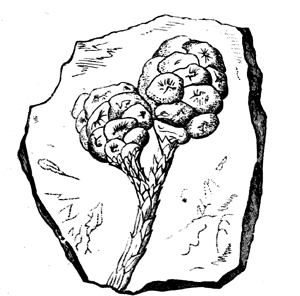
Fig. 164.—Branch and Fruit of
Sequoia Couttsiæ (Heer). Eocene. England.
In the Miocene period the land again rose, and the northern
flora spread itself southward equally over Europe, Asia, and
America, so that the Miocene flora of all these regions is very
similar; and this Miocene flora continues substantially to this
day in Eastern America and Eastern Asia, except that it has
been greatly reduced in number of
species by the intervention of the cold glacial period; but in
Europe and Western America it has been largely replaced by other
apparently more modern species.
Fig. 165.—Cinnamomum Scheuchzeri
(Heer). Eocene. England.
A striking result of recent discoveries is the fact that in
Cretaceous and Eocene times a very warm climate prevailed in the
extreme Arctic regions, and trees of temperate latitudes grew
there freely. In the recent Arctic expedition, Captain Fielden
found in latitude 81° 40', within 600 miles of the Pole, a
bed of lignite, from twenty-five to thirty feet in thickness,
associated with remains of plants such as now grow only in
temperate latitudes.
“From the character of the
plant-remains, Dr. Heer infers that the lignite of this locality
represents an ancient peat-moss, which must have been of wide
extent, with reeds, sedges, birches, poplar, and certain conifers
growing on its banks; while the higher and drier ground in the
neighbourhood probably supported a growth of pines and firs, with
elms and hazel-bushes. The remains of water-lilies suggest the
existence of a fresh-water lake in the old peat-moss, which must
have remained unfrozen during a great part of the
year.”
It is to be observed with reference to the age of these beds,
that as the Later Cretaceous and Eocene flora of Europe and
America migrated from the north, the plants found in the beds of
that age in the temperate latitudes may really be somewhat older
in the Arctic regions, a fact which produces some uncertainty as
to their actual age.
The warmth required for the growth of luxuriant forests near
the Pole might be secured by a different distribution of land and
water, and of the oceanic currents, but the requirements of
plants as to light seem more difficult to meet, and it has been
doubted whether species similar to those which are accustomed in
modern times to regular alternations of day and night could
submit to the long Arctic winter darkness. It is known, however,
that in conservatories in Northern Russia plants supplied with
heat and moisture can endure in winter great deprivation of
light, and at Disco, in Greenland, roses and fuchsias flourish as
house plants.76 These facts show that if there were sufficient
light and heat in summer, a great number of the plants of
temperate latitudes could endure extreme cold and much
deprivation of light in winter.
It may be well here to inform the reader that some confusion
as to the succession of the Cretaceous and Tertiary floras in
America has arisen from the fact that the plants which are
evidently Eocene in Greenland and America have been until lately
incorrectly regarded as Miocene in Europe. In the
Western States, the Dakota group of Lesquereux is overlain by
2000 feet of Cretaceous beds, containing the marine shells
characteristic of that age, but no plants. But in
Vancouver’s Island these same Upper Cretaceous beds contain
an abundant flora, which some botanists have called Tertiary for
the reason already mentioned. Above the 2000 feet of marine beds
overlying the Dakota group is the Lower Lignite group of
Lesquereux, holding many fossil plants, including Palms and other
evidences of a warmer climate than that of the Cretaceous, and
which constitute a Lower Eocene flora corresponding in some
respects to that of Europe. This is succeeded by an Upper Lignite
group, also Eocene, but representing a more temperate climate,
and therefore resembling more nearly the Cretaceous flora. This
is nearly identical with the so-called Miocene of Greenland,
Alaska, and Mackenzie River, which the facts collected by the
Canadian geologists have shown to be really Eocene.77 But the Canadian
reports containing these facts are comparatively little known in
Europe, hence incorrect ideas as to the succession of these
floras have been handed from one writer to another.
To those who adopt extreme views as to the refrigeration of
the northern hemisphere in so-called glacial times, there is
great difficulty in accounting for the continued existence of the
early Tertiary flora; but if we adopt moderate views as to this,
and demand merely a great subsidence, with much reduction of mean
temperature, we may suppose that the plants previously existing
were preserved on insular spots, whence they were ready to
recolonize the land on its emergence from the sea. It seems
certain, however, that our continents never regained, after the
Glacial period, the exuberance of plant life which they presented
in the Miocene and earlier Pliocene; and we shall find that this
statement applies to the world of animals as well as to that of
plants. This reduction was more extreme in Europe than in Eastern
Asia and Eastern
America, and the fact is thus accounted for in a recent
lecture by Prof. Asa Gray:—
“I conceive that three things have conspired to this
loss. First, Europe, hardly extending south of latitude 40°,
is all within the limits generally assigned to severe glacial
action. Second, its mountains trend east and west, from the
Pyrenees to the Carpathians and the Caucasus beyond, near its
southern border; and they had glaciers of their own, which must
have begun their operations, and poured down the northward
flanks, while the plains were still covered with forest, on the
retreat from the great ice-wave coming from the north. Attacked
both on front and rear, much of the forest must have perished
then and there. Third, across the line of retreat of those which
may have flanked the mountain-ranges, or were stationed south of
them, stretched the Mediterranean, an impassable barrier. Some
hardy trees may have eked out their existence on the northern
shore of the Mediterranean and the Atlantic coast. But we doubt
not, Taxodium and Sequoias, Magnolias and Liquidambars, and even
Hickories and the like, were among the missing. Escape by the
east, and rehabilitation from that quarter until a very late
period, were apparently prevented by the prolongation of the
Mediterranean to the Caspian, and thence to the Siberian ocean.
If we accept the supposition of Nordenskiöld, that, anterior
to the Glacial period, Europe was ‘bounded on the south by
an ocean extending from the Atlantic over the present deserts of
Sahara and Central Asia to the Pacific,’ all chance of
these American types having escaped from or re-entered Europe
from the south and east is excluded. Europe may thus be conceived
to have been for a time somewhat in the condition in which
Greenland is now, and indeed to have been connected with
Greenland in this or in earlier times.78 Such a junction, cutting off access of the Gulf
Stream to the Polar Sea, would, as some think, other things
remaining as they are, almost of itself give glaciation to
Europe. Greenland may be referred to, by way of comparison, as a
country which, having undergone extreme glaciation, bears the
marks of it in the extreme poverty of its flora, and in the
absence of the plants to which its southern portion, extending
six degrees below the Arctic Circle, might be entitled. It ought
to have trees, and might support them. But since destruction by
glaciation no way has been opened for their return. Europe fared
much better, but suffered in its degree in a similar way.
“Turning for a moment to the American continent for a
contrast, we find the land unbroken and open down to the tropic,
and the mountains running north and south. The trees, when
touched on the north by the on-coming refrigeration, had only to
move their southern border southward, along an open way, as far
as the exigency required; and there was no impediment to their
due return. Then the more southern latitude of the United States
gave great advantage over Europe. On the Atlantic border, proper
glaciation was felt only in the northern part, down to about
latitude 40°. In the interior of the country, owing doubtless
to greater dryness and summer heat, the limit receded greatly
northward in the Mississippi Valley, and gave only local glaciers
to the Rocky Mountains; and no volcanic outbreaks or violent
changes of any kind have here occurred since the types of our
present vegetation came to the land. So our lines have been cast
in pleasant places, and the goodly heritage of forest-trees is
one of the consequences.
“The still greater richness of North-east Asia in
arboreal vegetation may find explanation in the prevalence of
particularly favourable conditions, both ante-glacial and recent.
The trees of the Miocene circumpolar forest appear to have found
there a secure home; and the Japanese islands, to which most of
these trees belong, must be remarkably adapted to them. The
situation of these islands—analogous to that of Great
Britain, but with the advantage of lower latitude and greater
sunshinetheir ample extent north and south,
their diversified configuration, their proximity to the great
Pacific gulf-stream, by which a vast body of warm water sweeps
along their accentuated shores, and the comparatively equable
diffusion of rain throughout the year, all probably conspire to
the preservation and development of an originally ample
inheritance.”
The comparative paucity in species of the west coast of
America, though the Sequoias and some other forms which have
perished elsewhere are retained there, is admitted to be
exceptional, and not easily explained, except by the supposition
of peculiar local conditions affecting the comparatively narrow
strip of land between the Rocky Mountains and coast ranges, and
the Pacific.
To such widely-distributed and varied and complex phenomena as
those which have been discussed in the present chapter, it is
impossible to do justice in the space at our command. Details in
relation to them will be found in the publications of Heer, of
Saporta, and of Lesquereux, and are well worthy of study by
botanists, to whom alone they can be made fully intelligible. In
general, with reference to now prevalent theories of derivation,
they present two very dissimilar aspects. No difficulty can be
greater to the evolutionist than to account for the simultaneous
appearance of so many modern generic forms in the Cretaceous; and
the fact of many of the genera presenting more and more species
the farther we trace them back is a strange anomaly of evolution.
On the other hand, the number of species continuing unchanged
from the Eocene to the Modern, the others only slightly modified,
and the representative species occurring in the floras of the old
and new continents, appear to many to give great support to the
doctrine of gradual transformation of species. Farther facts and
farther comprehension of the difference between species and races
will be necessary to the settlement of these questions. In the
meantime it would appear that the Jurassic flora rapidly gave
place, at a particular point of geological time, to that of
the modern world, and this not merely in one locality, but over
the whole northern hemisphere; and there are apparently similar
facts in the southern hemisphere as well. It farther appears that
each genus was at first represented by many species, and that as
time went on these were gradually reduced to a few best suited to
survive; and that the changes of climate and level which occurred
distributed these over different parts of the continents in a way
at first sight very anomalous, but which Prof. Gray somewhat
quaintly represents as follows:—
“It is as if Nature, when she had enough species of a
genus to go round the four floral regions (Europe, East Asia,
West America, and East America), dealt them fairly one at least
to each quarter of our zone; but when she had only two of some
peculiar kind, gave one to us, and the other to Japan,
Mantchuria, or the Himalayas; and when she had only one, divided
it between the two partners on the opposite sides of the
table.”
Lastly, it seems very probable that many so-called species are
nothing more than varietal forms, which may very well be modified
descendants of Miocene or Eocene plants now figuring in our lists
under different names.
Sivatherium
Giganteum.
A Great Ruminant of the Miocene of India.
Copied by special permission of James Murie,
M.D., F.G.S., &c.
he incoming of that highest
order of animals in which man himself, in so far as his physical
nature is concerned, takes his place, presents some features
which, though not unparalleled in the history of other forms of
life, are still very striking. The modern Mammalia are somewhat
sharply divided into three very unequal groups. First, those
which present in their full perfection the property of producing
fully developed young, which is one of the distinctive characters
of the class. These are the Placental Mammals. Secondly, those in
which the young are produced in a very imperfect condition, and
are usually nourished for a time in a marsupium or pouch. These
are hence called Marsupials. They are for the most part confined
to Australasia, though a few occur in America; and are decidedly
inferior in rank to the ordinary mammals. Thirdly, those in which
there is a bird-like bill, and also certain bird-like or
reptilian peculiarities of skeleton and of the alimentary canal.
These are the Monotremes, represented by a very few species in
Australia and New Guinea.
In geological history, so far as the facts are at present
known, the second group, that of the Marsupials, antedated the
others by a vast lapse of time. The Marsupials appear in the
Trias, near the beginning of the Mesozoic period. The
Placentals are not found until we reach the
beginning of the Tertiary. The Monotremes would seem to be a
comparatively modern degraded type. Thus the Marsupials existed
throughout the reptilian age, and this in those countries of the
northern hemisphere in which they are not now found. The Mesozoic
Marsupials were, it is true, of small size, but there were
probably numerous species, and though unable to cope with the
great reptiles that swarmed by the shores and on the plains, they
may have found abundant scope in the upland and interior regions
of the continents.
The Upper Trias of Germany has afforded to Professor
Pleininger two teeth of a small mammal, to which the name of
Microlestes antiquus has been given, under the impression
that it was carnivorous, though it now seems more likely that it
was a vegetable feeder. In rocks of nearly the same age in
America, Emmons found a jaw-bone of another species
(Dromatherium sylvestre), which has been supposed to be a
near ally of the existing Myrmecobius fasciatus of
Australia (Figs. 166, 167). In the Stonesfield slate, a member of
the English Jurassic, several other species have been found
(Fig. 168), and a still larger number in the freshwater beds
of the Upper Purbeck. Marsh has obtained many others from the
Jurassic of America. None appear to have yet been found in the
Cretaceous, but they reappear in the Eocene Tertiary, and
continue to the modern time. Their absence in the Cretaceous is
probably a mere accident, and they present an illustration of a
very permanent type little changed since its first introduction.
Lyell enumerates in all thirty-three species from the Mesozoic,
all of them of small size, and all more or less nearly related to
existing Australian Marsupials, though differing much among
themselves, and including both carnivorous and herbivorous forms
(Fig. 169). Marsh has recently suggested a somewhat new
interpretation of these interesting mammalian remains.79 He considers them
divisible into two groups, one allied to the
modern Insectivora (Moles, Shrews, Hedgehogs, &c.), but of
generalized forms. For these he constitutes a new order
(Pantotheria, Marsh). The other group is less numerous and
is Marsupial (Allotheria, Marsh). The jaws in Figs. 166
and 168 belong to the former group, that in Fig. 169 to the
latter. We should thus have both placental and Marsupial mammals
in the Mesozoic. Marsh remarks that the descent of these
different types from a common ancestry would require us to trace
mammals back into the Palæozoic, that is, on the doctrine
of gradual evolution.
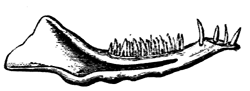
Fig. 166.—Jaw of Dromatherium
sylvestre (Emmons). From the Trias of North Carolina.
Fig. 167.—Myrmecobius fasciatus.
A modern Australian marsupial, allied to Mesozoic species.
So soon as the palæontologist passes from the Upper
Cretaceous to the Eocene, he finds himself in the domain of the
placental mammals, which appear in numerous and large species,
and this, not merely in one region, but in every part of the
world in which these deposits are known to exist.
Fig. 168.—Jaw, and enlarged molar of
Phascolotherium Bucklandi. Stonesfield slate.
England.—After Phillips.
Fig. 169.—Plagiaulax Becklesii.
Jaw, and pre-molar enlarged, showing flat surface, with
ridges.—Purbeck.
Indeed, the recent discoveries in America and in the east of
Europe have almost thrown into the shade those researches of
Cuvier in the Paris basin which first brought this important fact
to light. The Eocene mammals, like the Carboniferous amphibians,
the Mesozoic reptiles, and the Cretaceous forests, appear to
spring full-grown from the earth, and this at nearly the same
time in every part of the northern hemisphere. It has been
suggested that they may have come in gradually without our
knowledge in the Cretaceous period; but if so, we should have
found some of their remains along with those of the Upper
Cretaceous plants. But the prevalence of the great reptiles up to
the close of the Cretaceous would seem to render the co-existence
of large mammals unlikely. It has further been supposed that
geological changes in the southern and northern hemispheres
may have alternated with each other, so that there may be in the
former Cretaceous beds in which the remains of ancestors of the
Eocene mammals may be found. But we do not as yet know of such
deposits. We may be content, therefore, to suppose that at the
close of the Cretaceous there was established somewhere a sort of
Eden for the first placental mammals, in which they were
introduced and could live unharmed by the decaying monsters of
the reptilian age, until the time came when they could increase
and multiply and replenish the earth. The nearest approach to
such a centre of mammalian life is perhaps to be found in those
great American lake basins embedded in the mountains of the West,
which have been so well described by Hayden and Newberry, and
which have yielded so many animal remains to the researches of
Leidy, Marsh, and Cope.
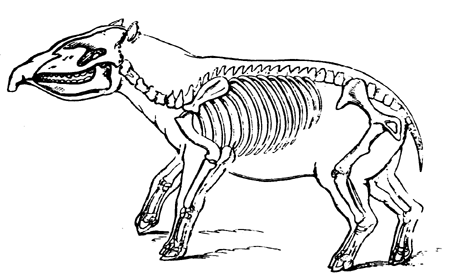
Fig. 170.—Restoration of
Palæotherium magnum. Eocene.—After Cuvier and
Owen.
The typical deposits of the Early Eocene have long been those
of the Basin of Paris, where thick and highly fossiliferous
deposits of this age rest on the more or less denuded surface of
the Upper Chalk, and have afforded a rich harvest of remains
of about fifty species of placental quadrupeds, whose bones have
been found in the gypsum quarries of Montmartre. The great
majority belong to the Ungulates, or hoofed animals, and the most
abundant genera are those called by Cuvier
Palæotherium (Fig. 170) and
Anoplotherium, of which there are several species, and
which have affinities with the modern Tapirs on the one hand, and
with the Horse on the other. Of the Unguiculate or clawed orders
there are carnivorous forms allied to the Hyæna and the
Fox, a Bat and a Squirrel; and the Marsupials are represented by
an Opossum. Lyell describes a bed of clay associated with the
gypsum, in which are numerous footprints, probably produced on
the margin of a lake. Many of these might be referred to the
Palæothere and its allies; but there are others belonging
to quadrupeds yet unknown, and there are also tracks of
tortoises, crocodiles, and lizards, and of a large wading bird.
Such a bed, perhaps deposited on the margin of a salt lake,
resorted to as a “lick” by herbivorous animals, and
by the carnivorous species which preyed on them, is well fitted,
by the thronging life which it indicates, to teach how little we
can know of the actual number and variety of the old inhabitants
of the earth.
In England, Eocene beds of the age of those of Paris, occupy
the valley of the Thames and the Isle of Wight and neighbouring
parts of Hants. They have afforded mammalian fossils similar to
those of Paris, though less abundantly, but they are rich in
remains of marine animals and of land plants.
Instead of describing the well-known animals of the French and
English Tertiaries, from these Eocene deposits upwards, I shall
shortly sketch the succession in America, as worked out by Marsh
and Cope, with the aid of the admirable summary given by Gaudry
of the present state of knowledge with reference to the sequence
of mammalian life from its appearance in the Early Eocene up to
the present time.80
Eocene mammals, especially those gigantic whale-like
creatures called Zeuglodon
(Fig. 180), have been found in Eastern North America, but
the most remarkable discoveries have been made in the Western
Territories, where vast numbers of bones are imbedded in certain
ancient and wide-spread lacustrine beds. It may be well to
premise here that though the division into Eocene, Miocene, and
Pliocene is recognised in America as well as in Europe, the
limits of these groups may not precisely correspond with those in
the Old World. Still we have this certain point of departure,
that the Eocene begins where the peculiar animals of the
Cretaceous end, and that the drying up of the later Cretaceous
sea and the establishment of the Eocene land were probably nearly
contemporaneous in both continents. It is true, however, in
animals as in plants, that in the successive periods of the
Tertiary, America presents an older aspect than Europe, just as
its modern fauna still contains such old forms as the
opossum.
It would seem that as the mountain-ranges and table-lands of
Western America emerged from the Cretaceous waters, they became
clothed with Eocene forests and inhabited by Eocene mammals. But
the waters, dammed up by surrounding ridges, formed large lake
basins, which were drained only by the slow excavation of
“cañons” as the land rose still higher. In the
successive deposits formed in these lakes both by ordinary
deposition of silt and by paroxysmal showers of volcanic ashes
were entombed great numbers of the animals which fed on their
banks. It appears that these deposits, which in some places are
estimated at not less than 8000 feet in thickness, hold the
remains of three successive faunas, differing materially from
each other, and representing the Lower, Middle, and Upper Eocene.
On the flanks of the elevated region supporting the beds formed
in the Eocene lakes, are other later lake basins of Miocene age,
also abounding in animal remains. East of the Rocky Mountains,
and also on the Pacific coast, are still later Pliocene
deposits holding other and more modern Mammalia.
The vast area of these formations and the complete sequence which
they show are scarcely equalled elsewhere.
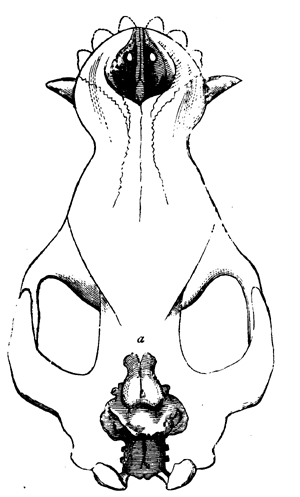
Fig. 171.—Coryphodon Hamatus. A
Lower Eocene Perissodactyl skull, greatly reduced, showing small
size of brain, a.—After Marsh.
As in the Paris basin, the large Ungulates constitute the most
conspicuous feature. The great group is now usually divided into
those that are odd-toed (Perissodactyl) and those that are
even-toed (Artiodactyl). Though these are apparently arbitrary
characters, they correspond with other more fundamental
differences. The first includes such modern animals as the
Rhinoceros, Tapir, and Horse. The second includes two somewhat
distinct assemblages—that with mammillated teeth, of which
the Hog and Hippopotamus are types (Bunodonts), and that with
crescental plates of enamel in the teeth, of which the Ruminants
like the Deer, Ox and Camel, are examples (Selenodonts).
Fig. 172.—Fore-foot of
Coryphodon. Greatly reduced.—After Marsh.
The most characteristic animals of the lowest Eocene belong to
the genus Coryphodon (Figs. 171, 172), which so abounded
in Eocene America that bones of about 150 individuals were found
by the Wheeler Expedition in one year in the Eocene beds of New
Mexico. These animals in their dentition approached the American
tapirs, except that they had great canines like the bear, while
their feet resembled those of the elephant, and some of them
attained the dimensions of the ox. Coryphodon is thus, as
might be expected in a primal placental mammal, a creature of
somewhat generalised type. Another point in which it resembles
some at least of its early Tertiary contemporaries is the small
size of the brain, especially in those parts of it supposed to
minister to the intelligence and higher instincts (Fig. 171,
a). It is certainly remarkable that as Tertiary time went
on the successive groups of mammals were gifted with brains of
larger and larger size, fitting them for
higher functions; and ultimately for associating with man.
Animals thus low in development of brain were probably slow and
sluggish and stubbornly ferocious, and dependent on brute force
for subsistence and defence; and they would have been altogether
unsuitable for domestication had they lived to the present
time.
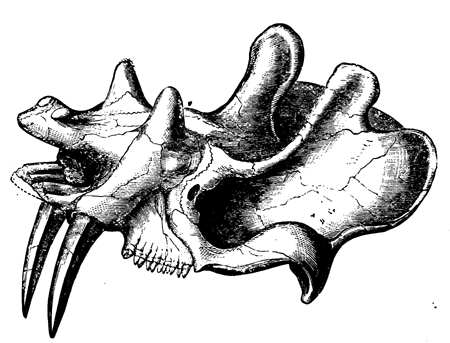
Fig. 173.—Skull of an Upper Eocene
Perissodactyl (Dinoceras mirabilis), showing three pairs
of horn-bases. Greatly reduced.—After Marsh.
In the Middle Eocene, the place of Coryphodon was taken
by Dinoceras and allied forms. Some of the species nearly
equalled the elephant in size, but had shorter and stouter limbs,
each supported on five great toes—the most perfect possible
sort of pedestal foot (Figs. 172, 174). They were heavily armed
with immense canines on the upper jaws, and two or even three
pairs of horns or hard protuberances on the head (Fig. 173).
Creatures so supported and so armed, and living
where food was plentiful, might well dispense with any great
degree of intelligence, and their development of brain is
consequently little better than that of Coryphodon. These
great and characteristic Eocene families have no known
successors; and in the Miocene age their place is taken by a very
different group, that of which Brontotherium is the type
(Fig. 175). They are creatures of huge size, with a pair of
horn-cores on the nose, and feet with four toes in front and
three behind, resembling in form those of the rhinoceros.
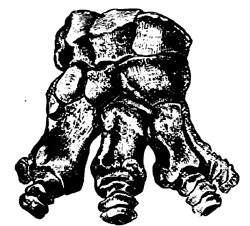
Fig. 174.—Fore-foot of
Dinoceras. Greatly reduced.—After Marsh.
Fig. 175.—Skull of Brontotherium
ingens (Marsh). Greatly reduced. A Miocene Perissodactyl.
Fig. 176.—Series of Equine
Feet.—After Marsh.
a, Orohippus, Eocene. b, Miohippus, Miocene. c, Protohippus, Lower
Pliocene. d, Pliohippus, Upper Pliocene. e, Equus, Post-Pliocene and Modern.
While these gigantic Perissodactyles have no successors as yet
known to us, another and less conspicuous Eocene type can be
traced onward to modern times by a chain of successors which the
imagination of evolutionists has converted into a veritable
genetic series, to which they appeal as a
“demonstration” of the process of descent with
specific modifications. In the Lower Eocene are found the remains
of a diminutive ungulate (Eohippus), of the stature of a
moderately-sized dog. It has four toes and a rudiment of a fifth
in front, and three toes behind; and has teeth slightly
resembling those of the horse, but more simple and shorter in the
crown. In this creature it has been supposed that we have a
direct ancestor of the modern horse. A very similar genus
(Orohippus), lacking only the fifth rudimentary toe,
replaces Eohippus in the Middle Eocene. Mesohippus
of the Lower Miocene is as large as a sheep, and has only three
toes on the fore-foot and a splint bone, while its teeth assume a
more equine character (Fig. 176). In the Upper Miocene
Miohippus continues the line, while Protohippus of
the Lower Pliocene is still more equine and as large as an ass,
and corresponds with the European Hipparion in having the
middle toe of each foot alone long enough to reach the ground. In
the Upper Pliocene true horses appear with only a single toe, and
splint bones instead of the others. In America, though the horse
was unknown at the time of the discovery of
the continent, several species occur in the Tertiary and
Post-Pliocene, showing that the genus existed there up to a
comparatively late period; and when re-introduced it has thriven
and run wild in the more temperate regions. What cause could have
led to its extinction in Post-Glacial times is as yet a mystery.
This genealogy of the horse, independently of its evolutionist
application, is very interesting. It shows that some Eocene types
were suited to continuance, and even adapted for extension, while
others were destined to become altogether extinct at an early
date. It shows farther that the power of continuance resided not
so much in the gigantic and prominent species as in smaller
forms. It is to be observed, however, that Gaudry and other
orthodox evolutionists in Europe deduce the horse, not from
Eohippus, but from Palæotherium, and that it
is equally impossible to verify either phylogeny, since the mere
sequence of more or less closely allied species in time does not
prove continuous derivation. Nor indeed are we certain that
one-toed horses like those now living did not exist on the dry
plains in Eocene times, since the inhabitants of these plains are
probably unknown to us. An amusing illustration of the probable
reason of the disappearance of the missing links has recently
been given by a writer not very favourable to the new philosophy.
The several consecutive species may be represented by coins. We
may suppose, for example, sixpences to have been coined first,
then sevenpenny and eightpenny pieces, and so on up to a
shilling, then pieces representing thirteen, fourteen and fifteen
pence, and so on up to a half-crown or crown; but all the
intervening denominations between the sixpence and the shilling,
and between the shilling and the half-crown, were found
practically of little use. Hence few were coined, and they soon
became obsolete. Thus the antiquary would find only a few
denominations, and those connecting them would be seldom or never
found. It is plain that if we could suppose that nations
constructed their coinage after this unthinking and
empirical fashion, and that if we were justified in ascribing a
similar procedure to the Creator, it might help to account for
the facts as we find them, otherwise we should rather suppose
that in both cases something like plan and calculation determined
the selection of the species produced, whether of coins or
animals. But Chance is a blind goddess, and if we instal her as
creator, we must expect the work to proceed by a series of
abortive experiments.
The Perissodactyls are not numerous at present. The three
groups represented by the Horse, Rhinoceros, and Tapir constitute
the whole; and the two latter forms can be traced back to
predecessors in Eocene times, even more closely resembling them
than those supposed to be ancestors of the horse resemble that
animal. But the few species now living have thus a vast
surplusage of possible ancestors. Many species and genera are
dropped without any modern representatives, so that the tendency
has been to a gradual elimination of surplus types, until only a
few isolated and somewhat specialised forms remain at present.
Yet this process of elimination is not necessarily an evolution
or survival of the fittest, in the sense of modern
derivationists. It rather implies that in certain past states of
the earth the conditions of life afforded scope for many forms
not now required, or replaced by other types more suited to the
advanced and specialised nature of the world.
On the other hand, the Artiodactyls have gained in numbers and
importance, in comparison with their odd-toed comrades; and this,
though an odd number, namely five, was the typical number with
which the earliest quadrupedal forms began life far back in the
Palæozoic. The typical Artiodactyls are those that cleave
the hoof, and many of which also chew the cud; and they are of
all others, the horse perhaps excepted, those that are most
valuable to man. The lower type (Bunodont), to which the hog
belongs, is the older; and many hog-like animals
occur from the earlier Tertiary upwards. In the Upper Eocene,
even-toed species appear with an approach at least to the
crescent-shaped teeth of the modern deer and oxen. Some of the
species are obviously forerunners of the modern antelopes and
deer, though as yet destitute of horns or antlers. Others, like
Oreodon, are of more hog-like aspect, though believed to
have been ruminants (Fig. 177). These are characteristic of
the Middle Miocene, at which stage true deer appear in Europe
(Dicroceras), though they are not known in America until
the Pliocene period. The earliest deer have small and simple
antlers, these ornaments becoming larger and more elaborate in
approaching the modern era. The hollow-horned ruminants appear
for the first time in America in the Lower Pliocene; and no
ancestry has so far been attempted to be traced for them. The
antelopes of this group, as well as the gigantic
Sivatherium of India,81 allied to the modern prong-horned antelope of
North America, were prominent in the Old World in the
Miocene.
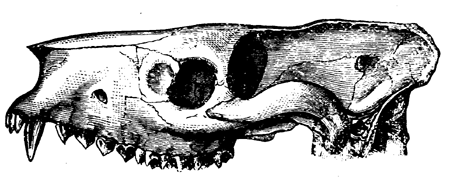
Fig. 177.—Oreodon major. A
generalised Miocene ruminant, with affinities to the Deer, Camel,
and Hog. Greatly reduced.—After Leidy.
Fig. 178.—Lower Jaw of
Megatherium. Greatly reduced. Post-Pliocene of South
America.—After Owen.
Fig. 179.—Ungual Phalanx and Claw-core
of Megatherium. Greatly reduced.
A very noteworthy and specially American group of mammals is
that of the Edentates, the Sloths and Ant-eaters, a group
which à priori we should have supposed would have
been one of the earliest in time. They appear, however, first in
the Miocene, without even any suggested ancestry, and are
represented from the first by large species,
though they attain their grandest stature in the
Megatherium and Mylodon of the Post-Pliocene (Figs.
178, 179), which were sloths of so gigantic size that they must
have pulled down trees to feed on their leaves, unless, indeed,
there were trees equally colossal for them to climb. But before
the modern time, like the American horses, the larger herbivorous
forms suddenly disappear, and are now represented only by a few
diminutive South American species, which can scarcely, by any
stretch of imagination, be supposed to be descendants of their
gigantic predecessors. The history of these animals, like those
of the great Tertiary marsupials of Australia and the many
Miocene elephants of India, affords a remarkable illustration of
the persistence of similar groups of creatures in successive ages
in the same region, along with diminution in magnitude and number
of species toward the modern times.
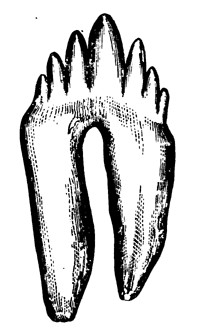
Fig. 180.—Tooth of Eocene Whale
(Zeuglodon cetioides). One-half natural size.
The Whale-tribe (Cetaceans) at once in the earliest Eocene
takes the place of the great Sea-lizards of the Cretaceous; and
the oldest of the whales are in their dentition more perfect than
any of their successors, since their teeth are each implanted by
two roots, and have serrated crowns, like those of the Seals. The
great Eocene whales of the Southern Atlantic (Zeuglodon)
(Fig. 180), which have these characters, attained the length
of seventy feet, and are undoubtedly the first of the whales in
rank as well as in time. This is perhaps one of the most
difficult facts to be explained on the theory of evolution.
Allied to the whales is the small and peculiar group of
the Sea-cows or Dugongs (Sirenians).
These creatures, highly specialised and very distinct from all
others, appear in the Early Tertiary in forms very similar to
those which now exist, and probably in much more numerous
species, and they pursue the even tenor of their way down to
modern times without perceptible elevation or degradation.
“We have questioned,” says Gaudry, when speaking of
the Tertiary Cetaceans, “these strange and gigantic
sovereigns of the Tertiary oceans as to their
progenitors—they leave us without reply.” Their
silence is the more significant as one can scarcely suppose these
animals to have been nurtured in any limited or secluded space in
the early stages of their development. The true Seals, which are
more elevated than the Whales, and very different in type, appear
much later, and without any probable ancestry.
The Elephants, two or three species of which constitute in the
modern world the sole representatives of an order, are a remnant
of an ancient race once vastly more numerous. They appear in
Europe and Asia in the Miocene, when they were represented by
three distinct genera (Elephas, Mastodon, and
Dinotherium). The second genus (Fig. 181) differs
from the proper Elephants in having tuberculated teeth,
indicating a more swinish habit, and probably a more fierce
disposition. The third (Fig. 182) is remarkable for the
immense size of some of its species, far exceeding the modern
Elephants, and has the farther peculiarity of a pair of
descending tusks on the lower jaw, constituting a strong and
heavy grubbing-hoe, with which it could probably dig deeply for
roots. So important was the group in Miocene times that seven
elephants are already known from this formation in India alone,
besides three species of Mastodon. Four or five Miocene Mastodons
are known in Europe, besides two Dinotheria; and the true
Elephants appear there in the Pliocene, and continue to the
beginning of the Modern. The elephantine animals are not known in
America till the Pliocene, but in that and the Pleistocene, and
perhaps up to the human period, the western continent, now
altogether destitute of elephants, possessed several species
both of Elephas and Mastodon, which extended, as in
Siberia, even into the Arctic regions; and, as we know from
specimens preserved in a frozen state in the latter region, some
of the species were so protected by dense fur as to be able to
endure extreme cold. The candid Gaudry closes his summary of the
history and affinities of the elephantine animals with the words:
“However, the sum of the differences compared with that of
the resemblances is too great to permit us to indicate any
relation of descent between the proboscidians and the animals of
other orders known to us at present.” So these greatest of
all the animals of the land, with their strangely specialised
forms and almost human sagacity, stand alone, without father or
mother, without descent.
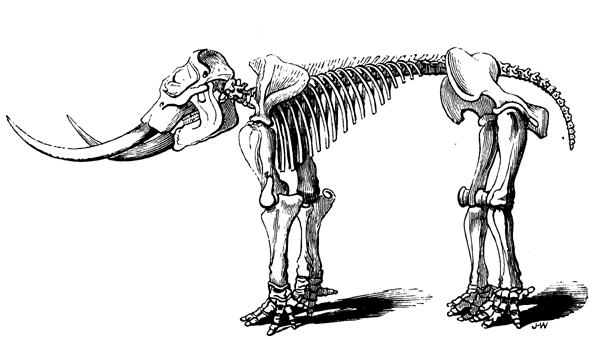
Fig. 181.—Mastodon ohioticus. An
American Elephant. Post-Glacial.
Fig. 182.—Head of Dinotherium
giganteum. Greatly reduced. Miocene of Europe.
Fig. 183.—Wing of Vespertilio
aquensis. An Eocene Bat. After Gaudry.
The Rodents, or gnawing animals, appear in the Early Eocene on
both continents in familiar forms allied to our Squirrels
and Rats. Porcupines and Beavers are added
in the Miocene. This group seems thus to have continued much as
it was; and it is still perhaps represented by as many species as
at any previous time. Many of the ancient forms were, however,
much larger than any modern species, and some of these larger
forms82 present singular points
of approach to very distinct types, as, for example, to that of
the Bears; but these large and composite species are long since
extinct. The insectivorous mammals have much the same history
with the Rodents. Such highly specialised and abnormal forms as
the Bats might be supposed to be modern. But, strange to say,
they appear with fully developed wings both in Europe and America
in the Eocene (Fig. 183). Gaudry thinks that it is
“natural to suppose” that there must have been
species existing previously with shorter fingers and rudimentary
wings; but there are no facts to support this supposition, which
is the more questionable since the supposed rudimentary wings
would be useless, and perhaps harmful to their possessors.
Besides, if from the Eocene to the present the Bats have remained
the same, how long would it take to develop an animal with
ordinary feet, like those of a shrew, into a bat?
The Early Eocene was not altogether a time of peace in the
animal world. The old carnivorous Saurians were dead and buried,
but their place was taken by carnivorous mammals, allied to our
modern Tigers, Hyænas, Foxes, and Weasels. The Carnivora,
however, were subordinate in the Eocene, and, as already
remarked, some of them appear to be intermediate between
marsupial and placental forms—a fact which evolutionists
have noticed with much satisfaction. They appear to attain to
their culmination in the Miocene, when their powers seem to be
proportionate to those of the great and well-armed quadrupeds
they had to deal with. To this age belongs the introduction of
the terrible “Cymetar-toothed Tiger”
(Machairodus, Fig. 184). Its huge tusk-like
canines and powerful limbs seem to fit it more than any other of
the cat family for destructive efficiency. Yet ordinary cat-like
animals were contemporary with it, and have survived it, since
Machairodus disappears in the Post-Pliocene, though in previous
periods it had been very widely distributed on both continents.
It is a curious fact, perhaps of more significance in various
ways than we yet understand, that the Dog-bear
(Arctocyon), of the oldest French Eocene, believed to be
the oldest placental mammal known, though technically placed
among the Carnivora, has a kind of dentition indicating that,
like the modern Bears, it was really omnivorous; and its skull
shows some peculiarities tending to those of the Marsupials.
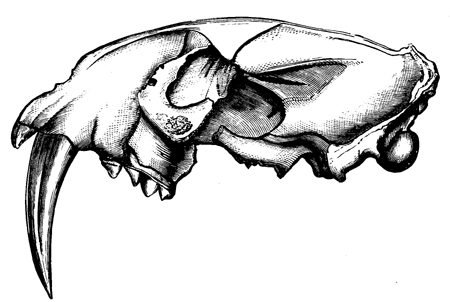
Fig. 184.—Skull of a Cymetar-toothed
Tiger (Machairodus cultridens). Pliocene, France.
Reduced.
Fig. 185.—Lower Jaw of Dryopithecus
Fontani. An Anthropoid Ape of the Middle Miocene of France.
Natural size.
Much interest attaches to the first appearance of the order of
Apes (Quadrumana), or, if we take the somewhat deceptive
classification favoured by some modern zoologists, the
Primates, including the apes and man. They begin
in the Eocene, both in Europe and America, with the lowest tribe,
that of the Lemurs, now confined to the island of Madagascar and
parts of Africa and Southern Asia, and which may, Gaudry thinks,
be modified Marsupials, though he admits that this is hard to
understand. He mentions the resemblance of the teeth of monkeys
to those of some hog-like animals, a resemblance, however, merely
marking a similarity of food, and suggests on this ground that
some of the primitive ancestors of the hog may have also given
rise to the Monkeys. In the Miocene of Europe and Asia we have
true Apes; and one of these, which rivals man in stature
(Dryopithecus), belongs to the group of the gibbons, or
long-armed apes, one of the higher families of the modern
Quadrumana (Fig. 185). This animal presents, indeed,
the nearest approach to man made by any Tertiary mammal. Still
the differences are great, as, for instance, in the much larger
size of the canines and premolars. Yet so much confidence has
Gaudry in the resemblances, that he even ventures to suggest that certain flint chips found in the
Miocene of Thenay, and which have been supposed to indicate human
workmanship, may have been chipped by the hands of
Dryopithecus. Should this view be adopted by
evolutionists, it will at least have the effect of preventing
flint chips from being received as evidences of the antiquity of
man.
It is scarcely necessary to sum up this review of the history
of the Tertiary mammals. Much that has been said may be modified
or changed by future discoveries; but the great facts of the late
appearance of the placental mammals, of their rapid introduction,
with their ordinal differentiation nearly complete over all the
continents, of the speedy culmination and early decadence of many
types, and of the unchanged permanence of others, must in the
main be sustained. It is not too much to say that to account for
these facts the evolutionist must abandon the idea of gradual
change, and adopt that of “critical periods” when
sudden changes occurred. The history becomes inexplicable, unless
with Mivart, Le Conte, and Saporta, we admit “periods of
rapid evolution” alternating with others of stagnation or
retrogression; and if we admit these, we practically fall back on
the old idea of creation; only it may perhaps be “Creation
by Law.”
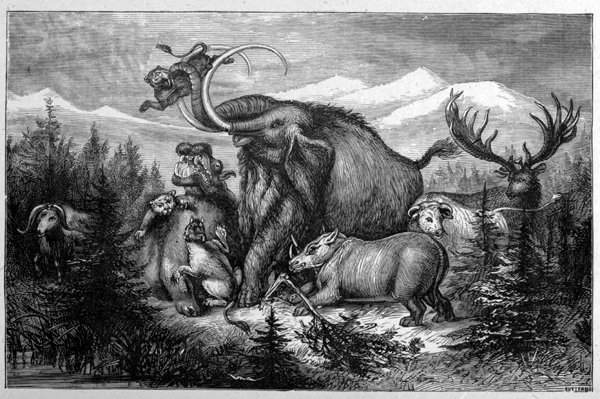
Contemporaries of
Post-Glacial Man. From a painting by Waterhouse
Hawkins.
itherto we have met with no
trace of man or of his works. Yet there have been in our upward
progress from the dawn of life mute prophecies of his advent. Man
is in his bodily frame a vertebrate animal and a mammal; and when
first the Amphibians were introduced in the Palæozoic, the
framework of man’s body was already sketched out and its
principles settled. Those great reptilian lords, the biped
Saurians of the Mesozoic, already foreshadowed his erect posture,
though their limbs may have been more ornithic than mammalian.
The gradual advance in the brain-development of the Tertiary
mammals presaged a coming time when mind would obtain the mastery
over claw and tooth and horn; and in the Miocene ages there was
already some hint of the precise style of structure in which this
new creative idea would be realised. Yet it might have been
impossible to imagine beforehand the vast changes which this new
idea would inaugurate. In the lower animals such intelligence as
they possess is so tied to the physical organisation that it
manifests itself as a mechanical unvarying instinct. Man bursts
this bond, and in doing so revolutionises the whole scheme of
nature. Old things are now put to new uses, the face of nature is
changed, varied arts are introduced, and thought enters into the
domain of general and abstract truth. Objects are
arranged, classified, understood, and while in some respects the
whole creation is made to groan under the tyrannous inventions of
man, yet these are the inventions of imagination and design. They
are the triumph, not of brute force, but of will and
intelligence.
That man was not in all the earlier ages of the world, except
in these prophecies of his coming, geology assures us. That he
is, we know. How he came to be, is, independently of Divine
revelation, an impenetrable mystery—one which it is
doubtful if in all its bearings science will ever be competent to
solve. Yet there are legitimate scientific questions of great
interest relating to the time and manner of his appearance, and
to the condition of his earlier existence and subsequent history,
which belong to geology, and in which so great stores of material
have been accumulated that a treatise rather than a chapter would
be required for their discussion. We may endeavour to select a
few of the more important points.
One of the first questions meeting us is that which relates to
the point in geological time signalised by the advent of our
species. In the Eocene period our continents were being gradually
raised out of the ocean, and were still in great part under the
waters, which several times returned upon the land, and seemed
ready again to engulf it. In this period not only have we no
traces of man, but all the higher animals of that age are now
extinct. In the later Eocene and Miocene the extent of land
became greater, but it was so disposed as to allow the influx
into the Arctic Sea of vast volumes of heated water from the
equatorial regions; and there may have been also astronomical
causes at work to increase this influx of warm water, and so to
raise the temperature of the Arctic regions still higher.83 The middle period of
the Tertiary was undoubtedly a time very favourable to the wide
distribution of the higher forms of life both animal and
vegetable. But we cannot trace man or any of the
contemporary mammals back to the Miocene. In the Pliocene the
continents had attained to their present elevations, and climates
were not dissimilar from those prevailing at present; but still
we have no certain indication of the presence of man; and if
other modern mammals extend back to this period their number is
very small. In this age also the greater part of the continents
must have been covered with a great thickness of soil and
disintegrated rock favourable to vegetation, and there seemed
nothing to preclude the introduction of man. But a new and at
first sight most unfavourable change was to intervene. Whether
through internal changes affecting the distribution of land and
water, or through astronomical vicissitudes, the northern
hemisphere, and possibly the whole world, entered on an era of
refrigeration, the so-called “Glacial Age” of the
Post-Pliocene or Pleistocene period. That in this period our
continents as far south as the latitude of 40° were
overwhelmed with ice or ice-laden seas is rendered evident by the
fact that the whole surface up to several thousands of feet above
the sea-level has been bared of its accumulated
débris and polished and grooved by ice, and laden
with boulders and other glacial deposits, while in many places at
heights of even 1,000 or 1,200 feet these deposits contain
sea-shells of species now living in the colder parts of the
ocean. These phenomena do not exist in the tropical regions,
except in the vicinity of high mountains, but they recur in the
southern hemisphere. It is still uncertain whether the period of
greatest cold in the two hemispheres was at the same time or in
successive ages. Geologically, however, they are approximately
contemporaneous, both occurring between the end of the Pliocene
and the modern period; but nevertheless they may not have
coincided in absolute date.
Very different views have been held as to the precise
condition of the continents in the Glacial Age, though all agree
in the prevalence of cold and the action of ice, and in the fact
of a great submergence at one or more stages of the
period. My own conclusions, which I have
advocated elsewhere,84 and which are based on extensive study of the
northern parts of America, where the deposits of this age are
more widely developed than elsewhere, are that there was one
great subsidence, leading to a condition in which the lower
levels of the continents were covered with ice-laden water and
the higher regions were occupied with permanent snow and
glaciers. This submergence went on till even high mountains 4,000
feet or more in elevation were under water. Then there was a
gradual though intermittent elevation, during which the climate
became ameliorated, and lastly there was a condition in which the
land of the northern hemisphere stood higher than at present, and
which immediately preceded the modern period. As these conditions
have great significance in relation to the appearance of man, I
have tabulated them for reference as they occur in Scandinavia,
Great Britain, and North America. The so-called
“Interglacial Periods” of some geologists are in
reality local results of the stages of intermittent elevation in
which were deposited beds which in some cases, as in Scotland,
Sweden, and Eastern Canada, hold sea-shells, and in others, as in
the central areas of North America, contain remains of plants of
northern species.
We shall name, for convenience, the parts of this Pleistocene
revolution which include the great subsidence and glaciation, the
Glacial Age, that extending from the re-elevation to the
modern the Post-glacial.
The Glacial Age proved fatal to a large proportion of the land
life of the previous periods. According to Professor Boyd
Dawkins, out of fifty-three species known in Britain in the
Post-glacial, only twelve are survivors of the Pliocene; and
probably the proportions would not be greater in any part of the
northern hemisphere. Some, however, did survive, either by
migrating southward or by being inhabitants of places less
severely affected than most by the general cold and submergence. There was thus no absolute
break in the chain of life effected by the Glacial Age.
SCANDINAVIA.
(Torell.) |
GREAT BRITAIN.
(Lyell, &c.) |
NORTH AMERICA. |
|
Valley-clays and Heath-sands of Sweden.
(No fossils.)
|
Hoxne Deposits and Upper Terrace Gravels.
Palæolithic Implements.
|
Terrace Gravels and Loess Deposits.
|
|
Terrace-gravels of Norway and Sweden. (No
fossils.)
|
Upper Glacial Beds. Bridlington Beds.
Upper Boulder Beds.
|
Placer Gravels of West.
|
|
|
|
Do. Sand and Gravel, Newer Boulder Drift.
|
|
Dryas-clay with Fossil plants of northern
species.
|
So-called “Interglacial”
Deposits.
|
So-called Interglacial Beds, with Plants,
&c. Loess Deposits of Mississippi.
|
|
Uddevalla beds with Boreal Marine
shells.
|
Clyde Beds and Marine Clays.
|
Upper Leda Clay and Champlain Clay, with
Boreal Shells.
White Silts of British Columbia.
|
|
|
Mid-Glacial Sands.
|
Erie Clays and similar Beds of West.
|
|
Yoldia Clay and Sand. Arctic Marine
Shells.
|
|
Lower Leda Clay, with Arctic Shells.
|
|
Yellow Stony Clay and Sand, and Gravel of
Scania.
|
|
Port Hudson Deposit of Mississippi.
|
|
|
|
“Syrtensian” Beds of New Brunswick.
|
|
|
|
Orange Sand of Mississippi.
|
|
“Moraines de Fond,” or Boulder
Clay proper.
|
Till, or Older Boulder Clay.
|
Boulder Clays, with Local and some
Travelled Boulders.
|
|
Ancient Diluvial Sand.
|
Pebbly Beds and Weyburne Sands, Lignitic
Forest Beds.
|
Old Land Surfaces--Peat under Boulder
Clay, Local Gravels and Sands.
|
| |
|
Pre-glacial Gravels of British
Columbia.
|
In what part of this sequence did man appear? In answer to
this, I think it is now generally admitted that he is not
certainly known earlier than the Post-glacial period. Various
supposed indications of his presence in
“Inter-glacial” Glacial, Pliocene, and even Miocene
deposits have proved on examination to be unreliable. America has
recently put forth claims to have been inhabited by man in the
Pliocene, on the faith of remains found in auriferous gravels in
the West. But the facts that the implements and bones found are
modern in type, that the gravels were deeply mined by the
Indians, and that the objects found, as mortars for dressing
gravel, etc., are in many cases such as they would be likely to
leave in their excavations, have discredited these supposed
discoveries. Still more recently, chipped flints found in gravels
in New Jersey, by Abbott, have been supposed to carry back the
Indians of the East coast to the Glacial period. It is evident,
however, from the description of these deposits by the late Mr.
Belt and by Professor Cook, director of the Survey of New Jersey,
that they are really Post-glacial, that their age must be
estimated by study of the local conditions, and that there is no
good ground for correlating them with the upper members of the
true Glacial drift to the northwards, with which they had been
somewhat rashly identified. Irrespective of the doubtful
character of many if not all of the so-called implements, the
deposits in which they are found is confessedly not a product of
the ice of the Glacial period proper, whether that was, as some
maintain, a period of land glaciation as far south as New Jersey
or not. It belongs to a time of denudation by water, aided
perhaps by floating ice, and is not necessarily older than the
river gravels of the Somme, which, like it, contain boulders and
imply conditions of torrential action and climate which have long
since passed away. If, however, these implements are genuine,
they would imply the presence of Palæocosmic or
Antediluvian man in America. This would in itself be an important
discovery.
For the present, therefore, man is
geologically a Post-glacial species, and there is nothing
unreasonable in supposing that he dates no farther back, since
several animals his contemporaries are in the same case; and by
supposing him to have originated after the Glacial age we avoid
the difficulties attendant on his survival of that great
revolution. The only necessity for supposing an earlier
appearance arises from the requirements of the hypothesis of
evolution. Those, however, who hold this theory, may with Haeckel
take refuge in that shadowy continent supposed to have extended
from Africa to Australia,85 and to have sheltered man in his transition
from the ape to humanity, in the Tertiary period. The name
Lemuria is taken from the Lemurs, supposed ancestors of the Apes,
which still haunt the margin of the Indian Ocean; but it may be
taken also in its old Latin sense of ghosts of the evil dead; and
as we are not likely to obtain any more tangible evidence of the
old natives of Lemuria, perhaps we may hope that some
spiritualist may succeed in charming them from the vasty deep for
our enlightenment. Should this be so, it is to be hoped that no
“drum ecclesiastic” will be beaten to drive them away
till they have revealed all they can tell.
It may be well to add that, in addition to the negative
evidence, there is at least one positive evidence of the recent
origin of man which has been well urged by Le Conte. It is this:
animals have continued long in geological time in the inverse
ratio of their rank. Some Mesozoic protozoa still survive. So do
many early Tertiary mollusks. But the mammals are of much less
duration. No living species goes back farther than the Pliocene.
Few extend farther than the Glacial age. On the same principle it
is not to be expected that man, the highest of all animals,
should extend far back in geological time.
Accepting the Post-glacial age as that of the advent of man,
it may be interesting to ask what we know of the condition of our
continents when he appeared. In Western Asia, in Europe, except
in its more northern portions, and it would now seem also in
America, man had been introduced at a time closely following the
emergence of the land from the Glacial sea. At this time the land
area of both continents was larger than it is at present, and the
character of the fauna shows that much of the surface was
occupied with great steppes or prairies, over which migration
would be easy; while there were probably connections by land or
chains of islands between the continents of the northern
hemisphere. The land animals of the continents were more numerous
and of greater stature than at present. Several species of
elephants (Fig. 186) and a rhinoceros roamed over the
plains. The formidable Elasmotherium
(Fig. 187),86 an animal allied to the rhinoceros, but more
fleet and active, and of immense size, inhabited Asia and Europe.
Hippopotami, wild horses, the gigantic Irish stag, several
species of wild cattle, and bisons of greater size than their
successors, haunted the streams and steppes. The cave bear, the
cave lion, the spotted hyæna, and possibly the
Machairodus, were among the beasts of prey even in the
temperate latitudes. The climate must have been a continental
one, ranging through considerable extremes; but the conditions
favoured migration of animals on the great scale, so as to avoid
these extremes, and hence species of types now comparatively
restricted enjoyed a wide distribution.
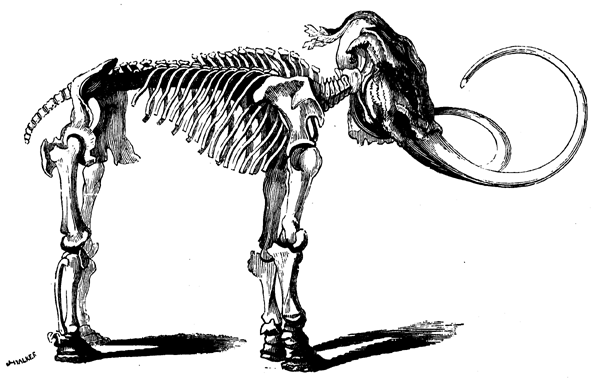
Fig. 186.—Elephas primigenius.
Post-glacial.
To establish themselves in such a world, the primitive men
must have been no puny race, either in mind or body, and they
must have been sheltered in some Eden of plenty and comparative
safety till, by increase of numbers, invention of weapons and
implements, and domestication of useful animals, they became able
to cope with the monarchs of the waste. But this position once attained in the original
seats of the species, the wide continents presented great
facilities for their movements, and there were ample stores of
food for wandering tribes subsisting by the chase.
With such views the skeletons of the most ancient known
men87 fully accord. They
indicate 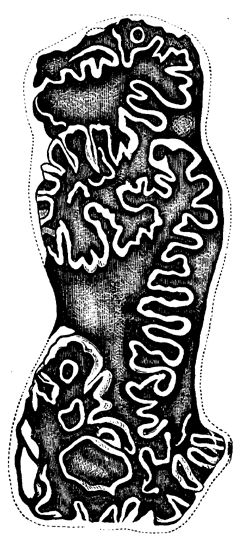 Fig. 187.—Tooth of
Elasmotherium. Grinding surface, natural size. Siberia.
From Nature. a people of great stature, of
powerful muscular development, especially in the lower limbs, of
large brain, indicating great capacity and resources
(Fig. 188), but of coarse Turanian features, like those of
the tribes that now roam over the plains of Northern Asia (Fig.
189). They used flint and bone implements, which they
manufactured with much skill (Figs. 190, 191). They were probably
clothed in dressed skins, ornamented with embroidery, in the
manner of the North American Indians. They used shells and carved
bones as ornaments. Recent discoveries at Soloutre, in France,
render it probable that some of the tribes had tamed the horse,
and resided in fortified villages. They buried their dead with
offerings, indicating a belief in immortality. These Post-glacial
men are certainly known as yet only in Europe and Western Asia;
and we cannot therefore determine if they represent the average
man of the period. There were in Belgium and other parts of
Europe, men of smaller stature and of lower cranial type,
contemporary or nearly so with the
higher race. There may have been fruit-eating or agricultural
peoples in the more genial and fertile lands of the east and
south. The conditions above sketched are, I think, fairly
deducible from the facts stated by Christy and Lartet, Dupont,
Rivière, Dawkins, and others, who have studied the remains
of these early men, the Palæolithic men of some writers, or
the men of the Mammoth age, and whom I have elsewhere named
Palæocosmic men, as a term less objectionable than those
founded on implements not confined to any age, or animals which
may have long antedated
Fig. 187.—Tooth of
Elasmotherium. Grinding surface, natural size. Siberia.
From Nature. a people of great stature, of
powerful muscular development, especially in the lower limbs, of
large brain, indicating great capacity and resources
(Fig. 188), but of coarse Turanian features, like those of
the tribes that now roam over the plains of Northern Asia (Fig.
189). They used flint and bone implements, which they
manufactured with much skill (Figs. 190, 191). They were probably
clothed in dressed skins, ornamented with embroidery, in the
manner of the North American Indians. They used shells and carved
bones as ornaments. Recent discoveries at Soloutre, in France,
render it probable that some of the tribes had tamed the horse,
and resided in fortified villages. They buried their dead with
offerings, indicating a belief in immortality. These Post-glacial
men are certainly known as yet only in Europe and Western Asia;
and we cannot therefore determine if they represent the average
man of the period. There were in Belgium and other parts of
Europe, men of smaller stature and of lower cranial type,
contemporary or nearly so with the
higher race. There may have been fruit-eating or agricultural
peoples in the more genial and fertile lands of the east and
south. The conditions above sketched are, I think, fairly
deducible from the facts stated by Christy and Lartet, Dupont,
Rivière, Dawkins, and others, who have studied the remains
of these early men, the Palæolithic men of some writers, or
the men of the Mammoth age, and whom I have elsewhere named
Palæocosmic men, as a term less objectionable than those
founded on implements not confined to any age, or animals which
may have long antedated 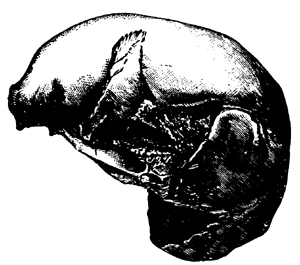 Fig. 188.—Engis Skull.
Reduced.—After Lyell. The Skull of one of the Men of the
Mammoth age. man. Recent discoveries in the caves
of Spy in Belgium,88 taken in connection with the previous
discoveries of Schmerling and Dupont, seem to show the existence
in that country of men of the low-browed Neanderthal or Canstadt
type (Fig. 189 third outline), perhaps locally preceding but
perhaps contemporaneous with, the larger and better developed men
of the Cro-Magnon type (Fig. 189 first outline). These two
types are, however, allied, and there are intermediate forms, so
that they are to be regarded as two races of Palæocosmic
men not more dissimilar than we find in cognate rude races at
present.
Fig. 188.—Engis Skull.
Reduced.—After Lyell. The Skull of one of the Men of the
Mammoth age. man. Recent discoveries in the caves
of Spy in Belgium,88 taken in connection with the previous
discoveries of Schmerling and Dupont, seem to show the existence
in that country of men of the low-browed Neanderthal or Canstadt
type (Fig. 189 third outline), perhaps locally preceding but
perhaps contemporaneous with, the larger and better developed men
of the Cro-Magnon type (Fig. 189 first outline). These two
types are, however, allied, and there are intermediate forms, so
that they are to be regarded as two races of Palæocosmic
men not more dissimilar than we find in cognate rude races at
present.
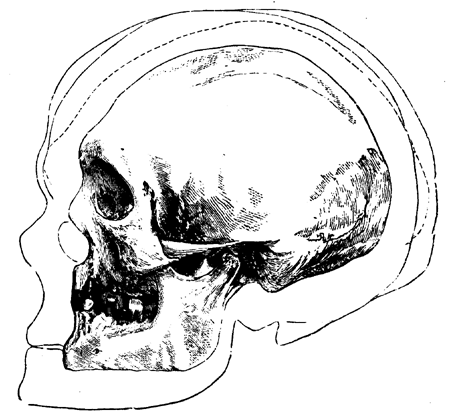
Fig. 189.—Outlines of Three Prehistoric
European Skulls compared with an American Skull from
Hochelaga.
Outer outline, Cro-Magnon Skull. Second outline, Engis Skull.
Third outline (dotted), Neanderthal Skull. Inner figure,
Hochelagan Skull on a smaller scale.
They were succeeded in Western Europe by a smaller and less
elevated race, identical apparently with the modern Lapps and
Basques, and in whose time the mammoth and many large animals had
disappeared, Europe had become clad with dense forests, and the
reindeer had extended his range far to the south,
while the land of our continents had become narrowed to its
present limits, or even less. The cause of these changes must
have been physical, and to some extent cataclysmal; and its
wide-spread and effectual character is shown by the fact that it
exterminated so many animals of both continents which had
survived the Glacial age. Similar testimony is borne by the
occurrence of the implements and remains of Palæocosmic men
in gravels and in diluvial clays in caverns, and by the changes
of level and deep erosions of valleys that are referable to the
close of the Palæocosmic age. The most probable agencies in
this revolution were subsidences of the land, accompanied with
climatal changes; but the precise nature and extent of these is
still unknown; and the prevalent tendency on the
part of geologists to stretch the doctrine of uniformity, so
valuable within proper limits, to the absurd extreme of excluding
all changes not exemplified even in amount in the modern period,
will probably for some time prevent any adequate conception of
them.
It would be premature to correlate what is yet known of the
Palæocosmic age with historical periods; but the tendency
of the facts accumulated is, I think, toward the identification
of the Palæocosmic men with the Antediluvians; and their
Neocosmic successors, whether of the reindeer age, of the Danish
shell-mounds, or the Swiss lake habitations, with Postdiluvian
and still existing tribes.
Fig. 190.—Flint Implement found in
Kent’s Cavern, Torquay, under four feet of cave mud and one
foot of stalagmite.—After Pengelly.
After what has been already said, it will be unnecessary to
dwell upon the characteristics of the first race of men known to
us. They were rude and uncivilised, in so far as outward
appliances are concerned; but they are confessedly altogether
men, and in no respect akin to apes, and their volume of brain is
rather greater than that of the average European of to-day; so
that they must have had quite as much natural sagacity and
capacity for culture, and, like the modern and historic Turanian
nations, they were probably superior to the average European in
the instinct for art and construction. Thus if we suppose these
men derived from apes by any process of gradual change, we must
look for their brute ancestors, not in the Pliocene or Miocene,
but in the Eocene itself. This causes us to recur to the doctrine
of critical periods, when many species were introduced together,
alternating with periods of decay and extinction. Post-glacial
man appears at the end of a time of sifting and trial, a time
in which a vast number of species succumbed to great physical
reverses. No very great number of species came in with him, and
in the early period of his history there was a decadence or
destruction either by the diluvial cataclysm or gradually. Out of
ninety-eight species of mammals contemporary with early man in
Europe, forty-one  Fig. 191.—Bone Harpoon
(Palæocosmic), from Périgord Cavern.
are wholly or locally extinct, and none have been introduced
except those brought by man himself. Thus man stands alone, the
grand product of his period and a lord of creation, for whom
great preparatory changes were made, and multitudes of lower
animals swept away to make room for him. According to our sacred
Scriptures, this change is still imperfect, and great additional
ameliorations would have taken place but for a moral catastrophe
not within the domain of geology—the fall of man. If we
identify the Palæocosmic men with the Antediluvians of the
same venerable record, the roving tribes whose remains are known
to us represent that part of the race of Cain of whom Jubal was
the father, the nomads dwelling in tents, as distinguished from
the settled agricultural peoples. In this case, also, the
catastrophe which destroyed these rude and lawless men was that
which culminated in the deluge of Noah, which may represent the
extinction of the last great body of this primitive race, whose
arts, handed down to the physically inferior men of Postdiluvian
times, astonish us by their early development in Chaldæa
and in Egypt.
Fig. 191.—Bone Harpoon
(Palæocosmic), from Périgord Cavern.
are wholly or locally extinct, and none have been introduced
except those brought by man himself. Thus man stands alone, the
grand product of his period and a lord of creation, for whom
great preparatory changes were made, and multitudes of lower
animals swept away to make room for him. According to our sacred
Scriptures, this change is still imperfect, and great additional
ameliorations would have taken place but for a moral catastrophe
not within the domain of geology—the fall of man. If we
identify the Palæocosmic men with the Antediluvians of the
same venerable record, the roving tribes whose remains are known
to us represent that part of the race of Cain of whom Jubal was
the father, the nomads dwelling in tents, as distinguished from
the settled agricultural peoples. In this case, also, the
catastrophe which destroyed these rude and lawless men was that
which culminated in the deluge of Noah, which may represent the
extinction of the last great body of this primitive race, whose
arts, handed down to the physically inferior men of Postdiluvian
times, astonish us by their early development in Chaldæa
and in Egypt.
If man is so recent geologically, he may still be very old
historically; and the question remains, Have we any facts bearing
on the absolute antiquity of man? For the properly
historical aspect of this question, I may refer to the excellent
work of Canon Rawlinson on the Origin of Nations,89 which shows
conclusively that the historic origin of all the great nations of
antiquity extends backward less than 4,400 years from our time.
Beyond this we have, however, the Palæocosmic or
Antediluvian men; and their extension backward seems limited
geologically only by the close of the Glacial period, while many
hold that the Genealogy in Genesis does not require us to limit
very narrowly their antiquity. The date of the Glacial period is,
however, at present very uncertain. On the one hand, some
geologists, like Lyell, have supposed it may be as far back as
200,000 years ago. Others, like Croll, are contented with the
more moderate estimate of 80,000 years. On the other hand, the
calculations of Andrews, based on the recession of the American
lakes, those of Winchell on the recession of the Falls of St.
Anthony, and the recent surveys of the recession of the Falls of
Niagara, reduce the time to from 7,000 to 10,000 years. It is
impossible in the present state of knowledge to settle these
disputes; but one may refer in the sequel to some of the
evidences which have been adduced in favour of great antiquity.
Since the publication of the second edition of this work Prof.
Prestwich, in a paper read before the Geological Society,90 has brought forward
other reasons which induce him to conclude that the close of the
Glacial epoch occurred “from 8,000 to 10,000 years
since.” It is true, he admits, on geological evidence still
in dispute, that man may have existed in Europe before that time,
and he also admits, on historical, not geological evidence, the
existence of “Neolithic” man in Asia, “at an
earlier date than 4,000 B.C.”
Still the repudiation, by so good an authority, of the
exaggerated antiquity which it has been the fashion, since the
rise of Darwinian evolution, to assign to man, contrary to the
geological evidence, is a satisfactory indication of a return to
more rational views; and when geologists get rid of the
fiction of a continental ice-sheet,
still farther progress in this direction may be expected.
We may, I think, at once take it for granted, that none of the
Neocosmic races date farther back than the origin of the great
eastern nations. There are certainly no geological evidences
requiring a greater antiquity, for in their time the land had
attained to its present configuration, and the changes which have
occurred in the succession of forests and the growth of peat are
such as our experience in America shows to be possibly quite
modern. There is besides no doubt that these people, from the
Reindeer men of France and Belgium to the people of the Swiss
lakes, are modern races, whose descendants still live in Europe.
We can thus limit our inquiry to the Palæocosmic men; and
with respect to them we know only what may be gathered from a
consideration of the physical changes which have occurred since
they lived.
In Europe a great number of considerations have been adduced
as evidence of their high antiquity; and these deserve careful
attention, though I think it will be found that they are all
liable to serious objections or great abatements on geological
grounds.
(1) The occurrence of human remains with those of animals now
extinct affords no certain evidence of antiquity. Admitting that
human remains are found along with those of the mammoth in
Europe, and with those of the mastodon in America, the question
remains, How late did these species survive? In Europe we know
that several large animals now extinct existed up to
comparatively modern times. This is the case with the Irish deer
(Megaceros), the urus, the aurochs, and the reindeer, in
temperate Europe. How long previously the mammoth or the hairy
rhinoceros disappeared we do not know, but need not suppose the
time very long.
(2) The accumulation of sediment or of stalagmite over human
remains in caverns is not necessarily indicative of very great
antiquity. We know that in favourable circumstances mud, sand,
and gravel may be rapidly deposited in caves by land floods
or river inundations, and that débris of various
sorts accumulates in such places from decay of rock and vegetable
and animal agencies. The deposition of stalagmite is also very
variable in its rate; and the fact that it is being very slowly
deposited in any cave now does not prove that more rapid
deposition may not have taken place formerly. Dawkins and others
have ascertained a rate of a quarter of an inch per annum in some
caverns; and this would allow the stalagmite crust of
Kent’s cave, for which an antiquity of half a million of
years has been claimed, to have been formed in a thousand
years.
Fig. 192.—Sketch of a Mammoth, carved
on a portion of a Tusk of the same Animal (Lartet).
(3) The erosion of river valleys to great depths since the
Glacial period fails to establish the great antiquity of the
caves left on their sides or the high level gravels of their
banks. Throughout the northern hemisphere, the river valleys are
of old date, and were merely filled with loose detritus in the
Glacial age. The sweeping out of this débris would
be a rapid process, more especially when changes of level were
occurring, and when the rainfall was greater than at present.
Besides, as Croll has well remarked, the actual configuration of
our continents, the amount of drift still remaining, and the
imperfect manner in which the river valleys have been cleared
out, all testify to the comparative recency of the Glacial
period.91 These considerations
would, indeed, materially reduce the antiquity which he claims on
astronomical grounds for the ice age.
(4) The growth of peat and the deposition of silt are very
deceptive as indications of great antiquity. For instance,
accurate observations made by a French engineer in the
construction of docks at St. Nazaire,92 show that in 1,600 years the Loire had
deposited over Gallo-Roman remains six metres of mud. Relics of
the Bronze age occur below these at a depth indicating 500 years
previously as their date; and the beginning of the modern deposit
of the Loire would, on the same evidence, be only 6,000 years
ago. Hilgard’s observations on the delta of the Mississippi
in like manner tend greatly to reduce our estimates of the time
occupied in the deposit of the modern silt of that river. The
peat deposit at Abbeville, at the mouth of the Somme, has been
supposed to have required 30,000 years for its formation. But
this estimate was based upon the present rate of growth; and, as
Andrews has shown, the fact admitted by Boucher de Perthes, that
birch stems three feet high stand in this peat, implies a much
more rapid rate, which is also proved by the depth at which Roman
remains have been found. In like manner the Scandinavian peats,
to which a fabulous antiquity has been ascribed, have been proved
to be comparatively modern by the depths at which metallic works
of art are found in them.
(5) The paucity of remains of Palæocosmic men in Europe,
with their wide distribution, indicate that their sojourn was not
long, or that the population was very small and much scattered.
Even in a few thousands of years, an active and vigorous people,
living in a country well supplied with food, must have multiplied
greatly, and must have left considerable remains. On the theory
that these men inhabited Europe even for 2,000 years, we have to
suppose that the greater part of their
remains have been swept away, or remain under the waters, or
buried out of sight in diluvial sediments.
(6) Much importance has been attached to the early works and
high culture of Egypt and Chaldæa, as evidence of vast time
during which arts were growing from a supposed rude stone age.
But it must be observed that no such period is known to antedate
civilisation in the East, and that if the early empires were
established by survivors of the Deluge, they must have brought
with them the culture of Antediluvian times. Farther, the notion
of men emerging from a half-brutal state, and from the use of the
rudest implements, is purely conjectural and not supported by
facts. In America, where the semi-civilised agricultural races
are unquestionably the oldest, the rudest possible implements
were used by these partially civilised agricultural people along
with polished stone and metal; and Schliemann has shown that a
rude stone age succeeded the civilisation of Troy, and this at a
time when Phœnicia and Egypt were at the height of their
civilisation. Such facts, which might fill volumes, show how
little value is to be attached to supposed ages of rough and
polished stone.
(7) The difficulties attending the establishment of geological
dates for deposits like those containing the remains of men are
very great. They are altogether superficial and local, not
widespread marine beds in which a distinct order of superposition
can be clearly traced. They are not easily separated from the
glacial beds below, or from those above which have been modified
by human agency, by land-floods, or by landslips. Thus the
application of geological criteria of age to them is very
difficult and uncertain. Evidence of this could easily be given,
in the many errors which have been promulgated, and which have
had to be retracted by their authors, or have been disproved by
the observations of others. For example, no country was at one
time richer in supposed evidences of the antiquity of man than
Scandinavia; but Professor Torell, the
director of the Geological Survey of Sweden, has recently made a
careful re-examination of the facts, and has found that there is
no evidence whatever of the existence of man in Scandinavia
before the Neolithic or polished stone age. There are, however,
evidences of considerable changes of level since that time, and
it would seem even since the twelfth century of our era. The
remarkable and seemingly inexcusable errors of observation
referred to in Professor Torell’s memoir, should enforce a
caution on geologists as to the uncertainties of such evidence.
Lyell sifted the testimony bearing on this subject with great
care in the first edition of his Antiquity of Man. In
later editions he had to make large abatements, and now much of
the evidence in the latest edition would have to be withdrawn or
otherwise applied.
From all these considerations the conclusion is obvious that
while we have no certain data for assigning a definite number of
years to the residence of man on the earth, we have no geological
evidence for the rash assertion often made that in comparison
with historical periods the date of the earliest races of men
recedes into a dim, mysterious, and measureless antiquity. On the
basis of that Lyellian principle of the application of modern
causes to explain past changes, which is the stable foundation of
modern geology, we fail to erect any such edifice as the
indefinite antiquity of man, or to extend this comparatively
insignificant interval to an equality with the long æons of
the preceding Tertiary. The demand for such indefinite extension
of the history of man rests not on geological facts, but on the
necessities of hypotheses which, whatever their foundation, have
no basis in the discoveries of that science, and are not required
to account for the sequence which it discloses.
hat general conclusions can we
reach as to this long and strange history of the progress of life
on our planet? Perhaps the most comprehensive of these is that
the links in the chain of life, or rather in its many chains, are
not scattered and disunited things, but members of a great and
complex plan; and that when we discern their combinations and
their pattern, we find them not only orderly and symmetrical, but
all tending to one point and bound to one central object, even
the throne of the Eternal. It must also appear evident that the
original plan of nature, both in the animal and vegetable worlds,
was too vast to be realised at one time on a globe so limited as
ours, but had to be distributed in time as well as in space, thus
realising the idea of time-worlds: successive æons in
which, one after the other, the work of creation could rise to
successive stages of perfection and completeness till it
culminated in man. All this is sufficiently plain on the theistic
view of nature, and may suffice for those who reverently regard
the God of nature as the Father of their own spirits. But there
are others who ask further questions. Do we know anything of the
secondary causes and origin of life, of the manner of its
introduction and advance, of the laws of its succession?
As to the first of these questions, it
is certain that, up to this time, the origination of the living
being from the non-living is an inscrutable mystery. No one has
witnessed this change, or has been able to effect it
experimentally. Nor have we any direct evidence of the
origination of one specific type from another. Such reasonings as
assume the possibility of these things, or on analogical grounds
assert their probability, belong rather to the domain of
philosophical speculation than to science. As to the laws of the
succession of life, however, it is possible to learn something
from the sequence of facts as already ascertained; and though
much remains to be discovered, there are a few leading statements
on this subject which can already be made with safety.
Unity and uniformity, within the limits imposed by progress
and increasing complexity, can be affirmed of the whole process.
From the dawn of life to the present time the great laws of
physical nature which operate on animals and plants have been
uniform. These stable laws have regulated the action of the outer
world on organisms. The plans of structure of these organisms
laid down at the first have been followed throughout. Thus the
succession of life presents nothing fortuitous or arbitrary, but
a continuous plan carried out uniformly in time and space, with
certain materials of fixed properties, and with certain
structures predetermined from the first. There is, for example, a
great sameness of plan throughout the whole history of the marine
invertebrate life of the Palæozoic. If we turn over the
pages of an illustrated text-book of geology, or examine the
cases or drawers of a collection of fossils, we shall find
extending through every succeeding formation, representative
forms of Crustaceans, Mollusks, and Corals, in such a manner as
to indicate that in each successive period there has been a
reproduction of the same type with modifications; and if the
series is not continuous, this appears to be due to lack of
specimens, or to abrupt physical changes; since sometimes, where
two formations pass into each other, we find a
gradual change in the fossils by the dropping out and
introduction of species one by one. Thus in the whole of the
great Palæozoic period, both in its fauna and flora, we
have a continuity and similarity of a most marked character.
There is, indeed, nothing to preclude the supposition that
many forms reckoned as species are really only race
modifications. My own provisional conclusion, based on the study
of Palæozoic plants, published many years ago,93 is that the general law
will be found to be the existence of distinct specific types
independent of each other, but liable in geological time to minor
modifications, which have often been regarded as distinct
species.
While this unity of successive faunæ at first sight
presents an appearance of hereditary succession, it loses much of
this character when we consider the number of new types
introduced without apparent predecessors, or ceasing without
successors, and the almost changeless persistence of other types;
the necessity that there should be similarity of type in
successive faunæ on any hypothesis of a continuous plan;
and, above all, the fact that the recurrence of representative
species or races in large proportion marks times of decadence
rather than of expansion in the types to which they belong. To
return to a later period, this is very manifest in that singular
resemblance which obtains between the modern mammals of South
America and Australia and their immediate fossil
predecessors—the phenomenon being here manifestly that of
decadence of large and abundant species into a few depauperated
representatives. This will be found to be a very general law,
elevation being accompanied by the abrupt appearance of new
types, and decadence by the apparent continuation of old species,
or modifications of them.
This resemblance with difference in successive faunæ
also connects itself very directly with the successive elevations
and depressions of our continental plateaus in geological
time.
Every great Palæozoic limestone, for example, indicates
a depression with succeeding elevation. On each elevation marine
animals were driven back into the ocean, and on each depression
swarmed in over the land, reinforced by new species, either then
introduced or derived by migration from other localities. In like
manner on every depression, land plants and animals were driven
in upon insular areas, and on re-elevation again spread
themselves widely. Now I think it will be found to be a law here
that periods of expansion were eminently those of introduction of
new specific types, and periods of contraction those of
extinction, and also of continuance of old types under new
varietal forms. It must also be borne in mind that all the
leading types of invertebrate life were early introduced, that
change within these was necessarily limited, and that elevation
could take place mainly by the introduction of the vertebrate
orders. So in plants, Cryptogams early attained their maximum as
well as Gymnosperms, and elevation occurred in the introduction
of Phænogams.
Another allied fact is the simultaneous appearance of like
types of life in one and the same geological period, over widely
separated regions of the earth’s surface. This strikes us
especially in the comparatively simple and homogeneous
life-dynasties of the Palæozoic, when for example we find
the same types of Silurian Graptolites, Trilobites and
Brachiopods appearing simultaneously in Australia, America, and
Europe. Perhaps in no department is it more impressive than in
the introduction in the Devonian and Carboniferous ages of that
grand cryptogamous and gymnospermous flora which ranges from
Brazil to Spitzbergen, and from Australia to Scotland,
accompanied in all by the same groups of marine invertebrates; or
in the like wholesale production of modern types of trees in the
Cretaceous. Such facts may depend either on that long life of
specific types which gives them ample time to spread to all
possible habitats, before their extinction; or on some general
law whereby the conditions suitable to similar types
of life emerge at one time in all parts of
the world. Both causes may be influential, as the one does not
exclude the other, and there is reason to believe that both are
natural facts. Should it be ultimately proved that species allied
and representative, but distinct in origin, come into being
simultaneously everywhere, we shall arrive at one of the laws of
creation, and one probably connected with the gradual change of
the physical conditions of the world.
A closely related truth is the periodicity of introduction of
species. They come in by bursts or flood-tides at particular
points of time, while these great life-waves are followed and
preceded by times of ebb in which little that is new is being
produced. We labour in our investigation of this matter under the
disadvantage that the modern period is evidently one of the times
of pause in the creative work. Had our time been that of the
early Tertiary or early Mesozoic, our views as to the question of
origin of species might have been very different. It is a
striking fact, in illustration of this, that since the Glacial
age no new species of mammal can be proved to have originated on
our continents, while a great number of large and conspicuous
forms have disappeared. It is possible that the proximate or
secondary causes of the ebb and flow of life-production may be in
part at least physical; but other and more important efficient
causes may be behind these. In any case these undulations in the
history of life are in harmony with much that we see in other
departments of nature.
It results from the above and the immediately preceding
statement that specific and generic types enter on the stage in
great force, and gradually taper off toward extinction. They
should so appear in the geological diagrams made to illustrate
the succession of life. This applies even to those forms of life
which come in with fewest species and under the most humble
guise. What a remarkable swarming, for example, there must have
been of Marsupial Mammals in the early Mesozoic; and in the
Coal formation the only known Pulmonates, four or five in number,
belong to as many generic types.
I have already referred to the permanence of certain species
in geological time. I may now place this in connection with the
law of origination and more or less continuous transmission of
varietal forms. I may, perhaps, best illustrate this in
connection with a group of species with which I am very familiar,
that which came into our seas at the beginning of the Glacial
age, and still exists. With regard to their permanence, it can be
affirmed that the shells now elevated in Wales to 1,200 and in
Canada to 600 feet above the sea, and which lived before the last
great revolution of our continents, a period vastly remote as
compared with human history, differ in no tittle from their
modern successors after thousands or tens of thousands of
generations. It can also be affirmed that the more variable
species appear under precisely the same varietal forms then as
now, though these varieties have changed much in their local
distribution. The real import of these statements, which might
also be made with regard to other groups well known to
palæontologists, is of so great significance that it can be
realised only after we have thought of the vast time and numerous
changes through which these humble creatures have survived. I may
call in evidence here a familiar British and American animal, the
common sand clam, Mya arenaria, and its relative, Mya
truncata, which now inhabit together all the northern seas;
for the Pacific specimens, from Japan and California, though
differently named, are undoubtedly the same. Mya truncata
appears in Europe in the older Pliocene, and was followed by
M. arenaria a little later. Both shells occur in the
Pleistocene of America, and their several varietal forms had then
already developed themselves, and remain the same to-day; so that
these humble mollusks, littoral in their habits, and subjected to
a great variety of conditions, have continued, perhaps for one or
two thousand centuries, to construct their shells precisely as at
present. Nor are there any indications of a
transition between the two species. Similar statements may be
made with regard to other mollusks of the Pliocene and Modern
periods, and there are even species which extend unchanged from
the early Eocene. Nor is it impossible that some modern bivalves
of the Brachiopod group may be scarcely modified descendants even
of Palæozoic species.
Perhaps some of the most remarkable facts in connection with
the permanence of species and varietal forms are those furnished
by that magnificent flora which burst in all its majesty on the
American continent in the Cretaceous period, and still survives
among us even in some of its specific types, I say survives; for
we have but a remnant of its forms living, and comparatively
little that is new has probably been added since. Take, for
example, the facts stated in Chapter VIII. as to the continuance
to the present time of species of plants introduced in the
Cretaceous and Eocene, and which thus came in at the very time
when the great Mesozoic reptiles were decaying or had just
disappeared, and when the placental mammals were being
introduced. Some of these plants must have propagated themselves
unchanged for half a million of years.
Plants and the lower tribes of animals are, however, more
permanent than the higher animals; and a strange contrast is
afforded to the foregoing examples of persistence by the repeated
revolutions that have affected vertebrate life since the Mesozoic
age. Yet even in the case of vertebrates there seems to have been
little change, except in the extinction of species, since the
Pliocene period.
In conclusion of this review, can we formulate a few of the
general laws, or perhaps I had better call them the general
conclusions respecting life, in which all palæontologists
may agree? Perhaps it is not possible to do this at present
satisfactorily, but the attempt may do no harm. We may, then, I
think, make the following affirmations:—
(1) The existence of life and
organisation on the earth is not eternal, or even coeval with the
beginning of the physical universe, but may possibly date from
Laurentian or immediately pre-Laurentian times.
(2) The introduction of new species of animals and plants has
been a continuous process, not necessarily in the sense of
derivation of one species from another, but in the higher sense
of the continued operation of the cause or causes which
introduced life at first. This, as already stated, I take to be
the true theological or Scriptural as well as scientific idea of
what we ordinarily and somewhat loosely term creation.
(3) Though thus continuous, the process has not been uniform;
but periods of rapid production of species have alternated with
others in which many disappeared and few were introduced. This
may have been an effect of physical cycles reacting on the
progress of life.
(4) Species, like individuals, have greater energy and
vitality in their younger stages, and rapidly assume all their
varietal forms, and extend themselves as widely as external
circumstances will permit. Like individuals, also, they have
their periods of old age and decay, though the life of some
species has been of enormous duration in comparison with that of
others; the difference appearing to be connected with degrees of
adaptation to different conditions of life.
(5) Many allied species, constituting groups of animals and
plants, have made their appearance at once in various parts of
the earth, and these groups have obeyed the same laws with the
individual and the species in culminating rapidly, and then
slowly diminishing, though a large group once introduced has
rarely disappeared altogether.
(6) Groups of species, as genera and orders, do not usually
begin with their highest or lowest forms, but with intermediate
and generalised types, and they show a capacity for both
elevation and degradation in their subsequent history.
(7) The history of life presents a progress from the lower to
the higher, and from the simpler to the
more complex, and from the more generalised to the more
specialised. In this progress new types are introduced, and take
the place of the older ones, which sink to a relatively
subordinate place, and become thus degraded. But the physical and
organic changes have been so correlated and adjusted that life
has not only always maintained its existence, but has been
enabled to assume more complex forms, and that older forms have
been made to prepare the way for newer, so that there has been on
the whole a steady elevation culminating in man himself.
Elevation and specialisation have, however, been secured at the
expense of vital energy and range of adaptation, until the new
element of a rational and inventive nature was introduced in the
case of man.
(8) In regard to the larger and more distinct types, we cannot
find evidence that they have, in their introduction, been
preceded by similar forms connecting them with previous groups;
but there is reason to believe that many supposed representative
species in successive formations are really only races or
varieties.
(9) In so far as we can trace their history, specific types
are permanent in their characters from their introduction to
their extinction, and their earlier varietal forms are similar to
their later ones.
(10) Palæontology furnishes no direct evidence, perhaps
never can furnish any, as to the actual transformation of one
species into another, or as to the actual circumstances of
creation of a species, but the drift of its testimony is to show
that species come in per saltum, rather than by any slow
and gradual process.
(11) The origin and history of life cannot, any more than the
origin and determination of matter and force, be explained on
purely material grounds, but involve the consideration of power
referable to the unseen and spiritual world.
Different minds may state these principles in different ways,
but I believe that in so far as
palæontology is concerned, in substance they must hold
good, at least as steps to higher truths. And now I may be
permitted to add that we should be thankful that it is given to
us to deal with so great questions, and that in doing so deep
humility, earnest seeking for truth, patient collection of all
facts, self-denying abstinence from hasty generalisations,
forbearance and generous estimation with regard to our
fellow-labourers, and reliance on that Divine Spirit which has
breathed into us our intelligent life, and is the source of all
true wisdom, are the qualities which best become us.
As we have traced onward the succession of life, reference has
been made here and there to the defects of those bold theories of
descent with modification which are held forth in our time as the
true bond of the links of the chain of life. It must have been
apparent that these theories, however specious when placed in
connection with a limited induction of facts selected for the
purpose of illustrating them, are very far from affording a
satisfactory solution of all difficulties. They cannot perhaps be
expected to take us back to the origin of living beings; but they
also fail to explain why so vast numbers of highly organised
species struggle into existence simultaneously in one age and
disappear in another, why no continuous chain of succession in
time can be found gradually blending species into each other, and
why in the natural succession of things degradation under the
influence of external conditions and final extinction seem to be
laws of organic existence. It is useless here to appeal to the
imperfection of the record or to the movements or migrations of
species. The record is now in many important parts too complete,
and the simultaneousness of the entrance of the faunas and floras
too certainly established, while the moving of species from place
to place only evades the difficulty. The truth is that such
hypotheses are at present premature, and that we require to have
larger collections of facts. Independently of this, however, it
would seem that from a philosophical point
of view all theories of evolution, as at present applied to life,
are fundamentally defective in being too partial in their
character; and this applies more particularly to those which are
“monstic” or “agnostic,” and thus
endeavour to dispense with a Creative Will behind nature. It may
be instructive to illustrate from the facts developed in
preceding chapters this feature of most of the attempts at
generalisation on this subject.
First, then, these hypotheses are too partial, in their
tendency to refer numerous and complex phenomena to one cause, or
to a few causes only, when all trustworthy analogy would indicate
that they must result from many concurrent forces and
determinations of force. We have of late been very familiar with
those ingenious, not to say amusing, speculations in which some
entomologists and botanists have indulged with reference to the
mutual relations of flowers and haustellate insects. Geologically
the facts oblige us to begin with Cryptogamous plants and
mandibulate insects; and out of the desire of insects for
non-existent honey, and the adaptations of plants to the
requirements of non-existent suctorial apparatus, we have to
evolve the marvellous complexity of floral form and colouring,
and the exquisitely delicate apparatus of the mouths of
haustellate insects. Now when it is borne in mind that this
theory implies a mental confusion on our part precisely similar
to that which in the department of mechanics actuates the seekers
for perpetual motion, that we have not the smallest tittle of
evidence that the changes required have actually occurred in any
one case, and that the thousands of other structures and
relations of the plant and the insect have to be worked out by a
series of concurrent evolutions so complex and absolutely
incalculable in the aggregate that the cycles and epicycles of
the Ptolemaic astronomy were child’s play in comparison, we
need not wonder that the common sense of mankind revolts against
such fancies, and that we are accused of attempting to construct
the universe by methods that would baffle Omnipotence
itself, because they are simply absurd. In this aspect of them,
indeed, such speculations are necessarily futile, because no mind
can grasp all the complexities of even any one case, and it is
useless to follow out an imaginary line of development which
unexplained facts must contradict at every step. This is also no
doubt the reason why all recent attempts at constructing
“Phylogenies” are so changeable, and why no two
experts can agree about almost any of them.
A second aspect in which such speculations are too partial is
in the unwarranted use which they make of analogy. It is not
unusual to find such analogies as that between the embryonic
development of the individual animal and the succession of
animals in geological time placed on a level with that reasoning
from analogy by which geologists apply modern causes to explain
geological formations. No claim could be more unfounded. When the
geologist studies ancient limestones built up of the remains of
corals, and then applies the phenomena of modern coral reefs to
explain their origin, he brings the latter to bear on the former
by an analogy which includes not merely the apparent results but
the causes at work, and the conditions of their action; and it is
on this that the validity of his comparison depends, in so far as
it relates to similarity of mode of formation. But when we
compare the development of an animal from an embryo cell with the
progress of animals in time, though we have a curious analogy as
to the steps of the process, the conditions and agents at work
are known to be altogether dissimilar, and therefore we have no
evidence whatever as to identity of cause, and our reasoning
becomes at once the most transparent of fallacies. Farther, we
have no right here to overlook the fact that the conditions of
the embryo are determined by those of a previous adult, and that
no sooner does this hereditary potentiality produce a new adult
animal than the terrible external agencies of the physical world,
in presence of which all life exists, begin to tell on
the organism, and after a struggle of longer or shorter duration
it succumbs to death, and its substance returns into inorganic
nature, a law from which even the longer life of the species does
not seem to exempt it. All this is so plain and manifest that it
is extraordinary that evolutionists will continue to use such
partial and imperfect arguments. Another example may be taken
from that application of the doctrine of natural selection to
explain the introduction of species in geological time which is
so elaborately discussed by Sir C. Lyell in the last edition of
his Principles of Geology. The great geologist evidently
leans strongly to the theory, and claims for it the
“highest degree of probability,” yet he perceives
that there is a serious gap in it; since no modern fact has ever
proved the origin of a new species by modification. Such a gap,
if it existed in those grand analogies by which we explain
geological formations through modern causes, would be admitted to
be fatal.
A third illustration of the partial character of these
hypotheses may be taken from the use made of the theory deduced
from modern physical discoveries, that life must be merely a
product of the continuous operation of physical laws. The
assumption, for it is nothing more, that the phenomena of life
are produced merely by some arrangement of physical forces, even
if it be admitted to be true, gives only a partial explanation of
the possible origin of life. It does not account for the fact
that life as a force or combination of forces is set in
antagonism to all other forces. It does not account for the
marvellous connection of life with organisation. It does not
account for the determination and arrangement of forces implied
in life. A very simple illustration may make this plain. If the
problem to be solved were the origin of the mariner’s
compass, one might assert that it is wholly a physical
arrangement both as to matter and force. Another might assert
that it involves mind and intelligence in addition. In some sense
both would be right. The properties of magnetic force and of
iron or steel are purely physical, and
it might even be within the bounds of possibility that somewhere
in the universe a mass of natural loadstone may have been so
balanced as to swing in harmony with the earth’s magnetism.
Yet we should surely be regarded as very credulous if we could be
induced to believe that the mariner’s compass has
originated in that way. This argument applies with a thousandfold
greater force to the origin of life, which involves even in its
simplest forms so many more adjustments of force and so much more
complex machinery.
Fourthly, these hypotheses are partial, inasmuch as they fail
to account for the vastly varied and correlated interdependencies
of natural things and forces, and for the unity of plan which
pervades the whole. These can be explained only by taking into
the account another element from without. Even when it professes
to admit the existence of a God, the evolutionist reasoning of
our day limits itself practically to the physical or visible
universe, and leaves entirely out of sight the power of the
unseen and spiritual, as if this were something with which
science has nothing to do, but which belongs only to imagination
or sentiment. So much has this been the case that when recently a
few physicists and naturalists have turned to this aspect of the
subject, they have seemed to be teaching new and startling
truths, though only reviving some of the oldest and most
permanent ideas of our race. From the dawn of human thought it
has been the conclusion alike of philosophers, theologians, and
the common sense of mankind, that the seen can be explained only
by reference to the unseen, and that any merely physical theory
of the world is necessarily partial. This, too, is the position
of our sacred Scriptures, and is broadly stated in their opening
verse; and indeed it lies alike at the basis of all true religion
and all sound philosophy, for it must necessarily be that
“the things that are seen are temporal, the things that are
unseen, eternal.” With reference to the primal aggregation
of energy in the visible universe, with
reference to the introduction of life, with reference to the soul
of man, with reference to the heavenly gifts of genius and
prophecy, with reference to the introduction of the Saviour
Himself into the world, and with reference to the spiritual gifts
and graces of God’s people, all these spring not from
sporadic acts of intervention, but from the continuous action of
God and the unseen world; and this, we must never forget, is the
true ideal of creation in Scripture and in sound theology. Only
in such exceptional and little influential philosophies as that
of Democritus, and in the speculations of a few men carried off
their balance by the brilliant physical discoveries of our age,
has this necessarily partial and imperfect view been adopted.
Never indeed was its imperfection more clear than in the light of
modern science.
Geology, by tracing back all present things to their origin,
was the first science to establish on a basis of observed facts
the necessity of a beginning and end of the world. But even
physical science now teaches us that the visible universe is a
vast machine for the dissipation of energy; that the processes
going on in it must have had a beginning in time, and that all
things tend to a final and helpless equilibrium. This necessity
implies an unseen power, an invisible universe, in which the
visible universe must have originated, and to which its energy is
ever returning. The hiatus between the seen and the unseen may be
bridged over by the conceptions of atomic vortices of force, and
by the universal and continuous ether; but whether or not, it has
become clear that the conception of the unseen as existing has
become necessary to our belief in the possible existence of the
physical universe itself, even without taking life into the
account.
It is in the domain of life, however, that this necessity
becomes most apparent; and it is in the plant that we first
clearly perceive a visible testimony to that unseen which is the
counterpart of the seen. Life in the plant opposes the outward
rush of force in our system, arrests a part of it on its way,
fixes it as potential energy, and thus,
forming a mere eddy, so to speak, in the process of dissipation
of energy, it accumulates that on which animal life and man
himself may subsist, and assert for a time supremacy over the
seen and temporal on behalf of the unseen and eternal. I say, for
a time, because life is, in the visible universe, as at present
constituted, but a temporary exception, introduced from that
unseen world where it is no longer the exception but the eternal
rule. In a still higher sense, then, than that in which matter
and force testify to a Creator, organisation and life, whether in
the plant, the animal, or man, bear the same testimony, and exist
as outposts put forth in the succession of ages from that higher
heaven that surrounds the visible universe. In them, as in dead
matter, Almighty power is no doubt conditioned by law, yet they
bear more distinctly upon them the impress of their Maker, and
while all explanations of the physical universe which refuse to
recognise its spiritual and unseen origin must necessarily be
partial and in the end incomprehensible, this destiny falls more
quickly and surely on the attempt to account for life and its
succession on merely materialistic principles.
Here, however, we must remember that creation, as maintained
against such materialistic evolution, whether by theology,
philosophy, or Holy Scripture, is necessarily a continuous, nay,
an eternal influence, not an intervention of disconnected acts.
It is the true continuity, which includes and binds together all
other continuity.
It is here that natural science meets with theology, not as an
antagonist, but as a friend and ally in its time of greatest
need; and I must here record my belief that neither men of
science nor theologians have a right to separate what God in Holy
Scripture has joined together, or to build up a wall between
nature and religion, and write upon it “no
thoroughfare.” The science that does this must be impotent
to explain nature and without hold on the higher sentiments of
man. The theology that does this must sink into mere
superstition.
In the light of all these
considerations, whether bearing on our knowledge or our
ignorance, a higher and deeper question presents itself, namely,
that as to the relation of nature and of man to a Personal
Creator. To this it seems to me that the study of the succession
of life yields no uncertain reply. Call the progress of life an
evolution if you will; trace it back to primæval Protozoa,
or to a congeries of atoms: still the truth remains that nothing
can be evolved out of these primitive materials except what they
originally contained. Now we find in the existence of man, and in
the tendency of the scheme of nature towards his introduction,
evidence that at least all that is involved in the reasoning and
moral nature of man must have existed potentially before atoms
began to shape themselves into crystals or into organic forms.
Nay, more than this is implied, for we do not know that man and
what he has hitherto been and done constitute the ultimate
perfection of nature, and we must suspect that something much
more than what we see in man must be required for the origination
of the chain of life. What does this prove, in any sense in which
human reason can understand it? Nothing less, it seems to me,
than that doctrine of the Almighty Divine Logos, or Creative
Reason, as the cause of all things, asserted in our sacred
Scriptures, and held in one form or another by all the greatest
thinkers who have attempted to deal with the question of origins.
Falling back on this great truth, whether presented to us in the
simple “God said” of Genesis, or in the more definite
form of the New Testament, “The Word was with God, and the
Word was God,” we find ourselves in the presence of a
Divine plan pervading all the ages of the earth’s history
and culminating in man, who presents for the first time the image
and likeness of the Divine Maker; and this forms the true nexus
of all the separate chains of life. Had man never existed, such
reasoning might have been speculative merely, but the existence
of man, taken in connection with the progress of the plan which
has terminated in his advent, proves the existence of God.
Divine revelation carries us a step
farther, and teaches us to recognise in Jesus of Nazareth God
manifest in the flesh, the Divine Logos dwelling among men. But
though this is a doctrine of revelation and not of science, it is
in perfect harmony with the plan of progress which we have been
sketching. It is the natural outcome of a process leading to the
introduction of a rational and accountable being, understanding
something of the works and ways of God, that to him God should
reveal Himself, and that the Divine Logos, by whom were
“constituted the ages”94 of the world’s geological history, should
preside also over its future consummation, when all the
degradation that has sprung from the aberrations of fallen and
imperfect humanity shall be removed, and man himself shall become
fully a partaker of the Divine nature.
The world we live in is thus not necessarily a finished world,
and it is now marred by the sins of man. What it may be in the
future, we can perhaps as little guess as an intelligence
studying the Palæozoic world could have understood that of
the present time. But it is a glorious truth to know that our
Maker has revealed Himself to us also as a Saviour, and that as
individuals we shall not perish, to be replaced by an improved
species in the future, but that we ourselves, as sons of God, may
enter into and possess the new earth and new heavens of future
æons of the universe. Thus it would seem that the Gospel of
Jesus Christ is that which was wanting to complete and justify
the history of nature by bringing to light the final
“restitution of all things,” and our own union to God
in a happy immortality.
(Principally to Forms of Life noticed or
illustrated.)
- Agnostus, 79
- Alethopteris, 105
- Ammonites, 76
- Amphibians, 152
- Amphipeltis, 85
- Ancyloceras, 77
- Antholithes, 101
- Anthozoa, 57
- Angiosperms, 187
- Anthropalæmon, 85
- Antiquity of Man, 247
- Apes, 228
- Arachnida, 150
- Archæocyathus, 38
- Archæopteryx, 172
- Archegosaurus, 153
- Archimulacris, 146
- Arctocyon, 228
- Asterophyllites, 103
- Astylospongia, 51
- Athyris, 67
-
- Baculites, 77
- Baphetes, 155
- Bathygnathus, 174
- Batrachians, 152
- Bats, 226
- Beetles, 145
- Beginning of Life, 23
- Belemnites, 78
- Beryx, 133
- Beyrichia, 83
- Birds, 172
- Bivalve shells, 69
- Blattina, 146
- Brachiopods, 63
- Brontotherium, 217
- Buthotrephis, 92
- Butterflies, 150
-
- Calamites, 99, 105
- Calymene, 80, 82
- Campsognathus, 179
- Carcharodon, 132
- Cardiocarpum, 101
- Cephalaspis, 122
- Cephalopods, 71
- Ceratites, 75
- Ceratodus, 126
- Ceteosaurus, 178
- Cinnamomum, 198
- Clidastes, 169
- Cockroaches, 146
- Conocephalites, 79
- Conodonts, 118
- Corals, 55
- Cordaites, 110
- Coryphodon, 215
- Crinoids, 61
- Crioceras, 77
- Crustacea, 79
- Cuttle-fishes, 71
- Cyathaspis, 121
- Cyathophyllum, 60
- Cystideans, 62
- Cythere, 83
-
- Dadoxylon, 100
- Dapedius, 132
- Davallia, 192
- Dictyonema, 53
- Dikellocephalus, 79
- Dinichthys, 127
- Dinoceras, 216
- Dinosaurs, 174
- Dipnoi, 123
- Discina, 66
- Dragon-fly, 148
- Dromatherium, 209
- Dryopithecus, 229
-
- Echinoderms, 61
- Elasmotherium, 242
- Elephants, 224
- Eocene age, 213
- Eopteris, 93
- Eoscorpius, 151
- Eozoon, 27
- Equine feet, 218
- Equisetaceæ, 97
- Extracrinus, 64
-
- Favosites, 59
- Ferns of Palæozoic, 106
- Ferns, Tree, 97
- Fishes, 120
- Floras, distribution of, 201
- Footprints, 152
- Foraminifera, 32
- Fruits of Devonian, 101
-
- Ganoids, 120
- Gastropods, 70
- Glacial age, 233
- Glyptocrinus, 63
- Glyptodendron, 94
- Gomphoceras, 73
- Graptolites, 53
-
- Halisites, 59
- Heliophyllum, 59
- Heterocrinus, 63
- Horse, 218
- Huronian age, 24
- Hydrozoa, 54
- Hylonomus, 157
-
- Ichthyosaurus, 167
- Implements, 245
- Insects, 139
- Isotelus, 82
-
- Labyrinthodonts, 155
- Lamellibranchiata, 69
- Lampreys, 117
- Land-snails, 142
- Laurentian age, 24
- Lepidodendron, 108
- Lepidosiren, 124
- Leptophleum, 98
- Libellula, 148
- Lingula, 65
- Liriodendron, 191
- Lituites, 73
- Loligo, 72
-
- Machairodus, 227
- Mammals, 207
- Mammoth, 240
- Man, advent of, 233
- Mantids, 146
- Mares-tails, 97
- Marsupials, 207
- Mastodon, 224
- May-flies, 146
- Megalosaurus, 1
- Megaphyton, 107
- Megatherium, 222
- Microlestes, 208
- Microsauria, 156
- Millepedes, 145
- Modern forests, 186
- Monotremes, 208
- Mososaurus, 169
- Moths, 148
- Murchisonia, 70
- Myrica, 194
-
- Nautilus, 71
- Neuropteris, 105
-
- Oldhamia, 52
- Onchus, 121
- Onoclea, 191
- Oreodon, 221
- Origin of Life, 23
- Orthis, 66
- Orthoceras, 73
- Osteolepis, 124
- Ostracods, 83
- Otodus, 131
-
- Palæaster, 62
- Palæchinus, 62
- Palæoniscus, 129
- Palæotherium, 212
- Paradoxides, 79
- Pentacrinus, 64
- Phaceps, 83
- Phascolotherium, 210
- Pinnularia, 101
- Plagiaulax, 210
- Plants, earliest, 89
- Pleistocene, 240
- Plesiosaurus, 167
- Pleurocystites, 63
- Pleurotomaria, 70
- Pliosaurus, 168
- Polyzoa, 59
- Post-glacial, 236
- Prodryas, 150
- Productus, 68
- Protannularia, 91
- Protosalvinia, 101
- Proterosaurus, 166
- Protostigma, 92
- Protozoa, 27
- Psilophyton, 95
- Pterichthys, 123
- Pterodactyls, 171
- Pteropods, 70
- Pterygotus, 84
- Ptilodictya, 55
- Ptyonius, 154
-
- Quadrumana, 228
- Quercus, 194
-
- Receptaculites, 38
- Reptiles, 165
- Rhamphorhyncus, 171
- Rhizopods, 34
- Ruschinites, 81
-
- Sassafras, 190
- Scorpions, 151
- Sea-lizards, 167
- Selachians, 130
- Sequoia, 197
- Sharks, 120
- Sigillaria, 109
- Sphenophyllum, 92, 103
- Sphinx-moth, 149
- Spirifer, 67
- Sponges, 48
- Squids, 72
- Stelliosaurus, 158
- Stenopora, 57
- Stromatopora, 36
- Syringoxylon, 102
-
- Tabulata, 59
- Teliosts, 120
- Terebratula, 66
- Trichospongia, 51
- Trigonocarpum, 101
- Trilobites, 78
- Turrilites, 77
-
- Xylobius, 145
-
- Zaphrentis, 60
- Zonites, 143