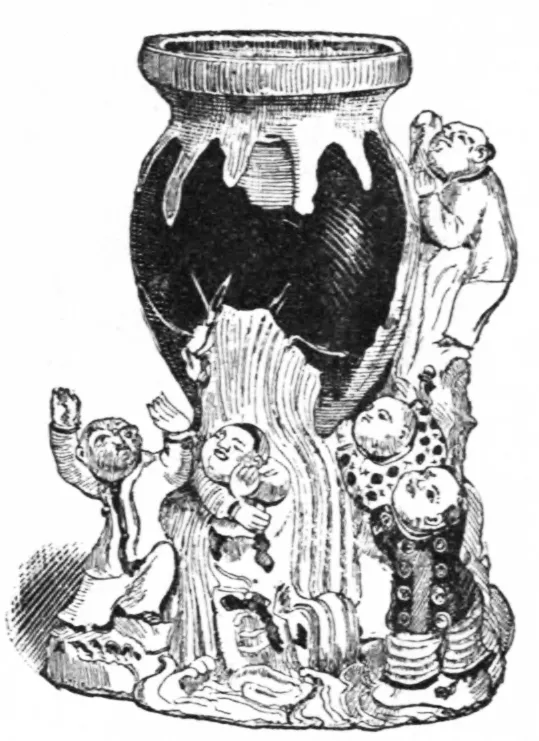
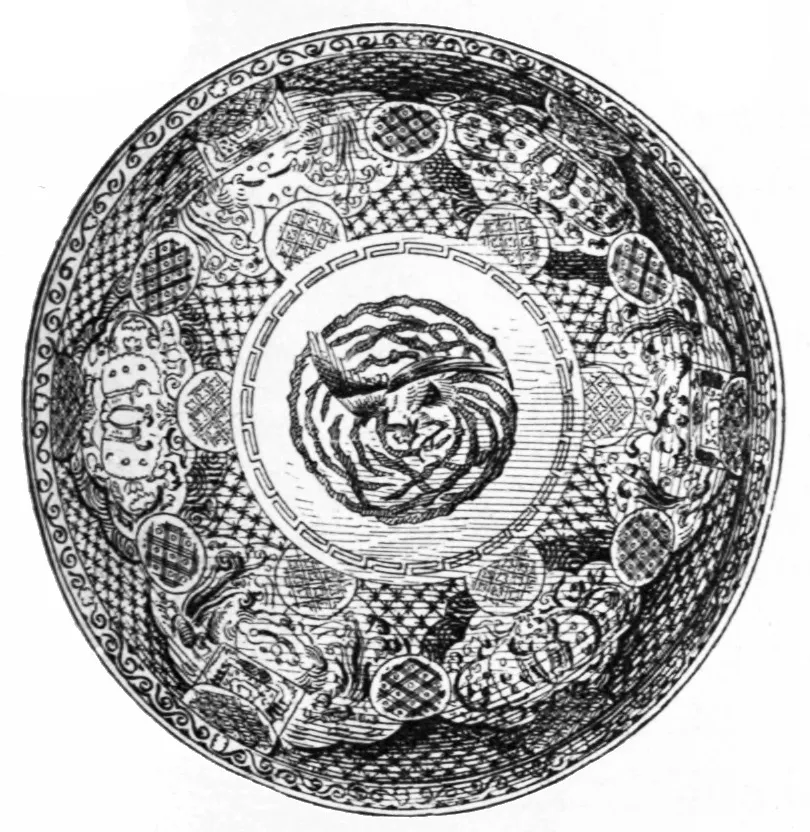
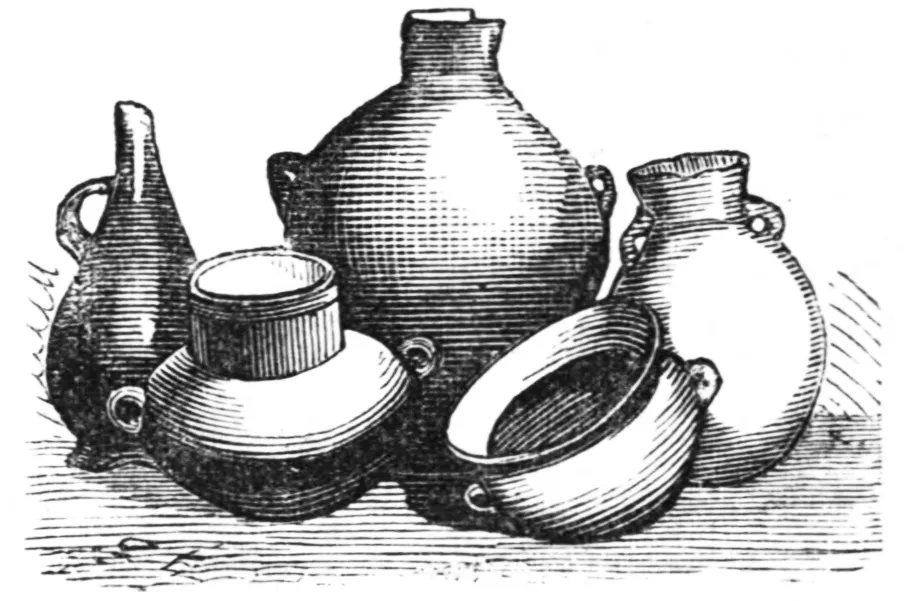
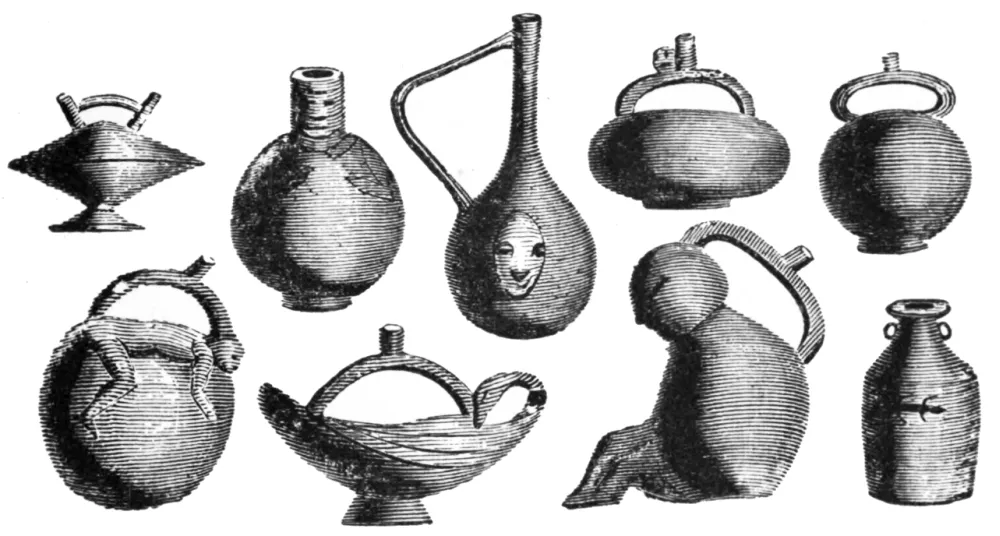
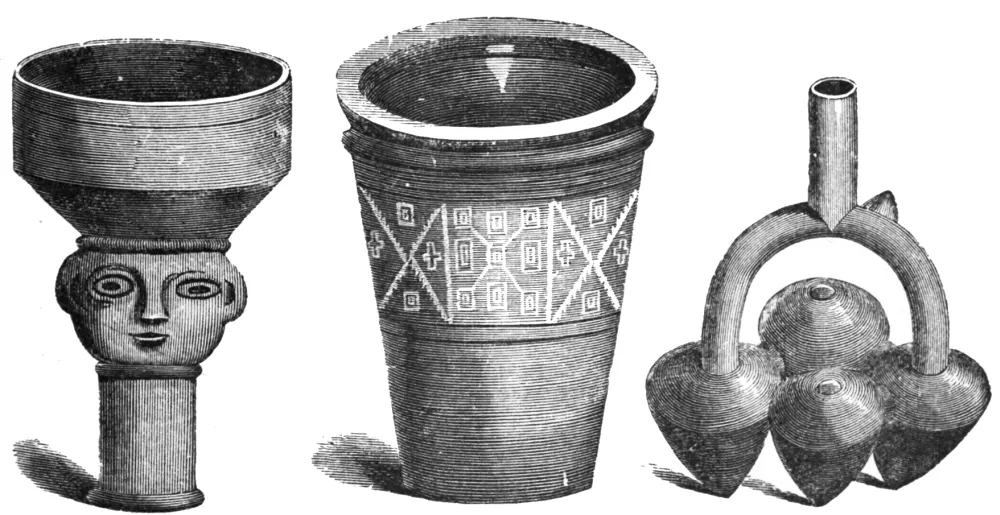
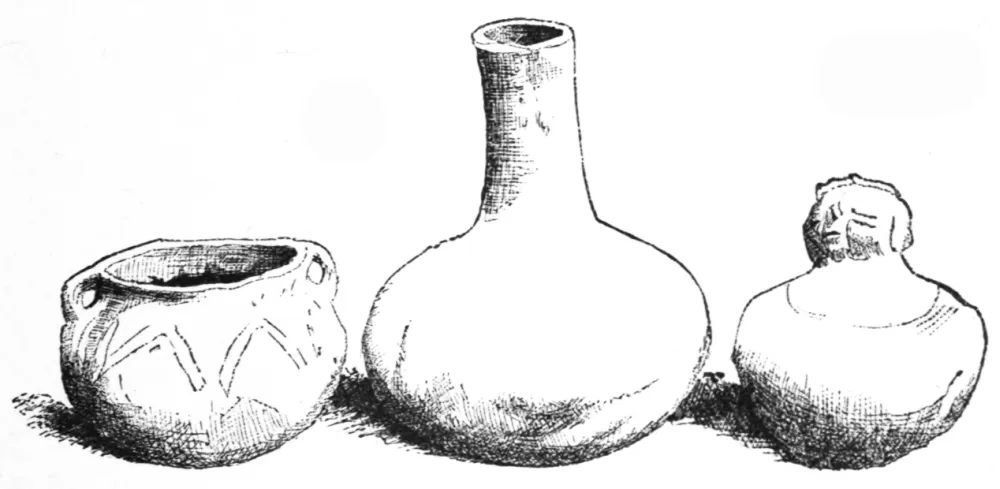
Routes by which Art Travelled.—Their Point of
Convergence.—Cyprus: Its History.—The Successive Nations
Governing It.—The Strata of Ancient Civilization found within its
Shores.—The Discoveries of
Cesnola.—Larnaca.—Dali.—Athieno.—Curium.—Progress of Cypriote
Pottery.—Early Greek Art: Its Connection with Assyria and
Egypt.—Phœnician and Assyrian Art.—General Deductions.—Asia
Minor.—Oriental Art turning in various Streams to Greece.—What
Greece Rejected, Persia Seized upon.—Persia’s Contributions to
Ceramic Art.—History in Reference to its Art.—Effect of
Conquest.—What Persia Taught the Arabs.—Spread of Persian Art by
the Saracens.—Rhodes.—Damascus.—Progress of Saracenic Art.—The
North of Africa.—Metallic Lustre and Stanniferous
Enamel.—Hispano-Moresque.—Early Spain.—Persian Influence upon
Europe.
WE now approach a point in our history which stands within sight both of
the wonders of early Greece and of the beginnings in the Middle Ages of
the best ceramic art of Europe. From Persia, as a centre, art travelled
north and west by many devious routes ere it touched the European
shores. But behind the Persian is the older civilization of Babylonia
and Assyria, to whose glories it succeeded. We are thus once more
brought back to Egypt and Egyptian influences. After spreading to the
east they extended northward, and in Greece are met by others transmuted
by a passage through Assyria and Phœnicia, but springing from the
same prolific source on the banks of the Nile. Persia, after acquiring
from Egypt’s eastern pupils her earliest knowledge, adapted the lessons
thus derived to her own ideas, and spread it across the tracts already
followed by others who had learned directly from her teachers. From both
the south and east these lines of original and derivative art converged
toward one point, the eastern shores and islands of the Mediterranean
and Greece. To show how difficult{199} it is to disentangle the web of
footprints, let us glance at Cyprus, as revealed to us by the
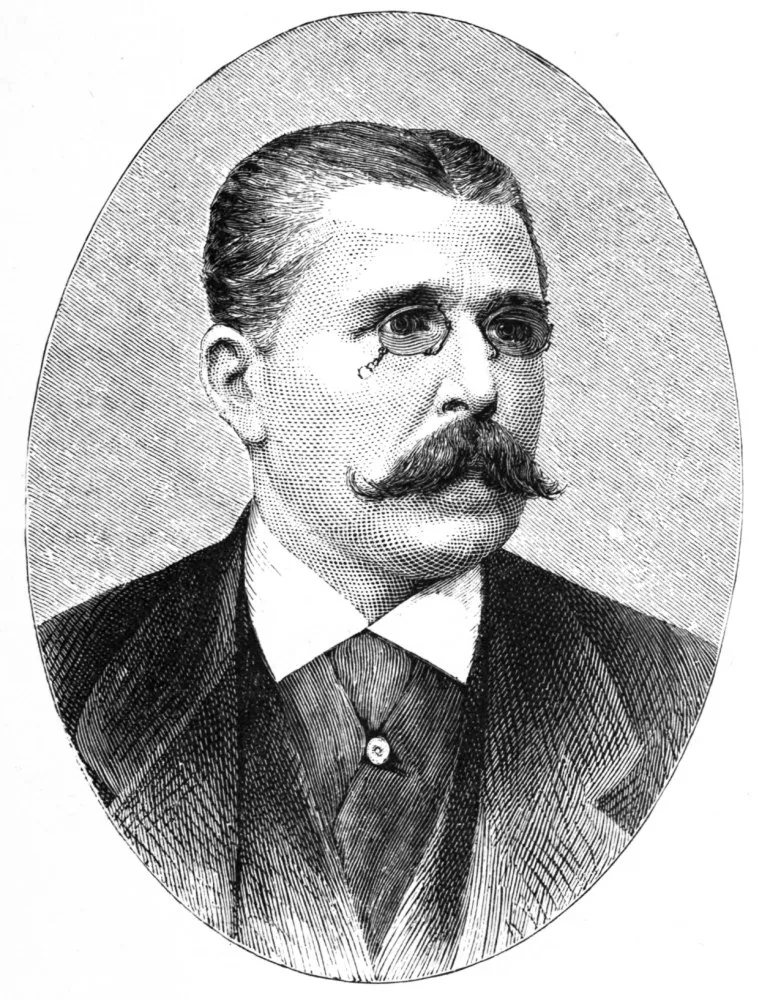
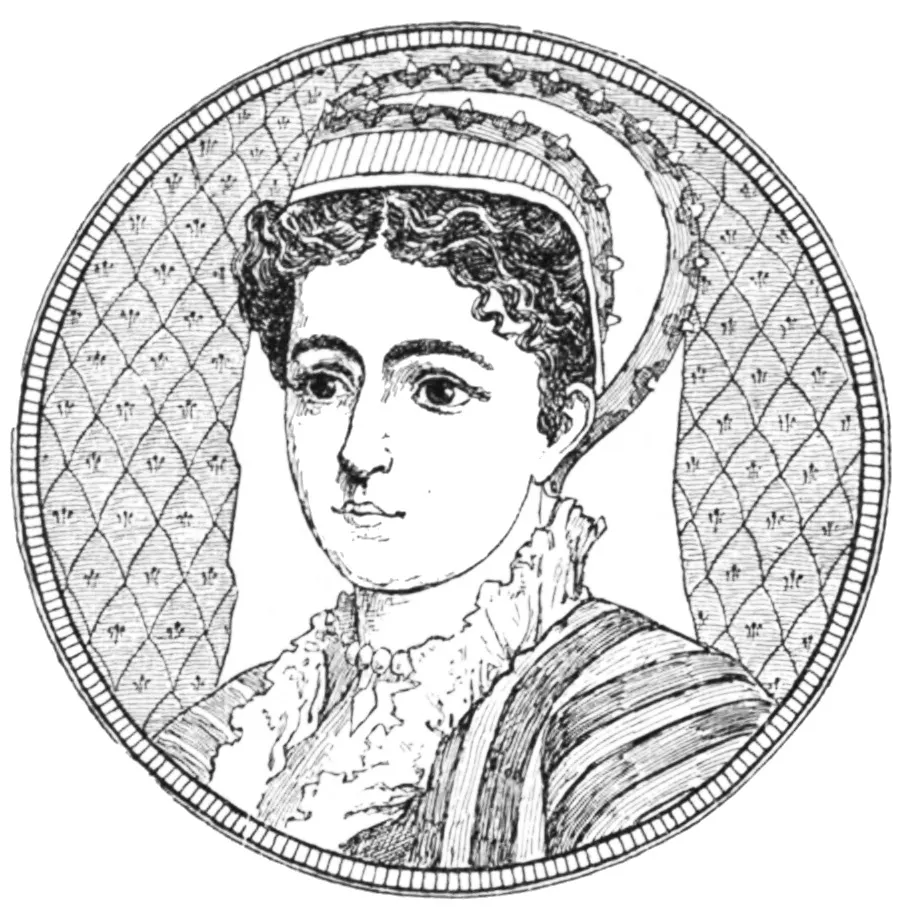
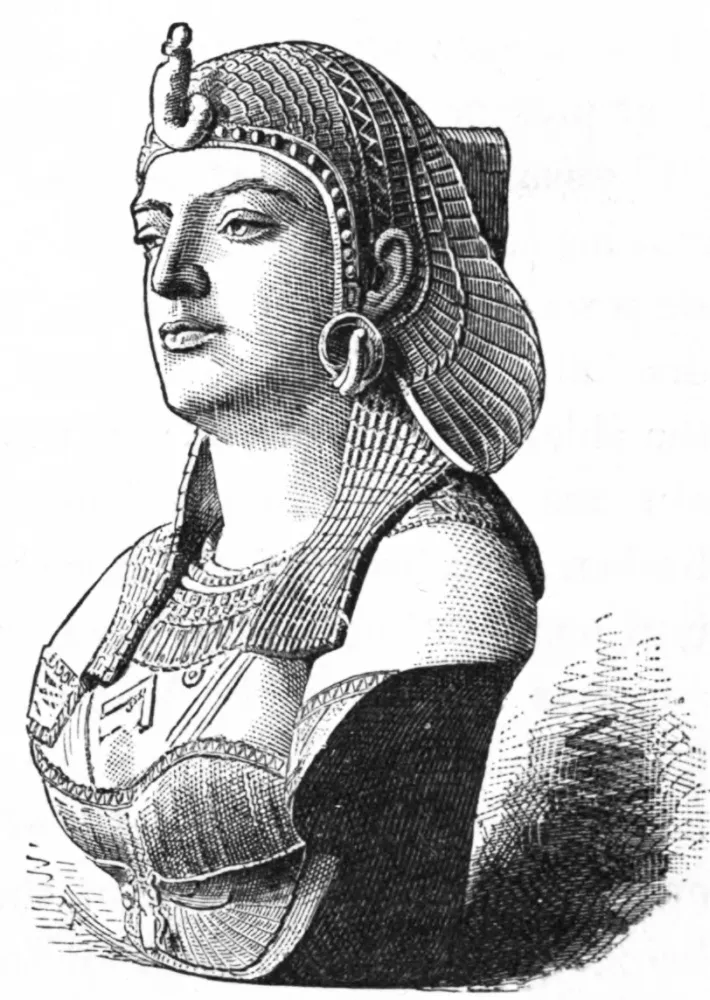
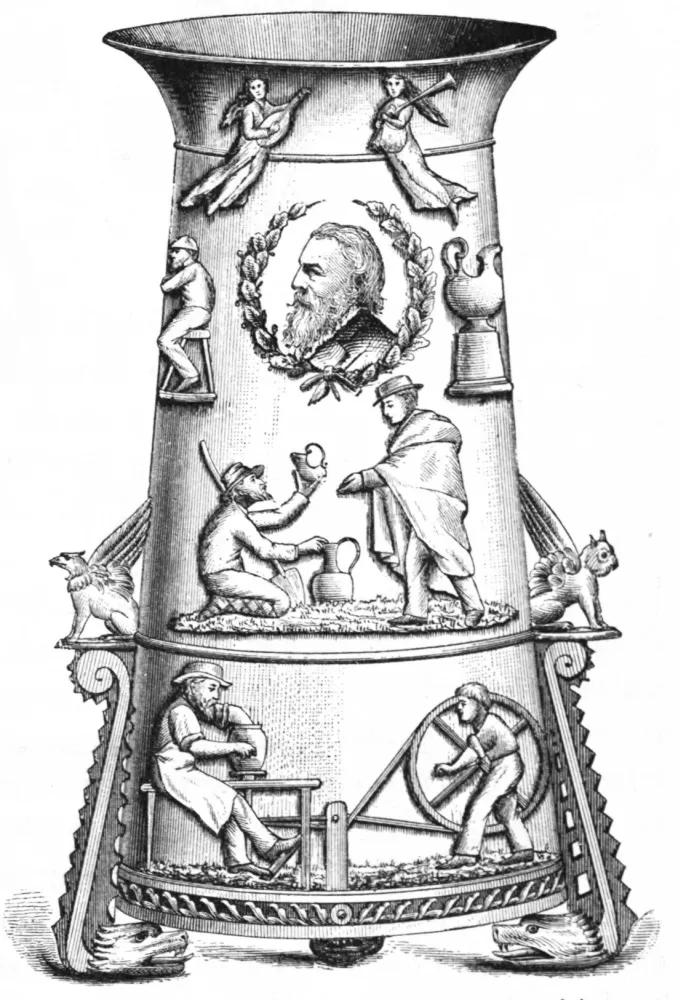
discoveries of General Luigi Palma di Cesnola (Fig. 145), and described
in his work upon “Its Ancient Cities, Tombs, and Temples.” The record
may be read by all who visit the Metropolitan Museum of New York. We
choose Cyprus because it was virtually the meeting-place of the East
with the West. Assyrian, Egyptian, Phœnician, and Greek influences
contend for the mastery.

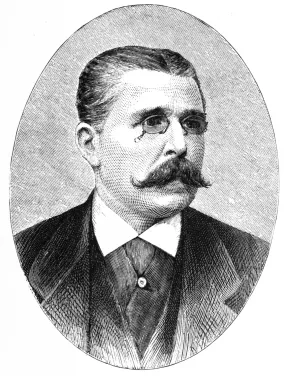
Fig. 145.—General Luigi Palma di Cesnola.
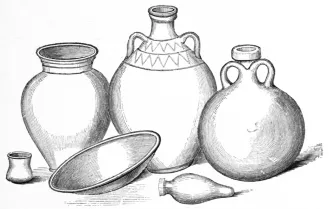
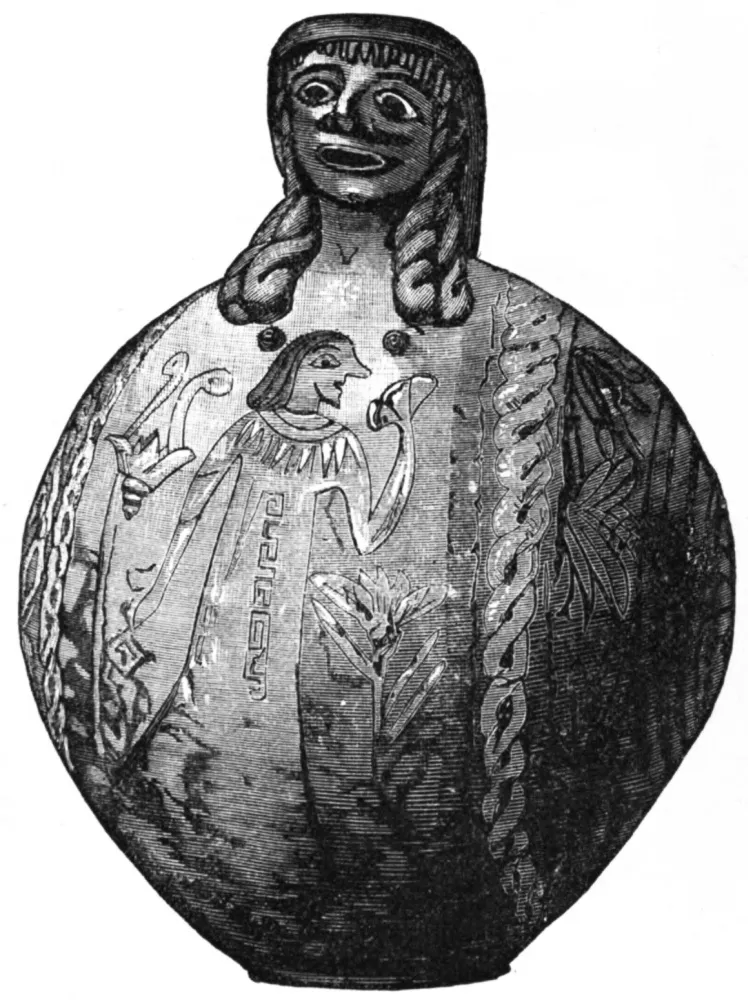
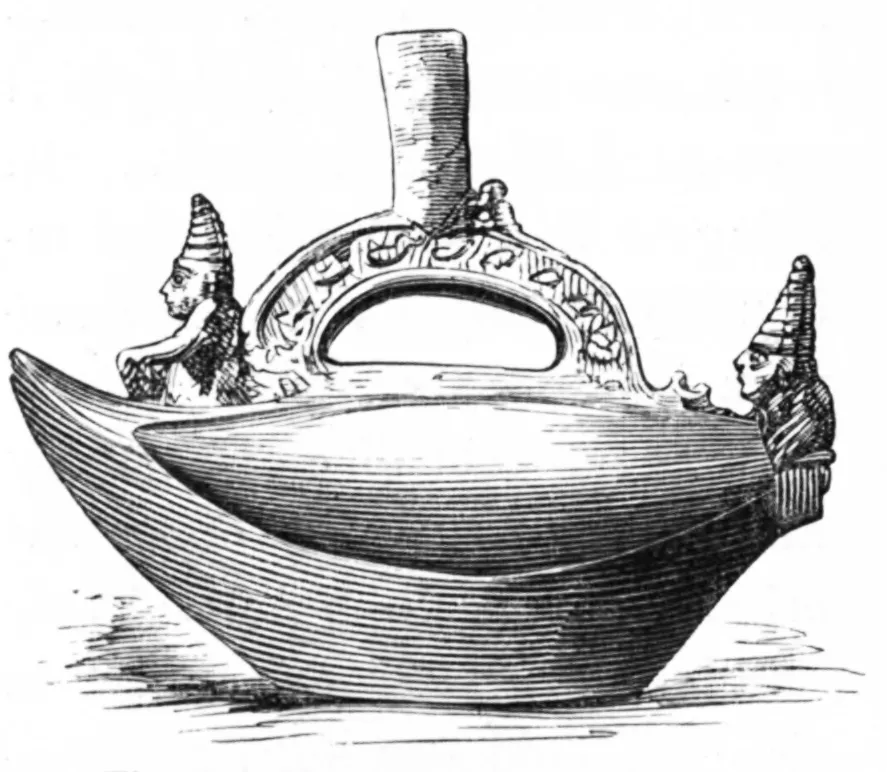
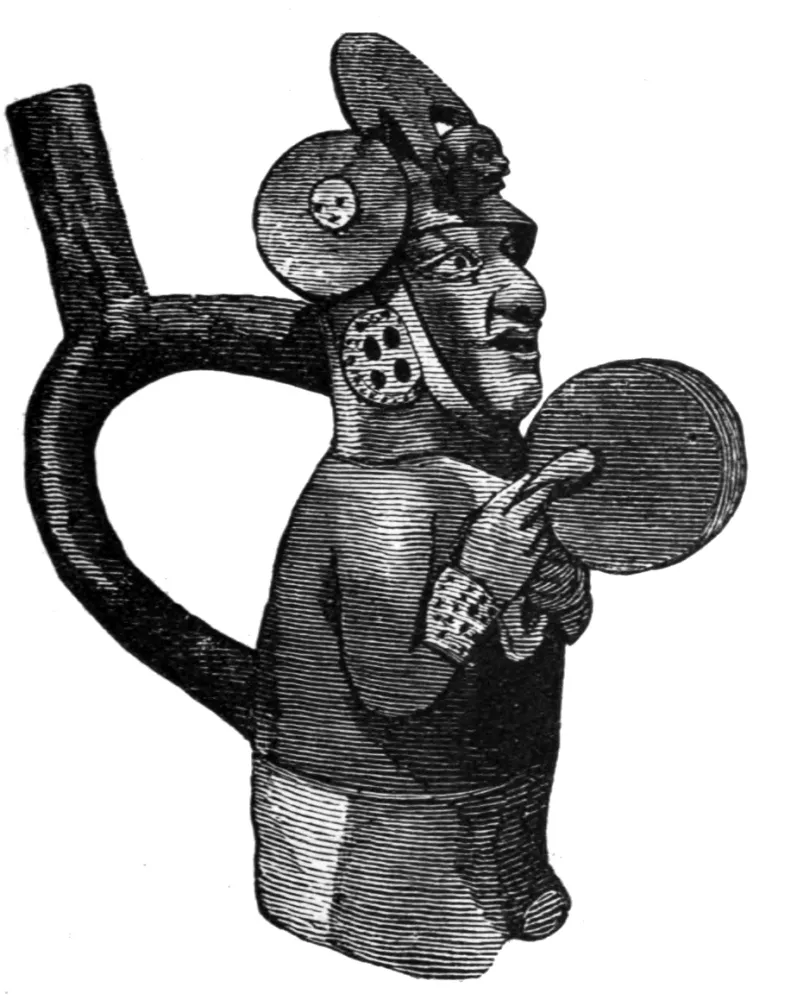
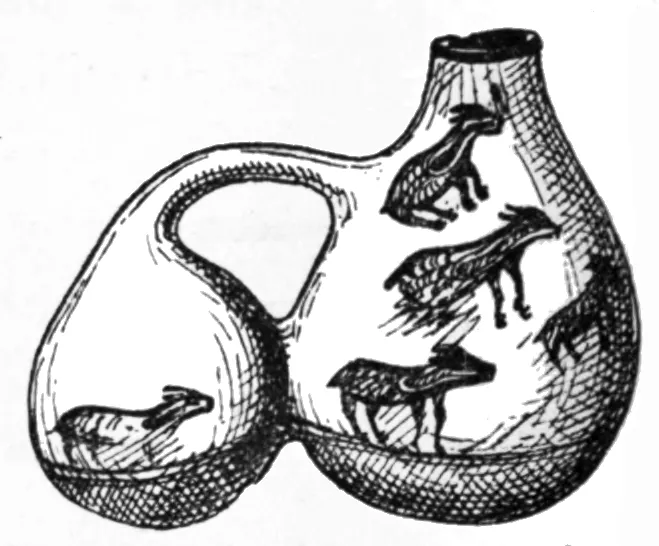
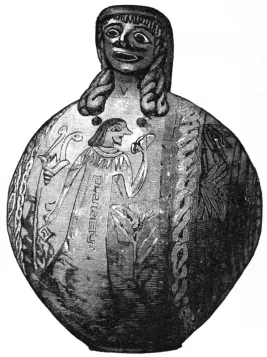 Fig. 146.—Phœnician Vase, with Figure. (Cesnola
Coll., N. Y. Metropolitan Museum.)
There is no certainty as to the derivation of the first settlers. They
may have been either Phœnicians or Cilicians, and thus only another
branch of the great Semitic family to which the Phœnicians belonged.
Or colonists may have arrived from Cilicia and Phœnicia at about the
same time. There is less reason for believing that any settlers came
from Egypt, although the first historical conquest of the{200} island was
effected by the Egyptians. This event took place about B.C. 1440, during
the reign of Thothmes III. How long it remained under Egyptian control
does not exactly appear, but it next passed into the hands of the
Tyrians at a date prior to B.C. 1000. It was next conquered by Sargon,
King of Assyria, and when, about B.C. 600, Apries, King of Egypt, took
Sidon, he included Cyprus in his conquest. Amasis, the successor and
murderer of Apries, completed the work of the latter. The Cypriotes then
turned for deliverance to Cambyses of Persia, and Cyprus became a
dependency of the great eastern power. Again the island was shaken by
revolt, and the greater part of its people joined the Ionians in an
unsuccessful attempt to throw off the Persian yoke. The Athenians and
Lacedæmonians, after taking a portion of Cyprus (B.C. 477), abandoned
their conquests. Then came the rebellion of Evagoras, King of Salamis,
whose father had been dispossessed by the Persians, the result of which
was that Evagoras recovered his own kingdom, but the island still
remained tributary to Persia. It then fell under the control of
Alexander of Macedon, and was held by his generals for a few years after
his death. Ptolemy Lagus, or Soter, again brought Cyprus under Egyptian
rule, and lastly came the arms of all-conquering Rome. We need go no
farther. We stand in Cyprus,{201} upon a battle-field crossed by the armies
of every nation of antiquity with any claim to warlike renown, and find
in it at once the theme of ancient poets and the prize of ancient
warriors. So far we may travel in the track of war, but the history of
art is affected less by the conquest of battle than by permanent
occupancy and the more peaceful conquest of colonization. Thus we find
Phœnician art leaving a deeper impress upon Cyprus than any other,
and one to be detected even amidst the confusion of Semitic and Hellenic
remains. This art developed, on the one hand, into something bearing a
semblance of an independent Cypriote character, and, on the other, into
a form more distinctively Greek. Phœnicia was the country in which
the Assyrian and Egyptian elements of decorative art were combined, and
being brought on the other side into contact with Greece, the history of
Greek art is thus continued backward into a remote antiquity.
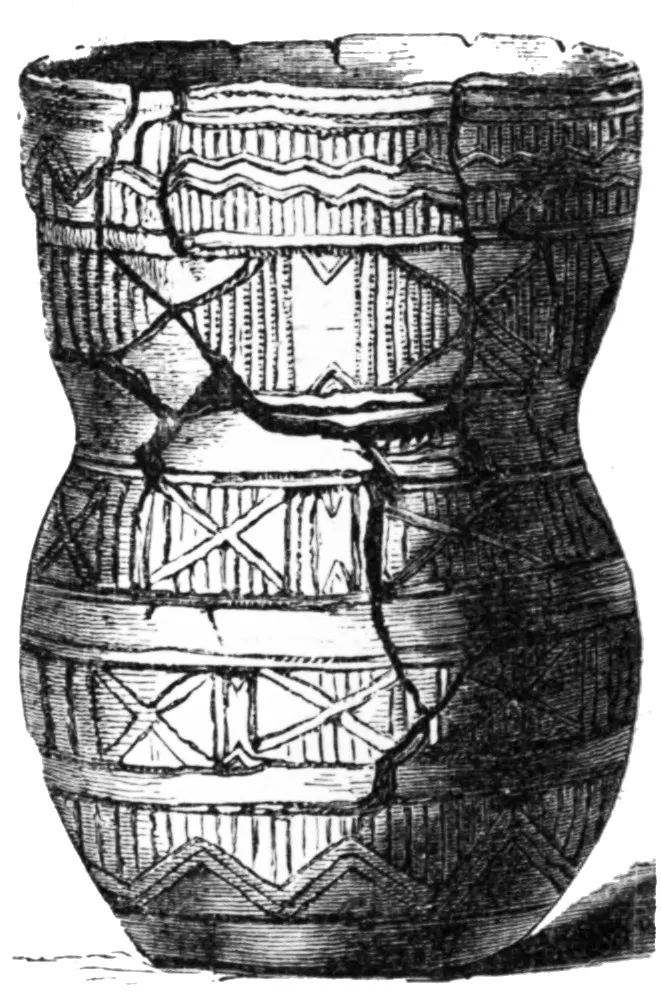
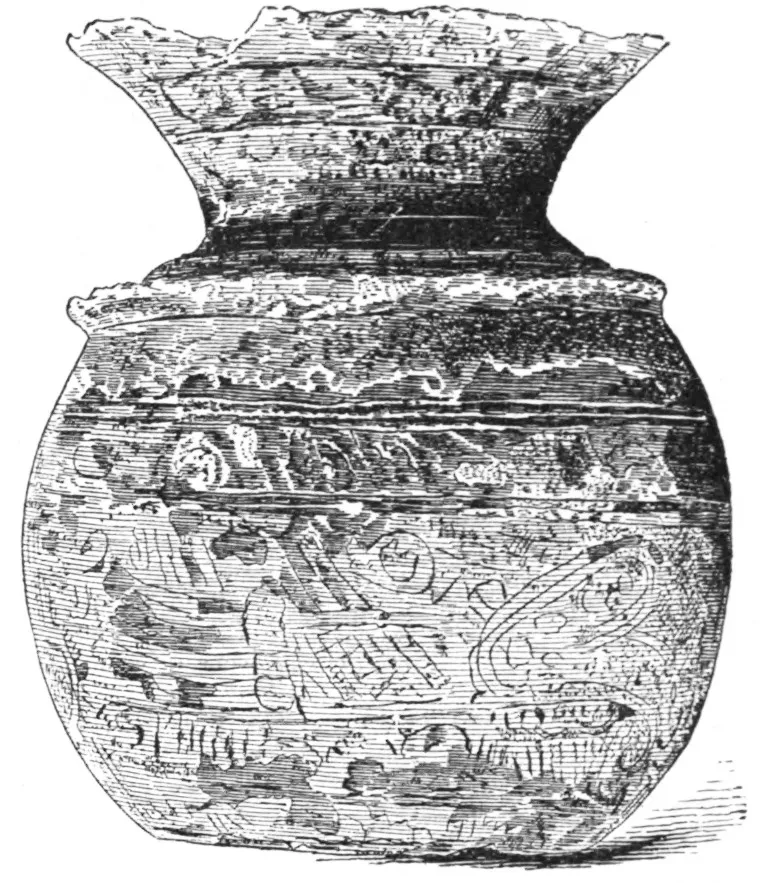
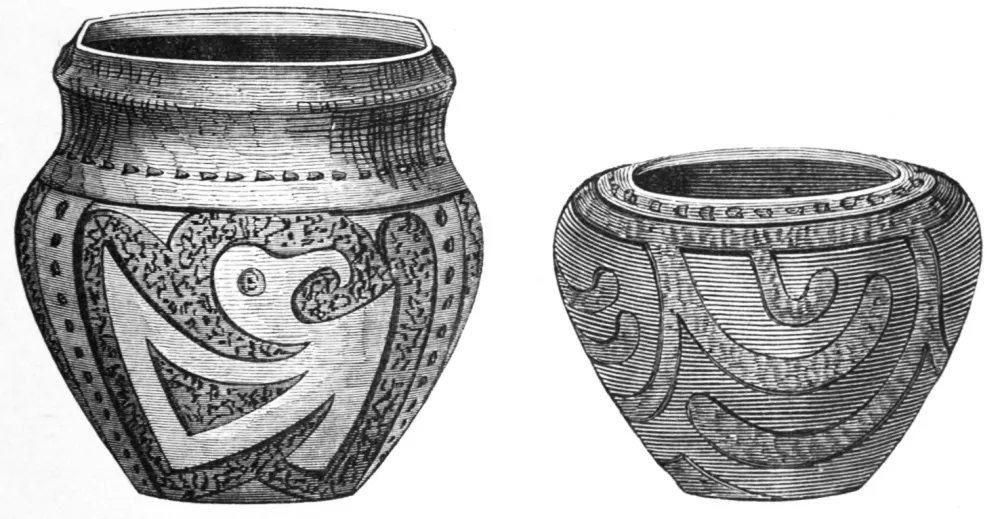
 Fig. 147.—Phœnician Vase, from Curium. (Cesnola
Coll., N. Y. Metrop. Mus.)
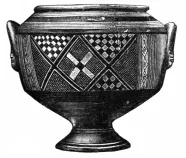 Fig. 148.—Phœnician Vase, from Dali, with
Phœnician Inscription. (Cesnola Coll., N. Y. Metropolitan Museum.)
The early Phœnician settlers located themselves chiefly on the
southern and eastern sides of the island; the Greeks chose the north and
west. Both were evidently actuated by the same motive, viz., to give the
preference to the localities nearest the land from which they had come.
The Phœnicians founded Paphos, Amathus, and Citium; the Greeks
founded Salamis, Curium, Neo-Paphos, and several other towns. Tencer and
Agapenor, two of the Greek heroes from the Trojan war, settled in
Cyprus, and the island is thus introduced into Grecian legend. As time
passed, the Greek and Phœnician elements underwent a more or less
complete amalgamation. The Greek language became the prevailing tongue,
and the Phœnician religion became the common creed. Aphrodite, who
sprung from the foam of the sea, and was wafted to the shore of Cyprus,
was the{202} Tyrian Astarte, the Assyrian Mylitta. Her worship extended over
the whole island, and was engaged in with all the licentious impurity of
the Oriental original. Greece rose as Phœnicia declined, and her
people spread beyond the limits of their ancestral settlements. One
civilization rose upon the ruins of another, and died in its turn; and
Cesnola found them piled one upon another in strata, to be opened up and
read like the stony leaves of the geologist’s book.
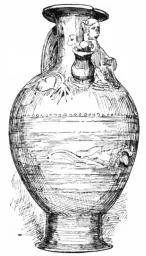 Fig. 149.—Phœnician Vase, from Curium. (Cesnola
Coll., N. Y. Metropolitan Museum.)
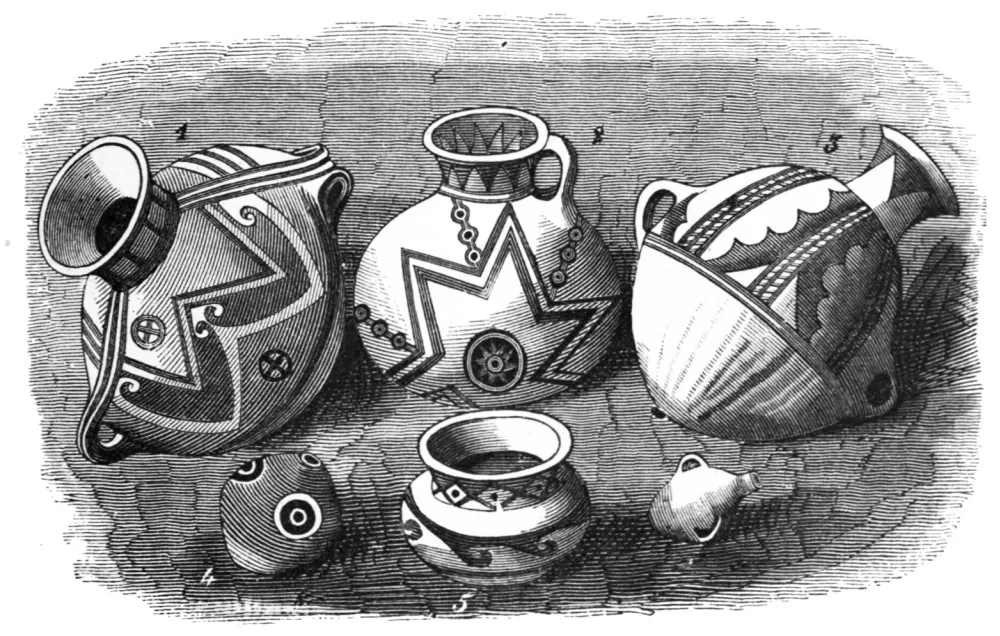
That this is literally the case can be very easily shown. General di
Cesnola began his excavations at Larnaca, on the southern shore of the
island, or near the ancient Citium, or Kittim, a Phœnician city. Near
this city have been found a number of terra-cotta statuettes, which
General Cesnola ascribes to the fourth century before our era. He thinks
they were imported from Greece. They were accompanied by others, poorly
executed, and some figures suggestive of Phœnicia and Egypt. It was
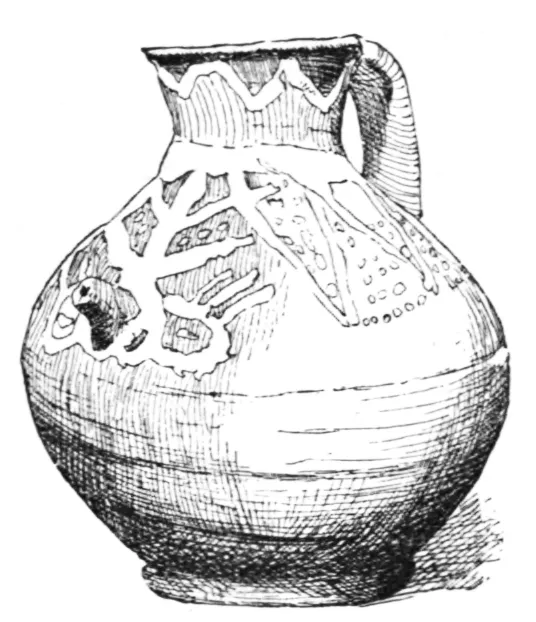
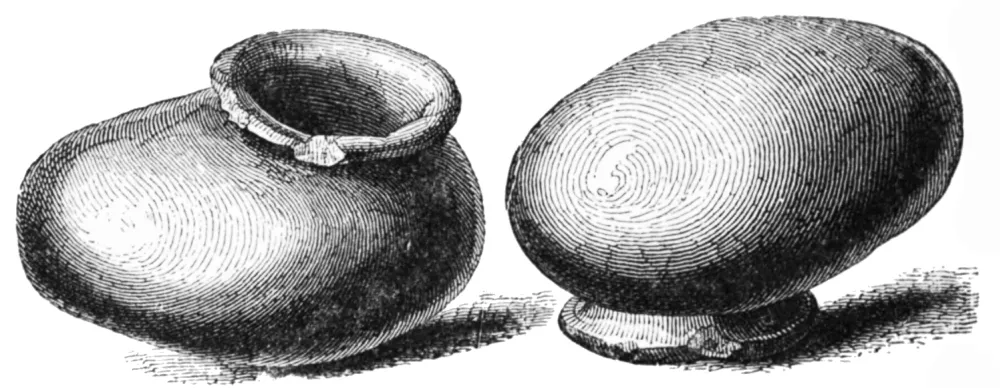
here that the vase, (Fig. 150, was discovered. Crossing the Santa Croce
range, he found, at Dali, on the plain of Messaria, the necropolis of
the Phœnician city Idalium. He began his excavations among the
Phœnician tombs, and exhumed a great quantity of pottery of several
shapes. The vases are of light-colored clay, and are variously decorated
with geometric patterns and concentric circles in brown color. One of
them (Fig. 148) has a Phœnician inscription, and all the others were
evidently Phœnician. Above the tier of tombs from which these were
taken, a second tier was discovered, of a different epoch, and
containing objects of a totally different character. Earthen-ware gave
place to glass in all the shapes found in Greek pottery, the amphora,
lekythos, krater, kylix, and others. Many were of a formation so
evidently late that the discoverer ascribes them to the Græco-Roman
period. Here then, was Greek and Phœnician work reposing in
juxtaposition. An explanation was found by returning to the Greek tomb
which had{203} been first opened, and under it was discovered the
continuation of those of the Phœnicians. The Greek Idalium had grown
upon the ruins of a Phœnician predecessor, and hidden under the ashes
of the one Cesnola found the necropolis of the other. On prosecuting his
researches in the latter, the type of pottery again altered, and the
decoration of concentric rings reappeared. At Alambra, west of Dali, he
found a number of small clay images—horsemen, warriors, chariots, a
representation of a procession, and vases of two kinds. He made
excavations in five burying-grounds, all apparently belonging to the
Phœnician Idalium; and from a mound in the same district he obtained
a collection which, from the combination of Egyptian and Assyrian forms
and decoration, may be assumed to contain some of the most ancient
relics of Phœnician art. Two green-glazed bowls have Egyptian
paintings, and the vases occasionally take the form of animals and
birds.
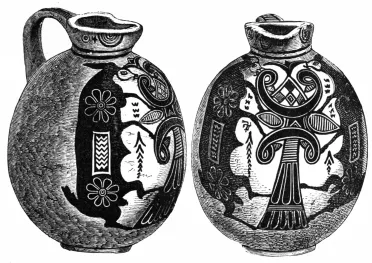
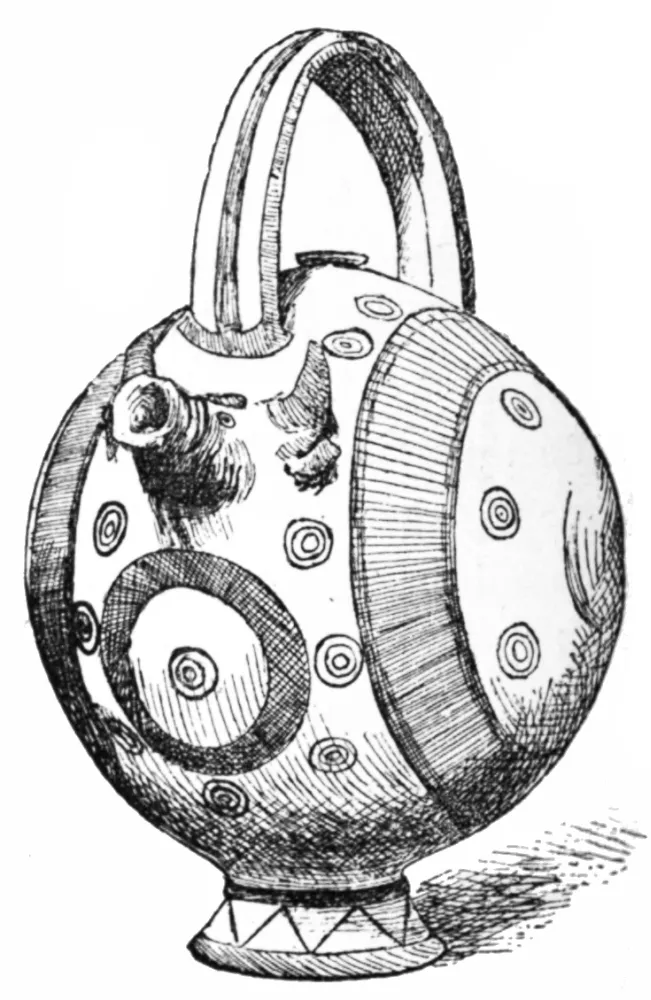
Fig. 150.—Assyro-Phœnician Vase, from Larnaca.
(Cesnola Coll., N. Y. Metrop. Museum.)
Striking eastward from Dali, the explorer reached Athieno, near the
ancient Golgoi, and there came upon a necropolis and an ancient temple
of Venus. The most remarkable fact concerning the statuary brought from
this locality is that the lines of nationality are so broad and well
defined. General Cesnola then determined to push his {204}explorations
toward the East, and, after visiting Salamis, turned westward to Paphos,
Neo-Paphos, and then northward to Soli and other places on the northern
shore. Returning to the southern shore, a number of terra-cotta vases
and figures of the Phœnician type and Egyptian green-glazed vessels
were exhumed at Amathus. A statuette of Astarte and figures of Egyptian
deities were found almost together. Lastly, General Cesnola visited
Curium, a city said to have been founded by an Argive colony. There he
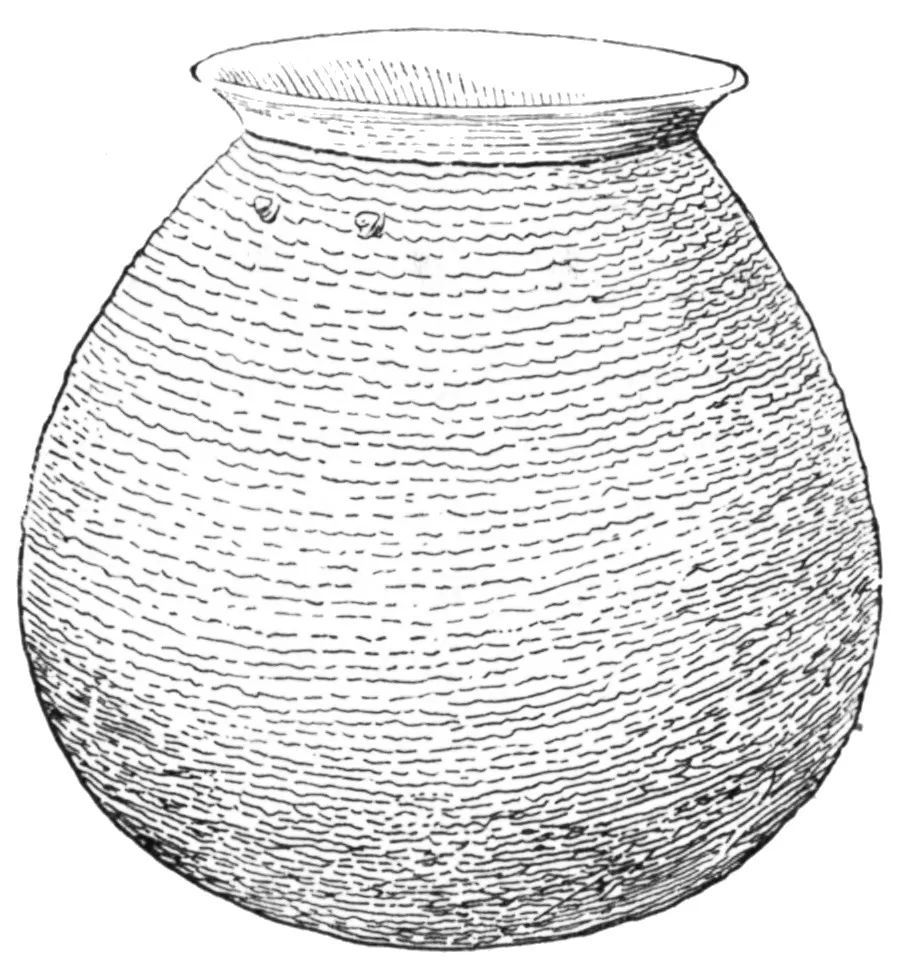
found pottery of the usual mixed types, including vases, terra-cotta
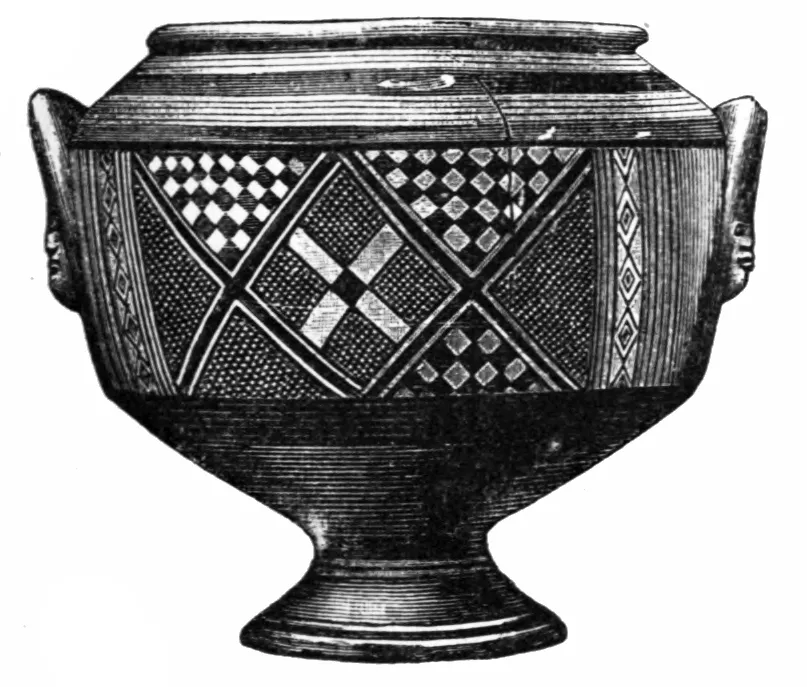
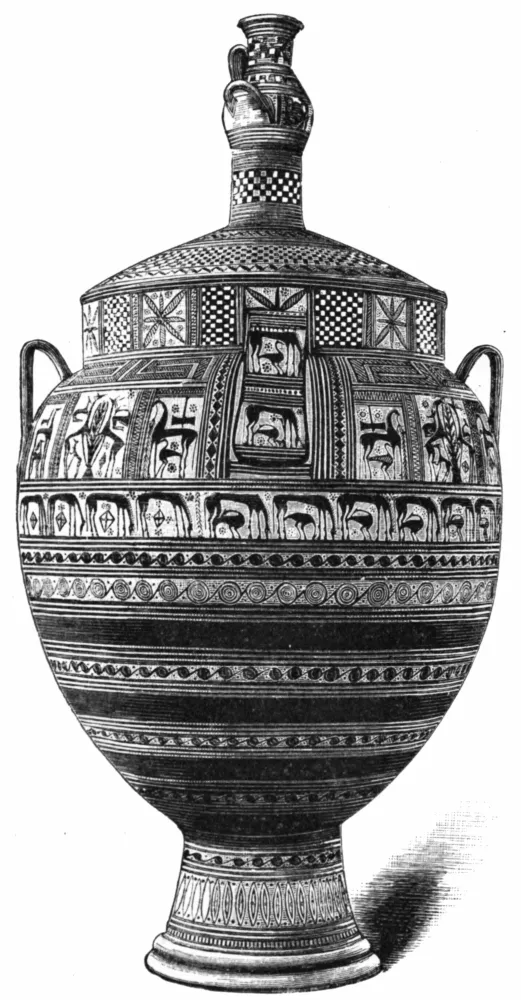
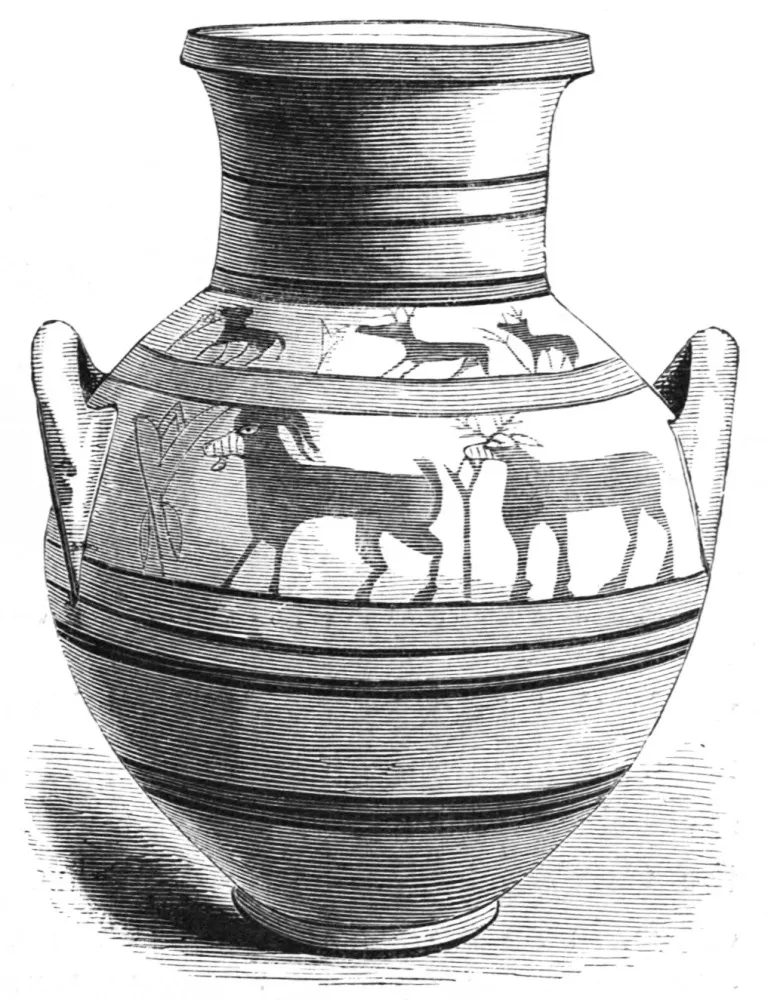
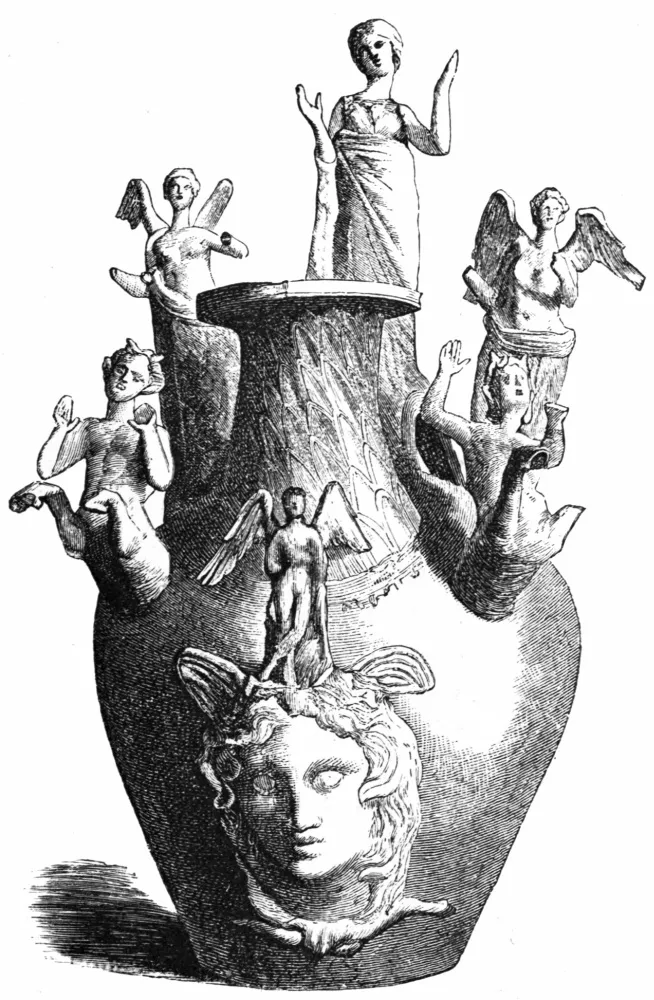
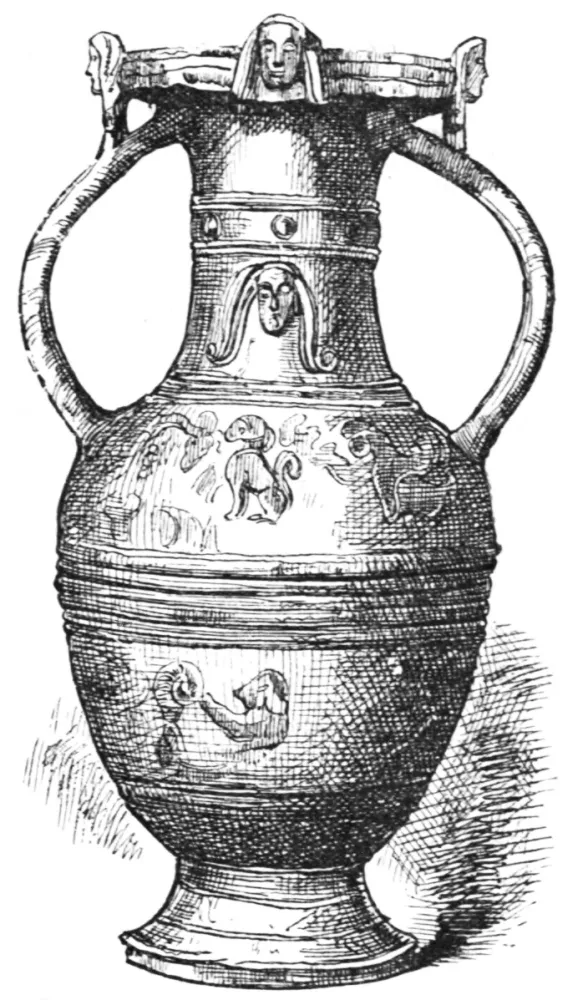
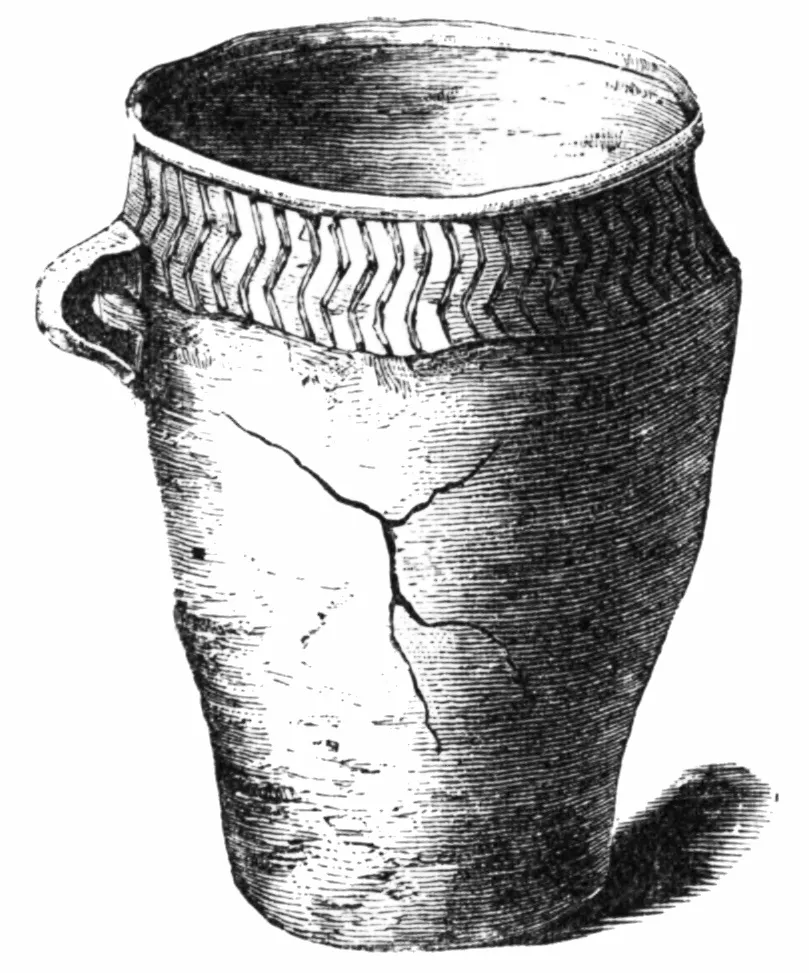
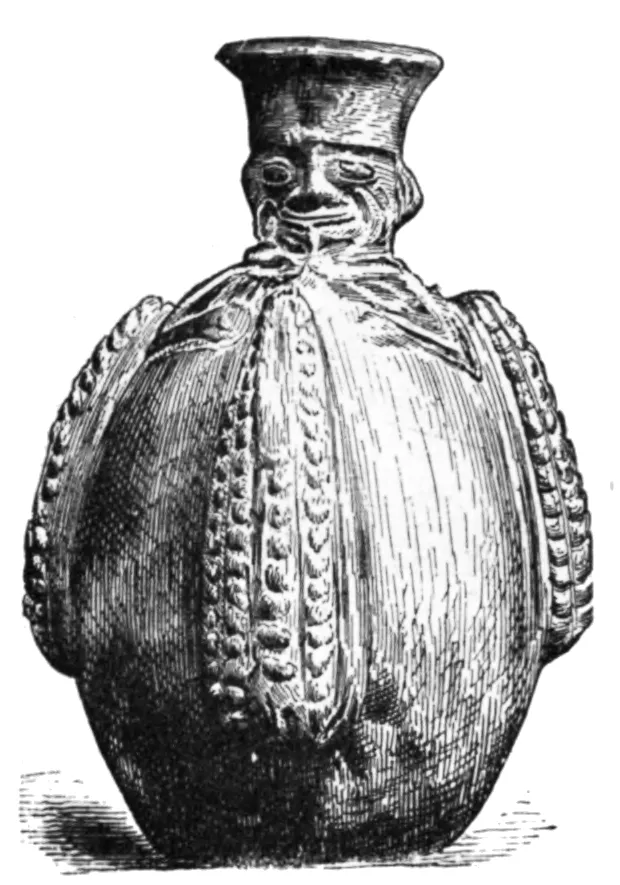
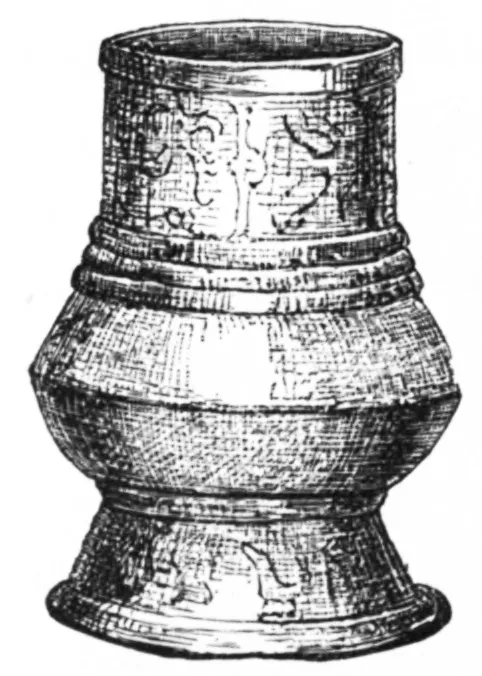
figures, and one large vase (Fig. 151), so strongly marked with Greek
influences that he ascribes it to the earlier period of Greek art. Both
General Cesnola and Mr. A. S. Murray think that it may have been taken
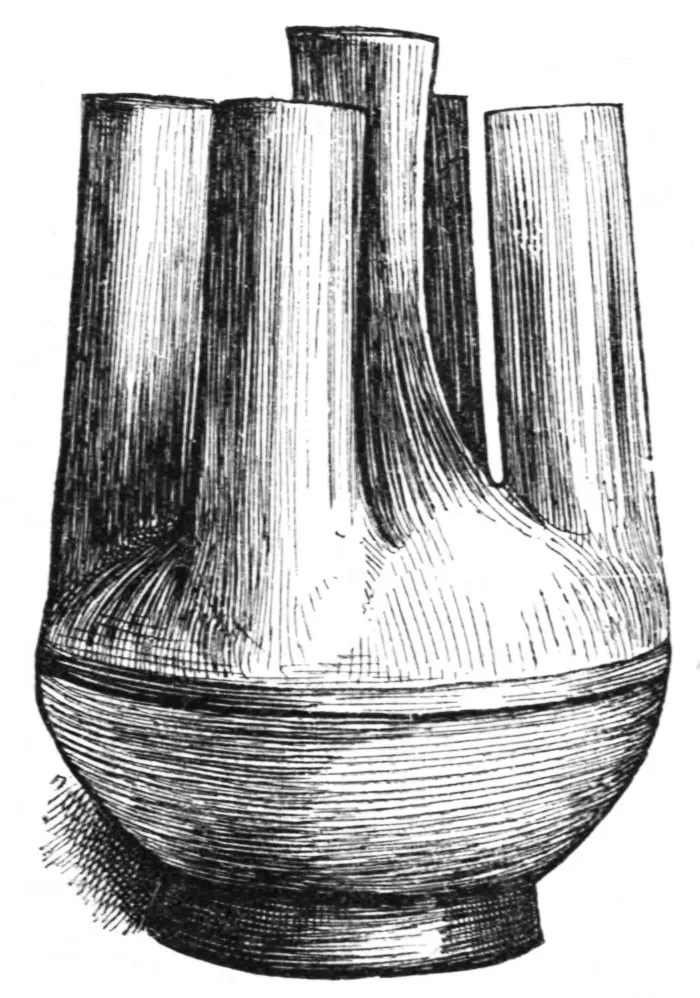
to Curium from Greece. Its four handles, its great size, and its
elaborate decoration make it unequalled among the vast number of
Cypriote relics in the Metropolitan Museum.
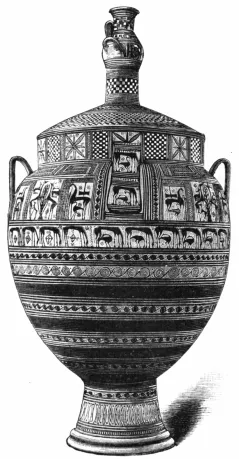 Fig. 151.—Greek Vase, from Curium. Height, 4 ft. 9 in.
(Cesnola Coll., N. Y. Metrop. Museum.)
In constructing a theory of the progression of Cypriote pottery it is
necessary to examine closely the different styles of ornamentation. On
some we find Assyrian symbols and characteristic styles of decoration;
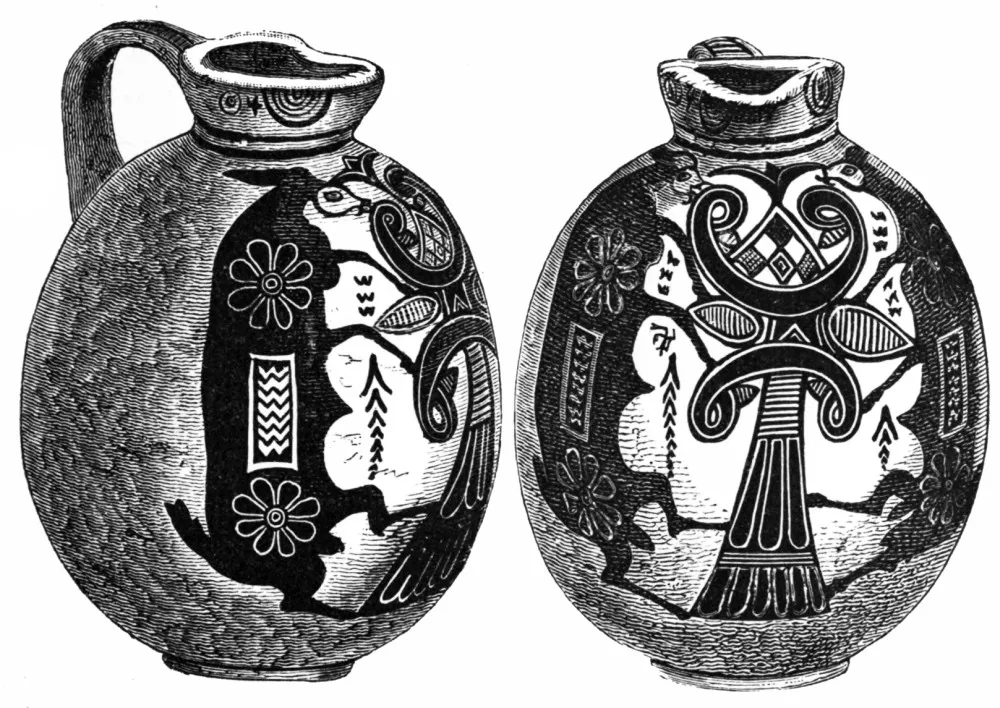
on others the figures are as evidently Egyptian. Thus the{205} archaic vase
from Larnaca (Fig. 150) is just such a work as might be expected from
the Phœnician founders of Kittim while still directly under the
domination of Assyrian ideas. The pattern between the animals is
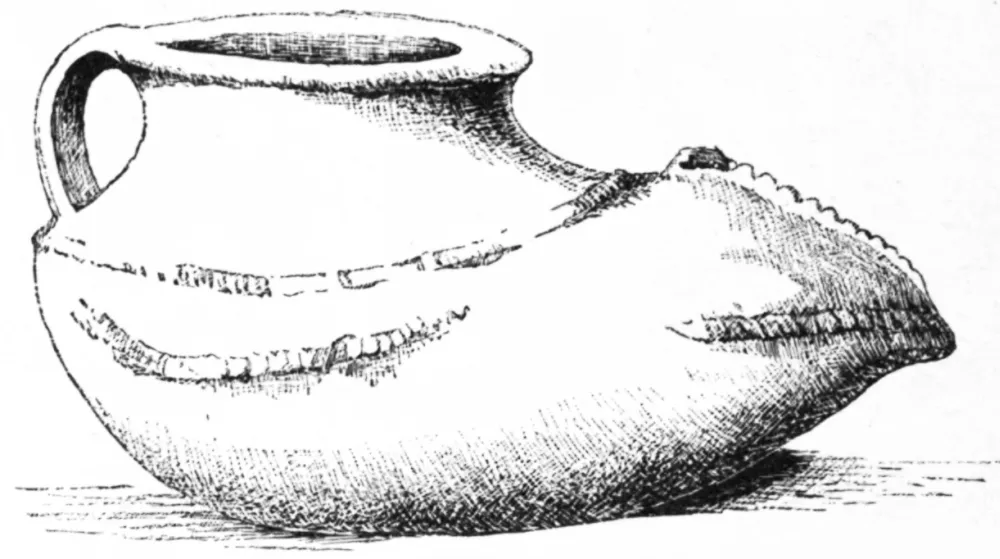
distinctively Assyrian. In a similar manner the vase (Fig. 146) is
decorated with an Egyptian figure, but in the subsidiary decoration—the
plaited pattern on the sides and the concentric circles arranged
vertically—there is nothing indicative of Egyptian influence. We see in
it the work of a potter who combined an Egyptian suggestion with a more
independent form of ornament. It has already been said that, of all the
nations of antiquity, the Phœnicians are most strongly marked by
influences emanating from Egypt, on the one hand, and from Assyria on
the other. To this people, therefore, we may attribute the two vases
last referred to.
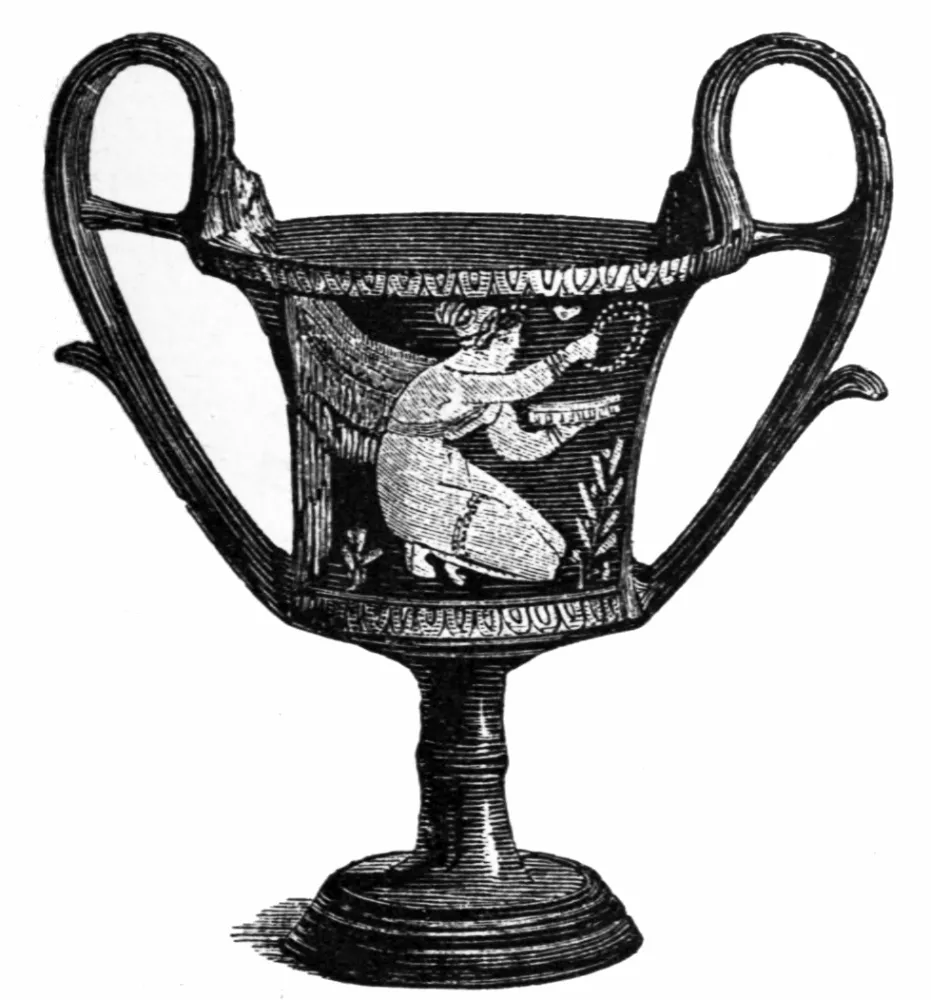
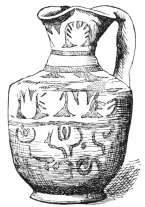 Fig. 152.—Phœnician Vase, from Curium. (Cesnola
Coll., N. Y. Metropolitan Museum.)
It is also necessary to bear in mind that, while certain symptoms of
independence on the part of Cypriote potters must be appreciated at
their full value, there are no evidences of the potter’s art ever having
developed among them to any great extent. It is possible that the
effeminate, voluptuous nature of the people prevented the attainment of
artistic superiority. It is also possible that their skill in working
metal may have distracted their attention from clay. In either event we
discover no well-defined gradation from the lower to the higher, such as
we find in Greece. Cyprus may have been still wrapped in slumber, while
Greece was striding forward in the full vigor of its young life. It may
have been following its ancient models, while Greece was turning from
the old to the new and original. It is difficult, therefore, to ascribe
with precision the Cypriote pottery to any given age. A rule by which to
determine such questions has been laid down in this way: vases painted
with linear designs are the most ancient; then follow those with animal
figures; lastly come those with human forms. Cypriote pottery makes the
application of such a rule extremely hazardous and difficult. How apply
it to the vase with vertical rings{206} and human form and head (Fig. 146)?
The figure is Egyptian, and might, for that reason, carry us back to the
conquest by Thothmes III., were it not that it represents the latest
style of decoration according to the accepted rule, while the remainder
of the decoration belongs to the earliest.
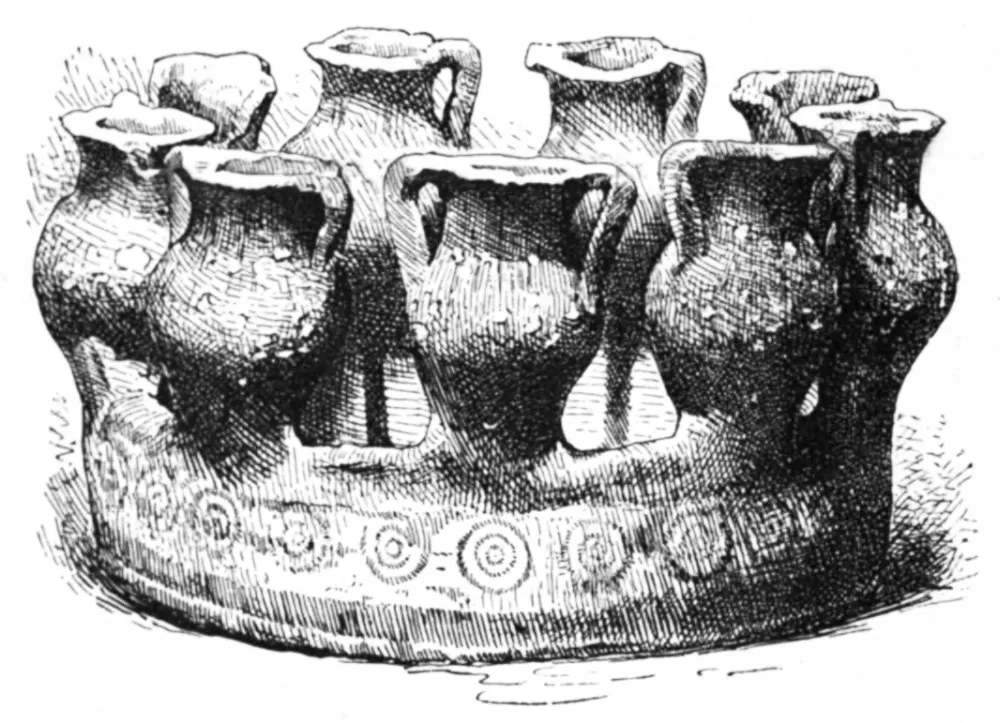
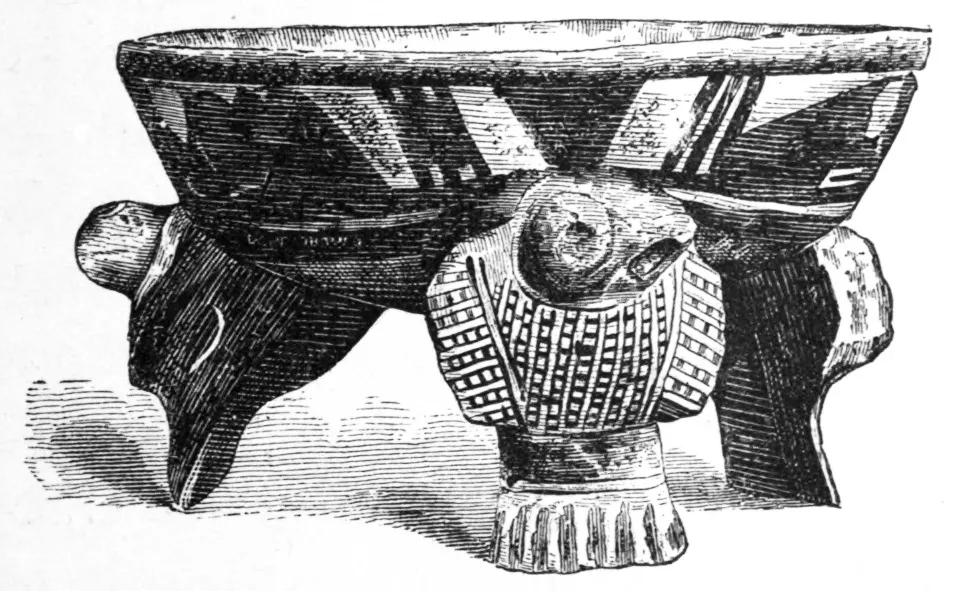
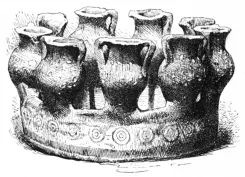 Fig. 153.—Phœnician Pottery, from Curium. (Cesnola
Coll., N. Y. Metropolitan Museum.)
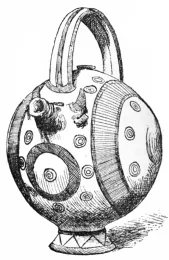 Fig. 154.—Phœnician Vase, from Curium. (Cesnola
Coll., N. Y. Metrop. Mus.)
The practice of ornamenting with concentric rings is an application to
pottery of a pattern borrowed from working in metal. Cyprus was famed
for its copper, and, from the legendary age downward, exported armor and
weapons of bronze. It is not singular, therefore, if on some of the
ruder relics of the potter we should find this ornament. In the curious
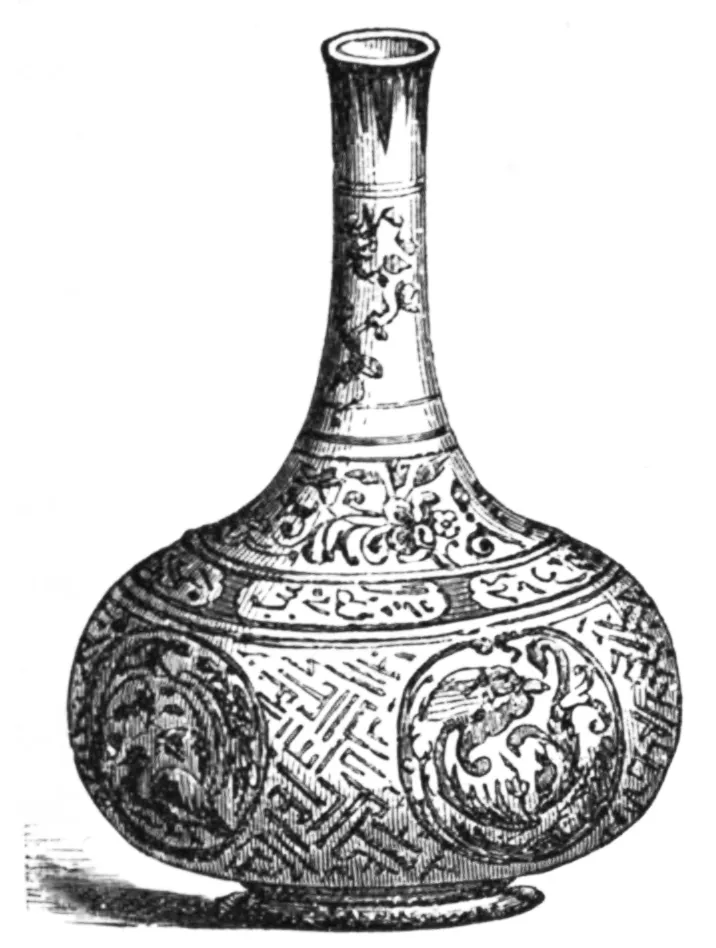
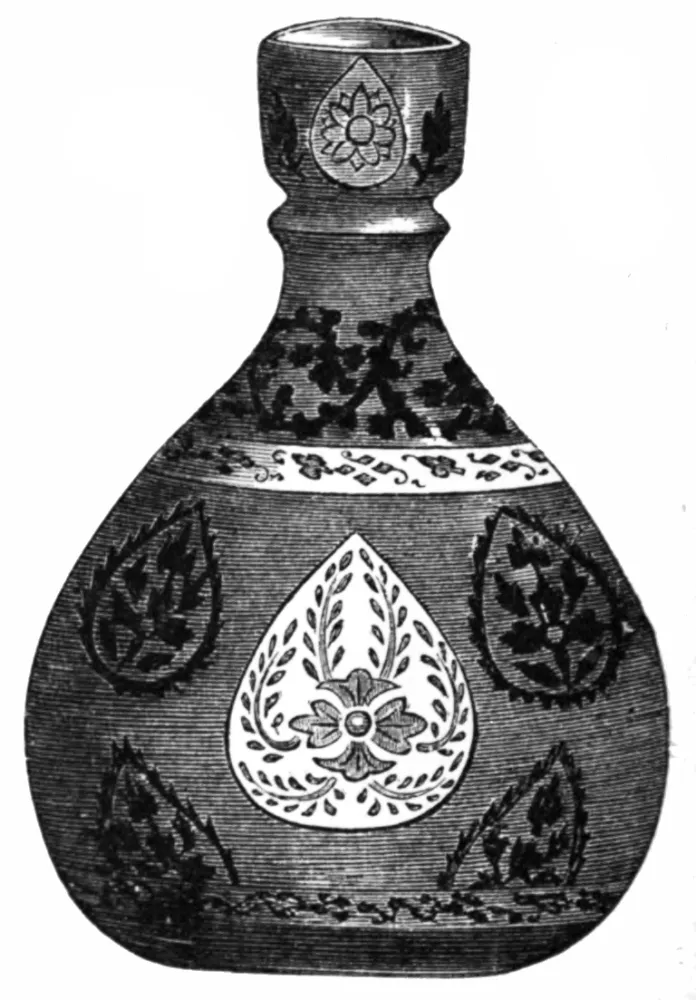
circle of vases (Fig. 153) we see arranged round the base the concentric
rings, which were in time transformed into the Greek spiral. The same
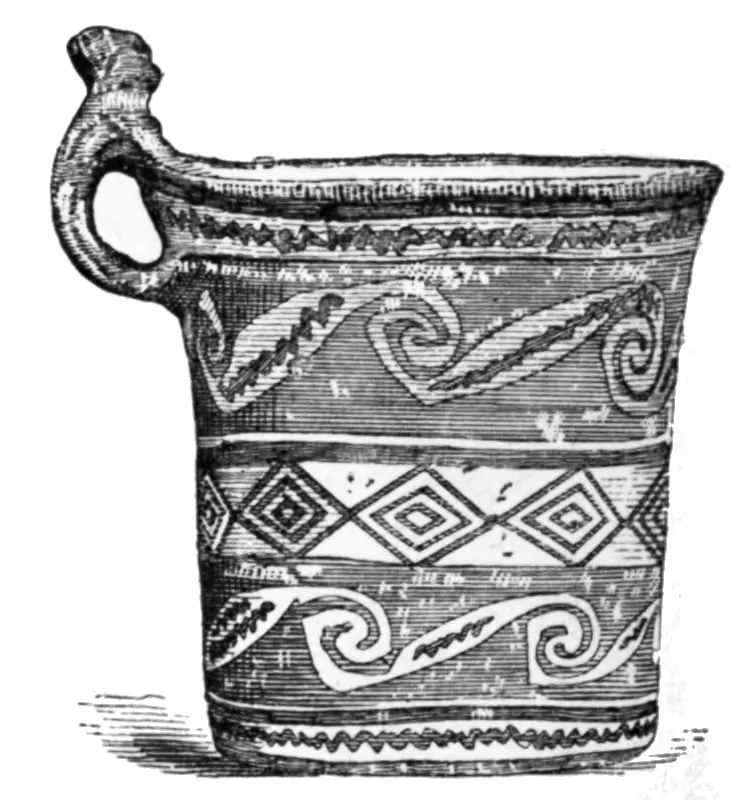
pattern is exemplified in the specimen from Curium (Fig. 154), from
which, and from several others in the Metropolitan Museum, it might
almost be inferred that the vessel had been shaped to suit the favorite
style of decoration. A cognate style, also having its origin in
metal-working, is that represented in the vase from Dali (Fig. 148),
sufficiently authenticated by its Phœnician inscription. It belongs
to a very large class, which appears to extend from the earliest times
down to the beginning of purely Greek art. It will be observed that the
squares run both horizontally and perpendicularly, an arrangement{207} much
more noticeable in many other specimens. One of the earlier examples is
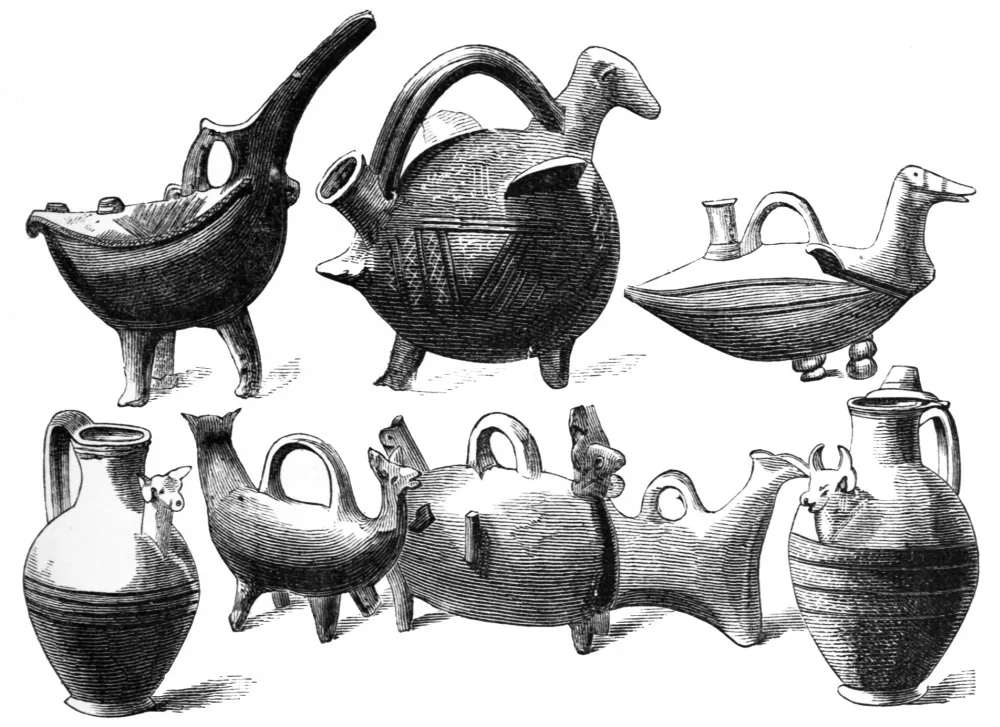
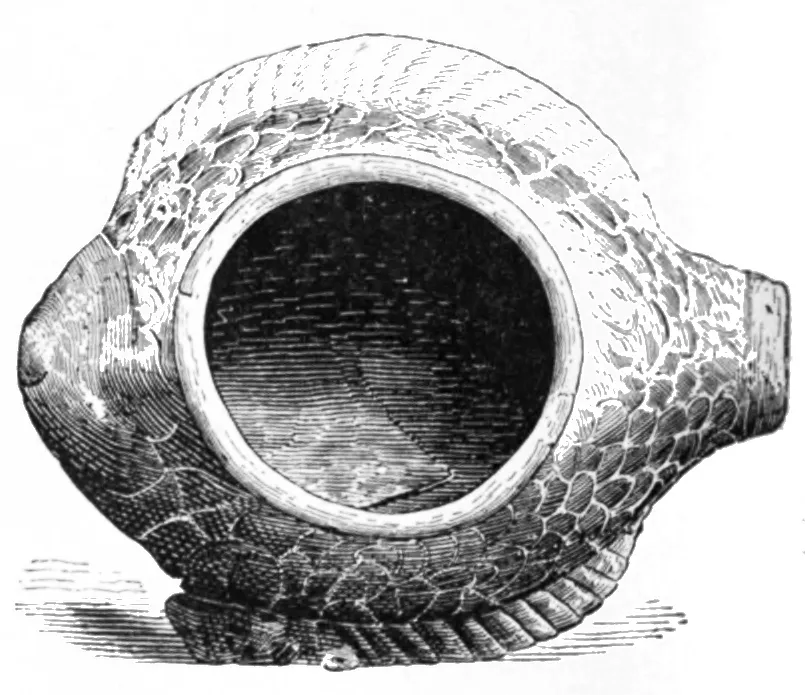
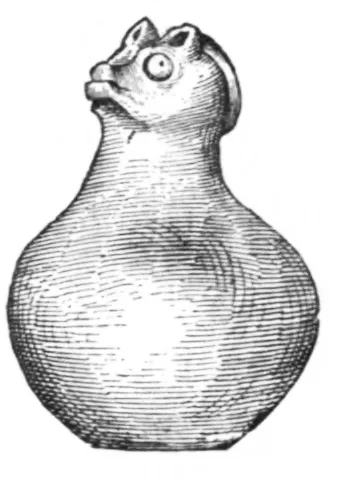
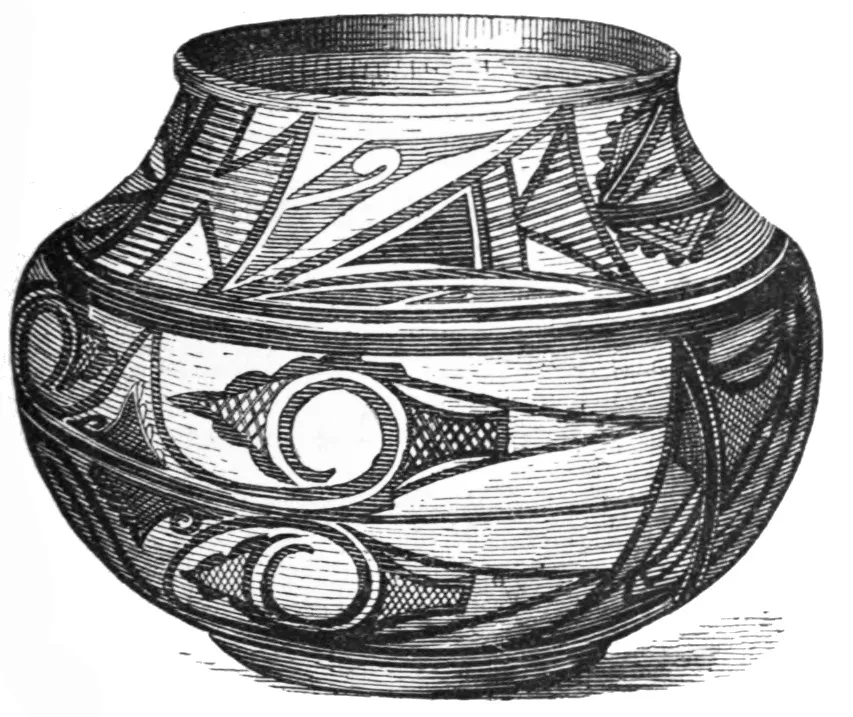
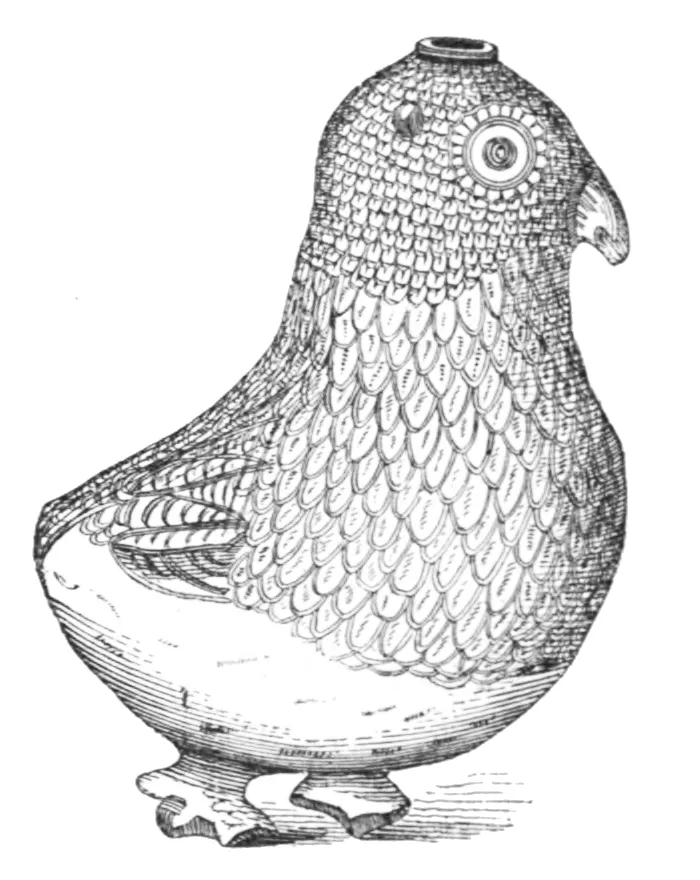
seen on the bird-shaped vase in the illustration (Fig. 155. In what is
probably a much later vessel, a swan with circular body and triangular
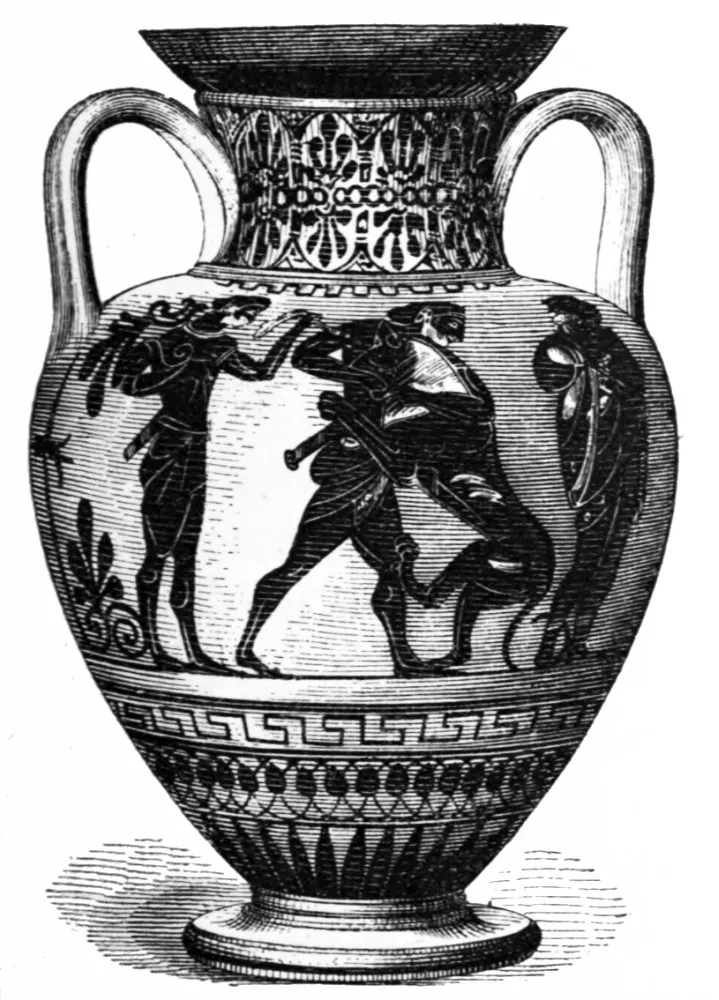
wings makes its appearance. This is the rude attempt at decorating with
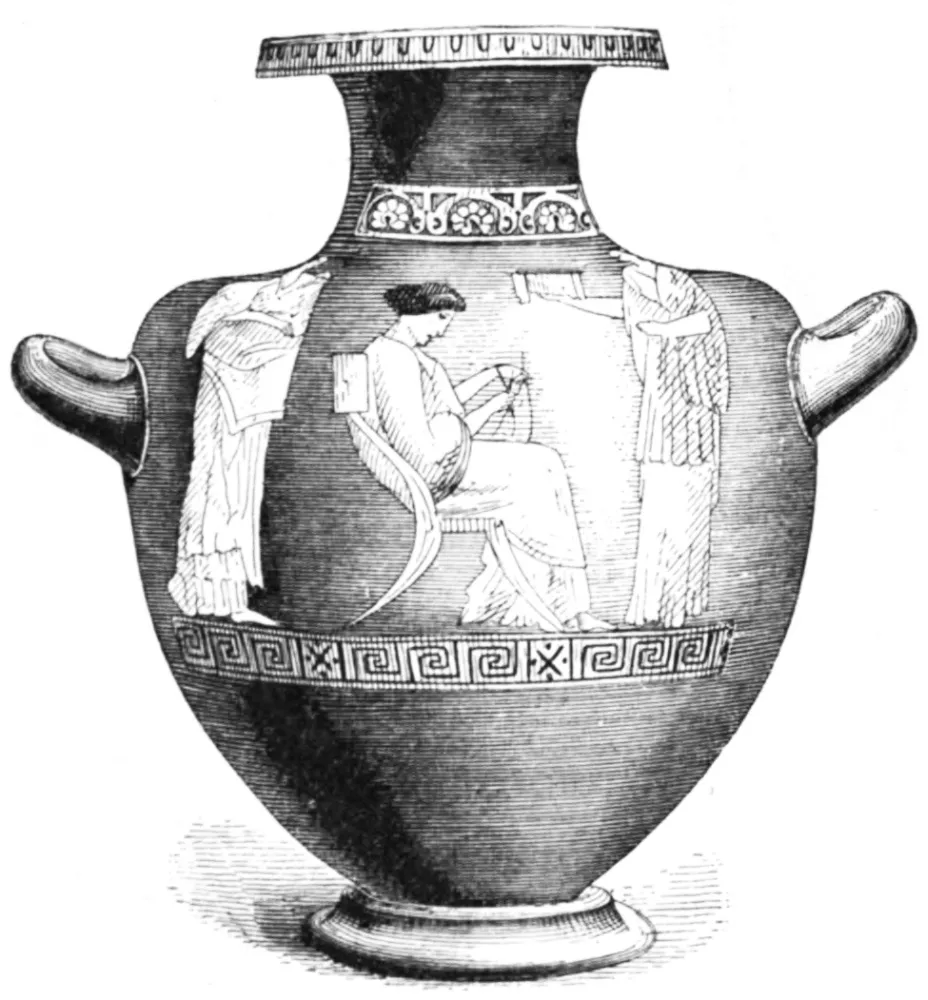
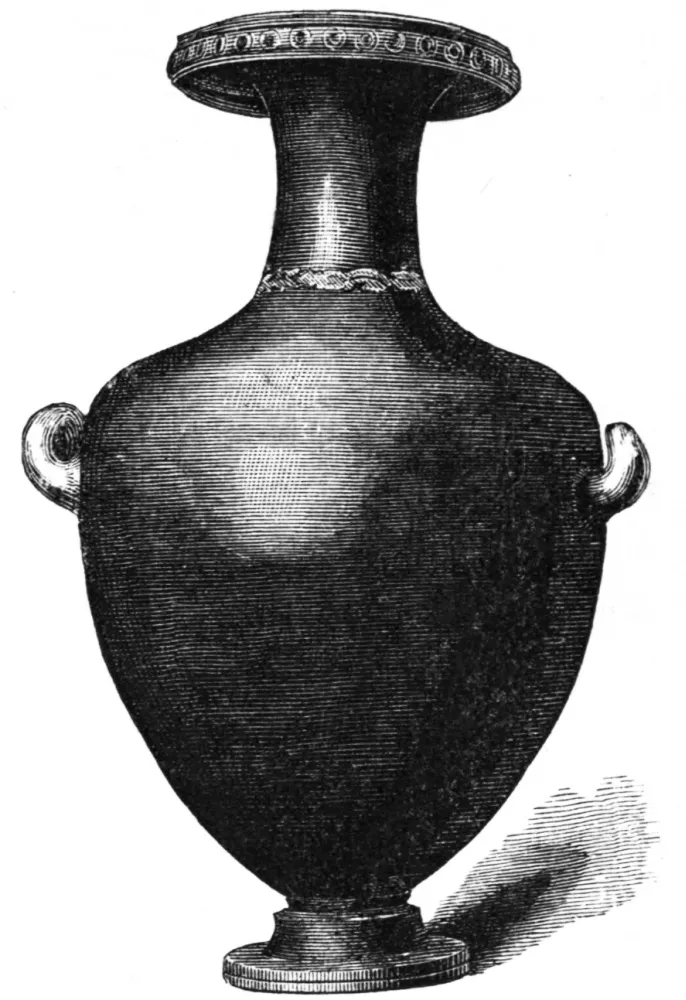
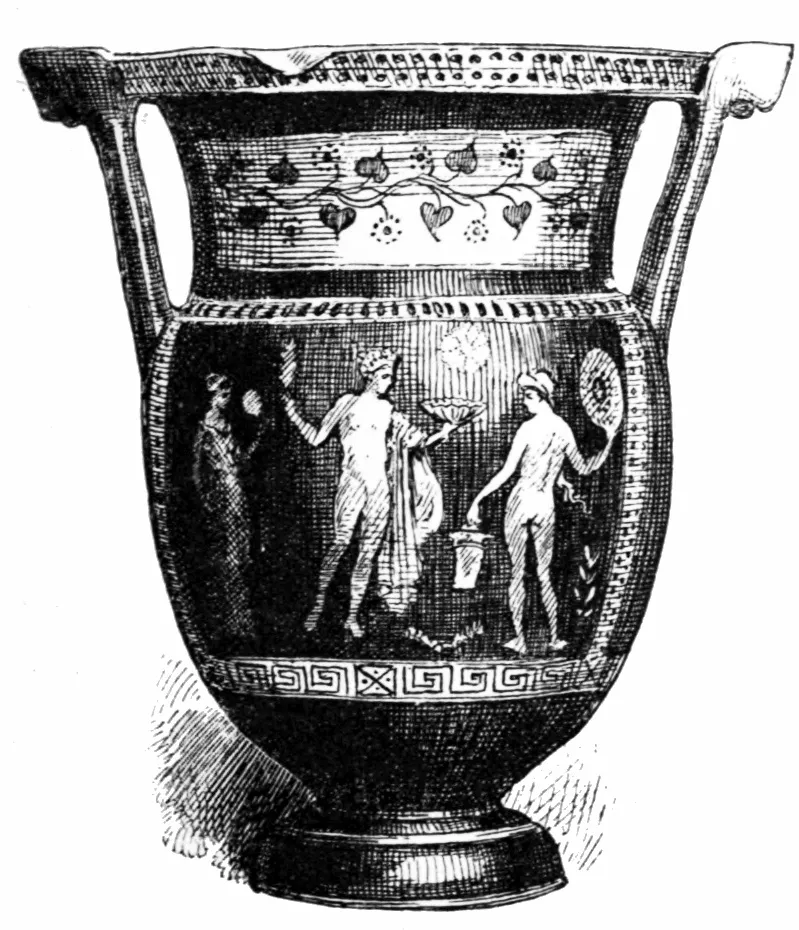
figures of an artist skilled only in geometrical designs. One point is
to be particularly noted before leaving these vases, viz., that in that
bearing the Phœnician inscription, the vertical lines or bands give
place to horizontal bands round the upper part of the body and neck. The
Greeks invariably make use of the horizontal band.
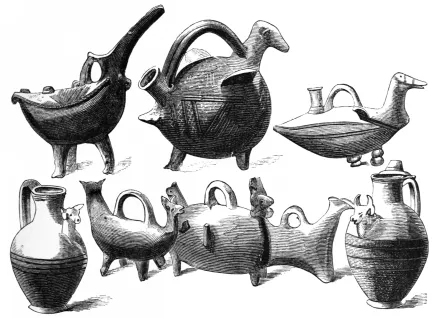
Fig. 155.—Phœnician Vases, found at Dali. (Cesnola
Coll., N. Y. Metropolitan Museum.)
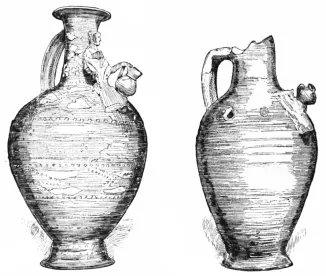
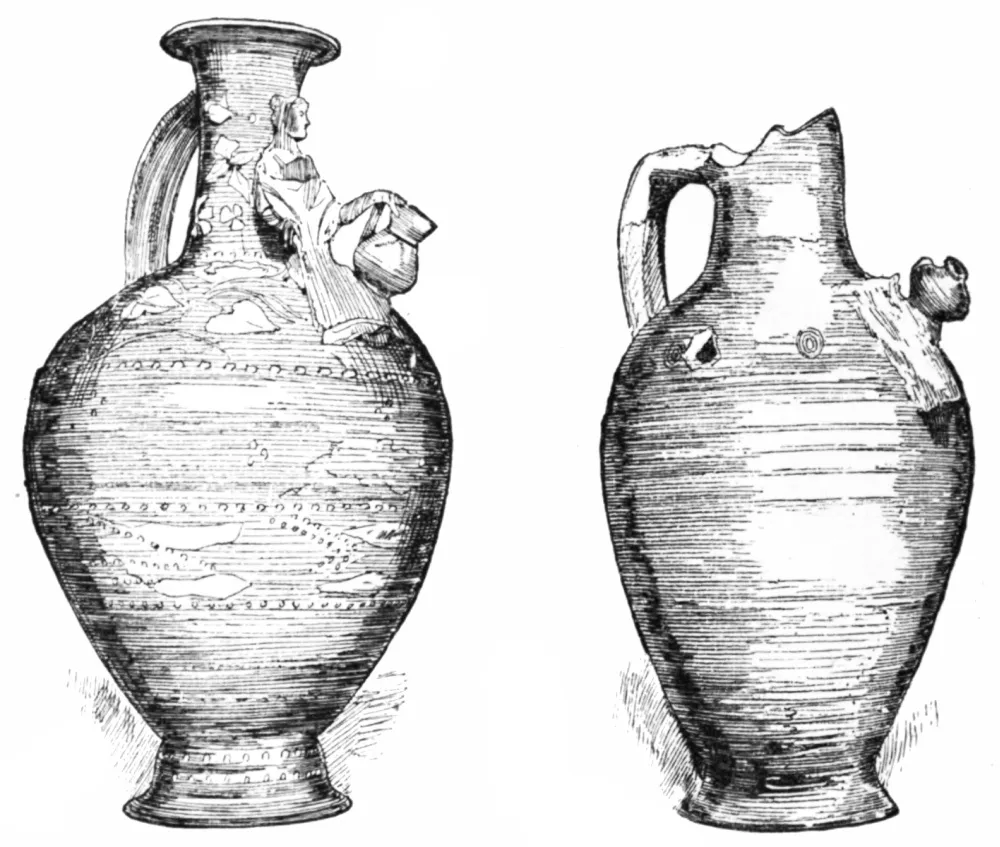
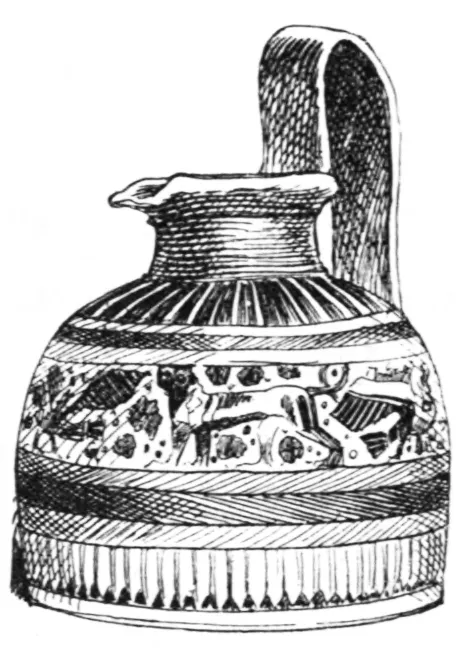
Fig. 156.—Phœnician Vase, from Curium.
(Cesnola
Coll., N. Y. Metrop. Mus.) |
Fig. 157.—Phœnician Vase, from Curium.
(Cesnola
Coll., N. Y. Metrop. Mus.) |
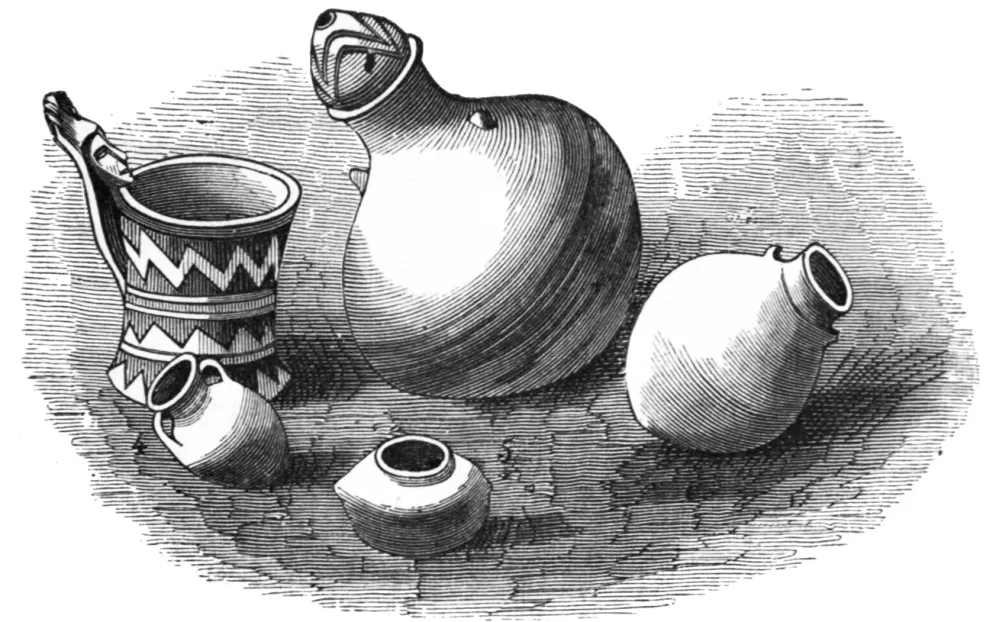
The approach to Greek art is marked by the introduction of several new
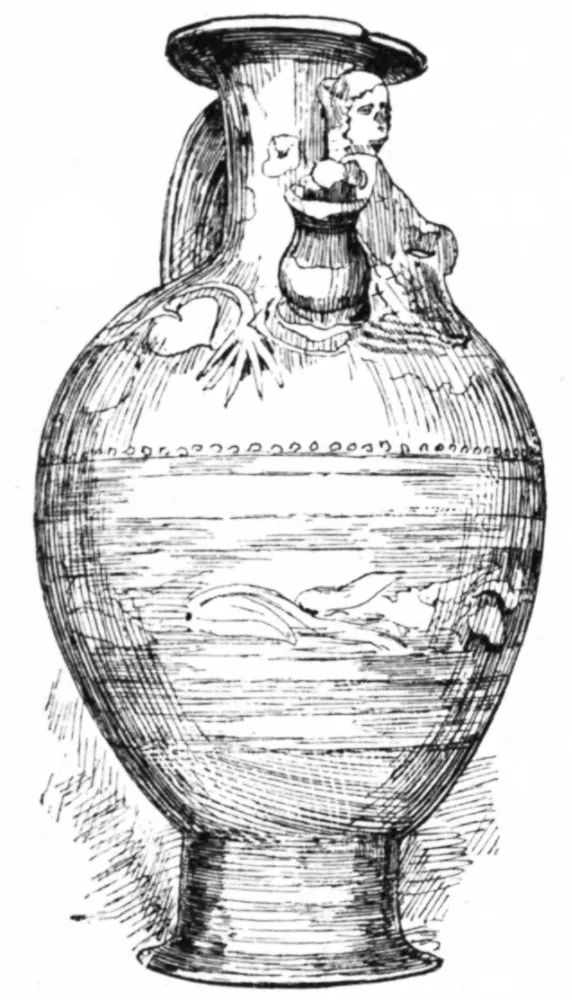
features. In the vases from Curium (Figs. 149, 156, and 157), the lines
are horizontal, the shapes improve, and the spout, consisting of a woman
holding a pitcher, is indicative of a skill in moulding and an
originality in designing, having little in common with the ruder forms
from the same city. This is one of the ideas{208} which seems never to have
occurred to the modern potter, whose most fantastically turned and
severely shaped spouts contrast most unfavorably with the simple yet apt
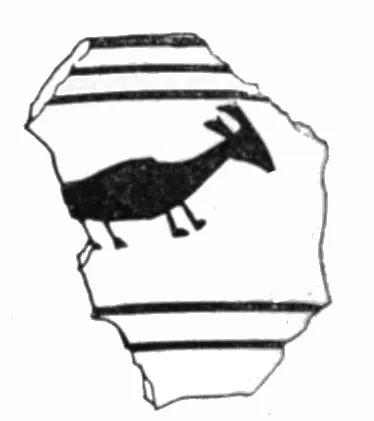
design of his old Phœnician predecessor. The Phœnician vase with
animal figures from Dali (Fig. 158), is the ancestor of a large class of
early Greek pottery similarly decorated. The shape and the encircling
horizontal bands recall early Greek work, and the animal forms point to
an Asiatic influence transmitted in part through Phœnicia, but
probably also through other channels, to Greece. The style is rare among
Cypriote vases. It is carried farther in the large vase from Curium
(Fig. 151), which is remarkable as a combination of the Cypriote
rectilinear method of decoration, the earlier form of the Greek fret,
the Asiatic style of animal decoration, and the culmination of the
Cypriote rows of concentric rings found in the bands of spirals. This is
one of the most remarkable vases in the Cesnola collection, and also one
of the most important links between the art of Greece and those of
Phœnicia and the East. Even admitting it to have been made in Greece,
and thence taken to Curium, it is in perfect harmony with the
Phœnician vase last referred to, on the{209} one hand, and with that
bearing the Phœnician inscription on the other.
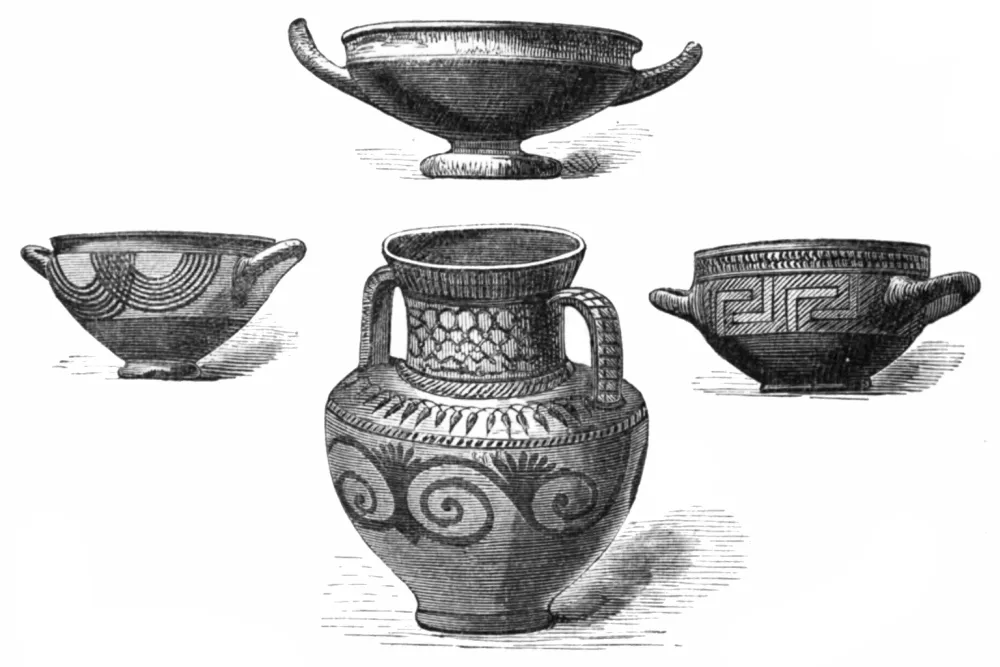
The Greek vase and cups from Dali (Fig. 159) show a new motive in the
decoration. The spirals give place on the vase to a running scroll,
painted with a free hand; and in the kylix on the left, the concentric
circles become semicircles, festooned round the lip after the fashion of
lambrequins. In the kylix on the right, the rectilinear designs and
enclosed squares become the fret. It will be seen hereafter, when we
come to speak of Greece, how the forms of the kylix improve.
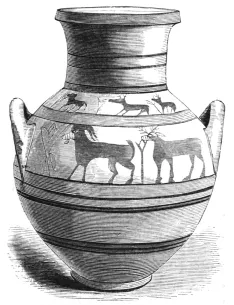 Fig. 158.—Phœnician Vase, found at Dali. (Cesnola
Coll., N. Y. Metropolitan Museum.)
While we cannot assign an exact age to any of these works, we can see
how the beginnings of the art of Greece can be traced to a much more
remote antiquity than was previously apprehended. Mingling in the heroic
age with a people uniting in itself much of the civilization of Assyria
and Egypt, the Greeks were acquiring the knowledge which their own
artistic genius subsequently turned to such brilliant account. The
highway is complete from Greece to untold antiquity. We learn,
therefore, from the relics brought together by General Cesnola, that the
view taken of the devious course followed by ceramic art is correct.
Egypt gave instruction to all. In her is the spring of ancient art. The
Phœnicians studied under her Assyrian pupils, and the two branches,
from Phœnicia and Egypt, met in Greece, and there appeared in a new
form, more refined, and reflecting a higher ideality and a keener
sensitiveness to the subtlest lines of beauty. Di Cesnola has found in
Cyprus{210} their point of contact, and has disclosed to our eyes the
teacher and scholar sleeping in a common grave.
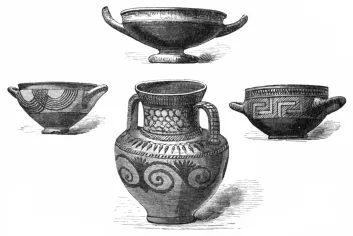
Fig. 159.—Greek Vase and Cups, found at Dali. Cesnola
Coll., (N. Y. Metropolitan Museum.)
Should it be asked if in Cyprus alone we must look for the ceramic
remains of Phœnicia, the Land of Palms, the answer must be negative.
It is true that few relics have come down to us from the sites of her
domestic industries. But let us glance briefly at the history of that
wonderful country, wonderful alike in enterprise and in science. Ptolemy
Claudius, writing in the second century, says that Phœnicia extended
from Egypt on the south to the Eleutherus on the north, and eastward to
the confines of Syria; or, in other words, that to it belonged the
entire eastern shore of the Mediterranean. Like all other eastern
nations, it changed its boundaries as the successive waves of war swept
over it. First came the Persians, then the Greeks, and, lastly, the
Romans. When enjoying its independence, in an earlier age, it was the
disseminator of the knowledge which, to a great extent, it acquired in
Egypt. To Greece it gave its alphabet, the foundation of the literature
which has kindled the admiration of the scholars of all times. Its
navigators passed the Pillars of Hercules and reached the shores of
England. Phœnician colonies were founded all along the Mediterranean,
at Utica and Carthage on the south, and at Marseilles in Gaul. Here,
then, was a{211} people gathering in from every side all that the world
could give of art and science, and spreading its knowledge with every
keel which, from the great ports of Tyre and Sidon, furrowed the
Mediterranean. As might be expected, therefore, the remains of its
ceramic art and the evidences of its influence are found in Cyprus,
Malta, Egypt, Carthage, Greece, Sicily, Rome, and Etruria.
The ceramic remains found on the Phœnician coast are nearly all
referable to her later conquerors. One specimen is singular and
suggestive. It was found at Tyre, and is a polished cruse, with round
body, long neck, wide lips, and a handle joining the neck and body. It
resembles the Egyptian too closely to leave any doubt of the origin of
its style and manufacture. After our previous experiences we are quite
prepared to meet a mythical Phœnician worker in clay; but his
presence does not disturb our inferences. It merely pushes back to a
prehistoric age the date when the first of Phœnicia’s debts to Egypt
was incurred. Other examples, fragments with Phœnician inscriptions,
give further hints of the immediate well-spring of Grecian art.
Phœnician vases are found in Sicily. Egypt and Carthage teach the
same lesson, and illustrate the wide-reaching enterprise of the Tyrian
founders of Carthage.
Turning northward from Phœnicia to Asia Minor, the evidences of
ceramic skill point to identically the same conclusion. Let us take the
older first. There, as in Cyprus, we meet with early traces of Hellenic
art. Across the Ægean sea, on the shores of Asia Minor, Greece again
touched the older arts of Assyria and Egypt. The coffins found in
Mesopotamia are after the Assyrian type. From Tarsus come terra-cotta
works ornamented with green, in a simple style, closely allied to the
Greek. At Rhodes has been found a vase or pitcher of turquoise blue,
ribbed perpendicularly, and crossed at intervals by horizontal bands.
Such specimens take us back again to Egypt. In short, the history of
Asia Minor, its existence successively under Scythians, Medes, and
Persians, while it was receiving the surplus population of Greece from
the west, would lead us to look for what we only found in part in
Cyprus, namely, native styles moulded by influences from east, west, and
south. These generalizations are offered as a substitute for a more
connected history, for the construction of which intelligibly the
materials are wanting. Enough has{212} been said to show that through many
different channels the arts of Egypt and the East set, in a long and
steady stream, toward Europe; that there, meeting with the rising
Hellenic civilization, they were transmuted and purified, and that from
the Hellenizing process emerged the admirable art now called Greek.
Meanwhile it is to be noted that, so far, we have made allusion to only
one-half of the debt which Europe owes to the East. Greece rejected the
rich coloring and fantastic forms which reached her from the centre of
all that was most brilliant in ceramics—the land between the Tigris and
Euphrates. These were seized with avidity by Persia, the only survivor,
in our time, of the four great monarchies of the East. Bright colors and
gorgeous combinations were grateful to the eye revelling in the splendor
almost unconsciously associated with the word “Oriental.” To Persia,
therefore, we must look, not only as the great conservator of previous
skill, but as the medium of its development into a higher form. That
part of her inheritance from Assyria and Babylonia which concerns us
now, was the knowledge of processes, of the deft mingling of colors, the
production of tints, and the skilful application of enamels. We have
seen to what purpose this knowledge was cultivated, in so far as the
evidences found within her own borders can show. We have seen what may
here be especially recalled, enamels and metallic lustre applied to
pottery, with an almost bewildering brilliancy.
We now approach the question of Persia’s contributions to the art. Can,
for example, none of the remains exhumed by Cesnola be claimed for
Persia? It appears not, at least not with certainty, although certain
plaques convey a hint of Persian workmanship. Whatever she left in
Cyprus, if anything, is hardly to be distinguished from the older works
of Assyria and Phœnicia. Had Persia, then, no originality, and where
beyond her own limits must we look for its distinctive impress. Let us
return for a moment to Persian history. We have already seen that the
country was occasionally overrun by surrounding nations, but the fact is
noticeable that when it could not resist, it absorbed its assailants.
Its nationality was preserved even in conquest. A similar capacity for
assimilation and independence is seen in its art. There can be no doubt
of its having drawn from Assyria and Babylonia. Its most ancient
architecture is sufficient to settle that point. But apart{213} from that,
and keeping in view the influence of Mohammedanism and the influx of
Chinese wares and possibly workmen in the sixteenth century, the art of
Persia is marked throughout its entire course by certain distinguishing
features which invasion could not obliterate. The artistic instinct was
strong in the people as a whole; and conquest retarded the progress of
art only to see it rise again in all its first vigor, to be spread far
and wide even by those who had for a time hindered its native growth. In
this way we can trace its advance to Asia Minor and Rhodes, through
Egypt, along the northern coast of Africa, and thence to different
points in Southern Europe.
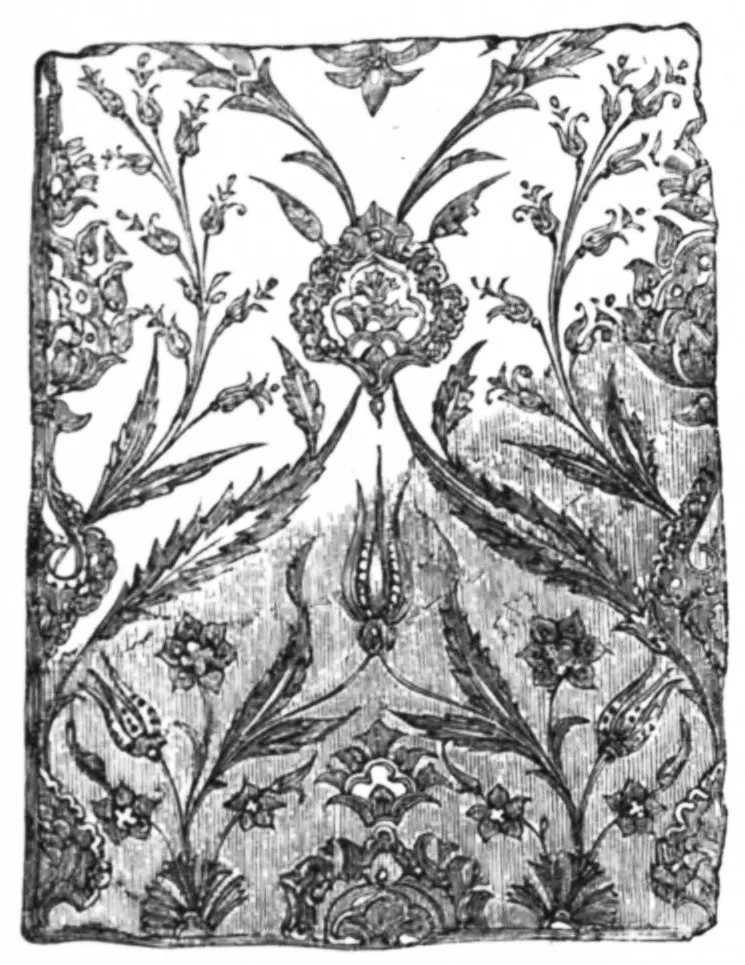
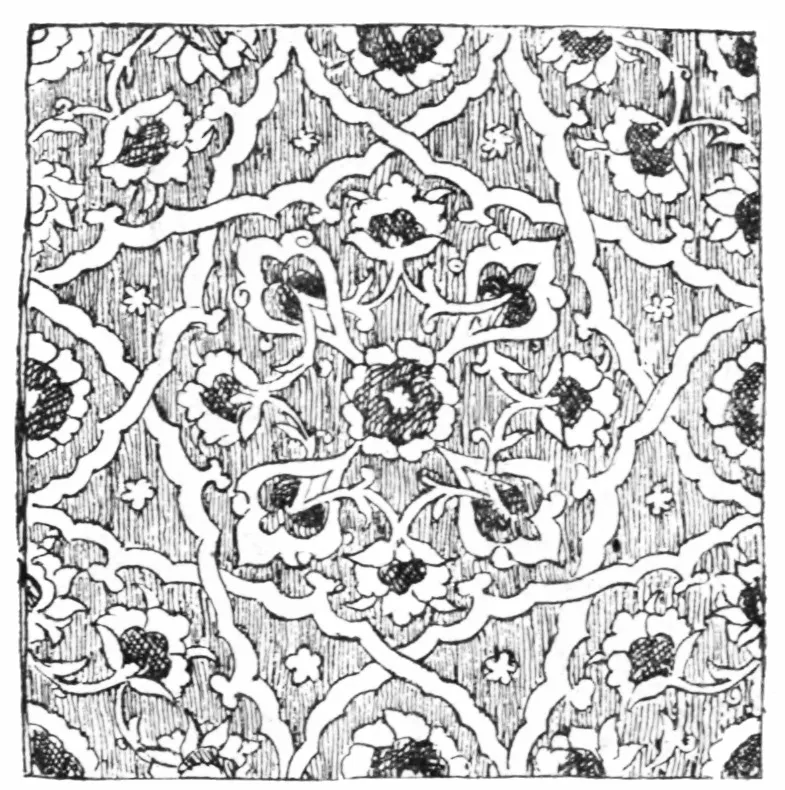
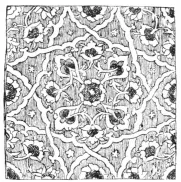 Fig. 160.—Saracen Tile. (Trumbull-Prime Coll., N. Y.
Metropolitan Museum.)
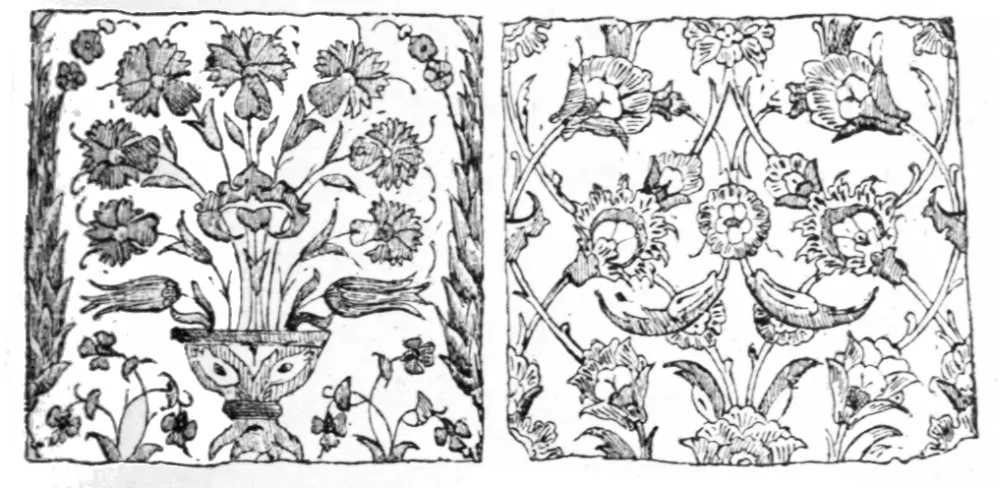
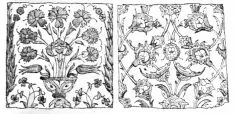 Fig. 161.—Saracenic Tiles. Green and Dark-blue on White.
(Boston Museum of Fine Arts.)
The tracks we now follow are those of Eastern art in its second and more
modern progress toward the west. Persia was its real source. When the
Mohammedan Arabs overran Iran, they found art the handmaid to beauty and
luxury, to which they had been strangers. Essentially nomadic, the wild
fanatics from Arabia had given little attention to æsthetic culture.
They were captivated by what they found in Persia. If they modified it,
it was only to make it conformable to the behests of their religion. We
find, for example, a faience tile representing the sacred Temple of
Mecca, in two shades of blue, red, black, and pale-green, and with a
border of white and red. It is easy to imagine the caliphs of Bagdad
calling to their assistance the men whose works they had seen, to
complete the embellishment of their capital. The style called arabesque
is in all probability of Persian origin. In every collection of note are
examples of{214} what is called Saracenic pottery. The Arabs were called
Saracens when they came to Europe, or met the arms of the Crusaders in
Palestine. Saracen pottery, therefore, is Persian modified by Arabian
taste or local style. And here, to save much trouble, and avoid the
confusion into which disputants over the wares of Damascus, Rhodes,
Cairo, and other localities might lead us, it may be as well, once for
all, to understand that at no place of which we have any knowledge were
the Saracens the first to introduce a rudimentary knowledge of pottery.
What they did was to bring with them certain distinctive styles; and
now, when all proofs of an earlier fabric are wanting, we may safely
take it for granted that it existed, and that the invaders and colonists
only superimposed a superior art. This should be borne in mind, because
it would be impossible to account for the abundant remains found on
certain sites by attributing them all to the Saracens. One of the first
things to which the Arabs turned their attention in each country to
which they carried their arms, was to raise mosques for the religions
observances attaching to their faith. The tomb of Mohammed, at Medina,
is covered with tiles so closely resembling those of Persia as to
suggest not only Persian inspiration, but Persian workmen. In Asia Minor
tiles belonging to the eleventh and twelfth centuries are abundant, of a
precisely similar character. History explains their presence there by
telling us that the Arabian or Saracenic conquerors sent for artists
from Persia to bring their skill to the embellishment of the new domain.
In this we have the key to much of the ceramic art of Asia Minor.
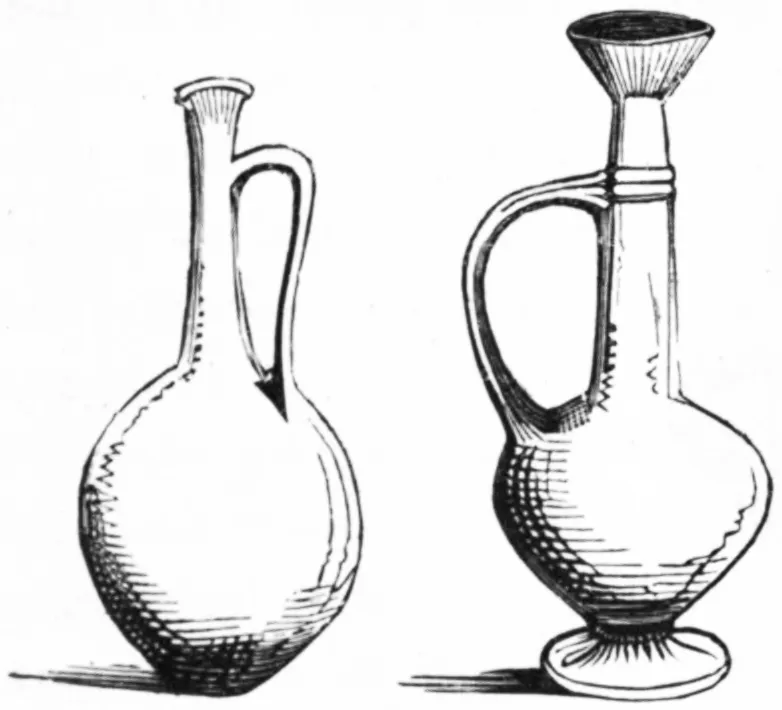
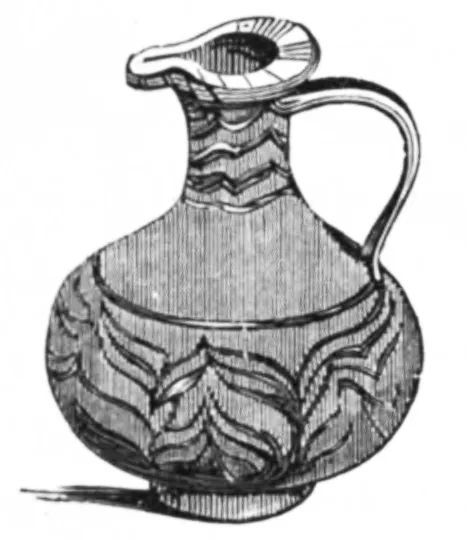
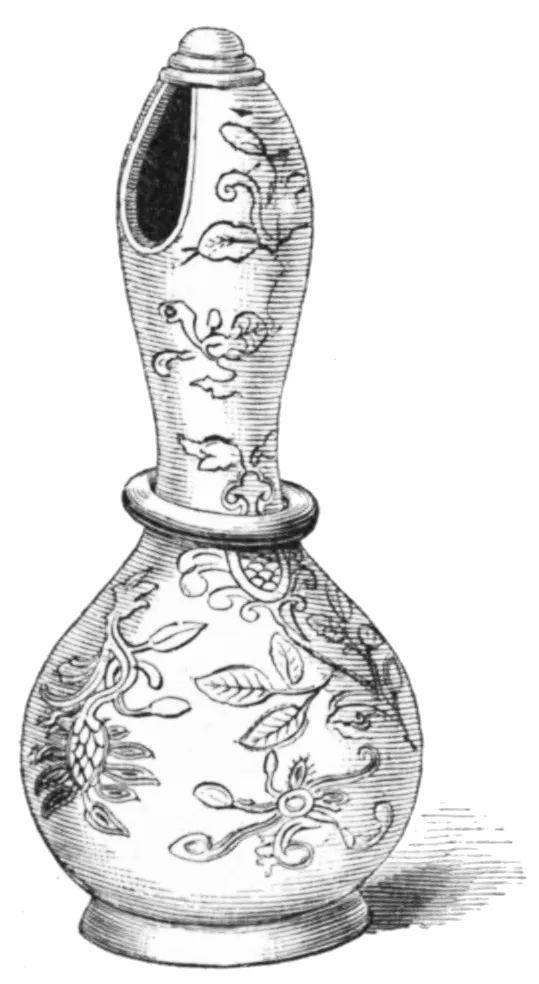
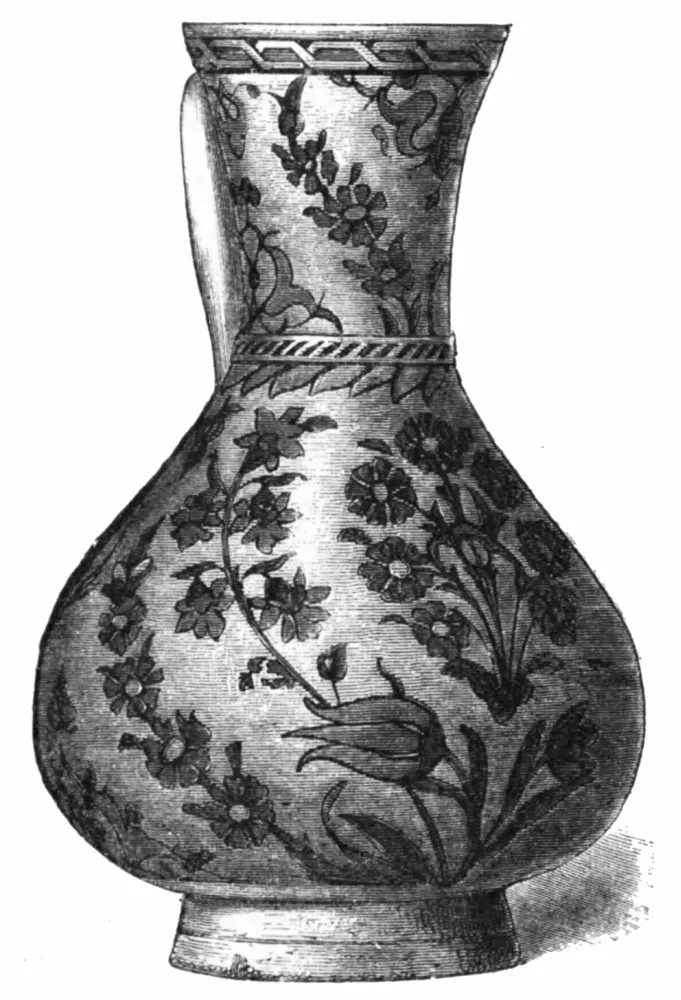
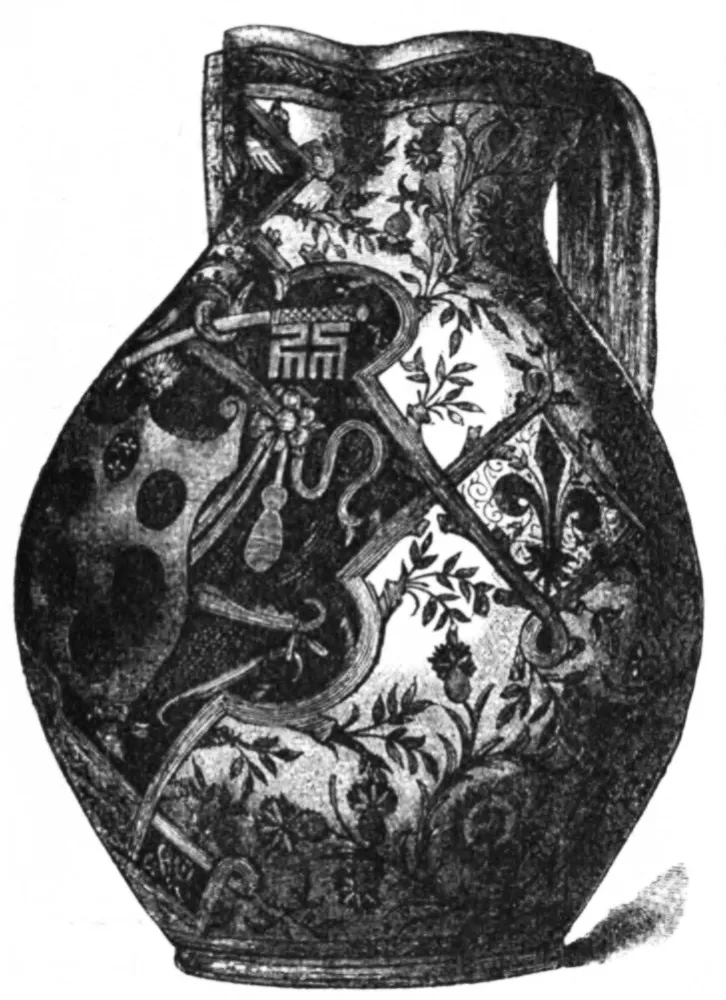
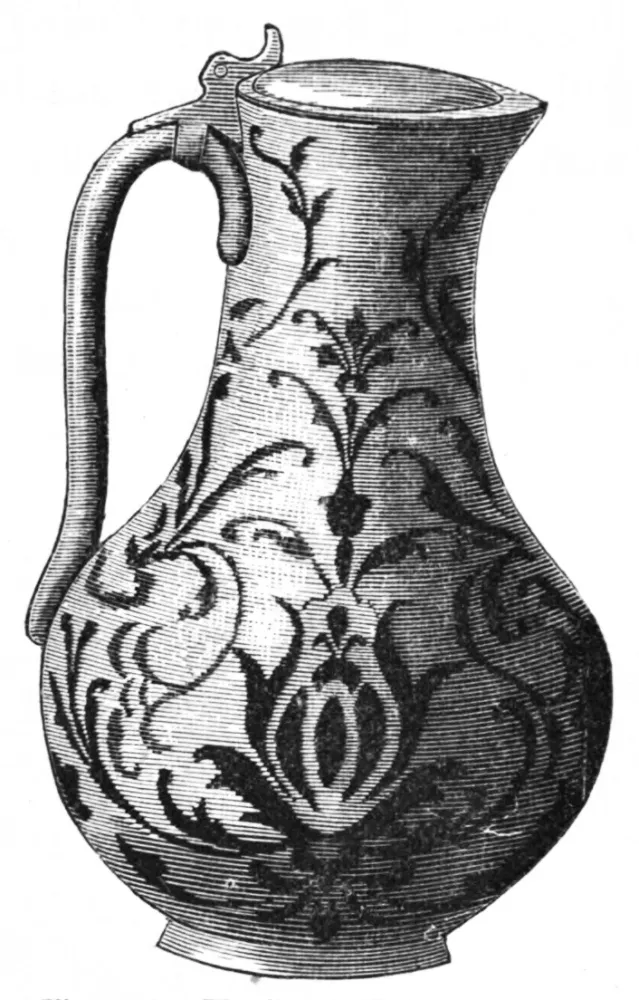
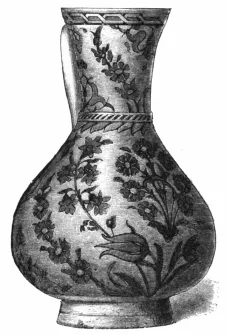 Fig. 162.—Faience Jug, from Rhodes.
{215}
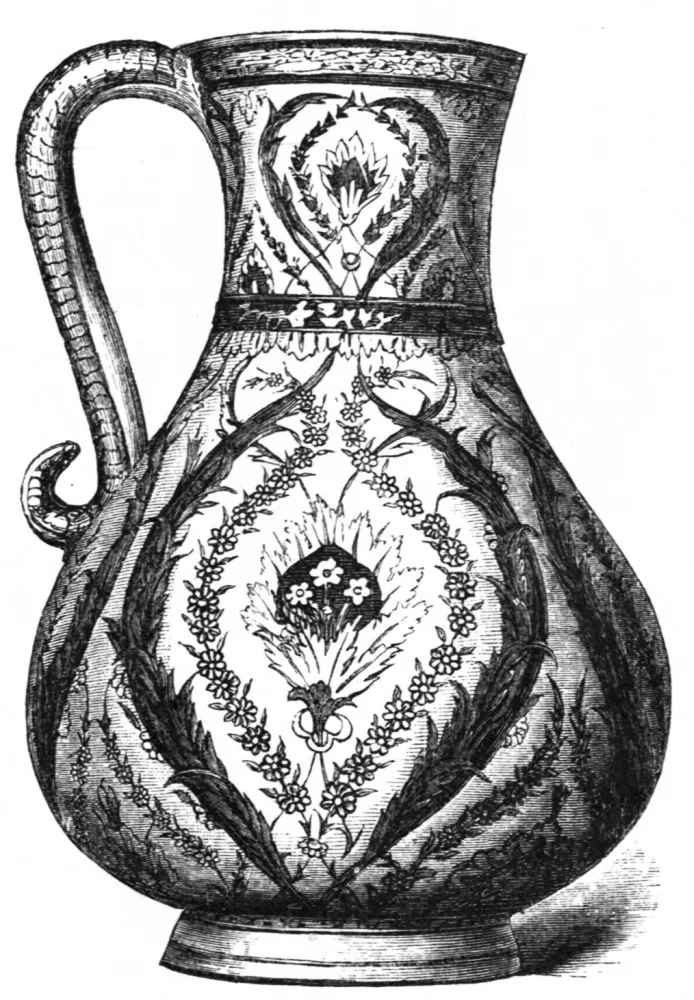
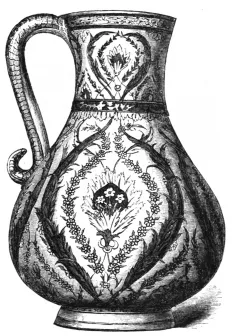 Fig. 163.—Faience Jug, from Rhodes.
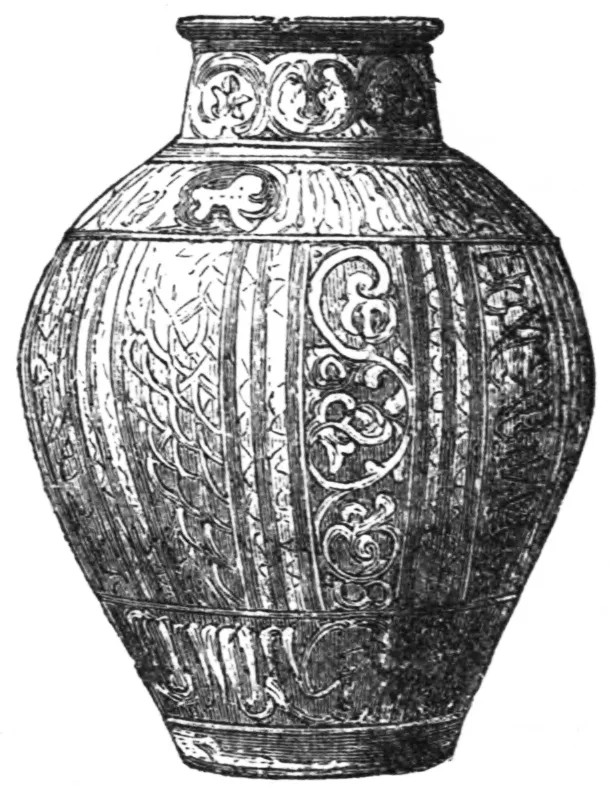
As to Rhodes and the origin of its faience (Fig. 162), we are tolerably
certain that in Persia was the source of the skill there developed.
History and tradition point to the same conclusion. Legend says that a
vessel bound for Venice, and having some Persian potters on board, was
wrecked on the island, and that there a manufactory was founded (Fig.
163). Possibly on this tradition the conjecture was based that a Persian
colony had settled there. In any case, Rhodes was occupied by Persians
in the seventh century, and then by the Greeks. When the crusading fever
was at its height, the knights of St. John held the island until
expelled by the Turks. It was probably these knights who captured a
vessel laden with Persian pottery and artists, and compelled the latter
to found the manufacture at Rhodes. At the Musée de Cluny are specimens
of their work, plainly Persian, but adapted to the changed condition and
limited appliances of the potters. The Rhodian differs little from the
Persian. The colors are less brilliant, and the ornamentation in relief
is like that found on vases and tiles in Asia Minor. The predominating
colors are white and blue for grounds and red for designs. Similarly as
to Damascus, it is beyond reasonable doubt that potteries existed there.
Their ruins are said to have been found; and it is probable that, so far
from importing the wares, Damascus supplied orders from without. These
facts lead to the conclusion that Persian art was carried by the
Saracens or their Christian opponents to the same countries that
Egyptian and Assyrian art had reached centuries before.{216}
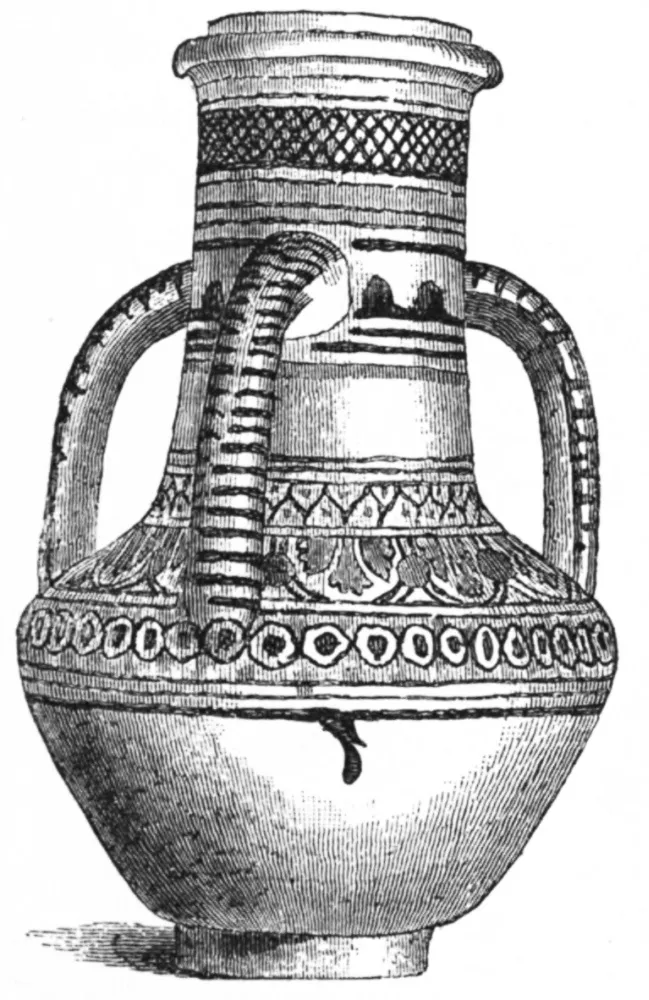
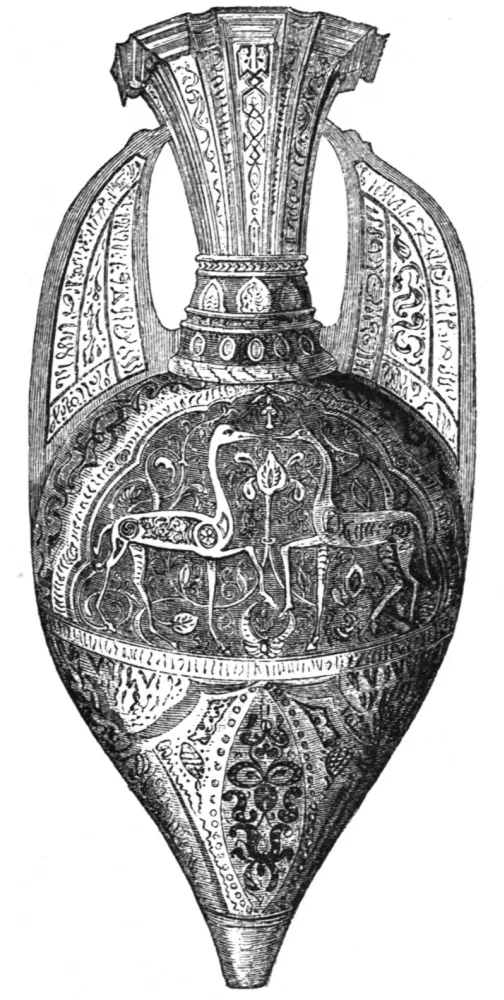
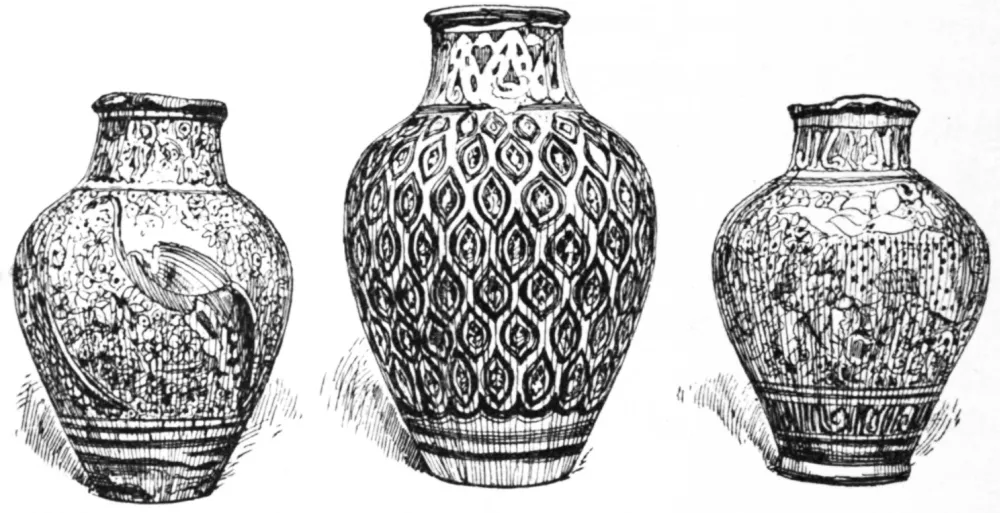
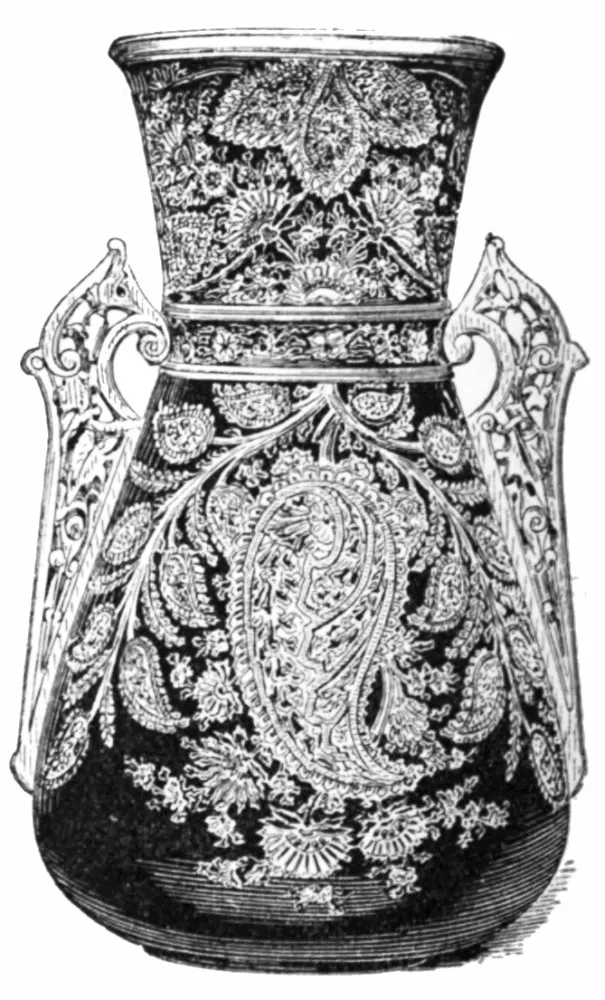
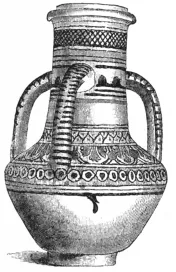 Fig. 164.—Maghreb Urn.
Turning now to the south and west, we follow the line of Saracenic
conquest along the north coast of Africa until it reached the Atlantic
Ocean. Egypt first fell under Mussulman control, and the standard of
Islam was carried westward from the Nile. Thirteen hundred years after
Battus founded Cyrene, the Mussulman Keironan was built upon its ruins.
In Tunisia, Algeria, and Morocco the Saracenic works multiply. One
traveller in Tunisia describes a mosque with the walls overlaid with
tiles of many patterns. Another, crossing Algeria, visits the mosque at
Telemeen, and finds azulejos (from the Arabic for “varnished tile”)
equal to those of Granada, and tiling in blue, red, and yellow, again
compelling a comparison with the works of the Moors in Spain. The
brilliant domes and mosaic pavements of mosques and houses mark the
Saracenic progress. Besides these, many examples of urns and other
vessels of Saracenic fabrication have been found, colored in brown,
yellow, blue, and green, in styles not far removed from the Persian.
Viewed comprehensively, the pottery of Northern Africa (Fig. 164) would
show pieces of local fabrication, and Persian styles and processes
modified by removal from their eastern centre. What concerns us chiefly
is that the Saracenic predominates. It is reasonable to suppose that the
invaders, in order to decorate the edifices which quickly gave
indication of their presence, sent for tiles to the seats of the
industry in the East. Afterward, when the Mussulman power had been
firmly established, factories were built, and a new industry rose among
the conquered people. Imitations are mingled with works showing a
developing originality. The Mussulman and Persian traditions become
modified, and the symbolical meaning of the animals painted on the
dishes and basins appears to have become obscure to the artists
employing them as decoration.{217}
A great deal of the African pottery can only be taken as a basis for
conjecture. Its place of manufacture is unknown. Its style is peculiar
and its coloring unique. It is not impossible that European art was
paying the debt it had incurred to Southern teachers. Ceramic art
travelled with the Saracens wherever they went. How far that was may be
estimated from the fact that they conquered within eighty years as much
territory as it had taken Rome four hundred years to bring into
subjection. They crossed into Spain, Sicily, and Italy, and there
planted settlements. A great deal has been said of the reflet à
métallique and stanniferous enamel, and notably of the discovery of
the latter in Italy. Both came from the East, and reached Europe through
the Saracens. The employment of tin in producing a white opaque enamel
was, as we have seen, known to the Egyptians, the Babylonians, and
Assyrians. It does not appear to have been so highly esteemed as the
silicious glaze by means of which the Persians worked their greatest
ceramic wonders, but it was not forgotten. Fragmentary evidences of its
use by the Saracens are found in the places which they passed, and it
is, at least, more reasonable to suppose that through them the process
reached Europe, than that it was rediscovered there. One is almost
wearied with the endless conjectures on these matters. We find a certain
art in the East. We trace the different channels of communication with
Europe. We find Greece touching Asia Minor, trade binding Phœnicia
with every port in the Mediterranean, Etruria bringing to her own ports
the manufactures of Eastern experts, colonies settling in all manner of
places and coming from many sources. It has been plainly demonstrated
that the lines of intercourse cross and recross in a hundred different
ways and directions. When, therefore, we have it proved to a
demonstration that analogous knowledge was transmitted by certain
routes, it is hardly worth one’s while to discuss the European discovery
of a process which we know did not originate there, however much it may
have been improved.
The art which we call Hispano-Moresque might, therefore, with equal
propriety, be called Persico-Spanish or Hispano-Saracenic. Spain was
twice overrun by Mohammedan conquerors. In the eighth century (711) the
Arabs subdued the Goths and founded the Caliphate of Cordova. It is both
singular and disappointing that no ceramic{218} relic of this period has
been found. The Spanish, even under the sway of Rome, had attained to a
comparative excellence in the art, and the productions resulting from
the union of original traditions with Arabian influences would have
formed an interesting link in our history. The Arabians remained for
about five hundred years, when, in 1235 the Moors overturned the Arab
rule, and founded the kingdom of Granada. The Moors succumbed, in their
turn, to Ferdinand and Isabella, in 1492, and between these two dates,
1235 and 1492, was the golden era of the ceramic art of Spain.
Meantime it is to be observed, as showing the possible and actual extent
of Persian influence:
Firstly.—That under the Moorish sway a colony of Persians existed in
Spain. This, according to Major R. Murdoch Smith, is attested by a
document recently brought to notice by a Spanish traveller in Persia,
assigning the town Rioja to the Persians as their place of residence.
Secondly.—That mosaic work has been found in Persia, composed of star
and cross shaped tiles of different colors fitted together, and that
similar tiles are made in Spain at the present time.
Thirdly.—That in Persia are found the prototypes of the Spanish style
of ornamenting vaults with hanging-work, like plaster stalactites.
Fourthly.—That, according to Piot, “numerous Persian faience plaques
and pieces of vases, resembling those of our own time, are found
encrusted in the white marble of a church in Naples.”
Fifthly.—That Mr. Drury C. Fortnum has found a specimen of Persian
ware in the church of St. Cecilia, at Pisa. The piece is clearly Persian
in style, black arabesques on a blue ground, similar to others found at
Rhages.
Sixthly.—That the Saracens overran Sicily in the ninth century, and
that a Moorish colony landed there some centuries later.
The corollary deducible from these facts is clear, viz., that in Persian
art, as brought into Europe by the Moors, Arabs, or Saracens, and by the
Persians themselves, we must find the bridge upon which to cross from
the ancient arts of Assyria and Babylonia to those of Italy and Spain.{219}
General Character of Greek Ceramics.—Form and Color.—Borrowed
from Egypt and Phœnicia.—How Original.—Unbaked Clay: Bricks
and Statues.—Terra-cotta: Where
Used.—Tiles.—Models.—Vessels.—Pithos.—Amphora.—Pigments used
on Terra-cotta.—Rhyton.—Glazed Wares: Quality of
Glaze.—Paste.—Enumeration and Description of Vessels.—Uses of
Vases.—Chronological Arrangement.—Methods of Making
Vessels.—Successive Styles of Ornamentation.—Figures.—Earliest
Style.—Archaic Style.—Human Figures.—“Old Style.”—Approach to
Best Art.—“Fine Style.”—“Florid Style.”—Decline.—Classification
according to Subjects Represented on Vases.—Reliefs and Statuettes
as Decoration.
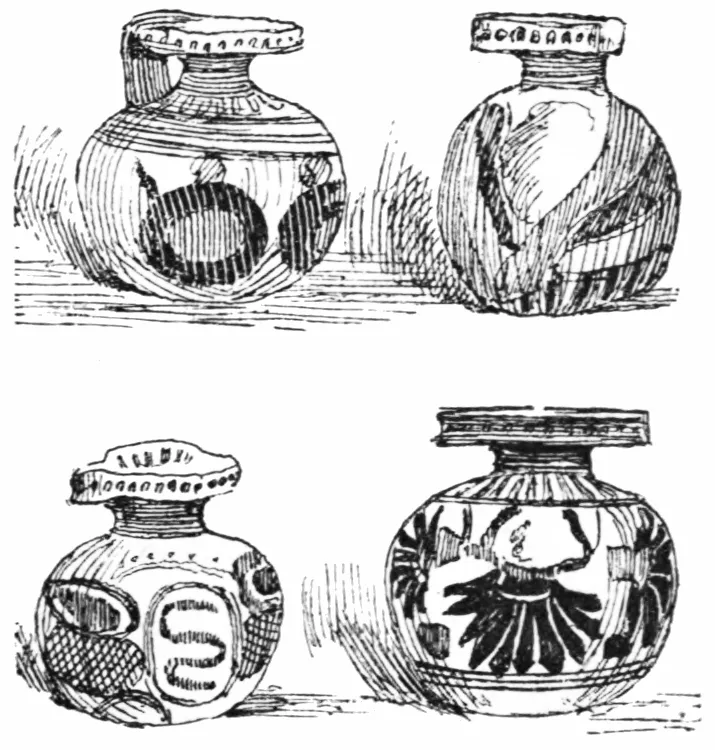
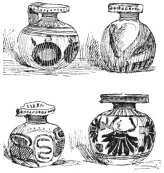 Fig. 165.—Early Greek Aryballoi. Egypto-Phœnician
Style. (Trumbull-Prime Coll., N. Y. Metrop. Museum.)
WERE we to be guided solely by continuity in point of time and the
succession of ideas, our next subject would be the art of Spain and
Italy. We turn, in preference, to that of Greece. It claims the
precedence due to priority of date. It holds also a position of what
might be called isolation. Its general character has been indicated in
the Introduction. The severity and simplicity of the taste of the Greek,
and his indifference to effects in color, while permitting him to
receive suggestions from Egypt and the East, led him to disregard those
adjuncts of art which they held in highest esteem. To him beauty of form
was everything, color little or nothing. The former he brought to such
perfection that no advance has been made beyond the point he reached.
Greek form embodies all that can be said of grace and proportion. We may
imitate, but we can hardly hope to excel, what Greece accomplished in
her early bloom. We may find prototypes in Egypt for some of her vessels
(Fig. 165), but still her art, the culmination{220} of all that was best in
preceding forms, is pre-eminently her own. We say this without
disparagement to those who were her teachers. To Egypt, in particular,
Greece turned, at a remote age, for instruction, and learned from
Phœnicia and the other nations with which trade brought her into
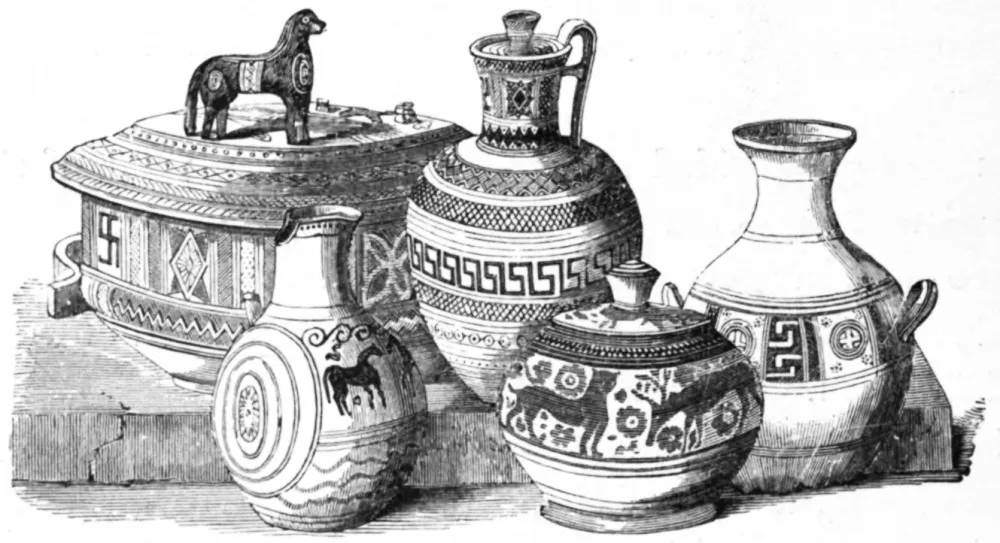
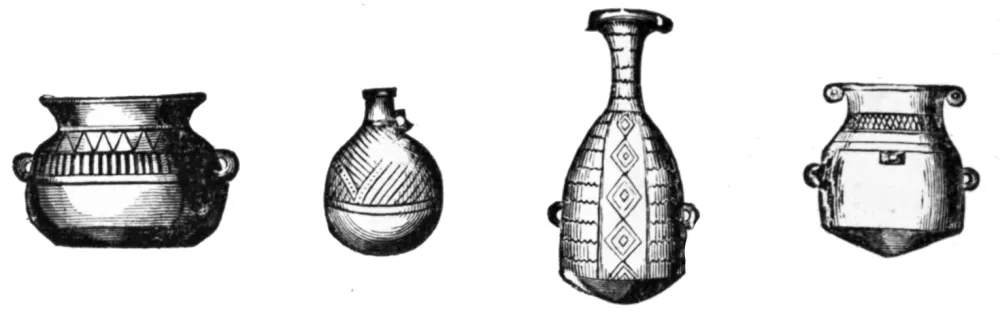
contact. In this connection the group (Fig. 166) of vases from Athens
may be compared with the Phœnician from Cyprus. There are in the
decoration the same geometrical designs, the same vertical concentric
circles, the same animal figures which the Phœnicians drew from
Assyria. But after making every allowance for suggestions from abroad,
after conceding that Grecian art is the development of that which
preceded it, and that it occupies a well-defined place in progressive
history, we fail to find anywhere the equals of the best ceramic works
of Greece.
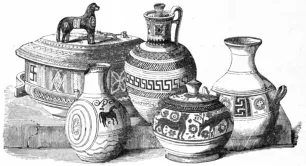
Fig. 166.—Primitive Vessels, from Athens and Argos.
Taking them as a whole, they are divisible into unbaked; terra-cotta, or
burnt clay, without a glaze; and glazed. The Greeks employed unbaked
clay for bricks, statues, and several kinds of decoration. The former
were used for city walls and buildings. Terra-cotta was devoted to
similar purposes. It is not improbable that we may yet return, to a very
considerable extent, to the ancient employment of this material in
architecture. The Greeks made use of it for pillars, roofs, paving,
bricks, friezes, cornices, lamps, statues, flower-pots, and numberless
domestic and sepulchral vessels and ornaments. Bricks do not appear to
have been held in very high esteem in building, but the custom of
roofing with terra-cotta tiles was widely prevalent and of great
antiquity. These tiles were occasionally embellished with{221} painted
flowers, and designs in blue, red, and yellow. The terra-cotta figures
vary in color from red to bright yellow, and are soft in texture and
easily marked. Terra-cotta models were used in casting, and in the same
material were made copies of statues, like those in plaster of Paris of
our own time; and some painters were even accustomed to make terra-cotta
models of the figures they afterward painted. Of the specimens which
have come down to us a very great number consists of small statuettes of
the gods.
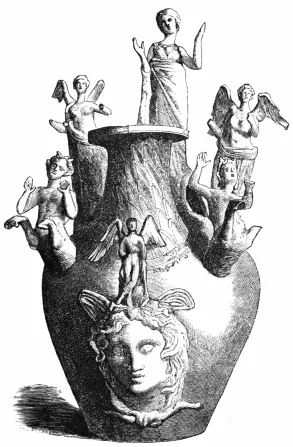
Fig. 167.—Greek Vase, from Apulia. (Louvre.)
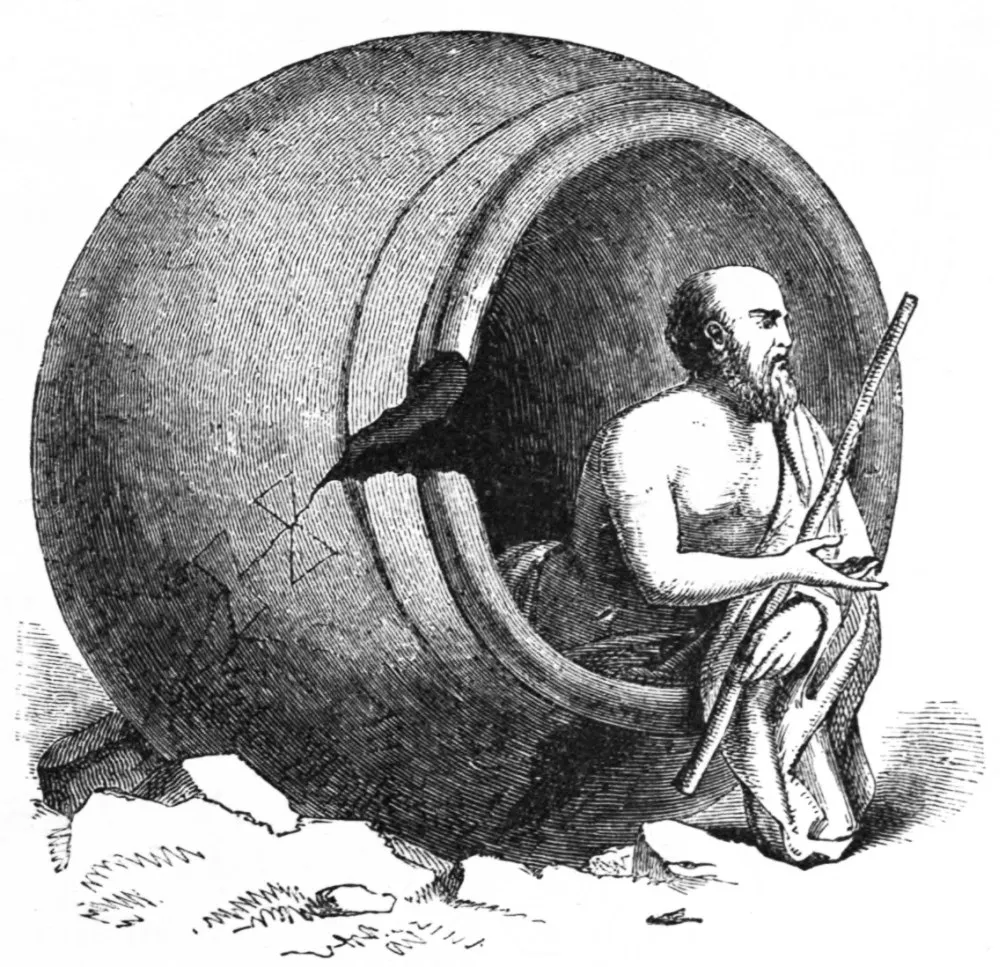
The vessels of terra-cotta are either domestic or sepulchral. The{222}
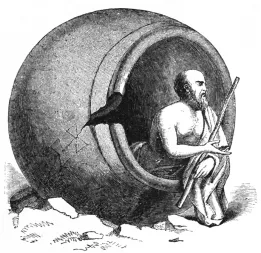
largest was the pithos, which, as we have seen, was large enough to
hold a man satisfied with such limited domestic conveniences as
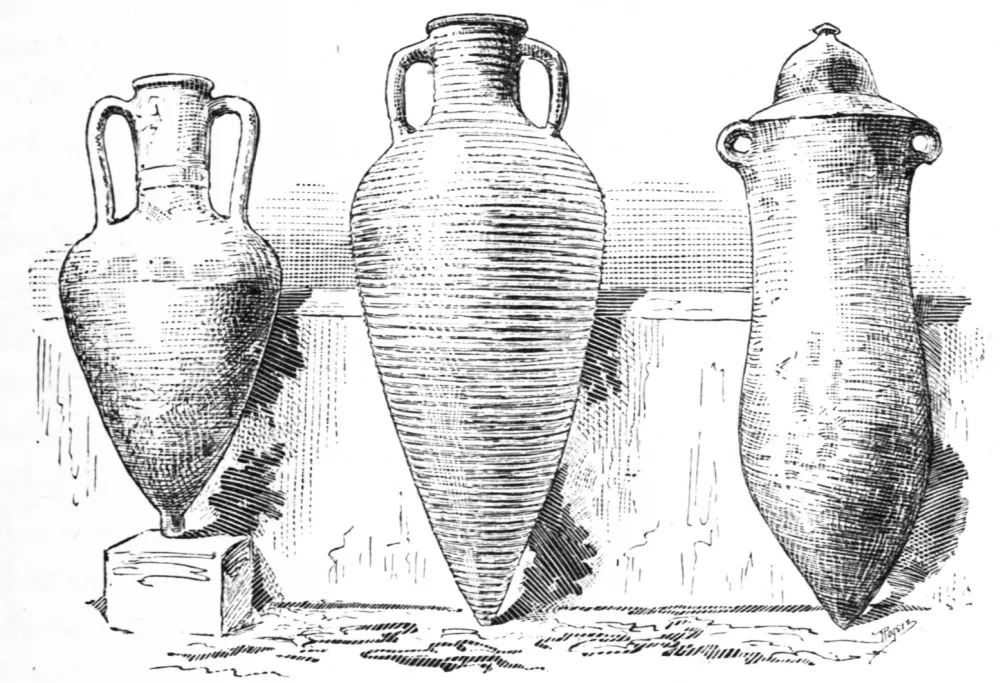
Diogenes. There were also amphoræ, large vases, somewhat smaller than
the pithoi; phialai, or saucers, plates, pots, and jugs. Of these
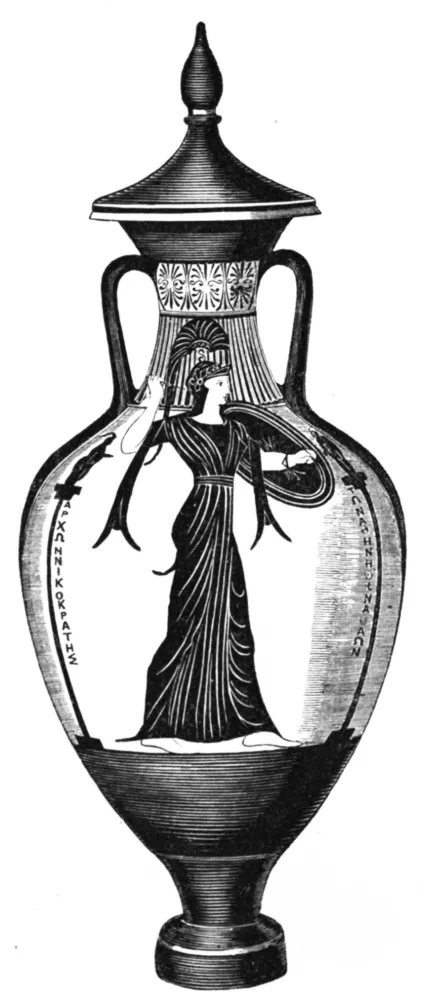
the amphora occurs most frequently. Its name is derived from
amphis—on both sides, and pherein—to carry, and it is so called
because it had two handles, one on each side, to be grasped by the
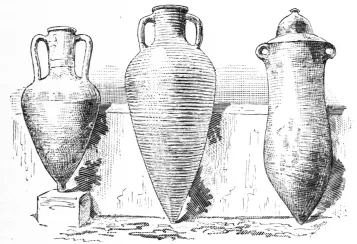
person carrying it. It is easily recognized (see Fig. 2) by its sharp
base—so made to be stuck in the ground—its oval body, its long neck,
and its generally heavy lip. The cover was conical, and sometimes the
base is surrounded by a ring of clay to keep it more easily in an
upright position. The height of the amphora ranged from three feet to
over six feet, and it was used for holding wine, water, oil, and for
storing figs and other edibles.
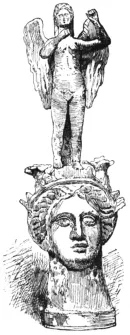 Fig. 168.—Head of Minerva, with Figure of Nike. (Prime
Coll., N.Y. Metropolitan Museum.)
Various pigments were applied to terra-cotta, including white, red,
green, and blue, the use of which, in painting statues and architectural
decorations, formed a distinct branch of art. Colors are also found on
sepulchral vases, some of which are further ornamented with applied
bas-reliefs; that is, made separately, and fixed to the vase before
drying. This practice was carried to such an extent as to represent a
combination of the arts of potter, painter, and sculptor (Fig. 167).
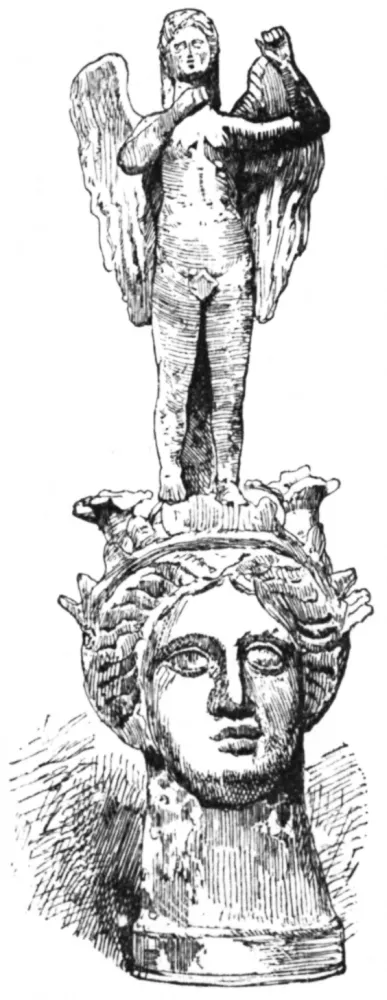
Closely allied to the cinerary urns were the vases intended solely for
ornamental purposes. In one of extraordinary beauty, a large and finely
moulded head of Pallas Athene is seen surmounted by a full figure of
Victory. There are many of a similar character, representing female and
animal heads. The latter are found in the rhyta, or drinking cups. The
ornamental vases were often painted after being covered with a white
slip: evidently the case with the piece (Fig. 168) in Dr. Prime’s
collection.
Before treating of glazed vases we shall give the leading denominations{223}
of all vases glazed and unglazed, and then the styles of decoration of
the former as nearly as may be in their chronological order. They are
said to be glazed, although the glaze is so slight that, as Mr. Fortnum
says, “it leaves a barely appreciable effect upon the eye, beyond that
which might be produced by a mechanical polish.” It is altogether a very
inferior kind of glaze, and is supposed to have been made from an alkali
without any admixture of lead. The paste resembles terra-cotta, and
varies in density, being in some cases scratched with ease, in others
with difficulty. It can always be marked with iron. These facts are
worth noting, were it only that that art may be thoroughly appreciated
which, out of the poorest and commonest materials, has wrought forms of
the most wonderful beauty.
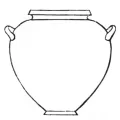 Fig. 169.—Stamnos.
 Fig. 170.—Askos.
The chief names with which we shall have to deal are the pithos,
pithakne, stamnos, cheroulion, bikos, hyrche, lagynos, askos, amphorens,
kados, hydria, kalpis, krossos, skyphos, or kothon, rhyton, lekythos,
alabastros, krater, holmos, kelebe, oxybaphon, psykter, dinos, chytrai,
tripous, oinochoe, prochoos, aryballos, epichysis, kotylos, kyathos,
skaphe, kantharos, karchesion, kylix, phiale, kanoun, pinax, and diskos.
The pithos, already described in part, was a large, open-mouthed cask
or jar of unglazed earthen-ware, which was used mainly for the
preservation of victuals and wines.
The pithakne was a pithos of smaller size used for holding wine.
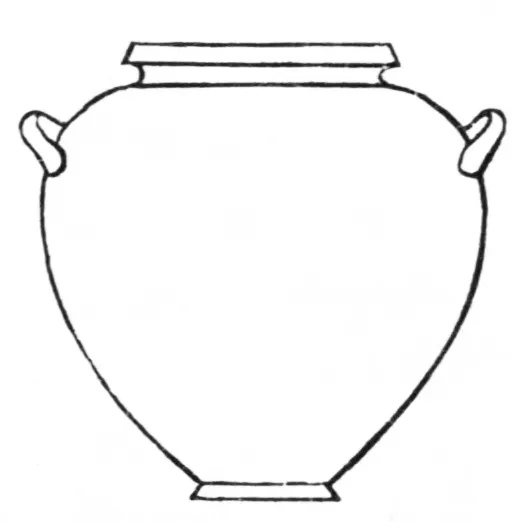
The stamnos (Fig. 169) was an open-mouthed jar with two handles, and a
body inclined to be oval, but of great rotundity, curving inward to a
comparatively narrow base. It held liquids. The cheroulia and bikoi
were modifications of the stamnos, the latter being used for holding
wine and solids.
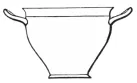 Fig. 171.—Skyphos, or Kothon.
The hyrche is not very well known, either in regard to its shape or
purpose, but appears to have had a narrow neck, and to have been used in
conveying goods a long distance. Its narrow neck is a tolerably sure
indication that it was not intended to be stationary.{224}
The lagynos also appears to have had a very narrow neck, and to have
been of considerable size, varying according to circumstances.
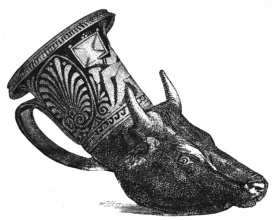 Fig. 172.—Greek Rhyton.
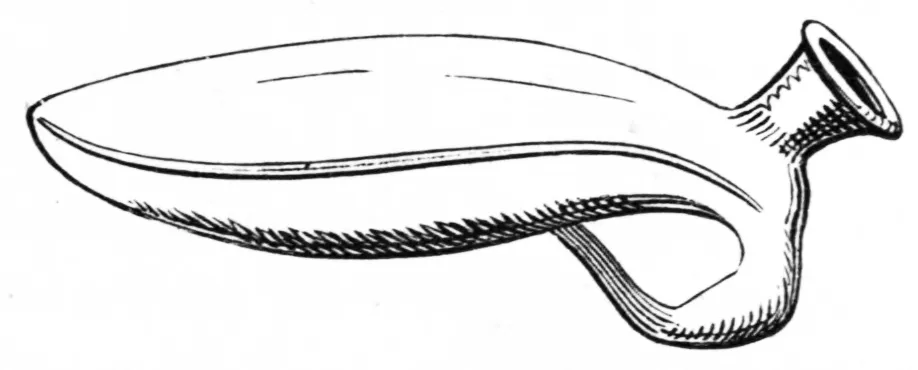
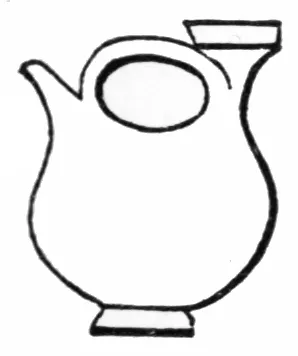
The askos (Fig. 170), literally a wineskin, which it resembled in
shape, had an aperture and neck on one side, from which a handle passed
over a hollow on the body to the other side. Both the askos and
stamnos are frequently painted with red figures.
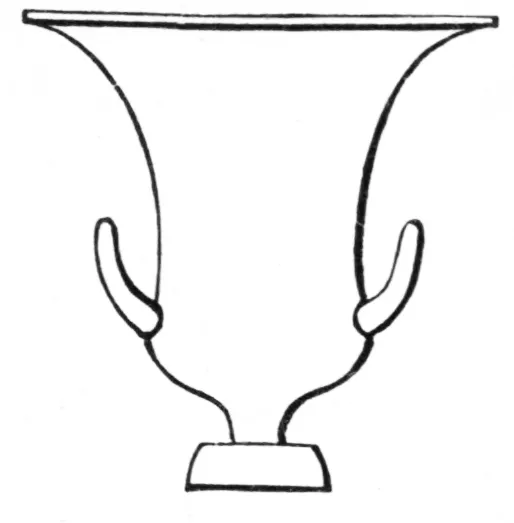
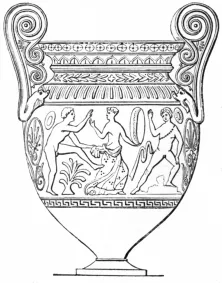 Fig. 173.—Krater, with Volute Handles.
The amphora, already described in the form it commonly took, may be
called a general receptacle, although usually employed for holding
provisions and liquors. There were many different shapes, which varied
according to the district where made, and the special purpose for which
they were destined. The chief kinds are the Egyptian, Apulian,
Tyrrhenian, Panathenaic, Bacchic (Fig. 186), and Nolan, the last
mentioned being the most perfectly finished, and unexcelled in
gracefulness of shape. They were decorated with either red or black
paintings.
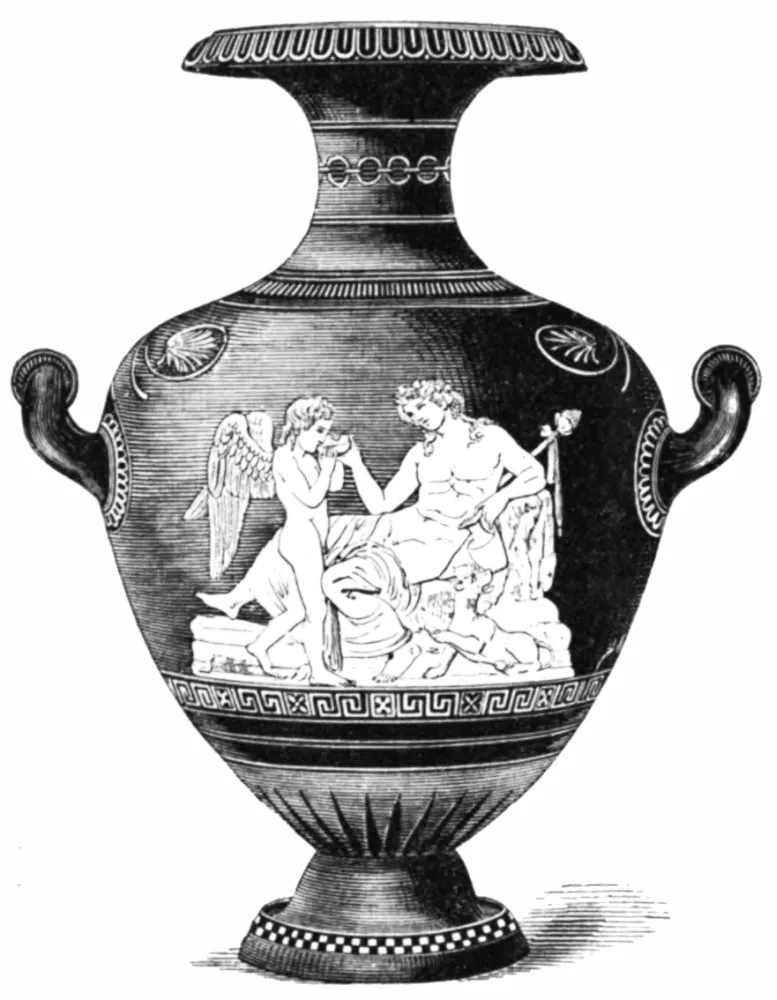
The kados is the first of the vessels for drawing liquids, of which
class the hydria (Fig. 188) is the best known. Its name implies its
purpose as a{225} water-pitcher. It had two small side handles, and one
larger one, somewhat similar to that of the modern ewer. The kalpis
(Fig. 187) and krossos were modifications of the hydria.
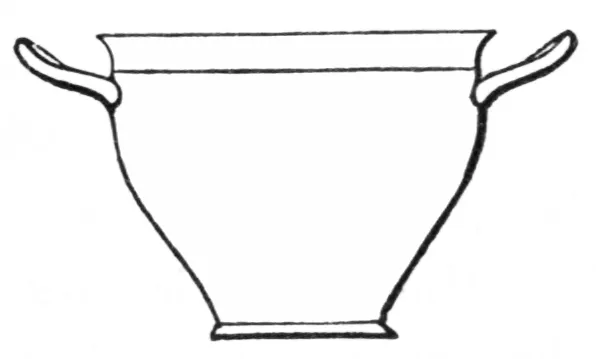
The kothon (Fig. 171) is supposed to have been a drinking-cup.
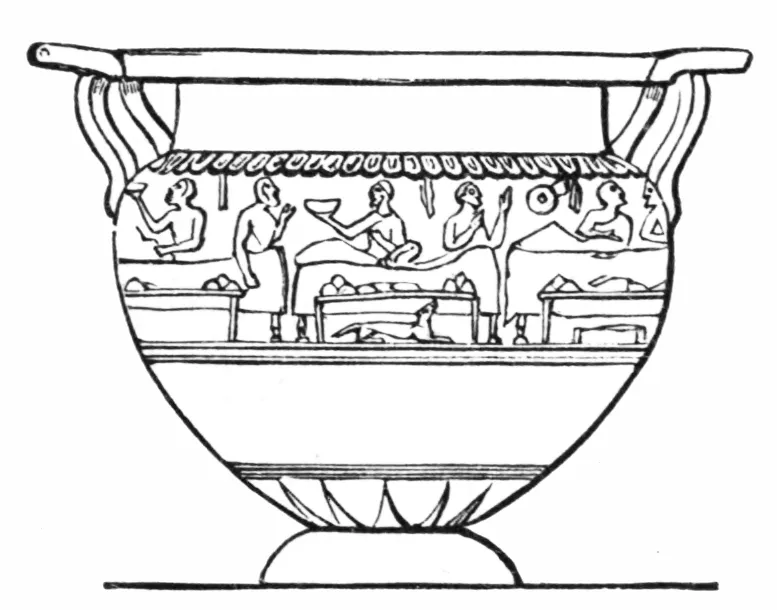
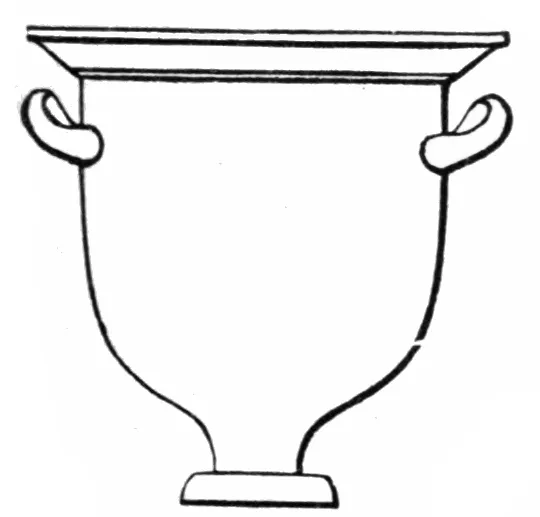
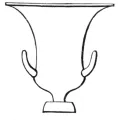 Fig. 174.—Krater.
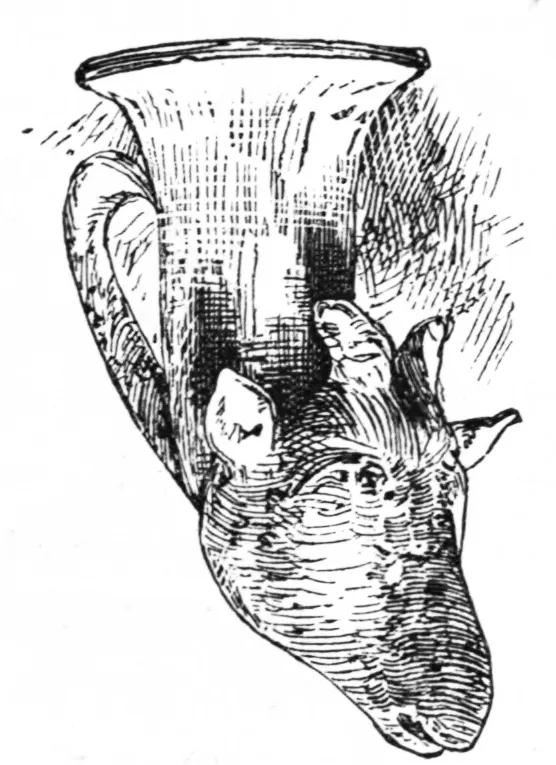
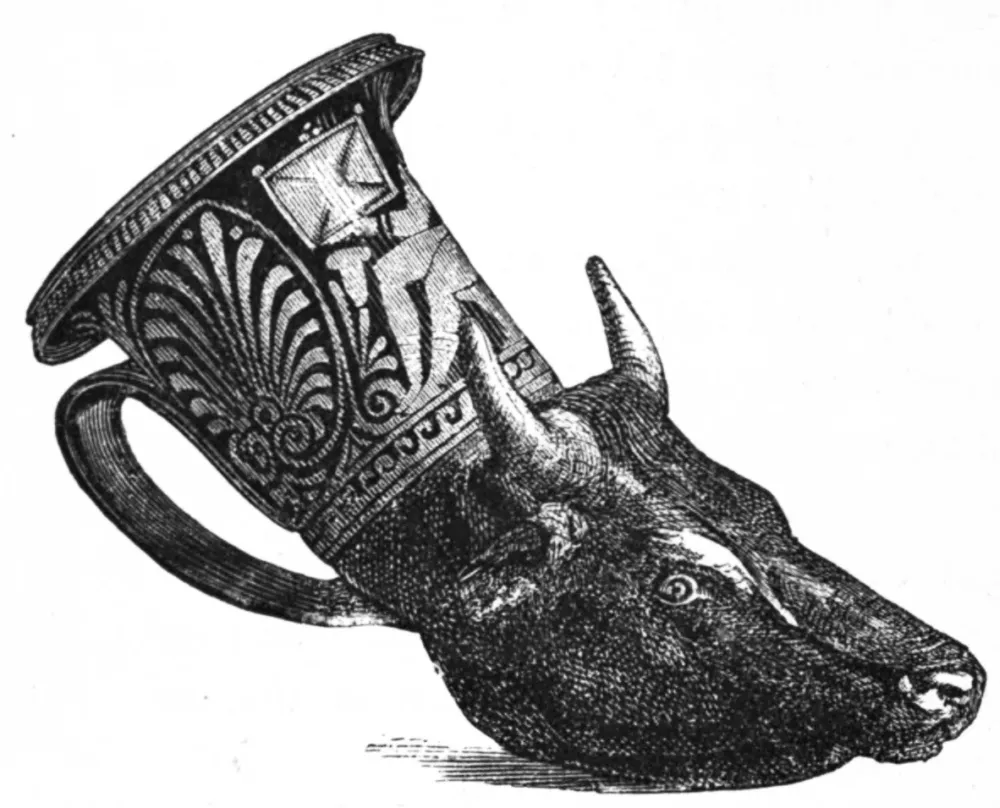
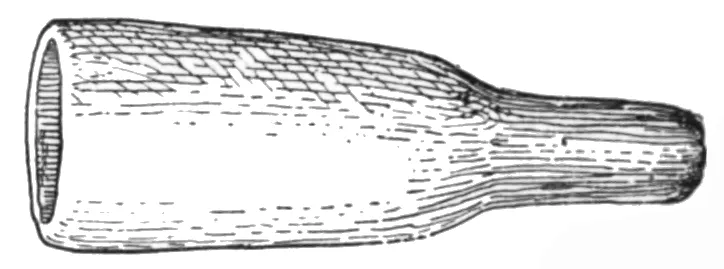
The rhyton (Fig. 172) belongs to the later style of drinking-cups, and
its peculiarity is that it could not be set down except when empty. The
base is modelled after the head of a dog, goat, deer, or other animal,
and the neck or cup proper is either cylindrical or elongated and
sloped.
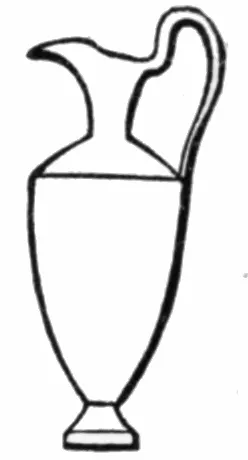
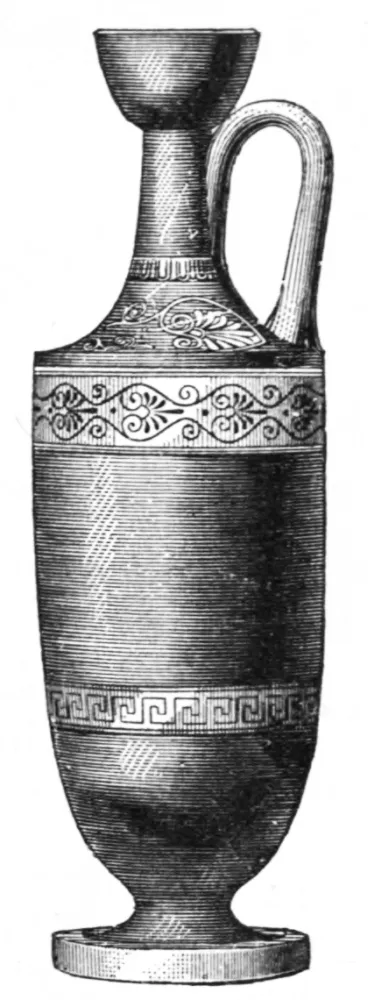
The lekythos (Fig. 305) was an oil-jar of an elongated shape, neck in
proportion, cup-like orifice, and one handle. It is decorated in all the
styles of Grecian art, and is generally about one foot in height. It was
sometimes made of metal or marble.
 Fig. 175.—Holmos.
The alabastros was a diminutive lekythos, used for toilet unguents,
with two small ears by which to suspend it.
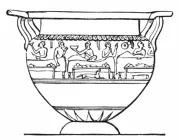 Fig. 176.—Kelebe.
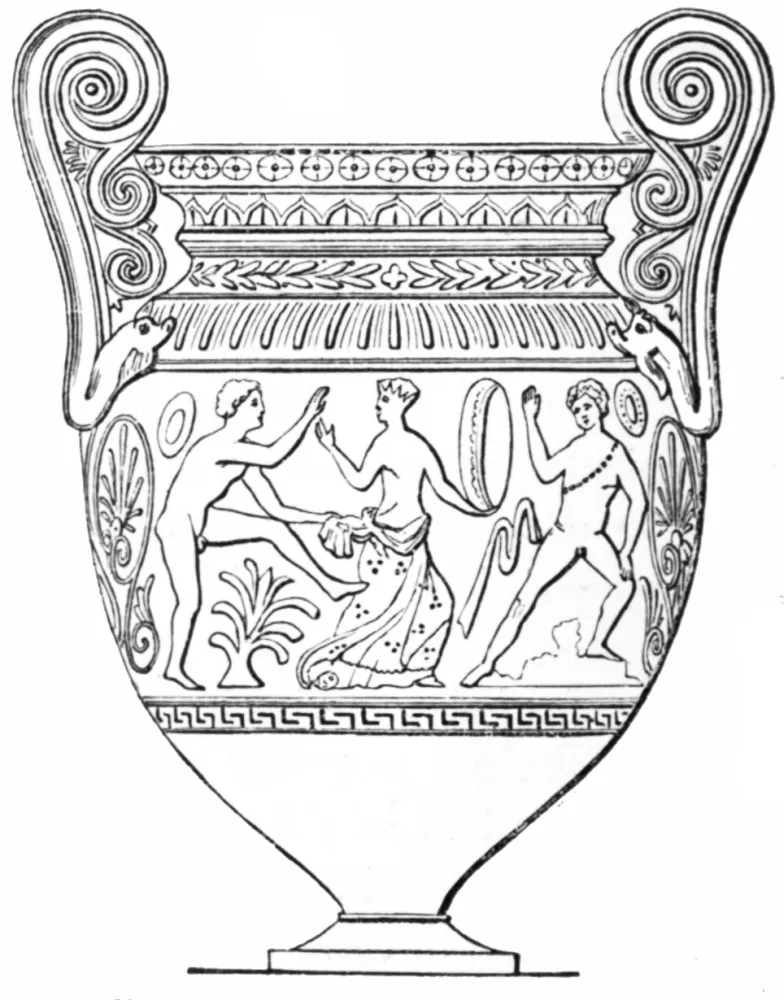
The krater (Figs. 173 and 174) was the vessel in which the Greeks
cooled and mixed their wine, of which it would hold about three gallons.
It is the later form of a class of vessels of which the holmos (Fig.
175), kelebe (Fig. 176), and oxybaphon (Fig. 177) are the earlier
representatives.
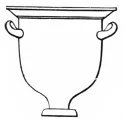 Fig. 177.—Oxybaphon.
The psykter, or wine-cooler, was a double-walled vessel of the amphora
type, rotund in shape.
The dinos was another form of the wine vessel, open-mouthed, round in
body and base, and allied to the krater.
The chytrai were warming-pots with two handles. The tripous, or
three-footed pot, was employed in a similar manner.
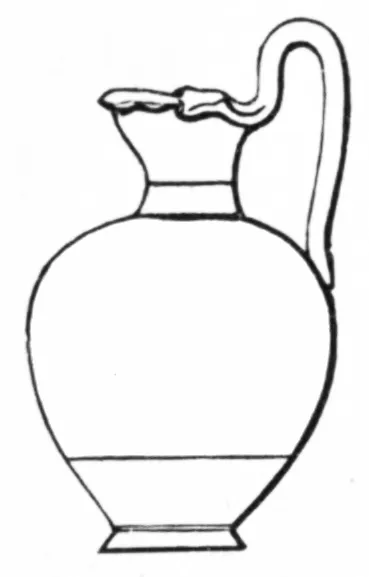
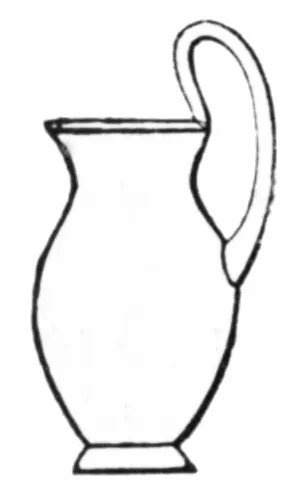
The oinochoe, in the shape most frequently{226} occurring, resembled a jug
with a lip either round or pinched in at the sides, and with a handle
rising above the orifice. The oinochoe was used in serving the guests
from the krater.
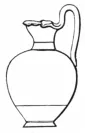 Fig. 178.—Prochoos.
The prochoos (Figs. 178 and 179) was also a jug, either with or
without a handle, for either water or wine. The olpe (Fig. 180)
belongs to the same class.
The aryballos (Fig. 165) was round or bladder-shaped and short-necked,
and bore a close resemblance to one of the toilet vases of the
Egyptians.
The arystichos was also used for serving from the krater, a usage
which gave rise to several other shapes. Of the cups designed for the
same purpose, the kotylos may be mentioned, although its shape is
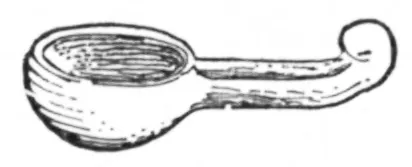
doubtful. The kyathos (Fig. 181), or ladle, belongs to the same class.
 Fig. 179.—Prochoos.
The drinking-cups were of many shapes and assumed great elegance of
form. The several varieties cannot now be specified by description. The
skyphos was the generic name applied also to a few special shapes now
unknown. The kantharos (Fig. 182) was wide, somewhat shallow, with two
handles rising well above the lip, and either with or without a stem.
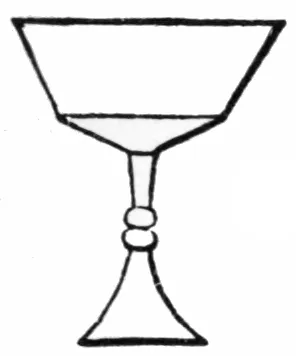
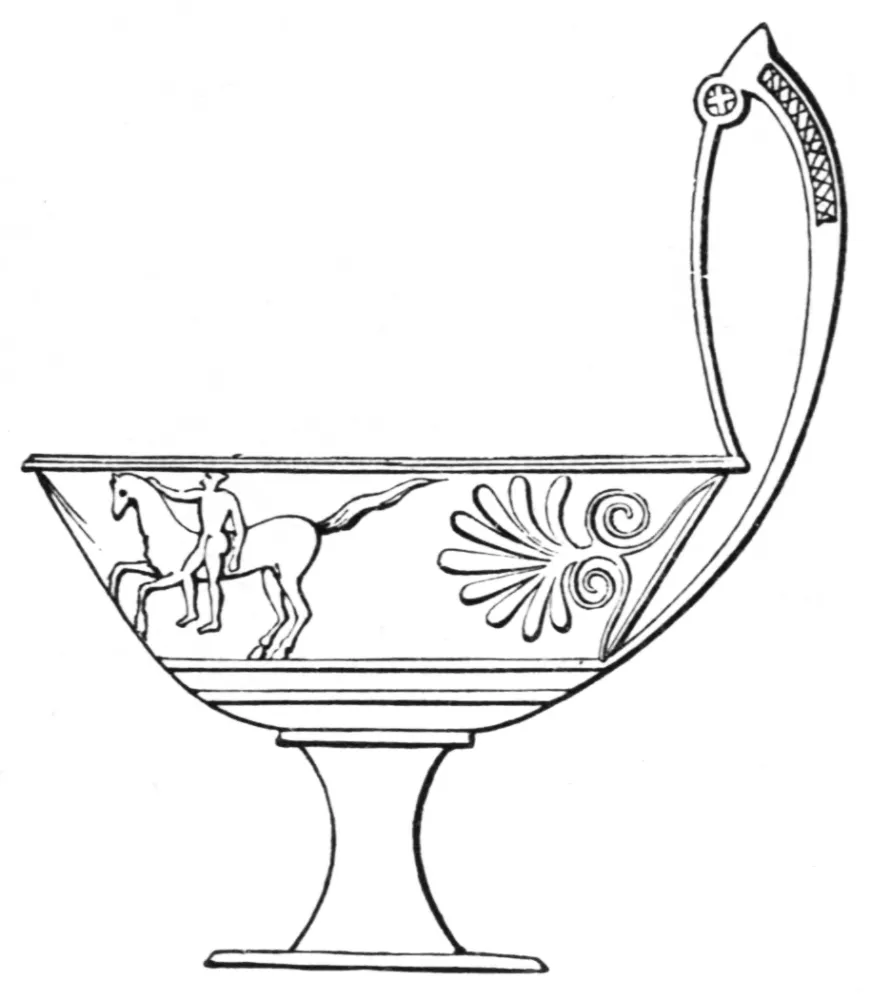
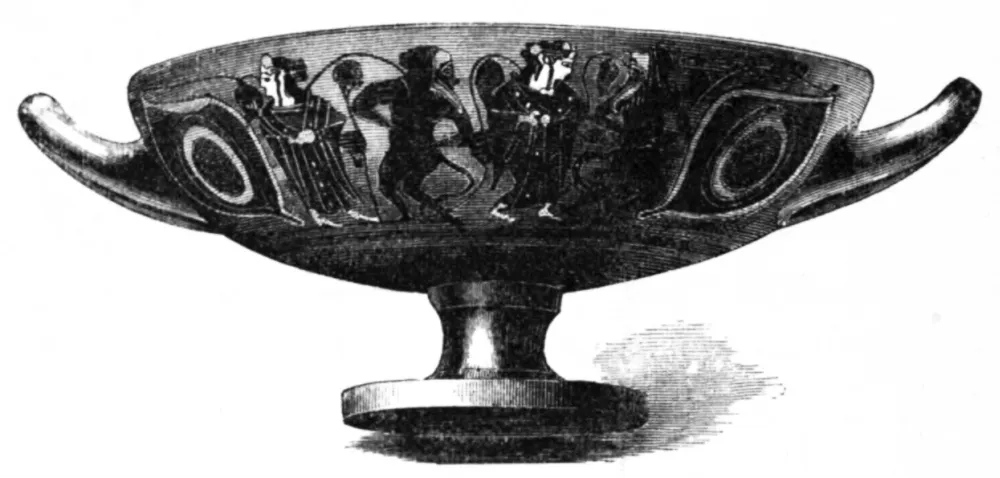
The kylix (Fig. 183) was the cup most generally used, and varied in
shape. In the earliest specimens it has a long stem, two handles, and is
shallow and wide. The later forms are wider, and shorter in the stem,
which ultimately disappears entirely. The phiale was the religious
counterpart of the kylix.
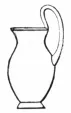 Fig. 180.—Olpe.
The kanoun, diskos, and pinax were for table use, the two latter
corresponding with our plates, with the exception that the diskos stood
upon a stem or foot.
Of the vessels named those deserving closest attention, as most
frequently presenting themselves, are the kylix, oinochoe, krater,
aryballos, kyathos, lekythos, rhyton, hydria, amphora, and pithos. The
kylix is to be specially commended for its beauty of shape, and its
decoration with red figures exemplifies some of the best art of Greece.
From the descriptions given of the various vessels, it will be seen{227}
that many of them were devoted to household use. Vases were also made as
toys for children, as prizes to victorious athletes, for holding the
viands and liquids placed beside the dead, and more recently for the
ashes of the dead. Among the exceptional uses of pottery by the Greeks
may be mentioned the giving of receipts on potsherds, the recording on
fragments of pottery of votes for ostracizing (from ostrakon, a
potsherd) a citizen, and for deciding the side to be taken by the
entrants for the game called ostrakinon. This last was decided by
“tossing up” a piece of pottery, and assigning a side to the player
according to its falling with the red or black side uppermost. Vases
were also made in honor of great men and authors, whose names are
inscribed on them. All the vases now in museums, numbering, according to
different estimates, from twenty to fifty thousand, were taken from the
tombs of Greece, Southern Italy, and Etruria. It was the custom to place
beside the dead the vessels necessary for the religious rites, the
favorite vases and prizes of the deceased; and in this way they have
been preserved to illustrate in our age the branch of Greek art to which
they belong. No precise age can be ascribed to any one specimen.
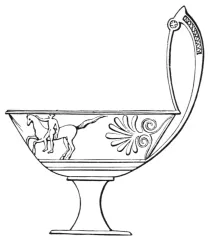 Fig. 181.—Kyathos
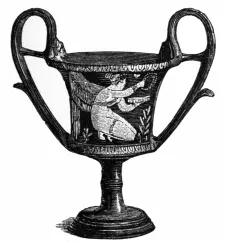 Fig. 182.—Kantharos.
The first glazed vases date probably from the ninth century before
Christ, and from the beginning of the third century{228} the art declined.
It had probably reached its highest point four hundred years before our
era.
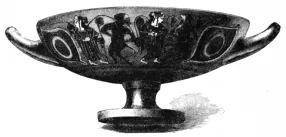 Fig. 183.—Kylix. Black on Red. Female Faces and Feet
White. Naked Satyrs. (Trumbull-Prime Coll., N. Y. Metrop. Mus.)
The earliest vases were made by hand, and even after glazing was
introduced that method was continued. It was also resorted to in making
the gigantic pithoi, which were too large to be turned on the wheel.
The finer vases were made on the wheel or moulded. After being moulded
they were dried and painted. There were two methods of painting. By the
first the figures were outlined and then filled in, leaving them black
on a red or pale ground. The vase was then glazed and fired. By the
second the figures were left untouched and of the color of the paste, by
painting the ground black. A color slightly different from that of the
body was employed for the finer lines of the figures. The vase was then
glazed and fired as before.
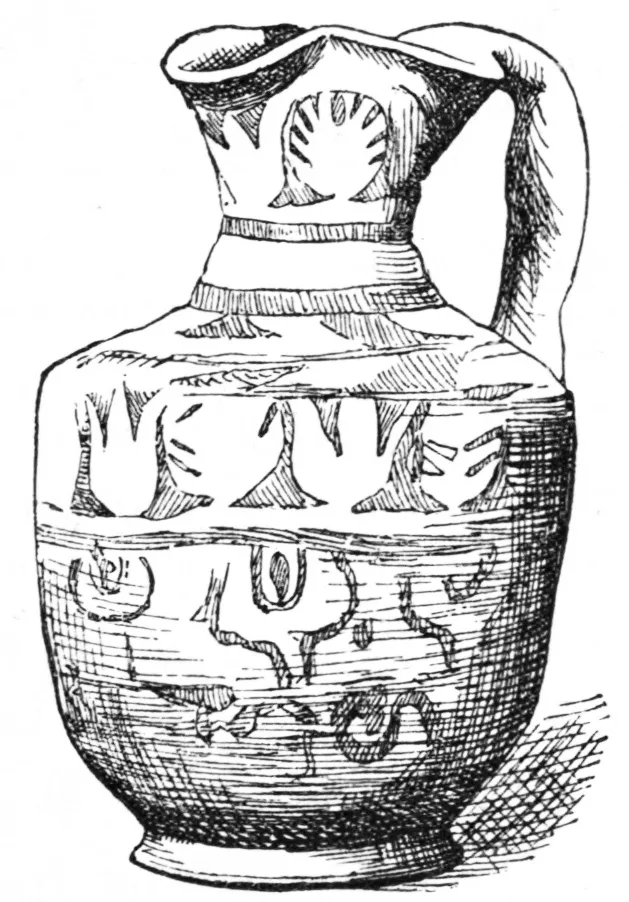
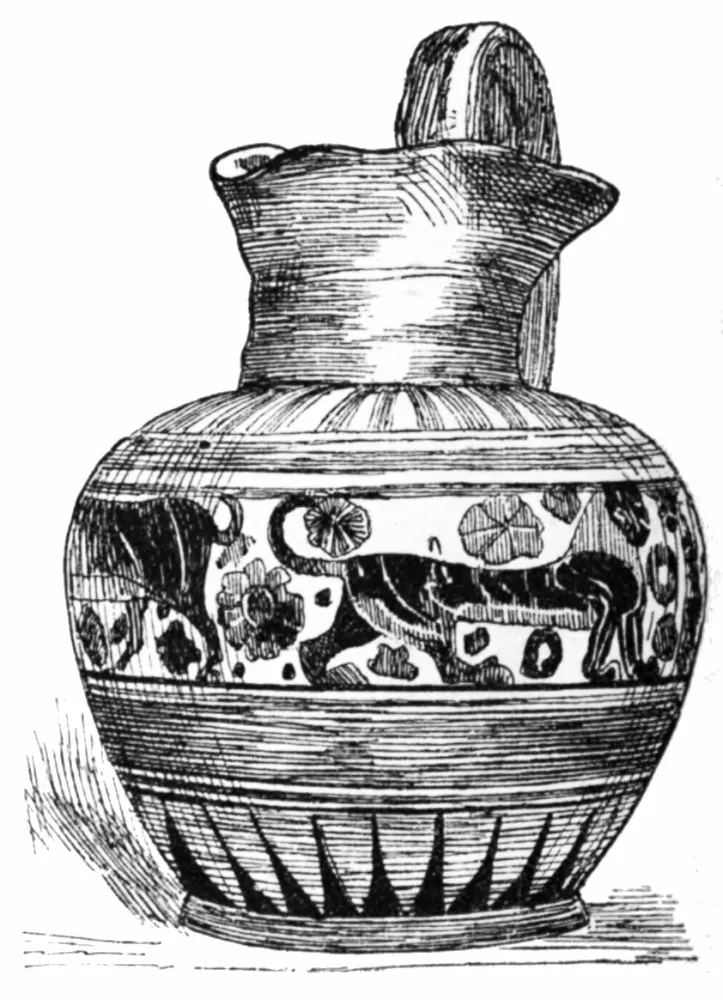
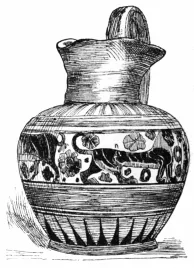 Fig. 184.—Early Greek Oinochoe, showing Phœnician
Influences. About B.C. 700-500. (Trumbull-Prime Coll., N. Y.
Metropolitan Museum.)
We now come to the successive styles of ornamentation. The natural order
would give the first place to the uncolored vases, the second to those
painted all over in black, the next to the different styles of figures.
In addition to what has been said in the Introduction, and to go more
deeply into details, the following points may be noted in regard to the
last of the above stages—the ornamentation by means of figures. These
first took{229} the form of simple belts of color drawn round the body of
the piece. A vase of a later but still very early period has the space
between the two zones passing round the widest part of the body filled
in with vertical designs, alternating with small rings, each containing
a cross (see Fig. 166). When animal and floral decoration was first
attempted, the artist’s work was rude and the forms were unnatural.
White upon black grounds indicate the earliest style. Another very
ancient style has the figures, which are all those of animals, painted
in dark lines upon the pale red paste (Fig. 184).
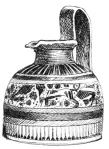 Fig. 185.—Greek Oinochoe. Painting, Black and Reddish
Brown. Height, 7½ in. (Appleton Coll., Boston Mus. of Fine Arts.)
The vases of the next, or Archaic, group vary in color from a pale
yellow to a deep red, on which the figures are painted in a darker
color. One of its leading features is the profusion of flowers. The
presence of human forms, more or less skilfully drawn, may be taken as
the criterion by which to determine the later members of this group.
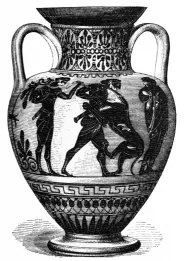 Fig. 186.—Bacchic Amphora. Black on Red Ground. Height,
15 in. (Appleton Coll., Boston Museum of Fine Arts.)
In the next style (Fig. 186) human figures become more prominent in the
designs, and are perfectly black, with the exception of the flesh of
females, which is painted white or red. Many of the subjects are taken
from mythology and the heroic legends. This developed into the “old
style,” where the black appears greatly improved; and while the hands,
face, and exposed parts of the females are pure white, their eyes are
red. The drawing is still stiff and constrained, and where attempts at
perspective are made, they are eminently unskilful. White is also more
plentifully distributed, and is seen in the hair and beard of old men,
in horses, and in many accessories, for which red is also occasionally
employed. As{230} the art developed, red figures were more frequently
introduced among those in black; and we also find the artist entirely
obscuring the natural color of the paste by means of a white slip, or
coat, upon which he painted the black figures.
As we approach the best art of Greece the colors are inverted. The
figures are drawn upon the paste of the red or yellow color of which
they appear, and the rest of the vase is painted black (Fig. 187).
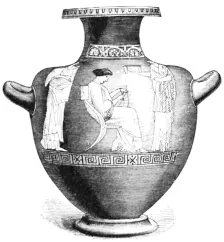 Fig. 187.—Greek Kalpis. Red Figures on Black Ground.
(Appleton Coll., Boston Museum of Fine Arts.)
The “fine style,” the culmination of Greek art, was a development of
that last described. The black ground, red figures, and white ornaments
show the highest point to which previous styles gradually led upward.
Drawing and composition are here at their best. The early stiffness has
given place to a fuller grace, and there is a nobility in the figures
and faces to which the earlier artists never attained. The limbs lose
their unnatural distortion, the muscles are less rigid—there is, in one
word, more life in the drawing. The accessories also gain by the greater
freedom of treatment. The drapery hangs more gracefully, its
straight-lined stiffness giving place to a more natural arrangement.
In the later specimens of this style—so markedly different from the
earlier ones that they have been classed together as the florid
style—there is a more minute attention to finish, a greater elaboration
of dresses and other accessories, and a decided tendency toward finding
the ideal human form in that which is most graceful. Gold appears in the
ornamentation (Fig. 188), and arabesques encircle the necks. Polychrome
vases were made at the same time, some of them showing the utmost
excellence of figure-drawing, and draperies of blue, green, or purple.
When the art began to decline, taste and execution both deteriorated.{231}
The figures lose their graceful proportions, and acquire a heavier
appearance. They are also more crowded, and the dresses become more
garish, until at last all refinement, both of conception and treatment,
was lost in coarseness and grotesque puerility. The amphora (Fig. 189)
illustrates the decadence.
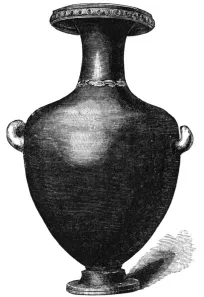 Fig. 188.—Hydria. Black, with Gilt on Neck, and Red Rim
with Black Studs. (Trumbull-Prime Coll., N. Y. Metropolitan Museum.)
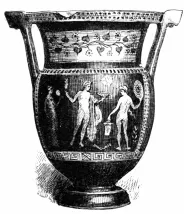 Fig. 189.—Greek Amphora, with Columnar Handles. Red on
Black. From Canosa. Height, 20 in. (Appleton Coll., Boston Museum of
Fine Arts.)
The classification of vases by the subjects represented upon them is
unsatisfactory and confusing. Scenes are taken from mythology, heroic
legends, funeral ceremonies, from civil life, and from the gymnasium,
which permit neither of a chronological arrangement of the vases nor of
one based upon their position in the scale of art. A distinct group
might, without any loss of lucidity, be made of vases decorated with
subjects in relief, or with statuettes arranged upon the body and neck.
This was a union of sculpture and pottery occasionally embellished by
the painter’s art in the coloring of the drapery and subsidiary
ornaments. Color was also applied to sculptured reliefs. A vase now in
St. Petersburg is thus described: “It is a piece of very large size,
with three handles, and of the finest and most lustrous glaze. It is
ornamented at several heights with sculptured friezes in terra-cotta,
and gilded; but that which gives it its priceless value is a frieze of
figures from four to five inches{232} high, sculptured in bas-relief, with
the heads, feet, and hands gilded, and the vestments painted in bright
colors—blue, red, and green—in the finest Greek style imaginable.
Several heads from which the gilding has become detached show the
modelling, which is as fine and as finished as that of the finest
ancient cameo.” Cups or vases with two heads, one on each side, such as
Hercules and Omphale, illustrate the same branch of art. Such features
as these, beautifully modelled relievos, ideal heads, figure scenes in
which drawing and composition are almost above criticism, not less than
its elegance of shape, have made the Greek vase a model for all time. We
can trace Assyrian ideas in the decoration of some of the earlier vases,
and Egyptian influences may also occasionally be detected. We can even
find foreign models for a few of the Greek forms; but the Hellenizing
process has obliterated every antecedent, and the art which Greece gave
the world is as purely Grecian as if in every particular it were
indigenous to the soil of that favored land.{233}
Spain: Ancient Pottery.—Valencia the Most Ancient Centre.—The
Roman Period.—Arabs.—Valencia under the Moors.—Its
Decline.—Malaga the Most Ancient Moorish Settlement.—The Alhambra
Vase.—Influence of Christianity.—Majorca.—Azulejos.—Modern
Spain.—Porcelain.—Buen Retiro.—Moncloa.—Alcora.—Portugal:
Vista Allegre.—Rato.—Caldas.
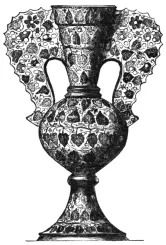 Fig. 190.—Hispano-Moresque Vase. End of 13th Century.
(S. Kensington Mus.)
A MERE glance is all that is necessary to bestow upon the ancient
pottery of Spain before we resume the history of the Moorish
fabrications in that country. Valencia is the centre to which the
greatest antiquity must be accorded. Pliny alludes to Saguntum, now
called Murviedro, as having twelve hundred potteries, and Martial is not
stinted in his praises of their work. All the remains found there are of
the Roman period, and are classed under red Samian ware, and three other
groups, of which one was of a yellowish color and another of pale
terra-cotta. From that time we must make a great leap across the chasm
between the downfall of Roman civilization and the first Saracenic
occupation of the Iberian Peninsula in the eighth century. Even then
there is little to guide research. Arabian azulejos have been met with,
and in 1239, four years after the Moorish kingdom of Granada had been
founded, a charter was granted by James I. of Aragon to the Saracen
potters of Xativa (San Felipe) relieving them from servitude on payment
yearly of one besant for each kiln. We have no means of identifying{234} the
early works of these Saracenic workmen, and it is not until 1517 that
they are referred to in literature as producing well-worked and
well-gilded faiences, more highly esteemed than any other of Spanish
manufacture. Several writers of the sixteenth century praise the
Valencian pottery, but in the beginning of the seventeenth century it
began to decline. Christian designs (Fig. 191) take the place of
Moresque; and at the present day, according to Marryat, the
metallic-lustred wares of Manises, near Valencia, are made by an
innkeeper, who thus spends the time lying heavy on his hands by reason
of a lack of guests in his inn. In the olden time the pottery of Manises
was exchanged with Italy for that of Pisa, and was ordered by “the Pope,
cardinals and princes admiring that with simple earth such things can be
made.” Such is the difference between now and then.
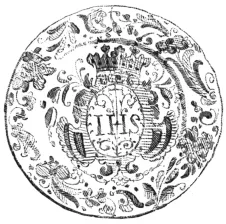 Fig. 191.—Spanish Majolica. Dark-blue and Brown Painting
on White. (J. W. Paige Coll., Boston Museum of Fine Arts.)
From the style of the decoration it would appear that most of the
Valencian remains are to be attributed to the Christian period, i. e.,
after the thirteenth century. The general color is yellow with
mother-of-pearl lustre. St. Catherine and St. John were highly venerated
in Valencia, and this veneration appears in the frequency of their
representation, either actually, or by their emblems, or in invocations
and passages from the gospel of the fourth evangelist. The eagle—the
emblem of St. John—and the opening words of his gospel appear also,
however, on wares from Malaga and Majorca; and, further, the yellow
lustre was produced at Barcelona. It is, therefore, evidently unsafe to
ascribe, after an examination of general characteristics, individual
specimens to a specific source.
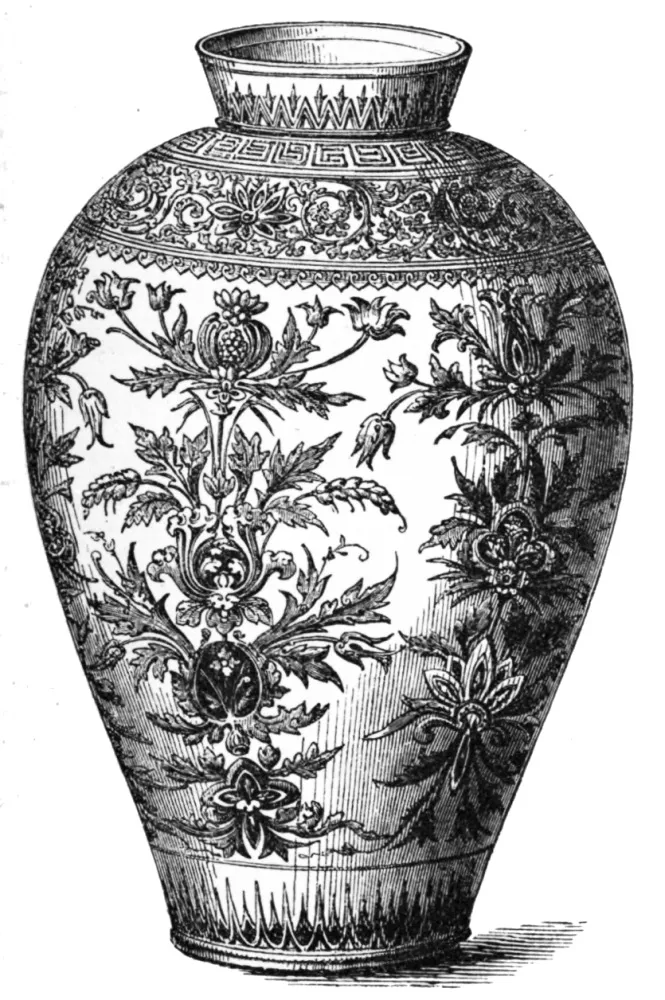
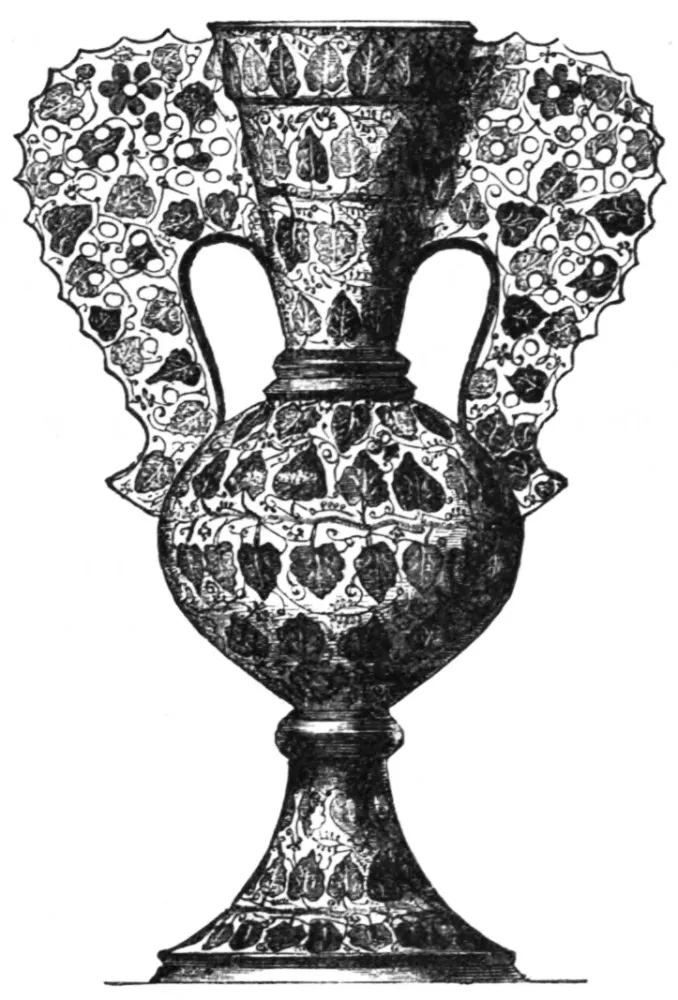
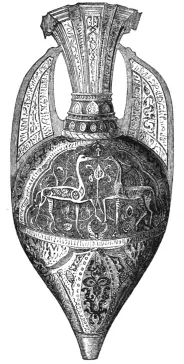 Fig. 192.—The Alhambra Vase.
Of the Moresque pottery it is probable that Malaga was the most ancient
centre. Its golden pottery is spoken of as an article of export{235} as far
back as 1350. There also we are brought into contact with the famous and
beautiful vases of the Alhambra (Fig. 192). The palace itself was built
by Mohammed-ben-Alhamar, the first Moorish king of Granada, in 1273,
with the intention, possibly of rivalling the richly decorated mosques
of the Mussulman Arabs. The Alhambra vase is the only survivor of three
of similar style found under the palace pavement. The others fell
victims to the Vandalism of memento or relic hunters. The one still in
existence is seven feet in circumference and four feet three inches in
height. It is supposed to belong to about the year 1320. It is made of
earthen-ware, and is decorated in three colors. The ground is white and
the decorations are a golden yellow lustre and blue. The vase is not
only a masterpiece of Moresque art, but a magnificent example of the
decorative genius of the Moors, which spent itself in devising quaint
combinations of lines and in a wealth of arabesque. There are many other
pieces which, from their metallic lustre and blue ornamentation, are
also credited to Malaga, and date from the middle of the fourteenth
century. It is unfortunate that this exquisite art soon deteriorated. As
we approach the Christian epoch we come upon the works of copyists
devoid of intelligence, in whose hands the decoration they strove to
follow loses its delicacy and meaning. The Valencian art with which we
are acquainted was thus rising as that of Malaga was gradually, sinking
out of sight. Faience was made at the latter place in the beginning of
the sixteenth century. For a time the Catholic conquerors under
Ferdinand tolerated the art. But intolerant zeal asserted itself,
Moorish customs were suppressed, and at length the Moorish settlers were
driven into exile.{236}
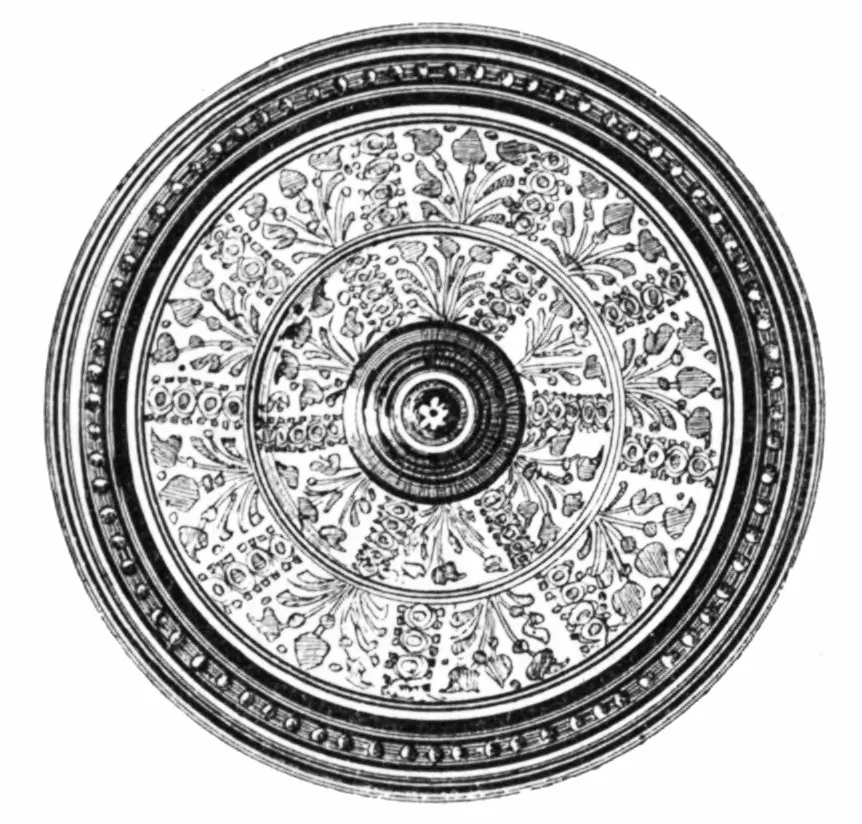
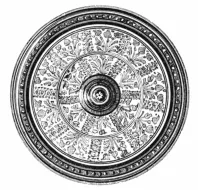 Fig. 193.—Hispano-Moresque Plaque in Frame. Diameter, 16
in. Copper Color on White: Metallic Lustre. (Wales Coll., Boston Museum
of Fine Arts.)
The third great centre of the ceramic art was at Ynca, in Majorca, the
largest of the Balearic group of islands. Majorca was conquered by James
I., in 1230, nine years before he took Valencia; and no Moresque
specimen now known can be ascribed to a period preceding that date. The
lustre of Majorca was very bright, and the ornamentation consisted
mainly of scrolls and flowers. The other islands of the group, Minorca
and Iviça, were also seats of the manufacture. We shall afterward see
how closely Majorca was connected by its commerce with Italy.
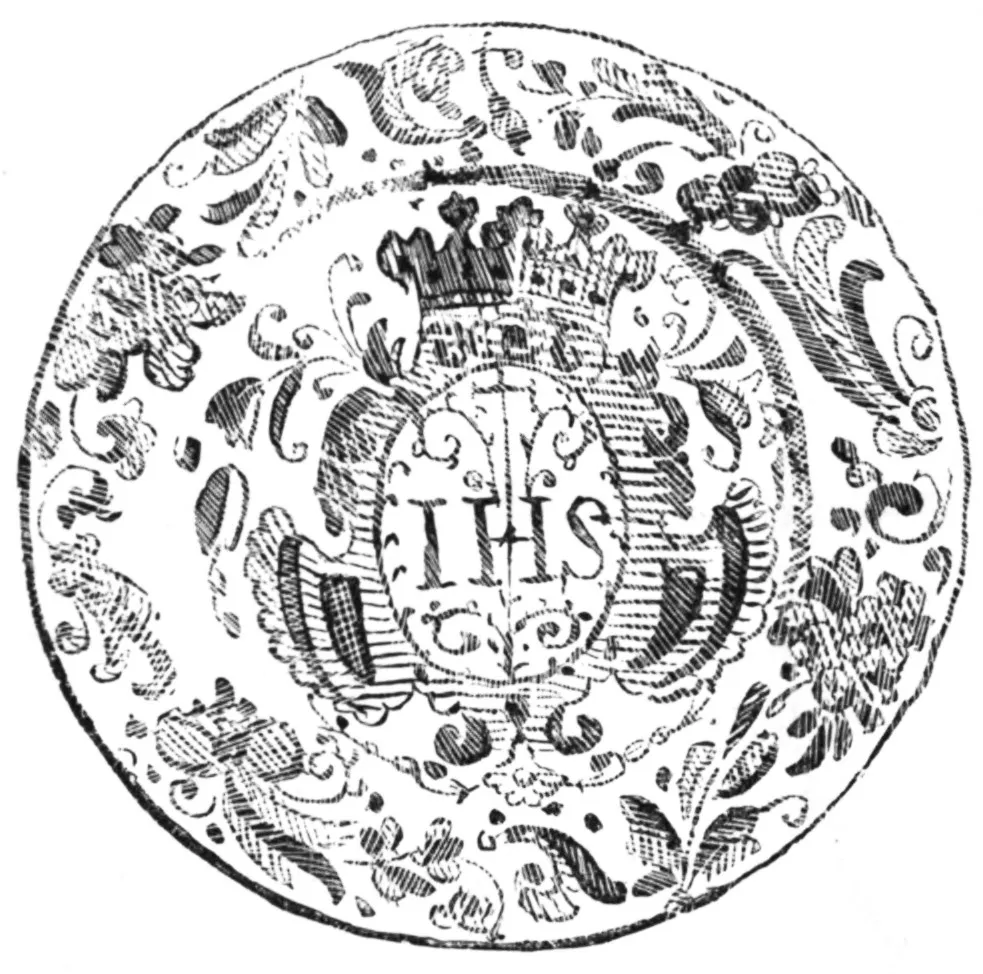
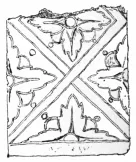 Fig. 194.—Early Hispano-Moresque. (Boston Household Art
Rooms.)
We have reserved the azulejos, or tiles (Fig. 194), the best indicators
of the progress of Arabian art, for separate treatment. We find in the
tiles of the Alhambra, in the buildings of Seville and the Cuarto Real
of Granada (Fig. 195), the products of the same skill which embellished
the edifices of Persia, Arabia, and the Maghreb. They are made of
light-colored clay, covered with a stanniferous enamel, upon which are
laid intricate designs in blue or golden lustre. The brilliant and
dazzling beauty they lent to the interior of the Alhambra, from
pavement, walls, and roof, can now only be imagined. So much did the
Spaniards admire the azulejos, that they were employed, not only for the
embellishment of public and royal edifices, but for the houses of the
wealthy. Their manufacture is continued in Valencia down to the present
day.
From what has been said, the chronological sequence of the
Hispano-Moresque potteries may, in part, be inferred. The most ancient
is that resembling the Alhambra vase, decorated with blue and yellow
lustre. As we come later down, the lustre{237} assumes more of a golden hue,
and becomes exceedingly brilliant, as we find it at Valencia, when the
less dazzling wares of Malaga were falling into disfavor. The ruddier
copper lustres are the farthest removed from the early wares. They excel
in brightness, and show less restraint and chasteness of taste, and mark
the decline from those works which have given celebrity to
Hispano-Moresque pottery.
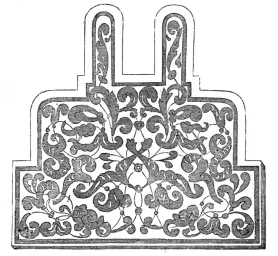 Fig. 195—Moorish Tile, from the Cuarto Real.
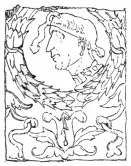 Fig. 196.—Early Hispano-Moresque. (Boston Household Art
Rooms.)
The Spain of our day retains not even a semblance of its former
greatness. What is best in its modern art, such as the terra-cotta of
Barcelona, contains no tradition of ancient times. At the Centennial
Exhibition, it was, as compared with leading European countries, poorly
represented. It may be assumed that Seville, famous for its azulejos
from the sixteenth century, and Valencia, which has an unwritten
continuous ceramic history from the Roman epoch to the present day,
would not send their inferior works to America. The former city was
represented by a pyramid of wares showing great diversity of design and
decoration. A large vase, best described as after the Alhambra type, was
of a yellow lustre, and surrounded by narrow gilt bands. There were also
a few smaller pieces of iridescent blue, green, and gold. A pair of
vases with floral decoration on a red ground and black base hardly
suggested relationship with the works exemplifying the exquisite taste
of ancient Spain.{238}
The Valencian tiling was, as a rule, coarse and inartistic. On a series
of wall-pieces were figures of some of the apostles, and a landscape,
fairly drawn, but weak in color. The artist manifested an unfortunate
predilection for a shading of brownish purple, which enhanced neither
his figures nor landscapes. The old style of mosaic tiling was
represented by some specimens composed of small star-shaped and
elongated hexagonal tiles. There was no sign of the preservation of even
a tradition of Hispano-Moresque art. We may turn to Spanish history for
an explanation of this decadence, and find in the latter an illustration
of its history. Its art was essentially foreign; and when it fell
entirely into the hands of the Spanish, on the expulsion of the Moors by
the bigotry of Philip II., its doom was sealed. We read the history of
the ceramic art during its best days in Spain as an additional chapter
to the Saracenic and Maghrebrian, and as that of a branch which, by the
accident of location, and not from its having any element really
Spanish, came to be known as Hispano-Moresque.
We nowhere find any literary evidence that the Persians who settled in
Spain exercised any practical influence upon its ceramics. Very likely
they did; and, further, it is not improbable that commerce may have
brought Spain into a closer connection with the East than is generally
suspected. The early Hispano-Moresque works are so clearly suggestive of
Eastern influence, that one is almost led at times to question their
right to the name conferred upon them. As if to give the half-shaped
doubt a more decided form, we remember also that as the art becomes more
purely Spanish it declines from its ancient beauty. We can only admire
and criticise the odd combinations of color and form; and while
indulging in conjectures as to the immediate fabrication of the pottery
under consideration, we must regard it as illustrative of the
development of an art of Oriental origin.
The manufacture of artificial porcelain in Spain was instituted, about
1760, by Charles III., who took with him a number of workmen and artists
from Naples. This accounts for the similarity between the Spanish and
Neapolitan productions. The works were situated in the gardens of the
Buen Retiro at Madrid, and were kept strictly secluded from visitors.
The ware was of fine quality, and was said by some writers who had seen
specimens at the palace, to rival that of{239} Sèvres. La China, as the
Royal Manufactory was called, was blown up by Lord Hill during the
Peninsular War, in 1812. A second manufactory was established at
Moncloa, near Madrid, in 1827. Mention is also made of a factory of
natural porcelain at Alcora, in 1756, but the reference must be accepted
with hesitation.
Of the ceramics of Portugal very little is known; but that little is
sufficient to lead us to wish for more exact knowledge. In this matter,
Portugal has not yet, in fact, been appointed to any recognized place in
history. Her ceramic art has not been known to Europeans for more than
ten years, and to Americans for little more than one; and we have no
means of telling whence it was derived. Probably it came from Spain, as
we learn that the Portuguese use azulejos as extensively as the
Spaniards. We are further told that many of their imitations are
exceedingly clever. Of the truth of this we have had ample evidence.
None of the imitation Palissy ware exhibited at the Centennial was more
realistic and full of life than that of Portugal. Some majolica vases,
with coiled snake handles, were very creditable. The snake evidently
plays an important part in Portuguese ceramics, as we met with it
elsewhere, and notably as the handle of a fish-shaped dish. Very
remarkable were the unique and droll little figures of painted pottery,
sometimes grouped into a humorous scene, sometimes single, and
illustrative of the national costumes. The humor which the Portuguese
contrived to infuse into their art evidently lent the pottery section of
their department at the Centennial its greatest attraction; and combined
as it was with excellent modelling and colors, the nature of which we
can hardly specify, it excited our curiosity to learn what historical
background there may be to the art which now chooses such expression. A
natural porcelain factory at Vista Allegre, near Oporto, is mentioned,
and the faience fabrics of Rato and Caldas.{240}
Italian Art.—Whence Derived.—Greece and
Persia.—Divisions.—Ancient Roman and Etruscan.—Etruria and
Greece.—Questions Resulting from Discoveries at Vulci.—Early
Connection between Etruria and Greece.—Etruscan Art an Offshoot of
Greek.—Examples.—Best of Black Paste.—Why Etruscan Art
Declined.—Rome.—Nothing Original.—Its Debt to Etruria and
Greece.—Decline of its Art.—Unglazed Pottery and its
Divisions.—Glazed Pottery.—Samian
Ware.—Aretine.—Terra-cotta.—After Rome fell.—The
Renaissance.—Saracenic Influences.—Crusades.—Conquest of
Majorca.—Tin Enamel and Metallic Lustre.—Bacini at Pisa.—Lead
Glaze.—Majolica Made at Pesaro.—Sgraffiati.—Luca della
Robbia.—Sketch of his Life.—His Alleged Discovery.—What he
really Accomplished.—Where he Acquired the Secret of Enamel.—His
Works.—Bas-Reliefs.—Paintings on the Flat.—His
Successors.—Recapitulation of Beginnings of Italian
Majolica.—Chaffagiolo.—Siena.—Florence.—Pisa.—Pesaro.—Castel-Durante.—Urbino.—Gubbio
and Maestro Giorgio.—Faenza.—Forli, Rimini, and
Ravenna.—Venice.—Ferrara.—Deruta.—Naples.—Shape and
Color.—Modern Italy.
THE ceramic art of Italy, beginning with the Roman and Etruscan, and
coming down to the Renaissance in the fifteenth century, is the
successor of those of Greece and the East, on the one hand, and of the
Saracenic and Hispano-Moresque on the other. There have been two
questions under discussion in reference to the latter period, viz.,
Where did Italy acquire her knowledge of the use of stanniferous enamel?
and, Whence did she draw her skill in the application of metallic
lustre? We shall find, on examining the evidence, that the great works
of her artistic prime were the results of a derivative and not of an
original art. They are only original in so far as they indicate a point
in advance of Italy’s predecessors. We have said that Oriental art
culminated in Greece. Italy presents us with a later point of union
between two lines issuing from the East. We find subjects and forms
recalling at once the ideals of Greece and the rich mythological and
legendary sources from which were drawn the aids to her prolific
imagination. We also find that the Greek restraint in the use of colors
is thrown aside, and that Italy availed herself to the full of the
skilful{241} processes and methods of embellishment brought to her shores
from Persia, and by the Saracens and Moors from their settlements in
Africa and Spain.
There are thus two great divisions of Italian pottery: the ancient Roman
and Etruscan, and that of the Renaissance. Between these two there is a
long period of darkness, extending from the last smouldering glow of the
art of Italy, after Constantine took the seat of the imperial power to
Byzantium, to the entrance of the Saracens into Europe.
In considering the ancient epoch, one pertinent fact may be borne in
mind, viz., that the best remains of the art of Greece have been found
beyond its own borders, and that its history might be written from those
discovered in Italy alone. Dividing Italy into three sections, we shall
have Magna Græcia, Campania, and Etruria. Of these the latter has the
greater antiquity, in so far as its ceramic remains are concerned. Greek
colonies settled all along the southern part of the peninsula and in
Sicily, and such relics as are found there may, in the mean time, be
dismissed as corresponding in style with those of the same dates
produced in Greece.
Although the same rule might be held in a less broad sense to apply to
Etruria, it is deserving of more lengthened consideration. When, in
1825, the great discoveries were made at Vulci, the learned world was
divided as to the places to which the vases should be credited. Some
maintained that they were made in Greece and imported; others, that they
were made in Etruria by Greek workmen; others, that they were really
Etruscan; others, that they were partly native and partly imported from
Greece; and still others, that many of them came from Magna Græcia and
Sicily. To reconcile these suppositions, without affecting the eastern
origin of Etruscan art, we are reminded that the Pelasgi—the name given
to the ancient inhabitants of Greece—founded Agyllos, on the coast of
Etruria. Bunsen places the first introduction of art into Etruria at
this remote period. We come next to the arrival of Demaratus in
Tarquinii, about the year B.C. 655. Demaratus was a wealthy Corinthian,
of the family of the Bacchiadæ. On the usurpation by Cypselus of the
government of Corinth, Demaratus fled, accompanied by all his family,
and, landing in the above named flourishing city, married an Etruscan
bride, and by her had a{242} son, Lucumon, who afterward occupied the throne
of Rome under the name of Tarquinius Priscus, the fifth king of the
Romans and the first of the Tarquins. Demaratus was either accompanied
or followed by certain of the artists who had brought celebrity to
Corinth for its pottery, and thus the art of Greece, as it was at that
period, might have been introduced into Etruria. It must, however, be
admitted that the story of Demaratus is not as clear as might be wished,
the authorities differing as to his status in Corinth, and as to
Lucumon, who is considered by some as having been merely one of his
companions. The Tyrrheno-Pelasgians were driven from the sea-coast
probably in the sixth century before Christ. We would from these facts
be led to expect specimens of ceramic art, firstly, rude and indigenous;
secondly, showing signs of the same Oriental origin from which Greece
derived its first lessons; and thirdly, examples of pure Greek
fabrication mingled with Etruscan imitations. In regard to such a
collection as that found at Vulci, it may thus be assumed that there is
a modicum of truth in each of the suppositions above referred to. There
cannot, in any case, be any reason for calling in question the statement
that, in the main, Etruscan ceramic art was of Grecian birth. We are
speaking of the productions of 2300 years ago. Etruria was open to the
little world surrounding the eastern end of the Mediterranean. Its ships
brought enamelled bottles from Egypt, which its citizens set in gold and
placed in their tombs. It had maritime connections with Spain,
Phœnicia, and perhaps with England, and with the southern ports of
the Italian peninsula, and those of Sicily. It imported both potters and
their wares, and turned from its own ancient standards to a higher.
While the immigrant Greeks were making such wares as they had made at
home, the native Etruscan artists were imitating, clumsily and awkwardly
at times, but gradually improving and approaching their teachers more
nearly. Etruscan art, with the exception of the earlier specimens of
rude aboriginal skill, must, therefore, be studied as an offshoot of
that of Greece.
The oldest examples, more distinctly indigenous than any of the
succeeding styles, are of a brownish color and rude shape, and are
decorated with bands and knobs or studs in relief. One peculiar shape
bears a resemblance to a miniature rustic cottage, and belongs to the
sepulchral class. Others, which are painted, recall the art of Greece{243}
in its first devotion to Phœnician or Egyptian models. They may,
therefore, be referred to the age when the Tyrrheno-Pelasgians still
held their settlements in Etruria, and are probably the work of these
settlers and of the aboriginal inhabitants who preceded them. When the
Etruscans overran the settlements of the Pelasgi, a red and black ware
was introduced, and soon afterward we are brought more directly into
contact with Grecian art by importations.
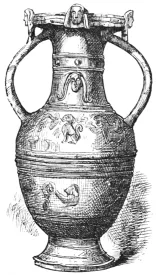 Fig. 197.—Ancient Etruscan Vase. Height, 21 in. (J.J.
Dixwell Coll., Boston Museum of Fine Arts.)
The best Etruscan works are of black paste (Fig. 197), toward which the
brown changed as it improved. The ornaments are incised flowers, and
bas-reliefs of animals and human faces, executed, designed, and arranged
in styles decidedly Oriental. On one found at Vulci are monsters like
the Egyptian sphinx, winged and woman-headed. It is probable that, of
the two styles of ornamentation, the incised is the more ancient, and
that the black ware, as a whole, belongs to between the seventh and
third centuries before Christ. The prevalence of Egyptian forms and
symbols in connection with this class, such as the scarabæus and ostrich
eggs painted with strange winged monsters, gives additional probability
to our estimate of their age, and shows how far Etruria availed herself
of the act of Psammetichus I. of Egypt, who, B.C. 654, threw open the
ports of that country to foreign traders. Contemporaneous with these are
large vases of red ware corresponding with the Greek pithoi. The
decoration displays a knowledge of the art of Egypt and the East,
mingled with examples of that of Greece. The yellow ware is allied to
the Doric; and specimens of a still paler color, ornamented with Grecian
subjects, modified and adapted to Etruscan ideas, mark the close of the
art. It at no time attained to any very great excellence, and declined
early. Both of these facts are easily explained. In the wonderful
collection of Signor Alesandro Castellani are many beautiful{244} specimens
of Etruscan bronze, carved gems, and work in gold. These are ascribed to
the third, fourth, and fifth centuries before the Christian era; and it
is only natural to suppose that the delicate skill acquired in the
manipulation of such materials should have given rise to a distaste for
the humbler though more obedient clay. Many of the vases suggest the
transition from pottery to bronze in the evidence which their decoration
gives of having been imitated from metal.
When we turn to Rome, little investigation is required to satisfy us
that there is no such thing as an independent Roman ceramic art.
Whatever Rome possessed was acquired from without, not developed from
within. One could expect no artistic sense to manifest itself among the
horde of refugees, outcasts, and criminals who surrounded Romulus in his
little castle on the Palatine hill. His successor, Numa Pompilius, in
aiming a blow at idolatry, may have also retarded the growth of art. He
forbade the use of images, and for one hundred and sixty years after his
death no statue appeared in the temples of Rome. This brings us down to
the Etruscan monarch, Tarquinius Priscus, who placed in the Roman
capitol a terra-cotta statue of Jupiter, by an Etruscan artist. Whatever
the Romans required they obtained from Etruria, until they found a new
source of supply in Magna Græcia. That they made very slow progress in
the arts may be inferred from one incident which happened nearly five
hundred years after Numa had issued his order against idolatry. While
the second Punic war was raging, the Roman consul, Marcellus, besieged
Syracuse, a Corinthian city in Sicily, and, after taking it, sent its
paintings and statues to Rome, in order that his countrymen might learn
from the art of Greece, and acquire a taste for such works. Syracuse
fell B.C. 212, and eleven years afterward the war was brought to an end.
It was by thus acquainting themselves with the beauty of Grecian art
that the Romans began to display a desire for the artistic embellishment
of their homes and capital. When their arms were directed against
Greece, and Athens fell under their assaults, in the first century
before Christ, Greek artists flocked to Rome, and for a time made it the
workshop in which they labored and the school in which they taught. But
with the sun itself its rays of golden light must disappear, though for
a time they gild the earth and clouds with their departing glory. Greece
was enslaved. Her ancient spirit was crushed. She had{245} taught the world
the lesson intrusted to her, and with political independence sank art
and literature, though not without leaving imperishable monuments
behind. As the tree withered, so did the branches; and the expatriated
Greeks in Rome and the long-subdued colonies of Magna Græcia, deriving
no longer any warmth from the centre from which they came, were quickly
lost to sight. There also, as in Etruria, richness took the place of
beauty. Gold, silver, and gems were more to the luxurious Romans of the
empire than ceramic art, and that which had embellished the palaces of
kings was left to the gods and the poor.
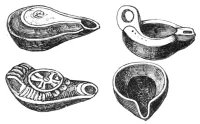 Fig. 198.—Roman Terra-cotta Lamps.
The different kinds of unglazed Roman ware may be divided, according to
the color of their pastes, into yellowish white, red, gray, and black.
The yellow paste was the coarsest, and was used for large pieces, such
as the dolia and amphoræ. The smaller pieces of this color are of a
better quality. Many of the household vessels were of red ware, such as
plates, bottles, and jars. Some of it, as, for example, the false
Samian, was dipped in a slip. The gray class comprises amphoræ, and
flat cooking-pans, and includes some specimens which have all the
characteristics of modern stone-ware. The black paste was largely
employed in making dishes and other table utensils, such as cups and
candle-sticks.
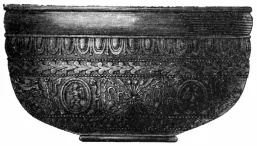 Fig. 199.—Roman Bowl of Samian Ware.
The leading kinds of glazed pottery were the Aretine and red Samian
wares. The latter of these is the more celebrated (Fig. 199). Its
prototype is to be found in the red ware of the Greek islands. The paste
is close and fine, and the glaze is clear and very thin. The similarity
in texture of all the specimens points to the conclusion that{246} they were
made in one place. The Samian ware has, like the legionary tiles, been
found wherever the arms of Rome were carried. Like the unglazed red
pottery, it was extensively used for table services, and may broadly be
said to have been the chief domestic ware of the Romans. The
ornamentation consists of mouldings in relief, incised rings, and
intaglio patterns.
The Aretine ware is also red, and is very like the Samian in many
respects, but of a lighter shade, and more finely decorated, chiefly in
relief. There are also two kinds of black Roman ware, one of dark paste,
the other of red paste colored black. The ornamentation of the first is
generally very simple, while that of the latter, in some cases,
resembles the mouldings on red ware. Like the Samian, it is found over
the greater part of Europe.
One of the most interesting branches of Roman ceramics—the various uses
of terra-cotta, we pass with a brief reference. The oldest statues are
terra-cotta, and of the same material are water spouts, window frames,
friezes, capitals, and pillars. Terra-cotta statues were made from the
early days, when Etruria was the centre from which Rome supplied itself,
down to the Empire, although in the interim the conquest of Magna Græcia
and Greece had rendered the beautiful Greek marbles and bronzes
accessible to the Romans. The architectural bas-reliefs were highly
esteemed by the Romans themselves, and show that the Greeks, both at
home and residing in Italy, applied themselves to this particular branch
of art with devotion and success. The subjects are generally Greek, and
are taken from both mythology and history. The gods of both greater and
lesser orders appear under many of the characters ascribed to them, and
the adventures of Ulysses and Achilles, the feats of Theseus, and the
labors of Hercules, are a never-failing treasury of effective subjects.
The result of all our inquiries may be summed up in this contradiction,
that Roman ceramic art deserving of the name is Greek, and that the
potters who were Roman have left little beyond household wares to attest
their skill.
With the fall of the Roman Empire the art, which had long been
declining, disappeared from view. Pottery must, no doubt, have been
produced. The household necessities of the people must have been
satisfied, even amidst internal disruption and barbarian invasions; but{247}
there is no evidence that anything worthy of being called an art was
kept alive. The revival of the ceramic art of Italy must be dated from
the time of Luca della Robbia, in the fifteenth century. To account for
the forms it took, an endeavor must be made to join it on to the
different branches which preceded it elsewhere. The only danger to be
incurred is that of being confused by the multiplicity and yet
substantial unity of its sources. Without repeating what has been said
in the chapter devoted to the fountains of European art, let it be
remembered that, in the year 827, the Saracens conquered Sicily, and
that they introduced into that island a manufacture similar to that
found in Spain. They embellished the mosque of Palermo with tiles like
those of the Alhambra, and these tiles were afterward imitated in works
produced in Sicily itself. Afterward, in the fourteenth century, Moorish
works were established at Calata Girone, or Caltagirone, in Sicily, and
some pieces attributed to them are decorated with copper lustre upon
stanniferous enamel. To this period belong the Siculo-Moresque vases in
the Castellani collection, which date from the fourteenth century
downward (Fig. 201). It is observable that the metallic lustre does not
appear in the earlier pieces, which have an unmistakably Persian style
of decoration. One specimen will suffice, viz., an oval vase covered
with a silicious glaze, and decorated in blue and black, with gazelles
and inscriptions. Meanwhile Venice and other maritime cities on both
sides of the Italian peninsula were developing an extensive trade with
the East. The Crusaders had been converting the old battle-ground of the
Jews into the scene of another strife, in which Judaism was ignored.
Mohammed preached the gospel of the sword, and the Christians took up
the gauntlet thrown down by the Saracens. Is it not possible that by
these two courses—trade, and the movements of followers of the
Cross—some inklings of Persian art may have crept into Italy?
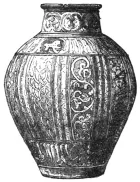 Fig. 200.—Siculo-Moresque Vase.
{248}The crusading spirit of the twelfth century was a most potent agency.
In 1113 the Pisans were roused to a sense of the wrongs suffered by
Christians from the piratical Saracens of Majorca. They set sail, and in
1115 the island was in their power; and their galleys returned home
freighted with the spoils of war. An extensive trade between the
Balearic Islands and Italy was maintained in the fourteenth century.
Looking at these facts, does it appear improbable that Moorish wares and
Moorish potters may have reached Italy from Majorca? Coming still later,
we find Moorish refugees from Spain flocking toward Italy in vast
numbers. Leaving the Saracens and Moors entirely out of the question,
the art of enamelling might have reached Italy from the Byzantine
Greeks.
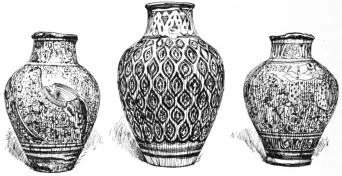
Fig. 201.—Siculo-Moresque Vases. (Castellani Coll.)
With all these facts before us, the bacini, or plates found incrusted in
the walls of the old churches of Pisa, need give us little trouble. Mr.
Fortnum found one Persian piece. Mr. Marryat thinks them of Moorish
origin. Mr. Fortnum is of the further opinion that many of the bacini,
both of Pisa and other Italian cities, are of native Italian
manufacture. Each specimen must be judged separately, and it may be
pointed out that with the highway of the sea open to the East and to the
Saracenic settlements in Africa and Spain, with Saracens already settled
in Sicily, and with the known early connection by commerce between Italy
and Spain, it is difficult to specify the route by which any special
ware or process must have reached Italy. We shall afterward see that
in Germany tin enamel was known in the thirteenth century. If it should
be asked, How did it get there? the{249} question would illustrate a good
deal of idle speculation indulged in regarding its introduction into
Italy. The same rule will apply to the metallic lustre.
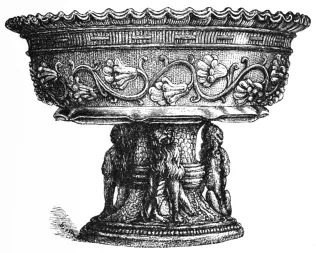
Fig. 202.—Sgraffiato of the 15th Century.
The Italians used lead glaze on their pottery from a very early period.
According to Passeri, mezza-majolica covered with marzacotto was made at
Pesaro as early as the beginning of the fourteenth century. Sgraffiato
ware was made in a similar manner, and derived its name from the incised
ornaments which were cut into the white engobe or slip (with which the
ware was covered), so as to show the original color below the slip. In
the example here given (Fig. 202) the incised decoration is combined
with figures and flowers in relief. But the brilliant importations from
Spain made a deep impression upon the public taste. The wares of Majorca
were those best and most generally known, and its name, as changed to
majolica, had been given to the entire class of lustred wares, although
the art of lustring was already known in Italy. It is well to
discriminate between the name and the article. It is quite possible that
the name of the best known type should come to be applied to the entire
class. Jacquemart finds the early wares of Pesaro very suggestive of
Persian influence. He concludes, also, that the art of applying the
metallic{250} lustre may have been communicated by Persian potters, or by
others who had learned it from them, to the eastern potteries of Italy.
We may conclude that, as the Majorca ware surpassed that of the early
Italian potteries, the potters of Italy endeavored to derive what
benefit they could from calling their own productions by the same name.
Metallic lustres were used before stanniferous enamel was adopted. The
invention of the latter in Italy has been generally ascribed to Luca
della Robbia, but there is every reason for believing that this is
incorrect. It is impossible to suppose that the Saracen and Moorish
potters in Italy were unacquainted with it. It is much more likely that,
being satisfied with the results of the processes to which they were
accustomed, and the beauty of lead glaze, they did not care to use it.
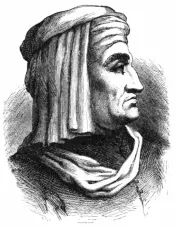 Fig. 203.—Luca della Robbia.
To tell what Robbia did accomplish we must glance at his personal
history. Luca della Robbia (Fig. 203) was born at Florence in the year
1399 or 1400. At first he turned his attention to the business of a
goldsmith, but afterward aspired to sculpture. About 1438 his marble
bas-relief of “The Singing Boys” was placed in the Duomo of Florence,
and was so great a success that orders quickly multiplied. He had also
done some work in bronze, but neither chiselling nor casting was
sufficiently speedy. Statues must be copied from a clay model. The model
was his own; the copy was, in the general case, the work of an
assistant; and probably, even if he chiselled the marble himself, he
could not reproduce the effects so easily reached in the plastic clay.
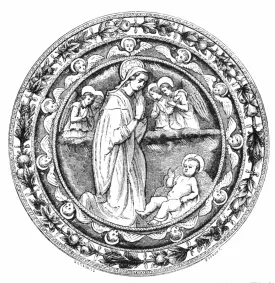 Fig. 204.—Holy Family. Medallion by Luca della Robbia.
(Hôtel Cluny, Paris)
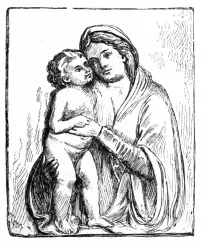 Fig. 205.—Luca della Robbia. Infant Saviour and Virgin.
(Boston Museum of Fine Arts.)
Luca was an enterprising artist, and it occurred to him that if he could
only dispense with the chiselling and casting, his art and profit would
both improve. But how could he make the clay as hard as bronze and as
white as marble? Remember that Luca was a sculptor, not a potter.
Whatever he did afterward, there can be no doubt that his attention was
first turned to statuary. He probably decided upon{251} applying to the men
who were accustomed to working in clay, to coloring it and glazing it,
to help him in his difficulty. He inquired, and learned that by dipping
his statuary in tin enamel and firing it, his object would be
accomplished. These considerations give his supposed discovery a new
aspect. If we consider that for centuries stanniferous enamel had been
in use by Eastern potters, and that the Saracens were perfectly familiar
with it, the secret is divested of all mystery. Luca probably acquired
his knowledge in one or other of the Italian potteries. What, then, are
we to credit to him? He must be admitted to have improved the enamel
after a series of experiments, and to have succeeded in bringing it to
the degree of fineness and opacity demanded by his purpose (Fig. 204).
His first work was a bas-relief of the Resurrection, made about the year
1440, and still standing in the Cathedral of Florence. This piece is of
blue and white, the latter for the figures, the former for the ground.
He afterward introduced green and yellow, but these colors are very
sparingly used. His{252} best works are in and around Florence. Of a Madonna
in the circle above a chapel door, Ruskin, in his “Mornings in
Florence,” says: “Never pass near the market without looking at it; and
glance from the vegetables underneath to Luca’s leaves and lilies, that
you may see how honestly he was trying to make his clay like the garden
stuff.” The same colors are introduced in a bas-relief in the Castellani
collection, in which the Madonna kneels before the Infant Saviour, and
angels look down from above. The figures are white, the ground blue, and
green is introduced in the grass. Of the same class is the preceding
example (Fig. 205) from Boston.
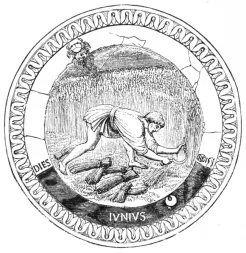 Fig. 206.—Medallion by Luca della Robbia. (South
Kensington Museum.)
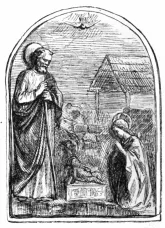 Fig. 207.—Andrea della Robbia. Holy Family. (Boston Mus.
of Fine Arts.)
While producing these works in enamelled earthen-ware, Robbia also
painted on the flat. Of this work there are twelve circular medallions
in the South Kensington Museum, and several specimens in Florence—a
tondo, some tiles, and a lunette. The medallions are enamelled, and the
paintings are allegorical representations of the months (Fig. 206).
Vasari says in regard to the tiles: “For the bishop of Fiesole, in the
church of San Brancazio, he also made a marble tomb, on which are the
recumbent effigy of the bishop and three other half-length figures
besides; and on the pilasters of that work he painted, on the flat,
certain festoons{253} and clusters of fruit and foliage so skilfully and
naturally, that were they even painted in oil on panel, they could not
be more beautifully or forcibly rendered.”
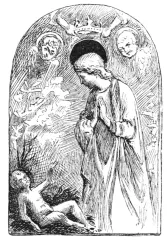 Fig. 208.—Modern Imitation Robbia Ware. (Boston Museum
of Fine Arts.)
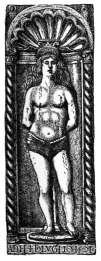 Fig. 209.—S. Sebastian, by Giorgio. (South Kensington
Museum.)
Luca died in 1481, leaving the full knowledge of the process he had
perfected to his nephew Andrea, who, however, was less successful than
his uncle. His art is less pure (Fig. 207). He becomes elaborate where
Luca was simple, especially in his heavy borders of fruit. Andrea was
born in 1457, and died in 1528, and left the transmissible part of his
art to his four sons, Giovanni, Luca, Ambrosio, and Girolamo. Of these,
Girolamo became a monk, and one specimen of his work is said to be at
Siena. Giovanni’s works are signed, and cannot, therefore, lead to any
confusion. Luca, junior, settled in Rome, and Girolamo went to France,
where he executed several works. Luca, the elder, had also two
assistants, Agostino and Ottaviano, the former of whom displayed great
talent, and worked in Perugia. The special art was carried to Spain by
Nicoloso Francesco, of Pisa, who made some bas-reliefs for a church in
Seville. Of the other successors of Luca we need only refer to Maestro
Giorgio Andreoli, of Gubbio, who is said to have produced some pieces
after the Della Robbia type (Fig. 209). The style finally passed away in
the earlier part of the sixteenth century. The demand for it appears to
have failed about that time. Stanniferous enamel continued to be used
here and there after Luca’s death, and after the lapse of some years
came gradually into general use. The oldest piece not of his style is
dated 1475. For the sake of lucidity it may also be here mentioned, that
the{254} metallic lustre, for which the first pressure of public demand was
felt toward the close of the fourteenth century, passed into oblivion in
less than a hundred years, until revived in more modern times.
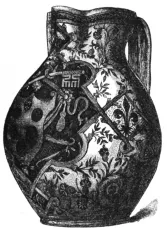 Fig. 210.—Chaffagiolo Pitcher. (South Kensington
Museum.)
Besides that of perfecting a special process, to Luca della Robbia must
be assigned the credit of paving the way to the revival which culminated
in the products of Gubbio. The distinction between mezza-majolica and
majolica must not be forgotten, viz., that the former name was
originally applied to wares covered with a white slip, then painted,
lead-glazed, and lustred, and the latter to tin-enamelled ware similarly
lustred. The latter was thus the highest representative of the
combination of two processes, both of Oriental origin. The application
of metallic lustre was Persian. Stanniferous enamel was successively
Egyptian, Babylonian, and Saracenic—the Saracens undoubtedly acquiring
a knowledge of it in Persia, where the beautiful silicious glaze kept it
in subordination. The Moors in Spain brought it more freely into use in
decoration, and with Luca della Robbia, who perfected the process still
farther, raised it from the desuetude into which it had fallen in Italy,
where, however, it was already known to Saracenic settlers and their
pupils.
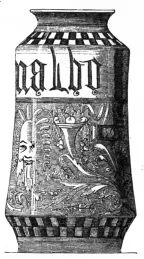 Fig. 211.—Siena Vase. (South Kensington Museum.)
With this recapitulation of the beginnings of real Italian majolica, we
may now continue our history. The impetus Italian ceramic art received
from foreign contact, and from the knowledge acquired by trade, was kept
up by the wisdom and devotion to the cause of art manifested by several
of the{255} ducal houses. From Pesaro, under the house of Sforza, from
Urbino, under that of Montefeltro, and from Florence and Chaffagiolo,
under the Medicis, and from other centres, the art spread over all
Italy. It is, therefore, by inquiries at these places that our
investigations must be continued. Leaving out of view the questions as
to the priority of Chaffagiolo to Faenza and Pesaro’s precedence in
metallic lustring, we may begin with Tuscany.
The leading Tuscan towns were Chaffagiolo, Florence, Siena, and Pisa.
The first of these produced the earliest Tuscan majolica. Its leading
features are a thick dark blue, made from cobalt; a bright orange and
yellow; a fine clear green, red, brown, and purple. Before the artists
of Chaffagiolo had awakened to the spirit of the Renaissance, they
issued some works enamelled on one side, with central designs of a
Gothic character, and borders of orange, white, and blue. In the
fifteenth century a marked improvement was made, but it was not until
the beginning of the sixteenth century that the best Chaffagiolo ware
was made. Their colors then become more brilliant, and are more daringly
handled. Some of these pieces are dated 1507 and 1509. Metallic lustres
were used about the same period. Later, the brilliancy of the enamels is
toned down, and the execution of the designs is more careful and
refined. Chaffagiolo continued to make majolica to the end of the
sixteenth century. The pieces frequently show heraldic designs (Fig.
210) and mottoes, the letters S. P. Q. F. (the senate and people of
Florence), and the letters P. S. sometimes with I. and sometimes
without.
The works made at Siena (Fig. 211) are in many cases undistinguishable
from those of Chaffagiolo. An artist named Benedetto produced at Siena
some very fine pieces.
The majolica of Florence, if such were ever made, is now unknown. Lazari
states that an artist was brought by the Grand Duke Francesco Maria to
decorate Florentine vases; but assuming the truth of the statement, his
works are now either destroyed or lost among those ascribed to other
places. We have already learned something of Pisa as fitting out a
Balearic crusade and exchanging pottery with Spain. Probably the wares
it exported came from other parts of Tuscany, although it had a majolica
manufactory of its own. The Pisan decoration closely resembles that of
Urbino.{256}
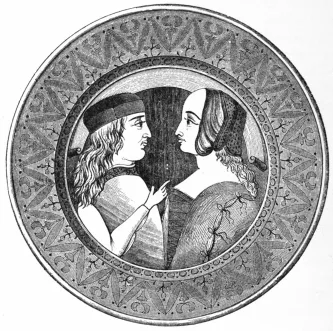
Fig. 212—The Sforza Dish. Pesaro.
In the Duchy of Urbino, Pesaro, Castel-Durante, Urbino, and Gubbio are
the leading centres, and absorb a large share of the interest
surrounding the pottery of Italy. When the Sforza family acquired the
lordship of Pesaro, they instituted pottery works there, and in 1486 and
1508 passed edicts against the importation of earthen-ware into Pesaro.
The first of these protective measures was granted by Giovanni Sforza
and Camilla, his father’s widow, and was commemorated by a dish called
the Sforza dish, a very wonderful specimen of majolica (Fig. 212). The
centre is occupied by portraits of the granters of the edict, shaded
with blue on an indigo ground, and having gold and ruby lustred hair,
dresses, and head-dresses. A scroll representing the edict forms a white
back-ground to the faces, and is finished with ruby lustre. The borders
are blue, with ruby and gold lustre. Under the house of Sforza the
manufacture of mezza-majolica improved, and in 1500 fine, or
tin-enamelled, majolica was introduced. Up to 1530 it steadily improved,
and in that year the wife of the{257} reigning Duke of Urbino, who had
succeeded the Sforza lords of Pesaro, erected a palace near Pesaro. From
1540 to 1568, under Duke Guidobaldo II., the art continued to rise,
until it reached its highest point of perfection. The duke first
employed Battisto Franco, an eminent Venetian artist, and Raffaelle del
Borgo. Girolamo Lanfranco and Giacomo Lanfranco were also employed as
artists at Pesaro. After 1560 the art began to decline.
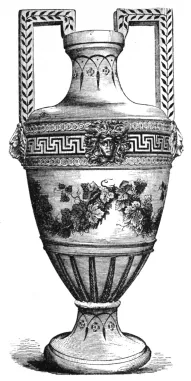 Fig. 213—Pesaro Vase. (John Taylor Johnston Coll., N. Y.
Metrop. Museum.)
The earliest Pesarese works very closely resemble the Persian, and are
the best indications to be found of the presence of an art brought
directly from Iran to Italy. These are lustred and painted in green and
blue. At Pesaro we first meet with pieces showing the portraits and love
mottoes by which the lovers of the day celebrated the beauty of their
mistresses and gave lasting tokens of their passion. If we seek peculiar
features in this majolica, we shall find them in the strong execution
and finely blended tints of the early pieces, and in the yellow of the
madreperla lustre combined with blue. As the art rose under the second
Guidobaldo, historical scenes after the great masters present
themselves, taken from both profane and sacred history—the brave
Horatius defending the bridge at Rome against the army of Lars Porsenna,
Samson, Brennus, Mutius Scævola, Judith, and other characters. In 1567
the Giacomo Lanfranco already mentioned applied real gold to majolica,
and several of his pieces thus decorated are still in existence.
Castel-Durante appears to have produced faience as early as 1361, but
none of its pottery can be recognized until we come down to 1508, after
which the specimens multiply.{258} With the year 1580 the art passed its
meridian, and declined steadily for nearly two hundred years. The
characteristic decoration consists of scrolls with fantastic chimerical
terminations. The colors are at first a dull green upon blue, and about
1550 lustrous rich yellows appear, and led to the decline thirty years
later.
 Fig. 214.—Castel-Durante Portrait Plaque. (South
Kensington Museum.)
 Fig. 215.—Castel-Durante Dish. (Castellani Coll.)
The city of Urbino was the great centre at once of majolica painting and
of the ducal patronage, which gave the entire duchy its pre-eminence.
From 1477, when Garducci was working in a comparatively humble way, down
to 1530, the history of Urbino hardly demands notice. Its highest glory
came with Francesco Xanto (Fig. 216), whose broad and generally true
drawing and masterly composition mark him as one of the great artists of
the Renaissance. His subjects are taken from the Latin classical and the
later Italian poets, and from Raffaelle. Living at the time when the
demand for metallic lustre was at its height, he applies it with a
boldness and effectiveness in harmony with his brilliant coloring. All
his works are signed. From him we turn to the equally illustrious
Fontana family—Guido, Camillo, and Orazio, the latter of whom{259} is
specially deserving of study. He attained to a higher mechanical
excellence than any of his predecessors, his best works dating from
after 1540, when Xanto’s career was closing; and his paintings are in
consequence characterized by a softness of color and a fineness of glaze
which leave him without a peer. Few pieces by the Fontana family are
signed. Their most famous works are the vases for the Spezieria, ordered
by the Duke Guidobaldo II., and painted from designs by Raffaelle
Battista Franco, Michael Angelo, Giulio Romano, and others. Nicola da
Urbino and Francesco Durantino are among the other artists who
contributed to the fame of Urbino.
Fig. 216.—Urbino Plate, by Xanto. Scene, the Storming of
Goleta. (Marryat Coll.)
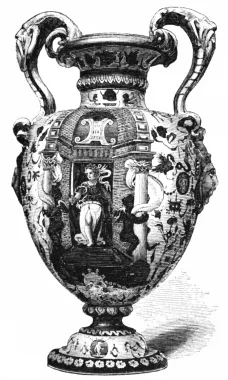 Fig. 217.—Urbino Vase. Figure of Justice with Sword.
(Castellani Coll.)
The lustres of Gubbio (Fig. 219) are inseparably associated with the one
great name of Giorgio Andreoli, or, as he is usually called, Maestro
Giorgio. He was a native of Pavia, and was originally a{260} sculptor; and
after he went to Gubbio, in 1498, executed some works in the Della
Robbia style (Fig. 209). A piece dated 1489, and signed “Don Giorgio,”
is ascribed to him while he was still at Pavia, but the first piece
characteristic of the master, signed and lustred, is dated 1519, and the
last 1541. We have said that Xanto of Urbino lustred his own pieces, but
the matter is not free from doubt. Maestro Giorgio certainly was master
of the art of lustring, and the brilliancy of his ruby reds, copper, and
mother-of-pearl is unrivalled. But the statement of many writers that
artists at other places sent their works to Gubbio to be lustred, and
allowed Giorgio to affix his name to them, is too repulsive to be
accepted without protest or reservation. One can hardly imagine a more
unworthy course than that ascribed to Giorgio, of laying aside his
proper artistic functions and becoming merely a decorator with lustres,
“indifferent,” as Marryat says, “by whose hands they were executed or
from what fabric they proceeded.” It is in this capacity of decorator
that the otherwise finished paintings of Xanto and others are said to
have been sent to him to be enriched with lustre. The earlier Gubbio
wares generally have a pale-blue ground, with grotesques and scrolls
terminating in animals’ heads, and mingled occasionally with cherubs’
heads. The grounds afterward became more brilliant, and the designs
include mottoes and busts in celebration either of the great men of the
time or of its fair ladies. It is to be noted that Giorgio{261} lived before
the accession of Guidobaldo II., and consequently did not partake of the
benefits enjoyed by the Fontana family at Urbino.
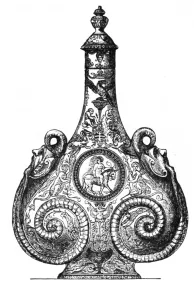 Fig. 218.—Urbino Pilgrim’s Bottle. (South Kensington
Museum.)
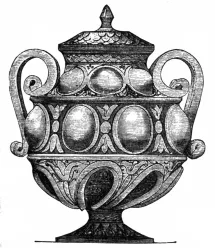 Fig. 219.—Lustred Gubbio Vase, of about A.D. 1500.
(South Kensington Museum.)
From the Duchy of Urbino we may turn to Faenza. It has already been
referred to as supplying an etymology for the word faience. Ganzoni,
writing in 1485, speaks of the whiteness and polish of the Faenza
majolica, and Lazari praises its soft tints and good drawing, which
manifested themselves after the first quarter of the sixteenth century.
The earlier fabrics bear strong evidences of Oriental influences, and,
as seen in the Castellani collection, would carry us back to a very
early stage of the art. The glaze is either lead or litharge, and some
of the designs consist of geometrical combinations in manganese and
copper. Other primitive pieces are of a very pale blue or white,
changing at times to a blue border surrounding heads with beards
terminating in acanthus leaves and scrolls attached. A slight
examination of these pieces shows that the strength of the artists of
this period lay in the accessories, and that they were weak and
uncertain in their attempts at figure-drawing. The pieces ascribed to
Casa Pirota, of which Signor Castellani has some notable examples, are
those in which we discover the point of Lazari’s encomiums. These date
from 1525 downward, and show the excellence{262} of drawing and brightness
of decoration which gave the Faentine majolica its celebrity. The
borders frequently consist of grotesques in shaded white on pale or dark
blue or gray grounds. Dishes with chiaroscuro arabesques on grounds of
blue, surrounding figures, busts, or heraldic designs, represent a
prevailing Faentine style. A plate belonging to Signor Castellani has a
blue ground in the centre, on which a coat-of-arms is laid in yellow,
and the broad border of pale gray finishes with a rim of green and
yellow. An exceptional piece is described as black with white reserved
arabesques. Forli, Rimini, and Ravenna may be dismissed briefly. Forli
produced pottery at least as early as 1396; but it was not until the
sixteenth century that it made any majolica which we can recognize, and
even then it might easily be confounded with the productions of
Chaffagiolo and Faenza. The Rimini majolica is chiefly remarkable for
its wonderful glaze.
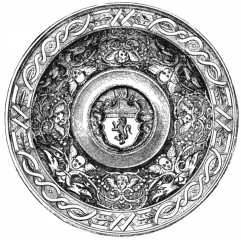 Fig. 220.—Plateau by Giorgio. (South Kensington
Museum.)
Venice had majolica factories at least as early as 1520, and probably
half a century before that date. The earlier wares are illustrated by
certain pieces of faience pavement. Of the sixteenth century the
earliest specimens are dated 1540 and 1543, and of this period the
designs are chiefly in blue and white, sometimes soft and undecided. The
ware is thin and hard, and the rims of plates are frequently decorated
with fruit and flowers in relief. Scrolls on a deep blue ground, and oak
leaves on pale blue, are also met with.
Fig. 221.—Faenza Fruit Dish.
With Ferrara, Deruta, and Naples we may conclude our enumeration.
Ferrara was an offshoot of Faenza, whence we find Fra Melchiorre coming
in 1495, Biagio in 1501, Antonio in 1522, and Catto in 1528. The artist
Camillo who painted vases, the Dossi brothers{263} who designed, “El Frate,”
Grosso, and Zaffarino are among those who gave Ferrara its reputation.
It is probably to the Dossis that the grotesques on a white ground are
to be attributed. Deruta takes us back to Robbia, whose pupil, Agostino
di Antonio di Duccio, went to Perugia in 1461, and thence certainly
influenced the Deruta school. With such teaching Deruta produced, early
in the sixteenth century, majolica of a very high order of merit, with
blue grounds and yellow lustred cherubs’ heads in relief, and
arabesques. Within such borders are white enamelled inner circles, with
scrolls mingled with birds and chimeras, surrounding a raised centre of
deep blue bearing a bust or head. Several pieces subsequent to 1544 are
signed “El Frate,” and are, as a whole, weak and unpleasing, although
some others are strong and beautiful. As a rule, the artists of Deruta
appear to have been{264} the direct opposites of those of early Faenza, i.
e., they expend their resources upon their principal figures, and make
the details entirely secondary. The earliest Deruta vases are conical,
and decorated in lustre and white enamel with blue. Naples and Castelli
are both surrounded with more or less mystery, although evidence is not
wanting that the latter at least produced excellent majolica. With the
end of the sixteenth century appear some large vases of Naples, painted
in dark colors with religious subjects.
Fig. 222.—Deruta Dish. (South Kensington Museum.)
The shapes which engaged so much of our attention in Greece, are in
Italy too manifold and varied for classification. We are in presence of
an entirely new order of things, when we find artists expending their
best efforts upon decoration with enamels, lustres, arabesques,
grotesques, and wonderful scrolls turning in their sweeping folds round
all manner of impossible monsters, of a plain, broad-bordered dish, with
no pretension to form. When the Italian artists concede something to
shape, they frequently become wilful, embellishing a vase reminding us
of Greece with serpent handles, or running off into{265} elaborate inkstands
or quaint table wares. In the Italy of the Renaissance we are in the
presence of the triumph of decoration, and it is upon decoration that
we, in common with all inquirers, must concentrate attention, thankful
if at times we detect a harmony between the gracefulness of a vase and
the beauty of its brilliant colors.
Possibly it may be reserved for the United Italy of the nineteenth
century to turn back to the earlier pages in her ceramic history, and,
having filled herself with the spirit of the potters of Magna Græcia and
Apulia, to pass down to the brilliancy of the sixteenth century, and,
with both in full view, to execute something worthy of the later prime
of her unity. Endless repetitions of the famous fabrics of the
Renaissance have led her into spiritless imitation and boundless fraud.
Some of the pieces displayed at the Centennial Exhibition were by no
means destitute of merit. Faenza can still produce good drawing and
effective coloring, and Della Robbia ware is still manufactured with
tin-enamelled figures, which look considerably better than whitewashed
terra-cotta. But let us imagine the energy and skill devoted to
imitation with intent to deceive, and the painstaking labor of honest
men who make no attempt to rise above the rank of copyists, to be
together thrown into an endeavor to reach a new originality. Might not
Italy be raised from the rank of a country resting upon a brilliant past
into that of one working in the present to reach an equally brilliant
future?
Florence and Earliest Artificial Porcelain.—Theory of Japanese
Teaching.—La Doccia.—Venice, and the Question of its First Making
European Porcelain.—Le Nove.—Capo di Monte.
 Fig. 223.—Medicean Porcelain (Castellani Coll.)
 Fig. 224.—Design at Bottom of Bowl, Fig. 223.
To Italy and to the family of the Medici, as we have seen, belongs the
honor of making the first artificial European porcelain of which any
specimens have come down to our time. The result of recent researches
has been to throw much light upon the interesting discovery made at
Florence. Dr. Foresi, of that city, was the first whose attention was
drawn to the matter. He collected several pieces of porcelain, evidently
of European manufacture; and his curiosity having been aroused as to
their origin, he found that the Grand Duke{266} Francis I. had a private
factory in the Boboli gardens, that there experiments had been made with
a view to discovering the composition of porcelain, and that success had
been attained. The marks on the pieces are the letter F. and a dome, the
arms of the Medici, and on one, the arms, the letters F. M. M. E. D.
II.—the initials of Franciscus Medici Magnus Etruriæ Dux Secundus—the
letter F. and the dome. The latter of these were clearly the initial
letter of Florence or of Francis, and the dome of the city’s magnificent
cathedral. A fine specimen of the Florentine porcelain was brought to
America in the Castellani collection (Fig. 223). It is a fluted dish,
with the figure of St. Mark and the lion painted in blue on the bottom
(Fig. 224). Under the lion’s paw is a volume bearing the letters G. and
P., supposed to be the artist’s initials, and on the reverse are the
letter F. and the dome. In the same collection is a plate, also
decorated in the Japanese style, light blue and white, and having the
dome and letter on the under side. There are not thirty pieces of this
ware known. In connection with the fact that the decoration, as we
pointed out when speaking of this ware under Japan, is undoubtedly
Japanese, an interesting question has been raised by Mr. B. Phillips. He
expresses the belief that the presence of Japanese—composing the
embassy to the Pope—in Italy may have had a direct influence, not only
on the ornamentation but on the manufacture of the Medicean porcelain.
He then says:{267} “That these Japanese nobles visited the Grand Duke in
Florence cannot be doubted. Now, as to the Medicean porcelain, we have
been careful not to use the word ‘discovery’ in connection with its
early manufacture in Florence. We are strongly of the opinion that the
method of selecting and preparing the material from which porcelain had
to be made was derived directly from the Japanese. If the decoration, as
we believe has been undoubtedly proved, was taken from the Japanese,
might not the method of making porcelain have been derived from the same
source?” That Italy may have full credit for the Grand Duke’s success,
it may be pointed out that there are two objections to the above theory.
It is nowhere stated that the Japanese were acquainted with any other
than natural kaolinic porcelain, and it is exceedingly improbable that
the members of an embassy had any knowledge of the combination of
materials in an artificial paste. The Medicean was not a pure kaolinic
porcelain, but “a composite paste having for basis quartz and a vitreous
frit, with a small quantity of the kaolin of Vicenza.” In the second
place, the embassy did not leave Japan until 1583, and only reached
Italy in 1585. “In 1581,” says Jacquemart, “the experiments of the Grand
Duke had produced their fruits, and he already sent presents of his
translucent pottery to the other sovereigns of Europe.” The porcelain
was, therefore, made before the Japanese arrived in Italy.
Were anything further needed to preserve for Italy the exclusive credit
of one of the greatest contributions to ceramic art, it may be found in
the styles of decoration of the Medicean porcelain. These are divisible
into two classes: the Oriental and the Italian. The latter resembles
that of faience, and consists chiefly of grotesques. Such are the pieces
upon which appear the arms of the Medicean family, for whose use they
were reserved. The specimens with Oriental decoration were gifts made to
spread abroad the renown of the Grand Duke’s laboratory. Such a purpose
could certainly not have been fulfilled with inferior works, and this
class, to which the Castellani porcelain belongs, may be taken as
representing the best Medicean paste. In this view the fabric was at its
highest before the Japanese left their own country, as we have seen that
pieces of this character were being sent over Europe in 1581.{268}
The probability is that the Grand Duke, or Bernardo Buontalenti, who
really made the discovery, arrived at it by independent investigations
prompted by Oriental porcelain, and that the latter and the finer
specimens of majolica suggested the decoration.
About one hundred and fifty years later, or in 1735, the Marquis Carlo
Ginori established a manufactory at La Doccia, near Florence. The
enterprise of the founder was so great, manifesting itself in the
introduction of the chemist Wandelein as director, and the importation
of material from China, that in a few years the Doccia porcelain had
become famous. The earlier pieces bear a close resemblance to the
Chinese. The artists of Doccia excelled in modelling, and many of their
groups are beautifully executed. It is unfortunate that from an early
period of the existence of the workshop its artists should have engaged
in imitation. After following Chinese models they turned to Sèvres, and
then to Capo di Monte. More lately, Doccia has won an unenviable
notoriety by its spurious imitation of old majolica and the wares of
Luca della Robbia. Early in the last century Doccia became possessed of
some of the moulds of Capo di Monte, and as the Doccia mark does not
appear upon the pieces made from them, a wide opening was offered for
fraud. It is worth noting, however, that it is by its copies and
imitations that the Doccia manufactory reached its greatest financial
success. The success of the counterfeit has destroyed the genuine, and
the artistic is overshadowed by the commercial.
In Venetia, porcelain was made at Venice and Le Nove. The history of the
manufacture in Venice is somewhat obscure. Early in the sixteenth
century—and, therefore, before the Medicean ware was
produced—experiments, the success of which cannot now be measured, were
made by a Venetian artist. He seems, after making a few pieces, to have
relinquished the enterprise for lack of support and patronage. His story
is thus told: “There was an old potter in Venice about 1504-1519, whose
name is unknown, of whom, in fact, we know nothing except from a few
notes discovered by the Marquis Campori among the relics of the Duke
Alphonso I. of Ferrara, but whose name ought to be blazoned in gold as
the first European who made porcelain. In 1504 the Duke was in Venice,
and his book of expenses shows an item of two liri and a fraction, paid
for a piece of porcelain.{269} Fifteen years afterward his ambassador in
Venice wrote him a letter, sending with it a plate and bowl of
porcelain, from the ‘master,’ from whom the Duke had ordered them. And
the ambassador goes on to say that the master declined to take more, as
his experiments cost him too much time and money; and, further, he
declines to accept an invitation of the Duke to remove to Ferrara and
make porcelain there, pleading that he is too old, and does not want to
leave Venice. Enthusiastic collectors imagine that a few specimens to
which they can assign no other origin are works of the old Venetian, but
there is no satisfactory evidence that any of his work remains.” In the
absence of any relics of this ancient Venetian to substantiate his claim
to the invention of a true porcelain, the honor will probably continue
to be ascribed to Florence. However this may be, the existence of
Venetian specimens with decoration suggestive of seventeenth century
styles, would indicate that the industry was at least kept alive, and
that there were several predecessors to the manufactory founded by
Francesco Vezzi early in the eighteenth century. Some very beautiful
works are attributed to the Casa Vezzi. In or about 1765 another
manufactory was established by Geminiano Cozzi, and from it were turned
out table-sets, groups, statuettes, and vases. The establishment at Le
Nove, founded in 1752 by Pasquale Antonibon, produced majolica,
terraglia—a mixed composition of pottery and porcelain—and artificial
porcelain. Of the latter (Fig. 225) some magnificent examples have been
preserved.
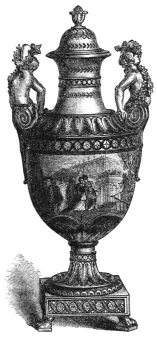 Fig. 225.—Nove Porcelain Vase.
The most famous Italian porcelain is that of Capo di Monte. This
manufactory was founded in 1736 by Charles III., whom we have already
seen introducing the art into Madrid, after he left Naples to mount the
throne of Spain. The founder does not appear to have{270} been indebted to
any extent whatever to the discoveries made at Meissen, but to have set
on foot a perfectly independent and national industry. The king
frequently worked in the factory, and under his guidance and the favor
of his consort, Queen Amelia of Saxony, its products rapidly improved
after the first essays, which closely followed the Japanese. The Capo di
Monte forms assume a distinctive character. Her artists turned to the
sea, as became citizens of the Queen of the Sea, and there found
inspiration. They took the shells of the Mediterranean for their models,
and by combining them with coral and sea-plants, and coloring all after
nature, produced some of their most beautiful works. A very handsome
ewer is thus composed, the body representing an ingenious combination of
shells set in a foot of coral, a branch of which climbs up the side,
and, arching to the lip, forms the handle. A basin is similarly
designed, and is dotted with smaller shells. Or again, a salt-cellar is
modelled after a boat steered by a youth. These examples will suffice to
show that not the least merit of the artists of Capo di Monte is their
originality. The table services present us with some of the finest
porcelain made in Europe. The paste is fine and transparent, and many of
the pieces are as thin and light as the egg-shell of China.
When Charles III. set out for Spain, he took a number of the artists
with him, and left to his successor in Naples the work of maintaining
the industry. In this Ferdinand was not successful, and Capo di Monte
rapidly sank, and disappeared altogether in 1821.
The porcelain made at all the places named was artificial. The only
Italian manufactory of natural porcelain was that of Vineuf, near Turin,
which began to work toward the end of last century. The body contains
magnesia. The workshop was founded by Dr. Gioanetti.{271}
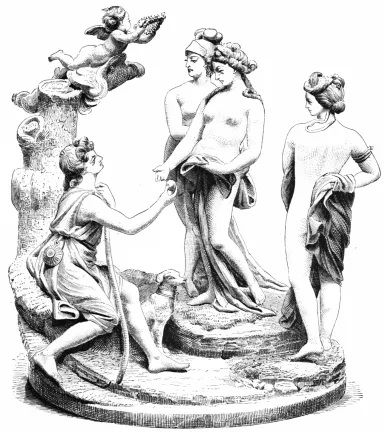
Fig. 226.—Old Sèvres Biscuit. Judgment of Paris. (August
Belmont Coll.)
Prospect on approaching France.—Present and Past.—The Ancient
Celts.—Under the Romans.—Middle Ages.—Poitou, Beauvais, and
Hesdin.—Italian Influence.—A National Art.—Bernard Palissy,
Barbizet, Pull, and Avisseau.—Henri Deux
Ware.—Rouen.—Nevers.—Moustiers.—Marseilles.—Strasburg.—Limoges.—Haviland’s
New
Process.—Examples.—Bourg-la-Reine.—Laurin.—Deck.—Colinot.—Creil.—Montereau.—Longwy.—Parville.—Gien.—Sarreguemines.—Niederviller.—Luneville.—Nancy.—St.
Clement.—St. Amand.—Paris.—Sceaux.
TURNING as we leave Italy we seem to look back across a wide, unbroken
plain, from the midst of which rises a mountain range, its summits{272}
glowing with the rays of the setting sun behind us. It is thus we revert
across comparative barrenness to the Renaissance, beyond which, and
hidden, lie the earlier glories of Etruria and Græco-Italy. As we turn
to France the sun is in front of us, striking full upon a height still
cloud-capt and unrevealed, and bathing the intervening undulating
landscape in the fulness of its undimmed splendor. With France the
present sheds lustre, life, and light upon a long past beginning with
pre-Roman Gallia, and extending through Roman domination, the darkness
of the Middle Ages, and the Renaissance to the present time.
The early pottery of Gallia has been variously viewed, but there seems
no reason for withholding from the ancient Celtic potters the credit of
having adopted a high and pure standard of art before the Roman power
was established. It has even been questioned, in the light of a full
knowledge of the subject, if the Romans did not, by the introduction of
new models, retard the growth of native skill and destroy an art
superior to their own. Judging from the examples still remaining, it is
at least unquestionable that the Celts had, at a very early date,
arrived at ideas of simplicity and elegance of form far in advance of
those entertained by contemporary nations. These works, moreover, give
no indication of foreign influence, and probably represent the last
stage of native art, before it was disturbed by the entrance of the
invader. The ornamentation is chaste almost to severity, and although in
some instances it shows a community of style with the early German
pottery, it is generally independent and distinctive. We do not assign
an age to these pieces, but it appears probable that they were preceded
by a ruder pottery also referable to the ancient Celts. The earlier
remains, supposed to belong to the pre-Roman era, have been found in the
North, and are of a very primitive character, evidently made entirely by
hand, without the assistance of either mould or wheel. The paste is
dark-colored and coarse. There is also a class equally rude, in so far
as the composition is concerned, but giving in the shapes a suggestion
of Roman influence. Red Roman ware has been found in every part of Gaul,
and a furnace was discovered in Auvergne. At Bordeaux red, black, white,
and yellow Roman pottery has been exhumed, and several localities are
indicated at which potteries existed.{273}
As we approach the Middle Ages, and begin to detect evidences in France
of a knowledge of processes with which we are already familiar, and to
question ourselves as to their special origin, it may be well to keep
the following facts in view: firstly, that Marseilles was founded by a
Phœnician colony; secondly, that pottery of the South of France,
after the Arabs had spread over the States of Barbary, so closely
resembled the Arabian as to suggest at once communication with the North
of Africa; thirdly, that France was open to the same influences of
trade, intercourse, and immigration which had so powerful an effect upon
Italy. Let us allude to one point, the probable transmission of
lead-glaze from Greece to Rome, and thus to the Gauls, for an
illustration of the untraceable route by which knowledge was spread, and
for an explanation of the phenomenon so often witnessed of a certain
product revealing itself in the most incomprehensible manner at a point
far removed from the accepted centre of works of its class.
In the twelfth century Oriental ideas in France begin to supersede those
of Gothic inspiration, and Christianity and chivalry together operate a
decided change in ceramic ornamentation. Processes gradually improved.
At Poitou, in the thirteenth century, green-glazed conical urns were
made, and Beauvais had already reached celebrity. More interesting is
the fact that, at Hesdin, Jehan de Voleur was, toward the close of the
fourteenth century, acquainted with stanniferous enamel. In France,
therefore, as in Italy, this secret was known long prior to the supposed
discovery by Luca della Robbia. It is, however, to Italy that France is
indebted for the access of spirit infused into its ceramic art in the
sixteenth century. Italy supplied models to the French potters, who had
been busying themselves with ornamentation of Gothic origin and
Christian devices and legends. And, further, Italian artists flocked to
France between the close of the fifteenth and the latter part of the
sixteenth century, and settled at Lyons, Amboise, Nantes, and elsewhere.
After a time the Italian taste they represented and their technical
skill were turned into a channel more thoroughly French, and to the
building up of an art purely national.
Among those who assisted in this great work no name is more eminent than
that of Bernard Palissy (Fig. 227). We have already characterized his
life as the great romance in the history of ceramics, and{274} certainly it
reads more like a romance than sober fact. Let us look at it a little in
detail. His father was a humble artisan, and the honor of his birthplace
is ascribed to La Chapelle Biron, between the years 1506 and 1510. His
education was of the most limited kind, including merely reading and
writing; and at an early age he began professional life as a worker in
glass, a combination of the glazier and painter. His artistic instincts
were thus kindled; and besides acquainting himself with drawing,
painting, modelling, and geometry, he studied the Italian masters,
copied their works, and devoted part of his time to literature.
Thereafter, to add to his stock of knowledge and widen his experience,
he began to travel, and visited Germany, Flanders, and the several
provinces of his native country. As he travelled, he worked as surveyor
and glass-painter, and studied chemistry and natural history. It is with
some astonishment that we find this man, unknown to the world at large
except as a potter, investigating the subjects upon which the noble
science of geology was afterward built, and theorizing upon the
elasticity and power of steam.

Fig. 227.—Bernard Palissy. (From a Painting in the Hôtel
Cluny, Paris.)
He finished his travels in 1539, settled at Saintes, married, and
devoted himself to his original profession and to land-measuring. A few
years later he saw the beautiful enamelled earthen cup—whether
Oriental, German, or white Ferrarese need not concern us—which turned
the entire course of his life. He wished to imitate the enamel{275} without
knowing anything of its composition, and embarked upon the long series
of experiments which led him, through numberless trials, to eminence and
fame. He presents at this period one of the most curious figures
possibly in all history, that of a man apparently bent upon shutting out
all benefit that might have been derived from the experience of others,
literally “groping in the dark,” as he says of himself, and determined
to make up for lack of technical knowledge by assiduous experiment. He
ground, built furnaces and fired them, tried the potter’s oven of
Chapelle-des-pots—all to no purpose. Having accepted a surveying
mission he returned with treasury replenished and ardor unabated.
Surely, no man ever knocked with such pertinacity at the door of
knowledge. He met his first success by trying a glass-maker’s furnace.
One of the pieces came out “white and polished.” This was food to live
upon, and he began to build a furnace of his own, doing all the work
himself—three masons in one. At length it was finished, and the first
attempt ended in failure. He tried again, becoming poorer and poorer, so
that he could not buy wood for his furnace. In his strait, he took the
tree-props from his garden, his furniture, and house-flooring for fuel.
“My shirt had not been dry for more than a month; and also, to console
me, they laughed at me, and even those who ought to have helped me went
crying about the town that I was burning my floor, and by these means
made me lose my credit; and they thought me mad.” He was evidently in a
bad way when he dropped into wearing a wet shirt for a month, and
thinking that any one ought to have helped him. After a short rest, he
turned his attention to the preparation of a new furnace.
To carry out this new plan, he was compelled to mortgage his credit by
employing a potter to assist him. His assistant he kept in food by the
friendly offices of a tavern-keeper, who seems not to have shared in the
madness theory. After six months he felt himself obliged to pay off his
help, and did so—in clothes, part of his own scanty wardrobe. Still he
was not to be beaten. He finished his furnace single-handed, put in his
pieces, and started the fire; but still the gods were inexorable. The
pebbles in the mortar used in building the furnace cracked under the
heat and flew in splinters, sticking in the glaze of his pieces, and
spoiling them. Remorselessly, he broke them{276} all, declining even to give
his importunate creditors a single specimen in part payment of his
debts. One can imagine the storm such conduct raised, and to make
matters worse, “I met with nothing in my house but reproaches, and
received maledictions instead of consolation.” The ashes spoiled his
next batch, and when he resorted to seggars the unequally distributed
heat marred the enamels. He was now, however, too near victory to be
altogether discouraged, and finally, after fifteen or sixteen years of
unheard-of struggle and misery, this indomitable genius produced the
long-sought enamel, and the secret of his well-known rustic pottery was
discovered.
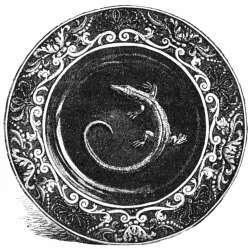 Fig. 228.—Palissy Dish. (Rothschild Coll.)
Fame and patronage came with success, but Palissy’s troubles were by no
means ended. Having embraced Protestantism, he fell under the edict of
1559, saw his workshop destroyed, and was only saved from death by the
intervention of the king. Under the protection of Queen Catherine de
Medici, he first went to Rochelle, but was afterward summoned to Paris,
and there, in a workshop erected in the garden of the Tuileries,
produced some of his best works. Saved by court influence from the
massacre of St. Bartholomew, he afterward, in 1588, fell into the hands
of the Leaguers, and in the following year, at the age of eighty, died
in the Bastille.
His first success was the production of the white enamel, which appears
to have engrossed his entire attention. His second attainment was a
jasper glaze, the examples of which show a mixture of brown, white, and
blue, and which he deemed only worthy of using as a means of temporary
subsistence. His third and most famous achievement was the Rustiques
figulines (Fig. 228), with which{277} his name is most intimately
associated. These are known by imitations almost everywhere, and consist
of variously shaped dishes and vases ornamented with shells, frogs,
lizards, snakes, fish of several varieties, and leaves (Fig. 229). He
was succeeded by certain members of his family, upon whose death his
specialty was lost. At the Centennial Exhibition several imitations were
shown in the French, Swedish, and Portuguese departments. Of these the
best were those of M. Barbizet (Fig. 230), of Paris, the son of an
artist who is said to have rediscovered Palissy’s method, some fifty
years ago, and who introduced his father’s discovery into commerce in
1850. Pull, of Paris, and Avisseau, of Tours, are also modern imitators
who have been very successful in approaching their model. Pull began to
produce his imitations in 1856, and has even deceived connoisseurs. One
of his pieces has been sold at as high a figure as £240. Mr. Walters, of
Baltimore, has an excellent example by the elder Avisseau. With the
exception of the works of Avisseau, Pull, and Barbizet, the imitations
of Palissy ware are neither skilful nor in any way attractive; as
independent works of art, accomplished on the suggestion supplied by
him, they are hardly deserving of serious consideration.
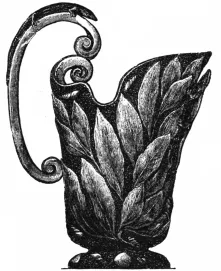 Fig. 229.—Pitcher by Palissy. (Rothschild Coll.)
What is to be admired or condemned in Palissy as a man requires no
mention; the admirable in him as a potter has been already pointed out
(see Introduction, page 42). Passing now from his rustiques figulines,
we find him, after his settlement in Paris, carrying his peculiar style
into works of a totally different general character. In one piece a
figure representing Charity is surrounded by a rustic frame, and a
Magdalen kneels in another among shells and plants. In these, as in his
rustic pottery, the figures are admirably executed{278} and the coloring
vigorous. His palette was limited to a few colors, of which yellow,
blue, and gray were the chief, although sometimes we find him
introducing violet, green, and brown. Some tiles are attributed to him,
but the statuettes formerly ascribed to him are now generally conceded
to be the works of other hands. His vases, basins, and dishes are
extremely varied, and are decorated with subjects taken from
contemporary life and from history. A very remarkable vase now in the
Louvre is blue, with yellow ornaments in relief, and not less
characteristic are his large oval cisterns, with masques, foliage,
fruit, and shells for ornaments. One of these (Fig. 231) is a perfect
marvel of soft and harmonious coloring. The heads are white; the drapery
white, with yellow fringe, and in its heavier folds blue; the fruit and
feathers white, gray, red, yellow, and blue; the ground gray in tone,
and composed of blue, maroon, and green. In two specimens of dishes the
ground is white, upon which reptiles lie in strong relief. None of his
pieces are signed.
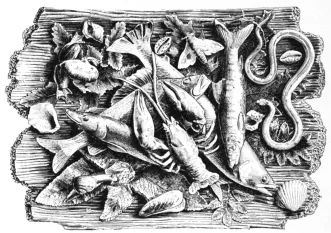
Fig. 230.—Barbizet’s “Palissy Ware.” (Tiffany & Co.)
One would imagine the idea to be prevalent that Palissy executed nothing
but Rustiques figulines, if we are to judge from the tendency of
imitators to produce pieces of that character, and from the prevailing
taste of collectors, who appear to demand lizards and fish as essential
to the correct imitation of the master. Having given as full{279} a view of
his great works as may be necessary to appreciate their variety and
beauty, let us revert once more to the fact that Palissy was original in
two respects: firstly, in his methods; secondly, in his adoption of
natural objects as models. He deliberately shut out all influences which
might consciously or unconsciously have affected his aim; and as a
consequence, although tin enamel and reliefs were in vogue all over
France, he emerged from his obscurity, and lived through the period of
his eminence without being affected by either German or Italian ideas or
processes. He must be accepted as the exponent of an art emphatically
French. His imitators have used his moulds, and his pupils have followed
his styles; but even when possessing the secrets and skill, copyists
seldom catch the intelligence of their master, and thus we find that on
his death his art declined.
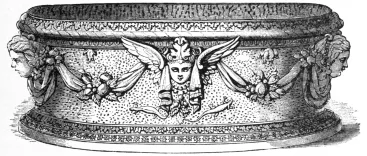
Fig. 231.—Palissy Cistern.
While Palissy was still in early manhood, the famous and wonderful Henri
Deux ware, or Faience d’Oiron, had been made. There are only sixty-seven
pieces in existence; and the mystery which for a long time enveloped its
manufacture, its rarity, and its beauty, have both surrounded it with a
peculiar interest and rendered specimens almost fabulously valuable. At
a sale in 1865, no less a sum than $5500 was given for a biberon. This
ware was made about 1530, by a potter named François Cherpentier, and
Jehan Bernart, secretary and librarian, both in the service of Hélène de
Hangest, widow of Artus Gouffier, Sieur de Boisy. How this lady came to
acquire a taste for ceramics, it is not, in view of what heretics call
China-mania, hard to imagine. In any case, she built for Cherpentier and
Bernart a workshop{280} and furnace near the château of Oiron, and there the
admirable Henri Deux ware was made. After the death of Hélène de
Hangest, in 1537, Bernart appears to have continued his labors under the
superintendence of her son. This faience, therefore, which has created
more curiosity—the place of its manufacture was not known until
1862—than any other, and been more lavishly praised, owes its existence
to the whim or enthusiasm of a woman.
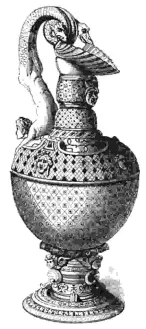 Fig. 232.—Henri Deux Ewer.
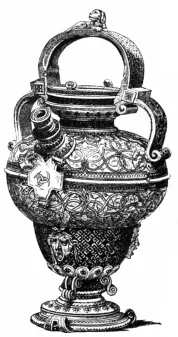 Fig. 233.—Biberon. Henri Deux Ware. (Malcolm Coll.)
It is an entirely exceptional ware. The paste is a pipe-clay, pure,
fine, and white. Upon the first or inner layer, a second layer of a
still finer and whiter clay was laid, in which the design was engraved.
Colored pastes were then used for filling in the cavities, and the
surface was then made level. So closely did the work resemble niello in
metal that the name “Faience à Niellure” was given to the ware (Fig.
233). On the earlier works arabesques in zones, initials, and heraldic
designs were thus engraved, chiefly in black, brown, and red. The zones
are also frequently yellow, and the borders brown. A further
ornamentation consists of frogs, shells, lizards, and wreaths in relief.
After the death of Hélène de Hangest the decoration assumed an
architectural character, and soon afterward the colors lost their
beauty, the forms their elegance, and{281} the art, as a whole, degenerated.
For a period of about twenty years the faience was made which puzzled
ceramists for over three centuries. Copies of this ware, by Minton of
England, are in the Boston Museum of Fine Arts, and in the collections
of Mr. Walters, of Baltimore, and Mr. W. L. Andrews, New York.
Having referred to the specialties of Saintes and Oiron, we now turn to
the other centres of French ceramics, grouping all its porcelain
together in a separate section. Beauvais, Poitou, and Hesdin have been
already alluded to incidentally. Of the remaining seats of the faience
manufactory in France, a few are selected for their importance as
producing styles more or less distinctive, such as Rouen, Nevers,
Moustiers, and Limoges.
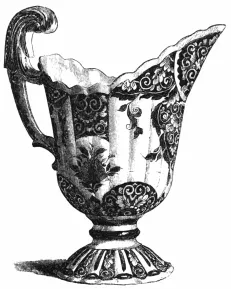 Fig. 234.—Rouen Cup. Lambrequin Decoration.
Rouen may be taken as representing independent Norman art. Marreot
Abaquesne was engaged there in enamelling from 1535, and two tile
pictures from the château of Ecouen, dated 1542, are still in existence,
representing, in blue, green, yellow, and white, Mutius Scævola and
Marcus Curtius. Abaquesne worked until 1557, and after that date the
manufacture of tiles was continued by others. In 1646 Nicolas Poirel,
Sieur de Grandval, obtained a privilege or patent for making faience,
and immediately transferred it to Edme Poterat, already established in
the business in Saint-Sever. To this potter is, in all probability, due
the most distinctive styles of decoration practised at Rouen, those
resembling lambrequins and lace (Fig. 234.) These are modifications of
the Oriental type. In 1673 another patent was granted to Louis Poterat,
a son of the former, for the making of “porcelain similar to that of
China, and of violet faience painted with white and blue and other
colors, in the{282} manner of that of Holland.” After the expiry, about
1700, of Poirel’s patent, manufactories multiplied rapidly, and reached
an aggregate of eighteen, from which some estimate may be formed of the
number of artists and potters engaged at Rouen.
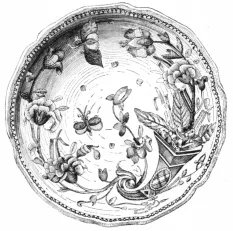 Fig. 235.—Rouen Faience. Decoration, à la corne.
(Trumbull-Prime Coll., N. Y. Metropolitan Museum.)
As to the successive styles, there is no doubt that designers drew
largely from the works of the gold and silver smith. Flowers in wreaths
and bouquets surround landscapes painted on white. Then came the senior
Poterat’s adaptation of Oriental designs in the lace and cognate styles
already mentioned, at first in blue camaïeu, and afterward mingled with
red. Equally well known is the brilliant decoration à la corne (Fig.
235), in which many-hued flowers issue from a cornucopia, and dazzling
insects fill in the interstices between the flowers. All these styles
have been imitated both throughout France and in other countries. No
faience of the eighteenth century was more rich and artistic than that
of Rouen. Many of the pieces are of large size and highly ornate in
character.
To Nevers it has been usual to accord the honor of being the earliest
producer of enamelled pottery in France, but without good reason. The
evidence appears to be rather in favor of Rouen. When Louis Gonzaga
became Duke of Nevers, he sent for a number of Italian artists, and from
that date, about 1565, the production of faience at Nevers took its
rise. In 1578 the brothers Conrade came from Albissola, near Genoa, and,
settling at Nevers, were patronized by the ducal family. Their works
date from 1602, and it was not until thirty years later that a second
manufactory was established. The influence of the Conrades upon the art
is very doubtful, notwithstanding the monopoly they appear to have
enjoyed. One thing may be accepted{283} as certain, that there existed a
Nivernais style prior to that introduced by them. Louis Gonzaga, the
patron, as we have seen, of ceramic art, died in 1595; and as the
Conrades did not establish themselves until 1608, although they had been
working for a few years previously, we have a period of forty-three
years to account for, dating from the accession of Gonzaga, during
thirty of which that prince was alive. The Nivernais styles may,
therefore, be divided into the Franco-Urbino prior to the Conrade, the
Italo-Chinese which existed under them, the Italo-Nivernais, and the
Franco-Nivernais. The Franco-Urbino is marked by a predominance of blue
and yellow, by violet tracings, a yellowish flesh tint, a peculiar
copper-green, and a scarcity of red. A favorite form of vase handle is
the dragon, and the sea is represented in lines of wavy blue. The styles
of Persia, Japan, and China began to manifest themselves under the
Conrades, and continued down to near the middle of the eighteenth
century. We have, after the Persian, blue grounds with white and yellow
ornamentation, and white grounds with polychrome and blue decoration. At
the same time we find minglings of Italian and Oriental designs. After
1640, however, the traces of Italian influence become less distinct. The
Italian school is disappearing, foreign artists are giving place to
natives, and down to the end of the eighteenth century there are obvious
traces of the styles of Rouen and Moustiers. From that time Nevers
declined.
Moustiers has only been known for a few years, but facts have been
discovered which prove it to have held a highly important place in
ceramic art. Situated in the Lower Alps, its works were long attributed
to other places, although its geographical position near Marseilles and
Italy would naturally point to it as one of the most favored centres of
Provençal art. It is chiefly known by the productions of the Clerissy
family and of Joseph Olery. Pierre Clerissy’s works extended from 1686
to 1728, and to this period some of the finest specimens belong. The
pieces are generally large oval or round dishes, with hunting or
scriptural scenes as central decorations, and borders either of flowers
or masks and fabulous monsters and arabesques. The paintings are in
blue, upon a very pure white enamel. In the succeeding styles the centre
scenes after Tempesta were abandoned. One piece has in the centre a
small medallion representing Diana, the huntress, equipped for the chase
and accompanied by her dogs. Surrounding{284} it are arabesques, grotesque
figures, heads, busts, and amorini, and for an outer border there is a
narrow edging of the lace-like pattern of Rouen. Olery (Fig. 236) seems
to have abandoned entirely the styles of Clerissy. He enriched his
palette with violet, green, brown, and yellow, and revelled in floral
decoration. Heavy wreaths of flowers surrounding a series of medallions,
with bouquets between, form a deep border for scenes from mythology and
the classics.
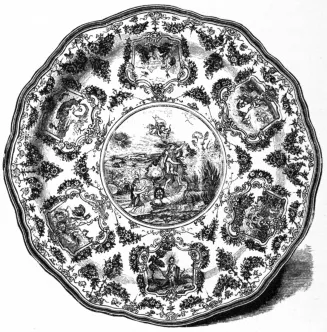
Fig. 236.—Moustiers Faience Dish. By Olery.
Intercourse afterward obliterated the lines between distinctive styles.
Olery went to Spain, and probably acquired there his taste for
polychrome decoration (Fig. 237). Spanish artists accompanied him on his
return, and worked, no doubt, in the light of their national traditions;
and toward the end of the century it is impossible to recognize the
styles of either individual artists or schools. Clerissy’s workshop was
continued after his death by his partner, Joseph Fouque, whose family
retains it to the present day.{285}
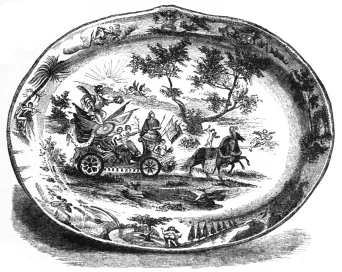
Fig. 237.—Moustiers Dish. Polychrome.
Allied to Moustiers, as representing the art of Southern France, is
Marseilles, a city in every way favorably situated for the prosecution
of the faience industry. Of its earlier works, dating as far back as the
fifteenth century, nothing is known; but toward the end of the
seventeenth century a workshop was founded, in which was made an
authenticated faience. The distinguishing feature of the decoration is
the combination of violet from manganese with cobalt blue. The style
bears a general resemblance to that of Moustiers, and it is probable
that the works of the two factories are frequently confounded. About
1750 the Marseilles faience was exported in immense quantities; and from
that date, when the name of Honoré Savy appears in the list of potters,
polychrome decoration became more prevalent. Savy was, in 1777, on the
visit of the future Louis XVIII., authorized to call his workshop
“Manufacture de Monsieur, Frère du Roi,” and is said to have then
adopted the fleur-de-lis as his mark. The mark alone cannot, however,
be accepted as indicating with absolute certainty a work of Savy. The
same potter is said to have invented a particular green; but it appears
to have been common to the other potters of Marseilles, as it is found
upon pieces by Joseph Gaspard{286} Robert and Mme. Perrin. Robert ranks next
to Savy in faience, and was making porcelain at the time of the royal
visit.
In Strasburg we find the origin of a style of faience painting which,
although displaying unquestionable excellence of workmanship, was
carried to such an extent that the suitableness of the decoration to the
earthen-ware body was completely lost sight of. Reference is made to the
porcelain style, by which decoration more properly reserved for
porcelain was applied to faience. The Strasburg paste is of comparative
fineness, the glaze is excellent, and the colors brilliant. The first
factory was established by Charles François Hannong in 1709. In 1721
Hannong associated himself with a German potter from Anspach, named
Wackenfield, and in 1724 started a second workshop at Haguenau. The
latter ultimately fell to Balthasar Hannong, a son of Charles; and the
Strasburg establishment was carried on by another son, Paul Antoine. The
latter worked industriously, and brought the establishment up to a very
high position. On his death, in 1760, it was carried on by his son
Pierre Antoine, who transferred it to Joseph Adam, his brother, and in
1780 the production ceased. The best period was that between 1740 and
1760, when Paul Antoine was proprietor.
The places mentioned, Nevers, Rouen, Moustiers, Marseilles, and
Strasburg, are the centres from which emanated the leading old styles of
decoration. An exact classification is impossible, since, as Marseilles
faience often bears a striking resemblance to that of Moustiers, the
works of Strasburg, on the other hand, are closely related to those from
Marseilles. After them comes a centre, more interesting because very
recently arriving at eminence, from which has emanated a style different
from that of any of its predecessors.
Limoges is as yet scarcely known in the history of pottery, although
there is a probability, almost amounting to a certainty, that it will
hereafter be accepted as one of the leading representatives of the
ceramic art of France in our day. We find, in 1737, a decree granted in
favor of Sieur Massie, empowering him to establish a workshop of faience
at Limoges. The discovery of kaolin at St. Yrieix appears to have
directed the attention of potters from faience to porcelain. One piece
of the Massie period, dated 1741, is now in Limoges. A border,
resembling those of Moustiers, surrounds the figure{287} of Justice
enthroned and holding the sword and scales. Religion, Truth, and Law
attend her, and Crime is crushed under her foot. Other equally
remarkable pieces may be in existence, but Limoges nowhere appears in
the records as producing any faience of importance or of a very high
order of art.
Within the past few years the aspect of affairs has changed, and the
Havilands of New York have made for Limoges—in conjunction with
Auteuil, near Paris, where much of the moulding and decorating is
executed—a place in the history of pottery as lofty as that which it
occupies in the history of enamelling. Notwithstanding all that has been
said of Saracenic and Italian decoration, we believe that it was
reserved for Haviland to show the real decorative capacity of faience,
and to demonstrate the possible harmony between decoration and its
excipient. For a long time Limoges was known solely as a seat of the
porcelain industry. It was in this way that Americans first became
familiar with its name. When the time came for Haviland to turn his
attention to faience the change above referred to set in. He did more
than merely institute a revival of an obscure industry. While Montagnon
of Nevers was following closely in the track of his predecessors, and
other manufacturers, both French and Italian, were busy with imitations
of dead styles, Haviland set a gigantic task before himself, and it is
to the credit of Americans that they have been among the readiest to
appreciate his works and to encourage his efforts. His faience is
remarkable by reason of its combining three very important
qualities—novelty of process, originality of decoration, and the
strength of drawing and color which are most perfectly in keeping with
the material on which they appear.
We have already pointed out the difficulties with which artists on clay
have contended. The action of the fire made the result, in so far as the
coloring is concerned, always more or less of a problem. Too much or too
little heat changed the entire aspect of the piece. Although, therefore,
we find in Italy and elsewhere great painters furnishing designs for the
decoration of pottery, we seldom find them actually engaged upon the
ware itself. Artists naturally prefer the medium which preserves their
individuality of touch and finish. This personality the fire destroyed.
All that was distinctive of the individual palette and brush vanished
under the heat. What the exact nature{288} of the Havilands’ new process and
the composition of their palette may be we have not the means of
discovering. We know, however, that the painting is laid upon the clay
before it is fired, that the piece is then glazed, and is afterward
baked for between twenty and thirty hours. Body, glaze, and colors are
therefore subjected to the fire together. The glaze is alkaline, and is
similar in its general character to that used on pate tendre
porcelain. We need not inquire into the preparation of the colors. It is
claimed that the possession of the latter brings the result of any
operation within such bounds that it can be calculated with a reasonable
approach to certainty. Let it be fully understood what this implies. It
means that with palette practically unlimited, any artist can apply
himself to the decoration of earthen-ware, and find his work emerging
from the furnace stamped as clearly with the individuality of his design
and execution as if he had applied it to a painting upon a panel or
canvas.
Among the artists engaged upon the Haviland faience are M. and Mme.
Bracquemond, MM. Lindeneher, Noel, Chaplet, Damousse, Lafond, and
Delaplanche. With Messrs. Chaplet, Laurin, and Lafond, the new
enamelling process may be said to have accidentally originated at
Bourg-la-Reine in 1873, and M. Bracquemond was the first to appreciate
its value and to bring it under the notice of the Messrs. Haviland. The
latter at once saw its merit, and by farther experiment and the use of
the resources at their command, brought it to perfection. The works of
their artists have made America as familiar with their faience as it
formerly was with their porcelain. The process having been discovered,
the second step was the adoption of a style. Here we meet with a
peculiarity of the ware. We speak of schools of painting, and our
language implies a limitation, a peculiarity of technique. All artists
who follow nature closely must needs belong to the same school. Their
success in the reproduction of natural effects is a bond of union, which
brings them together across the boundaries of special methods of
treatment. Each of Havilands’ artists may have his specialty, but we
find no broad dividing lines. Their subjects are taken from nature or
from imagination, which is only a wider field based upon the natural.
The sympathy between them lies in the new sense of the capabilities of
their art. The brush is wielded with a stronger hand, and the designs
appear bolder, at times
{290}
{291}{289} almost reckless. There is no striving after
what might be called “prettiness of style.” Where we have been
accustomed to restraint we find largeness and liberty. There are no
longer minute divisions of surfaces to be covered in detail with
graceful precision, but designs of full artistic completeness and strong
simplicity. Color is applied with a commensurate boldness, which carries
the conviction that here at last we find a decoration suited to its
basis of earthen-ware.
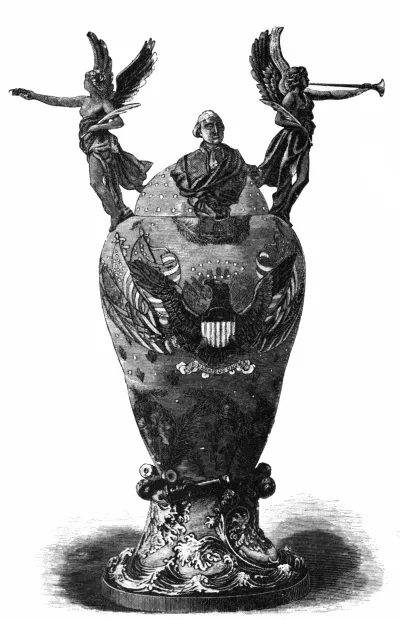
Fig. 238.—Memorial Vase. Haviland Faience. (Smithsonian
Institute.)
A recent visitor to the workshop of Haviland & Co., near Paris, where
much of their faience is painted, thus describes what he saw: “While in
Paris, I studied the way in which the vases are painted, and was
surprised to find what an amount of care is expended upon them. They
demand more exact treatment than China or English faience. The artist
works as if the material were canvas. A bouquet of flowers, for
instance, is minutely painted, and the shades of the grounds are all
carefully studied. Nothing is left to chance. During the process of
firing everything fuses, and it is then that the appearance of boldness
is produced. If a vase were painted, as on a cursory examination it
appears to be, with a bold brush and careless hand, the result would be
a mere daub of no value. The peculiar talent of the artists consists in
producing an effect of boldness and carelessness with a great deal of
work and a close imitation of nature. Could all the work actually
bestowed upon one of these vases, and as it can be seen before firing,
be seen after firing, the faience of Limoges would resemble that of
England or any other pottery which is painted on the glaze. But the
process is different, and after the firing the detail of the work melts
away, leaving behind that fascinating harmony of colors which has never
before been produced on any pottery. Nothing has as yet been invented to
replace work and care; and when anything you may see presents something
pleasing, be certain that both have been lavished upon it. No writing or
music seems so easy to imitate as that which cannot be imitated; and it
is the part of a good author to conceal the method he employs.”
There are now in the Smithsonian Institute at Washington three pieces of
Haviland faience which may be taken as exemplifying much of what has
been said. These are the Memorial Vases (Fig. 238) and Bracquemond’s
tile-piece allegorizing Human Progress. Let us take the vases first.
They are the joint productions of MM. Bracquemond,{292} designer, and
Delaplanche, sculptor, and are intended to commemorate the Centennial of
American Independence. The broad and easily understood conception is
intensely American, and was, in fact, due to American inspiration. They
fitly stand in the capital, not only as lasting memorials of the
hundredth anniversary of America’s entrance into the great commonwealth
of nations, but as a congratulatory compliment from the ceramic artists
of France.
Viewed in the light of history and of historical usage, they both
acquire a fresh interest, and are better understood. They are
exceptions, in the idea they represent, to the myriad ornamental vases
which load our cabinets and shelves. We have already seen that, from the
most ancient days of Egypt downward, vases were employed for the
conveyance of religious sentiments. The Chinese followed the same
course, and joined with it the custom of using pottery as a reward, or
for the purpose of conferring a mark of imperial distinction upon
officers deserving well of the state. Vases were also made the media
between friends for the conveyance of compliments or congratulations. We
might, in this connection, revert once more to the Greeks, who carried
the Oriental practice still farther. By that people vases were, as we
have seen, used as prizes, as wedding presents, as pledges of love or
friendship, the legends they bear enabling us at this distant day to
listen to the whisperings of passions which burned and died over two
thousand years ago. We also find such commemorative vases as that which
bears the legend, “The beautiful horse, twice conqueror at the Pythian
games.” On many others are inscribed the names of the great men of
antiquity, its kings and its poets. Some of these belong to times
posterior to those in which the persons they were intended to honor
lived, and may, therefore, be called commemorative in the same manner as
statues. Throughout the Middle Ages we find the same usage more widely
prevalent. When, therefore, the artists of France decided upon
commemorating the American Centennial, they had, as a precedent for
making a memorial distinctive of their art, the usage of the potters of
all countries back to the most remote times.
In regard to design and decoration, these vases will bear consideration
in detail. There is one very large class of Greek vases which represent
what we have called the union of pottery and sculpture. In one we have
the helmeted head of Pallas Athene surmounted by{293} a figure of Nike, or
Victory. On others are Tritons bearing Nereïds, Medusa’s head, pennate
figures, and the winged steeds of Aurora. The artist had no thought of
utility to hamper him in designing accessories. It is said that M.
Bracquemond, while in the Louvre, was attracted by one of the Grecian
vases of this class found in Apulia (see Fig. 167). The style is full of
grandeur and pomp. The form of the vase would be heavy and clumsy were
its outline unrelieved by the decorating figures. On the neck stands a
divinity in graceful drapery. Lower down, on the sides, are two
statuettes of deities, and on either side of Minerva’s head surmounted
by Nike in front are two Tritons, with their horse-feet pawing the air.
This vase suggested to M. Bracquemond a design for the Memorial Vases in
Washington. All that he thus derived, however, was merely a suggestion.
The details of the design may be gathered from a description of the
vases themselves. One is intended to represent the year in which the
United States won independence; the other the hundredth anniversary of
that event. Between them is a whole century of history. The vase “1776”
rises from a base consisting of greenish, foamy waves, lashing angrily
against rocks surmounted by a circlet of cannon modelled after the
ordnance of Revolutionary times. In this we have the whole story of the
struggle for independence, and of the turmoil and confusion of the
strife. It is worth noting that this symbolical use of the wave
ornamentation is strictly classical. When the potters of Greece sought a
symbol of caprice and mutation, they could find none more expressive
than the foam-crested waves of the sea. From the cannon the body of the
vase swells gracefully outward, and attains its widest girth near the
top, where it curves rapidly inward to the upper rim. The orifice is
closed by a star-covered dome of blue, from either side of which spring
statuettes of Fame and Victory. On a pedestal on the rim in front stands
a bust of Washington, modelled by Houdon, after one formerly owned by
Lafayette, and now in the Louvre.
The ornamentation on the body is simple and expressive. Green fronds
cross each other above the cannon, and smaller branches and stars are
sprinkled over the whole surface. On the front is the American eagle
with outstretched wings, with the national colors on either side. Above
it, and immediately under the bust of Washington,{294} in small gilt
letters, are the names of the signers of the Declaration of
Independence.
The base of the Centennial vase, “1876,” symbolizes peace and prosperity
by means of fruit, cereals, and the implements of husbandry. Above the
eagle, in place of the names of the signers of the Declaration, are
those of the Presidents, from Washington to Grant, and the surmounting
bust represents Columbia. In other respects the two vases are alike. The
story they tell is plain, and for every observer to read. Out of the
struggle of a hundred years ago have come liberty, peace, and
prosperity. The designer was exposed to dangers which he has coped with
successfully. He has achieved something grateful to American patriotism
without throwing originality aside. The American flag, the eagle,
Washington, and the Goddess of Liberty, compose a group which, but for
their artistic combination, might have been viewed with the indifference
begotten of familiarity. As they stand, it becomes hard to conceive how
otherwise, in equally intelligible language, a great historical event
could have been commemorated in the everlasting record supplied by clay.
They are records, and not mere ornaments. They mirror the first century
of America’s life as a nation. They tell all or nearly all that history
can tell of the passage from the struggle of 1776 to the prosperity of
1876.
The story of their formation is interesting, that of one applying to
both. The body was modelled by M. Renard, chief modeller at Sèvres. He
worked incessantly on the inside for thirty-four hours without resting
more than a few minutes at a time, in order that his work might be
finished before the clay lost any of its plasticity by the evaporation
of the moisture. When this operation was completed the body was allowed
to dry for fifteen days. A kiln was then built round it, its great
size—the vases are twelve feet high, and the largest ever made in
Europe—rendering removal impossible. It was fired for eight days at a
low temperature, and then for three days at a high degree of heat, and
the result of the stupendous work was in every way successful. The
furnace required eight days to cool. If anything more is needed to
enable us to estimate the immense labor involved in such a work, it may
be summed up in this, that these vases demanded thirteen months’ work of
some of the ablest artists and potters of France.{295}
It is difficult to criticise them apart from the sentiment they embody,
and which invests them with a never-fading interest. It was, however, a
touch of genius to get away from immediate usage to a style of
ornamentation with which the artists of Magna Græcia and Apulia
embellished their vases. It is the style best suited to their enormous
size. The enamel is applied only to the ornamentation, the body, busts,
and statuettes being all left unglazed and showing the natural color of
the clay. Every detail is made expressive, while the strictest
simplicity is retained. The size of the work forbade minute
ornamentation of a symbolical character, and there is thus a harmony
between the entire work and the details. The colors are brilliant, and
the general effect, though sombre, is imposing and fine. They will be
viewed hereafter with increasing interest, as marking the revival of an
old complimentary usage under particularly gratifying conditions; and
the grandeur and beauty of the art they represent is not likely to be
forgotten in the contemplation of the sentiment they express.
We turn to the tile-piece in which, upon nearly a thousand tiles, M.
Bracquemond presents his allegory of Human Progress, with a mingled
feeling of dislike and attraction. It also stands in the Smithsonian
Institute. The repellent influence is first experienced, and arises,
probably, from an apparent absurdity of design and the peculiar
coloring. A figure of gigantic size occupies the centre, trampling fire
underfoot, and having a greenish bronze statuette in the right hand and
a vase in the other. On the left are the chimneys and smoke of a
factory, and on the opposite side is a railway train. A flash of
lightning strikes in from the right, and above the central figure is the
recumbent form of a woman partially enveloped in cloud. The picture, as
we have said, is allegorical, and represents the genius of man utilizing
the waters of the rebellious stream and storm, the fires of the volcano
and lightning, and making them subservient to progress. As it is more
closely studied, its true place in art is better understood, and we
ultimately accept the piece as an indication of the possibilities of M.
Bracquemond’s art. We feel that another stage has been passed on the way
toward the perfect union of the potter’s and painter’s skill, and toward
the picture “permanent as the Pyramids” of which Ruskin writes.
Many of the other tile-pieces, panels, and plaques (Fig. 239) from{296}
Limoges and Auteuil are more absolutely excellent. On a circular plaque
appears a draped female head, in which the flesh tint, clear and ruddy,
is simply wonderful. The delicacy which it lacks is found on two panels,
perfect rural pictures, with single female figures. These pieces
illustrate the fineness of landscape effect and the nicety of touch to
which the artist in possession of Haviland’s palette can attain. The
trees stand out well against the sky, its blue slightly shaded with
cloudy gray; and if we turn from these to the figure-drawing, the
arrangement of the drapery, even the finish of the embroidery, we feel
that we are in presence of an art of the decorative and artistic
capacity of which we are only catching the first glimpses.
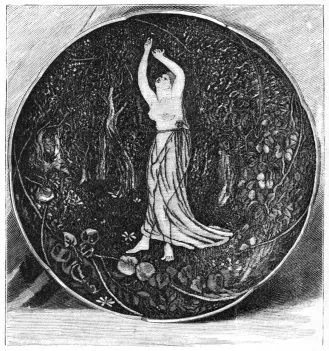
Fig. 239—Haviland Faience. (H. Havemeyer Coll.)
If we pass now to the vases of this ware, we are struck by the
originality of their shapes, the freedom of their designs, and the
remarkable depth and beauty of their coloring. There is nowhere visible{297}
any symptom of the nervous feeling after a doubtful result
characteristic of an artist without confidence in himself and his
process. Everything indicates strength, assurance, and power; and if
there is weakness anywhere, it is evidently the result of a boldness
which is over-hasty or too careless of finish and detail. We find no
precedent for the decoration. It is as far removed as possible from all
that is associated with China or Japan, from the majolica of Italy,
Spain, or Berlin, from the stone-ware of England, or the faience of
Sweden. The forms of the vases are of boundless variety, and suggest
originality by their very multiplicity. One would carry us back to the
pottery of ancient Gaul before it had felt the heavy hand of Rome.
Another recalls the Anglo-Saxon vases of England. A third would lead us,
in searching for a precedent, to the clumsy, rotund urns of ancient
Germany. These would all be equally fanciful, no doubt; and in that
suspicion one is confirmed by the exquisite forms of a small pichet, a
quaint card-receiver, and a vase rising to its slightly out-turned lip
as gracefully as the cup of a flower.
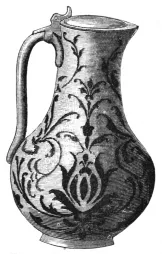 Fig. 240.—Haviland Faience. (G. W. Gibson Coll.)
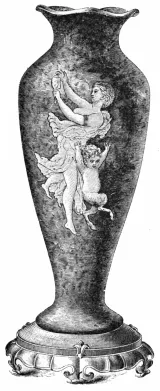 Fig. 241.—Haviland Faience. (Whitelaw Reid Coll.)
Fig. 242.—Luna Vase. Haviland Faience. (Mrs. William H.
Dannat Coll.)
We may take a few examples in order to illustrate the decoration. It
consists of painting on the surface, of carved figures in unglazed
relief, and of forms glazed and attached to the surface. Of{298} the first
of these the choice is wide. On some appear hunting dogs full of life
and action and in many attitudes. On another is a Cupid with full-drawn
bow, rosy and chubby, and evidently bent upon dealing a fatal wound. On
a third is a nymph and satyr (Fig. 241). A fourth shows us a barn-yard
pair, a duck and drake, the latter preening himself in the sun, under
which his many-hued plumage glitters{299} with a lustre almost iridescent.
On a fifth a gayly feathered open-throated songster appears to be
warbling his even-song upon a tiny spray. Flowers are painted with all
the splendor of nature, and cling round the forms with gracefully
sweeping stem. One in particular is made attractive simply by its color,
a mottled gray, into the depths of which we look as into the clouds
hanging over the couch of the sun in the early mornings of summer. Its
beauty is in its suggestiveness, which strikes us again in many of the
flower-wreathed vases where there are openings of green, into which one
can look as into a forest glade. The mind creates what the eye cannot
see, and the glade is peopled with beings whose forms are never caught.
This is, no doubt, an example of fancy helping out the artist, but the
artist is none the less fortunate and skilful who can thus induce the
fancy to take wing. He leaves her room to take flight, and the vase he
has decorated with a simple flower becomes a poem suggesting far more
than it tells.
Of the vases showing unglazed carvings in bas-relief there is a single
pair, sufficient for illustration. On one is represented Phœbus, the
golden-haired god of day, and on the other the triform goddess Luna.
Phœbus stands with bow drawn full to the shoulder, just as we picture
him in Homer. It will be remembered that when Lyrnessus was taken by the
Greeks and the spoils divided, Chryseis, the wife of the king of the
captured place, and daughter of Chryses, one of the priests of Apollo,
fell to the share of Agamemnon. Her father sought her restoration from
the “king of men,” and on his request being refused, asked aid from the
god he served. We here have Apollo in the attitude of returning an
answer to his suppliant priest.
“Bent was his bow, the Grecian hearts to wound,
Fierce, as he moved, his silver shafts resound;
Breathing revenge, a sudden night he spread,
And gloomy darkness rolled around his head.
The fleet in view, he twang’d his deadly bow,
And, hissing, fly the feather’d fates below.
On mules and dogs the infection first began,
And last, the vengeful arrows fixed in man.”
On the companion vase (Fig. 242) is the figure of the goddess of night,
Luna, Diana, or Hecate, in her character of Luna, with the crescent
under her feet, and throwing back a mantle from her graceful{300} form. In
both vases the beauty of the conception is skilfully carried out in the
execution. The figures are admirably modelled, and, being of a light
paste and left unglazed, stand out in bold relief against the ground.
The daring of the latter innovation is amply justified by the result.
Fig. 243.—Faience Vase. (Mrs. Colonel T. Scott Coll.)
Of the third class of vases with glazed ornaments applied to the body
there are many fine specimens. One of the most charming (Fig. 243) is
wreathed by flower sprays twined naturally and gracefully{301} round the
body. The flower is in full bloom, and its large leaves are spread out
above it and below. For handles there are snakes turning in their
changeless coil round the flower stem. On another the handles consist of
butterflies beautifully moulded and colored, and placed as though they
might have been transformed into clay as they alighted on the vase.
Another, of small size and quaintly rotund form, has a mass of leaves
and flowers in relief clustering round the body. A pitcher with a soft
gray ground is lightly overrun with an ivy branch, which twines itself
round the neck and handle as naturally as the plant creeps up and winds
itself round the stem of a tree.
Can anything be more simple than the suggestions to which these
creations are due? Do we need to be reminded of the fable which explains
how Callimachus was inspired to produce the Corinthian capital? We are
told that he was walking in the country, and as he travelled he came to
the grave of a child, upon which, in a basket, some relative—its
mother, probably—had placed the customary offering of food. To keep off
the birds and small animals, a tile had been laid upon the basket. In
course of time an acanthus appeared; and as it grew, its stalk was
pressed back by the tile and turned round spirally under its edge.
Nothing more was needed. Callimachus found in the little basket on the
flower-grown grave a suggestion for the order of architecture which has
never been surpassed to this day. We have similarly, in the faience
vases of Haviland now under consideration, constant hints of inspiration
drawn from the simplest forms of nature. A branch falls upon a vase and
becomes its ornament. A butterfly hangs for a moment on fluttering wing
and drops from its flight, and it too becomes an ornament. The workman
leaves his unfinished work at night, and when he returns at day-break,
finds that a lizard or an asp has crept upon the still slimy vase to
bask itself in the first rays of the morning sun. It darts out of sight,
but it has left an idea which appears in the decoration; and on the spot
from which it glided when disturbed a snake displays its spiral
convolutions.
Where but in nature shall we see anything suggestive of such decoration?
We do not find it in Japan, for the symbolical and semi-imaginative,
semi-realistic style of the extreme East has nothing in common with this
naturalism. As little do we find it among the{302} brilliant colors and
fantastic forms of Persia. If we come nearer home, to Italy, even to the
French centres we have already visited, there is nothing in their
classical scenes and floral wreaths and bouquets to prepare us to find
in Limoges their orderly successor. In a word, the style is original.
There is no crowding of tints for the sake of their rich beauty. A
single flower lying on a ground of one prevailing tone is sufficient
ornamentation for a vase; or a handful of flowers may be scattered upon
the surface in tumbled profusion, or woven into a wreath. Haviland has
entered upon a hitherto undiscovered path, and let us pray that he may
never be tempted to try the porcelain decoration which threatened to
ruin faience, nor to give us anything more meretricious than the beauty
of a garden flower or of the many other admirably conceived forms which
he has endowed with life.
 Fig. 244.—Haviland Faience. (Miss Clara Louise Kellogg
Coll.)
The best pieces have been chosen for commendation and to illustrate the
highest results to be expected from the new process. It is
unquestionable, however, that there are many pieces of this faience
which could be disposed of without seeking words for the expression of
enthusiastic praise. This gives those desiring specimens every
opportunity for the exercise of a judicious discrimination. In some
pieces the simultaneous melting of the color and glaze has resulted in a
haziness of outline and confusion of colors by no means characteristic
of the better examples. On others with figure decoration the drawing has
been completely destroyed, and the figure left in obscurity. These
inferior pieces are useful, however, for showing how careful must be the
work which produces the bold effects securing our admiration.
When Haviland took up the process discovered by MM. Chaplet, Laurin, and
Lafond, at Bourg-la-Reine, he secured the services of two{303} of these
artists. The third, M. Laurin, carried out the process at the place of
its discovery. Many of this artist’s works come to us bearing his mark
and the name of the factory, Bourg-la-Reine, in full. Like that of
Haviland, his work is occasionally irregular; but, as a rule, it is
entitled to very high commendation. The flower decoration is extremely
beautiful, and when laid upon a soft ground, such as the gray, which
Laurin produces to perfection, is entitled to nearly all the praise
bestowed upon the corresponding works from Haviland’s factory. The
Bourg-la-Reine faience is chiefly painted on the flat, and the leading
decoration consists of flower and figure painting. We meet with many
well-selected subjects and much strong and realistic treatment. On one
vase appear an eagle and a serpent on an excellent ground of gray and
blue, the former of which is also employed with fine effect in a variety
of flower pieces.
 Fig. 245.—Bourg-la-Reine Faience. (G. Collamore.)
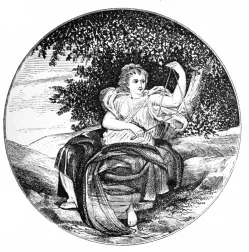 Fig. 246.—Bourg-la-Reine Plaque. (Tiffany & Co.)
A very common mistake is made regarding this faience. It is often
confounded with that of Haviland, although the differences between the
two fabrics are obvious. In the first place, the marks can be consulted.
That of Limoges{304} is stamped “H. & Co.”—or, Haviland & Co.—with or
without the place of manufacture. The artist’s mark also is generally
attached. The Bourg-la-Reine is marked either with the name “Laurin” or
“B.-la-R.,” or with both. In the second place, the alkaline glaze of the
Haviland faience gives the paintings, especially of flowers, a life-like
appearance peculiar to itself. It is a mistake to suppose that the
processes of decoration are identical in every particular. In one
respect only they are alike. In both, the colors are laid upon the
unbaked clay. In the mixing of the colors and in the glaze they are
distinct. Laurin’s decoration is harder in outline than the Limoges, and
never possesses the mingled softness and strength which constitute the
great charm of the latter.
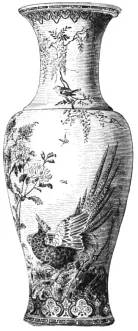 Fig. 247.—Deck Faience. (Corcoran Art Gallery.)
Of the early history of Bourg-la-Reine little of general interest is
known. It appears that Jullien and Jacques of Mennecy founded a workshop
there about the year 1773. Jullien died in 1774, and was succeeded by
his son, who resigned his share in the business to Jacques. When Jacques
died, in 1799, his son, C. S. Jacques, continued the fabrication. At a
later period fine white faience was made. It is upon Laurin alone that,
in this country, the reputation of the place depends.
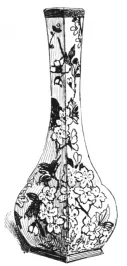 Fig. 248.—Deck Bottle. (Gilman Collamore.)
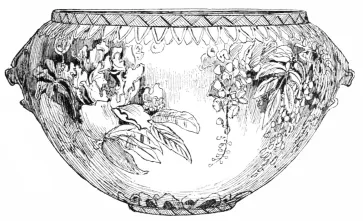
Fig. 249.—Deck Vase. (Gilman Collamore.)
The name of Deck, of Paris, brings before us much that is beautiful in
the recent ceramics of France. For a long time, in fact, his name was
supposed to represent nearly all that was excellent in the color and
decoration of European pottery. Having enriched his palette with a
wealth of colors which made him the envy of his cotemporaries, he turned
his attention to reviving Oriental styles in hues rivalling those of the
East. He was first attracted to Persia, and with marvellous skill
applied his rich enamel colors to the reproduction of the faience of
that country. In other cases he is manifestly inspired by Japanese{305} art.
His technical skill enables him to reach widely varied effects, and
since to this are added truthful drawing and a fine taste in the
assortment of tints, we can easily understand his eminence in the art.
Specimens of his best work are comparatively rare in this country. The
faience vase from the Corcoran Art Gallery (Fig. 247) is characteristic,
and is an excellent example of M. Deck’s coloring. The ground is a soft
yellow or buff, and the plumage of the pheasant is brilliant and rich.
The blue tints are especially fine, and the glaze, which is judged to be
alkaline, gives the coloring that peculiar softness which is found in
the greatest perfection on pate tendre. There is considerable doubt as
to the body used by Deck. It varies very much in different pieces,
approaching in some cases the hardness and compactness of porcelain. Of
this character is the bottle, Fig. 248. The ground color of this
specimen is a clear blue, and in it the white blossoms appear in thick
clusters. A vase and plaque, with a somewhat similar, but possibly even
a finer body, are shown at page 325 (Figs. 280 and 281). That given here
(Fig. 249), singular alike in form and color, has a{306} ground of undecided
shades of brown and yellow. Deck’s violet is soft and rich, approaching
at times the velvety violet of China.
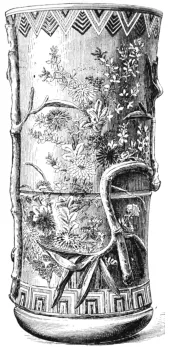 Fig. 250.—Colinot Faience. (Tiffany & Co.)
The other names most familiar to Americans are those of Colinot,
Parville, Longwy, Creil, Sarreguemines, and Montereau. Their products
illustrate the taste for Oriental styles which sprung up a few years
ago, and to the gratification of which much of the ingenuity of French
makers has been devoted. Colinot, of Paris, has employed with great
skill colored enamels in the imitation of Japanese work. On one
cylindrical vase (Fig. 250) he has laid in strong relief, upon a
dark-buff ground, flowers and leaves exactly after the models supplied
by Satsuma and Kioto. On other specimens the decoration is outlined upon
a white ground, and filled in with enamel colors. The method is
productive of a clear hardness of outline, but the results are seldom
unpleasing and often very attractive. Colinot has succeeded in obtaining
several excellent colors. The vase (Fig. 251) is a rich purple, on which
the flowers are laid in white and green. The treatment is similar to
that of Deck, but the ground is less brilliant and clear. Colinot also
acquired considerable reputation by his faience with colored
stanniferous enamel. We give an example (Fig. 252) of his treatment of
large pieces. The ground is a pale blue, and the medallions are
admirably painted. The color is subdued throughout.
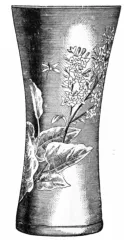 Fig. 251.—Colinot Vase. (Gilman Collamore.)
{307}The Creil workshop was established some time during the eighteenth
century, probably about 1780, by a number of English potters. Its
earliest works appear to have consisted chiefly of services of a
semi-porcelaneous paste. The Worcester method of transfer-printing and
then painting the design in colors was adopted, and successfully
handled. The founders transferred the establishment to Le Bœuf,
Milliet & Co. and De St. Criq & Co. Porcelain was made until 1860, after
which the production was restricted to English faience. The paste
cannot, however, be distinctly qualified, as it varies from the original
semi-porcelain to cream-colored ware. The latter has a wide reputation,
both for its quality and its decoration under the glaze.
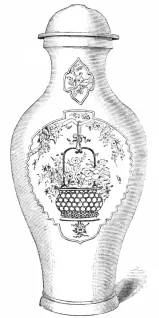 Fig. 252.—Colinot Faience. (Tiffany & Co.)
The Montereau establishment was, like that of Creil, founded by
Englishmen. Letters patent were granted on March 15th, 1775, to Clark,
Shaw & Co., to make English faience and queen’s-ware. The firm started
under very favorable auspices, receiving an annual allowance of 1200
francs for ten years, probably for the purpose of naturalizing the
industry. Its wares helped to overturn the manufacture of French
faience, and were imitated at several places, including Toulouse and
Sarreguemines. In 1790 there were two establishments at Montereau. As at
Creil, M. De St. Criq, in 1810, acquired the right of protection, and in
1829 assigned it to Lebœuf & Thebaut.
At Longwy the manufacture of faience was begun about forty years ago,
when M. Huart de Northcomb was proprietor of a workshop. Its name is now
found upon many excellent specimens of faience with colored stanniferous
enamel. In the bottle and tray (Fig. 253) a rich effect is produced by
the employment of two shades of blue in the scaly ground. The oval
medallions and other ornamentation are yellow, with leaves and flowers
in green and pink. It is one of the best examples we have seen from this
factory, which is one of the largest of its kind in France. The pitcher
(Fig.{308} 254) has a ground of undecided very pale yellow, and the leaves,
flowers, and birds are variously colored. Our third specimen, an oval
plaque (Fig. 255), has, in its design and the brilliancy of its
coloring, a decidedly Oriental appearance. In the other examples the
ground is broken up by a crackle more or less open and irregular; but in
the plaque the white enamel is veined with fine and regular darkly
colored cracks, which bring the ground to a soft and pleasing gray. The
flowers are red and pink, and the foliage green, turning at times to
blue. The bird is brightly plumaged with blue and other colors. In this
as in the other pieces, the ground alone is crackled, and the decoration
has the appearance of being graved in the enamel and then filled in with
the requisite colors.
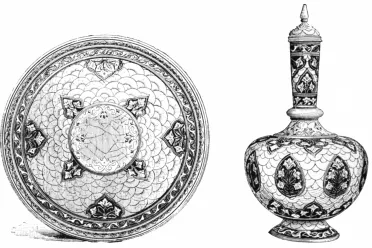
Fig. 253—Longwy Faience. (Gilman Collamore.)
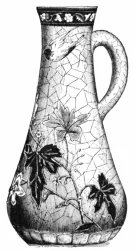 Fig. 254.—Longwy Faience. Crackle. (G. Collamore.)
Parville, of Paris, makes enamelled faience of the same general
description; and the vase chosen to represent it (Fig. 256) deserves
attention both for the peculiarity of its form and for the illustration
it gives of{309} a French modification of the Persian style of decorating.
The ground is a dull and sombre shade of dark-blue, upon which the
ornamentation is laid in light-blue, white, red, and two shades of
yellow.
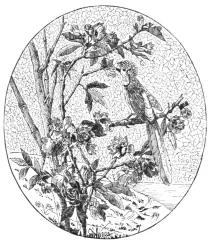 Fig. 255.—Longwy Faience. Crackle. (Tiffany & Co.)
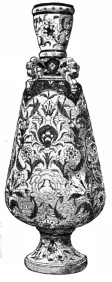 Fig. 256.—Parville Faience. (Tiffany & Co.)
Gien faience, like those of Creil and Montereau, belongs to the class of
ware with a colorless plumbiferous glaze, and its decoration is often
remarkable both in design and color. In the vase with which we represent
this faience (Fig. 257) the design is outlined on the biscuit, and the
colors are then applied. The earlier products of Gien are said to be
imitations of the styles of Marseilles. A more artistic faience,
resembling the Gien, is made by M. Elysse at Blois, in the old Italian
styles of the fifteenth and sixteenth centuries.
The Sarreguemines factory was founded in 1770, by Paul Utzchneider, and
is now carried on under the firm of Utzchneider & Co. It turns out both
faience and porcelain. Figures and groups in porcelain biscuit and
artificial porcelain are made. The factory is also known by a fine white
stone-ware. In the fine faience of Sarreguemines, certain works may be
found which are, in many respects, the most extraordinary of the present
time. Imitations of jasper, marble, granite, and porphyry, are produced
of the most beautiful description, and other pieces resemble the
jasper-ware of Wedgwood, with white decoration on a blue ground. The
vase (Fig. 258) can hardly be described in words. Among the varied
contents of Mr. Collamore’s collection, it is perfectly{310} unique. The
ground is a deep and brilliant black, upon which the decoration is laid
in white, gold, and blue, dotted with drops of jewel-like enamels. The
handles are blue and gold. The design can be distinctly followed in the
engraving, but even a colored plate could hardly do justice to the
enamels, or give an idea of the general effect.
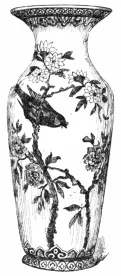 Fig. 257.—Gien Faience. (Davis Collamore Coll.)
Niederviller has made faience in the Strasburg style since at least the
beginning of the eighteenth century, and about 1760 was producing pieces
with delicate flower paintings. It was then under the patronage of Baron
de Beyerlé, and afterward of Count Custine, under whose proprietorship
the porcelain style was farther developed. A curious specimen is given
by Jacquemart, in which the ground of the plate is painted to imitate
wood, and in the centre is a reservation simulating a sheet of white
paper with a landscape in pink. In 1768 the Baron de Beyerlé was making
a good quality of porcelain from German material. Under Count Custine,
François Lanfrey was engaged as manager. Charles Sauvage, or Lemire,
made small figures and groups in biscuit, and Cyfflé also executed some
of his works at Niederviller.
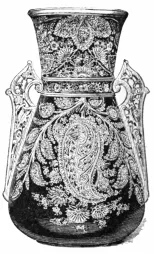 Fig. 258—Sarreguemines Faience. (G. Collamore.)
The name of this artist, Paul Louis Cyfflé, is, however, more intimately
associated with Luneville. The faience workshop of Luneville was founded
about 1729, by Jacques Chambrette. In 1778 it was acquired by Keller &
Guérin. The styles of Nevers and Strasburg were both successfully
followed. It was here that Cyfflé made his statuettes of fine “terre de
Lorraine.”
In the same district are the factories{311} of Nancy and St. Clement. The
former produced faience in 1774, and a peculiar kind of biscuit which
takes its name from the place. The factory was founded by Nicolas
Lelong. Very little is known of the St. Clement works, though they are
said to have been in operation in 1750. In 1835 they were under the
directorship of M. Aubry. Both Luneville and St. Clement have been more
recently known by their stanniferous faience.
St. Amand holds an important position in the history of French art. It
is one of the places, including Lille, Dunkirk, Valenciennes, and the
other faience-producing towns of Flanders, which enabled France to
domesticate, in a measure, the manufacture of ware resembling that of
Delft. The paste of these faiences is identical with that used in the
great Dutch establishment, with which they very soon came into
competition. The history of St. Amand extends from 1740 down to the
Revolution. It was founded by Pierre Joseph Fauquez, was continued by
his son, Pierre François Joseph, until 1773, and by his grandson, Jean
Baptiste Joseph, until the Revolution. The earlier style of decoration
is based upon that of Rouen; the second is after that of Strasburg. One
of the distinguishing features of this faience is the use of white
enamel in relief upon the glaze, which is faintly tinged with blue.
Having already touched upon a few of the leading names of modern Paris,
there yet remains to be said something of its previous history. The
relics discovered within the city belong to every period, from the Roman
downward; and it may therefore be said that the metropolitan potters
have been as busy, comparatively speaking, in the past as they are
to-day. Faience was made from the beginning of the seventeenth century,
and Réverend was, in 1664, making imitations of Delft, “thin, with a
white enamel, with clear polychrome colors, often excessively pure.”
This is M. Jacquemart’s description. Notwithstanding the privilege
accorded to Réverend, many other workshops appear to have made faience
throughout the whole of the eighteenth century, and it is generally
impossible to tell them from the wares of Rouen and elsewhere, which
they imitated.
Artistic faience was made at Sceaux for about forty-five years previous
to 1795, by Chapelle and Glot successively. Gros-Caillou, St. Denis,
Vincennes, St. Cloud, and Sèvres were all more or less engaged{312} in the
manufacture of faience. We find Pierre Antoine Hannong, from Strasburg,
at Vincennes in 1767, but he met with little success.
There are many other places at which faience was made, some, like
Nantes, Bordeaux, and Orleans, of importance, and others of which little
is known besides their names. A list of them would add nothing to our
real knowledge of French art, which has been chiefly influenced by the
styles of which we have most fully treated. To the accounts of them has
been added all that could be learned regarding Limoges, Creil,
Sarreguemines, and a few Parisian and other workshops especially
interesting to the collectors of the present day.
Efforts to Make Porcelain.—First Artificial Porcelain.—St.
Cloud.—Lille.—Paris.—Chantilly,—Mennecy.—Vincennes.—Sèvres.—Natural,
or Hard, Porcelain.—Discovery of Kaolin.—Various
Factories.—Limoges.—Deck.—Regnault.—Solon.—Pate
Changeante.—Pate-sur-Pate.
 Fig. 259.—St. Cloud Porcelain Salt-cellar. (Jacquemart
Coll.)
We have already seen that the discovery of artificial porcelain preceded
that of natural, or kaolinic, porcelain. In treating of the faience of
Rouen, we quoted, from the letters patent granted to Louis Poterat on
the 31st of October, 1673, a passage to show that he meditated the
production of porcelain similar to the Chinese. A privilege was also
granted to Claude Réverend, of Paris, in 1664, which bears that he
possessed the secret of making a “counterfeit porcelain, as fine and
finer than that which comes from the East Indies.” All that Réverend
achieved was a very fine faience; and Poterat, having met with success
as a maker of faience, probably renounced the prosecution of the search
for porcelain, although he may be said to have arrived at or very near
success. The first French artificial, or soft, porcelain known to
commerce was that made by the Chicanneau family at St. Cloud in 1695
(Fig. 259). It is first noticed by Martin Lister, a traveller, in 1698.
Henry Trou, having married the widow of Pierre Chicanneau, became head
of the manufactory of St. Cloud; and a family quarrel having taken
place, Marie{313} Moreau, widow of one of the Chicanneaus, established
herself in Paris. The earliest marks of St. Cloud porcelain are the sun
and the letters S. C. and T., the former dating from 1702 to 1715, the
latter from 1715 to 1730. The sun was the device of Louis XIV., and the
letters afterward used were the initials of St. Cloud and Trou. The
paste was close and white, and the glaze uneven. The decoration soon
became varied in character, some pieces, with birds and flowers in
relief, resembling the Chinese, and others of French patterns in blue,
with arabesques or lace borders.
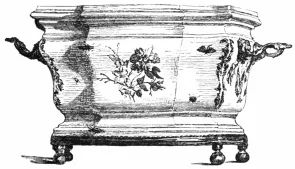
Fig. 260.—Vincennes Porcelain Cooler. (Duke de Martina
Coll.)
The attempts of Poterat and Réverend, and the more perfect success of
Chicanneau, indicate the prevalence of the desire to solve the mystery
of Chinese porcelain. Experiments were being conducted almost
everywhere, and the success of the potters of St. Cloud gave a new zest
to the search. A manufactory was founded at Lille in 1711; at Paris, by
the offshoot of the St. Cloud family, in 1722; and at Chantilly in 1725,
where the porcelain of Corea was taken as a model. Ten years later
Barbin was established at Mennecy, and in 1739 the philosopher Réaumur,
led away by the universal search, arrived at a devitrified glass, which
went under the name of “Réaumur’s porcelain,” though in no sense
deserving such a name. With 1740 we reach the establishment of the royal
manufactory at Vincennes (Fig. 260).
Two brothers named Dubois, formerly of St. Cloud, offered to sell their
secret to the Intendant of Finance, and were given the necessary means
to carry on the production at Vincennes. These men did not{314} fulfil their
promise, and were succeeded by one of their workmen, named Gravant. The
celebrated Madame de Pompadour used her influence with the king to
induce him to favor an enterprise the success of which would make France
independent of Saxony. The result was that the manufacture quickly rose
to eminence. Chemists, artists, and goldsmiths were engaged in designing
and decorating. Flowers were modelled and painted in a style so closely
resembling the natural that the king is said, upon one occasion, to have
mistaken the artificial for the real. In 1753, the position of manager
was given to Eloi Brichard. Louis XV. took a third of the capital upon
himself, and the name of “The Royal Porcelain Manufactory of France” was
conferred upon the establishment. The workshops at Vincennes became too
small, and in 1756 a removal was made to a new building erected
specially for the purpose at Sèvres.
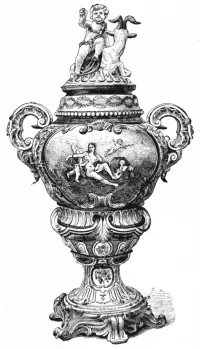 Fig. 261.—Old Sèvres Pate Tendre. (August Belmont
Coll.)
 Fig. 262.—Old Jewelled Sèvres Pate Tendre. Cup diameter,
2½ in.; Saucer circumference, 18 in. (Mrs. J. V. L. Pruyn Coll.)
Fig. 263.—Jewelled Sèvres. (H. C. Gibson Coll.)
The imitations which had annoyed Adam, the director who preceded
Brichard, continued under the administration of the latter. The king
then took the entire establishment into his own hands, and appointed M.
Boileau director. Such was an eighteenth century toy of royalty. The
king, accompanied by the Pompadour, paid regular visits to Sèvres, which
was well worthy of being a royal possession. Everything that art could
suggest in the form of gardens and groves had been done to embellish it.
Even a private chase was provided for the artists, where, in hunting the
boar and stag, they relieved the labors of the studio. Never, possibly,
were artists so favored by patronage and place, and the productions of
Sèvres were worthy of the sunshine in which it{315} basked. Its flowers and
vases admit of no classification. Figures were also made in biscuit (see
Fig. 226). Chemists vied with each other in the invention of colors, and
the bleu de roi, Hellot’s turquoise blue (1752), the Pompadour pink
(1757), violet, greens, yellow, and iron-red followed each other in
rapid succession, and were employed with dazzling effect. Special
mention need only be made of the jewelled porcelain (Figs. 262 and 263)
on a bleu de roi ground. The successive directors after Boileau were:
Parent, 1773-1779; Regnier, 1779-1793; Commissioners, with Chanou and
afterward Salmon, Ettlinger, and Meyer, jointly as inspectors, down to
1800; Brongniart, 1800-1847; and then MM. Ebelman, Regnault, and Robert
in succession. The specimen{316} here given (Fig. 264) is one of a pair
dated 1772 and 1781 respectively, which formerly belonged to Louis XVI.
On his request they were sold by Governor Morris, in order to raise
money, and were bought by Dr. Hosack, of New York. The scene in the
medallion represents Louis XVI. in his cabinet, and the nurse bringing
in the newly born Dauphin.
 Fig. 264.—Sèvres Pate Tendre (1772-1781). Bleu de Roi
Ground. (Mrs. C. B. Hosack Coll.)
Meantime the paste was still artificial, and the researches for a
natural, or hard, porcelain were not relaxed. In 1769 the discovery of
kaolin and petuntse at St. Yrieix, near Limoges, led to the introduction
of hard paste into Sèvres. In 1804 M. Brongniart decided to abandon the
manufacture of artificial porcelain, and soon afterward regretted having
taken such a step. In 1847 M. Ebelman, Brongniart’s pupil and successor,
decided to revive the pate tendre, and for four years made use of a
body which had been prepared by Brongniart forty-five years previously.
The clay, instead of being thrown away, as Brongniart thought, had been
stored throughout the long period of its neglect, and both saved the new
director any trouble in experimenting, and supplied a standard for the
future. The production of soft paste has been continued, but the
quantity is inconsiderable. Mr. Walters, of Baltimore, has in his
collection a valuable pate tendre vase dated 1860.
To give in detail the events which led to the introduction of natural
porcelain into the royal factory, we must turn back to the year 1721,
when Wackenfeld was attempting to utilize at Strasburg the knowledge he
had brought from Germany. Hannong was engaged{317} in the same enterprise;
and his son, Paul Antoine, after endeavoring in vain to carry on the
production in competition with the artificial porcelain of the royal
factory, and engaging in fruitless negotiations with Director Boileau,
at last retired to Frankenthal. His son afterward took the Strasburg
works in hand, but failed. All this porcelain was made from imported
material. That of Paul Antoine resembles in decoration the works of
Meissen, and his son followed both the Saxon and Sèvres styles.
 Fig. 265.—Charlotte Corday Vase; Sèvres Porcelain,
Mounted. Red and Gold. (White House.)
In 1758 an event happened of the first importance to the making of a
true French natural porcelain. This was the discovery by the Count de
Brancas Lauraguais of an inferior quality of kaolin near Alençon. The
specimens of the ware in which it was used show a coarse body, and
decoration after the Chinese and Japanese types. Shortly afterward
Gérault, or to give his name in full, Charles Claude Gérault Daranbert,
the proprietor of a faience establishment at Orleans, engaged in the
manufacture of porcelain. A privilege had been granted to the Orleans
workshop, in 1755, to make a white faience, and the making of porcelain
appears to have begun about 1764, on the acquisition by Gérault of a
kaolin mine at St. Yrieix-la-Perche. In 1765 Guettard, chemist in the
establishment of the Duke of Orleans at Bagnolet, came upon the kaolin
deposit at Alençon originally discovered by the Count Lauraguais. Within
a few years, also, Robert was making porcelain at Marseilles.
 Fig. 266.—Old Sèvres, Mounted in Metal. Dark-blue
Ground. Height, 9½ in. (Mrs. J. V. L. Pruyn Coll.)
The next events of importance are Madame Darnet’s discovery of kaolin at
St. Yrieix, and Macquer’s experiments with it at Sèvres. As at{318}
Strasburg, the mistake was made at Sèvres of mixing the kaolin and
petuntse in the wrong proportions, and the result of the excess of
felspar was a very translucent glassy body. The first pieces and those
of artificial paste were so nearly alike that, to distinguish the
former, they were marked with the well known double L and crown. They
may also be known by the color being laid upon the glaze. In the soft
paste the colors appear to be sunk in the glaze. When Brongniart, in
1804, stopped the production of pate tendre, the works of the royal
factory began to assume the forms and to be decorated in the styles with
which the world has been familiar for the last seventy years. “The
largest pieces,” says Jacquemart, “were undertaken, and sculpture and
painting united to enrich gigantic vases. Plaques of forty-six by
thirty-six inches were given to distinguished artists, who reproduced in
unalterable colors the frescoes of Raffaelle, the masterpieces of
Vandyke, Titian, and of the modern school.” Of modern Sèvres we give one
example (Fig. 268), to which some interest attaches as belonging to a
service presented by the French Government to Miss M. F. Curtis,
distributor of funds sent from Boston for the relief of sufferers by the
war with Germany in 1870-1871.
 Fig. 267.—Franklin Vase. Sèvres. Blue and Gold.
Inscription on Vase, “Vue de la Maison de Franklin à Passy.” (White
House.)
Fig. 268.—Sèvres Porcelain Tea-Set. (Curtis Coll.,
Boston Museum of Fine Arts.)
{319}
To give an idea of the value of the Sèvres porcelain, it may be
mentioned that Napoleon, following an example set by Louis XV., sent to
the King of Etruria a vase worth about sixty thousand dollars. Tea-sets
worth $1000, vases at $1500 and $5000, are mentioned as being in the
royal collection in England.
 Fig. 269.—Washington’s “Cincinnati” Sèvres.
 Fig. 270.—Mrs. Washington’s Sèvres Tea-Service.
There are several specimens of Sèvres porcelain, formerly preserved at
Arlington House, and now in the Patent Office at Washington, to which a
historical interest attaches. There are, firstly, some pieces of the
“Cincinnati China” (Fig. 269) presented to George Washington by the
French officers who fought in the continental army. They are white, with
deep-blue bands of leaves and scroll-work, and have on the bottoms or
sides the figure of Fame holding in her left hand the Order of the
Cincinnati. There are, secondly, several remnants of the set presented
at the same time, and by the same gentlemen, to Mrs. Washington (Fig.
270). The rim of each piece is surrounded by a chain of thirteen links,
in each of which is the name of one of the original States. In the
centre of each plate and saucer, and on the side of each of the other
pieces, is the monogram of Martha Washington, surrounded by a green
wreath of laurel and olive leaves. A golden{320} aureole surrounds the
wreath, beneath which is a ribbon scroll with the motto, Decus et
tutamen ab illo. The colors are at once delicate and brilliant, and the
painting admirable.
 Fig. 271.—Limoges Porcelain. Cup and Saucer. Painted by
Pallandre. (S. S. Conant Coll.)
Manufactories rapidly sprung up in other French towns—at Niederviller,
where German kaolin was used; at several places in Paris; at Bordeaux,
Clignancourt, Lille, Valenciennes, Vincennes, Limoges, and elsewhere.
Fauquez made porcelain at Valenciennes in 1785, and the works were taken
by Lamoninary in 1787. Hannong was employed at Vincennes in 1786, and
marked his pieces with two pipes crossed, with or without the letter H.
The industry was afterward protected by the Duke of Chartres, when the
monogram L. P. was adopted as the mark.
 Fig. 272.—Limoges Porcelain Plate. Painted by
Pallandre.
The porcelain of Limoges is probably better known in this country than
any other, through the enterprise of the makers, whose works in faience
have already arrested our attention. The proximity of Limoges to St.
Yrieix would alone lead us to view it as an important centre. After the
discovery of kaolin, the brothers Grellet, Massié, and Fourniera
established a porcelain workshop in 1773. The mark C. D. occurs on many
remarkable works. In 1784 the manufactory was absorbed by Sèvres,
Gabriel Grellet acting as director.{321} The paste was then very pure and
white, but deteriorated; and Alluaud succeeded Grellet in 1788. Another
change was made in 1793, and the works were again carried on as a
private enterprise in the hands of MM. Joubert and Cancate. In 1794 the
convent at Limoges was converted into a manufactory, and another rose in
1798, in the hands of the elder Alluaud, who was succeeded by his son.
Though highly commendable in purity of glaze and compactness and
whiteness of paste, his porcelain was inferior in decoration. The next
we hear of Limoges is through David Haviland, of New York, who went from
this country to Limoges upward of forty years ago. His firm worked
steadily in the manufacture of porcelain, chiefly of a domestic
character, before they conjoined it with that of faience.
 Fig. 273.—Limoges Porcelain. (Mrs. Colonel T. Scott
Coll.)
 Fig. 274.—Limoges Porcelain. (Gen. A. J. Meyers Coll.)
At the present time Haviland & Co. make a domestic ware of exceptional
purity and of great{322} beauty of design. One set is modelled after and
decorated with the water-lily, and others are of equal simplicity and
beauty. The rule in these and in more strictly ornamental pieces is, to
follow a chaste and refined style, marked by a limited use of color. The
rule we laid down for the decoration of porcelain—that it should never
be loaded with colors less beautiful than its own glaze—is here more
closely followed than anywhere else occurring to us. Here, for example,
is a set of plates painted with different scenes, such as a snow-storm,
morning, night, before a shower, during a shower, and other similar
subjects. The details are not wrought in with obtrusive precision.
Something is left to imagination, and the effect of every view is
perfect. They are painted by M. Bracquemond.
 Fig. 275.—Limoges Porcelain. (Whitelaw Reid Coll.)
 Fig. 276.—Limoges Pate Tendre. (H. J. Jewitt Coll.)
We nowhere find a better successor to the “egg-shell” of China than in
the delicate, pure, and fragile specimens of thin porcelain from
Limoges. This is an exceptional fabric, but there is elsewhere to be
seen enough to substantiate the excellence of French porcelain for
domestic use, in point of both beauty and strength. We have seen certain
small coffee-cups so finely wrought, exquisitely modelled, and chastely
colored, that when not in use they might serve as ornaments. The point
to which painting on porcelain has been brought is further illustrated
by a series of dessert{323} plates ornamented with different kinds of
fruit—grapes, peaches, and other varieties. The supreme delicacy with
which the requisite tints are here applied is admirable. On others are
different kinds of seaweed and other marine objects, in which the artist
has caught the natural hues with wonderful precision. The porcelain
vases are, as a rule, small in size. No attempt, so far as we are aware,
has been made to follow the gigantic works of Sèvres, Meissen, and
Berlin, and we do not regret the fact. The works with which we are
presented show great skill in the colors obtained, and the shapes are
simple and sometimes severe. The domestic porcelain of Limoges deserves
careful study for the sake of the refined taste which it invariably
reflects.
Fig. 277.—Dinner-set in Limoges Pate Tendre.
The most highly artistic pieces are in pate tendre, or artificial
paste. Considering the difficulty of manipulating the body and its
liability to sink in the furnace, many of the old Sèvres pieces must be
regarded as marvels of workmanship. We look with a similar interest upon
the examples coming to us from Limoges. It has the honor of having
produced the only complete dinner-set ever made of this ware (Fig. 277).
Its beauty is parallel with its value, which we hardly dare estimate.
Beautifully modelled and plumaged birds form the dish handles, and a
simple accessory decoration on the body reveals to perfection the
peculiar appearance presented by pate tendre of having the colors sunk
in the soft and creamy glaze.
Haviland & Co. have attained an exceptional success in colors. A
complete toilet-set of pate tendre is turquoise blue of great richness
and transparent depth. The modelling corresponds with an{324} achievement in
color which has been the despair of ceramic artists for centuries. Deck
is the only French maker who, before the Havilands, approached the old
turquoise of China. The art has long been lost in the East. Deck’s
pieces, however, are apt to craze or crack in irregular breaks, and this
was thought to be unavoidable until Haviland made crackle closely
resembling in color the rare old Chinese. Of the same material are two
recumbent Psyches (Fig. 278), one in blue, the other in pink. In no more
poetic form do we remember to have met the winged nymph who turned
against Cupid the darts with which he was wont to afflict humanity. A
set of three graceful vases (Fig. 279) with reticulated necks, and each
supported on a tripod of goats’ feet, is painted in blue, gold, and
pink. The forms are graceful and the coloring refined. The paintings of
Poitevin and Du Liege on these and other pieces are characterized by the
most exquisite delicacy. M. Pallandre, the Parisian flower-painter, has
also lent to the porcelain of Haviland & Co. the beauty conferred by his
dexterous brush.
Fig. 278.—Psyche, in Blue Pate Tendre.
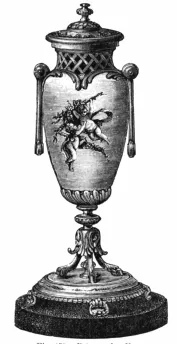 Fig. 279.—Pate-tendre Vase.
{325}
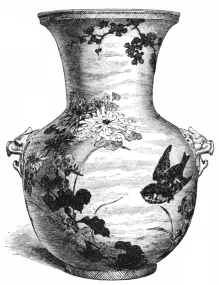 Fig. 280.—Deck Vase. (G. Collamore.)
An excellent domestic ware, also made at Limoges, is largely imported by
the manufacturers, Charles Field Haviland & Co., of New York. The
greater portion of it is undecorated; but lately the makers have been
turning their attention to decoration, and artistic work of considerable
merit now comes from their establishment.
 Fig. 281.—Deck Plaque. (G. Collamore.)
Before leaving France, the names of Deck, Solon, and Regnault may be
allowed to stay our progress. The Messrs. Deck, of Paris, have, as we
have seen, made a special study of color, and were the first, or among
the first, to revive Oriental decoration. Their Persian ware, or
imitation of the old art of Persia, is characterized by much of the
beauty of the original. Their blue, as we have seen, is especially
commendable, and enabled them to compete with the enterprising imitators
of England, the Mintons, who have for several years been in possession
of a blue very little inferior to the turquoise. It is to be regretted
that Deck was not represented at the Centennial Exhibition, where, by
the richness of his palette, he would have had an opportunity of
extending his reputation in America.
M. Regnault, who succeeded M. Ebelman in the directorate of{326} Sèvres, was
the inventor, while at the Sèvres manufactory, of pate changeante. The
ware appears, during the day, like gray céladon, and at night, under
artificial light, changes to a beautiful pink, whence its name.
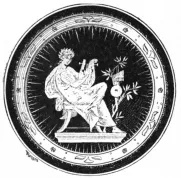 Fig. 282.—Minton Porcelain. Pate-sur-pate, by Solon.
(Wales Coll., Boston Museum of Fine Arts.)
The name of M. Solon recalls at once the peculiar style of decoration
called “Pate-sur-pate,” or paste upon paste. The process has been long
known in China, and was first attempted in Europe by M. Ebelman at
Sèvres about thirty years ago. The experiments were successful, and some
very fine works were issued. The process was taken to England from
Sèvres by M. Solon, who was engaged a few years ago by the Messrs.
Minton (Fig. 282). In Mr. A. B. Daniells’s collection at the Centennial
Exhibition, some examples of pate-sur-pate by M. Solon attracted
general attention. There were two pairs of vases of a pure Greek shape,
with a body of a rich bronze or chocolate color. On this, in white
relief, were figures symbolizing Fire and Water, and a group of the
Graces accompanied by Cupid in a race. The forms were exquisitely drawn,
and were half revealed by the semi-transparent drapery. More usual
grounds are a dark green and a grayish tint, either of which has a soft
effect. A second specimen is given at Fig. 352.
This method of treatment consists in applying to the surface to be
decorated white liquid porcelain as a pigment. The application is
repeated until the necessary relief is obtained, when the figures are
finished by carving or scraping. Repeated firings are necessary before
glazing, and the decoration, which is opaque while wet, becomes more or
less transparent, according to the thickness of the pigment. The process
is one of the nicest and most difficult in the entire range of ceramic
art, as a mistake once made cannot be remedied, and the glaze has a
tendency to destroy the fine outlines of the figures.{327}
Early Pottery.—Lake Dwellers.—Early German.—Peculiar
Shapes.—How Peasants Account for Relics.—Roman Epoch.—Tin
Enamel.—Leipsic.—Breslau.—Nuremberg.—The
Hirschvogels.—Villengen.—Höchst.—Marburg.—Bavaria.—Switzerland.—Belgium.—Delft.
THE early pottery of Germany and Central Europe dates from the Stone Age
down to the Roman incursion, when the types change, and the evidences of
more perfect mechanical appliances become apparent. The Lake Dwellers,
who built their huts on piles in the lakes of Switzerland, have
commemorated themselves by hand-wrought vessels, to the embellishment of
which a decoration of the rudest kind was brought. Remains have been
found throughout Germany, of which some are hand-made, while others are
evidently thrown upon the wheel. These are both pre-Roman and
contemporaneous with the Roman occupation. The paste varies from a
friable clay to a hard, ringing stone-ware. Vases of a great variety of
shape have been found along with cups, plates, saucers, and jars. Some
of the vases are divided, like boxes, into compartments. The ornaments
are paintings, mouldings, and incised lines. The painting consists of
parallel lines of red, yellow, and black. Some of the smaller pieces
were apparently used as toys. Others, of a sepulchral character, are
thought to resemble the huts of the lacustrine dwellers. One found at
Achersleben has a tall, conical cover, like a high-thatched roof, and
the orifice in front is covered with a plate having a ring in the
centre, through which a pin being passed fastened it on the outside. The
orifice was in this way closed after the ashes of the dead had been
introduced (Fig. 283). These and similar remains have been found in
various parts of Germany, and have given rise to many superstitious
stories among the peasantry. By some they are said to be the natural{328}
produce of the soil. Others ascribe them to the all-powerful fairies.
Others consider them possessed of wonderful preservative properties. As
to the art they represent, we are convinced here, as we are in a
parallel manner, though more forcibly amidst the remains belonging to
ancient Gaul, that the Romans were not the first to inspire the Teutonic
population with a desire for the expression of artistic ideas. We find
both an awakening sensitiveness to the graces of form, and a growing
appreciation of the possible beauty of surface decoration.
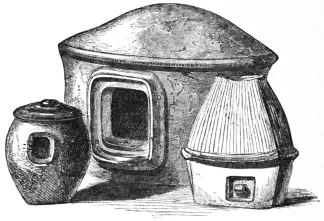
Fig. 283.—Ancient German Hut-shaped Vases.
With the Romans we find pottery both made on the spots where they
settled and imported from the seats of the ceramic industry in Italy.
These display the usual Roman characteristics, and need not be here
considered. Crossing the Dark Ages, we find, in the thirteenth century,
Germany in possession of processes for the presence of which—so far
removed from their accepted centres and from the regular routes by which
they travelled—it might be hard to account if it were absolutely
necessary to travel by the regular route. We have seen this already in
the case of early France. We see it again in Germany. Possibly the
Romans may have taught their barbarian subjects something about glazing.
Possibly some wanderer to Palestine and the East or to the Saracenic
settlements in the South of Europe, or some stranger from these “foreign
parts,” may have initiated the German potters in the higher secrets of
the art.{329}
In any event, Germany was making enamelled faience at least two
centuries before Luca della Robbia had perfected his process in Italy. A
potter of Schelestadt, in Alsace, is said by the Germans to have
discovered tin enamel. Even his name is now forgotten, although his
death is said to have occurred in 1283. At Leipsic is a glazed frieze,
dated 1207, and at Breslau, in 1230, architectural reliefs of great
excellence were produced. Two hundred years later, in 1441, Veit
Hirschvogel was using stanniferous enamel. At Strehla, in 1565, the
potters were so well skilled in the working of terra-cotta, that they
had made a pulpit of that material. One is almost led by these facts to
question if Germany did not lead both Italy and France, and to regret
that the history of German ceramics has not been more fully opened up to
us. One danger let us guard against, for the sake of securing the
intelligent understanding of Germany, incompatible with either
partiality or prejudice. We need not confound conservative tastes with a
“very slow march of ideas.” One rather loves to find an artist so
impressed with what is good in his own art, that he is in no haste to
leave it in order to catch the first whiff of foreign inspiration. Ideas
evidently circulated at a tolerably high rate of speed in a country
where the enamelled friezes and monumental bas-reliefs of Leipsic and
Breslau existed in the beginning of the thirteenth century.
To Leipsic, therefore, Germany is indebted for its first enamelled ware.
The friezes above mentioned consisted of tiles with alto-relievo heads
of Christ and the Apostles. The enamel is dark green. What occurs to us
at once is that no art ever began with such works, and that in them we
have the successful results of long experiment.
Breslau is made famous by a large work of the same century, representing
Henry IV. of Silesia, who died in 1290. The monarch lies stretched upon
a tomb surrounded by twenty-one bas-reliefs.
The Hirschvogels of Nuremberg have thrown a lustre upon their birthplace
by their faience decorated with enamelled reliefs. The founder of the
family, Veit Hirschvogel, was born in 1441, and died in 1525; and one of
his sons, Augustine, has left some very artistic works in the prevailing
style of ornamentation, with medallions and decorations in relief. One
vase has green dragon handles (Fig. 284); and the fact that this style
existed in Nuremberg at the time when Palissy was travelling in Germany,
has led to the supposition that he{330} may have acquired the rudiments of
his art under Hirschvogel. The same city was deservedly celebrated for
its tiles ornamented with bas-reliefs, generally of the deep green
distinctive of the greater proportion of German pottery. The style was
at a later period carried to a greater extent, as we find upon different
vessels several animal forms in high relief, and even the vessels
themselves modelled after the animals of the country.
At Villingen, in the Black Forest, Hans Kraut, who died in 1590, carried
the same branch of art to great perfection, his tiles and bas-reliefs
marking him as a successful and talented disciple of the school of
Nuremberg.
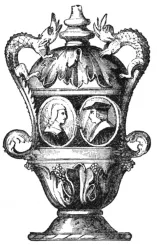 Fig. 284.—German Enamelled “Surprise” Vase. By
Hirschvogel.
Höchst and Marburg were both important seats of the industry, and at the
former we find a vase having its neck ornamented with white reliefs,
like the cameos of Wedgwood. During the seventeenth and eighteenth
centuries the industry was established in many places throughout
Germany, and styles of western and southern origin make their
appearance. The faience of Anspach, Bavaria, follows the style of Rouen,
and at Nuremberg, in the eighteenth century, the early Faentine style is
making itself felt. The Bavarian towns of Göggingen and Baireuth both
produced pieces of great beauty and refinement. On some from the former
appear bouquets, birds, and arabesques, and one from the latter is
ornamented—with what delicacy of effect may be imagined—with a figure
and medallion surrounded by blue arabesques laid upon the white enamel.
Before the middle of the eighteenth century Nuremberg had instituted its
modern style, blue arabesque borders on a bluish glaze surrounding
centre-pieces of fruit, etc.
SWITZERLAND.
In Switzerland we know Zürich, Schaffhausen, Winterthur, and one or two
other places. Of these, Winterthur is probably the more{331} ancient, pieces
occurring dated 1678 and 1689. The styles are akin to the
Italian—deep-bordered dishes with regularly arranged groups of fruit or
flowers, or blue arabesques running round the margin. Escutcheons or
fortified castles form the centre decoration. Precision and stiff,
scrupulous care characterize the drawing.
BELGIUM.
Belgium, in at least two of the seats of its ceramic wares, has been
closely allied with France. From Antwerp, the great centre of Belgian
art, issued majolica of Italian styles in blue and yellow, violet and
green, and another quality after the Oriental porcelain patterns. Toward
the middle of the seventeenth century, if not earlier, Antwerp was in
close relations with France. Tournay was of French origin in so far as
its faience is concerned, and it was not until its workshop passed into
the hands of Peterynck, of Lille, that it rose to eminence. The pieces
attributed to it show a compound of Rouennais, Flemish, and Chinese
decoration. Brussels had carried the art in 1761 to such a height, that
its faience was said to be preferable to that of Delft and Rouen, with
which it is possible it may sometimes be confounded by collectors. At
Tervueren, near the capital, some pieces still in existence were made
which are decorated with wreaths and bouquets and armorial bearings
executed in colors of moderate purity.
HOLLAND.
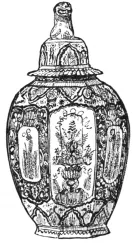 Fig. 285.—Delft Blue-and-white. Eighteenth Century.
Chinese Style. Height, 17½ in. (Mrs. John V. L. Pruyn Coll.)
For our present purpose, all Holland may be said to be comprised in the
single town of Delft. Its works date from 1310, and may be divided into
two eras, that preceding the making of “porcelain,” and that during and
after the fabrication miscalled by that name. The Delft faience is thin
and hard, and was decorated with landscapes and scenes by the best
painters of the time. It was made into{332} tiles, large plaques, baskets,
vases, statuettes, and many other forms. Toward the end of the sixteenth
and beginning of the seventeenth centuries, when the Dutch were laying
the foundation of their trade with Japan, the fine quality of faience,
which has never been equalled by any other country, began to be
produced. We find this imitation of Oriental porcelain officially
recognized in 1614, and for a hundred and fifty years it was currently
referred to as porcelain. In reality it was a fine faience, modelled and
decorated after the peculiar forms and patterns with which their trade
with Japan had made the Dutch almost exclusively familiar. The paste,
which consisted chiefly of the clay of Bruyelle, near Tournay, was
skilfully mixed with sand and carefully manipulated. The sand made it
hard, and gave it a capacity for being wrought into thin pieces suitable
for table services. The bluish enamel was perfectly smooth and even; and
the decoration, chiefly in blue and iron-red, after the Oriental
designs, imparted to it much of the appearance of Japanese porcelain.
 Fig. 286.—Delft Blue-and-white. Eighteenth Century.
Size, 21 in. by 18 in. (Mrs. John V. L. Pruyn Coll.)
It is not to be wondered at that, as the processes were perfected, the
reputation of Delft increased, and its commerce grew in proportion, and
that no symptoms of decay manifest themselves until toward the end of
the seventeenth century. The genius of both potters and painters ran
riot among curious forms and decorations. One author mentions dinner
services with dish covers resembling in form and{333} color the birds to be
served in them; a spice cupboard resembling a Chinese Mandarin, and
other curiosities. Another strange form was that of a violin, one of
which is painted in blue camaïeu, with figures engaged in a dance, and
musicians.
Countess Jacqueline.—Teylingen.—Graybeards.—Fine
Stone-ware.—Grès de Flandre.—Creussen.
This ware, distinguished, as we have seen, by its vitrified fracture,
although long known in the East, does not appear in Europe until between
the thirteenth and fifteenth centuries. When it was first made in France
has not been ascertained with sufficient exactness, and to Germany the
credit of instituting the fabrication has generally been accorded. We
find it throughout the provinces on the Rhine at a very early period,
and it probably passed down the Rhine to Holland and thence to England.
The name of the beautiful and unfortunate Jacqueline of Bavaria,
Countess of Hainault and Holland, is connected with the making of
stone-ware by a very curious tradition. Jacqueline was the daughter of
William IV., Count of Hainault and Holland, at whose request she married
John, Duke of Brabant. This was the beginning of her troubles. A jealous
and disappointed suitor, John of Bavaria, Bishop of Liege, marched
against Holland, and having compelled the countess to nominate him as
her successor, bribed her husband to transfer to him the management of
her estates for a term of years. The countess, having good reason to be
disgusted with men in general, and with her husband and quondam suitor
in particular, fled to England after appealing in vain to Rome for a
divorce. In England her beauty captivated the Duke of Gloucester, who
espoused her cause as a preliminary to espousing herself. The duke
marched against her husband of Brabant, who, assisted by his cousin of
Burgundy, defeated the invader. Gloucester deserted Jacqueline, fled to
England, and took a less involved bride. The countess in the mean time
was imprisoned; but she escaped, and on the death, in 1425, of the
prelate of Liege, resumed her rightful position. Then she was relieved
by death of her husband,{334} and was again involved in war by the Duke of
Burgundy, whom she was forced to declare her heir. A second marriage
into which she entered so enraged Philip—who, by-the-way, is known in
history as, par excellence, “The Good”—that he arrested her husband,
and would have executed him, had not Jacqueline handed over her coveted
property to “The Good,” and in 1433 retired to the privacy of the Castle
of Teylingen. Three years afterward she died, at the age of thirty-six.
 Fig. 287.—Graybeard. Brown German Stone-ware.
 Fig. 288.—German Graybeard, found in England.
From what we can make out, the countess was twice an occupant of
Teylingen, once in 1424, on escaping from imprisonment at Ghent, and the
second time, as above mentioned, in 1433. On both these occasions she
appears to have occupied herself with the superintendence of the
stone-ware works, and even with fashioning the vessels with her own
dainty hands. After they were made, we are told—although it is
altogether incredible—that the flagons were thrown into the Rhine,
either as mementos of her imprisonment, or “that they might in
after-ages be deemed works of antiquity.” Providing for posterity in
that peculiar manner does not commend itself to one’s reason, as in any
way in keeping with the career of the Countess Jacqueline. There was a
custom in Paris for patriotic citizens to assemble in the gardens
adjoining the Seine, and there to relieve themselves by toasting and
singing and flinging the empty flasks into{335} the river. These have been
found, with the legend “Vive le Roi!” inscribed on them, after the
fashion of the Moyenage potters. The Germans had a similar manner of
keeping the toast from future impurity by throwing away the vessels in
which it was drunk. Probably in this way the “Vrouw Jacoba’s Kannetjes”
found their way into the Rhine and the moat of Teylingen. It is easy to
imagine the potters toasting their lovely co-worker and superintendent,
and, in the excess of their admiration and loyalty, tossing away the
flagons, that they might never be drained to a less worthy toast. The
story is attractive enough, and it is almost a pity that the pots which
have been found are not of a high artistic rank. None of them is
ornamented.
Fig. 289.—Fine German Stone-ware.
Fig. 290.—Fine German Stone-ware.
To the “common stone-ware” belong the pots called Graybeards (Fig. 287),
from the bearded heads moulded on the necks. Many of these, though well
formed, are rudely ornamented, and are of a very coarse composition
(Fig. 288). The finer ware, which was made after the beginning of the
sixteenth century, is divisible into two classes, the older belonging
exclusively to the sixteenth century, and of a gray{336} white or pale
yellow, the other of a bluish and gray tint, made down to the present
time. This is the ware commonly called Grès de Flandre, although, so
far as we know, Flanders never produced any, and the ware so designated
is a purely German fabrication. The canettes, or tall cups, of a nearly
cylindrical shape, sloping slightly inward toward the top, and belonging
to the first class of yellowish white stone-ware, are of very elegant
form, and are beautifully ornamented with reliefs, made from moulds of
wood and admirably executed. The subjects are sometimes scriptural,
sometimes heraldic.
To the second class of blue and gray stone-ware with salt glaze belong
some of the best specimens of the art (Figs. 289 and 290). They date
from 1500 to 1620, after which came the decline. The Bavarian town of
Creussen made a peculiar stone-ware ornamented with colored reliefs. Of
this we have samples in the “Apostle” mugs, so called from the reliefs
surrounding them, and in a series of jugs with hunting scenes. These
belong to the seventeenth century.
The Böttcher stone-ware will be noticed under porcelain, to the
invention of which in Germany it was the first step.
Böttcher.—His First Productions.—Meissen
Porcelain.—Decoration.—Best Days of Meissen.—Its
Decline.—Vienna.—Höchst.—Fürstenburg.—Höxter.—Frankenthal.—Nymphenburg.—Berlin.—Holland.—Weesp.—Loosdrecht.—The
Hague.—Switzerland.—Zürich.—Nyon.
It will always be the distinguishing honor of Germany that the Saxon
Böttger, or Böttcher, was the discoverer, for Europe, of a true kaolinic
natural porcelain. The circumstances have already been detailed (see p.
52). While Böttcher was prosecuting his experiments in 1708, he had the
furnace filled with trial pieces, which were fired for several days
before a piece was withdrawn. A teapot was at length taken out and
thrown into cold water. It was not porcelain, however, but a red
stone-ware, very hard, and with a metallic ring when struck. It was
called “red porcelain,” probably to suit the wishes of the experimenter
and of his royal patron. A teapot of this ware has been sold in England
for sixteen pounds sterling. A very good example of it is now in the
possession of Mr. Davis Collamore,{337} of New York (Fig. 291), who was
fortunate enough to pick it up in one of his European tours in quest of
rare “bits.” It is undecorated, and shows admirably the rusty red color
of Böttcher’s experimental stone-ware. Others of his early essays are
almost black in color and are painted in relief. Several pieces are in
the Metropolitan Museum.
 Fig. 291.—Böttcher Stone-ware. (D. Collamore.)
 Fig. 292.—Meissen Porcelain. Blue Festoon, Pink Rosette.
1709-1726. (F. Robinson Coll.)
Whenever the kaolin of Aue was discovered, Böttcher, on his first
attempt, succeeded in making natural porcelain. Though Meissen, where a
workshop was erected without delay after the discovery, was kept like a
prison or fortress, and every precaution observed to insure secrecy,
although every man connected with the works was under oath to keep
silence in regard to anything he might see or discover, the precautions
were all in vain. The knowledge oozed out, and in a very few years
Meissen had several rivals. White ware was made down to 1718. The Nankin
blue was the first colored ware imitated, and after 1718 other colors
were introduced. Böttcher died in 1719, and was succeeded in the
directorate by Horoldt (Fig. 293), who carried out several great
improvements, and mingled the previous exclusively Oriental designs with
some of a more purely European character. Heavy gilt borders surrounded
figures, flowers, or the royal arms. In 1731, while the king himself was
director, Kandler,{338} a sculptor, introduced, as an ornamentation for
vases, flower wreaths in relief, and afterward attempted figures with
great success. From 1725 to 1745 Lindenir, or Linderer, was painting the
beautiful insects and birds which were his specialty. Then came, also
during Kandler’s time, the exquisite paintings by European artists which
brought the Chinese style effectually to a close. The brightest days of
Meissen’s history were those from 1731 to 1756, before Frederick the
Great robbed it, for the enrichment of Berlin, of men, moulds, models,
and clay. Peace came too late to restore Meissen to its pre-eminence, as
it now had rivals both at home and abroad in France and England.
 Fig. 293.—Dresden Porcelain.
 Fig. 294.—Old Dresden Porcelain. (L. Double Coll.)
The successive directors after Horoldt were the king, Augustus II., from
1731 to 1733; Count Brühl from 1733; the count’s widow from 1763; the
king, Augustus III., from 1778; Count Marcolini from 1796 to 1814;
Bengrath Oppal from 1814 to 1833. The factory was, for the second time,
plundered in 1759, and although it subsequently attained to a high
position, it never reached its former prosperity. A marked change in
style is noticeable during the last quarter of the eighteenth century.
The forms and ornaments both assume more of a classical character. This
style, borrowed most likely from France, was adopted by Marcolini, and
entirely superseded its predecessors. The manufacture was now in its
decline. Meissen had lost its prestige, and gradually sank in
importance. From about fifty years ago the decoration became coarse and
the works no longer paid expenses, and at the present time Dresden ware
is a decidedly inferior fabrication. According to Jacquemart, the
manufactory is busy counterfeiting its own old productions and its old
marks. In comparing Dresden with its former self, its present position
relative to other factories must not be lost sight of. It still gives{339}
to commerce many works which are valuable either for their historical
associations or for their intrinsic merit. The candelabrum here given
(Fig. 297) represents a style of work once very much in vogue at
Dresden. It was Kandler who, while superintending the modelling
department under Augustus II., between 1731 and 1733, introduced the
beautifully fashioned flowers in relief, of which some idea may be
formed from our specimen. Another, and a very curious work, is still
reproduced, and specimens can occasionally be picked up in this country.
Reference is made to the figures “Count Brühl’s Tailor” and “his Wife.”
The originals of these pieces were made by Kandler in 1760, under the
count’s directorate. With all his profligacy, Count Brühl was a good
deal of a wit, and having been repeatedly requested by his tailor to
accord him permission to look through the manufactory, at length
consented. The tailor presented himself at the works in due time, and
was there, to give him an appetite for farther exploration, presented
with the two figures referred to. In one he saw himself astride of a
he-goat, brandishing his professional shears and carrying the other
appurtenances of his business on his back, while the goat carries his
“goose” in its mouth. The other figure was that of his wife, with a baby
in her arms, sitting upon a she-goat. The discomfited tailor saw no more
of the porcelain manufactory. The many elegant forms and styles of
Dresden are too numerous to be detailed. They embrace vases,
candlesticks,{340} snuff-boxes, butterflies, flowers, clock-cases, and
animal figures. The miniature paintings on some of the smaller pieces
are exquisitely finished and wonderfully tinted.
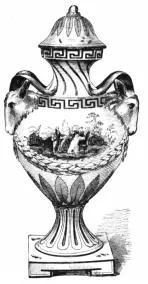 Fig. 295.—Early Meissen. (A. Belmont Coll.)
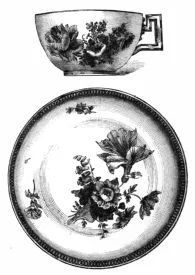 Fig. 296.—Dresden Cup and Saucer. Marcolini Period,
1796. (J. C. Runkle Coll.)
The annals of the last century contain many curious stories of runaway
workmen selling their secrets, and of the steps taken to keep down
opposition and to acquire a knowledge of the manufacture by any means
that offered. A runaway from Meissen led to the establishment at Vienna
of a factory in 1720. After twenty years it rose to considerable
eminence, although in both paste and glaze it is inferior to Dresden.
Its raised gold decorations have brought it in modern times a certain
celebrity. It came to an end during the directorate of Alexander Lowe,
who was appointed in 1856. Some excellent specimens are in the
collections of Mr. Walters, of Baltimore, and Mr. Gibson, of
Philadelphia. From Vienna the secret spread to Höchst, whither it was
conveyed by a workman named Ringler. Ringler was in the habit of
carrying with him written notes regarding the manufacture. His
fellow-workmen at Höchst made him drunk, copied his notes, and offered
the secret thus obtained for sale at other centres. One of these
runaways founded the workshop of Fürstenburg. A few of the Fürstenburg
workmen attempted to establish a manufactory at Neuhaus, but, on
discovery, were sent out of Brunswick. Another Fürstenburger,{341} a flower
painter, tried to start the industry at Höxter, whither he had fled, but
failed, and was followed in the endeavor by one of the defrauders of
poor Ringler. This man’s name was Becker, and he succeeded in Höxter,
after fruitlessly hawking his secret through Belgium, Holland, and
France. He was bought up by the offer of a pension, and his competition
was thus brought to an end. When Ringler awoke to a full realization of
the consequences of his folly at Höchst, he went to Frankenthal,
Bavaria, where the factory founded by Hannong, of Strasburg, made
porcelain in 1755. This existed down to 1800. In the mean time, however,
Ringler had left, as we find him first at Neudeck-Nymphenburg, in
Bavaria, and then, in 1758, founding a factory at Ludwigsburg,
Würtemberg, which was worked until 1821. The porcelain made here was of
excellent quality, and the figure pieces were admirably modelled. After
this we hear no more of Ringler. In this way the industry spread over
the whole of Central Europe—to Anspach, Baireuth, Baden, to
Hesse-Cassel, Darmstadt, and Thuringia, each new workshop becoming the
centre for a number of offshoots.
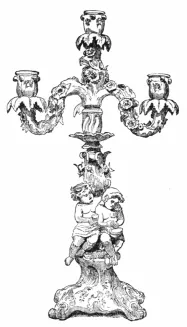 Fig. 297.—Recent Dresden Porcelain Candelabrum. (D.
Collamore.)
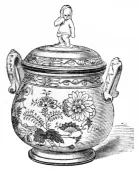 Fig. 298.—Berlin Porcelain. (D. Collamore.)
Berlin obtained a knowledge of porcelain by the purchase of one of the
copies of the indiscreet Ringler’s notes, and the industry was founded
in 1750. Let us bear in mind how Frederick carried off workmen, artists,
tools, and material from Meissen, and it is not difficult to understand
the rise of Berlin. The works were taken by the Crown in 1763,{342} and were
very soon yielding a handsome income. Berlin has been compared with
Dresden in its best days, and its works are certainly of a high order.
The Berlin rose-color is peculiar to the royal factory. At the
Centennial Exhibition the Königlich Preussische Porzellan-manufactur of
Berlin was almost the sole representative of the porcelain industry of
Germany. The majority of the pieces were of an ornamental character,
large vases and plaques. A mere list of them will show in what the
workmen are now busying themselves. There were a Victoria vase with a
picture of Aurora, after Guido Reni; Germania vase with pictures of
Germania cultivating the arts and sciences, and Prussia the shield and
protectress of the empire, after Von Heyden; Crater vase with “Triumphal
Procession of King Wine,” after Schrödter; Crater vase with picture of
Helios, after Schinkel; vases in Neogrec style with paintings after
Bendemann; Victoria vase with “Music,” after Klöber; Urbino vases,
amphora vases, and several sets in the Persian, Chinese, and Japanese
styles. All these pieces were of large size, the largest about six feet
in height. Besides these there were candelabra, pictures on china
enamel, table services, busts, and some beautiful specimens in biscuit.
The collection probably represented very fairly the extent of the art
practised at Berlin, and the best work of the Germany of to-day. In
every case there were to be found great richness and admirable handling
of colors, but it requires time to become accustomed to the German
styles of drawing. Many of the figures painted on the surface, even
those showing the utmost delicacy of tint, were hardly entitled to be
described as graceful. Others were absolutely clumsy.
 Fig. 299.—Berlin Porcelain Vase. (A. Belmont Coll.)
{343}
The vase from Mr. August Belmont’s collection (Fig. 299) is in both form
and color a good example of the art workmanship of Berlin. The ground
color is a soft and beautiful shade of green; and the handles, base,
neck, and frame of the medallion are in gold. The portrait in the latter
is that of the Queen of Prussia, the mother of William, the present
Emperor of Germany, and is said to be a very correct likeness.
HOLLAND.
The first natural porcelain factory in Holland was founded in 1764, at
Weesp, near the capital. It was closed in 1771. In the following year
the business was recommenced at Loosdrecht, near Utrecht, and was
carried on there, and after 1782 at Amstel, with moderate success until
the beginning of the present century. Several other establishments,
notably one in 1778 at the Hague, rose, and in a few years fell. The
entire history of porcelain in the country may be comprised in
twenty-five years, from 1760 to 1785.
In Belgium there was, in 1791, a factory of natural paste at Brussels.
SWITZERLAND.
Switzerland owed its first workshop at Zürich to one of Ringler’s
workmen from Höchst. It was carried on for five years, until 1768, and
the productions are after the German style. Imitations of the French
style of Sèvres came for a time from Nyon, where a Frenchman established
a workshop.{344}
Scandinavian Pottery allied to Teutonic.—Hand-shaped
Vessels.—Primitive Kiln.—The Eighteenth Century.—St. Petersburg:
Its Porcelain.—Moscow.—Rorstrand.—Marieberg.—Modern Swedish
Faience.—Denmark.—Kiel.—Copenhagen.—Imitations of
Greek.—Copenhagen Porcelain.
THE prehistoric pottery of the Scandinavians is, in its general
character, allied to the Teutonic. It is curious to find Brongniart
describing methods of shaping vessels by hand and burning them in a
hole, with hay for fuel, as being still practised in Scandinavia, which
it is quite probable have been transmitted from generation to generation
for untold centuries. A dark-gray, calcareous, coarse paste and
herring-bone decoration are met with in the vessels of the Stone Age.
Others apparently of the same age were thrown on the wheel. The
hut-shaped urn also occurs, and rare specimens are surmounted by a
cover.
 Fig. 300.—Russian Faience. (D. Collamore.)
From these ancient times we may descend at once to the eighteenth
century. In 1700 Peter the Great established some Delft potters at St.
Petersburg, and a private workshop is mentioned as existing at Revel,
but little is known of either. Peter the Great was also desirous of
founding the porcelain industry within his dominions, but does not
appear to have made any farther progress than bringing together a
collection of Chinese porcelain with Russian decoration. In 1756
Elizabeth established a workshop near the capital, and some years later
it was enlarged by Catherine II. About sixty years ago a{345} number of
Sèvres artists were imported, and from that time down to the present a
very superior natural porcelain has been made. In 1756 an establishment,
also for making natural porcelain, was founded near Moscow. The royal
works made no contribution to the Centennial Exhibition, but some
porcelain was exhibited of fine translucent paste and most extravagant
price. Single cups and saucers, of fine body, but not characterized
either by remarkable elegance of shape or beauty of decoration, were
offered for $20. Some small plaques of majolica were also exhibited, of
careful workmanship and tasteful ornamentation. The St. Petersburg
porcelain made at the royal works is so high in price that it is said to
be bought only for the Court. The Russian faience (Fig. 300) of the
present time is decorated in styles altogether peculiar. It illustrates
the ardent desire manifested for some years past throughout Russia to
rear a distinctively Muscovite school of art. Natural porcelain has been
made at Korzec, in Poland, since 1723.
 Fig. 301.—Swedish Faience Stove. (Wm. Astor Coll.)
The first Swedish faience factory was established{346} at Rorstrand in 1727,
and is still running; and in 1750 a second enterprise was set on foot at
Marieberg, also in the neighborhood of Stockholm. The earlier Rorstrand
wares resemble those of Delft. The decorations are in some cases
delicate and well designed. More lately Sweden has produced a great
variety of very beautiful faience. At the Centennial Exhibition we had
an opportunity of making acquaintance with the Stockholm potters through
works not less surprising than artistic. The imitations of Palissy’s
Rustiques figulines may be passed over. The most interesting pieces
were of what was called “black northern faience,” the paste of which is
a skilfully manipulated fine dark-brown clay. Many of the tea-sets and
vases might easily have been mistaken for porcelain. A peculiar and very
effective ornamentation consisted of blue, gilt, red, and white floral
designs, the white enamel having a charming pearly appearance, and the
blue studs resembling turquoises. One of the best specimens of this
faience was a fireplace (Fig. 301) elaborately decorated with pale-blue
and green, of delicate shades mingled with gilt. In both design and
color this work was of itself sufficient to establish the character of
Swedish ceramic art. It was accompanied by a pair of gigantic candelabra
(Fig. 302) of a similar style. A quaintly formed vase was surrounded by
medallions illustrative of the life of the old Vikings, from the time
when the boy played with his father’s sword to that when the war-worn
hero was laid in his grave. The design was excellent in conception and
execution.
 Fig. 302.—Swedish Faience Candelabrum. (Wm. Astor
Coll.)
It is not improbable that the Swedish works may be involved in some such
confusion as that which surrounded the early wares of Delft. Thus we
find, in 1729, Rorstrand invested with the monopoly of making porcelain
of delft, i. e., faience. In 1735 the privilege included{347} fayence
fine et pate dure, and in 1759 Dr. Ehrenrich was privileged to make
porcelain and faience at Marieberg. Some of the Marieberg wares are in
excellent taste, showing exquisitely modelled flowers and fruit in
relief. It is singular that when, in 1780, the stock at Marieberg was
sold off, some of it was disposed of in London under the name of delft.
The works at Rorstrand closed in 1788. A kind of faience having a
resemblance to the Swedish is manufactured near Christiania, in Norway
(Fig. 303). It is made into table services, and the decoration partakes
largely of the classical character so widely prevalent in the North.
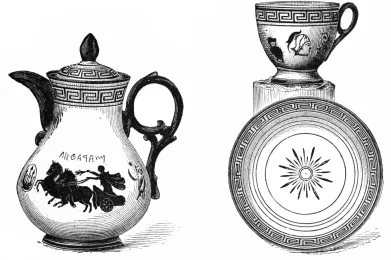
Fig. 303.—Norwegian Faience, Schwarzenhorn. (W. B.
Dickerman Coll.)
Denmark was first known by the productions of Kiel, of which the thin
paste is carefully prepared, and the paintings are highly commendable.
The Greek imitations by Madame Ipsen, of Copenhagen, have been an
agreeable surprise to Americans. Greek vases are imitated at this
establishment with equal fidelity and beauty. The world appears never to
tire of these forms, and the amateurs of America are to-day busily
engaged in attempting to follow the potters of Denmark, England, Brazil,
and we know not of what other countries. The widow Ipsen’s works are
certainly well executed; and standing among them at the Centennial
Exhibition, it was hard to realize that{348} one was under the flag of
Denmark. There were many there which we might have addressed, with
Keats:
“What leaf-fringed legend haunts about your shape
Of deities or mortals, or of both,
In Tempe or the vales of Arcady?
What men or gods are these?”
Both form and ornamentation were as purely Greek as those of any pottery
unearthed by the antiquary. The biga, quadriga, scenes from the Iliad
and mythology, appear just as they do on the works of the master potters
of antiquity.
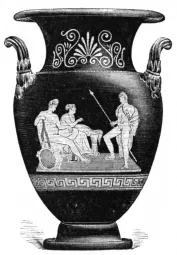 Fig. 304.—Ipsen Terra-cotta. (Ovington Bros. Coll.)
What has been said of the Ipsen factory might be applied with equal
truth to the terra-cotta works of Wendrich & Sons, also of Copenhagen.
Greek vessels of every description, and illustrating both ancient Greek
and modern Danish styles of decoration, bear their name, and can be
fully studied in such a collection as that of Mr. T. Schmidt, at the
Danish Consulate, New York. The Danish imitators, in rivalling each
other, have left most, if not all, of their competitors far behind, and
the fact leads us to consider at greater length the circumstances which
led a people apparently so distantly removed from the Greeks in genius,
to follow them in this particular branch of art.
First among these was the weighty influence everywhere felt of the
greatest of Danish artists, the sculptor Thorvaldsen. In him we have an
instance of a single man turning, in a measure, the current of thought
of an entire people. The titles of his works show the subjects which
touch his artistic sympathy. Instead of the Scandinavian Odin, Thor,
Baldur, Sigurd, Freia, Brunhild, or Gudrun, we have Apollo, Mercury,
Venus, Hebe, Ganymede, and the heroes of the Iliad. Thorvaldsen was
fascinated by the classic art of Greece, and it obliterated{349} from his
memory the mythology and legends of the North. While he gave us Hebe, it
was reserved for his pupil and successor, Bissen, to give us the more
truly national Valkyrie.
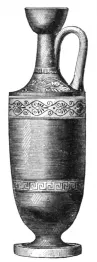 Fig. 305.—Ipsen Terra-cotta Lekythos. (Ovington Bros.
Coll.)
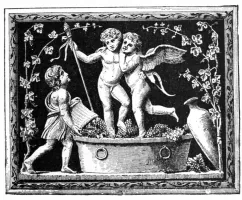 Fig. 306.—Danish Terra-cotta. (Ovington Bros. Coll.)
A second reason may have been the possession of a fine pale-buff clay
admirably adapted for imitating the antiques of Greece. “In texture,”
says Boutell, “it is so fine that it is capable of producing bas-relief
medallions not larger than cameo gems, in which the figures have the
sharpness of the gems themselves, with a surface of exquisite and
silk-like softness.” On the one hand was the material, on the other the
Thorvaldsen museum presenting “the noblest models for using it with the
happiest effect.” The way to antiquity having thus been opened up, the
Danish potters widened the range of their art, and found in Etruria and
Egypt abundant models for imitation. Our classification must be of the
most general character. Forms are reproduced with the most perfect
fidelity, and the natural color of the buff clay changes through tints
of warm brown and red to black, according to the original. The
ornamentation is exceedingly varied. On some of the vases are subjects,
taken from the pottery of Greece, painted in red upon a black ground, or
in black upon buff, as we find them in Greece. These comprise the first
class, and are in the strictest sense reproductions of the antique. In
others, while the accessory decoration is Greek, the subjects are taken
from the sculptures or bas-reliefs of Thorvaldsen or Flaxman. The
“Triumph of Neptune” of the latter, and the many works of the former,
being purely classical{350} in conception and feeling, are in perfect
harmony with the motive animating the artists of Denmark. There is a
third class, in which the leading designs are essentially modern, and no
strict rule is followed in accessory decoration. Thus, an amphora after
the Greek, in form and accessories, has a central design taken from
Thorvaldsen’s bas-relief “Autumn.” Egyptian amphoræ and other
black-glazed vases are painted with naturally tinted bouquets of
flowers, and thus in form and ground-color alone suggest the antique. At
times the several styles are mingled. The colors most extensively used
are red of several shades, gold, blue, white, buff, and black.
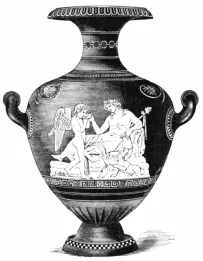 Fig. 307—Wendrich Terra-cotta. (T. Schmidt Coll.)
Leaving the southern antique, the Danish potters have also reproduced
the prehistoric vessels of their native land in several simple and
elegant forms. The originals were found in the tombs of the ancient
Danes, and supply their descendants with an opportunity of perpetuating
an art essentially Norse. The national side of Danish art is also seen
in many of the terra-cotta statuettes and medallions. We pass over the
copies of Thorvaldsen’s classical sculptures in order to reach the
comical figures, full of humor, character, and feeling, of the elfish
Nisser of the old Norsemen. The statuettes of these elves, and many
quaint little figures of peasants, fishermen, and the like, are very
attractive, both intrinsically and as reflections of Danish old-time
superstition and Danish life. One of the Nisser appears upon the top of
a flower-stand, and we meet with them again in the paintings upon
porcelain.
A warm, satisfying quietude and an elevation of tone pervade these works
in terra-cotta, which, added to their artistic merits, commend them to
the student of household decoration, and insure a welcome from all who
can appreciate their mingled softness and chaste dignity.{351}
Taking Danish porcelain as a whole, it is both of good quality and
tastefully decorated. The paste is pure, fine in texture, and carefully
worked. In thin pieces, which approach very nearly the egg-shell of the
East, the body is extremely translucent, and the glaze is smooth, hard,
and even. This quality comes in fluted services, decorated under the
glaze with delicate patterns, generally floral, in blue camaïeu. In
thicker pieces greater strength is gained without any sacrifice of
quality. Styles of decoration more peculiarly European occur in great
variety, and illustrate the Danish artist’s capacity for handling the
richer colors of the porcelain painter’s palette. Flowers, birds,
insects, and landscapes are seen in medallions edged with gold; and
cupids or Nisser, as grotesque as those in terra-cotta, are represented
in every conceivable attitude. The flower pieces are drawn with feeling,
and the coloring follows that of nature as closely as the medium will
allow. In the figure pieces the attitudes are, as a rule, expressive,
and suggestive of life and motion. Many of Thorvaldsen’s works, and some
of those of Bissen and Jerichau, have been reproduced in biscuit
statuettes and bas-relief medallions. While lacking the warmth of
terra-cotta, the porcelain biscuit is sharp in outline and soft in
color.
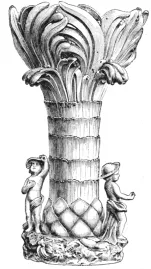 Fig. 308.—Copenhagen Porcelain. White, Shaded with Blue.
(Mrs. John V. L. Pruyn Coll.)
Porcelain was made at Copenhagen (Fig. 308) in 1760, where a Frenchman
named Fournier established a workshop. In 1772 another establishment was
founded, or that of Fournier was revived, by the Minister of Justice,
Muller, assisted by a fugitive from Fürstenburg, named Von Lang. In 1775
it was taken into the hands of the Government, and is now called the
Royal Porcelain Works. Many ornamental pieces and works in biscuit are
issued of different decrees of merit.{352}
Continuity of History.—Early British Urns.—Scottish
Relics.—Irish Urns.—Roman Conquest.—Caistor Ware.—Anglo-Roman
Ware.—Saxon Period.—After the Norman Conquest.—Tiles.—Dutch
Potteries in England.—English
Delft.—Stone-ware.—Sandwich.—Staffordshire Potteries.—Early
Products.—The Tofts.—Salt Glaze.—Broadwell and the Elers
Family.—Use of Calcined Flint.—Wedgwood.—His Life.—Jasper
Ware.—Queen’s Ware.—The Portland Vase.—Basaltes.—Wedgwood’s
Removal to Etruria.—His Death.—Minton & Co.—Their Imitations of
the Oriental.—Pate Changeante.—Pate-sur-Pate.—Cloisonné Enamel
on Porcelain.—Other Reproductions.—Their Majolica.—Their
Artists.—Minton, Hollins & Co.—Lambeth.—Doulton
Ware.—Terra-cotta and Stone-ware.—George
Tinworth.—Fulham.—Bristol.—Leeds.—Liverpool.—Lowestoft.—Yarmouth.—Nottingham.—Shropshire.—Yorkshire.
THE ceramic history of the British Isles is invested with a peculiar
interest by reason of its nearly perfect continuity from the early
Celtic works to the Romano-British wares, the early Saxon, the Norman
mediæval imitations of Saracenic tiling, the lead-glazed wares of the
sixteenth century, the stone-ware of the same period, the pottery of
Staffordshire and Wedgwood, the first appearance of English porcelain,
and so on, downward, to the works of Minton, Doulton, and others at the
present time. In no other country do we find material for an equally
lucid illustration of the regular advance of the art from the primitive
and rude to the elaborate, beautiful, and skilful. England supplies us
with a wonderful and in every way admirable picture of the efficacy of
persistent skilled endeavor in contending with technical difficulty.
From the old tumuli, or barrows, have been exhumed urns in which were
held the cinerary remains of the dead (Fig. 309). The differences
existing among them are such, in regard to both composition, shape, and
ornament, that they evidently belong to different periods and to
different branches or tribes of the early British population. They have
been found all over England, from the Channel{353} Islands to
Northumberland. They are sun-dried and hand-made, and have wide
orifices, often expanding gradually from a comparatively narrow base to
the lip. They are pale in color, either yellow or gray, and the
ornamentation consists of zigzags, frets, and studs.
In Scotland the general character of the remains is the same as that of
the English. The appearance of a number of them suggests, however, the
use of the wheel. They have been exhumed in every part of Scotland, from
the Tweed to the Orkney Islands.
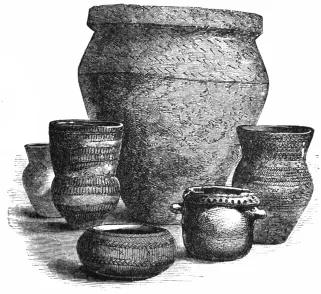
Fig. 309.—Group of Ancient British Vases.
The Irish urns are somewhat in advance of those found in England and
Scotland. The red paste shows that considerable care was bestowed upon
its preparation, and the entire body is very often covered with
ornaments of lines and zigzags. As in the case of the English and
Scotch, we are indebted for the preservation of these relics of the
Irish Celts to a usage which our researches have shown to be almost
universal, that of employing urns in connection with the interment of
the dead. Cremation was not resorted to in every instance. The Celts put
the ashes in the urns, or covered them by{354} inverting the urns over the
spot where the ashes were laid, or placed their sepulchral vases round
the unburnt remains.
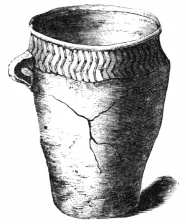 Fig. 310.—Celtic Urn.
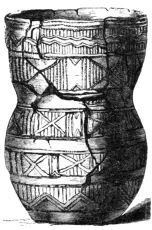 Fig. 311.—Celtic Pottery, found in Staffordshire.
In the first century before Christ the tide of Roman conquest passed the
white cliffs of Albion, and a new element was introduced into its
ceramics. There, as elsewhere, the Romans made and imported the ware, of
which examples have been brought to light all over the old Roman Empire,
from England to Jerusalem. The extent to which the manufacture was
carried in England may be estimated from one fact stated by Dr. Birch,
that the Roman potteries have been traced for twenty miles along the
gravel banks of the Nen, in Northamptonshire. Caistor, in the same
county, is an exceptionally interesting locality, as both early Celtic
wares and the remains of a Roman kiln have been found there. Under the
Romans it must have been an important seat of the manufacture, as its
productions have been unearthed at several places on the Continent—in
France and the Low Countries. The Caistor ware is very often ornamented
with unusual skill and taste by means of reliefs. The Roman Samian ware
is found in many sections of England, whither it was probably imported.
Some of the specimens belonging to the latter part of the Roman period,
and to be classed as Anglo-Roman, are of a thin black paste, carefully
wrought and totally devoid of ornament. After the arrival of the Saxons
the pottery was more closely allied to the Teutonic found in Germany
(Fig. 314).
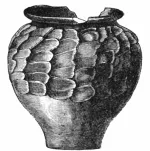 Fig. 312.—Romano-British Ware.
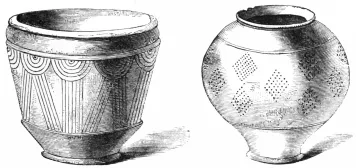
Fig. 313.—Romano-British Upchurch Ware.
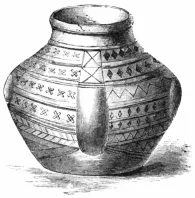 Fig. 314.—Saxon Vase.
The urns are black, hand-made, and stamped with a variety of{355} decorative
designs. The shapes are heavy, and the appliances for firing were
apparently of a rude kind. Of the Anglo-Saxon period few relics have
been discovered, and little is in consequence known. One fragment of the
eleventh century, or possibly earlier, is described by Mr. Marryat as
“of a yellow color, coarsely made and unglazed.” It seems probable that
the disturbances attendant upon the Norman invasion in 1066 distracted
the popular attention from the plastic art, as the next evidences of its
pursuit belong chiefly to the thirteenth century. These are the tiles
employed in paving the ecclesiastical edifices of the day. In the
greater number the patterns are inlaid, or filled in with white paste,
and the whole then glazed yellow. To this class belong the thirteenth
century tiles from Chertsey Abbey, in Surrey, and those of the
fourteenth and fifteenth centuries from Malmesbury Abbey and Malvern.
Those from Chertsey are peculiarly elaborate. One has a scene
representing a king and a female harper, surrounded by a circular
border, the whole forming the inside of a square richly ornamented in
the corners and on the sides. The Malvern tiles are also very
elaborately decorated with designs of an apparently heraldic character.
Another style of tile decoration, followed from the thirteenth to the
eighteenth century, consisted of mouldings in relief. The glaze is green
or brown.{356}
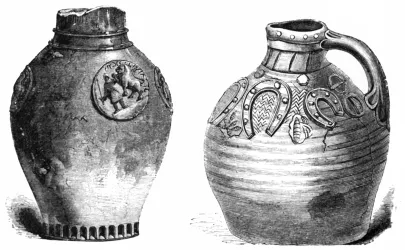
Fig. 315.—Anglo-Norman Vases.
In others the patterns are incised, but not filled in. A very good
example of this style is to be seen in Crauden’s chapel at Ely. The
fourth style of decoration was upon the pate-sur-pate principle—a
white paste being employed as a pigment upon the body of the tile, after
which the piece was glazed. The introduction of tiling for pavements and
walls was evidently in a great measure due to English intercourse with
Spain and the East. Toward the close of the eleventh century, while
England had not yet recovered from the first shock of the Norman
invasion, Peter the Hermit was carrying from land to land the
anti-Saracenic Gospel of the Sword, which led to the First Crusade.
Fifty years later, in 1147, the Second Crusade was organized, while
England was still groaning under the oppression of her rulers. In the
first quarter of the twelfth century the Saxon chronicler says: “God
sees the wretched people most unjustly{357} oppressed: first they are
despoiled of their possessions, then butchered.” Under Stephen, “Men
said openly that Christ and his saints were asleep.” Clearly this was no
time either for joining in crusades or cultivating art. When, in 1189,
the Third Crusade was arranged, Richard the Lion-hearted was one of the
three sovereigns who joined in the ineffectual enterprise. With his
followers may have been brought back the incentives to art cultivation
which make their effects apparent in the next century. The government
was, in the mean time, taking the form which it assumed before the end
of the thirteenth century, and which it has retained ever since.
Political and art history here run exactly parallel. Given disorder and
despairing apathy, and art is unknown. But let order take the place of
chaos, and constitutional rule that of despotism, and the discarded arts
again blossom into flower. Eastern influences manifested themselves in
England almost contemporaneously with the revival of the ceramic art. On
one specimen from Ely, a scriptural subject—Eve offering the apple to
Adam, while a human-headed serpent coils itself round the tree—is
surrounded by several designs of clearly Saracenic or Moorish
inspiration.
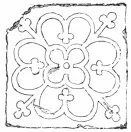 Fig. 316.—Old Tile from Salisbury. (Boston Household Art
Rooms.)
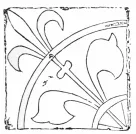 Fig. 317.—Old Tile from Milton Abbey. (Boston Household
Art Rooms.)
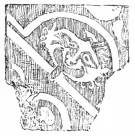 Fig. 318.—Old Tile from Chester. (Boston Household Art
Rooms.)
For at least four centuries tiles formed the staple production of the
potters of England. The annals indicate a popular indifference to the
domestic use of earthen-ware, which contrasts strongly with more
southern preferences. In the reign of Edward I. a chance cargo from
Spain, containing some plates and other household table-wares, reached
England, but failed to affect the national use of wooden trenchers,
leathern jugs, and metal. Lead-glazed pottery was, however, made as
early as the fourteenth century, though{358} not to a great extent. The
specimens which have been preserved are generally coarse in texture, and
are covered with green or yellow glaze. A ewer of the thirteenth or
fourteenth century is rudely designed to represent a mounted knight.
Other examples of the same period are jugs, of which some are
inartistically formed, while others are not devoid of a certain
gracefulness of shape. Costrels, or costrils (elongated bottles which
answered the purpose of the modern flask), occur of a red paste with red
and white glaze. A candlestick with white studs for ornaments has been
found of the same red color.
As we pass to the later works of English potters, we become conscious of
the difficulty of following our usual plan of dividing them into
pottery, stone-ware with vitrified fracture, and porcelain. The
treatment of the name of Wedgwood alone would make such an arrangement
undesirable, as tending to break the continuity of our narrative.
Stone-ware and earthen-ware will therefore be considered together.
The making of both enamelled pottery and stone-ware appears to have been
an imported industry. Dutch potters are said to have settled at both
Lambeth and Fulham in the seventeenth century, and to have there
originated the manufacture of what was called “Delft,” after the name of
the seat of the industry in Holland. White wine-pots of this ware date
from about the middle of the seventeenth century. Plates, oval and round
dishes, mugs and cups, of the same ware appear in various collections,
some with figures in relief, others with paintings in brown, blue,
yellow, and green, and others with medallions or mottoes. They generally
date from between 1650 and 1690. Delft was also made in Liverpool and in
Staffordshire.
The first mention of stone-ware occurs in 1581, in the petition of a
certain William Simpson, for “full power and onlie licence to provyde,
transport, and bring into this realm, drinking stone pottes” made at
Cologne and transported into England by a dealer living in
Aix-la-Chapelle. As a reason why his prayer should be granted, Simpson
stated that he would, “as much as in him lieth, drawe the making of such
like pottes into some decayed town within this realm, whereby many
hundred poore men may be sett a work.” Whether he found some decayed
town suitable for the carrying out of his philanthropic intent does not
appear; but in 1588 a Delft potter was{359} carrying on his business at
Sandwich. Lambeth, Fulham, and the Staffordshire potteries appear among
the later producers of stone-ware.
 Fig. 319.—Posset-pot. Staffordshire. Fifteenth century.
(Bateman Coll.)
 Fig. 320.—Staffordshire Tyg, or Drinking-cup.
The leading English centres are the Staffordshire Potteries, including
Tunstall, Burslem, Hanley, the Fentons, and other towns comprising
Stoke-upon-Trent, Lambeth, Fulham, Liverpool, Leeds, Lowestoft, Bristol,
Yarmouth, and Nottingham. Of these the place of honor must be accorded
to Staffordshire. It has been associated with the ceramic art ever since
the Roman invasion; and the name of a family in the district
(Tellwright) is adduced as a proof that under the Saxons the advantages
of the locality for the making of pottery were fully recognized. The
name is a corruption of tile-wright, or potter. Many interesting facts
relating to English pottery in general, and to that of Staffordshire in
particular, are brought together by Mr. Marryat, whose able work
deserves the study of all desirous of following the gradual development
of the art in England. Early specimens of Staffordshire ware are the
butter-pots of the period, and the tall vessels (Fig. 320) called
“Tygs.” About 1650, Thomas and Ralph Toft and Thomas Sans were making
round dishes with some pretensions to an ornamental character. The year
1680 was made memorable by the discovery of salt glaze. The story goes{360}
that a servant of Mr. Joseph Yates, occupant of Stanley Farm, near
Palmer’s Pottery, Bagnall, was boiling salt in water preparatory to
using it in curing pork. An earthen pot was used as a pan, and the
servant having left it for a time, the water boiled over, and would also
appear to have all boiled away, since the pan became red hot. When it
cooled it was found to be covered with what was afterward known as salt
glaze. The hint was quickly taken by the potters in the neighborhood,
and the process soon became common. The Burslem makers adopted it in
1690, and called the salt-glazed ware “Crouch-ware.” Five years earlier,
Mr. Thomas Miles was making stone-ware at Shelton, and the district
production from about that time increased very rapidly.
 Fig. 321.—Teapot. Elers Ware.
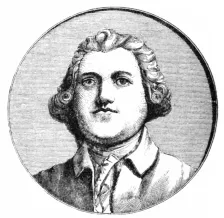 Fig. 322.—Medallion of Wedgwood, by Flaxman. On Monument
in Stoke Parish Church.
At Bradwell, in 1690, the Elers brothers, from Nuremberg, who had
crossed with the Prince of Orange, set up one of the first
establishments worked upon a regular mercantile basis. It had been for
some time the object of both native and Dutch potters to imitate the red
ware of China, and the Elers were the first to reach approximate
success. Having discovered a bed of red clay, they set about working it
in conjunction with gray stone-ware, with which they produced very fine
reliefs (Fig. 321). Notwithstanding the strictest watchfulness, and the
employment of semi-idiotic workmen, their secret was stolen by one
Astbury,{361} who for several years feigned idiocy in order to be allowed to
work in their place, and in that way secure possession of their methods.
The competition then became so great in their neighborhood that in
twenty years they closed their establishment. Their reliefs were
remarkably sharp in outline, and the paste was of fine quality.
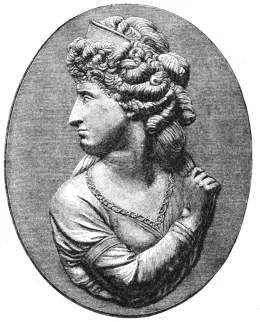 Fig. 323.—Cameo Medallion, by Flaxman. Mrs. Siddons as
Lady Macbeth.
It is curious to find that to another accident the Staffordshire potters
were indebted for the discovery of the value of calcined flint mixed in
the paste. A son of the above named Astbury was riding through Dunstable
in 1720, when he noticed symptoms of disorder in his horse’s eyes. The
hostler at the inn where he stopped undertook to cure the animal by
burning some flint and blowing the powder thus produced into the horse’s
eyes. Astbury saw the dust, and it at once occurred to him that it might
be useful in his business. From calcined flint, sand, and pipe-clay
colored by means of oxides, were made the wares called “Agate” and
“Tortoise-shell.” Then followed the adoption of plaster of Paris moulds
and a more general resort to mouldings in bas-relief.
We now approach the era made illustrious by the name of Mr. Josiah
Wedgwood (Fig. 322), the greatest of English potters, of whom it has
been said, in the most unqualified terms: “With him the ceramic art
received its highest development in ancient or modern times; for while
greater beauty of decoration in painting characterized other wares, he
produced the noblest artistic results of the moulding{362} in clay.” However
much others may be led by individual preference to qualify this
encomium, there is no doubt that Wedgwood ranks among the highest names
known in the history of English ceramic art. Born at Burslem, in
Staffordshire, in 1730, of a family which had been engaged in the making
of pottery for many years, Josiah enjoyed in early life none of the
educational advantages which might have developed in him the promise of
his future brilliant career. It is highly probable that his schooling
did not carry him farther than reading and writing, and at the age of
eleven we find him engaged as a thrower in his brother’s workshop. Then
came sickness in the worst of all its forms, smallpox, which left him so
lame that amputation of one leg became necessary, and ended his career
at the wheel. It is possible that, in current phraseology, this
misfortune may have been a blessing in disguise. He at once turned his
attention to the production of ornamental pottery and the imitation of
precious stones, mixing variously compounded clays with oxides, and
otherwise experimenting.
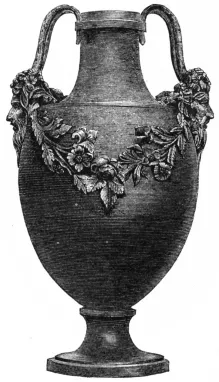 Fig. 324.—Black Basaltes. (Meyer Coll.)
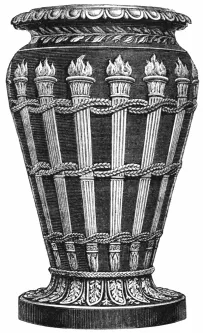 Fig. 325.—Black and White Jasper. (Barlow Coll.)
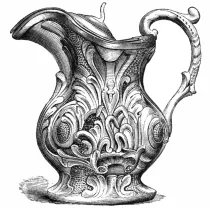 Fig. 326.—Early Wedgwood. Blue; Moulded. (W. S. Ward
Coll.)
The idea must have got abroad that he had talent, as, at the age of
twenty-two, we find him in partnership with a Mr. Harrison, and then, in
1754, with Mr. Thomas Wheildon, of Fenton. This gentleman lacked his
partner’s enterprise, and in 1759 Wedgwood was in business for himself,
at Burslem, at first in a small way, then in a larger, and again in a
still larger manufactory. In the last he made{363} the ware called
“Queen’s-ware”—a cream-colored fabric of very delicate color, composed
of white clay mixed with flint, and brilliantly glazed. It derived its
name from a specimen service having been accepted by Queen Charlotte.
His fortune was now practically guaranteed, and his career an assured
success. Court patronage made him the fashion in England, and we also
find him engaged in an export business. Prosperity did not rob him of
any of his early enterprise, but rather acted upon him as an incentive
to farther and greater exertion. He continued studying, investigating,
and experimenting, and with the assistance of his partner, Mr. Bentley,
pushed his business in all directions. Several kinds of earthen-ware and
stone-ware were produced by him (Fig. 326), and after effecting various
improvements upon his table ware, he turned his attention to those
imitations of the antique, and of cameos, intaglios, and seals, with
which his name is indissolubly associated. With these are to be classed
his fifty copies of the Barberini, or Portland vase (Fig. 327). The
original is glass in two strata—dark blue and opaque white—and is an
example of Roman work of the second or third century. It was bought by
the Duke of Portland for £1029.{364}
These works admit of no classification. Some are earthen-ware, others
stone-ware, and others are of such a composition that they may be most
correctly classed with porcelain. The name “Basaltes” was given to a
series of imitations of Egyptian styles in black biscuit, with reliefs
in white and red (Figs. 324 and 325). More charming than these is the
jasper or onyx ware from the blue or soft green ground of which the
white busts (Fig. 328), figures, and flowers stand out in the most
exquisite relief. The biscuit is a porcelaneous stone-ware, colored all
through by means of oxides. Wedgwood made in all more than two thousand
copies of antique gems.
 Fig. 327.—The Barberini, or Portland Vase.
In 1771 Wedgwood removed from Burslem to Etruria, a village which he
erected in proximity to his works, and for the accommodation of his
workmen. There he also built for himself a handsome residence, which he
occupied until his death, in 1795, in the sixty-fifth year of his age.
His decorated cream-colored ware had, in the mean time, become known all
over Europe, in India, and in this country. In 1775 he made a service
for the Empress Catherine II. of Russia, undervalued at fifteen thousand
dollars. We close our brief sketch of his remarkable career by noting
that the success of the Etruria of his foundation was based upon
commerce, and not upon royal patronage; that his humblest works are
marked by a thoroughness and fitness parallel with the artistic
qualities of his higher pieces; and that excellence of workmanship was
in all cases his primary aim. One of his contemporaries and successors
was Mr. Enoch Wood, who established a workshop at Burslem in 1770, and
was succeeded by Messrs. Caldwell & Wood.{365}
 Fig. 328.—Wedgwood Jasper-ware. (John W. Britton Coll.)
The later products of the Wedgwood factory are hardly less varied than
those of its founder’s lifetime. The jasper-ware is still produced, and
although some of the pieces lack the exquisite finish of the original,
others show little, if any, inferiority. The plate of blue jasper, with
white decoration, given in the illustration (Fig. 330), is a remarkably
fine example of recent work. The Wedgwood majolica is, both in regard to
color and the modelling of the ornaments and figures, unsurpassed by any
similar ware of the present time. Of this the vase (Fig. 331) is an
excellent illustration. The body is a clear deep blue.
 Fig. 329.—Recent Wedgwood Earthen-ware. (D. Collamore.)
In our time the Staffordshire Potteries maintain their old repute. One
well-known name is that of Minton. It occurs in three firms, all located
in the Potteries: Minton & Co.; Minton, Hollins & Co., of
Stoke-upon-Trent; and Mr. Robert Minton Taylor, of Fenton. The
establishment of Minton & Co. was founded while Wedgwood was still
alive, by Mr. Thomas Minton, in 1791. The founder of the firm had been
successively an employé of Mr. Thomas Turner, of Caughley, and of Spode,
before, in 1788, he went to Stoke, and there bought land and built a
house and factory. In 1790 he took Spode’s manager, Mr. Joseph Paulson,
into partnership, and in 1793 assumed a second partner, Mr. Pownall. The
latter retired in 1800, and Paulson died in 1809, after which, for a
number of{366} years, Thomas Minton carried on the works alone. Previous to
1798 the factory made nothing but earthen-ware, the greater portion of
which was decorated in blue and white, after the type supplied by the
porcelain of Nankin.
Fig. 330.—Modern Wedgwood Jasper. (Tiffany & Co.)
In 1817 Herbert Minton, a younger son of Thomas, was taken in as partner
by his father, and although he practically retired from the business
between 1823 and 1836, he succeeded to it in the latter year on the
death of the founder. He went into partnership first with Mr. John
Boyle, who subsequently joined the Wedgwoods, and secondly with Michael
Daintry Hollins. At the time of his death, in 1858, he had two partners,
Hollins and Colin Minton Campbell. At that time fifteen hands were
employed in the factory. Herbert had directed his attention to the wide
range of works which have since given the name of Minton a world-wide
reputation. These were earthen-ware, artificial porcelain, natural
porcelain, parian, encaustic tiles, azulejos, mosaics, Della Robbia
ware, Palissy ware, and majolica. The Mintons divide with Copeland the
honor of first making parian. Both firms exhibited it at the London
Exhibition of 1851, and the jury to which{367} the question of priority was
referred could not decide between them. To continue the history of the
firm, Colin Minton Campbell dissolved his partnership with Hollins in
1868, and now carries on the business in connection with his cousins,
Thomas, William, and Herbert Minton, the great-grandsons of the founder.
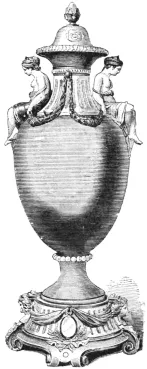 Fig. 331.—Wedgwood Majolica. (Horace Russell Coll.)
The firm now ranks with the first of English manufacturers. Their
enterprise has traversed a field as wide as that into which Wedgwood
entered, and their success has been very great. In the pursuit of the
commercial they have not neglected the artistic. It is said of Wedgwood
that he copied and imitated everything worth imitating. Minton & Co.
have followed a similar course, though in a different direction.
Twenty-five years ago we find them attempting to make natural porcelain,
but the enterprise was abandoned. When the taste for Oriental styles
revived, they were among the first to succeed in gratifying the public
whim. In doing so they produced specimens of color highly praiseworthy,
and of a beauty vividly recalling that of the Oriental originals. Their
Persian ware and pate changeante have both excited the admiration of
connoisseurs. The Mintons have also been successful in reproducing with
wonderful fidelity the cloisonné enamel of China and Japan, using a
porcelain base. Here, as in the Persian ware, their turquoise blue is
very effective, and the decoration in enamels reflects faithfully the
tone of Oriental ornament. Leaving the East, Minton & Co. have been no
less fortunate in imitating the Italian Grafitto ware of the fifteenth
century, and the famous inlaid Henri Deux ware of France. Several
specimens of the latter were exhibited by Messrs. A. B. Daniell & Son at
the Centennial Exhibition, and included a teapot, a pitcher, and a pair
of candlesticks, all of pale yellow{368} body inlaid with red. Examples are
in the Boston Museum of Fine Arts, and in the collections of Mr. Walters
and Mr. W. L. Andrews. A mere reference must suffice for their majolica
(Fig. 334), which is rather an independent product than an imitation of
the majolica of Italy. It is peculiar both in composition and in the
colors employed in its decoration, and is fired at a very high
temperature. Mr. Herbert Minton was the first to copy the azulejos of
Spain. The above are only a few of the achievements which might be
adduced to show how Minton & Co. have boldly essayed to duplicate the
choicest products of ceramic art. One is forcibly reminded by them of
the Chinese workman’s delight in contending with technical difficulty
for the mere sake of surmounting it. Among their artists are Mr. Solon,
W. S. Stevens, Charles Toft, H. Darling, J. Leese, M. Mussill, Kirby,
Mellor Slater, F. Fuller, and H. Protat.
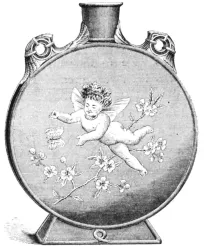 Fig. 332.—Minton Stone-ware. (D. Collamore.)
The firm of Minton, Hollins & Co., of Stoke-upon-Trent, was founded by
Michael Daintry Hollins, on the dissolution of his partnership with
Colin Minton Campbell in 1868. He built extensive works, and began to
make majolica and encaustic tiles, slabs, panels, and other similar
wares. The firm now produces an almost endless variety of tiles. At the
Centennial Exhibition this firm was represented by some pieces of great
brilliancy of color and very careful drawing. In one scene two finely
plumaged wading-birds appeared among the water-lilies in a brook. The
soft gray of the feathers tipped with bright blue, and the green of the
reeds and other plants, were thrown out well by the dark-brown
background. On some smaller pieces birds of tropically gay plumage were
painted upon a sombre chocolate ground. On others were flowers and
butterflies upon a pale ground. The style of treatment is purely
Oriental. Drawing and color are{369} paramount. The ground is merely
intended for contrast with, or the heightening of, the superimposed
decoration. Some beautiful heads of dogs, lions, and asses were
marvellous examples of animal portraiture, and illustrated the capacity
of tiling for the reception of that style of decoration. In them was
seen the work of an artist who fully understood that, given the
requisite mastery of color, a tile may be employed as a more lasting
substitute for canvas. It is also worth noting that whenever tiles are
used for covering a large surface, and each one is treated as a unit,
the result is an artistic blunder. The eye wearies with monotonous
repetition, and no minuteness of finish in the single tile can relieve
the bewildering effect of the mass. Minton, Hollins & Co. have been
fortunate in designing fire-places of tiling, with side paintings of
birds and flowers, and larger scenes above the mantel, of a character in
keeping with their place in a household.
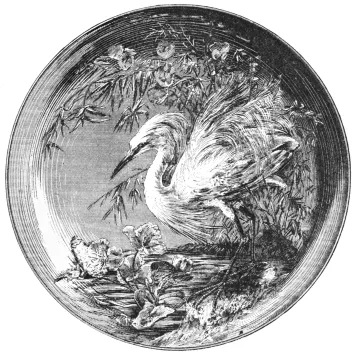
Fig. 333.—Minton Plaque, by Mussill. (Tiffany & Co.)
{370}
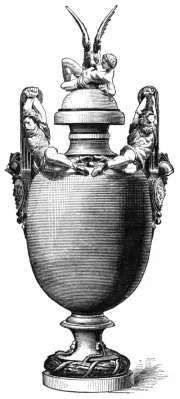 Fig. 334—Minton’s Prometheus Vase. (Corcoran Art
Gallery.)
From the Trent we pass to Lambeth, near London. It was here that in 1640
the Dutch makers of stone-ware and delft settled. At one time there were
twenty different establishments, but on the rise of Staffordshire their
number decreased under the weight of competition. Some of the early
Lambeth ware is very skilfully painted, the tiles with a blue ground
being especially commendable. At the present time Lambeth is best known
by its Doulton ware and Lambeth faience. The Doulton or Lambeth pottery
was founded by Mr. John Doulton, who was born at Lambeth in 1793. He
served an apprenticeship with White of Fulham, and in 1815 associated
Mr. John Watts with himself in establishing the present pottery. Mr.
Watts died in 1858, and Mr. Doulton in 1873, and the business is now in
the hands of Messrs. Henry and James D. Doulton, sons of the founder. In
1870 they first issued an artistic ware, and in 1872 turned out the
first specimen of what they have called “Lambeth faience.” The “Doulton
ware” may, without detracting from the originality of much of the
decoration, be described as a revival in both composition and style of
the German stone-ware, miscalled Grès de Flandre. Like other
stone-wares the body is highly silicious, close in texture, and very
brittle. The necessary firing takes several days to accomplish, and the
glaze is made by throwing salt into the kiln, according to the process
discovered, as we have seen, in Staffordshire, and long practised at
Lambeth. The body-tints are the result of washing the pieces in a
preparation of oxides, varied according to the shade desired. The
ornamentation is fourfold. It consists either of incrustations,
indented{371} designs, incised figures or scenes, or colors. These methods
are occasionally combined. The Lambeth faience is a finer ware, and is
decorated under the glaze with paintings of flowers, landscapes,
portraits, and figures. The Messrs. Doultons’ artists are all taken from
the ranks of pupils in the Lambeth School of Art. Among them are Miss
Hannah B. Barlow, a very skilful animal painter, Mr. Arthur Barlow, Mr.
Frank A. Butler, Mrs. Sparkes, and Mr. George Tinworth.
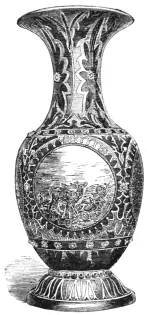 Fig. 335.—Doulton Ware. (W. B. Dickerman Coll.)
 Fig. 336.—Doulton Ware. (W. B. Dickerman Coll.)
A great deal of the Doulton ware very closely resembles the Grès de
Flandre in its decoration, but even to these specimens is to be
accorded the originality resulting from a modified development of the
fundamental style. A larger experience may lead to something more
perfectly original. The present tendency appears to be toward an excess
of ornament, in some instances not a single square inch being left
uncovered. Studs and bosses are affixed in bands, are led over the
surface in floriated designs, and give the arched handles a peculiar
serrated appearance. A very ingenious design consists of incised broad
leaves overlapping each other, and becoming more sharply pointed and
elongated as they rise up the neck to the lip. Studs are then laid in
vertical bands from top to bottom, the lines converging as the leaves
become smaller. In many cases, however, the reliefs destroy the outline,
and mar the beauty of{372} a host of otherwise admirable shapes. In the
matter of form, the Messrs. Doulton, in fact, leave little to be
desired. Many of their vases display a pure, classical gracefulness, and
others are possessed of a quaintness and novelty almost equally
attractive. Canettes, goblets, and small covered jars decorated with
plain or ornamental bands, and dotted with flower-like studs, are to be
classed among the best examples of the more characteristic or
distinctive style of Lambeth decoration.
 Fig. 337.—Lambeth Faience.
The plaques and tiles of Lambeth faience deserve separate notice. Some
of the smaller pieces illustrate the capacity of the ware for
portraiture. The drawing is invariably careful, and the coloring is
applied with both taste and delicacy. The colors will probably be
improved in time, and become more decided without losing anything in
softness. The pieces we have seen inspire us with this hope, and that
here again experience may lead to greater excellence. A large
tile-piece, by Mrs. Sparkes, representing the departure of the Pilgrim
Fathers, and painted upon two hundred and fifty-two tiles of Lambeth
faience, was exhibited at the Centennial Exhibition. The lady-artist is
deserving of all praise for her composition and drawing. The perspective
was very well managed, and the figures were brought out in strong relief
against a sky glowing with the rays of the setting sun.
 Fig. 338.—Lambeth Faience. (D. Collamore.)
The Messrs. Doulton have achieved some wonderful results in the
combination of terra-cotta with their stone-ware. At the Centennial
Exhibition they had a brown terra-cotta fireplace and mirror-frame, with
tiled panels and hearth and terra-cotta fender. In another mantel-piece,
of oak, a set of tiles in the panels showed admirably designed and
executed illustrations of scenes and characters from Shakspeare. In
these and other similar works a great deal of taste and ingenuity was
shown in the combination of material. A magnificent example{373} of the
union of terra-cotta with Doulton ware is now in the Smithsonian
Institute at Washington (Fig. 340). It is a pulpit of red and light buff
terra-cotta with ornaments of blue stone-ware. The balusters on the
stairs leading up to the pulpit are Doulton ware ornamented with bands
of terra-cotta. Under the base of the balustrade, and round the pulpit
under the panels in front and on the sides, are bands of Doulton ware. A
similar band surrounds the alcoves or panels. The latter are by Mr.
George Tinworth, of London, and illustrate scenes in the life of Christ,
from the offering in the Temple of “a pair of turtle-doves or two young
pigeons” to the ascension. Of this artist’s execution, also, are the
panels in a baptismal font which accompanies the pulpit. These and other
similar works are so deeply sunk that they have the appearance of groups
of figures separately modelled and placed in the recess rather than of
mouldings in relief. They are in every way admirable. The expression and
attitudes of some of the faces and figures are marvellously life-like
and forcible.
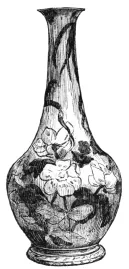 Fig. 339.—Lambeth Faience. (D. Collamore.)
Fulham owes the beginnings of its pottery to the Dutch. In 1684 Mr. John
Dwight was making stone-ware, earthen-ware, statues, and porcelain. The
latter was very soon discontinued. The production of other wares was
carried on by descendants of the founder.
The history of Bristol pottery is said to go back to the commencement of
the thirteenth century, but its first piece with a date is five hundred
years later. It is delft-ware, and is dated 1703. A German, named Wrede,
or Reed, is said to have made stone-ware about the same period.
Otherwise Bristol is unimportant in so far as earthen-ware is
concerned.{374}
Leeds is one of the towns which, toward the close of the last century,
were adopted as fields for a pottery enterprise. It did an extensive
trade with the Continent in a cream-colored ware.
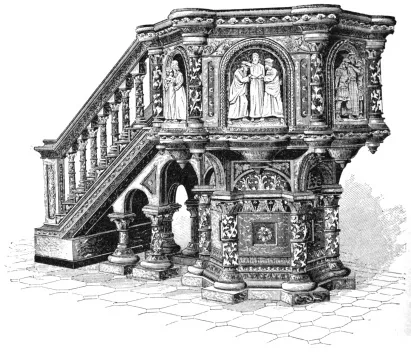
Fig. 340.—Terra-cotta Pulpit. (Smithsonian Institute.)
Liverpool begins its history, in 1716, with the manufacture of delft.
The first event of any importance is the invention by Mr. John Sadler,
in 1753, of a method of printing upon earthen-ware. Wedgwood was in the
habit of sending Queen’s-ware to Sadler to be printed. In 1752 Mr.
Richard Chaffers set up an earthen-ware establishment, but soon turned
his attention to porcelain, which he succeeded in making after
discovering the necessary material in Devonshire. On his death the
enterprise came to an end. The next name of distinction is that of
Pennington, who, about 1760, made delft bowls and vases, some of which
were painted by an artist named Robinson. Pennington ultimately returned
to Worcester. In 1794{375} the “Herculaneum Pottery” was opened at
Birkenhead, and was worked until 1841.
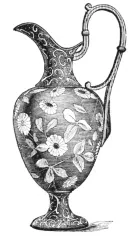 Fig. 341.—Lambeth Faience. (Dr. H. G. Piffard Coll.)
Mr. Herolin Luson made an ineffectual attempt to establish a pottery at
Lowestoft in 1756. His failure is to be attributed to the infidelity of
his workmen, who were induced by the London manufacturers to spoil the
ware. Notwithstanding the opposition which led competitors to resort to
similarly unworthy devices, Walker, Brown, Aldred, and Rickman founded a
workshop within a year of Luson’s failure, and by taking the necessary
precautions against treachery, placed it upon a permanent basis. It made
ware of every grade. The Lowestoft earthen-ware was usually decorated
with blue, and occasionally with red. The early porcelain was painted in
the same colors, and the later pieces were ornamented with flowers. The
latter are artistically drawn and colored, and equal the best work found
on English porcelain. Plain Chinese ware was imported and decorated at
Lowestoft; but the production ceased about the year 1830.
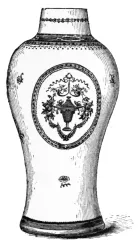 Fig. 342.—Lowestoft Pottery. (F. Robinson Coll.)
It is questionable if ware of any kind was ever made at Yarmouth,
although it is certain that a decorating establishment and kiln existed
there probably about 1752. It is more than possible that this workshop
was in part supplied with Lowestoft biscuit.
Nottingham manufactured pottery from about 1650, and the business was
continued for at least a century. The precise period at which it came to
an end is not known.
The Shropshire factories were offshoots of those of Staffordshire. The
Brosely establishment was founded by Mr. Richard Thursfield, of Stoke,
in 1713, and passed from his family into the hands of the Roses of
Colebrookdale{376} about 1799. A black stone-ware decorated with gilt or
with reliefs was the chief product.
Mr. Francis Place, of the Manor-house, York, made fine pottery or
stone-ware in the latter part of the seventeenth century. The well-known
“Rockingham ware” took its name from a brown pottery made upon the
estate of the Marquis of Rockingham, at Swinton, in Yorkshire. The
production originated in 1757, and the enterprise was subsequently
carried on by Mr. William Malpass (1765); Mr. Thomas Bingley (1778);
Messrs. John and William Bramfield (1807-1842), when the works stopped.
The brown teapots of this factory were at one time very fashionable in
England. Of these and other works each had its specialty of decoration
or composition, but to detail them in full would only complicate a
sketch in which it is intended to give merely salient points, on a
comprehensive plan.
Plymouth Hard
Porcelain.—Cookworthy.—Bow.—Chelsea.—Derby.—Worcester.—Minton.—Pate-sur-Pate.—Spode.—Copeland.—Bristol.—Tunstall.—Caughley.—Nantgarrow.—Swansea.—Colebrookdale.—Pinxton.—Shelton.—Belleek.—General
Character of Manufacture in Great Britain.
It may be as well to premise that the porcelain now made in England all
belongs to the soft, or, according to our classification, the artificial
class. Its composition has already been described. The leading seats of
the industry are Bow, Chelsea, Derby, Plymouth, Bristol, Worcester, and
a few workshops in the midland counties and Wales.
With the possible exceptions of Lowestoft and Bristol, Plymouth stands
alone as the only place in England at which a manufactory of hard, or
natural, porcelain ever existed (Fig. 343). This distinction is due to
the enterprise of William Cookworthy, who was born near Plymouth, in
1705. Cookworthy was a chemist and druggist, and was led into his
porcelain venture by the discovery of kaolin and petuntse near Helstone,
in 1755. Five years later his manufactory was running at Coxside, but
meeting with no adequate commercial support, he sold his patents, in
1772, to Richard Champion, of Bristol. The production then ceased.
Cookworthy’s first attempts were not encouraging,{377} but perseverance
brought a certain measure of success, and his later works are of fine
quality. He procured a Sèvres painter, and also employed Bone, the
enameller and artist, and by their help turned out many valuable
services and pieces richly ornamented after the prevailing Oriental
styles, with birds, flowers, and insects.
 Fig. 343.—Plymouth Hard Porcelain Coffee-pot.
Before Cookworthy embarked in his porcelain enterprise at Plymouth,
artificial porcelain was made at Stratford-le-Bow and Chelsea. The
beginnings of the industry at neither place have ever been
satisfactorily freed from obscurity, and it is not known to which the
priority belongs. Thomas Frye, an Essex artist, superintended the works
at Bow for some time, and is said to have been the first who succeeded
in making English porcelain. He died in 1762. Probably the Bow and
Chelsea works both started about twenty years before that date. It is
certain that both stopped after less than fifty years existence. The
porcelain made at Stratford-le-Bow, and designated “Bow china,” is of
coarse paste, and is often found decorated with a bee either painted or
embossed (Fig. 344). The painting of flowers and scenes is not of a high
order, but the reliefs are frequently effective and well executed. The
Bow artists also made figure groups.
 Fig. 344—Bow cream-jug.
The decoration of early Chelsea porcelain closely followed the Chinese,
which it was intended to rival. The business there did not attain{378} to
any eminence, nor did the art rise to a noticeable height, until the
works were patronized by the Court of George II and supported by the
Duke of Cumberland. Between 1750 and 1765, Chelsea porcelain most
closely approached its great Continental rivals (Fig. 345). After 1750
the manufacture could hardly be called an English enterprise, since
material and workmen were both imported from Germany. The management
also was in the hands of a foreigner named Spremont. The articles
produced included all the forms of Sèvres and Dresden, table services,
candlesticks, figures, vases, and the numberless designs among which the
inventive ingenuity of Continental artists was exercised. In 1784 the
works stopped. The Chelsea paste was extremely soft, and the glaze was
vitreous and liable to crack. The colors were superb, and included some
of the choicest found on Sèvres porcelain, besides at least one other, a
claret color, peculiar to Chelsea. Very high prices have been obtained
for this porcelain at auctions, more than a thousand dollars having been
given for a pair of vases. In design, workmanship, color, and
decoration, there are pieces of Chelsea porcelain unexcelled by any
other establishment, either English or foreign.
 Fig. 345.—Chelsea Porcelain Vase.
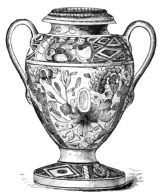 Fig. 346.—Derby Porcelain. Third Duesbury Period. (F.
Robinson Coll.)
Mr. Duesbury, who purchased the Chelsea works in 1769 and finally
transferred them to Derby, had been making porcelain in the latter place
since 1750.{379} He had also bought and transferred the Bow works, and
carried on a most extensive business, taking the place in public
estimation of the two establishments he had consolidated. The elder
Duesbury died about the year 1788, and the subsequent proprietorship is
not very clear. He appears, however, to have been succeeded by his son,
who died in 1798, and the works then fell to the third Duesbury, who
carried them on in conjunction with Michael Kean until they were
acquired by Robert Bloor in 1815. Bloor kept them until he died in 1849,
and then Locker & Co. held them until 1859, when they were assumed by
Stephenson & Hancock, of which firm Mr. Hancock, the surviving partner,
came into sole possession in 1866. The ware was called Chelsea-Derby
from 1769 to 1773, when it received the name of Crown-Derby, a crown
having been added to the mark after a visit of the king and queen. The
Derby paste was very fine and translucent, and in the production of
biscuit figures it was unrivalled. The best of the old Derby colors was
a beautiful bright blue.
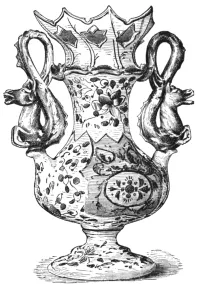 Fig. 347.—Bloor-Derby Porcelain. (F. Robinson Coll.)
Fig. 348.—Old Worcester Porcelain. (Robert Hoe, Jun.,
Coll.)
 Fig. 349.—Worcester Porcelain. (G. Collamore.)
 Fig. 350.—Worcester Porcelain. (D. Collamore.)
The Worcester works were founded in 1751, by a company headed{380} by Dr.
Wall. To this gentleman has been ascribed the invention of printing on
porcelain, which we have already found in use on pottery in Liverpool in
1753. The matter is involved in doubt, as the process was in vogue at
Battersea about the same period, and it is improbable that it was
simultaneously invented at three different establishments so far apart.
However this may be, Dr. Wall availed himself of the invention, and
handled it with great skill and precision. Steatite obtained from
Cornwall was first used by the company in 1770, and in 1783 the Messrs.
Flight bought up the original establishment, which had found competitors
in the Chamberlains, who had commenced business as decorators in 1786.
In 1788 the works were visited by King George III., who became a patron
of Flight, and were afterward called the Royal Worcester Porcelain
Works. One of the Flights died in 1791, and a partnership was formed by
the survivor with Martin Barr in 1793. The concern was carried on under
the firm of Flight & Barr until 1807, when it became Barr, Flight &
Barr, Jun., and in 1829 another change was made to Flight, Barr & Barr.
It retained that form until 1840, when an amalgamation was effected with
the Chamberlains. In 1862 a joint-stock company was formed, under which
Mr. R. W. Binns, the author of a history of Worcester potting, acted as
superintendent of the artistic department. It is estimated that at
present upward of four hundred workmen are employed in the Worcester
establishment, which is made all the more interesting by reason of its
being one of the few survivors of the old{381} English works. Every effort
is made to bring the porcelain to perfection, and the body and
decoration are both very fine. The Worcester paste does not appear at
first to have equalled that of some other English centres, but its
yellowish tinge made it very well suited for the brilliant color
demanded by the Oriental styles of decoration. The process of transfer
printing is said to have been perfected by Josiah Holdship, who was
assisted by his brother Richard in engraving the plates. Robert Hancock
was also an engraver in the factory. Some rare specimens of transfer
printing are found painted with colors and gold, by which means good
imitations of Dresden were made. This success led to the adoption of the
Dresden mark, a practice to which the Worcester manufacturers seem to
have been too much addicted, as the marks of several of the leading
workshops are found upon their wares. At the present time the Worcester
factory is turning out a great deal of excellent work. The table ware,
of which an example is given (Fig. 351), is generally tastefully and
often brilliantly decorated. The colors in the specimen given are
yellow, red, blue, green, and gold, very judiciously combined, and have
a warm and rich effect. The portrait plaque (Fig. 349) is by A. Handley,
and is executed in flat colors. The flesh-tint is especially soft and
refined. It is a highly satisfactory example of its class.
Fig. 351.—Worcester Porcelain. (D. Collamore.)
A work widely differing from either of the above is the basket vase
(Fig. 350), with rustic handles and feet, and decorated with leafy
branches in relief. The only color used is a pale shade of blue,{382} which
deepens in the interstices of the wicker-work. These examples have been
chosen not for any exceptional qualities, but for the purpose of
illustrating the average products of a factory which ranks among the
first in England.
The Mintons, although devoting themselves chiefly to stone-ware and
earthen-ware, made porcelain at an early period of their history. This
occurred in 1798, when a semi-translucent porcelain of inferior quality
was made. The production ceased in 1811, and was taken up subsequently
by Herbert Minton. Their pate-sur-pate has been noticed under France,
but we here give a superb specimen of their decoration in that style by
Mr. Solon (Fig. 352).
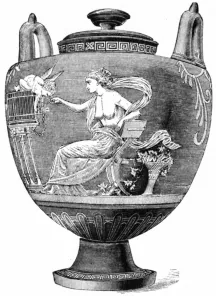 Fig. 352. Pate-sur-pate, by Solon. (H.C. Gibson Coll.)
Another famous firm working at Stoke-upon-Trent is that of the
Copelands. It was founded in 1780 by the first Josiah Spode, who
established himself in the works which had been occupied by Banks &
Turner. He appears to have been chiefly engaged in the manufacture of
blue printed willow-ware, and imitations of the more famous works of
Wedgwood, especially his cream and jasper wares. He died in 1797, and
his son and namesake carried on the business, and first turned his
attention to porcelain about the beginning of the present century. The
body he used was of great purity, and the ware was chiefly decorated
with gold and flowers after the fashion of his day. In this venture he
was very successful, and devoted every energy to pushing his enterprise.
In 1805 he achieved another triumph by what he described as “a sort of
fine ware, called opaque porcelain,” which was extensively consumed on
the Continent, to the great detriment of the makers of French faience.
In 1806 the honor was{383} conferred upon him of being appointed potter to
the Prince of Wales, and in 1827 he died, after amassing a large
fortune. The firm consisted for some time of Josiah Spode, William
Spode, and William Copeland, and in 1833 the concern was bought by a son
of the latter, William Taylor Copeland. He was joined by Mr. Garrett in
1843, and the firm consisted of Copeland and Garrett until 1847, when
Mr. Copeland again became sole proprietor, and continued so until 1867,
when he was joined by his sons. The works are now carried on under the
firm of Copeland & Sons, and have attained to great dimensions, covering
about twelve acres of ground, and giving employment to about nine
hundred operatives.
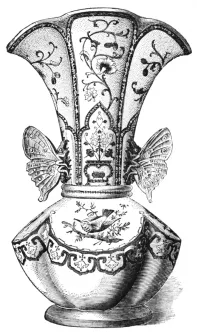 Fig. 353.—Copeland Vase. (Tiffany & Co.)
Mr. Abraham, art director of the Copeland works, has furnished much of
the above information, and of that which follows regarding the wares of
both Spode and Copeland. According to Mr. Abraham, one of Spode’s most
celebrated wares was the stone china already referred to, an opaque or
nearly opaque compact body of a blue-gray tint resembling Oriental
china. It was fired at a much higher temperature than earthen-ware, and
in reproducing it at the present time it is fired in the porcelain kiln.
It was decorated by Spode in various ways, the qualities most highly
prized being the “old Japans” and oven blues of different shades.
Spode’s stone china and ivory bodies are exceptionally well adapted for
treatment in which oven blue is employed.
This stone china has never been entirely out of use, but for a long time
it did not receive the attention it deserved, and has only been recently
revived. When receiving least attention its manufacture was restricted
to matching sets, the possessors of which were so{384} sensible of its high
qualities as a table ware, that they were desirous of making up
deficiencies in their services whenever practicable. The name of
Copeland is now well known wherever commerce has carried the ceramic
wares of England. Some of the most artistically designed and finely
decorated pieces found in the collections of the present time are from
this workshop. The Copelands have rivalled the most prominent houses of
England, we might say of Europe, both in the many-sidedness of their
enterprise and in its results. The best artists and modellers are
employed, and the products may be compared with any in Europe. What may
be considered a specialty of the Copelands is the employment of royal
blue upon porcelain, both in arbitrary designs and in landscape and
figure painting. They have it so perfectly under control that the most
delicate tints and the greatest depths of which the color is capable are
produced at will, without the overflowing of the color on the one hand,
or on the other the harshness and poverty of tone so common in works
decorated in this blue.
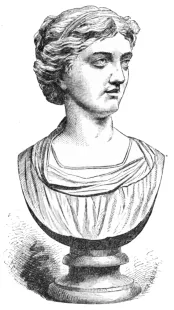 Fig. 354.—Copeland Parian.
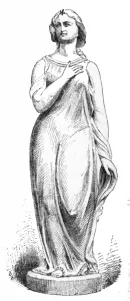 Fig. 355.—Copeland Parian.
A great deal of the Copeland jewelled ware is exceedingly beautiful. We
have chosen one specimen as being exceptional, both in its design and
decoration (Fig. 353), and it would certainly be difficult to lavish
upon it too much praise. The base is gilt, the body is of two shades of
blue, and the gracefully expanding neck pale brown dotted with brown of
a darker{385} tint. The handles consist of golden butterflies resplendent
with jewels. The effect is rich, but harmonious and charming, and the
piece may be regarded as one of the most favorable illustrations of what
the English artists of our time can accomplish.
 Fig. 356.—Copeland Reticulated Porcelain. (W. B.
Dickerman Coll.)
In approaching the Copeland parian (Figs. 354 and 355), we find
ourselves among some of the finest works in that material yet given to
the world. An enumeration of the artists regularly or specially engaged
in this department would include many of the highest names in the
profession. This branch of art has developed rapidly, partly on account
of the rivalry between manufacturers, but chiefly by reason of the
welcome everywhere extended to the works issued. Among the subjects
chosen by the Copelands, many, possibly the greater number, are
ideals—such personifications as those of Music and Poetry. It could not
be expected that all these would be of equal merit, and fault may
occasionally be found with attitudes and proportions; but they are, as a
whole, admirably executed.
Yet another branch of art in which the Copelands have been eminently
successful is represented by the perforated or reticulated ware of which
the Chinese supply the types. The potting difficulties and risk in
making this double surface ware are greater or less according to the
intricacy and delicacy of the perforations. In the cup and saucer here
given (Fig. 356) the manipulation and firing were exceptionally delicate
and hazardous, far more so than in{386} the case of the honey-comb
perforation. Held up to the light, the inner surface appears to be as
thin as egg-shell; and it seems a perfect marvel that, when the heat has
softened the body, the upper surface does not sink down upon that below.
Where plugs can be used to keep them apart, or where the perforated
surface is strongly arched, or where the article can be placed upright,
the danger is manifestly less than in such a piece as the saucer, with
its pointed leaf-work bending downward rather than arching. It is also
necessarily placed flat in the kiln. Many pieces of the same kind have
been made by the Copelands.
We have already seen that Cookworthy sold his patent to Mr. R. Champion,
of Bristol. It appears, however, that he retained an interest in it
after Champion started his manufactory in that city until the year 1773,
when he relinquished his right on payment of a royalty. The Bristol
workshop was founded a few years previously, but no natural porcelain
was put upon the market until that date. The fact that Champion was, in
1776, making artificial porcelain indicates that he very soon found his
hard porcelain venture would not be remunerative. He was, according to
one authority, associated with a company of Bristol gentlemen in his
enterprise, and it appears to be certain that when he applied for the
extension of his patent he did not stand alone. In 1781 or 1782 he
resigned his right to a company of Staffordshire potters, and was
appointed Paymaster of the Forces, under his friend Mr. Edmund Burke. He
died in 1787, at Camden, South Carolina. The Bristol china is chiefly
valuable by reason of its rarity. The decoration is after Continental
and Chinese styles, and the paste is inferior.
The company which purchased Champion’s patent continued to make natural
paste until 1810, first at Tunstall and afterward at Shelton. It was
called “New Hall china.” Artificial porcelain was made until 1825.
When, in 1807, the Bramelds acquired the Swinton works, they conjoined
the manufacture of Rockingham and fine pottery with porcelain of
excellent quality. They endeavored to make a ware of the finest sort in
both body and decoration, but fell into financial difficulties in 1826,
and, although assisted by Earl Fitzwilliam, finally succumbed, as we
have already seen, in 1842.{387}
Caughley is the earliest and most important of the Shropshire
porcelains. The workshop would be deserving of remembrance were it only
for one reason—that it was here Mr. Thomas Turner originated, in 1780,
the willow pattern. The manufacture of porcelain at Caughley was
inaugurated soon after the middle of the eighteenth century. Turner took
the management about 1780, although he had been interested in the works
for some years previously. He effected great improvements, introduced
printing, raised the quality of the ware, and engaged the most skilful
decorators. He also made white ware for other decorating establishments,
especially those of Worcester. The Caughley works were, in 1799,
amalgamated with those of Colebrookdale.
A factory was founded at Nantgarrow in 1813, by Walker & Beely, or
Billingsley, and was carried on, in conjunction with Mr. W. Young, until
1828, when it was bought by Mr. John Rose, of Colebrookdale.
The “Cambrian Pottery” of Swansea was founded in 1750, and began to make
“opaque china” in 1790, and from 1814 to 1819 was making porcelain.
Young and Billingsley, the Nantgarrow artists, both appear to have been
employed at Swansea, by Mr. Dillwyn, who had bought the works in 1802.
In 1820 they passed into the possession of Mr. Rose, of Colebrookdale.
At this place, or Coalport, as it is alternatively called, the Caughley,
Nantgarrow, and Swansea factories were thus consolidated in the hands of
Mr. John Rose, a pupil of Turner of Caughley, and a man of great
enterprise. He took with him the best artists of the works successively
absorbed, and it is here that we again meet Walker and Billingsley as
superintendents. The present proprietor is Mr. W. F. Rose. The Messrs.
Daniell, of London, are among the leading supporters of the factory, and
have incited Mr. Rose to some of his most successful experiments in
color. Of these the Dubarry rose, one of the most famous and beautiful
colors of Sèvres, is probably the most important.
Billingsley worked first at Derby, then successively at Pinxton,
Mansfield, Worcester, Nantgarrow, Swansea, and Coalport. He died at the
last mentioned place in 1828.
The Pinxton factory here mentioned was established in 1795, by Mr. John
Coke, who transferred it to Billingsley, from whom it passed to Mr.
Cutts. It was closed in 1812.{388}
 Fig. 357.—English Porcelain. Brown, Westhead, Moore &
Co. (D. Collamore.)
Brief mention has already been made of Tunstall and Shelton. The latter
place is less known in America, in connection with the working of the
Champion patent, than by the names of Ridgway and Brown, Westhead, Moore
& Co. (Fig. 357). Job Ridgway was a Shelton potter in the latter part of
the last century, and was, in 1814, succeeded by his sons John and
William, who were followed by the above firm. The porcelain of both
firms is well known in this country. With Shelton, although there are or
have been many other factories in England, we close our sketch of that
country.
 Fig. 358.—Belleek Porcelain. (Tiffany & Co.)
A peculiar ware from Belleek, Lough Erne, Fermanagh County, Ireland, has
made its appearance in America within the past ten years, and has been
received with considerable favor both here and in Canada. It is
carefully and artistically wrought into ornamental pieces and services.
Its chief peculiarity is an iridescent glaze of a silvery, lustrous
appearance. In the specimen (Fig. 358) the pedestal is unglazed, and its
dead white contrasts admirably with the lustrous flowers, base, and top.
The ware is obtained from a combination of clays found in the
neighborhood from which it takes its name. It is a true porcelain and
very translucent, and in thin lustred pieces rivals the egg-shell of the
far East. It is equally beautiful in biscuit or glazed.{389}
 Fig. 359.—Belleek Porcelain. (Tiffany & Co.)
Several original designs appear among the table services of this ware,
which are rendered very attractive by the peculiar glaze. Exceedingly
beautiful imitations of shells (Fig. 359) are made of Belleek ware, a
purpose for which it is especially suited by reason of the similarity
the glazed surface presents to the inside pearly lining of a shell (Fig.
360). A ware somewhat similar in appearance is made in England and
France, where an artificial metallic glaze is employed to produce the
madreperla lustre.
Fig. 360.—Belleek Porcelain. (Tiffany & Co.)
The ceramics of England are of special interest to the American reader.
In many of our old homes are to be found samples of English pottery and
porcelain brought to this country long before Revolutionary{390} times. Many
of them are, like heirlooms, passed on from generation to generation,
the remnants being all the more highly prized as they become fewer in
number. A great deal of the earthen-ware and porcelain used here within
the last century has come from the centres of which we have been
treating. To the student of the art, also, England has an interest all
its own. The workmen of England have, from the earliest times, shown
that moral as well as mental capacity for coping with mechanical and
scientific difficulties which marks the typical English character.
Wedgwood was a remarkable instance of a man who, with materials usually
considered of inferior quality for artistic embellishment, steadily
aimed at producing works which should be, and actually were, the best of
their kind. So it is with the Mintons and Doultons of our day. They
surround themselves with the best artists they can find, and have taught
England, which was still disposed to reserve its warmest admiration for
works executed in the long-coveted and only recently possessed
porcelain, to forget the medium in the art it conveys.{391}
Fig. 361.—Tile-piece, by F. T. Vance.