LOVE BY LIGHTNING
BY MARIA THOMPSON DAVIESS
Author of “The Melting of Molly,” “Andrew the Glad,”
“Miss Selina Lue,” etc.
WITH PICTURES BY F. R. GRUGER
LOVE is the début of a woman’s soul from the darkness under Adam’s left
ribs into the sunshine of the Garden of Eden and his presence. It is
heavenly, but very much like a major operation attended by convulsions,
and I am going to write you the whole truth about it, my dear Evelyn,
and not present to you an unadorned feminine version. It is going to be
hard, for I’ve only been practising concise veracity for a little over
a month, and if I am crude in places, you must forgive me.
What did it?
Aunt Grace, my unfilial virago of a disposition, and the will of God.
Please don’t let it make you uncomfortable to have me speak of Him in
this friendly fashion, for He is in the story, and I can’t help it.
Besides, that is part of what I want to tell you about.
The first of May, mother came home from a visit to Aunt Grace in
Louisville with the most peculiar little man led by a halter for me. He
has a title, genuine brand. Elizabeth Gentry is going to marry him now,
and she’ll write you all about it. Aunt Grace had selected him in Rome
at Easter, and told him the round numbers of the fortune Grandmother
Wickliffe left me. She had instructed mother minutely as to my joyous
and appreciative course of action toward him, and you know how my
maternal parent is about Aunt Grace. I want to record it of father that
he received the duke with a recoil, and went to New Orleans the next
morning for an indefinite stay.
Of course the little man is a human being, but I consider the United
States as fortunate that it is not now in complications with Italy over
the murder of one of her scions by an enraged Tennessee woman. Two
days after his arrival, and only several hours after the first time he
tried to possess his funny little paws of my very garden-burned hand,
I packed a few of my belongings in three trunks and a steamer-bag and
departed to find Dudley. He is such a perfectly satisfactory brother
that, since my earliest youth, I have always felt it best to flee to
him when I feel a tantrum coming on. They don’t disturb the even tenor
of his life in the least.
“Oh, Nell!” was all mother had the courage to say, when so far away
from Aunt Grace, at the announcement of my intention.
“My brother is ill up in the Harpeth Hills, and I must go to him,”
was all I said to the duke.
That was the feminine version of a line in Dudley’s last letter, saying
he had caught a heavy cold sleeping out without his blanket while with
one of his gangs marking lumber on Old Harpeth. But I did take his
grace to call on Elizabeth before I departed. I will say that much for
myself.
With it all I had left home in such a whirl of hurry and rage that I
hadn’t had time really to realize myself until I sat in my seat and
watched the train begin to wind around and around the foot-hills that
lead up from the valley. And I must say that realization of myself was
not much in the way of amusement. Why should I have left mother in a
huff just because she is Aunt Grace’s obedient sister? Isn’t she also
my browbeaten parent? And why rudely abandon the little nobleman, who
was my guest, for trying to kiss my hand, which has been used for any
old purpose, from digging worms for Dudley to fish with to supplying a
surface to be pressed by Bobby Gentry’s adolescent bristles, even unto
the mustache he at present flourishes? And others, too! No, I couldn’t
honestly approve of myself, as hard as I tried.
And, to make it worse, the very day itself was a balmy, pliant,
feminine thing, with not a bluster in its disposition to harmonize with
mine. There was a soft bridal veil of spring mist all over the Harpeth
Valley, behind which the orchards were blushing pink and white, while
by noon, as we began to go up the hills, I caught a whiff of that
indescribable, lilting honeysuckle note that comes in the June rhapsody
in the Alleghanies. You remember it, don’t you, deary, even if you do
live in an enchanted Breton garden with a husband who sings? I’m going
to remember it in heaven.
No, I wasn’t very well pleased with myself, and I got more and more
serious on the subject the higher the train crawled up toward the
crown of Old Harpeth. If a naturally conscientious person has such
a bad disposition that she finds it impossible to accept any form of
criticism from other people, then she is ethically obliged to chastise
her own self, which is the refinement of psychical cruelty.
By three o’clock the only way I could drag myself out of the depths was
by remembering how Aunt Grace’s nostrils distend while she insinuates
to mother in my presence what an unsatisfactory daughter I am. I can
always get up a rage with that mental picture. That is, I could; now it
is different, because—but that is what I am going to tell you about.
Of course I knew that Dudley’s letters all went to Crow Point, and the
ticket-man had told me that we got there at five-fifty. That hour was
not dark—quite, I knew, and I decided that I would have plenty of time
to drive across the ridge to his camp at Pigeon Creek.
Isn’t it a good thing for women that they can’t take peeps into what is
going to happen to them next? Men could digest their disclosed futures
complacently, but on account of pure excitement, women never in the
world could even sufficiently masticate theirs to swallow them.
“Is it far from Crow Point to Pigeon Creek?” I asked the conductor, by
way of amusing myself.
“About one horse-pull,” he answered lucidly, as he went to help a woman
and eleven children off at Hitch It.
I’m glad now he was no more explicit.
Crow Point was just a little farther along the road than Hitch It, and
we got there before I had time to ask him any more questions. Purple
dusk was just hovering over the mountain-top, as if uncertain about
settling down upon it for the night, when the train stopped. He called
Crow Point, and I jumped off—the universe.
I stood for a few minutes, with my mind tottering.
“Looking for anybody, little gal?” came a drawl from out the twilight
just in time to keep me from running after the train to try and tell
them that I didn’t want to be left alone in the mountains at dark. A
man sat all hunched up on the tree-trunk that supported one end of
the huge log which represented the station platform of Crow Point,
whittling a small stick.
“Is this Crow Point?” I gasped from the depths of both consternation
and amazement as I looked from him to the three trunks stacked on the
ground by the rustic platform.
“Sure am,” was the answer, as the small red slivers of wood flew.
“Is this—this all of it?” I asked, this time less from consternation
than astonishment.
“Well, they is a few more of us,” he answered. “Was you a-looking for
any of us in particular?”
“Mr. Dudley Gaines,” I answered in a manner that bordered on the
lofty, as if I felt that the status of my family must be much the same
commanding one at Crow Point that it was down in Hillsboro.
“I reckon you’ll have to holler that loud enough to reach about
twenty-five miles acrost to Pigeon Creek, gal, if you want to git him,”
was the unimpressed answer.
“Twenty-five miles!” I spoke less haughtily this time. “Can’t I get
there to-night?”
“You could ef you had started this time last night,” was the practical
reply.
Suddenly the fact that I was planted down in the wilderness of gigantic
mountains, alone except for one aborigine of the masculine gender,
overpowered me so that I sank down on the log and became much meeker in
manner and spirit.
“What’ll I do?” I asked, and this time my words were nothing more than
a subdued and respectful peep.
“Wall, I reckon Stivers and missus will have to take you in for the
night,” answered the native, with a condescending drawl. “They might
not, but you mentioned young Gaines’s name. We ’most shot him for a
revenue when he first came, but he’s brought a sight of good work
amongst us, and lives like he was fellow-man with all. Be you his
sister or his woman?”
“Sister,” I answered, taking a grain of courage at thus hearing
Dudley’s name mentioned as that of a prominent citizen of the
fastnesses.
“Yes, Stivers had a cross on his gun for Dud, and he mighty nigh got
a bloodstain to smear on it ’fore he found out that he were just a
logger. But Stivers’ll take you in, I reckon, now he knows you belong
to his tribe, though his cabin is so small you couldn’t cuss a cat
without getting hair in your teeth.”
“Where do Mr. and Mrs. Stivers live?” I ventured, with a shudder at the
taste of cat-hair in my mouth.
“Round behind that crag and woodland there,” he answered as he turned
the stick and looked at it critically in the fading light. “You can go
on by yourself, or, if you want to wait until I whittle this little end
slimmer, I can take you along with me. They is going to be a ruckus
kind of a meetin’ of the gang there to-night, but they won’t nothing
but dark draw the boys outen the bushes.”
“I’ll wait,” I answered trustfully, preferring to appear at the
hostelry under the care of a strange man than risk the woods alone.
Necessity is the stepmother of many conventions.
And there I sat on a companionable log beside a perfectly strange
outlaw who had been talking about notches on guns and blood-splotches,
waiting for him to whittle down the end of a stick exactly to satisfy
his artistic tastes before accompanying me through a dark strip of
woodland to the hospitable roof of a moonshiner, in hopes I would be
taken in to spend the night thereunder.
And I must proudly and truthfully record it of myself that I bore the
situation in dignified and complacent terror, sitting humbly still
while the moonshiner slowly peeled tiny pink shavings off the end of
the stick for what seemed like centuries to me. My interior was a small
Vesuvius of disposition, frozen over temporarily, and I even had the
strength to marvel at my own control of it.
Finally he held his work of art close to his eyes to see the point in
the dusk, which had deepened by the moment, tested it on his finger
carefully several times, peered at it again, and then nonchalantly
threw it away in the grass.
“Come on and follow,” he said in commanding and indifferent mien as I
rose to accompany him.
And follow him I did, in true squaw fashion, about ten paces behind.
I was surprised he didn’t ask me to carry his gun, a long, heavy
ante-bellum weapon that rested carelessly in the hollow of his arm.
I’d have done it with the greatest graciousness if he had handed it to
me. A frightened woman easily lapses into savagery, and is willing to
accept impedimenta in the rear of man in times of danger.
And, as we walked, the shadows got blacker and blacker, and the
tree-tops lowered lower and lower in their thick gloom. Every few
minutes something furry, like the hallucination of a gigantic mouse,
would scurry across our path, or a great creaky croak would be hurled
at our heads from the groaning branches above. And, with every fresh
horror, I got closer to the heels of the human animal in front of me,
until I was in danger of having my nose skinned by the barrel of the
gun, or stepping on the protruding heels of his heavy boots, into
which his faded overalls were stuffed. My knees may have trembled, but
I assure you I kept pace with grim determination through what seemed
endless miles of that haunted woodland.
And as we tramped along in silence, my mood of self-depreciation, which
had seized me on the train, again asserted itself, and my alarmed
mentality was saying sternly that it had warned my proud spirit
that such catastrophes would be the result of my headlong course of
wilfulness, when we came out of the darkness into a clearing where a
cabin stood, from which a dim light shone.
“Stivers’,” remarked my guide, fluently. “So long,” he added tersely,
and disappeared again into the woods by another path. At the time I
wondered if he could be troubled by the conventions. I did him an
injustice; I know now it was a horse hitched on the other side of the
clearing.
For more than a few long minutes I stood and pondered with panicky
indecision over just what to do, the wood with its nightmares on the
one hand, and the unknown on the other. I chose the unknown, and
plunged in as I faltered up to the open door of the small two-room hut.
Suddenly two doors were shut hurriedly in the darkness, and I heard
the scuffling of heavy feet as a man appeared in the flare of the dim
candle in the front room and peered at me cautiously.
“What do you want?” was the hospitable greeting that issued from the
cavern of his huge chest.
“Mr. Dudley Gaines,” I answered, using instinctively the name of
introduction that I had seen succeed a few minutes earlier.
“He ain’t here; but if you are his woman, come in,” was the answer, and
as Dudley’s property I entered the Stivers’s abode.
Even in my tragic situation for an instant my temper rose. Why should
man’s possession justify the existence of a woman in the eyes of the
primitive? However, masculine justification of life is a delicious
feeling to a woman in a dark and fearful wood and—But I’ll tell you
about that later.
With becoming gravity and timidity I entered the living-room of the
moonshiner’s hut, and weakly seated myself in a chair he pointed out to
me in a corner by an open window.
“Brat’s got fits, and the woman is out there tending it,” was my host’s
ample excuse for the non-appearance of my hostess.
At his words my heart jumped and then stood still. I had never been in
the house with a fit before, and the feeling was gruesome, coming so
close on the heels of the woolly, furry things in the woods.
Then as I poised myself on the edge of the chair, holding on tight to
keep myself from running out into the night, an eery wail came from
the back of the house, and I collapsed on the seat, with a queer,
suffocating pain in the place of that jump. I had never noticed a
child’s cry before, and something moved in the region of my solar
plexus.
“Can’t—can’t something be done?” I ventured in desperation.
“Naw,” came the answer in a drawl. “I reckon it is bound fer kingdom
come this trip sure. Leader will take a look at it when he comes in fer
a round-up of the gang. They’ll all be late to-night, on ’count of some
dirty business over at Hitch It. If you want to go to bed, that’s the
best bed in the lean-to out there we keep for over-nights. Better git
settled and outen the way ’fore the gang gits here. They’re ’most too
rough fer calico like you to stay around, and there’ll be a big fight
on ’fore it’s over. Leader is snorting rough over that knifing at Hitch
It, and somebody’ll be cut down with power by him ’fore he’s done with
it. The woman is too upsot with the kid to see to you; but bedding is
all you need, now dark has come. Better git to cover right away.”
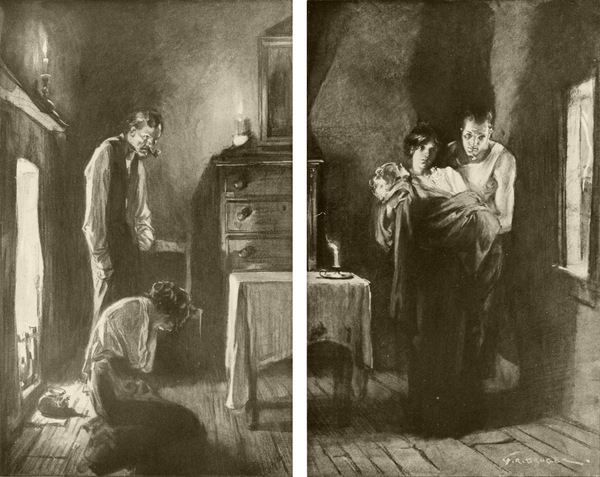
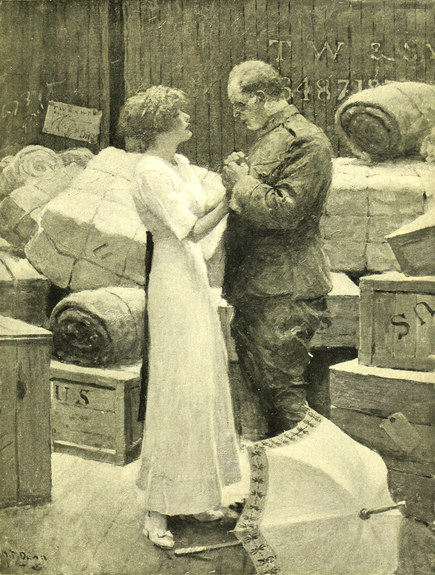
Drawn by F. R. Gruger. Color-Tone, engraved for
THE CENTURY by H. Davidson
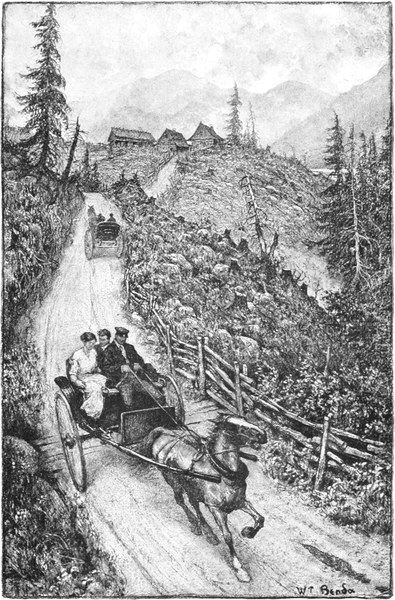
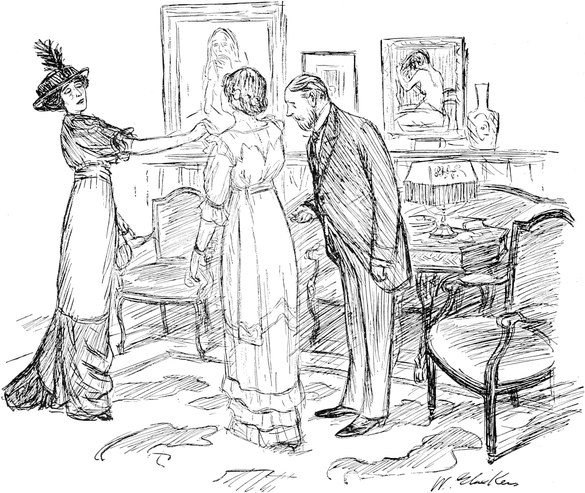
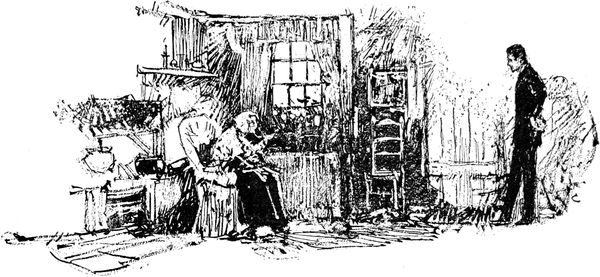
“THEN, AS I FALTERED AND FELT THAT I MUST STOP AND SINK ON THE FLOOR,
A WHILE A SHOULDER BRACED ITSELF AGAINST STRONG, WARM, BARE ARM CAME
AROUND ME, AND UNDER MY ARM AROUND THE BABY, MINE, AS GABRIEL SWUNG
INTO STEP WITH ME”
❏
LARGER IMAGE
As he was speaking, he took the candle and led the way into a
little shed-room, while I followed with trembling knees, and the jelly
of fear quivering all over my body. Every moonshine murder about which
I had ever read in the papers trod in martial array before my mental
eyes, and my breath was just a flutter between my chattering teeth. It
really is a triumph of the survival of the life force in the human body
that I am alive to tell the tale to you to-day.
“They’s light enough from the window for you to roll in,” the man said
as he pointed to a low bed, built of logs and boughs along the wall
next to the front room. “Better git to cover and stay there, a calico
like you, with the boys as rough as they be; you mightn’t like ’em. I
reckon they better not know you’re here, on ’count of the row that’s
coming over that knifing; so lay close.”
And even before he had time to depart with his candle, I made a dive
beneath the patched quilt, only grasping my hat in my hand instead of
keeping it on my head. Then, as still as my trembling limbs would let
me, I lay close to the rough, thin, pine planks that separated me from
what seemed the only other human being in the world. And for hours it
seemed I lay there and panted and groveled in spirit with terror and
helplessness, waiting, waiting, for something dreadful to happen, and
almost wishing it would come and be over.
Across the mountain-tops there began to be distant mutterings of
thunder, and in the flashes of lightning I could see restless, dark
birds wing by the small window. And save for the thunderings, there was
a stillness that must have been on the waters before the first dawn
reigned. I could hear my heart beat like a muffled motor, and only the
uncanny wail broke the silence now and again, while once I thought I
heard a woman’s stifled moan that sent a shudder to the very core of my
body.
And as I lay and cowered in that darkness, the mood of self-realization
came back upon me, and alone in that terror of blackness I turned at
bay and faced myself. Was that coward thing I that lay helpless while a
woman alone moaned away the life of her tortured child, and a plan for
murder was plotted with my full knowledge? Why didn’t I run out into
that dreadful night and warn the victim, stop him from stepping into
the dreadful trap laid for him? And right then I impeached myself. I
had been guarded and fended and had all humanity nurtured out of me,
so that, rather than risk my own pitiful little life, I was willing to
“lie close” and let my brother human be murdered in cold blood.
“But women are weak,” I argued in my own defense, “and terrible,
wolfish things like these they cannot control or prevent. They must let
them take their course.”
“Weak women have steeled themselves to the saving of their brothers and
sisters centuries long,” came the still, small voice that seemed to be
hovering over my breast.
“I can’t risk my own life for that of a rough moonshiner who probably
spends his time whittling a stick to throw away,” I sobbed in answer to
myself.
“What more important thing than whittling a stick do you do with your
life?” came the question, relentlessly.
“Nothing,” I sobbed under my breath, as a vision of all the nothings I
had done in my life came before me with a flash of the lightning that
seemed to illumine the inside of the very inner me.
“And that other woman suffering in there, why don’t I go to her?” I
demanded of myself, and failed to find an answer.
“Afraid of the roughness of some mountain man who would scarcely dare
harm your brother’s ‘woman’?” I asked contemptuously from above my own
breast. “You a ‘woman,’ if you let another woman watch her child die
alone!”
Desperate at this goad, I sat up, and was pushing back the quilt, when
the muffled sound of heavy boots came from across the clearing, and in
another flash I saw a file of men, each one of whom looked ten feet
tall, each with a gun on his arm, come out of the black woods and turn
to the front of the house. I melted back to cover, and lay drawing
breath like a drowning man.
Quietly they came into the room next to that in which I was hiding, and
their drawly voices had a subdued and terrible sound as they exchanged
a few remarks in guarded tones.
“Leader come?” one man asked from so near the pine board against which
I trembled that he couldn’t have been a foot away from me.
“Naw; and Bill is waiting in the woods to ketch him ’fore he gits here,
if he kin,” came the mumble of my host’s big voice.
“It’ll be nip and tuck ’twixt ’em, and lay out the worst man feet due
west,” another voice took up the gruesome chorus.
“That’s Bill now, coming outen the woods,” exclaimed Stivers,
ominously. “I reckon he thinks he missed Leader. Don’t nobody say
nothing when he comes in, but let him set and wait for his knock-out.
Nobody’s business but Leader’s.”
Listening frantically, I heard the doomed man’s hesitating feet shuffle
into the room and the chair groan as he took his seat amid the glum
silence.
And there I lay, and with Bill I waited I didn’t know for what, some
nameless horror that would kill the life in me and make me a dishonored
thing all my life—a human too cowardly to cry out the word of warning
to another of God’s creatures. And through it all the little child
wailed and the woman moaned.
Then in the midst of another thick muttering from the head of Old
Harpeth, which was followed by a vivid flash, I heard another pair of
feet step on the threshold of the cabin. I cowered under the quilt,
held my breath, and took the bullet into my own heart—or thought I did.
Then high and clear through the flash of the lightning, over the
mutterings of the thunder and the scuffle of the men’s feet,
accompanied by a glad cry from the moaning woman, there came a voice
of an archangel singing in tones of command that thrilled that whole
mountain until it seemed to shake with its reverberations:
“Stand up! stand up for Jesus!
Ye soldiers of the cross;
Lift high His royal banner,
It must not suffer loss.”
I lay still, and something poured into my heart that was a peace made
from the glory of the storm, the moan of the woman, and the song of
a dawn-bird. Out of the darkness my soul came like—I think I partly
expressed it in the first sentence of this confession, if you will turn
back and see, Evelyn dear.
After the men had sung the wonderful old hymn through to its very last
lines,
“To him that overcometh
A crown of life shall be;
He with the King of Glory
Shall reign eternally,”
Bill and I kept very still and took our “knock-out.”
Bill had stuck a knife into a gallant over at Hitch It for offering to
exchange snuff-sticks with Malinda Budd, and I could easily detect a
decided vein of sympathy in the voice of Leader while he administered
a rousing reproof to the knife, but extolled the use of fists in such
cases, much to the approval of the rest of the gang.
In fact, that was the greatest sermon ever spoken in the English
language on the theme of justice, courage, feminine protection, manly
dignity, and brotherly love, and it was done in about five minutes, I
should say. Every word of it hit Bill fair and square, and me also, to
say nothing of all the rest of the world. During the last minute and
a half of the discourse the men were indulging in muttered “Ahmens”
and “Glory be’s,” and I could hardly restrain myself from throwing off
the quilt and—well, you know, Evelyn, that Grandmother Wickliffe was
a pillar in the Methodist Church of Hillsboro, and at times of great
emotion, during the visit of the presiding elder, she did—shout. Aunt
Grace never likes to hear it mentioned.
Now, let me see, this is just about the beginning of the real story,
and I am so anxious to tell it all, though I really feel a hesitancy.
However, when I am through with the letter, I can leave out any part of
it that doesn’t sound seemly for me to tell about him—and me, can’t I?
To begin with, I hardly know how to make you understand about that
baby’s stomach, and how near a tragedy it was. Don’t laugh! I tremble
when I think about it, and I don’t ever believe I’ll learn to do it
to them. I hope I won’t have to practise on one of my own first; but,
then, it would be awful to kill another woman’s baby experimenting on
it, wouldn’t it? I’d better not think about that now, or I can’t tell
the rest of the story.
Well, after the doxology had been sung by the strange Gabriel in the
next room, accompanied by some really lovely rough men’s voices, and
he had sent them away so he could see to the sick baby in the other
room, I lay still and had a racking, glorious experience. For the first
time in my life I really prayed to Something that answered in the dark.
I didn’t have much to say for myself, but a great Gentleness reached
down and laid hold of me for always, and I can never be lost from Him
any more, and I knew it. Now, I have been taught that it is called
the witness of the spirit, and it’s what Grandmother Wickliffe had.
But I didn’t inherit it; I had to find it myself, and I got it through
tribulation, by the way of Gabriel’s song in the terror of the night,
followed by the sermon to Bill.
And while I was lying there under the quilt, just shouting in my soul
with ancestral ardor, I was called to come forth and attest my new
convictions. And I did. If I hadn’t got that faith in God just a few
minutes before on the wings of a great emotion, I never could have
steeled myself to taking that awful purple, twitching baby and helping
Gabriel do the dreadful things to it he did. I would have taken to the
woods at the first look at it. But I know now that I had got the real
religion that darts right through the emotions, and prods you up to do
things. And I did them.
“It’ll die, and I can’t hold it,” whimpered the poor exhausted mother
when Gabriel told her to hold the baby’s mouth open while he poured in
the hot water. At that time I was still safe and rejoicing over myself
under the quilt.
“You must hold him while I wash him out, or he will die. Come, brace
up and help me!” I heard Gabriel plead to the poor creature, with
positive agony in his voice, while the baby moaned.
“No use, Leader; I’ve done give’ up,” and I heard her fling herself on
the floor and begin to moan in chorus with the baby.
It took me just half a minute to get to my feet, into that other room,
and that baby in my arms, as awful to look at as it was. Of course it
seemed as if God was honoring me by crowding works on my new faith
pretty closely, and how I got through with such credit I don’t see; but
I did.
“You’ll have to show me just what to do; I never touched a baby before,
but I will try to help,” I said to Gabriel, who was looking at me in
an absolute astonishment and devout thankfulness that encouraged my
new-found capableness.
“A woman, thank God!” I heard him mutter before he spoke.
“Tip him on your arm, hold his head close against your breast, with
your finger down his throat, while I pour in this hot water; then turn
him over on your knee quick when it is about to come up. He is full of
fried potatoes, and that is what is making the spasms. I’ll hold his
legs with my left hand, so he can’t kick away from you. We must get
down enough of this water to bring up all of the potatoes.”
Gabriel’s voice was quick and respectful, as if he were speaking to
somebody that had as much intellect and manual training as himself. I
suppose that is what helped me through with those dreadful hours of
time that it took to work up that awful potato—that and the positive
way I said:
“Now, God, help me, please, and quick!”
At last it all came forth, and I don’t suppose it really was hours; but
the baby was apparently done for.
“No use, Leader; his time have come. She’s buried five out thar in the
clearing at jest about his age. Let the little critter go in peace,”
said Stivers, who had come in through the back door. His rough voice
had a note of suffering in it, though he lit his pipe by a coal from
the fire calmly enough.
But at the mention of the five little graves out in that awful night,
the poor woman on the floor groveled up on to her knees and caught at
my skirts.
“God help you!” said Gabriel, gently, to her. “He’s rid of the poison,
but so collapsed that there seems nothing more to do.”
“Yes, and I’m going to help God help her,” I said suddenly, and I rose
from the chair to walk the floor with the limp, white thing that had
been the purple horror in my arms. “I didn’t know how to unpoison him,
but if it’s strength and heat he needs, I can give him that,” and I
held the tiny mountaineer close against my bare breast, from which
his poor little convulsed fingers had torn all the foolish lace and
embroidered linen.
“If a physician were here, he would try transfusion; the child is
anemic, anyway,” said Gabriel, thoughtfully.
“We don’t need any physician but God to get my heat and strength into
him. I only wish I had on a real flannel petticoat, as a decent woman
ought to have for cases of emergency like this, to wrap him in. This
old piece of blanket isn’t real wool.”
“Poor folks can’t buy much but shoddy these days,” said Stivers, with
glum resentfulness.
“Here, my shirt’s the thing,” said Leader, and as quick as one of the
flashes that came in the window with the thunder mutterings, he had
peeled off his own gray flannel blouse, and was wrapping it around the
baby, and tucking it close over my breast.
“Now fight, and I’m with you,” he said as he looked straight into my
eyes in the dim light.
“He isn’t going to die; he’s got a right to live, and he’s going to do
it, God helping,” I answered, as I got a firm grasp of the mite on my
left arm, and put my warm right hand over the poor little collapsed
stomach.
And then for what seemed hours of eternity I walked and rubbed and
hugged that limp baby, while I prayed inside my own vitals to the tune
of “Stand up.” Stivers stood smoking sullenly by the fire, the mother
lay on the floor, moaning, and Gabriel stood over by the window, with
his bare shoulders gleaming comfortingly with every flash of lightning.
And the knowledge that all three of those strong, useful real people
were depending upon ignorant, foolish me to lead the fight for that
poor little life made the new wings of my spirit raise themselves and
soar out into some wonderful space I had never been in before, but
through which I knew the way and could take the baby with me.
How long I plodded across and across that rickety floor of the cabin I
don’t know, but once I staggered as I came near Gabriel at the window,
and my right shoulder sagged under its burden. Then, as I faltered and
felt that I must stop and sink on the floor, a strong, warm, bare arm
came around me, and under my arm around the baby, while a shoulder
braced itself against mine, as Gabriel swung into step with me.
“Keep fighting,” he said deep in his throat.
And again I soared away with the baby up to where God was there to help
us.
Then suddenly we both were brought back to earth by my feeling him
stir, and huddle closer to my breast, while the limp little knees found
strength to press themselves in against the ribs over my heart.
“Oh!” I sobbed with a quick breath.
The mother moaned, and Gabriel steadied us both closer. He thought the
baby was dead, I knew.
“Want to give him to me?” he asked gently.
“No, I don’t,” I answered jerkily enough to sound like a snap; “but
wipe the perspiration out of my eyes. He’s getting hot now, and I’m
melting, but I don’t dare stop hugging and patting. Make his mother
understand he’s getting all right.”
But nobody has to make a mother understand when her baby is saved. The
poor creature just gave one pitiful gasp, and went to nice, comfortable
crying instead of moaning. It was lovely to hear hearty boohoos, though
she never said a word except to ask Stivers for her snuff-stick, which
he attentively swabbed in the can before he handed it to her.
“You can’t go on walking and joggling forever; sit down and rock and
rest with him,” suggested Gabriel, timidly and respectfully, after he
had passed a nice, cool, linen handkerchief all over my hot face for
me, even with intelligence enough to wipe in the hollow under my chin.
“Not now; he’s squirming deliciously, and I don’t dare. Suppose he
should go limp again,” I answered fearfully.
“He’s due to drop off to sleep now,” announced Leader in such a
positive, though kind, voice that almost immediately young Stivers
obediently turned himself a bit, settled in a nice, soggy way, and I
could feel the little lungs so near mine begin to draw breath in a
regular, good sound sleep.
I waited a minute to be sure, then sank with him into a chair beside
the fire.
“Yes, he’s all right now,” Leader said in a lovely, quiet voice,
with just a husky note of happiness in it as he gently raised into
his own strong hand one tiny paddie that had stolen up on my breast
from out the warm, gray shirt. For a wonderful second we were all
soul-becalmed together, and then he went over into the corner and
slipped on his khaki hunting-coat, which he had hung on a peg in the
wall, and decorously tied his silk handkerchief around his neck, in
true mountaineer fashion. He never did get that shirt again, for I
originated some remarkable bandages for young Stivers out of it next
day.
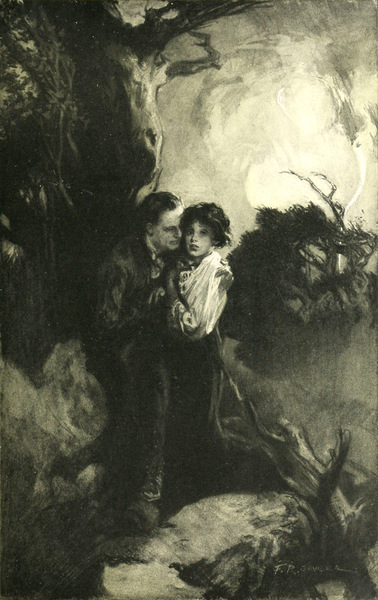
Color-Tone, engraved for
THE CENTURY by H. Davidson
“‘ARE YOU REAL?’ HE WHISPERED, WITH MY CHEEK PRESSED HARD AGAINST HIS,
AND HIS ARMS TERRIFIC WITH TENDERNESS”
DRAWN BY F. R. GRUGER
❏
LARGER IMAGE
Then he came back to the fire, and while I hovered the kiddie, the
mother came close on her knees and settled beside us, so that together
we took a worse ministerial drubbing than even Bill got for the
knifing episode, delivered in a voice of such heavenly sympathy that
Grandmother Wickliffe’s spirit again rose in me, and if it hadn’t been
for the baby, I believe she would have broken out this time in one good
shout. She hasn’t up to date, but I feel sure she will some day, and I
don’t always intend to restrain her manifestations.
The sermon this time had for its text the sacredness of the use of
the maternal fount for the young instead of promiscuous food, but it
embraced all the advanced feminist questions of the day, and was an
awful glorification and arraignment of human females all in one breath.
Why don’t women begin to know what dreadful and wonderful creatures
they really are earlier in life? The knowledge comes with an awful
shock when it does come, and ought to be experienced while young. I had
taken Bill’s sermon to heart, but that one to Mrs. Stivers I got right
in the center of my soul. It is still there.
And when it was over, the poor mother was kneeling by the fire, with
the baby at her breast, sobbing and crooning softly as she rocked it to
and fro in its deep sleep.
“It’s suffocating in here, now that it is all over. Don’t you want to
come out and watch the storm?” Gabriel asked me in a low voice as he
stood beside me looking down on the comfortable pair on the hearth.
“Don’t be afraid. It is a great one, mostly electrical, and will likely
go on all night this way. It makes the atmosphere almost unendurably
heavy. Do you want to watch it from the bluff there at the end of the
clearing? You can look down and see it at play in the valley.”
“Please,” I answered, catching the word in the middle with a breath
that was a sob in retreat.
Then before I knew it, or how, we were seated together on a big rock
that jutted out from the edge of the world. The cabin, with its one or
two dim lights, loomed with shadowy outlines behind us, and tall trees
hugged us close on both sides; but before us and beneath us was a wild,
black, turbulent night.
“Now look down into the valley when the next flash comes,” Gabriel said
with a note of excitement sounding in his deep voice that matched the
wind through the trees.
Then just as he finished speaking, a slow, steady sheet of light came
and lit up the world below us. The fields in their spring garments,
embroidered by the threads of silver creeks, lay lush and green, dotted
by farm-houses in which dim lights twinkled, bouqueted by glowing pink
orchards, and outlined by blooming hedges. Tall trees were massed along
the edges of the meadows and the river-banks, and among them the white
lines of the old sycamores gleamed in masses of high lights. And in the
wild, soft wind that rushed up the mountain-sides and flung itself upon
us there was mingled the tang of the honeysuckle and rhododendron with
the sweetness of the orchards and pungence of newly plowed earth.
Then as suddenly as the picture had risen before our eyes it sank back
into the purple blackness, and I caught my breath with the glory of it.
“And God made it!” I exclaimed softly, with the last sob that had been
left in my heart caught from my mouth by the wind.
“‘The earth is the Lord’s, and the fullness thereof; the world, and
they that dwell therein,’” he answered, and the wind took his words as
if it had been waiting for them to carry across the mountains.
After that for several long minutes, I don’t know how many, I sat
silent in the windy blackness, with the tree-branches sighing and
crashing over our heads, and wild things rustling in the leaves and
bushes beside us, and wondered what was happening to me.
Of course I have been deadly afraid of a minister all my life, and
the times we have had the bishops and presiding elders and pastors to
dinner with us in honor of the memory of Grandmother Wickliffe have
been times of torture to me. I always thought, of course, they were not
real men, though the way they looked and their hearty appetites for
both viands and jokes kept them from seeming conventional angels; but
this Gabriel materialization that sat close to me on that rock, which
was the end of the universe, was a strong, heart-beating man, who alone
stood between me and the real wilderness of the woods and the awful
wilderness of my ignorant and convicted spirit. It was terrific, but
heavenly sweet.
“I know He made me,—I found that out to-night,—but I don’t see what
for, and I wish I knew why,” I said in the smallest voice I had ever
heard myself use; and this time there was just the echo of that last
sob left to sigh out on the wind.
“He saw I needed you pretty badly a few hours ago,” Gabriel said in
that delicious warm voice he had used to me to encourage me through the
worst baby chokings.
“I’ve always been a dreadful woman, and wanted to be more and more so
until I heard you sing ‘Stand up for Jesus!’ when I was dead and gone
from fear of your gun, and talk to Bill about loving the girl with the
snuff-stick in the right way, and the man, too, just because we are all
God’s children. I was lost, but Something found me in the dark just
before you and the baby did. I never belonged to anything or anybody
before, and even now how do I know that God wants me after the awful
way I have lived?” My words trailed in positive anguish.
“He does want you, woman dear. Take my word for that, or would you like
me to quote you about five hundred passages from His Book to prove it
to you?” He laughed as he said it in a wooing, comforting way that was
both manly and ministerial.
“You don’t know me. I’m a perfect stranger to you,” I answered with
agonizing honesty, because the regard of that man, whom I had never
seen a few hard, long hours before, was becoming very valuable to me,
and I felt afraid that if I didn’t warn him about myself before he took
me for a friend, I might not ever do it, but dishonestly make him like
me, as I have done to so many other men.
“We couldn’t be perfect strangers after the battle with those
potatoes—and after seeing what that flash revealed of the valley
together, could we?” he asked, with the amusement sounding still more
plainly in his voice. “And you know you heard me preach twice. Isn’t
that a kind of left-handed introduction?”
“People that are introduced to me don’t ever know me,” I answered
forlornly; for I felt that the time had come for me to confess my sins
before men, and this was the hardest man to do it to I had ever met,
and also the easiest.
“Then tell me about yourself. I’ve been wondering a bit since I
have had time. You answered a hurry-call I had to send above pretty
quickly,” he said in a beguiling and encouraging tone of voice that
sounded just as other agreeable men’s voices have sounded to me before,
only more so.
Just then a furry thing rustled in the bushes, and I moved an inch
nearer him. I felt him stir, but he sat comfortingly still. I didn’t
want him to move to me.
“The worst thing about me is that I am utterly and entirely worthless,”
I began, dropping the words out slowly in the dark. “If God made me, He
can’t help but be dreadfully disappointed in me, and wishing He hadn’t.
I’m just a wicked white kitten, with a blue ribbon around my neck,
kept in a basket, and fed the warm milk of other people’s work and
attentions.”
“That is not always the kitten’s fault,” said Gabriel, gently.
“It’s this kitten’s. My family would have liked for me to be
strong-minded and go to college and do things in the world. They’ve
tried to persuade me. Dudley, my brother, says I have got so much
brains held in solution that he is afraid some day something will
happen to precipitate them before the world is ready for them; but I
ignore them strenuously. My mother is the president of the Home Mission
Society that Grandmother Wickliffe founded, and Aunt Grace is state
president of the Colonial Daughters, and makes remarkable speeches. I
am just a large, white-skinned, well-fed, red-headed bunch of nothing,
and I don’t know how to get over it.”
“At least you are of the blessed company of the meek,” answered
Gabriel, this time with a real human chuckle that he might have used
if he had found three of a kind in a poker-hand.
“Oh, no, I’m not meek,” I hastened to assure him. “I’m the most
conceited woman on the earth, the vain kind of conceit that looks in
the glass and admires its black lashes and white teeth, and long curves
in good frocks, not the intellectual-attainment kind, that has some
excuse for existence. I know I’m beautiful, and I hugely enjoy it.”
“You sound beautiful by description, and a few flashes of lightning,
added to candle-light, bear you witness. Still, why shouldn’t you
appreciate the gifts God has made you? Beauty can have the most
wonderful influence in the world in the way of enjoyment for us people
at large. Use yours that way when no misguided potatoes call you.”
His voice was enthusiastic and delightful, and what he said about the
flashes of lightning made me blush so there in the dark that I was
sorry one didn’t come that minute and let him see it—the blush. That
thought, coming into my mind, cast me into the depths of humiliation
that I had had it about him.
“That’s the trouble,” I faltered in unhappy mortification at my
instability of character. “I use it to make other people miserable, and
know when I do it—men people and things like that.”
“Sometimes that isn’t fair, is it?” he asked after a minute’s pause.
“And yet women will do it. What makes them?”
“I don’t know,” I almost sobbed, but controlled it. “I never knew how
wrong it was until you talked to Bill about that snuff-stick girl, and
how he ought to feel about her, and influence her not to do other men
that way. I’m like her, only I do worse than snuff-sticks; and I enjoy
it. No, I know God doesn’t want a woman like that.”
“But perhaps you won’t be like that any more. I don’t believe you
could, after tasting to-night’s adventure. You lapped up that situation
pretty enthusiastically,” he said gently. But somehow there was a hint
of amusement in his voice that set my dreadful temper off for a second,
and made me wild to convince him of the depths of my sinfulness. I felt
that the occasion demanded his serious attention and not levity.
All my life my temper has been a whirlwind that rose and carried me to
the limit of things, and then beyond, without any warning. I thought
I was making a confession in a state of religious zeal, but I am
afraid it was just the same old rage. Religious zeal often takes these
peculiar forms of exaggerated temper, and often never finds itself out.
From this you’ll see I’m trying very hard to differentiate myself; but
it is difficult.
Then for minutes and minutes, and perhaps hours, I sat there in the
dark beside that strange man, and told him things that I had never told
anybody living, and some I had never admitted to myself. It came out
in a wailing, sobbing volume, and I trembled so that he had to take my
cold hand in his, I suppose to keep me from sliding off the rock down
into the valley.
I wonder if any woman before ever talked out her whole wild self into
a man’s ears? And I wonder if it shook him as it did this one out
under the lowering clouds and dark trees? When women habitually reveal
themselves to men, it is going to bring social revolution, and they
must go slow.
And I did go slow. I tried to be truly considerate of him. I began on a
few ridiculous misdemeanors that I am surprised I remembered of myself,
such as inconsiderate extraction of money from father by means of
unwarranted tantrums, impositions on my dear mother’s loving credulity
about some of my hunting forays with Bobby, when I left home riding
Lady Gray, side-style, only to fling a leg over Dudley’s Grit two
squares down the street, where Bobby was waiting with him for me.
It surprised me that he only chuckled delightedly, and wanted to know
just exactly who and what Bobby was or is.
But I couldn’t be diverted, and was determined to tell the whole tale.
I felt as if I must get one or two things off my conscience and on to
his. I went the whole length, and succeeded.
When I told him of that mad escapade at Louisville, while I was
visiting Aunt Grace, with Stanley Hughes and the supper party he gave
to that French dancing-girl in “The Bird-Flight,” when I got out of the
taxi and walked home in my satin slippers in the snow for ten blocks
rather than stay and have Stanley take me another block in the state
he was in, though I had done nothing to stop his drinking and laughed
at him, I heard him catch his breath and shudder.
I never told anybody before that it was a paper-knife in my hands that
ripped open Henry Hedrick’s cheek for an inch, down in his library
while Mamie was up-stairs putting their six-months’ old baby to bed,
and I was a guest in their house. In this case I had suspected how he
felt about me before I came, but had contemptuously ignored it because
I liked to be with Mamie. I told the last few minutes of that tale with
dry sobs breaking my words, and while I shook, he folded my cold hand
in both his warm ones, and I heard him mutter between his teeth:
“God love her and keep her!”
Then, after a long stillness, I crept closer to him, so that my head
bowed against his arm, and opened the very depths to him.
“I don’t think any woman ought to say this to any man,” I began from
very far down in my throat, “but you are a preacher, and that makes a
difference, and you won’t mind. I am disrespectful and ungrateful to
Aunt Grace about it when she is trying her level best to do it to me,
but—but I ought to get married. There are lots of wonderful women all
over the world who are doing gloriously without husbands, and living
happily forever after; but I’m not one. Some women have such frivolous
spirits that nothing but a good, firm husband and an enormous family
of children can ever chasten them. I’m one. I’ve always thought that
he’d find me some day long before I was ready for him—or them; but now
I’m afraid he’ll never come. I know he won’t.” I clung to his strong
fingers desperately.
“I think he will,” he answered as he kindly, but firmly, possessed
himself of his own hand and coat-sleeve, but in such a way as not to
hurt my feelings. “I seem to feel that he is well on the road, though
fighting hard,” he added in what sounded like mild exasperation or
desperation, I couldn’t tell which.
“No,” I answered, with pitiful sadness and real conviction—“no; I am
not worthy of him, and he won’t come. It is too late. God and you have
just taught me this dreadful night what a good woman really is, and now
I will have to be so busy trying all the rest of my life to be one
that I won’t have time to look for—that is, he won’t find me. I don’t
want anything but a good one, and if I’m being so good as all that,
how’ll I let him know I want him?”
“Maybe he’ll get a revelation,” answered Gabriel in a low and
controlled voice that seemed to come from the very fastnesses of
something within him.
And as he spoke I felt something warm and sweet and terrible stealing
over me; but I plunged forward in my confession, past the episode of
the duke, my traitorous flight from home, and up to the arrival at
Stivers’s, and the cowardly taking of refuge under the patchwork quilt.
“I misunderstood, and thought from the way the men talked that you were
going to kill Bill, and I was too much of a coward to run out and find
him in the dark and warn him. You see, I lay still and let Bill be
killed, whether you did it or not; and so I murdered him, even if he is
alive,” I deduced miserably.
“Dudley was wise to fear the precipitation of the logical part of
the solution,” Gabriel remarked so quietly that it seemed as if he
preferred that I shouldn’t hear him.
“Yes; and, you see, I am a common murderer as well as all the other
dreadful things. And I let that baby die, too, rather than go and
help the woman wash it outside and in, as you made me do. That is two
murders; and I’m another one for not knowing how to fill it up with hot
water and poke my finger down its throat and press the potatoes and
water up at the same time. I’m a woman, or I ought to be. It’s my life
business to know and perform ably such terrible and simple operations
on babies. That makes me three murderers. And how did I know that Bill
wouldn’t kill you at the same time you killed him, and Mr. Stivers
and—”
“Stop!” Gabriel exclaimed suddenly, and he was shaking so hard with
unseemly mirth that he shook me, too; for without being able to help
myself, I had been crowding closer and closer to him, until I was
burrowing right under his arm in the agonies of confession. “The
damages will be endless if you go on at this rate. How many of these
murders did you realize you were doing at the time you did ’em?”
“Only Bill,” I answered, after a few minutes of intense mental
suffering. “I knew I ought to go and sympathize with the mother of the
baby, but I didn’t know about that squeezing a baby’s stomach in the
right place; but, as I say, I ought to have known, and—I did throw
the quilt back to start to Mrs. Stivers when you came in. Please don’t
laugh!”
“Then you stand acquitted of all responsibility of faulty impulse
except about the murder of Bill, which didn’t come off,” Gabriel
answered in a gentle, serious, and respectful voice that soothed me
into a cheerful frame of mind over my crimes even before he had more
than half uttered the words. I felt hope for myself rise in my heart.
“And then—then you came to the door and began to sing ‘Stand up for
Jesus!’ so that eyes in my soul opened suddenly, and I saw Him standing
and looking pitifully down into my awful black heart, and I felt Him
reach out His hand to me in the darkness. I’ve always avoided and been
afraid of God before, but now do you think He feels about me as He did
the man on the other cross who had done awful things, I forget just
what, and as long as Bill and the baby are both alive, and I worked so
hard, He will forgive me and love me? And give me more awful work to
do? Tell me, and what you say I will believe.” I crouched at his knee
as I asked the question breathlessly.
“Oh, you wonderful, foolish woman, you! Don’t you know that the good
God knows and claims His own?” Gabriel answered, as he bent forward and
put his hand on the head that had bowed on his knee. For a heart-still
instant we trembled together, then he said quietly and humbly: “I give
up. All my life I have prayed that my ‘woman’ would be one who had seen
her Master face to face. Stumbling in the darkness, groping, both of
us, we found each other and—clung. Are you mine? God, dare I claim a
miracle such as You sent to Your servants of old? Have we together met
You in the bush, and is it burning? Can we believe that You mean to”—
Then suddenly, in the very midst of his prayer, came a great, white,
steady glare, which rent the black clouds above us and revealed us to
each other, like the sun at high noon. The very mountains seemed to
reel in it, and the forest behind us was stilled from the rack of the
winds.
And clasping his knees, I looked and looked into his eyes, down, down
until I found a light more blinding than that without, while I could
feel his searching mine sternly, solemnly, and with a hope so great
that I was tempted to cower, but was prevented by a fierce hunger that
rose in me and demanded. I don’t know how long the light lasted, but
when it went out, and had left us in the night, the ordeal was over,
and I was welded into his arms, and his lips were pouring out love to
me in broken words of blessing and demand.
“Are you real?” he whispered, with my cheek pressed hard against his,
and his arms terrific with tenderness. “Can I believe it is true? Can I
claim a miracle? Can I?”
“Yes,” I answered with triumphant certainty in my mind and voice—“yes.
It’s that revelation you said you—that is, the—the man that was
coming for me would have. I know it’s a miracle, because I am as afraid
of a preacher as of—of that thing rustling out there in the bushes;
but if God let me get into your arms this awful way He means for me to
stay. And it’s my miracle, not yours. I needed one, and you didn’t.
You are it! You don’t think He will take you away from me in the
daylight, do you?”
“Never,” he laughed against my lips, with the coax and woo both in his
throat, under my hand pressed against it. And that was the taming of
the wild me.
A long time after, when I had settled myself comfortably against his
shoulder, and gone permanently to housekeeping in the parsonage of his
arms, softly the clouds above us drifted apart, and a glorious full
moon shone down on us in the warmest congratulatory approval.
“Let me look good at you, love-woman, so I’ll not confuse you with the
other flowers when morning comes,” Gabriel fluted from above my head as
he attempted to turn me on his arm a fraction of an inch away from him.
“You can use the moon, if you need it for identification purposes, but
that lightning was enough for me,” I answered, retiring from his eyes
for a hot-cheeked second under the silk handkerchief around his neck.
“It may take time and moonlight to teach you me, but I knew you in a
flash. I know it’s awful, but most women learn love by lightning, and
it’s agony to have to wait while men slowly arrive at it by the light
of the sun, moon, and stars. Will nothing ever teach them to hurry?”
“I should say,” answered Gabriel, with a delicious laugh, which I got
double benefit of, for I both heard it and felt it, “that I had met you
at least half-way.”
“And I’m a perfect stranger to you,” I was reiterating honestly, when
an amazed answer arrived from the other side of the rock.
“Well, you don’t look it—perfect strangers!” came in Dudley’s
astonished voice, as he rose from beneath the crag and stood beside us.
“You old psalm-singer, you, where did you get that girl?” he demanded
with a great, but, for the circumstances, very calm, interest.
“Just picked her up in the woods, where she has always been waiting
for me, you old log-killer, you. Yes, I guessed the fact that she is
your sister, but I dare you to try to take her away from me,” answered
Gabriel, as he held me closer, when, with sisterly dignity, I tried to
get into a position to squelch Dudley.
“I’ll never try,” answered Dudley, with devout thankfulness sounding in
his voice up from his diaphragm. “Maybe you can hold her down, Gates;
you seem to have got a good grip for a starter. The family never could.”
Yes, my dear Evelyn, Gabriel turned out to be that wonderful Gates
Attwood to whom Chicago has given five million dollars to build his
great Temple of Labor down on the South Side. He has been up here
visiting Dudley at his camp at Pigeon Creek, hiding for a little rest
for three months, and circuit-riding the mountaineers. If I had met him
under the shelter of my own roof-tree, I in evening dress, with the
lights on, I would have taken one insolent look at him, and then talked
to Bobby the rest of the evening, while Aunt Grace raged in pantomime
at mother about me. I realized this the instant Dudley called his name,
and I turned and hid my eyes against his lips as I trembled at such an
escape from losing him.
“I never belonged to anybody but you and—God. That’s what made me bad
to the others before I was found and claimed,” I whispered across his
cheek, while he nestled me still deeper into his breast, ignoring
Dudley, as he deserved.
“God’s good woman, and mine,” was the low answer I felt and heard.
“Well, I’d better go scare Mr. and Mrs. Possum and the Coon Sisters
off your trunks over at Crow Point,” remarked Dudley, with more than
brotherly consideration. “Something familiar about that collection of
baggage yanked me off the down train. I’ll fix you up at Stivers’s when
you want to come in, Nell. Here’s to her permanent change of heart,
Parson!” And he lighted his pipe as he strolled away through the woods.
And as he left, an awful shyness came pressing in between me and the
great man who sat on an Old Harpeth crag and held me so mercifully in
his arms.
“Isn’t there a mistake somewhere?” I asked in fear and trembling. “Or
did I really get born again, with you to help me?”
“Yes, love,” he answered softly. “This is the right way of things. I
needed you; you, me. We were ready, and He let us touch hands in the
storm, to be new created. Don’t you feel—kind of weak and young?”
“No,” I whispered just as softly. “Dreadfully strong. I know now how
Eve felt when she put her hand to Adam’s side, where there wasn’t even
a scar, and didn’t have to ask where she really came from.”
THE LETTER THAT REALLY WAS SENT
Hillsboro, Tennessee, May 30.
My dear Evelyn:
Yes, I know it sounds dreadful for him, that I’m going to marry Gates
Attwood next month; but I am going to be better than you can believe
I will. I tried to write you all about it, but I couldn’t. No, that
isn’t exactly true. I did, but Gates is wearing the letter in his left
breast pocket, and won’t give it up. Everybody will just have to trust
him with me because he does; and he must know what’s best, because God
trusts him. Please come home in time for the wedding. I need you, but
I haven’t made any plans. I can’t think or plan. I’m feeling. Were you
ever born again? If you have been, you will know what I’m talking about
when I tell you; and if you haven’t, you will think I am crazy.
Lovingly,
HELEN.
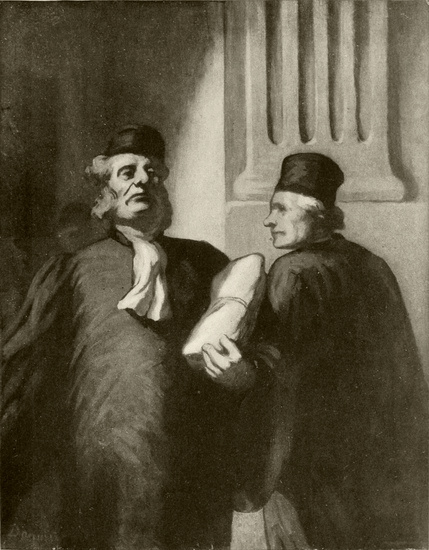
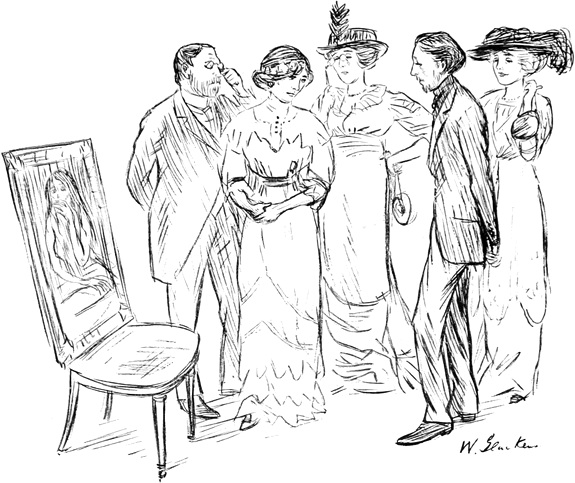
Color-Tone, engraved for
THE CENTURY by H. Davidson
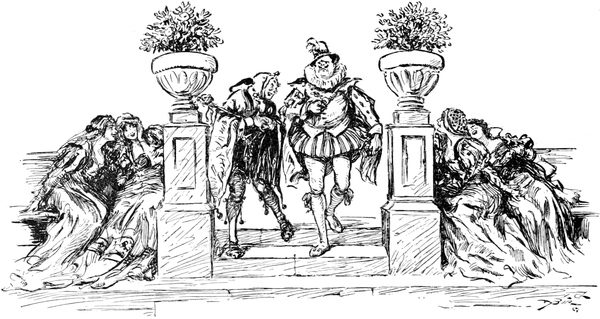
LES DEUX AVOCATS (THE TWO LAWYERS)
FROM THE HITHERTO UNPUBLISHED PAINTING BY HONORÉ DAUMIER
NOW IN THE COLLECTION OF ALEXANDER W. DRAKE
❏
LARGER IMAGE
LIFE AFTER DEATH [1] — THE THEOSOPHICAL HYPOTHESIS — THE NEOSPIRITUALISTIC HYPOTHESIS — THE DILEMMA OF THE TRUTH-SEEKER — THE BORDER-LAND OF LIFE AND DEATH — IS THE FUTURE LIFE DIM AND SHADOWY? — A LACK OF VITAL COMMUNICATIONS — HAS THE SPIRIT ONLY AN INCOHERENT MEMORY OF LIFE? — TRANSMIGRATION OF SOULS — WHAT HAS BEEN PROVED? — THE DANGER OF UNCONSCIOUS SUGGESTION IN MESMERIC TESTS — THE LACK OF COMPELLING PROOF IN THE THEORY
BY MAURICE MAETERLINCK
Author of “The Life of the Bee,” “Pelléas
and Mélisande,” etc.
THIS calm, judicious review of the results of organized psychical
research cannot fail to be immensely valuable in clearing up the mists
accumulated in twenty-eight years of earnest investigation into “the
debatable phenomena designated by such terms as mesmeric, psychical,
and spiritualistic.” The accumulations of evidence, and of argument
based upon evidence, have been so enormous that few men busy with
life have found time more than to dip into the wonderful subject and
turn dismayed and reluctant away. Nothing has been so much needed by
the Public Concerned with the Greater Things as a careful digestion
of this subject to date, and we are fortunate in having so broad, so
scientific, so many-sided a mind as Maeterlinck’s perform this service
for us.
This paper is the first of many in which THE
CENTURY will take account of civilization’s
accomplishments in many fields for the benefit of busy men and
women.—THE EDITOR.
I HAVE recently been studying two interesting solutions of the
problem of personal survival—solutions which, although not new, have
at least been lately renewed. I refer to the neotheosophical and
neospiritualistic theories, which are, I think, the only ones that can
be seriously discussed. The first is almost as old as man himself;
but a popular movement of some magnitude in certain countries has
rejuvenated the doctrine of reincarnation, or the transmigration of
souls, and brought it once more into prominence.
The great argument of its adherents—the chief and, when all is said,
the only argument—is only a sentimental one. Their doctrine that the
soul in its successive existences is purified and exalted with more or
less rapidity according to its efforts and deserts is, they maintain,
the only one that satisfies the irresistible instinct of justice which
we bear within us. They are right, and, from this point of view, their
posthumous justice is immeasurably superior to that of the barbaric
heaven and the monstrous hell of the Christians, where rewards and
punishments are forever meted out to virtues and vices which are for
the most part puerile, unavoidable, or accidental. But this, I repeat,
is only a sentimental argument, which has only an infinitesimal value
in the scale of evidence.
We may admit that certain of their theories are rather ingenious; and
what they say of the part played by the “shells,” for instance, or
the “elementals,” in the spiritualistic phenomena, is worth about as
much as our clumsy explanations of fluidic and supersensible bodies.
Perhaps, or even no doubt, they are right when they insist that
everything around us is full of living, sentient forms, of diverse and
innumerous types, “as different from one another as a blade of grass
and a tiger, or a tiger and a man,” which are incessantly brushing
against us and through which we pass unawares. If all the religions
have overpopulated the world with invisible beings, we have perhaps
depopulated it too completely; and it is extremely possible that we
shall find one day that the mistake was not on the side which one
imagined. As Sir William Crookes well puts it in a remarkable passage:
It is not improbable that other sentient beings have organs of
sense which do not respond to some or any of the rays to which our
eyes are sensitive, but are able to appreciate other vibrations
to which we are blind. Such beings would practically be living in
a different world to our own. Imagine, for instance, what idea
we should form of surrounding objects were we endowed with eyes
not sensitive to the ordinary rays of light but sensitive to the
vibrations concerned in electric and magnetic phenomena. Glass and
crystal would be among the most opaque of bodies. Metals would be
more or less transparent, and a telegraph wire through the air
would look like a long narrow hole drilled through an impervious
solid body. A dynamo in active work would resemble a conflagration,
whilst a permanent magnet would realise the dream of mediæval
mystics and become an everlasting lamp with no expenditure of
energy or consumption of fuel.
All this, with so many other things which they assert, would be, if
not admissible, at least worthy of attention, if those suppositions
were offered for what they are, very ancient hypotheses that go back
to the early ages of human theology and metaphysics; but when they are
transformed into categorical and dogmatic assertions, they at once
become untenable. Their exponents promise us, on the other hand, that
by exercising our minds, by refining our senses, by etherealizing our
bodies, we shall be able to live with those whom we call dead and with
the higher beings that surround us. It all seems to lead to nothing
very much and rests on very frail bases, on very vague proofs derived
from hypnotic sleep, presentiments, mediumism, phantasms, and so forth.
We want something more than arbitrary theories about the “immortal
triad,” the “three worlds,” the “astral body,” the “permanent atom,”
or the “Karma-Loka.” As their sensibility is keener, their perception
subtler, their spiritual intuition more penetrating, than ours, why do
they not choose as a field for investigation the phenomena of prenatal
memory, for instance, to take one subject at random from a multitude
of others—phenomena which, although sporadic and open to question, are
still admissible?
OUTSIDE theosophy, investigations of a purely scientific nature have
been made in the baffling regions of survival and reincarnation.
Neospiritualism, or psychicism, or experimental spiritualism, had its
origin in America in 1870. In the following year the first strictly
scientific experiments were organized by Sir William Crookes, the man
of genius who opened up most of the roads at the end of which men were
astounded to discover unknown properties and conditions of matter;
and as early as 1873 or 1874 he obtained, with the aid of the medium
Florence Cook, phenomena of materialization that have hardly been
surpassed. But the real beginning of the new science dates from the
foundation of the Society for Psychical Research, familiarly known
as the S. P. R. This society was formed in London twenty-eight years
ago, under the auspices of the most distinguished men of science
in England, and, as we all know, has made a methodical and strict
study of every case of supernormal psychology and sensibility. This
study or investigation, originally conducted by Edmund Gurney, F. W.
H. Myers, and Frank Podmore, and continued by their successors, is
a masterpiece of scientific patience and conscientiousness. Not an
incident is admitted that is not supported by unimpeachable testimony,
by definite written records and convincing corroboration. Among the
many supernormal manifestations, telepathy, previsions, and so forth,
we will take cognizance only of those which relate to life beyond the
grave. They can be divided into two categories: first, real, objective,
and spontaneous apparitions, or direct manifestations; second,
manifestations obtained by the agency of mediums, whether induced
apparitions, which we will put aside for the moment because of their
frequently questionable character, or communications with the dead by
word of mouth or automatic writing. Those extraordinary communications
have been studied at length by such men as F. W. H. Myers, Richard
Hodgson, Sir Oliver Lodge, and the philosopher William James, the
father of the new pragmatism. They profoundly impressed and almost
convinced these men, and they therefore deserve to arrest our attention.
It appears, therefore, to be as well established as a fact can be
that a spiritual or nervous shape, an image, a belated reflection of
life, is capable of subsisting for some time, of releasing itself
from the body, or surviving it, of traversing enormous distances in
the twinkling of an eye, of manifesting itself to the living and,
sometimes, of communicating with them.
For the rest, we have to recognize that these apparitions are very
brief. They take place only at the precise moment of death, or follow
very shortly after. They do not seem to have the least consciousness of
a new or superterrestrial life, differing from that of the body whence
they issue. On the contrary, their spiritual energy, at a time when it
ought to be absolutely pure, because it is rid of matter, seems greatly
inferior to what it was when matter surrounded it. These more or less
uneasy phantasms, often tormented with trivial cares, although they
come from another world, have never brought us one single revelation
of topical interest concerning that world whose prodigious threshold
they have crossed. Soon they fade away and disappear forever. Are they
the first glimmers of a new existence or the final glimmers of the old?
Do the dead thus use, for want of a better, the last link that binds
them and makes them perceptible to our senses? Do they afterward go on
living around us, without again succeeding, despite their endeavors, to
make themselves known or to give us an idea of their presence, because
we have not the organ that is necessary to perceive them, even as all
our endeavors would not succeed in giving a man who was blind from
birth the least notion of light and color? We do not know at all; nor
can we tell whether it is permissible to draw any conclusion from all
these incontestable phenomena. Meanwhile, it is interesting to observe
that there really are ghosts, specters, and phantoms. Once again,
science steps in to confirm a general belief of mankind, and to teach
us that a belief of this sort, however absurd it may at first seem,
still deserves careful examination.
NOW, what are we to think of it all? Must we, with Myers, Newbold,
Hyslop, Hodgson, and many others who have studied this problem at
length, conclude in favor of the incontestable agency of forces and
intelligences returning from the farther bank of the great river
which it was deemed that none might cross? Must we acknowledge with
them that there are cases ever more numerous which make it impossible
for us to hesitate any longer between the telepathic hypothesis
and the spiritualistic hypothesis? I do not think so. I have no
prejudices,—what were the use of having any in these mysteries?—no
reluctance to admit the survival and the intervention of the dead;
but, before leaving the terrestrial plane, it is wise and necessary
to exhaust all the suppositions, all the explanations, there to be
discovered. We have to make our choice between two manifestations of
the unknown, two miracles, if you prefer, whereof one is situated in
the world which we inhabit and the other in a region which, rightly or
wrongly, we believe to be separated from us by nameless spaces which
no human being, alive or dead, has crossed to this day. It is natural,
therefore, that we should stay in our own world as long as it gives
us a foothold, as long as we are not pitilessly expelled from it by a
series of irresistible and irrefutable facts issuing from the adjoining
abyss. The survival of a spirit is no more improbable than the
prodigious faculties which we are obliged to attribute to the mediums
if we deny them to the dead: but the existence of the medium, contrary
to that of the spirit, is unquestionable; and therefore it is for the
spirit, or for those who make use of its name, first to prove that it
exists.
Do the extraordinary phenomena of which we have spoken—transmission
of thought from one subconscious mind to another, perception of events
at a distance, subliminal clairvoyance—occur when the dead are not
in evidence, when the experiments are being made exclusively between
living persons? This cannot be honestly contested. Certainly no one
has ever obtained among living people series of communications or
revelations similar to those of the great spiritualistic mediums Mrs.
Piper, Mrs. Thompson, and Stainton Moses, nor anything that can be
compared with these so far as continuity or lucidity is concerned.
But though the quality of the phenomena will not bear comparison,
it cannot be denied that their inner nature is identical. It is
logical to infer from this that the real cause lies not in the source
of inspiration, but in the personal value, the sensitiveness, the
power of the medium. These mediums are pleased, in all good faith and
probably unconsciously, to give to their subliminal faculties, to
their secondary personalities, or to accept, on their behalf, names
which were borne by beings who have crossed to the further side of the
mystery: this is a matter of vocabulary or nomenclature which neither
lessens nor increases the intrinsic significance of the facts.
WELL, in examining these facts, however strange and really unparalleled
some of them may be, I never find one which proceeds frankly from
this world or which comes indisputably from the other. They are, if
you wish, phenomenal border incidents; but it cannot be said that the
border has been violated. It is simply a matter of distant perception,
subliminal clairvoyance, and telepathy raised to the highest power;
and these three manifestations of the unexplored depths of man are
to-day recognized and classified by science, which is not saying that
they are explained. That is another question. When, in connection
with electricity, we use such terms as positive, negative, induction,
potential, and resistance, we are also applying conventional words
to facts and phenomena of the inward essence of which we are utterly
ignorant; and we must needs be content with these, pending better.
Between these extraordinary manifestations and those given to us by a
medium who is not speaking in the name of the dead, there is, I insist,
only a difference of the greater and the lesser, a difference of extent
or degree, and in no wise a difference in kind.
For the proof to be more decisive, it would be necessary that neither
the medium nor the witnesses should ever have known of the existence
of him whose past is revealed by the dead man; in other words, that
every living link should be eliminated. I do not believe that this has
ever actually occurred, nor even that it is possible; in any case, it
would be a very difficult experiment to control. Be this as it may,
Dr. Hodgson, who devoted part of his life to the quest of specific
phenomena wherein the boundaries of mediumistic power should be
plainly overstepped, believes that he found them in certain cases, of
which, as the others were of very much the same nature, I will merely
mention one of the most striking. In a course of excellent sittings
with Mrs. Piper, the medium, he communicated with various dead friends
who reminded him of a large number of common memories. The medium,
the spirits, and he himself seemed in a wonderfully accommodating
mood; and the revelations were plentiful, exact, and easy. In this
extremely favorable atmosphere, he was placed in communication with
the soul of one of his best friends, who had died a year before, and
whom he simply called “A.” This A, whom he had known more intimately
than most of the spirits with whom he had communicated previously,
behaved quite differently and, while establishing his identity beyond
dispute, vouchsafed only incoherent replies. Now, A “had been troubled
much, for years before his death, by headaches and occasionally mental
exhaustion, though not amounting to positive mental disturbance.”
The same phenomenon appears to recur whenever similar troubles have
come before death, as in cases of suicide.
“If the telepathic explanation is held to be the only one,” says Dr.
Hodgson (I give the gist of his observations), “if it is claimed that
all the communications of these discarnate minds are only suggestions
from my subconscious self, it is unintelligible that, after having
obtained satisfactory results from others whom I had known far
less intimately than A and with whom I had consequently far fewer
recollections in common, I should get from him, in the same sittings,
nothing but incoherencies. I am thus driven to believe that my
subliminal self is not the only thing in evidence, that it is in the
presence of a real, living personality, whose mental state is the same
as it was at the hour of death, a personality which remains independent
of my subliminal consciousness and absolutely unaffected by it, which
is deaf to its suggestions, and draws from its own resources the
revelations which it makes.”
The argument is not without value, but its full force would be obtained
only if it were certain that none of those present knew of A’s
madness; otherwise it can be contended that, the notion of madness
having penetrated the subconscious intelligence of one of them, it
worked upon it and gave to the replies induced a form in keeping with
the state of mind presupposed in the dead man.
OF a truth, by extending the possibilities of the medium to these
extremes, we furnish ourselves with explanations which forestall
nearly everything, bar every road, and all but deny to the spirits
any power of manifesting themselves in the manner which they appear
to have chosen. But why do they choose that manner? Why do they thus
restrict themselves? Why do they jealously hug the narrow strip of
territory which memory occupies on the confines of both worlds and
from which none but indecisive or questionable evidence can reach
us? Are there, then, no other outlets, no other horizons? Why do
they tarry about us, stagnant in their little pasts, when, in their
freedom from the flesh, they ought to be able to wander at ease over
the virgin stretches of space and time? Do they not yet know that the
sign which will prove to us that they survive is to be found not with
us, but with them, on the other side of the grave? Why do they come
back with empty hands and empty words? Is that what one finds when
one is steeped in infinity? Beyond our last hour is it all bare and
shapeless and dim? If it be so, let them tell us; and the evidence of
the darkness will at least possess a grandeur that is all too absent
from these cross-examining methods. Of what use is it to die, if all
life’s trivialities continue? Is it really worth while to have passed
through the terrifying gorges which open on the eternal fields in order
to remember that we had a great-uncle called Peter and that our Cousin
Paul was afflicted with varicose veins and a gastric complaint? At
that rate, I should choose for those whom I love the august and frozen
solitudes of the everlasting nothing. Though it be difficult for them,
as they complain, to make themselves understood through a strange and
sleep-bound organism, they tell us enough categorical details about the
past to show that they could disclose similar details, if not about
the future, which they perhaps do not yet know, at least about the
lesser mysteries which surround us on every side and which our body
alone prevents us from approaching. There are a thousand things, large
or small, alike unknown to us, which we must perceive when feeble eyes
no longer arrest our vision. It is in those regions from which a shadow
separates us, and not in foolish tittle-tattle of the past, that they
would at last find the clear and genuine proof which they seem to seek
with such enthusiasm. Without demanding a great miracle, one would
nevertheless think that we had the right to expect from a mind which
nothing now enthralls some other discourse than that which it avoided
when it was still subject to matter.
This is where things stood when, of late years, the mediums, the
spiritualists, or, rather, it appears, the spirits themselves, for
one cannot tell exactly with whom we have to do, perhaps dissatisfied
at not being more definitely recognized and understood, invented,
for a more effectual proof of their existence, what has been called
“cross-correspondence.” Here the position is reversed: it is no longer
a question of various and more or less numerous spirits revealing
themselves through the agency of one and the same medium, but of a
single spirit manifesting itself almost simultaneously through several
mediums often at great distances from one another and without any
preliminary understanding among themselves. Each of these messages,
taken alone, is usually unintelligible, and yields a meaning only when
laboriously combined with all the others.
As Sir Oliver Lodge says:
The object of this ingenious and complicated effort clearly is
to prove that there is some definite intelligence underlying
the phenomena, distinct from that of any of the automatists, by
sending fragments of a message or literary reference which shall be
unintelligible to each separately—so that no effective telepathy
is possible between them,—thus eliminating or trying to eliminate
what had long been recognized by all members of the Society for
Psychical Research as the most troublesome and indestructible of
the semi-normal hypotheses. And the further object is evidently
to prove as far as possible, by the substance and quality of
the message, that it is characteristic of the one particular
personality who is ostensibly communicating, and of no other.[2]
The experiments are still in their early stages, and the most recent
volumes of the “Proceedings” are devoted to them. Although the
accumulated mass of evidence is already considerable, no conclusion
can yet be drawn from it. In any case, whatever the spiritualists
may say, the suspicion of telepathy seems to me to be in no way
removed. The experiments form a rather fantastic literary exercise,
one intellectually much superior to the ordinary manifestations of the
mediums; but up to the present there is no reason for placing their
mystery in the other world rather than in this. Men have tried to see
in them a proof that somewhere in time or space, or else beyond both,
there is a sort of immense cosmic reserve of knowledge upon which the
spirits go and draw freely. But if the reserve exist, which is very
possible, nothing tells us that it is not the living rather than the
dead who repair to it. It is very strange that the dead, if they really
have access to the immeasurable treasure, should bring back nothing
from it but a kind of ingenious child’s puzzle, although it ought to
contain myriads of lost or forgotten notions and acquirements, heaped
up during thousands and thousands of years in abysses which our mind,
weighed down by the body, can no longer penetrate, but which nothing
seems to close against the investigations of freer and more subtle
activities. They are evidently surrounded by innumerable mysteries,
by unsuspected and formidable truths that loom large on every side.
The smallest astronomical or biological revelation, the least secret
of olden time, such as that of the temper of copper, an archæological
detail, a poem, a statue, a recovered remedy, a shred of one of those
unknown sciences which flourished in Egypt or Atlantis—any of these
would form a much more decisive argument than hundreds of more or
less literary reminiscences. Why do they speak to us so seldom of the
future? And for what reason, when they do venture upon it, are they
mistaken with such disheartening regularity? One would think that, in
the sight of a being delivered from the trammels of the body and of
time, the years, whether past or future, ought all to lie outspread
on one and the same plane.[3] We may therefore say that the ingenuity
of the proof turns against it. All things considered, as in other
attempts, and notably in those of the famous medium Stainton Moses,
there is the same characteristic inability to bring us the veriest
particle of truth or knowledge of which no vestige can be found in
a living brain or in a book written on this earth. And yet it is
inconceivable that there should not somewhere exist a knowledge that is
not as ours and truths other than those which we possess here below.
THE case of Stainton Moses, whose name we have just mentioned, is a
very striking one in this respect. This Stainton Moses was a dogmatic,
hard-working clergyman, whose learning, Myers tells us, in the normal
state did not exceed that of an ordinary schoolmaster. But he was no
sooner “entranced” before certain spirits of antiquity or of the Middle
Ages who are hardly known save to profound scholars—among others,
St. Hippolytus; Plotinus; Athenodorus, the tutor of Augustus; and
more particularly Grocyn, the friend of Erasmus—took possession of
his person and manifested themselves through his agency. Now, Grocyn,
for instance, furnished certain information about Erasmus which was
at first thought to have been gathered in the other world, but which
was subsequently discovered in forgotten, but nevertheless accessible,
books. On the other hand, Stainton Moses’s integrity was never
questioned for an instant by those who knew him, and we may therefore
take his word for it when he declares that he had not read the books
in question. Here again the mystery, inexplicable though it be, seems
really to lie hidden in the midst of ourselves. It is unconscious
reminiscence, if you will, suggestion at a distance, subliminal
reading; but no more than in cross-correspondence is it indispensable
to have recourse to the dead and to drag them by main force into the
riddle, which, seen from our side of the grave, is dark and impassioned
enough as it is. Furthermore, we must not insist unduly on this
cross-correspondence. We must remember that the whole thing is in its
earliest stages, and that the dead appear to have no small difficulty
in grasping the requirements of the living.
In regard to this subject, as to the others, the spiritualists are fond
of saying:
“If you refuse to admit the agency of spirits, the majority of these
phenomena are absolutely inexplicable.”
Agreed; nor do we pretend to explain them, for hardly anything is to be
explained upon this earth. We are content simply to ascribe them to the
incomprehensible power of the mediums, which is no more improbable than
the survival of the dead, and has the advantage of not going outside
the sphere which we occupy and of bearing relation to a large number of
similar facts that occur among living people. Those singular faculties
are baffling only because they are still sporadic, and because only a
very short time has elapsed since they received scientific recognition.
Properly speaking, they are no more marvelous than those which we use
daily without marveling at them; as our memory, for instance, our
understanding, our imagination, and so forth. They form part of the
great miracle that we are; and, having once admitted the miracle, we
should be surprised not so much at its extent as at its limits.
Nevertheless, I am not at all of opinion that we must definitely reject
the spiritualistic theory; that would be both unjust and premature.
Hitherto everything remains in suspense. We may say that things are
still very little removed from the point marked by Sir William Crookes,
in 1874, in an article which he contributed to the “Quarterly Journal
of Science.” He there wrote:
The difference between the advocates of Psychic Force and the
Spiritualists consists in this—that we contend that there is
as yet insufficient proof of any other directing agent than the
Intelligence of the Medium, and no proof whatever of the agency of
Spirits of the Dead; while the Spiritualists hold it as a faith,
not demanding further proof, that Spirits of the Dead are the sole
agents in the production of all the phenomena. Thus the controversy
resolves itself into a pure question of fact, only to be
determined by a laborious and long-continued series of experiments
and an extensive collection of psychological facts, which should
be the first duty of the Psychological Society, the formation of
which is now in progress.
MEANWHILE, it is saying a good deal that rigorous scientific
investigations have not utterly shattered a theory which radically
confounds the idea which we were wont to form of death. We shall see
presently why, in considering our destinies beyond the grave, we need
have no reason to linger too long over these apparitions or these
revelations, even though they should really be incontestable and to
the point. They would seem, all told, to be only the incoherent and
precarious manifestations of a transitory state. They would at best
prove, if we were bound to admit them, that a reflection of ourselves,
an after-vibration of the nerves, a bundle of emotions, a spiritual
silhouette, a grotesque and forlorn image, or, more correctly, a sort
of truncated and uprooted memory, can, after our death, linger and
float in a space where nothing remains to feed it, where it gradually
becomes wan and lifeless, but where a special fluid, emanating from
an exceptional medium, succeeds at moments in galvanizing it. Perhaps
it exists objectively, perhaps it subsists and revives only in the
recollection of certain sympathies. After all, it would be not unlikely
that the memory which represents us during our life should continue to
do so for a few weeks or even a few years after our decease. This would
explain the evasive and deceptive character of those spirits which,
possessing only a mnemonic existence, are naturally able to interest
themselves only in matters within their reach. Hence their irritating
and maniacal energy in clinging to the slightest facts, their sleepy
dullness, their incomprehensible indifference and ignorance, and all
the wretched absurdities which we have noticed more than once.
But, I repeat, it is much simpler to attribute these absurdities to the
special character and the as yet imperfectly recognized difficulties
of telepathic communication. The unconscious suggestions of the most
intelligent among those who take part in the experiment are impaired,
disjointed, and stripped of their main virtues in passing through the
obscure intermediary of the medium. It may be that they go astray and
make their way into certain forgotten corners which the intelligence
no longer visits, and thence bring back more or less surprising
discoveries; but the intellectual quality of the aggregate will always
be inferior to that which a conscious mind would yield. Besides, once
more, it is not yet time to draw conclusions. We must not lose sight
of the fact that we have to do with a science which was born but
yesterday, and which is groping for its implements, its paths, its
methods, and its aim in a darkness denser than the earth’s. The boldest
bridge that men have yet undertaken to throw across the river of death
is not to be built in thirty years. Most sciences have centuries of
thankless efforts and barren uncertainties behind them; and there
are, I imagine, few among the younger of them that can show from the
earliest hour, as this one does, promises of a harvest which may not be
the harvest of their conscious sowing, but which already bids fair to
yield such unknown and wondrous fruit.[4]
SO much for survival proper. But certain spiritualists go further, and
attempt the scientific proof of palingenesis and the transmigration
of souls. I pass over their merely moral or scientific arguments,
as well as those which they discover in the prenatal reminiscences
of illustrious men and others. These reminiscences, though often
disturbing, are still too rare, too sporadic, so to speak; and the
supervision has not always been sufficiently close for us to be able
to rely upon them with safety. Nor do I purpose to pay attention to
the proofs based upon the inborn aptitudes of genius or of certain
infant prodigies—aptitudes which are difficult to explain, but which,
nevertheless, may be attributed to unknown laws of heredity. I shall be
content to recall briefly the results of some of Colonel de Rochas’s
experiments, which leave one at a loss for an explanation.
First of all, it is only right to say that Colonel de Rochas is a
savant who seeks nothing but objective truth, and does so with a
scientific strictness and integrity that have never been questioned.
He puts certain exceptional subjects into an hypnotic sleep, and by
means of downward passes makes them trace back the whole course of
their existence. He thus takes them successively to their youth, their
adolescence, and down to the extreme limits of their childhood. At
each of these hypnotic stages the subject reassumes the consciousness,
the character, and the state of mind which he possessed at the
corresponding stage in his life. He goes over the same events, with
their joys and sorrows. If he has been ill, he once more passes through
his illness, his convalescence, and his recovery. If, for instance, the
subject is a woman who has been a mother, she again becomes pregnant
and again suffers the pains of childbirth. Carried back to an age when
she was learning to write, she writes like a child, and her writings
can be placed side by side with the copy-books which she filled at
school.
This in itself is very extraordinary, but, as Colonel de Rochas says:
Up to the present, we have walked on firm ground; we have been
observing a physiological phenomenon which is difficult of
explanation, but which numerous experiments and verifications allow
us to look upon as certain.
We now enter a region where still more surprising enigmas await us. Let
us, to come to details, take one of the simplest cases. The subject
is a girl of eighteen, called Joséphine. She lives at Voiron, in the
department of the Isère. By means of downward passes, she is brought
back to the condition of a baby at her mother’s breast. The passes
continue, and the wonder-tale runs its course. Joséphine can no longer
speak; and we have the great silence of infancy, which seems to be
followed by a silence more mysterious still. Joséphine no longer
answers except by signs; she is not yet born, “she is floating in
darkness.” They persist; the sleep becomes heavier; and suddenly,
from the depths of that sleep, rises the voice of another being—a
voice unexpected and unknown, the voice of a churlish, distrustful,
and discontented old man. They question him. At first he refuses to
answer, saying that “of course he’s there, as he’s speaking”; that “he
sees nothing”; and that “he’s in the dark.” They increase the number
of passes, and gradually gain his confidence. His name is Jean-Claude
Bourdon; he is an old man; he has long been ailing and bedridden. He
tells the story of his life. He was born at Champvent, in the parish of
Polliat, in 1812. He went to school until he was eighteen, and served
his time in the army with the Seventh Artillery at Besançon; and he
describes his gay time there, while the sleeping girl makes the gesture
of twirling an imaginary mustache. When he goes back to his native
place, he does not marry, but he has a mistress. He leads a solitary
life (I omit all but the essential facts), and dies at the age of
seventy, after a long illness.
We now hear the dead man speak, and his posthumous revelations are not
sensational, which, however, is not an adequate reason for doubting
their genuineness. He “feels himself growing out of his body,” but
he remains attached to it for a fairly long time. His fluidic body,
which is at first diffused, takes a more concentrated form. He lives
in darkness, which he finds disagreeable; but he does not suffer. At
last the night in which he is plunged is streaked with a few flashes
of light. The idea comes to him to reincarnate himself, and he draws
near to her who is to be his mother (that is to say, the mother of
Joséphine). He encircles her until the child is born, whereupon he
gradually enters the child’s body. Until about the seventh year this
body was surrounded by a sort of floating mist in which he used to see
many things which he has not seen since.
The next thing to be done is to go back beyond Jean-Claude. A
mesmerization lasting nearly three quarters of an hour, without
lingering at any intermediate stage, brings the old man back to
babyhood, to a fresh silence, a new limbo; and then suddenly another
voice and an unexpected person. This time it is an old woman who has
been very wicked; and so she is in great torment. She is dead at the
actual instant; for, in this inverted world, lives go backward and of
course begin at the end. She is in deep darkness, surrounded by evil
spirits. She speaks in a faint voice, but always gives definite replies
to the questions put to her, instead of caviling at every moment, as
Jean-Claude did. Her name is Philomène Carteron.
I will now quote Colonel de Rochas:
By intensifying the sleep, I induce the manifestations of a living
Philomène. She no longer suffers, seems very calm, and always
answers very coldly and distinctly. She knows that she is unpopular
in the neighborhood, but no one is a penny the worse, and she
will be even with them yet. She was born in 1702; her maiden name
was Philomène Charpigny; her grandfather on the mother’s side was
called Pierre Machon and lived at Ozan. In 1732 she married, at
Chevroux, a man named Carteron, by whom she had two children, both
of whom she lost.
Before her incarnation, Philomène had been a little girl who died
in infancy. Previous to that, she was a man who had committed
murder, and it was to expiate this crime that she endured much
suffering in the darkness, even after her life as a little girl,
when she had had no time to do wrong. I did not think it necessary
to carry the hypnosis further, because the subject appeared
exhausted and her paroxysms were painful to watch.
But, on the other hand, I noticed one thing which would tend
to show that the revelations of these mediums rest on an
objective reality. At Voiron, one of the regular attendants at my
demonstrations is a young girl, Louise——. She possesses a very
sedate and thoughtful cast of mind, not at all open to hypnotic
suggestion; and she has in a very high degree the capacity, which
is comparatively common in a lesser degree, of perceiving the
magnetic effluvia of human beings and, consequently, the fluidic
body. When Joséphine revives the memory of her past, a luminous
aura is observed around her, and is perceived by Louise. Now, to
the eyes of Louise, this aura becomes dark when Joséphine is in
the phase separating two existences. In every instance there is a
strong reaction in Joséphine when I touch points where Louise tells
me that she perceives the aura, whether it be dark or light.
I thought it well to give the report of one of these experiments almost
in extenso, because those who maintain the palingenesic theory find
in these the only appreciable argument which they possess. Colonel
de Rochas renewed them more than once with different subjects. Among
these, I will mention only one, a girl called Marie Mayo, whose
history is more complicated than Joséphine’s, and whose successive
reincarnations take us back to the seventeenth century and carry us
suddenly to Versailles, among the historical personages moving about
Louis XIV.
Let us add that Colonel de Rochas is not the only mesmerizer who has
obtained revelations of this kind, which may henceforth be classed
among the incontestable facts of hypnotism. I have mentioned his alone
because they offer the most substantial guaranties from every point of
view.
WHAT do they prove? We must begin, as in all questions of this kind, by
entertaining a certain distrust of the medium. It goes without saying
that all mediums, by the very nature of their faculties, are inclined
to imposture, to trickery. I know that Colonel de Rochas, like Dr.
Richet and like Professor Lombroso, was occasionally hoaxed. That is
the inherent defect of the machinery which we must perforce employ; and
experiments of this sort will never possess the scientific value of
those made in a physical or chemical laboratory. But this is not an a
priori reason for denying them any sort of interest. As a question of
fact, are imposture and trickery possible here? Obviously, even though
the experiments be conducted under the strictest supervision. However
complicated it may be, the subject can have learned his lesson, and
can cleverly avoid the traps laid for him. The best guaranty, when
all is said, lies in his good faith and his moral sense, which the
experimenters alone are in a position to test and to know; and for that
we must trust to them. Besides, they neglect no precaution necessary to
make imposture extremely difficult. After taking the subject, by means
of transverse passes, up the stream of his life, they make him come
down the same stream; and the same events pass in the reverse order.
Repeated tests and countertests always yield identical results; and the
medium never hesitates or goes astray in the labyrinth of names, dates,
and incidents.[5]
Moreover, it would be requisite for these mediums, who are generally
people of merely average intelligence, suddenly to become great poets
in order thus to create, down to every detail, a series of characters
differing entirely one from the other, in which everything—gestures,
voice, temper, mind, thoughts, feeling—is in keeping, and ever
ready to reply, in harmony with their inmost nature, to the most
unexpected questions. It has been said that every man is a Shakspere
in his dreams; but have we not here to do with dreams which, in their
uniformity, bear a singular resemblance to fact?
I think, therefore, that, until we receive evidence to the contrary, we
may be allowed to leave fraud out of the question. Another objection
that might be raised, as was done with respect to the Myers phantom, is
the insignificance of their revelations from beyond the grave. I would
rather look on this as an argument in behalf of their good faith. Those
whose imagination is rich enough to create the wonderful persons whom
we see living in their sleep would doubtless find no great difficulty
in inventing a few fantastic but plausible details on the subject of
the next world. Not one of them thinks of it. They are Christians, and
therefore carry deep down in themselves the traditional terror of hell,
the fear of purgatory, and the vision of a paradise full of angels and
palms. They never refer to any of it. Although they are most often
ignorant of all the theories of reincarnation, they conform strictly to
the theosophical or neospiritualistic hypothesis, and are unconsciously
faithful to it in their very indefiniteness: they speak vaguely of “the
dark” in which they find themselves. They tell nothing because they
know nothing. It is apparently impossible for them to give any account
of a state that is still illumined. In fact, it is very likely, if we
admit the hypothesis of reincarnation and of evolution after death,
that nature, here as elsewhere, does not proceed by bounds. There is no
special reason why she should take a prodigious and inconceivable leap
between life and death.
We do not find the dramatic change which at first thought we are
rather inclined to expect. The spirit is first of all confused at
losing its body and every one of its familiar ways; it recovers itself
only by degrees. It resumes consciousness slowly. This consciousness
is subsequently purified, exalted, and extended, gradually and
indefinitely, until, reaching other spheres, the principle of life that
animates it ceases to reincarnate itself, and loses all contact with
us. This would explain why we never have any but minor and elementary
revelations.
All that concerns this first phase of the survival is fairly probable,
even to those who do not admit the theory of reincarnation. For
the rest, we shall see presently that the solutions which man’s
imagination finds there merely change the question and are inadequate
and provisional.
WE now come to the most serious objection, that of suggestion. Colonel
de Rochas declares that he and all the other experimenters who have
given themselves up to this study “have not only avoided everything
that could put the subject on a definite tack, but have often tried in
vain to lead him astray by different suggestions.” I am convinced of
it: there can be no question of voluntary suggestion.
But do we not know that in these regions unconscious and involuntary
suggestion is often more powerful and effective than the other? In
the hackneyed and rather childish experiment of table-turning, for
instance, which, after all, is only a crude and elementary form of
telepathy, the replies are nearly always dictated by the unconscious
suggestion of a participant or a mere onlooker.[6] We should therefore
first of all have to make sure that neither the hypnotizer nor
an onlooker, nor yet the subject himself, has ever heard of the
reincarnated persons. It will be enough, I shall be told, to employ
for the countertests another operator and different onlookers who
are ignorant of the previous revelations. Yes, but the subject is
not ignorant of them; and it is possible that the first suggestion
has been so profound that it will remain forever stamped upon the
unconsciousness, and that it will reproduce the same incarnations
indefinitely in the same order.
All this does not mean that the phenomena of suggestion are not
themselves laden with mysteries; but that is another question. For
the moment, as we see, the problem is almost insoluble, and control is
impracticable. Meanwhile, since we have to choose between reincarnation
and suggestion, it is right that we should confine ourselves in the
first instance to the latter, in accordance with the principles which
we have observed in the case of automatic speech and writing. Between
two unknowns, common sense and prudence decree that we should turn
first to the one on whose frontiers lie certain facts more frequently
recorded, the one which shows a few familiar glimmers. Let us exhaust
the mystery of our life before forsaking it for the mystery of our
death. Throughout this vast expanse of treacherous ground, it is
important that, until fresh evidence arrives, we should keep to one
inflexible rule, namely, that thought transference exists as long as
it is not absolutely and physically impossible for the subject or some
person in the room to have cognizance of the incident in question,
whether the cognizance be conscious or not, forgotten or actual. Even
this guaranty is not sufficient, for it is still possible for some one
taking no part in the sitting, and even very far away from it, to be
placed in communication with the medium by some unknown means, and to
influence the medium at a distance and unwittingly. Lastly, to provide
for every contingency before letting death come upon the boards, it
would be necessary to make certain that atavistic memory does not
play an unforeseen part. Cannot a man, for instance, carry hidden in
the depths of his being the recollection of events connected with
the childhood of an ancestor whom he has never seen, and communicate
it to the medium by unconscious suggestion? It is not impossible. We
carry in ourselves all the past, all the experience, of our ancestors.
If by some magic we could illumine the prodigious treasures of the
subconscious memory, why should we not there discover the events and
facts that form the sources of that experience? Before turning toward
yonder unknown, we must utterly exhaust the possibilities of this
terrestrial unknown. It is moreover remarkable, but undeniable, that,
despite the strictness of a law which seems to shut out every other
explanation, despite the almost unlimited and probably excessive scope
allotted to the domain of suggestion, there nevertheless remain some
facts which perhaps call for another interpretation.
BUT let us return to reincarnation, and recognize, in passing, that
it is very regrettable that the arguments of the theosophists and
neospiritualists are not compelling; for there never was a more
beautiful, a juster, a purer, a more moral, fruitful, and consoling,
or, to a certain point, a more probable creed than theirs. But the
quality of a creed is no evidence of its truth. Even though it is
the religion of six hundred millions of mankind, the nearest to the
mysterious origins, the only one that is not odious, and the least
absurd of all, it will have to do what the others have not done—bring
unimpeachable testimony; and what it has given us hitherto is only the
first shadow of a proof begun.
Indeed, even that would not put an end to the riddle. In principle,
reincarnation sooner or later is inevitable, since nothing can be
lost or remain stationary. What has not been demonstrated in any way,
and will perhaps remain indemonstrable, is the reincarnation of the
whole, identical person, notwithstanding the abolition of memory. But
what matters that reincarnation to him, if he be unaware that he is
still himself? All the problems of the conscious survival of man start
up anew, and we have to begin all over again. Even if scientifically
established, the doctrine of reincarnation, just like that of a
survival, would not set a term to our questions. It replies to neither
the first nor the last, those of the beginning and the end, the only
ones that are essential. It simply shifts them, pushes them a few
hundreds, a few thousands, of years back, in the hope, perhaps, of
losing or forgetting them in silence and space. But they have come from
the depths of the most prodigious infinities, and are not content with
a tardy solution. I am most certainly interested in learning what is in
store for me, what will happen to me immediately after my death. You
tell me:
“Man, in his successive incarnations, will make atonement by suffering,
will be purified, in order that he may ascend from sphere to sphere
until he returns to the divine essence whence he sprang.”
I am willing to believe it, notwithstanding that all this still bears
the somewhat questionable stamp of our little earth and its old
religions; I am willing to believe it; but even then? What matters to
me is not what will be for some time, but for always; and your divine
principle appears to me not at all infinite nor definite. It even
seems to me greatly inferior to that which I conceive without your
help. Now, even if it were based on thousands of facts, a religion
that belittles the God conceived by my loftiest thought could never
dominate my conscience. Your infinity or our God, without being even
more unintelligible than mine, is nevertheless smaller. If I be again
immerged in Him, it means that I emerged from Him; if it be possible
for me to have emerged from Him, then He is not infinite; and, if He
be not infinite, what is He? We must accept one thing or the other:
either He purifies me because I am outside Him and He is not infinite;
or, being infinite, if He purify me, then there was something impure
in Him, because it is a part of Himself which He is purifying in me.
Moreover, how can we admit that this God who has existed for all
time, who has the same infinity of millenaries behind Him as in front
of Him, should not yet have found time to purify Himself and put a
period to His trials? What He was not able to do in the eternity
previous to the moment of my existence He will not be able to do in
the subsequent eternity, for the two are equal. And the same question
presents itself where I am concerned. My principle of life, like His,
exists from all eternity, for my emergence out of nothing would be more
difficult of explanation than my existence without a beginning. I have
necessarily had innumerable opportunities of incarnating myself; and I
have probably done so, seeing that it is hardly likely that the idea
came to me only yesterday. All the chances of reaching my goal have
therefore been offered to me in the past; and all those which I shall
find in the future will add nothing to the number, which was already
infinite. There is not much to say in answer to these interrogations,
which spring up everywhence the moment our thought glances upon them.
Meanwhile, I had rather know that I know nothing than feed myself
on illusory and irreconcilable assertions. I had rather keep to an
infinity the incomprehensibility of which has no bounds than restrict
myself to a God whose incomprehensibility is limited on every side.
Nothing compels you to speak of your God; but, if you take upon
yourself to do so, it is necessary that your explanations should be
superior to the silence which they break.
It is true that the scientific spiritualists do not venture as far
as this God; but, then, tight-pressed between the two riddles of the
beginning and the end, they have almost nothing to tell us. They follow
the tracks of our dead for a few seconds in a world where seconds no
longer count, and then they abandon them in the darkness. I do not
reproach them, because we have here to do with things which, in all
probability, we shall not know in the day when we shall think that we
know everything. I do not ask that they shall reveal to me the secret
of the universe, for I do not believe, like a child, that this secret
can be expressed in three words or that it can enter my brain without
bursting it. I am even persuaded that beings who might be millions of
times more intelligent than the most intelligent among us would not
yet possess it, for this secret must be as infinite, as unfathomable,
as inexhaustible as the universe itself. Nevertheless, the fact
remains that this inability to go even a few years beyond the life
after death detracts greatly from the interest of their experiments
and revelations. At best, it is only a short space gained, and it is
not by this juggling on the threshold that our fate is decided. I am
ready to go through what may befall me in the short interval filled by
those revelations, as I am even now going through what befalls me in my
life here. My destiny does not lie there, nor my home. I do not doubt
that the facts reported are genuine and proved; but what is even much
more certain is that the dead, if they survive, have not a great deal
to teach us, whether because at the moment when they can speak to us
they have nothing to tell us, or because at the moment when they might
have something to reveal to us they are no longer able to do so, but
withdraw forever, and lose sight of us in the immensity which they are
exploring.
THE WHITE LINEN NURSE
HOW RAE MALGREGOR UNDERTOOK GENERAL HEARTWORK FOR A
FAMILY OF TWO
BY ELEANOR HALLOWELL ABBOTT
Author of “Molly Make-Believe,” etc.
IN THREE PARTS: PART TWO
WITH PICTURES BY HERMAN PFEIFER
SYNOPSIS OF PRECEDING INSTALMENT
ON the day of her graduation from the training-school, the White
Linen Nurse was overcome by hysteria. For weeks she had been
working too hard, and two or three cases with which she had been
connected having gone wrong, she had racked herself with an absurd
sense of responsibility. Now, in her distracted state, the visible
sign of her self-contempt was the perfectly controlled expression
of her trained-nurse face.
From a scene in her room with her two room-mates, in which
confidences are exchanged, she rushed to the office of the
Superintendent of Nurses, and hysterically demanded her own face.
The Senior Surgeon was sent for, and after tartly telling the girl
she was a fool, finally took her with him and his little crippled
daughter for a thirty-mile trip into the country, where he had been
summoned on a difficult case.
On their return, the Senior Surgeon lost control of the machine on
a steep hill, and the three were thrown out.
WHEN the White Linen Nurse found anything again, she found herself
lying perfectly flat on her back in a reasonably comfortable nest of
grass and leaves. Staring inquisitively up into the sky she thought
she noticed a slight black-and-blue discoloration toward the west, but
more than that, much to her relief, the firmament did not seem to be
seriously injured. The earth, she feared, had not escaped so easily.
Even away off somewhere near the tip of her fingers the ground was as
sore, as sore as could be, under her touch. Impulsively to her dizzy
eyes the hot tears started, to think that now, tired as she was, she
would have to jump right up in another minute or two and attend to the
poor earth. Fortunately for any really strenuous emergency that might
arise, there seemed to be nothing about her own body that hurt at all
except a queer, persistent little pain in her cheek.
Not until the Little Crippled Girl’s dirt-smouched face intervened
between her own staring eyes and the sky did she realize that the pain
in her cheek was a pinch.
“Wake up! wake up!” scolded the Little Crippled Girl, shrilly.
“Naughty—pink-and-white Nursie! I wanted to hear the bump! You
screamed so loud I couldn’t hear the bump.”
With excessive caution the White Linen Nurse struggled up at last to a
sitting posture, and gazed perplexedly about her.
It seemed to be a perfectly pleasant field—acres and acres of mild old
grass tottering palsiedly down to watch some skittish young violets
and bluets frolic in and out of a giggling brook. Up the field? Up
the field? Hazily the White Linen Nurse ground her knuckles into her
incredulous eyes. Up the field, just beyond them, the great empty
automobile stood amiably at rest. From the general appearance of the
stone wall at the top of the little grassy slope it was palpably
evident that the car had attempted certain vain acrobatic feats before
its failing momentum had forced it into the humiliating ranks of the
backsliders.
Still grinding her knuckles into her eyes, the White Linen Nurse
turned back to the Little Girl. Under the torn, twisted sable cap
one little eye was hidden completely, but the other eye loomed up as
rakish and bruised as a prize-fighter’s. One sable sleeve was wrenched
disastrously from its armhole, and along the edge of the vivid, purple
little skirt the ill-favored white ruffles seemed to have raveled out
into hopeless yards and yards and yards of Hamburg embroidery.
The Little Girl began to gather herself together a trifle
self-consciously.
“We—we seem to have fallen out of something,” she confided with the
air of one who halves a most precious secret.
“Yes, I know,” said the White Linen Nurse; “but what has become
of—your father?”
Worriedly for an instant, the Little Girl sat scanning the remotest
corners of the field, then abruptly, with a gasp of real relief, she
began to explore with cautious fingers the geographical outline of her
black eye.
“Oh, never mind about Father,” she asserted cheerfully. “I guess—I
guess he got mad and went home.”
“Yes, I know,” mused the White Linen Nurse; “but it doesn’t
seem—probable.”
“Probable?” mocked the Little Girl, most disagreeably; then suddenly
her little hand went shooting out toward the stranded automobile.
“Why, there he is,” she screamed—“under the car! Oh,
look—look—looky!”
Laboriously the White Linen Nurse scrambled to her knees. Desperately
she tried to ram her fingers like a clog into the whirling dizziness
round her temples.
“Oh, my God! oh, my God! what’s the dose for anybody under a car?” she
babbled idiotically.
Then with a really Herculean effort, both mental and physical, she
staggered to her feet, and started for the automobile.
But her knees gave out, and wilting down to the grass, she tried to
crawl along on all fours till straining wrists sent her back to her
feet again.
Whenever she tried to walk, the Little Girl walked; whenever she tried
to crawl, the Little Girl crawled.
“Isn’t it fun!” the shrill childish voice piped persistently. “Isn’t
it just like playing shipwreck!”
When they reached the car, both woman and child were too utterly
exhausted with breathlessness to do anything except just sit down on
the ground and stare.
Sure enough, under that monstrous, immovable-looking machine the Senior
Surgeon’s body lay rammed, face down, deep, deep into the grass.
It was the Little Girl who recovered her breath first.
“I think he’s dead,” she volunteered sagely. “His legs look—awfully
dead to me.” Only excitement was in the statement. It took a second or
two for her little mind to make any particularly personal application
of such excitement. “I hadn’t—exactly—planned—on having him dead,”
she began with imperious resentment. A threat of complete emotional
collapse zigzagged suddenly across her face. “I won’t have him dead! I
won’t! I won’t!” she screamed out stormily.
In the amazing silence that ensued the White Linen Nurse gathered her
trembling knees up into the circle of her arms and sat there staring at
the Senior Surgeon’s prostrate body, and rocking herself feebly to and
fro in a futile effort to collect her scattered senses.
“Oh, if some one would only tell me what to do, I know I could do it!
Oh, I know I could do it! If some one would only tell me what to do!”
she kept repeating helplessly.
Cautiously the Little Girl crept forward on her hands and knees to the
edge of the car, and peered speculatively through the great yellow
wheel-spokes. “Father!” she faltered in almost inaudible gentleness.
“Father!” she pleaded in perfectly impotent whisper.
Impetuously the White Linen Nurse scrambled to her own hands and knees
and jostled the Little Girl aside.
“Fat Father!” screamed the White Linen Nurse. “Fat Father! Fat Father!
Fat Father!” she gibed and taunted with the one call she knew that
had never yet failed to rouse him.
Perceptibly across the Senior Surgeon’s horridly quiet shoulders a
little twitch wrinkled and was gone again.
“Oh, his heart!” gasped the White Linen Nurse. “I must find his heart!”
Throwing herself prone upon the cool, meadowy ground and frantically
reaching under the running-board of the car to her full arm’s-length,
she began to rummage awkwardly hither and yon beneath the heavy weight
of the man in the desperate hope of feeling a heart-beat.
“Ouch! you tickle me!” spluttered the Senior Surgeon, weakly.
Rolling back quickly with fright and relief, the White Linen Nurse
burst forth into one maddening cackle of hysterical laughter. “Ha! ha!
ha!” she giggled. “Hi! hi!”
Perplexedly at first, but with increasing abandon, the Little Girl’s
voice took up the same idiotic refrain. “Ha! ha! ha!” she choked. “Hi!
hi! hi!”
With an agonizing jerk of his neck, the Senior Surgeon rooted his
mud-gagged mouth half an inch farther toward free and spontaneous
speech. Very laboriously, very painstakingly, he spat out one by one
two stones and a wisp of ground-pine and a brackish, prickly tickle of
stale goldenrod.
“Blankety-blank-blank-blank!” he announced in due
time—“blankety-blank-blank-blank-blank! Maybe when you two
blankety-blank imbeciles have got through your blankety-blank
cackling, you’ll have the blankety-blank decency to save my—my
blankety-blank-blank-blank-blank-blank life!”
“Ha! ha! ha!” persisted the poor White Linen Nurse, with the tears
streaming down her cheeks.
“Hi! hi! hi!” snickered the poor Little Girl through her hiccoughs.
Feeling hopelessly imprisoned under the monstrous car, the Senior
Surgeon closed his eyes for death. No man of his weight, he felt sure,
could reasonably expect to survive many minutes longer the apoplectic,
blood-red rage that pounded in his ear-drums. Through his tight-closed
eyelids very, very slowly a red glow seemed to permeate. He thought it
was the fires of hell. Opening his eyes to meet his fate like a man, he
found himself staring impudently close, instead, into the White Linen
Nurse’s furiously flushed face, which lay cuddled on one plump cheek,
staring impudently close at him.
“Why—why—get out!” gasped the Senior Surgeon.
Very modestly the White Linen Nurse’s face retreated a little further
into its blushes.
“Yes, I know,” she protested; “but I’m all through giggling now. I’m
sorry—I’m—”
In sheer apprehensiveness the Senior Surgeon’s features crinkled
wincingly from brow to chin as though struggling vainly to retreat from
the appalling proximity of the girl’s face.
“Your—eyelashes—are too long,” he complained querulously.
“Eh?” jerked the White Linen Nurse’s face. “Is it your brain that’s
hurt? Oh, sir, do you think it’s your brain that’s hurt?”
“It’s my stomach,” snapped the Senior Surgeon. “I tell you I’m not
hurt; I’m just—squashed. I’m paralyzed. If I can’t get this car off
me—”
“Yes, that’s just it,” beamed the White Linen Nurse’s face—“that’s
just what I crawled in here to find out—how to get the car off you.
That’s just what I want to find out. I could run for help, of course;
only I couldn’t run, ’cause my knees are so wobbly. It would take
hours, and the car might start or burn up or something while I was
gone. But you don’t seem to be caught anywhere on the machinery,” she
added more brightly; “it only seems to be sitting on you. So if I could
only get the car off you! But it’s so heavy. I had no idea it would be
so heavy. Could I take it apart, do you think? Is there any one place
where I could begin at the beginning and take it all apart?”
“Take it apart—hell!” groaned the Senior Surgeon.
A little twitch of defiance flickered across the White Linen Nurse’s
face.
“All the same,” she asserted stubbornly, “if some one would only tell
me what to do, I know I could do it.”
Horridly from some unlocatable quarter of the engine an alarming little
tremor quickened suddenly, and was hushed again.
“Get out of here—quick!” stormed the Senior Surgeon.
“I won’t,” said the White Linen Nurse, “until you tell me what to do.”
Brutally for an instant the ingenuous blue eyes and the cynical gray
eyes battled each other.
“Can you do what you’re told?” faltered the Senior Surgeon.
“Oh, yes,” said the White Linen Nurse.
“I mean, can you do exactly what you’re told?” gasped the Senior
Surgeon. “Can you follow directions, I mean? Can you follow them
explicitly? Or are you one of those people who listens only to her own
judgment?”
“Oh, but I haven’t got any judgment,” protested the White Linen Nurse.
Palpably in the Senior Surgeon’s bloodshot eyes the leisurely seeming
diagnosis leaped to precipitous conclusions.
“Then get out of here quick, for God’s sake, and get to work!” he
ordered.
Cautiously the White Linen Nurse jerked herself back into freedom
and crawled around and stared at the Senior Surgeon through the
wheel-spokes again. Like one worrying out some intricate mathematical
problem, his mental strain was pulsing visibly through his closed
eyelids.
“Yes, sir?” prodded the White Linen Nurse.
“Keep still!” snapped the Senior Surgeon. “I’ve got to think,” he said.
“I’ve got to work it out. All in a moment you’ve got to learn to run
the car. All in a moment! It’s awful!”
“Oh, I don’t mind, sir,” affirmed the White Linen Nurse, serenely.
Frenziedly the Senior Surgeon rooted one cheek into the mud again.
“You don’t mind?” he groaned. “You don’t mind? Why, you’ve got to
learn—everything—everything from the very beginning!”
“Oh, that’s all right, sir,” crooned the White Linen Nurse.
Ominously from somewhere a horrid sound creaked again. The Senior
Surgeon did not stop to argue any further.
“Now come here,” he ordered. “I’m going to—I’m going to—”
Startlingly his voice weakened, trailed off into nothingness, and
rallied suddenly with exaggerated bruskness. “Look here, now, for
Heaven’s sake, use your brains! I’m going to dictate to you very
slowly, one thing at a time, just what to do.”
Quite astonishingly the White Linen Nurse sank down on her knees and
began to grin at him.
“Oh, no, sir,” she said; “I couldn’t do it that way—not one thing at a
time. Oh, no, indeed, sir—No.” Absolute finality was in her voice, the
inviolable stubbornness of the perfectly good-natured person.
“You’ll do it the way I tell you to,” roared the Senior Surgeon,
struggling vainly to ease one shoulder or stretch one knee-joint.
“Oh, no, sir,” beamed the White Linen Nurse; “not one thing at a time.
Oh, no; I couldn’t do it that way. Oh, no, sir; I won’t do it that
way—one thing at a time,” she persisted hurriedly. “Why, you might
faint away or something might happen right in the middle of it—right
between one direction and another, and I wouldn’t know at all what to
turn on or off next; and it might take off one of your legs, you know,
or an arm. Oh, no; not one thing at a time.”
“Good-by, then,” croaked the Senior Surgeon. “I’m as good as dead now.”
A single shudder went through him, a last futile effort to stretch
himself.
“Good-by,” said the White Linen Nurse. “Good-by. I’d heaps rather have
you die perfectly whole, like that, of your own accord, than have me
run the risk of starting the car full-tilt and chopping you up so, or
dragging you off so, that you didn’t find it convenient to tell me how
to stop the car.”
“You’re a—a—a—” spluttered the Senior Surgeon, incoherently.
“Crinkle-crackle!” went that mysterious, horrid sound from somewhere
in the machinery.
“Oh, my God!” surrendered the Senior Surgeon, “do it your own—damned
way! Only—only—” His voice cracked raspingly.
“Steady! Steady there!” said the White Linen Nurse. Except for a sudden
odd pucker at the end of her nose her expression was still perfectly
serene. “Now begin at the beginning,” she begged. “Quick! Tell me
everything just the way I must do it! Quick! quick! quick!”
Twice the Senior Surgeon’s lips opened and shut with a vain effort to
comply with her request.
“But you can’t do it,” he began all over again; “it isn’t possible. You
haven’t got the mind.”
“Maybe I haven’t,” said the White Linen Nurse; “but I’ve got the
memory. Hurry!”
“Creak!” said the funny little something in the machinery.
“Oh, get in there quick!” surrendered the Senior Surgeon. “Sit down
behind the wheel!” he shouted after her flying footsteps. “Are you
there? For God’s sake, are you there? Do you see those two little
levers where your right hand comes? For God’s sake, don’t you know what
a lever is? Quick now! Do just what I tell you!”
A little jerkily then, but very clearly, very concisely, the Senior
Surgeon called out to the White Linen Nurse just how every lever, every
pedal, should be manipulated to start the car.
Absolutely accurately, absolutely indelibly, the White Linen Nurse
visualized each separate detail in her abnormally retentive mind.
“But you can’t possibly remember it,” groaned the Senior Surgeon. “You
can’t possibly. And probably the damned car’s bust and won’t start,
anyway, and—” Abruptly the speech ended in a guttural snarl of despair.
“Don’t be a—blight!” screamed the White Linen Nurse. “I’ve never
forgotten anything yet, sir!”
Very tensely she straightened up suddenly in her seat. Her expression
was no longer even remotely pleasant. Along her sensitive, fluctuant
nostrils the casual crinkle of distaste and suspicion had deepened
suddenly into sheer dilating terror.
“Left foot—press down—hard—left pedal,” she began to singsong to
herself.
“No, right foot—right foot!” corrected the Little Girl,
blunderingly from somewhere close in the grass.
“Inside lever—pull—’way—back!” persisted the White Linen Nurse,
resolutely, as she switched on the current.
“No, outside lever! Outside! Outside!” contradicted the Little
Girl.
“Shut your damned mouth!” screeched the White Linen Nurse, her hand on
the throttle as she tried the self-starter.
Bruised as he was, wretched, desperately endangered there under the
car, the Senior Surgeon could almost have grinned at the girl’s terse,
unconscious mimicry of his own most venomous tones.
Then with all the forty-eight lusty, ebullient years of his life
snatched from his lips like an untasted cup, and one single noxious,
death-flavored second urged, forced, crammed down his choking throat,
he felt the great car quicken and start.
“God!” said the Senior Surgeon, just “God!” The God of mud, he meant;
the God of brackish grass; the God of a man lying still hopeful under
more than two and a half ton’s weight of unaccountable mechanism, with
a novice in full command.
Up in her crimson leather cushions, free-lunged, free-limbed, the White
Linen Nurse heard the smothered cry. Clear above the whir of wheels,
the whizz of clogs, the one word sizzled like a red-hot poker across
her chattering consciousness. Tingling through the grasp of her fingers
on the vibrating wheel, stinging through the sole of her foot that
hovered over the throbbing clutch, she sensed the agonized appeal.
“Short lever, spark; long lever, gas,” she persisted resolutely. “It
must be right; it must!”
Jerkily then, and blatantly unskilfully, with riotous puffs, and
spinning of wheels, the great car started, faltered, balked a bit, then
dragged crushingly across the Senior Surgeon’s flattened body, and with
a great wanton burst of speed tore down the sloping meadow into the
brook rods away. Clamping down the brakes with a wrench and a racket
like the smash of a machine-shop, the White Linen Nurse jumped out into
the brook, and with one wild, terrified glance behind her, staggered
back up the long, grassy slope to the Senior Surgeon.
Mechanically through her wooden-feeling lips she forced the greeting
that sounded most cheerful to her.
“It’s not much fun, sir, running an auto,” she gasped. “I don’t believe
I’d like it.”
Half propped up on one elbow, still dizzy with mental chaos, still
paralyzed with physical inertia, the Senior Surgeon lay staring blankly
about him. Indifferently for an instant his stare included the White
Linen Nurse. Then glowering suddenly at something beyond her, his face
went perfectly livid.
“Good God! the—the car’s on fire!” he mumbled.
“Yes, sir,” said the White Linen Nurse. “Why, didn’t you know it, sir?”
Headlong the Senior Surgeon pitched over on the grass, his last vestige
of self-control stripped from him, horror unspeakable racking him
sobbingly from head to toe.
Whimperingly the Little Girl came crawling to him, and, settling down
close at his feet, began with her tiny lace handkerchief to make futile
dabs at the mud-stains on his gray silk stockings.
“Never mind, Father,” she coaxed; “we’ll get you clean sometime.”
Nervously the White Linen Nurse bethought her of the brook. “Oh, wait a
minute, sir, and I’ll get you a drink of water,” she pleaded.
Bruskly the Senior Surgeon’s hand jerked out and grabbed at her skirt.
“Don’t leave me!” he begged. “For God’s sake, don’t leave me!”
Weakly he struggled up again and sat staring piteously at the blazing
car. His unrelinquished clutch on the White Linen Nurse’s skirt brought
her sinking softly down beside him like a collapsed balloon. Together
they sat and watched the gaseous yellow flames shoot up into the sky.
“It’s pretty, isn’t it?” piped the Little Girl.
“Eh?” groaned the Senior Surgeon.
“Father,” persisted the shrill little voice—“Father, do people ever
burn up?”
“Eh?” gasped the Senior Surgeon. Brutally the harsh, shuddering sobs
began to rack and tear again through his great chest.
“There! there!” crooned the White Linen Nurse, struggling desperately
to her knees. “Let me get—everybody a drink of water.”
Again the Senior Surgeon’s unrelinquished clutch on her skirt jerked
her back to the place beside him.
“I said not to leave me!” he snapped out as roughly as he jerked.
Before the affrighted look in the White Linen Nurse’s face a sheepish,
mirthless grin flickered across one corner of his mouth.
“Lord! but I’m shaken!” he apologized. “Me, of all people!” Painfully
the red blood mounted to his cheeks. “Me, of all people!” Bluntly he
forced the White Linen Nurse’s reluctant gaze to meet his own. “Only
yesterday,” he persisted, “I did a laparotomy on a man who had only one
chance in a hundred of pulling through, and I—I laughed at him for
fighting off his ether cone—laughed at him, I tell you!”
“Yes, I know,” soothed the White Linen Nurse; “but—”
“But nothing!” growled the Senior Surgeon. “The fear of death? Bah! All
my life I’ve scoffed at it. Die? Yes, of course, when you have to,
but with no kick coming. Why, I’ve been wrecked in a hurricane in the
Gulf of Mexico, and I didn’t care; and I’ve lain for nine days more
dead than alive in an Asiatic cholera camp, and I didn’t care; and
I’ve been locked into my office three hours with a raving maniac and
a dynamite bomb, and I didn’t care; and twice in a Pennsylvania mine
disaster I’ve been the first man down the shaft, and I didn’t care; and
I’ve been shot, I tell you, and I’ve been horse-trampled, and I’ve been
wolf-bitten, and I’ve never cared. But to-day—to-day—” Piteously
all the pride and vigor wilted from his great shoulders, leaving him
all huddled up, like a woman, with his head on his knees—“but to-day
I’ve got mine,” he acknowledged brokenly.
Once again the White Linen Nurse tried to rise.
“Oh, please, sir, let me get you a—drink of water,” she suggested
helplessly.
“I said not to leave me!” jerked the Senior Surgeon.
Perplexedly, with big staring eyes, the Little Crippled Girl glanced
up at this strange fatherish person who sounded so suddenly small
and scared like herself. Jealous instantly of her own prerogatives,
she dropped her futile labors on the mud-stained silk stockings and
scrambled precipitously for the White Linen Nurse’s lap, where she
nestled down finally after many gyrations, and sat glowering forth at
all possible interlopers.
“Don’t leave any of us!” she ordered with a peremptoriness not
unmixed with supplication.
“Surely some one will see the fire and come and get us,” conceded the
Senior Surgeon.
“Yes, surely,” mused the White Linen Nurse. Just at that moment she
was mostly concerned with adjusting the curve of her shoulder to the
curve of the Little Girl’s head. “I could sit more comfortably,” she
suggested to the Senior Surgeon, “if you’d let go my skirt.”
“Let go of your skirt? Who’s touching your skirt?” gasped the Senior
Surgeon, incredulously. Once again the blood mounted darkly to his
face. “I think I’ll get up—and walk around a bit,” he confided coldly.
“Do, sir,” said the White Linen Nurse.
With a tweak of pain through his sprained back, the Senior Surgeon
suddenly sat down again. “I sha’n’t get up till I’m good and ready,”
he declared.
“I wouldn’t, sir,” said the White Linen Nurse. Very slowly, very
complacently, all the while she kept right on renovating the Little
Girl’s personal appearance, smoothing a wrinkled stocking, tucking up
obstreperous white ruffles, tugging down parsimonious purple hems,
loosening a pinchy hook, tightening a wobbly button. Very slowly, very
complacently, the Little Girl drowsed off to sleep, with her weazen,
iron-cased little legs stretched stiffly out before her. “Poor little
legs! Poor little legs! Poor little legs!” crooned the White Linen
Nurse.
“I don’t know that you need to make a song about it,” winced the
Senior Surgeon. “It’s just about the cruellest case of complete
muscular atrophy that I’ve ever seen.”
Blandly the White Linen Nurse lifted her big blue eyes to his.
“It wasn’t her ‘complete muscular atrophy’ that I was thinking about,”
she said. “It’s her panties that are so unbecoming.”
“Eh?” exclaimed the Senior Surgeon.
“Poor little legs! Poor little legs! Poor little legs!” resumed the
White Linen Nurse, droningly.
Very slowly, very complacently, all around them April kept right on
being April. Very slowly, very complacently, all around them the grass
kept right on growing, and the trees kept right on budding. Very
slowly, very complacently, all around them the blue sky kept right on
fading into its early evening dove-colors.
Nothing brisk, nothing breathless, nothing even remotely hurried, was
there in all the landscape except just the brook, and the flash of a
bird, and the blaze of the crackling automobile.
The White Linen Nurse’s nostrils were smooth and calm with the
lovely sappy scent of rabbit-nibbled maple-bark and mud-wet arbutus
buds. The White Linen Nurse’s mind was full of sumptuous, succulent
marsh-marigolds and fluffy-white shad-bush blossoms.
The Senior Surgeon’s nostrils were all puckered up with the stench
of burning varnish. The Senior Surgeon’s mind was full of the horrid
thought that he’d forgotten to renew his automobile fire-insurance,
and that he had a sprained back, and that his rival colleague had told
him he didn’t know how to run an auto, anyway, and that the cook had
given notice that morning, and that he had a sprained back, and that
the moths had gnawed the knees out of his new dress-suit, and that the
Superintendent of Nurses had had the audacity to send him a bunch of
pink roses for his birthday, and that the boiler in the kitchen leaked,
and that he had to go to Philadelphia the next day to read a paper on
“Surgical Methods at the Battle of Waterloo” and he hadn’t even begun
the paper yet, and that he had a sprained back, and that the wall-paper
on his library hung in shreds and tatters, waiting for him to decide
between a French fresco effect and an early English paneling, and that
his little daughter was growing up in wanton ugliness under the care of
coarse, indifferent hirelings, and that the laundry robbed him weekly
of at least five socks, and that it would cost him fully seven thousand
dollars to replace this car, and that he had a sprained back.
“It’s restful, isn’t it?” cooed the White Linen Nurse.
“Isn’t what restful?” glowered the Senior Surgeon.
“Sitting down,” said the White Linen Nurse.
Contemptuously the Senior Surgeon’s mind ignored the interruption and
reverted precipitously to its own immediate problem concerning the
gloomy, black-walnut-shadowed entrance-hall of his great house, and
how many yards of imported linoleum at $3.45 a yard it would take
to recarpet the “confounded hole”; and how it would have seemed,
anyway, if—if he hadn’t gone home as usual to the horrid black-walnut
shadows that night, but been carried home instead, feet first and quite
dead—dead, mind you, with a red necktie on, and even the cook was
out! And they wouldn’t even know where to lay him, but might put him by
mistake in that—in that—in his dead wife’s dead bed!
Altogether unconsciously a little fluttering sigh of ineffable
contentment escaped the White Linen Nurse.
“I don’t care how long we have to sit here and wait for help,” she
announced cheerfully, “because to-morrow, of course, I’ll have to get
up and begin all over again—and go to Nova Scotia.”
“Go where?” lurched the Senior Surgeon.
“I’d thank you kindly, sir, not to jerk my skirt quite so hard,” said
the White Linen Nurse, just a trifle stiffly.
Incredulously once more the Senior Surgeon withdrew his detaining hand.
“I’m not even touching your skirt,” he denied desperately. Nothing
but denial and reiterated denial seemed to ease his self-esteem for
an instant. “Why, for Heaven’s sake, should I want to hold on to
your skirt?” he demanded peremptorily. “What the deuce,” he began
blusteringly—“why in—”
Then abruptly he stopped and shot an odd, puzzled glance at the White
Linen Nurse, and right there before her startled eyes she saw every
vestige of human expression fade out of his face as it faded out
sometimes in the operating-room when, in the midst of some ghastly,
unforeseen emergency that left all his assistants blinking helplessly
about them, his whole wonderful, scientific mind seemed to break up
like some chemical compound into all its meek component parts, only
to reorganize itself suddenly with some amazing explosive action that
fairly knocked the breath out of all on-lookers, but was pretty apt to
knock the breath into the body of the person most concerned.
When the Senior Surgeon’s scientific mind had reorganized itself to
meet this emergency, he found himself vastly more surprised at the
particular type of explosion that had taken place than any other person
could possibly have been.
“Miss Malgregor,” he gasped, “speaking of preferring ‘domestic
service,’ as you call it—speaking of preferring domestic service
to—nursing, how would you like to consider—to consider a position
of—of—well, call it a—a position of general—heartwork—for a
family of two? Myself and the Little Girl here being the two, as you
understand,” he added briskly.
“Why, I think it would be grand!” beamed the White Linen Nurse.
A trifle mockingly the Senior Surgeon bowed his appreciation.
“Your frank and immediate—enthusiasm,” he murmured, “is more, perhaps,
than I had dared to expect.”
“But it would be grand,” said the White Linen Nurse. Before the odd
little smile in the Senior Surgeon’s eyes her white forehead puckered
all up with perplexity. Then with her mind still thoroughly unawakened,
her heart began suddenly to pitch and lurch like a frightened horse
whose rider has not even remotely sensed as yet the approach of an
unwonted footfall. “What did you say?” she repeated worriedly. “Just
exactly what was it that you said? I guess, maybe, I didn’t understand
just exactly what it was that you said.”
The smile in the Senior Surgeon’s eyes deepened a little.
“I asked you,” he said, “how you would like to consider a position of
‘general heartwork’ in a family of two, myself and the Little Girl
here being the two. ‘Heartwork’ was what I said. Yes, ‘heartwork,’ not
housework.”
“Heartwork?” faltered the White Linen Nurse. “Heartwork? I don’t know
what you mean, sir.” Like two falling rose-petals her eyelids fluttered
down across her affrighted eyes. “Oh, when I shut my eyes, sir, and
just hear your voice, I know of course, sir, that it’s some sort of a
joke; but when I look right at you, I—I—don’t know—what it is.”
“Open your eyes and keep them open, then, till you do find out,”
suggested the Senior Surgeon, bluntly.
Defiantly once again the blue eyes and the gray eyes challenged each
other.
“‘Heartwork’ was what I said,” persisted the Senior Surgeon. Palpably
his narrowing eyes shut out all meaning but one definite one.
The White Linen Nurse’s face became almost as blanched as her dress.
“You’re—you’re not asking me to—marry you, sir?” she stammered.
“I suppose I am,” acknowledged the Senior Surgeon.
“Not marry you!” cried the White Linen Nurse. Distress was in her
voice, distaste, unmitigable shock, as though the high gods themselves
had fallen at her feet and splintered off into mere candy fragments.
“Oh, not marry you, sir?” she kept right on protesting. “Not
be—engaged, you mean? Oh, not be engaged—and everything?”
“Well, why not?” snapped the Senior Surgeon.
Like a smitten flower the girl’s whole body seemed to wilt down into
incalculable weariness.
“Oh, no, no! I couldn’t!” she protested. “Oh, no, really!” Appealingly
she lifted her great blue eyes to his, and the blueness was all blurred
with tears. “I’ve—I’ve been engaged once, you know,” she explained
falteringly. “Why—I was engaged, sir—almost as soon as I was born,
and I stayed engaged till two years ago. That’s almost twenty years.
That’s a long time, sir. You don’t get over it—easy.” Very, very
gravely she began to shake her head. “Oh, no, sir! No! Thank you—very
much, but I—I just simply couldn’t begin at the beginning and go all
through it again. I haven’t got the heart for it. I haven’t got the
spirit. Carving your initials on trees and—and gadding round to all
the Sunday-school picnics—”
Brutally, like a boy, the Senior Surgeon threw back his head in one
wild hoot of joy. Much more cautiously, as the agonizing pang in his
shoulder lulled down again, he proceeded to argue the matter, but the
grin in his face was even yet faintly traceable.
“Frankly, Miss Malgregor,” he affirmed, “I’m much more addicted
to carving people than to carving trees; and as to Sunday-school
picnics—well, really now, I hardly believe that you’d find my demands
in that direction excessive.”
Perplexedly the White Linen Nurse tried to stare her way through his
bantering smile to his real meaning. Furiously, as she stared, the red
blood came flushing back into her face.
“You don’t mean for a second that you—that you love me?” she asked
incredulously.
“No, I don’t suppose I do,” acknowledged the Senior Surgeon with equal
bluntness; “but my little kiddie here loves you,” he hastened somewhat
nervously to affirm. “Oh, I’m almost sure that my little kiddie
here—loves you. She needs you, anyway. Let it go at that. Call it that
we both—need you.”
“What you mean is,” corrected the White Linen Nurse, “that needing
somebody very badly, you’ve just suddenly decided that that somebody
might as well be me?”
“Well, if you choose to put it like that,” said the Senior Surgeon, a
bit sulkily.
“And if there hadn’t been an auto accident,” argued the White Linen
Nurse just out of sheer inquisitiveness, “if there hadn’t been just
this particular kind of an auto accident at this particular hour
of this particular day of this particular month, with marigolds
and—everything, you probably never would have realized that you did
need anybody?”
“Maybe not,” admitted the Senior Surgeon.
“U-m-m,” said the White Linen Nurse. “And if you’d happened to take
one of the other girls to-day instead of me, why, then I suppose you’d
have felt that she was the one you really needed? And if you’d taken
the Superintendent of Nurses instead of any of us girls, you might even
have felt that she was the one you most needed?”
“Oh, hell!” said the Senior Surgeon.
With surprising agility for a man with a sprained back he wrenched
himself around until he faced her quite squarely.
“Now see here, Miss Malgregor,” he growled, “for Heaven’s sake, listen
to sense, even if you can’t talk it! Here am I, a plain professional
man, making you a plain professional offer. Why in thunder should
you try and fuss me all up because my offer isn’t couched in all the
foolish, romantic, lace-paper sort of flub-dubbery that you think such
an offer ought to be couched in, eh?”
“Fuss you all up, sir?” protested the White Linen Nurse, with real
anxiety.
Plates in tint, engraved for
THE CENTURY by H.
C. Merrill and H. Davidson
“‘THE CAR’S ON FIRE!’ HE MUMBLED. ‘YES, SIR,’ SAID THE WHITE LINEN
NURSE. ‘WHY, DIDN’T YOU KNOW IT, SIR?’”
DRAWN BY HERMAN PFEIFER
❏
LARGER IMAGE
“Yes, fuss me all up,” snarled the Senior Surgeon, with increasing
venom. “I’m no story-writer; I’m not trying to make up what might
have happened a year from next February in a Chinese junk off the
coast of—Nova Zembla to a Methodist preacher and a—and a militant
suffragette. What I’m trying to size up is just what’s happened to you
and me to-day. For the fact remains that it is to-day. And it is you
and I. And there has been an accident, and out of that accident—and
everything that’s gone with it—I have come out thinking of something
that I never thought of before. And there were marigolds,” he
added with unexpected whimsicality. “You see, I don’t deny even the
marigolds.”
“Yes, sir,” said the White Linen Nurse.
“Yes, what?” jerked the Senior Surgeon.
Softly the White Linen Nurse’s chin burrowed down a little closer
against the sleeping child’s tangled hair.
“Why—yes, thank you very much; but I never shall love again,” she said
definitely.
“Love?” gasped the Senior Surgeon. “Why, I’m not asking you to love
me!” His face was suddenly crimson. “Why, I’d hate it, if you—loved
me! Why, I’d—”
“O-h-h,” mumbled the White Linen Nurse in new embarrassment. Then
suddenly and surprisingly her chin came tilting bravely up again. “What
do you want?” she asked.
Helplessly the Senior Surgeon threw out his hands.
“My God!” he said, “what do you suppose I want? I want some one to take
care of us.”
Gently the White Linen Nurse shifted her shoulder to accommodate the
shifting little sleepy-head on her breast.
“You can hire some one for that,” she suggested with real relief.
“I was trying to hire—you!” said the Senior Surgeon, tersely.
“Hire me?” gasped the White Linen Nurse. “Why! Why!”
Adroitly she slipped both hands under the sleeping child and delivered
the little frail-fleshed, heavily ironed body into the Senior Surgeon’s
astonished arms.
“I—I don’t want to hold her,” he protested.
“She—isn’t mine,” argued the White Linen Nurse.
“But I can’t talk while I’m holding her,” insisted the Senior Surgeon.
“I can’t listen while I’m holding her,” persisted the White Linen Nurse.
Freely now, though cross-legged like a Turk, she jerked herself forward
on the grass and sat probing up into the Senior Surgeon’s face like an
excited puppy trying to solve whether the gift in your upraised hand is
a lump of sugar or a live coal.
“You’re trying to hire me?” she prompted him nudgingly with her
voice. “Hire me for money?”
“Oh, my Lord, no!” said the Senior Surgeon. “There are plenty of
people I can hire for money; but they won’t stay,” he explained
ruefully. “Hang it all!—they won’t stay!” Above his little girl’s
white, pinched face his own ruddy countenance furrowed suddenly with
unspeakable anxiety. “Why, just this last year,” he complained, “we’ve
had nine different housekeepers and thirteen nursery governesses.”
Skilfully as a surgeon, but awkwardly as a father, he bent to readjust
the weight of the little iron leg-braces. “But, I tell you, no one will
stay with us,” he finished hotly. “There’s something the matter with
us. I don’t seem to have money enough in the world to make anybody
stay with us.” Very wryly, very reluctantly, at one corner of his
mouth his sense of humor ignited in a feeble grin. “So, you see, what
I’m trying to do to you, Miss Malgregor, is to—hire you with something
that will just naturally compel you to stay.” If the grin round his
mouth strengthened a trifle, so also did the anxiety in his eyes. “For
Heaven’s sake, Miss Malgregor,” he pleaded, “here’s a man and a house
and a child all going to—hell! If you’re really and truly tired of
nursing, and are looking for a new job, what’s the matter with tackling
us?”
“It would be a job,” admitted the White Linen Nurse, demurely.
“Why, it would be a horrible job,” confided the Senior Surgeon, with no
demureness whatsoever.
Very soberly, very thoughtfully, then, across the tangled, snuggling
head of his own and another woman’s child, he urged the torments and
the comforts of his home upon this second woman.
“What is there about my offer that you don’t like?” he demanded
earnestly. “Is it the whole idea that offends you? Or just the way I
put it? ‘General heartwork for a family of two’—what is the matter
with that? Seems a bit cold to you, does it, for a real marriage
proposal? Or is it that it’s just a bit too ardent, perhaps, for a mere
plain business proposition?”
“Yes, sir,” said the White Linen Nurse.
“Yes, what?” insisted the Senior Surgeon.
“Yes—sir,” flushed the White Linen Nurse.
Very meditatively the Senior Surgeon reconsidered his phrasing.
“‘General heartwork for a family of two’? U-m-m.” Quite abruptly
even the tenseness of his manner faded from him, leaving his face
astonishingly quiet, astonishingly gentle. “But how else, Miss
Malgregor,” he queried—“how else should a widower with a child proffer
marriage to a—to a young girl like yourself? Even under conditions
directly antipodal to ours, such a proposition can never be a purely
romantic one. Yet even under conditions as cold and businesslike as
ours, there’s got to be some vestige of affection in it, some vestige
at least of the intelligence of affection, else what gain is there
for my little girl and me over the purely mercenary domestic service
that has racked us up to this time with its garish faithlessness?”
“Yes, sir,” said the White Linen Nurse.
“But even if I had loved you, Miss Malgregor,” explained the Senior
Surgeon, gravely, “my offer of marriage to you would not, I fear, have
been a very great oratorical success. Materialist as I am, cynic,
scientist, any harsh thing you choose to call me, marriage in some
freak, boyish corner of my mind still defines itself as being the
mutual sharing of a—mutually original experience. Certainly, whether
a first marriage be instigated in love or worldliness, whether it
eventually proves itself bliss, tragedy, or mere sickening ennui, to
two people coming mutually virgin to the consummation of that marriage,
the thrill of establishing publicly a man-and-woman home together is an
emotion that cannot be reduplicated while life lasts.”
“Yes, sir,” said the White Linen Nurse.
Bleakly across the Senior Surgeon’s face something gray that was not
years shadowed suddenly, and was gone again.
“Even so, Miss Malgregor,” he argued—“even so, without any glittering
romance whatsoever, no woman, I believe, is very grossly unhappy in any
affectional place that she knows distinctly to be her own place. It’s
pretty much up to a man, then, I think, though it tear him brain from
heart, to explain to a second wife quite definitely just exactly what
place it is that he is offering her in his love or his friendship or
his mere desperate need. No woman can even hope to step successfully
into a second-hand home who does not know from her man’s own lips the
measure of her predecessor. The respect we owe the dead is a selfish
thing compared with the mercy we owe the living. In my own case—”
Unconsciously the White Linen Nurse’s lax shoulders quickened, and the
sudden upward tilt of her chin was as frankly interrogative as a French
inflection. “Yes, sir,” she said.
“In my own case,” said the Senior Surgeon, bluntly—“in my own case,
Miss Malgregor, it is no more than fair to tell you that I—did not
love my wife. And my wife did not love me.” Only the muscular twitch
in his throat betrayed the torture that the confession cost him. “The
details of that marriage are unnecessary,” he continued with equal
bluntness. “It is enough, perhaps, to say that she was the daughter of
an eminent surgeon with whom I was exceedingly anxious at that time to
be allied, and that our mating, urged along on both sides, as it was,
by strong personal ambitions, was one of those so-called ‘marriages of
convenience’ which almost invariably turn out to be marriages of such
dire inconvenience to the two people most concerned. For one year we
lived together in a chaos of experimental acquaintanceship; for two
years we lived together in increasing uncongeniality and distaste; for
three years we lived together in open and acknowledged enmity; at the
last, I am thankful to remember, we had one year together again that
was at least an—armed truce.”
Darkly the gray shadow and the red flush chased each other once more
across the man’s haggard face.
“I had a theory,” he said, “that possibly a child might bridge the
chasm between us. My wife refuted the theory, but submitted herself
reluctantly to the fact. And when she died in giving birth to—my
theory, the shock, the remorse, the regret, the merciless self-analysis
that I underwent at that time almost convinced me that the whole
miserable failure of our marriage lay entirely on my own shoulders.”
Like the stress of mid-summer, the tears of sweat started suddenly on
his forehead. “But I am a fair man, I hope, even to myself, and the
cooler, less-tortured judgment of the subsequent years has virtually
assured me that for types as diametrically opposed as ours such a thing
as mutual happiness never could have existed.”
Mechanically he bent down and smoothed a tickly lock of hair away from
the little girl’s eyelids.
“And the child is the living physical image of her,” he stammered—“the
violent hair, the ghost-white skin, the facile mouth, the arrogant
eyes, staring, staring, maddeningly reproachful, persistently accusing.
My own stubborn will, my own hideous temper, all my own ill-favored
mannerisms, mock back at me eternally in her mother’s unloved
features.” As mirthless as the grin of a skull, the Senior Surgeon’s
mouth twisted up a little at one corner. “Maybe I could have borne
it better if she’d been a boy,” he acknowledged grimly; “but to see
all your virile—masculine vices come back at you, so sissified, in
skirts!”
“Yes, sir,” said the White Linen Nurse.
With an unmistakable gasp of relief, the Senior Surgeon expanded his
great chest.
“There, that’s done,” he said tersely. “So much for the past; now for
the present! Look at us pretty keenly and judge for yourself. A man
and a very little girl, not guaranteed, not even recommended, offered
merely ‘as is,’ in the honest trade-phrase of the day, offered frankly
in an open package, accepted frankly, if at all, ‘at your own risk.’
Not for an instant would I try to deceive you about us. Look at us
closely, I ask, and decide for yourself. I am forty-eight years old; I
am inexcusably bad-tempered, very quick to anger, and not, I fear, of
great mercy. I am moody, I am selfish, I am most distinctly unsocial;
but I am not, I believe, stingy, or ever intentionally unfair. My
child is a cripple, and equally bad-tempered as myself. No one but a
mercenary has ever coped with her, and she shows it. We have lived
alone for six years. All of our clothes, and most of our ways, need
mending. I am not one to mince matters, Miss Malgregor, nor has your
training, I trust, made you one from whom truths must be veiled. I am
a man, with all a man’s needs, mental, moral, physical. My child is a
child with all a child’s needs, mental, moral, physical. Our house of
life is full of cobwebs. The rooms of affection have long been closed.
There will be a great deal of work to do, and it is not my intention,
you see, that you should misunderstand in any conceivable way either
the exact nature or the exact amount of work and worry involved. I
should not want you to come to me afterward with a whine, as other
workers do, and say: ‘Oh, but I didn’t know you would expect me to do
this! Oh, but I hadn’t any idea you would want me to do that! And
I certainly don’t see why you should expect me to give up my Thursday
afternoon just because you yourself happened to fall down-stairs in the
morning and break your back!’”
Across the Senior Surgeon’s face a real smile lightened suddenly.
“Really, Miss Malgregor,” he affirmed, “I’m afraid there isn’t much of
anything that you won’t be expected to do. And as to your ‘Thursdays
out’? Ha! if you have ever yet found a way to temper the wind of your
obligations to the shorn lamb of your pleasures, you have discovered
something that I myself have never yet succeeded in discovering. And as
to ‘wages’? Yes, I want to talk everything quite frankly. In addition
to my average yearly earnings, which are by no means small, I have a
reasonably large private fortune. Within normal limits there is no
luxury, I think, that you cannot hope to have. Also, exclusive of the
independent income which I should like to settle upon you, I should be
very glad to finance for you any reasonable dreams that you may cherish
concerning your family in Nova Scotia. Also, though the offer looks
small and unimportant to you now, it is liable to loom pretty large
to you later; also, I will personally guarantee to you, at some time
every year, an unfettered, perfectly independent two-months’ holiday.
So the offer stands—my ‘name and fame,’ if those mean anything to you,
financial independence, an assured ‘breathing spell’ for at least two
months out of twelve, and at last, but not least, my eternal gratitude.
‘General heartwork for a family of two!’ There, have I made the task
perfectly clear to you? Not everything to be done all at once, you
know; but immediately where necessity urges it, gradually as confidence
inspires it, ultimately if affection justifies it, every womanish thing
that needs to be done in a man’s and a child’s neglected lives? Do you
understand?”
“Yes, sir,” said the White Linen Nurse.
“Oh, and there’s one thing more,” confided the Senior Surgeon. “It’s
something, of course, that I ought to have told you the very first
thing of all.” Nervously he glanced down at the sleeping child, and
lowered his voice to a mumbling monotone. “As regards my actual morals,
you have naturally a right to know that I’ve led a pretty decentish
sort of life, though I probably don’t deserve any special credit for
that. A man who knows enough to be a doctor isn’t particularly apt to
lead any other kind. Frankly, as women rate vices, I believe I have
only one. What—what—I’m trying to tell you now is about that one.” A
little defiantly as to chin, a little appealingly as to eye, he emptied
his heart of its last tragic secret. “Through all the male line of my
family, Miss Malgregor, dipsomania runs rampant. Two of my brothers,
my father, my grandfather, my great-grandfather before him, have
all gone down, as the temperance people would say, into ‘drunkards’
graves.’ In my own case, I have chosen to compromise with the evil.
Such a choice, believe me, has not been made carelessly or impulsively,
but out of the agony and humiliation of several less successful
methods.” As hard as a rock, his face grooved into its granite-like
furrows again. “Naturally, under these existing conditions,” he warned
her almost threateningly, “I am not peculiarly susceptible to the
mawkishly ignorant and sentimental protests of people whose strongest
passions are an appetite for chocolate candy. For eleven months of the
year,” he hurried on a bit huskily—“for eleven months of the year,
eleven months, each day reeking from dawn to dark with the driving,
nerve-wracking, heart-wringing work that falls to my profession, I lead
an absolutely abstemious life, touching neither wine nor liquor nor
even, indeed, tea or coffee. In the twelfth month—June always—I go
’way up into Canada,—’way, ’way off in the woods to a little log camp
I own there,—with an Indian who has guided me thus for eighteen years,
and live like a—wild man for four gorgeous, care-free, trail-tramping,
salmon-fighting, whisky-guzzling weeks. It is what your temperance
friends would call a ‘spree.’ To be quite frank, I suppose it is what
anybody would call a ‘spree.’ Then the first of July,—three or four
days past the first of July, perhaps,—I come out of the woods quite
tame again, a little emotionally nervous, perhaps, a little temperishly
irritable, a little unduly sensitive about being greeted as a returned
jail-bird, but most miraculously purged of all morbid craving for
liquor, and with every digital muscle as coolly steady as yours, and
every conscious mental process clamoring cleanly for its own work
again.”
Furtively under his glowering brows he stopped and searched the White
Linen Nurse’s imperturbable face. “It’s an—established habit, you
understand,” he re-warned her. “I’m not advocating it, you understand,
I’m not defending it; I’m simply calling your attention to the fact
that it is an established habit. If you decide to come to us, I—I
couldn’t, you know, at forty-eight, begin all over again to—to have
some one waiting for me on the top step the first of July to tell me
what a low beast I am till I go down the steps again the following
June.”
“No, of course not,” conceded the White Linen Nurse. Blandly she
lifted her lovely eyes to his. “Father’s like that,” she confided
amiably. “Once a year—just Easter Sunday only—he always buys him a
brand-new suit of clothes and goes to church. And it does something to
him, I don’t know exactly what, but Easter afternoon he always gets
drunk,—oh, mad, fighting drunk is what I mean,—and goes out and tries
to shoot up the whole county.” Worriedly, two black thoughts puckered
between her eyebrows. “And always,” she said, “he makes mother and me
go up to Halifax beforehand to pick out the suit for him. It’s pretty
hard sometimes,” she said, “to find anything dressy enough for the
morning that’s serviceable enough for the afternoon.”
“Eh?” jerked the Senior Surgeon. Then suddenly he began to smile again
like a stormy sky from which the last cloud has just been cleared.
“Well, it’s all right, then, is it? You’ll take us?” he asked brightly.
“Oh, no!” said the White Linen Nurse. “Oh, no, sir! Oh, no, indeed,
sir!” Quite perceptibly she jerked her way backward a little on the
grass. “Thank you very much,” she persisted courteously. “It’s been
very interesting. I thank you very much for telling me, but—”
“But what?” snapped the Senior Surgeon.
“But it’s too quick,” said the White Linen Nurse. “No man could tell
like that, just between one eye-wink and another, what he wanted about
anything, let alone marrying a perfect stranger.”
Instantly the Senior Surgeon bridled.
“I assure you, my dear young lady,” he retorted, “that I am entirely
and completely accustomed to deciding between ‘one wink and another’
just exactly what it is that I want. Indeed, I assure you that there
are a good many people living to-day who wouldn’t be living if it had
taken me even as long as a wink and three quarters to make up my mind.”
“Yes, I know, sir,” acknowledged the White Linen Nurse. “Yes, of
course, sir,” she acquiesced, with most commendable humility; “but
all the same, sir, I couldn’t do it,” she persisted with inflexible
positiveness. “Why, I haven’t enough education,” she confessed quite
shamelessly.
“You had enough, I notice, to get into the hospital with,” drawled
the Senior Surgeon, a bit grumpily, “and that’s quite as much as
most people have, I assure you. ‘A high-school education or its
equivalent,’—that is the hospital requirement, I believe?” he
questioned tartly.
“‘A high-school education or its—equivocation’ is what we girls call
it,” confessed the White Linen Nurse, demurely. “But even so, sir,” she
pleaded, “it isn’t just my lack of education. It’s my brains. I tell
you, sir, I haven’t got enough brains to do what you suggest.”
“I don’t mean at all to belittle your brains,” grinned the Senior
Surgeon despite himself,—“oh, not at all, Miss Malgregor,—but, you
see, it isn’t especially brains that I’m looking for. Really, what I
need most,” he acknowledged frankly, “is an extra pair of hands to go
with the—brains I already possess.”
“Yes, I know, sir,” persisted the White Linen Nurse. “Yes, of course,
sir,” she conceded. “Yes, of course, sir, my hands work awfully
well—with your face. But all the same,” she kindled suddenly—“all the
same, sir, I can’t. I won’t! I tell you, sir, I won’t! Why, I’m not
in your world, sir. Why, I’m not in your class. Why, my folks aren’t
like your folks. Oh, we’re just as good as you, of course, but we
aren’t as nice. Oh, we’re not nice at all. Really and truly we’re
not.” Desperately through her mind she rummaged up and down for some
one conclusive fact that would close this torturing argument for all
time. “Why, my father eats with his knife!” she asserted triumphantly.
“Would he be apt to eat with mine?” asked the Senior Surgeon, with
extravagant gravity.
Precipitously the White Linen Nurse jumped to the defense of her
father’s intrinsic honor.
“Oh, no,” she denied with some vehemence; “Father’s never cheeky like
that! Father’s simple sometimes—plain, I mean. Or he might be a bit
sharp. But, oh, I’m sure he’d never be—cheeky. Oh, no, sir. No.”
“Oh, very well, then,” grinned the Senior Surgeon. “We can consider
everything all comfortably settled, then, I suppose?”
“No, we can’t,” screamed the White Linen Nurse. A little awkwardly,
with cramped limbs, she struggled partly upward from the grass and
knelt there, defying the Senior Surgeon from her temporarily superior
height. “No, we can’t,” she reiterated wildly. “I tell you I can’t,
sir. I won’t! I won’t! I’ve been engaged once, and it’s enough. I
tell you, sir, I’m all engaged out!”
“What’s become of the man you were engaged to?” quizzed the Senior
Surgeon, sharply.
“Why, he’s married,” said the White Linen Nurse. “And they’ve got a
kid!” she added tempestuously.
“Good! I’m glad of it,” smiled the Senior Surgeon, quite amazingly.
“Now he surely won’t bother us any more.”
“But I was engaged so long,” protested the White Linen Nurse—“almost
ever since I was born, I said. It’s too long. You don’t get over it.”
“He got over it,” remarked the Senior Surgeon, laconically.
“Y-e-s,” admitted the White Linen Nurse; “but, I tell you, it doesn’t
seem decent, not after being engaged—twenty years.” With a little
helpless gesture of appeal she threw out her hands. “Oh, can’t I make
you understand, sir?”
“Why, of course I understand,” said the Senior Surgeon, briskly. “You
mean that you and John—”
“His name was Joe,” corrected the White Linen Nurse.
With astonishing amiability the Senior Surgeon acknowledged the
correction.
“You mean,” he said—“you mean that you and—Joe have been cradled
together so familiarly all your babyhood that on your wedding-night
you could most naturally have said: ‘Let me see, Joe, it’s two pillows
that you always have, isn’t it? And a double-fold of blanket at the
foot?’ You mean that you and Joe have been washed and scrubbed together
so familiarly all your young childhood that you could identify Joe’s
headless body twenty years hence by the kerosene-lamp scar across
his back? You mean that you and Joe have played house together so
familiarly all your young tin-dish days that even your rag dolls called
Joe father? You mean that since your earliest memory, until a year or
so ago, life has never once been just you and life, but always you and
life and Joe? You and spring and Joe, you and summer and Joe, you and
autumn and Joe, you and winter and Joe, till every conscious nerve in
your body has been so everlastingly Joed with Joe’s Joeness that you
don’t believe there’s any experience left in life powerful enough to
eradicate that original impression? Eh?”
“Yes, sir,” flushed the White Linen Nurse.
“Good! I’m glad of it,” snapped the Senior Surgeon. “It doesn’t make
you seem quite so alarmingly innocent and remote for a widower to offer
marriage to. Good, I say! I’m glad of it.”
“Even so, I don’t want to,” said the White Linen Nurse. “Thank you very
much, sir; but even so, I don’t want to.”
“Would you marry Joe now if he were suddenly free and wanted you?”
asked the Senior Surgeon, bluntly.
“Oh, my Lord, no!” said the White Linen Nurse.
“Other men are pretty sure to want you,” admonished the Senior Surgeon.
“Have you made up your mind definitely that you’ll never marry anybody?”
“N-o, not exactly,” confessed the White Linen Nurse.
An odd flicker twitched across the Senior Surgeon’s face like a sob in
the brain.
“What’s your first name, Miss Malgregor?” he asked a bit huskily.
“Rae,” she told him, with some surprise.
The Senior Surgeon’s eyes narrowed suddenly again.
“Damn it all, Rae,” he said, “I—want you!”
Precipitously the White Linen Nurse scrambled to her feet.
“If you don’t mind, sir,” she cried, “I’ll run down to the brook and
get myself a drink of water.”
Impishly like a child, muscularly like a man, the Senior Surgeon
clutched out at the flapping corner of her coat.
“No, you don’t,” he laughed, “till you’ve given me my definite answer,
yes or no.”
Breathlessly the White Linen Nurse spun round in her tracks. Her breast
was heaving with ill-suppressed sobs, her eyes were blurred with tears.
“You’ve no business to hurry me so,” she protested passionately. “It
isn’t fair; it isn’t kind.”
Sluggishly in the Senior Surgeon’s jolted arms the Little Girl woke
from her feverish nap and peered up perplexedly through the gray dusk
into her father’s face.
“Where’s my kitty?” she asked hazily.
“Eh?” jerked the Senior Surgeon.
Harshly the little iron leg-braces clanked together. In an instant the
White Linen Nurse was on her knees in the grass.
“You don’t hold her right, sir,” she expostulated. Deftly, with soft,
darting little touches, interrupted only by rubbing her knuckles into
her own tears, she reached out and eased successively the bruise of a
buckle or the dragging weight on a cramped little hip.
Still drowsily, still hazily, with little smacking gasps and gulping
swallows, the child worried her way back again into consciousness.
“All the birds were there, Father,” she droned forth feebly from her
sweltering mink-fur nest.
“All the birds were there
With yellow feathers instead of hair,
And bumblebees—and bumblebees—
And bumblebees—and bumblebees—”
Frenziedly she began to burrow the back of her head into her father’s
shoulder. “And bumblebees—and bumblebees—”
“Oh, for Heaven’s sake—‘buzzed in the trees!’” interpolated the Senior
Surgeon.
Rigidly from head to foot the little body in his arms stiffened
suddenly. As one who saw the supreme achievement of a life-time swept
away by some one careless joggle of an infinitesimal part, the Little
Girl stared up agonizingly into her father’s face.
“Oh, I don’t think ‘buzzed’ was the word!” she began convulsively. “Oh,
I don’t think—”
Startlingly through the twilight the Senior Surgeon felt the White
Linen Nurse’s rose-red lips come smack against his ear.
“Darn you! Can’t you say ‘crocheted in the trees’?” sobbed the White
Linen Nurse.
Grotesquely for an instant the Senior Surgeon’s eyes and the White
Linen Nurse’s eyes glared at each other in rank antagonism. Then
suddenly the Senior Surgeon burst out laughing.
“Oh, very well,” he surrendered—“‘crocheted in the trees!’”
The White Linen Nurse sank back on her heels and began to clap her
hands.
“Oh, now I will! Now I will!” she cried exultantly.
“Will what?” frowned the Senior Surgeon.
The White Linen Nurse stopped clapping her hands and began to wring
them nervously in her lap instead.
“Why, will—will,” she confessed demurely.
“Oh!” exclaimed the Senior Surgeon. “Oh!” Then jerkily he began to
pucker his eyebrows. “But, for Heaven’s sake, what’s the ‘crocheted in
the trees’ got to do with it?” he asked perplexedly.
“Nothing much,” mused the White Linen Nurse, very softly. With sudden
alertness she turned her curly blonde head toward the road. “There’s
somebody coming,” she said. “I hear a team.”
Overcome by a bashfulness that tried to escape in jocosity, the Senior
Surgeon gave an odd, choking little chuckle.
“Well, I never thought I should marry a—trained nurse!” he
acknowledged with somewhat hectic blitheness.
Impulsively the White Linen Nurse reached for her watch and lifted it
close to her twilight-blinded eyes. A sense of ineffable peace crept
suddenly over her.
“You won’t, sir,” she said amiably. “It’s twenty minutes of nine now,
and the graduation was at eight.”
FOR any real adventure except dying, June is certainly a most
auspicious month.
Indeed, it was on the very first rain-green, rose-red morning of June
that the White Linen Nurse sallied forth upon her extremely hazardous
adventure of marrying the Senior Surgeon and his naughty little
crippled daughter.
The wedding was at noon in some kind of gray-granite church. The Senior
Surgeon was there, of course, and the necessary witnesses; but the
Little Crippled Girl never turned up at all, owing, it proved later,
to a more than usually violent wrangle with whomever dressed her,
concerning the general advisability of sporting turquoise-colored
stockings with her brightest little purple dress.
The Senior Surgeon’s stockings, if you really care to know, were gray,
and the Senior Surgeon’s suit was gray, and he looked altogether
very huge and distinguished, and no more strikingly unhappy than any
bridegroom looks in a gray-granite church.
And the White Linen Nurse, no longer now truly a White Linen Nurse,
but just an ordinary, every-day silk-and-cloth lady of any color she
chose, wore something rather coaty and grand and bluish, and was
distractingly pretty, of course, but most essentially unfamiliar, and
just a tiny bit awkward and bony-wristed-looking, as even an admiral is
apt to be on his first day out of uniform.
Then as soon as the wedding ceremony was over, the bride and groom went
to a wonderful green-and-gold café, all built of marble and lined with
music, and had a little lunch. What I really mean, of course, is that
they had a very large lunch, but didn’t eat any of it.
Then in a taxi-cab, just exactly like any other taxi-cab, the
White Linen Nurse drove home alone to the Senior Surgeon’s great,
gloomy house, to find her brand-new stepdaughter still screaming
over the turquoise-colored stockings. And the Senior Surgeon, in a
Canadian-bound train, just exactly like any other Canadian-bound train,
started off alone, as usual, on his annual June “spree.”
Please don’t think for a moment that it was the Senior Surgeon who was
responsible for the general eccentricities of this amazing wedding-day.
No, indeed. The Senior Surgeon didn’t want to be married the first
day of June. He said he didn’t, he growled he didn’t, he snarled he
didn’t, he swore he didn’t; and when he finished saying and growling
and snarling and swearing, and looked up at the White Linen Nurse for
a confirmation of his opinion, the White Linen Nurse smiled perfectly
amiably and said, “Yes, sir.” Then the Senior Surgeon gave a great gasp
of relief and announced resonantly: “Well, it’s all settled, then?
We’ll be married some time in July, after I get home from Canada?” And
when the White Linen Nurse kept right on smiling perfectly amiably and
said, “Oh, no, sir, oh, no, thank you, sir; it wouldn’t seem exactly
legal to me to be married any other month but June,” the Senior Surgeon
went absolutely dumb with rage that this mere chit of a girl, and a
trained nurse, too, should dare to thwart his personal and professional
convenience. But the White Linen Nurse just drooped her pretty blonde
head and blushed and blushed and blushed and said: “I was only marrying
you, sir, to—accommodate you, sir, and if June doesn’t accommodate
you, I’d rather go to Japan with that monoideic somnambulism case.
It’s very interesting, and it sails June 2.” Then, “Oh, hell with the
‘monoideic somnambulism case’!” the Senior Surgeon would protest.
Really it took the Senior Surgeon quite a long while to work out the
three special arguments that would best protect him, he thought, from
the horridly embarrassing idea of being married in June.
“But you can’t get ready so soon,” he suggested at last with real
triumph. “You’ve no idea how long it takes a girl to get ready to be
married. There are so many people she has to tell—and everything.”
“There’s never but two that she’s got to tell, or bust,” conceded the
White Linen Nurse with perfect candor—“just the woman she loves the
most and the woman she hates the worst. I’ll write my mother to-morrow,
but I told the Superintendent of Nurses yesterday.”
“The deuce you did!” snapped the Senior Surgeon.
Almost caressingly the White Linen Nurse lifted her big blue eyes to
his.
“Yes, sir,” she said. “And she looked as sick as a young undertaker. I
can’t imagine what ailed her.”
“Eh?” choked the Senior Surgeon. “But the house, now,” he hastened to
contend—“the house, now, needs a lot of fixing over; it’s all run
down. It’s all—everything. We never in the world could get it into
shape by the first of June. For Heaven’s sake, now that we’ve got money
enough to make it right, let’s go slow and make it perfectly right.”
A little nervously the White Linen Nurse began to fumble through the
pages of her memorandum-book.
“I’ve always had money enough to ‘go slow and make things perfectly
right,’” she confided a bit wistfully. “Never in all my life have I
had a pair of boots that weren’t guaranteed or a dress that wouldn’t
wash or a hat that wasn’t worth at least three re-pressings. What I
was hoping for now, sir, was that I was going to have enough money
so that I could go fast and make things wrong if I wanted to—so
that I could afford to take chances, I mean. Here’s this wall-paper,
now,”—tragically she pointed to some figuring in her note-book,—“it’s
got peacocks on it, life-size, in a queen’s garden, and I wanted it
for the dining-room. Maybe it would fade, maybe we’d get tired of it,
maybe it would poison us: slam it on one week, and slash it off the
next. I wanted it just because I wanted it, sir. I thought maybe, while
you were ’way off in Canada—”
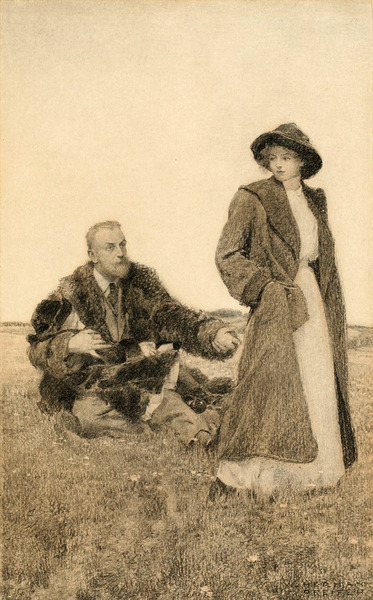
Plates in tint, engraved for
THE CENTURY by H.
C. Merrill and H. Davidson
“‘YOU’VE NO BUSINESS TO HURRY ME SO,’ SHE PROTESTED. ‘IT ISN’T FAIR;
IT ISN’T KIND’”
DRAWN BY HERMAN PFEIFER
❏
LARGER IMAGE
Eagerly the Senior Surgeon jerked his chair a little nearer to his
fiancée’s.
“Now, my dear girl,” he said, “that’s just what I want to
explain—that’s just what I want to explain—just what I want to
explain—to—er—explain,” he continued a bit falteringly.
“Yes, sir,” said the White Linen Nurse.
Very deliberately the Senior Surgeon removed a fleck of dust from one
of his cuffs.
“All this talk of yours about wanting to be married the same day I
start off on my—Canadian trip,” he contended, “why, it’s all damned
nonsense.”
“Yes, sir,” said the White Linen Nurse.
Very conscientiously the Senior Surgeon began to search for a fleck of
dust on his other cuff.
“Why, my—my dear girl,” he persisted, “it’s absurd, it’s outrageous!
Why, people would—would hoot at us! Why, they’d think—”
“Yes, sir,” said the White Linen Nurse.
“Why, my dear girl,” sweated the Senior Surgeon, “even though you and
I understand perfectly well the purely formal, businesslike conditions
of our marriage, we must at least, for sheer decency’s sake, keep up
a certain semblance of marital conventionality before the world. Why,
if we were married at noon the first day of June as you suggest, and I
should go right off alone as usual on my Canadian trip, and you should
come back alone to the house, why, people would think—would think that
I didn’t care anything about you.”
“But you don’t,” said the White Linen Nurse, serenely.
“Why, they’d think,” choked the Senior Surgeon—“they’d think you were
trying your—darndest to get rid of me.”
“I am,” said the White Linen Nurse, complacently.
With a muttered ejaculation the Senior Surgeon jumped to his feet and
stood glaring down at her.
Quite ingenuously the White Linen Nurse met and parried the glare.
“A gentleman, and a red-haired kiddie, and a great walloping house
all at once, it’s too much,” she confided genially. “Thank you just
the same, but I’d rather take them gradually. First of all, sir, you
see, I’ve got to teach the little kiddie to like me. And then there’s a
green-tiled paper with floppity sea-gulls on it that I want to try for
the bath-room. And—and—” Ecstatically she clapped her hands together.
“Oh, sir, there are such loads and loads of experiments I want to try
while you are off on your spree!”
“’S-h-h!” cried the Senior Surgeon. His face was suddenly blanched,
his mouth twitching like the mouth of one stricken with almost
insupportable pain. “For God’s sake, Miss Malgregor,” he pleaded,
“can’t you call it my Canadian trip?”
Wider and wider the White Linen Nurse opened her big blue eyes at him.
“But it is a spree, sir!” she protested resolutely. “And my father
says—” Still resolutely her young mouth curved to its original
assertion, but from under her heavy-shadowing eyelashes a little smile
crept softly out—“when my father’s got a lame trotting-horse, sir,
that he’s trying to shuck off his hands,” she faltered, “he doesn’t
ever go round mournful-like, with his head hanging, telling folks about
his wonderful trotter that’s just ‘the littlest, teeniest, tiniest
bit lame.’ Oh, no. What father does is to call up every one he knows
within twenty miles and tell ’em: ‘Say, Tom, Bill, Harry, or whatever
your name is, what in the deuce do you suppose I’ve got over here in
my barn? A lame horse that wants to trot! Lamer than the deuce,
you know, but can do a mile in two forty.’” Faintly the little smile
quickened again in the White Linen Nurse’s eyes. “And the barn will be
full of men in half an hour,” she said. “Somehow nobody wants a trotter
that’s lame, but almost anybody seems willing to risk a lame horse
that’s plucky enough to trot.”
“What’s the ‘lame trotting-horse’ got to do with me?” snarled the
Senior Surgeon, incisively.
Darkly the White Linen Nurse’s lashes fringed down across her cheeks.
“Nothing much,” she said; “only—”
“Only what?” demanded the Senior Surgeon. A little more roughly than
he realized he stooped down and took the White Linen Nurse by her
shoulders, and jerked her sharply round to the light. “Only what?”
he insisted peremptorily.
Almost plaintively she lifted her eyes to his.
“Only my father says,” she confided obediently—“my father says, ‘if
you’ve got a worse foot, for Heaven’s sake, put it forward, and get it
over with!’
“So I’ve got to call it a spree,” smiled the White Linen Nurse;
“’cause when I think of marrying a surgeon that goes off and gets
drunk every June, it—it scares me almost to death; but—” Abruptly
the red smile faded from her lips, the blue smile from her eyes—“but
when I think of marrying a—June drunk that’s got the grit to pull up
absolutely straight as a die and be a surgeon all the other ’leven
months in the year?” Dartingly she bent down and kissed the Senior
Surgeon’s astonished wrist. “Oh, then I think you’re perfectly grand!”
she sobbed.
Awkwardly the Senior Surgeon pulled away and began to pace the floor.
“You’re a good little girl, Rae Malgregor,” he mumbled huskily—“a good
little girl. I truly believe you’re the kind that will see me through.”
Poignantly in his eyes humiliation overwhelmed the mist. Perversely in
its turn resentment overtook the humiliation. “But I won’t be married
in June,” he reasserted bombastically. “I won’t, I won’t, I won’t. I
tell you I positively refuse to have a lot of damned fools speculating
about my private affairs, wondering why I didn’t take you, wondering
why I didn’t stay home with you. I tell you I won’t. I surely won’t.”
“Yes, sir,” whimpered the White Linen Nurse.
With a real gasp of relief the Senior Surgeon stopped his eternal
pacing of the floor.
“Bully for you!” he said. “You mean then we’ll be married some time in
July after I get back from my—trip?”
“Oh, no, sir,” whimpered the White Linen Nurse.
“But, great Heavens!” shouted the Senior Surgeon.
“Yes, sir,” the White Linen Nurse began all over again. Dreamily
planning out her wedding-gown, her lips without the slightest conscious
effort on her part were already curving into shape for her alternate
“No, sir.”
“You’re an idiot!” snapped the Senior Surgeon.
A little reproachfully the White Linen Nurse came frowning out of her
reverie.
“Would it do just as well for traveling, do you think?” she asked, with
real concern.
“Eh? What?” said the Senior Surgeon.
“I mean, does Japan spot?” queried the White Linen Nurse. “Would it
spot a serge, I mean?”
“Oh, hell with Japan!” jerked out the Senior Surgeon.
“Yes, sir,” said the White Linen Nurse.
Now, perhaps you will understand just exactly how it happened that the
Senior Surgeon and the White Linen Nurse were married on the first
day of June, and just exactly how it happened that the Senior Surgeon
went off alone as usual on his Canadian trip, and just exactly how
it happened that the White Linen Nurse came home alone to the Senior
Surgeon’s great, gloomy house, to find her brand-new stepdaughter still
screaming over the turquoise-colored stockings. Everything now is
perfectly comfortably explained except the turquoise-colored stockings.
Nobody could explain the turquoise-colored stockings.
But even a little child could explain the ensuing June. Oh, June
was perfectly wonderful that year! Bud, blossom, birdsong, breeze,
rioting headlong through the land; warm days as sweet and lush as a
greenhouse vapor; crisp nights faintly metallic, like the scent of
stars; hurdy-gurdies romping tunefully on every street corner; even the
ash-man flushing frankly pink across his dusty cheek-bones.
Like two fairies who had sublet a giant’s cave, the White Linen Nurse
and the Little Crippled Girl turned themselves loose upon the Senior
Surgeon’s gloomy old house.
It certainly was a gloomy old house, but handsome withal, square and
brown and substantial, and most generously gardened within high brick
walls. Except for dusting the lilac-bushes with the hose, and weeding
a few rusty leaves out of the privet hedge, and tacking up three
or four scraggly sprays of English ivy, and re-greening one or two
bay-tree boxes, there was really nothing much to do to the garden. But
the house? O ye gods! All day long from morning till night, but most
particularly from the back door to the barn, sweating workmen scuttled
back and forth till nary a guilty piece of black-walnut furniture had
escaped. All day long from morning till night, but most particularly
from ceilings to floors, sweltering workmen scurried up and down
step-ladders, stripping dingy papers from dingier plasterings.
When the White Linen Nurse wasn’t busy renovating the big house or the
little stepdaughter, she was writing to the Senior Surgeon. She wrote
twice.
“Dear Dr. Faber,” the first letter said—
Dear Dr. Faber:
How do you do? Thank you very much for saying you didn’t care what
in thunder I did to the house. It looks sweet. I’ve put white,
fluttery muslin curtains ’most everywhere. And you’ve got a new
solid-gold-looking bed in your room. And the Kiddie and I have
fixed up the most scrumptious light blue suite for ourselves in
the ell. Pink was wrong for the front hall, but it cost me only
$29.00 to find out, and now that’s settled for all time.
I am very, very, very, very busy. Something strange and new happens
every day. Yesterday it was three ladies and a plumber. One of the
ladies was just selling soap, but I didn’t buy any. It was horrid
soap. The other two were calling ladies, a silk one and a velvet
one. The silk one tried to be nasty to me. Right to my face she
told me I was more of a lady than she had dared to hope. And I told
her I was sorry for that, as you’d had one “lady,” and it didn’t
work. Was that all right? But the other lady was nice, and I took
her out in the kitchen with me while I was painting the woodwork,
and right there in her white kid gloves she laughed and showed
me how to mix the paint pearl gray. She was nice. It was your
sister-in-law.
I like being married, Dr. Faber. I like it lots better than I
thought I would. It’s fun being the biggest person in the house.
Respectfully yours,
RAE MALGREGOR,
AS WAS.
P.S. Oh, I hope it wasn’t wrong, but in your ulster pocket, when I
went to put it away, I found a bottle of something that smelled as
though it had been forgotten. I threw it out.
It was this letter that drew the only definite message from the
itinerant bridegroom.
“Kindly refrain from rummaging in my ulster pockets,” wrote the Senior
Surgeon, briefly. “The ‘thing’ you threw out happened to be the
cerebellum and medulla of an extremely eminent English theologian.”
“Even so, it was sour,” telegraphed the White Linen Nurse in a perfect
agony of remorse and humiliation.
The telegram took an Indian with a birch canoe two days to deliver, and
cost the Senior Surgeon twelve dollars. Just impulsively the Senior
Surgeon decided to make no further comments on domestic affairs at that
particular range.
Very fortunately for this impulse, the White Linen Nurse’s second
letter concerned itself almost entirely with matters quite extraneous
to the home.
The second letter ran:
Dear Dr. Faber:
Somehow I don’t seem to care so much just now about being the
biggest person in the house. Something awful has happened: Zillah
Forsyth is dead. Really dead, I mean. And she died in great
heroism. You remember Zillah Forsyth, don’t you? She was one of
my room-mates, not the gooder one, you know, not the swell; that
was Helene Churchill. But Zillah? Oh, you know, Zillah was the
one you sent out on that fractured-elbow case. It was a Yale
student, you remember? And there was some trouble about kissing,
and she got sent home? And now everybody’s crying because Zillah
can’t kiss anybody any more. Isn’t everything the limit? Well,
it wasn’t a fractured Yale student she got sent out on this time.
If it had been, she might have been living yet. What they sent
her out on this time was a senile dementia, an old lady more than
eighty years old. And they were in a sanatorium or something like
that, and there was a fire in the night. And the old lady just
up and positively refused to escape, and Zillah had to push her
and shove her and yank her and carry her out of the window, along
the gutters, round the chimneys. And the old lady bit Zillah
right through the hand, but Zillah wouldn’t let go. And the old
lady tried to drown Zillah under a bursted water tank, but Zillah
wouldn’t let go. And everybody hollered to Zillah to cut loose
and save herself, but Zillah wouldn’t let go. And a wall fell, and
everything, and, oh, it was awful, but Zillah never let go. And the
old lady that wasn’t any good to any one, not even herself, got
saved, of course. But Zillah? Oh, Zillah got hurt bad, sir. We saw
her at the hospital, Helene and I. She sent for us about something.
Oh, it was awful! Not a thing about her that you’d know except just
her great solemn eyes mooning out at you through a gob of white
cotton, and her red mouth lipping sort of twitchy at the edge of a
bandage. Oh, it was awful! But Zillah didn’t seem to care so much.
There was a new interne there, a Japanese, and I guess she was sort
of taken with him. “But, my God, Zillah,” I said, “your life was
worth more than that old dame’s!”
“Shut your noise!” says Zillah. “It was my job, and there’s no
kick coming.” Helene burst right out crying, she did. “Shut your
noise, too!” says Zillah, just as cool as you please. “Bah! There’s
other lives and other chances.”
“Oh, you believe that now?” cries Helene. “Oh, you do believe that
now, what the Bible promises you?” That was when Zillah shrugged
her shoulders so funny, the little way she had. Gee! but her eyes
were big! “I don’t pretend to know what your old Bible says,” she
choked. “It was the Yale feller who was tellin’ me.”
That’s all, Dr. Faber. It was her shrugging her shoulders so funny
that brought on the hemorrhage, I guess.
Oh, we had an awful time, sir, going home in the carriage, Helene
and I. We both cried, of course, because Zillah was dead, but
after we got through crying for that, Helene kept right on crying
because she couldn’t understand why a brave girl like Zillah had
to be dead. Gee! but Helene takes things hard! Ladies do, I guess.
I hope you’re having a pleasant spree.
Oh, I forgot to tell you that one of the wall-paperers is living
here at the house with us just now. We use him so much, it’s truly
a good deal more convenient. And he’s a real nice young fellow,
and he plays the piano finely, and he comes from up my way. And it
seemed more neighborly, anyway. It’s so large in the house at night
just now, and so creaky in the garden.
With kindest regards, good-by for now, from
RAE.
P.S. Don’t tell your guide or any one, but Helene sent Zillah’s
mother a check for fifteen hundred dollars. I saw it with my own
eyes. And all Zillah asked for that day was just a little blue
serge suit. It seems she’d promised her kid sister a little blue
serge suit for July, and it sort of worried her.
Helene sent the little blue serge suit, too, and a hat. The hat
had bluebells on it. Do you think when you come home, if I haven’t
spent too much money on wall-papers, that I could have a blue hat
with bluebells on it? Excuse me for bothering you, but you forgot
to leave me enough money.
It was some indefinite, pleasant time on Thursday, the twenty-fifth
of June, that the Senior Surgeon received the second letter. It was
Friday, the twenty-sixth of June, exactly at dawn, that the Senior
Surgeon started homeward.
(To be concluded)