BY ELLIS PARKER BUTLER
Author of “Pigs is Pigs,” “The Man Who was Some One Else,”
etc.
“NO, sir,” said Mr. Wellaway, positively, “this is not the club at
all. This is not the sort of club. The club I mean has a heavier
head—heavier and flatter.”
The clerk looked here and there among the racks of golf-clubs, but his
general manner was that of hopelessness. There seemed to be thousands
of golf-clubs in the racks, and he had shown Mr. Wellaway club after
club, each seeming to fit the description Mr. Wellaway had given, but
in vain. Mr. Wellaway looked up and down the shop.
“If I could remember the name of the clerk,” he said, “he would know
the club. He sold one of them to Mr. ——” He hesitated. “Now I can’t
remember his name. A rather large man with a smooth face. He has
a small wart or a wen just at the side of his nose. You didn’t wait on
such a man last week, did you?”
“I can’t recall him by the description,” said the clerk.
“Pshaw, now!” said Mr. Wellaway, with vexation. “I know his name as
well as I know my own! I would forget my own if people didn’t mention
it to me once in a while. It is peculiar how a man can remember faces
and forget names, isn’t it?”
“Yes, it is,” said the clerk. “If you just look through these clubs
yourself, you may be able to find what you want. Was the name of the
clerk you had in mind Mills? Or Waterson? Or Frazer?”
“It might be Frazer,” said Mr. Wellaway, doubtfully.
“If it was Frazer,” said the clerk, “he left here last Saturday.”
“But couldn’t you look up Frazer’s sales and see what kind of driver he
sold? But of course you can’t if I don’t remember the name of the man
he sold it to, can you?”
“Not very well,” admitted the clerk, with a polite smile. “Now, if you
like a heavy club—”
He was interrupted by another customer. The golf goods were on the
basement floor, and a short flight of steps led to the basement from
the main floor, and the new customer had come down the stairs. He
was a big, bluff, hearty man, with a cheerful manner and a rather red
face, and Mr. Wellaway immediately remembered having met him sometime
and somewhere. He nodded his head with the ready comradeship of a
fellow-golfer.
“Hello!” exclaimed the new-comer, heartily. “Well! well! so you
are at it too, are you? Got the golf fever?” Then to the clerk: “Got my
brassy mended?”
“What name, sir?” asked the clerk.
“Didn’t leave any name,” said the big man. “It’s a mahogany brassy,
the only real mahogany brassy you ever saw. I had it made to order,”
he said to Mr. Wellaway, as the clerk hurried away to the repair
department. “So you’ve taken up golf, have you? It’s a great game.”
“It is a great game,” said Mr. Wellaway; “but I’ve been at it a
long time. Not that I’m much good at it.”
“No one is ever any good at it except the crack players,” said the
other. “I’m as bad as they make ’em; but I love it. Where do you play?”
“Van Cortlandt,” said Mr. Wellaway.
“Ever play Westcote?”
“No,” said Mr. Wellaway. “I’ve been in the village, but I didn’t know
there was a course there.”
“Best little course you ever saw,” said the hearty man. “Nine holes,
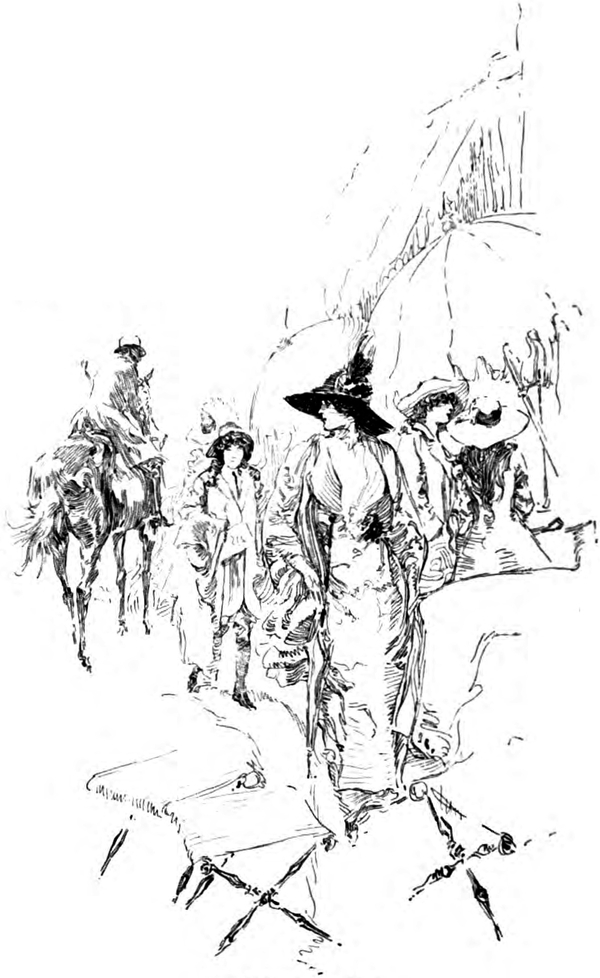
but all beauties. I want you to play it sometime. Look here,” he added
suddenly, “what have you got on for this afternoon?”
“Well, I was going up to Van Cortlandt,” said Mr. Wellaway,
hesitatingly.
“That’s all off now! You’re coming out with me and have a try at our
Westcote course. Yes, you are. You know I never take ‘No’ for an answer
when I make up my mind. And, look here, we have just time to get a
train.”
Mr. Wellaway’s host beckoned violently to the clerk.
“But my clubs—” protested Mr. Wellaway.
“That’s all right, too. Our professional can fit you out.”
“I ought to telephone my wife.”
“Oh, do it from the club.”
The temptation was too much for Mr. Wellaway. It was a hot day, and he
knew the public links at Van Cortlandt would be crowded to the limit.
He imagined the cool green of the little course at Westcote and let
himself be persuaded, and in four minutes he was aboard the commuters’
train, being whirled under the East River.
It was not until the train was out of the tunnel and speeding along
over the Long Island right of way that he felt the first qualm of
uneasiness; but it was a very slight qualm. He was ashamed that he
could not remember the name of his host. The man’s face was certainly
familiar enough, and the man evidently knew Mr. Wellaway well enough to
invite him to play golf, or Mr. Wellaway would not have been invited;
but the name would not make itself known. But, after all, that was
an easily remedied matter. The first friend they met would call Mr.
Wellaway’s host by name.
At Woodside they left the electric train and boarded the steam train,
but no one had spoken to Mr. Wellaway’s host on the platform. One or
two men had nodded to him in a manner that showed they liked him, but
none mentioned his name. Mr. Wellaway smiled. He would use a little
very simple Sherlock Holmes work when the conductor came through for
the fares.
Mr. Wellaway had noticed that his host used a fifty-trip ticket-book
when the conductor asked for the fare on the electric, and now he
waited until the new conductor tore the trip leaves from the book and
returned the book to its owner.
“I see you use a book,” said Mr. Wellaway. “Do you find it cheaper than
buying mileage?”
He held out his hand for the book. It was an ordinary gesture of
curiosity, and his host surrendered the book.
“No, I don’t, not usually,” he said. “And a commutation-ticket is
cheaper than either. Now, a commutation-ticket costs—”
He entered into the commuter’s usual closely computed average of cost
per trip, and Mr. Wellaway nodded his acquiescence in the figures; but
his mind was elsewhere. He read as though interested the face of the
book, and then turned it over. There on the back, in a bold hand, under
the contract the thrifty railroads make book-holders sign, was the
signature, “Geo. P. Garris.” Mr. Wellaway stared at the name while he
ransacked his memory to recall a George P. Garris. He not only could
not recall a George P. Garris, but he could not remember ever having
heard or seen the name of Garris. If the second “r” was meant for a
“v,” the name might be “Garvis,” but that did not help. He could not
recall a Garvis. At any rate, it was some satisfaction to know his host
was George P. Garris or George P. Garvis. When and how he had met him
would probably soon appear.
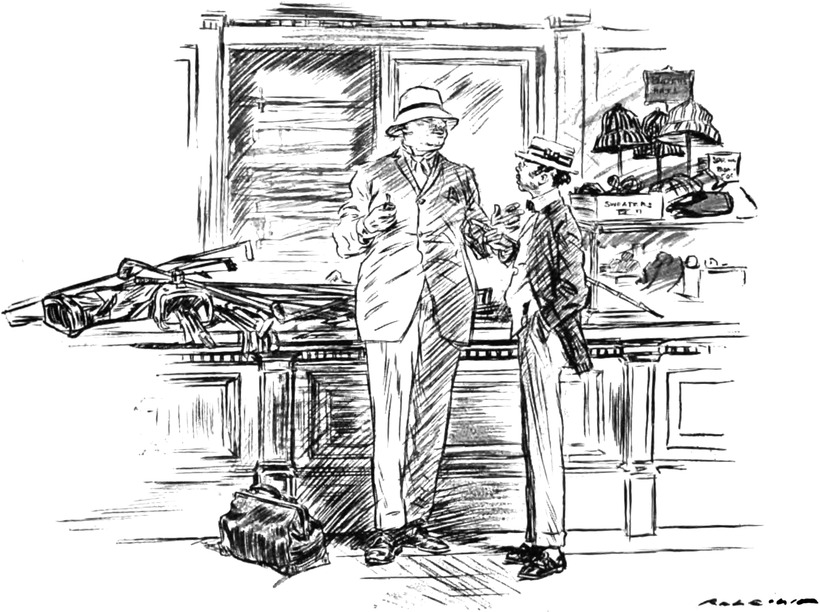
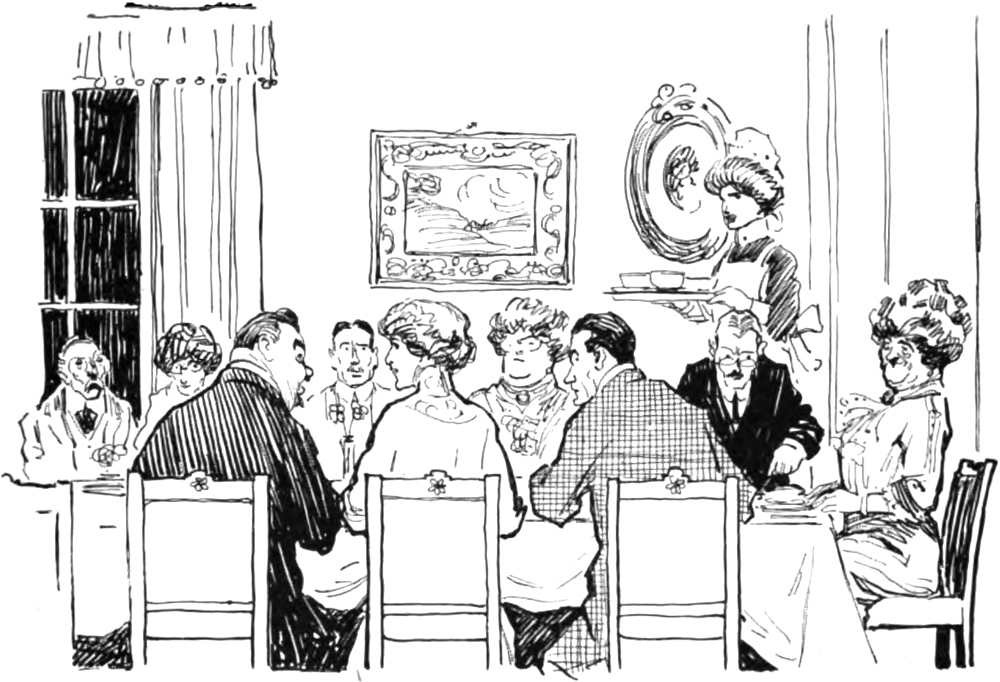
Drawn by Henry Raleigh
“‘LOOK HERE,’ HE ADDED SUDDENLY, ‘WHAT HAVE YOU GOT ON
FOR THIS AFTERNOON?’”
“I see you are looking at that name,” said Mr. Wellaway’s host, “and I
don’t wonder. Matter of fact, I have no business to have that book; but
Garvis was a good fellow, and he needed the money, so I bought it of
him when he left Westcote.”
“Oh,” said Mr. Wellaway, blankly, and then: “So that’s why you are not
using a commutation-ticket this month.” He had to say something.
“That’s the reason,” said his host; “and this is Westcote.”
THE Westcote Country Club was all Mr. Wellaway’s host had boasted.
The greens rolled away from the small club-house in graceful beauty,
small groves of elms and maples studded the course, and picturesque
stone walls and sodded bunkers provided sufficient hazards. Everything
was as neat as a new pin. It was a sight to make any golfer happy, but
when the station cab rolled up to the club-house door, Mr. Wellaway
was not entirely happy. He was beginning to feel like an interloper.
The more he studied the face of his host, the surer he became that
he had no business to be a guest. As a word in print, when studied
intensely, becomes a mere jumble of meaningless letters, so the face of
his host grew less and less familiar, until Mr. Wellaway had decided
his familiarity was with the type of face and not with this particular
face. One thing alone comforted him: his host seemed to know Mr.
Wellaway.
As they left the cab, Mr. Wellaway made a desperate effort to learn
the name of his host; for he felt that if he did not learn it now he
was in for a most unpleasant five minutes. Mr. Wellaway was a small,
gentle little man, but he was almost rude in his insistence that he be
permitted to pay the cabby.
“Yes, I will,” he insisted. “I certainly will. If you don’t let
me, I’ll be downright angry. You paid my fare, and you offer me an
afternoon’s sport; but I am going to pay this cabman.”
“But this is my party,” said his host.
“You go right into the club-house, and let me pay,” said Mr. Wellaway.
“I want to do this, and you ought to let me.” With a laugh the host
turned away. Mr. Wellaway fumbled in his pocket until he was alone with
the cabman.
“What is the charge?” he asked.
“Quarter,” said the cabby, briefly.
“Here’s a dollar,” said Mr. Wellaway. “Now, can you tell me the name of
that man—the man who drove up with me?”
“No, sir,” said the cabman; “I don’t know what his name is.”
“I just wanted to know,” said Mr. Wellaway.
When he entered the club-house his host was alone.
“You wanted to telephone,” he said to Mr. Wellaway. “There’s the booth.
It’s a money-in-the-slot machine. I’ll get a greens-ticket and a bag of
clubs for you while you are in there, and we will not lose any time.
When you come out, come up to the locker-room.”
Mr. Wellaway entered the booth and closed the door. He called for his
number and waited while the connection was made. It was hot in the
booth with the door closed, but not for the world would Mr. Wellaway
have opened it.
“Hello, is that you, Mary?” he asked, when he had dropped the requisite
coins in the slot at the request of the central. “This is Edgar. Yes.
I’m out at Westcote, on Long Island. I’m going to play golf. I met a
friend, and he insisted that I come out here and try his course. I say
I met a friend. Yes, a friend. An old acquaintance. He lives out here.”
For a few seconds Mr. Wellaway listened.
“No, listen!” said Mr. Wellaway. “I don’t know what his name
is, but I’ll find out. I just met him, you know, and he asked me, and
I couldn’t say, ‘Thank you, I’ll accept; but what is your name?’ I
couldn’t say that, could I? When he knew me so well? Oh, nonsense,
Mary! I tell you it’s a man.”
As he listened to what Mary had to say to this, Mr. Wellaway sighed
deeply.
“No, it is not funny that I don’t know his name,” he said. “You know I
can’t remember names, and I know thousands of men, and speak to them,
and can’t recall their names. Listen! There’s no reason in the world
for your jealousy to get stirred up. Not the least. I’ll know his name
inside half an hour, and if you are going to act that way about it,
I’ll telephone you the minute I learn it. Yes, I will! Well, that’s all
right, too; but since you take that attitude, I’m going to telephone
you. Good-by.” He waited half a minute for an answering “Good-by,” and
then hung up the receiver softly. Mary’s jealousy was a real annoyance.
Mr. Wellaway stepped out of the booth and wiped his forehead.
The small sitting-room of the club was deserted. In the adjacent
butler’s pantry he could hear the steward at work, and above the
low ceiling he could hear his host changing his shoes. On the
bulletin-board, among the announcements of competitions and new rules,
was a list of members posted for dues or house-accounts. It was a
very short list, and Mr. Wellaway recognized none of the names. On
the opposite wall was a framed list of the club-members, perhaps one
hundred and twenty-five, and Mr. Wellaway ran his eye down them. Only
one of the names was familiar, that of George C. Rogers, and the host
was not Rogers, for Mr. Wellaway knew Rogers well. Not another name was
even faintly familiar. Mr. Wellaway was still poring over the list when
his host descended the stairs.
“I see,” said Mr. Wellaway, “that George Rogers is a member of the
club.”
“That so?” said his host. “I don’t know him. I don’t know many of the
fellows yet. Rankin and Mallows are putting me up for membership, but
I’m playing on a temporary card until the next meeting of the board of
governors. They say there’s no doubt I’ll be admitted; but I don’t take
chances. I pay as I go until I’m a full member. When I’m in, I’ll sign
checks like the rest of them; but until I am in, I’ll pay cash. Now,
you run up and shuck your coat, if you want to, while I get you a bag
of clubs and a greens-ticket. I left my locker open—Number 43.”
Mr. Wellaway ascended the stairs. All about the locker-room were the
lockers, two high, and on each was the name of the holder. The door of
43 stood open, and Mr. Wellaway darted for it, and looked for the name
of his host. There was no name on the locker.
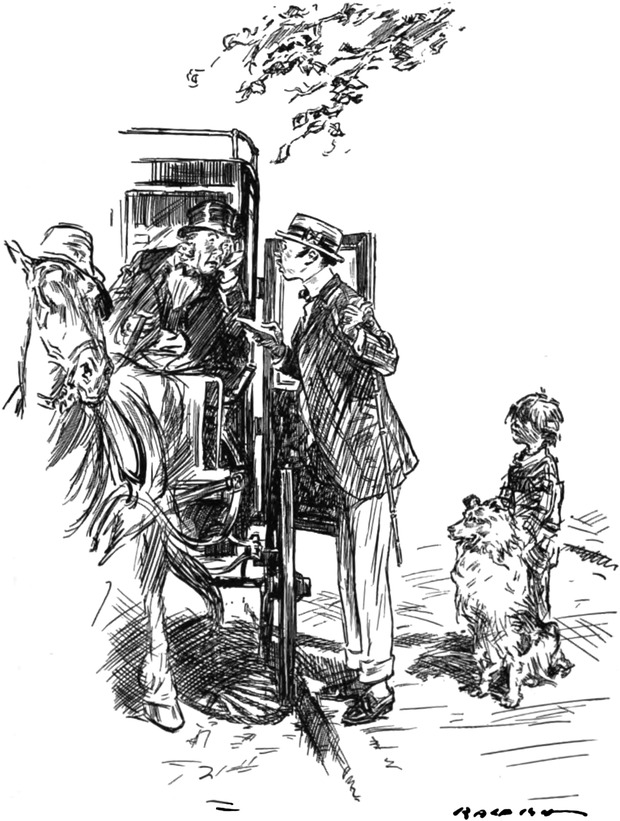
Drawn by Henry Raleigh
“‘NOW, CAN YOU TELL ME THE NAME OF THAT MAN—THE
MAN WHO DROVE UP WITH ME?’”
IN the locker was the usual accumulation of golfer’s odds and ends.
A few badly scarred golf-balls lay on the floor, along with a pair
of winter golf-shoes. A couple of extra clubs stood in one corner.
A sweater hung from a hook, and from another hook hung the coat and
waistcoat his host had just removed. From one pocket, the inside
pocket, of the coat protruded the tops of three or four letters. Mr.
Wellaway stared at the letters and perspired profusely. He had only
to put out his hand and raise the letters partly from the pocket to
know the name of his host. Then he could make an excuse to telephone
his wife again. Assuredly there was nothing dishonorable in merely
glancing at the address of the letters. But he stood very still and
listened intently before he put out his hand. He could hear the
soft tread of rubber-soled shoes on the floor below. Very gently
Mr. Wellaway raised the letters from the pocket just as he heard
the rubber-soled shoes touch the zinc treads of the stairs. He slid
the letters back into the pocket in a panic, and jerked off his
coat, but he had seen the address of the outermost letter. It was an
unmailed letter, and it was addressed to “Mrs. Edgar Wellaway, Rimmon
Apartments, West End Avenue, New York.”
“All ready!” said his host, cheerfully.
“Just a moment,” said Mr. Wellaway. He was taking his papers from his
coat-pockets and putting them in the hip-pocket of his trousers. A man
cannot be too careful.
MR.
WELLAWAY’S
host used a Scotch-plaid golf-bag, without initials
painted on it, and when the two men issued from the club-house the
bag was leaning against the wall immediately under the outside
bulletin-board. One list on the board was headed “Applications for
Membership,” but there were no names entered later than a month and a
half old, and all these had the word “Elected” written after them. When
Mr. Wellaway caught sight of the other list his face brightened.
“My handicap is eighteen,” he said, looking through the list of members
with the handicaps set opposite the names.
“Two better than mine,” said his host. “I play at twenty.”
“Twenty?” said Mr. Wellaway, running his finger up and down the
handicap list.
“But I haven’t been given a handicap here yet,” said his host. “They
don’t give you a handicap here until you are a member.”
“Oh,” said Mr. Wellaway, and turned away. He had no further interest in
the handicap-list.
The course was clear for the entire first hole. Mr. Wellaway got away
with a clean drive, but sliced his second into the rough, while his
host sliced his first into a sand-pit, got out with a high niblick
shot, and lay on the putting-green in three. Mr. Wellaway wasted a
stroke chopping out of the rough, and put his ball on the green with a
clean iron shot in four, close enough to putt out in one, making the
hole a five. His host took two to hole out, doing another five, but
winning the hole on his handicap, which gave him one stroke on the
first hole. It was good golf, par golf, and Mr. Wellaway was elated. To
do a hole in par on a strange course, after getting into the rough, was
better golf than he knew how to play, and the loss of the hole after
such playing made him only the more eager to play his best. He forgot
Mary’s jealousy and his annoyance at not knowing the name of his host,
and played golf as he had never played it before. The professional’s
clubs seemed to work magic in his hands. At the ninth hole he was still
one down, but his host did the first hole on the second round in eight,
to Mr. Wellaway’s seven, and it was seesaw around the course the second
time, with all even when eighteen holes had been played.
“I guess we can play it off before the storm hits us,” said Mr.
Wellaway’s host, and for the first time Mr. Wellaway noticed the black
clouds piling up in the west. They started the nineteenth hole with a
rush of wind whirling the dust from the road across the course, and
before they had walked to where their balls lay after their drives,
the forward edge of the storm-clouds, low, ragged, and an ugly yellow,
was full over them, and a glare of lightning, followed by a tremendous
crash, blinded them both. Mr. Wellaway’s host threw his bag of clubs on
the grass as though it were red hot, and started at a full run for the
club-house. Mr. Wellaway followed him.
Except for the steward and his wife, the club-house was already
deserted, the last automobile tearing down the club roadway as
Mr. Wellaway reached the veranda. The lightning exceeded anything
Mr. Wellaway had ever seen, and crash followed crash in deafening
explosions, as though the electrical storm had centered near the
club-house. A fair-sized hickory-tree, half dead from the depredations
of the hickory-bark beetle, fell crashing across the sleeping-room
annex of the club-house. For half an hour after the rain began to fall
in sheets the lightning continued, while Mr. Wellaway and his host
stared at the storm through the windows of the club-house; but about
six o’clock the worst of the storm had passed on, and the rain had
become a steady, heavy downpour.
“There’s one thing sure,” said Mr. Wellaway’s host: “there’s no going
home for you to-night.”
“But I must go home,” said Mr. Wellaway.
“If you must, of course you must,” said his host; “but there would
be no sense in going in this rain. We will have dinner right here. I
suppose you can get us up a couple of chops or something?”
“Yes, sir,” said the steward, who had returned from a survey of his
sleeping-quarters. “Chops or steak.”
“Then I’ll just ’phone my wife that I’ll not be home,” said Mr.
Wellaway’s host, and he entered the telephone-booth. In a few minutes
he came out again. “Can’t get central,” he said with annoyance. “The
thing is either cut off or burned out. Probably a tree has fallen
across the wires. I hate to drag you out through all this rain, but my
wife will be distracted if I don’t get home. She’ll imagine I’m killed.
You will have to come home with me and take pot-luck.”
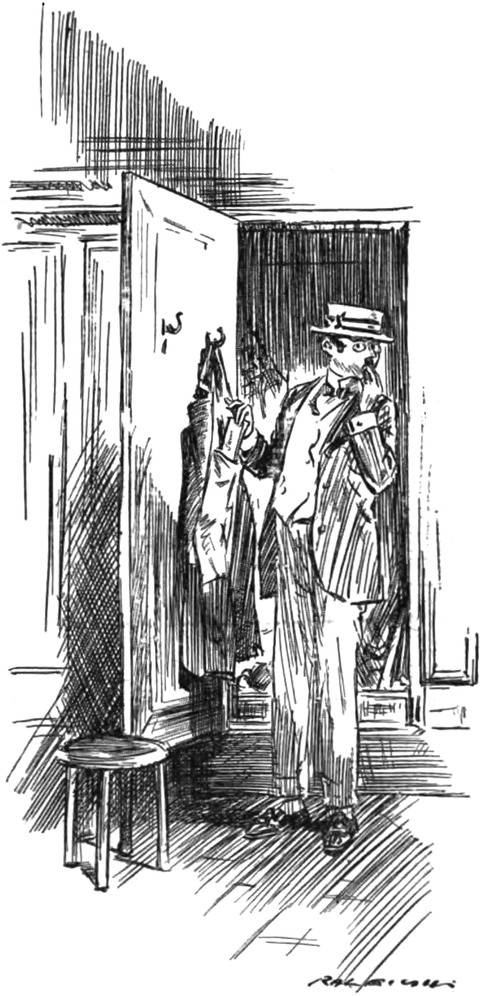
Drawn by Henry Raleigh
“VERY GENTLY MR. WELLAWAY RAISED THE LETTERS FROM THE
POCKET JUST AS HE HEARD THE RUBBER-SOLED SHOES TOUCH THE ZINC TREADS OF THE
STAIRS”
“Why, that’s very kind of you,” said Mr. Wellaway, “but I could not
think of it. My own wife will be worrying. I’ll just scoot through the
rain to the station and get the first train home.”
“Of course, if you think best,” said the host. “We have to pass the
station on the way to my house. But Sarah would be glad to put you up
for the night.”
The station was not as far as Mr. Wellaway had feared, for it was not
necessary to walk to the main station; there was another nearer, and
they reached it a few minutes before a train for the city was due. Mr.
Wellaway’s host walked to the ticket-window.
“I presume the train is late,” he asked.
“You presume exactly right,” said the young man in the ticket-office.
“She’s not only late, but she’s going to be later before she ever
gets to New York. The lightning struck the Bloom Street bridge, and
the bridge went up like fireworks. It will be about twenty-four hours
before anybody from this town gets to New York.”
“Twenty-four hours!” exclaimed Mr. Wellaway, aghast. “But I can
telegraph.”
“If you can, you can do more than I can do,” said the young man. “I’ve
tried, and I can’t do it, and I’m a professional.”
“Well!” said Mr. Wellaway.
“All right,” said his host. “Now there’s nothing for you to do but
accept my invitation, and I make it doubly warm. Sarah will be
delighted. You are the first guest we’ve had for the night since we
moved out here. She’ll be delighted, I tell you. And so will I.”
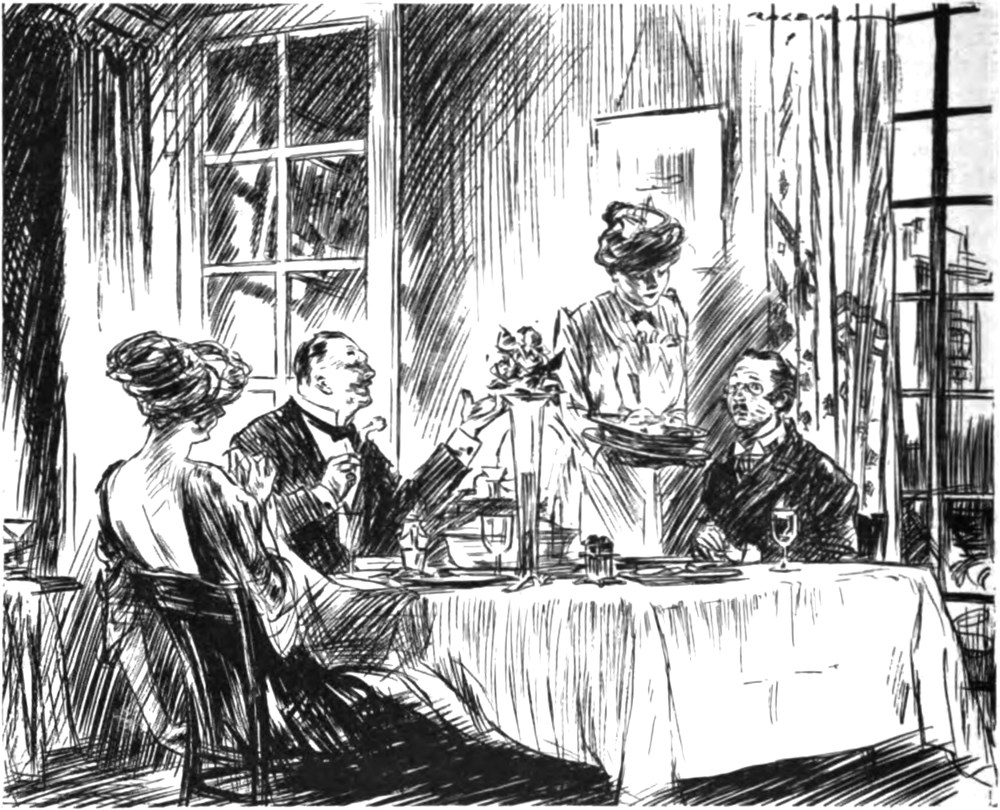
Drawn by Henry Raleigh
“‘A TALL, THIN FELLOW, WITH SANDY SIDEBURNS. PROBABLY A
FLOOR-WALKER IN SOME SHOP, WITH A PERPETUAL SMILE’”
“But I ought to go home,” insisted Mr. Wellaway.
“But you can’t go home,” laughed his host. “Come right along. Sarah
will be delighted. She’s—she’s fond of company. Perhaps our ’phone
will be working. You can telephone your wife from our house. Really,
Sarah will be glad—she’ll be delighted, I tell you.”
So Mr. Wellaway accompanied his host. The house to which he was led
was an average suburban dwelling, a frame house of ample size, with
wide verandas, a goodly lawn, and the usual clumps of shrubbery. At the
screen door the host paused.
“If you don’t mind,” he said, “I’ll let you wait here while I step
inside and tell Sarah we are coming. Sarah is the most hospitable of
women, and that’s the reason I want to tell her. She’ll welcome you
with open arms, but—you know how these hospitable women are, don’t
you? They like a minute or two to get into a more than casual mood. It
will be all right. Only a minute.”
“Certainly,” said Mr. Wellaway, feeling rather uncomfortable, and his
host opened the door with a latch-key and entered. If Mr. Wellaway
could have heard what passed inside that door, he would have turned and
run.
“Darling!” exclaimed his host’s wife when she saw him. “How wet you
are! Go right up-stairs and get into a hot bath this minute! You’ll die
of cold!”
“In a minute, Sarah,” said her husband; “but, first, I’ve got a man out
there. He’s going to stay for dinner and sleep here.”
“Oh!” exclaimed Sarah, letting her mind jump to her larder. “But we
didn’t expect any one. Really I don’t know. Perhaps I can make what I
have do. Is—is it any one important?”
“Don’t know,” said Mr. Wellaway’s host, hastily. “I’ll tell you all
about it when I’m dressing. I don’t know the fellow’s name, but he
knows me as well as I know you. I ought to know his name as well as
I know yours, but I don’t. I met him somewhere, and I remember he
was a good fellow. We’ll get his name out of him somehow before he’s
in the house very long, but, for Heaven’s sake! don’t let him know I
don’t know. He may be some one important. He looks as if he might be
somebody. I’ll bring him in. Don’t give me away.”
“But you don’t know who he is. He may be a thief—”
“Hope not. I can’t let him stand out there any longer, anyway. Be
pleasant to him.”
He threw open the door.
“Come right in!” he exclaimed heartily. “I’ve bearded the lioness, and
told her the story of our lives. I don’t believe you have met before.”
“I have not had that pleasure,” said Mr. Wellaway, making his best bow,
“but I am delighted, although I’m sorry to come unannounced.”
“Announced or unannounced, you might know you are always welcome,” said
Sarah, charmingly. “And the first thing is to get on some dry clothes.
You’ll both of you take cold. Run along, and I’ll see what we have for
dinner.”
The garments given him by his host did not fit Mr. Wellaway specially
well. They were considerably too large, but he was glad to get into
anything dry. What dissatisfied him with them more than aught else was
that they were the sort of garments of which the newspapers remark,
“There were no marks of identification.” The spare room into which he
was put offered no more aid. Three or four recent magazines lay on the
small table, but bore no names except their own titles. For the rest,
the spare room was evidently a brand-new spare room, fresh from the
maker. For purposes of identification it might as well have been a
hotel bedroom. Mr. Wellaway dressed hastily and hurried down-stairs.
The parlor, to the right of the stairs, stood open, and Mr. Wellaway
entered. A large fireplace occupied one end of the room, and the
furnishings and pictures bespoke a home of fair means, but no great
wealth. Magazines lay on a console table, but what attracted Mr.
Wellaway was a book-case. The case was well filled with books in good
bindings, and Mr. Wellaway stepped happily across the carpet and laid
his hand on the book-case door. It was locked.
MR.
WELLAWAY’S
host and his host’s wife descended the stairs together
just as the maid issued from the dining-room to announce dinner,
and once seated, the conversation turned to the storm, to the utter
disruption of the telephone service, and to the game of golf the two
men had been unable to finish. In the midst of the conversation Mr.
Wellaway studied the monogram on the handles of his fork and spoon.
It was one of those triumphs of monogrammery that are so beautiful as
to be absolutely illegible. The name on the butter-knife handle was
legible, however. It was “Sarah.”
The soup had been consumed, and the roast carved when Mr. Wellaway’s
host looked at his wife and raised his eyebrows. She smiled in
acknowledgment of the signal.
“Don’t you think some names are supremely odd?” she asked Mr. Wellaway.
“My husband was telling me of one that came under his notice to-day.
What was it, dear?”
“Oh, I shouldn’t have noticed it but for the circumstances,” said Mr.
Wellaway’s host; “but it was a rather ridiculous name for a human
being. Can you imagine any one carrying around the name of Wellaway?”
Mr. Wellaway gasped.
“Imagine being a Wellaway!” said Sarah. “Isn’t it an inhospitable name?
It seems to suggest ‘Good-by; I’m glad you’re gone.’ Doesn’t it?”
“I can see the man with my mind’s eye,” said Mr. Wellaway’s host. “A
tall, thin fellow, with sandy sideburns. Probably a floor-walker in
some shop, with a perpetual smile.”
“But tell him the rest,” said Sarah, chuckling.
“Oh, the rest—that’s too funny!” said Mr. Wellaway’s host. “I had a
letter this morning from this Mrs. Wellaway—”
Mr. Wellaway turned very red and moved uneasily in his chair.
“I ought to tell you that—that I know Mrs. Wellaway,” he stammered.
“I—I know her quite well. In fact—”
“Then you’ll appreciate this,” said his host, merrily. “You know the
business I’m in. Every one knows it. So you can imagine how I laughed
when I read this letter.”
From the inside pocket of his coat Mr. Wellaway’s host took a letter.
He removed the envelop and placed it on the table, address down.
“Listen to this,” he said: “‘Dear Sir: Only the greatest anguish of
mind induces me to write to you and ask your assistance. It may be that
I am the victim of an insane jealousy, but I fear the explanation is
not so innocent. I distrust my husband, and anything is better than
the pangs of uncertainty I now suffer. If your time is not entirely
taken, I wish, therefore, to engage you to make certain that my fears
are baseless or well founded. Please consider the matter as most
confidential, for I am only addressing you because I know that when a
matter is put in your hands it never receives the slightest publicity.
Yours truly, Mrs. Edgar Wellaway.’”
When he had read the letter, Mr. Wellaway’s host lay back in his chair
and laughed until the tears ran from his eyes, and his wife joined
him, and their joy was so great they did not notice that Mr. Wellaway
turned from red to white and choked on the bit of food he had attempted
to swallow. When they observed him, he was rapidly turning purple, and
with one accord they sprang from their chairs and began thumping him
vigorously on the back. In a minute they had thumped so vigorously that
Mr. Wellaway was pushing them away with his hands. He was still gasping
for breath when they half led, half carried him to the parlor and laid
him on a lounge.
“By George!” said his host, self-accusingly, “I shouldn’t have read you
that letter. But I didn’t know you would think it so funny as all that.
Do you feel all right now?”
“I feel—I feel—” gasped Mr. Wellaway. He could not express his
feelings.
“Well, it was funny, writing that to me, of all people, wasn’t it?”
said Mr. Wellaway’s host. “‘Not the slightest publicity.’ I suppose
she looked up the name in the telephone directory, and got the wrong
address. I know the fellow she was writing to. Same name as mine. Same
middle initial. Think you can finish that dinner now?”
“No, thank you,” said Mr. Wellaway. “I think I’d like to rest here.”
“Just as you wish,” said his host. “Hello! There’s the telephone bell.
You can ’phone your wife now, if you wish.”
“No, thank you,” said Mr. Wellaway, meekly. “I’ll not. It’s of no
importance—no importance whatever.”
“WELL, what do you think!” exclaimed Mr. Wellaway’s host’s wife a
few minutes later, as she entered the parlor. “Of all the remarkable
things! You would never guess it. Who do you think just called me on
the ’phone? That Mrs. Wellaway!”
“No!” exclaimed Mr. Wellaway’s host, and Mr. Wellaway sat straight up
on the lounge.
“But she did,” said Sarah. “And she’s hunting that distrusted husband!
She telephoned the country club, and the steward told her there had
been no strangers there except your guest, so she telephoned here!
Imagine the assurance of the—”
She stopped short and stared at Mr. Wellaway. He was going through all
the symptoms of intense pain accompanied by loss of intelligence. Then
he asked feebly,
“What—what did you tell her?”
“I told her he wasn’t here, and hadn’t been here, of course,” said Mr.
Wellaway’s hostess, “and that we did not know any such man, and that
I didn’t believe he had come to Westcote at all, and that if I had a
husband I couldn’t trust, I’d keep better track of him than she did.”
“Did you—did you tell her all that?” asked Mr. Wellaway with anguish.
They stared at him in dismay.
“See here,” said his host, suddenly, “are you Mr. Wellaway?”
For answer Mr. Wellaway dropped back on the lounge and covered his face
with his hands.
“Now, I’ll never, never be able to make Mary believe I was here,” he
said, and then he groaned miserably.
“OH, I’m so sorry!” said Mr. Wellaway’s hostess in real distress. “We
were absolutely unaware, Mr. Wellaway. We meant no harm. Roger did not
know your name. But you can fix it all right. You can telephone Mrs.
Wellaway that you are here. Telephone her immediately.”
“Yes,” said Mr. Wellaway. “I’ll do that. That’s what I must do,” and
he went up the stairs to the telephone. He returned in ten minutes and
found his host and hostess sitting opposite each other, staring at each
other with sober faces. They looked at him eagerly as he entered. His
face showed no relief.
“She says,” he said, “she says she don’t believe I’m here. She says I
could telephone from anywhere, and say I was anywhere else. She says
she just telephoned here, and knows I’m not here. And then she asked me
where I was telephoning from, and—”
Mr. Wellaway broke down and hid his face in his hands.
“And I didn’t know where I was telephoning from!” he moaned. “I didn’t
know the street or the house number, or—or the name!”
“You didn’t know the name!” cried Mr. Wellaway’s host. “You didn’t know
my name was Murchison?”
“Murchison?” said Mr. Wellaway, blankly. “Not the—not the
Murchison? Not Roger P. Murchison, the advertising agent, the publicity
man?”
“Of course,” said Mr. Wellaway’s host. For a full minute Mr. Wellaway
stared at Mr. Murchison.
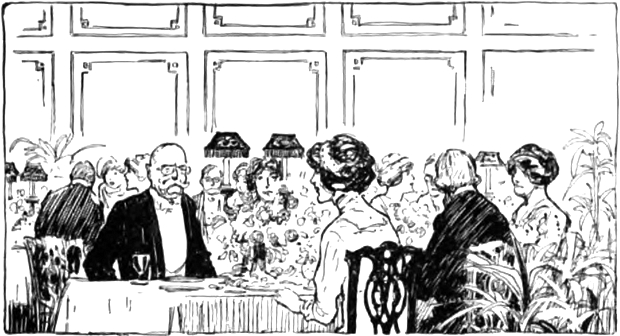
“I know,” said Mr. Wellaway. “You eat at the Fifth Avenue! You sit by
the palm just to the left of the third window every noon.”
“By George!” exclaimed Mr. Murchison. “I knew your face was familiar.
And you sit at the end table right by the first window. Why, I’ve seen
you there every day for a year.”
“Of course you have,” said Mr. Wellaway, cheerfully. “That explains
everything. It makes it all as simple as—” His face fell suddenly.
“But it doesn’t make it any easier about Mary.”
Mr. Murchison might have said that Mary was none of his concern, but he
creased his brow in thought.
“Sarah,” he said at length, “run up-stairs and telephone Mrs. Wellaway
that her husband is here. Tell her he means to stay over Sunday, and
that he wants her to hire a taxicab and come out immediately and stay
over Sunday. Tell her our game of golf was a tie, and I insist that Mr.
Wellaway play off the tie to-morrow afternoon.”
Mrs. Murchison disappeared.
“And now,” said Mr. Murchison, genially, “you know my name, and you
know my business, and I know your name, and everything is all right,
and I’m mighty glad to know you as long as you are not a floor-walker.
Oh, pardon me!” he added quickly, “you are not a floor-walker, are you?
You didn’t say what your business was.”
Mr. Wellaway blushed.
“Names,” he said. “I’m a genealogist. My business is looking up names.”
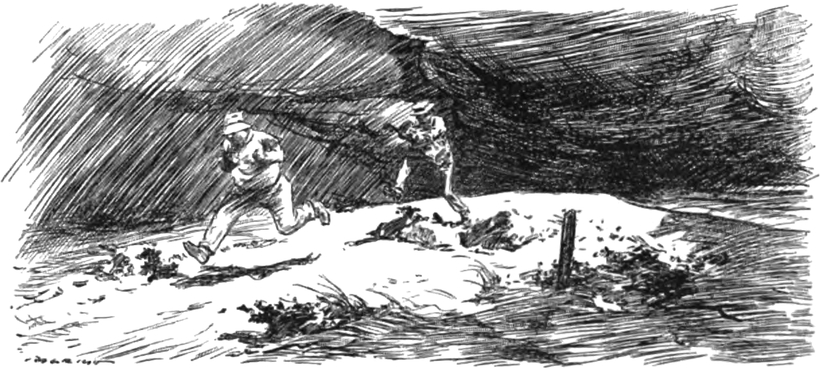
Drawn by Henry Raleigh
“MR. WELLAWAY’S HOST THREW HIS BAG OF CLUBS ON THE GRASS
AS THOUGH IT WERE RED HOT, AND STARTED AT A FULL RUN FOR THE CLUB-HOUSE”
STELLA MARIS — CHAPTER XXII — CHAPTER XXIII
BY WILLIAM J. LOCKE
Author of “The Beloved Vagabond,” “The Morals of Marcus
Ordeyne,” “Septimus,” “The Glory of Clementina,” etc.
THEY
found him lying on the sofa, a pitiable object, the whole of his
head from the back of his neck to his eyebrows swathed in bandages. His
clothes were mere limp and discolored wrappings. They looked as though
they had been wet through, for the red of his tie had run into his
shirt-front and collar. The coarse black sprouts on pallid cheek and
upper lip gave him an appearance of indescribable grime. His eyes were
sunken and feverish.
Unity uttered a little cry as she saw him, but checked it quickly, and
threw herself on her knees by his side.
“Thank God you’re alive!”
He put his hand on her head.
“I’m all right,” he said faintly; “but you shouldn’t have come. That’s
why I didn’t go straight home. I didn’t want to frighten you. I’m a
ghastly sight, and I should have scared your aunt out of her wits.”
“But how, in Heaven’s name, man,” said Herold, “did you get into this
state?”
“Something hit me over the head, and I spent the night in rain and
sea-water on the rocks.”
“On the rocks? Where? At Southcliff?”
“Yes,” said John, “at Southcliff. I was a fool to go down, but I’ve
been a fool all my life, so a bit more folly doesn’t matter.” He closed
his eyes. “Give me a drink, Wallie—some brandy.”
Herold went into the dining-room, which adjoined the library, and
returned with decanter, syphon, and glasses. He poured out a brandy
and soda for John and watched him drink it; then he realized that he,
too, would be the better for stimulant. With an abstemious man’s idea
of taking brandy as medicine, he poured out for himself an extravagant
dose, mixed a little soda-water with it, and gulped it down.
“That’ll do me good,” said John; but on saying it he fell to shivering,
despite the heat of the summer afternoon.
“You’ve caught a chill,” cried Unity. She counseled home and bed at
once.
“Not yet,” he murmured. “It was all I could do to get here. Let me rest
for a couple of hours. I shall be all right. I’m not going to bed,”
he declared with sudden irritability; “I’ve never gone to bed in the
daytime in my life. I’ve never been ill, and I’m not going to be ill
now. I’m only stiff and tired.”
“You’ll go to bed here right away,” said Herold.
John protested. Herold insisted.
“Those infernal clothes—you must get them off at once,” said he. John
being physically weak, his natural obstinacy gave way. Unity saw the
sense of the suggestion; but it was giving trouble.
“Not a bit,” said Herold. “There’s a spare bedroom. John can have mine,
which is aired. Mrs. Ripley will see to it.”
He went out to give the necessary orders. Unity busied herself with
unlacing and taking off the stiffened boots. Herold returned, beckoned
to Unity, and whispered that he had telephoned for a doctor. Then he
said to John:
“How are you feeling, dear old man?”
“My head’s queer, devilish queer. Something fell on it last night and
knocked me out of time. It was raining, and I was sheltering under the
cliff on the beach, the other side of the path, where you can see the
lights of the house, when down came the thing. I must have recovered
just before dawn; for I remember staggering about in a dazed way. I
must have taken the road round the cliff, thinking it the upper road,
and missed my footing and fallen down. I came to about nine this
morning, on the rocks, the tide washing over my legs. I’m black and
blue all over. Wonder I didn’t break my neck. But I’m tough.”
“Thank God you’re alive!” said Unity again.
He passed his hands over his eyes. “Yes. You must have thought all
manner of things, dear. I didn’t realize till Ripley told me that I
hadn’t let you know. I went out, meaning to catch the 7:15 and come
back by the last train. But this thing knocked all memory out of me.
I’m sorry.”
Herold looked in bewilderment at the stricken giant. Even now he had
not accounted for the lunatic and almost tragic adventure. What was he
doing on the beach in the rain? What were the happenings subsequent to
his recovering consciousness at nine o’clock?
“Does it worry you to talk?” he asked.
“No. It did at first—I mean this morning. But I’m all right
now—nearly all right. I’d like to tell you. I picked myself up,
all over blood, a devil of a mess, and crawled to the doctor’s—not
Ransome; the other chap, Theed. He’s the nearest; and, besides, I
didn’t want to go to Ransome. I don’t think any one saw me. Theed took
me in and fixed me up and dried my clothes. Of course he wanted to
drag me to the Channel House, but I wouldn’t let him. I made him swear
not to tell them. I don’t want them to know. Neither of you must say
anything. He also tried to fit me out. But, you know, he’s about five
foot nothing; it was absurd. As soon as I could manage it, he stuck me
in a train, much against his will, and I came on here. That’s all.”
“If only I had known!” said Herold. “I was down there all the morning.”
“You?”
“I had a letter from Julia, summoning me.”
“So had I.” He closed his eyes again for a moment. Then he asked, “How
is Stella?”
“I had a long talk with her. I may have straightened things out a bit.
She’ll come round. There’s no cause for worry for the present. Julia is
a good soul, but she has no sense of proportion, and where Stella is
concerned she exaggerates.”
When a man has had rocks fall on his head, and again has fallen on
his head upon rocks, it is best to soothe what is left of his mind.
And after he had partly soothed it,—a very difficult matter, first,
because it was in a troubled and despairing state, and, secondly,
because John, never having taken Unity into his confidence, references
had to be veiled,—he satisfied the need of another brandy and soda.
Then Ripley came in to announce that the room was ready.
“Ripley and I will see to him,” said Herold to Unity. “You had better
go and fetch him a change of clothes and things he may want.”
“Mayn’t I wait till the doctor comes?” she pleaded.
“Of course, my dear. There’s no hurry,” said Herold.
The two men helped Risca to his feet, and, taking him to the bedroom,
undressed him, clothed him in warm pajamas, and put him into the bed,
where a hot-water bottle diffused grateful heat. Herold had seen the
livid bruises on his great, muscular limbs.
“Any one but you,” said he, with forced cheeriness, “would have been
smashed to bits, like an egg.”
“I tell you I’m tough,” John growled. “It’s only to please you that I
submit to this silly foolery of going to bed.”
As soon as Ripley was dismissed, he called Herold to his side.
“I would like to tell you everything, Wallie. I couldn’t in the other
room. Unity, poor child, knows nothing at all about things. Naturally.
I had been worried all the afternoon. I thought I saw her—you
know—hanging about outside the office. It was just before I met you
at the club. I didn’t tell you,—perhaps I ought to,—but that was
why I was so upset. But you’ll forgive me. You’ve always forgiven me.
Anyway, I thought I saw her. It was just a flash, for she, if it was
she, was swallowed up in the traffic of Fleet Street. After leaving the
club, I went back to the office—verification in proofs of something in
Baxter’s article. I found odds and ends to do. Then I went home, and
Julia’s letter lay on my table. I’ve been off my head of late, Wallie.
For the matter of that, I’m still off it. I’ve hardly slept for weeks.
I found Julia’s letter. I looked at my watch. There was just time to
catch the 7:15. I ran out, jumped into a taxi, and caught it just as it
was starting. But as I passed by a third-class carriage,—in fact, I
realized it only after I had gone several yards beyond; one rushes, you
know,—I seemed to see her face—those thin lips and cold eyes—framed
in the window. The guard pitched me into a carriage. I looked out for
her at all the stations. At Tring Bay the usual crowd got out. I didn’t
see her. No one like her got out at Southcliff. What’s the matter,
Wallie?” He broke off suddenly.
“Nothing, man; nothing,” said Herold, turning away and fumbling for his
cigarette-case.
“You looked as if you had seen a ghost. It was I who saw the ghost.”
He laughed. And the laugh, coming from the haggard face below the
brow-reaching white bandage, was horrible.
“Your brain was playing you tricks,” said Herold. “You got to
Southcliff. What happened?”
“I felt a fool,” said John. “Can’t you see what a fool a man feels when
he knows he has played the fool?”
Bit by bit he revealed himself. At the gate of the Channel House he
reflected. He had not the courage to enter. Stella would be up and
about. He resolved to wait until she went to bed. He wandered down
to the beach. The rain began to fall, fine, almost imperceptible.
The beacon-light in the west window threw a vanishing shaft into the
darkness.
“We saw it once—don’t you remember?—years ago when you gave her the
name—Stellamaris. I sat like a fool and watched the window. How long I
don’t know. My God! Wallie, you don’t know what it is to be shaken and
racked by the want of a woman—”
“By love for a woman, you mean,” said Herold.
“It’s the same thing. At last I saw her. She stood defined in the
light. She had changed. I cried out toward her like an idiot,”—the
rugged, grim half face visible beneath the bandage was grotesque, a
parody of passion,—“and I stayed there, watching, after she had gone
away. How long I don’t know. It was impossible to ring at the door and
see Oliver and Julia.”
He laughed again. “You must have some sense of humor, my dear man.
Fancy Oliver and Julia! What could I have said to them? What could they
have said to me? I sat staring up at her window. The rain was falling.
Everything was still. It was night. You know how quiet everything is
there. Then I seemed to hear footsteps and I turned, and a kind of
shape—a woman’s—disappeared. I know I was off my head, but I began
to think. I had a funny experience once—I’ve never told you. It was
the day she came out of prison. I sat down in St. James’s Park and fell
half asleep,—that sort of dog sleep one has when one’s tired,—and I
thought I saw her going for Stella—Stella in her bed at the Channel
House—going to strangle her. This came into my mind, and then
something hit me,—a chunk of overhanging cliff loosened by the rain, I
suppose,—and, as I’ve told you, it knocked me out. But it’s devilish
odd that she should be mixed up in it.”
“As I said, your brain was playing you tricks,” said Herold, outwardly
calm; but within himself he shuddered to his soul. The woman was like a
foul spirit hovering unseen about those he loved.
Presently the doctor, a young man with a cheery face, came in and
made his examination. There was no serious damage done. The only
thing to fear was the chill. If the patient’s temperature went down
in the morning, he could quite safely be moved to his own home. For
the present rest was imperative, immediate sleep desirable. He wrote a
prescription, and with pleasant words went away. Then Unity, summoned
to the room, heard the doctor’s comforting opinion.
“I’ll be with you to-morrow,” said John.
“You don’t mind leaving him to Mrs. Ripley and me just for one night?”
asked Herold.
“He’s always safe with you,” Unity replied, her eyes fixed not on him,
but on John Risca. “Good-by, Guardian dear.”
John drew an arm from beneath the bedclothes and put it round her thin
shoulders. “Good-by, dear. Forgive me for giving you such a fright, and
make my peace with auntie. You’ll be coming back with my things, won’t
you?”
“Of course; but you’ll be asleep then.”
“I shouldn’t wonder,” said John.
She made him cover up his arm again and tucked the bedclothes snugly
about him, her finger-tips lingering by his cheeks.
“I’ll leave you, too. Try and get to sleep,” said Herold.
They went together out of the room and back to the library.
“Has he said anything more?”
He stood before her trembling all over.
“What is the matter?”
He burst into an uncontrollable cry. “It’s that hellish woman again!
He saw her spying on him outside his office, he saw her in a railway
carriage on the train he took. Because she disappeared each time,
he thinks it was an hallucination; and somehow he was aware of her
presence just before the piece of rock came down.”
Unity’s face beneath the skimpy hair and rubbishy tam-o’-shanter was
white and strained.
“She threw it. I knew she threw it.”
“So do I. He saw her. She disappeared as she did that night in the fog.
A woman like that isn’t human. She has the power of disappearing at
will. You can’t measure her cunning.”
“What did he go down for?”
He told her. Unity’s lips twitched.
“And he sat there in the rain just looking at her window?”
She put out her hand. “Good-by, Mr. Herold. When you see Miss
Stellamaris, you’ll tell her I’m a good girl—in that way, you
know—and that I love her. She has been a kind of beautiful angel to
me—has always been with me. It’s funny; I can’t explain. But you
understand. If you’d only let her see that, I’d be so happy—and
perhaps she’d be happier.”
“I’ll do my utmost,” said Herold.
He accompanied her down-stairs, and when she had gone, he returned
to the library and walked about. The horror of the woman was upon
him. He drank another brandy and soda. After a while Ripley came in
with a soiled card on a tray. He looked at it stupidly—“Mr. Edwin
Travers”—and nodded.
“Shall I show the gentleman up?”
He nodded again, thinking of the woman.
When the visitor came in he vaguely recognized him as a broken-down
actor, a colleague of early days. As in a dream he bade the man sit
down, and gave him cigarettes and drink, and heard with his outer ears
an interminable tale of misfortune. At the end of it he went to his
desk and wrote out a check, which he handed to his guest.
“I can’t thank you, old man. I don’t know how to. But as soon as I can
get an engagement—hello, old man,” he cried, glancing at the check,
“you’ve made a funny mistake—the name!”
Herold took the slip of paper, and saw that he had made the sum payable
not to Edwin Travers, but to Louisa Risca. It was a shock, causing
him to brace his faculties. He wrote out another check, and the man
departed.
He went softly into John’s room and found him sleeping peacefully.
Soon afterward Ripley announced that dinner was ready. It was past six
o’clock.
“Great Heavens!” he cried aloud, “I’ve got to play to-night.”
After a hurried wash he went into the dining-room and sat down at the
table, but the sight and smell of food revolted him. He swallowed a
few mouthfuls of soup; the rest of the dinner he could not touch. The
horror of the woman had seized him again. He drank some wine, pushed
back his chair, and threw down his table-napkin.
“I don’t want anything else. I’m going for a walk. I’ll see you later
at the theater.”
The old-fashioned Kensington street, with its double line of Queen
Anne houses slumbering in the afternoon sunshine, was a mellow blur
before his eyes. Whither he was going he knew: what he was going to do
he knew not. The rigid self-control of the day, relaxed at times, but
always kept within grip, had at last escaped him. Want of food and
the unaccustomed drink had brought about an abnormal state of mind. He
was aware of direction, aware, too, of the shadow-shapes of men and
women passing him by, of traffic in the roadway. He walked straight,
alert, his gait and general demeanor unaffected, his outer senses
automatically alive. He walked down the narrow, shady Church Street,
and paused for a moment or two by the summer greenery of Kensington
Churchyard until there was an opportunity of crossing the High Street,
now at the height of its traffic. He strode westward past the great
shops, a lithe man in the full vigor of his manhood. Here and there
a woman lingering in front of displays of millinery recognized the
well-known actor and nudged her companion.
The horror within him had grown to a consuming thing of flame. Instead
of the quiet thoroughfares down which he turned, he saw picture
after shuddering picture—the woman and Stellamaris, the woman and
John Risca. She attacked soul as well as body. The pictures took the
forms of horrible grotesques. Within, his mind worked amazingly,
like a machine escaped from human control and running with blind
relentlessness. He had said years ago that he would pass through his
hell-fire. He was passing through it now.
The destroyer must be kept from destroying or be destroyed. Which of
these should be accomplished through his agency? One or the other. Of
one thing he was certain, with an odd, undoubting certainty: that he
would find her, and finding her, that he would let loose upon her the
wrath of God. She should be chained up forever or he would strangle
her. Shivering thrills diabolically delicious ran through him at the
thought. Supposing he strangled her as he would a mad cat? That were
better. She would be out of the world. He would be fulfilling his
destiny of sacrifice. For the woman he loved and for the man he loved
why should he not do this thing? What but a legal quibble could call it
murder? Stellamaris’s words rang in his ears: “You say you love me like
that?”
“Yes, I love you like that. I love you like that,” he cried below his
breath as he walked on.
He knew where she lived, the name by which she passed. John had told
him many times. There were few things in John’s life he did not know.
He knew of the Bences, of Mrs. Oscraft, the fluffy-haired woman who
lived in the flat below. Amelia Mansions, he was aware, were in the
Fulham Road. But when he reached that thoroughfare, he stood dazed and
irresolute, realizing that he did not know which way to turn. A passing
postman gave him the necessary information. The trivial contact with
the commonplace restored in a measure his mental balance. He went on.
By Brompton Cemetery he felt sick and faint and clung for a minute or
two to the railings. He had eaten nothing since early morning, and then
only a scrap of bacon and toast; he had drunk brandy and wine, and he
had lived through a day in which the maddening stress of a lifetime had
been concentrated.
One or two passers-by stared at him, for he was as white as a sheet.
A comfortable, elderly woman, some small shopkeeper’s wife, addressed
him. Was he ill? Could she do anything for him? The questioning was
a lash. He drew himself up, smiled, raised his hat, thanked her
courteously. It was nothing. He went on, loathing himself as men do
when the flesh fails beneath the whip of the spirit.
He was well now, his mind clear. He was going to the woman. He would
save those he loved. If it were necessary to kill her, he would kill
her. On that point his brain worked with startling clarity. If he did
not kill her, she would be eventually killed by John; for John, he
argued, could not remain in ignorance forever. If John killed her, he
would be hanged. Much better that he, Walter Herold, whom Stellamaris
did not love, should be hanged than John—much better. And what the
deuce did it matter to anybody whether he were hanged or not? He
laughed at the elementary logic of the proposition. The solution of all
the infernally intricate problems of life is, if people only dared face
it, one of childish simplicity. It was laughable. Walter Herold laughed
aloud in the Fulham Road.
It was so easy, so uncomplicated. He would see her. He would do what he
had to do. Then he would take a taxicab to the theater. He must play
to-night. Of course he would. There was no reason why he shouldn’t.
Only he hoped that, Leonora Gurney wouldn’t worry him. He would manage
to avoid her during that confounded wait in the first act, when she
always tried to get him to talk. He would play the part all right. He
was a man and not a stalk of wet straw. After the performance he would
give himself up. No one would be inconvenienced. He would ask the
authorities to hurry on matters and give him a short shrift and a long
rope; but the length of the rope didn’t matter these days, when they
just broke your neck. There was no one dependent on him. His brothers
and sisters, many years his seniors,—he had not seen them since he was
a child,—had all gone after their father’s death to an uncle in New
Zealand. They were there still. The mother, who had remained with him,
the Benjamin, in England, had died while he was at Cambridge. He was
free from family-ties. And women? He was free, too. There had only been
one woman in his life, the child of cloud and sea foam.
Stellamaris, star of the sea, now dragged through the mire of mortal
things! She should go back. She should go back to her firmament,
shining down upon, and worshiped by, the man she loved. And he,
God!—he should be spared the terrifying agony of it.
Thus worked the brain which Walter Herold told himself was crystal
clear.
It was clear enough, however, to follow the postman’s directions. He
took the turning indicated and found the red-brick block, with the name
“Amelia Mansions” carved in stone over the entrance door. The by-street
seemed to be densely populated. He went into the entrance-hall and
mechanically looked at the list of names. Mrs. Rawlings’s name was
followed by No. 7. He mounted the stairs. On the landing of No. 7 there
were a couple of policemen, and the flat door was open, and the length
of the passage was visible. Herold was about to enter when they stopped
him.
“You can’t go in, sir.”
“I want Mrs. Rawlings.”
“No one can go in.”
He stood confused, bewildered. An elderly, buxom woman, with a
horrified face, who just then happened to come out of a room near the
doorway, saw him and came forward.
“You are Mr. Herold,” she asked.
“Yes; I want to see Mrs. Rawlings.”
“It’s all right, constable,” she said in a curiously cracked voice.
“Let this gentleman pass. Come in, sir. I am Mrs. Bence.”
He entered the passage. She spoke words to him the import of which
he did not catch. His brain was perplexed by the guard of policemen
and the open flat. She led him a short distance down the passage. He
stumbled over a packed kit-bag. She threw open a door. He crossed
the threshold of a vulgarly furnished drawing-room, the electric
lights turned on despite the daylight of the July evening. There were
four figures in the room. Standing and scribbling in note-books were
two men, one in the uniform of a sergeant of police, the other in a
frock-coat, obviously a medical man. On the floor were two women, both
dead. One was John Risca’s wife, and the other was Unity. And near by
them lay a new, bright revolver.
IN
after time Herold’s memory of that disastrous night and the
succeeding days was that of a peculiarly lucid nightmare in which he
seemed to have acted without volition or consciousness of motive. He
ate, dressed, drove through the streets on unhappy missions, gave
orders, directions, consoled, like an automaton, and sometimes slept
exhaustedly. So it seemed to him, looking back. He spared John the
first night of misery. The man with his bandaged head slept like a log,
and Herold did not wake him. All that could be done he himself had
done. It was better for John to gather strength in sleep to face the
tragedy on the morrow. And when the morrow came, and Herold broke the
news to him, the big man gave way under the shock, and became gentle,
and obeyed Herold like a child. Thereafter, for many days, he sat for
the hour together with his old aunt, curiously dependent on her; and
she, through her deep affection for him, grew singularly silent and
practical.
In her unimaginative placidity lay her strength. She mourned for Unity
as for her own flesh and blood; but the catastrophe did not shake her
even mind, and when John laid his head in her lap and sobbed, all that
was beautiful in the woman flowed through the comforting tips of her
helpless fingers.
From Herold he learned the unsuspected reason of Unity’s crime and
sacrifice; and from Unity, too, for a poor little pencil scrawl found
in her pocket and addressed to him told him of her love and of her
intention to clear the way for his happiness. And when the inquest was
over and Unity’s body was brought to Kilburn and laid in its coffin in
her little room, he watched by it in dumb stupor of anguish.
Herold roused him now and then. Action—nominal action at least—had to
be taken by him as surviving protagonist of the tragedy. The morning
after the deed the newspapers shrieked the news, giving names in
full, raking up memories of the hideous case. They dug, not deep, for
motive, and found long-smoldering vengeance. Unity was blackened. John
responded to Herold’s lash. This must not be. Unity must not go to her
grave in public dishonor; truth must be told. So at the inquest, John,
wild, uncouth, with great strips of sticking-plaster on his head, told
truth, and gave a romantic story to a hungry press. It was hateful to
lay bare the inmost sacredness and the inmost suffering of his soul to
the world’s cold and curious gaze, but it had to be done. Unity’s name
was cleared. When he sat down by Herold’s side, the latter grasped his
hand, and it was clammy and cold, and he shook throughout his great
frame.
Then Herold, driven to mechanical action, as it seemed to him
afterward, by a compelling force, dragged John to an inquiry into
the evil woman’s life. It was Mrs. Oscraft, the full-blown, blowzy
bookmaker’s wife, the woman’s intimate associate for many years, who
gave the necessary clue. Horrified by the discovery of the identity of
her friend and by the revelation of further iniquities, she lost her
head when the men sternly questioned her. She had used her intimacy
with Mrs. Risca to cover from her own husband an intrigue of many
years’ standing. In return, Mrs. Risca had confessed to an intrigue of
her own, and demanded, and readily obtained, Mrs. Oscraft’s protection.
The women worked together. They were inseparable in their outgoings
and incomings, but abroad each went her separate way. That was why,
ignorant of the truth, Mrs. Oscraft had lied loyally when John Risca
had burst into her flat long ago. She had thought she was merely
shielding her fellow-sinner from the wrath of a jealous husband. Thus
for years, with her cunning, Mrs. Risca had thrown dust in the eyes
both of her friend and of the feared and hated wardress whom John had
set over her. Under the double cloak she had used her hours of liberty
to carry out the set, relentless purpose of her life. To spy on him
with exquisite craft had been her secret passion, to strike when the
time came the very meaning of her criminal existence.
“And for the last two or three years she gave no trouble and was as
gentle as a lamb, so how could I suspect?” Mrs. Bence lamented.
“It’s all over,” said John, stupidly; “it’s all over. Nothing matters
now.”
To Herold, in after time, the memories of these days were as those of
the doings of another man in his outer semblance. His essential self
had been the crazy being who had marched through the mellow Kensington
streets with fantastic dreams of murder in his head. At the sight of
Unity and the woman lying ghastly on the floor something seemed to
snap in his brain, and all the cloudy essence that was he vanished,
and a perfect mechanism took its place. When John with wearisome
reiteration said: “God bless you, Wallie! God knows what I should have
done without you,” it was hard to realize that he had done anything
deserving thanks. He was inclined to regard himself—when he had a
fugitive moment to regard himself—with abhorrence. He had talked;
Unity had acted. And deep down in his soul, only once afterward in his
life to be confessed, dwelt an awful remorse for his responsibility
in the matter of Unity’s death. But in simple fact no man in times of
great convulsion knows himself. He looks back on the man who acted and
wonders. The man, surviving the wreck of earthquake, if he be weak,
lies prone and calls on God and man to help him; if he be strong,
he devotes the intensity of his faculties to the work of rescue, of
clearing up debris, of temporary reconstruction, and has no time
for self-analysis. It is in reality the essential man in his vigor
and courage and nobility and disdain who acts, and the bruised and
shattered about him who profit by his help look rightly upon him as a
god.
It was only after John had visited the house of death, where, according
to law, the bodies both of slayer and slain had to lie, and had seen
the pinched, common face, swathed in decent linen, of the girl who for
his sake had charged her soul with murder and taken her own life, and
after he had driven away, stunned with grief and carrying with him, at
his feet in the taxicab, the useless kit-bag packed by the poor child
with Heaven knows what idea of its getting to its destination, and had
staggered to the comfort of the foolish old lady’s outstretched arms
and received her benediction, futilely spoken, divinely unspoken—it
was only then that, raising haggard eyes, all the more haggard under
the brow-reaching bandage he still wore, he asked the question:
“What about Stella? She is bound to learn.”
“I wrote to her last night,” said Herold. “I prepared her for the shock
as best I could.”
A gleam of rational thought flitted across John Risca’s mind.
“You remembered her at such a time, with all you had to do? You’re a
wonderful man, Wallie. No one else would have done it.”
“Are you in a fit state of mind,” said Herold, “to understand what
has happened? I tried to tell you this morning,”—as he had done
fitfully,—“but it was no use. You grasped nothing.”
“Go on now,” said John. “I’m listening.”
So Herold, amid the fripperies of Miss Lindon’s drawing-room, told the
story of his summons to the Channel House some time ago—Good God!—He
caught himself up sharply—it was only yesterday! and of his talk with
Stellamaris in the garden, and of her encounter with the evil woman,
and of the poison that had crept to the roots of Stella’s being.
John shivered, and clenched impotent fists. Stella left alone on the
cliff-edge with that murderous hag! Stella’s ears polluted by that
infamous tale! If only he had known it! Why did she hide it from him?
It was well the murderess was dead, but, merciful Heaven, at what a
price!
“Listen,” said Herold, gravely, checking his outburst; and he told of
his meetings with Unity,—it was essential that John should know,—of
her almost mystical worship of Stellamaris, of their discovery of the
revolver—
“Poor child!” cried John, “I bought it soon after I went to Kilburn.
I took it out the other day and played with a temptation I knew I
shouldn’t succumb to. I should never have had the pluck.”
Herold continued, telling him all he knew—all save that of which he
stood self-accused, and which for the present was a matter between him
and his Maker. And Miss Lindon, fondling on her lap a wheezy pug, the
successor to the Dandy of former days, who had been gathered to his
fathers long ago, listened in placid bewilderment to the strange story
of love and crime.
“I’m sure I don’t understand how people think of such things, let alone
do them,” she sighed.
“You must accept the fact, dear Miss Lindon,” said Herold, gently.
“God’s will be done,” she murmured, which in the circumstances was
as relevant a thing as the poor lady could have uttered. But John
sat hunched up in a bamboo chair that creaked under his weight,
and scarcely spoke a word. He felt very unimportant by the side of
Unity—Unity with whose strong, passionate soul he had dwelt in blind
ignorance. And Unity was dead, lying stark and white in the alien house.
After a long silence he roused himself.
“You wrote to Stella, you said?”
“Yes,” replied Herold.
“What will happen to her?”
“I don’t know.”
John groaned. “If only I had protected her as I ought to have done! If
only I had protected both of them!”
He relapsed again into silence, burying his face in his hands.
Presently Miss Lindon put the pug tenderly on the ground, rose, and
stood by his chair.
“My poor boy,” she said, “do you love her so much?”
“She’s dead,” said John.
Herold shook him by the shoulder. “Nonsense, man. Pull yourself
together.”
John raised a drawn face.
“What did you ask? I was thinking about Unity.”
THAT day, the day after the tragedy, Stellamaris faced life in its
nakedness, stripped, so it appeared to her, of every rag of mystery.
She had breakfasted as usual in her room, bathed and dressed, and
looked wistfully over her disowning sea. Then, as she was preparing to
go down-stairs, Morris had brought in Herold’s letter, scribbled so
nervously and shakenly that at first she was at a loss to decipher it.
Gradually it became terribly clear: Unity was dead; the woman was dead;
Unity had killed the woman and then killed herself.
“Details of everything but the truth will be given in the morning
papers,” Herold wrote; “but you must know the truth from the first—as
I know it. Unity has given her life to save those she loved—you and
John—from the woman. She has laid down her life for you. Never forget
that as long as you live.”
She sat for some moments quite still, paralyzed by the new horror that
had sprung from this false, flower-decked earth to shake her by the
throat. The world was terrifyingly relentless. She read the awful words
again. Bit by bit feeling returned. Her flesh was constricted in a cold
and finely wrought net. She grew faint, put her hand to her brow and
found it damp. She stumbled to her bed by the great west window and
threw herself down. Constable, lying on the hearth-rug, staggered to
his feet and thrust his old head on her bosom and regarded her with
mournful and inquiring eyes. She caressed him mechanically. Suddenly
she sprang up as a swift memory smote her. Once she lay there by the
window, and the dog was there by the bed, and there by the door stood
the ungainly figure of a girl of her own age. Was it possible that that
ungainly child whom she had seen and talked to then, whom a few weeks
ago she had kissed, could have committed this deed of blood? She rose
again to her feet, pushed the old dog aside blindly, and hid her eyes
from the light of day. The girl was human, utterly human, at those two
meetings. Of what unknown, devastating forces were human beings, then,
composed?
She took up the letter again. “Unity has given her life to save those
she loved—you and John—from the woman. She has laid down her life for
you. Never forget that as long as you live.”
Walter Herold said that. It must be true. Through all of yesterday’s
welter of misery, after he had left her, she had clung despairingly
to him. There was no God, but there was Walter Herold. Her pride had
dismissed him with profession of disbelief, but in her heart she had
believed him. Not that she had pardoned John Risca, not that she had
recovered her faith in him, not that she had believed in Unity. Her
virginal soul, tainted by the woman, had shrunk from thoughts of the
pair; but despite her fierce determination to believe in neither God
nor man, she had been compelled to believe in Herold. She had stood up
against him and fought with him and had bitten and rent him, and he had
conquered, and she had felt maddenedly angered, triumphantly glad. The
whole world could be as false as hell, but in it there was one clear
spirit speaking truth.
She went to the southern window, rested her elbows on the sill, and
pressed the finger-tips of both hands against her forehead. The soft
southwest wind, bringing the salt from the dancing sea, played about
her hair. Unity had laid down her life to save those she loved. So had
Christ done—given his life for humanity. But Christ had not killed a
human being, no matter how murderous, and had not taken his own life.
No, no; she must not mix up things irreconcilable. She faced the room
again. What did people do when they killed? What were the common,
practical steps that they took to gain their ends? Her mind suddenly
grew vague. Herold had spoken of newspapers. She must see them; she
must know everything. Life was a deadly conflict, and knowledge the
only weapon. For a few seconds she stood in the middle of the room,
her young bosom heaving, her dark eyes wide with the diamond glints in
their depths. Life was a deadly conflict. She would fight, she would
conquer. Others miserably weaker than herself survived. Pride and race
and splendid purity of soul sheathed her in cold armor. A jingle,
separated from context, came into her mind, and in many ways it was a
child’s mind:
Then spake Sir Thomas Howard,
“’Fore God, I am no coward,”
“‘’Fore God, I am no coward,’” she repeated, and with her delicate head
erect she went out and down the stairs and entered the dining-room.
There she found Sir Oliver and Lady Blount sitting at a neglected
breakfast. The old faces strove pitifully to smile. Stella kissed them
in turn, and with her hand lingering on the old man’s arm, she gave him
Herold’s letter.
“Is it in the newspapers?” she asked.
“What, what, my dear?” said Sir Oliver, adjusting his glasses on his
nose with fumbling fingers.
She looked from one to the other. Then her eyes fell on the morning
papers lying on the table. They were folded so that a great head-line
stared hideously.
“Oh, darling, don’t read it—for Heaven’s sake don’t read it!” cried
Lady Blount, clutching the nearer newspaper.
But Stella took up the other. “I must, dearest,” she said very gently.
“Walter has written to me; but he could not tell me everything.”
She moved to the window that overlooked the pleasant garden, and with
steady eyes read the vulgar and soul-withering report, while the two
old people, head to head, puzzled out Herold’s scrawl.
When she had finished, she laid the paper quietly at the foot of
the table and came and stood between them, revolted by the callous
publication of names, almost physically sickened by the realistic
picture of the scene, her head whirling. She caught hold of the back of
Sir Oliver’s chair.
“The newspaper lies,” she said, “but it doesn’t know any better. Walter
tells us why she did it.”
Sir Oliver, elbow on table, held the letter in his shaking grasp. It
dropped, and his head sank on his hand.
“It’s too horrible!” he said in a weak voice. “I don’t understand
anything at all about it. I don’t understand what Walter means. And all
that old beastly story revived! It’s damnable!”
He looked quite broken, his querulous self-assertion gone. Lady Blount,
too, gave way, and stretched out an imploring and pathetic arm, which,
as Stella moved a step or two toward her, fell around the slim,
standing figure. She laid her cheek against Stella and cried miserably.
“O my darling, my precious one, if we could only spare you all this!
Walter shouldn’t have written. O my darling, what are we to do! What
are we to do!”
And then Stellamaris saw once more that Great High Excellency and Most
Exquisite Auntship, for all their love of her, were of the weak ones
of the world, and she looked down with a new and life-giving feeling
of pity upon the bowed gray heads. Once,—was it yesterday or weeks or
months or years ago? She could not tell,—but once, to her later pain
and remorse, she had commanded, and they had obeyed; now she knew that
she had to comfort, protect, determine. And in a bewildering flash came
the revelation that knowledge was a weapon not only to fight her own
way through the evil of the world, but to defend the defenseless.
“I wish Walter was here,” she whispered, her hand against the withered,
wet cheek.
“Why Walter, dear?”
“He is strong and true,” said Stellamaris.
“Why not John, darling?”
Yes, why not John? Stella drew a sharp breath. Sir Oliver saved her an
answer.
“John has enough to look to, poor chap. He has got everything about his
ears. Stella’s right. We want Walter. He’s young. He’s a good fellow
is Walter. I must be getting old, my dear,—” He raised his face, and,
with a sudden forlorn hope of dignity, twirled his white mustache,—“A
year ago I shouldn’t have wanted Walter or anybody. It’s only you, my
child, that your aunt and I are thinking of. We’ve tried to do our
duty by you, haven’t we, Julia? And God knows we love you. You’re the
only thing in the world left to us. It isn’t our fault that you are
drawn into this ghastliness. It isn’t, God knows it isn’t. Only, my
dear,”—there was a catch in his voice,—“you’re not able to bear it.
For us old folks who have knocked about the world—well, we’re used
to—to this sort of thing. I’ve had to send men to the gallows in my
time—once twenty men to be shot. The paltry fellows at the Colonial
Office didn’t see things as I did, but that’s another matter. We’re
used to these things, dear; we’re hardened—”
“If I have got to live in the world, dear Excellency,” said Stella,
feeling that there were some sort of flood-gates between the tumultuous
flow of her being and the still waters of pity in which for the moment
her consciousness acted, “it seems that I’ve got to get used to it,
like every one else.”
“But what shall we do, darling?” cried Lady Blount, clinging
pathetically to the child of sea-foam, from whom all knowledge of the
perilous world had been hidden.
“Anything but worry Walter to come down here.”
“I thought you wanted him?”
“I do,” said Stella, with her hand on her bosom; “but that is only
selfishness. He is needed more in London. I think we ought to go up and
see if we can help in any way.”
“Go up to London!” echoed Sir Oliver.
“Yes, if you’ll take me, Uncle dear.”
The old man looked at his wife, who looked helplessly at him. Through
the open window came the late, mellow notes of a thrush and the
sunshine that flooded the summer garden.
“I am going to send Walter a telegram,” said Stella, moving gently away.
She left the room with the newly awakened consciousness that she
was absolute mistress of her destiny. Love, devotion, service,
anything she might require from the two old people, were hers for the
claiming—anything in the world but guidance and help. She stood alone
before the dragons of a world, no longer the vague Threatening Land,
but a world of fierce passions and bloody deeds. Herold’s words flamed
before her: “Unity has given her life for those she loved.” Had she,
Stellamaris, a spirit so much weaker than Unity’s?
She advanced an eager step or two along the garden walk, clenching
her delicate fists, and the fiery dragons retreated backward. She
could give, too, as well as Unity, her life if need be. If that was
not required, at least whatever could be demanded of her for those
she loved. Again she read the letter. Underlying it was tenderest
anxiety lest she should be stricken down by the ghastly knowledge. With
the personal motive, the intense and omnipotent motive of her sex,
unconsciously dominating her, she murmured half articulately:
“He thinks I’m a weak child. I’ll show him that I am a woman. He shall
see that I’m not afraid of life.”
SO when Walter Herold went home late that night,—the theater being out
of the question, he had stayed at Kilburn until John had been persuaded
to go to bed,—he found a telegram from Stellamaris.
“Coming to London to see if I can be of any help. My dear love to John
in his terrible trouble. Tell me when I had better come.”
The next day, when they met before the inquest, he showed the telegram
to John, who, after glancing at it, thrust it back into his hand with a
deprecating gesture.
“No; let her stay there. What is she to do in this wilderness of
horror?”
“I have already written,” said Herold.
“To keep away?”
“To come.”
“You know best,” said John, hopelessly. “At any rate the news hasn’t
killed her. I feared it would. I had long letters from Oliver and Julia
this morning.”
“What do they say?”
John put his hand to his head. “I forget,” said he.
(To be concluded)
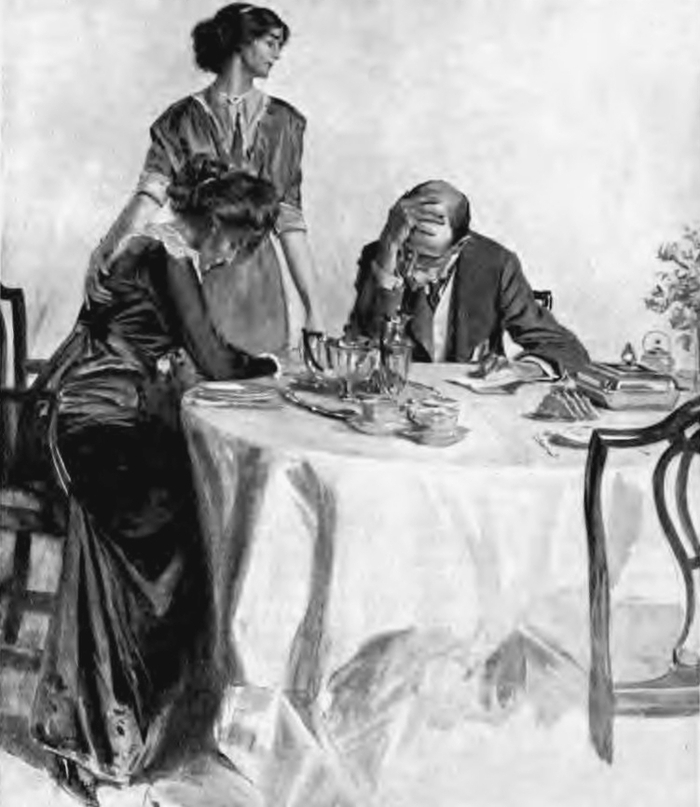
Drawn by Frank Wiles
“SHE LOOKED DOWN WITH A NEW AND LIFE-GIVING FEELING OF
PITY UPON THE BOWED GRAY HEADS”
THE CENTURY’S AFTER-THE-WAR SERIES — THE HUMOR AND TRAGEDY OF THE GREELEY CAMPAIGN — I — II — III — IV — V
GREAT EVENTS IN AMERICAN PROGRESS
DURING THE HALF-CENTURY FOLLOWING THE CIVIL WAR
DESCRIBED BY AMERICAN JOURNALISTS AND BY WRITERS HAVING
PERSONAL AND SPECIAL KNOWLEDGE OF IMPORTANT INCIDENTS
PREFATORY EDITORIAL NOTE
Two generations of readers have entered on the field of action since
the Civil War marked the end of what may be called the formative era of
American life. Twenty-eight years ago THE CENTURY began its
memorable Civil War Series, which gave the surviving leaders, Joseph
E. Johnston, Beauregard, Longstreet, and their valiant colleagues on
the Confederate side, a chance to be read with calm appreciation by the
people of the North, and brought to the reviving people of the South
dispassionate accounts by Grant, Sherman, McClellan, Porter, and their
fighting coadjutors on land and sea, of the motives and deeds which
shaped the heroic contest and resulted in a reunited country. Through
the medium of personal recollection, with fairness and without feeling,
the brave men of both sides fought their battles over again before an
open-minded audience of all the people, and for the first time since
slavery became the cause of strife, both parts of the country shook
hands over “the bloody chasm” in mutual admiration and respect.
The forty-seven years which have elapsed since Appomattox have also
had their conflicts, though most of them have been waged in the ways
of peace. They have resulted, however, in forcing the republic,
shaped by the aims of the fathers, into the wider domain of empire
required by the expanding purposes of the sons. In order to bring the
great happenings of this period vividly before the new generations of
readers, THE CENTURY has organized an After-the-War Series.
It will treat of such compelling and lasting influences as the attempt
to “recall” Andrew Johnson, seventeenth President, by impeachment;
the acquisition of Alaska, with its great promise for the future;
the settlement of the Alabama Claims, which brought about a new
status for the United States with Europe; the memorable attempt to
make Horace Greeley President, which in a way may be compared to the
present campaign of the “Progressives”; the near ship-wreck of the
Hayes-Tilden contest; the chain of measures and financial disasters
from “Black Friday” and the Crédit Mobilier to the time when the
nation kept its faith by the resumption of specie payments; the large
features of Reconstruction, still being worked out in the South; the
victory of civil-service reform, beginning with Cleveland’s election
over Blaine; the solidifying of the Monroe Doctrine in the Venezuelan
dispute, which prepared the way for the Panama Canal; the diplomacy of
the war with Spain, by which the republic became an empire; and also
articles describing the remarkable Bryan conventions, the progress of
conservation, the battle with the trusts, and the gigantic problem of
organized labor. In its total effect the series will reveal the drift
of life in the United States.
Each of these commanding subjects will be treated by a prominent
American journalist having particular acquaintance with the theme, and
also, where supplemental articles are necessary, by writers having
special knowledge of these historic dramas of American progress and
personal contact with the actors. In this year of political conflict
Colonel Watterson’s article, which begins the series, has a timely as
well as a distinct personal interest.
BY HENRY WATTERSON
AMONG the many misconceptions and mischances which befell the slavery
agitation in the United States and finally led a kindred people into
actual war, the idea that got afloat after this war, that every
Confederate was a Secessionist, best served the ends of the radicalism
which sought to reduce the South to a conquered province, and as such
to reconstruct it by hostile legislation supported, wherever needed, by
force.
Andrew Johnson perfectly understood that a great majority of the men
who were arrayed on the Southern side had taken the field against their
better judgment through pressure of circumstance. They were Union men
who had opposed Secession and clung to the old order. Not merely in
the Border States did this class rule, but in the Gulf States it held
a respectable minority until the shot fired upon Sumter drew the call
for troops from Lincoln. The Secession leaders who had staked their all
upon the hazard knew that to save their movement from collapse it was
necessary that blood be sprinkled in the faces of the people. Hence the
message from Charleston,
With cannon, mortar, and petard,
We tender you our Beauregard,
with the response from Washington, precipitated the conflict of
theories into a combat of arms for which neither party was prepared.
The debate ended, battle at hand, Southern men had to choose between
the North and the South, between their convictions and predilections on
one side and expatriation on the other side, resistance to invasion,
not secession, the issue. But, four years later, when in 1865 all
that they had believed and feared in 1861 had come to pass, these men
required no drastic measures to bring them to terms. Events more potent
than acts of Congress had already reconstructed them. Lincoln, with a
forecast of this, had shaped his ends accordingly. Johnson, himself a
Southern man, understood it even better than Lincoln, and backed by the
legacy of Lincoln, he proceeded not very skilfully to build upon it.
The assassination of Lincoln, however, had played directly into the
hands of the radicals, led by Ben Wade, in the Senate, and Thaddeus
Stevens in the House. Prior to that baleful night they had fallen
behind the marching van. The mad act of Booth put them upon their feet
and brought them to the front. They were implacable men, politicians
equally of resolution and ability. Events quickly succeeding favored
them and their plans. It was not alone Johnson’s lack of temper and
tact that gave them the whip-hand. His removal from office would have
opened the door of the White House to Wade, so that strategically
Johnson’s position was from the beginning beleaguered and, before the
close, came perilously near to being untenable.
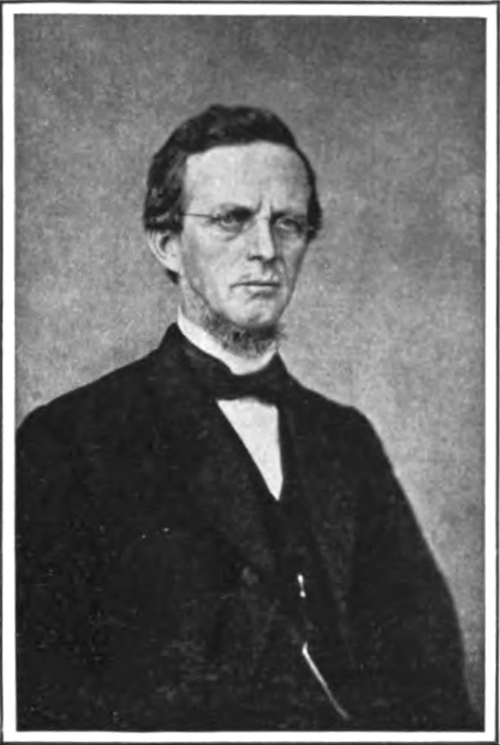
From a photograph taken about 1872, owned by Mr. F. H.
Meserve
LYMAN TRUMBULL
Grant, who, up to the time of his nomination for the Presidency, had
had no partizan conviction, not Wade, the uncompromising extremist,
came after, and inevitably four years of Grant had again divided the
triumphant Republicans. This was the situation during the winter of
1871–72, when the approaching Presidential election brought the country
face to face with an extraordinary state of affairs. The South was in
irons. The North was growing restive. Thinking people everywhere felt
that conditions so anomalous to our institutions could not last.
JOHNSON had made a bungling attempt to carry out the policies of
Lincoln and had gone down in the strife. The Democratic party had
reached the ebb-tide of its disastrous fortunes. It seemed the merest
reactionary. A group of influential Republicans, for one cause or
another dissatisfied with Grant, held a caucus and issued a call for
what they described as a Liberal Republican Convention to assemble in
Cincinnati, May 1, 1872.[1]
A Southern man and a Confederate soldier, a Democrat by inheritance
and conviction, I had been making in Kentucky an unequal fight for the
acceptance of the inevitable. The line of cleavage between the old
and the new South I had placed upon the last three amendments to the
Constitution, naming them the Treaty of Peace between the sections.
The negro must be invested with the rights conferred upon him by these
amendments, however mistaken and injudicious the South might think
them. The obsolete black laws instituted during the slave régime must
be removed from the statute-books. The negro, like Mohammed’s coffin,
swung in mid-air. He was neither fish, flesh, nor fowl, nor good red
herring. For our own sake we must habilitate him, educate and elevate
him, make him, if possible, a contented and useful citizen. Failing of
this, free government itself might be imperiled.
I had behind me the intelligence of the Confederate soldiers almost to
a man. They, at least, were tired of futile fighting, and to them the
war was over. But there was an element, especially in Kentucky, which
wanted to fight when it was much too late—old Union Democrats and
Union Whigs—who clung to the hull of slavery when the kernel was gone,
and proposed to win in politics what had been lost in battle.
The leaders of this belated element were in complete control of the
political machinery of the State. They regarded me as an impudent
upstart, since I had come to Kentucky from Tennessee as little better
than a carpet-bagger, and had done their uttermost to put me down and
drive me out.
I was a young fellow of two and thirty, of boundless optimism and
with my full share of self-confidence, no end of physical endurance
and mental vitality, and having some political as well as newspaper
experience. It never crossed my fancy that I could fail. I met
resistance with aggression, answered attempts at bullying with scorn,
generally irradiated by laughter. Yet I was not wholly blind to
consequences and the admonitions of prudence, and when the call for a
Liberal Republican Convention appeared, I realized that, interested
as I was in what might come of it, if I expected to remain a Democrat
in a Democratic community, and to influence and lead a Democratic
following, I must proceed with caution. Though many of those proposing
the new movement were familiar acquaintances, some of them personal
friends, the scheme was, as it were, in the air. Its three newspaper
bell-wethers, Samuel Bowles of the Springfield “Republican,” Horace
White of the Chicago “Tribune,” and Murat Halstead of the Cincinnati
“Commercial,” were specially well known to me; so were Horace Greeley,
Carl Schurz, and Charles Sumner. Stanley Matthews was my kinsman;
George Hoadley and Cassius M. Clay were next-door neighbors. But they
were not the men I had trained with—not my “crowd,”—and it was a
question how far I might be able to reconcile myself, not to mention
my political associates, to such company, even conceding that they
proceeded under good fortune with a good plan, offering the South
extrication from its woes and the Democratic party an entering wedge
into a solid and hitherto irresistible Republicanism.
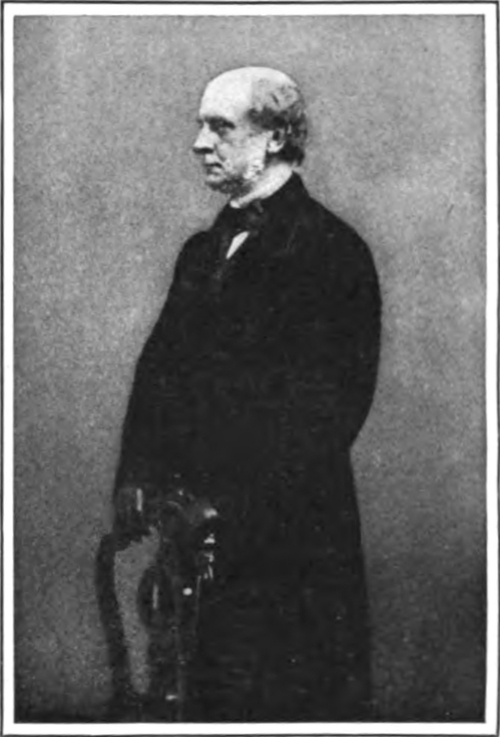
From a photograph taken about 1872, owned by Mr. F. H.
Meserve
CHARLES FRANCIS ADAMS
Nevertheless, I resolved to go a little in advance to Cincinnati, to
have a look at the stalking-horse there to be offered, free to take it
or leave it, as I liked, my bridges and lines of communication still
open and intact.
A LIVELIER
and more variegated omnium-gatherum was never assembled.
They had already begun to pour in when I arrived. There were
long-haired and spectacled doctrinaires from New England, and
short-haired and blatant emissaries from New York, mostly, as it turned
out, friends of Horace Greeley. There were brisk Westerners from
Chicago and St. Louis. If Whitelaw Reid, who had come as Greeley’s
personal representative, had his retinue, so had Horace White and Carl
Schurz. There were a few rather overdressed persons from New Orleans
brought up by Governor Warmouth, and a motley array of Southerners
of every sort, who were ready to clutch at any straw that promised
relief to intolerable conditions. The full contingent of Washington
correspondents was there, of course, with sharpened eyes and pencils,
to make the most of what they had already begun to christen a conclave
of cranks.
From a photograph taken in 1872
HENRY WATTERSON
Bowles and Halstead met me at the station, and we drove to the St.
Nicholas Hotel, where White and Schurz were awaiting us. Then and
there was organized a fellowship of the first three and myself which
in the succeeding campaign went by the name of the Quadrilateral. We
resolved to limit the Presidential nomination of the convention to
Charles Francis Adams, Bowles’s candidate, and Lyman Trumbull, White’s
candidate, omitting altogether, because of specific reasons urged by
White, the candidacy of B. Gratz Brown, who, because of his Kentucky
connections, had better served my purpose. The very next day the secret
was abroad, and Whitelaw Reid came to me to ask why, in a newspaper
combine of this sort, the “New York Tribune” had been left out.
From a photograph taken in 1872
HORACE WHITE
To my mind it seemed preposterous that it had been, or should be, and
I stated as much to my new colleagues. They offered objection which
to me appeared perverse, if not childish. To begin with, they did
not like Reid. He was not a principal, like the rest of us, but a
subordinate. Greeley was this, that, and the other; he could never be
relied upon in any coherent, practical plan of campaign; to talk about
him as a candidate was ridiculous. I listened rather impatiently, and
finally I said: “Now, gentlemen, in this movement we shall need the
‘New York Tribune.’ If we admit Reid, we clinch it. You will all agree
that Greeley has no chance of a nomination, and so, by taking him in,
we both eat our cake and have it.” On this view of the case Reid was
invited to join us, and that very night he sat with us at the St.
Nicholas, where from night to night until the end we convened and went
over the performances and developments of the day and concerted plans
for the morrow.
As I recall these symposiums, amusing and plaintive memories rise
before me.
The first serious business that engaged us was the killing of the
boom for Judge David Davis of the Supreme Court, which was assuming
definite and formidable proportions. The preceding winter it had been
organizing at Washington under the ministration of some of the most
astute politicians of the time, mainly, however, Democratic members
of Congress. A party of these had brought the boom to Cincinnati,
opening headquarters well provided with the requisite commissaries.
Every delegate who came in that could be reached was laid hold of and
conducted here.
From a photograph by Sarony, taken in 1872
SAMUEL BOWLES
We considered this flat burglary. It was a gross infringement upon our
preserve. What business had the professional politicians with a great
reform movement? The influence and dignity of journalism were involved
and imperiled. We, its custodians, could brook no such defiance from
intermeddling office-seekers, especially from brokendown Democratic
office-seekers.
The inner sanctuary of our proceedings was a common drawing-room
between two bedchambers shared by Schurz and me. Here we repaired after
supper to smoke the pipe of fraternity and reform and to save the
country. What could be done to kill off “D. Davis,” as we irreverently
called the eminent and learned jurist, the friend of Lincoln, and the
only aspirant having a “bar’l”? That was the question. We addressed
ourselves to the task with earnest purpose, but characteristically.
The power of the press must be invoked. It was our chief, if not our
only, weapon. Each of us indited a leading editorial for his paper,
to be wired to its destination and printed next morning, striking
“D. Davis” at a prearranged and varying angle. Copies of these were
made for Halstead, who, having with the rest of us read and compared
the different screeds, indited one of his own in general comment and
review for Cincinnati consumption. In next day’s “Commercial,” blazing
under vivid head-lines, these leading editorials, dated “Chicago,”
“New York,” “Springfield, Mass.,” and “Louisville, Ky.,” appeared
with the explaining line, “‘The Tribune’ of to-morrow morning [or the
‘Courier-Journal’ or ‘Republican’] will say,” etc.
Wondrous consensus of public opinion! The Davis boom went down before
it. The Davis boomers were paralyzed. The earth seemed to have arisen
and hit them amidships. The incoming delegates were stopped and
forewarned. Six months of adroit scheming was set at naught, and little
more was heard of “D. Davis.”
From a photograph by Gutekunst
ALEXANDER K. McCLURE
Like the Mousquetaires, we were equally in for fighting and
foot-racing; the point with us being to “get there,” no matter how;
the end—the defeat of the rascally machine politicians and the reform
of the public service—being relied upon to justify the means. I am
writing this forty years after the event, and must be forgiven the
fling of my wisdom at my own expense and that of my associates in
harmless crime. Reid and White and I are the sole survivors. We were
wholly serious, maybe a trifle visionary, but as upright and patriotic
in our intentions and as loyal to our engagements as it was possible
for older, and maybe worse, men to be. For my part, I must say that
if I have never anything on my conscience heavier than the massacre
of that not very edifying, yet promising Davis “combine,” I shall be
troubled by no remorse, but to the end shall sleep soundly and well.
In that immediate connection an amusing incident throwing some light
upon the period thrusts itself upon my memory. The Quadrilateral, with
Reid added, had finished its consolidation of public opinion just
related, when the cards of Judge Craddock, Chairman of the Kentucky
Democratic Committee, and of Colonel J. Stoddart Johnston, editor of
the “Frankfort Yeoman,” the organ of the Kentucky Democracy, were
brought from below. They had come to look after me, that was evident.
By no chance could they have found me in more equivocal company. In
addition to ourselves, bad enough from the Kentucky point of view,
they found in the room Theodore Tilton and David A. Wells. When they
crossed the threshold and were presented seriatim, the face of
each was a study. Even an immediate application of whisky and water
did not suffice to restore their lost equilibrium and bring them to
their usual state of convivial self-possession. Colonel Johnston told
me years after that when they went away they walked in silence a block
or two, when the old judge, a model of the learned and sedate school
of Kentucky politicians and jurists, turned to him and said: “It is no
use, Stoddart. We cannot keep up with that young man or with these
times. Lord, now lettest thou thy servant depart in peace!”
From a photograph taken in 1861, owned by Mr. Frederick
H. Meserve
CARL SCHURZ
The Jupiter Tonans of reform in attendance upon the convention was
Colonel Alexander K. McClure of the Philadelphia “Times.” He was one
of the handsomest and most imposing of men; Halstead himself was
scarcely more so. McClure was personally unknown to the Quadrilateral,
but this did not stand in the way of our asking him to dine with us as
soon as his claims to fellowship in the good cause of reform began to
make themselves apparent through the need of bringing the Pennsylvania
delegation to “a realizing sense.”
As he entered the room, he looked like a god, nay, he acted like one.
Schurz first took him in hand. With a lofty courtesy that I have never
seen equaled, he tossed his inquisitor into the air. Halstead came
next, trying him upon another tack, but fared no better than Schurz.
Then I hurried to the rescue of my friends. McClure, now looking a bit
bored and resentful, landed me somewhere near the ceiling.
It would have been laughable if it had not been ignominious. I took my
discomfiture with the bad grace of silence throughout the brief, stiff,
and formal meal which followed. But when it was over, and the party had
risen from the table and was about to disperse, I collected my energies
and resources for a final forlorn hope. I was not willing to remain so
crushed or to confess myself so beaten, though I could not disguise
from myself a feeling that all of us had been overmatched.
“McClure,” said I, with the cool and quiet resolution of despair,
drawing him aside, “what in the —— do you want, anyhow?”
He looked at me with swift intelligence and a sudden show of sympathy,
and then over at the others with a withering glance.
“What? With those cranks? Nothing.”
Jupiter descended to earth. I am afraid we actually took a glass of
wine together. Anyhow, from that moment to the hour of his death we
were the best of friends.
Without the inner circle of the Quadrilateral, which had taken
matters into its own hands, were a number of persons, some of them
disinterested and others simple curiosity- and excitement-seekers,
who might be described as merely “lookers-on in Vienna.” The Sunday
afternoon before the convention was to meet, we, the self-elect,
fell in with a party of these in a garden “over the Rhine,” as the
German quarter of Cincinnati is called. There was first general and
rather aimless talk, then came a great deal of speech-making. Schurz
started it with a few pungent observations intended to suggest and
inspire some common ground of public opinion and sentiment. Nobody was
inclined to dispute his leadership, but everybody was prone to assert
his own. It turned out that each regarded himself, and wished to be
regarded, as a man with a mission, having a clear idea how things were
not to be done. There were civil-service reform protectionists and
civil-service reform free traders. There were a few politicians, who
were discovered to be spoilsmen, the unforgivable sin, and as such were
quickly dismissed. The missing ingredient was coherence of belief and
united action. Not a man of them was willing to commit or bind himself
to anything. Edward Atkinson pulled one way, and William Dorsheimer
exactly the opposite way. David A. Wells sought to get the two
together; it was not possible. Sam Bowles shook his head in diplomatic
warning. Horace White threw in a chink or so of a rather agitating
newspaper independence, while Halstead, to the more serious-minded, was
in an inflamed state of jocosity.
From a photograph by Sarony
MURAT HALSTEAD
All this was grist to the mill of the Washington correspondents,
chiefly “story” writers and satirists, who were there to make the
most out of an occasion in which the bizarre was much in excess of the
conventional, with George Alfred Townsend and Donn Piatt to set the
pace. Hyde of the “Republican” had come from St. Louis to keep special
tab on Grosvenor of the “Democrat.” Though rival editors facing our
way, they had not been admitted to the Quadrilateral. McCullagh and
Nixon were among the earliest arrivals from Chicago. The lesser lights
of the gild were innumerable. One might have mistaken it for an annual
meeting of the Associated Press.
THE
convention assembled. It was in Cincinnati’s great music-hall.
Schurz presided. Who that was there will never forget his opening words,
“This is moving day.” He was just turned forty-two; in his physiognomy
a scholarly Herr Doktor; in his trim, lithe figure a graceful athlete;
in the tones of his voice an orator.
Even the bespectacled doctrinaires of the East, whence, since the days
the Star of Bethlehem shone over the desert, wisdom and wise men have
had their emanation, were moved to something like enthusiasm. The rest
of us were fervid. Two days and a night and a half the Quadrilateral
had the world in a sling and things its own way. It had been agreed,
as I have said, to limit the field to Adams, Trumbull, and Greeley,
and Greeley being out of it as having no chance whatever, the list was
still further abridged to Adams and Trumbull. Trumbull not developing
very strong, Bowles, Halstead, and I, even White, began to be sure
that it would require only one ballot to nominate Adams—Adams the
indifferent, who had sailed away for Europe, observing that he was not
a candidate for the nomination, and otherwise intimating his disdain of
it and us.
Matters being thus apparently cocked and primed, the convention
adjourned over the first night of its session with everybody happy
except the “D. Davis” contingent, which lingered, but knew its “cake
was dough.” If we had forced a vote that night, as we might have done,
we should have nominated Adams. But, inspired by the bravery of youth
and inexperience, we let the golden opportunity slip. The throng of
delegates and the vast audience dispersed.
In those days it being the business of my life to turn day into night
and night into day, it was not my habit to go to bed much before the
presses began to thunder below. This night proved no exception: being
tempted by a party of Kentuckians, some of whom had come to back me and
some to watch me, I did not quit their agreeable society until the “wee
sma’ hours ayant the twal.”
Photograph by Pearsall, taken in 1872
HORACE GREELEY
This portrait, unusual for the absence of spectacles, is
owned by his daughter, Mrs. F. M. Clendenin.
Before turning in, I glanced at the early edition of the “Commercial”
to see that something—I was too tired to decipher precisely what—had
happened. It was, in point of fact, the arrival about midnight of
General Frank P. Blair and Governor B. Gratz Brown of Missouri. I had
in my possession documents which would have induced at least one of
them to pause before making himself too conspicuous. The Quadrilateral,
excepting Reid, knew this. We had separated upon the adjournment of the
convention. I, being across the river in Covington, their search for me
was unavailing. They were in despair. When, having had a few hours
of rest, I reached the convention hall toward noon, it was too late.
HORACE GREELEY AND WHITELAW REID
From a photograph taken in the editorial rooms of “The
Tribune” shortly before the opening of the Greeley Campaign.
From a cartoon by Thomas Nast in “Harper’s Weekly”
NAST’S CARTOON, “‘THE PIRATES’ UNDER FALSE COLORS—CAN
THEY CAPTURE THE ‘SHIP OF STATE’?”
At the left Sumner is reading a book; Andrew Johnson is
behind the capstan; August Belmont in the gangway with a knife in his mouth;
Fenton in the background; Whitelaw Reid on a keg of powder playing a violin
tagged, “This is not an organ”; David Davis is behind Archbishop Hughes with
the cross; Manton Marble is hiding behind his newspaper “The World”; Senator
Tipton is bawling near Greeley; Carl Schurz is waving his hat to friends on
the Ship of State and Theodore Tilton is embracing him; Governor
Hoffman holds a parasol; Horatio Seymour kneels to Jeff Davis lying on the
Confederate flag, behind him a group of Confederates with Wade Hampton
standing near Greeley; John Kelly holds the Tammany knife, and above his head
are faces of Tweed, and Mayor Oakey Hall with eye-glasses.
I got into the thick of the session in time to see the close, not
without an angry collision with that one of the newly arrived actors
whose coming had changed the course of events, and with whom I had
lifelong relations of affectionate intimacy. Recently, when I was
sailing in Mediterranean waters with Joseph Pulitzer, who, then a mere
youth, was yet the secretary of the convention, he recalled the scene:
the unexpected and not over-attractive appearance of B. Gratz Brown,
the Governor of Missouri; his not very pleasing yet ingenious speech
in favor of the nomination of Greeley; the stoical, almost lethargic
indifference of Schurz. “Carl Schurz,” said Pulitzer, “was the most
industrious and the least energetic man I have ever known and worked
with. A word from him at that crisis would have completely routed Blair
and squelched Brown. It was simply not in him to speak it.”
From a photograph by Sarony, taken in 1872
THOMAS NAST
The result was that Greeley was nominated amid a whirl of enthusiasm,
his workers, with Whitelaw Reid at their head, having maintained an
admirable and effective organization, and being thoroughly prepared to
take advantage of the opportune moment. It was the logic of the event
that B. Gratz Brown should be placed on the ticket with him.
The Quadrilateral was “nowhere.” It was done for. The impossible had
come to pass. There arose thereafter a friendly issue of veracity
between Schurz and me, which illustrates our state of mind. My version
is that we left the convention hall together, with an immaterial train
of after incidents; his that we did not meet after the adjournment. He
was quite sure of this because he had ineffectually sought me. “Schurz
was right,” said Joseph Pulitzer, upon the occasion of our yachting
cruise just mentioned, “because he and I went directly from the hall
with Judge Stallo to his home on Walnut Hills, where we dined and
passed the afternoon.”
The Quadrilateral had been knocked into a cocked hat. Whitelaw Reid was
the sole survivor. He was the only one of us who clearly understood
the situation and thoroughly knew what he was about. He came to me and
said: “I have won, and you people have lost. I shall expect that you
stand by the agreement and meet me as my guests at dinner to-night.
But, if you do not personally look after this, the others will not be
there.” I was as badly hurt as any; but a bond is a bond, and I did
as he desired, succeeding partly by coaxing and partly by insisting,
though it was uphill work.
Frostier conviviality I have never sat down to than Reid’s dinner.
Horace White looked more than ever like an iceberg; Sam Bowles was
diplomatic, but ineffusive; Schurz was as a death’s head at the board;
Halstead and I, through sheer bravado, tried to enliven the feast.
But they would none of us, nor it, and we separated early and sadly,
reformers hoist by their own petard.
THE SAME TUNES BY ANOTHER FIDDLE WILL SOUND AS SWEET.
IT IS TOO BAD TO HAVE THE NEW YORK WORLD PLAY SECOND FIDDLE TO ITS OWN
FAVORITE TUNES.
From a cartoon by Thomas Nast in “Harper’s Weekly”
NAST’S CARTOON OF WHITELAW REID OF “THE TRIBUNE” AND
MANTON MARBLE OF “THE WORLD” PLAYING IN CONCERT
THE
reception by the country of the nomination of Horace Greeley
was as inexplicable to the politicians as the nomination itself had
been unexpected by the Quadrilateral. The people rose to it. The
sentimental, the fantastic, and the paradoxical in human nature had to
do with this. At the South an ebullition of pleased surprise grew into
positive enthusiasm. Peace was the need, if not the longing, of the
Southern heart, and Greeley’s had been the first hand stretched out to
the South from the enemy’s camp,—very bravely, too, for he had signed
the bail-bond of Jefferson Davis,—and quick upon the news flashed the
response from generous men eager for the chance to pay something on a
recognized debt of gratitude.
Except for this spontaneous uprising, which continued unabated in July,
the Democratic party could not have been induced at its convention at
Baltimore to ratify the proceedings at Cincinnati and formally to make
Greeley its candidate. The leaders dared not resist it. Some of them
halted, a few held out, but by midsummer the great body of them came to
the front to head the procession.
Horace Greeley was a queer old man, a very medley of contradictions,
shrewd and simple, credulous and penetrating, a master penman of the
school of Swift and Cobbett, even in his odd, picturesque personality
whimsically attractive and, as Seward learned to his cost, a man to be
reckoned with where he chose to put his powers forth.
What he would have done with the Presidency had he reached it is not
easy to say or to surmise. He was altogether unsuited for official
life, for which, nevertheless, he had a longing. But he was not so
readily deceived in men or misled in measures as he seemed, and as most
people thought him.
His convictions were emotional, his philosophy experimental; but there
was a certain method in their application to public affairs. He gave
bountifully of his affection and his confidence to the few who enjoyed
his familiar friendship; he was accessible and sympathetic, though
not indiscriminating, to those who appealed to his impressionable
sensibilities and sought his help. He had been a good party man and was
temperamentally a partizan.
To him place was not a badge of bondage; it was a decoration,
preferment, promotion, popular recognition. He had always yearned for
office as the legitimate destination of public life and the honorable
reward of party service. During the greater part of his career, the
conditions of journalism had been rather squalid and servile. He was
really great as a journalist. He was truly and highly fit for nothing
else, but, seeing less deserving and less capable men about him
advanced from one post of distinction to another, he wondered why his
turn proved so tardy in coming, and when it would come. It did come
with a rush. What more natural than that he should believe it real
instead of the empty pageant of a vision?
After the first shock and surprise of the Cincinnati nomination, it had
taken me only a day and a night to pull myself together and to plunge
into the swim to help fetch the water-logged factions ashore. This
was clearly indispensable to forcing the Democratic organization to
come to the rescue of what would prove otherwise but a derelict upon a
stormy sea. Schurz was deeply disgruntled. Before he could be appeased,
a bridge found in what was called the Fifth Avenue Hotel Conference
had to be constructed in order to carry him across the stream which
flowed between his disappointed hopes and aims and what appeared to him
an illogical and repulsive alternative. Like another Achilles, he had
taken to his tent and sulked. He was harder to deal with than any of
the Democratic file-leaders; but he finally yielded, and did splendid
work in the campaign.
Carl Schurz was a stubborn spirit, not readily adjustable. He was a
nobly gifted man, but from first to last an alien in an alien land.
He once said to me, “If I should live a thousand years, they would
still call me a Dutchman.” No man of his time spoke so well or wrote
to better purpose. He was equally skilful in debate, an overmatch
for Conkling and Morton, whom, especially in the French Arms matter,
he completely dominated and outshone. As sincere and unselfish, as
patriotic and as courageous, as any of his contemporaries, he could
never attain the full measure of the popular heart and confidence,
albeit reaching its understanding directly and surely. Within himself a
man of sentiment, he was not the cause of sentiment in others. He knew
this and felt it.
During the campaign the Nast cartoons in “Harper’s Weekly,” which
while unsparing to the last degree to Greeley and Sumner, and treating
Schurz with a kind of considerate, qualifying humor, nevertheless
greatly offended him. I do not think Greeley minded them much, if
at all. They were very effective, notably the “Pirate Ship,” which
represented Greeley rising above the taffrail of a vessel carrying the
Stars-and-Stripes and waving his handkerchief at the man-of-war Ship
of State in the distance, while the political leaders of the
Confederacy, dressed in true corsair costume, crouched below, ready to
spring. Nothing did more to sectionalize Northern opinion and fire the
Northern heart, or to lash the fury of the rank and file of those who
were urged to vote as they had shot, and who had hoisted above them
“the bloody shirt” for a banner.
In the first half of the canvass the impetus was with Greeley; the
second half, beginning in eclipse, seemed about to end in something
very like collapse. The old man seized his flag and set out upon his
own account for a tour of the country. And right well he bore himself.
If speech-making ever does any good toward the shaping of results,
Greeley’s speeches surely should have elected him. They were marvels
of impromptu oratory, mostly homely and touching appeals to the better
sense and the magnanimity of a people not ripe or ready for generous
impressions, convincing in their simplicity and integrity, unanswerable
from any point of view of sagacious statesmanship or true patriotism,
if the North had been in any mood to listen, to reason, and to respond.
I met him at Cincinnati and acted as his escort to Louisville and
thence to Indianapolis, where others were waiting to take him in
charge. He was in a state of querulous excitement. Before the vast
and noisy audiences which we faced he stood apparently pleased and
composed, delivering his words as he might have dictated them to a
stenographer. As soon as we were alone he would break out into a kind
of lamentation, punctuated by occasional bursts of objurgation. He
especially distrusted the Quadrilateral, making an exception in my
case as well he might, because, however his nomination had jarred my
judgment, I had a real affection for him, dating back to the years
immediately preceding the war, when I was wont to encounter him in the
reporters’ galleries at Washington, which he preferred to using his
floor privilege as an ex-member of Congress.
It was mid-October. We had heard from Maine. Indiana and Ohio had
voted, and Greeley was for the first time realizing the hopeless nature
of the contest. The South, in irons and under military rule and martial
law sure for Grant, there had never been any real chance. Now it was
obvious that there was to be no compensating ground-swell at the North.
That he should pour forth his chagrin to one whom he knew so well and
even regarded as one of his “boys” was inevitable. Much of what he said
was founded on a basis of fact, some of it was mere suspicion and
surmise, all of it came back to the main point that defeat stared us in
the face.
I was glad and yet loath to part with him. If ever a man needed a
strong friendly hand and heart to lean upon he did during those dark
days—the end in darkest night nearer than any one could divine. He
showed stronger mettle than had been allowed him; bore a manlier part
than was commonly ascribed to his slovenly, slipshod habiliments and
his aspect in which benignancy and vacillation seemed to struggle for
the ascendancy. Abroad, the elements conspired against him. At home his
wife lay ill, as it proved, unto death. The good gray head he still
carried like a hero, but the worn and tender heart was beginning to
break.
Happily the end came quickly. Overwhelming defeat was followed by
overwhelming affliction. He never quitted his dear one’s bedside until
the last pulse-beat, and then he sank beneath the load of grief. “‘The
Tribune’ is gone and I am gone,” he said, and spoke no more.
The death of Greeley fell upon the country with a sudden shock. It
aroused a wide-spread sense of pity and sorrow and awe. All hearts were
hushed. In an instant the bitterness of the campaign was forgotten,
though the huzzas of the victors still rent the air. President Grant,
his late antagonist, with his cabinet, and the leading members of the
two Houses of Congress, attended his funeral. As he lay in his coffin,
he was no longer the arch-rebel leading a combine of buccaneers and
insurgents, which the Republican orators and newspapers had depicted
him, but the brave old apostle of freedom, who had done more than all
others to make the issues upon which a militant and triumphant party
had risen to power. The multitude remembered only the old white hat and
the sweet, old baby face beneath it, heart of gold, and hand wielding
the wizard pen; the incarnation of probity and kindness, of steadfast
devotion to his duty, as he saw it, and to the needs of the whole human
family. It was, indeed, a tragedy; and yet, as his body was lowered
into its grave, there rose above it, invisible, unnoted, a flower of
matchless beauty—the flower of peace and love between the parts of the
Union to which his life had been a sacrifice.
The crank convention had builded wiser than it knew. That the
Democratic party could ever have been brought to the support of Horace
Greeley for President of the United States reads even now like a page
out of a nonsense-book. That his warmest support should have come from
the South seems an incredible, and was a priceless, fact. His martyrdom
shortened the distance across the bloody chasm; his coffin very nearly
filled it. The candidacy of Charles Francis Adams or of Lyman Trumbull
would have meant a mathematical formula, with no solution of the
problem, and as certain defeat at the end of it. Greeley’s candidacy
threw a flood of light and warmth into the arena of deadly strife; it
made a more equal and reasonable division of parties possible; it put
the Southern half of the country in a position to plead its own case
by showing the Northern half that it was not wholly recalcitrant, and
it made way for real issues of pith and moment relating to the time
instead of pigments of bellicose passion and scraps of ante bellum
controversy.
In a word, Greeley did more by his death to complete the work of
Lincoln than he could have done by a triumph at the polls and the term
in the White House he so much desired. Though only sixty years of age,
his race was run. Of him it may be truly written that he lived a life
full of inspiration to his countrymen, and died not in vain, “our later
Franklin” fittingly inscribed upon his tomb.
COMMENTS ON COLONEL WATTERSON’S PAPER — I—BY WHITELAW REID — II—BY HORACE WHITE
THE foregoing was written in the south of France to help while
away a winter vacation. I was not willing to give it to the public
without the “visé” of my surviving colleagues, Whitelaw Reid and
Horace White, to each of whom I sent a copy. At first I thought of
recasting my matter to meet their objections. But, on second thought,
it seems best to “let the hide go with the tallow,” as it were, their
comments not only illuminating my narrative, but throwing on it
the side lights of their differing points of view. No one holds in
higher respect than I the noble aims and great sacrifices made by the
Liberal Republicans.
HENRY
WATTERSON.
Dorchester House,
Park Lane, W., London, England,
May 3, 1911.
My dear Watterson:
I have read the manuscript with the greatest interest. On a few little
matters I shouldn’t have put things quite the same way; but that
of course is to be expected from the different points of view from
which we necessarily regard the subject. On the whole, it seems to me
extremely fair and accurate.
I shall append a few notes, which I have made on different points
suggested by the manuscript, not with the idea that you will find any
occasion to incorporate any of my suggestions in your account, but only
by way of refreshing your memory, as your manuscript has refreshed
mine, about interesting incidents of a period which now seems so remote
as to belong exclusively to our romantic youth.
On page 27 it would seem to be implied that Ben Wade was somewhat
influenced in his support of the impeachment policy by the fact
that if impeachment succeeded, he was the inevitable successor. I
saw a great deal of Wade in those days. He certainly knew what the
consequence to himself of a successful impeachment would be, but I
never saw any reason to suppose that if somebody else had been acting
Vice-President, Wade’s attitude would not have been the same. Probably
he would have been even more outspoken.
Page 31. What you say of the attitude of three of the Quadrilateral
toward myself is not news to me. I knew, however, the reasons for
it (which would probably have influenced me if I had been in their
places), and I bore no grudges. In fact, at the time I had a pretty
strong conviction that they were the people who were going to be badly
disappointed in the end; so that, while you all thought you were taking
me into camp, I was comforting myself with the belief that I was taking
the Quadrilateral into camp, and should find them very useful articles
to begin housekeeping with.
Page 35. Did McCullagh come from Chicago? I thought we always counted
him as belonging to Cincinnati until he went to St. Louis. When I first
went to Cincinnati, he was a reporter on the “Gazette,” from which he
went to the “Commercial.”
Page 40. The “bravery” of Greeley’s outstretched hand may have been
fully recognized, but I doubt if its self-sacrifice ever was. First
and last it must have cost him (poor man that he was) nearly a million
dollars. Shortly after the first volume of his history, “The American
Conflict,” was published, I remember congratulating him on the
pecuniary success. His reply was: “Oh, I haven’t made as much as the
newspapers say. Still, I’ve made a hundred thousand dollars that I know
of, for I have spent every cent of it. The past at least is secure.”
With that figure as a basis, you can calculate how much he would
probably have made from the enormously augmented sale of the first
volume when the second came out, as well as from the copyrights on the
second. The circulation of “The Tribune” was also affected for a time
in the same disastrous way.
Page 41. With my intimate knowledge of Greeley at that period I should
hardly have said he had a passion for office. What I did think was that
he had a passion for recognition, and was very sore at being treated
not as an equal and comrade, but as a convenience to the machine,
by Seward and Thurlow Weed. It was less office he sought than an
opportunity to teach those gentlemen their places and his. Certainly he
never had a lifelong passion for office like Lincoln.
Page 41. We had no better politics during the campaign than in the
management of the Fifth Avenue Conference. I remember that William
Henry Hurlbert and some others who were doing their best then to defeat
us did not wake up to the real significance of our attitude toward this
conference until the morning it met. Then Hurlbert described the course
of “The Tribune” as that of a court gallant, tiptoeing forward to bow
the favorites to their places.
I always thought we had the country with us until after the North
Carolina election, and believed we carried that. I am afraid it was
our old friend Ned Webster who deliberately rushed down to steal
it away from us, and that his very strong measures had pretty high
sanction. Or was it in the Hayes-Tilden election that he came to the
front? The truth is the North Carolina election was the turning-point.
If the result had been left as we believed it to be for the first two
or three days, I don’t think we should have had the October reaction,
or that Nast’s cartoons could have had anything like the effect they
did exert.
By the way, some of those cartoons could hardly have been tolerated at
any other time in America, and would hardly have been tolerated in any
other country at any time, such as the one depicting Greeley—Greeley
of all living men!—as clasping hands with the ghost of Wilkes Booth
across the grave of murdered Abraham Lincoln. I once told “Brooklyn”
Joe Harper he ought to be ashamed of that, and begin every day of
his life with a prayer for forgiveness for it. His reply was that we
all of us had done something at some time in our lives that we ought
to be ashamed of. He understood perfectly that I never resented in
the least Nast’s caricatures of myself. In fact, I thought some of
them extraordinarily clever, such as the one depicting me playing a
hand-organ in front of the old Manhattan Club, with Greeley as the
monkey holding out a hat for pennies, while on the end of the organ was
the familiar quotation from “The Tribune” of those days, “This is not
an organ.”
Page 42. You are perfectly right in praising Greeley’s hopeless
campaign in the West. In fact, if I were writing, I should pitch the
note a little higher. I remember Joseph H. Choate saying to a group,
of which I was a member, one Saturday night at the Century Club during
that campaign, “What extraordinarily good speeches Greeley is making
out West!” To give that its full value, please remember that Choate was
a partner of Evarts, who had nominated Seward, and that to that whole
combination Greeley was anathema.
Page 42. My recollection is that Mrs. Greeley died in the interval
after his return from the West, but before the election. I always
attributed his sudden collapse after the election as much to his
loss of sleep, while watching for a week at her bedside, as to
disappointment over the result, and this opinion was somewhat confirmed
by Dr. Choate (a brother of Joseph), to whose private sanatorium he
was taken. I asked Choate what the real disease was, and he said, “If
you want it in popular phrase, it is really an inflammation of the
outer membrane of the brain, due to loss of sleep or extraordinary
excitement.” Then I asked what his prognosis was, and he replied,
“He will either be well in a week or dead.” This is of course not a
description of insanity at all; and I always felt a cruel injustice was
done his memory in describing him as going crazy over defeat—as cruel
as it would be to say such a thing of a fever patient because he was in
a temporary delirium.
I was never convinced that the “last words” you quote were ever
uttered by him, “‘The Tribune’ is gone, and I am gone.” Dana was
surrounded in those days by people who for one reason or another
had grudges equal to his own against “The Tribune”—Amos Cummings,
who had left us in a pet because of some rebuke from John Russell
Young; Dr. Wood, whom Amos got away from us; and, above all, a man in
the proof-room, who resented my criticisms of his proofreading and
deserted us, taking with him the manuscript of one or two of Greeley’s
unbalanced articles, which his brother-in-law, John Cleveland, had
discovered and brought to me, and which I suppressed because they were
obviously unbalanced. They reveled in these things; and it happened at
that time to be all grist to Dana’s mill.
I HAVE read “The Humor and Tragedy of the Greeley Campaign.” What I
think of it depends upon the point of view from which I look at it. The
only tragic thing in it is the death of Greeley. All the rest is comedy.
Regarded as such it has high merits. I can think of nothing political
that is more mirth-provoking, unless it is Dickens’s description of
Mr. Veneering’s campaign for a seat in Parliament with the help
of Boots and Brewer riding about London in cabs and
“bringing him in.”
The first three pages are serious. On the fourth page the fun begins,
and continues till the death of Greeley. At the bottom of page 33
there are two sentences beginning with the words, “We were wholly
serious,” which excuse the participants, including yourself, for
being at Cincinnati at all. Then the humor starts afresh and becomes
side-splitting at the place where McClure enters and tosses Schurz and
Halstead and yourself to the ceiling successively.
Now the question arises, What will the readers of your paper, who get
from it their first and only knowledge of the campaign of 1872—and
these will probably be ninety per cent. of its readers—think of
that campaign? They will think it was a very droll affair and quite
unaccountable. They will know nothing about disfranchisement or Santo
Domingo or nepotism or whisky frauds, or civil-service rapine or the
real causes of the uprising of 1871–72.
The McClure episode, by the way, is even more unaccountable. I don’t
understand it myself. It reads as though Colonel McClure was surveying
the scene from Olympus as a disinterested spectator, with great scorn
for the participants in the convention. In fact he was chairman of the
Pennsylvania delegation, supporting Greeley or Davis or somebody. He
was as deep in the mud as anybody else was in the mire.
Chapter V on Greeley is prime, but it is hardly true to say
or imply that his martyrdom shortened the distance across the bloody
chasm or that his coffin nearly filled it. Reconstruction, Ku Klux, and
carpet-baggery lasted through Grant’s second term, except in so far as
it was put down (in Texas and Arkansas) despite the Republican party.
The South did not get any real relief until Hayes came in, and then
only as the result of a bargain made before the vote of the Electoral
Commission was taken.
To sum up: I think that you have dwelt too much on the humorous side
of the Cincinnati Convention, and that you have omitted the only
features that gave it a raison d’être, or have given such slight
attention to them that the reader will not catch their significance.
IS THE NEGRO HAVING A FAIR CHANCE? — THE NEGRO TREATED BETTER IN AMERICA THAN ELSEWHERE — LITTLE IMMIGRATION OF NEGROES — UNEQUAL LAWS THE CAUSE OF RACIAL TROUBLE IN AMERICA — THE NEGRO AS A DEPENDENT RACE — SKILLED NEGRO LABOR BETTER TREATED IN THE SOUTH THAN IN THE NORTH — THE DIFFICULTY OF OBTAINING UNIFORM TREATMENT — THE SHIFTING OF OCCUPATIONS — BETTER OPPORTUNITY FOR EDUCATION IN THE NORTH — THE UNCERTAINTY OF TREATMENT OF THE RACE IN THE NORTH — THE GREATEST SOURCE OF DISSATISFACTION TO THE NEGRO IN THE SOUTH — LACK OF A “SQUARE DEAL” IN EDUCATION IN THE SOUTH — THE NEGRO PAYS MORE THAN HIS SHARE TO EDUCATION IN THE SOUTH — CONVICT LABOR A GREAT EVIL IN THE SOUTH — THE BALLOT TO THE INTELLIGENT NEGRO — THE CRIME OF LYNCHING
BY BOOKER T. WASHINGTON
IF I were asked the simple, direct question, “Does the negro in America
have a fair chance?” it would be easy to answer simply, “No,” and
then refer to instances with which every one is familiar to justify
this reply. Such a statement would, however, be misleading to any one
who was not intimately acquainted with the actual situation. For that
reason I have chosen to make my answer not less candid and direct, I
hope, but a little more circumstantial.
ALTHOUGH I have never visited either Africa or the West Indies to see
for myself the condition of the people in these countries, I have had
opportunities from time to time, outside of the knowledge I have gained
from books, to get some insight into actual conditions there. But I do
not intend to assert or even suggest that the condition of the American
negro is satisfactory, nor that he has in all things a fair chance.
Nevertheless, from all that I can learn I believe I am safe in saying
that nowhere are there ten millions of black people who have greater
opportunities or are making greater progress than the negroes in
America.
I know that few native Africans will agree with me in this statement.
For example, we had at Tuskegee a student from the Gold Coast who came
to America to study in our Bible Training School and incidentally to
learn something of our methods of study and work. He did not approve
at all of our course of study. There was not enough theology, and too
much work to suit him. As far as he was concerned, he could not see any
value in learning to work, and he thought it was a pretty poor sort of
country in which the people had to devote so much time to labor. “In
my country,” he said, “everything grows of itself. We do not have to
work. We can devote all our time to the larger life.”
IN the last ten years the official records show that 37,000 negroes
have left other countries to take residence in the United States. I can
find no evidence to show that any considerable number of black people
have given up residence in America.
The striking fact is, that negroes from other countries are constantly
coming into the United States, and few are going out. This seems in
part to answer the question as to whether the negro is having a fair
chance in America as compared with any other country in which negroes
live in any large numbers.
By far the largest number of negro immigrants come from the West
Indies. Even Haiti, a free negro republic, furnishes a considerable
number of immigrants every year. In all my experience and observation,
however, I cannot recall a single instance in which a negro has left
the United States to become a citizen of the Haitian Republic. On the
other hand, not a few leaders of thought and action among the negroes
in the United States are those who have given up citizenship in the
little Black Republic in order to live under the Stars and Stripes.
The majority of the colored people who come from the West Indies do so
because of the economic opportunities which the United States offers
them. Another large group, however, comes to get education. Here at the
Tuskegee Institute in Alabama we usually have not far from one hundred
students from South America and the various West Indian Islands. In
the matter of opportunity to secure the old-fashioned, abstract book
education several of the West Indian Islands give negroes a better
chance than is afforded them in most of our Southern States, but for
industrial and technical education they are compelled to come to the
United States.
In the matter of political and civil rights, including protection of
life and property and even-handed justice in the courts, negroes in the
West Indies have the advantage of negroes in the United States. In the
island of Jamaica, for example, there are about 15,000 white people and
600,000 black people, but of the “race problem,” in regard to which
there is much agitation in this country, one hears almost nothing
there. Jamaica has neither mobs, race riots, lynchings, nor burnings,
such as disgrace our civilization. In that country there is likewise no
bitterness between white man and black man. One reason for this is that
the laws are conceived and executed with exact and absolute justice,
without regard to race or color.
REDUCED to its lowest terms, the fact is that a large part of our
racial troubles in the United States grow out of some attempt to pass
and execute a law that will make and keep one man superior to another,
whether he is intrinsically superior or not. No greater harm can be
done to any group of people than to let them feel that a statutory
enactment can keep them superior to anybody else. No greater injury can
be done to any youth than to let him feel that because he belongs to
this or that race, or because of his color, he will be advanced in life
regardless of his own merits or efforts.
In what I have said I do not mean to suggest that in the West Indian
Islands there is any more social intermingling between whites and
blacks than there is in the United States. The trouble in most parts of
the United States is that mere civil and legal privileges are confused
with social intermingling. The fact that two men ride in the same
railway coach does not mean in any country in the world that they are
socially equal.
The facts seem to show, however, that after the West Indian negro
has carefully weighed his civil and political privileges against the
economic and other advantages to be found in the United States, he
decides that, all things considered, he has a better chance in the
United States than at home. The negro in Haiti votes, but votes have
not made that country happy; or have not even made it free, in any
true sense of the word. There is one other fact I might add to this
comparison: nearly all the negro church organizations in the United
States have mission churches in the islands, as they have also in
Africa.
Does the negro in our country have a fair chance as compared with the
native black man in Africa, the home of the negro? In the midst of
the preparation of this article, I met Bishop Isaiah B. Scott of the
Methodist Episcopal Church, one of the strongest and most intelligent
colored men that I know. Bishop Scott has spent the greater part of his
life in the Southern States, but during the last seven years he has
lived in Liberia and traveled extensively on the west coast of Africa,
where he has come into contact with all classes of European white
people. In answer to my question, Bishop Scott dictated the following
sentence, which he authorized me to use:
“The fairest white man that I have met in dealing with the colored
man is the American white man. He understands the colored man better
because of his contact with him, and he has more respect for the
colored man who has accomplished something.”
Basing my conclusions largely on conversations which I have had with
native Africans, with negro missionaries, and with negro diplomatic
officials who have lived in Africa, especially on the west coast and in
South Africa, I am led to the conclusion that, all things considered,
the negro in the United States has a better chance than he has in
Africa.
IN certain directions the negro has had greater opportunities in the
States in which he served as a slave than he has had in the States in
which he has been for a century or more a free man. This statement is
borne out by the fact that in the South the negro rarely has to seek
labor, but, on the other hand, labor seeks him. In all my experience
in the Southern States, I have rarely seen a negro man or woman
seeking labor who did not find it. In the South the negro has business
opportunities that he does not have elsewhere. While in social matters
the lines are strictly drawn, the negro is less handicapped in business
in the South than any other part of the country. He is sought after
as a depositor in banks. If he wishes to borrow money, he gets it
from the local bank just as quickly as the white man with the same
business standing. If the negro is in the grocery business or in the
dry-goods trade, or if he operates a drug store, he gets his goods
from the wholesale dealer just as readily and on as good terms as his
white competitor. If the Southern white man has a dwelling-house, a
store-house, factory, school, or court-house to erect, it is natural
for him to employ a colored man as builder or contractor to perform
that work. What is said to be the finest school building in the city of
New Orleans was erected by a colored contractor. In the North a colored
man who ran a large grocery store would be looked upon as a curiosity.
The Southern white man frequently buys his groceries from a negro
merchant.
Fortunately, the greater part of the colored people in the South have
remained as farmers on the soil. The late census shows that eighty per
cent. of Southern negroes live on the land.
There are few cases where a black man cannot buy and own a farm in the
South. It is as a farmer in the Southern States that the masses of my
race have economically and industrially the largest opportunity. No one
stops to ask before purchasing a bale of cotton or a bushel of corn if
it has been produced by a white hand or a black hand.
The negro now owns, as near as I can estimate, 15,000 grocery and
dry-goods stores, 300 drug stores, and 63 banks. Negroes pay taxes on
between $600,000,000 and $700,000,000 of property of various kinds in
the United States. Unless he had had a reasonably fair chance in the
South, the negro could not have gained and held this large amount of
property, and would not have been able to enter in the commerce of this
country to the extent that he has.
AS a skilled laborer, the negro has a better opportunity in the South
than in the North. I think it will be found generally true in the
South as elsewhere that wherever the negro is strong in numbers and in
skill he gets on well with the trades-unions. In these cases the unions
seek to get him in, or they leave him alone, and in the latter case do
not seek to control him. In the Southern States, where the race enters
in large numbers in the trades, the trades-unions have not had any
appreciable effect in hindering the progress of the negro as a skilled
laborer or as a worker in special industries, such as coal-mining,
iron-mining, etc. In border cities, like St. Louis, Washington, and
Baltimore, however, the negro rarely finds work in such industries
as brick-laying and carpentry. One of the saddest examples of this
fact that I ever witnessed was in the City of Washington, where on
the campus of Howard University, a negro institution, a large brick
building was in process of erection. Every man laying brick on this
building was white, every man carrying a hod was a negro. The white
man, in this instance, was willing to erect a building in which negroes
could study Latin, but was not willing to give negroes a chance to lay
the bricks in its walls.
Let us consider for a moment the negro in the professions in the
Southern States. Aside from school teaching and preaching, into which
the racial question enters in only a slight degree, there remain law
and medicine. All told, there are not more than 700 colored lawyers in
the Southern States, while there are perhaps more than 3000 doctors,
dentists, and pharmacists. With few exceptions, colored lawyers feel,
as they tell me, that they do not have a fair chance before a white
jury when a white lawyer is on the other side of the case. Even in
communities where negro lawyers are not discriminated against by
juries, their clients feel that there is danger in intrusting cases to
a colored lawyer. Mainly for these two reasons, colored lawyers are
not numerous in the South; yet, in cases where colored lawyers combine
legal practice with trading and real estate, they have in several
instances been highly successful.
HERE again, however, it is difficult to generalize. People speak of
the “race question” in the South, overlooking the fact that each one
of the 1300 counties in the Southern States is a law unto itself. The
result is that there are almost as many race problems as there are
counties. The negro may have a fair chance in one county, and have no
chance at all in the adjoining county. The Hon. Josiah T. Settles, for
example, has practised both criminal and civil law for thirty years in
Memphis. He tells me that he meets with no discrimination on account
of his color either from judges, lawyers, or juries. There are other
communities, like New Orleans and Little Rock, where negro lawyers are
accorded the same fair treatment, and, I ought to add, that, almost
without exception, negro lawyers tell me they are treated fairly by
white judges and white lawyers.
The professional man who is making the greatest success in the South
is the negro doctor, and I should include the pharmacists and dentists
with the physicians and surgeons. Except in a few cities, white doctors
are always willing to consult with negro doctors.
The young negro physician in the South soon finds himself with a large
and paying practice, and, as a rule, he makes use of this opportunity
to improve the health conditions of his race in the community. Some
of the most prosperous men of my race in the South are negro doctors.
Again, the very fact that a negro cannot buy soda-water in a white drug
store makes an opportunity for the colored drug store, which often
becomes a sort of social center for the colored population.
From an economic point of view, the negro in the North, when compared
with the white man, does not have a fair chance. This is the feeling
not only of the colored people themselves, but of almost every one who
has examined into the conditions under which colored men work. But here
also one is likely to form a wrong opinion. There is, to begin with,
this general difference between the North and the South, that whereas
in the South there is, as I have already suggested, a job looking for
every idle man, in the North, on the contrary, there are frequently two
or three idle men looking for every job. In some of the large cities
of the North there are organizations to secure employment for colored
people. For a number of years I have kept in pretty close touch with
those at the head of these organizations, and they tell me that in many
cases they have been led to believe that the negro has a harder time in
finding employment than is actually true. The reason is that those who
are out of employment seek these organizations. Those who have steady
work, in positions which they have held for years, do not seek them.
As a matter of fact, I have been surprised to find how large a number
of colored people there are in Boston, New York, Philadelphia, and
Chicago who hold responsible positions in factories, stores, banks, and
other places. In regard to these people one hears very little. There is
a colored man, for example, in Cleveland who has been for years private
secretary to a railway president. In St. Paul there is a colored man
who holds a similar position; in Baltimore there is still another
colored private secretary to a railway president.
IN recent years there has been a great shifting of employment between
the races. A few years ago all the rough work in the mines, on the
railway, and elsewhere was performed by Irish immigrants. Now this work
is done by Poles, Hungarians, and Italians. In cities like New York,
Chicago, and Pittsburg one finds to-day fewer colored people employed
as hotel waiters, barbers, and porters than twenty years ago. In New
York, however, many colored men are employed in the streets and in
the subways. In Pittsburg thousands of colored men are employed in
the iron mills. In Chicago negroes are employed very largely in the
packing-houses. Twenty years ago in these cities there were almost no
colored people in these industries. In addition to the changes I have
mentioned, many colored people have gone into businesses of various
kinds on their own account. It should be remembered, also, that, while
in some trades and in some places discrimination is made against the
negro, in other trades and in other places this discrimination works
in his favor. The case in point is the Pullman-car service. I question
whether any white man, however efficient, could secure a job as a
Pullman-car porter.
IN the North, as a rule, the negro has the same opportunities for
education as his white neighbor. When it comes to making use of this
education, however, he is frequently driven to a choice between
becoming an agitator, who makes his living out of the troubles of his
race, or emigrating to the Southern States, where the opportunities
for educated colored men are large. One of the greatest sources of
bitterness and despondency among colored people in the North grows
out of their inability to find a use for their education after they
have obtained it. Again, they are seldom sure of just what they may or
may not do. If one is a stranger in a city, he does not know in what
hotel he will be permitted to stay; he is not certain what seat he may
occupy in the theater, or whether he will be able to obtain a meal in a
restaurant.
THE uncertainty, the constant fear and expectation of rebuff which
the colored man experiences in the North, is often more humiliating
and more wearing than the frank and impersonal discrimination which
he meets in the South. This is all the more true because the colored
youth in most of the Northern States, educated as they are in the same
schools with white youths, taught by the same teachers, and inspired
by the same ideals of American citizenship, are not prepared for the
discrimination that meets them when they leave school.
Despite all this, it cannot be denied that the negro has advantages in
the North which are denied him in the South. They are the opportunity
to vote and to take part, to some extent, in making and administering
the laws by which he is governed, the opportunity to obtain an
education, and, what is of still greater importance, fair and unbiased
treatment in the courts, the protection of the law.
I have touched upon conditions North and South, which, whether they
affect the negro favorably or adversely, are for the most part so
firmly entrenched in custom, prejudice, and human nature that they
must perhaps be left to the slow changes of time. There are certain
conditions in the South, however, in regard to which colored people
feel perhaps more keenly because they believe if they were generally
understood they would be remedied. Very frequently the negro people
suffer injury and wrong in the South because they have or believe
they have no way of making their grievances known. Not only are they
not represented in the legislatures, but it is sometimes hard to get
a hearing even in the press. On one of my educational campaigns in
the South I was accompanied by a colored newspaper man. He was an
enterprising sort of chap and at every public meeting we held he would
manage in some way to address the audience on the subject of his paper.
On one occasion, after appealing to the colored people for some time,
he turned to the white portion of the audience.
“You white folks,” he said, “ought to read our colored papers to find
out what colored people are doing. You ought to find out what they are
doing and what they are thinking. You don’t know anything about us,”
he added. “Don’t you know a colored man can’t get his name in a white
paper unless he commits a crime?”
I do not know whether the colored newspaper man succeeded in getting
any subscriptions by this speech or not, but there was much truth in
his statement.
ONE thing that many negroes feel keenly, although they do not say much
about it to either black or white people, is the conditions of railway
travel in the South.
Now and then the negro is compelled to travel. With few exceptions,
the railroads are almost the only great business concerns in the South
that pursue the policy of taking just as much money from the black
traveler as from the white traveler without feeling that they ought, as
a matter of justice and fair play, not as a matter of social equality,
to give one man for his money just as much as another man. The failure
of most of the roads to do justice to the negro when he travels is the
source of more bitterness than any one other matter of which I have any
knowledge.
It is strange that the wide-awake men who control the railroads in
the Southern States do not see that, as a matter of dollars and cents,
to say nothing of any higher consideration, they ought to encourage,
not discourage, the patronage of nine millions of the black race in
the South. This is a traveling population that is larger than the
whole population of Canada, and yet, with here and there an exception,
railway managers do not seem to see that there is any business
advantage to them in giving this large portion of the population fair
treatment.
What embitters the colored people in regard to railroad travel,
I repeat, is not the separation, but the inadequacy of the
accommodations. The colored people are given half of a baggage-car or
half of a smoking-car. In most cases, the negro portion of the car
is poorly ventilated, poorly lighted, and, above all, rarely kept
clean; and then, to add to the colored man’s discomfort, no matter
how many colored women may be in the colored end of the car, nor how
clean or how well educated these colored women may be, this car is
made the headquarters for the news-boy. He spreads out his papers, his
magazines, his candy, and his cigars over two or three seats. White men
are constantly coming into the car and almost invariably light cigars
while in the colored coach, so that these women are required to ride in
what is virtually a smoking-car.
On some of the roads colored men and colored women are forced to use
the same toilet-room. This is not true of every Southern railway.
There are some railways in the South, notably the Western Railway of
Alabama, which make a special effort to see that the colored people are
given every facility in the day coaches that the white people have,
and the colored people show in many ways that they appreciate this
consideration.
Here is an experience of R. S. Lovinggood, a colored man of Austin,
Texas. I know Mr. Lovinggood well. He is neither a bitter nor a foolish
man. I will venture to say that there is not a single white man in
Austin, Texas, where he lives, who will say that Professor Lovinggood
is anything but a conservative, sensible man.
“At one time,” he said to me, in speaking of some of his traveling
experiences, “I got off at a station almost starved. I begged the
keeper of the restaurant to sell me a lunch in a paper and hand it out
of the window. He refused, and I had to ride a hundred miles farther
before I could get a sandwich.
“At another time I went to a station to purchase my ticket. I was there
thirty minutes before the ticket-office was opened. When it did finally
open I at once appeared at the window. While the ticket-agent served
the white people at one window, I remained there beating the other
until the train pulled out. I was compelled to jump aboard the train
without my ticket and wire back to get my trunk expressed. Considering
the temper of the people, the separate coach law may be the wisest
plan for the South, but the statement that the two races have equal
accommodations is all bosh. I pay the same money, but I cannot have
a chair or a lavatory and rarely a through car. I must crawl out at
all times of night, and in all kinds of weather, in order to catch
another dirty ‘Jim Crow’ coach to make my connections. I do not ask to
ride with white people. I do ask for equal accommodations for the same
money.”
IN the matter of education, the negro in the South has not had what
Colonel Roosevelt calls a “square deal.” In the North, not only the
Jew, the Slav, the Italian, many of whom are such recent arrivals that
they have not yet become citizens and voters, even under the easy terms
granted them by the naturalization laws of the Northern States, have
all the advantages of education that are granted to every other portion
of the population, but in several States an effort is now being made
to give immigrant peoples special opportunities for education over and
above those given to the average citizen. In some instances, night
schools are started for their special benefit. Frequently schools which
run nine months in the winter are continued throughout the summer,
whenever a sufficient number of people can be induced to attend them.
Sometimes, as for example, in New York State, where large numbers of
men are employed in digging the Erie Canal and in excavating the Croton
Aqueduct, camp schools are started where the men employed on these
public works in the day may have an opportunity to learn the English
language at night. In some cases a special kind of text-book, written
in two or three different languages, has been prepared for use in these
immigrant schools, and frequently teachers are specially employed who
can teach in the native languages if necessary.
While in the North all this effort is being made to provide education
for these foreign peoples, many of whom are merely sojourners in this
country, and will return in a few months to their homes in Europe,
it is only natural that the negro in the South should feel that he
is unfairly treated when he has, as is often true in the country
districts, either no school at all, or one with a term of no more
than four or five months, taught in the wreck of a log-cabin and by a
teacher who is paid about half the price of a first-class convict.
This is no mere rhetorical statement. If a negro steals or commits a
murderous assault of some kind, he will be tried and imprisoned, and
then, if he is classed as a first-class convict, he will be rented out
at the rate of $46 per month for twelve months in the year. The negro
who does not commit a crime, but prepares himself to serve the State
as a first-grade teacher, will receive from the State for that service
perhaps $30 per month for a period of not more than six months.
Taking the Southern States as a whole, about $10.23 per capita is spent
in educating the average white boy or girl, and the sum of $2.82 per
capita in educating the average black child.
Let me take as an illustration one of our Southern farming communities,
where the colored population largely outnumbers the white. In Wilcox
County, Alabama, there are nearly 11,000 black children and 2000 white
children of school age. Last year $3569 of the public school fund went
for the education of the black children in that county, and $30,294
for the education of the white children, this notwithstanding that
there are five times as many negro children as white. In other words,
there was expended for the education of each negro child in Wilcox
County thirty-three cents, and for each white child $15. In the six
counties surrounding and touching Wilcox County there are 55,000 negro
children of school age. There was appropriated for their education last
year from the public school fund $40,000, while for the 19,622 white
children in the same counties there was appropriated from the public
fund $199,000.
There are few, if any, intelligent white people in the South or
anywhere else who will claim that the negro is receiving justice in
these counties in the matter of the public school fund. Especially will
this seem true when it is borne in mind that the negro is the main
dependence for producing the farm products which constitute the chief
wealth of that part of Alabama. I say this because I know there are
thousands of fair-minded and liberal white men in the South who do not
know what is actually going on in their own States.
In the State of Georgia, negroes represent forty-two per cent. of the
farmers of the State, and are largely employed as farm laborers on the
plantations. Notwithstanding this fact, Georgia has two agricultural
colleges and eleven district agricultural high schools for whites,
supported at an annual cost to the State of $140,000, while there is
only one school where negroes have a chance to study agriculture, and
to the support of this the State contributes only $8000 a year. When
one hears it said that the negro farmer of Georgia is incompetent
and inefficient as compared with the white farmer of Minnesota or
Wisconsin, can any one say that this is fair to the negro?
Not a few Southern white men see what is needed and are not afraid to
say so. A. A. Gunby of Louisiana recently said: “Every one competent
to speak and honest enough to be candid knows that education benefits
and improves the negro. It makes him a better neighbor and workman, no
matter what you put him at.”
Every one agrees that a public library in a city tends to make better
citizens, keeping people usefully employed instead of spending their
time in idleness or in committing crime. Is it fair, as is true of most
of the large cities of the South, to take the negro’s money in the form
of taxes to support a public library, and then to make no provision for
the negro using any library? I am glad to say that some of the cities,
for instance, Louisville, Kentucky, and Jacksonville, Florida, have
already provided library facilities for their black citizens or are
preparing to do so.
One excuse that is frequently made in the South for not giving the
negro a fair share of the moneys expended for education is that the
negro is poor and does not contribute by his taxes sufficient to
support the schools that now exist. True, the negro is poor; but in
the North that would be a reason for giving him more opportunities for
education, not fewer, because it is recognized that one of the greatest
hindrances to progress is ignorance. As far as I know, only two men
have ever given thorough consideration to the question as to the amount
the negro contributes directly or indirectly toward his own education.
Both of these are Southern white men. One of them is W. N. Sheats,
former Superintendent of Education for the State of Florida. The
other is Charles L. Coon, Superintendent of Schools at Wilson, North
Carolina, and formerly connected with the Department of Education for
that State.
IN his annual report for 1900, Mr. Sheats made a thorough analysis of
the sources of the school fund in Florida, and of the way in which it
is distributed between the white and negro schools. In referring to the
figures which he obtained, he said:
A glance at the foregoing statistics indicates that the section of
the State designated as “Middle Florida” is considerably behind all
the rest in all stages of educational progress. The usual plea is
that this is due to the intolerable burden of negro education, and a
general discouragement and inactivity is ascribed to this cause. The
following figures are given to show that the education of the negroes
of Middle Florida does not cost the white people of that section one
cent. Without discussing the American principle that it is the duty
of all property to educate every citizen as a means of protection to
the State, and with no reference to what taxes that citizen may pay,
it is the purpose of this paragraph to show that the backwardness of
education of the white people is in no degree due to the presence
of the negro, but that the presence of the negro has been actually
contributing to the sustenance of the white schools.
Mr. Sheats shows that the amount paid for negro schools from negro
taxes or from a division of other funds to which negroes contribute
indirectly with the whites, amounted to $23,984. The actual cost of
negro schools, including their pro rata for administration expenses,
was $19,467.
“If this is a fair calculation,” Mr. Sheats concludes, “the schools for
negroes are not only no burden on the white citizens, but $4525 for
negro schools contributed from other sources was in some way diverted
to the white schools. A further loss to the negro schools is due to the
fact that so few polls are collected from negroes by county officials.”
Mr. Coon, in an address on “Public Taxation and Negro Schools” before
the 1909 Conference for Education in the South, at Atlanta, Georgia,
said:
The South is spending $32,068,851 on her public schools, both
white and black, but what part of this sum is devoted to negro
public schools, which must serve at least forty per cent. of her
school population? It is not possible to answer this question with
absolute accuracy, but it is possible from the several State reports
to find out the whole amount spent for teachers, and in all the
States, except Arkansas, what was spent for white and negro teachers
separately. The aggregate amount now being spent for public teachers
of both races in these eleven States is $23,856,914, or 74.4 per
cent. of the whole amount expended. Of this sum not more than
$3,818,705 was paid to negro teachers, or twelve per cent. of the
total expenditures.
He also brought out the fact that in Virginia, if, in addition to
the direct taxes paid by negroes, they had received their proportion
of the taxes on corporate property and other special taxes, such as
fertilizers, liquor, etc., there would have been expended on the
negro schools $18,077 more than was expended; that is, they would
have received $507,305 instead of $489,228. In North Carolina there
would have been expended $26,539 more than was expended, the negroes
receiving $429,197 instead of $402,658. In Georgia there would have
been expended on the negro schools $141,682 more than was expended.
In other words, Superintendent Coon seems to prove that negro
schools in the States referred to are not only no burden to the white
tax-payers, but that the colored people do not get back all the money
for their schools that they themselves pay in taxes. In each case
there is a considerable amount taken from the negroes’ taxes and spent
somewhere else or for other purposes.
IT would help mightily toward the higher civilization for both races
if more white people would apply their religion to the negro in their
community, and ask themselves how they would like to be treated if
they were in the negro’s place. For example, no white man in America
would feel that he was being treated with justice if every time he
had a case in court, whether civil or criminal, every member of the
jury was of some other race. Yet this is true of the negro in nearly
all of the Southern States. There are few white lawyers or judges who
will not admit privately that it is almost impossible for a negro to
get justice when he has a case against a white man and all the members
of the jury are white. In these circumstances, when a negro fails to
receive justice, the injury to him is temporary, but the injury to the
character of the white man on the jury is permanent.
In Alabama eighty-five per cent. of the convicts are negroes. The
official records show that last year Alabama had turned into its
treasury $1,085,854 from the labor of its convicts. At least $900,000
of this came from negro convicts, who were for the most part rented
to the coal-mining companies in the northern part of the State. The
result of this policy has been to get as many able-bodied convicts
as possible into the mines, so that contractors might increase their
profits. Alabama, of course, is not the only State that has yielded
to the temptation to make money out of human misery. The point is,
however, that while $900,000 is turned into the State treasury from
negro-convict labor, to say nothing of negro taxes, there came out of
the State treasury, to pay negro teachers, only $357,585.
I speak of this matter as much in the interest of the white man as of
the black. Whenever and wherever the white man, acting as a court
officer, feels that he cannot render absolute justice because of public
sentiment, that white man is not free. Injustice in the courts makes
slaves of two races in the South, the white and the black.
NO influence could ever make me desire to go back to the conditions
of Reconstruction days to secure the ballot for the negro. That was
an order of things that was bad for the negro and bad for the white
man. In most Southern States it is absolutely necessary that some
restriction be placed upon the use of the ballot. The actual methods by
which this restriction was brought about have been widely advertised,
and there is no necessity for me discussing them here. At the time
these measures were passed I urged that, whatever law went upon the
statute-book in regard to the use of the ballot, it should apply with
absolute impartiality to both races. This policy I advocate again in
justice to both white man and negro.
Let me illustrate what I mean. In a certain county of Virginia, where
the county board had charge of registering those who were to be voters,
a colored man, a graduate of Harvard University, who had long been a
resident of the county, a quiet, unassuming man, went before the board
to register. He was refused on the ground that he was not intelligent
enough to vote. Before this colored man left the room a white man came
in who was so intoxicated that he could scarcely tell where he lived.
This white man was registered, and by a board of intelligent white men
who had taken an oath to deal justly in administering the law.
Will any one say that there is wisdom or statesmanship in such a policy
as that? In my opinion it is a fatal mistake to teach the young black
man and the young white man that the dominance of the white race in
the South rests upon any other basis than absolute justice to the
weaker man. It is a mistake to cultivate in the mind of any individual
or group of individuals the feeling and belief that their happiness
rests upon the misery of some one else, or that their intelligence
is measured by the ignorance of some one else; or their wealth by
the poverty of some one else. I do not advocate that the negro make
politics or the holding of office an important thing in his life. I
do urge, in the interest of fair play for everybody, that a negro who
prepares himself in property, in intelligence, and in character to cast
a ballot, and desires to do so, should have the opportunity.
In these pages I have spoken plainly regarding the South because I love
the South as I love no other part of our country, and I want to see her
white people equal to any white people on the globe in material wealth,
in education, and in intelligence. I am certain, however, that none of
these things can be secured and permanently maintained except they are
founded on justice.
IN most parts of the United States the colored people feel that they
suffer more than others as the result of the lynching habit. When he
was Governor of Alabama, I heard Governor Jelks say in a public speech
that he knew of five cases during his administration of innocent
colored people having been lynched. If that many innocent people were
known to the governor to have been lynched, it is safe to say that
there were other innocent persons lynched whom the governor did not
know about. What is true of Alabama in this respect is true of other
States. In short, it is safe to say that a large proportion of the
colored people lynched are innocent.
A lynching-bee usually has its origin in a report that some crime
has been committed. The story flies from mouth to mouth. Excitement
spreads. Few take the time to get the facts. A mob forms and fills
itself with bad whisky. Some one is captured. In case rape is charged,
the culprit is frequently taken before the person said to have been
assaulted. In the excitement of the moment, it is natural that the
victim should say that the first person brought before her is guilty.
Then comes more excitement and more whisky. Then comes the hanging, the
shooting, or burning of the body.
Not a few cases have occurred where white people have blackened their
faces and committed a crime, knowing that some negro would be suspected
and mobbed for it. In other cases it is known that where negroes have
committed crimes, innocent men have been lynched and the guilty ones
have escaped and gone on committing more crimes.
Within the last twelve months there have been seventy-one cases of
lynching, nearly all of colored people. Only seventeen were charged
with the crime of rape. Perhaps they are wrong to do so, but colored
people in the South do not feel that innocence offers them security
against lynching. They do feel, however, that the lynching habit tends
to give greater security to the criminal, white or black. When ten
millions of people feel that they are not sure of being fairly tried
in a court of justice, when charged with crime, is it not natural that
they should feel that they have not had a fair chance?
I am aware of the fact that in what I have said in regard to the
hardships of the negro in this country I throw myself open to the
criticism of doing what I have all my life condemned and everywhere
sought to avoid; namely, laying over-emphasis on matters in which the
negro race in America has been badly treated, and thereby overlooking
those matters in which the negro has been better treated in America
than anywhere else in the world.
Despite all any one has said or can say in regard to the injustice and
unfair treatment of the people of my race at the hands of the white men
in this country, I venture to say that there is no example in history
of the people of one race who have had the assistance, the direction,
and the sympathy of another race in all its efforts to rise to such an
extent as the negro in the United States.
Notwithstanding all the defects in our system of dealing with him, the
negro in this country owns more property, lives in better houses, is
in a larger measure encouraged in business, wears better clothes, eats
better food, has more school-houses and churches, more teachers and
ministers, than any similar group of negroes anywhere else in the world.
What has been accomplished in the past years, however, is merely an
indication of what can be done in the future.
As white and black learn day by day to adjust, in a spirit of justice
and fair play, those interests which are individual and racial, and
to see and feel the importance of those fundamental interests which
are common, so will both races grow and prosper. In the long run no
individual and no race can succeed which sets itself at war against the
common good.


 MONTHLY