Slow cooking. Long, slow cooking breaks down the fiber of meat, and so makes
it more tender. Whatever method of cooking is employed, this
fact should be remembered. Many of the tough pieces are the
most nutritious ones, and can by slow cooking be made as
acceptable as the more expensive cuts.
Juices. In order to shut in the juices, meat should at first be
subjected to a high degree of heat for a short time. A crust
or case will then be formed on the outside by the coagulation
of the albumen, after which the heat should be lowered, and
the cooking proceed slowly. The same rule holds for baking,
where the oven must be very hot for the first few minutes
only; for boiling, where the water must be boiling and covered
for a time, and then placed where it will simmer only; for
broiling, where the meat must be placed close to the coals at
first, then held farther away.
Tough meats are better boiled, because a lower degree of
heat can be maintained and slower cooking insured.
Degree of cooking. Dark meats should be served underdone or red; the white
meats thoroughly cooked, but not dried.
Dry meats. Dry meats are improved by being larded.
Cleaning. Clean meat by wiping it with a wet cloth, but do not put it
in water.
Seasoning. Salt and pepper draw out the juices; therefore do not put
them on meat before cooking, or until after the meat is
seared, unless the meat is to be covered at once with egg
and crumbs, or with flour.
Do not pierce the meat with a fork while cooking, as it
makes an outlet for the juices. If necessary to turn it, use
two spoons.
Time for cooking rib roast rare eight to ten minutes per pound; time for
cooking rolled roast rare, ten to twelve minutes per pound.
To roast beef on a spit before the fire is unquestionably the best
method of cooking it; but as few kitchens are equipped for roasting
meats, baking them in the oven is generally practised, and has come to
be called roasting. Beef should be well streaked with fat, and have a
bright-red color. Place the meat to be baked on a rack which will raise
it a little above the bottom of the pan. Dredge the whole, top and
sides, with flour. Place in a corner of the pan a half teaspoonful of
salt and a quarter teaspoonful of pepper. Do not let them touch the raw
meat, as they draw out the juices. Put into the pan also two
tablespoonfuls of drippings. Place it in a very hot oven for fifteen or
twenty minutes, or until the meat is browned; then shut off the drafts
and lower the temperature of the oven, and cook slowly until done; baste
frequently; do not put water in the pan, as it makes steam, and prevents
browning. A roast has a better appearance if the ribs are not too long.
They may be cut off and reserved for the soup pot, or broken and doubled
under.
Serve it standing on the ribs, and cut the slices in line with the ribs.
For a rolled roast, remove the bones, roll it, and tie securely into
good shape; when cooked, cut the cords and run through a fancy skewer
holding at the head a slice of lemon or piece of carrot cut into
ornamental shape. This piece of beef stands on the dish like a cylinder,
and should be cut across horizontally.
If the beef is cooked as directed it will have one quarter of an inch
of seared meat; the rest will be of a uniform red color all through. If
cooked in too hot an oven the center will be raw, while an inch or two
of the outside will be much overdone, hard, and tasteless. (See
illustration facing page 152.)
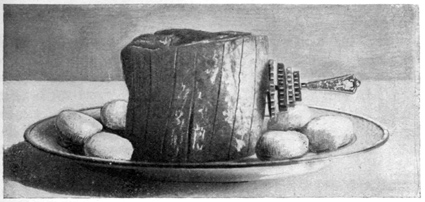 ROLLED RIB ROAST OF BEEF GARNISHED WITH POTATOES ROASTED
IN SAME DISH WITH THE BEEF. FANCY SKEWER GARNISHED WITH SLICES OF TURNIP
AND CARROT, RUN INTO THE SIDE TO HOLD IT TOGETHER. (SEE PAGE 146.)
ROLLED RIB ROAST OF BEEF GARNISHED WITH POTATOES ROASTED
IN SAME DISH WITH THE BEEF. FANCY SKEWER GARNISHED WITH SLICES OF TURNIP
AND CARROT, RUN INTO THE SIDE TO HOLD IT TOGETHER. (SEE PAGE 146.)
Put two cupfuls of flour into a bowl, and mix in one half a teaspoonful
of salt. Beat up three eggs, and stir them into the flour; then add two
cupfuls of milk. Stir until the mixture is smooth, then turn it into a
pan containing a little of the drippings from the roast beef. Let the
batter be only one inch deep in the pan. Bake thirty to forty minutes.
Cut the pudding in squares, and place it around the roast beef.
Ten to twelve minutes per pound.
The cut from the upper side of the round is a good roasting piece. It
should be cooked very slowly after it is browned in order to make it
tender. The under side of the round should be cooked à la mode, or
braised.
Take one half cupful of salt pork, one half cupful each of carrot,
turnip, onion, and celery, all cut into dice. Mix them together and
spread them on a baking pan, reserving one half cupful for the top of
the meat. On the bed of vegetables place a piece of beef cut from the
upper or under side of the round, weighing five or six pounds. Dredge it
with flour. Place it in hot oven to brown for twenty to twenty-five
minutes. Then add two cupfuls of stock or water; a bouquet of herbs,
consisting of parsley, six peppercorns, three cloves, one bay-leaf;
spread the one half cupful of vegetables over the meat; add a half
teaspoonful of salt to the pan, cover it closely with another pan,
reduce the heat of the oven, and cook very slowly for four or five
hours.
Double pans are made which are especially good for braising, where the
steam should be confined as much as possible, and the basting is done
automatically. These pans should not be used for baking meats. If very
close fitting pans are not used, the water must be renewed when
necessary, and basting done frequently. The success of this dish depends
upon slow cooking. Strain the sauce from the pan, season with salt and
pepper; pour a little of the sauce over the meat; serve the rest in a
sauce-boat. It is very like a Spanish sauce. The vegetables may be
served around the meat if desired. This way of cooking can be done in a
pot if more convenient, and is then called a pot roast.
Use six or seven pounds of the upper round of beef for this dish. (It is
very good cold when properly cooked.) The success depends upon very slow
cooking. The vegetables give it a distinctive flavor.
Make several deep incisions into the meat with a thin, sharp knife, or
with a steel. Press into them lardoons of salt pork about half an inch
square, and two or three inches long. This is called daubing, and the
butcher will ordinarily do it if requested. Put trimmings of pork, or
two tablespoonfuls of drippings, into the bottom of a large iron pot.
When it is hot, put in the meat, and brown it on all sides by turning it
to the bottom of the pot. This will take about half an hour. Next dredge
it with flour, and brown that also. Then put a small plate under the
beef to lift it a little off the bottom of the pot, and prevent its
burning. Fill the pot with enough boiling water to half cover the meat.
Add a half cupful each of sliced onions, carrots, and turnips, and a
sprig of parsley. Cover the pot very tight, so the meat will cook in
steam; and simmer it for four or five hours. Add more boiling water when
necessary. When the meat is done, place it on a hot dish. Place some of
the vegetables around and over it. Make a gravy as follows: put into a
saucepan a tablespoonful of butter; when it bubbles, add a tablespoonful
of flour, and stir until it is browned; then add a cupful of liquor
strained from the pot in which the beef was cooked. If there is not a
cupful of liquor in the pot, add enough hot water to make that quantity.
Season with pepper and salt. This will resemble a Spanish sauce. It can
be poured over the meat, or served separately.
This dish is prepared usually from the meat used in making soup. Take a
piece from the lower side of round; trim, and tie it into good shape;
place it in the soup pot with cold water, allowing one quart of water to
each pound of meat. Let it come slowly to the boiling point, and then
let it simmer for four hours. After it has cooked two hours add a whole
carrot, onion, and turnip, parsley, celery, six peppercorns, three
cloves, one teaspoonful of salt. The meat will be tender if cooked very
slowly, and not allowed to boil; but having been put into cold water,
its juices will be extracted. Therefore the water is used as soup, and
the meat will depend on a good sauce for flavor. Any rich brown sauce
will do. Tomato or horseradish sauce is recommended. Cut the vegetables
into fancy shapes with cutters, or into dice, and place them on the dish
around the meat.
Time, thirty minutes in hot oven.
The fillet is the tenderloin of beef, and is taken from the underside of
the sirloin cut. Remove, taking care not to make the meat ragged, the
sinewy skin and the muscle from the top, and most of the fat from the
other side. Fold the thin end under, trim it into good shape. Lard it
plentifully, letting the whole upper surface be perforated with fine
lardoons. Place in a small baking pan thin slices of larding pork, over
the pork place a layer of chopped onion, carrot, turnip and celery; lay
the tenderloin on top. Pour in the pan a cupful of stock, add one half
teaspoonful of salt, one quarter teaspoonful of pepper, and a bouquet of
parsley, one bay-leaf, and two cloves. Bake in a hot oven for thirty
minutes, and baste frequently. The fillet should be rare. Remove it when
done; strain off the gravy, and skim off the grease. Put into the same
pan a tablespoonful each of butter and of flour; stir until they are
browned; then add slowly the gravy strained from the pan; if not enough
to give a cupful, add enough stock to make that measure. Stir until it
boils; then add a canful of mushrooms (which have been drained), and let
them simmer for five minutes; not longer, or the mushrooms will harden.
Taste to see if the seasoning is right. Add a half teaspoonful of
kitchen bouquet to make it brown. The sauce should be of the consistency
of cream. A half cupful of Madeira or of sherry may be used in place of
the mushrooms if preferred. Spread the sauce on the serving dish, and
lay the fillet on it. Arrange the mushrooms top side up, evenly around
the fillet. In carving cut the fillet diagonally, instead of straight
across; and put a little gravy in the center of each slice. The time for
cooking is always thirty minutes, for the weight is in the length, and
not in the thickness of the meat.
A profitable way to obtain a fillet is to buy a large cut of the
sirloin, remove the tenderloin, and have the top cut into two or more
roasting pieces. Beef will keep for some time, and the butcher will hold
it until called for. In this way it will cost twenty-two to twenty-five
cents per pound, while, if bought by itself, it would be from eighty
cents to one dollar per pound.
For a moderate sized family it may seem too much beef to buy at one
time; but it is the one kind of meat that can be served very often, and
there is no waste. It is good hot or cold, warmed over or hashed. The
suet is the best fat for frying purposes, and the bones make good soup.
Part of the sirloin piece can be cut into steaks, and one of the
roasting pieces rolled to give variety. The flank can be made into
Hamburg steaks, or into soup. If judiciously cut there will be little
left over to cook again.
Roasted and braised beef are both quite as good cold as hot, and in
summer are sometimes preferable cold. Serve with cold beef a vegetable
salad when it is used for dinner. Make the salad of string beans,
asparagus, or a macédoine of vegetables. For a supper dish, the rolled
rib roast can be made very attractive by garnishing it with aspic jelly
cut into fancy forms. Place a large star of the jelly on top, and small
timbale forms of jellied vegetables, and broken jelly on the dish around
the meat; or a simpler garnishing can be made with lettuce leaves,
tomatoes stuffed with mayonnaise, or celery, etc. Use lettuce with any
of the salads. Have a fancy skewer stuck in the side.
Spread in a baking dish alternate layers of bread-crumbs, meat chopped
very fine, a sprinkling of chopped parsley and onion, pepper and salt.
When the dish is nearly full, pour over enough white sauce to moisten it
well; cover with crumbs and bits of butter. Set in oven until browned.
Soup stock or tomatoes may also be used for moistening a scallop. If
uncooked meat is used, it will require longer cooking (one hour in slow
oven), and more liquid used, so that it will not get too dry. The coarse
ends of steak can be utilized in this way. A scallop made of raw meat
and tomatoes makes a good luncheon dish.
Chop one pound of lean raw meat very fine, remove all the fiber
possible. To the mince add
- ½ tablespoonful of onion juice.
- ½ teaspoonful salt.
- ¼ teaspoonful pepper.
- Dash of nutmeg.
- 1 egg.
Form it into small balls, and flatten; dredge them with flour, and sauté
them in butter. Place them on a hot dish, and spread with maître d’hôtel
butter; or make a thick brown sauce by adding a tablespoonful of flour
to the butter used in the sauté pan. Let it brown; then add slowly a
little soup stock. Season with salt and pepper, and lemon juice, or
Worcestershire sauce. Drop a teaspoonful of sauce on each cake without
spreading it. Garnish with water-cresses. These steaks can be made from
the end pieces of steaks, or from the round.
When made for invalids, the best meat is used. They are seasoned only
with salt and pepper, and broiled just enough to be thoroughly heated.
Another way to serve them is to make them the size of English muffins;
on the upper side make a depression or hollow, broil or sauté them, and
place them on a baking dish; spread them with maître d’hôtel butter, and
drop an egg in the hollow top of each one. Put them in the oven just
long enough to set the white of the egg. Place a dash of pepper on the
center of the yolk, and serve at once very hot.
Lay in a pie dish a few thin slices of onion; then a layer of cold
cooked beef cut very thin. Dredge with a little flour, pepper, and salt;
fill the dish with these articles in alternate layers, and add any cold
gravy there may be at hand. Scald and peel enough tomatoes to cover the
top of the dish; have them of uniform size, and place them close
together. Spread over them some bread crumbs, salt, pepper, and bits of
butter. Place the dish in the oven, and cook until the tomatoes are
tender.
Mutton or veal may be used in the same way.
Cut the beef into small thin slices, and trim off the fat. Put into a
stew pan one tablespoonful of butter, and one tablespoonful of flour.
When cooked, and a little browned, add slowly one cupful of stock, one
teaspoonful each of Worcestershire sauce and mushroom catsup. Season
with salt and pepper to taste. Add the slices of beef, and let them
become thoroughly hot. Then place in the center of a hot dish, and
pour the sauce over them. Garnish with croûtons, and serve with it
farina balls (see page 223). Tomato catsup may be substituted for the
Worcestershire sauce. When this dish is to be prepared in a
chafing-dish, the sauce may be made beforehand; the heating and mixing
only being done over the lamp, and croûtons alone served with it. Any
kind of meat or fish may be used in this way.
Take the piece of meat called the inside flank; wipe it clean with a wet
cloth; carefully remove the skin and fat and lay it flat on a board;
moisten three quarters of a cupful of crumbs with stock; add one
teaspoonful of salt, one quarter teaspoonful of pepper, one teaspoonful
onion juice or one half onion chopped fine, one tablespoonful chopped
parsley. Spread this mixture on the meat evenly; then roll and tie it
with white twine; turn in the ends to make it even and shapely.
Cut into dice an onion, turnip, and carrot, and place them in a
baking-pan; lay the rolled meat on the bed of vegetables; pour in enough
stock or water to cover the pan one inch deep; add a bouquet made of
parsley, one bay-leaf and three cloves; cover with another pan, and let
cook slowly for four or five hours, basting frequently. It can be done
in a pot just as well, and should be covered as tight as possible; when
cooked, strain off the vegetables; thicken the gravy with brown roux and
serve it with the meat. Long, slow cooking is essential to make the meat
tender. If cooked too fast it will not be good.
A thin steak cut from the round may be cooked the same way, and a little
ham chopped fine may be added to the stuffing. The cost of this dish is
not more than eighteen to twenty-five cents, and is enough for four or
five persons.
Cut two pounds of the upper round of beef into inch squares; dredge them
with salt and pepper, and roll them in flour. Put into a saucepan some
butter and some drippings, or a little suet, and let it try out, using
enough only to cover the bottom of the saucepan; when the grease is hot,
turn in the pieces of meat, and let them cook until well browned on all
sides. Watch, and turn them as soon as browned; then draw the meat to
one side of the pan, and add a tablespoonful of flour; let the flour
brown, and add a cupful of stock or water, and stir until it comes to
the boiling-point; then add a teaspoonful of salt, a half teaspoonful of
pepper, one half teaspoonful of kitchen bouquet; one carrot cut into
blocks, and one tablespoonful of onion; cover the saucepan, and let it
simmer (not boil) for an hour. Just before serving add two
tablespoonfuls of sherry or of Madeira. Serve a border of rice around
the ragout.
Some one has said, “There is as much difference between
beefsteaks as between faces; and a man of taste can find as
much variety in a dinner at the Beefsteak Club as at the
most plentifully-served table in town.”
The difference between a thick and a thin steak is particularly
marked—the former seems like an altogether different dish
from the latter. Thickness. Some may like their steak well done, but it
is not a taste to be commended. A perfect steak should be cut
one and a half inches thick, and cooked so that on both sides
it has a crust one eighth of an inch thick of browned meat,
the rest being an even red color. It should be puffed and
elastic from the confined steam of the juices. When the steak
is over-cooked the steam and the juices have escaped, leaving
the meat dry and tasteless. The three best sauces which are
served with steak are first the maître d’hôtel and then the
Béarnaise and mushroom sauces. Sauces. Tough beefsteaks can be made
more tender by pounding them; but a better way is to brush
them on both sides with a mixture of one tablespoonful of
vinegar and two tablespoonfuls of oil or melted butter. The
steak should then stand two or more hours before being cooked.
It is the fiber of meat which makes it tough, and this fiber
is soluble in acetic acid, which is found in vinegar. Broiling
under the coals is better than over them when possible, as all
smoke is then avoided.
Time: one inch thick, eight minutes; one and a half inches thick, ten
minutes.
Trim a steak into good shape, taking off the end-piece to be used in
some other form, as it is not eatable when broiled; take off superfluous
fat; make the surface smooth by striking it with the broad blade of
knife; heat the broiler very hot. Take a piece of the fat, trimmed off
the meat, on a fork and grease the broiler well; lay on the steak with
the outside or skin edge toward the handle, so the fat may run on the
meat. Place it close to the hot coals and count ten slowly; turn it and
do the same; this is to sear the outside and keep the juices in; then
hold it farther from the coals to cook more slowly, and turn it as often
as you count ten, counting about as fast as the clock ticks. If turned
in this way very little fat will run into the fire, and it also cooks
slowly, giving an even color all through. The flame from fat does not
injure the meat, but the smoke must be avoided. Wrap a napkin around the
hand holding the broiler to protect it from the heat. A steak ought not
to be less than an inch, but should be one and a half to one and three
quarters inches thick. Allow eight to ten minutes for cooking according
to the thickness. One two inches thick will take fourteen to eighteen
minutes. A steak should be rare but not raw, should have a uniform red
color, and be full of juice.
When done it will be puffed between the wires of broiler, and will offer
a little resistance to the touch. If experience does not enable one to
judge in this way, remove the broiler to a dish on the table, and make a
small clean cut on one side. Do not at any time pierce the meat with a
fork. Sprinkle it with salt and pepper, and spread with maître d’hôtel
butter. If the steak has to stand a few minutes before serving, which
should be avoided if possible, dredge it at once with salt and pepper,
but do not spread with the maître d’hôtel butter until just before
sending it to the table. The heat of the meat must melt the butter, and
the parsley should look fresh and bright. Steak, as well as all broiled
articles, should be garnished with slices of lemon and with water-cress.
Fried potato-balls, straws, puffed, or Saratoga potatoes may be served
on the same dish.
The Chateaubriand is cut from the center of the fillet; but a good
substitute is a tenderloin steak cut two inches thick, the bone removed,
and the meat then turned so as to make a circle. Flatten it by striking
with broad blade of knife or a cleaver. Broil slowly as directed above
for eighteen minutes. Serve with maître d’hôtel butter, mushroom, or
olive sauce, placing the mushrooms or olives on top of the steak, the
sauce under it. (See illustration facing page 152.)
The Chateaubriand may also be roasted or braised.
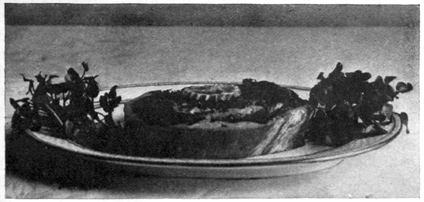 A BONED TENDERLOIN STEAK MADE TO IMITATE A CHATEAUBRIAND
GARNISHED WITH WATER-CRESS AND LEMON. (SEE PAGE 157.)
A BONED TENDERLOIN STEAK MADE TO IMITATE A CHATEAUBRIAND
GARNISHED WITH WATER-CRESS AND LEMON. (SEE PAGE 157.)
Cut slices from the end of the fillet of beef about five eighths of an
inch thick. Press and trim them into circles; dredge with salt and
pepper; sauté them in butter; spread Béarnaise sauce on a hot dish, and
lay the mignon fillets on it, or lay the fillets on croûtons of the same
size as the fillet, and place on top of each one a small spoonful of
peas, string-beans, or macédoine of vegetables.
Put corned beef into cold water; using enough to cover it well; let it
come slowly to the boiling-point; then place where it will simmer only;
allow thirty minutes or more to each pound. It is improved by adding a
few soup vegetables the last hour of cooking. A piece from the round is
the best cut, and should have a layer of fat. If cooked very slowly as
directed, it will be tender and juicy.
If the piece can be used a second time, trim it to good shape; place it
again in the water in which it was boiled; let it get heated through;
then set aside to cool in the water and under pressure, a plate or deep
dish holding a flat-iron being set on top of the meat. The water need
not rise above the meat sufficiently to wet the iron. When cooled under
pressure the meat is more firm and cuts better into slices.
Cabbage is usually served with hot corned beef, but should not be boiled
with it. The receipt given on page 212 is recommended, and if that
method is followed, there will be no odor from the cooking, and the
objection to this very good dish will be removed.
Chop cooked corned beef, using some of the fat. Do not make it too fine;
chop some cold boiled potatoes (not fine); mix the two together in equal
proportions; season with salt, pepper, and onion juice, if liked.
Put a tablespoonful of butter in a frying-pan with as much milk, stock,
or hot water as will be required to moisten the hash; add the chopped
meat and potatoes; mix them together with care to not mash the potatoes;
cover and cook slowly for half an hour, or until a crust has formed on
the bottom of the pan; then turn it on to a hot dish, like an omelet.
Hash should not be like mush, but the meat and potato quite distinct,
and as both ingredients have been already cooked they need only to be
well heated and incorporated with the seasoning.
Unless for brown hash, or corned beef hash, potato is not used. Chop the
meat to a fine mince. Put a tablespoonful of butter into a frying-pan
with one slice of onion; remove the onion when cooked, and add one
tablespoonful of flour, and let it brown, thus making a brown roux, if
the hash is to be made of beef or mutton. Do not let it brown if it is
to be used for veal or chicken hash. To the brown roux add slowly a
cupful of stock or hot water; then a cupful and a half of minced meat;
season with salt and pepper; stir until well incorporated, and serve at
once on toast. To a white roux add slowly a cupful of milk; then add one
and a half cupfuls of veal or chicken chopped fine; season with salt and
pepper. Cut toast into large circles with a biscuit-cutter. Spread them
with a thick layer of mince, and on this place a poached egg, neatly
trimmed to the same size as the toast. It can be cut with the same
cutter, or it may be poached in a muffin-ring (see page 263).
Put a dash of pepper on the center of yolk. Garnish with parsley. This
makes a very presentable breakfast or luncheon dish.
Cut lean meat into small dice; cut also cold boiled potatoes into dice
of the same size; mix them together, and place in a small baking-pan;
dredge with salt and pepper, and dot plentifully with bits of butter.
Put into hot oven to brown; stir them often so all sides will brown
alike, and do not let them become too dry.
Have the bones cut into pieces two or three inches long; scrape and wash
them very clean; spread a little thick dough on each end to keep the
marrow in; then tie each bone in a piece of cloth and boil them for one
hour. Remove the cloth and paste, and place each bone on a square of
toast; sprinkle with red pepper and serve very hot. Or the marrow-bone
can be boiled without being cut, the marrow then removed with a spoon
and placed on squares of hot toast. Serve for luncheon. (See
illustration facing page 152.)
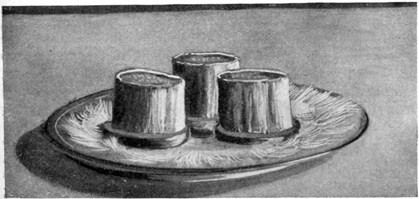 MARROW-BONES SERVED ON ROUND SLICES OF TOAST. (SEE PAGE
159.)
MARROW-BONES SERVED ON ROUND SLICES OF TOAST. (SEE PAGE
159.)
The cuts and cooking of Mutton. Mutton should be hung for some days before being used. The leg
may be either boiled or roasted; the saddle always roasted;
the shoulder boned, stuffed and roasted; the chops broiled,
and the neck stewed. Except where it is stewed, mutton should
be cooked rare. Mrs. Brugière recommends pounding the leg of
mutton before cooking it. The roasted leg or the saddle are
the only forms of mutton permissible to serve at a ceremonious
dinner. The strong taste of mutton is in the fat. Therefore
trim off a part of the fat from the outside, and when baking
it in the oven set the joint on a rack in the pan, so it will
not cook in the fat.
Vegetables to serve with Mutton. Certain vegetables have by experience been found to go well
with certain meats. Of these turnips have been established
as the accompaniment of mutton. This has been amusingly
emphasized by an anecdote told of Charles Lamb. Anecdote of Charles Lamb. On an occasion
when riding in a stage coach, he was much annoyed by a Scotch
farmer, who was a fellow passenger, asking him questions about
the crops. “And pray, sir,” asked the farmer, “how are turnips
t’ year?” “Why,” stammered Lamb, “that will depend upon the
boiled legs of mutton.”
Turnips and carrots cut into dice, boiled separately, then
mixed and covered with white sauce, also make a good vegetable
dish for boiled mutton. Caper sauce is always served with it.
Another anecdote is given as a suggestion for an expedient
in case the mutton is too underdone (boiled mutton should be
red, but not black). An English nobleman, on being shown a
Dutch picture representing a man in a passion with his wife
because the mutton was underdone, exclaimed, “What a fool
the fellow is not to see that he may have a capital broil.”
With roasted mutton may be served baked turnips stuffed with
seasoned bread-crumbs soaked in cream. It is a Russian dish.
Bananas cut in two, rolled in egg and crumbs, and fried like
croquettes, are also recommended for roast mutton. Mint
sauce and green peas are usually served with spring lamb.
Time ten minutes per pound (rare); fifteen minutes per pound (moderately
well done).
Cut the bone short, place in a hot oven for twenty minutes; then add one
cupful of hot water; baste frequently. Allow ten minutes to the pound
for cooking rare. When ready to serve conceal the bone with a frill of
paper, or a few leaves of parsley.
Have the joints cracked entirely through, so there may be no trouble in
carving. Remove the fat and kidney. Allow nine minutes to the pound;
roast the same as the leg.
The saddle is the back of the animal. If split it would be called the
loin, and when cut gives the chops. It does not furnish very much meat
for a roast, so requires to be a large cut. It is esteemed for its
handsome appearance, as well as for its flavor. Remove the skin from the
top, also the fat and kidneys from the under side. The suet on the top
can be lightly cut in points, and a little raised to make decoration.
Roll the flaps under, and tie into a well rounded shape. If a large
saddle is used, the tail is left on. It should be cooked in a hot oven,
basted frequently, and cooked rare, allowing nine minutes to the pound.
In carving cut slices the length of the saddle, and parallel to the back
bone; then slip the knife under, and separate them from the rib bones.
After the top is carved, the saddle is turned, and the tenderloin, which
lies on the under side, is cut in the same way.
Serve currant jelly with the saddle of mutton.
Have the butcher cut a full loin, split the bone between the chops, trim
the rib bones as for French chops, and chop them off to a uniform
length; then roll the loin backward into a circle, and tie securely.
Have a thick slice of larding pork wrapped around each bone, so it will
not burn while cooking. Baste frequently while roasting, and allow nine
minutes to the pound. Serve with Saratoga or other fancy fried potatoes
in the basket-like top formed by the bones. Place a frill of paper on
each bone.
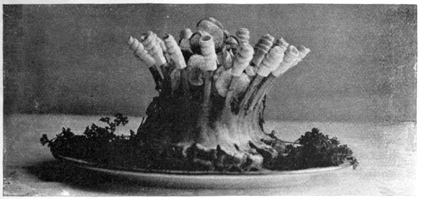 CROWN ROAST. A RACK OF MUTTON, THE CENTER FILLED WITH
SARATOGA POTATOES. (SEE PAGE 162.)
CROWN ROAST. A RACK OF MUTTON, THE CENTER FILLED WITH
SARATOGA POTATOES. (SEE PAGE 162.)
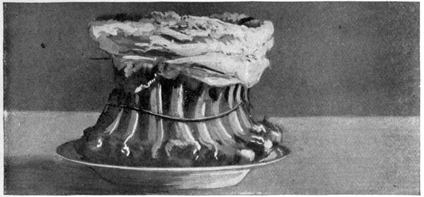 CROWN ROAST PREPARED FOR COOKING.
Have the butcher carefully remove the blade from the shoulder, and fill
the space with a mixture made of
- 1 cupful of bread-crumbs.
- 2 tablespoonfuls of butter.
- 1 tablespoonful chopped parsley.
- 1 dozen oysters.
- Juice of 1 lemon.
- 1 teaspoonful of salt.
- ¼ teaspoonful of pepper.
- 1 egg.
Sew up the opening, roast in the oven with a little water in the pan;
allow fifteen minutes to the pound, and baste frequently. Serve with the
gravy from the pan, after the grease is carefully poured off. More
oysters may be used, or they may be omitted altogether. A stuffing may
be made of chopped meat, celery, onion, mushrooms, crumbs, egg, and
seasoning of salt and pepper.
A stuffed shoulder can be pressed into a shape to resemble a fowl or a
duck, and garnished so as to make an ornamental dish.
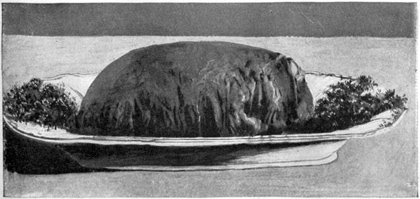 BONED AND STUFFED SHOULDER OF MUTTON. (SEE PAGE 163.)
Time fifteen minutes to the pound.
Put the mutton in just enough boiling water to cover it, and put on the
lid of the pot. After fifteen minutes draw it aside, and let it simmer
for the required time. Thirty minutes before removing the meat add some
soup vegetables. They will give flavor to the meat, and enrich the
water, which may be used for soup the next day. Cut the carrot and
turnip in half inch thick slices, and stamp with a fluted cutter, so the
rims will be scalloped. Place the meat on a hot dish, and rub lightly
over it enough of the white sauce (to be used for the caper sauce) to
make the surface white and smooth. Sprinkle with chopped parsley or
capers. Take the sliced vegetables, cut a hole in the center, and string
them alternately on the bone, which will protrude at each end. This will
give the effect of skewers, conceal the bone, and make the dish more
presentable.
Serve with caper sauce.
Put two tablespoonfuls of butter into a saucepan; when melted, add a
tablespoonful of flour; cook for a few minutes, but not brown; then add
one cupful of water in which the mutton was boiled; season with salt and
pepper, strain, and add one heaping tablespoonful of capers.
One and one half pounds of the neck of mutton or lamb cut into pieces
one inch square.
- 1 tablespoonful of butter.
- 1 tablespoonful of flour.
- 1 onion.
- 1 carrot.
- ½ can of peas.
- 1½ cupfuls of water or stock.
- 1 teaspoonful of salt.
- ¼ teaspoonful of pepper.
- Sprig of parsley.
- 1 bay-leaf.
- 1 clove.
Put the butter into a frying-pan; when melted add the flour, and let
brown. Then add the carrot and onion cut into dice, and the mutton.
Cook, stirring frequently, until all are browned, using care that they
do not burn; it will take about twenty minutes. Then add the stock or
water, and the seasoning, having the herbs in a bouquet, so they can be
removed. Cover closely, and let simmer for two hours. Add the peas ten
minutes before removing from the fire.
- 2 cupfuls of cold boiled mutton cut in inch squares.
- 1 onion sliced.
- 1 cupful of stock or water in which mutton was boiled.
- 2 tablespoonfuls of butter.
- ½ can of peas.
- 1 teaspoonful of salt.
- ¼ teaspoonful of pepper.
- 1 head of lettuce.
- Farina balls.
Put all the ingredients, except the lettuce and farina balls, into a
saucepan together; cover closely, and simmer very slowly for one hour;
stir occasionally, but with care not to break the meat or peas. When
ready to serve, taste to see if the seasoning is right, and pour on a
hot dish. Lay around the edge, and close to the meat, the crisp leaves
of one head of lettuce, and the farina balls (see page 223). This way of
utilizing cold mutton will be found very good. The garnishing makes it a
presentable dish, and is a good accompaniment in place of other
vegetables.
Cut the neck of mutton into pieces two and one half or three inches
square. Put them into a saucepan with one tablespoonful of butter, and
let them brown; stir frequently so they do not burn. When browned add
enough water to cover them well, and two or three onions cut into
pieces. Cover closely and let simmer two hours. Then add more water if
necessary, some parboiled potatoes cut in two, and a few slices of
carrot, salt, and pepper to taste; cover and let cook one hour more. A
teaspoonful of Worcestershire sauce is an improvement. The gravy must be
quite thick, so too much water must not be used. The potatoes should be
very soft, but not broken.
Loin chops should be cut one and one fourth inches thick, and the fat
trimmed off, leaving them round; or the end pieces may be pared off
thin, wrapped around the chops, and fastened with a skewer, making the
chop into the form of a circle.
The breast chops are cut a little thinner, the bones scraped and cut
into even lengths. They are called French chops when the bones are bare.
Whichever kind of chops are used, they should be all of uniform size and
shape.
Broil the chops over or under hot coals, turning the broiler as often as
you count ten slowly, using the same method as in broiling steak. When
the meat offers a little resistance and is puffy, it is done. If cooked
too long the chops will be hard and dry. If properly seared at first the
juices are shut in, and the inflation is caused by the confined steam
from the juices. It will take eight to ten minutes to broil chops which
are one inch thick. When done sprinkle over them a little salt and
pepper and butter. Dress them on a hot dish in a circle, the chops
overlapping.
Green peas, string-beans, or any small vegetable, or fancy-fried
potatoes, such as balls, straws, Saratoga, etc., may be served on the
same dish, and placed in the center of the circle, or around the chops.
Spinach or mashed potato pressed into form of socle may be used, and the
chops rested against it, the bones pointing up or slanting. Paper frills
placed on the ends of the bones improve their appearance.
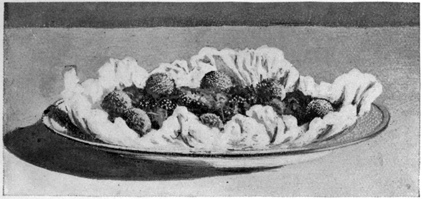 RAGOUT OF MUTTON GARNISHED WITH FARINA BALLS AND LETTUCE.
(SEE PAGE 165.)
RAGOUT OF MUTTON GARNISHED WITH FARINA BALLS AND LETTUCE.
(SEE PAGE 165.)
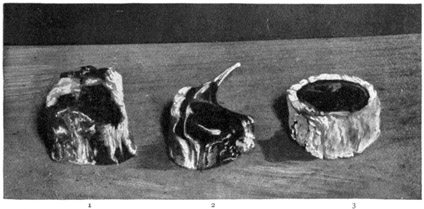 THREE KINDS OF MUTTON CHOPS.
- 1. English Mutton Chop.
- 2. French Chop.
- 3. Boned and Rolled Chop.
- (See page 165.)
Put into a frying-pan some slices of salt pork; when tried out, lay in
neatly trimmed and seasoned lamb or veal chops; let them sauté until
half cooked; remove the chops, and to the pan add a tablespoonful of
onion chopped fine; when the onion is cooked add a cupful of stock and a
cupful of mixture containing minced veal or chicken, a little ham, and
mushrooms, chopped parsley, and truffles if convenient; salt and pepper
to taste. Put a spoonful of this sauce on a well-buttered or oiled
paper, cut in heart-shape; lay the chop on the sauce, and on the chop
put another spoonful of the sauce. Fold the paper over, and plait the
edges together so as to completely enclose the chop. Lay the enclosed
chops on a buttered dish, and place them in the oven for ten minutes;
serve on the same dish very hot. Chops can also be broiled in
well-greased paper, and with a little care it is easily done without
burning the paper. Heavy writing paper should be used; the fire should
be moderate, and the chops turned frequently. They are served in the
papers, and are very good, as they hold all the juices of the meat.
Put one tablespoonful of butter in a frying-pan; when hot add one
tablespoonful of flour; let the flour cook a few minutes; then add four
tablespoonfuls of chopped mushrooms, one teaspoonful of parsley, one
half teaspoonful of salt, and a dash of pepper; moisten with three
tablespoonfuls of stock; mix well together and set aside to cool. Have
six French chops cut one inch thick. With a sharp knife split the chops
in two without separating them at the bone; spread the mushroom mixture
between the opened chops; press the edges well together, and broil for
eight minutes; serve with an olive sauce.
Spring lamb is best when two months old. It must be used when fresh, and
must be thoroughly cooked, but not dried. It is divided into the fore
and hind quarters, the whole of either not being too much to serve at
one time; the former are less expensive than the latter, but the meat is
equally sweet and good. Roast it in a hot oven with a little water in
the pan; allow fifteen to eighteen minutes to the pound, and baste
frequently; serve with it mint sauce, and green peas or asparagus tips
for vegetable.
When using a fore quarter, have the bones well cracked, so that in
carving it may be cut into squares, or have the shoulder blade removed.
A very good dressing may be made on the table as follows: cut around the
shoulder bone; lift and place under it two tablespoonfuls of butter,
the juice of one lemon, one teaspoonful of salt, one half teaspoonful of
pepper. Press the pieces together, and let stand a minute to melt the
butter before carving.
The flesh of veal should be pink and firm, the bones hard. If it has a
blue tinge and is flabby, it has been killed too young, and is
unwholesome. Like lamb, it must be used while perfectly fresh and be
thoroughly cooked. It contains less nourishment than other kinds of
meat; also, having less flavor, it requires more seasoning. Veal is
frequently used as a substitute for chicken. It can be made into
croquettes and salads very acceptably.
The fillet is cut from the upper part of the leg, and should be four to
six inches thick. Only one good fillet can be cut from the leg. Press
and tie it into good round shape. Lay a few slices of larding pork over
the top. Place it in very hot oven for fifteen minutes; then lower the
heat; baste frequently with water from the pan; allow eighteen to twenty
minutes to the pound. It must be thoroughly cooked, but not dried.
Remove the slices of pork from top a half hour before it is done, so it
may brown. The bone may be removed from the fillet before cooking, and
the space filled with stuffing made of crumbs, sweet herbs, pepper and
salt, and a little chopped salt pork. Thicken the gravy in pan to serve
with the fillet.
Twenty to twenty-five minutes per pound.
Have the blade removed, and fill the space with a stuffing made of bread
crumbs, thyme, marjoram, lemon juice, chopped salt pork, salt and
pepper, and an egg; also chopped mushrooms, if desired. Sew up the
opening, press and tie it into good shape, and roast the same as the
fillet. The stuffing may also be made of minced veal cut from the
knuckle, highly seasoned.
The fricandeau is the most choice cut of veal. It is taken from the
upper round of the leg, and is one side of the fillet. As it destroys
that cut, it commands the highest price. It should be cut four inches
thick, and is usually larded and braised. Place it in a baking-pan on a
layer of sliced salt pork, and chopped carrot, onion, and turnip. Add a
bouquet of herbs, a cupful of stock, and enough water to fill the pan
one and a half inches deep. Cover closely, and let cook in moderate
oven, allowing twenty minutes to the pound; baste frequently. Remove the
cover for the last half hour, so the meat may brown. Strain the gravy
from the pan to serve with it.
Leave the cutlet whole or cut it into pieces of uniform size and shape;
dredge with salt and pepper; dip in egg and cover with bread crumbs or
with flour; sauté cutlets in drippings, or in a frying-pan after slices
of salt pork have been tried out. Cook until well browned on both sides;
then place them on a hot dish and moisten the top with a little lemon
juice; or, omitting the lemon juice, serve with them a tomato or a
Béarnaise sauce, or make a gravy by adding a little flour to the grease
in the pan, and diluting to right consistency, after the flour is
browned, with stock or water. If the gravy is used, put it in the bottom
of the dish and place the cutlets on it.
Cut veal, chicken, or beef into pieces; put them with strips of pork
into boiling water and cook until tender; season with salt, pepper, and
butter. There should be enough liquid to make a generous amount of
gravy. When the stew is ready cook the dumplings, and place them on the
same dish around the stew. If suet dumplings are used, they must be
placed in the pot as soon as it boils in order to cook them a sufficient
length of time. It is better to cook either kind of dumplings in a
separate pot with plenty of water, and not remove them until the stew is
dished and ready to be sent to the table.
- 2 cupfuls of flour.
- ½ teaspoonful of salt.
- 2 teaspoonfuls of baking powder.
- 1 cupful of milk.
Mix the flour, salt, and baking powder well together, then stir in
quickly the milk. Have the dough quite soft. Drop the batter from a
spoon into the stew, or into boiling water; or, if preferred, make the
dough just consistent enough to roll, and cut it into squares. The stew
must not be allowed to stop simmering after the dumplings are in; and
they must be served immediately after being taken from the pot, or they
will fall. It will take ten minutes to cook them.
- 1 cupful of chopped suet.
- 2 scant cupfuls of flour.
- 1 teaspoonful of salt.
- ½ cupful of cold water.
Mix together lightly the flour, suet and salt; then with a knife stir in
quickly the water. The dough must be soft, but not sticky. Put it on a
board, and roll it lightly to one inch thickness, and place it on the
boiling stew in one cake. The stew must not stop boiling for a moment,
or the dumpling will fall. Cook for one hour. The dough may be rolled
into balls if preferred. When the dumpling is put in, draw the pot
forward where it will heat quickly, and not arrest the boiling. When it
is thoroughly hot, place it where it will simmer continually during the
hour of cooking. If this rule is observed, it will be light and spongy.
Where cooked meat is used, which does not require such long cooking, the
dumplings may be boiled in water.
This mixture can be used for fruit and for roly-poly puddings (see page
443).
Wipe a knuckle of veal clean with a wet cloth; have it well broken. Put
it in a saucepan with two quarts of water, or enough to cover it. Tie in
a piece of cheese-cloth one tablespoonful each of chopped onion, carrot,
and turnip, a little parsley and celery, three cloves, and a blade of
mace. Put it in the pot. Boil slowly until the veal falls from the bone;
then strain it, and put the liquor again in the saucepan; season it with
salt, pepper, and a little lemon juice. Reduce it to one quart by
boiling with the cover off the saucepan. Cut two hard-boiled eggs into
thin slices, and with them ornament the bottom of a plain mold; a brick
ice-cream mold, or a small tin basin will do. Put a very little of the
liquor in to fix the ornament, but not enough to float the egg slices.
When set add a little more of the liquor, enough to make a layer of
jelly one quarter of an inch thick. When that is set fill the mold with
the veal, and place slices of boiled egg between the layers of meat.
Around the sides of the mold lay in slices of egg. Then pour in as much
of the liquor as it will hold, and set away to harden. This makes a good
cold dish to use with salad.
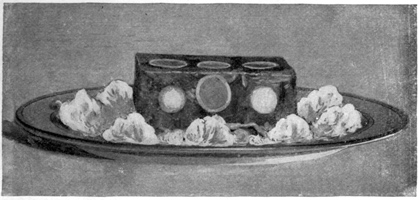 JELLIED VEAL DECORATED WITH SLICES OF HARD-BOILED EGG.
GARNISHED WITH LETTUCE.
JELLIED VEAL DECORATED WITH SLICES OF HARD-BOILED EGG.
GARNISHED WITH LETTUCE.
- 3 pounds of veal.
- ½ pound of ham, or
- ¼ pound of salt pork.
- 2 eggs.
- 1 cupful of fine bread or cracker crumbs.
- 1 teaspoonful of salt.
- ½ teaspoonful of pepper.
- 1 teaspoonful of onion juice.
- ½ teaspoonful of ground mace.
- ½ teaspoonful of allspice.
Chop the veal and ham very fine, mix into it the other ingredients, and
mold it into a loaf; or press it into a mold or tin to form a loaf; then
turn it on a baking dish. Baste it with beaten egg, and sprinkle it with
bread crumbs. Cook in moderate oven for two hours, basting it several
times with melted butter and water. This dish is to be served cold.
Chop veal to a fine mince. Put into a baking-dish alternate layers of
veal and bread crumbs, sprinkling the meat with salt and pepper, the
crumbs with bits of butter. Over the top pour a white sauce made of one
tablespoonful each of butter and flour, and one cupful of milk. Spread
over it a layer of crumbs, and put in the oven to brown.
Rice may be used instead of the crumbs, and tomatoes instead of the
white sauce.
Cut the liver into slices one half inch thick; lay them in boiling water
for a few minutes, then dry and cover them with flour and a little
pepper and salt. Lay in a hot frying-pan very thin slices of bacon. When
tried out enough for the bacon to be crisp, remove it and put the slices
of liver in the same frying pan. Cook until thoroughly done, but not
dried. Remove the liver, and to the fat in the pan add a spoonful of
flour; when the flour is brown, add enough water slowly to make a thick
sauce. Pour the sauce over the liver, and place the bacon around it.
Liver is generally cut thin, but it will be found much better when cut a
half inch or more thick. The bacon should be cut thin, and cooked
quickly; the liver cut thick, and cooked slowly.
Slice the liver. Let it soak in hot water a few minutes to draw out the
blood. Dry it, rub it with butter, and broil five to eight minutes,
turning it constantly. It should not be cooked until dry. When done,
spread it with butter, and serve at once.
Use a calf’s or lamb’s liver.
Lard it in two or three rows. Cut into dice one carrot, one turnip, one
onion, a stalk of celery, and the bits left from the lardoons of salt
pork; put them in a baking pan, and on this bed of vegetables place the
larded liver. Add two cupfuls of stock or hot water, and a bouquet of
one sprig of parsley, one bay-leaf, and two cloves. Cover with another
pan, and cook in moderate oven for two hours; baste occasionally. Serve
with the vegetables from the pan, on the same dish, placed around the
liver. Pour over the liver a sauce made as follows: Put in a saucepan
one tablespoonful of butter; when melted, add one tablespoonful of
flour, and stir until browned; then add slowly the strained liquor from
the pan. If there is not enough to make one cupful, add water to make
that quantity. Season with salt and pepper, and add, if convenient, one
tablespoonful each of Worcestershire sauce and mushroom catsup.
Beef, calf or lamb kidneys may be used. Be sure they are very fresh.
Remove the fat and white center, then soak them for one hour in salted
water. Cut them in slices one half inch thick, cover the slices with
flour, and sauté them for five minutes in one tablespoonful of butter.
Add to the frying-pan one thin slice of onion and one half cupful of
water, and simmer for ten minutes, not longer. The kidneys will be tough
and hard if cooked too long. Just before serving, add one quarter cupful
of sherry; salt and pepper to taste. One tablespoon of Worcestershire
sauce may be used instead of the sherry.
Soak the tripe for several hours, then scrape it thoroughly clean, put
it in salted water, and simmer it for three or four hours, until it is
like jelly. Drain off the water, and put the tripe aside until ready to
use. Put a tablespoonful of butter in a saucepan; when hot add a
tablespoonful of flour, and cook for a few minutes, but do not brown.
Then add slowly one cupful of milk, and stir until smooth. Add a half
teaspoonful of salt, a dash of pepper, and a half teaspoonful of onion
juice; then add one cupful of the boiled tripe. Stir until the tripe is
heated, and serve immediately.
Wash the heart, but do not let it soak, or stand in water. Fill it with
a stuffing made of minced meat or of bread, either one of them seasoned
with onion, sage, thyme, marjoram, pepper and salt, and an egg to bind
it. Bake it for two hours, basting it frequently with water from the
pan. When the heart is cooked remove it, and add to the pan a
tablespoonful of flour; stir until it has browned. Then, if there is not
enough liquor in the pan, add to it just enough water to make a thick
sauce. Strain this over the heart, and serve on the same dish some
boiled and browned onions.
If a smoked tongue is used, soak it over night. Put it in cold water,
and let it come to the boiling point. Then simmer for four hours, or
until tender.
Boil a fresh tongue in salted water one and a half hours. A few soup
vegetables may be added to the water if convenient. Before putting it in
the water, trim it carefully, and skewer it into good shape. When it is
boiled remove the skin. If it is to be used cold, replace the skewer,
put it again in the water in which it was boiled, and let it remain
there until cold; then cover it with a meat glaze colored red. If served
hot, pour over it a white sauce, and garnish with parsley and sliced
pickle; or serve with it a piquante sauce. Spinach is a good vegetable
to serve with tongue.
Make a piquante sauce (see page 283). Lay slices of boiled tongue cut
one half inch thick into it, and let them remain until well heated.
Arrange the hot slices in a circle, the slices overlapping, and pour the
sauce in the center. Garnish with capers, slices of hard-boiled eggs,
and gherkins; or make a form of spinach by pressing into a bowl
well-chopped and seasoned spinach. Turn it on the center of a dish, and
lay the slices around or against it. Serve with piquante or with pickle
sauce.
Lay thick slices of tongue in a circle, the pieces overlapping. Place in
the center a bunch of nasturtium blossoms and lettuce leaves. Serve with
Tartare or cold Béarnaise sauce.
Cut tongue into slices. Lay them together to look like a solid piece,
and place them in a square or brick-shaped mold. Sprinkle a few capers
in the bottom of the mold before putting in the tongue. Have the mold
only large enough for the tongue to fit in easily, but be held in place.
Fill with aspic jelly (see page 321).
Have the head split open, and the gristle about the nose and eyes, and
the eyes and ears, removed by the butcher. Wash thoroughly the head;
remove the tongue and brains; parboil the brains, and set them aside
with the tongue to use on another occasion (see page 307). Blanch the
head by putting it into cold water; when it comes to the boiling point,
pour off the hot water, and cover it with cold water. When cold, rub it
with lemon. Put it into boiling water, enough to cover it; add two
tablespoonfuls of vinegar or white wine, twelve peppercorns, one
bay-leaf, one onion, one carrot, and a sprig of parsley. Cover the pot,
and let boil for two hours, or until tender, but not ready to fall
apart. When done, take out the bones carefully, and lay the meat on a
baking dish in compact shape. Rub over the top with egg, sprinkle it
with bread crumbs and bits of butter, and set in the oven to brown.
Serve with it a Poulette or an Allemande sauce.
Put any of the meat left over after being served in this manner into a
mold; fill it up with water in which the head was boiled; season to
taste. This will make a jellied meat very good to use with salad.
The water from the pot will make a good soup. (See mock turtle soup.)
Four separate dishes can be made from one head, viz.: boiled calf’s
head, cold jellied calf’s head, mock turtle soup, tongue and brains,
with white, Poulette, or Vinaigrette sauce.
After the calf’s head is boiled as directed above, take it from the
water, remove the meat, and press it into a square mold or tin, and let
it get entirely cold. It can then be cut into uniform pieces. When ready
to serve, heat some of the liquor in which the head was boiled, cut some
long slices from the form of cold calf’s head, lay them in the hot
liquor to become hot only. Remove them carefully, and place them on a
hot dish. Pour over them a Vinaigrette sauce. (For sauce, see page 307.)
Salt pork and bacon should be kept always at hand; the former for
larding, spreading in thin slices over baked meats, poultry, and birds,
and various other uses as directed in many receipts. Bacon is an
appetizing accompaniment to many breakfast dishes. Fresh pork is used
only in cold weather, and must be thoroughly cooked.
The roasting pieces are the leg, loin, spare-rib, and shoulder. If the
skin is left on cut it through in lines both ways, forming small
squares. Put a cupful of water in the pan with the meat; bake in a
moderate oven, allowing twenty to twenty-five minutes to the pound. Pork
must be thoroughly cooked. Serve with apple sauce or fried apples.
Cut slices one half inch thick across the apple, giving circles. Do not
remove the skin or core.
Or cut the apples in quarters, leaving on the skin and removing the
core. Sauté the apples in butter or drippings until tender, but not soft
enough to lose form.
Serve the fried apples on the same dish with pork as garnishing.
Cut pork chops not more than one half inch thick. Trim off most of the
fat, dredge them with flour, and sauté them until thoroughly cooked, and
well browned. It will take about twenty-five minutes. Serve with fried
apples.
Soak the ham over night, or for several hours. Thoroughly wash and
scrape it. Put it into cold water; let it come to the boiling point;
then simmer, allowing twenty minutes to the pound. Pierce the ham with a
fine skewer. If done the skewer can be withdrawn easily without
sticking. Let the ham partly cool in the water; then remove and draw off
the skin. Sprinkle the top plentifully with cracker crumbs and brown
sugar, or brush it with egg. Press into it a number of whole cloves, and
set it in the oven a few minutes to brown. Or the ham may be left white,
and dotted with pepper, a clove stuck in the center of each spot of
pepper. Soup vegetables and a bouquet of herbs boiled with a ham improve
its flavor. A ham boiled in cider is especially good. Trim the meat
around the bone, and conceal the bone with a paper frill or vegetable
cut into shape of rose. Ornament the ham with dressed skewers, or with
parsley and lemon.
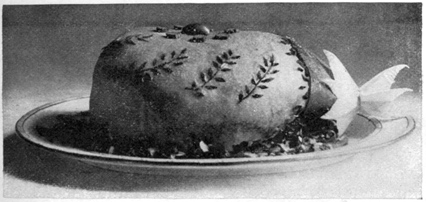 COLD HAM COVERED WITH CHAUDFROID SAUCE AND DECORATED WITH
TRUFFLES TO IMITATE BRANCHES—ORNAMENT ON TOP A HALF-OLIVE SURROUNDED
WITH SLICES OF PICKLE—A PIECE OF THE HAM-SKIN LEFT ON THE BONE END AND
THE EDGE OF THE SKIN DECORATED WITH TRIANGULAR AND DIAMOND-SHAPED PIECES
OF TRUFFLE—PAPER FRILL ON HAM-BONE—DISH GARNISHED WITH LETTUCE,
WATER-CRESS, OR PARSLEY.
COLD HAM COVERED WITH CHAUDFROID SAUCE AND DECORATED WITH
TRUFFLES TO IMITATE BRANCHES—ORNAMENT ON TOP A HALF-OLIVE SURROUNDED
WITH SLICES OF PICKLE—A PIECE OF THE HAM-SKIN LEFT ON THE BONE END AND
THE EDGE OF THE SKIN DECORATED WITH TRIANGULAR AND DIAMOND-SHAPED PIECES
OF TRUFFLE—PAPER FRILL ON HAM-BONE—DISH GARNISHED WITH LETTUCE,
WATER-CRESS, OR PARSLEY.
Soak and prepare the ham as directed above. Let it simmer for two hours;
then remove it and take off the skin, and bake it in a moderate oven for
two hours; baste it frequently, using a cupful of sherry, two spoonfuls
at a time, until all is used; then baste with drippings from the pan.
When done, cover it with a paste made of browned flour and brown sugar
moistened with sherry, and replace in the oven for a few minutes to
brown.
Cut the ham very thin. If very salt, place it in boiling water for a few
minutes. Then dry and broil it over hot coals for three or four minutes.
Put a few pieces of salt pork into a frying pan. When tried out, add the
eggs, one at a time, from a saucer. Baste the top of the eggs with fat
from the pan. Let them brown a little on the edges, but not blacken, and
serve them around the slices of ham.
Boiled ham may be broiled. If so, cut it into thin, small pieces, and
after broiling it, place on each piece a fried egg.
Chop fine some cold boiled ham. Boil six or eight eggs very hard (see
page 262). With a sharp knife cut them in quarters lengthwise. Remove
the yolks, and press them through a coarse sieve or strainer; lay the
white segments in warm water. Make a white sauce, using two
tablespoonfuls of butter; when melted, add two tablespoonfuls of flour,
and let cook for a few minutes; then add slowly two cupfuls of milk.
Stir constantly, and when a smooth, consistent sauce, season with salt
and white pepper.
Moisten the chopped ham with a little of the sauce, and place it on the
fire just long enough to become well heated. Stir constantly so the
sauce will not brown. Make a smooth, rounded mold of the ham in the
center of a hot dish. Pour over it the white sauce. Sprinkle thickly
over the top the yolk crumbs; then range evenly around it the white
segments of the eggs.
Cut bacon very thin, as shown on page 78. Lay the slices on a hot
frying-pan. When clear turn them over. Tip the pan a little, so the fat
will run to one side. If not wanted crisp and dry, turn the slices
before they look clear, and remove before all the fat is tried out.