Sacramento City at that date had a rude but effective government of its
own. An alcalde and other city officers had been elected; and certain
unwritten laws, for the protection of life and property, had been
promulgated and were strictly enforced. Lynching, in the sense that we
know it to-day, was almost unknown. There were no disorderly mobs, who,
under the spurs of their own brutal passions, strung up their victims
unheard and without even the semblance of a fair trial. Justice, if
sudden, was usually careful to see that it was justice and not brutality
that rendered the verdict. And yet, many of these early trials had the
outward semblance of lynching-bees in the swift severity of their
punishments. A murderer would be arrested, tried, convicted, and
decently hanged, all before sundown of the same day. The mob spirit was
there, but usually held in check by the sturdy manhood of the American
miners, who had nearly all come from law abiding and law respecting
communities.
This swift severity of Justice was, in a sense, compelled by the
unusual, the almost unprecedented conditions surrounding life in a city
born suddenly in a wilderness. There were few locks and bars and bolts,
or, even, doors, in Sacramento City at that time; and large sums in gold
and great values in goods were often left exposed and almost
unprotected. The thief, under such circumstances, had to be dealt with
severely and promptly; or the property of no one would be safe. There
were no regularly established courts in the city to try criminals, no
written code of laws to dictate methods of procedure, no court officials
to enforce mandates, and no safe jails in which to confine prisoners.
Under such circumstances the people had to form their own courts, make
their own laws, and see that they were enforced; or have no laws; and
the criminal had to be dealt with summarily. The thief was sometimes
whipped, or, even, cropped, that is his ears were cut off, and he was
always driven from the city, and warned not to come back under penalty
of death. The murderer, when proven guilty to the satisfaction of the
people, was always hanged. No prisoners were held. They were proven
guilty and sentence pronounced and executed at once; or they were set
free.
Such was Sacramento City in 1849, the Sacramento City in which Thure and
Bud now found themselves under arrest for the horrible crime of murder,
the most serious crime that can be charged against a human being
anywhere, but rendered especially serious in the present case by the
peculiar surrounding circumstances. In all the city, so far as either
boy knew, they did not have a friend, or even an acquaintance, who could
vouch for them—and yet, before the sun set that night, they must prove
themselves innocent of the crime charged, or, in all human probability,
be hanged!
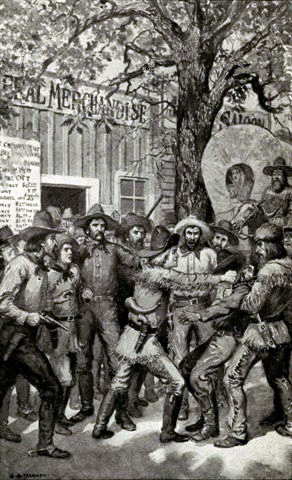
The alcalde's office was small, only a few of the great crowd of men who
had followed the sheriff and his prisoners could get inside of it; and,
when the alcalde saw the size of the gathering outside of his office and
learned the serious nature of the charge against the two boys, he at
once ordered the "court" to be held under the big oak in the
horse-market, where there would be room for all to see and hear how
justice was dispensed. Accordingly all started at once for the
horse-market, situated near the bottom of K Street, where an immense
evergreen oak stood in the middle of the street, furnishing an agreeable
shade for many feet around and a fittingly picturesque scene for the
holding of such a trial as was about to take place.
The method of procedure, on arriving at the horse-market, was simple but
effective. The alcalde took his station near the trunk of the great oak,
and summoned the prisoners and their accusers before him, while the
crowd gathered in a grim and stern-faced circle around this improvised
courtroom.
"What is the crime the prisoners are charged with?" and the alcalde
turned to the sheriff.
"Murder!" answered the sheriff briefly.
"Who makes the accusation?"
"Those two men standing there," and the sheriff indicated the big
red-headed man with the broken nose and the small man with the
pock-marked face, who now stood just behind the sheriff and his two
prisoners.
"Stand forth by the side of the prisoners," commanded the alcalde.
The two men shuffled awkwardly forward and stood uneasily by the side of
Thure and Bud, their eyes shifting restlessly from the face of the
alcalde to the faces of the surrounding crowd.
For a couple or more minutes the alcalde studied the faces of the two
boys and the faces of their two accusers in silence. Evidently he was
endeavoring to form an opinion of the characters of the prisoners and
their accusers; but, what that opinion was, his face did not betray.
"Why do you accuse these two young men of murder?" and the alcalde
suddenly fixed his eyes upon the face of the man with a broken nose.
"Because I seen 'em do it," answered the man. "Me an' my pard, Spike,
seen 'em do it. Ask him," and he turned to the small man, who stood
close by his side.
"And you are both willing to make oath that you saw these two young men,
who are little more than boys, commit the awful crime of murder?" the
alcalde continued.
"Yes," promptly responded both men.
"Then, may God have mercy on your souls, if the accusations are false!
What have you to say to the accusation? Guilty; or, not guilty?" and the
alcalde turned abruptly to Thure and Bud.
"Not guilty," answered Thure, his face very white. "We—"
"That will do for the present," interrupted the alcalde. "Gentlemen, how
shall the case be tried?" and he turned to the surrounding crowd of
stern-faced men.
"Give 'em a jury, an' git a-goin'," called a rough voice impatiently.
"Do you wish a trial by jury?" and again the alcalde turned to Thure and
Bud.
"Yes," answered both boys.
"The trial will be by jury," announced the alcalde. "I summon to act as
this jury," and his eyes searched the circle of surrounding faces, as he
slowly called out the names of twelve men, who, as their names were
called, stepped forth and took their stations by the side of the alcalde
and in front of the prisoners and their accusers.
When the twelve jurymen had been selected, all were solemnly sworn by
the alcalde to render a true and just verdict, according to the evidence
presented; and the trial of Thure and Bud for the murder of John
Stackpole, the miner, was ready to begin.
During all this time Thure and Bud had been doing some very serious and
some very rapid thinking. At first the suddenness and the unexpectedness
of the rush of men upon them in the busy street, followed so swiftly by
their arrest and the dreadful accusations of the two men, whom they had
every reason to believe had committed the crime themselves, had almost
completely benumbed their faculties; but this condition of mind had
lasted only a short time, and long before they reached the place of
trial their minds were busy with the dreadful problem of how to prove
themselves innocent of the crime charged, when two men were ready to
swear that they saw them commit the crime, and when they did not have,
could not have, a single witness who could swear to the truthfulness of
their statements concerning the miner's death. No one but themselves had
seen him die; and, so far as they knew, no one but themselves and their
accusers knew the cause of his death. If they only had time to send
home—But, even if they had witnesses from home, what could they prove?
Only that the two boys had brought the dead miner home and had buried
him; and that would be no proof that they had not killed him and
invented the story of the two robbers.
True, on their side, they could accuse the two men of committing the
murder themselves; but they had no positive proofs that they were guilty
of the crime, only the description of his assailants given them by the
dying miner. There might be other men with broken noses and pock-marked
faces. All that they could swear to of their own knowledge was that one
of the men they had seen murdering the old miner was larger than the
other. They had not got near enough to the murderers to be able to
recognize them again, even if they should see them, except by the
description given by the murdered man. And for them to accuse the two
men, who had caused their arrest, of the murder, in itself would look
suspicious to those who did not know the real facts and would have a
tendency to make them doubt their whole story of the death of the miner.
Then there was another matter that troubled the two boys greatly. Why
had the two men accused them thus publicly of the murder of the miner?
Why had they run this risk of turning suspicion against themselves? They
must feel very certain that the "evidence" they would produce would
convict; or, they never would have dared to have chanced accusing them
of the crime; for their acquittal would be almost sure to turn suspicion
in their own direction. True, there was the skin map, and, possibly, the
accusation was some scheme to get the map into their possession; but,
how could their hanging bring this about? If they were hanged, the map
and its meaning would be almost sure to be made public; and then every
man in Sacramento City would have as good a chance of finding the Cave
of Gold as would the two scoundrels themselves, a condition of things
that both boys felt quite sure the two men were exceedingly anxious to
avoid, and the map itself would be almost certain to be kept from them.
Then, again, the possession of the skin map itself was the cause of the
gravest anxiety and dread. If they confessed to its possession it would
reveal to all the secret of the Cave of Gold, something that they were
almost ready to give their lives to prevent, and would not help their
case in the least. Indeed, under the circumstances it would, probably,
be considered the strongest possible circumstantial evidence of their
guilt.
But, what if the alcalde should order them searched and the map be
found? Or, what if the two men, becoming desperate, should ask that they
be searched, to see if anything that belonged to the miner could be
found in their possession, and the buckskin bag and the gold nugget and
the skin map should all be discovered in their place of concealment
under Thure's left shoulder?
When the two horns of a dilemma are both equally long and sharp, how,
then, can the peril be avoided?
Indeed, the longer and the closer Thure and Bud looked at their
situation, the more dreadful and impossible of remedy it appeared. How
could they prove their innocence, when they did not have a single
witness to appear in their defense? How could their youth and
inexperience, friendless and alone, hope to combat successfully with the
cunning and the experience of these two unprincipled men, who would stop
at nothing to accomplish their ends? But, they were not the kind of boys
to give up a fight for life, as long as they could strike back; and the
more difficult their situation appeared, the more grimly determined they
became to win out somehow, or, at least, to die fighting.
"Not a word of the skin map and the Cave of Gold," hastily warned Thure
in a whisper to Bud, as the alcalde, having completed the tale of the
jury, again turned to them. "Tell everything just as it happened, but
that. The telling of that would not help us a bit; and, if it were known
that we had a map and a gold nugget that had belonged to the miner, it
would look suspicious and might hurt us a lot; and we don't want to give
away the Cave of Gold, not if we can help it."
"Right," whispered back Bud. "It's got to be our word against the word
of those two cowardly villains, I reckon," and he glared furiously in
the direction of the two men. "We've just got to beat them some way,"
and his young face grew grim and stern.
By this time the jurymen had all seated themselves comfortably on the
ground on both sides of the alcalde, and were ready to hear the
testimony.
"You may step forward and be sworn," and the alcalde's eyes signaled out
the big man with a broken nose.
The man stepped up in front of the alcalde, who sat on a stump, with a
barrel standing on end in front of him and an old worn Bible lying on
top of the barrel.
"Hold up your right hand," commanded the alcalde, his keen eyes fixing
themselves sternly on the red, brutal face; "and repeat the oath after
me."
The man's right hand went up with a sort of spasmodic jerk.
"I do solemnly swear," began the alcalde slowly, "that the testimony I
am about to give in the case now before the court, shall be the truth,
the whole truth, and nothing but the truth; and may God eternally damn
my soul, if I knowingly utter a false word."
Hesitatingly and with a whitening face, the man slowly repeated this
oath.
"Kiss the Bible," commanded the alcalde; "and may God blister the lips
that have touched His holy book, if they suffer a false word to pass
between them."
The man hesitated a moment: and then, at a muttered objurgation from his
companion, he bent and hastily pressed his lips against the cover of the
holy book.
"What is your name and business?" In this rude and informal court the
alcalde not only acted as judge, but also examined all witnesses.
"William Ugger, Bill Ugger, for short," answered the man, his eyes
shifting restlessly from face to face as he spoke. "Me an' my pard are
bound for th' diggin's."
"Now, remembering that you have sworn to speak nothing but the truth and
that your lips have just kissed the holiest of books, you may tell the
jury and the people here assembled what you know of this alleged murder
of the miner, John Stackpole. Be as brief as possible, please," and the
alcalde's eyes, as well as the eyes of every man gathered there,
fastened themselves on the face of Bill Ugger.
"Wal," and the shifting eyes fixed themselves for a few brief moments on
the ground in front of the big feet, "it happened like this. Me an' my
pard, Spike, thar," and he nodded toward his companion, "was on our way
from San Francisco tew Sacramento City an' th' diggin's a-hossback.
Somehow we happened tew git off th' reg'lar trail, me an' Spike did; an'
'long 'bout noon, three days ago, we comed tew a leetle valley, with a
leetle stream of water a-runnin' through it, an' a string of trees an'
brush a-growin' 'longside th' water. Both on us bein' tired, we'd ben
a-goin' since sun-up, we found a nice shady spot 'longside th' water,
an', tyin' our hosses tew th' trees, both on us laid down for a short
snooze. Course I don't know how long we'd ben a-snoozin', but, I reckon,
'twas 'bout a couple of hours, when we was both jerked out of a sound
sleep by a yell of agony that sounded as if it comed from a man what had
ben struck a mortal blow. Nat'rally that yell startled me an' Spike sum,
bein' that we both had been sound asleep; an', maybe, for a minute we
sot a-lookin' intew each other's eyes, doin' nuthin'. Then Spike says:
'Sounded human, Bill. Like sumone had got his,' an' I seed that he was
a-shiverin'; for 'tain't none pleasant tew be waked out of a sound sleep
by th' death-cry of a human. 'An' it sounded as if it comed from right
ayond that leetle clump of bushes,' an' he pointed a shakin' finger
toward a leetle clump of bushes, 'bout a rod away, that shut out our
view of th' valley. 'I reckon we'd better investergate,' an' we both
began a-crawlin' toward that clump of bushes, not havin' heard no more
sounds.
"Wal," and the shifty eyes shot swift glances from the face of the
alcalde to the faces of the jury and the surrounding crowd, to note the
effect of his words, "when we got tew them bushes an' looked through
'em—" He paused and laid a hand solemnly on the Bible lying on top of
the barrel in front of the alcalde—"so help me God! this is what we
saw. Th' valley in front of th' bushes was level an' open, so that we
could see clear 'cross it; an', 'bout twenty rods from whar we was, we
saw a man strugglin' violently on th' ground with two other men atop of
him, while three hosses stood a leetle ways off a lookin' at 'em; an',
even as we looked, we saw one of th' men flash a knife above his head
an' plunge it down, an' th' man on th' ground stopped strugglin'.
"This was a leetle more'n Spike an' I was a-willin' tew stand for, an'
we both jumps up out of th' bushes, an', drawin' our pistols, we had no
rifles, we yells an' starts for them two men. Both on 'em jumps tew
their feet, an' grabs up their rifles, an', afore you could say Jack,
they had th' both on us covered, we not bein' near enough tew use
our pistols. But we was close enough tew see 'em plain; an', afore
God!—" The man stopped abruptly and, whirling suddenly about, pointed
a finger dramatically directly into the face of Thure—"it was that young
villain a-standin' thar what had his gun a-pointin' straight at me!"
Thure, in utter astonishment, took a quick step backward; and then,
suddenly realizing what that pointing finger meant, backed by those
startling words, he lost all control of himself for the moment and
leaped straight toward Bill Ugger.
"It's a lie! A lie!" he yelled, as with all his young strength he
struggled furiously with the great bulk of his antagonist. But, before
either could do the other any harm, the strong hands of the sheriff
seized Thure by the shoulders.
"Here, you young catamount!" and he jerked Thure violently backward, and
lifted the butt of his heavy revolver threateningly, while his face
hardened. "Quit it, or—" and the heavy butt descended lightly on
Thure's head by way of warning.
"But he lied! Every word that he uttered was a lie!" and tears of rage
gathered in Thure's eyes.
"Young man," the alcalde was now standing on his feet, all the sympathy
gone from his face, "you will give me your word of honor not in any way
again to do violence to the decorum of this court during this trial, or
I shall order the sheriff to bind you hand and foot. Do I have your
promise?" and he fixed his eyes sternly on the white face of Thure.
For a moment Thure stood silent. Then his young face hardened and his
lips tightened into two thin straight lines. Reason again had firm hold
of the helm.
"I promise," he answered quietly; "and I ask the court's pardon for my
violent action. But the damnable lies told by that—"
"That will do," interrupted the alcalde. "Sheriff, if either of the
prisoners forgets himself or our presence again, bind him hand and foot.
Now," and he turned to Bill Ugger, who, as soon as Thure had been torn
from him, had again returned quietly to his place before the official
barrel, his red face flushed and his little eyes shining with triumph,
"you may go on with your testimony, William Ugger. You were saying that
you recognized one of the prisoners as one of the murderers and that he
had you covered with his rifle. Remembering your oath and comprehending
fully what your dreadful accusation means to a fellow human being, you
still swear that the man who sprang up from the prostrate body and
leveled his rifle at you was this prisoner?" and the alcalde's lifted
hand indicated Thure.
The interest of the crowd surrounding the court had by this time become
intense. Men were breathing heavily and their faces had hardened and an
ugly look had come into their eyes. All now stretched their heads
forward, as they listened almost breathlessly for the reply of Bill
Ugger.
"I do," answered the man grimly. "I saw his face plain, a-lookin' at me
above th' top of his rifle."
A deep growl went up from the surrounding crowd, a sound more like the
throat mutterings of a monstrous tiger than anything human. The sheriff
started and his keen eyes swiftly searched the circle of faces.
"I reckon thar ain't no need of waitin' for more testimony," cried a
hoarse voice. "They was seen killin' th' man; an' that's all we wants
tew know. Let jedgement be pronounced, an' we'll 'tend tew th' ex'cutin'
of it."
"Right!" yelled another. "There's no need of wasting more—"
"Silence!" thundered the alcalde, leaping to his feet. "This court, a
court elected by your own authority, is trying the prisoners; and, by
the Eternal Andrew Jackson! they shall not be declared guilty until they
have been heard in their own defense, until they have been proven guilty
in full accordance with the laws of this city. William Ugger, you may go
on with your testimony. There will be no further interruptions," and the
alcalde quietly laid a couple of big revolvers down on top of the
barrel, one on each side of the Bible.
At this moment and when all eyes were bent on the alcalde, Thure felt a
slight jerk on his coat sleeve, and, glancing down, saw that the smaller
of their accusers, the pock-marked man, had moved up close to his side
and that it had been his hand that had jerked his sleeve.
"Read at once," and the man swiftly slipped a piece of paper into his
hand. "It is your only hope," and he moved away, not having once even
glanced toward Thure.
Thure, stepping a little behind Bud and holding the paper so that no
eyes but his own could see it, cautiously opened the note and slowly
read these words:
If you wil give us the miners map and promice tu say nuthin bout
the gold kave Bill and me wil sudenly diskuver that we is mistakin
in thinkin that you was the ones tu kil old Stakpole and you wil go
free. If you dont you wil both hang afore sun down tu nite and al
the gold in Caleforny aint wurth as much tu you as is yur lives. If
you agrees tu this nod yur hed 2 times. If you dont git redy tu
hang.
The note was unsigned; and no signature was necessary. Its meaning was
plain. The two boys were to surrender the skin map to the two scoundrels
and say nothing about the Cave of Gold; or, the dreadful plot, in whose
meshes they found themselves so tightly ensnared, was to be followed out
to its horrible conclusion. The motive back of the two men's action now
stood revealed. They expected to frighten the two boys into giving up
the skin map and into keeping secret their knowledge of the Cave of
Gold. But, what a fiendish plot! And with what diabolical cunning it had
all been worked out and was being executed!
Thure read the note through slowly; and, in a flash, he had comprehended
the whole atrocious, scheme and with what devilish cunning circumstances
had been manipulated to bring about their present terrible situation;
but, only the furious look in his eyes showed how the note had affected
him.
"From Pockface," he whispered, as he quietly slipped the paper into
Bud's hand. "Read it on the sly; and then give me your answer."
Bud cautiously took the note and opened it, wondering greatly at its
coming from Pockface. He read it through slowly, comprehendingly; and
then he turned and glanced into Thure's face. One look was sufficient.
During all this time Pockface's eyes had been covertly watching the
boys.
Bud now waited until he saw that the man's eyes were upon him, then he
deliberately raised the piece of paper to his mouth, spit on it, and,
bending down, placed it under the heel of his boot, ground it to pieces
in the ground, and, defiantly turning his back on the man, gave his
attention to the doings of the alcalde.
The two scoundrels had misjudged the courage and the pluck of two
American boys like Thure Conroyal and Bud Randolph; and, judging from
the scowls that disfigured their faces and the ugly light that flashed
into their eyes, at the sight of Bud's actions, in their disappointment,
they would show them no mercy. They would get the map, or they would
hang the boys. Indeed, this action on their part now became almost
necessary; for, if they did not succeed in hanging the boys, the boys,
in all probability, would succeed in hanging them.
This dramatic byplay had taken but a short time in the enacting and had
passed unnoticed in the excitement occasioned by the threats from the
surrounding crowd and the placing of the alcalde's two big revolvers by
the side of the Bible on top of the barrel standing in front of him.
When it was over and Thure and Bud again gave their attention to the
court, Bill Ugger was about to continue with his testimony, the majority
of the crowd having shown themselves so plainly in sympathy with the
actions of the alcalde that the rougher ones evidently thought it wise
to keep quiet.
"As I was a-sayin'," continued Bill Ugger, when everything had quieted
down again, "afore we could git near enough tew th' murderers tew use
our pistols, they held us up with their rifles, an' ordered us tew git
an' git lively; an', by way of makin' plain their meaning that skunk,"
and he glared at Thure, "sent a bullet a-whistlin' so close tew my ears
that it made this hole through th' brim of my hat," and the man held up
his wide-brimmed hat and pointed with his finger to a little round hole
in the brim close to the crown. "Three inches more tew one side an' he'd
a-got me, tew.
"Wal, me an' Spike didn't stop tew argy none after that; but got back
ahind them bushes an' trees as sudden as our legs would take us. But,"
and Ugger paused and glared at Thure and Bud, "if I knowed I was on my
deathbed an' a-goin' tew die in five minits, I'd be willin' tew swear
that th' tew murderers was them tew boys a-standin' thar. We saw their
faces plain an' thar ain't no mistake," and his eyes flashed an ugly
look in the direction of Thure and Bud.
"Of course," continued Bill Ugger, "they didn't dare follow us, 'cause,
if they did, they knowed we could hide ahind a tree an' pot 'em, which
we'd ben sum glad tew do," and his eyes glowed vindictively. "Wal, we
waited, hid ahind th' bushes an' trees, not darin' tew show ourselves
an' bein' tew far off tew do any pistol shooting a-hopin' that they'd
ride off an' leave th' body of th' man they'd robbed an' probably
killed, but they was tew cunnin' tew do that; for, in a leetle while,
they throwed th' body, like it was a bag of grain, across th' back of
one of th' hosses an' tied it thar; an' then they rode off, a-leadin'
th' hoss with th' body on it ahind 'em. Me an' Spike waited 'til they'd
gone out of sight over th' top of a distant hill an' then we made for
th' spot of th' killin'. Th' grass was sum tread up an' bloody; an'
lyin' in th' blood an' partly tread intew th' ground, we found this,"
and Ugger thrust his hand into one of his pockets and pulled out a small
daguerreotype-case, perhaps a couple of inches square, on which could be
plainly seen ominous stains of red.
"This," and he held up the small case where all could see, "has inside
of it th' picter of as handsum a lady as I ever seed; an' under th'
picter is writ, in a woman's writin,' these words: Tew my beloved
husband, John Stackpole'; an' we reckoned, me an' Spike did, as how th'
murdered man's name must a-ben John Stackpole. See for yourselves," and
he handed the case to the alcalde, who, after opening it and looking at
the picture inside and the blood stains on the outside, passed it on to
the jury, who examined it carefully.
"Of course," continued Ugger, after he had watched the effect of the
daguerreotype on the alcalde and the jury for a minute, "bein' bound for
th' diggin's an' knowin' 'twould be almost useless tew try an' trail th'
murderers, me an' Spike at once started on our way ag'in for Sacermento
City, not expectin' tew see them murderers ag'in, leastwise not so soon.
We got intew th' city this mornin'; an' was a-standin' on th' street
a-lookin' at th' humans a-passin' by, when who should come a-ridin'
along right afore our eyes, but them tew identickle young fellers what
we had seen kill that man; an', of course, bein' honest an' law-abidin'
men, me an' Spike seen tew it that they didn't git away a second time.
Now, I reckon, that's all I've got tew tell, only," and again his eyes
turned vindictively to Thure and Bud, "thar ain't ben no mistake made
an' you've got th' right men; an' if they don't hang afore night, then
thar ain't no justice in Sacermento City. I'm done."
The alcalde sat for a moment looking straight in front of him. Evidently
he was swiftly reviewing the man's testimony to see if there were any
points that needed clearing up; but everything had been told,
apparently, in such a clear, straightforward manner that there seemed to
be nothing that needed explaining, and, with a sigh as he thought of the
youthfulness of the prisoners, the alcalde turned to the jury.
"Would you like to ask the witness any questions?" he inquired.
"No. Everything seems to have been told as clear and as straight as a
string," one of them replied, and all the others nodded their assent to
this, statement.
"Have the prisoners any questions they wish to ask the witness?" and the
alcalde turned to Thure and Bud.
For a moment the two boys consulted together. Then Thure said quietly:
"No, there is nothing that either of us would care to ask that man."
"The prisoner is dismissed for the present," and the alcalde motioned
Bill Ugger to step back from in front of the barrel.