CAPTURE
Almost at the moment that Waldo emerged from the jungle Nadara saw him,
and with a lunge threw herself from Flatfoot's shoulder.
The man turned with a fierce growl of rage, and his eyes fell upon the
giant rushing toward them.
The girl was now struggling madly to escape or delay her captor. There
could be but one outcome, as Flatfoot knew. He must fight now, but the
girl should never escape him.
Raising the huge fist that had killed many a full-grown man with a
single blow he aimed a wicked one at the side of Nadara's head.
The first one she dodged, and as the arm went up to strike again,
Thandar threw his spear-arm far back and with a mighty forward surge
drove his light weapon across the hundred feet that separated him from
Flatfoot.
It was an awful risk—there was not a foot to spare between the hairy
breast that was his target and the beautiful head of the fair captive.
Should either move between the time the spear left his hand and the
instant that it found its mark it might pierce the one it had been sped
to save.
Flatfoot's fist was crashing down toward that lovely face at the
instant that the spear found him; but he had moved—just enough to
place his arm before his breast—so that it was the falling arm that
received the weapon instead of the heart that it had been intended for.
But it served its purpose. With a howl of pain and rage, Flatfoot,
forgetful of the girl in the madness of his anger, dropped her and
sprang toward Waldo.
The latter had drawn his sword—naught but a sharpened stick of hard
wood—and stood waiting to receive his foe. It was his first attempt to
put either sword or shield into practical use, and he was anxious to
discover their value.
As Flatfoot came toward his antagonist he pulled the spear from the
muscles of his arm, and, stooping, gathered up one of the many rocks
that lay scattered about at the base of the cliff.
The cave man was roaring like a mad bull; hate and murder shot from his
close-set eyes; his upper lip curled back, showing his fighting fangs,
and a light froth flecked his bristling beard.
Waldo was sure there had never existed a more fearsome creature, and he
marveled that he was not afraid. The very thought of what the effect
of this terrible monster's mad charge would have been upon him a short
while ago brought a smile to his lips.
At sight of that taunting smile Flatfoot hurled the rock full at the
maddening face. With a quick movement of his left arm Waldo caught the
missile on his buckler, from whence it dropped harmlessly to the ground.
Flatfoot did not throw again, and an instant later he was upon the
Bostonian—the pride and hope of the cultured and aristocratic Back Bay
Smith-Joneses.
When he reached for the agile, blond giant he found a thin sheet of
hide-covered twigs in his way, and when he tried to tear down this
barrier the point of a sharpened stick was thrust into his abdomen.
This was no way to fight!
Flatfoot was scandalized. He jumped back a few feet and glared at
Waldo. Then he lowered his head and came at him once more with the very
evident intention of rushing him off his feet by the very weight and
impetuosity of his charge.
This time the sharp stick slipped quickly over the top of the
hide-covered atrocity and pierced Flatfoot's neck just where it joined
his thick skull.
Burying a foot of its point beneath the muscles of the shoulder, it
brought a scream of pain and rage from the hairy beast.
Before Waldo could withdraw his weapon from the tough sinews, Flatfoot
had straightened up with a sudden jerk that snapped the sword short,
leaving but a short stub in his antagonist's hand.
Nadara had been watching the battle breathlessly, ready to flee should
it turn against her champion, yet at the same time searching for an
opportunity to aid him.
Like Flatfoot, the girl had never before seen spear or sword or shield
in use, and while she marveled at the advantage which they gave
Thandar, she became dubious as to the result of the encounter when she
saw the sword broken, for the spear had been snapped into kindling-wood
by Flatfoot when he tore it from his arm.
But Waldo still had his cudgel, fastened by a thong to his sword-belt,
and as the cave man rushed upon him again he swung a mighty blow to the
low, brutal forehead.
Momentarily stunned, the fellow reeled backward for a step, and again
Waldo wielded his new weapon.
Flatfoot trembled, his knees smote together, he staggered drunkenly,
and then, when Waldo looked to see him go down, the brute power that
was in him, responding to nature's first law, sent him hurtling at the
Bostonian's throat in the snarling, blind rage of the death-smitten
beast.
Catapulted by all the enormous strength of his mighty muscles, the
squat, bear-like animal bore Waldo to earth, and at the same instant
each found the other's throat with sinewy, viselike fingers.
They lay very still now, choking with firm, relentless clutch. Every
ounce of muscle was needed, every grain of endurance.
Waldo was suffering agonies after a moment of that awful death-grip. He
could feel his gasping, pain-racked lungs struggling for air.
He tried to wriggle free from those horrible fingers, but not once did
he loosen his own hold upon the throat of Flatfoot; instead he tried to
close a little tighter each second that he felt his own life ebbing. He
became weaker and weaker. The pain was unendurable now.
A haze obscured his vision—everything became black—his brain was
whizzing about at frightful velocity within the awful darkness of his
skull.
The girl was bending close above them now, for both were struggling
less violently. She had been minded to come to Thandar's rescue when
suddenly she recalled his desertion of her, and all the wild hatred of
the primitive mind surged through her.
Let him die, she thought. He had spurned her, cast her off; he looked
down upon her.
Well, let him take care of himself, then, and she turned deliberately
away to leave the two men to decide the outcome of their own battle,
and started back upon the trail in the direction of her tribe's
village.
But she had taken scarce a score of steps when something flamed up in
her heart that withered the last remnant of her malice toward Thandar.
As she turned back again toward the combatants she attempted to justify
this new weakness by the thought that it was only fair that she should
give the yellow one aid in return for the aid that he had rendered her;
that done, she could go on her way with a clear conscience.
She wished never to see him again, but she could not have his blood
upon her hands. At that thought she gave a little cry and ran to where
the men lay.
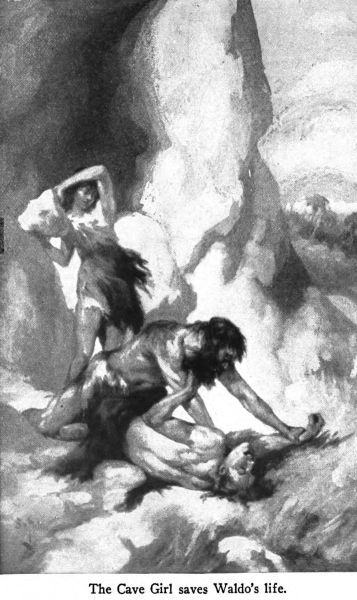
Both were almost quiet now; their struggles had nearly ceased. Just
as she reached them Flatfoot relaxed, his hands slipped from Waldo's
throat and he lay entirely motionless.
Then the fair giant struggled convulsively once or twice; he gasped,
his eyes rolled up and set, and with a sudden twitching of his muscles
he stiffened rigidly and was very still.
Nadara gave one horrified look at the ghastly face of her champion, and
fled into the jungle.
She stumbled on for a quarter of a mile as fast as her tired limbs
would carry her through the entangling grasses, and then she came to
that which she sought—a little stream, winding slowly through the
valley down toward the ocean.
Dropping to her knees beside it she filled her mouth with the
refreshing water. In an instant she was up again and off in the
direction from which she had just come.
Throwing herself at Waldo's side, she wet his face with the water from
her mouth. She chafed his hands, shook him, blew upon his face when
the water was exhausted, and then, tears streaming from her eyes, she
threw herself upon him, covering his face with kisses, and moaning
inarticulate words of love and endearment that were half stifled by
anguished sobs of grief.
Suddenly her lamentations ceased as quickly as they had begun. She
raised her head from where it had been buried beside the man's and
looked intently into his face.
Then she placed her ear upon his breast; with a delighted cry she
resumed chafing his hands, for she had heard the beating of his heart.
Presently Waldo gasped, and for a moment suffered the agonies of
returning respiration. When he opened his eyes in consciousness he saw
Nadara bending over him—a severely disinterested expression upon her
beautiful face. He turned his head to one side; there lay Flatfoot
quite dead.
It was several moments before he could speak. Then he rose, very
unsteadily, to his feet.
"Nadara," he said, "Korth lies dead beside the three great trees in the
glade that is near the village that was Flatfoot's. Here is the dead
body of Flatfoot, and about my loins hangs the pelt of Nagoola, taken
in fair fight.
"I have done all that you desired of me; I have tried to repay you for
your kindness to me when I was a stranger in your land. I do not know
why you should have tried to kill me while I battled with Korth.
"No more do I know why you have allowed me to live today when it would
have been so easy to have despatched me as I lay unconscious here
beside Flatfoot.
"I read dislike upon your face, and I am sorry, for I would have parted
with you in friendship, so that when the time comes that I return to
my own land I should be able to carry away with me only the pleasant
memory of it. When we have rested and are refreshed I shall take you
back to your father."
All that had been surging to the girl's lips of love and gratitude
from a heart that was filled with both was congealed by the cold tone
which marked this dispassionate recital of the discharge of a moral
obligation.
Possibly Waldo's tone was colored by the vivid memory of the look of
hate that he had seen in the girl's eyes at the instant that he went
down before her missile as he battled with Korth, for it was not even
tinged with friendliness.
And so the girl's manner was equally distant when she replied; in fact,
it was even colder, for it was fraught with bitterness.
"Thandar owed nothing to Nadara," she said, "and though it matters not
at all, it is only fair to say that the stone that struck you as you
battled in the glade was intended for Korth."
Waldo's face brightened. A load that he had not realized lay there was
lifted from his heart.
"You did not want to hurt me, then?" he cried.
"Why should I want to hurt you?" returned the girl.
"I thought"—and here Waldo spoiled the fair start they had made at a
reconciliation—"I thought," he said, "that you were angry because I
ran away from you after we had come to your village that time, months
ago."
Nadara's head went high and she laughed aloud.
"I angry? I was surprised that you did not come to the village, but
after an hour I had forgotten the matter—it was with difficulty that
I recognized you when I next saw you, so utterly had the occurrence
departed from my thoughts."
Waldo wondered why he should feel such humiliation at this frank
avowal. Of what moment to him was this girl's estimation of him? Why
did he feel a flush suffuse his face at the knowledge that he was of so
little moment to her that she had entirely forgotten him within a few
months?
Waldo was mortified and angry. He changed the subject brusquely;
hereafter he should eschew personalities.
"Let us find a cave at a distance from the dead man," he said, "and
there we may rest until you are ready to attempt the return journey."
"I am ready now," replied Nadara; "nor do I need or desire your
company. I can return alone, as I came."
"No," remonstrated Waldo doggedly; "I shall go with you whether you
wish it or not. I shall see you safely with your father. I promised
him."
Nadara had been delighted with the first clause of his reply, but when
it became evident that his only desire to return with her was to fulfil
a promise made her father she became furious, though she was careful
not to let him see it.
"Very well," she replied; "you may come if you wish, though it is
neither necessary nor as I would have it. I prefer being alone."
"I shall not force my company upon you," said Waldo haughtily. "I can
follow a few paces behind you."
There was an injured air in his last words which did not escape the
girl. She wondered if he really deserved the harsh attitude she had
maintained.
They found a cave a half-mile down the valley, where they took up their
quarters against the time that Waldo should be rested, for the girl
insisted that she was fully able to commence the return journey at once.
The man knew better, and so he let her have it that the delay was on
his account rather than hers, for he doubted her ability to cope with
the hardships of the long journey without an interval for recuperation.
The next morning found them both rested and in better spirits, so that
there was no return to their acrimonious encounter of the previous day.
As they walked out toward the forest that lay down the valley in the
direction of the ocean Waldo dropped a few paces behind the girl in
polite deference to her expressed wish of the day before.
As he walked he watched the graceful movements of her lithe figure and
the lines of her clear-cut profile as she turned her head this way and
that in search of food.
How beautiful she was! It was incredible that this wild cave girl
should have greater beauty and a more regal carriage than the queens
and beauties of civilization, and yet Waldo was forced to admit that
he had never even dreamed, much less seen, such absolute physical
perfection.
He wished that he could say as much for her disposition; that was
atrocious. It was unbelievable that such a wondrous exterior could
harbor so much ingratitude and coldness.
Presently they came among the trees where the ripe fruit hung, and as
Waldo climbed nimbly among the branches and tossed the most luscious
down to her, the girl, in her turn, watched him.
She noted more closely the marvelous change that a few months had
wrought. She had thought him wonderful before, but now he was a very
god. She did not think just this, for she knew nothing of gods—other
than the demons that were supposed to enter the bodies of the sick; but
she thought of him as some superior creature, and then she ceased to
feel aggrieved that he should care so little for her.
He was not a man—he was something more than a man, and she had been
very wicked to have treated him so shamefully. She would make amends.
So she tried to be more kind thereafter, though there still remained a
trace of aloofness.
Together they sat upon the turf and ate their fruit, and as they ate
they talked a little, for it is difficult for two young people to
harbor animosity for a great time, especially when there is none other
for them to talk to.
"When you have returned with me to my father, Thandar," the girl asked,
"where shall you go then?"
"I shall return to the sea where I may watch for a ship to take me back
to my own land," he replied.
"I have seen but one ship in all my life," said Nadara, "and that was
years ago. It was when we lived close by the big water that it stopped
a long way from shore and sent many smaller boats to land.
"There were many men in the boats, and when they landed, my father and
mother took me far into the forest away from the sea, and there we
stayed for many days until the strangers had sailed. They wandered up
and down the coast and came back into the forests and the jungles for a
few miles.
"My mother said that they were searching for me, and that if they found
me they would take me away. I was very much frightened."
At the mention of her mother Waldo recalled the little parcel that
Nadara's father had given into his custody for the girl. He unfastened
it from the thong that circled his waist, where it had hung beneath his
panther-skin garment.
"Here is something your father asked me to bring you," he said,
handing the package to Nadara.
The girl took it and examined it as though it was entirely unfamiliar.
"What is it?" she asked.
"Your father did not say, other than that it contained articles that
your mother wore when she died," he said tenderly, for a great pity had
welled up in his heart for this poor, motherless girl.
"That my mother wore!" Nadara repeated, her brows contracted in a
puzzled frown. "When my mother died she wore nothing but a single
garment of many small skins—very old and worn—and that was buried
with her. I do not understand."
She made no effort to open the package, but sat gazing far off toward
the ocean which was just visible through the trees, entirely absorbed
in the reverie which Waldo's words had engendered.
"Could the thing that the old woman told me have been true?" the girl
mused half aloud. "Could it have been because it was true that my
mother fell upon her with tooth and nail until she had nearly killed
her? I wonder if——"
But here she stopped, her eyes riveted in sudden fear and hopelessness
upon a thing that she had just espied in the distance.
A great lump rose in her throat, tears came to her eyes, and with them
the full measure of realization of what that thing beyond the forest
meant to her.
She turned her eyes toward the man. He was sitting with bowed head,
playing idly with a large beetle that he had penned within a tiny
palisade of small twigs.
At length he made an opening in the barrier.
"Go your way, poor thing," he murmured. "Heaven knows I realize too
well the horrors of captivity to keep any other creature from its
fellows and its home."
A choking sigh that was almost a sob racked the girl. At the sound
Waldo looked up to see her pathetic, unhappy eyes upon him. Of a sudden
there enveloped him a great desire to take her in his arms and comfort
her. He knew not why she was unhappy, but her sorrow cried aloud to
him—as he thought simply to the protective instinct that was merely an
attribute of his sex.
Nadara raised her hand slowly and pointed through the trees. It was as
though she had torn her heart from her breast, so harrowing she felt
the consequences of her act would be, but it was for his sake—for the
sake of the man she loved.
As Waldo's eyes followed the direction of her pointing finger he came
suddenly to his feet with a wild cry of joy; through the trees, out
upon the shimmering surface of the placid sea, there lay a graceful,
white yacht.
"Thank God!" cried the man fervently, and sinking to his knees he
raised his hands aloft toward the author of joy and sorrow.
A moment later he sprang to his feet.
"Home! Nadara. Home!" he cried. "Can't you realize it? I am going home.
I am saved! Oh, Nadara, child, can't you realize what it means to me?
Home! Home! Home!"
He had been looking toward the yacht as he spoke, but now he turned
toward the girl. She was crouching upon the ground, her face in her
hands, her slender figure shaken by convulsive tears.
He came toward her and, kneeling, laid his hand upon her shoulder.
"Nadara!" he said gently. "Why do you cry, child? What is the matter?"
But she only shook her head, moaning.
He raised her to her feet, and as he supported her his arm circled her
shoulders.
"Tell me, Nadara, why you are unhappy?" he urged.
But still she could not speak for sobbing, and only buried her face
upon his breast.
He was holding her very close now, and with the pressure of her body
against his a fire that, unknown, had been smoldering in his heart
for months burst into sudden flame, and in the heat of it there were
consumed the mists that had been before the eyes of his heart all that
time.
"Nadara," he asked in a very low voice, "is it because I am going that
you cry?"
But at that she pulled away from him, and through her tears her eyes
blazed.
"No!" she cried. "I shall be glad when you have gone. I wish that
you had never come. I—I—hate you!" She turned and fled back up the
valley, forgetful of the little packet Thandar had brought her, which
lay forgotten upon the ground where she had dropped it.
Without so much as a backward glance toward the yacht Waldo was off in
pursuit of her; but Nadara was as fleet as a hare, so that it was a
much winded Waldo who finally overhauled her half-way up the face of a
cliff two miles from the ocean.
"Go away!" cried the girl. "Go back with your own kind, to your own
home!"
Waldo did not answer.
Waldo was no more.
It was Thandar, the cave man, who took Nadara in his strong arms and
crushed her to him.
"My girl!" he cried. "My girl! I love you! And because I am a fool I
did not learn until it was almost too late."
He did not ask if she loved him, for he was Thandar, the cave man. Nor,
a moment later, did he need to ask, since her strong, brown arms crept
up about his neck and drew his lips down to hers.
It was quite half an hour later before either thought of the yacht
again. From where they stood upon the cliff's face they could see the
ocean and the beach.
Several boats were drawn up and a number of men were coming toward the
forest. Presently they would discover the two upon the cliff.
"We shall go back together now," said Thandar.
"I am afraid," replied Nadara.
For a time the man stood gazing at the dainty yacht, and far beyond
it into the civilization which it represented, and he saw there suave
men and sneering women, and among them was a slender brown beauty who
shrank from the cruel glances of the women—and Waldo writhed at this
and at the greedy eyes of the suave men as they appraised the girl—and
he, too, was afraid.
"Come," he said, taking Nadara by the hand, "let us hurry back into the
hills before they discover us."
Just as the men from the yacht, which Mr. John Alden Smith-Jones had
despatched to the South Seas in search of his missing son, emerged from
the forest into a view of the valley and the cliffs a cave man and his
mate clambered over the brow of the latter and disappeared toward the
hills beyond.
It was nearly dusk as the searchers from the yacht were returning
toward the beach.
They had found no sign of human habitation in the little valley, nor
anywhere along the coast that they had so carefully explored.
The commander of the expedition, Captain Cecil Burlinghame, a retired
naval officer, was in advance.
They had penetrated the woods nearly to the beach when his foot struck
against a package wrapped in the skin of a small rodent.
He stooped and picked it up.
"Here is the first evidence that another human being than ourselves has
ever set foot upon this island," he said as he cut the gut lacing with
his pocket knife.
Within the first wrapping he found a chamois-bag such as women
sometimes use to carry jewels about their persons.
From this he emptied into his palm a dozen priceless rings, a few
old-fashioned brooches, bracelets, and lockets.
In one of the latter he discovered the ivory miniature of a woman—a
very beautiful woman.
In the other side of the locket was engraved: "To Eugénie Marie Céleste
de la Valois, Countess of Crecy, from Henri, her husband. 17th January,
18—"
"Gad!" cried the old captain. "Now what do you make of that?
"The Count and Countess of Crecy were returning to Paris from their
honeymoon trip round the world in the steam yacht Dolphin nearly
twenty years ago, and after they touched at Australia were never heard
of again.
"What tragedy, what mystery, what romance might not these sparkling
gems disclose had they but tongues!"