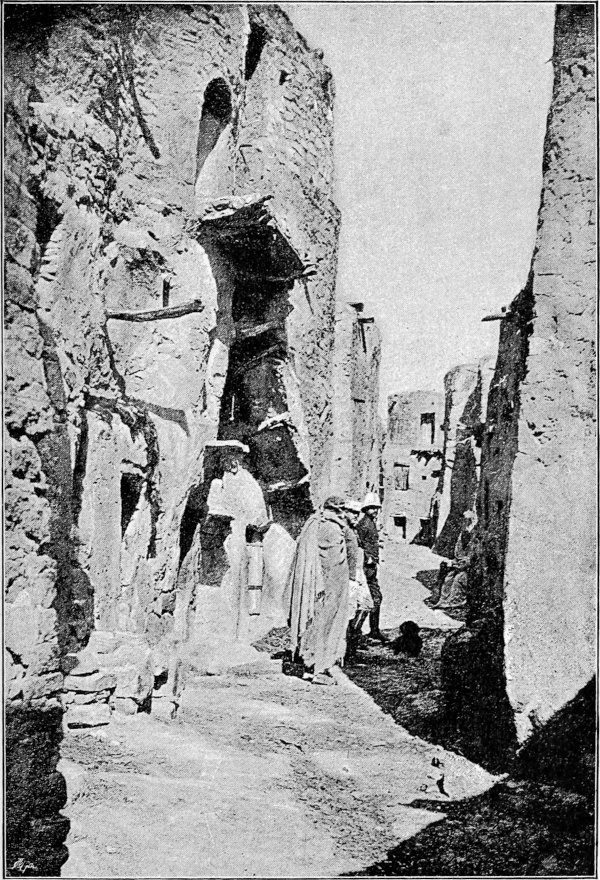
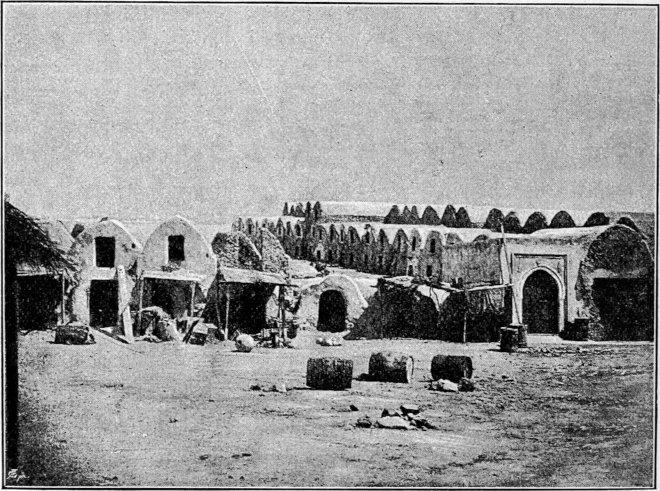
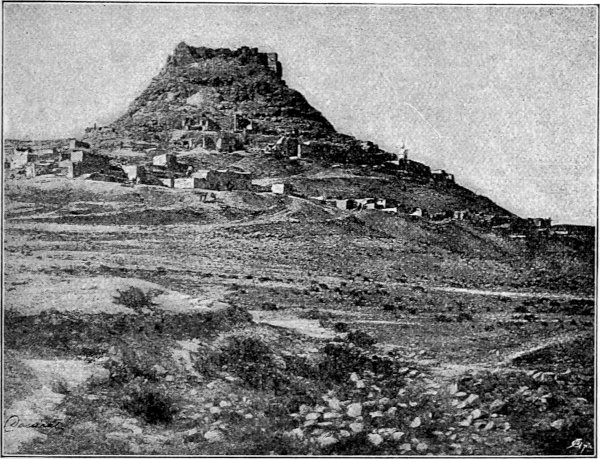
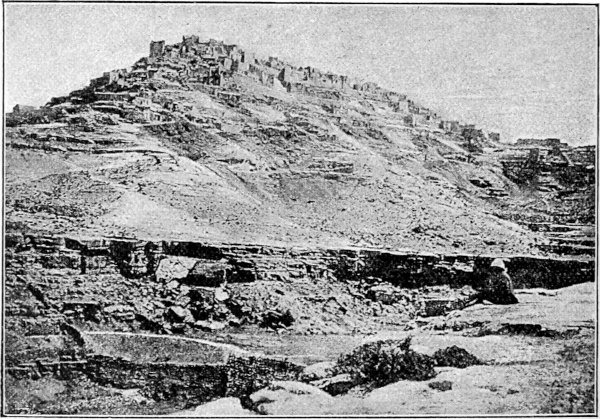
My journey among the cave
dwellers of Southern Tunisia was essentially one of research, since
I was entrusted by Doctor Sophius Müller, Director of the Second
Department of the National Museum, with the honourable task of
purchasing ethnographical objects for the said museum.
On submitting this work to the public, it is incumbent upon me
to offer my sincere thanks to all those who afforded me support and
help in my travels: the Minister of Foreign Affairs, at whose
recommendation Cubisol, the Danish Consul in Tunis, addressed
himself to the French Regency, and obtained permission for me to
travel through the country, and also an escort, guides, etc. Doctor
Müller and Chamberlain Vedel, whose respective introductions, given
from the National Museum and the Society concerned with ancient
manuscripts, and addressed to other similar institutions,
introduced me not only to these, but also to those remarkably
scientific men, Gauckler and Doctor Bertholon, whose friendship I have to
thank for much information and assistance.
England’s Representative in Tunis, Drummond Hay, may be said to
have traced my path through Tunisia, as, on the basis of his
remarkable knowledge of both individuals and of relative
circumstances, he sketched a plan of my journey, from which I
required to make little or no deviation. The Government and
officers in El Arad, the officials, both military and civilian,
showed me the greatest hospitality, and assisted me in the highest
degree; Colonels Billet and Gousset especially claim my warmest
gratitude.
Much of what I have recorded has been left in its original form,
namely, as letters written home, some to my wife, some to other
persons, as, for instance, to the publisher, Herr Hegel. I have not
altered these lest they might lose the fresh impression under which
they were written. Several portions were composed with a view to
publication in the French journal the Revue Tunisienne,
and in the Parisian magazine Le Tour du Monde.
The illustrations were obtained from various sources. Albert,
the photographer in Tunis, obligingly allowed me to make use of a
number of photographs, from which were chiefly drawn the views of
the town and of the sea-coast. With a detective camera I myself
took some
instantaneous photographs on the journey from Gabés to the
mountains, of which a number are introduced. Besides these, Mr.
Knud Gamborg has engraved some drawings of my own. Mr. Gauckler
also gave me the free use of the sketches already published in his
Collection Beylicale, from which were selected the
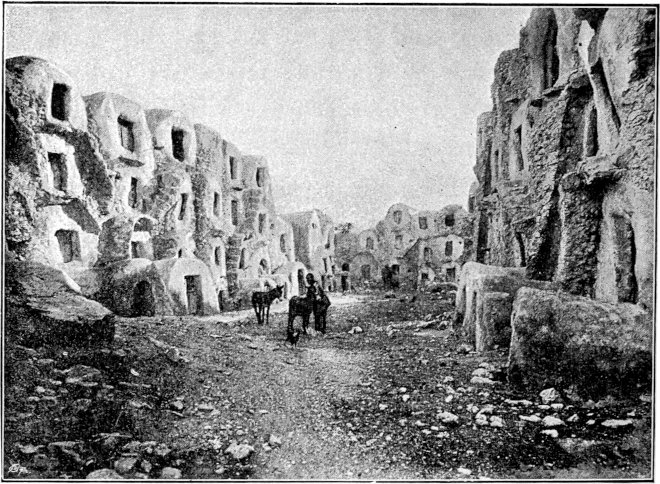
pictures of the villages in the Matmata mountains. Lastly, from the
wife of Consul Henriksen at Sfax I received two paintings, which
are reproduced.
When, in the spring, I made an expedition to Greenland, I left
my manuscript with my friend Doctor Kragelund, of Hobro, who had
already afforded me his assistance, and gave him full powers to
arrange the somewhat heterogeneous materials. In my absence he
corrected the proofs as they came from the press, and has therefore
taken a very important part in my work, and enabled it to be
published in its present form. For this act of friendship I tender
him my warmest thanks.
Daniel
Bruun.
November 1894.
Note.—The fact of
three years having elapsed since the Danish original of the
Cave Dwellers was published, renders the letter form of
which the author
speaks somewhat unsuitable for translation. It has been necessary,
therefore, in many cases to modify that form, and also to omit
certain passages in the work as being of little or no interest to
English readers.
Though the midday sun still
shone bright and hot, I sat at my ease and breathed again in the
pleasant atmosphere of a cool drawing-room, from which the stifling
air and the flies were excluded by closely drawn blinds.
I had just arrived from Tunis by rail, over the scorching hot
plain, and past the milky-white shallow lagoon known as the Lake of
Tunis. Beyond Goletta the blue hills seemed to quiver beneath the
rays of the sun, and my eyes were blinded by the dazzling white
walls of the cathedral standing on the heights, where, in olden
days, Byrsa, the fortress of Carthage, stood, defying the invader
and the storm.
As we sped over the traces of the mighty circular wall, which
formerly enclosed the town, I caught a glimpse of a white roof amongst the
green trees of a wood, and requested the conductor to stop the
train at the English Consul’s summer abode.
Down a pretty shady avenue I walked to the white summer palace,
with its beautiful columned portico, the finest in all Tunisia.
It is a proud name that my host bears,—a name associated with
unfailing honour in the history of Morocco. His late father, Sir J.
H. Drummond Hay, as England’s Representative, practically led
Morocco’s policy during the past forty years. He represented
Denmark also, and under him his son won his diplomatic spurs.
My host had invited me that we might quietly arrange a plan for
my intended expedition to visit the Berber tribes of Tunisia.
I was aware that in the south-west mountains of the Sahara I
should meet with Berbers of a pure race such as are scarcely to be
found elsewhere. Our country’s excellent Representative, Consul
Cubisol, had procured me a French permit for the journey, without
which it would be difficult for a lonely traveller to visit regions
unfrequented by Europeans.
In the spring, Drummond Hay had made a tour on horseback over
the greater part of Southern Tunisia; he was therefore acquainted,
not only with the
localities, but also with several of the native chiefs who would be
able to assist me. He understands the people and their country
thoroughly, for he speaks Arabic like a native, and is quite
conversant with the life, opinions, manners, and customs of the
inhabitants. His wife had travelled far and wide with him in
Morocco when he was serving under his father, and accompanied him
to the capital of Morocco; so she also is well versed in Oriental
life.
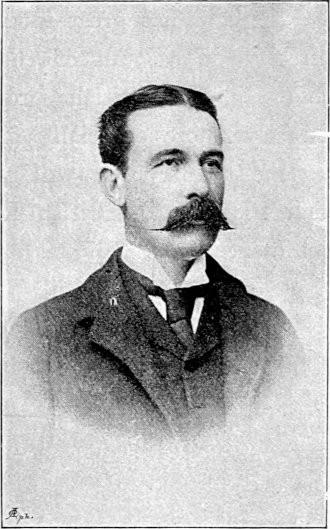
DRUMMOND HAY, BRITISH CONSUL-GENERAL AT TUNIS.
Together we traced the plan of my journey, which, in the main, I
afterwards followed. Here I will not anticipate what I shall relate
later; only premising this—that I owe first and foremost to
Drummond Hay the fact of having comprised in my journey those
regions which no traveller has as yet described. To him I was also
afterwards indebted for the elucidation and explanation of what I
had seen and heard.
Both my host and
hostess had resided for many years in Stockholm, when Drummond Hay
was Consul there. The north has great attractions for them, as
Drummond Hay’s mother was a Dane, a Carstensen, being daughter of
the last Danish Consul-General at Tangier.
England has great interests in Tunis, not only directly on
account of the many Maltese living there under British protection,
but also indirectly, more especially since the French settled in
the country; it will therefore be understood that the post of
British Representative is one of confidence.
CHAPTER II Susa
“A happy journey until our
next meeting, and may Allah preserve you from cholera!”
These were the parting words of my friend Gauckler, Inspector of
Antiquities and Arts, who bade me a last farewell at the Italian
railway station of Tunis.
Numbers of flamingoes stalked along the shores of the lagoon,
showing like white patches on the blue-grey expanse of water. Out
on the horizon, where the lake ended, I could see Goletta’s white
houses, and beyond them a deep, dark blue line—the
Mediterranean.
At midday the heat was stifling, but after we reached Goletta
Bay the sun sank rapidly, and the air grew cooler as a little
steamer took us through the entrance to the harbour, past the
homeward-bound fishing-boats. Just at sunset we reached our large
steamer. To the north, Carthage’s white church on the heights near
Marsa appeared on the horizon, and, in the south, the blue
mountains of Hammamlif.
Amid the noisy
whistling of the steamer, mingled with screams and shouts, I
tumbled on board with my numerous bundles and packages; finding my
way at last to the saloon, where a frugal dinner awaited us.
Next morning, when I went on deck, the coast lay like a flat,
grey stripe ahead of us. I went forward and enjoyed the fresh sea
breeze for which I had so longed in Tunis. Near the bows of the
ship were two dolphins. One of them rose to the surface of the
water and spouted a stream of spray through the little orifice in
its head, then sank again. The other then rose in its turn.
The white bundles on the fore part of the deck now began to stir
into life, and each as it rose threw back its burnous, and showed a
dark face. One Arab had with him his whole family. He had spread a
rush mat on which, amongst their numerous belongings, lay, closely
packed, husband, wife (perhaps wives), several children and a large
poodle. A roguish little girl came to discover what I was
contemplating. She was sweet, brown, and clean, and peeped up at
me, hiding her face the while with one hand, evidently conscious of
wrong-doing. The tips of her fingers and toes were stained red with
henna, which was not unpleasing. Soon after, a closely veiled
figure, apparently the mother, came to fetch the little one. I had
just time to perceive
that she was pretty, as she threw back a fold of her haik to wrap
round her child and herself. What a charming picture they made as
they leant against the bulwarks and gazed towards the land!
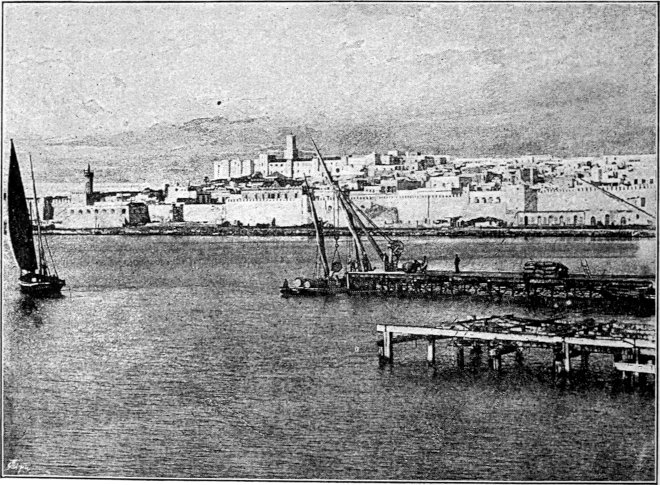
Upon a slope, quite near, lay Susa—white, white, everything was
white.
On the summit of the slope were some towers and a crenelated
wall, and on the seashore beneath, yet another wall. Below lay the
harbour, too shallow, however, for our ship to enter; we had
therefore to lie out in the open.
A boat took me to the quay, where some twenty black-eyed boys of
all ages, with gleaming teeth and red caps, lay watching for their
prey. As the boat drew alongside, they rushed down to seize my
luggage. The boatmen attempted to push them aside, but,
nevertheless, one caught up my little handbag, another my umbrella,
and a third my photographic apparatus. There was nothing for me to
do but to jump ashore and chase the thieves. It was long before I
could collect everything under the charge of one lad. Then, with a
couple of smart taps right and left, my little guide and I marched
up to the Kasba, where the Commandant lives. Here are the magazines
and barracks, and here, too, I knew that I should find a collection
of antiquities.
Susa was originally a Phœnician colony, and played no small part in the Punic Wars.
Trajan called it “Hadrumetum,” and made it the capital of the
province. It was laid waste by the Vandals, rebuilt by Justinian,
and destroyed by Sid Obka, who utilised the greater portion of its
ancient materials to build the holy city of Kairwan. Later the town
was rebuilt by the Turks, who had here for a long time one of their
hiding-places for their piratical fleets. The town was therefore
assaulted by Charles V. in 1537, and again
by Andreas Doria in 1539, and, lastly, was occupied without a
struggle on the 10th of September 1881, by a force under General
Etienne. It is, after Tunis, the most important town in the Regency, and is governed
by a Khalifa in the name of the Bey.
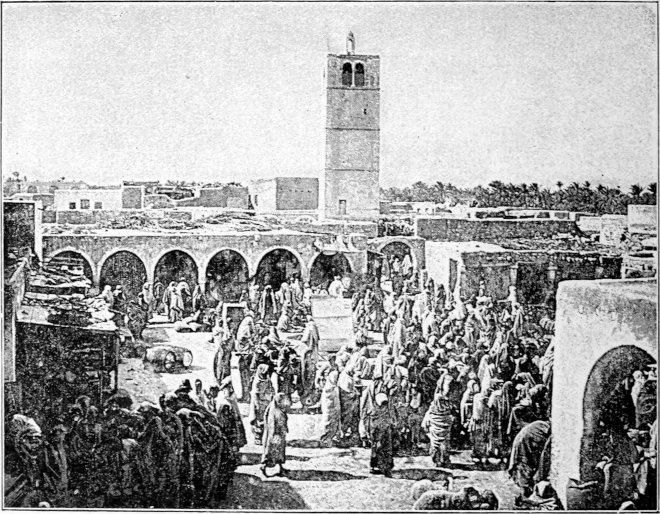
SUSA.
Numerous remains of all these periods are to be found in Susa.
In the houses, mosques, and in the surrounding country, antiquities
and ancient ruins abound. From the Commandant I learnt that the
foundations of the Kasba date from the time of the Phœnicians.
Later, the Romans, as also those conquerors who followed them,
built over these.
In the salle d’honneur are arranged many earthen
vessels of Phœnician origin found in tombs, together with other
objects of the same period.
From Roman times remain magnificent mosaics, partly buried in
the walls; vessels, vases, and broken fragments of marble figures.
The Kasba itself, with its many arches, gateways, turrets, and
walls inlaid with tiles, dates from the days of the Arabs or
Turks.
In nearly every instance the mosaics depict horses, their names
being introduced beside them. Evidently, in those days, this was
already deemed an important mart for horses bred in the country.
The breeding of Barbs appears to date further back than is
generally believed, and, in fact, to be older than the Arabian
conquest of this land. One sees horses depicted with red
head-stalls, decorated on the top with tufts of feathers, and with
their near quarters
branded, exactly as seen on the troop horses of to-day.
The outlines of the horses on the mosaics prove that the Barbs
of that period were the same in type as those of the present age;
also that their careful treatment is not of recent date. Even the
same class of flat iron shoes is used now, as then, on the horses’
forefeet.
I inquired of the Commandant whether particularly fine horses
were reared in this region. He replied in the affirmative, and that
in the direction of Kairwan there are nomad tribes whose horses are
of noble race.
I climbed the high tower of the Kasba,—now used as a
lighthouse,—whence I overlooked the town which lay below me
encircled by its protecting wall. Over the country, on all sides,
olive woods met my view, and far away on the horizon I could catch
a glimpse of villages, looking like white specks. There dwell the
ill-disposed tribes who, in 1881, held out against the French. They
never ventured on an open engagement, but at night assembled in
their hundreds and kept up an incessant fire on the French lines;
killing a number of both officers and men. These were avenged by
heavy levies and fines on the inhabitants. Poor people, they had
only defended their hearths and homes.
My boy guide followed me through the streets, where drowsy lazy Moors
crouched, half asleep in their shops, waiting for purchasers. The
loveliest small boys and girls were lying about in the streets,
much to the obstruction of traffic, here conducted by means of
small donkeys and large mules.
Stepping into a little Moorish coffee-house, I found, to my
astonishment, that the interior resembled in construction an old
Byzantine basilica, its dome being supported on arches and pillars.
The whole was white-washed, but well preserved. The coffee-house
was named “el Kaunat el Kubba,” which may be translated Church
Café.[1] Nothing could be more artistic than the cooking
utensils, mats, and pottery scattered here and there about this
very old building.
At five o’clock it was dark. The stream of wayfarers diminished,
and the streets were deserted and empty. I dined at the Hotel de
France on the seashore, not far from the esplanade, and sat after
dinner reading my papers, till I heard a frightful noise outside,
and, peering out, saw a crowd of Arabs gathered behind an unfurled
banner. They shouted and yelled in measured time. One of them said
a few words which all the others repeated. I was told that they
were praying to Allah for rain. They halted a few paces from a
kubba, called Bab el Bahr, and the procession dispersed, the banner
being taken into the kubba.
I went for a turn on the seashore by the road which leads along
the walls to Bab el Jedir. The sun was melting hot. Against the
walls were built a number of mud huts and sheds, in which, amongst
carriages and carts, horses and donkeys were stabled.
Outside were piles of pottery, vessels of all shapes and sizes,
from the largest receptacles for wine or water—reminding one of
those found belonging to the Roman age—to cups and jars of spiral
or other strange forms, such as I have seen in the museum at
Carthage.
This clay ware is brought from Nebel, where, since very ancient
times, there has been a manufactory that produces pottery the same
to-day as it was a thousand years ago.
The gateway is deep, and has, as have most gates in this
country, recesses with seats on both sides, always filled by idlers
and beggars. Indeed, it is quite an Eldorado for the blind, halt,
and maimed, as well as for many who have nothing the matter with
them. The whole day they sit there and stretch out their hands for
alms.
I placed myself near the corner stone of the gate, where the
shade was cool and pleasant; through the dark archway I could see
the sun blazing on the shore, and the road looking like a bright
streak of light, and,
beyond it, the harbour and the beautiful blue sea.
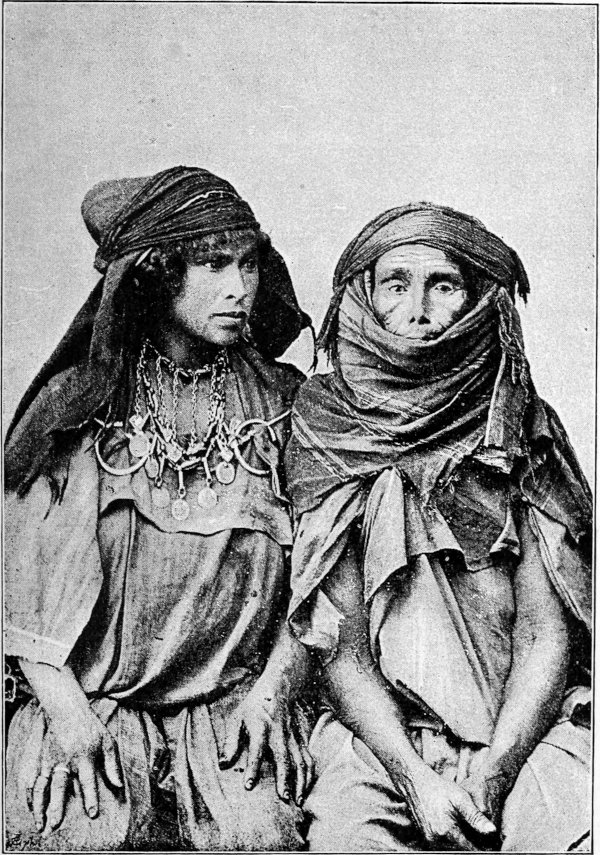
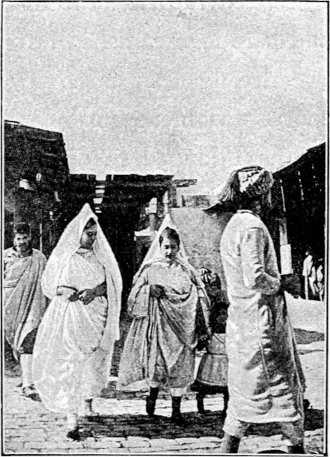
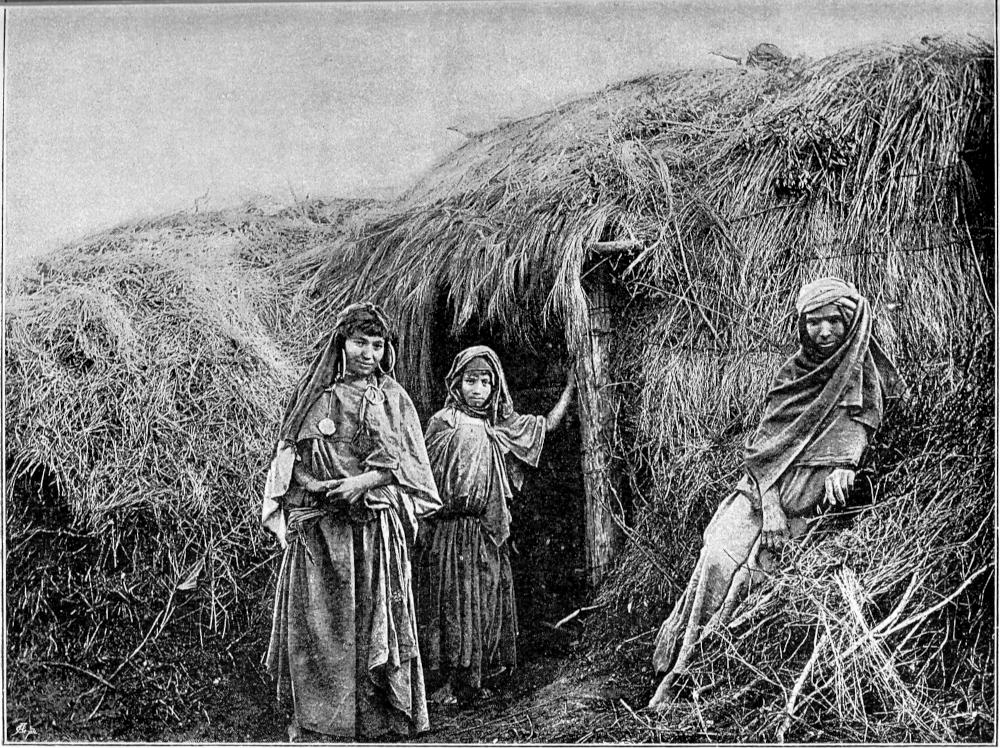
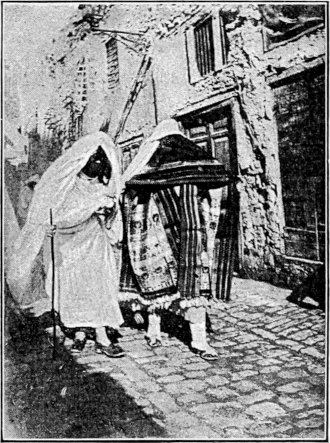
TWO KHRUMIR WOMEN.
In the space of half an hour, at least a hundred little donkeys
passed me, laden with vessels of water or bundles of straw, with
often a man or boy perched behind the load. A solitary rider also
passed, his small but wiry horse going at an amble. Along the
seashore came, picking their way, a herd of goats, most of them
wearing small bells that rang incessantly. The herd settled in the
corner outside the gates between the towers and the town wall. Then
came unveiled Bedouin women, dark-skinned almost as negresses, but
with very fine features. Then other veiled Arab women with black
masks that covered their faces. A number of boys followed these,
all good-looking and black-eyed. One held out his hand; they are
accustomed to European good-nature, and a copper is a foretaste of
Paradise to an Arab boy.
Lastly passed a strange couple. On an ordinary Arab saddle a
veiled woman rode astride, and behind her, on her horse, a little
boy; he held the reins in one hand, and a parasol in the other.
Towards evening it grew cooler. Amongst the shipping lay the
Ville d’Oran, which next morning was to take me south. It
was lit up with numbers of lanterns, and the town was illuminated
and hung everywhere with flags, in honour of the
Russian fleet, which
that day was to enter Toulon. Festival was kept, not only all over
France, but also in her colonies. Illustrated editions of French
newspapers, with coloured pictures of Russian and French admirals
and of the ships of both countries, were displayed on the walls of
all cafés, tobacco shops, taverns and drinking booths in Susa.
The light on the Kasba had been lit. The moon rose over the
town, and lanterns gleamed along the seashore and the promenade.
The irregular line of the wall and the Kasba tower showed dark
against the heavens. Mingling with the ripple of the water against
the quay, I heard the Marseillaise played, followed by cheers, and
on the terraces and balconies appeared dark figures, enjoying the
cool air and the music.
CHAPTER III From Sfax to Gabés
At 9 a.m. on the morning of
the 14th October, the Ville d’Oran weighed anchor and left
the roadstead of Susa in brilliant weather for Monastir.
Monastir, or Mistir, has a population of nine thousand
inhabitants, of whom one thousand are Europeans. It was originally
a Carthaginian town; later, the “Ruspina” of the Romans. It is now
surrounded by battlemented walls interspersed with towers and
pierced by five gates. Ornamented with coloured tiles, the minarets
of several mosques rise here and there above the houses.
I crossed the town from the south to the opposite side. Here I
found an immense cemetery; grave upon grave grouped about kubbas.
In the very midst of the cemetery is a cistern, which must supply
remarkably good water!
Following along the walls of the town I soon reached the beach,
where before me lay three small islands—Jezirel el Hammam (Pigeon
Island), Jezirel Sid Abd el Fairt el R’dani (so called after a
Marabout whose kubba
crowns its summit), and the third island named Jezirel el Austan
(Central Island).
Still following the walls, I passed Moorish women and children
washing clothes on the shore. A number of boats were lying in the
shallow water under the lea of the islands.
At ten o’clock I was again on board, and at eleven we started,
steering for Mehdia, some thirty-six miles farther south.
On the way we passed Cape Diauros, the site of ancient Thapsus.
It was a Carthaginian colony where fought Cæsar Scipio and Cato.
Numerous ruins recall the old times.
In Mehdia harbour we anchored about three o’clock. Mehdia was
once a very important town; now it has only some ten thousand
inhabitants. The Sicilians besieged it in 1147; the Arabs in 1160;
the Duke of Bourbon in 1390; and Charles V. in 1557. The knights of
Malta took part in this last assault, and the grave of one of these
knights is still shown.
Some Europeans carry on a trade here in oil, dried fruits,
sponges, coral, and sardines. In the months of May and June there
are often a couple of hundred boats lying off the shore fishing for
sardines, and generally making good hauls. In one night a single
boat may take even as much as from four to six hundredweight of
fish.
Large vessels do not follow the coast from Mehdia to Sfax, but make a long circuit
round the island of Kirkennah, the water along the coast being
shallow. Along this stretch of sea have been placed light-buoys to
mark the course. These buoys are filled with compressed oil, and
burn incessantly day and night. They are constructed to burn three
months, but are inspected monthly.
Early in the morning of the 15th October we cast anchor about
two miles outside Sfax, of which the white walls glistened in the
morning sun. A steam tug took us ashore. The ebb and flow of the
tide here is very strong, with a possible rise and fall of as much
as eight feet, which accounts for the flatness of the beach.
The only ship in the roadstead was the Fæderlandet
from Bergen, lying-to and discharging timber.
Sfax was taken on the 16th July 1881 by a force under Admiral
Garnault, after a serious bombardment which laid waste a great part
of the ramparts and the town.
The walls enclosing the European quarter, which faces the sea,
have been pulled down lately, and here the French have established
themselves. To the rear lies the Arab town, still surrounded by its
walls and towers.
On landing I met the Vice-Consul for Sweden and Norway, Olaf
Henriksen, a young man who in the course of a few years has made for
himself a good position as partner in the large, and perhaps sole,
firm of timber traders in the place. His office and warehouses are
on the quay. Olsen, his co-partner, is likewise a Northerner.
Henriksen is agent for the United Shipping Co., but it is seldom
that Danish vessels touch here.
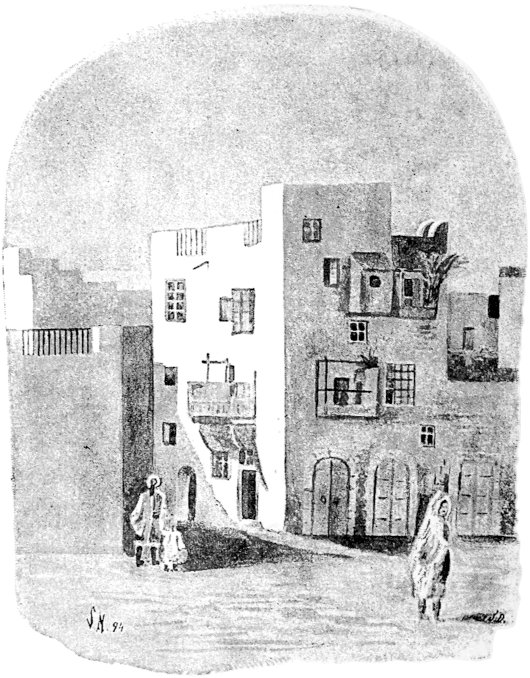
AT SFAX.
(From a painting by Mrs. Henriksen.)
After a stroll through the town, Mr. Henriksen led me to his home and
introduced me to his wife, a Norwegian lady from Christiania. I
spent a comfortable and most enjoyable day in their house, which is
outside the town and commands a view of the harbour.
Mrs. Henriksen is a very fair artist. On the walls hung sketches
of her northern home and of Sfax, painted by herself and showing
considerable talent. The tombs of Marabouts, the cemeteries outside
the walls, and the Arab tents in the vicinity were the subjects
that pleased me most. She most amiably promised to be my
collaborator, by allowing me to make use of a couple of her
sketches for my book.
Sfax is a large town, with about fifty thousand inhabitants, of
whom the eighth part are Europeans. A considerable trade is carried
on in sponges, oil, and esparto grass, this last being worked by a
Franco-Anglo-Tunisian Company; in addition to these, there is a
trade in fruit and vegetables, more especially cucumbers, called in
Arabic “Sfakus,” from which, no doubt, arises the name of the
town.
In the neighbourhood are many villas and gardens, where the
townsfolk take refuge in the hot season, but beyond these is the
sandy desert.
In ancient days the Romans had here a large city, of which many
traces are found. In the covered streets I saw arches, which by their
capitals and columns were of Roman origin, and heard of old Roman
graves and foundations being frequently discovered.
Sfax is a garrison, and amongst the soldiers is a fine body of
Spahis, but at the time of my visit many were absent at the
manœuvres.
During the night we steamed in four hours from the roadstead of
Sfax to Gabés.
A golden strand: in the background some white houses, and to the
right a palm grove. Such is the view of Gabés from the sea.
The landing-place was only a short distance from the European
quarter. I called on the commanding officer, Colonel Gousset of the
Spahis, to whom the Regency at Tunis had recommended me, directing
that he should assist me by word and deed in my journey to the cave
dwellers (troglodytes) of the southern mountains.
It was the hour of muster, and the Colonel introduced me to many
of the officers, one of whom, Captain Montague of the General’s
staff, lent me his horse, and a Spahi was told off as my guide.
“When one wanders towards the Syrtes and ‘Leptis Magna,’ one
finds in the midst of Afric’s sands a town called Tacape; the soil
there is much cultivated and marvellously fruitful. The town
extends in all directions to about three thousand paces. Here is found a fountain
with an abundant supply of water, which is only used at stated
times; and here grows a high palm, and beneath that palm an olive,
and under that a fig tree. Under the fig tree grows a pomegranate,
and beneath that again a vine. Moreover, beneath these last are
sown, first oats, then vegetables or grass, all in the same year.
Yes, thus they grow them, each sheltered by the other.”
Thus wrote Pliny of the oasis near Gabés over eighteen hundred
years ago, and this description can be applied in the main at the
present day.
Of this town, created by the Carthaginians, colonised by the
Romans, and later the seat of an archbishopric, and which stood
nearer the ocean than the existing villages, there remain now only
some crumbled ruins on the hills near Sid Bu’l Baba’s Zauia, now
difficult even to trace.
Remains of cisterns can be seen, built with the imperishable
cement of which the Romans alone understood the preparation. But
the stones have long since been removed to Jara, Menzel, and
Shenini, villages of the oasis, where are still to be found, in the
wretched native buildings, carved capitals and bas-reliefs, side by
side with sun-dried bricks and uncut stones.
But it is long since this old town vanished. The Arab
geographers in the eleventh and twelfth centuries, as also Leo Africanus in the
sixteenth century, mention Gabés as a large town surrounded by
walls and deep trenches, which latter could be flooded with water.
They tell us of a great fortress there, and that the town had a
large population and extensive suburbs. Then the Mohammedan
conquerors laid their iron hand over the country, and the
inhabitants were dispersed and gathered in the villages Jara and
Menzel, each now containing some four thousand inhabitants. Both
villages were situated near the river and close to the
market-place, and were continually fighting amongst themselves
for the possession of
these; whilst other villages, of which Shenini is the largest,
concealed themselves amidst their palm groves.
TOWER IN THE VILLAGE OF MENZEL.
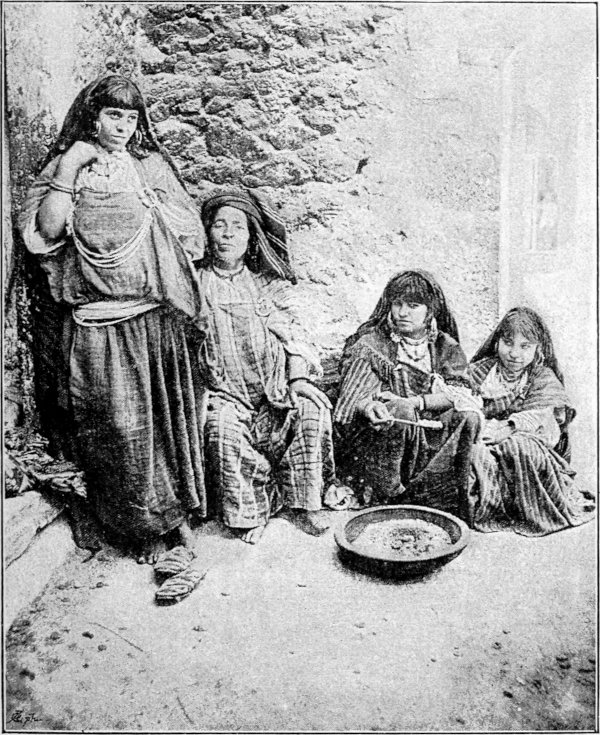
JEWESSES AT MENZEL.
To keep these rival villages in subjection, the Turks erected,
just between them, a fort—Borj Jedia (the new fort). It was blown
up by French marines on the 21st July 1881, when they assaulted, stormed, and seized
the villages.
Later there arose by the seashore, huts, taverns, and
eating-houses, and, after the first occupation, these formed a
place of resort for all sorts of adventurers, and was therefore
wittily named “Coquinville” by the soldiers. Out of this has grown
quite a little town, known as the Port of Gabés. This is occupied
by the European colony, consisting of from one to two thousand
persons of various Mediterranean origins. The residence of General
Allegro, the Bey’s governor of El Arad, the most southern district
of Tunisia, was originally the only building on the spot, and here
he still resides; but now in the long streets there are
commandants’ houses, officers’ quarters, the Hotel de l’Oasis, and
a large number of offices of all descriptions. Behind the town to
the south, lie the barracks for the garrison of Spahis and
infantry. In former days the troops were quartered farther inland,
on a height near the Gabés River, as the water was better; but now
drinking-water has been brought to the town from a near-lying
oasis.
Wad Gabés, or the Gabés River, has its source about a score of
miles inland, and flows over its broad bed, through saline and
lime-charged soil, down to the oasis, wherefore the water contains
much magnesia, and is in consequence most unwholesome, and has caused the death of many
a young colonist and soldier. It is said that the age of the eldest
soldier buried in the churchyard was but five-and-twenty.
In old times the water must naturally have been as unhealthy as
now, but the Romans, those masters of colonisation, used, on that
account, rain water collected in cisterns. Remains of such tanks
are found everywhere in the south.
The Arab rider, given me as guide, and I rode along the northern
bank of the river so as to cross the Gabés oasis from the sea
towards the interior.
It was the most enjoyable excursion I can remember ever having
made.
The sea roared behind the sand cliffs, while the horses panted
through the deep sand. From behind the cliffs appeared the tops of
palm trees, and presently we were in the shade.
The light gleamed through the palm leaves on lemon, orange, and
pomegranate trees, and on the trailing vines, trained up to the
beloved sun, and stretched from tree to tree in graceful
festoons.
In the open spaces between the palms lay the orchards, where
grew all kinds of fruit trees—peaches, apples, pears, plums,
apricots, figs, olives, and many others.
The air was pregnant with the scent from the trees and plants. Beneath the
shade of the thick foliage overhead spread the most beautiful green
sward, intersected by flowing rivulets of water and small canals,
dammed by means of dykes and low banks, as in our own land
irrigation.
ON THE OASIS OF GABÉS.
By small paths and roads we wandered on, following the turns of
the canals, riding sometimes on a narrow track between two banks,
and if we then met Arabs on their little overladen mules it was a
squeeze to pass by them.
There was silence amongst the trees. Only now and then, when we
drew near to tents, or some straw hut concealed amidst the foliage, could we
hear voices and the barking of dogs. Women and children peeped at
us through the branches, and we saw men in scanty clothing working
with hoes in their gardens, or women weeding the beds and gathering
henna in baskets.
Birds flew from branch to branch, or across the open spaces.
Wood pigeons called, and turtle-doves cooed, whilst the chaffinch
fluttered about on the tops of the almond trees, and in the
distance the sound of a shot proclaimed that a sportsman in a
clearing on the borders of the oasis had fired at hare, quail, or
partridge. On the extreme border, by the sea, was the tomb of a
Marabout, built from the ancient remains of the town of olden days,
blended with new materials. The columns supporting the entrance
were of new rough stone, with handsome carved capitals.
We emerged on the barren plain, and saw in the far distance, on
rising ground, other palm groves, but hurried back again into the
fascinating wood, till, by paths and over small stone bridges,
beneath which streams rippled sheltered by the arching palms, we
came to a broader road between high dykes. There it was difficult
to advance, as some artillerymen with baggage carts drawn by mules
had stuck fast in the mud, the waggons being overladen with
stone.
The way now turned
towards the river. As we left the palm grove by the miry road to
cross the bridge, the grey walls of a village lay before us on the
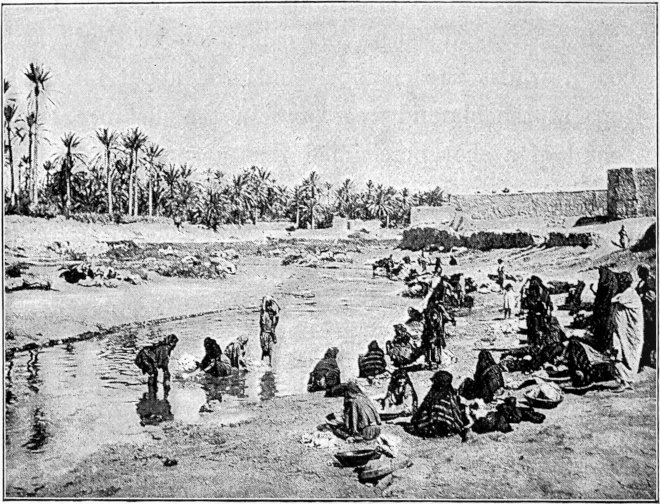
opposite side. The river bank was crowded with women and children
washing; clothes were hanging to dry on the bushes, whilst
shortly-kilted figures waded into the water, or sat on the stones
by the river side beating clothes with flat boards. Most of them
pretended not to see us, some turned their backs, and a very few
stole roguish glances at us.
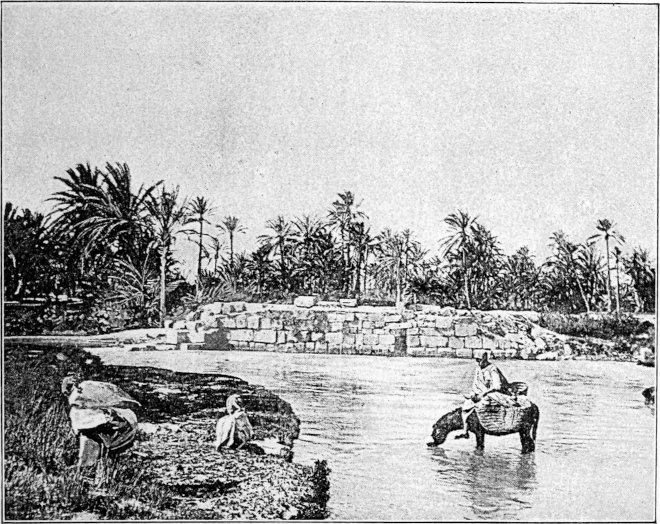
WASHERWOMEN AT THE JARA BRIDGE.
The whole scene was worthy of the brush of a good artist. The
grey-yellow water, the yellow shore and green wood under the deep
blue sky, and against
this background the many-coloured figures of women and children.
All were in constant movement and chattering loudly.
We rode through the gate. The village consists of narrow streets
and lanes of wretched low houses. The air was oppressively hot, and
dirt was everywhere. My guide rode in front, pushing people aside
with loud exclamations. They submitted quietly to being hustled;
“Kith to kin is least kind.” Then, again crossing the river, we
rode through the oasis to other villages and as far as the poor
huts of Shenini, then turned again down to the stream, which here
ran between high banks, and after visiting, just at nightfall, some
encampments close by, we hastened on our way back to Gabés.
CHAPTER IV From Gabés to the Matmata Mountains
Crouched in a wretched hut,
which seemed to me then the perfection of comfort, I sat writing by
the light of a flickering candle at the village of Zaraua, on the
top of a mountain of the Matmata range, south of Gabés.
Outside I could hear my horse munching, as he stood, his
well-earned barley; farther away dogs were barking. The moon sent
her rays through my doorway; and now and then came to my ear the
sound of human voices, but this soon ceased as the sun had long
since set: for in these regions all retire to rest early so as to
rise at daybreak.
The two previous days had sped as in a fairy tale. As I opened
my window at the Hotel de l’Oasis at 4.30 a.m. on the 17th October,
it was still half-dark, but I could distinguish a little way down
the street an Arab horse, saddled, and by its side a white bundle
lying on the footway. It was Hamed, the Arab horseman, whom the
bureau de renseignement had placed at my disposal, and who
was now waiting for five o’clock, the hour fixed for our start. A little later
arrived my brown steed, supplied by the Spahi regiment.
My small travelling kit, photographic apparatus, and breakfast
were packed on Hamed’s horse. The revolver I slung on my own
saddle, little realising that the same afternoon I should fire it
on a festive occasion; and we started, wending our way amongst the
showy, newly-built European houses.
Outside the town, the country is somewhat flat; we followed the
road. To our right, towards the north, was Gabés’ winding river,
but invisible to us, as it lies low. On the other side, the palm
groves showed us a dark forest. The villages by the river stood out
clearly against this dark background, and the rising sun shone on
the white kubba to our left of Sid Bu’l Baba.
On the road we met little groups of natives driving camels and
tiny donkeys, all laden with esparto straw. Their houses were many
a mile away over the blue mountains, which were dimly
distinguishable on the horizon, for they came from Hadeij, our
destination, to sell this, about the only product in which they can
deal during the hot summer season.
Now and again we also met small caravans of donkeys carrying
light loads of dry wood.
After a quick trot, that warmed us at this early chilly hour, we
turned to the left in a southerly direction, taking a path that wound along
slightly undulating ground. A brace of partridges rose, and we
heard the quail calling, and saw young larks running on the barren
ground. On a hill to the north-west we spied the camp of Ras el
Wad, erected by General Boulanger in his day. Once and again we
indulged in a quick gallop, but only in short stretches, when the
paths were not muddy or too winding.
Here and there stood a parched olive tree or date palm, on spots
where, in the wet season—if it ever come—a little water would reach
them. We were overtaken by a horseman closely enveloped in a white
burnous, the hood drawn over his head and sticking up in the air in
a peak. It was “Amar” from Hadeij on his slight but wiry pony. He
was acquainted with Hamed, so wished to join us. His hair, beard
and eyes were black, his expression good-natured, with an open
brow, and his teeth milk white.
After two hours’ ride, during which we only once met any people,
we reached the oasis of El Hamdu; near by roamed some miserable
cattle, grazing under the care of an old man; with these were also
a couple of goats.
On the border of the oasis we watered our horses at a fountain
surrounded by palms. Women peeped shyly at us over the walls of the
only stone building of the village that we could make out.
Riding on, we
passed several tombs of Marabouts. On our left, the palms of the
oasis seemed drawn up in a long line, and smoke could be perceived
rising heavenwards from huts and tents beneath the trees. From an
encampment on the edge of the oasis the dogs rushed out barking,
the inhabitants standing stiffly, like statues, and staring at
us.
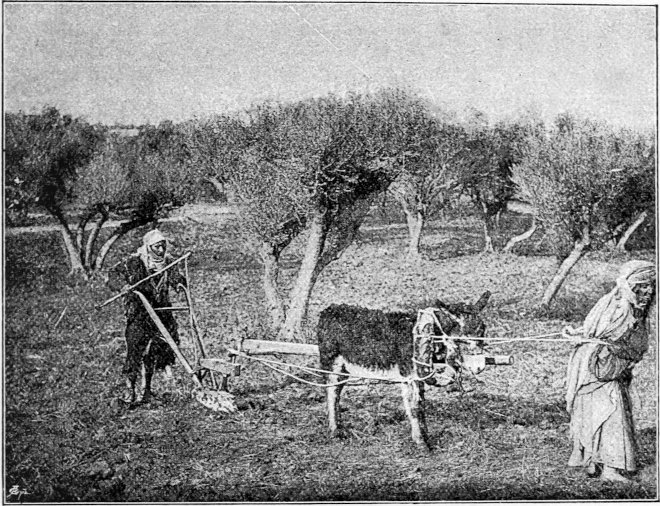
PLOUGHING-GABÉS.
Along a shallow, stony, river bed—rough ground for the horses—we
pursued our way towards our destination in the hills, whilst the
sun burnt so fiercely that our senses were dulled.
After a couple more hours, we again met laden camels, and with them some
travellers on foot, one without a burnous or head-covering, and
clothed only in a shirt confined at the waist by a strap. He wore
his hair in a tuft on the nape of his neck, and carried in his hand
a banner on a pole. Amar told me he was a Marabout from one of the
villages near Gabés.
Of Marabouts there is no lack. This one was very poor, and was
returning from the mountains, where he had been begging for money
which he imagined was due to him. The banner he carried that
everyone might see that a holy man was coming.
I gave him a few coppers, and the young fellow kissed my hand,
and wished me good luck on my journey. It is not everyone who is
wished good luck on their travels by a Marabout. I bought my
blessing cheap.
We now rode some distance amongst small hills, which are
scattered in the foreground of the mountains like islands on a
coast-line. On some eminences were heaps of stones.
“Those were there before our time,” said Amar.
In places where the ground was more or less level it was
slightly scratched round about the dry bushes. This is the arable
land, that is to say, it would be cultivated if rain fell.
We halted beneath some bushes to eat our breakfast. The bread, butter, and cheese we
could all enjoy, but I alone the wine and meat. A pomegranate
supplied our dessert.
Whilst we sat there, five women in blue dresses came by,
preceded by an old man driving half a score of camels. The women
wore bracelets and anklets. They glanced furtively at us and
trudged past. A negress only, who lagged behind, tried to attract
our attention. She was evidently not accustomed to be taken notice
of.
Travelling was now easy, the track leading upwards over smooth
calcareous ground. In little watercourses, now dry, were planted
clumps of palm and olive trees, the soil being banked about them to
form dams. On an adjoining slope were numbers of small caves,
inhabited only in harvest time, when watch is kept over the
crops.
We ascended higher and higher amongst the mountains, until
suddenly, as I turned in my saddle, I saw the Mediterranean like a
blue streak in the distance. We were at that moment at the highest
point we were to reach that day. At a distance here and there dogs
appeared, barking at us, and occasionally in their vicinity white
figures and rising smoke. Hamed said that these people were cave
dwellers, but were only a small tribe. A little later we were to
arrive at quite a subterranean town.
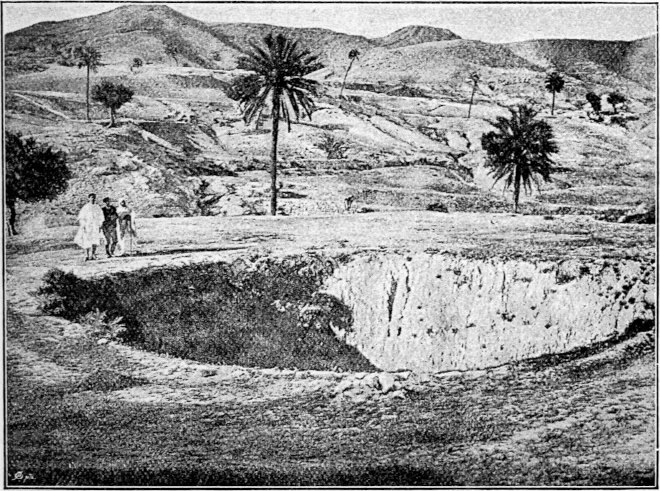
I halted abruptly
on seeing below me a valley with, comparatively speaking, many
trees. On the farther side rose a long range of high mountains. The
valley itself was exactly like a large, old sand or clay ditch,
with sloping sides, pierced by a great number of neglected and
long-disused shafts, but planted with trees—palms, olives, and
figs.
“Is that Hadeij?” I asked. Hamed nodded, and I pulled up to take
a photograph.
It was then exactly two o’clock, and we continued on our way,
walking for a time beside our horses. Just as we were about to
remount, a white sheep-dog bounded out of a hole we had not
noticed; it bayed at us in a most dismal fashion, and from the
nearest points of vantage its companions joined in chorus.
I rode up to look at the dogs, and caught sight of a deep pit
with perpendicular sides that had been dug in the ground from the
top of the ascent. Down at the bottom a camel stood resting. Round
a hearth were household chattels and large bins made of rushes,
containing barley, and amongst these a few fowls. Some women and
children looked up on hearing the tramp of my horse, stared at me
for a moment, and then fled into recesses in the walls.
Hamed now suggested that I should not remain standing there, and
I followed his good advice.
A path had been
dug into the hillside, and terminated in a large door or gate. This
evidently led to a long underground passage, and ended in the
square yard, open to the air, which I had just seen, and whence are
entered the excavated rooms or caves, used as dwelling-places,
stores, and stables.
On the horizon the straight stems of palms stood out sharply
against the mountains. In the foreground were olive trees, and,
mingled with them, a few palms; beneath one of these was gathered a
group of men, amongst whom, Hamed said, was the great Khalifa. I
therefore drew rein. An old greybeard rose and strode forward,
offering his hand and bidding me welcome, the other men following
his example. They were fine specimens of humanity, with regular
features, black eyes, and straight noses—one saw at once that they
were not of the ordinary Arab type.
From an open space, or square, several passages led into the
hills, affording admission to the cave dwellers’ abodes, which are
all of similar construction to that already mentioned. I was
allotted quarters in one of the caves, and stepped from the outer
air into the hill through a wooden gate on heavy hinges, and
proceeded through a long passage, cut in the rocks, a little over a
man’s height. On either side were excavated large stalls for
horses, the covered way ending in an open square court with perpendicular walls some
thirty feet high and about the same in width. From this court one
steps into symmetrical caves with vaulted roofs.
In the underground guest-chamber I stretched myself comfortably
on a couch covered with handsome carpets from Kairwan. A table and
some chairs completed the furniture of this room, specially set
apart for European guests. The Khalifa is rich, very rich, so that
he can permit himself this luxury, though it is but seldom that he
has a European visitor. He told me with pride that General
Boulanger had in his time been his guest.
After my long ride I required rest; the doors in the yard were
therefore closed, so that it was quite dark in my room. The flies
did not worry me, and I had quite a refreshing sleep until I was
awakened by the neighing of the horses in the passages. A little
later the light streamed in through my door; a figure stepped in,
and for a moment it was again dark whilst the newcomer passed
through the doorway.
It was the Khalifa; behind him came Hamed and several other
persons, sons or people of the house.
I expressed my pleasure at being the guest of so hospitable a
man, and the Khalifa responded with compliments. Coffee was served,
and the party grouped
themselves about me on the floor, with the exception of the Khalifa
who seated himself by me on the divan, and conversation flowed
easily with the help of Hamed.
The contents of my saddle-bags, the photographic apparatus, and
especially an entomological syringe, underwent careful
investigation.
JEWISH FAMILY IN A CAVE DWELLING IN HADEIJ.
But I could not afford to sit and idle the time away, so went
out to look about me. Through Hamed I expressed my desire to
examine the interior of a dwelling, and was promised that I should
see everything; but several times we passed the square openings on
the tops of the hills, as also the entrances to houses, without
anyone making a sign to us to enter.
At last we arrived at a house into which I was invited. On the
whole it much resembled that from which we came, and was inhabited
by a Jew and a poor Berber family.
The yard was dirty; cooking utensils lay scattered about, intermingled with a few
rush corn-bins and some goats and poultry.
A woman, old, wrinkled, and tattooed, and both hideous and
dirty, was brought forward for me to see. It was, of course, the
Jew’s wife. His fellow-lodgers, the Berbers, I did not see; but as
I stepped into the dwelling, a vision of blue skirts and bare legs
vanished into the side caves.
Already I began to feel impatient and to fear that I was being
made a fool of and should never see, as I longed to do, where and
how the Berbers lived. Fortunately I had later a splendid
opportunity of studying the whole subject.
Accompanied by two sons of the Khalifa and some other persons I
walked round the valley and up the slopes, whence I could peer down
into the caves at the bottom of the valley, and could see women
going through the entrances to their dwellings, to the palm and
olive trees, followed by dogs and inquisitive children.
My camera I had with me, and used it frequently.
As the sunset hour approached, the heat relaxed, and one
breathed with ease.
In a great open square, beautified with palms, at least fifty
young men and boys were running from side to side. They had cast
aside the burnous, and wore only red caps and shirts, which
fluttered as they
ran. With long sticks, bent at one end, they struck at a soft ball
which flew to and fro, sometimes in the air, sometimes on the
ground.
It was beautiful to watch these bold muscular figures, so
straight and supple, with their light brown skins, regular features
and bright eyes, reminding me that thus must the Greek and Roman
boys have played on the plains beneath their blue mountains.
CAVES IN MATMATA.
The game was kept up without a pause, until the sun sank
suddenly behind the mountains, and it was no longer possible to
see, for twilight is unknown in these regions.
I returned to my
cave, lit my candle, smoked cigarettes and waited until my dinner
should be served.
Five figures appeared, each carrying a dish which was placed on
a table before me, and a pitcher of water was deposited beside me.
The meal consisted of soup with lumps of meat highly peppered, a
stew of chicken, and an enormous dish of kus-kus, made of barley
meal with goat’s flesh, and, finally, honey and bread; this last
was of barley meal, dry but well flavoured.
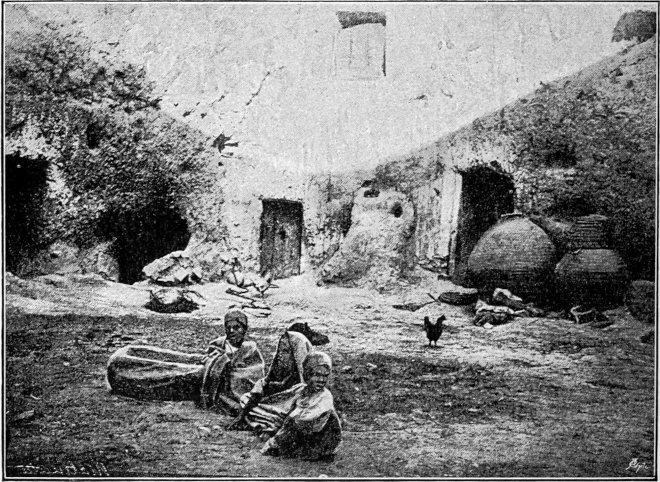
A CAVE DWELLING, MATMATA.
A knife I had with me; but a spoon, that treasure to a European
in these regions, was provided. Hamed stood by my side, filled my glass
whenever it was empty, and served the dinner. On one side sat
Mansur, the Khalifa’s third son, as ordained by their customs and
usages. I requested him to join me at dinner. With a graceful
motion of his hand to his breast, he bowed his head and begged me
to excuse him.
Hamed informed me that honoured guests always dine alone.
On the floor, somewhat aside, sat a row of white figures all
staring at me whilst I ate.
A great silence reigned.
This procedure rather disturbed me at first, but one soon gets
accustomed to this sort of thing.
Hamed constantly pressed me to eat. I thought it could be of no
consequence to him; but discovered later that he was prompted by
delicacy of feeling. For when I had concluded my meal, it was his
turn, with Mansur and others, to eat the remains. All the scraps of
meat, bones, etc. left were then put back into the dishes, and
these were carried into the adjoining room where the rest of the
men gathered round them; but before doing so, they poured water in
a basin and moistened their lips and fingers.
I peeped in on them, and was greeted by the sound of noisy
mastication.
Their shoes had been left beyond the edge of the rush mat on which they were
seated. Fingers were used in place of spoons or forks.
At last they were satisfied. The remnants were again collected
in a dish, and it was then probably the turn of the boys and
negroes, and, after them, of the dogs; but the end I did not
see.
After enjoying coffee I went out into the court where the stars
twinkled overhead. In the distance I heard a strange humming noise,
and the sound as of far-off explosions. After a little while the
Khalifa arrived to invite me to be present at the first day’s fête
held to celebrate his son Mohammed’s wedding to a second wife, and
I then understood that the sounds I had heard had been the hum of
many voices and of gunshots.
The moon rose in the vault of heaven, and disclosed in front of
me, and on either side of the slopes, forms wrapped each in his
burnous, squatting side by side. From above, the moonlight shone on
the white crowd, giving them the appearance of spectres. The group
opposite looked as though moulded half in black, and half in
dazzling white.
Up above and to the left were depicted against the light a crowd
of black, pointed figures. These were men of the Matmata mountains;
they sat silent, watching apparently the dark corner in front of
me, where no light penetrated, as the moon rose high on her
course.
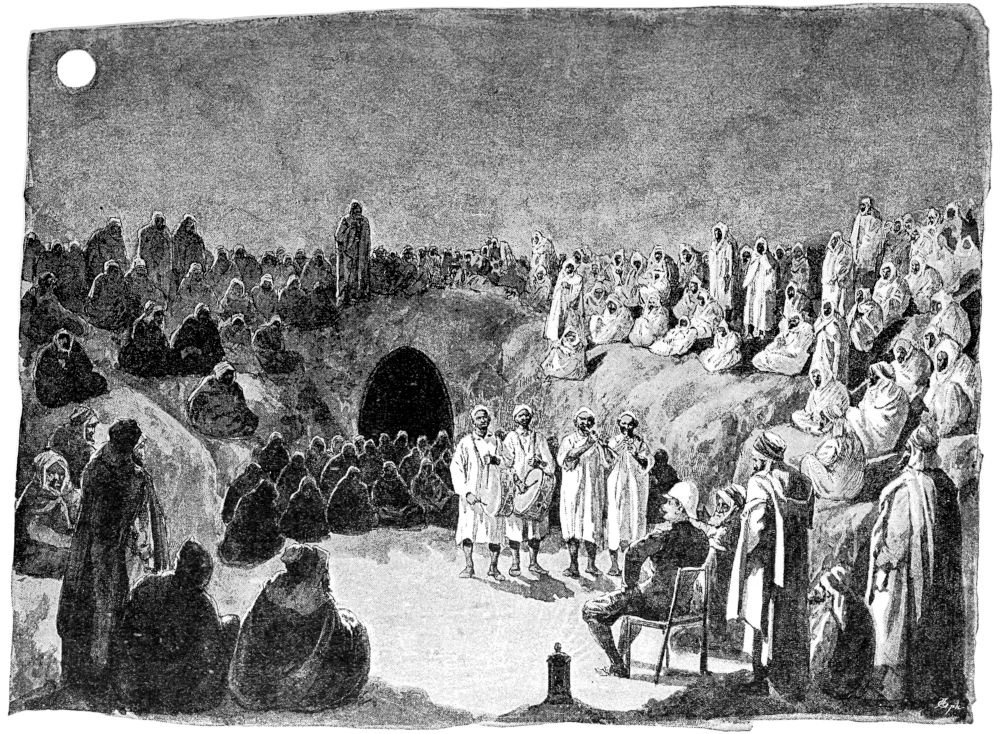
THE BRIDAL FESTIVITIES.
(From a sketch by Knud Gamborg.)
The Khalifa
ordered chairs to be brought. On these we seated ourselves, Hamed
standing behind us, and bending forward to each of us in turn, like
a mechanical contrivance through which we carried on our
conversation.
Groups of men sat behind and beside us; they continued arriving
until the square was full to where the Matmata men sat on the
banks.
Right in front, on the level ground, I distinguished a dark
compact mass. These were the women, closely enveloped in their
sombre garments; they were seated by the entrance to the caves.
A lantern was now lit and placed on the ground near my feet. At
first its light confused me, but without it I could not have seen
what took place.
One of the Khalifa’s horsemen named Belkassim, a relative and an
elderly man, was deputed to maintain order, and at once cleared a
little space between us and the women. He then led forward two
negroes, who performed a dance to the sound of a drum and a
clarionet. They marched towards us side by side, then retired
backwards, then again forward and back. This was repeated some
half-dozen times, with a swinging movement from the hips. Every
time they approached us, they waved the drum and the clarionet over
our heads, then turned towards the women before stepping
backwards again. The
Khalifa raised his hand. The negroes bent their heads backwards
that he might place a coin on the forehead of each. I followed his
example; with the result that they continued their parade and
deafening noise of slow, harsh, wheezy, jerky music.
Suddenly it increased in pace, and both negroes whirled
violently round. The time then became slower, the parade
recommenced, and my sense of hearing was again endangered each time
the loud drum was swung over my head.
The din ceased abruptly, and from the rows of women came a
strange clucking sound as of the hurried calling of fowls, “Lu, lu,
lu, lu, lu, lu, lu.” This was a sign of approval. At the same
moment a gun was fired. The flash lit up the rows of women. The
shots were repeated again and again. It was the bridegroom’s
nearest friends firing a salute in his honour. The women responded
with the “Yu, yu” cry, the negro musicians joined, and more shots
followed.
Then it struck me that I also would join in the festive
demonstration, so I told Hamed to bring me my revolver, and I fired
the six chambers into the air, one after the other.
The women at once broke into the cry of joy. Drums and
clarionets joined in.
“I am much gratified,” I said to the Khalifa, “that you have introduced me to
the circle of your people. Here is my hand in token of my
gratitude. May Allah protect you and yours.”
“Thanks for your good wishes,” he replied. “You come from a
strange and distant land. You are my friend and my brother, one for
whom I am responsible so long as you remain in the Matmata
mountains. You are free to travel anywhere you please; no one will
injure you.”
I said, “When I came I knew you would treat me as you would a
brother; I was told so by the Khalifa of Gabés; but I was not aware
that you had authority over all the tribes of the Matmata. But now
I know it. I arrived with this weapon by my side, as you may have
seen it hung by my saddle when you received me. Now I realise that
it is superfluous, and that I shall have no need of it so long as I
am amongst your people. As a sign, therefore, of my sincerity, and
as a token of my respect for and gratitude to yourself, my brother,
I present you with my weapon. But before I place it in your hands,
permit me to salute with it, after the manner of your countrymen,
as an expression of the pleasure I derive at being in your company
during the celebration of these festivities.”
Retiring outside the circle of spectators, I again fired the six
chambers of my revolver.
Then arose from
the women a high-pitched and long-drawn “Yu, yu, yu,” followed by
some musket shots.
Bowing to the Khalifa I presented him with the revolver. He gave
me his hand, bringing it afterwards to his lips. This was the seal
of our friendship.
“Would you like the women to sing for you, or would you prefer
men-singers?” asked the Khalifa.
“As you will, brother; I do not wish to interrupt your fête; let
it go on as arranged before my arrival.”
However, the old man insisted on my deciding which I preferred,
so I could not deny that I was inclined to hear the women sing.
They sat before me; I could not distinguish their features.
Amongst them, I was told, sat the first wife of the bridegroom
Mohammed—sharing in the universal rejoicings.
According to report, she is comparatively young and still
pretty, and who knows but that her heart aches at the thought that
soon she must share her husband with a younger rival—or perhaps it
may seem to her quite natural, and she congratulates herself on the
prospect of having someone to help in her work, which is not of the
lightest.
The Khalifa laid his hand on my shoulder to warn me that the performance was about to
begin.
In somewhat drawling measure, a sweet female voice improvised a
solo, the chorus being taken up by the surrounding women,
interrupted now and again by the shrill “Yu, yu.”
Hamed told me it was of myself they sang.
“This morning he came with weapons and followers—perhaps
straight from Paris. The pistol hung on his saddle; his horse was
red. The proudest charger you could see. He sat straight as a palm
on his horse, right over the steep hillside. Yu, yu, yu.
“Now he sits with us as a brother. Yes, like the Bey himself, by
the side of Sid Fatushe, our old Khalifa. He has given him his
pistol, a costly gift, of greater value than even the best camel.
Yu, yu, yu.
“If he will be our friend and remain with us, we will find him a
wife. Fatima awaits him—of the beautiful eyes, her nails stained
with henna; on her hands are golden bracelets, and anklets on her
feet.
“Yu, yu, yu.”
There was a great deal more sung about me which I am too modest
to repeat.
The women sang for about an hour, improvising my praises, giving
honour to the Khalifa in flattering phrases, and not omitting my friend and
guide, Hamed and his horse.
At last the song ceased, and I thanked the Khalifa and begged
him to believe in my sincere appreciation.
Next stepped forward a mulatto. Amongst the Arabs these play the
part of the jesters of the Middle Ages. Accompanied by the drum and
the shrill notes of the clarionet, he delivered a lampoon in verse,
directed against the women, since they had not sung in praise of
him whom they knew, but, forsooth, had extolled the stranger whom
they saw for the first time.
He abused them in language far from decorous, and reaped
applause in half-stifled laughter from the men, who spent the whole
evening on the self-same spot where they had originally settled;
only now and then did one of them rise to wrap his burnous better
about him; his figure standing out sharply against the vault of
heaven above the edge of the bank.
There were many children and half-grown lads present. At the
commencement they were rather noisy, but were scolded by Belkassim,
or the Khalifa, and were kicked aside. Later, several fell asleep
enveloped in their burnouses and leaning against the elder men.
When the negro singer had finished his song it was again the women’s turn, and they
paid him off for having ventured to imagine that they might have
sung in praise of him, a wretched creature, who did not even
possess a decent burnous.
The drum and clarionet again did their duty; after which the
negro took up his defence. They were not to suppose that he was
poverty-stricken; and he was the boldest rider amongst the Matmata
(the Khalifa told me the man had never mounted a horse). When he
appeared in flowing burnous, the hood thrown back as he sang the
war song, he rivalled the Khalifa himself when marching to
battle.
He and the women continued squabbling in this fashion for some
time. No doubt the women carried the day, for the negro was finally
shoved back upon the spectators, and hustled by them from one group
to another, until at last he vanished in the darkness.
Two men then performed a stick dance to the tripping time of
drum and clarionet, and towards the end the women joined in a song
with a chorus. They prayed Allah for rain and a good harvest. Then
sang of Mena, the married woman who took to herself a lover and
paid for her indiscretion with her life; of the hunter who
bewitched a lion with his flute, thus saving the life of a little
girl; of love; of charming cavaliers; of the Khalifa; and, finally,
of myself; but, strangely enough, not of the bridegroom, so far as I could gather, and
very slightly of the bride.
The wedding feast was to last eight days. On the last the bride
would be brought home. During these eight days Mohammed, the
bridegroom, was not to show himself in either his own or his
father’s house. He must remain concealed amongst his friends, and
not attend openly at the rejoicings, though he was probably present
incognito.
At last the Khalifa rose and bade me good-night. The men
dispersed and went their ways homewards, the women following.
I expressed a wish to leave next morning, and, in accordance
with my plans, to take a two days’ journey into the mountains to
visit a number of Berber villages, returning afterwards to be again
the Khalifa’s guest before finding my way back to Gabés.
The same evening the Khalifa sent an express courier to the
sheikhs of the villages with instructions that I should be well
received.
This arranged, I retired to rest. As I passed up the dark
underground passage, I patted my horse and wished my friends
good-night.
The door closed behind me, and soon I was sleeping as quietly
and peacefully in the caves of the Matmata mountains as I should in
my own bed at home.
CHAPTER V Return to Gabés
Hamed woke me at sunrise. I
was soon dressed, my saddle-bags packed and coffee heated.
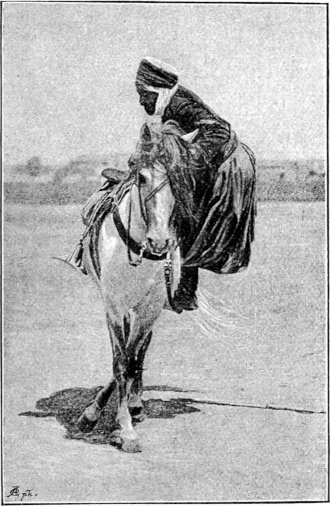
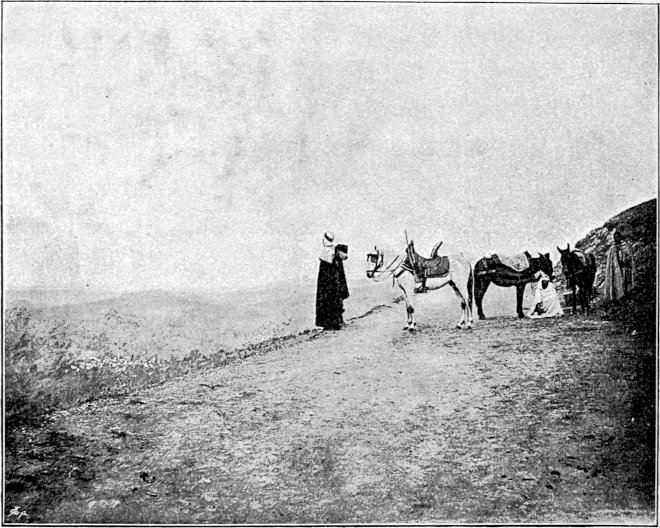
HOLD UP!
The horses had been led out from their underground stable.
Outside the dwelling I met the Khalifa, coming evidently fresh from
his devotions as he still grasped his rosary. Smiling, he held out
his hand to take leave bidding me “Farewell till to-morrow
evening.”
As we rode over the hill, a rider galloped up and took the lead;
it was Belkassim, the Khalifa’s relative, who was to show me the
way. I followed him, and Hamed became the arrière
garde.
There are no
springs or wells in these regions; water, therefore, is collected
in deep tanks. By one of these was a woman filling her pitcher.
The rays of the rising sun gleamed on Belkassim’s white burnous
and the silver-inlaid gun which lay across his saddle-bow, on the
tips of the palm trees, on the mountain peaks, and on the woman at
the cistern. Snatching a rapid glance I saw she was pretty, but she
at once turned her back; so I could only admire her slender feet
and silver anklets as she placed the pitcher on the side of the
tank and drew her blue-striped kerchief over her head.
“That is Mansur’s wife; his only wife,” said Belkassim.
Happy son of the Khalifa of Matmata!
When we had crossed to the other side of the vale I turned in my
saddle; she still stood there, and in the distance below I saw her
face indistinctly, like a pale spot amidst its dark blue wrappings.
She remained long standing thus and looking after us; then
disappeared, carrying the dull grey pitcher on her back, and up the
slope other blue figures came tripping along to the same spot.
The valley is very uneven, rising and falling, as it is furrowed
and cut up by watercourses. The palm and olive trees scattered
along these crevasses are protected by stone enclosures and
ditches.
Just as we passed the last dip in the valley before climbing the hill, there
rushed out three dogs which had evidently been watching us.
I looked about me, for it dawned on my mind that there must be a
habitation in the vicinity. I was right; for, by standing in my
stirrups and stretching my neck, I got a glimpse of the square
upper rim of a cave yard.
The dogs rushed on Hamed’s horse which was last, and had
possibly approached too close to the entrance of the dwelling. The
attack was so violent that we were obliged to turn and assist him.
The furious brutes held fast on to the tail of his horse, fearing
to come within reach of Hamed’s whip; but one of them succeeded in
biting the horse’s near hind-leg, drawing blood and laming it—a
pleasant beginning to our mountain trip!
We dismounted and threw stones at these furious white
sheep-dogs, and at last they retired, showing their teeth and ready
to resume the attack the moment we remounted. Fortunately a man and
a boy appeared and called the dogs off. Believing the man to be
their owner, I ordered Hamed to rate him soundly and threaten that
I would report what had occurred to the Khalifa. The man took the
rebuke quietly, but told us humbly that he was a poor devil who
possessed nothing—not even a dog. The proprietor of the dwelling
was absent.
“Then greet him from us and say that he should have his dogs under better control, or
he will have the Khalifa after him.”
The wrongly accused man kissed a fold of my burnous, and we
again mounted our horses and climbed the mountain in a zigzag
course, by difficult paths over loose stones.
Belkassim rode only a few paces in front of me, yet I saw his
horse above the level of my head, whilst Hamed, who was a couple of
paces behind dragging along his lame horse, appeared to be far
beneath me.
From the summit I looked back along the valley and to a high
undulating stretch, where the trees showed like spots on a
panther’s skin.
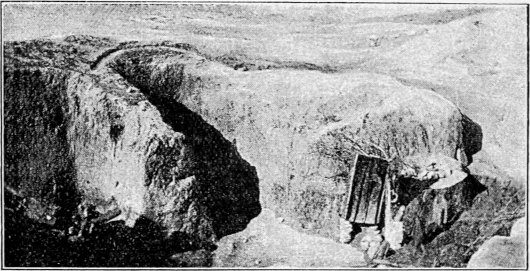
EXCAVATED STABLE.
Over the valley to the north rose the mountains, and beyond them
stretched an indistinct light blue plain, melting far away into a
darker blue—this was the sea.
Step by step, slowly but surely, our horses paced down the long valley into which
we descended. Now and again we put up a covey of partridges that
flew up the mountain, and the larks started in couples from amongst
the palms and stones. We presently hurried on at the quick pace to
which the Berber horses are accustomed; Hamed singing, as we went
along, a song that echoed above us and on every side.
Perched on some stones at the bottom of the dry bed of a torrent
were three pretty little girls, who leaned against the bank and
peeped shyly at us over it. Their goats jumped from stone to stone
seeking food amongst the scanty forage afforded by the dry burnt
pasture.
The tallest of the little girls ran suddenly away from the
others when I rode towards them. She scrambled up the rocky bank
like a squirrel, and paused on the top of a large boulder; the
flock of black goats following her. She was evidently old enough to
know that speech with a strange man is forbidden.
Belkassim tried to coax her down again; he assured her that the
kind stranger would give her money if she would come to him. But
no, she would not respond, remaining where she was and calling to
the two other little ones. These pressed nervously against each
other, in their thin blue garments, and, when I offered them some
coppers, shut their
eyes as they extended their hands to me to receive the money, and
then took flight.
We were near some native dwellings. Dogs barked, under an olive
tree stood a donkey munching straw, and we perceived some of the
familiar blue figures, which looked nearly black against their
light brown surroundings. In the distance their ornaments glittered
in the light of the setting sun. Belkassim shouted to them to come
forward as it was a friend and brother of the Khalifa who wished to
see them. Most of them remained standing where they were and stared
at us. The men were apparently all away, either amongst the
mountains, busy with the date harvest, or building tanks in the
valleys, so from them there was naught to fear.
We dismounted and had a chat with the women. I unpacked my
camera and tried to take their portraits, but these girls and women
are so restless that it is difficult to make them keep still. There
was one exception, however, a pretty fresh young girl who came out
of one of the dwellings—a cave like those near Hadeij—and stared
and stared at the camera.
An old woman next came tripping up to offer herself, evidently
of a mind that coppers are worth having. I should have preferred
her good-looking daughters, who were engaged in driving a restive
camel into the cave passage. But this I saw plainly was not to be, for she ordered
the girls in and placed herself before me, and I had to be
satisfied.
This was the village of Judlig. The population cannot be large,
but by me it will always be remembered as the village of many
women.
Continuing along the base of the valley for about an hour, we
then entered another valley through the great deep bed of a broad
river now dry; the banks were quite perpendicular. This river is
the Sid Barrak. The horses had difficulty in keeping their footing
on the stony bottom.
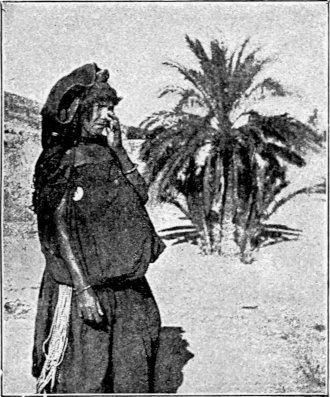
BERBER WOMAN OF THE VILLAGE OF JUDLIG.
On a slight rise our guide bade us halt, so we drew rein while
he pointed out Sid ben Aissa, but I could see nothing.
When we had ridden some way down the valley, we saw some
half-score white burnouses coming towards us. These proved to be
the Sheikh and his people, who came to bid me welcome; his
brown-clad followers walked beside their horses. In time, the old
greybeards and dark-eyed merry lads joined our party.
Dogs barked,
sombre clad females with peaked white headgear peered over the
crest of the mound, and terrified little children fled to their
mothers and hid themselves in the folds of their garments.
Palm trunks raised their lofty crowns towards the blue heavens,
where, on the mountains and in the valley, they grew mingled with
olive and fig trees, and the hot air of midday quivered about us as
we made our entry.
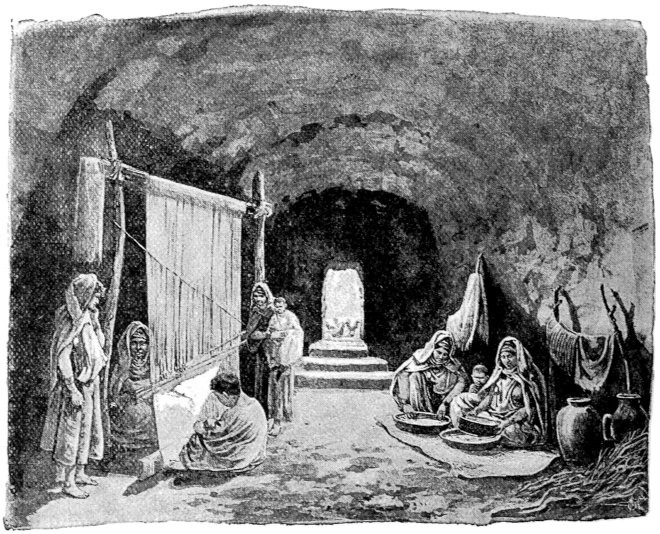
A CAVE INTERIOR.
(From a sketch by Knud Gamborg).
The village contains some fifty underground dwellings like those
of Hadeij, and about five hundred inhabitants. The approach to the
Sheikh’s dwelling was not covered in. From the highest point of the
hill a slope led through a gate to the great square court. In
addition to this entrance from the slope, one could enter from the
hillside through a deep excavated passage that ran parallel with
the slope, but naturally at a lower level.
Close to the point where the descent began was erected a
thatched roof of dry twigs and palm branches, supported on four
palm tree trunks. On this roof lay red and yellow bunches of
freshly gathered dates, and beneath its shade sat a few men. My
horse was tied up close by.
Hamed had told the Sheikh that I wished to see the interior of a
dwelling, so they at once led me into the courtyard and thence into
the long underground chamber.
In the courtyard a camel stood chewing the cud. It was pushed
aside, fowls fluttered out of our way, and a kid and several sheep
sprang on to some heaps of garnered dates, or hid behind the great
egg-shaped reservoirs, woven of rushes, used for storing corn.
In the caves I found it dark, chiefly because my eyes had been
dazzled by the daylight outside. Within were women, some grinding
corn, others weaving. None were very young, but all were overladen
with ornaments. They were quite friendly; one offered me dates,
another water, only one of them, probably a young wife or daughter, hid
in a corner and turned her back on me. The children flocked about
me without fear, one of the boys even pulling roguishly at my
burnous.
During my visit, Hamed and the other men had remained outside.
Hamed was very proud of having obtained permission for me to see
the cave. Usually, he said, no strangers are admitted into a house
where there are women. But I fancy my good reception was due as
much to the Khalifa’s influence as to Hamed’s.
On our way to the cave we had passed the vaulted guest-room,
tastefully excavated out of the soft calcareous soil. Here I
stretched myself on costly carpets whilst I ate my meal; my escort
afterwards consuming the remainder.
As I wished to learn all particulars concerning the costume of
both men and women, they brought me clothes and ornaments in
quantities. To the great amusement of those present, Belkassim was
dressed up in woman’s attire, the property of the Sheikh’s first
wife. Afterwards, I photographed him in the same dress, together
with the Sheikh and his boys in a group outside the caves.
After a stay of a couple of hours we rode on, being set on our
way by the Sheikh and his people.
We now followed the bed of the river Barrak, amongst rocks and
ridges and over rolling stones and rough pebbles. We saw a party of women
leave the valley for a deserted village, of which the ruins showed
waste and grim on the mountain-top. They were taking food up to the
shepherds in charge of the sheep and goats there, and would take
advantage of the cooler air of the heights to have a midday nap in
the shade of the ruins. In olden days the Beni Aissa dwelt on these
heights, but it was very trying, especially for the women who had
every day to descend to the plain to fetch water; so, when more
peaceful times came, they moved down to the caves at the base of
the valley.
This valley wound round the foot of the mountain, so for a
couple of hours we had the picturesque ruins to our right. At last
we lost sight of them, and then began a stiff ascent through wild
and desolate gorges, and, finally, we clambered up a very steep
mountain side where the stones rolled from under our horses’ feet.
Hamed thought it too bad, so dismounted, letting his horse follow
him; while we, by endless zig-zags, wound our way to the summit.
Here we waited a few moments to recover breath and give time to the
loiterer, whilst enjoying the lovely view over the Matmata mountain
peaks and vales.
Once more we descended into a valley, then toiled up another mountain side,
afterwards riding along the ridge at the summit to reach “Tujud,”
one of the eyries on the top of the Matmata heights.
On the horizon we could distinguish the low land to the south of
Gabés, and, beyond it, the sea. Farther east lay the mountain chain
of Jebel Teboga, a long blue line, and between it and us stretched
a level plain, partly concealed by the adjacent hilly ground, of
which the ridges surmounted each other in undulating lines. Below
us, to the north, was a deep valley.
Scanning the stony surface of the bridle-path, I discovered
accidentally some outlines scratched on the stones. They were
mostly of footprints, and later I was informed that these are said
to be carved by pious friends, in memory of the dead, on the spot
where they had last met the deceased.
Tujud lay before us. In the distance it resembles somewhat an
old German castle of the Middle Ages, with the usual mass of houses
attached thereto. The summit of the pile of dwellings was crowned
by a couple of camels, showing like black silhouettes against the
sky. On the flat grey plain, dark specks were moving: these were
women.
The Sheikh came to meet and conduct me into the town, through steep narrow alleys.
The houses were all built of uncut stone, and not whitewashed. The
style of building was most irregular. As the rock was very
precipitous, the little dwellings were extraordinarily varied in
height and appearance. Their courtyards were crowded with bleating
sheep and goats, a few camels, various household chattels,
braziers, and all manner of dirt. In the doorways, and on the flat
roofs, women and children stood watching us.
Of men there were not many at home; at this season they are
probably mostly guarding their flocks on the far plains to the
south-west.
On a height close by, were a couple of Marabout tombs with
whitewashed walls; and in the distance to the north we could see,
over the mountain ridge, a village on a height. This was Zaraua;
and towards the west we sighted another, Tamezred. They both looked
like fortified castles.
After a short halt we continued our way towards Zaraua, the
Sheikh giving us a guide, quite a young fellow. He tried to slip
off when we had ridden about half-way; as it was near sunset he
most likely wished to return to his home before dark. Belkassim
gave him a sound thrashing and forced him to go on, as we could not
distinguish the bridle-road from the footpath. When we reached the
foot of the hill and could see the village at the summit, I dismissed the lad, who
quickly vanished behind us.
No one came to meet us until, when quite near the town, a young
man at last appeared, who welcomed me, announcing that he was a
near relative of the Sheikh who, he said, was absent.
Both Hamed and Belkassim told me they detected an intention to
slight me, therefore they abused the unlucky fellow because I had
not been received at the proper distance from the town, and with
the honours due to me.
Twelve years ago these natives tried to assert their
independence of French rule, and many of the brave fellows fell
fighting here among the mountains. From that time, therefore, they
do not entertain a friendly recollection of the French; and they
supposed me to be a Frenchman. However, they did not openly venture
to run counter to the safe conduct the Khalifa had given me, so
they went through the forms of hospitality; but my guides were in
the right—my hosts were, to say the least, unwilling.
I walked up a path which led towards the cemetery. On the
precipitous slope lay mound on mound, composed of small stones.
Here rested, perhaps, the defenders of their fatherland, laid low
by the bullets of the French.
From the tanks beneath the slopes the women drew water. They carried the huge pitchers
on their backs, bound to their foreheads by a towel. Each turned
away her face, or concealed it in her towel, as they approached us.
The men stood, like rigid statues, without looking at us; not one
extended the hand of welcome.
We dismounted on the outskirts of the village, and the young man
led me into a stinking court and opened the door of a room that was
snug enough, but where dirt, dust, and spiders reigned. The
atmosphere was extremely musty and disgusting. I at once decided
that I would not inhabit it, and proclaimed my amazement at their
daring to offer me such a room.
The reply was that it was impossible to procure other quarters,
and that there were none better to be found. Knowing this to be
false, I said plainly that I would not submit to such treatment,
and, in accordance with Belkassim’s advice, ordered that a tent
should be pitched outside the house on a small terrace near the
slope. The young man bent his head in consent, and soon several men
were busy sweeping the terrace and driving tent pegs into the hard
ground.
Our horses still stood saddled, without anyone offering to look
after them, and again I had to do battle for my rights, with the
result that they were stabled and supplied with provender.
In the meantime I
walked down the mountain side, partly to look about me, partly to
allow my followers time to fight out matters with the natives.
The sun had just set as I seated myself on a stone and looked up
to the village above me; in the gathering darkness it showed as a
massive black pile. On the terraces outside I could distinguish
dark figures engaged in their evening orisons. They bowed
frequently and kissed the ground, and then lay prostrate for some
moments, deep in prayer.
The dogs around me barked, and I could hear the hammering in of
the tent pegs, as also voices in discussion above me. Near me was a
new grave—perhaps of that very day; it was covered with stones, and
in the middle was stuck a bit of stick with a green rag attached to
it, to scare jackals and deter them from digging up the body.
Presently our horses were led down the hill by Hamed, and
watered at one of the tanks. As he passed he confided to me that
Belkassim had managed his business so well that all was now in
order. The latter had declared that I was not a Frenchman, but a
stranger from another land, a friend of the Khalifa and of the
tribe.
This, it appeared, had changed the attitude of the Zarauar, for,
when I soon after returned to the town, several men came forward
and offered me another dwelling which, after inspection, I
accepted. I also
granted the permission they asked to strike the tent.
The dwelling in question evidently belonged to someone practised
in carpentry, for in the corners lay bits of wood, knives, axes,
etc.
The ceiling was of palm stems, and on the stone walls hung a
quantity of platters, bowls, trays, and cooking-pots. Lighting a
candle I stood it on a plank, and threw myself on my rugs with my
saddle under my head, and fancied myself the owner.
It was long before any food arrived, but when it did it was
excellent. Whilst I ate, a knot of people stood at the open door
and watched me. I chatted with them, and in the end we became
ostensibly good friends, especially after I had distributed some
cigarettes.
The public retired when the bowls and trays were carried out,
and I applied myself to writing. That being done I rolled myself in
my burnous and went to sleep. When I had slept but a short time I
was awakened by the sound of the yard gate rattling. Our horses,
which stood in the gateway, were evidently disturbed. Then I heard
a light footfall on the pavement outside, and a sound as of someone
breathing near my door, and a few minutes after a fumbling at the
door handle. This I could not stand. Springing up I quickly struck
a match and opened the door. There, with its head to my nose
and breathing in my
face, stood a camel; and behind it another.
Thank goodness, it was nothing worse.
Before sunrise we started, riding in the cool morning over
mountain and vale to Tamezred. By a deep stony gorge we arrived at
the foot of the mountain, where the road was so impracticable that
we all three had to dismount and drag our horses along; it took us
half an hour to cover a quarter of a mile.
This was certainly the most unapproachable eyrie I have seen in
the south. From the mountain top the view extended for miles over
hill and dale down to the plains to the south-west in the country
of Bir Sultan, at least forty miles distant. There the herds were
grazing, for no rain had fallen on the mountains.
Sheikh El-Hadj Abdallah received us amicably, and invited me to
the guest-chamber—a stuffy room—where food was brought me. From
thence I overlooked a wonderfully beautiful landscape.
The inhabitants spoke the Berber tongue, but also understood
Arabic. I tried in vain to get some Berber manuscripts to examine,
but none were to be had, the language being nowadays written in
Arabic characters.
The Sheikh’s property—a square court with a low range of
buildings outside it—I examined from end to end. Within were women
spinning and cooking.
In one enclosure stood a fine bull, in another I discovered a
number of old flint-lock muskets hanging amongst keys, yarn,
powder-horns, and pomegranates, all being spun over with spider
webs. The guns had probably not been used since the French
invasion.
FALCONERS.
This was the only occasion on which I saw firearms in any
numbers, the Arabs generally concealing them—often under their beds
so as to have them handy.
In the guest-room a camel’s-hair tent hung, rolled up under the
roof. When the men wander forth after the rainfall to hunt or to
sow, the tent is packed on a camel and taken with them.
The Sheikh informed me that the inhabitants of Tamezred number
some five hundred souls. Of these about a hundred men can be armed;
they mostly fight on foot, as horses are rare in these mountains;
in Tamezred there are only seven, but there are many hundreds of
camels, about a hundred cows, as many small donkeys, and large
herds of sheep and goats. These graze on the plains, far away
towards Bir Sultan and Bir Zuamitz, watched by the men of the
village.
When the rain falls, all the men and some of the women go off to
the plains to plough and sow; they live in tents, and their sheikhs
accompany them and hunt gazelle and other game. Only a few old
men remain in the
villages to guard the women and children.
It is not the people of Tamezred alone who thus migrate, but
also those from other mountain villages, as Zaraua and Tujud.
Hadeij, in the Matmata mountains, feeds its herds in the plain
south-west of the range beside the course of the river Wad
Halluf.
The village of Tamezred is crowned at the top by a minaret, and
lower down, amongst the houses, are several Marabout tombs with
vaulted cupolas. Only one of these, the grave of Sid Hadj Yussuf,
is limewashed and gleams white in the sunshine; the most part are
grey, and at a distance it is scarcely possible to distinguish the
buildings from the rocks.
On a height outside the village is raised a great surveyor’s
landmark, visible for miles, and corresponding to others on the
peaks of the Matmata mountains. These points of observation were
raised by a French officer for the purpose of making a survey,
which will surely be carried out ere long.
Having now attained the most westerly inhabited point of the
Matmata mountains, we took an easterly direction, again following
steep paths and deep gorges to reach the real Matmata villages, of
which Lasheish is the largest.
In a deep valley on the way we found some half-score men
occupied in clearing an old circular well built of unhewn stone. They told me that
this supposed well was discovered quite recently. It dates from the
time of the Romans, at least so report says, but it may be even
more ancient, for no one remembers either having seen or heard of
it.
The sand, which they drew up in rough baskets, was only slightly
moist, but the fact of its being so gave them good hope, though
they had already reached a depth of over one hundred and fifty
feet.
Later in the day we passed a kubba, said to be the burial-place
of a female Marabout. This lay, completely ruined, on a ridge
between two crests of the mountain. I wanted to peep in, but my
guides requested me not to do so.
From this point is a view of a wide valley, to the north of
which are the mountains, and behind them lies Hadeij. Beyond the
range we had a glimpse, through a haze, of the plains of Gabés and,
far out, of the Mediterranean Sea.
In the valley below stood a whitewashed, square, cupola-topped
Marabout tomb, that of “Sid Barrak.” I let my attendants go on a
little in advance and sneaked in, first tying up my horse outside.
The room was square, with a vaulted roof. In the centre of the
floor stood a high square frame of carved wood, beneath which the
saint was evidently buried. In each corner of the frame was stuck a
flag. On the ground, along the whitewashed walls, were earthern pots, such as are used
by the negroes; they were apparently sooty from use. Above were
sketched, in black, lines, circles, and figures that reminded me of
the Berber alphabet.
Just as I was copying these ornaments in my sketch-book, Hamed
and Belkassim stepped in.
Hamed desired me to put on my burnous and draw the hood over my
head before I left, so that no one should discover that I had
entered; and Belkassim suggested that I should put some coins into
a bag that hung on the wooden frame, and which was provided for the
offerings of pilgrims, given to defray the expenses of illuminating
the Marabout’s tomb at the festivals; often celebrated, he said, by
the women in or near the tomb. I did as he desired.
Outside, in the vicinity of the tomb, were dug low underground
chambers, into which I crept. Scattered within was pottery, some
broken, a few pieces entire. They had been used, and there were
also traces of a fireplace and smoke stains on the roof, all
suggestive of the above-mentioned festivals. Both Belkassim and
Hamed murmured a few prayers at the grave, and when they had
finished their devotions we remounted. Belkassim looked carefully
round as we emerged. There was not a single soul in sight, so he
winked mischievously at me, and we went our way.
We were now again
on undulating ground of hard chalk and clay, cultivated in very
good ridge and furrow, and planted with palms and olives. In the
distance we perceived several white spots in the valley. These were
the Marabouts of Lasheish, the large troglodyte village. Meanwhile
we were compelled to make a long détour, as we were in most
impassable country, cut up as it was by the numberless large
brooks, always found on either side of great rivers.
On a slope was a little white limekiln, whence smoke was rising.
By it were piled large faggots of wood, seeing which I began to
realise how much brushwood must, in course of time, have been
consumed in these limekilns, and then understood why the natives of
the Matmata do not, as a rule, whitewash their houses.
Lasheish is not under the authority of the Khalifa of Hadeij,
but under that of his colleague of Gabés. In other respects it is
exactly similar to Hadeij.
Knowing that the women here weave materials for burnouses,
clothing, towels, and, in fact, all that appertains to the garb of
the country, I decided on making some purchases. The cave to which
I was conducted became, therefore, during the period of my stay, a
regular shop, people coming in from all parts with goods for
sale.
Fortunately,
Mansur arrived on a visit, partly for the purpose of inviting
guests to the wedding feast; partly, so as to accompany me on my
way back to Hadeij. He materially assisted me in making my many
purchases, and in securing them at fairly reasonable prices. But
the bargaining was neither an easy nor a pleasant task for him, as
our host always sided with the vendors. They quarrelled violently
the whole time, and frequently, before completing a reasonable
bargain, I had to throw the article repeatedly back on the seller’s
hands. A gala burnous, I remember, was walked in and out of the
door seven times; on each occasion with a decided command that it
should not reappear before my eyes unless the price were reduced to
about an eighth of what was first asked. Each time the owner
returned, he abated a little and the haggling was renewed. With the
air of a connoisseur I would re-examine the burnous, only to arrive
at the same conclusion—it was far too dear. So again it was
returned to the owner, who was at once pushed aside by other
vendors.
Belkassim and Hamed vied with each other in shouts of abuse.
There was a regular storm, and what a blessed calm when the
bargaining was ended.
The simplest sale cannot take place without these folk abusing
one another as if their lives depended on it.
Not having allowed
myself to be cheated, I had rather risen than fallen in the
natives’ estimation. The men, who a moment before had seemed to
feel bitter enmity towards me and my guides, and who had often been
harshly turned out of the room, now sat comfortably in peace and
quiet beside me, watching me eat.
After dinner I took a turn through the village, but soon
perceived that I was being led about much as foreign officers are
at great military manœuvres in Europe, when they are shown
everything except what they are most desirous of seeing. I was,
therefore, soon ready to depart; all the more so, as I observed
that the caves were all on the same lines of construction as those
I had already examined at Hadeij.
Just as we were about to mount our horses, a man approached us.
Cringing humbly and miserably, he dragged himself to my horse and
kissed my hand. I was told he was the owner of the dog which had
bitten Hamed’s horse yesterday. He came to entreat me not to inform
the Khalifa of the occurrence, as he feared he might be cast into
prison. Having told him that I was sure the Khalifa would be
lenient, I spurred my horse and rode off; but my reply did not at
all satisfy the penitent, who rushed to my side and clung to my
clothing. I was near being angry, when my host came
forward and explained
that should the Khalifa hear that I had been molested on the way,
the man would not escape punishment. Therefore he and the people of
Lasheish implored that I would entirely refrain from reporting to
the Khalifa the mishap that had befallen us.
I glanced down at the culprit, and nearly burst out laughing; he
looked so ridiculous. Never do I remember having seen a more
hypocritical and debased countenance.
I preserved my gravity, however, promised to keep silence, and
put out my hand to take leave. The culprit literally snatched it to
his mouth, and I heard him calling down the blessings of Allah upon
me.
In an open square, planted with palms, the date harvest was in
progress. The golden bunches which hung on the green crowns fell to
the blows of a curved knife. Lightly clad men, boys, and even a
young girl, worked in the tree-tops; climbing quickly and adroitly
up and down the rough surface of the straight stems. Below, men and
women collected the bunches in great clusters, which they placed in
rush panniers, and removed on the backs of small donkeys.
It was difficult to tear myself away from this idyll, but we had
to press forward, so I hurried up my little escort, and we marched
on over the mountains.
Mansur had much
difficulty in keeping up with me, being very heavy, and accustomed
to ride a mule rather than a horse. There was always something
wrong with his saddle, and he was perpetually dismounting to alter
first one thing, then another, thus being left farther and farther
behind. We were obliged at last to halt, to allow him to rejoin us,
though time was passing, and sunset was near.
A little distance from Hadeij we found, at the bottom of the
valley, a little donkey standing quite alone, feeding on some
straw. Belkassim said that if left there at night the jackals would
soon make away with it.
It was almost dark when we crossed the river and rode up to the
village.
Again I saw the boys romping in the square amongst the palms.
Their glad voices reached my ear, and when they caught sight of me
they ran up to us followed by their barking dogs.
The men, grouped beneath the trees, rose and came forward to
press my hand. The Khalifa also rose to receive me. I thanked him
for the delightful trip he had arranged for me.
“I am glad that you are satisfied; glad to see you here again;
and that you will stay with me, your brother, even for forty
years.”
Of course these speeches must not be taken literally, they only express the kindly
feeling of the speaker towards oneself.
After I had dined in my cave I sallied out to the Khalifa’s
dwelling to be present, in accordance with his invitation, at the
festivities held in honour of the third day.
As I did not like the old man to be inconvenienced by having to
sit on a chair because I did so, I suggested that we should sit
together amongst the other men. To this he agreed.
Gradually there arrived numbers of men from all the surrounding
country; these sat tightly packed on the banks, as on the previous
occasion.
Again the negroes danced, the drums boomed, and the clarionets
screamed; whilst the Khalifa, his sons, and myself sat together in
a friendly group looking on.
Now and then the women sang, but, as far as I could understand,
neither bride nor bridegroom were mentioned in their songs,
certainly not the latter.
It was hard to keep awake. Belkassim’s little son nestled up to
me, and, as it grew chilly, I wrapped my burnous about him, and he
was soon asleep. The monotonous music induced drowsiness; I fought
valiantly against it, which was more than Hamed did, for I suddenly
found him snoring beside me, wrapped in his burnous. I let
him repose, but from
that moment conversation betwixt myself and my foreign surroundings
was limited to the simplest compliments.
In the course of the afternoon the Khalifa invited me to come
back again and be present at the special bridal festival to be held
five days later. I promised to return.
Next morning—the 20th October—I left Hadeij to ride back to
Gabés. I took leave of the Khalifa, with many expressions of
goodwill, adding, “May you soon have rain, that your olive trees
may neither wither nor die.”
Just as we reached the first height, Mansur, who had volunteered
to follow me to Gabés, pointed out how coal-black the heavens were
in the direction of the sea, and how the lightning flashed and the
thunder rolled, saying, “Allah has heard your good wish. It will
rain in the Matmata mountains.”
When we descended into the plain, the rain pelted in our faces.
We put on our burnouses, pulled the hoods over our heads, and
hurried on. A moment after, we were wet through.
Mansur continually lagged behind; it was difficult for him to
keep up, and he begged us to ride on without waiting for him.
Once we passed a shepherd with his flock; the sheep were all
huddled together, the goats apart, whilst he had taken shelter
under a bush.
We crossed a
couple of river beds which, when I passed a few days ago, had been
dry and parched; now the water rushed over them in a rapid stream.
However our horses crossed easily, and I started at a gallop,
pushing quickly through rain and slough, with the mud flying up to
my ears, till, the ground presently growing too slippery, I was
again reduced to going at foot’s pace.
The palm grove of El Hamdu gleamed through the rain, but before
we could reach the oasis the river had to be crossed. The ford
amongst the tamarisk and oleander bushes we found easily, but the
torrent ran high. I urged my horse forward, and he went slowly
through the water till he suddenly slipped and fell, wetting me to
the middle. I tried to turn him back, but the current swept us to
the side, and at last I gave up the struggle, being afraid that my
books and sketches might get wet. Then I caught sight of Hamed, and
saw his horse, which was laden both before and behind the saddle
with my purchases, plunging about in the swirling stream, and
splashing the water in every direction. I shouted to him to turn
back.
We then followed the course of the river a long way up, and
tried to cross several times, but without success.
A herd of little, thin, brown cattle walked along the banks; they had got
separated, and some were on either side of the river. They had
apparently no guardian, and were evidently endeavouring to rejoin
each other. Occasionally one of them would plunge into the water,
only to be driven back to the bank by the current, and we heard the
distressed bellowing of the divided herd.
At last, at a spot where the river was very broad, we succeeded
in crossing without mishap, but the water reached above the horses’
girths.
We then returned along the banks to the ford, where we waited
for half an hour before Mansur’s white horse appeared on the
opposite shore. The rain poured down incessantly, and our horses
pawed the ground impatiently, eager to get on, but we were
compelled to wait to direct Mansur where to cross.
“To the left! to the left!” we shouted; but Mansur had drawn his
burnous so closely over his head that he could neither see nor
hear, and not till he was close to the river were we able to
attract his attention; then he also crossed safely, and we
continued our way.
In the neighbourhood of the oasis we could hear the El Hamdu
folk crying and lamenting the rainfall. The date harvest of the
oasis was not ended, and, until it was over, water was injurious to
the dates. What is good for the olives and the barley fields is injurious to the
palms, the chief source of subsistence of the people of the oases.
All over the world the agriculturist is the same.
Involuntarily I recollected a certain old fellow, a countryman
of mine, in a town in Jutland, who, sitting at his dinner-table one
day, complained loudly that the Almighty had not taken pity on the
poor country folk and sent them a little rain for their rye-fields;
when, at the very same instant, there was a loud clap of thunder,
and rain suddenly pelted down without any warning. He at once
jumped up, rushed to the window and exclaimed, “Oh, the devil! now
all my peat is gone to ———!”
Step by step our horses splashed on through the puddles; it was
almost impossible to quicken our pace; so it was late in the day
when we reached Gabés, to find everything standing in pools.
The river had not been so swollen for many years, and had done
much damage.
Luckily, neither my sketches nor my purchases had suffered.
CHAPTER VI Of the Matmata Mountains and their Inhabitants
The Matmata mountains form
the northern spur of the comparatively small range which, in a
curved line, follows more or less the bend of the coast. Leaving a
low stretch of land between itself and the sea, this range runs
first along the coast-line to the south of Jurat (of which more
hereafter), then continues right into Tripoli, being broken only at
intervals.
Here and there it is inhabited by Berber tribes, who are indeed
Mohammedans, but have in great measure retained unchanged their
primitive habits and customs.
In the mountains Ghurian and Jefren, to the south of Tripoli,
are found the brave independent kinsmen of the Berbers of Tunisia.
They recall with pride the exploits of their ancestors, and rear
their sons to be a free people and to labour. Therefore they have
maintained their intelligence and intellectual superiority, and
have been able to defy foreign rule, though not always with
equal success. For
example, in the Jebel Jefren originated all the disturbances which
have occurred during the Turkish occupation of Tripoli.
North of Jebel Jefren is Jebel Nefusa, also inhabited by
Berbers, some of whom speak a dialect resembling the language of
the Tuareg. The greater proportion of these are supposed to be
descendants of the Libyans, who conquered the country before the
Arabs, and who, like these last, came also from the East.
It is the custom among some of the Nefus tribes, in common with
that of the Uled Nail of Algeria, that their young women, for a
time before marriage, abandon themselves to prostitution. This
practice naturally reminds one of the ancient cult of Astarte.
Tarik, conqueror of the Spaniards, was a Berber, a native of
Jebel Nefusa. Perchance he was one of the race who had owned
allegiance to Jewish sway. At any rate, after he conquered Spain,
the Jews there were treated by him with marked consideration. In
his case, as in that of so many Berbers who were drawn into the
mighty current of Mohammedanism, they never became fanatical
Moslems, and the same may be said at the present day.
Though indeed, like their kindred race the Tuareg, they became
Mohammedans (perhaps many of them had been under Christian
influence—at least
there are signs of it), they are not fanatics. They have no special
religious order, and they belong to the so-called fifth sect, and
are unacquainted with any ritual.
Not a few of these Berbers reside in caves, “Jebel Ghurian”
meaning literally “the Mountain of Caves.” Before these cave
dwellers became Mohammedans, they raised altars to God; and,
according to travellers, very ancient stone monuments, dating from
a period previous to that of the Arabs, are to be found everywhere
in these regions. They resemble those found in Algeria, in
Andalusia, and even in Brittany.
The language of the country on the borders of Tripoli and
Tunisia is partly Arabic, partly Berber. It is probable that in
earlier times the Berber tongue was spoken from Jebel Jefren over
Duirat to Matmata.
Books written in the Berber language are not to be found here;
so far as we know (manuscripts have been discovered on the island
of Jerba), the Berber dialect being written in Arabic
characters.
I ascertained that the language of Southern Tunisia is still
spoken in the villages of Zaraua, Tamezred, Tujud, Shenini,
Ghermasi, and Duirat (as also on the island of Jerba), and in part
of Urghamma.
From Jebel Jefren to the Matmata mountains, the lively natives closely resemble each
other in their expressive eyes, happy dispositions, and ready
smile. Contrasted with the Arab, their countenances are shorter and
broader, and their hair less black.
They are essentially a free race. An assembly of the people in
the villages of Southern Tunisia, known as the “Miad,” settles
tribal questions, according to a local code (kanun) which is based
on ancient rules and customs, and is even more highly revered than
the Koran.
As arable land is extremely valuable, and the inhabitants of the
barren mountains are comparatively numerous, it has been the custom
from time immemorial, in Southern Tunisia at least, that the young
men should go to the coast towns in order to earn money, wherewith,
on their return, to buy a house, palms, cattle, and a wife; alike
in this respect to the Savoyards and Auvergnats who quit their
hearths and homes for a time.
In the towns these mountaineers live with the utmost frugality,
sleeping generally by the roadside, and earning their bread by all
sorts of work, such as water-carrying, domestic service, etc.
When in 1881-1882 the French army invaded the mountains of
Southern Tunisia, they were astonished to find that many of the
natives spoke French.
The “Ksar” dwellers are brave and hardy, and accustomed to “hear
the powder speak.” Their delight used to be to sally out on a raid,
when they made matters hot for all concerned. They were not
ordinary thieves—no, weapon in hand they fell on their adversaries,
who could never feel secure from a coup de main.
On the other hand, they, in their inaccessible and fortified
eyries, were prepared to defend themselves.
Their plundering raids extended over the Tripolitan frontier,
even as far as Rhadamés. They always plundered thoroughly. Dr.
Bertholon states that when he, as military surgeon, served in the
campaign against them, they not only seized all the herds, but even
the clothes of their victims. So completely did they strip
prisoners, that these would be left with only a scrap of shirt
which barely covered them.
The people of the adjacent oases on the plain and towards the
“Shotts,” who are more peaceful and phlegmatic, the circumstances
of their lives being better, have often suffered from the attacks
and depredations of the mountaineers, when they have not chosen to
purchase immunity by paying blackmail to the latter.
Dr. Bertholon maintains that monogamy is usual amongst them, but
my experience leads me to a different conclusion, since the men of
rank with whom I came in contact had generally several wives.
The abduction of
women was not uncommon in earlier times, when the armed inhabitants
of the Ksar used to carry off their wives by force.
That they had to guard their women carefully is not strange,
since these have the reputation of being light of morals.
One custom is universal amongst these people; it is that at the
wedding the bridegroom shows his bride a heavy stick, of which one
end that he holds to her nose is thoroughly and sweetly scented.
The interpretation of this custom being that so long as she
conducts herself properly, her life will be mild and pleasant like
the scent; but, on the other hand, should she misbehave she may be
sure of being well punished. I saw one of these sticks at
Tatuin.
As I wished to form some idea of the manner in which a family
lived and worked together in the small troglodyte communities, I
took advantage of my stay with the Khalifa of Hadeij to procure
information regarding his family and the life they led in
common.
These inquiries I had to make with the greatest discretion, for
I would not for the world have given them a chance of misjudging
me, or of supposing that I had come amongst them to spy. By degrees
I put together what I saw and heard till the whole picture is, I
may venture to say, correct in the main, though some of the minor
details may have been
misunderstood by me, or have escaped my observation.
Sadi-ben Mansur-Fatush, as Khalifa of the mountains, exercises
authority over the villages of the Matmata range. He is born of the
tribe of Uled Sliman, of which his son is a tribal sheikh.
The Khalifa is between sixty and seventy years of age, and has
three wives, Mena, Fatima, and Sasia. By the first he has two sons,
Amar and Mansur. By the second, one son, Mohammed. He has probably
daughters also; if so, they are married and live at a distance, and
no longer interest either their family or tribe. I could not gain
any information as to whether any had married within the tribe
itself.
Sheikh Amar has two wives; the first is named Aisha, the second
Meriam. He has two sons, Abderahman (by Aisha) and Mahmud (by
Meriam).
Mansur, who bears the title of “Adel” (notary) of the Uled
Sliman, has only one wife, named Uda, and no child.
Mohammed, “Kateb” (scribe) to the Uled Sliman, is his father’s
secretary. His first wife is called Meriam, and by her he has a
son—Hamed. His second wife, to whom he was married during my stay
in Hadeij, is called Mena; she is of the Uled Sliman, and a native
of the village that bears the name of that tribe.
The age of the
Khalifa’s sons may be on an average about twenty-two, none of their
wives being probably over twenty. Of the children of these
marriages the eldest of the boys is about five years old.
The Khalifa’s family, therefore, consists of about a score of
souls, who, as will be seen further on, live together; but to these
must be added other members of the household, negroes and servants
with their children, and a number of near relatives, and of men who
attach themselves to the Khalifa’s service. Many of the latter have
homes of their own, and possess palms, olive trees and cattle,
which they farm on their own account, but being dependants of the
Khalifa must help him to sow and reap his corn, prune his palms, gather the
dates and olives, press the oil, and, in short, do any work of
which they are capable.
MANSUR.
The Khalifa is very rich. He owns many underground dwellings,
barns, stables and oil mills, but a large proportion of the profits
of all these must be expended in providing food and shelter for the
infinity of people whom he protects. His large landed property and
all his possessions will be divided, when he dies, amongst his
sons, who at present own only what the old patriarch chooses to
give them, but after his death each will have his own palm and
olive trees, his own house and cattle; unless they prefer to
continue living in fellowship.
The Khalifa’s property is valued at some two hundred thousand
francs—a pretty penny for a mountaineer living amongst barren hills
devoid of either springs or wells, but where the cliffs and valleys
are furrowed with channels to conduct the rain-water to cisterns,
and where every tree must have the earth banked about it that the
water may lie at its foot.
We will now examine the dwelling used by the Khalifa and his
family, and endeavour to form an idea of how the various married
couples are accommodated; thus ascertaining that, notwithstanding
patriarchal house-government and community of life, each little
group has its own portion, however small, of the dwelling set aside for its
own exclusive use.
The soil in the valley of Hadeij is composed of strong clay and
marl, which lend themselves admirably to the excavation of regular
well-shaped chambers. These have an advantage over dwellings built
above ground, in that they are cooler in summer and warmer in
winter, besides being easier to defend; they are not open to
discovery by strange, unaccustomed eyes, and afford good protection
against thieves and robbers, for cattle can also find shelter
within them.
The formation of the valley is undulating, and extends over low
hills divided by smooth level ground or by narrow gorges, where
streams flow in the rainy season. Seen from the mountain, the whole
looks like a great sand-pit scored with faint paths, and with
depressions where the olive and palm trees grow amongst the
mounds.
The plan of a dwelling is as follows:—
From the side of a hill, and through the solid earth, leads an
underground path—long or short, as the case may be—and quite the
height of a man. This takes one to the ground-level of a large
square excavation, open overhead, which is generally dug in the
highest part of the hill, and forms the courtyard. The walls of
this court are perpendicular and smooth. From the ground-level of
this cave one enters through an opening, a somewhat long
underground chamber with a vaulted roof, like that of a wine vault.
These chambers are used either as stores, stables, or
dwelling-places.
The courtyards measure, as a rule, between eleven and twelve
feet in depth and breadth.
The side caves are usually about twenty-seven feet long, but not
even half that in breadth; though I have seen them both larger and
smaller. These rooms are generally furnished with doors. The
passage also is, as a rule, closed at both the outer and the inner
end by means of a strong door or gate.
In the court is a fireplace intended for common use; in wet
weather the cooking is done in one of the underground rooms.
Further, there is often a tank into which water is conducted by
pipes from the earth’s surface. At the sides of the court stand
large rush baskets filled with corn, and sufficient space remains
for fowls and domestic animals, when, under special circumstances,
such as threatened danger, these are driven within.
Here and there in the passages are recesses for stabling horses
and donkeys, which stand therefore in utter darkness.
In a cave chamber it is dark when the door is closed, otherwise
there is sufficient light.
The accompanying sketch shows some of the dwellings inhabited by the Khalifa and
his nearest relatives.
From the flat, smooth, open space grown with olive and palm
trees, leads the passage to the courtyard.
Dwellings I. and II. are united, and have but one entrance.
Through the gate (A) is the entrance to a cave passage, and thereby
to the first courtyard. Here are to be found the following
chambers: One for the horses, one for the sheep, one containing a
tank, another is a kitchen, and, lastly, a store.
From the first courtyard one passes through another cave passage
into courtyard No. II. This provides dwellings for all the
Khalifa’s sons with their wives and children, and for the mothers
of these sons.
The Khalifa himself resides at night in an adjacent cave in
company with his third wife, but both spend the day with the rest
of the family in courtyard No. II., where they cook and eat in
common. As far as I could ascertain, no domestics live here.
This courtyard is furnished with rush baskets for corn, and with
a fireplace.
Amar has two chambers, one for each of his wives; and his mother
has another close by, so they occupy a whole side of the court.
Two chambers are used as barley stores.
Fatima,
Mohammed’s mother, has a room, and beside it is another to which
Mohammed’s second wife was brought. Exactly opposite lives
Mohammed’s first wife, and, on the same side, Mansur and his only
wife.
Last of all comes the kitchen.
I visited all these caves; each woman had her household pots and
pans prettily arranged on the inner wall of the chamber, as our
cooks do their brass utensils on their kitchen walls. Ranged on the
sides were various articles, while in the centre of the clay floor,
adorned, as a rule, with rush matting or with carpets, stood what
appeared to be a low table. This is the sleeping couch, on which
carpets are generally spread; on this the inmates sleep without
undressing.
The whitewashed walls are bare but for the guns which are
sometimes hung there, as also keys, yarn, etc.
In Mohammed’s and Mansur’s rooms I saw some frightful framed
pictures, apparently supposed to represent the Prophet, and
evidently cheap rubbish bought at Gabés, corresponding in all
respects to the coloured prints of the Christ which we find in
every cottage in our country.
The comfortable cave rooms, and even the courtyard, were clean
and well kept. The fowls, indeed, had the run of yard No. II., but
it was evidently
forbidden to cattle, which were restricted to the first yard. By a
long underground passage, provided with side recesses for horses
and donkeys, one entered yard No. III.; its chambers included a
large banqueting hall, the roof of which was composed of two
parallel vaults, supported where they met by a central row of
pillars. This hall occupied one entire side of the court, and
opposite to it were two rooms, used when I was there as
guest-chambers; one of these I occupied. They could also be
utilised as corn stores; to this end a shaft is dug from the
surface, through the solid earth to the dome, so that the corn may
be poured down; and when the camels bring the grain, it is unloaded
near the mouth of the shaft.
Near the entrance to the passage are two rooms, also available
as stores for grain, but during my visit they were used as
dwellings for several male servants.
In yard No. IV. lived a negro family, who were entrusted with
the care of Mohammed’s and Amar’s two horses, and the two mules
belonging to the Khalifa and Mansur which were stabled there. There
was also a corn store, where the barley for the horses and mules
was kept, a writing-room, and a tank.
These four yards were used indiscriminately by the Khalifa and
his household.
Now we come to
the two other dwellings—V. and VI. In one lived a cousin of the
Khalifa; the other was occupied by an old fellow called Uncle Srair
Feteish, under the same conditions as the courts already
mentioned.
A little farther off was the dwelling occupied by the Khalifa
and his third wife; this was also composed of subterranean rooms,
two on either side. One of these chambers was occupied by the
Khalifa and his third wife, one by an Arab servant, another was
used to keep clothing in, a fourth as a kitchen, two others as
stores for dates, and the last as a writing-room.
Owing to his official position, the Khalifa has a certain amount
of correspondence, and therefore requires a proper place in which
to preserve documents. These are all written in Arabic characters;
the Berber alphabet being unknown in Hadeij, and but little, I
believe, in the whole of Southern Tunisia. Though in many villages
the Berber language is spoken, it is not in Hadeij, where it
appears to be forgotten in spite of the natives being Berbers.
The above-mentioned dwellings are far from being the only ones
possessed by the Khalifa, for both in Hadeij proper and in the
environs he owns several houses occupied by his retainers. He also
owns caves, reserved for his occasional use, in the vicinity of his distant groves
of palms and olives, when, as in harvest time, the trees have to be
watched.
The caves that I saw in the Matmata mountains were, with few
exceptions, of the same description. Of these exceptions may be
mentioned the caves I found in Sid ben Aissa. To these led
uncovered ways, so that one had a direct view into the courtyards
from the outside. Also at Beni Sultan I observed steps that sloped
from the upper surface to the courtyard. The rooms in this instance
were not so symmetrical; many of them were not excavated on the
same level as the court, but were raised a few steps above it. This
very irregularity rendered these caves more picturesque and
interesting than those of Hadeij.
In the enclosures were several tanks, and in the rooms I saw
women spinning with wheels.
The approach to these houses was by means of steps cut in the
calcareous soil; where the steps terminated was a gate by which one
passed into a fine vaulted underground chamber, and thence into the
courtyard.
The Sheikh of Beni Sultan owned also an oil mill, erected in an
underground cave, that, with its vaults and colonnades, closely
resembled the crypt of a church. In one of these vaults I saw the
mill, which is worked by a donkey or a camel, and is composed of a large round
stone turning on a broad low stone cylinder. In a neighbouring
vault close by was erected a primitive oil press.
In Duirat, the most southern village of Tunisia, I found caves
of a rather different description. These were of the same
dimensions as the chambers already described, and were cut in the
sides of cliffs. Before the door of the caves an enclosure was
frequently made, and within this stood a house, through the centre
of which was a passage leading into the cave.
This style of building has the advantage that in summer the
natives can seek the shelter of the cave, where it is cooler than
in the house; and, again, should the house be attacked, they could
retire into the cave, the entrance being easy to defend.
That the dwellings are not all caves probably arises from the
fact that there is not always sufficient space in the mountains for
the many large chambers required to accommodate a number of people.
The cave is the original dwelling; the house followed as an
appendage. The hedged-in enclosure mentioned can be utilised as a
shelter for cattle.
Near Tatuin I noticed, in passing, a rock cave that was merely
an irregularly dug hole. It was inhabited.
In the mountains
I discovered several of the same description, but uninhabited;
being occupied in harvest time, when the dates and olives need
guarding.
At Tujan I saw, excavated in the cliffs, several ancient caves
with small terraces in front of them; they had long been abandoned
as dwellings.
MEDININ.
Lastly, I must touch briefly on a mode of building found on the
plains, in the villages of Metamer and Medinin, and evidently
deriving its origin from the cave.
Small, oblong, domed houses are built side by side in a square, thus forming
a complete citadel of exactly the same form as a cave dwelling; the
plan of cave construction having been copied aboveground.
BEDOUIN WOMEN GROUPED BEFORE THEIR HUT.
In Southern Tunisia there are numerous large villages, such as
Hadeij, Lasheish, Ben Aissa, besides some smaller, as, for
instance, Judlig, which are composed exclusively of cave
dwellings.
Moreover, caves are found mingled with other dwellings in Beni
Sultan, Smerten, and Sguimi.
Cave dwellings therefore prevail in the valleys, and real houses
on the mountains.
Finally, the more primitive caves are found on mountain slopes,
as, for instance, at Duirat.
The villages that consist of houses are of stone or sun-dried
blocks of clay. They stand, as a rule, high on the mountains, and
much resemble those of the Kabail in Algeria, or the ancient French
villages on the mountains of Auvergne.
CHAPTER VII From Gabés to the Oasis of El Hamma — The Shotts
Just after I had changed my
clothes, the hotel waiter announced that a sheikh wished to see me,
who, when ushered in, proved to be Mansur; following him came
Hamed. They both looked so very serious that I feared something had
gone wrong; but Hamed, observing my puzzled expression, whispered
to me that Mansur had come to invite me to the wedding feast.
After I had returned Mansur’s greeting, we both sat down, he on
the bed cross-legged, I on a chair, while Hamed showed some tact by
placing himself behind me to serve as interpreter, for Mansur
understood little French.
After an interchange of compliments, which were indubitably
sincere on either side, Mansur came to the point. His father, the
Khalifa, had desired him to say, that if I would go to Hadeij and
be present at the last great feast on the fifth day, he would
regard it as a proof of my friendship for him and for the Matmata;
that I should be treated as a brother, and if I would remain there
many, many years I should be welcome.
Mansur came again the following day to see me; with him and
Hamed I visited the villages of Jara and Menzel, where I intended
making purchases for our National Museum, and therefore required
their help.
AT GABÉS.
In the great Sok (market-place) I bought agricultural
implements, hoes and spades,—which were made under my eye,—one of
the primitive ploughs and its harness of plaited esparto grass;
and, lastly, a collection of garments. Consequently there
was much noise and
lively quarrelling, though it did not reach quite the same pitch as
recently in Lasheish.
In the afternoon I took a carriage with the British Vice-Consul
Galleja and his brother, Cesare Galleja, two exceedingly obliging
men, and drove to the village of Menzel, as I wished to obtain some
reliable information from an Arab there, about the marriage customs
of the country.
On our return we met the Khalifa of Gabés, who told us he was
also invited to the wedding at Hadeij, but had been obliged to
refuse as he could not leave Gabés, General Allegro being absent;
therefore in the interim, the government of the whole district fell
entirely on himself. He advised me to take with me a small bridal
gift, so the same evening I bought a fine haik.
The military officers at Gabés are nearly all unmarried. Those
of the same grade mess together—that is to say, they engage a cook
who provides for them.
The lieutenants of the 4th African Light Battalion and some
other officers invited me to dine at their mess. We were altogether
a score of men, and I spent a bright and pleasant evening amongst
my new African friends; and made acquaintances which were to be
renewed some days later in the south, whither several of them were
immediately proceeding.
This was the
first, but not the last, time that I while in these regions had the
pleasure of replying to the toast of “To the Danish soldier,” with
“I drink long life to the French army,” with whom I served eleven
years ago when they were fighting in the south.
On the 22nd October, Hamed and I again left Gabés, starting with
the dawn at 5.30 a.m., and proceeding this time in a westerly
direction.
The Spahis had supplied me with a small but powerfully-built
brown horse, capable of pacing between five and six miles an hour
when so inclined. At first it wanted to hurry on, but I restrained
it, and we walked past the village of Menzel, and traversed the
palm groves, where the birds twittered, and the smoke from huts and
tents rose to the tree-tops. It was bitterly cold, and we wrapped
our burnouses closely about us. When we rode out of the oasis the
sun had risen, and cast our shadows in long lines on the undulating
golden-grey plain.
Far away to our right the rays of the sun were reflected from
the whitewashed walls of a Marabout’s tomb, built on a hillside.
There also stood the poste optique, which is in
communication with another on a mountain near Medinin, the southern
military station.
We allowed our horses to break into a hand gallop that refreshed
us in the beautiful morning, as, with a keen sense of enjoyment, we
followed the tracks that, with countless windings, led towards the
west.
There was little vegetation; the land lay before us barren and
desolate.
IN THE MOUNTAINS—ON THE ROAD TO AIN HAMMAM.
Before reaching the summit of a slight rise we pulled up our
horses to a walk, and presently looked back from the top of the
eminence.
A haze hung directly over Gabés; the palms of the oasis extended
as far as the sea, and behind them glittered the bright waves. Away
towards the south we could distinguish the blue peaks
of the Matmata
mountains. Here and there on the plain blue-grey smoke rose into
the air.
The heat of the sun became scorching, so we allowed our horses
to go at foot’s pace during the remainder of the way. In Africa one
finds but two paces—a walk, or rather an amble, and a gallop; but
on a long summer journey the gallop or canter is rarely used;
Berber horses, therefore, are trained to walk fast. It is expected
of a cheval de la plaine that he should be un bon
marcheur, that is to say, that he can be depended on to cover
his five or six miles an hour, and to keep up this pace the whole
day long.
When we had ridden about a third of the way, we crossed the
river; near it is an ancient well that has been used since the time
of the Romans.
From the level of the ground was constructed a walled, paved,
and inclined passage; this was covered in, and terminated at the
spring, from which were built upright walls to the surface of the
earth, forming the well. Thus the water can either be drawn from
the top or carried up the steps.
During the next couple of hours we met only a few riders and
pedestrians.
A mountain plateau of no great height now showed before us, but
a little to our left. Towards the north it lost itself in the plain
in a level slope, over which wound the track.
On the hill the
soil was washed or blown away, leaving the barren flat rocks naked,
and the horses had difficulty in keeping their footing amongst the
large rough stones. In one place the path wound on either side of a
small pile of stones. This heap was the length of a man, and lay
east and west. Hamed informed me that it covered the remains of one
who had been murdered on this spot many years ago.
After a time we reached the highest point of our day’s journey,
and came upon a magnificent view.
The foreground was composed of a level, stony slope of
dull-yellow soil. Where it ended we saw a long, narrow, grey strip
with a tufted border; this is part of the palm grove of El Hamma
oasis. Beyond it, to the left—therefore to the south-west—ran a
mountain ridge, and farther on the right was a shining level plain,
somewhat white in appearance. This is the “shott” of El Fejej. It
resembled the sea when dead calm, and seemed as though it had
flowed thence to lose itself far away in the western horizon.
North of the “shott” the mountains tower up in successive tiers,
the foremost, of a deep blue tint, contrasting sharply with the
white flat surface of the “shott.”
Beyond are paler blue peaks, and beyond them again the vague outlines of
far-distant mountains.
Shott Fejej is the most easterly of the “shotts” that extend in
a long line from the Sahara south of Biskra to the Mediterranean,
thus covering a track of between two and three hundred miles.
It is only separated from the Mediterranean by Le Seuil de
Gabés, a small strip of land about eleven miles wide.
A “shott” is low-lying land of which the soil is clay saturated
with salt; this in the rainy season is flooded by the overflow of
the rivers, and dries by evaporation. Seen from a distance, a shott
has the appearance of a lake, but on approaching it one is
disappointed to find that this glittering flat surface is only a
crust of saltpetre.
Not only is travelling extremely dangerous on this sodden
ground, but the shott is stifling hot in summer, and in winter
bitterly cold.
Drummond Hay told me that at the beginning of the year, he, with
only one servant and a guide, had ridden over Shott Jerid on his
way from Kebelli to Tozer. Though warmly clad, he was nearly
frozen, and his fingers could scarcely grasp the reins from the
cold. The way lay along a narrow path, and on either side was bog;
a single false step means death.
It is asserted that it is only in the centre of Shott el Jerid that there is
always water; but this is not apparent, as it is entirely covered
by a crust of salt, on which footsteps resound as they do when
passing over a vault. The water naturally flows to the lowest
level; but when the wind blows, it sweeps the water in various
directions over the salt crust; this breaks under the weight, and
the level is thus altered. At times there may be as much water in
the shott as would reach to a horse’s girths.
The crust is also occasionally forced up from below by water and
certain gases, and, rising, forms small conical mounds, giving the
impression of an impending volcanic eruption. These little mounds
lie like islands on the sea; but, in consequence of the reflection
from the surface, appear to be hills of some height, and are
visible for many miles around.
One of these, the largest, is called “Jebel el Malah” (the salt
mountain). It is only some twenty paces in diameter, and scarcely a
yard in height above the level of the shott, but looks from the
distance like a fair-sized hill. In the centre of this hill of salt
was formerly an old well, now filled up. It contained water of the
same quality as that still found in several other wells in the
shott, which is not more brackish than that found in the oases of
the vicinity and considered drinkable.
The caravan
roads traverse the shotts, leading from verge to verge amongst the
oases. Some of these roads are very unsafe. The traveller has to be
most careful to avoid being bogged, or plunged suddenly into a
hole; as told of a whole Egyptian army, which, according to
tradition, found here its grave. Step by step must the traveller
work his way forward, perhaps through clouds of dust; whilst a
mirage may rise to tempt and deceive him. Should his guide make the
least mistake, or the camel or horse he rides step aside, all is
over.
According to custom, usage, and agreement betwixt the tribes,
the roads over the shotts are supposed to be defined by stones, or
felled palm trunks, placed at distances of about a hundred yards
apart; but in places these, which are called “Gmair,” are missing;
in others they are replaced by camel bones.
The Arabs relate frightful misfortunes that have befallen on
these tracks. Whole caravans have been known to have been swallowed
up by this treacherous earth crust, which at once closes over its
prey.
The land amidst the shotts is par excellence the home
of the date-palm. In the oases of Tozer and Nafta are found the
best quality of dates known. This clear transparent fruit is sold
at £6 the hundredweight. In El Hamma, on the other hand, the dates
are not of the best quality, the oasis being too near the sea, and the air,
therefore, too damp. This explains what one hears of the dates of
Gabés being sold at only twelve shillings the hundredweight, or one
tenth of the price of those from Nafta.
Many authors and explorers, both ancient and modern, have
imagined that in the basin of the shotts they had discovered the
Triton sea of Herodotus, believing the river bed of Wad Malah to be
the lower course of the Triton river, which connected that
mysterious lagoon with the sea.
Though this hypothesis has never been proved, Raudaire, captain
of the general staff, conceived in 1878 the bold project of
reconstructing the old Triton sea, by leading water into the
immense basin of the shotts. He thought it would be only necessary
to dig through the eleven miles of the wide chalky tract near Gabés
to form a large inland sea. From this scheme great advantages were
to be gained. The southern French frontier would be protected by a
natural barrier. The re-created Triton sea would soon be traversed
by shipping, thereby leading to mercantile relations being
established with regions and people hitherto unknown.
And what a change might result in the climate! The moisture
would create fruitful stretches of land, where colonists would
flock in numbers.
Alas! the project, vigorously supported at the outset by the
Government, proved untenable after further investigation in 1876. Raudaire’s
survey had not been accurate. The western shott did indeed lie
twenty metres below the sea-level, but the immense shotts of
“Jerid” and “Fejej” proved, on the other hand, to be as much above
it; so that the canal would have had to be prolonged nearly one
hundred and fifty miles, and even then only the first named of
these shotts would be submerged.
This unfortunate revelation did not dishearten either Raudaire
or his celebrated supporter, Lesseps; and, until the death of the
former, in 1885, he—Raudaire—defended his project with an energy
and determination worthy of a better cause, and in spite of the
State having wisely withdrawn its support. Lesseps still visited
the ground on several occasions, and positively asserted that at
the cost of a hundred and fifty millions of francs the scheme was
feasible. From past events it is sad to note that great minds like
Lesseps’s often have recourse to dubious expedients when they
desire to lancer une affaire.
All other learned authorities—geologists and scientific men,
such as Parnel, Letourneux, Doûmet-Adamson, and others—had, long
before, sharply criticised Raudaire’s fantastic project, and
declared that the sea had never in ancient times occupied the flats
now filled by the shotts. Indeed, Cosson further maintained that
had this proposed inland sea been successfully dammed, it would
soon have been
imperatively necessary to fill it up again, so much opposed would
it have been to the general interest.
All were, moreover, agreed that it was highly improbable that
the climate would be influenced to any extraordinary degree; that,
by admitting the water, millions of date-palms would be destroyed,
and most of the springs which now fertilise the oases of the Jerid
would be tainted and spoiled by the salt water, thus causing the
ruin of the country; finally, the project would cost a thousand (in
place of a hundred and fifty) millions of francs.
Lesseps’s repeated assurances of the accuracy of his researches
were received very coldly, though this was before the occurrence of
the Panama affair.
Now the question is closed, and one hears nothing more of the
company formed in 1882 by the great Frenchman, pour la création
de la mer interieure. The old man’s prestige had been on the
wane for some years already. Yet the day will come when the memory
of his important works will obliterate the recollection of the
errors of the evening of his life, and history will again grant him
the title which is his due—that of “the great Frenchman.”
CHAPTER VIII The Oasis of El Hamma
On the southernmost border
of this oasis lies a village built of sunburnt stones, and of which
the narrow lanes were almost deserted when we passed through
it.
The Khalifa lived on the outskirts towards the south, and when
we arrived he was squatting on a stone bench that ran the whole
length of the outer wall of his house. The shade was delicious
beneath the eaves of the broad roof supported by two rows of felled
palm-tree stems. I cannot help thinking that these were the origin
of the pillars of the ancients, and suggested to the Egyptians the
design for the columns of their temples, and, through them, those
of the Greeks and Romans in their magnificent temple halls.
Around the Khalifa were sitting, standing, or lying, groups of
loud-voiced men, all talking. He was holding a court of justice,
which was attended with the wrangling, jostling and thrusting,
usual on such occasions.
Crouched in front of him was a man, near whom were a woman and child, and
around them was gathered an interested, excited crowd.
The woman, with outstretched hands, addressed the Khalifa,
speaking in a subdued voice and with the striking gestures peculiar
to Orientals. She was immediately interrupted by the man, who
shouted and gesticulated. Other men joined in. I saw arms and
clenched fists in constant motion, and was deafened by the noise
rising from every side.
The Khalifa, a man of about fifty, sat, mild and amiable, gazing
at the crowd with his deep black eyes. His fine figure was slight
and noble, and his features refined, with a slightly hooked nose
and a full beard, through which his fingers were occasionally
passed. Now and then a hidden fire flashed from his expressive eyes
as he made a remark. Then the shouts of the crowd would moderate,
but only for a moment, and again the storm broke loose.
At last it really grew too bad, and what I had expected for some
time came to pass—one of the Khalifa’s men punished the crowd with
a stick. Some retreated a little, others remained calmly seated,
and the inquisition recommenced, until again the demonstrations
became too violent.
Our arrival interrupted this scene for a time. I was kindly
received and shown to a dwelling on the first floor of a side
wing.
When my baggage
had been brought in, at his invitation I seated myself beside the
Khalifa on his carpeted bench, where we partook of the “welcome” of
coffee in tiny cups, whilst we discussed my journey and my motives
in undertaking it.
The man, woman, and child remained unmoved all the time, and
stared at us from the same spot where, probably, they had been for
hours. She was old, ugly, and wrinkled, and gazed vacantly before
her. The child, a pretty ten-year-old boy, looked inquisitively at
me with his fine black eyes, whilst the man drew his hood over his
head and hid his hands under his burnous, so that he appeared to be
a mere white bundle.
Thus they sat, resigned to their fate, the men around keeping
moderately quiet. If one or another became noisy, he was silenced
by one of the Khalifa’s attendants.
I begged the Khalifa to continue his judicial proceedings, and,
after some hesitation, he did so, leaving me seated on his carpet,
and going aside a little took his place beneath one of the
pillars.
Whilst the flies swarmed in myriads about me, and the hubbub of
men’s voices buzzed in my ears, I leant against the wall and gazed
before me. From the subdued light beneath the shade of the eaves my
eyes scanned the sunlit plain which extended to the mountains. To
the right the palm tops on the southern edge of the great groves of the
oasis quivered in the glittering light. Below them I perceived the
brown tops of tents. Before me, close to a stone dyke which crossed
the foreground, the plain was covered with long low mounds. On each
of these stood, facing the east, a small flat stone, or a little
dazzling white cupola. This is the cemetery, suggestive of a
stone-strewn strand.
Among the graves sat in clusters some white peaked bundles. I
imagined them to be people performing their devotions, but soon
they moved, and I caught sight of an implement shining in the air
above the white points, and was told they were men digging a
grave.
Only a few hours earlier, in the tents below the palms, a man,
still in the prime of life, died of the insidious fever of these
regions, and was shortly to be buried.
When the brawling of the crowd around me was hushed, I heard a
wailing sound as of hounds baying in the distance. No doubt the
lamentations of the women.
The grave was soon ready, and some of the white figures strolled
off to the village, the rest returning to the camp.
For about half an hour I sat gasping with the heat and
endeavouring to keep off the flies with a palm-leaf fan.
The man, woman,
and child were still before the Khalifa, but I hardly noticed any
longer the loud tones of the bystanders. Not that they had ceased
wrangling, but that my ears had grown accustomed to the sound. Now
and again one of the sons came and conversed with me, but I begged
to be left in peace.
At last came the funeral. Four men bore on their shoulders a
bier, over which was thrown a burnous. The bearers hurried along,
followed by some fifty men clad in white burnouses, and behind them
as many women in dark dresses. From these arose sobbing cries in
measured time.
The noise near me subsided a little; some of the crowd wandered
down to the plain to join the funeral, and gradually dispersed
altogether.
The wailing of the women came distinctly to my ears, and in the
centre of their group I saw a pair of white arms stretched to
heaven.
Now the lamentations were stilled, and a deathlike silence
reigned during the midday hour; only the buzzing of the flies was
to be heard.
Taken aback by the sudden hush, I looked about me; there still
sat the man, woman, and child gazing over the plain.
The bier was now deposited on the ground. Around it crouched the
glaring white figures, their hoods drawn forward and their hands
covering their
faces, while the prayer for the dead was recited. The men appeared
grief-stricken. Who could tell when Allah might call away another,
or knew but what it might be his own turn to be summoned next
morning! For the fever raged distressingly in the oasis. So sounds
of lamentation rose from the dark group which showed so sadly and
so strikingly against the pale golden-brown of the plain and beside
the gleaming white crowd of men.
“He was so good, so proud, so strong, but
yesterday.
Now he is dead, his wife is all
alone,
Oh woe, oh woe, oh woe.
Now she grieves, his children and
his friends weep.
Oh woe, oh woe,” etc.
While this wail rose from the sombre crowd, I saw white arms
flung repeatedly heavenward.
The plaintive song increased in strength, till it sounded like a
fearful howl, and I saw the women tearing their hair and scratching
their faces. This lasted some little time.
Meanwhile the body was laid in the ground; the men sitting
around in silence and weeping, whereas the wail of the women
resounded louder and yet louder.
When the prayers were ended, the men rose and returned home,
each going to his work; only a few remaining to fill up the
grave.
A little later the women alone were left, but they had parted
into two groups. In the one they stood erect, and from these came wailings;
in the other group the figures squatted on the ground, resting
while their companions mourned.
The Khalifa returned, and again the original noisy mob gathered
around him.
The women out there had meanwhile exchanged places several times
to take their turn of wailing. At last, after a lapse of half an
hour, they started homewards, going to the encampment where the
dead man’s tent was then being struck. Like a rag it lay on the
earth, in token of the home being broken up, and not till later,
when the first great grief had subsided, would it be raised
again.
During this interval a meal had been prepared for me, so I
retired to my room where it was delightfully cool.
Up a steep external stair I climbed from the yard to a room, and
through that to another adjoining it, this last being very
spacious. The roof was built of palm beams, laid one against the
other, and supported in the centre by a pillar. The walls were
whitewashed and lined below with rush matting, and the whole floor
was covered with beautiful thick, soft carpets of great value. In
one corner were cushions and pillows for a couch; in another our
saddles, bags, and rugs were neatly arranged. A little window with
an artistic iron grating overlooked the roof of the pillared
verandah; this window was fitted with a shutter which could be closed
at will to keep out the light and the flies.
One of the Khalifa’s sons kept me company whilst I ate.
After Hamed and the other attendants had consumed the remainder
of the meal in the next room, I had the door and the shutter
closed, and lay down in the half darkness for a midday nap. It was
almost impossible to sleep on account of the noise in the verandah,
but at last I dozed off.
Hamed woke me presently to tell me that there was a wedding in
the oasis, and that if I wished to see the bride brought home I
must hasten. So I started, together with some of the sons and
dependants of the house. As we passed the cemetery I saw that the
women had again gathered there, and could hear their lamentations,
so I hurried on into the street, trying to shake off the mournful
impression, before joining in rejoicings.
On the way I met an Arab who, with a good French accent, said,
“Bon jour, Monsieur.” It was one of the Khalifa’s retainers, who
now owned a little palm grove and home in the oasis, but who, some
years ago, had served in the Algerian tirailleurs, and
therefore spoke good French.
I was delighted with this new acquaintance, as through him I
should be better able to make myself understood than through my good Hamed, so I
asked him to accompany me.
On the way he told me that he had served in Mexico and, later,
in the war with Germany. He had been wounded on three occasions,
and showed me his scars with pride. The last time he was wounded
was in the battle of Gravelotte. He was afterwards kept a prisoner
in a little town in Germany, and since had completed his long term
of service in Algiers.
From the street we espied a man on the top of a palm tree behind
a high wall; he was busy gathering the date crop. I lingered to
watch him, and when he discovered my presence he smiled amicably,
and said something to my attendants about wishing to offer me some
of the fruit. He really did climb down, and came to me with a bunch
of remarkably good dates, which I accepted and sent to my
quarters.
When we had passed the village we entered the palm grove. From
every side people were streaming in; men, veiled women, young
girls, and children, all to see the bride taken to the bridegroom’s
dwelling.
The whole scene closely resembled what I witnessed a couple of
days later, under better circumstances, in Hadeij. I will therefore
restrict myself to mentioning that we saw her arrive in a
closely shut
litter, borne on a camel, accompanied by some female relatives and
a man who led the camel. Negro musicians headed the procession,
which halted in an open space.
Then began a “fantasia” of horsemen, who galloped past us firing
their muskets. They were richly dressed, and the horses’ quarters
were decked with brilliant silken coverings. But there were not
many riders, neither did the “fantasia” last long. This, I was
told, was because there was mourning in the oasis on account of the
many deaths.
After the “fantasia” the bride was conducted into the town,
through narrow lanes where the palanquin scraped between the walls
of the houses, and down into a yard. Here the camel was made to
kneel, and the girl, still closely veiled, was led into the
dwelling of the man, who perhaps saw her that evening for the first
time in his life.
Passing by the entrance of a small mosque I peeped in. It was
cool and shady in the little room, the roof of which was supported
on pillared arches. On the floor were rush mats, and in a corner
were raised a few steps, whence the “Imam” speaks to the faithful.
This stair was simply made of unpainted wood, not even ornamented
with carving, as is generally the case.
Towards evening we visited another village, rather more to the north. It was
surrounded by palms, amidst which stood a little minaret attached
to a mosque close to the market-place.
Between this and the village first mentioned there is an open
piece of land, formerly occupied by a town, but now only encumbered
with building materials.
In the vicinity, near some hot springs, are also the ruins of an
old Turkish fort, now so insecure that no one ventures to live
beneath its crumbling walls. It is said that the inhabitants had,
as a matter of course, plundered the building of all its timbers
and woodwork, and that consequently the walls hardly held together.
Rusting amongst the fallen masonry lay a couple of cannon of
antediluvian construction. The fort was evidently built to protect
the springs, the water of which is warm, the highest temperature
being about 113° Fahrenheit. The natives fetch the warm water in
pitchers from the basin of the springs, and set it to cool for
drinking purposes.
From the days of the Romans these springs have been known and
esteemed as having great healing powers, and as such have been
resorted to from most ancient times.
When we arrived in the neighbourhood of the village, we were
greeted by the same cries of lamentation that we had heard the
previous day in the
cemetery, and were told that the women were mourning over a bride,
married only four weeks ago, who had just died of the fever. It
seemed as though sorrow had overwhelmed the oasis, for wails rose
on every side amidst the palm groves.
It was evening, and nearly dark, as we strolled back to the
Khalifa’s abode, where we found the meal ready. When I began to eat
I could not find my knife, which I remembered having used at
breakfast. I searched everywhere, but in vain; Hamed examined the
saddle-bags, and then discovered that some pomegranates he had
gathered in his garden and given to me were missing, and besides
these, from a parcel of cigarettes two packets were gone. Thieves
had evidently been at work.
We held a consultation as to what was to be done, and I decided
to mention the theft to Ali, one of the sons. At the same time I
wished to avoid telling the Khalifa of it, as I thought it might
distress him to learn that his guest had been robbed. But I could
not be entirely silent on the subject; amongst the Arabs a man must
uphold his rights if he wishes to be respected.
As soon as Ali heard of the theft, he went straight to the guard
at the gate, and asked him who had been up to the guest-room.
One person, it
appeared, had carried a bunch of dates there at my request. This
had been one of the Khalifa’s own men, so the guard had not thought
it necessary to prevent his going up.
Ali had, however, caught this same fellow some time ago stealing
gunpowder, so he readily suspected him and hurried off to the man’s
dwelling, which was near at hand. Here he advised him to confess
and at once restore the stolen property, and thus escape
punishment.
This the fellow would not do, so Ali, assisted by others,
searched the house, finding the knife and a packet of cigarettes.
In the few hours that had elapsed since his theft, the ruffian had
treated himself to five-and-twenty first-rate cigarettes and the
pomegranates. The culprit was very soon thrown into prison, and
there he remained when I left El Hamma on the following day.
Whether or not he was set free after my departure, and whether the
Khalifa ever learnt the story of the theft, I am ignorant.
It was late in the evening, near ten o’clock, and I was about to
retire to rest, when Ali noticed that I had caught a slight cold.
He insisted that I should at once go down to the wonderful healing
waters of the warm spring, declaring that in a quarter of an hour I
should be perfectly well.
It was pitch dark when Hamed, Ali, and I, carrying lanterns, strolled through the
village to the spring near the ruined old “Borj.” We descended a
stone stair which ended in a dark, paved lower room, from the
opening into which steam issued into the cold outer air. By the
light of the lantern I saw that the water rose within the room,
through which it flowed, and was discharged through a small opening
into a basin outside.
In the centre of the room stood a clumsy pillar supporting the
roof, and surrounding the fountains were tanks built of stone.
Within one of these lay the black figure of a negro. We requested
him to move. This he was quite willing to do, but it took him a
long time; and we had to assist him, for he could scarcely walk,
his legs being crippled with rheumatism. When we had taken him up
to a chamber near the stone steps, and after letting the water run
out for a little while, we undressed.
The room was full of choking hot steam, as in a Roman or Moorish
bath; I began to perspire before I got into the water. Counting
one, two, three, I scrambled in. Over my whole body I felt an icy
sensation, just as though I had plunged into cold water, but
immediately after followed a feeling as of being scalded, and I
sprang back on to the stone verge. Twice I repeated my endeavours
to bear the burning heat of the water, but each time had to jump out quickly; so I
remained seated on the stones, throwing the water over my body, and
even that I could hardly bear. The whole time I felt as though
everything inside me were being boiled, and I perspired
frightfully.
With Hamed it was the same, but he was able to remain longer in
the water. But Ali astonished us by quietly enjoying himself
sitting in the water, the temperature of which was at least 113°
Fahrenheit.
After half an hour of this we dressed hastily, and went to the
upper room that was thick with rising steam, but not nearly so hot
as the lower one. Here, on the stone flooring, we sat closely
wrapped in our burnouses, the hoods well drawn over our faces, to
refresh ourselves by perspiration. Twice when I drew my hood aside,
a clammy, cold, raw air seemed to strike my face. The lantern had
been placed on the stone floor, and by its light, before I
hurriedly covered my face again, I caught sight of four other
figures lying huddled in their white burnouses.
Thus we sat for another half-hour chatting amongst ourselves,
and to the negro. The other three men appeared to be sleeping. The
negro told us that on a little donkey, his sole possession, he had
ridden a great distance from beyond the island of Jerba, to be
cured by this far-famed spring. When he arrived about a fortnight
ago he could not stand at all, but Allah had already assisted him,
and now he was so much better that he could hobble about a little.
Every day was wholly spent by him in the bath, or in this upper
room. His food was dates and bread given him by charitable folk, as
he, poor fellow, possessed nothing.
I gave him a couple of francs, with the wish that Allah would
continue to help him so that he might entirely recover. Throwing
himself on his side he sought my hand, and, not finding it, kissed
my burnous, murmuring his thanks and praying that Allah would
protect me on my journey; and, as long as I was within hearing,
continued to repeat his good wishes.
We stepped out into the dark, and returned home nearly at a run,
so as to avoid catching cold. Through the lanes we sped rapidly,
the light dancing in Hamed’s hand, and beside and after us the deep
black shadows of our ghostly figures leapt along the walls,
startling a little boy who met us, and who darted like a flash of
lightning into a narrow side alley.
When I reached my room and stretched myself on my couch, I was
conscious of an indescribable feeling of well-being. I felt quite
refreshed, and all symptoms of indisposition had completely
passed away; so I
fell asleep, having had ample proof of the healing properties of
the holy underground spring.
My friend, the old soldier, had said during the day that in the
neighbouring mountain wild boar were always to be found in numbers,
and that at the moment they were also lying near the river of El
Hamma, about a mile away and close to the shott, for it had been a
very dry season, and the boar had moved to the oasis in search of
water, and taken shelter in the thickets and brushwood.
I had therefore agreed with the Khalifa’s sons that the next
morning at sunrise we would ride out and try for a shot at the
boar, which at that hour came down to drink at the water pools.
I was pleased at the prospect of this hunt, and intended to try
on the occasion an old flint lock given me by one of the Khalifa’s
sons.
Early next morning, before it was light, Hamed woke me, saying,
“There will not be many men to hunt with you to-day. All the people
have to go to the distant plains, some have already started, and
others are preparing to depart; for in the night an express courier
arrived to report that rain had fallen in the west.”
I at once told Hamed to say to the Khalifa that I gave up all
intention of hunting, as I would not hinder his men from going to
their work.
I said this
knowing that it was a year and a day since rain had fallen, and
that the prospects of the barley crop began to look serious; for it
is only when the soil is wet that the corn will sprout; and Allah
having had compassion on the people and sent rain, the men should
start at once to plough the bare earth and sow the grain.
The rule is that the first arrivals at their destination have
the choice of the best land, for, although each tribe possesses
large tracts of the plains which, according to ancient custom,
belong to them, the ground is common property, and the first-comer
can take what he will and as much as he can manage to
cultivate.
There was joy that morning in the oasis. Over two thousand men
and women departed hastily in small caravans—some going far away to
the country south of the western shott, others to the nearer lying
plains. Only those who possessed neither camels nor horses
remained, with the old men and some women and children.
Whilst dressing I heard the Arabs quarrelling below my window,
just as they had done the previous day, and as, probably, they do
every day since the Khalifa first held his court of justice in this
place.
From the doorway at the top of the stone steps I inhaled the
fresh morning air in full draughts. Across the yard, where the horses
were eating their fodder, I looked over the flat grey roofs to the
palm groves. From some of the dwellings smoke was rising, and the
murmur of many voices reached me.
The sun had just risen, and shone on the distant mountain tops,
as I passed through the yard and the long dark gateway into the
verandah. There, on his stone bench, was seated the Khalifa, calm,
mild, and amiable. My eyes wandered amongst the rows of pillars and
over the mob that surrounded him in the courtyard; a quarrelling,
gesticulating, noisy crowd. He rose and, laying his hand on his
breast, saluted me by bending his head. I did the same, and then we
passed on together through the square between his house and the
cemetery. His sons, assisted by the farm men and women, were there
directing the departure of the last caravan.
From an open doorway in the long white wall came old women
dragging heavy corn sacks, and men with wooden ploughs and rope
harness. Other women brought water in great bullock skins, and all
was bound securely on grumbling camels, amidst much loud shouting
and talking; while, leaning against the wall and holding each
other’s hands, stood a row of half-naked children.
The Berber women are of fair complexion, and wear the usual blue garb wrapped
round the body, and fastened on the shoulders with silver pins,
leaving their sides and throat visible. On their bare arms and legs
they wear rings of silver, lead, or bone, and their nails are
stained with henna. Many of them have good features and black eyes,
and their movements are pretty and graceful.
There are other women, however, as smartly dressed, but whose
dark colouring, coarse features, and ugly mouths bear witness to
their foreign extraction. In these there is negro blood.
Later I expressed my astonishment at finding so many of the
latter here. “They are more prolific than the other women,” said
Hamed, “therefore many men take them as handmaidens to have the
more children, for children signify riches.”
They are descendants of slaves brought by caravan from the
Sahara viâ Rhadamés. Officially there are now no more
slaves; but, in fact, over the whole of Southern Tunisia, one finds
numbers of negroes who are more or less closely bound to the
households of the great proprietors. They are well treated, and
therefore remain in their masters’ houses, even though the French
have declared that slavery has ceased to exist.
The costume worn by the negresses is the same as that of the
Berber women, but their black wool is plaited in thick locks, that
fall over their
foreheads, whereas the Berber women’s hair is either hidden by a
handkerchief or hangs loose like the front hair of our own
women.
Gradually, as the camels were laden, they formed into groups,
and then began the exodus. The men and most of the women were on
foot, the former with muskets on their shoulders or knotted sticks
in their hands. A few riders led the way on horseback.
Their path wound across the cemetery, amongst the graves, and
out into the grey or ochre-yellow plains, where group after group
disappeared.
Other caravans, small and large, came from the town or the palm
groves, some of them traversing the road and travelling in another
direction. We saw the crowd gradually fall into lines, and, winding
over the plain towards various points, vanish out of sight.
The Khalifa returned to his seat in the shade, with the shouting
mob about him, whilst the flies buzzed in the hot air.
On the plain the sand seemed to burn; the mountains quivered on
the horizon, and the shott lay like a heated furnace far away to
the north.
With my guide I went for a stroll through the oasis: first to
the Jewish quarter, where I bought an article of dress, and then to
the goldsmiths, who, in my presence, made anklets,
earrings, and
bracelets of silver. Then we visited the blacks, who fashion large
and small cooking utensils of clay without the aid of a potter’s
wheel. Next, a Jewish shop, where we secretly purchased a couple of
bottles of palm wine. A visit to the coffee-house—the only one I
saw—followed, where, amongst myriads of flies, we drank scalding
hot coffee. On, again, to a man in the market-place, who made the
loveliest fans of plaited palm leaves; and lastly to the
basket-maker’s shop, and to a weaver in his room.
Everywhere we were followed by an inquisitive crowd, who watched
the interesting bargains.
When we returned we found the lieutenant and interpreter from
the “Bureau de Renseignements” in Gabés had arrived, riding with
their Spahis, to hold a court of inquiry. They had taken up their
quarters in the guest-room, where they sat awaiting my return, and
invited me to join them at their meal.
This Bureau corresponds to the “Bureau Arabe” of Algeria; but
whereas the latter has the right of judging the natives, the former
has no such right. They have but one means of control, but through
this they, in point of fact, distribute justice almost equally
well.
The officers, at the conclusion of the midday meal, would have
to hold a court during all the rest of the day, as they were obliged to
return home the following morning. After a cheerful repast, I
started on horseback at about two o’clock, intending to spend the
night on the plain, near a well. The Khalifa, who naturally had few
people at home, excused himself from sending a guide with me, but
the officers declared that alone we should be unable to find our
way to Hadeij on the following day. They represented this to the
Khalifa, saying he must find a guide, and I heard a loud discussion
on the subject, and caught an expression in the usually mild eyes
of the Khalifa, which I had never seen before.
In Gabés I learnt later that the Khalifa had in his youth been
the finest horseman, the boldest soldier, but also the most
notorious horse-stealer imaginable. With his weapons in his hand he
went off, far away to strange and unfriendly tribes, to rob and
plunder. In fact, his forays sometimes extended as far as the
regions about Tunis. That these encounters did not always take
place without a fight, may be realised when one learns that the
Khalifa boasts of having had sixteen horses shot under him.
The officers having promised to send a guide after us to the
well, we said adieu and rode off. The mild Khalifa’s sly glance
rested on me as I shook him by the hand on taking leave.
CHAPTER IX Over Aglat Merteba to the Matmata Mountains
Over a slightly undulating
plain with mountains on either side, we rode for some distance in
the intense heat. On the way we met a Spahi from the Bureau at
Gabés, followed by a boy. Hamed was pleased to see a comrade, and
lingered to talk to him. It appeared that the Spahi should by
rights have been at his post near Aglat Merteba, where we were to
stay the night, but our friend the Khalifa of El Hamma had sent him
no provisions for three days, and, driven by hunger, he had been
compelled at last to desert his post to seek food. He was then on
his way to El Hamma to meet his officers, who, he knew, were to be
there.
On account of the cholera, which, though then decreasing, had
recently raged in the south, especially in the oasis near the
shott, in Nafta, and in the yet more northerly Gofsa, a cordon of
Spahis had been established to prevent communication between not
only the infected and the healthy regions of Tunisia itself, but
also with the frontier of Tripoli. Meanwhile cholera broke out
amongst the Spahis, who were then mostly recalled; but on the particularly menacing
roads to the oases on the coast, some posts had been left,
especially near the wells, to prevent wayfarers from the stricken
districts from penetrating farther.
The plain extended on every side. The mountain to our left rose
higher, that to the right retreated in a westerly direction. But
far away to the south we could perceive the blue outlines of the
Matmata mountains. We passed a dead camel, picked clean by the
jackals, and paced quickly along the track, over stony ground, or
on the dry golden-brown plain, where there was no vegetation worthy
the name.
It was just sunset when we saw before us, in a hollow by a river
bed, two small dark peaks. These were empty tents belonging to the
Khalifa, and under which the Spahis and herdsmen had lately been
encamped.
Now there was not a living soul to be seen. The tattered canvas
of the empty tents was supported by weak poles and pegs. Broken
pottery, esparto straw, and refuse were scattered untidily about.
We drew water out of the paved well in the only water-skin we had.
From this both ourselves and our horses drank, for there was no
water-trough, and we had brought neither bottles nor pitchers,
expecting to find the camp occupied.
A small caravan of some half-score camels came by, travelling northwards. The
drivers fetched a little water, whilst their beasts continued on
their way.
We secured our horses to pegs, each by the off foreleg, and gave
them a little alfa straw, as there was no barley, and it would be
late ere the guide, who was to bring some, could arrive. Then we
spread our rugs in the open air between the tents, and prepared to
enjoy our evening meal of dried meat and bread. After it was over I
lit a cigarette, and lay down, whilst Hamed slumbered. The moon was
rising, and I listened to the horses grazing and a cricket
chirping. Thus a long time passed. Once a bird flew over the
hollow, otherwise no sound broke the stillness of the night. It
turned very cold, so I put on, besides my burnous, the haik I
brought as a gift to the bridegroom, and, wrapping myself up, lay
down in one of the tents, which, though open at the side, protected
me from the rays of the moon, for, in the south, sleeping in the
moonlight causes illness—so say the Arabs at least.
I had dozed an hour, when I was roused by the neighing of our
horses. I looked out, but there was nothing to be seen. Hamed also
rose, but could not discover anything. So we lay down again, using
our saddles as pillows, but soon heard footsteps, and a voice
speaking. It was the guide, who had trudged all the way, carrying a
little barley for
our horses. When we had fed them we gave the guide some bread, as
he had only dates with him, and then tried to sleep again. We were
disturbed once more by the Spahi returning from El Hamma. From him
I learnt that he had complained to the officers, who had
reprimanded the Khalifa—the mild, amiable Khalifa.
Before daybreak Hamed and I were in our saddles, and pacing
along in the wake of our guide, who, closely wrapped in his
burnous, led the way with long strides.
At dawn we passed a mound that was completely covered with
stones, and somewhat later we came upon other knolls, shaped like
tumuli, and also covered with stones.
“Those,” said Hamed, “are ruins from the time of the
Romans.”
On the plains we saw herdsmen driving their cattle. In one spot,
lines in the form of a large square had been scratched with a stick
on the hard surface of the earth. These are drawn by the herdsmen
about their cattle, when they collect them for the night, that
jackals or other wild animals may not venture to attack them—at
least, this was Hamed’s explanation.
As the distance from the mountains to the south and south-east
decreased, we passed various tracks leading to several dry torrent
beds; these were the paths from Gabés to the mountains. Far away
to the south appeared a faint blue line at the base of which I knew
were the villages of Tujud, Zaraua, and Tamezred.
REARING.
At seven o’clock it began to grow hot. Our guide threw his
burnous over his shoulder, and, placing his staff at the back of his neck,
grasped the two ends with outstretched arms. Thus he stepped
briskly forward over the uneven stony ground, or on the flat hard
clay surface, that was riddled with holes by the jerboas.
In the quivering sunshine we saw herds of sheep and goats
grazing in charge of a guardian.
After again crossing a couple of dry watercourses we reached
once more the vicinity of the mountains. Before us lay a valley, in
the distance were palms and olives, and far away at the highest
part of the valley a single upright palm. This the guide indicated,
saying it was our destination; as Hadeij, the end of our journey,
and where we were expected for the wedding feast, was not far
thence.
I now dismissed the guide, who said he would return in a direct
line across country to El Hamma. His white figure was soon left far
behind us, as we rode down the valley with the mountains on either
side. To our right I was told there was a little cave village. I
did not distinguish it, but we passed the palm and olive trees
belonging to the inhabitants.
On the slope of the hill farther on, still to our right, lay the
village of Judlig—that of many women.
At last we came to a torrent racing into a broad valley, and
knew that we were nearing Hadeij. The bottom of the valley was
uneven and furrowed, and scattered with palms with fan-shaped
crowns.
CHAPTER X Bridal Festivities in Hadeij
Down the mountains and over
the hills and valleys flocked the people in numbers. Amongst them
were a few riders carrying guns and making their horses curvet
along the path, marked by a dust cloud. Burnous-clad men straggled
along in small or large parties, which showed at first as mere
white patches on the mountain side, but grew larger and more
distinct as they drew near. Women in bright clothing and mounted on
donkeys came from their villages, accompanied by their husbands and
children; other women were afoot, wrapped in red, yellow, or blue
draperies; the midday sun lighting up the trinkets on their arms
and ankles.
All these groups made for the cave in the valley—the Khalifa’s
village. A couple of his men came riding to receive me; they closed
up the troop with Hamed, and other guests overtaking us swelled our
train, so that almost unconsciously I found myself at the head of
quite a little cavalcade; the horses snorted as their hoofs beat
the ground and raised the whirling dust, and the clink of spurs
and the sound of voices reached my ear.
There was an air of festivity about the riders behind me, as,
with the hoods of their fluttering burnouses flung back, they
hurried along to the feast, passing the parties on foot, who drew
aside as the horsemen trotted merrily past, their restive steeds
curveting and snorting as they emerged from the shade of the palms
into the sunshine.
When the dust-clouds had subsided, we halted under some olive
trees, where the Khalifa sat surrounded by male friends and
neighbours. Here I dismounted, and saluting first amiable old Sid
Fatush, who received me most cordially, I then shook other
outstretched hands and received their welcome.
On the open square which I knew so well, were raised
camel’s-hair tents for the reception of the numerous guests.
Outside these the horses and mules were tethered. No women were
visible; they remained in the caves, but hundreds of men moved
about, or sat in groups with upraised guns, whilst a swarm of
romping boys clustered around them.
Guests were continually arriving; they kissed the Khalifa’s
hand, and greeted one another. Many of these dark-eyed,
fine-featured men were known to me, and I heard incessantly the
salutation of “Salam,” to which the reply is “Salam
alikum.” I felt
secure and proud of my position as a friend of these mountaineers,
and of knowing that, though the only Christian here amongst the
“faithful,” I was safe, thanks to the Khalifa’s influence and
protection.
Most of the men were clothed in the ordinary white burnous, or
the brown toga-like haik, draped about them in picturesque folds;
but others, especially the riders and those who intended performing
the “powder-play” on foot, had discarded these garments and assumed
silken costumes of golden, green, or blue embroidered gala
burnouses with wide sleeves. A very few wore the ordinary burnous
or the haik over their silk attire.
My good friend Belkassim was the only person present, as far as
I could see, in old, worn, or ragged clothes; his upper garment
resembled a frock coat. But he had to supervise the horses and
mules of the guests, and I saw him hard at work, dragging them
about, scolding and dealing blows right and left in his efforts to
make room for the numerous animals.
His duties were evidently those of a marshal, and he did not
spare the stick with which he made play at times amongst the idle
lads who were heedless of his directions. Though very busy, he
found time to give me a look and a warm greeting.
The bridegroom, Mohammed, was not visible, neither was he
mentioned. According to custom, he kept himself concealed with his
closest friends.
Mansur was not
at home, having gone to fetch the bride; so Amor was the only one
of the Khalifa’s sons who bade me welcome.
I was shown to my quarters in the guest-cave, and our horses
were stabled in the cave passage, as on my first visit. A
first-rate gala dinner refreshed me; the table being laden with
dishes and bowls of well-cooked food, which I relished with the
good appetite of a hungry man. The Khalifa himself came to look
after me during my meal, followed by an inquisitive mob who
crouched round the cave, darkening the entrance.
The onlookers remained silent while the meal lasted, and when it
was over were hustled out, and I ordered Hamed to post himself at
the door and forbid ingress to each and all, as I desired to change
my dress and attire myself in my festal costume—a white linen
suit.
When this was done, Hamed entered, leading by the hand a
sprightly eleven-year-old lad, who addressed me in pure French, and
was introduced by Hamed as his little brother Ali, who was invited
to the festival, and had arrived with his mother and sister from
Gabés, having ridden thence on a donkey.
Ali attended a French school at Gabés, and, being a bright
intelligent lad, had soon learnt to talk fluent French. He told me
that the Khalifa had said he might come and ask if I would
employ him as interpreter.
I was much pleased with this acquisition, and during the hour
which remained before the bride’s arrival, and the consequent
commencement of festivities, occupied myself, with little Ali’s
help, in gathering information on the subject of the wedding
customs in the Matmata mountains, which enabled me to more fully
understand what I witnessed later in the day, and thus add to the
knowledge I had already acquired from both Mansur and Amor, and
from several others of the better class of mountaineers.
And here I will diverge a little to describe the ceremonies that
had preceded this last great function; and, in the meantime, my
readers may picture to themselves the crowd eagerly scanning the
mountains to espy the expected little caravan led by Mansur, who
was to bring home the bride; the guests steadily increasing in
numbers, and the bridegroom in his hiding-place, listening to the
sounds of rejoicing, and perhaps dreaming of his bride-elect;
whilst muskets were being loaded, locks examined, horses saddled,
women adorned, and the bridal chamber made ready.
On his son Mohammed’s behalf, the old Khalifa discussed the
necessary arrangements with the bride’s father, who is one of the
tribe of Uled Sliman. The marriage is then concluded, but by merely a
civil contract. Before the bridegroom can be left in peace with his
second wife, there must be much feu de joie, many songs
sung, quantities of kus-kus eaten, and many preparations made in
both the bride’s and the bridegroom’s homes. In the latter
especially, where festivities must be kept up for eight days, men
and women vie with each other in making ready for great
rejoicings.
It was, as my readers may remember, eight days earlier, on the
17th October, that I had witnessed the festival of the opening day.
At first the women had been mainly occupied in collecting wheat and
barley to be ground in their small stone handmills, many people
being expected; so there was much work that had to be done, but joy
and festivity would reign in Hadeij, so the village women met in
the evenings and tried to surpass each other in improvising
songs.
Whilst the chorus and joyful “Yu, yu” re-echoed in the still
evenings, the men, as we have seen, sat in groups listening to the
songs of the women, the negro comic singers, and the noisy drums
and clarionets. Now and again there would be the flash of powder
and report following report, all tokens of universal rejoicing.
The two first fête days are called “Faraja.” The third, “El
Henna,” is so named after the plant, the leaves of which stain red the nails on the
hands and feet of the women. A young bride must never be without
this beautifying preparation in her new home, and every day she
must adorn herself to please and attract her husband.
On the fourth day, “Nugera,” the women again assemble and work
and sing, busying themselves with preparations for the
festival.
At last on the fifth day, “Mahal,” the rejoicings begin. The
tribesmen and women arrive to devour enormous quantities of various
kinds of food, in addition to their well-loved “kus-kus.” The
negroes dance, sing, and earn much money, as they are never
overlooked by either host or guests.
The next morning, that is, of the sixth day, called “Follag,”
the men begin by again revelling in “kus-kus” and meat dishes; they
require to be well fed and strengthened, for in the evening after
sunset they must sally out to collect wood for fuel. They return in
the early morning, and then the women’s turn comes, when they will
make their last and greatest effort to render the bridal banquet
worthy of the occasion, and to do credit to themselves and to the
Khalifa. Many oxen and some score of sheep are slaughtered, for no
festive occasion passes without every man gorging until he is
almost unfit to move.
The seventh day, “El Kesuar,” is appointed for the presentation to the bride
of her dresses and ornaments. In this case this honourable
commission was entrusted to Amor, the Khalifa’s second son.
Soon after midday he swung himself into his saddle and led the
way, followed by some ten horsemen and a number of men on foot. The
latter led mules laden with the bridal gifts. On the way the riders
galloped in wildest “fantasia,” riding gallantly as they proceeded
towards the bride’s home on the other side of the mountains, whilst
muskets were discharged, and the smoke of the gunpowder rose
amongst the hills. The negro musicians, who accompanied them,
played on their flutes and beat their drums to warn the Uled Sliman
of the approach of the people from Hadeij.
These are expected, and a festal welcome prepared in the
village; for there also, during many days, great preparations have
been made, the tribe being proud that little Mena should go to
Hadeij as bride to the Khalifa’s son.
What a crowd there was the other evening, when, after sunset,
she stepped from the cave into the open court, shy and timid, to
allow herself to be seen by the men of her homestead, who had
gathered on the top of the bank, whence they could see down into
the deep courtyard to where the light flickered from the candle she
carried, and where her shadow wavered on the perpendicular walls.
For the last time
they looked on her maiden form and beautiful features, and could
not but acknowledge that little Mena was a fitting bride for
Mohammed, son of the Khalifa of Hadeij.
The previous day the village women of the Uled Sliman sang the
live-long day—morning, noon, and night their joyful songs arose
from the caves.
There was no more work to be done. Enough food was provided for
their own tribesmen, and for the strangers who were to come and
fetch the bride.
After Amor and his men have done honour to the Uled Sliman by
the “fantasia” on horseback, they are led into a cave, the
residence of the bride’s father. Here they hand over the lovely
clothes, and are regaled with roast and stewed meats.
Before leaving, they pass into another room, where the women
have ranged themselves along the walls, each seated on her own
“senduk” (chest). On the head of every woman they place pieces of
money, intended for the negress who will adorn the bride, for she
must have encouragement and be paid in ringing coin to embellish
the bride, that she may prove attractive in the eyes of her future
husband.
Not until after sunset does Amor return to Hadeij, where again
the musket shots re-echo and the negroes dance and play, richly
rewarded by the spectators.
In the village
of Uled Sliman there is also feasting: the last great festival
before the little girl leaves her home for ever, for next day she
must bid farewell to all those who have been so good to her, to
become the wife of a stranger, a man with whom she may be scarcely
acquainted, except by name. But she probably dreams of her coming
prosperity, and of him who will shortly be her husband and master.
Lucky for her if she does not dwell on the thought that perhaps in
seven, eight, or even fewer, years,—when she is faded, old, and
ugly,—she may become a beast of burden, and make way for another
and more youthful woman, whom she may gratefully welcome as a help
in her work.
But we will not overshadow a happy hour with such forebodings.
Sorrow may come early, but, possibly, never!
At dawn of the final day, called “Sjiffa” (a canopy), all were
early afoot in Hadeij. During the previous evening, and late into
the night, guests kept arriving from distant regions, and more
would arrive that day. People had been invited from all the
villages in the Matmata mountains—first and foremost, those of Uled
Sliman, but also from Ras-el Ned, Beni Sultan, Tujan, Smerten, Beni
Aissa. Many hundreds would assemble, and, with the men, women, and
children of Hadeij, between one and two thousand would be
present.
In the Khalifa’s
house, in all the caves, and in the tents, the guests were fed in
the early morning. Belkassim had his hands full, taking care that
everyone had his appointed place.
The meal soon being finished, the people flocked to watch Mansur
start with the canopy (Sjiffa) perched on the bridal camel. He rode
a donkey, and was accompanied by both horsemen and men on foot, the
latter firing off muskets and performing the most graceful and
joyous “fantasia,” whilst the negroes played gaily on flutes and
tambourines as they disappeared amongst the mountain paths.
But we must glance at the home of the bride, where Mansur is
expected to arrive some hours later.
The father of the bride had given a banquet to the men, women,
and children, and even to the negroes, followed by much feu de
joie.
Towards midday, when the bride has been adorned, and only waits
to be fetched, the men of her tribe enter, and each lays his mite
on her head. All is for the negress who has dressed her and striven
faithfully that the result may be superlatively impressive.
But hark! The report of guns is heard in the distance, the men
from Hadeij are coming. Haste, oh, Uled Sliman, to receive them,
for the powder speaks, the clarionets shrill, and the tom-toms boom
incessantly.
CAMEL WITH CANOPY.
The palanquin is
decorated and enveloped in many coloured draperies. Within it is
placed the bride, completely veiled, the hangings are drawn around
it, so that she can neither see nor be seen, and the joyous
procession starts homewards towards Hadeij, Mansur leading. The
bride’s mother, sister, and father follow afoot, the negress with
them—all walking immediately behind the palanquin. Before it go the
negro musicians playing.
A message was brought me that the bridal procession was to be
seen coming down the mountain. We hastened out and joined the
stream of people hurrying to a great open space, where the
“fantasia” was to be held. Thither rushed also a flock of females,
enveloped in yellow and red draperies. These were the young and
half-grown girls. They kept close together, and grouped themselves
under the shade of a palm tree. The old Khalifa sat on his mule, a
clubbed stick in his hand. He, Belkassim, Amor, and some of the
men, directed the crowd to stand in long rows on either side of the
open space.
My place, on a chair under a palm tree, was pointed out to me.
Beside me were Ali and Hamed; and the Khalifa rode up now and again
and halted near me, when we would smile at each other; while he
inquired whether I was satisfied, if I was comfortably seated, and
expressed his gratification at my presence on this festal day.
Behind me rose a
rampart of earth, banked up about the palm trees; it was tightly
packed with rows of men; and above this white crowd the palms
towered into the air. Farther off the crowns of other palms and
olives were visible, scattered here and there over the valley of
which the horizon is bounded by blue mountains. Clinging to the
tops of the neighbouring palm trees I saw boys, who had climbed
there for a better view.
Behind the men stood groups of women; amongst the former were
the negro musicians, and beside these were men in silken apparel
and carrying muskets, in readiness to perform the gun dance (or
powder-play).
Far to the left, on an open space between two roads, were
gathered a number of horsemen, clothed in flowing garments and with
their silver-inlaid guns held pointing upwards, prepared to spring
forward at a given moment and pass us at flying speed.
To the right, the ground rose in a gentle incline to the caves
in the bank.
It was hot at the midday hour, and the sun burnt scorchingly in
the valley, but the attention of all was strained watching for the
long-expected procession, so no one noticed the heat.
The flutes, clarionets, and drums began to play. The boys
started running across the open space, followed and driven back by
Belkassim and his
assistants, and roundly abused even by the Khalifa himself; for the
space had to be kept clear for the horses to gallop over.
Suddenly the sound of gun-shots was heard coming from the
opposite groups. The smoke rose amongst the palm leaves, and then I
saw men beautifully dressed and wearing red caps and full white
trousers, performing the gun dance, either two or four at a
time.
Two men sprang forward from the group. The first rested his
cheek on his gun, aimed at his companion, and danced round in a
circle with little tripping steps, still steadily sighting the
other, who, opposite to him, danced in the same circle, the butt
end of his gun held in a similar position. Thus they tripped from
side to side, keeping with their guns a steady aim at each other.
Then, suddenly, a report sounded from the two guns simultaneously.
The dancers then sprang round to the staccato and nasal notes of
the clarionets, now playing in quicker time. One of the men threw
his musket up in the air to catch it again as it fell, the other
whirled his whizzing round in his hand. So they danced for a while,
and then dropped into slower measure, aiming at each other as at
first, and ending by abruptly vanishing amongst the crowd to reload
their guns, whilst others danced forward and the firing was
repeated.
Two and two,
aiming at each other, four men danced in a circle; as they tripped
from one side to the other, reports re-echoed and guns whirled in
the air. The sun gleamed on silver-inlaid weapons, on the dust, the
dazzling white burnouses of the men, on the women, the palms and
the olive trees, whilst the music’s monotonous nasal clamour
resounded hideously.
Then the riders to the left stirred into activity. Two men
started their horses at a gallop, forcing them along at furious
speed. Like lightning they approached, the riders leaning towards
each other so that their heads pressed cheek to cheek. Their caps
seemed one red spot, their two faces were not distinguishable the
one from the other. The rider on the right held his gun in his
right hand, the other in his left, and as they galloped they swung
them to and fro and up and down in the air. When they were quite in
front of us, just outside the group of dancers, one of them fired
his gun into the ground and the other into the air, then they
parted, galloping quickly back to join their ranks.
Other horsemen followed in the same fashion.
In El Hamma I had noticed some riders whose horses had silken
coverings flowing over their quarters, but here I saw none.
Some thirty horsemen came forward in turn to take part in the
powder-play. The dancing group did not cease firing when the riders
passed; the flutes and clarionets wildly intermingled their din—it
was deafening. But the riders’ prowess was a beautiful sight. Some
of them had no guns and only galloped past; one carried, hanging by
his saddle, a splendid long silver-mounted sword, resembling our
own old Viking swords. This I was to see used later, during the
bridal ceremony.
After some time passed in this way, I heard the sound of other
flutes and drums. The dancers and riders redoubled their exertions,
for at last the bridal procession was on the point of arriving.
Mansur on his mule came riding into the square, and was nearly
trampled on by the “fantasia” riders.
After him followed the camel with the canopy. It was led forward
by men on foot, others supporting the palanquin on either side as
it swayed backwards and forwards.
Behind the camel came some women, and the procession was closed
by a mule laden with dresses and gifts.
Just as the camel was about to halt beneath the shade of the
palm trees in front of me, two horsemen came tearing up. They fired
their guns quite close to the canopy. Their horses reared, and I
saw their forelegs right up in the air as the guns whirled over the
men’s heads.
At short intervals other riders followed, some singly, others in couples, or
even three riding side by side. In the last case, the two outside
riders leant towards the central figure. All fired off their guns
close to the palanquin, where the bride sat ensconced. She must
have been unconscious of all save the fiendish noise made in her
honour, and the unpleasant rocking motion produced by a camel’s
action.
THE BRIDE ESCORTED OVER THE MOUNTAINS.
(From a sketch by Knud Gamborg.)
The horsemen returned to their starting-point after each gallop. The reel
and gold canopied palanquin with its pointed top was now just in
front of me. The music continued, and the clatter of the horses’
hoofs, and of shots fired into the ground; whilst the spectators in
their white burnouses stood almost motionless, enjoying the
beautiful sight. The sun shone brightly, and many drew their hoods
over their heads to protect themselves from its rays, and the
horses were white with foam from excitement and heat.
Behind a couple of the horsemen, a stark-naked negro lad,
bestriding a little jennet, came galloping up. He waved his arms
and gesticulated wildly with a stick, using it as a gun. Alas! the
mule stopped suddenly, sticking his forefeet into the ground. The
negro lad, with an indescribable grimace, threw his arms about its
neck. The mule reared with a bound; the lad clung fast and
anxiously to its neck as he still hung on, but was fated to fall,
for the mule finally plunged to one side, pitching the naked boy on
to the sand. For the first time I saw the spectators smile, some
even laughed aloud. The mule trotted off towards the hills,
followed by the shouting lad, whose unclothed form was covered with
dust.
Such clowns often appear on the scene during a festival; the
part always being played by a negro.
The black boy must soon have caught his mule, for a few minutes after his
first performance he again rushed by to repeat his uncouth
“fantasia.”
After the palanquin had been present at the “powder-play” for
about half an hour, it was conducted towards the caves. The
“fantasia” being at an end, all the people followed the bride; some
going before, some behind the camel, and others alongside of it.
The whole ground seemed sown with a crop of burnouses.
The Khalifa rode up and gave directions to Hamed and Ali as to
where I was to be placed during the remainder of the function.
We took a short cut back to the Khalifa’s house, where I was
stationed on a chair, over the entrance gate through which the
bride would pass.
From my commanding position I looked down on the spot where the
women sat and sang to me on my first evening.
Gradually more and more men and boys arrived, till the slopes
were crowded. In front of the gate was Belkassim, the ubiquitous
Belkassim, keeping back the boys with his marshal’s stick. Amor was
there also, and a little later the Khalifa arrived on his mule.
These kept a small space clear near the gate. Pressed together
close beside it was a group of girls, mostly half-grown; in their
light-coloured clothes they were very effective. They chaffed one
another as they watched for the advent of the bride. By chance one of them looked up
and caught sight of me; in an instant she had imparted her
interesting discovery to the others, and many a pretty, roguish, or
inquisitive glance was cast on me. When I nodded to them, they
tittered, and the biggest girl withdrew the kerchief from before
her face.
FANTASIA.
(From a sketch by Knud Gamborg.)
The Khalifa on his mule had enough to do keeping order. His
angry voice thundered not only at the boys, but also at the men who
pushed forward to have a look.
At length the musicians and the red-topped palanquin came in
sight. Gun-shots exploded all around. Four negroes appeared,
tripping along with a swaying motion from their hips, and playing,
two on drums, and two on clarionets; the music shrieking hideously
over the hill. Behind them came the palanquin, followed by the mule
with the gifts.
A short distance from the gateway they halted, and the camel was
ordered to kneel. The obstinate beast refused; supported by the
men, the palanquin swayed from left to right. Poor little Mena: you
were to be worried yet a little longer before you were to be
allowed to leave your cage.
At last the men succeeded in making the camel kneel and in
binding its foreleg, its complaining roar mingling with the rest of
the infernal din.
The negress stood beside the palanquin, and I saw that she
conversed with the captive—perhaps seeking to reassure her. She stretched her
black arm beneath the canopy to pass in a finger-ring which Amor
handed her. It was evidently a wedding present, but whether from
Amor himself or from his brother, the bridegroom, I was unable to
ascertain.
In the meanwhile, on the small clear space in front of the gate,
a carpet had been spread, and on it a mattress, on which was placed
a large flat pan filled with sand.
The men busied themselves stripping the palanquin of its canopy
of hangings and kerchiefs, and when this was done they lifted down
the closely veiled bride and set her on the ground. The negress
took her by the hand and led her within a couple of paces of the
edge of the carpet, where they remained standing. Round it some men
had stationed themselves, holding unfolded burnouses spread above
their heads, so that carpet and mattress were hidden from view.
I could not understand what these preparations could portend,
and asked Hamed. He explained, in a whisper, that some small boys
were to be circumcised, and pointed out three men each holding a
child in his arms. These children were from two to four years old:
one of them was little Hamed, the bridegroom’s son by his first
wife; another, Amor’s son Mahmud; and the third little boy was also
a relative.
The children
wore red caps with tassels richly adorned with gold and silver
ornaments, and, so far as I could make out, chains hung about their
ears and necks. They were dressed in coloured coats, below which
appeared white shirts and bare legs encircled by anklets. The two
elder children cried incessantly, as if they knew what awaited
them, but the youngest smiled and looked about him.
The music in the meantime drowned the screams of the small boys.
Belkassim disappeared beneath the coverings, and one of the small
boys was carried in. After a time he was brought out, fainting, and
was taken to the cave; the other boys followed in the same
manner.
During this ceremony, which lasted at least twenty minutes, the
bride stood, closely veiled, by the carpet. Extending her right
hand, decked with gold and silver rings, she took some leaves from
a basin held by a negress and strewed them over the covering, and,
whilst the music played and the drums boomed, I saw the slender
little arm continually moving to and fro sprinkling the “henna”
leaves above the boys and men.
At last the boys were taken away, and the carpet, etc. removed.
The maiden bride had fulfilled the first of her duties—she had
blessed the ceremony. The children being now purified, in token
thereof water-coolers were broken on the ground, I
observed also that
chopped eggs and a great quantity of food were distributed to the
assembled children.
The scene I had just witnessed was so full of charm, and, above
all, so impressive, that for a moment I was almost awed by its
solemnity.
At the end of the enclosure the crowd kept moving restlessly
backwards and forwards, endeavouring to see what was going on, for
the bride was about to enter her house.
Mohammed’s first wife, closely veiled, came forward, and, taking
her rival by the hand, led her into their dwelling. On the other
side of the bride walked the negress, who for the last time, after
many years of loving care, directed her little Mena’s footsteps. On
her head was held a little mirror, whilst she herself grasped with
her right hand the hilt of a long, straight, double-edged sword,
the point of which, carried foremost, was borne by a man. “Beware!
Ill befall those who would injure this pure young woman; the sword
would avenge her!”
Thus, to the screaming of the music, the young bride entered the
gate.
As soon as the door had swung-to on its creaking hinges, guns
were discharged in every direction with a deafening noise, and I
was compelled to abandon in haste my exalted seat, for the smoke
nearly choked me as the men and boys fired wildly in front of the
gate.
It was then past
noon, and there ensued a pause in the festivities, the musicians
requiring rest, being expected to play with renewed vigour in the
evening.
The numerous guests were fed in the dwellings and tents. Before
the meal the people collected in groups under the trees, and
friends and acquaintances conversed together. The Khalifa, who sat
surrounded by the sheikhs of the villages, requested me to seat
myself near him.
Several of these men were known to me, and I thanked them for
their hospitality; others invited me to their villages. I replied
that time was short, and I must hasten over the mountains and on to
Medinin on the plains; so on this occasion they must excuse me, for
I could not accept their invitation.
“But you have visited Judlig, Ben Aissa, Tujud, Zaraua, and many
other villages in our land. You accepted the invitations of their
sheikhs—wherefore, then, will you not also visit Beni Sultan?” said
the sheikh of that village. “Come to our ‘Ksar,’ and if you will
remain a long time you will be welcome.”
I explained that I had to go all the way to Medinin, where I was
expected, but the sheikh would take no refusal, and the Khalifa put
in his word, saying—
“You can ride to-morrow to Beni Sultan, and eat ‘kus-kus’ there;
thence you can go on to Tujan, sleep there, and next day ride straight to
Medinin.”
“But I was informed at Gabés that I could not ride a horse over
the mountain on account of the road being rough and
impracticable.”
“You shall have a mule which will carry you anywhere.”
“But my horse and my Spahi’s horse, what shall I do with
them?”
“I will take them to Gabés with greetings from you,” said the
Sheikh of Tujan. “I am just about to travel there to confer with
the Khalifa, and so must also the Sheikh of Beni Sultan.”
“That is all very well, but I shall not see anything of
yourselves.”
“No, unfortunately we are compelled to be away, as the Khalifa
has summoned us; but the men in our villages will receive you well,
and be pleased at your visit.”
I could but consent, and thank them for their invitation.
The Sheikh of Beni Sultan was a proud, generous man, who was
said to be very wealthy.
Tujan is under the Khalifa of Gabés. This official had sent his
friend, the Khalifa of Hadeij, a fine bull and five goats as an
offering towards the feast.
For an hour I sat in conversation with the men, to whom I offered cigarettes,
the old Khalifa having a positive weakness for these, to him rare,
articles of commerce.
After sauntering for some time amongst the various groups to
greet the people, I returned to my cave. It was quite dark; I lit a
couple of candles, and occupied myself making notes of all I had
seen and heard, Mansur, Amor, and several others sitting round me,
and giving me any explanations I desired. Little Ali and his
brother were my faithful interpreters, but my work was often
interrupted, so many came to salute me, perhaps in hopes of being
offered cigarettes; and the room filled by degrees.
At last meal-time approached, and they left me. So for once I
ate all the good things in peace. Soup, ragout of fowl, roast kid,
kus-kus, bread and honey, and dates. Only Mansur remained with me,
and overwhelmed me with assurances of his friendship, which I
heartily returned.
When I had eaten, I looked out into the courtyard. The great
vaulted chamber opposite was lighted, and was choke full of men
eating amongst the pillars. Deep silence reigned, for it is not
considered correct to be noisy when eating.
In the room next my cave were Ali, Hamed, and many others, busy
eating up the remains of my meal, and in the long cavern passage
stood our horses
devouring their plentiful fodder. Under the palms, the olive trees,
and beneath the tents, all were in full enjoyment of the wedding
feast.
I stepped out and went up the hill, where the stars twinkled
above me, and all was still.
Out of the caves in the heart of the earth, streaming up from
the courtyards on every side, I saw rays of light coming from the
women’s dwellings, where they and the children also enjoyed the
banquet.
It was nearly seven o’clock, and it would not be long ere the
rejoicings recommenced in the enclosure before the gate with song
music, and dancing. But the hour was also near when the bridegroom
would present himself to his bride, accompanied only by a few
friends.
As I stood, lost in thought, Ali came hastily and pulled at my
burnous, whispering that the bridegroom had sent me a message by
one of his friends, who was seeking me.
As I returned to learn particulars, I met the messenger.
“Mohammed asks if you will accompany him, Sidi. Will you? And
shall I lead you?”
I consented without hesitation, whereupon we, the messenger,
Ali, and I, started at once on our way in the dark, going through
narrow lanes in the direction of the mountains.
All around was
quiet, and became even more so as we put a distance between
ourselves and the festivities. Suddenly a dog barked in the
darkness; we were probably in the neighbourhood of a
dwelling-place. Soon after, it ceased barking; we were beyond its
domain.
The messenger, who was one of the bridegroom’s intimate friends,
took my hand and led me, as he perceived that I had some difficulty
in finding secure footing, and my little Ali walked on the other
side of me, clinging to a fold of my burnous.
When we had proceeded thus some ten minutes, I made out some
dark figures before me. These were the bridegroom and his friends.
They were squatted on the ground, but rose when I approached.
By the faint light of the stars I distinguished an average-sized
man clothed in a red burnous, beneath which showed a white
haik—could it be, perchance, my gift? On his head he wore a red fez
with a tassel. This was evidently the bridegroom.
Addressing me he said, “If you will be my friend, as you have
become that of my father and my brothers, I shall be grateful to
you, and will beg of you to accompany me shortly to my house.”
I thanked him for his invitation, which I was delighted to
accept.
The bridegroom’s toilet was evidently only just completed, for a young Jew was
still present, whose father I had visited during my first visit to
Hadeij. He was very busy arranging the folds of the bridegroom’s
costume, having doubtless acted as his valet.
We all sat down together. A pleasant scent of attar of rose was
wafted from the bridegroom’s clothing towards me, and he produced a
little phial of this, and passed it to me to use from. When he
stretched out his hand, I noticed that rings glittered on his
fingers, and that he held a pocket-handkerchief, a luxury I was not
accustomed to see hereabouts.
“Are you married?” he asked me.
I answered, “Yes, surely.”
“How many wives have you?”
“I have only one.”
“Only one!”
I explained that in our country we were in the habit of having
only one wife. It was forbidden to us to have several. Why, he
could not comprehend, and at that moment I did not think fit to
explain.
“See, Mohammed,” I said, “I will confess to you that it is not
good to have only one wife, for a man is her slave. Two wives must
doubtless be worse, for then there can be no peace; but I tell you
that, in my opinion, a man ought to have three wives, neither more nor less. With that
number he can pit two against each other, and take refuge with the
third; but in such case he must be careful to vary.”
Mohammed understood my joke, and invited me at once to visit
Hadeij next time he should marry.
Lighting one of my cigarettes, I passed them round. When I was
about to offer them to the Jew, little Ali hastily pulled my sleeve
and whispered, “You must not offer him any; he is a Jew.” I did so
notwithstanding, and probably by this act fell low in Ali’s
estimation, so innate is the contempt for the Jewish race—“Those
dogs!”
Afterwards I found it had been a great piece of stupidity on my
part to have shown civility to the Jew. He misunderstood it, and
became intrusive and impertinent, so that later in the evening I
had to set him down sharply, causing little Ali to laugh a laugh of
superiority.
Although much tempted, I did not try to converse with the
bridegroom about his home life, knowing that it would be considered
indelicate. For an Arab never asks even his best friend after his
wife’s health. The most he may say is, “How is it with your
house?”
When we had waited there for about an hour, a man came running
in to say that it was time. We rose, and I was told that amongst
good friends it was
always customary to carry the bridegroom part of the way to the
bride’s apartment. So, lifting the heavy Mohammed, I carried him a
few paces. He was evidently pleased at my doing him this friendly
service, and, the form having been gone through, sprang quickly
down, and, taking me and one of his other friends each by a hand,
began to run. Before us sped a young man; the rest followed. We
were breathless when we reached the caves.
All was in order. A crowd of spectators began to gather
immediately, and we slipped in through the gates and down the
passage, rapidly crossed into the first court, thence through the
underground passage and out into the other court. This was
half-dark, but from one of the caves shone a light. Here we
entered. The vaulted oblong room with its whitewashed walls was
brilliantly lit up. At the far end a carpet hung right across the
room, concealing something on the ground; in front was spread
another carpet. Here Mohammed seated himself, facing the door.
There was no other furniture visible.
On the bridegroom’s left his friend took a seat, pointing to me
to take my place on the right. There was not the slightest sign on
the features of the former expressive of any emotion, either of
gladness or gravity. To the looker-on he appeared merely phlegmatic, and sat,
wrapped in his cloak, staring into vacancy. His friend, who was
also clothed in red, sat, like himself, in silence.
In the open doorway I saw the faces of Belkassim and Mansur,
also some children, Jews, and the men who had followed us. No women
were present.
When we had been seated thus for a while, there appeared, from
the part of the room divided from us by the hangings, a large dish
of kus-kus and, soon after, a pitcher of water. These were placed
before Mohammed, who took a mouthful of the food—the first meal
prepared for him by his bride.
We sat silent a moment longer, then Belkassim dismissed the
spectators from the door, and I rose, shook hands with my friend
the bridegroom, and left. In the doorway I looked back. There sat
the bridegroom, dumb and stiff, but behind him I saw the carpet
being drawn a little aside, and in the dim light beyond it fancied
I caught sight of a woman’s face. Whether it were pretty, young, or
smiling, I know not. I only know that it must have been the
bride’s.
In the open air the festival was in full swing. Closely packed
in front of the gate, and all along the approach, sat veiled women.
The banks and hollows were white with spectators. The negroes
danced, played, and drummed. There a mulatto sang a droll ballad; here two men danced
a stick dance, and so on.
I had been requested to take my place amongst the bridegroom’s
friends, who held themselves in a group apart, prepared to show him
this last day’s homage.
About an hour elapsed, then from the bridal cave a muffled
gun-shot was heard; it was scarcely noticeable, as the shrieking
and booming of the music overpowered all sounds. Ali hastily handed
me a gun, which I discharged, and several shots were fired from our
group. Every one of those present knew what this meant, and
rejoiced, but none more so than the family of the bride. They, who
had waited anxiously, were reassured, for she would not now, under
cover of the silent dark night, and wrapped in a grey blanket, be
hunted at a given word out of the village, and driven home to
sorrowing and disgraced parents and relatives.
The festival was not interrupted, but continued as before.
With the Khalifa by my side, and surrounded by his sons, the
sheikhs, and the principal guests, I remained seated all the
evening and far into the night, watching the entertainment, that in
course of time became very monotonous.
Now and again some men stepped forward, either singly or two together. Over their
shoulders hung red cloaks, and they posed in graceful attitudes,
with their heads held high, one foot forward, and the left arm
hidden beneath the burnous and the red cloak, whilst the right hand
was extended. On each side of them crouched a negro, with the flaps
of his burnous spread out before him to catch the coins shortly to
be thrown to him. Round these figures danced other negroes, whilst
the drums played.
Now one of the red figures raised an arm and threw a coin into
the negro’s lap, then again, slipping his hands into the folds over
his breast, pulled out another coin. This went on incessantly, that
all might witness how much money was distributed.
First it was the turn of the representatives from Beni Sultan,
then from Zaraua, Tamezred, or other villages, who in this way paid
the tribute expected of them on such festive occasions for the
benefit of the negro musicians.
When at last the men ceased, and the chink of coin was no longer
heard, one of the negroes advanced towards the group of women, and,
half-singing, half-declaiming, told them that the men of such and
such villages had given so much, at the same time praising not only
their generosity, but also their other virtues. Now and then his
song was interrupted by the “Yu, yu” of the women, which this evening, owing to
the number of voices, sounded quite imposing. When he concluded,
the applause was deafening.
Now and then a solo was sung, two or three voices joining in the
chorus that followed, the singers sticking their noses as close
together as they could during the performance. These songs are
always sung in a nasal tone, without any modulation, and the time
never varies.
CHAPTER XI Over the Mountains and across the Plain from Hadeij to Metamer
During the night most of
the guests wended their way homewards, but a few still remained
next morning; some of whom desired to accompany me to Beni
Sultan.
The bridegroom was expected to emerge from his cave at any
moment, so I lingered awhile, partly in hopes of bidding him
farewell, and also because I had been told he would be received
with rejoicings, and would distribute sweetmeats amongst the
village children. But the time fixed for my departure came, and I
had to ride off without witnessing this concluding scene of the
festival.
Mansur’s mule was brought me. The Khalifa himself arranged my
saddle and lengthened the stirrups, thus showing me the final marks
of courtesy. He then gave the guide his instructions, and I took my
leave with warm expressions of thanks to him and to his sons, and
also to the assembled men. I rewarded little Ali for the services
he had rendered me, bowed respectfully to the Khalifa, and rode
off with my heart
full of gratitude towards him and his people for their great
hospitality, and with the pleasant impression that my stay in the
Matmata mountains had given me the opportunity of seeing manners
and customs which, to my knowledge, no European had yet witnessed
in these regions. I thankfully recognised my good fortune in having
had the goodwill and assistance of the authorities; and was, above
all, grateful for the great hospitality of the people from whom I
had then just parted, and for their friendship which I flattered
myself I had gained.
A mule saddle is very broad, and resembles somewhat a pack. Its
peculiarity is that the stirrup-leathers are not secured to it. A
leather strap with a stirrup hung at each end is slung over the
saddle, so that, to mount, one must either vault into the saddle
without setting foot in the stirrup or be lifted into it. To anyone
accustomed to the ordinary English saddle it is an extremely
uncomfortable seat, as it is necessary to bear equally on both
stirrups, or one risks losing one’s balance and falling off; but I
must say my mule proved to be altogether a success on the difficult
mountain road.
For nearly an hour we rode along the mountain top, whence we had
a lovely view; then we descended into a long valley in which were
many half-dead
olive trees and green palms. Just as we began the descent, we met a
couple of men on their way to Hadeij from Beni Sultan to complain
to the Khalifa that their sheep had been stolen.
In the valley was a deep, broad river bed, then dry, and the
mountain sides were furrowed with deep watercourses leading
thereto. In these furrows stood a number of palms surrounded by
embankments.
We halted in a lovely grove of olives, amongst which sprung a
few palms. Here some of our guides awaited us. They had crossed the
mountain by a shorter but precipitous path, whilst we had circled
round by a less steep and fatiguing route.
From an eminence some way down the valley we observed a village
looking like an eagle’s nest. This was the ancient Beni Sultan, now
deserted and in ruins, the present village lying on the incline on
the farther side of the mountain. A few of the houses in this
deserted village were excavated in the ground.
We travelled directly across the valley, and by a very dangerous
and slippery path reached the lowest point of the mountain ridge.
From thence we looked down on the valley on the other side. Facing
us were the ruins of the old village, standing picturesquely
against the sky. We rode down in a zigzag line past the farms and
houses scattered on the mountain side; the dwellings were
crowded with
domestic animals, with men and women, and especially with
children.
Not till we reached the valley did we halt, close to the descent
to a cluster of cave dwellings belonging to the Sheikh, in absence
of whom I was most cordially received by one of his nearest
relatives. The passage to the cave was not covered, and was cut
into steps where it sloped down into the ground towards the gate.
On one side of the wall by the steps was dug out a vaulted and
somewhat decorated cave; this was the guest-room where I dined.
Afterwards I visited the nearer of the Sheikh’s houses, with
permission to examine them from top to bottom.
In the main these dwellings were on the same plan as those of
Hadeij, but I found several cisterns in both the farms and the
ruins. Water flowed from the mountains into these through canals
and primitive pipes.
The caves were not all dug down and around a courtyard, but were
often high up on a perpendicular wall, and were reached by
steps.
The women offered me dates and showed me their looms. I saw
where they slept, generally on benches like low tables, called by
them “mokera.”
In one of the underground vaults, to which the access was
through a very heavy gate, was an oil-mill, and in another a
granary.
After spending a
couple of hours in the shelter of the caves, we again started
riding through the valley in a southerly direction, and passing
through large palm and olive groves. Nowhere in the mountains had I
seen such rich vegetation.
Close to the village were some ten women clad in dark blue,
drawing water from one of the few wells on this mountain. Two large
columns, formed of hewn palm stems, were inserted on either side of
the well, so as to slope inwards. These supported another palm stem
placed horizontally on the top of them; this again sustained a
wooden disk by means of which the water was hauled up. This system
of drawing water is rather comical, for the women, instead of
hauling up the bucket by moving their hands on the rope, seize the
latter and take a quick run, the distance covered being equal to
the depth of the well. When they have thus drawn a pitcherful of
water they return to the well to take another run.
We constantly passed spots in the valley planted more or less
largely with olive trees, but some of these were in an unhealthy
condition, showing grey or yellow instead of a deep fresh green. If
rain were not soon to fall these would die, and it would be many
years before others could be grown and bear fruit.
It cut me to the heart to see all this wealth on the verge of destruction, and
the more so when I learnt that the Khalifa owned many of the trees.
Rain had fallen in many other districts, but none in this.
Quitting the valley we turned to the right, and rode in a
westerly direction amongst colossal cliffs and into a wild ravine,
where we were surrounded to the north, west, and south by towering
rock pinnacles. Only the very centre of this chasm was reached by
the sun, which, hidden behind the mountain, streamed in glorious
radiance through a rift in the wall of the cliff. On either side of
this rift, with the light playing on their roughly piled grey
masses, were the two villages of Tujan, clinging to the precipitous
sides like swallows’ nests to a wall. On one side, high up the
mountain, I caught a glimpse of what appeared to be an eagle’s nest
as the sunlight glanced on it. On inquiring what it was I received
the reply that in old, very old, days the village people resided
there, before they moved lower down the slope.
When we arrived at a difficult pass, my guide, “Erzib ben
Hamed,” who had his home in the village, asked me to dismount. So,
leading our animals, we walked slowly up, our feet slipping, and
the stones rattling down behind us. Beneath some olive trees we
again mounted to make our entry.
We were now near
enough to discern that the rift was a deep ravine; on either side
was an irregular mass of dreary, grey houses piled one over the
other, above which the nearly perpendicular cliffs rose steeply to
almost the very top of the mountain, broken only in one place by a
flat surface. On the side nearest to us stood the ruins of the
village of bygone days, perched like a mediæval castle on the
summit of the cliff.
I sat in silent contemplation of this imposing sight, till
interrupted by Hamed, the faithful Hamed, who came up dragging his
horse behind him. He told me to turn round and look at the view of
the Mediterranean.
Great heavens! how glorious was the sight when I raised myself
and looked back. It was so beautiful that even Hamed and the Arabs
were awed by its splendour.
Looking down directly over the slopes, the valley, and the
mountains on either side, we saw the blue sea far away beyond the
plains. In the evening light all the tints of blue, violet, brown,
yellow, and green were softly blended and intermingled as into a
veil which spread over the whole landscape, and imagination divined
more than was actually visible, thus adding to the fascination of
the scene.
By the first house, the Sheikh’s, we halted. Some people came out, one of
whom, I suppose, acted as his representative, since he invited me
in; but Hamed was already off his horse and had gone in to look at
the quarters. He returned and announced that they were very bad,
upon which I inquired whether notice had been given of my coming,
and whether the Sheikh had not directed that I should be given
decent accommodation. The spokesman insisted that there was no
other room available. I suspected this to be false, and ordered
Hamed and Erzib to mount their horses at once, and we rode up a
narrow lane and alighted outside Erzib’s dwelling, where he had
already told me I should be welcome. I heard the man following us,
and saw that a number of people had gradually assembled.
Erzib’s dwelling lay high up on the side of the cliff, but there
were others that were higher still, and yet others below. In front
of these dwellings ran a narrow path, that, starting from the
highest farms, led in a zigzag course down to those below. The
outside of the path was on the edge of a steep declivity, down
which all refuse was thrown, and was therefore dirty; looking, as
did all the other banks when seen from a distance, as though scored
with black stripes. On the slope below us was a house with a
courtyard between it and the cliff wall. This yard, in which a
woman was working, was completely open to view. Thence the ground
fell gradually away till it ended in palm-grown gorges and valleys;
beyond these were low hills, then a plain, and, last of all, the
sea.
Below us, and a little to one side, was the principal edifice of
the village—a little mosque, or Marabout’s tomb, outside which a
crowd of men had gathered to perform their evening devotions.
Kneeling almost simultaneously, they kissed the earth and rose
again. A few of them presently disappeared through the open door of
the Marabout’s tomb, but the remainder stayed outside.
Looking upwards, the eyrie on the summit was visible above
Erzib’s house, that is, one could discern it by stretching one’s
neck. On the opposite side, at the end to the left, lay the other
village.
In the evening the women sallied forth in numbers to fetch water
from the cisterns in the valley, and the village dogs barked,
answering each other from every side. Below us, at the foot of the
slope, a crowd of men gathered. I could hear their shouts and see
their gesticulations, as, with extended arms, they pointed to one
figure. Some of them turned and called up the bank to us, one of
them being the man who had met me on the Sheikh’s behalf. They
shouted that I should come down and live wherever I pleased with
the other men, and when I replied that I was well installed, they
informed Erzib that
fowls, eggs, and bread would shortly be sent, that the stranger
guest might have a really good meal prepared for him.
Through a very broad gateway I descended into a court. Opposite
was a long house with its own entrance, to the right another
resembling it; and between the two was a passage leading to a third
dwelling that was situated at the back. To the left was a wall.
On the flat roof of the nearest of these houses stood some
enormous rush-bins for corn, and in the courtyard was another.
There also were two fireplaces, one on either side, screened off
with branches. Behind the screen to the left sat a woman laying
small faggots on the fire to warm her hands, for it was cold since
the sun had set. Some children came out of the door, but fled when
they caught sight of me, wrapped as I was in the folds of Erzib’s
burnous. From the door on the left peeped out an elderly and rather
nice-looking woman.
These two were Erzib’s wives: each had her own house; the
children belonged to the woman I saw seated by the hearth.
Erzib told his wives to come forward. This they did quite
naturally and willingly, retiring again after I had shaken hands
with them.
Soon after, I saw people arriving with screaming fowls and a
basket of eggs and bread. Erzib at once drew his knife and vanished with the
hens—his intentions were easy to divine.
In the meanwhile carpets had been spread on the floor of the
house, and a couch arranged for me. I lit a candle which had been
placed in a small square recess in the wall. The room was very
irregularly shaped. The floor was of beaten clay, and the walls not
whitewashed. In the background a door led into another room
containing a loom, and where gala dresses hung on a cord, and
household goods on the wall. Through yet another door in the wall
to the right was a room with a bed in it raised on four slight
stumps: this was made of twigs, and had no coverings.
This dwelling was inhabited by the younger wife and her
children—two boys and a little girl. The wife was pretty and not
old.
In the house in the courtyard the elder wife resided. In this
the anteroom was larger, and contained household goods and
implements; behind it was the sleeping apartment.
A grown-up married son, then absent, occupied a house tucked
away at the back, and designed on the same plan as the others. His
wife was at home.
Whilst the pile of wood burnt and crackled in the yard and the
women were busy preparing food, I sat on a bank outside the house
in company of my host and several other men.
The moon had
risen and shone clearly over mountain and vale. I could see down
into a courtyard at the foot of the slope, where a fire burnt
brightly on a hearth. Over it hung a cauldron watched by the
housewife. She was young and pretty, and as she moved to and fro a
couple of little children trotted after her. Now and then she stood
still, shading her eyes with her hand, and gazing up in our
direction; possibly in the stillness of the night our voices
reached her, for it was not likely that she could see us. By the
hearth a white dog lay and growled, and when the woman paused and
looked up he moved restlessly, for he also was watching the
stranger.
Erzib’s first wife came out and stood leaning against the
doorway. She did not speak, but was evidently interested in our
conversation. Her husband glanced at her and said abruptly—
“She has a great sorrow, and has grieved and wept for many
years. Ali, her only son, who was in service at Gabés, was sent to
prison, accused of having stolen money from the tradesman he
served. But he was innocent—that we know; he was a good boy, and
his mother loved him. It is now four years and four months since we
heard from him, and eight months more must pass before we can have
him home again.”
“Do you not even know if he lives?”
“Yes, we have
learnt through strangers that he is alive, and supposed to be
imprisoned at Bona in Algeria.”
The old woman drew herself along the wall till she was close to
me when she heard of what we were talking.
“Are you from Bona?” she asked, whimpering.
“No,” I replied, “I come from a much more distant place, and
have never been in Bona.”
“Ah! then you do not know Ali,” she said, with a sob.
“No, poor woman,” I replied; “that I do not; but now you will
soon see your son alive. You have waited so long for him that the
remaining time will soon pass ere he return to you and be happy
with you again, for you love him. He will have thought so often of
you, and he will be so good to you that both of you will
rejoice.”
“Ah! it was a great misfortune, for he was innocent—I am sure of
that; another must have been the culprit, for he was so young.”
“How old was he?”
“That I do not remember.”
“Don’t you know what year he was born?”
“No, I cannot recollect; we never know anything of that.”
“Don’t you know either, Erzib?”
“No, Sidi; but
it was before the strangers came to this country.”[2]
The poor woman sobbed audibly, and Erzib pushed her inside the
door that her weeping might not trouble me, saying, “She is very
unhappy, Sidi.”
“Oh yes, Erzib. Would I were able to help you to get back your
son sooner, or at least to procure you tidings of him. But this I
can promise—I will speak to the Khalifa of Gabés on the subject,
and, if possible, send you greeting from your son.”
To my regret, however, I must confess that I was unable later to
do anything for these poor folk. Whether the boy is still in prison
I know not, and whether innocent or no, I know less. My sincere
hope is that he may be worthy of his parents’ touching
affection.
The repast was now brought and set out in the house, on the clay
floor, where I enjoyed it; the father, surrounded by his children
whom he caressed, sat aside with Hamed and the younger wife.
When I had finished, and Hamed and Erzib had also eaten, we
remained seated. I talked with the wife about her children. The
eldest may have been about ten years old; he was a lively boy,
who nodded
continually to me, and was indefatigable in showing me all the
treasures of his home, from an old musket to his father’s
agricultural implements. When I showed surprise at a very primitive
and curious harrow used to break up the soil, his father gave it to
me.
Next in age to the boy was a very pretty little girl about six
years old. Unfortunately she had lost one eye; her father told me
that it was in consequence of a severe attack of inflammation when
she was quite little, and that the eye had fallen out of itself.
Here in the south one meets with an alarming number of people who
are blind or suffering from eye complaints. A doctor told me that
many are born thus; with others it is the result of dust, heat, and
uncleanliness.
The youngest child was a bright little fellow of two, who clung
to his father, whose neck he clasped tightly in his arms.
Feeling disposed to take a stroll before retiring to rest, I
bade Erzib follow me. As we crossed the court, he inquired whether
I would not like to see all the dwellings. Accordingly we went
first to visit the elder lady. When we entered with a light we
found her crouching in a corner, her face buried in her hands;
beside her lay a large dog which growled at me.
Thence we went into the son’s house. Asleep on the bed, quite dressed,—for the
natives never undress at night,—was a woman wrapped in blue
clothing; she was evidently the son’s wife.
We walked on and up amongst other houses till we were nearly at
the top of the village. Beneath, we saw the lights and fires in the
courts, and heard the incessant barking of dogs. Shortly after, we
climbed a difficult ascent just over the village, to a ledge or
terrace of some width cut in the side of the cliff, which from
thence rose, quite straight and steep, to the old deserted village
that lay in darkness on the very summit. According to Erzib, we
could not reach it from the side we were on.
I contented myself with examining some real cliff caves, which I
lit up by means of matches. They were excavated from the terrace,
and, according to tradition, had once been inhabited; they were
irregular in form, and not very large.
After an hour’s enjoyment of the beautiful evening, we descended
from this high point.
Wrapping myself in my burnous I lay down on my couch on the
ground; in the same room lay both Hamed and Erzib. In the side
chamber, of which the door remained open, slept the children and
their mother. Just as I was falling asleep a woman came and spread
a covering over me; it warmed me well, and I slept till daybreak,
and was only once disturbed by a little kid coming in through the
open door leading
from the courtyard and tripping over me. I heard then the children,
who with their mother were sleeping in the next room, Hamed and
Erzib moving on their beds, and, out of doors, the distant and
continuous barking of dogs. I slept again, and when I awoke saw
that what had been spread over me was a brand new festal garment
that evidently was considered none too good for the guest.
From the doorway overlooking the courtyard I saw through the
gate and down into the valley, where grew a solitary palm, and at
the same time had a view of the flat roofs of several houses, and
of the path where the horses and mules stood ready saddled. From a
side chamber the head of a cow came peering in at the gate, and
above the gateway a white dog lay on the wall watching me.
I gave some money to the children, ate a couple of dates with a
sup of water, and, having thanked the women for their hospitality,
mounted, with Erzib in front and Hamed behind me. As we left, the
women came out to throw refuse down the slope, and vanished again
behind the wall.
From the hearths rose a light blue smoke that was wafted over
the valley beneath us.
We had a view over the mountains of the valley, the plains, and
the Mediterranean Sea, as we followed the route along the western
declivity of the Matmata range, which commands the low-lying land
that extends right away to Tripoli.
For a while we were accompanied by two women who were on their
way to the mountains. They tripped along beside our horses, and
stared at me in astonishment through carelessly drawn veils.
The mountain tops, where lie the villages of Shenini and Sguimi,
are a continuation of the southern range. As I was aware that the
inhabitants of these villages were absent sowing their crops, and
having been told that the dwellings were similar to those I had
already seen, I decided not to visit them. We therefore left them
on one side and rode down the mountain and across a small plain
encircled by hills, behind which lie the great steppes. Towards the
east this plain is bounded by low hills, where water springs are
found, and where we could descry herds grazing. It was here that,
when passing through a little thicket, we spied a covey of
partridges running amongst the bushes. Erzib tried to fire at them
from his horse, but it would not stand long enough, and when he got
off it was too late—the birds had flown.
Before traversing the last of these hills, we halted and partook
of dates, bread, and water, as many hours would elapse before we
could arrive at any place of habitation.
The ride on the mule had tired me, so I preceded the others on foot, and
reached the farther side of the acclivity. There lies an
interminable flat plain stretching as far as the eye can reach from
the east to the north-west; whilst towards the south the mountains
fade away in long undulations. In the midst of the plain I
distinguished a hill, and on its summit what appeared to be a tower
or fortress. This was the signal station near Metamer. It
corresponds to the one we saw near Gabés, and also to another
farther south.
I wandered down the gentle slope, through bushes and among
stones, and crossed the bed of the river, that, coming from the
mountains, winds out into the plain. There were many paths, all
leading in an easterly direction. I followed one of these, crossed
yet another stony torrent bed, and continued steadily towards the
east, making the signal station my point of direction; until,
looking round, I discovered the two riders in their white burnouses
far away towards the south. They beckoned to me, as we were
compelled to make a détour to avoid a rough and uneven river
bed.
Joining once more my party, we rode farther and farther over the
plain, which becomes dismally desolate and monotonous; with the
exception of the hill and its signal station, nothing breaks the
long line of the horizon.
At last we viewed in the distance a couple of palm trees, and concluded that
the Ksar of Metamer was probably near them, but we could not see it
at all, as it lay in a hollow.
For long, naught but these trees showed on the level horizon.
Then at last the tops of other palm trees appeared, and a little
later some huts; the number of these increased, and proved to be
the outskirts of the town. The huts—of straw and branches—were
round, as a rule, with a pointed thatch. But it was easy to infer
that the inhabitants were absent, as the network which usually
encloses the verandah that runs round each hut had been removed,
and only the centre of the huts remained, their thatched eaves
sticking out all round, so that they resembled thick mushrooms on
short stalks.
As the day advanced, the heat became stifling, so that I took
off my gaiters and bared my legs. But after a couple of hours they
were so scorched by the sun that, on arrival at Medinin, I had to
ask a doctor to dress them for me, to ease the pain of the
sun-scorch, and it was eight days before they recovered.
CHAPTER XII Metamer and Medinin
Arriving at the palm grove
in the hollow we had seen from the distance, we found that it lay
by a river bed. The trees were not particularly well cared for, as
could be seen at a glance; they were far apart, and there were few
ditches for irrigation.
On a slope to the east of the valley and above it, there is a
village of peculiar construction, with whitewashed buildings that
are dazzling in the sunlight. This is the “Ksar” Metamer. The
ground plan of the houses is oblong and rectangular, and their
raised roofs are vaulted. They lie lengthwise, as the houses do at
home in towns dating from the Middle Ages—the gable ends turning
towards the streets. In general they are erected round an open
square. The fronts of those facing the plain are without any
aperture, except some loop-holes here and there. In other words,
every quarter, and also the town as a whole, forms a little
fortress. This is the style of building adopted here in the plains;
it is, in fact, the same plan as that employed in cave
construction, but in this case carried out aboveground; since the natives have found
it impossible to reach the inaccessible mountain peaks, or to dig
down into the rocky ground. The houses are very often seven storeys
high. On every storey there is a well-barred door to the inner
gable. This is reached by steps or by stones projecting from the
walls. The effect is most peculiar and picturesque. Each inhabitant
carries in his hand a key that he takes with him everywhere. This
locks his rooms, which are mostly used as corn stores.
Not far from the “Ksar” are barracks for the little garrison,
and shops that supply the needs of the soldiers, not only of the
place, but also of those quartered in the neighbouring town of
“Medinin.” I did not wish to visit the camp just then, so
dismounted outside an Arab dwelling, and was invited to enter and
partake of stewed kid.
After a hurried visit to the town, and having taken leave of
Erzib, who desired to ride a long way towards his home that
evening, I procured a new guide and rode eastwards over the plain,
so as to arrive before nightfall at the Ksar of Medinin. As we
approached its neighbourhood we turned into the highroad from
Gabés.
Before us and to our left lay the “Ksar” of Medinin, illuminated
by the evening sun. The ends of the houses were turned outwards,
producing the effect of a circular wall scalloped at the top.
Above these vaulted
gable ends I caught a glimpse of higher buildings, and amongst
them, in the centre of the town, a large square block. This was the
Kasba. Through a narrow opening in the row of houses I saw the
inner gable ends of dwellings, and doors disposed one above the
other, the whole calling to mind the pictures one sees of Mexican
“pueblos.”
A STREET IN BENI BARKA.
Parts lay in deep shadow, parts blinding white in the sunshine.
These lights and shadows were mingled in such dazzling contrast
that the eye could scarcely discriminate what it beheld.
We rode along the exterior wall till we came to some palms;
farther on grew others. These plantations are to the south of the
Ksar and between it and the European quarter, which showed up
gradually on the right, and consisted of barracks for the cavalry
and infantry, quarters for the officers, and those occupied by the
“Bureau de Renseignement.” The soldiers work amongst the palms, and
have enclosed a plot of ground as a garden. In the beds I saw
tender young green plants sprouting, which proved to be cress. In
the open square in front of headquarters, and before the other
houses, holes were being dug for plants by soldiers in light linen
clothing.
In the future the whole military quarter will be surrounded by a
beautiful palm grove, affording shade to the dwellings now completely
exposed to the glare of the sun.
I rode up to headquarters—a large building—where the flag was
hoisted half-mast high on account of the death of Marshal
MacMahon.
Lieutenant Henry, who was at the Bureau, came out to welcome me.
He told me that I was expected, and added that I should meet the
officers of the 4th Light Brigade, whom I had known well at Gabés,
they having arrived to relieve the southern station. I was quickly
conducted to real bachelor’s quarters, consisting of a couple of
rooms. All over the walls hung weapons and curiosities collected in
these regions. The furniture, though camp-like, was very
comfortable. At last I was able to indulge in the luxury of a bath
and change.
In the meantime Hamed arrived to say farewell. He wished to ride
back to Metamer on his donkey and accompany Erzib as far as Tujan,
whence he hoped to take the donkey back to Hadeij, and return later
to Gabés.
When I was dressed I called on the Commander-in-Chief of the
district, Commandant Billet, a young man, who invited me to be his
guest.
When I told him that I was most anxious to meet some Tuareg if
possible, he replied, to my great joy, that by riding some
thirty-two miles farther south I should probably have my
wish gratified, as
a telegram had just arrived from the signal station that two of
these men had come to Tatuin, the most southerly station, to
purchase corn.
Whether they might not have again left he did not know, but at
any rate there was a chance for me. Relays of horses and an escort
should be at my disposal whenever I desired them; but he hoped I
would stay over the morrow, that I might meet the officers.
The garrison at this military post consists of a company of
infantry, a squadron of cavalry, and a small detachment of
artillery. The soldiers are lodged in large airy barracks, and the
officers have comfortable quarters in new buildings.
There are no women within the camp, therefore all domestic
service is performed by soldiers, who act as cooks and
chambermaids. The officers form themselves into committees for the
control of supplies, and at their table one dines remarkably well,
as I had occasion to verify that same evening.
Lieutenant Henry introduced me to his mess. There I met most of
the messmates of Gabés, and we renewed acquaintance to the clink of
glasses.
After dinner we adjourned to the military club, where we met all
the officers of the garrison, both young and old.
Next morning Lieutenant Henry accompanied me to the Ksar. We
first ascended the minaret, from which we had a beautiful view over the town
and plain. Then we visited the various groups of houses, with their
vaulted gables and remarkable steps to the upper storeys. These
steps were merely stones projecting here and there from the wall
for the convenience of those who wished to climb up. Several of the
groups of houses clustered so closely together, and leant so much
the one upon the other in endless confusion, that it was extremely
difficult to find one’s way through the labyrinth.
MEDININ.
By a narrow opening, so low that we had to pass through with
bowed heads, we arrived in a courtyard, emerging thence by a larger
opening like a
gateway, built as a defence. Through loop-holes in the sides, a
severe fire might be kept up on an attacking enemy.
In a few of the outer walls overlooking the plain I noticed the
same loop-holes; but defence is supposed to be maintained from the
roofs, or rather from the central building.
It surprised me not to see more men about; but my cicerone
explained that nearly all the inhabitants had sallied out on the
20th of this month, and had gone towards Moktar and the Tripolitan
frontier nearest the sea, to follow their agricultural
pursuits.
There they live in tents—first to sow, later to watch their
fields, and finally to gather the harvest; not returning until the
month of June the following year. Then they bring home the harvest,
and store the products in the Ksar, which thus becomes what it is
intended for—a great fortified granary.
At the time of my visit, there remained in the Ksar only about a
couple of hundred men, who were merely left to guard the
houses.
The place looks quite different in the month of July, when some
one thousand five hundred or two thousand men arrive and pitch
their tents above the Ksar; they depart again in October, after
they have stored the barley, wheat, maize, “sorghum,” beans, and
millet.
The inhabitants belong to the Berber tribe of “Tuasin,” and number some
fifty thousand souls, dwellers in the Ksar and on the plain. They
possess at least the same number of camels, a couple of thousand
asses and twenty thousand sheep, from which it may be gathered that
the greater portion are nomads, rather than dwellers in the oasis.
In fact, they care little for their plantations.
In the groves near the Ksar grow palm, olive, and fig trees,
also a few pomegranates, peaches, and apricots; but they are ill
tended, and produce but poor crops.
The mode of life of the inhabitants and their perpetual feuds
with the tribes on their frontier have caused them to develop into
a brave and warlike people. Every man owns a firearm, which he does
not hesitate to use on the slightest pretext. If hardly pushed, he
flies to his fortress with all his possessions and cattle—there he
is in safety.
It is natural that the Turks in Tripoli should regard with
mistrust the French occupation of Tunisia, which they have never
consented to recognise; and on that account have never been
disposed to have the frontier defined. To this day it remains
undetermined, perpetual frontier conflicts being the result; for
the tribes on either side still look on the country, as they have
always done, as their own to dispose of according to their will and
pleasure; and, as hitherto, prefer to settle disputes in
their own way. But
the French occupation of Metamer, Medinin, and Tatuin has been of
no small service in bringing about peace and quiet in these
regions.
The northern side of the frontier is especially desert and
barren, consisting only of interminable sandhills destitute of
vegetation. South of this are far-stretching steppes, seldom
trodden by human foot, and over which a deathlike silence reigns.
No paths are traced through these deserts to guide the lonely
traveller who may venture to penetrate them. Even the natives fear
to enter a territory where any man they may meet must be regarded
as an enemy.
To the south the steppes form a junction with the Matmata
mountains, and are frequented only by the Tripolitan tribe of Nuail
and the Tunisian Urghamma. These alone, therefore, would be capable
of defining the boundary of this desert region, as their wanderings
have made them well acquainted with its limits.
The Urghamma tribe—from which this continent apparently takes
its name—the “Aurigha” of the ancients having become Africa—numbers
some thirty thousand souls. At one time they mustered some four or
five thousand soldiers, and were exempted by the Bey from payment
of taxes, as they had bound themselves to defend the frontier.
The fact was,
that they would not pay taxes. They took advantage of their
peculiar position to make armed forays to rob and plunder far and
wide; and gloried in deeds of bloodshed, engraving a mark on their
guns for each man they slew. Guns covered from stock to muzzle with
such marks are still to be met with.
With the advent of the French, circumstances altered, and now,
thanks to the supervision of the military authorities, the Urghamma
behave more like peaceful nomads.
Everywhere in the plains of Southern Tunisia I found remains of
ancient towers—now lying in ruins, since the need for them no
longer exists, but where formerly the nomads sought refuge when
they were pursued. The decay of these towers proves that the French
have known how to establish quiet and order in the country.
According to inquiries which I made in the south, the Urghamma
are divided into the following groups:—
The Khezur and the Mehaben in and around Medinin.
The Accara on the coast.
The Tuasin on the plains.
The Uderma on the mountain slopes and on the plains.
The Jelidat people the eastern mountains.
The Duiri are
found in the mountains and on the high tablelands.
We visited the Jews in their own quarter, and conversed with a
couple of women, who, with their children, lived in a little hut
stuck away in a corner of a yard. One of the women was a
soothsayer, and showed us a book with closely written leaves,
evidently the source of her cunning.
In a large open square on the outskirts of the Ksar stood a hut,
occupied by a family of whom only the women and children were at
home. We entered. It was dirty and comfortless, containing no
furniture, not even the indispensable “senduk.”[3] The
hut was built of slender branches wattled together, and in many
places was covered with old rags to keep out rain. The form was
circular with a high-pointed roof, evidently carrying out the idea
of a tent. The fireplace was outside.
In the evening, after a jovial dinner with Commandant Billet, at
which most of the officers were present, Lieutenants Adam,
Coturier, and Druot started southwards with a company of Zephyrs,
to return in two night marches to Tatuin, a distance of thirty-two
miles. They invited me to breakfast with them next day at Bir el
Ahmer. The bugles rang, and the sections tramped off as we said
au revoir.
The water in Medinin is very unwholesome, and requires to be distilled
before it is fit to drink; a huge distilling apparatus has
therefore been erected; this has a number of taps, whence the
distilled water flows drop by drop. A sentinel watches it, that the
precious liquor may not be wasted.
Not far from this is the post office, which is also the
telegraph office for private telegrams, the heliograph being used
for military purposes.
Night and day, watch is kept on the tops of the mountains and
far out on the plains to the north-west, that the flash connection
between Gabés, Medinin, and Tatuin may be constantly maintained. It
is expedient that a strict watch be kept, for frequently in the
middle of the night a summons is flashed, and there must be no
delay in replying; Commandant Billet not being a man to be trifled
with on matters connected with the service.
He rides long distances on horseback to inspect the various
southern posts and to see that all is well; and many a night has
the startled guard seen him arrive, having ridden over the
mountains in pitch darkness to make a visit of inspection. He is
ubiquitous, and of an astounding energy, only allowing himself four
hours for rest, then mounts his horse once more, or goes to work at
his writing-table.
As an example of the Commandant’s iron will, one of the doctors
told me that some months ago he was attacked by fever, just at the time
that the General arrived to make an inspection. Notwithstanding the
fact that his temperature was at 104° Fahrenheit, Commandant Billet
left his bed and accompanied his superior officer on horseback
round all the outposts. When he returned his temperature was still
104°.
On his spirited horse he has covered prodigious tracts of
country in the south, often under very trying conditions. Lately he
rode over eighty miles on a mountain track in five-and-twenty
hours; not being met by the persons he expected, he took a couple
of hours rest beside his horse, lying lightly clad in the cold
night air, and then resumed his journey.
He told me himself of a rather amusing adventure. On a
pitch-dark night he was riding home to Medinin from Bir el Ahmer.
When he had ridden so long that he believed he must be near home,
his horse became restive and left the path. After some time had
elapsed, to his great delight he rode against a telegraph post, for
he knew that by keeping along the telegraph line he should find his
way home. But, alas! when morning broke he was back again at Bir el
Ahmer, whence he had started; to the great astonishment of the
soldiers, who evidently thought he had returned to take them by
surprise: he then rode home.
As in Algeria,
the army in Tunisia has literally paved the way to civilisation by
making roads across the mountains and over the plains.
But their work is far from confined to this alone; they plant
trees and dig wells, and are soon followed by telegraphic and
postal officials, but above all by the schoolmaster. Where the
soldier has cut a way, the schoolmaster can begin his work. If we
call to mind my little Ali we can best understand and value his
labours.
I called on the postmaster and the schoolmaster of Medinin at
the officers’ club. They were energetic young men whose work goes
hand in hand with that of the soldiers. There also I met the
interpreter, a perfect gentleman who spoke faultless French. A
tattooed mark on his forehead alone betrayed his origin; he was a
Mohammedan and a married man. Besides himself, only one other of
the officers in Medinin, a captain of cavalry, was married: he
lived with his wife within the Ksar.
CHAPTER XIII Southwards over the Plain to Tatuin
It was early morning on the
28th October; the sun was just rising, the horses were ready, and I
swung myself into the saddle to start on a day’s march of a little
over thirty-two miles. Commandant Billet and Lieutenant Henry
accompanied me part of the way, then bade me farewell and galloped
off in a different direction; the gallant chief intending to join
that morning one of his companies then on the road to the
north.
The sun rose above the plain, and lit up the mountains which
encircle it to the eastward like an outlying wall, and, beginning
in the north, stretch along to the south as far as the eye can
reach. In front of us rode a Spahi from the Bureau in his light
blue burnous, and behind, wrapped in his crimson cloak, paced the
trooper furnished by the Spahi regiment.
Theirs are beautiful uniforms, but should be seen in brilliant
sunshine and with Africa’s golden sands as a background. I have
seen these uniforms in the streets of Paris in dull weather, and
they were disappointing.
We had ridden
long at foot’s pace, and it was time to push on. “Forward, forward”
I shouted to our leader, after taking off my burnous and laying it
before me on my saddle. My handsome brown horse broke into a
gallop. The trooper in front of me rose in his saddle and stood in
his stirrups, as his horse “threw his head and his tail to the
winds and let his legs dance like drumsticks,” as my friend the
“Jægermester” at home used to say. The red Spahi followed. My horse
was eager to join the others in front of him, but I held him
in.
After a good long gallop we slackened again to a foot’s pace,
and I ejaculated, “He pulls like the deuce!”
“Oh, sir, he thought a mare was leading.”
“Nonsense; can’t he tell the difference?”
“No, sir; the Arabs always ride mares, therefore stallions, when
they see the broad back of an Arab saddle, conclude that it is on a
mare.”
I observed here some of the small round mounds I had seen
elsewhere, and which may be either graves or the remains of
vanished dwellings.
A couple of hours later we descried, beyond the mountains, a
white spot on the horizon. This is a Marabout tomb on the plain—not
far from the well of “Bir el Ahmer.”
The sun was very hot, but, rain having recently fallen, the
earth smelt fresh and pleasant.
At long
intervals we saw here and there people at work, for the tribes had
scattered in every direction to sow and plough. There, where at
other seasons flocks of antelopes are wont to gladden the sportsman
who roves over the barren plains, are now gathered little bands of
men and women to till the ground rendered moist and fertile by
Allah; and the smoke from their encampments may be seen rising from
all points of the compass.
From the Marabout’s tomb the ground falls away a little towards
the south, and on the level, not far ahead, we saw the
square-walled enclosure of the well with in one corner an old, low,
squat tower, against which was propped a house.
Soon we distinguished the little tentes d’abri pitched
in straight lines, and, moving amongst them, the soldiers.
We reached the well, having covered the twelve miles in two
hours and a half, and I found a fresh horse and new escort awaiting
me.
The company had arrived during the night. The men had slept and
cooked their food. Lieutenant Adam and the regimental doctor, M.
Cultin, had ridden out to shoot on the neighbouring mountains, so I
went in quest of Lieutenants Coturier and Druot, who greeted me
with “Bon jour, camarade.”
Whilst the horses were unsaddled, fed, and watered, and the cook
busied himself preparing breakfast at a fire in an angle of the
wall, I was refreshed with a glass of wine.
The officers’ camp beds and canteens were conveyed into a cool
room in the house, and the tables and chairs were arranged in the
shade outside.
The walls of the fort, or rather the caravansarai, are so low
that one can see over them when seated within the courtyard. It is
not garrisoned, and is inhabited only by an old Arab, who strolled
about in an enormous straw hat. He had barley to sell to those who
required it, and presided with much pride over a large register, in
which the “Chefs de Detachments” have to note the numbers encamped
at the well. Moreover, it is his duty to take care that the well is
not damaged or misused by the Arabs who wander over the plain, and
who, under certain conditions, are allowed access to the enclosure.
His straw hat interested me greatly, and with some little
difficulty I succeeded in purchasing it from him.
Lieutenant Coturier and I took a walk on the plain. Just outside
the fort were some miserable huts built of branches and straw,
where we saw an ancient crone, probably the wife of the old Arab,
fussing about her hearth. Near the huts were three two-wheeled
carts all ready laden and with the horses in the shafts. In the
shade beneath them some Europeans and Arabs lay and dozed, whilst
the horses and mules closed their eyes and slept in their harness, the flies
buzzing about them in the intense heat.
Farther on, we found on the plain two women and a man busy
ploughing. To two of the ploughs were yoked camels, and to the
third a mule.
Both the women were very lightly clad on account of the heat.
The younger was exquisite in her grace as she paced, goad in hand,
behind the plough, and by the movements of her arms revealed her
perfectly formed figure. From afar we could see her bracelets and
anklets glittering in the sun.
We stood and watched them awhile until, saying “En route, mon
ami,” my friend took my arm and we sauntered on over the heated
plain, where through refraction, distant objects, even though
small, appeared to be in constant leaping movement.
We turned towards the blue mountains, in hopes of catching sight
of the sportsmen, for breakfast time drew near, but no one was in
sight; so we strolled back to the fort, and lying on the camp beds
dozed the time away.
It was nearly eleven o’clock before we heard the riders arrive.
Lieutenant Adam had shot some partridges, and the doctor a hare,
which hung from their saddles.
In the meantime breakfast had been prepared, and the table was
laden with good things.
Before we sat down, the doctor examined a number of sick men, of whom some hobbled
up unassisted; others were carried on their comrades’ backs. Not a
few were really unfit to march, but many were shamming.
The African Light Brigade—the Zephyrs—is composed of men who,
through misconduct and frequent punishment, are removed from their
regiments in France to serve the remainder of their time in
Africa.
The heterogeneous troops that form the Foreign Legion can, to a
certain extent, be moulded into a united body, imbued with a strong
esprit de corps—thanks partly to stern discipline, and
also to the fact of the Legion being aware that it has burnt its
ships; but the case of the Light Brigade is quite different.
The men enter it on account of offences committed in other
localities, but they retain their evil propensities, and indeed it
would not be easy for them to improve while forced to associate
with so many bad characters of every variety: fear alone keeps them
straight.
It is true that a “Zephyr,” if he conduct himself well for a
certain length of time, may be sent home to his division, but this
rarely occurs. In fact, he may even be promoted in the Zephyr
Brigade itself, but this is yet more rare.
A French officer told me that the difference between a soldier
of the Legion and a Zephyr was, that a Legionary, even though he were a
thief, would be forced to cease from being one, but a Zephyr, if he
were not a thief, would certainly learn to be one.
In old days the Zephyrs fought well in many a close action, and
their behaviour in time of war has often been brilliant, but in
time of peace they are of little worth.
It follows that the commanding officers must be of the best—for
it is sharp work for the chiefs. For that matter all the officers
in Algeria and Tunisia are especially selected. Many lieutenants
have year after year sought in vain to be sent on service with the
troops in Africa, whilst others speedily obtain this privilege.
Every year’s service there counts as double, both as regards
pension and decorations.
I have seen lieutenants wearing the Legion of Honour solely
because they had had sufficient length of service in Africa, whilst
a young chef de bataillon, newly arrived from France where
he had served during all the earlier portion of his career, had
earned no decoration.
Indeed, it is really surprising that an officer who serves in
Algiers or Oran should thereby gain so many advantages over another
who is stationed in a little provincial town in France. As regards
Tunisia it is intelligible, many parts of the country being unhealthy, and the heat
ruining the nerves and being the cause of mental strain: but in
Algiers—a bit of Paris!
My new escort, sent from Tatuin, was ready, and the hot midday
hours being past I said farewell until the morrow.
There still remained between four and five miles to cover, and
we might not loiter on the way; so we pressed on, alternately
walking and cantering, keeping close to the mountains on our
right.
Half-way between Tatuin and Bir el Ahmer we passed some soldiers
who were busy digging a well. They had pitched a little tent, and
provisions and water were sent them occasionally. Raising
themselves from their work they saluted us as we passed.
Presently mountains appeared in the south and south-east, and on
the summit of one on our front we distinguished the signal station
of Tatuin. At the foot of this mountain we passed some palm trees,
and then turned into the valley. This is full of palms, and on the
southern side lay a little Ksar, similar to those with which we had
already made acquaintance at Metamer and Medinin.
At a little distance, but nearer the oasis and on the slope,
stand the military buildings.
As we rode towards the Bureau we met a couple of natives. “Are the Tuareg still
here?” I asked.
“No, they have probably left; they came to buy corn, but there
was none to be had, so they went away.”
Just as the sun set I dismounted, and saluted a group of
officers who awaited me.
The whitewashed walls of the two rooms into which I was shown
were hung round with weapons, implements of the chase, and
ethnographical objects collected from the Tuareg. It was a typical
lieutenant’s quarter; the owner was in France on leave, and in his
absence his comrades had placed his rooms at my disposal.
Captain Beranger, who was to be relieved the day but one
following, invited me to dine at the little mess where the infantry
officers, the postmaster of the town—young Cavaignac, a descendant
of the celebrated general—and an officer of engineers were to
dine.
After dinner we spent our evening with other officers at the
casino. There I met Ben Jad, an old native lieutenant of Spahis,
with a handsome Arab face, and wearing the Cross of the Legion of
Honour on his breast. He promised me a good horse for the morrow
when I took my way to Duirat, the southernmost village of Tunisia.
I met also the interpreter and the lieutenant of the Bureau and Dr. Renaud, their
medical man, who talked with me about the country, and promised to
do what he could to get hold of some of the Tuareg, whom I so
longed to see; but of this he told me there was little hope.
CHAPTER XIV DUIRAT
The route to the south from
Tatuin leads through a valley. At first we traversed the oasis,
riding under the shade of the palm trees, then followed the course
of the dried-up river bed in the bottom of the valley.
On the top of a hill to our left were a couple of villages. To
the right were other dwellings, some of which were caves; others
were white houses with vaulted roofs.
An hour later we saw on a height to the eastward the fortress of
Beni Barka. This is a village of narrow streets enclosed within a
wall. The houses are similar to those of other African
villages.
Yet a little farther on we passed another village, which was
built in a square, and composed of the same oblong vaulted
buildings we had seen at Medinin and Metamer; it also appeared to
be fortified.
We then emerged on an open golden-yellow plain that rose
gradually to the left, a solitary steep mountain lying to the
south. To the west also was a large group of magnificent,
precipitous
mountains; behind these we were to find Duirat, but to reach it we
had to go round the mountain we saw to the south.
When, later, we approached this mountain, we found the ground
completely covered with every kind and shape of rocks and stones;
never have I seen elsewhere such a rocky waste.
We wheeled round outside this beautiful rocky region, picking
our way very carefully lest our horses’ legs should be injured. On
the steep slope, broken rocks of every size were tightly packed
together, and, at the very top, great beetling crags seemed
prepared to plunge down the precipice.
On the southern side of this stony waste, and standing away from
the rocky range, were a few tall cones of truncated form. To make a
short cut I rode between them and the mountain itself, but had to
proceed very cautiously, as the ground was terribly rough.
The sun was frightfully hot; not a breath of wind stirred as we
plodded along, my Spahis chanting now and then a monotonous song.
Beyond us, the plain appeared to quiver in the glare of the sun,
reflected from a bright, white, gleaming surface, which last
appeared to be a lake, but was only a “shott,” where the water that
had flowed from the heights during the rainy season rose in
vapour.
I could not
conceive whence came the sound that during some few minutes had
reached my ear. I looked for a cause, but my eyes detected
nothing.
At last I saw, far away in the shade under the overhanging
cliffs of an isolated peak, some dull, dark spots and dots, and
amongst them made out the indistinct outline of a female
figure—evidently a shepherdess with her goats. As we approached,
her song rose and fell clear and ringing in the pure air.
DUIRAT.
We now entered the valley, and turned in a north-westerly
direction. Before us lay Duirat, a grey mountain, shaped like a
sugar-loaf.
At first it was impossible to distinguish any dwellings, but after we had
crossed the valley and the bed of a stream, and had reached rising
ground, we made out clearly an old castle on the summit. Below it,
at different heights along the path that wound upwards, we saw
houses, and in one place, amongst or behind these, we caught a
glimpse of dark cavities, which proved to be entrances to caves in
the mountain side. These caves consist of several vaulted chambers,
access to which is through a small doorway. The actual chambers
resemble in every respect those of the Matmata. As a rule, they do
not suffice for the requirements of a family; an ordinary house
with a flat roof is therefore built in front of them on the
terraced cliff. Through the house a passage leads straight into the
cave, so that anyone outside can see right through the house, over
the little courtyard, and into the doorway of the cave.
There are doors to most of the dwellings, but, as these cannot
be constructed of palmwood, the materials have to be brought from a
great distance; a costly undertaking, and the cause of many poor
wretches living doorless and exposed to the elements.
I went in to see the Khalifa, an exceptionally clever and
amiable man, to whom I brought greetings from Drummond Hay, who had
visited him during his tour.
As I had no
interpreter with me, our conversation was limited. I managed to
make out his replies to my questions, but it took time.
The breakfast I had brought with me I ate in company with the
Khalifa, the Sheikh, and another man. The preserved meats and the
delicate bread especially delighted them. In return they offered me
kus-kus, eggs, and black bread.
The Khalifa and the Sheikh wrote their names in Arabic in my
sketch-book, that I might carry away a memento of them; in return I
presented them with my visiting-card, which was put away with great
care to be exhibited to future travellers.
I inquired about Hamed-ben-Amar’s relatives, but at the time
none were at home.
On the whole I saw very few people at Duirat. The inhabitants
were probably away, occupied in agriculture, as was the case in
other villages.
The Khalifa spoke much of Drummond Hay, who had evidently made
an ineffaceable impression on him. From him I learnt that the
latter had scaled the mountain, visited a spring in the valley, and
had afterwards galloped to Shenini, a village on the summit of a
neighbouring mountain.
I am convinced that the secret of the success of the English
Representative amongst the southern tribes—for it was not the first
time I had heard his name mentioned in these parts—originates as
much from his
having inherited his father’s remarkable insight into the manner of
thought of the Moslem, as from the fact that he speaks Arabic like
a native. Again, he has inherited his father’s strong, fearless
nature, and lastly—he is an Englishman.
It was near noon, but I had not time to wait till later, so in
the intense heat, and guided by a young Arab, I clambered up to the
old and now forsaken town on the top of the mountain.
SHENINI.
The walls, built of large slabs mingled with smaller stones,
completely enclose the town on every side, and stand from seven to
nine feet high, rendering it absolutely inaccessible to an
enemy.
The interior can only be penetrated by climbing a covered way which, ascending
higher and higher, leads to a passage so low and narrow that one
must creep in on all fours. Then on till, with many turnings
through bewildering chambers and passages, the uppermost houses are
reached, and thence the streets, which are no wider than a man’s
breadth.
Now all lies in ruins, and one can climb over the crumbling
walls and up on to the few flat roofs which still hold together,
but are dangerous footing.
From the roofs I could see over mountain and vale to the plain,
and the blue peaks on the southern horizon.
Looking far down the precipice at my feet, I saw, through the
spreading smoke that floated upwards from the fires on their
hearths, the women moving in the courts of their dwellings. Now and
then the muffled sound of their voices reached me. A man’s voice
shouting, however, sounded almost as if close to my ear. It must
have been an echo which was the cause of my hearing it so
distinctly.
How wearisome life must have been in this little town, so near
the sky. To the women especially, who had to fetch water daily from
the valley, it must have been very hard. One can but admire the
folk who endured existence in such a spot. The very difficulties of
their mode of life
made their bodies supple, their minds keen and vigorous.
Sliding down through the dark passages we emerged once more on
the cliff.
By throwing back the upper part of my body, and seeking foothold
with my legs, whilst I supported myself by my arms, I succeeded in
reaching without mishap the uppermost tier of buildings. Here
stands the mosque, a picturesque little building, in the courtyard
of which is a minaret.
I began to make a sketch of this. My guide was down on me in a
moment. A two-franc piece did its work, and we went within.
The surrounding wall formed a low arcade. I scanned the view
over this down to the slope below; investigated everything, and
found a cistern in the middle of the courtyard. Pulling at a cord
attached to the cistern, I discovered that to the end of it was
fastened a drinking-cup, made of the horn of a mouflon. Whilst
examining this I heard a loud yell behind me, and saw an old man
come up out of a cave, shouting and shaking his fist at me. My
guide went to meet him, evidently intending to try and pacify him,
but the old fellow persisted in screaming and threatening. Again I
put my hand in my pocket, with as good a result as before.
The Khalifa and
the Sheikh awaited me in their dwelling, and after a little
conversation with them, and a stroll in their company through the
lanes, and to visit some of the dwellings, I ordered the horses to
be saddled.
As I set foot in the stirrup, the Khalifa came forward with a
mouflon horn, which he begged me to accept. It was the same that I
had seen in the mosque. My guide had evidently told tales out of
school.
A HALT IN THE DESERT—TENT OF A TRIBAL CHIEF.
When we had descended into the valley I turned and looked up.
Near the Khalifa’s house stood some white burnous-clad figures. I
waved a farewell,
and saw a couple of arms flourished in reply.
So, by the same path, we rode back to Tatuin. The goats on the
mountains were now grazing amongst the rocks.
My horse was fidgety, and the flies worrying him made him
constantly toss his head. I was careless, and he struck me a blow
on the right hand, causing it to swell, and compelling me to carry
it in a sling; and thus I had to ride for several days.
After riding hard for full five hours, we reached Tatuin a
little before sunset. Lieutenant Adam had arrived there with his
company, and a great surprise also awaited me.
CHAPTER XV The Tuareg
I dismounted at the office
of the Intelligence Department. In the archway a number of
burnous-clad men waited to be admitted into the office, where the
interpreter, M. Grosset-Grange, and Lieutenant Donau were at
work.
My eyes roved over the crowd of waiting men, who hailed from far
and near. They were fine types, all wrapped in white or grey
cloaks. Then I started, for on the stone bench sat—yes, by
Jove!—two stalwart figures, with black kerchiefs wound round about
their faces, so that only their fine eyes were visible, most of the
nose and a little of the forehead being covered. Their light brown
complexions surprised me.
Below their white garments appeared bare legs and sandalled
feet, and, if I am not mistaken, they wore light blue trousers. A
tuft of black hair protruded above the dark head-covering. They
were evidently Tuareg.
Lieutenant Donau came out to receive me. Pointing to the two
men, I ejaculated, “Tuareg?”
“Yes,
certainly,” he said with a smile.
I seated myself on a bench opposite to them, while Donau fetched
the interpreter, so that between them they might interrogate the
Tuareg. At first I could not realise that I indeed sat peacefully
face to face with the dreaded sons of the desert, and that I should have the luck
to take home for our National Museum their costume and equipment.
It seemed too good to be true.
A TUAREG.
“Do you think I shall be able to buy their clothes?” I asked the
interpreter.
“It will be very difficult to manage,” he replied. “The Tuareg
are suspicious, and will not understand that anyone would sooner
buy their old rags than fine clothes, such as you wear. Besides,
similar costumes are not to be had here, and they will not like to
return home in ordinary Arab dress.”
“Very well, tell them I am a stranger from a distant country,
who has come here to see whether my people may not be of the same
origin as theirs. Tell them I should be glad if I could take their
costume with me to show to my countrymen. I will pay for them more
than their value, or, if they will not take money for them, I will
undertake to send them corn by caravan from Gabés, for I know that
they have been unable to buy any here.”
The interpreter then began the lengthy and tough
transaction.
It then transpired that one of the two, Akhemed-uld-Bai, spoke
Arabic, but not so his compatriot, Mohammed-ben-Mohammed. The
conversation therefore took time.
First I
addressed the interpreter in French, he then translated what I had
said into Arabic for Akhemed, who again repeated it in the Berber
language to Mohammed.
After the matter had been thoroughly discussed by the pair, the
reply was returned in the same way.
They informed us that they belonged to the “Foghass” section of
the Azgu tribe of Tuareg. But though the name of Akhemed-uld-Bai
had the true Tuareg ring, as much could hardly be said for his
companion’s patronymic. Their proper home was on the farther side
of Rhadamés.
When they learnt that I was anxious to become the possessor of
their property, both of them stared at me long and fixedly, after
which they consulted together for a while. Then Akhemed began to
divest himself of his white “Tuat” burnous, for which we bargained.
As I gave him what he asked, his other garments soon followed, and
bit by bit he stripped himself, until he was actually clothed in
nothing but a scanty shirt, or under-tunic, and the black veil, of
which the lower part concealed his mouth.
A Tuareg never exposes his mouth before others so long as he can
avoid doing so; it would be a breach of propriety.
But in the presence of foreigners they had evidently less regard
for decorum than they would have had before their own people. Now and
then Akhemed, as he talked, dragged the kerchief away from the
lower part of his face, and I saw the handsome well-formed
beardless mouth and white teeth. Whether he were shaved I know not;
but it is said that the Tuareg do not care for beards, and
therefore shave.
When he rose to take off his clothes, his fine muscular form
towered above all those present; a truly herculean specimen, he was
some six feet high, sparely but splendidly built.
His costume was as follows:—
A shirt-like under-tunic (akhebaïl), above it a grey patterned
tunic with short white sleeves that came from the Sudan
(taiden).
Trousers, which were wide at the top and narrow below; they
reached half-way down the calf (kortebba).
Sandals (ghetimèn) of tooled leather, with crossed latchets that
passed between the toes and fastened round the ankle.
A long, narrow black veil, used to enwrap the head. This veil is
furnished in two places with a broad flap; one serves to cover the
forehead, the other the lower part of the face. The crown of the
head is left bare, and shows above the veil a black tuft of hair
(tadilmus). Outside the veil a long piece of white material is
rolled turban-wise, but so arranged that the veil shows both above and
beneath it (ash shash).
Over this dress is worn an ordinary light wrap, a “haik” from
Tuat (kheiki).
The costume was completed by three square amulet cases (tira)
made of tin, and apparently fashioned out of old sardine boxes.
They hung by leathern strings on the man’s breast and outside his
clothes.
Supposing that these cases contained inscriptions in the Berber
language, I was very anxious to get possession of them. But all my
endeavours in this respect were unsuccessful. Akhemed would not
part with them. He declared that to him they were worth more than
the value of a camel. He had bought them from a Marabout, they
protected him from danger and misfortune, and since he had
possessed them no ill had befallen him.
“Then sell me the cord and the cases and keep your amulet.”
For a high price he agreed to this, but I could not get
permission to see the contents. Next morning he brought and handed
over to me an unsoldered case.
When there was no more to be bought from this man, I turned to
his companion.
His costume differed little from the other, so I did not trouble
about it, but on the wrist of his left hand was an embroidered leather ring,
and the same hand grasped the hilt of a dagger (tilek).
The Tuareg always carry one of these in the left sleeve, so
disposed that the point is turned up the sleeve, whilst the sheath
lies along under the forearm, and is secured by a sewn band which
is slipped over the wrist. The handle of the dagger is cross-shaped
and bound with brass wire. The dagger is therefore, very evidently
and literally, handy.
I bought it and a large leather bag (agherid), made apparently
of antelope or gazelle hide. Through holes on the edges of the bag
were drawn leather thongs, which again were made fast with a very
peculiar iron lock. This is the only lockfast receptacle owned by
the Tuareg, for they rarely possess even a chest (senduk), as do
the Arabs.
Of other weapons they had none, though the Tuareg generally
carry spears, but rarely swords, bows and arrows, or shields.
Next I bought one of their light smart saddles for riding the
dromedary (mehari). The saddle has a broad cantle at the back, and
that in front, though narrower, is also high and terminates in a
cross.
The cross is often found in Tuareg ornaments, and, as I show by
an illustration in my book called Algiers and the Sahara,
is supposed to be a relic of the time when this people were
Christians and
inhabited the more northern regions whence they were driven by the
Arabs.
All the wearing apparel that I purchased was, according to the
vendors’ account, manufactured by Tuareg or brought from the
Sudan.
The price of each article was named in piastres, and the
interpreter having added up the total, I paid in francs, without
the Tuareg overlooking the account, their trust in the interpreter
being so entire. A sign of their confidence in the French.
M. Grosset-Grange told me that these two Tuareg examined all
that was novel to them just like children. That when they entered
his room they at first stood dumfoundered, then touched and
examined everything. The system by which the window was closed and
bolted was carefully investigated, and pleased them much. The
handle of the bolt chanced to be decorated with the representation
of a man’s head, and the Tuareg naïvely asked, “Is that your
father?”
Commandant Billet told me many amusing anecdotes of these
children of nature, who are so sober and abstemious in their daily
life, and who can subsist for days in the desert almost without
food.
Once a “Targui” (the singular of Tuareg) happened to come to him
at one of the stations. “Are you hungry?” asked the commandant.
Yes, it was long
since he had tasted food; so an enormous quantity was set before
him, enough to have satisfied six or seven ordinary folk. When he
had consumed all this he went to see a captain, by whom he was as
generously treated. One might have supposed that he would then be
satisfied; but no, half an hour later the insatiable son of the
desert called on a third official, and again complained bitterly of
hunger, and was fed with a couple of dishes of “kus-kus.”
It is inconceivable how any one man could swallow so much food,
but probably it had never before fallen to his lot to fully satisfy
his appetite.
Apparently the Tuareg are at present anxious to keep on friendly
terms with the French. On several occasions small caravans have
travelled as far as the southern stations of Tunisia, most of them
certainly with a view to trade, mais enfin, it is always a
move in the right direction, which, prudently encouraged, may lead
farther.
It would be to the signal advantage of the French that the old
caravan road to the Sahara should be reopened, so that traffic from
Rhadamés could proceed direct to Gabés or other towns of Tunisia,
instead of, as now, viâ Tripoli. The chief impediment at
present lies in the fact that the caravans, not being permitted to
carry slaves, are not profitable. The baskets, leather goods,
weapons, etc.,
which the last caravans brought with them—though in small
quantities—were disposed of with difficulty in Tatuin and Medinin,
which will not tend to induce them to make another trial.
No; that traffic through the Sahara may be remunerative, slavery
is essential. In fact, so long as slavery continues to flourish in
Tripoli, so long will the stream of trade flow that way.
A TUAREG.
Neither does slavery appear so terrible at close quarters as it
does when read of in heartrending romances in the style of
Uncle Tom’s Cabin. The truth is, that slaves are well
treated everywhere in the East, so well that even if given their
freedom, as they
were by decree in Tunisia, they, as a rule, remain in their
master’s house.
The transport across the desert is, indeed, full of horrors, but
when once arrived at their destination the slaves do not suffer
from want—quite otherwise.
Amongst the caravans that came to Tatuin in 1893 was one in
charge of two nephews of Aissa, the Tuareg Sheikh who rules over
the tribe of “Imaughasat.”[4]
The elder of these, named Uan Titi, brought a letter to the
officer in command of the military station at Tatuin, in which he
reclaimed several camels and a negress robbed from the Tuareg by
the tribe of Uderma.
As it was politic to show a friendly disposition, the camels
were forthcoming at once, though they were probably bought; but it
was otherwise with regard to the negress, who was a cause of great
perplexity.
According to law, every slave is free who sets foot on territory
under French control, consequently nothing could be done.
That the Tuareg were afraid of again coming to blows with the
tribe of Uderma, is evident from the fact that the Tuareg Sheikh
had written to the Khalifa of Duirat to beg him to take care that
the emissaries went
no farther north than Tatuin, and had also taken the precaution of
ascertaining whether absolute peace prevailed in Uderma.
Uan Titi spoke of the latest French explorers, Foureau and Méry,
who travelled last winter in the Sahara. He had conducted the first
named, who, however, had not reached Rhadamés. Méry had spent some
time with the Azgu tribe from whom the Imaughasat had then
separated themselves. They now camp together and are fairly united
under their Sheikh Aissa, but they still have some “duars” near
“Rhat.”
According to Uan Titi’s account, the highroads in the Sahara
pass Fezzan, Rhadamés, and Tuat. That by Rhadamés may be considered
the most important.
The Tuareg, amongst whom perfect peace reigns at present, come
to Rhadamés from the southern regions to escort the caravans and to
supply camels for hire.
It is rare, however, for them to go farther than Tripoli or than
Southern Tunisia.
The Turks in Tripoli refuse, of course, to acknowledge French
rule in Tunisia; and as the people of Rhadamés are mainly Berbers
under Turkish administration, these do all in their power to
destroy the little trade there is with the French territories of
Duirat, Tatuin, Medinin, and beyond them to Gabés.
For the moment
the Tuareg place no obstacles in the way of persons who venture to
travel from the Duirat mountains through the desert to Rhadamés; so
the route is open, but no one who is supposed to have the slightest
relations with the French is allowed to enter the oasis.
The traveller who desires to visit this town, which in the time
of the Romans had constant intercourse with the coast, must start
from Tripoli; if he has letters of recommendation from the
authorities there, he is sure to be admitted; the journey on camel
back is wearisome and even distressing through the heat and lack of
water, but of danger there is none—for the present—the Tuareg not
being camped by the roads in any appreciable numbers.
The French authorities have done all they could to establish
peaceful relations with Rhadamés and to explore the southern
frontier. Officers have reconnoitered the country from the southern
mountains to far into the desert. Commandant Billet in person has
ridden through the mountains as far as the Tunisian frontier. On
one of these expeditions he visited the ruins of a very ancient
village in the mountains, known as “Ksar Uni,” which lies eighty
miles south of Tatuin.
An interpreter who spoke Arabic like a native, and who was,
further, a Mohammedan, was sent to the desert not long since to
endeavour to penetrate as far as Rhadamés. His mission failed
entirely. He was robbed, imprisoned in Rhadamés, and sent to
Tripoli, from whence, after much difficult negotiation, his release
was obtained.
West of the Matmata mountains and south of the belt of shotts is
a steppe where are found a number of small wells, but south again
of this and as far as Rhadamés is an almost waterless desert,
barren and waste and very dangerous to cross. A few earlier
travellers may possibly have passed through it, but in March and
February of this year the desert was traversed by two French
officers, under such marvellous conditions that I cannot refrain
from giving an account of their journey, exactly as I heard it
related by Major Gausset in Gabés.
Lieutenant Dumas of the Spahis (now captain of the 6th Chasseurs
at Oran), and Lieutenant Cazemajou of the Engineers, both
courageous and determined men, who feared neither exposure to the
elements nor the sufferings of hunger and thirst, determined on
trying to make their way secretly from Nafta, by the shott and
through the desert, to Rhadamés. Well aware that a request for
permission to travel during the difficulties in connection with the
frontier would be refused by their superiors, they only asked for
leave to take a trip to Algiers. This was granted without suspicion
being aroused, and,
accompanied by a guide, they disappeared in the desert, both in
Arab dress and mounted on camels.
After a dangerous and fatiguing ride they drew near to Rhadamés,
and were already rejoicing over the happy termination of their
journey; but no sooner had they reached the gates than they were
driven off like dogs, their lives were menaced, and they were
compelled to retreat.
Their coming had been announced by some Marabout whose kubba
they had passed shortly before arriving at the town.
There was nothing to be done but to return as quickly as
possible, which they did; but as they thought it possible that they
might be pursued and attacked on their homeward way, they took
another route, where water was very scarce, and with which none of
them were acquainted.
After incredible exertions and having suffered much from hunger
and thirst—they were reduced at the last to a little chocolate with
which to allay the pangs of hunger—they succeeded in reaching
home.
Their journey was, of course, to a great extent a failure, but
they had reconnoitered an unknown country and proved themselves to
be a couple of exceptionally energetic, brave men. They resumed
their duty in silence, but a rumour of their exploit leaked out and
reached the ear of the General. He demanded an explanation, with
the result that
they received a slight official reprimand—soon shaken off.
Since Duveyrier undertook his memorable journey, of which the
brilliant results are related in his book, Les Touaregs du
Nord, no one probably has dedicated himself so entirely to a
desert life as Cornitz, a young Swiss, of whom the officers in the
south spoke in the highest terms.
This man, who appears to be a thinker and philosopher of no mean
order, came for the first time to Southern Tunisia some years ago,
in order to study the mode of life and opinions of the Bedouins. He
was so charmed with their nomad existence that he returned every
year for three years. He dressed as they did, and lived amongst
them in the desert, and, under equal conditions, shared in the joys
and sorrows of their tent life, their hunts and their boundless
horizon. But the time came when even this did not satisfy him, so
he purchased palm trees, a house and a herd, and settled down in
the town of Duz to the west of the Matmata and south of the
shotts.
To enable him to take long journeys to the south, he bought two
“mehari” (chameaux coureurs) and practised the difficult art of
riding them. After eight days’ hard exertion he could ride as well
as any “Targui.”
He then travelled with his flocks, or alone, in the south as far as Rhadamés, but
neither was he able to gain admittance to that town. While on this
journey he completed the French map.
Each year, after a visit home, he returned. The last time, in
May 1893, that he travelled home he passed through Gabés, where he
was struck down with fever and was very ill. The French officers
begged him to go into the military hospital, but he declined their
offers and started for the north. During my stay in the south I was
told that he had written to one of the Khalifas that he would soon
return to visit his herds, left in charge of an Arab, and to again
resume his life in the desert.
“Il est un peu original, mais très intelligent,” the officers at
Gabés said of him.
In truth, there are many who are attracted by the free life that
is led under tents, where no one need fear troubling his neighbour,
since space is unlimited.
If one place is unpleasing, you move to another—laying your
tents on camels and vaulting into the saddle, you drive your flocks
and herds onwards, ever onwards, for the horizon has no limit.
Whilst dwelling on the men who rove in the alluring, mysterious
desert, which has engulfed so many in its deadly embrace, my
thoughts turn to an evening at Gabés, when, after my return from
the south I sat in the guest-room of the “Hotel de l’Oasis” and refreshed myself
after my exhausting ride.
The landlord, M. Saissy, a man of about fifty, was setting in
order the tables, after the guests, who were mostly officers, had
left. I was the only one who remained and trifled with a cigar and
a glass of beer to pass away the time before retiring to bed.
I was absorbed in thought and long remained so—so long, indeed,
that M. Saissy probably concluded it was time to turn in, for he
approached me and began a conversation by way of rousing me from my
reverie, with, “Have you had a pleasant journey, sir?”
I replied in the affirmative, and gave him a sketch of my
travels and described the Matmata mountains—not a little vain, I
confess, of my expedition. “Have you ever been there?” I asked in
conclusion.
“No, I have not,” he replied. “I came here some years ago with
the regiment which I followed as sutler, and, as the officers could
not find a place where they could dine, they proposed that I should
cater for them. This my wife and I agreed to do. By degrees we
organised this hotel, but to make it pay we have to be careful, and
we cannot leave it; since our arrival at Gabés I have positively
only been twice absent.”
Good heavens! thought I, how dull never to have a change and look about one a bit;
but I said, “You ought some day to go south; it would interest you,
for instance, to meet the Tuareg of the west at Tatuin. I had the
luck to be there just when two arrived, whose equipments I
bought.”
“Ah, those may be the same that I once saw.”
“Indeed, and when?”
“Ah, yes—it was a long time ago; I was quite young then, and the
love of travel drew me away from home. I do not remember how it
came about, but eventually I started with two companions to shoot
ostriches in the Sahara—in those days it was not so difficult to
penetrate there. We hunted with the Tuareg.”
“Did you venture far?”
“Yes, I do not exactly know how far, but certainly to the other
side of Tuat. The natives were a peaceful people, and we were never
at enmity with them. Our hunting was successful, and we made money
for our employer.
“Once I was on the point of going there again with Dr.
Nachtigall, but something intervened, and to my bitter regret I
could not leave—for I have always had a longing for that sort of
life. It was very different from slaving as we do now, my wife and
I; for it is not easy to please everyone—no, indeed! But to return
to those days. You see, I have been acquainted with many of the
well-known
travellers. Most of them behave badly—for they do not respect the
natives. Some rely on force—which is a mistake—it is always best to
be unarmed. If ever I should venture there again, I would take a
stick in my hand and naught else.
“Miss Tinné I knew well. She would not listen to good advice and
was murdered. Good heavens! she needed only to ask the chief of the
Tuareg for a safe conduct and all would have been well, but she
would not wait till the matter could be arranged, believing that
she could safely penetrate farther with the protection she had.
“No—believe me; it is easy enough to push one’s way forward, but
one must avoid offending the natives.
“There was another traveller who deserved to have been slain
also—but escaped. He simply stole cattle when he required
them.”
We conversed long, and I gathered much information with many
interesting details, as old recollections were recounted by him as
they came back to his mind.
Saissy’s wife joined us, and we sat together and discussed a
glass of wine. Saissy promised me then to note down his
recollections, which are to be forwarded to me, and I hope to be
able to publish them later; for the present I confine myself to
what I have already mentioned.
On my referring
to the great desire I had to visit Rhadamés some future year—“Take
me with you,” burst from M. Saissy. “I am in earnest; pay me only
sufficient to enable my wife to live in comfort in my absence, and
I will accompany you. You may be assured that I should be of use to
you.”
“From Tripoli?” I asked.
“Of course from Tripoli.”
“Nous verrons, M. Saissy.” And so we went to bed.
When I left, a couple of days later, Saissy came to me and gave
me his portrait, saying—
“You will let me know when you have come to a decision.”
CHAPTER XVI Back to Tunis
In the course of the night
a telegram arrived, ordering Dr. Cultin to return with me next day
to Medinin, as his colleague had been suddenly seized with fever
and was very ill.
We were a little late in starting, and the sun was scorching
hot. Followed by our two Spahis and a led horse, which bore my
purchases from the Tuareg, we hurried homewards.
After a halt near Bir el Ahmer, where we breakfasted, and where
a fresh horse awaited me, our progress was rapid.
But it was after nightfall when we reached Medinin. Outside the
camp we met the lieutenant of the Spahis, who said that the doctor
was worse, and was about to be sent in a carriage to Gabés.
Dr. Cultin hurried away to his sick comrade, and I dismounted at
the quarters of the commandant, who came galloping in to receive
me, and invited me to a splendid dinner with some of the
officers.
I need scarcely mention that I expressed my thanks in the
warmest terms for the brilliant reception I had received, and for my memorable trip
to the southernmost military stations.
I was offered a horse for an expedition to Zarsis and the island
of Jerba, but had to decline with many thanks, as my time was
limited.
After a comfortable breakfast with the infantry officers, I bade
my friends farewell before the commandant’s house, and, waving my
hat in a final salute, rode off to Gabés.
Commandant Billet accompanied me nearly as far as Metamer, where
we parted.
“Should you ever go to Rhadamés by way of Tripoli and return by
this route, you would be heartily welcome, and this would certainly
be your best way home,” said the commandant.
I replied that should the journey ever be attempted by me,
Medinin would have a great attraction for me, and thanked him
heartily for all his kindness.
Then I rode with my Spahi towards the camp at Metamer, where the
lieutenant on guard came out and invited me in.
After a short halt, I continued in a north-westerly direction
along the foot of the mountain of the signal station, and thence by
a hilly country north; the Matmata mountains lying to the west of
us, and the plain to the east.
On both the plain and the hills I saw ruined Roman remains. We also passed
a spot where a few soldiers were encamped for the purpose of
digging a well, and as we ascended a hill saw a vehicle come
swinging towards us. Before it rode a red Spahi, behind it another.
The carriage was a heavy box on four wheels, and had an awning over
it; it was drawn by four mules, and two soldiers acted as
postillions. From within peeped a woman’s face. It was a captain’s
wife who had taken advantage of the opportunity of going viâ
Medinin to visit her husband at Zarsis—the carriage being on its
way to fetch the sick doctor.
It was nearly sunset, and I urged on my horse to avoid arriving
late at the little caravansarai where we were to spend the
night.
Soon it became so dark that the horses stumbled on the rough
road, and we had to slacken to a walk. For a long time we saw
nothing but each other’s dim figures and heard only the tramp of
our horses.
At last, at the village of Aram, lights shone and dogs barked as
we passed amongst its palms.
After riding in the still night about an hour longer, we again
heard dogs barking and saw lights. We were then near the oasis of
Marath, where, having ridden fully twenty miles, we were to rest
some hours and start again at sunrise for Gabés.
In the
caravansarai—which resembled that of Bir el Ahmer—a Spahi from
Gabés awaited me with a fresh horse.
The lights in the house streamed from the rooms into the
courtyard. Within were some soldiers, who had bivouacked round
about a candle placed on the floor. They came out, received our
horses and conducted me to an officer’s room. Four bare walls;
raised on masonry was a sloping plank-bed which extended along the
inner wall; besides this there was a table and a bench.
A native, who was in charge of the place, I sent to the oasis to
buy me some candles. The soldiers eagerly offered to lend me, till
his return, their little taper stuck in a bottle.
The Spahis then laid the table, and I dined, after first
dividing with them and the soldiers the eatables with which I had
been so sumptuously provided, for no one knows better than I do how
a small extra ration tends to put a soldier into good-humour. I
have not forgotten the old days in South Oran when I was myself a
mere private.
The Spahis and the four soldiers drew up in line at the table,
and I began the distribution—bread and dates to the Mohammedans,
and wine to the soldiers, which I poured into the tin mugs they
held out to me, and to whom I gave also bread and meat.
“Right about
face, march!” I gave the order involuntarily, and the troop at once
vanished through the door.
Soon the sound of gay voices singing reached my ear from the
adjoining room.
When I had finished my repast I lit a cigarette and took a turn
through the courtyard to have a look at the horses, which still
stood saddled and had not yet been either fed or watered, they were
so overheated from their journey.
Having given orders that they were to be unsaddled, fed, and
watered, I returned, and, lying on the bed, listened to the
singing.
I had rested but a short while when a smart soldier entered,
and, with his hand to his cap, asked if he and his comrades might
enliven the evening for me, as if so, they would come in.
I agreed willingly; so they came in, each carrying his mug, and
sat on the ground facing me.
After I had questioned them, asking each where he hailed from,
and had talked with them about a soldier’s life in the desert—a
life I also knew something of—I asked them to sing; then the usual
barrack ballads with comic choruses woke the still night.
Afterwards I chatted again a little with them, refilled their mugs
which they emptied, wishing me a happy journey, and then
withdrew.
I wrapped myself in my burnous and slept, but was disturbed, first by the
stamping of the horses, and later by the noise of some carts being
yoked in the yard.
Before it was light next morning I was broad awake. The soldiers
made and brought me some coffee that I drank with relish, and it
was just daybreak when, wrapped in my burnous, I got into my
saddle, after having inscribed my name in the register. The
soldiers stood at attention and saluted as I bade them farewell and
thanked them for the songs they sang for me, while they, in return,
wished me a happy journey.
Our road was towards the north through the palm groves of the
lowland, where we now and again crossed the dry beds of torrents
that began in the mountains.
After a couple of hours we traversed the Ketena oasis, leaving
other palm groves on one side.
Here the level of the country rose a little, and far away on the
northern horizon we could see the palm forests that lie south of
Gabés, and now and again caught a glimpse in the east of the sunlit
surface of the Mediterranean.
Presently the temperature became very sultry, and a hot wind
rose, which whirled the sand in our eyes. This was the sirocco.
When we reached the high ground, where stands the Marabout’s
tomb of “Sid Hamed ben-Habib,” and had passed its palms, we saw, through
dust clouds and flying sand, Gabés, looking like a white riband in
the distance, while behind us the palms of the oasis waved in a
long unbroken line from east to west.
Soon after, we arrived, both tired and thirsty, at Gabés.
In the afternoon, when I was busy packing into cases all the
weapons, ornaments, and costumes I had collected in the country,
Arab visitors were announced.
This was no less than the Khalifa of El Hamma, “the mild,
friendly” Khalifa, accompanied by three of the Matmata mountain
sheikhs. They had heard that I was in the town and wished to greet
me.
Their visit pleased me much, as a token of a friendly feeling on
the part of the natives.
I found seats for them all to the best of my ability—the Khalifa
on the bed, one of the sheikhs on a low chest, another on the
floor, and a third on a chair; and then Moorish coffee and
cigarettes were served.
The conversation turned on my late experiences, and I thanked
them for their hospitality and received the reply—
“You will always be welcome amongst us.”
“I am now going home,” I said, “but perhaps some day I may
return, and then, my friends, I will seek you, and we may shoot wild boar
in the mountains towards El Hamma. Is it not so, Khalifa?”
“As you will, Sidi. We have horses and men, and nothing you need
shall be wanting,” he replied with charming courtesy.
When later in the day I paid a farewell visit to Captain Simon
at the Bureau Arabe, I found the office crammed full of Arabs, who
had been summoned from the mountains.
As I pushed my way through them I caught sight of first one,
then other faces that I recognised. In short, nearly all these
brown-skinned chiefs with dark eyes and black beards were known to
me, and each and all stretched out their hands in greeting.
“How is this?” said the captain. “Do you know the whole of
them?”
“Yes, indeed,” I answered with pride; “they are my friends from
the mountains.”
On the 2nd November I left for the north by the steamer Isac
Pèrere. My good Hamed helped me faithfully with my packing and
the embarkation of my numerous cases, and his figure was the last
that I could distinguish on the pierhead.
The Isac Pèrere crept slowly north, and reached Tunis
in four days. Life on board was pleasant enough, for there were
several officers with us, but, being so long accustomed to ride daily, I
missed my exercise.
We lay before Sfax for one day. The cavalry officers of the
garrison there came out in a boat to call on Colonel Gousset and on
us, dined on board, and amused themselves with their comrades, or
fished for small fry from the deck or the accommodation ladder of
the ship. To visit these ships twice a week is their chief
distraction. The sight of fresh faces and the chance of hearing
some news give a little zest to their dull lives.
At Monastir the same happened, but here the callers were
officers of the Tirailleurs, and their visit was evidently intended
for a newly promoted captain of their battalion, lately detailed
for service at Gabés, whence he was now on his way to Tunis to meet
his wife.
It so happened that he, as a young lieutenant, had served in
South Oran through the same campaign, but not in the same
detachment, as myself, so we had many amusing recollections in
common, and were soon good friends.
At Susa he invited me to land and visit his comrades, but I was
prevented doing so by the quarantine imposed on account of the
cholera then prevalent.
Generally these quarantine regulations were utterly senseless.
The officials and the functionaries connected with shipping who came on board
were allowed to do so without being disinfected, whereas the
passengers from the ship who wished to land had to undergo that
process.
A lieutenant of the Tirailleurs, who had come from Kairwan and
was on his way to Tunis, came on board. He told me of the frightful
heat in the country during the past summer. Yet he absolutely
preferred residing in the interior rather than on the coast, the
heat not being so distressing there and the air purer and fresher,
whereas the damp heat of the coast was almost unbearable.
At Kairwan the temperature might rise as high as 120°
Fahrenheit, but one could rub along pretty tolerably, though it was
difficult to sleep at night. Want of sleep is, without doubt, the
worst effect of this climate, as it weakens and destroys the
nervous system.
I had informed the Danish Consul at Goletta, by letter, when I
should arrive, as he was of opinion that it would be right for me
to call on the French Minister Resident, Rouvier, who had just
returned from France; and also on the Bey, to thank them for the
brilliant receptions and the support afforded me in consequence of
their orders to the authorities to assist me.
At Susa I received a telegram to the effect that the Minister
Resident would receive me next morning at nine o’clock, and would
afterwards conduct me to the Bey.
“Shall we arrive in time at Tunis?” I asked the captain. He
hoped for the best.
Steaming along the beautiful mountainous coast in the early
morning hours was enchanting. To our left lay the mountains near
Hamman-lif; before us were the white walls of Goletta; and to the
right the cathedral on the ruins of Carthage; Marsa, and the villas
on the sea-coast. Beyond Goletta, we could see, across the shining
surface of the lake, the white houses of Tunis and, behind them,
the blue mountains.
At eight o’clock we passed through the canal and steamed up the
lake to Tunis, but it was slow work, for care has to be taken not
to stir up the water; so working a ship in this harbour takes time;
it was therefore twenty minutes to nine before I landed, after
having taken leave of Colonel Gousset and the other officers.
A carriage took me full speed to the hotel, where I found my
luggage and hurriedly changed my clothes.
I kept my appointment punctually to the moment.
CHAPTER XVII Tunis
Monsieur Rouvier[5] may
be described as an unimpeachable gentleman attired in black; of his
statesmanship I will offer no opinion. He had only just returned
from Paris, and the Press had not received him favourably.
Evidently he had not achieved all that had been expected of him,
and was attacked accordingly, but whether with or without grounds I
know not. In any case, it is said by those who know him, that he,
who had formerly shown himself friendly to all, now began to be
haughty and distant in manner. He had perhaps discovered that every
man’s friend is no one’s friend.
After having paid my respects to M. Rouvier, I had, according to
previous arrangement, to call on His Highness the Bey. Our Consul
was ill, and could not present me; I therefore drove alone to the
palace near the Kasba, outside which was a crowd of carriages and
waiting Mussulmans.
The General of Division, Valenci, the Bey’s interpreter, received me, and with an
insinuating and affable smile clasped my right hand in both of his,
assuring me of the great pleasure it gave him to see me.
Valenci is by birth a Jew, and was once a tailor; he became a
favourite at the Court—how, I know not—and was gradually promoted
until he was made a general, though he has never been in command of
a soldier, much less of a division.
As a matter of fact, the French soldiers regard the Bey’s
officers with contempt; they do not even salute them unless they
happen to be personally acquainted with them. The Bey’s entire army
now consists only of a bodyguard of some two hundred men, who are
paid by the French, and with whom the old man is delighted, as they
are well drilled and equipped and regularly paid, so that they no
longer need to knit stockings when on guard, as in old days.
Seldom have I seen a breast glitter with so many orders as
Valenci’s; his brilliant uniform was—in front, at least—literally
covered with large crosses, bestowed on him by the many European
Powers, whose emissaries have been received by him—as the Bey’s
chief interpreter—when presented to the Bey. In the case of the
“Legion d’honneur” alone, he has to be content with a low rank, as
of that he is only an officer.
It must be
admitted that praise is due to him for his great tact and
extraordinary discretion, on account of which he has been allowed
to remain in his present position since the French occupation.
But now the great man appeared on the scene—Rouvier, the real
Regent of Tunis, who at one and the same time is Premier and
Minister for Foreign Affairs to the Bey, and also Representative of
France—that France which has made of the Bey, the kind, amiable
Bey; a shadow king.
For him the drums beat and the guard presented arms. The sound
must, I think, strike with a jarring note on the Bey’s ear.
Whilst M. Rouvier stood beside the Bey, I entered and thanked
him for the great assistance His Highness’s subjects had afforded
me. I named especially the Khalifas of Gabés and Hadeij, and gave a
cursory account of my journey in the south. General Valenci
translated sentence by sentence. The Bey replied, put questions,
and expressed his pleasure at my having been so well pleased. He
shook me warmly by the hand, the poor old shadow prince with the
white beard and kindly eyes, who is led out now like a chained
animal on his reception days.
Officially speaking, the Bey reigns over his subjects without
interference, but, in fact, he is bound to be guided by his
Minister’s will.
The
Commander-in-Chief in Tunisia, a Brigadier-General, is at the same
time the Bey’s Minister for War; thus all the political posts are
filled by Frenchmen. The Bey has Civil Governors in his provinces,
under whom are Khalifas, and under them again Sheikhs. General
Allegro at Gabés was one of the first of these. These Governors
exercise supreme power in the Bey’s name, but they are watched by
the “contrôleurs civil” and the Intelligence Department, so that in
reality the administration is managed in accordance with the will
of the French, and the Governors are freed from responsibility in
the conduct of affairs.
But now peace and quiet reign over nearly the whole country; the
plundering and fighting which formerly laid the land waste has
ceased, arms are put aside, and trade flourishes, roads have been
improved and extended, and colonists arrive.
Before the French occupation, the tribes in Tunisia were divided
into two parties (“Sof”), of which the adherents changed according
to circumstances. One of these parties termed itself the Bey’s, but
only with the intent of being able to plunder and rob the other
with impunity.
At the head of what were known as the independent tribes were,
as a rule, the Beni Zid, in the neighbourhood of the oasis of El
Hamma, who pretend to be the descendants of a French
renegade. The
French traveller Pellissier, in his time, was well received by them
on that score, and they called him cousin. Some years ago the Beni
Zid seized the Kasba at Sfax by a coup de main.
Again it was these independent tribes who offered armed
resistance to the French, though certainly not always in great
force or with much success. After the conquest of the country, some
thirty thousand of them emigrated across the frontier into Tripoli,
whence they have now mostly returned.
We have seen that the tribe of Urghamma, on the Tripolitan
frontier, adhered ostensibly to the Bey, but only that under cover
of his name they might commit the worst excesses.
MOORISH WOMEN IN A STREET IN TUNIS.
After taking leave of the Bey I returned to my hotel. First I
glanced through my letters, and, after a bath and having dressed, I
enjoyed an excellent breakfast, at which I met M. Gauckler, who
promised to help me make various purchases,—which promise he
faithfully kept. On the whole, I cannot sufficiently thank him for all his
valuable assistance. As it turned out that many of the photographs
I had taken were failures, he handed me a collection of views of
the whole of Tunisia, photographed for the “Service des
Antiquités,” and which had in great part been exhibited in Madrid
in 1892, and presented me with all those that I selected, that I
might make any use of them I pleased. Thanks to his generosity, I
am able to adorn my book with many of these interesting pictures.
He also undertook the troublesome task of bargaining on my account
with the Jews and Moors who were to pack all I had bought.
During my absence he had been engaged in making excavations, and
had brought back some fine mosaics for the museum at Bardo. Under
his direction the latter will be enlarged, and will in time contain
some priceless treasures. A law now prohibits the exportation of
antiquities of any kind to foreign countries. Still, under certain
circumstances, exceptions are made, as, for instance, with regard
to some objects found at Carthage, which I had acquired, and which,
during my absence in the south, were stopped at the custom-house;
but, on our Consul applying to M. Gauckler, he had them passed for
me.
The remainder of the day I spent in the shops of the Sok, and in
paying visits, amongst others to Drummond Hay, who had long expected my
return. I found him in his beautiful government house, near the
“Porte de France,” where I also called on his wife. They invited me
to spend a day with them in the country, where I had an opportunity
of thanking Drummond Hay for his valuable assistance and advice,
without which my journey would have been made with no fixed
purpose, and, notwithstanding all the kindness and hospitality so
generously shown me, it might have had a far less interesting
result.
SUPPLEMENT The Tribes of Tunisia—A Synopsis — The Berbers . — The Arabs . — Mohammedanism . — The Moors . — The Jews .
From a geographical point
of view the actual Regency of Tunisia does not comprise an entire
country; in features it does not differ from the rest of Barbary,
since its mountains form part of the same system as those of
Algeria and Morocco. Its chief rivers have their sources in
Algeria, and, as in the above-mentioned countries, mountains, high
tablelands, and the belts of the Sahara succeed each other from the
north to the south, each with its special aspect, climate, fauna,
and flora.
But Tunisia is better situated than Algeria, for its coast
trends towards the south, thus bringing every part of the country
near the sea. For it is a fact that the palm groves of the oases
about Gabés extend right up to the Mediterranean, and there, though
virtually in the heart of the Sahara, one may yet feel the mild
influence of the sea.
The whole of Barbary is in a geological sense sundered from the
rest of Africa, being in reality a continuation of Southern Europe,
of which the
mountain formation is found again here. The climate, therefore,
resembles that of the Mediterranean littoral. In the interior of
Tunisia, indeed, it may be extremely hot, but the average heat over
the whole country is about 76°. The winter lasts only during the
two months of January and February, but the summer from May to
October.
Barbary, from Cape Bon to Cape Nun, is everywhere peopled by a
mixture of races, who differ from each other in origin, customs,
and character.
In the fruitful valleys of the northern coast dwells an
agricultural race, whilst the high lands are chiefly peopled by
nomads; and one again finds the agriculturist in the southern
mountains and in the oases. All these different races have settled
in those spots where, according to their circumstances and their
temperaments, they were most likely to find the means of
existence.
The Berbers were the aborigines, and, although they comprise
more than two-thirds of the present number of inhabitants, these
peaceful agriculturists—who have always been heavy in their
movements and slow at assembling—invariably succumbed to the
warlike Arabs from the high-lying plains.
The Arabs, when they left Arabia, moved from the east towards
the west.
A great number of negroes are also to be found in Tunisia,
brought principally from the Sudan as slaves. They are everywhere closely
intermingled with the native population.
Lastly, in the towns are found Jews and Moors. The latter are
generally typical of a mixed race; although the type in the
different towns is composed of many races intermingled, it assumes
in general a common resemblance. Their mode of life, habits,
hygiene, and surroundings have produced a hybrid race. In Tunis
there are numbers of Moors, and also in several other Berber
towns.
In accordance with the results of the latest researches, I will
endeavour to give a short descriptive sketch of the different
peoples who at the present time inhabit the Regency of Tunisia.
The indigenous population comprised in the races of Tunisia, and
known generally as Berbers, may be computed at about one million.
They are a hybrid people, the descendants of the “Libyans” of
Herodotus and Scylax, of the Mauri or Maurusii, of the Gætulians,
of the Romans, and of the Numidians. All these races have nothing
in common with the Phœnicians. Herodotus already knew this, and
remarks that whereas the Libyans and Ethiopians were the original
inhabitants of North Africa, the Phœnicians and Greeks were
immigrants.
It was long before any distinction was made between the various racial groups of
Berbers; it was only observed that there were amongst them both
fair and dark types. It was not until men such as the archæologist
Tissot and the well-known Duveyrier had broken the ground, and in
later years the famous anthropologists, Doctors Collignon and
Bertholon, had succeeded in throwing light on the native languages,
that a way was opened which led to a correct solution of the origin
of the Berber peoples, and their division into groups.
I made the acquaintance of Bertholon in Tunis; he is at present
President of the Geographical Society there, the “Institut de
Carthage.” From my conversations with him, and from the information
I acquired from his works and those of his predecessors, I think I
am able to indicate the principal groups.[6]
Within these are again included lesser groups, not, however,
needing special mention here.
1. The Berbers of the oases (of the Néanderthal type).
These are the Gætuli of the ancients, who at the present day
live where they were found in olden times; that is in the southern
oases—the home of the date-palm.
This race, so far as can be ascertained, has always inhabited El Jerid, to the
west of Gabés, for Sallust mentions this people as dwelling there,
and regarded them as the oldest inhabitants of this country.
They are a peaceful and somewhat indolent race, who cultivate
their gardens and tend their palm trees.
From olden times they have been maltreated by the surrounding
warlike nomads and mountaineers, against whom they were incapable
of defending themselves. Indeed, they have frequently been
compelled to pay their tormentors largely to protect them from
other predatory tribes.
They have, therefore, always been in a wretched dependent
position, which has tended to develop their indolence, and has been
the source of the deterioration of their morals.
For instance, since olden days, they have had a regular marriage
law, but this institution has little meaning for them, women being
held in great contempt, and the men not even doing them the honour
of being jealous of them. This state of affairs can be accounted
for by the tendency of the men to form illicit connections.
Formerly, deceived husbands were openly ridiculed in the oasis of
Gofsa and never took serious offence; in fact, it was customary to
select as kaid one of those who had been most compromised in this
respect. The nominee had to undergo a strange ordeal on his
election. He had to
ride through the oasis on a donkey, seated facing the tail, and
wearing a grotesque head-dress. Thus he was paraded to the great
amusement of the inhabitants, and, perhaps, to his own
satisfaction.
These kind of husbands are known in Tunisia and Algeria alike as
“Tahan,” the word signifying not only he who is betrayed, but
further, he who is betrayed for the sake of gain.
2. The dark Berbers (Dolichocephalous, or long-headed type), of
short stature, like the Iberians, the natives of the Mediterranean
littoral, the Cro-Magnon, and the Sordi types.
The Tunisian Berbers of this group closely resemble the natives
of the Pyrenees and of Languedoc, and of the great islands in the
Mediterranean Sea. Their chief characteristic is a tendency toward
murder, feud, and fray.
In the three “arrondissements” of Ain Drahm (in the Khrumir
mountains), Bizerta and Kef, all in north-west Tunisia, where this
type prevails, no less than forty-one murders and assaults were
committed last year alone, whereas in the whole of the rest of
Tunisia there were only twenty-nine. This computation includes only
the crimes committed by natives. This propensity to shed blood
exists also amongst the kindred race north of the
Mediterranean.
It is startling to observe that this temperament prevails wherever the brown
dolichocephalous peoples are found.
Other characteristics which they have in common are their
warlike disposition, their devotion to agriculture, and their
pronounced clannishness.
For example, when the French came to Tunisia, the Khrumirs, the
most typical of the tribes belonging to this group, were formed
into three leagues, composed of fifteen tribes, which were again
subdivided into forty-three divisions, although the whole
population numbered only five thousand and seventy-one persons, of
whom only one thousand four hundred and seventy were men capable of
bearing arms. In other words, there were only forty-three armed men
in each division.
The tribe Nefza in the same province had innumerable chiefs of
clans.
A peculiarity of the people on either coast of the Mediterranean
is their strong inclination to fetichism, whatever may be the form
of their religion.
The Khrumirs are Mussulmans only in name. Their religion is
confined to observing the fast (Ramadan), and to a holy horror of
all unbelievers. They never pray, and are unacquainted with any
ritual. They own some Marabout tombs, enshrining saints to whom
peculiar influence is attributed, and who are worshipped like
positive idols.
One of these is adored because he takes care that parents who ill-treat their
children shall be punished through his intervention.
Some punish perjurers.
Sid Abdallah-ben-Jemet, the famed Marabout, at whose tomb the
Khrumirs assembled to oppose the French when these arrived in 1881,
is, like many others, celebrated for the cure of fevers. One
protects the crops, another is the special patron of fountains. In
short, all these Marabouts are worshipped as lesser gods. Beneath
Islamism, idolatry flourishes as in olden days; the gods have
merely changed their names.
Amongst the Khrumirs, family ties are very slack, woman being
regarded as a mere beast of burden. Marriage can be dissolved with
the greatest facility. In many tribes a man can take to himself a
wife without the intervention of any sort of authority. When the
price agreed on—generally a pair of oxen—is paid, the man takes his
bride home, and then invites the elders of his tribe to a
banquet.
Among the Ushetta a peculiar custom holds. After their feast is
concluded, the bridegroom and his friends plunder all the tents of
the “duar” for edibles for another meal—continuing until they can
find nothing more to devour.
The woman is usually bought without her consent being asked, and
it often occurs that, just after a daughter’s marriage, the father will
request the bridegroom to return the bride, as in the meantime
another man has offered for her a higher price. Thus he sometimes
gets double payment, as, when a couple is compelled to separate,
the purchase money is not returned.
The intellectual condition of this people is of the narrowest.
Scarcely a hundred can be found who can read, and few can count up
to a hundred. Neither have they any knowledge of what has occurred
in their own country even within the last century. Their industrial
arts are primitive; even pottery-making is unknown.
The Khrumirs are extremely quarrelsome, and are always fighting
among themselves. No market or feast can pass without blood being
shed.
The abduction of women by armed men is common. The comparatively
unattached existence of the women facilitates illegal connections.
A great number of these nomads have, therefore, as mistresses
married women, either in their own “duar,” or in the
neighbourhood.
A Khrumir will rove at times both far and wide, and even in
winter will brave snow and bad weather to reach his beloved.
Formerly death was the punishment inflicted on a woman whose guilt
was discovered; since the French occupation they do not venture to
kill her, but she is severely chastised, or sometimes handed over to her lover, who
is forced to pay to the betrayed husband the sum for which he
bought her. Still women continue now, as formerly, to be the
primary cause of many a murder.
For “to die in your bed” the Ushetta say “to die like a
donkey.”
The vendetta with all its consequences prevails to a greater
extent than in Corsica.
In some tribes it was the custom when a mountaineer had been
murdered, and after his death had been sufficiently howled over, to
slaughter a sheep. Kinsmen and friends were invited, and all those
who partook of the meat united in an oath to avenge the death.
Blood money (dia) existed, but was seldom accepted.
When it suited them, all individual differences were laid aside
that they might unite to plunder in fellowship. Anyone venturing
amongst the Nefza tribe in old days was immediately despoiled.
So lately as 1878, when the Auvergne was wrecked near
Tabarka, all on board were completely stripped, even to their
shoes. In 1885, when another ship was wrecked at the same place,
its cargo was instantly pillaged, though under the guardianship of
the French authorities. Needless to say, robberies are of daily
occurrence. Even in 1888 an officer’s horse was stolen on the road
to Ain Drahm, in the Khrumir mountains.
The prevalence
of theft has originated a peculiar mode of earning a livelihood.
Certain individuals gain their subsistence entirely by pursuing and
finding stolen cattle. They follow the track of the animals, mark
the road taken, and, as a rule, discover where the booty is
concealed. They often offer terms to the thieves if these show
signs of fear, and thus extract money both from the man who has
been robbed, when they recover his property, and from the thief,
who pays not to be given up. The robbers naturally commit murders
and other serious crimes, for to them the concealment of their
robberies is all-important. In 1888 two Kabail were thus plundered
and murdered by the Khrumir. The latter had ordered their women to
burn the corpses, but an inquiry was made and all was revealed, and
subsequently three of the culprits were hanged at Tunis.
Until the French in 1881 put a check on them, the Khrumir were
uncontrolled. When the Bey’s soldiers arrived to collect taxes,
they were received with gun-shots, and were generally compelled to
retreat.
Very often they defeated the Bey’s whole army, as in 1855, when
they cut down Ahmed Bey himself as he fled from them; and when the
Nefza massacred three hundred men in a pass north of Beja.
Even since the French occupation they have broken out. When, in 1887, the officials
who controlled the tobacco monopoly went amongst them to make
certain inquiries, they rose in arms, and a regular battle was
fought in which men were both killed and wounded.
To this day they frequently revolt against their own chiefs, and
very often kill them.
Like practical people they sometimes palm off on the authorities
a decrepit old man, who is hung instead of the actual murderer.
They do not venture to make open war against the French, but
they wreak their vengeance by setting fire to the grand cork-woods
in the Khrumir mountains, although aware that if caught and
imprisoned they are undone.
Finally, we must bear in mind that, according to Sallust, the
mingling of the races of Gætuli and Berbers of short stature (the
Cro-Magnon type) resulted in the people known as the Numidians. In
ancient times they had no fixed dwellings. Thus Polybius relates
that Massinissa’s greatest triumph was that he had induced them to
live in settled abodes.
3. The fair-haired Berbers (Brachycephalous—short-headed, the
Grenelle and Celtic type).
(a) The Grenelle type is found in Spain and probably in
Morocco, as in Malta and on the coasts of Tunisia.
(b)
Brachycephalous Berbers of the Ligurian type. In Tunisia these are
found on the island of Jerba, in the Matmata mountains, and, again,
along the coast, more especially about Susa; but they are also
scattered throughout the interior of the country. They are akin to
the Mozabit and the Kabail, and to the old Celtic cognate
races.
The resemblance of these types to those of the people on the
corresponding northern shores of the Mediterranean is very
striking. The brachycephalous population of the ancient “Gallia
Cisalpina,” in the valley of the Rhone, in Auvergne, and in the
Alps, is of light complexion, and peaceful temperament, for neither
vendetta, coltetta, nor maffia, nor, generally speaking, any
similar description of crime, is known amongst this people.
In Eastern Tunisia, along the coast from Susa as far as the
island of Jerba, the soil is, comparatively speaking, well
cultivated. The Berbers there wear a peculiar costume (narrow blue
trousers and a woollen coat, but rarely the burnous). The peaceful
agriculturists are, in some districts, also traders, and in others
remarkably good seamen. The region they inhabit is therefore more
highly civilised than the rest of Tunisia, and most of the soldiers
of the 4th battalion of Tirailleurs are enrolled from amongst these
natives, since they lend themselves better to discipline, and are more easily
commanded than the natives of Algeria.
On the whole, the agriculturist in Tunisia is found only amongst
the brachycephalous tribes. This alone is a remarkable connecting
link, but there are many others which certainly indicate that on
both sides of the Mediterranean we find a cognate race.
As the Auvergnats, the Savoyards, and the Piedmontese leave
their hearths and homes for a while to earn money in various ways
in European towns—how many little Savoyards have we not seen
formerly in Denmark with their hand-organs and marmots?—so do the
Berbers journey forth, the Mzaboas, the Kabail, the people of the
island of Jerba, of Eastern Tunisia, or of the Matmata mountains,
to the towns on the south coast of the Mediterranean to earn a
substantial sum of money, with which on their return home they may
buy palms, a few head of cattle, and—a wife. For instance, at the
Grand Hotel in Tunis I found a couple of men from Duirat serving in
the kitchen.
Like their brethren in France, the Berber traders are born
democrats.
Between their social organisation and that of the Celts one
finds more than one point of resemblance.
Thus there is a comparatively limited religious spirit, combined
with great superstition, equally amongst the Roman Catholic Auvergnats and
the Mohammedan Kabail.
On my way to Tunis I passed through Auvergne, where I observed
many old villages built on the tops of hills. In the Matmata, and
later in the Kabail mountains, I was struck with the similarity of
the Berber villages to those I had seen in Southern France.
Finally, I may remark that in many places on the North African
coast one sees stone cairns and monuments that are strikingly like
those found in France, and, moreover, at home in Denmark also.
It stands to reason that in a country like Tunisia, which since
time immemorial has been inhabited by so many different races, it
is not always easy to trace the various types when these are
closely intermingled. Still there may always be found amongst these
mixed peoples a few individuals who bear, in a greater or lesser
degree, the impress of a marked racial tendency.
In the oases that lie towards the south-east, one finds, for
instance, brachycephalous Berbers intermingled with the original
Berbers of the oases—the descendants of the Gætulians.
One is soon struck with the consequence, amongst others, of the
high value set on the chastity of the girls whom they desire to
marry; in direct contrast in this respect to the dwellers in other
oases.
In Central and
Western Tunisia one finds not a few Berbers mingled with the Arabs.
Those who are nomads live as do the aristocratic Arabs; but those
who have fixed abodes are, on the contrary, republican in thought
and feeling.
They were originally governed by a “Jemáa,” or superior
assembly, whose decrees were made in accordance with local
tradition (kanun), which was regarded as law; the kanun being held
in even greater honour than the Koran.
Since the French occupation, legal jurisdiction has been
established over the whole country, with kaids, khalifas, and
sheikhs, and a superior tribunal in Tunis. This curtailment of
their former liberties has placed the Berbers on the same footing
as the Arabs, and has led to the disappearance of their ancient
institutions.
The Berber language is distinct from the Semitic. It has now
nearly died out in Tunis, and is supplanted by Arabic, but it still
survives on the island of Jerba, where at least one document exists
written in the ancient characters. Also I found it still spoken in
many of the villages near Duirat in the Matmata mountains, but the
written language is absolutely forgotten there.
According to Tissot, this language is in the main similar to all
the dialects spoken in the Sahara by the Tibu and the Tuareg right
away from Senegal
to Nubia, but of course not including the new dialects spoken by
the Negroes or Sudanese.
The Tuareg language is that which most nearly approaches that of
the Berbers; but those independent peoples, who call themselves
Imoshag, Amazigh, Shloh, may be said to be more closely akin to the
Kabail, Zauau of Algeria, and the Berbers of Tunisia.
In my book, Algeria and the Sahara, I described my
travels through the Sahara, and at the same time gave a short
sketch of the Tuareg bands. Here I will give from the best
works[7] of French travellers, but adhering as far as
possible to Bertholon’s account, a brief supplementary commentary
on the status of woman in these desert tribe communities, for their
position is quite different from that occupied by their sisters in
Mohammedan countries.
A Tuareg woman exercises a decided right of option in the matter
of marriage. Indeed, without her consent, and unless she herself
has chosen a husband, she cannot be given in marriage, and, in
spite of the Koran, she has found the way to prevent her husband
taking a second wife.
Amongst the Tuareg tribes in the Western Sahara, monogamy is so
firmly established that it has given rise to the following adage:
“The man who takes two wives invites death to his tent.”
Divorce, so
easily obtainable amongst Mohammedans, is almost unknown to the
Tuareg, and is, besides, very difficult of accomplishment. It can
only take place after the case has been submitted to a court of
arbitration composed of four persons—two for each of the married
pair.
The Tuareg woman is not her husband’s slave; she is his equal,
she sits beside him at meals, and can take long journeys alone, for
she is not shut up like an Arab woman.
Whilst the man journeys afar with the caravans, or on
freebooting expeditions, she remains at home to direct affairs. But
this is not all, for she studies old traditions, is highly
enlightened, and far in advance of the men in knowledge of old
customs and manners, and also of the art of reading and writing the
Tuareg language. In short, it is she who preserves their traditions
and is acquainted with their literature, and indeed sometimes ranks
as the highest authority of the tribe.
Duveyrier relates that amongst the eastern Tuareg the women take
part in the councils when the tribes assemble, just as did the
Iberian women in ancient days.
In the battlefield it is often dread of the women’s scorn which
drives the men to make the utmost efforts to return victorious.
“This trait reminds one of the Iberian maidens, who chose their husbands from
amongst the bravest warriors.”
Descent on the mother’s side alone ennobles, and the children
belong to the family of the wife.
For instance, the son of a nobly born woman and a slave is
acknowledged as free born, whereas the son of a slave and a free
man remains a slave. But, in favour of the latter, certain tribes
have created a particular caste called “Iradjenat,” who, though yet
slaves, are exempt from certain heavy labour.
It must be added that the women have entire control over their
own property.
Inheritance in the tribes goes from a man to his brother, and,
in default, to the son of a sister, but never to the direct
progeny.
In such communities misconduct on the part of women is not
tolerated, it is simply punished with death. Captain Bissuel
relates that a native of the province of Setif killed his sister by
order of his father, they having learnt that she was leading a
dissolute life. Both father and brother mourned for the poor
culprit, but were convinced that they had only done their duty.
On the other hand, according to Duveyrier, the Tuareg lawfully
claim le droit du seigneur from their female slaves,
before these marry.
The same custom is mentioned by Herodotus as obtaining amongst the
Adyrmachidæ in the neighbourhood of Egypt.
The western Tuareg regard this custom as despicable.
The Tuareg have to give their wives a dowry, which varies in
amount. The western Tuareg, for instance, give at least six camels,
a negress, and a complete costume.
These are the principal features of Tuareg customs. They have
many points in common with those of the mystical Amazons and the
Iberians of antiquity.
Even now among the Basques the man plays a subordinate part. The
woman rules and controls the house. “The husband is her head
servant,” who brings to the house only himself and his labour,
together with a stipulation for progeny.
The Arabs in Tunisia are, like those in Algeria, nearly all
nomads. They reside chiefly in the southern and central portions of
the Regency.
They are recognisable by their tall, slender figures, their
lean, muscular build, and by their dignified nobility of
carriage.
The Arab cast of countenance is narrow, the nose curved, the
lips thin and graced by a delicate black beard, the black eyes are
lively, but the expression crafty.
The Arab woman
is endowed with a pretty, well-formed figure, but she is of small
stature. She is, on the whole, attractive, but fades early, being
old and ugly through hard work by the time she attains her
twentieth year. Unlike the Berber woman, she is usually obliged to
go abroad veiled.
As the Bey was too weak to collect his own taxes, he united the
various groups of nomad Arabs to form his auxiliary troops. These
tribes were thence designated “Mahzen,” were almost exempt from
taxation, or only paid in kind, such as oil, dates, etc. In return
they bound themselves to fight the robber bands (Jish) who
frequently harassed the country. Were they victorious, all spoils
were theirs. Their ostensible duty was to assist the Bey’s own
soldiers to recover the taxes. This collection resolved itself into
sheer plunder. The least of their perquisites was the right to
“diffa” and “alfa,” which means hospitality for themselves and
their horses; of this they took advantage to the greatest extent,
often pillaging wherever they appeared.
For instance, the holy city of Kairwan was often compelled to
raise forced contributions under this pretext.
Their morals, as a rule, are very lax. The abduction of married
women and girls is common, and adultery a matter of course.
The upbringing
that an Arab woman receives in a tent is not exactly calculated to
ensure in any way a moral tone. A young girl is from the very
outset of her innocent life apt to see and learn much that to us
appears offensive.
Whereas the man has every possible right of control over his
wife, she has only the “justice of God” (el hak Allah), meaning
that he must fulfil his obligations towards her as her husband,
failing which she can demand a divorce, not an infrequent
occurrence.
After the enactment of the law emancipating slaves, the men in
some tribes married their negresses, with a view to thus evading
the law. But it befell that the former went into court and
complained that they were defrauded of their rights as wives.
Although the Arabs, as aliens, have always been in a minority in
the land of the Berbers, yet they were the masters until the
arrival of the French. They had steadily spread themselves over all
the open plains and lower tablelands, moving ever from east to
west. Thus each tribe continually changed its territory, one tribe
ever pressing another before it farther westward.
Long before Mohammed’s day this immigration had already begun,
but it was not until after his time that it made any real headway,
and the conquest of
the country and its conversion to Mohammedanism took place.
Not until much later, in the middle of the eleventh century, was
the great migration accomplished, in which both Mongols and
Egyptians were included. Such great waves, however, always cause a
counter wave. When the tribes reached the shores of the Atlantic on
the most distant coasts of Morocco, the tide turned. Thus the tribe
that claims to be the chief of all the tribes, namely, the Shorfa,
or “Followers of the Prophet,” is precisely that which, having been
to Morocco, returned eastwards.
Yet another receding wave brought back the “Arabs” who had
conquered Spain, and who were afterwards driven forth again.
These Spanish “Arabs” were for the most part Berbers who had
been carried westward by the tide, and who returned, after a long
sojourn on the Iberian peninsula, blended with other
races—Ligurians, Iberians, Celts, and Western Goths.
The greater proportion of these refugees, who are known in
Barbary as “Andaluz,” established themselves in the towns, where
they introduced a new strain into the already mixed race of Moors.
These Spanish Moors are more especially represented in Tunis.
It is quite natural that, in a country so often invaded and peopled by
foreigners who to this day have never really amalgamated, there
should be an entire lack of patriotism such as is found in Europe.
It is as Mussulmans that these races have united to make war
against the Christian. Amongst themselves they are often at
enmity.
Though it is an undoubted fact that the various races of Berbers
and Arabs have preserved much of their identity, it is also
noticeable that, to a stranger arriving in the country for the
first time, the inhabitants appear, as it were, to be fused into
one race. This fusion is the result of their creed, for
Mohammedanism has been drawn like a veil over the whole
country.
Mohammed, through the Koran, gave to even daily labour the stamp
of religion, and in a marvellous way moulded all the various races,
who thus became “the faithful,” into one mode of thought and life,
which gradually shaped them all to one pattern, although hereditary
inclinations and customs contended, and are still contending,
against such constraint.
The features which appear most strongly marked in these various
races who have become Mussulmans, are their individual absorption
in their religion and their family organisation.
The stubborn
influence of Islamism on the community is entirely expressed in the
phrase “Mektub” (it is written). Fatalism has destroyed all
initiative, all progress. How men may act is immaterial. “It is
written.”
To the Mussulmans, authority is of divine origin. Their creed
ordains that everyone must bow to authority. This has given rise to
the most complete absolutism, alike from the Bey, whose title is
“The chosen of God and the owner of the kingdom of Tunisia,” down
to the lowest of officials.
But yet the yoke may prove too heavy—then the oppressed revolt,
as has so often happened.
The influence of religion is manifest in the treatment of the
insane, whose utterances are held as sacred. The number of real and
pretended lunatics is consequently very great. Hospitality is not
exactly gladly offered to such afflicted persons, but they are
permitted to take whatever they please from a house, a liberty
often very widely interpreted. Latterly a madman in Tunis declared
several houses to be under a ban. All the inmates at once fled, and
could not be persuaded to return. This individual was also inspired
with the sublime idea of erecting a barricade in one of the most
populous streets, by means of doors which he lifted from their
hinges.
The Prophet organised the family on the lines best adapted to the nomad
tribes, who were destined to be great conquerors. He ordained the
absorption of the vanquished into the family; while the males were
killed or, if fortunate, made slaves, the women were allowed to
enter the family.
This was the foundation of the rapid conquest of North Africa by
Islam.
To ensure unity in the family, composed of so many and varied
elements, the man is invested with the most absolute authority. He
does not marry but he buys his wife, who becomes his
property. He is unquestionably her lord and master, he can maltreat
her, kill her if she is untrue to him, without risking injury to a
hair of his own head. All that he owes her is the “hak Allah.”
Crimes against women are more rare now through fear of the
French; but as there is no legal census, many murders may be
committed which are never brought to light.
Religious influence first and foremost, also life in common
under equal conditions of many generations of different extraction,
have obliterated many of the characteristics of the natives of
Tunisia. Many Berber tribes have been entirely transformed into
Arabs, and, on the other hand, many Arab tribes have been
Berberised. Indeed, there are tribes forming a subdivision, of
which it is well known some are Berbers, some Arabs.
Of the religious
brotherhoods, so numerous elsewhere under Islam, there are
comparatively few in Tunisia. We find the “Tidyanya,” “Medaniya,”
and the “Aissaua,” and, besides these, many scattered “Shorfa.”
In the towns there is more fanaticism than in the country. In
this respect “those who can read and write are the worst.”
Yet many customs and reminiscences may be found of a former age
before Mohammedanism was forced on the Tunisians.
For instance, the people hang bits of rag all over sacred trees;
many fear the “evil eye,” or honour five as a peculiarly
lucky number. For this reason they set the mark of their own five
fingers on their houses to protect the latter. Indeed, it is not
uncommon for a man who has more than five children, if questioned
as to their number, to reply that he has five, rather than be
obliged to name an unlucky number.
If rain is long delayed, they take refuge in exorcism, and will
on occasion even dip their kaid in a fountain so that his beard may
be wetted—that surely brings rain.
Nowhere has all origin of race been so entirely effaced as in
the towns. There have sprung up the Moors—quite a new race of town dwellers,
which may be said to have absorbed all others.
Whereas the population of the interior of the country to a great
extent escaped intermixture with the new elements, up to the time
of the arrival of the Arabs, it has been quite otherwise in the
towns, where foreign traders settled and intermingled with the
native inhabitants.
Amongst the Moors in the towns are found, as has been said, the
so-called “Andaluz,” who were driven out of Spain. Several of these
distinguished families have carefully preserved the records of
their genealogy, and some of them still possess the keys of their
houses in Seville and Granada. They have certainly intermarried
with other families of different origin, but still cling to their
traditions, and retain and exercise to a certain extent the
handicrafts and occupations of their forefathers in Spain. The
gardeners of “Teburka,” for instance, are descendants of the
gardeners of the Guadalquivir, and the forefathers of the potters
near Nebel were potters at Malaga.
The blood of slaves of all nationalities has also been
introduced into the people known as Moors.
The complexion of the Moor is fair, or, more rarely, olive; it
resembles that of the Southern Italian or Spaniard. The shape of
the head is oval
the nose long, and they have thick eyebrows and very black beards.
Of medium height, they are well built, and their carriage is easy
and graceful. They are considered more honourable than either Jews
or Christians, and were noted formerly for their kind treatment of
their slaves. Though clever workmen and well educated, their moral
tone is not high. In old days the town of Tunis was the great
market frequented by the people of the Sudan; nothing was
considered worth having that had not been made by a Tunisian.
The Turkish element, as represented by the Bey and his
surroundings, has long since ceased to have any influence on the
Moorish race in Tunisia. No real Turks are now to be found in the
country. In the towns, however, are a few descendants of Turkish
soldiers and Tunisian women; they are called “Kurughis,” and are
lazy, vain, and ignorant, and consequently not much respected.
The Moors, or the town dwellers, on the whole, are, however, not
so vigorous and energetic as the nomads and the mountaineers; their
manners are more effeminate, and they are lazier.
Crimes against the person, such as assault or murder, are rare
in the towns, but drunkenness on the sly is common, and immorality
is prevalent.
The ancient conquerors of the country, the Carthaginians and
Romans, who covered it with towns, forts, and monuments, have left
no impress of themselves on the appearance of the present
inhabitants, nor do there survive amongst the tribes any traditions
concerning them.
No more remains to recall the Vandals and Goths, yet the latest
researches prove the existence in early days of other Semitic
peoples besides the Arab.
The earliest importation to the country of Semitic blood was
doubtless the Phœnician. To this is due the fact that many of the
types portrayed on Chaldaic and Assyrian ruins are now found
scattered throughout Tunisia.
At the same time as the Phœnicians may be mentioned the Jews,
the earliest of whom probably came to Barbary at the same time as
the former, but their number was largely added to later, after the
conquest of Jerusalem by Titus. Moreover, it is known that many
Berber tribes were converted to Judaism and remained Jews, even
after the Arab conquest. The classic type of European Jew is
therefore rarely met with in Tunisia.
After the Mohammedans the Jews are, numerically, most strongly
represented in Barbary. They form somewhat important communities, not
only in the town of Tunis, but also in all other towns, even in the
island of Jerba. Possibly with theirs has mingled the blood of the
ancient Carthaginians.
There are also a great number of Jews whose ancestors were
ejected from Spain and Portugal; these are called “Grana,” from
their former most important trading city in Spain.
These “Grana” were under the protection of the foreign consuls,
and therefore have had nothing to complain of; but the old Jews
were in a disastrous condition in former days, and suffered much,
so much that some isolated families abjured Judaism and became
Mohammedans; such they are still, but they always associate with
their former co-religionists. Other Jews—those of Jerba, for
instance—have modified their religious forms, pray to Mohammedan
saints, and hold their Marabouts in honour.
A peculiar head-dress distinguishes those Jews who are under no
protection, from those who are protected by the consuls. It is an
irony of fate that many Jews have placed themselves under Spanish
protection, because they knew that Spain was their home in old
days. Now they are protected by the country that formerly drove
them forth. Somewhat similar is the case of the Algerian Jews in
Tunis who seek French protection.
All the Jews of Tunis retain the ancient Spanish ritual. They are peaceful and
well behaved, and not so grasping as others of their faith, but
they are clever at taking advantage of a good opportunity when
there is a prospect of making money, or when their trade may be
extended. Commerce is therefore in great measure in their
hands.
In the whole Regency of Tunisia there are over fifty thousand
Jews, and their numbers increase rapidly. In the town of Tunis
there is a “ghetto,” the quarter formerly devoted to them, and
where they were compelled to dwell. It has long since become too
small, and the Jews have now spread over all the other quarters,
and in the bazaars have wrested from the Moors many of their
shops.
This Jewish community is an interesting study, and one is
astonished to find how in many respects they so little resemble
their co-religionists in other countries.
COSTUMES The Dress of the Countrywomen (Arabs—Berbers)
Over the whole of Tunisia
the countrywomen, whether Arab or Berber, wear a similar costume,
which must be almost identical with that worn by the Grecian women
in olden days.
The dress of the women of ancient Greece consisted of what was
known as the “peplos”[8] (πέπλος), a white wrapper gathered in by a
belt about the waist (ζώνη), and supported on the shoulders by pins
(περόναι and ἐνεται). As head-dress, or for ornament, they wore a
kind of forehead band (χρήδεμνον) or veil, and, in addition to
these, earrings, necklets, bracelets, etc. etc.
The “peplos” was a large piece of stuff without seam, which was
folded round the body from one side.
The dress of a Tunisian woman of to-day is the same. It consists
of a “m’lhalfa,” which resembles the “peplos,” being a long narrow
piece of stuff, wound round the body in such a manner that it entirely covers the
back and shoulders. One end is brought over the breast, and hangs
down in front; the other end covers the lower limbs, and forms a
skirt. The piece is so long that it hangs in folds, which partly
conceal the sides. Whilst the Greek “peplos” was held together by
“fibulæ” on the shoulders, the clasps that confine the “m’lhalfa”
are placed rather forward—over the breast. The Grecian woman’s neck
was bare, her chest covered. But it is the contrary with the
Tunisian woman. In other words, the “m’lhalfa” is merely a “peplos”
which has been drawn forward. Many Tunisian women draw the
“m’lhalfa” over the breast, and arrange one end to form a full
drapery; others, as in the Matmata villages, omit this, but wear
over their bosom a thin square of stuff called “katfia.” This is
secured by the clasps already mentioned.
In a few places, such as the Khrumir mountains, the “m’lhalfa”
is composed of two pieces of stuff worn one in front and one
behind, held together by the breast clasp. Over the neck and
shoulders is laid a rather large towel. The “m’lhalfa” is always
bound in at the waist by a long woollen belt, generally white or of
some bright colour.
The clothes for daily wear are, as a rule, of a dark blue
woollen material, but for festivals or weddings they wear red, yellow, or
parti-coloured garments of silk, cotton, or wool.
In most regions a kerchief is worn on the head (tadchira); round
this is wound a turban (assaba), composed of a long piece of stuff
ornamented with coins or trinkets. Over this again is thrown a
large, often embroidered, cloth, in which the face is enveloped
(begnuk).
Generally speaking, the Tunisian women wear no underclothing, at
all events not in daily life in the country. On festive occasions,
especially in the towns of the oases, they assume a white shirt
(suïera). It has very short or no sleeves. A bride, as a rule,
wears one. The bridal shirt (gomedj) is generally embroidered about
the opening at the neck in silk or cotton, in stripes of black,
yellow, blue, and red.
In daily life they do not wear shoes, but go barefoot. At the
feasts the women put on yellow shoes without heels (balgha).
The ornaments worn by the poor are mostly of brass, copper, or
horn; by those in better circumstances, of silver; or sometimes by
the rich, of gold.
Round the neck are worn strings of glass beads, and in the ears
large slight earrings (“khoras,” from cross); on the wrists, broad
open bracelets (addide). Finally, they wear large heavy
anklets called
“kralkral,” that are generally made not to meet.
To fasten the “m’lhalfa” on the shoulders large brooches are
commonly employed. These are in the form of an open circle, through
which passes a pin (khlel).
On the breast they wear a silver chain (ghomra), from which
depend coins or flat plates of metal. These chains are fastened to
the breast-pins. All these ornaments are made by the Jews of the
towns or oases, and are really artistic productions.
The women do not usually wear straw hats, though some may
amongst the Berbers of the island of Jerba. These hats are
precisely similar to those depicted on some of the Tanagra figures
found in Greece.
In Jerba are worn crescent-shaped breast ornaments, said to come
from Tripoli; also ornaments in filagree work from Zarsis.
The women often carry a little looking-glass tied to their
breast-pins, and also the requisites for applying henna and
kohol.
When they fetch water in their great pitchers they carry these
slung on their backs by means of a wide band round the forehead, or
in the end of their turban, loosened for the purpose.
Their hair is never plaited, but is covered by the cloth or
turban. A woman is rarely seen in stockings. In a few places where
the roads are bad
they wear wooden shoes. The Khrumirs are proficient in making
these.
Much of the material employed in the women’s dress is woven or
made by themselves in the region in which it is worn, but some is
brought from Tripoli, the Sudan, or from Europe. As a rule,
however, the countrywomen wear only their own handiwork.
In the Matmata mountains and the neighbouring oases I was able
to collect and buy a complete costume, the whole of which had been
made in that region, and chiefly of native materials.
It must be mentioned that the Berber women have everywhere more
freedom than their Arab sisters, and are therefore often unveiled.
Yet many of the tribes have gradually adopted Arab customs, and in
this particular follow their example—at all events in the vicinity
of a town, for in the country the women all go unveiled, only
hiding their faces on occasion.
We will now examine the dress of the men, both Arabs and
Berbers.
In contradistinction to the Kabail of Algeria, the Arabs always
cover their heads. In Tunis, where the races are so mixed, nearly
all the men go covered. They wear white cotton caps under the red
“shashia,” allowing a narrow edge of white to appear beneath the
latter.
The Arabs always
wear a haik or burnous; the Berbers, generally.
The burnous, as is known, consists of a cape united at the
breast.
The “haik” is a piece of thinner stuff, which is worn as a
drapery, usually under the burnous, but also alone.
In the southern mountains of Tunisia I found that many of the
mountaineers wore, instead of burnous or haik, a piece of stuff
without hood or seam. In this they draped themselves so that the
head was covered. It was usually of brown or grey wool. The burnous
is as a rule white, as is also the haik. Many of the poorer folk,
especially amongst the Berbers, wear nothing else in daily life;
but they assume a shirt, waistcoat, and coat, as also a gala
burnous (sjebba) on festive occasions. This last is shorter than
the real burnous, and is made with short wide sleeves, of bright
coloured stuff, often embroidered in silk.
The people on the coast near Susa and to the south have a still
shorter brown-hooded garment in place of a haik or burnous, and
they wear trousers. This costume is convenient for fishermen.
A large broad-brimmed straw hat is worn by the denizens of the
plains. Shoes or sandals of morocco leather or hide are worn by
many.
Red morocco
leather boots, worn inside a shoe, are used by riders, also
spurs.
The purse is a long, narrow, knitted or woven bag.
The Berber often wears a shirt, and, in such cases, only a haik
over it, and no burnous.
The usual costume of the Arab is that worn in Algeria—the
burnous and the haik, the latter bound on with a camel’s-hair cord;
shoes (or boots). Of the Berber, shirt, haik, burnous, bare legs,
and uncovered head.
Such variations of these costumes as may exist in Tunisia have
been brought about by an altered mode of life and the admixture of
races.
Dr. Bertholon declares that most of the costumes are of very
ancient origin. That of the Jews, for instance, he dates back to
the days of the Carthaginians; the burnous, he says, resembles the
hooded Roman cloak.
The Moorish woman’s dress is very pretty, but extremely
coquettish. It is overladen with ornaments.
“In the morning she wears a very scanty costume. If one has the
luck to catch a glimpse of her at an early hour as she moves hither
and thither in the harem, she is not easily forgotten. She is clad
in a simple shirt, with short sleeves, which leave her plump arms
exposed. Under this she wears trousers, so short that they scarcely
reach the knees; a
little shawl, of which the ends are knotted in front at the waist,
replaces a skirt, and enfolds her pretty form. Her bosoms are
supported by a narrow bodice, and about her hair is bound a silk
kerchief, but her locks fall down over her neck” (Des Godins de
Souhesnes).
When she leaves the house she wears a “gandura,” a kind of cloak
of transparent material, fastened on the shoulders by gold or
silver pins. Besides this she has put on wrinkled white linen
trousers reaching to her ankles; over her head she throws a white
kerchief; and, lastly, she conceals her face with a long
embroidered veil.
The Moorish woman blackens her eyebrows, enhances the beauty of
her eyes with antimony (khol), and stains with orange-red henna the
nails of her fingers and toes and the palms of her hands.
The dress of the Moor much resembles that of the Jew. He wears a
tasselled cap (shashia), surrounded by a turban, and a silken vest
or coat, embroidered in gold or silver.
The trousers are very wide, and fall in heavy folds; the lower
part of the leg is uncovered, and on his bare feet he wears broad
shoes of red or yellow morocco leather (babush).
The costume of the Jews, as worn by them before they were free,
to distinguish them from the Arabs, is very picturesque, and,
fortunately, still universal.
The men, who are
generally handsome, wear a tasselled shashia, often surrounded by a
turban. Their wide, pleated Turkish trousers reach a little below
the knee, and are secured at the waist by a belt. They wear also
coat and waistcoat, stockings, and shoes.
Many have now adopted European attire, but the characteristic
Jewish type is easily distinguished.
The Jewish women are not veiled. They wear shirts, narrow
embroidered silk trousers, cotton stockings, shoes, and on their
heads a pointed cap.
These women, when young, are very pretty, but also very immoral.
They are generally spoilt by being too stout, young girls being fed
up to make them attractive for their wedding.
There is no native industry peculiar to Tunisia, but there are a
few which may be considered worth notice.
The holy town of Kairwan is famed for its beautiful carpets. In
Gefsa and Jerba also curious and beautiful carpets are woven.
Clay ware is a speciality of Nebel, where, to this day, pottery
is made that recalls that found in the Phœnician and Roman tombs
near Carthage. Pottery is also made at Jerba in the form of jars,
vases, etc., which are sent to different parts of the
country—northern Tunisia obtaining its pottery from Nebel;
southern, from Jerba.
Amongst the
tribes, pottery is also made by the women and negresses, but
generally without the aid of the potter’s wheel. The Khrumir in
particular are noted for their peculiar ornamented pottery.
In the towns, moreover, and especially in Tunis, there are
numbers of shoemakers, leather workers, saddlers, harness and pouch
makers, etc. etc. There are also excellent dyers and makers of
perfumes.
In the oases are made fans, and baskets of palm leaves and of
alfa straw; baskets, hats, and great crates for corn, which take
the place in these regions of the clay jars of the Kabail.
Tripoli lies quite close to Tunis, and there manufactures attain
a high level; a great quantity therefore of stuffs—carpets and
worked leather articles—are imported thence. The Jews are the
goldsmiths, and, even in the interior and in the southern oases,
possess the art of making pretty bracelets and ornaments.
The inhabitants of Zarsis are renowned for their peculiar
filigree work.
POSTSCRIPT
The information adjoined
regarding the number of souls included in each of the Berber
tribes, and of their domestic animals, came to hand only after the
first portion of my book had gone to press. I therefore add it
here. This information has been collected with great pains
throughout the Government of El Arad by the kindly help of M.
Destailleur, Contrôleur Civil to that Government. It is positively
reliable, the calculations which I was able to make in person
during my stay in several of the villages, with the same view,
corresponding exactly to those in the table. Only—as an outsider—I
must aver that the number of horses may not be quite correct, but
for some places appears computed too low. As for instance in
Hadeij, where, it is said, none are to be found, which was
certainly not the case. Possibly the explanation may be that the
sheikhs feared that the inquiry made by the Government arose from a
desire to know how many mounted men this tribe could place in the
field in time of war.
Names of Tribes and Villages.
Number of Inhabitants.
Asses.
Oxen.
Horses.
Camels.
Sheep and Goats.
Mules
Jara
1925
500
40
100
40
700
40
Menzel
2200
600
60
35
40
410
90
Shenini
1040
300
2
25
30
185
30
Ghenush
350
100
4
3
8
200
40
Bu Shma
50
20
10
30
Udref
750
280
70
8
120
450
2
Metuia
1800
200
20
10
100
600
60
Tebulbu
235
45
25
4
38
350
1
Zarat
165
45
55
3
12
1000
Ghraïra
450
100
8
390
1450
Alaia
232
30
20
351
Hazem
1229
210
4
36
240
2880
Hamernas
2100
600
57
37
300
2100
1
Beni-Zider, South of the
Shott.
⎧
⎪
⎪
⎪
⎨
⎪
⎪
⎪
⎩
Gassur
900
140
70
20
50
350
10
Debdaba
1390
115
22
40
92
520
19
El Begla
1455
432
41
535
1830
Shelahsha
1689
400
95
1400
10,000
4
Matmata
1000
120
8
20
400
1800
Shehel
1100
150
25
1200
2500
El Heurja
1000
140
30
420
2000
Zauia
868
320
35
800
8000
4
Matmata Mountains.
⎧
⎪
⎪
⎪
⎪
⎨
⎪
⎪
⎪
⎪
⎩
Tujud
210
15
30
2
55
520
Zarua
604
55
27
1
207
713
2
Dehibat
100
20
3
2
50
1000
Ben Aissa
340
25
25
3
65
311
Guelaa Ben Aissa
495
40
45
3
115
410
Smerten
105
10
1
25
265
Beni Sultan
632
43
73
1
55
200
2
Tujan
1071
51
80
3
169
1000
1
Uled-Sliman-Hadeij
1300
200
200
300
2700
8
Lasheish
1020
120
223
6
263
2036
2
Tamezred
1082
50
100
7
400
4600
4
Urghamma.
⎧
⎪
⎪
⎪
⎪
⎪
⎪
⎪
⎪
⎪
⎨
⎪
⎪
⎪
⎪
⎪
⎪
⎪
⎪
⎪
⎩
Neffat
3830
826
46
221
3371
9926
3
Accara
5496
750
250
110
1335
6060
Tuasin
2461
1203
15
600
6945
15,263
Khezur
3411
890
150
142
1353
9745
Ghomrasen
1376
565
3
43
684
2848
Shenini-Duirat
410
80
20
3
300
1960
1
Guermasa
460
80
30
8
170
1150
Uderma.
⎧
⎨
⎩
Hamidia
287
60
25
255
890
Uled-Debab
389
150
20
200
2000
Deghagha
585
250
10
34
300
300
Uled Shada
330
125
42
320
1200
Suabria-Duirat
153
7
2
2
32
800
Beni Barka
125
25
7
2
60
240
Zedra
117
25
12
1
14
360
Gatufa
130
30
15
4
11
400
Jelidat
⎧
⎨
⎩
Uled-Lazareg
Uled-Aun
302
100
4
50
300
1100
Uled-Ashiri
Quadid
125
30
4
4
80
600
Duiri
1357
63
54
10
280
3400
PRINTED BY
MORRISON AND GIBB LIMITED, EDINBURGH.
FOOTNOTES:
[1]More accurately the coffee-house of the
dome.—Translator’s Note.
[2]The Arabs in this country keep no account of
their age. The most they can remember is that they were born the
year this or that happened.
[4]Correspondence in the Paris newspaper, the
Journal des Debats of 5th September 1893.
[5]M. Rouvier is newly appointed to Stockholm as
French Representative.
[6]Anthropologie Criminelle des Tunisiens
Musulmans; Les formes de la famille chez les premiers habitants de
l’Afrique du Nord; Exploration anthropologique de la
Khroumirie.
[7]Duveyrier, Les Touareg du Nord;
Captain Bissuel, Les Touareg de l’Ouest; Largeau, Le
Sahara Algerien.
[8]From Dr. E. F. Bojesen’s Handbook on
Greek Antiquities.