The basin of the Garonne includes all of the
lower Aquitanian province, Lower Languedoc,—still
a debatable and undefinable land,—and
much of that region known of lovers
of France, none the less than the native himself,
as the Midi.
Literally the term Midi refers to the south
of France, but more particularly that part
which lies between the mouth of the Rhône
and the western termination of the Pyrenean
mountain boundary between France and
Spain.
The term is stamped indelibly in the popular
mind by the events which emanated from
that wonderful march of the legion, known
as "Les Rouges du Midi," in Revolutionary
times. We have heard much of the excesses
of the Revolution, but certainly the vivid history
of "Les Rouges" as recounted so well in
that admirable book of Félix Gras (none the
less truthful because it is a novel), which
bears the same name, gives every justification
to those valiant souls who made up that remarkable
phalanx; of whose acts most historians
and humanitarians are generally
pleased to revile as cruelty and sacrilege unspeakable.
Félix Gras himself has told of the ignoble
subjection in which his own great-grandfather,
a poor peasant, was held; and Frederic
Mistral tells of a like incident—of
lashing and beating—which was thrust upon
a relative of his. If more reason were wanted,
a perusal of the written records of the Marseilles
Battalion will point the way. Written
history presents many stubborn facts, difficult
to digest and hard to swallow; but the historical
novel in the hands of a master will
prove much that is otherwise unacceptable.
A previous acquaintance with this fascinating
and lurid story is absolutely necessary for a
proper realization of the spirit which endowed
the inhabitants of this section of the
pays du Midi.
To-day the same spirit lives to a notable
degree. The atmosphere and the native character
alike are both full of sunshine and
shadow; grown men and women are yet
children, and gaiety, humour, and passion
abound where, in the more austere North,
would be seen nought but indifference and
indolence.
It is the fashion to call the South languid,
but nowhere more than at Bordeaux—where
the Garonne joins La Gironde—will you
find so great and ceaseless an activity.
The people are not, to be sure, of the peasant
class, still they are not such town-dwellers
as in many other parts, and seem to combine,
as do most of the people of southern France,
a languor and keenness which are intoxicating
if not stimulating.
Between Bordeaux and Toulouse are not
many great towns, but, in the words of Taine,
one well realizes that "it is a fine country."
The Garonne valley, with a fine alluvial soil,
grows, productively and profitably, corn, tobacco,
and hemp; and by the utmost industry
and intelligence the workers are able to prosper
exceedingly.
The traveller from the Mediterranean
across to the Atlantic—or the reverse—by
rail, will get glimpses now and then of this
wonderfully productive river-bottom, as it
flows yellow-brown through its osier-bedded
banks; and again, an intermittent view of the
Canal du Midi, upon whose non-raging
bosom is carried a vast water-borne traffic by
barge and canal-boat, which even the development
of the railway has not been able to
appreciably curtail.
Here, too, the peasant proprietor is largely
in evidence, which is an undoubted factor in
the general prosperity. His blockings, hedgings,
and fencings have spoiled the expanse of
hillside and vale in much the same manner as
in Albion. This may be a pleasing feature
to the uninitiated, but it is not a picturesque
one. However, the proprietorship of small
plots of land, worked by their non-luxury
demanding owners, is accountable for a great
deal of the peace and plenty with which all
provincial France, if we except certain mountainous
regions, seems to abound. It may not
provide a superabundance of this world's
wealth and luxury, but the French farmer—in
a small way—has few likes of that nature,
and the existing conditions make for a contentment
which the dull, brutal, and lethargic
farm labourer of some parts of England
might well be forced to emulate, if even by
ball and chain.
Flat-roofed houses, reminiscent of Spain
or Italy—born of a mild climate—add a
pleasing variety of architectural feature,
while the curiously hung bells—with their
flattened belfries, like the headstones in a
cemetery—suggest something quite different
from the motives which inspired the northern
builders, who enclosed their chimes in a
roofed-over, open-sided cubicle. The bells
here hang merely in apertures open to the
air on each side, and ring out sharp and true
to the last dying note. It is a most picturesque
and unusual arrangement, hardly to be seen
elsewhere as a characteristic feature outside
Spain itself, and in some of the old Missions,
which the Spanish Fathers built in the early
days of California.
Between Bayonne and Bordeaux, and bordered
by the sea, the Garonne, and the Adour,
is a nondescript land which may be likened
to the deserts of Africa or Asia, except that
its barrenness is of the sea salty. It is by no
means unpeopled, though uncultivated and
possessed of little architectural splendour of
either a past or the present day.
Including the half of the department of the
Gironde, a corner of Lot et Garonne, and all
of that which bears its name, the Landes forms
of itself a great seaboard plain or morass. It
is said by a geographical authority that the
surface so very nearly approaches the rectilinear
that for a distance of twenty-eight miles
between the dismal villages of Lamothe and
Labonheyre the railway is "a visible meridian."
The early eighteenth-century writers—in
English—used to revile all France, so far
as its topographical charms were concerned,
with panegyrics upon its unloveliness and lack
of variety, and of being anything more than a
flat, arid land, which was not sufficient even
unto itself.
What induced this extraordinary reasoning
it is hard to realize at the present day.
Its beauties are by no means as thinly sown
as is thought by those who know them slightly—from
a window of a railway carriage, or a
sojourn of a month in Brittany, a week in
Provence, or a fortnight in Touraine.
The ennui of a journey through France is
the result of individual incapacity for observation,
not of the country. Above all, it is
certainly not true of Guienne or Gascony, nor
of Provence, nor of Dauphiné, nor Auvergne,
nor Savoie.
As great rivers go, the Garonne is not of
very great size, nor so very magnificent in its
reaches, nor so very picturesque,—with that
minutiæ associated with English rivers of a
like rank,—but it is suggestive of far more
than most streams of its size and length, wherever
found.
Its source is well within the Spanish frontier,
in the picturesque Val d'Aran, where the
boundary between the two countries makes a
curious détour, and leaves the crest of the
Pyrenees, which it follows throughout—with
this exception—from the Mediterranean to
the Atlantic.
The Garonne becomes navigable at Cazères,
some distance above Toulouse, and continues
its course, enhanced by the confluence
of the Tarn, the Lot, the Arriège, and the
Dordogne, beyond the junction of which, two
hundred and seventy odd miles from the head
of navigation, the estuary takes on the nomenclature
of La Gironde.
Of the ancient provinces of these parts, the
most famous is Guienne, that "fair duchy"
once attached—by a subtle process of reasoning—to
the English crown.
It is distinguished, as to its economic aspect,
by its vast vineyards, which have given
the wines, so commonly esteemed, the name
of claret. These and the other products of
the country have found their way into all
markets of the world through the Atlantic
coast metropolis of Bordeaux.
The Gascogne of old was a large province
to the southward of Guienne. A romantic
land, say the chroniclers and mere litterateurs
alike. "Peopled by a race fiery, ardent, and
impetuous ... with a peculiar tendency to
boasting, hence the term gasconade." The
peculiar and characteristic feature of Gascogne,
as distinct from that which holds in
the main throughout these parts, is that
strange and wild section called the Landes,
which is spoken of elsewhere.
The ancient province of Languedoc, which
in its lower portion is included in this section,
is generally reputed to be the pride of France
with regard to climate, soil, and scenery.
Again, this has been ruled otherwise, but a
more or less intimate acquaintance with the
region does not fail to endorse the first claim.
This wide, strange land has not vastly changed
its aspect since the inhabitants first learned
to fly instead of fight.
This statement is derived to a great extent
from legend, but, in addition, is supported by
much literary and historical opinion, which
has recorded its past. It is not contemptuous
criticism any more than Froissart's own
words; therefore let it stand.
When the French had expelled the Goths
beyond the Pyrenees, Charlemagne established
his governors in Languedoc with the
title of Counts of Toulouse. The first was
Corson, in 778; the second St. W. du Courtnez
or Aux-Cornets, from whence the princes
of Orange derive their pedigree, as may be
inferred from the hunting-horns in their arms.
Up to the eighteenth century these states retained
a certain independence and exercise of
home rule, and had an Assembly made up of
"the three orders of the kingdom," the clergy,
the nobility, and the people. The Archbishop
of Narbonne was president of the body,
though he was seldom called upon but to give
the king money. This he acquired by the
laying on of an extraordinary imposition
under the name of "Don-Gratuit."
The wide, rolling country of Lower Languedoc
has no very grand topographical features,
but it is watered by frequent and ample
streams, and peopled with row upon row of
sturdy trees, with occasional groves of mulberries,
olives, and other citrus fruits. Over
all glows the luxuriant southern sun with a
tropical brilliance, but without its fierce burning
rays.
Mention of the olive suggests the regard
which most of us have for this tree of romantic
and sentimental association. As a religious
emblem, it is one of the most favoured relics
which has descended to us from Biblical
times.
A writer on southern France has questioned
the beauty of the growing tree. It
does, truly, look somewhat mop-headed, and
it does spread somewhat like a mushroom,
but, with all that, it is a picturesque and prolific
adjunct to a southern landscape, and has
been in times past a source of inspiration to
poets and painters, and of immeasurable profit
to the thrifty grower.
The worst feature which can possibly be
called up with respect to Lower Languedoc
is the "skyey influences" of the Mistral, dry
and piercingly cold wind which blows southward
through all the Rhône valley with a
surprising strength.
Madame de Sévigné paints it thus in words:
"Le tourbillon, l'ouragan, tous les diables
dechainés qui veulent bien emporter votre
château."
Foremost among the cities of the region are
Toulouse, Carcassonne, Montpellier, Narbonne,
and Béziers, of which Carcassonne is
preëminent as to its picturesque interest, and
perhaps, as well, as to its storied past.
The Pyrenees have of late attracted more
and more attention from the tourist, who has
become sated with the conventionality of the
"trippers' tour" to Switzerland. The many
attractive resorts which the Pyrenean region
has will doubtless go the way of others elsewhere—if
they are given time, but for the
present this entire mountain region is possessed
of much that will appeal to the less
conventional traveller.
Of all the mountain ranges of Europe, the
Pyrenees stand unique as to their regularity
of configuration and strategic importance.
They bind and bound Spain and France with
a bony ligature which is indented like the
edge of a saw.
From the Atlantic at Bayonne to the Mediterranean
at Port Bou, the mountain chain
divides its valleys and ridges with the regularity
of a wall-trained shrub or pear-tree,
and sinks on both sides to the level plains of
France and Spain. In the midst of this rises
the river Garonne. Its true source is in the
Piedrafitta group of peaks, whence its waters
flow on through Toulouse, various tributaries
combining to give finally to Bordeaux its commanding
situation and importance. Around
its source, which is the true centre of the Pyrenees,
is the parting line between the Mediterranean
and the Atlantic. On one side the
waters flow down through the fields of France
to the Biscayan Bay, and on the other southward
and westward through the Iberian peninsula.
Few of the summits exceed the height of
the ridge by more than two thousand feet;
whereas in the Alps many rise from six to
eight thousand feet above the massif, while
scenic Mont Blanc elevates its head over fifteen
thousand feet.
As a barrier, the Pyrenees chain is unique.
For over one hundred and eighty miles, from
the Col de la Perche to Maya—practically
a suburb of Bayonne—not a carriage road
nor a railway crosses the range.
The etymology of the name of this mountain
chain is in dispute. Many suppose it to
be from the Greek pur (fire), alluding to the
volcanic origin of the peaks. This is endorsed
by many, while others consider that it comes
from the Celtic word byren, meaning a mountain.
Both derivations are certainly apropos,
but the weight of favour must always lie with
the former rather than the latter.
The ancient province of Béarn is essentially
mediæval to-day. Its local tongue is a pure
Romance language; something quite distinct
from mere patois. It is principally thought
to be a compound of Latin and Teutonic with
an admixture of Arabic.
This seems involved, but, as it is unlike
modern French, or Castilian, and modern
everything else, it would seem difficult for any
but an expert student of tongues to place it
definitely. To most of us it appears to be but
a jarring jumble of words, which may have
been left behind by the followers of the various
conquerors which at one time or another
swept over the land.
"One finds here reminders of the Visigoths, the
Franks, the Saracens, and the English; and the temples,
theatres, arenas, and monuments by which each made
his mark of possession yet remain."
—Aurelian Scholl.
Taine in his Carnets de Voyage says of
Bordeaux: "It is a sort of second Paris, gay
and magnificent ... amusement is the main
business."
Bordeaux does not change. It has ever
been advanced, and always a centre of gaiety.
Its fêtes and functions quite rival those of
the capital itself,—at times,—and its opera-house
is the most famed and magnificent in
France, outside of Paris.
It is a city of enthusiastic demonstrations.
It was so in 1814 for the Bourbons, and again
a year later for the emperor on his return
from Elba.
In 1857 it again surpassed itself in its enthusiasm
for Louis Napoleon, when he was
received in the cathedral, under a lofty dais,
and led to the altar with the cry of "Vive
l'empereur;" while during the bloody
Franco-Prussian war it was the seat of the
provisional government of Thiers.
Here the Gothic wave of the North has
produced in the cathedral of St. André a
remarkably impressive and unexpected example
of the style.
In the general effect of size alone it will
rank with many more important and more
beautiful churches elsewhere. Its total length
of over four hundred and fifty feet ranks it
among the longest in France, and its vast nave,
with a span of sixty feet, aisleless though it
be, gives a still further expression of grandeur
and magnificence.
It is known that three former cathedrals
were successfully destroyed by invading
Goths, Saracens, and warlike Normans.
Yet another structure was built in the eleventh
century, which, with the advent of the
English in Guienne, in the century following,
was enlarged and magnified into somewhat
of an approach to the present magnificent
dimensions, though no English influence prevailed
toward erecting a central tower, as
might have been anticipated. Instead we
have two exceedingly graceful and lofty
spired towers flanking the north transept, and
yet another single tower, lacking its spire, on
the south.
The portal of the north transept—of the
fourteenth century—is an elaborate work of
itself. It is divided into two bays that join
beneath a dais, on which is a statue of Bertrand
de Goth, who was Pope in 1305, under
the name of Clement V. He is here clothed
in sacerdotal habits, and stands upright in the
attitude of benediction.
At the lower right-hand side are statues of
six bishops, but, like that of Pope Clement,
they do not form a part of the constructive
elements of the portal, as did most work of a
like nature in the twelfth and thirteenth centuries,
but are made use of singly as a decorative
motive.
The spring of the arch which surrounds
the tympanum is composed of a cordon of
foliaged stone separating the six angels of the
première archivolte from the twelve apostles
of the second, and the fourteen patriarchs and
prophets of the third.
In the tympanum are three bas-reliefs superimposed
one upon the other, the upper
being naturally the smaller. They represent
the Christ triumphant, seated on a dais between
two angels, one bearing a staff and the
other a veil, while above hover two other
angelic figures holding respectively the moon
and sun.
The arrangement is not so elaborate or
gracefully executed as many, but in its simple
and expressive symbolism, in spite of the
fact that the whole added ornament appears
an afterthought, is far more convincing than
many more pretentious works of a similar
nature.
Another exterior feature of note is seen at
the third pillar at the right of the choir. It
is a curious double (back-to-back) statue of
Ste. Anne and the Virgin. It is of stone and
of the late sixteenth century, when sculpture—if
it had not actually debased itself by superfluity
of detail—was of an excellence of
symmetry which was often lacking entirely
from work of the thirteenth and fourteenth
centuries.
The choir-chevet is a magnificent pyramidal
mass of piers, pinnacles, and buttresses
of much elegance.
The towers which flank the north transept
are adorned with an excellent disposition of
ornament.
The greater part of this cathedral was constructed
during the period of English domination;
the choir would doubtless never have
been achieved in its present form had it not
been for the liberality of Edward I. and Pope
Clement V., who had been the archbishop of
the diocese.
The cathedral of St. André dates practically
from 1252, and is, in inception and execution,
a very complete Gothic church.
Over its aisleless nave is carried one of the
boldest and most magnificent vaults known.
The nave is more remarkable, however, for
this gigantic attribute than for any other excellencies
which it possesses.
In the choir, which rises much higher than
the nave, there comes into being a double aisle
on either side, as if to make up for the deficiencies
of the nave in this respect.
The choir arrangement and accessories are
remarkably elaborate, though many of them
are not of great artistic worth. Under the
organ are two sculptured Renaissance bas-reliefs,
taken from the ancient jube, and representing
a "Descent from the Cross" and
"Christ Bearing the Cross." There are two
religious paintings of some value, one by Jordaens,
and the other by Alex. Veronese. Before
the left transept is a monument to Cardinal
de Cheverus, with his statue. Surrounding
the stonework of a monument to
d'Ant de Noailles (1662) is a fine work of
wood-carving.
The high-altar is of the period contemporary
with the main body of the cathedral,
and was brought thither from the Église de
la Réole.
The Province of Bordeaux, as the early
ecclesiastical division was known, had its
archiepiscopal seat at Bordeaux in the fourth
century, though it had previously (in the
third century) been made a bishopric.
Lectoure, though defunct as a bishopric
to-day, had endured from the advent of Heuterius,
in the sixth century, until 1790.
In spite of the lack of ecclesiastical remains
of a very great rank, there is in its one-time
cathedral a work which can hardly be contemplated
except with affectionate admiration.
The affairs of a past day, either with respect
to Church or State, appear not to have been
very vivid or highly coloured; in fact, the reverse
appears to be the case. In pre-mediæval
times—when the city was known as the Roman
village of Lactora—it was strongly
fortified, like most hilltop towns of Gaul.
The cathedral dates for the most part from
the thirteenth century, and in the massive
tower which enwraps its façade shows strong
indications of the workmanship of an alien
hand, which was neither French nor Italian.
This tower is thought to resemble the Norman
work of England and the north of France, and
in some measure it does, though it may be
questioned as to whether this is the correct
classification. This tower, whatever may
have been its origin, is, however, one of those
features which is to be admired for itself
alone; and it amply endorses and sustains the
claim of this church to a consideration more
lasting than a mere passing fancy.
The entire plan is unusually light and
graceful, and though, by no stretch of opinion
could it be thought of as Gothic, it has
not a little of the suggestion of the style, which
at a former time must have been even more
pronounced in that its western tower once
possessed a spire which rose to a sky-piercing
height.
The lower tower still remains, but the spire,
having suffered from lightning and the winds
at various times, was, a century or more ago,
removed.
The nave has a series of lateral chapels,
each surmounted by a sort of gallery or tribune,
which would be notable in any church
edifice, and there is fine traceried vaulting in
the apsidal chapels, which also contain some
effective, though modern coloured glass.
The former episcopal residence is now the
local Mairie.
On a clear day, it is said, the towers of the
cathedral at Auch may be seen to the northward,
while in the opposite direction the serrated
ridge of the Pyrenees is likewise visible.
"Distant are the violet Pyrenees, wonderful and regal
in their grandeur. The sun is bright, and laughs joyously
at the Béarnais peasant."
—Jean Rameau.
Bayonne is an ancient town, and was
known by the Romans as Lapurdum. As a
centre of Christianity, it was behind its neighbours,
as no bishopric was founded here until
Arsias Rocha held the see in the ninth century.
No church-building of remark followed
for at least two centuries, when the
foundations were laid upon which the present
cathedral was built up.
Like the cities and towns of Rousillon, at
the opposite end of the Pyrenean chain, Bayonne
has for ever been of mixed race and
characteristics. Basques, Spaniards, Béarnese,
and "alien French"—as the native calls
them—went to make up its conglomerate
population in the past, and does even yet in
considerable proportions.
To the reader of history, the mediæval
Béarn and Navarre, which to-day forms the
Department of the Basses-Pyrénées in the
southwest corner of France, will have the most
lively interest, from the fact of its having been
the principality of Henri Quatre, the "good
king" whose name was so justly dear. The
history of the Béarnese is a wonderful record
of a people of which too little is even yet
known.
Bayonne itself has had many and varied
historical associations, though it is not steeped
in that antiquity which is the birthright of
many another favoured spot.
Guide-books and the "notes-and-queries
columns" of antiquarian journals have unduly
enlarged upon the fact that the bayonet—to-day
a well-nigh useless appendage as
a weapon of war—was first invented here.
It is interesting as a fact, perhaps, but it is
not of æsthetic moment.
The most gorgeous event of history connected
with Bayonne and its immediate vicinity—among
all that catalogue, from the
minor Spanish invasions to Wellington's stupendous
activities—was undoubtedly that
which led up to the famous Pyrenean Treaty
made on the Isle du Faisan, close beside the
bridge, in the river Bidassoa, on the Spanish
frontier.
The memory of the parts played therein by
Mazarin and De Haro, and not less the gorgeous
pavilion in which the function was
held, form a setting which the writers of
"poetical plays" and "historical romances"
seem to have neglected.
This magnificent apartment was decorated
by Velasquez, who, it is said, died of his inglorious
transformation into an upholsterer.
The cathedral at Bayonne is contemporary
with those at Troyes, Meaux, and Auxerre,
in the north of France. It resembles greatly
the latter as to general proportions and situation,
though it possesses two completed spires,
whereas St. Etienne, at Auxerre, has but one.
In size and beauty the cathedral at Bayonne
is far above the lower rank of the cathedrals
of France, and in spite of extensive restorations,
it yet stands forth as a mediæval work
of great importance.
From a foundation of the date of 1140, a
structure was in part completed by 1213, at
which time the whole existing fabric suffered
the ravages of fire. Work was immediately
undertaken again, commencing with the
choir; and, except for the grand portal of
the west front, the whole church was finished
by the mid-sixteenth century.
Restoration of a late date, induced by the
generosity of a native of the city, has resulted
in the completion of the cathedral, which, if
not a really grand church to-day, is an exceedingly
near approach thereto.
The fine western towers are modern, but
they form the one note which produces the
effect of ensemble, which otherwise would be
entirely wanting.
The view from the Quai Bergemet, just
across the Adour, for picturesqueness of the
quality which artists—tyros and masters
alike—love to sketch, is reminiscent only of
St. Lo in Normandy.
Aside from the charm of its general picturesqueness
of situation and grouping, Notre
Dame de Bayonne will appeal mostly by its
interior arrangements and embellishments.
The western portal is still lacking the greatness
which future ages may yet bestow upon it,
and that of the north transept, by which one
enters, is, though somewhat more ornate, not
otherwise remarkable.
A florid cloister of considerable size attaches
itself on the south, but access is had
only from the sacristy.
The choir and apse are of the thirteenth
century, and immediately followed the fire
of 1213.
Neither the transepts nor choir are of
great length; indeed, they are attenuated as
compared with those of the more magnificent
churches of the Gothic type, of which this is,
in a way, an otherwise satisfying example.
The patriotic Englishman will take pride
in the fact that the English arms are graven
somewhere in the vaulting of the nave. He
may not be able to spy them out,—probably
will not be,—but they likely enough existed,
as a mid-Victorian writer describes them
minutely, though no modern guides or works
of local repute make mention of the feature
in any way. The triforium is elegantly
traceried, and is the most worthy and artistic
detail to be seen in the whole structure.
The clerestory windows contain glass of the
fifteenth century; much broken to-day, but
of the same excellent quality of its century,
and that immediately preceding. The remainder
of the glass, in the clerestory and
choir, is modern.
In the sacristy is a remarkable series of perfectly
preserved thirteenth-century sculptures
in stone which truthfully—with the before-mentioned
triforum—are the real "art treasures"
of the cathedral. The three naves; the
nave proper and its flanking aisles; the transepts,
attenuated though they be; and the
equally shallow choir, all in some way present
a really grand effect, at once harmonious and
pleasing.
The pavement of the sanctuary is modern,
as also the high-altar, but both are generously
good in design. These furnishings are mainly
of Italian marbles, hung about with tapestries,
which, if not of superlative excellence, are at
least effective.
Modern mural paintings with backgrounds
in gold decorate the abside chapels.
There are many attributes of picturesque
quality scattered throughout the city: its
unique trade customs, its shipping, its donkeys,
and, above any of these, its women themselves
picturesque and beautiful. All these
will give the artist many lively suggestions.
Not many of the class, however, frequent
this Biscayan city; which is a loss to art and
to themselves. A plea is herein made that its
attractions be better known by those who have
become ennuied by the "resorts."
At the time the grand cathedrals of the
north of France were taking on their completed
form, a reflex was making itself felt
here in the South. Both at Bayonne and
Bazas were growing into being two beautiful
churches which partook of many of the attributes
of Gothic art in its most approved form.
St. Jean de Bazas is supposedly of a tenth-century
foundation, but its real beginnings,
so far as its later approved form is concerned,
came only in 1233. From which time onward
it came quickly to its completion, or at least
to its dedication.
It was three centuries before its west front
was completed, and when so done—in the
sixteenth century—it stood out, as it does to-day,
a splendid example of a façade, completely
covered with statues of such proportions
and excellence that it is justly accounted
the richest in the south of France.
It quite equals, in general effect, such well-peopled
fronts as Amiens or Reims; though
here the numbers are not so great, and, manifestly,
not of as great an excellence.
This small but well-proportioned church
has no transepts, but the columnar supports of
its vaulting presume an effect of length which
only Gothic in its purest forms suggests.
The Huguenot rising somewhat depleted
and greatly damaged the sculptured decorations
of its façade, and likewise much of the
interior ornament, but later repairs have done
much to preserve the effect of the original
scheme, and the church remains to-day an
exceedingly gratifying and pleasing example
of transplanted Gothic forms.
The diocese dates from the foundation of
Sextilius, in the sixth century.
The bishopric here was founded in the fifth
century by St. Julian, and lasted till the suppression
of 1790; but of all of its importance
of past ages, which was great, little is left to-day
of ecclesiastical dignity.
Lescar itself is an attractive enough small
town of France,—it contains but a scant two
thousand inhabitants,—but has no great distinction
to important rank in any of the walks
of life; indeed, its very aspect is of a glory
that has departed.
It has, however, like so many of the small
towns of the ancient Béarn, a notably fine
situation: on a high coteau which rises loftily
above the route nationale which runs from
Toulouse to Bayonne.
From the terrace of the former cathedral
of Notre Dame can be seen the snow-clad
ridge of the Pyrenees and the umbrageous
valley and plain which lie between. In this
verdant land there is no suggestion of what
used—in ignorance or prejudice—to be
called "an aspect austere and sterile."
The cathedral itself is bare, unto poverty,
of tombs and monuments, but a mosaic-worked
pavement indicates, by its inscriptions
and symbols, that many faithful and devout
souls lie buried within the walls.
The edifice is of imposing proportions,
though it is not to be classed as truly great.
From the indications suggested by the heavy
pillars and grotesquely carved capitals of its
nave, it is manifest that it has been built up,
at least in part, from remains of a very early
date. It mostly dates from the twelfth century,
but in that it was rebuilt during the
period of the Renaissance, it is to the latter
classification that it really belongs.
The curiously carved capitals of the columns
of the nave share, with the frescoes of
the apse, the chief distinction among the accessory
details. They depict, in their ornate
and deeply cut heads, dragons and other
weird beasts of the land and fowls of the air,
in conjunction with unshapely human figures,
and while all are intensely grotesque, they are
in no degree offensive.
There is no exceeding grace or symmetry
of outline in any of the parts of this church,
but, nevertheless, it has the inexplicable power
to please, which counts for a great deal among
such inanimate things as architectural forms.
It would perhaps be beyond the powers of
any one to explain why this is so frequently
true of a really unassuming church edifice;
more so, perhaps, with regard to churches
than to most other things—possibly it is because
of the local glamour or sentiment which
so envelops a religious monument, and hovers
unconsciously and ineradicably over some
shrines far more than others. At any rate, the
former cathedral of Notre Dame at Lescar
has this indefinable quality to a far greater
degree than many a more ambitiously conceived
fabric.
The round-arched window and doorway
most prevail, and the portal in particular is
of that deeply recessed variety which allows
a mellow interior to unfold slowly to the gaze,
rather than jump at once into being, immediately
one has passed the outer lintel or
jamb.
The entire suggestion of this church, both
inside and out, is of a structure far more
massive and weighty than were really needed
for a church of its size, but for all that its very
stable dimensions were well advised in an edifice
which was expected to endure for ages.
The entire apse is covered, inside, with a
series of frescoes of a very acceptable sort,
which, though much defaced to-day, are the
principal art attribute of the church. Their
author is unknown, but they are probably the
work of some Italian hand, and have even
been credited to Giotto.
The choir-stalls are quaintly carved, with
a luxuriance which, in some manner, approaches
the Spanish style. They are at least
representative of that branch of Renaissance
art which was more representative of the
highest expression than any other.
In form, this old cathedral follows the
basilica plan, and is perhaps two hundred feet
in length, and some seventy-five in width.
The grandfather of Henri IV. and his wife—la
Marguerites des Marguerites—were
formerly buried in this cathedral, but their
remains were scattered by either the Huguenots
or the Revolutionists.
Curiously enough, too, Lescar was the former
habitation of a Jesuit College, founded
by Henri IV. after his conversion to the Roman
faith, but no remains of this institution
exist to-day.
Froissart describes Tarbes as "a fine large
town, situated in a plain country; there is a
city and a town and a castle ... the beautiful
river Lisse which runs throughout all
Tharbes, and divides it, the which river is as
clear as a fountain."
Froissart himself nods occasionally, and on
this particular occasion has misnamed the
river which flows through the city, which is
the Adour. The rest of his description might
well apply to-day, and the city is most charmingly
and romantically environed.
Its cathedral will not receive the same adulation
which is bestowed upon the charms of
the city itself. It is a poor thing, not unlike,
in appearance, a market-house or a third-rate
town hall of some mean municipality.
Once the Black Prince and his "fair maid
of Kent" came to this town of the Bigorre,
to see the Count of Armagnac, under rather
doleful circumstances for the count, who was
in prison and in debt to Gaston Phœbus for
the amount of his ransom.
The "fair maid," however, appears to have
played the part of a good fairy, and prevailed
upon the magnificent Phœbus to reduce the
ransom to the extent of fifty thousand francs.
In this incident alone there lies a story, of
which all may read in history, and which is
especially recommended to those writers of
swash-buckler romances who may feel in need
of a new plot.
There is little in Tarbes but the memory
of a fair past to compel attention from the
lover of antiquity, of churches, or of art; and
there are no remains of any note—even of
the time when the Black Prince held his court
here.
The bishopric is very ancient, and dates
from the sixth century, when St. Justin first
filled the office. In spite of this, however,
there is very little inspiration to be derived
from a study of this quite unconvincing cathedral,
locally known as the Église de la
Sède.
This Romanesque-Transition church,
though dating from the twelfth and thirteenth
centuries, has neither the strength and
character of the older style, nor the vigour of
the new.
The nave is wide, but short, and has no
aisles. At the transept is a superimposed octagonal
cupola, which is quite unbeautiful and
unnecessary. It is a fourteenth-century addition
which finally oppresses this ungainly
heavy edifice beyond the hope of redemption.
Built upon the façade is a Renaissance
portal which of itself would be a disfigurement
anywhere, but which here gives the final
blow to a structure which is unappealing from
every point.
The present-day prefecture was the former
episcopal residence.
The bishopric, which to-day has jurisdiction
over the Department of the Hautes-Pyrénées,
is a suffragan of the mother-see of
Auch.
The history of Condom as an ecclesiastical
see is very brief.
It was established only in 1317, on an ancient
abbey foundation, whose inception is
unknown.
For three centuries only was it endowed
with diocesan dignity. Its last titulaire was
Bishop Bossuet.
The fine Gothic church, which was so short-lived
as a cathedral, is more worthy of admiration
than many grander and more ancient.
It dates from the early sixteenth century,
and shows all the distinct marks of its era;
but it is a most interesting church nevertheless,
and is possessed of a fine unworldly cloister,
which as much as many another—more
famous or more magnificent—must have
been conducive to inspired meditation.
The portal rises to a considerable height
of elegance, but the façade is otherwise austere.
In the interior, a choir-screen in cut stone
is the chief artistic treasure. The sacristy is
a finely decorated and beautifully proportioned
room.
In the choir is a series of red brick or
terra-cotta stalls of poor design and of no
artistic value whatever.
The ancient residence of the bishops is now
the Hôtel de Ville, and is a good example of
late Gothic domestic architecture. It is decidedly
the architectural pièce de resistance
of the town.
Montauban, the location of an ancient
abbey, was created a bishopric, in the Province
of Toulouse, in 1317, under Bertrand du
Puy. It was a suffragan of the see of Toulouse
after that city had been made an archbishopric
in the same year, a rank it virtually
holds to-day, though the mother-see is now
known by the double vocable of Toulouse-Narbonne.
Montauban is in many ways a remarkable
little city; remarkable for its tidy picturesqueness,
for its admirable situation, for the
added attraction of the river Tarn, which
rushes tumblingly past its quais on its way
from the Gorges to the Garonne; in short,
Montauban is a most fascinating centre of a
life and activity, not so modern that it jars,
nor yet so mediæval that it is uncomfortably
squalid.
The lover of architecture will interest himself
far more in the thirteenth-century bridge
of bricks which crosses the Tarn on seven
ogival arches, than he will in the painfully
ordinary and unworthy cathedral, which is a
combination of most of the undesirable features
of Renaissance church-building.
The façade is, moreover, set about with a
series of enormous sculptured effigies perched
indiscriminately wherever it would appear
that a foothold presented itself. There are
still a few unoccupied niches and cornices,
which some day may yet be peopled with
other figures as gaunt.
Two ungraceful towers flank a classical
portico, one of which is possessed of the usual
ludicrous clock-face.
The interior, with its unusual flood of light
from the windows of the clerestory, is cold
and bare. Its imposed pilasters and heavy
cornices are little in keeping with the true
conception of Christian architecture, and its
great height of nave—some eighty odd feet—lends
a further chilliness to one's already
lukewarm appreciation.
The one artistic detail of Montauban's cathedral
is the fine painting by Ingres (1781-1867)
to be seen in the sacristy, if by any
chance you can find the sacristan—which is
doubtful. It is one of this artist's most celebrated
paintings, and is commonly referred
to as "The Vow of Louis XIII."
St. Genulphe was the first bishop of Cahors,
in the fourth century. The diocese was
then, as now, a suffragan of Albi. The cathedral
of St. Etienne was consecrated in 1119,
but has since—and many times—been rebuilt
and restored.
This church is but one of the many of its
class, built in Aquitaine at this period, which
employed the cupola as a distinct feature. It
shares this attribute in common with the cathedrals
at Poitiers, Périgueux, and Angoulême,
and the great churches of Solignac,
Fontevrault, and Souillac, and is commonly
supposed to be an importation or adaptation
of the domes of St. Marc's at Venice.
A distinct feature of this development is
that, while transepts may or may not be wanting,
the structures are nearly always without
side aisles.
What manner of architecture this style may
presume to be is impossible to discuss here,
but it is manifestly not Byzantine pur-sang,
as most guide-books would have the tourist
believe.
Although much mutilated in many of its
accessories and details, the cathedral at Cahors
fairly illustrates its original plan.
There are no transepts, and the nave is wide
and short, its area being entirely roofed by
the two circular cupolas, each perhaps fifty
feet in diameter. In height these two details
depart from the true hemisphere, as has always
been usual in dome construction. There
were discovered, as late as 1890, in this church,
many mural paintings of great interest. Of
the greatest importance was that in the westerly
cupola, which presents an entire composition,
drawn in black and colour.
The cupola is perhaps forty feet in diameter,
and is divided by the decorations into
eight sectors. The principal features of this
remarkable decoration are the figures of eight
of the prophets, David, Daniel, Jeremiah,
Jonah, Ezra, Isaiah, Ezekiel, and Habakkuk,
each a dozen or more feet in height.
Taken as a whole, in spite of their recent
discovery, these elaborate decorations are
supposed to have been undertaken by or under
the direction of the bishops who held the see
from 1280 to 1324; most likely under Hugo
Geraldi (1312-16), the friend of Pope
Clement V. and of the King of France. This
churchman was burned to death at Avignon,
and the see was afterward administered by
procuration by Guillaume de Labroa (1316-1324),
who lived at Avignon.
It is then permissible to think that these
wall-paintings of the cathedral at Cahors are
perhaps unique in France. Including its sustaining
wall, one of the cupolas rises to a
height of eighty-two feet, and the other to
one hundred and five feet.
The north portal is richly sculptured; and
the choir, with its fifteenth-century ogival
chapels, has been rebuilt from the original
work of 1285.
The interior, since the recently discovered
frescoes of the cupolas, presents an exceedingly
rich appearance, though there are actually
few decorative constructive elements.
The apse of the choir is naturally pointed,
as its era would indicate, and its chapels are
ornamented with frescoes of the time of Louis
XII.; neither very good nor very bad, but
in no way comparable to the decorations of
the cupolas.
The only monument of note in the interior
is the tomb of Bishop Alain de Solminiac
(seventeenth century).
The paintings of the choir are supposed to
date from 1315, which certainly places them
at a very early date. A doorway in the right
of the nave gives on the fifteenth-century
cloister, which, though fragmentary, must at
one time have been a very satisfactory example.
The ancient episcopal palace is now the
prefecture. The bishop originally bore the
provisional title of Count of Cahors, and was
entitled to wear a sword and gauntlets, and it
is recorded that he was received, upon his
accession to the diocese, by the Vicomte de
Sessac, who, attired in a grotesque garb, conducted
him to his palace amid a ceremony
which to-day would be accounted as buffoonery
pure and simple. From the accounts of
this ceremony, it could not have been very
dignified or inspiring.
The history of Cahors abounds in romantic
incident, and its capture by Henry of Navarre
in 1580 was a brilliant exploit.
Cahors was the birthplace of one of the
French Popes of Avignon, John XXII. (who
is buried in Notre Dame des Doms at Avignon).
Agen, with Cahors, Tulle, Limoges, Périgueux,
Angoulême, and Poitiers, are, in a
way, in a class of themselves with respect to
their cathedrals. They have not favoured
aggrandizement, or even restoration to the
extent of mitigating the sentiment which will
always surround a really ancient fabric.
The cathedral at Bordeaux came strongly
under the Gothic spell; so did that at Clermont-Ferrand,
and St. Nazaire, in the Cité
de Carcassonne. But those before-mentioned
did not, to any appreciable extent, come under
the influence of the new style affected by the
architects of the Isle of France during the
times of Philippe-Auguste (d. 1223).
At the death of Philippe le Bel (1314), the
royal domain was considerably extended,
and the cathedrals at Montpellier, Carcassonne,
and Narbonne succumbed and took on
Gothic features.
The diocese of Agen was founded in the
fourth century as a suffragan of Bordeaux.
Its first bishop was St. Phérade. To-day the
diocese is still under the parent jurisdiction
of Bordeaux, and the see comprises the department
of Lot-et-Garonne.
A former cathedral church—St. Etienne—was
destroyed at the Revolution.
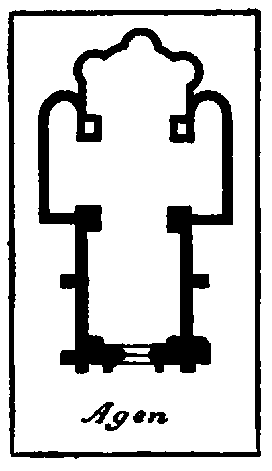
The Romanesque cathedral of St. Caprais
dates, as to its apses and transepts, from the
eleventh century.
Its size is not commonly accredited great,
but for a fact its nave is over fifty-five feet in
width; greater than Chartres, and nearly as
great as Amiens in the north.
This is a comparison which will show how
futile it is not to take into consideration the
peers, compeers, or contemporaries of architectural
types when striving to impress its
salient features upon one's senses.
This immense vault is covered with a series
of cupolas of a modified form which finally
take the feature of the early development of
the ogival arch. This, then, ranks as one of
the early transitions between barrel-vaulted
and domed roofs, and the Gothic arched
vaulting which became so common in the
century following.
As to the general ground-plan, the area is
not great. Its Romanesque nave is stunted
in length, if not in width, and the transepts
are equally contracted. The choir is semicircular,
and the general effect is that of a
tri-apsed church, seldom seen beyond the immediate
neighbourhood of the Rhine valley.
The interior effect is considerably marred
by the modern mural frescoes by Bézard, after
a supposed old manner. The combination of
colour can only be described as polychromatic,
and the effect is not good.
There are a series of Roman capitals in
the nave, which are of more decided artistic
worth and interest than any other distinct
feature.
At the side of the cathedral is the Chapelle
des Innocents, the ancient chapter-house of
St. Caprais, now used as the chapel of the
college. Its façade has some remarkable
sculptures, and its interior attractions of curiously
carved capitals and some tombs—supposed
to date from the first years of the Christian
era—are of as great interest as any of
the specific features of the cathedral proper.
The first bishop of Auch was Citerius, in
the fourth century. Subsequently the Province
d'Auch became the see of an archbishop,
who was Primate of Aquitaine. This came
to pass when the office was abolished or transferred
from Eauze in the eighth century.
The diocese is thus established in antiquity,
and endures to-day with suffragans at Aire,
Tarbes, and Bayonne.
The cathedral of Ste. Marie d'Auch is not
of itself an ancient structure, dating only from
the late fifteenth century. Its choir, however,
ranks among the most celebrated in the Gothic
style in all Europe, and the entire edifice is
usually accorded as being the most thoroughly
characteristic (though varied as to the excellence
of its details) church of the Midi of
France, though built at a time when the ogival
style was projecting its last rays of glory over
the land.
In its general plan it is of generous though
not majestic proportions, and is rich and aspiring
in its details throughout.
An ancient altar in this present church is
supposed to have come from the humble basilica
which was erected here by St. Taurin,
bishop of Eauze, soon after the foundation of
the see. If this is so, it is certainly of great
antiquity, and is exceedingly valuable as the
record of an art expression of that early day.
Taurin II., in 845, rebuilt a former church,
which stood on the site of the present cathedral;
but, its dimensions not proving great
enough for the needs of the congregation, St.
Austinde, in 1048, built a much larger church,
which was consecrated early in the twelfth
century.
Various other structures were undertaken,
some completed only in part and others to the
full; but it was not until 1548 that the present
Ste. Marie was actually consecrated by
Jean Dumas.
"This gorgeous ceremony," says the Abbé
Bourassé, "was accomplished amid great
pomp on the anniversary day of the dedication
of the eleventh-century basilica on the
same site."
In 1597 further additions were made to the
vaulting, and the fine choir glass added. Soon
after this time, the glass of the nave chapels
was put into place, being the gift of Dominique
de Vic. The final building operations—as
might be expected—show just the least
suspicion of debasement. This quality is to
be remarked in the choir-screen, the porch
and towers, and in the balustrades of the
chapels, to say nothing of the organ supports.
The west front is, in part, as late as the seventeenth
century.
In this façade there is an elaborately traceried
rose window, indicating in its painted
glass a "Glory of Angels." It is not a great
work, as these chief decorative features of
French mediæval architecture go, but is
highly ornate by reason of its florid tracery,
and dates, moreover, from that period when
the really great accomplishment of designing
in painted glass was approaching its maturity.
If any feature of remark exists to excite
undue criticism, it is that of a certain incongruity
or mixture of style, which, while not
widely separated in point of time, has great
variation as to excellence.
In spite of this there is, in the general
ensemble, an imposing picturesqueness to
which distance lends the proverbial degree
of enchantment.
The warm mouse-coloured cathedral and
its archbishop's palace, when seen in conjunction
with the modern ornamental gardens
and escalier at the rear, produces an effect
more nearly akin to an Italian composition
than anything of a like nature in France.
It is an ensemble most interesting and
pleasing, but as a worthy artistic effort it does
perhaps fall short of the ideal.
The westerly towers are curious heavy
works after the "French Classical" manner
in vogue during the reign of Louis XIV.
They are not beautiful of themselves, and
quite unexpressive of the sanctity which
should surround a great church.
The portal is richly decorated, and contains
statues of St. Roche and St. Austinde.
It has been called an "imitation of the portal
of St. Peter's at Rome," but this is an opinion
wholly unwarranted by a personal acquaintance
therewith. The two bear no resemblance
except that they are both very inferior to the
magnificent Gothic portals of the north.
The interior embellishments are as mixed
as to style, and of as varied worth, as those
of the exterior.
The painted glass (by a Gascon artist, Arnaud
de Moles, 1573) is usually reckoned as
of great beauty. This it hardly is, though of
great value and importance as showing the
development of the art which produced it.
The colour is rich,—which it seldom is in
modern glass,—but the design is coarse and
crude, a distinction that most modern glass
has as well. Ergo, we have not advanced
greatly in this art.
The chief feature of artistic merit is the
series of one hundred and thirteen choir-stalls,
richly and wonderfully carved in wood. If
not the superior to any others in France, these
remarkable examples of Renaissance woodwork
are the equal of any, and demonstrate,
once again, that it was in wood-carving,
rather than sculptures in stone, that Renaissance
art achieved its greatest success.
A distinct feature is the disposition made
of the accessories of the fine choir. It is surrounded
by an elaborate screen, surmounted
by sculpture of a richness quite uncommon
in any but the grander and more wealthy
churches.
Under the reign of St. Louis many of the
grand cathedrals and the larger monastic
churches were grandly favoured with this
accessory, notably at Amiens and Beauvais,
at Burgos in Spain, and at Canterbury.
Here the elaborate screen was designed to
protect the ranges of stalls and their canopied
dossiers, and give a certain seclusion to the
chapter and officiants.
Elsewhere—out of regard for the people
it is to be presumed—this feature was in
many known instances done away with, and
the material of which it was constructed—often
of great richness—made use of in
chapels subsequently erected in the walls of
the apside or in the side aisles of the nave.
This is to be remarked at Rodez particularly,
where the reërected clôture is still the show-piece
of the cathedral.
The organ buffet is, as usual (in the minds
of the local resident), a remarkably fine piece
of cabinet-work and nothing more. One always
qualifies this by venturing the opinion
that no one ever really does admire these overpowering
and ungainly accessories.
What triforium there is is squat and ugly,
with ungraceful openings, and the high-altar
is a modern work in the pseudo-classic style,
quite unworthy as a work of art.
The five apsidal chapels are brilliant with
coloured glass, but otherwise are not remarkable.
In spite of all incongruity, Ste. Marie
d'Auch is one of those fascinating churches
in and about which one loves to linger. It
is hard to explain the reason for this, except
that its environment provides the atmosphere
which is the one necessary ingredient to
a full realization of the appealing qualities of
a stately church.
The archiepiscopal palace adjoins the cathedral
in the rear, and has a noble donjon
of the fourteenth century. Its career of the
past must have been quite uneventful, as history
records no very bloody or riotous events
which have taken place within or before its
walls.
Fénelon was a student at the College of
Auch, and his statue adorns the Promenade
du Fossé.
The provincialism of Toulouse has been
the theme of many a French writer of ability,—offensively
provincial, it would seem from
a consensus of these written opinions.
"Life and movement in abundance, but
what a life!" ... "The native is saved from
coarseness by his birth, but after a quarter
of an hour the substratum shows itself." ...
"The working girl is graceful and has the
vivacity of a bird, but there is nothing in her
cackle." ... "How much more beautiful
are the stars that mirror themselves in the
gutter of the Rue du Bac." ... "There is
a yelp in the accents of the people of the
town."
Contrariwise we may learn also that "the
water is fine," "the quays are fine," and "fine
large buildings glow in the setting sun in
bright and softened hues," and "in the far
distance lies the chain of the Pyrenees, like
a white bed of watery clouds," and "the river,
dressed always in smiling verdure, gracefully
skirts the city."
These pessimistic and optimistic views of
others found the contributors to this book in
somewhat of a quandary as to the manner
of mood and spirit in which they should approach
this provincial capital.
They had heard marvels of its Romanesque
church of St. Saturnin, perhaps the most
perfect and elaborate of any of its kind in all
France; of the curious amalgamated edifice,
now the cathedral of St. Etienne, wherein two
distinct church bodies are joined by an unseemly
ligature; of the church of the Jacobins;
and of the "seventy-seven religious
establishments" enumerated by Taine.
All these, or less, were enough to induce
one to cast suspicion aside and descend upon
the city with an open mind.
Two things one must admit: Toulouse does
somewhat approach the gaiety of a capital,
and it is provincial.
Its list of attractions for the visitor is
great, and its churches numerous and splendid,
so why carp at the "ape-like manners"
of the corner loafers, who, when all is said,
are vastly less in number here than in many
a northern centre of population.
The Musée is charming, both as to the disposition
of its parts and its contents. It was
once a convent, and has a square courtyard or
promenade surrounded by an arcade. The
courtyard is set about with green shrubs, and
a lofty brick tower, pierced with little arched
windows and mullioned with tiny columns,
rises skyward in true conventual fashion.
Altogether the Musée, in the attractiveness
of its fabric and the size and importance of
its collections, must rank, for interest to the
tourist, at the very head of those outside Paris
itself.
As for the churches, there are many, the
three greatest of which are the cathedral of
St. Etienne, St. Saturnin, and the Église des
Jacobins; in all is to be observed the universal
application or adoption of des matériaux
du pays—bricks.
In the cathedral tower, and in that of the
Église des Jacobins, a Gothic scheme is
worked out in these warm-toned bricks, and
forms, in contrast with the usual execution of
a Gothic design, a most extraordinary effect;
not wholly to the detriment of the style, but
certainly not in keeping with the original
conception and development of "pointed"
architecture.
In 1863 Viollet-le-Duc thoroughly and
creditably restored St. Saturnin at great expense,
and by this treatment it remains to-day
as the most perfectly preserved work extant
of its class.
It is vast, curious, and in a rather mixed
style, though thoroughly Latin in motive.
It is on the border-line of two styles; of
the Italian, with respect to the full semicircular
arches and vaulting of the nave and
aisles; the square pillars destitute of all ornament,
except another column standing out in
flat relief—an intimation of the quiet and
placid force of their functions.
With the transition comes a change in the
flowered capitals, from the acanthus to tracery
and grotesque animals.
There are five domes covering the five
aisles, each with a semicircular vault. The
walls, with their infrequent windows, are very
thick.
The delightful belfry—of five octagonal
stages—which rises from the crossing of the
transepts, presents, from the outside, a fine
and imposing arrangement. So, too, the
chapelled choir, with its apse of rounded
vaults rising in imposing tiers. This fine
church is in direct descent from the Roman
manner; built and developed as a simple idea,
and, like all antique and classical work,—approaching
purity,—is a living thing, in
spite of the fact that it depicts the sentiment
of a dead and gone past.
It might not be so successfully duplicated
to-day, but, considering that St. Saturnin
dates from the eleventh century, its commencement
was sufficiently in the remote past
to allow of its having been promulgated under
a direct and vigorous Roman influence.
The brick construction of St. Saturnin and
of the cathedral is not of that justly admired
quality seen in the ancient Convent of the
Jacobins, which dates from the thirteenth
century. Here is made perhaps the most
beautiful use of this style of mediæval building.
It is earlier than the Pont de Montauban,
the churches at Moissac or Lombez, and
even the cathedral at Albi, but much later
than the true Romanesque brickwork, which
alternated rows of brick with other materials.
The builders of Gallo-Romain and Merovingian
times favoured this earlier method,
but work in this style is seldom met with of
a later date than the ninth century.
The Église of St. Saturnin shows, in parts,
brickwork of a century earlier than the Église
des Jacobins, but, as before said, it is not so
beautiful.
When the Renaissance came to deal with
brique, it did not do so badly. Certainly the
domestic and civil establishments of Touraine
in this style—to particularize only one section—are
very beautiful. Why the revival
was productive of so much thorough badness
when it dealt with stone is one of the things
which the expert has not as yet attempted to
explain; at least, not convincingly.
The contrasting blend of the northern and
southern motive in the hybrid cathedral at
Toulouse will not remain unnoticed for long
after the first sensation of surprise at its curious
ground-plan passes off.
Here are seen a flamboyant northern choir
and aisles in strange juxtaposition with a
thirteenth-century single vaulted nave, after
the purely indigenous southern manner.
This nave nearly equals in immensity those
in the cathedrals of Albi and Bordeaux. It
has the great span of sixty-two feet, necessitating
the employment of huge buttresses,
which would be remarkable anywhere, in
order to take the thrust. The unobstructed
flooring of this splendid nave lends an added
dignity of vastness. Near the vaulted roof
are the only apertures in the walls. Windows,
as one knows them elsewhere, are practically
absent.
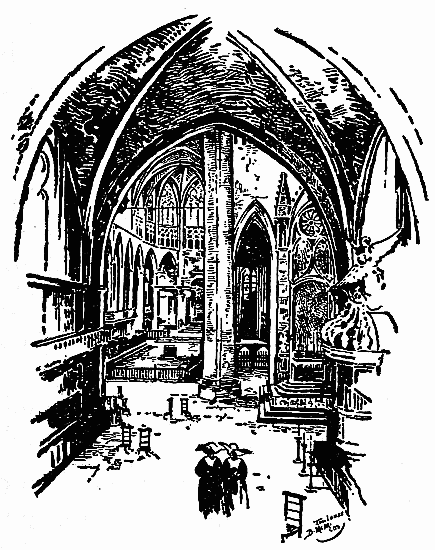
Nave of St. Etienne de Toulouse
The congregations which assemble in this
great aisleless nave present a curiously animated
effect by reason of the fact that they
scatter themselves about in knots or groups
rather than crowding against either the altar-rail
or pulpit, occasionally even overflowing
into the adjoining choir. The nave is entirely
unobstructed by decorations, such as screens,
pillars, or tombs. It is a mere shell, sans gallery,
sans aisles, and sans triforium.
The development of the structure from the
individual members of nave and choir is
readily traced, and though these parts show
not the slightest kind of relationship one to
the other, it is from these two fragmentary
churches that the completed, if imperfect,
whole has been made.
The west front, to-day more than ever,
shows how badly the cathedral has been put
together; the uncovered bricks creep out here
and there, and buildings to the left, which
formerly covered the incongruous joint between
the nave and choir, are now razed,
making the patchwork even more apparent.
The square tower which flanks the portal to
the north is not unpleasing, and dates from
the fifteenth and sixteenth centuries. The
portal is not particularly beautiful, and is
bare of decorations of note. It appears to
have been remodelled at some past time with
a view to conserving the western rose window.
There are no transepts or collateral chapels,
which tends to make the ground-plan the
more unusual and lacking in symmetry.
The choir (1275-1502) is really very
beautiful, taken by itself, far more so than
the nave, from which it is extended on a different
axis.
It was restored after a seventeenth-century
fire, and is supposed to be less beautiful to-day
than formerly.
There are seventeen chapels in this choir,
with much coloured glass of the fifteenth and
seventeenth centuries, all with weird polychromatic
decorations in decidedly bad taste.
Toulouse became a bishopric in the third
century, with St. Saturnin as its first bishop.
It was raised to the rank of archiepiscopal
dignity in 1327, a distinction which it enjoys
to-day in company with Narbonne. Six
former suffragan bishoprics, Pamiers, Rieux,
Mirepoix, Saint-Papoul, Lombez, and Lavaur
were suppressed at the Revolution.
In the magnificent Musée of the city is un
petit monument, without an inscription, but
bearing a cross gammée or Swastika, and a
palm-leaf, symbols of the divine Apollo and
Artemis. It seems curious that this tiny record
in stone should have been found, as it
was, in the mountains which separate the
sources of the Garonne and the Adour, as the
Swastika is a symbol supposedly indigenous
to the fire and sun-worshippers of the East,
where it figures in a great number of their
monuments.
It is called, by the local antiquary, a Pyrenean
altar. If this is so, it is of course of
pagan origin, and is in no way connected with
Christian art.
With old and new Carcassonne one finds
a contrast, if not as great as between the
hyphenated Hungarian cities of Buda and
Pest, at least as marked in detail.
In most European settlements, where an
old municipality adjoins a modern one, walls
have been razed, moats filled, and much general
modernization has been undertaken.
With Carcassonne this is not so; its winding
ways, its culs-de-sacs, narrow alleys, and
towering walls remain much as they always
were, and the great stronghold of the Middle
Ages, vulnerable—as history tells—from
but one point, remains to-day, after its admirable
restoration of roof and capstone,
much as it was in the days when modern Carcassonne
was but a scattering hamlet beneath
the walls of the older fortification.
One thing will always be recalled, and that
is that a part of the enceinte of the ancient
Cité was a construction of the sixth century—the
days of the Visigoths—and that its
subsequent development into an almost invulnerable
fortress was but the endorsement
which later centuries gave to the work and
forethought of a people who were supposed
to possess no arts, and very little of ingenuity.
This should suggest a line of investigation
to one so minded; while for us, who regard
the ancient walls merely as a boundary which
sheltered and protected a charming Gothic
church, it is perhaps sufficient to recall the
inconsistency in many previous estimates as
to what great abilities, if any, the Goths possessed.
If it is true that the Visigoths merely followed
Roman tradition, so much the more
creditable to them that they preserved these
ancient walls to the glory of those who came
after, and but added to the general plan.
Old and new Carcassonne, as one might
call them, in the sixteenth and seventeenth
centuries had each their own magistrates and
a separate government. The Cité, elevated
above the ville, held also the garrison, the
presidial seat, and the first seneschalship of
the province.
The bishopric of the Cité is not so ancient
as the ville itself; for the first prelate there
whose name is found upon record was one
Sergius, "who subscribed to a 'Council' held
at Narbonne in 590."
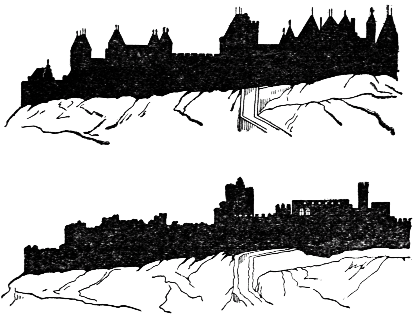 The Old Cité de Carcassonne before and after the Restoration
St. Hilaire, who founded the abbey at Poitiers,
came perhaps before Sergius, but his
tenure is obscure as to its exact date.
The cathedral of St. Michel, in the lower
town, has been, since 1803, the seat of the
bishop's throne.
It is a work unique, perhaps, in its design,
but entirely unfeeling and preposterous in its
overelaborate decorations. It has a long parallelogram-like
nave, "entièrement peinte,"
as the custodian refers to it. It has, to be sure,
a grand vault, strong and broad, but there are
no aisles, and the chapels which flank this
gross nave are mere painted boxes.
Episcopal dignity demanded that some
show of importance should be given to the
cathedral, and it was placed in the hands of
Viollet-le-Duc in 1849 for restoration. Whatever
his labours may have been, he doubtless
was not much in sympathy with this clumsy
fabric, and merely "restored" it in some
measure approaching its twelfth-century
form.
It is with St. Nazaire de Carcassonne, the
tiny église of the old Cité and the ci-devant
cathedral that we have to do.
This most fascinating church, fascinating
for itself none the less than its unique environment,
is, in spite of the extended centuries
of its growth, almost the equal in the purity
of its Gothic to that of St. Urbain at Troyes.
And this, in spite of evidences of rather bad
joining up of certain warring constructive
elements.
The structure readily composes itself into
two distinct parts: that of the Romanesque
(round arch and barrel vault) era and that
of the Gothic of the thirteenth and fourteenth
centuries.
No consideration of St. Nazaire de Carcassonne
is possible without first coming to
a realization of the construction and the functions
of the splendidly picturesque and effective
ramparts which enclosed the ancient Cité,
its cathedral, châteaux, and various civil and
domestic establishments.
In brief, its history and chronology commences
with the Visigoth foundation, extending
from the fifth to the eighth centuries to
the time (1356) when it successfully resisted
the Black Prince in his bloody ravage, by
sword and fire, of all of Languedoc.
Legend has it that in Charlemagne's time,
after that monarch had besieged the town for
many years and was about to raise the siege
in despair, a certain tower,—which flanked
the château,—defended only by a Gauloise
known as Carcaso, suddenly gave way and
opened a breach by which the army was at
last able to enter.
A rude figure perpetuating the fame of this
Madame Carcaso—a veritable Amazon, it
would seem—is still seen, rudely carved,
over the Porte Narbonnaise.
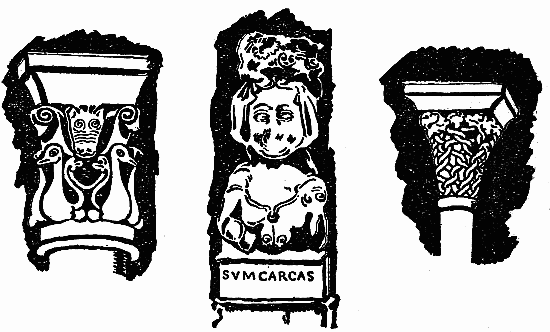
Two Capitals of Pillars in St. Nazaire de Carcassonne;
and the Rude Stone Carving of Carcas
It is the inner line of ramparts which dates
from the earliest period. The château, the
postern-gate, and most of the interior construction
are of the eleventh and twelfth centuries,
while the outer fortification is of the
time of St. Louis, the latter part of the thirteenth
century.
The Saracens successfully attacked and occupied
the city from 713 to 759, but were
routed by Pepin-le-Bref. In 1090 was first
founded the strong vicomtale dynasty of the
Trencavels. In 1210 the Crusaders, under
Simon de Montfort and the implacable Abbot
of Citeaux, laid siege to the Cité, an act which
resulted in the final massacre, fifty of the besieged—who
surrendered—being hanged,
and four hundred burned alive.
In addition to the walls and ramparts were
fifty circular protecting towers. The extreme
length of the inner enclosure is perhaps three-quarters
of a mile, and of the outer nearly a
full mile.
It is impossible to describe the magnitude
and splendour of these city walls, which, up
to the time of their restoration by Viollet-le-Duc,
had scarcely crumbled at all. The
upper ranges of the towers, roof-tops, ramparts,
etc., had become broken, of course, and
the sky-line had become serrated, but the
walls, their foundations, and their outline
plan had endured as few works of such magnitude
have before or since.
Carcassonne, its history, its romance, and its
picturesque qualities, has ever appealed to
the poet, painter, and historian alike.
Something of the halo of sentiment which
surrounds this marvellous fortified city will
be gathered from the following praiseful admiration
by Gustave Nadaud:
| |
| CARCASSONNE |
| |
| "'I'm growing old, I've sixty years; |
| I've laboured all my life in vain; |
| In all that time of hopes and fears |
| I've failed my dearest wish to gain; |
| I see full well that here below |
| Bliss unalloyed there is for none. |
| My prayer will ne'er fulfilment know; |
| I never have seen Carcassonne, |
| I never have seen Carcassonne! |
| |
| "'You see the city from the hill— |
| It lies beyond the mountains blue, |
| And yet to reach it one must still |
| Five long and weary leagues pursue, |
| And, to return, as many more! |
| Ah! had the vintage plenteous grown, |
| The grape withheld its yellow store! |
| I shall not look on Carcassonne, |
| I shall not look on Carcassonne! |
| |
| "'They tell me every day is there |
| Not more nor less than Sunday gay; |
| In shining robes and garments fair |
| The people walk upon their way. |
| One gazes there on castle walls |
| As grand as those of Babylon, |
| A bishop and two generals! |
| I do not know fair Carcassonne, |
| I do not know fair Carcassonne! |
| |
| "'The curé's right; he says that we |
| Are ever wayward, weak, and blind; |
| He tells us in his homily |
| Ambition ruins all mankind; |
| Yet could I there two days have spent, |
| While the autumn sweetly shone, |
| Ah, me! I might have died content |
| When I had looked on Carcassonne, |
| When I had looked on Carcassonne! |
| |
| "'Thy pardon, Father, I beseech, |
| In this my prayer if I offend; |
| One something sees beyond his reach |
| From childhood to his journey's end. |
| My wife, our little boy, Aignan, |
| Have travelled even to Narbonne, |
| My grandchild has seen Perpignan, |
| And I have not seen Carcassonne, |
| And I have not seen Carcassonne!' |
| |
| "So crooned one day, close by Limoux, |
| A peasant double bent with age, |
| 'Rise up, my friend,' said I, 'with you |
| I'll go upon this pilgrimage.' |
| We left next morning his abode, |
| But (Heaven forgive him) half way on |
| The old man died upon the road; |
| He never gazed on Carcassonne, |
| Each mortal has his Carcassonne!" |
St. Nazaire is possessed of a Romanesque
nave which dates from 1096, but the choir
and transepts are of the most acceptable
Gothic forms of the thirteenth and fourteenth
centuries.
This choir is readily accounted as a masterwork
of elegance, is purely northern in style
and treatment, and possesses also those other
attributes of the perfectionnement of the style—fine
glass, delicate fenestration, and superlative
grace throughout, as contrasted with
the heavier and more cold details of the Romanesque
variety.
The nave was dedicated by Urbain II., and
was doubtless intended for defence, if its
square, firmly bedded towers and piers are
suggestive of that quality. The principal
porte—it does not rise to the grandeur of
a portail—is a thorough Roman example.
The interior, with its great piers, its rough
barrel-vault, and its general lack of grace and
elegance, bespeaks its functions as a stronghold.
A Romanesque tower in its original
form stands on the side which adjoins the
ramparts.
With the choir comes the contrast, both
inside and out.
The apside, the transepts, the eleven gorgeous
windows, and the extreme grace of its
piers and vaulting, all combine in the fullest
expression of the architectural art of its
time.
This admirable Gothic addition was the
work of Bishop Pierre de Rochefort in 1321.
The transept chapels and the apse are framed
with light soaring arches, and the great easterly
windows are set with brilliant glass.
In a side chapel is the former tomb of
Simon de Montfort, whose remains were
buried here in 1218. At a subsequent time
they were removed to Montfort l'Amaury in
the Isle of France. Another remarkable
tomb is that of Bishop Radulph (1266). It
shows an unusually elaborate sculptured treatment
for its time, and is most ornate and beautiful.
In the choir are many fine fourteenth-century
statues; a tomb with a sleeping figure,
thought to be that of Bishop du Puy of Carcassonne;
statues of the Virgin, St. Nazaire,
and the twelve apostles; an elaborate high-altar;
and a pair of magnificent candlesticks,
bearing the arms of Bishop Martin (1522).
An eleventh-century crypt lies beneath the
choir. The sacristy, as it is to-day, was formerly
a thirteenth-century chapel.
The organ is commonly supposed to be the
most ancient in France. It is not of ranking
greatness as a work of art, but it is interesting
to know that it has some redeeming quality,
aside from its conventional ugliness.
The tour carrée, which is set in the inner
rampart just in front of the cathedral, is
known as the Bishop's Tower. It is a tower
of many stages, and contains some beautifully
vaulted chambers.
The celebrated tour des Visigoths, which
is near by, is the most ancient of all.
The entrance to the old Cité is via the Pont
Vieux, which is itself a mediæval twelfth or
thirteenth century architectural monument of
rare beauty. In the middle of this old bridge
is a very ancient iron cross.
"Une petite ville sur la rive droite de
l'Ariège, siege d'un évêche." These few
words, with perhaps seven accompanying
lines, usually dismiss this charming little
Pyrenean city, so far as information for the
traveller is concerned.
It is, however, one of these neglected tourist
points which the traveller has ever passed
by in his wild rush "across country."
To be sure, it is considerably off the beaten
track; so too are its neighbouring ancient
bishoprics of Mirepoix and St. Bertrand de
Comminges, and for that reason they are comparatively
unspoiled.
The great and charming attraction of
Pamiers is its view of the serrated ridge of
the Pyrenees from the promenade de Castellat,
just beyond the cathedral.
For the rest, the cathedral, the fortified
Église de Notre Dame du Camp, the ancient
Église de Cordeliers, the many old houses,
and the general sub-tropical aspect of the
country round about, all combine to present
attractions far more edifying and gratifying
than the allurements of certain of the Pyrenean
"watering-places."
The cathedral itself is not a great work;
its charm, as before said, lies in its environments.
Its chief feature—and one of real distinction—is
its octagonal clocher, in brick, dating
from the fourteenth century. It is a singularly
graceful tower, built after the local manner
of the Midi of France, of which St. Saturnin
and the Église des Jacobins at Toulouse are
the most notable.
Its base is a broad square machicolated
foundation with no openings, and suggests,
as truly as does the tower at Albi, a churchly
stronghold unlikely to give way before any
ordinary attack.
In the main, the church is a rebuilt, rather
than a restored edifice. The nave, and indeed
nearly all of the structure, except its dominant
octagonal tower, is of the seventeenth century.
This work was undertaken and consummated
by Mansart after the manner of that period,
and is far more acceptable than the effect produced
by most "restored churches."
The eleventh-century abbey of St. Antoine
formed originally the seat of the throne of the
first bishop of Pamiers, Bernard Saisset, in
1297.
To-day St. Bertrand de Comminges, the
ancient Lugdunum Convenarum (through
which one traces its communistic foundation),
is possessed of something less than six hundred
inhabitants. Remains of the Roman ramparts
are yet to be seen, and its ci-devant cathedral,—of
the twelfth to fourteenth centuries—suppressed
in 1790, still dominates the town
from its heights. Arthur Young, writing in
the eighteenth century, describes its situation
thus: "The mountains rise proudly around
and give their rough frame to this exquisite
little picture."
The diocese grew out of the monkish community
which had settled here in the sixth
century, when the prelate Suavis became its
first bishop. To-day the nearest bishop's seat
is at Tarbes, in the archbishopric of Auch.
As to architectural style, the cathedral presents
what might ordinarily be called an undesirable
mixture, though it is in no way
uninteresting or even unpleasing.
The west front has a curious Romanesque
doorway, and there is a massiveness of wall
and buttress which the rather diminutive proportions
of the general plan of the church
make notably apparent. Otherwise the effect,
from a not too near view-point, is one of a
solidity and firmness of building only to be
seen in some of the neighbouring fortress-churches.
A tower of rather heavy proportions is to-day
capped with a pyramidal slate or timbered
apex after the manner of the western
towers at Rodez. From a distance, this feature
has the suggestion of the development
of what may perhaps be a local type of
clocher. Closer inspections, when its temporary
nature is made plain, disabuses this idea
entirely. It is inside the walls that the great
charm of this church lies. It is elaborately
planned, profuse in ornament,—without being
in any degree redundant,—and has a
warmth and brilliancy which in most Romanesque
interiors is wanting.
This interior is representative, on a small
scale, of that class of structure whose distinctive
feature is what the French architect
calls a nef unique, meaning, in this instance,
one of those great single-chambered churches
without aisles, such as are found at Perpignan,
new Carcassonne, Lodève, and in a still more
amplified form at Albi.
There are of course no aisles; and for a
length of something over two hundred feet,
and a breadth of fifty-five, the bold vault—in
the early pointed style—roofs one of the
most attractive and pleasing church interiors
it is possible to conceive.
Of the artistic accessories it is impossible
to be too enthusiastic. There are sixty-six
choir-stalls, most elaborately carved in wood—perhaps
mahogany—of a deep rich colouring
seldom seen. Numerous other sculptured
details in wood and stone set off with
unusual effect the great and well-nigh windowless
side walls.
The organ buffet of Renaissance workmanship—as
will naturally be inferred—is a
remarkably elaborate work, much more to be
admired than many of its contemporaries.
Among the other decorative features are an
elaborately conceived "tree of Jesse," an unusually
massive rood-loft or jube, and a high-altar
of much magnificence.
The choir is surrounded by eleven chapels,
showing in some instances the pure pointed
style, and in the latter ones that of the Renaissance.
A fourteenth-century funeral monument of
Bishop Hugh de Castillione is an elaborate
work in white marble; while a series of
paintings on the choir walls,—illustrating
the miracles of St. Bertrand,—though of a
certain crudity, tend to heighten the interest
without giving that effect of the over-elaboration
of irrelative details not unfrequently seen
in some larger churches.
At St. Bertrand de Comminges and the
cathedrals at Arles, Cavaillon, and Aix-en-Provence,
Elne-en-Roussillon, and Le Puy-en-Velay
are conserved—in a more or less
perfect state of preservation—a series of delightful
twelfth-century cloisters. These
churches possess this feature in common with
the purely monastic houses, whose builders
so frequently lavished much thought and care
on these enclosed and cloistered courtyards.
As a mere detail—or accessory, if you
will,—an ample cloister is expressive of
much that is wanting in a great church which
lacks this contributory feature.
Frequently this part was the first to succumb
to the destroying influence of time, and
leave a void for which no amount of latter-day
improvement could make up. Even here,
while the cloister ranks as one of the most
beautiful yet to be seen, it is part in a ruinous
condition.
This city of the Landes, that wild, bleak
region of sand-dunes and shepherds, abuts
upon the more prosperous and fertile territory
of the valley of the Adour. By reason
of this juxtaposition, its daily life presents a
series of contrasting elements as quaint and
as interesting as those of the bordering
Franco-Spanish cities of Perpignan and
Bayonne.
From travellers in general, and lovers of
architecture in particular, it has ever received
but scant consideration, though it is by no
means the desert place that early Victorian
writers would have us believe. It is in reality
a well-built mediæval town, with no very
lurid events of the past to its discredit, and,
truthfully, with no very marvellous attributes
beyond a certain subtle charm and quaintness
which is perhaps the more interesting because
of its unobtrusiveness.
It has been a centre of Christian activity
since the days of the fifth century, when its
first bishop, Marcel, was appointed to the
diocese by the mother-see of Auch.
The cathedral of St. Jean-Baptiste belongs
to the minor class of present-day cathedrals,
and is of a decidedly conglomerate architectural
style, with no imposing dimensions, and
no really vivid or lively details of ornamentation.
It was begun in the thirteenth century,
and the work of rebuilding and restoration has
been carried on well up to the present time.
Castres will ever rank in the mind of the
wayfarer along the byways of the south of
France as a marvellous bit of stage scenery,
rather than as a collection of profound, or
even highly interesting, architectural types.
It is one of those spots into which a traveller
drops quite unconsciously en route to
somewhere else; and lingers a much longer
time than circumstances would seem to justify.
This is perhaps inexplicable, but it is a
fact, which is only in a measure accounted for
by reason of the "local colour"—whatever
that vague term of the popular novelist may
mean—and customs which weave an entanglement
about one which is difficult to resist.
The river Agout is as weird a stream as its
name implies, and divides this haphazard little
city of the Tarn into two distinct, and quite
characteristically different, parts.
Intercourse between Castres and its faubourg,
Villegondom, is carried on by two
stone bridges; and from either bank of the
river, or from either of the bridges, there is
always in a view a ravishingly picturesque
ensemble of decrepit walls and billowy roof-tops,
that will make the artist of brush and
pencil angry with fleeting time.
The former cathedral is not an entrancingly
beautiful structure; indeed, it is not after the
accepted "good form" of any distinct architectural
style. It is a poor battered thing
which has suffered hardly in the past; notably
at the hands of the Huguenots in 1567. As it
stands to-day, it is practically a seventeenth-century
construction, though it is yet unfinished
and lacks its western façade.
The vaulting of the choir, and the chapels
are the only constructive elements which warrant
remark. There are a few paintings in
the choir, four rather attractive life-size statues,
and a series of severe but elegant choir-stalls.
The former évêché is to-day the Hôtel de
Ville, but was built by Mansart in 1666, and
has a fine escalier in sculptured stone.
As a centre of Christianity, Castres is very
ancient. In 647 there was a Benedictine
abbey here. The bishopric, however, did
not come into being until 1317, and was suppressed
in 1790.
The cathedral at Rodez, whose diocese
dates from the fifth century and whose first
bishop was St. Amand, is, in a way, reminiscent—in
its majesty of outline and dominant
situation—of that at Albi.
It is not, however, after the same manner,
but resembles it more particularly with respect
to its west façade, which is unpierced
in its lower stages by either doorway or
window.
Here, too, the entrance is midway in its
length, and its front presents that sheer flank
of walled barrier which is suggestive of nothing
but a fortification.
This great church—for it is truly great,
pure and simple—makes up in width what
it lacks in length. Its nave and aisles are just
covered by a span of one hundred and twenty
feet,—a greater dimension than is possessed
by Chartres or Rouen, and nearly as great
as Paris or Amiens.
Altogether Notre Dame de Rodez is a most
pleasing church, though conglomerate as to
its architecture, and as bad, with respect to
the Renaissance gable of its façade, as any
contemporary work in the same style.
Rodez lacks, however, the great enfolding
tower central of Albi.
This mellow and warm-toned cathedral,
from its beginnings in the latter years of the
thirteenth century to the time when the Renaissance
cast its dastardly spell over the
genius who inspired its original plan, was the
result of the persevering though intermittent
work of three centuries, and even then the two
western towers were left incomplete.
This perhaps was fortunate; otherwise they
might have been topped with such an excrescence
as looms up over the doorless west
façade.
The Gascon compares the pyramidal roofs
which cap either tower—and with some justness,
too—to the pyramids of Egypt, and
for that reason the towers are, to him, the
most wonderful in the universe. Subtle humour
this, and the observer will have little
difficulty in tracing the analogy.
Still, they really are preferable, as a decorative
feature, to the tomb-like headboard
which surmounts the central gable which they
flank. The ground-plan is singularly uniform,
with transepts scarcely defined—except
in the interior arrangements—and yet
not wholly absent.
The elaborate tower, called often and with
some justification the beffroi, which flanks,
or rather indicates, the northerly transept, is
hardly pure as to its Gothic details, but it
is a magnificent work nevertheless.
It dates from 1510, is two hundred and
sixty-five feet high, and is typical of most of
the late pointed work of its era. The final
stage is octagonal and is surmounted by a
statue of the Virgin surrounded by the Evangelists.
This statue may or may not be a
worthy work of art; it is too elevated, however,
for one to decide.
The decorations of the west front, except
for the tombstone-like Renaissance gable, are
mainly of the same period as the north transept
tower, and while perhaps ultra-florid,
certainly make a fine appearance when
viewed across the Place d'Armes.
This west front, moreover, possesses that
unusual attribute of a southern church, an
elaborate Gothic rose window; and, though
it does not equal in size or design such magnificent
examples as are seen in the north,
at Reims, Amiens, or Chartres, is, after all,
a notable detail of its kind.
The choir, chevet, and apside are of massive
building, though not lacking grace, in
spite of the absence of the arcs-boutants of the
best Gothic.
Numerous grotesque gargoyles dot the eaves
and gables, though whether of the spout variety
or mere symbols of superstition one can
hardly tell with accuracy when viewed from
the ground level.
The north and south portals of the transepts
are of a florid nature, after the manner
of most of the decorations throughout the
structure, and are acceptable evidence of the
ingenious craft of the stone-carver, if nothing
more.
The workmanship of these details, however,
does not rise to the heights achieved by
the architect who outlined the plan and
foundation upon which they were latterly
imposed. They are, too, sadly disfigured, the
tympanum in the north portal having been
disgracefully ravished.
The interior arrangements are doubly impressive,
not only from the effect of great
size, but from the novel colour effect—a sort
of dull, glowing pink which seems to pervade
the very atmosphere, an effect which contrasts
strangely with the colder atmosphere
of the Gothic churches of the north. A curious
feature to be noted here is that the sustaining
walls of the vault rest directly on
piers sans capitals; as effective, no doubt, as
the conventional manner, but in this case
hardly as pleasing.
Two altars, one at either end of nave and
choir, duplicate the arrangement seen at
Albi.
The organ buffet, too, is of the same massiveness
and elaborateness, and is consequently
an object of supreme pride to the local authorities.
It seems difficult to make these useful and
necessary adjuncts to a church interior of the
quality of beauty shared by most other accessories,
such as screens, altars, and choir-stalls,
which, though often of the contemporary
Renaissance period, are generally beautiful
in themselves. The organ-case, however,
seems to run either to size, heaviness, or grotesqueness,
or a combination of all. This is
true in this case, where its great size, and
plentifully besprinkled rococo ornament, and
unpleasantly dull and dingy "pipes" are of
no æsthetic value whatever. The organ,
moreover, occupies the unusual position—in
a French church—of being over the western
doorway.
The nave is of extreme height, one hundred
and ten feet, and is of unusual width, as are
also the aisles.
The rose window, before remarked, shows
well from the inside, though its glass is not
notable.
A series of badly arched lancets in the
choir are ungraceful and not in keeping with
the other constructive details. The delicately
sculptured and foliaged screen or jubé at the
crossing is a late fifteenth-century work.
In one of the chapels is now to be seen, in
mutilated fragments, the ancient sixteenth-century
clôture du chœur. It was a remarkable
and elaborate work of bizarre stone-carving,
which to-day has been reconstructed
in some measure approaching its former completeness
by the use of still other fragments
taken from the episcopal palace. The chief
feature as to completeness and perfection is the
doorway, which bears two lengthy inscriptions
in Latin. The facing of the clôture
throughout is covered with a range of pilasters
in Arabesque, but the niches between are
to-day bare of their statues, if they ever really
possessed them.
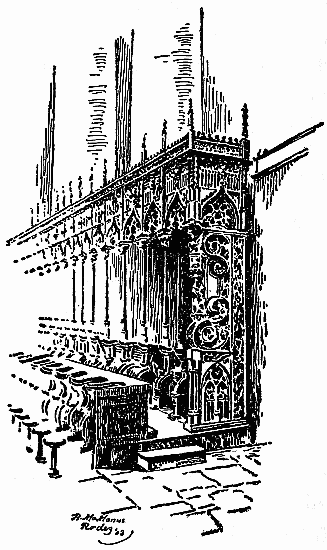
Choir-stalls, Rodez
The choir-stalls and bishop's throne in
carved wood are excellent, as also an elaborately
carved wooden grille of a mixed Arabesque
and Gothic design.
There are four other chapel or alcove
screens very nearly as elaborate; all of which
features, taken in conjunction one with the
other, form an extensive series of embellishments
such as is seldom met with.
Two fourteenth-century monuments to
former prelates are situated in adjoining
chapels, and a still more luxurious work of
the same period—the tomb of Gilbert de
Cantobre—is beneath an extensive altar
which has supposedly Byzantine ornament of
the tenth century.
Rodez was the seat of a bishop (St.
Amand) as early as the fifth century.
Then, as now, the diocese was a suffragan
of Albi, whose first bishop, St. Clair, came
to the mother-see in the century previous.
The cathedral of Ste. Cécile d'Albi is one
of the most interesting, as well as one of the
most curious, in all France. It possesses a
quality, rare among churches, which gives it
at once the aspect of both a church and a
fortress.
As the representative of a type, it stands
at the very head of the splendid fortress-churches
of feudal times. The remarkable
disposition of its plan is somewhat reflected
in the neighbouring cathedral at Rodez and
in the church at Esnades, in the Department
of the Charente-Inférieure.
In the severe and aggressive lines of the
easterly, or choir, end, it also resembles the
famous church of St. Francis at Assisi, and
the ruined church of Sainte Sophie at Famagousta
in the Island of Cyprus.
It has been likened by the imaginative
French—and it needs not so very great a
stretch of the imagination, either—to an immense
vessel. Certainly its lines and proportions
somewhat approach such a form; as
much so as those of Notre Dame de Noyon,
which Stevenson likened to an old-time craft
with a high poop. A less æsthetic comparison
has been made with a locomotive of gigantic
size, and, truth to tell, it is not unlike that,
either, with its advancing tower.
The extreme width of the great nave of this
church is nearly ninety feet, and its body is
constructed, after an unusual manner, of a
warm, rosy-coloured brick. In fact the only
considerable portions of the structure not so
done are the clôture of the choir, the window-mullions,
and the flamboyant Gothic porch
of the south side.
By reason of its uncommon constructive
elements,—though by no means is it the sole
representative of its kind in the south of
France,—Ste. Cécile stands forth as the most
considerable edifice of its kind among those
which were constructed after this manner of
Roman antiquity.
Brickwork of this nature, as is well known,
is very enduring, and it therefore makes much
for the lasting qualities of a structure so built;
much more so, in fact, than the crumbling soft
stone which is often used, and which crumbles
before the march of time like lead in a furnace.
Ste. Cécile was begun in 1282, on the ruins
of the ancient church of St. Croix. It came
to its completion during the latter years of
the fourteenth century, when it stood much
as it does to-day, grim and strong, but very
beautiful.
The only exterior addition of a later time
is the before-remarked florid south porch.
This baldaquin is very charmingly worked
in a light brown stone, and, while flamboyant
to an ultra degree, is more graceful in design
and execution than most works of a contemporary
era which are welded to a stone fabric
whose constructive and decorative details are
of quite a distinctly different species. In
other words, it composes and adds a graceful
beauty to the brick fabric of this great church;
but likely enough it would offend exceedingly
were it brought into juxtaposition with the
more slim lines of early Gothic. Its detail
here is the very culmination of the height
to which Gothic rose before its final debasement,
and, in its spirited non-contemporaneous
admixture with the firmly planted brick
walls which form its background, may be
reckoned as a baroque in art rather than as
a thing outré or misplaced.
In further explanation of the peculiar fortress-like
qualities possessed by Ste. Cécile, it
may be mentioned here that it was the outcome
of a desire for the safety of the church
and its adherents which caused it to take this
form. It was the direct result of the terrible
wars of the Albigenses, and the political and
social conditions of the age in which it was
built,—the days when the Church was truly
militant.
Here, too, to a more impressive extent than
elsewhere, if we except the papal palace at
Avignon, the episcopal residence as well takes
on an aspect which is not far different from
that possessed by some of the secular châteaux
of feudal times. It closely adjoins the cathedral,
which should perhaps dispute this. In
reality, however, it does not, and its walls and
foundations look far more worldly than they
do devout. As to impressiveness, this stronghold
of a bishop's palace is thoroughly in
keeping with the cathedral itself, and the
frowning battlement of its veritable donjon
and walls and ramparts suggests a deal more
than the mere name by which it is known
would justify. Such use as it was previously
put to was well served, and the history of the
troublous times of the mediæval ages, when
the wars of the Protestants, "the cursed Albigenses,"
and the natural political and social
dissensions, form a chapter around which
one could weave much of the history of this
majestic cathedral and its walled and fortified
environment.
The interior of the cathedral will appeal
first of all by its very grand proportions, and
next by the curious ill-mannered decorations
with which the walls are entirely covered.
There is a certain gloom in this interior, induced
by the fact that the windows are mere
elongated slits in the walls. There are no
aisles, no triforium, and no clerestory; nothing
but a vast expanse of wall with bizarre
decorations and these unusual window piercings.
The arrangement of the openings in
the tower are even more remarkable—what
there are of them, for in truth it is here that
the greatest likeness to a fortification is seen.
In the lower stages of the tower there are no
openings whatever, while above they are
practically nothing but loopholes.
The fine choir-screen, in stone, is considered
one of the most beautiful and magnificent
in France, and to see it is to believe the
statement. The entire clôture of the choir
is a wonderful piece of stonework, and the
hundred and twenty stalls, which are within
its walls, form of themselves an excess of elaboration
which perhaps in a more garish light
would be oppressive.
The wall-paintings or frescoes are decidedly
not beautiful, being for the most part
crudely coloured geometrical designs scattered
about with no relation one to another.
They date from the fifteenth and sixteenth
centuries, and are doubtless Italian as to their
workmanship, but they betray no great skill
on the part of those unknowns who are responsible
for them.
The pulpit is an unusually ornate work for
a French church, but is hardly beautiful as
a work of art. No more is the organ-case,
which, as if in keeping with the vast interior,
spreads itself over a great extent of wall space.
Taken all in all, the accessories of the cathedral
at Albi, none the less than the unique
plan and execution thereof, the south porch,
the massive tower, the jube and clôture of the
choir, the vast unobstructed interior, and the
outré wall decorations, place it as one of the
most consistently and thoroughly completed
edifices of its rank in France. Nothing apparently
is wanting, and though possessed of
no great wealth of accessory—if one excepts
the choir enclosure alone—it is one of those
shrines which, by reason of its very individuality,
will live long in the memory. It has
been said, moreover, to stand alone as to the
extensive and complete exemplification of
"l'art decoratif" in France; that is, as being
distinctively French throughout.
The evolution of these component elements
took but the comparatively small space of
time covered by two centuries—from the
fourteenth to the sixteenth. The culmination
resulted in what is still to be seen in all its
pristine glory to-day, for Ste. Cécile has not
suffered the depredation of many another
shrine.
The general plan is distinctly and indigenously
French; French to the very core—born
of the soil of the Midi, and bears no resemblance
whatever to any exotic from another
land.
With the decorative elements the case may
be somewhat qualified. The baldaquin—like
the choir-screen—more than equals in
delicacy and grace the portals of such masterworks
as Notre Dame de Rouen, St. Maclou,
or even the cathedral at Troyes, though
of less magnitude than any of these examples.
On the other hand, it was undoubtedly inspired
by northern precept, as also were the
ornamental sculptures in wood and stone
which are to be seen in the interior.
Albi was a bishopric as early as the fourth
century, with St. Clair as its first bishop. At
the time the present cathedral was begun it
became an archbishopric, and as such it has
endured until to-day, with suffragans at Rodez,
Cahors, Mende, and Perpignan.
In the heart of the Gévaudan, Mende is
the most picturesque, mountain-locked little
city imaginable, with no very remarkable features
surrounding it, nor any very grand artificial
ones contained within it.
The mountains here, unlike the more fruitful
plains of the lower Gévaudan, are covered
with snow all of the winter. It is said that
the inhabitants of the mountainous upper
Gévaudan used to "go into Spain every winter
to get a livelihood." Why, it is difficult
to understand. The mountain and valley
towns around Mende look no less prosperous
than those of Switzerland, though to be sure
the inhabitants have never here had, and perhaps
never will have, the influx of tourists
"to live off of," as in the latter region.
During an invasion of the Alemanni into
Gaul, in the third century, the principal city
of Gévaudan was plundered and ruined. The
bishop, St. Privat, fled into the Cavern of
Memate or Mende, whither the Germans followed
and killed him.
The holy man was interred in the neighbouring
village of Mende, and the veneration
which people had for his memory caused
them to develop it into a considerable place.
Such is the popular legend, at any rate.
The city had no bishop of its own, however,
until the middle of the tenth century. Previously
the bishops were known as Bishops
of Gévaudan. At last, however, the prelates
fixed their seat at Mende, and "great numbers
of people resorted thither by reason of
the sepulchre of St. Privat."
By virtue of an agreement with Philippe-le-Bel,
in 1306, the bishop became Count of
Gévaudan. He claimed also the right of
administering the laws and the coining of
specie.
Mende is worth visiting for itself alone and
for its cathedral. It is difficult to say which
will interest the absolute stranger the more.
The spired St. Pierre de Mende is but a
fourteenth-century church, with restorations
of the seventeenth, but there is a certain grimness
and primitiveness about its fabric which
would otherwise seem to place it as of a much
earlier date.
The seventeenth-century restorations
amounted practically to a reconstruction, as
the Calvinists had partly destroyed the fabric.
The two fine towers of the century before
were left standing, but without their spires.
The city itself lies at a height of over
seven hundred kilometres, and the pic rises
another three hundred kilometres above. The
surrounding "green basin of hillsides" encloses
the city in a circular depression, which,
with its cathedral as the hub, radiates in long,
straight roadways to the bases of these verdure-clad
hills.
It is not possible to have a general view
of the cathedral without its imposing background
of mountain or hilltops, and for this
reason, while the entire city may appear
dwarfed, and its cathedral likewise diminished
in size, they both show in reality the
strong contrasting effect of nature and art.
The cathedral towers, built by Bishop de la
Rovère, are of sturdy though not great proportions,
and the half-suggested spires rise
skyward in as piercing a manner as if they
were continued another hundred feet.
As a matter of fact one rises to a height of
two hundred and three feet, and the other
to two hundred and seventy-six feet, so at
least, they are not diminutive. The taller of
these pleasing towers is really a remarkable
work.
The general plan of the cathedral is the
conventional Gothic conception, which was
not changed in the seventeenth-century reconstruction.
The nave is flanked with the usual aisles,
which in turn are abutted with ten chapels
on either side.
Just within the left portal is preserved the
old bourdon called la Non-Pareille, a curiosity
which seems in questionable taste for
inclusion within a cathedral.
The rose window of the portal shows in the
interior with considerable effect, though it is
of not great elegance or magnificence of itself.
In the Chapelle des Catechismes, immediately
beneath the tower, is an unusual "Assumption."
As a work of art its rank is not
high, and its artist is unknown, but in its conception
it is unique and wonderful.
There are some excellent wood-carvings in
the Chapelle du Baptistère, a description
which applies as well to the stalls of the choir.
Around the sanctuary hang seven tapestries,
ancient, it is said, but of no great beauty
in themselves.
In a chapel on the north side of the choir
is a "miraculous statue" of la Vierge Noir.
The organ buffet dates from 1640, and is
of the ridiculous overpowering bulk of most
works of its class.
The bishopric, founded by St. Sévérein in
the third century at Civitas Gabalorum, was
reëstablished at Mende in the year 1000.
The Ermitage de St. Privat, the holy shrine
of the former habitation of the holy man
whose name it bears, is situated a few kilometres
away on the side of Mont Mimat. It
is a favourite place of pilgrimage, and from
the platform of the chapel is to be had a fine
view of the city and its cathedral.
At Dax, an ancient thermal station of the
Romans, is a small cathedral, mainly modern,
with a portal of the thirteenth century.
It was reconstructed from these thirteenth-century
remains in the seventeenth century,
and exhibits no marks of beauty which would
have established its ranking greatness even
at that time.
Dax was a bishopric in the province of
Auch in the third century, but the see was
suppressed in 1802.
Eauze was an archbishopric in the third
century, when St. Paterne was its first dignitary.
Subsequently—in the following century—the
archbishopric was transferred to
Auch.
As Elusa it was an important place in the
time of Cæsar, but was completely destroyed
in the early part of the tenth century. Eauze,
therefore, has no church edifice which ever
ranked as a cathedral, but there is a fine
Gothic church of the late fifteenth century
which is, in every way, an architectural monument
worthy of remark.
The bishopric of Lombez, in the ancient
ecclesiastical province of Toulouse, endured
from 1328 (a tenth-century Benedictine abbey
foundation).
Its first bishop was one Roger de Comminges,
a monk who came from the monastic
community of St. Bertrand de Comminges.
The see was suppressed in 1790.
St. Papoul was a bishopric from 1317
until 1790. Its cathedral is in many respects
a really fine work. It was an ancient abbatial
church in the Romanesque style, and has an
attractive cloister built after the same manner.
Rieux is perhaps the tiniest ville of France
which has ever possessed episcopal dignity.
It is situated on a mere rivulet—a branch
of the Arize, which itself is not much more,
but which in turn goes to swell the flood of
La Garonne. Its one-time cathedral is perhaps
not remarkable in any way, though it
has a fine fifteenth-century tower in brique.
The bishopric was founded in 1370 under
Guillaumé de Brutia, and was suppressed in
1790.
Lavaur was a bishopric, in the ecclesiastical
province of Toulouse, from 1317 to
1790.
Its cathedral of brick is of the fourteenth
century, with a clocher dating from 1515, and
a smaller tower, embracing a jacquemart, of
the sixteenth century.
In the interior is a fine sixteenth-century
painting, but there are no other artistic treasures
or details of note.
Oloron was a bishopric under St. Gratus
in the sixth century; it ceased its functions as
the head of a diocese at the suppression of
1790.
The former cathedral of Ste. Marie is a
fine Romanic-Ogivale edifice of the eleventh
century, though its constructive era may be
said to extend well toward the fifteenth before
it reached completion. There is a remarkably
beautiful Romanesque sculptured
portal. The nave is doubled, as to its aisles,
and is one hundred and fifty feet or more
in length and one hundred and six wide, an
astonishing breadth when one comes to think
of it, and a dimension which is not equalled
by any minor cathedral.
There are no other notable features beyond
the general attractiveness of its charming
environment.
The ancient évêche has a fine Romanesque
tower, and the cathedral itself is reckoned,
by a paternal government, as a "monument
historique," and as such is cared for at public
expense.
Vabres was a bishopric which came into
being as an aftergrowth of a Benedictine
foundation of the ninth century, though its
episcopal functions only began in 1318, and
ceased with the Revolutionary suppression.
It was a suffragan in the archiepiscopal diocese
of Albi.
Its former cathedral, while little to be
remarked to-day as a really grand church
edifice, was by no means an unworthy fane.
It dates from the fourteenth century, and in
part is thoroughly representative of the
Gothic of that era. It was rebuilt in the
eighteenth century, and a fine clocher added.
The present-day St. Lizier—a tiny Pyrenean
city—was the former Gallo-Romain
city of Couserans. It retained this name
when it was first made a bishopric by St.
Valère in the fifth century. The see was
suppressed in 1790.
The Église de St. Lizier, of the twelfth and
thirteenth centuries, consists of a choir and
a nave, but no aisles. It shows some traces
of fine Roman sculpture, and a mere suggestion
of a cloister.
The former bishop's palace dates only from
the seventeenth century.
A Benedictine abbey was founded here
in the eighth century, and from this grew up
the bishopric which took form in 1317 under
Raimond de Roquecarne, which in due course
was finally abolished and the town stripped
of its episcopal rank.
The former cathedral dates from the eleventh
and twelfth centuries, and in part from
the fifteenth. Connected therewith is a sepulchral
chapel, called the tour des Maures. It
is of two étages, and dates from the twelfth
century.
St. Pons is the seat of an ancient bishopric
now suppressed. It is a charming village—it
can hardly be named more ambitiously—situated
at the source of the river Jaur, which
rises in the Montagnes Noir in Lower Languedoc.
Its former cathedral is not of great interest
as an architectural type, though it dates from
the twelfth century.
The façade is of the eighteenth century, but
one of its side chapels dates from the fourteenth.
Mirepoix is a charming little city of the
slopes of the Pyrenees.
Its ancient cathedral of St. Maurice dates
from the fifteenth and sixteenth centuries, and
has no very splendid features or appointments,—not
even of the Renaissance order,—as
might be expected from its magnitude. Its
sole possession of note is the clocher, which
rises to an approximate height of two hundred
feet.
The bishopric was founded in 1318 by Raimond
Athone, but was suppressed in 1790.
Sketch map showing the usual geographical divisions of France.
I., north; II., northwest; III., east; IV., southwest; V., southeast:
also the present departments into which the government is divided,
with their names; and the mediæval provinces which were gradually
absorbed into the kingdom of France.
There is in general one bishopric to a department.
The subject-matter of this book treats of all of southwestern and
southeastern France; with, in addition, the departments of Saône-et-Loire,
Jura, Rhône, Loire, Ain, and Allier.
A Historical Table of the Dioceses of the South of France up to the
beginning of the nineteenth century.
| |
| Province d'Aix |
| |
| Name | Diocese founded | First bishop | Date of suppression |
| Aix | Nice, Avignon, Ajaccio, and Digne were allied
therewith in 1802, and Marseilles and Alger in
1822. |
| (Archbishopric) | First century (?) | St. Maxim (?) |
| Antibes | Transferred to Grasse |
| Apt | First century (?) | St. Auspice | 1790 |
| Grasse | (Jurisdiction over Antibes.) |
| Gap | Fifth century | St. Démétrius |
| Riez | Fifth century | St. Prosper | 1790 |
| Fréjus | Fourth century | Acceptus |
| Sisteron | Fifth century | Chrysaphius |
| |
| Province d'Albi |
| Albi | Fourth century | St. Clair |
Bishopric
(Archbishopric) | 1317 (?) | Anthime |
| Castres | 647 as a Benedictine
Abbey.
1317 as a Bishopric |
Robert, the first Abbot | 1790 |
| Mende | Third century at
Civitas Gabalorum.
Reëstablished
here in the
year 1000 | St. Sévérein
and Genialis |
| Cahors | Fourth century | St. Genulphe |
| Rodez | Fifth century | St. Amand |
| Arisitum |
Sixth century detached
from the diocese of
Rodez | Déothaire |
Rejoined to Rodez
670 |
| Vabres | Benedictine
Abbey, 862.
Bishopric, 1317 | 1790 |
| |
| Province d'Arles |
Arles
(Archbishopric) | First century | St. Trophime | 1790 |
| Marseilles | First century | St. Lazare |
St. Paul-Trois
Châteaux, or
Tricastin | Second century | St. Restuit | 1790 |
| Toulon | Fifth century | Honoré | 1790 |
| Orange | Fifth century | St. Luce | 1790 |
| |
| Province d'Auch |
Eauze
(Archbishopric)
| Third century | St. Paterne | 720 |
Auch
(Bishopric then
Archbishopric)
| Fourth century | Citerius |
| Dax | Third century | St. Vincent | 1802 |
| Lectoure | Sixth century | Heuterius | 1790 |
| Comminges | Sixth century | Suavis | 1790 |
| Conserans | Fifth century | St. Valère | 1790 |
| Aire | Fifth century | Marcel |
| Bazas | Sixth century | Sextilius | (?) |
| Tarbes | Sixth century | St. Justin |
| Oloron | Sixth century | Gratus | 1790 |
| Lescar | Fifth century | St. Julien | 1790 |
| Bayonne | Ninth century | Arsias Rocha |
| |
| Province d'Avignon |
Avignon
(Bishopric,
becoming
Archbishopric
in fifteenth
century) | Fourth century | St. Ruf |
| Carpentras | Third century | St. Valentin | 1790 |
| Vaison | Fourth century | St. Aubin | 1790 |
| Cavaillon | Fifth century | St. Genialis | 1790 |
| |
| Province de Bordeaux |
| Bordeaux |
| (Bishopric) | Third century |
| (Archibishopric) | Fourth century | Oriental |
| Agen | Fourth century | St. Phérade |
| Condom | Raimond de Galard |
(Ancient
abbey--foundation
date unknown)
Bishopric) | Fourteenth century |
| Angoulême | Third century | St. Ansome |
| Saintes | Third century | St. Eutrope | 1793 |
| Poitiers | Third century | St. Nectaire |
Maillezais
(afterward at
La Rochelle) | Fourteenth century | Geoffrey I. |
Luçon
(Seventh-century
abbey) | 1317 | Pierre de La
Veyrie |
| Périgueux | Second century | St. Front |
Sarlat
(Eighth-century
Benedictine
abbey) | 1317 | Raimond de
Roquecorne |
| |
| Province de Bourges |
Bourges
(Archbishopric)
| Third century | St. Ursin |
| Clermont-Ferrand | Third century | St. Austremoine |
St. Flour
(Ancient priory) | 1318 |
Raimond de
Vehens |
| Limoges | Third century | St. Martial |
Tulle
(Seventh-century
Benedictine
abbey) |
1317 | Arnaud de
Saint-Astier |
| Le Puy | Third century | St. Georges |
| |
| Province d'Embrun |
Embrun
(Archbishopric) | Fourth century | St. Marcellin | 1793 |
| Digne | Fourth century | St. Domnin |
Antibes
(afterward at
Grasse) |
Fourth century | St. Armentaire |
| Grasse | | Raimond de
Villeneuve
(1245) | 1790 |
| Vence | Fourth century | Eusèbe | 1790 |
| Glandève | Fifth century | Fraterne | 1790 |
| Senez | Fifth century | Ursus | 1790 |
Nice
(formerly at
Cemenelium) | Fourth century | Amantius |
| |
| Province de Lyon |
Lyon
(Archbishopric) |
The Archbishop of Lyon was Primate of Gaul.
Second century |
St. Pothin |
| Autun | Third century | St. Amateur |
| Mâcon | Sixth century | Placide | 1790 |
| Chalon-sur-Saône | Fifth century | Paul | 1790 |
| Langres | Third century | St. Just |
Dijon
(Fourth-century
abbey) | Bishopric in 1731 | Jean Bonhier |
Saint Claude
(Fifth-century
abbey) |
Bishopric in 1742 | Joseph de
Madet |
| |
| Province de Narbonne |
Narbonne
(Archbishopric) | Third century | St. Paul | 1802 |
Saint-Pons-de-Tomières
(Tenth-century abbey) | 1318 | Pierre Roger | 1790 |
Alet
(Ninth-century
abbey) |
1318 | Barthélmy | 1790 |
| Béziers | Fourth century | St. Aphrodise | 1702 |
| Nîmes | Fourth century | St. Felix |
| Alais | 1694 | Chevalier de
Saulx | 1790 |
| Lodève | Fourth century (?) | St. Flour | 1790 |
| Uzès | Fifth century | Constance | 1790 |
| Agde | Fifth century | St. Vénuste | 1790 |
Maguelonne
(afterward at
Montpellier) |
Sixth century | Beotius |
| Carcassonne | Sixth century | St. Hilaire |
Elne
(afterward at
Perpignan)
| Sixth century | Domnus |
| |
| Province de Tarentaise |
Tarentaise
(Archbishopric) |
Fifth century | St. Jacques |
| Sion | Fourth century | St. Théodule |
| Aoste | Fourth century | St. Eustache |
| Chambéry | 1780 | Michel Conseil |
| |
| Province de Toulouse |
Toulouse
(Bishopric)
(Archbishopric) |
Third century
1327 | St. Saturnin |
Pamiers
(Eleventh-century
abbey) | 1297 | Bernard Saisset |
| Rieux | 1317 | Guillaume
de Brutia |
Montauban
(Ancient abbey)
|
1317 | Bertrand du Puy |
| Mirepoix | 1318 | Raimond
Athone
| 1790 |
| Saint-Papoul | 1317 | Bernard de la
Tour | 1790 |
Lombès
(Tenth-century
abbey) | 1328 | Roger de
Commminges | 1790 |
| Lavaur | 1317
| Roger d'Armagnac | 1790 |
| |
| Province de Vienne |
Vienne
(Archbishopric) | Second century | St. Crescent | 1790 |
| Grenoble | Third century | Domninus |
| Genève (Switz.) | Fourth century | Diogène | 1801 |
| Annency | 1822 | Claude de Thiollaz |
| Valence | Fourth century | Emelien |
| Dié | Third century | Saint Mars |
| Viviers | Fifth century | Saint Janvier | 1790 |
| St. Jean de Maurienne | Fifth century | Lucien |
The Classification of Architectural Styles in
France according to De Caumont's "Abécédaire
d'Architecture Religieuse."
Architecture
Romaine | Primordiale |
From the Vth to the Xth centuries. |
| | Secondaire | From the end of the Xth
century to the beginning of
the XIIth |
| | Tertiaire or
transition |
XIIth century |
| Architecture | Primitive | XIIIth century |
| Ogivale | Secondaire | XIVth century |
| | Tertiaire | XVth and the first part of the
XVIth century |
A Chronology of Architectural Styles in
France
Following more or less upon the lines of De Caumont's
territorial and chronological divisions of architectural
style in France, the various species and periods
are thus further described and defined:
The Merovingian period, commencing about 480;
Carlovingian, 751; Romanesque or Capetian period,
987; Transitional, 1100 (extending in the south of
France and on the Rhine till 1300); early French
Gothic or Pointed (Gothique à lancettes), mid-twelfth
to mid-thirteenth centuries; decorated French Gothic
(Gothique rayonnant), from the mid-thirteenth to mid-fifteenth
centuries, and even in some districts as late as
the last decade of the fifteenth century; Flamboyant
(Gothique flamboyant), early fifteenth to early sixteenth;
Renaissance, dating at least from 1495, which gave
rise subsequently to the style Louis XII. and style François
I.
With the reign of Henri II., the change to the
Italian style was complete, and its place, such as it
was, definitely assured. French writers, it may be
observed, at least those of a former generation and before,
often carry the reference to the style de la Renaissance
to a much later period, even including the
neo-classical atrocities of the seventeenth and eighteenth
centuries.
Bizarre or baroque details, or the style perruque, had
little place on French soil, and the later exaggerations
of the rococo, the styles Pompadour and Dubarri, had
little if anything to do with church-building, and are
relevant merely insomuch as they indicate the mannerisms
of a period when great churches, if they were
built at all, were constructed with somewhat of a
leaning toward their baseness, if not actually favouring
their eccentricities.
Leading forms of early cathedral constructions
The disposition of the parts of a tenth-century
church, as defined by Viollet-le-Duc
Of this class are many monastic churches, as will
be evinced by the inclusion of a cloister in the diagram
plan. Many of these were subsequently made use of,
as the church and the cloisters, where they had not
suffered the stress of time, were of course retained.
St. Bertrand de Comminges is a notable example among
the smaller structures.
In the basilica form of ground-plan, which obtained
to a modified extent, the transepts were often lacking,
or at least only suggested. Subsequently they were
added in many cases, but the tenth-century church pur
sang was mainly a parallelogram-like structure, with, of
course, an apsidal termination.
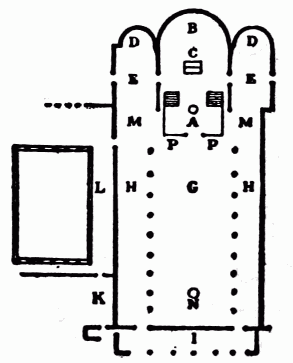 Plan X Century Church
| A | The choir |
| B | The exedra, meaning literally a niche or throne—in this instance
for the occupancy of the bishop, abbot, or prior—apart
from the main edifice |
| C | The high-altar |
| D | Secondary or specially dedicated altars |
| E | The transepts, which in later centuries expanded and lengthened |
| G | The nave proper, down which was reserved a free passage
separating the men from the women |
| H | The aisles |
| I | The portico or porch which precedes the nave (i. e., the
narthen of the primitive basilica), where the pilgrims who
were temporarily forbidden to enter were allowed to wait |
| K | A separate portal or doorway to cloisters |
| L | The cloister |
| M | The towers; often placed at the junction of transept and nave,
instead of the later position, flanking the west façade |
| N | The baptismal font; usually in the central nave, but often in
the aisle |
| O | Entrance to the crypt or confessional, where were usually preserved
the reliques of the saint to whom the church was erected |
| P | The tribune, in a later day often surrounded by a screen or jubé |
A brief definitive gazetteer of the natural and
geological divisions included in the ancient
provinces and present-day departments of
southern France, together with the local
names by which the pays et pagi are commonly
known
| Gévaudan | In the Cevennes, a region of forests and mountains |
| Velay | A region of plateaux with visible lava tracks |
| Lyonnais-Beaujolais | The mountain ranges which rise to the westward of Lyons |
| Morvan | An isolated group of porphyrous and granite elevations |
| Haute-Auvergne | The mountain range of Cantal |
| Basse-Auvergne | The mountain chains of Mont Dore and des Dômes |
| Limousin | A land of plateaux, ravines, and granite |
| Agenais | Rocky and mountainous, but with its valleys among the richest in all France |
| Haut-Quercy | A rolling plain, but with little fertility |
| Bas-Quercy | The plains of the Garonne, the Tarn, and the Avéyron |
| Armagnac | An extensive range of petites montagnes running in various directions |
| Landes | A desert of sand, forests, and inlets of the sea |
| Béarn | A country furrowed by the ramifications of the range of the Pyrenees |
| Basse-Navarre | A Basque country situated on the northern slope of the Pyrenees |
| Bigorre | The plain of Tortes and its neighbouring valleys |
| Savoie | A region comprising a great number of
valleys made by the ramifying ranges of
the Alps. The principal valleys being
those of Faucigny, the Tarentaise, and the Maurienne |
| Bourbonnais | A country of hills and valleys which, as to general
limits, corresponds with the Department of the Allier |
| Nivernais | An undulating region between the Loire and the Morvan |
| Berry | A fertile plain, slightly elevated, to the northward of Limousin |
| Sologne | An arid plain separated by the valleys of the Cher and the Indre |
| Gatinais | A barren country northeast of Sologne |
| Saintonge | Slightly mountainous and covered with vineyards—also
in parts partaking of the
characteristics of the Landes |
| Angoumois | A hilly country covered with a growth of vines |
| Périgord | An ensemble of diverse regions, often hilly,
but covered with a luxuriant forest growth |
| Bordelais | (Comprising Blayais, Fronsadais, Libournais,
Entre-deux-mers, Médoc, and Bazadais.)
The vine-lands of the Garonne, La Gironde,
and La Dordogne |
| Dauphiné | Another land of mountains and valleys. It
is crossed by numbers of ranges and distinct
peaks. The principal subdivisions
are Viennois, Royonnais Vercors, Trièves,
Dévoluy, Oisons, Graisivaudan, Chartreuse,
Queyras Valgodemar, Champsaur. |
| Provence | A region of fertile plains dominated by volcanic
rocks and mountains. It contains
also the great pebbly plain in the extreme
southwest known as the Crau |
| Camargue | The region of the Rhône delta |
| Languedoc | Properly the belt of plains situated between
the foot of the Cevennes and the borders
of the Mediterranean |
| Rousillon | The region between the peaks of the Corbière
and the Albère mountain chain. The
population was originally pure Catalan |
| Lauragais | A stony plateau with red earth deposited
in former times by the glaciers of the Pyrenees |
| Albigeois | A rolling and fertile country |
| Toulousain | A plain well watered by the Garonne and the Ariège |
| Comminges | The lofty Pyrenean valleys of the Garonne basin |
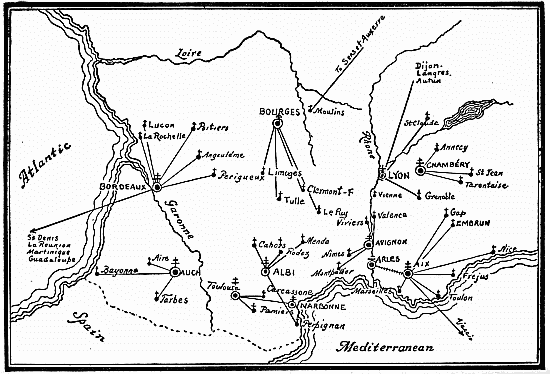 Sketch map of the bishoprics and archbishoprics of the south of France at the present day
CATHEDRALE D'AGDE
| Bishopric founded, Vth century |
| Bishopric suppressed, 1790 |
| Primitive church consecrated, VIIth century |
| Main body of present cathedral, XIth to XIIth centuries |
ST. CAPRIAS D'AGEN
| Former cathedral of St. Etienne, destroyed at the Revolution, 1790 |
| Apse and transepts of St. Caprias, XIth century |
| Width of nave, 55 feet |
ST. JEAN BAPTISTE D'AIRE
Cathedral begun, XIIIth century
ST. SAVEUR D'AIX
| Eglise St. Jean de Malte, XIVth century |
| Remains of a former St. Saveur's, XIth century |
| Choir, XIIIth century |
| Choir elaborated, XIVth century |
| South aisle of nave, XIVth century |
| Tower, XIVth century |
| Carved doors, 1503 |
| Episcopal palace, 1512 |
| North aisle of nave, XVIIth century |
| Baptistère, VIth century |
ST. JEAN D'ALAIS
| A bishopric only from 1694 to 1790 |
| Remains of a XIIth century church |
STE. CECILE D'ALBI
| Begun, 1277 |
| Finished, 1512 |
| South porch, 1380-1400 |
| Tower completed, 1475 |
| Choir-screen, 1475-1512 |
| Wall paintings, XVth to XVIth centuries |
| Organ, XVIIIth century |
| Choir stalls, 120 in number |
| Height of tower, 256 feet |
| Length, 300 (320?) feet |
| Width of nave, 88 feet |
| Height of nave, 98 feet |
ST. PIERRE D'ALET
| Primitive cathedral, IXth century (?) |
| Rebuilt, XIth century |
| Eglise St. André, XIVth to XVth centuries |
ST. PIERRE D'ANGOULEME
| City ravaged by Coligny, XVIth century |
| Cathedral rebuilt from foundations of primitive church, 1120 |
| Western dome, XIIth century |
| Central and other domes, latter part of XIIth century |
| Episcopal palace restored, XIXth century |
| General restoration of cathedral, after the depredations of Coligny, 1628 |
| Height of tower, 197 feet |
ST. PIERRE D'ANNECY
| Christianity first founded here, IVth century |
| Cathedral dates from XIVth century |
| Tomb of St. François de Sales, 1622 |
| Tomb of Jeanne de Chantal, 1641 |
| Episcopal palace, 1784 |
ST. CASTOR D'APT
| Gallo-Romain sarcophagus, Vth century |
| Tomb of Ducs de Sabron, XIIth century |
| Chapelle de Ste. Anne, XVIIth century |
ST. TROPHIME D'ARLES
| Primitive church on same site, 606 |
| Foundations of present cathedral laid, 1152 |
| Nave completed, 1200 |
| Choir and chapels, 1423-1430 |
| Cloisters, east side, 1221 |
| Cloisters, west side, 1250 |
| Cloisters, north side, 1380 |
| Length, 240 feet |
| Width, 90 feet |
| Height, 60 feet |
| Height of clocher, 137 feet |
STE. MARIE D'AUCH
| Ancient altar, IVth century |
| First cathedral built by Taurin II., 845 |
| Another (larger) by St. Austinde, 1048 |
| Present cathedral consecrated, 1548 |
| Additions made and coloured glass added, 1597 |
| West front, in part, XVIIth century |
| Towers, 1650-1700 |
| Episcopal palace, XIVth century |
| Length, 347 feet |
| Height to vaulting, 74 feet |
NOTRE DAME DES DOMS D'AVIGNON
| Territory of Avignon acquired by the Popes from Joanna of Naples, 1300 |
| Popes reigned at Avignon, 1305-1370 |
| Avignon formally ceded to France by Treaty of Tolentino, 1797 |
| Palais des Papes begun, XIIIth century |
| Pope Gregory left Avignon for Rome, 1376 |
| Cathedral dates chiefly from XIIth century |
| Nave chapels, XIVth century |
| Frescoes in portal, XIVth century |
| Height of walls of papal palace, 90 feet |
|
"
" tower
"
"
150 feet |
| Length of cathedral, 200 (?) feet |
| Width of cathedral, 50 (?) feet |
NOTRE DAME DE BAYONNE
| Foundations, 1140 |
| Choir and apse, XIIth century |
| Destroyed by fire, 1213 |
| Choir rebuilt, 1215 |
| Completed and restored, XVIth century |
ST. JEAN DE BAZAS
| Foundations date from Xth century |
| Walls, etc., 1233 |
| West front, XVIth century |
CATHEDRALE DE BELLEY
Gothic portion of cathedral, XVth century
ST. NAZAIRE DE BEZIERS
| Primitive church damaged by fire, 1209 |
| Transepts, XIIIth century |
| Towers, XIVth century |
| Apside and nave, XIVth century |
| Glass and grilles, XIVth century |
| Cloister, XIVth century |
| Height of clocher, 151 feet |
ST. ANDRE DE BORDEAUX
| Three cathedral churches here before the XIth century |
| Romanesque structure, XIth century |
| Present cathedral dates from 1252 |
| North transept portal, XIVth century |
| Noailles monument, 1662 |
| Length, 450 feet |
| Width of nave, 65 feet |
NOTRE DAME DE BOURG
| Main body dates from XVth to XVIIth centuries |
| Choir and apse, XVth to XVIth centuries |
| Choir stalls, XVIth century |
ST. ETIENNE DE CAHORS
| Bishopric founded, IVth century |
| Cathedral consecrated, 1119 |
| Cupola decorations, 1280-1324 |
| Choir chapels, XVth century Choir, 1285 |
| Tomb of Bishop Solminiac, XVIIth century |
| Choir paintings, 1315 |
| Cloister, XIIth to XVth century |
| Cupolas of nave, 50 feet in diameter |
| Cupolas of choir, 49 feet in height |
| Height from pavement to cupolas of choir, 82 feet |
| Height from pavement to cupolas of nave, 195 feet |
| Portal and western towers, XIVth century |
ST. NAZAIRE DE CARCASSONNE
| Present-day cathedral, St. Michel, in lower town, 1083 |
| Restored by Viollet-le-Duc, 1849 |
| Visigoth foundation walls of old Cité, Vth to VIIIth centuries |
| Cité besieged by the Black Prince, 1536 |
| Château of Cité and postern gate, XIth and XIIth centuries |
| Outer fortifications with circular towers of the time of St. Louis, XIIIth century |
| Length inside the inner walls, ¼ mile |
| Length inside the outer walls, 1 mile |
| Saracens occupied the Cité, 783 |
| Routed by Pepin le Bref, 759 |
| Viscountal dynasty of Trencavels, 1090 |
| Besieged by Simon de Montfort, 1210 |
| Romanesque nave of St. Nazaire, 1096 |
| Choir and transepts, XIIIth and XIVth centuries |
| Remains of Simon de Montfort buried here (since removed), 1218 |
| Tomb of Bishop Radulph, 1266 |
| Statues in choir, XIVth century |
| High-altar, 1522 |
| Crypt, XIth century |
| Sacristy, XIIIth century |
| The "Pont Vieux," XIIth and XIIIth centuries |
ST. SIFFREIN DE CARPENTRAS
| A Roman colony under Augustus, Ist century |
| St. Siffrein, patron of the cathedral, died, XVIth century |
| Edifice mainly of the XVIth century |
| Paintings in nave, XVIIIth and XIXth centuries |
| Tomb of Bishop Buti, 1710 |
| Episcopal palace built, 1640 |
| Arc de Triomphe, Ist or IId century |
| Porte d'Orange, XIVth century |
ST. BENOIT DE CASTRES
Cathedral dates mainly from XVIIth century
ST. VERAN DE CAVAILLON
| Cathedral consecrated by St. Veran, in person, 1259 |
| Tomb of Bishop Jean de Sade, XVIIth century |
ST. ETIENNE DE CHALONS-SUR-SAONE
| Cathedral completed, XVIth century |
| Rebuilt, after a disastrous fire, XVIIth century |
| Remains of early nave, dating from XIIIth century |
| Bishopric founded, Vth century |
| Height of nave, 90 feet |
| Length of nave, 350 feet |
CATHEDRALE DE CHAMBERY
| First bishop, Michel Conseil, 1780 |
| Main body of cathedral dates from XIVth century |
NOTRE DAME DE CLERMONT-FERRAND
| Choir and nave, 1248-1265 |
| Urban II. preached the Crusades here, 1095 |
| Sanctuary completed, XIIIth century |
| Nave completed, except façade, XIVth century |
| Rose windows, XVth century |
| Western towers and portal, XIXth century |
| Height of towers, 340 feet |
| Height of nave, 100 feet |
ST. BERTRAND DE COMMINGES
| First monastery here, VIth century |
| Present cathedral mainly XIIth to XIVth centuries |
| First bishop, Suavis, VIth century |
| Monument to Bishop Hugh de Castellane, XIVth century |
| Length, 210 feet (?) |
| Width, 55 feet (?) |
CATHEDRALE DE DAX
| Main fabric, XIIIth century |
| Reconstructed, XVIIIth century |
NOTRE DAME DE DIE
| A bishopric in 1285, and from 1672 until 1801 |
| Porch, XIth century |
| Romanesque fragments in "Porte Rouge," XIth century |
| Restored and rebuilt, XVIIth century |
| Length of nave, 270 feet |
| Width of nave, 76 feet |
CATHEDRALE D'EAUZE
| Town destroyed, Xth century |
| Gothic church (not, however, the former cathedral), XVth century |
STE. EULALIE D'ELNE
| Cathedral rebuilt from a former structure, XVth century |
| Cloister, XVth century |
NOTRE DAME D'EMBRUN
| North porch and peristyle, XIIth century |
| Romanesque tower rebuilt, XIVth century |
| The "Tour Brune" XIth century |
| High-altar, XVIIIth century |
| Painted triptych, 1518 |
| Coloured glass, XVth century |
| Organ and gallery, XVIth century |
NOTRE DAME DE GRENOBLE
| Foundations of choir, XIth century |
| Tabernacle, XVth century |
| Tomb of Abbé Chissé, 1407 |
| Former episcopal palace, XIth century |
| Present episcopal palace, on same site, XVth century |
| Eglise St André, XIIIth century |
| "La Grande Chartreuse," founded by St. Bruno, 1084 |
| "La Grande Chartreuse," enlarged, XVIth to XVIIth centuries |
| Monks expelled, 1816 and 1902 |
ST. LOUIS DE LA ROCHELLE
| City besieged unsuccessfully, 1573 |
| City besieged and fell, XVIIth century |
| Huguenots held the city from 1557 to 1629 |
| Present cathedral dates from 1735 |
NOTRE DAME DE LE PUY
| First bishop, St. Georges, IIId century |
| Primitive cathedral, Vth century |
| West façade of present edifice, XIIth century |
| Choir, Xth century |
| Virgin of Le Puy, 50 feet in height |
| Aguille de St. Michel, 250 feet in height, 50 feet in circumference at top, 500 feet at base |
ST. ETIENNE DE LIMOGES
| Nave, XVth and XVIth centuries |
| Romanesque portion of nave, XIth century |
| Lower portion of tower, XIth century |
| Clocher, XIIIth century |
| Choir, XIIIth century |
| Transepts, XIVth and XVth centuries |
| Choir-screen, 1543 |
| Coloured glass, XVth and XIXth centuries |
| Tomb of Bishop Brun, 1349; de la Porte, 1325; Langeac, 1541 |
| Crypt, XIth century |
| Height of clocher, 240 feet |
| Enamels of reredos, XVIIth century |
ST. FULCRAN DE LODEVE
| City converted to Christianity, 323 |
| Earliest portion of cathedral, Xth century |
| Main portion of fabric, XIIth century |
| Cathedral completed, XVIth century |
| Tomb of Bishop de la Panse, 1658 |
| Height of nave, 80 feet |
CATHEDRALE DE LUCON
| Ancient abbey, VIIth century |
| First bishop appointed, 1317 |
| Richelieu bishop here, 1616-1624 |
| Main fabric of cathedral dates from XIIth to XVIIth centuries |
| Fabric restored, 1853 |
| Cloister of episcopal palace, XVth century |
ST. JEAN DE LYON
| Bridge across Saône, Xth century |
| Earliest portions of cathedral, 1180 |
| Concile générale of the Church held at Lyons, 1245 and 1274 |
| Portail, XVth century |
| Glass of choir, XIIIth and XIVth centuries |
| Great bourdon, 1662 |
| Weight of great bourdon, 10,000 kilos |
| Chapelle des Bourbons, XVth century |
| Astronomical clock, XVIth and XVIIth centuries |
STE. MARIE MAJEURE DE MARSEILLES
| First bishop, St. Lasare, Ist century |
| Ancient cathedral built upon the ruins of a temple to Diana, XIth century |
| New cathedral begun, 1852 |
| Practically completed, 1893 |
| Length, 460 feet |
| Height of central dome, 197 feet |
ST. JEAN DE MAURIENNE
| Relique of St. Jean Baptiste, first brought here in VIth century |
| Cloister, 1452 |
ST. PIERRE DE MENDE
| First bishop, Xth century |
| Main fabric of cathedral, XIVth century |
| Restoration, XVIIth century |
| Towers, XVIth century |
| Organ-case, 1640 |
| Height of western towers, 203 and 276 feet |
ST. PIERRE DE MONTPELLIER
| Bishopric removed here from Maguelonne, 1536 |
| Pope Urban V. consecrated present cathedral in a former Benedictine abbey, 1364 |
| Length of nave, 181 feet |
| Width of nave, 49 feet |
| Length of choir, 43 feet |
| Width of choir, 39 feet |
NOTRE DAME DE MOULINS
| Towers and west front, XIXth century |
| Choir and nave, 1465-1507 |
| Coloured glass, XVth and XVIth centuries |
| Choir restoration completed, 1885 |
| Sepulchre, XVIth century |
| Height of western spires, 312 feet |
| Château of Ducs de Bourbon (facing the cathedral) XIVth century |
ST. JUST DE NARBONNE
| Choir begun, 1272-1330 |
| Choir rebuilt, XVIIIth century |
| Remains of cloister, XIVth and XVth century |
| Towers, XVth century |
| Tombs of bishops, XIVth to XVIth centuries |
| Organ buffet, 1741 |
| Height of choir vault, 120 (127?) feet |
ST. CASTOR DE NIMES
| St. Felix the first bishop, IVth century |
| St. Castor as bishop, 1030 |
| Cathedral damaged by wars of XVIth and XVIIth centuries |
| Length of grande axe of Arena, 420 feet |
| Capacity of Arena, 80,000 persons |
STE. MARIE D'OLORON
| Earliest portions, XIth century |
| Completed, XVth century |
| Length of nave, 150 feet |
| Width of nave, 106 feet |
NOTRE DAME D'ORANGE
| Oldest portions, 1085 |
| Nave, 1085-1126 |
CATHEDRALE DE PAMIERS
| Clocher, XIVth century |
| Nave rebuilt, XVIIth century |
| Ancient Abbey of St. Antoine, XIth century |
| First bishop, Bernard Saisset, 1297 |
ST. FRONT DE PERIGUEUX
| Primitive monastery founded, VIth century |
| Cathedral dates from 984-1047 |
| Cathedral rebuilt, XIIth century |
| Cathedral restored, XIXth century |
| Pulpit in carved wood, XVIIth |
| Confessionals, Xth or XIth century |
| Paintings in vaulting, XIth century |
| Length of nave, 197 feet |
| Height of pillars of nave, 44 feet |
| Height of cupola of clocher, 217 feet |
| Height of great arches in interior, 65 feet |
ST. JEAN DE PERPIGNAN
| Tower, XIVth century |
| Rétable, XIV century |
| Altar-screen, XIVth century |
| Bishop's tomb, 1695 |
ST. PIERRE DE POITIERS
| Eglise St. Hilaire, Xth and XIth centuries |
| Baptistère, IVth to XIIth centuries |
| St. Radegonde, XIth and XIIth centuries |
| Cathedral begun, 1162 |
| High-altar dedicated, 1199 |
| Choir completed, 1250 |
| Western doorway, XVth century |
| Coloured glass, XIIIth and XVIIIth centuries |
NOTRE DAME DE RODEZ
| Dates chiefly from 1275 |
| Choir, XIVth century |
| Nave, XVth century |
| Cross-vaults, tribune, sacristy door, and façade, from about 1535 |
| Clôture of choir designed by Cusset |
| Terrace to episcopal palace designed by Philandrier, 1550 |
| Episcopal palace itself dates, in the main, from XVIIth century |
| Rose window of façade is the most notable in France south of the Loire, excepting Poitiers |
ST. PIERRE DE SAINTES
| Eglise St. Eutrope, 1081-1096 |
| Primitive cathedral, 1117 |
| Cathedral rebuilt, 1585 |
| First two bays of transept, XIIth century |
| Nave completed, XVth century |
| Vaulting of choir and nave, XVth to XVIIth centuries |
| Height of flamboyant tower (XIVth century), 236 feet |
CATHEDRALE DE SARLAT
| Benedictine abbey dates from VIIIth century |
| Cathedral mainly of XIth and XIIth centuries |
| Sepulchral chapel, XIIth century |
CATHEDRALE DE SION
| First bishop, St. Théodule, IVth century |
| Choir of Eglise Ste. Catherine, Xth or XIth century |
| Bishop of Sion sent as papal legate to Winchester, 1070 |
| Main body of cathedral, XVth century |
ST. PIERRE DE ST. CLAUDE
| Abbey founded by St. Claude, Vth century |
| Bishopric founded by Jos. de Madet, 1742 |
| Bishopric suppressed, 1790 |
| Bishopric revived again, 1821 |
| Main fabric of cathedral, XIVth century |
| Cathedral restored, XVIIIth century |
| Length, 200 feet (approx.) |
| Width, 85 feet " |
| Height, 85 feet " |
ST. ODILON DE ST. FLOUR
| Bishopric founded, 1318 |
| Present cathedral begun, 1375 |
| " " dedicated, 1496 |
| " " completed, 1556 |
| Episcopal palace, 1800 |
| Château de St. Flour, 1000 |
ST. LISIER OR COUSERANS
| Former cathedral, XIIth and XIIIth centuries |
| Bishop's palace, XVIIth century |
STE. MARIE MAJEURE DE TOULON
| Main body of fabric, XIth and XIIth centuries |
| Façade, XVIIth century |
| Length of nave, 160 feet |
| Width of nave, 35 feet |
ST. ETIENNE DE TOULOUSE
| Nave, XIIIth century |
| Tower, XVth and XVIth century |
| Choir, 1275-1502 |
| Bishopric founded, IIId century |
| Archbishopric founded, 1327 |
| Width of nave, 62 feet |
ST PAUL TROIS CHATEAUX
| Chapel to St. Restuit first erected here, IVth century |
| Town devastated by the Vandals, Vth century |
| " " " " | Saracens, 736 |
| " " " " | Protestants, XIVth century |
| " " " " | Catholics, XIVth century |
| Former cathedral, XIth and XIIth centuries |
CATHEDRALE DE TULLE
| Benedictine foundation, VIIth century |
| Cloister, VIIth century (?) |
| Bishopric founded, 1317 |
| Romanesque and transition nave, XIIth century |
ST. THEODORIT D'UZES
| Inhabitants of the town, including the bishop, mostly became Protestant, XVIth century |
| Cathedral rebuilt and restored, XVIIth and XVIIIth centuries |
| Tour Fénestrelle, XIIIth century |
| Organ-case, XVIIth century |
| Height of the "Tour Fénestrelle," 130 feet |
CATHEDRALE DE VAISON
| Cloister, XIth century |
| Eglise de St. Quinin, VIIth century |
ST. APOLLINAIRE DE VALENCE
| Cathedral rebuilt and reconsecrated by Urban II., XIth century |
| Reconstructed, 1604 |
| Bishopric founded, IVth century |
| Foundations laid, XIIth century |
| Cenotaph to Pius VI., 1799 |
| Height of tower, 187 feet |
CATHEDRALE DE VABRES
| Principally, XIVth century |
| Rebuilt and reconstructed, and clocher added, XVIIIth century |
NOTRE DAME DE VENCE
| Fabric of various eras, VIth, Xth, XIIth, and XVth centuries |
| Rétable, XVIth century |
| Choir-stalls, XVth century |
ST. MAURICE DE VIENNE
| Bishopric dates from IId century |
| St. Crescent, first bishop, 118 |
| Cathedral begun, 1052 |
| Reconstructed, 1515 |
| Coloured glass, in part, XIVth century |
| Tomb of Cardinal de Montmorin, XVIth century |
| Metropolitan privileges of Vienne confirmed by Pope Paschal II., 1099 |
CATHEDRALE DE VIVIERS
| Choir, XIVth century |
| Tower, XIVth and XVth centuries |
Abbey of Cluny, 59, 61.
Abbey of Montmajour, 230.
Acre, 56.
Adelbert, Count of Périgueux, 38.
Adour, River, 417.
Agde, 53, 358, 359.
Agde, Cathédrale de, 358-360, 520.
Agen, 42, 429.
Agen, St. Caprais de, 429, 431, 520.
Agout, River, 471.
Aigues-Mortes, 228, 319, 320.
Aire, St. Jean Baptiste de, 469, 470, 521.
Aix, 36, 230, 283, 293, 323, 324.
Aix St. Jean de Malte, 324.
Aix, St. Sauveur de, 323-327, 521.
Ajaccio, 47.
Alais, 249-251.
Alais, St. Jean de, 249-251, 521.
Alberoni, Cardinal, 240.
Albi, 27, 41, 53, 54, 61, 95, 98, 274.
Albi, Ste. Cécile de, 363, 482-489, 522.
Albigenses, The, 365, 485, 486.
Alet, 42.
Alet, St. Pierre de, 350, 351, 522.
Amantius, 330.
Amiens, 60, 62.
Andorra, Republic of, 373.
Angers, Château at, 66.
Angers, St Maurice d', 97.
Angoulême, 55, 61, 73, 120, 124.
Angoulême, St. Pierre de, 73, 120-125, 523.
Anjou, 45, 71.
Anjou, Duke of, 40, 44.
Anjou, Henry Plantagenet of, 39.
Anjou (La Trinité), 56.
Annecy, 252-254, 256.
Annecy, St. Pierre de, 252-254, 523.
Antibes, 330, 339, 341.
Aosti, 268.
Apt, 289-291.
Apt, St. Castor de, 523.
Aquitaine, 38, 62.
Aquitanians, The, 38.
Aquitanian architecture, 54, 55, 66.
Arc de Triomphe (Saintes), 115.
Architecture, Church, 50-56.
Ariosto, 235.
Arles, 28, 33, 61, 217, 228-235, 283, 293.
Arles, Archbishop of, 46.
Arles, St. Trophime de, 37, 202, 228-235, 524.
Arnaud, Bishop, 354.
Auch, St. Marie de, 432-438, 524.
Auch, College of, 438.
Augustus, 221.
Autun, Bishop of (Talleyrand-Périgord), 46.
Auvergne, 29, 62, 72-74.
Auzon, 221.
Avignon, 33, 41, 53, 54, 241.
Avignon, Papal Palace at, 377, 485.
Avignon, Notre Dame des Doms, 204-220, 525.
Avignon, Ruf d', 36.
Baptistère of St. Siffrein de Carpentras, 222.
Baptistère, The (Poitiers), 95, 96, 101.
Basilique de Notre Dame de Fourvière, 185.
Bayonne, 28, 57, 373, 387, 405-407, 410, 411.
Bayonne, Notre Dame de, 405-410, 525.
Bazas, St. Jean de, 411, 412, 526.
Bazin, René, 229, 235.
Bearn, Province of, 395, 406.
Beauvais, Lucien de, 37.
Becket, Thomas à, 111.
Belley, 267.
Belley, Cathédrale de, 526.
Benedict XII., Pope, 211, 216.
Bénigne, 171.
Berengarius II., 371.
Berri, 71, 72.
Besançon, 267, 274.
Besançon, Lin de, 36.
Béthanie, Lazare de, 36.
Bézard, 431.
Béziers, 53, 363-365.
Béziers, Bishop of, 365.
Béziers, St. Nazaire de, 363-367, 526.
Bichi, Alexandri, 224.
Bishops of Carpentras, 221.
Bishop of Ypres, 48.
"Black Prince," The, 418, 453.
Blois, Château at, 66.
Breakspeare, 230.
Bretagne, Slabs in, 64.
Bridge of St. Bénezet, 219.
Bordeaux, 57, 384, 387, 396, 397, 401.
Bordeaux, St. André de, 94, 396-401, 526.
Bossuet, Bishop, 420.
Bourassé, Abbé, 83, 89, 328, 354, 433.
Bourbons, The, 126, 127. 130.
Bourg, 277-279.
Bourg, Notre Dame de, 277-279, 526.
Bourges, 41, 62.
Bovet, François, 281.
Boyan, Bishop, 247.
Buti, Bishop Laurent, 224.
Cæsar, 171.
Cahors, 42, 44, 425, 428.
Cahors, St. Etienne de, 425-428, 527.
Cairène type of mosque, 55.
Calixtus II., 189.
Canal du Midi, 367.
Canova, 194, 334.
Capet, Hugh, 38, 39.
Carcassonne, 28, 53, 319, 449-457.
Carcassonne, St. Nazaire de, 57, 319, 449-460, 527.
Carpentras, 221-226.
Carpentras, St. Siffrein de, 221-225, 528.
Carton, Dominique de, 224.
Castres, 42, 471.
Castres, Sts. Benoit et Vincent de, 471-473, 528.
Cathédrale d'Agde, 358-360, 520.
Cathédrale de Belley, 526.
Cathédrale de Chambéry, 255-257, 529.
Cathédrale de Condom, 420, 421.
Cathédrale de Dax, 530.
Cathédrale d'Eauze, 531.
Cathédrale de Lectoure, 402-404.
Cathédrale de Luçon, 85, 86, 533.
Cathédrale de Montauban, 422-424.
Cathédrale de Pamiers, 461-463, 536.
Cathédrale de Sarlat, 540.
Cathédrale de Sion, 302-304, 540.
Cathedral of St. Michel, Carcassonne, 451, 452.
Cathédrale de Tulle, 118, 119, 542.
Cathédrale de Vabres, 543.
Cathédrale de Vaison, 226, 227, 543.
Cathedrale de Viviers, 195, 196, 544.
Cavaillon, 226.
Cavaillon, St. Veran de, 200-203, 528.
Cevennes, 30, 72, 76-79, 136.
Chalons, Simon de, 247.
Chalons-sur-Saône, St. Etienne de, 170-173, 529.
Chambéry, 28, 253, 255-257, 264, 267, 270.
Chambéry, Cathédrale de, 529.
Chapelle des Innocents, Agen, 431.
Charente, River, 115.
Charlemagne, 58, 59, 214.
Charles V., 40, 45, 323.
Charles VIII., 65.
Charles the Great, 304.
Charterhouse, near Grenoble, 62.
Chartres, 60, 62, 232.
Chartres, Aventin de, 37.
Chartreuse, La Grande, 48, 162, 531.
Chavannes, Puvis de, 102, 342.
Chissé, Archbishop, 260.
Chrysaphius, Bishop, 281.
Church of St. Saturnin (Toulouse), 440-444.
Church of the Jacobins (Toulouse), 440, 441, 443, 444.
Clairvaux, 62.
Clement V., Pope, 33, 211, 398, 400.
Clement VI., 219,
Clermont-Ferrand, 29, 33, 52, 57, 73, 74.
Clermont-Ferrand, Notre Dame de, 144-151, 530.
Clermont (St. Austremoine), 37.
Cluny, Abbey of, 51, 59.
Coligny, 121.
Comminges, 464.
Comminges, Roger de, 496.
Comminges, St. Bertrande, 62, 464-468, 530.
Comté de Nice, 256.
Condom, 42.
Condom, Cathédrale de, 420, 421.
Conflans, Oger de, 271.
Conseil, Michel, 256.
Constantin, Palais de, 230.
Corsica, Diocese of, 47.
Coucy, Chateau at, 66.
Coulon, 291.
Danté, 134.
Daudet, 165.
Dauphiné, 30, 161, 162, 297, 298.
Dax, 495.
Dax, Cathédrale de, 530.
Delta of Rhône, 168.
D'Entrevaux, 280.
De Sade, Laura, 204, 207, 208.
Deveria, 250.
Dié, Notre Dame de, 287, 288, 531.
Digne, 281, 283-286.
Dijon, 171.
Dijon, St. Bénigne of, 63.
Dioceses of Church in France, 39, 40.
Diocese of Corsica, 47.
Domninus, 259.
Dordogne, 29.
Duclaux, Madame, 25, 229, 235.
Ducs de Sabron, Tomb of, 290.
Duke of Anjou, 40, 44.
Dumas, Jean, 433.
Durance, River, 162, 292.
Dürer, Albrecht, 325.
Eauze, 495, 496.
Eauze, Cathédrale de, 531.
Edward I., 400.
Edwards, Miss M. E. B., 24.
Eglise de Brou, 277.
Eglise des Cordeliers, 207.
Eglise de Grasse, 339, 340.
Eglise de la Grande Chartreuse, 263.
Eglise de St André, 260, 351.
Eglise de St. Claire, 208.
Eglise de St. Pol, 75.
Eglise de Souillac, 55.
Eglise Notre Dame du Port, 145.
Eglise St Nizier, 179.
Eglise St. Quinin, 227.
Eleanor of Poitou and Guienne, 39.
Elne, 369, 372, 373.
Elne, Ste. Eulalia de, 372-374, 532.
Emaux de Limoges, 104-107.
Embrun, 230, 283, 285, 292-295, 300.
Embrun, Notre Dame de, 292-295, 531.
Escurial of Dauphiné, 62.
Espérandieu, 348.
Etats du Languedoc, 251.
Eusèbe, 300.
Evreaux, Taurin d', 37.
Farel, Guillaume, 298.
"Félibrage," The, 204, 218.
Fénelon, 438.
Fère-Alais, Marquis de la, 251.
Fergusson, 99.
Flanders, 30.
"Fountain of Vauclause," 221.
François I., 65, 120, 124, 354.
Freeman, Professor, 95, 99.
Fréjus, 330, 335, 336.
Fréjus, St. Etienne de, 335-338.
Froissart, 417.
Gap, 296-299.
Gap, Demêtre de, 36.
Gap, Notre Dame de l'Assomption de, 296, 299.
Gard, 29.
Gard, Notre Dame de la, 346, 347.
Garonne, River, 44, 388, 389.
Gascogne, 390.
Geneva, 252.
Geraldi, Hugo, 427.
Gervais, 365.
Ghirlandajo, 133.
Glandève, 280.
Gosse, Edmund, 29.
Gothic architecture, 60-65.
Grasse, 330, 339.
Grasse, Eglise de, 339, 340.
Grasse, Felix, 24, 384.
Gregory XI., Pope, 213.
Grenoble, 28, 258-264.
Grenoble, Notre Dame de, 258-264, 531.
Guienne, 41, 389, 390.
Guienne, Eleanor of, 39.
Hamerton, Philip Gilbert, 159, 160, 170.
Henri IV., 353, 406, 416.
Honoré, 334.
Hôtel d'Aquitaine (Poitiers), 102.
Humbert, Archbishop, 180.
Humbert, Count, 271.
Ingres, 423, 424.
Innocent IV., 201.
Innocent VI., 225.
Issiore, 75.
Jaffa, 56.
Jalabert, 250.
James, Henry, 25.
Janvier, Thomas, 26.
Joanna of Naples, 209.
John XXII., Pope, 41, 216, 428.
Jordaens, 401.
L'Abbaye de Maillezais, 81.
Lackland, John, 40.
La Cathédrale (Poitiers), 96.
La Chaise Dieu, 62, 75.
Lac Leman, 252.
L'Eglise de la Sède Tarbes, 417-419.
"La Grande Chartreuse," 48, 162, 531.
Lake of Annecy, 252.
La Madeleine, Aix, 324.
Lamartine, 176.
Languedoc, 32, 40, 44, 390, 391.
La Rochelle, 73, 82, 83.
La Rochelle, St. Louis de, 82-84, 532.
La Trinité at Anjou, 56.
Laura, Tomb of, 33.
Lavaur, 497, 498.
Lectoure, 402.
Lectoure, Cathédrale de, 402-404.
Les Arènes, 240.
Lescar, 413.
Lescar, Notre Dame de, 413-416.
Lesdiguières, Duc de, 298.
Les Frères du Pont, 220.
Le Puy, 61, 134-136, 327.
Le Puy, Notre Dame de, 97, 134-143, 532.
Limoges, 57, 79, 80, 104, 105.
Limoges (St. Martial), 37.
Limoges, St. Etienne de, 104-111, 532.
Limousin, 71, 72.
Lodève, 246.
Lodève, St. Fulcran de, 152-155, 533.
Loire valley, 30.
Lombardy, 33.
Lombez, 496.
Lot, 44.
Loudin, Noel, 110.
Louis IV., 240.
Louis VII., 39.
Louis XI., 295.
Louis XIII., 353.
Louis XIV., 210, 224.
Louis XV., 210.
Louis Napoleon, 397.
Lozère, 28.
Luçon, 42.
Luçon, Cathédrale de, 85, 86, 533.
Lyon, 28, 177, 178, 259, 267, 273.
Lyon, St. Jean de, 177-185, 533.
Macon, St. Vincent de, 174-176.
Madet, Joseph de, 273.
Maguelonne, 353, 354.
Maillezais, 42.
Maillezais, L'Abbaye de, 81.
Maine, Henry Plantagenet of, 39.
Maison Carée, The, 240.
Mansard, 290.
Marseilles, 36, 314, 318, 342.
Marseilles, Ste. Marie-Majeure de, 318, 342-349, 534.
Maurienne, 269-271.
Maurienne, St. Jean de, 256, 269-271, 534.
Memmi, Simone (of Sienna), 211, 216.
Mende, 42, 246, 490, 492.
Mende in Lozère, 27.
Mende, St. Pierre de, 490-494, 534.
Mérimée, Prosper, 26, 30, 224.
Metz, Clement de, 36.
Midi, The, 383-395.
Midi, Canal du, 386.
Mignard, 250, 282, 290.
Mimat, Mont, 494.
Mirabeau, 46.
Mirepoix, 501.
Mirepoix, St. Maurice de, 501.
Mistral, Frederic, 163, 165, 218, 228.
Modane, 270.
Mognon, 84.
Moles, Arnaud de, 436.
Monastery of La Grande Chartreuse, 260.
Montauban, 422.
Montauban, Cathédrale de, 422-424.
Mont de la Baume, 282.
Mont Doré-le-Bains, 74.
Monte Carlo, 213.
Montfort, Simon de, 455, 459.
Montmajour, Abbey of, 230.
Montpellier, 40, 352-354.
Montpellier, St. Pierre de, 352-357, 534.
Mont St. Guillaume, 295.
Morin, Abbé, 36, 37.
Moulins, Notre Dame de, 126-133, 534.
Nadaud, Gustave, 455-457.
Naples, Joanna of, 209.
Naples, Kingdom of, 45.
Napoleon, 27, 210, 240.
Narbonne, 42, 53, 54, 241, 375, 376.
Narbonne, St. Just de, 375-379, 535.
Narbonne (St. Paul), 37.
Nero, Reign of, 36.
Neiges, Notre Dame des, 223.
Nice, St. Reparata de, 328-331.
Nîmes, 28, 33, 40, 61, 218, 228, 229, 236-242.
Nîmes, St. Castor de, 236-244, 535.
Notre Dame de l'Assomption de Gap, 296-299.
Notre Dame de Bayonne, 405-410, 525.
Notre Dame de Bourg, 277-279, 526.
Notre Dame de Clermont-Ferrand, 144-151, 530.
Notre Dame de Dié, 287, 288, 531.
Notre Dame de Doms d'Avignon, 204-220, 525.
Notre Dame d'Embrun, 292-295, 531.
Notre Dame de la Gard, 346, 347.
Notre Dame de la Grande (Poitiers), 95.
Notre Dame de Grenoble, 258-264, 531.
Notre Dame de Le Puy, 97, 134-143, 532.
Notre Dame de Lescar, 413-416.
Notre Dame de Moulins, 126-133, 534.
Notre Dame des Neiges, 223.
Notre Dame d'Orange, 197-199, 536.
Notre Dame de Rodez, 363, 474-481, 539.
Notre Dame et St. Castor d'Apt, 289-291.
Notre Dame de Vence, 300, 301, 544.
Notre Dame du Port, 57.
Noyon, 60.
Obreri, Peter, 212.
Oloron, 498, 536.
Oloron, Ste. Marie d', 498, 536.
Orange, 28, 33, 61, 225, 229.
Orange, Notre Dame d', 197-199, 536.
Orb, River, 366, 367.
Order of St. Bruno, 260, 261, 263.
Palais de Justice (Poitiers), 102.
Palais des Papes, 54, 209.
Palais du Constantin, 230.
Palissy, Bernard, 117.
Pamiers, 461.
Pamiers, Cathédrale de, 461-463, 536.
Paris, 29, 37, 46, 62, 232, 270.
Parrocel, 290.
Pascal, Blaise, 150, 151, 160.
Paschal II., 189.
Pas de Calais, 30.
Pause, Plantavit de la, 154.
Périgueux, 55-57, 61.
Périgueux, St. Front de, 56, 87-91, 97, 537.
Perpignan, 28, 368, 369, 373.
Perpignan, St. Jean de, 368-371, 537.
Petrarch, 204, 207-209, 211, 213, 221, 264.
Peyer, Roger, 242.
Philippe-Auguste, 40.
Philippe-le-Bel, 41.
Piedmont, 270.
Pierrefonds, Château at, 66.
Pius VI., 194.
Pius, Pope, 210.
Plantagenet, Henry (of Maine and Anjou), 39.
Poitiers, 42, 73, 95-97, 327.
Poitiers, Notre Dame de la Grande, 95.
Poitiers (St. Hilaire), 61.
Poitiers, St. Pierre de, 92-101, 538.
Poitou, 71-73.
Poitou, Eleanor of, 39.
Polignac, Château de, 75, 76, 135, 143.
Port Royal, 45.
Provence, 32, 62, 163-167, 313.
Provençal architecture, 54, 55, 57, 66.
Ptolemy, 159.
Puy, Bertrand du, 422.
Puy de Dôme, 29, 73, 74.
Puy, Notre Dame de la, 97, 134-143, 532.
Pyrenees, The, 393-395.
Religious movements in France, 23-48.
René, King, 323, 326.
Révoil, Henri, 348.
Rheims, 60, 62, 229.
Rheims, Sixte de, 37.
Rhône valley, 28.
Richelieu, Cardinal, 85.
Rienzi, 211.
Rieux, 497.
Riez, 280, 281.
Riom, 73.
Riviera, The, 313-320.
Rochefort, 73.
Rocher des Doms, 213.
Rodez, 29, 42, 274.
Rodez, Notre Dame de, 363, 474-481, 539.
Rouen, 60.
Rouen, Nicaise de, 37.
Rouen (St. Ouen), 52.
Rousillon, 368, 369, 372.
Rousseau, 256.
Rovère, Bishop de la, 492.
Rubens, 340.
Ruskin, 63.
St. Albans in Hertfordshire, 230.
St. André de Bordeaux, 94, 396-401, 526.
St. Ansone, 121.
St. Apollinaire de Valence, 190-194, 543.
St. Armand, 474, 481.
St. Armentaire, 339, 341.
St. Astier, Armand de, 119.
St. Aubin, 226.
St. Auspice, 289.
St. Austinde, 433, 435.
St. Austremoine, 37, 150.
St. Ayrald, 271.
St. Bénezet, 219.
St. Bénigne of Dijon, 63.
St. Benoit de Castres, 471-473, 528.
St. Bertrand de Comminges, 62, 464-468, 530.
St. Bruno, Monks of, 260-263.
St. Caprais d'Agen, 429, 431, 520.
St. Castor d'Apt, 523.
St. Castor de Nîmes, 236-244, 535.
Ste. Catherine, Church of, 303.
St. Cécile d'Albi, 363, 482-489, 522.
St. Clair, 489.
Ste. Clara de Mont Falcone, 217.
St. Claude, 272-274.
St. Claude, St. Pierre de, 272-274, 540.
St. Crescent, 37, 186, 296.
St. Demetrius, 296.
St. Denis, The bishop of, 37.
St. Denis, 51.
St. Domnin, 285.
St. Emilien, 253.
Ste. Estelle, 218.
St. Etienne, 230.
St. Etienne d'Auxerre, 407.
St. Etienne de Cahors, 425-428, 527.
St. Etienne de Chalons-sur-Saône, 170-173, 529.
St. Etienne de Fréjus, 335-338.
St. Etienne de Limoges, 104-111, 532.
St. Etienne de Toulouse, 439-448, 541.
St. Eulalie d'Elne, 372-374, 531.
St. Eustache, 268.
St. Eutrope (Saintes), 115-117.
St. Felix, 241.
St. Flour, St. Odilon de, 112-114, 540.
St. François de Sales, 253.
St. Fraterne, 280.
St. Front de Périgueux, 56, 87-91, 97, 537.
St. Fulcran de Lodève, 152-155, 533.
St. Gatien (Tours), 37.
St. Genialis, 201.
St. Georges, 137.
St. Gilles, 232.
St. Hilaire, 61, 95, 96.
St. Honorat des Alyscamps, 231.
St. Jean d'Alais, 249-251, 521.
St. Jean-Baptiste d'Aire, 469, 470, 521.
St. Jean de Bazas, 411, 412, 526.
St. Jean de Lyon, 177-185, 533.
St. Jean-de-Malte, Aix, 324.
St. Jean de Maurienne, 256, 269-271, 534.
St. Jean de Perpignan, 368-371, 537.
Ste. Jeanne de Chantal, 253.
St. Jerome de Digne, 281, 283-286.
St. Julian, 413.
St. Juste de Narbonne, 375-379, 535.
St. Lizier, 499, 540.
St. Lizier, Eglise de, 499, 500, 540.
St. Louis de La Rochelle, 82-84, 532.
St. Marcellin, 285.
St. Marc's at Venice, 56, 87-89, 346, 425.
Ste. Marie d'Auch, 432-438, 524.
Ste. Marie d'Oloron, 498, 536.
Ste. Marie Majeure de Marseilles, 318, 342-349, 534.
Ste. Marie Majeure de Toulon, 332-334, 541.
St. Mars, 287.
Ste. Marthe, 134.
St. Martial, 37, 107.
St. Martin (Tours), 61.
St. Maurice, 304.
St. Maurice d'Angers, 97.
St. Maurice de Mirepoix, 501.
St. Maurice de Vienne, 179, 184, 186-189, 193, 544.
St. Maxine, 324.
St. Michel, 142.
St. Nazaire de Beziers, 363-367, 526.
St. Nazaire de Carcassonne, 57, 319, 449-460, 527.
St. Nectaire, 73, 74, 92.
St. Odilon de St. Flour, 112-114, 540.
St. Ouen de Rouen, 52.
St. Papoul, 496, 497.
St. Paul (Narbonne), 37.
St. Paul Trois Châteaux, 305-309, 542.
St. Phérade, 430.
St. Pierre d'Alet, 350, 351, 522.
St. Pierre d'Angoulême, 73, 120-125, 523.
St. Pierre d'Annecy, 252-254, 523.
St. Pierre de Mende, 490-494, 534.
St. Pierre de Montpellier, 352-357, 534.
St. Pierre de Poitiers, 92-101, 538.
St. Pierre de Saintes, 115-117, 539.
St. Pierre de St. Claude, 272-274, 540.
St. Pons, 42.
St. Pons de Tomiers, 500, 501.
St. Pothin, 179.
St. Privat, 491, 494.
St. Prosper, 281.
St. Radegonde (Poitiers), 95-98.
St. Rémy, 235.
St. Reparata de Nice, 328-331.
St. Restuit, 305.
St. Saturnin (Toulouse), 37.
St. Sauveur d'Aix, 323-327, 521.
St. Siffrein de Carpentras, 221-225, 528.
St. Taurin, 433.
St. Théodorit d'Uzès, 245-248, 542.
St. Théodule, 303.
St. Thomas, 134.
St. Trophime, 230, 232.
St. Trophime d'Arles, 37, 202, 228-235, 524.
St. Valentin, 221.
St. Valère (Trèves), 37.
St. Venuste, 359.
St. Véran, 301.
St. Véran de Cavaillon, 200-203, 528.
St. Vincent de Macon, 174-176.
St. Vincent de Paul, Statue of, 285.
St. Virgil, 230.
Saintes, Eutrope de, 37.
Saisset, Bernard, 463.
Saône, River, 170, 174, 181.
Sarlat, 42, 500.
Sarlat, Cathédrale de, 540.
Savoie, 30, 252, 256, 271.
Scott, Sir Walter, 51, 58.
Senez, 280.
Senlis, 60.
Sens, Savinien de, 37.
Sévigné, Madame de, 392.
Sion, Cathédrale de, 302-304, 540.
Sisteron, 281.
Sterne, 126, 184.
Stevenson, R. L., 23, 30, 135, 249.
Strasbourg, 51.
Suavis, 464.
Suger, Abbot, 51.
Talleyrand-Périgord (Bishop of Autun), 46.
Tarascon, Castle at, 66.
Tarasque, The, 134.
Tarbes, 417. 418.
Tarbes, L'Eglise de la Sède, 417-419.
Tarentaise, 256, 268, 270.
Tarn, River, 422.
Thevenot, 113.
Toulon, 330, 332.
Toulon, St. Marie Majeure de, 332-334, 541.
Toulouse, 42, 439-441.
Toulouse, Musée of, 441, 447.
Toulouse, St. Etienne de, 439-448, 541.
Toulouse, St. Saturnin, 37.
"Tour Fenestrelle," 247.
Touraine, 29, 71, 72.
Tours, 29.
Tours (St. Gatien), 37.
Tours (St. Martin), 61.
Treaty of Tolentino, 210.
Trèves (St. Valère), 37.
Tricastin, 305, 306.
Trinity Church, Boston, 141, 346.
Tulle, Cathédrale de, 118, 119, 542.
Tuscany, 33.
Unigenitus, Bull, 45.
Urban, Pope, 33.
Urban II., 145, 149, 150, 191, 458.
Urban V., 354.
Uzès, 245-248.
Uzès, St. Theodorit de, 245-248, 542.
Vabres, 42, 499.
Vabres, Cathédrale de, 543.
Vaison, 226, 227.
Vaison, Cathédrale de, 226, 227, 543.
Valence, 29.
Valence, St. Apollinaire de, 190-194, 543.
Vaucluse, 208.
Vaudoyer, Léon, 348.
Vehens, Raimond de, 112.
Venasque, 222.
Vence, 300, 301.
Vence, Notre Dame de, 300, 301, 544.
Vendée, La, 72.
Veronese, Alex., 401.
Veyrie, Réne de la, 85.
Veyrier, 334.
Vic, Dominique de, 434.
Vienne, 29, 61, 229, 253, 259, 273, 296.
Vienne, St. Maurice, 179, 184, 186-189, 193, 544.
Villeneuve-les-Avignon, 213.
Villeneuve, Raimond de, 339.
Viollet-le-Duc, 88, 131, 146, 377, 442, 452, 455.
Viviers, Cathédrale de, 195, 196, 544.
Voltaire, 273.
Werner, Archbishop, 51.
Westminster Cathedral, London, 345.
William of Wykeham (England), 51.
William, Duke of Normandy, 39.
Wykeham, William of, 51.
Young, Arthur, 24, 208, 256, 273, 464.
Ypres, Bishop of, 48.