The great Cathedral of St. Paul has abundant claims to the love
and veneration of every Englishman. Situated in the heart
of the city of London, it has ever been associated with the religious,
social and civic life of the people; and as the great national Cathedral
of England all the principal events in our country's annals have been
connected with St. Paul's. Without doubt it is the finest and
grandest building in London, if not in the world. Comparing it
with St. Peter's at Rome, we find that its dimensions are, of course,
much smaller, though its grace and beauty are in no way inferior to
the magnificent conception of Michael Angelo. It is the shrine of
our national heroes, the chef d'œuvre of a great genius; its massive
dome surmounted by a golden cross greets the traveller returning
from beyond seas; its walls have echoed with the strains of high
thanksgiving on the occasion of national victories and blessings, when
kings and queens have come in solemn state to render thanks to Him
who is the King of kings and Lord of lords. Just as Westminster
was ever the church of the king and the government, so St. Paul's
was the church of the citizens.
The prominent place which St. Paul's takes in the national and
social life of England, in the great functions of Church and State,
and in promoting the religious life of the people, is worthy of its
best traditions, and at no time during its long history has it taken
a higher place in the affections of the nation.
The Older Cathedrals of St. Paul's
The present Cathedral, erected by the skill and genius of Sir
Christopher Wren, is the third sacred edifice built upon this site.
Indeed, Camden and certain early fanciful historians tell us of a
Roman temple dedicated to Diana which they assert once stood
here, erected during the time of the Diocletian persecution upon the
site of an early Christian church. It is, however, certain that when Sir
Christopher sank his foundations for the present building, he found beneath
the interred bodies of mediæval times several Saxon stone coffins,
and at a still lower depth Celtic and Roman remains, showing that
the site had been set apart as a cemetery from very early times.
The earliest church of which we have sure records was erected
in Saxon times by good King Ethelbert of Kent in the year 610.
St. Mellitus, the companion of St. Augustine, was the first English
Bishop of London,[2] who came there in order to convert the East
Saxons. Siebert, their king, joined with his uncle, Ethelbert,
in building the Cathedral church, and the former probably founded
the monastery of St. Peter called Westminster on Thorney Island,
a place then "terrible from its desolate aspect—a mass of marsh
and brushwood."
But the Londoners loved their Paganism, and took not kindly to
the new faith. The men of the "emporium of many nations"
clung to their worship of Wodin and Thor, and not even the wise
words of Mellitus in the new Cathedral could win them. It was
the original design of Pope Gregory, who sent Augustine to our
shores, to make the Cathedral of London the Metropolitan Church
of England—a design which Augustine could not carry out on
account of the violent opposition of the Pagan-loving people.
Hence Canterbury was elevated to the position of the Metropolitan
Church. Thirty-eight years passed away. At length the fiery
spirit of the Londoners was subdued after three great missionary
efforts, and they gradually learned the story of the cross. The
Cathedral was beautified by Bishop Cedd, brother of St. Cedd or
Chad of Lichfield, and Sebbe, King of Essex, and was fortunate in
having St. Erkenwald as the fourth Bishop of London, who
wrought great wonders and attracted many converts, restoring
wealth and honour to his Cathedral. To his memory a golden
shrine was erected which was much frequented by pilgrims. Saxon
kings gave of their wealth to the endowment of the Cathedral, and
many rich lands were granted to it, as the ancient charters bear
witness.
Fire has always been a great foe to St. Paul's. A very
destructive conflagration raged in 961 A.D., and again in 1086 the
Cathedral was wholly destroyed. We have no means of knowing
what kind of architecture characterised this earliest fane, but probably
it possessed round arches of stone, massive piers, and the usual
characteristics of the Saxon style.
The energy of the English people is evident to all who
study our national annals. When any alarming catastrophe occurs,
immediately they arise to repair the disaster. As it was in the
seventeenth century when the Great Fire swept over London and
laid the city low, so it was in the eleventh. The Saxon church
had no sooner been reduced to a heap of ruins than the Norman
builders began to rear another noble pile. Bishop Maurice was the
designer of this great edifice, which existed until the time of the
Great Fire, though it was greatly injured by a fire in 1136.
A very noble church it must have been, with its walls ablaze
with colour, richly-canopied tombs, pictures and frescoes, books, and
vestments glittering with gold, silver and precious stones. It was
the largest Cathedral in England.
Old pictures tell us that it was cruciform, with a high tower
and spire in the centre. The nave was long and noble, built in
Norman style, having twelve bays. William of Malmesbury
describes it as being "so stately and beautiful that it was worthily
numbered amongst the most famous buildings." At the west end
were two towers for bells, and sometimes used as prisons. The
central tower had flying buttresses. Besides the high altar there
were seventy or eighty chantries, with their own altars all ablaze
with rich draperies. St. Paul's was also very rich in relics,
among the number of which were two arms of St. Mellitus, a knife
of our Lord, some hair of Mary Magdalene, blood of St. Paul,
milk of the Virgin, the hand of St. John, the skull of Thomas à
Becket, the head of King Ethelbert. But "the pride, glory and
fountain of wealth" to St. Paul's was the body of St. Erkenwald,
covered with a golden shrine, behind the high altar. Dean Milman
states that in the year 1344 the offerings made by pilgrims alone
amounted to £9000. The choir was rebuilt in 1221, and the Lady
Chapel added in 1225. There was a very large east window, and
a rose window over it. Buttresses crowned with pinnacles and
adorned with niches supported the walls. The interior view,
judging from Hollar's engraving, must have been very fine. The
pillars and arches were Late Norman. The choir consisted of
twelve bays and was finished about the end of the thirteenth century.
We have few records to tell us about the details of the building of
this old St. Paul's. In 1312 the nave was paved with marble, and
two years later a spire of wood was raised to the height of 460 feet,
then the highest in the world. This was damaged and ultimately
destroyed by lightning.
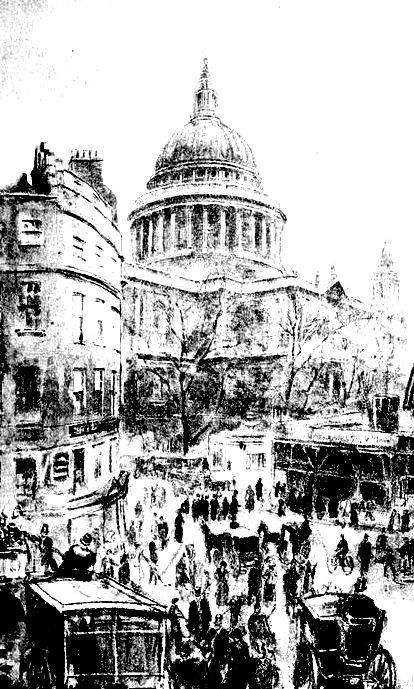
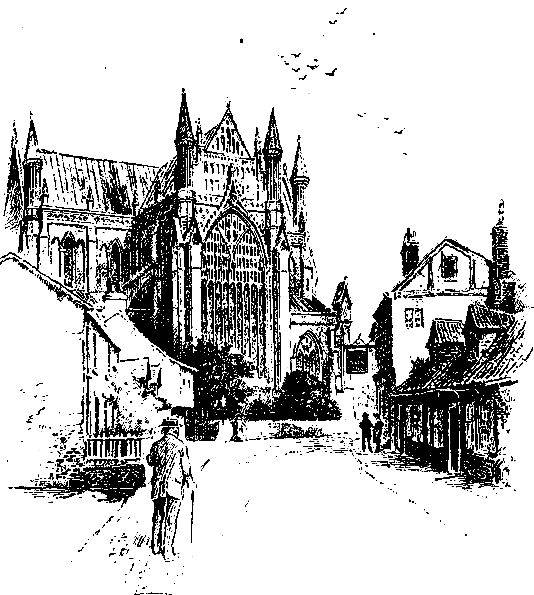
ST. PAUL'S FROM CHEAPSIDE
The Precincts
We will now examine the precincts of the Cathedral. A wall
surrounded the vast space which extended from Carter Lane on the
south to Creed Lane and included Paternoster Row. This wall
had six gates, the site of two of which is marked by St. Paul's
Alley and Paul's Chain. The Bishop's Palace occupied the
north-west corner of this space, and on the north were some
cloisters decorated with mural paintings representing the Dance of
Death, a favourite subject of mediæval painters, of which Holbein's
conceptions are best known. This cloister was on the site of
Pardon Churchyard, where a chapel was founded by Gilbert à
Becket, the father of St. Thomas of noted memory. The chapter-house
stood on the south side of the Cathedral, and was a very
beautiful structure, so beautiful that Protector Somerset coveted the
materials for his palace in the Strand, and took down and removed
them.
At the north-east corner of the precincts stood the famous
Paul's Cross, the scene of so many famous preachings and strange
events, where folk-motes were held, Papal bulls promulgated,
Royal proclamations made, excommunications and public penances
declared, and sometimes riots and tumults excited. Paul's Cross
played a very prominent part in the history of old London. Near
the Pardon Churchyard once stood the Parish Church of St.
Faith, called the Chapel of Jesus; but this was destroyed, and the
parishioners received in lieu of it a church in the crypt of the
Cathedral. Fuller, remarking on this and on the existence of the
Parish Church of St. Gregory on the Thames side of the Cathedral,
quaintly observed, "St. Paul's may be called the Mother Church
indeed, having one babe in her body and another in her arms."
St. Paul's was the centre of the life of London. Its great bell
summoned the London citizens to their three annual folk-motes at
Paul's Cross, where all the municipal business of the city was
transacted, disputes settled, grievances stated and rights vindicated.
Very turbulent and jealous of their liberties were these good citizens,
and even the sovereign will of kings and queens must bow before the
noisy clamours of the burghers of London. The bell of St. Paul's,
like that of its famous brother "Roland" at Ghent, seemed endowed
with a human voice when it summoned the multitudes to
their meeting-place at the Cross, and declared in loud tones the
will of the people.
Historical Events
The citizens might well love to have their church in their
midst, for the ecclesiastical power was very strong, and often
enabled them to defy the will of tyrannical kings or troublesome
barons. In the time of the Conqueror, Bishop William of London
obtained from the king a renewal of their privileges of which the
monarch had deprived them. In gratitude for this benefit, the
mayor, aldermen and livery companies of London used to visit
the tomb of the good bishop in grand procession, in order to pray
for his soul, and to commemorate his great services.
In the reign of Stephen civil war raged, and the country was
divided into hostile camps, one siding with the king and the other
with the Empress Maud. The citizens of London were not
doubtful in their opinions. They rang the great bell of St. Paul's,
summoned their folk-mote, and loudly declared that it was the
privilege of the citizens of their great city to elect a sovereign for
England, and with one voice supported Stephen.
Thomas à Becket, Archbishop of Canterbury, was a favourite
of the citizens, though hated by his sovereign. Gilbert à Becket,
his father, had a shop in Cheapside on the site of Mercers' Hall,
whither the fair Saracen is said to have followed him from the Holy
Land, where he had gone on a Crusade. He built a chapel in the
churchyard of St. Paul, and his son, the famous archbishop, was
well known to the citizens. Gilbert Foliot, Bishop of London,
however, had taken the side of the king, Henry II., in the fatal
quarrel, and aroused the anger of the prelate. A curious scene
took place in consequence in old St. Paul's. A priest was celebrating
mass, when a man approached, thrust a paper into his hand,
and cried aloud, "Know all men that Gilbert, Bishop of London,
is excommunicated by Thomas, Archbishop of Canterbury." The
news spread fast among the citizens. Foliot at first attempted to
defy the dread sentence; but he knew something of the nature of
the citizens of London, and wisely bowed before the decree, which
the people were quite willing to enforce.
St. Paul's was the scene of a memorable council in the reign of
Richard Cœur de Lion, who was crusading in Palestine. The
bishops, together with the king's brother John, met in the nave
and condemned Longchamp to resign the office of justiciary, and to
surrender the castles which he held in the name of the king.
During this reign a factious demagogue, William Fitz-Osbert,
equally distinguished by the length of his beard and the vehemence
of his eloquence, called the people together at Paul's Cross, and
excited them to rebel against their oppressors. Bishop Hubert,
however, calmed the multitude on the eve of a formidable rising.
The people deserted their leader, who took refuge in St. Mary-le-Bow
Church, which was set on fire, and Fitz-Osbert suffered death
at the hands of the hangman. Thus from the tyranny of a Royal
favourite, and from that of a mob orator, the people were saved by
the influence of the Church in St. Paul's Cathedral.
A still greater service did St. Paul's render to England. Here
was assembled a grand concourse of bishops, abbots, deans, priors
and barons, to withstand the oppressive lawlessness of King John.
Here Magna Charta was first devised. Here, at the instigation of
Archbishop Langton, the barons and chief men swore to maintain
the principles of the Charta, and to protect the liberties of
Englishmen.
St. Paul's also set itself in opposition to the authority of the
Pope; and when a Papal legate sought to enthrone himself in
St. Paul's, he was openly resisted by Cantelupe, Bishop of Worcester.
Boniface of Savoy, "the handsome Archbishop," brought
with him fashions strange enough to English folk. His armed
retainers pillaged the markets, and he felled to the ground, with
his own fist, the prior of St. Bartholomew, Smithfield, who presumed
to oppose his visitation. He came to St. Paul's to demand
first-fruits from the Bishop of London, but deemed it advisable to
wear armour beneath his robes. He found the gates of the
Cathedral closed against him; but he fared better than two canons
of the Papal party, who were killed by the citizens a few years
later when they attempted to enter St. Paul's. London was
aroused by these Italian priests, and the citizens at length besieged
Lambeth Palace and drove the obnoxious archbishop beyond
seas.
Again and again the tocsin sounded, as St. Paul's bell rang
clear and loud, and the citizens seized their weapons and formed
their battalions beneath the shadow of the great church. Now it
was to help Simon de Montfort against the king; now to seize the
person of the obnoxious Queen Eleanor, who was trying to escape
by water from the Tower to Windsor, and who was rescued from
their hands by the Bishop of London, and found refuge in his
palace. Now the favourites of Edward II. excited their rage,
especially the Bishop of Exeter, the king's regent, who dared to
ask the Lord Mayor for the keys of the city, and paid for his
temerity with his life.
An incident which shows the attachment of the people to their
church and bishop occurred in the reign of the third Edward.
Wycliffe was summoned by Bishop Courtenay to appear before a
great council at St. Paul's. But the reformer did not come alone;
to the surprise of his accusers he arrived attended by a large
following of friends, among whom were John of Gaunt and Lord
Percy. These powerful supporters of Wycliffe attacked the
bishop with angry words.
News was flashed among the citizens that John of Gaunt had
threatened their bishop and vowed to drag him out of the church
by the hair. They gathered together in angry crowds, and would
have slain the duke and sacked his palace, the Savoy, in the Strand,
if the bishop had not interfered on behalf of his enemy. Wycliffe
and Lollardism did not then find much favour with the people of
London.
There were reformers within the Church who were quite as
eager to correct abuses as those outside the fold. Among these
was Bishop Braybroke of London, who lived in the time of
Edward IV. He contended for the sanctity of the sacred building,
inveighed against the practice of using it as an exchange, of
playing at ball within the precincts or within the church, and of
shooting the pigeons which then as now found sanctuary at St.
Paul's.
The chronicles of the Cathedral tell the story of the troublous
times of the Wars of the Roses. We see Henry IV. pretending
bitter sorrow for the death of the murdered Richard, and covering
with cloths of gold the body, which had been exhibited to the
people in St. Paul's. We see Henry V. returning in triumph from
the French wars, riding in state to the Cathedral, attended by "the
mayor and brethren of the city companies, wearing red gowns
with hoods of red and white, well-mounted and gorgeously horsed,
with rich collars and great chains, rejoicing at his victorious
returne." Then came Henry VI., attended by the bishops, the
dean and canons, to make his offering at the altar. Here the false
Duke of York took his oath on the Blessed Sacrament to be loyal
to the king. Here the rival houses swore to lay aside their
differences, and to live at peace. But a few years later saw the
new king, Edward IV., at St. Paul's, attended by great Warwick,
the king-maker, with his bodyguard of 800 men-at-arms. Strange
were the changes of fortune in those days. Soon St. Paul's saw
the exhibition of the dead body of the king-maker, and not long
afterwards that of the poor dethroned Henry, and Richard came in
state here amid the shouts of the populace. After the defeat of the
conspiracy of Lambert Simnel, Henry VII. celebrated a joyous
thanksgiving in the Cathedral, and here, amid much rejoicing, the
youthful marriage of Prince Arthur with Catherine of Arragon
took place, when the conduits at Cheapside and on the west of the
Cathedral ran with wine, and the bells rang joyfully, and all wished
happiness to the Royal children whose wedded life was destined
to be so brief.
The Reformation and After
At the dawn of the Reformation period we will pause in order
to try and realise what kind of scenes took place daily in the great
Cathedral, and what vast numbers were employed on the staff.
The members of the Cathedral body in the year 1450 included the
following:—The Bishop, the Dean, the four Archdeacons, the
Treasurer, the Precentor, the Chancellor, thirty greater Canons,
twelve lesser Canons, about fifty Chaplains or Chantry-Priests and
thirty Vicars. Of inferior rank to these were the Sacrist, the three
Vergers, the Succentor, the Master of the Singing School, the
Master of the Grammar School, the Almoner and his four Vergers,
the Servitors, the Surveyor, the twelve Scribes, the Book Transcriber,
the Bookbinder, the Chamberlain, the Rent-collector, the
Baker, the Brewer, the Singing-men and Choir Boys, of whom
priests were made, the Bedesmen and the poor folk. In addition
to these must be added the servants of all these officers—the
brewer, who brewed in the year 1286, 67,814 gallons, must have
employed a good many; the baker, who ovened every year 40,000
loaves, or every day a 100, large and small; the sextons, grave-diggers,
gardeners, bell-ringers, makers and menders of the
ecclesiastical robes, cleaners and sweepers, carpenters, masons,
painters, carvers and gilders. One can very well understand
that the Church of St. Paul alone found a livelihood for
thousands.
The inventory of church goods belonging to the Cathedral in
1245 exists, and is worth studying. It enumerates sixteen
chalices, five of gold and the rest of silver-gilt. A chalice of
Greek work had lost its paten, but retained its reed (calamus), a
relic of the time when the deacon carried the chalice to the people,
and each one drank of its hallowed contents through a long narrow
pipe, which was usually fastened on a pivot to the bottom of the
cup of the chalice. Amongst other curiosities of the inventory
are three poma, or hollow balls of silver, so contrived as to hold
hot water or charcoal embers for the warming of the hands of the
celebrant during mass.
Of shrines and relics we have already spoken. There were
three episcopal staves, and also a precentor staff of ivory with silver-gilt
and jewelled enrichments, and a baculus stultorum for use at the
profane travesty called the feast of fools. Among the mitres were
two for the boy-bishop's use on St. Nicholas Day. There were
thirty-seven magnificent copes, and forty-four others, and thirty-four
specially fine chasubles.
The inventory of 1402 supplies some curious information as to
the manner in which the numerous and costly vestments were
arranged when not in use. In the treasury, on the west, stood a
wardrobe, armariolum, in which were twenty-four perticæ, pegs, or
rods, or frames, from which the copes and chasubles could be suspended,
one pertica holding from three to six copes. The vestments
were arranged according to colour. Three other wardrobes were
also stored with goodly vestments, and there were twenty-six in
daily use. The total is 179 copes, fifty-one chasubles and ninety-two
tunicles, and the colours were red, purple, black, white, green,
yellow, blue, red mixed with blue.
We have remarked that St. Paul's was the centre of the social
life of the people in olden days, which led to some abuses.
Francis Osborn says, "It was the fashion in those days, and
did so continue until these, for the principal gentry, lords and
courtiers, and men of all professions, to meet in St. Paul's by
eleven of the clock, and walk in the middle aisle till twelve, and
after dinner from three to six, during which time they discoursed of
business, others of news."
Shakespeare represents Falstaff in Henry V. as having "bought
Bardolph in Paul's"; and Dekker thus speaks of the desecration
of the sanctuary, "At one time in one and the same rank, yea,
foot by foot, elbow by elbow, shall you see walking the knight, the
gull, the gallant, the upstart, the gentleman, the clown, the captain,
the apple-squire, the lawyer, the usurer, the citizen, the bankrout,
the scholar, the beggar, the doctor, the idiot, the ruffian, the cheat,
the Puritan, the cut-throat, highman, lowman and thief; of all
trades and professions some; of all countries some. Thus while
Devotion kneels at her prayers, doth Profanation walk under her
nose in contempt of Religion."
Here lawyers received their clients; here men sought service;
here usurers met their victims, and the tombs and font were
mightily convenient for counters for the exchanges of money and
the transaction of bargains, and the rattle of gold and silver was
constantly heard amidst the loud talking of the crowd.
Gallants enter the Cathedral wearing spurs, having just left
their steeds at "The Bell and Savage," and are immediately besieged
by the choristers, who have the right of demanding spur-money
from anyone entering the building wearing spurs.
Nor are the fair sex absent, and Paul's Walk was used as a
convenient place for assignations. Old plays are full of references
to this practice.
Later on the nave was nothing but a public thoroughfare, where
men tramped carrying baskets of bread and fish, flesh and fruit,
vessels of ale, sacks of coal, and even dead mules and horses and
other beasts. Hucksters and pedlars sold their wares.
Duke Humphrey's tomb was the great meeting-place of all
beggars and low rascals, and they euphemistically called their gathering
"a dining with Duke Humphrey."
Much more could be written of this assembly of all sorts and
conditions of men, but we have said enough to show that the
Cathedral had suffered greatly from desecration and abuse. Indeed,
an old writer in 1561 declared that the burning of the steeple in
that year was a judgment for the scenes of profanation which were
daily witnessed in old St. Paul's. He writes, "No place has
been more abused than Paul's has been, nor more against the
receiving of Christ's Gospel; wherefore it is more marvel that God
spared it so long, rather than He overthrew it now. From the
top of the spire at coronations, or at other solemn triumphs, some
for vain glory used to throw themselves down by a rope, and so
killed themselves vainly to please other men's eyes," and much
more to the same effect.
But the strictness of the worthy divine did not altogether cure
the evils against which he railed. Eight years later the first great
lottery was drawn before the west doors. There were 10,000
lots at ten shillings each, and day and night from January 11 to
May 6 the drawing went on. The prizes were pieces of plate, and
the profits were devoted to the repair of the havens of England.
So profitable was the lottery that another took place here in 1586,
the prizes being some valuable armour.
At the dawn of the Reformation we see Henry VIII. in all the
pomp and glory of mediæval pageantry riding in state to the Cathedral
to be adorned with a cap of maintenance and a sword presented
to him by the Pope. There was no sign yet of any breach of
alliance between the Roman Pontiff and him whom he honoured
with the title of "Defender of the Faith." Lollardism in spite
of some burnings spread, and the western tower of the Cathedral
earned the name of the Lollards' Tower, as several were imprisoned
there.
Wolsey, the great cardinal, in the height of his prosperity often
came to St. Paul's, and very gorgeous were the scenes which took
place there, when thanksgiving for the peace between England,
France and Spain was celebrated, when Princess Mary was betrothed
to the Dauphin of France, and Charles V. proclaimed
emperor. But signs of trouble were evident. Bishop Fisher thundered
forth invectives against the works of Luther, which were
publicly burnt in St. Paul's Churchyard. A few years later there
was a burning in the Cathedral of heretical books in the presence
of the cardinal, who caused some of Luther's followers to march
round the blaze, throw in faggots, and thus to contemplate what a
burning of heretics would be like, and be thankful that only their
books and not their bodies were condemned to the flames.
During this troubled time and in Mary's reign, St. Paul's was
often used as a place of trial for heretics, but Paul's Cross was a
fruitful breeding place for the principles of the Reformation. Here
Latimer, Ridley, Coverdale, Lever, and a host of others used to
inveigh against the errors of Rome and deny the authority of the
Pope. Here they exhibited the Boxley Rood, with all the tricks
whereby it was made to open its eyes and lips, and seem to speak.
The crowd looked on, and roared with laughter, seized the miraculous
Rood, and broke it in pieces. And then a strange thing happened
in the Cathedral. One night all the images, crucifixes and
emblems of Popery were pulled down. Terrible havoc was wrought,
chalices and chasubles, altars and rich hangings, books and costly
vestments, were all seized and sold, and helped to increase that vast
heap of spoil which the greedy ministers of Edward VI. gathered
from the wasting of the Church's goods. Tombs were pulled down,
chantries and chapels devastated, cloisters and chapter-houses removed
bodily to Somerset House by Protector Somerset for the
building of his new palace, and all was wreckage, spoliation and
robbery.
Then came the fitful restoration of the "old religion," and
many riots ensued, many ears were nailed to the pillory nigh Paul's
Cross; many Protestants condemned in the Cathedral to the fires at
Smithfield, and many horrors enacted which Englishmen like not
to remember.
With the coming of Elizabeth more peaceful times ensued, but
the Cathedral was in a sorry condition. Desecration reigned within.
Then in 1561 the spire caught fire, blazed and fell, destroying parts
of the roof. The clergy and citizens soon set to work to repair the
damage, but the glory of "old St. Paul's" had departed, and its
ruinous condition was the distress of rulers and the despair of the
citizens and clergy.
Elizabeth often visited the Cathedral, and troubled Dean Nowell
by her plainly-spoken criticisms. Felton was hung at the bishop's
gates for nailing a Papal bull to the palace doors, which declared the
queen to be a heretic and released her subjects from their allegiance.
This attempt of the Pope to dethrone the Virgin Queen was not
very successful. Some other conspirators suffered for their crimes
in the following reign in the precincts, four of the gunpowder conspirators
being hung, drawn and quartered before the west doors.
Here also Garnet, the Jesuit, shared a like fate.
King James attempted to restore the Cathedral, but his efforts
came to nothing. Charles I. did something, and from the designs
of Inigo Jones built a portico at the west end, and made some other
improvements, but the troubles of the Civil War intervened, and the
money which had been collected by Archbishop Laud and the
generosity of the citizens of London was seized by the Parliament
and converted to other and baser uses.
The Civil Wars
Desolation reigned supreme in the once glorious church when
Puritan rage had vented itself on its once hallowed shrines and sacred
things. Cromwell's troopers "did after their kind." Whatever
beautiful relics of ancient worship reforming zeal had left were
doomed to speedy destruction. In the western portico built in the
last reign shops were set up for sempstresses and hucksters; Dr.
Burgess, a Puritan divine, thundered forth in his conventicle set up
in the east of the building; and the rest of the Cathedral was turned
into a cavalry barracks.
The conduct of the rough soldiers created great scandal. They
played games, brawled and drank in the church, prevented people
from going through the nave, and caused such grievous complaints,
that an order was passed forbidding them to play at ninepins from
six o'clock in the morning to nine in the evening.
The Mercurius Eleneticus of 1648 waxes scornful over the misdeeds
of these rough riders, and scoffs sarcastically: "The saints
in Paul's were last week teaching their horses to ride up the great
steps that lead to the Quire, where (as they derided) they might perhaps
learn to chant an anthem; but one of them fell and broke his
leg, and the neck of his rider, which hath spoilt his chanting, for he
was buried on Saturday night last, a just judgment of God on such a
profane and sacrilegious wretch."
The famous Cross in the churchyard, which according to Dugdale,
"had been for many ages the most noted and solemn place in
this nation for the greatest divines and greatest scholars to preach at,
was, with the rest of the crosses about London and Westminster, by
further order of the Parliament, pulled down to the ground."
After the Great Fire
With the restoration of the monarchy came the restoration of the
Cathedral. Dr. Wren, the great architect, was consulted, plans
were discussed, Wren prepared himself for the great work, and all
was in readiness, when the Great Fire broke out, and completed the
ruin which had already begun. It, however, paved the way for the
erection of the grand church which will ever be associated with the
genius of its great architect.
Both the diarists, Pepys and Evelyn, speak of the melancholy
spectacle of the great ruin. Pepys laments over the "miserable sight
of Paul's church, with all the roof falling, and the body of the nave
fallen into St. Faith."
And Dryden sings:—
"The daring flames press'd in and saw from far
The awful beauties of the sacred quire:
But since it was profaned by civil war
Heaven thought it fit to have it purged by fire."
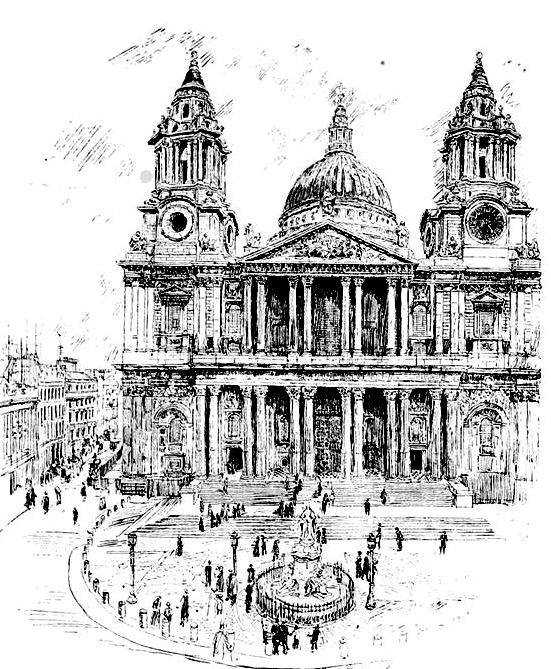
THE WEST FRONT
Evelyn, in his diary, describes his visit to the church before the
fire with Dr. Wren, the bishop, dean and several expert workmen.
"We went about to survey the general decay of that ancient and
venerable church, and to set down in writing the particulars of what
was fit to be done. Finding the main building to recede outwards,
it was the opinion of Mr. Chickley and Mr. Prat that it had been
so built ab origine for an effect in perspective, in regard of the height;
but I was, with Dr. Wren, quite of another judgment, and so we
entered it: we plumbed the uprights in several places. When we
came to the steeple, it was deliberated whether it were not well
enough to repair it only on its old foundation, with reservation to the
four pillars; ... we persisted that it required a new foundation not
only in regard of the necessity, but that the shape of what stood
was very mean, and we had a mind to build it with a noble cupola,
a form of church-building not as yet known in England, but of
wonderful grace...."
Then came the Great Fire, so graphically described by Evelyn.
He writes: "The stones of Paul's flew like granados, the melting
lead running down the streets in a stream, and the very pavements
glowing with fiery redness, so as no horse or man was able to
tread on them, and the demolition had stopped all the passages, so
that no help could be applied."
This Great Fire roused again the energy and indomitable
spirit of Englishmen. They beheld without alarm the ashes of
their houses, and the destruction of their great city. They felt
that the eyes of Europe were upon them. A new city was to
be built worthy of their nation, worthy of the great centre of the
commerce of the world. But to restore St. Paul's was a stupendous
work. Some were for rebuilding on the old walls. Pepys describes
the ruins: "I stopped at St. Paul's, and then did go into St. Faith's
Chapel, and also into the body of the west part of the church;
and do see a hideous sight of the walls of the church ready to fall,
that I was in fear as long as I was in it; and here I saw the
great vaults underneath the body of the church." And again:
"Up betimes, and walked to the Temple, and stopped, viewing
the Exchange, and Paul's, and St. Faith's, where strange how
the very sight of the stones falling from the top of the steeple do
make me sea-sick."
They began to repair the west end for service against the
advice of Wren, and Dean Sancroft was obliged to confess to the
architect,—
"What you whispered in my ear at your last coming here is
come to pass. Our work at the west end of St. Paul's is fallen
about our ears."
At last the order was given to take down the walls, clear the
ground, and proceed according to the plans of Wren. He was
thwarted and distressed by the interference of many. His original
design was to build it in the form of a Greek cross, but to this the
clergy objected, and a Latin cross was decided upon.
In 1674 the workmen began to clear away the old ruins, no
light task, but in the end it was accomplished, the first stone of the
new Cathedral being laid on June 21, 1675. In October 1694
the choir was finished, and on December 2, 1697, Divine service
was performed for the first time in the new edifice. It was a
special thanksgiving for the Peace of Ryswick, a peace which
settled our Dutch William more securely on the throne of England.
His Majesty wished to attend the service, but it was feared that
amongst the vast crowds there might be too many Jacobites, and he
was persuaded to remain at his palace. Bishop Compton preached
a great sermon on the occasion from the text, "I was glad when
they said unto me, we will go into the House of the Lord."
Thirteen years elapsed before the highest stone of the lantern on
the cupola was laid by Wren's son, and the magnificent building
was completed by the skill, genius and determination of one man,
whose memory deserves to be ever honoured by all Englishmen.
The men of his own day did not treat him worthily. During
the building of the Cathedral he was beset by all the annoyances
jealousy and spite could suggest, and at the end of his long and
useful career, by the intrigues of certain German adventurers, he was
deprived of his post of Surveyor-General after the death of Queen
Anne. He retired to the country, and spent the few remaining
years of his life in peaceful seclusion, occasionally giving himself
the treat of a journey to London, in order that he might feast his
eyes on that great and beautiful church which his skill had raised.
His was the first grave sunk in the Cathedral, and it bears the
well-known inscription, than which none could be more fitting:—
LECTOR, SI MONUMENTUM REQUIRIS CIRCUMSPICE.
The Existing Cathedral—Exterior
The new St. Paul's is without doubt the grandest building in
London. Perhaps the finest view is obtained from the approach by
Ludgate Hill, and the grandeur of its majestic dome is most impressive.
The style is English Renaissance. We will begin our
survey with the West Front, which was erected last, and therefore
bears the stamp of Wren's matured genius. There are two storeys.
In the lower there is a row of Corinthian columns arranged in
pairs, and in the second storey a similar series. On the triangular
pediment above is a carving of the Conversion of St. Paul, while a
statue of the saint crowns the apex, the other statues representing
SS. Peter and James and the four Evangelists. Two towers stand,
one on each side of the front, and complete a superb effect. These
contain a grand peal of twelve bells, one of which, called Great
Paul, fashioned twenty years ago, is one of the largest in the
world. Rich marbles, brought from Italy and Greece, adorn the
pavement.
Proceeding to the north side we note the two-storied construction,
the graceful Corinthian pilasters,[3] arranged in pairs, with
round-headed windows between them; the entablature; and then, in
the second storey, another row of beautiful pilasters of the Composite
order. Between these are niches where one would have expected
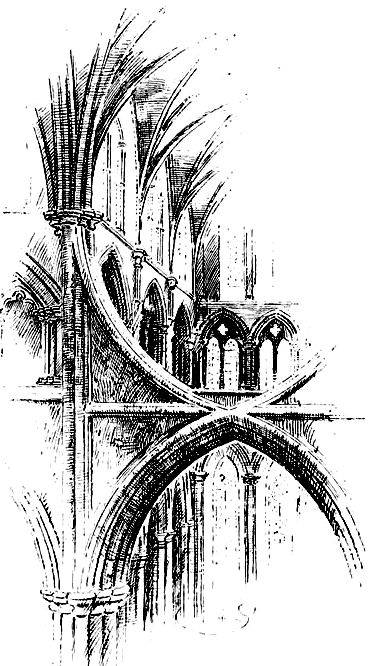
windows; but this storey is simply a screen to hide the flying
buttresses supporting the clerestory, as Wren thought them a
disfigurement. The walls are finished with a cornice, which Wren
was compelled by hostile critics to add, much against his own
judgment. There are some excellently-carved festoons of foliage
and birds and cherubs, which are well worthy of close observation.
The North and South Fronts have Corinthian pillars, which support
a semi-circular entablature. Figures of the Apostles adorn the
triangular-shaped head and balustrade. The Royal arms appear
on the north side, and a Phœnix is the suitable ornament on the
south, signifying the resurrection of the building from its ashes.
The south side is almost exactly similar to the north. The
east end has an apse.
The magnificent Dome is composed of an outward and inward
shell, and between these there rises a cone-shaped structure which
supports the lantern, crowned with its golden ball and cross. The
arrangement of this is most complex, and is a witness to the marvellous
skill of the architect. Above the row of Composite
columns is a gallery, which affords a good view to those who are
anxious to climb. Above the actual dome is the Golden Gallery,
and then the lantern, roofed with a dome bearing the ball and
cross. The whole height is 365 feet.
Interior of the Building
The view on entering the Cathedral at the west is most impressive.
The magnitude of the design, the sense of strength and
stability, as well as the beauty of the majestic proportions, are very
striking. Over the doors we see carvings of St. Paul at Berea. A
gallery is over the central
doorway, and here is a
good modern window.
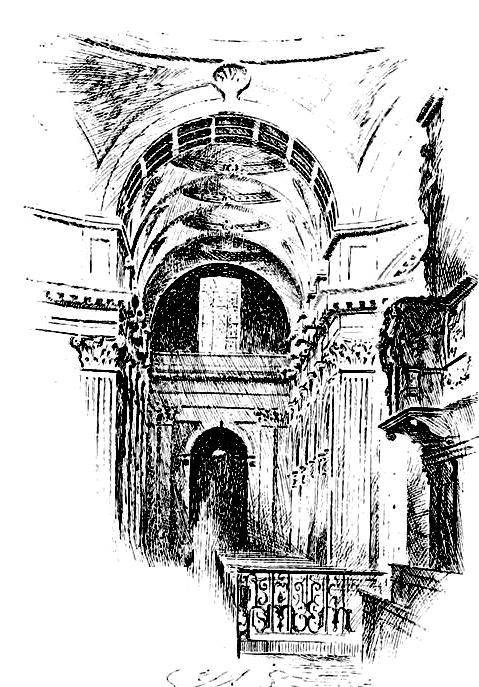
The Nave from the Choir
The nave has a large
western bay with chapels,
three other bays, and a large
space beneath the west
wall of the dome. It
has three storeys, the lofty
arches, a storey which in
a Gothic church would be
termed the triforium, and
a clerestory. Grand Corinthian
pilasters are attached
to the massive piers, with
wonderfully-wrought capitals,
which support the
entablature. The arches
spring from smaller pilasters
joined to the larger
ones. Great arches springing
from the triforium piers
span the nave, and between
these arches are dome-shaped
roofs. High up
there are festoons of carving.
The aisles have three large windows, and Composite pilasters
adorn the walls and support the vault. The north chapel at the
west end is the Morning Chapel, and is adorned with mosaics and
modern glass, in memory of Dean Mansell (1871). The south
chapel is called the Consistory, and once held Wellington's monument,
to which the marble sculptures refer. Here is an unusual
Font of Carrara marble.
The Dome is supported by immense and massive masonry.
Above the arches a cornice runs round, supporting the Whispering
Gallery. Then the dome begins to curve inward. Above is a row
of windows, set in groups of three, separated by niches recently filled
with statues of the Fathers, and then the dome is completed and
painted by Sir James Thornhill with scenes from the life of
St. Paul. These are too faint and too
far distant to be easily observed. The
painter nearly lost his life through stepping
backward in order to see the effect
of his brush, and nearly fell from the
scaffold. His companion just saved his
life by flinging a brush at the painting,
and Thornhill rushed forward to rescue
his work, and thus his life was saved.
The Pulpit is made of rich marble,
and the lectern was made in 1720.
The modern mosaics are of unique interest,
and add much to the beauty of the
Cathedral. To Sir William Richmond
the credit of this work is mainly due,
and for some of earlier portions to Mr.
G.F. Watts, R.A.
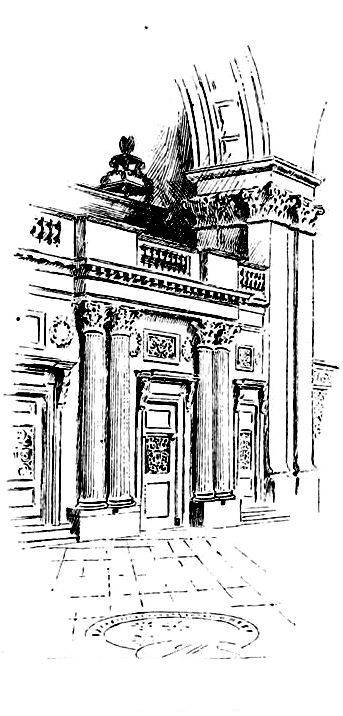
Woodwork South Choir Aisle
The Transepts have good windows,
representing (north) the twelve founders
of English Christianity, and south, the
first twelve Christian Saxon kings, and
also a window in memory of the recovery
from illness of His Majesty
Edward VII. when Prince of Wales.
The Choir has some wonderfully-carved
stalls by the famous Grinling
Gibbons, and these bear the names of the prebendaries attached
to the Cathedral, with the parts of the Psalter which each one had
to say each day, an arrangement similar to that at Lincoln.
The Reredos is a noble example of modern work, and is worthy
of close examination. Behind it is the Jesus Chapel, containing a
monument of Canon Liddon. The mosaic decorations of the choir
are the work of Sir William Richmond, and are worthy of the
highest praise.
Monuments
One feature of St. Paul's especially endears it to us, and that is
that there lie all that is mortal of many of our national heroes.
Westminster is richer in its many monuments of great poets and
writers; but the makers of the Empire and most of our distinguished
painters are entombed in the "citizens' church." We
can only point out the tombs of the most illustrious.
- Nave (North Aisle)—
- Wellington (d. 1852), the hero of Waterloo.
- Gordon (d. 1890), slain at Khartoum.
- Stewart, General (d. 1880), who tried to rescue Gordon.
- Melbourne, Viscount (1848), Queen Victoria's first Prime Minister.
- North Transept—
- Sir Joshua Reynolds (1792), by Flaxman.
- Rodney, Admiral (1790), the hero of Martinique.
- Picton (1815), slain at Waterloo.
- Napier, General (1860), author of Peninsular War.
- Ponsonby, General (1815), killed at Waterloo.
- Hallam, the historian (1859).
- Johnson, Samuel (1784).
- South Transept—
- Nelson, Admiral.
- Sir John Moore (1806), killed at Corunna.
- Turner, Joseph, R.A. (1851), painter.
- Collingwood, Admiral (1810), Colleague of Nelson.
- Howe, Admiral (1799), Colleague of Nelson.
- Howard, John (1790), the prison reformer, the first monument erected.
- Lawrence, General (1857), killed in Indian Mutiny.
- Cornwallis, General (1805), fought in American War and in India.
- South Choir Aisle—
- Dean Milman (1868).
- Bloomfield, Bishop (1856).
- Jackson, Bishop (1885).
- Heber, Bishop (1826), of Calcutta.
- Liddon, Canon (1890).
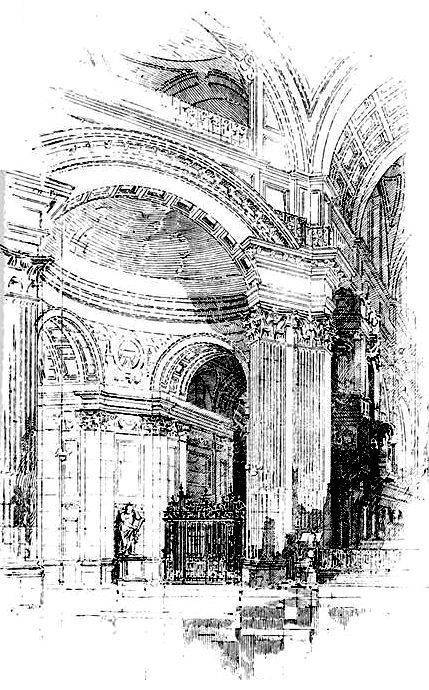
Johnson's Statue in St. Paul's Cathedral
The Crypt contains the Parish Church of St. Faith, Wellington's
funeral car fashioned from captured cannon, and his tomb,
Nelson's tomb (the coffin is made from the wood of one of his
ships—the tomb is sixteenth-century work and was made for
Cardinal Wolsey), the grave of Wren with its famous inscription,
and many illustrious painters sleep in the Painters' Corner, amongst
whom our modern artists Leighton and Millais rest with Reynolds,
Lawrence, Landseer and Turner.
Dimensions
| Total length | 460 ft. |
| Length of nave | 200 ft. |
| Width of nave | 100 ft. |
| Height of nave | 89 ft. |
| Length of choir | 160 ft. |
| Height of cross on dome | 363 ft. |
| Height of west towers | 222 ft. |
| Area | 59,700 sq. ft. |
Style—English Renaissance.
Building Dates
Begun June 21, 1675.
Cathedral finished 1710.
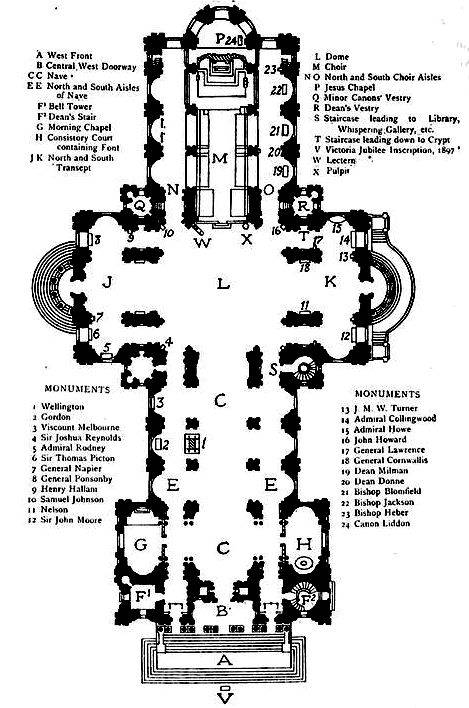
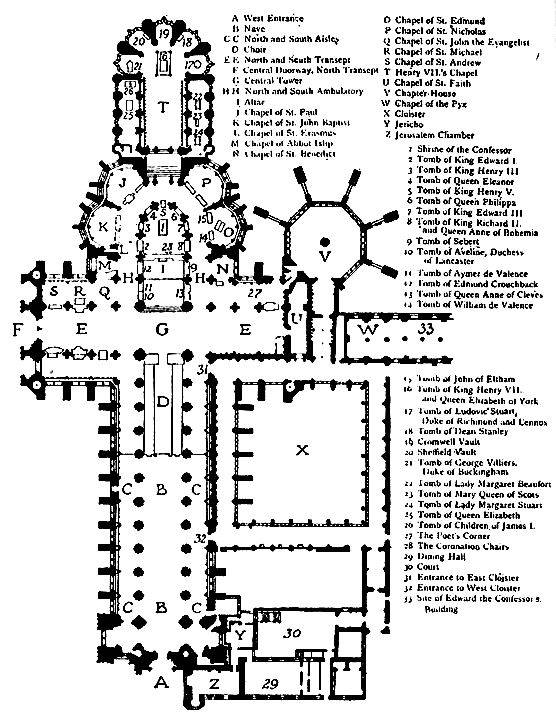
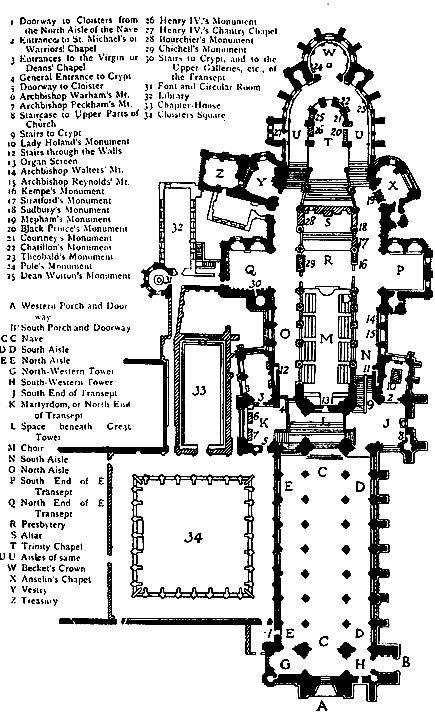
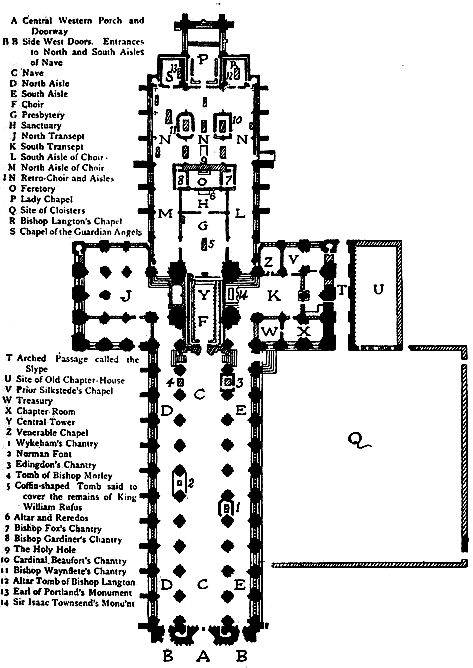
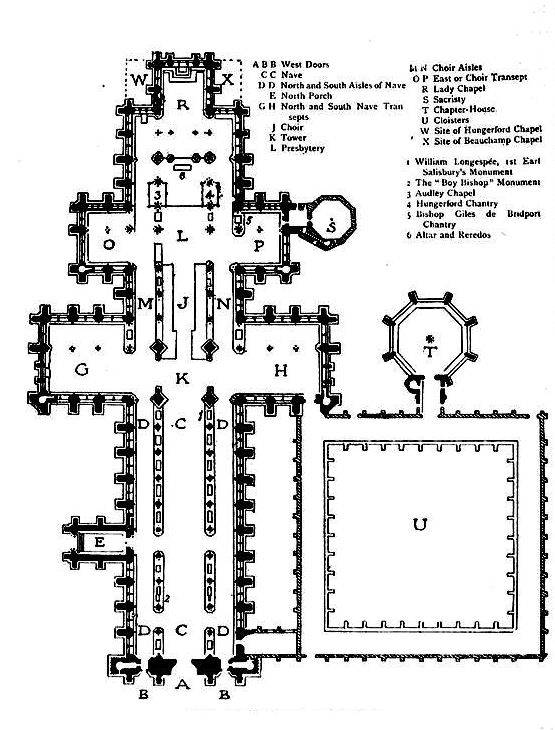
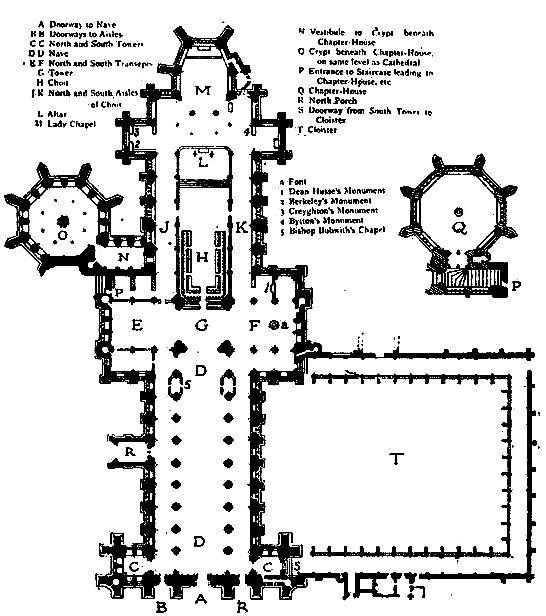
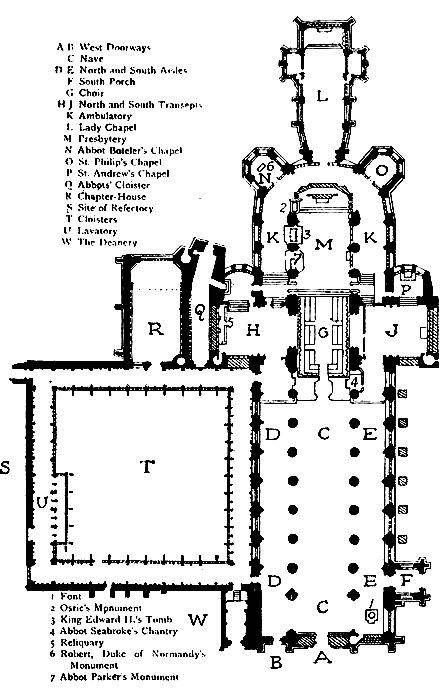
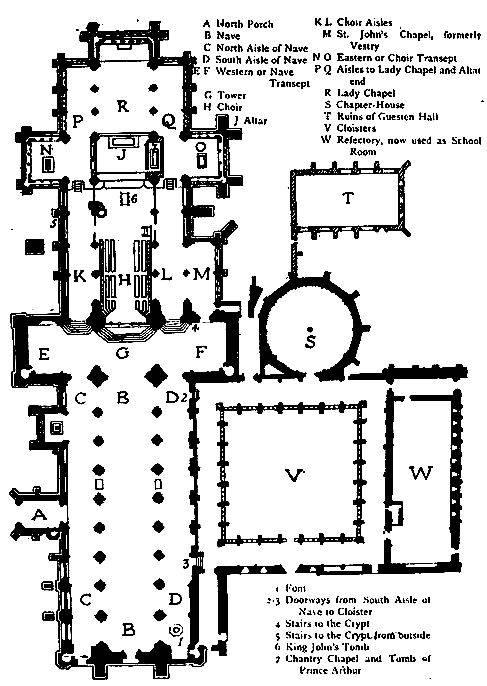
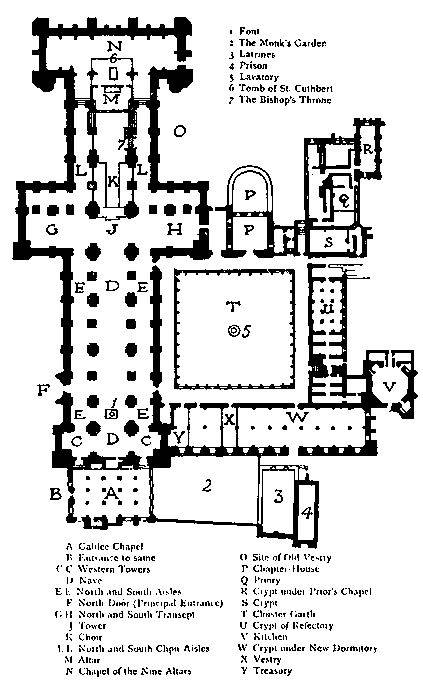
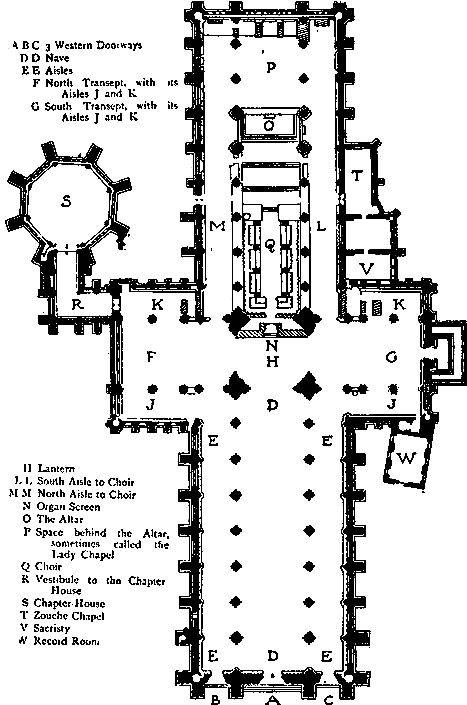
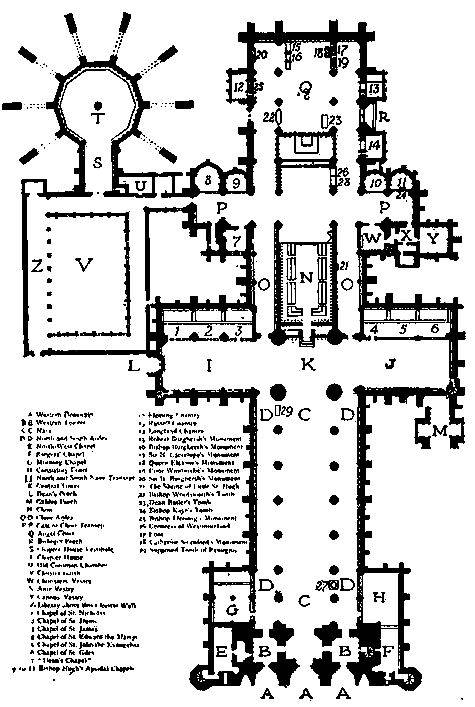
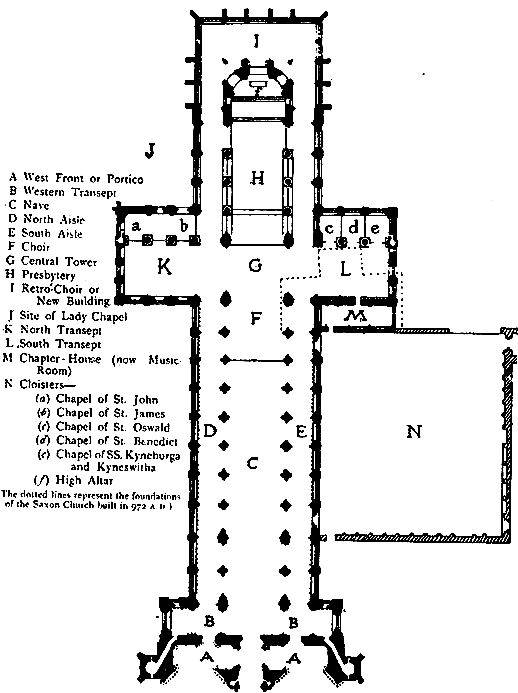
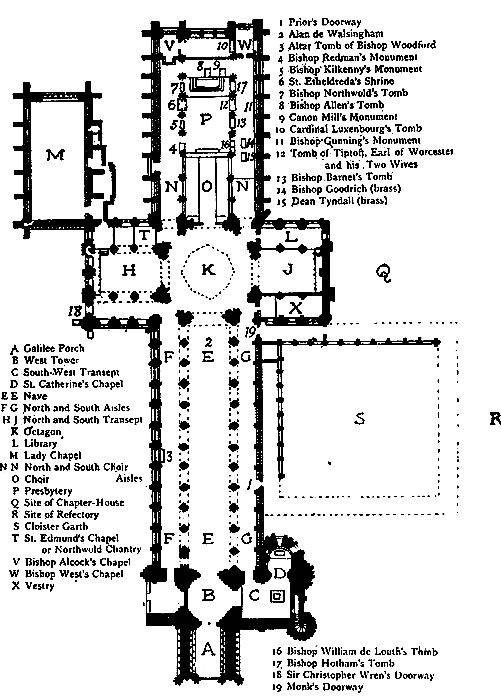
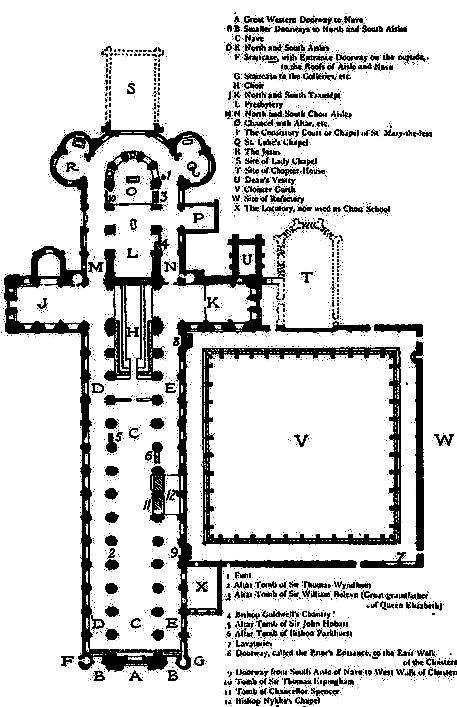
PLAN OF ST. PAUL'S CATHEDRAL