Painting is not generally supposed to be connected in
any great degree with architecture: indeed it has now
become a distinctly independent art. In the Middle Ages
I believe the case was different. The great primitive
Comacine Guild seems to have embraced all the decorative
arts, though especially sculpture, as integral branches of
architecture. There are indisputable proofs of the many-sided
nature of the training in a Comacine laborerium.
There were Magistri insigneriorum, or Master architects;
Magistri lapidum, or sculptors, and Magistri lignorum, or
master carpenters. These latter seem in old times to have
been the designers of scaffoldings and makers of beams
for roofing; wood-carvers and inlayers were called Maestri
d'intaglio. Then there were certainly ironworkers and
masters in metal, and fresco-painters, who also attained to
the rank of Master. But no one branch was entirely separate
from the others, until the fourteenth century, when the
painters' companies were founded. We find the same man
building, designing, sculpturing, painting, and even working
in gold or iron, and seeming equally good in all styles,
so that the training of the laborerium must have been
especially comprehensive.
The reason appears to be that all the fine arts—painting,
sculpture and metal-working—were considered by the Comacines
as indispensable handmaids to architecture, and no
builder was in their eyes fit to be a Master till he could
not only erect his edifice, but adorn it. Their symbolic
church was to them a kind of Bible, figuring all the points
of creeds, but the building itself was but the paper and
binding of the Bible; the sculptor put the frontispiece
which explained its inner meaning, and the mosaicist and
fresco-painter added as it were the letter-press and illustrations.
The churches of Ravenna show how full and rich
was this inner illustration, how Christ and the Apostles,
angels and prophets, saints and martyrs, have shone on
those walls, a beautiful Bible picture-book for ages. That
this was the light in which the early Christians regarded
their churches is plain from many passages in the early
Fathers. St. Basil (A.D. 379) in preaching, says—"Rise
up, now, I pray you, ye celebrated painters of the good
deeds of this army. Make glorious by your art the
mutilated images of their leader. With colours laid on by
your cunning, make illustrious the crowned martyr, by me
too feebly pictured. I retire vanquished before you in
your painting of the excellences of the martyr, etc. etc."[199]
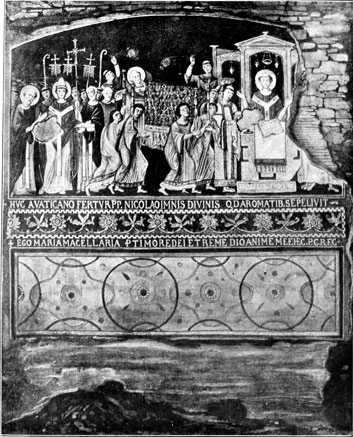
Eighth-century wall decoration in subterranean Church of S. Clemente, Rome.
See pages 10 and 268.
Here is the description of a Christian shrine by St.
Gregory of Nyssa (fourth century)—"Whoso cometh unto
some spot like this, where there is a monument of the just
and a holy relic, his soul is gladdened by the magnificence
of what he beholds, seeing a house as God's temple
elaborated most gloriously, both in the magnitude of the
structure, and the beauty of the surrounding ornament.
There the artificer has fashioned wood into the shape of
animals; and the stone-cutter has polished the slabs to the
smoothness of silver; and the painter has introduced the
flowers of his art, depicting and imaging the constancy of
the martyrs, their resistance, their torments, the savage
forms of their tyrants, their outrages, the blazing furnace
and the most blessed end of the champion; the representation
of Christ in human form presiding over the contest—all
these things as it were in a book gifted with speech;
shaping for us by means of colours, has he cunningly discoursed
to us of the martyr's struggles, has made this
temple glorious as some brilliant fertile mead. For the
silent tracery on the walls has the art to discourse, and to
aid most powerfully. And he who has arranged the
mosaics has made this pavement on which we tread equal
to a history." (From Father Mulroody's translation, in
San Clemente, pp. 34, 35. St. Gregory wrote before A.D.
395.[200])
No doubt the richness of colour in these Byzantine
mosaics inspired the taste for pictorial embellishment in the
interiors of buildings, and the Comacines, not having Greek
mosaicists at command, found an easier and quicker method
of writing their scriptures on their walls—i.e. fresco. The
first mention of frescoes is of those in the palace of Theodolinda,
where her Lombards were portrayed on the walls.
Several Lombard churches also retain signs of having been
frescoed.
But if one desires to see what the early Christian
Comacine could do in fresco, let him go to that interesting
Roman church of San Clemente, where some excavations
made in 1857 revealed the ancient fourth-century Basilica,
almost complete under the present one, which dates from
about the twelfth century. This ancient church was built
by St. Clement, the third bishop of Rome, and in it Gregory
the Great read his thirty-second and thirty-eighth homilies.
From the subterranean remains, with their grand ancient
marble pillars and the huge semi-circle of the tribune,
masked and built in though they are by the foundations of
the upper church, we judge that it was a far finer building
than the one above. Its walls were moreover covered with
frescoes, some of which are precisely similar in style to the
ones at S. Piero a Grado, also said to date before the tenth
century. The frescoes, which have been discovered on
the subterranean walls, are, as will be seen by our illustrations
of them, in three rows, which appear to be of three
different eras—two certainly. The upper band of saints
and martyrs are distinctly Byzantine in style, drawing, and
colouring. They show the usual rows of immobile saints
and martyrs in set robes with jewelled borders, which are
seen in the mosaics of the Ravenna churches. These
would, I believe, date from the fourth-century church, when
the Roman builders were employing Byzantine decoration.
The second row beneath this is of the more naturalistic
Comacine school, and would probably date from Pope
Hadrian's restoration in the eighth century. In these and
the frescoes of S. Piero a Grado one gets the veritable link
between the conventional Byzantine school and the naturalistic
Renaissance in Tuscany. Here are no longer icons or
abstract images of saints; the people are no longer rigid
and set, but are full of action and expression, though both
are imperfectly expressed. They are, in fact, real persons
and their stories. The life of St. Clement is all told in
scenes. There are even portraits of living people, such as
Beno di Rapizo and his wife Maria, who "for love of the
blessed Clement" caused the frescoes to be painted. Nor
are their children, the boy Clement (puerulus Clemens) and
little Atilia his sister, forgotten. They are veritable portraits,
for the face of Beno in two different scenes is
identical. The colouring, too, is unlike the Byzantine
saints above. Those are rich with solid heavy tints; these
are lighter, and more in the style of the early Sienese or
Tuscan ones. Beneath this row of scenes are ornamental
friezes, in which one recognizes Roman classical forms
naturalized into floriated scrolls, and under these a line of
panelling in fresco. One panel appears to be copied from
the mosaic of the ceiling at the circular church of Sta.
Costanza; another is suggestive of the emblematic circles
and signs of the Catacombs. A third, the most interesting
of all, is the one commemorating the building of the church
to which we have before referred. Here stands Sisinius, and
whether he be the hero of St. Clement's miracle, as Father
Mulroody asserts, or not, he is certainly a Master architect
standing in his toga, and wearing a Freemason's apron
under it, directing his men, Albertus, Cosma, and Carvoncelle,
in the moving of a column. The figures in this are
so much more rude and out of drawing than the ones above,
that they scarcely would seem to be by the same hands.
I account for it by the fact that in representing a natural
sketch from real life, the artist had no traditionary models
to guide him, as he had for his saints and virgins, and consequently
he found it difficult to depict his fellow-workmen
in complicated attitudes. The art of the Catacombs has no
affinity with these frescoes, which are of a more free and
natural style, and the true ancestors of the Tuscan school
of fresco-painting.
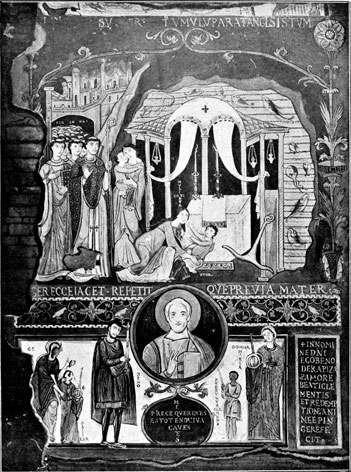
Frescoes of the 8th Century in the subterranean Church of S. Clemente, Rome, with
portraits of the Patron Beno di Rapizo and his Family.
See pages 10 and 268.
We might place these as the earliest revival of nature
after the Byzantine conventional influence was withdrawn;
the next link is to be seen in the church of S. Piero a Grado,
three miles from Pisa, where are extant by far the finest
specimens of Comacine fresco-painting. The church, which
I have described in the chapter on the Carlovingian era,
was built soon after the time of Pope Leo III. (795-816).
The frescoes are said to date before A.D. 1000. Like those
of St. Clement they are not Byzantine, and yet, though full
of life and action, they have an Eastern air; they are not
like the later Tuscan art, the colouring being lighter and
the drawing of the figures different. The prevailing tint is a
beautiful ethereal pale green, which is like nothing in Tuscan
art, though Peruzzi produced a tint something like it in the
sixteenth century. Standing at one end of the church and
looking down the nave, one could imagine a Ravenna
church, with its mosaics softened and toned down into
frescoes. They are a valuable proof that among the Comacine
Masters pictorial decoration was considered an integral
part of a building. They told the articles of their creed in
their sculptures outside, but they wrote the history of the
church on the walls inside. The story of the church in the
abstract is told in the line of popes above the arches, ending
at Leo III.; the story of this church in particular is told in
large scenes above them. Here is the church as it looked
when built, and here is the ship of St. Peter cast ashore at
Grado, and his preaching and baptizing, imprisonment, etc.
In fact all his life still glows, though fading out on the
south wall. The north wall is given to his death and
miracles. Here is his crucifixion, near an obelisk on the
Janicular Hill, and the beheading of his fellow-martyr St.
Paul at the Tre Fontane, with the mysterious blood-red
bird that drank his blood. Another scene shows the Pope
Symmachus (A.D. 498) disinterring the bodies of the two
Saints, and his vow of building S. John Lateran, and the
last scene shows his consecration of that church. It is
interesting to mark the Comacine influence in the drawing.
The towers are Lombard towers, and the buildings all have
round apses. The people who are not ecclesiastic or saints
seem to be Longobardic, with reddish tunics, leather-thonged
sandals, and long hair. As for the lions, which lie waiting
before the cross of St. Peter, they are in the precise form of
the crouching lions beneath a Comacine arch. The drawing
of other beasts shows that the artists were less accustomed
to them than to their traditional lions.
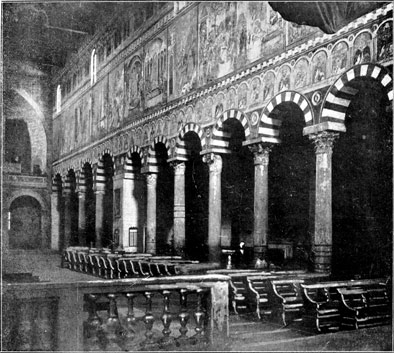
Interior of Church of San Piero a Grado near Pisa, with Frescoes of the 9th century.
See page 270.
If it be true that these frescoes, like the ones beneath
San Clemente, were really of the ninth or tenth centuries,
and if they were by native artists, this would place Pisa far
before Siena in the history of art, and Merzario would be
wrong when he asserts that there was no school of art in
Pisa before the cathedral was begun. The state of art in
the twelfth and thirteenth centuries strongly inclines me to
place these Byzantino-naturalistic paintings, according to
legend, in the ninth century—that is, before the fall of art,
which took place during the times of German invasion and
feudal oppression after Charlemagne.
Certainly Cimabue, who is called the "Father of
Tuscan Art," could not have painted them, though in the
revival of his time he may have studied them, as earlier
works of his guild, for we have documental evidence of his
connection as a Magister with the Pisan Lodge. The first
great painter of that lodge was Giunta di Pisa, sometimes
written Magister Juncte. He was the son of a still older
painter, Guidotto dal Colle, who was a Master in A.D. 1202,
and lived till 1255.[201] We give a facsimile of an old print
showing two of his paintings, one a figure from the fall of
Simon Magus, in the church of St. Francis at Assisi;
another a St. John from an ancient crucifix in S. M. degli
Angeli at Assisi. The Byzantine style in Cimabue's
painting may be traced to the influence of Giunta, of whom
an ancient writer, Padre Angeli, when speaking of his
paintings at Assisi, says—"that though his teachers were
Greeks, yet he learned his art in Italy, about A.D. 1210."[202]
This is a proof of the connection of Eastern artists with the
Western architects.
Giunta, who became a Magister in 1210, preceded
Giotto by a century, in the frescoes of St. Francis of Assisi,
where among other things he painted a crucifix with Frate
Elias kneeling at the foot. Brother Elias was a scholar of
St. Francis, and contemporary with Giunta himself, who
has inscribed on his crucifix—
FRATER ELIAS FIERI FECIT
JESU CHRISTE PIE
MISERERE, PRECAUTIS HELIC.
GIUNTA PISANUS ME PINXIT A.D. 1236. IND. 9.
Morrona has reproduced, by a copper engraving, a
veritable work of Giunta's—a crucifix with the Holy Father
above, and the Madonna and St. John at the sides, which
was for many years left in the smoke of the kitchen of the
Monastery of St. Anna at Pisa. There is a decided effort
to overcome the stiffness of his first Byzantine teachers, and
a good deal of lifelike expression in the smaller figures.
The same leaning toward nature is visible in the figures
of his Fall of Simon Magus at Assisi. Del Valle and
Morrona, judging by evidences of style, assert that Giunta
di Pisa was the master of Cimabue. But as Giunta
graduated as Magister in 1210, and Cimabue was not born
till 1240, this does not seem possible. It is more likely, in
regard to time, that Guido of Siena, painter of the famous
Madonna in San Domenico, may have learned something
of Giunta; but as all three of these primary Masters, each
of whom became the head of the painting school in his
own lodge, were members of the great guild, the source of
instruction might have been common to all, and moreover
that source must have been originally or partly Byzantine.
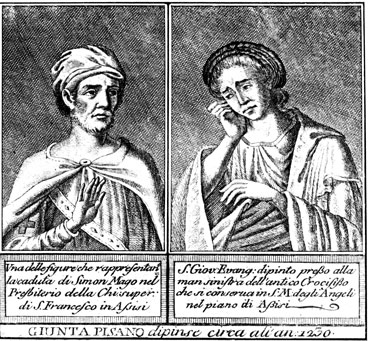
From paintings in Assisi by Magister Giunta of Pisa.
See page 271.
While mentioning that Giunta learned of Greek masters
in Italy, we may note that Vasari, à propos of Cimabue,
tells a story of the Florentines calling in Greek masters to
teach painting there. The assertion has been much derided
by modern authors, but it might contain a grain of truth
after all. Taking it with the fact (which becomes impressed
on us the more we study early Comacine churches) that
the architecture is Roman, and the ornamentation shows a
Greek influence naturalized, we get at what may be the
truth; that the Byzantine brethren who joined the guild
after the edict of Leo the Isaurian, still had their descendants
in it, among the ranks of the painters, as the
Campionese and Buoni families had for centuries theirs
among the architects. This would account for Andrea
Tafi working, together with Apollonius the Greek, at the
mosaics in the tribune of the Florentine Baptistery.[203]
Del Migliore, in his Aggiunte to Vasari's Lives, says
that in a contract dated 1297 he read "Magister Apollonius
pictor Florentinus." Here we get one of the very Greek
masters Vasari has been derided for mentioning, and he is
certainly connected with the Masonic lodge.
With a common origin, each lodge nevertheless developed
its own distinct style, yet so much was general to the whole
guild, that in the thirteenth and fourteenth centuries one
spirit seemed to permeate them all, and only experts can
tell a Lorenzetti from a Memmi, or a Giotto from a
Spinello Aretino. We find them working now in one
lodge, now in another. Cimabue, though his principal
work was in Florence where his school was, is found
working in the Pisan Lodge in 1301.
The archives of the Duomo there have three documents
of that year referring to him. One proves the payment of
X solidi II libr. a day to "Magister Cimabue" and his
famulus (apprentice) for their work there. Who knows
whether the famulus may not have been young Giotto,
or Joctus, as he is written in old deeds!
The second paper is Cimabue's receipt for the payment
by the Lord operaio (Dominus operarius) for a figure of
St. John, painted for that guild (Magiestatem).
The third seems to be the payment for a coloured glass
window which had been painted on glass by Baccio, son of
Jovenchi of Milan, from Magister Cimabue's design.[204]
Cimabue's school in Florence must have prospered
greatly. A long list of names of painters between 1294
and 1296, who are qualified and who agree to teach their
art in Florence, may be made from an ancient law register
kept at that date by the notary Ser Matteo Biliotti, which
is preserved in the general archives of Contracts in
Florence.[205] Here we find several of the Masters trained
at Pisa, such as Lapo de Cambio, Lapo di Beliotto, Lapo
di Taldo, Corso di Buono, Andrea di Cante, Grifo di
Tancredi, Tura di Ricovero, Vanni di Rinuccio, Michele
di Pino, Ranuccio di Bogolo, Guiduccio di Maso, Cresta di
Piero, Bindaccio di Bruno, Guccio di Lippo, Bertino della
Marra, Rossello e Scalore di Lettieri, Dino and Lippo
Benivieni, Asinello d'Alberto, Lapo di Compagno, called
Scartapecchia, Vanuccio di Duccio, and Bruno di Giovanni,
the companion of Buffalmacco and Calandrino, of whom
Vasari tells such funny stories.
Another act, dated 1282, is a contract by which Azzo,
son of the late Mazzetto painter, of the parish of S.
Tommaso, engaged to teach his art for six years to Vanni
di Bruno; probably Giovanni the father of Bruno mentioned
above.
Rossello di Lottieri was the great-grandfather of Cosimo
Rosselli. Vanuccio was the son of the famous Duccio of
the Sienese Lodge. Indeed I think we could find, by close
investigation, that most of these Magistri pittori were
connected with one or other of the Tuscan Lodges.
Painters abounded in the guild at this era. There was
Tommaso de Mutina (Modena) whose Madonna painted in
1297 is in the Gallery at Vienna. There was Margaritone
of Arezzo (1216-1293), a great tre-cento painter of
Madonnas and crucifixes, whose works are yet preserved
in Florence, London, Siena, etc. He generally signed
them "Margarit . . . de Aretio pingebat." A portrait of
St. Francis, however, in the Capuchin Convent at Sinigaglia,
is inscribed "Margaritonis devotio me fec. . ." A
Madonna enthroned in the church at Monte San Savino is
not only signed but dated 1284. Guido of Siena and
Margaritone were the leaders of that flourishing school
at Siena which culminated in Spinello Aretino and the
Lorenzetti, one of whom, Lorenzo Monaco, rivalled our
Fra Angelico.
Various painters are found in Pisa up to the fourteenth
century, artistic descendants from the school of Giunta.
Signor Morrona (Pisa Illustrata nelle Arti del Disegno,
vol. ii. p. 154) gives a list of Giunta's scholars. There are
Bonaventura and Apparecchiato da Lucca, Dato Pisano,
Vincino da Pistoja, a list which proves the affinity between
all the Tuscan schools. A little later in 1321 we find a
certain Vicino of Pisa as Gaddo Gaddi's scholar in Florence,
where he finished his master's mosaics in the Baptistery.
Ciampi has written a long dissertation to prove that Vicino
of Pisa ought to be Vincino of Pistoja, because he has found
the latter name in some documents. But as his documents
refer to paintings done by Vincino of Pistoja in 1290, and
the mosaics of Vicino and Gaddi date 1321, it seems more
probable they were really two different men—one, the Pistojan,
being the scholar of Giunta at Pisa mentioned above;
the other, the Pisan, a scholar of Gaddi in Florence somewhat
later. In 1302 we find painters from all the lodges
assembled in Pisa. Here are Magister Franciscus, painter
from S. Simone, named as a Magister of the highest rank.
He works with his son Victorius, and his apprentice Sandruccio.
Here are Lapo of Florence, Benozzo Gozzoli,[206]
and "Michaelis the painter"; Duccio and Tura of Siena,
painters; and Datus Pictor, who might be that Dato
Pisano mentioned as a scholar of Giunta.[207]
The books of the Duomo of Pisa contain among other
things an entry which indicates the use of oil-painting long
before the time of Antonello de Messina. It is nothing
less than the payment by the Provveditore of the Opera for
29 lbs. of turpentine, 104 lbs. of linseed oil at 28 denari
per lb., and 43 lbs. of varnish, all of which were for the use
of the painters of the operam Magiestatis. The entry is
dated 1301, and is No. 26 in the books of the Provveditore
of the Opera at Pisa in the year MCCCI. "Johannes
Orlandi sua sponte dixit se habuisse ad Operario libras
duas den. pis. pro pretio libre viginti novem trementine
operate adoreram Magiestatis.
"Libras quinquaginta quatuor, et solidos decem et octo
den. pisanorum minutorum pro pretio centinarum quatuor
olei linseminis ad operaio Magiestatis, et aliarum figurarium
que fiunt in majori Ecclesia, ad rationem denariorum
XXVIII pro qualibet libra."
Upechinus Pictor[208] pro libris quadraginta tribus vernicis
emptis Comunis an. 1303, is named as a painter of Pisa.
These entries clearly prove what a large part the
painters took in the work of the Masonic brotherhood, and
how the frescoing of the wall was a component part of a
Comacine church, and carried on, like their building, by the
joint labour of many Masters. If proof of this is wanting,
go where you will in Italy, and if you can find any church
that has a wall of its original early Christian or mediæval
building remaining, of any age between the fourth and
the fourteenth century, scratch that wall, and you will find
frescoes have been there. For instance, in Santa Croce,
and San Miniato at Florence, and at Fiesole, wherever the
restorer's plaster has been taken off, precious works of the
old Masters have come to light. But in all these we have
to imagine what a mediæval church was like from the
fragments that remain: to see the real Comacine church of
the twelfth or thirteenth century, one must go to the ancient
city of San Gimignano with its many towers, where they
remain untouched by the restorer, and unwhitewashed
by the seventeenth-century destroyer. There the whole
churches, every inch of them, are covered with scripture
or saintly story in glowing colours. Our illustration shows
one by Barna of Siena before the painters seceded.
The Spanish chapel at S. Maria Novella is another
unspoiled and entire specimen of the profuse use of fresco
by the guild. Most of these churches were decorated by
fresco artists who belonged to the Masonic Guild before
the secession of the painters, and being so, it is probable
that they worked together, as the architectural Masters were
accustomed to do, and this would account for the difficulty
of distinguishing in the Spanish chapel between the work
of the Memmi and that of the Lorenzetti, who certainly
worked together at Siena, and probably also in Florence.
Cimabue and Giotto were undoubtedly Magistri of the
Masonic Guild, for both of them were builders as well as
painters, and were employed together with other Masters.
When Cimabue discovered Giotto drawing his sheep,
he took him into his school in the lodge, he being then a
qualified Master. But the boy must have passed his novitiate,
not only in Magister Cimabue's own atelier, but also in the
wider teaching of the school and laborerium, or he would
never have got the commission to build the tower, nor the
power to sculpture his "Hymn of Labour" around it.
This was the era when pictorial art was freeing its wings
from the shackles of tradition and set conventionalism, and
from the bondage of working under the rule of another art
like architecture. The painters, especially when the oil
process was invented, saw a new and independent career
open before them, and struck for freedom. The Sienese led
the way. In 1355 they seceded from the Masonic Guild,
and even forsook their four crowned Saints; inaugurating
their own company under the banner and protection
of St. Luke. They called it L' Arte de' Pittori Senesi.
In reading their laws[209] one cannot but recognize that they
were framed on the same lines as those of the Masonic
Guild, the chief changes being the difference of patron
saint, and the omission of some technical rules relating
especially to architecture.
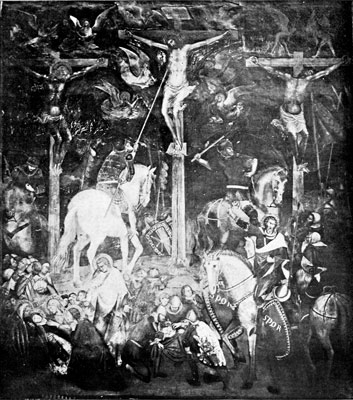
Fresco at S. Gimignano. By Magister Barna of Siena.
See page 278.
The names of the artists forming this first school of
painting are sufficient proof of their former connection with
the Comacine Guild. Here is Francesco di Vannuccio,
who was called in a council of the Opera in 1356, and
Lando di Stefano di Meo, whose name appears first in the
Masonic Guild, and then among the painters; Andrea di
Vanni, whose father and ancestors had been in it, and who
in 1318 was himself working in the Duomo of Siena with
his father, where he is entered in the books as Andreuccio
(poor little Andrea) di Vanni. There are sundry other
members of the Vanni family, some of whom were on the
lists of the Masonic Guild before they are found as painters.
Then there was Bartolo, son of Magister Fredi, with his
son Andrea and grandson Giorgio. Bartolo must have been
an old man at this time, so that his frescoes at S. Gimignano
would have been done before the painters seceded. We
find also Andrea and Benedetto di Bindo in 1363 inscribed
in the roll of "Magistri lapidum," and in 1389 in that of the
painters; several of their family have also enrolled themselves
there. This Magister Bindo was a Lombard from
Val D'Orcia; other Comacine names are there also, such
as Domenico di Valtellino, and Cristofano di Chosona
(Cossogna, near Pallanza).
I believe that after this secession the churches were no
longer so entirely decorated with frescoes. Altar-pieces,
introduced by Giotto and Lorenzo Monaco, partially took
their place.
In 1386 the painters of the Florentine Lodge followed
the example of their confrères at Siena, and put themselves
also under the protection of St. Luke. They called themselves
the Confraternità dei Pittori. The meeting-place
of this Confraternity was in the old church of S. Matteo,
now no more. Their first company lasted till the time of
Cosimo I., who patronized it, and superintended its reorganization
in 1562.
In Medicean times great fêtes were held on St. Luke's
Day, by the Academy, and all the best pictures in Florence
were hung in the cloisters of the Servite monks.
By the time of the Grand Dukes the Masonic Guild seems
to have decayed. Owing to the new painting, sculpture,
and gold-working companies, which had freed themselves
from the old organization; and the secularizing of art which
followed from these causes, and from the diminished zeal for
church-building, the Freemasons must have dwindled away,
and the guild died a natural death. Cosimo again revived
and united the three sister branches of Art—Architecture,
Sculpture, and Painting—in his Accademia delle Belle Arti,
where they remain to this day. The ensign of the Academy
was a group of three wreaths, bay, olive, and oak, with the
motto—"Levan di terra al ciel nostro intelletto."
Lorenzo il Magnifico had paved the way to the revival
of sculpture by the school he started in his gardens. The
Academy has now a fine building for itself, and a very interesting
collection of paintings, chiefly of the early schools.
Here we will leave the painters, who no longer have
any connection with the great Masonic Guild. That fraternity,
nevertheless, forms the link of connection between the
old classic art and the Renaissance in painting, as in all the
other branches. Without it we should have had no grand
frescoes by Giotto, the Lorenzetti, the Memmi, and the
Gaddi, for the lodges at Siena and Florence trained their
art; and it is a certain fact that after the secession of the
painters, the glorious days of fresco-painting were over.
The painters no longer worked together to beautify every
inch of the churches built by the brotherhood, but they
painted for themselves, for personal fame and money.
Madonnas, votive pictures, and portraits multiplied: the
commission and the patron ruled the art. Imagination and
inspiration rarely dominated, except in rare cases like Fra
Angelico, Fra Bartolommeo, Raphael, and Michael Angelo,
and other of the greatest Masters who stand forth from the
crowd of artists, endowed with true genius.
THE SIENESE SCHOOL
| 1. |
1259 |
Magister Luglio Benintendi |
|
Architects employed on Siena cathedral. |
| 2. |
|
M. Rubeo q. Bartolomei |
| 3. |
|
M. Stephanus Jordanus |
| |
|
|
|
| 4. |
1260 |
M. Bruno Bruscholi |
|
Engaged on May 31, 1260, for
work in the cathedral. |
| 5. |
|
M. Buonasera Brunacci |
| 6. |
1266 |
M. Niccolò Pisano |
Sculptured the pulpit in the
Duomo of Siena. |
| 7. |
|
M. Donato di Ricevuti |
|
His pupils and assistants.
Donato and Lapo were
naturalized in 1271 at
Siena. Arnolfo went to
Florence, and was there
made a citizen. |
| 8. |
|
M. Arnolfo |
| 9. |
|
M. Lapo |
| 10. |
|
M. Johannes filius Niccoli (Giovanni Pisano) |
Son of Niccolò Pisano, who
was made a citizen of Siena.
He was chief architect of
the Duomo in 1290. |
| |
|
|
|
| 11. |
1267 |
M. Johannes Stephani (son of No. 3) |
|
Three Magistri employed
at the Duomo, who witnessed
the payment to Niccolò
Pisano for his pulpit. |
| 12. |
|
M. Orlando Orlandi |
| 13. |
|
M. Ventura Diotisalvi of Rapolano |
Ventura was probably
descended from Diotisalvi,
the builder of the Tower of
Pisa. |
| 14. |
1281 |
M. Ramo di Paganello |
Signed a contract as builder on Nov. 20, 1281. |
| 15. |
1308 |
M. Andrea olim Ventura |
Son of No. 13. |
| 16. |
1310 |
M. Lorenzo olim M. Vitalis de Senis (called Lorenzo Maitani) |
Worked under Gio. Pisano at Siena during his
apprenticeship. Was chief architect at Orvieto in
1310. His son Vitale was "Capo-Maestro" after him. |
| 17.
|
1310 |
M. Ciolo di Neri |
|
Worked together at Siena. |
| 18. |
" |
M. Muto di Neri |
| 19. |
" |
M. Teri |
Ciolo takes Teri as his
pupil on Sept. 10, 1310. |
| 20. |
1318 |
*M. Camaino di Crescentini
di Diotisalvi[210] |
Grandson of Ventura Diotisalvi |
| 21. |
|
*M. Tino |
His son. |
| 22. |
|
*M. Corsino Guidi |
|
| 23. |
|
*M. Ghino di Ventura |
|
Relatives of the Diotisalvi
family. |
| 24. |
|
*M. Ceffo di Ventura |
| 25. |
|
*M. Vanni Bentivegno |
| 26. |
|
*M. Andreuccio Vanni |
His son. |
| 27. |
|
*M. Ceccho Ricevuti |
A descendant of No. 7. |
| 28. |
|
*M. Gese Benecti |
|
| 29. |
|
M. Vanni di Cione of Florence |
|
These four with Lorenzo Maitani (No. 16) voted
against going on with the
too large church at Siena,
and advised its present
dimension. |
| 30. |
|
M. Tone Giovanni |
| 31. |
|
M. Cino Franceschi |
| 32. |
|
M. Niccola Nuti |
| 33. |
1330 |
M. Vitale di Lorenzo |
Son of Lorenzo Maitani (No.
16). C.M. (Capo-Maestro) at
Orvieto for six months after
his father's death, with
Niccola Nuti (No. 32.) |
| 34. |
" |
M. Agostino da Siena |
|
These five sculptors were
engaged to make the tomb of
Bishop Tarlato at Arezzo;
Agostino being head sculptor
and designer. |
| 35. |
|
M. Giovanni, his son |
| 36. |
|
M. Angelo di Ventura |
| 37. |
|
M. Simone di Ghino |
| 38. |
|
M. Jacopo, his brother |
| 39. |
1333 |
†M. Paolo di Giovanni[211] |
|
| 40. |
|
†M. Toro di Mino |
|
| 41. |
|
†M. Cino Compagni |
Worked at the Sienese Duomo
from 1326. |
| 42. |
|
†M. Frate Viva di Compagni |
A monk of the guild, brother
of the preceding. |
| 43. |
|
†M. Guido or Guidone di Pace |
Built the castle of Grosseto
with Angelo Ventura. |
| 44. |
|
†M. Andrea Ristori |
|
| 45. |
|
†M. Ambrosio Ture |
|
| 46. |
1339 |
M. Cellino di Nese of Siena |
Built the church of St. John
Baptist at Pistoja; the
contract was signed July 22,
1339. |
| 47. |
1339-40 |
M. Lando di Pietro |
C.M. in 1339. A great artist in metal, and eminent architect. |
| 48. |
1348 |
M. Stefano di Meo |
Son of Magister Meo di Piero.
Built the chapel of St. Peter
at Massa. |
| 49. |
1349 |
M. Giovanni di M. Jacopo di Vanni |
|
These brothers were employed
at the Fonte Branda. |
| 50. |
" |
M. Niccolo di M. Jacopo |
| |
|
|
|
| 51. |
1356 |
M. Gherardo di Bindo |
|
Paid for advice about the
new Duomo when Francesco
Talenti and Benci Cione
came from Florence as
experts. |
| 52. |
" |
M. Francesco di Vannuccio |
| |
|
|
|
| 53. |
1358 |
M. Paolo di Matteo |
|
Elected on Nov. 3, 1358,
C.M. of Orvieto with Moricus
as his assistant. He
resigned, and died in 1360. |
| 54. |
|
M. Moricus Petrucciani |
| 55. |
1360 |
M. Andrea di Cecco Ranaldi |
C.M. of Orvieto, Dec. 1360. |
| 56. |
" |
M. Luca di Cecco |
His brother and assistant;
designed the steps of the
Duomo in 1386. |
| 57. |
1364 |
M. Paolo d'Antonio |
C.M. of Orvieto from
April 8, 1364. |
| 58. |
" |
M. Antonio di Brunaccio |
A descendant of No. 5; he
returned his salary because
he broke his contract,
March 17, 1364. |
| 59. |
1369 |
M. Johannes Stephani |
A descendant of Stefano
Jordanus (No. 3). He worked
at S. John Lateran for Pope
Urban V. in 1369. Elected
C.M. at Orvieto, March 11,
1375. |
| 60. |
1377 |
M. Giacomo di Buonfredi (detto Corbella) |
Sculptured the façade of the
Duomo of Siena, opposite the
hospital. |
| 61. |
" |
M. Francesco del Tonghio (called Francesco del Coro) |
Sculptured the choir stalls
in Siena cathedral in 1377,
also the choir in the Duomo
of Florence. |
| 62. |
1379 |
M. Giacomo del Tonghio |
His son and assistant. He
sculptured the tabernacle of
S. Pietro in the Duomo of
Siena. |
| 63. |
1384 |
Magister Giacomo di Castello |
Contracted on Feb. 24,
1384-85, to make three
coloured glass windows for
the Duomo; he made also
those in S. Francesco at
Pisa in 1391. |
| 64. |
1386 |
M. Giovanni Peruzzi |
Did some stone building in
the tower at Siena cathedral. |
| 65. |
1388 |
M. Mariano d'Agnolo Romanelli |
Carved several figures in the
choir of Siena cathedral.
|
| 66. |
1390 |
M. Luca di Giovanni |
C.M. at Orvieto for the
second time; the first was
in 1387. He was in the
Florentine Lodge in 1386. |
| 67. |
1423 |
M. Bastiano di Corso (of Florence) |
Engaged to make 59 braccia
of inlaid frieze in the
pavement of the steps of the
high altar. |
At first sight it would not appear that the Italian-Gothic
cathedrals at Siena and Orvieto could have much to do
with the ancient Comacine church of S. Michele at Pavia,
but they are undoubtedly its hereditary descendants, and
in great part the work of Comacine architects.
Documents prove that a Lombard Guild, with schola,
laborerium, and Opera, existed in Siena long before A.D.
1400. Legend, or rather tradition, says that this lodge
began in Longobardic days, when the first Sienese Duomo
was built by a certain Ava, descendant of Iselfred, a Longobardic
prince. This Ava had, before going to Siena,
caused a church (Aula Santa) to be erected "on an island
near Borgonuovo by the lake" (Insula prope Borgonuovo
juxta lacus). This must be the Comacine island on the
lake near Como-nuovo, which was also called Borgonuovo.[212]
It is also said that in 1180 Pope Alexander III. went to
Siena, of which city he was a native, to consecrate the new
Basilica.[213]
Here we have the first link of the Comacine Guild with
Siena, and I think it offers an explanation of the early
existence of the Sienese school of painting.
The Longobardic Masonic lodge seems to have been
the only one of the kind then in Siena, and it held on for
almost a century after the secession of the painters in
A.D. 1355.
By that time so many native architects and sculptors had
been trained that there were two distinct parties in the
guild, and the Sienese clique began to feel the need of independent
power. In 1441 a schism was made, the Sienese
sculptors forming a branch of their own, called L'arte dei
maestri di pietra, Senese, which had its laws and regulations
in due form. The same schism had taken place in Venice
in 1307, when the Arte de taglia pietre was formed, and
a similar one took place later in Florence. The Sienese
split was not very satisfactory, for on December 5, 1473, we
find they called a meeting of the two guilds, to further the
means of working in better accord with each other. The
following compact was made—
(1) That all Masters, Lombard or Sienese, should pay
ten soldi for right of entry on employment.
(2) That all, equally, should pay five soldi a year for
the festa of the Santi Quattro; and that a Lombard
camarlengo should be chosen to work together with the
Sienese one, to collect these and other moneys; that the
camarlengo should hold no more in hand than twenty-five
soldi; all money above that to be immediately
invested.
(3) That the Lombard camarlengo shall be subject to
the same laws and rules and fines as the Sienese one.
(4) That the garzoni (novices or pupils) shall have no
claims to receive pay, but manual labourers shall be paid
three soldi a year each by the Masters employing them, as
says the statute.
(5) That when it is necessary to "make a collection,"
the Lombard Masters shall be obliged to attend, equally
with the citizens, and under the same penalties, as by the
statute. Here follow the names of the contracting parties,
as inscribed in the original report of the meeting.[214]
Et primo, nomina Magistrorum Senensium.
- Magister Laurentius Petri
- M. Urbanus Petri
- M. Franciscus Ducci
- M. Dominicus Andreae
- M. Petrus Zantebuoni
- M. Joannes
- M. Vitus Marci
- M. Marianus Sani
- M. Tullius magistri Marci
- M. Mannus Antonii
- M. Galganus Ioannis
- M. Iulianus Iacobi
- M. Iacobus Ioannis
- M. Antonius Ghini
- M. Dominicus Cambii
- M. Aloysius Ruggieri
- M. Franciscus Andreae
- M. Petrus Antonii
Sequntur nomina Magistrorum Lombardorum.
- Magister Guglielmus Joannis de Sanvito
- M. Franciscus Christophori de Cumo (Como)
- M. Joannes Guglielmi de Sanvito (son of No. 1)
- M. Stephanus Fidelis de Voltolina (Valtellina)
- M. Adamus Ioannis de Thori
- M. Ioannes Iacobi de Sanvito
- M. Alexus Ioannis de Sanvito (his son)
- M. Martinus Martii de Sanvito
- M. Ioannes Talentine de Sanvito
- M. Iacobus Dominici de Lamone
- M. Ioannes Iacobi de Lamone (his son)
- M. Guglielmus Antonii de Sanvito
- M. Paulus Thomae de Charazza
- M. Antonius Ioannis de Ponte
- M. Iacobus Petri de Condupino
- M. Antonius magistri Alberti de Lamone
- M. Ioannes Francisci de Lamone
- M. Ioannes de Ponte
- M. Guglielmus Andreae de Sanvito
Acta fuerunt, etc.
But even this did not succeed. On January 6, 1512, we
find the Sienese Lodge making a petition to the Signoria to
the effect that whereas in ancient times the brethren of the
Masonic Guild were always accustomed to hold their meetings
and unite for worship in their own chapel of the Santi Quattro
in the cathedral, the "foreign" builders being now separated
from that chapter (lodge), all the money which used to be
collected to endow that chapel, is now collected among
themselves, and sent to Lombardy, without consulting the
said chapter (capitudine), "to the grave injury and shame
of our city, and of the said chapel," "thus we pray of your
Signoria that you will command that the said lodge shall
meet according to the ancient rules of the order, under pain
of penalties named in the ancient Breve ... the which
shall be useful and honourable to our city and to the said
chapel."[215] By this we realize that the Lombard Masters
were not only the earliest guild of architects at Siena, but
also the most powerful, as the Sienese branch could not
even keep up the chapel of their patron saint without their
aid.
It may be interesting to glance over the headings of the
statutes of the Sienese Masonic Guild, which no doubt were
similar to, if not identical with the original one; at any rate
they will throw light on the organization.
Cap. I. On he who curses God or the Saints (a fine of
twenty-five lire).
Cap. II. On he who opposes the Signoria of the city
(a fine of twenty-five lire).
Cap. III. On the election of rettore and camarlengo.
(In the Florentine Lodge which kept up the older Latin,
these are called caput magister and provveditore.)
Cap. IV. On the forming of councils and their duration.
Cap. V. How to treat underlings (sottoposti).
Cap. VI. On those who disobey the rector or
camarlengo.
Cap. VII. On he who refuses a citation (fine of twenty
soldi).
Cap. VIII. Of one who swears by the blood or body of
God.
Cap. IX. Of he who takes work on a risk.
Cap. X. All names of sottoposti to be written in the
Breve.
Cap. XI. That no one may take work away from
another Master.
Cap. XII. Contracts with pupils must be made before
the camarlengo.
Cap. XIII. How the feast of the Four Holy Martyrs
is to be kept.[216]
Cap. XIV. On the entry of a foreign Master into the
guild.
Cap. XV. Di chi vietasse il pegno al messo. (I can get
no clear translation of this; I think it means a pledge on
receiving a commission.)
Cap. XVI. The camarlengo shall hand over all receipts
to the Grand Master.
Cap. XVII. On the salaries of officials of the guild.
Cap. XVIII. How fêtes must be kept (fines of five
soldi to all who work on feste. Forty-nine fête days
are named).
Cap. XIX. One who is sworn to another guild cannot
be either the Grand Master or camarlengo.
Cap. XX. That the camarlengo keeps for the guild
all moneys received from sottoposti (brethren of lower
rank).
Cap. XXI. On good faith in receiving a commission.
Cap. XXII. How members are to be buried.
Cap. XXIII. How to insure against risks.
Cap. XXIV. No arguments or business discussions to
be held in the public streets.
Cap. XXV. How the fête of the guild is to be kept,
the rectors to have full power to command.
Cap. XXVI. How wax candles shall be sent to the
monks of the Mantellini for the festa.
Cap. XXVII. How tithes are to be paid.
Cap. XXVIII. That all orders come from the Grand
Master.
Cap. XXIX. How the outgoing officials shall instruct
the new ones. (i.e. The council of administration which
was changed periodically.)
Cap. XXX. That no Master may undertake a second
work till the first has been paid.
Cap. XXXI. Brick-makers and quarry-men must abide
by the rules of the guild.
Cap. XXXIV. On those who lie against others.
Cap. XXXV. Those who demand a meeting or consultation
shall pay fifteen soldi to the guild.
Cap. XXXVI. That the Grand Master on retiring from
office shall call three riveditori[217] to examine his accounts.
Cap. XXXIX. That no master of woodwork shall work
in stone.
Cap. XL. The Breve (statutes) shall be revised every
year.
Cap. XLI. On the entry into the lodge, of Masters from
the city or neighbourhood.
The statutes are very fair and well composed, and must
certainly have been made from long experience in the guild.
In 1447 we find a further split. The Masters of wood-carving
secede from the sculptors in stone, and form their
own statutes. Little by little, as art becomes more perfect
and requires more freedom, the Masonic monopoly of
centuries is dissolving.
We must now return to the building of the Duomo by
this multitude of brethren.
It was in 1259 that the civic Council decided to continue
the work of restoration in the Duomo of Siena, and formed
a council of nine influential citizens, together with the
Magistri of the Masonic Guild, to superintend the work.
By February 1321 their ideas and ambitions had so enlarged
that they proposed to make the present church the
transept, and to add a great nave, "to make a beautiful and
magnificent church, with all rich and suitable ornamentation."
The new nave was really begun, and a high bare wall with
a fine window in it remains to this day to puzzle the tourist.
This vast design was, however, abandoned, and the building
continued on a less ambitious scale.
Now for details of all these changes. Before Giovanni
Pisano's time we only get a few quaint names such as
Magister Manuellus, son of the late Rinieri, who made the
stalls in the choir in 1259; Luglio Benintendi, Ventura
Diotisalvi, Magister Gratia or Gracii, Ristorus, Stefano
Jordano, Orlando Bovacti, nearly all of whom were Masters
from other lodges either in Lombardy or Pisa. There are
besides two other Venture—one Ventura di Gracii, and one
Ventura called Trexsa. All these are named as being
called in a council of the guild of June 9, 1260, to consider
the stability of some vaulting lately made, but I can find
no capo magistro at this date. Several of these are names
known in other cities where the guild had lodges. Ventura's
father, Diotisalvi, built the Baptistery at Pisa; Magister
Gracii came from Padua, Stefano Jordanus had a son,
Johannes Stephani, who was witness to Niccolò di Pisa's
receipt for payment by Fra Melano of 78 gold lire and
IV denarii for his pulpit in the Duomo on July 26, together
with Orlando, son of Orlando Bovacti, and Ventura
di Rapolano. Niccolò himself had with him his son Giovanni,
who also graduated in the guild from the school of
his father. Here, too, were Arnolfo, Lapo (the younger),
with Donato and Goro, who were students in Niccolò's
school of sculpture, and who worked so well at the sculpture
at Siena that when they became Magistri in 1271, the
three last were given the freedom of the city.[218] They were
not exclusively sculptors, however, any more than Arnolfo
was. Lapo was employed in 1281 as architect at Colle,
where Arnolfo's reputed father, the elder Lapo or Jacopo
il Tedesco, had been engaged by King Manfred long before
him. Goro di Ciucci Ciuti had three sons, Neri, Ambrogio,
and Goro, all in the guild. In 1306 we find them all
engaged together in the fountain of Follonica at Siena.
In 1310 Neri's sons Ciolo and Nuto are mentioned; one
of them, having graduated, is old enough to have a pupil,
named Teri. Here is the deed of apprenticeship—
No. 26."1310, 16 Settembre.
"Ciolo, maestro di pietra del fu Neri da Siena, prende per suo
discepolo Teri fratello di Baldino da Castelfiorentino
(Archivio del Duomo di Siena. Pergamena, 616).
"In nomini Domini amen. Ex hoc publico instrumento sit omnibus
manifestum; quod Ciolus magister lapidum de cappella sancti Salvatoris
in Ponte, quondam Nerii de Senis, fecit—Ugolinum, dictum Geriolum, de
populo Sancti Joannis de Senis—suum procuratorem—ad recipiendum pro
eo et ejus vice et nomine, Terium, germanum Baldini de Castro Florentino,
nunc commorantem Senis, in discipulum et pro discipulo suprascripti Cioli.
Et ad promictendum ipsi Terio, vel ali persone pro eo, quod ipse Ciolus
magister tenebit eundem Terium in suum et pro suo discipulo, ad terminum
et terminos statuendum et statuendos a dicto Ciolo; et quod eum dictam
suam artem de lapidibus docebit.
"Actum Pisis, in via publica ante domum habitationis Duccii Nerii
Bonaveris, positam in via sancte Marie, in cappella sancte Eufraxie.—Dominice
incarnationis anno Domini Millesimo trecentesimo decimo, Indictione
septima, sextodecimo Kal: Octobris, secundum cursum pisanorum.
"Ego Bonaccursus filius quondam Provincialis de Vecchiano—not:—scripsi."—(Reproduced
from Milanesi, Documenti per la Storia dell' Arte
Senese, vol. i. pp. 174, 175.)
In 1281 a Grand Council was called to revoke the
banishment of one of the Lombard Masters, Ramo di Paganello.[219]
It seems that Ramo's father was from Lombardy,
"de partibus ultramontanis;" but the son had been made
a citizen of Siena, whence he was exiled for contumacy.
However, he was such a good sculptor that the edict was
revoked. The report begins—
"1281, 20 Novembre.—Item cum Magister Ramus filius
Paganelli de partibus ultramontanis, qui olim fuit civis
senensis, venerit nunc ad civitatem Sen: pro serviendo
operi beate Marie de Senis; ex eo quod est de bonis intalliatoribus
et sculptoribus, et subtilioribus de mundo qui
inveniri possit: et ad dictum servitium morari non potest,
eo quod invenitur exbannitus et condenpnatus per contumaciam,
occasione quod debuit jacere cum quadam muliere;
eo existente extra civitatem Senensem: si videtur vobis
conveniens quod debeat rebanniri et absolvi de banno et
condenpnationibus suis, ad hoc ut possit libere et secure
servire dicto operi ad laudem et honorem Dei, et beate
Marie Virginis, in Dei nomine consulate."
The first head architect, who is definitely styled Capo
maestro dell' Opera, is Giovanni Pisano, who, when he
came to work with his father at the pulpit in 1266, seems
to have taken root in Siena, as did his fellow-pupils Lapo,
Donato, and Goro. Arnolfo, the fourth of the group, found
his mission in Florence.
Signor Milanesi has not succeeded in finding the document
referring to Giovanni da Pisa's election, but he finds
that, in 1284, the Sienese, in gratitude for the services he
has rendered in the building of the Duomo, and especially
the façade, gave him the freedom of the city, and immunity
from taxes.[220]
Like most artists, Giovanni must have been Bohemian
in his ways, or careless in his political expressions, for in
October 1290 he was fined the large sum of 600 lire, and
had not the wherewithal to pay. He got off by paying a
third, but even this Fra Jacopo, one of the Operai of the
Duomo, had to advance. It was probably repaid from his
salary by instalments.[221] From these documents we gather
that the façade was not designed by Lorenzo Maitani, as has
generally been supposed. If the Commune of Siena in 1284
acknowledged Giovanni's talent in building the Duomo and
the façade, Lorenzo Maitani, who only began to be chief
architect of Orvieto from 1310, certainly could not have
been old enough to design the front of Siena cathedral.
Moreover Milanesi expressly says that, with all his research
in the archives, he can find no mention whatever of
Maitani's being connected in any prominent manner with
Siena cathedral.[222] He most likely worked at it as Giovanni's
pupil, and this, with the general tenets of the guild, would
sufficiently account for the similarity between the two
churches.
The tenets of the guild were certainly veering towards
the Gothic, and each generation of its members made a
new step. Jacopo Tedesco at Assisi, and Niccolò Pisano
in his pulpit, showed the first sign of transition; their sons
and pupils, Arnolfo at Florence, and Giovanni at Siena,
developed the style still further, and their successors fully
expanded it at Milan.
Giovanni was a lover of the Gothic, but was not yet
entirely converted. His windows, like Arnolfo's, were
pointed, the points emphasized by ornate Gothic gables
over them; but the three arches of the doorways are of a
Lombard roundness, the pointed effect being only conveyed
by the superimposed gables. Yet the turrets and saint-filled
niches of the upper part of the façade are as rich,
and pointed, and pinnacled as any Gothic cathedral could
be. He had not discovered, as the Germans afterwards
did, the beauty of the upward line. The old classic leaning
to the horizontal line still cuts up the design; and the little
Lombard pillared gallery still stretches across the front,
though beautified and gothicized. He did not forget the
sign of the guild in this transition period; for there on the
columns, and beneath the arches, are the lions of Judah.
It is not positively certain whether the present façade
was the one originally designed by Giovanni or not.
We find that in November 1310, a commission of ten
Master builders was formed, to superintend the work of the
mosaic, already commenced, and to guard against useless
expenses. Milanesi supposes this to refer to some mosaics
destined for the façade, especially as in 1358 a Maestro
Michele di Ser Memmo was paid six gold florins for his
work, "per la sua fadigha (fatica) e magistero di Santo
Michele agnolo, a musaica (sic) che fecie a la facciata di
duomo nel canto."[223] The front, as it is at present, has no
mosaics; probably Giovanni Pisano's plan was modified
in later days. It is certain that after Giovanni's death in
1299 great changes of design were made.
The interior has the same mixture as the façade;
there are round arches below in the nave, and pointed
windows above in the clerestory. The black and white
marble, significant of the times though it be, detracts much
from the effect of the really fine architecture by cutting it
up in slices. Fergusson recognized the purely Italian
pedigree of Siena cathedral.[224] "That at Siena," he says,
"illustrates forcibly the tendency exhibited by the Italian
architects to adhere to the domical forms of the old
Etruscans, which the Byzantines made peculiarly their own.
It is much to be regretted that the Italians only, of all
the Western mediæval builders, showed any predilection
for this form of roof. On this side of the Alps it would
have been made the most beautiful of architectural forms."
We cannot, however, endorse Mr. Fergusson's next
assertion—"in Italy there is no instance of more than
moderate success—nothing, indeed, to encourage imitation."
In the face of the domes of St. Peter's at Rome, S. Marco
at Venice, the cathedrals of Florence, Parma, Padua, Siena,
and Monreale, this is rather a hard saying.
The Sienese had, as we have said, proposed to so
enlarge the church by adding a huge nave, that the present
church would only form the transept. This was begun,
but when the works had already advanced the plan was
abandoned. Provisional Magistri were called to form a
committee, which met in council on February 17, 1321, and
here, for the first time in Siena, we find Lorenzo Maitani
giving his vote. He was called to attend the meeting from
Orvieto, where he had been capo maestro of the works
from 1310. He, with Niccola Nuti, Gino di Francesco,
Tone di Giovanni, and Vanni di Cione (one of Orcagna's
relatives from Florence), formed the council. After due
deliberation they pronounced on the inconvenience of proceeding
with the addition to the Duomo, and decided to
build a new church of more moderate dimensions, which
should still be large and magnificent. The work now continued
without interruption; and on November 20, 1333,
we find another Council of Masters was called, in which
twelve of the guild severally swear "testis juratis die supra
scripta et sancta Dei evangelia, corporaliter tactis scripturis
dicere veritatem, suo juramento testificando dixit," etc., that
the walls and foundations were strong and firm.
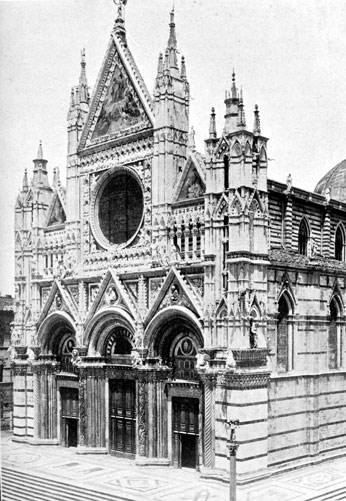
Front of Siena Cathedral. Designed by Magister Giovanni Pisano.
See page 295.
The next capo maestro was Master Lando or Orlando
di Pieri, son of Piero, a metal-worker of the guild, who
was recalled from Naples in 1339. He was a Lombard,
though a naturalized citizen of Siena. They say Lando is
"a most legal man (omo legalissimus), not only in his own
special branch (gold-working), but in many others; is a man
of the greatest ingenuity and invention, both with regard to
the building of churches and the erection of palaces and
private houses; a good engineer for roads, bridges, or fountains,
and, above all, a citizen of Siena."[225] Here we see
signs of the jealousy of the Lombard Guild, which caused
the schism of which we have spoken. Lando was truly an
acknowledged genius. He made the coronet with which
the Emperor Henry VII. was crowned at Milan in 1311.
Muratori (cap. xiii.), quoting an old Latin dissertation
on the "corona ferrea," says the maker of the crown
was present, "presente magistro Lando de Senis, aurifabro
predicti domini Regis, qui predictam coronam propriis manibus
fabricavit." We hear no more of his gold work; but
in 1322 he was employed in Florence to hang the great
bell of the palace of the Signoria, and make it ring (Ita
quod de facili pulsatur et pulsari potest), for which he was
paid 300 gold florins. In his architectural capacity he was
employed at Naples by King Robert of Anjou, but was
recalled from there to Siena in 1339, and made caput
magister of the builders of the Duomo. The contract,
signed on December 3, 1339, binds him for three years at
a salary of 200 lire a year.
The accounts of the Opera have some interesting
articles connected with the laying of the foundations of
the revised plan. In August 1339 the Masters were called
into council on the enlargement of the Duomo, as the nave
was considered too short, and Ser Bindo, the notary of the
guild, had to supply them with five sheets of parchment at
one lire a sheet to make designs. Also two lire ten soldi
were spent in bread, meat, and wine, which were sent by
the guild to the priests who officiated when the first stone
was laid. In March, Maestro Lando again applied to Ser
Bindo for parchment to make designs, which cost him
twenty-three soldi six denari.
Whether these plans were accepted or not, I cannot tell—probably
not—for in the following March, Lando fell ill and
died. He left a son, Pietro di Lando, also in the guild, and
who was naturalized Florentine when he joined that lodge.
A document cited by Gaye (Carteggio, etc. vol. i. p. 73)
shows Pietro to have worked with Giovanni di Lazzero de
Como and a Buono Martini at the fortifications of Castel
S. Angelo in Val di Sieve; the three architects solicited the
Signoria for the pay due to them. This Pietro was the
father of Vecchietta, who inherited more than his great-grandsire's
talent for working metal.
The next capo maestro after Lando was Giovanni, son
of the famous sculptor Agostino of Siena, who was, on
March 23, 1340, elected for five years. He had been head
of the works at Orvieto in 1337, but did not long remain
there, for in 1338 we find him again in the pay of the lodge
of Siena, where a document in the archives of the Hospital
notes a payment for some work on April 26, to Maestro
Giovanni, son of Maestro Agostino of the Opera, and of the
parish of S. Quirico.[226]
After Giovanni I can find no mention of a capo maestro
till February 16, 1435, when Jacopo della Quercia, otherwise
"Magister Jacobus, Magistri Petri," was elected operajo
(president of the Council), i.e. Grand Master. His salary
was fixed at one hundred gold florins as long as he lived, and
his wife was to have a pension at his death. There were
several conditions specified to which he had to agree. But he
had so many other engagements, at S. Petronio in Bologna, at
Parma, and Lucca, that he absented himself too much from
Siena to please the Opera there. As early as March
1434-35, a month after his election, we find him leaving two
of the Council of Administration to rule in his absence.
The absence must have been a lengthy one, for on October
22, 1435, the Signoria of the Commune write to him as
follows—"Magister Jacobo Pieri electus Operaio, etc. etc....
As you have been fully informed, you ought before
the past month to have taken action, and performed the
duties undertaken by you in regard to the office of Operaio
of our Church, to which our Councils elected you. We and
our councillors have waited all the past month, expecting
that, for the honour of the Commune, and its needs at
the hands of the said Opera, you would return. Now we
are at October 22, and you do not appear to think of it.
God knows how the citizens are complaining and murmuring
against you. Therefore we have decided to write to
you, that without fail, and with no delay, you must immediately
present yourself to perform your duties, and let nothing
hinder you. If you do not do this, it will cause us great
astonishment and inconvenience."[227]
The Council of the Opera wrote a long Latin letter at
the same time, exhorting their chief to return and satisfy the
claims of the Commune. Whether he came or not I cannot
say, but it appears not for any length of time, as on March
26, 1436, we find him at Parma, writing a defiant kind of
letter to the Operai of San Petronio at Bologna, who had
appealed to him to finish his engagements there. By 1439
we find Jacopo della Quercia had died, and his brother Priam
was writing repeated petitions to the Opera at Siena about
his inheritance from Jacopo, which it seems a certain
pupil of Jacopo's called Cino Bartoli was withholding from
him.
So the work went on for centuries. There are contracts
with different Masters for sculptures, for windows, for towers,
for chapels, each Master designing the part assigned to him.
Francesco del Tonghio obtained great fame for his carvings
of the stalls in the choir in 1377, where his son Giacomo
assisted him. We find him in Florence some time later,
and his fame must have preceded him, for he is known
there as "Francesco of the Choir" (Francesco del Coro).
It is impossible to name a single architect for any of
these great buildings; they were all the united work of a
self-governed guild.
During the centuries when the Duomo of Siena rose
into beauty, her sister of Orvieto also grew under the hands
of the same brotherhood.
Lorenzo Maitani, having been trained by his master,
Giovanni di Pisa, at Siena, was called to Orvieto in 1310.
His family lasted long in the guild, and won much fame.
His father Vitale was a master sculptor who had worked
under Niccolò and Giovanni. His sons Vitale and Antonio
both graduated in the Siena or Orvieto Lodge, and Vitale
became chief architect at Orvieto for six months only, on
Lorenzo's death, when Master Meo di Nuti di Neri
succeeded him.
It is not probable that beyond the design, Maitani had
much to do with the façade, which was incomplete till about
1500. The beautiful Bible in stone which adorns the
pilasters of the three fine doors may have been designed
by Maitani, but the work was done by his sons, with the
help of many sculptors of the guild from Siena, Florence,
and Lombardy. The upper part was not added till the
time of Michele Sanmichele of Verona, who in 1509 was
nominated chief architect of the façade at a salary of one
hundred florins a year. He is described as "Magistrum
Michaelem, Magistri Johannis de Verona, principalem
magistrum fabrice faciate de Urbe vetere."[228]
The enthusiastic work of the numberless artists all vying
with each other in beautifying this marvellous church bore
rather heavily on the funds of the Opera, for in August 1521
the camarlengo had to stop the expenses of the façade and
finish some more needful parts of the church first. So
"Mag. Michael Johannes Michaelis, Caput Magister dicte
Fabrice," was given permission to absent himself for three
days a week, for other work (no doubt the church at Spello),
and the Opera continued his salary on half-pay.[229] About
this time a competition was offered among the Magistri for
the best design for the chapel of the Three Kings at
Orvieto. Antonio Sangallo and Michele were the two
best, and when Pope Clement VII. fled to Orvieto from the
sack of Rome in 1527, the choice was made with his concurrence,
Michele's being chosen. Both San Michele and
San Gallo rose to extreme eminence in the guild; many of
the finest palaces in Florence and Venice were by them.
It is interesting to find that they were both Lombard
brethren of the guild by hereditary descent.
The preponderance of Lombards in all these later lodges
is sufficient proof of the connection of these lodges with the
older Comacines, from whom their ancestry can be traced
direct.
In April 1422 we find Maestro Piero di Beltrami da
Biscione and his Lombard companions arranging with the
Opera for the purchase and cutting of marbles and travertine.
In September 1444 Guglielmo di Como and his brother
Pietro da Como were commissioned to make a mausoleum
in the Duomo for the Bishop of Siena. A contemporary of
theirs was Giuliano da Como, who was of such repute in
the guild, that the Council of the Opera, "considering the
virtù of Maestro Giuliano and the desirability of keeping him
in Siena, deliberated to accord to him a loan he requested,
of seventy florins to buy a house."[230]
Again, on May 25, 1421, the Republic of Siena wrote to
Filippo Visconti Duke of Milan that a Maestro Giovanni,
son of Maestro Leone da Piazza near Como, was anxious
to return to his native country, to see his family and to
arrange a law-suit; and they recommended him to the
Lords of Milan because he had greatly won the affection
and esteem of the Sienese republic by his good life and his
eminence in his art of sculpture.
A certain "Maestro Alberto di Martino de Cumo in
provincie Lombardie" was engaged by the Opera on March
2, 1448, as a builder, in company with Giovan Francesco of
Valmaggia and Lanzilotto di Niccola of Como.
When the Piccolomini wanted to build a splendid palace
in Siena, they did not choose their architects from the
faction of their townspeople, but from the original Lombard
branch. Martino di Giorgio da Varenna (near Bidagio on
Lake Como) was chief architect, and Lorenzo from Mariano
in the Lugano valley assisted him as sculptor. He carved
the beautiful capitals and friezes in the palace, and his work
so pleased the Piccolomini, that they employed him to
erect an altar and decorate their chapel in the church of
S. Francesco. Milanesi says that Lorenzo da Mariano was
one of the best artists of his time for foliaged scrolls and
grotesques.[231] In 1506 he was capo maestro of the Duomo
of Siena. Maestro Lorenzo was no doubt one of the precursors
of the sculptors of the beautiful cathedral of Como,
and the richly ornate Certosa of Pavia, who were trained in
the Sienese laborerium.
A fellow-countryman, named Maestro Matteo di Jacopo,
came from Lugano with Lorenzo, and together with Maestro
Adamo da Sanvito (also in Val di Lugano) undertook the
great engineering work of making an artificial lake, to drain
the then malarious country round Massa in Maremma.
Martino di Giorgio had a relative who became more
famous than himself. This was Francesco di Giorgio di
Martino—three names in rotation are generally enough to
supply an Italian family for centuries,—who continued the
work at Palazzo Piccolomini (Vasari gives him the credit
for the whole), and was one of the architects of the palace
at Urbino.
Milanesi, the commentator of Vasari, asserts that Francesco
was the son of a seller of fowls in Siena, because he
found the name of a "Giorgio di Martino, pollajuolo," in the
registers, but seeing that he was bred in the guild, it is much
more likely that he was related to the Giorgio di Martino
already eminent there. His family had certainly become
citizens of Siena by that date.
Maestro Francesco di Giorgio Martini holds a large
share in the correspondence of the Sienese government and
of the Opera in the latter part of the fifteenth century.
On December 26, 1486, we find him first entering the
pay of the Sienese Commune as public architect. He has
a salary of 800 florins, and is bound to fix his home at Siena.
He was recalled from Urbino for the purpose, having orders
to arrive within six months, but the Duke Guidobaldo was
not at all willing for him to leave. On May 10, 1489, the
Duke writes to say that the absence of his architect (mio
architector) would be a serious injury to him.
During the time Francesco remained in Umbria he
seems to have done the Commune good political service by
keeping them informed of the dangers that threatened
Florence from the offensive alliance between Lorenzo de
Medici and the Pope Innocent VIII., who designed to take
Città di Castello for Francesco Cibo. This would have
endangered the peace of Siena, so the architect warned
them to be prepared.
After this, Magister Francesco became the bone of contention
among several princes and republics. The Duke of
Milan wrote, on April 19, 1490, to the Signoria of Siena,
begging them to send the "intellexerimus magistrum
Franciscum Giorgium Urbinatem" (see how the place he
last worked at is named as his residence!) to Milan to
give his opinion on the mode of placing the cupola. The
Commune gave the permission, and on June 27, 1490, we
find Magistro Francisco di Georgi di Siena (here again at
Milan he is styled of Siena), with Magistro Johantonio
Amadeo (Omodeo) and Johanjacobo Dolzebono (Gian
Giacomo Dolcebono), elected as a supreme council of three,
and giving their advice on the erection of the cupola at
Milan, with the exact plan and measurements which would
harmonize with the building as it then stood. He did not
remain to see the plans carried out, but was on his recall
to Siena remunerated with one hundred florins by the
Fabbrica (Opera) of Milan.
On October 24 of the same year, Giovanni della Rovere,
the Prefect of Rome, wrote to the Signoria of Siena praying
for the service of their architect, and on November 4,
1490, Virginio Orsino, Duke of Bracciano, begged him to
go and build a fortress at Campagnano.
Next Alfonso, Duke of Calabria, wanted him at the
Castle of Capua, where he went between February and May
1491, and in August of the same year the Anziani, Lords of
Lucca, petitioned for him. And so he is called from end to
end of Italy, and wherever he goes he is received with
honour as a grand architect.[232]
At Orvieto we find the same preponderance of Lombards
as in Siena. The register of the Opera there for August 30,
1293, gives the salaries of the Magistri in the Loggia
(lodge) of the Fabbrica. Here we find many of our
Sienese friends; Magistro Orlando and Guido da Como
receive six soldi a day; Magistro Martino da Como seven.
We find also Pietro Lombardo, Giacomo and Benedetto da
Como, sculptors; Martino, Guido, and Aroldo as successive
chief architects in the Fabbrica or Opera.
In 1305 the camarlengo had to write to Lombardy for
more builders and sculptors, for, says Della Valle, "la fama
di volo ne spargesse il grido fin oltre ai confini d'Italia,"
and in December four Magistri arrived—"Mag. Franciscus
Lombardus, Mag. Marchettus Lombardus, Mag. Benedictus
Lombardus, and Johannes de Mediolano (Milan)."
I do not know which of these sculptured the door of which
we give an illustration, but the artist has set the sign of
his fraternity on it in the lions beneath the pillars. (One is
now missing.)
The Lodge of Orvieto, sometimes spelt Loya or Loja,
is described as a large, spacious, and airy building, in which
the sculpturing of stones and marbles was done, and where
the stores and the schools were.[233]
The use of the word "Lodge" for this complicated
organization seems a sign of Freemasonry, and suggests
that the Comacines followed the ancient rules of Vitruvius,
and kept up the organization of the Roman Collegium.
We have, I think, proved this to be true, and shown
that the same organization held good up to the fifteenth
century, if not longer. Signor Milanesi's interesting collection
of Sienese documents, if studied closely, contains
endless indications of the existence of the guild. We find
several cases of arbitration, such as when Doctor Filippo
Francesconi, and Maestro Lorenzo di Pietro, called
Vecchietta, were chosen on September 20, 1471, as
arbiters between Maestro Urbano di Pietro of Cortona,
sculptor, and Bastiano di Francesco, stone-cutter, his workman,
who lodged a complaint against his master on account
of unpaid wages and loss of tools. This same Urbano
appears to have been frequently in need of arbiters, for
on Jan. 27, 1471-72, Bertino di Gherardo was called on to
settle a cause between Madonna Caterina, wife of Silvio
Piccolomini, and the sculptor Urbano, and decided that the
lady must pay the artist 100 lire within the term of four
years, the payments to be made quarterly. It was at the
lady's option to pay in kind, such as corn or wine, if it
suited her better.[234] Then there are frequent meetings of
councils for appraising the work of other Masters, and we
find the Operaio, or Head of Administration, fixing the
salaries of underlings. Precisely the same meetings, arbitrations,
appraisings, went on in Florence. Indeed, in the
fifteenth century the two lodges of Siena and Florence
were so closely intermingled, the Masters appearing now
in one city and then in the other, that there can be no
doubt a fraternity existed between them. We even find
Donatello, who came from Florence to make the bronze
doors, sleeping in a feather bed supplied by the camarlengo
of the Opera at Siena.[235]
Donatello was more or less in Siena between 1457 and
1461. He was engaged to sculpture the altar of the
Madonna of the Duomo there on October 17, 1457. His
accounts are much mixed up with those of Urbano di
Pietro of Cortona, of whom we have spoken. It seems
Urbano bought the metal to cast a half figure of Judith,
and one of St. John, both modelled by Donatello. The
money, however, was advanced to Urbano by the banker
Dalgano di Giacomo Bichi. The books of the camarlengo
of the Opera have several entries for expenses of modelling
wax, and metal for casting, etc., used by Donatello in the
figures on the altar of the Madonna delle Grazie; his
assistants and pupils on this occasion were Francesco di
Andrea di Ambrogio, of Lombard origin, and Bartolommeo
di Giovanni di Ser Vincenzo.
THE FLORENTINE LODGE
| 1. |
1258 |
Magister Jacopo Tedesco da Campione |
Built castles at Arezzo and
Poppi; and the Bargello at
Florence. |
| 2. |
1298 to 1310 |
M. Arnolfo (his son?) |
C.M. of the Duomo. Built the Palazzo Vecchio. |
| 3. |
1340-48 |
M. Giotto |
Designed the campanile, and
sculptured the first row of
reliefs. |
| 4. |
|
M. Andrea Pisano |
Made door of Baptistery. |
| 5. |
1349-59 |
M. Francesco Talenti |
C.M. of the Duomo. |
| 6. |
1350 |
Neri Fieravanti |
|
Four Masters who went to
Carrara to buy marbles for the
Campanile, of which they were
joint architects. |
| 7. |
|
Niccolaus Beltrami |
| 8. |
|
Benozzus Niccolaus, his son |
| 9. |
|
Albertus Arnoldi |
| 10. |
1355 |
M. Frate Jacopo |
Brother of Francesco Talenti;
sent to Rome for marbles. |
| 11. |
" |
M. Francesco da Siena (called Francesco del Coro) |
Carved stalls in Siena
cathedral: sent for to carve the
stalls of the choir of S. Croce. |
| 12. |
" |
M. Benci Cione |
|
Father of Orcagna. They were
called in the Council of the
Opera to consider Francesco
Talenti's design for the
chapels, July 1355. |
| 13. |
" |
M. Ristoro Cione (a relative) |
| 14. |
" |
M. Lapo Ghino |
Descended from Ghini Ventura
di Diotisalvi of Siena. |
| 15. |
" |
M. Giovanni di Lapo Ghino. |
C.M. with F. Talenti, 1360 to 1368
[236]
|
| 16. |
|
M. Bartolo da S. Ghallo |
A Lombard from S. Gall,
grandfather of the famous
Giuliano and Antonio San Gallo. |
| 17. |
1356 |
M. Ambrogio Lenzi (Ambroxios da Campione) |
Son of Guglielmo da Campione;
was C.M. of the Baptistery in
1356; C.M. of the Duomo in 1362. |
| 18. |
|
M. Stefano Metti |
|
| 19. |
1357 |
M. Domenico di Noffo |
Sent to Siena to buy marbles. |
| 20. |
" |
M. Giovanni Belchari |
|
These three were joint C.
Maestri for the upper part of
the Campanile. In 1362 Gio.
Belchari was poor and infirm,
and the guild gave him a
pension. |
| 21. |
|
M. Vigi Grilli |
| 22. |
|
M. Bancho Falchi |
| |
|
|
|
| 23. |
|
Agostino Falchi (brother of the preceding) |
|
Joint Masters for the walls
and columns of the Duomo. |
| 24. |
|
Niccolò Megli |
| 25. |
|
M. Andrea di Cione (Orcagna) |
In council with Frati and
Magistri about the space
between the columns. Later he
became famous as painter and
sculptor, and made the shrine
in Or San Michele. |
| 26. |
|
M. Jacopo di Lapo Chavacciani |
Makes a model of the shaft. |
| 27. |
|
Mato di Cenni |
|
These were engaged for the
bases of the columns. |
| 28. |
|
Jacopo di Polo |
| 29. |
1362 |
M. Barna Batis |
Provveditore after Filippo
Marsili. |
| 30. |
|
M. Davinus Corsi |
|
| 31. |
1363 |
M. Simone Johannes dal Pino |
Engaged to carve the twisted
columns of red marble in the
windows of the Duomo. |
| 32. |
" |
M. Ambrosius Ghini |
A relative of Lapo Ghino. |
| 33. |
1364 |
M. Sandro Macci |
In council on the domes, with
many others named before and
after. |
| 34. |
|
M. Francesco Neri Sellari |
Sculptured pila and relief in
S. Croce. |
| 35. |
1366 |
M. Simone di Francesco Talenti |
C.M. of Or S. Michele in 1376.
With Taddeo Ristori in 1366 he
made a design for a chapel. |
| 36. |
" |
M. Jacopo Pauli |
Engaged Aug. 31, 1366, to make
capitals for columns in the
sacristy. |
| 37. |
" |
Mato Jacobi |
|
His three sons who assisted him. |
| 38. |
" |
Aldobrando Jacobi |
| 39. |
" |
Corso Jacobi |
| |
|
|
|
| 40.
|
1367 |
Bernabè Pieri |
|
Made a contract on Aug. 31,
1366, to carve some capitals. |
| 41. |
" |
M. Manetti Pieri |
| 42. |
1368 |
M. Francesco Michaeli |
Advises about Or San Michele
with Gio. di Lapo Ghino. |
| 43. |
|
M. Mattheo olim Cionis |
One of the Masters employed
in Or San Michele, brother of
Orcagna. |
| 44. |
1375 |
M. Giovanni Giuntini |
|
| 45. |
|
M. Francesco Salvetti |
C.M. in 1375, but resigned later
in favour of Giovanni Fetti. |
| 46. |
1376 |
M. Taddeo Ristori |
One of the Cione family;
architect at Or San Michele,
and the Loggia de' Lanzi after
his uncle Benci Cione. |
| 47. |
|
Ambrogio di Vanni |
|
Masters in stone-carving. |
| 48. |
|
Leonardo olim Masis |
| 49. |
1377 |
M. Johannes Michaeli, brother of Francesco (No. 42) |
Went to Prato on Oct. 2, 1377,
with Tommaso Mattei to buy
marble. |
| 50. |
|
M. Tommaso Mattei |
Son of Matteo di Cione. |
| 51. |
|
M. Zenobio Bartholi |
Was paid 18 florins on Dec. 15,
1377, for a figure of the Angel
Michael. He also carved two
other figures at 20 florins. |
| 52. |
" |
M. Simone Francesci Talenti |
Elected C.M. in 1377. Son of the
C.M. Francesco. He sculptured a
figure in 1377, and was paid 13
florins. |
| 53. |
1380 |
M. Jacopo da Scopeto |
Worked in the choir. |
| 54. |
|
M. Pietro Landi of Siena |
Son of the famous Lando, C.M.
of Siena Lodge. |
| 55. |
1381 |
M. Johannes Fetti |
Elected C.M. with Guazetta on
March 14, 1381.
window under the vault on the
north side. |
| 56. |
|
M. Johannes Stefani, called Guazetta, son of No. 18. |
Was a famous Master in
woodwork; he was noted for
foundations and scaffolding. |
| 57. |
1383 |
M. Laurentius Filippi |
C.M. of the Loggia dei Lanzi
with Benci Cione, who was
master builder. |
| 58. |
1384 |
M. Giovanni di Ambrogio da Lenzo (son of No. 17). |
Gave his vote at a meeting on
April 4, 1384, about the
pilasters of the tribune. Was
chosen C.M. on Feb. 28, 1400. |
| |
1386 |
M. Luca di Giovanni da Siena |
Carved some angels. |
| 59.
|
1388 |
M. Michael Johannis Lapi Ghini |
Succeeded Lorenzo Filippi as
C.M. on July 15, 1388. |
| 60. |
1389 |
M. Antonio Francisci |
Elected Arch Magistrum, but
deposed in 1420 by the council;
and Giovanni di Ambrogio of
Campione was elected. |
| 61. |
1404 |
M. Niccolao called Pela |
Sculptured the door of the
chapel of the Crucifix from
Giovanni d'Ambrogio's design. |
| 62. |
1418 |
M. Baptista Antoni (son of Antonio, No. 60) |
Elected C.M. when Giovanni
d'Ambrogio resigned by reason
of old age. |
| 63. |
|
M. Piero d'Antonio (another son of Antonio, No. 60) |
Nicknamed Fannulla (Do nothing). |
| 64. |
" |
*M. Matteo di Leonarda |
All the masters marked * sent
in plans for the Cupola. The
design of Brunellesco, who I
believe not to have been of the
guild, was chosen. |
| 65. |
|
*M. Vito da Pisa |
| 66. |
|
*M. Piero di Santa Maria |
| 67. |
|
*M. Donatello |
| 68. |
|
*M. Nanni di Banco |
| 69. |
|
*M. Lorenzo Ghiberti |
Provisore of the Cupola with
Baptista Antoni when
Brunellesco's plan was chosen. |
| 70. |
" |
M. Andrea Berti Martignoni |
|
All these Masters were employed
to erect a large model of the
design of Brunellesco for the
Cupola, on the Piazza del
Duomo. |
| 71. |
" |
Bonaiuti Pauli |
| 72. |
" |
Papi di Andrea |
| 73. |
" |
Aliosso |
| 74. |
" |
Cristoforo di Simone |
| 75. |
" |
Giovanni di Tuccio |
| 76. |
" |
Jacobo Rosso |
| 77. |
" |
M. Giovanni dell Abbaco |
Worked at the Cupola under
Brunellesco. |
| 78. |
|
M. Antonio di Vercelli |
|
| |
|
M. Gherardo (tedesco) |
|
Three Germans who were paid
for models of a cupola. |
| |
|
M. Ghabriella (tedesco) |
| |
|
M. Averardo ("magistro teutonico") |
Art is like a flower. If the seeds are sown in favourable
soil the plant grows, develops, and bears beautiful
blossoms, which in their turn leave seed for future
generations. If the soil be not favourable, the plant may
perhaps reach its flowering season, but it is weak, and
the seeds lack the power of reproduction.
Thus in small cities like Modena, Parma, Orvieto, etc.,
the artistic atmosphere and soil were wanting. The
lodges of those cities never became firmly rooted. The
Lombard Masters placed there did their work, and then
moved to other cities, but the natives remained uninfluenced.
In Pisa, art first took root. The Pisans, whose artistic
faculties had been awakened by the classic spoils they had
gathered together in their conquests, found a practical
outlet for them in the teaching of the laborerium set up in
their midst by Buschetto and his assistants and followers.
Pisans joined the lodge, and from it great teachers arose.
Siena was the next lodge that took root, and drew native
artists into it; then followed Venice and Florence; and
through them all, distinct as they became in later times,
the seed was always sown by the Comacines or Lombard
Masters. The Campionese and Buoni families are at the
bottom of all the Tuscan schools, and every one of these
cradles of art was of the self-same form, i.e. composed of
the school, the laborerium, and the Opera of the Comacine
Masters.
And what connection had Arnolfo, the first designing
architect of the Florentine cathedral and Palazzo Vecchio,
with this Masonic company? He had much to do with
it, inasmuch as he was an hereditary member, in fact one
of the aristocracy of the guild, and he had a most complete
training in it. The first trace we get of Arnolfo is
his instruction in the school of Magister Niccolò Pisano.
The proof of this is a deed drawn up in Siena on May 11,
1266, in which these words occur—"requisivit Magistrum
Nicholam Petri de Apulia quod ipse faceret et curaret ita;
quod Arnolfus discipulus suus statim veniret Senas ad
laborandum in dicto opere, cum ipso magistro Nichola."
Here we have Niccolò di Pisa as Master in the guild, and
his disciple Arnolfo not yet having graduated.
Another paper relating to Niccolò's work on the pulpit
at Siena says—"Secum ducat Senas Arnolphum et
Lapum, suos discipulos."
By 1277 Arnolfo seems to have graduated, for when
Niccolò and Giovanni di Pisa were at work on the beautiful
fountain at Perugia in that year, Fra Bevignate, the
soprastante of the work, sent to call Magister Arnolfo from
Florence to assist in the sculpture of the fountain. Arnolfo,
however, declared in a letter dated Aug. 27, 1277, that he
could not go to Perugia, or undertake any work there
without the consent of King Charles of Anjou (King of
Naples and Sicily) or of Hugo, his vicar in Rome. King
Charles was applied to, and on Sept. 10 of that year he
wrote conceding permission to Arnolfo to go and assist his
old master—then 74 years of age—and also to take the
marbles necessary.[237]
These documents are very valuable apart from the fact
they chronicle. They show how the guild was not only
privileged by the reigning monarch, but that he was the
active president of it. It explains all those queer words on
Longobardic inscriptions, beginning—"In tempore Dominus
Honorius Episcopus," "In tempore præsule Paschalis, etc.,"
showing that they point out the reigning king, pope, or
patron bishop who was at the time president of the Great
Guild. The name of this highest magnate is usually
followed in these inscriptions by the Grand Master, soprastante
or operaio of the special lodge. The universality of
the guild is also shown; its president, the king, being at
Naples, his "vice" at Rome.
The next place in which we see Arnolfo is in Rome,
where he worked with his socio (fellow Freemason), Pietro,
at the tabernacle of San Paolo fuori le mura. Here, with
this ancestor of the Cosmati, Arnolfo learned his love of
polychrome sculpture, which he afterwards adapted to the
larger uses of architecture; for his grand Florentine Dome
seems only a magnified inlaid casket. There is a beautiful
piece of inlaid work in the Opera del Duomo which I
believe to have been the pluteus or parapet of the tribune
in Arnolfo's time. It is in the Cosmatesque work which
Arnolfo often executed. That he was as apt a pupil of the
Cosmatesque revival of the opus Alexandrinum as he
had been of Niccolò's figure sculpture, and his father
Jacopo's architecture, is evident by his tomb of Cardinal de
Braye at Orvieto, where we next find him working in 1285.[238]
The tomb is a beautiful mixture of Cosmatesque ornamentation
with the legitimate sculpture which he had learned
from Niccolò. The capitals of the spiral inlaid columns of
the sarcophagus are of the true old Romano-Lombard
form. In the simple grace of the recumbent figure we
descry a forerunner of Donatello and Desiderio.
We have now traced Arnolfo's training through three
or four of the chief lodges, and always under the best
Masters. It is then no marvel that by 1294 his fame had
risen so high that he was chosen as architect of the Duomo
of Florence. He was well known to the Florentines, his
master, Jacopo Tedesco, otherwise Lapo, having left Colle
to settle in Florence, where he was engaged to build the
Palace of the Podestà (Bargello). And this brings us to
the vexed question of the parentage of Arnolfo.
Vasari says that Jacopo or Lapo, whom he calls "il
Tedesco" (meaning Lombard architect), was the father of
Arnolfo, and he gives this as a certain fact, understood to
be the case by the world in general for two or three
centuries past.
Milanesi, on the strength of the document quoted
above, "Secum ducat Senas Arnolphum et Lapum suos
discipulos," says that Lapo was only Arnolfo's contemporary
and fellow-pupil.
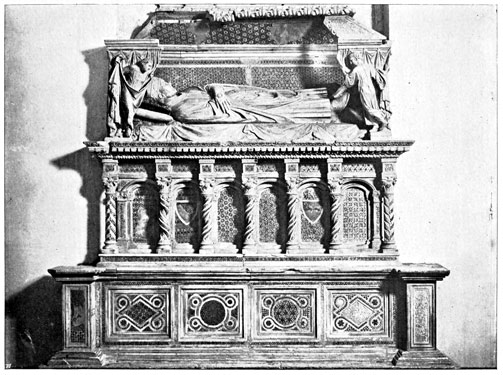
Monument to Cardinal de Braye. By Magister Arnolfo.
See page 314.
But neither Vasari nor Milanesi seem to reflect that
there might have been two Lapi. Certainly, if two youths
are fellow-disciples of one Master, it is not probable that
the senior should be the son of the other. On the other
hand, if "Jacopo il Tedesco," said to be Arnolfo's father,
was elected head architect at Assisi in 1228, how could he
have been a young pupil of Niccolò di Pisa in 1266?
Recognizing these difficulties, Milanesi sets out in
search of a father for Arnolfo, in place of Lapo, his fellow-pupil.
He comes across a document in the archives of the
"Riformazione" of Florence, dated MCCC. Aprile 1,
where the privileges of citizenship are accorded to "Magistrum
Arnolphum de Colle, filium olim Cambij."[239] In
quoting this, Gaye[240] says that in spite of it the Florentines
will persist in calling Arnolfo the son of Lapo. Now
cannot these conflicting facts be reconciled? It is a strange
fact that in no other Florentine deed except this one
privilege is any sign of parentage given to Arnolfo. He
is so enveloped in the greatness of being caput magister,
and the greatest architect of his day, that his parentage
seems to be lost sight of, though the universal custom of
the day was to cite the father's name as well as the son's
in a document. Therefore, though we have never before
heard the surname of Jacopo il Tedesco, there is no reason
in the world why it should not be Cambi. By the time
Arnolfo was grown up, Jacopo Tedesco had lived many
years in Florence; he therefore, having become a Florentine
citizen, may have taken office and might have been connected
with the Cambio, or Exchange there, taking his name
from that office, as a large family of Cambi during the
Republic seems to have done.
I incline, however, to another theory—that Cambij is a
corruption of Campij, or Campione—for the following reason—As
early as 1228 Jacopo Tedesco was already a Magister,
and of such fame that he was chosen as master architect of
the grand church of S. Francesco at Assisi, in conjunction
with Fra Philippus de Campello. In spite of Fergusson's
opinion that the architect of these large buildings was
generally a mere builder, working under some ecclesiastic
who drew the plan, the evidence goes to prove, in this
case, that Jacopo the layman was capo maestro, and Fra
Philippus the ecclesiastic only aiutante (assistant). Campello
was a corruption of Campiglione or Campione, which
name, first taken from a place near Como, became afterwards
the distinctive title of the Parma school of Comacine
Masters. We find it spelt in different documents: Campillio,
Campellio, Campilionum, Campione, often shortened
into Campi͠o or Camp͠i. All the older writers say that
Jacopo Tedesco was a Comacine or Lombard, and if so, he
was one of the Campionesi. His name occurs in a stipulation
made at Modena on Nov. 30, 1240, where he and
Alberto are qualified as uncles of Magister Enrico, one of
the contracting parties.[241] This may well have been the
father of Arnolfo, especially as Baldinucci[242] asserts that
Jacopo Tedesco lived at Colle in Val d'Elsa, where Arnolfo
was born, while his father was building the castle there.
With these lights Milanesi's documental "Arnolphus de
Cambii" may be accounted for. If the members of the
Campione school in the north took that as their name, why
should not Jacopo also have signed himself Campione? It
is more than probable he shortened it according to custom
into Campi͠o, and may not have been very particular to
distinguish between the kins-letters p and b, a very common
fault in the sketchy spelling of old MSS., and especially
likely to occur if, while Lombardy was a German province,
he should have imbibed a German accent. This would
reconcile all the dispute. Arnolfo was evidently closely
connected with the elder Lapo, his style being so similar.
Compare the Palazzo Vecchio and Bargello with Lapo's
castle of Poppi, and the relation is evident. His connection
with the younger Lapo is equally clear. In the list of
qualified masters in painting at Florence, quoted by Migliore
in Firenze illustrata, p. 414, is Niccolò Pisano's pupil, who
is called Lapo di Cambio. This would suggest that
Arnolfo and his fellow-pupil Lapo were brothers as well as
fellow-pupils, so that when Lapo the younger finished
Jacopo Tedesco's (Lapo the elder's) work at Colle, he was
only following out the usual rules of the guild, in which the
son succeeded the father.
The thirteenth century was a time of immense development
in art; what Niccolò and Giovanni di Pisa did for
sculpture, Jacopo Tedesco and Arnolfo did for architecture.
Jacopo was the first to introduce the pointed arch into
Central Italy, at Assisi; Arnolfo further developed it in
his cathedral at Florence, where the arches of the nave are
round, and the windows pointed. After this era we have
no more Romanesque—the reign of Italian Gothic has
begun.
The Basilican form, too, has vanished; we have now
the nave and transepts of the Latin cross. No longer
the small double-arched window, but long pointed arches
filled with beautiful tracery. The old symbolic animals
linger on, but in the subordinate form of grotesques in
ornamentation.
That distinctive mark of the guild, the lion of Judah,
takes a new position in the Italian Gothic. It is no longer
between the pillar and the arch, but beneath the column,
as Niccolò and Guido da Como first placed it in their
pulpits. You see it under the pillars of the north door of
the Florentine Duomo, where the transition into Renaissance
is indicated by a particularly classic figure of a child standing
by the lion; and under the central column of the
windows of the Spanish chapel in the cloister of S. Maria
Novella, where it serves to mark the fact that the architects
Fra Sisto and Fra Ristoro (who in the documents of the
time are styled Magister Fra Sisto and Magister Fra
Ristoro) were members of the Masonic Guild.
Jacopo, the inaugurator of Italian Gothic, spent all his
later years in Florence, having left Colle many years before,
when he had finished the castle there. Jacopo's work in
Florence consisted of the building of the Bargello, which
is a perfect specimen of the late Comacine style, built in
modo gallico with large smoothly-hewn stones. The
connection of the Masters of the guild with the south of
Italy is shown here as well as at Pisa, for it is said that
King Manfred commissioned Jacopo Tedesco to design
the sepulchre of the Emperor Frederic in the abbey church
of Monreale in Sicily. (Manfred died in 1266.)
Jacopo also introduced a reform into Florence. In the
time when Messer Rubaconte of Como was Podestà of
Florence (1236, 1237), his compatriot, Jacopo Tedesco of
Campione, near Como, proposed to him that the streets
should be paved with stones instead of bricks, to which
Messer Rubaconte agreed, and the same method of paving
still continues in Florence.
The second Lapo, Arnolfo's fellow-pupil, and perhaps
brother, was the author of several buildings in the end of
the thirteenth century, which Vasari falsely attributes to
Jacopo the elder. He also continued Jacopo Tedesco's
fortifications at Colle.[243]
Whether we look on Arnolfo as the son of Jacopo
Tedesco, or only as the pupil of Niccolò Pisano, he was,
either way, one of the guild; and more, a follower of
Jacopo rather than of Niccolò, his bent being rather architectural
than sculptural. We can, then, place Arnolfo as
the first head of the laborerium of Florence; and in
tracing the formation of this branch of the guild, we shall
throw a light on all the former branches, which, from want
of systematic documents, have remained as formless organizations
of schola, laborerium, and Opera. After trying in
vain to find something more explicit about these organizations
at the National Library and State Archives, I consulted
the director of the Opera del Duomo, who kindly saved me
the work of long puzzling over old MSS., by lending me a
copy of Cesare Guasti's valuable collection of abstracts from
the books of the Opera, from the earliest days of Arnolfo
to the completion of the cathedral.
Here the whole organization stands revealed. Here are
the meetings of the lodge, and the subjects discussed; the
names of the Magistri and Council of Administration from
year to year; the payments to architects, artists, and men;
the legal contracts and business reports.
It is clearly seen how the Opera is connected with
the laborerium, and how the meetings are always composed
of some civic members from the Council of Administration,
and some from the working Masters of the lodge.
One, dated October 15, 1436, reports a meeting in the
Opera del Duomo, at which the attendant Operai or
councillors were Ugo Alessandri, Donato Velluti, Nicolo
Caroli de Macignis, and Benedict Cicciaporci (pig's flesh);
here's a nickname! They deliberated on the advisability
of sending for a certain Francesco Livii de Gambasso,
Comitatus Florentiæ, who was at Lubeck in Germany, to
make the painted windows and mosaics. Francesco, when
he came back to the city which he had known in his
boyhood, and where he had learnt his art, bound himself to
work in the laborerium of the Opera, "et in dicta civitate
Florentiæ in Laboreriis dictæ Operæ toto tempore suæ vitæ
eidem continuum, ac firmum inviamentum exhiberent, ita, et
taliter, quod ipse una cum sua familia victum, et vestitum in
præfata Civitate erogare posset."[244] This one document gives
valuable proof on several points.
It proves that whether or not Italy got her architects
from Germany, Italian Masters were employed in
Germany.
It proves that there was a guild in Florence, "Comitatus
Florentiæ," to which Francesco Livii belonged, and
that there was a laborerium in Florence, in which Francesco,
when a boy, had learned his art, and risen to the rank of
Master. It proves, moreover, that the laborerium was
connected with the Opera.
Another meeting of the same Opera on November
26, 1435, held to consider all the designs for the choir of
the Duomo, marks this connection still more plainly.
"Nobiles viri Johannes Sylvestri de Popoleschis,
Johannes Tedicis de Albizzis, Johannes ser Falconis
Falconi, Jacobus Johannis de Giugnis, et Hieronymus
Francisci dello Scarfa, Operarii dictæ Operæ, existentes
collegialiter congregati in loco eorum residentiæ pro factis
dictæ Opera utiliter peragendis, absque aliis eorum Collegis,
et servatis servandis:
"Attendentes ad quandam Commissionem factam per
eorum Offitium de ordinatione Altaris majoris dictæ
Ecclesiæ, et Chori ipsius Ecclesiæ infrascriptis Civibus, et
Religiosis Sacræ Theologiæ, Magistro Jacobo Grægorii del
Badia Ordinis Fratrum Minorum, Magistro Sandro de
Covonibus Converso Hospitalis Sanctæ Mariæ Novæ de
Florentia, Francisco alterius Francisci Pierotii della Luna
Nerio Gini de Capponibus egregio Medicinæ Doctori,
Magistro Paulo M. Dominici, et Juliano Thomasii Gucci,
omnibus Civibus Civitatis Florentiæ, et ad quemdam rapportum
per eos factum coram eorum Offitio infrascriptæ
continentiæ."[245]
Here follow the criticisms of this council on three designs
for the choir: one by Filippo Brunelleschi; one by Nencio
di Bartoluccio; a third by Magister Agnolo da Arezzo.
Observe that we have as master architects of the guild,
a monk and a hospital warden, called on the Commission
with the Operai, who were influential citizens, but not
qualified Masters. This seems to throw a light on the word
colligantes, "Magister comacinus cum colligantes suos," in
the old laws of Rotharis. Would not the colligantes mean
the Consuls and Operai, members of the Opera or administrative
body in these great works of church-building, whom
the Magistri of the guild elected from the influential men
of the city in which they were?
Here are a few translations of his quaint statements of
the orders the Provveditore received from the Operai—
"June 1353.—Operai: Lotto, Lapo, Piero di Cienni,
Simone di Michele Ristori. They tell me to make haste
and obtain the payments from the 'Camera' (council), and
the 'Gabelle' (octroi). I must manage that by St. John's
Day; the 'covelle' of the Campanile must be finished. And
to do that, I must get two of the Magistri from Or San
Michele. And the scaffolding must be taken down from S.
Giovanni (the Baptistery), so that the work may be seen."
This entry shows how many buildings the guild were
engaged on, and how the architects of them all were under
the command of the Opera, or centre of administration for
all.
"August 14, 1353.—Piero, Lotto, and Simone." (Every
entry begins by naming the Operai in council.) "To order
designs for a tabernacle.... Get it made. To order the
design for the campanile, and in what kind. Have it done
in wood. To order marble, for the work at the summit.
To tell Francesco[246] there is work for a year. About the
rations of Neri Fieravanti. Give him the money to pay
all the master's claims, and you, Filippo, shall be the pay-master,
and we will provide the means." ("Dalle danari
per pagare tutti i maestri loro, e tu Filippo sia loro camarlingo,
e noi ti faremo provedere.")[247]
The way in which the Provveditore, Filippo Marsili,
talks of himself, and puts down his orders from the Operai
just in their own words, is naïve in the extreme. His memoranda
are certainly delightful.
Here is another very busy day—
"September 26, 1353.—Operai: Simone, Migliorozzo,
Francescho, Piero." (This time the head architect, Francesco
Talenti, was in council.) "To elect a salaried
lawyer. About a notary for citations. About the nine
hundred and fifty lire which the Commune has of ours. To
pay by the piece, rather than by the day. To send to
Carrara (for marble). Put it off till All Saints' Day. Of
the many documents we need.... To reason with the
Regolatori.[248] To speak with the captains of the Misericordia
about our many legacies.... Tell them to let us know
when they meet. About the Wills. To discuss it with
Ser Francescho Federigi (a notary). To find means to get
ready money. Try and get a discount on the tax on
assignments. About the wine for the Masters. Take it
away entirely. About Francesco and the window ... to
pay the Master who had the commission ... and when the
work is done, have it valued, and the surplus, or the deficit,
will be entered to Francesco" (head architect).
Truly it was no sinecure to be Provveditore for the
guild of architects in those days. He must have had his
hands full indeed! When the Masters were not satisfied
with their pay, and a work had to be appraised, like this
window, a special council was called, consisting of the
Consuls of the Arte della Lana, who were the Presidents of
the Opera, the members of the Opera, and all the Magistri
of the laborerium. The Masters were then called on one
by one to give an estimate of the work, and discuss its
merits; a ratio was taken, and the medium price fixed.
The same kind of council was called to consider any
designs. Generally, several of the Magistri sent in their
designs, or models made of wood. These were discussed
in council, and votes taken before the final commission was
given. The report of one of these meetings, where each
Master naïvely voted for his own design, is very amusing.
The Masters were strictly bound by contract to the
laborerium. In some cases they were paid by the day.
We find, on May 29, 1355, that the salaries of Masters were
lessened by two soldi a day, and workmen by one soldo.
Sometimes the Commune found them wine and rations; at
others they were paid by the piece, by contract. On June
7, 1456, the Provveditore writes—"It is desired that on no
account shall any Master go to work outside the Opera,
without the deliberation and consent of all four Operai. If
any absent himself without this permission, he shall be considered
as discharged."
The schools attached to the laborerium must have been
very complete. They trained pupils in the three sister arts—architecture,
sculpture, and painting. One sees the remains
of them in the Belle Arti at Florence, Siena, and other
towns, and the Academy of St. Luke at Rome. Not all
the Magistri were teachers, but there were certain of them
who held office as Professors. Niccolò di Pisa was
certainly one of these, and so were Cimabue and Magister
Giotto.
This full art-education accounts for the artist of the
Renaissance being such an all-round man. One finds a
painter like Giotto, or a sculptor like Niccolò Pisano,
building grand architectural works. Sometimes they
graduated in all three arts, as did Landi, Giotto, and Leon
Battista Alberti.
When they graduated in the schools, they became
Magistri of the guild, and could then undertake commissions.
Besides the Magistri fratelli, there were the
undergraduates as it were; in old Latin documents they
are written as fratres; below these were the novices or
pupils. The workmen employed by them were quite
unconnected with the guild, and were paid daily wages as
manual labourers.
The light thus thrown on the organization of the
Masonic Guild by the valuable collection of documents
made by Cesare Guasti, seems to me to explain much that
was puzzling in the Florentine city guilds. For instance,
why, among all the Arti, is there none which includes
architects, sculptors, or painters? It would have been
supposed that in the early days of the republic, when the
Commune spent its wealth and enthusiasm on erecting
great and noble buildings, architecture would certainly have
ranked among the greater Arti, even in competition with
the wool-combers and silk-weavers. But there was no
such civic guild. There was a minor one for masons and
stone-cutters, but it was established later for workmen and
mere house-builders, and had nothing to do with great
architects or master sculptors; while painters who wished
to be members of the Commune and have any hand in the
government, had to enroll themselves in the Goldsmith
Guild, or the "Arte degli speziali" (doctors and apothecaries).
The existence of this Freemasonic Guild would
explain this hiatus in the greater arts. While such a
powerful and self-governing body existed, which had
evidently the monopoly for Italy in the art of church-building,
a mere city guild would never have been able to
compete with it, and would have been superfluous.
That it really held the monopoly is more than probable.
We have traced the Comacines through each gradation, have
seen the successive schools and branches started by them in
each place where they had great works in hand. The
Buoni family at Modena going on to the south of Italy
and then to Pistoja, founded that school. The Campione
branch at Verona and Parma hence passed to Assisi and
Florence. The Lucca school of Lombard Masters spread
to Pisa and gathered into it native talent.
The later gathering of Lombards and Pisans at Siena
thence moved to Orvieto, and sent a branch to Florence in
the persons of Jacopo Tedesco and Arnolfo. There taking
root it grew into the goodly flower of the Renaissance.
And after efflorescence,—decay; the old organization, by
degrees, dissolved in the greater freedom of art. Each
Master aimed to stand alone on his own merits, and was
no longer necessarily enrolled as one in a guild.
A great many things besides are revealed to us by
Guasti's collection of documents. We find that Arnolfo died
in 1310; Vasari read it wrongly as 1300, so that Arnolfo
would only have worked a year or two at his Duomo. The
correct entry in the archives is—"IIII idus (martii) Quiescit
magister Arnolfus de l'opera di Santa Reparata MCCCX."[249]
It is a strange coincidence that the death registered
before Arnolfo in the Necrology should be a man named
Cambio, a locksmith, but he seems to have no connection
with Arnolfo, whose parentage as usual is not indicated.
Thus we see that Arnolfo at the most only worked
eleven or twelve years at a building which took more than
a century to finish. How much did he accomplish?
Probably not more than the foundations and the design
which he left, and which may be seen to this day; for it is
usually understood that the church in the fresco of the
Spanish chapel represents the Duomo as Arnolfo designed
it. After his death Florence fell upon warlike times, and
was unable to continue the work till 1331, when the "city
being in a happy and tranquil state, recommenced the
building of the church of Santa Reparata, which had for
a long time been in abeyance, and had made no progress,
owing to the many wars and expenses which the city
had undergone." The deed goes on to relate that the
Arte della Lana was placed at the head of the administration,
and that a tax of two denari per libbra on all
moneys paid to the Commune should be appropriated
for the expense, as had been decreed before. They
further added another tax on the customs, so that the
two amounted to 12,000 libbre picciole a year. Besides
this, every shop in Florence was to have a money-box
where they were to place il denaro di Dio (tithes) on all
they sold.[250] I quote this to show how cities in the good old
church-building days paid their architects. It is probable
that the schools of the guild had continued in this interval,
though the Magistri may have had to seek work elsewhere,
for by July 18, 1334, we find Giotto as a Magister, selected
as architect of the Campanile, though he seems to have had
very little to do with the Duomo. His marvellous tower,
in its varied colouring and artistic effect, shows the hand of
a painter rather than an architect. He did not live to see
his work completed, for on January 8, 1336, he died, soon
after his return from Milan, where he had been sent in the
services of the Visconti, and had a public funeral at the
expense of the Commune in Santa Reparata. The fact that
the work of his tower went on in his absence, proves that he
must have had brethren in the guild capable of carrying out
his plans. As the foundations were only laid in July 1334,
and Giotto died in January 1336, after a long absence at
Milan, one wonders how he found time to sculpture the
reliefs in his Hymn of Labour. However, we must take
Ghiberti's testimony for it. In his second Commentary,
Ghiberti says[251]—"The first line of reliefs which are in the
Campanile which he erected were sculptured and designed
by his own hand. In my time I have seen his own sketches
beautifully drawn." A contemporary anonymous commentator
on Dante writes[252]—"Giotto designed and superintended
the marble bell-tower of Santa Reparata in Florence,
a notable tower and costly. He committed two errors—one
that it had no base, and the other that it was too
narrow. This caused him such grief that, they say, he
fell ill and died of it." I think indeed that if Giotto
had found any error he would have rectified it in the
plans which he left for his successors. That it had
no foothold is not true, for the solid foundation was
placed so far beneath the surface that it stood firm on
the solid macigno (kind of granite rock) twenty braccia
below.
His successor was of another branch of the guild, but a
Masonic Magister all the same. On April 26, 1340, Andrea
di Pisa was elected by vote by the Council of the Opera to
succeed Giotto as head architect.[253]
There must have been other Magistri proposed as
candidates, if the Council had to resort to black and white
beans for the voting. Andrea only lived a few years; he
died, or retired from office, in 1348, the year of the great
plague; and Francesco Talenti became caput Magister in
1350. Francesco was a brother of Fra Jacopo Talenti,
Magister lapidum et edificorum, who was joint architect with
Fra Ristoro of the convent and church of Santa Maria
Novella from 1339 to 1362. Francesco, like his brother,
must have been in the guild; he worked at Orvieto
cathedral among numbers of Como and Lombard Masters
in 1329. In April 1336 we find him called to Siena as
an expert.[254] There had been discovered some defect in
the columns. Francesco's companion from Florence was
Benci di Cione. His office as capo maestro of the Duomo
of Florence continued some years, though he did not reign
alone, but was associated with Giovanni di Lapo Ghino,
who after 1360 is called joint capo maestro. The principal
documents of their administration prove that there were
endless councils and arguments about the size, height,
and placing of the columns, and discussions on Talenti's
plan for the chapels at the east end. This seems to
have been a crucial question.... Councils of four
Magistri in each were held for three consecutive days—July
15, 16, and 17, 1355; and their opinions given in
writing. On August 5 the grand united council of twelve
Masters and the whole lodge was held, when the proportions
for the columns were decided, and Francesco's design
for the chapel approved.
Another Council was held on June 8, 1357, with the
Operai and Consuls of Arts, and their ecclesiastical
colleagues, when the undermentioned Masters and monks
gave their counsel on the church—a proof of the close
affinity of ecclesiastics with the Masonic Guild.
- Frate Francischo of Carmignano
- Frate Jacopo Talenti. S. M. Novella
- Frate Franciescho Salvini. S. Croce
- Frate Tommasino. Ogni Santiv
- Frate Jachopo da S. Marcho
- Frate Piero Fuci, e
- Frate Filippo sacrestano di S. Spirito
- Frate Benedetto dalle Champora
- Magister Neri di Fieravanti
- Magister Stefano Messi
- Magister Franciescho Salviati
- Magister Giovanni Gherardini
- Magister Giovanni di Lapo Ghini
- Magister Franciesco dal Choro
- Magister Ristori Cione
- Magister Ambrogio Lenzi, or Renzi
The report was written by Sig. Mino, notary of the
guild; the spelling of the names is his own.
Several of the same monks met at the Opera on July 12,
1357, to consult about the placing of the columns in the
second foundation.
Also, on July 17, 1357, to choose between two designs
of columns and a chapel made by Francesco Talenti and
Orcagna, when each candidate elected two Masters as
arbiters. Francesco Talenti chose Ambrogio Lenzi, a
Lombard, and Frate Filippo Riniero of S. Croce. Andrea
Orcagna chose Niccolò di Beltramo, also a Lombard,
and Francesco di Neri. These could not decide, and Piero
di Migliore the goldsmith was taken as umpire, the parties
binding themselves to abide by his decision. Giovanni di
Lapo Ghino and Francesco Talenti were ordered to make
new designs. At length, on July 28, Orcagna's plan was
chosen.
Talenti's office was no sinecure; we often find him
disputing with other Masters. Indeed, the lodge greatly
lacked unity. Disintegration was beginning. On August
5, 1353, the Provveditore, Filippo Marsili, writes—"I must
get Neri di Fioravanti and Francesco Talenti to settle that
dispute within fifteen days. They must choose an arbiter
each, and may elect the third arbiter by joint consent."
They chose Benozzi as mutual third. Again on October
4, 1353—"The Master who executes Francesco Talenti's
design for the window must be paid his demands. When
the work is done, have it valued, and the balance more or
less to go to Francesco's account."
He seems also to have been an improvident sort of man.
Here are two tell-tale entries in Filippo Marsili's memorandum
book—"July 12, 1353. Advance him as soon as convenient
the pay for four months. Take it out, by deducting
half his salary weekly." Again in November the
entry is—"Lend him what he wants."
In 1376 Francesco's son Simone became joint capo
maestro with Benci Cione, Orcagna's father, at a salary of
eight gold florins a month. Simone graduated also in the
sculpture school, and executed a figure for the façade, for
which he was paid thirteen florins on September 4, 1377.
Zanobi Bartoli, also a Magister lapidum (sculptor), was at
the same time paid twenty gold florins each for two marble
figures, though he received only eighteen florins for his
statue of the Archangel Michael in December of the same
year.
Francesco's colleague, Giovanni di Lapo Ghino, is a good
instance—one of many—of the hereditary nature of the
guild. We first hear of Ghino at Siena in the thirteenth
century. On February 7, 1332, his sons Simone and
Jacopo, or Lapo di Ghino, sign a contract with Agostino and
his son Giovanni of Siena, to build a chapel in the Pieve S.
Maria at Arezzo—that of Bishop Tarlati, Bindo de' Vanni
and his son Francesco, with two other Magistri, being
witnesses.[255]
In 1362 a certain Ambrosius Ghino is named in a list of
the lodge. He may have been a brother or nephew of Lapo.
Then comes the third generation, and we find Giovanni, son
of Lapo di Ghino, at Orvieto. He afterwards came to
Florence, where he was elected capo maestro, at first in
unison with Jacopo Talenti, and later by himself. In 1388
old Ghino's great-grandson, whose whole pedigree is given
in the books as "Michele, Johannis, Lapi, Ghini," became
in his turn capo maestro of the Duomo of Florence. His
descendant, Antonio Ghino, also graduated in the Florentine
Lodge, but he went back to Siena, where he appears as one
of the Magistri employed there in 1472.
This family is only one of many hereditary Masonic
brethren. The Cione family is another instance. The first
Masters of the name appear in Florence on July 1355, as
Ristoro and Benci Cione, two members attending the Council
on Francesco Talenti's design for the chapels, but whether
they were brothers or father and son I cannot tell; I presume
brothers, or Benci would have been written down as Benci
Ristori di Cione.[256] We have seen Benci Cione called to
Siena as an arbiter. He was much occupied in Florence,
where he worked at the building, or rather adaptation, of Or
San Michele. He and Laurentius Filippi (Lorenzo, son of
Filippo Talenti) were joint architects of the Loggia dei
Lanzi, Lorenzo superintending the sculpture, and Cione the
architecture. Lorenzo has set the sign of the guild on the
base of his columns by surrounding them with small pillars
on which lions are crouching; the proportions and ornamentation
of the building are beautiful. Orcagna has
always been credited as the architect of this Loggia, but
he is here proved not to be the original designer, though
he probably worked with his father.
Orcagna's name, Andrea di Cione, first appears in the
great Council with monks and Magistri, held on June 18,
1357, to decide on the space which should be left between
the columns of the Duomo.[257]
Andrea's nickname of Orcagna, a corruption of Arcangelo
(Archangel), has clung to him through centuries, and over-shadowed
his real patronymic of Cione. The relation
between him and Benci di Cione remains rather obscure.
Orcagna has also had the credit of building the church of Or
San Michele. Probably writers confuse Orcagna, or Andrea
di Cione, the sculptor of the beautiful shrine in that church,
which is his masterpiece, with the Benci di Cione who was
architect of the building. From the close connection of the
two in the guild, and from Orcagna having worked so much
with Benci, I think it probable they were father and son.
Milanesi is rather uncertain about the father of Orcagna,
and in the genealogical table at the end of his life he writes
him as Cione with a note of interrogation, and no Christian
name, which may well have been Benci.
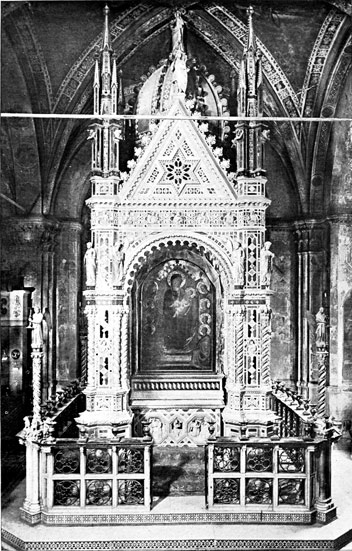
Shrine in Or San Michele, Florence. Designed by "Orcagna" (Andrea Cione).
See page 333.
Orcagna first studied painting under his elder brother
Nardo (short for Bernardo), who was enrolled in the
"company of St. Luke." But this was only one branch of
Andrea's art-education. He matriculated in the Masonic
Guild (Arte dei maestri di pietra e legname), in the books
of which it is written—"Andrea Cioni, called Archangel,
a painter of the parish of S. Michele Visdomini, took
his oath and promises in the said guild, Magister Neri
Fioravanti being his sponsor, in 1352, sixth indication,
October 29."[258]
It was Orcagna's way to emphasize his varied qualifications
by signing his paintings, "Andrea di Cione, scultore,"
and his sculptures, "Andrea di Cione, pittore." On his
masterpiece, the shrine in Or San Michele, he has inscribed,
"Andreas Cionis, pictor Florentinus, oratorii arch magister
extitit hujus MCCCLIX." The expression "Archmagister
of the Oratory" (or shrine) explains many things. It tells
us that the whole of that complicated piece of sculpture,
though it may have been designed entirely by Orcagna, was
not entirely executed by him, but that, like other Magistri,
he had a band of brethren working under him; for how
could he have been chief Master where there were no
lesser ones under his command?
It is interesting in studying the working of the Masonic
Guild, of which Orcagna signs himself Archmagister, to see
how they are occupied in building several grand edifices at
once. The immense number of Masters congregated in the
Florentine Lodge rendered this possible, and wealth was
not lacking in the city to employ them.
The books at the Opera reveal how the Council of
Administration dominates the laborerium. We shall see
how the busy Provveditore has to change the Magistri about
from Santa Croce to Or San Michele; or from the Duomo
to San Michele Visdomini, just as need presses. He has to
order marbles for all and any of these edifices; to call
councils to consider designs for all kinds of different buildings
and parts of buildings, such as windows, chapels, doors,
etc. Sometimes we find him commissioning a certain
architect to make a plan for a chapel, or a door, or a
window. When Talenti and Giovanni Ghino had both
made designs for the tribune in October 1367, the usual
councils were not enough to decide the momentous question
which to choose. The whole city had to be called into
council, together with the monks (frati colleganti), the
Magistri of the guild, etc. Hundreds and thousands of
people came to the Opera, looked at the designs, signed
their names on the list of approval, for one or the other.
After the joint reign as capi maestri of Giovanni di
Lapo Ghino and Francesco Talenti, came a varied line
of master builders lasting for a hundred years, so that it
is impossible to say that any one man was the architect of
the Duomo. Between Arnolfo's first plan and the final
Italian Gothic development of the fifteenth century lies the
whole history of the development of art.
The next great capo maestro after Talenti was Ambrogio
of Lenzo or Lanzo, near Como, one of the Campione
school. His name is given in a deed of February 3, 1363,
as "Ambroxius filius magistri Guglielmi de Champiglione."
It is remarkable that an ancestor and namesake of this
"Ambroxius" was also written down as "filius Magistri
Guglielmi" in 1130, two centuries earlier, when they were
leading members of the Campione school at Modena, and
sculptured the façades of Modena and Ferrara cathedrals;
so our Ambrogio of Florence was one of the distinguished
aristocracy of the lodge, his family dating from its cradle
in Lombardy. From the deed which we quote we find that
Ambrogio graduated under his father, and made his first
contract with Barna Batis, then Provveditore of the Opera
of the Duomo, to provide and prepare the black marble
necessary to the work, for every braccio of which he was
to be paid six soldi eight denari. This is the original—
"Archivio dell' Opera dell Duomo, February 3, 1362.—Ambroxius filius
magistri Guglielmi de Champiglione, comitatus Mediolani, emancipatus
a Domino magistro Guillielmo patre suo, ut continere dixit publice manu
ser Joannis Arriglionis notarii de Champiglione, conduxit a Barna olim
Batis provisore Operis Sancte Reparate de Florentia, locante vice et nomine
operariorum ... ad faciendum et digrossandum totum marmum nigrum
quod erit necessarium dicto operi, hinc ad unum annum proxime venturum,
illarum mensurarum prout dicetur eidem per capomagistros dicti operis.
Et dictus Barna locavit eidem die dictum marmum ad fovendum et digrossandum,
et promisit pro dicto opere eidem Ambroxio de quolibet brachio
dicti marmi dare eidem Ambroxio soldos sex et denarios octo f. p., etc.
Que omnia, etc."
Ambrogio or Ambrose remained many years in Florence.
His name often appears in council. In 1356 he was elected
head architect of the Duomo, and also of the restorations
at the Baptistery. On April 4, 1384, when as an old man
he attended a meeting to decide whether the pilasters of
the tribune were strong enough to support the dome, his
name is given as Ambrogio de Renzo. A marked instance
of the effect of twenty years among Florentine dialect,
which has an inveterate habit of mixing up l's and r's. His
son, Giovanni d'Ambrogio di Lenzo, who afterwards became
capo maestro, was also in council, and Orcagna was chosen
umpire.
But between the reign of Ambrogio and that of his
son we have various changes in the directorship. In 1381,
Giovanni, son of Stefano, called Guazetta, became capo
maestro together with Giovanni Fetti, who was also of the
guild, and preparing first in Siena, and next at Florence,
for his future work in Lucca and Bologna. Giovanni
Fetti designed and made the fine "window towards the
houses of the Cornacchini, under the third arch of the
nave."
Guazetta's peculiar line was laying foundations and
devising complicated scaffolding. He also made the presses
of the sacristy. He was perhaps not enough of a builder
to hold the office of chief, for in 1375 this pair resigned
in favour of Francesco Salvetti and Taddeo Ristori.
Salvetti, however, very soon renounced office, preferring to
remain in the guild on a simple salary, rather than incur
responsibilities.[259]
Then Francesco Talenti's son Simone, who had by this
time become a Magister, was put in his place with Taddeo
Ristori. Their reign lasted till 1388, when Michele, son
of Giovanni, son of Lapo, son of Ghino, was elected. In
his time the pilasters of the tribune were begun.
In 1404 Ambrogio's son Giovanni was elected capo
maestro. Here is the part of the entry of the Deliberation,
November 17, 1404—"Operaris ... elegerunt et nominaverunt
et deputaverunt in caput magister dicte opere Sancte
Reparata providum virum Johannem Ambroxii, etc. etc.,
cum salario florenum otto, pro quolibet mense cum auctoritate,
balia et potestate usitate et consueta."—Delib. xlix. 28.
Another deliberation, dated June 17, 1415, states that
"Johannem Ambroxii caput magister" shall give the order
for the species and form of the bricks for some special
part.
Giovanni, the last of the Campione school whom we
can register, was deposed for old age, and Baptista
Antoni elected in his stead. He was probably the son
of Antonio, the Grand Master mentioned above.
Giovanni had not always time to carry out his own
designs. In 1408 we find that Magister Niccolao, surnamed
Pela, took the contract to carve in marble the doorway
near the chapel of the crucifix, which was designed by
"Johannem Ambroxii, caput magistrum." It is rich with
vines and other ornaments. Niccolao did not push the
work, however, and in May 1408 the Opera decided that
he owed the guild the sum of twenty-five florins for
breaking his contract.
The number of different minds each leading the works
in his own department is bewildering. The beautiful door
called the Mandorla, so rich and elegant in sculpture,
which is often said to have been executed by Jacopo della
Quercia, was in reality the work of Nanni di Antonio di
Banco. The books of the Opera register, on June 28, 1418,
a payment of twenty florins on account to Nanni for this
doorway, and in 1421 the last payment was made on the
completion of the work. Nanni was a favourite scholar of
Donatello; he was a person of good birth, who matriculated
in the Arte dei Maestri di Pietra on February 2, 1405, and
proved his membership by sculpturing the four patron saints
of the Masonic Guild on Or San Michele.
We further find in this precious collection of documents
that Magister Jacopo di Lapo Cavacciani made a model
for a shaft; that Nato di Cenni and Jacopo di Polo were,
in August 1357, engaged to make the bases of the columns,
and that time after time different Masters were called on to
make plans for chapels, windows, doors, etc.
Now we know the state of the building as it stood in
this fourteenth century, we realize that it was not left for
centuries without a dome. The old chronicler Buoninsegni,
in his Storia Florentina, lib. iv. p. 642, says—"A di venti
di giugno 1380 si cominciarono a riempire et murare i
fondamenti della cupola di S. Maria del Fiore." Up till
this time the nave only seems to have been built.
On August 7 a meeting of Magistri was called to consult
on the foundation for the cupola, and on November 12,
1380, there is a long document commissioning "Bartolommeus
Stefani, Johannes Mercati, and Leonardus Cecchii,
Magistri Florentini," to build the pilasters to support the
dome, which are to be of good stone and cement, and the
builders are cautioned not to work in times of frost or snow,
etc. etc. These pilasters caused much anxiety in the
guild; in 1384 constant meetings were held about them.
The Masters were afraid the foundations of the one towards
Via dei Servi were not firm; day after day in July 1384
they met in scores to examine and report on it. Then they
called in the consuls of the Art of Wool, the Operai, and
all the chief men of the city; and everybody, excepting a
certain Messer Biagio Guasconi (who after all was not an
architect), agreed that the foundation of the pilaster was
perfectly safe. However, good Messer Biagio still held his
own opinion and refused to sign approval.
From the steady way in which the work went on, it is
certainly possible and probable that there would in the
natural course of the work have been a dome to the
cathedral even without Filippo Brunelleschi. It was in the
original plan, and the foundations and pilasters were placed
in readiness for it. There was much talk of the difficulty
of placing the framework of the scaffolding for it, but there
seems to have been no doubt that it would be accomplished.
In fact numbers of the Masters sent in plans for it at
different times.
The first time that Brunellesco appears in the records
is at a meeting of consuls, Opera, and Masters, convened on
November 10, 1404, to consider a certain error in measurement
committed by the capo maestro, Giovanni di Ambrogio.
The question turned on the placing of the (sprone) brackets
on the façade which interfered with the windows.
It does not seem that Brunellesco belonged to the
brotherhood. He is merely mentioned as Filippo the
goldworker, son of the notary Brunelleschi (Filippus ser
Brunelleschi aurifex). In no place, either here or elsewhere,
is he ever called Magister, and throughout his life
his every action was a protest against what he called
"the Maestranze" a term of contempt like "their Master-ships,"
which Brunelleschi applied to the Arte dei Maestri.
He had matriculated in 1398, when twenty-one years
old, in the Arte della Seta, but as his tastes were strongly
artistic, and he refused to follow his father's profession
of lawyer, he enrolled himself in 1404 in the Arte degli
Orafi (goldsmiths), in which so many painters were
already eminent. The goldsmiths or metal-sculptors, who
seem to have seceded from the Freemasons, were still in
some measure colleagues of the Masonic Guild, and their
members were often called to vote or advise in the councils
of the Opera.
Thus we find Brunellesco as one of the orafi called into
council about the construction of the brackets. He appears
to have held office as councillor in the Opera for a year
till 1405, when he was paid off. He was probably one of
the Operai on the part of the city.
When in the famous competition of 1402 Brunellesco
lost the commission for the doors of the Baptistery, he left
Florence in dudgeon, and with his friend Donatello went
to Rome. His studies of the methods of the ancient
Romans in making their great domes, suggested to him a
way of vindicating his amour propre by defeating the whole
guild of "Masters" on their own ground. He had made
architecture a special study, and now thoroughly investigated
the classic methods. He got to the roof of the
Pantheon, and made studies of the stone-work in the ribs
of the cupola, investigated the foundations, the supports,
etc., and came back to Florence, where he let drop
mysterious hints among the influential members of his own
trade company, and in the studios of one or two artists,
that even if the "maestranze were to call their Masters from
France or Germany, and all parts of the world, none of
them would be able to make a dome equal to the one he
could make." The Masters of the laborerium at length
heard of these assertions, and called on him to show his
plans, which he declined to do.
Then the Opera, on August 19, 1418, announced a
competition. Any artist whatsoever who had made a
model of the projected cupola was to produce it, before the
end of September, the model accepted to have a prize of
200 gold florins. The date of decision was prolonged to
October, and then to December, when a number of models
were sent in, the competitors being Magister Giovanni
di Ambrogio, C.M. of the laborerium, Manno di Benincasa,
Matteo di Leonardo, Vito da Pisa, Lorenzo Ghiberti,
all Magistri of the Masonic Guild; Piero d'Antonio, nicknamed
Fannulla (do nothing), Piero di Santa Maria in
Monte, masters in wood. There were several models by
members of the civic company, the Arte dei Scarpellini
(stone-cutters); and last, not least, a model in brick and
mortar without scaffolding, made by Brunellesco, Donatello,
and Nanni di Banco,[260] so he was obliged after all
to show his design. This last won the prize, but the
Arte dei Maestri had not evidently faith enough in one
outside their ranks to commence at once with the building.
In Signor Cesare Guasti's collection of archivial documents
regarding the building of the Duomo, we find
that from October to December 23, 1418, several of
the Masters, including Magistro Aliosso, Mag. Andrea
Berti Martignoni, Mag. Paolo Bonaiuti, Cristofero di
Simoni, and Giovanni Tuccio, were receiving payment
for building a model in masonry of Brunellesco's plan for
the cupola. I do not find that Brunellesco himself was
employed in this, the only payment to him being "50 lib.
15 soldi" for his work on the lantern of the model, between
July 11 and August 12, 1419; proving that he put the
finishing touch, but that the Masters of the guild themselves
tested his design for the great dome before finally
adopting it. This brick model, which was built on the
Piazza del Duomo, remained there till 1430, when the
Opera ordered its destruction. Guasti[261] gives in full this
order, which is dated January 23, 1430, and is in the usual
low Latin of contemporary documents. When the model
was finished, the Magistri of the guild assembled on May
14, 1421, to hold council on it. There are entries of
expenses for a breakfast to the Masters, and for torch-bearers
to accompany them on their internal investigations.
We find the same ceremony of refreshment to the Magistri
who visited the works of the real cupola in 1424, when six
flasks of Trebbiano (the best Tuscan wine) with fruit and
bread were provided. In 1420 Brunellesco was definitely
commissioned to superintend the cupola, but even then
the Magistri could not admit an outsider to full Masonic
privileges. He was not named caput magister, as one of
the guild would have been, but he and Ghiberti (whose
model had been next best) were named provisori of the
dome, while the Magister Baptista di Antonio was caput
magister proper of the lodge. The terms of the contract
were that "the provisori were to superintend the works,
providing, ordering, building, and causing to build, the
cupola from beginning to end, etc. etc."
At first both Ghiberti and Brunellesco drew three florins
a month. The head Magister, Baptista, had the usual
salary of the guild as head master.
The story of Brunellesco's restiveness at his old rival
Ghiberti being associated with him in carrying out a design
peculiarly his own, and how he tried to throw scorn on him,
by locking up his plans and feigning illness, thus leaving
Ghiberti to work in the dark, is too well known to need repetition
here.[262] Perkins[263] is very hard on Ghiberti's ignorance,
which, he asserts, was so great that he was obliged to resign
because he could not do the work. But there are two sides
to every question. How could a man carry out a work
designed and begun by another without seeing his plans?
Besides, Ghiberti's resignation, or rather relinquishment of
his work at the cupola just then, was, I believe, due to the
fact that he had a few months before received a commission
for the second bronze gates of the Baptistery, and
wanted his time free for them. This commission is dated
January 2, 1425. His salary as provisore of the cupola
ceased for a few months from June 28, 1425. The dates
speak for themselves. He still, however, held office, or
returned to it with partial pay, for in 1428 we find a decree
of the Opera which raises the salary of Brunellesco to 100
gold florins a year, while Ghiberti only draws his usual
three florins a month. But even then not an order is ever
given in Brunellesco's own name; every document and
every receipt was signed by Baptista d'Antonio, caput
magister, and Filippo di Ser Brunellesco, provisore.
And now let us see who were the underlings employed
by Brunellesco. Finding the workmen of the Florentine
Lodge were disaffected, he got ten Lombards, and shut out
all the Florentines, till they humbly came back, begging
to be taken on again, which he did at a lower salary than
before.
The Lombard element was still strong in the guild. A
certain Maestro di legno, named Magister Antonio of
Vercelli, invented a convenient mode of drawing up weights
into the cupola. The workmen had a kitchen and eating-house
up in the dome, so that they did not need to descend
in the middle of the day. In fact the Opera made strict
laws about this.
In 1436 another competition of models for the lantern
was proclaimed, and again Brunellesco won the palm
against Ghiberti and others. It seems that when the commission
was given to Brunellesco, the Masonic Guild must
have felt it infra dig. to make a non-member capo maestro
of the dome. Consequently they matriculated him into
the fraternity. But with his jealousy of the maestranze and
determination to show that one need not be a Freemason
to build a church, he ignored this membership and never
paid his fees, on which the Masters of the laborerium sued
him for debt, and he was imprisoned. This did not suit
the City Patrons of the Opera, who were the all-powerful
Arte della Lana, especially as Brunellesco's Arte della Seta
was also on his side. A stormy meeting was held in the
Opera on August 20, 1434, at which the civic party was too
strong for the Maestri. It was decreed that Brunellesco
should be liberated, and one of the Arte dei Maestri was
imprisoned, on the plea of hindering public works![264]
After this triumph of independent architecture Brunellesco
became in a manner architect in chief to the city.
He built the pretty Loggie of the Foundling Hospital on
Piazza della SS. Annunziata, and the Pazzi Chapel at Sta.
Croce, both of which Luca della Robbia adorned with his
beautiful blue and white reliefs. He erected the fine
Palazzo Quaratesi on Piazza Ognissanti, and the remarkably
grand church of Santo Spirito was after his death
built from his designs.
Brunellesco's strike for independence appears to have
given the death-blow to the great Masonic Guild which, as
it became more unwieldy, had been slowly disintegrating.
The local members in large cities like Siena and Florence,
becoming too strong for the original Lombard element, had
asserted their independence by forming other guilds of a
local nature, in which even the ancient quartette of patron
saints was forgotten. How long the lodge in Florence
kept together after Brunellesco's defiance I do not know,
though its educative influence certainly lingered on till
Michael Angelo's time, he being as all-round an artist as
any Magister of older days who could build a church and
decorate it too.
The laborerium of the Florentine Opera must, however,
have been closed by the time of Michael Angelo; for
Lorenzo de' Medici had to supplement it by giving up his
garden in the Via Larga as a school of sculpture, there
being then no place where the art was taught. His teaching,
however, was a heritage from the ancient guild, for old
Bertoldo, scholar of Donatello, was the Master there, and
the works of the Masonic Brotherhood for two centuries,
together with the classic treasures collected by the Medici,
were his models.
THE MILAN LODGE
| 1. |
1387 |
Magister Simone da Arsenigo |
First capo maestro of
Milan cathedral. |
| 2. |
" |
*M. Guarnerio da Sirtori. |
Assisted him. |
| 3. |
" |
*M. Marco da Frixone di Campione |
Engaged March 5, 1387; C.M.
1389; D. 1390. |
| 4. |
" |
*M. Jacopo Fusina da Campione |
C.M. with Marco in 1389. Head
of the works at Certosa, 1397.
Designed the Certosa. |
| 5. |
" |
*M. Zeno da Campione (his brother) |
Brought 21 sculptors on Oct.
18, 1387. By 1399 he had 250
under him. |
| 6. |
" |
*M. Andrea degli Argani da Modena |
From the Campione school at
Modena; was architect to the
Duke of Milan. Called to
Milan in 1387 as counsel. |
| 7. |
" |
*M. Lazaro da Campione |
|
| 8. |
" |
*M. Rolando or Orlando |
|
| 9. |
" |
*M. Zambono (Giovanni Buono da Bissone) |
Descendant of Zambono, who
was C.M. at Padua 1264, and
at Parma 1280. |
| 10. |
" |
*M. Fontana da Campione |
Probably an ancestor of Giov.
Fontana, the master of
Palladio; and of Matteo
Fontana, architect of Belluno
cathedral in 1517. |
| 11. |
" |
*M. Cressino da Campione |
|
| 12. |
" |
*M. Giovanni da Azzo |
|
| 13. |
" |
*M. Giovanni da Trœnzano |
|
| 14. |
|
*M. Martino da Arogno |
|
| 15. |
|
*M. Ruggero da Marogia |
|
Brothers. |
| 16. |
|
*M. Giorgio da Marogia |
| |
|
|
|
| 17. |
|
*M. Alberto |
|
All Lombards who worked
under Giovanni da Bissone
(No. 9); the latter was his
son. |
| 18. |
|
*M. Airolo |
| 19. |
|
*M. Giovannino da Bissone |
| |
|
|
|
| 20.
|
1387 |
†Magister Antonio di Guido, |
|
Brothers. |
| 21. |
|
M. Giovanni di Guido |
| 22. |
|
†M. Adamo |
|
| 23. |
|
†M. Giovanni di Furno |
|
| 24. |
|
†M. Adriolo da Campione |
|
| 25. |
|
†M. Guglielmo di Marco |
Son of Marco da Frixone,
architect at Crema; called to
Milan as expert, Oct. 1387. |
| 26. |
|
M. Leonardo Zepo |
|
Two Masters deputed to take
note of Magister Andrea's
suggestion, Oct. 1387. |
| 27. |
|
M. Simone da Cavagnera |
| 28. |
1388 |
*M. Ambrogio Pongione |
Gave his vote at a meeting
of the lodge on March 20,
1388. |
| 29. |
|
*M. Bonino da Campione |
Voted at the same meeting.
Had been sculptor of the
Scaliger tomb at Verona in
1375. |
| 30. |
|
*M. Gasparo da Birago |
A famous iron-worker.
Magister of the lodge. |
| 31. |
" |
*Magister Ambrogio da
Melzo |
All these * voted with the
chief architect Simone at the
same meeting, March 20, 1388. |
| 32. |
|
*M. Pietro da Desio |
| 33. |
|
*M. Filippo Orino |
| 34. |
|
*M. Ridolfo di Cinisello |
|
| 35. |
|
*M. Antonio da Trœnzano
(son of Giovanni da
Trœnzano) |
|
| 36. |
1390 |
M. Niccola del Bonaventura |
Made a design for the windows
of the choir at Milan: not
accepted: discharged from
the lodge on July 21, 1390. |
| 37. |
1391 |
M. Giovanni da Campione |
Sometimes called John from
Fernach. He brought 100
stone-carvers into the
laborerium in 1391. |
| 38. |
1399 |
M. Antonio A. Padernò |
|
Two rising Masters in 1399,
who fought the great
dispute with the French
architects. |
| 39. |
" |
M. Marco da Carona |
| 40. |
" |
M. Lorenzo degli Spazi, di Val d'Intelvi |
Brought 188 stone-carvers
with him to Milan. He was in
1396 C.M. at Como, and
probably went to Milan with
all his workmen, when the
works there were suspended
on Gian Galeazzo's death. |
| 41. |
1400 |
M. Jacopo da Tradate |
In 1400 he was chief sculptor. |
| 42. |
" |
M. Samuele, his son |
Sculptured his father's tomb in 1402.
|
| 43. |
1400 |
M. Bertollo da Campione |
|
Magistri working under
Jacopo da Tradate at the
sculptures for Milan cathedral. |
| 44. |
|
M. Giorgio de Sollario (Solari) |
| 45. |
|
M. Guglielmo di Giorgio (his son) |
| 46. |
1410 to 1440 |
M. Giovanni de Solari |
| 47. |
M. Giovanni di Reghezio |
| 48. |
|
M. Jacopo da Lanzo |
| 49. |
|
M. Michele di Benedetto da Campione |
| 50. |
|
M. Francesco Solari |
| 51. |
|
M. Giovanni da Cairate |
| 52. |
1420 to 1404 |
*M. Cristoforo da Chiona |
All these marked * were
master architects, each building a certain part of the cathedral. |
| 53. |
*M. Arasmino Solari da Arogna |
| 54. |
*M. Franceschino da Canobbio |
Was C.M. in 1448. |
| 55. |
|
*M. Leonardo da Sirtori |
Son or grandson of Magister
Guarnerio (No. 2). |
| 56. |
|
*M. Paolino da Arsenigo |
Son or grandson of Magister
Simone (No. 1). |
| 57. |
|
*M. Filippino degli Argani |
Son of Andrea degli Argani
(No. 6), whom he succeeded
as architect to the Visconti.
Designed the choir window at
Milan. Entered the lodge as
novice, 1400; graduated
master, 1404; C.M. 1417. |
| 58. |
1450 |
M. Giorgio di Filippo |
His son: became C.M. in his turn in 1450. |
| 59. |
1451 |
M. Giovanni Solari: son of Marco da Carona. |
C.M. from 1451 to 1470. He
forms a link with Venice. |
| 60. |
1470 |
M. Guiniforte or Boniforte (son of Giovanni Solari) |
C.M. in 1470-1481. Built the
Ospedale Maggiore and church
of Le Grazie at Milan. |
| 61. |
1481 |
Magister Pietro Antonio: his son |
Went to Russia in 1481. |
| 62. |
1468 to 1492 |
M. Martino da Mantegazza |
|
| 63. |
M. Dolcebono Rodari |
Entered the lodge in 1490;
was sent to Rome for
training. His relative,
Tomaso Rodari, was more
famous than he, and
sculptured the Renaissance
door at Como. |
| 64. |
|
M. Gerolamo della Porta |
Was employed later in Rome
and Naples. |
| 65. |
|
M. Salomone, son of Giovan de Grassi |
One of the line descending
from Magister Graci, founder
of the lodge at Padua.
|
| 66. |
1471 |
M. Bartolommeo de Gorgonzola |
C.M. for the cupola of Milan
cathedral. |
| 67. |
1488 |
M. Leonardo da Vinci |
Engaged for the cupola, but
resigned. |
| 68. |
|
M. Antonio da Padernò (descendant of the older Antonio, No. 88) |
Rectified the mistakes of
John of Gratz. |
| 69. |
|
M. Giovanni Antonio |
|
Joint architects to finish
cupola and cathedral of
Milan. Amedeo worked
afterwards in Venice. |
| 70. |
|
M. Amedeo or Omodeo |
| 71. |
|
M. Gio. Giacome di Dolcebono |
Dolcebono was son of Dolcebono Rodari. |
| |
|
|
|
| 72. |
|
M. Francesco di Giorgio of Siena |
|
Were called to advise on the plans of the above three. |
| 73. |
|
M. Luca Fancelli of Florence |
| 74. |
1506 |
M. Andrea Fusina |
Descendant of Jacopo Fuxina.
Andrea was elected C.M. to
replace Dolcebono in 1506. |
| 75. |
1502 |
M. Cristoforo Gobbo |
Sculptured Adam and Eve on
the façade of Milan
cathedral, etc. |
| 76. |
1618 to 1647 |
M. Gian Giacomo Bono da Campione |
|
A later offshoot of the old
family of Bono or Buono, who
have furnished Magistri
since 1152. |
| 77. |
M. Francesco Bono, his son |
| 78. |
M. Carlo Antonio Bono, a
relative |
| 79. |
M. Giuseppe Bono, his son |
All these marked * were engaged on Oct. 4, 1387, to work with Magister Simone.
The second batch given below and marked † joined the Lodge on Oct. 9, five days after.
FOREIGN ARCHITECTS IN MILAN LODGE
| 80. |
1389 |
Anichino or Annex of Freiburg |
Was paid for the model of a
dome which was not used. |
| |
" |
Giacobino de Bruge |
Fell ill, and was supported
by the lodge. |
| 81. |
1391 |
Ulrico di Ensingen |
Came for a few months. |
| |
" |
Heinrich di Gmunden |
Entered, July 1391; left,
June 1392. |
| 82. |
1399 |
Jean Mignot de Paris |
Came from Paris. |
| 83. |
|
Jean Campanias from Normandy |
Campanias did not stay long. |
| 84. |
|
Ulrich de Frissengen |
|
Worked at Milan for a short
time. |
| 85. |
|
Aulx di Marchestein |
| 86. |
1482 |
Giovanni da Gratz |
Engaged, 1482; discharged,
1488. |
I.—The Comacines under the Visconti
History repeats itself. We began the story of the
Comacines in Lombardy with their works under the invading
Longobards, we end it with their works under the
usurping Visconti. The first era shows their early Roman-Lombard
style in its purity; the last shows the culmination
of their later Italian-Gothic style in its fulness.
Like Florence, Siena, Pisa, Pistoja, and other cities,
Milan, on freeing herself from Longobard and French
tyrants, had become a commune, but she could not escape
the usual fate of a mediæval commune, i.e. party faction,
and the supremacy of a dominant family. As Florence had
her Guelphs and Ghibellines, Pistoja her Bianchi and Neri,
so Milan had her two warring families, the Torriani and
Visconti. The conflict was long, but in the end the
Visconti dominated. Matteo I. reigned over Cremona,
Lodi, Bergamo, Pavia, Alexandria, and Vercelli. Azzo
Visconti subjugated Piacenza and Como, etc. Luchino
added Asti, Bobbio, and Parma; while his brother, the
Archbishop Giovanni, acquired Brescia, Genoa, and Bologna.
His nephews, Bernabò and Galeazzo II., divided the state,
and lost part of it. Genoa freed herself from Galeazzo,
while Bernabò's vices and cruelties caused rebellion everywhere.
Galeazzo's son, Gian Galeazzo, who was only fifteen
when his father died in 1378, married Isabella of France,
he being then seventeen, and she a child still. By this
he gained, as his bride's portion, the estate of Vertus in
Champagne, and his descendants kept up the title, which
became Italianized into Conte di Virtù. His second wife
was his cousin, Caterina, daughter of Bernabò. To assure
himself of her heritage, he imprisoned his uncle in the castle
of Trezza, where he died a few months after, some say by
poison. However this be, Gian Galeazzo immediately rode
into Milan, where he was proclaimed Signore of Milan.
Wenceslaus, Emperor of Germany, had already created
him his Vicar-general in Lombardy, so that his power was
great. So great was it that he was able to oust the Scaligers
from Verona in 1386; the Carraresi from Vicenza and Padua
in 1387. In 1395 he induced Wenceslaus to nominate him
Duke of Milan, and to make the title hereditary. Then,
emulating his Longobardic predecessors, he began a march
of conquest southwards; took Perugia, Spoleto, and Assisi in
1400; Lucca in 1401; then he bought Pisa from the
Appiani, and Siena capitulated. Florence was next in his
list, but luckily for her he died at this juncture, and
Florence escaped.[265]
These were the princes under whose auspices the
cathedral of Milan arose, a mountain of sculpture white
as snow. In olden times there were twin churches standing
on the site of Milan cathedral: S. Maria Maggiore, the
winter church, and S. Thecla, the estiva, or summer church.
Santa Maria had two Baptisteries, one for male children,
the other for female. They both had marvellous towers:
that of S. Maria was two hundred and forty-five braccia
(about four hundred and seventy feet) high, and of "admirable
beauty." This tower was thrown down and the church
destroyed in the siege of Milan, 1162. After the Peace
of Costanza, Sta. Maria was restored by public offerings,
and the Milanese ladies, like the ancient Roman dames,
threw their jewels into the treasury. The façade of this
restoration was of black and white marble in squares, and
the church was so large that it could contain 7000 people.
By the fourteenth century Milan had become so
wealthy and powerful that it determined to build a church
more beautiful than any before it. To Gian Galeazzo is
generally given the whole credit of this initiative, but
documents seem to prove it was a general move on the
people's part. On May 12, 1386, Monsignor Antonio dei
Marchesi, Archbishop of Milan, addressed a circular letter
to his clergy, saying that the church of the Blessed Virgin
was old and dilapidated, and "the hearts of the faithful"
intended to rebuild it, which work being very costly, the
Archbishop prayed all his clergy to "institute offerings in
their churches, and to pray God to bless the work."
Again a year later he circulated another letter, to ask
that all the offerings thus gathered should be transmitted
to Milan before the fête of St. Martin, as the faithful were
anxious to continue the work begun. Gian Galeazzo did
his part by promulgating two edicts; one dated October 12,
1386, instituting a questua (collection) in all the Ducal State
for the benefit of the funds for the Duomo; the second,
dated February 7, 1387, decreed that all the money from
the paratici of the city, which shall be paid as offerings
during the fête of the Madonna in February of this and
following years, shall be dedicated to the building fund.
The results of all these appeals and decrees, and the small
part the Visconti had in the giving, appears in a letter from
the deputies of the Fabbrica or Opera, addressed to Gian
Galeazzo, on August 3, 1387, saying—"Offerings have
been made with great devotion by every kind of person,
rich and poor, who have copiously and liberally aided the
building. Now, O Signore, we pray that you and your
lady mother, your consort, and daughter, may also transmit
your devout oblations to subsidize the church."
This is the way the funds were found, and now who
were the builders? We have seen in a former chapter that
the Visconti patronized the Campionese school of architect-sculptors,
and as the Comacines had been associated with
Milan for centuries, it was not necessary to look far for
architects. Indeed the very first batch of names which
meets our eye in the books of the laborerium are all of the
Lombard Guild. Here is chief architect Simone da Arsenigo
written down as ingegnere generale; or capo maestro,
Guarnerio da Sirtori; Marco, Jacopo, e Zeno, da Campione;
and Andrea from Modena; where we have seen the
Campione Masters established a school.
On October 16, 1387, a meeting was held by the commission
of the Duomo to discuss a project proposed by the
administrators of the Fabbrica, for forming a regular
organization, and electing the proper officials. It was
decided—
1. To confirm the present deputies as superintendents
of the work. (Here we have the Tuscan Operai.)
2. To elect a treasurer-general.
3. To nominate a good and efficient accountant.
4. Also a good and efficient spenditore (in Tuscany this
is the Provveditore).
5. To confirm the election of Magister Simone da
Arsenigo as head architect of the building, and to nominate
enough capable Masters to assist him. (In Tuscany capo
maestro and Maestri.)
6. To confirm (considering their eminence in their art)
Dionisolo di Brugora and Ambrogio da Sala (an island
in Lake Como near Comacina) in their offices, and to
choose others equally good to aid in the building.
7. To elect two or more probi uomini (arbiters).
8. To elect lawyer, notary, and sindaci (consuls) of the
art.
9. "We also determine and ordain that Maestro Simone
da Arsenigo, as being chief architect of the said fabric, shall
order and provide for all the works done in the said church,
and that he shall show diligence, etc. etc...."
Here we have the exact organization we have seen at
Siena, Parma, Florence, etc.; and as there the Lombard
Masters are the founders of it, we find the same filing of
documents, the same assigning of different parts of the
building to different Masters, and the same calling of
councils in the guild to consider and value the work. The
registers of administration are kept in precisely the same
way. The spenditore keeps his books just as the Florentine
Provveditore does. Here are a few translations from the
bad Latin of his entries—
"1387. January 15.—For two lbs. of morsecate for
Maestro Andrea degli Organi, four lire." (Andrea degli
Organi of Modena was the Ducal architect, the father of
Filippo da Modena, a first-rate architect.)
"January 19.—For a Master and forty-seven workmen
to place the foundations of the pilasters."
"March 19.—To Simone da Arsenigo, chief architect,
for eighteen days in which he was engaged in work himself."
(This entry would seem to prove that when a Master did
manual work with his men, he was paid as they were in
addition to his salary as architect.)
"April 2.—To Maestro Marco da Frisone" (Magistro
Marcho de Frixono), "who was in the service of the Fabbrica,
and began to work on March 5, and finished on April
2, for his pay 12 lire 13 denari."
"April 13.—To Maestro Andrea da Modena, architect
to the Duke, for his pay for the days he gave to the church
in Milan, with the permission of the Vicario Sig. Giovanni
de Capelli, and the XII di provisione" (one of the city
councils, which acted as the president of the lodge, as the
Arte della Lana did in Florence), "and also of the deputies
of the Fabbrica, L. 19. 4."
"May 2.—Lent to Maestro Marco da Frisono, 22 lire."
"August 12.—For 84 workmen, 13 lire 13. 6. To 4
master builders, i.e. Giovanni da Arsenigo, 5 lire 10; to
Giovannino da Arsenigo, his son, 5. 10; to Giovanni da
Azzo, 5. 9; and Giovanni da Trœnzano, 5. 9;—18 lire in all."
In August we get entries of expenses for rope to draw
water from the well, and rope for raising scaffolding, for
nails, baskets, plumb-lines, water-levels, red paint to mark
the planks, and other things. On October 9, 1387, we find
the spenditore paying a messenger to go to Crema with
letters from the lodge to Maestro Guglielmo di Marco, to
call him to Milan to give advice on business connected with
the buildings.
On October 15 Guglielmo di Marco is paid 16 lire for
his journey and eight days' employment in examining and
judging the work of the church.
On October 18, 1387, we have payment to Maestro
Simone da Arsenigo and ten companions (eleven in all),
master builders. To Maestro Zeno da Campione and twenty-one
companions (twenty-two including himself), master
sculptors of "living stone" (pietra viva). The word which
I translate companions is sotiis (Mag. Symoni de Ursanigo
et sotiis, etc.), which would imply that they were all members
(soci) of one society, and is thus valuable as a confirmation
of the brotherhood in this guild.
In October 1387, Andrea da Modena, the Duke's
architect, is again engaged, but only as adviser; for which
he receives in dono fiorini venti; and Leonardo Zepo and
Simone da Cavagnera are deputed to take note of his
suggestions.
"1387. November 19.—For the payment of two large
sheets of parchment consigned to Simone da Arsenigo."
(These must have been to draw the plans.)
"1388. April 19.—Paid Maestro Marco da Frixone and
soci for plaster to make models of the four piloni."
In another entry, noting the payment of 81 lire as
salary, Marco da Frixone is named as Marco da Campione
detto di Frisone.
Merzario is of opinion that such names as Marc the
Frisian, who was one of the Campione school; Jacopo
Tedesco, whom all old writers agree was Italian; Guglielmo
d'Innspruck, also a Campionese, have been the cause of much
misunderstanding, and have sent authors off on false scents.
It was the custom, in the books of the Comacines, to name
people from their provenienza, i.e. the last place they came
from. Thus at Siena you will find Niccolò da Pisa, while
at Pisa he is Niccolò di Apulia. Lorenzo Maitani was
Lorenzo da Siena to the Orvieto people, and Lorenzo
d'Orvieto to the Florentines. Marco il Frisone, born at
Campione, is therefore a link between the German guilds
and the Italian; he must have worked at Friesland, and
probably brought back ideas of a more pointed Gothic from
there.
These registers are ample proof that the builders just
called in for the building of Milan cathedral were of the
Lombard Guild, and chiefly of the Campione branch. It is
not till 1389 that we find a single German name, and then
a certain "Anichino (Annex) di Germania" is paid 16
soldi for having made a model of a tiburio (cupola) in
lead, and Giacobino da Bruge, who falls ill while working
at the church, has a slight subsidy given by the guild
per amor di Dio. They are not mentioned again, and
neither of them seem to be Masters.
That Simone da Arsenigo was chief architect at this
time, not a doubt can exist. It is especially emphasized in
a deed executed in December 1387. In it the Administration,
"in consideration of their long and continued experience
of the pure and admirable goodwill, and the opera
multifaria which the worthy man, Magister Simone da
Arsenigo, most worthy chief architect and master, has
achieved in this church, by constant diligence, and wishing
to remunerate him better (pro aliquali remuneratione bene
meritorem), decide that whereas his salary hitherto has been
ten imperial soldi a day, it shall now be raised to ten gold
florins a month."
It is plain, however, that he worked in concert with the
guild. Just as at Florence and Siena, great councils of the
Masters, both architects and sculptors, were held to consider
whether the foundations were strong before continuing the
building, so in Milan a great meeting was called on Friday,
March 20, 1388, in which all the Magistri were cited before
their patrons, the Imperial Vicar-General, and the Council
of XII. (In Florence the Arte della Lana took the post
of President of the Works.) All the Magistri were charged
to give their opinion on the building in its present state,
and to suggest any improvements they could.
First uprose Master Marco da Campione (Surrexit
primus Magister Marchus de Campilione, Inzignerius), and
said there was an error in the wall on the side of Via
Compedo, the wall being, in one part, "half a quarter"
wider than the measure given. He suggested undoing that
part to the foundation.
Then the chief architect, Simone da Arsenigo, rose, and
proposed to cut the stones down to the ground, but not to
remove them.
Maestri Giacomo and Zeno agreed with Maestro Marco,
as did Maestro Guarnerio da Sirtori and Ambrogio
Pongione.
Then uprose Maestro Bonino da Campione (whom we
saw last at work on the Scaligers' tombs at Verona), and
said that he not only agreed with the others, but found an
error in the piloni in the body of the church, towards the
door of the façade.
Gasparolo da Birago, worker in iron, Magistri Ambrogio
da Melzo, Pietro da Desio, Filippo Orino, Ridolfo di
Cinisello, and Antonio da Trœnzano, all voted with him.
The words "according to the measure given" (justa
mensuram super hoc datam), prove that however many
architects superintended special parts, there was one
supreme Master who made the design.
This was first, as we have said, Simone da Arsenigo,
and after him Marco the Frisian of Campione, whose salary
is paid on March 31, 1389, naming him as "Mag. Marcho
de Campilione dicto de Frixono inzegnerio fabricæ." His
name often appears as chief architect till July 10, 1390,
when "he died at the Ave Maria in the morning, and was
buried with honours the same evening in the church of S.
Thecla."[266]
One of Marco's contemporaries in the laborerium was
Jacopo da Campione, whose name appears with that of
Nicola del Bonaventura, and Matteo da Campione, and
others, at a general meeting held on January 6, 1390.
Historical authorities say Jacopo da Campione was of the
Buono family, and some assign as his father Giovanni
Buono. He, too, had a cognomen of Fuxina or Fusina,
but whether a family name or a place name I cannot tell.
His name first appears in the books of the guild with
Zambono, or Giovanni Buono, supposed to be his father,
with Magistri Zeno, Andriolo, Lazaro, Rolando, Fontana,
Cressino (all from Campione), and with Alberto, Airolo,
and Giovanni da Bissone, and Anselmo da Como. These
must have been the Masters who responded to the invitation
for architects sent out by the Milanese.
On April 15, 1389, Jacopo da Campione was elected
chief architect in connection with his friend Marco da
Campione.
A competition for designs for the great window of the
choir was announced in 1390, and Jacopo da Campione and
Niccola del Bonaventura each sent a design, from which the
archbishop was to choose. He preferred that of Bonaventura,
but the Master fell into disgrace, and his window was
never executed. We find that the Administration, on July
31, 1390, "deliberated" to discharge Master Bonaventura,
give him the salary due to him, and remove him entirely
from the lodge. Jacopo da Campione remained in office
till the end of 1395, when he and Marco da Carona retired
for rest and change to Lake Lugano. They were not
allowed to be away long, for they were recalled on January
9, 1396.
During that year new honours were preparing for
Jacopo. Gian Galeazzo Visconti was intending to rebuild
the Certosa at Pavia, and set his eyes on Jacopo da
Campione as the best architect he could find for it. The
Masters of the Milan Lodge dared not dispute the will of
the all-powerful Duke, and held a meeting on March 4,
1397, at which it was decided "that Jacopo di Campione,
chief architect of the building, qui acceptatus est super
laboreria Cartuxiæ, should still retain his position in the
works of the Duomo, because the entire absence of the
Master who began the building (qui principiavit ipsam
fabricam) would cause grave peril and injury to the work.
They proposed, however, that Maestro Jacopo might, in
cases of necessity, assist in the building of the Certosa, as
he had done before."
This document sets the question beyond a doubt that
the architect who had most to do with the building of
Milan cathedral was this Jacopo of Campione, who had
worked with the first architect, Simone, and shared, on his
death, the post of chief, with Marco, his fellow-countryman.
He died on October 30, 1398.
During the time he was head of the laborerium several
Germans worked under him; Milan being so near the
German frontier was always a favourite object of German
travel. Moreover, I fancy there must during these centuries
have been a fraternal intercourse between the Italian
Masonic Guilds and those of Germany. We have so many
Italians who worked in Germany, and coming back were
dubbed with the name of the last place they came from,
that it is equally likely that some Germans crossed the
border with those fellow-guildsmen on their return, and
worked at Milan. This intercourse between the two nations
would account for the more German style of Milan
cathedral as compared with other Italian churches.
I have before remarked that the lines of architecture
gradually take a more upward tendency the further north
we go. The slight point of the arch, as seen in Siena and
Orvieto and Florence, is much sharpened in Milan; the rows
of little round archlets which covered a Romanesque building
with rich horizontal lines, have here become elongated and
pointed, all the lines tending upwards, till they become
almost monotonous; yet Milan is but the natural northern
development of the southern Italian Gothic. It was always
the tendency of the guild to seek greater richness of
ornamentation in multiplying forms already customary to
them. As the Romanesque façade was merely a multiplication
of the Lombard single gallery, so the Gothic of
Milan is but a multiplication and elongation of the turrets
and pinnacles of Siena and Orvieto, and of the pointed
gables over elongated arches, with almost an abuse of the
perpendicular shaft. Of course I do not speak of the
façade in these remarks, that being a discord by the later
Renaissance architects. The changes may well have been
induced by the strong German influence in the guild.
There were also French artists, such as Jean Mignot de
Paris, and Jean de Campanias of Normandy.[267] We hear of
a Niccolò Bonaventura from Paris, but his name is too Italian
for his nationality to be mistaken. He probably had been
employed in France, and brought back the French sculptor-architects
with him. All these names, with the Germans
mentioned below, are to be found in the report of a meeting
of Magistri in 1391. They are qualified as Magistri di
pietra viva (sculptors). The German names are, Ulrich
de Frissengen di Nein, Aulx di Marchestein, and Johannes
Annex di "Friurgo" (Freiburg?). This last has been
confused by writers with Giovanni de Fernach, who was a
Campionese. Giovanni da Campione worked for many
years in Germany, and when he returned was as usual
dubbed a German, being called John from Fernach. He
brought a hundred stone-cutters to the service of the
Duomo of Milan in February 1391. The Administrators
approved of him, and considering that he knew Germany
and its language, and was a judge of good work, they sent
him to Cologne to try and procure some good architects.
He went, but finding no one of great talent, he returned
unsuccessful, and was obliged to refund to the guild half
the cost of his journey. As a compensation, the Administration
commissioned him to prepare a design for the
southern sacristy. He appears to have shut himself up to
prepare this great plan in secret, for on November 1, 1391,
the Deputies of the Administration order the Provveditore
to send "Giovannolo and Beltramolo" to get the Archbishop's
order to command Giovanni de Fernach to explain
his intention about the work on which he was engaged;
because, "if his plan was not approved, they would not wish
it proceeded with."
Then Fernach began to say that Johannes di Firimburg
was right, and that the proportions of the church, with
which his sacristy had to harmonize, were wrong. On this
the President, the Archbishop, and the Deputies sent to
Piacenza for an expert, named Gabriele Stornaloco, a great
geometrician, to settle the vexed question. He came,
made his calculations, and decided that the German critics
were in the wrong. Not satisfied with this, they next
prayed the Duke to send his sculptor, Bernardo da Venezia,
to give his opinion. He came to Milan in November
1391, made his computations, and also decided that the
Germans had made a mistake. Then Fernach's plan for
the sacristy was handed over to the chief architect, Jacopo
da Campione, to modify its proportions; and Fernach's
name appears no more in the books of the spenditore.
Another German in the laborerium was an architect,
Magister Enrico or Ulrico di Ensingen, near Ulm. He
came in July 1391, but only remained a few months, and
then disappeared. Another Enrico or Ulrico (the spenditore's
orthography is diverse and mixed) da Gamodia or
Gmunden, then appears. This is the Heinrich of Gmunden,
whom the guide-books generally name as the architect of
the Duomo. We will now see precisely how much was
due to him. His name appears at a meeting on May 1,
1392, in which Jacopo da Campione, as usual, holds the
first place. Enrico da Gamodia, as he is written in the
books, was but lately returned (ritornato) from Germany,
and had offered himself to design and work in the building
of the Duomo. He allowed himself to raise doubts and
express censure of the solidity and strength of the work
already done. Public discussions were raised as to the
validity of his objections. A great meeting was called, in
which his name appears at the bottom of a long list of
Masters, all Italian. To the questions as to the solidity
and beauty of the building, and whether it should be continued
on the same plan or not, all the other Masters agreed
that the design could not be improved. Heinrich of
Gmunden alone answered stubbornly, non assensit.
The guild soon after decided on cutting off useless
expenses, and among others the salary of Magister Heinrich,
who was "dismissed," and "sent about his business"
(licentietur ad eundum pro factis suis). The German
appealed to the Duke of Milan, who begged the Deputati
to reconsider their decision. They, however, held firm, and
calling Heinrich before them on the 7th of the following
July, told him that he had not served the cause well (in
designamentis et aliis necessariis pro Fabrica male serviverit).
They gave him six florins for his journey and
dismissed him. "Yet," as Merzario says,[268] "to this man
who came to Milan at the end of 1391, and left in the
middle of 1392, is given by many people the credit of
having designed the Duomo of Milan, which was begun
in 1386, and also of the Certosa of Pavia begun in 1396."
Nor did Ulrich da Ulm, whom we have mentioned,
achieve much more than his compatriot. He came in 1391,
and only stayed a few months. In 1394, however, he again
offered his services, and was reinstalled on a profitable contract.
But he too had the national spirit of criticism, and
vaunted his own plans of improving the church, while he
detailed his opinion of the flaws in the existing plans, and
doubts on the stability of the building. Of course a meeting
of the lodge was called, and as before the majority
went against Ulrich's new improvements. However, they
sent to Pavia to ask the Duke to let his architect, Nicola
de Lelli, come to Milan and arbitrate. He replied that they
had better send a deputation with all the plans to Pavia, as
he could not spare the architect. So the capo maestro,
Jacopo da Campione, and Giovannino de' Grassi accompanied
Ulrich to Pavia, to confer with the Duke and his
architects, with the result that the present work was pronounced
good, and Ulrich's designs and innovations rejected.
The spenditore records that Ulrich's salary was paid: he
too was sent off (ad eundum pro factis suis).
During the three following years no German names are
met with in the books. Then came the death of Jacopo da
Campione in 1398, and the laborerium seems to have had no
capable Master to replace him. And now we shall see how
this Masonic Guild was ramified throughout Europe.
The Deputies sent to Giovanni Alcherio, a Milanese
living in Paris, to see if some architect could be spared
from the works at Notre Dame. He proposed Jean
Campanias from Normandy and Jean Mignot of Paris,
mentioned above, who were accepted, and came to Milan in
1399, with a painter named Jacopo Cova. Mignot was
made architect of the two sacristies. He coveted the
supreme post of chief architect of the whole building, but
he met with serious rivals in Marco da Carona and Antonio
da Padernò, two young Magistri who were fast rising in
the guild to fill the place of Jacopo and Marco da Campione
and Simone da Arsenigo.
There was schism in the guild. Mignot found fault
with everything in the Duomo, the size, the proportions,
the piloni, the capitals, the windows, the tracery, and all the
ornamentation. Marco and Antonio declared that Mignot's
sacristy was of a false rule of measurement, and the arch of
his window wrong in its lines. There were meetings in
the lodge, and endless disputes, till Mignot also disappeared
from the scene.
The Campione school of Masters still held its own:
we now find that Matteo da Campione was sent for from
Monza. Zeno da Campione, brother of the late Jacopo,
also came with two hundred and fifty stone-cutters under
him to carve the capitals, pinnacles, etc. etc. There was
Lorenzo degli Spazi di Laino in Val d'Intelvi, also of the
same school, who brought one hundred and eighty-eight stone-carvers
to the laborerium, and who won fame for the fine
sculpture they produced. Can one wonder at the wealth of
sculpture in and on the cathedral, when only two Magistri
can furnish more than four hundred workmen between
them? When one looks at the lavish marble work on the
roof, the plurality of artists is well accounted for.
Giovannino dei Grassi, or Gracii, seems to have succeeded
Jacopo as capo maestro, and his designs and Jacopo's
were kept with reverence in the rooms of the Administration.
In 1400 Jacopo da Tradate is the "supreme sculptor" to
the fabric. He did the statue of Martin V. in commemoration
of that Pope's visit to Milan in 1418, after the Council
of Constance, when he consecrated the principal altar.
Jacobino da Tradate also sculptured the mausoleum of
Pietro, son of Guido Torello, Marquis of Guastalla, in
S. Eustorgio at Milan. His son, Samuele, was a friend of
Andrea Mantegna's, and once visited him on the Lago
di Garda. He too was a sculptor, and made his father's
tomb in the cloister of S. Agnese, which he inscribed—"Jacobino
de Tradate patri suaviss:—Qui tamquam
Praxiteles vivos in marmore fingebat vultus—Samuel
observantis. V. F."
In 1402 Duke Gian Galeazzo died, and during the
minority of his son, art, architecture, and sculpture languished.
Few famous names are preserved, and all of
those were from the neighbourhood of Como. Those
mentioned in the books as continuing the work between
1402 and 1440, are Jacopo da Tradate, Bertollo da Campione,
Giorgio de Sollario, sculptors, and Paolino da
Montorfano, a painter. At a later period other Masters
appeared, and we find Giovanni de Solari from Val d'Intelvi,
Guglielmo di Giorgio and Giovanni di Reghezio, Jacopo da
Lanzo, Michele di Benedetto da Campione, Francesco
Solari, and Giovanni da Cairate, all sculptors, with Cristoforo
da Chiona, Arasmino Solari da Arogna, Franceschino
da Canobbio, Leonardo da Sirtori, Paolino da Arsenigo,
and Giovanni Solari, all Lombard engineers and architects.
Of all this crowd, two men rose to especial eminence:
Magister Filippino degli Argani da Modena, and Giovanni
Solari da Campione, who had a special connection with the
domestic Gothic architecture of Venice. Filippino was son
of Andrea degli Argani, architect to the Visconti. He
showed so much talent for his father's profession that Duke
Gian Galeazzo himself nominated him as a novice in the
lodge of the guild. A letter, dated January 8, 1400, was
addressed by the Duke to the Administrative Council of the
lodge, saying—"Considering the fine genius shown even in
boyhood by Filippo, son of our architect, the late Maestro
of Modena, we advise that his talents shall be cultivated,
and that he shall be practised in the technical arts, especially
by the assistance and instruction of good masters....
Therefore we decree that the said Filippino shall enter the
said laborerium (of the Duomo at Milan), and we recommend
him for instruction therein."[269]
Filippino so far justified this recommendation, that when,
on March 6, 1412, a competition was offered for designs for
the window behind the choir, he won the commission.
Many authors, not heeding the authentic documents, have
given the credit of that window to Buonaventura from Paris.
In 1404 Filippino was made Magister of the guild, and
given office under Marco da Carona. In 1406 he sculptured
a beautiful sepulchre to Marco Corello, a Milanese
who had left all his patrimony to the works of the Duomo.
On Marco da Carona's death he became chief architect of
the cathedral, with the three Magistri, Magatto, Leonardo
da Sirtori, and Cristoforo da Chiona under him. An act
passed by the guild on May 19, 1417, confirms him as
"Superior et prior aliorum inzigneriorum de fabbrica," on a
term of twelve years, at a salary of twenty florins a month.
At the expiration of the twelve years he was not removed
from office, but was given two colleagues with equal power
to his own. These were Franceschino da Canobbio and
Antonio da Gorgonzola.
In April 1448, much to his disgust, Filippo was entirely
suspended. Francesco Sforza interceded on his behalf with
the Administration, but they replied that Franceschino suited
them better. Again in 1450, when the Duchess Bianca
Visconti recommended Filippo's son Giorgio as a worthy
successor to his father, the Council again asserted that they
had no wish to discharge Franceschino da Canobbio. Then
the Duke, irritated by this repulse, wrote the following
strong letter to the Council—"Our beloved (Dilecti nostri).
As the illustrious Madonna Bianca our Consort has advised
you, and considering the respect and devotion which the
late Magister Filippino bore to the memory of our Consort's
late celebrated father, also considering his valuable and
praiseworthy works, in the building of the cathedral, and
other edifices and fortresses, I beg that you will be pleased
to elect as architect to the Duomo, Magister Giorgio, son
of the said late Magister Filippino, with the usual salary,
and nothing less. If you wish, you are at liberty to elect
four experts, who shall inform themselves of the capabilities
of the said 'Magister Zorgo,' and whether he be sufficient
for the post. We shall be obliged if you will nominate him
to the said office on the usual terms, by which you will
also oblige our Consort. Given from Milan, November
7, 1450."
The Council had to bow to this command, but the
nomination of Giorgio "degli Argani" was not decided on
till the meeting of July 6, 1451, and then only a moderate
salary was given him, "want of funds being assigned by
them as a reason." Giorgio's death, occurring soon after,
ended the difficulty, and Giovanni Solari became his successor.
A convention, dated September 24, 1450, between
some masters and the Council, concludes—"It is to be
observed that Giovanni di Solari is the head architect
deputed to this work, which must be done according to his
designs and conditions."
Giovanni was the son of Marco da Carona, formerly
chief architect. In the deed of his nomination is the
sentence—"son of the late Marco, who through all his life
exercised the office of architect in such a mode that few or
none could even equal him."[270]
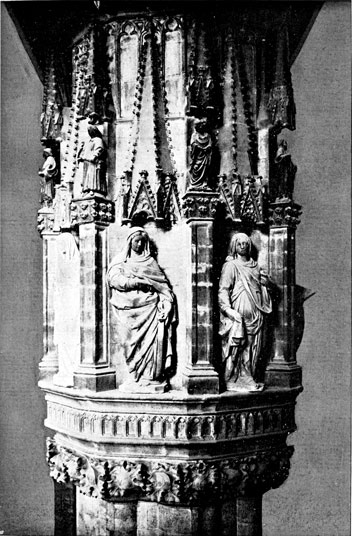
Capital in Milan Cathedral. Sculptured by Magister Bartolommeo da Campione.
See page 368.
Two months after this election, Duke Francesco Sforza
wrote a very commanding letter from the camp at Trignano,
saying, he recommended the nomination of Antonio da
Firenze (Filarete) and Giovanni da Solari, in place of
Filippino degli Argani. The latter was already at his post,
but the Council again defied the Duke by saying they had
no need of Filarete; on which the Duke retired from his
self-imposed office of adviser, and left the lodge to manage
its own business, which it always intended to do. Giovanni
da Solari being left in peace, carried on the works, and so
beautiful were they, that even to the Magistri themselves
the building seemed "more divine than human."
He was succeeded by his son, Magister Guiniforte,
whose name is sometimes misspelt Boniforte. He was "a
man of clear mind, exquisite sense and strong will; educated
amidst grand ideas and grand things by a wise and talented
father; he became Magister at twenty-two years of age,
and worked under his father." When he was thirty-seven,
he took Filarete's place, as chief architect of the Ospedale
Maggiore at Milan, a work almost perfect in its harmonious
beauty, and yet showing in every line its derivation from
the civil edifices of the older Lombards. He was also
architect at the Certosa, and built, or rather designed, the
churches of S. Satiro and the Madonna delle Grazie and
the castle of Alliate. Calvi says that Guiniforte, "though
following the older school, knew how to lighten the serious
northern style, by giving it the smile of Italian skies."
When Guiniforte died in 1481, his son, Pietro Antonio,
armed with a letter of recommendation from the Princess
Bona, presented himself at the lodge, as a candidate for
his father's position. The Freemason Council, however,
seemed determined not to bow to royal commands, and
again asserted its independence. Pietro was put off, and in
1489 he departed to Russia.[271]
During the years from 1468 to 1492, the books of the
lodge, preserved in the archives, abound in names of
Magistri from the neighbourhood of Como, both architects
and sculptors.[272]
Among them are some famous names, such as Martino
da Mantegazza, Dolcebono Rodari (sculptor of the
beautiful north door at Como), and Gerolamo della Porta,
who entered the lodge in May 1490, with a letter of
recommendation from the Duke, advising his being specially
trained in the art of sculpture. His talents warranting
this, he was sent to Rome with four other stone-sculptors,
to remain ten years, and perfect themselves in sculpture, to
study the antique, and to return to the laborerium as fully
qualified masters. There was also Bartolommeo da
Campione, who carved some of the richly ornate capitals of
the columns. I suspect he was the man who became
famous in Venice.
The cathedral of Milan was now reaching completion.
There only remained the crucial question of the dome, and
with this the Masters now occupied themselves. Jacopo da
Campione had made a model which the Council of Administration
preserved in their rooms, together with a beautifully
made wooden model begun by Giovannino de' Grassi, and
finished on his death by his son, Salomone. These were
not adopted, for on Giovanni Solari's death in 1471, we
find the name of Bartolomeus de Gorgonzola, magister super
Tiburium. This was on September 26, 1472. The same
phrase is repeated in another entry on November 25, 1471,
where a payment is registered, made to Branda da Castiglione,
on account of the work he has to do at Gandolia, in
making certain columns to place above the Tiburio.
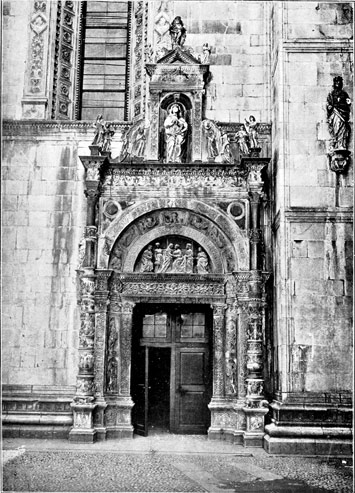
North Door of Como Cathedral. Sculptured by Tommaso Rodari.
See page 368.
The difficult work was suspended on the assassination
of Duke Galeazzo Maria, by reason of want of funds.
On the restoration of Gian Galeazzo in 1482, the subject
was again under consideration, and in the absence of any
very eminent Masters at the moment—Guiniforte having
died in 1481—the Duke wrote to Strasburg to beg that
some architects might be spared from the works there. This
action is very suggestive of an affinity between the German
and Italian Masonic Lodges. No one could be spared from
Strasburg, but a certain Giovanni da Gratz came over with
a little squadron of Germans, and signed a contract to
superintend the "reparation and completion" of the Tiburio
of the Duomo. The conditions of the contract further
stated that when the cupola should be so far finished as to
allow of inspection, a committee of qualified Masters should
be elected to inspect it, and pronounce if the work were
good.[273]
The words "reparation and completion" would imply
that Guiniforte and Bartolommeo had already begun the
dome. The contract with John of Gratz is signed May
1482, and it would appear not to have been of long duration,
no payments being made to him after February
1486, and on January 26, 1488, the annals of the Duomo
show the following entry—"To Maestro Antonio da
Padernò in recompense for his labours during the past year
in verifying the errors committed by Maestro Giovanni da
Gratz, etc...." Like his forerunner Heinrich da Gmunden,
John of Gratz had to retire from the Milanese Lodge; his
name is no more found in the books, and the Council began
to search for a capo maestro nearer home. Magister Luca
Paperio Fancelli was called from Florence to examine some
designs which had been sent in. The one chosen was by
Leonardo of Florence (Da Vinci), who was paid in anticipation
L.56, and a Maestro in legname was assigned
as his assistant, named Bernardino da Abbiate. He
probably was to superintend the scaffolding, and Da Vinci
the building. However, the engagement fell through, and
the Duke of Milan wrote to the Pope, the King of Sicily,
and the rulers of Venice and Florence to find an architect
for that puzzling cupola. Two Germans, one named
Lorenzo, and one a monk, John Mayer, were successively
refused. At length, in 1490, the Council finally commissioned
Maestro Giovan Antonio Amadeo and Maestro Gio.
Giacomo Dolcebuono as joint architects "to finish the
cupola and the church." They were to choose the model
which pleased them best of those preserved in the Administration,
and the one they selected was to be examined
for approval by Maestro Francesco di Giorgio, then living
at Siena, and by Maestro Luca of Florence (Fancelli), then
residing at Mantua, two experts who were by the Council
elected as judges and examiners of the perfection of the
model.
A great meeting of the Magistri of the lodge, and the
patron of the city, presided over by the Duke himself, met
on June 27, to examine the several models, but none were
chosen; and Amadeo and Dolcebuono were ordered to
make a revised model, with the concurrence of Francesco
Giorgio. The two former were then confirmed as joint
architects, "to compose and ordinate"—as the Verbale
quaintly puts it—"all the parts needful to constitute the
said Tiburio, which must be beautiful, worthy, and eternal,"
if indeed earthly things can be eternal.
Francesco di Giorgio departed laden with presents and
payments, and with the honorary title of architect of the
Duomo of Milan; and on September 9, the two others
began their work, which they brought to a happy conclusion
on September 24, 1500.
The façade was, however, not completed. Indeed, the
registers show that the insignia of the Comacine Masters,
the marble lions which were destined for the great door,
were in 1489 still in deposit in the laborerium.
Dolcebuono died in 1506; and Andrea Fusina was
elected in his place. The famous sculptor, Cristoforo
Gobbo, entered the works in 1502, on the compact that
he was not to be under the orders of other architects, but
to make his own contracts. He executed much of the
sculptural ornamentation of the cupola; such as the Doctors
of the Church in medallions; while a master Andrea da
Corcano, with other "brethren," did the pictures. Cristoforo
also carved the famous statues of Adam and Eve on
the façade, besides several other statues. He and Fusina
being compatriots, fraternized, and opposed Amadeo, who
had made a too daring design for the lantern on the cupola.
Meetings after meetings were held, and at length Gobbo
retired temporarily to pursue his sculpture in Rome and
Venice, where he is entered as Cristoforo da Milano. His
nephew, Michele da Merate, and Michele's son Paolo, both
sculptors, worked with him at Milan, where he continued
till his death, in 1527.
Another long list of names from the books, given
between 1500 and 1550 by Merzario, proves that the
Comacines still reigned supreme in the laborerium, the
Solari family preponderating.
As if to connect the last link in the chain with the first,
we find the old family of Bono da Campione still prominent.
For nearly thirty years, i.e. between 1618 and 1647,
Magister Gian Giacomo Bono da Campione sculptured in
the laborerium of the Duomo, and there his son Francesco
was trained, besides two kinsmen—Carlo Antonio Bono,
painter and sculptor, and his son, Giuseppe. All this family
worked together in the seventeenth century at the façade of
the cathedral, designed by Pellegrini. The fine central door
was the work of Gian Giacomo Bono and Andrea Castelli,
both Comacines by birth.
As for the names of other Comacines who worked at
the façade and on the wondrous roof, one finds them by
hundreds in the annals of the Duomo, as collected by
Giulini in his Memorie della Città e Campagna di Milano.
Here you see names repeated which have been familiar in
the guild for centuries; such as the Bono and Solari
families, and Luca Beltrami, who worked at the façade in
the seventeenth century, and whose ancestors were architects
at Modena and Parma two hundred years earlier.
II.—The Certosa of Pavia
MAGISTRI AT THE CERTOSA OF PAVIA
| 1. |
1396 |
Magister Bernardo da Venezia |
|
These two were the first architects.
C.M. for the actual building. |
| 2. |
" |
M. Jacopo da Campione |
|
C.M. at Milan to visit and superintend. |
| |
|
|
|
| 3. |
" |
M. Giovanni da Grassi (Graci) |
|
Two of the Duke's architects
from Milan, who were also
called into council on the first plans. |
| 4. |
" |
M. Marco da Carona |
|
| 5. |
" |
M. Cristoforo da Lonigo |
Drew a design for the church
of the convent. |
| 6. |
" |
M. Domenico Bossi da Campione |
Assisted in laying the
foundations. |
| 7. |
" |
M. Giovanni da Campione (called Bosio) |
Sculptured slabs for three
reliquaries. |
| 8. |
1397 |
M. Antonio di Marco |
Son of Marco Carona da
Campione: C.M. of Milan; called
from Crema to be C.M. instead
of M. Bernardo. |
| 9. |
|
M. Giovanni Solari of Campione |
|
Two brothers left in charge
when Antonio returned to
Crema. Giovanni was C.M. till
1400. Giovanni was the father
of the celebrated Guiniforte,
C.M. of Milan. The Lombardi
of Venice were descendants of
this family. |
| 10. |
|
M. Francesco Solari of Campione |
|
| |
|
|
|
| 11. |
1428 |
M. Rodari da Castello |
|
Ancestor of Tommaso di Rodari,
who sculptured the Renaissance
door at Como.
All three were paid for
sculptures in 1428 and 1429. |
| 12. |
" |
M. Giovanni da Garvagnate |
|
| 13. |
" |
M. Giovanni da Como
|
|
| |
|
|
|
| 14. |
1429 |
M. Antonio di Val di Lugano |
|
Employed as builders. |
| 15. |
|
M. Giovanni di Val di Lugano |
|
| 16. |
|
M. Jacopo Fusina |
Frequently mentioned in the
books of the Fabbrica. |
| 17. |
1460 |
M. Guiniforte Solari |
C.M. in place of his father
Giovanni; designed the façade. |
| 18. |
|
M. Gio. Antonio Amadeo |
Pupil of Guiniforte; carved the
door between the church and
cloister. He became famous
afterwards in Venice, and
sculptured the Colleone
monument at Bergamo. |
| 19. |
|
M. Cristoforo Mantegazza |
|
Came to the Certosa from
their apprenticeship to
Jacopo da Tradate at Milan.
Sculptured in the façade of
the Certosa on Guiniforte's
plans. |
| 20. |
|
M. Antonio Mantegazza |
|
| |
|
|
|
| 21. |
1478 |
M. Giovanni, junior, da Campione |
|
Assisted in the sculptures. |
| 22. |
|
M. Luchino di Cernuscolo |
|
| 23. |
1495 |
M. Cristoforo Solario (Gobbo) |
C.M. at the Certosa. C.M. at
Milan in 1506. |
Whatever were the faults of Gian Galeazzo Visconti,
the world has one great and beautiful legacy to thank him
for—the Certosa of Pavia.
It is said that Stefano Maconi, prior of the Certosa at
Garignano, suggested to the Duke the building of the
finest monastery in Italy; but the funds were certainly
provided by Gian Galeazzo, who took a personal and
untiring interest in the work.
The first documental proof of this is a deed of gift,
dated April 15, 1396, whereby Gian Galeazzo gives to the
monastery of the Certosa, landed property to the annual
value of 2500 gold florins. On October 6 of the same
year, he makes another endowment of property, yielding
5500 gold florins a year, besides an annual subsidy of
10,000 florins from his own private purse.
The history of this beautiful building is much connected
with that of Milan cathedral; the same architects—or
rather brethren of the same Masonic Lodge—worked at
both; and at one time Jacopo da Campione was capo
maestro of both works at once, spending a certain proportion
of his time at both.
Heinrich of Gmunden has had a good deal of credit for
this building; so much so that a certain bust, said to be
his likeness, was kept in the sacristy of the Certosa;
and on the strength of that bust, the Germans erected a
statue to him in Gmunden. But as he left Italy in July
1392, dismissed from Milan after a few months there, it is
not probable that he could have designed the Certosa in
1396. Count Giulini was the first to draw attention to
this error; and a learned archivist, Girolamo L. Calvi,
had the good luck to discover in the archives of S. Fedele,
the ancient register of the Administration of the building of
the Certosa for the year 1396, which settles the matter
completely. The master builder was Bernardo da Venezia,
and Jacopo da Campione worked with him as designing
architect and superintendent. On the official verification
of this precious MS. on April 16, 1862, the bust of
Heinrich da Gmunden disappeared from the sacristy of the
Certosa.
As a proof that the Magistri mentioned were both
employed, we will translate a few of the entries of the
Provveditore of the Certosa.
"1396. July 26.—In the presence of Pietro Barboti,
official of the Administration, Berto Cordono, cordmaker,
was paid for 138 lbs. of strong cord, for use in the designing
and building of the church and cloister. The cord
was consigned in June, at the order of Maestro Bernardo
da Venezia, architect of the said laborerium" (Inzignerium
dicti laborerii).
"1396. August 14."—(This should, I think, be September
14). After registering several payments of wages
to workmen who excavated the foundations, it is written—"Also
the above-named Jacopo da Campione, for his superintendence
of the works (tantum qui perseveravit superdictis
laboreriis), together with the Duke's architects during
fourteen days (i.e. the last days of August and the first two
of the present September), at the rate of eight imperial
soldi a day, as he had to find his own food."
"1396.—The Magistri Jacopo da Campione, Giovannino
de Grassi, and Marco da Carona, architects, came from
Milan to inspect, order, and build in the aforenamed works"
(causa videndi ordinandi et hedificandi). The two latter
must have been the Duke's architects spoken of before.
All through August and September Jacopo da Campione
was backwards and forwards between Milan and Pavia,
and Maestro Bernardo also received his salary monthly as
chief architect.
Again, on November 22, 1396, we read—"To Master
Jacopo da Campione, architect of Milan cathedral (inzignerio
ecclesiæ majoris Mediolani), for fourteen days
during October and November, in which he remained
working and superintending in the said laborerium (Certosa)
at his own expense, and in payment for some designs
made by him at Milan, and submitted to the Duke's
approval here."
On December 4, 1396, the Provveditore notes the purchase
of twenty sheets of parchment, most of which were
consigned to the Magistri Jacopo da Campione and Cristoforo
da Lonigo for the designs of the church. From these
entries, it would seem that Jacopo was the architect who
drew the designs, and Bernardo da Venezia the master
builder who executed them. As a farther proof, there is
the deliberation of the Administration of Milan, on March
4, 1397, to which we have already referred, in which it says
that Jacopo was in command of the works at Certosa (qui
acceptatus est super laboreria Carthusiæ).
Other Campionese names also appear in the registers;
such as Domenico Bossi da Campione, who was paid "for
four marble slabs, with certain inscriptions, which were
placed under the foundations when the Visconti laid the
first stone on August 27, 1396;" and "Giovanni da
Campione, called Bosio, for three sculptured marble slabs
for three reliquaries."
In 1397, Gian Galeazzo, being taken up with affairs of
state, ceded the presidency of the Administration of the
Certosa Lodge to the Prior of the Carthusians, adding more
donations and an endowment. The Prior's first actions
were to dismiss Bernardo da Venezia as master builder,
and to call Antonio di Marco from Crema. He was son of
Marco da Campione, one of the chief architects of Milan
cathedral, and brother of Guglielmo di Marco, whom we
have also found at Milan in 1387, where he was called as
an expert to give judgment on some moot point.
When Antonio entered office, the monastery had twenty-four
cells already inhabited by as many monks, under their
Abbot, Father Bartolommeo of Ravenna. As soon as the
contract was signed, it appears that Antonio returned to
Crema, leaving Giovanni Solari da Campione, father of
Guiniforte, and Francesco Solari, in charge. In the payments
made to Giovanni as chief architect, we find his name
written in different ways. In one, "Magister Johanni de
Campilioni Ingenerio fabrice Monasterii LXVI." In
another, "Magister Johanni di Solerio Inzignero super
laboreriis fabrice Monasterii die XIV Maij, pro suo salario
LXVI;" sometimes he is merely written as "Johanni
Inzegnero."
These payments go on for at least four years, during
which time Antonio di Marco seems to have had little to
do with the building. Sometimes Giovanni Solari even
does the commercial business. In 1429, the register notes
4 lire, 5 soldi paid to him for his expenses in going to
Milan and Pavia, on business connected with the building,
and in the same year he pays six Masters who come from
Milan to Certosa, when there was a competition for some
sculptures in marble for the monastery.[274] The sculptors
working under him were mostly his compatriots. Here are
Maestri Rodari da Castello, Giovanni da Garvagnate, and
Giovanni da Como paid for sculptural works in 1428 and
1429; also Maestro Antonio and Maestro Giovanni di Val
di Lugano, employed as builders (rattione edificiorum
novorum).
There are also frequent mentions of Jacopo Fusina, and
the two Solari, who form such a link between Milan and
Venice. The Solari were the stock from which came the
famous line of Lombardi, who may be almost called the
makers of Venice.
To this little group of architects we owe the exquisite
cloister of the Certosa, with its labyrinth of fairy white
marble columns, and the ruddy beauty of ornamentation on
terra-cotta arches. Our illustration shows the beauty of
Campionese work at this era.
Giovanni Solari of Campione, who is said in this work
to have inaugurated the beautiful terra-cotta architecture of
Lombardy, appears to have held office as chief architect up
to nearly 1460, when his son Guiniforte succeeded him.
Under Guiniforte, Gio. Antonio Amadeo, or Omodeo,
entered his novitiate. When, in 1466, he reached the age
of nineteen, he was already engaged at the Certosa as a
sculptor. A deed drawn up by the notary Gabbi, on
October 10, 1469, shows that the Administration lent him
certain blocks of marble, for which he was to pay their
equivalent in work; the payment he made was the beautiful
door leading from the church into the cloister, still known
as "the door of Amadeo." It is exquisitely decorated in
Bramantesque style; reliefs of angels and foliage surround
the door; and in the tympanum is a fine relief of the
Virgin and Child. He, too, became famous in Venice, as
did the two brothers Cristoforo and Antonio Mantegazza,
who had just been trained under Jacopo da Tradate at
Milan. Indeed, the network of this marvellous company
of sculptor-builders is at this epoch interwoven in a most
complicated manner between Milan, Certosa, Como, Monza,
and Venice.
The façade of the Certosa forms precisely the same
discord with the body of the building that the façade of
Milan does, but here the Renaissance face is so rich and
gorgeous that one almost forgives the discord. It has
been attributed to Bramante of Urbino, whose name never
appears in the books; to Bernardo of Venice, who died
long before it was begun; and to Borgognone the painter,
who was only invited to the Certosa by the Prior in 1490,
when the façade was well begun.
Sig. Merzario, with his documental evidence,[275] proves
that Guiniforte di Solario certainly designed it, and for the
most part superintended its execution. On January 14,
1473, the notary Gabbi registered a contract between the
Prior of the Certosa and the Administration of the Milan
Lodge, for the furnishing of 200 cwts. of white marble of
Gandoglia, annually, for ten years, to serve for the façade
of the Certosa church. On October 7, 1473, the same
notary makes the contract, by which the brothers Cristoforo
and Antonio Mantegazza are commissioned to erect all
the façade, according to the plans given them by the
monastery.[276]
This contract very much offended Gio. Antonio Amadeo,
who had gone to Bergamo to make a monument for the
Colleoni family, and he appealed to the Colleoni, and also
to the Duke of Milan, to enforce his claims on the work,
which were so far recognized that he was engaged to do
half the work, at a price to be estimated, receiving a podere
(vineyard) in part payment.
Another act of notary, dated October 12, 1478, records
the ceremony of valuing several works of sculpture, by
Amadeo and the brothers Mantegazza, by two Masters of
the guild, Giovanni, junior, da Campione, and Luchino of
Cernuscolo, which took place in the presence of the Prior
and the chief architect, Guiniforte Solari;—a proof that
Solari was still the capo maestro. He died early in
January 1481, and on the 13th of the same month,
Duke Gian Galeazzo Sforza wrote to the "Dominis Priori
et monacis Carthusie Papiensis," to recommend his son,
"Pietro Antonio (suo figliuolo peritissimo de la medesima
arte et de divino ingenio"), as a worthy successor to his
father as chief architect. Antonio Mantegazza succeeded
him, but he, too, died in 1495, and Cristoforo Solario,
named Gobbo, who had worked with him, became architect
in his turn. His election was on October 11, 1495, by the
recommendation of Ludovico il Moro. Gobbo, however,
did not long remain in office, for in 1497 we find him
employed at the Duomo of Milan, and the sepulchre of
Beatrice d'Este, at the church of the Grazie there. In 1506
he became head architect at Milan.
In 1499, a letter from B. Calco, dated May 1, declares
that the works at the Certosa are nearly finished (sarà
presto presso el fine).[277]
The church had already been opened for service since
May 1497, when the Cardinal di S. Croce came in state to
consecrate it, and a grand refection was offered him. The
documents cited by Sig. Merzario are certainly conclusive
as to the epoch and authorship of both the convent and the
church.
We must not leave the Lombard Lodge without a
mention of one of its principal Masters, Matteo da Campione,
who was architect for the fourteenth-century restoration of
the cathedral at Monza, which his forerunners of the guild
had built for Queen Theodolinda. He is spoken of in the
registers at Milan, when he attended a general meeting of
the guild there on January 6, 1390, as Matteo da Campione
"inzignero in Monza," and again on July 10, 1390, when,
on the death of Marco da Campione, it was deliberated in
council to send for Maestro Matteo from Monza, and see
whether he would take Marco's place in the works. He
was, like almost all the Comacines, a sculptor as well as
architect. The baptismal font at Monza, which was once
noted for its beauty, is now ruined and mutilated. The
pulpit and the sculptures on the façade of Monza cathedral
are attributed to Matteo's own hand. The pulpit is a fine
piece of sculpture in white marble. It was originally
square, but has been altered in form during the last century.
Fourteen figures, the twelve apostles with St. Paul and
Barnabas, are sculptured around it, and there are many
small reliefs. It has a prominent part in the front, called
by the Italians the pulpitino, or little pulpit. On this are
sculptured the Redeemer with a book, and a thunderbolt
in His hands, and the four Evangelists. The façade is a
curious instance of the transition of Comacine art, between
the Romanesque and the Gothic. The door is very much
like those of Verona and other Comacine churches of the
same era. Matteo has put his lions in front of the pillars
of the porch, instead of beneath them. The mixture of
style shows more in the windows. The four lower windows
are distinctly Gothic, with pointed arches, three lights, and
Gothic tracery; the upper ones are round-arched Lombard
two-light windows, the archlets of which are a little cusped.
The lines of the façade are quite Lombard, the internal
divisions being marked on the front by pilasters running
the whole height. The Lombard gallery is indicated like
a memory of past time by a row of archlets beneath the
eaves, but they rest on nothing, and are of no practical use
as their prototypes were. Probably, as the interior was not
rebuilt, Matteo da Campione so far respected the work of
his older brethren, as to adapt his façade to the rest of the
building. Over the portico is a fine rose window, and
above that a row of saints in niches; the space between
them is filled with geometrical sculpture. He has used the
ancient sculpture of "Agilulf and Theodolinda" in the
lunette of the doorway. Its style is much earlier than the
figures above. Matteo was buried in the church, and on
his tomb is the inscription—"Hic jacet magnus ille ædificator
devotus magister Mattheus de Campiliono, qui hujus
sacrosanctæ Ecclesiæ fatiem ædificavit evangelistarium ac
battisterium qui obiit anno Domini MCCCLXXXXVI die
XXIV mensio maii." It is said that he has sculptured his
own likeness in the rigid and thoughtful figure of the saint
near the turret, over the rose window.
Another work which we have seen commenced by
earlier Comacines was the cathedral of Como. That too
was restored and redecorated by Comacines about this time.
The old church had been ruined in the wars between Como
and Milan, and in 1335, Azzo Visconti, building his fortresses
at Como, ran his walls close round the church, cutting it off
from the town. In 1386, however, the Bishop of Como persuaded
Gian Galeazzo to transpose his fort and open the
church again to the people. In gratitude for this, the people
proposed to restore their church, and Gian Galeazzo
promised his aid. The work was begun in 1396 and went
on till 1513. Authors disagree as to whether the church
were renovated, i.e. restored, or rebuilt. Whichever it was,
there is no doubt that the whole façade was executed in
the fifteenth century. The north door is of rich ornate
Renaissance style, and much later than that on the façade,
although the lions are still under the columns. The façade
follows in its lines the old Lombard form, but the dividing
pilasters here are lavishly enriched. They are in fact but
a perpendicular line of niches with a statue in each. The
three doorways are round-arched, the windows above them
slightly pointed. Over the central door is a Gothic vestibule
with saints in its canopied arches.
The first architect of the restoration is indicated in the
register of the Milan Lodge, where on April 30, 1396,
Magister Lorenzo degli Spazi de Laino in Val d'Intelvi is
allowed to leave the works at Milan to be chief architect at
Como, "deliberarunt quod licentietur Magister Laurentius
de Spatiis ad eundum Cumas pro laborerio Ecclesie majoris
civitatis Cumarum ad requisitionem comunis et hominum
dicte civitatis Cumarum." He had not long entered on
office when Gian Galeazzo died, and Como was again
involved in a fight for freedom with Malatesta and the
Visconti. In 1416 the Como people had to swear allegiance
to Milan, and then Duke Filippo Maria Visconti allowed
the works to go on. On February 19, 1439, Pietro da
Bregia near Como was elected master architect, and he
continued Lorenzo de Spazi's work. He changed the plan
so as to bring the façade in a line with the Broletta and
tower of the fortress, which altogether made an imposing
mass of buildings; very interesting as displaying at once the
Comacine work in civil, military, and ecclesiastical architecture.
The Broletta is a particularly good specimen of
their civil architecture, of about A.D. 1000, though it loses
in proportion owing to the filling up of the lower level on
which it was built, so that the bases of the columns are
completely buried.
THE VENETIAN LODGE OF THE FIFTEENTH CENTURY
| 1. |
1407 |
Mistro Lorenzo da Vielino |
Gastaldo or Grand Master. |
| 2. |
1423 |
M. Scipione Buono |
Built the Loggia near the
Rialto. |
| 3. |
1430 |
M. Zambono (Giovanni Buono) |
Architect of Ca d'Oro, and
sculptor of capitals in the
Ducal Palace. |
| 4. |
|
M. Bartolommeo Buono |
|
His sons who worked with
him in the Ducal Palace up
to 1463. |
| 5. |
|
M. Pantaleone Buono |
| 6. |
1441 |
M. Elia da Bissone |
Sculptured the door to the
Fraternità dei Calzolai. |
| 7. |
1442 |
M. Cristoforo da Milano |
Built the tower at Udine. |
| 8. |
1448 |
M. Giorgio da Como |
|
| 9. |
1449 |
M. Lorenzo q. Martino da Lugano |
|
All Lombard Masters who
received pay in the Venetian
Lodge for work in the Ducal
Palace. |
| 10. |
|
M. Giovanni da Marco |
| 11. |
|
M. Anicino Lombardi |
| 12. |
|
M. Luchino Lombardi |
| |
|
|
|
| 13. |
1482 |
M. Antonio da Modena |
|
The Council of Administration
when the Masonic Lodge was
built at S. Samuele. |
| 14. |
|
M. Andrea d'Acre |
| 15. |
|
M. Antonio Negro |
| 16. |
|
M. Bonazza |
| 17. |
1476 to 1488 |
M. Martino Solari da Carona |
Father of the famous Pietro
Lombardi, Proto (chief
architect). He designed the
Scuolo di S. Marco. |
| 18. |
1488 |
M. Moro Lombardo |
Son and assistant of Martino
Solari. Proto of S. Zaccaria
in 1488. Bernardino and
Francesco (No. 20 and No. 21)
were his son and grandson. |
| 19. |
1484 to 1491 |
M. Antonio Riccio |
Proto of the lodge from
1484 to 1491. He carved the
Adam and Eve.
|
| 20. |
|
M. Bernardino da Bissone |
Son of No. 18. He assisted
Riccio in the sculptures of
the Cortile. |
| 21. |
|
M. Francesco, his son |
|
| 22. |
|
M. Domenico Solari |
|
| 23. |
|
M. Paolo Bregno |
|
Sculptor-architects related
to Antonio Riccio or Rizo. |
| 24. |
|
M. Lorenzo Bregno, his
son |
| 25. |
|
M. Bartolommeo Gonella |
Proto till 1505. He came
from Milan. |
| 26. |
1505 |
M. Bartolommeo Buono (descendant of No. 4) |
Succeeded him. He built the
upper part of the Procuratie
Vecchie, and the church of
San Rocco. |
| 27. |
1509 |
M. Manfred de Polo |
Grand Master. |
| 28. |
1516 |
M. Pietro Lombardo, son of Martino Solari |
Founder of the Venetian branch
of the Lombardi. He designed
the Scuola di San Rocco. |
| 29. |
1517 |
M. Giulio Lombardo |
|
His sons.
Worked under their father,
and all became famous. |
| 30. |
" |
M. Tullio Lombardo |
| 31. |
" |
M. Antonio Lombardo |
| 32. |
" |
M. Giovanni Fontana |
A descendant of M. Fontana da
Campione. He was master of
Palladio, and built the Palace
of the Commune at Udine. His
family became famous at Rome
and Naples. |
| 33. |
1524 |
M. Sante di Giulio |
Built Scuola di San Rocco. |
| 34. |
|
Mistro Matteo Fontana di Melide |
Architect of Belluno
cathedral. |
| 35. |
1529 |
M. Jacopo Sansovino |
Proto for the Procuratie
Vecchie; he came from the
Florentine Lodge. |
| 36. |
" |
M. Guglielmo da Alzano |
Carved some fine altars,
and built the Tasca and
Camerlinghi palaces. |
| 37. |
" |
M. Gregorio da Carona |
|
Two brothers descended from
Marco da Carona of Milan.
They also worked at Udine. |
| 38. |
" |
M. Giorgio da Carona |
| 39. |
" |
M. Simeone di Petro di Como |
Was paid for sculpture done
in this year. |
| 40. |
1530 |
M. Donato Busata |
|
Master architects, sons of
Ser Piero da Campione. |
| 41. |
|
M. Giovanni Busata |
| 42. |
1527 to 1534 |
Jacopo Sansovino |
Called from the Florentine
Lodge to be Proto of the
Venetian one. |
| 43. |
1548 |
Gian Antonio Solari, of Carona |
Finished the church of S.
Giorgio. |
The connection of the Comacines of Longobardic times
with Venice, through the powerful Lombard Dukes of
Friuli, and the Patriarchs of Aquileja, their metropolitan
bishops, has already been touched upon; and we have
mentioned the Patriarch Fortunatus for whom the Masonic
Guild built the churches of Grado and Torcello. The
Comacines had, in the eighth century, also built the
Baptistery of Calixtus at Cividale, and had sculptured the
altar of Duke Pemmo in Friuli; in the twelfth century they
rebuilt the Duomo of Cividale for the Patriarch Pellegrino....
This connection was still further strengthened, when
in 1311 the Visconti conquered and exiled from Milan
the Torriani family, their rivals in the Signory there, who
retired to Friuli, where they soon acquired supreme power.
Two of the family, Raimondo and Pagano della Torre, had
previously been successively Patriarchs of Aquileja, and in
1317, Gastone, the exiled Archbishop of Milan, succeeded
Pagano. A second Pagano and a Ludovico Torriani
followed him. The Torriani were from Valsassina near
Como, and would consequently have had more interest in
the Comacine Guild than any other, if other there were;
in fact the tombs of the Torriani at Primaluna and at
Chiaravalle show unmistakable signs of Comacine work.
At Sacile in the Friuli district the ancient church with three
naves, built in 1400, can show documents proving its architects
to have been Beltramo and Antonio, both of Como, and
who form a link with the Roman Lodge. The church of
Gemona, on the mountains near Tagliamento, was built by
Giovanni Bono, another familiar Comacine name. The
choir is in transition style, i.e. semi-Gothic. The two
aisles are divided from the nave by a grand colonnade.
The façade is of the style of Siena and Orvieto, with cusped
arches under triangular gables; it has a large finely-traceried
rose window in the centre, and a profusion of statues. At
Venzone, also near Tagliamento, is an ancient Lombard
church with characteristic sculptures, built in 1200. Here
is a holy water vase of a later period, of extremely fine and
finished sculpture, signed Bernardino da Bissone, 1500.
Bernardino also sculptured another holy water vase in the
Duomo of Tolmezzo, and the beautiful door of the church
of Tricesimo. All these works prove the close connection
of our guild with the Patriarchs, who ruled over Venice as
well as Friuli.
Even in 1468, when the Duomo of Cividale was restored
by Pietro Lombardo, several of his brethren worked with
him.
In 1420, the Venetians, led by Roberto Morosini, took
Friuli and annexed it to Venice. By the treaty of Lodi in
1454 they added Bergamo, Brescia, and Crema. Many
Lombards flocked to Venice at that time, and the Masonic
Guild had its schools and laborerium there. From that date
the Masters of the guild were known in Venice as "Mistri
(Masters) Lombardi." Merzario dates from this epoch the
renewed connection of the Comacine Guild with Venice,
but it must have begun much earlier than that, if it had not
continued unbroken from Lombard times. A lodge must
certainly have existed in Venice from the time when the
first Maestro Buono (Vasari's Buono) went there in 1150.
It is unlucky for history that the original Freemasons, being
a secret society, kept no archives. It is only after the twelfth
century, when other art guilds were formed on the same
system, but without the secrecy, that we get an insight
into what had been, all the ages through, the management
of the guild. At Siena, as we have seen, the painters
seceded in the thirteenth century from the universal brotherhood,
and founded their academy of painters, the sculptors
following their lead. They, not being bound to secrecy,
let the world know their statutes and their customs.
The same thing took place in Venice. On September
15, 1307, the sculptors appealed to the Signory of Venice
for permission to form statutes and hold chapters under
the denomination of the Arte de tajapiere (stone-cutters).
They were not at liberty to form a Masonic or building
guild, because the original one had then the monopoly.
Sig. Agostino Sagredo,[278] in his valuable work on the building
guilds in Venice, says—"While we are speaking of
the Masonic Companies and their jealous secrecy, we
must not forget the most grand and potent guild of the
Middle Ages—that of the Freemasons. Originating most
probably from the builders of Como (Magistri Comacini)
it spread beyond the Alps; Popes gave them their benediction,
monarchs protected them, and the most powerful
thought it an honour to be inscribed in their ranks. They,
with the utmost jealousy, practised all the arts connected
with building, and by severe laws and penalties (perhaps
also with bloodshed) prohibited others from the practice
of building important edifices. Long and hard were the
initiations to aspirants, mysterious were the meetings and
the teaching, and to ennoble themselves they dated their
origin from Solomon's Temple." This monopoly would
account for none of the Communes having a civic guild of
architecture; and their secrecy explains the want of documentary
evidence in the earlier centuries, while the
monopoly was undisputed.
The new local branches of the fourteenth and fifteenth
centuries were evidently absolved from secrecy; they started
fresh as independent companies, and thus freed, art was
able to expand more largely. With this light on its
formation, it is interesting to find in the Venetian Guild
of sculptors, organized in 1307, the self-same rules and
government as in Siena, and all the other cities. We find
the school and laborerium and the usual Administrative
Council of four Soprastanti elected on the first Sunday of
every month, the outgoing officials having to instruct the
new ones. In Venice the Grand Master of the Lodge was
called, as in the ancient Lombard Lodges, Gastaldo; the
chief architect of a work was designated in more classic
language, Proto.
On the third Sunday of the month every Master of the
arte was obliged to pay a gold soldo to the company, which
money was only to be spent for the use of the school.
Again a marked similarity. At the beginning of
November the feast of the Quattro Coronati was kept,[279] and
no one was to work on that day under pain of a fine of
100 soldi. There is the usual rule about every Master
bringing a wax candle when he attends a meeting, and
on the day of the Patron Saints the candle must weigh
four ounces. The fines for those who absent themselves
from the fête of the Patron Saints are the same as at Siena,
and so also are the rules about matriculation of members,
the making of contracts, the introduction of foreign
Masters, etc.
The first name of a Gastaldo or Grand Master in the
Venetian Lodge is a Mistro Lorenzo de Vielino in 1407, who
makes a law that no Master shall have more than three
fanti scritti (apprentices?) besides his own sons or brothers.
Sagredo says that the Masters in all these arti were a
privileged aristocracy, whose sons were allowed to enter
the guild without the usual novitiate.
In 1509 Mistro Manfred de Polo was Grand Master, and
decreed a kind of census. Every Master was obliged within
eight days to hand in a list of his relatives in the guild and
the apprentices in his studio.
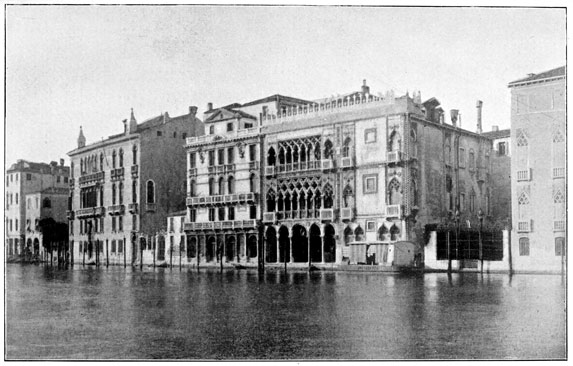
The Ca' D'oro, Venice. Designed by Magister Giovanni Buoni (Zambono) 1430 a.d.
See page 389.
The head-quarters of the lodge were in the little street
known as the Piscina di S. Samuele. The Opera was a
large building, not much decorated, but there was a fine
relief by one of the Lombard Masters over the door. This
was removed, and preserved by the Government when the
building, no longer needful for its former use, was sold.
The altar of the Quattro Coronati, sacred to the guild,
was in the church of S. Samuele close by. Here too
were the tombs of the brethren of the lodge. Unfortunately
none of the funereal inscriptions remain. Cicognara
has, however, preserved two inscriptions on the building
of the lodge, which are valuable as additional proof of
the guild. One beneath the relief on the façade runs—
MCCCLXXXII ADI XXV MARZO.
IN TEPO D(i)MA' ANTONIO DA MODON (Modena)
E SO COMPAGNI MA' ANTONIO NEGRO
E MA BONAZZA E MA' ANDRA (Andrea) D'ACRE.
E SCRIVAN MA' DOLZE (Dolce).
Here we get the names of the four members of the
ruling council in 1482, all Magistri, and that of the notary
of the guild, Maestro Dolce.[280] Another inscription on the
staircase, which was rebuilt in 1686, announces that the
stairs were built by the gifts of the brethren under the
Gastaldo Maestro Domenico Mazzoni, and then follow the
names of his three companions in office, one of whom is
Vincenzo Minella, and that of the notary.
If we now trace some works in Venice we shall see how
intimately connected this lodge was with that of Milan and
other branches of the guild. In 1430 we find Zambono
engaged to decorate the Ca d'Oro or Palazzo Contarini on
the Grand Canal. In his aim at magnificence good Giovanni
Bono of Como not only made the work a masterpiece
of Gothic ornamentation, but he gilded his sculpture
till it was refulgent. It appears that this Zambono, who
could not spell his own name, was not such a master of the
pen as he was of the chisel, for his son Bartolommeo signed
the contract for him on April 20, 1430. The gilding
was done by Giovanni da Francia, whose son Francesco
signed for him.
Bartolommeo Bono worked much with his father, and
later his younger brother Pantaleone joined them, and
became more famous than either of them. To these three
we owe in a great measure the reconstruction and decoration
of the Ducal Palace, which in the first place had been
built by Justinian and Narses. At the end of the tenth
century, the Doge Pietro Orseolo restored Justinian's
building. To this restoration belong probably some of the
fine mediæval capitals of the columns of the Loggia, of
which we have given an illustration on page 253. It has
been said that Marino Faliero, when Doge, engaged his
friend and fellow-conspirator Filippo Calendario to make a
plan for a new palace, but no proofs of this, nor any designs
are to be found.
Authentic documents, however, prove that a meeting of
the Grand Consiglio was held on September 27, 1422, in
which it was proposed to "rebuild the palace in a decorous
and convenient form." On April 20, 1424, the decree went
forth that the old walls were to be thrown down, and the
façade rebuilt. The first Masters mentioned in the books
are the three Buoni. A minute, dated September 6, 1463,
registers that the Salt Office should pay "Maistro Pantalon,"
sculptor, for the work done for the Ducal Palace—that this
work included many other works besides the figures; and
that it should not remain incomplete, the Doge wished it to
extend across the piazza and up to the last built Sala[281]—i.e.
the Sala del Squittinio. This would include all
the façade and its colonnades, with the internal Sala del
Squittinio and Scala Foscara leading to it, on which is
placed the statue of Francesco della Rovere.[282] The part of
Bartolommeo, brother of Pantaleone, was the Porta della
Carta, of which we speak in the chapter on decoration.
Their father Giovanni (Zambono) must have died about
the time the palace was finished, which was May 13, 1442,
for on November 25, 1443, Bartolommeo writes himself in
a notarial act as "Ego Bartolommeus lapiscida q. ser
Johannis Boni."
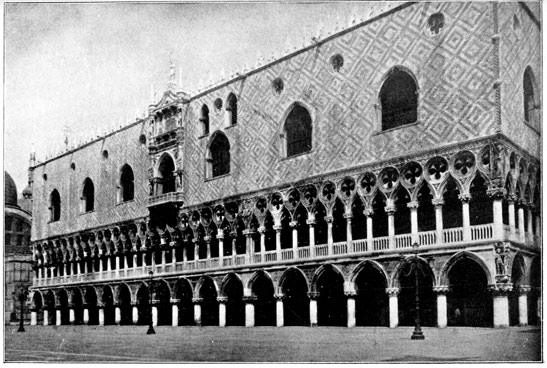
Ducal Palace at Venice. The side built by the Buoni Family.
See page 390.
Part of the palace was burned not many lustres after,
and in 1484, Antonio Rizo or Riccio was nominated Proto
for its rebuilding. He came to Venice with good recommendations.
He was the son of a deceased Magister
Giovanni Rizo, as we see in a deed of June 25, 1484, where
he is nominated as "Ser Antonius Rizo lapiscida q. ser
Joannis de contrata sancti Joannis Novi," and had been in
the East, where he built the fortifications of Scutari, for
Antonio Loredan. His fortifications resisted the attack
of the Turks so well that they had to raise the siege, and
Antonio, who was wounded, was rewarded by a pension for
himself and children, and by the appointment of chief
architect for the Ducal Palace, when it was restored after
the fire. It would seem that the façade built by the Buono
trio had not been injured, as Rizo turned his attention
to the inner court, which he built in a beautiful style,
together with the great staircase, now known as the
"Scala dei Giganti," from Sansovino's two giants, which
were added—not much to the grace of the stairway—in
1566.
Bernardino da Bissone, and Domenico Solari of Val
d'Intelvi, both Como Masters, assisted in the sculpture of
the beautiful balustrade. Riccio has the characteristic
Comacine mixture of round arches in the foundation, and
pointed ones above. He added a third colonnade, in which
the round arches again appear. It is all enriched by
exquisite sculptural decoration; the frieze of Nereids and
sea-horses on the third order is very fine.
Selvatico attributes also to Riccio much of the side of
the palace towards the prisons. The two statues of Adam
and Eve facing the Giant's Stairs are signed in the plinths,
one "Antonio," the other "Rizo." They are fine works of
sculpture, which have been wrongly attributed, in spite of
the signature, to various persons, such as Antonio Bregno,
and Andrea Riccio of Padua. A proof of Rizo's lengthened
tenure of the office of Proto is given in a document in the
Venetian archives quoted by Cadorin. The document,
dated October 10, 1491, is an order from the Magistrates
of the Salt Office, who were at the head of the Administration
of the works of the Ducal Palace, "to increase the
salary of Rizo Antonio, Proto of the building works, from
one hundred and fifty ducats to two hundred, as the former
salary was not enough to support his family in his old age,
and also having regard to his long and valuable services and
fatigues, and the necessity of retaining him, for the prosperity
and the beauty of the said building."[283]
Another document, quoted by Merzario from the Diary
of Marin Sanuto, seems to throw a cloud over the close of
Antonio's head membership. It seems that 10,000 ducats
were missing from the accounts of the works, and that
Antonio, being unable to explain it, sold all his possessions,
and shouldering his belongings went towards Ancona and
Foligno. This entry is dated April 5, 1498.[284]
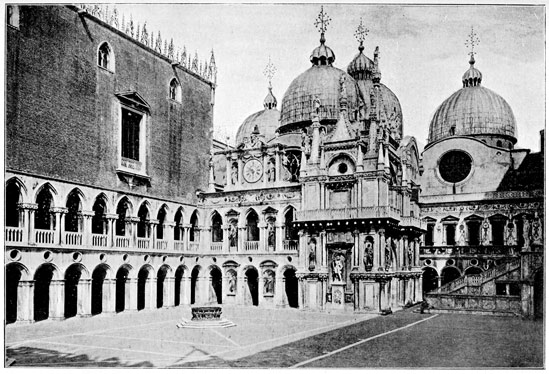
Court of the Ducal Palace at Venice. Designed by Magister Antonio Rizo or Riccio
See pages 391, 392.
It is difficult to say who is the Antonio Bregno that is
accredited with Rizo's works. There was a Lorenzo Bregno,
a sculptor to whom Sansovino attributes the statue of the
General Dionisio Naldo of Brisighella (died 1510), which is
placed above the door of San Giovanni e Paolo. There
was also Paolo Bregno, father of Lorenzo, but the name of
Antonio never appears in the books of the Administration,
nor in any archives as far as Sig. Merzario can judge after
a diligent search. As the Bregni were related to Rizo, it
seems probable that this is another misleading case of nicknames,
and that the chief architect's family name was
Bregno; so that Antonio Rizo was only Antonio Bregno,
the "curly-headed"—from riccio, a curl.[285]
After Riccio, a Magister Bartolommeo Gonella, who
died in 1505, succeeded as Proto, and then Magister
Buono succeeded him. Buono was probably a grandson of
the last Bartolommeo, son of "Zambono." This man, who
signs himself "Bartolomeus de Cumis lapizida," had been
a sea-captain, and sailed in the fleet of Melchiorre Trevisan.
On his return in 1498 he resumed his hereditary profession,
and in 1505 was nominated head of the building works of
St. Mark's, which were now occupying the guild. The
upper order of the "Vecchie Procuratie" was built under
his supervision. The church of San Rocco, built in 1495,
was, however, his first great work in Venice, and the next
was the restoration and heightening of the tower which
another of the Buono family had built in 1150, more than
three centuries earlier.
When in 1516 the erection of the "Scuola di San
Rocco" was proposed, Bartolommeo Buono, the head
architect of the "Vecchie Procuratie," was unanimously
elected. However, when he had drawn his design, and
the edifice began to rise, a certain knowing brother of the
confraternity (un tal saccente confratello d'essa) censured
the plan of the stairs, and the work was suspended.
Maestro Buono would not relinquish his design, and
retired; on which Pietro Lombardo was elected in his
place to continue the building. Here we have again a
distinct proof of the Masonic organization, and see that in
Venice they held their meetings to consider the work of
their brethren, just as they had done in Milan, Siena,
Florence, etc.
In 1529 Maestro Buono died, and Jacopo Sansovino
was nominated Proto of the Procuratie in his stead. One
of Buono's principal assistants was Guglielmo da Alzano,
near Bergamo.[286] He sculptured a beautiful altar in the
Servite church on the commission of Madonna Verde della
Scala. It is now removed to the church of SS. Giovanni
e Paolo. The great altar in the church of S. Salvadore is
also attributed to him. He was a famous builder as well
as sculptor, and was architect of the Camerlinghi Palace,
at the foot of the Rialto in Venice. The beautiful Tasca
palace at Portogruaro, of which the richly-sculptured
doorway was brought to Venice, was his design, as well as
the fine gate at Padua called the "Portello," and the
"Porta di S. Tomaso" in Treviso.
Several other more familiar Comacine names are found
in Venice, such as Gregorio and Giorgio of Carona, whom
we have seen sculpturing at Udine;[287] Bernardino di
Martino of Bissone, and Andrea from Milan. Francesco,
son of Bernardo of Como, Simeone of Pietro, sculptor from
Como, with Donato and Giovanni Busata, sons of Ser Piero
da Campione, are all mentioned in the Transactions of the
Guild in Venice about this time. A contract is reported in
the Archivio Veneto (vol. xxxi. anno 1886, fasc. lxii. p. 169),
signed on July 26, 1476, "between the Fraternity of S.
Maria in S. Daniele and Maestro Giorgio, sculptor of Como,
who, having made several statues for S. Giacomo in Udine,
is herewith commissioned to make three figures in stone
for the door of S. Maria in S. Daniele, i.e. a Madonna and
Child and two angels, the statues to be figures, that may
by any good Magister be judged worthy and beautiful."
Then comes a name which has become synonymous
with the beauty of Venice—the Lombardi family—to whom
are attributed all the principal late Gothic and Renaissance
buildings that enrich the city. As usual, the name by
which the family has come down to posterity in the histories
of art is nothing but a misleading nickname. The
Venetians called them the Lombards. Just as Vannucchi
is called Perugino, and Allegri is called Correggio, so the
Solari family were known as Lombardi. They were among
the aristocrats of the guild, however, whose ancestors
had been eminent men for more than a century. We have
seen Marco Solari, and his son Antonio, and also his
grandsons Cristoforo and Guiniforte, at work at Milan,
where Marco, Guiniforte, and Pietro Antonio were successively
chief architects. The Lombardi-Solari of Venice
appear to have been another branch of the family, equally
descended from Giovanni da Carona, through his son
Martino, the father of Pietro Lombardi (Peter of the
Lombards).[288]
Martino was the architect of the Scuola di San
Marco, near SS. Giovanni e Paolo. His name appears
before that time as "Mistro Martino tajapiera," when he
was, in 1476, sent to Istria to sbozzare the marbles for
the sculptures on S. Zaccaria, of which he was architect,
though his ancestor Antonio di Marco had begun it in 1458.
At the Scuola di San Marco, his son Moro, brother of
Pietro, assisted him, and on Martino's death Moro became
Proto of the works at San Zaccaria, his son Bernardino and
grandson Francesco assisting him. The books of the
Administration of that building have notes of payment,
in 1488, one "to Bernardo, sculptor, son of Moro
our Proto," and another executed on July 20, 1488, where
it is written, "And I Francesco di Bernardo, sculptor from
Como." Other papers prove the sons of Pietro Lombardo
as being Giulio, Antonio, and Tullio. In Tullio's sons two
old family names are revived—Marco Antonio and Sante.
To this family may be attributed a large part of the
finest fifteenth or sixteenth century buildings of Venice.
Pietro's elder brother Moro built the church of S. Michele
at Murano between 1478 and 1481; and at the same time
designed and directed the building of the Vendramin or
Loredan and the Corner Palaces. Moro had been before
employed by the Loredan family to build a part of the
church of S. Maria in Isola at their expense. No doubt he
was assisted by his numerous relations in the guild.
To Pietro Lombardo belongs the design for the fine
exterior of the Scuola di San Giovanni Evangelista. In
1475 he sculptured the beautiful monument to the Doge
Pietro Mocenigo, a grand design with seventeen life-sized
figures carved in Istrian marble. His sons Tullio and
Antonio assisted in this. In 1481 he restored the Scuola
della Misericordia, and finished the ornamental gate of the
Scuola dei Battuti. In the same year he won in a competition
for designs for the church of S. Maria de' Miracoli,
and became head architect of that masterpiece of Renaissance
architecture. Here he has curiously revived
some features of the old Lombard architecture of his
ancestors in art. He has made a raised tribune with a
dome, but it is square instead of semi-circular, and he has
placed two ambones or pulpits, as in the early churches.
Pietro could build in Gothic style as well as Renaissance,
as is shown in the cusped and pinnacled façade of S.
Cristofero della Pace at Murano. The original Torre
dell' Orologio on Piazza S. Marco was also designed by
him.
On March 14, 1499, he was nominated Proto maestro
of the Ducal Palace in place of Antonio Rizo. Seguso
and Selvatico attribute to him, with his sons and nephews,
the rich and beautifully sculptured capitals of the pillars
which support the lower arches "from the Court of the
Senators to the second part of the building"; and the
internal façade of the side towards St. Mark's, which
Selvatico pronounces one of the finest examples of Lombard
style. In the interior of the palace he restored the
"Camera del Tormento," and built the hall of the Council
of Ten, the prisons over the Granaries, and the attic
prisons known as "I Piombi."
As a sculptor he was of remarkable genius. Two
signed statues in the church of San Stefano, one of which
represents S. Antonio, are of extreme beauty, as is the
magnificent high relief of the Virgin and Child in the outer
arcade towards the bridge. The monument to Cardinal
Zeno in S. Marco is a beautiful specimen of Lombard
ornamentation. It is rich with carven angels and saints,
wreaths of flowers, and all possible wealth of sculpture.
In about 1490 Pietro was engaged on a great work of
architecture at Treviso, where the bishop had commissioned
him to improve the cathedral by putting a new and ornate
façade with a large window, besides building three new
chapels.[289] His sculpturesque tastes outweighed his talent
for architecture. He left the building at Treviso in the
hands of inferior Masters, and went to Venice to sculpture
in the laborerium of the guild at San Samuele, the statues
and reliefs for its façade. The work not proceeding
satisfactorily it was suspended, and on Pietro Lombardo's
death even his design was lost in some mysterious manner.
The church was not ultimately restored till two centuries later.
He had also the commission to restore the older church
of S. Maria Maggiore at Treviso, and there, too, having
made his design, he left his son Tullio to execute it.
Either for want of means, or disagreements among the
Masters, this also remained incomplete. Probably Pietro
had too many interests in Venice, where in 1514 he was
elected Gastaldo or Grand Master of the lodge; in
which office he continued till his death in 1521, a date
proved by his son Tullio taking out papers of administration
in that year. We have no particular mention of any
great buildings by Pietro's eldest son Giulio, but he was
greatly respected in the guild, for on June 3, 1524, the
Chapter of S. Roch, while deliberating that "Mistro Bon,"
i.e. Master Bartolommeo Bono, a famous architect, should
be discharged from the office of chief architect (Proto) of
the Scuola, because he is disobedient and not diligent
enough (we perceive that even a Proto had some
superior officers or council above him), elected as Proto in
his stead a young Magister Sante, son of Giulio Lombardo,
but with the proviso that his father Giulio should be his
adviser in everything.
Antonio, Pietro's second son, won a certain rank as
sculptor, but he is better known in Padua and Ferrara. He
removed to the latter city in 1505 with his family, and died
there in 1515.
The third son, Tullio, however, was a bright star in the
line. His sculpture was so delicate, and he attained such
tenderness in the flesh of his marble statues, that it is
thought he had studied under Donatello when he was in
Padua in 1450. His decorative sculpture may be judged
by the chimney-pieces in the chamber of Udienza, with its
antechamber, in the Grand Ducal Palace; by the doors of
the Scuola di S. Marco, and the church of SS. Giovanni e
Paolo, all done about 1500. The beauty and grace of his
figures may be seen in the four kneeling angels which
support the altar of the Incoronation of the Virgin in
S. Giovanni Crisostomo; a most exquisite group. This
work is signed, "Opus Tullii Lombardi." The fine
monument to the Doge Nicolò Marcello, at SS. Giovanni
e Paolo, and those of Marco and Amerigo Barbarigo, in S.
Maria della Carità, are also by him.
There is some confusion between the two cousins, Sante,
eldest son of Giulio, and Sante, the second son of Tullio.
Sante di Giulio was chief architect of the Scuola di San
Rocco, from June 1524 to March 1527, and all the finest
part of the building is attributed to him. He built the
church of S. Giorgio for the Greek colony. This was
finished in 1548 by Gian Antonio Lombardo da Cione
(Carona), who was son of Pietro Antonio Solari of Carona,
so that in this church the Milanese and Venetian branches
of the Solari family meet, but the Milan branch has kept
the old name, while in Venice it has been merged in the
place name, and they are known as the Lombards. The
Palazzo Trevisan, which belonged to the family of Bianco
Capello, was said to be from the design of Sante.
We have followed up the Venetian architects sufficiently
to prove that they, too, had their links with the great
Comacine or Lombard Guild. Sansovino, who succeeded
the Lombard Solari family in Venice, was a Master trained
in the Florentine Lodge, so even he was not extraneous to
the guild.
THE ROMAN LODGE
| 1. |
A.D. 88 |
Magister Mutius |
Pliny's architect. |
| 2. |
7th or 8th century |
M. Sisinius |
Architect represented in
the ancient frescoes of
the subterranean church of
St. Clement, as directing
the building of it. |
| 3. |
|
M. Alberto |
|
His assistants in the work. |
| 4. |
|
M. Cosma |
| 5. |
|
M. Carboncelle |
| 6 & 7. |
|
"Sons of PVTE." |
| 8. |
about 11th century |
M. Paschalis, named RITA |
Sculptured the marble
candlestick and inlaid
pulpit of S. Maria in
Cosmedin. |
| 9. |
1148 |
M. Paulus |
A sculptor in marble. |
| 10. |
|
M. Johannes |
|
His four sons who carved the ciborium in S. Lorenzo
fuori le mura in 1148. |
| 11. |
|
M. Petrus |
| 12. |
|
M. Anges (Angelo) |
| 13. |
|
M. Sassone |
| 14. |
12th century |
M. Niccolò, son of
Angelo di Paulus |
Sculptured the curious
mediæval candelabrum in
San Paolo fuori le mura. |
| 15. |
1196 |
M. Ubert |
|
Two brothers from the
lodge at Piacenza, who
cast the bronze doors of the sacristy of S. John Lateran. |
| 16. |
|
M. Petrus |
| 17. |
1190? |
M. Lorenzo (ancestor of the Cosmati) |
Sculptured the façade of S.
Maria in Falleri, and the
pulpit at Ara Cœli in
Rome. |
| 18. |
1205-10 |
M. Jacopo, his son |
Sculptured at Civita
Castellana, San Saba, Rome,
and at Subiaco.
|
| 19. |
1210-77 |
M. Cosimo, son of Jacopo |
Worked at Anagni. His four
sons made the name of
Cosimo famous, and were
known as the Cosmati. |
| 20. |
1231-35 |
M. Luca, eldest son of Cosimo |
Died young. |
| 21. |
1231-95 |
M. Jacopo, second son |
C.M. of Orvieto in 1293. |
| 22. |
1294 |
M. Adeodatus, or Deodatus, third son. |
Made the ciborium in S.
Maria in Cosmedin; the
cloister of S. John
Lateran, etc. |
| 23. |
1290-1303 |
M. Giovanni, fourth son |
Made several famous
monuments in Rome. |
| 24. |
|
M. Arnolfo, cum socio |
|
Made the tabernacle of S.
Paolo fuori le mura. |
| 25. |
|
M. Petro |
| 26. |
1224 |
M. Rainaldo |
Canon of Anagni, and member
of the Masonic Guild. |
| 27. |
13th century |
M. Bassaletti (written Vassalecti or Basalecti) |
His name is on the column
of S. John Lateran, and on
a marble lion in the porch
of the S. Apostoli in Rome. |
| 28. |
1447 |
M. Beltramo da Varese |
C.M. of the Roman Lodge
in 1447: he designed
the restorations of the
Campidoglio, and built the
Palace of the Conservators. |
| 29. |
" |
Magister Pietro da Varese (nephew) |
Assisted his uncle. He also
worked at Orvieto in 1450. |
| 30. |
" |
M. Paolo da Campagnano (near Varese) |
Worked with his
fellow-countrymen in
1452-3. Restored the roof
at S. Pietro, 1460. |
| 31. |
1455 |
M. Antonio di Giovanni |
|
Joint architects of the
Pontifical Palace in the reign of Pope Calixtus III. |
| 32. |
|
M. Paolino da Binasco |
| 33. |
" |
M. Bartolommeo of Como |
Directed the works of
fortification at Castel S.
Angelo. |
| 34. |
" |
M. Stefano da Bissone of Como |
Sculptured in S. Spirito. |
| 35. |
1460 |
M. Manfred of Como |
|
Joint C.M. of the Vatican
from 1460 to 1463. |
| 36. |
" |
M. Domenico of Lugano |
| |
|
|
|
| 37. |
" |
M. Angelo of Como |
|
Adorned some of the rooms
of the Vatican. |
| 38. |
" |
M. Martino Lombardo |
| 39. |
1466 |
M. Giacomo di Cristoforo |
A famous builder and
sculptor, C.M. of the
laborerium at Rome. He
designed Palazzo Venezia. |
| 40. |
" |
M. Andrea of Arzo |
Sculptor working under
Giacomo. He carved some
inlaid doors at the
Vatican.
|
| 41. |
1466-70 |
M. Giacomo di Giovanni da Como |
|
All these were Lombard
Magistri receiving pay
in the Roman Lodge between 1460 and 1470. |
| 42. |
|
M. Alberto di Giovanni
da Como (his brother) |
| 43. |
|
M. Nicola di Guglielmo da Varese |
| 44. |
|
M. Pietro di
Cristoforo da Bregnano |
| 45. |
|
M. Simone di Giovanni da Binego |
| 46. |
|
M. Giovanni di Antonio
da Bellinzona |
| 47. |
|
M. Michele Lombardo |
| 48. |
|
M. Benedetto Lombardo |
| 49. |
|
M. Domenico di Martino
Lombardo (son of
No. 38) |
| |
|
|
|
| 50. |
1475 |
M. Baccio Pontelli |
|
Two members of the
Florentine Lodge who were employed as architects at
the Vatican under
Manfred. |
| 51. |
" |
M. Giuliano da Majano |
| |
|
|
|
| 52. |
" |
M. Giovanni di Dolci |
|
Florentine brothers,
architects at the
Vatican, the Sistine
Chapel, and the fort of
Civitavecchia. |
| 53. |
" |
M. Marco di Dolci |
| 54. |
1484-92 |
M. Antonio di San Gallo |
A Lombard, naturalized
Florentine. He built the Borgia apartment. |
NAPLES BRANCH OF THE ROMAN LODGE
| 1. |
1470 |
Magister Pietro di Martino Lombardo (from Milan). |
C.M. and designer of the
triumphal arch at Castel
Nuovo. |
| 2. |
|
M. Isaja da Pisa |
|
Sculptors and architects employed by Pietro di Martino in the work of the arch. |
| 3. |
|
M. Antonio da Pisa |
| 4. |
|
M. Domenico di Montemignano |
| 5. |
|
M. Francesco Arzara |
| 6. |
|
M. Paolo Romano |
| 7. |
|
M. Domenico Lombardo
di Sumalvito |
| 8. |
1484 |
M. Tomaso da Como |
Sculptured monuments in
Monte Oliveto. |
| 9. |
1509 |
M. Giovanni di Tomaso (his son) |
Built the crypt of S.
Gennaro at Naples. |
Mention has been made, in the second chapter, of the
early Christian Basilicas erected under Constantine, and
the forty-six churches of the same era, which Genseric
destroyed, and how the three Basilicas which were then
saved—i.e. S. Agnese, San Lorenzo, and S. Maria in
Cosmedin—have, during subsequent restoration, revealed,
in the parts of the original buildings discovered, a style
precisely analogous to the Basilicas which sprang up in the
north of Italy in the time of the Lombards. The only
difference between the fourth-century Roman churches and
the seventh-century Lombard ones is not in form or style,
but merely a deterioration in workmanship. This may
easily be accounted for by the two or three centuries of
decadence between the destruction of Rome by Genseric
and his successors, in about A.D. 460, when it is supposed
the remnants of the Collegio of architects fled to Como, and
their revival under the Longobardic kings. During those
centuries, no great buildings, or even restoration of
edifices, took place. The Eternal City seemed, even when
free of invaders, to be perishing in the clutches of time.
Charlemagne led the way by rebuilding one or two ancient
temples and palaces, and he established several schools, one
of which was for Lombards—a proof that he was interested
in those architects, and that they still had a seat in Rome,
where the church of their four Patron Saints had stood,
from the far-off time of Pope Melchiades—A.D. 311.
Pope Adrian I. followed the example of his imperial
ally, by restoring several churches, to do which he had to
ask Charlemagne for the builders of the guild under his
protection; a proof that no Collegio existed in Rome at
that time. Among these churches, one of the most interesting
was that of S. Agnese fuori le Mura, a beautiful
round-arched Basilica, built by Constantine in 324. As it
now stands, it is so far below the level of the ground that
there is a long descent of forty-five wide marble steps, to
reach the vestibule of the church. The Basilica itself is
extremely interesting, as it remains in its original eighth-century
form, as Pope Adrian I. restored it in 775. The
plan is a pure and simple Comacine Basilica, with its nave
and two aisles, circular tribune and an upper gallery, with
the cochleus or spiral staircase leading to it all complete.
The columns of the nave seem to have been taken from
an ancient Roman building. The capitals are all classical
except the four nearest the tribune, which are quite
Comacine, with their simple upright volutes. But the
building space being limited, the extremely tall columns
had to be placed in such close juxtaposition, that the round
arches between them are diminished out of all harmonic
proportion. The triforium gallery, having shorter columns,
gives a more pleasing effect.
The spiral staircase leading to this is cut in the thickness
of a pilaster. The mosaics in the tribune are the
original ones of Pope Honorius' time, and of Byzantine
style; the decorative paintings over the whole church are
mere modern frescoes.
But that the sculpturesque decorations were done by the
Comacines, and not by the Greek mosaicists, is suggested
by several remains of the ancient decorations of the church,
which are preserved on the walls of the stairway descending
to it. Here is a pluteus, or stone panel, probably from the
front of the ancient tribune, and it is a beautiful intreccio
precisely like the ones at S. Clemente. Two other panels
of the same parapet are of Roman design. One might
imagine that the Lombard architect copied them from the
inner roof of the Arch of Titus. Probably the guild, being
of Roman origin, kept all these classical decorative designs
in its laborerium.
Now and then, in the ages following Adrian, we find a
large-minded Pope, who gave his thoughts to restoring
the beauties of Rome: such as Leo III. (796), Leo IV.
(845), Innocent III. (1178), Nicholas III. (1277), and
Boniface VIII. (1294). This latter was the Pope who
consecrated the Duomo of Florence.
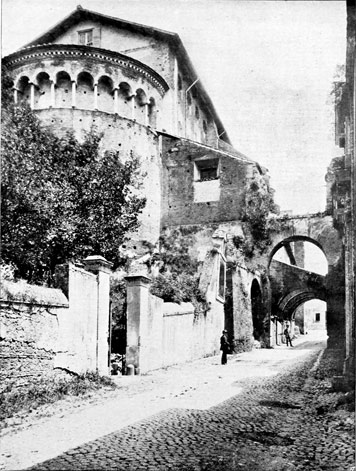
Apse of the Church of SS. Giovanni e Paolo, on the Cœlian Hill, Rome.
(From a photograph by Alinari.)
See page 405.
The great Lombard Masonic Guild being under the
especial protection of the Popes, we should expect to see its
members employed in the mediæval buildings of Rome.
And truly, after Adrian's time, here they are. Hope,
Schmarzow, Ricci, and Boito, besides other writers, have
all decided that the ancient cloisters of San Lorenzo—built
under Honorius III. in the beginning of the thirteenth
century—as well as the primitive churches of St. Peter, S.
John Lateran, and S. Lorenzo, were all early Comacine
work; and that the exquisite cloister of S. John Lateran,
and the churches of S. Paolo fuori le Mura, Ara Cœli,
San Giovanni e Paolo, S. Maria sopra Minerva, etc., are
all equally Lombard churches of the twelfth and thirteenth
centuries. Several friezes and inscriptions go to prove the
truth of this, besides those eloquent lions that crouch
beneath the columns in the cloister of S. John Lateran and
other places.
As this is not an architectural dissertation, but merely
a tracing of the work of this great guild, I will keep more
to the inscriptions relative to Magistri, than to a description
of their works, which has been done by so many writers.
In the old times before the painters and sculptors, and
after them the metal-workers, split off and formed companies
of their own, every kind of decoration was practised by the
Masters. A church was not complete unless it were
adorned in its whole height and breadth with either
sculpture, mosaic, or paintings, and this from the very early
times of Constantine and his Byzantine mosaicists, and of
Queen Theodolinda and her fresco-painters, up to the
revival of mosaics by the Cosmati, and the fresco-painting
in the Tuscan schools. But never were those arts entirely
lost.
The ideas which the Lombard architects brought up from
Sicily, when working there under the Normans, were the
seeds of re-vivification, and caused a tremendous evolution
in the art of the guild. They saw the decorative value of
mosaic as it was used in the twisted Saracenic columns, and
they were charmed by the rich use of sculpture in the
graceful arches. From that time, every lodge throughout
the land seemed to invent a new style peculiar to itself.
The Romans, with their traditions of classic mosaics,
revived the art in Saracenic style as a means of decoration.
The Tuscans, with their wealth of coloured marbles,
enlarged chromatic decoration into chromatic architecture,
and their airy towers and arched churches were all more or
less polychrome. The Lombards, having no marbles at
hand, took from these same Saracens their rich traceries
and cuspings, which they produced in the plastic clay,
throwing a veil of ruddy beauty over the façades and
arches of their buildings.
The name of the Cosmati family has become generic
for the peculiar chromatic sculpture of Rome in the twelfth
century; the family were complete masters of the art.
But though they may have taken the idea of its revival
as a decorative aid to sculpture, it was by no means
their invention, or even their monopoly. If you look at a
Cosmati pillar or panel, and then at the floor of any Roman
church, you will see that Cosmatesque decoration is but an
adaptation of the old Roman opus Alexandrinum. And we
have plenty of proof of the fact that other Magistri of the
guild also practised it. The ambone in S. Cesareo in
Palatio at Rome, of which we give an illustration, is earlier
than any of Cosimo's family.
There exists at Florence (in S. Leonardo) the ancient
pulpit from S. Piero Scheraggio, and which was said to
have been brought there from Fiesole. Its date is
supposed to be before 1000 A.D. Though of a ruder style,
we have the Cosmatesque inlaying of glass and marble, as
a setting to sculptures distinctly Comacine, and of almost
Longobardic antiquity. In Sta. Maria in Cosmedin are
two fine pulpits, on one of which is a beautiful candlestick
formed of a twisted column, inlaid in the same style.
The Comacine lion crouches beneath it, and on the base
is the inscription in Gothic letters, telling us that the
worthy and learned man Paschalis (called Rita), with great
study made this candlestick.[290] Then we have Nicolao di
Rannuncio, whose name is inscribed on the door of inlaid
marble in the church of S. Maria at Toscanella,[291] and a
whole family whose names are inscribed on the ciborium
of S. Lorenzo fuori le Mura:[292] where it is written—"John,
Peter, Angelo, and Sasso, sons of Paul the sculptor,
Magisters of this Opera. I, the humble Abbot Hugh, had
this work executed"[293] (Johs, Petrus, Angĕs, et. Sasso.
Filii. Pauli. Marmōr. Huj'. Opis. Magister Fuer. Ann
d. M. CXLVIII. Ego. Hugo. Humilis. Abbs. Hoc. Opus.
Fieri Feci.). The tabernacle is of the usual four-pillared
form; the columns are ancient porphyry ones adapted; the
capitals the usual Comacine mixture of classic and mediæval—acanthus
leaves and cornucopiæ with the mystic beasts
climbing among them.
Angelo, the third son of Magister Paulus, had a son
named Niccolò, and the two together made the candelabrum
of S. Paolo; a quaint mediæval piece of sculpture, of the
style of Magister Roberto's font, but with some marvellously
beautiful interlaced work. There is also Arnolfo with his
partner Peter (Arnolfus cum suo socio Petro), who made
the inlaid and sculptured tabernacle in S. Paolo fuori le
Mura in 1285.
Merzario says that we must not confuse this Arnolfo with
the Florentine architect. Camille Boito, however, opines
that he is the same. Arnolfo had certainly a taste for the
polychrome in architecture, which may or may not have
been imbibed in Rome, while working at that lodge with
Peter—whom Cavalcaselle considers was one of the Cosmati,
and who certainly did the ciborium at S. Paolo, though
Arnolfo's name is absent in that work. I have found some
other members of the Roman Lodge inscribed above a
bronze door in S. John Lateran. On the archivolt is
written—"Hui opis Ubert et Petr: F͡rs. Māgistri Lausenen.
Fecer͡unt." Over another bronze door in the sacristy they
are written as—"Ubert Magister, et Petrus. Ei: Fr.
Placentini Fecerunt Hoc. op.," and the date A.D. 1196.
Boito[294] sees nothing in this but a perplexing contradiction,
that in one place the brothers say they are from Lausanne,
and in another from Piacenza. It is to me plain enough.
They are natives of Lausanne, and consequently Lombards:
they are also brethren of the lodge of Piacenza, where they
had most likely worked while the cathedral and other
buildings were being erected.
The date of the Baptistery door, and the connection of
its maker with the guild, are verified by the inscription on
the other panel of the bronze door, which says it was done
in the fifth year of the pontificate of Pope Celestine III.
(i.e. 1196), and that Father Giovanni, Cardinal of S. Lucia,
the Jubente, or camerarius of the Opera, had it made.[295]
This door had engraved on it the design of the ancient
façade of S. John Lateran—a perfectly Lombard front
consisting of two round-arched arcades, with a little pillared
gallery above.
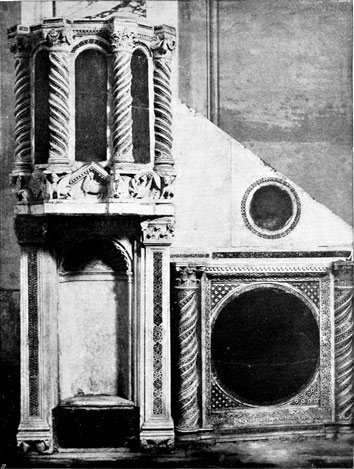
Pulpit in Church of S. Cesareo in Palatio, Rome. Mediæval Sculpture inlaid in Mosaic.
(From a photograph by Alinari.)
See page 406.
The door of the Sacristy must have been cast before
that of the Baptistery, as in the first work Uberto is entitled
Magister, and Petrus only named as his brother, whereas
in the second the younger brother must have also graduated,
and has in his turn attained to the dignity of Magister.
We trace the same gradual progress through the ranks
of the Guild in the Cosmati family, whose connection with
the Roman lodge we must now trace. Several generations
of them were Magistri—
| Lorenzo |
| |
|
| Jacopo (some works, 1205-1210) |
| |
|
| Cosimo, 1210-1277 |
| |
|
|
|
| |
|
|
|
|
| Luca |
Jacopo |
Adeodatus |
Giovanni |
| 1231-1235 |
1231-1293 |
1294 |
1296-1303 |
To Lorenzo belong the façades of Santa Maria in
Falleri, and the Duomo in Civita Castellana, besides the
pulpit in Ara Cœli at Rome. In all these works his son
Jacopo worked with him.
Jacopo alone, with the title of Magister, sculptured the
smaller doors in the façade of the Duomo at Civita Castellana,
and the door of San Saba at Rome in 1205; also the
inlaid columns at S. Alessio in Rome, and the Cloister of
Santa Scolastica at Subiaco. In Civita Castellana, above
the magnificent portal, is inscribed "Laurentius cum Jacobo
Filio suo, Magistri doctissimi Romani H(oc) opus fecerunt."
This proves my assertion that they had graduated in the
Roman Lodge, and if further proof is required, this portal
bears the universal mark of the Comacine Masters at this
era—its columns rest on lions.
Similar inscriptions are on the ambone of Ara Cœli,
and the doorway at Falleri. The inscription on the door
of San Saba, dated 1205, is—"Ad honorem domini nostri I͞HU
X͡PI Anno VII. Pontificatus domini Innocentii III. PP Hoc
opus domino Johanne, Abbate Jubente[296] factum est per
manus magistri Jacobi." Up to this time we have no
proof that the family was of Roman origin; they are
merely given as members of the Roman Lodge, which we
have seen was of Lombard origin. They were afterwards
made Roman citizens.
After these works we find Cosmato, the son of Jacopo,
old enough to assist him. That same frontal of the Duomo
at Civita Castellana has on the cornice over the portico
these words inlaid in letters of gold—"Magister Jacobus
civis Romanus cum Cosma filio suo, Fieri fecit hoc opus
A. D͠NI. MCCX." Cosmato's name is also inscribed as
assisting his father in the door of the church of San Tommaso
in Formis at Rome. Next, in 1224, we find young
Cosmato a full-fledged Magister, working at the cathedral
of Anagni, which was in those days an important city, and
the residence and birthplace of several Popes. The whole
pavement there is a beautiful work of inlaid marbles, and
bears an inscription saying that the Venerable Lord Bishop
Albert had the pavement made; Magister Rainaldo, Canon
of Anagni to Pope Honorius III., and the honourable sub-deacon
and chaplain assisting in the expense, which was a
hundred gold oboli; Magister Cosmato executing the work.[297]
Magister Rainaldo, the Canon, must have been one of the
ecclesiastic members of the guild, and showed so much
respect for the privilege that he preferred the title of
Magister to the grander one of Venerabilis, to which his
office of Canon would have given him right.
After this time, Cosmato is always written as Magister;
his name appears on the altar of the crypt of S. Magnus in
the cathedral of Anagni, which was also a commission of
Bishop Alberto in 1230. Next, we perceive that Cosmato
has married and has a goodly family of sons, who,
according to ancient custom, are all educated in the
guild.
Luca and Jacobo, the two eldest, helped him in the
mosaic pavement of the crypt at Anagni, and in the cloister
of Santa Scolastica at Subiaco. This is a most beautiful
work in transition style. The columns are alternately
single and double, the single ones with a wide projecting
abacus. Some are slight and straight, others spiral and
beautifully inlaid between the sculptured ribs. The arches
resting on these fanciful columns are on two sides round,
but on the other sides are slightly pointed. Above the
arches is a sculptured cornice and a frieze of mosaic. It is
altogether very beautiful.
In 1277 Cosmato was employed by Pope Nicholas III.
to restore the chapel "Sancta Sanctorum" in the Basilica of
S. John Lateran, the altar of which was reserved for the
Popes alone. Luca appears to have died young, but Jacopo
at eighty years of age was a master builder at the cathedral
of Orvieto, where in 1293 he is written in the books as
"Maestro de' Muratori Jacopo di Cosma Romano."
The third son, Adeodatus, or Deodatus, rose high in the
guild. In the pavement of S. Jacopo alla Lungara, before
it was destroyed, the following epigraph was inlaid, which
was copied by Crescimbeni—"Deodatus filius Cosmati, et
Jacobus fecerunt hoc opus." In a later work, the ciborium
once in S. John Lateran, now in the cloister, we find that
Deodatus has risen to the rank of Magister. It was a
commission from the Colonna family, whose arms are
sculptured on it. The ciborium in S. Maria in Cosmedin,
ordered by Cardinal Gaetani, nephew of Pope Boniface
VII., must have been earlier than this, for he has merely
signed "Deodat. me fec."
Cosmato's fourth son, Giovanni, first appears in an
independent work in 1296, when, on the elegant sepulchre
of Bishop Durante, he signs—"Jo͞hs filius Magri Cosmati
fec̄ hoc op." Similar epigraphs are on the tomb of Cardinal
Gonsalvo in S. Maria Maggiore, and a monument to
Stefano de' Surdi in Santa Balbina.
In all these works of the Cosmati, Camille Boito finds
signs of Lombard principles, and traces in the development
of style from father to son the same gradual movement from
older forms towards the Gothic, which we notice between
Jacopo Tedesco and Arnolfo, and between Niccolò Pisano
and his son Giovanni. Living in Rome, however, the
Cosmati never really took up the Gothic style, as it developed
further north; but always kept nearer to classical
forms, and so prepared Rome for the Renaissance style,
which arose from the humanist movement in the Cinque-cento
epoch.
The next great patron of the Lombard Guild in Rome
was Pope Nicholas V. (Thomas of Sarzana), of whom
Gregorovius said—"This man had only two passions—collecting
books and building." His dominating idea was
the directing of a new Renaissance. According to him,
"Rome ought to become the imperishable monument of
the Church, or rather the Papacy, and re-arise in admirable
magnificence before the eyes of all people."[298] Nicholas V.
had the first idea of the rebuilding of St. Peter's, and the
Vatican, but one man's life was not long enough for such
great works. He, however, restored the Campidoglio,
Castel S. Angelo, San Todaro, S. Stefano Rotondo, the
palace of S. Maria Maggiore, the fountain of Trevi, the
walls of Rome, and several of the State fortresses.
He got some of his architects, such as Leon Battista
Alberti and Rossellino, from the Florentine Lodge, but by
far the greater part of them were Lombards. The chief of
these was Master Beltramo da Varese, of whom we have
heard much in the Lombard Lodges. With him were his
nephew Maestro Pietro di Giovanni, Maestro Paolo da
Campagnano (a village near Varese), and Maestro Giacomo
di Cristoforo. Rossellino had begun the works at St.
Peter's in a kind of reverse fashion, starting with the apse.
The continuation of this tribune was confided to Maestro
Beltramo, who set to work in good earnest. He made vast
lime and brick furnaces, filled the laborerium with wood,
ropes, ladders, etc., engaged sub-architects and Magistri
with bands of workmen under them, most of whom came
down from the Como region. In fact, there was an army
of Lombards.[299] The registers of the Opera, now in the
Vatican, mark large payments to Magistro Beltramo and
his nephew Pietro di Giovanni, who became chief architect
after his uncle's death.
Besides the Tribune of St. Peter's, the two relatives
were employed to rebuild the Campidoglio. Muntz
publishes some notes taken from the registers of the
Apostolic Camera, recording payments made between 1447
and 1448 to Maestro Beltramo, and some of his associates
(socii), for the roof and marble windows of the Campidoglio
and the palace of the Conservators. In 1452 Pietro da
Varese is found continuing the work alone. The documents
recently published from the registers of the Vatican
have these entries—
"1452. December 31.—To Maestro Pietro da Varese,
nephew of Maestro Beltramo, 1000 gold ducats for part of
the Tower he is building behind the Campidoglio, at the
side where they sell salt by retail. T. S. 1452, fol. 216,
cf. fol. 194."
"1453. March 9.—D. 112, b. 56, d. c., for remainder and
completion of the contract of the Tower he (Pietro) has
made at the Campidoglio, which in full amounts to 1212
ducats, of which he received last year at different times,
1000 (and 100) ... and thus it is registered by Janni di
Jordani (Notary V. fl. 126. 10. 93)."[300]
We find Pietro in 1450 sculpturing in the cathedral at
Orvieto, where in a public act he is described as a good
and clever sculptor ("lapidum sculptor bonus et doctus"),
and prayed to remain at Orvieto in the service of the
lodge there.
Muntz speaks very highly in praise of the Lombard
sculptor, Giacomo di Cristoforo[301] da Pietrasanta, saying
that although his name is little known to biographers, he
holds a high place in Roman art of the fifteenth century,
and merits to be ranked among the most celebrated artists
of his time. Many of the buildings which Vasari ascribes
to Giuliano da Majano and Baccio Pontelli are in reality
due to him; for instance, the Palazzo Venezia, which was
rebuilt under Pope Paul II. (Pietro Barbo, who succeeded
to the papal throne in 1464). Now Giuliano da Majano
only came to Rome towards the end of the reign of Pope
Sixtus IV., and could not therefore have been employed by
Paul II. In fact, Muntz, after many researches, concludes
that the chief architect was Maestro Giacomo da Pietrasanta,
who is in the registers of 1467 qualified by the title of
Soprastante in the laborerium of the church and palace
of S. Marco at Rome, and in 1468 is written as the president
of the building of the Palazzo Apostolico or Vatican.[302]
In fact, Giacomo da Pietrasanta, the Lombard, was Grand
Master of the whole Roman Lodge during these years.
But Maestro Giacomo was not the only Comacine
employed in the Palazzo Venezia. A contract dated June
16, 1466, names Magister Manfred of Como and Andrea of
Arzo, whom we have seen in Venice, as magistros architectos,[303]
and the registers reveal a whole army of master builders
and sculptors whose names will be found in the list appended.
Muntz quotes no less than twenty-five, many
of whom have been familiar to us at Milan, Siena, and
Florence.
Although when Calixtus III. (Alfonso Borgia) succeeded
Nicholas V. in 1455, he had no great ideas about resuscitating
the architectural glories of ancient Rome, he nevertheless
employed the Lombard Masters to finish the works
begun. Maestro Pietro da Varese, and Maestro Paolo da
Campagnano, with Maestro Antonio di Giovanni from
Milan, and Maestro Paolino da Binasco, were joint architects
of the Pontifical Palace. Maestro Bartolommeo da
Como, whom we have known at Milan and Pavia, was
director of the works of fortification at Castel S. Angelo,
while Maestro Stefano da Bissone di Como is named as a
sculptor in the church of S. Spirito.
The next Pope, Pius II. (Æneas Silvio Piccolomini),
did so much building and embellishing in Siena—where
the Lombard Masters divided the honours with their colleagues
born in Siena, and trained by them—that he did
little for Rome. He employed the same Pietro da
Giovanni and Paolo da Campagnano between 1460 and
1463, for the roof of S. Pietro, which menaced destruction.
The palace of the Vatican was placed under the
architectural superintendence of Maestro Manfred of Como
and Domenico of Lugano. The first appears to have
been designing architect, and the second master builder,
as he commanded squadrons of workmen, and was assisted
in ruling them by his brother Antonio.
Maestro Angelo da Como, and a certain Martino
Lombardo, rebuilt the chambers which had been destroyed
by fire, and adorned the "Hall of the Pavilion" and "Hall
of the Parrot."
In the time of Sixtus IV. (Francesco della Rovere,
1471-1484) the Lombards of the Roman Lodge were
joined by their brethren from Florence, and now we find
the two groups inextricably mixed. Baccio Pontelli and
Giuliano da Majano work together with Manfred the
Lombard and Paolo da Campagnano in the administration
of the works of the Vatican; while Francesco and Andrea,
both Lombards, are found carving in wood and executing
beautiful doors in intarsia, together with Giovanni and
Marco di Dolci, Florentines; Giovanni de' Dolci with his
colleagues (chiefly Comacines) worked at the Sixtine
Chapel, some parts of the Vatican, and the fortress of
Civita Vecchia, which Baccio Pontelli finished. Pope Innocent
VIII. (Cibo, 1484-92) added the Loggia Belvedere to
the already immense palace of the Vatican, and Alexander
VI., a Spaniard, built the Borgia apartment, for which he
employed Antonio di San Gallo, or from St. Gall, a
Lombard naturalized Florentine, whose assistants in the
work seem to have been chiefly Lombards.
It was this influx of Florentines, who were fresh from
the humanistic influences of the classic revival of literature
under the Medici, and therefore more open to further inspirations
from the influences of antique Rome, which
brought about the revival of classic forms in architecture
in Rome. Bramante and San Gallo began it in 1503,
Raphael and Michael Angelo carried it on; and such hold
did the Renaissance style take on the minds of people
in the late Cinque-cento era, that it spread, and overpowered
the Gothic from end to end of Italy.
Vasari raved about the faults of the old architecture
and its goffissima style, upholding the chastened order of
the new, but whatever may have been the merits of Renaissance,
as Bramante and Michael Angelo practised it, their
later followers committed quite as many sins against reason
and good taste as any Comacine or Romanesque architect
ever did. Look, for instance, at the church of S. Carlo, in
the Corso at Rome, with its gigantic pilasters running up
the whole height of a front, which is, by its square windows,
cut up into three storeys, giving the lie to the unity of space
implied by the mock columns; and at San Firenze in
Florence, where half an arch runs up into the air and stops
short, as a defiance to all laws of gravity. Arches or pediments,
with a hiatus where the key-stone should be, and
which, logically speaking, can support nothing, are the most
common blots on a late Renaissance building.
But we have nothing to do with this era. It was only
a late survival of a side issue of the Comacine Guild which
had been practically dissolved before Michael Angelo's
time, although the influence of its smouldering ashes
vivified the art even of that great genius.
The great family of sixteenth-century architects, the
Fontana, was of Comacine origin, though I believe the
guild was dissolved by their time. Domenico Fontana
was born at Melide near Como; his elder brother Giovanni,
famous for his stucco work, had preceded him in Rome,
but Domenico was an artist of a wider kind. The Cardinal
Felice di Montalto soon discovered his capacities, and
entrusted him with the erection of the Cappella del Santissimo
in S. Maria Maggiore. Here a very unusual episode
occurred. The Cardinal had not means enough to finish
the work, and the brothers Fontana, instead of suing him
for their pay, lent him 1000 scudi. Of course the Cardinal
was their great patron after this, and recommended them
to Pope Sixtus V., who employed them in the Vatican to
build the Belvedere and the Library. Domenico also enshrined
the Scala Santa at S. John Lateran; he placed the
obelisks on Piazza S. Giovanni and Piazza S. M. Maggiore;
set up the Castor and Pollux on the Quirinal; built the
bridge at Borghetto, the hospital of S. Sisto, and restored
the Alessandrini-Felice aqueduct; embanked the Fiumicino
near Porto; made the water conduit at Civita Vecchia,
which implied tunnelling under a mountain; and the great
aqueduct of Acqua Paola from Bracciano to Rome, thirty-five
miles long; besides constructing fountains everywhere,
in Rome and Frascati.
In fact, he nearly made Cinque-cento Rome. His brother
Giovanni was nominated architect in general to Pope
Clement VIII.; and Paul V. made him chief architect of
St. Peter's, with his nephew Carlo Madernò. He too was
employed in Ferrara. For a century the name and race
of Fontana flourished in Rome, some of the family emigrating
to Naples, where they became equally famous. The
number of their buildings was legion; they and the family
Della Porta, who also came to Rome from Lake Lugano,
divided the renovation of Rome between them. Girolamo
della Porta, like the Fontanas, was a naturalized Roman.
The Fontana family forms a link with Naples, though
not the only connection of that city with the guild. The
Comacine Masters kept up their connection with Naples
long after the time of the Normans, when Maestro Buono
built the Castel Capuana for William I. Merzario claims
for one of his descendants, Buono dei Buoni, the credit of
having first invented painting in oils, which he is supposed
to have taught privately to Antonello of Messina.[304]
Several names of the Solari family, so famous at Milan
and Venice, turn up at Naples in the fifteenth century,
and then a famous work was put into Lombard hands.
When Alphonso of Aragon made his entry in 1443, the
governors of the city decreed that a triumphal arch should
be built to commemorate the event. It was placed at the
entrance of Castel Nuovo, and consists of two round towers,
with an arch between them, supported on Corinthian
columns. The arch is surmounted by a frieze and cornice,
with a parapet above, enriched with bas-reliefs representing
the entry of King Alphonso. The whole is surmounted
by statues of saints and the cardinal virtues.
The construction of this fine arch has been attributed
to Giuliano da Majano, but as he was at the time only a
boy of ten or twelve years old, this could not be. Sig.
Miniero Riccio, after a diligent search in the Neapolitan
archives, has found some acts, which give the names of
sculptors employed on this. We find Pietro di Martino
from Milan, head architect; Isaja da Pisa, Domenico di
Montemignano, Antonio da Pisa, Francesco Arzara, Paolo
Romano, and Domenico Lombardo. This authorship is
confirmed by the epigraph in the church of S. Maria la
Nuova in Naples, dated 1470, in memory of Pietro di
Martino, Milanese, who, for his merit in erecting the arch
at Castel Nuovo, was created Cavalier by King Alphonso,
and a sepulchre was given in this church for him and
his descendants.[305]
If the date had only been a little later, we might have
supposed this to be Pietro Lombardo, son of Martino
Solario, who had won such fame in Venice; but as he died
in 1512, it is scarcely likely he would have been well-known
enough to have obtained such an important commission in
1440. Knowing how a certain succession of names was,
and is, kept up in Italian families, this Pietro and Martino
might have been the father and grandfather of the Martino
da Carona, father of Pietro Lombardo, especially as they
had Domenico, also a Solari, with them.
King Alphonso was a good patron to the Comacine
Masters, and greatly appreciated them. On February 16,
1456, a gentleman at Terracina wrote to the Duke
Francesco Sforza, saying that some master builders from
Como, in leaving the realm of Naples, had been made
to forfeit 190 ducats, on which they appealed to the King.
Alphonso ordered the restitution of the money, excepting
a small tribute to the confiscators, which he made good
to the Comacine Masters out of his own purse.[306]
From 1484 to 1508, a Maestro Tomaso da Como, sometimes
called Tomaso delle parti di Lombardia, master
sculptor, was living in Naples. He was paid for the
carving of the principal door of the church of the Annunziata,
which his son Giovanni finished after his death.
His will still exists. It is dated July 2, 1508, and says
that "Mastro Tomaso de Sumalvito (now Sanvito) de la
terra de Como de la parti di Lombardia, marmorario habitante
in Napoli: istituisce herede Joan Thomaso de
Sumalvito de Napoli suo figlio," and declares besides that a
debt of three ducats is still owing to him on the work for
the great doorway of the church of the Annunziata. The
fine monument to Signor Antonio d'Alessandro and his wife,
Maddalena Riccio, in the church of Monte Oliveto, and that
of the Bishop of Aversa in the same church, were sculptured
by Tommaso de Sanvito, as he is called in the books of
Orvieto, where he was head architect.
His son Giovanni built, in 1509, the fine chapel of the
Macellai in the church of S. Eligio, and the "Confession"
of S. Gennaro under the tribune of the cathedral of Naples,
where the yearly miracle of the liquefaction of the blood of
S. Gennaro takes place. Even the beautiful Royal Palace
at Capodimonte was built by a Lombard, Domenico Fontana
of Melide, near Como, whose family we have seen was more
famous in Rome than in Naples? Domenico, however, died
in Naples in 1607, and was buried in S. Anna dei Lombardi,
where his sons Sebastian and Julius Cæsar (Giulio Fontana)
wrote on his tomb—"Patritius Romanus, Summus Romae
Architectus. Summus Neapolis." Like so many of his
predecessors in the guild, he had been given the citizenship
of the towns he had embellished. It is this which makes
it so difficult to trace the artists—the same man may appear
successively as being a citizen of Rome, of Orvieto and
Siena, and yet have been born at Como in spite of all.
Enough has been said to show that at Rome and
Naples, as well as in other cities, the great Lombard Guild
led the way. The guild, which may be looked on as the
flower of the Renaissance, had, however, reached the period
when its blossoming time was over; its many petals, too
much spread, were falling from all its branches. Some
had dropped off long since, and new suckers formed in
the painting academies, and the sculptors' companies, at
Siena, Florence, Venice, and other parts. These suckers
had, by the fifteenth century, grown into independent
plants, that threatened to overshadow and choke the ancient
trunk. Art knowledge of all kinds had now become dispersed
outside the jealous custody of the once secret Freemasonry,
and the Cinque-cento artist stood alone on his
own merit, without needing the cachet of the Masonic title
of Magister. There were, after this time, Masters in every
other art or trade guild, the nomenclature of this most
ancient and universal of guilds having been adopted by all
other guilds whatsoever; so that even in our own England
we find Master Humphrey the iron-worker, or Master
Ambrose the cloth-weaver; and in Italy Maestro Giorgio
the maker of majolica, and Maestro Pollajuolo the metal-worker;
and in Germany the "Little Masters," who, I opine,
were a German group of painters, who, like their brethren
of the South, seceded from the Masters par excellence, i.e.
the great Masonic Guild.
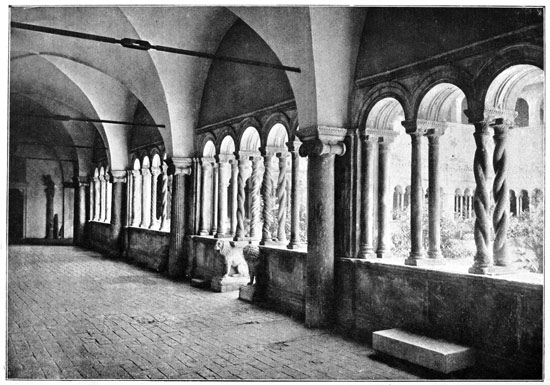
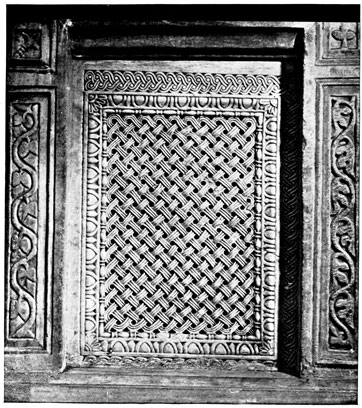
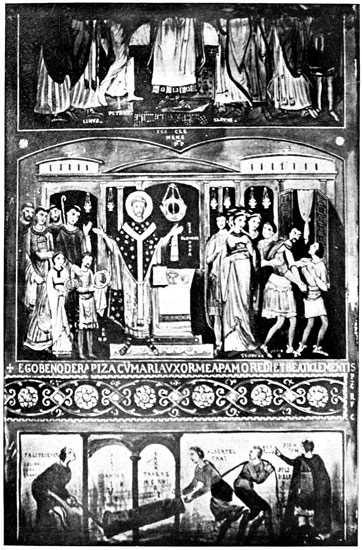
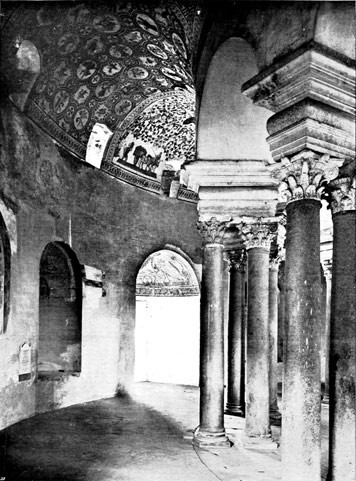
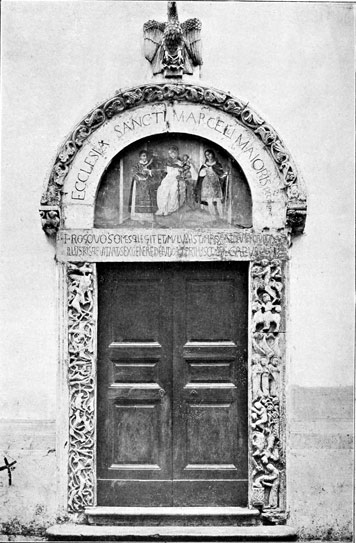
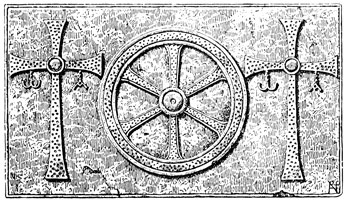
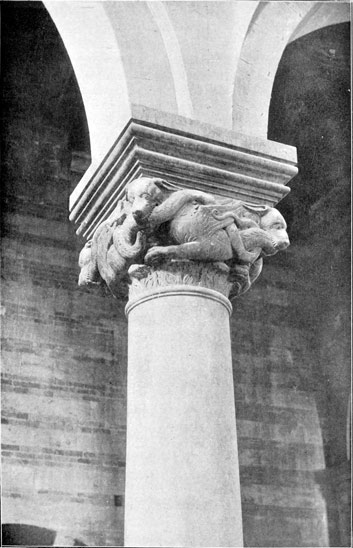
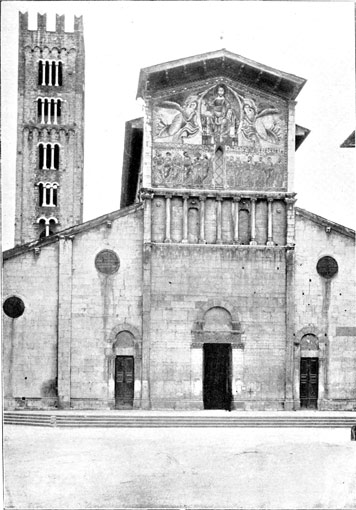
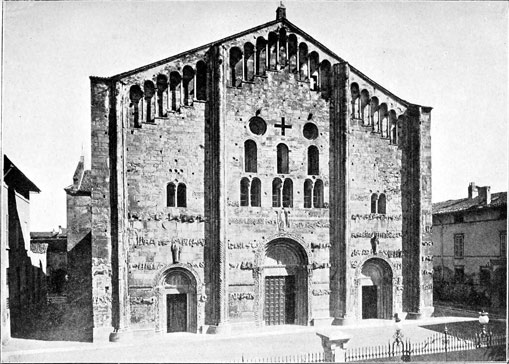
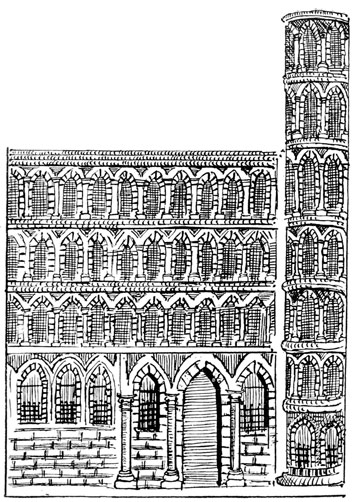
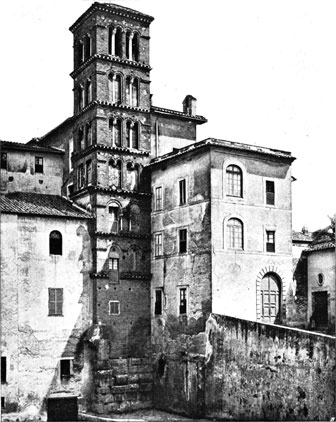
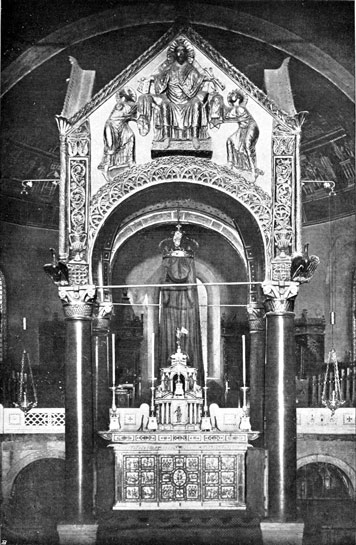
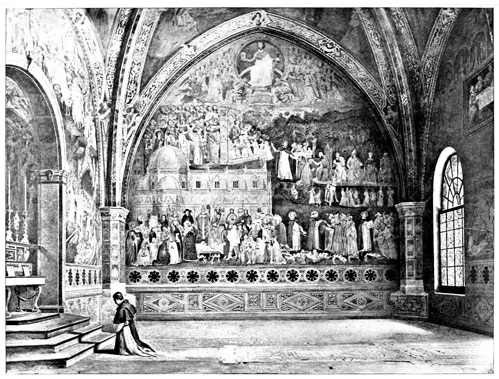
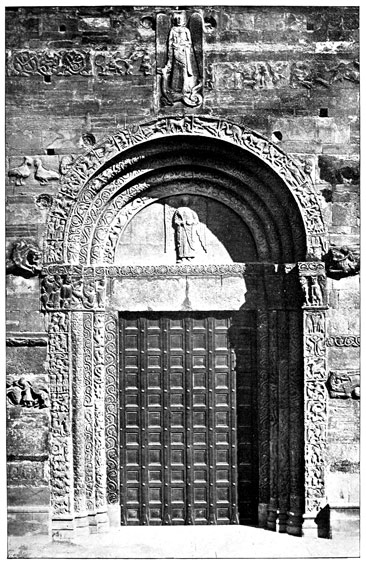
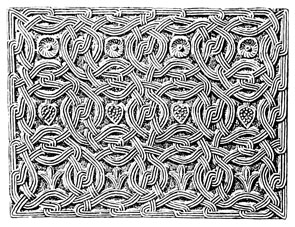
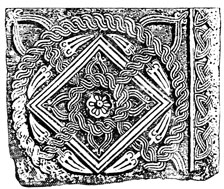
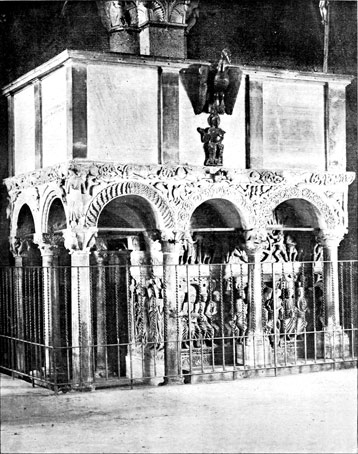
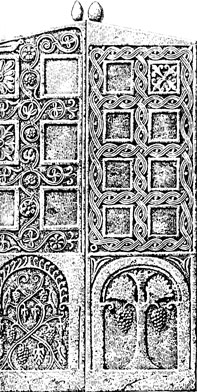
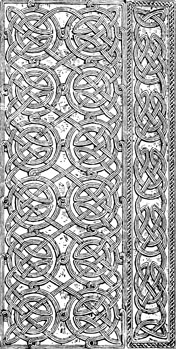
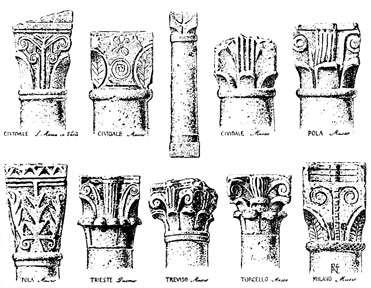
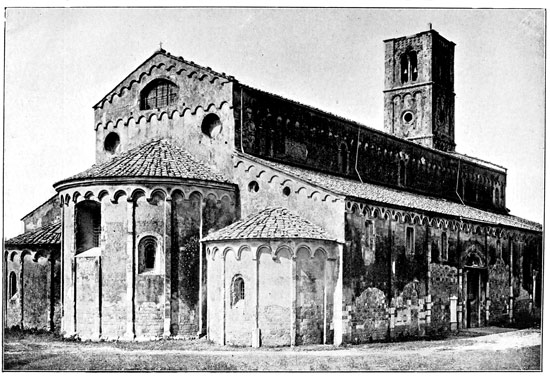
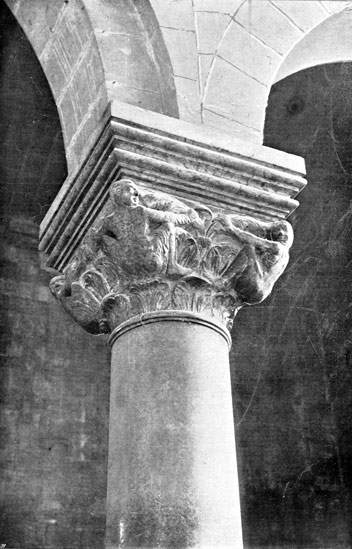
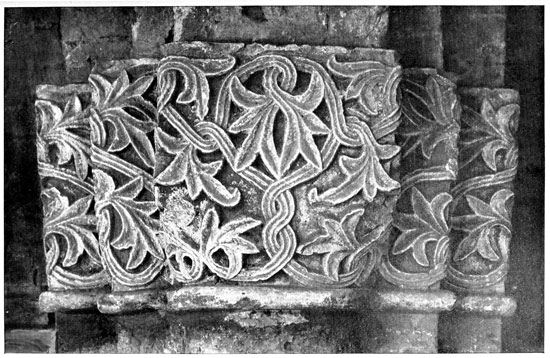
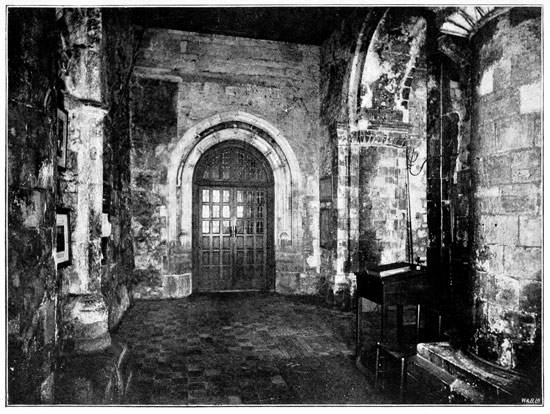
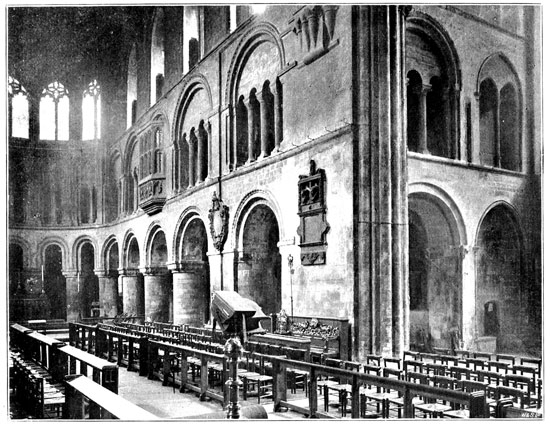
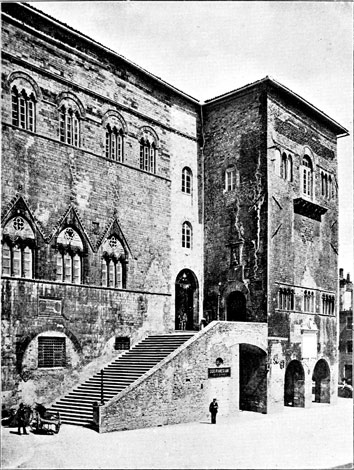
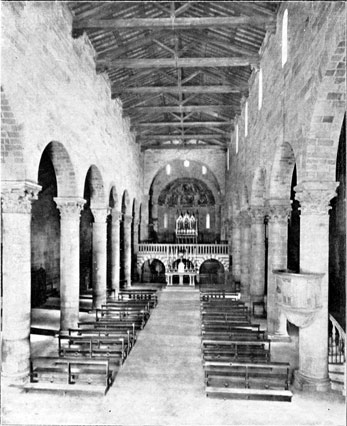
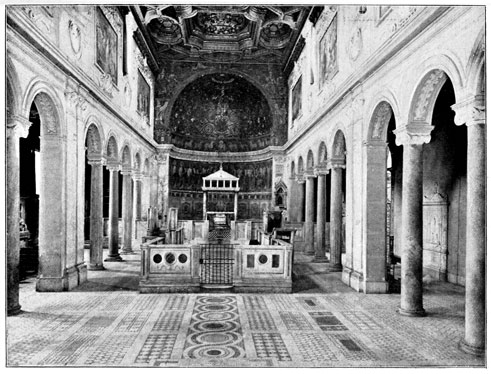
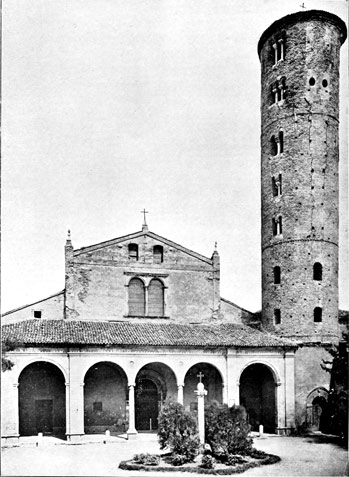
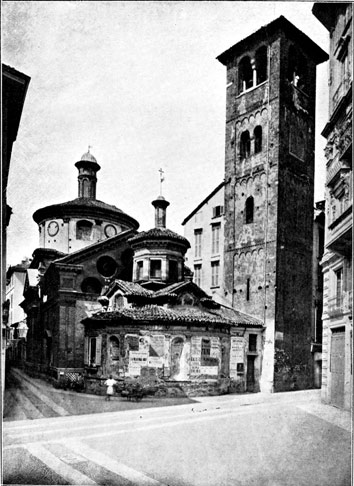
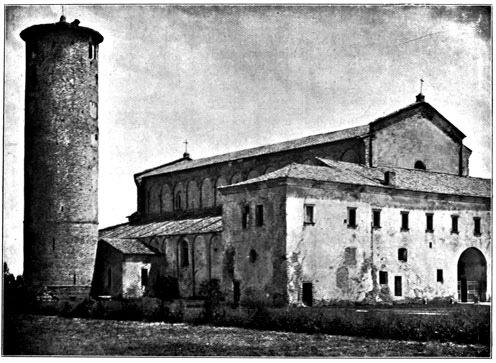
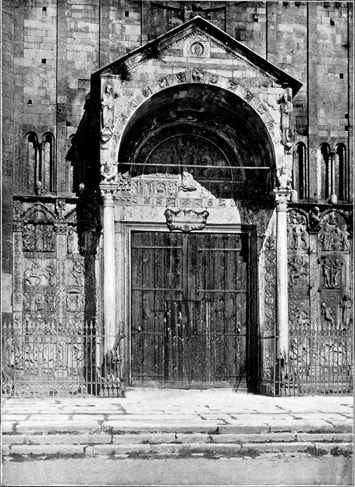
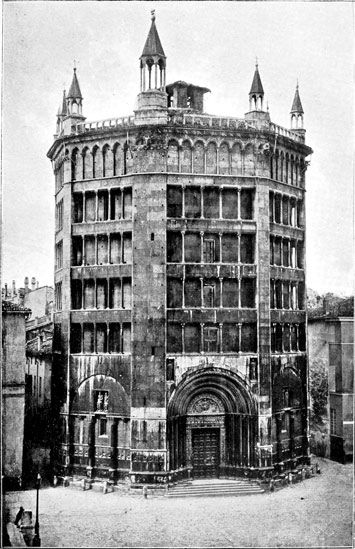
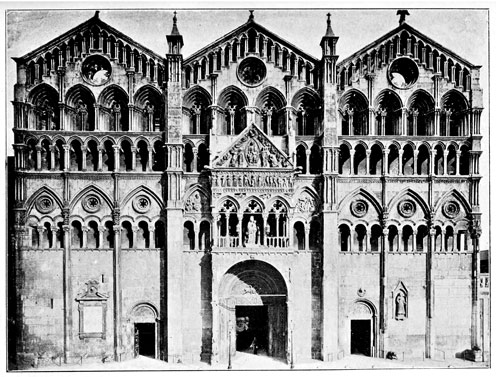
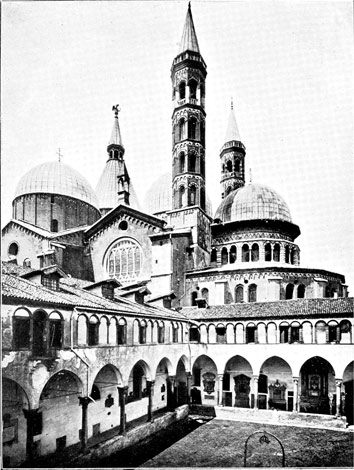
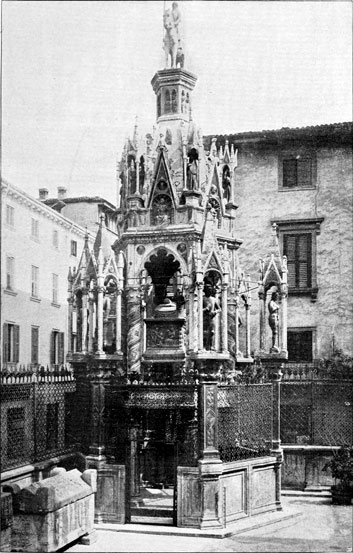
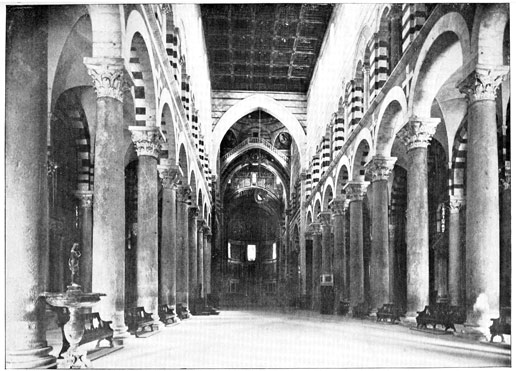
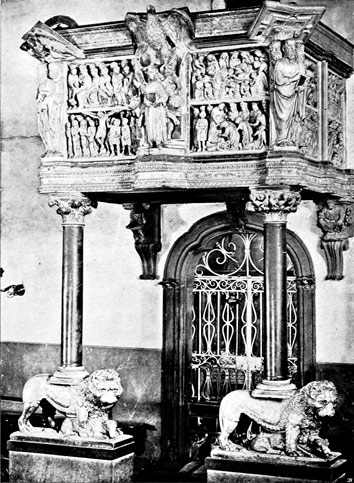
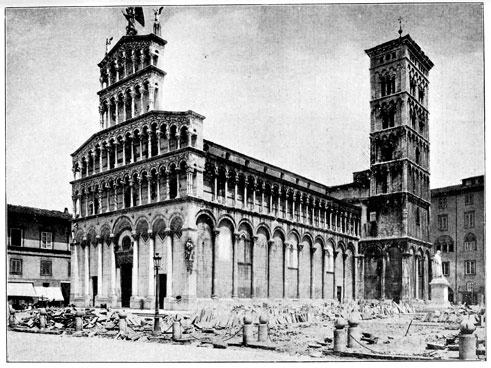
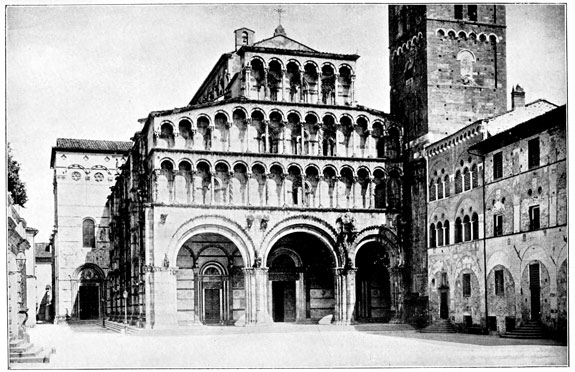
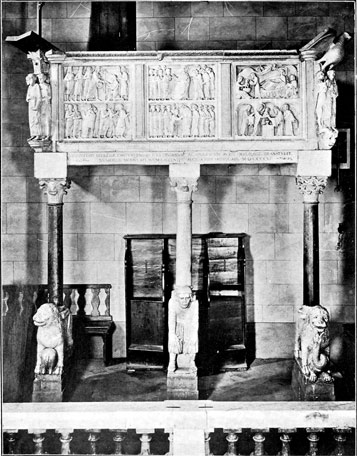
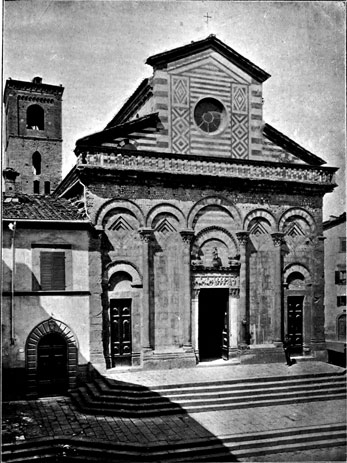
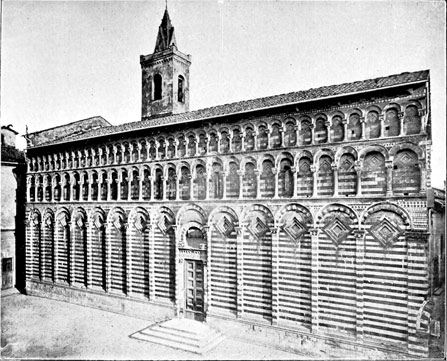
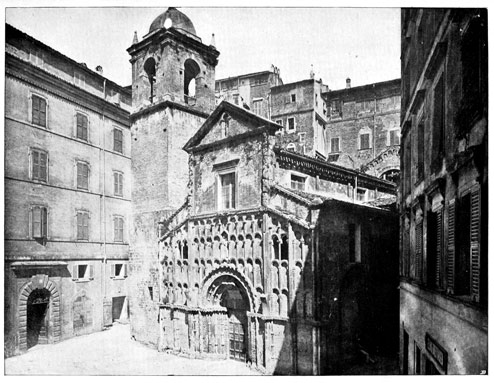
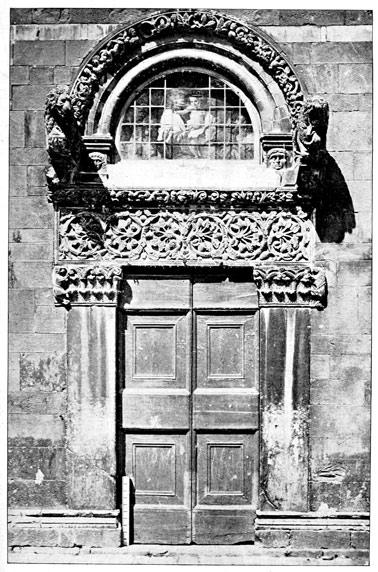
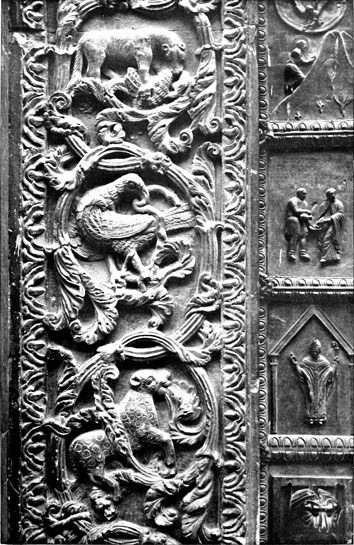
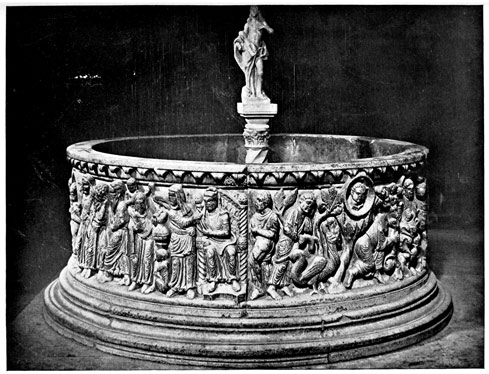
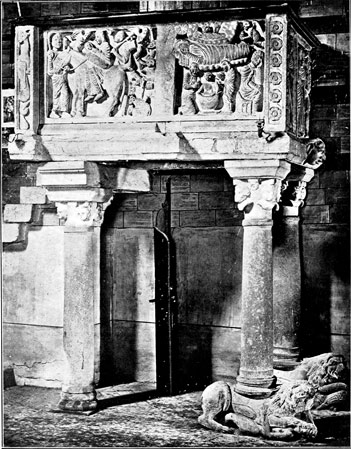
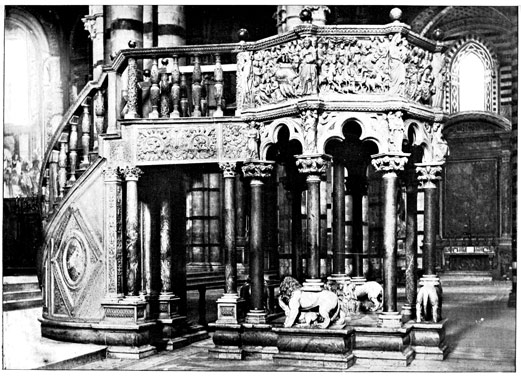
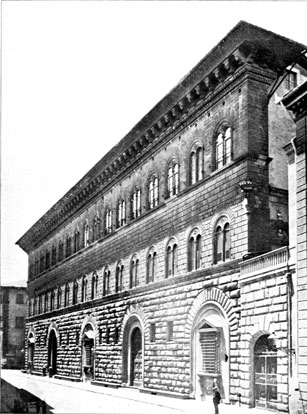
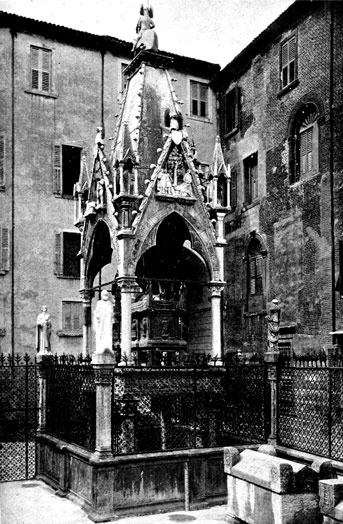
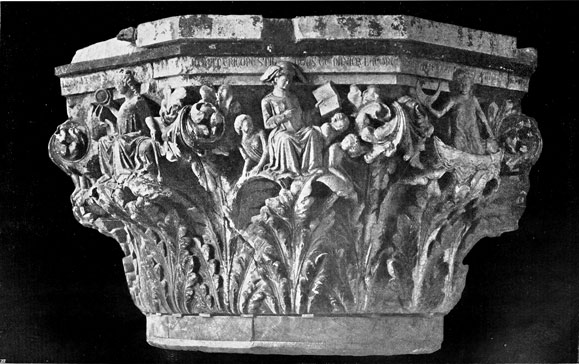
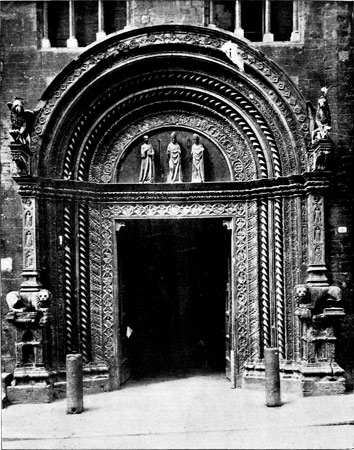
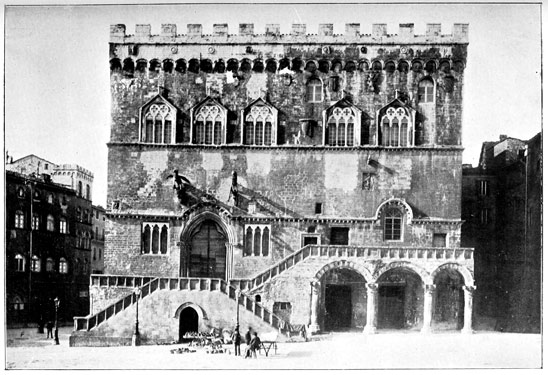
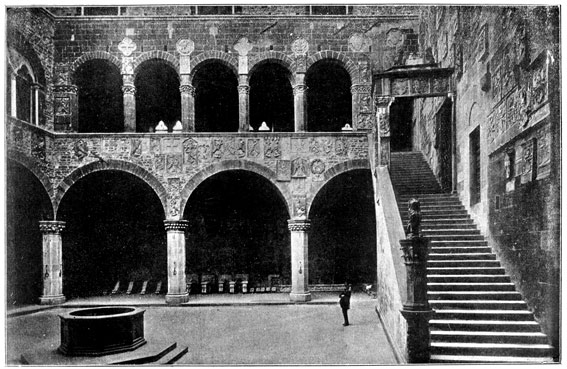
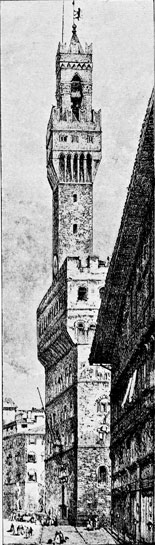
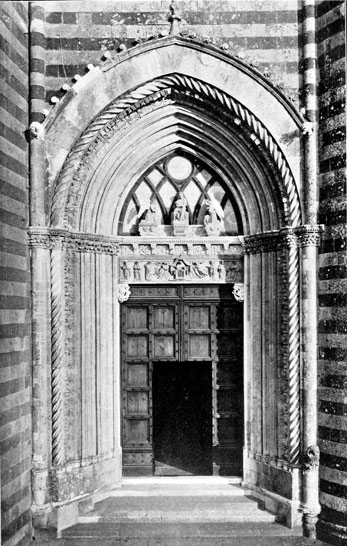
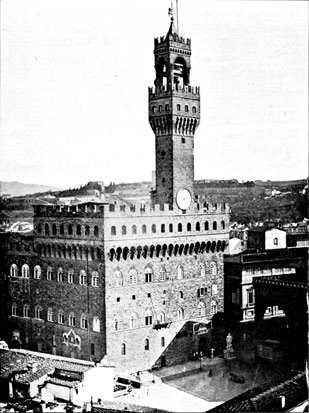
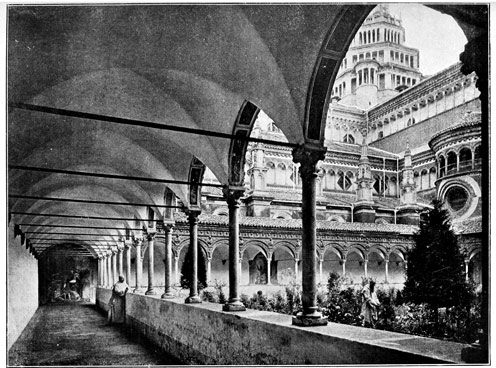
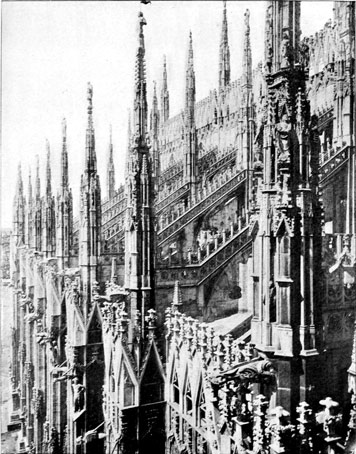
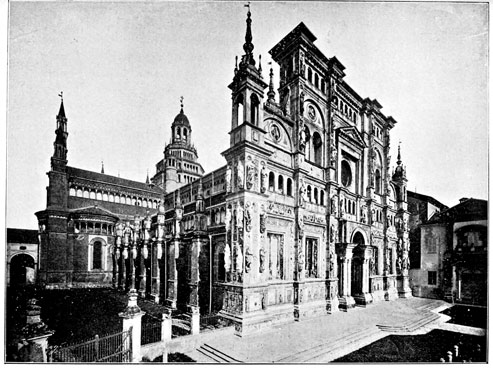
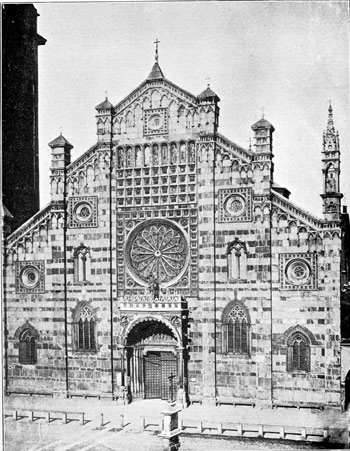
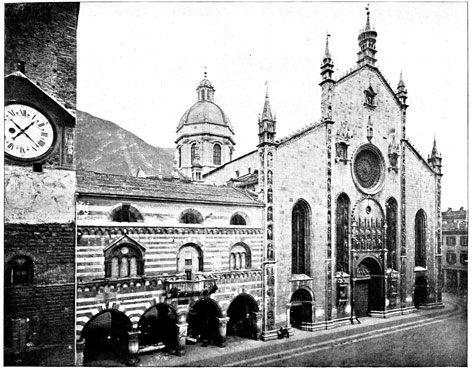
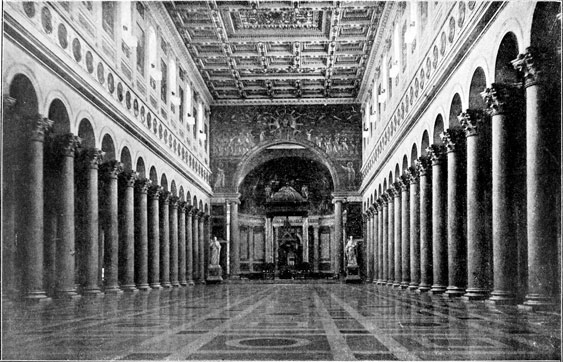
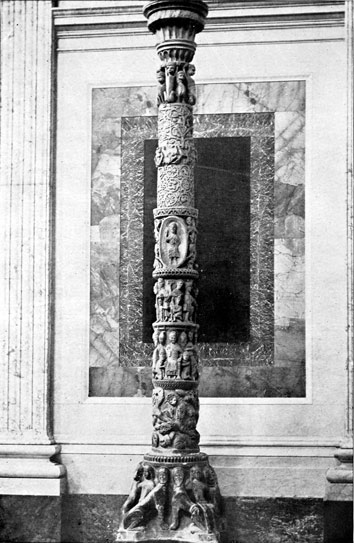
 ANNO DN͞I MO. CO. OCTUAG͞O SEPTIMO. SEPULCRŪ.