WITH NUMEROUS ILLUSTRATIONS.
London:
HODDER AND STOUGHTON,
27, PATERNOSTER ROW.
MDCCCLXXXVIII.
Hazell, Watson, and Viney, Ld. Printers, London and Aylesbury.
The present work, it is hoped, will supply a want long felt in the
literature of the Catacombs. That literature, it is true, is very
voluminous; but it is for the most part locked up in rare and costly
folios in foreign languages, and inaccessible to the general reader.
Recent discoveries have refuted some of the theories and corrected
many of the statements of previous books in English on this subject;
and the present volume is the only one in which the latest results of
exploration are fully given, and interpreted from a Protestant point
of view.
The writer has endeavored to illustrate the subject by frequent pagan
sepulchral inscriptions, and by citations from the writings of the
Fathers, which often throw much light on the condition of early
Christian society. The value of the work is greatly enhanced, it is
thought, by the addition of many hundreds of early Christian
inscriptions carefully translated, a very large proportion of which
have never before appeared in English. Those only who have given some
attention to epigraphical studies can conceive the difficulty of this
part of the work. The defacements of time, and frequently the original
imperfection of the inscriptions and the ignorance of their writers,
demand the utmost carefulness to avoid errors of interpretation. The
writer has been fortunate in being assisted by the veteran scholarship
of the Rev. Dr. McCaul, well known in both Europe and America as one
of the highest living authorities in epigraphical science, under whose
critical revision most of the translations have passed. Through the
enterprise of the publishers this work is more copiously illustrated,
from original and other sources, than any other work on the subject in
the language; thus giving more correct and vivid impressions of the
unfamiliar scenes and objects delineated than is possible by any mere
verbal description. References are given, in the foot-notes, to the
principal authorities quoted, but specific acknowledgment should here
be made of the author’s indebtedness to the Cavaliere De Rossi’s
Roma Sotterranea and Inscriptiones Christianæ, by far
the most important works on this fascinating but difficult subject.
Believing that the testimony of the Catacombs exhibits, more
strikingly than any other evidence, the immense contrast between
primitive Christianity and modern Romanism, the author thinks no
apology necessary for the somewhat polemical character of portions of
this book which illustrate that fact. He trusts that it will be found
a contribution of some value to the historical defense of the truth
against the corruptions and innovations of Popish error.
| CONTENTS. |
|---|
| Book First. |
| THE STRUCTURE AND HISTORY OF THE CATACOMBS. |
| Chapter | Page |
| I. | The Structure of the Catacombs | 11 |
| II. | The Origin and Early History of the Catacombs | 49 |
| III. | The Disuse and Abandonment of the Catacombs | 120 |
| IV. | The Rediscovery and Exploration of the Catacombs | 150 |
| V. | The Principal Catacombs | 164 |
Book Second. |
| THE ART AND SYMBOLISM OF THE CATACOMBS. |
| I. | Early Christian Art | 203 |
| II. | The Symbolism of the Catacombs | 225 |
| III. | The Biblical Paintings of the Catacombs | 282 |
| IV. | Objects found in the Catacombs | 362 |
Book Third. |
| THE INSCRIPTIONS OF THE CATACOMBS. |
| I. | General Character of the Inscriptions | 395 |
| II. | The Doctrinal Teachings of the Inscriptions | 415 |
| III. | Early Christian Life and Character as read in
the Catacombs | 453 |
| IV. | Ministry, Rites, and Institutions of the Primitive
Church as Indicated in the Catacombs | 506 |
| LIST OF ILLUSTRATIONS. |
|---|
| Fig. | Page |
| 1. | Entrance to Catacomb of
St. Priscilla | 12 |
| 2. | Entrance to Catacomb of
St. Prætextatus | 16 |
| 3. | Part of Callixtan Catacomb | 17 |
| 4. | Gallery with Tombs | 18 |
| 5. | Interior of Corridor | 20 |
| 6. | Loculi—Open and Closed | 23 |
| 7. | Tomb of Valeria | 24 |
| 8. | Arcosolium with Perforated
Slab | 25 |
| 9. | Plan of Double Chamber | 26 |
| 10. | Section of Gallery and
Cubicula | 27 |
| 11. | Suite of Chambers | 28 |
| 12. | Vaulted Chamber with
Columns | 29 |
| 13. | Cubiculum with Arcosolia | 30 |
| 14. | Section of Catacomb of
Callixtus | 32 |
| 15. | Cubicula with Luminare | 35 |
| 16. | Gallery in St. Hermes | 42 |
| 17. | Part of Wall of Gallery
in St. Hermes | 42 |
| 18. | Slab in Jewish Catacomb | 51 |
| 19. | Epitaph of Martyrus | 66 |
| 20. | Reputed Martyr Symbol | 77 |
| 21. | Epitaph of Lannus, a
Martyr | 98 |
| 22. | Secret Stairway in Catacomb
of Callixtus | 101 |
| 23. | Diogenes the Fossor | 133 |
| 24. | Fossor at Work | 134 |
| 25. | Tombs on Appian Way | 165 |
| 26. | Plan of Area in Callixtan
Catacomb | 171 |
| 27. | Plan of Crypt of St. Peter
and St. Paul | 187 |
| 28. | Crypt of St. Peter and St.
Paul | 188 |
| 29. | Section of Catacomb of
Helena | 191 |
| 30. | Entrance to Catacomb of
St. Agnes | 195 |
| 31. | Mithraic Painting | 216 |
| 32. | Leaf Point | 227 |
| 33. | Phonetic Symbol—Leo | 229 |
| 34. | Phonetic Symbol—Porcella | 230 |
| 35. | Phonetic Symbol—Nabira | 230 |
| 36. | Wool-comber’s Implements | 231 |
| 37. | Carpenter’s Implements | 231 |
| 38. | Vine Dresser’s Tomb | 232 |
| 39. | Symbolical Anchor | 234 |
| 40. | Symbolical Ship | 235 |
| 41. | Symbolical Palm and
Crown | 236 |
| 42. | Symbolical Doves | 237 |
| 43. | Symbolical Dove | 238 |
| 44. | Doves and Vase | 238 |
| 45. | Locus Primi | 238 |
| 46. | Symbolical Peacock | 240 |
| 47. | The Good Shepherd | 245 |
| 48. | Good Shepherd with
Syrinx | 246 |
| 49. | Symbolical Lamb | 249 |
|
50. | Symbolical Fish | 255 |
| 51. | Symbolical Fish | 256 |
| 52. | Fish and Anchor | 256 |
| 53. | Fish and Dove | 256 |
| 54. | Eucharistic Symbol | 256 |
| 55. | Constantinian Monogram | 265 |
| 56. | Early Christian Seal | 266 |
| 57. | Various Forms of Monogram | 267 |
| 58. | Epitaph of Tasaris | 267 |
| 59. | Opisthographæ | 268 |
| 60. | Early Christian Seal | 270 |
| 61. | Monogram and Cross | 270 |
| 62. | The Temptation and Fall | 284 |
| 63. | Adam and Eve Receiving
their Sentence | 285 |
| 64. | Noah in the Ark | 286 |
| 65. | Noah in the Ark | 287 |
| 66. | Noah in the Ark, from
Sarcophagus | 287 |
| 67. | Apamean Medal | 288 |
| 68. | Sacrifice of Isaac | 289 |
| 69. | Sacrifice of Isaac | 289 |
| 70. | Moses on Horeb | 290 |
| 71. | Moses Receiving the Law | 290 |
| 72. | Moses and the Baskets of
Manna | 291 |
| 73. | Moses Striking the Rock | 291 |
| 74. | Moses Striking the Rock | 291 |
| 75. | The Sufferings of Job | 293 |
| 76. | Ascension of Elijah | 295 |
| 77. | The Three Hebrew Children | 296 |
| 78. | The Three Hebrew Children | 297 |
| 79. | The Three Hebrew Children | 298 |
| 80. | Daniel in the Lions’ Den | 299 |
| 81. | The Story of Jonah | 300 |
| 82. | Jonah, Moses, and Oranti | 301 |
| 83. | Jonah and the Great Fish | 302 |
| 84. | Noah and Jonah | 302 |
| 85. | Jonah’s Gourd | 304 |
| 86. | Adoration of Magi | 305 |
| 87. | Adoration of Magi | 306 |
| 88. | Orante | 309 |
| 89. | Supposed Madonna | 311 |
| 90. | Earliest Madonna | 312 |
| 91. | Christ with the Doctors | 324 |
| 92. | Christ and the Woman
of Samaria | 325 |
| 93. | Paralytic Carrying Bed | 325 |
| 94. | Woman with Issue of
Blood | 326 |
| 95. | Miracle of Loaves and
Fishes | 327 |
| 96. | Opening the Eyes of the
Blind | 327 |
| 97. | Christ Blessing a Little
Child | 328 |
| 98. | Lazarus (rude) | 330 |
| 99. | Lazarus (in fresco) | 330 |
| 100. | Lazarus (in relief) | 331 |
| 101. | Christ’s Entry into Jerusalem | 331 |
| 102. | Peter’s Denial of Christ | 332 |
| 103. | Pilate Washing his
Hands | 333 |
| 104. | Sculptured Sarcophagus | 334 |
| 105. | Painted Chamber | 339 |
| 106. | Oldest Extant Head of
Christ (mosaic) | 347 |
| 107. | God Symbolized by a
Hand | 356 |
| 108. | God as Pope | 359 |
| 109. | Domestic Group in Gilt
Glass | 366 |
| 110. | Reputed Martyr Relic | 371 |
| 111. | Reputed Martyr Symbol | 374 |
| 112. | Symbolical Lamp | 377 |
| 113. | Symbolical Lamp | 378 |
| 114. | Vases from the Catacombs | 381 |
| 115. | Amphora from the Catacombs | 382 |
| 116. | Earthen and Metal Vessels | 383 |
| 117. | Early Christian Ring | 385 |
| 118. | Early Christian Seal | 385 |
| 119. | Impressions of Seals | 386 |
| 120. | Children’s Toys | 387 |
| 121. | Statue of Good Shepherd | 390 |
| 122. | Epitaph of Gemella | 401 |
| 123. | Epitaph of Ligurius
Successus | 402 |
| 124. | Epitaph of Domitius | 402 |
| 125. | Epitaph Inverted | 404 |
| 126. | Epitaph Reversed | 404 |
| 127. | Epitaph of Cassta | 405 |
| 128. | Triple Epitaph | 405 |
| 129. | Belicia | 500 |
| 130. | Chamber with Catechumens’
Seats | 531 |
| 131. | Baptismal Font | 537 |
| 132. | Baptism of Our Lord | 538 |
| 133. | Baptismal Scene | 539 |
| 134. | Fresco of Early Christian
Agape | 546 |
STRUCTURE AND HISTORY OF THE CATACOMBS.
“Among the cultivated grounds not far from the city of Rome,” says the
Christian poet Prudentius, “lies a deep crypt, with dark recesses. A
descending path, with winding steps, leads through the dim turnings,
and the daylight, entering by the mouth of the cavern, somewhat
illumines the first part of the way. But the darkness grows deeper as
we advance, till we meet with openings, cut in the roof of the
passages, admitting light from above. On all sides spreads the
densely-woven labyrinth of paths, branching into caverned chapels and
sepulchral halls; and throughout the subterranean maze, through
frequent openings, penetrates the light.”[1]
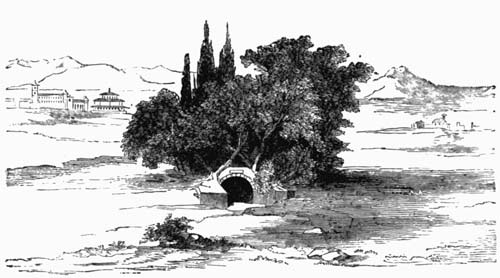
Fig. 1.—Entrance to the Catacomb of St. Priscilla.
This description of the Catacombs in the fourth century is equally
applicable to their general appearance in the nineteenth. Their main
features are unchanged, although time and decay have greatly impaired
their structure and defaced their beauty. These Christian cemeteries
are situated chiefly near the great roads leading from the city, and,
for the most part, within a circle of three miles from the walls. From
this circumstance they have been compared to the “encampment of a
Christian host besieging Pagan Rome, and driving inward its mines and
trenches with an assurance of
final victory.” The openings of the
Catacombs are scattered over the Campagna, whose mournful desolation
surrounds the city; often among the mouldering mausolea that rise,
like stranded wrecks, above the rolling sea of verdure of the
tomb-abounding plain.[2]
On every side are tombs—tombs above and
tombs below—the graves of contending races, the sepulchres of
vanished generations: “Piena di sepoltura è la Campagna.”[3]
How marvelous that beneath the remains of a proud pagan civilization
exist the early monuments of that power before which the myths of
paganism faded away as the spectres of darkness before the rising sun,
and by which the religion and institutions of Rome were entirely
changed.[4]
Beneath the ruined palaces and temples, the crumbling
tombs and dismantled villas, of the august mistress of the world, we
find the most interesting relics of early Christianity on the face of
the earth. In traversing these tangled labyrinths we are brought face
to face with the primitive ages; we are present at the worship of the
infant Church; we observe its rites; we study its institutions; we
witness the deep emotions of the first believers as they commit their
dead, often
their martyred dead, to their last long resting-place; we
decipher the touching record of their sorrow, of the holy hopes by
which they were sustained, of “their faith triumphant o’er their
fears,” and of their assurance of the resurrection of the dead and the
life everlasting. We read in the testimony of the Catacombs the
confession of faith of the early Christians, sometimes accompanied by
the records of their persecution, the symbols of their martyrdom, and
even the very instruments of their torture. For in these halls of
silence and gloom slumbers the dust of many of the martyrs and
confessors, who sealed their testimony with their blood during the
sanguinary ages of persecution; of many of the early bishops and
pastors of the Church, who shepherded the flock of Christ amid the
dangers of those troublous times; of many who heard the words of life
from teachers who lived in or near the apostolic age, perhaps from the
lips of the apostles themselves. Indeed, if we would accept ancient
tradition, we would even believe that the bodies of St. Peter and St.
Paul were laid to rest in those hallowed crypts—a true terra
sancta, inferior in sacred interest only to that rock-hewn
sepulchre consecrated evermore by the body of Our Lord. These
reflections will lend to the study of the Catacombs an interest of the
highest and intensest character.
It is impossible to discover with exactness the extent of this vast
necropolis on account of the number and intricacy of its tangled
passages. That extent has been greatly exaggerated, however, by the
monkish ciceroni, who guide visitors through these subterranean
labyrinths.[5] There are some forty-two of these cemeteries
in all now
known, many of which are only partially accessible. Signor Michele De
Rossi, from an accurate survey of the Catacomb of Callixtus, computes
the entire length of all the passages to be eight hundred and
seventy-six thousand mètres, or five hundred and eighty-seven
geographical miles, equal to the entire length of Italy, from Ætna’s
fires to the Alpine snows.
The entrance to the abandoned Catacomb is sometimes a low-browed
aperture like a fox’s burrow, almost concealed by long and tangled
grass, and overshadowed by the melancholy cypress or gray-leaved ilex.
Sometimes an ancient arch can be discerned, as at the Catacomb of St.
Priscilla,[6]
or the remains of the chamber for the celebration of the
festivals of the martyrs, as at the entrance of the Cemetery of St.
Domitilla. In a few instances it is through the crypts of an ancient
basilica, as at St. Sebastian, and sometimes a little shrine or
oratory covers the descent, as at St. Agnes,[7]
St. Helena,[8]
and St.
Cyriaca. In all cases there is a stairway, often long and steep,
crumbling with time and worn with the feet of pious generations. The
following illustration shows the entrance to the Catacomb of St.
Prætextatus on the Appian Way, trodden in the primitive ages by the
early martyrs and confessors, or perhaps by the armed soldiery of the
oppressors, hunting to earth the persecuted flock of Christ. Here,
too, in mediæval times, the
martial clang of the armed knight may have
awaked unwonted echoes among the hollow arches, or the gliding
footstep of the sandaled monk scarce disturbed the silence as he
passed. In later times pilgrims from every land have visited, with
pious reverence or idle curiosity, this early shrine of the Christian
faith.
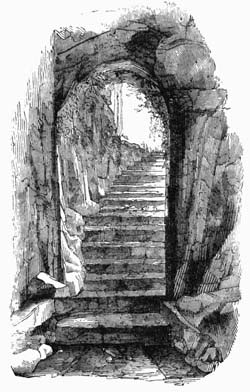
Fig. 2.—Entrance to St. Prætextatus.
The Catacombs are excavated in the volcanic rock which abounds in the
neighborhood of Rome. It is a granulated, grayish breccia, or
tufa, as it is called, of a coarse, loose texture, easily cut
with a knife, and bearing still the marks of the mattocks with which
it was dug. In the firmer volcanic rock of Naples the excavations are
larger and loftier than those of Rome; but the latter, although they
have less of apparent majesty, have more of funereal mystery. The
Catacombs consist essentially of two parts—corridors and chambers, or
cubicula. The corridors are long, narrow and intricate passages,
forming a complete underground net-work. They are for the most part
straight, and intersect each other at approximate right angles. The
accompanying map of part of the Catacomb of Callixtus will indicate
the general plan of these subterranean galleries.
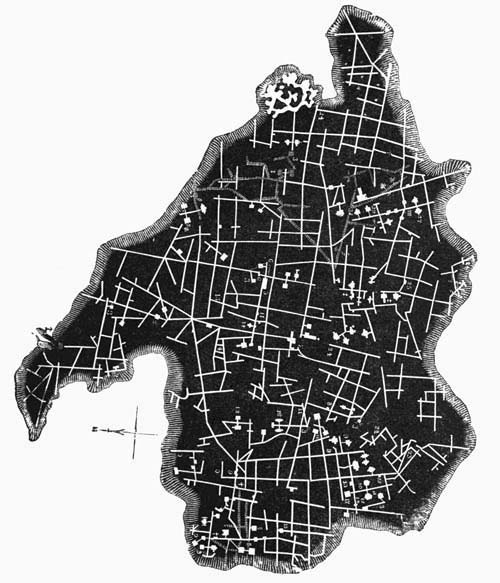
Fig. 3.—Part of Catacomb of Callixtus.
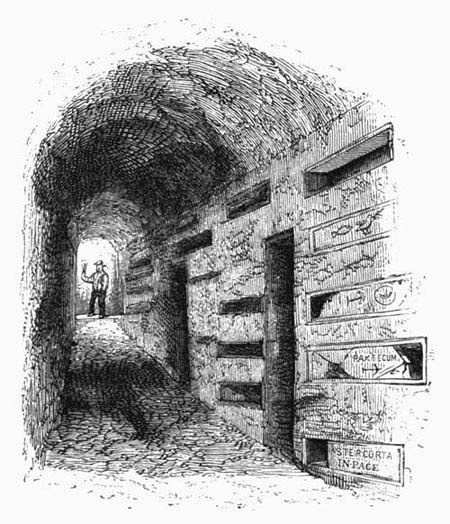
Fig. 4.—Gallery with Tombs.
The main corridors vary from three to five feet in width, but the
lateral passages are much narrower, often
affording room for but
one person to pass. They will average about eight feet in height,
though in some places as low as five or six, and in others, under
peculiar circumstances, reaching to twelve or fifteen feet. The
ceiling is generally vaulted, though sometimes flat; and the floor,
though for the most part level, has occasionally a slight incline, or
even a few steps, caused by the junction of areas of different levels,
as hereafter explained. The walls are generally of the naked
tufa, though sometimes plastered; and where they have given way
are occasionally strengthened with masonry. At the corners of these
passages there are frequently niches, in
which lamps were placed,
without which, indeed, the Catacombs must have been an impenetrable
labyrinth. Cardinal Wiseman recounts a touching legend of a young girl
who was employed as a guide to the places of worship in the Catacombs
because, on account of her blindness, their sombre avenues were as
familiar to her accustomed feet as the streets of Rome to others.
Both sides of the corridors are thickly lined with loculi or
graves, which have somewhat the appearance of berths in a ship, or of
the shelves in a grocer’s shop; but the contents are the bones and
ashes of the dead, and for labels we have their epitaphs. Figure 4
will illustrate the general character of these galleries and
loculi.
The following engraving, after a sketch by Maitland, shows a gallery
wider and more rudely excavated. On the right hand is seen a passage
blocked up with stones, as was frequently done, to prevent accident.
The daylight is seen pouring in at the further end of the gallery, as
described by Prudentius,[9]
and rendering visible the rifled graves.
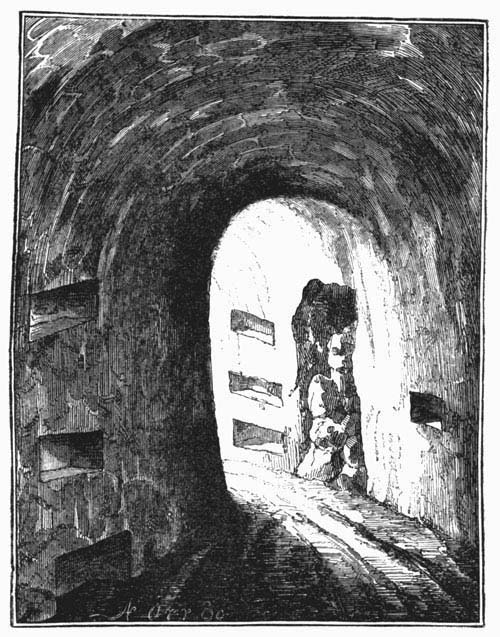
Fig. 5.—Interior of Corridor.
It is evident that the principle followed in the formation of these
galleries and loculi was the securing of the greatest amount of
space for graves with the least excavation. Hence the passages are
made as narrow as possible. The graves are also as close together as
the friable nature of the tufa will permit, and are made to
suit the shape of the body, narrow at the feet, broader at the
shoulders, and often with a semi-circular excavation for the head, so
as to avoid any superfluous removal of tufa. Sometimes the
loculi were made large enough to hold two, three, or even four
bodies, which were often
placed with the head of one toward the feet
of the other, in order to economize space. These were called
bisomi, trisomi, and quadrisomi, respectively.
The graves were apparently made as required, probably with the corpse
lying beside them, as some unexcavated spaces have been observed
traced in outline with chalk or paint upon the walls. Almost every
inch of available space is occupied, and sometimes, though rarely,
graves are
dug in the floor. The loculi are of all sizes, from
that of the infant of an hour to that of an adult man. But here, as in
every place of burial, the vast preponderance of children’s graves is
striking. How many blighted buds there are for every full-blown flower
or ripened fruit!
Sometimes the loculi were excavated with mathematical
precision. An example occurs in the Cemetery of St. Cyriaca, where at
one end of a gallery is a tier of eight small graves for infants, then
eight, somewhat larger, for children from about seven to twelve, then
seven more, apparently for adult females, and lastly, a tier of six
for full-grown men, occupying the entire height of the wall.
Generally, however, a less regular arrangement was observed, and the
graves of the young and old were intermixed, without any definite
order.
It is difficult, if not impossible, to compute the number of graves in
these vast cemeteries. Some seventy thousand have been counted, but
they are a mere fraction of the whole, as only a small part of this
great necropolis has been explored. From lengthened observation Father
Marchi estimates the average number of graves to be ten, five on each
side, for every seven feet of gallery. Upon this basis he computed the
entire number in the Catacombs to be seven millions! The more accurate
estimate of their extent made by Sig. Michele De Rossi would allow
room for nearly four millions of graves, or, more exactly, about three
million eight hundred and thirty-one thousand.[10]
This seems
almost
incredible; but we know that for at least three hundred years, or for
ten generations, the entire Christian population of Rome was buried
here. And that population, as we shall see, was, even at an early
period, of considerable size. In the time of persecution, too, the
Christians were hurried to the tomb in crowds. In this silent city of
the dead we are surrounded by a “mighty cloud of witnesses,” “a
multitude which no man can number,” whose names, unrecorded on earth,
are written in the Book of Life. For every one who walks the streets
of Rome to-day are hundreds of its former inhabitants calmly sleeping
in this vast encampment of death around its walls—“each in his narrow
cell forever laid.”[11]
Till the archangel awake them they slumber.
“It is scarcely known,” says Prudentius, “how full Rome is of buried
saints—how richly her soil abounds in holy sepulchres.”
These graves were once all hermetically sealed by slabs of marble, or
tiles of terra cotta. The former were generally of one piece,
which fitted into a groove or mortice cut in the rock at the grave’s
mouth, and were securely cemented to their places, as, indeed, was
absolutely necessary, from the open character of the galleries in
which the graves were placed. Sometimes fragments of heathen
tombstones or altars were used for this purpose. The tiles were
generally smaller, two or three being required for an adult grave.
They were arranged in panels, and were cemented with plaster, on which
a name or symbol was often rudely scratched with a trowel while soft,
as in the following illustration. Most
of these slabs and tiles have
disappeared, and many of the graves have long been rifled of their
contents. In others may still be seen the mouldering skeleton of what
was once man in his strength, woman in her beauty, or a child in its
innocence and glee. The annexed engraving exhibits two graves, one of
which is partially open, exposing the skeleton which has reposed on
its rocky bed for probably over fifteen centuries.
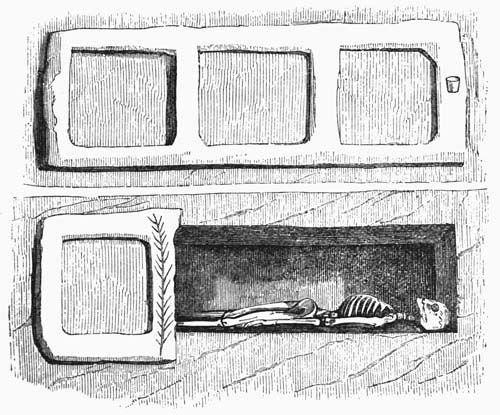
Fig. 6.—Loculi—Open and Closed.
If these bones be touched they will generally crumble into a white,
flaky powder. D’Agincourt copied a tomb (Fig. 7) in which this “dry
dust of death" still retained the outline of a human skeleton. Verily,
“Pulvis et umbra sumus.” Sometimes, however, possibly from some
constitutional peculiarity, the bones remain quite firm
notwithstanding the lapse of so many centuries. De
Rossi states that
he has assisted at the removal of a body from the Catacombs to a
church two miles distant without the displacement of a single
bone.[12]
The age of the deceased and the nature of the ground also
affect the condition in which the remains are found. Of the bodies of
children nothing but dust remains. Where the pozzolana is damp,
the bones are often well preserved; and where water has infiltrated, a
partial petrifaction sometimes occurs.[13]
Campana describes the
opening of a hermetically sealed sarcophagus, which revealed the
undisturbed body clad in funeral robes, and wearing the ornaments of
life; but while he gazed it suddenly dissolved to dust before his
eyes. Sometimes the sarcophagus was placed behind a perforated slab of
marble, as shown in the following example, given by Maitland. The
lower part of the slab is broken.
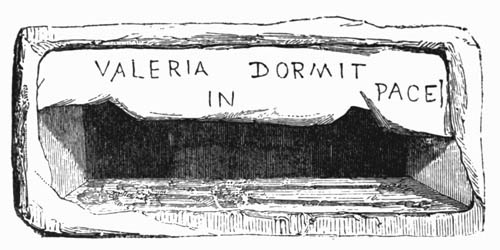
Fig. 7.—Valeria Sleeps in Peace.
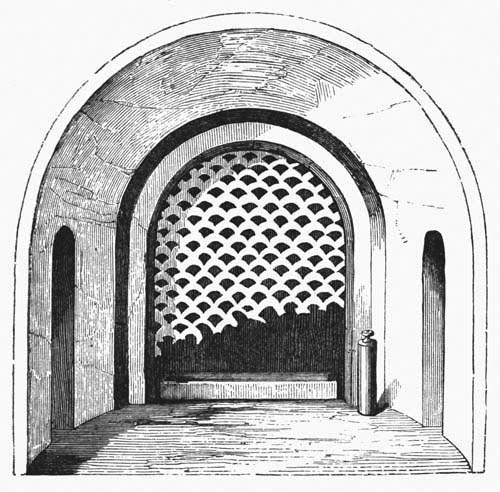
Fig. 8.—Arcosolium with Perforated Slab.
The other essential constituent of the Catacombs, besides the
galleries already described, consists of the cubicula.[14]
These are chambers excavated in the tufa on either side of
the galleries, with which they communicate by doors, as seen in Fig.
4. These often bear the character of family vaults, and are lined with
graves, like the corridors without. They are generally square or
rectangular, but sometimes octagonal or circular. They were probably
used as mortuary chapels, for the celebration of funeral service, and
for the administration of the eucharist near the tombs of the martyrs
on the anniversaries of their death. They were too small to be used
for regular worship, except perhaps in time of persecution. They are
often not more than eight or ten feet square. Even the so-called
“Papal Crypt,” a chamber of peculiar sanctity, is only eleven by
fourteen
feet; and that of St. Cecilia adjoining it, one of a large
size, is less than twenty feet square. Even the largest would not
accommodate more than a few dozen persons. These chambers are
generally facing one another on opposite sides of a gallery, as in the
annexed plan of two cubicula in the Catacomb of Callixtus.
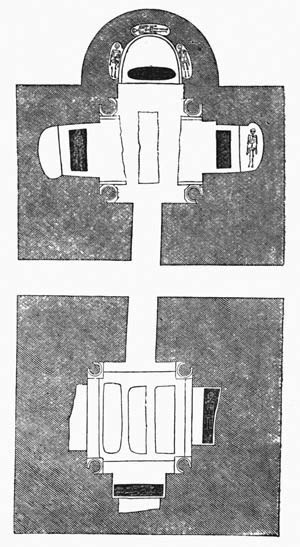
Fig. 9.—Plan of Double Chamber.
It is thought that in the celebration of worship one of these chambers
was designed for men and the other for women. Sometimes separate
passages to the chapels and distinct entrances to the Catacombs seem
intended to facilitate this separation of the sexes. Sometimes three,
or even as many as five, cubicula, as in one example in the
Catacomb of St. Agnes, were placed on the same
axial line, and formed
one continuous suite of chambers. The accompanying section of
what is known as “The Chapel of Two Halls,” in the Catacomb of St.
Prætextatus, illustrates this: A is
the main gallery, D a large
cubiculum known as “The Women’s Hall,” to the right, and to the
left B, a hexagonal vaulted room with
a smaller chamber, C, opening from
it. The length of the entire range from G to F,
according to the accurate measurement of M. Perret, is twenty-three
and a half mètres, or nearly seventy-seven feet. The larger
engraving (Fig. 11) gives a perspective view looking toward the left
of the hexagonal chamber, (D. Fig. 10,) and the smaller one,
C, opening from it. By means of these
connected chambers the Christians were enabled in times of persecution
to assemble for worship in these “dens and caves of the earth,”
surrounded by the slumbering bodies of the holy dead.
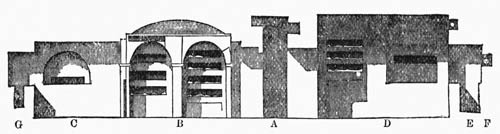
Fig. 10.—Section of Gallery and Cubicula.
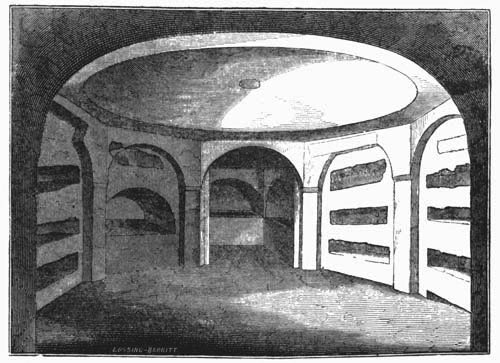
Fig 11.—Perspective of Lower Chamber in Fig. 9.
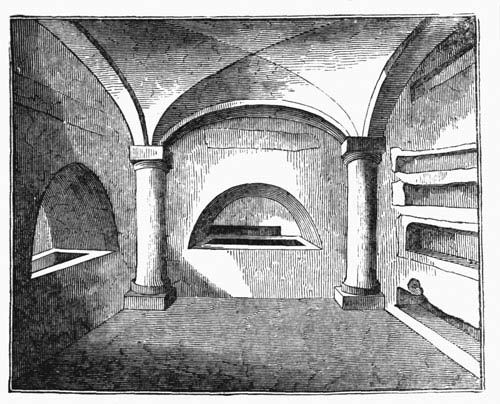
Fig. 12.—Vaulted Chamber with Columns.
The cubicula had vaulted roofs, and were sometimes plastered or
cased with marble and paved with tiles, or, though rarely, with
mosaic. These, however, were generally additions of later date than
the original construction, as were also the semi-detached columns in
the angles, with stucco capitals and bases, as indicated in Fig. 9,
and shown more clearly in the following engraving, which is a
perspective view of the lower chamber
in Fig. 9. The walls and ceiling
were often covered with fresco paintings, frequently of elegant design, to
be hereafter described.[15]
Sometimes, as in some examples in the
Catacomb of St. Agnes, tufa or marble seats are ranged around
the chamber, and chairs are hewn out of the solid rock.[16]
These
chambers were used probably for the instruction of catechumens.
Occasionally the cubiculum terminates in a semicircular recess,
as in the upper chamber in Fig. 9. These probably gave rise to the
apse in early Christian architecture, of which a good example
is found in the Church of St. Clement, one of the most ancient
Christian edifices in Rome. Niches and shelves for lamps, an absolute
necessity in the perpetual darkness that there reigns, frequently
occur, such as may be seen in Italian houses to-day. Without the least
authority, some Roman Catholic writers have described
these as closets
for priestly vestments and shelves for
pictures.
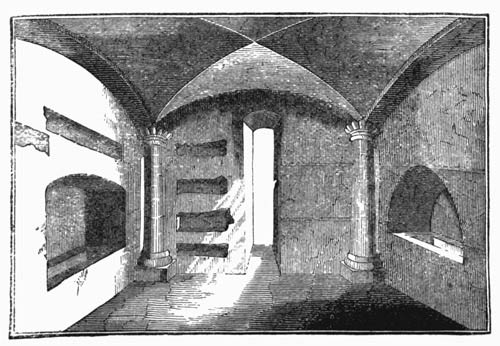
Fig. 13.—Cubiculum with Arcosolia.
A peculiar form of grave common in these chambers, as well as in the
galleries, is that known as the arcosolium, or arched tomb. It
consists of a recess in the wall, having a grave, often double or
triple, excavated in the tufa, or built with masonry, like a
solid sarcophagus, and closed with a marble slab. These are seen in
the plan, Fig. 9, in the section, Fig. 10, at G and E in
Fig. 15, and in perspective in Figs. 11 and 12. Sometimes the recess
is rectangular instead of arched, and is then called by De Rossi
sepolcro a mensa, or table tomb. Sometimes the arch was
segmental, especially when constructed of masonry.[17]
An example of
both sorts is seen in the accompanying engraving of a cubiculum
in the Catacomb of St. Prætextatus. The narrow door into the corridor
is also seen, and the stucco capitals and bases of the columns. In
course of time these arcosolia were
used as altars for the
celebration of the eucharist, and eventually grave abuses arose from
the superstitious veneration paid to the relics of the martyr or
confessor interred therein. Frequently, also, the back of this arched
recess was pierced with graves of a later date, often directly through
a painting,[18]
in order to obtain a resting place near the bodies of
the saints.
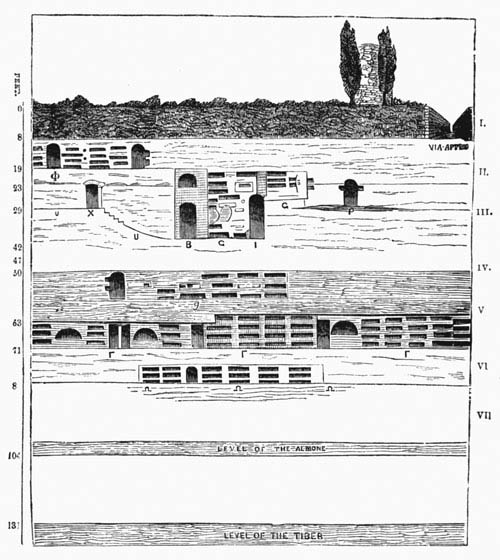
Fig. 14.—Section of the Catacomb of Callixtus.
Hitherto only one level of the Catacombs has been described, but
frequently “beneath this depth there is a lower deep,” or even three
or four tiers of galleries, excavated as the upper ones became filled
with graves. Thus there are sometimes as many as five stories, or
piani, as they are called, one beneath the other. These are
carefully maintained horizontal, to avoid breaking through the floor
of the one above or the roof of the one below, the danger of which
would be very great if the strict level were departed from. For the
same reason the different piani were generally separated by a
thick stratum of solid tufa. The relative position of these
levels is shown by the following engraving, reduced from De Rossi. It
represents a section of the Crypt of St. Lucina, a part of the
Cemetery of Callixtus. The dark colored stratum, marked I in the margin, is entirely made up of the
débris of ancient monuments, buildings, and other materials
accumulated in the course of ages in this place to the depth of eight
feet. It has completely buried the ancient roads, except where
excavated, as shown in the engraving. The next stratum, II, is of solid grayish tufa. In
this the first level or piano, φ, is excavated. It is
not more than twenty feet below the surface, and in many places only
half that depth. Consequently its area is comparatively limited,
because if extended it would have run out into the
open air, from the
sloping of the ground in which it is dug. The next stratum, III, is softer and more easily worked, and
therefore is that in which are found the most important and extensive
piani of galleries. The cross sections P and X,
and the longitudinal section υ, will
show how the lower surface of the more solid stratum above was made
the ceiling of these galleries, in order to lessen the danger of its
falling. At B will be observed the
employment of masonry to strengthen the
crumbling walls of the
friable tufa. The descent of a few steps, some of which have
been worn away, will also be noticed at U. At IV a
more rocky stratum is found, called tufa lithoide, below which
the ancient fossors[19]
had to go to find suitable material for the
excavation of the third piano. This was found in stratum V, in which are two piani at
different levels. The lower one is not vertically beneath that here
represented above it, but at some little distance. It is here shown,
to exhibit at one view a section of all the stories of this Catacomb.
The upper piano, g, consists of low and narrow
galleries, but the lower one, marked Γ Γ Γ, seventy-one feet
beneath the surface of the ground, is of great extent. Several of the
loculi, it will be perceived, are built of masonry, in
consequence of the crumbling nature of the soil. The three large
arcosolia will also be observed. The floor of this piano
rests on a somewhat firmer stratum, in which is still another level of
galleries, Ω Ω Ω, ten feet lower down. This lower level is
generally subject to inundation by water, in consequence of the
periodical rising of the adjacent Almone, the level of which is shown
at a depth of one hundred and four feet, and that of the Tiber at one
hundred and thirty-one feet, below the surface.
To secure immunity from dampness, which would accelerate decomposition
and corrupt the atmosphere, the Catacombs were generally excavated in
high ground in the undulating hills around the city, never crossing
the intervening depressions or valleys. There is, therefore, no
connection between the different cemeteries except where they happen
to be contiguous, nor, as has been asserted, with the churches of
Rome. Where a
Catacomb has been excavated in low ground, as in the
exceptional case of that of Castulo on the Via Labicana, the water has
rendered it completely inaccessible.
Access to these different piani is gained by stairways, which
are sometimes covered with tile or marble, or built with masonry, or
by shafts. The awful silence and almost palpable darkness of these
deepest dungeons is absolutely appalling. They are fitly described by
the epithet applied by Dante to the realms of eternal gloom: loco
d’ogni luce muto—a spot mute of all light. Here death reigns
supreme. Not even so much as a lizard or a bat has penetrated these
obscure recesses. Nought but skulls and skeletons, dust and ashes, are
on every side. The air is impure and deadly, and difficult to breathe.
“The cursed dew of the dungeon’s damp” distills from the walls, and a
sense of oppression, like the patriarch’s “horror of great darkness,”
broods over the scene.
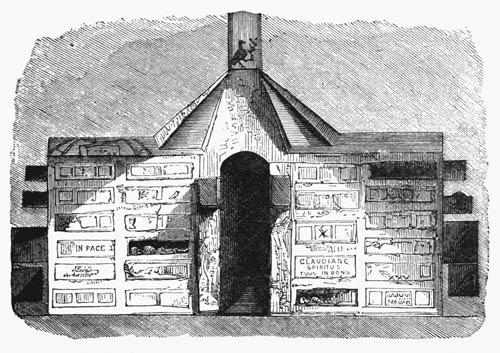
Fig. 15.—Section of Cubicula with Luminare.
The Catacombs were ventilated and partially lighted by numerous
openings variously called spiragli, or breathing-holes, and
luminari, or light-holes. They were also probably used for the
removal of the excavated material from those parts remote from the
entrance. They were even more necessary for the admission of air than
of light. Were it not for these the number of burning lamps, the
multitude of dead bodies, no matter how carefully the loculi
were cemented, and the opening of bisomi, or double graves, for
interments, would create an insupportable atmosphere. They were
generally in the line of junction between two cubicula, a
branch of the luminare entering each chamber, as shown in the
accompanying section of a portion of the Catacomb of Sts. Marcellinus
and Peter. Sometimes, indeed, four, or even more, cubicula were
ventilated and partially lighted by the same shaft. De Rossi mentions
one luminare in
the recently discovered Cemetery of St.
Balbina, which is not square but hexagonal, or nearly so, and which
divides into eight branches, illumining as many separate chambers or
galleries. Sometimes a funnel-shaped luminare reaches to the
lowest piano; but from the faint rays that feebly struggle to
those gloomy depths there comes “no light, but rather darkness
visible.” In the upper levels, however, some cubicula are well
lighted by large openings. The brilliant Italian sunshine to-day
lights up the pictured figures on the wall as it must have illumined
with its strong Rembrandt light the fair brow of the Christian maiden,
the silvery hair of the venerable pastor, or the calm face of the holy
dead waiting for interment in those early centuries so long ago. These
luminari are often two feet square at the top, and wider as
they descend; sometimes they are cylindrical in shape, as in the
Catacomb of St. Helena.[20]
The external
openings, often concealed by
grass and weeds, are very numerous throughout the Campagna near the
city, and are often dangerous to the unwary rider. In almost every
vineyard between the Pincian and Salarian roads they may be found, and
through them an entrance into the Catacombs may frequently be
effected. After the persecution had ceased, and there was no longer
need for concealment, their number was increased, and they were made
of a larger size, and frequently lined with masonry, or plastered and
frescoed. In the Catacombs of St. Agnes and of Callixtus are several
in a very good state of preservation.
We have already seen the contemporary account of the Catacombs by
Prudentius, in the fourth century. Jerome also describes their
appearance at the same period in words which are almost equally
applicable to-day. “When I was a boy, being educated at Rome,” he
says, “I used every Sunday, in company with others of my own age and
tastes, to visit the sepulchres of the apostles and martyrs, and to go
into the crypts dug in the heart of the earth. The walls on either
side are lined with bodies of the dead, and so intense is the darkness
as to seemingly fulfill the words of the prophet, ‘They go down alive
to Hades.’ Here and there is light let in to mitigate the gloom. As we
advance the words of the poet are brought to mind: ‘Horror on all
sides; the very silence fills the soul with dread.’”[21]
It must not be supposed that the features above described
are always
perfectly exhibited. They are often obscured and obliterated by the
lapse of time, and by earthquakes, inundations, and other destructive
agencies of nature. The stairways are often broken and interrupted,
and the corridors blocked up by the falling in of the roof, where it
has been carried too near the surface, or by the crumbling of the
walls, and sometimes apparently by design during the age of
persecution. The rains of a thousand winters have washed tons of earth
down the luminari, destroyed the symmetry of the openings, and
completely filled the galleries with débris. The natural
dampness of the situation, and the smoke of the lamps of the early
worshipers, or the torches of more recent visitors, and sometimes
incrustations of nitre, have impaired or destroyed the beauty of many
of the paintings. The hand of the spoiler has in many cases completed
the work of devastation. The rifled graves and broken tablets show
where piety or superstition has removed the relics of the dead, or
where idle curiosity has wantonly mutilated their monuments.
The present extent of the Catacombs is the result, not of primary
intention, but of the contact of separate areas of comparatively
limited original size, and the inosculation, as it were, of their
distinct galleries. This is apparent from the fact that this contact
and junction sometimes take place between areas of different levels,
causing a break in their horizontal continuity, like the “faults” or
dislocations common in geological strata. Sometimes, too, this
junction between two adjacent areas takes place through a tier of
graves, and evidently formed no part of the original design. These
separate areas were originally, as we shall see in the following
chapter, private burial places in the vineyards of wealthy Christian
converts, and were early
made available for the interment of the
poorer members of the infant Church. In accordance with a common Roman
usage the ground thus set apart for the purpose of sepulture was
placed under the protection of the law, and was accurately defined, to
secure it from trespass or violation. While the protection of the law
was enjoyed, the excavations were strictly confined within the limits
of these areas, and lower piani were dug rather than transgress
the boundary. But when that protection was withdrawn the galleries
were horizontally extended, often for the purpose of facilitating
escape, and connections were made with adjacent areas, till the whole
became an intricate labyrinth of passages and chambers. These areas
are still further distinguished by certain peculiarities in the
inscriptions, cubicula, and paintings, and were greatly
modified by subsequent constructions.
It has till recently been thought that the Catacombs were originally
excavations made by the Romans for the extraction of sand and other
building material, and afterward adopted by the Christians as places
of refuge, and eventually of sepulture and worship. This opinion was
founded on a few misunderstood classical allusions and statements in
ancient ecclesiastial writers, and on a misinterpretation of certain
accidental features of the Catacombs themselves. It was held,
nevertheless, by such eminent authorities as Baronius, Severano,
Aringhi, Bottari, D’Agincourt, and Raoul-Rochette. Padre Marchi first
rejected this theory of construction, and the brothers De Rossi have
completely refuted it. An examination of the material in which these
sand pits and stone quarries and the Catacombs were respectively
excavated, as well as of their structural differences, will show their
entirely distinct character.
The surface of the Campagna, especially of that part
occupied by the
Catacombs, is almost exclusively of volcanic origin. The most ancient
and lowest stratum of this igneous formation is a compact conglomerate
known as tufa lithoide. It was extensively quarried for
building, and the massive blocks of the Cloaca Maxima and the ancient
wall of Romulus attest the durability of its character. Upon this rest
stratified beds of volcanic ashes, pumice, and scoria, often
consolidated with water, but of a substance much less firm than that
of the tufa lithoide, and called tufa granolare. In
insulated beds, rarely of considerable extent, in this latter
formation, occurs another material, known as pozzolana. It
consists of volcanic ashes deposited on dry land, and still existing
in an unconsolidated condition. This is the material of the celebrated
Roman cement, which holds together to this day the massy structures of
ancient Rome. It was conveyed for building purposes as far as
Constantinople, and the pier on the Tiber from which it was shipped is
still called the Porto di Pozzolana. It is in these latter deposits
exclusively that the arenaria, or sand pits, are found. The
tufa granolare is too firm, and contains too large a proportion
of earth, to use as sand, and is yet too friable for building
purposes. Yet it is in this material, entirely worthless for any
economic use, that the Catacombs are almost exclusively excavated;
while the tufa lithoide and the pozzolana are both
carefully avoided where possible, the one as too hard and the other as
too soft for purposes of Christian sepulture. Sometimes, indeed, as at
the cemeteries of St. Pontianus and St. Valentinus, for special
reasons, Catacombs were excavated in less suitable material; but still
the substance removed—a shelly marl—was economically useless, and
the galleries had to be supported by solid masonry. The tufa
granolare, on the
contrary, was admirably adapted for the
construction of these subterranean cemeteries. It could be easily dug
with a mattock, yet was firm enough to be hollowed into loculi
and chambers; and its porous character made the chambers dry and
wholesome for purposes of assembly, which was of the utmost importance
in view of the vast number of bodies interred in these recesses.
The differences of structure between the quarries or arenaria
and the Catacombs are no less striking. To this day, the vast grottoes
from which the material for the building of the Coliseum was hewn,
most probably by the Jewish prisoners of Titus, may still be seen on
the Cœlian hill. It is said that in those gloomy vaults were kept
the fierce Numidian lions and leopards whose conflicts with the
Christian martyrs furnished the savage pastime of the Roman
amphitheatre. But nothing can less resemble the narrow and winding
passages of the Catacombs than those tremendous caverns.
Nor is there any greater resemblance in the excavations of the
arenaria. These are large and lofty vaults, from sixteen to
twenty feet wide, the arch of which often springs directly from the
floor, so as to give the largest amount of sand with the least labour
of excavation. The object was to remove as much material as possible;
hence there was often only enough left to support the roof. The
spacious passages of the arenaria run in curved lines, avoiding
sharp angles, so as to allow the free passage of the carts which
carried away the excavated sand. In the Catacombs, on the contrary, as
little material as possible was removed; hence the galleries are
generally not more than three, or sometimes only two, feet wide, and
run for the most part in straight lines, often crossing each other at
quite acute angles, so that only very narrow carts can be used in
cleaning out the accumulated débris of
centuries—a very tedious process, which greatly increases the cost of
exploration. The walls, moreover, are always vertical, and the roof
sometimes quite flat, or only slightly arched. The wide difference in
the principle of construction is obvious. The great object in the
Catacombs has been to obtain the maximum of wall-surface, for the
interment of the dead in the loculi with which the galleries
are lined throughout, with the minimum of excavation. The structural
difference will at once be seen by comparing the irregular windings of
the small arenarium represented in the upper part of Figs. 3
and 26 with the straight and symmetrical galleries of the adjacent
Catacomb. Connected with the Catacomb of St. Agnes is an extensive
arenarium, whose spacious, grotto-like appearance is very
different from that of the narrow sepulchral galleries beneath. In the
floor of this arenarium is a square shaft leading to the
Catacomb, in which Dr. Northcote conjectures there was formerly a
windlass for removing the excavated material. There are also
footholes, for climbing the sides of the shaft, cut in the solid
tufa, perhaps as a means of escape in the time of persecution.
This arenarium, which was probably worked out and abandoned
long before its connection with the Catacomb, may have been employed
as a masked entrance to its crypts, when the more public one could not
be safely used. Its spacious vaults may also have been a receptacle
for the broken tufa removed from the galleries beneath.
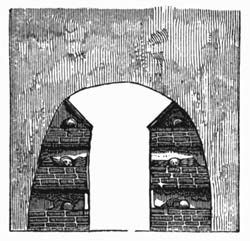
Fig. 16.—Gallery in St. Hermes.
Many of these arenaria may be observed excavated in the
hill-sides near Rome; but except when incidentally forming part of a
Catacomb, they have never been found to contain a single grave.
Indeed, in consequence of the utter unfitness of the pozzolana
for the
purposes of Christian sepulture, the intrusion of a deposit
of that material into the area of a Catacomb prevented the extension
or necessitated the diversion of its galleries. Moreover, where the
attempt has been made to convert an arenarium into a Christian
cemetery, the changes which have been made show conclusively its
original unfitness for the latter purpose. The accompanying section of
a gallery in the Catacomb of St. Hermes will exhibit the structural
additions necessary to adopt an arenarium for Christian
sepulture. The sides of the semi-eliptical vault had to be built up
with brick-work, leaving only a narrow passage in the middle. The
loculi were spaces left in the masonry, in which the mouldering
skeletons may still be seen. The openings were closed with slabs in
the usual manner, as shown in the elevation, (Fig. 17,) except at the
top, where they cover the grave obliquely, like the roof of a house.
The vault is often arched with brick-work, and at the
intersection of
the galleries has sometimes to be supported by a solid pier of
masonry. In part of an ancient arenarium converted into a
cemetery in the Catacomb of St. Priscilla similar constructions may be
seen. The long walls and numerous pillars of brick-work concealing and
sustaining the tufa, and the irregular windings of the
passages, show at once the vast difference between the
arenarium and the Catacomb, and the immense labour and expense
required to convert the former into the latter.
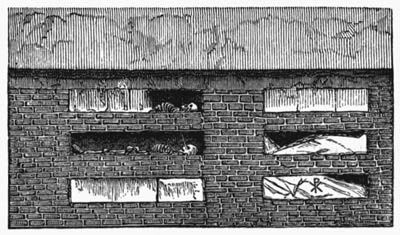
Fig. 17.—Part of Wall of Gallery in St. Hermes.
It has been urged in objection to this theory, that the difficulty of
secretly disposing of at least a hundred millions of cubic feet of
refuse material taken from the Catacombs must have been exceedingly
great, unless it could be removed under cover of employment for some
economic purpose. It will be shown, however, that secrecy was not
always necessary, as has been assumed, but that, on the contrary, the
Christian right of sepulture was for a long time legally recognized by
the Pagan Emperors; and that the Catacombs continued to be publicly
used for a considerable time after the establishment of Christianity
on the throne of the Cæsars. During the exacerbations of persecution
there is evidence that the excavated material was deposited in the
galeries already filled with graves, or, as we have seen, in the
spacious vaults of adjacent arenaria. If the Catacombs were
merely excavations for sand or stone, as has been asserted, we ought
to find many of their narrow galleries destitute of tombs, and many of
the arenaria containing them; whereas every yard of the former
is occupied with graves, and not a single grave is found in the
latter, nor do they contain a single example of a mural painting or
inscription. The conclusion is irresistible that the Catacombs proper
were created exclusively
for the purpose of Christian burial, and in
no case were of Pagan construction.
The erroneous theory here combated has arisen, as we have said,
chiefly from certain classical allusions to the arenaria, and
from passages in the ancient ecclesiastical records describing the
burial places of the martyrs, as in cryptis arenariis, in
arenario, or ad arenas. Some of these localities, however,
have been identified beyond question, and found to consist merely of a
sandy kind of rock, and not at all of the true pozzolana. In
others a vein of pozzolana does actually occur in the
Catacombs, or they are connected with ancient arenaria, as at
St. Agnes and at Calixtus. In the other instances the localities are
either yet unrecognized, or the expression merely implies that the
cemetery was near the sand pits—juxta arenarium, or
in loco qui dicitur ad Arenas.
The mere technical description of the Catacombs, however, gives no
idea of the thrilling interest felt in traversing their long-drawn
corridors and vaulted halls. As the pilgrim to this shrine of the
primitive faith visits these chambers of silence and gloom,
accompanied by a serge-clad, sandaled monk,[22]
he seems like the
Tuscan poet wandering through the realms of darkness with his shadowy
guide.
“Ora sen’ va per un segreto calle
Tra l’ muro della terra.”[23]
His footsteps echo strangely down the distant passages and hollow
vaults, dying gradually away in the solemn stillness of this valley of
the shadow of death. The
graves yawn weirdly as he passes, torch in
hand. The flame struggles feebly with the thickening darkness, vaguely
revealing the unfleshed skeletons on either side, till its redness
fades to sickly white, like that fioco lume,[24]
that pale
light, by which Dante saw the crowding ghosts upon the shores of
Acheron. Deep mysterious shadows crouch around, and the dim
perspective, lined with the sepuchral niches of the silent community
of the dead, stretch on in an apparently unending vista. The very air
seems oppressive and stifling, and laden with the dry dust of death.
The vast extent and population of this great necropolis overwhelm the
imagination, and bring to mind Petrarch’s melancholy line—
“Piena di morti tutta la campagna.”[25]
Almost appalling in its awe and solemnity is the sudden transition
from the busy city of the living to the silent city of the dead; from
the golden glory of the Italian sunlight to the funereal gloom of
these sombre vaults. The sacred influence of the place subdues the
soul to tender emotions. The fading pictures on the walls and the
pious epitaphs of the departed breathe on every side an atmosphere of
faith and hope, and awaken a sense of spiritual kinship that overleaps
the intervening centuries. We speak with bated breath and in whispered
tones, and thought is busy with the past. It is impossible not to feel
strangely moved while gazing on the crumbling relics of mortality
committed ages ago, with pious care and many tears, to their last,
long rest.
“It seems as if we had the sleepers known.”[26]
We see the mother, the while her heart is wrung with anguish, laying
on its stony bed—rude couch for such a tender thing—the little form
that she had cherished in her warm embrace. We behold the persecuted
flock following, it may be, the mangled remains of the faithful pastor
and valiant martyr for the truth, which at the risk of their lives
they have stealthily gathered at dead of night. With holy hymns,[27]
broken by their sobs, they commit his mutilated body to the grave,
where after life’s long toil he sleepeth well. We hear the Christian
chant, the funeral plaint, the pleading tones of prayer, and the words
of holy consolation and of lofty hope with which the dead in Christ
are laid to rest. A moment, and—the spell is broken, the past has
vanished, and stern reality becomes again a presence. Ruin and
desolation and decay are all around.
The exploration of these worse than Dædalian labyrinths is not
unattended with danger. That intrepid investigator, Bosio, was several
times well nigh lost in their mysterious depths. That disaster really
happened to M. Roberts, a young French artist, whose adventure has
been wrought into an exciting scene in Hans Andersen’s tale, “The
Improvisatore,” and forms an episode in the Abbé de Lille’s poem,
“L’Imagination.” Inspired by the enthusiasm of his profession,
he attempted to explore one of the Catacombs, with nothing but a torch
and a thread for a guide. As he wandered on through gallery and
chamber, he became so absorbed in his study that, unawares, the thread
slipped from his hand. On discovering his loss he tried, but in vain,
to recover the clew. Presently his torch went out, and he was left in
utter darkness, imprisoned in a living grave, surrounded by the relics
of mortality. The silence was oppressive.
He shouted, but the hollow
echoes mocked his voice. Weary with fruitless efforts to escape his
dread imprisonment he threw himself in despair upon the earth, when,
lo, something familiar touched his hand. Could he believe it? it was
indeed the long lost clew by which alone he could obtain deliverance
from this awful labyrinth. Carefully following the precious thread he
reached at last the open air,
And never Tiber, rippling through the meads,
Made music half so sweet among its reeds;
And never had the earth such rich perfume,
As when from him it chased the odor of the tomb.[28]
Still more terrible in its wildness is an incident narrated by
MacFarlane.[29]
In the year 1798, after the return to Rome of the
Republican army under Berthier, a party of French officers, atheistic
disciples of Voltaire and Rousseau, and hardened by the orgies of the
Revolution, visited the Catacombs. They caroused in the sepulchral
crypts, and sang their bacchanalian songs among the Christian dead.
They rifled the graves and committed sacrilege at the tombs of the
saints. One of the number, a reckless young cavalry officer, “who
feared not God nor devil, for he believed in neither,” resolved to
explore the remoter galleries. He was speedily lost, and was abandoned
by his companions. His excited imagination heightened the natural
horrors of the scene. The grim and ghastly skeletons seemed an army of
accusing spectres. Down the long corridors the wind mysteriously
whispered, rising in inarticulate moanings and woeful sighs, as of
souls in pain. The tones of the neighbouring convent bell, echoing
through the stony
vaults, sounded loud and awful as the knell of
doom. Groping blindly in the dark, he touched nothing but rocky walls
or mouldering bones, that sent a thrill of horror through his frame.
Though but a thin roof separated him from the bright sunshine and free
air, he seemed condemned to living burial. His philosophical
skepticism failed him in this hour of peril. He could no longer scoff
at death as “un sommeil éternel.” The palimpsest of memory
recalled with intensest vividness the Christian teachings of his
childhood. His soul became filled and penetrated with a solemn awe.
His physical powers gave way beneath the intensity of his emotion. He
was rescued the next day, but was long ill. He rose from his bed an
altered man. His life was thenceforth serious and devout. When killed
in battle in Calabria seven years after, a copy of the Gospels was
found next to his heart.
Even as late as 1837 a party of students with their professor,
numbering in all some sixteen, or, as some say, nearly thirty, entered
the Catacombs on a holiday excursion, to investigate their
antiquities, but became entangled amid their intricacies. Diligent
search was made, but no trace of them was ever found. In some silent
crypt or darksome corridor they were slowly overtaken by the same
torturing fate as that of Ugolino and his sons in the Hunger Tower of
Pisa.[30]
The passage by which they entered has been walled up, but
the mystery of their fate will never be dispelled till the secrets of
the grave shall be revealed.
Haud procul extremo culta ad pomœria vallo,
Mersa latebrosis crypta patet foveis...—Peristephanon, iv.
Primas namque fores summo tenus intrat hiatu
Illustratque dies limina vestibuli.—Peristephanon, ii.
“All that tread
The globe are but a handful to the tribes
That slumber in its bosom.”
“And now through narrow, gloomy paths we go,
’Tween walls of earth and tombs.”—Inferno.
It is highly probable that the first Roman Catacombs were excavated by
the Jews.[31]
Many Hebrew captives graced the triumph of Pompey after
his Syrian conquests, B. C. 62. The Jewish population increased by
further voluntary accessions. They soon swarmed in that Trans-Tiberine
region which formed the ancient Ghetto of Rome. They made many
proselytes from paganism to the worship of the true God, and thus, to
use the language of Seneca, “The conquered gave laws to their
conquerors.”[32]
All the national customs and prejudices of the Jews were opposed to
the Roman practice of burning the dead, which Tacitus asserts they
never observed;[33]
and they clung with tenacity to their hereditary
mode of sepulture. Wherever they have dwelt they have left traces
of subterranean burial. The hills of Judea are honeycombed with
sepulchral caves and galleries. Similar excavations have been found in
the Jewish settlements of Asia Minor, the Ægean Isles, Sicily, and
Southern Italy.[34]
So also in Rome they sought to be separated in
death, as in life, from the Gentiles among whom they dwelt. They had
their Catacombs apart, in which not a single Christian or pagan
inscription has been found. Bosio describes one such Catacomb, which
he discovered on Monte Verde, which was much more ancient than the
Christian Catacomb of St. Pontianus in the same vicinity. It was of
very rude construction, and contained not a single Christian monument,
but numerous slabs bearing the seven-branched Jewish candlestick, and
one inscription on which the word ϹΥΝΑΓΩΓ—Synagogue—was
legible.[35]
It was situated near that Trans-Tiberine quarter of the
city inhabited at the period of the Christian era by the numerous
Jewish population of Rome. It cannot now, however, be identified,
having been obliterated or concealed by the changes of the last two
centuries. Maitland gives the following Jewish inscription from a MS.
collection in Rome. The figure to the left may be a horn for
replenishing the lamp with oil. The letters at the right are probably
intended for the Hebrew word שָׁלוֹם, Shalom, or Peace, so
common in its classical equivalent upon Christian tombs. The palm
branch is a Pagan as well as Jewish and Christian symbol of victory.
The central figure is a rude representation
of the seven-branched
candlestick which appears also in bass-relief on the Arch of Titus at
Rome.
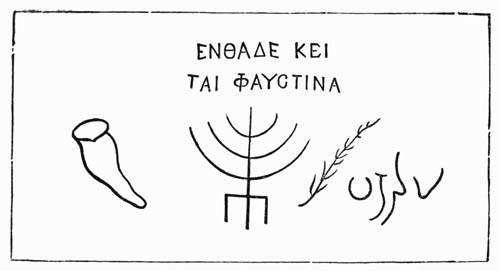
“Here lies Faustina. In Peace.”
Fig. 18.—Slab from Jewish Catacomb.
In the year 1859 another Jewish Catacomb was discovered in the Vigna
Randanini, on the Appian Way, about two miles from Rome. It has been
minutely described by Padre Garrucci.[36]
In this the graves and
sarcophagi are sunk in the floor as well as in the walls. They are
closed with terra cotta or marble slabs, and are otherwise similar to
those of the Christian Catacombs. It contains several vaulted
chambers, one of which has some very remarkable paintings of the
seven-branched candlestick on the roof and walls. The same figure is
frequently scratched on the mortar with which the graves are closed.
The dove and olive branch and the palm are also frequently repeated.
Although nearly two hundred inscriptions have been discovered, not one
of either pagan or Christian character has been met with.
The names are sometimes strikingly Jewish in form, and where the
epitaphs refer to the station of the deceased
it is always to officers
of the synagogue, as ΑΡΚΟΝΤΕϹ, rulers, ΓΡΑΜΜΑΤΕΙϹ,
scribes. The following examples are from the Kircherian Museum:
ΩΔΕ
ΚΕΙΤΕ ϹΑΛΩ[ΜΗ] ΘΥΓΑΤΗΡ ΓΑΔΙΑ
ΠΑΤΡΟϹ ϹΥΝΑΓΩΓΗϹ ΑΙΒΡΕΩΝ ΕΒΙΩϹΕΝ ΜΑ ΕΝ ΕΙΡΗΝΗ ΚΟΙΜΗϹΙϹ ΑΥΤΗϹ.
Here lies Salome, daughter of
Gadia, Father of the Synagogue of the Hebrews. She lived forty-one
years. Her sleep is in peace. ΕΝΘΑΔΕ
ΚΕΙΤΕ ΚΥΝΤΙΑΝΟϹ
ΓΕΡΟΥϹΙΑΡΧΗϹ ϹΥΝΑΓΩΓΗϹ ΤΗϹ ΑΥΓΥϹΤΗϹΙΩΝ. Here lies Quintianus,
Gerousiarch (that is, Chief Elder) of the Synagogue of the
Augustenses. ΕΝΘΑΔΕ
ΚΕΙΤΑΙ ΝΕΙΚΟΔΗΜΟϹ HΟ ΑΡΧΩΝ ϹΙΒΟΥΡΗϹΙΩΝ ΚΑΙ ΠΑϹΙ
ΦΕΙΛΗΤΟϹ ΑΙΤΩΝ Λ ΗΜΕΡ ΜΒ ΘΑΡΙ ΑΒΛΑΒΙ ΝΕΩΤΕΡΕ ΟΥΔΕΙϹ ΑΘΑΝΑΤΟϹ. Here lies Nicodemus, ruler of the Severenses, and beloved
of all; (aged) thirty years, forty-two days. Be of good cheer, O
inoffensive young man! no one is exempt from death.
This inscription will recall another “ruler of the Synagogue” of the
same name. Many of the sleepers in this Jewish Cemetery were
evidently, from their names,[37]
Greek or Latin proselytes. Sometimes,
indeed, this is expressly asserted, as in the following:
Mannacivs sorori Crysidi dvlcissime
proselyte.—Mannacius to his sweetest sister Chrysis, a
proselyte.
It may be assumed that this Catacomb was exclusively Jewish, and we
know, from the testimony of Juvenal[38]
and others, that numbers of
the Jews inhabited the adjacent part of Rome, about the Porta Capena
and the valley of Egeria. It is not, however, certain whether it is
the original type, or a later imitation, of the Christian cemetery.
But the Jewish population must have had extra-mural places of
sepulture before the Christian era; and it is probable that the early
Jewish
converts to Christianity may have merely continued a mode of
burial already in vogue, substituting the emblems of their newly
adopted faith for those which they had forsaken; or, rather—for we
find that they frequently retained certain Jewish symbols, as the
dove, olive branch, and palm—supplementing them with the emblems of
Christianity. De Rossi has expressed the opinion that the earliest
mode of Christian burial was in sarcophagi, as in the Jewish cemetery
above described.
The date of the planting of Christianity in Rome is uncertain.
Probably some of the “strangers of Rome” who witnessed the miracle of
the Pentecost, or, perhaps, the Gentile converts of the “Italian band”
of Cornelius, brought the new evangel to their native city.[39]
But
certain it is that as early as A. D. 58 the faith of the
Roman Church
was “spoken of throughout the whole world.” “Christianity,” says
Tertullian, “grew up under the shadow of the Jewish religion, to which
it was regarded as akin, and about the lawfulness of which there was
no question;”[40]
and it doubtless adopted the burial usages of
Judaism.
But even without the example of the Jews the Roman Christians would
naturally revolt from the pagan custom of burning the dead, with its
accompanying idolatrous usages,[41]
and would prefer burial, after the
manner of their Lord. They showed a tender care for the remains of the
dead, under a vivid impression of the communion of saints and the
resurrection of the body. They seemed to regard the sepulchre as
“God’s cabinet or shrine, where he pleases to lay up the precious
relics of his dear saints until the jubilee of glory.”[42]
Even the
Jews designated the grave as Beth-ha-haim, the “house of the
living,” rather than the house of the dead. It is probable, therefore,
that the origin of the Christian Catacombs dates from the death of the
first Roman believer in Christ.
Many of the Catacombs were probably begun as
private sepulchres for
single families; indeed, some such tombs have been discovered in the
vicinity of Rome, which never extended beyond a single chamber. They
were excavated in the gardens or vineyards of the wealthy converts to
Christianity, in imitation of that rock-hewn sepulchre consecrated by
the body of Christ. The following inscription, which may still be seen
in the most ancient part of the Catacombs of Sts. Nereus and Achilles,
seem to refer to such a family tomb. Another
inscription, found in the Catacomb of St. Nicomedes, restricts the use
of the sepulchre to the original owner, and those of his dependents
who belong to his religion—AT [AD]
RELIGIONEM PERTINENTES MEAM.
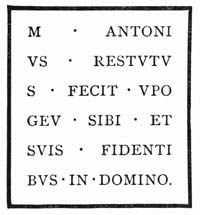
M. Antonius Res[ti]tutus
made [this] hypogeum for
himself and his [relatives]
who believe in the Lord.[43]
The names of many of the burial crypts commemorate these original
owners. Among others those of Lucina, Priscilla, and Domitilla are
considered to belong to the First Century, and the two former to the
times of the Apostles. Some of these may have been originally
designed, or afterwards opened, for the reception of the poor
belonging to the Church; and thus the Catacombs would be indefinitely
extended till they attained their present dimensions. Tertullian
expressly declares that the provision made for the poor included
that for their burial—egenis humandis.[44]
There is reason to believe that, even from the very first, the
Christian Church at Rome contained not a few who were of noble blood
and of high rank. In one of the apostolic epistles Paul conveys the
salutation of Pudens, a Roman Senator, of Linus, reputed the first
Roman bishop, and of Claudia, daughter of a British king;[45]
and we
know that even in the Golden House of Nero, the scene of that colossal
orgy whose record pollutes the pages of Suetonius and Tacitus, were
disciples of the crucified Nazarene. In remarkable confirmation of
this fact is the discovery in the recent explorations of the ruins of
the Imperial Palace of several Christian memorials, including one of
those lamps adorned with evangelical symbols, so common in the
Catacombs. Much of the evidence on this subject has been lost by the
zealous destruction of ecclesiastical records during the terrible
Diocletian persecution; but from inscriptions in the Catacombs, and
from the incidental allusions
of early writers, we learn that persons
of the highest position, and even members of the Imperial family, were
associated with the Christians in life and in death. Some of the
noblest names of Rome occur in funeral epitaphs in some of the most
ancient galleries of the Catacombs. There is evidence that even during
the first century some who stood near the throne became converts to
Christianity, and even died as martyrs for the faith.[46]
But doubtless the preservation and advancement of true religion was
better secured amid the dark recesses of the Catacombs, during the
fiery persecutions that befel the Church, than it would have been in
the sunshine of imperial favour, in an age and court unparalleled for
their corruptions. The sad decline of Christianity after the accession
of Constantine makes it a matter of congratulation that in the earlier
ages it was kept pure by the wholesome breezes of adversity.
The new religion, notwithstanding all the efforts that were made for
its suppression, rapidly spread, even in the high places of the earth.
“We are but of yesterday,” writes Tertullian at the close of the
second century, “yet we fill every city, town, and island of the
empire. We abound in the very camps and castles, in the council
chamber and the palace, in the senate
and the forum; only your
temples and theatres are left.”[47]
It is evident from an examination of the earliest Catacombs that they
were not the offspring of fear on the part of the Christians. There
was no attempt at secrecy in their construction. They were, like the
pagan tombs, situated on the high roads entering the city. Their
entrances were frequently protected and adorned by elegant structures
of masonry, such as that which is still visible at the Catacomb of St.
Domitilla on the Via Ardeatina;[48]
and their internal decorations and
frescoes, which in the most ancient examples are of classic taste and
beauty, were manifestly not executed by stealth and in haste, but in
security and at leisure.
There was, in classic times, a sacred character attached to all
places set apart for the purposes of sepulture. They enjoyed the
especial protection of the law, and were invested with a sort of
religious sanctity.[49]
This protection was asserted in many
successive edicts, and the heaviest penalties were inflicted on the
violators of tombs, as guilty of sacrilege.[50]
Reverence for the
sepulchres of the dead was regarded by the ancient mind as a religious
virtue; and the neglect of the ancestral tomb even involved disability
for municipal office.[51]
Being situated along the public highway, these pagan tombs were liable
to various pollutions, to which numerous inscriptions refer. Hence the
frequent CAVE VIATOR—“Traveller, beware!”—so common in
classic epitaphs. The SCRIPTOR PARCE HOC OPVS—“Writer, spare
this work”—sometimes met with, is, as Kenrick well remarks,[52]
not
the address of an author to a critic, but of a relative of the
deceased, entreating the wall-scribbler not to disfigure a tomb.
Electioneering notices were sometimes written upon these wayside
monuments—a practice which is deprecated in the following:
CANDIDATVS FIAT HONORATVS ET TV FELIX SCRIPTOR SI HIC NON
SCRIPSERIS—“May your candidate be honoured and yourself happy, O
writer, if you write not on this tomb!” INSCRIPTOR, ROGO TE VT
TRANSEAS MONVMENTVM—“Inscriber, I pray you pass by this
monument.”
As these sepulchral areas, often of considerable extent, were taken
from the fields in the vicinity of a great city, where the land was
very valuable for the purpose of tillage, they were in continual
danger of invasion from the cupidity of the heirs or of adjacent
land-owners, but for this legal protection. On many of the
cippi, or funereal monuments, which line the public roads in
the vicinity of Rome, the extent of these areas is set forth. Some of
them are quite small, as is indicated in the following inscription:
TERRENVM SACRATVM LONGVM P[EDES] · X · LAT · P[EDES] · X · FODERE
NOLI · NE SACRILEGIVM COMMITTAS[52a]—“A consecrated plot of earth,
ten feet long and ten feet broad. Do not dig here, lest you commit
sacrilege.”
More generally the size of the area is expressed, as
in the following:
IN FRONTE P[EDES] · IX IN AGRO P[EDES] ·
X; that is, “Frontage on the road, nine feet; depth in the
field, ten feet.” This area, small as it is, was designed for several
families. The limited space occupied by the cinerary urns rendered
this quite possible. Frequently, however, the size was much larger. An
area one hundred and twenty-five feet square would be of very moderate
extent. Horace mentions one one thousand feet by three hundred,[53]
and sometimes they greatly exceed this, as one on the Via Labicana,
five hundred by eighteen hundred feet, or over twenty English acres.
There were also frequently exhedræ, or seats by the wayside,
for passers-by, who were sometimes exhorted to pause and read the
inscription, or to pour a libation for the dead, as in the following:
SISTE VIATOR TV QVI VIA FLAMINIA TRANSIS, RESTA AC
RELEGE—“Stop, traveller, who passest by on the Flaminian Way;
pause and read, and read again!” MISCE BIBE DA MIHI—“Mix,
drink, and give to me.” VIATORES SALVETE ET
VALETE—“Travellers, hail and farewell.”
These burial plots were incapable of alienation or transfer from the
families for whom they were originally set apart; who are sometimes
enumerated in the inscription, or more generally expressed by the
formulæ, SIBI SVISQVE FECIT, SIBI ET POSTERIS SVIS, or with
the addition, LIBERTIS LIBERTABVSQVE POSTERISQVE, that is,
“He made this for himself and his family,” or “for himself and his
descendants;” also “for his freedmen and freedwomen and their
descendants.” Sometimes this limitation is plainly asserted to be,
VT NE VNQVAM
DE NOMINE FAMILIAE NOSTRAE HOC MONVMENTVM
EXEAT—“That this monument may not go out of the name of our
family.” The cupidity of the inheritor of the estate is especially
guarded against by the ever-recurring formula, H · M · H · N · S ·,
that is, Hoc monumentum hæredem non sequitur—“This monument
descends not to the heir.” Sometimes within a stately mausoleum
reposed in solitary magnificence the dust of a single individual, who
in sullen exclusiveness declares in his epitaph that he has no
associate even in the grave, or that he made his tomb for himself
alone—IN HOC MONVMENTO SOCIVM HABEO NVLLVM, or, HOC SOLO
SIBI FECIT.
The violation of the monument is earnestly deprecated in numerous
inscriptions in some such terms as these: ROGO PER DEOS SVPEROS
INFEROSQVE NE VELITIS OSSA MEA VIOLARE—“I beseech you, by the
supernal and infernal gods, that you do not violate my bones.”
Sometimes this petition is accompanied by an imprecation of divine
vengeance if it should be neglected, as, QVI VIOLAVERIT DEOS
SENTIAT IRATOS—“May he feel the wrath of the gods[54]
who shall
have violated [this tomb.]” Another invokes the fearful curse,
QVISQVIS HOC SVSTVLERIT AVT LAESERIT VLTIMVS SVORVM
MORIATVR[55]—“Whoever
shall take away or injure this [tomb] let
him die the last of his race.”
From a distrust of posterity many erected their monuments during their
life-time, and wrote their own epitaphs, leaving only a space for the
age. This is sometimes expressed by the words, SIBI VIVVS
FECIT, or, SE VIVO, SE VIVIS, or even by such solecisms
as ME VIVVS, or SE VIVVS. The following records the
strange fact of the erection of a funereal monument by one living
person to
another: SEMIRAMIAE LICINIAE QVAM LOCO FILIAE DILIGO
OB MERITA EIVS VIVVS VIVAE FECI—“To Semiramia Licinia, whom I
love in place of my daughter: on account of her merits, alive, I made
this to her alive.”
These classic usages have been thus detailed because traces of their
influence may be observed in many practices adopted by the primitive
Christians, and because they furnish an explanation of those
remarkable immunities and privileges which the Catacombs so long
enjoyed. These latter were constructed in separate and limited areas,
in like manner as the pagan sepulchres. De Rossi has given a map of
the Catacomb of Callixtus, in which these areas are accurately
defined. They vary in size and shape, that of the crypt of St. Lucina
being one hundred feet in fronte and one hundred and eighty
in agro, that of St. Cecilia two hundred and fifty feet in
fronte and one hundred in agro, and others still larger. By
the very tenor of the law these areas enjoyed the same protection as
those of the pagan sepulchres, of which protection it required a
special edict to deprive them. Even when Christianity fell under the
ban of persecution that freedom of sepulture was not at first
interfered with. Having wreaked his cruel rage upon the living body,
the pagan magistrate at least did not deny right of burial to the
martyr’s mutilated remains. A beneficent Roman law declared that the
bodies even of those who died by the hand of the public executioner
might be given up to any who asked for them.[56]
So that even the
sentence of outlawry against the Christians did not affect the bodies
of the dead. Indeed, we know from ecclesiastical history that
frequently the faithful received the remains of the martyrs
and gave
them Christian burial. It was not till the third century, when the
pagan opposition to Christianity became intense and bitter, that the
persecutors waged war upon the dead. Although both Diocletian and
Maximian confirmed the decree just cited, it often happened that, in
order that the Christians might not have even the melancholy
consolation of gathering up the martyrs’ bones, and honouring the
remains of their fallen heroes, those sacred relics were denied the
rites of sepulture which were freely accorded to the body of the
vilest malefactor.
These areas, Christian as well as pagan, were under the guardianship
of the Roman Pontifices, who, although pagans, were actually
confirmed in their authority by the Christian Emperor Constans. In
consequence of this protection the Christians were enabled to conduct
their worship and celebrate their agapæ in the oratories or
other buildings erected over the Catacombs, the ruins of which are
still to be seen at the Catacombs of St. Domitilla and Sts. Nereus and
Achilles, and which to the popular apprehension would seem to
correspond to the pagan structures for the celebration of funeral
banquets. Even when oppressed and persecuted above ground, they found
a sanctuary beneath its surface, and were permitted by the ignorance
or indifference of their foes to worship God among the holy dead. So
long as their sepulchral areas were uninvaded the Christians
scrupulously abstained from extending their excavations beyond their
respective limits, digging lower piani instead, when insatiate
death demanded room for still more graves. But when the ruthless
persecutor pursued them even beneath the earth, they felt at liberty
to transcend those limits and burrow in any direction for safety or
escape.
The Christian inscriptions often strongly deprecate
the violation of
the graves to which they are attached, in like manner as we have seen
in pagan epitaphs, and against this crime the Fathers intensely
inveigh. Sometimes the petition assumes a most solemn character, as
this: [ADIVRO] VOS PER C[H]RISTVM, NE MIHI AB ALIQVO
VIOLENTIAM [sic] FIAT ET NE SEPVLCRVM MEVM
VIOLETVR—“[I conjure] you by Christ that no violence be offered
me by any one, and that my sepulchre may not be violated.” Still more
awful in its adjuration is the following: CONIVRO VOS PER
TREMENDVM DIEM IVDICII VT HANC SEPVLTVRAM NVLLI VIOLENT[57]—“I
conjure you by the dreadful day of judgment that no one violate this
sepulchre.”
Sometimes a most terrible imprecation is expressed, as in the
following:
MALE · PEREAT · INSEPVLTVS
IACEAT · NON · RESVRGAT
CVM · IVDA · PARTEM · HABEAT
SI · QVIS · SEPVLCHRVM · HVNC · VIOLAVERIT—
If any one shall violate this sepulchre,
Let him perish miserably and remain unburied;
Let him lie down and not rise again,
Let him have his portion with Judas.[58]
....[EMI]GRAVIT AD XPM
....SEPVLCRVM VIOLARE
....SIT ALIENVS A REGNO DEI.
... Has departed to Christ. [If any one dare] to violate
this sepulchre, let him ... and be far from the kingdom of
God.[59]
It is probable that this dread of the violation of the grave arose, in
part at least, from the fear that the dispersion of the remains might
impede the resurrection of the body; and also from that natural
aversion to the disturbance of the slumbering dust, so passionately
expressed on the tombstone of England’s greatest dramatist.[60]
We sometimes find also the announcement upon Christian as well as upon
pagan tombs, that they have been prepared while the tenants were yet
alive, as in the following: LOCVS BASILIONIS SE BIBO
FECIT—“The place of Basilio, he made it when alive;” SABINI
BISOMVM SE BIBVM FECIT SIBI IN CEMETERIVM BALBINAE IN CRYPTA NOBA
[sic]—“The bisomus of Sabinus, he made it for himself during
his life-time, in the cemetery of Balbina, in the new crypt.” As
Sabinus could only occupy one half of this, the other half was
probably intended for his wife. Observe in the following the beautiful
euphemism for the grave. It is calmly chosen as the last long home,
as the “house appointed for all living.” (Fig. 19.[61])
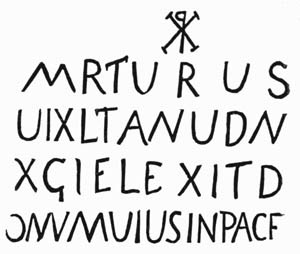
Fig. 19.—Epitaph from Lapidarian Gallery.[61]
But there was another and still more remarkable resemblance between
the funeral usages of the pagans and Christians than any yet
mentioned, and one which greatly contributed to the freedom of action
and security of the latter. There is abundant monumental and other
evidence of the existence in Rome, in the time of the later Republic
and of the Empire, of certain funeral
confraternities—collegia, as they were called—much like the
modern burial clubs. A remarkable inscription of the time of Hadrian,
A. D. 103, found at Lavigna, nineteen miles from Rome, on the Appian
Way, gives an insight into their constitution and objects. With much
legal tautology it sets forth the privilege of this collegium
of the worshippers of Diana and the new divinity Antinous appointed by
a decree of the Roman Senate and people, to assemble, convene, and
have an association for the burial of the dead.[62]
The members
of this confraternity were to pay for that purpose a hundred
sesterces at entrance, besides an amphora of good wine,
and five ases a month thereafter,[63]
all of which was
forfeited by the non-payment of the monthly dues. Three hundred
sesterces were expended on the funeral, fifty of which were to
be distributed at the cremation of the body. If a member died at a
distance from Rome three of the confraternity were sent to fetch the
body. Even if they failed to obtain it the funeral rites were duly
paid to an effigy of the deceased. There was also provision made for
the members dining together on anniversary and other occasions
according to rules duly prescribed by the collegium.
The names of very many of these collegia have been preserved,
each of which consisted of the members of a similar profession or
handicraft. Thus we have the Collegium Medicorum, the
association of the physicians; Aurificum, of the gold-workers;
Tignariorum, of the carpenters; Dendrophororum, of the
wood-fellers; Pellionariorum, of the furriers; Nautarum,
of the sailors; Pabulariorum, of the forage merchants;
Aurigariorum, of the charioteers; and Utriculariorum, of
the bargemen.[64]
They were frequently also connected by the bond of nationality or of
common religious observance, as Collegium Germanorum, the
association of the Germans; Pastophororum, of the priests of
Isis; Serapidis et Isidis, of Serapis and Isis; Æsculapii et
Hygeiæ, of Æsculapius and Hygeia.[65]
Sometimes they were
Cultores Veneris, Jovis, Herculis, worshippers of
Venus, Jupiter, Hercules, or, as we have seen, of Diana and Antinous.
These associations were often favoured with especial privileges,
immunities, and rights, like those of incorporation, such as the
holding of territorial property. De Rossi has shown, by ample
citations, that the emperors, who were always opposed to associations
among the citizens, made a special exemption in favour of these
funeral clubs.[66]
By conformity to the constitution of these corporations the Christian
church had peculiar facilities for the burial of its dead, and even
for the celebration of religious worship. Indeed, it has been
suggested, and is highly probable, that it was under the cover of
these funeral associations that toleration was conceded, first to the
sepulchres, then to the churches. Tertullian describes the practice of
the Christian community in the second century as follows: “Every one
offers a small contribution on a certain day of the month, or when he
chooses, and as he is able, for no one is compelled; it is a voluntary
offering. This is our common fund for piety; for it is not expended in
feasting and drinking and in wanton excesses, but in feeding and
burying the poor, in supporting orphans, aged persons, and such
as are shipwrecked, or such as languish in mines, in exile, or in
prison.”[67]
Thus the Ecclesia Fratrum, the “Congregation of
the Brethren,” who restored the funeral monument described on page
fifty-six,[68]
suggests the pagan college of the Fratres
Arvales; and the Cultor Verbi, or worshipper of the
Divine Word, in the same inscription, would seem to the heathen
magistrate analogous to the Cultores Jovis or Cultores
Dianæ of the pagan collegia. Indeed, it is difficult to
decide from the names of some of these associations whether they were
Christian or pagan. Thus we read of the Collegium convictorum qui
una epulo vesci solent—“The fraternity of table-companions who
are accustomed to feast together.” De Rossi suggests that there may be
here a covert reference to a Christian community, and probably to the
celebration of the Agape or of the Eucharist.[69]
Another is the
Collegium quod est in domo Sergiæ Paulinæ—“The association
which is in the house of Sergia Paulina.” This possibly may have been
a Christian community, like “the church which was in the house” of
Priscilla and Aquila.[70]
That the primitive Christians availed themselves of the privileges
granted to the funeral associations, is confirmed by a discovery made
by De Rossi in the Cemetery of St. Domitilla in the year 1865, and
already referred to. At the entrance was found a chamber, with stone
seats like the schola, or place of meeting of the pagan tombs
where the religious confraternity celebrated the funeral banquet of
the deceased. Here the Christians celebrated instead the Agape,
or Feast of Charity, and the Natalitia, or anniversary of the
martyrs who were buried there, just as the pagan associations
commemorated the anniversaries of their deceased patrons.
The ancient privileges of these collegia were confirmed by an
edict of Septimius Severus about the year A. D. 200. It is a curious
coincidence that precisely at this time Zephyrinus, bishop of Rome,
appointed Callixtus
to be “guardian of the cemetery,” as well as
head of the clergy.[71]
In order to secure to the funeral association
the protection of the law it was necessary that one of its members
should be appointed agent or “syndic,” by whom its business should be
transacted, and in whose name its property should be held.[72]
Thus
Callixtus became the syndic of the public cemetery of the church,
which still bears his name. De Rossi conjectures that this was the
first cemetery set apart for the use of the whole Christian community.
Hence it was taken under the care of the ecclesiastical authorities,
and became, as we shall see hereafter, the burying-place of the Roman
bishops, and the especial property of the church.[73]
We will now trace briefly the history of those persecutions which
glutted the Catacombs with victims, and at times drove the church for
sanctuary to their deepest recesses. We have seen that Christianity
grew up under the protection accorded to Judaism as one of the
tolerated religions of Rome. But this toleration did not long
continue. In Rome as well as elsewhere the new creed was doomed to a
baptism of blood. The causes of this persecution are not far to seek.
The Christian doctrine spread rapidly, and early excited the jealousy
of the Roman authorities by its numerous converts from the national
faith, many of whom were of exalted rank. These carefully refrained
from the idolatrous adulation by which the servile mob were wont to
express
their loyalty to the imperial monster who aspired to be a god. Hence
they were accused of disaffection, of treason.[74]
They were the
enemies of Cæsar, and of the Roman people.[75]
They were supposed to
exert a malign influence on the course of nature. If it did not rain
the Christians were to blame.[76]
“If the Tiber overflows its banks,”
says Tertullian, “or the Nile does not; if there be drought or
earthquakes, famine or pestilence, the cry is raised, ‘The
Christians to the lions!’”[77]
If the pecking of the sacred
chickens or the entrails of the sacrificial victims gave unfavourable
omens, it was attributed to the counter spell of “the atheists.” At
Rome, as well as at Ephesus and Philippi, the selfish fears of the
shrine and image makers, whose “craft was in danger,” and the
hostility of the priests and dependents on the idol-worship, inspired
or intensified the opposition to Christianity, as did also the
jealousy of the Jews, who regarded with especial hostility the
believers in the lowly Nazarene, whom their fathers with wicked hands
had crucified and slain.[78]
The terrible conflagration which destroyed the greater part of the
city during the reign of Nero was made the excuse for the first
outburst of persecution against the Christian community. By public
rumour this deed was
attributed to Nero himself. “To put an end to
to this report,” says Tacitus, “he laid the guilt, and inflicted the
most cruel punishment, upon these men, who, already branded with
infamy, were called by the vulgar, Christians.... Their sufferings at
their executions,” he adds, “were aggravated by insult and mockery;
for some were sewn up in the skins of wild beasts, and worried to
death by dogs; some were crucified, and some, wrapped in garments of
pitch, were burned as torches to illumine the night.”[79]
During this persecution St. Paul fell a victim, A. D. 64. He was
beheaded “without the gate,” on the Ostian Way, and weeping friends
took up his bleeding corpse and laid it, according to tradition, in
one of the most ancient crypts of an adjoining Catacomb, where
Eusebius asserts that his tomb could be seen in his day.[80]
From this time Christianity was exposed to outbursts of heathen rage,
and express decrees were published against it.[81]
No longer sharing
the protection of Judaism, it fell under the ban of the empire. At
times the rage of persecution slumbered, and again it burst forth with
inextinguishable fury. But, like the typical bush that “flourished
unconsumed in fire,” the Christian faith but grew and spread the more.
Yet the sword ever impended
over the church. Sometimes its stroke
was for a time deferred, when the little flock took courage and
rejoiced; but often it fell with crushing weight, smiting the
shepherds and scattering the sheep. One of these periods of rest
extended from the time of the Neronian persecution till near the end
of the century, when Domitian, “a second Nero,”[82]
stretched forth
his hand again to vex the saints. During the short reign of the
“justice-loving Nerva” the Christians again enjoyed repose, so that
Lactantius even asserts that they were restored to all their former
privileges.
To the first century De Rossi refers the construction of at least
three or four of the Catacombs. These are, (1) the Cemetery of
Priscilla, excavated, according to an ancient tradition, in the
property of the Roman Senator Pudens, mentioned by St. Paul, and in
which, it is said, were interred his daughters Pudentiana and
Praxides; (2) the Catacomb of Domitilla, the grandniece of the Emperor
Domitian, in which she herself was buried, together with her
chamberlains Nereus and Achilles, who were beheaded for their
steadfastness in the Christian faith; (3) the Crypt of Lucina,
afterwards part of the Catacomb of Callixtus, in which some of the
most ancient inscriptions have been found. De Rossi conjectures that
this lady is the same as the Pomponia Græcina before mentioned, the
wife of Plautius, the conqueror of Britain. (4) De Rossi is also of
the opinion that he has discovered another, and the oldest of all the
Catacombs, dating from the very times of the apostles themselves, in
that known as the Fons Petri, or the Cemetery of the Font of Peter, in
which tradition asserts that he himself baptized. The classical style
of the architecture, frescoes, and graceful stucco wreaths and
garlands, and the character of the inscriptions, all point to a very
ancient period, before art had degenerated, and before long-continued
persecution had banished Christianity into seclusion and poverty.
The law of Trajan against secret assemblies, synchronous with the
opening of the second century, gave a new occasion of persecuting the
Church. With such severity was this done that, according to Pliny, the
deserted temples became again frequented, and their neglected rites
revived.[83]
The Emperor Hadrian is described by his contemporaries as diligently
practising the Roman rites, and despising all foreign religions.[84]
Although he restrained the tumultuous attacks of the populace upon the
Christians, he nevertheless favoured their legal prosecution.[85]
The following epitaph given by Maitland commemorates a martyrdom of
this reign. The last sentence seems to imply that it was erected in a
time of actual persecution; but no dated example of the monogram which
accompanies it appears before the time of Constantine. The inscription
was probably written long
after the death of Marius, or the monogram
may have been added by a later hand:
|
|
TEMPORE ADRIANI IMPERATORIS MARIVS
ADOLESCENS DVX MILITVM QVI SATIS VIXIT
DVM VITAM PRO CHO CVM SANGVINE CON
SVNSIT IN PACE TANDEM QVIEVIT BENE
MERENTES CVM LACRIMIS ET METV POSVE
RVNT I. D. VI. |
|
In Christ. In the time of the Emperor Hadrian, Marius, a young
military officer, who had lived long enough, when, with his
blood, he gave up his life for Christ. At length he rested in
peace. The well-deserving set up this with tears and in fear, on
the 6th, Ides of December.
In this reign also suffered Alexander, bishop of Rome, whose tomb has
been found on the Nomentan Way, together with Eventius and Theodulus,
a presbyter and deacon.
Under the humane and equitable Antoninus Pius,[86]
Christianity seems
to have enjoyed a partial toleration, although the edict of Trajan was
still unrevoked. Yet several outbreaks of popular fury against the
Christians took place, and in the very first year of his reign
Telesphorus, the bishop of the church at Rome, suffered martyrdom.[87]
One of the strangest phenomena in history is the persecution of the
primitive church by the philosophical emperor Marcus Aurelius,[88]
whose “Meditations” seem almost like the writings of an apostle in
their praise of virtue, yearning for abstract perfection, and contempt
of pomp and pleasure. Nevertheless, he was one of the most systematic
and heartless of all the oppressors of the Christian faith—a faith so
much loftier than even
his high philosophy, and yet having so much
akin. With the cool acerbity of a stoic, he resolved to exterminate
the obnoxious doctrines. An active inquisition for the Christians was
set on foot, and the odious system of domestic espionage, which even
Trajan had forbidden, was encouraged. Shameless informers, greedy for
gain, fed their rapacity on the confiscated spoils of the believers,
whom they plundered, says Melito, by day and by night. Though gentle
to other classes of offenders, and even to rebels, Aurelius exceeded
in barbarity the most ruthless of his predecessors in the refinements
of torture, by rack and scourge, by fire and stake, employed to
enforce the recantation of the Christians; and every year of his long
reign was polluted with innocent blood.
From Gaul to Asia Minor raged the storm of persecution. The
earthquakes, floods, and famine, the wars and pestilence, that wasted
the empire, were visited upon the hapless Christians, who were
immolated in hecatombs as the causes of these dire calamities. From
the crowded amphitheatre of Smyrna ascended, as in a chariot of fire,
the soul of the apostolic bishop Polycarp. The arrowy Rhone ran red
with martyrs’ blood. The names of the venerable Pothinus, of the
youthful Blandina and Ponticus, and of the valiant Symphorianus, will
be memories of thrilling power and pathos to the end of time. At Rome
the persecution selected some of its noblest victims. Justin, the
Christian philosopher, finding in the Gospels a loftier lore than in
the teachings of Zeno or Aristotle, of Pythagoras or Plato, became the
foremost of the goodly phalanx of apologists and defenders of the
faith, and sealed his testimony with his blood. With six of his
companions he was brought before the prefect for refusing obedience to
the imperial
decree. “We are Christians,” they said, “and sacrifice
not to idols.” They were forthwith scourged and beheaded, and devout
men bore them to their burial, doubtless in these very Catacombs,
where their undiscovered remains may yet lie. In this reign also
suffered the seven sons of St. Felicitas—the tomb of one of whom De
Rossi believes he has found—and St. Cecilia and her companions, to be
hereafter mentioned.[89]
The legend of the Thundering Legion, supported as it is by the medals
and the column of Antoninus, commemorates, indeed, the deliverance of
the Roman army by a timely shower; but the Emperor ascribed that
deliverance not to the prayers of the Christians, but to his own
appeal to the heathen gods,[90]
and there is no evidence that he ever
relaxed the severity of the persecution.
The ferocity of the brutal Commodus[91]
was tempered by the influence
of his concubine, Marcia, and Christianity spread among the highest
ranks; but persecution
did not entirely cease. Apollonius, a senator
of the empire, was put to death at Rome, and we read of numerous
martyrdoms elsewhere. A Christian inscription commemorates an officer
of Commodus, and Procurator of the Imperial household, who was
“received to God”—RECEPTVS AD DEVM—A. D. 217.[92]
On the death of this emperor the persecution raged with such violence
that, according to Clemens Alexandrinus, many martyrs were burned,
crucified, and beheaded every day.[93]
Non licet esse vos—“It
is not lawful for you to exist”—was the stern edict of extermination
pronounced against the saints.
Christianity had little favour to expect from a military despot like
Septimius Severus, whose dying counsel to his successor expressed the
principle of his government—“Be generous to the soldiers and trample
on all besides.”
The revived accusations against the new faith called forth the bold
defence, or rather defiance, of Tertullian, one of the noblest
monuments of the primitive ages. In this reign the sanctity of the
Christian cemeteries was first violated, and that not at Rome but in
Africa, where the persecution was most virulent. “The mob assails us
with stones and flames with the frenzy of bacchanals,” says
Tertullian; “They do not even spare the Christian dead, but tear them
from the rest of the tomb, from the asylum of death, cut them in
pieces, and rend them asunder.”[94]
After the cessation of this persecution the Church enjoyed a period of
unwonted rest. Although under the ignoble Heliogabalus the sensual
Asiatic worship of Baal was introduced to Rome, and human sacrifice
was even offered to this Eastern Moloch,[95]
yet the religion of peace
and purity shared the toleration accorded to the most obscene and
cruel rites. The just and amiable Alexander Severus inaugurated a new
era for Christianity,[96]
to which he was favourably disposed,
probably through the influence of his mother, Mammæa, who had enjoyed
at Antioch the instruction of Origen.[97]
He used frequently to quote
with approval the Golden Rule of Our Lord, and caused it to be
inscribed on his palace walls, and also ceded to the Christians a
piece of public ground for the erection of a church.[98]
But Alexander
was only a religious eclectic, honouring what he thought best in the
current systems of belief. Of this reign is the epitaph of Urban,
bishop of Rome,
which has been found in the so-called “Papal Crypt,”
bearing his name and the initial letter of his title—ΟΥΡΒΑΝΟϹ Ε....
The accession of the Thracian savage, Maximin, A. D. 235, was the
signal for a fresh outburst of persecution. To have been favoured by
Severus was sufficient to incur the hate of his murderer. His rage was
especially directed against the chief pastors of the flock of Christ.
Pontianus, the Roman bishop, was exiled to Sardinia, and there slain.
Antherus, his successor in this dangerous dignity, for his zeal in
preserving the records of the martyrs himself suffered martyrdom a few
weeks after his accession, and was laid in that narrow chamber
destined to receive so many of Rome’s early bishops, where a slab
bearing his name and title—ΑΝΤΕΡΩϹ · ΕΠΙ—has been found. In
this reign also suffered the celebrated Hippolytus, bishop of Pontus,
and author of the “Philosophoumena.”
Under Gordian and Philip a respite was again granted to the persecuted
church. The latter, indeed, is claimed by Eusebius as a Christian; but
his character and conduct are inconsistent with such a supposition.
A violent reaction took place on the accession of Decius, whose name
became an object of execration to mankind.[99]
He resolved to entirely
crush and extirpate Christianity, whose bishops and churches began to
rival the pontiffs and temples of the gods of Rome. At his instigation
a persecution of unprecedented virulence raged like an epidemic
throughout the empire. The imperial edicts enforced conformity to the
pagan ritual under penalty of the most horrible tortures. This unwonted
severity produced the first great apostasy of the primitive church;
and many of the less stable converts procured exemption from martyrdom
by sacrificing to the gods, burning incense on their altars, or
purchasing certificates of indulgence from the heathen
magistrate.[100]
“Pale and trembling, and more like sacrificial victims than those
about to sacrifice,” says an eye-witness, “some approached the heathen
shrines; but others, firm and blessed pillars of the Lord, witnessed a
good confession unto death.”[101]
The bishops of the church, who, as
the leaders of Christ’s sacramental host, bore gallantly the battle’s
brunt, were naturally the earliest victims of the tyrant’s rage.
Accordingly, at the very outbreak of the Decian slaughter, the
venerable Fabian, head of the Roman church, perished by decapitation;
and the Catacombs were glutted with a host of unknown martyrs. In the
very chamber in the Cemetery of Callixtus to which his mutilated
corpse was borne, may still be seen the Bishop’s epitaph—ΦΑΒΙΑΝΟϹ · ΕΠΙ—with
the monogram of his martyrdom, the conjoined
letters ΜΤΡ, added probably by a later hand. The church seemed
paralyzed with fear, and for sixteen months no successor was elected.
But, undismayed by the tragic fate of Fabian, Cornelius, allied with
some of the noblest families of Rome, became the leader of the forlorn
hope of Christianity against all the power of the empire. After a
year’s episcopate he was first banished and then beheaded under
Gallus, a worthy successor in persecution of Decius. Through the
archæological researches of De Rossi have been recovered, first his
epitaph—CORNELIVS · MARTYR · EP—and then his tomb, with a Damasine
inscription, in one of the most interesting crypts of the Catacombs.
Lucius, his successor, in six months shared his fate, and was buried
in the chamber consecrated by the dust of so many martyr-bishops,
where his brief epitaph—ΛΟΥΚΙϹ—is still legible.
Valerian,[102]
who revived in his own person the ancient office of
Censor, was at first so favourable toward the Christians that his
house, says Dionysius of Alexandria, was filled with pious persons,
and was, indeed, a congregation[103]
of the Lord. This favour was
doubtless the result of the Censor’s approval of Christian influence
on public morals.[104]
In the latter part of his reign, however, the
Emperor passed under the dominion of the most abject superstition.
Through the influence of Macrianus, a pagan bigot learned in the dark
lore of Egypt, he became addicted to magic arts, and is said to have
sought the auguries of the empire in the entrails of human
victims.[105]
The most relentless decrees were launched against the
Christian church. The bishops, priests, and deacons were forthwith to
be put to the sword; all others were to share the same fate, or to be
punished by exile and fetters.[106]
The holding of assemblies, or even
entering the Christian cemeteries, was strictly prohibited A. D. 257.[107]
By this unwonted invasion of the immemorial sanctity of the
sepulchre the Christians were forbidden even these last refuges from
persecution.
Among the most illustrious victims of Valerian whose bodies lie in the
lowly Catacombs, but whose names live for evermore, were Stephen I.
and Sixtus II., bishops of the persecuted church, and a number of
distinguished ecclesiastics, as well as many laymen of noble
rank.[108]
Stephen, as the head of the Christian community, was especially
obnoxious to heathen rage. According to the Acts of his martyrdom he
sought concealment in these sepulchral crypts,[109]
where he was
secretly visited by the faithful, and where he administered the
sacraments. He was traced by the Roman soldiers to his subterranean
chapel, but, awed by the mysterious rites, they allowed him to
conclude the service in which he was engaged. He was then beheaded,
with several of his adherents,[110]
and buried in the Catacomb.
Sixtus, the successor of Stephen, within a year received the martyr’s
crown. Like another Daniel setting at defiance the emperor’s decree,
he was leading the devotions of the persecuted flock in the Catacomb
of Prætextatus, probably because it was less known than the public
cemetery of Callixtus, when he was apprehended by the fierce soldiery,
who had tracked his footsteps thither. He was hurried away to summary
judgment, brought back to the place of his offence, and there
beheaded, sprinkling with his blood the walls of the chamber. With him
were also executed four of his deacons,[111]
the monuments of two of
whom, Agapetus and Felicissimus, De Rossi discovered in the very
Catacomb in which they suffered. Sixtus himself was buried in the
“Bishops’ Tomb” in the Callixtan Cemetery, where the following
inscription, fragments of which have been found in the débris,
was afterward set up by Damasus:
TEMPORE QVO GLADIVS SECVIT PIA VISCERA MATRIS
HIC POSITVS RECTOR COELESTIA IVSSA DOCEBAM
ADVENIVNT SVBITO RAPIVNT QVI FORTE SEDENTEM
MILITIBVS MISSIS POPVLI TVNC COLLA DEDERE
MOX SIBI COGNOVIT SENIOR QVIS TOLLERE VELLET
PALMAM SEQVE SVVMQVE CAPVT PRIOR OBTVLIT IPSE
IMPATIENS FERITAS POSSET NE LAEDERE QVEMQVAM
OSTENDIT CHRISTVS REDDIT QVI PRAEMIA VITAE
PASTORIS MERITVM NVMERVM GREGIS IPSE TVETVR
At the time when the sword pierced the tender heart of the Mother
[church,] I, the ruler buried here, was teaching the laws of
heaven. Suddenly came [the enemy,] who seized me sitting as I
was. Then the people presented their necks to the soldiers sent
against me. Soon the old man saw who sought to bear away the
palm, and was the first to offer himself and his own head, that
impatient rage might injure no one else. Christ who bestows the
rewards of life, manifests the merit of the pastor: he himself
defends the flock.[112]
Thus seven bishops of the church at Rome fell in succession by the
hand of the headsman, five of them in the space of eight years—heroic
athletes of Christ who, at the very seat of paganism, as in a mighty
theatre of God, bore the brunt of persecution, and, conquering even in
death, received the martyr’s crown and palm.
The accession of Gallienus[113]
restored peace to the church. His
decree granting complete religious toleration, the restoration of
confiscated ecclesiastical property, and permission to “recover what
they called their cemeteries,”[114]
won the gratitude of his Christian
subjects. His character, however, by no means justified the epithet of
“holy and pious emperor” bestowed by Dionysius of Alexandria.[115]
This was the first formal recognition of Christianity as a religio
licita, or legalized faith, and for forty years the church enjoyed
comparative repose; at
least such repose as was possible while twenty
rival emperors—fantastic things “that likeness of a kingly crown had
on”—struggled for the supremacy, and harried the land with their
mutual devastations. During this period, Felix, the bishop of the
Roman church, who, according to the Liber Pontificalis, was
exceedingly diligent in honouring the martyrs of the Catacombs, became
himself a conscript of that noble army, and was beheaded, in
accordance with an imperial decree, as was also Agapetus, a Christian
of noble rank.
The mild and amiable Tacitus[116]
ruled over a turbulent people only
six months. His brother Florian retained the purple only half that
time. Probus, “the just,” whose name, says his epitaph, expressed his
character,[117]
fell by the hands of his own tumultuous legionaries.
The sensual and abominable Carinus displayed the extravagancies of
Heliogabalus, aggravated by the cruelty of Domitian. In his reign died
Eutychianus, whose epitaph and title—ΕΥΤΥΧΙΑΝΟϹ ΕΠΙϹ—have
been found in the “Papal Crypt” of Callixtus.[118]
Christianity was destined to undergo a final ordeal
before it should
ascend the throne of the Cæsars. The church must pass once more
through the purifying flames of persecution before it was fit to be
entrusted with the reins of empire. The long peace and temporal
prosperity had fostered pride and luxury, and relaxed the morals of
the Christian community. Schisms and feuds destroyed the unity of the
faith, and the bishops had begun to aspire to temporal power, and to
assert an unwarranted authority. “Prelates inveighed against
prelates,” says Eusebius, “and people rose against people, assailing
each other with words as with darts and spears.”[119]
The blasts of
adversity were necessary to winnow the spurious and false away, and to
leave the tried and true behind. From the fatal slumber of religious
apathy into which the church was falling it was to be rudely awakened.
Its former afflictions sank into insignificance compared with this
great tribulation, which was pre-eminently called The
Persecution by the historian of the times.[120]
The close of the third century witnessed the strange spectacle of the
government of the Roman world by a group of men who had climbed to the
giddy height of power from the lowest stations in life. Diocletian,
originally a slave, or at least the son of a slave, reduced the
haughty aristocracy of Rome to a condition of oriental servility.
Maximian, a Pannonian peasant, betrayed the savageness of his nature
by his bloodthirsty cruelty. Galerius, an Illyrian herdsman, but
exhibited more conspicuously upon the throne of empire the native
barbarity of his character. Constantius was of nobler birth than any
of his colleagues, and he alone adorned his lofty station by dignity,
justice, and clemency. The world groaned under the oppression of its
cruel masters. So exhausting were their exactions that none remained
to tax, says Lactantius,[121]
but the beggars.
The early years of the reign of Diocletian were characterized for the
most part by principles of religious toleration. Indeed, his wife and
daughter, the empresses Prisca and Valeria, favoured, if they did not
adopt, the Christian faith, and some of the first officers of the
imperial household belonged to the now powerful sect.[122]
But even
during this period the Christians were not free from danger. Caius,
the Roman bishop, is said to have lived for eight years in the
Catacombs on account of the persecution, and at last underwent
martyrdom in the year A. D. 296.[123]
Marcus and Marcelianus, two
Roman Christians of noble rank, who have given their name to one of
the Catacombs, suffered about this time. Others, especially in the
army, where the ancient faith had firmest hold, and where, indeed,
Eusebius says, the persecution began,[124]
endured martyrdom as the
valiant soldiers of Christ. The storm, of which these events were the
precursors, at length burst with fury on the Christians in the year
303. A series of cruel edicts, written, says Eusebius, with a dagger’s
point,[125]
were fulminated for the extirpation of the Christian
name.[126]
They were framed with malignant ingenuity, so as to leave
no chance of escape save in open apostasy. All ecclesiastical property
was confiscated. The churches were razed to the ground, and the sacred
scriptures burned with fire.[127]
All assemblies for worship were
prohibited on pain of death. The clergy of every order were zealously
sought out, and thrust into dungeons designed for the worst of
felons.[128]
The whole Christian community was outlawed, degraded from
every secular office, deprived of the rights of citizenship, and
exposed to the punishment of the vilest slaves. With intensifying
violence edict followed edict, like successive strokes of thunder in a
raging storm. A universal and relentless proscription of the Christian
name took place. The truculent monster Galerius, of whom his Christian
subjects said, that he never supped without human blood,[129]
proposed
that all who refused to sacrifice to the gods should be burned alive;
and the fiendish ingenuity of the persecutors was exhausted in
devising fresh tortures for their victims.
In Italy, and especially at Rome, the work of destruction was eagerly
carried on by Maximian, an implacable enemy of the Christians; and
after his death by the abominable voluptuary Maxentius, in whom the
twin passions of cruelty and lust struggled for the mastery.
These
monsters of iniquity revelled in a carnival of blood, and glutted the
Catacombs with victims, some of the most illustrious of whom will
shortly be mentioned. On the retirement of Diocletian, satiated with
slaughter and weary with the cares of state, to his retreat at
Salonica, Galerius continued the persecution with increased zeal. It
was the expiring effort of paganism, the death throes of its mortal
agony. But the Christian religion, like the trodden grass that ranker
grows, flourished still in spite of the oppression it endured. Like
the rosemary and thyme, which the more they are bruised give out the
richer perfume, it breathed forth the odours of sanctity which are
fragrant in the world to-day. Though the frail and the fickle fell off
in the blast of adversity, the staunch and true remained; and from the
martyr’s blood, more prolific than the fabled dragon’s teeth, a new
host of Christian heroes rose, contending for the martyr’s starry and
unwithering crown.
But the period of deliverance was at hand. Smitten by the power of
that God whose titles and attributes he had usurped, the wretched
Galerius, amid the agonies of a loathsome disease, implored the
intercessions of the Christians whom he had so ruthlessly proscribed.
With sublimest magnanimity the church exhibited the nobility of a
Gospel revenge, and obeyed the injunction of its divine Master to pray
for those who persecuted and despitefully used it. From the dying
couch of the remorseful monarch came an abject apology for his cruel
deeds; and, in late atonement for his crime, a decree of amplest
recognition of Christianity, and restoration of the right to worship
God. Like the trump of jubilee, the edict of deliverance pealed
through the land. It penetrated the gloomy dungeon, the darksome mine,
the catacomb’s dim labyrinth; and from their sombre depths vast
processions of the “noble wrestlers of religion”[130]
thronged to the
long forsaken churches with grateful songs of praise to God.
But this treacherous calm was soon to be again broken. The
superstitious tyrant Maximin endeavoured to revive the dying paganism,
and to renew the persecution. He paid Christianity the high compliment
of attempting a complete organization of the heathen priesthood on the
model of the ecclesiastical hierarchy, and restored the ancient
worship with unwonted pomp. He prohibited the assemblies in the
cemeteries, and reiterated the edict of extermination against the
Christians.[131]
But the loathsome death of this brutal voluptuary
soon delivered the church from the most implacable of its foes. From
the distant island of Britain—that ultimate far Thule of the
empire—had arrived the Cæsar who should enthrone the new faith on the
seat of its persecutors, and establish it as the religion of the
state,[132]
an event more perilous to its purity and spiritual power
than the direst oppression it had ever endured. Constantine having
overcome the enemies of Christianity, who were also his own, became
its protector, more, it is easy to believe, either from conviction of
its truth or from policy than on account of the alleged miraculous
vision of the cross of Christ, the presage of a bloody
victory.[133]
He issued at Milan, A. D. 313, that decree of full and unlimited
toleration[134]
which became thenceforth the charter of the church’s
liberties.[135]
The sufferings of the more illustrious victims of persecution are
alone recorded in history, which is silent concerning the great army
of unknown martyrs, whose names are recorded only in the Book of Life.
The bishops of the church were ever the first to feel the tyrants’
rage. The episcopal chair was often but the stepping-stone to the
scaffold. Yet faithful shepherds were not wanting to lead the flock of
Christ, and to testify their devotion to their trust by the sacrifice
of their lives. We have seen how Caius suffered even before the final
outbreak of persecution. Marcellinus, his successor, incurred the
resentment of the tyrant Maxentius, was degraded to the office of
groom of the public stables, where the horses of the circus were kept,
and soon sank beneath the weight of his miseries and those of the
church.[136]
Marcellus, sometimes confounded with Marcellinus, paid
the penalty of exile for his firmness in maintaining the
ecclesiastical discipline against those who apostatized from the faith
in those times of fiery trial. This event is recorded in the Damasine
inscription:
VERIDICVS RECTOR LAPSOS QVIA CRIMINA FLERE
PRAEDIXIT MISERIS FVIT OMNIBVS HOSTIS AMARVS
HINC FVROR HINC ODIVM SEQVITVR DISCORDIA LITES
SEDITIO CAEDES SOLVVNTVR FOEDERA PACIS
CRIMEN OB ALTERIVS CHRISTVM QVI IN PACE NEGAVIT
FINIBVS EXPVLSVS PATRIAE EST FERITATE TYRANNI
HAEC BREVITER DAMASVS VOLVIT COMPERTA REFERRE
MARCELLI VT POPVLVS MERITVM COGNOSCERE POSSET.[137]
The truth-speaking ruler, because he preached that the lapsed
should weep for their crimes, was bitterly hated by all those
unhappy ones. Hence fury, hence hatred followed, discord,
contentions, sedition, and slaughter; and the bonds of peace were
ruptured. For the crime of another, who in a time of peace had
denied Christ, he was expelled the shores of his country by the
cruelty of the tyrant. These things Damasus having learned, was
desirous to relate briefly, that the people might recognize the
merit of Marcellus.
Neither Marcellus nor Marcellinus was buried in the Catacomb of
Callixtus—which, as Diocletian had confiscated all the public
cemeteries, was inaccessible to the Christians—but in the private
crypt of the Christian matron Priscilla, on the Salarian Way.
Eusebius, the successor of Marcellus, was also banished on account of
the controversy concerning the “lapsed.” New light has recently been
thrown on this subject by De Rossi’s discovery, in the tomb of the
bishop, of the following Damasine inscription in a fragmentary
condition:
HERACLIVS VETVIT LABSOS [sic] PECCATA DOLERE
EVSEBIVS MISEROS DOCVIT SVA CRIMINA FLERE
SCINDITVR [IN] PARTES POPVLOS GLISCENTE FVRORE
SEDITIO CAEDES BELLVM DISCORDIA LITES
EXTEMPLO PARITER PVLSI FERITATE TYRANNI
INTEGRA CVM RECTOR SERVARET FOEDERA PACIS
PERTVLIT EXILIVM DOMINO SVB IVDICE LAETVS
LITORE TRINACRIO MVNDVM VITAMQ · RELIQUIT.
Heraclius forbade the lapsed to grieve for their sins. Eusebius
taught those unhappy ones to weep for their crimes. The people
were rent in parties, and with increasing fury began sedition,
slaughter, fighting, discord, and strife. Straightway both were
banished by the cruelty of the tyrant, although the ruler was
preserving the bonds of peace inviolate. He bore his exile with
joy, looking to the Lord as his Judge, and on the Trinacrian
shore gave up the world and his life.
The Heraclius mentioned in the inscription is probably the heretical
leader referred to in the epitaph of Marcellus, previously given. No
reference to this event occurs in any of the ecclesiastical writers,
and this
inscription, says Dr. Northcote, is the recovery of a lost
chapter in the history of the church.[138]
The remains of Eusebius
were brought from Sicily, the place of his exile, by his successor,
Melchiades, and interred in the Catacomb of Callixtus, but not with
the other bishops, the approaches to whose tomb were blocked up with
earth, probably to prevent its violation by the enemies of the faith.
Melchiades, with whom the long succession of Rome’s martyr bishops
comes to a close, was the last of his order who was buried in the
Catacombs, and De Rossi conjectures that he has discovered in the
Cemetery of Callixtus his tomb, and the very sarcophagus in which he
lay.[139]
One of the most illustrious of the lay martyrs of the Diocletian
persecution was the gallant young soldier Sebastian, who has given his
name to one of the most ancient basilicas of Rome and to the adjacent
Catacomb, and Adauctus, a treasurer of the imperial palace. In the
Damasine epitaph of the latter occur the fine lines:
INTEMERATA FIDE CONTEMPTO PRINCIPE MVNDI
CONFESSVS XRM CAELESTIA REGNA PETISTI.[140]
With unfaltering faith, despising the lord of the world, having
confessed Christ, thou didst seek the celestial realms.
Several of the Christian cemeteries receive their designation from the
martyrs of this period, among others those of Saints Agnes, Peter, and
Marcellinus, of Pancratius, Generosa, Zeno, Soteris, and Quattro
Incoronati, notice of whom will be more appropriate in the
accounts of their respective sepulchres. History has also preserved
the names of many other valiant confessors, who proved faithful even
unto death amid the fiery trials and cruel mockings and scourgings to
which they were exposed. Among these may be mentioned Cosmo and
Damian, two holy brothers of Cilicia, who practised in Rome with great
skill the healing art, from pure love to God and to their fellow-men,
refusing to receive aught for their services;[141]
Simplicius and
Faustinus, who were drowned in the Tiber by the tyrant’s orders, and
their martyred sister Beatrice, whose tombs and epitaphs De Rossi
believes he has recovered.[142]
Most of the legends, however, of what
may be called the Romish mythology are disfigured by absurd and
superstitious additions; and the martyrs themselves have become the
objects of idolatrous veneration far alien from the spirit of that
primitive Christianity for which they died.[143]
The following inscriptions from the Catacombs are the only records of
the victims of persecution whose names they bear.
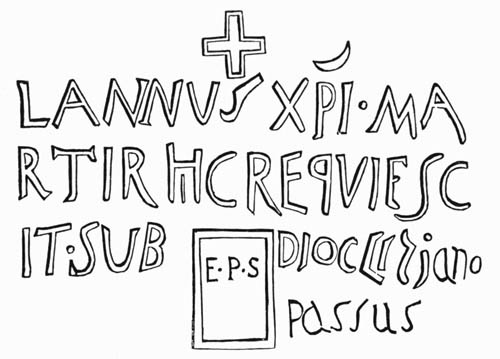
Fig. 21.—Lannus, the martyr of Christ, rests here. He
suffered under Diocletian. For his successors also.
|
|
PRIMITIVS IN PACE QVI POST
MVLTAS ANGVSTIAS FORTISSIMVS MARTYR
ET VIXIT ANNOS P · M · XXXVIII CONIVG · SVO
PERDVLCISSIMO BENEMERENTI FECIT.
|
Primitius in peace, after many torments, a most valiant martyr.
He lived thirty-eight years, more or less. [His wife] raised this
to her dearest husband, the well-deserving.
HIC GORDIANVS GALLIAE NVNCIVS
IVGVLATVS PRO FIDE CVM FAMILIA TOTA
QVIESCVNT IN PACE
THEOPHILA ANCILLA FECIT.
Here lies Gordianus, deputy of Gaul, who was executed for the
faith, with all his family: they rest in peace. Theophila, a
handmaid, set up this.[144]
The history of the Catacombs is inextricably interwoven with that of
Christianity. Their very structure reflects the character of the times
in which they were made. The absence of constraint or concealment, and
the superior construction and ornamentation of those belonging to the
earliest times, indicate the comparative security of the church before
it had awakened the jealousy or fear of the Roman emperors. Their
immense extension and crowded galleries testify to the rapid increase
of the Christian community. The altered character which they gradually
assumed, the obstructed passages, the masked entrances, devious
windings, and devices for concealment or escape, and the rudely
scratched inscriptions and uncouth paintings, betray the sense of fear
and the kindling rage of persecution which pursued the hunted
Christians to these subterraneous sanctuaries of the faith. Their
greater magnificence and more ornate structure, the costly mosaics,
the marble stairways, and richly carved sarcophagi of the later ages,
tell of the enthronement of Christianity on the seat of the Cæsars,
and of the homage paid to the relics and shrines of the saints and
martyrs. And their debased architecture, barbarous paintings, and
progressive ruin during the later years of their history indicate the
gradual eclipse of art, and their final abandonment. We must therefore
carefully determine at least the proximate date of any particular
feature if we would correctly interpret its significance.
The last and most terrible persecution of the church before its final
triumph left abundant evidence of its violence and lengthened duration
in the changes which contemporaneously took place in the Catacombs.
God prepared a place for his saints, and hid them in the clefts of the
rock as in the hollow of his hand. When the public observance of
Christianity was proscribed by law the believers withdrew from the
light of day, and in the inmost and darkest recesses of these
subterranean crypts, by the graves of their martyred dead, enjoyed the
consolation of religious worship, and broke the bread and drank the
wine in memory of their dying Lord.[145]
But after the decree of Valerian which forbade the entering or holding
any assemblies in the Christian cemeteries, even these retreats were
not safe, and the last sanctuaries of the faith were unscrupulously
invaded. Persecution relentlessly followed the Christians through the
labyrinthine windings of the Catacombs, and violated the sepulchres of
the sainted dead by sacrilegious tumult and bloodshed. Sometimes the
heathen soldiery, fearing to pursue their victims into these unknown
passages, blocked up the entrance to prevent their escape; and many
were thus buried alive and perished of hunger in these chambers of
gloom.[146]
An entire change in the construction of the Catacombs now took place.
They became obviously designed for purposes of safety and concealment.
The new galleries were less wide and lofty, and the loculi more
crowded on account of the greater difficulty of
removing the excavated
material. At this time, too, many of the lower piani were made
for additional graves and greater secrecy. The main entrances were
blocked up and the stairways demolished. Sometimes entire galleries
were filled with earth, the removal of which is the chief obstacle to
modern exploration, or were built up with masonry to obstruct pursuit;
and means of escape were provided, in case of forcible invasion of
these retreats. A striking example of this occurs in the Catacomb of
Callixtus. The ancient stairway was partially destroyed, the entrance
completely obstructed, and some of the galleries walled up. Narrow
passages for escape were made connecting with an adjacent
arenarium, and a very narrow secret stairway constructed from
the roof of the latter to the surface of the ground, as shown in the
section above, which stairway could only be reached by a movable
ladder connecting it with the floor.[147]
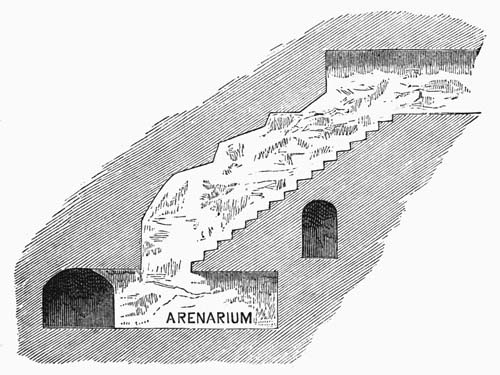
Fig. 22.—Secret stairway into Arenarium.
It is impossible that the mass of the Christian community, or even any
considerable proportion of it, could ever have taken refuge in these
subterraneous crypts. Their vast extent and the number of chambers
would indeed permit a great multitude to remain concealed for a time
in their depths; but the difficulty of procuring a regular supply of
food, the confined atmosphere, and the probable exhalation of noxious
gases from the graves—especially on the opening of a bisomus,
or double tomb, for its second inmate—seem insuperable obstacles. As
it was the religious leaders of the Christian community who were
especially obnoxious to those in power, they would be the most likely
to seek concealment in the Catacombs, not from inferiority of courage,
but, like the afterward martyred Cyprian, that they might the better
guide and govern the persecuted church. Hence the examples before
given of bishops and other ecclesiastics lying hidden, some for years,
in these depths, and visited by the faithful for instruction or for
the celebration of worship.[148]
There is evidence, however, that
during the exacerbations of persecution private Christians sought
safety in these recesses, and, burrowing in their depths, evaded the
pursuit of their enemies. Tertullian speaks of “a lady, unaccustomed
to privation, trembling in a vault, apprehensive of the capture of her
maid, upon whom she depends for her daily food.” The heads of
Christian families, and those most obnoxious to the pagan authorities,
would be especially likely to leave the fellowship of the living in
order to live in security among the dead. Father Marchi conjectures
that supplies of
grain were laid up for the maintenance of the hidden
fugitives, and De Rossi describes certain crypts in the Catacomb of
Callixtus which were probably employed for storing corn or wine in
time of persecution. Frequent wells occur, amply sufficient for the
supply of water; and the multitude of lamps which have been found
would dispel the darkness, while their sudden extinction would prove
the best concealment from attack by their enemies.[149]
Hence the
Christians were stigmatized as a skulking, darkness-loving race,[150]
who fled the light of day to burrow like moles in the earth.
These worse than Dædalian labyrinths were admirably adapted for
eluding pursuit. Familiar with their intricacies, and following a
well-known clew, the Christian could plunge fearlessly into the
darkness, where his pursuer would soon be inextricably lost. Perchance
the sound of Christian worship, and the softened cadence of the
confessors’ hymn, stealing through the distant corridors, may have
fallen with strange awe on the souls of the rude soldiery stealthily
approaching their prey; and, perhaps, not unfrequently with a saving
and sanctifying power. But sometimes, tracked by the sleuth-hounds of
persecution, or betrayed by some wretched apostate consumed by a
Judas-greed of gold, the Christians were surprised at their devotions,
and their refuge became their sepulchre. Such was the tragic fate of
Stephen, slain even while ministering at the altar; such the event
described by Gregory of Tours, when a hecatomb of victims were
immolated at once by heathen hate; such the peril which wrung from a
stricken heart the cry, not of anger but of grief, Tempora
infausta, quibus
inter sacra et vota ne in cavernis quidem salvari
possimus!—“O sad times in which, among sacred rites and prayers,
even in caverns, we are not safe!” It requires no great effort of
imagination to conceive the dangers and escapes which must have been
frequent episodes in the heroic lives of the early soldiers of the
cross.
In the Catacombs more safely than elsewhere could the Christians
celebrate the ordinances of religion, often under cover of the rites
of sepulture, which might even yet be sacred in the eyes of their
enemies. And next to their funeral purposes this seems to have been
their chief use. For this many of their principal chambers and chapels
were excavated, supplied with seats, ventilated by luminari,
and adorned with biblical or symbolical paintings. With what emotions
must the primitive believers have held their solemn worship and heard
the words of life, surrounded by the dead in Christ! With what power
would come the promise of the resurrection of the body, amid the
crumbling relics of mortality! How fervent their prayers for their
companions in tribulation, when they themselves stood in jeopardy
every hour! Their holy ambition was to witness a good confession even
unto death. They burned to emulate the zeal of the martyrs of the
faith, the plumeless heroes of a nobler chivalry than that of arms,
the Christian athletes who won in the bloody conflicts of the arena,
or amid the fiery tortures of the stake, not a crown of laurel or of
bay, but a crown of life, starry and unwithering, that can never pass
away. Their humble graves are grander monuments than the trophied
tombs of Rome’s proud conquerors upon the Appian Way. Lightly may we
tread beside their ashes; reverently may we mention their names.
Though the bodily presence of those conscripts of the tomb—the forlorn
hope of the army of Christianity—no longer walked among men, their
intrepid spirit animated the heart of each member of that little
community of persecuted Christians, “of whom the world was not worthy;
who wandered in deserts, and in mountains, and in dens and caves of
the earth, ... being destitute, afflicted, tormented.”[151]
It is impossible to arrive at even an approximate estimate of the
number of victims of the early persecutions. That number has
sometimes, no doubt, been greatly exaggerated. It has also, in
defiance of the testimony of contemporary history, been unreasonably
minified.[152]
Tacitus asserts that under Nero a great multitude[153]
were convicted and punished. Pliny says the temples were almost
deserted[154]
through this contagious superstition. Juvenal, Martial,
and other classical authors, notice the extraordinary sufferings of
the Christians. Cyprian, in the middle of the third century, says, “It
is impossible to number the martyrs of Christ.”[155]
Eusebius, an
eye-witness of the last persecution, states that innumerable
multitudes suffered during its prevalence. After describing their
excruciating tortures, he adds:
“And all these things were doing not
for a few days, but for a series of whole years. At one time ten or
more, then twenty, again thirty or even sixty, and sometimes a hundred
men, with their wives and children, were slain in one day.”[156]
He
also describes the destruction of a Christian town, with all its
inhabitants, by fire.[157]
Lactantius, also a contemporary witness,
tells us that the Christians were often surrounded on all sides and
burnt together.[158]
It is very remarkable that so few martyrs’ epitaphs have been found in
the Catacombs, not more than five or six altogether, and some of these
are not of unquestioned genuineness. But this may be attributed to the
humility and modesty of the early Christians, who shrank from claiming
for the sufferers for the truth the august title of martyr, which they
restricted to the one faithful and true witness, Jesus Christ. “We,”
said the victims of persecution at Lyons, “are only mean and humble
confessors.”
There do occur, it is true, certain inscriptions of a memorial
character and of later date than the time of the persecution, some of
which commemorate a large number of martyrs, but they are of little or
no historic value. Such is the inscription to three thousand martyrs
in the Catacomb of Priscilla, already given,[159]
and the following
from the Callixtan Catacomb: MARCELLA ET CHRISTI MARTYRES
CCCCL—“Marcella and four hundred and fifty martyrs in Christ.”
Ancient itineraries speak of eighty, or even eight hundred, martyrs
buried in one spot in the Catacombs; and Prudentius
declares that he
saw the remains of some sixty in a single grave.[160]
But surpassing
all the others in exaggeration is an inscription in the church of St.
Sebastian commemorating one hundred and seventy-four thousand holy
martyrs, and forty-six bishops, also martyrs, said to be interred in
the neighbouring Catacomb. Another ancient tradition asserts that
twelve thousand Christians, who were employed in building the Baths of
Diocletian, were buried in the Catacomb of St. Zeno.[161]
Piazza
asserts that two hundred and eighty-five Christians were put to death
in two days, under the Emperor Claudius II., A. D. 268, and that more
than two thousand were executed for refusing to sacrifice to the image
of the sun. Indeed, some Roman archæologists discern in every palm
branch or cup, which are so frequently found in the Catacombs,
irrefragable evidence of the martyr’s tomb.[162]
Such atrocious cruelty and lavish destruction of life
as these
traditions, even if exaggerated, imply, seem incredible; but the pages
of the contemporary historians, Eusebius and Lactantius, give too
minute and circumstantial accounts of the persecutions of which they
were eye-witnesses to allow us to adopt the complacent theory of
Gibbon, that the sufferings of the Christians were comparatively few
and insignificant. “We ourselves have seen,” says the bishop of
Cæsarea, “crowds of persons, some beheaded, others burned alive, in a
single day, so that the murderous weapons were blunted and broken to
pieces, and the executioners, wearied with slaughter, were obliged to
give over the work of blood.[163]
... They constantly vied with each
other,” he continues, “in inventing new tortures, as if there were
prizes offered to him who should contrive the greatest
cruelties.”[164]
Men whose only crime was their religion were scourged
with iron wires or with plumbatæ, that is, chains laden with
bronze balls, specimens of which have been found in the martyrs’
graves, till the flesh hung in shreds, and even the bones were broken;
they were bound in chains of red-hot iron, and roasted over fires so
slow that they lingered for hours, or even days, in their mortal
agony; their flesh
was scraped from the very bone with ragged shells,
or lacerated with burning pincers, iron hooks, and instruments with
horrid teeth or claws, examples of which have been found in the
Catacombs;[165]
molten metal and plates of red-hot brass were applied
to the naked body till it became one indistinguishable wound; and
mingled salt and vinegar or unslaked lime were rubbed upon the
quivering flesh, torn and bleeding from the rack or scourge—tortures
more inhuman than savage Indian ever wreaked upon his mortal foe. Men
were condemned by the score and hundred to labour in the mines, with
the sinews of one leg severed, with one eye scooped out and the socket
seared with red-hot iron. Chaste matrons and tender virgins were given
over—worse fate a thousand-fold than death—to dens of shame and the
gladiators’ lust, and subjected to nameless indignities, too horrible
for words to utter.[166]
And all these intense sufferings were endured
often with joy and exultation, for the love of a divine Master, when a
single word, a grain of incense cast upon the heathen altar, would
have released the victims from their agonies.
No lapse of time, and no
recoil from the idolatrous homage paid in after ages to the martyr’s
relics, should impair in our hearts the profound and rational
reverence with which we bend before his tomb.
We are left, however, for the most part, without authentic record of
the tragic scenes of Christian martyrdom. The primitive church,
indeed, treasured up these memories of moral heroism as her most
precious legacy to after times. Clement of Rome, it is said, appointed
notaries to search out the acts of the martyrs;[167]
and, as we have
seen, Fabian suffered death for his zeal in preserving these
records.[168]
But these precious documents for the most part perished
in the Diocletian persecution, although fragments were probably
incorporated with the later martyrologies. The earlier Acts are the
more authentic, and the more simple in character. Those of later date
become more and more florid in style, and are overladen with the
incredible and impossible, till their historic value is entirely
destroyed, except when they are corroborated by collateral testimony,
or by the monumental evidence of the Catacombs. Prudentius, attracted
to Rome by the fame of these repositories of the martyrs’ ashes, wrote
a treatise[169]
on their sufferings, in which his fervid imagination
and rhetorical style found amplest indulgence. Later writers still
further embellished and exaggerated the original Acts, till the
wildest stories of ancient mythology, or mediæval legend, were
surpassed by the monkish martyrologists.
This “holy romance,” as Gibbon contemptuously calls it, becomes little
else than a record of the most astounding miracles, the most horrible
tortures, and of more than human endurance.[170]
It minutely describes
the conflict between the Christian and his heathen persecutor: hinc
martyr, illinc carnifex—here the martyr, there the executioner.
The one wreaks his rage upon his victim, the other exhibits a stoical
endurance of suffering rivaling that of the American savage at the
funeral stake, or else an insensibility to pain that lessens the merit
of his acts. “It is cooked, turn and eat,”[171]
says St. Lawrence,
broiling on a gridiron. He feels no pain from the vinegar and salt
rubbed on his bleeding wounds. “Salt me the more, that I may be
incorruptible,” says Tarachus to his torturer. He continues to speak
after his tongue is torn out by the roots. The lacerations of the
ungulæ assume to the excited imagination the form of the name of
Christ.[172]
Divine odours breathe from the body, which shines like
gold amid the flames that refuse to kindle upon it. A voice from
heaven hails the invincible conqueror, and his soul in the form of a
dove ascends to the skies.[173]
The undying instincts
of nature are
flagrantly violated in some of the Acts. A mother rebukes her child
for begging a cup of water while suffering under the rods of the
lictors; and while it is beheaded before her eyes she, alone unmoved,
sings a versicle of thanksgiving.[174]
Often the martyr endeavours to
exasperate with taunts and defiance the heathen magistrate, who
gnashes his teeth and rolls his eyes in impotent rage.[175]
“Be dumb,
wretch! O serpent of darkest mind, a curse be upon thee!” exclaims St.
Boniface to his executioner. Vincentius menaces his judge with the
fiery fate of the bottomless pit.[176]
These Acts of the Martyrs were
appointed to be read in the churches,[177]
till they were prohibited
by the Council of Trullo, A. D. 706.
The enthusiasm for martyrdom prevailed, at times, almost like an
epidemic. It was one of the most remarkable features of the ages of
persecution. Notwithstanding the terrific tortures to which they were
exposed, the fiercer the tempest of heathen rage the higher and
brighter burned the zeal of the Christian heroes. Age after age
summoned the soldiers of Christ to the conflict whose
highest guerdon
was death. They bound persecution as a wreath about their brows, and
exulted in the “glorious infamy” of suffering for their Lord. The
brand of shame became the badge of highest honour. Besides the joys of
heaven they won imperishable fame on earth; and the memory of a humble
slave was often haloed with a glory surpassing that of a Curtius or
Horatius. The meanest hind was ennobled by the accolade of martyrdom
to the loftiest peerage of the skies. His consecration of suffering
was elevated to a sacrament, and called the baptism of fire or of
blood.
Burning to obtain the prize, the impetuous candidates for death often
pressed with eager haste to seize the palm of victory and the martyr’s
crown. They trod with joy the fiery path to glory, and went as gladly
to the stake as to a marriage feast. “Their fetters,” says Eusebius,
“seemed like the golden ornaments of a bride.”[178]
They desired
martyrdom more ardently than men afterward sought a bishopric.[179]
They exulted amid their keenest pangs that they were counted worthy to
suffer for their divine Master. “Let the ungulæ tear us,” exclaims
Tertullian,[180]
“the crosses bear our weight, the flames envelope us,
the sword divide our throats, the wild beasts spring upon us; the very
posture of prayer is a preparation for every punishment.” “These
things,” says St. Basil, “so far from being a terror, are rather a
pleasure and a recreation to us.”[181]
“The tyrants were armed,” says
St. Chrysostom, “and the martyrs naked;
yet they that were naked got
the victory, and they that carried arms were vanquished.”[182]
Strong
in the assurance of immortality, they bade defiance to the sword.
Though weak in body they seemed clothed with vicarious strength, and
confident that though “counted as sheep for the slaughter,” naught
could separate them from the love of Christ. Wrapped in their fiery
vesture and shroud of flame, they yet exulted in their glorious
victory. While the leaden hail fell on the mangled frame, and the eyes
filmed with the shadows of death, the spirit was enbraved by the
beatific vision of the opening heaven, and above the roar of the mob
fell sweetly on the inner sense the assurance of eternal life. “No
group, indeed, of Oceanides was there to console the Christian
Prometheus; yet to his upturned eye countless angels were
visible—their anthem swept solemnly to his ear—and the odours of an
opening paradise filled the air. Though the dull ear of sense heard
nothing, he could listen to the invisible Coryphæus as he invited him
to heaven and promised him an eternal crown.”[183]
The names of the
“great army of martyrs,” though forgotten by men, are written in the
Book of Life. “The Lord knoweth them that are his.”
There is a record, traced on high,
That shall endure eternally;
The angel standing by God’s throne
Treasures there each word and groan;
And not the martyr’s speech alone,
But every wound is there depicted,
With every circumstance of pain—
The crimson stream, the gash inflicted—
And not a drop is shed in vain.[184]
This spirit of martyrdom was a new principle in society. It had no
classical counterpart.[185]
Socrates and Seneca suffered with
fortitude, but not with faith. The loftiest pagan philosophy dwindled
into insignificance before the sublimity of Christian hope. This
looked beyond the shadows of time and the sordid cares of earth to the
grandeur of the Infinite and the Eternal. The heroic deaths of the
believers exhibited a spiritual power mightier than the primal
instincts of nature, the love of wife or child, or even of life
itself. Like a solemn voice falling on the dull ear of mankind, these
holy examples urged the inquiry, “What shall it profit a man if he
gain the whole world and lose his own soul?” And that voice awakened
an echo in full many a heart. The martyrs made more converts by their
deaths than in their lives. “Kill us, rack us, condemn us, grind us to
powder,” exclaims the intrepid Christian Apologist; “our numbers
increase in proportion as you mow us down.”[186]
The earth was drunk
with the blood of the saints, but still they multiplied and grew,
gloriously illustrating the perennial truth—Sanguis martyrum semen
ecclesiæ.[187]
Christianity, after long repression, became at length triumphant. The
church on the conversion of Constantine emerged from the concealment
of the Catacombs to the sunshine of imperial favour. The legend of the
Seven Sleepers of Ephesus strikingly illustrates the wondrous
transformation of society. These Christian brothers, taking shelter in
a cave during the Decian persecution, awoke, according to the legend,
after a slumber of over a century, to find Christianity everywhere
dominant, and a Christian emperor on the throne of the Cæsars.[188]
The doctrines of Christ, like the rays of the sun, quickly irradiated
the world.[189]
With choirs and hymns, in cities and villages, in the
highways and markets, the praises of the Almighty were sung.[190]
The
enemies of God were as though they had not been.[191]
The Lord brought
up the vine of Christianity from a far land, and cast out the heathen,
and planted and watered it, till it twined round the sceptre of the
Cæsars, wreathed the columns of the Capitol, and filled the whole
land. The heathen fanes were deserted, the gods discrowned, and the
pagan flamen no longer offered sacrifice to the Capitoline Jove. Rome,
which had dragged so many conquered divinities in triumph at its
chariot wheels, at length yielded to a mightier than all the gods of
Olympus. The old faiths faded from the firmament of human thought as
the stars of midnight at the dawn of day. The banished deities forsook
their ancient seats. They walked no longer in the vale of Tempe or in
the grove of Daphne.[192]
The naiads bathed not in Scamander’s stream
nor Simois, nor the nereids in the waters of the bright Ægean Sea. The
nymphs and dryads ceased to haunt the sylvan solitudes. The oreads
walked no more in light on Ida’s lofty top.
O ye vain false gods of Hellas!
Ye are vanished evermore!
Long before the recognition of Christianity as the religion of the
empire its influence had been felt permeating the entire community.
Amid the disintegration of society it was the sole conservative
element—the salt which preserved it from corruption. In the midst of
anarchy and confusion a community was being organized on a principle
previously unknown in the
heathen world, ruling not by terror but by
love; by moral power, not by physical force; inspired by lofty faith
amid a world of unbelief, and cultivating moral purity amid the
reeking abominations of a sensual age.
Yet this mighty energy thus at work eluded the notice, or excited only
the disdain, of some of the keenest observers and greatest thinkers
the world has seen. Classical literature contains only a few short
notices of that religion which was transforming the age. A galaxy of
philosophers and historians, gazing mournfully at the seething mass of
moral putrefaction around them, and profoundly conscious of its
apparently cureless evil, treated as contemptible the most powerful
moral agent in the world—that regenerative principle which was to
reorganize society on a higher type than ever was known before.[193]
The kingdom of heaven cometh not with observation, and paganism seemed
entirely unconscious of its impending doom.
But this wonderful influence, which accomplished so much, seemed at
length strangely to lose its power, and did not fulfil the
regenerative work which it began. It failed to check the degeneracy of
the age or to avert the dissolution of the empire. The many crimes of
that colossal orgy cried to heaven for vengeance. The taint was too
inveterate to be eradicated; the evil was immedicable; Rome was
already effete and moribund. It was weighed in the balance and found
wanting. Therefore the inexorable penalty, which evermore follows
wrong, as a shadow its substance, was suffered to descend. An awful
Nemesis, like an avenging Fate,
overtook the great and wicked city
in its pride and guilt; and the mystical Babylon of the West, reeking
with sensuality, idolatry, and blood, soon beheld the Goths at her
gates, and the Huns within her walls.[194]
Nunc sacri fontis nimus, et delubra locantur
Judæis.—Sat., iii, 13.
AREAM AT [AD] SEPVLCHRA CVLTOR VERBI CONTVLIT
ET CELLAM STRVXIT SVIS CVNCTIS SVMPTIBVS
ECCLESIÆ SANCTÆ HANC RELIQVIT MEMORIAM,
SALVETE FRATRES PVRO CORDE ET SIMPLICI
EVELPIVS VOS SATOS SANCTO SPIRITV.
ECCLESIA FRATRVM HVNC RESTITVIT TITVLVM....
Mille pedes in fronte, trecentos cippus in agrum
Hic dabat; heredes monumentum ne sequeretur.
Hor., I Sat., viii, 12.
Good Friend for Iesus SAKE forbeare
To diGG T-E Dust EncloAsed HERe
Blest be T-E Man TY spares T-es Stones
And curst be He TY moves my Bones.

Fig. 20.—Reputed Martyr Symbol.
“La terre avait gémi sous le fer des tyrans;
Elle cachait encore des martyrs expirans,
Qui dans les noirs détours des grottes reculées
Dérobaient aux bourreaux leurs têtes mutilées.”
Poëme de la Religion Vengée, chap. viii.
Sexaginta illic defossas mole sub una
Reliquias memini me didicisse hominum.—Peristeph., xi.
—Latus ungula virgineum
Pulsat utrimque, et ad ossa secat,
Eulalia numerante notas.
Scriberis ecce! mihi Domine;
Quàm juvat hos apices legere.—Peristeph., Hymn ix.
At sola mater hisce lamentis caret,
Soli sereno frons renidet gaudio.—Prudent., Peristeph.
His persecutor saucius
Pallet, rubescit, æstuat,
Insana torquens lumina.
Spumasque frendens egerit.—Ibid., Hymn ii.
Bitumen et mixtum pice
Imo implicabunt Tartaro.—Ibid.
Inscripta Christo pagina immortalis est,
Excepit adstans angelus coram Deo.
Et quæ locutus martyr, et quæ pertulit:
Nec verbum solùm disserentis condidit,
Omnis notata est sanguinis dimensio,
Quæ vis doloris, quive segmenti modus:
Guttam cruoris ille nullam perdidit.—Peristeph.
From the period of the Edict of Milan, A. D. 313, a new era opens in
the history of the Catacombs. Christianity, emerging from those gloomy
recesses where she had so long hidden in darkness, walked boldly in
the light of day. She laid aside her lowly garb, put on the trappings
of imperial state, and at length, unhappily, exchanged her primitive
simplicity for worldly power and splendour. But therein was her
danger. The shadow of that power shed a upas influence over the
church. The unhallowed union between the bride of heaven and a sinful
world gave birth to corruption and religious error. Pampered when
subservient to the policy of the Cæsars, she soon became its willing
instrument, and stained her snowy robes by complicity with imperial
vice. Christianity became at length “a truth grown false,” and men, to
use the fine figure of D’Aubigné, forsaking the precious perfume of
faith, bowed down before the empty vessel that had contained it.
The influence of Constantine seems to have been fraught with more of
evil than of good to the new religion that he espoused. He appears to
have adopted the Christian name from expediency rather than from
conviction, and, stained with the kindred blood of wife and son and
nephew, ill deserves the title of Saint, bestowed in fulsome adulation
by a venal church. Even the priests of the false gods, aghast with
horror at his crimes, exclaimed, “There is no expiation for deeds
like these.” He used both pagans and Christians, both orthodox and
heretics, as instruments for his political purposes. His object seems
to have been rather to raise and strengthen a hierarchy of
ecclesiastical supporters than to assist the cause of truth; and he
imposed on the organization of the Greek and Latin churches that
monarchical and secular character which they have ever since
retained.[195]
The transfer of the seat of empire from the Tiber to the Bosphorus
left Christianity to develop itself at Rome less trammelled by
imperial influence; and, perhaps, in a less corrupt form than in the
East. After the edict of toleration, the places of worship which had
been closed or destroyed during the persecution were opened, or
rebuilt with a magnificence rivalling that of the ancient temples. But
the Catacombs still continued invested with a deep and pathetic
interest, as the cradle of the faith, the refuge of the church during
the storm of
calamity, and the sepulchre of the saints and martyrs.
Hence numerous basilicas or oratories were erected over or near the
entrances of the ancient cemeteries in honour of the holy dead.
On the full recognition of Christianity the necessity for subterranean
sepulture ceased; hence it fell gradually into disuse, and was
superseded by burial in or near the now numerous basilicas. Even the
Roman bishops were no longer interred in the so-called Papal Crypt,
but in churches above ground; and this example was soon generally
followed. “The inscriptions with consular dates,” says Dr. Northcote,
“probably furnish us with a sufficiently accurate guide to the
relative proportions of the two modes of burial. From A. D. 338 to A. D. 360 two out of three burials appear to have taken place in the
subterranean portion of the cemeteries, while from A. D. 364 to A. D. 369 the proportions are equal. During the next two years hardly any
notices of burials above ground appear, but after that
subterranean crypts fell rapidly into disuse.”[196]
It is a remarkable circumstance, here indicated, that in the years A. D. 370 and 371 a sudden and general return to subterranean sepulture
took place. This change has been very satisfactorily explained by the
contemporary history of the Catacombs. Great injury had already been
inflicted on these ancient sepulchres by the practice which had become
prevalent of erecting basilicas, more or less sumptuous, over the
tombs of the illustrious martyrs of the age of persecution.[197]
As
the ecclesiastical authorities shrank from disturbing their
remains it became the custom to excavate the ground down to the level of their
graves. As these were often in the lower levels of the Catacombs,
hundreds of graves were sometimes destroyed in these excavations and
constructions.[198]
Damasus, bishop of Rome from A. D. 358 to A. D. 384, who was indefatigable in his efforts to protect and, where
possible, to restore the Catacombs, endeavoured to prevent this
wholesale destruction of these sacred crypts. He explored many of the
galleries, which, to preserve inviolate the martyrs’ graves, had been
blocked up with earth and stones during the period of persecution. He
cleared out[199]
and enlarged the passages leading to the more
distinguished tombs, and constructed ample flights of stairs for the
accommodation of the numerous pilgrims to these sacred shrines. He
lined many of the chambers with marble slabs, constructed shafts for
the admission of light and air, and supported the crumbling walls and
galleries, where necessary, with piers and arches of solid masonry. He
also composed numerous metrical inscriptions in honour of the martyrs,
which were engraved on marble in a singularly elegant character. There
are few of the Catacombs in which traces of his restorations or
adornments are not to be found.
The piety or superstition of the wealthy converts to Christianity led
them to enlarge the subterranean chapels and martyr-tombs, and to
decorate them with
costly marbles, frescoes, mosaics, stucco ornaments,
and vaulted roofs. The contemporary tombs and monuments were also on a
scale of magnificence before unknown; and the inscriptions assumed a
florid and inflated character far different from the simplicity of the
primitive ages. The architecture and paintings also indicate, with the
increase of wealth and luxury, the decline and fatal eclipse of art.
To the period of Damasus belongs the description, by Prudentius, of
the shrine of Hippolytus, part of which has been already quoted.[200]
“That little chapel,” he continues, “which contains the cast-off
garments of his soul, is bright with solid silver. Wealthy hands have
put up glistening tablets, smooth and bright as a concave mirror; and,
not content with overlaying the entrance with Parian marble, they have
lavished large sums of money on the ornamentation of the work.” It was
during the period of the labours of Damasus that the revived interest
in the Catacombs was so strikingly manifested by the sudden return to
the subterranean mode of burial, and that many of the tombs and
chapels received their most elaborate adornment.[201]
The perversion of a natural instinct, beautiful and praiseworthy in
itself, became the root of much evil in after times. Our hearts are
irresistibly drawn toward
the place where lie the remains of the
dear departed in the last long sleep of death. Although we know that
only the slumbering dust is there, we love to meditate above their
graves, and seem there to hold closer communion with their spirits
than elsewhere. Especially would the early Christians be drawn to the
tombs of their fathers in the faith, many of whom were also their
fathers in the flesh, whose saintly patience or glorious martyrdom had
hallowed their memory for evermore. They would naturally be led to
adorn and beautify their sepulchres, and in pious devotion to meditate
and pray beside their honoured remains. This innocent, and even
laudable, practice gradually, and perhaps inevitably, led to abuses.
The admiration of the martyr’s faith and patience and heroic spirit
gradually intensified into superstitious veneration for his body,
blood, bones, ashes, clothes, staff, or any personal relic. Judaism
regarded the touching of aught connected with the dead as involving a
ceremonial pollution; but Christian ideas invested even the crumbling
dust of the martyrs with especial sanctity.
The first clear evidence that we have of this feeling is in the case
of Ignatius, who suffered under Trajan, A. D. 107. Perhaps from a fear
that superstitious reverence might be paid to his remains, he prayed
that the wild beasts might become his sepulchre, so that nothing of
him might be left.[202]
His desire was only partly fulfilled, for “the
larger and harder bones remained, which were carried to Antioch and
kept as an inestimable treasure left to the Church by the grace which
was in the martyr.”[203]
Eusebius speaks of the charred remains of
Polycarp as “more precious than the richest
jewels, and more tried
than gold.”[204]
The martyrs blood was esteemed a talisman of especial
power. A sponge saturated therewith was sometimes worn as a sacred
relic, and it may be as a supernatural amulet, by their friends or
relatives. Prudentius describes the spectators of the martyrdom of St.
Vincent as dipping their clothes in his blood, that they might keep it
as a sort of palladium for successive generations:
Crowds haste the linen vest to stain
With gore distilled from martyr’s vein,
And thus a holy safeguard place
At home, to shield the future race.[205]
In the account of the death of Hippolytus, he describes the gathering
of his mangled limbs with a minuteness too revolting for the poetry
even of martyrology.[206]
With a refinement of cruelty, the
persecutors of Gaul cast the remains of the martyrs of Vienne to the
dogs, and guarded their lifeless bodies for days, in order to deprive
the Christians of the melancholy satisfaction of paying the last sad
rites of burial to any fragments that remained.[207]
The primitive Christians justly discriminated between the reverence
due to the martyrs and the adoration to be rendered only to the
Supreme Being. “We worship Christ as the Son of God,” says the church
of Smyrna, “but the martyrs we deservedly love as the disciples and
imitators of Our Lord.”[208]
“We do not build temples
to our martyrs
as gods,” says Augustine, “but only memorials of them as dead men
whose spirits live with God; nor do we erect altars or sacrifice to
our martyrs, but to the only God, both theirs and ours.”[209]
But the
enthusiastic feelings of the people at length failed to make this
proper distinction, and many even of the theological writers of the
day, not foreseeing the disastrous consequences to which the practice
would lead, were carried away with the popular current.
One form which this veneration took was that of festivals in honour of
the martyrs. “By a noble metaphor,” says Milman,[210]
“the day of
their death was considered that of their birth to immortality.”[211]
The church of Smyrna celebrated the anniversary of their martyred
bishop’s passion “with joy and gladness as his natal day.”[212]
Tertullian asserts that the practice has the authority of apostolic
tradition.[213]
These festivals were at first kept with religious
solemnity, accompanied by the celebration of the eucharist, often in
the rock-hewn chambers of the Catacombs, where a thin tile separated
the dead in Christ from the devout worshippers who commemorated the
passion of their common Lord. During the ages of persecution this was
a rite of deep and touching significance. Frequently his partaking of
that feast was the recipient’s own consecration to the martyr’s death.
But after the peace of the church it often degenerated into a scene of
excess and vulgar revelry, more like the pagan banquets for the dead
than a Christian solemnity. Indeed, they were avowedly employed in
ignoble appeal to the baser appetites, as counter-attractions to the
pagan feasts, to induce the poor to attend the festivals of the
church.[214]
This degradation of an originally praiseworthy practice,
and the intensifying and abject superstition to which it led, provoked
the taunts of the heathen and the censure of the more devout and
thoughtful Christians. The philosophic Julian recoiled from the
adoration of relics as from pollution. Another pagan writer contrasts
the veneration of obscure martyrs’ names, hateful to the gods and to
men,[215]
with the refined and poetic cultus of Minerva and
Jupiter.[216]
Vigilantius, the Spanish presbyter, strongly condemns
the “ashes worshippers and idolaters;” while, on the other hand,
Jerome magnifies the sanctity of these relics, “around which,” he
says, “the souls of the martyrs are constantly hovering to hear the
prayers of the supplicant.” After in vain trying to restrain their
abuses and excesses, the ecclesiastical authorities were at length
compelled to suppress these festivals.
The reverence paid to the relics of the martyrs had two remarkable and
contrary effects. Having led in the first place to the adornment of
their sepulchres, it ultimately caused their destruction and
spoliation. In consequence of this feeling it became an object of
ambition to share the resting-place of those who had been so holy in
life and so glorious in death. Hence new graves were often excavated
in the back of the arcosolia, cutting
through the beautiful
frescoes with which they were adorned, and mutilating or destroying
the paintings.[217]
The cubicula were also defaced, their
symmetry injured, and their construction endangered by similar
imprudent excavations.
Numerous inscriptions inform us that many persons secured this
privilege during their lives, as the following examples: IN CRYPTA
NOBA RETRO SANCTOS EMERVM SE VIVAS BALERA ET SABINA
(sic)—“In the new crypt behind the saints: Valeria and Sabina
bought it for themselves while living.” ΕΝΘΑΔΕ
ΠΑΥΛΕΙΝΑ ΚΕΙΤΑΙ ΜΑΚΑΡΩ ΕΝ ΧΩΡΩ—“Here lies Paulina in the place of the
blessed.” Another inscription of the period of Damasus tells of one
who was buried “within the thresholds of the saints, a thing which
many desire and few obtain.”[218]
Sometimes the name of the saint or
martyr is mentioned, as in one which records the purchase of a grave,
“at the tomb of Hippolytus, above the arcosolium,”[219]
and
another at that of Cornelius.[220]
So also the tomb of Cecilia was
separated from that of one of the primitive bishops by scarcely an
inch of rock. Great injury was thus done to the Catacombs by the
indiscreet devotion of those who observed this practice. Many pilgrims
to the graves of the martyrs, deriving, they thought, a spiritual
benefit from proximity to their sacred dust, took up their abode in
little cells beside their graves while alive, and shared their
sepulchres in death. In answer to the inquiry of his friend Paulinus
of Nola, whether it was a profit to the soul that the body should be
buried near the shrine of some saint,[221]
Augustine wrote a special
treatise[222]
in justification of the practice; although how
the martyrs help men, he confesses, is a question beyond his
understanding. We have already seen the very strong opinion
entertained on this subject by Jerome, the contemporary of Augustine.
More in accordance with reason and scripture is the sentiment
contained in the epitaph of the archdeacon Sabinus, lately found at
San Lorenzo:
NIL IVVAT IMMO GRAVAT TVMVLIS HAERERE PIORVM
SANCTORVM MERITIS OPTIMA VITA PROPE EST
CORPORE NON OPVS EST ANIMA TENDAMVS AD ILLOS
QVAE BENE SALVA POTEST CORPORE ESSE SALVS.[223]
It nothing helps, but rather hinders, to stick close to the tombs
of the saints; a good life is the best approach to their merits.
Not with the body but with the soul must we draw nigh to them;
when that is well saved it may prove the salvation of the body
also.
Even Damasus, who, if any ought, might claim sepulture with the
sainted dead, shrank from disturbing their remains, and was buried in
a tomb above the Catacomb of Callixtus. Of the subterranean
crypt he says:
HIC FATEOR DAMASVS VOLVI MEA CONDERE MEMBRA
SED TIMVI SANCTOS CINERES VEXARE PIORVM.
Here I, Damasus, confess I wished to lay my limbs, but I feared
to vex the holy ashes of the saints.
The desire for communion with the holy dead continued throughout
successive generations. Multitudes of pilgrims still visited the
shrines of the martyrs, and, after the wont of travellers, left traces
of their presence in the numerous graffiti which are written on
the walls. Some of these are names of classical form, as Leo, Felix,
Maximus, Theophilus; others, written in less accessible places, are of
later date and of foreign character, Spanish, British, or German, as
Ildebrand, Ethelred, Lupo, Bonizo, Joannes. The names are frequently
accompanied with the letters Pb., or Presb., the
indication of the ecclesiastical grade of the writer.
Many of the loftiest dignitaries in church and state, popes and
prelates, princes and nobles, kings and queens, and even some
illustrious wearers of the imperial purple, continued to be brought,
often from afar, throughout the period of the Middle Ages, to lie in
death as near as possible to the hallowed dust of the early martyrs
and confessors of the faith. Among them were some stained with blood,
who hoped to expiate their crimes by their religious austerities, and
to enter paradise through the intercession of the saints near whose
remains their bones were laid. Several petty kings of the Anglo-Saxon
Heptarchy, some expelled by their subjects or rivals, others flying
from the post of duty, muttered their prayers and counted their beads
in the crypts of the Catacombs, and were buried in their vicinity. The
following are a few of the more illustrious, taken from the list of
the Abbé Gaume:[224]
Popes Leo I., Gregory I., II., and III., Leo XI.;
the Emperor Honorius and Mary his wife, Valentinian and Otho II.;
Cedwalla, king of the West-Saxons; Conrad, king of the Mercians; Offa
and Ina, Saxon kings, with Eldiburga, wife of the latter; the Empress
Agnes, Queen Charlotte of Cyprus, and the Countess Matilda, who so
enriched the papal see by her donations. These were buried, not in the
Catacombs, but in the basilicas erected over
them, which were
considered to share their sanctity. Thus, as St. Chrysostom remarks,
referring to the tradition concerning the sepulchres of St. Peter and
St. Paul, kings laid aside their crowns at the tombs of the fisherman
and the tentmaker.[225]
During the latter part of the fourth and the beginning of the fifth
century the management of the Catacombs seems to have been no longer
in the hands of the ecclesiastical authorities, but under the control
of the fossors,[226]
with whom the bargain for interment was made by
the friends of the deceased. Numerous inscriptions occur in which this
bargain is recorded, together with the names of the buyers and
sellers, and sometimes those of the witnesses to the contract, and
even the price that was paid, as in the following examples: COSTAT
NOS EMISSE IANVARIVM ET BRITIAM LOCVM ANTE DOMNA EMERITA A FOSSORIBVS
BVRDONE ET MICINMO ET MVSCO RATIONE AVRI SOLIDVM VN SEMES
(sic)—“It is unquestionable that we, Januarius and Britia,
bought a place in front of [the tomb of] Lady Emerita[227]
from the
fossors Burdo, Micinus, and Muscus, for the consideration of one
solidus and a half of gold”—(about $7.) EMPTVM LOCVM A
BARTIMISTVM VISOMVM HOC EST ET PRETIVM DATVM A FOSSORE HILARO ID EST
FOLN ... PRESENTIA SEVERI FOSS. ET LAVRENT—“The place bought by
Bartimistus, that is, a bisomus; and the price paid to the fossor
Hilarus, 1400 folles, (about $5 65,) in the presence of the fossors
Severus and Laurence.” The fossors also probably prepared and engraved
the funeral slabs, as seems to be implied in the following:
LOCV MARMARORI (sic) QVODRISOMVM—“A quadruple tomb [bought] of
the stonecutter.”[228]
In the following illustration from the Catacomb of Callixtus the
fossor is seen standing in a cubiculum lined with graves, and
surrounded by the implements of his labour. On his shoulder is the
mattock with which he dug the friable tufa, and in his hand the lamp
with the spike by which it was fastened to the rock while he worked.
At his feet lie the compasses for marking out the loculi, and
over his head we read the simple epitaph,
“Diogenes the fossor, buried
in peace on the eighth before the calends of October.”
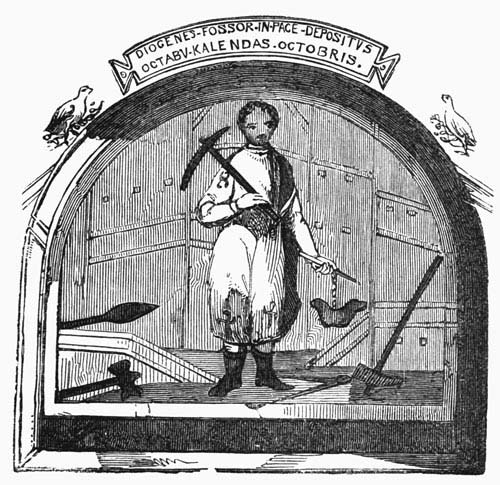
Fig. 23.—Diogenes the Fossor.
The accompanying engraving from Aringhi shows the fossor actively
engaged in excavating the vaulted gallery by the light of the lamp
suspended near him. The marks made by the mattocks, in the manner here
shown, may be seen in the walls of the passages as plainly as though
the fossor had but just ceased his labours.
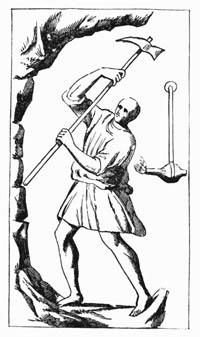
Fig. 24.—The Fossor at Work.
After a brief return to subterranean burial in the time of Damasus the
practice fell rapidly into disuse, and after A. D. 410 scarcely a
single certain example can be found. In that fatal year the blast of
the Gothic trumpet, startling the ear of midnight[229]
in the streets
of Rome, proclaimed its capture by the hosts of the stern Alaric. Amid
the social and civil commotions that accompanied the breaking up of
the empire, there was neither time nor means to adorn the sepulchres
of the saints, and the Catacombs fell into inevitable neglect and
decay. Of this year not a single sepulchral inscription remains, a
striking indication of the anarchy and confusion prevailing, when even
the customary honours were not paid to the dead.
Like a mighty deluge sweeping away and overwhelming the art and
civilization of the South, came the invasion of the barbarous hordes
of the North; yet like a deluge fertilizing and enriching the soil,
and leaving germs of future fruitfulness behind. Having conquered the
world with its arms and corrupted it with its vices, the mighty fabric
of the Roman empire lost internal strength and cohesion, and began to
crumble to pieces. The secret causes of its dissolution had long been
stealthily at work, and its fall at last was utter and complete.
Thrice in the space of three years (A. D. 408, 409, 410) Rome was
besieged by the hosts of Alaric, and, in vain purchasing respite by a
costly ransom, she was at last given up as a prey to the bold, eager,
and greedy savagery of the North. The pillage of the world,
accumulated during a thousand years of conquest, left, however, little
pretext for violating the resting-places of the dead. As the rude
soldiery gloated with hungry eyes on the lavish gold and silver, the
precious jewels and sumptuous vestments on every side, they recked
little for mere works of art, and many a porphyry vase and priceless
statue was wantonly shivered by barbarian battle-axe. Nevertheless,
the conqueror respected the basilicas of the apostles and the sacred
vessels of their shrines, declaring that he made not war upon the
saints.[230]
But succeeding conquerors were less scrupulous or more rapacious. Five
times in the course of the fifth century, and as often in the sixth,
the Eternal City, “that was almighty named,” was besieged by her
implacable foes. The churches were plundered of the massy plate and
other treasures, and even the dim crypts
of the Catacombs echoed the
clanging tread of the armed soldiery as with sacrilegious hands
they stripped the shrines of the saints of their costly adorning, and
rifled the graves of the dead in search for hidden treasure.[231]
Each
successive invasion to which Rome was exposed renewed these scenes of
desecration and robbery. The Huns, the Goths, the Lombards, and,
later, the Normans and Saracens, were rivals in spoliation and
destruction.
During the intervals of peace the Roman pontiffs endeavoured to
restore the Catacombs and re-adorn the martyr shrines, which were
still the objects of pious veneration. They were also used during the
barbarian invasions, as during the pagan persecutions, as places of
refuge. Boniface I., having been for some time concealed in the
Catacomb of Felicitas, afterwards elaborately ornamented it. Symmachus
and Vigilius were also especially diligent in their care for the
Catacombs. The latter restored many of the Damasine epitaphs which had
been destroyed.[232]
We read also of popes of
the sixth and two
following centuries restoring the cemeteries and making provision for
the celebration of the martyrs’ festivals at their subterranean
shrines. The sculpture and frescoes of the period of course exhibited
the depraved taste and debased execution of the times.
A new element of destruction came now into play. This was the
wholesale translation of the bodies of the saints from the Catacombs
to the churches of the city, in order to save them from profanation by
Astolphus and his sacrilegious Lombards. These pious robbers ransacked
and systematically despoiled the ancient cemeteries, and carried off
the relics of the martyrs. Pope Stephen III. thereupon published a
letter from St. Peter himself menacing with eternal damnation the
violators of these hallowed tombs. These spiritual terrors, however,
were found insufficient to protect the sacred relics. The work of
translation was resumed, and Pope Paul I. records the removal in A. D. 761 of the bodies of over a hundred “martyrs, confessors, and virgins
of Christ, with hymns and spiritual songs, into the city of Rome.” He
complains also of the neglect into which the Catacombs had fallen.
Their deeper recesses were given up to owls and bats, and nearer the
entrance the prowling fox or jackal found a covert. There, too, the
Campagnian shepherds frequently folded their flocks, and “converted
the sacred places into stables and dunghills.” They became, also, the
lurking places of thieves and debtors, outlaws and bandits, who took
refuge in their tangled labyrinths.
We have observed the practice in the fourth century of building
churches over the martyrs’ tombs. The natural reverence for their
remains soon passed into a superstitious veneration and belief in
their miraculous efficacy. Even such acute minds as those of Origen,
Chrysostom, and Ambrose seem infected with this superstition.[233]
It soon became considered essential to the consecration of a church that
it should be hallowed by some holy relics. These were placed not only
on the altar, but in the sides of portals, to be kissed by the devout
on entering.[234]
The furnishing of these relics became a gainful
trade. St. Augustine complains of certain vagabond monks who went
about selling relics of the martyrs, if indeed martyrs they were.[235]
In consequence of this practice a Theodosian law of the year A. D. 386
forbids the removal of any body that was buried, or the tearing
asunder or sale of the remains of a martyr.[236]
In consequence of the
number of spurious relics, the fourth Council of Carthage, in A. D. 401, prohibited the use of any whose genuineness could not be
authenticated.[237]
Martin of Tours narrates how he discovered, by
summoning the ghost of a so-called martyr, that the revered relics
were only those of a common thief.[238]
The Empress Constantina wrote
to Gregory
the Great, at the end of the sixth century, for the head
of St. Paul, in order to consecrate a new church. He replied that he
could not divide the bodies of the saints, and declared that the
danger of invading their tombs was sometimes even fatal.[239]
But this
pious reverence gave place to a more mercenary spirit, and the trade
in relics became a traffic of infamy and disgrace. Not only were the
bodies of the so-called martyrs torn asunder and their limbs sold to
diverse and distant places, but with sacrilegious fraud the relics of
favourite saints were multiplied till as many different cities claimed
to have their only true and genuine heads, arms, or bodies, as
contended for the honour of being the birth-place of Homer.[240]
These relics were endowed in popular apprehension with most miraculous
powers. They emitted a delightful fragrance that ravished the senses.
A fleshless skull declared the name and martyrdom of its owner. The
bones of St. Lawrence moved in their grave to make room for those of
another saint. The liquefaction of a martyr’s blood may still be
witnessed by the faithful on the anniversary of St. Januarius at
Naples.[241]
If we may credit numerous traditions, these wonder-working
human remains healed the sick,[242]
raised the dead, and, more
difficult still, converted heretics to the true faith. Nay, the mere
contact with the brandea or handkerchief from the martyr’s
tomb, the filings of his chains, or the oil from the lamp before his
shrine, communicated spiritual as well as physical benefit. These
sacred relics possessed a talismanic power to protect from evil. They
were borne into battle to avert the hurtling death and to blunt the
edge of the sword. They were affixed to towers as a safeguard against
the thunderbolt.[243]
They were inlaid in the crowns and regalia of
kings,[244]
and worn in rings and amulets as prophylactics against
poison or disease, and they lent an awful sanctity to the oath taken
upon the altar.[245]
The slender historical evidence on which idolatrous homage is paid to
these relics is seen in the case of the
so-called “Saint Theodosia of
Amiens.” Her epitaph, found in a Catacomb near the Salarian Way, reads
as follows:
AVRELIAE THEVDOSIAE
BENIGNISSIMAE ET
INCOMPARABILI FEMINAE
AVRELIVS OPTATVS
CONIVGI INNOCENTISSIMAE
NAT · AMBIANA.
Aurelius Optatus to his most innocent wife Aurelia Theudosia, a
most gracious and incomparable woman, by nation an Ambian.
The Congregation of Relics decided that Theudosia was both a saint and
martyr, and a native of Amiens. Her remains were solemnly conveyed to
that city, and on the 12th of October, 1833, they were received with
the utmost magnificence by no less than twenty-eight mitred prelates
and fifteen hundred other ecclesiastics, placed in a gorgeous shrine,
and honoured as in ancient times they honoured a tutelar goddess.
Cardinal Wiseman preached on the occasion, and compared the removal of
her remains to her native place to that of the patriarch Joseph’s
bones from Egypt to Canaan; and Bishop Salinis commended the homage of
her relics
“because the martyrs are, after Jesus Christ, also Christs
to open heaven to mankind.”[246]
By this practice of the translation of relics Rome broke the chain of
positive evidence, and destroyed the tender and pathetic associations
connected with the remains of the sainted dead. The martyr’s tomb, in
its original position and undisturbed, is an object of intensest
interest; but removed to some distant church or abbey and redecorated
with florid adornment or theatrical finery, his alleged relics provoke
only skepticism or contempt. Indeed, so little attempt at probability
is there in the names given to these relics that a Romanist writer,
the Abbé Barbier de Montault, confesses that the greater part of the
bodies found in the Catacombs wanting proper names have received,
when they were exposed to public veneration, names at haphazard, which
have only a vague or general signification, as Felix, Fortunatus,
Victor.[247]
We return from this digression to the mediæval history of the
Catacombs. The efforts of Stephen III., Adrian I., and Leo III., in
the eighth and ninth centuries, to restore their ancient honour and
magnificence, were unavailing. The tombs of the saints were
continually being abandoned and destroyed. The translation of the
sacred relics was renewed with increased energy. Pope Paschal I. was
the most zealous agent in the prosecution of this work. An inscription
in the church of St. Prassede, which he built for their reception,
records the translation thither of 2,300 bodies in a single day, July
20, A. D. 817. Successive popes continued to remove cartloads of
relics from the Catacombs in order to enhance the dignity or sanctity
of the churches which they built or restored, and as an evidence of
their own pious zeal. At this period, probably, the multitude of
relics were borne to the Pantheon, since known as St. Maria ad
Martyres—
Shrine of all saints and temple of all gods
From Jove to Jesus.[248]
These perpetual spoliations of the Christian cemeteries led to the
rapid destruction of many of their galleries and chambers, and to
their final abandonment like a worked-out mine—a mine, too, which had
been the source of greater riches to the church than treasures of
silver or gold. In the removal of the relics of the martyrs the
principal motive for the protection or adornment of the Catacombs was
taken away, and during the gathering darkness of the Middle Ages they
speedily passed out of the knowledge of mankind. In a few of those in
the immediate vicinity of some church or monastery a subterranean
chapel was still kept open, and an occasional mass was celebrated on
the presumed anniversary of the martyr whose name was associated,
often erroneously, therewith; or some zealous and adventurous pilgrim
might even penetrate their obscure recesses. But a blight had fallen
on the once beautiful Campagna. Desolation, pestilence, and death
brooded over the deserted plain. Through the natural dilapidations of
time, and the spoliations of Saracens, Normans, and Greeks, who
successively invaded Italy and wasted the country with fire and sword,
the basilicas and oratories of the Byzantine period crumbled to decay
or were destroyed, and the monasteries were deserted; their cowled and
sandaled occupants, long the sole custodians of the Catacombs, taking
refuge within the city walls. The rains of a thousand autumns and the
frosts of as many winters caused the crumbling of the luminari,
the falling in of the roofs, and ruin of the galleries. The knowledge
of the past was lost in the gathering gloom of the dark ages, so that
in an enumeration of the Roman Catacombs in the fourteenth century
only three are mentioned, and these were connected
with some church.
In the fifteenth century but one, that of Sebastian, was known.
Yet there is evidence that some of the galleries were accessible, and
were used for dark and sinister purposes, in keeping with their gloomy
and desolate character. During the lawless period from the eleventh to
the fifteenth century, when faction and civil war and anarchy laid
waste the country, and even the classic mausolea above ground were
converted into armed fortresses, these gloomy vaults became the
rendezvous of insurgents and conspirators, who feared no betrayal of
their bloody secrets by the silent sleepers in their narrow cells. In
their dark recesses were concocted those “treasons, stratagems, and
spoils” that desolated the land. Frequently armed bands of the
retainers of hostile houses—the Montagues and Capulets of the
day—met in these subterranean battle-grounds, and the war-cry of
Guelph and Ghibelline, of Colonna and Orsini, rang through the hollow
corridors, disturbing the quiet of the graves. Bloodshed and cruelty
often desecrated the spot sacred to religion and the ashes of the
sainted dead. Petrarch thus describes these unhallowed uses of the
Catacombs:
They are become like robbers’ caves,
So that only the good are denied entrance;
And among altars and saintly statues
Every cruel enterprise is planned.[249]
During the period of the “Babylonish Captivity,” when the Papal See
was removed from the banks of the Tiber
to those of the Rhone—from
the protection of the fortress of St. Angelo to the castled heights of
Avignon—the decay of every thing pertaining to the church in Italy
was precipitated. The city of Rome, which depended for its prosperity
entirely upon its ecclesiastical pomps and pageants, became
impoverished and almost deserted. The Campagna changed to a
wilderness, and the entrances to the Catacombs were choked with
rubbish or overgrown with tangled thickets and gigantic weeds. Many of
these entrances were also walled up by the civic authorities to
prevent their becoming the resort of robbers, and for the safety of
the inhabitants.
During the short and tumultuous career of that strange reformer,
Colonna di Rienzi, (1347-1354,) some of the hidden crypts are
mentioned as the scene of the plots and counterplots of that troublous
time; and, like the sewers and Catacombs of Paris during the
Revolution, and the cloacæ of Rome in time of proscription and civil
war, they became places of refuge and concealment. On the eve of his
massacre Rienzi was urged to seek safety in those ancient sanctuaries
of the persecuted church, but he replied, as Nero is said to have done
thirteen centuries before, that he would not bury himself alive.[250]
With the exception of these rare allusions there is little mention of
the Catacombs in the chronicles of the Middle Ages, and they became in
course of time virtually unknown. They were not, however, entirely
unvisited. The cemetery of Sebastian was never quite forgotten, but
was always open to pilgrims; and even in the
darkest period there seem
to have been some who, inspired by devotion or curiosity, penetrated
the most accessible crypts, and left inscribed upon the walls the date
of their visit. Thus, in one place we find a record of a bishop of
Pisa and his companions who visited the Catacombs early in the
fourteenth century. Another graffito, with the names of three
persons and the date A. D. 1321, reads thus: “Gather together, O
Christians, in these caverns, to read the holy books, to sing hymns in
honour of the saints and martyrs who, having died in the Lord, lie
buried here; to sing psalms for those who are now dying in the faith.
There is light in this darkness. There is music in these tombs.”[251]
On one of the graves were found a small silver-gilt coronet, with the
date A. D. 1340, and a palm leaf worked in silver. In another crypt
are written six names—German, in Latinized form—with a cross after
each, and beneath, the date A. D. 1397.[252]
They were probably a
company of German priests on a pilgrimage to the Eternal City and its
sacred shrines. In two or three cubicula in the Catacomb of
Callixtus are graffiti recording the visits of certain
Franciscan friars in the fifteenth century. Brother Lawrence of
Sicily, over date January 17, 1451, records that with twenty others he
had come to visit the holy place.[253]
In 1467 some Scottish
pilgrims,[254]
and two years after an abbot of St. Sebastian, with a
large party,[255]
left records of their visits to this Catacomb. The
names of Pomponio Leto and other literati of the Roman Academy have
also been found in several of the crypts. These men, however,
although the avowed lovers of antiquity,[256]
were enthusiastic only
in the pursuit of heathen learning, and justly merited the reproach of
being more pagan than Christian. With the exception of such infrequent
and transient visits, it would appear that this priceless treasury of
Christian archæology and legacy of the primitive church to the present
age was completely forgotten till it was revealed to the eyes of a
wondering world by the explorations of the sixteenth and following
century.
Plerique vestem linteam
Stillante tingunt sanguine,
Tutamen ut sacrum suis
Domi reservent posteris.—Peristeph., v.
Hic humeros, truncasque manus et brachia, et ulnas,
Et genua, et crurum fragmina nuda legit.—Ibid., iv.
Dum peritura Getæ posuissent castra sub urbem,
Moverunt sanctis bella nefanda prius,
Totaque sacrilego verterunt corde sepulcra,
Martyribus quondam rite sacrata piis.
DIRVTA VIGILIVS NAM POSTHAEC PAPA GEMISCENS
HOSTIBVS EXPVLSIS OMNE NOVAVIT OPVS.—Inscr. in Lateran.
“—Templa ...
Delubra cunctorum fuerant quæ demonorum (sic)
Hic expurgavit sanctis cunctisque dicavit.”
Quasi spelunca di ladron son fatti,
Tal ch’à buon solamente uscio si chiude;
E tra le altari, e tra statue ignude,
Ogni impressa crudel par che si tratti.
Canzone xi.
It would seem that the rediscovery of the Catacombs was providentially
reserved to a period especially adapted for their profitable study. In
the fullness of time, when the great Reformation was emancipating the
minds of men from the trammels of superstition, and long-venerated
beliefs and usages were being compared with the still older primitive
faith and practice, this marvellous testimony of the purity,
simplicity, and piety of the early church was unveiled. These
Christian evidences, which have no parallel save in the sacred
scriptures themselves, after having been sealed up during the dark
ages of ignorance and superstition, were brought to light in a period
of intellectual quickening and revived classical learning, which
stimulated the minds of men to the study of the past and to the rescue
from oblivion of the priceless remains of antiquity. The
newly-invented printing-press and the engraver’s burin preserved the
record of much that has since perished; and Roman archæologists,
seeking in the monuments of antiquity for corroboration of papal
doctrine and practice, brought to light the disproof of their
existence in the early ages of the church. A rejection of this
testimony would invalidate all monumental evidence, whether
sacred or secular, concerning the past.
The rediscovery of this subterranean city took place
in the year 1578.
Some labourers digging pozzolana in a vineyard on the Salarian
Way came suddenly upon an ancient cemetery,[257]
with its paintings,
inscriptions, sarcophagi, and graves. The event produced a profound
sensation in Rome. The city was amazed, says Baronius, who himself
examined and described the newly-discovered Catacomb, at finding
beneath her suburbs long-concealed Christian colonies.[258]
These
ancient shrines became again favourite places of devotion. Here, among
others, St. Charles Borromeo and St. Philip Neri spent whole nights in
prayer.
The earliest systematic explorers of the Catacombs were Alfonso
Ciacconio, a Spanish priest, and Philip de Winghe and Jean
l’Heureux,[259]
two Flemish laymen. The voluminous MSS. and drawings
of the two former, however, were never published, and they lie buried
in those vast cemeteries of literature, the libraries of Rome, Naples,
Brussels, and Paris. The valuable MS. of l’Heureux, the result of
twenty years’ labour, although ready for publication, and even
licensed for printing, in 1605, remained unprinted for two centuries
and a half, when it was given to the public by Padre Garrucci under
the appropriate title of Hagioglypta.[260]
Such a lengthened
period between licensing and publication is probably unparalleled in
literary history.
To Antonio Bosio, a native of Malta and an advocate by profession,
belongs the honour of first unveiling to the astonished gaze of Europe
the wonders of this vast city of the dead. He has well been called the
Columbus of this subterranean world. Inspired and sustained by a lofty
enthusiasm, he spent six and thirty years groping among those gloomy
corridors, deciphering the half-effaced inscriptions, and making
drawings of the remains of early Christian art. So habituated did he
become to this troglodytic existence that the Cimmerian gloom of the
Catacombs was more grateful to his eyes than the light of day, which
dazzled and almost blinded him. His labours were prodigious, and often
both severe and perilous. He had frequently to force a passage with
his own hands through the accumulated rubbish of centuries, and was
constantly in danger, in the zeal of exploration, of being lost in the
windings of the galleries, from which danger he had some narrow
escapes. In his great work he describes himself as rushing along with
breathless haste, the desire with which he burned adding wings to his
weary feet. Again he is creeping serpent-wise through the low and
crumbling passages, consoling himself for the difficulty and
discomfort by the thought that this lowly attitude befitted the humble
and reverent spirit in which a place consecrated by such memories
ought to be approached. But he was rewarded for all his toil by the
discovery of “pictures bright with the colours of yesterday, and
characters still sharp and angular from the primeval graving tool.”
The elder D’Israeli has cited Bosio as an illustrious example of the
enthusiasm of genius. “Taking with him a hermit’s meal for the week,”
he remarks, “this new Pliny often descended into the bowels of the
earth by lamp-light, clearing away the sand and ruins till
some tomb
broke forth or some inscription became legible, tracing the mouldering
sculpture and catching the fading picture. Thrown back into the
primitive ages of Christianity amidst the local impressions, the
historian of the Christian Catacombs collected the memorials of an age
and of a race which were hidden beneath the earth.”[261]
The literary industry of this pioneer explorer was immense. He
carefully examined all the Latin, Greek, and Oriental Fathers; all the
ecclesiastical records, canons, and decrees of councils; the lives of
the saints, the acts of the martyrs—everything, in fact, which could
illustrate the history of the Catacombs and of the early church. The
result of these labours is seen in the bulky MS. volumes, of many
thousand pages, written with his own hand, which are still extant in
the Oratorian Library at Rome. He was not permitted to see the
publication of his great work, in which was disclosed to the world the
wonderful terra incognita lying so long hidden beneath the busy
life of the Eternal City, but died while writing the last chapter. It
was too valuable a contribution to Christian archæology, however, to
remain unpublished, and it was given to the world, under the
appropriate title of “Subterranean Rome,”[262]
in the year 1632, or
five years after its author’s death.
This book contains an admirable topographical account of each cemetery
which he had explored, taking in order the great consular roads
leading from the city. Bosio’s attempted identification of the
cemeteries and
principal tombs and shrines described in the ancient
ecclesiastical records is not always sufficiently accurate. He is
rather uncritical and confused in his arrangement, although honest
and, in matters of personal observation, exact. His work is of great
value as giving an account of many crypts and monuments, and copies of
many paintings which have perished through the decay or vandalism of
the last two hundred years, or whose position has been forgotten.
Among these is the Jewish Cemetery before mentioned, of which no
evidence is extant save Bosio’s description. His name, written in his
own peculiarly bold style, is met with in many of the newly opened
galleries of the Catacombs, showing that he had previously explored
those parts since filled with earth.
Many objects of priceless value have been lost since Bosio’s day by
the desultory and unsystematic excavations of private and independent
explorers. These were conducted, not upon a system of enlightened
archæological research, but upon mere caprice; and were guided too
often by a superstitious zeal for the identification and translation
of the relics of the saints, or by the more sordid motive of
trafficking in their remains, or of pillaging the gold and silver with
which some of the more illustrious shrines were still adorned. In this
quest many paintings, sculptures, and inscriptions were destroyed or
defaced of which no record has been preserved. After the year 1688 the
excavations were pursued under pontifical supervision, though often
neglected through indifference or embarrassed by want of funds.
In 1651 a Latin translation of Bosio’s great work[263]
was published
by Padre Aringhi, a learned Oratorian priest, who added numerous
important discoveries of his own. This book has been largely consulted
in the preparation of these pages, collated, of course, with more
recent and more accurate explorers.
The Catacombs were now frequently visited by travellers, who have left
a record of their impressions in their published works. Among these
were two distinguished Englishmen, John Evelyn and Bishop Burnet. The
sturdy Protestantism of the latter, rejecting the unwarranted
inferences drawn by the Roman archæologists from this testimony of the
primitive ages, was betrayed into an unjust skepticism as to the
character of that testimony. He does not scruple to affirm that “those
burying places that are graced with the pompous title of Catacombs are
no other than the puticoli mentioned by Festus Pompeius, where
the meanest sort of the Roman slaves were laid,” and that they did not
come into the possession of the Christians till the fourth or fifth
century.[264]
A more careful or more candid examination of those early
evidences of Christianity would have shown him the error of this
statement, in which he has been followed by Misson, a French
Protestant, and by some other writers.
In 1681 Bertoli published an interesting work on the sepulchral lamps
of the Catacombs[265]
with numerous illustrations; but a more valuable
contribution to the literature of this subject was a collection of
Christian
epitaphs[266]
by Raphael Fabretti, for many years custodian
of these sacred crypts, who prevented the wholesale destruction of the
inscriptions by their careless removal. The learned Benedictine,
Mabillon, personally examined the evidences of the Catacombs, and
wrote a treatise concerning the reverence of the unknown saints.[267]
This led to the publication, under the patronage of Clement XI., of a
theological and apologetic, rather than scientific, treatise on the
cemeteries of the holy martyrs and early Christians of Rome,[268]
by
Marc Antonio Boldetti, the successor, for thirty years, of Fabretti,
as custode of the Catacombs. But in his case, as in that of
several other Roman archæologists, theological zeal was allied with
antiquarian enthusiasm, and sometimes impaired or destroyed the value
of his researches.
Gruter’s vast collection of ancient inscriptions,[269]
published early
in the century, and more especially that of Muratori,[270]
were
valuable contributions to Christian epigraphy. The learned Jesuit,
Marangoni, prepared the material of a systematic work on the
topographical principle of Bosio, when the labour of nearly a score of
years was destroyed by fire. “It seems,” says De Rossi, recording the
event, “that the literary history of the Catacombs is but an Iliad of
disaster and irreparable losses.”
The next name of distinction that we meet in connection with this
subject is that of Bottari, equally versed in profane and sacred
antiquities. His great work on
the sculpture and paintings of the
Catacombs[271]
was issued from the Vatican press, under the patronage
of Clement XII., during the years 1737-1754. Other archæologists,
among whom we may enumerate Buonarrotti, Mamachi,[272]
Marini, Lupi,
Zaccaria,[273]
Danzetta,[274]
Olivieri, Borgia, and others,
illustrated the subject in various works during the eighteenth
century. The establishment of the Christian Museum in the Vatican by
Benedict XIV. greatly facilitated the study of these antiquities. The
taste for archæological research, however, even among ecclesiastics,
was principally confined to the remains of pagan antiquity; and amid
the many museums of Rome only one was devoted to the Christian
monuments of the primitive ages, of which such vast treasures lay
buried in the earth.
During the present century important contributions have been made to
the literature of the Catacombs by D’Agincourt,[275]
Röstell,[276]
Raoul-Rochette,[277]
the Abbés
Gaume[278]
and Gerbet,[279]
Bishop
Munter,[280]
Cardinal Mai,[281]
and especially Padres Marchi[282]
and
Garrucci.
Cardinal Wiseman, in his beautiful tale of Fabiola,[283]
attempts to
rehabilitate the primitive ages in the garb of modern Romanism. He
brings together from widely different periods the legends and
traditions, often based on very scanty evidence, which are most
favourable to the claims of ultramontanism, and thus completely
destroys the historic value of the work, rendering it in essence, as
it is in form, a mere romance.
The most magnificent contribution to the literature of the Catacombs,
at least in point of artistic excellence and costliness, is the superb
work of M. Perret,[284]
in six huge folio volumes, with some five
hundred coloured drawings, two thirds of which were never before
copied, and as many fac-simile inscriptions. It was prepared
under the direction of the French Academy of Inscriptions, and by a
vote of the Legislative Assembly of the French Republic of 1851 a
grant of one hundred and eighty thousand francs was given to defray
the cost. No
expense was spared in its production. An able corps of
artists and architects were employed for several years in the
undertaking. The galleries and cubicula are represented in
elaborate drawings, plans, and sections, and many of the frescoes are
copied full size. In these latter, however, the artists have
injudiciously endeavoured to reproduce the original force, colour, and
expression, instead of giving fac-similes of the faded, and
often half-obliterated, paintings. Many of the pictures have,
therefore, a pre-Raphaelite beauty, which destroys their value as
accurate representations of the art of the Catacombs. It is to be
regretted that the letter-press which accompanies these plates is not
more worthy of the general magnificence of this splendid work. “It is
strung together,” says the writer already quoted,[285]
“without
discrimination or critical research, and conveys a very inaccurate
notion of the results which scientific inquiry, as opposed to mere
ecclesiastical tradition, has now reached.” We have rarely ventured to
make a statement on its authority unless corroborated by more
authentic testimony, but many of its accurate drawings of subterranean
architecture enhance the value of these pages.
All previous explorers, however, are left far behind by the invaluable
labours of the Cavaliere De Rossi, the present custode of the
Catacombs, and head of the Roman archæological commission. His
profound knowledge of Christian antiquities, his unchallenged candour
and honesty of statement, his patience and ingenuity in exploration,
his scientific method, accurate observation,
and careful deductions,
place him far beyond any of his predecessors in this fascinating but
difficult field of inquiry. While, however, his statements of facts
may always be relied upon, his theoretical conclusions must sometimes
be received with caution, in consequence of that seemingly inevitable
tendency in Roman Catholic writers to discover ancient evidences in
favour of their modern belief and practice where they can be found by
no one else.
The Catacombs are now placed under the jurisdiction of the Roman
Cardinal Vicar, assisted by a commission of sacred archæology
appointed by the present pontiff. As far as the comparatively limited
means at their command will allow, they zealously prosecute the
excavation and exploration of this subterranean Rome with a systematic
method which has already been attended with remarkable success, and
which promises the most happy results in the future. From its
crumbling ruins, paintings, decorations, and inscriptions of different
ages, De Rossi reconstructs its history, often with the greatest
minuteness and fidelity. His Roma Sotterranea[286] contains a
general history of the Catacombs on the principle adopted in this
volume, and a particular analysis of that of Callixtus, embodying his
most important discoveries. The learned author is also publishing a
complete collection of all the Christian inscriptions of the first
seven centuries found in the vicinity of Rome. The first volume[287]
contains all those with consular dates, which
are invaluable as fixing
the chronology of the Catacombs and as evidences of doctrine, showing
its gradual corruption in later times. De Rossi also edits a bimonthly
journal—the Bullettino di Archeologia Cristiana—in which the
new discoveries are announced.
Dr. Maitland has the honour of being the first English writer on this
subject, with the exception of the incidental allusions of travellers
like Evelyn and Burnet. His admirable volume on the “Church in the
Catacombs” is one of great interest, but having been written thirty
years ago is quite out of date; and the recent discoveries of De Rossi
and others have shown some of its conclusions, especially on the
origin of the Catacombs, to be erroneous. His chapters on religious
art and symbolism are of permanent value, and the theological bearing
of these Christian evidences has been discussed with great candour and
moderation.
In 1852 Mr. MacFarlane published a small volume giving a popular
account of the Catacombs, making no reference, however, to their
doctrinal teachings. “I have,” he says, “carefully avoided
controversy.” The Rev. J. W. Burgon’s “Letters from Rome” contain some
valuable chapters on this subject. The Rev. J. Spencer Northcote,
D.D., a Roman Catholic clergyman, published in 1857 a compendious
“Account of the Burial-places of the Early Christians in Rome,”
compiled chiefly from Padre Marchi, whose strongly Romanist views he
fully adopted. In conjunction with the Rev. W. R. Brownlow, M.A., he
published in 1869
the results of De Rossi’s labours in a condensed
form, with reduced copies of many of his plates. With the same reserve
as in the case of his former volume, this is a valuable contribution
to the literature of this subject.[288]
More recently the Rev. W. B.
Marriott, B.D., has written a work entitled “The Testimony of the
Catacombs,” consisting of three monographs illustrating the
development of the cultus of Mary, the gradual encroachments of
the papal see, as indicated in Christian art, and a critical analysis
of the celebrated Autun inscription.
In America, the Right Rev. Wm. Ingraham Kip, D.D., published in 1853 a
little book of a popular character, giving an account of the
Catacombs, chiefly from Maitland, MacFarlane, and Aringhi. The
authorities on which it is based, however, have since been superseded,
and some of the views which they held disproved by recent discovery.
The only remaining work to be mentioned as illustrating this subject
is an admirable volume on Christian epigraphy[289]
by the Rev. John
McCaul, LL.D. The learned author’s expansions, interpretations, and
emendations of the frequently elliptical, obscure, and ungrammatical
inscriptions of the Catacombs and other early Christian cemeteries,
and the reconstruction from
a few mutilated fragments of important
historic evidence, seem to the uninitiated more a sort of divination
than a process of reasoning.[290]
Before leaving this division of our subject we will take a rapid
survey of the more remarkable of that vast system of Christian
cemeteries that engirdles the city of Rome. It will be more convenient
to notice them in topographical order, beginning with those on the
Appian Way, and sweeping around the city to the north-west, over the
great roads on the borders of which the Catacombs are chiefly
situated. The ground near these roads is honeycombed with sepulchral
excavations, to which there are said to be six hundred entrances
scattered over the Campagna. Bosio found them in almost every vineyard
near the Salarian Way. In some of these the peasants keep their wine,
although their fears prevent them from venturing far from the mouth;
and sometimes villas fall in through the subsidence of the soil.
The various groups of crypts have been known by different names at
different periods, or even at the same period; and it is sometimes
difficult or impossible to disentangle the conflicting accounts, and
to identify the cemeteries to which the ancient names were applied.
The original records—the martyrologies and the Liber
Pontificalis[291]—are sometimes utterly unreliable, and the
very existence of the saints and martyrs whose lives are recorded is
often exceedingly apocryphal; and even if their traditions are in the
main correct, it is in many cases doubtful if they are buried in the
Catacombs which bear their names. Frequently, however, these
traditions are confirmed by inscriptions and other monumental
evidence, which establish beyond doubt the identity of the Catacomb,
as in the case of that of Callixtus and others which we shall notice.
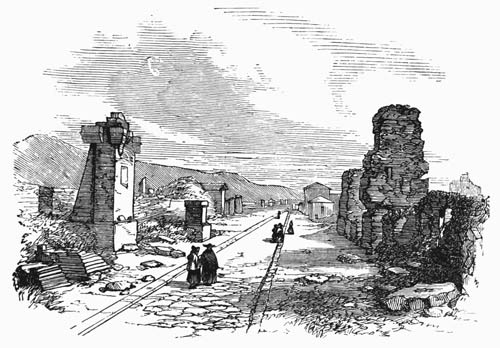
Fig. 25.—Tombs on Appian Way.
Southeastward from the ancient Porta Capena of the city of Rome
stretches the celebrated Appian Way, the most remarkable of those vast
arteries of commerce along which flowed to the most distant provinces
the vital currents from the great heart of the empire. This “Queen of
Roads,”[292]
as it was proudly called, was lined on either side by the
stately tombs in which reposed the
ashes of the mighty dead.[293]
“The
history of Christian Rome,” says Padre Marchi,[294]
“gives to this
same road titles of glory incomparably more solid, just, and
indisputable. We are forced to acknowledge it as the queen of
Christian roads by reason of the greater number and extent of its
cemeteries, and still more by the greater number and celebrity of its
martyrs.” Under the present pontiff this historic highway has been
excavated and opened for travel as far as Albano; and one may now
traverse that avenue of tombs on the very causeway on which Horace and
Virgil, Augustus and Mæcenas, Cicero and Seneca, must often have
entered Rome. But it is invested with a profounder interest as the way
by which the great Apostle of the Gentiles approached the city, “an
ambassador in bonds,” to preach the gospel in Rome also, and to finish
his testimony by a glorious martyrdom. By this very road also,
according to an ancient tradition, his body was stealthily conveyed by
night and deposited in an adjacent Catacomb; and here wended many a
mourning procession
bearing to those lowly crypts the remains of Rome’s
early bishops, martyrs, and confessors.
The ancient Porta Capena, with the dripping aqueduct above it,[295]
have disappeared, and the fountain of Egeria, trampled by cattle, is
no longer the haunt of nymph or naiad. Passing through the modern
Sebastian gate and crossing the classic Almo, the traveller reaches at
a short distance the little church of Domine quo vadis, with
which is connected one of the most beautiful legends of the
martyrology.[296]
About a mile and three quarters from the city he comes to Vigna
Animendola, on the doorway leading to which is a marble tablet with
the words CŒMETERIVM S. CALLIXTI. Beneath this vineyard
lies the celebrated Catacomb of Callixtus, of which we propose to
enter into a somewhat detailed description, as it will give
greater definiteness to the general conceptions already received, and will
serve as a typical example of the origin and history of the Catacombs
in general.
In the year 1849 De Rossi found in a cellar in this vineyard a broken
marble slab with the mutilated inscription ELIVS · MARTYR, and at the
beginning the upper part of the letters RN. He immediately conjectured
that this was a fragment of the tombstone of Cornelius, a Roman bishop
of the third century, whose sepulchre would probably be found not far
off. At his persuasion the pope purchased the vineyard, and the
archæological commission began the work of excavation. They were
rewarded by some of the most remarkable discoveries which have yet
been made.
The cemetery is situated between the Via Appia and the Via Ardeatina,
which are connected by narrow cross-roads. De Rossi has prepared a map
of the principal part of it, divided into fifteen rectilinear and
generally rectangular areas. The dimensions of these areas are not
fractional but round numbers, as 100, 125, 150, and 250 feet, which
cannot be the result of accident, and, with other evidences, indicate
that they were, like similar pagan sepulchral areas, originally so
many separate places of burial. When brought under the ecclesiastical
control of Callixtus, about A. D. 200, they probably received one
common name, became structurally united, and were used as a public
cemetery of the church.
The first of these areas which we reach on entering the vineyard is
that known as the crypt of St. Lucina. It has a frontage of one
hundred feet on the Via Appia, and an extension in agro of two
hundred and thirty feet. The limits of this area are exactly defined
by the presence of a small pagan hypogæum on each side, which the
Christians dared not undermine. In the centre, near the road, is
a massive monument, shown in the section of this crypt, Fig. 14, which
De Rossi conjectures to have been a Christian mausoleum,[297]
quoting
Tertullian[298]
as a witness that they had monumenta et
mausolea at a very early period.[299]
This is more probable from
the fact that the property belonged to the noble Roman family of the
Cæcilii, with which Cicero was connected, many of whose tombs were
found in the neighbourhood. This probably explains its vicinity to the
stately mausoleum of Cæcilia Metella. The names of many Cæcilii and
other noble Roman families are also found on epitaphs in this crypt.
This was unquestionably one of the most ancient areas of the
Catacombs.
In this area, in 1852, the remaining portion of the epitaph of
Cornelius was found at the foot of the tomb to which it evidently
belonged, in a gallery of unusual width.
This tomb is flanked by pilasters covered with fine white stucco, and
a mutilated inscription in the well-known manner of Damasus
commemorates its adornment by that pontiff. Numerous graffiti
indicate that this was a favourite shrine. Faded frescoes of
Cornelius, Cyprian, and two other bishops, wearing the stole, tonsure,
and nimbus, are attributed by De Rossi to the ninth century. Beside
the tomb is a short column of masonry, covered with stucco, which
probably sustained an altar or the vase of oil in which tapers were
anciently burned before the shrines of the martyrs;[300]
indeed, the
fragments of such a vase have been found among the rubbish of the
tomb. Among the relics sent by Gregory the Great to Queen Theodelinda,
according to the list still extant in the cathedral of Monza, said to
be in the handwriting of that pope, is one ex oleo S. Cornelii,
which must have come from this spot.
When the area of Lucina became crowded with tombs another of the same
size was opened about a hundred yards off. It contains the celebrated
“Papal Crypt,” the tomb of St. Cecilia, and other monuments of the
greatest interest. We will give a somewhat detailed account of the
construction and successive changes of this area, following the
skilful analysis of De Rossi, who has given accurate plans, sections,
and measurements of the whole. It extended, as is shown by the dotted
lines in the accompanying plan, two hundred and fifty feet along the
narrow cross-road marked M N, and one hundred feet in agro.
This would, in the first place, be secured as a burial-ground by the
Christian owner with the proper legal forms, which, we have seen,
protected the places of sepulture from invasion or disturbance till
the times of the later persecution. Openings were then made from the
surface at A and B, and stairways constructed reaching to a depth of
thirty-nine feet. These stairways were partly lined with brick-work,
but were chiefly cut in the solid tufa. The walls were coated with
fine stucco, white and firm—an evidence of antiquity—and ornamented
with bands of a bright red pigment. The original steps were covered
with marble, but they were afterwards restored with masonry. The upper
part, indicated by dotted lines, is destroyed to the depth of ten
feet, and there is evidence of the complete obstruction of the
passage, doubtless during time of persecution. The stairway B
has been used as a wine store, and is obstructed by a wall and a smaller
transverse stairway.
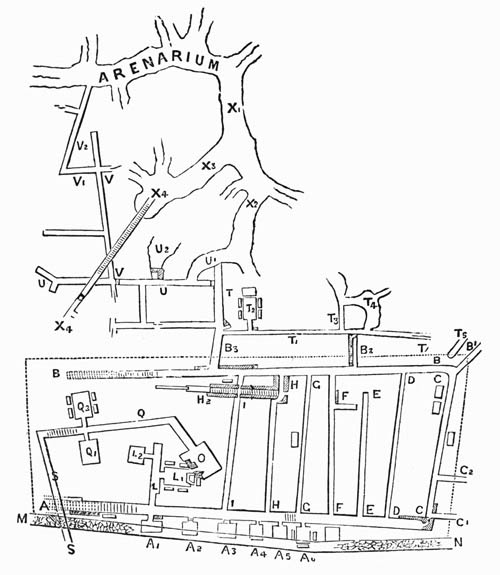
Fig. 26.—Part of Cemetery of Callixtus.
An ambulacrum or gallery was first excavated around the sides
of the area, and several cross passages, as D, E, F, G, H, I,
constructed. The walls are thickly lined with graves, and in places
the floor has been lowered to give room for still more loculi.
At D, C, the fossors finding the wall to crumble, had to strengthen it
with masonry, and to desist from lowering the floor of the
gallery. Hence the latter is not level, but has, in places, steps which have
been worn to an inclined plane. The increasing demand for graves led
to the formation of the cubicula A1 to
A6, as well as others in the interior of the area. Many of
these are decorated with frescoes, and A3 is known as the
Capella dei Sacramenti, or Chapel of the Sacrament, on account
of its so-called liturgical paintings. A4 has a coloured
marble floor of symmetrical design, and A6 has a large
sepolcro a mensa lined with marble and flanked with marble
pilasters. The iron bars which supported the table tomb may still be
seen. There are many Greek as well as Latin inscriptions in these
galleries, and some of the tiles which close the loculi bear
the stamp of the emperors M. Aurelius and Commodus, which fixes the
date of this area. Some of the passages are entirely paved with such
tiles. Numerous niches for lamps also occur. At F a well was excavated
which still contains water. It is furnished with foot-holes, that a
man might descend in order to clean it out. This is common in other
wells in the Catacombs.
The ever-pressing necessity for graves compelled the fossors at length
to attempt the construction of galleries on a lower level. Accordingly
we find a stairway, H, H2, of thirty-four steps leading
down from the gallery H. The rock, however, through which this
stairway descends is no longer the firm tufa granolare of the
upper level, but a very friable stratum of pozzolana, which
made it necessary to protect the walls with brick-work. Finding this
stratum of great depth, they excavated a horizontal passage, and a
still further narrow experimental cleft, as it were, in search of
firmer rock, but soon abandoned the attempt, failing to find any
suitable for sepulture. The few graves they made had
to be built of
brick-work; and in one of these was found a little terra cotta
sarcophagus, containing the body of an infant. This shows the utter
unfitness of the pozzolana beds in which the arenaria
are excavated for the construction of the Catacombs. We have seen that
about A. D. 200 Callixtus became the guardian of this cemetery, which
seems to have then become the burial-place of the bishops of Rome
instead of the crypts of the Vatican as previously. According to the
Liber Pontificalis, out of eighteen bishops from Zephyrinus to
Sylvester, that is, from A. D. 197 to A. D. 314, no less than thirteen
were buried in this cemetery. This Callixtus was originally a slave,
afterwards elevated to the highest ecclesiastical dignities, including
the episcopate itself—a proof of the superiority of the church to all
social distinctions. According to Hippolytus, the undoubted author of
the recently discovered Philosophoumena, he reached that
dignity by dishonourable means, by fraud and guile. He was at one time
banished by the emperor to the mines of Sardinia for embezzling moneys
intrusted to his care, and on his return lapsed into heresy bordering
on pantheism, or at least was charged with that offence. But although
the character of Callixtus shows the nascent corruptions of the church
of Rome even early in the third century, it should not prejudice us
against the cemetery called by his name. He himself is interred
elsewhere,[301]
and the holy confessors and martyrs who slumbered here
have consecrated the place forever with their hallowed dust.
Toward the middle of the third century, as we have
seen, even the
cemeteries themselves were not secure from invasion by the persecuting
tyrants. When the protection of the law was withdrawn, the public
stairways A and B, Fig. 26, were blocked up and partially destroyed,
new passages, B2 and B3, were opened into the
adjacent arenarium for the entrance and escape of the
Christians, and a very narrow and steep secret stairway,
X4, was constructed from the roof of the latter to the open
air, requiring a ladder, which might be removed to cut off pursuit, or
the assistance of friends for entrance or departure.[302]
We have here
an affecting instance of the perils to which the persecuted Christians
were exposed when hunted through these gloomy crypts by their cruel
pagan foes. The difference between the straight and narrow galleries
of the Catacombs and the wide and unsymmetrical windings of the
arenarium will be remarked. Connexions were also formed with
adjacent areas at S, C1, C2, and B1,
sometimes breaking directly through the loculi and
cubicula. The utmost economy of space was now observed, every
available foot of wall being occupied; the inscriptions become more
rude, indicating poverty and oppression; and the stucco or marble
ornaments give place to rude carvings of the tufa itself into
cornices, columns, and capitals. Some of the cubicula are made
of larger size, as if for worship, sometimes six or eight-sided, and
occasionally with apsidal recesses.
During the terrible period of the Diocletian persecution, when the
cemeteries were confiscated by the heathen government, the Christians,
in order to prevent the profanation of the more sacred sepulchres, and
especially that of the bishops, filled up the principal galleries with
earth at immense expense and labour. Much of
this still encumbers the
passages and forms the chief obstacle to their exploration. On the
cessation of the persecution some of these galleries leading to the
principal crypts were cleared out by means of cylindrical shafts made
for the purpose; and sometimes new galleries were excavated in the
tufa above the old ones, the floor of which was formed of the
consolidated earth in the former gallery. Where this earth has been
removed the height of the two galleries is, in places, twenty feet,
filled with graves to the top, the upper part being much narrower than
the lower. The obstructions in the stairways A and B were also removed
and the stairs renewed.
We have seen that Damasus was indefatigable in his restoration of the
Catacombs. It might, therefore, be expected that this important area
would give evidence of his labours. Such evidence is found in a broad
stairway of fine masonry, not shown in Fig. 26, made to accommodate
the crowds of pilgrims who thronged to those sacred shrines, the
“Papal Crypt” and tomb of St. Cecilia. This stairway was discovered by
De Rossi in 1854, entirely blocked up with an immense mass of earth
and rubbish, as were also the chambers to which it led. The removal of
this was a work of great expense and labour. The vestibule, L, which
we first enter, is constructed entirely of masonry, and is lighted by
a large luminare. Its plastered walls are covered with
graffiti, an indication that we are approaching a spot held in
especial sanctity by the ancient church.[303]
These casual records of the generations of pilgrims who have visited
the tombs of the primitive bishops, martyrs, and confessors, have
proved in many
cases of great importance, and are, in the words of De
Rossi, “the faithful echoes of history, and infallible guides through
these subterranean labyrinths.” But they are sometimes also, as we
shall see hereafter, indications of the corruption of doctrine, and of
the nascent belief in human mediation between man and God.
It is somewhat of a disappointment to find, on entering this
celebrated sanctuary, (L1 in the plan,) that instead of
being a veritable relic of the third or fourth century, most of the
masonry is only a few years old. When an entrance was effected into it
in 1854, which could only be done through the luminare, it was
found in a ruinous condition, filled with earth, broken brick-work, and
rubbish of every sort. When this was removed the vault gave way, and
had to be almost entirely rebuilt and lined with masonry. The chamber
itself is comparatively small, being only about eleven by fourteen
feet. It has a barrel roof, and is lighted by a large luminare.
The pavement was of marble, and covered graves made beneath it. On
each side are eight large loculi, the lower row of which has
spaces to contain sarcophagi. The walls were formerly lined with
marble, and had semi-detached marble pillars, the bases of which still
remain. At the end opposite the entrance is a large sepolcro a
mensa, in front of which is a dais elevated two steps. In this
dais are four sockets to receive the bases of as many short pillars
which supported a marble table standing out from the wall, as unlike
as possible to a modern Roman altar. The whole was surrounded by a low
parapet of marble lattice work, fragments of which have been
disinterred from the débris that encumbered the spot.
In this little chamber no less than eleven Roman
bishops of the third
century are recorded to have been buried, and others in its immediate
vicinity, when persecution or other reasons prevented their being laid
in its sacred inclosure. As we have already seen,[304]
De Rossi has
recovered in the rubbish of this chamber what he conceives to be the
original epitaphs of five of these bishops, and presumptive evidence
of the presence of others. St. Sixtus, indeed, is frequently mentioned
in the graffiti as he to whom especial reverence was here paid,
and De Rossi found in this crypt fragments of his epitaph which we
have previously given.[305]
The following Damasine inscription was
discovered by De Rossi among the débris of this chamber in one
hundred and twenty fragments, and with great skill and learning
reconstructed and restored to the wall.
HIC CONGESTA IACET QVAERIS SI TVRBA PIORVM
CORPORA SANCTORVM RETINENT VENERANDA SEPVLCHRA
SVBLIMES ANIMAS RAPVIT SIBI REGIA CAELI
HIC COMITES XYSTI PORTANT QVI EX HOSTE TROPAEA
HIC NVMERVS PROCERVM SERVAT QVI ALTARIA CHRISTI
HIC POSITVS LONGA VIXIT QVI IN PACE SACERDOS
HIC CONFESSORES SANCTI QVOS GRAECIA MISIT
HIC IVVENES PVERIQVE SENES CASTIQVE NEPOTES
QVIS MAGE VIRGINEVM PLACVIT RETINERE PVDOREM
HIC FATEOR DAMASVS VOLVI MEA CONDERE MEMBRA
SED CINERES TIMVI SANCTOS VEXARE PIORVM.
“Here, if you would know, lie heaped together a whole crowd of holy ones.
These honoured sepulchres inclose the bodies of the saints,
Their noble souls the palace of Heaven has taken to itself.
Here lie the companions of Xystus, who bear away the trophies from the enemy;
Here a number of elders, who guard the altars of Christ;
Here is buried the priest, who long lived in peace;
Here the holy confessors whom Greece sent us;
Here lie youths and boys, old men and their chaste offspring,
Who chose, as the better part, to keep their virgin chastity.
Here I, Damasus, confess I wished to lay my limbs,
But I feared to disturb the holy ashes of the saints.”[306]
An ancient itinerary states that eighty, or, according to one account,
eight hundred, martyrs are buried in this part of the Catacomb; and in
the corner of this very crypt is a pit of remarkable depth, probably
the polyandria, in which were “heaped together a whole crowd”
of the victims of persecution.
Besides these restorations of Damasus, there is evidence of successive
decorations of this celebrated shrine down to the period of Leo III.,
at the end of the eighth century. So great have been the changes thus
caused that De Rossi confesses that it is impossible to say what was
the original character of the chamber.
Adjoining the “Papal Crypt” is that of St. Cecilia, (O, Fig. 26,) to
which we pass from the former through a narrow doorway in the rock.
This is one of the largest cubicula in the Catacombs, being
nearly twenty feet square, and is flooded with light by a large
luminare. The chamber, which gives evidence of having been
greatly enlarged from its original dimensions, was once lined with
marble and mosaic, as were also the sides of the doorway and the arch
above. It has also been frequently adorned with paintings, a sure
indication of its especial sanctity. Among these are a large head of
Our Lord, of the Byzantine type, with a Greek nimbus, in a
semicircular niche,
and a full-length figure of St. Urban in
pontifical robes, with his name inscribed. Both of these, De Rossi
thinks, belong to the tenth or eleventh century. Another picture,
probably of the seventh century, of a richly attired Roman lady with
jeweled bracelets and necklace, is conjectured to represent St.
Cecilia. A large recess in the wall next to the “Papal Crypt” is
thought to have held her sarcophagus. De Rossi and his English editors
seem to accept substantially the Romish legend of this celebrated
martyr. Protestant readers, however, will take the liberty of
rejecting the miraculous part of the story as an invention of the
fifth century, when the legend first appears.
St. Cecilia, virgin and martyr, according to her rather apocryphal
Acts, was a maiden of noble rank—ingenua, nobilis,
clarissima. She sang so sweetly that the angels descended to
listen to her voice; and to her is ascribed the invention of the
organ, which is therefore her attribute in art. She was betrothed to
Valerian, a pagan of patrician rank, yet had vowed to be the spouse of
Christ alone. She confessed her vow to Valerian on her marriage-day,
and assured him that she was ever guarded by an angel of God, who
would avenge its violation. He promised to respect her vow if he might
behold her celestial visitant. She told him that his eyes must be
first illumed by faith and purged with spiritual euphrasy by baptism,
and sent him to St. Urban, then hiding in the Catacomb of Callixtus,
who instructed and baptized him. On his return he found Cecilia
praying, with an angel by her side who crowned her with immortal
flowers—the lilies of purity and the roses of martyrdom. His brother
Tiburtius came in, and, struck with the heavenly fragrance, for it was
not the time of flowers, he also was converted and baptized. Refusing to
sacrifice to the pagan gods, the brothers both received the crown
of martyrdom.[307]
Cecilia herself was reserved for a more glorious testimony. By order
of the Roman prefect she was shut up in the caldarium, or
chamber of the bath, in her own palace, which was heated to the point
of suffocation. After a whole day and a night she was found unharmed.
No sweat stood upon her brow, no lassitude oppressed her limbs. A
lictor was sent to strike off her head. Three times the axe fell upon
her tender neck, but, as the law forbade the infliction of more than
three strokes, she was left alive though bathed in blood. For three
days she lingered, testifying of the grace of God and turning many to
the faith; and then, giving her goods to the poor and her house for a
church forever, she sweetly fell asleep. Her body was placed in a
cypress coffin—very unusual in the Catacombs, it is doubtful if a
single example was ever discovered—and buried in the cemetery of
Callixtus, “near the chapel of the popes.”
But miracles ceased not with her death. In the translation of the
martyrs from the Catacombs by Pascal I., in 817, the remains of
Cecilia were overlooked. The saint appeared to the pope in a vision
and revealed the place of her burial.[308]
He sought the spot, and
found her body as fresh and perfect as when laid in the tomb five
centuries before! He placed it in a marble sarcophagus under the high
altar of the church of St. Cecilia, which he rebuilt upon the site of
her palace.
In the year 1599, or nearly eight centuries later, Cardinal
Sfondrati, while restoring the church, discovered this ancient sarcophagus. It
was opened in the presence of trustworthy witnesses, and there, say
the ecclesiastical records of the time, vested in golden tissue, with
linen clothes steeped with blood at the feet, besides remnants of
silken drapery, lay the incorrupt and virgin form of St. Cecilia in
the very attitude in which she died.[309]
It is difficult to know what proportion of truth this legend contains;
but, like many other of the Romish traditions, the large admixture of
fiction invalidates the claims of the whole. Its sweet and tender
mysticism, however, lifts it out of the region of fact into that of
poetry, and almost disarms hostile criticism.[310]
The excessive
praise of virginity indicates a comparatively late origin. On the
festival of St. Cecilia, the 22d of November, her tomb is adorned with
flowers and illumined with lamps, and mass is celebrated in her
subterranean chapel by a richly appareled priest—strange contrast to
the primitive worship with which alone she was acquainted. In a
sarcophagus discovered near her
tomb were found the remains, it is
assumed, of her husband Valerian and his brother Tiburtius, who had
manifestly been beheaded; and also those of the prefect Maximus, who
was converted by their martyrdom and was himself beaten to death by
plumbatæ. The skull of the latter was found broken, as if by
such a weapon, and its abundant hair matted with blood!
Other definite areas of this Catacomb have been recognized and their
outlines defined. Indeed, Father Marchi asserts that this is “the
colossal region of Roma Sotterranea, all the rest being only
small or middling provinces.”[311]
About a hundred yards from the
“Papal Crypt” is the tomb of another celebrated martyr and bishop, St.
Eusebius; the graffiti on the walls, the stairway, and the
decorations of which attest the reverence in which it was held. While
digging here in 1856, De Rossi found the important epitaph of Eusebius
before given.[312]
Intimately connected with this are also the adjacent cemeteries of St.
Soteris, a virgin martyr of the same family from which Ambrose was
descended; and that of St. Balbina, of vast extent, in several
piani, and on a scale of unusual grandeur. These are as yet
only partially explored, and promise the richest results to future
examination. That of St. Balbina has many double, and even quadruple,
cubicula, and the largest and most regular group of
subterranean chambers that have yet been discovered, all lighted by
one large hexagonal shaft. They were evidently excavated for worship,
not for sepulture. This Catacomb was enlarged and beautified by Mark,
bishop of Rome, in A. D. 330, who was buried in a basilica erected
over these tombs.
These several areas were at first all distinct properties,
and as carefully restricted within their respective limits as would be
buildings above ground. When, however, the sepulchres of the
Christians, no longer protected by law, were invaded by the
persecutors, the different areas were connected by a vast and
bewildering labyrinth of cross passages for the purpose of
facilitating escape and of furnishing additional space for interment.
As the areas, even when contiguous, were often at different levels, a
good deal of ingenuity was exercised by the fossors in effecting a
junction of the different galleries; though often they had to break
through loculi and cubicula for that purpose. Thus the
area we have described so fully is five feet lower than that which is
adjacent on one side, which enables us to determine its exact limit.
We will now take a more rapid survey of the other principal Catacombs
of Rome.
Nearly opposite the cemetery of Callixtus, on the Appian Way, is that
of Prætextatus. One of the entrances, situated in the Vigna Molinari,
is represented in Fig. 2. A well-worn stairway, trodden by the feet of
pious generations, leads to subterranean galleries of considerable
extent. It is celebrated as the scene of the martyrdom of St. Sixtus
and his deacons, A. D. 259; and as the burial-place of two of them,
Felicitas and Agapetus, commemorative epitaphs of whom have been
found. Their tomb, accidentally discovered by some labourers in 1857,
presents the unique example of a large square crypt, not hewn out of
the rock but built of solid masonry, and formerly lined with marble.
This is explained by the ancient record that the Christian matron
Marmenia constructed their tomb immediately beneath her own house. A
Damasine epitaph of Januarius, who suffered under Aurelius, A. D. 162,
has also been found here. In this cemetery, too, occurs that
suite of
chambers, with a hexagonal apartment, known as the
chapel with two halls, represented in section and perspective in Figs.
10 and 11.
Especial interest attaches to the Catacomb of St. Sebastian from the
fact of its being the only one of which any knowledge was retained
during the darkness of the Middle Ages. During that obscure period it
was known in all the ancient documents as the Cœmeterium ad
catacumbas, and has given their generic name to this vast system
of subterranean sepulchres. Lying beneath the property of the
Augustinian monks, it enjoyed religious protection in the rudest ages,
and was open to the occasional pilgrims to the sacred places of the
Eternal City. It is also that which is most frequently visited by
modern travellers, being accessible without the special permission
which must be obtained for exploring the other Catacombs. It is
situated on the Appian Way, about two miles from the Sebastian gate. A
stately basilica was erected over the entrance to the Catacomb, it is
said in the time of Constantine. A part of the original building which
yet remains is claimed to be still older, dating from the first
century. With this possible exception, few traces of the ancient
structure now exist, the present building having been erected in 1611
by Cardinal Scipio Borghese. The church is very rich in paintings,
sculptures, and relics, among which are the reputed head of Callixtus,
arm of St. Andrew, and body of St. Sebastian, the impressions of the
Saviour’s feet in the stone from the Appian Way, and the very chair in
which St. Stephen received the crown of martyrdom, and which was
sprinkled with his blood!
This Catacomb takes its name from the Christian martyr Sebastian, who
suffered during the Diocletian persecution. The story of his martyrdom
is one of
great beauty; but, as is the case with most of these
legends, its historic value is invalidated by the miraculous episodes
of his history. According to the “Acts of St. Sebastian,” this young
and gallant officer was a native of Narbonne, in Gaul, who held the
high rank of commander of the prætorian guard of Diocletian and
Maximian. His access to the emperors enabled him to offer a powerful
protection to the persecuted Christians, which he did not fail to
extend. Two of his fellow-soldiers, Marcus and Marcellinus, were about
to recant their profession, when Sebastian exhorted them to
steadfastness with such fervour as to nerve them for martyrdom and
convert the judges and all present. For his own fidelity to the
Christian faith he was transpierced with arrows and left for dead. He
recovered, however, either through the pious care of the Christian
matron Irene, or through the special grace of the Virgin. Undeterred
by his recent experience, he presented himself before the emperor,
upbraided him for his persecution of the Christians, and foretold his
death. He was immediately seized by the command of the tyrant and
beaten to death with clubs in the hippodrome of the palace, A. D. 286.
His body was ignominiously thrown into the Cloaca Maxima, or main
sewer of Rome, in order to deprive it of Christian burial. But the
place where it lay being revealed in a dream, his remains were rescued
from their loathsome and unconsecrated grave, and piously interred in
the Catacomb which bears his name.
The indignities that he suffered have been more than compensated by
the honours paid his relics. Over his tomb the high altar of the
church blazes with lights and jewels, and a marble effigy of the saint
pierced with arrows commemorates his martyrdom. The genius of
Berini,
Guido, and the Caracci, has glorified his memory in deathless painting
and in “animated bust.”[313]
Connected with the church is an irregular semi-subterranean building,
where, tradition asserts, the bodies of St. Peter and St. Paul for a
time reposed. It would appear, according to the legend, that upon the
martyrdom of these “princes of the apostles” the oriental Christians
sent for their hallowed remains as belonging of right to them as their
fellow-countrymen. Their bodies were conveyed thus far from their
original sepulchres when a violent storm prevented the accomplishment
of the sacrilegious act, and the Roman Christians re-interred the
sacred relics in this chamber, where they remained, according to one
account, a year and seven months, or, according to another, forty
years.[314]
The present structure dates probably from the time of Liberius, in the
middle of the fourth century. The indefatigable Damasus made a marble
pavement—fecit platoniam—and seems to refer to the legend in
the following rather unclassical metrical inscription:
HIC HABITASSE PRIVS SANCTOS COGNOSCERE DEBES
NOMINA QVISQVE PETRI PARITER PAVLIQVE REQVIRIS
DISCIPVLOS ORIENS MISIT QVOD SPONTE FATEMVR
SANGVINIS OB MERITVM CHRISTVMQVE PER ASTRA SEQVVTI
AETHERIOS PETIERE SINVS ET REGNA PIORVM
ROMA SVOS POTIVS MERVIT DEFENDERE CIVES
HAEC DAMASVS VESTRAS REFERAT NOVA SIDERA LAVDES.
“Here, you must know, that saints once dwelt. If you ask their
names, they were Peter and Paul. The East sent disciples, as we
willingly acknowledge. The saints themselves had, by the merit of
their bloodshedding, followed Christ to the stars, and sought the
home of heaven and the kingdoms of the blest. Rome, however,
obtained to defend her own citizens. These things may Damasus be
allowed to record for your praise, O new stars of the heavenly
host.”
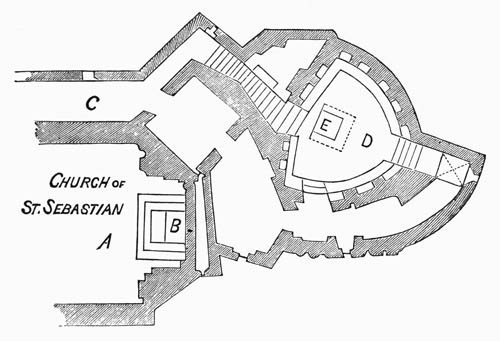
Fig. 27.—Plan of Crypt of Saint Peter and Saint Paul.
Figs. 27 and 28 show the plan and perspective of the crypt. D is the
chamber and E the subterranean vault. Around the wall are twelve
arcosolia, in front of which runs a low stone seat. In the
centre is an opening in the floor widening into a vaulted and frescoed
marble tomb about six feet square and as many deep. Here, according to
tradition, the two great apostles lay side by side in death; and to
this spot was especially given for many centuries the name
Catacumbæ.
A door out of the left aisle of the church leads to the Catacomb
proper. This, having been so long open, has been despoiled of every
object of interest, and nearly all the monuments and inscriptions have
been removed
to the museums of the city. Though of considerable
extent, it is not nearly as large as some others. Previous to De
Rossi’s exploration of the Catacomb of Callixtus in 1854 it was
confounded with that cemetery, but he has shown that opinion to be
erroneous.
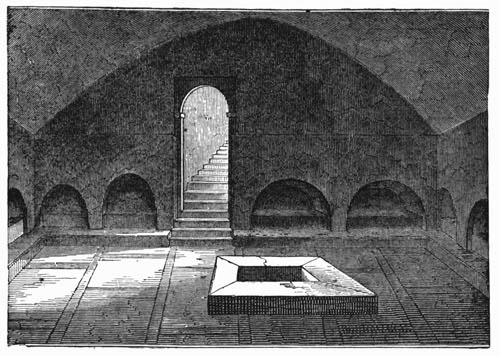
Fig. 28.—Crypt of Saint Peter and Saint Paul.
Nearly opposite the church of St. Sebastian is situated the Jewish
Catacomb discovered in 1859 in the Vigna Randanini, and already in
part described. The principal entrance is an open chamber, originally
vaulted, with a floor of black and white mosaic and walls of masonry.
A peculiarity in this cemetery is the number of deep graves in the
floor capable of containing several bodies, and the number of
sarcophagi, some of which are finely carved and gilt. The
seven-branched candlestick frequently occurs on the walls and tombs.
This Catacomb has been often rifled, and the galleries are strewn with
marble fragments of its monuments.
Most of the inscriptions have been
dug out of this débris and affixed to the adjacent walls. At
the other entrance, on the Appian Way, are raised stone seats,
intended, it is thought, as resting-places for the bearers of the
dead.
Not far from this cemetery, but fronting on the Via Ardeatina, is one
which De Rossi concludes upon very good evidence to be that of
Domitilla, grand niece of the emperor Domitian, of whose banishment
and probable martyrdom for the Christian faith we have already spoken.
The entrance is an elegant structure of fine brickwork with a cornice
of terra cotta, built in the slope of a rising ground and close by the
roadside. Connected with the entrance are external chambers, in one of
which is a well, which were designed, it is conjectured, for the
custodian of the Catacomb, and for the holding of the religious
services connected with the burial of the dead and the anniversaries
of the martyrs. A spacious vestibule within contains recesses once
occupied by several large sarcophagi, fragments of which still remain.
The entire roof and walls are covered with the most exquisite
arabesques and graceful landscapes, as well as biblical paintings, in
the style of the best classic period. It is evidently the monument of
a family of wealth and distinction.
Connected with this Catacomb is that of Nereus and Achilles, the
chamberlains of Domitilla, who suffered martyrdom in the second
century. A broad and handsome stairway leads down to the supposed
tombs of the martyrs in the lower level of the Catacomb. To facilitate
the visits of pilgrims to these shrines the galleries have been
widened and lined with masonry, probably by John I., A. D. 523. There
are two principal piani, in the lower of which is a large
chamber
paved with marble and lighted by a luminare of unusual
size, reaching to the surface of the ground. A large proportion of the
inscriptions are Greek, or Latin in Greek characters, which
circumstance refers the date of this Catacomb to a period when Greek
was still regarded as a sort of sacred and official language of the
church.
On the Via Labicana are several interesting Catacombs. About a mile
and a half from the city is that of Peter and Marcellinus, the former
a priest and the latter an exorcist of the time of Diocletian, who
with other martyrs are said to be buried here. The entrance to the
Catacomb is from a church built in the ruins of the ancient structure
traditionally called the mausoleum of Helena.
This tradition has given its name to the interesting Catacomb of
Helena discovered in 1838 in the Vigna del Grande, about a quarter of
a mile further along the Via Labicana. It was evidently constructed
after the peace of the church. The marble stairway, mosaic pavements,
and elegant stucco ornaments betray an imperial magnificence
impossible during the age of persecution, and which is found in no
other Catacomb. The similarity of style and material to that of the
contiguous tomb of Constantia, the sister of Helena, indicates a
synchronous construction. The entrance to the Catacomb is by one of
those brevissimæ ecclesiæ, or oratories for meditation and
prayer, which were early erected near most of the cemeteries, now
generally in ruins. As shown in the illustration, the descent is by an
easy stairway and an inclined plane to a vaulted gallery with mosaic
pavement, in which are arcosolia with brick arches. The
galleries are of great width, and the luminari will be observed
to be cylindrical in shape. One of these,
it will be seen, is choked
with rubbish. The double entrance indicated is in accordance with the
ancient usage, especially in subterranean assemblies, of separating
the sexes. The same purpose is effected within the crypt by
balustrades, and even by parallel galleries to the same chamber. This
Catacomb is remarkable for the number of its luminari,
arcosolia, cubicula, and mosaics. A variety of marble,
glass, and terra cotta vases have also been found, as well as numerous
coins and medals of the Constantinian period.
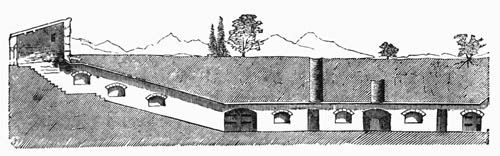
Fig. 29.—Section of Catacomb of Helena.
About three miles from Rome on this road, in the Vigna del Fiscale, is
the Catacomb of i Santi Quatro, or Quatuor Coronati, the
Four Crowned Ones, as they are called. They are said to have been
Christian sculptors, who, for refusing to exercise their art in the
service of idolatry, suffered martyrdom under Diocletian. Iron crowns,
set with spikes, were forced upon their heads, and they were then
scourged to death with plumbatæ. Ten miles from Rome in this
same road is the Catacomb of St. Zoticus, also honoured as one of the
primitive martyrs.
On the Via Tiburtina, about ten minutes’ walk from the Porta di San
Lorenzo, is the Catacomb of St. Cyriaca, named after a Christian
matron of noble family, who founded it in her own land in the year A. D. 258. During
the thirty-two years of her widowhood she employed her
vast wealth in ministering to the necessities of the saints, and
finally herself received the crown of martyrdom. Here it is said the
body of St. Lawrence was first interred, and afterward removed to the
neighbouring church, where it is still revered with devout
superstition. The excavations made to insulate the ancient basilica of
San Lorenzo, and to enlarge the cemetery at present in use, have laid
open a number of galleries of this Catacomb, exposing the long hidden
loculi and paintings to the light of day. The style of the
ancient inscriptions and those of the modern necropolis, which, in
accordance with a decree of the pope, are all in Latin, may be
compared; not greatly to the advantage of the latter, notwithstanding
the rigorous censorship they must first undergo. This Catacomb, with
others, was explored and described by Bosio two centuries and a half
ago. On the opposite side of the road is the cemetery of Hippolytus,
commemorated in the verses of Prudentius in the fourth century.
About a mile and a quarter from the Porta Pia, on the Via Nomentana,
is situated the Catacomb of St. Agnes. The legend of this saint is one
of the most beautiful in the martyrology, and has been preserved with
peculiar fulness of detail by St. Ambrose in his treatise de
Virginibus. The youthful martyr was the daughter of rich and noble
Roman parents, and is described in the Acts that bear her name as
being of a sweet and tender beauty. Being sought in marriage by the
son of the prefect of the city, she rejected his suit; declaring in a
strain of impassioned eloquence her espousals to a bridegroom nobler,
richer, and more beautiful far than any of earth, who had betrothed
her by the ring of his faith, and would crown her with jewels to which earthly gifts
were dross—a bridegroom so fair that the sun and moon
were ravished by his beauty, and so mighty that the angels were his
servants.[315]
She thus betrayed her attachment to the cause of
Christ, and was forthwith put to the torture in order to compel her
recantation of the faith. With touching naiveté the Acts relate
that no fetters could be found small enough for her wrists. As the
crowning ignominy to which her maiden modesty could be exposed, she
was sent to the place of shame—ad locum turpitudinis; but her
unshorn hair flowed in golden waves to her feet, forming a perfect
veil, and the eyes of the gazers on her degradation were smitten with
blindness. Having been first cast into the flames, which, it is said,
played harmlessly about her, she was publicly beheaded in the
amphitheatre, and overcoming the feebleness of her age and sex, thus
received the crown of martyrdom at the tender age of thirteen, A. D. 303.[316]
She is frequently represented in art; sometimes, in allusion to her
name, with a lamb as her attribute. Indeed, after Christ and the
Apostles, no figure is more common.[317]
The den of infamy in which
she was exposed to shame became changed to the Christian sanctuary of
S. Agnese in Piazza Navone, one of the most beautiful churches
in Rome. A subterranean cell of peculiar sanctity is said to have been
the scene of her degradation and deliverance. She was buried in a
garden a mile from the city, and Constantia, the daughter of
Constantine, having been healed at her tomb of a dangerous malady,
that prince erected over her body the church of S. Agnese fuori le
Mura, which is one of the least altered and most beautiful
examples of the imperial basilicas. A long flight of stairs, whose
walls are covered with inscriptions from the adjacent Catacombs, leads
down to the church, which was constructed on a level with the reputed
tomb of the saint.[318]
Many noble Roman families chose the place of their sepulture near the
tomb of so illustrious a martyr. Constantia
herself was there interred,
and soon after two other daughters of Constantine, Helena, the wife of
Julian, and Constantina, the wife of Gallus. Having died, the former
at Vienne in Gaul, the latter at the extremity of Bithynia, they were
brought from the west and the east to rejoin their sister sleeping
near this celebrated saint. This region became, in fact, the
fashionable cemetery of the great during the fourth century; as is
still evident from the superior regularity and spaciousness of the
corridors, and the more laboured execution although inferior style of
the paintings. Thus was formed in course of time the vast Catacomb of
St. Agnes.
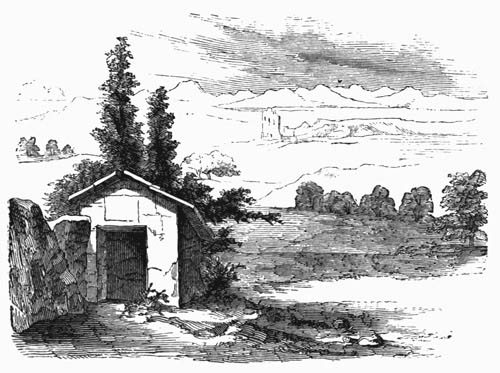
Fig. 30.—Entrance to the Catacomb of St. Agnes.
The entrance to the cemetery is situated in a delicious valley about a
quarter of a mile from the church, in view of the storied hills which
have been celebrated by Martial and Pliny, and near the ruins of a
pagan temple. Behind are the gray walls and towers of Rome, and on
every side spreads the solemn expanse of the Campagna.
All is graceful
and picturesque in the landscape, “and it is not,” says Perret,
“without a pious tenderness[319]
that the charm of the place blends in
the soul of the pilgrim to the shrine of the Christian heroine.” The
stairs by which the descent is made date probably from the time of
Constantine. The graves on either side of the somewhat spacious
gallery have long been rifled of their contents. Several of these from
their size were evidently designed for bisomi. The consular
date, A. D. 336, on a tomb attests the age of this part of the
Catacomb. One suite of chambers near the entrance, but in the
lower and therefore more recently constructed piano, has
received the title of the Basilica. The larger cubiculum has
two tufa seats at the side, and one more elevated for the presiding
presbyter. The altar, probably a small movable one of wood, if any at
all, must have stood before the presbyter. On the opposite side of the
gallery is a chamber, divided by columns and an arch, supposed to have
been for the females of the assembly, or perhaps for the catechumens
not yet admitted to the celebration of the eucharist. A connected
series of five chambers has been found, and one cubiculum,
called the scuole grande, will contain seventy or eighty
persons. Much of the architecture, however, is debased, indicating the
decline and eclipse of art in the fifth or sixth century. Another
chamber is known as the Lady Chapel, or Crypt of the Virgin, on
account of the so-called picture of the Madonna which it
contains;[320]
and a third as the Baptistery, from the presence of a
spring of water, supposed to have been used in baptismal rites.
One feature of especial interest associated with this
cemetery is its
connexion with an adjacent arenarium, or sand pit. This is
situated near the basilica of St. Agnes, and overlies part of the
Catacomb. It consists of a series of large and gloomy caverns utterly
unlike the sepulchral crypts below. A stairway leads down to the
Catacomb, and also a deep shaft with foot-holes cut in the rock for
climbing. Probably this was the only way of escape in time of
persecution. There is also apparent evidence of the existence of a
windlass, by which the excavated tufa was raised, and either deposited
in the arenarium or carted away. This cemetery has been
carefully examined by Padre Marchi, who has published a plan of an
area of about seven hundred by five hundred and fifty feet. The united
length of the passages in this part is about two English miles. Yet
Father Marchi says this area is only about one eighth of the whole
Catacomb, the aggregate extent of whose streets would, therefore, be
fifteen or sixteen miles.
Just without the Porta Pia on this Nomentan Way, is the little
Catacomb of Nicodemus. At the third mile, we read in ancient records,
was that of Ostrianus or Fons Petri, as it was called, from a
tradition that Peter once baptized there. It has not, however, been
satisfactorily identified. Nearly six miles from the city is the
so-called Catacomb of Alexander, bishop of Rome A. D. 117-120, who,
according to the Liber Pontificalis, suffered martyrdom by
decapitation on this spot under the emperor Hadrian, together with the
presbyter Eventius and the deacon Theodulus. Here were discovered in
1853, below the level of the Campagna, the ruins of an ancient
basilica erected in honour of these martyrs. In the roofless structure
was found a sarcophagus bearing the name of Alexander, and probably
once containing his ashes. The graves here are less disturbed than
in the Catacombs nearer Rome. This cemetery was used for sepulture
comparatively late, as the language of some of the inscriptions
indicates a decided approximation to modern Italian. In 1857 the
foundations of a large church, designed to include the whole of the
ancient structure, were laid with great pomp by the present pontiff.
The Salarian Way is exceedingly rich in Christian cemeteries.
Prominent among these is the Catacomb of St. Priscilla, one of the
noblest monuments of the primitive church. It is of interest also as
that whose accidental discovery in 1578 led to the unveiling of these
vast treasuries of Christian antiquity. The entrance is beautifully
situated amid embowering verdure, in the vineyard of the Irish
college, about two miles from the Porta Salara.[321]
Tradition asserts
that this cemetery was dug in the property of the senator Pudens,
mentioned by St. Paul; and a crypt called, from the language of its
inscriptions, the Cappella Greca, is alleged to be the
sepulchre of his daughters Pudentiana and Praxedes, and other members
of that distinguished Christian family. If so, this is the most
ancient Catacomb yet discovered. The classical style of the
architecture, frescoes, graceful stucco reliefs, and garlands, and the
character of the inscriptions, all point to a period before art became
degraded and the church oppressed. Some of the galleries are
exceedingly long and straight, and one is the most extensive yet
discovered. Its principal crypt is remarkable as being regularly built
of masonry, and without the usual loculi in the walls, being
evidently designed for the reception of sarcophagi—another proof of
its high antiquity. A portion of this cemetery has been constructed
with great labour in an
ancient arenarium, and shows how
unsuited these excavations were for the purposes of Christian
sepulture. Long walls of solid masonry and numerous pillars of brick
work have been built for supporting the roof and giving space for
loculi. A large shaft for removing pozzolana has been
transformed into a luminare by being bricked up to about half
its original dimensions. Only one of the four piani in which
the Catacomb is constructed being easily accessible, it has been but
partially explored. The ancient records assert that Marcellinus and
Marcellus, martyr-bishops of the church in the time of Diocletian, are
buried here; also Crescentianus and Silvester; and we have already
seen the memorial inscription of three thousand other martyrs, whose
remains are said to hallow these sacred crypts.
On this same road are the Catacomb of St. Felicitas, with three
piani of galleries much dilapidated; that of Thraso and
Saturninus, of considerable extent but difficult of access; and the
crypt of Chrysanthus and Daria, in which these martyrs were blocked up
alive by command of the Emperor Numerian. On the old Salarian Way is
the Catacomb of Hermes, who is said to have suffered in the time of
Hadrian. It is partially constructed, as we have seen, in an
arenarium, and contains the largest subterranean church yet
found, with remarkable mosaics of Daniel and of the resurrection of
Lazarus in the vaulting of the roof.
There are comparatively few Catacombs of interest on the northwest
bank of the Tiber, owing to the smaller population of that part of
Rome in ancient times. We shall briefly enumerate the more important.
On the Flaminian Way is the cemetery of St. Valentinus. On the
Aurelian Way are those of Agatha, Pancratius, and Calepodius. The
latter, the reputed burial place of Callixtus
and of many martyrs,
is beneath the church dedicated to Pancratius—the English
Pancras—and on the supposed scene of his sufferings. On the Via
Portuensis, near the city, is the Catacomb of Pontianus, a patrician
Roman of the third century. It is remarkable for the very perfect
subterranean baptistery to be hereafter described. On the Ostian Way,
near the basilica of S. Paolo fuori le Mura, is the ancient
cemetery of Commodilla, or Lucina, in which tradition asserts that the
body of the apostle Paul was laid after his martyrdom. It is in a very
ruinous condition, most of the galleries being choked up and
impassable; but here Boldetti found the two oldest extant
inscriptions. On this road also is the Catacomb of St. Zeno, in which
were said to be buried twelve thousand Christians employed in building
the Baths of Diocletian.
On the Vatican Hill, now crowned with the grandest temple in
Christendom, is said to have existed the oldest Christian cemetery of
Rome. Tradition asserts that the remains of St. Peter were interred on
this spot, on the site of an ancient temple of Apollo, and near the
alleged scene of the apostle’s martyrdom in the circus of Nero, and
that hither they were restored after their removal to the crypt of
Sebastian.[322]
Here also ancient ecclesiastical documents record the
burial of ten of the Roman bishops of the first and second
centuries;[323]
after which, we have seen, the Catacomb of Callixtus
became their
chief place of burial. The series of papal interments in
this place again begins with that of Leo the Great, A. D. 461. In the
dim crypts beneath the high altar of St. Peter’s are shown the tombs
of most of his successors, many of them far removed in life and
character from the lowly Galilean fisherman.[324]
We cannot better conclude this necessarily imperfect survey of these
ancient Christian cemeteries than by quoting the following passage,
though characterized by a somewhat fervid rhetoric, from “Les Trois
Romes” of the Abbé Gaume: “Here is the glorious monument,” he
exclaims, “of the faith and charity of our forefathers! This work of
giants was completed by a community of poor men, destitute of
resources, without talent as without fortune, incessantly persecuted
and frequently decimated. What, then, was the secret of their power?
This is the problem suggested by the sight of the Catacombs in
general, and of the Catacombs on the Appian Way in particular. The
solution is in one word—Faith. This power—unknown to the
ancient world,
and too little recognized in the modern world—this
faith, was the lever by which the early Christians could remove
mountains, and turn and change the universe. With one hand they
constructed in the bowels of the earth a city more astonishing than
Babylon or the Rome of the Cæsars; and with the other, seizing on the
pagan world in the abyss of degradation into which it was plunged,
they raised it to the virtue of angels, and suspended it to the cross.”
FAMA REFERT SANCTOS DVDVM RETVLISSE PARENTES
AGNEN CVM LVGVBRES CANTVS TVBA CONCREPVISSET
NVTRICIS GREMIVM SVBITO LIQVISSE PVELLAM
SPONTE TRVCIS CALCASSE MINAS RABIEMQVE TYRANNI
VRERE CVM FLAMMIS VOLVISSET NOBILE CORPVS
VIRABVS IMMENSVM PARVIS SVPERASSE TIMOREM
NVDAQVE PROFVSVM CRINEM PER MEMBRA DEDISSE
NE DOMINI TEMPLVM FACIES PERITVRA VIDERET
O VENERANDA MIHI SANCTVM DECVS ALMA PVDORIS
VT DAMASI PRECIBVS FAVEAS PRECOR INCLYTA MARTYR.
The conditions under which Christian art was cultivated in the early
centuries were eminently unfavourable to its highest development. It
was not, like pagan art, the æsthetic exponent of a dominant religion,
enjoying the patronage of the great and the wealthy, adorning the
numerous temples of the gods and the palaces and banquet chambers of
the emperors and senators, commemorating the virtues of patriots and
heroes, and bodying forth the conceptions of poets and seers. There
was no place in the Christian system for such representations as the
glorious sun-god, Apollo, or the lovely Aphrodite, or the sublime
majesty of Jove, which are still the unapproached chefs
d’œuvre of the sculptor’s skill. The beautiful myths of Homer
and Hesiod were regarded with abhorrence, and the Christians were
expressly forbidden to make any representation of the supreme object
of their worship, a prohibition which in the early and purer days of
Christianity they never transgressed.
Nevertheless, the testimony of the Catacombs gives evidence that art
was not, as has been frequently asserted, entirely abjured by the
primitive Christians on account of its idolatrous employment by the pagans.
They rather adopted and purified it for Christian purposes,
just as they did the diverse elements of ancient civilization. It was
not till increasing wealth and the growing corruptions of the church
led to the more lavish employment of art and its perversion to
superstitious uses that it called forth the condemnation of the
Fathers of the early centuries.
The art of any people is an outgrowth and efflorescence of an internal
living principle: and as is the tree so is its fruit. An adequate
representation of its art being given, we may estimate, at least
proximately, the moral condition of any age or community. It is the
perennial expression of the phenomena of humanity. The iconography of
the early centuries of Christianity is, therefore, a pictorial history
of its development and of the successive changes it has
undergone.[325]
The corruptions of doctrine, the rise of dogmas, the
strifes of heresiarchs and schismatics, are all reflected
therein.[326]
The frescoes of the Catacombs are illustrations, inestimable in value,
of the pure and lofty character of that primitive Christian life of
which they were the offspring. They were the exponent of a mighty
spiritual force, “seeking,” as Kugler remarks, “to typify in the
earthly and perishing the abiding and eternal.”[327]
The very
intensity of that old Christian life under repression and persecution
created a more imperious necessity for a religious symbolism as an
expression of its deepest feelings and as a common sign of the faith.
Early Christian
art, therefore, was not realistic and sensuous, but
ideal and spiritual. It sought to express the inner essence, not the
outer form.
Christianity has nothing to fear from the comparison of these remains
of its primitive art with those of the pre-existing art of paganism.
As little has Protestantism to fear their comparison with the
monuments of that debased form of Christianity into which the early
church so soon, alas! degenerated. On the one hand may be seen the
infinite contrast between the abominable condition of society under
the empire and the purity of life of the early Christians; and on the
other, the gradual corruption of doctrine and practice as we approach
the Byzantine age. The exhumation of Pompeii and the recent
exploration of the Catacombs bring into sharp contrast Christian and
pagan art. While traversing the deserted chambers of the former “two
thousand years roll backward,” and we stand among the objects familiar
to the gaze of the maids and matrons of the palmy days of Rome. But
what a tale of the prevailing sensuality, what a practical commentary
on the scathing sarcasms of Juvenal, the denunciations of the Fathers,
and the awful portraiture of St. Paul, do we read in the polluting
pictures on every side. Nothing gives a more vivid conception of the
appalling degradation of pagan society in the first century of the
Christian era than the disinterred art of that Roman Sodom. Amid the
silence and gloom of the Catacombs we are transported to an entirely
different world; we breathe a purer moral atmosphere; we are
surrounded by the evidences of an infinitely nobler social life; we
are struck with the immeasurable superiority in all the elements of
true dignity and grandeur of the lowly and persecuted Christians to
the highest development of ancient civilization.
The decoration of these subterranean crypts is the first employment of
art by the early Christians of which we have any remains. A universal
instinct leads us to beautify the sepulchres of the departed. This is
seen alike in the rude funeral totem of the American savage, in the
massive mausolea of the Appian Way, and in the magnificent Moorish
tombs of the Alhambra.[328]
It is not, therefore, remarkable that the
primitive Christians adorned with religious paintings, expressive of
their faith and hope, the graves of the dead, or in times of
persecution traced upon the martyr’s tomb the crown and palm, emblems
of victory, or the dove and olive branch, the beautiful symbol of
peace. It must not, however, be supposed that the first beginnings of
Christian art were rude and formless essays, such as we see among
barbarous tribes. The primitive believers had not so much to create
the principles of art as to adapt an art already fully developed to
the expression of Christian thought. Like the neophyte converts from
heathenism, pagan art had to be baptized into the service of
Christianity. “The germs of a new life,” says Dr. Lübke, “were in
embryo in the dying antique world. Ancient art was the garment in
which the young and world-agitating ideas of Christianity were
compelled to veil themselves.”[329]
Hence the earlier paintings are
the superior in execution,
and manifest a richness, a vigour and
freedom like that of the best specimens of the classic period. Their
design is more correct, their ornamentation more chaste and elegant,
and the accessories more graceful than in the later examples. These
shared the gradual decline which characterized the art of the dying
empire, becoming more impoverished in conception, stiff in manner, and
conventional and hieratic in type, till they sink into the barbarism
of the Byzantine period.
This is contrary to the opinion which has till recently been
entertained. Lord Lindsay asserts of the paintings of the Catacombs
that, “considered as works of art, they are but poor productions—the
meagreness of invention only equalled by the feebleness of
execution—inferior, generally speaking, to the worst specimens of
contemporary heathen art.”[330]
But this characterization was the
result of imperfect acquaintance with the subject. Indeed, he speaks
of the Catacombs as “for the most part closed up and inaccessible, and
the frescoes obliterated by time and destroyed.” But recent
discoveries have brought to light many important examples which
completely disprove his depreciatory estimate. In many of the newly
opened crypts the colours are as fresh as if applied yesterday; and,
as regards style and execution, the frescoes of the Catacombs
“approach,” says the eminent art critic, Kugler, “very near to the
wall paintings of the best period of the empire.”[331]
No one can look
through the magnificent volumes of Perret without being struck with
the grace, vigour, and classic beauty of many of the paintings there
reproduced. It is admitted that the French artists have “touched up”
the faded colours, and some of the pictures
may be better termed
restorations than accurate copies; but they are nowhere accused of
being false to the general character and spirit of the originals.
The antiquity of these better specimens of Christian art is still
further confirmed by their being found in the oldest crypts of the
Catacombs; and, like the architectural character of these more ancient
chambers, they indicate the publicity of their construction and their
legal protection. In the later excavations, on the contrary, the
paintings are few in number, and inferior in type and execution—an
evidence of the persecution and impoverishment of the Christians as
well as of the decline of art. The more celebrated shrines, it is
true, were repeatedly decorated at successive periods down to the
ninth century;[332]
but the times of these decorations may be
approximately estimated by internal evidence, as the presence of the
Constantinian monogram, of the nimbus,[333]
and other characteristic
signs testify.

Early Christian art thus sprang out of that which was pre-existing,
selecting and adapting what was consistent with its spirit, and
rigorously rejecting whatever savoured of idolatry or of the sensual
character of ancient heathen life. It stripped off, to use the figure
of Dr. Lübke, what was unsuitable to the new ideas,
and retained the
healthy germ from which the tree of Christian art was to unfold in
grand magnificence. As Christianity was the very antithesis of
paganism in spirit, so its art was singularly free from pagan error.
There are no wanton dances of nude figures like those upon the walls
of Pompeii, but chaste pictures with figures clothed from head to
foot; or, where historical accuracy required the representation of the
undraped form, as in pictures of our first parents in the garden of
Eden, or of the story of Jonah, they are instinct with modesty and
innocence. Pagan art, a genius with drooping wing and torch reversed,
stood at the door of death, but cast no light upon the world beyond.
Christian art, inspired with lofty faith, pierced through the veil of
sense, beyond the shadows of time, and beheld the pure spirit soaring
above the grave, like essence rising from an alembic in which all the
grosser qualities of matter are left behind. Hence only images of hope
and tender joy were employed. There is no symptom of the despair of
paganism; scarce even of natural sorrow.
Independent statues were in the first ages rarely if ever used.[334]
There seemed to be greater danger of falling into idolatry in the
imitation of these, in which form were most of the representations of
the heathen deities, than in the employment of painting; and it was
against the making of graven images that the prohibition of Scripture
was especially directed.[335]
Their fabrication, therefore, was
especially avoided. Indeed, sculpture never became truly Christian,
and even in the hands of an Angelo or a Thorwaldsen failed to produce
triumphs of skill like those of Phidias or
Praxiteles. Christian
graphic art, however, in its noblest development far surpassed even
the grandest achievements of which we have any account of the schools
of Apelles and Zeuxis. Christianity is the embodiment of the gentler
graces; paganism, in its purest form, that of the sterner virtues. The
former finds its best expression in painting, the latter in sculpture.
The first Christian paintings were light and graceful sketches, after
the manner of the older classic art; and but for the substitution of a
Christian for a heathen conception—a biblical scene or character, as
Daniel in the lions’ den, Jonah, or the Good Shepherd, or some
striking Christian symbol—it would be difficult to distinguish them
from contemporary pagan pictures.[336]
While the principal figure gave
an unquestionably Christian character to the whole, the accessories,
divisions of space, colouring, and general treatment were quite in the
manner of the antique. Garlands, festoons of flowers and vases of
fruits; graceful arabesques, luxuriant vines, grapes, birds and genii;
ideal heads, masks, and fabulous animals; hunting, vintage and harvest
scenes, and pastoral groups; personifications of the hours, seasons,
rivers, and the like, made up the entourage, or formed part of
the picture. Thus the roof of a crypt in the most ancient part
(probably of the first century) of the cemetery of Domitilla is
completely covered with branches trailing in graceful curves with
exquisite naturalness,
and entirely free from the conventional
restraint and geometrical symmetry which indicate the subsequent
decline of art. Among the branches flit birds, and winged genii like
little cupids. Another specimen of great beauty, of the second
century, in the Catacomb of Prætextatus, exhibits a well drawn harvest
scene, with wreaths of roses, vine, and laurel, and with birds
flitting about their nests. A fresco of the Good Shepherd and an
inscription attest its Christian character. The drapery and drawing of
the figures in the earlier examples are also exceptionally good.
Several of the Christian symbols were common also to pagan art; as the
palm, the crown, the ship, and others to be hereafter mentioned. They
acquired, however, under Christian treatment a profounder and nobler
significance than they ever possessed before. But there are other and
more striking examples of the adoption, when appropriate to Christian
themes, of subjects from pagan art. Orpheus charming the wild beasts
with his lyre is a frequently recurring figure in the Catacombs, and
is referred to by the Christian Fathers as a type of Him who drew all
men to himself by the sweet persuasive power of his divine word. The
victory of Our Lord over death and hell, and probably an ancient
interpretation of his preaching to the spirits in prison,[337]
may
have found a sort of parallel in the beautiful legend of the faithful
lover seeking in the under-world the lost Eurydice bitten by a deadly
serpent; while, at the sound of his wondrous harp, gloomy Dis was
soothed, Ixion’s wheel stood still, Tantalus forgot his thirst, and
the stone of Sisyphus hung poised in air.[338]
The Orphic
verses were
also said by the Fathers to have contained many true prophecies
concerning Our Lord. These, however, like the testimony of the Sibyls,
were pious forgeries of post-Christian date.
Another fable of the pagan mythology reproduced in early Christian art
is that of Ulysses and the Sirens. A sarcophagus in the crypt of
Lucina represents the “much-planning” wanderer of Ithaca, bound to the
mast, deaf to the blandishments of the rather harpy-like daughters of
the sea, and so sailing safely by. Maximus of Turin, in the fifth
century, explained the ship of Ulysses to be “a type of the church,
the mast being the cross, by which the faithful are to be kept from
the seductions of the senses. Thus,” he says, “shall we be neither
held back by the pernicious hearing of the world’s voice, nor swerve
from our course to the better life, and fall upon the rocks of
voluptuousness.”[339]
These reminiscences of pagan art are more frequent in the sculptures
of the sarcophagi, in which the classic type seems more persistent
than in the paintings. Thus, in a bas-relief, in the Lateran Museum,
of the ascent of Elijah in the fiery chariot to heaven, by a strange
solecism Mercury is represented standing at the horses’ heads. This
was probably the result of an unconscious imitation of some heathen
design. On a sarcophagus from the Catacomb of Callixtus, in a harvest
scene, is what seems to be a representation of Cupid and Pysche. This,
however, was found buried beneath the floor, and bore indications of
having been coated with plaster, as if in concealment of the heathen
figures. On others have
been observed bas-reliefs of Bacchus attended
by cupids, fawns and satyrs, the unfortunate Marsyas, the desertion of
Ariadne, and the return of Ulysses. It is probable that some of these
incongruities resulted from the sarcophagus having been carved by a
pagan artist, inasmuch as sculpture was less likely to be practised by
the Christians than painting. Indeed, some of these subjects,
offensive to Christian feeling, have been carefully defaced with a
chisel, or turned to the wall; as one in the crypt of Lucina, on which
is a bacchanalian scene, while on the rough side, exposed to view, is
inscribed the Christian epitaph. The sarcophagi of Constantia and
Helena, daughters of Constantine, now in the Vatican Museum, bear
vintage and battle scenes and Bacchic masks; and on that in which the
Emperor Charlemagne was buried, probably of pagan origin, is
represented the rape of Proserpine. On the gilded glasses of the
Catacombs, some of which were evidently employed for festive purposes,
pagan influence also appears in such representations as Achilles,
Hercules, Dædalus, Minerva, the Graces, Cupid and Psyche, Neptune with
his trident, and a river-god as the symbol of the Jordan.
Even in distinctively Christian subjects it is sometimes apparent that
the artist had not freed himself from the influence of pagan types.
Thus the Good Shepherd is represented with the short tunic and buskins
of the Roman peasant, and often with the classic syrinx or rustic
pipes, probably from some reminiscence of the popular rural deity, the
god Pan. In the Lateran Museum is a manifest example—the sarcophagus
of Paulina—of a pagan sculpture having been adapted as a Christian
Good Shepherd. In a bas-relief of Jonah, in the Vatican Library, the
classic influence is seen in the Triton blowing his horn, and Iris
floating over
the vessel with her fluttering scarf, to indicate the
subsidence of the storm. The ship is like the barges that navigate the
Tiber, and the sea-monster that swallows the recreant prophet is like
that which menaced Andromeda.
Christianity thus preserved amid the wreck of ancient civilization
some germs of classic art, over which she brooded till they quickened
under the more genial influences of later times. She became thus, as
Dr. Lübke remarks, the mediator between the antique heathen life and
the art of modern Christendom. That distinguished critic,
Raoul-Rochette, has, however, attributed to pagan types too great an
influence on the art of the Catacombs, and almost denies the latter
all originality or distinctiveness of treatment; and he is certainly
quite in error in speaking of the almost pagan physiognomy of the
decorations of the Catacombs.[340]
He was misled in forming these
opinions in part by certain monuments in the Catacomb of Prætextatus,
discovered and described by Bottari, and at first supposed to be of
Christian origin.[341]
This opinion, however, has been since refuted
in an able monograph on the subject by Padre Garrucci.[342]
The exceptional and unique character of these monuments deserves a
somewhat detailed examination. They occur in a gallery of the
Catacomb, not far from the Appian Way. In the vault of an
arcosolium is a representation of Venus—a subject never found
in early
Christian art—accompanied by two genii as infants. Near these
are the following epitaphs of a pagan priest and his wife:
NVMENIS ANTISTES SEBASIS VINCENTIVS HIC [EST]
QVI SACRA SANCTA DEVM PIA MENTE CO[LVIT].
Here lies Vincentius, a priest of the deity Sebasis, who with
pious mind has observed the sacred rites of the gods.
VINCENTI HOC OLIM FREQVENTES QVOD VIDES[343]
PLVRES ME ANTECESSERVNT OMNES EXPECTO
MANDVCA BIBE LVDE ET VENI AD ME
CVM VIVES BENEFAC HOC TECVM FERES.
O Vincentius, many formerly in crowds, as you here see, have gone
before me; I await all. Eat, drink, play, and come to me. While
thou livest act well: this thou shalt bear with thee.
The arcosolium to which this is attached contains the
remarkable paintings represented in the accompanying engraving.[344]
The first picture to the left represents the death of Vibia, wife of
Vincentius, and is labeled ABREPTIO · VIBIES · ET ·
DESCENSIO. She is depicted as being borne off by Pluto, to
indicate that her death was premature. The god is standing upright in
his quadriga, conducted by Mercury and holding in his arms the
form of Vibia. In the original picture, issuing from an urn at the
foot of Mercury, is seen the river Acheron, by which Pluto is about to
descend to the infernal regions, as indicated by the word DESCENSIO.
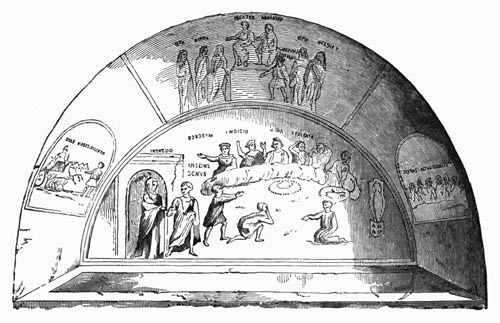
Fig. 31.—Perspective of Interior of Vault, with Pagan
Paintings.
At the top of the vault is represented the judgment of Vibia at the
tribunal of Pluto. The god is seated on his throne, with his wife
Proserpine, and over their heads are written the words DISPATER and
ABRACVRA—titles of the deities. To
the right of the throne we see three fates—FATA · DIVINA—and
to the left Vibia preceded by Mercury—MERCVRIVS · NVNTIVS—and
accompanied by Alcestis, the heroine of conjugal love. The figures all
have their names written above their heads.
The principal painting of the series, that in the tympanum of the
arch, represents the introduction of Vibia to the banquet of the
blessed. This is shown in the left hand corner of the picture, and is
designated INDVCTIO · VIBIES. She is introduced by a youthful
figure crowned with flowers, and holding in his hand a floral wreath.
His name—ANGELVS · BONVS—the good messenger—is perhaps
less an indication of Christian influence than of the Greek and
Oriental ideas which have presided over the whole of these scenes.
Vibia next appears seated at the banquet in the midst of those who
have been judged worthy of the recompense of the good—BONORVM ·
IVDICIO · IVDICATI. They are ranged around a crescent-shaped
table formed of cushions, and wear festive crowns upon their heads. In
the foreground are seen the servants.
The fourth scene, to the extreme right of the vault, represents the
funeral banquet in honor of Vibia. It is given by her husband
Vincentius, who is designated by name, to the priests of Sebasis, over
whose heads are written the words, SEPTE · PII · SACERDOTES.
All these paintings, not only by their inscriptions, but by their
conception and treatment, demonstrate their pagan origin. They are not
in any sense or degree Christian; nor is there any reason to infer, as
has been asserted, that they are of Gnostic execution, but decidedly
the reverse.
But how are we to account for the presence of this pagan monument
within the limits of a Christian cemetery?
There are two things to be
observed, says M. Perret, in explanation of this circumstance. First,
the arcosolium is not exclusively Christian in character. M. de
Saulcy has given examples of several Jewish and pagan tombs in the
form of arcosolia.[345]
In the second place, there is nothing
strange in a family practising an oriental rite, like the worship of
Mithras—which with the Phrygian and Isiac mysteries were widely
prevalent in Rome in the early Christian centuries—having a private
place of sepulture, as this seems to have been. It is situated near
the Appian Way, from which there was probably a separate entrance.
Near by is a pagan columbarium which now forms one of the
entrances of the Catacomb, of which it seems part equally with the
gallery containing this tomb. This space may possibly have been
originally usurped from the Christian cemetery; but it is more
probable that the gallery and tomb were independently constructed, and
that the fossors came unexpectedly upon it in their excavations. This
conjecture is confirmed by the indications of its having been
subsequently shut off, but the obstructions have long since been
removed. It is impossible to admit that the Christians, in contempt of
the sacred usages of the primitive ages, have commingled their
sepulchres with those of the pagans.[346]
But Christian art, though affected by pagan influence, did not
servilely follow pagan types. It introduced new forms to express new
ideas, or employed existing forms with a new significance; just as
Christianity itself introduced new words, or gave new meanings to old
ones, not only in the classic tongues but in every language which it
has adopted as the vehicle of its sublime truths. It created a cycle
of symbolical
types of especial Christian significance; and became
more enriched and enlarged in its scope by allegorical representations
of religious doctrine, and by illustrations of Old and New Testament
history and miracles. But Christian art soon lost that freedom of
treatment which it inherited from its classic parentage, and fell into
fixed and conventional forms, which were endlessly reiterated. “Before
many years,” says Maitland, “the empire of imagination passed away,
and the genius of art, with ‘torch extinct and swimming eye,’ had to
mourn over the introduction of the hieratic style which, wherever it
has appeared throughout the world, has cramped and almost annihilated
the inventive faculty.” Like the hieroglyphs of Egypt and of India, or
like the picture-writing of the lost races of Central America, though
in a less degree, the objects of Christian art became not so much
representative as symbolic. Individual genius can only struggle
hopelessly with the shackles of a conventional system. From the
freedom of nature it sinks into a servile copyism which can hardly be
called art at all.
Yet the symbols of the Catacombs, though often rude and uncouth, must
not provoke our contempt. They fulfilled their purpose no less fully
than the triumphs of art in the Camera Raphaele or the Sistine
Chapel. They were addressed not to the external sense, nor to the
critical taste, but to the inner eye of the soul and to the sublime
faculty of faith. They were not mere representations of the outward
semblances of things, but suggestions of eternal verities which
transcend the limits of time and space. The rudely scratched anchor
told of a hope that reached forward beyond this world and laid hold on
the great realities of the world to come; the dove spoke of the
brooding peace of God, which kept the heart and the mind amid
persecution and affliction
with the power of an everlasting life; and
the palm was the symbol of the final victory over death and hell.
When the age of persecution passed away, this childlike and touching
simplicity of Christian art gave place to a more ornate character.
Called from the gloomy vaults of the Catacombs to adorn the churches
erected by Constantine and his successors, it gradually developed into
the many-coloured splendour of the magnificent frescoes and mosaics of
the basilicas. It became now more personal and historical, and less
abstract and doctrinal. The technical manipulation became less
understood, and the artistic conception of form more and more feeble,
till it gradually stiffened into the immobile and rigid types which
characterize Byzantine painting. It exhibited the weakness not of
infancy but of decrepitude, and might almost be called the last sigh
of art till its revival after the long slumber of the Middle Ages. It
is of importance, however, as enabling us to trace the development of
religious error, and the introduction of unorthodox additions to
Christian belief, and as showing the slow progress toward image
worship. It demonstrates the non-apostolicity of certain Romish
doctrines, the beginning of which can be here detected. It utters its
voiceless protest against certain others which are sought for in vain
in the places where, according to the Roman theory, they should
certainly be found. Where still employed in the Catacombs, art shared
the corruption and degradation above described.
It is to this period that most of the condemnations of art, or rather
of its abuse, in the writings of the primitive Fathers must be
referred. Toward the close of the fourth century Augustine inveighs
against the superstitious reverence for pictures, as well as the
growing devotion to the sepulchres, which he says the church
condemned
and endeavoured to correct.[347]
His contemporary, Epiphanius,
stigmatizes the employment of painting as contrary to the authority of
Scripture.[348]
About the same time Paulinus of Nola made use of
biblical pictures for the instruction of the rude and illiterate
multitude who visited the shrine of Felix. “Perhaps it may be asked,”
he says, “for what reason, contrary to the common usage, I have
painted this sacred dwelling with personal representations?... Here is
a crowd of rustics of imperfect faith, who cannot read, who before
they were converted to Christ used profane rites, and obeyed their
senses as gods. I have, therefore, thought it expedient to enliven
with paintings the whole habitation of the saint. Pictures thus traced
with colours will perhaps inspire those rude minds with astonishment.
Inscriptions are placed above the paintings in order that the letter
may explain what the hand has depicted.”[349]
The feeblest intelligence might rise through the material
to the
conception of spiritual truth.[350]
But this ecclesiastical employment
of art speedily became the source of religious corruption and the
object of superstitious worship. At length it provoked the stern
iconoclasm of the Isaurian Leo and his successors, and was formally
prohibited by the general Council of Constantinople in the eighth
century. Even early in the fourth century the Council of Elvira, as if
with a prescience of the dire result that would follow, prohibited the
use of pictures in the churches, “lest that which was worshipped and
adored should be painted on the walls.”[351]
The iconoclastic spirit, however, was principally directed against
graven images, which were regarded as the special objects of
idolatry. The earliest examples of these have been attributed to the
Gnostics, who so strangely blended the doctrines of Christianity with
pagan superstition. They claimed to possess contemporary images of
Christ from the collection of
Pontius Pilate! But doubtless, like
the alleged statue of Christ at Cæsarea Philippi, mentioned by
Eusebius,[352]
even if they had any reference to Our Lord at all, they
were of much later date. According to Augustine,[353]
the Carpocratian
heretics had similar images; and Marcellina, who belonged to that
sect, exhibited in the Gnostic church at Rome figures of Christ, Paul,
Homer, and Pythagoras. In a similarly eclectic spirit the emperor
Alexander Severus placed among his lares the images of Our Lord and
Abraham, with those of Orpheus and Apollonius.[354]
Mosaic, which in classic times was used only for the decoration of
floors, was employed in Christian art in the more honourable task of
adorning the walls of the stately basilicas and churches. This
intractable material was not adapted for the delineation of objects
requiring delicacy of expression, but was admirably suited for
representing strongly pronounced types and solemn figures of Christ
and the saints, analogous to those in the stained-glass windows of
gothic cathedrals and minsters. Hence the mosaics, and gradually all
Byzantine art, stiffened into an expression of severity and gloom,
filling the mind of the beholder with solemnity and awe.[355]
This
character is still strikingly seen in the art of the Greek
church,
especially in Russia, where there is an intense and superstitious
reverence for pictures, known nowhere else. Many of the churches are
completely covered with paintings, which are valued, not for their
execution, for they are often hideously ugly, but as a sort of
talismans on account of their supposed religious sanctity.[356]
Thus
art, which is the daughter of paganism, relapsing into the service of
superstition, has corrupted, and often paganized, Christianity, as
Solomon’s heathen wives turned his heart from the worship of the true
God to the practice of idolatry. Lecky attributes this degradation of
style to the latent Manicheism of the dark ages, to the monkish fear
of beauty as a deadly temptation, and to the terrible pictures of
Dante, which opened up such an abyss of horrors to the imagination.
But by means of this mediæval art, imperfect, and even grotesque as it
often was, would be brought vividly before the minds of the people of
a rude and barbarous age an intense conception of the scenes of
Christ’s passion, and a realistic sense of the punishment of the lost.
It will be convenient to treat the art of the Catacombs under the two
heads of symbolical and biblical paintings, and to discuss separately
the gilt glasses and other objects of interest found in these crypts.
De Rossi divides the subject into symbolical, allegorical, biblical,
and liturgical paintings; but some of these divisions, as for
instance, the last, assumes the whole question of the purport and
interpretation of these pictures.
Forte requiratur, quanam ratione gerendi
Sederit hæc nobis sententia, pingere sanctas
Raro more domos animantibus adsimulatis.
Turba frequentia his est
Rusticitas non casta fide, neque docta legendi.
Hæc adsueta diu sacris servire profanis,
Ventre Deo, tandem convertitur advena Christo.
Propterea visum nobis opus utile, totis
Felicis domibus picturâ illudere sanctâ:
Si forte attonitas hæc per spectacula mentes
Agrestes caperet fucata coloribus umbra,
Quæ super exprimitur titulis, ut litera monstret
Quod manus explicuit.
—Paulin., De Felice Natal. Carm., ix, vv, 541, et seq.
Segnius irritant animos demissa per aurem
Quam quæ sunt oculis subjecta fidelibus.
—Hor., de Arte Poeticâ.
Mens hebes ad verum per materialia surgit
Et, demersa prius, hac visa luce resurgit.
—On doorway of St. Denis, Paris.
Primitive Christianity was eminently congenial to religious symbolism.
Born in the East, and in the bosom of Judaism, which had long been
familiar with this universal oriental language, it adopted types and
figures as its natural mode of expression. These formed the warp and
woof of the symbolic drapery of the tabernacle and temple service,
prefiguring the great truths of the Gospel. The Old Testament sparkles
with mysterious imagery. In the sublime visions of Isaiah, Ezekiel,
and Daniel, move strange creatures of wondrous form and prophetic
significance. In the New Testament the Divine Teacher conveys the
loftiest lessons in parables of inimitable beauty. In the apocalyptic
visions of St. John the language of imagery is exhausted to represent
the overthrow of Satan, the triumph of Christ, and the glories of the
New Jerusalem.
The primitive Christians, therefore, naturally adopted a similar mode
of art expression for conveying religious instruction. They also, as a
necessary precaution in times of persecution, concealed from the
profane gaze of their enemies the mysteries of the faith under a veil
of symbolism, which yet revealed their profoundest truths to the
hearts of the initiated. That such disguise was not superfluous is
shown by the recent discovery of a pagan caricature of the Crucifixion
on a wall beneath the Palatine, and by the recorded desecration of the
eucharistic vessels by the Apostate Julian.[357]
To those who
possessed the key to the “Christian hieroglyphs,” as Raoul-Rochette
has called them,[358]
they spoke a language that the most unlettered
as well as the learned could understand. What to the haughty heathen
was an unmeaning scrawl, to the lowly believer was eloquent of
loftiest truths and tenderest consolation.
Although occasionally fantastic and far-fetched, this symbolism is
generally of a profoundly religious significance, and often of extreme
poetic beauty. In perpetual canticle of love it finds resemblances of
the Divine Object of its devotion throughout all nature. It beholds
beyond the shadows of time the eternal verities of the world to come.
It is not of the earth earthy, but is entirely supersensual in its
character, and employs material forms only as suggestions of the
unseen and spiritual. It addresses the inner vision of the soul, and
not the mere outer sense. Its merit consists, therefore, not in
artistic beauty of execution, but in appositeness of religious
significance—a test lying far too deep for the apprehension of the
uninitiate. It is perhaps also influenced, as Kugler remarks, in the
avoidance of realistic representation, by the fear which pervaded the
primitive church of the least approach to idolatry.
Great care must be observed, however, in the interpretation of this
religious symbolism, not to strain it beyond its capacity or
intention. It should be withdrawn from the sphere of theological
controversy, too
often the battleground of religious rancour and
bitterness, and relegated to that of scientific archæology and
dispassionate criticism. An allegorizing mind, if it has any
theological dogma to maintain, will discover symbolical evidence in
its support where it can be detected by no one else.[359]
One of the most striking circumstances which impresses an observer in
traversing these silent chambers of the dead is the complete avoidance
of all images of suffering and woe, or of tragic awfulness, such as
abound in sacred art above ground. There are no representations of the
sevenfold sorrows of the Mater Dolorosa, nor cadaverous
Magdalens accompanied by eyeless skulls as a perpetual memento
mori. There are no pictures of Christ’s agony and bloody sweat, of
his cross and passion, his death and burial; nor of flagellations,
tortures, and fiery pangs of martyrdom, such as those that harrow the
soul in many of the churches and picture-galleries of Rome.[360]
Only
images of joy and peace abound on every side. These gloomy crypts are
a school of Christian love and gentle charity, of ennobling thoughts
and elevating impulses. The primitive believers, in the midst of their
manifold persecutions, rejoiced even in tribulation. “There is no sign
of mourning,” says d’Agincourt, “no token of resentment, no expression
of vengeance; all breathes of gentleness, benevolence, and love.” “To
look at the Catacombs alone,” says Rochette, “it might be supposed
that persecution had no victims, since Christianity has made no
allusion to suffering.” There are no symbols of sorrow, no appeals to
the morbid sympathies of the soul, nothing that could cause vindictive
feelings even toward the persecutors of the church; only sweet
pastoral scenes, fruits, flowers, palm branches and laurel crowns,
lambs and doves; nothing but what suggests a feeling of joyous
innocence, as of the world’s golden age.
The use of pictorial representations appears often to have been a
matter of necessity. Many of the Christians could understand no other
written language. Numerous inscriptions, by the extreme ignorance
manifested—the wretched execution, grammar, and spelling—show the
lowly and unlettered condition of those who affixed them to the
walls.[361]
The relatives of the deceased would naturally desire some
token by which they might recognize, in that vast and monotonous
labyrinth of graves, the tomb of their departed friend. To those
ignorant of letters an inscription would but ill subserve this
purpose. Hence we often find some pictorial representation, either
with or without an accompanying inscription, on the tomb. These were
sometimes rude figures having a phonetic correspondence to the name of
the deceased, and sometimes the emblems of his trade. Of the former
kind are the following examples copied from the walls of the
Lapidarian Gallery:
PONTIVS · LEO · SE · BIVO · FECIT · SIBI
ET PONTIA · MAZA · COZVS · VZVS. (sic.)
FECERVNT · FILIO · SVO · APOLLINARI · BENE
MERENTI ·
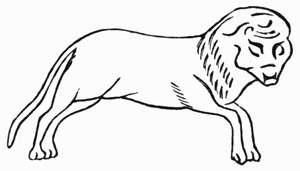
“Pontius Leo made this for himself while living. He and his wife
Pontia Maxima made this for their well-deserving son, Apollinaris.”
Fig. 33.—Phonetic Symbol.
The friends of Leo were probably unable to read this inscription,
whose atrocious latinity betrays the ignorance of the mason by whom it
was executed, and therefore had engraved upon the stone the rude
outline of a lion, the symbol of his proper name.
Another slab bears the outline of a little pig, the pictorial
translation of the somewhat singular name Porcella.
It was, perhaps,
a term of endearment, like the obsolete English “Pigsney.”
PORCELLA HIC DORMIT IN P ·
Q · VIXIT ANN · III · M · X · D · XIII ·

“Here sleeps Porcella in peace. She lived three years, ten months, and
thirteen days.”
Fig. 34.—Phonetic Symbol.
In like manner the tombs of Dracontius, Vitulus, and Onager, bear
respectively a dragon, a steer, and an ass, the phonetic synonymes of
these names. These figures may in some cases be a mere pictorial
paronomasia, but the explanation above suggested is the more probable
one. In the following example this is almost asserted:
NABIRA IN PACE ANIMA DVLCIS
QVI VIXIT ANOS XVI · M · V ·
ANIMA MELEIEA
TITVLV FACTV
APARENTES SIGNVM NABE. [sic.] |
|
“Navira in peace; a sweet soul, who lived sixteen years and five
months; a soul sweet as honey; this epitaph was made by her parents.
The sign, a ship.”
Fig. 35.—Phonetic Symbol.
More frequently the figures had reference to the trade or occupation
of the deceased, as in the following epitaph, probably of a
wool-comber, found by Dr. Maitland built into the wall of the Piazzo
di Spagna, in Rome. Many important funeral tablets, both Christian and
pagan, have been thus employed for the commonest
purposes. The objects
in the engraving are probably the shears, comb, ladle, and an unknown
instrument used for cleansing wool.
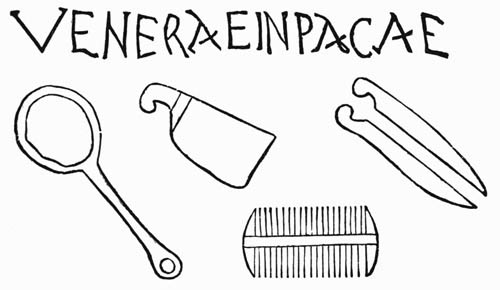
“To Veneria, in peace.”
Fig. 36.—Wool-Comber’s Implements.
The following, from the Lapidarian Gallery, indicates the trade of a
carpenter. The saw and adz are very like those now employed:
BAVTO ET MAXIMA SE VIVI
FECERVNT.
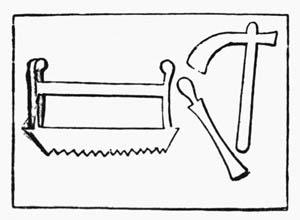
“To Bautus and Maxima. They made this during their lifetime.”
Fig. 37.—Carpenter’s Tools.
On another slab is a figure, probably of a vine-dresser, in a short
Roman tunic, standing near a wine cask, the symbol of his occupation.
He appears to be starting to the field with his mattock on his
shoulder, and in his hand is a wallet containing, perhaps, the
provision for the day.
GAVDENTIO FECERVM FRATRI
QVI VICSIC ANNIS XXVIII · M · VIII · D · XVII
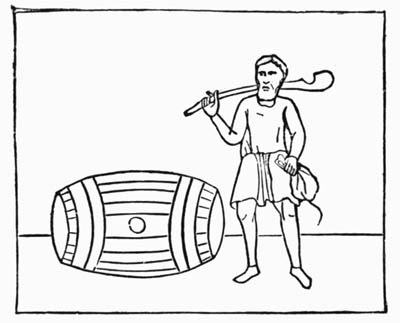
“To Gaudentius. His brothers made this. He lived twenty-eight years,
eight months, seventeen days.”
Fig. 38.—A Vine-Dresser’s Tomb.
In the Catacomb of St. Agnes is a fresco of husbandmen carrying a wine
butt on their shoulders, the meaning of which is probably the same.
Mr. Hemans rather fantastically interprets this symbol as implying
concord, or the union of the faithful bound together by sacred ties,
as the staves of the cask are by its hoops.[362]
Maitland translates
it as standing for a proper name. We have seen examples representing
fossors at work,[363]
and Fabretti figures the slab of a sculptor,
exhibiting the manufacture of sarcophagi. Other examples occur, in
which
the fuller’s tomb is indicated by mallets, the shoemaker’s by
shoes or lasts, the baker’s by loaves, the wood-feller’s by an axe,
the grocer’s by scales, and the like, although the meaning of some of
these figures is questioned. Didron, however, presses this
interpretation of these symbols much too far, making the dove, fish,
anchor, and sheep, only the emblems of the occupation of the fowler,
fisherman, sailor, and shepherd, respectively, thus doing violence to
the acknowledged canons of epigraphic criticism to be presently
indicated.[364]
But by far the larger proportion of these symbols have a religious
significance, and refer to the peace and joy of the Christian, and to
the holy hopes of a life beyond the grave; and many of them were
derived directly from the language of Scripture. They were often of a
very simple and rudimentary character, such as could be easily
scratched with a trowel on the moist plaster, or traced upon the
stone. They were sometimes, however, elaborately represented in
excellent frescoes or sculpture.
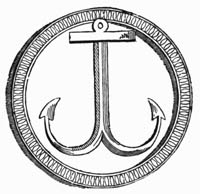
Fig. 39.—Symbolical Anchor.
The beautiful allusion of St. Paul to the Christian’s hope as the
anchor of the soul, both sure and steadfast, is frequently represented
in the Catacombs by the outline of an anchor, often rudely drawn, but
eloquent with profoundest meaning to the mind of the believer. It
assured the storm-tossed voyager on life’s rough sea that, while the
anchor of his hope was cast “within the veil,” his life-bark would
outride the fiercest blasts and wildest waves of persecution, and at
last glide safely into the haven of everlasting rest. This allusion is
made more apparent when it is observed how often it is found on the
tombstones of those who bear the name Hope, in its Greek or Latin
form, as ΕΛΠΙϹ, ΕΛΠΙΔΙΟϹ, SPES etc. In the
accompanying example it is displayed on a Christian patera. This
symbol is not unknown in classic art. It occurs on a ring from
Pompeii, in the Museum of Naples, with the word ΕΛΠΙϹ, Hope.
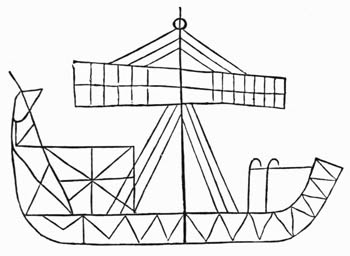
Fig. 40.—Symbolical Ship.
Of kindred significance with this is the symbol of a ship, which may
also refer to the soul seeking a country out of sight, as the ship
steers to a land beyond the horizon. Sometimes it may be regarded as a
type of the church; and in later times it is represented as steered by
St. Peter and St. Paul.[365]
The symbol of “the heaven-bound
ship”—ἡ ναῦς οὐραοδραμοῦσα—is mentioned by Clement of
Alexandria as being in vogue in the second century. This figure was
used also in pagan art as an emblem of the close of life, and may
still be seen carved on a tomb near the Neapolitan Gate of Pompeii. In
the Catacombs the execution of the symbol is often exceedingly rude,
the design being apparently copied from the clumsy barges of the
Tiber. The mast and yard sometimes present a vague imitation of the
cross.[366]
The accompanying figure is from the Lapidarian Gallery of
the Vatican.[367]
The palm and crown are symbols that frequently occur, often in a very
rude form. Although common also to Jewish[368]
and pagan art, they
have received in Christian symbolism a loftier significance than they
ever possessed before. They call to mind that great multitude
whom no
man can number, with whom Faith sees the dear departed walk in white,
bearing palms in their hands. The crown is not the wreath of ivy or of
laurel, of parsley or of bay, the coveted reward of the ancient games;
nor the chaplet of earthly revelry, which, placed upon the heated
brow, soon fell in withered garlands to the feet; but the crown of
life, starry and unwithering, the immortal wreath of glory which the
saints shall wear forever at the marriage supper of the Lamb. They are
the emblems of victory over the latest foe, the assurance that
The struggle and grief are all past;
The glory and worth live on.
The palm and crown conjoined, the latter encircling the sacred
monogram, are represented in the accompanying example from a slab in
the Vatican Library.

Fig. 41.—Symbolical Palm and Crown.
The palm has also been claimed, but, as we shall see, without any
warrant whatever, as the emblem of the martyrs and the designation of
their tombs.
One of the most beautiful symbols of the Catacombs is the dove, the
perpetual synonym of peace. Indeed, that word is frequently annexed to
the figure as if to show more distinctly its meaning, as in Figs. 42
and 43.[369]
The innocence and purity of the dove make it an
appropriate emblem of the souls of departed Christians, soaring beyond
the defilements of earth to the peaceful
blessedness of heaven.[370]
It is, therefore, in allusion to this thought sometimes accompanied by
the words, anima innocens, anima simplex—“innocent
soul,” “simple soul.” Perhaps there may be also a reference to the
admonition of Our Lord, “Be ye, therefore, ... harmless as doves.” The
gentleness and tender affection of these beautiful birds make them an
emblem of endearment in every age, as is strikingly seen in the
frequent allusions of the matchless Song of Songs. It may, therefore,
be often employed in the Catacombs with reference to the domestic
virtues of the deceased, and to the mutual constancy of husband and
wife. The expression, palumbus sine felle—“a dove without
gall”—is often applied in Christian epitaphs to the departed,
especially in its diminutive form—palumbulus sine felle—on
the tombs of little children, as if the bereaved parents presented
their babes to the Lord, like the turtle-doves and young pigeons of
the ancient Jewish offering of infant consecration.
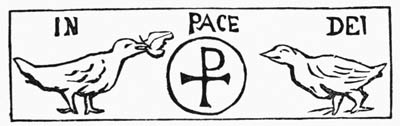
“In the Peace of God.”
Fig. 42.—Symbolical Doves.
The dove generally bears in its beak or claws an olive branch, the
sign of the assuaging of the waters of Divine vengeance from the face
of the earth. (See Fig. 43.) It
is, then, as Tertullian expresses it,
“the herald of the peace of God.”

Fig. 43.—Symbolical Dove.
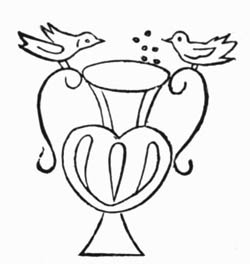
Fig. 44.—Doves and Vase.
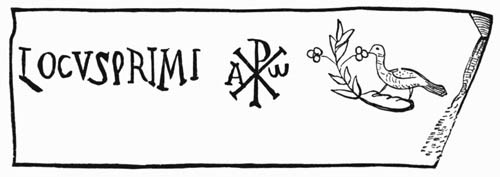
“The place of Primus.”
Fig. 45.—Dove Eating Olive Berries.
Sometimes it is seen drinking out of a vase, or pecking at grapes or
olive berries, a symbol of the soul’s enjoyment of the fruits and
refreshing draughts of paradise.[371]
(See Figs. 44 and 45.) As seen
sitting on the arms of the cross,[372]
the dove is an appropriate
symbol of the peace with God purchased by the death of Our Lord Jesus
Christ. The dove in a cage may imply the
faithful under persecution,
or the soul imprisoned in the body.
The dove was also used in the Catacombs as the symbol of the Holy
Spirit in representations of the baptism of Our Lord, and is described
by Paulinus as similarly employed in the church of Nola.[373]
Tertullian[374]
applies toward the ecclesiastical edifice the
expression, columbæ domus—“house of the dove”—possibly,
however, with reference to the dove-like religion and character of the
Christians. In Mediæval art the Holy Spirit, under the form of a dove
wearing a cruciform nimbus, the symbol of divinity, is represented
brooding over the face of the waters of primeval chaos, inspiring the
prophets and saints, and even nailed to the cross above the crucified
body of Our Lord. This sacred emblem of the Paraclete, the Divine
Comforter, by a monstrous violation of propriety was emblazoned upon
battle-flags, and the Holy Name given to a military order and to ships
of war.[375]
This emblem was also used in pagan art. The light-winged coursers who
drew the airy chariot of Venus were doves. From the oaks of Dodona
doves uttered oracles of the future. A dove was also the celestial
messenger of Mahomet. The olive, too, was sacred to Minerva, and as
the symbol of peace was woven into the victor’s crown.
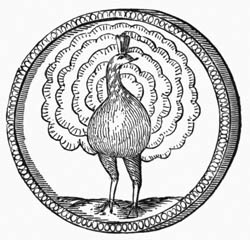
Fig. 46.—Symbolical Peacock.
Other pagan types were employed, but with a new and nobler Christian
significance. Thus the peacock, the proud bird of Juno, frequently
appears in the Catacombs, not as the symbol of the all-seeing eye of
God, in imitation of the pagan myth of the hundred eyes of Argus, but
as the emblem of immortality.[376]
Associated in meaning and
frequently confounded in form with the peacock was the phœnix, the
marvellous story of whose rejuvenescence from the ashes of its funeral
pyre Clement of Rome recounts with unfaltering faith.[377]
Lactantius
makes it the theme of an elaborate poem,[378]
and Tertullian cites it
as a striking illustration of the resurrection of the dead.[379]
It
was also considered a type of the new birth and of eternal felicity.
The cock, generally associated with St. Peter,[380]
is interpreted as the symbol
of unsleeping vigilance; it is, perhaps, also an emblem or
suggestion of the remorse of the apostle for his denial of his Lord.
Another adaptation of classic symbolism is the employment of the stag,
the attribute of Diana, as the emblem of the Christian thirsting after
the living waters. It is generally represented drinking at a stream,
probably in allusion to the Psalmist’s panting after God as the hart
after the water-brooks.[381]
The hare sometimes occurs, an appropriate
type of the persecution of the Christians, hunted amid those secret
burrows in the earth like rabbits in their warrens. The horse is
interpreted as symbolizing eagerness or speed in running the Christian
race, or, perhaps, the course of life happily accomplished;[382]
and
the lion, fortitude of soul, or, from the notion that he slept with
open eyes, vigilance against the snares of sin.[383]
It is remarkable
that the dog, a pagan symbol of fidelity,
never occurs except as
accessory in hunting scenes of manifestly heathen type; probably on
account of the abhorrence of this, to them, unclean beast, by the
Jews, who so largely impressed their characteristics on Christian
thought and feeling.[384]
The serpent, a common pagan symbol, and with
the cock the attribute of Æsculapius, nowhere appears but in the scene
of the temptation of Eve by the “Old Serpent, the Devil.”
The vine is an appropriate symbol of the intimate union of the
believer and Christ, and the olive tree of a life fruitful in good
deeds, or of the church, in whose sheltering arms all souls may find
rest, as the fowls of the air in the boughs of a tree. Flowers and
fruits may be the emblems of future beatitude; and a loaf, of the
bread of life or of the holy eucharist. The fountain is a type of the
living waters, and the lyre, of the influence of the Divine Orpheus.
The lamp and the light-house are the emblems of spiritual illumination
through the gospel. The balance may refer to the just dealing of the
deceased, or perhaps to the final judgment and the Eastern notion of
psychostasy.[385]
The house probably indicates the tabernacle of the
body, or perhaps the last long home of the grave, or the house not
made with hands on high. Most of the symbols, however, refer to the
person and work of Christ, as the central and
dominating idea of the
church of the Catacombs. Some of these are of such importance and of
so frequent occurrence as to demand a more detailed examination.
One of the most striking and beautiful of these symbols is that which
represents Christ as the Good Shepherd, and believers as the sheep of
his fold. While the doves, as we have seen, may be regarded as
emblematic of the beatified spirits of the departed, the sheep more
appropriately symbolize those who, still in the flesh, go in and out
and find pasture. Suggesting the thought of that sweet Hebrew
idyl[386]
of which the world will never grow tired; which, lisped by
the pallid lips of the dying throughout the ages, has strengthened
their hearts as they entered the dark valley; and to which Our Lord
lent a deeper pathos by the tender parable of the lost sheep—small
wonder that it was a favourite type of that unwearying love that
sought the erring and the outcast and brought them to his fold again.
With reiterated and manifold treatment the tender story is repeated
over and over again, making the gloomy crypts bright with scenes of
idyllic beauty, and hallowed with sacred associations.
This symbol very happily sets forth the entire scope of Christian
doctrine. It illustrates the sweet pastoral representations of man’s
relationship to the Shepherd of Israel who leadeth Joseph like a
flock,[387]
and his individual dependence upon him who is the Shepherd
and Bishop of all souls.[388]
But it especially illustrates the
character and office of Our Lord, and the many passages of Scripture
in which he represents himself as the Good Shepherd, who forsook his
eternal throne to seek through this wilderness-world the lost and wandering
sheep, to save whom he gave his life that he might bring
them to the evergreen pastures of heaven.
This subject undergoes every possible variety of treatment and is
endlessly repeated—rudely scratched on funeral slabs, elaborately
sculptured on sarcophagi, moulded on lamps and vases, graven on seals
and rings, traced in gold on glass, and painted in fresco, generally
in the most prominent and honourable position, in the vaulting of the
chambers and tympana of the arcosolia.[389]
The Good Shepherd
is generally represented as a youthful beardless figure in a short
Roman tunic and buskins, bearing tenderly the lost sheep which he has
found and laid upon his shoulders with rejoicing. This is evidently
not a personal image, but an allegorical representation of the “Lord
Jesus, that Great Shepherd of the sheep.” He is generally surrounded,
as in Fig. 47, by a group of fleecy followers, whose action and
attitude indicate the disposition of soul and manner of hearing the
word. Some are listening earnestly; others are more intent on cropping
the herbage at their feet, the types of those occupied with the cares
and pleasures and riches of this world. A truant ram is turning
heedlessly away, as if refusing to listen; and often a gentle ewe
nestles fondly at the shepherd’s feet or tenderly caresses his hand.
An early Christian writer, contemporary with this primitive art,
furnishes an interpretation of these pictures. He compares the poor of
this world to sheep in a barren desert; finding no allurements here
below, they seek after those things which are above. The rich, on the
contrary, are like sheep in a pleasant pasture, with heads and hearts
always intent on the things of earth. Frequently a shower of rain, or
of water from a rock—the emblem of the dews of grace or the waters of
salvation—falls, abundantly on the listening sheep, scantily on those
that are feeding, not at all on the one that is turning away.
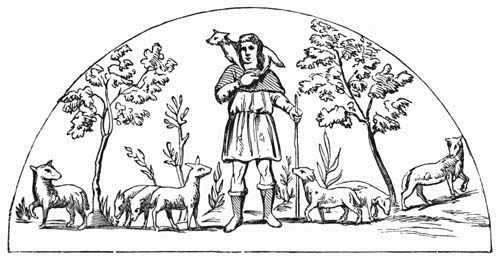
Fig. 47.—The Good Shepherd.
Sometimes the sheep appears to nestle with an expression of human
tenderness and love on the shepherd’s shoulders; in other examples it
is more or less firmly held with one or both hands, as if to prevent
its escape. In a few instances the fold is seen in the background,
which seems to complete the allegory. Frequently the shepherd carries
a staff or crook in his hand, on which he sometimes leans, as if weary
beneath his burden. He is sometimes even represented sitting on a
mound, as if overcome with fatigue, thus recalling the pathetic words
of the Dies Iræ:
Quærens me sedisti lassus.
Occasionally he is represented with a musical instrument, like the
classical syrinx or Pan’s-pipe, in his hand, as in Fig. 48, as if to
indicate the sweet persuasive influence of his word. In allusion to
this thought Gregory Nazianzen remarks, “The Good Shepherd will at one
time give his sheep rest, and at another time lead
and direct them,
with his staff seldom, more generally with his pipe.” In a fresco in
the Catacomb of St. Agnes the shepherd’s tenderness and pity are
contrasted with the mercenary harshness of the hireling who careth not
for the sheep, and who rudely seizes by the leg one that struggles to
get free, while the Good Shepherd merely calls his sheep, and they
hear his voice and follow him. Sometimes an Orpheus, to whose lyre the
sheep seem to listen with pleased attention, takes the place of the
Good Shepherd.
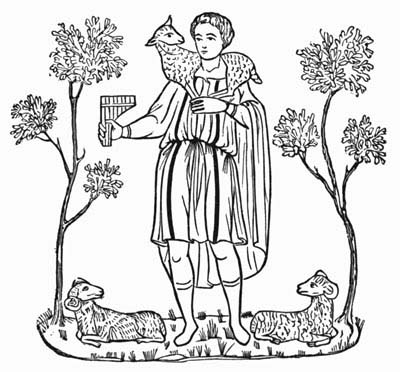
Fig. 48.—Good Shepherd with Syrinx.
Sometimes the shepherd is represented as leading or bearing on his
shoulders a kid or goat instead of a sheep or lamb. This apparent
solecism has been thought a careless imitation of pagan figures of the
sylvan deity Pan, who frequently appears in art in this manner. It is
more probable, however, that it was an intentional departure from the
usual type, as if to illustrate the
words of Our Lord, “I am not come
to call the righteous, but sinners to repentance,” and to indicate his
tenderness toward the fallen, rejoicing more over the lost sheep that
was found than over the ninety and nine that went not astray. It was
also, probably, designed as a protest against the rigour of the
Novatians in refusing reconciliation to penitent apostates. Sometimes
Our Lord, thus symbolically represented, is accompanied by one or more
of his disciples, as under-shepherds to whom is given command to feed
the flock of Christ, over which the Holy Ghost had made them
overseers.
In the Catacomb of St. Agnes is a remarkable fresco of a lamb between
two wolves, over which is written the word SENIORES, evidently an allegorical
representation of the story of Susanna and the elders, and in mystic
form an image of the church surrounded by persecution, or an
illustration of the words of Our Lord, “Behold, I send you forth as
sheep in the midst of wolves.”
The figure of the Good Shepherd has been a favourite symbol in every
age, and was common in pagan art. Mercury was worshipped under the
name Criophorus, or the Ram-bearer, and was thus represented in
painting and statuary.[390]
More frequently the god Pan appears under
that figure, generally bearing in his hand the simple instrument to
which he has given his name. The Roman poets employ this sweet
pastoral image in their beautiful eclogues[391]
to illustrate the
shepherd’s tender care for his flock, gently bearing the lambs in his
arms or on his shoulders, recalling the inspired language in which
Isaiah depicts the Almighty’s loving-kindness toward his people.[392]
From this outward resemblance between
the pagan and Christian themes,
Raoul-Rochette has imagined that the frescoes of the Catacombs were
careless imitations of the heathen type, overlooking their
distinctively Christian interpretation. But the naked fauns dancing
with the nymphs of pagan art, as in the tomb of the Nasos, are
infinitely removed from the sweet and tender grace of the Christian
“Pastor Bonus.” Tertullian, in the second century, speaks of chalices
on which were paintings of the Good Shepherd and the lost sheep.[393]
Eusebius says that Constantine placed a statue of this subject in the
forum of Constantinople. It also appears in mosaic at Ravenna, A. D. 440, and in a Catacomb at Cyrene in Africa.[394]
But Our Lord is sometimes represented as a lamb instead of a
shepherd.[395]
Indeed, this symbol is no less
appropriate than the one
just considered, and has equally the sanction of Scripture. The
manifold sacrifices of the tabernacle and temple all pointed to the
Lamb slain from the foundation of the world, the true Passover of
mankind. The immaculate purity, gentleness, and divine affection of
the Redeemer, and his patience under affliction and persecution, make
this beautiful symbol an appropriate type of his innocence and
sufferings as he was led as a lamb to the slaughter, and, as a sheep
dumb before its shearers, opened not his mouth.[396]
In the devout
recognition of Our Lord by John the Baptist,[397]
and in the sublime
visions of the Apocalypse,[398]
he is thus figuratively represented;
and to this divine Lamb is chanted evermore the song of praise and
honour and thanksgiving.[399]
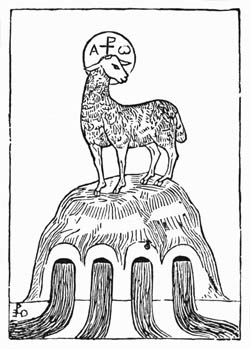
Fig. 49.—Lamb as Symbol of Christ.
In the accompanying engraving from a sarcophagus in the Lateran, of
the fourth or fifth century, the lamb, wearing the nimbus in which are
inscribed the sacred monogram and the letters Alpha and Omega, the
emblems of divinity, is standing upon a hillock, perhaps intended for
Mount Zion,[400]
from which flow four streams, probably the “river of
water of life,... proceeding out of the throne of God and of the
Lamb,” and dividing toward the four quarters of the earth. These
streams are also variously interpreted as signifying the four
evangelists, and the four rivers of paradise.[401]
On a sarcophagus of
later date Our Lord is represented in human form with a scroll in his
hand, standing on a mound from which the four mystical rivers flow,
and by his side a lamb bearing a Latin cross on its head. On either
side are lambs, personifications of the apostles, to whom he is giving
the final commission to preach in all lands the gospel contained in
the scroll which he holds, and to baptize with the sacred waters at
their feet. Sometimes twelve lambs are represented approaching one in
the centre, as in frescoes in St. Clement’s at Rome, and at Ravenna.
On a gilt glass patera in the Vatican Library the lambs are seen to
issue from Jerusalem and Bethlehem, as indicated by their names
written above, and to approach Mount Zion, from which flow the four
evangelical streams united in the mystical Jordan. This is perhaps
emblematic of the twelve tribes, or of the gentiles coming from the
east and west to drink of the water of life. Paulinus describes a
mosaic in
his basilica of Fondi, where a cross symbolical of Christ
was placed on the rock, and two flocks, of sheep and goats
respectively, stood around it. “The shepherd turns away,” he says,
“the goats on the left, and embraces with his right hand the
well-deserving lambs.”[402]
This was perhaps the first of that series
of art-presentations of the last judgment which culminates in the
tragic terrors of the Sistine Chapel.
Sometimes a milk-pail is represented near a lamb, or hanging on a
crook by its side, or even resting on its back. Sometimes also it is
carried by the Good Shepherd. This has been magnified without due
evidence into a symbol of the eucharist. It might more naturally be
regarded as an emblem of the blessings of salvation, set forth by
Isaiah under the figure of wine and milk, or it may refer to the
soul’s being fed with the sincere milk of the word.
On the sarcophagus of Junius Bassus in the crypts of St. Peter’s, of
date A. D. 359, are exhibited several scenes from scripture history,
which will be hereafter described. In the spandrels of the arches over
these is a series of bas reliefs, in which lambs are naively shown as
enacting other scriptural scenes. In one a lamb, the personification
of Moses, strikes a rock from which the water bursts forth, and
another receives the law from the hand of God. Three lambs in a fiery
furnace represent the three Hebrew children in the furnace of
Nebuchadnezzar. Our Lord is symbolized by a lamb on whose head
another, personifying John the Baptist, is pouring
the waters of
baptism, while the Holy Ghost in the form of a dove breathes divine
grace. A lamb, the personification of Christ, multiplies the loaves,
and brings forth Lazarus from the grave.
One of the most remarkable and important, in its theological
significance, of the symbols of the Catacombs is that of the fish. It
is one of the oldest in the entire hieratic cycle. It is found
accompanying the first dated inscription which bears any emblem
whatever,[403]
and nearly a hundred examples occur which are
attributed to the first three centuries. It was also one of the first
to be discontinued. During the fourth century it rapidly fell into
disuse, and by the beginning of the fifth had almost entirely
disappeared from religious art.[404]
The abandonment of this remarkable figure may be explained by its
mysterious and anagrammatic character. It is a striking illustration
of that disciplina arcana of the primitive church which
employed signs whose secret meaning its heathen foes could not
understand. When the age of persecution passed away there was no
longer the necessity to conceal under allusions and emblems, known
only to the initiated, religious truths which were openly proclaimed
on every hand. Hence this purely conventional sign fell into disuse.
This symbol probably derived its origin from the fact
that the initial
letters of the names and titles of Our Lord in Greek—Ἰησοῦς Χριστὸς, Θεοῦ Υἱὸς,
Σωτήρ, Jesus Christ, Son of God, the Saviour—make up the word
ΙΧΘΥΣ, a fish. “This single word,” says
Optatus, “contains a host of sacred names.”[405]
The same word also
occurs acrostically in the initial letters of certain so-called
Sibylline verses quoted by Eusebius[406]
and Augustine,[407]
which
were doubtless of Christian origin. The symbol is first mentioned by
Clement of Alexandria,[408]
and probably had its origin in the
allegorizing school of Christianity which sprang up in that city.[409]
There appears also to have been an allusion in this figure to the
ordinance of baptism. “We are little fishes,” says Tertullian, “in
Christ our great fish. For we are born in water, and can only be saved
by continuing therein,”[410]
that is, through the spiritual grace of
which baptism is the visible sign. “This sign,” says Clement, “will
prevent men from forgetting their origin.” “He (that is, Christ) is
that fish,” says Optatus, “which in baptism descends in answer to
prayer into the baptismal font, so that what was before water is now called,
from the fish, (a pisce,) piscina.”[411]
Even
the mythical fish mentioned in the apocryphal book of Tobit,[412]
occasional pictures of which occur in the Catacombs, is interpreted by
some of the Fathers as typifying Our Lord. “That fish which came alive
out of the river to Tobias,” says Augustine, “whose heart, (liver,)
consumed by passion, put the demon to flight, was Christ.”[413]
This sacred sign was also regarded as an emblem of the sufferings of
Our Lord and the benefits of his atonement. “The Saviour, the Son of
God,” says Prosper of Aquitania, “is a fish prepared in his passion,
by whose interior remedies we are daily enlightened and fed.”[414]
“ΙΧΘΥΣ is the mystical name of Christ,” says Augustine,
“because he descended alive into the depths of this mortal life as
into the abyss of waters.”[415]
“The fish in whose mouth was the coin
paid as the tribute money,” says Jerome, “was Christ, at the cost of
whose blood all sinners were redeemed.” Origen merely speaks of him as
“figuratively called the fish.”[416]
“Thus this symbol became,” says
Dr. Northcote, “a sacred tessera, embodying with wonderful
brevity and distinctness a
complete abridgment of the creed—a
profession of faith, as it were, both in the two natures and unity of
person, and in the redemptorial office, of Our Blessed Lord.”[417]

Fig. 50.—Symbolical Fish.
Few symbols, if any, were more common than this. It occurs rudely
scratched on funeral slabs, painted in the cubicula, sculptured
on the sarcophagi, moulded on lamps,[418]
engraven on rings and
seals,[419]
carved in ivory, mother-of-pearl, and precious stones, and
cast in bronze or glass. These last, often pierced in order to be worn
like an amulet, were frequently given to the neophyte at baptism to
remind him of the privileges and obligations which it conferred, and
they are often found buried with the dead. One of these has engraved
upon it the word ΣΩΣΑΙΣ—“Mayest thou save us;” and a
sepulchral lamp, besides representations of fishes, bears the word
ΙΧΘΥΣ, and, as if in explanation, the cyphers
Α. Ω., ΙΗ. ΧΘ. ΣΩΤΗΡ—that is, The First and the Last, Jesus
Christ, the Saviour. A slab, on which are engraved two fishes and an
anchor, bears the inscription, ΙΧΘΥΣ ΖΩΝΤΩΝ—“The fish of
the living.” Sometimes this sacred sign is inscribed on pagan
tombstones used to close the loculi of the Catacombs, in order
to give them a Christian character. Frequently the execution is
exceedingly rude, as in Fig. 50; occasionally it is of a more artistic
form, as in Fig. 51. It seldom occurs alone, however, but associated
with other Christian
emblems, as the anchor or dove, (see Figs. 52 and
53,) as if to indicate that the deceased rests in Christ, in hope and
in peace. Sometimes the fish bears a wreath in its mouth, perhaps in
allusion to the crown which Christ will give to all his saints. Didron
objects to applying these symbols to Christ, because the fish does not
wear the nimbus. But the nimbus was not worn at all at this early
period; such a criterion is therefore inadmissible.

Fig. 51.—Symbolical Fish.
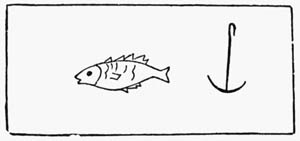
Fig. 52.—Fish and Anchor.
From the Catacomb of Hermes. Earliest dated example, A. D. 234.

Fig. 53.—Fish and Dove.
From the Catacomb of St. Priscilla.

Fig. 54.—Eucharistic Symbol.
This sacred fish is sometimes represented, as in Fig. 54, from the
crypt of St. Lucina, bearing what seems to be a basket of bread and a
flagon of wine on its back, or occasionally a loaf of bread in its
mouth. In these cases there is probably a reference to the bread of
life which Christ breaks to his disciples, or possibly to the holy
eucharist. Sometimes a bird is pictured as deriving nourishment from the
mouth of a fish, the symbol of a soul receiving refreshment from
Christ. The eucharist is also thought to be indicated by frequent
representations of a fish and bread on a table, sometimes with a
figure in prayer standing by; and also by a picture of seven persons
eating a repast of bread and fish together, probably Christ dining
with the disciples by the sea-shore after his resurrection.
Melito of Sardis speaks of Our Lord under the figure of a fish broiled
on the fire of tribulation.[420]
A mystical interpretation was also
given to the loaves and fishes multiplied by Christ for the feeding of
the multitude, as indicating the sevenfold gifts of the Spirit and the
dispensations of the law and the gospel.[421]
A remarkable Greek inscription, found about thirty years ago in an
ancient Christian cemetery at Autun, in France, throws much light on
the profound religious significance of the symbol of the fish.[422]
Its date, as indicated by the character of the epigraphy, in the
opinion of the most eminent critics, is about the year 400.[423]
The
language is of Homeric purity and vigour, which is accounted for by
the fact that Autun was, during the fourth and fifth centuries, a sort
of “French Eton,” where Greek, the tongue “of Homer and the gods,” was
sedulously cultivated. The following is the text as restored and
translated by Marriott. It will be perceived that the word ΙΧΘΥΣ occurs acrostically in the initial letters of the first five
lines, and is found four times in the body of the inscription. It is
conjectured that the figure of a fish was also engraved, though now
unhappily obliterated, at both the lower corners, where spaces for it
seem to have been left.
ΙΧΘΥΟϹ οὐρανίου ἅγιον γένος, ἤτορι σεμνῷ
Χρῆσε, λαβὼν ζωὴν ἄμβροτον ἐν βροτέοις
Θεσπεσίων ὑδάτων· τὴν σὴν, φίλε, θάλπεο ψυχὴν
Ὕδασιν ἀενάοις πλουτοδότου Σοφίης,
Σωτῆρος δ'ἁγίων μελιηδέα λάμβανε βρῶσιν.
Ἔσθιε πεινάων ΙΧΘΥΝ ἔχων παλάμαις.
ΙΧΘΥΙ χεῖρας ἄραρα· λιλαίεο δέσποτα Σῶτερ
Εὐθύ μοι ἡγητήρ, σε λιτάζομε, φῶς τὸ θανόντων.
Ἀσχανδῖε πάτερ, τῷ 'μῷ κεχαρισμένε θυμῷ,
Σὺν μητρὶ γλυκερῇ καὶ πὰσιν τοῖσιν ἐμοῖσιν
ΙΧΘΥΝ ἰδὼν υἵου μνήσεο Πεκτορίου.
“Offspring of the heavenly Ichthus, [Christ,] see that a heart of
holy reverence be thine, now that from divine waters thou hast
received, while yet among mortals, a spring of life that is to
immortality. Quicken thy soul, beloved one, to ever fuller life,
with the unfailing waters of wealth-giving wisdom, and receive
the honey-sweet food of the Saviour of the saints. Eat with
longing hunger, holding Ichthus [the Divine Food] in thy hands.
On Ichthus [Christ] my hands are clasped; in thy love draw nigh
unto me and be my guide, my Lord, and Saviour; I entreat thee,
thou Light of them for whom the hour of death is past. My father,
Aschandeius, dear unto my heart, and thou, sweet mother, and all
I love on earth, oft as you look on Ichthus [the holy sign of
Christ] so often think of me, Pectorius, your son.”[424]
In this beautiful expression of primitive faith and hope Romish
interpretation has discovered evidence of prayers for the dead, of the
invocation of the Virgin Mary, the doctrine of transubstantiation and
communion in one kind, and mention of the “sacred heart of Jesus.”
Marriott has well shown the grammatical and other difficulties which
these forced interpretations create, and the absurdity of importing
into antiquity “controversial phrases of comparatively modern
theology, utterly unknown to the early church.”
Sometimes, by a confusion of metaphor common to both pictorial and
literary figurative expression, the symbol of the fish is applied to
men as well as to Our Lord. Indeed, this may have been its primary
application, and has the sanction of the scriptural designation of the
apostles as “fishers of men.” The Greek liturgy adopts the same
figure, and, in pursuance of the metaphor, speaks of the rod of the
cross, the hook of preaching, and the bait of charity.[425]
There are
also frequent representations on the sarcophagi and in the frescoes of
the Catacombs, doubtless in allusion to this function of the Christian
ministry, of men drawing fish out of the water. These, however, must
not be confounded with the occasional fishing scenes copied from pagan
art; and the symbolical fish must be carefully discriminated from the
dolphins which frequently occur on the sarcophagi, and from the “great
fish” which swallowed Jonah. It is
remarkable that a bronze image with
a chalice and fish was found at Autun, in the neighbourhood of the
inscription above given. The figure occurs also on certain ancient
coins, and in representations of the Phœnician Dagon or fish-god.
It is noteworthy that there are in the Catacombs comparatively few
representations of the cross, that sacred sign of salvation which in
after years became perverted to such superstitious uses; and when it
does occur it is generally in some disguised form, and not in that by
which it is now generally indicated, familiarly known as the Latin
cross. There is probably a twofold reason for this. The very sanctity
of the symbol, and the detestation in which it was held by the
heathen, conspired to prevent the early Christians from exposing it to
their profane gaze. It is almost impossible to conceive the abhorrence
in which the cross was held in the early centuries by the Greek and
Roman mind. It has for ages been hallowed by the most sacred and
venerable associations, and invested with the most sublime and solemn
interest as the emblem of the world’s redemption. It has waved on
consecrated banners, and been quartered on the arms of earth’s
proudest monarchs. It has shone on cathedral spire and dome, and,
emblazoned with gold and costly gems, has gleamed on many a sacred
shrine. It has been marked on the infant brow in baptism, and held
before the filming eyes of the dying; and has been associated with the
deepest emotions and holiest hopes of the soul.
Not so in the earliest ages of the church. It was then the badge of
infamy and sign of shame—the punishment of the basest of slaves and
the vilest of malefactors. It was regarded with a loathing and
abhorrence more intense than that in which the felon’s gibbet is held
to-day. Its very name was an abomination to Roman ears,[426]
and it
was denounced by the prince of Roman orators as a most foul and brutal
punishment, an infamous and unhappy tree.[427]
Hence this Christian
emblem became the object of scoffing and derision by the persecuting
heathen. An illustration of this is seen in the blasphemous caricature
of the Crucifixion, found upon the walls of the palace of the Cæsars
and attributed to the time of Septimius Severus.[428]
It represents a
figure with an ass’s head attached to a cross, which another figure,
standing near, salutes by kissing the hand, or adores in the classical
sense of the word. Beneath is a rude scrawl which has been interpreted
thus: Ἀλεξόμενος σέβετε (sic)
Θεὸν—“Alexomenos worships his god,” probably the sneer of some
Roman legionary at a Christian soldier of Cæsar’s household. Lucian
also contemptuously speaks of Our Lord as a “crucified impostor.”[429]
The Christians, therefore, reverently veiled this sacred sign from the
multitude; but they cherished it in their hearts, and in times of
persecution gladly bore its reproach. The early Fathers, both Greek
and Latin,
recognize the occurrence of this symbol everywhere
throughout the universe, and expatiate with fervent eloquence on its
mystical meaning. The points of the compass, says Jerome, and the
fourfold dimensions of space as mentioned by the apostle,[430]
set it
forth. Its form was assumed by birds in their flight, by men in the
act of swimming and in the attitude of prayer, and is seen in the
masts and yards of vessels.[431]
“The cross,” says Justin Martyr,[432]
“is impressed on all nature; there is scarcely a craftsman but employs
the figure of it among the implements of his industry.” It was seen in
the beam and share of the plough, and in the forms of flowers and
leaves. It was typified in countless analogies of Scripture, in the
measurement of the ark, the number of Abraham’s servants, the shape of
Jacob’s staff, and the roasting of the paschal lamb; in the rod of
Moses, the seven-branched candlestick, and the wave-offerings of the
temple service; and it was the hallowed sign marked in blood on the
lintels of the Hebrews’ houses. It healed the envenomed wounds of the
serpent-bitten Israelites in the desert, routed the Amalekites in
battle, and restored to life the son of the widow who gave bread to
the prophet. It was the mark of God on the saints of Jerusalem, and
was to be the sign of the Son of man in the heavens. The Christians
wore the sacred token like a banner on their foreheads,[433]
and the
form at which men once shuddered, says Chrysostom, became
the badge
of highest honour, so that even emperors laid aside the diadem to
assume the cross. “Let him bear the cross,” says Paulinus, “who would
wear the crown.”[434]
Christians were known as “devotees of the
cross,”[435]
and this sign of Christ[436]
was employed to hallow every
act of their lives, their down-sitting and up-rising, their going out
and coming in.[437]
It was especially adopted, as several of the
Fathers remark,[438]
as the attitude of prayer, and Chrysostom quotes
in explanation the words of the Psalmist, “Let the lifting up of my
hands be as the evening sacrifice.”[439]
Tertullian and Asterius
Amasenus[440]
expressly declare that thus is set forth the passion of
Our Lord.
This symbol acquired at length in popular apprehension the power of a
sacred talisman to banish demons, vanquish
Satan, avert evil, protect
in time of danger or temptation, and to shut the mouths of lions about
to devour the intrepid confessors of the faith.[441]
The sign of the
cross on the forehead and heart, says Prudentius, banishes all
evil.[442]
Another poet of the fifth century recommends the mystical
charm as an antidote to diseases of cattle. Into such superstition had
Christianity already degenerated.[443]
More common than any other Christian symbol in the Catacombs is the
so-called Constantinian monogram, ☧.
The first certain example of
this is the following, which bears the date A. D. 331:[444]
|
|
ASELLVS ET LEA PRISCO PATRI BENEMERENTI IN PACE
QVI BIXIT ANNIS LXIIII MENSIBVS III DIES N XII. |
|
|
IN SIGNO |
|
| Asellus and Lea to Priscus, their well-deserving father, in
peace, who lived sixty-four years, three months, twelve days. In
the sign of Christ. |
| Fig. 55.—Earliest dated Constantinian Monogram. |
A somewhat similar form occurs with the date A. D. 291, but De Rossi
thinks it is only an ornamental point.[445]
The following fragment may
possibly belong to the year 298, when one of the consuls was named
Gallus; but it cannot be proved that he is the one mentioned in the
inscription: [VI]XIT ... ☧ ... GAL . CONSS.—“He
lived in Christ ... and Gallus being consuls.”[446]
In the year 339 the second dated example occurs, enclosed in a circle.
In A. D. 341 three examples are found, and in A. D. 343 it occurs four
times in one inscription. After this it becomes exceedingly common,
and is even employed as a mark of punctuation between the words.
This monogram is formed, as will be perceived, by the combination of
the Greek characters Χ and Ρ, the first two letters
of the word ΧΡΙΣΤΟΣ, or Christ. It may, indeed, be regarded
rather as a contracted form of writing that word than as a proper
symbol, just as we sometimes write Xt. and Xmas. for Christ and
Christmas. Indeed, it most probably originated in the prevalent
practice of contracted and monogrammatic writing, of which we have so
many examples in these inscriptions. That the monogram stands for the
name of Our Lord will be apparent from an examination of a few of the
inscriptions in which it occurs, as, for instance, the very first
dated example, above given. See also the following: IN PACE ET
IN ☧ DEO—“In peace and in
Christ God;” BIBAS IN ☧—“May you live in Christ;” IN ☧ VICTRIX, which probably meant “Victrix (a
woman’s name) victorious in Christ.” Marangoni gives the accompanying
impression of a seal on the plaster of a grave. See figure 56.

“Hope in Him,” i. e., in Christ.
Fig. 56.—Christian Seal.
This monogram soon became almost universal in the Catacombs, on
sepulchral slabs, lamps, vases, rings, seals, weights, gems, etc., and
in every conceivable modification of form, some of which are shown in
the illustration on next page. See also the vignette on title page,
copied from an alabaster slab in the Collegio Romano, originally from
the Catacombs.
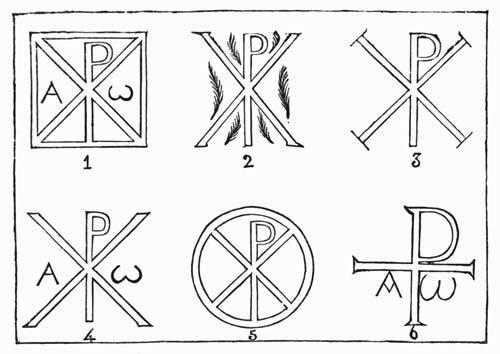
Fig. 57.—Various Forms of the Constantinian Monogram.

Fig. 58.—“Tasaris in Christ, the First and the Last.”
Frequently the Greek letters Alpha and Omega accompany the monogram,
as in numbers 1, 4, and 6 of Fig. 57, in allusion to the sublime
passage in the Revelation
descriptive of the eternity of Christ.[447]
Sometimes the order of the letters is reversed, probably through the
ignorance of the artist, as in the accompanying rude example, Fig. 58.
The whole was sometimes placed obliquely, or even turned upside down,
doubtless for the same reason. Even in its simplest form it was
considered sufficient to give a Christian character to a tombstone
which had been originally
pagan. Such inscriptions are called
opisthographæ, that is, written behind. In the following
example from Aringhi the letters D. M., for the heathen formula
DIS MANIBVS,—“To the Divine Manes,” are partially
obliterated, and the consecrating sign substituted instead.
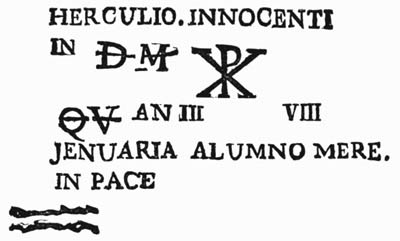
Fig. 59.—Opisthographic Inscription.
This monogram has been supposed to have been adopted from the
celebrated Labarum, or battle-standard of Constantine, which bore this
sacred figure. This was derived in turn, it was feigned, from the
image which the imperial convert saw, or thought he saw, traced in the
sky in characters of fire brighter than the noon-day sun, before the
battle of the Milvian Bridge. Probably a solar halo of unusual
splendour was magnified by the eager imagination of Constantine into a
token of divine assistance, and the legend Ἐν τούτῳ νίκα
was an after addition of the credulous historian. The Christian
emblem, according to Prudentius,[448]
was worn upon the shields and
helmets of the whole army as well as on the imperial standard; “and
so,” says Milman, “for the first time the meek and peaceful Jesus
became a God
of battle; and the cross, the holy sign of Christian
redemption, a banner of bloody strife.”[449]
Probably there is allusion to the above mentioned legend in the
following inscription from Bosio:
IN HOC VINCES
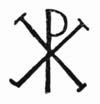
SINFONIA ET FILIIS.
In this thou shalt conquer. In Christ. Sinfonia, also for her sons.
On a remarkable sarcophagus in the Lateran Museum is a representation
of the monogram[450]
supported on a cross and surrounded by a wreath,
at which doves are pecking; probably a symbol of the souls of the
blessed feeding on the hope of an immortal crown and the sweetness of
eternal bliss. Beneath are crouched two soldiers, types, it is
thought, of the Christian warriors not yet entered into rest, whose
only place of safety is at the foot of the cross; or they may refer to
the Draconii, or imperial guard of the Labarum, who, according to
Eusebius, passed unhurt amid showers of javelins.
The following enlarged copy of an early Christian seal exhibits the
triumph of the cross over the Old Serpent, the Devil, while it is the
symbol of salvation to the saints represented by the doves at its
foot. In later
art the figures of lions, eagles, falcons, peacocks,
doves, and lambs, grouped around the cross, seem to signify its power
to subdue evil passions and to inspire holy virtues.
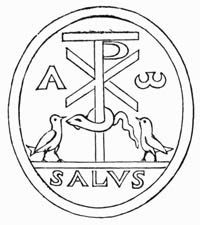
Fig. 60.—Early Christian Seal.
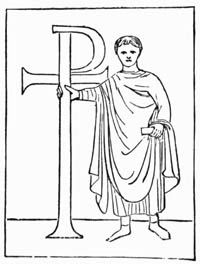
Fig. 61.—Monogram, united with the Cross.
The change of the monogram into the cross was very gradual. First one
stroke of the X became coincident with the vertical part of the P, and
the other at right angles to it, as in No. 6, Fig. 57. At length the
loop of the P disappears and the Greek cross results. In the other
examples of Fig. 57 the cross, if cross it was at all, was neither in
the Greek nor Latin form, but in that known as St. Andrew’s. Finally
the lower arm was lengthened till it assumes the form shown in the
accompanying engraving, which was found on the grave of a neophyte
four years old. The first dated example of a simple undisguised cross
in the Catacombs does not occur till A. D. 407;[451]
but during the
latter part of the fifth century it became quite common. It also
became more ornate in form, and was frequently adorned with gems and
wreathed with flowers, especially in the later bas reliefs. In the
fourth century it had already become
an object of such superstitious
veneration as to call forth the reproaches of Julian and the
extravagant laudation of many of the Christian fathers.[452]
In the
time of Chrysostom the alleged discovery of the true cross by the
Empress Helena was universally received, and “materialized at once,”
says Milman, “the spiritual worship of Christianity.”[453]
Its
position was revealed in a vision and its genuineness proved by the
miraculous cures which it performed, as recorded by St. Cyril,
afterward bishop of Jerusalem, a reputed eye-witness of the event. The
precious relic, distributed throughout Christendom[454]
and in minute
portions worn as sacred talismans, did much to cultivate a spirit of
superstition which culminated in the Romish festivals of the Invention
and Exaltation of the Cross, and in the hymns and offices of the
church, often bordering, at least, upon idolatrous homage.[455]
It also led to the conception of
the marvelous legend of the cross in the
apocryphal gospels and ancient traditions.[456]
The cross thus gradually assumed the form in which it is now generally
represented; but it was a sign of joy and gladness, crowned with
flowers, adorned with precious stones, “a pledge of the resurrection
rather than a memorial of the passion.”[457]
It was like the rainbow
in the cloud to Noah after the flood—a promise of mercy, not a symbol
of wrath. It was not the dead Christ but the glorified Redeemer that
the primitive Church presented to the imagination. She lingered not by
the empty sepulchre, but followed by faith the risen Lord. The
persecuted saints shared the triumph of His victory over death and the
grave, and felt that because He lived they should live also.
The early believers carefully avoided, as though prevented by a sacred
interdict, any attempt to depict the awful scenes of Christ’s passion,
the realistic treatment of which in Roman Catholic art so often shocks
the sensibilities and harrows the soul. This solemn tragedy they felt
to be the theme of devout and prayerful meditation rather than of
portraiture in art. Hence we find no pictures of the agony and bloody
sweat, the mocking and the shame, the death and burial of Our Lord.
“The Catacombs of Rome,” says Milman, “faithful to their general
character, offer no instance of a crucifixion, nor does any allusion
to such a subject of art occur in any early writing.”[458]
“The passion is not
represented literally,” says Dr. Northcote, a strenuous
advocate of Roman Catholic views, “but under the veil of secresy. It
is not our Beloved Lord, but some other who bears his cross. The crown
which is placed on his head is of flowers rather than of thorns, and
corresponds better with the mystical language of the Spouse in the
Canticles[459]
than would a literal treatment.”[460]
With this agrees
the assertion of the distinguished Prussian archæologist, Prof. Piper,
of Berlin. Speaking of the series of art representations, belonging to
the first five centuries, of scenes in the life of Our Lord, which
extend from his nativity to his appearance before Pilate, he says,
“Further, however, this series does not go: the death and resurrection
of Christ have not at all been made the subject of representation in
this period.”[461]
In the fifth century Paulinus of Nola speaks of Christ as represented
by a snowy lamb standing at the foot of the cross.[462]
Sometimes a
lamb bore the cross, at others it was couchant in the midst of it;
and, as if
to bring the sacrificial emblem more vividly to mind, the
lamb was represented as wounded and bleeding, an innocent victim given
to an unjust death.[463]
In A. D. 692 the Quinisextan Council decreed that the historic figure
of Christ in human form should be substituted for paintings of the
lamb[464]
—an evidence that the earlier representations were purely
allegorical. The lamb, however, still continued to be employed, and it
required the reiterated injunction of Pope Adrian, in the eighth
century, to enforce uniformity of usage; and even after that time a
reversion to the former practice sometimes occurred.
The oldest extant representation of the crucifixion is a miniature in
a Syrian evangelarium, of date A. D. 586, now in the Laurentian
Library at Florence. The treatment of the subject is exceedingly rude,
bordering on the grotesque. The figure of Our Lord is crowned with a
nimbus and clothed with a long purple robe The soldiers on the ground
are casting lots for his garments, and the sun and moon look down upon
the scene. A companion picture represents the ascension of Christ and
the effusion of the Holy Spirit. “These are the oldest pictorial
representations,” says Prof. Piper, “of the earthly life of Jesus and
of his exaltation.... At a somewhat later period,” he continues, “they
appear also in the west.”[465]
Gregory of Tours, about the end of the sixth century,
mentions,
apparently as an unusual innovation, a picture in the church at
Narbonne which represented the crucifixion of Our Lord.[466]
About the
same time Venantius Fortunatus mentions what seems to have been a
metallic cross bearing the image of Christ.[467]
The figure of Jesus first appeared standing at the foot of the cross,
frequently with outstretched arms as if in prayer, which type was
common in the eighth century. Sometimes the bust only was exhibited at
the top of the cross, or even hovering over it, as in a reliquary
presented to Theodelinda by Gregory the Great, the head being crowned
with a nimbus, but without any expression of pain.
In the ninth century the form of Christ is raised to the centre of the
cross; but he is still alive, with open eyes and head erect, as if to
indicate that the divine nature was not subject to death. The hands
are not nailed, but extended in prayer; the darkened sun and moon look
down upon the awful tragedy; but still a feeling of reverence
prevented the depicting of any expression of suffering on the
countenance of the Redeemer. It was not till the eleventh century that
art attempted to represent either the agony or death of the Son of
God.[468]
From this time he is exhibited lifeless
upon the cross, his
hands and feet transpierced with nails and a spear wound in his side,
from which the flowing blood sometimes falls on the head of the
spectators, as if indicating the efficacy of the atonement; and in the
thirteenth century the head drops heavily to one side.[469]
The arrangement of the drapery differs greatly in these paintings. In
the tenth century the form of the divine victim is entirely clothed
with a long robe with sleeves, the hands and feet alone being
uncovered. In the eleventh and twelfth centuries the robe becomes
shorter and the sleeves disappear; in the thirteenth it is reduced to
a short tunic; and in the fourteenth it is little more than a narrow
girdle about the loins, at which stage it has since remained. The
suppedaneum, or support for the feet, is generally represented.
It is frequently in the form of a globe, or of a chalice. The support
for the body is never shown in art. Sometimes the sepulchre, with the
angel and the two Marys, is seen in the background. One example, in
St. John’s Lateran, exhibits the gate of paradise and the tree of
life.
The expression of the face also underwent a change—a dire eclipse of
woe—no less painful to behold. In the earlier pictures of the
crucifixion the countenance of the Redeemer is still gentle and
benign, the type of tenderness and truth; but it gradually becomes
more and more strongly marked with the expression of sorrow and
physical anguish, till all the divine fades away, and only the human
agony of the wan and furrowed face remains. The serene and joyous
aspect which, as
we shall see, the representations of Our Lord always
wore in the Catacombs, vanishes, and he is depicted as the “man of
sorrows,” crushed with hopeless grief, crowned with thorns,
transpierced with nails, and stained with dropping blood from the
ghastly spear-wound in his side. Art exhausted its power in
delineating the intensest forms of anguished suffering, sinking lower
and lower in the depths of a brutal materiality and ferocity of
treatment of this sacred theme. Even the genius of Michael Angelo only
renders more painful the contrast between the tender and pitiful Good
Shepherd of the Catacombs and the relentless Judge of the Sistine
Chapel, menacing the guilty with the thunderbolts of wrath—a pagan
Zeus rather than the Christian God of Mercy. This striking change but
too faithfully represents the corresponding degradation and
materialization of religious belief.
The crucified Christ was not only depicted in his dying agonies on
earth, but this human anguish is even introduced into representations
of heaven, bringing gloom upon its glory and sadness amid its joy. The
Divine Father is frequently portrayed as sitting on the throne of his
majesty, and holding in his hand a cross on which hangs the agonized
body of his Son.[470]
In the East the development of image worship seems to have been
earlier than in the West.[471]
During the eighth century its
corruptions provoked the iconoclastic zeal of the Isaurian Leo; and a
general council condemned as idolatrous all symbols of Christ except
the holy Eucharist.[472]
Their destruction was rigorously prosecuted
in the Eastern Empire; but Gregory II. became the champion of image
worship in the West, and Italy, adhering to her ancient pagan
instincts, substituted this new idolatry for that which she had
abandoned.
The development of the graven representation of the passion was more
gradual than its treatment in graphic art. This was the work of the
sculptors. At first the figure of Our Lord was merely painted on a
flat surface of wood or metal. This was afterward incised in outline,
and exhibited in low relief, as on an ivory diptych of date A. D. 888
in the Vatican Museum. In this the sun and moon, as genii, hold
torches above the cross; and by a singular association of ideas,
Romulus and Remus, suckled by the wolf, appear at its foot, probably
in allusion to Christ’s spiritual subjugation of the Roman
Empire.[473]
The treatment of this sacred theme passed gradually
through the stages of basso, mezzo, and alto
relievo, becoming more and more detached, till, in the fourteenth
century, the figure of Our Lord upon the cross stood out, the
completed and portable crucifix.[474]
From this, through rapid stages,
we arrive at the gross and ghastly images which abound throughout
Roman Catholic Christendom; in every church and at every shrine; in
the homes alike of prince and peasant; at the street corners and by
the way side; often in popular apprehension endowed with the power of
weeping, motion, speech, and working miracles.[475]
By such gradations
between the soul of man and the living Saviour came the image of the
dead Christ, diverting the thoughts from the faith in a living Lord to
an idolatrous veneration of a lifeless symbol.
Thus, as Dr. Maitland remarks, in painting sight superseded faith, and
in sculpture touch superseded sight. But still another resource of
sensuousness was to be discovered; and in the year 1223, “when the
world was growing cold,”[476]
as the Roman Church, with a deeper
meaning than it knew, asserted, Saint Francis of Assis is feigned to
have received the stigmata of the five wounds of Christ, and
thenceforth to have borne about in his body—a living crucifix—the
marks of the Lord Jesus. This miracle was afterwards frequently
repeated; but the Church, seeking amid the growing darkness of the
times to walk by sight and not by faith, wandered ever further and
further from the central source of light and power, and lost all
ability to communicate to a cold and dying world any spiritual life
and warmth.
The sad lesson of the history we have been tracing is but too plain.
In the early ages, and in the fervent glow of primitive faith, no
outward symbol was necessary to reveal to the soul the presence of the
Divine, or to interpret the profound meaning of the atonement. The
Church required no sensuous image of Him, whom having not seen she
loved, to prevent that love from growing cold. As the fervour of faith
failed she relied more on the visible sign to quicken her languid
devotion; but not till six centuries of gathering gloom had passed
over her head after her fatal alliance with imperial power did
degenerate art dare to portray to the eye of sense the death pangs and
throes of mortal agony of the suffering Son of God. In the church of
the Catacombs these images of sadness and gloom have no place. All is
bright, cheerful, and hope-inspiring. In the following chapter we
shall see that these characteristics are strikingly manifested in all
the representations of Our Lord that there occur.
Note.—We have made no reference in the foregoing
remarks to the pre-Christian crosses, of which so many examples
occur. It is not remarkable that this perhaps simplest of all
geometrical figures should have attracted the notice of many
diverse and ancient races, and even have been regarded as a sign
of potent mystical meaning. This subject has been treated with a
good deal of fantastic theory by S. Baring-Gould, M.A.,
(Curious Myths of the Middle Ages, pp. 341, et
seq.;) more philosophically by Creuzer, (Symbolek, pp.
168 et seq.,) and by various travellers and observers of
ancient remains in many lands. Sir Robert Ker Porter mentions the
hieroglyph of a cross, accompanied by cuneiform inscriptions,
which he saw on a stone among the ruins of Susa. (Travels,
vol. ii, p. 414.) Prescott mentions its occurrence among the
objects of worship in the idol temples of Anahuac, (Conquest
of Mexico, vol. iii, pp. 338-340.) It was found on the temple
of Serapis at Alexandria, which fact was urged by the pagan
priests to induce Theodosius not to destroy that building.
(Socrates, Eccl. Hist., v, 17.) It was probably a
Nilometer, or perhaps the so-called “Key of the Nile,” frequently
held in the hand of Egyptian deities as the emblem of life, or
the symbol of Venus, probably of phallic significance. (Tertul.,
Apol., c. 16.) It is found also on Babylonian cylinders,
on Phœnician and Etruscan remains, and among the Brahminical
and Buddhist antiquities of India and China. (Medhurst’s
China, p. 217.) It was also the sign of the Hammer of
Thor, by which he smote the great serpent of the Scandinavian
mythology. On rather slender evidence S. Baring-Gould attributes
its use to the pre-historic lake-dwellers of Switzerland. It was
also found, he asserts, combined with certain ichthyic
representations in a mosaic floor of pre-Christian date, near Pau
in France, in 1850. This example was probably post-Christian.

Fig. 32.—To Berpius, (or Verpius,) in Peace.
Bone Pastor, panis vere,
Jesu, nostri miserere,
Tu nos pasce, nos tuere;
Tu nos bona fac videre,
In terra viventium.
Tu qui cuncta scis et vales,
Qui nos pascis hic mortales
Tuos ibi commensales
Cohæredes et sodales
Fac sanctorum civium.
Jesu dulcissime, e throno gloriæ
Ovem deperditam venisti quærere!
Jesu suavissime, pastor fidissime,
Ad te O trahe me, ut semper sequar te!
Hic agnus mundum restaurat sanguine lapsum,
Mortuus et vivus idem sum, pastor et agnus.
Petram superstat, ipse petra ecclesiæ,
Ex qua sonori quatuor fontes meant,
Evangelistæ, viva Christi flumina.
Et quia celsa (crux) quasi judex de rupe superstat,
Bis geminæ pecudis discors agnis genus hædi
Circumstant solium; lævos avertitur hædos
Pastor et emeritos dextra complectitur agnos.
... Πίστις δὲ προσῆγε
Καὶ παρέθηκε τροφὴν, Ἰχθὺν θείας ἀπὸ πηγῆς,
Παμμεγέθη, καθαρὸν, ὃν ἐδράξατο παρθένος ἁγνή·
Καὶ τοῦτον ἐπέδωκε φίλοις ἔσθειν διὰ παντὸς,
Οἶνον χρηστὸν ἔχουσα, κέρασμα διδοῦσα μετ'ἄρτου.
Fac cum vocante somno
Castum petes cubile,
Frontem locumque cordis,
Crucis figura signet.
Crux pellit omne noxium.—Hymn vi.
Alpha et Ω cognominatus; ipse fons et clausula
Omnium quæ sunt, fuerunt, quæque post futura sunt.
Christus purpureum gemmanti textus in auro,
Signabat labarum, clypeorum insignia Christus
Scripserat: ardebat summis crux addita cristis.
Ardua floriferæ Crux cingitur orbe coronæ.
O crux, ave, spes unica!
Piis adauge gratiam;
Reisque dele crimina.
O croce, fammi loco!
E le mie membre prendi!
Che del tuo dolce foco
Il cor e l’alma accendi!
La croce e l’ crocifisso,
Sia nel mio cor scolpito,
Ed io sia sempre affisso
In gloria ov’egli è ito!
Cross of my Lord, give room! give room!
To thee my flesh be given!
Cleansed in thy fires of love and praise,
My soul, rise pure to heaven!
Ah! vanish each unworthy trace
Of earthly care or pride;
Leave only graven on my heart
The Cross, the Crucified.
Pes crucis est cedrus, corpus tenet alta cupressus,
Palma manus retinet titulo lætabor oliva—
The “Circlo Biblico,” or Biblical Cycle, of the Catacombs,
as De Rossi has called it, partakes of the same symbolical character
as their other art-creations. It has, for the most part, a twofold
object: first, the literal presentation of certain historical events;
and, second, a typical or allegorical reference to the spiritual
truths of Christianity, especially to the cardinal doctrines of the
sacrifice, resurrection, and ascension of Our Lord. The range of this
art cycle comprehends the grand drama of redemption, from the fall of
man to his restoration through the greater Man, Christ Jesus; with the
careful avoidance, however, of the scenes of the passion, which are
nowhere exhibited except under the veil of allegory or symbol. These
numerous and varied biblical representations imply a remarkable
familiarity of the primitive Christians with the holy scriptures, in
striking contrast with the prevalent ignorance of these sacred books
in the papal Rome of to-day. Indeed, these storied crypts must have
been a grand illustrated gospel, impressing upon the mind of the
believer the lessons of holy writ, and probably furnishing to the
catechumens of the faith and recent converts from paganism a means of
instruction in these sacred themes. The execution may often be coarse,
and the drawing uncouth; but to the devout mind this primitive
Christian art is invested with a
profounder interest than all the
triumphs of genius in the galleries of the Vatican.[477]
In consequence of its symbolical purpose this hieratic series is
rather eclectic than cyclopædic in its character. Of the great variety
of available topics, the number selected for art-presentation was
comparatively limited; and the artist, in the treatment of these,
frequently contented himself with the constant and unvaried
reiteration of the same types, which were often of the rudest and most
conventional form. “The incidents that exemplified the leading
doctrines of the faith,” says Kugler,[478]
“were chosen in preference
to others.” Hence the very fixedness of these doctrines imparted
somewhat of their own character to the pictorial representations
employed.
Subjects from the Old Testament are more numerous in proportion to the
whole than would have been anticipated. This is also a result and
illustration of the allegorical nature of the series. “Rome,” says
Lord Lindsay, “seems to have adopted from the first, and steadily
adhered to, a system of typical parallelism—of veiling the great
incidents of redemption, and the sufferings, faith, and hopes of the
church under the parallel and typical events of the patriarchal and
Jewish dispensations.”[479]
We can refer in detail to only the more
striking of these biblical scenes. For
convenience of treatment we
will include here those sculptured on the sarcophagi as well as those
painted on the walls. The temptation and fall of our first parents is
a frequent subject, and meets with considerable variety of
treatment.[480]
They are generally shown as standing by the tree of
knowledge, around which the serpent coils, and receiving from him the
fruit
“Whose mortal taste
Brought death into the world and all our woe.”
In the following example from the Catacomb of Callixtus, the fig-leaf
aprons with which they try to hide their guilty shame indicate that
the act of disobedience has been already consummated.
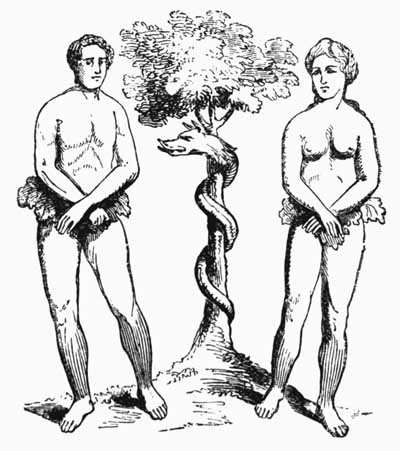
Fig. 62.—The Temptation and Fall.
On a sarcophagus in the Lateran Museum is a bas relief in which Our
Lord, as the representative of the Eternal Father, is seen standing
between Adam and Eve, and giving to the former a sheaf of grain, the
symbol that by the sweat of his brow he should eat bread, and to the
latter a lamb, that she may work diligently with her hands in the
domestic employment of spinning—the allotted labour of woman in every
age. Perhaps, also, as Dr. Northcote suggests, the lamb was a symbol
and mute prophecy of “the Lamb of God whom the second Eve was to bring
forth to atone for all the evil that the first Eve had brought upon
mankind.”
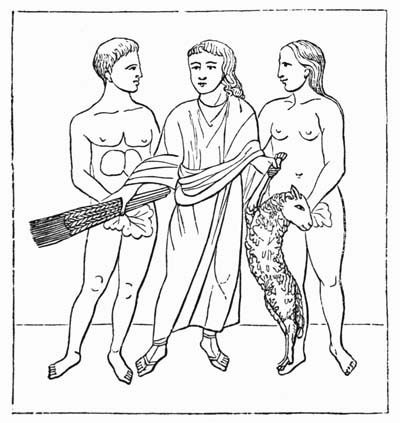
Fig. 63.—Adam and Eve Receiving their Sentence.
On another sarcophagus in the same museum is a bas relief of Cain and
Abel offering their respective sacrifices of the fruits of the ground
and the firstlings of the flock. This subject, however, is exceedingly
rare in the Catacombs.
One of the most frequently recurring figures in this series is that of
Noah in the ark. This is always repeated in one unvarying phase of the
most jejune and meagre character. There is no attempt at historical
representation of the actual scenes of the deluge. Instead of a huge
vessel riding upon the waves, with its vast and varied living freight,
there is only a small pulpit-like enclosure,[481]
in which Noah stands
and receives in his hand the returning dove with the olive branch in
its mouth. The following engraving, which, although apparently out of
perspective, is an accurate copy of a painting in the Catacomb of
Callixtus, is a characteristic example.
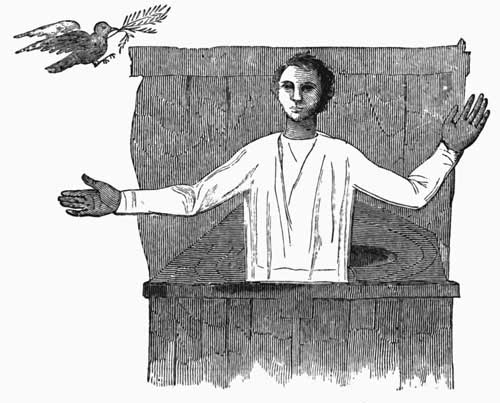
Fig. 64.—Noah in the Ark.
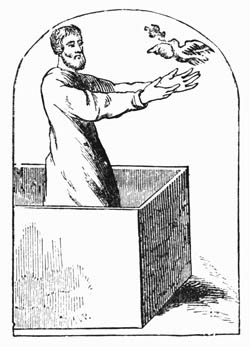
Fig. 65.—Noah in the Ark.
Occasionally the position of the patriarch is slightly altered, as in
Fig. 65, from the Catacomb of St. Priscilla;
but this is all the
variety of treatment of which the artistic genius of the age seemed
capable.
In the bas reliefs the treatment of this subject exhibits a still
greater degree of degradation and constraint, as in the following
examples from Christian sarcophagi of the fourth century.
Sometimes the figure ludicrously resembles the toy called “Jack in a
box,” which resemblance is heightened by the lid being half open and a
lock being carved on the front.
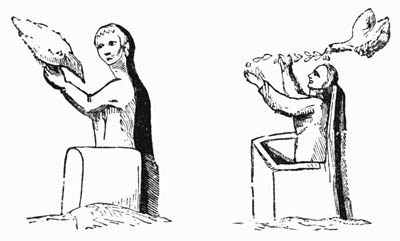
Fig. 66.—Noah in the Ark.
This rude representation, however, was regarded, in accordance with
the exposition of St. Peter,[482]
as a symbol
of Christian baptism;
while the ark was the figure of Christ’s church, in which believers
“may so pass the waves of this troublesome world that finally they may
come to the land of everlasting life.” The dove and olive branch may
further imply, that the weary soul, being justified by faith, found
peace with God and entered into endless rest.[483]
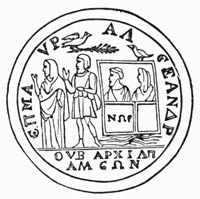
Fig. 67.—Apamean Medal.
Another favourite subject of the early Christian artists was the
sacrifice of Isaac, an appropriate type of the greater sacrifice to be
offered up when, in the fulness of the time, God should provide
himself a lamb for an offering. From this theme the persecuted
Christians doubtless often derived spiritual comfort amid the fiery
trials of their faith to which they were exposed. It taught also the
duty of self-consecration. “May I, like the youthful Isaac,” says
Paulinus, “be offered to God a living sacrifice, and, bearing my wood,
follow my Holy Father beneath the cross.”[484]
This subject is
repeated, with considerable variety of treatment, both in frescoes and
in sculpture. In Fig. 68, from the cemetery of St. Priscilla, Isaac is
seen bearing
the wood for the sacrifice. In Fig. 69, from the Catacomb
of Marcellinus, he is already bound, and Abraham has stretched forth
his hand to slay his son, while the divinely substituted lamb appears
from behind the altar.
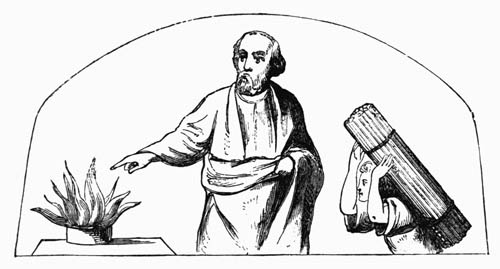
Fig. 68.—The Sacrifice of Isaac.
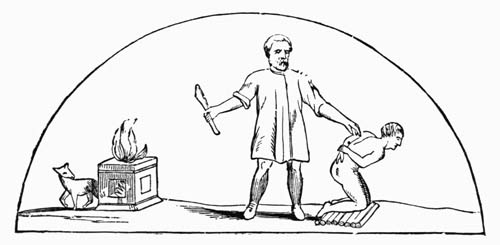
Fig. 69.—The Sacrifice of Isaac.
In several examples a hand stretched forth from on high seizes the
knife to prevent the consummation of the sacrifice. (See Fig. 107.) It
is recorded that Gregory of Nyssa frequently shed tears on reading
this pathetic story.
Joseph, sold by his brethren and afterward saving them alive, was a
striking type of Him who redeemed
with his own blood the guilty race
which caused his death. It is, therefore, a subject that appears with
peculiar propriety among the tombs of the primitive Christians.
Several scenes from the life of Moses are delineated in this biblical
cycle. One of these, as sometimes treated, for classic grace and
dignity reminds one of some noble antique. It is Moses on Mount Horeb
putting off his shoes from his feet. This act is interpreted by some
of the Christian Fathers[485]
as an emblem of the renunciation of the
world, the flesh, and the devil demanded of the servants of Christ.
The accompanying example, Fig. 70, is from the cemetery of Callixtus.
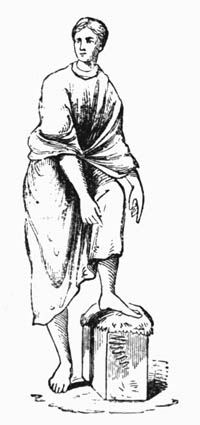
Fig. 70.—Moses on Mount Horeb.
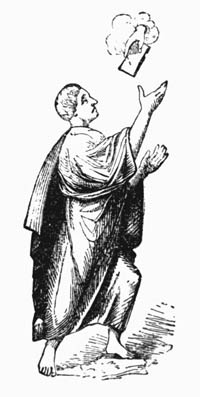
Fig. 71.—Moses Receiving the Law.
Fig. 71, from a sarcophagus in the Lateran, represents Moses on Mount
Sinai receiving from the hand of God the law, which was to be the
schoolmaster to bring
men to Christ. Moses is sometimes exhibited,
also, as breaking the tables of the law on his descent from the mount.
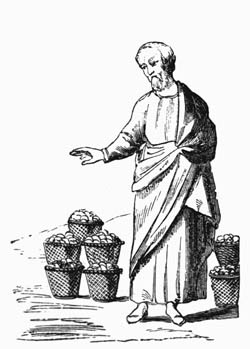
Fig. 72.—Moses and the Baskets of Manna.
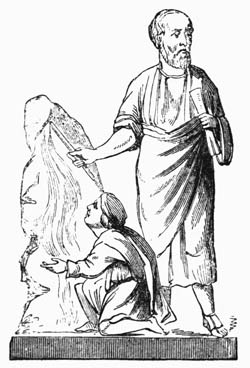
Fig. 73.—Moses Striking the Rock.
In the Catacomb of St. Cyriaca is a unique picture of the descent of
the manna—the emblem of the “True Bread which came down from heaven.”
It is seen falling in a copious shower, and gathered in the vestments
of four Israelites. According to Martigny the accompanying engraving,
Fig. 72, from the Catacomb of St. Priscilla, and another in the
Callixtan Catacomb, represent Moses standing among the baskets of
manna gathered in the wilderness. But for the severe and aged
expression of countenance, so different from the youthful aspect of
Our Lord in the frescoes of the Catacombs, they might be taken for
pictures of Christ and the seven baskets of fragments left after
feeding the multitude.
More frequently recurring than any other scene in the history of Moses
is that of his striking water from the rock, an emblem of the
spiritual blessings flowing to the church through the sufferings of
the Messiah, “For they drank of that spiritual Rock which followed
them; and that Rock was Christ.”[486]
The illustration in Fig. 73 is
taken from a sarcophagus found in the cemetery of St. Agnes. That in
Fig. 74 is from a fresco of earlier date in the Catacomb of
Marcellinus.
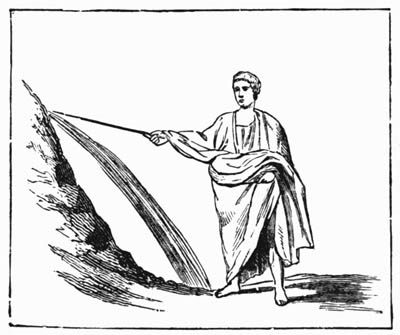
Fig. 74.—Moses Striking the Rock.
In two or three of the gilded glasses to be hereafter mentioned, which
are of comparatively late date, this scene is rudely indicated, and
over the head or at the side of the figure is the word Petrvs
or Peter. From this circumstance Roman Catholic writers have asserted
that in many of the sarcophagal and other representations of this
event it is no longer Moses but Peter, “the leader of the new Israel
of God,” who is striking the rock with the emblem of divine power—a
conclusion for which there is absolutely no evidence except the very
trivial fact above mentioned.[487]
The sufferings of the patriarch Job form the subject of a few of these
scriptural illustrations. In the accompanying illustration, taken from
the cemetery of Marcellinus, he is seen sitting in his sorrow and
bemoaning the day that gave him birth. Amid their fiery trials of
persecution the primitive Christians doubtless often found comfort in
contrasting their sufferings with the still more terrible afflictions
of the patriarch of Uz.
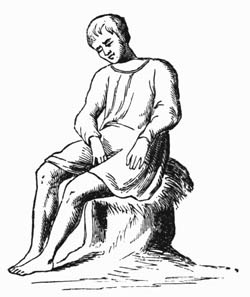
Fig. 75.—The Sufferings of Job.
The sarcophagus of Junius Bassus exhibits a bas relief of Job
comforted by his friends. The complaint of the patriarch that even his
wife had abhorred his breath—so reads the Vulgate translation of
Jerome, which was in use at this period—is grotesquely illustrated
by a female figure, who holds a handkerchief to her nose.[488]
The victory of the stripling David over the great champion of the
enemies of Israel seemed strikingly to prefigure the triumph of
primitive Christianity over the colossal paganism to which it was
opposed. It was also the symbol of the victory of Our Lord over a
mightier foe than the insolent Philistine; and by some of the Fathers
the stones and sling of the Jewish shepherd-lad were likened to the
cross of Christ, by which Satan is vanquished and his kingdom
overthrown. The devout monarch of Israel was also a recognized type of
Him who was the root and the offspring of David, who should inherit
his throne, and reign over the house of Jacob forever.
The translation of Elijah was frequently depicted as being typical of
the ascension of Our Lord, which was regarded as too sacred a theme
for direct presentment in art. The chariot generally resembles the
classic quadriga. In a sarcophagal example in the Lateran
Museum Elisha is represented as reverently receiving the mantle of
Elijah, the emblem of the double measure of his spirit that rested
upon him. In the background two sons of the prophets gaze with
apparent astonishment on the scene. Two bears, which are also
indicated, are probably intended for those that devoured the children
who mocked the prophet Elisha on his way to Bethel.
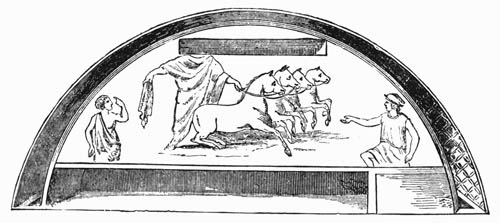
Fig. 76—The Translation of Elijah.
In Fig. 76, from a fresco of earlier date in the Catacomb of
Callixtus, it will be seen that graves have been made in the back of
the arcosolium, cutting off the head of Elijah and the feet of
the two lower figures.
According to the strained mode of interpretation of Roman Catholic
writers on this subject, the gift of the mantle of Elijah to his
successor in office is a type of Christ’s bestowment of authority upon
St. Peter as the “Prince of the Apostles,” and his especial
representative on earth. “It would certainly,” says Dr. Northcote,
“have reminded the Roman Christians of the pallium, the symbol
of jurisdiction worn by the bishops of Rome, and given by them to
metropolitans as from the very body of St. Peter—De Corpore Sancti
Petri.”[489]
A more improbable assumption
it would be difficult to
imagine. Nobler in conception, which, as well as more scriptural, is
the interpretation of this type given by St. Chrysostom: “Elias, in
ascending into heaven, let his mantle fall on Elisha: Jesus, when he,
too, ascended thither, left the gift of his graces to his
disciples—graces which constitute not merely a single prophet, but an
infinite number of Elishas, much greater and more illustrious than
that one.”[490]
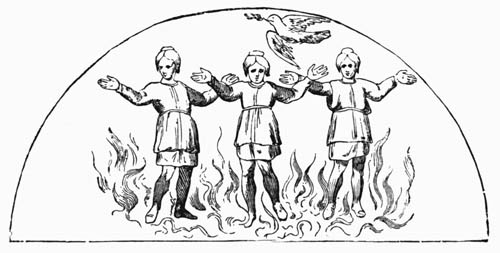
Fig. 77.—The Three Hebrew Children.
The persecuted saints who dared to encounter death and danger in their
most dreadful forms rather than deny their faith, found great
consolation in the remembrance of God’s deliverance of his servants in
the days of old. With the bloodthirsty cry of the ribald plebs of
Rome—Christiani ad leones—still ringing in their ears, and,
it may be, with the roar of the savage beasts of prey crashing on
their shuddering nerves, they were sustained by the thought of the
fidelity of those ancient worthies who, for their integrity to God,
braved the flames of the fiery furnace and the perils of the lions’
den. The three Hebrew children are generally exhibited with the
oriental tiara and tunics. In the foregoing
example from the
cemetery of St. Priscilla, a dove is shown bringing an olive branch,
the pledge of victory and peace.
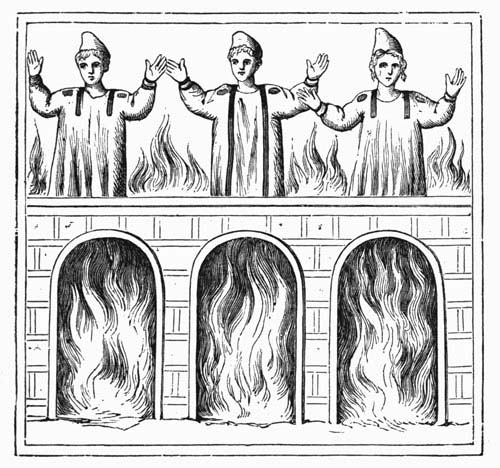
Fig. 78.—The Three Hebrew Children.
In Fig. 78, from the cemetery of Hermes, they are shown as standing in
a “burning fiery furnace,” whose flames, though heated seven times
hotter than their wont, play lambently around them without even
singeing their garments.
In the following example from the Catacomb of St. Agnes the furnace is
reduced to a shallow vessel in which the Hebrews stand unhurt. This
has been incorrectly interpreted as a representation of martyrdom by
boiling in oil. Its association, however, with the figure of Daniel in
the lions’ den, and its general resemblance to other groups of the
same subject, unquestionably
indicate its true character.
Fig. 79.—The Three Hebrew Children.
In all these the expression of countenance and attitude of the
immortal three—more dauntless than even the brave Horatii of classic
story—as they stand calmly amid the flames, indicates the presence
with them in their fiery trial of the Almighty Deliverer of his
saints. It is noteworthy, however, that the fourth figure, “like the
Son of God,” is never shown in these groups. It was reserved, as will
be hereafter seen, for mediæval art to attempt the representation of
the Divine.
The faith and heroism of many of the primitive Christians in refusing
to burn incense on the heathen altars, or to salute the statues of the
Cæsars, was no unworthy imitation of the fidelity of these Hebrew
youths in refusing to worship the great golden image set up on the
plains of Dura.
Daniel in the den is generally represented by a nude figure standing
between two lions, with his hands stretched out as if in supplication,
and thereby, says St. Gregory, conquering the lions by prayer. While,
generally, the type of the deliverance of God’s people, it may
sometimes by association have been a memorial of the Christian martyrs
devoured by wild beasts in the neighbouring Coliseum, whose sands were
so often drenched with their gore. The following fresco from the
Catacomb of St. Priscilla is a characteristic example. See Fig. 80.
Sometimes another figure, interpreted as “the prophet
Habaccuc,” is
depicted as borne by an angel by the hair of the head and offering
food to Daniel, as described in the apocryphal story of Bel and the
Dragon. Another fresco represents Daniel as giving to the monster the
cake which he had prepared for its destruction. The story of Tobias
and the fish, and of Susanna and the elders, are also illustrated in
this remarkable series of paintings. These last are of interest as
indicating a familiar acquaintance with the apocryphal books in the
early centuries. Figures interpreted as Isaiah, who seems, like the
Magi, to come from afar to lay his gifts at the feet of Christ, and as
Ezekiel in the valley of dry bones, also occur in the Catacombs.
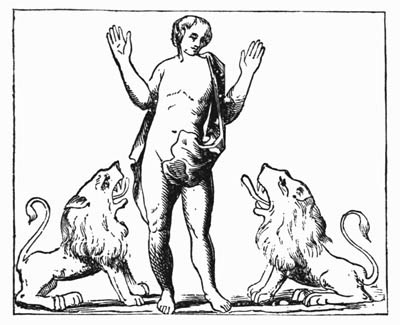
Fig. 80.—Daniel in the Lions’ Den.
One of the most common, and, if we may judge from the style of
execution, one of the favourite subjects of mural and sarcophagal
presentation in this biblical cycle, is the history of Jonah. It is
repeated over and over again with a high degree of picturesqueness,
and with greater variety of treatment than, perhaps, any other. It
appears also on lamps, vases, medals, gilt glasses, and
funeral slabs.
The story is generally represented in a series of four scenes: the
storm, and the monster of the deep swallowing the prophet; his
deliverance from its horrid jaws, and restoration to land; his
reclining under the shadow of the gourd for refreshment and rest; and
his gloom and anger when the gourd has withered away and he lies in
his misery beneath the burning sun. Sometimes the four scenes occupy
the four walls of the cubiculum, or the compartments of a
vaulted ceiling; or only two may be exhibited, as in the engraving on
the opposite page, from the cemetery of St. Priscilla, in which Jonah
is portrayed as a child issuing from the mouth of the sea-monster, and
afterward reclining under the booth.
Sometimes the whole history is compressed into one crowded scene, as
in the following example. (Fig. 81.) The character of the little bark is much like that seen in pagan
frescoes.
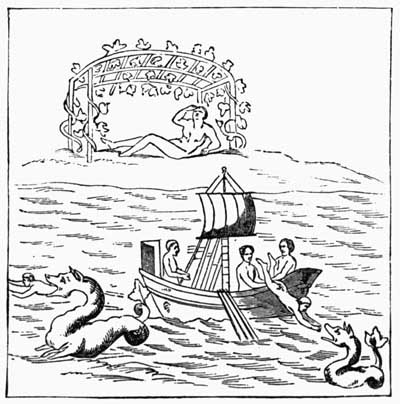
Fig. 81.—The History of Jonah.
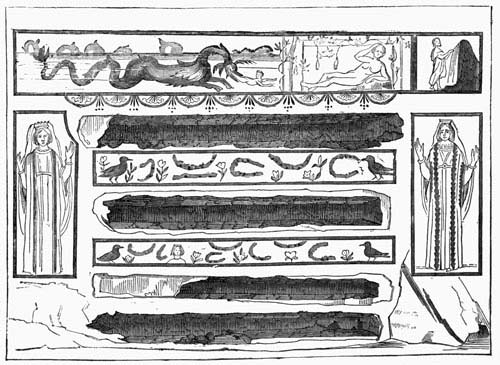
Fig. 82.—Jonah, Moses, and Oranti.
In some instances the “ship” is reduced to a mere boat, and the
“mariners” to a single individual, as in Fig. 83, from the cemetery of
St. Priscilla.
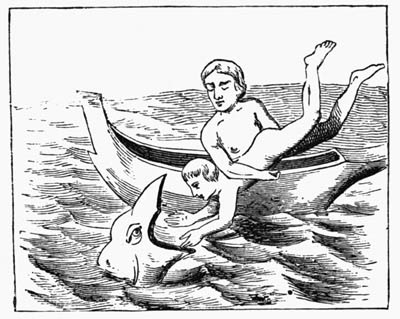
Fig. 83.—Jonah Swallowed by the “Great Fish.”
In the following sarcophagal example, (Fig. 84,) the somewhat
startling anachronism of Noah receiving the dove from the prow of
Jonah’s vessel appears in the background. The “sea” is here a narrow
stream; and the “fish,” a monster with the head and paws of a
quadruped, on one side of the boat is swallowing the disobedient
prophet, and on the other is casting him forth upon the rocky shores.
Such solecisms are by no means uncommon in these groups.
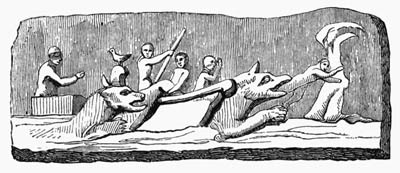
Fig. 84.—Noah and Jonah.
On another sarcophagus in the Lateran Museum the influence of pagan
thought may be observed. The storm is personified by a triton blowing
through a convoluted shell, and Iris, hovering with floating scarf
above the vessel, indicates the calm which followed the casting out of
the prophet.
The “great fish” in these scenes bears no resemblance to any living
thing. It is generally a monster with contorted body, a long neck and
large head, sometimes armed with horns, (see Figs. 81, 82,) probably
to distinguish it from the symbolical fish, the emblem of Our Lord, or
as a type of “the old serpent, the devil.” The form may have been
derived from the mythological representations of the marine monster
from whose jaws Andromeda was rescued by Perseus. The latter story,
like that of Deucalion and many others in the Greek mythology,
probably had its origin in holy scripture.
This subject was naturally dear to the early Christians, inasmuch as
it was set forth by Our Lord himself as a type of his own resurrection
and that of his disciples. Therefore as the persecuted believers met
in those solemn and silent chambers of the dead, they inscribed on the
sepulchral slabs which hid the mouldering dust of the departed from
their view, or on the walls of the cubicula in which they
worshipped, this symbol of faith and hope in the glorious
resurrection. It also conveyed a lesson of sublimest meaning to the
primitive Christians, called to be witnesses for God in a city greater
and more wicked and idolatrous than even Nineveh. It was a potent
incentive to fidelity even unto death. The
storm-tossed bark, the
ravening monster, and the prophet’s booth and gourd, were the types of
life’s rough voyage, the yawning grave, and the speedy transit to the
bowers of everlasting bliss and the refreshing fruits of the tree of
life.
A long and acrimonious controversy was waged between Jerome and
Augustine as to the nature of the plant which overshadowed the
prophet. Jerome called it ivy; but Augustine retained the word gourd
of the older Italic version, and excluded from his diocese of Hippo
the Vulgate version of Jerome containing the obnoxious translation. It
is a curious commentary on an ancient dispute in the church, and a
proof of the antiquity of the Catacombs, that their frescoes seem to
have followed the older version, and to have given their testimony
against the innovation of Jerome. See Fig. 85, a copy of a
broken sepulchral slab, in which the prophet’s booth is reduced to a
single branch of a gourd.
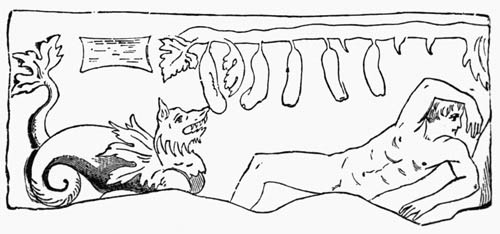
Fig. 85.—Jonah’s Gourd.
Here ends this Old Testament cycle, so rich in holy teaching, all
whose types and symbols point to the great Antitype of whom Moses and
the prophets spake. The New Testament series will in like manner be
found to
cluster around the person and work of the Redeemer; to the
exclusion, however, of the solemn scenes of the transfiguration, the
passion, resurrection, and ascension, which are the principal themes
of later religious art; and without the slightest indication of that
idolatrous veneration of Mary which is the chief feature of modern
Romanism, thus showing how far that church has departed from the usage
of apostolic times.
The first subject of this New Testament cycle is the manifestation of
Our Lord to the Magi by the star in the east, the sign that the Bright
and Morning Star had risen upon the world.[491]
Over twenty
repetitions of this scene are found in the Catacombs.
The following sarcophagal example, from the Catacomb of Callixtus,
represents the Magi bearing their gifts, and led by the star to the
place where the young child lay. The babe is seen wrapped in
swaddling-clothes and lying in a manger. An ox and an ass stand near
the divine child, probably in fanciful allusion to that scripture,
“The ox knoweth his owner, and the ass his master’s crib;” as well as
in historical illustration of the scene. Joseph and Mary appear in the
background as mere accessories of the group.
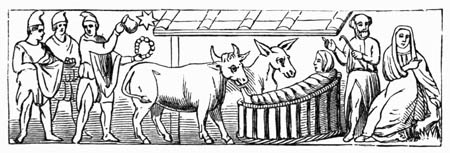
Fig. 86.—The Adoration of the Magi.
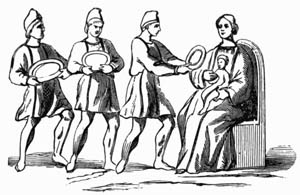
Fig. 87.—Adoration of the Magi.
In the accompanying engraving of a fresco in the cemetery of St.
Marcellinus the virgin mother is represented as seated in the calm
attitude and dress of a Roman matron, holding the infant Christ in her
arms, but not in the least suggesting the modern Madonna.[492]
The
Magi bring their offerings as the first-fruits of the homage of the
world. Sometimes the number is increased to four or reduced to two, in
which case they are arranged on either side of the Virgin, to preserve
the balance and symmetry of the picture.[493]
The figure of Joseph
sometimes completes the group, but generally
as a young and beardless
man, in contradiction to the Romish tradition of his old age, derived
from the apocryphal gospels. These legends supply the theme of much of
the religious art of the fifth and following centuries; but Dr.
Northcote admits that “before that time Christian artists seem
strictly to have been kept within the limits of the canonical books of
the holy scripture.”[494]
A fresco in the Catacomb of Nereus and Achilles, attributed to the
second century, is supposed to be the oldest extant art-presentation
of the Virgin Mary. In these early pictures she is generally exhibited
as veiled,
and expressing dignity and modesty in her attitude and
dress, and only in her historical relation to the divine child. Not
till later does she appear alone, or even as the principal figure. Dr.
Northcote, indeed, cites one example apparently of Joseph,[495]
Mary,
and the infant Jesus, concerning which he says that the Virgin does
not enter into the composition as a secondary personage, but herself
supplies the motive to the whole painting.[496]
In the engraving which
he gives, this indeed appears to be the case; but in the original, and
in the copy given by De Rossi,[497]
which shows the entire painting,
the figure of the Virgin is only a very small and subordinate portion
of an elaborate decorative design, and its position is not upright, as
if it were the principal object, but horizontal, as being only
accessory to the main grouping. All these early presentations of the
Virgin Mary, says Mr. Marriott,[498]
occur only in such connexion as
is directly suggested by holy scripture, and none of them would appear
out of place in an illustrated English Bible, so different are they
from the Madonnas of Roman Catholic art.
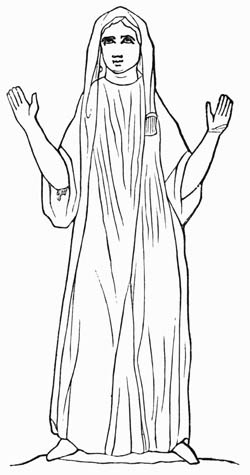
Fig. 88.—Orante.
There are numerous frescoes in the Catacombs of persons, both male and
female, in the attitude of prayer, hence called Oranti, (see
Fig. 82,) and the accompanying simpler example from the cemetery of
Sts. Peter and Marcellinus. These are frequently found on sepulchral
slabs, the sex and apparent age of the Orante always
corresponding with that of the person named in the inscription. They
are generally regarded, therefore,
as portraits of the departed, and
as probably indicating that they lived a life of prayer, and died in
the faith. Thus the oranti, in Fig. 82, are thought by Perret to
be intended for Priscilla, in whose cemetery it is found, and her
companion.[499]
It is at least most likely that they represented the
deceased and not another, in the same manner as modern sepulchral
effigies, and as the pictures of fossors, vine-dressers, and
handicraftsmen in the Catacombs. Dr. Northcote at one time admitted
this explanation of these figures. “We can scarcely err,” he says, “in
supposing them to be the persons, whoever they were, who were buried
in these chambers.”[500]
But in his later work on the Catacombs he
says, “Possibly this conjecture may sometimes be correct, but in the
majority of instances we feel certain that it is inadmissible;”[501]
and he claims them as representations of the Virgin Mary, or as
symbols of the Church, the Bride of Christ, whose life on earth is a
life of prayer. This is manifestly the intention, he asserts, when, as
is frequently the case, the figure is found as a companion to that of
the Good Shepherd; and he gives an engraving from Bosio of one such,
which is catalogued as the “Good Shepherd and the Blessed
Virgin.”[502]
But in referring to Bosio this figure is found to be not
the Virgin Mary at all, but a Christian martyr, as is indicated by the
attribute of a plumbata, or leaden scourge, painted beside her,
which is omitted in Dr. Northcote’s engraving, (inadvertently, as he
explains;) and she is designated by Bosio, Una Donna Orante—a
woman in the act of prayer. And this figure is the only one out of all
figured by Bosio and Aringhi which at all agrees with Dr. Northcote’s
description. The others when associated with the Good Shepherd are
either in groups of two or more, or are mixed with male oranti,
the existence of which Dr. Northcote seems to ignore.
But even if the Virgin Mary were referred to in these paintings it
would prove nothing in favour of modern Mariolatry. Indeed, nothing
could be more striking than the contrast between these simple praying
figures, undistinguished by any attribute from others of the pious
dead, and the crowned Queen of Heaven receiving the homage of mankind,
of later Roman Catholic art. But that they are such is an entirely
gratuitous and unwarranted assumption; and with equal propriety, or
rather lack of it, they have been interpreted by the monkish ciceroni
of the Catacombs as symbols of martyrdom, as portraits of living
persons praying to the dead, and as saints in heaven praying for men
on earth.[503]
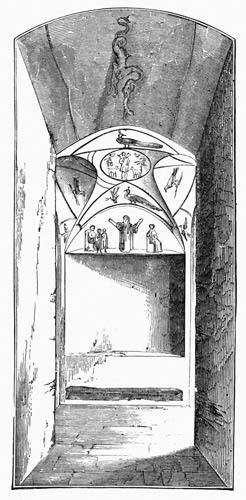
Fig. 89.—Supposed Madonna.
In the gilded glasses, to be hereafter described, which belong to a
period of very degraded art, probably from the fourth to the sixth
century, representations of the Virgin mother sometimes occur,
recognized by her name written above her head after the Byzantine
manner. She appears either alone, or between figures of the apostles
Peter and Paul. This honour, however, is shared by other female
saints, especially by Saint Agnes. In one example Mary wears a nimbus,
a proof of comparatively late date.
One fresco in the Catacomb of Sts. Thraso and Saturninus has been
supposed to have some reference to the Virgin Mary. It is figured in
the lunette of the vault in the accompanying engraving. (Fig.
89.)[504]
It is interpreted,
however, by Bottari, a distinguished
Romanist antiquary, as not a painting of the Madonna at all, but
simply of a family group.
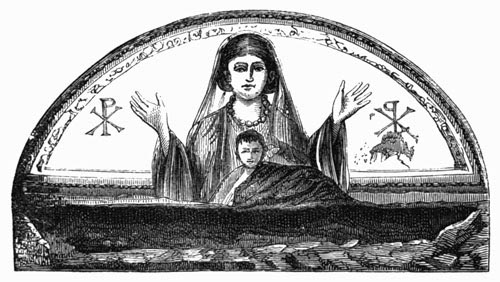
Fig. 90.—The Earliest Madonna.
The first art-presentation of the Virgin Mary bearing any resemblance
to the conventional Madonna, which has been so endlessly reproduced
and so idolatrously honoured throughout Roman Catholic Christendom, is
one in an arcosolium in the Catacomb of St. Agnes. (See Fig.
90.) The head of the Virgin is veiled, a necklace of pearls adorns her
person, and her hands are extended in prayer. The infant Christ is not
seated, but standing before her, as is common in a favourite type of
the Greek church, especially in Russia—an indication that this was
probably painted by a Byzantine artist, as was most of the later work
at Rome. But even in this picture the early Christians, unprescient of
the Mariolatry of the future, would see the expression only of a
loving regard for her who
was pronounced the “blessed among women.”
The sacred monogram on either side assigns a date not earlier than the
fourth century to this painting; and Martigny, an eminent Romanist
authority, thinks it is later than the Council of Ephesus, in the
fifth century,—A. D. 431.
By this time a sad departure from primitive orthodoxy of belief had
already taken place. The blasphemous title Theotokos, Mother of God,
since so unhappily familiar,[505]
had been applied to the Virgin Mary,
at first in protest against the Arian heresy which denied the divinity
of Our Lord, and not in exaltation of his virgin mother. Nestorius
strongly objected to the unwarranted and antiscriptural title, and
suggested that of the mother of Christ. An angry controversy resulted,
to appease which Theodosius the younger assembled the Council of
Ephesus. Nestorius was judged without being heard, degraded from the
episcopal dignity, and sent into exile; and the obnoxious epithet was
confirmed through the exercise of fraud and violence. Flavianus, a
member of the Council, actually died of wounds received in that
turbulent assembly; and amid these disgraceful scenes was first
formulated this dogma, which has been fraught with such perilous
consequences to both Greek and Latin Christianity.
The artistic embodiment of this doctrine underwent a rapid decline.
The sweet and tender grace of the virgin mother disappears, the modest
veil gives place to a crown, she becomes vulgarized in expression,
jewels bedizen her person, the attitude becomes stiff and lifeless,
the countenance darkens and assumes an expression
of pain rather than
that of gentleness and peace, and the innocent smile of the Divine
Infant gives place to an unnatural severity and gloom. The beginning
of this decline is seen in the Madonna already described, (Fig. 90),
in which the person of Mary is adorned with a showy necklace of
jewels. This type passes by rapid gradations, during the gathering
gloom of the dark ages, into the anguished pictures of the Mater
Dolorosa, bowed down with sevenfold sorrows, and the gross images
of Our Lady of the Bleeding Heart, her bosom transpierced with a naked
sword.[506]
But even in this is seen the striking moral contrast
between the spirit of Christian and that of pagan art. The loftiest
ideal of the latter is the expression of mere corporeal beauty, while
the former exhibits the noblest type of purity, sorrow, and love the
world has ever seen. With the Renaissance this ideal became the
inspiration of art, and gave birth to those triumphs of genius which
kindle admiration in the coldest nature, and invest with a spell of
pathos and power a dogma which the judgment rejects.
The silence of the primitive Fathers concerning the worship of Mary is
a striking evidence of its non-existence, and their language when they
do speak of her still more strongly demonstrates that fact. Tertullian
seems to infer her lack of faith in the mission of Our Lord, and
compares her unfavourably with Martha and Mary.[507]
Prudentius
refuses to ascribe to her absolute
sinlessness.[508]
Augustine asserts
the natural depravity of her flesh.[509]
Chrysostom boldly accuses her
of ambition and thoughtlessness,[510]
and says, “She shall have no
benefit from being the mother of Christ unless in all things she doeth
what is right.”[511]
Cyril of Alexandria, Basil of Cæsarea, and Hilary
of Poitiers, speak in similar unequivocal terms, which Petavius, the
Roman theologian, says are not fit to be uttered.[512]
The Collyridian
heretics, indeed, rendered idolatrous homage to Mary;[513]
but
Epiphanius vehemently denounces the practice as blasphemous and
dangerous to the soul. “Let Mary be held in honour,” he says, “but let
her not be worshipped.”[514]
Irenæus first points out the fanciful
antithesis between Mary and Eve, which was afterward so remarkably
elaborated in Roman thought and diction.[515]
Ephraem Syrus and
Gregory Nazianzen, indeed, speak of her invocation in prayer, but this
was an honour already bestowed on numerous other saints. The heathen
writers, moreover, who accused the Christians of worshipping a mere
man, as they considered Christ, would surely have brought a similar
accusation on account of the worship of Mary if it were known; but we
nowhere find that this was done. Indeed, it is probable that the
contumely and opprobrium with which the heathen spoke of the mother of
Our Lord may have intensified into superstitious veneration the loving
reverence with which she was regarded in the primitive ages.
Tertullian quotes the blasphemous pagan epithet, “the harlot’s son,”
applied to Christ in allusion to his miraculous birth.[516]
It has
been reserved for a gifted modern poet, as pagan and skeptical in
sentiment as Lucretius, to parallel, or even surpass, this revolting
impiety.[517]
The testimony of the early Christian inscriptions is not less
strikingly opposed to the modern Mariolatry of the church of Rome. “In
the Lapidarian Gallery,” says Maitland, “the name of the Virgin Mary
does not once occur. Nor is it to be found in any truly ancient
inscription contained in the works of Aringhi, Boldetti, or
Bottari.”[518]
No Ave Maria or Ora pro nobis, no
Theotokos or Mater Dei, occurs in any of the
subterranean crypts or corridors of the Catacombs. Even the name
Maria, now so commonly applied in varying forms
to both males and
females throughout Roman Catholic countries, does not occur till the
year 381, and only twice afterward, in 536 and 538—an evidence of the
entire absence of that devotional regard now lavished upon the Virgin
Mary.[519]
This religious homage was only gradually developed to its present
full-blown idolatry. Its traces in early Christian art are extremely
infrequent and obscure. In the numerous mosaics of the fifth and sixth
century at Rome and Ravenna, the figure of Mary very rarely occurs,
and never but as accessory to the Divine Child in the Nativity or
Adoration of the Magi. In these there was no attempt at literal
portraiture, but only the expression of the virtues that adorned her
character; “that,” as Ambrose expresses it, “the face might be the
image of her mind, the model of uprightness.”[520]
Indeed, Augustine
expressly asserts that we are ignorant of her appearance.[521]
During the seventh century, along with a progressive barbarism of
treatment may be observed a gradual exaltation of Mary in the Roman
mosaics to those places previously devoted to the image of
Christ.[522]
In the eighth
century, according to D’Agincourt, “the
homage paid to her was no longer distinguished from that rendered to
the Lord of all;”[523]
and the Council of Constantinople decreed,
“that whoever would not avail himself of the intercession of Mary
should be accursed.”[524]
In extant pictures of the ninth century she
is exhibited in bejewelled purple robes as the crowned Queen of
Heaven, receiving the homage of the four and twenty elders and of the
celestial hosts.[525]
In this century also the legend of her bodily
assumption to the skies, which has since become such a prominent theme
in Roman Catholic art and doctrine, is first represented in the crypts
of St. Clement’s at Rome.[526]
In the twelfth and thirteenth centuries the apotheosis of Mary is
complete. In a fresco at Rome, of date 1154 A. D., Popes Callixtus II.
and Anastasius IV. are shown embracing her feet in adoration, and
transferring to the human mother the homage due alone to the Divine
Son. She is now worshipped co-ordinately with Christ, or, indeed,
almost to his exclusion, her name being substituted for his in many of
the collects of the church. Much of the language of Scripture was also
blasphemously perverted from its proper application to her. The
glowing images of the Song of Songs, addressed to the church as the
spouse of Christ, were also applied to Mary as her right; and one of
Rome’s most common and popular books of devotion of this period, the
psalter of her “Seraphic Doctor,” St. Bonaventura, has a shocking
parody on the book of Psalms, in which the name of God was every-where
expunged and that of Mary substituted instead.[527]
The Ave
Maria, with its human additions, was regarded as of equal
importance and value with the Lord’s Prayer, and was made the basis of
the vain repetitions of the rosary. Mary now shares the government of
heaven and earth, “raised higher than cherubim and seraphim,”[528]
throned in glory, sitting on a rainbow, enveloped in an aureole,
clothed with the sun, the moon beneath her feet, a crown of stars upon
her head,[529]
and radiating from her person beams of light,
the
proper attribute of deity.[530]
She is frequently represented, even in
heaven, with the infant Christ in her arms, a mere accessory to
indicate her personality, as if to show his relative inferiority.[531]
She becomes, too, herself the object of prayer, having a special
litany and numerous offices in the liturgy of the church; while her
praises are chanted in some of its noblest lyrics. She is addressed as
the gate of heaven,[532]
the morning star,[533]
and the refuge of
sinners;[534]
and is exhorted to succor the wretched,[535]
protect
from enemies, receive in the hour of death,[536]
and intercede with
God for men.[537]
She is endowed with the faculty of omniscience and
ubiquity, and is made almost to thrust the Eternal from his throne by
her usurpation of his divine prerogatives.[538]
But this impious blasphemy seems to have culminated in the Italian
frescoes of the fifteenth century, in which the infamous Giulia
Farnese is exhibited in the character of the Madonna, and Pope
Alexander VI., the execrable Borgia, kneeling as a votary at her feet.
The Florentine churches, too, were desecrated by
portraits of
well-known harlots, flaunting their meretricious beauty as the
personations of the mother of Our Lord. For his denunciation of these
profanations and of other impieties Savonarola perished at the
stake.[539]
The rapid development of Mariolatry, the great corruption of
Christianity, as Hallam has justly called it, may to some extent be
regarded as a reaction against the harsh and austere character which
was given to Our Lord both in art and dogma. He was enthroned in awful
majesty as the dreadful Judge of mankind. Removed from human sympathy,
inspiring only terror to the soul, he was no longer Christ the
Consoler, but Christ the Avenger.[540]
Religion was darkened by dismal
bodings of endless doom, and embittered by the fierceness of polemic
strife; and the moral atmosphere seemed lurid with the hurtling
anathemas of rival sects. To the yearning hearts of mankind; to the
multitude of the weary and the heavy laden, to whom the Saviour’s
voice, “Come unto me, and I will give you
rest,” was inaudible amid
the conflicts of the times; and especially to those bowed down with a
sense of sin and sorrow, and trembling at the thought of the severe,
inexorable Judge, the gentle gospel of Mary came with a sweet and
winning grace that found its way into their inmost souls. All images
of tenderness and ruth surrounded her. The blending
Of mother’s love with maiden purity[541]
touched the hidden springs of feeling which exist in the rudest
natures, and made the worship of Mary a religion of hope and
consolation. She became the new Mediatrix between the sinful human
soul and the Father in heaven. Those who shrank from God fled for
succour to the virgin mother. The pitifulness of her human nature was
esteemed a stronger ground of confidence than that infinite compassion
and everlasting love which was manifested in the agony and bloody
sweat of Gethsemane and the cross and passion of Calvary. Hence Mary
has often been regarded as a sort of tutelar divinity by the ferocious
brigand who stained with blood the scapular which he wore as a sacred
talisman; and by the daughter of shame who, in strange blending
profligacy and devotion, cherished her image in the very lair of vice.
But, as there is a soul of goodness in things evil, so even the
antiscriptural perversions of Mariolatry were not without some moral
benefit to mankind. In a coarse, rude age a new ideal of excellence
was developed. A morose asceticism was spreading on every side,
denouncing the sweet and gentle charities of hearth and home, and
forbidding the love of wife and
child to those who would attain to
the heights of holiness. Woman was degraded as a being of inferior
nature, regarded as “a necessary evil,” and forbidden, as unworthy, to
touch with her hand the sacred emblems of the passion of Christ. But
this cultus of Mary raised woman to a loftier plane of being, invested
her with a moral dignity and power infinitely superior to any thing
known to pagan times, and called forth a deeper reverence and more
chivalrous regard.
This example of all womanhood,
So mild, so merciful, so strong, so good,
So patient, peaceful, loyal, loving, pure,[542]
ennobled and dignified the entire sex, and therefore raised and
purified the whole of society. The worship of sorrow softened savage
natures to more human gentleness, and ameliorated the horrors of long
dark centuries of cruelty and blood.
We have dwelt thus long on this development of Romanism on account of
the remarkable prominence and enhanced dignity it has received by the
bull of the Immaculate Conception, issued on the individual authority
of the present pontiff,[543]
and by the decree of his personal
infallibility imposed on all Roman Catholic Christendom. We have seen
how alien it is to the entire spirit and teachings, both in art and
literature, of the primitive church, and have traced its growth with
the decline of Christianity, like a fungus on a dying tree, till it
has sapped its very life, and concealed its early beauty and strength
beneath deformity and decay.
The other groups of the New Testament cycle are chiefly scenes in the
life of Our Lord, together with representations of some of his
principal miracles and two or three illustrations of the parables.
This series, it must be confessed, is of exceedingly meagre character
and limited range, being remarkable as much for what it omits as for
what it contains. Out of the vast number of subjects which have been
treated in later religious art, a comparatively few have been
selected, which are over and over repeated with unvarying iteration of
type.
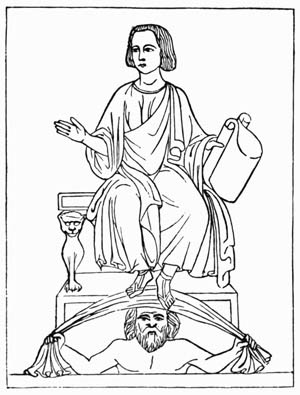
Fig. 91.—Christ with the Doctors.
The accompanying bas relief, from the sarcophagus of Junius Bassus,
(A. D. 359,) is probably intended for Christ “sitting in the midst of
the doctors, both hearing them and asking them questions.”[544]
He is
here shown seated on a curule chair, wearing a Roman toga, and holding
a half open scroll in his hand. His feet rest on a scarf held by an
allegorical figure, probably a personification of the earth—a
conception borrowed from Pagan art.
Frescoes of the baptism of Our Lord occasionally occur;[545]
but the
scenes of the temptation, the subject of
such grotesque treatment in
mediæval art, nowhere appear in the Catacombs.
On a sarcophagus in the Lateran Museum is an illustration of Our
Lord’s first miracle at Cana of Galilee, in which he is touching the
water-pots with his rod of power and turning the water into wine.
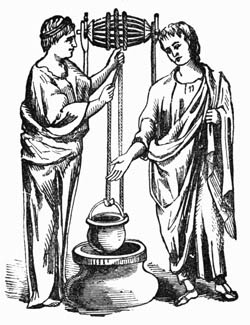
Fig. 92.—Christ and the Woman of Samaria.
Christ talking with the woman of Samaria at the well of Sychar is a
subject that is frequently repeated in fresco and relief. In the
accompanying example from a sarcophagus in the Lateran, a windlass of
primitive construction, like those still common in the Campagna, is
shown.
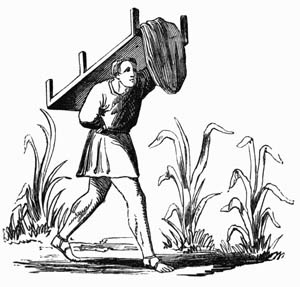
Fig. 93.—The Healing of the Paralytic.
The healing of the paralytic has been regarded as a type of the
restoration of the soul paralyzed by sin. Ingenious Romanists have
discovered herein a symbol of
“the Sacrament of Penance,” and also
of “Baptism and the Remission of Sins.” In the frescoes of the
Catacombs the man is represented in the act of obeying the command,
“Take up thy bed and walk.” Sometimes the bed is a mere reticulated
frame-work. It is also shown as in the foregoing example from the
Catacomb of Callixtus. See Fig. 93.
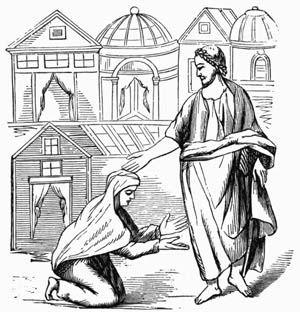
Fig. 94.—Christ Healing the Woman with the Issue of
Blood.
Our Lord healing the infirmity of the woman with the issue of blood,
who drew nigh and touched the hem of his garment, is a frequent
subject of both sarcophagal and mural presentation. In the
accompanying example from a bas relief of the fourth century the
Saviour is apparently uttering the words, “Daughter, be of good
comfort, thy faith hath made thee whole.” In the background is seen,
in confused perspective, a Christian basilica of the period, with its
semicircular absis and detached baptistery. The doors are hung
with heavy curtains to exclude the noontide heat, as is still common
in Italian churches.[546]
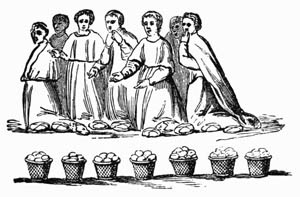
Fig. 95.—The Miracle of the Loaves and Fishes.
The miracle of the multiplication of the loaves and fishes is a theme
of frequent treatment in early Christian painting and sculpture, and
was regarded in the writings of the Fathers as a eucharistic type of
Him who, as the true Bread from heaven, gave his body to be broken for
the life of the world. Sometimes, as on a sarcophagus in the Lateran,
Our Lord stands between two disciples blessing with either hand the
food which they hold. Occasionally, as in the foregoing fresco from
the cemetery of St. Priscilla, the scene is represented by a group of
disciples kneeling on the ground as if they had just received the food
so marvellously multiplied. At their feet are seen the loaves and
fishes, and in the foreground stand the seven baskets full of
fragments that remained.
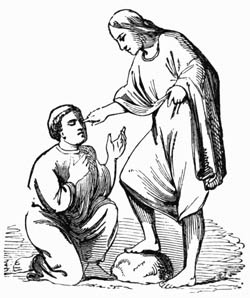
Fig. 96.—Christ Opening the Eyes of the Blind.
The miracle of opening the eyes of the blind, which was at once a
fulfillment of the ancient prophecies concerning the Messiah and a
type of that moral illumination which he should impart, appropriately
found a place on the tombs of those who had been called from darkness
into God’s marvellous light. The preceding example is from the
Catacomb of Callixtus.
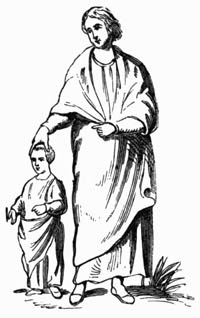
Figure 97.—Our Lord blessing a little Child.
Our Lord laying his hand in blessing on the head of a little child, or
probably teaching humility and rebuking the ambition of his disciples
by setting a child in their midst, is a frequently recurring subject
in this primitive cycle. It was a lesson which the early Christians of
Rome had often to learn: that he that would be greatest among them
must be the servant of all; that exaltation of office was only
pre-eminence of danger and of toil. The example above given is from
the Catacomb of Callixtus.
A bas relief in the Kircherian Museum, of the parable of the sower and
the seed, appropriately symbolized the sowing in the furrows of
society of the good seed of the kingdom, from which should spring a
harvest of righteousness. The frequent representations of fishing
scenes may refer to the occupation of several of the first disciples
of Our Lord, or to their spiritual vocation as fishers of men. In
these, however, Roman Catholic writers have fancied an allusion to the
sacrament of baptism. We have already seen in the ever-recurring
figure of the Good Shepherd an illustration of the beautiful parable
of the lost sheep, and a most appropriate symbol of the Shepherd and
Bishop of all souls. In the Catacomb of St. Agnes is a fresco of the
five wise virgins of the parable going forth to meet the bridegroom,
and it is so designated by Bosio.[547]
Each of the virgins bears in
her hand the vessel of oil to replenish her lamp; the foremost holds a
torch or candle of wax, anciently much used in Roman marriage
processions,[548]
as it still is; while the others bear branches of
palm in token of festivity. A distinguished Roman theologian has,
however, with perverted ingenuity, discovered in the vessels of oil
the modern ecclesiastical situlæ, or holy-water vases, and in
the radiant torch of the foremost figure the tufted aspergillum with
which the holy water is sprinkled.[549]
The story of Lazarus, as we may easily conceive, was an especial
favourite of the early Christian artists. It spoke to the deepest
feelings, and inspired the loftiest hopes of the primitive believers.
Rescued from the darkness and despair of paganism as to the future
state of the soul, they grasped with intensest fervour the glorious
doctrine of its immortal existence and of the resurrection of the
body. Amid the gloom of the Catacombs, and surrounded by the silent
congregation of the dead, they heard with joy the thrilling words, “I
am the Resurrection and the Life,” and laid their loved ones to their
rest, not with everlasting farewells and passionate complainings at
the gods, but exulting in the hope of a blessed immortality. Therefore
they engraved on the funeral slab, or painted on the tomb, this record
of Christ’s triumph over death, as a symbol of that hope which kept
their hearts strong in life’s trial hour.
These representations are
of every degree of artistic merit, from the rudely scratched and
scarcely intelligible outline, to the elaborately sculptured bas
relief on the costly sarcophagus. Of the former the annexed is perhaps
the simplest example to be found. It is of date A. D. 400.
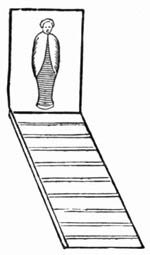
Fig. 98.—Lazarus.
Lazarus is generally exhibited as a mummy-like figure, “bound hand and
foot with grave-clothes,” standing in a temple-shaped tomb or
ædicula, like those which line the Appian Way. This figure Our
Lord, the Prince of Life, is touching with the rod of his power, as
shown in the accompanying fresco from the Catacomb of Sts. Peter and
Marcellinus.
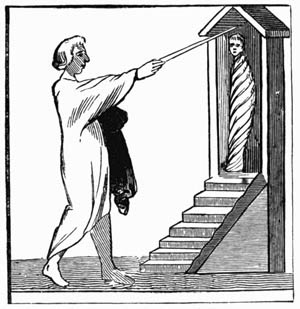
Fig. 99.—The Raising of Lazarus.
The figure of Mary, frequently of very diminutive size, setting all
proportion at defiance, is often depicted as crouching at the feet of
Jesus, and sometimes as kissing his hand in gratitude for restoring
her brother to life. Sometimes, also, Martha is seen standing by the
tomb, and the disciples standing around Jesus. The following
engraving, from a sarcophagus in the Lateran, is a characteristic
example of the ordinary type.
A much less frequent subject of art-presentation
was Mary Magdalene
holding in her hands the “alabaster box of very precious ointment,”
wherewith she anointed Our Lord.
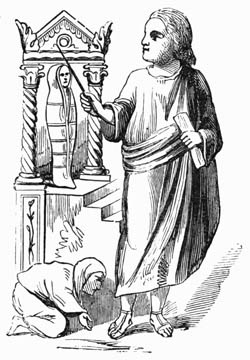
Fig. 100.—Raising of Lazarus.[550]
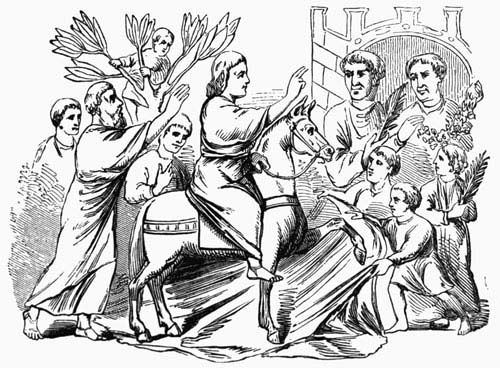
Fig. 101.—Christ’s Triumphal Entry into Jerusalem.
Christ’s triumphant entry into Jerusalem, the presage and symbol of
his final victory in the world and entrance as the King of Glory into
the New Jerusalem on high, occurs with great frequency and
considerable variety of treatment. Although dissociated from this
scene in the gospel narrative, Zacchæus is almost invariably connected
therewith in this primitive art, and generally
appears mounted in a
a tree gazing at the procession. At times the scene is reduced to its
simplest elements; at others, as in Fig. 101, from a sarcophagus in
the Lateran, it is more elaborately treated, exhibiting the multitudes
spreading their garments, and strewing branches of palm before the
meek conqueror.
Peter’s denial of his Master is a theme that is frequently repeated.
The cock, whose crowing awoke the disciple’s late remorse, without
which it would sometimes be impossible to discriminate the scene, is
generally shown, as in the following sarcophagal example from the
Lateran Museum.
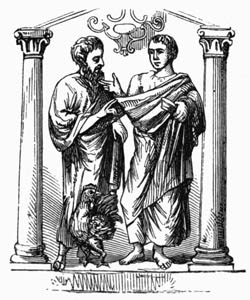
Fig. 102.—Peter’s Denial of Christ.
As we have already remarked, the tragic scenes of the passion of Our
Lord find no place in this primitive cycle. These were felt to be
subjects for devout meditation rather than for pictorial treatment.
The early Christians preferred to contemplate Christ rather as the
victor over death and hell, than as the victim of suffering and shame.
“The agony, the crown of thorns, the nails, the spear,” says a
distinguished critic of this primitive art,[551]
“seem all forgotten
in the fullness of joy brought by his resurrection. This is the theme,
Christ’s resurrection, and that of the church in his person, on which,
in their peculiar language, the artists of the Catacombs seem never
weary of expatiating; death swallowed
up in victory, and the victor
crowned with the amaranth wreath of immortality, is a vision ever
before their eyes, with a vividness of anticipation which we, who have
been born to this belief, can but feebly realize.”
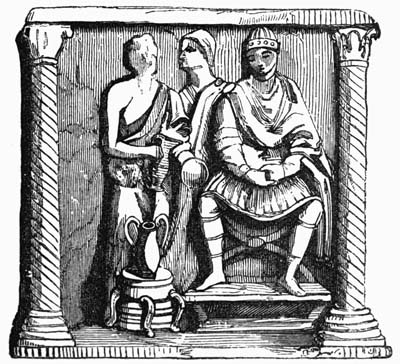
Fig. 103.—Pilate on the Judgment Seat Washing his
Hands.
The only scenes connected with the passion, besides that of the
denial, already given, are those which occurred in the judgment-hall
of Pilate, and a unique example of Simon bearing the cross. One scene
in particular seems to have been selected rather as a testimony of
Christ’s innocence than of his sufferings. It is that in which Pilate
declares, “I have found no fault in this man;” and calling for water
washes his hands, as if to blot out the damning guilt of that judicial
murder. In the accompanying engraving, from a mutilated bas-relief in
the Lateran Museum, this scene is exhibited. In the original the face
of the irresolute
governor seems to express compunction at this
perversion of justice to which he is yielding. In the background is
seen the profile of his wife, as though uttering her solemn admonition
against the impending crime. The servant with the ewer and empty basin
appears in conformity with the oriental ablutionary custom of pouring
water upon the hands.
In the last compartment to the right of the remarkable sarcophagus in
the Lateran, represented in Fig. 104, this scene is repeated.
Associated therewith in the next adjoining compartment are two figures
interpreted as Christ, guarded by a Roman soldier, witnessing a good
confession before Pontius Pilate. The crown above the head of the
latter, if not a mere architectural decoration, may indicate the
reward of those who confess Christ before men.
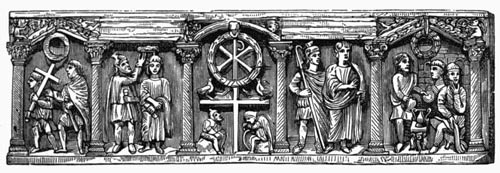
Fig. 104.—Sarcophagus in the Lateran Museum.
This sarcophagus exhibits, as Dr. Northcote admits, “the nearest
resemblance to the later representations of Our Saviour’s Passion to
be found in early Christian art.”[552]
The Constantinian monogram in
the central compartment has been already described.[553]
To the left
is seen the figure of Christ crowned, not with thorns, but, as if
symbolizing his crown of rejoicing on high, with a garland of flowers.
The last compartment
exhibits Our Lord, or, more probably, Simon the
Cyrenian, bearing the cross under the guard of a Roman soldier. “But
there are none of the traces of suffering,” says Dr. Northcote, “with
which later artists have familiarized our imagination, and the crown
above points to the reward for bearing the cross after our suffering
Master.”[554]
In one instance the Roman soldiers are shown smiting Our
Lord on the head with a reed;[555]
but no nearer approach to the
consummation of the supreme sacrifice of Calvary is ever attempted.
Neither are the august themes of Christ’s resurrection and ascension
historically treated in this biblical cycle, but only under the Old
Testament types of Jonah and Elijah. One group, hypothetically
interpreted as the Noli me tangere, or Our Lord saying to Mary
on the morning of the resurrection, “Touch me not, for I am not yet
ascended to my Father,” more probably represents the gratitude of Mary
for the resurrection of her brother Lazarus. Numerous frescoes of
seven men eating a repast of bread and fish may refer to Our Lord’s
appearing to his disciples on the sea-shore, or to the celebration of
the Agape.
We find only one event subsequent to the ascension occasionally
represented on the early Christian sarcophagi, namely, the
apprehension of Peter,[556]
which was probably regarded as a type of
his being finally bound for his crucifixion. He is to be discriminated
from Our Lord arrested by the Roman soldiers by his bearded
face, and
by the Jewish caps, which mark the satellites of Herod Agrippa. It is
remarkable that so little reference is made to St. Peter in this early
Christian sculpture, and that little indicating no degree of
superiority over the other apostles; and the fact is inexplicable on
the Roman theory of his primacy in the so-called Apostolic College. In
the still earlier frescoes of the Catacombs he is nowhere especially
designated by name or attribute. The only apostle distinguished from
the rest of the twelve is St. Paul, who, in a fresco in the Catacomb
of St. Priscilla, is seen side by side with the Good Shepherd, and
indicated by the inscription—PAVLVS PASTOR APOSTOLVS.[557]
Indeed, this was the especial title of St. Paul as being “in labors
more abundant” than any of the apostles.[558] Even on the sarcophagi
St. Peter is only once or twice exhibited as bearing the symbolical
rod of power, and these examples may be of the fifth or sixth century.
In certain of the gilt glasses already mentioned he is allegorically
portrayed, instead of Moses, as smiting the rock, implying the opinion
that he was in some sense the representative of the latter in the New
Testament economy. But these glasses are of comparatively late date,
when the notion of the primacy of St. Peter was already partially
developed; and even in these St. Peter and St. Paul are often found
side by side, without any sign of the superiority of the former.
It is easy to discriminate in early Christian art between
the two
apostles so highly honoured at Rome[559]
by the strongly marked
conventional types to which their portraits almost invariably conform.
St. Paul is characterized by the nobler form of face, a high, bold
forehead, aquiline Jewish nose, dark hair and eyes, a flowing and
pointed beard, and a refined and thoughtful expression of countenance
as became one brought up at the feet of Gamaliel and instructed in all
the wisdom of Greek philosopher and Hebrew sage. The Galilæan
fisherman is represented with strongly-knit frame, broad rustic
features, short gray hair, a thick and closely curling beard,
generally of silvery white, and an expression of much force and energy
of character.[560]
It is probable that these types were derived from
authentic tradition if not from actual portraits.[561]
Eusebius,
Augustine, and others of the Fathers, claim
to have seen
representations of these apostles preserved in painting; and the
reputed portraits alleged to have been sent by Pope Sylvester to the
Emperor Constantine are annually exhibited at St. Peter’s for the
veneration of the faithful.[562]
Nowhere in the Catacombs do we find the least support for the notion
that St. Peter is in any sense the founder of the church in Rome, much
less the rock on which the church universal is built. That honour is
assigned in early Christian art, as it is by the apostle himself, to
Jesus Christ, the “chief corner-stone, elect, precious.”[563]
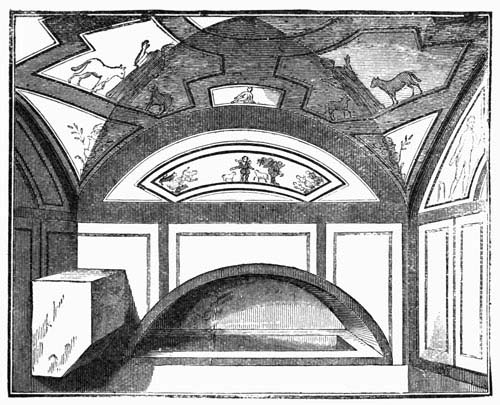
Fig. 105.—Painted Chamber in the Catacomb of St. Agnes.[564]
These biblical pictures, we may here remark, are not grouped
indiscriminately, but are often arranged in a regular order having
reference to their doctrinal signification. The walls and ceilings of
the cubicula are frequently divided into compartments of
geometrical design,
as shown in the preceding engraving of a chamber
in the Catacomb of St. Agnes. See also Figs. 82 and 89.
Sometimes the paintings of a chamber are as closely related as the
parts of a chapter in systematic theology. Thus on account of their
common reference, as he conceives, to the sacraments of baptism and
the eucharist, De Rossi designates as liturgical paintings certain
pictures in the Catacomb of Callixtus.[565]
An allegorizing spirit,
however, will often discover a meaning in a fresco or relief
altogether unthought of by the original artist. Thus Dr. Northcote
interprets as personifications of the church or of the Virgin Mary,
certain praying figures nowise differing from the ordinary
oranti.
The sarcophagi are almost exclusively occupied with scenes from the
biblical cycle, generally arranged in two rows in a continuous series,
like the figures on the frieze of a Grecian temple. Frequently ten or
twelve groups, embracing nearly forty figures, are found on the side
of a sarcophagus. Sometimes the separate groups occupy a rhythmical
arrangement of panel-like compartments, divided by columns of more or
less ornamental character. (See Figs. 102, 103, and 104.) The busts of
the deceased persons, man and wife, are often exhibited in bold relief
in a concave recess in the centre, like the half of a bivalve shell.
The table in the footnote on the following page exhibits the relative
frequency of occurrence of the different subjects already described,
as observed in fifty-five sarcophagi in the Lateran
Museum by
Mr. Burgon, and as shown in forty-eight examples copied by Bosio.[566]
The massiveness of the sarcophagi would during the ages of persecution
prevent their use even for the wealthy, as their preparation and
conveyance from the city would involve an amount of publicity that
would imperil the safety of the living. After the time of Constantine
the increased riches and perfect immunity of the Christians permitted
the adoption of this costly entombment. The sarcophagi were no longer
hidden in the subterranean crypts, but were exposed to view in the
vestibules of the stately basilicas erected above ground.[567]
Hence, Chrysostom speaks of Constantine being buried in the
fisherman’s porch,[568]
and of emperors occupying the place of porters
at the graves of the apostles. Numerous sarcophagi, however, have been
found in the Catacombs, some even reputed to be of the first century.
These were generally of simpler design, and adorned only with the
series of doubly curving lines known as wave ornaments. They were
frequently buried in the floor of the cubicula.[569]
The reader, in examining the foregoing representations of the person
of Our Lord,[570]
must have been struck with their remarkably youthful
and joyous character in this primitive cycle, as contrasted with the
older aspect and more severe expression of the prevalent types of
later art. This difference is indicative of a corresponding change of
religious feeling, from the genial cheerfulness of the early centuries
to the gloomy asceticism of the Middle Ages. In the art of the
Catacombs Our Lord is represented, for the most part, in an ideal
manner, and not in an historical sense; or, to use the language of
Lord Lindsay, “as an abstraction, as the genius, so to speak, of
Christianity.”[571]
He is almost invariably exhibited as a youthful,
beardless figure, to signify—say the ancient writers—“the
everlasting prime of eternity;” with, where any definite expression is
attempted, a countenance of sweet and tender grace, full of mildness
and benignity.
That there was in these primitive types no attempt at realistic
portraiture is evident from the opinion of many
of the early Fathers
as to the personal appearance of Our Lord. This opinion was founded
upon an erroneous interpretation of certain passages of Scripture,
expressive of Christ’s voluntary humiliation and abasement. Thus
Justin Martyr speaks of his appearance as ignoble and uncomely.[572]
Tertullian, with his usual vehemence, asserts Christ to have been
devoid, not only of divine majesty, but even of human beauty,[573]
to
have lacked grace and dignity beyond all men.[574]
“But however mean
his aspect, however vulgar and dishonoured,” he exclaims, “he shall be
still my Christ whom I adore.”[575]
Clement of Alexandria,
Origen, and Basil agree in this opinion as to the outward appearance
of Our Lord; and Cyril of Alexandria audaciously declares that he was
the most ugly of the sons of men.[576]
But a juster interpretation of Scripture, and a more worthy conception
of the person of Christ, at length prevailed. The glowing imagery of
the Song of Songs and of the prophetic Psalms was applied by several
of the Fathers of the fourth century to the person, as well as to the
character, of Our Lord. Jerome conjectures that there must have been
something celestial in his countenance and look, or the apostles would
not immediately have followed him;[577]
and that the effulgence and
majesty
of the divinity within, which shone forth
even in the human countenance, could not but attract at first sight
all beholders.[578]
Chrysostom and Gregory of Nyssa in the East
adopted this nobler conception, as also did Ambrose and Augustine in
the West. The latter exclaims, “He was beautiful on his mother’s
bosom, beautiful in the arms of his parents, beautiful upon the cross,
and beautiful in the sepulchre;” although he admits that the
countenance of Christ was entirely unknown, and was painted with
innumerable diversities of expression.[579]
There was therefore, as M. Rochette remarks,[580]
and as Dr. Northcote
admits,[581]
no authentic portrait of Christ recognized by the early
church; nor was any strictly uniform type adopted. Eusebius, indeed,
mentions reputed portraits of Our Lord associated with those of St.
Peter and St. Paul;[582]
but they were apparently objects of mere
local superstition, as was also the alleged statue of Christ at
Cæsarea Philippi, in which he was supposed to be represented as
healing the woman with the issue of blood.[583]
The earliest
acknowledged images of Christ were attributed to the Gnostic heretics,
and were honoured with those of Homer, Pythagoras, Orpheus, and other
heroes and sages by the eclectic philosophers of Rome.[584]
The silence of early tradition, as well as of Scripture, concerning
the outward form of the Saviour of mankind, seems providentially
designed to turn the mind from a sensuous regard for his person to a
spiritual apprehension of his saving grace. The spurious epistle of
Publius Lentulus, an imaginary contemporary of Christ, which is of
uncertain and probably late date, contains the first written
portraiture of Our Lord, which already indicates a departure from the
generally youthful type of the Catacombs. “His countenance,” says this
account, “is severe and expressive, so as to inspire beholders at once
with love and fear.... In reproving or censuring, he is awe-inspiring;
in exhorting and teaching, his speech is gentle and caressing. His
expression is of wonderful sweetness and gravity. No one ever saw him
laugh, though he has been often seen to weep.”[585]
The oldest extant picture of the head of Christ treated separately is
a profile brought from the Catacomb of Callixtus, now in the Christian
Museum of the Vatican, and figured in the engraving on the following
page. It is in imitation of mosaic, about life-size, and of a different
type from the figure of Our Lord in composition in the frescoes and
sculptures of the Catacombs. He is portrayed as of adult age, his
calm, smooth brow shaded by long brown hair which is parted in the
middle and falls in masses on the shoulders. The eyes are large and
thoughtful, the nose long and narrow, the beard soft and flowing, and
the general expression of countenance serene and mild. This became the
hieratic type of many of the noblest pictures of later Italian art,
and, according to the Abbé Brivati, inspired the genius of Da Vinci,
Raphael, and Caracci.
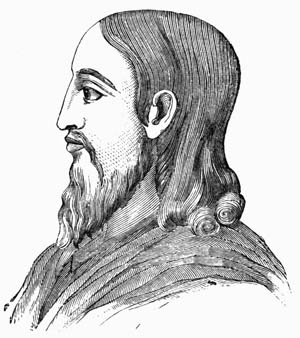
Fig. 106.—The Oldest Extant Picture of Our Lord.
In the Catacomb of Sts. Nereus and Achilles the head and bust of
Christ form a medallion in the centre of a vaulted ceiling. The face
is of a noble and dignified expression, mingled with benevolence; but
it is older in aspect, and probably of considerably later date, than
that here given. Kugler, however, claims for it priority of origin.
Both of these were probably of the latter part of the fourth century,
and were executed not by the Christians of the purest ages of the
church, but by those who had begun to walk by sight and not by faith.
The primitive Christians, we have seen, had no professed portraits of
Christ, but only allegorical representations of the Good Shepherd, or
a youthful figure regarded
as the abstractions or genius of
Christianity. “We must not,” says a Father of the second century,
“cling to the sensuous, but rise to the spiritual. The familiarity of
daily sight lowers the dignity of the divine, and to pretend to
worship a spiritual essence through earthly matter is to degrade that
essence to the world of sense.”[586]
On a terra cotta medallion, found not in the Catacombs themselves, but
in the rubbish near the mouth of the cemetery of St. Agnes, is a head
of Our Lord of the same general type as Fig. 106, but of much superior
execution. The face is of exquisite beauty, and is characterized by a
sweet and tender grace of expression. But with the decline of art and
the corruption of Christianity this beautiful type disappeared, and a
more austere and solemn aspect was given to pictures of Christ.
Although the technical means of execution were diminished, and the
rendering of form became more and more incorrect, yet for powerful
effect, strength of character, and depth of feeling, Christian art
exhibited resources beyond any thing to be found in the Catacombs. It
burst the narrow limits in which it was there confined, and found
ample scope in the frescoes and mosaics of the stately basilicas which
were everywhere rising. In those vast and shadowy interiors the
principal figure was that of Christ, surrounded by saints and angels,
looking down upon the worshippers with awe-inspiring power, holding in
his left hand the book of life, and raising his right in solemn menace
or warning.
The first example of the art-presentation of Christ under this stern
and sullen aspect, according to that
accomplished critic, Mr. Hemans,
is a large mosaic composition of the fifth century in the Ostian
basilica of St. Paul. The colossal figure of the Saviour dominates
over every other object, with an effect at once startling and
repulsive. “Nor can we help,” says Mr. Hemans, “seeing in this
strangely unworthy conception the evidence of deterioration in the
religious ideal, even more than of decline in the technical treatment
peculiar to the age.”[587]
Of this character is the head of Our Lord
in the crypt of St. Cecilia. The expression is grave, the eyes large
and solemn; the book of the gospels is in his hand, and his head is
surrounded by a nimbus in the form of a Greek cross.
This type became more and more rigid and austere as the gathering
shadows of the Dark Ages mantled on the minds of men. The gloomy
asceticism of the monastic orders also left its impress on the art of
the period, especially in the East, where the Basilian monks too
faithfully illustrated the stern, austere judgments of their founder
concerning the person of Christ. The rudeness of execution of this
Byzantine school was only
equalled by the meanness of conception of
the harsh, stiff and blackened portraits of Our Lord, in which he was
exhibited as emphatically “a man of sorrows and acquainted with
grief.”
Toward the close of the tenth century art sank into its deepest
degradation as the long night of the Dark Ages reached its densest
gloom. The year one thousand was regarded in popular apprehension as
the date of the end of time, and of the final conflagration of the
world so intensely realized in the sublime hymn,
Dies iræ, dies illa,
Solvet sæclum in favilla.
The excited imagination of mankind, brooding upon the approaching
terrors of the Last Day, found expression in the sombre character of
the art of the period. The tender grace of the Good Shepherd of the
Catacombs gave place to the stern inexorable Judge, blasting the
wicked with a glance and treading down the nations in his fury. Christ
was no longer the Divine Orpheus, charming with the music of his lyre
the souls of men, and breathing peace and benediction from his lips,
but the “Rex tremendæ majestatis,” a dread Avenger striking the
imagination with awe, and awakening alarm and remorse in the soul. All
the stern denunciations of the Hebrew prophets and the weird imagery
of the Apocalypse found intensely realistic treatment in art. Christ
smites the earth with a curse, and consumes the wicked like stubble.
“A fire goeth before him, and burneth up his enemies round
about.”[588]
The great white throne is set, and from beneath it a
flame bursts forth devouring the guilty objects of his wrath. Like an
angry Jove,[589]
he hurls the thunderbolts of his fury and blasts with
the lightning of his power. The angels tremble in terror at his frown,
and even the intercession of the Virgin Mother avails not to mitigate
the dread displeasure of her Divine Son. Down to the period of the
Renaissance the tragic scenes of the last judgment continue to be
favourite subjects of art treatment, and exhibit some of its most
remarkable achievements; but not all the genius of Orcagna or of
Michael Angelo can reconcile our minds to the savage sternness and
ferocity of the frescoes of the Campo Santo and the Sistine Chapel.
Christ is also frequently depicted in Mediæval art with his staff and
scrip, his “scallop hat and shoon,” setting out upon his weary, mortal
pilgrimage; returning to heaven as a toil-worn man leaning heavily
upon his staff,[590]
or showing to the Father sitting on his throne
his wounded hands and side. He is also seen, as in the sublime vision
of St. John, riding in
majesty on his white horse, accompanied by the
armies of the sky; as trampling beneath his feet the lion and dragon,
and as chaining death and hell. In Greek art, especially, he is
exhibited as a throned archbishop, arrayed in gorgeous vestments,
receiving the homage of saints and angels, or offering the sacrifice
of the mass as the great High Priest entered into the holiest of all.
One of the most striking contrasts between the art of the Catacombs
and that of later times is the entire absence in the former of those
gross anthropomorphic images of the persons of the Holy Trinity,
either together or separately—except Our Lord under his proper human
form—of which the latter, in striking offence against piety and good
taste, exhibits so many painful examples. In the earlier ages a solemn
reverence forbade the attempt to depict the Eternal Father or the Holy
Spirit except by means of symbolical types. The universal testimony of
Christian antiquity is opposed to this practice so common in Mediæval
art. Origen, Ambrose, and Augustine unite in prohibiting the
representation of the Deity by any material object. The latter
declares it to be impious for any Christian to set up such an image in
the church, and much more to do it in his heart,[591]
or to conceive
it possible that the Divine Being may be circumscribed by the limits
of the human frame.[592]
Paulinus of Nola, in his account of the
symbolism of the Holy Trinity in the church of St. Felix, describes
Christ as represented by a lamb, the Holy Spirit by a
dove, but for
the Father nothing but a voice from heaven.[593]
Gregory II., the
champion of image-worship, denies that it is lawful to make any
representation of the Divine nature, but only of Our Lord, his mother,
and the saints.[594]
Such figures were also condemned by the second
Council of Nice.[595]
John Damascenus, a zealous defender of the
images of Christ and the saints, yet declares it is as great impiety
as it is folly to make any image of the Divine nature, which is
incorporeal, invisible, without material or form, incomprehensible,
not to be circumscribed, nor to be figured by the art of man.[596]
Urban VIII. ordered all representations of the Trinity to be burnt,
and Benedict XIV. forbade the depicting of the Holy Ghost in human
form. Dupin asserts that the most zealous defenders of images have
condemned these;[597]
and the learned and judicious Bingham declares
that “in all ancient history we never meet with any one instance of
picturing God the Father, because it was supposed that he never
appeared in any visible shape, but only by a voice from heaven.”[598]
Some recent Roman Catholic writers, however, assert
the contrary of
this to be the case, and refer for proof of the assertion to one or
two sarcophagal bas reliefs of the fourth or fifth century. One of
these represents Cain and Abel bringing their gifts to an aged and
bearded figure sitting on a stone, who is interpreted by the Romanists
as the Omnipotent Jehovah. But that distinguished archæologist, Raoul
Rochette, himself a Romanist, opposes this view. “I doubt,” he says,
“the reality of this explanation, contrary to all that we know of the
Christian monuments of the first ages, where the intervention of the
Eternal Father is only indicated in the abridged and symbolic manner
proper to antiquity, by the image of a hand.”
The other alleged sculpture of the Godhead requires more careful
examination. “The Holy Trinity,” says Dr. Northcote, “is nowhere
represented, as far as I know, in the paintings of the
Catacombs.”[599]
But he asserts that a sculptured example occurs on a
sarcophagus of the fifth century, from the Ostian basilica of St.
Paul’s, now in the Lateran Museum. The group referred to consists of
three bearded figures of advanced age, and of grave and
strongly-marked features. One of these, whom Dr. Northcote designates
“the Eternal Father, the source and fountain of Deity,”[600]
is seated
in a raised chair or sort of throne. Behind the chair stands another
described as representing the Holy Ghost, and in front of it the
third, identified as the “Eternal Word.”[601]
At the feet of the
latter are two diminutive figures, one standing, the other prostrate,
said to represent the creation of Eve from the side of the sleeping
Adam. Padre Garrucci, who has published a monograph on this subject,
identifies none of the
adult figures in the same manner as Dr.
Northcote, but describes the one seated as the Son, the one behind him
as the Father, and the third as the Holy Ghost.[602]
We can accept neither of these explanations, both of which are so
strongly opposed to the entire spirit and character of early Christian
art. The formulization of the doctrine of the Trinity by the Council
of Nice, in that noble creed which still expresses the faith of
Christendom, left, it is true, its impress on Christian art and
literature. Both in pictorial representation, and, as we shall
hearafter see, in inscriptions, is there a recorded protest against
the Arian heresy which at this period convulsed and rent the church.
De Rossi cites eight examples in early Christian art which he
conceives to have reference to this doctrine; but in seven of these it
is indicated by the association of the sacred monogram with the
triangle, the symbol of tri-unity, and the eighth is the unique and
anomalous bas relief under discussion.
We have seen that Christ is uniformly exhibited in this primitive art
as youthful and beardless; and on this very sarcophagus, side by side
with this so-called sculpture of the Trinity, he is thus seen as the
representative of the Deity giving the wheat-sheaf to Adam and the
lamb to Eve. Yet we are asked to believe that in the very next group
he is shown, in defiance of the uniform practice, as heavily bearded
and of advanced age; and that the Almighty Father, who is
substitutionally represented by the Son in the adjoining scene, is
here exhibited, as well as the Eternal Spirit, in human form. Another
remarkable discrepancy also occurs. The so-called figures of Adam and
Eve are of
most diminutive size, and not nearly as large as the infant
Christ in his mother’s arms in the scene of the adoration of the Magi
immediately below;[603]
and of these the prostrate figure supposed to
represent the sleeping Adam is considerably the smaller of the two,
and of the more feminine aspect. This incongruity is the more striking
from the immediate proximity of the adult figures of Adam and Eve, to
which the smaller ones bear no resemblance. The whole group seems to
correspond better to Solomon’s celebrated judgment concerning the
living and the dead child than to the creation of Eve.
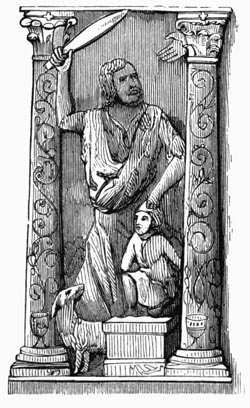
Fig. 107.—God Symbolized by a Hand appearing to Abraham.
So careful, indeed, were the early Christian artists to avoid any
representation of “the King eternal, immortal, invisible,” that in the
scenes where God spake from heaven to Abraham and to Moses he is only
symbolically indicated by a hand stretched out to stay the knife of
the patriarch, or surrounded by clouds, as if to show more strongly
its figurative character, giving the tables of the law to the leader
of Israel. The annexed suggestive example of this treatment, of which
many others might be adduced, is from a sarcophagus in the Lateran.
See also Fig. 71, p. 290.
Throughout the whole range of sacred mosaics at Rome from the fourth
to the fourteenth century, according to Mr. Hemans, the Supreme Being
is never represented except symbolically by means of a hand, usually
holding a crown over the head of Christ, the Virgin, or the saints. In
later art the hand is sometimes surrounded by a cruciform nimbus, to
indicate more clearly its divine character. It is also seen stretched
out from heaven in pictures of Christ’s baptism and transfiguration,
of the agony in the garden, the passion, and ascension.[604]
It was long before the most audacious hand dared to represent in
painting or sculpture the omnipotent Jehovah or the infinite Spirit,
who sustain and pervade the universe. M. Emeric David says that the
French artists of the ninth century had first the “happy
boldness”—heureuse hardiesse—to depict the Eternal Father
under human form.[605]
M. Didron asserts that it was not till the
twelfth century that the Divine Being was personally represented,[606]
being previously invariably indicated by the symbol of a hand, or by
the divine name written in a triangle surrounded by a circle. Previous
at least to the earlier of these dates, the work of creation and other
acts popularly regarded as proper to the Father are always represented
as performed by the Son, “who is the image of
the invisible God,” “by
whom also he made the worlds.”[607]
Christ is also painted as
commanding Noah to build the ark, as conversing with Abraham, and as
speaking to Moses out of the burning bush. He is frequently
represented also in the gigantic frescoes of the Byzantine cupolas
clothed with awful majesty and bearing the title Ο ΠΑΝΤΟΚΡΑΤΩΡ, the Almighty; but the addition of the letters IC
XC, the contraction for Jesus Christ, assure us that it is not the
Father but the Son who is meant.
But the literal conception of the age was not content with a
symbolical indication of the Deity. By degrees the arm as well as the
hand was portrayed, and art, gradually growing bolder, attempted the
representation of that face which inspiration declares no man can see
and live. But at first it is the face alone that is shown.[608]
Then,
with progressive daring, the bust and upper part of the body are
painted as reaching forth from the clouds, and finally the entire
figure appears under various aspects and in different characters. The
Almighty is represented armed with sword and bow, as the God of
battles; as crowned, like a king or emperor;[609]
and finally, as
Pope, wearing the pontifical tiara and vestments. In the following
example from a stained-glass window of the sixteenth century, at
Troyes, in France, the everlasting Father, throned in glory, crowned with
a quintuple tiara and robed in alb and tunic, supports a cross on
which hangs the lifeless body of the Divine Son.
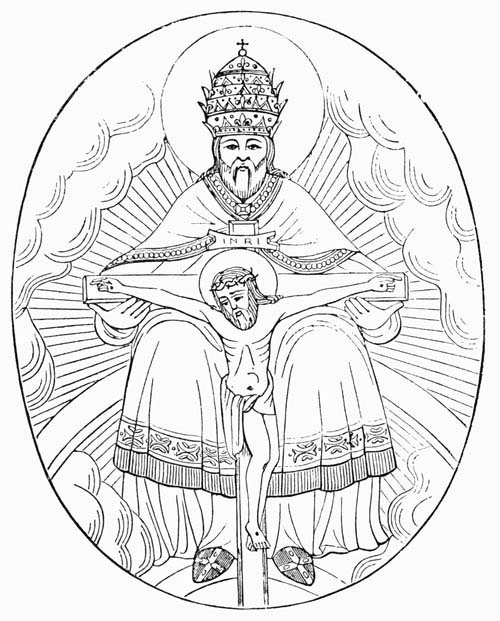
Fig. 108.—God the Father as Pope.
The omnipotent Jehovah is sometimes portrayed as “the Ancient of
Days,” under the form of a feeble old man bowed down by the weight of
years, and fain to seek support by leaning heavily on a staff, or
reposing on a couch after the labours of creation.[610]
The treatment
becomes more and more rude, even to the borders of the grotesque,[611]
and the conception becomes mean, coarse, and vulgar, till all the
Divine departs and only human feebleness and imbecility remain,
indicating at once the degradation of taste, decline of piety, and
corruption of doctrine.
But this grossness of treatment reaches its most offensive development
in the impious attempt to symbolize the sublime mystery of the Holy
Trinity by a grotesque figure with three heads, or a head with three
faces joined together, somewhat after the manner of the three-headed
image of Brahma in the Hindoo mythology.[612]
In other examples the
Trinity is represented by three harsh stiff and aged figures,[613]
identified by the attributes of the tiara, cross, and dove, enveloped
in one common mantle, and jointly crowning the Virgin Mary in heaven,
whose flowing train the angels humbly bear. By this degradation of
Deity and exaltation of Mary
we may mark the infinite divergence in
faith and practice of the modern church of Rome from the simplicity,
purity, and orthodoxy of the ancient church of the Catacombs, as
evidenced by that primitive art and symbolism whose priceless
monuments we have been examining.
Hostia viva Deo tanquam puer offerar Isaac,
Et mea ligna gerens, sequar almum sub cruce patrem.
Ruth sequitur sanctam, quam deserit Orpa, parentem;
Perfidiam nurus una, fidem nurus altera monstrat.
Præfert una Deum patriæ, patriam altera vitæ.
Solus labe caret peccati conditor orbis,
Ingenitus genitusque Deus, Pater et Patre natus.
—Apotheosis, 894.
Quod Eva tristis abstulit
Tu reddis almo germine.
Salva vincla reis,
Profer lumen cæcis,
Mala nostra pelle,
Bona cuncta posce.
O Roma felix, quæ duorum Principum
Es consecrata glorioso sanguine;
Horum cruore purpurata ceteras
Excellis orbis una pulcritudines.
—Office for the Festival of St. Peter and St. Paul.
Salve, Sancta facies
Mei Redemptoris,
In qua nitet species
Divini splendoris.
Impressa panniculo
Nivei candoris,
Dataque Veronicæ,
Signum ob Amoris.
Quatuor haec Dominum signant animalia Christum:
Est homo nascendo, Vitulusque sacer moriendo,
Et Leo surgendo, cœlos Aquilaque petendo.
O summo Giove,
Che fosti ’n terra per noi crocifisso.—Purgat., canto vi.
“Père,” dist Jhésus, “retourné
Suis á toy, et ai consummé
Ce que faire me commandas
Quant jus ou monde m’envoyas,
Dont bien je m’en feusse passé.”
—Romant des Trois Pélerinages, A. D. 1358.
Pleno coruscat Trinitas mysterio;
Stat Christus in agno; vox Patris cœlo tonat;
Et per columbam Spiritus Sanctus fluit.
“The rope with its twisted cordage three
Denoted the scriptural Trinity.”
Ever since the re-discovery and exploration of the Catacombs in the
sixteenth century they have been a vast treasury from which, as from
an inexhaustible mine, have been derived innumerable relics of
Christian antiquity, many of them of inestimable value. Among these
are a number of gilt glasses of curious design and remarkable
interest, lamps, vases, rings, seals, toys, trinkets, and various
objects of domestic use or ornament. Collections of these relics are
found in most of the great museums of Europe, especially in those of
the city of Rome. An account of the more important of them will be
given in the present chapter.
Reference has already been made to the numerous fragments of gilt
glass found in the Catacombs, which so remarkably illustrate Christian
life in the primitive ages. In the last century, Buonarotti described
all the specimens then known. The distinguished archæologist, Padre
Garrucci, has recently exhaustively treated these remains of ancient
art in his elaborate monograph on this subject.[614]
They are also
profusely illustrated in the magnificent pages of Perret.[615]
These glasses are generally mutilated fragments, apparently
the bottoms of drinking-cups, and occasionally of the dish-like shape of
the classic patera. They vary in size from about one to four or
five inches in diameter. The design is executed in gold leaf on the
bottom of the cup, so as to appear through the glass on the inside,
and is occasionally beautifully relieved by a dark purple background.
It is protected by a plate of glass, fused upon the lower surface so
as to become a solid mass, like the glass paper-weights with enclosed
ornamental designs which are so common. The pictures thus hermetically
sealed are indestructible so long as the glass is not fractured. These
vessels were apparently affixed at the time of burial to the soft
plaster of the grave; but the thinner portion, standing out from the
cement, has almost invariably been broken, while the thick part,
imbedded in the plaster, has been preserved. Sometimes even the solid
bottoms of these vessels were fractured in the effort to detach them
from the walls, and frequently impressions in the cement indicate
where they were affixed. They are rarely found in situ, having
been destroyed or carried off by successive generations of explorers
or plunderers. The most important collection is in the Vatican
Library. In the British Museum are some thirty specimens; in the
museums of Paris, Florence, and Naples, a less number; and a few
others in various private collections. The entire number extant is
only three hundred and forty. In the course of a quarter of a century
De Rossi discovered but two fragments of these glasses. This extreme
rarity is doubtless owing to their excessive fragility, and probably
also to their being destroyed in large quantities to procure the gold
they contain. In some of the extant examples portions of this gold has
been removed by inserting a knife between the plates of glass. Perhaps
the ingenious avarice of the Jewish “dealers in broken glass,”
notorious even in the days of Martial,[616]
may have largely
contributed to the destruction of these curious remains of Christian
antiquity.
It was thought that the manufacture of these glasses was known only at
Rome; but in the year 1864 a fragment of a glass plate, with a number
of small gilt medallions bearing scriptural representations imbedded
in it, was discovered beneath the surface of the ground near the
church of St. Severin at Cologne; and in 1866 another of similar
character was found, accompanied by some charred bones, in a stone
chest near the same place.
Buonarotti regarded these fragments as having all formed part of
sacramental vessels; but the character of the designs seems frequently
to preclude that idea. Several of these are derived from the fables of
pagan mythology, and seem to indicate, if not heathen origin, at least
the influence of pagan types. Among them are found the figures of
Achilles, Hercules, Dædalus, Minerva, Mercury, the Three Graces, Cupid
and Pysche, and other groups still less congruous with Christian
thought. Other scenes represent various industries, as men sawing,
planing, and carving wood; a ship-builder with his men at work; a
tailor, druggist, and money-coiner, in their respective shops. Hunting
scenes, men boxing, and charioteers encouraging their horses, also
occur. A more numerous series represent domestic groups, portraits of
husband and wife, frequently accompanied by their children, groups of
children playing, or sometimes a lady in rich costume, with
cupids holding her mirror and other toilet adjuncts. Frequently occurs what
seems to be a marriage scene, with the bride and bridegroom joining
hands over an altar, above which Christ is often depicted as placing
crowns on their heads. Sometimes is expressed in gilt letters the
beautiful wish VIVATIS IN DEO—“May you live in God.” In one
instance it is a winged cupid that bestows the crown.
The majority of the scenes, however, are of a distinctively Christian
character, comprising most of the subjects in the symbolical and
biblical cycles already described; but from the conditions of space,
which are often exceedingly limited, the design is frequently of a
very rudimentary type. In the large patera of Cologne the
medallions contain the separate parts of different groups, which are
only intelligible as a whole. Besides the ordinary scenes from Old and
New Testament history there is a unique example of the triumph of
Christ, in which he appears in fulness of glory holding the globe of
sovereignty; while opposite to him stands a figure, interpreted by
Garrucci as Isaiah prophesying the advent of the Light of the World.
Perret also figures one example of Christ on the cross, with Mary and
John beside it, which he thinks is later than the sixth century.
Another class exhibits representations of the Virgin Mary, generally
in the attitude of prayer, either alone, or standing between St. Peter
and St. Paul, which position is also often occupied by St. Agnes or
some other female saint. More frequently recurring than any other
figures are those of St. Peter and St. Paul. They are found on eighty
out of three hundred and forty specimens figured by Garrucci, or
nearly one fourth of the whole. They appear generally as busts side by
side,
without the slightest indication of the superiority of one over
the other, Peter being often on the left instead of the right, which,
according to the Romish theory of his primacy, he should always
occupy. Indeed, their perfect parity in dignity and honour is implied
in the single crown sometimes suspended over their heads, or by their
simultaneous crowning by Christ, who appears between or above them.
Other saints are also represented, who are discriminated by labels
bearing their names, as Lawrence, Vincent, Sixtus, Callixtus,
Hippolytus, etc. There are also five or six specimens exhibiting
Jewish symbols, the ark of the covenant and the rolls of the law. From
the technical difficulties in the employment of a rather intractable
material, as well as from the general decline of art, the execution is
often uncouth and stiff. “The faithful,” says Buonarotti, “desiring to
adorn these vases with pious symbols, were forced to avail themselves
of inexpert workmen, or even those who pursued other trades.”[617]
The
accompanying is a characteristic example, from this author, of the
domestic class. It exhibits a husband, wife, and child, with the motto
in Latin characters, PIE ZESES—“Drink and live.” Between the
faces is an object like an ancient lachrymatory.
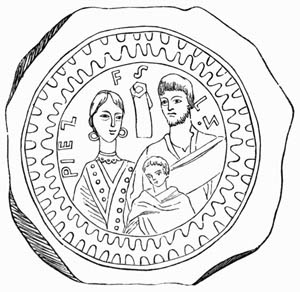
Fig. 109.—Domestic Group in Gilt Glass.
It is probable that these vessels were designed not for sacramental
solemnities, but for occasions of domestic and social rejoicing, as
nuptial, baptismal, and anniversary festivals; and for the celebration
of the Agape, or love-feast, after it had lost the religious character
it possessed in early times. Hence the selection of a comparatively
gay and mundane class of subjects; some derived from pagan art, and
others implying a conformity to the fashionable follies and amusements
of the world, and indicating a decline of piety and corruption of
manners.
Garrucci thinks, from the large proportion of glasses bearing the
effigies of St. Peter and St. Paul, that those at least were used in
connexion with the feast in honour of these saints, which in the
fourth and fifth centuries was celebrated in Rome as a public holiday,
with much of the vulgar merriment with which the peasants of the
Campagna keep their festa to-day. Mr. Brownlow hints the
possibility that the “idea of restraining the potations of the Roman
Christians, by depicting figures which could only be seen to advantage
when the glass was empty, suggested the use of these gilded
cups.”[618]
The festive purpose for which many of these vessels was designed is
indicated by the convivial character of the inscriptions they bear.
Mr. Brownlow has translated the following examples in this sense:[619]
DIGNITAS AMICORVM PIE ZESES CVM TVIS OMNIBVS BIBE ET
PROPINA—“A mark of friendship; drink, and (long) life to thee,
with all thine; drink, and propose a toast;” CVM
TVIS FELICITER
ZESES—“Mayest thou live happily with
thine own;” or, more freely, “Life and happiness to thee and thine;”
ΠΙΕ ΖΕΣΕΣ ΕΝ ΑΓΑΘΟΙΣ—“Drink and live among the good.”
Sometimes these inscriptions breathe a spirit of pious congratulation
and good-will, as the following from Perret: HILARIS VIVAS CVM
TVIS OMNIBVS FELICITER SEMPER IN PACE DEI ZESES—“Joyfully mayest
thou live with all thine; happily mayest thou live forever in the
peace of God.” Augustine, describing in his Confessions the devout
celebration of the anniversaries of the saints by his mother, Monica,
says she used to bring to the festivals “a small cup of wine diluted
according to her own abstemious habits, which for courtesy she would
taste.”[620]
Although it is impossible that all these vessels were designed
for sacramental purposes, yet it is not improbable that some of them
were used as patens and chalices in the celebration of the Holy
Eucharist. Tertullian speaks of the representation of the Good
Shepherd on the sacred cup in a manner which seems to imply similarity
of material and ornamentation.[621]
The Liber Pontificalis
states that glass patens were in use in the third century. When these
were superseded by gold and silver vessels they would not improbably
be placed as memorials on the tombs of departed saints.[622]
It is difficult to determine even the proximate date of these glasses.
From the degraded character of their art they are evidently of a
comparatively late period. Garrucci and some other writers, indeed,
assign them to the third or fourth century; but from the occurrence of
the nimbus, and for other technical reasons, Marriott attributes many
of them to the fifth or sixth century.[623]
Other peculiarities of
execution are characteristic of Byzantine art, and a writer in the
Revue Chrétienne asserts that there is not a single example of
this mode of treatment known to belong to the Roman period. The
striking corruption of doctrine and practice indicated is also an
evidence of late origin.
Numerous small cups or flasks, known as ampullæ, have been
found affixed to the walls or imbedded in the plaster of the tombs,
frequently containing in the bottom a reddish deposit. This Bosio
concluded was dried blood, and therefore asserted that these cups were
irrefragable proofs of the martyrdom of the persons to whose graves
they were attached. The Roman ecclesiastical authorities received this
theory with enthusiasm, and in the year 1688 issued a decree that,
“The Holy Congregation of Relics, having carefully examined the
matter, decides that the palm and vessel tinged with blood are to be
considered most certain signs of martyrdom.” Eminent Romanist writers
have unflinchingly asserted, without the least corroboration of their
theory from contemporary evidence, that these cups were filled with
the martyr’s blood and affixed to his grave;[624]
—another example of
the fatal mistake of Rome
in fortifying truth with the bulwark of
falsehood, and thus shaking our confidence even in that which is real.
The Acts of the Martyrs, indeed, mention the collecting of their blood
in napkins, sponges, or veils, to keep as a talisman and heirloom at
home; but never of its preservation in a cup, or burial beside their
graves. This symbol does not occur on the tombs of some who were
unquestionably martyrs;[625]
and some who have it, from their extreme
youth, or from some other reason indicated by the inscription, cannot
have belonged to that honoured class.[626]
Moreover, as Mr. Seymour
remarks, some of these alleged martyr blood-cups are of a form and
exhibit designs unknown till long after the age of persecution.[627]
In the example on the following page, given by Aringhi, the
inscription is unwarrantably translated by Romanist epigraphists, “the
blood of Saturnius;” instead of, in analogy with numerous other
inscriptions, “the place [locus] of holy Saturnius.”
The chemist Leibnitz analyzed the red deposit in these vessels, and
found that it was composed of organic matter, but does not hazard the
assertion that it is blood. It has been suggested by Röstell, with whom
Rochette agrees, that these cups were sacramental vessels, and that
the sediment was the lees of wine, which would yield a similar organic
residuum. The desire to express fellowship with the departed in the
celebration of the Agape, or the Eucharist, which often took place
beside their graves, may have led to the custom of affixing these
vessels to the tombs and replenishing them with wine. We know that
this yearning of the human heart led in course of time to the offering
of the sacrament to the dead, and the burying it in their graves.[628]
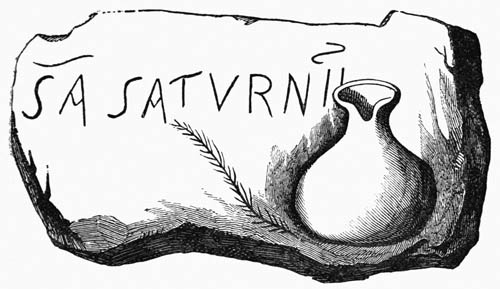
Fig. 110. Reputed Martyr Relic from the Catacombs.
The occurrence of the palm branch engraved or painted on the tomb was
also, as we have seen, declared by the Congregation of Relics to be a
certain sign of a martyr’s tomb. But this was a common symbol of
victory both among the pagans and Jews, and therefore was naturally
adopted by the Christians in token of their being “more than
conquerors” through Christ, without any reference to martyrdom. It is
found, moreover, on graves posterior to the times of persecution, on
those of children, and even on a tomb which a man had prepared for
himself while yet alive. Muratori, who gives this example, though a
devout Romanist, says the palm was by no means a sign of
martyrdom.[629]
Other criteria of martyrdom were also adopted, as the
occurrence of the laurel and the olive crown, and the appearance of
oranti on the tombs; but the former are also common to
paganism, and in Christian epigraphy adorn the graves of very young
children, and the latter frequently occur on the sarcophagi after the
age of persecution had passed.
It is remarkable that so few allusions to martyrdom occur in the
Catacombs. In the whole range of the inscriptions, as before observed,
only five, some of which may be spurious, commemorate martyrs, or less
than one in two thousand. The pictorial representations of this event
are less frequent still. In the cemetery of St. Priscilla was
discovered a terra cotta bas relief of the martyrdom of St. Sebastian,
but evidently of late date: the soldiers are armed with cross-bows,
and are clad apparently in mediæval plate armour. This subject has at
all times been a favourite theme of Italian art, and this relief may
have been left at the shrine of the
saints by some pious pilgrim of
the Middle Ages. In the Catacomb of Callixtus is a painting of two
Christians standing before the tribunal of a Roman magistrate. This is
probably of the early centuries, but how different from the gross and
bloody martyr-pictures in the church of S. Steffano in Rotondo
in Rome. On one of the gilt glasses, executed long after the days of
persecution, is a group supposed to represent Isaiah sawn asunder, and
in one of the Catacombs is a scene thought to indicate the martyrdom
of Hippolytus. The pictures of Daniel and the three Hebrews indicate
rather the triumph than the trial of God’s saints.
The martyrs left no outward memorial of their sufferings, nor was any
needed, for their intrepid spirit animated the whole Christian
community. D’Agincourt says he found in thirty years’ exploration only
one picture, and that of late and barbarian design, portraying
martyrdom.[630]
Those who themselves stood in jeopardy every hour did
not magnify the merit of the faithful confession of Christ, whom they
considered alone deserving of the title of “Faithful and True
Witness.” No sacred litany entreated St. Stephen, St. Lawrence, St.
Vincent, and all holy martyrs, to pray for them; nor is any such
inscription found in the whole range of the epigraphy of the
Catacombs.[631]
In the following rude representation, from a slab in the Lapidarian
Gallery, Romish imagination has discovered the outline of a furnace,
or of a caldron of
boiling oil in which Victorina was immersed. A
comparison with other similar figures indicates that it is intended
for a corn measure filled with grain, the sign of the trade of an
ancient meal merchant.

"Victorina in peace and in Christ.”
Fig. 111.—A Reputed Symbol of Martyrdom.
In the Vatican Museum are certain truculent-looking objects, said by
the Roman custodians to be instruments of torture taken from the
graves of the martyrs.[632]
But the locality in which they were found
is seldom recorded, which deprives them of much of their historic
value; and many of them are probably fictitious. Dr. Northcote admits
that they are often “of doubtful authenticity,” and that “many look
more like domestic utensils, and seem to be of Etruscan workmanship.”
“These,” he adds, “were probably never taken from the Catacombs at
all.”[633]
Others have too modern an appearance to admit such a
supposition, and look rather, as Maitland suggests, as if “taken from
the chambers of the Holy Inquisition.”[634]
Among the most formidable
of these alleged instruments of martyrdom, as well as the most
probably genuine, are the terrible plumbatæ and ungulæ.
The former were scourges of small chains loaded with
bronze or lead,
with which, it is recorded, the martyrs were often beaten to
death.[635]
Aringhi and others have affected to discover on the
mouldering skeletons of the early Christians, after the lapse of
fifteen hundred years, the marks made by these plumbatæ. In one
exceptional instance given by Bosio,[636]
an orante is
represented with this dreadful instrument of torture lying beside her.
The ungulæ, as the name implies, are iron claws or hooks,
described in the Acts of the Martyrs as employed for lacerating their
flesh. The dreadful wounds they inflict are referred to by Prudentius
in his account of the martyrdom of St. Vincent: “One covers with
kisses the double furrows of the ungulæ; another is glad to
wipe the purple stream from the body.”
In the Catacomb of Calepodius was discovered an iron-toothed comb
considered to have been similarly employed in torturing the martyrs;
in the crypts of St. Alexander, among other iron instruments, was
found a long narrow ladle, which it is thought was used in pouring
molten lead down their throats; and in the cemetery of St. Agnes an
iron hook, designed, as Aringhi conceived, for dragging their bodies
after death. In the Vatican Museum is also a pair of iron forceps,
with horrid trenchant teeth and the remains of wooden handles,
probably employed in pinching and tearing the flesh of the helpless
victims of heathen rage. A similar forceps is sometimes engraved on a
funeral slab, where, in accordance with analogous examples, it
probably indicated the trade of the deceased as a smith. The genius of
primitive Christianity was averse to recording the circumstances of
the believer’s death, and made slight allusion to the
sufferings of
the martyrs. Although it is possible that some of these relics of
persecution may be genuine, yet it is difficult to conceive how the
Christians could obtain from the pagan authorities these instruments
of torture, or why they should bury them with the martyred dead; and
these considerations will account for the extreme rarity of their
authentic occurrence.
Vast numbers of lamps have been found in the Catacombs, and specimens
abound in almost every antiquarian museum. They must have been
absolutely necessary to dispel the darkness of these gloomy crypts, so
as to render them safe for the solemnizing of funeral rites, for
worship, or for sanctuary from oppression. They are of varying
material and design, but are for the most part of terra cotta of the
ordinary antique pattern and of common workmanship. Many, however,
were executed in bronze or iron, often with considerable taste and
skill. Some of these had bronze chains by which to suspend them from
the ceiling of the chambers or corridors. Those in terra cotta had
frequently handles by which they could be carried; most, however, were
without either, and were placed in niches in the tufa near the
stairways, at the entrances of the principal galleries, at the angles
of the corridors, and in the cubicula used for purposes of
worship.
These lamps generally bore some Christian symbol, as the sacred
monogram, the Good Shepherd, the palm, fish, or dove, and not
unfrequently the heads of St. Peter and St. Paul. Sometimes the lamp
itself was made in the shape of a boat, the emblem of the church
voyaging through a stormy sea to the shores of eternity; of the mystic
fish, whose representation entered so largely into primitive art; of a
dove, the symbol of the believer’s guilelessness and purity; or of a
cock, the
emblem of vigilance, a monition that he should watch and be
sober. They frequently bear inscriptions referring to the five
virgins, or to the source of true spiritual illumination, the divine
word, which is a lamp unto the feet and a light unto the path. On one
example occurs the legend, QVASI LVCERNAE LVCENTI IN CALIGINOSO
LOCO—“As a light shining in a dark place,” a sentiment
peculiarly appropriate to those gloomy chambers of death, which were
nevertheless illumined by the glorious hope of a blissful immortality.
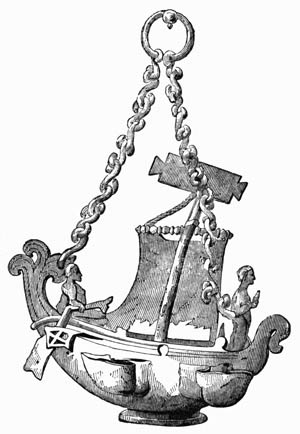
Fig. 112.—Early Christian Symbolical Lamp.
The accompanying example of a symbolical lamp in the form of a boat,
furnished with chains and ring for suspension, is a characteristic
type.[637]
The figures in the little bark are interpreted by Roman
archæologists as Peter and Paul—the pilot of the Galilean lake as the
chief of the apostles holding
the rudder and guiding the fortunes of
the church. The tablet on the mast bears the inscription—DOMINVS
LEGEM DAT. VALERIO SEVERO EVTROPIO. VIVAS—“The Lord gives the
word. To Valerius Severus Eutropius. May you live.”
Fig. 113 exhibits a lamp from the Catacombs, on the upper part of
which the ever-recurring ichthyic symbol is repeated, and on the
handle the sacred monogram of the name of Our Lord. The lamp is
replenished at the central opening. They sometimes burn with two or
three lights. See also the terra cotta lamp with handle and medallion
in Fig. 114, and the hanging lamps shown in Figs. 23 and 24.
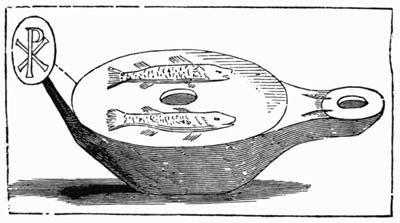
Fig. 113.—Symbolical Lamp from the Catacombs.
A lamp figured by Perret has the sacred monogram surrounded by the
heads of the twelve apostles. On another found in the Jewish Catacomb
is a representation of the seven-branched candlestick. This also
occurs in Christian symbolism, and probably is emblematic, as has been
suggested by Dr. McCaul, of the sevenfold gifts of the Spirit of
divine illumination.
The necessary use of lights in the funeral solemnities of the church
in the Catacombs was probably the origin of the Romish usage of
burying the dead with the
accompaniment of burning tapers even amid
the blaze of day. It was also a heathen custom, in the adoption of
which, as in so many other things, the Catholic became the pagan’s
heir.[638]
Jerome mentions its observance in his day at the funeral of
the famous Lady Paula.[639]
Several others of the later Fathers
mention the same practice.
From the illumination of the subterranean chapels was also derived the
custom of burning altar lights, which early became prevalent, and
which is so striking a feature of modern Romanism.[640]
The first step
in this direction seems to have been the practice of burning tapers
before the shrines of the martyrs in the Catacombs, probably for the
convenience of pilgrims to their tombs, which practice was continued
in the churches erected over their remains. The Council of Elvira
forbade the custom,[641]
which Vigilantius vehemently denounced as an
imitation of the pagan superstition of lighting lamps at the graves of
the dead.[642]
“We almost see,” he says,
“the ceremonial of the
heathen introduced into the churches under the guise of
religion—piles of candles lighted while the sun is shining.... Great
honour do such persons as do this,” he adds, “render to the blessed
martyrs, thinking with miserable tapers to illumine those whom the
Lamb in the midst of the throne shines upon with the splendour of his
glory.”[643]
In the fifth century, however, the custom of thus
striving to do “vain honour to the Father of lights” had become
established.
Numerous terra cotta vases of varying size and shape have been found
in the Catacombs. Some of these were quite large, and were probably
used for holding water or wine for the fossors, or perhaps for the
refugees from persecution. The first vase in the engraving on the
following page, which is exactly the shape of the classic
amphora,[644]
is over three feet high. The acute termination at the
bottom was set in a stand or stuck in the ground, so that the vessel
stood upright. Many amphoræ have been found in this position in the
cellars of Pompeii. The upper right hand object is furnished with a
spout, and an opening for replenishing the vessel. That in the lower
right hand corner is a lamp with a handle for carrying it, ornamented
by medallion heads of St. Peter and St. Paul. The small flasks in the
centre of the engraving are of enamel and purple glass, about an inch
high, probably for holding precious unguents. These miniature vases
were sometimes made of agate, and were occasionally in the shape of a
bee-hive,
probably emblematic of the milk and honey given at baptism,
to signify the sincere milk of the word and the sweets of salvation
imparted to new-born babes of Christ.[645]
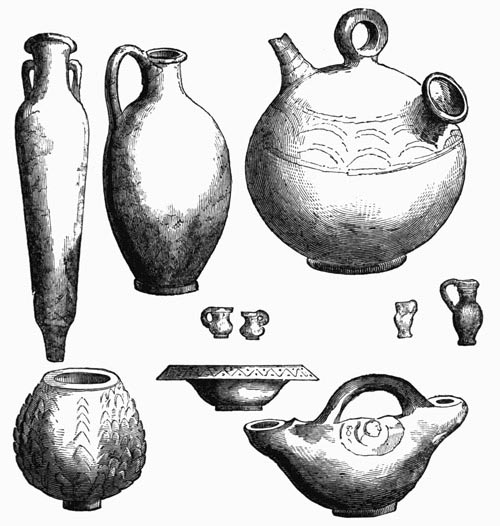
Fig. 114.—Earthen Vessels from the Catacombs.
Some of these vessels are shallow basins rather than vases, (see
above, and also Fig. 116,) which have been interpreted by Roman
Catholic writers as benitiers, or holy-water vessels employed
in the services of the
Romish ritual. They were more probably
ablutionary basins for the use of the fossors, summoned from their
grimy labour to assist in the funeral solemnities; or, possibly, for
the symbolical washing of the hands by the primitive bishops and
presbyters before the consecration of the eucharist, which is
mentioned by several of the Fathers as a fulfilment of that Scripture,
“I will wash mine hands in innocency; so will I compass thine altar, O
Lord.”[646]
They have also been regarded as baptismal vases.
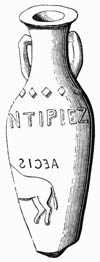
Fig. 115.—An Amphora.
Generally this primitive pottery, except the fictile lamps, bears no
distinctive Christian symbol; yet sometimes it does, as the
accompanying amphora, the bottom of which has been broken off. Around
the vessel runs the inscription, VINCENTI PIE ZESE—“Vincent,
drink and live.” On the lower part are three conquering horses,
probably in allusion to the name Vincent. Above the horses is the
inscription, AEGIS OIKOYMENE ZEP, written backwards.
The tall vessels shown in Fig. 116, which are of silver with gold
coating, are described by Perret as designed for holding the holy
chrism,[647]
or sacred anointing oil. They were more probably used for
containing the wine for the eucharist, for which they were of
sufficient size, as the subterranean assemblies could not be very
numerous. On the large
medallion is a bust of St. Paul, and on the
reverse that of St. Peter. On the other vessel, besides the busts of
these saints, is that of Our Lord wearing a nimbus, together with the
sacred symbols of the cross, doves, and lambs. The nimbus, the form of
the cross, the material, and the style of execution, indicate a
comparatively late date. Some of the vessels we have described were
doubtless employed also in the celebration of the Agape.
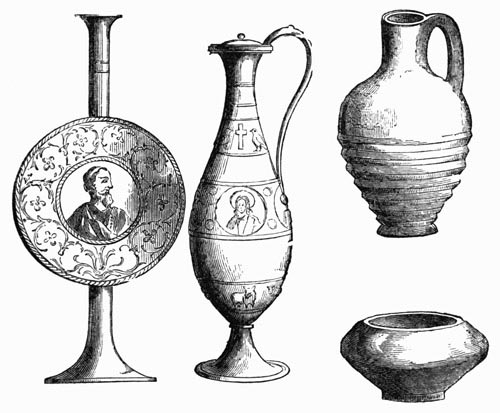
Fig. 116.—Metal and Earthen Vessels from the Catacombs.
Among the most interesting objects found in the Catacombs are the
rings and seals of the early Christians, which are frequently combined
in one. Tertullian speaks of the annulus pronubus, or ring of
espousal, the wearing of which was the only use of gold known to the
Roman women in the days of primitive simplicity;[648]
and St.
Agnes
declares her betrothal to Christ by the ring of his faith.[649]
A
signet ring was also considered an essential part of the bridal outfit
of a newly wedded wife, and that not for ostentation, says Clement of
Alexandria, but that, being entrusted with the care of domestic
concerns, she may seal up those household treasures which might
otherwise be insecure.[650]
But these rings must be freed from every
trace of idolatrous superstition, and bear only Christian symbols. “On
our signet rings,” says the writer just mentioned,[651]
“let there be
seen only a dove, or a fish, or a ship sailing toward heaven, or a
lyre, or an anchor; for those men ought not to engrave idolatrous
forms to whom the use of them is forbidden; those can engrave no sword
and bow who seek for peace; the friends of temperance cannot engrave
drinking cups.”
Signet rings, being ancient symbols of authority,[652]
were also worn
by bishops as a sort of badge of office, and as a pledge of their
spiritual espousal to the church of Christ. A curious episcopal ring
worn by St. Arnulf, bishop of Metz, in the sixth century, exhibits the
well-known ichthyic symbol.[653]
The ring shown in Fig. 117 bears the sacred monogram accompanied by
the significant Alpha and Omega. In the seal, or intaglio, copied in
Fig. 118, the ship of the church is represented as borne by the
symbolical fish, while doves, the emblem of the faithful, perch upon
the mast and stern. In naive blending of the literal with the
figurative, Our Lord in bodily presence is seen approaching
the
vessel and supporting Peter by the hand, doubtless in allusion to the
trial of his faith on the Sea of Galilee. The identity of both figures
is indicated by the names written overhead. Two other apostles row the
vessel, and a third lifts up his hands in prayer. It was doubtless a
seal of this character to which Clement of Alexandria alludes as
bearing the ναῦς οὐρανοδραμοῦσα—“the ship in full sail
for heaven.”
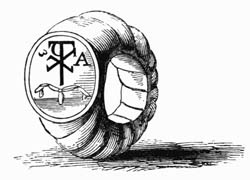
Fig. 117.—A Ring from the Catacombs.
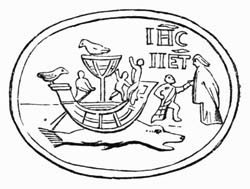
Fig. 118.—A Seal from the Catacombs.
On some signet rings in the Museum of Naples, found in the ruins of
Pompeii, are the Christian symbols of the mystical fish, palms, and
the anchor of hope, or the synonymous word ΕΛΠΙϹ. These are
almost the sole indications of the existence of any Christian element
in that gay, luxurious city. Other Pompeian rings bear light Epicurean
mottoes, as: ΕΥΤΥΧΙ ΠΑΝΟΙΚΙ Ο ΦΕΡΩΝ—“Good luck to thee, O
wearer, and to all thine;” ΛΕΓΟΥϹΙΝ
Α ΘΕΛΟΥϹΙΝ ΛΕΓΕΤΩϹΑΝ ΟΥ ΜΕΛΙΜΟΙ—“They say what they will; let them say, I care not.” Another
has an engraving of a finger holding an ear, with the word, ΜΝΗΜΟΝΕΥΕ—“Remember.” Other Roman rings bear such mottoes as,
AMO TE AMA ME—“I love thee, love thou me;” PIGNVS
AMORIS—“A pledge of love;” VNI AMBROSIA VENENVM
CAETERIS—“To one nectar, to others poison.”
More frequently than the seal itself occurs its impression in the
plaster of the graves, either to express some Christian sentiment, or
as a means of recognizing a tomb which bore no other mark. The stamp
of coins, or even shells, stuck into the plaster, were used apparently
for the same purpose. In the following engraving are represented
impressions of two of these seals. In the first is the confession of
faith in the divinity of Our Lord by some orthodox Christian, probably
in the time of the Arian heresy. In the second a devout believer
declares his hope in Christ.
|
|
CHRISTVS EST DEVS.
Christ is God. |
SPES IN EO.
Hope in Him, i. e., in Christ. |
|
Fig. 119.—Impressions of Early Christian Seals. |
Other seals bear such pious mottoes as DEVS DEDIT—“God
gave;” VIVAS IN DEO—“May you live in God;” SPES IN
DEO—“Hope in God;” PEDE SECVNDO—“May you succeed
happily.” Vast numbers of tiles bearing impressions of the die upon
them are found, but these are merely the stamps of the imperial brick
kilns, with the names of the reigning sovereigns.
Affecting memorials of domestic affection are found in the toys and
trinkets of little children enclosed in their graves or affixed to the
plaster without. The dolls in the following engraving strikingly
resemble those with which children amuse themselves to-day. They are
made of ivory, and some are furnished with wires, by
which the joints
can be worked after the manner of the modern marionettes. The object
in the upper left hand corner is a terra cotta vase with a narrow slit
for receiving money, like the common children’s savings banks. Beneath
it is an ivory ring. The other objects are small bronze bells, forming
part of a child’s rattle. In the Catacomb of St. Sebastian was also
found a small terra cotta horse of rude design, dappled with coloured
spots.
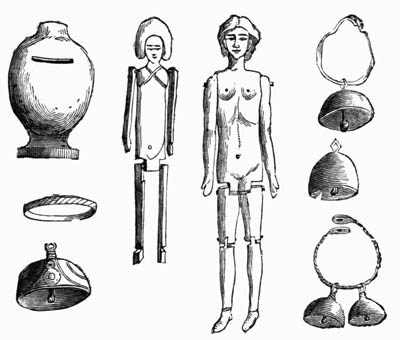
Fig. 120.—Children’s Toys found in the Catacombs.
The human affections are the same in every age. These simple objects
speak more directly to the heart than “storied urn or animated bust.”
As we gaze upon these childish toys in the Vatican Museum the
centuries vanish, and busy fancy pictures the weeping Roman mother
placing these cherished relics of her dead babe in its waxen hands or
by its side, as it is laid from her loving arms in the cold embrace of
the rocky grave, and then, with tear-dimmed eyes, taking a last, long,
lingering farewell of the loved form about to be closed from her sight
forever.
Numerous toilet articles have also been found in the Catacombs,
generally in the graves of the dead or cemented by the plaster to the
tombs. Many of these have been plundered and lost; but still a very
interesting collection
exists in the Vatican Library. Among its
contents are long silver or ivory bodkins for the hair, combs of box
or ivory, scent-bottles and boxes of perfume, broaches, earrings,
bracelets, sometimes with keys to unlock the clasps, and other
ornaments in bronze, silver, or gold.[654] The simpler manners of the
Christian women, as compared with those of pagan faith around them, is
indicated by the conspicuous absence of the rouge pots and jars of
cosmetics, and many other articles of luxury, which formed so
important a part of the toilet requisites of Rome’s proud dames, and
which are so frequently found in the ruins of Pompeii. The Christian
ornaments, moreover, even after the departure from the primitive
simplicity of manners, were of a very different character from those
of the corrupt civilization of paganism. Instead of the abominable
representations of heathen art, suggesting every evil thought and
stimulating every vile passion, of which so many examples occur in the
Museum of Naples, only chaste and modest figures are found; and even
the articles of the toilet are frequently adorned with pious mottoes.
Thus, on a bodkin for a lady’s hair, probably a love-gift to a wife or
betrothed bride, is engraved the beautiful sentiment, ROMVLA
SEMPER VIVAS IN DEO—“Romula, may you ever live in God.” Such a
religious art seems an anticipation of the day when “Holiness to the
Lord” shall be written upon the bells of the horses.
Small caskets of gold or other metal for containing a
portion of the
gospels, generally part of the first chapter of John, which were worn
on the neck, have also been found. They seem to have been introduced
in the decline of primitive piety in imitation of the Jewish
phylactery or pagan amulet, and were probably worn for the same
superstitious purpose, to avert danger or to cure disease. They were
condemned by Irenæus, Augustine, Chrysostom, and by the Council of
Laodicea, as a relic of heathenism.[655]
On a carved figure of a fish,
with a hole drilled through it for suspending it from the neck, and
probably intended for an amulet, is engraved the word, ϹΩϹΑΙϹ—“Mayest thou save us.” Medals, coins, and what are described
as tessaræ of hospitality, by which the early Christians recognized
travelling members of distant churches as sharers of the same faith,
and admitted them to their assemblies and their homes, have likewise
been found. So also have articles of domestic economy, as spoons,
knives, keys, drinking-cups and shells used as such, and even a
metallic kettle for cooking. Certain articles employed in religious
service, as a baptismal font, altars, chairs, etc., will be hereafter
described.
This practice of burying with the dead the objects which they had
employed in life was common to the pagans from the earliest Etruscan
times to the most recent heathen sepulture. They interred in the tombs
of the departed every kind of utensil and implement of trade, and even
articles of food. M. Rochette perceives herein a notion, confused and
gross though it may be, of the immortality of the soul, and a proof of
that instinct of man which recoils from the thought of
annihilation.[656]
In like manner, the Christians, although animated
by a loftier hope, and inspired with an assurance of eternal
deathlessness, long followed this ancient custom, even to the extent
sometimes of putting the piece of money in the mouth of the deceased,
intended by the heathen for the payment of Charon.[657]
This was most
probably, in many instances a mere unthinking conformity to ancient
use and wont. Milman asserts that the practice of burying money, often
large sums, with the dead, was the cause of the very severe Roman laws
against the violations of the tombs, inasmuch as the government wished
to reserve to itself that source of revenue.[658]
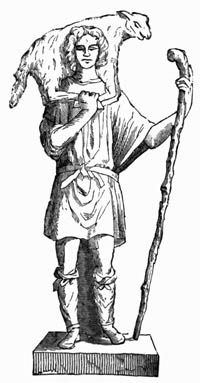
Fig. 121.—Statue of the Good Shepherd.
In the Christian Museum of the Vatican is a marble statue of the Good
Shepherd, figured in the accompanying engraving, which is believed to
be from the Catacombs. Although the execution is coarse, yet from the
general style Rumohr thinks it probably the oldest
extant specimen of
Christian statuary.[659]
Sculpture seems to have bowed less willingly
than painting to the new religion, and was much more tardy in laying
its offerings on the altar of Christianity. It retained also much of
the spirit of paganism, and never became thoroughly imbued with
Christian sentiment. The colossal figure of the Galilean fisherman
beneath the mighty dome of his proud mausoleum—that stateliest fane
in Christendom—if not indeed the identical statue of the Capitoline
Jove, is copied from a heathen model. The majestic Moses of Michael
Angelo seems rather the embodied conception of the cloud-compelling
Phidian Zeus than of the Hebrew patriarch, described as the meekest of
men. Even Thorwaldsen’s sublime figures of Christ and the apostles
exhibit more of the majesty of antique pagan art than of the meek and
tender grace of Christianity. Sculpture, as M. Rochette well remarks,
struck its roots deeply into the soil of heathenism, and was with the
utmost difficulty transplanted therefrom. It is essentially pagan in
its character, and is especially adapted for the expression of the
severer virtues. Painting is more instinct with Christian spirit, and
is the better fitted for the representation of the softer graces.
Moreover, the profession of the sculptor was held in abhorrence on
account of its connexion with idolatry. Tertullian stigmatizes the
makers of images as the
foster-fathers of devils and the procurers
of idols.[660]
Prudentius calls Mentor and Phidias the makers and
parents of the heathen gods.[661]
All who were in any wise connected
with this unhallowed craft were rejected from the ordinance of baptism
and denied the holy eucharist.[662]
“The ancient Christians,”
Buonarotti truly remarks, “always kept aloof from these arts, by which
they might have run a risk of polluting themselves with idolatry; and
hence it arose that few or none of them devoted themselves to painting
or to sculpture, which had as their principal object the
representations of the gods or the myths of the heathen.”[663]
Hence
the almost entire absence of Christian statuary from the Catacombs.
Even the sculptured bas reliefs of the sarcophagi before described
were for the most part the product of that later period, when
Christianity, coming forth from these subterranean crypts, walked in
the light of day and basked in the favour of princes.
This brief notice of early Christian sculpture would be incomplete
without some reference to the statue of the celebrated Hippolytus,
bishop of Portus, the most remarkable known specimen of that class. It
was discovered by some workmen digging near the church of San
Lorenzo fuori le mura in the year 1551, and probably originally
stood in the adjacent Catacomb of Hippolytus.
The martyr bishop is
represented as seated in a sort of episcopal chair. The figure is
modelled with a classic grace and dignity superior to any examples of
the Constantinian period. Indeed, the distinguished art critic,
Winckelmann, declares it to be the finest specimen of early Christian
sculpture extant. It was considerably mutilated, but has been
skilfully restored, and now stands in the Lateran Museum. On the base
of the chair is engraved a list of the published writings of
Hippolytus,[664]
and also the table which he constructed for
determining the true period of the Easter festival. The discovery of
an error in this table deprived it of much of its value; and the date
of this monument is probably prior to that discovery, or the early
part of the third century.
Passing allusion should also be here made to the early Christian
diptychs, specimens of which are found in almost every antiquarian
museum. These were formed after the model of the imperial and consular
diptychs, or registers of the public officers of Rome. They consisted
of tablets of ivory, wood, or metal, folded together,[665]
and bore
the names of the bishops, officers, or distinguished patrons of the
church, and memorials of the martyrs and holy dead. These memorials
were frequently read in the religious assemblies of the primitive
church, especially on the anniversaries of the martyrs’ death. This
practice led in course of time to the invocation of their aid in the
Litany of the Saints, and to other errors of Romanism. The diptychs
had also frequently elaborate bas reliefs of scenes from the biblical
cycle, and in the age of image-worship bore the figures of the saints
to whom a corrupt Christianity had begun to pay an idolatrous
veneration. They became thus the prototype of the illuminated missal
of the Middle Ages.
Transtyberinus ambulator,
Qui pallentia sulphurata fractis
Permutat vitreis.—Epig., i, 42.
Few places in Rome are more attractive to the student of Christian
archæology than the Lapidarian Gallery in the palace of the Vatican.
In this long corridor[666]
are preserved a multitude of epigraphic
remains of the venerable past, shattered wrecks of antiquity, which
have floated down the stream of time, and have here, as in a quiet
haven, at length found shelter. The walls on either side are
completely covered with inscribed slabs affixed to their surface. On
the right hand are arranged the pagan monuments collected from the
neighbourhood of the city—sepulchral and votive tablets, altar
dedications, fragments of imperial rescripts and edicts, and other
evidences of the power and splendour of the palmy days of Rome. On the
left are the humble epitaphs of the early Christians, rudely carved in
stone or scratched in plaster, and brought hither chiefly from the
crypts of the Catacombs. Of greater interest to him who would
rehabilitate the early ages of the church, and
To the sessions of sweet silent thought
Would summon up remembrance of things past,[667]
is this long corridor of inscriptions than any of the four thousand
apartments of that vast palace of the popes, with their priceless
bronzes, marbles, gems, frescoes, and other remains of classic art. He
will turn away from the noble galleries where the Laocoon forever
writhes in stone, and Apollo—lord of the unerring bow—watches his
arrow hurtling toward its mark, to the plain marble slabs that line
these walls. In the rude inscriptions here recorded he will discover
some of the strongest evidences of revealed religion and most striking
proofs of the purity of the faith, simplicity of worship, and
uncorrupted doctrines of the early church. Thus primitive Christianity
lifts its solemn protest in these halls of wealth and power, in the
very palace of the popes, against the anti-Christian system of which
they are the representatives.
Here the monuments of pagan and of Christian Rome confront each other.
The spectator stands between two worlds of widest divergence, and
cannot but be struck with the immense contrast between them. “I have
spent,” says M. Rochette, “many entire days in this sanctuary of
antiquity, where the sacred and profane stand face to face in the
written monuments preserved to us, as in the days when paganism and
Christianity, striving with all their powers, were engaged in mortal
conflict.”[668]
On the one side are recorded the pride and pomp of
worldly rank, the lofty titles and manifold distinctions of every
class, from divinities to slaves. The undying historic names of Rome’s
mighty conquerors, the leaders of her cohorts and legions, mingle with
those of the proud patrician citizens, and alike display on their
sepulchral slabs the august array of prænomen, nomen, and cognomen,
which attest their
lofty social position or civil power.[669]
The
costly carving and elaborate bas reliefs of many of these monuments
indicate the wealth of him whom they commemorate. The elegantly turned
classic epitaph—with its elegiac hexameters breathing the stern and
cold philosophy of the Stoa, or an utter blankness of despair
concerning the future, or, perchance, a querulous and passionate
complaining against the gods—shows how the races without the
knowledge of the true God met the awful mystery of death. The numerous
altars to all the fabled deities of the Pantheon, the vaunting
inscriptions and lofty attributes ascribed to the shadowy brood of
Olympus—“unconquered, greatest, and best”—read, by the light of
to-day, like an unconscious satire on the high pretensions of those
vanished powers. The fragmentary edicts of the emperors, the numerous
military trophies, and the records of complicated political orders,
indicate the might and majesty of the Empire in the days of its utmost
power and splendour.
On the other side of the corridor are the humble epitaphs of the
despised and persecuted Christians, many of which, by their rudeness,
their brevity, and often their marks of ignorance and haste, confirm
the truth of the Scripture, that “not many mighty, not many noble, are
called.” Yet these “short and simple annals of the poor” speak to the
heart with a power and pathos compared with which the loftiest classic
eloquence seems cold and empty. It is a fascinating task to spell out
the sculptured legends of the Catacombs—the vast graveyard of the
primitive church, which seems to give up its dead at our questioning,
to bear witness concerning the faith and hope of the Golden Age of
Christianity.
As we muse upon these half-effaced inscriptions—
Rudely written, but each letter
Full of hope, and yet of heart-break,
Full of all the tender pathos
Of the Here and the Hereafter—
we are brought face to face with the church of the early centuries,
and are enabled to comprehend its spirit better than by means of any
other evidence extant. These simple epitaphs speak no conventional
language like the edicts of the emperors, the monuments of the mighty,
or even the writings of the Fathers; they utter the cry of the human
heart in the hours of its deepest emotion; they bridge the gulf of
time, and make us feel ourselves akin with the suffering, sorrowing,
yet triumphant Christians of the primitive ages.
These inscriptions were found in situ in the explorations of
the Catacombs, or were dug up in vineyards in the vicinity of the
city. They have been diligently collected by antiquarians for the last
three hundred years. Before the year 1578 there were not a thousand
Christian inscriptions extant in all Italy. Of these not one was
derived from the Catacombs, and the earliest date was the year 533.
With all its boasted veneration for the past, and professed devotion
to the antiquities of primitive Christianity, the Church of Rome
allowed the memory of the Catacombs, the shrine and sanctuary of the
faith in the early centuries, to be as completely forgotten as the
site of Troy; and even after their rediscovery many of their principal
records of the past were wantonly destroyed or recklessly lost through
the ignorance or carelessness of their self-constituted guardians and
preservers. Numerous invaluable inscriptions have perished from the
effects of time;
many have been scattered throughout the public and
private collections of Europe; and many more have been defaced or
ruined by the feet of generations of worshippers in the churches of
whose pavements they form a part. Bosio describes many monuments
extant in his day of which De Rossi saw only the fragments, and the
latter pathetically deplores the destruction and devastation of those
precious relics of Christian antiquity.[670]
Christian epigraphy, however, was not altogether neglected during the
Middle Ages. A manuscript collection of epitaphs found at Einsiedlen,
and attributed to the ninth century, is partly Christian; and another,
found at Kloster Newburg, is exclusively so. A manuscript in St.
Mark’s Library at Venice contains about a hundred and fifty early
Christian epitaphs. The first collection after the revival of letters
was made by Pietro Sabini, and another was published by Onofrio
Panvini. Leo X. commanded Raphael, the capo architetto of St.
Peter’s, to preserve from injury the inscriptions—res
lapidaria—of the older structure; but no systematic attempt at
their preservation was made till Benedict XIV. appointed Francesco
Brambini to that task. He collected a large number in the long gallery
of the Vatican; but they were not arranged till the close of the last
century, when they were classified by the distinguished
archæologist
Geatano Marini at the command of Pius VI. A new collection was begun
in the Lateran Museum by Padre Marchi, which has been greatly enlarged
and admirably classified and arranged by Cavaliere De Rossi. There are
also other collections in the Collegio Romano, and in the Kircherian
and other Museums. Many sepulchral slabs are also affixed to the walls
or inserted in the pavement of the churches of St. Paul, St. Gregory,
St. Laurence, St. Mark, St. Maria in Trastevere, and in a few others
in Rome.[671]
That distinguished scholar and epigraphist, De Rossi, has passed
through the crucible of his critical examination all the extant
inscriptions of the first six centuries found in the neighbourhood of
Rome. In the first volume of his Inscriptiones Christianæ he
gives all those with consular dates, thirteen hundred and seventy-four
in number. He designs giving in future volumes the remainder of the
series, classified according to their doctrinal, historical, or other
characteristics. He treats the subject with the utmost candour and
moderation, and illustrates these frequently obscure topics with
exhaustive and various scholarship. There are now over eleven thousand
of these epitaphs extant, which number is being continually increased
by the progressive exploration of the Catacombs. From an analysis of
their general characteristics and appearance the following results are
derived.
The inscriptions are generally engraved on marble slabs from one to
three feet long and one foot high, which are used to close the graves
of the dead; many, however, are mere scratches on the soft surface of
the plaster, hardened in drying; and some are written with red or
black paint, or, more rarely, with charcoal. The letters vary from
half an inch to four inches in height, and the incised surface is
frequently coloured with a reddish pigment. Prudentius, alluding to
this practice of chiseling the letters in stone, calls upon the
faithful to “wash with their tears the furrows of those marble
slabs.”[672]
The epitaphs are for the most part written in uncial characters,
frequently without any separation of the words,[673]
although
sometimes they are divided by spaces, points, or leaves. They
frequently abound also in contractions and monogrammatic
abbreviations, imposed by limit of space or economy of labour, as in
the following figure:

Fig. 122.—“Gemella sleeps in peace.”
Although sometimes well cut, the inscriptions are often wretchedly
executed, presenting a straggling and scarce legible scrawl, as in the
following examples, the second of which indicates a transition into
the later cursive character.
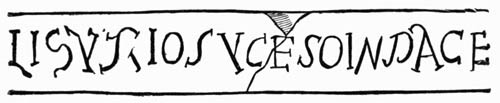
Fig. 123.—“Ligurius Successus, in peace.”
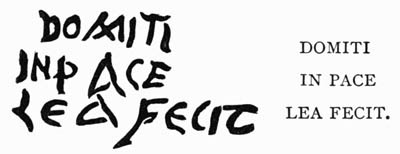
Fig. 124.—“Domitius in peace. Lea erected this.”[674]
This ancient epigraphy often betrays extreme ignorance, and sets at
defiance all the laws of grammatical construction. The spelling is
frequently atrocious, and the general style and character utterly
barbarous, rendering the meaning extremely obscure or altogether
undecipherable. The language was much corrupted by the foreigners and
slaves who formed so large a portion of the population. The later
examples are often marked by the absence of terminal inflexions and
the use of prepositions instead, and by other indications of the
falling to pieces of the stately Latin tongue, which had been the
vehicle of such a noble literature and such lofty eloquence, and of
its degeneracy from
the purity of the Augustan era into the mixed
dialect of the Middle Ages, from which the modern Italian has
sprung.[675]
The barbarous Latinity of the following indicates the degradation into
which the language had fallen:
IIBER QVI VIXI QVAI QVO
PARE IVA ANOIVE I ANORV
M PLVI MINVI XXX I PACE.
Read: Liber, qui vixit cum compare sua annum I. Annorum plus
minus XXX. In pace.
Liber, who lived with his wife one year. He lived thirty years,
more or less. In peace.
Sometimes the inscription is found upside down, being probably thus
placed by one unable to read. In the following example, from the
Catacomb of St. Priscilla, a dove was afterward added, to correct in
part the mistake of the ignorant fossor. Probably the epitaph may
have been scratched on the stone by the dim light struggling through a
luminare, but when brought to the grave it was too dark to see
which side was uppermost.
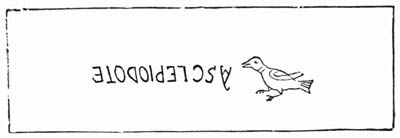
Fig. 125.—Inscription upside down.
In one example in the Lapidarian Gallery, represented in Fig. 126, the
inscription is actually written backwards, like Hebrew text. Probably,
as Maitland suggests, the stonecutter took the impression on marble
from a written copy, and was too ignorant to perceive that it was, of
course, reversed.
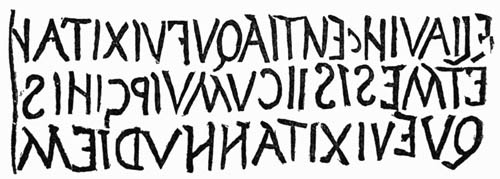
Fig. 126.—Reversed Inscription.
Read: Elia Vincentia. qui vixit an ... et mesis II, cum
Virginis que vixit annu diem.
Elia Vincentia, who lived ... years and two months, and lived
with Virginius a year and a day.
Most of the early epitaphs are of touching brevity and simplicity.
Frequently only a single word, the name given in baptism, is recorded
on the tomb, as in Fig. 127, which exhibits also the Christian symbols
of the monogram, cross, and palm.
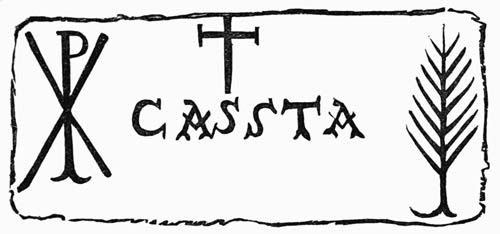
Fig. 127.—“Cassta." (sic.)
In Fig. 128 the names of three individuals appear on the same slab,
which is recognizable as Christian only by the symbol of the Good
Shepherd:
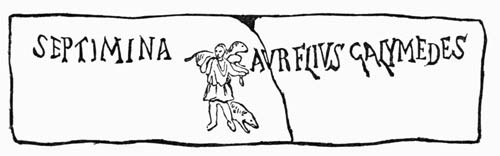
Fig. 128.—“Septimina, Aurelius, Galymedes.”
Frequently the phrase IN PACE, or DORMIT IN PACE, is
added, in attestation of the Christian faith of the deceased, (see
Figs. 122-124;) or, more briefly still, the word LOCVS is prefixed, as LOCVS
PRIMI—“The place of Primus,”[676]
as if descriptive of the last
long home, the house appointed for all living.
The later inscriptions are frequently far removed from this naive
simplicity, being inflated in style and elaborate in execution,
attesting the increased wealth and growing pride of the Christian
community. Of these we shall hereafter have frequent examples. One
very remarkable series is that executed, under the direction
of
Pope Damasus, in the latter part of the fourth century. He composed
numerous metrical epitaphs in honour of the martyrs, which were
engraved in marble in a singularly elegant decorated character,
designed by his secretary, Furius Dionysius Filocalus, who was also an
accomplished artist. Hence the letters of these Damasine inscriptions
are as distinct a characteristic in early Christian epigraphy as the
celebrated Aldine type in the bibliography of the revival of learning.
There are few of the Catacombs where these inscriptions have not been
found; and De Rossi has been enabled thereby to reconstruct some
valuable historical monuments from a few fragments, just as a skilful
anatomist will reconstruct a skeleton from a portion of the vertebræ.
Some of the most important of these have already been given; others
will hereafter occur. The Latinity is often of a school-boy
mediocrity; but they are of great value as determining the identity
and elucidating the history of many important Christian tombs.
Most of the epitaphs, as we might naturally expect, were written in
Latin. Nevertheless, a considerable proportion are in Greek, to which
circumstance several causes conduced. Although Latin was the language
of the mass of the Roman population, yet Greek was also spoken largely
by the educated classes. We know, too, from the pages of Juvenal[677]
and contemporary writers, that Rome swarmed with numbers of slaves and
others from Greece and Asia Minor, who, although they might be able to
speak Latin, would find it very difficult to write it. Moreover, Greek
seems to have been in the early centuries a sort of ecclesiastical
language at Rome, just as Latin is now throughout Roman Catholic
Christendom. It was in this language that the glad tidings of the new
evangel were first declared, and in it St. Paul wrote his epistle to
the Roman church. The new wine of the gospel flowed from that classic
chalice which so long had poured libations to the gods. Probably a
religious sentiment led to the adoption, even by those to whom it was
unfamiliar, of the language in which their holiest teachings and
highest hopes had been originally conveyed, and in which the Apostolic
Fathers and the greatest apologists, theologians, and historians of
the early church had fought the battles of the faith. The responses of
the Roman liturgy long continued to be uttered in this tongue, and
traces of this practice still remain in the Kyrie, eleeson!
Christe, eleeson! of the Order of the Mass. This primitive Greek
influence has also left its indelible impression on our language in
such words as church, bishop, presbyter, eucharist, baptism,
catechism, liturgy, psalm, and hymn.
Sometimes the humble mourner had to be content with recording the
Latin words in Greek characters, as in the following examples: ΛΕΙΒΕΡΕ
ΜΑΞΙΜΙΛΛΕ ΚΟΙΟΥΓΕ ΑΜΑΝΤΙϹϹΙΜΑΕ ΦΙΚΙΤ ΕΝ ΠΑΚΕ. Read: Liberæ
Maximillæ conjugi amantissimæ, vixit in pace—“To Libera
Maximilla, a most loving wife. She lived in peace.” ΒΕΝΕ
ΜΕΡΕΝΤΙ
ΦΙΛΙΕ ΘΕΟΔΩΡΕ ΚΥΕ ΒΙΞΙΤ ΜΗϹΙϹ ΧΙ ΔΙΕΣ ΧVΙΙΙ. Read: Bene
merenti filiæ Theodoræ, qui vixit menses XI, dies XVIII—“To our
well-deserving daughter Theodora, who lived eleven months and eighteen
days.”[678]
In copying Latin inscriptions many errors arose from
the mason
mistaking the Roman characters for similar Greek ones, as A for
Λ, T for Γ, and the Latin H and P for the
Greek Eta and Rho. The Greek influence is also seen in
the altered inflexion of Latin words, as maritous for
maritos, filies for filias, and the like. The
proportion of Greek inscriptions among those before the time of
Constantine is estimated at one eighth.[679]
After that period it is
less, indicating the gradual decline of Greek influence. In Gaul and
the western provinces the proportion is not so great. At Autun there
is only one Greek epitaph.
Of the eleven thousand extant inscriptions only thirteen hundred and
seventy-four bear dates. The period of the others can be only
approximately determined by a comparison with those whose ages are
known; by a careful examination of the execution, language, and
general sentiment, those of earlier date being less florid and more
classical in style; by the presence or absence of certain symbols, as
the sacred monogram, of which no example is known before the period of
Constantine; and by the position in the Catacombs, those in the lower
piani being of later date.
Judging by these criteria, De Rossi has arrived at the following
conclusions: About six thousand of the epitaphs belong to the first
four centuries, and are from the Catacombs; the rest were found above
ground. Of these six thousand, about four thousand are before the year
324 A. D., when Constantine became sole emperor.
Only one of the dated inscriptions belongs to the first
century, (A. D. 71,) two are of the second, (A. D. 107 and
111,)
and twenty-three of the third; the fourth century is represented by
over five hundred; the fifth by nearly as many; the sixth by about
three hundred, principally in its earlier half; and the seventh by
only seven.
Of these dated inscriptions, all before the year 313 A. D., when the
edict of Milan gave peace to the church, are from the Catacombs. After
that event subterranean sepulture rapidly decreased. Of the epitaphs
bearing dates between the years 313 A. D. and 337 A. D., two thirds
are from the Catacombs, and one third from the basilicas and other
places of burial above ground. From A. D. 337 to the time of Julian
the proportion of each was about equal. Of the dated inscriptions of
the last quarter of this century, about one fourth are subterranean.
Of those between the years A. D. 400 and A. D. 410, not one in ten is
from the Catacombs, and after that period not one subterranean example
occurs.[680]
Sometimes, in epitaphs of late date, the name of the
church and the position of the tomb are mentioned, as in the
following: DEPOSITVS IN BASILICA SANCTORVM NASARI ET NABORIS
SECVNDV ARCV IVXTA FENESTRA, (A. D. 404,)—“Buried in the
basilica of Sts. Nasarius and Nabor, in the second arch near the
window;” DEPOSITA IN CONTRA COLONNA VII, (A. D. 452,)—“Buried in the space opposite the seventh column.”
The Christian era was not adopted as a note of time till after the
sixth century. The dates of the Roman inscriptions were therefore
indicated by the names of the consuls for the year, generally written
in an abbreviated
form.[681]
Frequently the addition VC., for Vir
Clarissimus—“An illustrious man”—or, in the case of imperial
consuls, DN., for Dominus Noster—“Our Lord”—also occurs.[682]
In one instance the epithet DIVVS—“Divine”—assumed by the emperors, is
employed in a Christian epitaph, in unthinking imitation of a heathen
formula.
This mode of indicating dates, to which the name hypatic (from ὕπατος, consul) has been applied, continued in
vogue till the latter part of the sixth century, and is the last
recognition of that venerable institution, the Roman consulate. The
year of the emperor, which was enjoined by Justinian, A. D. 537, for
the dating of all public acts, appears after that time.
Towards the close of the fourth century the date is sometimes
indicated by the name of the presiding bishop of the church at Rome,
as SVB LIBERIO EPISCOPO, SVB DAMASO EPISCOPO, or
TEMPORIBVS SANCTI INNOCENTII, the last expression used
probably after the death of the pope named. The names of the bishops
of other dioceses than that of Rome are also used, an indication of
the parity of episcopal rank in the primitive ages. Thus we have in
the year A. D. 397 the name PASCASIO EPISCOPO, according to
De Rossi, probably the bishop of an ancient diocese in the immediate
vicinity of the city. In the sixth century the names of certain
priests, and even deacons, were used as local marks of time.
In a large number of inscriptions the day of the month is mentioned,
although the year is not. Cardinal
Wiseman attributes this to the
custom of commemorating the anniversary of the death of the departed
as that of his birth into a higher life.[683]
But a similar usage is
observed also in pagan epitaphs; and Dr. McCaul has well remarked[684]
that it is the day of burial that is mentioned more frequently than
that of death. The date of birth is seldom given,[685]
but the length
of life is almost invariably indicated, frequently with great
minuteness. Not only are the number of years, months, and days
mentioned, but often, with loving exactness, the hours, half-hours,
and even the “scruples” or twenty-fourths of an hour, as in the
following example: BENE MERENTI IN PACE SILVANA QVAE HIC DORMIT
VIXIT ANN. XXI. MENS. III. HOR. IV. SCRVPLOS VI.—“To the
well-deserving Silvana, who sleeps here in peace. She lived twenty-one
years, three months, four hours, and six scruples.” Six scruples are a
quarter of an hour.
When the exact number of years was unknown, the expressions PLVS
MINVS, ΠΛΕΟΝ ΕΛΑΤΤΟΝ—“more or less”—were used.[686]
Frequently the duration of married life
is also mentioned with extreme
definiteness, as in the following:[687]
SILVANA NICIATI MARITO
BENE MERENTI CUM QVO VIXIT ANNIS TRIBVS MANSIBVS DVABVS HORIS
UNDECIM,—“Silvana to her well-deserving husband Niciatis, with
whom she lived three years, two months, eleven hours.”
The day of the month is generally indicated in the ordinary way with
reference to the divisions of Calends, Nones, and Ides.[688]
The days
of the week are mentioned by their usual classical names, as Dies
Solis, Sunday; Dies Lunæ, Monday; Dies Martis,
Tuesday; Dies Mercurii, Wednesday; Dies Jovis, Thursday;
Dies Veneris, Friday; and Dies Saturni, Saturday.
Sometimes, however, the first and last days of the week are indicated
by the Christian designations Dies Dominica, the day of the
Lord, and Dies Sabbati, the day of rest.
The Christian inscriptions also habitually ignore all mention of the
birth-place or country of the deceased, as if in recognition that the
Christian’s true country is beyond the grave.[689]
As if, also, in
obedience to the injunction to forsake father and mother in order to
follow after Christ, details of family or descent, which are so
conspicuous in some heathen inscriptions, almost never occur.
Mr. Burgon has briefly expressed the principal points of contrast
between modern epitaphs and those of the early Christians, as follows:
“They never mention the date of birth,[690]
we seldom omit it. They
constantly record the day of burial, we never. They seldom mention the
year of death, we never omit it. We never allude to burial, they
always. They frequently record the years of married life, we never. In
theirs the survivors appear prominently, even by name, and are
sometimes mentioned exclusively. With us the dead are always named,
the living seldom.”[691]
There are among these inscriptions several examples of
opisthographæ, as they are called,[692]
that is, Christian
epitaphs written on slabs that had originally borne one of pagan
character. The latter are generally defaced or obliterated, filled
with cement or turned to the wall, or placed upside down or sideways,
so as to indicate their rejection by the Christian artist. Sometimes,
however, they are still legible, but they have manifestly no
connection with Christian sepulture whatever. Some are not funeral
epitaphs at all, and some which are commemorate an entire family,
though affixed to a single Christian grave. The appropriation of
heathen monuments for the reception of Christian inscriptions will
appear less strange when we reflect that the very temples of the gods
have been the quarries from which many of the churches and palaces of
later times were built.
Sometimes, as in the example given in Fig. 59, the heathen formula of
consecration to the “Divine Spirits”—D.
M., for Dis Manibus—is
obliterated, and the sacred monogram gives the slab a Christian
character. Occasionally, however, these letters appear in manifestly
Christian inscriptions, in which case Fabretti and others have
maintained that they were capable of the interpretation Deo
Magno or Deo Maximo—“To the Supreme God.” With still less
probability M. Rochette renders them Divis Martyribus—“To the
divine martyrs,” for which expression no countenance is to be found in
the entire range of the Catacombs. Both interpretations are entirely
gratuitous suppositions, for which Christian epigraphy furnishes
absolutely no warrant. It is more probable that they were careless or
conventional imitations of a common heathen formula, which was
occasionally adopted by the Christians without thought, or perhaps in
ignorance of its meaning, just as they also imitated the winged genii
and other classic accessories of pagan art in the ornamentation of the
Catacombs. Dr. McCaul has suggested that the Roman mortuary sculptors
probably kept sepulchral slabs on sale, as is often done now, with the
common formulæ already engraved, which were purchased without regard
to their appropriateness, and that in filling up the inscription the
Christians sometimes neglected to obliterate the letters of pagan
significance. Possibly, also, some lingering remnants of heathen
superstition may sometimes be indicated by their use.
The letters BM., which frequently occur in these inscriptions, have
been erroneously interpreted as standing for Beatus or Beata
Martyr, for which there is no authority whatever. They
unquestionably indicate the ever-recurring phrase, both in pagan and
Christian epigraphy, Bene Merenti—“To the well-deserving,” or
Bonæ Memoriæ—“Of happy memory.”
Nos pio fletu, date, perluamus
Marmorum sulcos.—Peristeph., hymn vii.
“What insight into the familiar feelings and thoughts of the primitive
ages of the church,” remarks the learned and eloquent Dean
Stanley,[693]
“can be compared with that afforded by the Roman
Catacombs! Hardly noticed by Gibbon or Mosheim, they yet give us a
likeness of those early times beyond that derived from any of the
written authorities on which Gibbon and Mosheim repose.... The
subjects of the painting and sculpture place before us the exact ideas
with which the first Christians were familiar; they remind us, by what
they do not contain, of the ideas with which the first Christians were
not familiar.... He who is thoroughly steeped in the imagery of the
Catacombs will be nearer to the thought of the early church than he
who has learned by heart the most elaborate treatise even of
Tertullian or of Origen.”
By the study of the inscriptions, paintings, and sculpture of this
subterranean city of the dead, we may follow the development of
Christian thought from century to century; we may trace the successive
changes of doctrine and discipline; we may read the irrefragable
testimony, written with a pen of iron in the rock forever, of the
purity of the primitive faith, and of the gradual corruption which it
has undergone.
In this era of critical investigation of the very foundations of the
faith it will be well to examine this vast body
of Christian evidences
as to the doctrinal teachings of the primitive times, which has been
handed down from the believers living in or near the apostolic age,
and thus providentially preserved in these subterranean excavations,
as a perpetual memorial of the faith and practice of the golden prime
of Christianity.
While we should not expect to find in these inscriptions a complete
system of theology, we would certainly look for some definite
expression regarding the religious belief of those who wrote these
memorials of the dead. We would expect some reference to the lives of
the departed, to the virtues of their character, and to the hopes of
the survivors as to their future condition in the spirit-world. In
this expectation we are not disappointed. We find in these epitaphs a
body of evidence on the doctrines and discipline of the primitive
church, whose value it is scarcely possible to overestimate. We are
struck with the infinite contrast of their sentiment to that of the
pagan sepulchral monuments, and also by the conspicuous absence, in
those of the early centuries and purer period of Christianity, of the
doctrines by which the church of Rome is characterized. We shall also
find references to some of the heresies, which, like plague spots,
alas! so soon began to infect the church,[694]
and some of which even
found distinguished ecclesiastical patronage.[695]
The Church of Rome lays especial claim to the traditions of the early
ages and the antiquities of the Catacombs as proofs of the apostolic
character of her
peculiar dogmas and usages. But these ancient records
are a palimpsest which she has written all over with her own glosses
and interpretations; and when the ordeal of modern criticism revives
the real documents and removes the accumulation of error, the
testimony of the past is strikingly opposed to the pretensions of the
Roman See and the teachings of Romish doctrine. The distinguished
scholarship, laborious research, and archæological skill of such
eminent authorities as De Rossi, Pitra, Garrucci, and other Roman
savants, only furnish the weapons for the refutation of many of
Rome’s most cherished beliefs. There are those, indeed, who carry to
these investigations the faculty of seeing what they wish to see, and
what no others can perceive. It not unfrequently happens, also, that
extreme credulity and superstition are found united with great
learning and high scientific attainments. The effect, however, of the
honest examination of this testimony by a candid mind is seen in the
case of Mr. Hemans, the learned author of “Ancient Christianity and
Sacred Art in Italy.” This gentleman, although a pervert from the
Anglican communion to that of Rome, and in strong sympathy with many
of its institutions, as is apparent from his interesting volume, felt
compelled by the historical and monumental testimony of the Catacombs,
and of early Christian art and literature, to retrace his steps, and,
however reluctantly to condemn and abandon the faith he had espoused.
Protestantism, therefore, has nothing to fear from the closest
investigation of these evidences of primitive Christianity. They offer
no warrant whatever for the characteristic doctrines and practice of
the modern Church of Rome. There is not a single inscription, nor
painting, nor sculpture, before the middle of the fourth century, that
lends the least countenance to her arrogant
assumptions and erroneous
dogmas. All previous to this date are remarkable for their evangelical
character; and it is only after that period that the distinctive
peculiarities of Romanism begin to appear. The wholesome breath of
persecution and the “sweet uses of adversity” in the early ages tended
to preserve the moral purity of the church; but the enervating
influence of imperial favour and the influx of wealth and luxury, led
to corruptions of practice and errors of doctrine. Her trappings of
worldly pomp and power were a Nessus garment which empoisoned her
spiritual life. Hence the Catacombs, the rude cradle of the early
faith, became also the grave of much of its simplicity and purity.
In the investigation of early Christian epigraphy, therefore, the
determination of dates is of the utmost importance, as it is only
inscriptions of the earlier and acknowledged purer period of the
church which can bear authoritative testimony as to primitive
doctrine. We shall, therefore, first examine in chronological order
all those bearing dates earlier than the fourth century which
have any doctrinal significance, and then glean the evidence of later
examples as to the antiquity of Romanist teachings. We will take the
inscriptions as given in his great work,[696]
by De Rossi, the most
eminent authority on this subject; but while accepting his facts, and
acknowledging his candour and honesty of research, which qualities we
will seek to imitate, we cannot in all cases accept his conclusions.
The first dated inscription possessing any doctrinal character occurs
in the year 217.[697]
It is taken from a large sarcophagus found in
the Via Labicana, and is of
great interest as indicating the
lofty social position and honourable offices of the deceased as a
member of the imperial household, as well as the devout confidence of
his pious freedmen in his spiritual beatification. The upper portion
of the following inscription, that in larger type, is engraved on the
front of the sarcophagus, and that in smaller characters on the back.
The use of a sarcophagus is an indication of the wealth of the
deceased.
M · AVRELIO · AVGG · LIB · PROSENETI
A CVBICVLO · AVG ·
PROC · THESAVRORVM
PROC · PATRIMONI · PROC ·
MVNERVM · PROC · VINORVM
ORDINATOADIVO COMMODO
IN KASTRENSE PATRONO PIISSIMO
LIBERTI · BENEMERENTI
SARCOPHAGVM DE SVO ·
ADORNAVERVNT ·
PROSENES RECEPTVS ADDEVM · V · NON ····· SSA ········ NIA PRAESENTE · ET · EXTRICATO · II
REGREDIENS IN VRBE AB EXPEDITI ONIBVS SCRIPSIT AMPELIVS LIB.
—Inscrip. Christ., No. 5.
To Marcus Aurelius Prosenes, freedman of the two Augusti, of the
bed-chamber of Augustus, Procurator of the Treasures, Procurator
of the Patrimony, Procurator of the Presents, Procurator of the
Wines, appointed by the deified Commodus to duty in the camp, a
most affectionate Patron. For him, well-deserving, his freedmen
provided (this) sarcophagus at their own cost.
Prosenes received to God, on the fifth day before the Nones of—
Præsens and Extricatus (being consuls) for the second time.
Ampelius his freedman, returning to the city from the wars, wrote
(this inscription.)
We have here the earliest indication of doctrinal belief as to the
condition of the departed. It is not, however, a dark and gloomy
apprehension of purgatorial fires, but, on the contrary, the joyous
confidence of immediate reception into the presence of God.[698]
The
retention of the pagan title of the emperor, “the deified Commodus,”
is an anomalous feature in a Christian monument, although doubtless it
is merely the unthinking imitation of a common epigraphic formula.
Accompanying an inscription of date A. D. 234, is the first example of
the symbols, afterward so common, the fish and the anchor, but no
other distinctively Christian feature. In the next year, A. D. 235,
occurs the following epitaph, in which there is possibly an intimation
of immortality in the expression de sæculo recessit—“retired
from the world,” or “from the age.”[699]
AVRELIA DVLCISSIMA FILIA
QVAE DE SAECVLO RECESSIT VIXIT ANN · XV · M · IIII · SEVERO ET QVINTIN
COSS,—“Aurelia, our very sweet daughter, who retired from the
world, Severus and Quintinus being consuls. She lived fifteen years
and four months.” The epithet “very sweet daughter” is peculiarly
appropriate to the Christian character, although common also on pagan
tombs.
In the year A. D. 238, on a sarcophagus which bears the first dated
representation of the Good Shepherd, we find the following touching
inscription. It conveys nothing doctrinal beyond the phrase “most
devout,” or “God-loving,” expressive of the youthful piety of the
deceased. ΗΡΑΚΛΙΤΟϹ
Ο ΘΕΟΦΙΛΕϹΤΑΤΟϹ ΕΖΗϹΕΝ
ΕΤ(η) Η ΠΑΡΑ Η(μέρας) ΙΓ ΕΝΟϹΗϹΕΝ ΗΜ(ε)Ρ(ας) ΙΒ.... ΞΑΝΘΙΑϹ ΠΑΤΗΡ
ΤΕΚΝΩ ΓΛΥΚΥΤΕΡΩ ΦΩΤΟϹ ΚΑΙ ΖΩΗϹ—“The very devout Heraclitus lived eight
years and thirteen days. He was ill twelve days.... Xanthias his
father, to his son, sweeter than light and life.” The mention of the
duration of the illness is very rare in these epitaphs. The yearning
affection of the bereaved father is beautifully expressed in the last
clause.
The next example merely gives the consular date, A. D. 249, and the
assurance that the deceased sleeps, DORMIT—a distinctively Christian synonym
for death. In the year A. D. 268 occurs a fragment on which one may
with difficulty decipher the inscription by the parents “to their
well-deserving son, who lived twelve years and eleven months.” The
chief interest attaches to the last line: VIBAS INTER SANCTIS
(sic) IHA—“May you live among
the holy ones.”
The meaning of the last three letters is unknown. They have been
interpreted as standing for in pace or et have; but the
last rarely, if ever, occurs in Christian epigraphy. Dr. McCaul
ingeniously conjectures that the last word is intended for
sanctissimas, or “most holy ones,” the H being an ill cut M. This natural ejaculation of the
sorrowing friends, of which we shall find occasional examples, is
certainly no indication of the later Romish practice of prayers for
the dead, or of the intercession of the saints. On this slab are also
the first known examples of the dove, olive branch, and vase.
The next dated inscription, of the year 269, A. D., is of a very
barbarous character—Latin words in Greek letters, not engraved, but
merely painted on the slab. It is evidently, as is indicated by its
wretched grammar
and orthography, the production of extreme ignorance.
It requires a strong dogmatic prepossession to detect in its
incoherent language any meaning beyond the attestation of the sanctity
of character of the deceased. After giving the date, it reads thus:
ΛΕΥΚΕϹ
· ΦΙΛΕΙΕ ϹΕΒΗΡΕ · ΚΑΡΕϹϹΕΜΕ · ΠΟϹΟΥΕΤΕ · ΕΔ ·
ΕΙϹΠΕΙΡΕΙΤΩ · ϹΑΝΚΤΩ · ΤΟΥΩ · Read, Leuces filiæ Severæ carissimæ
posuit et spiritui sancto tuo,—“Leuces erected this (memorial) to
her very dear daughter, and to thy (sic) holy spirit.”
Nothing further of a doctrinal character occurs till the year 291,
when we find the following barbarous example. The grammar and spelling
are atrocious, and the division of the words quite arbitrary: EX
VIRGINEO TVO BENE MECO VIXISTI LIB ENIC ONIVGA INNOCENTISSE MACERVONIA
SILVANA REFRIGERA CVM SPIRITA SANCTA. Read, Ex virginio tuo
bene mecum vixisti libens in conjuga innocentissima Macervonia
Silvana. Refrigera cum spiritis sanctis—“Macervonia Silvana, thou
didst live well with me from thy maidenhood, rejoicing in most
innocent wedlock. Refresh (thyself) among the holy spirits.”
No candid interpretation can discover in the closing acclamation any
thing beyond the natural expression of a desire for the happiness of
the departed among the sanctified.
There is nothing, therefore, in any of the inscriptions of the first
three centuries—the ages of the purity of the faith—which can in the
least degree support the assumptions of Roman controversialists as to
the antiquity of Romish dogmas. Nor is there any indication of those
dogmas till the latter part of the fourth century, as will be evident
from a brief examination of the principal inscriptions having any
reference to doctrine before
that period. In the year A. D. 302 we
find the following beautiful tribute of conjugal and filial affection,
which only, however, attests the high Christian character of the
deceased: DOMINO PATRI PIISSIMO AC DVLCISSIMO SECVNDO VXOR ET
FILII PRO PIETATE POSVERVNT—“To the highly venerable, most
devout, and very sweet father, Secundus. His wife and sons in
expression of their dutifulness have placed this slab.”
In the year A. D. 310, in the epitaph of a youth twenty-two years of
age, we find the beautiful euphemism for death, ACCERSITVS AB
ANGELIS—“Called away (literally, sent for) by angels.” There is
no doctrine of purgatory here. The Christian soul, like Lazarus, is
borne by angels to Abraham’s bosom, and not, like Dives, to tormenting
flames, albeit called of purgatorial efficacy to supplement the work
of Christ. In A. D. 329 occurs the still nobler expression, NATVS
EST LAVRENTIVS IN ETERNVM ANN XX · DORMIT IN PACE—“Laurentius
was born into eternity in the twentieth year of his age. He sleeps in
peace.”
Sometimes the word natus refers to the new birth of spiritual
regeneration, and admission to the church by the rite of baptism.
Thus, in an example of date A. D. 338, a youth of twenty-four years of
age is said to have been born and died in the same year, though at the
interval of a few months. In A. D. 377 we find the expression
COELESTI RENATVS AQVA—“Born again of heavenly water.”
In the year A. D. 335 the chaste and modest character of a Christian
matron is commended, without any suggestion of the Romish notion of
the superior merit of virginity, as follows:
B · M · CVBICVLVM · AVRELIAE · MARTINAE · CASTISSIMAE ·
ADQVE. PVDICISSIMAE · FEMINAE · QVI · FECIT · IN · CONIVGIO · ANN
· XXIII · D · XIIII—“To one well-deserving. The
sleeping-place of Aurelia Martina, a most chaste and modest
woman, who passed in wedlock twenty-three years, fourteen days.”
The primitive Christians had no doubt of the immediate happiness of
those who died in the faith. They were incapable of the blasphemous
thought that the atoning blood of Christ was insufficient to wash away
their guilt and that therefore they were doomed to penal fires,
Till the foul crimes done in their days of nature
Were burned and purged away.
All the expressions applied to the death of the righteous indicate the
assurance of their spirits’ peace and happiness. Thus, in addition to
the examples already given, we have, A. D. 339, BENE
QVESQVENTI (sic) IN PACE—“Resting well in
peace;” A. D. 339, IN PACE DECESSIT, A. D. 349, and A. D. 360, IBIT and EXIBIT IN
PACE—“Departed in peace;” A. D. 348, REQVIEVIT—“Entered into rest;” A. D. 353,
PAVSABIT—“Will repose;” A. D. 355,
QVIESCIT—“He rests,” not REQVIESCAT—“May he rest,” as the Romanists
write, but the joyful assurance of present repose in the peace of God;
A. D. 359, IVIT AD DEVM—“He went to God;” A. D. 363,
SEMPER QVIESCIS SECVRA—“Thou dost repose forever free from
care;” A. D. 368, QVIENCIS
(sic) IN PACE CONIVX INCOMPARABILIS—“Thou restest in
peace, incomparable wife;” A. D. 369, VOCITVS (sic) IIT IN
PACE—“Called away, he went in peace;” in A. D. 380, we find
AETERNA REQVIES FELICITATIS—“Everlasting rest of happiness.”
The Christians, as is asserted in the following, sorrowed not as those
without hope: IVLIAE INNOCENTISSIMAE ET DVLCISSIMAE, MATER SVA
SPERANS—“To the most sweet and innocent Julia, her mother
hoping.” The loved ones were “not lost, but gone before:”
PRAECESSIT NOS IN PACE—“He went before us in peace;”
ΠΡΟΑΠΕΛΘΩΝ ΤΟΥ ΚΑΘ ΗΜΑϹ ΒΙΟΥ—“Having gone before from our
life.” Sometimes the body seems to be regarded as the clog and fetter
of the soul, binding it to earth, as in the following: ABSOLVTVS
DE CORPORE—“Set free from the body;” CORPOREOS RVMPENS NEXVS
GAVDET IN ASTRIS—“Breaking the bonds of the body, he rejoices in
the stars,” that is, in heaven.
The entire inscriptions from which extracts are thus given may be
found in De Rossi’s Inscriptiones Christianæ, under the
respective dates.
The following, of date A. D. 381, rises to loftier poetical flights,
though ignoring the metrical divisions, which are indicated in the
copy by parallels:
THEODORA QVAE VIXIT ANNOS XXI M. VII D. XXIII IN PACE....
AMPLIFICAM SEQVITVR VITAM DVM CASTA AFRODITE || FECIT AD ASTRA
VIAM CHRISTI MODO GAVDET IN AVLA || RESTITIT HAEC MVNDO SEMPER
CAELESTIA QVAERENS || OPTIMA SERVATRIX LEGIS FIDEIQVE MAGISTRA ||
DEDIT EGREGIAM SANCTIS PER SECVLA MENTEM || INDE EXIMIOS PARADISI
REGNAT ODORES || TEMPORE CONTINVO VERNANT VBI GRAMINA RIVIS ||
EXPECTATQVE DEVM SVPERAS QVO SVRGAT AD AVRAS || HOC POSVIT CORPVS
TVMVLO MORTALIA LINQVENS || FVNDAVITQVE LOCVM CONIVNX EVACRIVS
INSTANS.
Theodora, who lived twenty-one years, seven months, twenty-three
days. In peace. Whilst following an exalted life, a chaste Venus,
she pursued her way to the stars. Now she rejoices in the court
of Christ. She resisted the world, ever following heavenly
things. A devout observer of the law, and mistress of honour, she
applied an illustrious mind to holy things while here in this
world. Hence she reigns (amid) the choice odours of paradise,
where the herbage is forever green beside the streams of
heaven,[700]
and awaits God, in order that she may rise to the
upper air. She laid her body in this tomb, forsaking mortal
things, and Evacrius, her husband, built the monument,
superintending the work.
The first inscription at all favourable to Romish doctrine is the
following barbarous example, (A. D. 380:)
HIC QVIESCIT ANCILLA DEI OVEDE
SVA OMNIA PEPENDIT DOMVM ISTA
QVVM AMICI DEFLENT SOLACIVM Q. REQVIRVNT
PRO HVNC VNVM ORA SVBOLEM QVEM SVPERIS
TITEM REQVESTI ETERNA REQVIEM FELICITAS CAVSA MANEBIS.
Read: Hic quiescit ancilla Dei quæ de suis omnibus pependit
domum istam, quam amicæ deflent solaciumque requirunt. Pro hac
una ora subole quam superstitem reliquisti. Eterna requie
felicitatis causa manebis.
Here rests a handmaid of God[701]
who, of all her riches,
possesses but this one house: whom her friends bewail, and seek
for consolation. O pray for this thine only child whom thou hast
left behind. Thou wilt remain in the eternal repose of happiness.
The yearning cry of an orphaned heart for the prayers of a departed
mother is, however, a slight foundation for the Romish practice of the
invocation of the saints.
Previous to this date we have found not the slightest indication of
Romish doctrine; and if those doctrines have been transmitted, as
their advocates assert, from the very earliest ages, it is incredible
that they should have left no trace in the dated inscriptions for
nearly four centuries. After this time, it is true, we find occasional
epitaphs which, rigidly interpreted according to the canons of
theological criticism, contain sentiments unwarranted by Scripture;
but these may be the result of carelessness of expression, or of the
corruptions of doctrine which had already taken place in the church.
If then those inscriptions which apparently favour Romish dogmas, of
which we know the date, are all of a late period, we may assume that
those of a similar character which are undated are of the same
relative age, and therefore valueless as evidence of the antiquity of
such dogmas. Dr. Northcote admits the fact, but objects to this
conclusion as founded upon negative evidence;
yet he himself adopts
the same line of argument concerning the absence of military rank
among the primitive Christians. But we are not left to negative
evidence. We have the amplest testimony of a positive character, which
we shall proceed to examine, showing that even in the fifth and sixth
century the vast proportion of the inscriptions are of a highly
evangelical character, and are entirely antagonistic to the most
cherished doctrines of the Church of Rome.
The Christian’s view of death is always, in striking contrast to the
sullen resignation or blank despair of paganism, full of cheerfulness
and hope. Its rugged front is veiled under softest synonyms. The grave
was considered merely as the temporary resting place of the body,
while the freed spirit was regarded as already rejoicing in the
presence of God in a broader day, and brighter light, and fairer
fields than those of earth. The following examples will illustrate the
pious orthodoxy of these early Christian epitaphs.
ABIIT ETHERIAM CVPIENS CAELI CONSCENDERE LVCEM. (A. D. 383.)
She departed, desiring to ascend to the ethereal light of heaven.
LIMINA MORTIS ADIIT
EVTVCHIVS SAPIENS PIVS ADQ BENIGNVS
IN CHRISTVM CREDENS PREMIA LVCIS ABET. (sic.) A. D. 393.
Eutuchius, wise, pious, and kind, believing in Christ, entered
the portals of death, (and) has the rewards of the light (of
heaven).
DVLCIS ET INNOCES (sic) HIC DORMIT SEVERIANVS SOMNO PACIS...
CVIVS SPIRITVS IN LVCE DOMINI SVSCEPTVS EST. (A. D. 393.)
Here sleeps in the sleep of peace the sweet and innocent
Severianus, whose spirit is received into the light of the Lord.
HIC IACET VRBICA SVABIS (sic) SEMPERQ. PVDICA
VIXIT VERBORVM VERA LOQVVTA (sic) IN SEMPITERNALE
AEVVM QVIESCIT SECVRA. (A. D. 397.)
Here lies Urbica, agreeable and ever modest. She lived a speaker
of truth. She rests free from care throughout endless time.
NEC REOR HVNC LACRIMIS FAS SIT DEFLERE
CORPORIS EXVTVS VINCLIS QVI GAVDET IN ASTRIS
NEC MALA TERRENI SENTIT CONTAGIA SENSVS. (A. D. 399.)
Nor do I think it right to lament with tears him, who, freed from
the fetters of the body, rejoices among the stars, nor feels the
evil contagion of earthly sense.
PAVSABET (sic) PRAETIOSA ANNORVM
PVLLA (sic) VIRGO XII. TANTVM ANCILLA DEI ET XPI.
Pretiosa went to her rest, a maiden of only twelve years of age,
a handmaid of God and of Christ. (A. D. 401.)
NON TAMEN HAEC TRISTES HABITAT POST LIMINA SEDES
PROXIMA SED CHRISTO SIDERA CELSA TENET. (A. D. 406.)
Nevertheless she occupies not the doleful seats behind the
threshold, but inhabits the lofty stars, next to Christ.
HIC REQVIESCET (sic) IN SOMNO PACIS MALA....
ACCEPTA APVT (sic) DEVM. (A. D. 432.)
Here rests in the sleep of peace Mala ... Received into the
presence of God.
REDDITVR HAEC MERITIS QUAE SINE FINE MANET.
This (life) without end which remains is bestowed for his pious
desert.
In the following epitaph of date A. D. 472, the departed is
represented as comforting the survivors with the thought of the
felicity of the blest:
LEVITAE CONIVNX PETRONIA FORMA PVDORIS
HIS MEA DEPONENS SEDIBVS OSSA LOCO
PARCITE VOS LACRIMIS DVLCES CVM CONIVGE NATAE
VIVENTEMQVE DEO CREDITE FLERE NEFAS.
I, Petronia, the wife of a deacon, the type of modesty, lay down
my bones in this resting place. Refrain from tears, my sweet
daughters and husband, and believe that it is forbidden to weep
for one who lives in God.
The early Christians confessed that they were strangers and pilgrims
in the earth, and that they desired a better country, even a heavenly.
They felt that, in the language of Cyprian, the soul’s true Fatherland
is on high. This sentiment is expressed as follows, in an
epitaph of
date A. D. 493, MIGRAVIT DE HOC SAECVLO—“He migrated from
this world.” Similar is the idea in the following: FELIX VITA FVIT
FELIX ET TRANSITVS IPSE—“Happy was the life, and happy also the
death,” literally, “the transit;” HIC REQIESCIT .. QVAE A DEO
INTER EXORDIA VIVENDI DE HAC LVCE SVBLATA EST VT IN MELIORE LVMINE
VIVERE MERERETVR—“Here rests ... who was snatched away by God in
the very beginning of life from the light of earth, that she might be
worthy to live in the more glorious light (of heaven).”
The following is a striking protest against the heathen notions of the
future state.
SI MENTIS VIRTVS LVCISQVE SERENIOR VSVS
DEFVNCTO IN XPO REVENIT NON TARTARA SENTIT
CYMERIOSQVE LACOS MERITIS POST FATA SVPERSTES
FVNERIS ET LEGEM PERIMENS TERRAEQVE SEPVLCRIS
ASTRA TENET NESCITQVE MORI SIC LVCE RELICTA.
Since vigour of mind and more serene enjoyment of the light
return to the dead in Christ, she feels not (the pains of)
Tartarus, nor the Cimmerian lakes, by her deserts surviving after
death and destroying that law of the grave, (which is) imposed on
the sepulchres of earth, she occupies the stars, and knows not
death, having in this manner left the light.
We find also such expressions as follow: DEPOSTVS (sic) IN PACE FIDEI
CATHOLICE, (sic)—“Buried in the peace of the Catholic
faith,” A. D. 462; HIC. REQ. IN PACE DEVS,
(sic)—“Here rests in the peace of God,” A. D. 500; IN PACE
ECCLESIAE—“In the peace of the church,” A. D. 523; IN PACE
ET BENEDICTIONE—“In peace and benediction;” SEMPER FIDELIS
MANEBIT APVD DEVM—“Ever faithful, he shall remain with God,”
(circ. 590); FATVM FECIT—“She fulfilled her
destiny;”[702]
REDDIDI
NVNC DIVO RERVM DEBITVM COMMVNE OMNIBVS—“I have rendered now
to the Lord of the universe the debt common to all,” A. D. 483;
ZOTICVS HIC AD DORMIENDVM—“Zoticus here laid to sleep;”
DORMITIO ELPIDIS—“The sleeping place of Elpis;” DORMIVIT
ET REQVIESCIT—“He has slept and is at rest;” DORMIT SED
VIVIT—“He sleeps but lives;” QVIESCIT IN DOMINO
IESV—“He reposes in the Lord Jesus;” IVIT AD DEVM—“He
went to God;” EVOCATVS A DOMINO—“Called by God;” ACCEPTA
APVD DEVM—“Accepted with God;” ΕΤΕΛΕΙΩΘΗ—“He finished
his life;” ΕΚΟΙΜΗΘΗ—“He fell asleep;” DAMALIS HIC SIC ·
V · D—“Here lies Damalis, for so God wills.”
Many of these undated inscriptions are full of Christian thought, and
breathe the strongest assurance of the happiness of the departed, as
the following from the Lateran Museum:
MACVS PVER INNOCENS
ESSE IAM INTER INNOCENTES COEPISTI
QVAM STAVILIS TIBI HAEC VITA EST
QVAM TE LAETVM EXCIPET MATER ECCLESIA
MVNDO REVERTENTEM COMPREMATVR PECTORVM
GEMITUS STRVATVR FLETVS OCVLORVM.
Macus, innocent boy, thou hast already begun to be among the
innocent. Unto thee how sure is thy present life. Thee how gladly
thy mother, the church, (on high,) received returning from this
world. Hushed be this bosom’s groaning, dried be these weeping
eyes.[703]
Of similar character are also the following: SALONICE ISPIRITVS
TVVS IN BONIS—“Salonice, thy spirit is among the good;”
REFRIGERAS SPIRITVS TVVS IN BONIS—“Thou refreshest thy
spirit among the good;” ΠΡΩΤΟϹ
ΕΝ ΑΓΙΩ ΠΝΕΥΜΑΤΙ ΘΕΟΥ ΕΝΘΑΔΕ ΚΕΙΤΑΙ—“Here in the Holy Spirit of God lieth Protus;” CORPVS
HABET TELLVS ANIMAM CAELESTIA REGNA—“The earth has the body,
celestial realms the soul;” ΓΛΥΚΕΡΟΝ ΦΑΟϹ ΟΥ ΚΑΤΕΔΕΨΑΣ
(sic) ΕΣΧΕΣ ΓΑΡ ΜΕΤΑ ϹΟΥ ΠΑΝΑΘΑΝΑΤΟΝ—“Thou didst
not leave the sweet light, for thou hadst with thee Him who knows not
death,” literally, “the all-deathless one;” AGAPE VIBIS IN
ETERNVM—“Agape, thou livest forever;” DORMIT ET VIVIT IN
PACE XO, (sic)—“He sleeps and lives in the peace of
Christ;” MENS NESCIA MORTIS VIVIT ET ASPECTV FRVITVR BENE CONSCIA
CHRISTI—“The soul lives unknowing of death, and consciously
rejoices in the vision of Christ;” PRIMA VIVIS IN GLORIA DEI ET IN
PACE DOMINI NOSTRI XR.—“Prima, thou livest in the glory of God,
and in the peace of Christ, Our Lord.”[704]
The glorious doctrine of the resurrection, which is peculiarly the
characteristic of our holy religion as distinguished from all the
faiths of antiquity, was everywhere recorded throughout the Catacombs.
It was symbolized in the ever-recurring representations of the story
of Jonah and of the raising of Lazarus, and was strongly asserted in
numerous inscriptions. As the early Christians laid the remains of the
departed saint in their last long rest, the sacred words of the
Gospel, “I am the Resurrection and the Life,” must have echoed with a
strange power through the long corridors of that silent city of the
dead, and have filled the hearts of the believers, though surrounded
by the evidences of their mortality, with an exultant thrill of
triumph over death and the grave. This was a recompense for all their
pains. Of this not even the malignant ingenuity of persecution could
deprive them. Although the body were consumed and its ashes strewn
upon the waters, or sown upon the wandering winds, still, still the
Lord knoweth them that are his, and
keeps the dust of his chosen.
Tertullian ridicules the heathen for believing the doctrine of
metempsychosis and rejecting that of the resurrection.[705]
“God
forbid that he should abandon to everlasting destruction,” he
exclaims, “the labour of his hands, the care of his own thoughts, the
receptacle of his own Spirit!”[706]
The hope of the resurrection is often strongly expressed, as in the
following examples:
HIC REQVIESCIT CARO MEA NOVISSIMO VERO DIE
PER XPM CREDO RESVSCITABITVR A MORTVIS. (A. D. 544.)
Here rests my flesh; but at the last day, through Christ, I
believe it will be raised from the dead.
RELICTIS TVIS IACES IN PACE SOPORE
MERITA RESVRGES TEMPORALIS TIBI DATA REQVIETIO.
You, well-deserving one, having left your (relations), lie asleep
in peace—you will arise—a temporary rest is granted you.
In an epitaph of the year 449 we read, RECEPTA CAELO MERVIT
OCCVRRERE XPO AD RESVRRECTIONEM PRAEMIVM AETERNVM SVSCIPERE
DIGNA—“Received into heaven, she deserved to meet Christ at the
resurrection, worthy to receive an everlasting reward.” In the
following example from the Catacomb of Naples, Christian confidence
adopts the sublime language of Job:
CREDO QVIA REDEMPTOR MEVS BIBIT (sic) ET NOBISSIMO DIE
DE TERRA SVSCITABIT ME IN CARNE MEA VIDEBO DOM.
I believe, because that my Redeemer liveth, and in the last day
shall raise me from the earth, that in my flesh I shall see the
Lord.
More briefly is this cardinal doctrine asserted in the following:
IVSTVS CVM SCIS XPO MEDIANTE RESVRGET—“Justus, who
will arise with the saints through Christ.”
HIC IN PACE REQVIESCIT
LAVRENTIA QVAE CREDIDIT RESVRRECTIONEM—“Here reposes in peace
Laurentia, who believed in the resurrection.”[707]
The very idea of death seems to have been repudiated by the primitive
Christians. “Non mortua sed data somno,” sings Prudentius in
paraphrase of the words of Our Lord, “She is not dead but
sleepeth.”[708]
Hence the Catacomb was designated the
cœmeterium,[709]
or place of sleeping, and the funeral vault
the cubiculum, or sleeping chamber. The dead were not “buried,”
as the pagan expressions conditus, compositus,
situs, indicate; but depositus, “laid down” in their
lowly beds till the everlasting morn should come, and the angel’s
trump awake them; consigned as a precious trust to the tender keeping
of mother earth, and “lying in wait for the resurrection.”[710]
The
saints were “fallen asleep” in Jesus, and on the bridal morning of the
soul they should awake with his likeness and be satisfied. The
primitive Christians believed that the power which called a Lazarus
from the tomb could wake to life again the slumbering millions of this
valley of dry bones, vaster far
than that of Ezekiel’s vision, till
they should stand up upon their feet an exceeding great army.
But this sleep was a sleep of the body only, not of the soul. The
ancient Christians were assured, as we have seen, of the immediate
happiness of those that died in the faith. They believed that being
absent from the body they were present with the Lord; that as soon as
they passed from earth’s living death they entered into the undying
life and unfading bliss of heaven. Though surrounded by the mouldering
bodies of the saints in Christ, the eye of faith beheld their
glorified spirits, starry-crowned and palm-bearing, among the
white-robed multitude before the throne of God. They admitted no
thought of a long and dreary period of forgetfulness, nor probation of
purgatorial fires, before the soul could enter into joy and peace.
The sublime reflections with which Cyprian concludes his treatise
De Mortalitate nobly express the grand consoling thoughts which
sustained the primitive Christians, and which sustain God’s saints in
every age. “We are but pilgrims and strangers here below,” he
exclaims, “let us then welcome the day that gives to us the joys of
heaven. What exile longs not for his native land? Our true native land
is paradise. A large and loving company expects us there. O the bliss
of those celestial realms where no fear of dying enters! There the
glorious choir of the apostles, the exulting company of the prophets,
the countless army of the martyrs, await us. To them let us eagerly
hasten. Let us long to be with them the sooner, that we may the sooner
be with Christ.”
What a striking contrast to these holy hopes is the pagans’ blankness
of despair concerning the future. Compared with this assurance of a
blissful immortality,
how cold and cheerless is their shadowy elysium,
their unsubstantial visions of the spirit-world; how terrible the
gloomy Acherontian lake, dark Lethe’s stream, and Styx, and fiery
Phlegethon. Like a gleam of heaven’s sunshine in a benighted age are
these rude inscriptions of the early Christians. Sublimer is their
lofty hope, reaching forward beyond this world, and laying hands of
faith upon the eternal verities of the world to come, than the
imperishable renown of classic sages, or the Roman poet’s vaunting
boast of earthly immortality—Non omnis moriar.
Even the high philosophy of Greece and the noble stoicism of the Roman
mind afford no consolation to the soul brought face to face with the
solemn mystery of death. A forced and sullen submission to the
inevitable is all that they can teach. They shed no light upon the
world beyond the grave, DOMVS AETERNA—“An eternal
home,”[711]
and SOMNO AETERNALI—“In eternal sleep,” are
written on their tombs, frequently accompanied by an inverted torch,
the emblem of despair. To them death is an unsolved and insoluble
problem. Their loftiest reasonings lack authority to satisfy the mind.
It is the gospel of Christ alone which dispels the awful shadows of
the tomb, plants the flower of hope in the very ashes of the grave,
and brings life and immortality to light; which appeases the
soul-hunger of mankind, and meets the yearning cry of the human heart.
Even the thoughtful mind of Pliny could extract no comfort from the
various theories concerning the future state, but looked forward to
annihilation as the universal doom. “To all,” he says, “from the last
day of life is there the same lot that there was before the first; nor
is there any more consciousness after death than there was before
birth.”[712]
Of Agricola, the wise and good, the philosophic Tacitus
could only say with an incredulous sigh, “Doubtless if there be a
place for the departed spirits of the just, if great souls perish not
with the body, thou dost calmly repose.”[713] “That the manes are any
thing,” says Juvenal, “or that the nether world is any thing, not even
boys believe, unless those still in the nursery.”[714]
In sullen
submission to fate, the pagan submits to the inevitable doom. When the
name has issued from the fatal urn he leaves forever his woods, his
villa, his pleasant home, and enters the bark which is to bear him
into eternal exile.[715]
The wisest sages can only fan the embers of
their hopes into a flickering flame, and cry, “Ha! we have seen the
fire.”
The following are examples of the melancholy and despairing spirit
often breathed by pagan epitaphs:
PRAEVENERE DIEM VITAE CRVDELIA FATA
ET RAPTAM INFERNA ME POSVERE RATE
HOC LECTO ELOGIO IVVENIS MISERERE IACENTIS
ET DIC DISCEDENS SIT TIBI TERRA LEVIS.
The cruel fates have anticipated the term of life, and placed me,
snatched away, in the infernal bark. Having read this elegy pity
the fallen youth and say departing, May the earth be light upon
thee.
INFANTI DVLCISSIMO QVEM DII IRATI AETERNO SOMNO DEDERVNT—“To
a very sweet child, whom the angry gods gave to eternal sleep.”
SVSCIPE NVNC CONIVNX SI QVIS POST FVNERA SENSVS DEBITA MANIBVS
OFFICIA—“Receive now, O husband, if after death is any
consciousness, the rites due to departed spirits.” The hopeless
parting of a dying wife is thus expressed: CARE MARITE MIHI
DVLCISSIMA NATA VALETE—“O husband, dear to me, and dearest
daughter, farewell.” Or more briefly we read, AVE ATQVE
VALE—“Hail and farewell.”
Sometimes the desponding view of life is like the bitter experience of
the Hebrew moralist, “Vanity of vanities, all is vanity!” One such
example reads thus:
DECIPIMVR VOTIS ET TEMPORE FALLIMVR ET MORS
DERIDET CVRAS ANXIA VITA NIHIL.
We are deceived by our vows, misled by time, and death derides
our cares; anxious life is naught.
Of similar character is the following recalling the complaint of Job,
“He cometh forth as a flower and is cut down:” VIVE LAETVS
QVICVNQVE VIVIS VITA PARVVM MVNVS EST MOX EXORTA EST SENSIM VIGESCIT
DEINDE SENSIM DEFICIT—“Live joyful who ever thou art that
livest. Life is a small gift. It is scarcely sprung up when it
imperceptibly flourishes and then imperceptibly declines.” The
succeeding example is remarkable for its misanthropy: ANIMAL
INGRATIVS HOMINE NVLLVM EST—“No animal is more ungrateful than
man.” The inspired apothegm, “We brought nothing into this world, and
it is certain we can carry nothing out,” is illustrated in the
following: EX OMNIBVS BONIS SVIS HOC SIBI SVMPSERVNT—“Of all
their wealth they possess only this
tomb.” We find also the
expression, MATER GENVIT ME MATER RECIPIT—“Mother (earth)
nourished me, she receives me again,” analogous to the declaration of
Scripture, “Dust thou art, and unto dust shalt thou return.” Spon
gives also the following example: VIXI VT VIVIS MORIERIS VT SVM
MORTVVS—“I have lived as thou livest, thou shalt die as I have
died.” Sometimes the cold consolation is offered that others are also
the subjects of sorrow and death, as DOLOR TALIS NON TIBI CONTIGIT
VNI—“Such grief affects not thee alone;” NEC TIBI NEC NOBIS
AETERNVM VIVERE CESSIT—“Neither to you nor to us was it granted
to live forever.” Similar to this is a Christian inscription, ΕΥΨΥΧΕΙ
ϹΕΚΟΥΝΔΕ ΟΥΔΕΙϹ ΑΘΑΝΟΤΟϹ—“Be
of good cheer, Secundus; no
one is immortal.”
More painful even than the gloomy stoicism of many pagan inscriptions
is the light Epicurean tone which frequently occurs, as in the
instance which follows, where life is compared to a play:
VIXI · DVM · VIXI · BENE · IAM · MEA
PERACTA · MOX · VESTRA · AGETVR
FABVLA · VALETE · ET · PLAVDITE ·
While I lived, I lived well. My play is now ended, soon yours
will be. Farewell and applaud me.[716]
In the succeeding example the sentiment is still more Anacreontic. It
breathes the true pagan spirit, Carpe diem—“Seize the day.
Pluck each flower of pleasure as you pass. Press all life’s nectar
into one frenzied draught and drain it to the dregs. Let us eat and
drink,
for to-morrow we die.” Even in the solemn presence of death,
the soul, unawed by the dread shadow of the future, turns regretfully
to the vanished pleasures of earth, and finds its only consolation in
the thought of their enjoyment.
D · M · TI : CLAVDI · SECVNDI
HIC · SECVM · HABET · OMNIA
BALNEA · VINVM · VENVS · CORRVMPVNT · CORPORA
NOSTRA · SED · VITAM · FACIVNT B · V · V ·
To the Divine Manes of Tiberius Claudius Secundus. Here he enjoys
every thing. Baths, wine, and lust ruin our constitutions,
but—they make life what it is. Farewell, farewell.[717]
The following expresses the very essence of coarse sensualism:
QVOD EDI ET BIBI MECVM HABEO QVOD RELIQVI PERDIDI—“What I
ate and drank I have with me; what I left I have lost.” Compare the
moral antithesis of the sentiment expressed by John Wesley: “What I
gave away I have still; what I kept I have lost.”
Frequently the pagan epitaphs contain an outburst of scorn or defiance
of the unjust gods that sit aloft and make their sport of human woe,
as is seen in the accompanying examples:
PROCOPE · MANVS · LEBO · CONTRA · DEVM
QVI · ME · INNOCENTEM · SVSTVLIT.
I, Procope, lift up my hands against the god who snatched away me
innocent.
In an epitaph in the Lapidarian Gallery a bereaved mother in the
bitterness of her soul cries out:
ATROX O FORTVNA TRVCI QVAE FVNERE GAVDES
QVID MIHI TAM SVBITO MAXIMVS ERIPITVR
QVI MODO IVCVNDVS GREMIO SVPERESSE SOLEBAT
HIC LAPIS IN TVMVLO NVNC IACET ECCE MATER.
O relentless Fortune, who delightest in cruel death,
Why is Maximus so suddenly snatched from me?
He who lately used to be joyful in my bosom,
This stone now marks his tomb.—Behold his mother.
Compare also the following: INVIDA LIBITINA FILIIS ABSTVLIT
PATREM—“Envious Libitina snatched away a father from his
children;” VICTA EST IVSTICIA NON AEQVO IVDICE FATO—“Justice
is overcome by that unjust judge, Fate;” DIIS INIQVIS ANIMVLAM
TVAM RAPVERVNT—“To the unjust gods, (who) snatched away thy
soul.”
But the holy teachings of Christianity revealed to the weary and heavy
laden souls of men, aching with a sense of orphanage, the loving
Fatherhood of God,[718]
and produced a spirit of meekness and
resignation altogether foreign to the pagan mind. Of pathetic
interest, as illustrating this fact, is a Christian fragment of date
circ. A. D. 600, on which we may still read the inscription
QVI · DEDIT · ET · ABSTVLIT
.... OMINI · BENEDIC ....
The familiar words suggest the imperishable thought, which has been a
source of consolation to bereaved ones in every age. “Like a voice
from among the graves,” says Dr. Maitland, “broken by sobs, yet
distinctly intelligible, fall these words on the listening ear, ‘who
gave, and hath taken away—blessed [be the name] of the Lord.’”
We occasionally find pagan inscriptions breathing a sense of spiritual
existence and hope of future life.[719]
The yearning of the human
heart that
Longs for the touch of a vanished hand
And the sound of a voice that is still,
and the hunger of the soul for communion with the dear departed in the
loving tryst of the silent land are pathetically expressed in the
following prayer of Furia Spes: PETO VOS MANES SANCTISSIMAE
(sic) ... MEVM CONIVGEM HORIS NOCTVRNIS VT VIDEAM ET ETIAM
VT EGO DVLCIVS ET CELERIVS APVD EVM PERVENIRE POSSIM—“I beseech
you, most holy spirits, that I may behold my husband in the midnight
hours; and also that I may more sweetly and swiftly go to him.”
More common, however, is the feeling of hopeless severance expressed
by the frequent valediction, VALE VALE LONGVM
VALE—“Farewell, farewell, a long farewell;” or, sadder still,
VALE AETERNVM—“Farewell forever.”
There occur in the Catacombs frequent examples of acclamations
addressed to the departed, expressive of a desire for their happiness
and peace. These acclamations have been quoted by Romanist writers as
indicating a belief in the doctrine of purgatory, and in the efficacy
of prayers on behalf of the dead. The importance of this subject will
justify its careful examination. Many of the examples quoted by Roman
controversialists are not precatory at all, but simply
declarative.[720]
But there are others in which the expression assumes
a distinctively optative form. Some
of these may be of comparatively
late date, as the graffiti, or inscriptions of pilgrims near
the more celebrated shrines, of which we have seen examples at the
so-called “papal crypt.” But others are unquestionably part of the
original epitaphs. We find, for instance, such expressions as VIVAS—“May you live;” VIVAS IN
DEO, ΖΗϹ ΕΝ ΘΕΩ—“May you live in God;” VIVAS IN
ETERNVM—“May you live forever;” ETERNA TIBI
LVX—“Eternal light to thee;” ESTOTE IN PACE—“Be in
peace;” VIVAS INTER SANCTOS—“May you live among the holy
ones;” VIVAS IN NOMINE XTI—“May you live, in the name of
Christ;” ΖΗϹΗϹ (sic) ΙΝ ΔΕΟ ΧΡΙϹΤΟ—“May you live in
God Christ;” VIVAS IN DOMINO ZEZV—“May you live in the Lord
Jesus;” VIVAS VINCAS—“May you live, may you conquer;”
DORMITIO TVA INTER DICAEIS, (ΔΙΚΑΙΟΙϹ)—“May your
sleep be among the just;” DEVS TIBI REFRIGERET—SPIRITVM TVVM
REFRIGERET—“God refresh thee, refresh thy spirit;”
ΕΙΡΗΝΗ ϹΟΙ—“Peace to thee;” ΕΝ ΕΙΡΗΝΗ ΣΟΥ ΤΟ ΠΝΕΥΜΑ—“In
peace be thy spirit;” Ο
ΘΕΟϹ ΑΝΑΠΑΥϹΗ ΤΗΝ ΨΥΧΗΝ ΕΝ ϹΚΗΝΑΙϹ ΑΓΙΩΝ—“God give thy soul rest in the tents of the holy.” These, it
will be perceived, are not intercessions for the dead, but mere
apostrophes addressed to them, as is apparent in the following:
ΖΩΤΙΚΕ ΖΗϹΑΙϹΕΝ (sic) ΚΥΡΙΩ ΘΑΡΡΙ,
(sic)—“Zoticus, mayest thou live in the Lord. Be of good
cheer.” They were no more prayers for the souls of the departed than
is Byron’s verse, “Bright be the place of thy rest.”
But the wish sometimes takes the form of a prayer for the
beloved one, as ΜΝΗϹΘΗϹ ΙΗϹΟΥϹ Ο ΚΥΡΙΟϹ ΤΕΚΝΟΝ ΕΜ
...—“Remember, O Lord Jesus, our child;” ΔΕΟΥϹ
ΧΡΙϹΤΟΥϹ ΟΜΝΙΠΟΤΕϹ ϹΠΙΡΙΤ ... ΤΟΥ ΡΕΦ.ΙΓΕΡΕ ΙΝ ☧, (Latin in Greek
characters,)—“May the Almighty God Christ refresh thy spirit in
Christ.” ΝΗΜΝΗΘΗ ΕΑΥΤΟΥ Ω ΘΕΟϹ ΙϹΤΟΥϹ ΑΓΝΑϹ
(sic)—“Remember him, O God, among thy lambs;”
ΜΝΗϹΘΗΤΙ
ΚΥΡΙΕ ΤΗϹ ΚΟΙΜΗϹΕΩϹ ΤΗϹ ΔΟΥΛΗϹ ϹΟΥ ΑΝΑΠΑΥϹΟΝ ΤΗΝ ΨΥΧΗΝ ΤΟΥ
ΔΟΥΛΟΥ ϹΟΥ ΕΝ ΤΟ ΦΩΤΙΝΩ ΕΝ ΤΩ ΑΝΑΨΥΞΕΩϹ ΕΙϹ ΚΟΛΠΟΝ ΑΒΡΑΑΜ,—“Remember, O God, the sleep of thy servant; give rest to the
soul of thy servant in the light, in the refreshment in Abraham’s
bosom:” DOMINE NE ADVMBRETVR SPIRITVS—“O Lord! let not
(this) soul be brought into darkness;” ΜΝΗϹΘΗ
ΑΥΤΟΥ Ο ΘΕΟϹ ΕΙϹ ΤΟΥϹ ΑΙΩΝΑϹ—“May God remember him forever.”[721]
These intense expressions of affection of the ardent Italian
nature[722]
that would fain follow the loved object—“though lost to
sight to memory dear”—beyond the barrier of the tomb, are surely a
slight foundation on which to build the vast system of mercenary
masses for the dead. And yet they are the only evidences that keen
Roman controversialists can adduce from these Christian inscriptions
of the first six centuries.[723]
And, be it remembered, these
inscriptions were not a formulated and authoritative creed framed by
learned theologians, but the untutored utterances of humble peasants,
many of whom were recent converts from paganism
or Judaism, in which
religions such expressions were a customary sepulchral formula. The
accompanying examples indicate the prevalence of this practice in
pagan epigraphy: AVE or HAVE
VALE—“Hail, farewell;” DI TIBI BENEFACIANT—“May the
gods be good to thee;” OSSA TVA BENE QVIESCANT—“May thy
bones rest well;” SIT TIBI TERRA LEVIS—“May the earth be
light upon thee;” ΧΑΙΡΕ ΕΥΠΛΟΕΙ—ΕΥΔΡΟΜΕΙ—“Rejoice, a safe
voyage, a prosperous journey;” ΕΥΨΥΧΕΙ
ΚΥΡΙΑ ΚΑΙ ΔΩΗ ϹΟΙ ΟϹΙΡΙϹ ΤΟ ΨΥΧΡΟΝ ΥΔΩΡ—“Be of good cheer, O lady, and to thee
Osiris give to quaff the cooling water;”[724]
ΕΝ
ΜΥΡΟΙϹ ϹΟΙ ΤΕΚΝΟΝ Η ΨΥΧΗ—“In precious odours be thy soul, my child;” HIC
MANES PLACIDA NOCTE QVIESCANT ET SVPER IN NIDO MARATHONIA CANTET
AEDON—“Here may the manes rest throughout the placid night, and
above thee in her nest may the Marathonian nightingale sing;” BENE
VALEAS MATER ROGAT TE VT ME AD TE RECIPIAS VALE—“Farewell, thy
mother prays, O take me to thyself again, farewell.”[725]
In the
Jewish epitaphs these acclamations are much more common than in the
Christian inscriptions. The following is an example: MARCIA BONA
IVDEA DORMITIO IN BONIS—“Marcia, a good Jewess, thy sleep be
among the good.” On many modern Hebrew tombstones are the words, “Let
his soul be bound up in the bundle of life.”
Small wonder, therefore, that those Christian converts who had been
brought up in pagan or Jewish superstition should retain traces of
this ancient custom so congenial to the sympathies of the human heart,
unprescient as they were of the baneful results to which it would
lead. Their freedom of language had not yet been restricted, as Bishop
Kip remarks, to the cold
rules of ordinary logic by the fear of deadly
heresy. We know, indeed, from the testimony of the Fathers, that
mention of the dead was frequently made in the prayers of the church.
These prayers, however, were often thanksgivings—εὐχὴ
εὐχαριστήριος—for those who were asleep in Christ, or
commemorations of their virtues for the improvement of the
living.[726]
Many of the Fathers vigorously protest against the idea
that the dead can be benefitted by any prayers on their behalf, and
strongly assert their changeless state in the other world.[727]
The
notion, however, of the efficacy of these prayers gradually crept into
the church; but that they were not conceived to procure remission from
purgatorial flames is evident from the fact that, even at a
comparatively late period, they were offered on behalf of the
patriarchs, prophets, apostles, martyrs, and saints, and even of the
Virgin Mary herself, who were all believed to be in the immediate
presence of God. At length even this tremendous error found entrance
into the church, and gave into the hands of a mercenary hierarchy the
keys of heaven and hell.
But in the testimony of the Catacombs is no trace of that torturing
doctrine which hangs the heart on tenter-hooks of dread suspense, and
wrings from the lacerated affections a dole to a hireling priesthood
for
the exercise of their ghostly functions in delivering the souls of
the departed from burning flame. There is no hint in their cheerful
art and pious epitaphs of the Dantean horrors, the worse than
Sisyphean toil, and torments more dire than those of Tantalus, under
the intense conception of which for centuries the heart of Christendom
was wrung. No; the early church believed the pious dead already to
enjoy the ampler life, the more ethereal air, and sweet beatitude of
paradise.[728]
Associated with the Romish practice of praying for the dead is that of
praying to them. For this there is still less authority in the
testimony of the Catacombs than for the former. There are, indeed,
indications that this custom was not unknown, but they are very rare
and exceptional. In all the dated inscriptions of the first six
centuries, thirteen hundred and seventy four in number, there is only
one invocation of the departed. It is that of the year 380,
already given, in which from the heart of an orphaned and
ignorant[729]
girl, in the hour of her bitter sorrow and bereavement,
is wrung the cry, PRO HVNC VNVM ORA SVBOLEM—“O pray for
this, thine only child.” The few undated inscriptions of a similar
character are probably of as late, or it may be of a much later, date
than this; and the invocation is almost invariably uttered by some
relative of the deceased, as if prompted by natural affection rather
than by religious feeling. Thus we have such examples as the
following: PETE PRO FILIIS TVIS—“Pray for thy children;
"PETE ET ROGA PRO FRATRES ET SOBOLES TVOS,
(sic)—“Entreat and pray for your brothers
and children;”
ORA PRO PARENTIBVS TVIS—“Pray for thy parents;” VIBAS IN
PACE ET PETE PRO NOBIS—“May you live in peace and pray for us;”
VIBAS IN DEO ET ROGA—“May you live in God and pray;” IN
ORATIONIBVS TVIS ROGES PRO NOBIS QVIA SCIMVS TE IN ☧—“In your
prayers, pray for us, for we know you (to be) in Christ.”
ΔΙΟΝΥϹΙΟϹ
ΝΗΠΙΟϹ ΑΚΑΚΟϹ ΕΝΘΑΔΕ ΚΕΙΤΕ ΜΕΤΑ ΤΩΝ ΑΓΙΩΝ ΜΝΗϹΚΕϹΘΕ
ΔΕ ΚΑΙ ΗΜΩΝ ΕΝ ΤΑΙϹ ΑΓΙΑΙϹ ΥΜΩΝ ΠΡΕΥΧΑϹ ΚΑΙ ΤΟΥ ΓΛΥΨΑΤΟϹ ΚΑΙ ΓΡΑΨΑΝΤΟϹ—“Dionysius a spotless infant, lies here with the saints.
O remember us also in thy holy prayers; aye, and the sculptor and
writer as well.” The last clause is in smaller characters as if an
afterthought.[730]
These few examples among eleven thousand inscriptions, of which the
greater number are of post-Constantinian date, are a slight foundation
for the vast Roman system of the invocation of saints. “If this
doctrine,” says Bishop Kip, “so much in unison with many of the
deepest feelings of our nature, had been held by the primitive church,
we should have found it written broadly and clearly every-where
through these epitaphs. Its proof would not be left to half a dozen
inscriptions among thousands which plainly declare the reverse.” How
different from these lowly crypts is a modern Romish sepulchral
chapel, with its ceaseless appeals by
the dead for the prayers of the
living, and by the living for the prayers of the dead; with its
ever-recurring Orate pro anima, and Maria sanctissima, ora
pro nobis. We search in vain through all the corridors of those
ancient sanctuaries of the Christian faith for a single example of
these now universal Romish formulæ.
The invocation of saints probably sprang from the superstitious
reverence paid to the martyrs after the age of persecution had passed.
Miserere nostrarum precum, “Pitying, hear our prayer,” sings
Prudentius at the close of the fourth century in his hymn to St.
Vincent. VT DAMASI PRECIBVS FAVEAS PRECOR INCLYTA
MARTYR—“Illustrious martyr, I beseech thee to aid my prayers,”
writes Damasus about the same period in his epitaph on St. Agnes; and
in an epitaph on his sister Irene he exclaims, NOSTRI REMINISCERE
VIRGO VT TVA PER DOMINVM PRAESTET MIHI FACVLA LVMEN—“Remember
me, O virgin, that by God’s help your torch may give me light.”
Thus was developed in course of time a vast celestial hierarchy
endowed with the attributes of Deity,[731]
usurping the intercessory
office of Christ, and rivalling the polytheism of paganism. The
primitive Fathers repudiated the worship of any saint or angel, or the
intervention of any mediator with God but Christ. “We worship the Son
of God,” write the elders of Smyrna, “but the martyrs we only
love.”[732]
“We sacrifice not to martyrs,” says Augustine, “but to the
one God, both
theirs and ours;”[733]
“nor is our religion,” he
indignantly adds, “the worship of dead men.”[734]
“It is the devil who
has introduced this homage of angels,” says Chrysostom;[735]
and the
Council of Laodicea, (A. D. 361,) forbade their invocation as
idolatrous and a forsaking of Christ.[736]
We now turn from these polemical subjects to the consideration of the
doctrines, common to Christendom, of the trinity of the Godhead and
the divinity of Jesus Christ. We know from ecclesiastical history that
numerous heresies sprang up in the early centuries with reference to
these august themes; but no evidence accuses the church in the
Catacombs of departure from the primitive and orthodox faith in these
important respects. Frequently, indeed, the belief in these cardinal
doctrines is so strongly asserted as to suggest, that it is in
designed and vigorous protest against the contemporary heretical
notions.
The doctrine of the essential divinity of the Son of God is repeatedly
and strikingly affirmed. Not only are the symbolical letters Alpha and
Omega often associated with the sacred monogram, in allusion to the
sublime passage in the Revelation descriptive of the eternity of
Christ, but his name and Messianic title are variously combined with
that of the Deity so as to indicate their identity. Thus we have the
expressions ΖΗϹΗϹ ΙΝ DEO ΧΡΙϹΤΟ,
(sic)—ΕΝ ΤΗΕΩ ΚΥΡΕΙΩ ΧΕΙϹΤΩ, (sic)—VIBAS
IN CHRISTO DEO—IN DOMINO IESV—“May you live in God Christ—in
God, the Lord Christ—in Christ God—in the Lord Jesus.” Or the divine
attributes are still more strongly expressed as follows: ΔΕΟΥϹ
ΧΡΙϹΤΟΥϹ ΟΜΝΙΠΟΤΕϹ, (sic)—“God Christ Almighty;” DEO
SANC XRO VN LVC, (sic)—“God, holy Christ, only light;”
DEO SANC ☧ VNI,
(sic)—“To Christ, the one holy God.” We have seen the
impression in the plaster of a grave whereby some orthodox believer,
probably in protest against the Arian heresy, has “set to his seal”
that “Christ is God.” Fig. 119, page 386.[737]
Mention is made of the three persons of the Trinity separately in
several epitaphs in which the deceased is
said to sleep IN DEO—IN
CHRISTO—IN SPIRITV SANCTO, and collectively in the following of
date 403, QVINTILIANVS HOMO DEI CONFIRMANS TRINITATEM AMANS
CASTITATEM RESPVENS MVNDVM—“Quintilianus, a man of God, holding
fast the doctrine of the Trinity, loving chastity, contemning the
world.” In later examples from Aqueilia and other places we find the
formulæ, IN NOMINE SANCTAE TRINITATIS—PATRIS ET FILII ET SPIRITVS
SANCTI—“In the name of the Holy Trinity—of the Father, Son, and
Holy Spirit.”[738]
Patristic evidence informs us that both these doctrines were firmly
held by the primitive Christians. The doxologies, benedictions, and
baptismal formulæ, of the ancient liturgies are all in the name of the
triune God. The divinity of the three persons and at the same time the
unity of the Godhead are distinctly and
often asserted. This is also
affirmed in frequent Christian inscriptions “to the one God”—DEO
VNO. (sic.)
Such, then, is the testimony of the Catacombs concerning the doctrines
of the early believers—a testimony more favourable to the general
character of ancient Christianity than the writings of the Fathers and
ecclesiastical historians of the times; probably, as Dr. Maitland
remarks, because “the sepulchral tablet is more congenial to the
expression of pious feeling than the controversial epistle, or even
the much needed episcopal rebuke.” We know, indeed, from these latter
sources, that heresy, strife, recrimination, and mutual anathemas
early disgraced the religion of peace and love. But no sounds of this
profane controversy disturbed those quiet resting-places of the
Christian dead. The expression of faith and hope and joy and
peace—the peace of God that passeth all understanding—every-where
appears. The stricken and sorrowing believer burst not forth like the
heathen in passionate complainings and impotent rage against the gods,
but bowed in meek submission to His will who doeth all things
well. With devout and chastened spirit he bore the ills of life, and
with calm confidence and holy joy he met the doom of death,
Not like the quarry slave, at night
Scourged to his dungeon; but, sustained and soothed
By an unfaltering trust, approached his grave,
Like one who wrapped the drapery of his couch
About him, and lay down to pleasant dreams.[739]
Esse aliquid manes et subterranea regna,
Nec pueri credunt, nisi qui nondum ære lavantur.—Sat., ii, 149.
Δότε κρότον
Καὶ πάντες ὑμεῖς μετὰ χαρᾶς κτυπήσατε.
Qui lumine Christi
Cuncta et operta vides, longeque absentia cernis.
The inscriptions of the Catacombs give us many interesting indications
of the social position, domestic relations, and general character of
the primitive Christians, as well as of their religious belief. They
lift the veil of ages from the buried past and cause it to live again,
lit up with a thousand natural touches which we seek in vain from
books. They bridge the gulf of time, and make us in a sense
contemporaries of the early church. They give us an insight into the
daily life and occupations of the ancient believers, of which no
mention is made in the crowded page of history. The winding Catacombs
are the whispering gallery of the bygone ages. Their humble epitaphs
are echoes thrilling with a deep and tender meaning, too low and
gentle to be heard across the strife of intervening years. In their
touching pathos we seem to hear the sob of natural sorrow for the
loved and lost, “the fall of kisses on unanswering clay,” the
throbbings of the human heart in the hour of its deepest emotion, when
the parting pang unseals the founts of feeling in the soul. We read of
the yearnings of an affection that reaches beyond the grave, and
hungers for reunion with the dear departed above the skies; the
expression of an inextinguishable love that death itself cannot
destroy. We see the emblematic palm and crown rudely scratched upon
the grave wherein the Christian athlete, having fought the fight
and kept the faith, has entered into dreamless rest. We read, too, the
records of the worldly rank of the deceased—sometimes exalted, more
often lowly and obscure—frequently accompanied by the emblems of
their humble toil.
The very names written on these marble slabs are often beautifully and
designedly expressive of Christian sentiment or character. Sometimes
the correspondence of name and character is indicated, as in the
following: ΣΙΜΠΛΙΚΙΑ Η ΚΑΙ ΚΑΛΩΝΥΜΟΣ—“Simplicia who was also
rightly so-called;” HIC VERVS QVI SEMPER VERA LOCVTVS—“Here
lies Verus, who ever spoke verity.” These names were frequently
assumed in adult age, when the convert from paganism laid aside his
former designation, often of an idolatrous meaning, in order to adopt
one more consistent with the Christian profession. Thus we have such
beautifully significant names as INNOCENTIA, “Innocence;” CONSTANTIA, “Constancy;” PRVDENTIA, “Prudence;” DIGNITAS, “Dignity;” DECENTIA, “Comeliness;” PEREGRINVS, “A pilgrim;” SABBATA, “Rest;” ANASTASIA, “The resurrection;”
ΠΙΣΤΙΣ, “Faith;” ΕΛΠΙΣ and SPES, “Hope;” ΑΓΑΠΗ, “Love;”
ΕΙΡΗΝΗ, “Peace;” ΑΓΑΘΗ, “Good;” ΕΥΣΕΒΙΟΣ,
“Pious;” ΕΥΚΑΡΠΙΑ, “Good fruit;” PROBVS, “Just;” FELIX, “Happy;” FIDELIS, “Faithful;” FORTVNATA, “Fortunate;” VERVS, “True;” DIGNVS, “Worthy;” CASTA, “Pure;” BENIGNVS, “Kind;” NOBILIS, “Noble;” AMABILIS, “Amiable;” INGENVA, “Sincere;” VENEROSA, “Venerable;” GAVDIOSA, “Rejoicing,” GRATA, “Pleasing;” CANDIDVS, “Frank;” DVLCIS and ΓΛΥΚΥΣ, “Sweet;” SEVERA, “grave;” with the comparatives,
FELICIOR, NOBILIOR, etc., and the superlatives, FELICISSIMA, “most happy;” NOBILISSIMA, “most noble;” FIDELISSIMA, “most faithful;” DIGNISSIMA,
“Most worthy;” DVLCISSIMA, “Most
sweet;” and the like.[740]
Sometimes, too, a pious word or phrase was used as a proper name, as
among the ancient Hebrews and the English Puritans. Thus we have such
examples as, QVOD VVLT DEVS, “What God wills;” DEVS
DEDIT, “God gave;” ADEODATVS[741] and ADEODATA, “Given by God;”
ΘΕΟΤΟΚΟΣ, “God-born;” ΘΕΟΔΩΡΑ, “God-given;” DEO
GRATIA, “Thanks to God;” ΘΕΟΦΙΛΟΣ, “God-beloved;”[742]
RENATVS, “Born again;” REDEMPTVS, “Redeemed;” ACCEPTISSIMA, “Very well pleasing;” BONIFACIVS, “Well-doer;”
ΕΥΠΡΟΣΔΕΚΤΟΣ, “Accepted” or “Acceptable;” and ΣΩΖΟΜΕΝΗ,
“Saved.”[743]
De Rossi thinks that the expressions, ANCILLA
DEI, “Handmaid of God;” and SERVVS DEI, “Servant of
God,” are sometimes proper names.
Some of the names in these inscriptions were probably given by the
heathen in reproach and contempt, and were afterward adopted by the
Christians in humility and self-abasement. It is difficult to account
otherwise for such names as, CONTVMELIOSVS, “Injurious;”
CALAMITOSA, “Destructive;” PROIECTVS, “Cast out;” SERVILIS, “Servile;” and especially such
opprobrious epithets as FIMUS and
STERCORIA, “Dung” and “Filth.” In the
last there may be an allusion to the words of St. Paul, (1 Cor. iv,
13,) “We are made as the filth of the world, and are the offscouring
of all things unto this day.” Thus the primitive believers bound
persecution as a wreath about their brows, exulted in the glorious
infamy, and made the brand of shame the badge of honour.
A few Scripture names occur, and have a strangely foreign look amid
those of Greek or Latin origin by which they are surrounded. Thus we
have Petrus, Joannes, Paulus, Stephanus, Rebecca, Elizabeth, Susanna,
and Maria. The extreme rarity of the last, however, since so popular
throughout Christendom, is an indication that the homage of the Virgin
Mary is the growth of later times.
The names of animals were often applied to both Christians and pagans,
as Aper, Leo, Leopardus, Porcella, Muscula, Tigris, Ursus, and Ursa;
and some of these we have seen pictorially represented on the
tombs.[744]
Other names were derived from the months, as Januarius,
Aprilis, December, etc.; and even from the appellations of the pagan
deities, as Mercurius, Apollinaris, etc. Sometimes the pet name by
which the deceased was familiarly known in life is recorded, as
Agnella, “Little Lamb;” Lepusculus and Leporilla, “Little Hare;”
Rosula, “Little Rose;” Jocundilla, “Merry Little Thing,” etc.[745]
Most of the names, as might be expected, were of classic origin,
sometimes indicating alliance with families of senatorial, consular,
or even imperial rank. We find also indications of the custom of
adopting the names of the reigning dynasty. The modern Victorias and
Alberts find their analogues in the Aurelias and Constantias of the
Aurelian and Constantinian periods. The lofty prænomen, nomen, and
cognomen of the pagan epitaphs rarely appear in this Christian series.
Only two or three examples of these triple names occur. Even two names
become uncommon, and persons undoubtedly entitled to these
distinctions of rank were recorded only by a single name. Having
renounced the pride of birth, and place, and power, they laid aside
their worldly titles for the new name given in Christian baptism.
Sometimes the names of the deceased are not recorded in the epitaphs
at all, perhaps, as Fabretti suggests, because they wish them to be
written only in the Book of Life.[746]
For the same reason probably,
or from poverty or ignorance, most of the funeral tiles and slabs bear
no inscription whatever.
These inscriptions frequently give intimations of the social rank and
occupations of the deceased. Sometimes the enumeration of titles
indicates exalted position
and the holding of important offices of
trust. Especially was this the case after the public establishment of
Christianity. Many of the later inscriptions recount in pompous and
inflated terms, strongly contrasting with the brevity and simplicity
of the earlier examples, the civil dignities and distinctions of the
departed. We have already seen the epitaph of an Imperial
Procurator.[747]
The following are examples of later date.
IVN BASSVS · V · C · QVI VIXIT ANNIS · XLII MEN · II IN
IPSA PRAEFECTVRA VRBI NEOFITVS IIT AD DEVM—“Junius Bassus,
a most distinguished man, who lived forty-two years, two months.
Whilst holding the office of Præfect of the City, he, a neophyte,
went to God.” (A. D. 359.) ADVENIT HOSPES ROMANVS PRINCEPS IN
VRBEM CVI FVIT HIC PRIMVM IVRISCONSVLTOR AMICVS—“The Roman
Emperor (Constantine) came a stranger to the City, whose first
friend was this lawyer.” HIC REQVIESCINT (sic)
IN PACE PRAETEXTATVS VI · EX QVESTOR SCP ET FILIA EIVS
PRAETEXTATA CF—“Here rest in peace Prætextatus, an
illustrious man, ex-quaestor of the Sacred Palace, and his
daughter Prætextata, a most distinguished woman.” (A. D. 486.)
IVLIVS FELIX VALENTINIANVS · VC · ET (SP ·) EX SILENTIARIO
SACRI PALATII EX COM · CONSISTORII · COM · DOM—“Julius
Felix Valentinianus, a man of the highest distinction and
consideration,[748]
ex-Silentiary of the Sacred Palace, ex-Count
of the Consistory, Count of the Household Troops.” (A. D. 519.)
MAIORVM LONGA VENIENS DE STIRPE SENATOR
AVXISTI MENTIS NOBILITATE GENVS
IVDICIS IMPERIVM SERVANS BONITATE MAGISTRA
CVM TIBI SVBIECTIS TV QVOQVE MILES ERAS
VRBANOS FASCES GAVDENS TIBI ROMA PARABAT. (A. D. 533.)
A Senator, coming from a long line of ancestors, thou didst
dignify thy family by nobility of mind, preserving the authority
of the judge by the power of goodness. Thou wast also a soldier
with those subject to thee, and Rome rejoicing, was preparing for
thee the fasces of the city.
We have also such examples as SCRINARIVS PATRICIAE SEDIS,
“Secretary of the Patrician order;” PRIMICERIVS MONETARIORVM,
“Chief of the bankers;” ARGENTARIVS,
“A money dealer;” VIATOR AD AERARIVM, “Sergeant to the
Exchequer;” PRAEFECTVS ANNONAE, “Prefect of the market;”
VESTITOR IMPERATORIS, “Master of the imperial wardrobe;”
MAGISTER SCOLAE TERTIAE, “Master of the Third School;” MEDICVS, “A physician,” etc.
The great body of the Christians, however, were of lowly rank, many of
them probably slaves, as most of the arts of life were carried on by
that oppressed class. It was the sneer of Celsus that “wool-workers,
leather-dressers, cobblers, the most illiterate of mankind, were
zealous preachers of the Gospel;” but Tertullian retorts that every
Christian craftsman can teach truths loftier than Plato ever
knew.[749]
The inscriptions of the Catacombs indicate that not many
wise, not many mighty, joined that phalanx of heroic souls; but they
teach, too, that the lowliest toil may be dignified and ennobled by
being done to the glory of God. We have seen represented on the tombs
emblems of the occupation of the carpenter, mason, currier,
wool-comber, shoemaker, vine-dresser, and fossor. We find also such
records of trade as PISTOR REGIONIS XII, “A baker of the
Twelfth District;” ORTVLANVS, for
hortulanus, “A gardener;” PATRONVS CORPORIS
PASTILLARIORVM, “Patron of the Corporation of Confectioners;”
PRIMICERIVS CENARIORVM,
“Chief of the cooks;” HORREARIVS, “A
granary-keeper;” CARBONARIVS, “A
charcoal seller;” POPINARIVS, “A
victualler;” BVBVLARIVS DE MACELLO, “A flesher from the
shambles;” CAPSARARIVS (sic)
DE ANTONINIA, “A keeper of clothes at the Antonine Baths;”
QVADRATARIVS, “A stone-dresser;”
POLLICLA QVI (H)ORDEVM BENDIT (sic) DE BIA
NOBA (sic,) “Pollicla, who sells barley in the New
Street;” IOHANNES VH. OLOGRAFVS (sic) PROPINE
ISIDORI, “John, a respectable man, a book-keeper in the tavern of
Isidorus;” also, less reputable still, VRBANVS VH.
TABERNARIVS, “Urban, a respectable man, a tavern keeper.” This,
however, was in the year A. D. 584, when purity of faith and practice
had greatly degenerated. These lowly records are preserved and studied
with interest, when many of Rome’s proudest monuments have crumbled
away.[750]
Very often some phrase expressive of the Christian character or
distinguished virtues of the deceased is recorded in loving
remembrance by his sorrowing friends. These testimonies are calculated
to inspire a very high opinion of the purity, blamelessness, and
nobility of life of the primitive believers; all the more striking
from its contrast with the abominable corruptions of the pagan society
by which they were surrounded. With many points of external
resemblance to heathen inscriptions there is in these Christian
epitaphs a world-wide difference of informing spirit. Instead of the
pomp and pride of pagan panegyric, we have the celebration of the
modest virtues, of lowliness, gentleness, and truth. The Christian
ideal of excellence, as indicated by the nature of the praises
bestowed on the departed, is shown to be utterly foreign to that of
heathen sentiment. The following are characteristic examples:
FELIX SANCTAE FIDEI VOCITVS (sic) IIT IN PACE
CVIVS TANTVS AMOR ET CARITAS RETENETVR AB AMICIS IN AEVO
QVI CVM ESSET FVIT SOLACIVS MISERICORS OMNIBVS NOTVS.
Felix of sacred honour, when called away went in peace, whose
love and affection are so warmly cherished by his friends; who,
when
he was in life was known to all for sympathy with the
afflicted and compassion toward the distressed.
IN SIMPLICITATE VIXIT AMICVS PAVPERVM INNOCENTIVM MISERICORS
SPECTABILIS ET PENITENS—“He lived in simplicity, a friend of the
poor, compassionate to the innocent, a man of consideration and
penitent.” INFANTIAE AETAS VIRGINITATIS INTEGRITAS MORVM GRAVITAS
FIDEI ET REVERENTIAE DISCIPLINA—“Of youthful age, of spotless
maidenhood, of grave manners, well disciplined in faith and
reverence.”
More frequent than any other expression was the phrase, common also to
pagan epitaphs, BENE MERENTI,—“To the well-deserving,”
generally indicated by the letters B. M. But many others of a
more distinctively Christian character occur, as, SERVVS DEI,
FAMVLVS DEI, “Servant of God;” ΔΟΥΛΟϹ ΠΙϹΤΟϹ ΘΕΟΥ,
“Faithful Servant of God;” ΑΓΙΟϹ · ΘΕΟϹΕΒΕϹ, “A holy
worshipper of God;” ΓΛΥΚΕΡΑΝ ΑΓΙΑΝ, “An amiable and holy
person;” SANCTISSIMVS, “A most holy
person;” ANIMA DVLCIS ET INNOCENS, “Sweet and innocent soul;”
AMICVS OMNIVM, “Friend of all men;” ΠΑϹΙΦΙΛΟϹ
ΚΑΙ ΟΥΔΕΝΙ ΕΧΘΡΟϹ, “Friend of all and enemy of none;” SEMPER SINE
CVLPA, “Ever without fault;” AMATOR PAVPERVM, “A lover
of the poor;” HOMO BONVS, “A good man;” STVDIOSVS, “Zealous;” SPIRITO
SANCTO, “To a holy soul;” INNOCENTISSIMVS, “A most innocent person;”
and the like. Others are of a more general character, as HONESTES
RECORDATIONES (sic) VIR,
“A man worthy to be remembered with honour;” ΑΕΙΜΝΗϹΤΟϹ,
“Ever to be remembered;” ΘΕΟΦΙΛΕϹΤΑΤΟϹ, “The most devout or
God-loving;” MIRE (sic) SAPIENTIAE, “Of wonderful wisdom;”
LAVDABILIS FEMINA, “A praiseworthy woman;” CONIVX
DIGNISSIMA, “A most worthy wife;” CASTISSIMAE ADQVE PVDICISSIMAE
FEMINAE, “To a most chaste and modest woman;” MIRAE
PVLCHRITVDINIS ATQVE IDONEITATIS, “Of wonderful beauty and
ability;” MIRAE INTEGRITATIS ET FIDEI ATQVE CONSTANTIAE, “Of
wonderful integrity, faith, and steadfastness;” SAPIENS PIVS ATQVE
BENIGNVS, “Wise, pious, and kind;” HOMO FIDEI ET INTEGRITATIS
OPINIONIS BONAE MENTIS INTEGRAE AMICVS AMICORVM, “A man of sound
faith and integrity, of good judgment, of a sound mind, a friend of
his friends;” SVABIS (sic)
SEMPERQVE PVDICA VERA LOQVENS, “Agreeable and ever modest,
speaking the truth;” BONITATIS EXIMIAE ET MIRAE VERECVNDIAE ET
VLTRA AETATEM SAPIENTIAE, “Of remarkable goodness and wonderful
modesty, and wise beyond her years;” ANIMA DVLCIS, INNOCVA
(sic) SAPIENS ET PVLCHRA, “A sweet spirit, guileless,
wise, beautiful;” AMATRIX PAVPERORVM (sic) ET
OPERARIA, “A lover of the poor, and attentive to her work;”
FIDELIS IN XPO EIVS MANDATA SERVANS MARTYRVM OBSEQVIIS
DEVOTA, “Faithful in Christ, keeping his commands, devoted in
attention to the martyrs;” PVRVS AMICITIAE CVLTOR SERVATOR HONESTI
ELOQVIO MISEROS PIETATE IVVANS, “A guileless preserver of
friendship and observer of honour, helping the wretched by words and
by affectionate care;” TE CARVM SVVOLES TE FIXVM SENSIT AMICVS TE
LEVITAS TORVVM DVLCEM COGNOVIT HONESTVS, “Thee thy son felt
beloved, thy friend attached, thee the frivolous found stern, but the
upright knew to be gentle;” ΕΥΤΕΡΠΕ
Η ΤΩΝ ΜΟΥϹΩΝ ϹΥΝΤΡΟΦΟϹ ΒΙΩϹΑϹΑ ΑΠΛΟϹ ΟϹΙΩϹ ΚΑΙ ΑΜΕΜΠΤΩϹ, “Euterpe, a companion of the Muses,
having lived simply, piously, and irreproachably.” The last is from
Sicily, the others are from Rome. Other examples will be given in
treating the
domestic and ecclesiastical relations of the primitive
Christians.
In these memorials of the departed we have a striking portraiture of
the Christian graces and domestic virtues of the early believers. The
existence of such a pure and blameless community in a base and sensual
age is one of the noblest chapters in the history of the race. It was
also an eloquent protest, a living testimony against the abominations
of pagan society and the manifold corruptions which were in the world
through lust. From these the Christian community recoiled with utter
abhorrence, and, in the early centuries, lived unspotted amid
surrounding pollution.[751]
Although some of the pagan epitaphs betray a light and sportive
epicurean vein even in the solemn presence of death, yet others
indicate an appreciation of the domestic and civic virtues, as in the
following example: MIRAE BONITATIS ADQVE INIMITABILIS SANCTITATIS
TOTIVS CASTITATIS RARI EXEMPLI FEMINA CASTE BONE BITE ET PIETOSE
(sic) IN OMNIBVS ... VIXIT SINE LESIONE ANIMI MEI MECVM
ANNOS XV. FILIOS AVTEM PROCREAVIT VII—“Of wonderful goodness and
inimitable piety, of entire modesty, a woman of rare example, of a
chaste, virtuous, and pious life in all things. She lived with me
without any annoyance of my mind fifteen years, and bore me seven
children.”
Often they are expressed with admirable brevity, as, TANTIS
VIRTVTIBVS NVLLVM PAR ELOGIVM, “Of so great virtue there is no
equal praise;” MORIBVS PARITER ET
DISCIPLINA CAETERIS FEMINIS
EXEMPLVM, “She was equally in manners and education an example to
other women;” DE CVIVS PVDORE NEMO DICERE POTVIT, “Against
whose modesty no one could say aught;”[752]
and this noble testimony
to a magistrate, QVID ESSET MALEDICERE NESCHT NON TANQVAM,
“What it was to speak evil he did not even know.”
But it is especially in the domestic relations that the tender and
pure affections of the Christians are most beautifully exhibited. His
heart must be callous indeed, who can read without emotion these
humble records of love and sorrow, which have survived so many of the
proudest monuments of antiquity. In the hour of tearful parting from
the dearly loved, the richest affections of the soul are breathed
forth, as the flower when crushed exhales its sweetest fragrance.
These rude inscriptions speak to our hearts with a power and pathos
all their own. Their mute eloquence sweeps down the centuries, and
touches chords in every soul that thrill with keenest sympathy. The
far severed ages are linked together by the tale of death and
sorrow—old as humanity yet ever new. The bleaching skeletons in their
stony beds seem clothed again with human flesh and warm with living
love. The beauty and tenderness of Christian family life is vividly
exhibited—the hallowing influence of religion making earthly love the
type of love eternal in the skies. The tie that knits fond hearts
together becomes the stronger as death smites at it in vain. The
language of affection becomes more fervent as the barrier of the grave
is interposed.
Especially is this the case when sorrowing parents mingle their tears
at the tiny loculus of their babe, consigned to earth’s cold
keeping from their loving arms—their bud of promise blighted, and
hope’s blossom withered to bloom only in the skies. The warmest
expressions of endearment are lavished on the tombs of little
children. Thus we have such tender epithets as DVLCIOR MELLE, “Sweeter
than honey;” ΓΛΥΚΥΤΕΡΟϹ ΦΩΤΟϹ ΚΑΙ ΖΩΗϹ, “Sweeter than light
and life;” AGNELLVS DEI, “God’s little lamb;” PALVMBVLVS
SINE FELLE, “Little dove without gall;” PARVVLVS
INNOCENS, “Little innocent;” MEAE DELICIAE, “My
delight;” DVLCISSIMVS CARISSIMVS, “Most sweet, most dear;”
ΕΙΡΗΝΗ ΣΟΙ ΦΟΡΤΟΥΝΑΤΗ ΘΥΓΑΤΡΙ ΓΛΥΚΥΤΑΤΗ, “Peace to thee, O
Fortunata, our very sweet child;” INNOCENTISSIMO PAVLO QVI · VIX ·
M · X · D · XIIII, “To the most innocent Paul, who lived ten
months, fourteen days;” ANIMA DVLCIS INNOCVA SAPIENS ET
PVLCHRA, “A sweet spirit, guileless, wise, and beautiful,” (a
child aged three years); MIRAE INNOCENTIAE AC SAPIENTIAE
PVERO, “A boy of wonderful innocence and intelligence,” (aged
four years.) Sometimes a reference is made to the brief sojourn of the
little pilgrim to life’s shores, as PARVM STETIT APVD NOS,
“He stayed but a short time with us.”
The following is from Sicily: ΕΝΘΑΔΕ ΚΙΤΕ (sic)
ΕΝ ΕΙΡΗΝΗ ΜΑΡΙΑ ΕΖΗϹΕΝ ΕΤΗ ΜΙΚΡΟΝ ΠΡΟϹ Β (ΚΑΙ) ΕΤΕΛΕΙΩΘΗ,
“Here lies Mary in peace: she lived a little more than two years (and)
finished her course.” Of another it is said, that she died INTER
MANVS PARENTVM, “In the arms of her parents.” In an epitaph at
Naples is the exquisite utterance of a sorrowing heart: IN SOLIS
TV MIHI TVRBA LOCIS, “In lonely places thou art crowds to me.”
Generally, however, the grief of the parents is
speechless, and we
read merely, PARENTES FECERVNT FILIAE, “The parents made
(this tomb) for their child,” or perhaps, MATER INCOMPARABILI
FILIAE PECIT, “The mother made this for her incomparable
daughter.”
Sometimes the praise of the deceased is more elaborate, as in the
following, which is probably of late date; DALMATIO FILIO
DVLCISSIMO TOTIVS INGENIOSITATIS AC SAPIENTIAE PVERO QVEM PLENIS
SEPTEM ANNIS PERFRVI PATRI INFELICI NON LICVIT QVI STVDENS LITTERAS
GRAECAS NON · MONSTRATAS SIBI LATINAS—“To Dalmatius, a very
sweet son, of the utmost genius and wisdom, whose unhappy father was
not permitted to enjoy him for seven full years, who, while studying
the Greek language, acquired Latin without being taught.”[753]
Sometimes a natural expression of sorrow occurs, as PARENTES
DOLENTES, “The parents grieving;” PATER INFELIX, “The
unhappy father;” CONTRA VOTVM, “Regretfully;” PARENTES
MISERI FVNEBRIS ACERVITATE (sic) PERCVSSI TITVLVM
ERIGI IVSSERVNT, “The wretched parents, smitten by the bitterness
of her death, commanded this tablet to be set up,” (A. D. 464;)
EREPTA EX OCVLIS GENITORIS, “Snatched from the eyes of her
parent;” QVIS NON DOLVIT AETATI TVAE PIASQVE LACRIMAS FVDIT IN TE
SPES FVTVRA EXPECTABATVR PER TE PER TE GLORIA PERENNIS CELERINE FILI,
FIDELIS QVIESCIS IN PACE QVI VIXIT ANN. I. M. VIII—“Who did not
grieve for thy (immature) age and pour affectionate tears? In thee was
future hope. Through thee, through thee, O son Celerinus, perennial
glory was expected. Faithful one, thou restest in peace, who lived one
year eight months,” (A. D. 381).
In the following, of later date, the expressions of grief are more
elaborate and artificial, and indicate the
influence of pagan thought
and diction, especially in the last line:
QVOD DVLCES NATI QVOD CARA PIGNORA PRAESTANT
ABSTVLIT ATRA DIES ET FVNERE MERSIT ACERVO
HAEC MATER ET GENITOR CONSCRIBVNT CARMINA BVSTO
QVO LEGENTI SIMVL REDEAT SVB CORDE FIGVRA
ET SICCATA SAEPE MADESCANT LVMINA FLETV
SIC MEDICATVR AMOR NEC CVRANT CARMINA MANES.
“What sweet children, what dear pledges promise, a dire day has
borne away, and plunged in bitter death. The father and mother,
together, write these verses on the tomb, in order that to any
one reading, the image may at once return to the soul, and the
eyes, long dry, may moisten with tears. Thus love administers
relief, nor do the spirits care for songs.”
No less fervent expressions of affection are employed toward their
adult offspring by surviving parents. Indeed they are, if possible,
still more intense, as if wrung from the bleeding heart by grief for
the fallen column of the house—the broken staff of their declining
years. In the following, from the Lapidarian gallery, the epithets of
endearment are lavishly heaped upon the beloved object: ADSERTORI
FILIO KARO DVLCI INNOCO ET INCOMPARABILI QVI VIXIT ANNIS XVII · M ·
VII · DIEBVS VIII · PATER ET MATER FECER(VNT)—“To Adsertor, our
dear, sweet, guileless, and incomparable son, who lived seventeen
years, seven months, eight days. His father and mother made this.”
Of similar character are the following: PAVLA CLARISSIMA FAEMINA
DVLCIS BENIGNA GRATIOSA FILIA—“Paula, an illustrious woman, a
sweet, kind, and gracious daughter;” NIMIVM CITO DECIDISTI
CONSTANTIA MIRVM PVLCHRITVDINIS ATQVE IDONEITATIS—“Too soon hast
thou fallen, Constantia, wonderful (example) of beauty and ability.”
Similar evidences of parental affection and grief occur in pagan
inscriptions, though often overshadowed
by a deep and dark despair.
Thus we read such tender epithets of little children as FILIAE
DVLCISSIMAE IAM GARRVLAE BIMVLAE NONDVM—“To a very sweet
daughter now prattling, not yet two little years of age;”
OBSEQVENTISSIMAE FILIAE—“To a most obedient daughter;”
MATER MOERENS FILIO EX QVO NIHIL VNQVAM DOLVIT NISI CVM IS NON
FVIT—“The grieving mother to her son, from whom she never
received any pain but when he was not,”—that is, when he died;
PARVAE BVSTA PVELLAE THREPTVS PATER FECIT QVIS NON VVLTVM RIGAT
LACRIMIS MAERORE COACTVS QVIS NON TRISTITIAM PECTORE
CONCIPIT—“Her foster-father made this tomb of a little girl. Who
does not moisten his face with tears, compelled by grief? Who does not
cherish sorrow in his bosom?” ADOLESCENTVLAE DVLCISSIMAE PATER
PIISSIMVS ET INFELICISSIMVS FECIT—“To a most sweet young maiden,
her most affectionate and unhappy father gave this tomb;” FLEVIT
ET ASSIDVO MAESTVS VTERQVE PARENS—“Both the sorrowful parents
wept incessantly.”
We have also such examples as, MATER AD LVCTVM ET GEMITVM RELICTA
EVM LACRIMIS ET OPOBALSAMO VDVM HOC SEPVLCHRO CONDIDIT—“His
mother, left to sorrow and groaning, buried him, moist with tears and
balsam, in this tomb;” QVAE OB DESIDERIVM FILI SVI PIISSIMI VIVERE
ABOMINAVIT ET POST DIES XV FATI EIVS ANIMO DESPONDIT—“Who, on
account of her yearning for her most affectionate son, hated life,
and, fifteen days after his death, also died.”
Sometimes in their passionate grief the heathen parents reproach
themselves for surviving their children, as in the following.
CRVDELIS IMPIA MATER CARIS SVIS DVLCISSIMIS ... INFELICISSIMA
MATER QVI (sic) VIDIT FVNVS SVVM CRVDELISSIMVM QVAE SI
DEVM PROPITIVM HABVISSET HOC DEBVERA (sic) EOS PATI.
The cruel, impious mother, to her dear, most sweet children. The
most unhappy mother, who saw (in theirs) her own most
cruel death, who, if she had had a propitious deity, ought to
have suffered this for them—(that is, have died in their stead.)
HIC IACET EXTINCTVS CRVDELI FVNERE NATVS
VLTIMA VIVENDI QVI MIHI CAVSA FVIT.
Here lies, destroyed by cruel fate, a son, who was my only reason
for living.
Often the expressions in Christian epitaphs of filial affection to
deceased parents are exceedingly tender and beautiful, as for example:
PATRI DVLCISSIMO BENEMERENTI IN PACE—“To our sweetest
father, well-deserving, in peace,” (A. D. 356); TIGRITI
BENEMERENTI.... FILIVS FECI MATRI—“To the well-deserving
Tigris.... I, her son, made this for my mother,” (A. D. 393;) HOC
TVMVLVM PATRIS FILIVS FIERI VOLVIT CAVSA AMORIS PATERNI
RECORDATIONIS—“This tomb of his father the son wished to be made
on account of his remembrance of paternal affection;” TE PARENS
SOBOLES CONIVNXQVE FIDELIS TE MIXTIS LACRIMIS LVGET AMATA
DOMVS—“Thee thy parent, thy offspring, thy faithful consort,
thee a loved home, with mingled tears, lament,” (A. D. 533.)
HEV MEMORANDE PATER LONGI MIHI CAVSA DOLORIS
OPTASTI IN MANIBVS FILIORVM SAEPE TVORVM
SVMERE ET AMPLEXV DVLCI TENVARE NEPOTVM.
ADFVIT HIS VOTIS EXCELSI GRATIA CHRISTI
FELIX VITA FVIT FELIX ET TRANSITVS IPSE. (A. D. 534.)
Alas, O father, ever to be remembered, cause of long grief to me,
thou didst often desire to die in the arms of thy children, to
gently pass away in the sweet embrace of thy offspring. These
wishes the grace of the exalted Christ fulfilled. Happy was thy
life, and happy also thy passing away.
We find also the epitaphs of foster-parents and adopted children,
showing the exercise, under the influence
of Christian sentiment,
of the beautiful charity of rescuing foundlings and orphans[754]
from
poverty, infamy, or death. The following example is of date A. D. 392:
PERPETVAM SEDEM NVTRITOR POSSIDES IPSE
HIC MERITVS FINEM MAGNIS DEFVNCTE PERICLIS
HIC REQVIEM FELIX SVMIS COGENTIBVS ANNIS
HIC POSITVS PAPASANTIMIO QVI VIXIT ANNIS LXX.
“You yourself who reared (us) now occupy a lasting resting-place.
Here you have reached the end that you deserved, of a course
fraught with great perils. Here, in happiness, you take the
repose that age compels. Here is laid foster-father Antimio, who
lived seventy years.”[755]
The conjugal affections especially have their beautiful and tender
commemoration. The mutual love of husband and wife finds in these
inscriptions affecting record, which attests the happiness of the
marriage relation among the primitive Christians. Frequently the
bereaved husband recounts with grateful recollection the fact that his
wedded life was one of perfect harmony,
unmarred by a single jar or
discord—SEMPER CONCORDES SINE VLLA QVERELA.
The posthumous praise of these Christian matrons recalls the inspired
portraiture of the virtuous woman of Scripture. The intensity of
conjugal grief is shown by the expressions, MALE FRACTVS
CONIVX—“The sore broken husband;” and GEMITV TRISTI LACRIMIS
DEFLET—“He bewails in tears with bitter lamentation.” Often
occurs the phrase INCOMPARABILIS CONIVX—“Incomparable wife,”
frequently with the addition, OPTIMAE MEMORIAE—“Of most
excellent memory.” Sometimes we find the tender expression, with such
depth of meaning in its simple words, QVI AMAVIT ME—“Who
loved me;” also the phrase, CARVS SVIS—“Dear to his
friends;” or, PERDVLCISSIMO CONIVGI SVO—inadequately
rendered, “To her most dearest husband.” The utterance of a grief into
the secret of which none can enter but those who have known its
bitterness, is often extremely pathetic.
The spirit of these inscriptions will be best seen in the concrete.
The following are characteristic examples: DEO FIDELIS DVLCIS
MARITO NVTRIX FAMILIAE HVMILIS CVNCTIS AMATRIX
PAVPERVM—“Faithful to God, endeared to her husband, the nurse of
her family, humble to all, a lover of the poor;” BIXIT MECVM ANNIS
XXII · MENS · IX · DIES V IN QVIBVS SEMPER MIHI BENE FVIT CVM
ILLA—“She lived with me for twenty-two years, nine months, five
days, during which time it ever went well with me in her society;”
CONIVGE VENERANDE BONE INNOCVA FLORENTIA DIGNA PIA AMABILIS
PVDICA (sic)—“To my wife Florentia, deserving of honour,
good, guileless, worthy, pious, amiable, modest.”
HIC REQVIESCIT IN PACE TERTVRA CF DVLCIS PETRONII CONIVX
DEO SERVIENS VNICAE FIDEI AMICA PACIS CASTIS MORIBVS ORNATA
COMMVNIS FIDELIBVS AMICIS FAMILIAE GRATA NVTRIX NATORVM
ET NVMQVAM AMARA MARITO.
“Here reposes in peace Tertura, an illustrious woman, the sweet
wife of Petronius, serving God, of matchless faith, a friend of
peace, adorned with modest manners, affable toward the faithful
friends of her family, a loving nurse of her children, and never
bitter to her husband.”
HIC MIHI SEMPER DOLOR ERIT IN AEVO
ET TVVM BENERABILEM VVLTVM FVAT VIDERE SOPORE
CONIVNX ALBANAQVE MIHI SEMPER CASTA PVDICA
RELICTVM ME TVO GREMIO QVEROR
QVOD MIHI SANCTVM TE DEDERAT DIVINITVS AVCTOR.
“This grief will always weigh upon me. May it be granted me to
behold in sleep your revered countenance. My wife Albana, always
chaste and modest. I grieve over the loss of your support, whom
our divine author had given to me as a sacred (boon.)”
In the following a disconsolate husband mourns the wife of his youth
with the pleasing illusion that such love as theirs the world had
never known before: DOMNINAE INNOCENTISSIMAE ET DVLCISSIMAE
CONIVGI QVAE VIXIT ANN · XVI · M · IIII · ET FVIT MARITATA · ANN
DVOBVS · M · IIII · D · VIIII CVM QVA NON LICVIT FVISSE PROPTER CAVSAS
PEREGRINATIONIS NISI · MENSIB · VI · QVO · TEMPORE · VT EGO SENSI ET
EXHIBVI AMOREM MEVM MVLLIS VALII (sic) SIC
DELIXERVNT—“To Domnina, my most guileless and sweet wife, who
lived sixteen years and four months, and was married two years, four
months, and nine days; with whom I was not able to live on account of
my travelling more than six months: during this period as I felt and
showed my affection no others ever loved.”[756]
Similar expressions of affection are applied by bereaved wives to
their deceased husbands. In the following a widowed heart dwells with
fond complacency on the thought that no rankling recollection of
estranged regard embitters her remembrance of the lost: AGRIPPINA
FECIT · DVLCISSIMO SVO MARITO CVM QVEM VIXIT SINE LESIONE ANIMI ·
ANNOS III ET M · X.—“Agrippina made this to her very sweet
husband, with whom she lived, without jarring, three years and ten
months.” Of similar import is this also: DIGNO MERITOQVE IVGALI
MEO TETTIO FILICISSIMO DIACONO · MARCIA DECENTIA DVLCISSIMO MIHI DIEM
DEPOSITIONIS LAPIDEMQVE DESCRIPSI · MERITO VIXIT ANNVS NON MINVS
LXX—“To my husband, Tettius Felicissimus, worthy and deserving,
a deacon. I, Marcia Decentia, inscribed this stone to him (who was)
most sweet to me, on the day of his burial. He lived in honour not
less than seventy years.”
Similar language of mingled love and grief occurs in pagan
inscriptions, but without the chastening influence of Christian
resignation. The domestic life of the Romans, especially in the days
of republican simplicity, seems to have been remarkably free from
discord or strife. Thus we find frequent record of over half a century
passed in marriage, SINE IVRGIO, SINE AEMVLATIONE, SINE DISSIDIO,
SINE QVERELA—“Without contention, without emulation, without
dissension, without strife.” With ceaseless iteration the virtues of
the deceased are lovingly recorded, as in the examples which follow:
CONIVGEM FIDELISSIMAM—“Most faithful wife;” OPTIMA
DOMINA SANCTISSIMA—“Best and most revered lady;” MARITAE
PIISSIMAE DVLCISSIMAE RARISSIMAE—“To a most pious and sweet
wife of rarest excellence;” OPTIMA ET PVLCHERRIMA LANIFICA PIA
PVDICA CASTA DOMESEDA—“Best and most beautiful, a spinner of
wool, pious, modest, chaste, home-abiding;” VXORI
OBSEQVENTISSIMAE—“To a most obedient (or obsequious) wife;”
T. FL. CAPITO CONIVGI CASTISSIMAE PIISSIMAE ET DE SE OPTIME
MERITAE DE QVA NVLLVM DOLOREM NISI ACERBISSIMAE MORTIS EIVS
ACCEPERAT—“Titus Flavius Capito, to his most chaste and pious
wife, deserving well of him, from whom he received no cause of grief,
except that of her most bitter death;” TEMPIVS HERMEROS CONIVGI
CARISSIMAE ... CVIVS DESIDERIO IVRATVS EST SE POST EAM VXOREM NON
HABITVRVM—“Tempius Hermeros, to his most dear spouse, on account
of his love for whom he swore that he would have no other wife.” Once
we meet the strange remark by a husband of his wife, CVIVS IN DIE
MORTIS GRATIAS MAXIMAS EGI APVD DEOS ET APVD HOMINES—“On the day
of whose death I gave the greatest thanks to gods and men.” It was
probably on account of her release from suffering.
In the accompanying epitaph a bereaved widow laments her irreparable
loss: CONIVGI DESIDERATISSIMO ... NVNC NEQVE TE VIDEO NEC AMOR
SATIATVR AMANTIS ET CONIVX MISERA FINEM DEPOSCO DOLORI—“To my
most deeply regretted husband.... For neither do I now see thee, nor
is the affection of thy loving spouse satisfied; and I, a miserable
wife, implore an end of my sorrow.”
Such examples of conjugal affection recall to mind the immortal love
of Alcestis in the Greek myth, dying for her bosom’s lord; and of
Arria, in Roman story, refusing to survive her husband, and having
plunged the dagger into her own breast, with dying smile exclaiming,
Pæte, non dolet—“It hurts not, my Pætus.”[757]
Another interesting class of Christian inscriptions are those
commemorating fraternal affection. The following are typical examples:
IOVIANO KARISSIMO FECIT (sic) FRATRES
PIENTISSIMAE (sic)—“To dearest Jovianus, his most
affectionate brothers made this;” ΤΩ
ΜΑΚΑΡΙΩ ΠΑΥΛΩ ΗΔΥΛΑΛΟϹ ΑΔΕΛΦΟΣ—“To the blessed Paul, his brother Hedulalos.”
In the accompanying poetical tribute to a sister the melancholy
consolation of mourning the lost is beautifully referred to:
SVME SOROR CARMEN SOLATIA TRISTA (sic) FRATRIS
QVI SOLVS GEMITV HEC (sic) TIBI VERBA DEDIT
QUAE TEGITVR TVMVLO SI VIS COGNOSCERE LECTOR
SVBLIMES GESSIT SANGVINIS HAEC TITVLOS
MORIBVS HEC CRISTVM SEMPER COMITATA SVPERSTES
QVEM POST FATA SIBI CREDIDIT ESSE DVCEM.
Sister, take these verses, the sad comfort of your brother, who,
in lonely lamentation, has given these words to you. Reader, if you
desire to know who is covered by this tomb, she bore names
which told her high descent. She, when alive, always followed, in
her conduct, Christ, who she believed would be her guide after
death.
Frequently members of the same family were buried in the same
grave—lovely and pleasant in their lives, and in their death not
divided. Thus we read of a brother and sister who died in one day, and
were buried together—VNA DIE MORTVI ET PARITER TVMVLATI
SVNT; of a certain Antigonus who occupied the same tomb with his
sister—LOCVM HABET CVM SORE (sic) SVA; and of a mother who shared her
daughter’s grave—FELICIA CVM FILIA IN PACE; also of Claudia
and Julia, who had secured their places by the side of their sweet
friend Calpurnia. The same custom sometimes obtains in pagan
sepulture, as indicated by the following epitaph of a husband and wife
who, not to be divorced even in death, mingled their ashes in one urn:
PARATO HOSPITIO CARA IVNGVNT CORPORA
HAEC RVRSVM NOSTRAE SED PERPETVAE NVPTIAE.
In a prepared rest they join their dear bodies. These are our
second but our perpetual nuptials.[758]
Sometimes the funeral tablet was erected by the hand of friendship,
probably when there were none of kin to
pay this last sad tribute of
affection. De Rossi thinks that which follows one of the most ancient
in Rome: DORMITIONI T. FLA. EVTYCHIO. HVNC LOCVM DONABIT M. ORBIVS
AMICVS KARISSIMVS KARE BALE—“As a resting place for Titus
Flavius Eutychius, his dearest friend, Marcus Orbius, gave this spot.
Farewell, beloved.” One fair friend thus commemorates the loss of
another: AELIA VICTORINA POSVIT AVRELIAE PROBAE—”Ælia
Victorina erected this stone to Aurelia Proba.” We find also such
expressions as, “Best friend,” “Dear and faithful companion,”
“Constant in love and truth.” Sometimes a lowly servant or freedman
records a master’s virtues, as in the epitaph of Gordianus, erected by
his handmaid Theophila—ΥΘΦΗΛΑ ΑΝCΗΛΛΑ ΦΕCΙΤ (sic);
and that of Prosenes, which Ampelius, his freedman,
wrote—SCRIPSIT AMPELIVS LIB. Another was buried by her sweet
and holy nurse in Christ—ΘΡΕΠΤΕΙΡΑΝ
ΓΛΥΚΕΡΗΝ ΑΓΙΑΝ ΕΝ ΧΡΩ.
The duration of sickness, or cause of death, is sometimes, though very
rarely, mentioned in Christian inscriptions. Thus we have such
particulars as PERIT IN DIES V—“He died in five days;”
ΕΝΟϹΗϹΕΝ ΗΜΕΡΑϹ ΙΒ—“He was ill twelve days.” A pagan
epitaph complains of the death of the deceased by magical
incantations: CARMINIBVS DEFIXA IACVIT PER TEMPORA MVTA VT EIVS
SPIRITVS VI EXTORQVERETVR QVAM NATVRAE REDDERETVR—“Overcome by
charms she lay at times dumb, so that her spirit was torn from her by
force rather than given back to nature.” Another was snatched away
while she too sedulously nursed a sick husband—DVM FOVIT NIMIA
SEDVLITATE VIRVM. Another died of internal burnings, which
medical skill was powerless to cope with—ARDENTES INTVS VINCERE
QVOS MEDICAE NON POTVERE MANVS. Of another
we read that after
long and various infirmities she is freed from human things—POST
LONGAS ET VARIAS INFIRMITATES HVMANIS REBVS EXEMPTA EST.[759]
Like this is the expression in a Christian epitaph—POST VARIAS
CVRAS POST LONGAE MVNERA VITAE—“After various cares, after the
duties of a long life.”
The same spirit which thus commemorated the departed would lead also
to the decoration of their sepulchres with pious frescoes or elaborate
sculpture, limned or carved often as a last offering of love by the
hand of affection or of friendship—now for fifteen centuries kindred
dust with that whose resting-place it so fondly sought to beautify.
We should do scant justice, however, to the blameless character,
simple dignity, and moral purity of the primitive Christians, as
indicated in these posthumous remains, if we forgot the thoroughly
effete and corrupt society by which they were surrounded. It would
seem almost impossible for the Christian graces to grow in such a
fetid atmosphere. Like the snow-white lily springing in virgin purity
from the muddy ooze, they are more lovely by contrast with the
surrounding pollutions. Like flowers that deck a sepulchre, breathing
their fragrance amid scenes of corruption and death, are these holy
characters, fragrant with the breath of heaven amid the social
rottenness and moral death of their foul environment.
It is difficult to imagine, and impossible to portray, the abominable
pollutions of the times. “Society,” says Gibbon, “was a rotting,
aimless chaos of sensuality.” It was a boiling Acheron of seething
passions, unhallowed lusts, and tiger thirst for blood, such as never
provoked the wrath of heaven since God drowned the
world with water,
or destroyed the Cities of the Plain by fire. Only those who have
visited the secret museum of Naples, or that house which no woman may
enter at Pompeii, and whose paintings no pen may describe; or who are
familiar with the scathing denunciations of popular vices by the Roman
satirists and moralists and by the Christian Fathers, can conceive the
appalling depravity of the age and nation. St. Paul, in his epistle to
the church among this very people, hints at some features of their
exceeding wickedness. It was a shame even to speak of the things which
were done by them, but which gifted poets employed their wit to
celebrate. A brutalized monster was deified as God, received divine
homage,[760]
and beheld all the world at his feet and the nations
tremble at his nod, while the multitude wallowed in a sty of
sensuality.[761]
Christianity was to be the new Hercules to cleanse this worse than
Augean pollution. The pure morals and holy lives of the believers were
a perpetual testimony against abounding iniquity, and a living proof
of the regenerating power and transforming grace of God. For they
themselves, as one of their apologists asserts, “had been reclaimed
from ten thousand vices.”[762]
And the Apostle, describing some of the
vilest characters, exclaims, “Such were some of you, but ye are
washed, ye are sanctified.” They recoiled with the utmost abhorrence
from the pollutions of the age, and became
indeed “the salt of the
earth,” the sole moral antiseptic to prevent the total disintegration
of society.
The Christians were daily exposed to contact with idolatry. The whole
public and private life of the heathen was pervaded with the spirit of
polytheism. Idolatrous usages were interwoven with almost every act.
The courts of justice, the marts of trade, the highways and gardens,
the fountains and rivers, the domestic hearth, and the very doors and
hinges, were under the protection of their respective deities. The
implements of labour, the household utensils, the military ensigns,
the achievements of art, the adornments of beauty, were all
consecrated to idol worship. The daily meals and rites of hospitality,
the social banquets and public amusements, the common language and
salutations of friendship, had all a religious significance.
The Christians were therefore especially exhorted to “keep themselves
from idols.” They believed that their images were the abodes of dæmons
who delighted in the reek of blood and the fetid odour of sacrificial
flesh.[763]
Against image-makers the severest ecclesiastical censures
were denounced. They were the foster fathers of devils,[764]
to whom
they offered not the sacrifice of a beast, but immolated their mind,
poured the libation of their sweat, kindled the torch of their
thought, and slew the richer and more precious victim of their
salvation.[765]
The believers might not wreath their gates, nor
illuminate their houses, nor attend the public festivals, nor witness
a sacrifice, nor accept a heathen salutation, nor sell incense, nor
eat meat polluted
with idolatrous lustration.[766]
Thus amid pagan
usages and unspeakable moral degradation the Christians lived: a holy
nation, a peculiar people. “We alone are without crime,” says
Tertullian; “no Christian suffers but for his religion.” “Your prisons
are full,” says Minutius Felix, “but they contain not one Christian.”
And these holy lives were an argument which even the heathen could not
gainsay. The ethics of paganism were the speculations of the
cultivated few who aspired to the character of philosophers. The
ethics of Christianity were a system of practical duty affecting the
daily life of the most lowly and unlettered. “Philosophy,” says Lecky,
“may dignify, but is impotent to regenerate man; it may cultivate
virtue, but cannot restrain vice.”[767]
But Christianity introduced a
new sense of sin and of holiness, of everlasting reward, and of
endless condemnation. It planted a sublime, impassioned love of Christ
in the heart, inflaming all its affections. It transformed the
character from icy stoicism or epicurean selfishness to a boundless
and uncalculating self-abnegation and devotion.[768]
This divine principle developed a new instinct of philanthropy in the
soul. A feeling of common brotherhood knit the hearts of the believers
together. To love a slave, to love an enemy! was accounted the
impossible among the heathen; yet this incredible virtue they beheld
every day among the Christians. “This surprised them beyond measure,”
says Tertullian, “that
one man should die for another.”[769]
Hence, in
the Christian inscriptions no word of bitterness even toward their
persecutors is to be found. Sweet peace, the peace of God that passeth
all understanding, breathes on every side.
One of the most striking results of the new spirit of philanthropy
which Christianity introduced is seen in the copious charity of the
primitive church. Amid the ruins of ancient palaces and temples,
theatres and baths, there are none of any house of mercy. Charity
among the pagans was, at best, a fitful and capricious fancy. Among
the Christians it was a vast and vigorous organization, and was
cultivated with noble enthusiasm. And the great and wicked city of
Rome, with its fierce oppressions and inhuman wrongs, afforded amplest
opportunity for the Christ-like ministrations of love and pity. There
were Christian slaves to succour, exposed to unutterable indignities
and cruel punishment, even unto crucifixion for conscience’ sake.
There were often martyrs’ pangs to assuage, the aching wounds
inflicted by the rack or by the nameless tortures of the heathen to
bind up, and their bruised and broken hearts to cheer with heavenly
consolation. There were outcast babes to pluck from death. There were
a thousand forms of suffering and sorrow to relieve, and the
ever-present thought of Him who came, not to be ministered unto but to
minister, and to give his life a ransom for many, was an inspiration
to heroic sacrifice and self-denial. And doubtless the religion of
love won its way to many a stony pagan heart by the winsome spell of
the saintly charities and heavenly benedictions of the persecuted
Christians. This sublime principle has since covered the earth with
its institutions of mercy, and with a passionate
zeal has sought out
the woes of man in every land, in order to their relief. In the
primitive church voluntary collections[770]
were regularly made for
the poor, the aged, the sick, the brethren in bonds, and for the
burial of the dead. All fraud and deceit was abhorred, and all usury
forbidden. Many gave all their goods to feed the poor. “Our charity
dispenses more in the streets,” says Tertullian to the heathen, “than
your religion in all the temples.”[771]
He upbraids them for offering
to the gods only the worn-out and useless, such as is given to
dogs.[772]
“How monstrous is it,” exclaims the Alexandrian Clement,
“to live in luxury while so many are in want.”[773]
“As you would
receive, show mercy,” says Chrysostom; “make God your debtor that you
may receive again with usury.”[774]
The church at Antioch, he tells
us, maintained three thousand widows and virgins, besides the sick and
poor. Under the persecuting Decius the widows and infirm under the
care of the church at Rome were fifteen hundred. “Behold the treasures
of the church,” said St. Lawrence, pointing to the aged and poor, when
the heathen prefect came to confiscate its wealth. The church in
Carthage sent a sum equal to four thousand dollars to ransom Christian
captives in Numidia. St. Ambrose sold the sacred vessels of the church
of Milan to rescue prisoners from the Goths, esteeming it their truest
consecration to the service of God. “Better clothe the living temples
of Christ,” says Jerome, “than adorn the temples of stone.”[775]
“God
has no need of plates and dishes,” said Acacius, bishop of Amida, and
he ransomed therewith a number of poor captives. For a similar purpose
Paulinus of Nola sold the treasures of his beautiful church, and it is
said even sold himself into African slavery.[776]
The Christian
traveller was hospitably entertained by the faithful; and before the
close of the fourth century asylums were provided for the sick, aged,
and infirm. During the Decian persecution, when the streets of
Carthage were strewn with the dying and the dead, the Christians, with
the scars of recent torture and imprisonment upon them, exhibited the
nobility of a gospel revenge in their care for their fever-smitten
persecutors, and seemed to seek the martyrdom of Christian charity,
even more glorious than that they had escaped.[777]
In the plague of
Alexandria six hundred Christian parabolani periled their lives
to succour the dying and bury the dead.[778]
Julian urged the pagan
priests to imitate the virtues of the lowly Christians.
Christianity also gave a new sanctity to human life, and even
denounced as murder the heathen custom of destroying the unborn child.
The exposure of infants was a fearfully prevalent pagan practice,
which even Plato and Aristotle permitted. We have had evidences of the
tender charity of the Christians in rescuing these foundlings from
death, or from a fate more dreadful still—a life of infamy.
Christianity also emphatically affirmed the Almighty’s “canon ’gainst
self-slaughter,” which crime the pagans had even exalted into a
virtue. It taught that a patient endurance of suffering, like Job’s,
exhibited a loftier courage than Cato’s renunciation of life.
Out of eleven thousand Christian inscriptions of the first six
centuries, scarce half a dozen make any reference to a condition of
servitude, and of these, as
Dr. Northcote remarks, two or three are
doubtful. Yet of pagan epitaphs at least three fourths are those of
slaves or freedmen. The conspicuous absence of recognition of this
unhappy social distinction is no mere accident. We know that the
Christians were largely drawn from the servile classes, but in the
church of God there was no respect of persons. The gospel of liberty
smote the gyves at once from the bodies and the souls of men. In
Christ Jesus there was neither Jew nor Greek, bond nor free. The
wretched slave, in the intervals of toil or torture, caught with joy
the emancipating message, and sprang up enfranchised by an
immortalizing hope. Then “trampled manhood heard and claimed his
crown.” The victim of human oppression exulted in a new-found liberty
in Christ which no wealth could purchase, no chains of slavery fetter,
nor even death itself destroy. To him earth’s loftiest palace was but
a gilded prison of the soul, his lowly cot became the antechamber of
the skies, and his emancipated spirit passed from his pallet of straw
to the repose of Abraham’s bosom.
In the Christian church the distinctions of worldly rank were
abolished.[779]
The highest spiritual dignities were open to the
lowliest slave. In the ecclesiastical hierarchy were no rights of
birth, and no privileges of blood. In the inscriptions of the
Catacombs no badges of servitude, no titles of honour appear. The
wealthy noble—the lord of many acres—recognized in his lowly servant
a fellow-heir of glory. They bowed together at the same table of the
Lord, saluted each other with the mutual kiss of charity, and side by
side in their narrow graves at length returned to indistinguishable
dust.
The story of Onesimus may have often been repeated, and the
patrician master have received his returning slave, “not now as a
servant, but above a servant—a brother beloved.” Nay, he may have
bowed to him as his ecclesiastical superior, and received from his
plebeian hands the emblems of their common Lord. The lowly arenarii
and fossors, the rude Campagnian husbandmen and shepherds, and they
“of Cæsar’s household,” met in common brotherhood, knit together by
stronger ties than those of kinship or of worldly rank, as heirs of
glory and of everlasting life.
The condition of the slave population of Rome was one of inconceivable
wretchedness. Colossal piles built by their blood and sweat attest the
bitterness of their bondage. The lash of the taskmaster was heard in
the fields, and crosses bearing aloft their quivering victims polluted
the public highways. Vidius Pollio fed his lampreys with the bodies of
his slaves. Four hundred of these wretched beings deluged with their
blood the funeral pyre of Pedanius Secundus. A single freedman
possessed over four thousand of these human chattels. They had no
rights of marriage nor any claim to their children. This dumb,
weltering mass of humanity, crushed by power, led by their lusts, and
fed by public dole, became a hot-bed of vice in which every evil
passion grew apace. The institution of slavery cast a stigma of
disgrace on labour, and prevented the formation of that intelligent
middle class which is the true safeguard of liberty. Christianity, on
the contrary, dignified, ennobled, and in a sense hallowed labour by
the example of its Divine Founder. It consecrated the lowly virtues of
humility, obedience, gentleness, patience, and long-suffering, which
paganism contemned. It did not, indeed, at once subvert the political
institution of slavery, but it mitigated its evils, and gradually led
to its abolition.
One of the noblest triumphs of Christianity was its suppression of the
bloody spectacles of the amphitheatre. The early Christians had good
reason to regard with shuddering aversion those accursed scenes within
that vast Coliseum which rears to-day its mighty walls, a perpetual
monument of the cruelty of Rome’s Christless creed. Many of their
number had been mangled to death by savage beasts or still more savage
men, surrounded by a sea of pitiless faces, twice eighty thousand
hungry eyes gloating on the mortal agony of the confessor of Christ,
while not a single thumb was reversed to make the sign of mercy.[780]
There the maids and matrons, the patricians and the “vile plebs” of
Rome, enjoyed the grateful spectacle of cruelty and blood. Even
woman’s pitiful nature forgot its tenderness, and the honour was
reserved for the vestal virgin to give the signal for the mortal
stroke that crowned the martyr’s brow with fadeless amaranth. These
hateful scenes, in which the spectacle of human agony and death became
the impassioned delight of all classes, created a ferocious thirst for
blood and torture throughout society.[781]
They overthrew the altar of
pity, and impelled to every excess and refinement of barbarity. Even
children imitated the cruel sport in their games, schools of
gladiators were trained for the work of slaughter, and women fought in
the arena, or lay dead and trampled in the sand.
From the very first Christianity relentlessly opposed this horrid
practice, as well as all theatrical exhibitions. The mingled cruelty,
idolatry, and indecency of the performances were obnoxious alike to
the humanity, the piety, and the modesty of the Christians.[782]
They
were especially included in the pomps of Satan which the believer
abjured at his baptism. Hence their abandonment was often regarded as
a proof of conversion to Christianity. The theatre was the devil’s
house, and he had a right to all found therein.[783]
Christianity,
soon after it ascended the throne of the Cæsars, suppressed the
gladiatorial combats. The Christian city of Constantinople was never
polluted by the atrocious exhibition. A Christian poet eloquently
denounced the bloody spectacle, and a Christian monk, at the cost of
his life, protested, amid the very frenzy of the conflict, against its
cruelty. His heroic martyrdom produced a moral revulsion against the
practice, and the laws of Honorius, to use the language of Gibbon,
“abolished forever the human sacrifices of the amphitheatre.”
It is remarkable that so few references to military life occur in
Christian epitaphs, whereas they form a prominent feature in those of
heathen origin. In ten thousand
pagan inscriptions analyzed by M. Le
Blant, over five hundred, or, more precisely, 5·47 per cent., were of
military character; while in four thousand seven hundred of Christian
origin, most of which were after the period of Constantine, only ·57
per cent., were military, or one tenth the proportion of those among
the pagans. But even if in the army, the Christians, whose higher
dignity was that of soldiers of Christ, would be less likely than the
heathen to mention it in their epitaphs. Although Tertullian inveighs
against the military service,[784]
he yet admits that the Christians
engaged in that as well as in other pursuits,[785]
and asserts that
they were found even in the camps.[786]
It is probable, however, that
the number in the army was insignificant, and these, it is most
likely, were converted after their enlistment. There could be little
affinity between the bronzed and hardened ruffians who were the
instruments of the reigning tyrant’s cruelty, and the meek and gentle
Christians. We know that the latter had often to choose between the
sword and the gospel; and many resigned their office, and even
embraced martyrdom, rather than perjure their consciences.[787]
They
could not take the military oath, nor deck their weapons with laurel,
nor crown the emperor’s effigy, nor celebrate his birthday, nor observe
any other idolatrous festival. Hence they were accused of the dreaded
crime of treason, and announced as the enemies of Cæsar and of the
Roman people.[788]
Tertullian repels the charge, and demonstrates
their loyalty to the emperor and to their country.[789]
Feeling that their citizenship was in heaven, the Christians took no
part in the troubled politics of earth. “Nothing is more indifferent
to us,” says Tertullian, “than public affairs.”[790]
If only their
religious convictions were unassailed they would gladly live in quiet,
unaffected by civic ambition or by worldly strife. “Themselves half
naked,” sneered the heathen, “they despise honours and purple
robes.”[791] But although accused of being profitless to the
state,[792]
they were nevertheless diligent in business while fervent
in spirit. “We are no Brahmins or Indian devotees,” says their great
apologist, “living naked in the woods, and banished from civilized
life.”[793]
They were no drones in the social hive, but patterns of
industry and thrift. Inspired with loftier motives than their heathen
neighbours, they faithfully discharged life’s lowly toils, sedulously
cultivated the private virtues, and followed blamelessly whatsoever
things were lovely and of good report.
In nothing, however, is the superiority of Christianity over paganism
so apparent as in the vast difference in the position and treatment of
woman in the respective systems. It is difficult to conceive the
depths of degradation into which woman had fallen when Christianity
came to rescue her from infamy, to clothe her with the domestic
virtues, to enshrine her amid the sanctities of home, and to employ
her in the gentle ministrations of charity. The Greek courtesan, says
Lecky, was the finest type of Greek life—the one free woman of
Athens. But how world-wide was the difference between the Greek
hetæra—a Phryne or an Aspasia, though honoured by Socrates and
Pericles—and the Christian matrons Monica, Marcella, or Fabiola. So
much does woman owe to Christianity! In Rome her condition was still
worse. The heathen satirists paint in strongest colours the prevailing
corruptions, and the historians of the times reveal abounding
wickedness that shames humanity. The vast wealth, the multiplication
of slaves, the influx of orientalism with its debasing vices, had
thoroughly corrupted society. The relations of the sexes seemed
entirely dislocated. The early Roman ideas of marriage were forgotten;
it had no moral, only a legal character. Woman, reckless of her “good
name,” had lost “the most immediate jewel of her soul.” The Lucretias
and Virginias of the old heroic days were beings of tradition. A
chaste woman, says Juvenal, was a rara avis in terra. The
Julias and Messalinas flaunted their wickedness in the high places of
the earth, and to be Cæsar’s wife was not to be above
suspicion. Alas, that in a few short centuries Christianity should
sink so low that the excesses of a Theodora should rival those of an
Agrippina or a Julia! Even the loftiest pagan moralists and
philosophers recklessly disregarded the most sacred social obligation
at their mere caprice. Cicero, who discoursed so nobly concerning the
nature of the gods, divorced his wife Terentia that he might mend his
broken fortunes by marrying his wealthy ward. Cato ceded his wife,
with the consent of
her father, to his friend Hortensius, taking her
back after his death. Woman was not a person, but a
thing, says Gibbon. Her rights and interests were lost in those
of her husband. She should have no friends nor gods but his, says
Plutarch. It was the age of reckless divorce. In the early days of the
Commonwealth there had been no divorce in Rome in five hundred and
forty years. In the reign of Nero, says Seneca, the women measured
their years by their husbands, and not by the consuls. Juvenal speaks
of a woman with eight husbands in five years;[794]
and Martial, in
extravagant hyperbole, of another who married ten husbands in a
month.[795]
We must also regard as an exaggeration the account given
by Jerome of a woman married to her twenty-third husband, being his
twenty-first wife.[796]
Nevertheless, God did not leave himself without a witness in the
hearts of the people; and we have seen many illustrations of conjugal
happiness in previous inscriptions.[797]
But Christianity first taught
the sanctity of the marriage relation, as a type of the mystical union
between Christ and his church; and enforced the reciprocal obligation
of conjugal fidelity, which was previously regarded as binding on
woman alone. In their recoil from the abominable licentiousness of the
heathen, the Christians regarded modesty as the crown of all the
virtues, and against its violation the heaviest ecclesiastical
penalties were threatened. This regard was at length intensified into
a superstitious reverence for celibacy.[798]
The absolute sinfulness of a divorce was maintained by the early
councils.[799]
The Fathers admit of but one cause, that which Christ
himself assigns, as rendering it lawful.[800]
They also denounced
second marriage, or bigamy, as it was called, which excluded from the
clerical order, and from a share in the charities of the church.[801]
The marriage relation was regarded as the union of two souls for time
and for eternity.[802]
The church, following the principle laid down by St. Paul, strongly
opposed mixed marriages with the heathen; and the Fathers denounced
them as dangerous and immoral. Cyprian regards them as a prostitution
of the members of Christ.[803]
Tertullian also designates them
spiritual adultery.[804]
Where conversion occurred after marriage, the
Christian partner was exhorted, in the spirit of the apostolic
counsel, to strive by gentleness and love to win the unbelieving
companion to Christ. Thus Monica, the mother of Augustine, and
Clotildis, the wife of Clovis, both brought their heathen husbands to
embrace Christianity.
The rites and benedictions of the church were early invoked to give
sanction to Christian marriage;[805]
and doubtless in the dim recesses
of the Catacombs, and surrounded by the holy dead, youthful hearts
must have plighted their troth, and been the more firmly knit together
by the common perils and persecutions they must share. Here, too, the
wedded pair may have paced the silent galleries, by holy converse
inspired with stronger faith and more fervent love. How sweet must
discourse of heaven have been in those sunless
depths of earth! How
thrilling those partings when before another meeting each might win a
martyr’s crown.
When the church emerged from the Catacombs the marriage rites assumed
a more festive character, and were frequently attended with nuptial
processions, songs, music, and feasting. Some of the gilded glasses
previously described seem to commemorate these occasions. Thus we
occasionally find representations of the man and woman standing with
clasped hands before the marriage altar, while Christ crowns the newly
wedded pair. Sometimes the glass used in the marriage rite was
immediately broken, as if to denote the transient nature of even the
highest human bliss. The innocent festivities of these occasions
gradually degenerated into convivial excesses; and, in conformity to
heathen usages, were contaminated by licentiousness of speech and
action unbecoming to Christian modesty. These abuses called for the
strong denunciations of the Fathers and the early councils, and at
length the clergy were forbidden to attend such festivals. The early
Christians were required, in all their entertainments and festivals,
by temperance,[806]
by purity, by piety, to adorn the doctrines of the
Gospel. Prayer hallowed their daily lives, and every act was done to
the glory of God.
In their apparel and households the primitive believers were patterns
of sobriety and godliness. The pomps and vanities of the world were
renounced at their baptism. They eschewed all sumptuous and gaudy
clothing as unbecoming the gravity and simplicity of the Christian
character. Although many by
social rank were entitled to wear the
flowing Roman toga, yet by most it was regarded as too ostentatious in
appearance; and, disdaining all assumption of worldly honour, they
wore instead the common pallium or cloak. They rejected also, as the
epicurean enticements of a world the fashion whereof was passing away,
the luxurious draperies, the costly cabinets and couches, the golden
vessels and marble statuary that adorned the abodes of the wealthy
heathen.
The strong instinct of the female mind to personal adornment was
suppressed by religious convictions and ecclesiastical discipline; and
Christian women cultivated rather the ornament of a meek and quiet
spirit than the meretricious attractions of the heathen. “Let your
comeliness be the goodly garment of the soul,” says Tertullian. “Be
arrayed in the ornaments of the apostles and prophets, drawing your
whiteness from simplicity, your ruddy hue from modesty, painting your
eyes with bashfulness, your mouth with silence, implanting in your
ears the word of God, fitting on your neck the yoke of Christ. Clothe
yourself with the silk of uprightness, the fine linen of holiness, the
purple of modesty, and you shall have God himself for your lover and
spouse.”[807]
“Let woman breathe the odour of the true royal ointment, that of
Christ, and not of unguents and scented powders,” writes Clement of
Alexandria, warning the faithful against another heathen practice.
“Let her be anointed with the ambrosial chrism of industry, and find
delight in the holy unguent of the Spirit, and offer spiritual
fragrance. She may not crown the living
image of God as the heathen
do dead idols. Her fair crown is one of amaranth, which groweth not on
earth, but in the skies.”[808]
The simple and modest garb of the
Christian matron is exhibited in many of the representations of
oranti, or praying figures, in the chambers of the Catacombs.
See one beautiful example from a sarcophagus in Fig. 88.
With the corruption of the church and decay of piety under the
post-Constantinian emperors came the development of luxury and an
increased sumptuousness of apparel. The refined classic taste was
lost, and barbaric pomp and splendour were the only expression of
opulence. The mosaics in the vestibules of the more ancient basilicas,
and an occasional representation from the Catacombs of the period of
their latest occupation, illustrate the increased luxury of dress. The
primitive simplicity has given place to many-coloured and embroidered
robes. The hair, often false, was tortured into unnatural forms, and
raised in a towering mass on the head, not unlike certain modern
fashionable modes, and was frequently artificially dyed. The person
was bedizened with jewelry—pendents in the ears, pearls on the neck,
bracelets and a profusion of rings on the arms and fingers. St. Jerome
inveighs with peculiar vehemence against the attempt to beautify the
complexion with pigments. “What business have rouge and paint on a
Christian cheek?” he asks. “Who can weep for her sins when her tears
wash bare furrows on her skin? With what trust can faces be lifted to
heaven which the Maker cannot recognize as his workmanship?”[809]
The
mosaic portrait of St. Agnes is richly
adorned with gems, and even the
earliest examples of the Madonna is bedizened in Byzantine style with
a necklace of pearls.[810]
The following engraving from D’Agincourt
illustrates the tasteless drapery and coiffure which awakened such
intense patristic indignation.
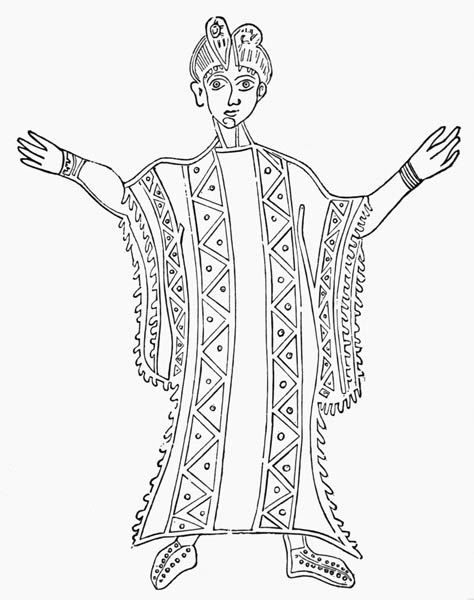
Fig. 129.—Bellicia fedelissima virgo qve vixit annos
xviii, (sic.)
Belicia, a most faithful virgin who lived eighteen years.
The simplicity of the funeral rites of the primitive Christians is
indicated by the character of the sepulchral monuments of the
Catacombs. No “storied urn or animated bust,” nor costly mausolea,
were employed to commemorate those who slept in Christ. A narrow
grave, undistinguished from the multitude around save by the name of
the deceased, or by the emblem of his calling, or symbol of his faith,
and most frequently not
even by these, sufficed, in the earlier and
purer days of the church, for the last resting-place of the saints. As
wealth increased and faith grew cold, more attention was given to the
external expression of grief or regard for the departed; and the
chambers, at first rudely hewn from the tufa, became ornamented with
stucco and
frescoes, and lined with marble slabs, and the inscriptions
became more turgid and artificial. The superstitious veneration paid
to the relics of the saints in later days led to the adornment of
their sepulchres; and during the period of the temporal supremacy of
Christianity, the posthumous ostentation of the rich was manifested in
their costly sarcophagi and funeral monuments.[811]
All immoderate grief for the departed was regarded as inconsistent
with Christian faith and hope. “Our brethren are not to be lamented
who are freed from the world by the summons of the Lord,” says
Cyprian, “for we know they are not lost, but sent before us. We may
not wear the black robes of mourning while they are already clothed
with the white raiment of joy. Nor may we grieve for those as lost
whom we know to be living with God.”[812]
Nay, the day of their death
was celebrated as their Natalitia, or their true
birthday—their entrance into the undying life of heaven. The
primitive believers were not, however, insensible to natural
affection, as many of the inscriptions already given fully prove; but
they were sustained by a lofty hope and serene confidence in God.
The early Christian burial rites were entirely different from the pomp
and pageantry of grief which characterized pagan funerals. When the
spirit had departed, the body was washed with water and robed for the
grave in spotless white, to represent, Chrysostom suggests, the soul’s
putting on the garment of incorruption. In later
times costly robes of
silk and cloth of gold were employed for the burial of the wealthy,
against which practice Jerome strongly inveighs. “Why does not your
ambition cease,” he exclaims, “in the midst of mourning and tears?
Cannot the bodies of the rich return to dust otherwise than in
silk?”[813]
The body was also frequently embalmed, or at least
plentifully enswathed with myrrh and aromatic spices, after the manner
of the burial of Our Lord. This was especially necessary in the
Catacombs on account of the frequent proximity of the living to the
dead. We find frequent allusions to this practice in the Fathers.[814]
It was a pagan reproach that the Christians bought no odours for their
persons nor incense for the gods.[815]
“It is true,” says Tertullian,
“but the Arabs and Sabeans well know that we consume more of these
costly wares for our dead than the heathen do for the gods.”[816]
The nearest relatives or pious friends bore the corpse to the grave,
and committed it as the seed of immortality to the genial bosom of the
earth, often strewing the body with flowers, in beautiful symbolism of
the resurrection to the
fadeless summer of the skies.[817]
In times of
persecution the privilege would often be purchased with money of
gathering the martyrs’ mangled remains, and bearing them by stealth,
along the pagan “Street of Tombs,” to the silent community of the
Christian dead.[818]
Instead of employing the pagan nænia, or
funeral dirge, and prœficæ, or hireling mourners, the
Christians accompanied the dead to their repose with psalms and
hymns,[819]
chanting such versicles as, “Return to thy rest, O my
soul;” “I will fear no evil, for thou art with me;” “Blessed are the
dead that die in the Lord.”[820]
Frequently, as will be hereafter
seen, the agape or eucharist was celebrated at the grave.
The heathen buried their dead by night on account of the defilement
the very sight of a funeral was supposed to cause. The Christians
repudiated this idolatrous notion, and, except when prevented during
times of persecution, buried openly by day, that the living might be
reminded of their mortality and led to prepare for death.
We have thus seen the immense superiority, in all the
elements of
true dignity and excellence of primitive Christianity to the corrupt
civilization by which it was surrounded. It ennobled the character and
purified the morals of mankind. It raised society from the ineffable
slough into which it had fallen, imparted tenderness and fidelity to
the domestic relations of life, and enshrined marriage in a sanctity
before unknown. Notwithstanding the corruptions by which it became
infected in the days of its power and pride, even the worst form of
Christianity was infinitely preferable to the abominations of
paganism. It gave a sacredness previously unconceived to human life.
It averted the sword from the throat of the gladiator, and, plucking
helpless infancy from exposure to untimely death, nourished it in
Christian homes. It threw the ægis of its protection over the slave
and the oppressed, raising them from the condition of beasts to the
dignity of men and the fellowship of saints. With an unwearied and
passionate charity it yearned over the suffering and sorrowing
every-where, and created a vast and comprehensive organization for
their relief, of which the world had before no example and had formed
no conception. It was a holy Vestal, ministering at the altar of
humanity, witnessing ever of the Divine, and keeping the sacred fire
burning, not for Rome, but for the world. Its winsome gladness and
purity, in an era of unspeakable pollution and sadness, revived the
sinking heart of mankind, and made possible a Golden Age in the future
transcending far that which poets pictured in the past. It blotted out
cruel laws, like those of Draco written in blood,[821]
and led back
Justice, long banished, to the judgment seat. It ameliorated the
rigours of the penal code, and, as experience has shown, lessened the
amount of crime. It created an art purer and loftier than that of
paganism; and a literature rivaling in elegance of form, and
surpassing in nobleness of spirit, the sublimest productions of the
classic muse. Instead of the sensual conceptions of heathenism,
polluting the soul, it supplied images of purity, tenderness, and
pathos, which fascinated the imagination and hallowed the heart. It
taught the sanctity of suffering and of weakness, and the supreme
majesty of gentleness and ruth.
Hoc fonte derivata clades
In patriam populumque fluxit.
We gain from the testimony of the Catacombs most important information
as to the organization of the church during the early Christian
centuries. We see on every side records of an efficient ministry of
different grades and dignities, yet wholly unlike that vast
hierarchical system which claims to be its lineal descendant. We
discern also evidences of a well-ordered administration of the
sacraments and ordinances of religion, simple and unadorned, yet
instinct with spiritual life and power, compared with which the
gorgeous ritual and lifeless pomp of Romanism are more akin, in
outward form at least, to the pagan homage of the Bona Dea, or to the
mysteries of Mithras, than to Christian worship. So complete is this
testimony as to the ministry and rites of the primitive church, that
Dr. Northcote remarks that, “even if all the writings of the Fathers
had altogether perished, we might almost reconstruct the whole fabric
of the ecclesiastical polity from the scattered notices of these
sepulchral inscriptions.”[822]
The somewhat complex ecclesiastical organization which we discover was
probably a gradual development with the growth of the church, and not
in its entirety the creation of the earliest times; the inscriptions
referring to the subject, it must be remembered, being all
or chiefly
of post-Constantinian origin. The earlier books of the Apostolical
Constitutions, which are probably of the second century, say almost
nothing about the different grades of the ministry; but in the later
ones, probably of the fifth century, a full blown sacerdotalism
appears. Cornelius, bishop of Rome in the middle of the third century,
records the existence of a graduated clergy like that indicated in the
inscriptions of the Catacombs,[823]
whose gradations Clement of
Alexandria compares to the different ranks of the hierarchy of
heaven.[824]
The highest office in the church of the Catacombs was that of the
bishop—the chief pastor[825]
or overseer of the flock of Christ. But
this position was rather a preeminence of toil and peril than of
dignity and honour. The supreme head of the Roman hierarchy, who lays
claim to the attributes of deity himself, and sits in the seat of God
as his vicegerent and infallible representative on earth, finds no
precedent for his lofty assumptions in his humble predecessors of the
primitive ages. These were in reality what he is only in
name—servi servorum Dei. Even the title of bishop occurred but
seldom. Neither Bosio, Fabretti, Boldetti, nor any other of the early
explorers of the Catacombs, found a single example of it. The tomb of
the first Roman bishop bore simply the name LINVS. In the so-called
“papal
crypt” the title first appears, but in the contracted form,
ΕΠΙ and ΕΠΙϹ, and without any symbol of superior
dignity whatever. The name of a bishop was first made a note of time
in the latter part of the fourth century, as in the epigraphic formulæ
Sub Liberio Episcopo—Sub Damaso Episcopo—During the
episcopate of Liberius, (A. D. 350-366,) of Damasus, (A. D. 366-384.)
But this distinction was also conferred on other bishops than those of
Rome. Thus, in the year A. D. 397, we find the expression Pascasio
Episcopo. Now, as there was no Roman bishop of that name,
Pascasius must have presided over some of the adjacent sees, of which
we know that there were many independent of Rome.[826]
The word papa, or pope, does not occur in the Catacombs till at
least the latter part of the fourth century. It appears first spelled
pappas, and applied to Damasus, in the margin of an inscription
by that bishop, in honour of Eusebius.[827]
But De Rossi admits that
this is a badly executed reproduction, of the sixth or seventh
century, of a previous inscription; so this title may very well belong
to that late period. This is all the more probable from the
phraseology of the very first line of this inscription: DAMASVS
EPISCOPVS FECIT EVSEBIO EPISCOPO ET MARTYRI—“Damasus, bishop,
(not pope,) to Eusebius, bishop and martyr.” Hilary (461-467) calls
himself bishop and servant of Christ—“Episcopus et famulus
Christi.” In an epitaph of A. D. 523, Hormisdas is called merely
DOMINVS PAPA—that is, “honoured father,” or “pope,” which is
probably the first application of this phrase in Christian epigraphy.
In another, of date A. D. 563, John III. is designated as the “most
blessed father John”—Beatissimus papa Joannes.[828]
But even this title, invested with such awful dignity and supreme
authority in later days, was at first only an expression of familiar
and affectionate respect, not peculiar to the bishop of Rome, nor
indeed first applied to him. Its earliest use is attributed to
Dionysius,
bishop of Alexandria, in the latter part of the third
century.[829]
The Roman clergy address the bishop of Carthage in their
letters as “the blessed pope Cyprian.”[830]
Tertullian applies the
name to any Christian bishop.[831]
Jerome addresses Augustine, bishop
of the little African diocese of Hippo, as the Beatissimus papa
Augustinus,[832]
and applies the same phrase to the superior of a
monastery.[833]
The rapid extension of Christianity in the metropolis of the empire
enhanced the influence and dignity of the Roman bishops.[834]
With the
increase of wealth and decay of piety these dignitaries became
ambitious and worldly, arrogant and aspiring, and laid the foundations
of that vast system of spiritual despotism which for centuries crushed
the civil and religious liberties of Europe. Nevertheless, as late as
the end of the sixth century, Gregory the Great, although zealous for
the episcopal dignity, resents the claim of John of Constantinople
to the title of œcumenical bishop in the striking words: “This I
declare with confidence, that whoso designates himself universal
priest, or, in the pride of his heart, consents to be so named, he is
the forerunner of Antichrist.”[835]
His successors of Rome have not
shrunk from this malediction, but, in assumption of this universal
supremacy, have placed their feet on the neck of kings, parcelled out
empires, and conferred crowns at their pleasure.[836]
The next rank in ecclesiastical dignity was that of the
Presbyters.[837]
There was not that distinction in the primitive
ages between their office and that of the bishops that afterward
arose. Bishop Pearson represents their power and dignity as greater
the nearer we ascend to the apostolic times. Their principal functions
were the administration, in association with the bishops, of the
sacraments, the enforcement of discipline, the preaching of the word,
and the pastorate of the church. Their epitaphs in the Catacombs and
basilicas are frequently very brief, as the following: LOCVS
GERONTI PRESB—“The place of Gerontus, a presbyter;” POSITVS
EST HIC LEONTIVS PRESBITER (sic)—“Here is placed
Leontius, a presbyter.” Sometimes the title is expressed in a
contracted form, thus: HIC QVIESCIT ROMANVS PBB. QVI SEDIT PBB ·
ANN · XXVIII · M · X.—“Here reposes Romanus, a presbyter, who
sat a presbyter twenty-eight years ten months.”[838]
Boldetti gives
the epitaph of ACATIVS PASTOR, who was probably a presbyter,
his title expressing his pastoral office. The following, of date A. D. 471, which is more elaborate than usual, is of some historical
interest:[839]
PRESBYTER HIC POSITVS FELIX IN PACE QVIESCIT
CVIVS PVRA FIDES PROBITAS VIGILANTIA SOLLERS
PONTIFICVM CLARO PLACVIT SIC NOTA LEONI
POST LABSVM VT REPARANS VENERANDI CVLMINA PAVLI
HVIC OPERIS TANTI RENOVANDAM CREDERET AVLAM.
Felix, the presbyter, placed here, reposes in peace, whose pure
faith, probity, sagacious vigilance, when known, so pleased the
illustrious Leo of the pontiffs,[840]
that, repairing the roof of
the venerable St. Paul’s after its fall, he trusted to him the
renewal of the hall of so great a work.
It appears that sometimes the primitive presbyters engaged in secular
callings. Thus, an inscription from the Catacomb of Callixtus reads,
ΔΙΟΝΥϹΙΟϹ ΠΡΕϹΒΥΤΕΡΟϹ ΙΑΤΡΟϹ—“Dionysius, presbyter and
physician.” Another, of date A. D. 533, commemorates a deacon, who was
also, perhaps before ordination, a senator and soldier. One found in
Galatia mentions ΘΕΟΔΩΡΟϹ
ΠΡΕϹΒΥΤΕΡΟϹ ΚΑΙ ΑΡΓΥΡΟΚΟΠΟϹ—“Theodorus, a presbyter and silversmith.” Hyacinthus, a
Roman presbyter of the third century, was also an officer of the
imperial household. Tertullian complains that some engaged in
idolatrous trades were promoted to ecclesiastical offices.[841]
Eusebius mentions a presbyter of Antioch who was head-master of one of
the principal schools of the city.[842]
Sozomen tells of bishops Zeno
and Spiridion, who continued, the one to weave linen, the other to
keep sheep, after elevation to the episcopal office.[843]
Indeed, the
fourth council of Carthage (A. D. 398) decreed that the clergy might
devote their leisure to trade or husbandry, that the church might have
greater resources for charity.[844]
The next grade in ecclesiastical rank was that of the deacons. They
acted generally as assistants of the bishops and presbyters,
especially in the distribution of the charities of the church.[845]
They also took part in the administration of the eucharist, but not in
its consecration. Before the appointment of lectors they read, and
occasionally expounded, the Scriptures to the congregation, like the
modern lay preachers. They also acted as instructors or catechists of
the catechumens of the church. They are frequently designated
Levitæ,[846]
from the fancied analogy of their functions to
those of the Levitical order among the Jews. In the church at Rome
there were only seven deacons, in accordance with the number
originally appointed in the church at Jerusalem; but in other cities
the number was not thus limited.[847]
Of inferior dignity were the
ὑποδιάκονοι, or sub-deacons, who assisted the deacons in
the discharge of their lower functions, as the care of the sacramental
vessels, and the like.
Several epitaphs of both these classes have been found among the early
Christian inscriptions. They are generally very brief, as the
following: IVL
DIACONVS—“Julius, the deacon;” DEPS ·
FELIX · DIAC—“Felix, the deacon, buried (Mar. 11, A. D. 435);”
LOCVS EXVPERANTI DIACON—“The place of Exuperantus, the
deacon.” Beneath the church of Sts. Cosmo and Damien was found the
following: HIC REQVIESCIT SCVS HABVNDANTIVS DIAC ET
MARTYR—“Here reposes holy Abundantius, deacon and martyr.”[848]
The following are characteristic epitaphs of sub-deacons: HIC
QVIESCIT APPIANVS SVBDIACONVS QVI VIXIT ANNVS XXXII DIES
XXVIIII—“Here rests Appianus, a sub-deacon, who lived thirty-two
years, twenty-nine days;” LOCVS MARCELLI SVBD · REG · SEXTAE
CONCESSVM (sic) SIBI ET POSTERIS EIVS A BEATISSIMO
PAPA IOANNE QVI VIXIT ANN · PLM · LXVIII—“The place of
Marcellus, a sub-deacon of the sixth district,[849]
conceded to him
and his posterity by the most blessed Father John,[850]
who lived
sixty-eight years, more or less.” (A. D. 564.)
The first rank of the inferior officers of the church was that of the
lectors or readers. It was their duty to read in the congregations the
appointed lessons from the Holy Scriptures.[851]
The office was held
in peculiar honour, young men of noble family, especially, aspiring to
its dignity. Thus the Emperor Julian, in his youth, was a reader of
the church at Nicomedia, as was also
his brother Gallus.[852]
Candidates for the office were ordained by the ceremony of delivering
the Gospels into their hands. According to one of the Novels of
Justinian,[853]
they were required to be not less than eighteen years
of age, but examples occur of their appointment as early as seven or
eight years old.[854]
Probably the latter were dedicated by their
parents, like Samuel, to the service of God from their infancy,[855]
and graduated through the inferior offices to those of greater dignity
and influence. In the Western church they soon ceased as a distinct
rank, but they lingered in the conventual orders till a comparatively
late period.
The following are epitaphs of lectors from the Catacombs and
basilicas: EQ HERACLIVS QVI FVIT IN SAECVLVM ANN · XVIIII · M ·
VII · D · XX · LECTOR R · SEC · FECERVNT · SIBI ET FILIO SVO
BENEMERENTI · INP—“Equitius Heraclius, who was in this world
nineteen years, seven months, twenty days, a reader of the second
district. (His parents) made this for themselves and their
well-deserving son, in peace;” CINNAMIVS OPAS LECTOR TITVLI
FACIOLI AMICVS PAVPERVM—“Cinnamius Opas, a reader of the church
of Faciolus, a friend of the poor;” MIRAE INNOCENTIAE ADQ ·
EXIMIAE BONITATIS HIC REQVIESCIT LEOPARDVS LECTOR DE PVDENTIANA QVI
VIXIT ANN. XXIIII—“Here rests Leopardus, of wonderful innocence
and remarkable goodness, a reader of the church of Pudentiana, who
lived twenty-four years;” HIC REQVIESCIT IN SOMNO PACIS CAELIVS
LAVRENTIVS
LECTOR SANCTAE ECCLESIAE AECLANENSIS QVI VIXIT
ANNOS PLM · XLVIII—“Here rests, in the sleep of peace, Cælius
Laurentius, a reader of the holy church of Æclanum, who lived
forty-eight years, more or less.”
The acolytes were another class which is discontinued in the
protestant communion. As the name implies,[856]
they were the
servitors of the church, and had charge of the lamps and other
ecclesiastical furniture. They were probably the offspring of the
increasing pomp and dignity of the bishops, to whom they acted as
personal attendants, especially in public processions and religious
festivals. The only dated epitaphs of acolytes extant are of a
comparatively late period. De Rossi thinks the following of the sixth
or seventh century.[857]
The simplicity of the primitive church had
long since passed away. (P)ACE ABVNDANTIVS ACOL · REG ·
QVARTAE TT VESTINAE QVI VIXIT ANN · XXXIII DEP ·
INP · D NAT · SCI MARCI—“In peace,
Abundantius, an acolyte of the fourth district, of the church of
Vestina, who lived thirty-three years. Buried in peace on the birthday
of St. Mark.”
The office of exorcist, from the occult and mysterious nature of its
functions, was one that from the first was liable to abuse. It appears
to have been known in the synagogue, and even there to have been
usurped for base and venal purposes.[858]
A battle between supernal
and infernal powers seems to have been coincident with the conflict
between Christianity and paganism. The Christians believed the oracles
and idols of the gods to be animated by dæmons, who frequently usurped
possession also of human beings. Tertullian,[859]
Origen,[860]
and
others of the Fathers, claim that any private Christian could exorcise
these dæmons by faith and prayer. It was probably a spiritual gift
like that of “tongues,” which was granted for a special purpose and
afterward withdrawn, perhaps on account of its abuse. This mysterious
function did not become a distinct office till the latter part of the
third century, when the exorcists were set apart by special
ordination, and furnished with special forms of adjuration. This rite
was then generally performed with solemn ceremonial before the baptism
of converts from paganism. It was accompanied by prayer, insufflation,
imposition of hands, and the sign of the cross, in order to deliver
the subject from the dominion of the Prince of Darkness, and to
consecrate him to the service of God. In later days this office became
subject to frightful abuse, and all the grotesque and horrible
adjuncts of exorcism of the Roman church—the charms, conjurations,
wearing of scapulars and relics, incensings and sprinklings, were
introduced—rites which find their analogues only in the magical
incantations of the medicine-men of the Caffre Kraal or the
Indian
lodge.[861]
“The best exorcism,” says Tertullian, “is by watchfulness
and prayer to resist the devil, and cast out evil thoughts.” The
following are epitaphs of exorcists: IANVARIVS
EXORCISTA—“Januarius the exorcist;” HIC REQVIESCIT · IN ·
SOMNO · PACIS · CAELIVS · IOHANNIS EXHORCISTA (sic)—“Here
rests, in the sleep of peace, Cælius John, an exorcist.”
The energumens, or possessed persons, were committed to the especial
care of the exorcists, who employed them in the secular service of the
sanctuary, as sweeping and cleaning the church, “lest idleness should
become a temptation for Satan to molest them.” There is no indication
of the existence of this unhappy class of persons in the church of the
Catacombs, at least so far as monumental evidence is concerned.
A very numerous class in the economy of the primitive church was that
of the fossors, or grave-diggers, by whose labours these vast
labyrinths were excavated. They seem to have had especial charge of
the subterranean cemeteries, and we have had numerous examples of the
transfer and sale of graves under their authority.[862]
They had also
a quasi-ecclesiastical rank, and were subject to ecclesiastical
discipline. “The first order of the clergy,” says Jerome, “is that of
the fossors, who, after the manner of holy Tobit, are employed in
burying the dead.”[863]
They probably also
assisted the regular clergy
in the celebration of the funeral rites. The melancholy office of this
pious confraternity, always a sad necessity of humanity, was
particularly so to the persecuted church of the Catacombs.
The excavations were evidently under one directorate, so symmetrical
and uniform is their character. A considerable degree of architectural
skill is exhibited in the construction and adornment of the
subterranean chapels, many of which are of quite ornamental design,
and in the excavation of the multitude of galleries and different
levels of this vast city of the dead, proving that the fossors were no
mean civil engineers. They were also probably the artists of the rude
inscriptions. The office seems sometimes to have been hereditary, as
we find as many as three generations of fossors in the same family. We
have seen examples of the numerous frescoes representing these lowly
diggers at work, often like miners, by the light of a lamp, or
surrounded by the implements of their calling.[864]
The following are
characteristic epitaphs of this class: MAIO FOSSORI—“To
Maius, the fossor;” FELIX FOSSOR VIXIT ANNIS LXII—“Felix,
the fossor. He lived seventy-two years;” DIOGENES · FOSSOR · IN ·
PACE · DEPOSITVS—“Diogenes, the fossor, buried in peace.”
With these were probably confounded in the earlier ages the ostiarii,
or door-keepers. Their office was one of great trust and
responsibility in times of persecution, when the Christian worship had
often to be celebrated in secret, and protected from the intrusion of
spies or of the profanely curious heathen. It was their duty to
distinguish between the faithful and scoffers and traitors, and to
give private notice of the secret assemblies of the Christians. The
following inscription of the
sixth century, as restored by De Rossi,
commemorates a similar office in the basilica: LOC · DECI ·
CVBICVLARI · HVIVS · BASILICAE—“The place of Decius, custodian
of this basilica.” We have also the epitaph of a mansionarius,
a similar officer.[865]
An exaggerated commendation of the supposed superior sanctity of
single life has long been a prominent characteristic of Romanism. A
natural corollary of this notion was the enforced celibacy of the
clergy.[866]
Upon the Procrustean bed of this iron rule Rome has not
scrupled to bind the tenderest and most sacred affections of the human
soul. This cherished, but, as all history proves, most pernicious
practice, has been the secret of much of the marvellous power of the
priesthood and of the religious orders. The suppression of the
domestic affections but intensified their devotion to the cause of the
church, which took the place of both wife and child, and engrossed all
their thoughts and all their energies. They became a priestly caste,
animated by a strong esprit de corps superior to the claims of
kindred or of country. But, as might have been anticipated, this
anti-natural system led to frightful abuses and corruptions, and to
the most flagrant innovations.
The notion of the greater sanctity of celibacy was derived, not from
the teachings of our Lord or the apostles, who recognized the
essential purity of marriage; but probably, as Milman suggests, from
the early heresy of the Gnostics, of which this doctrine was a
prominent characteristic.[867]
“There was no enforced
celibacy during
the first three centuries,” says the judicious Bingham.[868]
Indeed,
marriage was regarded as enjoined on bishops, elders, and deacons, by
the counsel of St. Paul.[869]
The occasional passages of Scripture, in
which for temporary and special reasons a single life is recommended,
were in course of time wrested from their obvious meaning to a more
general application; and in the writings of some of the Fathers,
marriage was regarded as a necessary evil, only to be tolerated for
the perpetuation of the race, and on account of the infirmity of the
weak. It was not till the fourth century that the church adopted the
doctrine of devils spoken of by St. Paul as “forbidding to marry.” The
earliest ecclesiastical legislation on the subject was at the Spanish
council of Elvira, A. D. 305, which commanded ecclesiastics who were
married to separate from their wives—abstinere se a conjugibus
suis—thus ruthlessly putting asunder those whom God had joined.
The synods of Ancyra and Neo Cæsarea, held ten years later, and also
one of the so-called apostolic canons of the same date, reversed this
decree, and forbade any ecclesiastic to put away his wife on the plea
of religion, under penalty of excommunication, which action was
confirmed by the great council of Nice.[870]
Successive attempts to
extirpate the tenderest human instincts only led to their illicit
gratification, and to the scandals arising from the admission of
mulieres subintroductæ, or,
in other words, of concubines. So
demoralized did the clergy thereby become, that during the Middle
Ages, as Mr. Lea remarks, “though, the ancient canons were still
theoretically in force, they were practically obsolete
every-where.”[871]
At length Luther led the great emancipation of the
clergy from this burden, so unutterably grievous to many a tender
conscience; and removed the stigma of disgrace from those domestic
relations which God, who setteth the solitary in families, so signally
blesses.
There is no trace of the ascetic spirit or celibate clergy of the
Church of Rome in the inscriptions of the Catacombs. On the contrary,
numerous epitaphs commemorate the honourable marriage of members of
every ecclesiastical grade. Thus, in the highest rank, Gruter[872]
gives the following, which is thought to be that of Liberius, bishop
of Rome, who died A. D. 366, and who was sometimes known by the name
of Leo:
HVNC MIHI COMPOSVIT TVMVLVM LAVRENTIA CONIVX
MORIBVS APTA MEIS SEMPER VENERANDA FIDELIS
INVIDIA INFELIX TANDEM COMPRESSA QVIESCIT
OCTOGINTA LEO TRANSCENDIT EPISCOPVS ANNOS.
My wife Laurentia made me this tomb; she was ever suited to my
disposition, venerable and faithful. At length disappointed envy
lies crushed; the bishop Leo survived his eightieth year.
De Rossi gives the following, of a bishop’s son, of date A. D. 404.
The relationship is boldly acknowledged, and not yet disguised under
the phrase nepos or nephew: VICTOR IN PACE FILIVS EPISCOPI
VICTORIS CIVITATIS VCRENSIVM—“Victor, in peace, son of Bishop
Victor, of the city of the Ucrenses.” The following, of date A. D. 445, was found at Narbonne: RVSTICVS · EPIS · EPI ·
BONOSI · FILIVS.... “Bishop Rusticus, son of Bishop Bonosus.”
There are also numerous inscriptions in which presbyters and deacons
lament the death of their wives, “chaste, just, and holy.” “Would to
God,” exclaims a writer in the Revue Chrétienne, “that all
their successors had such.” The following are examples: GAVDENTIVS
· PRESBYTER · SIBI ET CONIVGI SVAE SEVERAE CASTAE HAC
(sic) SANCTISSIMAE FEMINAE—“Gaudentius the presbyter,
for himself and his wife Severa, a chaste and most holy woman;”
LOCVS BASILI PRESB ET FELICITATI EIVS.... “The place of Basil
the presbyter, and of Felicitas, his (wife).” Observe also the tender
recognition of family ties in the following: OLIM PRESBYTERI
GABINI FILIA FELIX HIC SVSANNA IACET IN PACE PATRI SOCIATA—“Once
the happy daughter of the presbyter Gabinus, here lies Susanna, joined
to her father in peace.”
We have already seen the epitaph of “Petronia, the wife of a deacon,
the type of modesty,” with whom were buried two of her children.[873]
The following, of
similar character, is accompanied by the epitaph of
a deacon on the same stone, probably the husband who so tenderly
lamented the loss of his faithful consort.
LEVITAE CONIVX SEMPER MIHI GRATA MARIA
EXITVS ISTE TVVS PROSTRAVIT CORDA TVORVM
PERPETVAS NOBIS LACRIMAS LVCTVMQVE RELINQVENS
CASTA GRAVIS SAPIENS SIMPLEX VENERANDA FIDELIS
COMPLEVIT TVA VOTA DEVS TE NAMQVE MARITVS
TE NATI DEFLENT NEC MORS TIBI SVSTVLIT VLLVM.
Maria, the wife of a deacon, ever well-pleasing to me. That
departure of thine prostrated the hearts of thy friends, leaving
perpetual tears and grief to us. Chaste, grave, wise, simple,
venerable, faithful. God fulfilled thy wishes; for thee thy
husband, thee thy children bewail, nor did death bear any away
from thee. (A. D. 451.)
Epitaphs are also found indicating the prevalence of marriage in the
inferior ecclesiastical ranks, as in the following examples:
CLAVDIVS ATTICANVS LECTOR ET CLAVDIA FELICISSIMA
CONIVX—“Claudius Atticanus, the reader, and Claudia Felicissima,
his wife;”[874]
IANVARIVS EXORCISTA · SIBI · ET · CONIVGI ·
FECIT—“Januarius, the exorcist, made this for himself and his
wife;” TERENTIVS · FOSOR · (sic) · PRIMITIVE (sic) · CONIVGI · ET ·
SIBI ·—“Terentius, the fossor, for Primitiva, his wife and
himself.”
The primitive church early availed itself of the services of godly
women, a sort of female diaconate, for the administration of charity,
the care of the sick, the instruction of the young, and of their own
sex, and to carry the light and consolations of the gospel into the
most private and delicate relations of life, for which
these gentle
ministrants possessed facilities denied to the other sex. They are
frequently mentioned in the writings of the Fathers under the names of
διάκονοι,[875]
deaconesses, viduæ, widows, or
ancillæ Dei, handmaids of God. In apostolic times they were
required to be of the mature age of sixty years;[876]
but widows, and
even the unmarried, were subsequently admitted into this class as
early as forty,[877]
or even twenty,[878]
years of age. The unmarried,
however, assumed no vow of perpetual celibacy,[879]
nor of conventual
life, but lived privately in their own homes, employed in offices of
piety and mercy. The growing esteem of celibacy, however, in the
fourth and fifth centuries, invoked ecclesiastical censure for the
abandonment of the lofty vantage ground of virginhood;[880]
but the
Imperial law granted liberty of marriage,
if the order had been
entered before the age of forty. How different the practice of Rome in
binding young girls, in the first outburst of religious enthusiasm, or
the first bitterness of disappointed hope, by irrevocable vows to a
death-in-life, and indissolubly riveting those bonds, no matter how
the chafed soul may repudiate the rash vow, and writhe beneath the
galling yoke. The consecrated virgin of the early church, instead of
the ghastly robings, like the cerements of the grave, in which the
youthful nun is swathed, the symbol of her social death, wore a
sacrum velamen, or veil, differing but little from that of
Christian matrons, and a fillet of gold around her hair. The custom,
now part of the Romish ritual, of despoiling the head of its natural
adorning, was especially denounced by some of the ancient councils.
There are several of the early Christian inscriptions illustrative of
these various classes of consecrated women, of which the following are
examples: OC · TA · VI · AE · MA · TRO · NAE · VI · DV · AE · DE ·
I.—“To the matron Octavia, a widow of God;” HIC QVIESCIT
GAVDIOSA CF ANCILLA DEI QVAE VIXIT ANNOS XL ET MEN
V—“Here rests Gaudiosa, a most distinguished woman, a handmaid
of God, who lived forty years and five months,” (A. D. 447); IN
HOC SEPVLCHRO REQVIESCIT PVELLA VIRGO SACRA B · M ·
ALEXANDRA—“In this tomb rests a girl, a sacred virgin,
Alexandra, well deserving;” HOC EST SEPVLCRVM SANCTAE LVCINAE
VIRGINIS—“This is the sepulchre of the holy virgin
Lucina”—this, however, may not indicate a special class. AESTONIA
VIRGO PEREGRINA QVAE VIXIT ANNOS XLI; ET · DS · VIII
(sic)—”Æstonia, a travelling virgin, who lived forty-one years
and eight days”—she was probably a member of a distant church,
received on a letter of recommendation, FVRIA HELPHIS
(sic) VIRGO DEVOTA—“Furia Elpis, a consecrated
virgin.” In the fifth century this consecration sometimes took place
at an early age, as the following example, of date A. D. 401: PRIE (sic) IVNIAS PAVSABET
(sic) PRAETIOSA ANNORVM PVLLA (sic) VIRGO
XII TANTVM ANCILLA DEI ET CHRISTI—“On the day before (the
Calends of) June Prætiosa went to her rest, a young maiden of only
twelve years of age, a handmaid of God and of Christ.”[881]
There is no trace in the inscriptions of the Catacombs of that ascetic
spirit from which, in the fourth and following centuries, sprang the
strange phenomena of monachism, with its important influence for
blended good and evil on the future of Christendom. That was
rather the result of the decay and corruption of primitive
Christianity, and of the despair of mankind as to its regenerative
power upon the world. Hence, multitudes fled from the immedicable
evils of society to the solitude of the desert or the mountain.[882]
Primitive Christianity, on the contrary, was eminently cheerful and
social in its character. It consecrated the family life, and
developed, to a degree before unknown, the domestic virtues.
The care of the primitive church for the religious teaching of the
young and of heathen converts is
abundantly exemplified in the
inscriptions of the Catacombs. The catechumens, or learners, as the
word signifies—the “Cadets of Christianity”—were a distinctly
recognized class for whose instruction especial provision was made. It
consisted of the children of believers born in the church, and
therefore peculiarly under its care; and also of converts from
paganism, who needed to be weaned from their errors, and taught the
doctrines of Christianity before admission to the sacraments of
baptism and the holy eucharist. For the latter, as a safeguard against
the rash assumption of the Christian vows and the danger of subsequent
apostacy, a certain probation was prescribed.[883]
The candidates were
taught the Holy Scriptures, and a formal confession of faith, probably
similar to the ancient creed in which the Christian belief of the
church has for so many centuries been expressed. These instructions
were given by the bishop himself as chief catechist; and also by the
presbyters, deacons, lectors, and other members of the inferior
ministry. Deaconesses and aged women acted as instructresses of their
own sex; and one of these was always present during the questioning of
the female catechumens by the male catechists.
The following engraving represents a chamber in the Catacomb of St.
Agnes, which, it is conjectured, was employed for the instruction of
the female catechumens. On either side of the doorway are seats or
chairs hewn out of the solid tufa, which were probably occupied by the
catechist and the presiding deaconess. The low stone bench running
around the remaining walls
of the chamber would conveniently
accommodate the audientes, or hearers, as they were called.
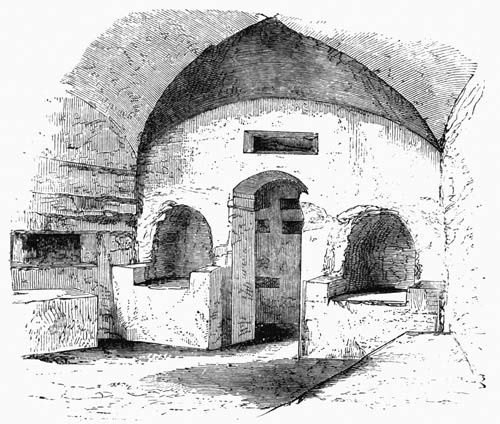
Fig. 130.—Chamber in the Catacomb of St. Agnes, with
seats for Catechists and Catechumens.
Some Roman Catholic writers have asserted that these chambers were
confessionals: but the chairs are too far apart if one was for the
confessor and the other for the penitent, especially with an open door
between; and too near, from the liability of the confessions being
overheard, if each was a confessional; and in either case the
necessity for the stone bench cannot be conceived. In some chambers,
probably for the male catechumens, there is only one tufa chair, no
deaconess being present.
Another curious chamber in the Catacomb of St. Agnes communicates with
the one adjacent to it by a
circular opening cut through the tufa wall
about breast-high. It is conjectured that this was for the purpose of
allowing the catechumens to hear the public instructions of the
faithful without witnessing the celebration of the sacraments. The
zeal of the candidates would thus be the more inflamed,[884]
that they
might be found worthy of admission to the fulness of Christian
privilege and to the sacred mysteries hidden from the uninitiate and
the unworthy. The following epitaph from the Lapidarian Gallery
commemorates a youthful catechumen: VCILIANVS BACIO VALERIO QVE
BISET ·(sic) ANN VIIII · MEN · VIII · DIES XXII
CATECVM—“Ucilianus to Bacius Valerius, a catechumen, who lived
nine years, eight months and twenty-two days.”
The ordinance of baptism receives several illustrations from the
monumental evidences of the Catacombs. There are numerous epitaphs of
neophytes—a term applied only to newly baptized persons—which
indicate that this Christian rite was administered at all ages from
tender infancy to adult years; in the latter case the subjects being
probably recent converts from heathenism. The following are examples
of this class: TEG · CANDIDIS NEOF Q · VXT · M · XXI—“The
tile of Candidus, a neophyte, who lived twenty-one months;” FL ·
IOVINA · QVAE · VIX · ANNIS · TRIBVS · D · XXX · NEOFITA · IN
PACE—“Flavia Jovina, who lived three years and thirty days, a
neophyte, in peace;” MIRAE INDVSTRIAE ADQVE BONITATIS ...
INNOCENTIA PREDITVS FL · AVR · LEONI. NEOFITO QVI VIXIT ANN VI · MENS
· VIII DIES XI....—“Innocentia Preditus to Flavius Aurelius Leo,
a neophyte of wonderful industry and goodness, who lived six years,
eight months, eleven days;” ROMANO NEOFITO BENE MERENTI QVI
VIXIT · ANNOS · VIII · D · XV · REQVIESCIT IN PACE—“To the
well-deserving neophyte Romanus, who lived eight years and fifteen
days; he rests in peace.” We have already seen the epitaph of Junius
Bassus, who died a neophyte at the age of forty-one, and shall
presently observe other instances of adult baptism.[885]
We find also
the epitaph of “two innocent brothers, one a neophyte, the other, one
of the faithful.”
In course of time the rite of baptism degenerated into a superstitious
charm, and was regarded as a mystical lustration which washed away all
sin and was essential to salvation.[886]
This change probably resulted
from a reaction against the Pelagian heresy, which denied the
necessity of baptism, and from the rhetorical exaggeration by the
Fathers of the spiritual efficacy of this sacrament.[887]
The church
of the Catacombs, while duly administering the rite of baptism, did
not, after the manner of the Church of Rome and other modern extreme
sacramentalists, invest it with regenerative power, nor
regard its
involuntary omission as excluding the body from consecrated ground and
the soul from heaven.[888]
Sometimes, by a beautiful metonyme derived from its spiritual
significance, baptism is indicated as the palingenesis, or new birth,
of which it is the appropriate symbol. The following is a
characteristic example of this usage: ... CAELESTE RENATVS
AQVA (sic)—... “Born again of heavenly water,” (A. D. 377.)[889]
We read also of a certain Mercurius, who is described as a
boy born and dying in the same year, aged twenty-four. The allusion is
to the spiritual regeneration symbolized by baptism. With reference to
this he was but a boy—puer—at the time of his death.[890]
This rite was also called illumination, and we find in the Catacombs
the epitaphs of persons said to be thus “newly illuminated.”
The testimony of the Catacombs respecting the mode of baptism, as far
as it extends, is strongly in favour of aspersion or affusion. All
their pictured representations of the rite indicate this mode, for
which alone the early fonts seem adapted; nor is there any early art
evidence of baptismal immersion. It seems incredible, if the latter
were the original and exclusive mode, of apostolic and even Divine
authority, that it should have left no trace in the earliest and most
unconscious art-record, and have been supplanted therein by a new,
unscriptural, and unhistoric method. It is apparent, indeed, from the
writings of the fourth and fifth century, that many corrupt and
unwarranted usages were introduced in connection with this Christian
ordinance that greatly
marred its beauty and simplicity. It is
unquestionable that at that time baptism by immersion was practised
with many superstitious and unseemly rites. The subjects, both men and
women, were divested of their clothing, to represent the putting off
the body of sin; which, notwithstanding the greatest efforts to avoid
it, inevitably provoked scandal. They then received trien immersion,
to imitate, says Gregory Nyssen,[891]
the three days’ burial of
Christ; or, according to others, as a symbol of the Trinity. The rite
was accompanied by exorcism, insufflation, unction, confirmation, the
gift of milk and honey, the administration of the eucharist even to
infants, the clothing in white garments, and carrying of lighted
tapers, to all of which a mystical meaning was attached.
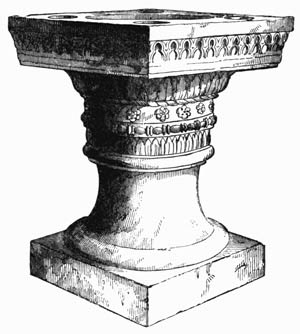
Fig. 131.—Baptismal Font.
But in the evidences of the Catacombs, which are the testimony of an
earlier and purer period, there is no indication of this mode of
baptism, nor of these dramatic accompaniments.[892]
The marble font
represented in the accompanying engraving, now in the crypts of St.
Prisca within the walls, is said to have come from the
Catacombs, and
to have been used for baptismal purposes by St. Peter, himself; in
corroboration of which legend it bears the somewhat apocryphal
inscription—SCI · PET · BAPTISMV · (sic.) The
tradition at least attests its extreme antiquity; and its basin is
quite too small for even infant immersion. Other fonts have been found
in several of the subterranean chapels, among which is one in the
Catacomb of Pontianus, hewn out of the solid tufa and fed by a living
stream. It is 1·45 metres long, ·92 metres wide, and 1·11 metres deep,
but is seldom near full of water. It is obviously too small for
immersion, and was evidently designed for administering the rite as
shown in the fresco which accompanies it. (See Fig. 132.) The
following inscription, from the Lapidarian Gallery, seems to have come
from some such font, and perhaps contains a reference to the
scripture, “Arise and be baptized, and wash away thy sins:”
CORPORIS ET CORDIS MACVLAS VITALIS PVRGAT ET OMNE SIMVL ABLVIT
VNDA—“The living stream cleanses the spots of the body as well
as the heart, and at the same time washes away all (sins).”[893]
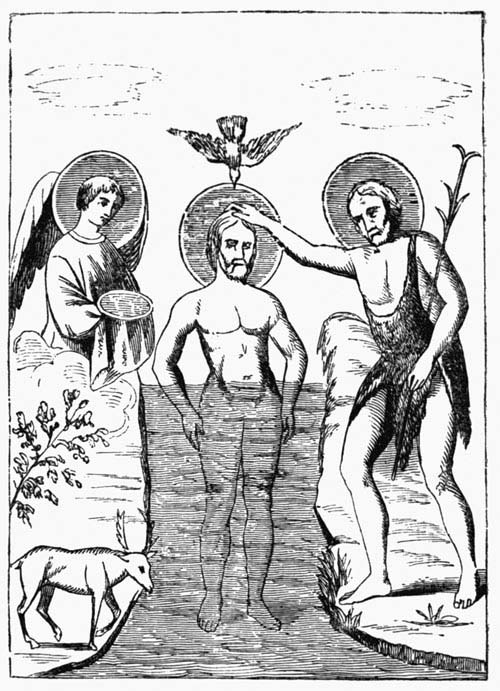
Fig. 132.—The Baptism of Our Lord.
Immediately over the font in the Catacomb of Pontianus is the
elaborate fresco of the baptism of Our Lord, figured above. He is
represented standing in
the river Jordan, while John pours water upon
his head, and the Holy Spirit descends in the form of a dove. An angel
stands by as witness of the rite, and in the foreground a stag, the
emblem of a fervent Christian, is drinking at the pure stream.[894]
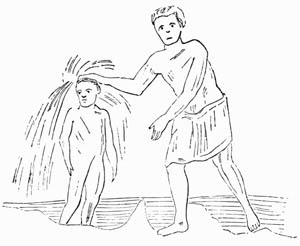
Fig. 133.—Baptismal Scene.
In a very ancient crypt of St. Lucina is another partially defaced
baptism of Christ, attributed to the second century, in which St. John
stands on the shore and our Saviour in a shallow stream, while the
Holy Spirit descends as a dove. On the sarcophagus of Junius Bassus
Christ is also symbolically represented as baptized by affusion. The
annexed rude example from the Catacomb of Callixtus, probably of the
third century, also clearly exhibits the administration of the rite by
pouring.[895]
It is accompanied by a representation of Peter striking
water from the rock, an emblem, according to De Rossi, of the waters
of baptism sprinkling the sinful souls that
come thereto. A similar
example also occurs in the cemetery of St. Prætextatus.
In ancient sarcophagal reliefs in the Vatican are representations of
small detached baptisteries of circular form, crowned with the
Constantinian monogram. These were necessarily of sufficient size to
accommodate the number of persons who were baptized at one time,
generally at Easter,[896]
and were placed outside of the basilica to
indicate the initiatory character of baptism as the entrance to the
church of Christ.[897]
In the early mosaics representing baptismal
scenes, the rite is invariably administered by affusion, as in the
baptistery of San Giovanni at Ravenna, in the beginning of the fifth
century, in Sta. Maria in Cosmedin, at Ravenna, in the beginning, and
in the ivory relief on the episcopal chair of Maximinus, at the end,
of the sixth century.[898]
So,
also, a later example in the Lateran
basilica represents Constantine kneeling naked in a laver, and
Sylvester pouring water on his head.[899]
This is also the method
indicated in several medals, bas reliefs, frescoes, and mosaics, in
almost every century from the fourth, through the Middle Ages,
indicating a continuous tradition, even when immersion may have been
practised, of a different mode of baptism.
The sacrament of the Lord’s Supper was the most sacred and consoling
rite of the primitive church. It was at once the emblem of the
Christian’s highest hopes, and the sublime commemoration of the
ineffable sacrifice on which those hopes depend. It was the focus in
which concentrated all their holiest thoughts, kindling the whole soul
into a flame of adoring love.[900]
It was the central act of worship,
around which all their solemn devotions gathered, and to which they
all looked. The sublime thought of the atonement of Christ and of
salvation through his death, shone ever star-like over their souls,
illumining even the sepulchral gloom of these subterranean crypts.
Daily,[901]
or as often as the vigilance of their foes in times of
persecution would
permit, the faithful met in the silent halls of
death, far from the “madding crowd’s ignoble strife,” to nourish and
strengthen their souls for fiery trial, and often for the red baptism
of martyrdom, by meditation on the passion of their Lord and partaking
of the emblems of his death.
Therefore, in ever-recurring and appropriate symbolism, was this holy
rite set forth upon the walls of the Catacombs. Its direct
representation, however, was carefully avoided; and its sacred meaning
was hidden from the profane gaze of the heathen under a veil of
allegory and emblem, which was, nevertheless, instinct with
profoundest significance to the initiated. Thus, we find
representations of seven men eating bread and fish, which are
interpreted as the repast of the disciples by the sea-shore when Our
Lord manifested himself in the breaking of bread, and, indirectly, as
symbols of the holy eucharist.[902]
They are not at all analogous to
the pictures of pagan funeral banquets, to which they have been
compared, but which are entirely foreign to Christian thought. The
miracles of turning water into wine, and of the multiplication of the
loaves, were also regarded as types of the eucharist, which was,
doubtless, frequently symbolized under these figures. We have seen a
copy of the remarkable fresco, twice repeated in the Catacomb of St.
Lucina, of a fish bearing a basket of bread on its back, and in the
midst what seems to be a chalice of wine.[903]
This is considered one
of the most ancient emblems of this sacred rite. This view derives
singular corroboration from a passage in Jerome, which speaks of
carrying the body of Christ in a basket made of twigs,
and his blood
in a chalice of glass.[904]
The eucharist is also evidently symbolized
in the representations of fish and sheep carrying small loaves of
bread in their mouths. These are sometimes marked with a decussate
cross, as was done to facilitate fracture during administration.
The first Christian altars were tables of wood, which, in times of
persecution, could be easily removed from house to house in which
worship was celebrated. The entire absence of any thing corresponding
to the pagan sacrificial altar was made the subject of heathen
reproach.[905]
In a painting found in the Catacomb of Callixtus, which
Dr. Northcote describes as “the sacrifice of the Mass, symbolically
depicted,” a man stands with hands outstretched, as if in act of
consecration, over a three-legged table, on which are bread and a
fish, while opposite stands a female figure in the attitude of prayer.
In an adjoining chamber a precisely similar table is represented, but
without the accompanying figures.[906]
These tables were placed, not
against the wall like a Romish altar, but set out from it, so that the
ministrant could stand behind it looking toward the congregation.
In the “papal crypt” of the Callixtan Catacomb the sockets for the
four feet of the table thus set out from the wall are distinctly
visible, and Bosio and Boldetti both found examples of altars standing
in the middle of the cubicula. This was also their position in
the oldest basilicas of Rome.
In the sixth century a general council decreed that the altars should
be of stone. This transition had already taken place in the Catacombs,
and arose from the employment of the slab covering the grave in an
arcosolium for the administration of the eucharist. This
practice led to an increased veneration for the relics of the saints;
and soon the presence of these relics became essential to the idea of
an altar.[907]
To this custom Prudentius refers in his hymn for
Hippolytus’ day.
“Illa sacramenti donatrix mensa, eademque
Custos fida sui martyris apposita:
Servat ad æterni spem Judicis ossa sepulchro
Pascit item sanctis Tibricolas dapibus.
Mira loci pietas, et prompta precantibus ara.”
“That slab gives the sacrament, and at the same time faithfully
guards the martyr’s remains; it preserves his bones in the
sepulchre in hope of the Eternal Judge, and feeds the dwellers by
the Tiber with sacred food. Great is the sanctity of the place,
and it offers a ready altar for those who pray.”
After the consecration of the elements by the presbyter or bishop, the
communion in both kinds was administered to the faithful by the
deacons in the formula of its institution which we still use.[908]
The
consecrated
elements[909]
were sent to any who were sick, by the hands
of deacons or acolytes, as is still the practice in the Greek and
Armenian churches. In the Acts of St. Stephen, we read of a young
martyr who chose to be beaten to death by a Roman mob, rather than
disclose the sacred treasure entrusted to his care. This practice in
time degenerated into the superstitious administration of the
viaticum as a preparation for the soul’s journey to the
spirit-world. Some of the gilt glasses, before described, are thought
to have been used as patens and chalices for the celebration of the
eucharist. With the increasing wealth and more gorgeous ritual of the
church, gold and silver vessels, adorned with costly gems and rarest
workmanship, took the place of the humbler material of the primitive
ages.[910]
Another beautiful institution generally associated with the
celebration of the eucharist in primitive times is that of the
agape, or love-feast. In a subterranean chapel in the Catacomb
of Marcellinus and Peter is an
exceedingly interesting representation
of the observance of this custom, shown in the following engraving.
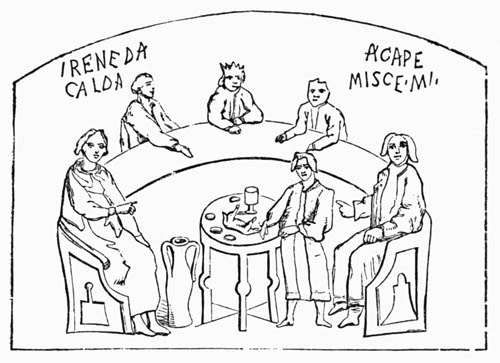
Fig. 134.—Ancient Agape.
Three guests, it will be perceived, sit at the semicircular table, at
the ends of which preside two matrons personifying peace and love,
with their names written above their heads. An attendant supplies them
with food from a small table in front, on which are a cup, platters,
and a lamb. The inscriptions, according to Dr. Maitland, should be
expanded thus: IRENE DA CALDA[M AQVAM]—“Peace, give hot
water;” and AGAPE MISCE MI [VINVM CVM AQVA]—“Love, mix me
wine with water;” the allusion being to the ancient custom of
tempering wine with water, hot or cold.
Numerous other representations of this devout feast at which Love and
Peace preside attest its general observance. It would be a touching
symbol of Christian unity to the persecuted saints, and would unite
still closer hearts bound together by common dangers and
a common
hope. All the distinctions of rank were then forgotten. Gathering by
stealth in these subterranean crypts from the imperial palace and the
lowly abode of poverty, they break bread together in the solemn
presence of the dead in token of their common brotherhood in Christ.
The slave of a Roman master, but the freedman of Christ, and the
patrician convert, the intellectual Greek and the once bigoted Jew,
together
Celebrate the feast of love,
Antedate the joys above.
This beautiful institution, first mentioned by Jude as the “feasts of
charity,”[911]
was usually observed in connexion with the eucharist,
though not necessarily a part of it. It dates from the earliest period
of the church,[912]
and its corruptions among the Corinthians called
forth the sharp rebuke of the Apostle Paul.[913]
Tertullian thus describes its character in the second century: “Our
supper, which you accuse of luxury, shows its reason by its very name;
for it is called agape, which, among the Greeks, signifies
love. It admits of nothing vile or immodest. We eat and drink only as
much as hunger and thirst demand, mindful that the evening is to be
spent in the worship of God. We so speak as knowing that God hears.
After washing our hands and bringing lights, each is asked to sing to
God according to his ability, either from Scripture or from his own
mind. Prayer also concludes the feast.”[914]
He calls it also a supper
of philosophy and discipline, rather than a corporeal feast. At the
close collections were made for widows and orphans and for the poor,
many of whom would be thrown out of employment by their
renunciation
of idolatrous trades; also for prisoners and for persons who had
suffered shipwreck.[915]
It is doubtless the agape which Pliny
describes as “the common and harmless meal”[916]
of the Christians,
and at which, according to Lucian, their “sacred conversations”[917]
were held. Clement of Alexandria calls the agape “the banquet
of reason, a celestial food, and the supper of love; the pledge and
proof of mutual affection.”[918]
The primitive church carefully guarded the celebration of the
eucharist and agape from the pryings of idle curiosity or the
perfidy of heathen malevolence, lest the name of God should be
blasphemed, or the goodly pearls of salvation be trampled beneath
swinish feet. But this very secresy and mystery became the occasion of
the vilest slanders and aspersions. The Christians were accused of
celebrating these rites with the most abominable orgies—feasting on
human flesh and infants’ blood, and committing nameless crimes of
still deeper dye. “They charge us,” say the martyrs of Lyons, “with
feasts of Thyestes, and the crimes of Œdipus, and such abominations
as are neither lawful for us to speak nor think.” The blameless
believers were denounced as the very dregs of society, a skulking and
darkness-loving race, meeting by night for profane conjuration and
unhallowed banquets, as despisers of the gods, haters of mankind, and
mockers at holy things,[919]
and were confounded with pestilent
sorcerers who in midnight caves practiced their foul incantations
against human life.[920]
These accusations arose partly, it is
probable, from distorted accounts of the holy communion of the body
and the blood of Christ, interpreted as a literal partaking of the
corporeal substance; partly from the vile practices of the
Carpocratians and other heretics; but chiefly from the malice of the
heathen themselves, judging the character of the Christian mysteries
from the obscene orgies of Venus and Bacchus.
Tertullian indignantly resents the vile calumnies, and shows them to
be monstrous and absurd. “We are daily beset by foes,” he exclaims,
“we are daily betrayed, we are often surprised in our secret
congregations; yet who ever came upon a half-consumed corpse among us,
or any other corroborations of the accusations against us?”[921]
He
retorts upon the heathen the charge of infanticide, human sacrifice,
and unnatural crimes, and contrasts therewith the purity of the
Christian character. Minucius Felix also attests the modest and sober
character of the Christian feasts, which they celebrated with chaste
discourse and chaster bodies.[922]
In course of time the agapæ lost in great measure their
religious character, and were employed for the anniversaries of the
martyrs, and for marriage and
funeral occasions.[923]
They were still
further desecrated by their substitution for pagan festivals, in
order, as St. Augustine remarks, “that the heathen might feast with
their former luxury, though without their former sacrilege.”[924]
These “pious hilarities” thus degenerated, in the fourth and fifth
centuries, into convivial banquets and wanton revelry—a scandal and
disgrace to Christendom, and provoked the indignant censure of the
Fathers. “It is absurd,” says St. Jerome, “to honour with feasting the
saints who pleased God with their fasts.” St. Augustine vehemently
condemns those “who inebriate themselves in honour of the martyrs, and
place even their gluttony and drunkenness to the account of
religion.”[925]
“These drunkards persecute the saints as much with
their cups,” he says, “as the furious pagans did with stones.”[926]
The good bishop of Nola, greatly scandalized at these semi-pagan
revelries, painted with holy pictures the church of St. Felix, that as
the ignorant peasants gazed more they might drink the less. It has
been suggested that probably the pious figures in the gilt glasses of
the Catacombs were designed for the same purpose; but many of their
mottoes were of a highly convivial character, calculated rather to
promote the revelry in which they were doubtlessly employed. Both the
natalitia and the agapæ at length became so obnoxious in
character as to excite the taunts of the
pagans and the condemnation
of the more devout and thoughtful Christians. The abuse of the latter
beautiful institution became so intolerable that it became the object
of repressive decrees of successive councils till it was finally
abolished. The council of Elvira (A. D. 305) prudently forbade the
presence of females at these nocturnal meetings in the Catacombs.[927]
That of Laodicea (A. D. 361) enacted that the agapæ should not
be celebrated in churches. The council of Carthage (A. D. 397) forbade
the clergy attending them, and the council of Trullo (A. D. 706)
prohibited their celebration at all, under penalty of excommunication.
This beautiful symbol of Christian unity was revived in spirit by the
founder of Methodism; but, to guard against the corruptions into which
it had previously fallen, the elements of its celebration were
restricted to bread and water. A similar custom is also observed among
the Moravian brethren, from whom, probably, Wesley borrowed it. It has
also been transmitted from primitive times by the Nestorian Christians
of the Malabar coast.[928]
We have thus endeavoured to give a faithful transcript of the
testimony of the Catacombs relative to primitive Christianity. We have
seen how consonant it is with the teachings of Holy Scripture, how
opposed to all the institutions and dogmas of Rome. We have only to
compare the buried relics of the past with the living present above
ground to see at a glance the infinite
contrast between the church of
Christ and that of Antichrist. Could the simple bishops of the
primitive ages behold the more than regal state and oriental pomp in
which, surrounded by armed halberdiers, amid the blare of martial
music and thunder of the guns of St. Angelo, their successor of to-day
rides in his golden chariot from his stately palace to the majestic
fane of St. Peter—the grandest temple in the world—they would feel
it difficult to perceive therein any resemblance to their own humble
and often persecuted estate, or to the pure and spiritual religion of
the meek and lowly Nazarene. Could they witness the almost idolatrous
homage which he receives, throned in state, tiaraed with a triple
crown, presenting his foot for the humiliating osculation of bishops,
cardinals, ambassadors, and pilgrims from every land; could they
behold him summoning from the ends of the earth the prelates of Roman
Catholic Christendom to record a decree of his personal infallibility
and freedom from human error; they would regard as blasphemous these
unhallowed assumptions, and denounce, as the prophetic Antichrist, him
who laid claim to these awful attributes.[929]
Above the lowly sleepers in the crypts of the Vatican swells the
mighty dome which Michael Angelo hung high in air; lofty chant and
pealing anthem thrill through the vast expanse; polished shafts of
porphyry,
jasper, and costliest marble gleam around; priceless
paintings and rarest sculpture by the hand of genius afford a still
richer adorning; at an altar blazing with gold and gems a human priest
in many-coloured vestments daily repeats, as he dares assert, the
ineffable sacrifice of Christ; from four hundred cross-crowned
campaniles baptized and consecrated bells ring forth the hours of
prayer; at a thousand shrines the multitude adore, they vainly think,
the real presence of the Redeemer; and perfumed incense evermore
ascends, not to the many gods of the Pantheon, but to the still more
numerous saints of the Roman calendar. But we feel that all the
kingdoms of the world, and all the glory of them, were a poor
compensation for the loss of the primitive simplicity, purity, and
spiritual power of the humble service of the Catacombs. We turn away
from the gorgeous ritual and hollow pomp to those lowly crypts where
the Christian hymn of a persecuted remnant of the saints ascended from
beside the martyr’s grave, as the truer type of Christ’s spiritual
temple upon earth. In these chambers of silence and gloom we find the
evidences of that undying life of Christianity which we seek in vain
amid the living death of that city of churches and of priests—the
Apostolic See of Christendom—the vaunted seat of Christ’s vicegerent
upon earth. With a deeper significance than that with which it was
first uttered, we adopt the language of Tertullian, and exclaim,
ID ESSE VERUM, QUODCUNQUE PRIMUM; ID ESSE ADULTERUM, QUODCUNQUE
POSTERIUS.[930]
Idem ter socios pura circumtulit unda
Spargens rore levi.
- Abraham, frescoes of, 289.
- Acclamations to the departed, 441-443;
- Acolytes, 517.
- Adam, fall of, 224;
- Adornment, female, 497, 498.
- Agape, the, 545;
- abuse of, 550;
- suppressed, 551.
- Agnes, St., Catacomb of, 192-197;
- Altar, 543, 544;
- altar lights, origin of, 378, 379.
- Amphitheatre, games of, 488;
- Ampullæ, or blood cups (?), 369.
- Anchor, symbolical, 234.
- Anthropomorphism, 352-361.
- Appian Way, 164-166.
- Arcosolia, 25, 30.
- Areas, sepulchral, 37, 56, note [45], 168-171, 183;
- Arenaria, 38-44, 197, 199.
- Art, early Christian, 203, et seq.;
- compared with pagan do., 205, 209-213, 391, 392, 480;
- first employment of, 206, 208;
- sprang out of pagan do., 206-208;
- character of, 210, 211;
- pagan influence in, 210-214, 240-243, 303, 364, 388, 391, 480, 505;
- becomes florid, 220;
- avoidance of passion of Christ or martyrs, 227, 273, 274;
- joyous character of, 228;
- symbolism in, 325, et seq., see “Symbols”;
- Virgin Mary in, see “Mary”;
- Christ in, see “Christ”;
- God and Holy Ghost in, see “Anthropomorphism”;
- domestic art, 364-366.
- Autun, ichthyic inscription at, 257-259.
- Baptism, 532-541;
- subjects of, 532;
- patristic evidence concerning, 533, note [885];
- mode of, 535, et seq.
- Biblical Cycle, 282, et seq.;
- subjects of, see Figs. 62-103;
- grouping of subjects, 283, 339, 340;
- relative frequency of occurrence, 341, note [566].
- Bishops, 507-511, 524, 525;
- Bosio, 152-155.
- Burial clubs, pagan, 66-68;
- Burial near martyrs, supposed efficacy of, 128-132.
- Burial, subterranean, why adopted, 50, 54;
- discontinued, 122;
- temporary return to, 122, 123.
- Cain and Abel, 285.
- Callixtus, Catacomb of, 167-183;
- Carpenter, implements of, 231.
- Catacombs, origin of word, 11, note [1];
- described by Prudentius, 11, 124;
- by Jerome, 34;
- present appearance of, 12, et seq., 37, 44, 45, 195;
- associations of, 13, 14, 45, 46, 201;
- extent of, 14, and note [5], 15;
- entrances to, 15, 16, 170, 189, 191, 195;
- structure of, 11, et seq., 168, et seq.;
- galleries, 16-19;
- loculi, 19-24;
- cubicula, 24-31;
- different levels of, 31-33;
- luminari, 34, 35;
- origin of, 37, 38, 49, and note [31], 55, 56, note [44], 58, 200;
- not pagan arenaria, 38-44;
- geology of, 16, 39;
- perils of exploring, 46-48;
- Jewish, 49-53, 188;
- not offspring of fear, 58;
- protected by law, 62, 63;
- those of first century, 73;
- reflect history of the church, 99-104, 124, 136, 137;
- a refuge from persecution, 84, 87, note [118], 100-104;
- secret stairway in, 101, 174;
- disuse and abandonment of, 150, et seq.;
- restoration and adornment of, 124, 136, 137;
- spoliation of, 137, 154;
- destruction of, 145-147;
- Mediæval employment of, 146, 147;
- pilgrimages to, 136, 148, 175, 176;
- re-discovery and exploration of, 150, et seq.;
- literature of, 151-163;
- present control of, 161;
- principal ones, account of, 164, et seq.;
- of Callixtus, 167-183;
- of Prætextatus, 183;
- of Sebastian, 184;
- of Domitilla, 189;
- of Nereus and Achilles, ib.;
- of St. Helena, 190;
- of St. Cyriaca, 191;
- of St. Agnes, 194-197;
- of Alexander, 197;
- of St. Priscilla, 198;
- art of, 203, et seq., see “Art”;
- Mithraic tomb in, 214-218;
- symbolism of, 225, et seq.;
- Biblical Cycle of, 282, et seq.;
- gilt glasses, etc., of, 362, et seq.;
- inscriptions of, 395, et seq.;
- doctrinal teachings of, 415, et seq.;
- evidences concerning Christian life and character, 453, et seq.;
- (for last six see in verbis);
- summary of testimony, 551-553.
- Catechists, 530-532.
- Catechumens, ib.
- Cecilia, St., crypt of, 178;
- Celibacy of clergy, not a primitive practice, 522-524;
- Character of early Christians, 461-463, 481, 482;
- Charity, early Christian, 483-485, 504.
- Christ, youthful aspect of, in art, 342, and note [570];
- traditional appearance of, 343-345;
- patristic testimony concerning, 343-345;
- early images of, 345, and note [584], 346-348;
- miraculous images of, 345, note [585];
- degradation in art-representations of, 347-352.
- Christians, early, rank of, 56, 57, and note [46], 89, 169, 417, 458-460, 480;
- Christianity, spread of, 57, 116-119;
- persecutions of, 70, et seq., see in verbo;
- triumph of, ibid., 496;
- purifies morals, 480;
- cultivates charity, 483-485;
- protects life, 485;
- elevates slaves, 486, 487;
- suppresses games, 488, 489;
- raises woman, 491-493;
- moral triumphs of, 504.
- Clement of Alexandria, quoted, 384, 385, 497, 498, and note [809].
- Clergy, orders of, 507;
- in Greek church, ib., note [823];
- bishops, 507-511, 524, 525;
- presbyters, 511-513, 525;
- deacons, 514;
- subdeacons, 515;
- lectors, 515, 516;
- acolytes, 517;
- exorcists, 517-519;
- multiplication of, 521, note [865];
- non-celibate, 522-526.
- Confessional, reputed, 531.
- Conjugal affections, early Christian, 471-474;
- Constantine, 92, 120, 121.
- Constantinian monogram, 465;
- Cornelius, tomb of, 169.
- Cross, true, relics of, 139, note [240], 140, notes [243], [244];
- legend of, 271, 272, and note [456];
- rare in Catacombs, 260;
- pagan abhorrence of, ib.;
- caricature of, 261, and note [429];
- recognition of in nature, etc., 235, 262, 263;
- supposed mysterious power of, 263, 264;
- pre-Christian, 281, note.
- Crucifixion, not represented in early Christian art, 273;
- symbolically indicated, 274;
- first example of, 275;
- art development of, 275-281.
- Crucifix, genesis of, 279, 280.
- Cubicula, 24-29, 339, 531.
- Cyprian, quoted, 82, 434;
- Damasus, 123, 175, 406.
- Daniel in the lions’ den, 298, 299.
- Dates of Catacombs, 73;
- David and Goliath, 394.
- Deacons, 514;
- Deaconesses, 526-530.
- Deaths of persecutors, 93, note [135].
- Decius, persecution under, 81.
- De Rossi, 159, 160, 399, 400, 406.
- Diocletian, persecution under, 89, and note [126], 90.
- Diptychs, 393, 394.
- Divinity of Christ, taught, 449, 450.
- Doctrinal teachings of Catacombs, 415, et seq.;
- Dolls, etc., found in Catacombs, 387.
- Domestic relations, evidence concerning, 465, et seq.;
- parental relations, 466-468;
- conjugal do., 471-474;
- fraternal do., 476;
- friendly do., 476.
- Domine Quo Vadis, legend of, 107, note [160].
- Domitilla, Catacomb of, 55-57, and 57, note [46], 189.
- Doves, symbolical, 236-239, 404.
- Elijah, 294.
- Energumens, 519.
- Epigraphy, Christian, literature of, 399, 400;
- Eucharist, symbols of, 250, 252, 542;
- Filial affection, early Christian, 470.
- Fish, symbolical, 252-260, 378;
- the word a sacred anagram, 252;
- an allusion to baptism, 253;
- a tessara, 255, 389;
- a eucharistic symbol, 256;
- Autun icththyic inscription, 257-259.
- Fonts, baptismal, 537, 538.
- Fossors, 132-135, 519, 526.
- Fraternal affections, early Christian, 476.
- Funeral rites, Christian, 499-502;
- Future state, doctrine concerning, 417-431;
- Galerius, 91.
- Galleries of Catacombs, 16, et seq.
- Gallienus, 86.
- Gaume, Abbé, on the Catacombs, 201.
- Gilt glasses, early Christian, 362;
- subjects represented in, 364-367;
- convivial inscriptions of, 367, 368;
- some sacramental, 368;
- dates of, 369.
- God in art, 352-361;
- alleged sarcophagal example of, 354-356;
- symbolized in Catacombs by hand, 290, 356.
- Good Shepherd, the, symbol of Christ, 245-248;
- Graffiti, pagan, 59, 60;
- Graves, see “Loculi.”
- Greek language, use of at Rome, 406, 407.
- Hand as symbol of God, 293, 356.
- Hebrew children, the three, 298, 299.
- Helena, St., Catacomb of, 196.
- Heresy, growth of, 119, note [194].
- Hippolytus, statue of, 392;
- Horse, symbolical, 382.
- Iconoclasm, early, 222.
- Ichthyic inscription, 257-259.
- Ichthyic symbol, see “Fish.”
- Ignatius, martyrdom of, 74, note [83], 125.
- Image worship, 222-224.
- Imprecations, pagan, 61;
- Inscriptions, early Christian, general character of, 395, et seq.;
- associations of, 398;
- collection and classification of, 398-400;
- literature of, ib.;
- rude examples of, 66, 98, 238, 267, 268, 401, et seq.;
- barbarous Latinity of, 403, and note [675], 407, 422, 426;
- inverted, 404;
- reversed, ib.;
- brief, 238, 401-405;
- Greek, 406, 407;
- dates of, 408-410, 416, et seq.;
- notes of time in, 410-412, 508;
- doctrinal teachings of, 415, et seq., see “Purgatory,” etc.;
- concerning future state, 417, et seq.;
- pagan do., 436-444;
- cheerful character of, 427, 430, 443, 452;
- concerning the doctrine of the resurrection, 431;
- concerning Christian life and character, 453, et seq.;
- names, expressive, 454-457;
- pagan do., 455, note [742], 457;
- puritan do., 455, note [743];
- evidence of early Christian character, 461-463;
- of pagan do., 464;
- of domestic relations, 465, et seq.;
- of parental do., 466-468;
- of pagan do., 468-470;
- of filial do., 470;
- of conjugal do., 471-474;
- of pagan do., 475, 476;
- age of marriage, 473, note [756];
- fraternal relations, 476;
- friendly do., 476;
- evidence concerning clerical orders, 506, et seq., see “Clergy”;
- concerning Christian rites and institutions, 432, et seq., see “Rites.”
- Invocation of saints, first examples of, 426, 446-449.
- Isaac, sacrifice of, 288, 289.
- Jerome, quoted, 36, 450, 498, 502.
- Jews at Rome, 49;
- Job, fresco of, 293.
- Jonah, story of, 299-304.
- Joseph, 290.
- Justin Martyr, 76.
- Kip, Bishop, on the Catacombs, 162.
- Labarum, legend of the, 268.
- Lactantius, De Mort. Persec., 93, note [135].
- Lamb, symbol of Christ, 249, 250.
- Lamps, early Christian, 376-379.
- Lapidarian Gallery, 395.
- Lawrence, St., martyrdom of, 86, note [112];
- Lazarus, raising of, 329-331.
- Lectors, 515, 516, 526.
- Literature of the Catacombs, 151-163.
- Loculi, 19-21;
- number of, 21;
- how closed, 22, 23;
- contents of, 23, 24;
- made during life, 65;
- sale of, 132.
- Love-feast, see “Agape.”
- Luminari, 34, 35.
- MacFarlane, on the Catacombs, 45, 161.
- Magi, adoration of, 305, 306.
- Maitland, on the Catacombs, 161.
- Marcus Aurelius, character of, 75, 76.
- Mariolatry, no trace of in Catacombs, 305, 306, 310, 316, 323;
- Marriage, references to, 304, 305, 471-474, 494-496;
- Marriott, on the Catacombs, 162.
- Martyr bishops of Rome, 81-87, 94-96.
- Martyrdom of Ignatius, 74, note [83];
- of Polycarp, 76;
- of Perpetua, 79, note [94];
- of Lawrence, 86, note [112];
- (see antea and postea);
- the passion for, 112-115;
- effects of, ib.;
- references to, 372;
- symbols of, 17, 369-375.
- Martyr epitaphs:—of Marius, 75;
- of Alexander, 77, note [89];
- of Sixtus, 85;
- of Marcellus, 94;
- of Eusebius, 95;
- of Sebastian, 96;
- of Lannus, 98;
- see 106, et seq.;
- of St. Agnes, 193.
- Martyrologies, 110-112.
- Martyrs, number of, 105-108, 178;
- sufferings of, 108-112;
- festivals in honour of, 127;
- adornment of tombs of, 123, 124;
- spoliation of do., 128, 137, 145;
- reverence for, 123-128;
- burial near, 128-132;
- pilgrimages to tombs of, 136, 148;
- veneration of martyr relics, 124-128;
- translation of, 137, 142, 143, note [246], 144, notes [247], [248].
- Mary, Virgin, legends of, 307;
- Maximin, persecution of, 81.
- McCaul, Dr., on early Christian epigraphy, 162, note [289], 163, 414, 421, 541.
- Mithraic monument in Catacombs, 214-218.
- Mosaic, 223.
- Moses on Horeb, 290;
- on Sinai, ib.;
- striking rock, 291, 292.
- Ministry, rites, and institutions of primitive church, 506, et seq., see “Clergy,” and “Rites.”
- Names, early Christian, expressive character of, 454, 455;
- Neophytes, 322, 323, 540.
- Nimbus in art, 208, note [333].
- Noah, story of, 286-288.
- Northcote, on the Catacombs, 161.
- Objects found in Catacombs, 362, et seq.;
- Opisthographæ, 268, 413.
- Oranti, 308-310.
- Pagan epitaphs, 59-62, 396, 397, 413, 414, 434-441, 460, note [750], 469, 475-478.
- Pagan influence in art, see “Art.”
- Paganism, decadence of, 117;
- Paintings, see “Art,” “Symbolism,” and different subjects of.
- Palm and crown, symbolical, 230;
- reputed sign of martyrdom, 372.
- “Papal Crypt,” 170-178.
- Parental affection, early Christian, 466-468;
- Paul, St., martyrdom of, 200;
- Paulinus of Nola, quoted, 221.
- Peacock, symbolical, 240.
- Perpetua, martyrdom of, 79, note [94].
- Perret, his great work on the Catacombs, 158, 159.
- Persecutions, early, cause of, 70, 71;
- Neronian, 71;
- Domitian, 72;
- Aurelian, 76;
- of Commodus, 78;
- of Severus, 79;
- of Maximin, 81;
- Decian, 81, 82;
- Valerian, 83, 84;
- Diocletian, 88-91;
- extent of, 105-108;
- virulence of, 108-113.
- Peter, St., at Rome (?), 53, and note [39];
- Peter and Paul, crypt of, 186-188;
- Piani, of Catacombs, 31-33.
- Pilate, 333, 334.
- Polycarp, martyrdom of, 76.
- Pope, the, 509, 511, and notes [835], [836].
- Prayers for dead, unknown in earliest times, 421;
- Prætextatus, Catacomb of, 183.
- Presbyters, 511-513;
- sometimes had secular employment, 513, and note [844];
- married, 525.
- Prudentius, quoted, 11, 110, 115, 124.
- Purgatory, unknown to early Christians, 420, 423, 424, 445, 446.
- Relics, worship of, 124-126, 138-143, 544;
- traffic in, 138, 139;
- supposed efficacy of, 140;
- grotesque Mediæval do., ib., notes [243], [244], [245];
- reputed martyr do., 369;
- misinterpretation of, 141-143, 370.
- Resurrection, doctrine of, 430-433.
- Rings from Catacombs, 284.
- Rites and institutions of primitive church:—marriage, 471-474;
- Romanism, unsupported by early Christian epigraphy, 416-418, 422-424;
- Rome, fall of, 134, 135.
- Romish misinterpretation of relics, 141-143;
- of leaf points, 227;
- of blood cup (?), 370.
- San Greal, the, 141-142, note [245].
- Sarcophagi, 334, 340-342, and 342, note [569].
- Seals, early Christian, 266, 270, 384-386.
- Sebastian, Catacomb and legend of, 184, 185.
- Sepulchral areas, 56, note [44], 59, 60.
- Sepulchres, pagan, 13, note [2], 58;
- sacredness of, 58-63, 69;
- Christian, sacredness of, 63-65, 69;
- violation of, see in verbo.
- Sepulture, pagan, 13, note [2], 49, 58-61, 66-68, 169, 389, 390, 503;
- Ship, symbolical, 230, 235, 377.
- Slaves and slavery, 486, 487.
- Soldiers, 489, 490.
- Stag, symbolical, 441, 538.
- Stanley, Dean, on the Catacombs, 415.
- Symbolism, 204, 225, et seq.;
- Symbols, phonetic, 229, 230;
- trade do., 231-233, 374;
- symbolical anchor, 234, 235;
- ship, 235, 377;
- crown and palm, 236;
- dove, 236-239;
- peacock, 240;
- phœnix, cock, ib.;
- stag, 241;
- horse, ib., and 382;
- lion, hare, 241;
- vine, balance, 242;
- Good Shepherd, 243-248, 390;
- lamb, 249-251;
- fish, 252-260, see in verbo;
- cross, 263-281, see in verbo;
- God symbolized by hand, 290, 356.
- Tertullian, quoted, 79, 235, 451, 489, 494, 497, 547.
- Time, notation of, 410-412.
- Thundering Legion, 78, note [90].
- Toilet articles from Catacombs, 385, 386.
- Tombs, violation of, see in verbo;
- Toys from Catacombs, 387.
- Trades, symbols of, 231-234, 274;
- Trinity, alleged representation of, 354-360;
- Valerian, persecution of, 83.
- Vases, early Christian, 380;
- Veronica, the, 346, note [585].
- Violation of tombs, 59, 61, 64, and note [59], 65, and note [60].
- Virginity, praise of, 527, 528, and notes [880].
- Virgin Mary, see “Mary.”
- Virgins, epitaphs of, 528.
- Wiseman, his “Fabiola,” 158.
- Woman, pagan degradation of, 490-493;
- Young, the, care of primitive church for, 529, 530.
THE END.
TRANSCRIBER’s NOTE:
Missing periods were added to abbreviations and ends of sentences,
italics were added to citations in footnotes, where missing in the
original; and commas were changed to periods in abbreviations. In the
index, commas, semicolons and periods were adjusted so that they were
used consistently.
In screen view, transliteration of words and phrases in
Hebrew and Greek was provided as inserts. Where the capital lunate sigma (‘Ϲ’) appears in the
original Greek, the transliteration uses ‘S.’
Hebrew letters, Greek letters with accents, and the capital lunate sigma may not display in some
e-book readers. Missing accents were added to words in French.
Footnotes were renumbered sequentially and moved to the end of the
chapter in which the anchors occur.
Footnotes [48] and [52a] are
missing in the original.
There are two anchors for Footnote [61].
The missing anchor for Footnote [756] was
added.
In the Index, footnote numbers and links were added to
entries marked ‘note’ or ‘notes’ followed by a symbol.
Anomalies noted, and left unchanged:
- There are many misspelled words and abbreviations in English, Latin,
Greek, French, Italian, and German. Some quotations from other
sources, often in footnotes, do not match the original source.
Only words that appear to be printer’s errors were adjusted, as
noted below.
- Occasionally, Greek letters were used to spell words in Latin.
- Hyphenation and spelling are not consistent, e.g.
‘lifetime’ vs. ‘life-time,’ ‘Shakespeare’ vs. ‘Shakspeare,’ and ‘ae’ vs ‘æ.’
- On page 147, the reference to ‘Colonna di Rienzi, (1347 - 1354)’ may
refer to Cola di Rienzi, ca. 1313 - 1354.
- Prices of items quoted in contemporary dollars do not use decimals between
the dollars and cents, e.g. p. 132 and footnote [288].
- There is no illustration on the title page, even though, on page 267,
a vignette is mentioned as being there.
- On p. 520, Roman number ‘LXII’ is identified as ‘seventy-two.’
- The Hebrew in Footnote [845] may be
a mistake for פַּרְנָסִים.
Changes to text:
- a ‘foling’ to ‘following’ ... The following examples ...
- b ‘ΠΑΤΛΕΙΝΑ’ to ‘ΠΑΥΛΕΙΝΑ’ ... ΕΝΘΑΔΕ ΠΑΥΛΕΙΝΑ ...
- c ‘ΕΛΠΙΛΙΟϹ’ to ‘ΕΛΠΙΔΙΟϹ’ ... ΕΛΠΙϹ, ΕΛΠΙΔΙΟϹ, SPES ...
- d duplicate ‘and’ removed ... darkened sun and moon look ...
- e ‘enentirely’ to ‘entirely’ ... are entirely gratuitous ...
- f ‘218’ to ‘318,’ index entry under ‘Mary, Virgin, assumption of’
- Footnote [107] ‘ποιεῖθαι’ to ‘ποιεῖσθαι’ and ‘κοινητήρια εἰσιέμαι’ to ‘κοιμητήρια εἰσιέναι’
- Footnote [247] added ‘a’ to ‘lorsqu’on les a exposés’
- Footnote [455] ‘e’l’ to ‘e l’’ ... La croce e l’ crocifisso ...
- Footnote [738] ‘ἀνεσκολοπισμένὴν’ to ‘ἀνεσκολοπισμένον’ and ‘κύπιος’ to ‘κύριος’
- Footnote [754] ‘ΓΑΥΚΥΤΑΤΟΣ’ to ‘ΓΛΥΚΥΤΑΤΟΣ’