I.
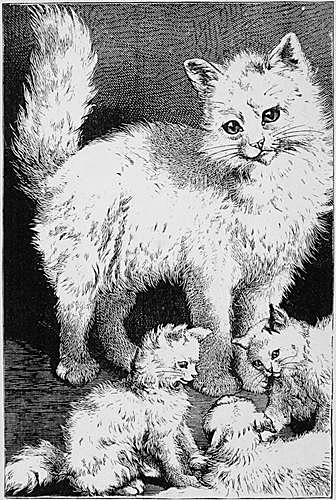
Mitis and Riquet are two tom-cats saved from a litter of five; their
mother is an Angora, slate-coloured, with the neck, breast, and tips of
the paws white. Mitis has a large head and limbs, and a coat which
promises to be Angora and the same colour as his mother’s, a white muzzle,
and white underneath his eyes, while his lips and the tip of his nose are
bright pink. Riquet’s body and tail are black, with grey marks; his head,
which is smaller than his brother’s, is grey, with zebra-like bands of
black crossing longitudinally and laterally; two white streaks branch out
from the upper end of the nose, and on the forehead two curved lines,
starting from the corners of his eyes, surround a disc of black and grey.
No sooner has their mother licked them over than they set off whining and
seeking for her teats. I made some observations of their movements on the
first and second days; but as I am afraid of not recording them with
sufficient accuracy from memory, I will begin with the third day, when I
took to writing down my observations.
12th May.—They are perpetually moving about, even when sucking and
sleeping. Sleep overtakes them in the act of sucking, and then, according
to what position they were in at the moment, they either remain ensconced
in their mother’s silky breast, or fall over with open mouths into some
graceful attitude. The little gluttons, Riquet especially, who seems to be
delicately organised, are often troubled with hiccoughs, reminding one of
young children who have sucked too copiously. It is curious to watch them
when searching for a teat, turning their heads abruptly from right to
left, and left to right, pushing now with their foreheads, now with their
muzzles; tumbling and jumping one over the other, sliding between their
mother’s legs, trying to suck no matter what part of her body; and
finally, when they have settled down to their meal, resembling leeches,
whose whole activity is concentrated on the work of suction, and who, as
soon as they have thoroughly gorged themselves, let go their hold and fall
back into inertia.
Whenever their sensibility is unpleasantly excited, as, for instance, if
their mother leans on them too heavily, or leaves them alone, or performs
their toilet too roughly, they give vent to monotonous—I had almost said
monosyllabic—plaints; sounds which can scarcely be called mias, still
less miaows; they are best described as trembling mi-i-is. They also
emit these plaintive sounds when they have been searching long for a teat
without finding one, or if they annoy each other during the laborious
search; or if I take them up too quickly, or turn them over in the palm of
my hand to examine them. If I set them up in my hand in a standing
position, they will remain motionless for a few seconds, as if enjoying
the warmth of my hand; but very soon again they begin clamouring with loud
whines for their home in the mother’s warm, soft stomach, which is at once
their shelter and their dining-room, the familiar, and perhaps the loved,
theatre of their nascent activity.
13th May.—This morning Mitis appeared to be ill. He was languid, did
not whine when I took him up, and made no attempt at sucking; he had an
attack of hiccoughs, accompanied by shiverings all over his body, which
made me anxious. It only lasted an hour, however: there may have been some
temporary cause of indisposition; or perhaps excessive sucking, or a very
great need of sleep, had reduced him to a semi-inert mass.
Riquet’s head is prettier than it was yesterday; the white spot has
increased in size, the grey marks have spread and grown lighter, and the
head and neck are rather larger; but Mitis has still by far the finest
carriage.
Twelve o’clock.—The two leeches have been operating for twenty minutes
without desisting. They are now brimful of milk, and settling themselves
down, no matter where—one on the mother’s stomach, the other on her paws;
no sooner have they placed themselves than they fall asleep.
Two o’clock.—They have no fixed position for sucking; any does that
comes first.
When the mother leaves them alone for a moment they turn in rapid
gyrations round and round, over and under each other, delighting in the
mutual contact of their bodies and the warmth which it engenders. If the
mother remains absent for some minutes, they end by falling asleep one
over the other in the shape of a cross. If I lift up the top one, the
other soon begins to whine: they are not accustomed to solitude, and it
produces a painful impression of cold. Very young animals are easily
chilled, and sometimes die of cold in a temperature which is not very low.
This is owing to the smallness of their bodies and the feebleness of their
respiratory organs.
Between four and five o’clock Riquet seemed to me very lively. He was
searching for a teat which he could not find, and for ten minutes he
crossed backwards and forwards over his brother’s body, giving him
frequent slaps with his paws.
Riquet’s nose is a pink-brown, but tending to red-brown.
This evening (ten o’clock) I showed the mother a saucer full of milk; she
left her kittens to go and drink it, and afterwards she took a turn at a
plate of porridge; her absence lasted barely five minutes. The kittens,
during this time, went through their usual manœuvres: Riquet turned
three times running round his brother; the latter, who is more indolent,
or perhaps has more need of sleep, stretched himself out full length on
his side. Riquet, however, cannot rest till he has found what he is
searching for—viz., the body of his mother. He is still in a state of
agitation when the cat comes back, raises herself with her front-paws on
the edge of the box, and drops quietly down by the side of her little ones
without touching them. Instantly they start up, raising their little
waggling heads; they know that their mother is there—the slight noise she
made in getting into the box, and the movement she imparted to it, are
associated in their memory with the idea of her presence.
The mother’s first care is to see to their toilet, and she proceeds to
turn them over with two or three strokes of her tongue, and then operates
on them with the same natural instrument. Both have their turn; and at the
end of the operation, which seems to worry them, they whine considerably,
though not at all loud. A few minutes after, the melodious snoring of the
mother informs me that the whole family is at rest. I take a peep at them:
the mother is laid on her left side, describing a large and elegant curve;
Mitis, half on his hind-paws, half on his stomach, is stretched across
Riquet, and both are sleeping, or sucking—perhaps doing both at the same
time.
14th May.—My kittens seem to grow as I watch them, especially Mitis’
head, neck, and back; he is a massive heavy kitten, but his forehead is
broad and high: he will probably be an intelligent cat; his leonine chin,
large and well developed, indicates energy and goodness. He begins to show
more vivacity than during the earlier days; when he encounters his brother
in searching for a teat, or if the latter disputes with him the one he has
got hold of, he deals out at him rapid strokes with his paw, which remind
one of a dog swimming. His mother has just been performing his toilet in
the manner aforesaid, and has no doubt kept him longer at it than he
liked; he shows his displeasure by striking out his hind paws, one of
which knocks against his ear, and uttering two or three impatient mis.
These very occasional and but slightly emphasised cries are the only ones
which Riquet—even the brisk and lively Riquet—gives out, even when I
take him in my hand. I have seen other cats that were more unhappy
complain more: one, for instance, which was the only one I had kept out of
a litter, and which died at ten days old, just as it was beginning to open
its eyes; in her grief at having lost all her other kittens, the mother
used to carry this one about from place to place, and even leave it alone
for hours at a time; I believe it died from bad treatment and insufficient
feeding; the poor little thing frequently uttered loud moanings. I cannot
feel the slightest doubt as to the causes of its death when I see the
mother so happy with the two that I have left her this time; she has not
once called or searched for the other three which I drowned. Does this
proceed from a want of arithmetical aptitude? Two, for her, are many
as well as five. However this may be, she is very happy, very repue,
very attentive, and her little ones are habituated to comfort, ease,
satisfied desires, and tranquil sleep and digestion. If they do not know
how to complain I think it is because they have had no reason to learn to
do so.
The colour of Riquet’s hair is changing sensibly: the grey-white now
preponderates on his face. The velvety black of his neck, back, and sides
is silvered with whitish tints, which have spread since the morning.
Often when they are alone, or even if their mother is with them, they will
mistake no matter what part of their bodies for teats and begin to suck
it, as a child of six months will suck its finger or even the tip of its
foot.
15th May.—To-day I held Riquet on my hand for three minutes. I was
smoking a cigar; the little creature stretched out its neck, poked its
nose up in the air, and sniffed with a persistent little noise. A sparrow,
whose cage was hung up over us, frightened at my smoking-cap, began to fly
round the cage and beat at it with its wings. At the sound of this noise
Riquet was seized with a sudden fit of trembling, which made him squat
down precipitately in my hand. Movements of this kind are reflex ones, the
production of which is associated in the organism with certain auditory
impressions; but the animal is necessarily more or less conscious of them,
or will soon be so. From five minutes’ observation I have thus learnt that
Riquet is sensible to strong smells, and that he already goes through the
consecutive movements of sentiment and fear.
Riquet’s head is visibly changing to silver-grey; the marks on his back
are also assuming this shade.
I took Mitis in my hands, stretched them out and drew them up again. He
does not seem to know quite what to make of it; he attempts a few steps,
feels about uncertainly with his head, and comes in contact with my coat
smelling of the cigar; he appears to be scenting my coat, but not with so
much noise and vivacity as Riquet does. He waggles his head about, feels
about with his paws, and tries to suck my coat and my hands; he is
evidently out of his element and unhappy. The mother calls to him from the
bottom of the box; this causes him to turn his head quickly in the
direction from which the sound comes (what a number of movements or ideas
associated in the intelligence and organism of a little animal four days
old!); he starts off again, making a step forward, then drawing back,
turning to the right and to the left, with a waddling movement. I give him
back to his mother.
I thought I noticed once again this evening that the light of my lamp,
when held near the kittens’ box, caused rather lively excitation of their
eyelids, although these were closed. The light must pass through these
thin coverings and startle the retinas. The kittens were agitated during
a few seconds; they raised and shook their heads, then lowered them and
hid them in the maternal bosom.
The noise of carriages, the sound of my voice, the twittering of the
sparrow, the movements imparted to the box by my hand—all throw them into
the same kind of agitation. These movements may be coupled with the
movements, unconscious no doubt, but determined by external causes, which
are observed in the young.
16th May.—Mitis’ tail is thickening at the root; the hair of its head
and neck is close and silky; he will no doubt turn out a considerable
fraction of an Angora.
When I place the kittens on the palm of my hand they inhale strongly and
with a certain amount of persistence; this is because their sense of smell
operates no doubt with tolerable completeness, in view of the species, and
in the absence of visual perception, and by reason of the imperfect
operation of their touch.
This evening Mitis, having escaped from the constraint in which his mother
holds him to perform his toilet, half plantigrade half gastéropode,
dragged himself slowly, though as fast as he was able, along his mother’s
paws, and at last nestled down in the soft fur of her stomach. While in
this position his head, rolling like that of a drunken man, knocked
against the head of Riquet, who was in the act of sucking. Instantly Mitis
lifts a paw and brings it down on his brother’s head. The latter holds on,
as he is very comfortably spread out on the bottom of the box, and is
sucking a teat placed low down. A second attempt of Mitis’ fails equally.
He then performs rapid movements with his head, searching vigorously for
his cup, but not finding it. The mother then places a paw on his back, and
his centre of gravity being thus better established, he at last
accomplishes his object. Here we have several actions which are no doubt
in some degree conscious, but which come chiefly under the head of
automatism: the scent which helps in the search for the teat, the instinct
to dispute the ground with another who is discovered to be sucking, the
movements of intentional repulsion, of struggle, of combativeness. What an
admirable machine for sensation, sentiment, volition, activity, and
consciousness, is a young animal only just born!
17th May.—I have observed—or think I have observed—in Mitis, the more
indolent of the two brothers, the first symptoms of playfulness: lying on
his back with his mouth half open, he twiddles his four paws with an air
of satisfaction, and as if seeking to touch some one or something. It is
eight o’clock in the evening, the window is open, the sparrow is singing
with all its might in its cage, we are talking and laughing close to the
cat’s box. Do all these noises in some way excite the sensoriums of the
two repus kittens? The fact is, that they have been in a state of
agitation for more than a quarter of an hour, travelling one over the
other and walking over their mother’s stomach, paws, and head. Mitis, the
heavier of the two and soonest tired out, was the first to return to the
teat. Riquet’s return to the maternal breast has been a long and
roundabout journey from one corner of the box to the other, and round and
round his mother.
At nine o’clock I went to look at them with the light. This threw them
into dreadful consternation. I observe in them both something like
intentions to bite, while rolling each other over, they keep their mouths
open, and snap instead of sucking when they come in contact with any part
of each other’s bodies; but it is all mechanical. Here we have an increase
of activity produced by an accession of powers and temporary
over-excitement.
18th May.—They are lying asleep on their sides, facing each other, with
their fore-paws half stretched out against the hind ones. Riquet’s sleep
is much disturbed; his mouth touches one of his brother’s paws, which he
instantly begins to suck. Is this a mechanical or unconscious action? Is
he not possibly dreaming? After four or five attempts at sucking he lets
go the paw, and sleeps on tranquilly for four minutes; but the noise of a
carriage passing in the street, and perhaps the consequent vibration of
the floor and the bottom of the box, cause violent trembling in his lips,
paws, and tail.
The mother gets back in the box; and the kittens, instantly awake and
erect, utter three or four mis to welcome the joyful return.
In settling herself down the mother leans rather heavily on Riquet; the
latter, who used formerly to extricate himself mechanically, and who
already knows from experience the inconvenience of such a position, moves
off brusquely, goes further away than he would have done formerly, and
Mitis, on the lookout for a teat, hears close to him the noise of his
brother’s sucking. He pommels his head with his hind-paws, rolls up
against him, striking out with his fore-paws, and knocks him over with the
weight of his body; he is now in possession of the teat which his brother
had first tried, and, finding it as good as the one he was sucking before,
he sticks to it.
18th May.—Mitis was trying to worry Riquet who was busy sucking. I hold
out my hand to make a barrier between the two; Mitis pushes it back with
his paw, but soon perceives the difference between the two bodies which he
is pushing against, gives over his excitement, and looks out for another
teat. No doubt in this case there was no comparative perception of
difference, but different sensations producing different muscular actions;
that is all, I imagine, but this is nevertheless the germ of veritable
comparison.
19th May.—Both the eyes of both kittens are about to open; the eyelids
seem slightly slit, and are covered with an oozy film. At the external
corner of Mitis’ right eye there is a little round opening disclosing a
pale blue speck of eyeball, the size of a pin’s head. At the internal
commissure of the left eye there is also a round opening, but much
smaller, and showing no eye-ball through it. Riquet’s right eye is also
opening slightly; the edges of the left eyelids are stopped up by a
yellowish discharge.
I fancied that Mitis was playing in the box; I tumbled him over on his
back, tickled his stomach, and stroked his head; he struck out his paws
without attempting to pick himself up; this was evidently a more or less
conscious attempt at play. His mother came to lick him in this attitude,
and he performed with his fore-paws as previously. Riquet, too, shows a
tendency to play, but not of such a pronounced nature.
21st May.—Riquet’s left eye is beginning to open at the inside corner.
I took them both up on my hand, and waved my fingers in front of their
partially opened eyes; but I did not observe any movement from which I
could infer the power of distinguishing objects.
Mitis, placed close to his mother’s head, nibbles at it and plays with his
paws on her nose; the mother does not approve of this amusement; she lays
a paw on her son’s neck and teaches him respect; soon he escapes from her
grasp, and begins searching for a teat.
Some streaks of fawn-colour have mixed with the zebra-like black and grey
on Riquet’s neck: he is now quadri-coloured.
Mitis is seated on my hand. I kiss him on the head, three times running,
making a slight noise with my lips; he shakes his head twice. This is an
habitual movement of the mother cat when one kisses her or strokes her
head and it displeases, or if she is occupied with something else.
When I pass my hand in front of their heads, at about four centimètres’
distance, they make a movement with the head and wink their eyes; I am not
sure whether this means that they see, though their eyes have been more
or less open since yesterday evening.
They have not yet begun to purr.
22nd May.—I went up to the box towards twelve o’clock. Riquet’s left
eye, the light blue colour of which I can see, seems to perceive me, but
it must be very indistinctly. I wave my hand at ten centimètres from his
eyes, and it is only the noise I make and the disturbance of the air that
cause him to make any movement.
Both Mitis’ eyes are almost entirely open; I hold my finger near his nose
without touching it, I wave it from right to left and left to right, and I
fancy I perceive in the eyes—in the eyes more than in the head—a slight
tendency to move in the direction of my movements.
23rd May, 7 P.M.—Their movements are less trembling, quicker, and
fierce not only because of increased strength and exercise, but because
intention, directed by eyesight, is beginning to operate.
The more I observe young animals, the more it seems to me that the
external circumstances of their development—alimentation, exercise (more
or less stimulated and controlled), ventilation, light, attention to their
health and their affective sensibilities, care in breeding and
training,—are perhaps only secondary factors in their development.
Actual sensations, it seems to me, serve only to bring to the service one
set of virtualities rather than another; a sentient, intelligent, active
being is a tangled skein of innumerable threads, some of which, and not
others, will be drawn out by the events of life. This it is that marks out
the precise work, limits the power, but at the same time encourages all
the pretensions of educators. If all is not present in all, as Jacolot
asserted, who can say what is and what is not present in a young animal or
a young child?
I placed Mitis on a foot-warmer, the contact with which produced two or
three nervous tremblings, somewhat similar to slight shiverings; he seemed
pleased, however, and stretched himself out on the warm surface, with his
eyes half-closed, as if going to sleep. Afterwards I placed Riquet there;
he went through the same trembling movements, but then proceeded with an
inspection with his muzzle—scenting or feeling, I do not know which, the
article on which he had been deposited. He then gently stretched out a paw
and laid himself down flat, the contact with the warm surface inducing
sleep, by reason of the familiar associations between the like sensation
of warmth experienced on his mother’s breast and the instinctive need of
sleep.
When they trot about in their box, some of their movements appear to be
directed by sight.
Their ears have lengthened perceptibly during the last two days, and so
have their tails.
When any one walks about the room, if they are not asleep or sucking, they
begin frisking about immediately.
The mother, whom I sent to take a little exercise in the courtyard, has
been absent for half an hour. Mitis is asleep; Riquet, lying with his head
on his brother’s neck, was awakened by the sound of my footsteps, all the
more easily roused no doubt because he was hungry, and because his mother
had been absent so long. I stroke his head with my finger, and he puts on
a smiling look. I make a little noise with my lips to rouse the sparrow,
and this noise pleases Riquet, who listens with the same smiling
countenance.
They now attempt to climb higher; they do not knock their noses so
frequently against the partitions of the box, they certainly direct their
paws at certain points determined by their vision; eyes, noses, and paws
now operate in concert on the teats or any other objects that come across
their way; for they do not go much in search of objects as yet. Their
field of vision does not stretch very far; what they see is matter of
chance and accident rather than of real intention. If I wish to attract
their attention by waving my hand, I must not hold it further than fifteen
centimètres from their eyes. I must go very close to them before they
appear to distinguish my person. I am not sure that they see the whole of
it; I rather think that only certain portions are visible to
them,—amongst others my nose, because it stands out in relief, and my
eyes, because they reflect the light vividly.
24th May, 9 P.M.—The orbits of their eyes seem to me rather more
expanded than this morning, possibly because the light makes their pupils
contract. I placed a candle on a chair by the side of their box; the light
evidently annoyed them, but it stimulated them to exercise their limbs.
Mitis, after having promenaded and struggled about in a corner of the box,
and grown accustomed to the lively sensations on his retina, directs his
steps towards the most brightly-lighted point of the box. A band of light
falls full on the upper part of the partition on the side facing me.
Mitis, and Riquet after him,—more from imitation than personal
excitement,—tries to climb up this luminous board; he does not succeed,
but the attraction continues undiminished. I thought involuntarily of the
plants which struggle up walls to reach the light.
Mitis, still somewhat disconcerted—though much less so than at
first—when he looks directly at light, retires into a corner, and tired,
no doubt, with the exercise he has just been taking, places himself, or
rather falls back, on his mother’s tail. I take him up gently, and set him
in front of his mother’s stomach, and by the side of Riquet, who had just
finished his gambols also, and was sucking. Then began a scuffle, the
front paws working away perceptibly like the battoirs of a washerwoman.
I come to the rescue, placing my hand between them, and this calms them
down; they favour me, however, with a few ridiculous little taps. Mitis,
meanwhile, has taken possession of the contested teat, and celebrates his
victory by the first purr that to my knowledge he has produced.
Riquet is now in a great state of agitation; he is lying in the dark,
behind his mother’s back, and close to the side of the box facing me. I
hold my finger to him; he lifts himself up and leans his head slowly
forward to touch or scent my finger. He can now distinguish people, but
more by touch, scent, or hearing than by sight, the latter sense being
very imperfectly developed and little exercised. When I make a slight
noise with my lips the little creature starts and jumps about, but does
not lift up his eyes to my face, which he has seen close to him, has
looked at with attention, but which he is very imperfectly acquainted
with, and does not accurately localise with respect to my hand and my
body.
Riquet is close to his mother’s head. He has stretched a paw over her
neck, and is looking at some part or other of her head, I don’t know
which, while playing gently with his little paw. Here we see an
intelligent development of affection; he now loves his mother in a more
conscious way; his visual and tactile perceptions are becoming
co-ordinated, are amplifying his knowledge, and giving strength and
precision to his sentiments.
I stretch out my finger to Mitis, who is still lying on the spot where I
found him at first. In return, either from curiosity, or from instinctive
impulse and movement, he holds out his little paw, which seems to enjoy
the grasp of my finger, and sticks to it.
25th May.—I place my kittens, one after the other, in the hollow of my
hand. Mitis squealed when I lifted him out of the box, and during the
three minutes that I kept them in my hand they both seemed almost
indifferent. The instant, however, that I put them back in the box they
seemed quite delighted to get back again, or else they were stimulated to
play by the various sensations—muscular, visual, tactile, and
thermal—which I had occasioned them. Standing and walking about on my
hand had stimulated Mitis to an extraordinary display of strength. In his
desire for prolonged exercise, and no doubt also wishing to renew the
vivid sensations of light he had just experienced, he set to work to climb
up the perpendicular wall of his dwelling, making all the time a great
noise of scratching. All movement produces sensations; and all sensations
produce movements.
26th May.—They both play with their paws and their muzzles, but
frequently, as if by chance, only without very marked intention, and with
very uncertain movements.
I seem already to distinguish in them two different characters. If one can
go by appearances, Mitis will be gentle, patient, rather indolent and
lazy, prudent and good-natured; Riquet, on the contrary, lively, petulant,
irritable, playful, and audacious. Noise and contact seem to excite him
more than his brother. But both of them are very affectionate towards
their mother, or perhaps I should say very appreciative of the pleasure of
being with her, of seeing, hearing, and touching her, and not only of
sucking from her.
I hold Mitis up to the edge of the box; he evinces a desire to get back to
his mother, but does not know how to manage it. His muscles have not yet
acquired the habit of responding to this particular psycho-motive
stimulus; he crawls up to where my hand ends, advances first one paw, then
another, and finds only empty space; he then stretches out his neck, and
two or three times running makes an attempt with his paws at the movements
which are the precursors of the act of jumping. He would like to jump
down, but cannot do so; instinctive intention is here in advance of the
adaptiveness or the strength of the muscular apparatus fitted to execute
it. He retreats frightened and discouraged, and whines for help.
Riquet placed in the same position, goes through almost the same
movements, but he is able to do more; he has managed to seize hold (chance
perhaps assisting him) of the edge of the box, he sticks to it, leans over
without letting go, and would have got down, or rather tumbled down, into
the box, if I had let him.
27th May. Every day they get to know me better. Now, after I have taken
them in my hands, or stroked their head, neck, or lips, they go back to
their box quite excited; they walk about in it faster than before, snap at
each other and strike out their paws with much more spirit. Play has now
become a matter of experience with them, and grows day by day a little
more complicated; they seem to be aware of their growth in strength and
skill, and to derive pleasure from it. To-day, for the first time, Riquet
scratched the piece of stuff on the bottom of the box, and he did it with
playful gestures and an expression of delight; first he stretched out one
paw, then the other, with his claws turned out, and, being pleased with
the noise produced by drawing back his claws, he renewed the operation
twice, but no more. It will be necessary to go through the same experience
two or three times more, in order to fix the idea of this game in his
little head.
They have already tried several times running (either by accident or with
a vague idea of ascending) to hold on to, or climb up, the sides of the
box; if they were not slippery, or were covered with a cloth, I think they
would have strength enough to lift themselves up to the edge.
They lift their head and paws as high as they can, in order to see better.
All the inside of the box seems to be sufficiently well known to them, but
all the same they are constantly making experiments in it, either by
touch, sight, hearing, scent, and even taste; for they frequently lick the
board, and try to suck the cloth at the bottom. They would no doubt gladly
extend the area of their experiences, but I shall leave them habitually
in the box until they are able to get out of it by themselves; they can
get quite enough exercise in it, and they have enough air and light, and I
think the prolongation of this calm, happy, retired existence makes them
more gentle. The mother prefers their being in the box, and I am of the
same opinion, though not perhaps for the same reasons. They would become
too independent if allowed to follow their caprices, and exposed to the
dangers of adventure, instead of being accustomed to the restraint of the
hand which they love and which humanises[4] them. I want them to become
so thoroughly accustomed to my hand, that, when they receive their
freedom, they will still recognise it from a distance, and come to it at
my will. My hand is a very precious instrument of preservation and
education for them.
28th May. When, standing close to the box, I take Mitis in my hands, he
looks at the box, bends his head, stretches out his paws, and shows a
considerable desire to get down, but without making any effort towards
this end. I hold him a little lower down, at a few centimètres from his
mother, and he no longer hesitates but lets himself glide down to her,
his movements, however, only turning out a success thanks to my
assistance. Can it be that he had (what Tiedemann does not even allow his
fourteen-months-old child to have possessed) a vague perception of
distance, of empty and inhabited space, anterior to personal experience?
“He had not yet any idea of the falling of bodies from a height, or of the
difference between empty and inhabited space. On the 14th October he still
wanted to precipitate himself from heights, and several times he let his
biscuit fall to the ground when intending to dip it in his cup.”
The kittens endeavour to climb along the sides of the box, but their idea
of height (perhaps an instinctive idea) is not sufficiently determined;
they seem quite astounded at not reaching the goal with the first stroke.
At the same time I may be mistaken in my observations; perhaps they went
up these four or five centimètres mechanically, because in walking along
horizontally they found under their paws the surface of the partition
which may have seemed a natural continuation of their road. Perhaps they
have no wish to get up to the edge of the box.
28th May.—The grey spots on Riquet’s back are now almost as large as
the black ones.
The eyes of both kittens are getting less and less blue; they are assuming
an indistinct colour, between dirty grey and light brown. Their
expression is frank and sympathetic; they seem to direct their looks
consciously and voluntarily.
Riquet is looking at me with an expression of pleasure, seated upright,
with his paws lifted languidly. I hold my finger near him, and he extends
his left paw. I stroke the left side of his head, and he leans the part
which I caress on my finger, as a full-grown cat would do, and rubs
himself two or three times running against my finger. These are invented
movements—I mean movements furnished all of a sudden by the stimulus of
hereditary virtualities, and which seem to astonish the young animal as
well as to please him; it is thus that we see automatic movements at one
moment coming under the control of consciousness, and the next escaping
from it, refined, simplified, adapted, and perfected. Life invents but few
new movements; but there are many, no doubt, ready to appear if the
influences of surroundings permitted it.
29th May.—They are learning more and more to exercise their muscles and
perfect their movements; they are daily acquiring fresh powers and
adaptations, and in their games with each other and their mother they
show intention and pleasure; they are learning more and more to
distinguish people; if any one presents a finger to them, they always
hold out their nose, or else a paw; this seems to have become a reflex
action with them. They also appear to localise certain sensations which
are in some sort artificial. I touch the tip of Mitis’ left paw, (he has
been sucking for the last ten minutes); he stops sucking, and instantly
turns his head in the direction of his paw; but this is perhaps because he
has seen my hand, and the muscular sensation associated with this visual
sensation may have determined his movement alone and almost automatically.
I vary the experiment, however, and pass my finger two or three times
running across his neck; he raises his head and looks behind him, as if
understanding where I had touched him. However this may be, I should not
like to affirm in him the faculty of localising pleasure or pain, except
as a sort of automatic localisation of sensations, which would be the
result of certain anterior adaptations.
The mother is engaged on the toilet of Mitis, who neither looks pleased
nor displeased; he makes a sound which is neither a cry of pain, nor the
whining of complaint or anger; if he is giving expression to a mental
condition well defined to himself, I cannot guess at it. It is a tremulous
noise which might be represented by the following letters: mrrrimr....
2nd June.—Riquet’s ears grow more than those of Mitis. The hair of the
latter has ceased to grow, and his tail is scarcely more bushy than his
brother’s. He will not be more of an Angora than Riquet, in spite of the
long silky hair, which during the first days grew so abundantly on his
neck, stomach, and thighs.
Riquet has become more patient, and Mitis more lively during the last few
days. It would be very presumptuous to pretend to found precise inductions
as to the future on observations taken during the first days; hypothesis
itself must maintain the most scrupulous reserve, especially as regards
predictions concerning intelligence and character. A cat which appears
very intelligent at the age of one or two months, often shows very
mediocre intelligence when a year or two old, and vice versâ. As to the
colour and nature of the hair, six weeks must have elapsed before one can
give any certain opinion as to the real shade that it will be, and as to
its flexibility, abundance, brilliancy, and waviness. As for the ears I
have often erred in my predictions ... which are scarcely perceptible at
birth, and during the first eight or ten days, will sometimes grow to a
disproportionate length afterwards. With regard to the paws and the tail,
half a decimètre’s length at the moment of birth indicates undoubtedly
an appreciable length later on. One can also determine on the first day
the future firmness of the muscles and bones by the relative resistance of
these little velvety lumps when held in the hand. A strong voice, which is
more especially the appendage of male kittens, indicates at any rate good
lungs.
Mitis, who is so gentle, has more flattened ears than Riquet; the latter’s
stand up more like those of foxes and wolves. The little complementary
pavillion ... which is attached to both edges of the ear, slightly
towards the bottom, and which in man is designated by a slight rudimentary
excrescence, is beginning to appear in both my kittens.
They are now well advanced in the art of play; they fence well with their
paws, lick each other, and tumble and roll each other over. Riquet, who
has some difficulty in standing upright on his legs, has attempted a jump.
They try to bite each other at play, specially aiming at each other’s
paws. Often by mistake they seize their own paws with their teeth and gnaw
at them; but they are not long in finding out their error.
I place them on the ground. They tremble, seem frightened, or rather
astonished, or undecided, and make a few uncertain movements. One of them
perceives the mother at a distance of about a mètre, looking at them
from under a chair. He goes straight up to her, but very slowly, and with
a great deal of waddling; all of a sudden he stops. He has heard his
brother’s voice, the latter having whined on my touching him to rouse him
out of his persistent immovability; he turns his head in our direction,
distinguishes me, turns straight round, and comes up to me with much
greater rapidity and assurance than he had shown in going to his mother.
The reason of this is, that the road to me was shorter and surer, and the
stimulus to traverse it greater, owing to the larger proportions of my
body. I place them back in the box, and they begin playing again with
zest. The one who had only moved feebly on the floor, walks, and even
jumps, much better this morning. This little outing seems to have
stimulated him to an effort which he had not made before. In like manner
we sometimes note progress in young children from day to day.
They can now climb up to the middle of the box.
A board, a few centimètres wide, is nailed to the top of the box, and
covers about a fourth part of it. Mitis looks at it with longing eyes; he
makes up his mind, draws himself up as erect as he can, stretches up his
paws to the partition and within five centimètres of the upper plank;
he is longing to make an upward leap, and finally he ventures on it; but
his heavy abdomen and his weak legs play him false, and he rolls over
ignominiously. In like manner a young child, not yet firm on his legs,
leaving the support of the chair to venture a step alone, falls in a soft
heap on the floor.
4th June.—They play more and more with my finger, bite at it and lick
it. They seem to look at all objects more attentively, and more
sympathetically at their mother and me.
When they are playing about under their mother, one sees only a confusion
of white paws, pink noses, shining eyes, and whisking tails. I have put
them on my bed. They walk much better there than in the box, and
infinitely better than on the floor; they studied everything in this new
locality, walking, climbing up and down, sliding and rolling about.
Riquet, having reached the edge of the bed, would have fallen over if I
had not held him back. His more circumspect brother, finding himself in
the same situation, leant his head over for a moment, and then, as if
defying a danger more or less realised; turned round and precipitated
himself at the other side of the bed.
11th June.—They frisk and bound about, and catch at all objects
indiscriminately with their claws to try and climb. They look into each
other’s eyes as if trying to discover the expression of sentiments and
ideas. This may proceed from astonishment and curiosity, and the delight
of the ever new impressions which the movement of the eyes cannot fail to
produce in them. But must it not also be partly the result of an
hereditary predisposition of their organisation, which leads them to seek
in the eyes for the meaning which they express? We know that adult
animals, as well as man, are endowed with this tendency which proceeds
from instinct rather than individual experience.
Partly from imitation of their mother and sister, partly from the teaching
of their instinct, they went off one day to a certain out-of-the-way spot,
where was placed a pan full of ashes, the object of which does not require
to be explained. Observing this, I carried them from time to time to this
pan. The smell proceeding from it was in itself sufficient to excite them
to satisfy their needs. Three or four such experiences sufficed to
associate with the idea of this smell the idea of the pan, of the place
where it was, and of the need to be satisfied. I do not say that this
habit of cleanliness, so quickly acquired, may not as quickly be lost, by
means of new associations taking the place of the first. There is no
doubt, however, that if the people would make it a rule to watch over the
formation of habits in cats during the first weeks (and probably also in
other animals and in children), it would not afterwards be necessary to
have recourse to a system of barbarous, and often useless measures, in
order to obtain from them by violence that which nature will manage alone
with but very slight assistance.
The shutters are closed on account of the extreme heat, so that the room
is in semi-darkness, and all the objects in it steeped in mysterious
shadow. Riquet, frisking about at a little distance from the box, sees a
footstool at about a mètre’s distance. This object, with its four feet
and their shadows would easily produce in my mind the illusion of some
mysterious animal. This, however, cannot be the case with the kitten,
unless we suppose in it a mental confusion of the inanimate with the
animate, that is to say, the animalisation of the inanimate. My opinion is
that the surprise, and presently, too, the terror which Riquet manifests,
and which keeps him transfixed to the spot, have their origin rather in a
certain indeterminate tendency to fear in the presence of all sudden and
unusual impressions. Such an apparition would have had no effect whatever
on him a few days ago; but to-day it is so much out of harmony with his
now numerous experiences, that it contradicts and jars against all his
familiar habits. This is, in my mind, the sole cause of his terror.
However it may be, he draws himself up on his small paws, bristles his
tail, humps up his back, and without either retreating or advancing, sways
right and left in the same attitude. I make a movement; this noise brings
his paroxysm of fear to a crisis, and he gives expression to it by a
fretful fû; he then turns round and goes off as fast as his legs will
carry him, the first way that comes, which happens to be to the side of
the bed.
12th June.—They are attracted by the noise which I make in crumpling
paper, in scratching the wall, or tapping a piece of furniture; but
metallic sounds, if soft, do not have the same effect on them; the noise
of objects being knocked, dull heavy sounds, or the noise of sharp voices,
astonish them and make them prick up their ears, but not lift their paws.
They take pleasure, however, in all the noises which they make themselves,
provided they are not too reverberating, or caused by the displacement or
fall of some large object. The loudest voice that I can put on pleases
them almost as much as the little playful tones I generally address them
in; they also delight in the strings of articulated consonants, which I
repeat to them; but they do not like whistling, although they are not so
much annoyed by it as is their mother, who comes up to me and rubs her
head under my chin and over my mouth, and gives me little taps on my lips
with her paw directly she hears me whistling. What specially delights them
are the dry sounds which their claws make on wood, linen, paper, the straw
seats of chairs, and the covering of the bed.
Mitis has drunk some milk this morning for the first time. I put the tip
of my finger, moistened with this fluid, under his nose, and he licked it
several times running. Enticed by the smell, he dipped his nose into a cup
of milk, but did not know how to set about drinking; up came the mother
and took his place, as if the milk was her rightful property. She
generally tries to take away from her little ones anything fresh, when it
is first given to them, perhaps out of maternal precaution, not thinking
them strong enough to digest anything but her milk. As she laps in a great
hurry, she always spills a certain quantity of milk round the saucer. I
placed Mitis in front of what had been spilled, and whether by chance, or
because he was incited by the smell, he fell to licking and cleaned it all
up. A quarter of an hour later he drank out of the cup, very awkwardly
however, and very little, plunging his nose so far into the milk as to
make him sneeze.
Riquet, to whom the same advances were made, licked the tip of my finger,
but did not touch the milk in the cup. He is less strong than Mitis, and
possibly less precocious in this respect.
When I come back into the room after an absence of even half an hour, the
mother raises herself on her paws, as if moved by a spring, and her two
satellites with her,—all at the same instant and with the same movement.
They still continue to be very fond of us, and not to be startled by
strangers.
I have tried to make Riquet drink: I put his nose into the milk, and he
then dipped his paw in himself and licked it, but would not lap. He went
so far as to approach the cup with his nose and just touch it with his
lips, but he then started off again.
He is now under the chimney, sniffing and then scratching the ashes,
which, as his movements indicate, remind him of his ash-pan. If I once or
twice tolerated an infraction of my rule, the habit of cleanliness so
easily formed in him would perhaps be hopelessly lost; this is why I
hasten to carry him to his pan.
At 3 o’clock we repeated with Riquet the experiment which had failed in
the morning; we smeared his nose with milk. He then licked it, and
afterwards put his nose in the cup, and drank a good teaspoonful.
This morning they are more vigorous and nimble than yesterday, and they
have been disporting themselves on my bed for more than an hour, whilst
their mother and elder sister were engaged, by way of recreation, in
snatching tufts of hair from each other’s coats, in scratching and
throttling each other. The mother gives a cry to indicate that this sport
has reached its limits. Mitis has tumbled off the bed with affright,
uttering a plaintive cry.
A ludicrous incident very nearly parted me from my two little pets. An old
laundress, whose sight is very feeble, as well as her mind, shut them up
in her bundle of linen, on which they had been playing whilst she was
counting it. I gave them up for lost, having searched for them everywhere,
even in my boots. Three hours later they were brought back to me safe and
sound. This is what had happened: on opening the bundle, out walked a
kitten (Mitis) who seemed very much surprised, he was put in a basket with
a cup of milk beside him; the other was only found an hour later, to the
great astonishment of the laundress, squatting under a cupboard and
showing nothing but the tip of his nose. He refused all manner of
consolation, and would not touch the milk, in spite of the example of
Mitis who did not wait to be pressed.
As soon as they were safe back with me they both ate some bread soaked in
milk.
The mother was very much dejected by their absence. When, after calling
them in vain with her most caressing voice, and making pretence to play to
entice them to come to her, she became convinced of their absence, she
filled my rooms with agonised screams. She then begged to be let out to
look for them in the court-yard, but soon came in again and began
screaming and hunting about as before. She came up to me and got up on my
knees, looked me fixedly in the eyes, and then curled herself up on the
bed where the kittens often sleep with her. Her eyes went beyond the
expression of profound despair; her eyelids quivered, a slight moisture
covered the eyeballs, and at the inside corners there was the appearance
of tears. There is no doubt that cats cry.
I have several times noticed, but in a specially distinct manner to-day,
on lifting them away from any place where they are comfortable, an
instinctive, or perhaps intentional, tendency to lean either with the
stomach or the paws, in order to remain fixed to the spot. An analogous
movement may be noticed in young children, when one tries to take them out
of the arms of some one they are fond of. I might no doubt have observed
this fact in my kittens long ago.
I was holding Mitis in my hands, and I lifted him near to his mother and
Riquet; he made a precipitate movement to get down to them, instinct
urging him to spring—and that all the more since he is now stronger;—but
his experience and his strength not sufficing to enable him to adapt his
efforts to the distance he had to cross. Thus it is that falling from the
bed often means in his case a bad attempt at jumping down. It is also
possible that it is the example of his mother and big sister, as much as
his increased strength, which suggests these somewhat impulsive bounds,
which moreover belong to the organic habits of the species. The little
unfledged bird also falls from its nest, when attempting a premature
flight.
Nothing in the shape of food comes amiss to Riquet: soup, meat, potatoes,
pease, lard—he snaps at, and devours whatever he comes across and
whatever is offered him; but one must beware of the little glutton’s sharp
claws. Mitis takes his food more gently.
18th June.—Riquet is playing with me on the sofa. A sole is placed on
the table. The smell of the fish excites and puzzles him, for he does not
know whence it comes; he travels over me in all directions, trying to
follow the scent, and is soon perched up on my left shoulder, which is
tolerably close to the table; he works towards the table, and I stoop my
shoulder to let him slide on to it. He rubs his nose first against a spoon
and then against a glass; the plate containing the sole is only a
decimètre from the glass, but as he does not know that a plate contains
food, and that it is from there that the savoury smell proceeds, he does
not direct his steps towards it. Finally, however, he finds himself in
front of the plate, puts his four paws on it, and instantly disposes
himself to eat the whole fish. I instantly carry him off. What a small
number of experiences he will need (two or three only I have determined)
in order to adapt to actual practice these judgments and movements which
unite instinctively with certain sensations! We call this reasoning in
man, and, nevertheless, it closely resembles a piece of subjective
mechanism, which is blind at starting, and which adapts itself to
objective representations with such promptitude, that consciousness seems
to follow, not to precede, its operations.
Whilst I was at my breakfast they climbed up my legs, and I had the
weakness to let them stay for a moment on the table. They invaded my
plate, Mitis going so far as to bite into the fish, and Riquet licking and
gnawing the edge of the plate; the smell of the fish is so penetrating
that he confuses it with the plate. Moreover, he has no idea of
containing and being contained. Soon he comes across a mouthful of
fish which I have prepared for him: he flattens himself out on the plate,
and eats with courageous and deliberate precipitation, inclining his head
now to the left, now to the right, sometimes closing his eyes from
delight, but oftenest keeping them open and fixed attentively on the
plate,—one would say he was afraid of losing his precious morsel; and
here we see a result of the preservative instinct which he has received
from his ancestors.
Mitis has got into a round earthen pan, and from association of
impressions tries to satisfy a need which he would not otherwise have
felt. The vessel, however, being small, and his movements causing it to
totter, he jumped out and ran off to his own pan.
20th June.—Mitis suddenly springs from the table to the floor, first
feeling his mother with the end of his paw, and then passing over her
without touching her: is it a personal or a social motive which makes him
act thus? Does he wish to avoid walking on ground that is not firm, or is
he trying not to hurt his mother? In like manner will a horse, on the
point of trampling a live body, hastily withdraw his foot.
They have been playing for a long time on my bed; before I go to sleep I
shall carry them to their own bedroom, to their mother who awaits them
somewhat sadly. They came back into my room as soon as I did myself. I sit
down in front of my table, they climb up along my legs, and I determine to
place them back on my bed. Twenty minutes later I reinstate them a second
time in their domicile, but they do not stay there two minutes. I had just
got into bed again when back they come, spring at the bed-cover, the
chairs, the wall, with a noise of scratching and rustling which excites
them to continue their difficult ascent; at the end of two minutes the
siege is accomplished, and I am seized upon, trodden over, scratched and
gnawed. I cannot be master in my own room except by shutting the door, at
which, however, they come and scratch, but without much persistence.
So there they are, now pretty well masters of their movements, taking
headers to get down from the bed to the chair, from the chair to the
floor, climbing up along the curtains and the tapestry, and even
attempting to climb the furniture and polished objects. A few more days
and their mode of descending will be less like tumbling, their ascents
less like scrambling: they will spring and they will bound, and will be
real individual cats.
Butler & Tanner, The Selwood Printing Works, Frome and London.
Footnotes:
[1] The Zoological Society has now fitted up the building, which was
formerly the Reptile House, with new cages, and to this “Cat House” the
specimens above alluded to have been removed, together with other forms
which were kept within the “Small Mammals’ House,” such as the Pampas Cat,
the Ocelot, the Geoffroy’s Cat, Serval, etc.
[2] The number of visitors admitted on the occasion of this one-day show
amounted to the grand total of 19,310.
[3] The above editorial note was added when the chapter appeared in The
Animal World.
[4] The Latins had the happy expression mansuetus to express this idea.