About the spring time, when the grass in the square garden was not so
often wet and the birds made more noise there and the nests were more
plentiful, Auntie May seemed not so very well.
She always had the hardest knee in the house to sit on, though it was
the nicest knee, and now her fingers grew so thin that the rings began
to drop off them, and then we were accused of having taken them. I
believe it was for this reason that she suddenly began to say that she
must go away.
'And leave us?' we said, when she told us.
'I don't think I can make up my mind to leave you, dears,' she said,
just as if she had understood our remarks, which of course she did not.
'Fancy waking up in the morning all alone by myself instead of being
waked by one of you putting your paw in my mouth! I can't picture it.
No, I'll stay here and die.'
'Nonsense!' her father would say. 'You must live, dear, if not for my
sake, for the sake of the cats. Let us think of something to amuse
you and make you forget your family for a while. Why not go up to see
Beatrice?'
'No, I don't want to go and stay with Beatrice.' She and Beatrice were
cross with each other just then, I happened to know, and truly Auntie
May's temper was not exactly even nowadays. She had been known to say
that we got on her nerves, and that there were too many of us. We knew
she was out of sorts by that alone.
'Why not try Folkestone with your Aunt Cecilia?'
'An old cat!'
'What about Mrs. Gilmour at Bournemouth?'
'Another!' It was easy to see she was ill.
'Then come with me to the Riviera?'
'That would be lovely, but, dear Daddy, I could not possibly take you
away from your Academy picture.'
'Then,' said the poor old man in desperation, 'go to America and read
passages from your own works and make a fortune.'
He was at his wit's end or he would not have proposed anything so
absurd and improper as that. He said no more, but I sometimes saw him
watching her with tears in his eyes.
When her hair began to come out in handfuls she herself agreed that
something must be done.
'I think I will go and live in Paris for a bit and study.'
'But, my dear child, you don't know anybody there.'
'That's just the point. I shall change the scene completely and get out
of myself.'
That seems an odd and impossible sort of thing to do, but it isn't the
first time I have heard people speak of performing this feat. Cats
can't, and wouldn't want to, I fancy.
The old man said he couldn't think of allowing it, and she at once
wrote for rooms to an address she knew. He said it would never do, and
she answered the woman's letter who kept the pension and took the rooms
for a month.
Then we were the difficulty. She could not think of leaving us to
Mary, who was good but careless, and she thought of a certain place she
had heard of at Gunnersbury where they boarded cats.
Mother disliked the idea very much, but what could she do? We were all
three put in baskets and taken in a cab. Gunnersbury seemed partly
country when we got out, but I saw very little, for we were hustled
into the house, and our fastenings not undone till we were in a garden
with wire cages or houses in it that they called 'cat-runs.'
A young lady in a grey voile frock trimmed with blue ribbons was
sweeping one of the wire places out, and she seemed to be no relation
to the mistress of the cattery, just a friend.
'I am single-handed just now,' the old lady said. 'My daughter, who
helps me, is away, taking King Henry the Eighth to a cat-show, but Miss
Joldwin—such a nice girl, and so well connected!—is good enough to
come here and help me turn out the cages twice a day!'
I don't see why because Miss Joldwin was a pedigree-woman she should be
too good to sweep out a cattery, but I do think she might have put a
pinafore on, and said so.
'Dear little fellow, he is very lively and talkative!' said the old
woman to me. 'I know I shall make a pet of you, I shall.'
'Oh, no favouritism, Mrs. Jennings, please,' said Auntie May. 'I
should like them all to be kept together, if you don't mind, as much
as possible. They are a very united and loving family. Fred, do leave
Zobeide alone! You are nearly murdering her.'
'Pretty little spirited dears,' murmured the woman, and I hated her.
'Come here! Kittie! Kittie!'
I wouldn't come here, and I saw that Auntie May was pleased. She soon
after took her leave, whispering to us:
'Now keep yourselves to yourselves, my dears, and though you must be
civil to other cats, don't make great friends. I shan't be away long;
I feel I shan't be able to stand it. Eat what you are given, and don't
have fancies. Don't climb up the old woman. Be civil to her, but no
more. Now goodbye, pets—angels—darlings—I must tear myself away!'
She tore herself away, and we were left alone in the wire house with
a sort of box thing inside where we were expected to retire for the
night. It wasn't bad, and the food was excellent.
I cannot tell the clock, and I never know either what time or what
day of the week it is, so I cannot say how long we were all together
in this cattery. It may have been a month. But one day (I had been
taken into the house, for I was a good cat and allowed to sit on the
dining-room woolly rug) I heard a well-known voice in the hall saying:
'No, thank you. There is no necessity for me to see it. I leave the
selection of the kitten to you. So long as the animal is ready packed
in a basket and so forth, all ready for my servant to fetch and hand
over to me at Charing Cross, that will do. Thank you, ten-thirty. He
will call here half an hour before. Good morning!'
It was the voice of Mr. Fox.
Mother said, 'It sounds as if one of you was going to leave me! This
wretched man seems to have bought a kitten of Auntie May and doesn't
even care which!'
'Mr. Fox buy a cat!' I cried. 'He simply hates us; he can't bear to be
in the room with one of us. Don't you remember, I told you all about
him at Crook Hall?'
'I cannot explain it!' said mother. 'Perhaps he is going to give you to
some one? I wish I knew what places one goes to from Charing Cross. But
there is no cat's Bradshaw, alas!'
I was taken away by a groom—I smelt his clothes through the
basket—next day, as arranged. We got into a noisy place full of
people talking, and I felt myself being transferred to Mr. Fox's hands,
and didn't he take hold of the handle of the basket that contained
me as if it was a hot coal! I wondered why he didn't put me in the
guard's van; but no, he stuck to me and put me down on the seat of the
compartment, just as Auntie May did, and then went as far off me as he
could go, for I could tell the distance by the rustle of the newspaper
he opened, and read fiercely all the way. I learned that we were going
to cross the sea from the conversation of two ladies in the same
compartment.
'Do you think it is going to be rough, guard? Have you heard what the
sea is like at Dover?'
'Like a mill pond, ma'am.'
'Oh, I do hope—' said one.
'I suffer so always!' said the other.
'Not worse than me, surely? Nobody could. I shall die in crossing some
day. What is that in the basket? Is it a bird or a cat? I saw a parrot
once crossing. I believe it was sick, or was it only imitating the
dreadful noise people make? I wonder if cats are sick?'
I wondered too. Not that I mind being sick, as I said before, and I
thought They were making a great deal too much of it.
I didn't like it, though, when we got to Dover, and Mr. Fox shouldered
me and carried me down a ladder and on to something that wobbled
gently. There was a horrible smell—that was the worst of it—a kind of
salt prick in the air, that I didn't like. Mr. Fox handed me to a man,
saying:
'Here, take care of this animal for me—you see it is labelled
"Valuable Cat"—and look after it till we get to Calais!'
'Ay, ay, sir,' said the man, who smelt of salt too.
This sailor planked me down somewhere, and never noticed me till
there was a shouting and a trampling and a hauling and a slowing-down
movement. Then the big thing that breathed in the middle stopped, and
there was no noise except of voices. Quite a nice rest. The sailor came
back and took me up, and put me back into the hands of Mr. Fox, who
gave him something he said 'Thank ye!' for, and who then carried me up
the ladder himself. I wished I could have seen his face. I am sure he
was pale, though perhaps in the strong smell of salt he didn't notice
the smell of me so much, and didn't feel so ill. I don't know, for, as
I say, I never saw his face.
He never undid me, but sat quite close to me on the rattlingest train
I ever was in, far worse than the boat. The two ladies said so. They
happened to have got into the same carriage as we did, and from their
subdued sort of manner I think they had both been very ill.
'I wonder how the cat got on?' said one in a very weak voice.
'I don't know, I'm sure, nor care,' said the other. Then in a lower
voice she said:
'The man doesn't look very fit; he's green. I expect he has had an
awful time!'
I wanted to cry out and say, 'You are quite mistaken. That is the
effect of me!' but of course I couldn't do anything but scrabble
about a little on the sides of the basket. They seemed to be eating an
enormous luncheon! I had a parcel of fish in with me loosely done up
that I could easily have got at, but I never eat on a journey. I make
up for it afterwards.
We stopped twice, and people cried out things, but at last we stopped
and did not go on again.
'C'est Paris?' said one of the ladies, and then I knew that she was
half French, and was probably going home. I thought of Auntie May, who
I knew was in Paris, but somehow I was quite surprised to hear her
voice—a very thin and weak little voice—speaking to Mr. Fox on the
platform.
'Oh, Mr. Fox, I never can thank you enough. And you, of all people,
who hate cats so, to offer to bring me Loki. Tell me, how did you get
on?'
'Very fairly,' said he. 'I do not choose to let this kind of thing get
hold of me. I'm all right, thanks, and glad to be able to do you this
little service.'
We all walked along—I was carried of course—till we came to some kind
of barrier, and they wouldn't let Auntie May pass. She had forgotten to
take a platform ticket, it appeared.
'I shall stay here, then,' said she to Mr. Fox. 'You go through with
this ticket, and I shall see whether these foreigners will have the
cheek to keep me.' I believe she winked. She was so happy at having got
me. She made Mr. Fox obey her, telling him to wait for her on the other
side, and she sat down on a seat and took me on her knee, and kissed me.
'I shall get well much faster now I have a soft sweet grey cat to
cuddle,' said she. 'I wonder how Mr. Fox knew that? And to offer
himself as a messenger, of all people! I don't believe he had any
business engagement in Paris at all, I believe it is pure philanthropy!'
Presently an official came and argued with her in French. She was very
sweet to him, on the principle that a soft answer turns away wrath, and
sure enough she worked it, for presently he said sharply, 'Passez,
Mademoiselle!' which means 'Go on.'
Mr. Fox had examined his luggage, and was waiting for her on the other
side of the barrier.
'Oh, why did you wait?' she said. 'I should think now I have Loki with
me you would want to give me a wide berth?'
'I don't want to,' said he, 'but my unfortunate peculiarity is sure
to assert its sway over me. Let me, at least, put you into a cab.'
'And shall I not have the pleasure of seeing you while you are in
Paris?'
'I am afraid I must not venture to come and see you and risk a scene?'
He laughed; he had a nice laugh. 'But will you be very kind, and come
to lunch with me to-morrow at Durand's? I go back at night.'
'But,' she said, 'I thought you said you had to be in Paris on
business, and that was why you would bring me Loki? That is what Daddy
assured me you said when he told you I was pining for him.'
'I can get through the business I have to do in the morning before
lunch,' said he, quite shortly, and whisked us into a cab and paid it,
and told the man to drive us to Rue Chauvau La Garde.
Miss Florence Pettigrew—that was the name of the woman who kept the
pension Auntie May had settled to go to—was a pretty, very little
woman, and reminded me somehow of the Manx cat, she seemed shortened
somewhere, somehow. She opened the door to us and I heard her greeting
Auntie May, and took a dislike to her at once from the basket. I didn't
like her any better when I was taken out. I'm sure she had a wooden leg.
'Well, so that's the cat. I hope he means to have good manners in
my flat. I don't want my nice new furniture torn to bits, you know,
Graham.'
That was Auntie May's surname, but I had never heard her called that
before. Auntie May was shown to her room and asked if she would have
hot water, but she sat down on the bed and cried, and cuddled me, and
said, 'Well, Loki, this is life!'
I thought she didn't like life much just now, when we went in to
dinner. Manxie, as I always called her, kept telling us that she had
had to get fish on purpose for Auntie May, but she couldn't afford it
for herself. No, what she had was three-pennyworth of meat a day for
herself, and that was enough for any woman. I thought she seemed more
like a Manx cat than ever, with her daily allowance of cat's meat, for
she couldn't have got proper people's meat for that price!
Auntie May gave me some fish, but it was so French and buttery that I
hated it. I tried to eat it, though, for Auntie May's sake, who looked
so pale and ill that I longed to write home to her father about her and
get her fetched home. It was unfortunate that Mr. Fox could not stand
me, or else he would have come to the house and seen Manxie, and after
he had seen her I am sure he wouldn't have approved of Auntie May's
staying where she was so disliked. Why, Manxie even leaned across the
table once, when Auntie May coughed, and said:
'I am sorry for you, Graham, but I don't like you. I don't like your
eyes!'
Did anybody ever hear anything like that? The woman was mad, that was
her only excuse. Poor Auntie May was miserable and her eyes were sunk
in and her cheeks hollow, but I don't see that when she was paying
Manxie ten francs a day that she ought to have been abused about her
eyes. Hollow cheeks are better than a hollow leg any day.
She went out to déjeuner with Mr. Fox next day, telling Manxie about
it, who was very cross with her for not bringing Mr. Fox to the flat.
'It is just as if you were ashamed of it, Graham,' she said, and Auntie
May didn't contradict her, but shut me up in her room and went. She
came back with some nice asparagus heads for me that she had begged of
the waiter at Durand's. After that she went out no more to luncheon,
and I supposed Mr. Fox had gone back to England.
Then Auntie May began to get worse and worse, and she coughed so that
she quite lost her voice and could only call me in a whisper. She had
a doctor fetched, to Manxie's great disgust, and he said she had to
put her mouth to the spout of a kettle that had benzoin in it, and she
used to sit for hours with her lips to the spout till Manxie complained
that the steam hurt her ceiling. French rooms are very funny, before
you furnish them yourself; there is a mirror let into the mantelpiece
and a stove in the dining-room. They cook quite differently, too, and
Manxie's cook used to write poetry. She kept the papers in her biggest
stew-pan, and used to read them to Auntie May, who said they were quite
good for a cook and far better than her omelettes.
Trivia, that was her name, was so grateful that she was always coming
in with cups of tisane.
'Buvez ça, Madame, je vous assure que cela vous fera du bien!' and
Auntie May said it did do her good, but as a matter of fact she got
worse and worse, and the doctor said he must get a friend of his to
call on her. She was English. He was English. As Auntie May said, 'I
come to Paris to change my ideas, and I have an English land-lady, an
English doctor, and now I am to have an English friend. Funny how we
English herd together!'
I may say that I mixed with the French more than Auntie May did. I had
a French friend; her name was Mistigris. She belonged to M. Ducrot,
the concierge. To call on her I had to seize my opportunity and sneak
downstairs when the bonne went out to do her shopping and Auntie May
was still in bed. Mistigris was generally lying on the silk eiderdown
that covers Monsieur and Madame Ducrot's bed. Their bed takes up half
their room, and it isn't very big either. It is close to the door.
Madame Ducrot cooks every meal there. They only have the one room and
the coal-cellar under the stairs. Their door gives on to the stairs
and has a glass window in it, so that they can see whoever goes past.
They are a curious race, are concierges, whose business it is to find
out things and take tips. At night, when they are in bed, of course the
door is fastened, but M. Ducrot has a bell that rings by the bed head,
and he has to wake up, if he isn't already awake, and pull a button
to open the door. The person at the door going out also has to say,
'Cordon, s'il vous plait!' All this Mistigris told me. She was very
Anglophobe, meaning she hated the English at first, but I convinced her
that we were really des braves gens—that means a good sort. At first
she used to call out 'Angliche!' and 'Poos! Poos!' at me, very rudely,
and even sometimes, 'Aha, Rosbif!' but she soon improved. Besides, they
don't say 'Puss! Puss!' to their cats here, but Minet or Minette, so
perhaps she was only trying to emulate the English accent. Of course
I don't know French any more than Mistigris knows English, but our
common language, 'Catapuk,' is known all over the world, so there was
no difficulty about our intercourse.
Madame Ducrot did not like my friendship with Mistigris at first, for
fear I should run away with her, but I am a born bachelor, and people
soon see that there is no fear of my carrying any cat off. Mistigris
was pretty, rather prettier than the white cat at the party, but it
made no difference to me, we were very good friends and that was all.
Mistigris used to lie in wait for me in the shadow of the bed-curtain
sitting on her warm nest in the eiderdown. Talk of French politeness;
she never once invited me to come up! And if I happened to get down to
see her about meal times when she sat on the table between Monsieur
and Madame Ducrot, as they drank their soup and ate their salad, she
frowned at me through the glass door and pretended not to know me. I
didn't want any cabbage soup, either, their cookery is far too greasy
for me. But when she was not so pleasantly engaged and the door of
the room was open, she used to come to me and thread herself in and
out through the balusters as a sign of friendliness. I never saw her
after seven o'clock. They turn all lights out on the stairs here
after eight, and I used to sit indoors on the cold wood floor in the
evenings and listen for Auntie May to come in. Manxie fed her so badly
that in disgust she used to go out and get her dinner at a restaurant.
She used to come up, bumping herself in the dark, and fumble for the
door-key under the mat, where Manxie, who went to bed at nine to save
lights, had left it. There was a jam-pot on a bracket in the hall full
of oil and a wick floating in it. It was the cheapest possible way of
lighting, so Manxie said. Then Auntie May used to grope for her sealed
bottle of milk on the table, and light one of those beastly French
matches that smell and sputter, and read her letters if there were any,
and then go to bed.
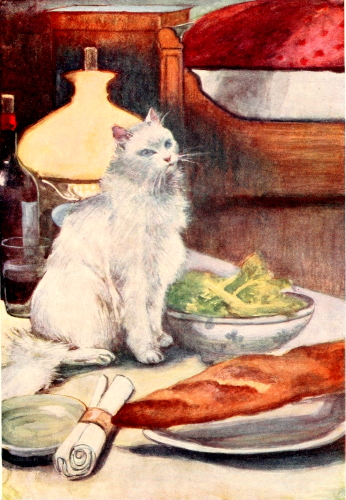
MISTIGRIS USED TO LIE IN WAIT FOR ME.
I used to help her to undress, playing with her strings and stay-laces,
and anything in the least taggy, and placing her slippers in different
ends of the room ready for her to find in the morning. Then when she
was in bed, I used to take a header off the high bureau and light on
her. She kissed my head for about five minutes and I purred, and then
having said good-night to her properly so, I lay down on the lower part
of the bed, for I was getting such a big cat that my weight was too
much for her shoulder where I used to like to lie. She put out her hand
and stroked me sometimes in the middle of the night; she liked to feel
I was there. If she was too sleepy to wake up, I generally crept up and
just touched the tip of her nose and so back again without waking her.
I didn't attempt to prise her eyelids open, as Fred did once when he
had the privilege of sleeping with her. He never had it again. Auntie
May values her eyes above anything, and she said it was too dangerous.
I never woke her in the morning, for I thought she wanted all the sleep
she could get. Manxie used to come and look at her sometimes when she
was asleep, and pry into her drawers. I always kept one eye on her, and
she knew it. The funny thing is it frightened her, though, of course,
she knew that I could not tell tales of her.
At last poor Auntie May stayed in bed altogether, and the doctor
brought his friend Mrs. Jay.
She was a nice woman and I adored her, although she played a funny
little trick on me. She used to take me up when she came in, and I used
to mew.
'It is an odd thing,' Auntie May said to her, after Mrs. Jay had been
to see her two or three times and they were great friends, 'that you
love cats so much and yet they mew when you hold them!'
'Isn't it odd?' said Mrs. Jay, smiling. She had a very pretty voice. 'I
cannot suggest any explanation.'
I could have explained it. Mrs. Jay bit my neck every time, not hard
or cruelly, but just so that I could not help crying out.
She was not a naturally unkind woman, but she had a mania for
experimenting on people by teasing them as well as being good to them.
She saved Auntie May's life, I think.
She came one day and said very decidedly:
'Now, Miss May Graham, I am going to take you away from here, bag and
baggage, cat and cattage. That dreadful Pettigrew—'
'Poor Pettigrew!' said Auntie May in a thin little voice.
'Poor Pettigrew indeed! She is simply starving you, that is what she is
doing, and taking ten francs a day for it! I am not going to leave you
here a day longer, if I take you away in an ambulance!'
There was no need for Auntie May to go in an ambulance. She paid
Manxie, who was in a towering rage, a month's pay in lieu of notice,
Mrs. Jay packed up her belongings, my old basket was brought out again,
and we were settled in the Rue de L'Echelle by the evening. I never saw
Mistigris again.