I was on my way from San Francisco to Yokohama,
when in a very desultory and gradual
manner I became acquainted with Mrs. Lecks and
Mrs. Aleshine. The steamer, on which I was making
a moderately rapid passage toward the land of the
legended fan and the lacquered box, carried a fair
complement of passengers, most of whom were Americans;
and, among these, my attention was attracted
from the very first day of the voyage to two middle-aged
women who appeared to me very unlike the ordinary
traveler or tourist. At first sight they might
have been taken for farmers' wives who, for some
unusual reason, had determined to make a voyage
across the Pacific; but, on closer observation, one
would have been more apt to suppose that they
belonged to the families of prosperous tradesmen
in some little country town, where, besides the arts
of rural housewifery, there would be opportunities
of becoming acquainted in some degree with the
ways and manners of the outside world. They
were not of that order of persons who generally
take first-class passages on steamships, but the stateroom
occupied by Mrs. Lecks and Mrs. Aleshine was
one of the best in the vessel; and although they kept
very much to themselves, and showed no desire for the
company or notice of the other passengers, they evidently
considered themselves quite as good as any
one else, and with as much right to voyage to any
part of the world in any manner or style which
pleased them.
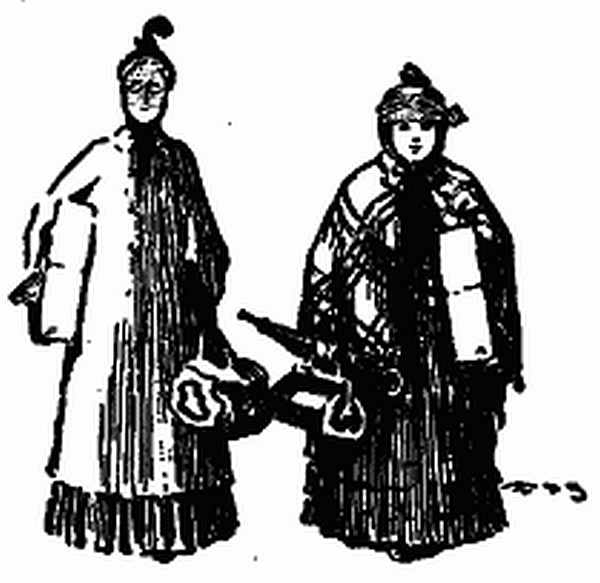
Mrs. Lecks was a rather tall woman, large-boned
and muscular, and her well-browned countenance gave
indications of that conviction of superiority which
gradually grows up in the minds of those who for a
long time have had absolute control of the destinies
of a state, or the multifarious affairs of a country
household. Mrs. Aleshine was somewhat younger
than her friend, somewhat shorter, and a great deal
fatter. She had the same air of reliance upon her
individual worth that characterized Mrs. Lecks, but
there was a certain geniality about her which indicated
that she would have a good deal of forbearance
for those who never had had the opportunity or the
ability of becoming the thoroughly good housewife
which she was herself.
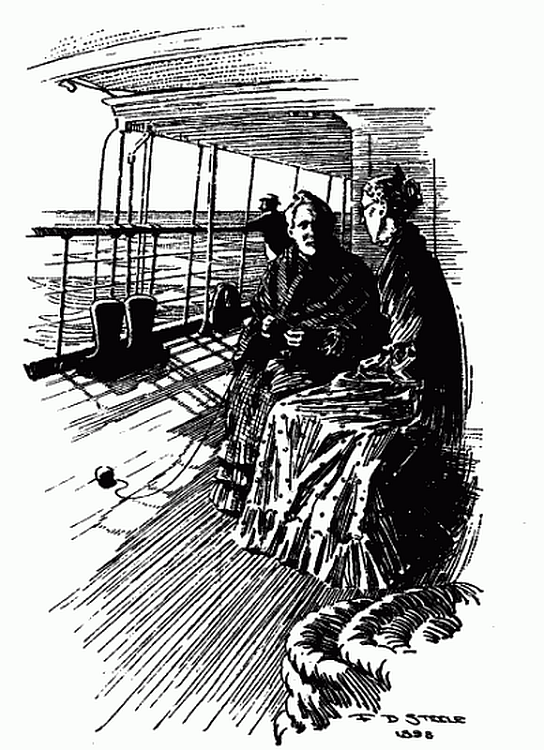
These two worthy dames spent the greater part of
their time on deck, where they always sat together in
a place at the stern of the vessel which was well sheltered
from wind and weather. As they sat thus they
were generally employed in knitting, although this
occupation did not prevent them from keeping up
what seemed to me, as I passed them in my walks
about the deck, a continuous conversation. From
a question which Mrs. Lecks once asked me about a
distant sail, our acquaintance began. There was no
one on board for whose society I particularly cared,
and as there was something quaint and odd about
these countrywomen on the ocean which interested
me, I was glad to vary my solitary promenades by an
occasional chat with them. They were not at all
backward in giving me information about themselves.
They were both widows, and Mrs. Aleshine was going
out to Japan to visit a son who had a position there
in a mercantile house. Mrs. Lecks had no children,
and was accompanying her friend because, as she
said, she would not allow Mrs. Aleshine to make such
a voyage as that by herself, and because, being quite
able to do so, she did not know why she should not
see the world as well as other people.
These two friends were not educated women. They
made frequent mistakes in their grammar, and a good
deal of Middle States provincialism showed itself in
their pronunciation and expressions. But although
they brought many of their rural ideas to sea with
them, they possessed a large share of that common
sense which is available anywhere, and they frequently
made use of it in a manner which was very
amusing to me. I think, also, that they found in me
a quarry of information concerning nautical matters,
foreign countries, and my own affairs, the working of
which helped to make us very good ship friends.
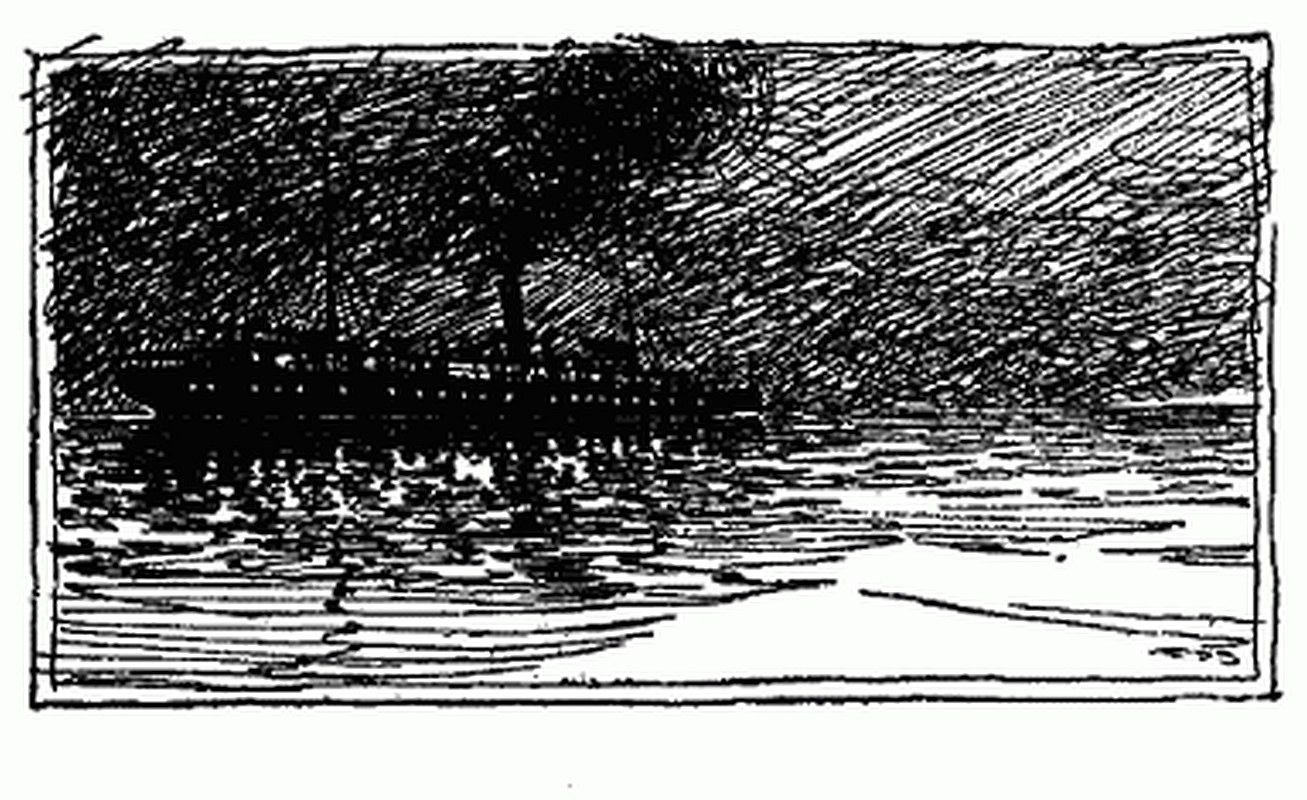
Our steamer touched at the Sandwich Islands; and
it was a little more than two days after we left Honolulu
that, about nine o'clock in the evening, we had
the misfortune to come into collision with an eastern-bound
vessel. The fault was entirely due to the other
ship, the lookout on which, although the night was
rather dark and foggy, could easily have seen our
lights in time to avoid collision, if he had not been
asleep or absent from his post. Be this as it may,
this vessel, which appeared to be a small steamer,
struck us with great force near our bows, and then,
backing, disappeared into the fog, and we never saw
or heard of her again. The general opinion was that
she was injured very much more than we were, and
that she probably sank not very long after the accident;
for when the fog cleared away, about an hour
afterward, nothing could be seen of her lights.
As it usually happens on occasions of accidents at
sea, the damage to our vessel was at first reported to
be slight; but it was soon discovered that our injuries
were serious and, indeed, disastrous. The hull of our
steamer had been badly shattered on the port bow,
and the water came in at a most alarming rate. For
nearly two hours the crew and many of the passengers
worked at the pumps, and everything possible was
done to stop the enormous leak; but all labor to save
the vessel was found to be utterly unavailing, and a
little before midnight the captain announced that it
was impossible to keep the steamer afloat, and that we
must all take to the boats. The night was now clear,
the stars were bright, and, as there was but little
wind, the sea was comparatively smooth. With all
these advantages, the captain assured us that there
was no reason to apprehend danger, and he thought
that by noon of the following day we could easily
make a small inhabited island, where we could be
sheltered and cared for until we should be taken off
by some passing vessel.
There was plenty of time for all necessary preparations,
and these were made with much order and
subordination. Some of the ladies among the cabin
passengers were greatly frightened, and inclined to
be hysterical. There were pale faces also among the
gentlemen. But everybody obeyed the captain's
orders, and all prepared themselves for the transfer
to the boats. The first officer came among us, and
told each of us what boats we were to take, and where
we were to place ourselves on deck. I was assigned to
a large boat which was to be principally occupied by
steerage passengers; and as I came up from my stateroom,
where I had gone to secure my money and some
portable valuables, I met on the companionway Mrs.
Lecks and Mrs. Aleshine, who expressed considerable
dissatisfaction when they found that I was not going
in the boat with them. They, however, hurried below,
and I went on deck, where in about ten minutes I was
joined by Mrs. Lecks, who apparently had been looking
for me. She told me she had something very
particular to say to me, and conducted me toward the
stern of the vessel, where, behind one of the deck-houses,
we found Mrs. Aleshine.
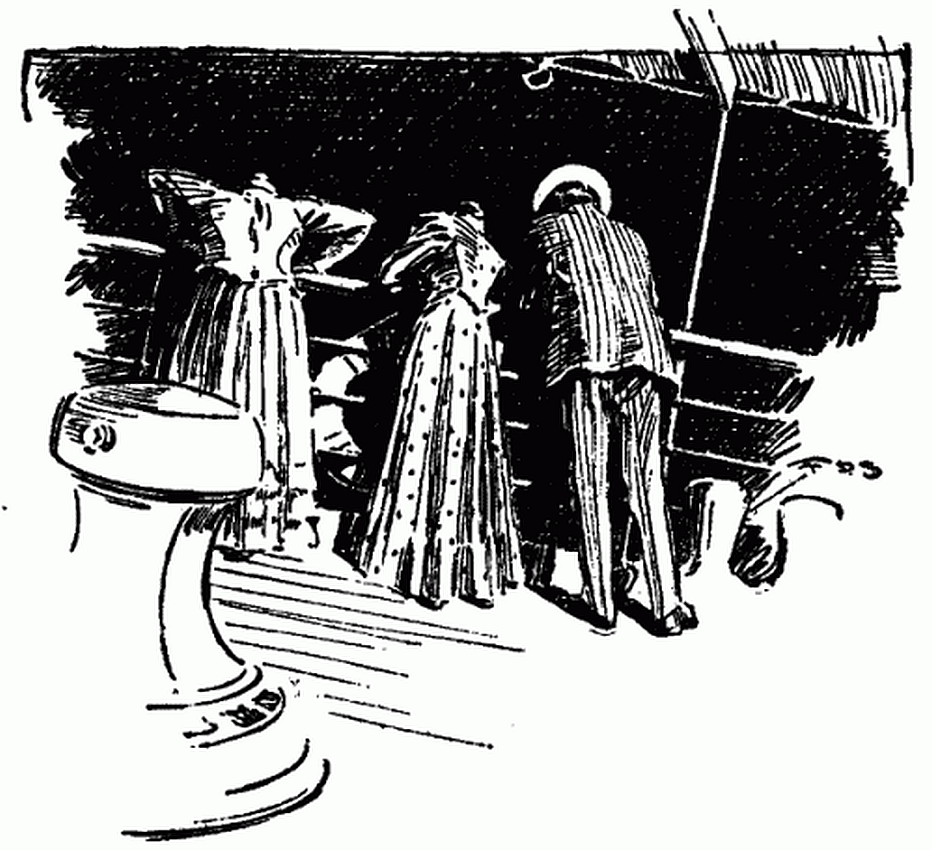
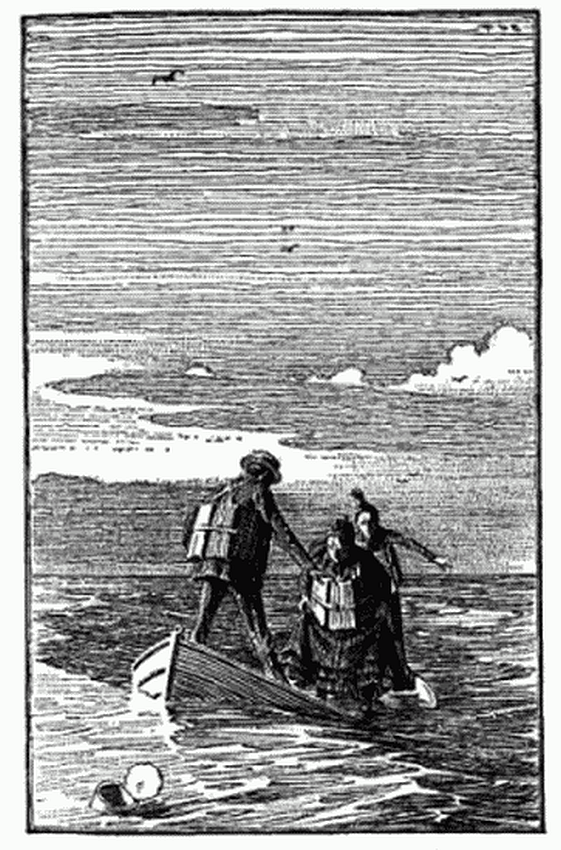
"DO YOU SEE THAT BOAT THERE?"
"Look here," said Mrs. Lecks, leading me to the
rail, and pointing downward; "do you see that boat
there? It has been let down, and there is nobody in
it. The boat on the other side has just gone off, full
to the brim. I never saw so many people crowded
into a boat. The other ones will be just as packed, I
expect. I don't see why we shouldn't take this empty
boat, now we've got a chance, instead of squeezin'
ourselves into those crowded ones. If any of the
other people come afterward, why, we shall have our
choice of seats, and that's considerable of a p'int, I
should say, in a time like this."
"That's so," said Mrs. Aleshine; "and me and Mrs.
Lecks would 'a' got right in when we saw the boat
was empty, if we hadn't been afraid to be there without
any man, for it might have floated off, and neither
of us don't know nothin' about rowin'. And then Mrs.
Lecks she thought of you, supposin' a young man who
knew so much about the sea would know how to row."
"Oh, yes," said I; "but I cannot imagine why this
boat should have been left empty. I see a keg of
water in it, and the oars, and some tin cans, and so I
suppose it has been made ready for somebody. Will
you wait here a minute until I run forward and see
how things are going on there?"
Amidships and forward I saw that there was some
confusion among the people who were not yet in their
boats, and I found that there was to be rather more
crowding than at first was expected. People who had
supposed that they were to go in a certain boat found
there no place, and were hurrying to other boats. It
now became plain to me that no time should be lost
in getting into the small boat which Mrs. Lecks had
pointed out, and which was probably reserved for
some favored persons, as the officers were keeping the
people forward and amidships, the other stern-boat
having already departed. But as I acknowledged no
reason why any one should be regarded with more
favor than myself and the two women who were
waiting for me, I slipped quietly aft, and joined Mrs.
Lecks and Mrs. Aleshine.
"We must get in as soon as we can," said I, in a
low voice, "for this boat may be discovered, and then
there will be a rush for it. I suspect it may have been
reserved for the captain and some of the officers, but
we have as much right in it as they."
"And more too," replied Mrs. Lecks; "for we had
nothin' to do with the steerin' and smashin'."
"But how are we goin' to get down there?" said
Mrs. Aleshine. "There's no steps."
"That is true," said I. "I shouldn't wonder if this
boat is to be taken forward when the others are filled.
We must scramble down as well as we can by the
tackle at the bow and stern. I'll get in first and
keep her close to the ship's side."
"That's goin' to be a scratchy business," said Mrs.
Lecks, "and I'm of the opinion we ought to wait till
the ship has sunk a little more, so we'll be nearer to
the boat."
"It won't do to wait," said I, "or we shall not get
in it at all."
"And goodness gracious!" exclaimed Mrs. Aleshine,
"I can't stand here and feel the ship sinkin'
cold-blooded under me, till we've got where we can
make an easy jump!"
"Very well, then," said Mrs. Lecks, "we won't wait.
But the first thing to be done is for each one of us to
put on one of these life-preservers. Two of them I
brought from Mrs. Aleshine's and my cabin, and the
other one I got next door, where the people had gone
off and left it on the floor. I thought if anythin'
happened on the way to the island, these would give
us a chance to look about us; but it seems to me
we'll need 'em more gettin' down them ropes than
anywhere else. I did intend puttin' on two myself to
make up for Mrs. Aleshine's fat; but you must wear
one of 'em, sir, now that you are goin' to join the party."
As I knew that two life-preservers would not be
needed by Mrs. Lecks, and would greatly inconvenience
her, I accepted the one offered me, but declined
to put it on until it should be necessary, as it would
interfere with my movements.
"Very well," said Mrs. Lecks, "if you think you
are safe in gettin' down without it. But Mrs. Aleshine
and me will put ours on before we begin sailor-scramblin'.
We know how to do it, for we tried 'em
on soon after we started from San Francisco. And
now, Barb'ry Aleshine, are you sure you've got everythin'
you want? for it'll be no use thinkin' about
anythin' you've forgot after the ship has sunk out of
sight."
"There's nothin' else I can think of," said Mrs.
Aleshine; "at least, nothin' I can carry; and so I suppose
we may as well begin, for your talk of the ship
sinkin' under our feet gives me a sort o' feelin' like an
oyster creepin' up and down my back."
Mrs. Lecks looked over the side at the boat, into
which I had already descended. "I'll go first, Barb'ry
Aleshine," said she, "and show you how."
The sea was quiet, and the steamer had already
sunk so much that Mrs. Lecks's voice sounded frightfully
near me, although she spoke in a low tone.
"Watch me," said she to her companion. "I'm
goin' to do just as he did, and you must follow in the
same way."
So saying, she stepped on a bench by the rail; then,
with one foot on the rail itself, she seized the ropes
which hung from one of the davits to the bow of the
boat. She looked down for a moment, and then she
drew back.
"It's no use," she said. "We must wait until she
sinks more, and I can get in easier."
This remark made me feel nervous. I did not know
at what moment there might be a rush for this boat,
nor when, indeed, the steamer might go down. The
boat amidships on our side had rowed away some
minutes before, and through the darkness I could
distinguish another boat, near the bows, pushing off.
It would be too late now for us to try to get into any
other boat, and I did not feel that there was time
enough for me to take this one to a place where the
two women could more easily descend to her. Standing
upright, I urged them not to delay.
"You see," said I, "I can reach you as soon as you
swing yourself off the ropes, and I'll help you down."
"If you're sure you can keep us from comin' down
too sudden, we'll try it," said Mrs. Lecks; "but I'd
as soon be drowned as to get to an island with a broken
leg. And as to Mrs. Aleshine, if she was to slip she'd
go slam through that boat to the bottom of the sea.
Now, then, be ready! I'm comin' down."
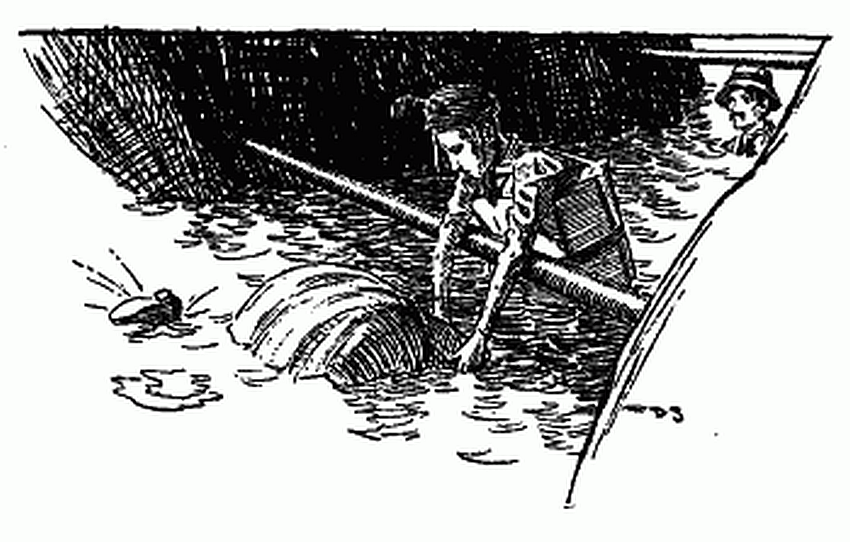
So saying, she swung herself off, and she was then so near me that I
was able to seize her and make the rest of her descent comparatively
easy. Mrs. Aleshine proved to be a more difficult subject. Even after I
had a firm grasp of her capacious waist she refused to let go the ropes,
for fear that she might drop into the ocean instead of the boat. But the
reproaches of Mrs. Lecks and the downward weight of myself made her
loosen her nervous grip; and, although we came very near going overboard
together, I safely placed her on one of the thwarts.
I now unhooked the tackle from the stern; but before casting off at the
bow I hesitated, for I did not wish to desert any of those who might be
expecting to embark in this boat. But I could hear not approaching
footsteps, and from my position, close to the side of the steamer, I
could see nothing. Therefore I cast off, and, taking the oars, I pushed
away and rowed to a little distance, where I could get whatever view was
possible of the deck of the steamer. Seeing no forms moving about, I
called out, and, receiving no answer, I shouted again at the top of my
voice. I waited for nearly a minute, and, hearing nothing and seeing
nothing, I became convinced that no one was left on the vessel.
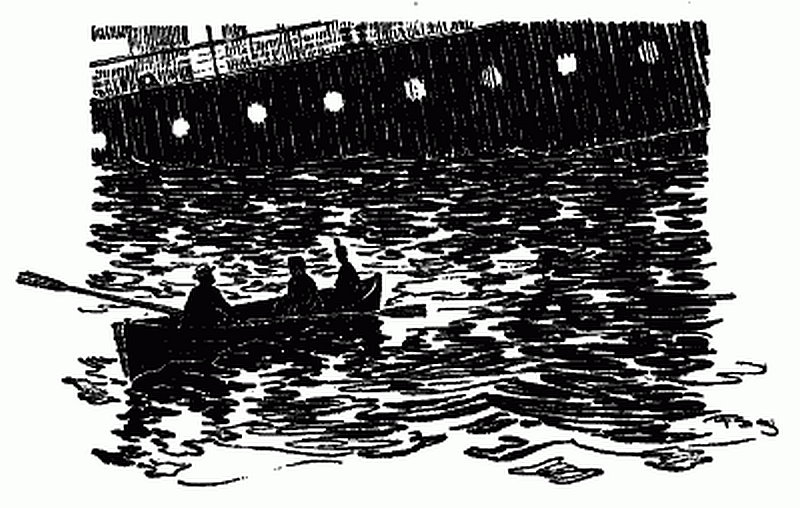
"They are all gone," said I, "and we will pull after
them as fast as we can."
And I began to row toward the bow of the steamer,
in the direction which the other boats had taken.
"It's a good thing you can row," said Mrs. Lecks,
settling herself comfortably in the stern-sheets, "for
what Mrs. Aleshine and me would ha' done with them
oars I am sure I don't know."
"I'd never have got into this boat," said Mrs. Aleshine,
"if Mr. Craig hadn't been here."
"No, indeed," replied her friend. "You'd ha' gone
to the bottom, hangin' for dear life to them ropes."
When I had rounded the bow of the steamer, which
appeared to me to be rapidly settling in the water, I
perceived at no great distance several lights, which of
course belonged to the other boats, and I rowed as
hard as I could, hoping to catch up with them, or at
least to keep sufficiently near. It might be my duty
to take off some of the people who had crowded into
the other boats, probably supposing that this one had
been loaded and gone. How such a mistake could
have taken place I could not divine, and it was not
my business to do so. Quite certain that no one was
left on the sinking steamer, all I had to do was to row
after the other boats, and to overtake them as soon
as possible. I thought it would not take me very long
to do this, but after rowing for half an hour, Mrs.
Aleshine remarked that the lights seemed as far off,
if not farther, than when we first started after them.
Turning, I saw that this was the case, and was greatly
surprised. With only two passengers I ought soon
to have come up with those heavily laden boats. But
after I had thought over it a little, I considered that
as each of them was probably pulled by half a dozen
stout sailors, it was not so very strange that they
should make as good or better headway than I did.
It was not very long after this that Mrs. Lecks said
that she thought that the lights on the other boats
must be going out, and that this, most probably, was
due to the fact that the sailors had forgotten to fill
their lanterns before they started. "That sort of
thing often happens," she said, "when people leave a
place in a hurry."
But when I turned around, and peered over the
dark waters, it was quite plain to me that it was not
want of oil, but increased distance, which made those
lights so dim. I could now perceive but three of them,
and as the surface was agitated only by a gentle swell,
I could not suppose that any of them were hidden
from our view by waves. We were being left behind,
that was certain, and all I could do was to row on as
long and as well as I could in the direction which the
other boats had taken. I had been used to rowing,
and thought I pulled a good oar, and I certainly did
not expect to be left behind in this way.
"I don't believe this boat has been emptied out
since the last rain," said Mrs. Aleshine, "for my feet
are wet, though I didn't notice it before."
At this I shipped my oars, and began to examine
the boat. The bottom was covered with a movable
floor of slats, and as I put my hand down I could feel
the water welling up between the slats. The flooring
was in sections, and lifting the one beneath me, I felt
under it, and put my hand into six or eight inches of
water.
The exact state of the case was now as plain to me
as if it had been posted up on a bulletin-board. This
boat had been found to be unseaworthy, and its use
had been forbidden, all the people having been crowded
into the others. This had caused confusion at the last
moment, and, of course, we were supposed to be on
some one of the other boats.
And now here was I, in the middle of the Pacific
Ocean, in a leaky boat, with two middle-aged women!
"Anythin' the matter with the floor!" asked Mrs.
Lecks.
I let the section fall back into its place, and looked
aft. By the starlight I could see that my two companions
had each fixed upon me a steadfast gaze.
They evidently felt that something was the matter,
and wanted to know what it was. I did not hesitate
for a moment to inform them. They appeared to me
to be women whom it would be neither advisable nor
possible to deceive in a case like this.
"This boat has a leak in it," I said. "There is a lot
of water in her already, and that is the reason we have
got along so slowly."
"And that is why," said Mrs. Aleshine, "it was left
empty. We ought to have known better than to expect
to have a whole boat just for three of us. It
would have been much more sensible, I think, if we
had tried to squeeze into one of the others."
"Now, Barb'ry Aleshine," said Mrs. Lecks, "don't
you begin findin' fault with good fortune, when it
comes to you. Here we've got a comfortable boat,
with room enough to set easy and stretch out if we
want to. If the water is comin' in, what we've got to
do is to get it out again just as fast as we can. What's
the best way to do that, Mr. Craig?"
"WE WILL PULL AFTER THEM."
"We must bail her out, and lose no time about it,"
said I. "If I can find the leak I may be able to stop
it."
I now looked about for something to bail with, and
the two women aided actively in the search. I found
one leather scoop in the bow; but as it was well that
we should all go to work, I took two tin cans that had
been put in by some one who had begun to provision
the boat, and proceeded to cut the tops from them
with my jack-knife.
"Don't lose what's in 'em," said Mrs. Lecks; "that
is, if it's anythin' we'd be likely to want to eat. If
it's tomatoes, pour it into the sea, for nobody ought
to eat tomatoes put up in tins."
I hastily passed the cans to Mrs. Lecks, and I saw
her empty the contents of one into the sea, and those
of the other on a newspaper which she took from her
pocket and placed in the stern.
I pulled up the movable floor and threw it overboard,
and then began to bail.
"I thought," said Mrs. Aleshine, "that they always
had pumps for leaks."
"Now, Barb'ry Aleshine," said Mrs. Lecks, "just
gether yourself up on one of them seats, and go to
work. The less talkin' we do, and the more scoopin',
the better it'll be for us."
I soon perceived that it would have been difficult to
find two more valuable assistants in the bailing of a
boat than Mrs. Lecks and Mrs. Aleshine. They were
evidently used to work, and were able to accommodate
themselves to the unusual circumstances in which they
were placed. We threw out the water very rapidly,
and every little while I stopped bailing and felt about
to see if I could discover where it came in. As these
attempts met with no success, I gave them up after a
time, and set about bailing with new vigor, believing
that if we could get the boat nearly dry I should
surely be able to find the leak.
But, after working half an hour more, I found that
the job would be a long one; and if we all worked
at once we would all be tired out at once, and that
might be disastrous. Therefore I proposed that we
should take turns in resting, and Mrs. Aleshine was
ordered to stop work for a time. After this Mrs.
Lecks took a rest, and when she went to work I
stopped bailing and began again to search for the
leak.
For about two hours we worked in this way, and
then I concluded it was useless to continue any longer
this vain exertion. With three of us bailing we were
able to keep the water at the level we first found it;
but with only two at work, it slightly gained upon us,
so that now there was more water in the boat than
when we first discovered it. The boat was an iron
one, and the leak in it I could neither find nor remedy.
It had probably been caused by the warping of the
metal under a hot sun, an accident which, I am told,
frequently occurs to iron boats. The little craft,
which would have been a life-boat had its air-boxes
remained intact, was now probably leaking from stem
to stern; and in searching for the leak without the
protection of the flooring, my weight had doubtless
assisted in opening the seams, for it was quite plain
that the water was now coming in more rapidly than
it did at first. We were very tired, and even Mrs.
Lecks, who had all along counseled us to keep at work,
and not to waste one breath in talking, now admitted
that it was of no use to try to get the water out of
that boat.
It had been some hours since I had used the oars,
but whether we had drifted, or remained where we
were when I stopped rowing, of course I could not
know; but this mattered very little; our boat was
slowly sinking beneath us, and it could make no
difference whether we went down in one spot or an
other. I sat and racked my brain to think what
could be done in this fearful emergency. To bail any
longer was useless labor, and what else was there that
we could do?
"When will it be time," asked Mrs. Lecks, "for us
to put on the life-preservers? When the water gets
nearly to the seats?"
I answered that we should not wait any longer than
that, but in my own mind I could not see any advantage
in putting them on at all. Why should we wish
to lengthen our lives by a few hours of helpless floating
upon the ocean?
"Very good," said Mrs. Lecks; "I'll keep a watch
on the water. One of them cans was filled with lobster,
which would be more than likely to disagree
with us, and I've throwed it out; but the other had
baked beans in it, and the best thing we can do is to
eat some of these right away. They are mighty
nourishin', and will keep up strength as well as anythin',
and then, as you said there's a keg of water in
the boat, we can all take a drink of that, and it'll
make us feel like new cre'tur's. You'll have to take
the beans in your hands, for we've got no spoons nor
forks."
Mrs. Lecks and Mrs. Aleshine were each curled up
out of reach of the water, the first in the stern, and
the other on the aft thwart. The day was now beginning
to break, and we could see about us very distinctly.
Before reaching out her hands to receive
her beans, Mrs. Aleshine washed them in the water in
the boat, remarking at the same time that she might
as well make use of it since it was there. Having
then wiped her hands on some part of her apparel,
they were filled with beans from the newspaper held
by Mrs. Lecks, and these were passed over to me. I
was very hungry, and when I had finished my beans
I agreed with my companions that although they
would have been a great deal better if heated up with
butter, pepper, and salt, they were very comforting
as they were. One of the empty cans was now passed
to me, and after having been asked by Mrs. Lecks to
rinse it out very carefully, we all satisfied our taste
from the water in the keg.
"Cold baked beans and lukewarm water ain't exactly
company vittles," said Mrs. Aleshine, "but there's
many a poor wretch would be glad to get 'em."
I could not imagine any poor wretch who would be
glad of the food together with the attending circumstances;
but I did not say so.
"The water is just one finger from the bottom of
the seat," said Mrs. Lecks, who had been stooping
over to measure, "and it's time to put on the life-preservers."
"Very good," said Mrs. Aleshine; "hand me mine."
Each of us now buckled on a life-preserver, and as
I did so I stood up upon a thwart and looked about
me. It was quite light now, and I could see for a
long distance over the surface of the ocean, which
was gently rolling in wide, smooth swells. As we
rose upon the summit of one of these I saw a dark
spot upon the water, just on the edge of our near
horizon, "Is that the steamer?" I thought; "and
has she not yet sunk?"
At this there came to me a glimmering of courageous
hope. If the steamer had remained afloat so long,
it was probable that on account of water-tight compartments,
or for some other reason, her sinking had
reached its limit, and that if we could get back to her
we might be saved. But, alas, how were we to get
back to her? This boat would sink long, long before
I could row that distance.
However, I soon proclaimed the news to my companions,
whereupon Mrs. Aleshine prepared to stand
upon a thwart and see for herself. But Mrs. Lecks
restrained her.
"Don't make things worse, Barb'ry Aleshine," said
she, "by tumblin' overboard. If we've got to go into
the water, let us do it decently and in order. If that's
the ship, Mr. Craig, don't you suppose we can float
ourselves to it in some way?"
I replied that by the help of a life-preserver a person
who could swim might reach the ship.
"But neither of us can swim," said Mrs. Lecks, "for
we've lived where the water was never more'n a foot
deep, except in time of freshets, when there's no
swimmin' for man or beast. But if we see you swim,
perhaps we can follow, after a fashion. At any rate,
we must do the best we can, and that's all there is to
be done."
"The water now," remarked Mrs. Aleshine, "is so
near to the bottom of my seat that I've got to stand
up, tumble overboard or no."
"All right," remarked Mrs. Lecks; "we'd better
all stand up, and let the boat sink under us. That
will save our jumpin' overboard, or rollin' out any
which way, which might be awkward."
"Goodness gracious me!" exclaimed Mrs. Aleshine.
"You set the oysters creepin' over me again!
First you talk of the ship sinkin' under us, and now
it's the boat goin' to the bottom under our feet. Before
any sinkin' 's to be done I'd ruther get out."
"Now, Barb'ry Aleshine," said Mrs. Lecks, "stand
up straight, and don't talk so much. It'll be a great
deal better to be let down gradual than to flop into
the water all of a bunch."
"Very well," said Mrs. Aleshine; "it may be best
to get used to it by degrees; but I must say I wish I
was home."
As for me, I would have much preferred to jump
overboard at once, instead of waiting in this cold-blooded
manner; but as my companions had so far
preserved their presence of mind, I did not wish to do
anything which might throw them into a panic. I
believed there would be no danger from the suction
caused by the sinking of a small boat like this, and if
we took care not to entangle ourselves with it in any
way, we might as well follow Mrs. Lecks's advice as
not. So we all stood up, Mrs. Lecks in the stern, I
in the bow, and Mrs. Aleshine on a thwart between
us. The last did not appear to have quite room
enough for a steady footing, but, as she remarked, it
did not matter very much, as the footing, broad or
narrow, would not be there very long.
I am used to swimming, and have never hesitated
to take a plunge into river or ocean, but I must admit
that it was very trying to my nerves to stand up this
way and wait for a boat to sink beneath me. How
the two women were affected I do not know. They
said nothing, but their faces indicated that something
disagreeable was about to happen, and that the less
that was said about it the better.
The boat had now sunk so much that the water
was around Mrs. Aleshine's feet, her standing-place
being rather lower than ours. I made myself certain
that there were no ropes nor any other means of entanglement
near my companions or myself, and then
I waited. There seemed to be a good deal of buoyancy
in the bow and stern of the boat, and it was a
frightfully long time in sinking. The suspense became
so utterly unendurable that I was tempted to
put one foot on the edge of the boat, and, by tipping
it, put an end to this nerve-rack; but I refrained, for
I probably would throw the women off their balance,
when they might fall against some part of the boat,
and do themselves a hurt. I had just relinquished
this intention, when two little waves seemed to rise
one on each side of Mrs. Aleshine, and gently flowing
over the side of the boat, they flooded her feet with
water.
"Hold your breaths!" I shouted. And now I experienced
a sensation which must have been very like
that which comes to a condemned criminal at the first
indication of the pulling of the drop. Then there
was a horrible sinking, a gurgle, and a swash, and the
ocean over which I had been gazing appeared to rise
up and envelop me.
"STAND UP STRAIGHT, AND DONT TALK SO MUCH."
In a moment, however, my head was out of the
water, and, looking hastily about me, I saw, close by,
the heads and shoulders of Mrs. Lecks and Mrs. Aleshine.
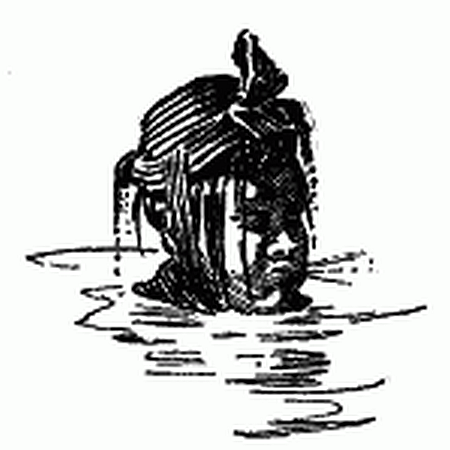
The latter was vigorously winking her eyes
and blowing from her mouth some sea-water that had
got into it; but as soon as her eyes fell upon me she
exclaimed: "That was ever so much more suddint
than I thought it was goin'
to be!"
"VIGOROUSLY WINKING AND BLOWING."
"Are you both all right?"
"I suppose I am," said
Mrs. Aleshine, "but I never
thought that a person with
a life-preserver on would go
clean under the water."
"But since you've come
up again, you ought to be
satisfied," said Mrs. Lecks.
"And now," she added,
turning her face toward me, "which way ought we
to try to swim? and have we got everythin' we want
to take with us?"
"What we haven't got we can't get," remarked
Mrs. Aleshine; "and as for swimmin', I expect I'm
goin' to make a poor hand at it."
I had a hope, which was not quite strong enough to
be a belief, that, supported by their life-preservers,
the two women might paddle themselves along; and
that, by giving them in turn a helping hand, I might
eventually get them to the steamer. There was a
strong probability that I would not succeed, but I
did not care to think of that.
I now swam in front of my companions, and endeavored
to instruct them in the best method of propelling
themselves with their arms and their hands.
If they succeeded in this, I thought I would give them
some further lessons in striking out with their feet.
After watching me attentively, Mrs. Lecks did manage
to move herself slowly through the smooth water,
but poor Mrs. Aleshine could do nothing but splash.
"If there was anythin' to take hold of," she said to
me, "I might get along; but I can't get any grip on
the water, though you seem to do it well enough.
Look there!" she added in a higher voice. "Isn't
that an oar floatin' over there? If you can get that
for me, I believe I can row myself much better than
I can swim."
This seemed an odd idea, but I swam over to the
floating oar, and brought it her. I was about to
show her how she could best use it, but she declined
my advice.
"If I do it at all," she said, "I must do it in my own
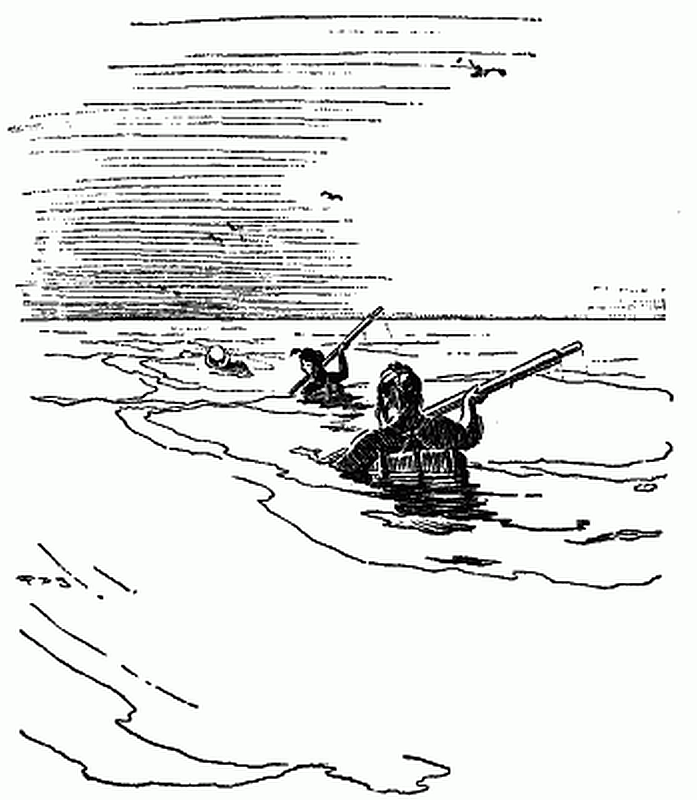
way." And taking the oar in her strong hands, she
began to ply it on the water very much in the way in
which she would handle a broom. At first she dipped
the blade too deeply, but, correcting this error, she
soon began to paddle herself along at a slow but
steady rate.
"Capital!" I cried. "You do that admirably!"
"Anybody who's swept as many rooms as I have,"
she said, "ought to be able to handle anythin' that
can be used like a broom."
"Isn't there another oar?" cried Mrs. Lecks, who
had now been left a little distance behind us. "If
there is, I want one."
Looking about me, I soon discovered another floating
oar, and brought it to Mrs. Lecks, who, after
holding it in various positions, so as to get "the hang
of it," as she said, soon began to use it with as much
skill as that shown by her friend. If either of them
had been obliged to use an oar in the ordinary way, I
fear they would have had a bad time of it; but, considering
the implement in the light of a broom, its
use immediately became familiar to them, and they
got on remarkably well.
"THEY GOT ON REMARKABLY WELL."
I now took a position a little in advance of my
companions, and as I swam slowly they were easily
able to keep up with me. Mrs. Aleshine, being so
stout, floated much higher out of the water than either
Mrs. Lecks or I, and this permitted her to use her oar
with a great deal of freedom. Sometimes she would
give such a vigorous brush to the water that she
would turn herself almost entirely around, but after
a little practice she learned to avoid undue efforts
of this kind.
I was not positively sure that we were going in the
right direction, for my position did not allow me to
see very far over the water; but I remembered that
when I was standing up in the boat, and made my
discovery, the sun was just about to rise in front of
me, while the dark spot on the ocean lay to my left.
Judging, therefore, from the present position of the
sun, which was not very high, I concluded that we
were moving toward the north, and therefore in the
right direction. How far off the steamer might be I
had no idea, for I was not accustomed to judging
distances at sea; but I believed that if we were careful
of our strength, and if the ocean continued as
smooth as it now was, we might eventually reach the
vessel, provided she were yet afloat.
"After you are fairly in the water," said Mrs. Aleshine,
as she swept along, although without the velocity
which that phrase usually implies, "it isn't half so
bad as I thought it would be. For one thing, it don't
feel a bit salt, although I must say it tasted horribly
that way when I first went into it."
"You didn't expect to find pickle-brine, did you?"
said Mrs. Lecks. "Though, if it was, I suppose we
could float on it settin'."
"And as to bein' cold," said Mrs. Aleshine, "the
part of me that's in is actually more comfortable than
that which is out."
"There's one thing I would have been afraid of,"
said Mrs. Lecks, "if we hadn't made preparations for
it, and that's sharks."
"Preparations!" I exclaimed. "How in the world
did you prepare for sharks?"
"Easy enough," said Mrs. Lecks. "When we went
down into our room to get ready to go away in the
boats we both put on black stockin's. I've read that
sharks never bite colored people, although if they see
a white man in the water they'll snap him up as quick
as lightnin'; and black stockin's was the nearest we
could come to it. You see, I thought as like as not
we'd have some sort of an upset before we got
through."
"It's a great comfort," remarked Mrs. Aleshine,
"and I'm very glad you thought of it, Mrs. Lecks.
After this I shall make it a rule: Black stockin's for
sharks."
"I suppose in your case," said Mrs. Lecks, addressing
me, "dark trousers will do as well."
To which I answered that I sincerely hoped they would.
"Another thing I'm thankful for," said Mrs. Aleshine, "is that I thought to put on a flannel skeert."
"And what's the good of it," said Mrs. Lecks, "when it's soppin' wet?"
"Flannel's flannel," replied her friend, "whether
it's wet or dry; and if you'd had the rheumatism as
much as I have, you'd know it."
To this Mrs. Lecks replied with a sniff, and asked
me how soon I thought we would get sight of the
ship; for if we were going the wrong way, and had to
turn round and go back, it would certainly be very
provoking.
I should have been happy indeed to be able to give
a satisfactory answer to this question. Every time
that we rose upon a swell I threw a rapid glance
around the whole circle of the horizon; and at last,
not a quarter of an hour after Mrs. Lecks's question,
I was rejoiced to see, almost in the direction in which
I supposed it ought to be, the dark spot which I had
before discovered. I shouted the glad news, and as
we rose again my companions strained their eyes in
the direction to which I pointed. They both saw it,
and were greatly satisfied.
"Now, then," said Mrs. Aleshine, "it seems as if
there was somethin' to work for"; and she began to
sweep her oar with great vigor.
"If you want to tire yourself out before you get
there, Barb'ry Aleshine," said Mrs. Lecks, "you'd
better go on in that way. Now what I advise is
that we stop rowin' altogether, and have somethin'
to eat; for I'm sure we need it to keep up our
strength."
"Eat!" I cried. "What are you going to eat? Do
you expect to catch fish?"
"And eat 'em raw?" said Mrs. Lecks. "I should
think not. But do you suppose, Mr. Craig, that Mrs.
Aleshine and me would go off and leave that ship
without takin' somethin' to eat by the way? Let's
all gether here in a bunch, and see what sort of a
meal we can make. And now, Barb'ry Aleshine,
if you lay your oar down there on the water, I
recommend you to tie it to one of your bonnet-strings,
or it'll be floatin' away, and you won't get
it again."
As she said this, Mrs. Lecks put her right hand
down into the water, and fumbled about, apparently
in search of a pocket. I could not but smile as I
thought of the condition of food when, for an hour
or more, it had been a couple of feet under the
surface of the ocean; but my ideas on the subject
were entirely changed when I saw Mrs. Lecks hold
up in the air two German sausages, and shake the
briny drops from their smooth and glittering surfaces.
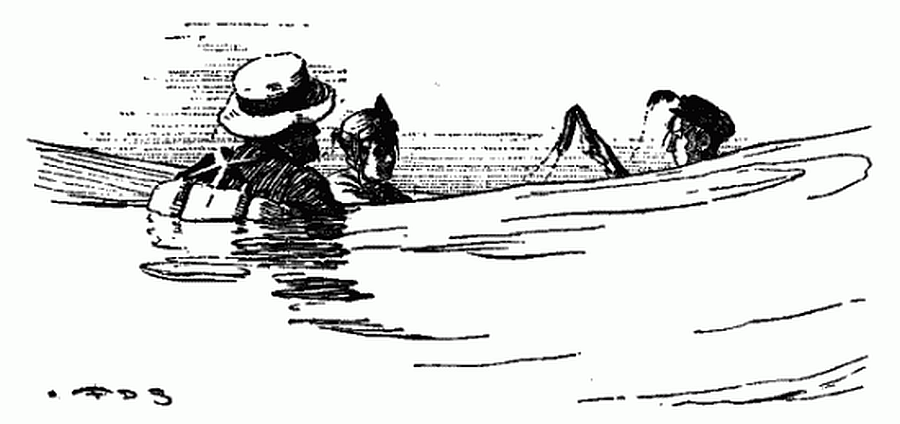
"'THERE'S NOTHIN' LIKE SAUSAGES FOR SHIPWRECK.'"
"There's nothin'," she said, "like sausages for
shipwreck and that kind o' thing. They're very sustainin',
and bein' covered with a tight skin, water can't
get at 'em, no matter how you carry 'em. I wouldn't
bring these out in the boat, because, havin' the beans,
we might as well eat them. Have you a knife about
you, Mr. Craig?"
I produced a dripping jack-knife, and after the open
blade had been waved in the air to dry it a little, Mrs.
Lecks proceeded to divide one of the sausages, handing
the other to me to hold meanwhile.
"Now don't go eatin' sausages without bread, if
you don't want 'em to give you dyspepsy," said
Mrs. Aleshine, who was tugging at a submarine
pocket.
"I'm very much afraid your bread is all soaked,"
said Mrs. Lecks.
To which her friend replied that that remained to
be seen, and forthwith produced, with a splash, a glass
preserve-jar with a metal top.
"I saw this nearly empty, as I looked into the ship's
pantry, and I stuffed into it all the soft biscuits it
would hold. There was some sort of jam left at the
bottom, so that the one who gets the last biscuit will
have somethin' of a little spread on it. And now,
Mrs. Lecks," she continued triumphantly, as she unscrewed
the top, "that rubber ring has kept 'em as
dry as chips. I'm mighty glad of it, for I had trouble
enough gettin' this jar into my pocket, and gettin' it
out, too, for that matter."
Floating thus, with our hands and shoulders above
the water, we made a very good meal from the sausages
and soft biscuit.
"Barb'ry Aleshine," said Mrs. Lecks, as her friend
proceeded to cut the second sausage, "don't you lay
that knife down, when you've done with it, as if
't was an oar; for if you do it'll sink, as like as not,
about six miles. I've read that the ocean is as deep
as that in some places."
"Goodness gracious me!" exclaimed Mrs. Aleshine,
"I hope we are not over one of them deep spots."
"There's no knowin'," said Mrs. Lecks, "but if it's
more comfortin' to think it's shallerer, we'll make up
our minds that way. Now, then," she continued,
"we'll finish off this meal with a little somethin' to
drink. I'm not given to takin' spirits, but I never
travel without a little whisky, ready mixed with water,
to take if it should be needed."
So saying, she produced from one of her pockets a
whisky-flask tightly corked, and of its contents we
each took a sip, Mrs. Aleshine remarking that, leaving
out being chilled or colicky, we were never likely to
need it more than now.
Thus refreshed and strengthened, Mrs. Lecks and
Mrs. Aleshine took up their oars, while I swam slightly
in advance, as before. When, with occasional intermissions
of rest, and a good deal of desultory conversation,
we had swept and swam for about an hour,
Mrs. Lecks suddenly exclaimed: "I can see that thing
ever so much plainer now, and I don't believe it's a
ship at all. To me it looks like bushes."
"You're mighty long-sighted without your specs,"
said Mrs. Aleshine, "and I'm not sure but what
you're right."
For ten minutes or more I had been puzzling over
the shape of the dark spot, which was now nearly all
the time in sight. Its peculiar form had filled me
with a dreadful fear that it was the steamer, bottom
upward, although I knew enough about nautical
matters to have no good reason to suppose that this
could be the case. I am not far-sighted, but when
Mrs. Lecks suggested bushes, I gazed at the distant
object with totally different ideas, and soon began
to believe that it was not a ship, either right side up
or wrong side up, but that it might be an island.
This belief I proclaimed to my companions, and for
some time we all worked with increased energy in the
desire to get near enough to make ourselves certain
in regard to this point.
"As true as I'm standin' here," said Mrs. Lecks,
who, although she could not read without spectacles,
had remarkably good sight at long range, "them is
trees and bushes that I see before me, though they do
seem to be growin' right out of the water."
"There's an island under them; you may be sure
of that!" I cried. "Isn't this ever so much better
than a sinking ship!"
"I'm not so sure about that," said Mrs. Aleshine.
"I'm used to the ship, and as long as it didn't
sink I'd prefer it. There's plenty to eat on board of
it, and good beds to sleep on, which is more than can
be expected on a little bushy place like that ahead of
us. But then, the ship might sink all of a suddint,
beds, vittles, and all."
"Do you suppose that is the island the other boats
went to?" asked Mrs. Lecks.
This question I had already asked of myself. I had
been told that the island to which the captain intended
to take his boats lay about thirty miles south of the
point where we left the steamer. Now I knew very
well that we had not come thirty miles, and had reason
to believe, moreover, that the greater part of the
progress we had made had been toward the north. It
was not at all probable that the position of this island
was unknown to our captain; and it must, therefore,
have been considered by him as an unsuitable place
for the landing of his passengers. There might be
many reasons for this unsuitableness: the island
might be totally barren and desolate; it might be the
abode of unpleasant natives; and, more important
than anything else, it was, in all probability, a spot
where steamers never touched.
But, whatever its disadvantages, I was most wildly
desirous to reach it; more so, I believe, than either of
my companions. I do not mean that they were not
sensible of their danger, and desirous to be freed from
it; but they were women who had probably had a rough
time of it during a great part of their lives, and on
emerging from their little circle of rural experiences,
accepted with equanimity, and almost as a matter of
course, the rough times which come to people in the
great outside world.
"I do not believe," I said, in answer to Mrs. Lecks,
"that that is the island to which the captain would
have taken us; but, whatever it is, it is dry land, and
we must get there as soon as we can."
"That's true," said Mrs. Aleshine, "for I'd like to
have ground nearer to my feet than six miles; and if
we don't find anything to eat and any place to sleep
when we get there, it's no more than can be said of
the place where we are now."
"You're too particular, Barb'ry Aleshine," said
Mrs. Lecks, "about your comforts. If you find the
ground too hard to sleep on, when you get there, you
can put on your life-preserver, and go to bed in the
water."
"Very good," said Mrs. Aleshine; "and if these
islands are made of coral, as I've heard they are,
and if they're as full of small p'ints as some coral
I've got at home, you'll be glad to take a berth by
me, Mrs. Lecks."
I counseled my companions to follow me as rapidly
as possible, and we all pushed vigorously forward.
When we had approached near enough to the island
to see what sort of place it really was, we perceived
that it was a low-lying spot, apparently covered with
verdure, and surrounded, as far as we could see as
we rose on the swells, by a rocky reef, against which
a tolerably high surf was running.
I knew enough of the formation of these coral
islands to suppose that within this reef was a lagoon
of smooth water, into which there were openings
through the rocky barrier. It was necessary
to try to find one of these, for it would be difficult
and perhaps dangerous to attempt to land through
the surf.
Before us we could see a continuous line of white-capped
breakers, and so I led my little party to the
right, hoping that we would soon see signs of an
opening in the reef.
We swam and paddled, however, for a long time,
and still the surf rolled menacingly on the rocks before
us. We were now as close to the island as we could
approach with safety, and I determined to circumnavigate
it, if necessary, before I would attempt, with
these two women, to land upon that jagged reef. At
last we perceived, at no great distance before us, a
spot where there seemed to be no breakers; and when
we reached it we found, to our unutterable delight,
that here was smooth water flowing through a wide
opening in the reef. The rocks were piled up quite
high, and the reef, at this point at least, was a wide
one, but as we neared the opening we found that it
narrowed very soon, and made a turn to the left,
so that from the outside we could not see into the
lagoon.
I swam into this smooth water, followed closely by
Mrs. Lecks and Mrs. Aleshine, who, however, soon became
unable to use their oars, owing to the proximity
of the rocks. Dropping these useful implements, they
managed to paddle after me with their hands, and
they were as much astonished as I was when, just after
making the slight turn, we found stretched across the
narrow passage a great iron bar about eight or ten
inches above the water. A little farther on, and two
or three feet above the water, another iron bar extended
from one rocky wall to the other. Without
uttering a word I examined the lower bar, and found
one end of it fastened by means of a huge padlock to
a great staple driven into the rock. The lock was
securely wrapped in what appeared to be tarred canvas.
A staple through an eyehole in the bar secured the
other end of it to the rocks.
"These bars were put here," I exclaimed, "to keep
out boats, whether at high or low water. You see
they can only be thrown out of the way by taking off
the padlocks."
"They won't keep us out," said Mrs. Lecks, "for
we can duck under. I suppose whoever put 'em here
didn't expect anybody to arrive on life-preservers."
PART II
Adopting Mrs. Lecks's suggestion, I "ducked"
my head under the bar, and passed to the
other side of it. Mrs. Lecks, with but little trouble,
followed my example; but Mrs. Aleshine, who, by
reason of her stoutness, floated so much higher out
of the water than her friend and I, found it impossible
to get herself under the bar. In whatever manner
she made the attempt, her head or her shoulders
were sure to bump and arrest her progress.
"Now, Barb'ry Aleshine," said Mrs. Lecks, who had
been watching her, "if you ever want to get out of
this salt water, you've got to make up your mind to
take some of it into your mouth and into your eyes,
that is, if you don't keep 'em shut. Get yourself as
close to that bar as you can, and I'll come and put
you under." So saying, Mrs. Lecks returned to the
other side of the bar, and having made Mrs. Aleshine
bow down her head and close her eyes and mouth,
she placed both hands upon her companion's broad
shoulders, and threw as much weight as possible upon
them. Mrs. Aleshine almost disappeared beneath the
water, but she came up sputtering and blinking on
the other side of the bar, where she was quickly joined
by Mrs. Lecks.
"Merciful me!" exclaimed Mrs. Aleshine, wiping
her wet face with her still wetter sleeve, "I never
supposed the heathens would be up to such tricks as
makin' us do that!"
I had waited to give any assistance that might be
required, and, while doing so, had discovered another
bar under the water, which proved that entrance at
almost any stage of the tide had been guarded against.
Warning my companions not to strike their feet
against this submerged bar, we paddled and pushed
ourselves around the turn in the rocky passage, and
emerged into the open lagoon.
This smooth stretch of water, which separated the
island from its encircling reef, was here about a hundred
feet wide; and the first thing that arrested our
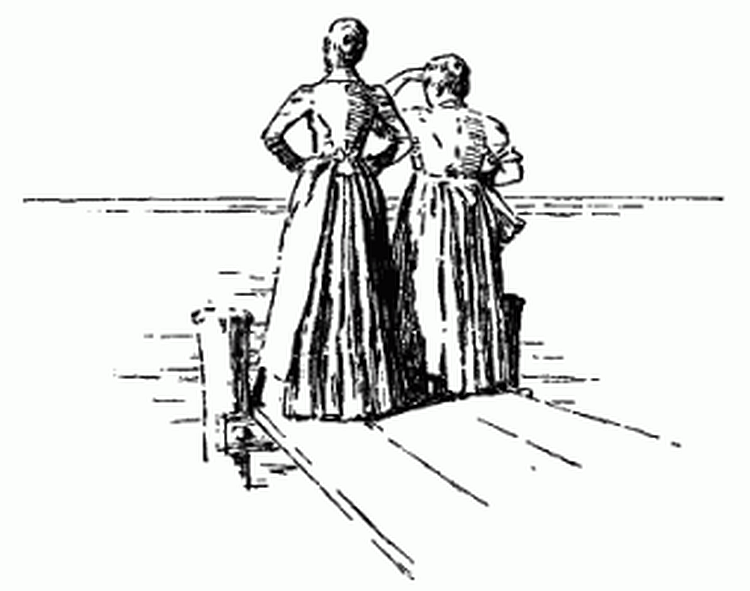
attention as we gazed across it was a little wharf or
landing-stage, erected upon the narrow beach of the
island, almost opposite to us.
"As sure as I stand here," exclaimed Mrs. Lecks,
who never seemed to forget her upright position,
"somebody lives in this place!"
"And it isn't a stickery coral island, either," cried
Mrs. Aleshine, "for that sand's as smooth as any I
ever saw."
"Whoever does live here," resumed Mrs. Lecks,
"has got to take us in, whether they like it or not,
and the sooner we get over there, the better."
Mrs. Aleshine now regretted the loss of her oar,
and suggested that some one of us who could get
under bars easily should go back after it. But Mrs.
Lecks would listen to no such proposition.
"Let the oars go," she said. "We won't want 'em
again, for I'll never leave this place if I have to scoop
myself out to sea with an oar."
I told the two women that I could easily tow them
across this narrow piece of water; and instructing
Mrs. Lecks to take hold of the tail of my coat, while
Mrs. Aleshine grasped her companion's dress, I began
to swim slowly toward the beach, towing my companions
behind me.
"Goodnessful gracious me!" suddenly exclaimed
Mrs. Aleshine, with a great bounce and a splash,
"look at the fishes!"
The water in the lagoon was so clear that it was
almost transparent, and beneath us and around us we
could see fish, some large and some small, swimming
about as if they were floating in the air, while down
below the white sandy bottom seemed to sparkle in
the sunlight.
"Now don't jerk my skeert off on account of the
fishes," said Mrs. Lecks. "I expect there was just as
many outside, though we couldn't see 'em. But I
must say that this water looks as if it had been boiled
and filtered."
If any inhabitant of the island had then been
standing on the wharf, he would have beheld on the
surface of the lagoon the peculiar spectacle of a man's
head surmounted by a wet and misshapen straw hat,
and followed by two other heads, each wearing a
dripping and bedraggled bonnet, while beneath,
among the ripples of the clear water, would have
been seen the figures belonging to these three heads,
each dressed in the clothes ordinarily worn on land.
As I swam I could see before me, on the island,
nothing but a mass of low-growing, tropical vegetation,
behind which rose some palms and other trees.
I made for the little wharf, from which steps came
down into the water, and as soon as we reached it we
all clambered rapidly up, and stood dripping upon
the narrow platform, stamping our feet and shaking
our clothes.
"Do you see that house?" said Mrs. Lecks. "That's
where they live, and I wonder which way we must go
to get there."
From this somewhat elevated position I could
plainly see, over the tops of the bushes and low trees,
the upper part of the roof of a house. When I found
the bars across the passage in the reef, I had easily
come to the conclusion that the inhabitants of this
island were not savages; and now since I had seen
the wharf and the roof of this house, I felt quite convinced
that we had reached the abode of civilized
beings. They might be pirates or some other sort of
sea miscreants, but they were certainly not savages or
cannibals.
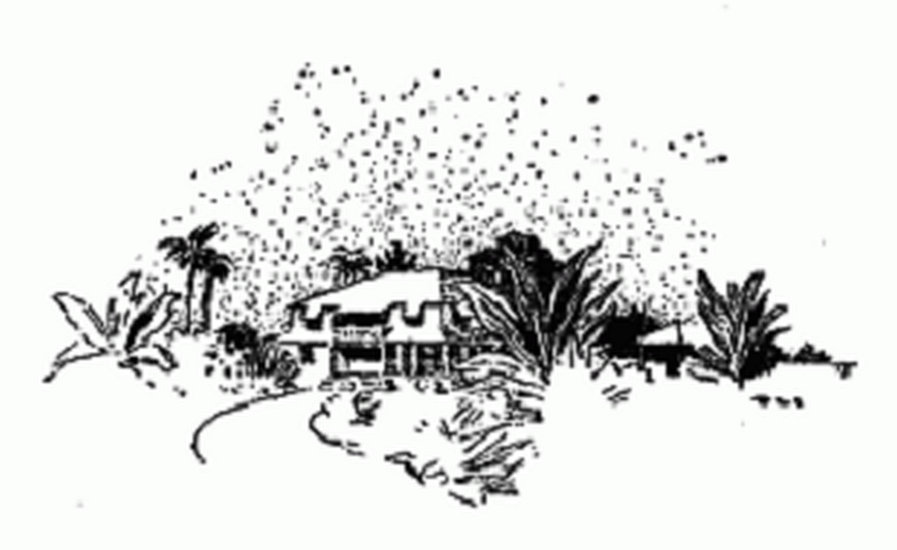
Leaving the wharf, we soon found a broad path
through the bushes, and in a few moments reached a
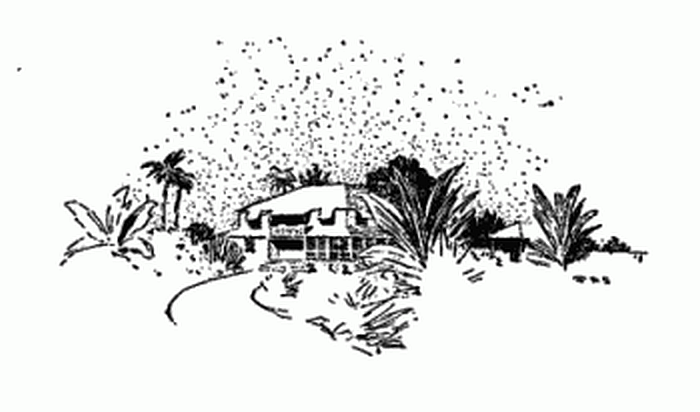
wide, open space, in which stood a handsome modern-built
house. It was constructed after the fashion of
tropical houses belonging to Europeans, with jalousied
porches and shaded balconies; the grounds about it
were neatly laid out, and behind it was a walled inclosure,
probably a garden.
"Upon my word," exclaimed Mrs. Aleshine, "I'd
like to be less drippin' before I make a call on genteel
folks!"
"Genteel folks!" exclaimed Mrs. Lecks, indignantly.
"If you're too proud to go in as you are, Barb'ry
Aleshine, you can go set in the sun till you're dry.
As for me, I'm goin' to ask for the lady of the house,
and if she don't like me she can lump me, so long as
she gives me somethin' to eat and a dry bed to get
into."
I was too much amazed to speak, but my companions
took everything as a matter of course. They had
expected to see strange things in the outer world, and
they were not surprised when they saw them. My
mind was not capable of understanding the existence
of an establishment like this on a little island in mid-ocean.
But it was useless for me to attempt to reason
on this apparent phenomenon; and, indeed, there was
no time for it, for Mrs. Lecks walked boldly up to the
front door and plied the knocker, stepping back immediately,
so that she might not drip too much water
on the porch.
"When they come," she said, "we'll ask 'em to let
us in the back way, so that we sha'n't slop up their
floors any more than we can help."
We waited for a couple of minutes, and then I, as
the member of the party who dripped the least, went
up on the porch and knocked again.
"It's my belief they're not at home," said Mrs.
Lecks, after we had waited some time longer, "but perhaps
we'll find some of the servants in," and she led
the way to the back part of the house.
As we passed the side of the mansion I noticed that
all the window-shutters were closed, and my growing
belief that the place was deserted became a conviction
after we had knocked several times at a door at the
back of the building without receiving any answer.
"Well, they're all gone out, that's certain!" said
Mrs. Lecks.
"Yes, and they barred up the entrance to the island
when they left," I added.
"I wonder if there's another house in the neighborhood?"
asked Mrs. Aleshine.
"I don't believe," said I, "that the neighborhood is
very thickly settled; but if you will wait here a few
minutes, I will run around this wall and see what
there is beyond. I may find the huts of some natives
or work-people."
I followed a path by the side of the garden wall,
but when I reached the end of the inclosure I could
see nothing before me but jungle and forest, with
paths running in several directions. I followed one
of these, and very soon came out upon an open beach,
with the reef lying beyond it. From the form of the
beach and the reef, and from the appearance of things
generally, I began to think that this was probably a
very small island, and that the house we had seen
was the only one on it. I returned and reported this
belief to my companions.
"MRS. LECKS WALKED BOLDLY UP TO THE FRONT DOOR AND PLIED THE KNOCKER."
Now that Mrs. Aleshine had no fear of appearing
in an untidy condition before "genteel folks," her
manner changed very much. "If the family has gone
into the country," said she, "or whatever else they've
done, I want to get into this house as soon as I can.
I expect we can find something to eat. At any rate,
we can get ourselves dry, and lay down somewhere
to rest, for not a wink has one of us slept since night
before last."
"I should think," said Mrs. Lecks, addressing me,
"that if you could manage to climb up to them second-story
windows, you might find one of them that you
could get in, and then come down and open the door
for us. Everybody is likely to forget to fasten some
of the windows on the upper floors. I know it isn't
right to force our way into other people's houses, but
there's nothin' else to be done, and there's no need
of our talkin' about it."
I agreed with her perfectly, and taking off my coat
and shoes, I climbed up one of the columns of the
veranda, and got upon its roof. This extended nearly
the whole length of two sides of the house. I walked
along it and tried all the shutters, and I soon came to
one in which some of the movable slats had been broken.
"I CLIMBED UP ONE OF THE COLUMNS."
Thrusting my hand and arm through the
aperture thus formed, I unhooked the shutters and
opened them. The sash was fastened down by one of
the ordinary contrivances used for such purposes, but
with the blade of my jack-knife I easily pushed the
bolt aside, raised the sash, and entered. I found
myself in a small hall at the head of a flight of stairs
Down these I hurried, and, groping my way through
the semi-darkness of the lower story,
I reached a side door. This was fastened
by two bolts and a bar, and I
quickly had it open.
Stepping outside, I called Mrs.
Lecks and Mrs. Aleshine.
"Well," said the latter, "I'm sure
I'll be glad to get in, and as we've
squeezed most of the water out of
our clothes, we won't make so much
of a mess, after all."
We now entered, and I opened one
of the shutters.
"Let's go right into the kitchen,"
said Mrs. Lecks, "and make a fire.
That's the first thing to do."
But Mrs. Lecks soon discovered
that this mansion was very different
from a country dwelling in one of
our Middle States. Externally, and as far as I had
been able to observe its internal arrangements, it resembled
the houses built by English residents which
I had seen in the West Indies. It was a dwelling in
which modern ideas in regard to construction and
furnishing adapted themselves to the requirements of
a tropical climate. Apparently there was no kitchen.
There were no stairs leading to a lower floor, and the
darkened rooms into which my companions peered
were certainly not used for culinary purposes.
In the meantime I had gone out of the door by
which we had entered, and soon discovered, on the other
side of the house, a small building with a chimney to
it, which I felt sure must be the kitchen. The door and
shutters were fastened, but before making any attempt
to open them I returned to announce my discovery.
"Door locked, is it?" said Mrs. Aleshine. "Just
wait a minute."
She then disappeared, but in a very short time came
out, carrying a bunch of large keys.
"It's always the way," said she, as the two followed
me round the back of the house, "when people shut
up a house and leave it, to put all the door-keys in
the back corner of some drawer in the hall, and to
take only the front-door key with them. So, you see,
I knew just where to go for these."
"It's a poor hen," said Mrs. Lecks, "that begins to
cackle when she's goin' to her nest; the wise ones
wait till they're comin' away. Now we'll see if one
of them keys fit."
Greatly to the triumph of Mrs. Aleshine, the second
or third key I tried unlocked the door. Entering, we
found ourselves in a good-sized kitchen, with a great
fireplace at one end of it. A door opened from the
room into a shed where there was a pile of dry twigs
and fire-wood.
"Let's have a fire as quick as we can," said Mrs.
Lecks, "for since I went into that shet-up house I've
been chilled to the bones."
"That's so," said Mrs. Aleshine; "and now I know
how a fish keeps comfortable in the water, and how
dreadfully wet and flabby it must feel when it's
taken out."
I brought in a quantity of wood and kindling, and
finding matches in a tin box on the wall, I went to
work to make a fire, and was soon rewarded by a
crackling blaze. Turning around, I was amazed at
the actions of Mrs. Lecks and Mrs. Aleshine. I had
expected to see them standing shivering behind me,
waiting for the fire to be made; but instead of that,
they were moving rapidly here and there, saying not
a word, but going as straight to cupboard, closet, and
pantry as the hound follows the track of the hare.
From a wild chaos of uncongenial surroundings, these
two women had dropped into a sphere in which they
were perfectly at home. The kitchen was not altogether
like those to which they had been accustomed,
but it was a well-appointed one, and their instincts
and practice made them quickly understand where
they would find what they wanted. I gazed on them
with delight while one filled a kettle from a little
pump in the corner which brought water from a cistern,
and the other appeared from the pantry, carrying
a tea-caddy and a tin biscuit-box.
"Now, then," said Mrs. Lecks, hanging the kettle
on a crane over the fire, and drawing up a chair, "by
the time we've got a little dried off the kettle will
bile, and we'll have some hot tea, and then the best
thing to do is to go to bed."
"We'll take time to have a bite first," said Mrs.
Aleshine, "for I was never so near famished in my
life. I brought out a box nearly full of biscuits, and
there's sardines in this, Mr. Craig, which you can
easy open with your knife."
I piled on more wood, and we gathered close around
the genial heat. The sunshine was hot outside, but
that did not prevent the fire from being most comforting
and refreshing to us.
As soon as the kettle began to simmer, up jumped
Mrs. Aleshine. A sugar-bowl and some cups were
placed upon a table, and in a short time we were
cheered and invigorated by hot tea, biscuits, and sardines.
"This isn't much of a meal," said Mrs. Aleshine,
apologetically, "but there's no time to cook nothin',
and the sooner we get off our wet things and find some
beds, the better."
"If I can once get into bed," said Mrs. Lecks, "all
I ask is that the family will not come back till I have
had a good long nap. After that, they can do what
they please."
We now went back to the house, and ascended the
main stairway, which led up to a large central hall.
"We won't go into the front rooms," said Mrs.
Lecks, "for we don't want to make no more disturbance
than we can help; but if we can find the smallest
kind of rooms in the back, with beds in 'em, it is
all we can ask."
The first chamber we entered was a good-sized one,
neatly furnished, containing a bedstead with uncovered
mattress and pillows. Opening a closet door, Mrs.
Lecks exclaimed: "This is a man's room, Mr. Craig,
and you'd better take it. Look at the trousers and
coats! There's no bedclothes in here, but I'll see if
I can't find some."
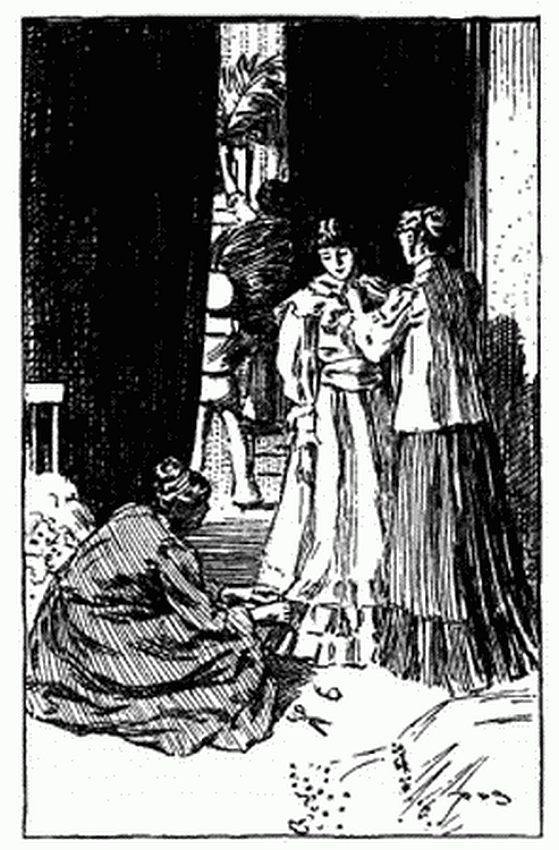
In a few minutes she returned, bearing blankets,
sheets, and a pillow-case. With Mrs. Aleshine on one
side of the bedstead and Mrs. Lecks on the other, the
sheets and blankets were laid with surprising deftness
and rapidity, and in a few moments I saw before me
a most inviting bed.
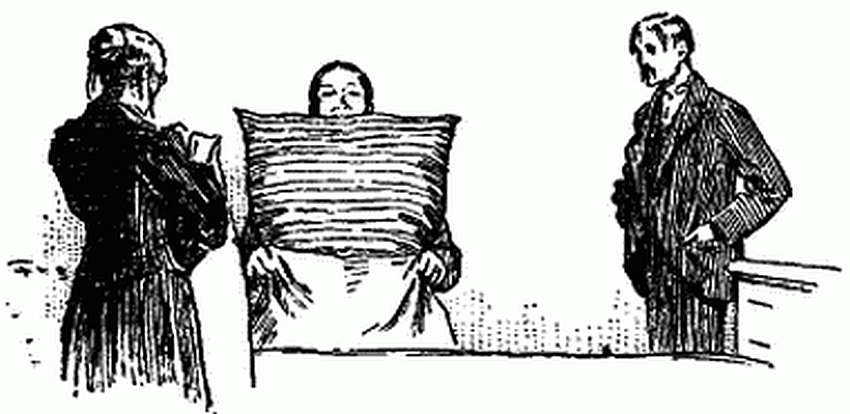
While Mrs. Aleshine held a pillow in her teeth as
she pulled on the pillow-case with both hands, Mrs.
Lecks looked around the room with the air of an
attentive hostess. "I guess you'll be comfortable,
Mr. Craig," she said, "and I advise you to sleep just
as long as you can. We'll take the room on the other
side of the hall; but I'm first goin' down to see if the
kitchen fire is safe, and to fasten the doors."
"'I GUESS YOU'LL BE COMFORTABLE, MR. CRAIG.'"
I offered to relieve her of this trouble, but she
promptly declined my services. "When it's rowin'
or swimmin', you can do it, Mr. Craig, but when it's
lockin' up and lookin' to fires, I'll attend to that
myself."
My watch had stopped, but I suppose it was the
middle of the afternoon when I went to bed, and I
slept steadily until some hours after sunrise the next
morning, when I was awakened by a loud knock at
the door.
"It's time to get up," said the voice of Mrs. Lecks,
"and if your clothes are not entirely dry, you'd better
see if there isn't somethin' in that closet you can put
on. After a while I'll make a big fire in the kitchen,
and dry all our things."
I found my clothes were still very damp, and after
investigating the contents of the closet and bureau,
I was able to supply myself with linen and a light
summer suit which fitted me fairly well. I even found
socks and a pair of slippers.
When I entered the kitchen, I first opened wide
my eyes with delight, and then I burst out laughing.
Before me was a table covered with a white cloth,
with plates, cups, and everything necessary upon it;
at one end was a steaming tea-pot, and at the other a
dish of some kind of hot meat, and Mrs. Aleshine
was just taking a pan of newly baked biscuits from a
small iron oven.
"I don't wonder you laugh," said Mrs. Lecks, "but
our clothes was still wet, and we had to take just
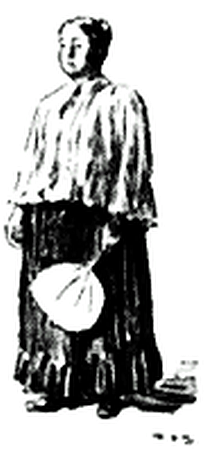
what we could find. I'm not in the habit of goin'
about in a white muslin wrapper with blue-ribbon
trimmin's, and as for Mrs. Aleshine, I did think we'd
never find anything that she could get into; but there
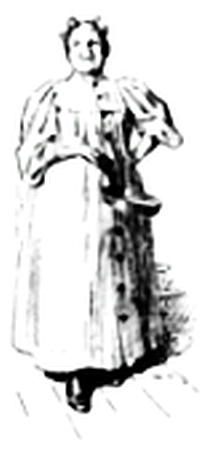
must be one stout woman in the family, for that
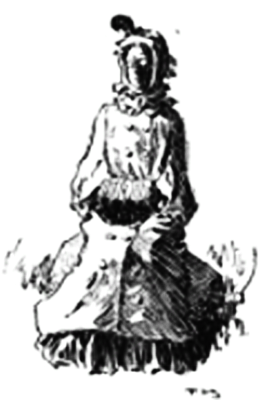
yeller frock with black buttons fits her well enough,
though I must say it's a good deal short."
"I never thought," said Mrs. Aleshine, as she sat
down at the tea-pot, "that the heathens had so many
conveniences, specially bakin'-powders and Dutch
ovens. For my part, I always supposed that they
used their altars for bakin', when they wasn't offerin'
up victims on 'em."
"Have you got it into your head, Barb'ry Aleshine,"
said Mrs. Lecks, looking up from the dish of potted
beef she was serving, "that this house belongs to
common heathen? I expect that most of the savages
who live on these desert islands has been converted
by the missionaries, but they'd have to take 'em from
Genesis to Revelations a good many times before
they'd get 'em to the p'int of havin' force-pumps in
their kitchens and spring-mattresses on their beds.
As far as I've seen this house, it looks as if the family
had always been Christians, and probably either
Catholics or Episcopalians."
"On account of the cross on the mantelpiece in our
room, I suppose," said Mrs. Aleshine. "But whether
they're given to idols or prayer-books, I know they've
got a mighty nice house; and considerin' the distance
from stores, there's a good deal more in that pantry
than you'd expect to find in any house I know of,
when the family is away."
"It is my opinion," said I, "that this house belongs
to some rich man, probably an American or European
merchant, who lives on one of the large islands not
far away, and who uses this as a sort of summer
residence."
"I thought it was always summer in this part of
the world," said Mrs. Lecks.
"THAT YELLER FROCK."
"So it is in effect," I replied, "but there are some
seasons when it is very unpleasant to remain in one
of those towns which are found on the larger islands,
and so the owner of this house may come up here
sometimes for fresh sea air."
"Or it's just as like," said Mrs. Aleshine, "that he
lives somewhere up in the iceberg regions, and comes
here to spend his winters.
It would do just as well.
But, whichever way it is,
I can't help thinkin' it's
careless not to leave somebody
in the house to take
care of it. Why, for all
the family would know
about it, tramps might
break in and stay as long
as they like."
"That's just what's
happenin' now," said Mrs.
Lecks, "and for my part
I ain't goin' to find no
fault. I don't suppose
the people would have
been so hard-hearted as
to turn us away from
their doors, but I've seen
enough of folks in this
world not to be too sure
about that."
"How do you suppose," said Mrs. Aleshine, addressing
me, "that the family gets here and goes back?
Do they keep a private steamboat?"
"Of course they have a private vessel of some kind,"
I answered, "probably a yacht. It is quite certain
that ordinary steamers never touch here."
"If that's the case," said Mrs. Lecks, "all we can
do is to wait here till they come, and get them to send
us away in their ship. But whether they've just
gone or are just a-comin' back depends, I suppose, on
whether they live in a freezin' or a burnin' country;
and if they don't like our bein' here when they come
back, there's one thing they can make up their minds
to, and that is that I'm never goin' to leave this place
on a life-preserver."
"Nor me nuther," said Mrs. Aleshine, finishing, with
much complacency, her third cup of tea.
When breakfast was over, Mrs. Lecks pushed back
her chair, but did not immediately rise. With an
expression of severe thought upon her face, she gazed
steadfastly before her for a minute, and then she
addressed Mrs. Aleshine, who had begun to gather
together the cups and the plates. "Now, Barb'ry
Aleshine," said she, "don't you begin to clear off the
table, nor touch a single thing to wash it up, till
we've been over this house. I want to do it now,
before Mr. Craig goes out to prospect around and see
what else is on the island, which, I suppose, he'll be
wantin' to do."
I replied that I had that intention, but I was quite
willing to go over the house first.
"It's come to me," said Mrs. Lecks, speaking very
gravely, "that it's no use for us to talk of the family
bein' here, or bein' there, till we've gone over this
house. If we find that they have, as far as we know,
gone away in good health and spirits, that's all well
enough; but if anything's happened in this house, I
don't want to be here with what's happened—at least,
without knowin' it, and when we do go over the
house, I want a man to go with us."
"If you'd talked that way last night, Mrs. Lecks,"
exclaimed Mrs. Aleshine, "I'd never slept till after
sun-up, and then got up and gone huntin' round
among them frocks and petticoats to find somethin'
that would fit me, with the quiet pulse I did have,
Mrs. Lecks!"
To this remark Mrs. Lecks made no reply, but, rising,
she led the way out of the kitchen and into the
house.
The rooms on the first floor were very well furnished.
There was a large parlor, and back of it a study or
library, while on the other side of the hall was a dining-room
and an apartment probably used as a family
room. We found nothing in these which would indicate
that anything untoward had happened in them.
Then we went up-stairs, I leading the way, Mrs. Lecks
following, and Mrs. Aleshine in the rear. We first
entered one of the front chambers, which was quite
dark, but Mrs. Lecks unfastened and threw open a
shutter. Then, with a rigid countenance and determined
mien, she examined every part of the room,
looked into every closet, and even under the bed. It
was quite plain that it was in one of the chambers
that she expected to find what had happened, if anything
had happened.
The room on the other side of the hall was very
like the one we first examined, except that it had two
beds in it. We next visited the chamber recently
occupied by my two companions, which was now
undergoing the process of "airing."
"We needn't stop here," remarked Mrs. Aleshine.
But Mrs. Lecks instantly replied: "Indeed, we will
stop; I'm going to look under the bed."
"Merciful me!" exclaimed Mrs. Aleshine, putting
her hand on her friend's shoulder. "Supposin' you
should find somethin', and we sleepin' here last night!
It curdles me to think of it!"
"It's my duty," said Mrs. Lecks, severely, "and I
shall do it."
And do it she did, rising from the task with a sigh
of relief.
My room was subjected to the same scrutiny as the
others, and then we visited some smaller rooms at the
extreme back of the house, which we had not before
noticed. A garret, or loft, was reached by a steep
stairway in one of these rooms, and into its dusky
gloom I ventured by myself.
"Now, don't come down, Mr. Craig," said Mrs. Lecks,
"till you're sure there's nothin' there. Of all places
in the house, that cockloft, after all, is the most
likely."
I had none of the fears which seemed to actuate
the two women, but I had a very unpleasant time of
it groping about in the darkness and heat, and, as
the place was only partly floored, running the continual
risk of crashing down through the lath and
plaster. I made myself quite sure, however, that
nothing had happened in that loft, unless some one
had suffocated there, and had dried up and become
the dust which I raised at every step.
"Now, then," said Mrs. Lecks, when I descended,
"as there is no cellar, we'll go wash up the breakfast
things; and if you want to take a walk, to see if
there's any genuwine heathens or anybody else a-livin'
in this island, we're not afraid to be left alone."
For the whole of the rest of the morning I wandered
about the island. I investigated the paths that I had
before noticed, and found that each of them led, after
a moderate walk, to some wide and pleasant part of
the beach. At one of these points I found a rustic
bench; and, stuffed in between two of the slats which
formed the seat, I found a book. It had been sadly
wet and discolored by rain, and dried and curled up
by the wind and sun. I pulled it out, and found it to
be a novel in French. On one of the fly-leaves was
written "Emily." Reasoning from the dilapidated
appearance of this book, I began to believe that the
family must have left this place some time ago, and
that, therefore, their return might be expected at a
proportionately early period. On second thoughts,
however, I considered that the state of this book was
of little value as testimony. A few hours of storm,
wind, and sun might have inflicted all the damage it
had sustained. The two women would be better able
to judge by the state of the house and the condition
of the provisions how long the family had been
away.
I then started out on a walk along the beach, and
in little more than an hour I had gone entirely around
the island. Nowhere did I see any sign of habitation
or occupation except at the house which had given
us shelter, nor any opening through the surrounding
reef except the barred passageway through which
we had come.
When I returned to the house, I found that Mrs.
Lecks and Mrs. Aleshine had been hard at work all
the morning. They had, so to speak, gone regularly
and systematically to housekeeping, and had already
divided the labors of the establishment between them.
Mrs. Aleshine, who prided herself on her skill in culinary
matters, was to take charge of the cooking, while
Mrs. Lecks assumed the care of the various rooms
and the general management of the household. This
arrangement was explained to me at length, and when
I remarked that all this seemed to indicate that they
expected to remain here for a long time, Mrs. Lecks
replied:
"In my part of the country I could tell pretty
close, by the dust on the tables and on the top of the
pianner, how long a family had been out of a house;
but dust in Pennsylvany and dust on a sea island,
where there's no wagons nor carriages, is quite different.
This house has been left in very good order, and
though the windows wants washin', and the floors and
stairs brushin',—which will be easy considerin' that
none of 'em has carpets,—and everything in the house
a reg'lar cleanin' up and airin', it may be that the
family hasn't been gone away very long, and so it
may be a good while before they come back again.
Mrs. Aleshine and me has talked it over, and we've
made up our minds that the right thing to do is just
to go along and attend to things as if we was a-goin'
to stay here for a month or two; and it may be even
longer than that before the people come back. And
I don't think they'll have anything to complain of
when they find their house in apple-pie order, their
windows washed, their
floors clean, and not
a speck of dust anywhere."
"MRS ALESHEIN HAD BEEN HARD AT WORK ALL THE MORNING."
"For my part," said Mrs. Aleshine, "I don't see what they've got to find
fault with, anyway. I look on this as part of the passage. To be sure,
we ain't movin' a bit on our way to Japan, but that's not my fault, nor
yet yours, Mrs. Lecks, nor yours, Mr. Craig. We paid our passage to go
to Japan, and if the ship was steered wrong and got sunk, we hadn't
anything to do with it. We didn't want to come here, but here we are,
and I'd like to know who's got any right to find fault with us."
"And bein' here," said Mrs. Lecks, "we'll take care
of the things."
"As far as I'm concerned," added Mrs. Aleshine,
"if this island was movin' on to Japan, I'd a great deal
rather be on it than on that ship, where, to my way of
thinkin', they didn't know much more about housekeepin'
than they did about steerin'."
"I think your plans and arrangements are very
good," I said. "But how about the provisions? Are
there enough to hold out for any time?"
"There's pretty nigh a barrel of flour," said Mrs.
Aleshine, "a good deal of tea and coffee and sugar,
and lots of things in tins and jars. There's a kind
of cellar outside where they keep things cool, and
there's more than half a keg of butter down there.
It's too strong to use, but I can take that butter and
wash it out, and work it over, and salt it, and make
it just as good butter as any we got on board the
ship."
"But," said I, "you have given me nothing to do.
I shall not be content to stand about idle and see you
do all the work."
"There's nothin' in the house," said Mrs. Lecks,
"which you need put your hand to; but, if you choose
to go out into that garden, and see if there's anything
can be done in it, or got out of it,—that is, if you
know anything about garden work,—I'm sure we'd
be very glad of any fresh vegetables we could get."
I replied that I had been accustomed to garden
work in an amateur way, and would be glad to do
anything that was possible in that direction.
"I never seed into that garden," said Mrs. Aleshine,
"but of all the foolish things that ever came under
my eye, the buildin' a wall around a garden, when a
picket fence would do just as well, is the foolishest."
I explained that in these countries it was the
fashion to use walls instead of fences.
"If it's the fashion," said Mrs. Aleshine, "I suppose
there's no use sayin' anything ag'in' it; but if the
fashion should happen to change, they'd find it a good
deal easier to take down a barbed-wire fence than a
stone wall."
This conversation took place in the large lower hall,
which Mrs. Lecks had been "putting to rights," and
where Mrs. Aleshine had just entered from the kitchen.
Mrs. Lecks now sat down upon a chair, and, dust-cloth
in hand, she thus addressed me:
"There's another thing, Mr. Craig, that me and
Mrs. Aleshine has been talkin' about. We haven't
made up our minds about it, because we didn't think
it was fair and right to do that before speakin' to you
and hearin' what you had to say on one side or another
of it. Mrs. Aleshine and me has had to bow our heads
to afflictions, and to walk sometimes in roads we
didn't want to; but we've remembered the ways in
which we was brought up, and have kept in them as
far as we've been able. When our husbands died,
leavin' Mrs. Aleshine with a son, and me without any,
which, perhaps, is just as well, for there's no knowin'
how he might have turned out—"
"That's so," interrupted Mrs. Aleshine, "for he
might have gone as a clerk to Roosher, and then you
and me would 'a' had to travel different ways."
"And when our husbands died," continued Mrs.
Lecks, "they left us enough, and plenty, to live on,
and we wasn't the women to forget them and their
ways of thinkin', any more than we'd forget the ways
of our fathers and mothers before us."
"That's so!" said Mrs. Aleshine, fervently.
"And now, Mr. Craig," continued Mrs. Lecks, "we
don't know how you've been brought up, nor anything
about you, in fact, except that you've been as kind to
us as if you was some sort of kin, and that we never
would have thought of comin' here without you, and
so me and Mrs. Aleshine has agreed to leave this whole
matter to you, and to do just as you say. When us
two started out on this long journey, we didn't expect
to find it what you call the path of roses, and, dear
only knows, we haven't found it so."
"That's true!" ejaculated Mrs. Aleshine.
"And what we've had to put up with," continued
Mrs. Lecks, "we have put up with. So, Mr. Craig,
whether you say dinner in the middle of the day at
twelve, as we've always been used to, or at six o'clock
in the afternoon, as they had it on board that ship,—and
how people ever come to turn their meals hind
part foremost in that way, I can't say,—we are goin'
to do it; if you've been brought up to six o'clock,
you won't hear no complainin' from us, think what
we may."
I was on the point of laughing aloud at the conclusion
of this speech, but a glance at the serious faces
of the two women, who, with so much earnest solicitude,
awaited my reply, stopped me, and I hastened
to assure them that dinner in the middle of the day
would be entirely in accordance with my every wish.
"Good!" exclaimed Mrs. Aleshine, her eyes sparkling
amid the plumpness of her face, while an expression
of calm relief passed over the features of Mrs.
Lecks.
"And now I'll be off and get us somethin' to eat in
less than no time," said Mrs. Aleshine. "We didn't
know whether to make it lunch or dinner till we had
seen you, so you can't expect much to-day, but to-morrow
we'll begin, and have everything straight and
comfortable. I'm goin' to get up early in the mornin'
and bake a batch of bread, and you needn't be afraid,
Mr. Craig, but what I'll have you a bit of hot meat
every night for your supper."
In the afternoon we all visited the garden, which,
although a good deal overgrown with luxuriant weeds,
showed marks of fair cultivation. Some of the beds
had been cleared out and left to the weeds, and we
found some "garden truck," as my companions called
it, with which we were not familiar. But there were
tomato-vines loaded with fruit, plenty of beans of
various kinds, and a large patch of potatoes, many of
which had been dug.
From the lower end of the garden, Mrs. Aleshine
gave a shout of delight. We went to her, and found
her standing before a long asparagus bed.
"Well!" she exclaimed. "If there's anything that
settles it firm in my mind that these people is Christians,
it's this bed of grass. I don't believe there
ever was heathens that growed grass."
"I thought that was all settled when we found the
bakin'-powders," said Mrs. Lecks.
"But this clinches it," answered her companion. "I
can't tell from a sparrowgrass bed what church they
belong to, but they're no idolaters."
The next morning I delivered to the genial Mrs.
Aleshine a large basket full of fresh vegetables, and
we had a most excellent dinner. Somewhat to my
surprise, the table was not set in the kitchen, but in
the dining-room.
"Me and Mrs. Aleshine have made up our minds,"
said Mrs. Lecks, in explanation, "that it's not the
proper thing for you to be eatin' in the kitchen, nor
for us neither. Here's table-cloths, and good glass
and china, and spoons and forks, which, although
they're not solid silver, are plated good enough for
anybody. Neither you nor us is servants, and a
kitchen is no place for us."
"That's so!" said Mrs. Aleshine. "We paid our
money for first-class passages, and it was understood
that we'd have everything as good as anybody."
"Which I don't see as that has anything to do with
it, Barb'ry Aleshine," said Mrs. Lecks, "for the steamship
people don't generally throw in desert islands as
part of the accommodation."
"We didn't ask for the island," retorted Mrs.
Aleshine, "and if they'd steered the ship right we
shouldn't have wanted it."
When we had finished our dinner, Mrs. Lecks pushed
back her chair, and sat for a few moments in thought,
as was her wont before saying anything of importance.
"'THERE'S ANOTHER THING' SAID SHE 'THAT I'V BEEN THINKIN' ABOUT.'"
"There's another thing," said she, "that I've been
thinkin' about, though I haven't spoke of it yet, even
to Mrs. Aleshine. We haven't no right to come here
and eat up the victuals and use the things of the
people that own this house, without payin' for 'em.
Of course, we're not goin' to sleep on the bare ground
and starve to death while there's beds and food close
to our hands. But if we use 'em and take it, we ought
to pay the people that the place belongs to—that is, if
we've got the money to do it with—and Mrs. Aleshine
and me has got the money. When we went down
into our cabin to get ready to leave the ship, the first
thing we did was to
put our purses in our
pockets, and we've
both got drafts
wrapped up in oil silk,
and sewed inside our
frock-bodies; and if
you didn't think to
bring your money
along with you, Mr.
Craig, we can lend you
all you need."
I thanked her for
her offer, but stated
that I had brought
with me all my money.
"Now," continued
Mrs. Lecks, "it's my
opinion that we ought
to pay our board regular
every week. I
don't know what is
commonly charged in a place like this, but I know
you can get very good board where I come from for
six dollars a week."
"That is for two in a room," said Mrs. Aleshine;
"but havin' a room to himself would make it more
for Mr. Craig."
"It ain't his fault," said Mrs. Lecks, somewhat
severely, "that he ain't got a brother or some friend
to take part of the room and pay part of the expense.
But, anyway, the room isn't a large one, and I don't
think he ought to pay much more for having a room
to himself. Seven dollars is quite enough."
"But then you've got to consider," said Mrs. Aleshine,
"that we do the cookin' and housework, and
that ought to be counted."
"I was comin' to that," said Mrs. Lecks. "Now, if
me and Mrs. Aleshine was to go out to service, which
you may be sure we wouldn't do unless circumstances
was very different from what they are now—"
"But if we was to do it," continued Mrs. Lecks,
"we wouldn't go into anybody's family for less than
two dollars a week. Now, I've always heard that
wages is low in this part of the world, and the work
isn't heavy for two of us; so, considering the family
isn't here to make their own bargain, I think we'd
better put our wages at that, so that'll make four
dollars a week for each of us two to pay."
"But how about Mr. Craig?" said Mrs. Aleshine.
"He oughtn't to work in that garden for nothin'."
"Fifty cents a day," said Mrs. Lecks, "is as little
as any man would work for, and then it oughtn't to
take all his time. That will make three dollars to
take out of Mr. Craig's board, and leave it four dollars
a week, the same as ours."
I declared myself perfectly satisfied with these arrangements,
but Mrs. Aleshine did not seem to be
altogether convinced that they were just.
"When a woman goes out to service," said she,
"she gets her board and is paid wages besides, and
it's the same for gardeners."
"Then I suppose, Barb'ry Aleshine," said Mrs.
Lecks, "that we ought to charge these people with
our wages, and make 'em pay it when they come
back!"
This remark apparently disposed of Mrs. Aleshine's
objections, and her friend continued: "There's a jar
on the mantelpiece there, of the kind the East Indy
ginger comes in. It's got nothin' in it now but some
brown paper in which fish-hooks is wrapped. We
came here on a Wednesday, and so every Tuesday
night we'll each put four dollars in that jar, under
the fish-hook paper; then if, by night or by day,
the family comes back and makes a fuss about our
bein' here, all we have to say is, 'The board money's
in the ginger-jar,' and our consciences is free."
Mrs. Lecks's plan was adopted as a very just and
proper one, and at the expiration of the week we each
deposited four dollars in the ginger-jar.
While occupying this house I do not think that any
of us endeavored to pry into the private concerns of
the family who owned it, although we each had a very
natural curiosity to know something about said family.
Opportunities of acquiring such knowledge, however,
were exceedingly scarce. Even if we had been willing
to look into such receptacles, the several desks and
secretaries that the house contained were all locked,
and nowhere could Mrs. Lecks or Mrs. Aleshine find
an old letter or piece of wrapping-paper with an
address on it. I explained to my companions that
letters and packages were not likely to come to a
place like this, but they kept a sharp lookout for anything
of the kind, asserting that there could be no
possible harm in reading the names of the people
whose house they were in.
In some of the books in the library, which were
English and French in about equal proportions, with
a few volumes in German, I found written on the
blank pages the names "Emily" and "Lucille," and
across the title-pages of some French histories was
inscribed, in a man's hand, "A. Dusante." We discussed
these names, but could not make up our minds
whether the family were French or English. For instance,
there was no reason why an Englishwoman
might not be called Lucille, and even such a surname
as Dusante was not uncommon either among English
or Americans. The labels on the boxes and tins of
provisions showed that most of them came from San
Francisco, but this was likely to be the case, no matter
what the nationality of the family.
The question of the relationship of the three persons,
of whose existence we had discovered traces, was a very
interesting one to Mrs. Lecks and Mrs. Aleshine.
"I can't make up my mind," said the latter, "whether
Emily is the mother of Lucille or her daughter, or
whether they are both children of Mr. Dusante, or
whether he's married to Lucille and Emily is his sister-in-law,
or whether she's his sister and not hers, or
whether he's the uncle and they're his nieces, or
whether Emily is an old lady and Mr. Dusante and
Lucille are both her children, or whether they are two
maiden ladies and Mr. Dusante is their brother, or
whether Mr. Dusante is only a friend of the family,
and boards here because no two women ought to live
in such a lonely place without a man in the house."
"Well," said Mrs. Lecks, "whether Mr. Dusante
comes back with two nieces, or a wife and daughter,
or Mrs. Dusante and a mother-in-law, or a pair of
sisters, all we've got to say is, 'The board money's
in the ginger-jar,' and let 'em do their worst."
In my capacity as gardener I do not think I earned
the wages which my companions had allotted to me,
for I merely gathered and brought in such fruits and
vegetables as I found in proper condition for use. In
other ways, however, I made my services valuable to
our little family. In a closet in my chamber I found
guns and ammunition, and frequently I was able to
bring in a few birds. Some of these were pronounced
by Mrs. Aleshine unsuitable for the table, but others
she cooked with much skill, and they were found to
be very good eating.
Not far from the little wharf which has been mentioned
there stood, concealed by a mass of low-growing
palms, a boat-house in which was a little skiff
hung up near the roof. This I let down and launched,
and found great pleasure in rowing it about the lagoon.
There was fishing-tackle in the boat-house,
which I used with success, the lagoon abounding in
fish. Offerings of this kind were much more acceptable
to Mrs. Aleshine than birds.
"There's some kinds of fishes that's better than
others," said she, "but, as a gen'ral rule, a fish is a
fish, and if you catch 'em you can eat 'em; but it's a
very different thing with birds. When you've never
seen 'em before, how are you goin' to tell but what
they're some kin to an owl, a pigeon-hawk, or a crow?
And if I once get it into my head that there's any of
that kind of family blood in 'em, they disagree with me
just the same as if there really was."
"MRS. LECKS AND MRS. ALESHINE STANDING ON THE END OF THE LITTLE WHARF."
One afternoon, as I was returning in the boat from
the point on the other side of the island where I had
found the rustic seat and Emily's book, I was surprised
to see Mrs. Lecks and Mrs. Aleshine standing
on the end of the little wharf. This was an unusual
thing for them to do, as they were very industrious
women and seldom had an idle moment, and it
seemed to be one of their greatest pleasures to discuss
the work they were going to do when they had
finished that on which they were then engaged. I
was curious, therefore, to know why they should be
standing thus idly on the wharf, and pulled toward
them as rapidly as possible.
When I had rowed near enough to hear them, Mrs.
Aleshine remarked with cheerful placidity:
"The Dusantes are comin'."
The tide was quite low, and I could not see over the
reef; but in a few moments I had grounded the skiff
and had sprung upon the wharf. Out on the ocean,
about a mile away, I saw a boat, apparently a large
one, approaching the island.
"Now, then, Barb'ry Aleshine," said Mrs. Lecks,
"you'll soon see whether it's his two nieces, or his
daughters, wife and sister-in-law, or whatever of them
other relationships which you've got so pat."
"Yes," said Mrs. Aleshine; "but, what's more, we'll
find out if he's goin' to be satisfied with the board
money we've put in the ginger-jar."
PART III
When the boat which we saw approaching the
island had come near enough for us to distinguish
its occupants, we found that it contained five
persons. Three sat in the stern, and two were rowing.
Of those in the stern, we soon made out one to
be a woman, and after putting our eyesight to its very
best efforts, we were obliged to admit that there was
only one female on board.
"Now, that's disapp'intin'," said Mrs. Aleshine,
"for I've wondered and wondered which I should
like best, Emily or Lucille, and now that only one of
'em has come, of course I can't tell."
The boat came on, almost directly toward the passageway
in the reef, and it was not long before the
two women had been able to decide that Mr. Dusante
was an elderly man, and that the lady was moderately
young, and in all probability his daughter.
"It may be," said Mrs. Aleshine, "that the mother,
whether she was Emily, or whether she was Lucille,
has died, and for that reason they are comin' back
sooner than they expected."
"Well, I hope you're wrong there, Barb'ry Aleshine,"
said Mrs. Lecks, "for they'll see lots of things
here that will freshen up their affliction, and that
won't make 'em any too lively people to be with."
"On the other hand," said Mrs. Aleshine, "it may
be that Emily, or else Lucille, has got married, and
has gone away with her husband to travel, and by
the time she's got a little baby she'll come here to
live on account of the sea air for the child, and that'll
make the house pleasant, Mrs. Lecks."
"I'd like to know how long you expect to live
here," said Mrs. Lecks, regarding her friend with some
severity.
"That's not for me to say," replied Mrs. Aleshine,
"knowin' nothin' about it. But this I will say, that
I hope they have brought along with them some indigo
blue, for I nearly used up all there was the last time
I washed."
During this dialogue I had been thinking that it
was a very strange thing for the owners of this place
to visit their island in such a fashion. Why should
they be in an open boat? And where did they come
from? Wherever they might live, it was not at all
probable that they would choose to be rowed from
that point to this. From the general character and
appointments of the house in which we had found a
refuge, it was quite plain that its owners were people
in good circumstances, who were in the habit of attending
to their domestic affairs in a very orderly and
proper way. It was to be presumed that it was their
custom to come here in a suitable vessel, and to bring
with them the stores needed during their intended
stay. Now, there could be little or nothing in that
boat, and, on the whole, I did not believe it contained
the owners of this island.
It would not do, however, to assume anything of
the kind. There might have been a disaster; in fact,
I know nothing about it, but it was my immediate
duty to go and meet these people at the passage, for,
if they were unable to unlock the bars, their boat
could not enter, and I must ferry them across the
lagoon. Without communicating my doubts to my
companions, I hurried into the skiff, and pulled as far
as possible into the passage through the reef. The
bars, of which there were more than I at first supposed,
were so arranged that it was impossible for a boat to
go in or out at any stage of the tide.
I had been there but a few minutes when the boat
from without came slowly in between the rocks; and
almost as soon as I saw it, its progress was suddenly
stopped by a sunken bar.
"Hello!" cried several men at once.
"Hello!" cried I, in return. "Have you the key
to these bars?"
A stout man with a red beard stood up in the stern.
"Key?" said he, "what key?"
"Then you do not belong here?" said I. "Who
are you?"
At this, the gentleman who was sitting by the lady
arose to his feet. He was a man past middle age,
rather tall and slim, and when he stood up the slight
rolling of the boat made him stagger, and he came
near falling.
"You'd better sit down, sir," said the man with the
red beard, who I saw was a sailor. "You can talk
better that way."
The gentleman now seated himself, and thus addressed
me:
"I am, sir, the Reverend Mr. Enderton, lately missionary
to Nanfouchong, China, and this is my
daughter, Miss Enderton. We are returning to the
United States by way of the Sandwich Islands, and
took passage in a sailing-vessel for Honolulu. About
two weeks ago this vessel, in some way which I do
not understand, became disabled—"
"Rotten forem'st," interrupted the man with the
red beard, "which give way in a gale; strained and
leaky, besides."
"I did not know the mast was rotten," said the
gentleman, "but, since the occasion of our first really
serviceable wind, she has been making very unsatisfactory
progress. And, more than that, the whole
force of seamen was employed night and day in endeavoring
to keep the water out of the tea, thereby
causing such a thumping and pounding that sleep
was out of the question. Add to this the fact that
our meals became very irregular, and were sometimes
entirely overlooked—"
"Prog was gettin' mighty short," interpolated the
red-bearded man.
"You can easily discern, sir," continued the gentleman,
"that it was impossible for myself and my
daughter to remain longer on that vessel, on which
we were the only passengers. I therefore requested
the captain to put us ashore at the nearest land, and,
after more than a week of delay and demur, he consented
to do so."
"Couldn't do it," said the man, "till there was
land nigh enough."
"The captain informed me," continued the gentleman,
"that this island was inhabited, and that I could
here find shelter and repose until a vessel could be sent
from Honolulu to take me off. He furnished me with
this boat and three seamen, one of whom," pointing
to the red-bearded man, "is a coxswain. We have
been rowing ever since early this morning, with but
a very moderate quantity of food and much discomfort.
Now, sir, you have heard my story; and I ask
you, as one man to another, if you still intend to bar
your water-gates against us?"
"I did not bar the gates," I said, "and I would gladly
unlock them if I could. I belong to a shipwrecked
party who took refuge here some two weeks ago."
"And how did you get in?" hastily inquired the
red-bearded coxswain.
"Our boat sunk when we were within sight of the
island, and we came here on life-preservers, and so
got under the bars."
The two men who had been rowing now turned
suddenly and looked at me. They both had black
beards, and they both exclaimed at the same moment,
"By George!"
"I won't stop here to tell any more of our story,"
said I. "The great point now is to get you all ashore,
and have you cared for."
"That's so!" said the coxswain. And the two
sailors murmured, "Aye, aye, sir."
The bar which stopped the progress of the larger
boat was just under the surface of the water, while
another a foot above the water kept my skiff about
six feet distant from the other boat. There was some
loose flooring in the bottom of the coxswain's boat,
and he ordered two of the boards taken out, and with
them a bridge was made, one end resting on the bow
of the larger boat, and the other on the iron bar by
my skiff.
"Now," said the coxswain, "let the lady go first."
The elderly gentleman arose, as if he would prefer
to take the lead, but his daughter, who had not yet
spoken a word, was passed forward by the coxswain,
steadied over the bridge by one of the sailors, and
assisted by me into the skiff. Then her father came
aboard, and I rowed with them to the wharf.
Mrs. Lecks and Mrs. Aleshine came forward most
cordially to meet them.
"Mr. Dusante, I suppose?" said Mrs. Lecks, while
Mrs. Aleshine hurriedly whispered in my ear, "Is it
Lucille or Emily?"
As quickly as possible I explained the situation.
For a few moments Mrs. Lecks and Mrs. Aleshine
stood speechless. Nothing which had happened to
them, the wreck of the steamer, the sinking of the
boat, or our experience with life-preservers, affected
them so much as this disappointment in regard to the
problem of the Dusante family. Travel by sea was
all novel and strange to them, and they had expected
all sorts of things to which they were not accustomed,
but they had never imagined that Fate would be so
hard upon them as to snatch away the solution of this
mystery just as they were about to put their hands
upon it. But, in spite of this sudden blow, the two
good women quickly recovered themselves, and with
hearty and kindly words hurried the missionary and
his daughter to the house, while I went to bring over
the men.
I found the three sailors busy in securing their boat
so that it would not be injured by the rocks during
the rising and falling of the tide. When they had
finished this job, they had to do a good deal of scrambling
before they reached my skiff.
"We thought at first, sir," said the coxswain, as I
rowed them across the lagoon, "that it was all gammon
about your not livin' here, and havin' no keys to
them bars; but we've come to the 'pinion that if
you'd been able to unlock 'em you'd have done it
sooner than take all this trouble."
I now related my story more fully, and the men
were greatly astonished when they heard that my
companions in this adventure were two women. Upon
my asking the coxswain why he had come to this
island, he replied that his captain had heard that
people lived on it, although he knew nothing about
them; and that, as it would be almost impossible to
get his brig here with the wind that was then prevailing,
and as he did not wish to go out of his course
anyway, he made up his mind that he would rather
lose the services of three men than keep that missionary
on board a day longer.
"You see, sir," said the coxswain, as we went
ashore, "the parson wouldn't never take it into account
that we were short of prog, and leakin' like
Sam Hill; and because things were uncomfortable
he growled up and he growled down, till he was wuss
for the spirits of the men than the salt water comin'
in or the hard-tack givin' out, and there was danger,
if he wasn't got rid of, that he'd be pitched overboard
and left to take his chances for a whale. And then,
by sendin' us along, that give the crew three half-rations
a day extry, and that'll count for a good deal
in the fix they're in."
When I reached the house I took the men into the
kitchen, where Mrs. Aleshine already had the table
spread. There were bread and cold meat, while the
tea-kettle steamed by the fire. In a very short time
three happy mariners sat round that table, while Mrs.
Aleshine, with beaming face, attended to their wants,
and plied them with innumerable questions. They had
not finished eating when Mrs. Lecks entered the kitchen.
"I put that minister and his daughter in the two
front bedrooms," said she to me, after hospitably
greeting the three men, "which me and Mrs. Aleshine
had run and got ready for the Dusantes, as soon as
you went in your boat to meet 'em. The young lady
was mighty nigh worn out, and glad enough of the tea
and things, and to get into bed. But the gentleman
he wanted a soft-boiled egg, and when I told him I
hadn't come across no hen-house yet on this island, he
looked at me as if he didn't half believe me, and
thought I was keepin' the eggs to sell."
"Which it would be ridiculous to do," said Mrs.
Aleshine, "in the middle of an ocean like this."
"If he lets you off with soft-b'iled eggs, ma'am,"
said the coxswain, very respectfully, "I think you may
bless your stars."
"Aye, aye, sir," said the two sailors with black
beards.
Miss Ruth Enderton and her father did not make
their appearance until the next morning at breakfast-time.
I found the young lady a very pleasant person.
She was rather slight in figure, inclined to be pretty,
and was what might be called a warm-colored blonde.
Her disposition was quite sociable, and she almost
immediately stepped into the favor of Mrs. Lecks and
Mrs. Aleshine.
Mr. Enderton, however, was a person of another
sort. He was a prim and somewhat formal man, and
appeared to be entirely self-engrossed, with very
vague notions in regard to his surroundings. He
was not by any means an ill-tempered man, being
rather inclined to be placid than otherwise; but he
gave so little attention to circumstances and events
that he did not appear to understand why he should
be incommoded by the happenings of life. I have no
doubt that he made existence on board the disabled
brig a hundred times more unsatisfactory than it
would otherwise have been. With his present condition
he seemed very well satisfied, and it was quite
plain that he looked upon Mrs. Lecks, Mrs. Aleshine,;
and myself as the proprietors of the establishment,
having forgotten, or paid no attention to, my statement
in regard to our coming here.
"MR. ENDERTON WAS A PERSON OF ANOTHER SORT."
As soon as she thought it fit and proper—and this
moment arrived in the course of the first forenoon—Mrs.
Lecks spoke to Mr. Enderton on the subject of
the board which should be paid to the Dusantes. She
stated the arrangements we had made in the matter,
and then told him that as he and his daughter had
the best accommodations in the house, each occupying
a large, handsome
room, she thought that he
should pay fifteen dollars
a week for the two.
"Now, if your daughter,"
she continued, "can
do anything about the
house which will be of
real help, though for the
life of me I don't see what
she can find to do, with
me and Mrs. Aleshine here, somethin' might be took
off on account of her services; but of course you, sir,
can't do nothin', unless you was to preach on Sundays,
and not knowin' what denomination the Dusantes
belong to, it wouldn't be fair to take their
money to pay for the preachin' of doctrines which,
perhaps, they don't believe in."
This financial proposal aroused Mr. Enderton's opposition.
"When I came here, madam," he said, "I
did not expect to pay any board whatever, and I
think, moreover, that your rates are exorbitant. In
Nanfouchong, if I remember rightly, the best of
board did not cost more than two or three dollars
a week."
"I don't want to say anything, sir," said Mrs. Lecks,
"which might look disrespectful, but as long as I've
got a conscience inside of me I'm not goin' to stay
here and see the Dusantes lose money by Chinese
cheapness."
"I don't know anything about the Dusantes," said
Mr. Enderton, "but I am not going to pay fifteen
dollars a week for board for myself and daughter."
The discussion lasted for some time, with considerable
warmth on each side, and was at last ended by
Mr. Enderton agreeing to pay board at the same rate
as the two women and myself, and each week to deposit
in the ginger-jar eight dollars for himself and
daughter.
"You may not care to remember, sir," said Mrs.
Lecks, with cold severity, "that Mr. Craig and me
and Mrs. Aleshine puts in services besides, although,
to be sure, they don't go into the jar."
"I only remember," said Mr. Enderton, "that I am
paying an unjustifiable price as it is."
Mrs. Lecks and Mrs. Aleshine, however, were not
at all of this opinion, and they agreed that, if it should
be in their power, they would see to it that the Dusantes
lost nothing by this close-fisted missionary.
After dinner—and I may remark that the newcomers
were not consulted in regard to the hours for meals—Mrs.
Lecks had an interview with the coxswain on
the subject of board for himself and his two companions.
This affair, however, was very quickly settled,
for the three mariners had among them only one dollar
and forty-three cents, and this, the coxswain explained,
they would like to keep for tobacco. It was
therefore settled that, as the three sailors could pay
no money, as much work as possible should be got out
of them, and to this plan they agreed heartily and
cheerfully.
"There's only one thing we'll ask, ma'am," said
the coxswain to Mrs. Lecks, "and that is that we be
put in a different mess from the parson. We've now
eat two meals with the passengers, and me and my
mates is agreed that that's about as much as we
can go."
After this, therefore, the three men had their meals
in the kitchen, where they were generally joined by
Mrs. Aleshine, who much delighted in their company.
But she made it a point sometimes to sit down with
us in the dining-room, merely to show that she had as
much right there as anybody.
"As to the work for them sailormen," said Mrs.
Aleshine, "I don't see what they're goin' to do. Of
course they don't know nothin' about gardenin', and
it seems to me that the best thing to be done is to put
'em to fishin'."
Mrs. Lecks considered this a good suggestion, and
accordingly the coxswain and his companions were
told that thereafter they would be expected to fish
for eight hours a day, Sundays excepted. This plan,
however, did not work very well. During the first
two days the sailors caught so many fish that, although
the fishermen themselves had excellent appetites
for such food, it was found utterly impossible to
consume what they brought in. Consequently, it was
ordered that thereafter they should catch only as
many fish as should be needed, and then make themselves
useful by assisting Mrs. Aleshine and Mrs.
Lecks in any manner they might direct.
I found it quite easy to become acquainted with
Miss Ruth Enderton, as she was very much inclined
to conversation. "It's ever so long," she said, "since
I've had anybody to talk to."
She had left the United States when she was quite
a little girl, and had since seen nothing of her native
land. She was, consequently, full of questions about
America, although quite willing to talk of her life in
China. Society, at least such kind as she had ever
cared for, had been extremely scarce in the little missionary
station at which she had lived so long, and
now, coming from a wearisome sojourn on a disabled
sailing-vessel, with no company but the crew and a
preoccupied father, she naturally was delighted to get
among people she could talk to. With Mrs. Lecks,
Mrs. Aleshine, and myself she soon became very
friendly, and showed herself to be a most lively and
interesting young person.
I did all that I could to make Miss Ruth's time pass
agreeably. I rowed with her on the lagoon, taught
her to fish, and showed her all the pleasant points on
the island which could be easily reached by walking.
Mr. Enderton gave us very little of his company, for,
having discovered that there was a library in the
house, he passed most of his time in that room.
"You have made a very fair selection of books, sir,"
he remarked to me, "but it may readily be conceived,
from the character of the works, that your tastes are
neither ecclesiastic nor scientific."
Several times I explained to him the ownership of
the library and the house, but he immediately forgot
what I had said, or paid no attention to it. When he
paid his board at the end of the week, he handed the
money to Mrs. Lecks; and although before his eyes
she put it into the ginger-jar, beneath the paper of
fish-hooks, I know very well that he considered he was
paying it to her for her own use and behoof. He
was comfortably lodged, he had all that he needed—and
very nearly all that he wanted—to eat, and I do not
know that I ever saw a man more contented with his lot.
"I DID ALL THAT I COULD TO MAKE MISS RUTH'S TIME PASS AGREEABLY."
As for the coxswain and the two sailors, they had
a very pleasant time of it, but Mrs. Lecks and Mrs.
Aleshine would not think of such a thing as allowing
them to eat in idleness the bread of the Dusantes.
After they had been with us a few days, Mrs. Lecks
told me that she thought she could show the coxswain
and his mates how to dig and gather the garden-stuff
which was daily needed.
"To be sure," said she, "that work goes ag'in' part
of your board, but fishin' and bringin' in fire-wood
don't take up quarter of the time of them sailors, and
so that the garden work is done, I don't suppose it
matters to the Dusantes who does it. And that'll
give you more time to make things pleasant for Miss
Ruth, for, as far as I can see, there isn't a thing for
her to do, even if she knows how to do it."
The three mariners were more than willing to do
anything desired by Mrs. Lecks or Mrs. Aleshine, to
whom they looked up with great admiration and respect.
The latter was their favorite, not only because
she was with them a great deal during their meals
and at other times, but because of her genial nature
and easy sociability. The men were always trying to
lighten her labors, and to do something that would
please her.
One of them climbed to the top of what she called
a "palm-leaf-fan tree," and brought therefrom some
broad leaves, which he cut and trimmed and sewed, in
true nautical fashion, until he made some fans which
were heavy and clumsy, but, as he said, they would
stand half a gale of wind if she chose to raise it. The
coxswain caught or trapped two sea-birds, and, having
clipped their wings, he spent days in endeavoring
to tame them, hoping to induce them, as far as the
power in them lay, to take the place of the barn-yard
fowls whose absence Mrs. Aleshine continually deplored.
Every evening the two black-bearded sailors
would dance hornpipes for her, much to her diversion
and delight.
"I've often heard," she remarked, "that in these
hot cocoanut countries the tricks of the monkeys was
enough to keep everybody on a steady laugh, but I'm
sure sailormen is a great deal better. When you get
tired of their pranks and their tomfooleries you can
tell 'em to stop, which with monkeys you can't."
It was about ten days after the arrival of the missionary's
party that, as I was going to get ready the
boat in which Miss Ruth and myself generally rowed
in the cool of the evening, I saw Mrs. Lecks and Mrs.
Aleshine sitting on the beach in the shade of some
low-growing trees. They were evidently waiting for
me, and as soon as I appeared Mrs. Lecks beckoned
to me; whereupon I joined them.
"Sit down," said Mrs. Lecks; "there's somethin' I
want to talk to you about. Mrs. Aleshine and me
have made up our minds that you ought to be hurried
up a little about poppin' the question to Miss Ruth."
This remark astounded me. "Popping the question!"
I exclaimed.
"Yes," continued Mrs. Lecks, "and me and Mrs.
Aleshine know very well that you haven't done it
yet, for both of us havin' been through that sort of
thing ourselves, we know the signs of it after it has
happened."
"And we wouldn't say nothin' to hurry you,"
added Mrs. Aleshine, "if it wasn't that the groceries,
especially the flour, is a-gettin' low. We've been
talkin' to them sailormen, and they're pretty well
agreed that there's no use now in expectin' their
captain to send for 'em; for if he was a-goin' to do it at
all, he'd 'a' done it before this. And perhaps he never
got nowhere himself, in which case he couldn't. And
they say the best thing we can all do when the victuals
has nearly give out, provided the Dusantes don't
come back in time, is to take what's left, and all get
into their big boat, and row away to that island, which
I don't know just how far it is, that the captain of our
ship was goin' to. There we can stay pretty comfortable
till a ship comes along and takes us off."
"But what has all that to do," I asked, "with Miss
Ruth and me?"
"Do?" cried Mrs. Lecks. "It has everythin' to do.
When it's all settled and fixed between you and Miss
Ruth, there'll be nothin' to hinder us from gettin'
ready to start when we please."
"But, my dear friends," I said with much earnestness,
"I have not the slightest idea of proposing to
Miss Enderton."
"That's just what I said to Mrs. Aleshine," said
Mrs. Lecks, "and that's the reason we let our irons
cool, and come out here to talk to you. It's just like
a young man to keep puttin' off that sort of thing,
but this can't be put off."
"That's so!" cried Mrs. Aleshine; "and I'll just
let you see how the matter stands. There is housekeepers
who allows a pint of flour a day to each person,
but this is for farm-hands and people who works
hard and eats hearty, and I've found that three
quarters of a pint will do very well, if the dough is
kneaded conscientious and made up light, so that it'll
rise well when it's put into the oven. Now I've
measured all the flour that's left, and me and Mrs.
Lecks we've calculated that, allowin' three quarters
of a pint of flour a day to each one of us, there's just
eight days more that we can stay here—that is, if the
Dusantes don't come back before that time, which, of
course, can't be counted on. So you can see for
yourself, Mr. Craig, there's no time to be lost, even
considerin' that she hasn't to make up anything to be
married in."
"THEY WERE EVIDENTLY WAITING FOR ME."
"No," said Mrs. Lecks; "just for us and three
sailors, that wouldn't be needed."
I looked from one to the other in dumb astonishment.
Mrs. Lecks gave me no time to say anything.
"In common cases," said she, "this might all be
put off till we got somewhere; but it won't do now.
Here you are, with everythin' in your own hands, but
just get away from here, and there's an end of that.
She's as pretty a girl as you'll see in a month of
Sundays, and if she leaves here without your gettin'
her, there's no knowing who'll snap her up. When
we've got to that island, you may see her once a
week, but maybe you won't. She may go away in one
ship, and you in another, and there may be somebody
right there—a missionary, for all I know—who'll
have her before you have a chance to put in a word."
"And that's not the worst of it," said Mrs. Aleshine.
"Supposin' them Dusantes come back before
we go. There's no knowin' what that Mr. Dusante
is. He may be a brother of Emily and Lucille. And
what sort of a chance would you have then, I'd like
to know, with Miss Ruth right here in his own house,
and he ownin' the rowboat, and everythin'? Or it
may be he's a widower, and that'll be a mighty sight
worse, I can tell you."
"No matter whether they're widowers or never
been married," said Mrs. Lecks, "there'll be plenty
that'll want her as soon as they see her; and if it
isn't for the girl's own pretty face, it'll be for her
father's money."
"Her father's money!" I exclaimed. "What are
you talking of?"
"There's no good tellin' me anything about that,"
said Mrs. Lecks, very decidedly. "There never was
a man as close-fisted as Mr. Enderton who hadn't
money."
"And you know as well as we do," said Mrs. Aleshine,
"that in them countries where he's been the
heathens worship idols of silver and idols of gold, and
when them heathens is converted, don't you suppose
the missionaries get any of that? I expect that Mr.
Enderton has converted thousands of heathens."
At this suggestion I laughed outright. But Mrs.
Lecks reproved me.
"Now, Mr. Craig," said she, "this is no laughin'
matter. What me and Mrs. Aleshine is sayin' is for
your good, and for the good of Miss Ruth along with
you. I haven't much opinion of her father, but his
money is as good as anybody else's, and though they
had to leave their trunks on board their ship, what
little they brought with them shows that they've been
used to havin' the best there is. Mrs. Aleshine and
me has set up till late into the night talkin' over this
thing, and we are both of one mind that you two need
never expect to have the same chance again that you've
got now. The very fact that the old gentleman is a
preacher, and can marry you on the spot, ought to
make you tremble when you think of the risks you
are runnin' by puttin' it off."
"I've got to go into the house now to see about
supper," said Mrs. Aleshine, rising, "and I hope
you'll remember, Mr. Craig, when your bread is on
your plate, and Miss Ruth is sittin' opposite to you,
that three quarters of a pint of flour a day is about
as little as anybody can live on, and that time is
flyin'."
Mrs. Lecks now also rose. But I detained the two
for a moment.
"I hope you have not said anything to Miss Enderton
on this subject," I said.
"No," replied Mrs. Aleshine, "we haven't. We are
both agreed that as you're the one that's to do what's
to be done, you are the one that's to be spoke to.
And havin' been through it ourselves, we understand
well enough that the more a woman don't know
nothin' about it, the more likely she is to be ketched
if she wants to be."
The two women left me in an amused but also
somewhat annoyed state of mind. I had no intention
whatever of proposing to Miss Ruth Enderton. She
was a charming girl, very bright and lively, and
withal, I had reason to believe, very sensible. But it
was not yet a fortnight since I first saw her, and no
thought of marrying her had entered into my head.
Had Mrs. Lecks and Mrs. Aleshine, or, more important
than all, had Miss Enderton, any reason to believe
that I was acting the part of a lover?
The latter portion of this question was almost immediately
answered to my satisfaction by the appearance of Miss Ruth,
who came skipping down to me and
calling out to me in that free and hearty manner with
which a woman addresses a friend or near acquaintance,
but never a suspected lover. She betrayed no
more notion of the Lecks and Aleshine scheme than
on the day I first met her.
But, as I was rowing her over the lagoon, I felt a
certain constraint which I had not known before.
There was no ground whatever for the wild imaginings
of the two women, but the fact that they had
imagined interfered very much with the careless
freedom with which I had previously talked to Miss
Ruth. I do not think, however, that she noticed any
change in me, for she chatted and laughed, and showed,
as she had done from the first, the rare delight which
she took in this novel island life.
When we returned to the house, we were met by
Mrs. Aleshine. "I am goin' to give you two your
supper," she said, "on that table there under the
tree. We all had ours a little earlier than common,
as the sailormen seemed hungry; and I took your
father's to him in the libr'ry, where I expect he's
a-sittin' yet, holdin' a book in one hand and stirrin'
his tea with the other, till he's stirred out nearly
every drop on the floor; which, however, won't
matter at all, for in the mornin' I'll rub up that floor
till it's as bright as new."
This plan delighted Miss Ruth, but I saw in it the
beginning of the workings of a deep-laid scheme. I
was just about to sit down when Mrs. Aleshine said
to me in a low voice, as she left us:
"Remember that the first three quarters of a pint
apiece begins now!"
"Don't you think that Mrs. Lecks and Mrs. Aleshine
are perfectly charming?" said Miss Ruth, as she
poured out the tea. "They always seem to be trying
to think of some kind thing to do for other people."
I agreed entirely with Miss Enderton's remark, but
I could not help thinking of the surprise she would
feel if she knew of the kind thing that these two
women were trying to do for her.
"Have you taken any steps yet?" asked Mrs. Lecks
of me, the next day. On my replying that I had
taken no steps of the kind to which I supposed she
alluded, she walked away with a very grave and serious
face.
A few hours later Mrs. Aleshine came to me.
"There's another reason for hurryin' up," said she.
"Them sailormen seems able to do without 'most
anything in this world except tobacco, and Mrs. Lecks
has been sellin' it to 'em out of a big box she found in
a closet up-stairs, at five cents a teacupful,—which I
think is awful cheap, but she says prices in islands is
always low,—and wrapping the money up in a paper,
with 'Cash paid by sailormen for tobacco' written
on it, and puttin' it into the ginger-jar with the
board money. But their dollar and forty-three cents
is nearly gone, and Mrs. Lecks she says that not a
whiff of Mr. Dusante's tobacco shall they have if they
can't pay for it. And when they have nothin' to smoke
they'll be wantin' to leave this island just as quick as
they can, without waitin' for the flour to give out."
Here was another pressure brought to bear upon
me. Not only the waning flour, but the rapidly disappearing
tobacco money was used as a weapon to
urge me forward to the love-making which Mrs.
Lecks and Mrs. Aleshine had set their hearts upon.
I was in no hurry to leave the island, and hoped
very much that when we did go we should depart in
some craft more comfortable than a ship's boat. In
order, therefore, to prevent any undue desire to leave
on the part of the sailors, I gave them money enough
to buy a good many teacups full of tobacco. By this
act I think I wounded the feelings of Mrs. Lecks and
Mrs. Aleshine, although I had no idea that such would
be the effect of my little gift. They said nothing to
me on the subject, but their looks and manners indicated
that they thought I had not been acting honorably.
For two days they had very little to say to me,
and then Mrs. Aleshine came to me to make what, I
suppose, was their supreme effort.
"Mrs. Lecks and me is a-goin' to try," she said,—and
as she spoke she looked at me with a very sad expression
and a watery appearance about the eyes,—"to
stretch out the time for you a little longer.
We are goin' to make them sailormen eat more fish;
and as for me and her, we'll go pretty much without
bread, and make it up, as well as we can, on other
things. You and Miss Ruth and the parson can each
have your three quarters of a pint of flour a day, just
the same as ever, and what we save ought to give you
three or four days longer."
This speech moved me deeply. I could not allow
these two kind-hearted women to half starve themselves
in order that I might have more time to woo,
and I spoke very earnestly on the subject to Mrs.
Aleshine, urging her to give up the fanciful plans
which she and Mrs. Lecks had concocted.
"Let us drop this idea of love-making," I said,
"which is the wildest kind of vagary, and all live
happily together, as we did before. If the provisions
give out before the Dusantes come back, I suppose we
shall have to leave in the boat; but, until that time
comes, let us enjoy life here as much as we can, and
be the good friends that we used to be."
I might as well have talked to one of the palm-trees
which waved over us.
"As I said before," remarked Mrs. Aleshine, "what
is saved from Mrs. Lecks's and mine and the three
sailormen's three quarters of a pint apiece ought to
give you four days more." And she went into the
house.
All this time the Reverend Mr. Enderton had sat
and read in the library, or meditatively had walked
the beach with a book in his hand; while the three
mariners had caught fish, performed their other work,
and lain in the shade, smoking their pipes in peace.
Miss Ruth and I had taken our daily rows and walks,
and had enjoyed our usual hours of pleasant converse,
and all the members of the little colony seemed happy
and contented except Mrs. Lecks and Mrs. Aleshine.
These two went gravely and sadly about their work,
and the latter asked no more for the hornpipes and
the sea-songs of her sailormen.
But, for some unaccountable reason, Mr. Enderton's
condition of tranquil abstraction did not continue.
He began to be fretful and discontented. He found
fault with his food and his accommodations, and instead
of spending the greater part of the day in the
library, as had been his wont, he took to wandering
about the island, generally with two or three books
under his arm, sometimes sitting down in one place,
and sometimes in another, and then rising suddenly
to go grumbling into the house.
One afternoon, as Miss Ruth and I were in the
skiff in the lagoon, we saw Mr. Enderton approaching
us, walking on the beach. As soon as he was near
enough for us to hear him, he shouted to his daughter:
"SMOKING THEIR PIPES IN PEACE."
"Ruth, come out of that boat! If you want to take
the air, I should think you might as well walk with me
as to go rowing round with—with anybody."
This rude and heartless speech made my blood boil,
while my companion turned pale with mortification.
The man had never made the slightest objection to
our friendly intercourse,
and this
unexpected attack
was entirely indefensible.
"Please put me
ashore," said Miss
Ruth, and without
a word, for I
could not trust myself
to speak, I
landed her; and,
petulantly complaining
that she
never gave him one
moment of her society,
her father led
her away.
An hour later, my soul still in a state of turmoil,
but with the violence of its tossings somewhat abated,
I entered one of the paths which led through the
woods. After a few turns, I reached a point where I
could see for quite a long distance to the other end of
the path, which opened out upon the beach. There I
perceived Mr. Enderton sitting upon the little bench
on which I had found Emily's book. His back was
toward me, and he seemed to be busily reading.
About midway between him and myself I saw Miss
Ruth slowly walking toward me. Her eyes were fixed
upon the ground, and she had not seen me.
Stepping to one side, I awaited her approach.
When she came near I accosted her.
"Miss Ruth," said I, "has your father been talking
to you of me?"
She looked up quickly, evidently surprised at my
being there. "Yes," she said, "he has told me that it
is not—suitable that I should be with you as much as
I have been since we came here."
There was something in this remark that roused
again the turmoil which had begun to subside within
me. There was so much that was unjust and tyrannical,
and—what perhaps touched me still deeper—there
was such a want of consideration and respect in
this behavior of Mr. Enderton's, that it brought to the
front some very incongruous emotions. I had been
superciliously pushed aside, and I found I was angry.
Something was about to be torn from me, and I
found I loved it.
"Ruth," said I, stepping up close to her, "do you
like to be with me as you have been?"
If Miss Ruth had not spent such a large portion of
her life in the out-of-the-world village of Nanfouchong,
if she had not lived among those simple-hearted
missionaries, where it was never necessary to
conceal her emotions or her sentiments, if it had not
been that she never had had emotions or sentiments
that it was necessary to conceal, I do not believe that
when she answered me she would have raised her
eyes to me with a look in them of a deep-blue sky seen
through a sort of Indian-summer mist, and that, gazing
thus, she would have said:
"Of course I like it."
"Then let us make it suitable," I said, taking both
her hands in mine.
There was another look, in which the skies shone
clear and bright, and then, in a moment, it was all
done.
About five minutes after this I said to her, "Ruth,
shall we go to your father?"
"Certainly," she answered. And together we
walked along the thickly shaded path.
The missionary still sat with his back toward us,
and, being so intent upon his book, I found that by
keeping my eyes upon him it was perfectly safe to
walk with my arm around Ruth until we had nearly
reached him. Then I took her hand in mine, and we
stepped in front of him.
"Father," said Ruth, "Mr. Craig and I are going to
be married."
There was something very plump about this remark,
and Mr. Enderton immediately raised his eyes from
his book and fixed them first upon his daughter and
then upon me; then he let them drop, and through
the narrow space between us he gazed out over the
sea.
"Well, father," said Ruth, a little impatiently,
"what do you think of it?"
"IT WAS PERFECTLY SAFE."
Mr. Enderton leaned forward and picked up a leaf
from the ground. This he placed between the open
pages of his book, and closed it.
"It seems to me," he said, "that on many accounts
the arrangement you propose may be an excellent one.
Yes," he added more decidedly; "I think it will do
very well indeed. I shall not be at all surprised if
we are obliged to remain on this island for a considerable
time, and, for my
part, I have no desire
to leave it at present.
And when you shall
place yourself, Ruth,
in a position in which
you will direct the domestic
economies of
the establishment, I
hope that you will see
to it that things generally
are made more
compatible with comfort
and gentility, and,
as regards the table, I
may add with palatability."
Ruth and I looked
at each other, and then
together we promised that as far as in us lay we would
try to make the life of Mr. Enderton a happy one, not
only while we were on the island, but ever afterward.
We were promising a great deal, but at that moment
we felt very grateful.
Then he stood up, shook us both by the hands, and
we left him to his book.
When Ruth and I came walking out of the woods
and approached the house, Mrs. Aleshine was standing
outside, not far from the kitchen. When she saw
us she gazed steadily at us for a few moments, a
strange expression coming over her face. Then she
threw up both her hands, and without a word she
turned and rushed indoors.
We had not reached the house before Mrs. Lecks
and Mrs. Aleshine came hurrying out together. Running
up to us with a haste and an excitement I had
never seen in either of them, first one and then the
other took Ruth into her arms and kissed her with
much earnestness. Then they turned upon me and
shook my hands with hearty vigor, expressing, more
by their looks and actions than their words, a triumphant
approbation of what I had done.
"The minute I laid eyes on you," said Mrs. Aleshine,
"I knowed it was all right. There wasn't no
need of askin' questions."
I now became fearful lest, in the exuberance of
their satisfaction, these good women might reveal to
Ruth the plans they had laid for our matrimonial
future, and the reluctance I had shown in entering
into them. My countenance must have expressed
my apprehensions, for Mrs. Aleshine, her ruddy face
glowing with warmth, both mental and physical, gave
me a little wink, and drew me to one side.
"You needn't suppose that we've ever said anything
to Miss Ruth, or that we're goin' to. It's a great
deal better to let her think you did it all yourself."
I felt like resenting this imputation upon the independence
of my love-making, but at this happy moment
I did not want to enter into a discussion, and
therefore merely smiled.
"I'm so glad, I don't know how to tell it," continued
Mrs. Aleshine, as Mrs. Lecks and Ruth walked toward
the house.
I was about to follow, but my companion detained
me.
"Have you spoke to the parson?" she asked.
"Oh, yes," said I, "and he seems perfectly satisfied.
I am rather surprised at this, because of late he has
been in such a remarkably bad humor."
"That's so," said Mrs. Aleshine; "there's no
gettin' round the fact that he's been a good deal
crosser than two sticks. You see, Mr. Craig, that
Mrs. Lecks and me we made up our minds that it
wasn't fair to the Dusantes to let that rich missionary
go on payin' nothin' but four dollars a week apiece
for him and his daughter, and if we couldn't get no
more out of him one way, we'd do it another. It was
fair enough that if he didn't pay more he ought to
get less; and so we gave him more fish and not so
much bread, the same as we did the sailormen; and
we weakened his tea, and sent him just so much
sugar, and no more; and as for openin' boxes of sardines
for him, which there was no reason why they
shouldn't be left here for the Dusantes, I just wouldn't
do it, though he said he'd got all the fresh fish he
wanted when he was in China. And then we agreed
that it was high time that that libr'ry should be
cleaned up, and we went to work at it, not mindin'
what he said; for it's no use tellin' me that four dollars
a week will pay for a front room and good board,
and the use of a libr'ry all day. And as there wasn't
no need of both of us cleanin' one room, Mrs. Lecks
she went into the parlor, where he'd took his books,
and begun there. And then, again, we shut down on
Mr. Dusante's dressing-gown. There was no sense
includin' the use of that in his four dollars a week, so
we brushed it up, and camphored it, and put it away.
We just wanted to let him know that if he undertook
to be skinflinty, he'd better try it on somebody else
besides us. We could see that he was a good deal
upset, for if ever a man liked to have things quiet
and comfortable around him, and everything his own
way, that man is that missionary.But we didn't
care if we did prod him up a little. Mrs. Lecks and
me we both agreed that it would do him good. Why,
he'd got into such a way of shettin' himself up in
himself that he didn't even see that his daughter was
goin' about with a young man, and fixin' her affections
on him more and more every day, when he never had
no idea, as could be proved by witnesses, of marryin'
her."
"'I KNOWED IT WAS ALL RIGHT.'"
"Mrs. Aleshine," said I, looking at her very steadfastly,
"I believe, after all, that you and Mrs. Lecks
had your own way in regard to hurrying up this
matter."
"Yes," said she, with happy complacency; "I
shouldn't wonder if we had. Stirrin' up the parson
was our last chance, and it wasn't much trouble to
do it."
Mrs. Lecks, whose manner toward me for the last
few days had been characterized by cold severity, now
resumed her former friendly demeanor, although she
was not willing to let the affair pass over without
some words of reproach.
"I must say, Mr. Craig," she remarked the next morning,
"that I was gettin' pretty well outdone with you. I
was beginnin' to think that a young man that couldn't
see and wouldn't see what was good for him didn't
deserve to have it; and if Miss Ruth's father had just
come down with a heavy foot and put an end to the
whole business, I'm not sure I'd been sorry for you.
But it's all right at last, and bygones is bygones.
And now, what we've got to do is to get ready for
the weddin'."
"The wedding!" I exclaimed.
Mrs. Lecks regarded me with an expression in which
there was something of virtuous indignation and
something of pity. "Mr. Craig," said she, "if there
ever was anybody that wanted a guardeen, it's you.
Now, just let me tell you this. That Mr. Enderton
ain't to be trusted no further than you can see him,
and not so fur, neither, if it can be helped. He's
willin' for you to have Miss Ruth now, because he's
pretty much made up his mind that we're goin' to
stay here, and as he considers you the master of this
island, of course he thinks it'll be for his good for
his daughter to be mistress of it. For one thing, he
wouldn't expect to pay no board then. But just let
him get away from this island, and just let him set his
eyes on some smooth-faced young fellow that'll agree
to take him into the concern and keep him for nothin'
on books and tea, he'll just throw you over without
winkin'. And Miss Ruth is not the girl to marry you
against his will, if he opens the Bible and piles texts
on her, which he is capable of doin'. If in any way
you two should get separated when you leave here,
there's no knowin' when you'd ever see each other
again, for where he'll take her nobody can tell. He's
more willin' to set down and stay where he finds himself
comfortable than anybody I've met yet."
"Of course," I said, "I'm ready to be married at
any moment; but I don't believe Miss Ruth and her
father would consent to anything so speedy."
"Don't you get into the way," said Mrs. Lecks, "of
beforehand believin' this or that. It don't pay. Just
you go to her father and talk to him about it, and if
you and him agree, it'll be easy enough to make her
see the sense of it. You attend to them, and I'll see
that everythin' is got ready. And you'd better fix
the day for to-morrow, for we can't stay here much
longer, and there's a lot of house-cleanin' and bakin'
and cookin' to be done before we go."
I took this advice, and broached the subject to Mr.
Enderton.
"Well, sir," said he, laying down his book, "your
proposition is decidedly odd; I may say, very odd,
indeed. But it is, perhaps, after all, no odder than
many things I have seen. Among the various denominational
sects I have noticed occurrences quite
as odd; quite as odd, sir. For my part, I have no
desire to object to an early celebration of the matrimonial
rites. I may say, indeed, that I am of the
opinion that a certain amount of celerity in this matter
will conduce to the comfort of all concerned. It
has been a very unsatisfactory thing to me to see my
daughter occupying a subordinate position in our little
family, where she has not even the power to turn
household affairs into the channels of my comfort.
To-morrow, I think, will do very well indeed. Even
if it should rain, I see no reason why the ceremony
should be postponed."
The proposition of a wedding on the morrow was
not received by Ruth with favor. She was unprepared
for such precipitancy. But she finally yielded
to arguments; not so much to mine, I fear, as to those
offered by Mrs. Lecks and Mrs. Aleshine.
For the rest of that day the three mariners were
kept very busy, bringing in green things to deck the
parlor, and doing every imaginable kind of work
necessary to a wedding which Mrs. Aleshine was willing
to give into their hands. As for herself and her
good friend, they put themselves upon their mettle as
providers of festivals. They made cakes, pies, and
I never knew half so well as the three sailors how
many other kinds of good things. Besides all this,
they assisted Ruth to array herself in some degree in
a manner becoming a bride. Some light and pretty
adornments of dress were borrowed from Emily or
Lucille, they knew not which, and, after having been
"done up" and fluted and crimped by Mrs. Lecks,
were incorporated by Ruth into her costume with so
much taste that on the wedding morning she appeared
to me to be dressed more charmingly than any bride
I had ever seen.
The three sailors had done their own washing and
ironing, and appeared in cleanly garb, and with hair
and beards well wet and brushed. Mrs. Lecks and
Mrs. Aleshine put on their best bibs and tuckers, and
Mr. Enderton assumed his most clerical air as he
stood behind a table in the parlor and married Ruth
and me.
"This," said Mr. Enderton, as we were seated at the
wedding-feast, "is a most creditable display of attractive
viands, but I may say, my dear Ruth, that I
think I perceived the influence of the happy event of
to-day even before it took place. I have lately had a
better appetite for my food, and have experienced
a greater enjoyment of my surroundings."
"I should think so," murmured Mrs. Aleshine in
my ear, "for we'd no sooner knowed that you two
were to make a match of it than we put an extry
spoonful of tea into his pot, and stopped scrubbin' the
libr'ry."
For the next two days all was bustle and work on
the island. Mrs. Lecks and Mrs. Aleshine would not
consent to depart without leaving everything in the
best possible order, so that the Dusantes might not be
dissatisfied with the condition of their house when
they returned. It was, in fact, the evident desire of
the two women to gratify their pride in their house-wifely
abilities by leaving everything better than
they found it.
Mr. Enderton was much surprised at these preparations
for immediate departure. He was very well
satisfied with his life on the island, and had prepared
his mind for an indefinite continuance of it, with the
position of that annoying and obdurate Mrs. Lecks
filled by a compliant and affectionate daughter. He
had no reasonable cause for complaint, for the whole
subject of the exhaustion of our supply of provisions,
and the necessity of an open-boat trip to an inhabited
island, had been fully discussed before him; but he
was so entirely engrossed in the consideration of his
own well-being that this discussion of our plans had
made no impression upon him. He now became convinced
that a conspiracy had been entered into against
him, and fell into an unpleasant humor. This, however,
produced very little effect upon any of us, for
we were all too busy to notice his whims. But his
sudden change of disposition made me understand
how correct were the opinions of Mrs. Lecks and Mrs.
Aleshine concerning him. If I had left that island
with my marriage with Ruth depending upon Mr.
Enderton's coöperation, my prospects of future happiness
would have been at the mercy of his caprices.
"THEY ASSISTED RUTH TO ARRAY HERSELF."
Very early on a beautiful morning Ruth and I
started out on our wedding journey in the long-boat.
Mr. Enderton was made as comfortable as possible in
the stern, with Ruth near him. Mrs. Lecks and Mrs.
Aleshine sat facing each other, each with a brown-paper
package by her side, containing the life-preserver
on which she had arrived. These were to be
ever cherished as memorials of a wonderful experience.
The three sailors and I took turns at the oars. The
sea was smooth, and there was every reason to believe
that we should arrive at our destination before the
end of the day. Mrs. Aleshine had supplied us with
an abundance of provisions, and, with the exception
of Mr. Enderton, who had not been permitted to take
away any of the Dusante books, we were a contented
party.
"As long as the flour held out," remarked Mrs. Aleshine,
"I'd never been willin' to leave that island till
the Dusantes came back, and we could have took
Emily or Lucille, whichever it was that kept house,
and showed her everythin', and told her just what we
had done. But when they do come back," she added,
"and read that letter which Mr. Craig wrote and left
for them, and find out all that happened in their
country-place while they was away; and how two of
us was made happy for life; and how two more of us,
meanin' Mrs. Lecks and me, have give up goin' to
Japan, intendin', instid of that, writin' to my son to
come home to America and settle down in the country
he ought to live in,—why, then, if them Dusantes
ain't satisfied, it's no use for anybody to ever try to
satisfy 'em."
"I should think not," said Mrs. Lecks, "with the
weddin'-cards on the parlor table, not a speck of dust
in any corner, and the board money in the ginger-jar."
PART IV
When the little party, consisting of Mrs. Lecks
and Mrs. Aleshine, Mr. Enderton, my newly
made wife, and myself, with the red-bearded coxswain
and the two sailormen, bade farewell to that island in
the Pacific where so many happy hours had been
passed, where such pleasant friendships had been
formed, and where I had met my Ruth and made her
my wife, we rowed away with a bright sky over our
heads, a pleasant wind behind us, and a smooth sea
beneath us. The long-boat was comfortable and well
appointed, and there was even room enough in it for
Mr. Enderton to stretch himself out and take a noonday
nap. We gave him every advantage of this kind,
for we had found by experience that our party was
happiest when my father-in-law was best contented.
Early in the forenoon the coxswain rigged a small
sail in the bow of the boat, and with this aid to our
steady and systematic work at the oars we reached,
just before nightfall, the large island whither we were
bound, and to which, by means of the coxswain's
pocket-compass, we had steered a direct course. Our
arrival on this island, which was inhabited by some
white traders and a moderate population of natives,
occasioned great surprise; for when the boats containing
the crew and passengers of our unfortunate
steamer had reached the island, it was found that
Mrs. Lecks, Mrs. Aleshine, and myself were missing.
There were many suppositions as to our fate. Some
persons thought we had been afraid to leave the
steamer, and, having secreted ourselves on board, had
gone down with her. Others conjectured that in the
darkness we had fallen overboard, either from the
steamer or from one of the boats; and there was even
a surmise that we might have embarked in the leaky
small boat—in which we really did leave the steamer—and
so had been lost. At any rate, we had disappeared,
and our loss was a good deal talked about
and, in a manner, mourned. In less than a week
after their arrival the people from the steamer had
been taken on board a sailing-vessel and carried
westward to their destination.
We, however, were not so fortunate, for we remained
on this island for more than a month. During
this time but one ship touched there, and she was
western bound and of no use to us, for we had determined
to return to America. Mrs. Lecks and Mrs.
Aleshine had given up their journey to Japan, and
were anxious to reach once more their country homes,
while my dear Ruth and I were filled with a desire to
found a home on some pleasant portion of the Atlantic
seaboard. What Mr. Enderton intended to do
we did not know. He was on his way to the United
States when he left the leaking ship on which he and
his daughter were passengers, and his intentions regarding
his journey did not appear to have been
altered by his mishaps.
By the western-bound vessel, however, Mrs. Aleshine
sent a letter to her son.
Our life on this island was monotonous and to the
majority of the party uninteresting; but as it was the
scene of our honeymoon, Mrs. Craig and I will always
look back to it with the most pleasurable recollections.
We were comfortably lodged in a house belonging to
one of the traders, and although Mrs. Lecks and Mrs.
Aleshine had no household duties to occupy their
time, they managed to supply themselves with knitting-materials
from the stores on the island, and filled
up their hours of waiting with chatty industry. The
pipes of our sailor friends were always well filled,
while the sands of the island were warm and pleasant
for their backs, and it was only Mr. Enderton who
showed any signs of impatient repining at our
enforced stay. He growled, he grumbled, and he
inveighed against the criminal neglect of steamship
companies and the owners of sailing-craft in not
making it compulsory in every one of their vessels
to stop on every voyage at this island, where, at any
time, intelligent and important personages might be
stranded.
At last, however, we were taken off by a three-masted
schooner bound for San Francisco, at which
city we arrived in due time and in good health and
condition.
We did not remain long in this city, but soon
started on our way across the continent, leaving
behind us our three sailor companions, who intended
to ship from this port as soon as an advantageous
opportunity offered itself. These men heard no news
of their vessel, although they felt quite sure that she
had reached Honolulu, where she had probably been
condemned and the crew scattered. As some baggage
belonging to my wife and my father-in-law had been
left on board this vessel, I had hopes that Mr. Enderton
would remain in San Francisco and order it forwarded
to him there; or that he would even take a
trip to Honolulu to attend to the matter personally.
But in this I was disappointed. He seemed to take
very little interest in his missing trunks, and wished
only to press on to the East. I wrote to Honolulu,
desiring the necessary steps to be taken to forward
the baggage in case it had arrived there; and soon
afterward our party of five started eastward.
It was now autumn, but, although we desired to
reach the end of our journey before winter set in, we
felt that we had time enough to visit some of the
natural wonders of the California country before
taking up our direct course to the East. Therefore,
in spite of some petulant remonstrances on the part
of Mr. Enderton, we made several trips to points of
interest.
From the last of these excursions we set out in a
stage-coach, of which we were the only occupants,
toward a point on the railroad where we expected to
take a train. On the way we stopped to change horses
at a small stage-station at the foot of a range of
mountains; and when I descended from the coach I
found the driver and some of the men at the station
discussing the subject of our route. It appeared that
there were two roads, one of which gradually ascended
the mountain for several miles, and then descended
to the level of the railroad, by the side of which it
ran until it reached the station where we wished to
take the train. The other road pursued its way along
a valley or notch in the mountain for a considerable
distance, and then, by a short but somewhat steep
ascending grade, joined the upper road.
It was growing quite cold, and the sky and the wind
indicated that bad weather might be expected; and
as the upper road was considered the better one at
such a time, our driver concluded to take it. Six
horses, instead of four, were now attached to our
stage; and as two of these animals were young and
unruly, and promised to be unusually difficult to drive
in the ordinary way, our driver concluded to ride one
of the wheel-horses, postilion fashion, and to put a boy
on one of the leaders. Mr. Enderton was very much
afraid of horses, and objected strongly to the young
animals in our new team. But there were no others
to take their places, and his protests were disregarded.
My wife and I occupied a back seat, having been
ordered to take this comfortable position by Mrs.
Lecks and Mrs. Aleshine, who had constituted themselves
a board of instruction and admonition to Mrs.
Craig, and incidentally to myself. They fancied that
my wife's health was not vigorous, and that she needed
coddling, and if she had had two mothers she could
not have been more tenderly cared for than by these
good women. They sat upon the middle seat with
their faces toward the horses, while Mr. Enderton
had the front seat all to himself. He was, however,
so nervous and fidgety, continually twisting himself
about endeavoring to get a view of the horses or of
the bad places on the road, that Mrs. Lecks and Mrs.
Aleshine found that a position facing him and in close
juxtaposition was entirely too uncomfortable; and
consequently, the back of their seat being adjustable,
they turned themselves about and faced us.
The ascent of the mountain was slow and tedious,
and it was late in the afternoon when we reached the
highest point in our route, from which the road descended
for some eight miles to the level of the railroad.
Now our pace became rapid, and Mr. Enderton
grew wildly excited. He threw open the window, and
shouted to the driver to go more slowly; but Mrs.
Lecks seized him by the coat and jerked him back on
his seat before he could get any answer to his appeals.
"If you want your daughter to ketch her death o'
cold you'll keep that window open!" As she said
this, she leaned back and pulled the window down
with her own strong right arm. "I guess the driver
knows what he is about," she continued, "this not
bein' the first time he's gone over the road."
"Am I to understand, madam," said Mr. Enderton,
"that I am not to speak to my driver when I wish
him to know my will?"
To this question Mrs. Lecks made no answer, but
sat up very straight and stiff, with her back square
upon the speaker. For some time she and Mr. Enderton
had been "out," and she made no effort to
conceal the fact.
Mr. Enderton's condition now became pitiable, for
our rapid speed and the bumping over rough places
in the road seemed almost to deprive him of his wits,
notwithstanding my assurance that stage-coaches
were generally driven at a rapid rate down long
inclines. In a short time, however, we reached a
level spot in the road, and the team was drawn up
and stopped. Mr. Enderton popped out in a moment,
and I also got down to have a talk with the driver.
"THE ASCENT OF THE MOUNTAIN WAS SLOW AND TEDIOUS."
"These hosses won't do much at holdin' back," he
said, "and it worries 'em less to let 'em go ahead
with the wheels locked. You needn't be afraid. If
nothin' breaks, we're all right."
Mr. Enderton seemed endeavoring to satisfy himself
that everything about the running-gear of the
coach was in a safe condition. He examined the
wheels, the axles, and the whiffletrees, much to the
amusement of the driver, who remarked to me that
the old chap probably knew as much now as he did
before. I was rather surprised that my father-in-law
subjected the driver to no further condemnation. On
the contrary, he said nothing except that for the rest
of this downhill drive he should take his place on
the driver's unoccupied seat. Nobody offered any
objection to this, and up he climbed.
When we started again, Ruth seemed disturbed
that her father should be in such an exposed position,
but I assured her that he would be perfectly
safe, and would be much better satisfied at being able
to see for himself what was going on.
We now began to go downhill again at a rate as
rapid as before. Our speed, however, was not equal.
Sometimes it would slacken a little where the road
was heavy or more upon a level, and then we would
go jolting and rattling over some long downward
stretch. After a particularly unpleasant descent of
this kind the coach seemed suddenly to change its
direction, and with a twist and an uplifting of one
side it bumped heavily against something, and stopped.
I heard a great shout outside, and from a window
which now commanded a view of the road I saw our
team of six horses, with the drivers pulling and tugging
at the two they rode, madly running away at
the top of their speed.
"'WHAT HAS HAPPENED?' I EXCLAIMED."
Ruth, who had been thrown by the shock into the
arms of Mrs. Aleshine, was dreadfully frightened,
and screamed for her father. I had been pitched forward
upon Mrs. Lecks, but I quickly recovered
myself, and as soon as I found that none of the
occupants of the coach had been hurt, I opened the
door and sprang out.
In the middle of the road stood Mr. Enderton, entirely
uninjured, with a jubilant expression on his
face, and in one hand a
large closed umbrella.
"What has happened?"
I exclaimed, hurrying
around to the front of the
coach, where I saw that
the pole had been broken
off about the middle of its
length.
"Nothing has happened,
sir," replied Mr. Enderton.
"You cannot speak of a
wise and discreet act, determinately
performed, as
a thing which has happened.
We have been
saved, sir, from being dashed to pieces behind that
wild and unmanageable team of horses; and I will
add that we have been saved by my forethought and
prompt action."
I turned and looked at him in astonishment.
"What do you mean?" I said. "What could you
have had to do with this accident?"
"Allow me to repeat," said Mr. Enderton, "that it
was not an accident. The moment that we began to
go downhill I perceived that we were in a position of
the greatest danger. The driver was reckless, the
boy incompetent, and the horses unmanageable. As
my remonstrances and counsels had no effect upon
the man, and as you seemed to have no desire to join
me in efforts to restrain him to a more prudent rate
of speed, I determined to take the affair into my own
hands. I knew that the first thing to be done was to
rid ourselves of those horses. So long as we were
connected with them disaster was imminent. I knew
exactly what ought to be done. The horses must be
detached from the coach. I had read, sir, of inventions
especially intended to detach runaway horses
from a vehicle. To all intents and purposes our
horses were runaways, or would have become so in
a very short time. I now made it my object to free
ourselves from those horses."
"What!" I exclaimed. "You freed us?"
"Yes, sir," he answered; "I did. I got out at
our first stop, and thoroughly examined the carriage
attachments. I found that the movable bar
to which the whiffletrees were attached was connected
to the vehicle by two straps and a bolt, the
latter having a ring at the top and an iron nut
at the bottom. While you and that reckless driver
were talking together, and paying no attention to
me, the only person in the party who thoroughly
comprehended our danger, I unbuckled those straps,
and with my strong, nervous fingers, without the aid
of implements, I unscrewed the nut from the bolt.
Then, sir, I took my seat on the outside of the coach,
and felt that I held our safety in my own hands.
For a time I allowed our vehicle to proceed; but
when we approached this long slope which stretches
before us, and our horses showed signs of increasing
impetuosity, I leaned forward, hooked the handle of
my umbrella in the ring of the bolt, and with a mighty
effort jerked it out. I admit to you, sir, that I had
overlooked the fact that the horses were also attached
to the end of the pole, but I have often noticed that
when we are discreet in judgment and prompt in
action we are also fortunate. Thus was I fortunate.
The hindermost horses, suddenly released, rushed
upon those in front of them, and, in a manner, jumbled
up the whole team, which seemed to throw the
animals into such terror that they dashed to one side
and snapped off the pole, after which they went madly
tearing down the road, entirely beyond the control of
the two riders. Our coach turned and ran into the side
of the road with but a moderate concussion, and as I
looked at those flying steeds, with their riders vainly
endeavoring to restrain them, I could not, sir, keep
down an emotion of pride that I had been instrumental
in freeing myself, my daughter, and my
traveling companions from their dangerous proximity."
The speaker ceased, a smile of conscious merit
upon his face. For the moment I could not say a
word to him, I was so angry. But had I been able
to say or do anything to indicate the wild indignation
that filled my brain, I should have had no opportunity,
for Mrs. Lecks stepped up to me and took me by the
arm. Her face was very stern, and her expression
gave one the idea of the rigidity of Bessemer steel.
"I've heard what has been said," she remarked,
"and I wish to talk to this man. Your wife is over
there with Mrs. Aleshine. Will you please take a walk
with her along the road? You may stay away for a
quarter of an hour."
"Madam," said Mr. Enderton, "I do not wish to talk
to you."
"I didn't ask you whether you did or not," said
Mrs. Lecks. "Mr. Craig, will you please get your
wife away as quick and as far as you can?"
I took the hint, and, with Ruth on my arm, walked
rapidly down the road. She was very glad to go, for
she had been much frightened, and wanted to be alone
with me to have me explain to her what had occurred.
Mrs. Lecks, imagining from the expression of his
countenance that Mr. Enderton had, in some way,
been at the bottom of the trouble, and fearing that she
should not be able to restrain her indignation when
she found how he had done it, had ordered Mrs. Aleshine
to keep Ruth away from her father. This action
had increased the poor girl's anxiety, and she was glad
enough to have me take her away and tell her all about
our accident.
I did tell her all that had happened, speaking as
mildly as I could of Mr. Enderton's conduct. Poor
Ruth burst into tears.
"I do wish," she exclaimed, "that father would
travel by himself! He is so nervous, and so easily
frightened, that I am sure he would be happier when
he could attend to his safety in his own way; and I
know, too, that we should be happier without him."
I agreed most heartily with these sentiments, although
I did not deem it necessary to say so, and
Ruth now asked me what I supposed would become
of us.
"If nothing happens to the driver and the boy," I
replied, "I suppose they will go on until they get to
the station to which we were bound, and there they
will procure a pole, if such a thing can be found, or,
perhaps, get another coach, and come back for us. It
would be useless for them to return to our coach in its
present condition."
"And how soon do you think they will come back?"
she said.
"Not for some hours," I replied. "The driver told
me there were no houses between the place where we
last stopped and the railroad-station, and I am sure he
will not turn back until he reaches a place where
he can get either a new pole or another vehicle."
Ruth and I walked to a turn at the bottom of the
long hill down which our runaway steeds had sped.
At this point we had an extended view of the road as
it wound along the mountain-side, but we could see no
signs of our horses, nor of any living thing. I did not,
in fact, expect to see our team, for it would be foolish
in the driver to come back until he was prepared to do
something for us, and even if he had succeeded in controlling
the runaway beasts, the quicker he got down
the mountain the better.
By the time we had returned we had taken quite a
long walk, but we were glad of it, for the exercise
tranquilized us both. On our way back we noticed
that a road which seemed to come up from below us
joined the one we were on a short distance from the
place where our accident occurred. This, probably,
was the lower road which had been spoken of when we
changed horses.
We found Mr. Enderton standing by himself. His
face was of the hue of wood-ashes, his expression haggard.
He reminded me of a man who had fallen from
a considerable height, and who had been frightened
and stupefied by the shock. I comprehended the
situation without difficulty, and felt quite sure that
had he had the choice he would have much preferred
a thrashing to the plain talk he had heard from Mrs.
Lecks.
"What is the matter, father?" exclaimed Ruth.
"Were you hurt?"
Mr. Enderton looked in a dazed way at his daughter,
and it was some moments before he appeared to
have heard what she said. Then he answered abruptly:
"Hurt? Oh, no! I am not hurt in the least. I was
just thinking of something. I shall walk on to the
village or town, whichever it is, to which that man was
taking us. It cannot be more than seven or eight
miles away, if that. The road is downhill, and I can
easily reach the place before nightfall. I will then
personally attend to your rescue, and will see that a
vehicle is immediately sent to you. There is no trusting
these ignorant drivers. No," he continued, deprecatingly
raising his hand; "do not attempt to
dissuade me. Your safety and that of others is
always my first care. Exertion is nothing."
Without further words, and paying no attention to
the remonstrances of his daughter, he strode off down
the road.
"MRS. LECKS WAS SITTING ON A STONE."
I was very glad to see him go. At any time his
presence was undesirable to me, and under the present
circumstances it would be more objectionable than
ever. He was a good walker, and there was no doubt
he would easily reach the station, where he might possibly
be of some use to us.
Mrs. Lecks was sitting on a stone by the roadside.
Her face was still stern and rigid, but there was an
expression of satisfaction
upon it
which had not been
there when I left
her. Ruth went to
the coach to get a
shawl, and I said to
Mrs. Lecks:
"I suppose you
had your talk with
Mr. Enderton?"
"Talk!" she replied.
"I should
say so! If ever a
man understands
what people think
of him, and knows
what he is, from his
crown to his feet,
inside and outside,
soul, body, bones,
and skin, and what he may expect in this world and
the next, he knows it. I didn't keep to what he has
done for us this day. I went back to the first moment
when he began to growl at payin' his honest board on
the island, and I didn't let him off for a single sin
that he has committed since. And now I feel that
I've done my duty as far as he is concerned; and
havin' got through with that, it's time we were lookin'
about to see what we can do for ourselves."
It was indeed time, for the day was drawing toward
its close. For a moment I had thought we would give
Mr. Enderton a good start, and then follow him down
the mountain to the station. But a little reflection
showed me that this plan would not answer. Ruth
was not strong enough to walk so far, and although
Mrs. Aleshine had plenty of vigor, she was too plump
to attempt such a tramp. Besides, the sky was so
heavily overcast that it was not safe to leave the
shelter of the coach.
As might have been expected, Mrs. Lecks and Mrs.
Aleshine took immediate charge of the personal comfort
of the party, and the first thing they did was to
make preparations for a meal. Fortunately, we had
plenty of provisions. Mrs. Aleshine had had charge
of what she called our lunch-baskets,—which were, indeed,
much more like market-baskets than anything
else,—and having small faith in the resources of roadside
taverns, and great faith in the unlimited capabilities
of Mr. Enderton in the matter of consuming food
on a journey, she had provided bounteously and even
extravagantly.
One side of the road was bordered by a forest, and
on the ground was an abundance of dead wood. I
gathered a quantity of this, and made a fire, which was
very grateful to us, for the air was growing colder
and colder. When we had eaten a substantial supper
and had thoroughly warmed ourselves at the fire, we
got into the coach to sit there and wait until relief
should come. We sat for a long time—all night, in
fact. We were not uncomfortable, for we each had a
corner of the coach, and we were plentifully provided
with wraps and rugs.
Contrary to their usual habit, Mrs. Lecks and Mrs.
Aleshine did not talk much. When subjected to the
annoyances of an ordinary accident, even if it should
have been the result of carelessness, their disposition
would have prompted them to take events as they
came, and to make the best of whatever might happen
to them. But this case was entirely different. We
were stranded and abandoned on the road, on the side
of a lonely, desolate mountain, on a cold, bleak night;
and all this was the result of what they considered the
deliberate and fiendish act of a man who was afraid
of horses, and who cared for no one in the world but
himself. Their minds were in such a condition that
if they said anything they must vituperate, and they
were so kindly disposed toward my wife, and had such
a tender regard for her feelings, that they would not,
in her presence, vituperate her father. So they said
very little, and, nestling into their corners, were soon
asleep.
After a time Ruth followed their example, and,
though I was very anxiously watching out of the window
for an approaching light, and listening for the
sound of wheels, I, too, fell into a doze. It must have
been ten or eleven o'clock when I was awakened by
some delicate but cold touches on my face, the nature
of which, when I first opened my eyes, I could not
comprehend. But I soon understood what these cold
touches meant. The window in the door of the coach
on my side had been slightly lowered from the top to
give us air, and through the narrow aperture the cold
particles had come floating in. I looked through the
window. The night was not very dark, for, although
the sky was overcast, the moon was in its second
quarter, and I could plainly see that it was snowing,
and that the ground was already white.
This discovery sent a chill into my soul, for I was
not unfamiliar with snows in mountain regions, and
knew well what this might mean to us. But there
was nothing that we could now do, and it would be
useless and foolish to awaken my companions and
distress them with this new disaster. Besides, I
thought our situation might not be so very bad, after
all. It was not yet winter, and the snowfall might
prove to be but a light one. I gently closed the window,
and made my body comfortable in its corner;
but my mind continued very uncomfortable for I do
not know how long.
When I awoke I found that there had been a heavy
fall of snow in the night, and that the flakes were
still coming down thick and fast. When Ruth first
looked out upon the scene she was startled and dismayed.
She was not accustomed to storms of this
kind, and the snow frightened her. Upon Mrs. Lecks
and Mrs. Aleshine the sight of the storm produced an
entirely different effect. Here was a difficulty, a discomfort,
a hardship; but it came in a natural way,
and not by the hand of a dastardly coward of a man.
With natural-happening difficulties they were accustomed
to combat without fear or repining. They
knew all about snow, and were not frightened by this
storm. The difficulties which it presented to their
minds actually raised their spirits, and from the grim
and quiet beings of the last evening they became the
same cheerful, dauntless, ready women that I had
known before.
"Upon my word," exclaimed Mrs. Aleshine, as she
clapped her face to a window of the coach, "if this
isn't a reg'lar old-fashioned snow-storm! I've shoveled
my own way through many a one like it to git to
the barn to do my milkin' afore the men-folks had
begun makin' paths, and I feel jus' like as though I
could do it ag'in."
"Now, Barb'ry Aleshine," said Mrs. Lecks, "if you're
thinkin' of shovelin' your way from this place to
where your cows is, you'd better step right out and
get at it, and I really do think that if you felt they
were sufferin' for want of milkin' you'd make a start."
"I don't say," answered Mrs. Aleshine, with an illuminating
grin, "that if the case was that way I
mightn't have the hankerin', though not the capableness;
but I don't know that there's any place to
shovel our way to, jus' now."
Mrs. Lecks and I thought differently. Across the
road, under the great trees, the ground was comparatively
free from snow, and in some places, owing to the
heavy evergreen foliage, it was entirely bare. It was
very desirable that we should get to one of these spots
and build a fire, for, though we had been well wrapped
up, we all felt numbed and cold. In the boot at the
back of the coach I knew that there was an ax, and I
thought I might possibly find there a shovel. I opened
the coach door, and saw that the snow was already
above the lower step. By standing on the spokes of
the back wheel I could easily get at the boot, and I
soon pulled out the ax, but found no shovel. But this
did not deter me. I made my way to the front wheel,
and climbed up to the driver's box, where I knocked
off one of the thin planks of the foot-board, and this,
with the ax, I shaped into a rude shovel, with a handle
rather too wide, but serviceable. With this I went
vigorously to work, and soon had made a pathway
across the road. Here I chopped off some low dead
branches, picked up others, and soon had a crackling
fire, around which my three companions gathered
with delight.
A strong wind was now blowing, and the snow
began to form into heavy drifts. The fire was very
cheery and pleasant, but the wind was cutting, and
we soon returned to the shelter of the coach, where
we had our breakfast. This was not altogether a cold
meal, for Mrs. Aleshine had provided a little tea-kettle,
and, with some snow-water which I brought in
boiling from the fire in the woods, we had all the hot
and comforting tea we wanted.
We passed the morning waiting and looking out,
and wondering what sort of conveyance would be
sent for us. It was generally agreed that nothing on
wheels could now be got over the road, and that we
must be taken away in a sleigh.
"I like sleigh-ridin'," said Mrs. Aleshine, "if you're
well wrapped up, with good hosses, and a hot brick
for your feet; but I must say I don't know but what
I'm goin' to be a little skeery goin' down these long
hills. If we git fairly slidin', hosses, sleigh, and all
together, there's no knowin' where we'll fetch up."
"I SOON HAD A CRACKLING FIRE."
"There's one comfort, Barb'ry," remarked Mrs.
Lecks, "and that is that when we do fetch up it'll be
at the bottom of the hills, and not at the top; and as
the bottom is what we want to get to, we oughtn't to
complain."
"That depends a good deal whether we come down
hind part foremost, or fore part front. But nobody's
complainin' so fur, 'specially as the sleigh isn't here."
I joined in the outlooking and the conjectures, but
I could not keep up the cheerful courage which animated
my companions; for not only were the two
elder women bright and cheery, but Ruth seemed to
be animated and encouraged by their example, and
showed herself as brave and contented as either of
them. She was convinced that her father must have
reached the railroad-station before it began to snow,
and therefore she was troubled by no fears for his
safety. But my mind was filled with many fears.
The snow was still coming down thick and fast,
and the wind was piling it into great drifts, one of
which was forming between the coach and a low
embankment on that side of the road near which it
stood.
About every half-hour I took my shovel and cleared
out the path across the road from the other side of
the coach to the woods. Several times after doing
this I made my way among the trees, where the snow
did not impede my progress, to points from which I
had a view some distance down the mountain; and I
could plainly see that there were several places where
the road was blocked up by huge snow-drifts. It
would be a slow, laborious, and difficult undertaking
for any relief-party to come to us from the station;
and who was there at that place to come? This was
the question which most troubled me. The settlement
at the station was probably a very small one,
and that there should be found at that place a sleigh
or a sled with enough men to form a party sufficiently
strong to open a road up the mountain-side was
scarcely to be expected. Men and vehicles might be
obtained at some point farther along the railroad, but
action of this kind would require time, and it was not
unlikely that the railroad itself was blocked up with
snow. I could form no idea satisfactory to myself
of any plan by which relief could come to us that day.
Even the advent of a messenger on horseback was not
to be expected. Such an adventurer would be lost in
the storm and among the drifts. On the morrow relief
might come, but I did not like to think too much
about the morrow; and of any of my thoughts and
fears I said nothing to my companions.
At intervals, after I had freshly cleared out the
pathway, the three women, well bundled up, ran across
the road to the fire under the trees. This was the
only way in which they could keep themselves warm,
for the coach, although it protected us from the storm,
was a very cold place to sit in. But the wind and the
snow which frequently drove in under the trees made
it impossible to stay very long by the fire, and the
frequent passages to and from the coach were attended
with much exposure and wetting of feet. I
therefore determined that some better way must be
devised for keeping ourselves warm; and, shortly
after our noonday meal, I thought of a plan, and immediately
set to work to carry it out.
The drift between the coach and the embankment
had now risen higher than the top of the vehicle,
against one side of which it was tightly packed. I
dug a path around the back of the coach, and then
began to tunnel into the huge bank of snow. In
about an hour I had made an excavation nearly high
enough for me to stand in, and close to the stage door
on that side; and I cleared away the snow so that this
door could open into the cavern I had formed. At
the end opposite the entrance of my cave, I worked a
hole upward until I reached the outer air. This hole
was, about a foot in diameter, and for some time the
light, unpacked snow from above kept falling and filling
it up; but I managed, by packing and beating the
sides with my shovel, to get the whole into a condition
in which it would retain the form of a rude
chimney.
Now I hurried to bring wood and twigs, and having
made a hearth of green sticks, which I cut with my
ax, I built a fire in this snowy fireplace. Mrs. Lecks,
Mrs. Aleshine, and Ruth had been watching my proceedings
with great interest; and when the fire began
to burn, and the smoke to go out of my chimney, the
coach door was opened, and the genial heat gradually
pervaded the vehicle.
"Upon my word," exclaimed Mrs. Aleshine, "if that
isn't one of the brightest ideas I ever heard of! A
fire in the middle of a snowbank, with a man there
attendin' to it, an' a chimney! 'T isn't every day that
you can see a thing like that!"
"I should hope not," remarked Mrs. Lecks, "for if
the snow drifted this way every day, I'd be ready to
give up the seein' business out and out! But I think,
Mr. Craig, you ought to pass that shovel in to us so
that we can dig you out when the fire begins to melt
your little house and it all caves in on you."
"You can have the shovel," said I, "but I don't
believe this snowbank will cave in on me. Of course
the heat will melt the snow, but I think it will dissolve
gradually, so that the caving in, if there is any, won't
be of much account, and then we shall have a big
open space here in which we can keep up our fire."
"Oh, dear!" exclaimed Ruth, "you talk as if you
expected to stay here ever so long, and we certainly
can't do that. We should starve to death, for one
thing."
"Don't be afraid of that," said Mrs. Aleshine.
"There's plenty of victuals to last till the people
come for us. When I pack baskets for travelin' or
picnickin', I don't do no scrimpin'. An' we've got to
keep up a fire, you know, for it wouldn't be pleasant
for those men, when they've cut a way up the mountain
to git at us, to find us all froze stiff."
Mrs. Lecks smiled. "You're awful tender of the
feelin's of other people, Barb'ry," she said, "and a
heart as warm as yourn ought to keep from freezin'."
"Which it has done, so far," said Mrs. Aleshine,
complacently.
As I had expected, the water soon began to drip
from the top and the sides of my cavern, and the
chimney rapidly enlarged its dimensions. I made a
passage for the melted snow to run off into a hollow,
back of the coach; and as I kept up a good strong
fire, the drops of water and occasional pieces of snow
which fell into it were not able to extinguish it. The
cavern enlarged rapidly, and in a little more than an
hour the roof became so thin that while I was outside
collecting wood it fell in and extinguished the fire.
This accident, however, interrupted my operations but
for a short time. I cleared away the snow at the bottom
of the excavation, and rebuilt my fire on the bare
ground. The high snow walls on three sides of it
protected it from the wind, so that there was no danger
of the flames being blown against the stage-coach,
while the large open space above allowed a free vent
for the smoke.
About the middle of the afternoon, to the great delight
of us all, it stopped snowing, and when I had
freshly shoveled out the path across the road, my
companions gladly embraced the opportunity of walking
over to the comparatively protected ground under
the trees and giving themselves a little exercise.
During their absence I was busily engaged in arranging
the fire, when I heard a low crunching sound on
one side of me, and, turning my head, I saw in the
wall of my excavation opposite to the stage-coach,
and at a distance of four or five feet from the ground,
an irregular hole in the snow, about a foot in diameter,
from which protruded the head of a man. This
head was wrapped, with the exception of the face, in
a brown woolen comforter. The features were those
of a man of about fifty, a little sallow and thin, without
beard, whiskers, or mustache, although the cheeks
and chin were darkened with a recent growth.
The astounding apparition of this head projecting
itself from the snow wall of my cabin utterly paralyzed
me, so that I neither moved nor spoke, but remained
crouching by the fire, my eyes fixed upon the head.
It smiled a little, and then spoke.
"Could you lend me a small iron pot?" it said.
I rose to my feet, almost ready to run away. Was
this a dream? Or was it possible that there was a
race of beings who inhabited snowbanks?
The face smiled again very pleasantly. "Do not
be frightened," it said. "I saw you were startled, and
spoke first of a familiar pot in order to reassure you."
"Who, in the name of Heaven, are you?" I gasped.
"COULD YOU LEND ME A SMALL IRON POT?"
"I am only a traveler, sir," said the head, "who has
met with an accident similar, I imagine, to that which
has befallen you. But I cannot further converse with
you in this position. Lying thus on my breast in a
tunnel of snow will injuriously chill me. Could you
conveniently lend me an iron pot?"
I was now convinced that this was an ordinary
human being, and my courage and senses returned to
me; but my astonishment remained boundless. "Before
we talk of pots," I said, "I must know who you
are, and how you got into that snowbank."
"I do not believe," said my visitor, "that I can get
down, head foremost, to your level. I will therefore
retire to my place of refuge, and perhaps we can communicate
with each other through this aperture."
"Can I get through to your place of refuge?" I asked.
"Certainly," was the answer. "You are young and
active, and the descent will not be so deep on my side.
But I will first retire, and will then project toward
you this sheepskin rug, which, if kept under you as
you move forward, will protect your breast and arms
from direct contact with the snow."
It was difficult to scramble up into the hole, but I
succeeded in doing it, and found awaiting me the
sheepskin rug, which, by the aid of an umbrella, the
man had pushed toward me for my use. I was in a
horizontal tunnel barely large enough for the passage
of my body, and about six feet in length. When I
had worked my way through this, and had put my head
out of the other end, I looked into a small wooden
shed, into which light entered only through a pane of
glass set in a rude door opposite to me. I immediately
perceived that the whole place was filled with the
odor of spirituous liquors. The man stood awaiting
me, and by his assistance I descended to the floor. As
I did so I heard something which sounded like a
titter, and looking around I saw in a corner a bundle
of clothes and traveling-rugs, near the top of which
appeared a pair of eyes. Turning again, I could discern
in another corner a second bundle, similar to,
but somewhat larger than, the other.
"These ladies are traveling with me," said the man,
who was now wrapping about him a large cloak, and
who appeared to be of a tall though rather slender
figure. His manner and voice were those of a gentleman,
extremely courteous and considerate. "As I
am sure you are curious—and this I regard as quite
natural, sir—to know why we are here, I will at once
proceed to inform you. We started yesterday in a
carriage for the railway-station, which is, I believe,
some miles beyond this point. There were two roads
from the last place at which we stopped, and we chose
the one which ran along a valley, and which we supposed
would be the pleasanter of the two. We there
engaged a pair of horses which did not prove very
serviceable animals, and, at a point about a hundred
yards from where we now are, one of them gave out
entirely. The driver declared that the only thing to
be done was to turn loose the disabled horse, which
would be certain, in time, to find his way back to his
stable, and for him to proceed on the other animal to
the station to which we were going, where he would
procure some fresh horses and return as speedily as
possible. To this plan we were obliged to consent, as
there was no alternative. He told us that if we did
not care to remain in the carriage, there was a shed
by the side of the road, a little farther on, which was
erected for the accommodation of men who are sometimes
here in charge of relays of horses. After assuring
us that he would not be absent more than three
hours, he rode away, and we have not seen him since.
"Soon after he left us I came to this shed, and finding
it tight and comparatively comfortable, I concluded
it would give us relief from our somewhat
cramped position in the carriage, and so conducted
the ladies here. As night drew on it became very
cold, and I determined to make a fire, a proceeding
which, of course, would have been impossible in a
vehicle. Fortunately I had with me, at the back of
the carriage, a case of California brandy. By the aid
of a stone I knocked the top off this case, and brought
hither several of the bottles. I found in the shed an
old tin pan, which I filled with the straw coverings of
the bottles, and on this I poured brandy, which, being
ignited, produced a fire without smoke, but which, as
we gathered around it, gave out considerable heat."
As the speaker thus referred to his fuel, I understood
the reason of the strong odor of spirits which filled
the shed, and I experienced a certain relief in my
mind.
The gentleman continued: "At first I attributed
the delay of the driver's return to those ordinary
hindrances which so frequently occur in rural and
out-of-the-way places; but after a time I could not
imagine any reasonable cause for his delay. As it
began to grow dark I brought here our provision-baskets,
and we partook of a slight repast. I then
made the ladies as comfortable as possible, and
awaited with much anxiety the return of the driver.
"After a time it began to snow, and feeling that
the storm might interrupt communication with the
carriage, I brought hither, making many trips for the
purpose, the rest of the brandy, our wraps and rugs,
and the cushions of the carriage. I did not believe
that we should be left here all night, but thought it
prudent to take all precautions, and to prepare for
remaining in a place where we could have a fire. The
morning showed me that I had acted wisely. As you
know, sir, I found the road in each direction completely
blocked up by snow, and I have since been
unable to visit the carriage."
"Have you not all suffered from cold?" I inquired.
"Have you food enough?"
"I will not say," replied the gentleman, "that in
addition to our anxiety we have not suffered somewhat
from cold, but for the greater part of this day I have
adopted a plan which has resulted in considerable
comfort to my companions. I have wrapped them up
very closely and warmly, and they hold in each hand
a hard-boiled egg. I thought it better to keep these
for purposes of warmth than to eat them. About
every half-hour I reboil the eggs in a little traveling
tea-pot which we have. They retain their warmth for
a considerable period, and this warmth in a moderate
degree is communicated through the hands to the
entire person."
As he said this a low laugh again burst forth from
the bundle in one corner of the room, and I could not
help smiling at this odd way of keeping warm. I
looked toward the jocose bundle, and remarked that
the eggs must be pretty hard by this time.
"These ladies," said the gentleman, "are not accustomed
to the cold atmosphere of this region, and I
have therefore forbidden them to talk, hoping thus
to prevent injury from the inhalation of frosty air.
So far we have not suffered, and we still have some
food left. About noon I noticed smoke floating over
this shed, and I forced open the door and made my
way for some little distance outside, hoping to discover
whence it came. I then heard voices on the
other side of the enormous snow-drift behind us; but
I could see no possible way of getting over the drift.
Feeling that I must, without fail, open communication
with any human beings who might be near us, I attempted
to shout; but the cold had so affected my
voice that I could not do so. I thereupon set my
wits to work. At the back of this shed is a small
window closed by a wooden shutter. I opened this
shutter, and found outside a wall of snow packed
closely against it. The snow was not very hard, and
I believed that it would not be difficult to tunnel a
way through it to the place where the voices seemed
to be. I immediately set to work, for I feared that if
we were obliged to remain here another night without
assistance we should be compelled to-morrow
morning to eat those four hard-boiled eggs which
the ladies are holding, and which, very shortly, I must
boil again."
"How did you manage to cut through the snow?"
I asked. "Had you a shovel?"
"Oh, no," replied the other. "I used the tin pan.
I found it answered very well as a scoop. Each time
that I filled it I threw the contents out of our door."
"It must have been slow and difficult work," I said.
"Indeed it was," he replied. "The labor was arduous,
and occupied me several hours. But when I saw
a respectable man at a fire, and a stage-coach near by,
I felt rewarded for all my trouble. May I ask you,
sir, how you came to be thus snow-bound?"
I then briefly related the circumstances of our mishap,
and had scarcely finished when a shrill sound
came through the tunnel into the shed. It was the
voice of Mrs. Aleshine.
"Hello!" she screamed, "are you in there? An'
you don't mean to tell me there are other people in
that hole?"
Feeling quite certain that my wife and her companions
were in a state of mental agitation on the
other side of the drift, I called back that I would be
with them in a moment, and then explained to the
gentleman why I could not remain with him longer.
"But before I go," I said, "is there anything I can do
for you? Do you really want an iron pot?"
"The food that remains to us," he answered, "is
fragmentary and rather distasteful to the ladies, and
I thought if I could make a little stew of it, it might
prove more acceptable to them. But do not let me
detain you another instant from your friends, and I
advise you to go through that tunnel feet foremost,
for you might, otherwise, experience difficulties in
getting out at the other end."
I accepted his suggestion, and by his assistance and
the help of the rough window-frame, I got into the
hole feet first, and soon ejected myself into the midst
of my alarmed companions. When they heard where
I had been, and what I had seen, they were naturally
astounded.
"Another party deserted at this very point!" exclaimed
Ruth, who was both excitable and imaginative.
"This looks like a conspiracy! Are we to be
robbed and murdered?"
At these words Mrs. Aleshine sprang toward me.
"Mr. Craig," she exclaimed, "if it's robbers, don't
lose a minute! Never let 'em get ahead of you!
Pull out your pistol and fire through the hole!"
"Gracious me! Barb'ry Aleshine," said Mrs. Lecks,
"you don't suppose the robbers is them poor unfortunates
on the other side of the drift! And I must
say, Mrs. Craig, that if there was any such thing as
a conspiracy, your father must have been in it, for
it was him who landed us just here. But of course
none of us supposes nothin' of that kind, and the first
thing we've got to think of is what we can do for
them poor people."
"They seem to have some food left, but not much,"
I said, "and I fear they must be suffering from
cold."
"Couldn't we poke some wood to them through this
hole?" said Mrs. Aleshine, whose combative feelings
had changed to the deepest compassion. "I should
think they must be nearly froze, with nothin' to warm
'em but hard-b'iled eggs."
I explained that there was no place in their shed
where they could build a fire, and proposed that we
should give them some hot tea and some of our provisions.
"WE WERE ABOUT TO"
"SEND HIM A BASKET."
"That's so!" said Mrs. Aleshine. "Just shout in
to them that if they'll shove them eggs through the
hole, I'll bile 'em fur 'em as often as they want 'em."
"I've just got to say this," ejaculated Mrs. Lecks,
as she and Mrs. Aleshine were busily placing a portion
of our now very much reduced stock of provisions in
the smallest of our baskets: "this is the first time in
my life that I ever heard of people warmin' themselves
up with hens' eggs and spirits, excep' when mixed up
into egg-nog; and that
they resisted that temptation
and contented
themselves with plain
honest heat, though very
little of it, shows what
kind of people they must
be. And now, do you
suppose we could slide
this basket in without upsettin'
the little kittle?"
I called to the gentleman
that we were about to
send him a basket, and then, by the aid of an umbrella,
I gently pushed it through the snow tunnel to a point
where he could reach it. Hearty thanks came back to
us through the hole, and when the basket and kettle
were returned, we prepared our own evening meal.
"For the life of me," said Mrs. Lecks, as she sipped
a cup of tea, "I can't imagine, if there was a shed so
near us, why we didn't know it."
"That has been puzzling me," I replied; "but the
other road, on which the shed is built, is probably
lower than this one, so that the upper part of the shed
could not have projected far above the embankment
between the two roads, and if there were weeds and
dead grasses on the bank, as there probably were,
they would have prevented us from noticing the top
of a weather-worn shed."
"Especially," said Mrs. Lecks, "as we wasn't
lookin' for sheds, and, as far as I know, we wasn't
lookin' for anything on that side of the coach, for all
my eyes was busy starin'
about on the side we got
in and out of, and down
the road."
"Which mine was too,"
added Mrs. Aleshine.
"An' after it begun to
snow we couldn't see
nothin' anyhow, partic'larly
when everything
was all covered up."
"Well," added Mrs.
Lecks, in conclusion, "as
we didn't see the shed, it's a comfort to think there
was reasons for it, and that we are not born fools."
It was now growing dark, and but few further
communications took place through the little tunnel.
"Before we get ready to go to sleep," said Mrs. Aleshine,
"for, havin' no candles, I guess we won't sit up
late, hadn't we better rig up some kind of a little sled
to put in that hole, with strings at both ends, so that
we kin send in mustard-plasters and peppermint to
them poor people if they happen to be sick in the
night?"
This little project was not considered necessary, and
after receiving assurances from the gentleman on the
other side that he would be able to keep his party
warm until morning, we bade each other good night;
and, after having replenished the fire, I got into the
stage, where my companions had already established
themselves in their corners. I slept very little, while
I frequently went out to attend to the fire, and my mind
was racked by the most serious apprehensions. Our
food was nearly gone, and if relief did not come to us
very soon I could see nothing but a slow death before
us, and, so far as I could imagine, there was no more
reason to expect succor on the following day than
there had been on the one just passed. Where were
the men to be found who could cut a road to us
through those miles of snow-drifts?
Very little was said during the night by my companions,
but I am sure that they felt the seriousness
of our situation, and that their slumbers were broken
and unrefreshing. If there had been anything to do,
Mrs. Lecks and Mrs. Aleshine would have been cheered
up by the prospect of doing it; but we all felt that
there was nothing we could do.
PART V
After a second night spent in the stage-coach on
that lonely and desolate mountain road where we
were now snow-bound, I arose early in the morning,
and went into the forest to collect some fuel; and while
thus engaged I made the discovery that the snow
was covered with a hard crust which would bear my
weight. After the storm had ceased the day before,
the sun had shone brightly and the temperature had
moderated very much, so that the surface of the snow
had slightly thawed. During the night it became cold
again, and this surface froze into a hard coating of ice.
When I found I could walk where I pleased, my spirits
rose, and I immediately set out to view the situation.
The aspect of the road gave me no encouragement.
The snowfall had been a heavy one, but had it not
been for the high wind which accompanied it, it would
have thrown but moderate difficulties in the way of
our rescue. Reaching a point which commanded a
considerable view along the side of the mountain, I
could see that in many places the road was completely
lost to sight on account of the great snow-drifts piled
up on it. I then walked to the point where the two
roads met, and crossing over, I climbed a slight rise
in the ground which had cut off my view in this direction,
and found myself in a position from which I
could look directly down the side of the mountain
below the road.
Here, the mountain-side, which I had supposed to
be very steep and rugged, descended in a long and
gradual slope to the plains below, and for the greater
part of the distance was covered by a smooth, shining
surface of frozen snow, unbroken by rock or tree.
This snowy slope apparently extended for a mile or
more, and then I could see that it gradually blended
itself into the greenish-brown turf of the lower
country. Down in the valley there still were leaves
upon the trees, and there were patches of verdure
over the land. The storm which had piled its snows
up here had given them rain down there and had
freshened everything. It was like looking down into
another climate and on another land. I saw a little
smoke coming up behind a patch of trees. It must
be that there was a house there! Could it be possible
that we were within a mile or two of a human habitation?
Yet, what comfort was there in that thought?
The people in that house could not get to us, nor we
to them, nor could they have heard of our situation,
for the point where our road reached the lower country
was miles farther on.
As I stood thus and gazed, it seemed to me that I
could make a run and slide down the mountain-side
into green fields, into safety, into life. I remembered
those savage warriors who, looking from the summits
of the Alps upon the fertile plains of Italy, seated
themselves upon their shields and slid down to conquest
and rich spoils.
An idea came into my mind, and I gave it glad
welcome. There was no time to be lost. The sun
was not yet high, but it was mounting in a clear sky,
and should its rays become warm enough to melt the
crust on which I stood, our last chance of escape
would be gone. To plow our way to any place
through deep, soft snow would be impossible. I
hurried back to our coach, and found three very grave
women standing around the fire. They were looking
at a small quantity of food at the bottom of a large
basket.
"That's every crumb there is left," said Mrs. Aleshine
to me, "and when we pass in some to them unfortunates
on the other side of the drift,—which, of
course, we're bound to do,—we'll have what I call a
skimpy meal. And that's not the worst of it. Until
somebody gets up to us, it will be our last meal."
I took my poor Ruth by the hand, for she was looking
very pale and troubled, and I said: "My dear
friends, nobody can get up to this place for a long,
long time; and before help could possibly reach us we
should all be dead. But do not be frightened. It is
not necessary to wait for any one to come to us. The
snow is now covered with a crust which will bear our
weight. I have thought of a way in which we can
slide down the mountain-side, which, from a spot
where I have been standing this morning, is no steeper
than some coasting-hills, though very much longer.
In a few minutes we can pass from this region of
snow, where death from cold and starvation must soon
overtake us, to a grassy valley where there is no snow,
and where we shall be within walking distance of a
house in which people are living."
Ruth grasped my arm. "Will it be safe?" she exclaimed.
"I think so," I answered. "I see no reason why
we should meet with any accident. At any rate, it is
much safer than remaining here for another hour;
for if the crust melts, our last chance is gone."
"Mr. Craig," said Mrs. Lecks, "me and Mrs. Aleshine
is no hands at coastin' downhill, havin' given
up that sort of thing since we was little girls with
short frocks and it didn't make no matter anyway.
But you know more about these things than we do;
and if you say we can get out of this dreadful place
by slidin' downhill, we're ready to follow, if you'll
just go ahead. We followed you through the ocean,
with nothin' between our feet and the bottom but
miles o' water and nobody knows what sorts of dreadful
fish; and when you say it's the right way to save
our lives, we're ready to follow you again. And as
for you, Mrs. Ruth, don't you be frightened. I don't
know what we're goin' to slide on, but, whatever it is,
even if it's our own selves, me and Mrs. Aleshine will
take you between us, and if anything is run against,
we'll get the bumps, and not you."
I was delighted to see how rapidly my proposition
was accepted, and we made a hasty breakfast, first
sending in some of our food to the other party. The
gentleman reported through the hole of communication
that they were all fairly well, but a good deal
stiffened by cold and want of exercise. He inquired,
in a very anxious voice, if I had discovered any signs
of approaching relief. To this I replied that I had
devised a plan by which we could get ourselves out of
our present dangerous situation, and that in a very
short time I would come round to the door of his shed—for
I could now walk on the crusted snow—and tell
him about it. He answered that these words cheered
his heart, and that he would do everything possible to
coöperate with me.
I now went to work vigorously. I took the cushions
from the coach, four of them all together, and
carried them to the brink of the slope down which I
purposed to make our descent. I also conveyed thither
a long coil of rawhide rope which I had previously
discovered in the boot of the coach. I then hurried
along the other road, which, as has been said before,
lay at a somewhat lower level than the one we were
on, and when I reached the shed I found the door had
been opened, and the gentleman, with his tin pan, had
scooped away a good deal of the snow about it, so as
to admit of a moderately easy passage in and out.
He met me outside, and grasped my hand.
"Sir, if you have a plan to propose," he said, "state
it quickly. We are in a position of great danger.
Those two ladies inside the shed cannot much longer
endure this exposure, and I presume that the ladies
in your party—although their voices, which I occasionally
hear, do not seem to indicate it—must be in a
like condition."
I replied that, so far, my companions had borne up
very well, and without further waste of words proceeded
to unfold my plan of escape.
When he had heard it the gentleman put on a very
serious expression. "It seems hazardous," he said,
"but it may be the only way out of our danger.
Will you show me the point from which you took
your observations?"
"Yes," said I; "but we must be in haste. The sun
is getting up in the sky, and this crust may soon begin
to melt. It is not yet really winter, you know."
We stepped quickly to the spot where I had carried
the cushions. The gentleman stood and silently gazed
first at the blocked-up roadway, then at the long,
smooth slope of the mountain-side directly beneath
us, and then at the verdure of the plain below, which
had grown greener under the increasing brightness of
the day. "Sir," said he, turning to me, "there is
nothing to be done but to adopt your plan, or to
remain here and die. We will accompany you in the
descent, and I place myself under your orders."
"The first thing," said I, "is to bring here your
carriage cushions, and help me to arrange them."
When he had brought the three cushions from the
shed, the gentleman and I proceeded to place them
with the others on the snow, so that the whole formed
a sort of wide and nearly square mattress. Then,
with the rawhide rope, we bound them together in a
rough but secure network of cordage. In this part of
the work I found my companion very apt and skilful.
When this rude mattress was completed, I requested
the gentleman to bring his ladies to the place, while
I went for mine.
"What are we to pack up to take with us?" said
Mrs. Aleshine, when I reached our coach.
"We take nothing at all," said I, "but the money in
our pockets, and our rugs and wraps. Everything else
must be left in the coach, to be brought down to us
when the roads shall be cleared out."
With our rugs and shawls on our arms, we left the
coach, and as we were crossing the other road we saw
the gentleman and his companions approaching.
These ladies were very much wrapped up, but one of
them seemed to step along lightly and without difficulty,
while the other moved slowly and was at times
assisted by the gentleman.
A breeze had sprung up which filled the air with
fine frozen particles blown from the uncrusted beds
of snow along the edge of the forest, and I counseled
Ruth to cover up her mouth and breathe as little of
this snow powder as possible.
"If I'm to go coastin' at all," said Mrs. Aleshine,
"I'd as lief do it with strangers as friends; and a
little liefer, for that matter, if there's any bones to
be broken. But I must say that I'd like to make
the acquaintance of them ladies afore I git on to
the sled, which"—at that moment catching sight of
the mattress—"you don't mean to say that that's
it?"
"Barb'ry Aleshine," said Mrs. Lecks, from underneath
her great woolen comforter, "if you want to
get your lungs friz, you'd better go on talkin'. Manners
is manners, but they can wait till we get to the
bottom of the hill."
Notwithstanding this admonition, I noticed that as
soon as the two parties met, both Mrs. Lecks and Mrs.
Aleshine advanced and shook hands with the ladies
who had been their neighbors under such peculiar
circumstances, and that Mrs. Lecks herself expressed
a muffled hope that they might all get down
safely.
I now pushed the mattress which was to serve as
our sled as close as was prudent to the edge of the
descent, and requested the party to seat themselves
upon it. Without hesitation Mrs. Lecks and Mrs. Aleshine
sat down, taking Ruth between them, as they
had promised to do. My young wife was very nervous,
but the cool demeanor of her companions, and
my evident belief in the practicability of the plan,
gave her courage, and she quietly took her seat. The
younger of the two strange ladies stepped lightly on
the cushions, and before seating herself stood up for
a good look at the far-extending bed of snow over
which we were to take our way. The prospect did not
appear to deter her, and she sat down promptly and
with an air that seemed to say that she anticipated a
certain enjoyment from the adventure. The elder
lady, however, exhibited very different emotions. She
shrank back from the cushions toward which the gentleman
was conducting her, and turned her face away
from the declivity. Her companion assured her that
it was absolutely necessary that we should descend
from the mountain in this way, for there was no other;
and asserting his belief that our slide would be a perfectly
safe one, he gently drew her to the mattress
and induced her to sit down.
I now noticed, for the first time, that the gentleman
carried under one arm, and covered by his long cloak,
a large package of some sort, and I immediately said
to him: "It will be very imprudent for us to attempt
to carry any of our property except what we can put
in our pockets or wrap around us. Everything else
should be left here, either in your carriage or our
coach, and I have no fear that anything will be lost.
But even if our luggage were in danger of being molested,
we cannot afford to consider it under circumstances
such as these."
"My dear sir," said the gentleman, speaking very
gravely, "I appreciate the hazards of our position as
keenly as yourself. Our valises, and all the light luggage
which we had with us in our carriage, I have
left there, and shall not give them another thought.
But with the parcel I hold under this arm I cannot
part, and if I go down the mountain-side on these
cushions, it must go with me. If you refuse in such
a case to allow me to be one of your party, I must
remain behind, and endeavor to find a board or something
else on which I can make the descent of the
mountain."
He spoke courteously, but with an air of decision
which showed me that it would be of no use to argue
with him. Besides, there was no time for parleying,
and if this gentleman chose to take his chances with
but one arm at liberty, it was no longer my affair. I
therefore desired him to sit down, and I arranged the
company so that they sat back to back, their feet
drawn up to the edge of the mattress. I then took
the place which had been reserved for me as steersman,
and having tied several shawls together, end to
end, I passed them around the whole of us under our
arms, thus binding us all firmly together. I felt that
one of our greatest dangers would be that one or more
of the party might slip from the mattress during the
descent.
When all was ready I asked the gentleman, who,
with the elder lady, sat near me at the back of the
mattress, to assist in giving us a start by pushing outward
with his heels while I thrust the handle of my
wooden shovel into the crust and thus pushed the
mattress forward. The starting was a little difficult,
but in a minute or two we had pushed the mattress
partly over the brink, and then, after a few more
efforts, we began to slide downward.
The motion, at first slow, suddenly became quite
rapid, and I heard behind me a cry or exclamation,
from whom I knew not, but I felt quite sure it did
not come from any of my party. I hoped to be able
to make some use of my shovel in the guidance of
our unwieldy raft or mattress-sled, but I soon found
this impossible, and down we went over the smooth,
hard-frozen slope, with nothing to direct our course
but the varying undulations of the mountain-side.
Every moment we seemed to go faster and faster, and
soon we began to revolve, so that sometimes I was in
front and sometimes behind. Once, when passing
over a very smooth sheet of snow, we fairly spun
around, so that in every direction feet were flying out
from a common center and heels grating on the frozen
crust. But there were no more cries or exclamations.
Each one of us grasped the cordage which held the
cushions together, and the rapidity of the motion
forced us almost to hold our breath.
Down the smooth, white slope we sped, as a bird
skims through the air. It seemed to me as if we
passed over miles and miles of snow. Sometimes my
face was turned down the mountain, where the snow-surface
seemed to stretch out illimitably, and then it
was turned upward toward the apparently illimitable
slopes over which we had passed.
"WE BEGAN TO SLIDE DOWNWARD."
Presently, my position now being in front of the
little group that glanced along its glittering way, I
saw at some distance below me a long rise or terrace,
which ran along the mountain-side for a considerable
distance, and which cut off our view of everything
below us. As we approached this hillock the descent
became much more gradual and our progress slower,
and at last I began to fear that our acquired velocity
would not be sufficient to carry us up the side of this
elevation and so enable us to continue our descent.
I therefore called to everybody in the rear to kick
out vigorously, and with my shovel I endeavored to
assist our progress. As we approached the summit of
the elevation we moved slower and slower. I became
very anxious, for, should we slide backward, we
might find it difficult or impossible to get ourselves
and the mattress up this little hill. But the gentleman
and myself worked valiantly, and as for Mrs.
Lecks and Mrs. Aleshine, they kicked their heels
through the frozen crust with such energy that we
moved sidewise almost as much as upward. But in a
moment the anxious suspense was over, and we rested
on the ridge of the long hillock, with the mountain-side
stretching down to the plain, which lay not very far
below us.
I should have been glad to remain here a few minutes
to regain breath, and give some consideration to
the rest of our descent, but as some of those behind
continued to push, the mattress slid over the edge of
the terrace, and down again we went. Our progress
now was not so rapid, but it was very much more
unpleasant. The snow was thinner; there was little or
no crust upon it, and we very soon reached a wide
extent of exposed turf, over which we slid, but not
without a good deal of bumping against stones and
protuberances. Then there was another sheet of snow,
which quickened our downward impetus; and, after
that, the snow was seen only in occasional patches,
and our progress continued over a long slope of short,
partly dried grass, which was very slippery, and over
which we passed with considerable quickness.
I wished now to bring our uncouth sled to a stop,
and to endeavor to make the rest of the descent on
foot. But although I stuck out my heels, and tried to
thrust the handle of my shovel into the ground, it was
of no use. On we went, and the inequalities of the
surface gave an irregularity of motion which was uncomfortable
and alarming. We turned to this side
and that; we bounced and bumped; and the rawhide
ropes, which must have been greatly frayed and cut
by the snow-crust, now gave way in several places,
and I knew that the mattress would soon separate into
its original cushions, if indeed they still could be
called cushions. Fearing increased danger should we
now continue bound together in a bunch, I jerked
apart the shawl-knot under my arms, and the next
moment, it seemed to me, there was a general dissolution
of our connection with each other. Fortunately,
we were now near the bottom of the slope, for while
some of us stuck fast to the cushions, others rolled
over, or slid, independent of any projection, while I,
being thrown forward on my feet, actually ran downhill!
I had just succeeded in stopping myself when
down upon me came the rest of the company, all prostrate
in some position or other.
Now from an unwieldy mass of shawls came a cry:
"Oh, Albert Dusante! Where are you? Lucille!
Lucille!"
Instantly sprang to one foot good Mrs. Aleshine, her
other foot being entangled in a mass of shawls which
dragged behind her. Her bonnet was split open and
mashed down over her eyes. In her left hand she
waved a piece of yellow flannel, which in her last mad
descent she had torn from some part of the person of
Mrs. Lecks, and in the other a bunch of stout dead
weeds, which she had seized and pulled up by the
roots as she had passed them. Her dress was ripped
open down her rotund back, and the earth from the
weed roots had bespattered her face. From the midst
of this dilapidation her round eyes sparkled with excitement.
Hopping on one foot, the shawls and a part
of a cushion dragging behind her, she shouted:
"The Dusantes! They are the Dusantes!"
Then, pitching forward on her knees before the two
strange ladies, who had now tumbled into each other's
arms, she cried:
"Oh, which is Emily, and which is Lucille?"
I had rushed toward Ruth, who had clung to a cushion
and was now sitting upon it, when Mrs. Lecks,
who was close beside her, arose to her feet and stood
upright. One foot was thrust through her own bonnet,
and her clothes gave evidence of the frenzy and
power of Mrs. Aleshine's grasp, but her mien was
dignified and her aspect stately.
"Barb'ry Aleshine!" she exclaimed, "if them Dusantes
has dropped down from heaven at your very
feet, can't you give 'em a minute to feel their ribs and
see if their legs and arms is broken?"
The younger lady now turned her head toward Mrs.
Aleshine. "I am Lucille," she said.
In a moment the good woman's arms were around
her neck. "I always liked you the best of the two,"
she whispered into the ear of the astonished young
lady.
"OH, WHICH IS EMILY, AND WHICH IS LUCILLE?"
Having found that Ruth was unhurt, I ran to the
assistance of the others. The gentleman had just
arisen from a cushion, upon which, lying flat on his
back, he had slid over the grass, still holding under
one arm the package from which he had refused to
part. I helped him to raise the elder lady to her feet.
She had been a good deal shaken, and much frightened,
but although a little bruised, she had received
no important injury.
I went to fill a leather pocket-cup from a brook nearby,
and when I returned I found the gentleman standing,
confronted by Mrs. Lecks, Mrs. Aleshine, and
Ruth, while his own companions were regarding the
group with eager interest.
"Yes," he was saying, "my name is Dusante. But
why do you ask at this moment? Why do you show
such excited concern on the subject?"
"Why?" exclaimed Mrs. Lecks. "I will tell you
why, sir. My name is Mrs. Lecks, and this is Mrs.
Aleshine, and if you are the Mr. Dusante with the
house on the desert island, this is the Mrs. Craig who
was married in that very house, and the gentleman
here with the water is Mr. Craig, who wrote you the
letter, which I hope you got. And if that isn't reason
enough for our wanting to know if you are Mr.
Dusante, I'd like to be told what more there could
be!"
"It's them! Of course it's them!" cried Mrs. Aleshine.
"I had a feelin' while we were scootin' downhill
that they was near and dear to us, though exactly
why and how, I didn't know. And she's told me
she's Lucille, and of course the other must be Emily,
though what relations—"
"Am I to understand," interrupted the gentleman,
looking with earnest animation from one to the other
of us, "that these are the good people who inhabited
my house on the island?"
"The very ones!" cried Mrs. Aleshine. "And what
relation are you to Emily? and Lucille to her?"
The gentleman stepped backward and laid down the
package which he had held under his arm, and advancing
toward me with outstretched hands, and with
tears starting to his eyes, he exclaimed:
"And this man, then, to whom I owe so much, is
Mr. Craig!"
"Owe me!" I said. "It is to you that we owe our
very lives, and our escape from death in mid-ocean."
"Do not speak of it," he said, shaking his head, with
a sorrowful expression on his face. "You owe me
nothing. I would to Heaven it were not so! But
we will not talk of that now. And this is Mrs. Craig,"
he continued, taking Ruth by the hand, "the fair lady
whose nuptials were celebrated in my house. And
Mrs. Lecks, and Mrs. Aleshine." As he spoke he
shook hands with each. "How I have longed to meet
you! I have thought of you every day since I returned
to my island and discovered that you had
been—I wish I could say—my guests. And where is
the reverend gentleman? and the three mariners? I
hope that nothing has befallen them!"
"Alas!—for three of them at least," ejaculated Mrs.
Aleshine; "they have left us, but they are all right.
And now, sir, if you could tell us what relation you
are to Emily, and what Lucille—"
"Barb'ry!" cried Mrs. Lecks, making a dash toward her friend, "can't you
give the man a minute to breathe? Don't you see he's so dumflustered
that he hardly knows who he is himself! If them two women was to sink
down dead with hunger and hard slidin' right afore your very eyes while
you was askin' what relation they was to each other and to him, it would
no more'n serve you right! We'd better be seem' if anythin' 's the
matter with 'em, and what we can do for 'em."
At this moment the younger of Mr. Dusante's ladies quickly stepped
forward. "Oh, Mrs. Craig, Mrs. Lecks, and Mrs. Aleshine!" she exclaimed,
"I'm just dying to know all about you!"
"And which, contrariwise," cried Mrs. Aleshine, "is
the same with us, exactly."
"And of all places in the world," continued the
young lady, "that we should meet here!"
No one could have been more desirous than I was to
know all about these Dusantes, and to discuss the
strange manner of our meeting; but I saw that Ruth
was looking very pale and faint, and that the elder
Dusante lady had sat down again upon the ground as
though obliged to do so by sheer exhaustion, and I
therefore hailed with a double delight the interruption
of further explanations by the appearance of two men
on horseback who came galloping toward us.
They belonged to the house which I had noticed
from the road above, and one of them had seen our
swift descent down the mountain-side. At first he
had thought the black object he saw sliding over the
snow-slopes was a rock or a mass of underbrush, but
his keen eye soon told him that it was a group of
human beings, and summoning a companion, he had
set out for the foot of the mountain as soon as horses
could be caught and saddled.
The men were much surprised when they heard the
details of our adventure, but as it was quite plain that
some members of our party needed immediate nourishment
and attention, the questions and explanations
were made very short. The men dismounted from
their horses, and the elder Dusante lady was placed
upon one of them, one man leading the animal and
the other supporting the lady. Ruth mounted the
other horse, and I walked by her to assist her in keeping
her seat; but she held fast to the high pommel of
the saddle, and got on very well. Mr. Dusante took
his younger companion on one arm, and his package
under the other, while Mrs. Lecks, having relieved
her foot from the encircling bonnet, and Mrs. Aleshine,
now free from the entangling shawls, followed
in the rear. The men offered to come back with the
horses for them, if they would wait; but the two
women declared that they were quite able to walk, and
intended to do no waiting, and they trudged vigorously
after us. The sun was now high, and the air
down here was quite different from that of the mountain-side,
being pleasant and almost warm. The men
said that the snows above would probably soon melt,
as it was much too early in the season for snow to lie
long on these lower sides of the mountains.
Our way lay over an almost level plain for about a
mile. A portion of it was somewhat rough, so that
when we reached the low house to which we were
bound, we were all very glad indeed to get there. The
house belonged to the two men, who owned a small
ranch here. One of them was married, and his wife
immediately set herself to work to attend to our needs.
Her home was small, its rooms few, and her larder
very plain in quality; but everything she had was
placed at our disposal. Her own bed was given to
the elder Dusante lady, who took immediate possession
of it; and after a quickly prepared but plentiful
meal of fried pork, corn-bread, and coffee, the rest of
us stretched ourselves out to rest wherever we could
find a place. Before lying down, however, I had, at
Ruth's earnest solicitation, engaged one of the men to
ride to the railroad-station to inquire about Mr. Enderton,
and to inform him of our safety. By taking a
route which ran parallel with the mountain-chain, but
at some distance from it, the station, the man said,
could be reached without encountering snow.
None of us had had proper rest during the past two
nights, and we slept soundly until dark, when we were
aroused to partake of supper. All of us, except the
elder Dusante lady, who preferred to remain in bed,
gathered around the table. After supper a large fire,
principally of brushwood, was built upon the hearth;
and with the bright blaze, two candles, and a lamp, the
low room appeared light and cheery. We drew up
about the fire—for the night was cool—on whatever
chairs, stools, or boxes we could find, and no sooner
had we all seated ourselves than Mrs. Aleshine exclaimed:
"Now, Mr. Dusante, it ain't in the power of mortal
man, nor woman neither,—an' if put the other way it
might be stronger,—to wait any longer before knowin'
what relation Lucille is to Emily, an' you to them,
an' all about that house of yours on the island. If
I'd blown up into bits this day through holdin' in my
wantin' to know, I shouldn't have wondered! An'
if it hadn't been for hard sleep, I don't believe I
could have held in, nohow!"
"WE DREW UP ABOUT THE FIRE."
"That's my mind exactly," said Mrs. Lecks; "and
though I know there's a time for all things, and don't
believe in crowdin' questions on played-out people, I
do think, Mr. Dusante, that if I could have caught up
with you when we was comin' over here, I'd have
asked you to speak out on these p'ints. But you're
a long-legged walker, which Mrs. Aleshine is not, and
it wouldn't have done to leave her behind."
"Which she wouldn't 'a' been," said Mrs. Aleshine,
"long legs or short."
Ruth and I added our entreaties that Mr. Dusante
should tell his story, and the good ranchman and his
wife said that if there was anything to be done in the
story-telling line they were in for it, strong; and quitting
their work of clearing away supper things, they
brought an old hair trunk from another room, and sat
down just behind Mrs. Lecks.
The younger Dusante lady, who, having been divested
of her wraps, her veil, and the woolen shawl
that had been tied over her head, had proved to be a
very pretty girl with black eyes, here declared that it
had been her intention at the first opportunity to get
us to tell our story, but as we had asked first, she supposed
we ought to be satisfied first.
"I do not wish, my good friends," said Mr. Dusante,
"to delay for a moment longer than necessary your
very pardonable curiosity concerning me and my
family; and I must say at the same time that, although
your letter, sir, gave me a very clear account of your
visit to my island, there are many things which naturally
could not be contained within the limits of a
letter, and about which I am most anxious to make
inquiries. But these I will reserve until my own narration
is finished.
"My name is Albert Dusante. It may interest you
to know that my father was a Frenchman and my
mother an American lady from New England. I was
born in France, but have lived very little in that
country, and for a great part of my life have been a
merchant in Honolulu. For the past few years, however,
I have been enabled to free myself in a great
degree from the trammels of business, and to devote
myself to the pursuits of a man of leisure. I have
never married, and this young lady is my sister."
"Then what relation," began Mrs. Aleshine, "is she
to—?"
At this moment the hand of Mrs. Lecks, falling
heavily into the lap of the speaker, stopped this question,
and Mr. Dusante proceeded:
"Our parents died when Lucille was an infant, and
we have no near blood relations."
At this the faces of both Mrs. Aleshine and Mrs.
Lecks assumed expressions as if they had each just
received a letter superscribed in an unknown hand,
and were wondering who it could possibly be from.
"The lady who is now resting in the adjoining
room," continued Mr. Dusante, "is a dear friend who
has been adopted by me as a mother."
"Upon my word!" burst from Mrs. Lecks and Mrs.
Aleshine, in as much unison of time and tone as if the
words had been a response in a church service, while
Miss Lucille leaned back against the wall near which
she sat, and laughed gleefully. Mr. Dusante, however,
continued his statements with the same quiet gravity
with which he had begun.
"This lady was a dear friend of my mother, although
younger than she. I adopted her as a mother to my
little orphan sister, and, consequently, placed her in
the same maternal relation to myself, doing this with
much earnest satisfaction, for I hoped to be able to
return, as a son, something of the tender care and
affection which she would bestow on Lucille as a
daughter."
"And she is Emily?" cried Mrs. Aleshine.
"She adopted our name," answered the speaker,
"and she is Mrs. Emily Dusante."
"And she is your adopted mother?" said Mrs. Aleshine.
"Adopted mother!" ejaculated Mrs. Lecks.
"Yes," answered Mr. Dusante.
"And that is the only relation she is to you two?"
said Mrs. Lecks.
"And you to her?" added Mrs. Aleshine.
"Most assuredly," answered Mr. Dusante.
Here Mrs. Lecks leaned back in her chair, folded
her hands in her lap, and ejaculated, "Well, well!"
and then allowed her face to assume a rigid intention
of having nothing more to say at the present
moment.
"One thing is certain," remarked Mrs. Aleshine, in
a tone which indicated that she did not care who heard
her; "I always liked Lucille the best!"
At this Ruth and I exchanged smiles with Miss
Lucille, and Mr. Dusante proceeded:
"I do not wish to occupy too much of your time
with our personal affairs, and will therefore state that
the island on which you found refuge, and where I
wish most heartily I had been present to act as
host, was bought by me as a retreat from the annoyances
of business and the exactions of society. I
built there a good house—"
"Which it truly was," said Mrs. Aleshine, "with
fixtures in it for water, and letting it off, which I never
saw in a house so far out of town."
"I furnished it suitably," said Mr. Dusante. "We
had books and music, and for several years we passed
vacations there which were both enjoyable and profitable.
But of late my sister has found the place
lonely, and we have traveled a good deal, making
intermittent and often short visits to the island.
"As I never cared to leave any one on that lonely
spot during our absences from it, I arranged a gateway
of bars across the only opening in the reef, with
the intention of preventing marauding visits from
fishing-boats or other small craft which might be passing
that way. As the island was out of the ordinary
track of vessels, I did not imagine that my bars would
ever prove an obstacle to unfortunate castaways who
might seek a refuge there."
"Which they didn't," remarked Mrs. Aleshine, "for
under we bobbed."
"I never exactly understood," said Mr. Dusante,
"and I hope to have it explained to me in due time,
how you passed my bars without removing them;
and I have had a sore weight upon my conscience
since I discovered that shipwrecked persons, fleeing to
my house from the perils of the sea, should have found
those inhospitable bars in their way—"
"Which is a weight you might as well cast off, and
be done with it," said Mrs. Lecks, her deep-set notions
on the rights of property obliging her to speak; "for
if a man hasn't a right to lock up his house when he
goes away and leaves it, I don't know what rights
anybody has about anything. Me, or Mrs. Aleshine,
or anybody else here who has a house, might just as
well go off travelin', or to town visitin', and leave our
front door unlocked, and the yard gate swingin' on its
hinges, because we was afraid that some tramp or
other body with no house or home might come along
and not be able to get in and make himself comfortable.
Your business, sir, when you left that house
and all your belongin's on that island, was to leave
everything tight and safe; and the business of people
sailin' in ships was to go on their proper way, and not
be runnin' into each other. And if these last mentioned
didn't see fit to do that, and so got into trouble,
they should have gone to some island where there
were people to attend to 'em, just as the tramps should
go to the poorhouse. And this is what we would have
done—not meanin' the poorhouse—if we hadn't been
so over long-headed as to get into a leaky boat, which,
I wish it understood, is sayin' nothin' against Mr.
Craig."
"That's true," said Mrs. Aleshine, "for nobody has
got a right to complain that a fellow-bein' locks his
own door after him. But it does seem to me, sir, that
in such scattered neighborhoods as your island is in,
it might be a good thing to leave something to eat an'
drink—perhaps in a bottle or in a tin pail—at the
outside of your bars for them as might come along
shipwrecked, an' not be able to get inside on account
of bein' obliged to come in a boat, an' not as we did;
an' so, when they found they'd have to go on, they
might have somethin' to keep up their strength till
they got to another house."
"Now, Barb'ry Aleshine," said Mrs. Lecks, "when
you start off on a journey to Japan or any other place,
an' leave mince-pies and buttered toast a-stickin' on
the p'ints of your pickets for tramps that might come
along and need 'em, you can do that kind of talkin'.
But as that time hasn't come, let's hear the rest of
Mr. Dusante's story."
"When I first visited my island this year," continued
the narrator, "we made but a short stay, as we
were all desirous of taking a somewhat extended sea-voyage
in my steam-yacht. We visited several places
of interest, and when we returned, just six weeks ago
to-day—"
"Just one week, lackin' a day," exclaimed Mrs.
Lecks, "after we left that spot!"
"If I'd 'a' knowed," said Mrs. Aleshine, rising to
her feet, "that you'd be back so soon, I'd 'a' made
them sailormen live on fish, I'd 'a' eat garden-truck
myself, and I'd be bound I'd 'a' made the flour hold
out for six days more for the rest of 'em, if I'd 'a' had
to work my fingers to the skin and bone to do it!"
Then she sat down solemnly.
"When we returned," continued Mr. Dusante, "I
was pleased to find my bars intact; and when these
were unlocked, and the boat from our yacht went
through with ourselves and our servants, it was very
agreeable to notice the good order which seemed to
prevail everywhere. As we passed from the wharf to
the house, not even fallen boughs or weeds were seen
to indicate that we had been away from the place for
more than two months. When we entered the house,
my mother and sister immediately ascended to their
chambers, and when the windows had been opened I
heard them from above calling to each other and
remarking upon the freshness and cleanliness of the
rooms. I went to my library, and when I had thrown
open the window I was struck with the somewhat
peculiar air of order which seemed to obtain in the
room. The books stood upon their shelves with a
remarkable regularity, and the chairs and other furniture
were arranged with a precision which impressed
me as unusual. In a moment, sir, I saw your letter
upon the table addressed to me. Greatly astonished,
I opened and read it.
"When I had finished it my amazement was great
indeed; but obeying an instant impulse, I stepped into
the dining-room, which a servant had opened, and
took the ginger-jar from the mantelpiece. When
I lifted from it the little brown-paper parcel, and
beneath it saw the money which had been mentioned
in the letter, you may imagine the condition of my
mind. I did not take out the money, nor count it;
but covering it again with the paper parcel, which I
believed contained fish-hooks, and with the jar in my
hands, I returned to the library, where I sat down
to ponder upon these most astounding revelations.
While so doing my mother and sister hastily entered
the room. Lucille declared in an excited manner that
she believed that the brownies or some other fairies
had been there while we were away and had kept the
house in order. The whole place was actually cleaner,
she said, than when we left it. She had taken down
a thin dress from her closet, and it looked as if it
had just come from the hand of a laundress, with
the ruffles ironed smoother and more evenly than
they had ever been since it was first stitched together.
'Albert,' said my mother, her face pale, 'there has been
somebody in this house!' Then she went on to say
that the windows, which were left unwashed because
we went away in somewhat of a hurry, were as bright
and clean as if the maids had just been rubbing them;
the floors and furniture were cleaner and freer from
dust than they had ever been before; and the whole
house looked as if we had just left it yesterday. 'In
fact,' she said, 'it is unnaturally clean!'"
During this part of Mr. Dusante's story Mrs. Lecks
and Mrs. Aleshine sat very quiet, with an air of sedate
humility upon their faces; but I could see by the
proud light in their eyes that they felt their superiority
to ordinary women, although they were properly
resolved not to show such feeling.
"At that moment," continued Mr. Dusante, "a servant
came hurrying into the room, and informed us
that the flour was all gone, and that there was scarcely
anything in the pantries to eat. At this my mother
and my sister, who knew that an abundance of provisions
had been left in the house, looked at each other
aghast. But before they could express their consternation
in words, I addressed them. 'My dear mother,'
said I, 'and Lucille, there truly has been some one in
this house. By this letter I am informed that for
several weeks eight persons have lived here under this
roof; a marriage has been solemnized, and the happy
couple have gone forth from our doors. These persons
have eaten our food, they have made use of our property,
and this has been their temporary home. But
they are good people, honest and true-hearted, for they
have left the house in better order than they found it,
and more than the price of all they have consumed is
in that ginger-jar.' And thereupon I read them your
letter, sir.
"I cannot undertake to describe the wonder and
absorbing interest with which this letter filled our
minds. All needful stores were brought ashore from
the yacht, which lay outside the reef, and we began
our usual life on the island; but none of the occupations
or recreations in which we formerly employed
our time now possessed any attractions for us. Our
minds were filled with thoughts of the persons who
had been so strangely living in our house; and our
conversation was mainly made up of surmises as to
what sort of people they were, whether or not we
should ever see them, and similar suppositions."
"Yes, indeed!" exclaimed Miss Lucille. "I thought
of you by day and by night, and pictured you all in
various ways, but never as you really are. Sometimes
I used to think that the boat in which you went away
had been sunk in a storm in which you were all
drowned, and that perhaps your ghosts would come
back and live in our house, and sleep in our beds, and
clean our windows, and wash and iron our clothes,
and do all sorts of things in the night."
"Goodnessful, gracious me!" cried Mrs. Aleshine,
"don't talk that way! The idea of bein' a cold ghost,
goin' about in the dark, is worse than slidin' down a
snow-mountain, even if you had to do it on the bare
of your back."
"Barb'ry!" said Mrs. Lecks, severely.
"The idea is jus' as chillin'," replied her undaunted
friend.
"Two things connected with this matter," continued
Mr. Dusante, "weighed heavily on my mind. One of
these I have already mentioned—the cruel inhospitality
of the barred entrance."
I had refrained from adding to the interruptions to
Mr. Dusante's narrative, but I now felt impelled to
assure the gentleman, on behalf of myself and wife,
that we shared the opinions of Mrs. Lecks and Mrs.
Aleshine, and felt that he could in no way be blamed
for thus protecting his private property.
"You are very good," said Mr. Dusante, "but I will
say here that there are now no bars to that entrance.
I have left some people on the island, who will take
care of my property and succor any unfortunate castaways
who may arrive there. The other matter to
which I alluded was, however, the heavier load which
oppressed me. This was the money in the ginger-jar.
I could not endure to reflect that I had been paid actual
money for the hospitality I would have been so
glad to offer to you poor shipwrecked people. Every
sentiment of my being rebelled against such a thing.
I was grieved. I was ashamed. At last I determined
I would bear no longer the ignominy of this brand of
inhospitality, and that, with the ginger-jar in my
hand, I would search over the world, if necessary, for
the persons who in my absence had paid board to me,
and return to them the jar with its contents uncounted
and untouched. Your letter informed me of the island
to which you were bound, and if I did not find you
there I could discover to what port you had taken
your departure. There I could make further inquiries,
and so follow you. When I proposed this plan to my
family they agreed to it instantly, for their interest in
the matter was almost as great as mine; and in a day
or two we started on our quest.
"I easily traced you to San Francisco, and found
the hotel at which you had stopped. Here I obtained
fresh news of you, and learned that you had started
East, and that the destination of the party was believed
to be Philadelphia. I had hoped that I should
meet with you before you left California; but supposing
that by that time you had reached your destination,
or were, at least, far on your way, I yielded to
the solicitations of my sister and made some excursions
in California, intending then to follow you to
Philadelphia, and there to advertise for Mr. Craig, if
he could not otherwise be found. However, by the
rarest and most fortunate of chances, we have met
thus early, and for this I can never be too devoutly
thankful."
"Nor we," said I, earnestly; "for our greatly desired
acquaintance with you and your family could not
have begun too soon."
"Now," said Mr. Dusante, "I will perform the duty
for which my journey was undertaken, and I assure
you it is a great pleasure to me to be able so soon to
carry out this cherished purpose."
He then took up from the floor by his side the package
which he had so safely guarded during his swift
and perilous descent of the mountain-side, and which
he had since kept close by him. Placing this upon
his knee, he removed the light shawl in which it had
been rolled, and then several pieces of wrapping-paper,
revealing to our eyes the familiar fat little ginger-jar
which had stood on the mantelpiece of the dining-room
in the house on the island, and in which we had
deposited our board money.
"REVEALING THE FAMILIAR FAT LITTLE GINGER-JAR."
"It would be simply impossible for me," said Mr.
Dusante, "to consent to retain in my possession
money paid for the aid which I involuntarily rendered
to shipwrecked people. Had I been present on the
island, that aid would have been most heartily and
freely given, and the fact of my absence makes no
difference whatever in regard to my feelings on the
subject of your paying for
the food and shelter you
found at my house. Having
understood from Mr.
Craig's letter that it was
Mrs. Lecks who superintended
the collection and
depositing of the money, I
now return to you, madam,
this jar with its contents."
"And which," said Mrs.
Lecks, sitting up very rigidly,
with her hands clasped
behind her, "I don't take.
If it had been a day and a
night, or even two nights
and over a Sunday, it wouldn't
have mattered; but
when me and Mrs. Aleshine—and the rest of the
party can speak for themselves—stays for weeks and
weeks, without leave or license, in a man's house, we
pay our board—of course deductin' services. Good
night."
With that she arose, and walked, very erect, into
the adjoining room.
"It was all very well, Mr. Dusante," said Mrs. Aleshine,
"for you to try to carry out what you thought
was right; but we have our ideas as to what our duty
is, an' you have your ideas as to what your duty is,
an' consciences is even."
Having said this, she followed her friend.
Mr. Dusante looked surprised and troubled, and he
turned toward me. "My dear sir," said I, "those two
good women are very sensitive in regard to right and
justice, and I think it will be well not to press this
subject upon them. As for my wife and me, neither
of us would consent to touch money which was placed
in that jar by Mrs. Lecks with the expectation that no
one but you or one of your family would take it out."
"Very well, sir," said Mr. Dusante, replacing the
wrapping-paper around the jar; "I will drop the subject
for the present. But you will allow me to say,
sir, that I also am very sensitive in regard to right
and justice."
Early the next morning the man who had been sent
to the railroad-station came back, bringing news that
a four-horse wagon would shortly be sent for us, and
also bearing a letter from Mr. Enderton to Ruth. In
this that gentleman informed his daughter that he was
quite well, but that he had suffered anxiety on account
of her probable hardships in the abandoned stage-coach.
He had hoped, however, that the snow which
had precluded his return with assistance had fallen
lightly in the elevated position in which she had been
left; and he had trusted also that Mr. Craig had bethought
himself to build a fire somewhere near the
coach, where his daughter might be warmed; and that
the provisions, of which he knew an ample quantity
had been packed for the trip, had been properly heated
for her and given to her at suitable intervals. This
anxiety, he said, had added very much to his own
mental disquietude occasioned by the violent vituperations
and unjust demands of the driver of the stage-coach,
who had seen fit to attack him with all manner
of abuse, and might even have resorted to personal
violence had it not been for the interference of by-standers
and the locking of his room door. He was
now, however, much relieved by the departure of this
driver, and by the news that his daughter had reached
a place of safety, which, of course, he had supposed
she would do, her detention having occurred on an
ordinary route of travel.
While waiting for the arrival of the wagon, the
adventures of Mrs. Lecks, Mrs. Aleshine, and myself,
as well as those of Ruth and her father, from the time
the one party left America and the other China, were
related at length to the Dusantes, who showed a deep
interest in every detail, and asked many questions.
Mrs. Dusante, whose nervous equilibrium had been
fully restored by her night's rest, and who, although
feeling a little stiff and bruised, now declared herself
quite well, proved to be a very pleasant lady of fifty-five
or thereabouts. She was of a quiet disposition,
but her speech and manner showed that in former
years, at least, she had been a woman of society, and
I soon found out that she was much interested in the
study of character. This interest was principally
shown in the direction of Mrs. Lecks and Mrs. Aleshine,
whom she evidently looked upon as most remarkable
women. If any of her sentiments were those
of admiration, however, they were not returned in
kind; Mrs. Lecks and Mrs. Aleshine had but a small
opinion of her.
"There's mother-in-laws, and stepmothers, and real
mothers, and grandmothers, and sometimes great-grandmothers
livin'," said Mrs. Lecks to me, apart;
"but though Mr. Dusante may be a well-meanin'
man,—and I don't doubt he is,—and wishin', I haven't
the least reason to disbelieve, to do his whole duty by
his fellow-men, still I must say, bein' brought up as
I was, he hasn't any right to make a new kind of
mother. To be sure, a man can adopt children, but
that isn't goin' backward, like this is, which is ag'in'
nat'ral law and gospel."
"I expect," said Mrs. Aleshine, who was with us,
"that them French has got fashions that we don't
know about, and thankful we ought to be that we
don't! I never had no patience with French heels an'
French arsenic-green beans; an' now, if there's to be
adoptin' of mothers in this country, the next thing
will be gullotynes."
"I don't see," said I, "why you look upon the
Dusantes as French people. They are just as much
American as French."
"Well," said Mrs. Lecks, "it's not for me and Mrs.
Aleshine to set ourselves up to judge other people.
In our part of the country we don't adopt mothers;
but if they do it in France, or the Sandwich Islands,
or down East, I don't know that we ought to have
anything to say."
"He might as well have adopted a father at the
same time," said Mrs. Aleshine, "although, to be
sure, he would 'a' had to been particular to take one
that was acquainted with Mrs. Dusante, and not had
'em strangers to each other, though parents to him."
"If I was you, Barb'ry Aleshine," said Mrs. Lecks,
"I'd adopt some sort of rag to the top of my head to
serve for a bonnet; for here comes the wagon, and I
suppose now we'll be off."
We took leave of the kind-hearted ranch people,
who looked upon us as a godsend into their lonely life,
and disposed ourselves as comfortably as we could in
the large wagon. Our journey of seven or eight miles
to the railroad-station was slow, and over ways that
were rough. Mrs. Dusante was a delicate woman and
not used to hardship, whereas Mrs. Lecks and Mrs.
Aleshine were exceedingly vigorous and tough. The
consequence of this difference was that the kindly
hearts of the latter prompted them to do everything
they could to prevent Mrs. Dusante feeling the bumps
and jolts, and to give her such advantages of wraps
and position as would help her to bear better the
fatigues of the journey.
In doing this these good women gradually forgot
the adopted mother, and came to think only of the
very pleasant lady who needed their attentions, and
who took such a lively and agreeable interest in their
family histories, their homes, their manner of living,
and everything that pertained to them; and before we
reached the end of our trip these three were talking
together like old friends. Ruth and Miss Lucille had
also struck up a warm acquaintance, while I found
Mr. Dusante a very entertaining man—of sedate and
careful speech, ingenious ideas, and of a very courteous
disposition.
When we arrived at the railroad-station we were
met by Mr. Enderton, who showed a moderate degree
of pleasure at seeing us, and an immoderate amount
of annoyance, exhibited principally to me, in being
obliged to give up to the women of our party the
large room he had occupied in the only lodging-house
in the little settlement.
"RUTH AND MISS LUCILLE STRUCK UP A WARM ACQUAINTANCE."
When I informed him that the strangers with us
were the Dusantes, on whose island we had been staying,
he at first listened vaguely. He had always
looked upon the Dusante family as a sort of fable used
by Mrs. Lecks to countenance her exactions of money
from the unfortunate sojourners on the island. But
when I told him what Mr. Dusante had done, and related
how he had brought the board money with him,
and had offered to pay it back to us, an eager interest
was aroused in him.
"I do not wonder," he exclaimed, "that the conscience-stricken
man wishes to give the money back,
but that any one should refuse what actually belongs
to him or her is beyond my comprehension! One
thing is certain—I shall receive my portion. Fifteen
dollars a week for my daughter and myself that
woman charged me, and I will have it back."
"My dear sir," I said, "your board was reduced to
the same sum as that paid by the rest of us—four
dollars a week each."
"I call to mind no reduction," said Mr. Enderton.
"I remember distinctly the exorbitant sum charged
me for board on a desert island. It made a deep impression
upon me."
"I do not care to talk any further on this subject,"
I said. "You must settle it with Mrs. Lecks."
Mr. Enderton gave a great sniff, and walked away
with dignity. I could not but laugh as I imagined
his condition two minutes after he had stated his
opinions on this subject to Mrs. Lecks.
When Mr. Dusante had started from San Francisco
on his search for us, he had sent his heavy baggage
ahead of him to Ogden City, where he purposed to
make his first stop. He supposed that we might possibly
here diverge from our homeward-bound route in
order to visit the Mormon metropolis; and, if we had
done so, he did not wish to pass us. It was therefore
now agreed that we should all go to Ogden City, and
there await the arrival of our effects left in the snowed-up
vehicles on the mountain-side. We made arrangements
with the station-master that these should be
forwarded to us as soon as the stage-coach and the
carriage could be brought down. All the baggage of
my party was on the coach, and it consisted only of
a few valises bought in San Francisco, and a package
containing two life-preservers, which Mrs. Lecks and
Mrs. Aleshine said they would take home with them,
if they took nothing else.
On the morning after our arrival at Ogden City,
Mr. Dusante took me aside. "Sir," he said, "I wish
to confide to you my intentions regarding the jar containing
the money left by your party in my house,
and I trust you will do nothing to thwart them.
When your baggage arrives, you, with your party,
will doubtless continue your eastern way, and we shall
return to San Francisco. But the jar, with its contents,
shall be left behind to be delivered to Mrs.
Lecks. If you will take charge of the jar, and hand
it to her, sir, I shall be obliged greatly."
I promised Mr. Dusante that I would not interfere
with his intentions, but asserted that I could, on no
account, take charge of the jar. The possession of
that piece of pottery, with its contents, was now a
matter of dispute between him and Mrs. Lecks, and
must be settled by them.
"Very well, then, sir," he said. "I shall arrange
to depart before you and your company, and I shall
leave the jar, suitably packed, in the care of the clerk
of this hotel, with directions to hand it to Mrs. Lecks
after I am gone. Thus there will be nothing for her
to do but to receive it."
Some one now came into the smoking-room, where
we were sitting, and no more was said on this subject.
Mr. Dusante's statement of his intention very much
amused me, for Mrs. Lecks had previously taken me
into her confidence in regard to her intentions in this
matter. "Mr. Dusante," she had said, "hasn't
dropped a word more about the money in that ginger-jar,
but I know just as well as he does what he's
goin' to do about it. When the time comes to go, he's
goin' to slip off quietly, leavin' that jar behind him,
thinkin' then I'll be obliged to take it, there bein'
nobody to give it back to. But he'll find me just as
sharp as he is. I've got the street and number of his
business place in Honolulu from his sister,—askin'
about it in an offhand way, as if it didn't mean anything,—an'
if that jar is left for me, I'll pack it in a
box, money and all, and I'll express it to Mr. Dusante;
and when he gets to Honolulu he'll find it there, and
then he'll know that two can play at that sort of
game."
Knowing Mr. Dusante, and knowing Mrs. Lecks, I
pictured to myself a box containing a ginger-jar, and
covered with numerous half-obliterated addresses,
traveling backward and forward between the Sandwich
Islands and Pennsylvania during the lifetime of
the contestants, and, probably, if testamentary desires
should be regarded, during a great part of the lifetime
of their heirs. That the wear and tear of the box
might make it necessary to inclose it in a keg, and
that, eventually, the keg might have to be placed in a
barrel, and that, after a time, in a hogshead, seemed
to me as likely as any other contingencies which might
befall this peregrinating ginger-jar.
We spent three days in Ogden City, and then, the
weather having moderated very much, and the snow
on the mountains having melted sufficiently to allow
the vehicles to be brought down, our effects were forwarded
to us, and my party and that of Mr. Dusante
prepared to proceed on our different ways. An eastward-bound
train left that evening an hour after we
received our baggage, but we did not care to depart
upon such short notice, and so determined to remain
until the next day.
In the evening Mr. Dusante came to me to say that
he was very glad to find that the westward train would
leave Ogden City early in the morning, so that he and
his family would start on their journey some hours
before we should leave. "This suits my plans exactly,"
he said. "I have left the ginger-jar, securely wrapped,
and addressed to Mrs. Lecks, with the clerk of the
hotel, who will deliver it to-morrow immediately after
my departure. All our preparations are made, and
we purpose this evening to bid farewell to you and
our other kind friends, from whom, I assure you, we
are most deeply grieved to part."
I had just replied that we also regretted extremely
the necessity for this separation, when a boy brought
me a letter. I opened it, and found it was from Mr.
Enderton. It read as follows:
DEAR SIR: I have determined not to wait here until to-morrow,
but to proceed eastward by this evening's train. I desire
to spend a day in Chicago, and as you and the others will probably
not wish to stop there, I shall, by this means, attain my
object without detaining you. My sudden resolution will not
give me time to see you all before I start, but I have taken a
hurried leave of my daughter, and this letter will explain my
departure to the rest.
I will also mention that I have thought it proper, as the natural
head of our party both by age and position, to settle the
amicable dispute in regard to the reception and disposition of
the money paid, under an excusable misapprehension, for our
board and lodging upon a desert island. I discovered that the
receptacle of this money had been left in the custody of the
clerk, addressed to Mrs. Lecks, who has not only already refused
to receive it, and would probably do so again, but who is, in my
opinion, in no wise entitled to hold, possess, or dispose of it.
I therefore, without making any disturbance whatever, have
taken charge of the package, and shall convey it with me to
Chicago. When you arrive there, I will apportion the contents
among us according to our several claims. This I regard as a
very sensible and prudent solution of the little difficulty which
has confronted us in regard to the disposition of this money.
Yours hurriedly,
DAVIDJ. ENDERTON.
P.S. I shall stop at Brandiger's Hotel, where I shall await you.
PART VI
Mr. Enderton's letter astonished and angered
me, but in spite of my indignation, I could not
help smiling at the unexpected way in which he had
put a stop to the probable perpetual peregrinations
of the ginger-jar. I handed the letter to Mr. Dusante,
and when he had read it his face flushed, and I could
see that he was very angry, although he kept his temper
under excellent control.
"Sir," he said presently, "this shall not be allowed.
That jar, with its contents, is my property until Mrs.
Lecks has consented to receive it. It is of my own
option that I return it at all, and I have decided to
return it to Mrs. Lecks. Any one interfering with my
intentions steps entirely beyond the line of just and
warrantable procedure. Sir, I shall not go westward
to-morrow morning, but, with my family, will accompany
you to Chicago, where I shall require Mr. Enderton
to return to me my property, which I shall then
dispose of as I see fit. You must excuse me, sir, if
anything I have said regarding this gentleman with
whom you are connected has wounded your sensibilities."
"Oh, don't think of that," I exclaimed. "Pitch into
Enderton as much as you please, and you may be sure
that I shall not object. When I took the daughter to
wife, I did not marry the father. But, of course, for
my wife's sake I hope this matter will not be made the
subject of public comment."
"You need have no fear of that," said Mr. Dusante;
"and you will allow me to remark that Mr. Enderton's
wife must have been a most charming lady."
"Why do you think so?" I asked.
"I judge so," he answered, with a bow, "from my
acquaintance with Mrs. Craig."
I now went immediately to Ruth, who, I found,
knew nothing of what had occurred, except that her
father had gone on to Chicago in advance of our
party, and had had time only to bid her a hasty
good-by. I made no remarks on this haste, which
would not allow Mr. Enderton to take leave of us, but
which gave him time to write a letter of some length;
and as Ruth knew nothing of this letter, I determined
not to mention it to her. Her father's sudden departure
surprised her but little, for she told me that he
always liked to get to places before the rest of the
party with whom he might be journeying.
"Even when we go to church," she said, "he always
walks ahead of the rest of us. I don't understand
why he likes to do so, but this is one of his habits."
When I informed Mrs. Lecks and Mrs. Aleshine of
what had happened, they fairly blazed.
"I don't know what Mr. Dusante calls it," exclaimed
Mrs. Lecks, "but I know what I call it."
"Yes, indeed!" cried Mrs. Aleshine, her round
eyes sparkling with excitement; "if that isn't ex-honesty,
then he ain't no ex-missionary! I pity the
heathen he converted!"
"I'll convert him," said Mrs. Lecks, "if ever I lay
eyes on him! Walkin' away with a package with my
name on it! He might as well take my gold spectacles
or my tortoise-shell comb! I suppose there's no
such thing as ketchin' up with him, but I'll telegraph
after him; an' I'll let him know that if he dares to
open a package of mine, I'll put the law on him!"
"That's so," said Mrs. Aleshine. "You kin send
telegraphs all along the line to one station an' another
for conductors to give to him in the cars, an' directed
to Mr. Enderton, a tall man with gray-mixed hair an'
a stolen bundle. That's the way they did in our place
when Abram Marly's wife fell into the cistern, an' he'd
jus' took the cars to the city, an' they telegraphed to
him at five different stations to know where he'd left
the ladder."
"Which ain't a bad idea," said Mrs. Lecks, "though
his name will be enough on it without no description;
an' I'll do that this minute, an' find out about the
stations from the clerk."
"You must be very careful," I said, "about anything
of that kind, for the telegrams will be read at
the stations, and Mr. Enderton might be brought into
trouble in a way which we all should regret; but a
despatch may be worded so that he, and no one else,
would understand it."
"Very well," said Mrs. Lecks, "an' let's get at it;
but I must say that he don't deserve bein' saved no
trouble, for I'm as sure as that I'm a livin' woman
that he never saved nobody else no trouble sence the
first minute he was born."
The following despatch was concocted and sent on
to Bridger, to be delivered to Mr. Enderton on the
train:
The package you know of has been stolen. You will recognize
the thief. If he leaves it at Chicago hotel, let him go. If
he opens it, clap him in jail.
MRS.LECKS.
"I think that will make him keep his fingers off it,"
said Mrs. Lecks; "an' if Mr. Dusante chooses to send
somethin' of the same kind to some other station, it
won't do no harm. An' if that Enderton gets so
skeered that he keeps out of sight and hearin' of all of
us, it'll be the best thing that's happened yet. An'
I want you to understan', Mr. Craig, that nothin' 's
goin' to be said or done to make your wife feel bad;
an' there's no need of her hearin' about what's been
done or what's goin' to be done. But I'll say for
her that though, of course, Mr. Enderton is her father,
and she looks up to him as such, she's a mighty deal
livelier and gayer-hearted when he's away than when
he's with her. An' as for the rest of us, there's no
use sayin' anything about our resignedness to the loss
of his company."
"I should say so," said Mrs. Aleshine; "for if there
ever was a man who thought of himself ninety-nine
times before he thought of anybody else once, an'
then as like as not to forgit that once, he's the man.
An' it's not, by no means, that I'm down on missionaries,
for it's many a box I've made up for 'em,
an' never begrudged neither money nor trouble, an'
will do it ag'in many times, I hope. But he oughtn't
to be called one, havin' given it up,—unless they gave
him up, which there's no knowin' which it was,—for
if there's anything which shows the good in a man, it's
his bein' willin' to give up the comforts of a Christian
land an' go an' convert heathens; though bein' willin'
to give up the heathens an' go for the comforts shows
him quite different, besides, as like as not, chargin'
double, an' only half convertin'."
Mr. Dusante was fully determined to go on with us
until he had recovered possession of the ginger-jar.
His courteous feelings toward Mrs. Craig and myself
prevented his saying much about Mr. Enderton, but
I had good reason to believe that his opinions in regard
to my father-in-law were not very different from
those of Mrs. Lecks and Mrs. Aleshine. Ever since
Mr. Enderton had shown his petulant selfishness, when
obliged to give up his room at the railroad-station for
the use of the women of his party, Mr. Dusante had
looked upon him coldly, and the two had had but
little to say to each other.
We were all very glad that our pleasant party was
not to be broken up; and although there was no resignation
at the absence of the ginger-jar, we started on
our journey the next day in a pleasanter mood for the
absence of Mr. Enderton. Before we left, Mr. Dusante
sent a telegram to Kearney Junction, to be delivered
to Mr. Enderton when he arrived there. What this
message was I do not know, but I imagine its tone
was decided.
Our journey to Chicago was a pleasant one. We
had now all become very well acquainted with each
other, and there was no discordant element in the
combined party. Some of us were a little apprehensive
of trouble, or annoyance at least, awaiting us in
Chicago, but we did not speak of it; and while Ruth
knew nothing of her father's misbehavior, it might
have been supposed that the rest had forgotten it.
At Chicago we went at once to Brandiger's Hotel,
and there we found, instead of Mr. Enderton, a letter
from him to Ruth. It read as follows:
MY DEARDAUGHTER: I have determined not to wait here, as
originally intended, but to go on by myself. I am sorry not to
meet you here, but it will not be long before we are together
again, and you know I do not like to travel with a party. Its
various members always incommode me in one way or another.
I had proposed to go to Philadelphia and wait for you there,
but have since concluded to stop at Meadowville, a village in
the interior of Pennsylvania, where, as they have informed me,
the two women, Mrs. Lecks and Mrs. Aleshine, reside. I wish
to see the party all together before I take final leave of them,
and I suppose the two women will not consent to go any farther
than the country town in which they live. Inclosed is a note to
your husband relating to business matters. I hope that he will
take the best of care of you during the rest of the journey, and
thus very much oblige
YOUR AFFECTIONATEFATHER.
This was my note:
MR.CRAIG.SIR: I should have supposed that you would have
been able to prevent the insolent messages which have been
telegraphed to me from some members of your party, but it is
my lot to be disappointed in those in whom I trust. I shall
make no answer to these messages, but will say to you that I
am not to be browbeaten in my intention to divide among its
rightful claimants the money now in my possession. It is not
that I care for the comparatively paltry sum that will fall to
myself and my daughter, but it is the principle of the matter for
which I am contending. It was due to me that the amount
should have been returned to me, and to no other, that I might
make the proper division. I therefore rest upon my principles
and my rights; and, desiring to avoid needless altercations,
shall proceed to Meadowville, where, when the rest of my party
arrive, I shall justly apportion the money. I suppose the man
Dusante will not be foolish enough to protract his useless journey
farther than Chicago. It is your duty to make him see the
impropriety of so doing. Yours, etc.,
D. J. ENDERTON.
Ruth's letter was shown to all the party, and mine
in private to Mr. Dusante, Mrs. Lecks, and Mrs. Aleshine.
When the first moments of astonishment were
over, Mrs. Lecks exclaimed:
"Well, after all, I don't know that I'm so very
sorry that the old sneak has done this, for now we're
rid of him for the rest of the trip; and I'm pretty
certain, from the way he writes, that he hasn't dipped
into that jar yet. We've skeered him from doin'
that."
"But the impidence of him!" said Mrs. Aleshine.
"Think of his goin' to the very town where we live
an' gittin' there fust! He'll be settin' on that tavern
porch, with every loafer in the place about him, an'
tellin' 'em the whole story of what happened to us from
beginnin' to end, till by the time we git there it'll be
all over the place an' as stale as last week's bread."
"'The man Dusante,'" quietly remarked that individual,
"will not abandon the purpose of his journey.
He left his island to place in the hands of Mrs. Lecks,
on behalf of her party, the ginger-jar with the money
inclosed. He will therefore go on with you to Meadowville,
and will there make formal demand, and, if
necessary, legal requisition, for the possession of that
jar and that money; after which he will proceed to
carry out his original intentions."
"'THE IMPIDENCE OF HIM!'"
We all expressed our pleasure at having him, with
his ladies, as companions for the remainder of our
journey, and Mrs. Lecks immediately offered them the
hospitalities of her house for as long a time as they
might wish to stay with her.
"The weather there," she said, "is often splendid
till past Thanksgivin' day, an' nobody could be welcomer
than you."
"I'd have asked you myself," said Mrs. Aleshine,
"if Mrs. Lecks hadn't done it,—which of course she
would, bein' alive,—but I'm goin' to have Mr. Craig
an' his wife, an' as our houses is near, we'll see each
other all the time. An' if Mr. Enderton chooses to
stay awhile at the tavern, he can come over to see
his daughter whenever he likes. I'll go as fur as
that, though no further can I go. I'm not the one to
turn anybody from my door, be he heathen, or jus' as
bad, or wuss. But tea once, or perhaps twice, is all
that I can find it in my heart to offer that man after
what he's done."
As the Dusantes and Ruth expressed a desire to see
something of Chicago, where they had never been before,
we remained in this city for two days, feeling
that, as Mr. Enderton would await our coming, there
was no necessity for haste.
Early in the afternoon of the second day I went into
the parlor of the hotel, where I expected to find our
party prepared for a sight-seeing excursion; but I
found the room tenanted only by Mrs. Aleshine, who
was sitting with her bonnet and wraps on, ready to
start forth. I had said but a few words to her when
Mrs. Lecks entered, without bonnet or shawl, and
with her knitting in her hand. She took a seat in a
large easy-chair, put on her spectacles, and proceeded
to knit.
"Mrs. Lecks!" exclaimed her friend, in surprise,
"don't you intend goin' out this afternoon?"
"No," said Mrs. Lecks. "I've seen all I want to
see, an' I'm goin' to stay in the house an' keep
quiet."
"Isn't Mr. Dusante goin' out this afternoon?" asked
Mrs. Aleshine.
Mrs. Lecks laid her knitting in her lap; then she
took off her spectacles, folded them, and placed them
beside the ball of yarn, and, turning her chair around,
she faced her friend. "Barb'ry Aleshine," said she,
speaking very deliberately, "has any such a thing got
into your mind as that I'm settin' my cap at Mr.
Dusante?"
"I don't say you have, an' I don't say you haven't,"
answered Mrs. Aleshine, her fat hands folded on her
knees, and her round face shining from under her new
bonnet with an expression of hearty good will; "but
this I will say,—an' I don't care who hears it,—that if
you was to set your cap at Mr. Dusante, there needn't
nobody say anythin' ag'in' it, so long as you are content.
He isn't what I'd choose for you, if I had the choosin',
for I'd git one with an American name an' no islands.
But that's neither here nor there, for you're a grown
woman an' can do your own choosin'. An' whether
there's any choosin' to be done is your own business,
too, for it's full eleven years sence you've been done
with widder fixin's; an' if Mr. Lecks was to rise up
out of his grave this minute, he couldn't put his hand
on his heart an' say that you hadn't done your full
duty by him, both before an' after he was laid away.
An' so, if you did want to do choosin', an' made up
your mind to set your cap at Mr. Dusante, there's no
word to be said. Both of you is ripe-aged an' qualified
to know your own minds, an' both of you is well off
enough, to all intents an' purposes, to settle down
together, if so inclined. An' as to his sister, I don't
expect she will be on his hands for long. An' if you
can put up with an adopted mother-in-law, that's your
business, not mine; though I allus did say, Mrs.
Lecks, that if you'd been 'Piscopalian, you'd been
Low-church."
"Is that all?" said Mrs. Lecks.
"Yes," replied the other; "it's all I have to say jus'
now, though more might come to me if I gave my
mind to it."
"Well, then," said Mrs. Lecks, "I've somethin' to
say on this p'int, and I'm very glad Mr. Craig is here
to hear it. If I had a feelin' in the direction of Mr.
Dusante that he was a man, though not exactly what
I might wish, havin' somethin' of foreign manners,
with ties in the Sandwich Islands, which I shouldn't
have had so if I'd had the orderin' of it, who was still
a Christian gentleman,—as showed by his acts, not his
words,—a lovin' brother, an' a kind an' attentive son
by his own adoption, and who would make me a good
husband for the rest of our two lives, then I'd go
and I'd set my cap at him—not bold nor flauntin' nor
unbecomin' to a woman of my age, but just so much
settin' of it at him that if he had any feelin's in my
direction, and thought, although it was rather late in
life for him to make a change, that if he was goin' to
do it he'd rather make that change with a woman
who had age enough, and experience enough, in downs
as well as ups, and in married life as well as single, to
make him feel that as he got her so he'd always find
her, then I say all he'd have to do would be to come
to me an' say what he thought, an' I'd say what I
thought, an' the thing would be settled, an' nobody in
this world need have one word to say, except to wish
us joy, an' then go along and attend to their own
business.
"But now I say to you, Barb'ry Aleshine, an' just
the same to you, Mr. Craig, that I haven't got no such
feelin's in the direction of Mr. Dusante, an' I don't
intend to set my cap at him; an' if he wore such a
thing, and set it at me, I'd say to him, kind, though
firm, that he could put it straight again as far as I was
concerned, an' that if he chose to set it at any other
woman, if the nearest an' dearest friend I have on
earth, I'd do what I could to make their married lives
as happy as they could be under the circumstances,
and no matter what happened, I wouldn't say one
word, though I might think what I pleased. An' now
you have it, all straight and plain: if I wanted to set
caps, I'd set 'em; and if I didn't want to set 'em, I
wouldn't. I don't want to, and I don't."
And, putting on her spectacles, she resumed her
knitting.
Mrs. Aleshine turned upon her friend a beaming
face.
"Mrs. Lecks," she said, "your words has lifted a
load from off my mind. It wouldn't ha' broke me
down, an' you wouldn't never have knowed I carried
it; but it's gone, an' I'm mighty glad of it. An' as
for me an' my cap,—an' when you spoke of nearest
and dearest friends you couldn't mean nobody but
me,—you needn't be afraid. No matter what I was,
nor what he was, nor what I thought of him, nor what
he thought of me, I couldn't never say to my son,
when he comes to his mother's arms all the way from
Japan: 'George, here's a Frenchman who I give to
you for a father!'"
Here I burst out laughing; but Mrs. Lecks gravely
remarked: "Now I hope this business of cap-settin' is
settled an' done with."
"Which it is," said Mrs. Aleshine, as she rose to
meet the rest of our party as they entered the room.
For several days I could not look upon the dignified
and almost courtly Mr. Dusante without laughing internally,
and wondering what he would think if he
knew how, without the slightest provocation on his
side, a matrimonial connection with him had been discussed
by these good women, and how the matter had
been finally settled. I think he would have considered
this the most surprising incident in the whole series
of his adventures.
On our journey from Chicago to the little country
town in the interior of Pennsylvania we made a few
stops at points of interest for the sake of Ruth and the
Dusante ladies, Mrs. Lecks and Mrs. Aleshine generously
consenting to these delays, although I knew they
felt impatient to reach their homes. They were now
on most social terms with Mrs. Dusante, and the three
chatted together like old friends.
"I asked her if we might call her Emily," said Mrs.
Aleshine in confidence to me, "an' she said yes, an'
we're goin' to do it. I've all along wanted to, because
it seemed to come nat'ral, considerin' we knowed
'em as Emily and Lucille before we set eyes on 'em.
But as long as I had that load on my mind about Mrs.
Lecks and Mr. Dusante I could n't 'Emily' his adopted
mother. My feelin's wouldn't ha' stood it. But now
it's all right; an' though Emily isn't the woman I expected
her to be, Lucille is the very picter of what I
thought she was. And as for Emily, I never knowed
a nicer-mannered lady, an' more willin' to learn from
people that's had experience, than she is."
We arrived at Meadowville early in the afternoon,
and when our party alighted from the train we were
surprised not to see Mr. Enderton on the platform of
the little station. Instead of him, there stood three
persons whose appearance amazed and delighted us.
They were the red-bearded coxswain and the two sailormen,
all in neat new clothes, and with their hands
raised in maritime salute.
There was a cry of joy. Mrs. Aleshine dropped her
bag and umbrella, and rushed toward them with outstretched
hands. In a moment Mrs. Lecks, Ruth, and
myself joined the group, and greeted warmly our
nautical companions of the island.
The Dusante party, when they were made acquainted
with the mariners, were almost as much delighted as
we were, and Mr. Dusante expressed in cordial words
his pleasure in meeting the other members of the party
to whom his island had given refuge.
"I am so glad to see you," said Mrs. Aleshine, "that
I don't know my bonnet from my shoes! But how,
in the name of all that's wonderful, did you get
here?"
"'T ain't much of a story," said the coxswain, "an'
this is just the whole of it. When you left us at
'Frisco we felt pretty downsome, an' the more that
way because we couldn't find no vessel that we cared
to ship on; an' then there come to town the agent of
the house that owned our brig, and we was paid off
for our last v'yage. Then, when we had fitted
ourselves out with new togs, we began to think different
about this shippin' on board a merchant-vessel, an'
gettin' cussed at, an' livin' on hard-tack an' salt prog,
an' jus' as like as not the ship springin' a leak an' all
hands pumpin' night an' day, an' goin' to Davy Jones,
after all. An' after talkin' this all over, we was struck
hard on the weather-bow with a feelin' that it was a
blamed sight better—beggin' your pardon, ma'am—to
dig garden-beds in nice soft dirt, an' plant peas, an'
ketch fish, an' all that kind of shore work, an' eatin'
them good things you used to cook for us, Mrs.
Aleshine, and dancin' hornpipes for ye, and tamin' birds
when our watch was off. Wasn't that so, Jim an'
Bill?"
"Aye, aye, sir!" said the black-bearded sailormen.
"Then says I, 'Now look here, mates; don't let's
go and lark away all this money, but take it an' make
a land trip to where Mrs. Aleshine lives'—which port
I had the name of on a piece of paper which you gave
me, ma'am."
And here Mrs. Aleshine nodded vigorously, not
being willing to interrupt this entrancing story.
"'An' if she's got another garden, an' wants it dug
in, an' things planted, an' fish caught, an' any other
kind of shore work done, why, we're the men for her;
an' we'll sign the papers for as long a v'yage as she
likes, and stick by her in fair weather or foul, bein'
good for day work an' night work, an' allus ready to
fall in when she passes the word.' Ain't that so, Jim
an' Bill?"
"Aye, aye, sir!" returned the sailormen, with
sonorous earnestness.
"Upon my word!" cried Mrs. Aleshine, tears of joy
running down her cheeks, "them papers shall be
signed, if I have to work night an' day to find somethin'
for you to do. I've got a man takin' keer of my
place now; but many a time have I said to myself that
if I had anybody I could trust to do the work right,
I'd buy them two fields of Squire Ramsey's, an' go into
the onion business. An' now you sailormen has come
like three sea angels, an' if it suits you we'll go into
the onion business on sheers."
"That suits us tiptop, ma'am," said the coxswain;
"an' we'll plant inyans for ye on the shears, on the
stocks, or in the dry-dock. It don't make no dif'rence
to us where you have 'em; just pass the word."
"Well, well," said Mrs. Lecks, "I don't know how
that's goin' to work, but we won't talk about it now.
An' so you came straight on to this place?"
"That did we, ma'am," said the coxswain. "An'
when we got here we found the parson, but none of
you folks. That took us aback a little at fust, but he
said he didn't live here, an' you was comin' pretty
soon. An' so we took lodgin's at the tavern, an' for
three days we've been down here to meet every train,
expectin' you might be on it."
Our baggage had been put on the platform, the train
had moved on, and we had stood engrossed in the
coxswain's narrative; but now I thought it necessary to
make a move. There was but one small vehicle to
hire at the station. This would hold but two persons,
and in it I placed Mrs. Dusante and Ruth, the first
being not accustomed to walking, and the latter very
anxious to meet her father. I ordered the man to
drive them to the inn, where we would stay until Mrs.
Lecks and Mrs. Aleshine' should get their houses
properly aired and ready for our reception.
"Mrs. Craig will be glad to get to the tavern and
see her father," said Mrs. Aleshine. "I expect he
forgot all about its bein' time for the train to come."
"Bless you, ma'am!" exclaimed the coxswain, "is
she gone to the tavern? The parson's not there!"
"Where is he, then?" asked Mrs. Aleshine.
"He's at your house, ma'am," replied the coxswain.
"An' what, in the name of common sense, is he doin'
at my house?" exclaimed Mrs. Aleshine, her eyes
sparkling with amazement and indignation.
"Well, ma'am, for one thing," said the coxswain,
"he's had the front door painted."
"What!" cried Mrs. Lecks and Mrs. Aleshine, in one
breath.
"Yes," continued the coxswain; "the parson said
he hated to see men hangin' around doin' nothin'.
An' then he looked about, an' said the paint was all
wore off the front door, an' we might as well go to
work an' paint that; an' he sent Jim to a shop to git
the paint an' brushes—"
"An' have 'em charged to me?" cried Mrs. Aleshine.
"Yes, ma'am," continued the coxswain. "An' Jim an'
Bill holystoned all the old paint off the door, an' I
painted it, havin' done lots of that sort of thing on
shipboard; an' I think it's a pretty good job, ma'am—red
at top and bottom, an' white in the middle, like a
steamer's smoke-stack."
Mrs. Lecks and Mrs. Aleshine looked at each other.
"An' he told you to do that?" said Mrs. Lecks.
"Yes, ma'am," answered the coxswain. "The
parson said he never liked to be nowhere without doin'
what good he could. An' there was some other
paintin' he talked of havin' done, but we ain't got at
it yet. I s'posed he was actin' under your orders, an'
I hope I haven't done no wrong, ma'am."
"You're not a bit to blame," said Mrs. Aleshine;
"but I'll look into this thing. No fear about that!
An' how did he come to go to my house? An' how
did he get in, I'd like to know?"
"All I know about that," said the coxswain, "is
what the gal that's livin' there told me, which she did
along of askin' us if we was comin' to live there too,
an' if she should rig up beds for us somewhere in the
top-loft; but we told her no, not havin' no orders, an'
payin' our own way at the tavern. She said, said she,
that the parson come there, an' 'lowed he was a friend
of Mrs. Aleshine's an' travelin' with her, an' that if she
was at home she wouldn't let him stay at no tavern;
an' that, knowin' her wishes, he'd come right there, an'
'spected to be took care of till she come. She said she
felt uncertain about it, but she tuck him in till she
could think it over, an' then we come an' certified that
he was the parson who'd been along with Mrs. Aleshine
an' the rest of us. Arter that she thought it
was all right, an', beggin' your pardon if we was
wrong, so did Jim an' Bill an' me, ma'am."
"Now," exclaimed Mrs. Aleshine, "if that isn't
exactly like Elizabeth Grootenheimer! To think of
Elizabeth Grootenheimer thinkin'! The Grootenheimers
always was the dumbest family in the township,
an' Elizabeth Grootenheimer is the dumbest of
'em all! I did say to myself, when I went away:
'Now, Elizabeth Grootenheimer is so stone dumb that
she'll jus' stay here an' do the
little I tell her to do, an' hasn't
sense enough to get into no
mischief.' An' now, look at
her!"
She waved her hand in the
direction of the invisible Elizabeth
Grootenheimer.
Mrs. Lecks had said very little
during this startling communication,
but her face had assumed a stern and
determined expression. Now she spoke:
"I guess we've heard about enough, an' we'd better
be steppin' along an' see what else Mr. Enderton an'
Elizabeth Grootenheimer is doin'."
The homes of Mrs. Lecks and Mrs. Aleshine were
not far from each other, and were situated about midway
between the station and the village inn, and in the
direction of these our party now started. Mrs. Aleshine,
contrary to her custom, took the lead, and
walked away with strides of unusual length. Mrs.
Lecks was close behind her, followed by the two
Dusantes and myself, while the three mariners, who
insisted upon carrying all the hand-baggage, brought
up the rear. We stepped quickly, for we were all
much interested in what might happen next; and very
soon we reached Mrs. Aleshine's house. It was a
good-sized and pleasant-looking dwelling, painted
white, with green shutters, and with a long covered
piazza at the front. Between the road and the house
was a neat yard with grass and flower-beds, and from
the gate of the picket-fence in front of the yard a
brick-paved path led up to the house.
Our approach had been perceived, for on the piazza,
in front of the gaily painted door, stood Mr. Enderton,
erect, and with a bland and benignant smile upon his
face. One hand was stretched out as if in welcome,
and with the other he gracefully held the ginger-jar,
now divested of its wrappings.
At this sight Mrs. Lecks and Mrs. Aleshine made a
simultaneous dash at the gate; but it was locked. The
two women stamped their feet in fury.
"Put down that jar!" shouted Mrs. Lecks.
"Elizabeth Grootenheimer! Elizabeth Grootenheimer!"
screamed Mrs. Aleshine. "Come here and
open this gate."
"Break it down!" said Mrs. Lecks, turning to the
sailors.
"Don't you do it!" exclaimed Mrs. Aleshine, throwing
herself in front of it. "Don't you break my gate!
Elizabeth Grootenheimer!"
"My friends," said Mr. Enderton, in clear, distinct
tones, "be calm. I have the key of that gate in my
pocket. I locked it because I feared that on your
first arrival you would hurry up to the house in a
promiscuous way, and give heed to irrelevant matters.
I wished to address you in a body, and in a position
where your attention would not be diverted from me.
I hold here, my friends, the receptacle containing the
money which, under a misapprehension, was paid for
our board while on a desert island. This money I
have taken care of, and have carefully guarded for the
benefit of us all. Unfortunately, objections have arisen
to this guardianship, which were forwarded to me by
telegraph; but I have not heeded them. If you cannot
see for yourselves the propriety of my assumption
of this trust, I will not now undertake to enlighten
you. But I hope there is no necessity for this, for,
having had time to give the matter your fullest attention,
I doubt not that you entirely agree with me. I
will merely add, for I see you are impatient, that the
sum which will fall to the share of each of us is comparatively
insignificant and in itself not worth striving
for; but what I have done has been for the sake
of principle. For the sake of principle I have insisted
that this money should be received by its rightful owners;
for the sake of principle I assumed the custody
of it; and for the sake of principle I shall now empty
the contents of this jar—which by me has not been
examined or touched—upon the floor of this piazza,
and I shall then proceed to divide said contents into
five suitable portions—the three mariners, as I understand,
having paid no board. The gate can then be
opened, and each one can come forward and take the
portion which belongs to him or to her. The portion of
my daughter, whom I saw pass here in a carriage, going,
doubtless, to the inn, will be taken charge of by myself."
"You man!" shrieked Mrs. Lecks, shaking her fist
over the fence, "if you as much as lift that paper of
fish-hooks from out the top of that ginger-jar, I'll—"
"'YOU MAN!' SHRIEKED MRS. LECKS."
Here she was interrupted by the loud, clear voice of
Mr. Dusante, who called out: "Sir, I require you to
put down that jar, which is my property."
"I'll let you know," said Mrs. Lecks, "that other
people have principles!"
But what more she said was drowned by the voice
of Mrs. Aleshine, who screamed for Elizabeth Grootenheimer,
and who was
now so much excited
that she was actually
trying to break open
her own gate.
I called out to Mr.
Enderton not to make
trouble by disturbing
the contents of the
jar; and even Miss
Lucille, who was intensely
amused at the
scene, could be heard
joining her voice to
the general clamor.
But the threats and
demands of our united
party had no effect
upon Mr. Enderton.
He stood up, serene
and bland, fully appreciating
the advantage of having the key of the
gate's padlock in his pocket and the ginger-jar in his
hand.
"I will now proceed," said he. But at that moment
his attention was attracted by the three mariners, who
had clambered over the pointed pales of the fence, and
who now appeared on the piazza, Bill to the right hand
of Mr. Enderton, Jim to the left, and the red-bearded
coxswain at his back. They all seemed to speak at
once, though what they said we could not hear,
nothing but a few hoarse mutterings coming down
to us.
But in consequence of what Bill said, Mr. Enderton
handed him the key of the gate; and in consequence
of what Jim said, Mr. Enderton delivered to him the
ginger-jar; and in consequence of what the coxswain
said, he and Mr. Enderton walked off the piazza; and
the two proceeded to a distant corner of the yard,
where they stood out of the way, as it were, while the
gate was opened. Bill bungled a little, but the padlock
was soon removed, and we all hurried through the
gate and up to the piazza, where Jim still stood, the
ginger-jar held reverently in his hands.
The coxswain now left Mr. Enderton, and that
gentleman proceeded to the open gate, through which
he passed into the road, and then turned, and in a loud
and severe tone addressed Mrs. Aleshine:
"I leave your inhospitable house, and go to join my
daughter at the inn, where I request you to send my
valise and umbrella as soon as possible."
Mrs. Aleshine's indignation at this invasion of her
home and this trampling on her right to open her own
gate had entirely driven away her accustomed geniality,
and in angry tones she cried:
"Jus' you stop at that paint-shop, when you git to
the village, an' pay for the paint you had charged to
me; an' when you've done that you can send for your
things."
"Come, now, Barb'ry," said Mrs. Lecks, "don't let
your feelin's run away with you. You ought to be
thankful that he's let you off so easy, an' that he's
gone."
"I'm all that," said Mrs. Aleshine; "an', on second
thoughts, every whip-stitch of his bag and baggage
shall be trundled after him as soon as I kin git it
away."
We all now stood upon the piazza, and Mrs. Aleshine,
in calmer tones, but with her face still flushed from
her recent excitement, turned to us and said: "Now,
isn't this a pretty comin' home? My front gate
fastened in my very face; my front door painted red
and white; the inside of the house, as like as not,
turned upside down by that man jus' as much as the
outside; an' where in the world, I'd like to know, is
Elizabeth Grootenheimer?"
"Now don't you be too hard on her," said Mrs.
Lecks, "after havin' been away from her so long. I
haven't a doubt she's feedin' the pigs; and you know
very well she never would leave them as long as she
felt they needed her. You needn't mind if your
house is upset, for none of us is comin' in, havin' only
intended to see you to your door, which I must say is
a pretty blazin' one."
"And now, Mrs. Lecks," said Mr. Dusante, taking,
as he spoke, the ginger-jar from the hand of Jim, "I
think this is a suitable opportunity for me to accomplish
the object for which my present journey was undertaken,
and to return to you the contents of this jar."
"Which," said Mrs. Lecks, in a very decided tone,
"I don't take now no more'n I did before."
Mr. Dusante looked surprised and troubled. After
all the dangers and adventures through which that
ginger-jar had gone, I believe that he expected Mrs.
Lecks would at last relent and consent to accept it from
him.
"Now, look here," said Mrs. Aleshine, "don't let us
have any more fuss about the ginger-jar, or anything
else. Let's put off talkin' about that till we're all
settled and fixed. It won't do for you to take the jar
to the tavern with you, Mr. Dusante, for like as not
Mr. Enderton will git hold of it ag'in, an' I know Mrs.
Lecks won't let it come into her house; so, if you like,
you may jus' leave it here for the present, and you may
make up your minds nobody'll touch it while I'm
about. An' about I intend to be."
This arrangement was gladly agreed upon, and the
jar being delivered to Mrs. Aleshine, we took our leave
of her.
Mrs. Lecks found no difficulty in entering her gate,
where she was duly welcomed by a man and his wife
she had left in charge, while the Dusantes and myself
walked on to the inn, or "Hotel," as its sign imported,
about which the greater part of the little town clustered.
The three mariners remained behind to await
further orders from Mrs. Aleshine.
By the afternoon of the next day the abodes of those
two most energetic and capable housewives, Mrs. Lecks
and Mrs. Aleshine, were fully prepared for the reception
of their visitors, and the Dusante family were ensconced
beneath the roof of the one, while my wife and
I were most warmly welcomed at the gaily adorned
door of the other.
Mr. Enderton remained at the inn, where he found
very comfortable quarters, an arrangement satisfactory
to all parties.
In Mrs. Aleshine's dwelling, where, from the very
first, Lucille took her position as a most constant visitor,
being equally welcomed by Ruth and the mistress
of the house, all was satisfaction and high good humor.
The ceaseless activity and cheerful spirits of our hostess
seemed to animate us all. At Mrs. Lecks's home the
case was different. There, I could plainly see, there
was a certain uneasiness amounting almost to stiffness
between Mrs. Lecks and Mr. Dusante. The latter had
not accomplished the purpose for which he had made
this long journey; and though, if things had turned
out as he wished, he would have been very glad to be
the guest of Mrs. Lecks, still, under the present circumstances,
the situation did not suit him. Mrs.
Lecks, too, possessed an unsettled mind. She did not
know when Mr. Dusante would again endeavor to
force back upon her the board money in the ginger-jar,
and in this state of uneasy expectancy she was not
at her best.
"He's not satisfied," said she to me, on the morning
after the Dusantes had come to her; "he wants to do
somethin', or else to go away. I wish that ginger-jar
had dropped into the bottom of the sea while he was
bringin' it, or else had smashed itself into a thousand
bits while he was slidin' down the mountain, and the
money had melted itself into the snow. S'posin' at the
end of the week he was to come to me and offer to pay
me board for himself and his family, sayin' that was
no more than I'd done to him! Of course the two
cases are not a bit alike; for we went to his house
strangers, without leave or license, while he comes to
mine as a friend, bein' fully invited and pressed. But
I don't suppose I could make him see it in that light,
and it worries me."
I was convinced that something ought to be done to
end this unpleasant state of affairs, and I took my wife
and Miss Lucille into council on the subject. After
we had deliberated a little while an idea came to Ruth.
"In my opinion," said she, "the best thing we can
do with that board money is to give it to those three
sailors. They are poor and will be glad to get it; Mr.
Dusante and Mrs. Lecks ought to be fully satisfied, for
the one doesn't keep it and the other doesn't take it
back; and I'm sure that this plan will please all the
rest of us."
This proposition was agreed to by the council, and
I was appointed to go immediately and lay it before
the parties interested.
Mr. Dusante gave his ready consent to this proposal.
"It is not what I intended to do," said he, "but it
amounts to almost the same thing. The money is in
fact restored to its owners, and they agree to make a
certain disposition of it. I am satisfied."
Mrs. Lecks hesitated a little. "All right," said she.
"He takes the money and gives it to who he chooses.
I've nothin' to say against it."
Of course no opposition to the plan was to be expected
from anybody else, except Mr. Enderton.
But when I mentioned it to him, I found, to my
surprise, that he was not unwilling to agree to it.
Half closing the book he had been reading, he said:
"What I have done was on behalf of principle. I did
not believe, and do not believe, that upon an entirely
deserted island money should be paid for board. I
paid it under protest, and I do not withdraw that protest.
According to all the laws of justice and hospitality,
the man who owned that island should not retain
that money, and Mrs. Lecks had no right to insist
upon such retention. But if it is proposed to give
the sum total to three mariners who paid no board,
and to whom the gift is an absolute charity, I am content.
To be sure, they interfered with me at a moment
when I was about to make a suitable settlement
of the matter, but I have no doubt they were told to
do so; and I must admit that while they carried out
their orders with a certain firmness, characteristic of
persons accustomed to unreasoning obedience, they
treated me with entire respect. If equal respect had
been shown to me at the beginning of these disputes,
it would have been much better for all concerned."
And opening his book, he recommenced his reading.
That afternoon all of us, except Mr. Enderton, assembled
on Mrs. Aleshine's piazza to witness the presentation
of the board money. The three sailors, who
had been informed of the nature of the proceedings,
stood in line on the second step of the piazza, clad in
their best toggery, and with their new tarpaulin hats
in their hands. Mrs. Aleshine went into the house, and
soon reappeared carrying the ginger-jar, which she
presented to Mr. Dusante. That gentleman took it,
and stood holding it for a moment as if he were about
to speak; but even if he had intended to say anything,
he had no further opportunity, for Mrs. Lecks now
stepped forward and addressed him.
"Mr. Dusante," said she, "from what I have seen of
you myself and heard tell of you from others, I believe
you are a man who tries to do his duty, as he sees it,
with a single heart and no turnin' from one side to the
other. You made up your mind that you'd travel
over the whole world, if it had to be done, with that
ginger-jar and the board money inside of it, till you'd
found the people who'd been livin' in your house; and
then that you'd give back that jar, jus' as you'd found
it, to the person who took upon herself the overseein'
of the reg'lar payin' of the money and the puttin' of
it therein. With that purpose in your mind you carried
that jar over the ocean; you wandered with it up
and down California; and holdin' it tight fast in your
arms, you slid down the slipperiest mountain that was
ever made yet, I believe, and if it had been your only
infant child, you couldn't have held it firmer, nor regarded
it more careful. Through ups and downs, and
thicks and smooths, you carried that jar or followed
it, and for the sake of doin' what you'd set your mind
on you came all the way to this place; to which, if it
hadn't been for that one idea, it isn't likely you'd
ever dreamed of comin'. Now, Mr. Dusante, we've
all agreed on what we think is the right thing to do,
and you agreed with us, but I can see by your face
that you're disapp'inted. The thing you set out to do
you haven't done; and I'm not goin' to have it to say
to myself that you was the only one of all of us that
wasn't satisfied, and that I was the stumblin'-block
that stood in your way. So I'll back down from sayin'
that I'd never touch that jar again, and you can
put it into my hands, as you set out to do."
Mr. Dusante made no answer, but stepped forward,
and taking Mrs. Lecks's large brown and work-worn
hand, he respectfully touched it with his lips. It is not
probable that Mrs. Lecks's hand had ever before been
kissed. It is not probable that she had ever seen any
one kiss the hand of another. But the hard sense and
keen insight of that independent countrywoman made
her instantly aware of what was meant by that old-fashioned
act of courteous homage. Her tall form
grew more erect; she slightly bowed her head, and
received the salute with a quiet dignity which would
have become a duchess.
This little scene touched us all, and Mrs. Aleshine
afterward informed me that for a moment she hadn't
a dry eye in her head.
Mr. Dusante now handed the ginger-jar to Mrs.
Lecks, who immediately stepped toward Ruth and
Lucille.
"You two young ones," she said, "can jus' take this
jar, an' your hands can be the first to lift off that paper
of fish-hooks and take out the money, which you
will then divide among our good friends, these sailormen."
Ruth and Lucille immediately sat down on the floor
of the piazza, and the one emptied the board money
into the lap of the other, where it was speedily divided
into three equal portions, one of which was placed in
the hands of each mariner.
The men stood motionless, each holding his money
in his open right hand, and then the red-bearded coxswain spoke.
"It ain't for me, nor for Bill, nor for Jim nuther, to
say a word ag'in' what you all think is right and square.
We've stood by ye an' obeyed orders since we first
shipped on that island, an' we intend to do so straight
along. Don't we, Jim an' Bill?"
"HE RESPECTFULLY TOUCHED IT WITH HIS LIPS."
"Aye, aye, sir!" said Jim and Bill, in hearty hoarse
response.
"There's some of ye, specially Mrs. Aleshine,
though meanin' no disrespec' to anybody else, that
we'd follow to the crosstrees of the topgallantmast of
the tallest ship that ever floated in the middle of the
ragin'est typhoon that ever blowed. Wouldn't we,
Jim an' Bill?"
"Aye, aye, sir!" sang out Jim and Bill.
"But though we stand ready to obey orders," said
the coxswain, "we made up our minds, when we heard
what was goin' to be done, that we'd listen keerful fer
one thing, an' we have listened keerful, an' we haven't
heard that one thing, an' that thing was what we
should do with this money. An' not havin' heard it,
an' so bein' under no orders as to the spendin' of it,
we take the money, an' thank you kindly, one an' all.
Don't we, Jim an' Bill?"
"Aye, aye, sir!" said Jim and Bill.
And into the pocket of each mariner clinked the
money.
Mr. Dusante now took up the ginger-jar, and approached
Mrs. Lecks. "I hope, madam," he said,
"that as the subject of our little differences has now
been removed from this jar, you will consent to accept
it from me as a memento of the somewhat remarkable
experiences through which it has accompanied us."
"Take it, sir?" said she. "To be sure I will. An'
very glad am I to get it. As long as I live it shall
stand on the mantelpiece in my parlor; an' when I die
it shall be left to my heirs, to be taken care of as long
as it holds together."
Every reason for dissatisfaction having now been
banished from our little company, we all settled down
for a season of enjoyment. Even Mr. Enderton, who
had found on the top shelf of a closet in his room at
the inn a lot of old books, appeared to be in a state
of perfect content. To the Dusantes a residence in
this absolutely rural portion of our Middle States in
the autumnal season was an entirely novel experience.
The crisp and invigorating air, the mists and
the glowing hues of the Indian-summer time, the softness
of the sunshine, and even those masses of limbs
and twigs which had already dropped their leaves and
spread themselves in a delicate network against the
clear blue sky, were all full of a novel beauty for these
people who had lived so long in tropical lands and
among perennial foliage, and had never known the
delights of an American country life out of season.
Having enjoyed Mrs. Lecks's hospitality for a suitable
period, they proposed to that sensible woman that she
should receive them as boarders until the winter
should set in; and to this practical proposition she
gave a ready assent, hoping that the really cold weather
would long defer its coming.
Ruth and I established ourselves on the same terms
with Mrs. Aleshine. A prolonged holiday from the
labors of my business had been the object of my
attempted journey to Japan, and I could think of no
place where it would better please my young wife and
myself to rest for a time than here among these good
friends.
A continual source of amusement to us were the
acts and doings of Mrs. Aleshine and her three sailormen.
These bold mariners had enlisted, soul and
body, into the service of the thrifty housewife; and as
it was impossible to do anything in connection with
the growing of the onions until the desired fields should
be acquired and the spring should open, many and
diverse were the labors at which the coxswain and
those two able-bodied seamen Bill and Jim set themselves,
or were set by Mrs. Aleshine.
The brilliantly painted front door, which at first had
excited the good woman's ire, gradually came to command
her admiration; and when her sailormen had
done everything else that they could in the barns, the
fields, or at the woodpile, she gave them the privilege
to paint various portions of her property, leaving designs
and colors to their own taste and fancy. Whether
they milked the cows, cut the wood, or painted the sides
of the house, they always worked like good fellows,
and in nautical costume. They holystoned the front
deck, as they called the floor of the piazza, until it
seemed sacrilegious to set foot upon it; and when the
house and the pale-fence had been suitably painted,
they allowed their fancies lofty flights in the decoration
of the smaller outbuildings and various objects in the
grounds. One of the men had a pocket-chart of the
colors adopted by the different steamship companies
all over the world, and now smoke-houses, corn-cribs,
chicken-houses, and so on, down to pumps and hitching-posts,
were painted in great bands of blue and red
and white and black, arranged in alternating orders, until
an observer might have supposed that a commercial
navy had been sunk beneath Mrs. Aleshine's house
grounds, leaving nothing but its smoke-stacks visible.
The greatest work of decoration, however, was reserved
by the red-bearded coxswain for himself, designed
by his own brain, and executed by his own hands.
"THE GREATEST WORK OF DECORATION WAS RESERVED BY THE RED-BEARDED COXSWAIN FOR HIMSELF."
This was the tattooing of the barn. Around this
building, the sides of which were already of a color
sufficiently resembling a well-tanned human skin, the
coxswain painted, in blue spots resembling tattooing,
an immense cable passing several times about the
structure, a sea-serpent almost as long as the cable,
eight anchors, two ships under full sail, with a variety
of cannons and flags which filled up all the remaining
spaces. This great work was a long time in execution,
and before it was half finished its fame had spread
over the surrounding country.
The decoration of her premises was greatly enjoyed
by Mrs. Aleshine. "It gives 'em somethin' to do,"
said she, "till the onion season comes on; it makes 'em
happy; an' the leaves an' flowers bein' pretty nigh
gone, I like to see the place blossomin' out as if it was
a cold-weather garden."
In the evenings, in the large kitchen, the sailormen
danced their hornpipes, and around the great fireplace
they spun long yarns of haps and mishaps on distant
seas. Mrs. Aleshine always, and the rest of us often,
sat by the fire and enjoyed these nautical recreations.
"Havin' myself done housekeepin' in the torrid
zone," she once said, "a lot of the things they tell come
home to me quite nat'ral. An' I'd do anything in the
world to make 'em content to live on dry land like
common Christians, instead of cavortin' about on the
pitchin' ocean, runnin' into each other, an' springin'
leaks, with no likelihood of findin' a furnished island
at every p'int where their ship happened to go down."
On one subject only did any trouble now come into
the mind of Mrs. Aleshine, and she once had a little
talk with me in regard to it.
"I've been afeard from the very beginnin'," she
said, "an' after a while I more'n half believed it, that
Elizabeth Grootenheimer was settin' her cap at the
coxswain; so I just went to him an' I spoke to him
plain. 'This sort o' thing won't do at all,' says I; 'an'
although I haven't a doubt you see it for yourself,
I thought it my dooty to speak my mind about it.
There's plenty of young women in this township that
would make you sailormen fust-rate wives, an' glad
enough I'd be to see you all married an' settled an'
gone to farmin' right here amongst us; but Elizabeth
Grootenheimer won't do. Settin' aside everythin'
else, if there was to be any children, they might be
little coxswains, but they'd be Grootenheimers too,
stone-dumb Grootenheimers; an' I tell you plain that
this county can't stand no more Grootenheimers!'
To which he says, says he, 'I want you to understan',
ma'am, that if ever me or Jim or Bill makes up our
mind to set sail for any sort of a weddin' port, we
won't weigh anchor till we've got our clearance papers
from you.' By which he meant that he'd ask my advice
about courtin'. An' now my mind is easy, an' I
can look ahead with comfort to onion-time."
I found it necessary to go to Philadelphia for a day
or two to attend to some business matters; and, the
evening before I started, the coxswain came to me and
asked a favor for himself and his mates.
"It mayn't have passed out of your mind, sir," said
he, "that when me an' Jim an' Bill took that money
that you all give us, which wasn't 'zackly like prize-money,
because the rest of the crew, to put it that way,
didn't get any, we listened keerful to see if anything
was said as to what we was to do with the money; an'
nothin' bein' said, we took it, and we wasn't long
makin' up our minds as to what we was goin' to do
with it. What we wanted to do was to put up some
sort of signal what couldn't get blowed away, or,
more like, a kind of reg'lar moniment as would make
them that looked at it remember the rough squalls and
the jolly larks we've gone through with together; an'
it was when we was talkin' about Mrs. Lecks bein' give'
the ginger-jar to put on her mantelpiece an' keep forever
that me an' Jim an' Bill we said, says we, that
Mrs. Aleshine should have a ginger-jar too, havin' as
much right to one as her mate, an' that that would be
the signal-flag or the moniment that we'd put up.
Now, sir, as you're goin' to town, we ask you to take
this money, which is the whole lot that was give' us,
an' have a ginger-jar built, jus' the size an' shape an'
gen'ral trim of that other one, but of no pottery-stuff,
for you kin buy 'em jus' like that, an' that ain't what we
want. We want her built of good oak, stout an' strong,
with live-oak knees inside to keep her stiff an' save her
from bein' stove in, in case of a collision. We want
her bottom coppered up above the water-line with real
silver, an' we want a turtle-back deck with a round
hatchway, with a tight-fittin' hatch, jus' like common
jars. We want her sides calked with oakum, an' well
scraped an' painted, so that with water inside of her
or outside of her she won't leak. An' on the bottom
of her, so they kin be seen if she keels over, we wants
the names of me an' Jim an' Bill, which we've wrote
on this piece of paper. An' on her sides, below the
water-line, on the silver copperin', we want the names
of all the rest of you, an' the latitood an' longitood of
that island, an' anything out of the logs that might 'a'
been kep' by any of you, as might help to be remembered
the thing what happened. An' then, if there's
any room left on the copperin', an' any money lef' to
pay for 'em, you might have cut on as many anchors,
an' hearts, an' bits of cable, an' such like suitable things
as would fill up. An' that jar we're goin' to give to
Mrs. Aleshine to put on her mantelpiece, to stay there
as long as she lives, or anybody that belongs to her.
An', by George, sir!" he added behind his hand, although
there was nobody to hear, "if ever them two
jars run into each other, it won't be Mrs. Aleshine's that'll go
down!”
I undertook this commission, and in due course of
time there came to the village the most astonishing
ginger-jar that was ever built, and which satisfied the
three mariners in every particular. When it was presented
to Mrs. Aleshine, her admiration of this work
of art, her delight in its ownership, and her gratitude
to the donors were alike boundless.
"However could I have had the idee," said she
privately to me, "that any one of them noble sailormen
could have brought himself down to marry
Elizabeth Grootenheimer!"
It was not long after this happy event that another
great joy came to Mrs. Aleshine. Her son returned
from Japan. He had heard of the loss of the steamer
in which his mother and Mrs. Lecks had set sail, and
was in great trouble of mind until he received a letter
from his mother which brought him speedily home.
He had no intention of settling in Meadowville,
but it had been a long time since he had seen his
mother.
He was a fine young man, handsome and well educated,
and we were all delighted with him; and in a
very short time he and Lucille Dusante, being the only
young bachelor and maiden of the company, became
so intimate and super-friendly that it was easy to see
that to Mrs. Aleshine might come the unexpected rapture
of eventually being the mother of Lucille.
We stayed much later at Meadowville than we had
expected. Even after the little hills and vales had
been well covered with snow, sleighing and coasting
parties, led by the lively new-comer, offered attractions,
especially to Lucille, which bound us to the cheery
homes of Mrs. Lecks and Mrs. Aleshine. But, after
a time, the Dusantes considered it prudent to go to
Florida for the rest of the winter; Mr. Enderton had
long since read all the books on his closet shelf and
departed for New York; and Ruth and I determined
that we, too, must move eastward.
But, before our little company separated, Mrs. Aleshine's
son and Lucille Dusante had settled it between
them that when the springtime came they would set
sail for a wedding port. This match was a highly
satisfactory one to all concerned, for Mr. Dusante
could scarcely have found a young brother-in-law who
would make his sister so happy, and who was, at the
same time, so well fitted by disposition and previous
occupation to assist in his increasing business cares.
In the spring the Dusante family came North again,
and Lucille and her lover were married; and then all
of us, except Mr. Enderton, who had obtained a most
congenial position as assistant librarian in a public
institution seldom visited, gathered at Meadowville
to spend a week or two together, after which Ruth
and I would repair to the New England town which
was to be our home, and the Dusante family, the
young husband included, would set out on a tour,
partly of business and partly of pleasure, through
Canada and the far Northwest.
It was arranged that, whenever it should be possible,
Lucille and Mrs. Dusante should spend their summers
at Meadowville; and as this would also give her
much of the society of her son, the heart of Mrs.
Aleshine could ask no more.
This visit to Meadowville was in the onion season;
and one morning Ruth and I sat upon a fence and
watched the three sailormen busily at work. The soil
looked so fine and smooth that one might almost have
supposed that it had been holystoned; and the three
nautical farmers, in their tight-waisted, loose-bottomed
trousers, their tarpaulin hats, and their wide-collared
shirts, were seated on the ground at different points,
engrossed in the absorbing task of setting out young
onions as onions had never been set out before. All
the careful attention to patient minutiæ which nautical
handiwork had taught them was now displayed in their
new vocation. In a portion of the field which had been
first planted the onions had sprouted, and we could see
evidences of astonishing designs. Here were anchors in
onions; hearts in onions; brigs, barks, and schooners
in onions; and more things pertaining to ships, the
heart's affections, and the raging main outlined in
onions than Ruth and I could give names to.
"It seems to me," said I, "that there must have been
some sort of enchantment in that little island in the
Pacific, for in one way or another it has made us all
very happy."
"That is true," answered Ruth, "and, do you know,
I believe the cause of a great part of that happiness
was the board money in the ginger-jar!"