THE following afternoon, all the castaways
except Billy, who, however, was
sitting up in bed, crouched in a row on
the bank to watch two slowly approaching
objects.
"Surely we never asked for two boat-loads
of food," remarked puzzled Bettie.
"Or medicine," added Mrs. Crane.
"Or books," said Jean.
"Or clothes," supplemented Henrietta.
"Perhaps," suggested Mr. Black, "the other
boat isn't coming here."
"But it is," asserted far-sighted Marjory.
"It's headed right this way. And the bigger
one is Captain Berry's launch, I know."
Twenty minutes later the boat that was not
Captain Berry's dropped anchor in the little
bay.
"It's people!" Marjory exclaimed, as the
smaller launch swung about. "It looks like a
picnic."
"Dear me," said alarmed Mrs. Crane, "I
hope they've brought their own lunch—we
couldn't give them much. And I feel like hiding
in the woods—we're terribly in need of
starch and flatirons."
"They're waving," cried Bettie. "I do believe
they're visitors for us. Oh, I guess they
want a boat."
Mr. Black, who had hastened to the launch
with one of the small boats, was first to recognize
the passengers. Jean, who followed with
the second boat (by this time all the girls had
learned to row in the shallow, usually calm
little bay), was second.
"Mercy!" exclaimed astonished Jean, almost
catching a crab, "it's most of our parents
and Aunty Jane—I do hope they're not
going to take us home!"
Presently the visitors were safely landed.
Doctor and Mrs. Bennett, Doctor and Mrs.
Tucker, Mrs. Mapes, Henrietta's grandmother,
Mrs. Slater, and Marjory's Aunty Jane.
"Where's that dreadful boy?" demanded
Aunty Jane, the moment she was on shore.
"Are you sure he hasn't something catching?
I haven't known a moment's peace since I
knew that you'd sent for the doctor; for Marjory's
never had anything. Are you sure it
isn't smallpox? Those lumber camps up the
lake——"
"Dear me," said Mrs. Crane, "didn't we
write that the boy was more than half
drowned? I'm sure I said so."
"It was that Indian—that unspeakably
filthy Indian," returned Aunty Jane. "He
said the boy had a fever. I went to the jail—to
the jail, Mrs. Crane—to talk to that—that
beast."
"Who—Dave?"
"I suppose so. From what little I could
understand, I gathered that that boy had some
malignant illness—typhoid, diphtheria, scarlet
fever, smallpox——"
"Mr. Black," interposed Doctor Bennett, "I
did all I could to keep these women home, but
they would come."
"I don't blame them," beamed Mr. Black,
hospitably. "They wanted to see their girls.
We're glad to see you all."
Aunty Jane, the neatest housekeeper in
Lakeville, cast disapproving glances in every
direction as Mr. Black led the way to the campground.
Everybody else was busy exclaiming
over Bettie.
"Are you sure you are Bettie?" demanded
Mrs. Tucker, with delighted eyes. "Why,
you're fat—Doctor Bennett, she hasn't been
fat since she was three years old. And brown!
And look at the red in her cheeks! And her
lips!"
"I've certainly lost my patient," laughed
Doctor Bennett. "But Mabel seems to be all
here."
"Just look at my long Jean's brown arms,"
cried pleased Mrs. Mapes, vainly endeavoring
to span the rounded forearm. "Bigger than
mine!"
"That's muscle," laughed Jean. "Rowing
and climbing trees are great for your muscle—but
hard on your clothes."
"Ugh!" shuddered Aunty Jane, sniffing disgustedly.
"How horrible everything smells!
Bacon, onions, fish—just like that filthy Indian!"
"All camps smell camp-y," explained Doctor
Bennett. "You'll smell camp-y after a day
in the woods. But where's that boy? Until I've
seen him, these anxious mothers won't be satisfied
that he hasn't something contagious."
Mrs. Mapes, Doctor and Mrs. Tucker, and
the Bennetts were delighted with Pete's Patch
and went quite wild over the scenery; but it
was clear to everybody that Henrietta's decidedly
aristocratic little grandmother and
Marjory's overwhelmingly neat Aunty Jane
had never been intended by nature for camp
life. Mrs. Slater, to be sure, enjoyed the fine
sky, the wonderful expanse of blue water, the
beautiful golden-brown river, and the deep,
cool forest. She liked all these in a quiet,
understanding way; but one could see, although
the tactful gentlewoman was most polite about
it all, that the lowly balsam beds, the rough
benches, the careless attire of the castaways had
proved rather shocking to a lady accustomed
always to luxurious ways of living. As for
Aunty Jane, she liked nothing and did not
hesitate to denounce camp life and all pertaining
to it, Terrible Tim included.
"Marjory!" she had exclaimed, at first
sight of her usually spotless niece, "your dress
is a perfect sight! Go this instant and put on
a clean one."
"Why!" returned surprised Marjory, "this
is my clean one—I washed it yesterday."
"Washed it!" gasped Aunty Jane. "Well,
you couldn't have used much water."
"Only the whole lake," returned Marjory,
meekly. "But we haven't any flatirons, so we
just pull things somewhere near the right shape
and dry them on the bushes. It's lovely fun
to wash—we go right in with our clothes."
"Do you cook in those filthy pans?" next
demanded Aunty Jane, inspecting the fruit of
the large pine that served, as Mr. Black punned
merrily, as a "pan-tree."
"They're clean inside," defended Jean.
"That's smoke from the camp fire."
"I wash the outside of my saucepans,"
sniffed Aunty Jane, with blighting emphasis.
"Also my frying-pans."
"It isn't considered proper in camp," returned
Mr. Black, whose eyes were twinkling
wickedly; "but if you'd like a little missionary
work, Miss Jane, there's the dishcloth."
"Dishcloth!" gasped Aunty Jane, disdainfully,
eying the fairly clean rag drying in the
sun. "I wouldn't scrub my coal bin with a
cloth the color of that."
"I wouldn't scrub mine with anything,"
laughed Mrs. Bennett; "but never mind, Aunty
Jane, our girls seem to be thriving in spite of
torn dresses and unscoured pans. This life is
doing them a world of good."
"Good!" sniffed Aunty Jane. "Why!
The place must be fairly swarming with
germs. I shouldn't think of permitting Marjory
to remain here—I shall take her home
with me to-night."
This was lightning from a clear sky. For a
moment nobody said a word. Then there was
a chorus of protests.
"No, no!" shrieked Bettie, hurling herself
upon Aunty Jane. "She can't go."
"Oh, please, Aunty Jane," cried Jean.
"We can't spare her—she's our telescope and
our ears."
"Oh, no," stormed Mabel, "we must keep
her. She likes it here—and look at her face—all
brown——"
"With dirt," snapped Auntie Jane. "It'll
take me a month to get that child clean—and
a year to scour off those disgusting freckles."
Marjory groaned. The prospect was certainly
dismal.
"Never mind," counseled impish Henrietta,
whispering in Marjory's ear. "You can run
away—I'll help you. You can easily hide in
the bushes so she can't find you when the time
comes—there's forty good places to hide in—let's
find one now."
"No," moaned Marjory, "I can't do that—I
wouldn't dare to. And it won't do a mite
of good to tease. If she says a thing she sticks
to it—it's all over for poor me."
When things went wrong, Bettie cried easily,
Henrietta wept copiously, and Mabel wailed
uproariously; but Marjory, restrained little
soul that she was, was seldom known to shed
tears. But now several large specimens began
to roll down Marjory's cheeks, and presently,
to Mr. Black's dismay, the little girl was sobbing
bitterly, with her head against Jean's flat
but motherly bosom.
Both Mr. Black and Mrs. Crane pleaded
with Aunty Jane. All the parents reasoned
with her. Even Mrs. Slater, who was no
camper herself, implored Miss Higgins to
change her mind. But that was a thing that
the poor lady never could do. Some people
can't change their minds—Aunty Jane couldn't.
Even when she wanted to she couldn't.
"Perhaps she'll be more amiable after dinner,"
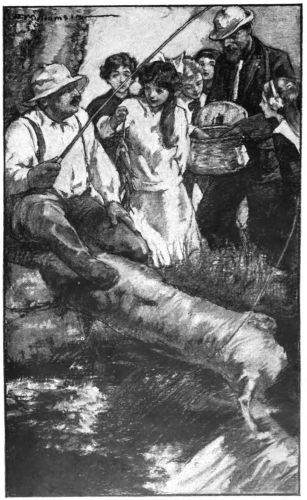
suggested gentle Doctor Tucker, whose
mild eyes were shining at the prospect of catching
a trout with the hook that Mr. Black was
baiting for him. "Many persons are."
But the splendid noon dinner that hungry
Aunty Jane had expected to devour was still
nearly a mile from shore in Captain Berry's
launch, and the other launch-man couldn't go
after it; because, having incautiously ventured
too near shore, he was now engaged in half-hearted
attempts to dislodge his stranded craft
from a troublesome sand bar. He declined all
offers of assistance, saying that Captain Berry,
whose engine would surely work sometime,
could easily tow him into deeper water—he
wasn't goin' to work hisself to death for nobody,
no, not he.
As nobody wanted to row a mile or more
and then back again with a load of heavy
baskets, nobody did; so Mrs. Crane did the
best she could with what she had; but the
camp-cooked dinner did not appeal to Aunty
Jane, who refused to eat venison that Dave
had touched and had no appetite for plain
beans, boiled potatoes, and cindery johnny-cake.
Altogether, poor Aunty Jane, who was
never very pleasant, was in her unhappiest
mood.
"You see," apologized Mrs. Crane, "our
provisions are pretty low; we haven't a very
large supply of cups and plates, and of course
you haven't been here long enough to acquire
an appetite for camp fare. Let me give you
a piece of this trout, Miss Higgins."
"No, thank you," was Aunty Jane's frigid
reply. "I never eat fish."
"These beans," assured Mrs. Slater, politely,
"are very nice indeed."
"And I'm sure," said Doctor Bennett, "this
is excellent coffee, even if I do have to drink
from a cocoa can."
But Aunty Jane scorned them both.
"Tell us," urged Mr. Black, "about that
boy of ours. What do you think of him?"
"Why," replied the merry doctor, "the lad's
all right, considering what he's been through.
But, judging from his extreme thinness, being
shipwrecked is only a small part of his unhappy
experience."
"What do you mean?" demanded Mrs.
Mapes, uneasily.
"No, my dear woman—all my dear women,"
Doctor Bennett hastened to add, "he
hasn't had smallpox. But I do know that he
was a sick boy before he was shipwrecked,
because his body shows that he has lost more
flesh than a boy could lose in so short a time."
"Yes," corroborated Mrs. Crane, "he was
very thin when we found him."
"Tuberculosis!" breathed Aunty Jane.
"Nothing of the kind," declared the doctor.
"But he was dreadfully thin," asserted Mabel.
"His legs——"
"Never mind his legs," said Doctor Bennett.
"It's his head that troubles us now. His
body is mending with every moment; but
there's something seriously wrong with his
memory——"
"A dangerous lunatic!" gasped excitable
Aunty Jane, half rising from her seat.
"No, no!" shouted the exasperated doctor,
who didn't like Aunty Jane. "Nothing of the
sort. Merely a very pitiable boy who has been
extremely ill, probably with pneumonia. A boy
who is naturally very bright, in all ways but
the one. A boy with an excellent constitution
or this last experience would have finished him.
The best thing we can possibly do for him is
to keep him right here, build up his strength
in this splendid air, and then, when he's entirely
well, take him to a specialist—I'm wiser
about bodies than brains."
"Could I make him a pudding?" demanded
Mabel, unexpectedly.
"No," roared the doctor. "We want him
to get well."
"As for me," said Henrietta, "I shan't be
able to sleep nights until I know that boy's real
name."
"Take my word for it," warned Aunty
Jane, "he isn't worth saving. He'll prove
either a thief or a tramp; or perhaps both. I
wouldn't think of taking in a stranger like
that."
Mabel was about to retort indignantly, and,
it is to be feared, impolitely; for this candid
child was sometimes too candid; when Henrietta
whispered in her ear:
"Wouldn't it be terrible if he proved to be
just like Aunty Jane!"
This thought was so appalling, in spite of
its impossibility, that for ten seconds Mabel
sat in silence, with her eyes fairly bulging.
"Henrietta," she breathed finally, "weren't—weren't
you just fooling?"
"Listen!" warned Henrietta.
"I'd rather be deceived fifty times," Mrs.
Crane was saying, "than let even a tramp go
hungry; but that's an honest lad or I never
saw one. It's quite possible that he's poor,
but that's no crime."