And now swiftly followed that hideous experience which has left its
indelible mark of fear on the soul of Marinus Bicknell Willett, and
has added a decade to the visible age of one whose youth was even then
far behind. Dr. Willett had conferred at length with Mr. Ward, and had
come to an agreement with him on several points which both felt the
alienists would ridicule. There was, they conceded, a terrible movement
alive in the world, whose direct connection with a necromancy even
older than the Salem witchcraft could not be doubted. That at least
two living men—and one other of whom they dared not think—were in
absolute possession of minds or personalities which had functioned as
early as 1690 or before was likewise almost unassailably proved even in
the face of all known natural laws. What these horrible creatures—and
Charles Ward as well—were doing or trying to do seemed fairly clear
from their letters and from every bit of light both old and new which
had filtered in upon the case. They were robbing the tombs of all the
ages, including those of the world's wisest and greatest men, in the
hope of recovering from bygone ashes some vestige of the consciousness
and lore which had once animated and informed them.
A hideous traffic was going on among these nightmare ghouls, whereby
illustrious bones were bartered with the calm calculativeness of
schoolboys swapping books; and from what was extorted from this
centuried dust there was anticipated a power and a wisdom beyond
anything which the cosmos had ever seen concentrated in one man or
group. They had found unholy ways to keep their brains alive, either
in the same body or different bodies; and had evidently achieved a way
of tapping the consciousness of the dead whom they gathered together.
There had, it seems, been some truth in chimerical old Borellus when
he wrote of preparing from even the most antique remains certain
"Essential Saltes" from which the shade of a long-dead living thing
might be raised up. There was a formula for evoking such a shade, and
another for putting it down; and it had now been so perfected that it
could be taught successfully. One must be careful about evocations, for
the markers of old graves are not always accurate.
Willett and Mr. Ward shivered as they passed from conclusion to
conclusion. Things—presences or voices of some sort—could be drawn
down from unknown places as well as from the grave, and in this process
also one must be careful. Joseph Curwen had indubitably evoked many
forbidden things, and as for Charles—what might one think of him?
What forces "outside the spheres" had reached him from Joseph Curwen's
day and turned his mind on forgotten things? He had been led to find
certain directions, and he had used them. He had talked with the man
of horror in Prague and stayed long with the creature in the mountains
of Transylvania. And he must have found the grave of Joseph Curwen at
last. That newspaper item and what his mother had heard in the night
were too significant to overlook. Then he had summoned something, and
it must have come. That mighty voice aloft on Good Friday, and those
different tones in the locked attic laboratory. What were they
like, with their depth and hollowness? Was there not here some awful
foreshadowing of the dreaded stranger Dr. Allen with his spectral bass?
Yes, that was what Mr. Ward had felt with vague horror in his single
talk with the man—if man it were—over the telephone!
What hellish consciousness or voice, what morbid shade or presence,
had come to answer Charles Ward's secret rites behind that locked
door? Those voices heard in argument—"must have it red for three
months"—Good God! Was not that just before the vampirism broke out?
The rifling of Ezra Weeden's ancient grave, and the cries later at
Pawtuxet—whose mind had planned the vengeance and rediscovered the
shunned seat of elder blasphemies? And then the bungalow and the
bearded stranger, and the gossip, and the fear. The final madness of
Charles neither father nor doctor could attempt to explain, but they
did feel sure that the mind of Joseph Curwen had come to earth again
and was following its ancient morbidities. Was demoniac possession
in truth a possibility? Allen had something to do with it, and the
detectives must find out more about one whose existence menaced the
young man's life. In the meantime, since the existence of some vast
crypt beneath the bungalow seemed virtually beyond dispute, some
effort must be made to find it. Willett and Mr. Ward, conscious of
the sceptical attitude of the alienists, resolved during their final
conference to undertake a joint secret exploration of unparalleled
thoroughness; and agreed to meet at the bungalow on the following
morning with valises and with certain tools and accessories suited to
architectural search and underground exploration.
The morning of April sixth dawned clear, and both explorers were at the
bungalow by ten o'clock. Mr. Ward had the key, and an entry and cursory
survey were made. From the disordered condition of Dr. Allen's room it
was obvious that the detectives had been there before, and the later
searchers hoped that they had found some clue which might prove of
value. Of course the main business lay in the cellar; so thither they
descended without much delay, again making the circuit which each had
vainly made before in the presence of the mad young owner. For a time
everything seemed baffling, each inch of the earthen floor and stone
walls having so solid and innocuous an aspect that the thought of a
yawning aperture was scarcely to be entertained. Willett reflected that
since the original cellar was dug without knowledge of any catacombs
beneath, the beginning of the passage would represent the strictly
modern delving of young Ward and his associates, where they had probed
for the ancient vaults whose rumor could have reached them by no
wholesome means.
The doctor tried to put himself in Charles' place and see how a delver
would be likely to start, but could not gain much inspiration from this
method. Then he decided on elimination as a policy, and went carefully
over the whole subterranean surface both vertical and horizontal,
trying to account for every inch separately. He was soon substantially
narrowed down, and at last had nothing left but the small platform
before the washtubs, which he had tried once before in vain. Now
experimenting in every possible way, and exerting a double strength,
he finally found that the top did indeed turn and slide horizontally
on a corner pivot. Beneath it lay a trim concrete surface with an iron
man-hole, to which Mr. Ward at once rushed with excited zeal. The
cover was not hard to lift, and the father had quite removed it when
Willett noticed the queerness of his aspect. He was swaying and nodding
dizzily, and in the gust of noxious air which swept up from the black
pit beneath the doctor soon recognized ample cause.
In a moment Dr. Willett had his fainting companion on the floor above
and was reviving him with cold water. Mr. Ward responded feebly, but it
could be seen that the mephitic blast from the crypt had in some way
gravely sickened him. Wishing to take no chances, Willett hastened out
to Broad Street for a taxicab and had soon dispatched the sufferer home
despite his weak-voiced protests; after which he produced an electric
torch, covered his nostrils with a band of sterile gauze, and descended
once more to peer into the new-found depths. The foul air had now
slightly abated, and Willett was able to send a beam of light down the
Stygian hole. For about ten feet, he saw, it was a sheer cylindrical
drop with concrete walls and an iron ladder; after which the hole
appeared to strike a flight of old stone steps which must originally
have emerged to earth somewhat southward of the present building.
Willett freely admits that for a moment the memory of the old Curwen
legends kept him from climbing down alone into that malodorous gulf.
He could not help thinking of what Luke Fenner had reported on that
last monstrous night. Then duty asserted itself and he made the plunge,
carrying a great valise for the removal of whatever papers might
prove of supreme importance. Slowly, as befitted one of his years,
he descended the ladder and reached the slimy steps below. This was
ancient masonry, his torch told him; and upon the dripping walls he
saw the unwholesome moss of centuries. Down, down, ran the steps; not
spirally, but in three abrupt turns; and with such narrowness that two
men could have passed only with difficulty. He had counted about thirty
when a sound reached him very faintly; and after that he did not feel
disposed to count any more.
It was a godless sound; one of those low-keyed, insidious outrages
of nature which are not meant to be. To call it a dull wail, a
doom-dragged whine, or a hopeless howl of chorused anguish and
stricken flesh without mind would be to miss its most quintessential
loathesomeness and soul-sickening overtones. Was it for this that
Ward had seemed to listen on that day he was removed? It was the most
shocking thing that Willett had ever heard, and it continued from
no determinate point as the doctor reached the bottom of the steps
and cast his torchlight around on lofty corridor walls surmounted by
Cyclopean vaulting and pierced by numberless black archways. The hall
in which he stood was perhaps fourteen feet high to the middle of
the vaulting and ten or twelve feet broad. Its pavement was of large
chipped flagstones, and its walls and roof were of dressed masonry. Its
length he could not imagine, for it stretched ahead indefinitely into
the blackness. Of the archways, some had doors of the old six-paneled
colonial type, whilst others had none.
Overcoming the dread induced by the smell and the howling, Willett
began to explore these archways one by one; finding beyond them
rooms with groined stone ceilings, each of medium size and apparently
of bizarre uses. Most of them had fireplaces, the upper courses of
whose chimneys would have formed an interesting study in engineering.
Never before or since had he seen such instruments or suggestions
of instruments as here loomed up on every hand through the burying
dust and cobwebs of a century and a half, in many cases evidently
shattered as if by the ancient raiders. For many of the chambers
seemed wholly untrodden by modern feet, and must have represented the
earliest and most obsolete phases of Joseph Curwen's experimentation.
Finally there came a room of obvious modernity, or at least of recent
occupancy. There were oil heaters, bookshelves and tables, chairs and
cabinets, and a desk piled high with papers of varying antiquity and
contemporaneousness. Candlesticks and oil lamps stood about in several
places; and finding a match safe handy, Willett lighted such as were
ready for use.
In the fuller gleam it appeared that this apartment was nothing less
than the latest study or library of Charles Ward. Of the books the
doctor had seen many before, and a good part of the furniture had
plainly come from the Prospect Street mansion. Here and there was
a piece well known to Willett, and the sense of familiarity became
so great that he half forgot the noisomeness and the wailing, both
of which were plainer here than they had been at the foot of the
steps. His first duty, as planned long ahead, was to find and seize
any papers which might seem of vital importance; especially those
portentous documents found by Charles so long ago behind the picture
in Olney Court. As he searched he perceived how stupendous a task the
final unraveling would be; for file on file was stuffed with papers
in curious hands and bearing curious designs, so that months or even
years might be needed for a thorough deciphering and editing. Once he
found large packets of letters with Prague and Rakus postmarks, and in
writing clearly recognizable as Orne's and Hutchinson's; all of which
he took with him as part of the bundle to be removed in his valise.
At last, in a locked mahogany cabinet once gracing the Ward home,
Willett found the batch of old Curwen papers; recognizing them from
the reluctant glimpse Charles had granted him so many years ago. The
youth had evidently kept them together very much as they had been when
first he found them, since all the titles recalled by the workmen were
present except the papers addressed to Orne and Hutchinson, and the
cipher with its key. Willett placed the entire lot in his valise and
continued his examination of the files. Since young Ward's immediate
condition was the greatest matter at stake, the closest searching was
done among the most obviously recent matter; and in this abundance of
contemporary manuscript one very baffling oddity was noted. That oddity
was the slight amount in Charles' normal writing, which indeed included
nothing more recent than two months before. On the other hand, there
were literally reams of symbols and formulae, historical notes and
philosophical comment, in a crabbed penmanship absolutely identical
with the ancient script of Joseph Curwen, though of undeniably modern
dating. Plainly, a part of the latter-day program had been a sedulous
imitation of the old wizard's writing, which Charles seemed to have
carried to a marvelous state of perfection. Of any third hand which
might have been Allen's there was not a trace. If he had indeed
come to be the leader, he must have forced young Ward to act as his
amanuensis.
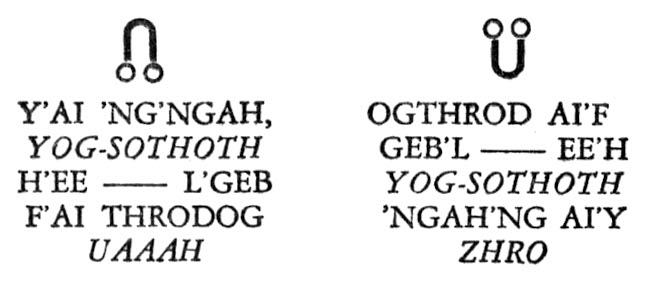
In this new material one mystic formula, or rather pair of formulae,
recurred so often that Willett had it by heart before he had half
finished his quest. It consisted of two parallel columns, the left-hand
one surmounted by the archaic symbol called "Dragon's Head" and used
in almanacs to indicate the ascending node, and the right-hand one
headed by the corresponding sign of "Dragon's Tail" or descending
node. The appearance of the whole was something like this, and almost
unconsciously the doctor realized that the second half was no more
than the first written syllabically backward with the exception of the
final monosyllables and of the odd name Yog-Sothoth, which he had
come to recognize under various spellings from other things he had
seen in connection with this horrible matter. The formulae were as
follows—exactly so, as Willett is abundantly able to testify—and
the first one struck an odd note of uncomfortable latent memory in his
brain, which he recognized later when reviewing the events of that
horrible Good Friday of the previous year.
So haunting were these formulae, and so frequently did he come upon
them, that before the doctor knew it he was repeating them under his
breath. Eventually, however, he felt he had secured all the papers he
could digest to advantage for the present; hence resolved to examine no
more till he could bring the sceptical alienists en masse for an ample
and more systematic raid. He had still to find the hidden laboratory,
so leaving his valise in the lighted room he emerged again into the
black noisome corridor whose vaulting echoed ceaselessly with that dull
and hideous whine.
The next few rooms he tried were all abandoned or filled only with
crumbling boxes and ominous-looking leaden coffins; but impressed him
deeply with the magnitude of Joseph Curwen's original operations. He
thought of the slaves and seamen who had disappeared, of the graves
which had been violated in every part of the world, and of what
that final raiding party must have seen; and then he decided it was
better not to think any more. Once a great stone staircase mounted at
his right, and he deduced that this must have reached to one of the
Curwen outbuildings—perhaps the famous stone edifice with the high
slitlike windows—provided the steps he had descended had led from the
steep-roofed farmhouse. Suddenly the walls seemed to fall away ahead,
and the stench and the wailing grew stronger. Willett saw that he had
come upon a vast open space, so great that his torchlight would not
carry across it; and as he advanced he encountered occasional stout
pillars supporting the arches of the roof.
After a time he reached a circle of pillars grouped like the monoliths
of Stonehenge, with a large carved altar on a base of three steps in
the center; and so curious were the carvings on that altar that he
approached to study them with his electric light. But when he saw what
they were he shrank away shuddering, and did not stop to investigate
the dark stains which discolored the upper surface and had spread down
the sides in occasional thin lines. Instead, he found the distant wall
and traced it as it swept around in a gigantic circle perforated by
occasional black doorways and indented by a myriad of shallow cells
with iron gratings and wrist and ankle bonds on chains fastened to the
stone of the concave rear masonry. These cells were empty, but still
the horrible odor and the dismal moaning continued, more insistent
now than ever, and seemingly varied at times by a sort of slippery
thumping.
From that frightful smell and that uncanny noise Willett's attention
could no longer be diverted. Both were plainer and more hideous in the
great pillared hall than anywhere else, and carried a vague impression
of being far below, even in this dark nether world of subterrene
mystery. Before trying any of the black archways for steps leading
further down, the doctor cast his beam of light about the stone-flagged
floor. It was very loosely paved, and at irregular intervals there
would occur a slab curiously pierced by small holes in no definite
arrangement, while at one point there lay a very long ladder carelessly
flung down. To this ladder, singularly enough, appeared to cling a
particularly large amount of the frightful odor which encompassed
everything. As he walked slowly about, it suddenly occurred to Willett
that both the noise and the odor seemed strongest directly above the
oddly pierced slabs, as if they might be crude trap-doors leading down
to some still deeper region of horror. Kneeling by one, he worked at it
with his hands, and found that with extreme difficulty he could budge
it. At his touch the moaning beneath ascended to a louder key, and only
with vast trepidation did he persevere in the lifting of the heavy
stone. A stench unnamable now rose from below, and the doctor's head
reeled dizzily as he laid back the slab and turned his torch upon the
exposed square yard of gaping blackness.
If he had expected a flight of steps to some wide gulf of ultimate
abomination, Willett was destined to be disappointed; for amidst
that foetor and cracked whining he discerned only the brick-faced
top of a cylindrical well perhaps a yard and a half in diameter and
devoid of any ladder or other means of descent. As the light shone
down, the wailing changed suddenly to a series of horrible yelps; in
conjunction with which there came again that sound of blind, futile
scrambling and slippery thumping. The explorer trembled, unwilling even
to imagine what noxious thing might be lurking in that abyss; but in
a moment mustered up the courage to peer over the rough-hewn brink;
lying at full length and holding the torch downward at arm's length to
see what might lie below. For a second he could distinguish nothing
but the slimy, moss-grown brick walls sinking illimitably into that
half-tangible miasma of murk and foulness and anguished frenzy; and
then he saw that something dark was leaping clumsily and frantically
up and down at the bottom of the narrow shaft, which must have been
from twenty to twenty-five feet below the stone floor where he lay.
The torch shook in his hand, but he looked again to see what manner
of living creature might be immured there in the darkness of that
unnatural well; left starving by young Ward through all the long month
since the doctors had taken him away, and clearly only one of a vast
number prisoned in the kindred wells whose pierced stone covers so
thickly studded the floor of the great vaulted cavern. Whatever the
things were, they could not lie down in their cramped spaces; but must
have crouched and whined and waited and feebly leaped all those hideous
weeks since their master had abandoned them unheeded.
But Marinus Bicknell Willett was sorry that he looked again; for
surgeon and veteran of the dissecting-room though he was, he has not
been the same since. It is hard to explain just how a single sight of
a tangible object with measurable dimensions could so shake and change
a man; and we may only say that there is about certain outlines and
entities a power of symbolism and suggestion which acts frightfully
on a sensitive thinker's perspective and whispers terrible hints
of obscure cosmic relationships and unnamable realities behind the
protective illusions of common vision. In that second look Willett
saw such an outline or entity, for during the next few instants he was
undoubtedly as stark mad as any inmate of Dr. Waite's private hospital.
He dropped the electric torch from a hand drained of muscular power or
nervous coordination, nor heeded the sound of crunching teeth which
told of its fate at the bottom of the pit. He screamed and screamed
and screamed in a voice whose falsetto panic no acquaintance of his
would ever have recognized, and though he could not rise to his feet he
crawled and rolled desperately away over the damp pavement where dozens
of Tartarean wells poured forth their exhausted whining and yelping
to answer his own insane cries. He tore his hands on the rough, loose
stones, and many times bruised his head against the frequent pillars,
but still he kept on. Then at last he slowly came to himself in the
utter blackness and stench, and stopped his ears against the droning
wail into which the burst of yelping had subsided. He was drenched
with perspiration and without means of producing a light; stricken and
unnerved in the abysmal blackness and horror, and crushed with a memory
he never could efface. Beneath him dozens of those things still lived,
and from one of the shafts the cover was removed. He knew that what he
had seen could never climb up the slippery walls, yet shuddered at the
thought that some obscure foothold might exist.
What the thing was, he would never tell. It was like some of the
carvings on the hellish altar, but it was alive. Nature had never made
it in this form, for it was too palpably unfinished. The deficiencies
were of the most surprising sort, and the abnormalities of proportion
could not be described. Willett consents only to say that this type
of thing must have represented entities which Ward called up from
imperfect salts, and which he kept for servile or ritualistic
purposes. If it had not had a certain significance, its image would not
have been carved on that damnable stone. It was not the worst thing
depicted on that stone—but Willett never opened the other pits. At the
time, the first connected idea in his mind was an idle paragraph from
some of the old Curwen data he had digested long before; a phrase used
by Simon or Jedediah Orne in that portentous confiscated letter to the
bygone sorcerer:
"Certainly, there was Noth'g butt ye liveliest Awfullness in That which
H. rais'd upp from What he cou'd gather onlie a Part of."
Then, horribly supplementing rather than displacing this image, there
came a recollection of those ancient lingering rumors anent the burned
and twisted thing found in the fields a week after the Curwen raid.
Charles Ward had once told the doctor what old Slocum said of that
object; that it was neither thoroughly human, nor wholly allied to any
animal which Pawtuxet folk had ever seen or read about.
These words hummed in the doctor's mind as he rocked to and fro,
squatting on the nitrous stone floor. He tried to drive them out,
and repeated the Lord's Prayer to himself; eventually trailing off
into a mnemonic hodge-podge like the modernistic "Waste Land" of Mr.
T. S. Eliot and finally reverting to the oft-repeated dual formula
he had lately found in Ward's underground library: "Y'ai 'ng-'ngah,
Yog-Sothoth," and so on till the final underlined "Zhro." It seemed
to soothe him and he staggered to his feet after a time; lamenting
bitterly his fright-lost torch and looking wildly about for any gleam
of light in the clutching inkiness of the chilly air. Think he would
not; but he strained his eyes in every direction for some faint glint
or reflection of the bright illumination he had left in the library.
After awhile he thought he detected a suspicion of a glow infinitely
far away, and toward this he crawled in agonized caution on hands and
knees amidst the stench and howling, always feeling ahead lest he
collide with the numerous great pillars or stumble into the abominable
pit he had uncovered.
Once his shaking fingers touched something which he knew must be the
steps leading to the hellish altar, and from this spot he recoiled
in loathing. At another time he encountered the pierced slab he had
removed, and here his caution became almost pitiful. But he did not
come upon the dread aperture after all, nor did anything issue from
that aperture to detain him. What had been down there made no sound
nor stir. Evidently its crunching of the fallen electric torch had not
been good for it. Each time Willett's fingers felt a perforated slab
he trembled. His passage over it would sometimes increase the groaning
below, but generally it would produce no effect at all, since he moved
very noiselessly. Several times during his progress the glow ahead
diminished perceptibly, and he realized that the various candles and
lamps he had left must be expiring one by one. The thought of being
lost in utter darkness without matches amidst this underground world of
nightmare labyrinths impelled him to rise to his feet and run, which he
could safely do now that he had passed the open pit; for he knew that
once the light failed his only hope of rescue and survival would lie
in whatever relief party Mr. Ward might send after missing him for a
sufficient period.
Presently, however, he emerged from the open space into the narrower
corridor and definitely located the glow as coming from a door on his
right. In a moment he had reached it and was standing once more in
young Ward's secret library, trembling with relief, and watching the
sputterings of that last lamp which had brought him to safety.
In another moment he was hastily filling the burned-out lamps from an
oil supply he had previously noticed, and when the room was bright
again he looked about to see if he might find a lantern for further
exploration. For racked though he was with horror, his sense of
grim purpose was still uppermost, and he was firmly determined to
leave no stone unturned in his search for the hideous facts behind
Charles Ward's bizarre madness. Failing to find a lantern, he chose
the smallest of the lamps to carry; also filling his pockets with
candles and matches, and taking with him a gallon can of oil, which
he proposed to keep for reserve use in whatever hidden laboratory he
might uncover beyond the terrible open space with its unclean altar and
nameless covered wells. To traverse that space again would require his
utmost fortitude, but he knew it must be done. Fortunately neither the
frightful altar nor the opened shaft was near the vast cell-indented
wall which bounded the cavern area, and whose black mysterious archways
would form the next goals of a logical search.
So Willett went back to that great pillared hall of stench and
anguished howling; turning down his lamp to avoid any distant glimpse
of the hellish altar, or of the uncovered pit with the pierced stone
slab beside it. Most of the black doorways led merely to small
chambers, some vacant and some evidently used as store rooms; and
in several of the latter he saw some very curious accumulations of
various objects. One was packed with rotting and dust-draped bales
of spare clothing, and the explorer thrilled when he saw that it was
unmistakably the clothing of a century and a half before. In another
room he found numerous odds and ends of modern clothing, as if gradual
provisions were being made to equip a large body of men. But what
he disliked most of all were the huge copper vats which occasionally
appeared; these, and the sinister incrustations upon them. He liked
them even less than the weirdly figured leaden bowls whose ruins
retained such obnoxious deposits and around which clung repellent odors
perceptible above even the general noisomeness of the crypt. When
he had completed about half the entire circuit of the wall he found
another corridor like that from which he had come, and out of which
many doors opened.
This he proceeded to investigate; and after entering three rooms of
medium size and of no significant contents, he came at last to a large
oblong apartment whose businesslike tanks and tables, furnaces and
modern instruments, occasional books and endless shelves of jars and
bottles proclaimed it indeed the long-sought laboratory of Charles
Ward—and no doubt of old Joseph Curwen before him.
After lighting the three lamps which he found filled and ready, Dr.
Willett examined the place and all its appurtenances with the keenest
interest; noting from the relative quantities of various reagents on
the shelves that young Ward's dominant concern must have been with some
branch of organic chemistry. On the whole, little could be learned from
the scientific ensemble, which included a gruesome-looking dissecting
table; so that the room was really rather a disappointment. Among the
books was a tattered old copy of Borellus in black-letter, and it was
weirdly interesting to note that Ward had underlined the same passage
whose marking had so perturbed good Mr. Merritt at Curwen's farmhouse
more than a century and a half before. That older copy, of course,
must have perished along with the rest of Curwen's occult library in
the final raid. Three archways opened off the laboratory, and these
the doctor proceeded to sample in turn. From his cursory survey he
saw that two led merely to small storerooms; but these he canvassed
with care, remarking the piles of coffins in various stages of damage
and shuddering violently at two or three of the few coffin-plates he
could decipher. There was much clothing also stored in these rooms,
and several new and tightly-nailed boxes which he did not stop to
investigate. Most interesting of all, perhaps, were some odd bits which
he judged to be fragments of old Joseph Curwen's laboratory appliances.
These had suffered damage at the hands of the raiders, but were still
partly recognizable as the chemical paraphernalia of the Georgian
period.
The third archway led to a very sizeable chamber entirely lined with
shelves and having in the center a table bearing two lamps. These
lamps Willett lighted, and in their brilliant glow studied the endless
shelving which surrounded him. Some of the upper levels were wholly
vacant, but most of the space was filled with small odd-looking
leaden jars of two general types; one tall and without handles like a
Grecian lekythos or oil-jug, and the other with a single handle and
proportioned like a Phaleron jug. All had metal stoppers, and were
covered with peculiar-looking symbols moulded in low relief. In a
moment the doctor noticed that these jugs were classified with great
rigidity; all the lekythoi being on one side of the room with a large
wooden sign reading "Custodes" above them, and all the Phalerons on
the other, correspondingly labeled with a sign reading "Materia." Each
of the jars or jugs, except some on the upper shelves that turned out
to be vacant, bore a cardboard tag with a number apparently referring
to a catalogue; and Willett resolved to look for the latter presently.
For the moment, however, he was more interested in the nature of the
array as a whole; and experimentally opened several of the lekythoi
and Phalerons at random with a view to a rough generalization. The
result was invariable. Both types of jar contained a small quantity
of a single kind of substance; a fine dusty powder of very light
weight and of many shades of dull neutral color. To the colors which
formed the only point of variation there was no apparent method of
disposal; and no distinction between what occurred in the lekythoi and
what occurred in the Phalerons. A bluish-gray powder might be by the
side of a pinkish-white one, and any one in a Phaleron might have its
exact counterpart in a lekythos. The most individual feature about
the powders was their non-adhesiveness. Willett would pour one into
his hand, and upon returning it to its jug would find that no residue
whatever remained on his palm.
The meaning of the two signs puzzled him, and he wondered why this
battery of chemicals was separated so radically from those in glass
jars on the shelves of the laboratory proper. "Custodes," "Materia";
that was the Latin for "Guards" and "Material," respectively—and
then there came a flash of memory as to where he had seen that word
"Guards" before in connection with this dreadful mystery. It was, of
course, in the recent letter to Dr. Allen purporting to be from old
Edward Hutchinson; and the phrase had read: "There was no Neede to keep
the Guards in shape and eat'g off their Heades, and it made much to
be founde in Case of Trouble, as you too welle Knowe." What did this
signify? But wait—was there not still another reference to "guards"
in this matter which he had failed wholly to recall when reading the
Hutchinson letter? Back in the old non-secretive days Ward had told him
of the Eleazar Smith diary recording the spying of Smith and Weeden
on the Curwen farm, and in that dreadful chronicle there had been
a mention of conversations overheard before the old wizard betook
himself wholly beneath the earth. There had been, Smith and Weeden
insisted, terrible colloquies wherein figured Curwen, certain captives
of his, and the guards of those captives. Those guards, according to
Hutchinson or his avatar, had "eaten their heads off," so that now Dr.
Allen did not keep them in shape. And if not in shape, how save
as the "salts" to which it appears this wizard band was engaged in
reducing as many human bodies or skeletons as they could?
So that was what these lekythoi contained; the monstrous fruit of
unhallowed rites and deeds, presumably won or cowed to such submission
as to help when called up by some hellish incantation, in the defense
of their blasphemous master or the questioning of those who were not so
willing? Willett shuddered at the thought of what he had been pouring
in and out of his hands, and for a moment felt an impulse to flee in
panic from that cavern of hideous shelves with their silent and perhaps
watching sentinels. Then he thought of the "Materia"—in the myriad
Phaleron jugs on the other side of the room. Salts too—and if not the
salts of "guards," then the salts of what? God! Could it be possible
that here lay the mortal relics of half the titan thinkers of all the
ages; snatched by supreme ghouls from crypts where the world thought
them safe, and subject to the beck and call of madmen who sought to
drain their knowledge for some still wilder end whose ultimate effect
would concern, as poor Charles had hinted in his frantic note, "all
civilization, all natural law, perhaps even the fate of the solar
system and the universe?" And Marinus Bicknell Willett had sifted their
dust through his hands!
Then he noticed a small door at the farther end of the room, and calmed
himself enough to approach it and examine the crude sign chiseled
above. It was only a symbol, but it filled him with vague spiritual
dread; for a morbid, dreaming friend of his had once drawn it on paper
and told him a few of the things it means in the dark abyss of sleep.
It was the sign of Koth, that dreamers see fixed above the archway
of a certain black tower standing alone in twilight—and Willett did
not like what his friend Randolph Carter had said of its powers. But
a moment later he forgot the sign as he recognized a new acrid odor
in the stench-filled air. This was a chemical rather than animal
smell, and came clearly from the room beyond the door. And it was,
unmistakably, the same odor which had saturated Charles Ward's clothing
on the day the doctors had taken him away. So it was here that the
youth had been interrupted by the final summons? He was wiser than old
Joseph Curwen, for he had not resisted. Willett, boldly determined to
penetrate every wonder and nightmare this nether realm might contain,
seized the small lamp and crossed the threshold. A wave of nameless
fright rolled out to meet him, but he yielded to no whim and deferred
to no intuition. There was nothing alive here to harm him, and he would
not be stayed in his piercing of the eldritch cloud which engulfed his
patient.
The room beyond the door was of medium size, and had no furniture
save a table, a single chair, and two groups of curious machines with
clamps and wheels which Willett recognized after a moment as medieval
instruments of torture. On one side of the door stood a rack of savage
whips, above which were some shelves bearing empty rows of shallow
pedestaled cups of lead shaped like Grecian kylikes. On the other side
was the table; with a powerful Argand lamp, a pad and pencil, and
two of the stoppered lekythoi from the shelves outside set down at
irregular places as if temporarily or in haste. Willett lighted the
lamp and looked carefully at the pad to see what notes young Ward
might have been jotting down when interrupted; but found nothing more
intelligible than the following disjointed fragments in that crabbed
Curwen chirography, which shed no light on the case as a whole:
"B. dy'd not. Escap'd into walls and founde Place below.
"Saw olde V. saye ye Sabaoth and learnt ye Way.
"Rais'd Yog-Sothoth thrice and was ye nexte Day deliver'd.
"F. soughte to wipe out all know'g howe to raise Those from Outside."
As the strong Argand blaze lit up the entire chamber the doctor saw
that the wall opposite the door, between the two groups of torturing
appliances in the corners, was covered with pegs from which hung a set
of shapeless looking robes of a rather dismal yellowish-white. But
far more interesting were the two vacant walls, both of which were
thickly covered with mystic symbols and formulae roughly chiseled in
the smooth dressed stone. The damp floor also bore marks of carving;
and with but little difficulty Willett deciphered a huge pentagram in
the center, with a plain circle about three feet wide halfway between
this and each corner. In one of these four circles, near where a
yellowish robe had been flung carelessly down, there stood a shallow
kylix of the sort found on the shelves above the whip-rack; and just
outside the periphery was one of the Phaleron jugs from the shelves in
the other room, its tag numbered 118. This was unstoppered, and proved
upon inspection to be empty; but the explorer saw with a shiver that
the kylix was not. Within its shallow area, and saved from scattering
only by the absence of wind in this sequestered cavern, lay a small
amount of a dry, dull-greenish efflorescent powder which must have
belonged in the jug; and Willett almost reeled at the implications that
came sweeping over him as he correlated little by little the several
elements and antecedents of the scene. The whips and the instruments of
torture; the dust or salts from the jug of "Materia," the two lekythoi
from the "Custodes" shelf, the robes, the formulae on the walls, the
notes on the pad, the hints from letters and legends, and the thousand
glimpses, doubts, and suppositions which had come to torment the
friends and parents of Charles Ward—all these engulfed the doctor in a
tidal wave of horror as he looked at that dry greenish powder outspread
in the pedestalled leaden kylix on the floor.
With an effort, however, Willett pulled himself together and began
studying the formulae chiseled on the walls. From the stained and
incrusted letters it was obvious that they were carved in Joseph
Curwen's time, and their text was such as to be vaguely familiar to
one who had read much Curwen material or delved extensively into the
history of magic. One the doctor clearly recognized as what Mrs. Ward
heard her son chanting on that ominous Good Friday a year before,
and what an authority had told him was a very terrible invocation
addressed to secret gods outside the normal spheres. It was not
spelled here exactly as Mrs. Ward had set it down from memory, nor
yet as the authority had shewn it to him in the forbidden pages of
"Eliphas Levi"; but its identity was unmistakable, and such words as
Sabaoth, Metraton, Almonsin, and Zariatnatmik sent a shudder
of fright through the searcher who had seen and felt so much of cosmic
abomination just around the corner.
This was on the left-hand wall as one entered the room. The right-hand
wall was no less thickly inscribed, and Willett felt a start of
recognition as he came upon the pair of formulae so frequently
occurring in the recent notes in the library. They were, roughly
speaking, the same; with the ancient symbols of "Dragon's Head" and
"Dragon's Tail" heading them as in Ward's scribblings. But the spelling
differed quite widely from that of the modern versions, as if old
Curwen had had a different way of recording sound, or as if later study
had evolved more powerful and perfected variants of the invocations in
question. The doctor tried to reconcile the chiseled version with the
one which still ran persistently in his head, and found it hard to do.
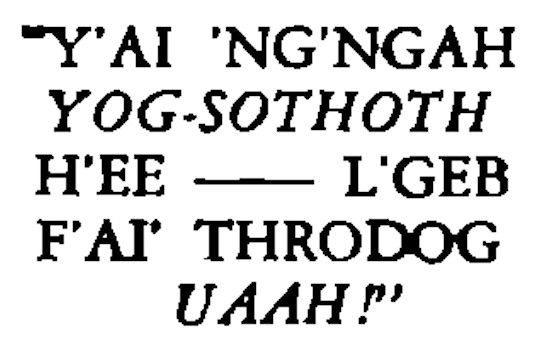
Where the script he had memorized began "Y'ai 'Ng'ngah, Yog-Sothoth,"
this epigraph started out as "Aye, cngengah, Yogge-Sothotha"; which
to his mind would seriously interfere with the syllabification of the
second word.
Ground as the later text was into his consciousness, the discrepancy
disturbed him; and he found himself chanting the first of the formulae
aloud in an effort to square the sound he conceived with the letters
he found carved. Weird and menacing in that abyss of antique blasphemy
rang his voice! its accents keyed to a droning sing-song either through
the spell of the past and the unknown, or through the hellish example
of that dull, godless wail from the pits whose inhuman cadences rose
and fell rhythmically in the distance through the stench and darkness.
But what was this cold wind which had sprung into life at the very
outset of the chant? The lamps were sputtering woefully, and the
gloom grew so dense that the letters on the wall nearly faded from
sight. There was smoke, too, and an acrid odor which quite drowned out
the stench from the far-away wells; an odor like that he had smelt
before, yet infinitely stronger and more pungent. He turned from the
inscriptions to face the room with its bizarre contents, and saw
that the kylix on the floor, in which the ominous efflorescent powder
had lain, was giving forth a cloud of thick, greenish-black vapor of
surprising volume and opacity. That powder—Great God! it had come from
the shelf of "Materia"—what was it doing now, and what had started it?
The formula he had been chanting—the first of the pair—Dragon's Head,
ascending node—Blessed Saviour, could it be—
The doctor reeled, and through his head raced wildly disjointed scraps
from all he had seen, heard, and read of the frightful case of Joseph
Curwen and Charles Dexter Ward. "I say to you againe, doe not call up
Any that you cannot put downe.... Have ye Wordes for laying at all
times readie, and stopp not to be sure when there is any Doubte of
Whom you have—Three Talkes with What was therein inhum'd—" Mercy
of Heaven, what is that shape behind the parting smoke?
Marinus Bicknell Willett has no hope that any part of his tale will
be believed except by certain sympathetic friends, hence has made
no attempt to tell it beyond his most intimate circle. Only a few
outsiders have ever heard it repeated, and of these the majority laugh
and remark that the doctor surely is getting old. He has been advised
to take a long vacation and to shun future cases dealing with mental
disturbance. But Mr. Ward knows that the veteran physician speaks only
a horrible truth. Did not he himself see the noisome aperture in the
bungalow cellar? Did not Willett send him home overcome and ill at
eleven o'clock that portentous morning? Did he not telephone the doctor
in vain that evening, and again the next day, and had he not driven
to the bungalow itself on that following noon, finding his friend
unconscious but unharmed on one of the beds upstairs? Willett had been
breathing stertorously, and opened his eyes slowly when Mr. Ward gave
him some brandy fetched from the car. Then he shuddered and screamed,
crying out, "That beard—those eyes—God, who are you?" A very
strange thing to say to a trim, blue-eyed, clean-shaven gentleman whom
he had known from the latter's boyhood.
In the bright noon sunlight the bungalow was unchanged since the
previous morning. Willett's clothing bore no disarrangement beyond
certain smudges and worn places at the knees, and only a faint acrid
odor reminded Mr. Ward of what he had smelt on his son that day he was
taken to the hospital. The doctor's flashlight was missing, but his
valise was safely there, as empty as when he had brought it. Before
indulging in any explanations, and obviously with great moral effort,
Willett staggered dizzily down to the cellar and tried the fateful
platform before the tubs. It was unyielding. Crossing to where he had
left his yet-unused tool satchel the day before, he obtained a chisel
and began to pry up the stubborn planks one by one. Underneath the
smooth concrete was still visible, but of any opening or perforation
there was no longer a trace. Nothing yawned this time to sicken the
mystified father who had followed the doctor downstairs; only the
smooth concrete underneath the planks—no noisome well, no world of
subterrene horrors, no secret library, no Curwen papers, no nightmare
pits of stench and howling, no laboratory or shelves or chiseled
formulae, no—Dr. Willett turned pale, and clutched at the younger man.
"Yesterday," he asked softly, "did you see it here—and smell it?" And
when Mr. Ward, himself transfixed with dread and wonder, found strength
to nod an affirmative, the physician gave a sound half a sigh and half
a gasp, and nodded in turn. "Then I will tell you," he said.
So for an hour, in the sunniest room they could find upstairs, the
physician whispered his frightful tale to the wondering father. There
was nothing to relate beyond the looming up of that form when the
greenish-black vapor from the kylix parted, and Willett was too tired
to ask himself what had really occurred. There were futile, bewildered
head-shakings from both men, and once Mr. Ward ventured a hushed
suggestion, "Do you suppose it would be of any use to dig?" The doctor
was silent, for it seemed hardly fitting for any human brain to answer
when powers of unknown spheres had so vitally encroached on this side
of the Great Abyss. Again Mr. Ward asked, "But where did it go? It
brought you here, you know, and it sealed up the hole somehow."
And Willett again let silence answer for him.
But after all, this was not the final phase of the matter. Reaching for
his handkerchief before rising to leave, Dr. Willett's fingers closed
upon a piece of paper in his pocket which had not been there before,
and which was companioned by the candles and matches he had seized in
the vanished vault. It was a common sheet, torn obviously from the
cheap pad in that fabulous room of horror somewhere underground, and
the writing upon it was that of an ordinary lead pencil—doubtless
the one which had lain beside the pad. It was folded very carelessly,
and beyond the faint acrid scent of the cryptic chamber bore no print
or mark of any world but this. But in the text itself it did indeed
reek with wonder; for here was no script of any wholesome age, but the
labored strokes of mediaeval darkness, scarcely legible to the laymen
who now strained over it, yet having combinations of symbols which
seemed vaguely familiar. The briefly scrawled message was this, and its
mystery lent purpose to the shaken pair, who forthwith walked steadily
out to the Ward car and gave orders to be driven first to a quiet
dining place and then to the John Hay Library on the hill.
At the library it was easy to find good manuals of palaeography,
and over these the two men puzzled till the lights of evening shone
out from the great chandelier. In the end they found what was needed.
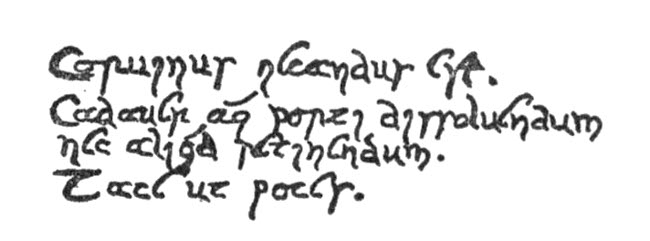
The letters were indeed no fantastic invention, but the normal script
of a very dark period. They were the pointed Saxon minuscules of the
eighth or ninth century A. D., and brought with them memories of an
uncouth time when under a fresh Christian veneer ancient faiths and
ancient rites stirred stealthily, and the pale moon of Britain looked
sometimes on strange deeds in the Roman ruins at Caerleon and Hexhaus,
and by the Towers along Hadrian's crumbling wall. The words were in
such Latin as a barbarous age might remember—"Corvinus, necandus
est. Cadaver aq(ua) forti dissolvendum, nec aliq(ui)d retinendum.
Tace ut potes."—which may roughly be translated, "Curwen must be
killed. The body must be dissolved in aqua fortis, nor must anything be
retained. Keep silence as best you are able."
Willett and Mr. Ward were mute and baffled. They had met the unknown,
and found that they lacked emotions to respond to it as they vaguely
believed they ought. With Willett, especially, the capacity for
receiving fresh impressions of awe was well-nigh exhausted; and both
men sat still and helpless till the closing of the library forced them
to leave. Then they drove listlessly to the Ward mansion in Prospect
Street, and talked to no purpose into the night. The doctor rested
toward morning, but did not go home. And he was still there Sunday
noon when a telephone message came from the detectives who had been
assigned to look up Dr. Allen.
Mr. Ward, who was pacing nervously about in a dressing-gown, answered
the call in person; and told the men to come up early the next day when
he heard their report was almost ready. Both Willett and he were glad
that this phase of the matter was taking form, for whatever the origin
of the strange minuscule message, it seemed certain that the "Curwen"
who must be destroyed could be no other than the bearded and spectacled
stranger. Charles had feared this man, and had said in the frantic note
that he must be killed and dissolved in acid. Allen, moreover, had been
receiving letters from the strange wizards in Europe under the name
of Curwen, and palpably regarded himself as an avatar of the bygone
necromancer. And now from a fresh and unknown source had come a message
saying that "Curwen" must be killed and dissolved in acid. The linkage
was too unmistakable to be factitious; and besides, was not Allen
planning to murder young Ward upon the advice of the creature called
Hutchinson? Of course, the letter they had seen had never reached
the bearded stranger; but from its text they could see that Allen
had already formed plans for dealing with the youth if he grew too
"squeamish." Without doubt, Allen must be apprehended; and even if the
most drastic directions were not carried out, he must be placed where
he could inflict no harm upon Charles Ward.
That afternoon, hoping against hope to extract some gleam of
information anent the inmost mysteries from the only available one
capable of giving it, the father and the doctor went down the bay and
called on young Charles at the hospital. Simply and gravely Willett
told him all he had found, and noticed how pale he turned as each
description made certain the truth of the discovery. The physician
employed as much dramatic effect as he could, and watched for a
wincing on Charles' part when he approached the matter of the covered
pits and the nameless hybrids within. But Ward did not wince. Willett
paused, and his voice grew indignant as he spoke of how the things were
starving. He taxed the youth with shocking inhumanity, and shivered
when only a sardonic laugh came in reply. For Charles, having dropped
as useless his pretense that the crypt did not exist, seemed to see
some ghastly jest in this affair; and chuckled hoarsely at something
which amused him. Then he whispered, in accents doubly terrible
because of the cracked voice he used, "Damn 'em, they do eat, but
they don't need to! That's the rare part! A month, you say, without
food? Lud, Sir, you be modest! D'ye know, that was the joke on poor old
Whipple with his virtuous bluster! Kill everything off, would he? Why,
damme, he was half-deaf with the noise from Outside and never saw or
heard aught from the wells. He never dreamed they were there at all!
Devil take ye, those cursed things have been howling down there ever
since Curwen was done for a hundred and fifty-seven years gone!"
But no more than this could Willett get from the youth. Horrified, yet
almost convinced against his will, he went on with his tale in the hope
that some incident might startle his auditor out of the mad composure
he maintained. Looking at the youth's face, the doctor could not but
feel a kind of terror at the changes which recent months had wrought.
Truly, the boy had drawn down nameless horrors from the skies. When the
room with the formulae and the greenish dust was mentioned, Charles
shewed his first sign of animation. A quizzical look overspread his
face as he heard what Willett had read on the pad, and he ventured
the mild statement that those notes were old ones, of no possible
significance to anyone not deeply initiated in the history of magic.
"But," he added, "had you but known the words to bring up that which I
had out in the cup, you had not been here to tell me this. 'Twas Number
118, and I conceive you would have shook had you looked it up in my
list in t'other room. 'Twas never raised by me, but I meant to have it
up that day you came to invite me hither."
Then Willett told of the formula he had spoken and of the
greenish-black smoke which had arisen; and as he did so he saw true
fear dawn for the first time on Charles Ward's face. "It came, and
you be here alive!" As Ward croaked the words his voice seemed almost
to burst free of its trammels and sink to cavernous abysses of uncanny
resonance. Willett, gifted with a flash of inspiration, believed he
saw the situation, and wove into his reply a caution from a letter he
remembered. "No. 118, you say? But don't forget that stones are all
changed now in nine grounds out of ten. You are never sure till you
question!" And then, without warning, he drew forth the minuscule
message and flashed it before the patient's eyes. He could have wished
no stronger result, for Charles Ward fainted forthwith.
All this conversation, of course, had been conducted with the greatest
secrecy lest the resident alienists accuse the father and the physician
of encouraging a madman in his delusions. Unaided, too, Dr. Willett
and Mr. Ward picked up the stricken youth and placed him on the couch.
In reviving, the patient mumbled many times of some word which he must
get to Orne and Hutchinson at once; so when his consciousness seemed
fully back the doctor told him that of those strange creatures at
least one was his bitter enemy, and had given Dr. Allen advice for his
assassination. This revelation produced no visible effect, and before
it was made the visitors could see that their host had already the look
of a hunted man. After that he would converse no more, so Willett and
the father departed presently; leaving behind a caution against the
bearded Allen, to which the youth only replied that this individual
was very safely taken care of, and could do no one any harm even if he
wished.
This was said with an almost evil chuckle very painful to hear. They
did not worry about any communications Charles might write to that
monstrous pair in Europe, since they knew that the hospital authorities
seized all outgoing mail for censorship and would pass no wild or
outré-looking missive.
There is, however, a curious sequel to the matter of Orne and
Hutchinson, if such indeed the exiled wizards were. Moved by some vague
presentiment amidst the horrors of that period, Willett arranged with
an international press-cutting bureau for accounts of notable current
crimes and accidents in Prague and in eastern Transylvania; and after
six months believed that he had found two very significant things
amongst the multifarious items he received and had translated. One
was the total wrecking of a house by night in the oldest quarter of
Prague, and the disappearance of the evil old man called Josef Nadeh,
who had dwelt in it alone ever since anyone could remember. The other
was a titan explosion in the Transylvania mountains east of Rakus, and
the utter extirpation with all its inmates of the ill-regarded Castle
Ferenczy, whose master was so badly spoken of by peasants and soldiery
alike that he would shortly have been summoned to Bucharest for serious
questioning had not this incident cut off a career already so long as
to antedate all common memory. Willett maintains that the hand which
wrote those minuscules was able to wield stronger weapons as well; and
that while Curwen was left to him to dispose of, the writer felt able
to find and deal with Orne and Hutchinson itself. Of what their fate
may have been the doctor strives sedulously not to think.
The following morning Dr. Willett hastened to the Ward home to
be present when the detectives arrived. Allen's destruction or
imprisonment—or Curwen's, if one might regard the tacit claim to
reincarnation as valid—he felt must be accomplished at any cost, and
he communicated this conviction to Mr. Ward as they sat waiting for the
men to come. They were downstairs this time, for the upper parts of the
house were beginning to be shunned because of a peculiar nauseousness
which hung indefinitely about; a nauseousness which the older servants
connected with some curse left by the vanished Curwen portrait.
At nine o'clock the three detectives presented themselves and
immediately delivered all that they had to say. They had not,
regrettably enough, located the Brava Tony Gomes as they had wished,
nor had they found the least trace of Dr. Allen's source or present
whereabouts; but they had managed to unearth a considerable number of
local impressions and facts concerning the reticent stranger. Allen
had struck Pawtuxet people as a vaguely unnatural being and there was
an universal belief that his thick Vandyke beard was either dyed or
false—a belief conclusively upheld by the finding of such a false
beard, together with a heavy pair of dark glasses, in his room at the
fateful bungalow. His voice, Mr. Ward could well testify from his one
telephone conversation, had a depth and hollowness that could not be
forgotten; and his glance seemed malign even through his smoked and
horn-rimmed glasses. One shopkeeper, in the course of negotiations, had
seen a specimen of his handwriting and declared it was very queer and
crabbed; this being confirmed by penciled notes of no clear meaning
found in his room and identified by the merchant.
In connection with the vampirism ructions of the preceding summer, a
majority of the gossips believed that Allen rather than Ward was the
actual vampire. Statements were also obtained from the officials who
had visited the bungalow after the unpleasant incident of the motor
truck robbery. They had felt less of the sinister in Dr. Allen, but had
recognized him as the dominant figure in the queer shadowy cottage. The
place had been too dark for them to observe him clearly, but they would
know him again if they saw him. His beard had looked odd, and they
thought he had some slight scar above his dark spectacled right eye. As
for the search of Allen's room, it yielded nothing definite save the
beard and glasses, and several penciled notes in a crabbed writing,
which Willett at once saw was identical with that shared by the old
Curwen manuscripts and by the voluminous recent notes of young Ward
found in the vanished catacombs of horror.
Dr. Willett and Mr. Ward caught something of a profound, subtle, and
insidious cosmic fear from this data as it was gradually unfolded,
and almost trembled in following up the vague, mad thought which had
simultaneously reached their minds. The false beard and glasses, the
crabbed Curwen penmanship—the old portrait and its tiny scar—and
the altered youth in the hospital with such a scar—that deep, hollow
voice on the telephone—was it not of this that Mr. Ward was reminded
when his son barked forth those pitiable tones to which he now claimed
to be reduced? Who had ever seen Charles and Allen together? Yes, some
officials had once, but who later on? Was it not when Allen left that
Charles suddenly lost his growing fright and began to live wholly at
the bungalow? Curwen—Allen—Ward—in what blasphemous and abominable
fusion had two ages and two persons become involved? That damnable
resemblance of the picture to Charles—had it not used to stare and
stare, and follow the boy around the room with its eyes? Why, too, did
both Allen and Charles copy Joseph Curwen's handwriting, even when
alone and off guard? And then the frightful work of those people—the
lost crypt of horrors that had aged the doctor overnight; the starved
monsters in the noisome pits; the awful formula which had yielded such
nameless results; the message in minuscules found in Willett's pocket;
the papers and the letters and all the talk of graves and "salts" and
discoveries—whither did everything lead? In the end Mr. Ward did the
most sensible thing. Steeling himself against any realization of why he
did it, he gave the detectives an article to be shewn to such Pawtuxet
shopkeepers as had seen the portentous Dr. Allen. That article was a
photograph of his luckless son, on which he now carefully drew in ink
the pair of heavy glasses and the black pointed beard, which the men
had brought from Allen's room.
For two hours he waited with the doctor in the oppressive house where
fear and miasma were slowly gathering as the empty panel in the
upstairs library leered and leered and leered. Then the men returned.
Yes, the altered photograph was a very passable likeness of Dr.
Allen. Mr. Ward turned pale, and Willett wiped a suddenly dampened
brow with his handkerchief. Allen—Ward—Curwen—it was becoming too
hideous for coherent thought. What had the boy called out of the void,
and what had it done to him? What really had happened from first to
last? Who was this Allen who sought to kill Charles as too "squeamish,"
and why had his destined victim said in the postscript to that frantic
letter that he must be so completely obliterated in acid? Why, too,
had the minuscule message, of whose origin no one dared think, said
that "Curwen" must be likewise obliterated? What was the change,
and when had the final stage occurred? That day when his frantic note
was received—he had been nervous all the morning, then there was an
alteration. He had slipped out unseen and swaggered boldly in past the
men hired to guard him. That was the time, when he was out. But no—had
he not cried out in terror as he entered his study—this very room?
What had he found there? Or wait—what had found him? That simulacrum
which brushed boldly in without having been seen to go—was that an
alien shadow and a horror forcing itself upon a trembling figure which
had never gone out at all? Had not the butler spoken of queer noises?
Willett rang for the man and asked him some low-toned questions. It
had, surely enough, been a bad business. There had been noises—a cry,
a gasp, a choking, and a sort of clattering or creaking or thumping,
or all of these. And Mr. Charles was not the same when he stalked out
without a word. The butler shivered as he spoke, and sniffed at the
heavy air that blew down from some open window upstairs. Terror had
settled definitely upon the house, and only the businesslike detectives
failed to imbibe a full measure of it. Even they were restless, for
this case had held vague elements in the background which pleased
them not at all. Dr. Willett was thinking deeply and rapidly, and his
thoughts were terrible ones. Now and then he would almost break into
muttering as he ran over in his head a new, appalling, and increasingly
conclusive chain of nightmare happenings.
Then Mr. Ward made a sign that the conference was over, and everyone
save him and the doctor left the room. It was noon now, but shadows as
of coming night seemed to engulf the phantom-haunted mansion. Willett
began talking very seriously to his host, and urged that he leave a
great deal of the future investigation to him. There would be, he
predicted, certain obnoxious elements which a friend could bear better
than a relative. As family physician he must have a free hand, and
the first thing he required was a period alone and undisturbed in the
abandoned library upstairs, where the ancient overmantel had gathered
about itself an aura of noisome horror more intense than when Joseph
Curwen's features themselves glanced slyly down from the painted panel.
Mr. Ward, dazed by the flood of grotesque morbidities and unthinkably
maddening suggestions that poured in upon him from every side, could
only acquiesce; and half an hour later the doctor was locked in the
shunned room with the paneling from Olney Court. The father, listening
outside, heard fumbling sounds of moving and rummaging as the moments
passed; and finally a wrench and a creak, as if a tight cupboard door
were being opened. Then there was a muffled cry, a kind of snorting
choke, and a hasty slamming of whatever had been opened. Almost at
once the key rattled and Willett appeared in the hall, haggard and
ghastly, and demanding wood for the real fireplace on the south wall
of the room. The furnace was not enough, he said; and the electric log
had little practical use. Longing yet not daring to ask questions,
Mr. Ward gave the requisite orders and a man brought some stout pine
logs, shuddering as he entered the tainted air of the library to place
them in the grate. Willett meanwhile had gone up to the dismantled
laboratory and brought down a few odds and ends not included in the
moving of the July before. They were in a covered basket, and Mr. Ward
never saw what they were.
Then the doctor locked himself up in the library once more, and by the
clouds of smoke which rolled down past the windows from the chimney it
was known that he had lighted the fire. Later, after a great rustling
of newspapers, that odd wrench and creaking were heard again; followed
by a thumping which none of the eavesdroppers liked. Thereafter two
suppressed cries of Willett's were heard, and hard upon these came a
swishing rustle of indefinable hatefulness. Finally the smoke that the
wind beat down from the chimney grew very dark and acrid, and everyone
wished that the weather had spared them this choking and venomous
inundation of peculiar fumes. Mr. Ward's head reeled, and the servants
all clustered together in a knot to watch the horrible black smoke
swoop down. After an age of waiting the vapors seemed to lighten, and
half-formless sounds of scraping, sweeping, and other minor operations
were heard behind the bolted door. And at last, after the slamming
of some cupboard within, Willett made his appearance, sad, pale and
haggard, and bearing the cloth-draped basket he had taken from the
upstairs laboratory. He had left the window open, and into that once
accursed room was pouring a wealth of pure, wholesome air to mix with
a queer new smell of disinfectants. The ancient overmantel still
lingered; but it seemed robbed of malignity now, and rose as calm and
stately in its white paneling as if it had never borne the picture of
Joseph Curwen. Night was coming on, yet this time its shadows held
no latent fright, but only a gentle melancholy. Of what he had done
the doctor would never speak. To Mr. Ward he said, "I can answer no
questions, but I will say that there are different kinds of magic. I
have made a great purgation. Those in this house will sleep the better
for it."
That Dr. Willett's "purgation" had been an ordeal almost as
nerve-racking in its way as his hideous wandering in the vanished crypt
is shewn by the fact that the elderly physician gave out completely
as soon as he reached home that evening. For three days he rested
constantly in his room, though servants later muttered something
about having heard him after midnight on Wednesday, when the outer
door softly opened, and closed with phenomenal softness. Servants'
imaginations, fortunately, are limited, else comment might have been
excited by an item in Thursday's Evening Bulletin which ran as
follows:
North End Ghouls Again Active
After a lull of ten months since the dastardly vandalism in the Weeden
lot at the North Burial Ground, a nocturnal prowler was glimpsed early
this morning in the same cemetery by Robert Hart, the night watchman.
Happening to glance for a moment from his shelter at about two a.m.,
Hart observed a glow of a lantern or pocket torch not far to the
northward, and upon opening the door detected the figure of a man with
a trowel very plainly silhouetted against a nearby electric light. At
once starting in pursuit, he saw the figure dart hurriedly toward the
main entrance, gaining the street and losing himself among the shadows
before approach or capture was possible.
Like the first of the ghouls active during the past year, this
intruder had done no real damage before detection. A vacant part of
the Ward lot shewed signs of a little superficial digging, but nothing
even nearly the size of a grave had been attempted, and no previous
grave had been disturbed.
Hart, who cannot describe the prowler except as a small man probably
having a full beard, inclines to the view that all three of the
digging incidents have a common source; but police from the Second
Station think otherwise on account of the savage nature of the second
incident, where an ancient coffin was removed and its headstone
violently shattered.
The first of the incidents, in which it is thought an attempt to bury
something was frustrated, occurred a year ago last March, and has
been attributed to bootleggers seeking a cache. It is possible, says
Sergeant Riley, that this third affair is of similar nature. Officers
at the Second Station are taking especial pains to capture the gang of
miscreants responsible for these repeated outrages.
All day Thursday Dr. Willett rested as if recuperating from something
past or nerving himself for something to come. In the evening he wrote
a note to Mr. Ward, which was delivered the next morning and which
caused the half-dazed parent to ponder long and deeply. Mr. Ward
had not been able to go down to business since the shock of Monday
with its baffling reports and its sinister "purgation," but he found
something calming about the doctor's letter in spite of the despair it
seemed to promise and the fresh mysteries it seemed to evoke.
10 Barnes St.,
Providence, R. I.,
April 12, 1928.
Dear Theodore:
I feel that I must say a word to you before doing what I am going
to do tomorrow. It will conclude the terrible business we have been
going through (for I feel that no spade is ever likely to reach that
monstrous place we know of), but I'm afraid it won't set your mind at
rest unless I expressly assure you how very conclusive it is.
You have known me ever since you were a small boy, so I think you will
not distrust me when I hint that some matters are best left undecided
and unexplored. It is better that you attempt no further speculation
as to Charles's case, and almost imperative that you tell his mother
nothing more than she already suspects. When I call on you tomorrow
Charles will have escaped. That is all which need remain in anyone's
mind. He was mad, and he escaped.
So don't ask me any questions when I call. It may be that something
will go wrong, but I'll tell you if it does. I don't think it will.
There will be nothing more to worry about, for Charles will be very,
very safe. He is now—safer than you dream. You need hold no fears
about Allen, and who or what he is. He forms as much a part of the
past as Joseph Curwen's picture, and when I ring your doorbell you
may feel certain that there is no such person. And what wrote that
minuscule message will never trouble you or yours.
But you must steel yourself to melancholy, and prepare your wife to do
the same. I must tell you frankly that Charles's escape will not mean
his restoration to you. He has been afflicted with a peculiar disease,
as you must realize from the subtle physical as well as mental changes
in him, and you must not hope to see him again. He stumbled on things
no mortal ought ever to know, and reached back through the years as no
one ever should reach; and something came out of those years to engulf
him.
And now comes the matter in which I must ask you to trust me most of
all. For there will be, indeed, no uncertainty about Charles's fate.
In about a year, say, you can if you wish devise a suitable account of
the end, for the boy will be no more. You can put up a stone in your
lot at the North Burial ground exactly ten feet west of your father's
and facing the same way, and that will mark the true resting-place
of your son. Nor need you fear that it will mark any abnormality
or changeling. The ashes in that grave will be those of your own
unaltered bone and sinew—of the real Charles Dexter Ward whose mind
you watched from infancy—the real Charles with the olive-mark on his
hip and without the black witch-mark on his chest or the pit on his
forehead. The Charles who never did actual evil, and who will have
paid with his life for his "squeamishness."
That is all. Charles will have escaped, and a year from now you can
put up his stone. Do not question me tomorrow. And believe that the
honour of your ancient family remains untainted now, as it has been at
all times in the past.
With profoundest sympathy, and exhortations to fortitude, calmness,
and resignation, I am ever
Sincerely your friend,
Marinus B. Willett.
So on the morning of Friday, April 13, 1928, Marinus Bicknell Willett
visited the room of Charles Dexter Ward at Dr. Waite's private
hospital on Conanicut Island. After the interchange of a few strained
formalities, a new element of constraint crept in, as Ward seemed to
read behind the doctor's masklike face a terrible purpose which had
never been there before.
Ward actually turned pale, and the doctor was the first to speak.
"More," he said, "has been found out, and I must warn you fairly that a
reckoning is due."
"Digging again, and coming upon more poor starving pets?" was the
ironic reply. It was evident that the youth meant to shew bravado to
the last.
"No," Willett slowly rejoined, "this time I did not have to dig. We
have had men looking up Dr. Allen, and they found the false beard and
spectacles in the bungalow!"
"Excellent," commented the disquieted host in an effort to be wittily
insulting, "and I trust they proved more becoming than the beard and
glasses you now have on!"
"They would become you very well," came the even and studied response,
"as indeed they seem to have done."
As Willett said this, it almost seemed as though a cloud passed over
the sun; though there was no change in the shadows on the floor. Then
Ward ventured:
"And is this what asks so hotly for a reckoning? Suppose a man does
find it now and then useful to be twofold?"
"No," said Willett gravely, "again you are wrong. It is no business of
mine if any man seeks duality; provided he has any right to exist at
all, and provided he does not destroy what called him out of space."
Ward now started violently. "Well, Sir, what have ye found, and what
d'ye want with me?"
The doctor let a little time elapse before replying, as if choosing his
words for an effective answer.
"I have found," he finally intoned, "something in a cupboard behind an
ancient overmantel where a picture once was, and I have burned it and
buried the ashes where the grave of Charles Dexter Ward ought to be."
The madman choked and sprang from the chair in which he had been
sitting:
"Damn ye, who did ye tell—and who'll believe it was he after these
full two months, with me alive? What d'ye mean to do?"
Willett, though a small man, actually took on a kind of judicial
majesty as he calmed the patient with a gesture.
"I have told no one. This is no common case—it is a madness out of
time and a horror from beyond the spheres which no police or lawyers
or courts or alienists could ever fathom or grapple with. You cannot
deceive me, Joseph Curwen, for I know that your accursed magic is true!
"I know how you wove the spell that brooded outside the years and
fastened on your double and descendant; I know how you drew him into
the past and got him to raise you up from your detestable grave; I
know how he kept you hidden in his laboratory while you studied modern
things and roved abroad as a vampire by night, and how you later
shewed yourself in beard and glasses that no one might wonder at your
godless likeness to him; I know what you resolved to do when he balked
at your monstrous rifling of the world's tombs, and at what you
planned afterward, and I know how you did it.
"You left off your beard and glasses and fooled the guards around
the house. They thought it was he who went in, and they thought it
was he who came out when you had strangled and hidden him. But you
hadn't reckoned on the different contacts of two minds. You were a
fool, Curwen, to fancy that a mere visual identity would be enough.
Why didn't you think of the speech and the voice and the handwriting?
It hasn't worked, you see, after all. You know better than I who or
what wrote that message in minuscules, but I will warn you it was not
written in vain. There are abominations and blasphemies which must be
stamped out, and I believe that the writer of those words will attend
to Orne and Hutchinson. One of those creatures wrote you once, 'do not
call up any that you cannot put down.' Curwen, a man can't tamper with
Nature beyond certain limits, and every horror you have woven will rise
up to wipe you out."
But here the doctor was cut short by a convulsive cry from the creature
before him. Hopelessly at bay, weaponless, and knowing that any show
of physical violence would bring a score of attendants to the doctor's
rescue, Joseph Curwen had recourse to his one ancient ally, and began a
series of cabalistic motions with his forefingers as his deep, hollow
voice, now unconcealed by feigned hoarseness, bellowed out the opening
words of a terrible formula.
"PER ADONAI ELOIM, ADONAI JEHOVA, ADONAI SABAOTH, METRATON...."
But Willett was too quick for him. Even as the dogs in the yard outside
began to howl, and even as a chill wind sprang suddenly up from the
bay, the doctor commenced the solemn and measured intonation of that
which he had meant all along to recite. An eye for an eye—magic for
magic—let the outcome shew how well the lesson of the abyss had
been learned! So in a clear voice Marinus Bicknell Willett began the
second of that pair of formulae whose first had raised the writer of
those minuscules—the cryptic invocation whose heading was the Dragon's
Tail, sign of the descending node—
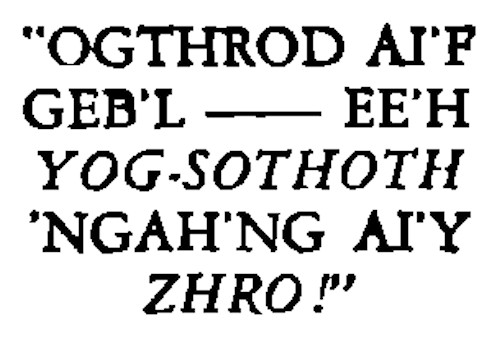
At the very first word from Willett's mouth the previously commenced
formula of the patient stopped short. Unable to speak, the monster
made wild motions with his arms until they too were arrested. When the
awful name of Yog-Sothoth was uttered, the hideous change began.
It was not merely a dissolution, but rather a transformation or
recapitulation; and Willett shut his eyes lest he faint before the
rest of the incantation could be pronounced.
But he did not faint, and that man of unholy centuries and forbidden
secrets never troubled the world again. The madness out of time had
subsided, and the case of Charles Dexter Ward was closed. Opening his
eyes before staggering out of that room of horror, Dr. Willett saw that
what he had kept in memory had not been kept amiss. There had, as he
had predicted, been no need for acids. For like his accursed picture
a year before, Joseph Curwen now lay scattered on the floor as a thin
coating of fine bluish-gray dust.