THE CARTER GIRLS’ MYSTERIOUS NEIGHBORS
By NELL SPEED
Author of
“The Molly Brown Series,” “The Tucker
Twins Series,” etc.

A. L. BURT COMPANY
Publishers New York
Printed in U. S. A.
Copyright, 1931
BY
HURST & COMPANY
MADE IN U. S. A.
Whole book · 26 sections
By NELL SPEED
Author of
“The Molly Brown Series,” “The Tucker
Twins Series,” etc.
A. L. BURT COMPANY
Publishers New York
Printed in U. S. A.
Copyright, 1931
BY
HURST & COMPANY
MADE IN U. S. A.
| I. | En Route to the Farm | 7 |
| II. | The Landladies and a New Acquaintance | 19 |
| III. | The Count | 38 |
| IV. | Grantly | 56 |
| V. | Valhalla | 63 |
| VI. | Chloe | 76 |
| VII. | Bobby’s Blame Pay | 90 |
| VIII. | Saturday | 107 |
| IX. | Goldilocks’ Chairs | 118 |
| X. | November | 133 |
| XI. | Paradise | 153 |
| XII. | Herz | 167 |
| XIII. | Goose Stepping | 189 |
| XIV. | An Eighteenth Birthday | 197 |
| XV. | Black Socialism | 211 |
| XVI. | Dressing for the Ball | 221 |
| XVII. | The Ball | 231 |
| XVIII. | Angel’s Food | 247 |
| XIX. | A Little Learning | 255 |
| XX. | In the Meantime | 262 |
| XXI. | The Flaming Sword | 272 |
| XXII. | A Neat Trick | 287 |
| XXIII. | Visitors at Preston | 294 |
| XXIV. | The Carrier Pigeon | 308 |
“How I hate being poor!” exclaimed Helen Carter, looking ruefully at her darned glove.
“Me, too!” echoed the younger sister, Lucy.
“Shh! Father will hear you,” admonished Douglas.
“Nobody can hear above the rattle of this horrid old day coach,” declared Helen. “There is something about the odor of a common coach that has spent its life hauling commuters from home to work—from work to home, that sickens me,” and Helen’s sensitive nostrils quivered in disgust.
“I’m sorry, dear; I know it is all so hard on you,” said Douglas.
“Not a bit harder on me than it is on you.”
“Not a bit!” from Lucy.
“I think it must be,” smiled Douglas. “I have an idea Nature did not intend me to ride in Pullmans. I am really just as comfortable in a day coach and I think they are lots more airy and better ventilated. What do you think about it, Nan?”
“Oh, I like ’em—such interesting types,” drawled Nan. “You get to your destination sooner, too, as the Pullman is always hitched onto the back end of the train.”
“I can’t see anything very interesting in commuters, I must say,” laughed Helen, “but Nan was always easy to please.”
“Yes, Nan is our philosopher,” said Douglas.
“Well, since Lucy and I are to join the army of commuters it would be foolish of us not to find them interesting. Don’t you remember Mrs. Doasyouwouldbedoneby? If we find them interesting maybe they will return the compliment.”
“Yes, and I remember Mrs. Bedonebyasyoudid, too,” declared Douglas, exchanging a sly glance with Helen.
The two older sisters could not help seeing that a nice looking boy sitting across the aisle had already found something to interest him in the dreamy brown eyes of one courageous commuter to be. His own grey eyes were twinkling with merriment. Evidently the rattle of the despised coach had not drowned the conversation so far as he was concerned. He had made some pretense of studying, but Latin Comp. was deadly dull in comparison with the chatter of the Carter girls.
The Carters were en route to their winter quarters, chosen after much discussion and misgivings as the best place they could find for all concerned. The doctor had pronounced the ultimatum: Mr. Carter must be in the country for another year at least and he must have no business worries. He must live out-of-doors as much as possible and no matter how perplexing the problems that in the natural course of events would arise in a household, they were not to be brought to the master of that household. As Mrs. Carter had determined many weeks before to play the rôle of a lily of the field, announcing herself as a semi-invalid, who was to be loved and cherished and waited on but not to be worried, it meant that Douglas, as oldest child, must be mother and father as well. Hers was the thankless task of telling her sisters what they must and must not do, and curbing the extravagance that would break out now and then in spots. Small wonder that it was the case, as, up to a few months before this, lavish expenditure had been the rule in the Carter family rather than the exception.
They had spent a wonderful summer running a week-end boarding camp on the side of a mountain in Albemarle County. It had been a remarkable thing for these young girls to have undertaken and accomplished, all untrained as they were. But when their father’s nervous breakdown came and the realization that there was no more money in the family till, and none likely to be there unless they could earn it, right manfully they put their young shoulders to the wheel and with a long push and a strong push and a push all together they got their wagon, if not hitched to a star, at least moving along the highroad of life and making some progress.
Dr. George Wright, the nerve specialist who had undertaken Mr. Carter’s cure, had been invaluable in their search for the proper place in which to spend the winter, this winter that was to put the keystone in their father’s recovery. Such a place was not easy to find, as it must be near enough to Richmond for Nan and Lucy to go to school. That was one time when Douglas put her foot down most emphatically. The two younger girls were quite willing to follow in their sister Helen’s footsteps and “quiturate,” but Douglas knew that they must be held to their tasks. She bitterly regretted her own inability to continue her education, as college had been her dream, and she also deplored the fact that Helen was not able to spend the one more year at school necessary for her graduation. As for Helen, not having to go to school was the one bright spot for her in the whole sordid business, at least she had boldly declared such was the case.
The winter was to be a busy one for Helen, as the home work was to fall to her share. Douglas, by a great piece of good luck, had obtained a place as teacher in a district school not far from the little farm that had been selected as the abiding place for the Carter family during that winter of 1916 and ’17. The teacher who had been employed had been called away by private affairs, and Douglas had fallen heir to the position.
The train rocked and swayed and bumped on the illy-laid road-bed as our girls sped on to their destination. Mrs. Carter in a seat across the aisle had placed her tired head on her husband’s shoulder. The poor little lady felt in her heart of hearts that all of this going to out-of-the-way country places to spend winter months was really absurd, but then it was absurd to be poor anyhow, something she had not bargained for in her scheme of existence. She had said not a word, however, but had let Douglas and that stern Dr. Wright manage everything. She felt about as capable of changing the plans of her family as her youngest child, Bobby, might.
Bobby, who had spent the time on the train most advantageously, having made friends with the brakeman and conductor, was now sitting in an alert attitude, as his new friends had informed him that there were only five minutes more before they would reach Grantly, their destination. Going to the country was just what he wanted and he was preparing to have a glorious time with no restrictions as to clean face and hands. To be sure, he had heard that he was to go to school, but since Douglas was to be the teacher this fact was not disturbing him much.
The summer in the mountains had done much to develop this darling of the Carters. He no longer looked so much like an angel as when we were first introduced to the family. His curls were close cropped now and he was losing teeth faster than he was gaining them. If there could be such a thing as a snaggled tooth angel perhaps that celestial being would resemble Bobby Carter; but I am sure if that angel could have thought up as much mischief in a week as Bobby could execute in an hour, he would have met the fate of Lucifer and been hurled from Heaven. It may be, though, that if Lucifer had possessed such eyes as this little boy he would have been forgiven and might still be in his happy home. It was an impossibility to harbor wrath against Bobby if once you looked in his eyes. They were like brown forest pools. His sister Nan had the same eyes and the same long curling lashes. The shape and color of their eyes were inherited from their beautiful little mother, but the soulful expression that the children possessed was something that came from within and is not controlled by laws of heredity. Mrs. Carter’s eyes if they reminded one of forest pools were certainly very shallow pools.
“At last!” as the brakeman called out their station, came with a sigh of relief from the whole family.
The station consisted of a platform and a little three-sided shed designed to shield the traveler from the weather, if the weather did not happen to arrive on the unprotected fourth side.
“They promised to meet us,” said Douglas as she collected parcels and umbrellas, “but I don’t see a sign of them.”
“Maybe they are on the other side,” suggested the hopeful Nan, peering through the window.
They weren’t, however, nor anywhere in sight. Douglas and Helen looked at each other askance. The two older girls were the only ones in the family who had seen their future abode and they felt very responsible. This hitch of not being met was most disconcerting. They had felt if everything went off smoothly and well their choice of a home would be smiled upon. First, the day they moved must be good, and this day in October was surely perfect. The packing must be done without bustle and confusion, and that had been accomplished. They must have a good luncheon before leaving Richmond, and Miss Elizabeth Somerville, who had invited them to her house, had feasted her cousins most royally, sending them forth with well-nourished bodies and peaceful minds in consequence. This was the first obstacle to their carefully laid plans. They were to learn that no plan depending in any particular on the coöperation of their landladies, the Misses Grant, would go through safely.
Miss Ella and Miss Louise Grant were joint owners of the small farm that the glib real estate agent had persuaded Dr. Wright and our girls was the one and only place in which the winter could be comfortably spent.
“Excellent air and water; close to schools and churches; neighborhood as good as to be found in Virginia, and what more could be said? House one of the old landmarks of the county; the view from the front porch quite a famous one; R. F. D. at yard gate; commuting distance from Richmond; roads excellent, as we have found on our way here.” They had motored out and certainly the roads had seemed very good.
The Misses Grant were all that was left of a large and at one time influential family. They lived in a great old mansion erected in the middle of what was at one time a vast estate but which had gradually shrunk through generations of mortgages until now it comprised about two thousand acres. The name of this old place was Grantly.
The farm that Helen and Douglas had rented for the year was only called a farm by courtesy, as it had in its holding only about ten acres. It had at one time been the home of the overseer of Grantly when that aristocratic estate could boast an overseer. It was too humble an abode to have a name of its own, but our girls were determined to give it a name when they found out what would suit it. Now they stood on the platform of the tiny station and said in their hearts that such a place, belonging to such unreliable persons, deserved no name at all.
“Oh, I’m so sorry they haven’t sent to meet us. They told me if I would write to them they would have a carriage and a farm wagon here,” wailed Douglas.
“Why not walk?” suggested Mr. Carter. “A quarter of a mile is nothing.”
“Oh, do let’s walk!” exclaimed Lucy. “We can just leave the luggage here and get someone to come back for it.”
“All of you can walk,” came faintly from Mrs. Carter. “Just leave me here alone. I don’t fancy anything much will happen to me.”
“But Mumsy, only a quarter of a mile!” begged Lucy.
“Why, my child, I never expect to walk more than a few blocks again as long as I live.”
Mr. Carter looked pained and ended by staying with his wife while the four girls and Bobby trooped off to find someone to send for them.
“Why does Mother say she never expects to walk more than a few blocks again as long as she lives?” blurted out Lucy. “Is she sick? She looks to me like she’s getting fat.”
“Tell her that,” suggested Nan, “and I bet you she will find she can walk a teensy little more than a few blocks.”
“This is a long quarter of a mile,” said Nan, trying to keep up with her more athletic sisters.
“The agent told us a quarter of a mile, but I reckon he meant as the crow flies. He did not allow for all the twistings and turnings of this lane,” laughed Helen.
“It is a very pretty walk, anyhow, and I’m glad we are not so close to the track because of Bobby,” said the philosophic Nan.
“Shucks! You needn’t be a-thinkin’ I can’t find my way back to that old station,” said that young hopeful. “I wisht it was barefoot time and I would wade in that branch.”
They were crossing a pretty little stream that intersected the road. Of course Bobby took occasion to slip off the stepping-stones and get his foot wet.
“S’long as one is wet I reckon I might as well get th’ other one wet, too,” and he stepped boldly into the stream. “Sqush! Sqush! Ain’t this a grand and glorious feeling?”
“Oh, Bobby!” chorused his sisters.
“’Tain’t gonter make no diffunce! My ’ployer says sech things as this toughen kids.”
Bobby always called Dr. Wright his employer, as it had been his habit to go with that young physician while he was making his professional calls, his duties being to hold out his arm when they were turning corners or preparing to stop; and to sit in the car and guard his ’ployer’s property from the depredations of hoodlums and micks.
“I don’t think some kids need toughening,” said Nan, trying to look severe.
“Yes’n I gotter joke on you, too! They was a pretty near grown-up boy on the train wanted to know what yo’ name was. I was jawin’ the inductor an’ the boy comed and plunked hissef down by me an’ he axed me what was my name and where I was a-gointer, an’ was all’n you my aunts or what. He was so busy a-findin’ out he come near a-missing his gettin’ off place. He lives jus’ befo’ our gettin’ off place.”
“Oh, that must have been the good-looking boy sitting opposite us, just behind Mother and Father! You noticed him, Douglas, didn’t you?” asked Helen.
“Well, he wasn’t a-noticin’ you much,” proceeded the enfant terrible. “He wanted mostly to know what was Nan’s name an’ where she went to school.”
“Surely you didn’t tell him!” blushed Nan.
“Sho’ nix! I told him yo’ name was Lizajane an’ you was a-clerkin’ in the five an’ ten.”
“Oh, Bobby!”
Nobody could help laughing at the saucy youngster, and his sisters were ever inclined to find him amusing and altogether delightful in spite of his outrageousness. Their laughter rang out clear and infectious. First they laughed at Bobby and then they laughed for the pure joy of laughing. Douglas forgot her burdens and responsibilities; Helen forgot how she hated to be poor; Nan forgot that the quarter of a mile she was going to have to trudge twice a day to join the army of commuters was much nearer half a mile and she was not a very energetic girl; Lucy had nothing to forget or regret, being only thirteen with a perfect digestion. For the moment all of them forgot the nerve-worn father and the hypochondriacal mother waiting so forlornly at the station with the luggage piled so hopelessly at one end.
In the midst of their gale of laughter they heard the hum of a motor and the toot of a horn. A large touring car came swerving around the curve in the road.
“That’s him now!” cried the delighted Bobby.
It was no other than the boy on the train. He stopped his car and with crimson face began to stammer forth unintelligible words.
“Excuse me!—but—that is a—you see I—— Oh, hang it all! er—my name is William—Will—Billy Sutton.”
“Oh, he’s plum nutty an’ thinks he’s Billy Sunday—Billy Nut Sunday!” and Bobby danced gleefully in his squshy shoes.
“Bobby! Behave yourself!” said Douglas, trying to swallow the laugh she was in the midst of.
“We was jes’ a-talkin’ about you,” said Bobby, with his most disarming smile.
“About me?” and the young fellow choked his engine.
“Yes, I was a-tellin’——”
But here Helen took her little brother in hand. Helen could usually manage him better than any of the others. She whispered some mysterious something to him which quickly sobered him.
“I don’t want you to think I am impertinent or interfering, but your little brother told me on the train coming out that your mother and father were both ill——”
“Yes, I told him they were likely to die mos’ any time.”
“And I heard at the post-office at Preston, where I live, that you have rented the farm from the Misses Grant; also that those ladies were not expecting you until tomorrow——”
“But I wrote we would be there today, Wednesday!” exclaimed Douglas.
“That doesn’t make a bit of difference to Miss Ella and Miss Louise Grant,” laughed the boy. “They never get anything straight because they discuss every subject so thoroughly that they are all mixed up before they get through. Anyhow, they did not meet you, and if you don’t think I am pushing or forward or something——”
“Butinsky!” suggested Bobby, but Helen slipped her hand over his pert little mouth.
“Thank you for that word—butinsky—why, I should like the privilege of going after your mother and father and bringing all the luggage my car will hold.”
“Oh, you are too kind!” chorused the girls.
“Let me take all of you first to the farm.”
“We must go by Grantly to let the ladies know we are here,” suggested Douglas.
“They are both of them at the farm. I saw them as I came by.”
“Did you tell them we had come?”
“No! They were sure to let me know it was none of my business, and, as I was fully aware of the fact, I just drove on by, hoping to be of more service to you in this way.”
The girls and Bobby piled into the car assisted by the boy, who handed them in with pleasing gallantry. By adroit manœuvering he managed to get Nan in front, although the irrepressible did squeeze in, too.
“I must sit in front so I can poke out my arm. Maybe you is huntin’ a shover. I’m Dr. Wright’s shover in town an’ up’n the mountings. He don’t mind my having two jobs in off times when he ain’t a-needin’ me.”
“Well, then, I’ll employ you right now,” said Billy Sutton, solemnly.
“I think maybe it is in order for us to introduce ourselves,” said Douglas. “This is Helen Carter; and this, Nan; and this, Lucy; I am Douglas; and Bobby has already been noticed enough.”
Hands were shaken and then they started gaily off.
“It seems a long quarter of a mile from the station to the farm, but maybe it is because I am lazy,” said Nan, who was unfeignedly glad of a lift.
“Who said it was only a quarter of a mile? It is exactly three quarters.”
Two minutes brought them to the farm gate, where Billy deposited the occupants of the back seat. It was decided that Nan and Bobby were to go on to the station with their new friend and benefactor and explain him to Mr. and Mrs. Carter.
“Oh, Douglas, isn’t the place sweet? Lucy, don’t you like it?” asked Helen as they opened the big gate that led from the road into the lawn of their new abode.
“Great! It looks so romantical.”
“I was so afraid it wasn’t going to be as nice as we thought it was because the real estate agent was so glib and rattled on so he confused us. I was afraid he had hypnotized us into liking it. But it is lovely,” and Douglas breathed a great sigh of relief.
Indeed it was lovely; lovelier, I fancy, than the real estate agent dreamed. The lawn was spacious, with soft rolling contours and a few great trees, some of them centuries old. In the front a mighty oak stood guard at one corner and an elm at another. Nearer the house a straight young ash and a willow oak divided the honors. At one side of the quaint old house a great mock orange had established a precedent for mock oranges and grown into a tree, just to show what a mock orange is capable of when not confined to the limitations of a hedge. Its trunk was gnarled and twisted and because of careful pruning of lower branches it had grown like a huge umbrella with limbs curving out from the parent stem and almost touching the ground all around.
“What a grand place to play house and tell secrets!” thought Lucy, regretting that thirteen years old, almost fourteen, was too great an age to indulge in dolly tea parties.
A grove of gum trees glorified the back yard with their brilliant October foliage. There never was such a red as the gum tree boasts and these huge specimens were one blaze of color. The trunks had taken on a hoary tone that contrasted pleasantly with the warm tints of the leaves.
The yard contained about four acres enclosed by a fence that had been covered entirely by honeysuckle, and even then a few blossoms were making the air fragrant. In the back there were several rather tumble-down outhouses, but these, too, were covered with honeysuckle as though by a mantle of charity.
The house had been added to from time to time as the race of overseers had felt the need. These additions had been made with no thought of congruity or ornamentation, but since utility had been the ruling thought the outcome was on the whole rather artistic. The original house, built in the first years of the nineteenth century, had a basement dining-room, a large chamber over this and two small, low-ceilinged attic rooms. Later a shed room had been built at one side in the back, then a two-story addition had reared itself next to that with no apparent connection with the main house, not even a family resemblance. This two-storied “lean-to” was known always as “the new house,” although it had been in existence some threescore years. There were two rooms and two halls in this addition and it had a front porch all its own. The old house also boasted a front porch, with a floor of unplaned boards and posts of rough cedar. But who minds cedar pillars when Washington’s bower has done its best to cover them up? As for unplaned boards with cracks between: what a good place to sweep the dirt!
The green blinds were open all over the house and windows were raised. As our girls stood on the lawn drinking in the beauty and peace of the scene they heard loud and angry voices proceeding from the basement window.
“Louise Grant, you are certainly foolish! Didn’t I tell you they wouldn’t be coming down here yesterday? Here you have littered up this place with flowers and they will all be faded by tomorrow. I have told you a million times I read the letter that Douglas Carter wrote and she said distinctly she was coming on Thursday.” This in a loud, high, commanding tone as though the speaker was determined to be heard. “You needn’t put your hands over your ears! I know you can hear me!”
“That’s all right, Ella Grant,” came in full contralto notes; “just because they didn’t come yesterday is no sign they did not say they were coming that day. I read the note, too, and if you hadn’t have been so quick to burn it I guess I could prove it. Those flowers are not doing anybody any harm and I know one thing—they smell a sight better than that old carbolic you are so fond of sprinkling around.”
“I thought I heard the three train stop at the crossing,” broke in the high, hard voice.
“No such thing! I noticed particularly.”
“Nonsense! You were so busy watching that Sutton boy racing by in his car that you didn’t even know it was train time. What John Sutton means by letting that boy drive that car I can’t see. He isn’t more than fourteen——”
“Fourteen! Ella Grant, you have lost your senses! He is twenty, if he is a day. I remember perfectly well that he was born during the Spanish war.”
“Certainly! That was just fourteen years ago.”
The girls couldn’t help laughing. It happened that it was eighteen years since the Spanish war, as our history scholar, Lucy, had just learned. That seemed to be the way the sisters hit the mark: one shooting far in front, one far behind.
“We had better knock,” whispered Helen, “or they will begin to break up the china soon.”
She accordingly beat a rat-tat on the open front door of the old house.
“Someone is knocking!” exclaimed the contralto.
“Not at all! It’s a woodpecker,” put in the treble.
One more application of Helen’s knuckles and treble was convinced.
“That time it was a knock,” she conceded.
There was a hurrying and scurrying, a sound of altercation on the stairs leading from the basement to the front hall.
“Why do you try to go first? You know perfectly well I can go faster than you can, and here you have started up the steps and I can’t get by. You fat——”
“If you can go so much faster, why didn’t you start up the steps first?” panted the contralto.
“Don’t talk or you’ll never get up the steps! Save your wind for climbing.”
The bulky form of Miss Louise hove in sight and over her shoulder the girls could see the stern countenance of her long, slim sister. How could two such different looking persons be born of one mother? Miss Louise was all breadth and no height; Miss Ella, all height and no breadth. Miss Louise was dark of complexion, with coal-black hair streaked with grey; Miss Ella was a strawberry blonde with sandy hair streaked with grey. Age that brought the grey hair seemed about the only thing they had in common, except, of course, the estate of Grantly. That had been willed to them by their father with a grim humor, as he must have been well aware of their idiosyncrasies. They were to hold the property together with no division, the one who survived to inherit the whole.
“Well!” said Miss Ella over the shoulder of her sister, who refused to give her right of way but who was silenced for the moment by shortness of breath. “Why did you come today when you wrote you were coming to-morrow?”
“I did not write I was coming tomorrow,” said Douglas, smiling in spite of herself.
“There! What did I tell you?” panted Miss Louise. “You said Tuesday, didn’t you, honey?” with ingratiating sweetness.
“No, Miss Grant, I said Wednesday.”
The incident was closed. The wrangling sisters had no more to say on the subject except to apologize for not having them met. It was explained that Billy Sutton had gone to get Mr. and Mrs. Carter, but the trunks must be sent for. Quite humbly Miss Ella went to get her farmhand to hitch up the mules to drive to the station, while Miss Louise showed the girls over the house.
Everything was in beautiful order and shining with cleanliness. The white pine floors were scrubbed until they reminded the girls of biscuit boards, and very lovely did the bright rag rugs look on these floors. The furniture was very plain with the exception of an occasional bit of fine old mahogany. A beautiful old highboy was not too proud to stay in the same room with a cheap oak dresser, and in the basement dining-room a handsome mahogany table democratically mingled with split-bottom chairs.
Miss Louise had put flowers everywhere for their reception the day before and the whole house was redolent of late roses and mignonette and citronella. An occasional whiff of carbolic acid and chloride of lime gave evidence of the indomitable practicality of Miss Ella.
Miss Louise proved very sweet and kindly when not in her sister’s presence and later on the girls found Miss Ella to be really very agreeable. Both ladies seemed to be bent on showing kindness and consideration to their tenants to make up for the mistake about their day of arrival.
Mr. and Mrs. Carter could not help thinking that the place their daughters had chosen for them to spend the winter was pretty. As they rolled up in Billy’s car the quaint house and beautiful lawn certainly presented a most pleasing aspect, and their handsome daughters were an added loveliness to the landscape as they hurried to meet their parents.
“Ah, this is great!” exclaimed Mr. Carter, taking a deep breath of the pure fresh air. “I think I shall have to have a cow and some pigs and do some fall plowing besides. Eh, Helen? You and I are to be the stay-at-homes. What do you think?”
“I think what you think, Daddy,” answered Helen, smiling happily over her father’s show of enthusiasm. Dr. Wright had told her that with returning healthy nerves would come the enthusiasm that before his illness had seemed to be part of Robert Carter’s make-up.
“How do you like it, Mumsy?” asked Douglas as she drew her arm through her mother’s.
“Very nice, I am sure, but I think it would be wiser for me to go to bed now. I am not very strong and if I can give up before I drop it would be less trouble for my family,” and Mrs. Carter took on a most plaintive accent. “A little tea and toast will be all I want for my supper.”
“Oh now, it will be too bad for you to go to bed,” said Miss Ella. “We were planning to have all of you come up to Grantly for supper.”
She and Miss Louise seemed to have agreed for once on the propriety of having their tenants to supper.
“The count is coming,” said Miss Louise, with a sentimental note in her full voice.
“The count! Who is the count?” asked Mrs. Carter with some show of animation and interest.
“He is a nobleman who has settled in our neighborhood,” said Miss Ella in a matter-of-fact tone, as though noblemen were the rule rather than the exception in her life.
“Maybe it would be possible for me to take a short rest and come to Grantly,” said Mrs. Carter, with a quickening in her pretty eyes.
At mention of the count, Billy Sutton pretended to be much occupied with his engine, but Nan noticed a slight curl on his lip as he bent over the wheel.
“Isn’t it fine not to have to bother about supper?” said Helen, as she and Douglas were attempting to get some order out of the chaos of trunks that had been brought from the station and systematically put in the wrong place by the good-natured, shambling, inefficient darky who served as factotum to the Misses Grant.
Helen and Douglas had decided to take one attic room in the old house for their bedroom; Bobby was to have the other; the large chamber below them was to serve as family sitting-room; Nan and Lucy were to have the upstairs room in the new house; Mr. and Mrs. Carter the lower room; the shed room was to serve as guest chamber when needed; the dining-room was in the basement. Over the outside kitchen was another extremely low attic room that was to be the servant’s bedroom, when they got her. This room was accessible from the kitchen by a flight of primitive chicken steps, that is, accessible to the young and agile.
The two servants the Carters had had at the week-end camp had been eager to come with them to the country, but Douglas and Helen had decided that they were expensive luxuries, and as much as they hated to part with them, had determined to have a country girl, accustomed to less wages than Susan, and to do without a manservant in place of the faithful, if high-priced, Oscar. Dr. Wright had insisted that some chores were indispensable for Mr. Carter, such as chopping wood, carrying water, etc., and that gentleman was eager to assist wherever he could.
“Surely you are not going to dress up to go out to supper this evening,” said Douglas, as Helen shook out a pretty little old-rose dinner gown, a leftover from the time when the Carters purchased clothes for every occasion and for every passing style and season.
“I am going to dress suitably, but I don’t call it dressing up,” said Helen, hunting for the stockings to match the gown. “I think Father is well enough for me to wear silk stockings this evening,” she said a little wistfully. We all remember that in the first throes of agony over her father’s nervous breakdown Helen had taken an oath not to wear silk stockings until he was well. “What do you think, Douglas?”
“Of course, you goose, just so you don’t have to buy the stockings,” laughed Douglas. “I am going to wear what I have on, I can tell you that. There is a lot to do to get the beds made up and the house ready to sleep in, and I have no idea of unpacking my own trunk until tomorrow,” and Douglas unlocked the trunk that held the bed linen.
“Oh, Douglas, please put on your grey crêpe de chine! I’ll get it out for you and find your stockings and everything,” begged Helen. “I don’t think it is very respectful to our hostesses for you not to be suitably dressed.”
“Is it altogether our hostesses you are thinking about?” teased Douglas.
“Whom else should I consider?”
“How about the count?”
“Well, naturally I can’t help thinking some about a nobleman,” declared Helen frankly. “Do you fancy he is young or old, rich or poor, handsome or ugly? I am wild to see him.”
“I can’t imagine. They didn’t even say what he was a count of. I hope he is not German. I must say I’d hate to put on my best dress for a German count,” laughed Douglas.
“Why, Douglas, I wouldn’t be so biased as all that. As long as our country is neutral, I don’t think it is fair for us to take such a stand. I’d rather dress up for a German count than—than—a Russian anarchist or maybe an Australian Bushman.”
“Well, I am not pining to dress up for anybody, but if I must, I must. How about Mumsy?”
“She has already got out her black lace and is going to wear her pearls. She is trying to persuade Father into his tuxedo but I fancy he will rebel.”
“Mercy on us! I thought we would never have to dress in this out-of-the-way spot,” sighed Douglas.
“Well, I for one am glad to have a chance to dress. It seems to me we have been khakied to death all summer, and I believe people deteriorate when they stay in the same old clothes year in and year out. I could wish my old-rose had another width in it. Skirts are much broader this fall. The sleeves are quite right, though,—sleeves haven’t changed much.”
Poor Helen! It was a keen misery to her not to be in the latest style. She had a natural taste for dress and the tendency to overrate the importance of clothes had been fostered in her by her frivolous mother. Douglas, on the other hand, had a tendency to underrate the value of dress and her inclination was to be rather careless of her attire.
After much scrabbling and stirring up of trunks the whole family was dressed in what Mrs. Carter and Helen considered suitable garments, with the exception of Mr. Carter, who could not be coerced into a dinner coat.
“I can’t think that a quiet supper in the country with two old ladies who are renting us the overseer’s cottage could possibly call for formal dressing. Of course, you women know best what you want to wear, and very handsome all of you look I am sure, but you must excuse me.”
“That’s what I say!” exclaimed Bobby, putting his hands in his pockets and trying to balance himself with his feet very far apart. “Me’n Father certainly do nachelly hate clean clothes. When I gits to be growed up, I’m gonter be a barefoot tramp an’ ain’t never gonter wash nor nothin’.” Bobby was still smarting and indignant from the polishing Helen had seemed to think the occasion demanded, especially concentrating on his long-suffering ears.
“Sometimes I wisht I hadn’t never had my curls cut off. Folks weren’t near so ’ticular ’bout my yers when I had curls. They kinder hid ’em.”
“But, Bobby, when you are going to have supper with a count you must be very carefully dressed,” explained Lucy. “Counts are not just common persons like us.”
“I thank you I’m no common person,” drawled Nan. “I’m a good American and fit to dine with any count living. That’s the way Douglas and I feel. We wouldn’t have changed our dresses if Mother and Helen hadn’t made such a point of it.”
“Good for you, Nan!” and her father put his arm around her. “Of course you must dress as your mother sees fit, but don’t, for goodness’ sake, think a man, because he is a count or even a king, must be treated differently from any other gentleman of your acquaintance.”
They were on their way to Grantly, only about five minutes’ walk from the farmhouse. The sun had set in a blaze of glory but already the great October moon was doing her best to take his place. There was a hint of frost in the air and our Carters were bringing their appetites with them to grace the board of their hospitable landladies.
“I do hope Miss Ella and Miss Louise won’t quarrel all the time,” whispered Helen as they approached the imposing mansion.
“They remind me of the blue and white seidlitz powders,” said Douglas: “bound to sizzle when you mix ’em. They are so mild and gentle when they are apart and the minute they get together—whiz!”
Mrs. Carter cast a triumphant glance at her husband as they entered the parlor at Grantly. The Misses Grant were dressed in rustling black silk with old lace berthas and cuffs, and the gentleman who sprang to his feet, bringing his heels together with a click as he bowed low, was attired in a faultlessly fitting dress suit.
Helen’s questions were answered by one glance at this distinguished stranger; certainly he was young and handsome; the chances were that he was also not poor. That cut of dress suit did not go with poverty, nor did the exquisite fineness of his linen. Douglas’s question of his nationality remained to be solved. “Count de Lestis” did not give the girls a clue to the country from which this interesting person hailed.
“He does not look German,” Douglas said to herself. “He is too dark and too graceful.”
She breathed a sigh of relief that her grey crêpe de chine had not been donned in honor of a German, count or no count. When she saw that the Misses Grant evidently considered their suppers worthy to be dressed up for, she was glad she had listened to the dictates of Helen.
That young lady was looking especially charming in the old-rose gown, in spite of the fact that the skirt did not flare quite enough. Helen had a way of wearing her clothes and of arranging her hair that many a dame at Palm Beach or Newport would have given her fortune to possess.
Mrs. Carter always was at her best in a parlor and now her beauty shone resplendent, framed in black lace and pearls. Her gracious manner and bearing marked her as one whose natural place was in society. Her gift was social and it did seem a great waste that such a talent should have to be buried under the bushel of an overseer’s cottage in an out-of-the-way spot in the country, with a once prosperous husband to do the chores and a maid-of-all-work, chosen because of her cheapness and not her worth.
The Misses Grant smiled their approval over the appearance of their guests. The fact that they were two quarrelsome old sisters farming on a dwindling estate did not lessen their importance in their own eyes, and they always felt that the dignity of Grantly demanded ceremonial dressing for the evening meal.
The sisters showed no marks of having toiled through the entire afternoon to prepare the feast that they were to set before their guests. Disagreeing as they did on every subject, food was not exempt. If Miss Ella decided to make an angel’s food cake, Miss Louise must make a devil’s food cake; if one thought the whites of eggs left from the frozen custard would be well to use in a silver cake, the other simultaneously determined to have apple float, requiring whites of eggs, and then the yolks must be converted into golden cake. The consequence was that their supper table groaned with opposing dishes. Each one pressed upon the guests her own specialty, and if it so happened that Miss Ella had to serve some dish of Miss Louise’s concocting, she would do it with a deprecating air as though she were helping you to cold poison; and if Miss Louise perforce must hand you one of Miss Ella’s muffins, she would shake her head mysteriously as though to warn you against them.
One thing was apparent from the beginning and that was that the count was a good mixer. His English was perfect, except for an occasional suggestion of an interchange of b and p, and also a too great stress on his s. He was a brilliant conversationalist but had the wit not to be a monologueist. He had done much traveling for a man under thirty and had lived in so many places that it made him a real citizen of the world. Evidently he had the Misses Grant charmed. From the moment that he bought Weston, a fine old estate in the neighborhood, and came into their county to settle, the old ladies had taken him to their hearts. They seemed in danger of agreeing on the subject of this fascinating young man’s charms. However, they found something to quarrel about even in this stranger: Miss Ella thought his mouth was his best feature, while Miss Louise insisted that his eyes were.
Of course the Carters were one and all dying to know more about him: Who was he? What was his nationality? Why had he settled in America? Where were his people? Did he have a family?
He seemed to be equally curious about them. Why should city people of such breeding and beauty come and live in a little tumbledown shack in the country? He had merely been told by the Misses Grant that the tenants who had just moved into the little farmhouse were to have supper with them, when these visions of loveliness burst upon him. He couldn’t decide which one of the sisters was the most attractive. Douglas was the most beautiful with her titian hair and clear complexion, not ruined by the summer out-of-doors as her mother had feared. But Helen—there was a piquancy about Helen that was certainly very fetching; her brown hair was so beautifully arranged at exactly the right and becoming angle; her little head was so gracefully set on her athletic shoulders; her bearing was so gallant;—certainly Helen was very attractive. Then there was Nan with her soft loveliness, her great eyes now shining with excitement and now dreaming some entrancing dream. She was only sixteen but there was something about her countenance that gave promise of great cleverness. Lucy was growing more like Helen and much of Helen’s charm was hers, although the child had strong characteristics all her own.
While Count de Lestis was deciding which one of the sisters was most attractive, he did the extremely tactful and suitable thing of addressing his remarks to their mother, not forgetting to give the hostesses a full share of attention. Mr. Carter, who since his illness had been inclined to be very quiet, was drawn into the conversation and held his own with his old time power. Little wonder that his daughters were grateful to this interesting stranger who had this effect on their beloved father.
The young man told them he was Hungarian and had bought the estate of Weston with a view to entering into intensive farming.
“Then you are not Prussian!” exclaimed Douglas. “Oh, I am so glad!”
“Ah!” and his handsome eyes flashed for a moment. Then he looked amused. “And why are you so glad?”
“Why, of course anyone would be glad,” and Douglas blushed. “Who would want to have a Prussian for a neighbor?”
“Do you dislike them so much then?”
“I hate them!”
“And you, too?” turning to Helen.
“I am trying to remain neutral as our president has asked us to. I don’t feel so terribly Anglo-Saxon as my sister.”
Of course this started the question of the war, which was in the minds of everybody. Count de Lestis rather surprised Mr. Carter by his frank announcement concerning his connection with Berlin.
“I, no doubt, would be fighting with the Central Powers if I had not committed political suicide four years ago.”
“And how was that?”
“I wrote a book in which I made a plea for a democratization of Austria-Hungary. In it I intimated that the Hohenzollerns had no right to dictate to the universe. I was requested to leave the country. I was then living in Vienna, making short trips to my estate, which lies partly in Austria and partly in Hungary. Now there is danger of my entire possessions being confiscated.”
“Oh, but when Germany is finally whipped you can come into your own again,” asserted Douglas. “The outcome is merely a matter of time.”
“And so Germany is to be whipped?” his eyes flashing again.
“Of course,” said Douglas simply.
“And why of course?”
“‘Because God’s in his Heaven,’” whispered Nan, but the count heard her.
“Yes, but whose God?”
“The God of Justice and of Right.”
“How about the God of Might?”
“There is no such God,” and this time Douglas’s eyes did some flashing.
“I believe the United States will intervene before so very long,” said Mr. Carter as he and the count strolled out on the veranda to enjoy their cigars. The older man was enjoying his talk with this young foreigner. He looked forward with pleasure to seeing much of him, since Weston was only about three miles from the farm. They made plans to do some shooting together, as the open season was only a week off.
When de Lestis learned that Mr. Carter was an architect he asked him to visit him at his earliest convenience at Weston to advise with him concerning the restoration of the old house to its original grandeur.
“I’m not supposed to be doing any work for at least a year,” sighed Mr. Carter, “but I might look it over and tell you what I think and then recommend a suitable architect to take it in hand.”
Douglas and Helen had a talk with Miss Louise on the subject of a country girl to come to them as maid of all work.
“They are all of them thoroughly trifling,” declared that lady in her soft round voice, “but this creature we have has a sister who could come to you. I beg of you not to give her any more wages than ours receives, as in that case we should have to go up.”
“Certainly not,” said Douglas. “Just tell us what that is.” But on learning that it was only seven dollars a month, the girls felt that it was no wonder the creatures were thoroughly trifling.
“Did she cook this wonderful supper?” asked Helen.
“No, indeed! Ella and I always cook everything we eat and this Tempy washes the dishes and cleans.”
“But we want someone to cook. Do you think I might train the sister?”
“Well, I have heard you can train monkeys but I have never seen it done,” laughed the fat old lady. “Come with me now and we can speak to Tempy about her sister Chloe.”
They found Tempy in the pantry, peacefully sleeping in the midst of the unwashed dishes. Not in the least abashed at being caught napping, she waked up and told Helen that no doubt Chloe would be pleased fur ter come. She promised to fetch her on the morrow.
“I will pay her just what the Misses Grant pay you,” said Helen.
“Lawsamussy, missy, she ain’t wuth what I is. She ain’t nebber wucked out ter say much. I done started at six and wucked up ter seben, an’ if Chloe gits now what I gits, she’ll be too proudified. You jis’ start her at six same as Miss Ellanlouise done me.”
Since our girls were to become quite intimate with the peculiar old sisters and their home, perhaps it would be just as well for me to give my readers some idea of what Grantly was like.
The first thing that struck a visitor was the wonderful box bushes in the hedge enclosing the yard and in a labyrinth in the garden. These bushes were so thick that one could really walk on the tops of them if they were kept clipped, which they were not. In the labyrinth the bushes met overhead and even after a heavy rain the paths between were perfectly dry. It took days of soaking rain to make those winding paths wet. Beyond the labyrinth was an old-fashioned garden, but now in October chrysanthemums and late roses and cosmos were all that was left of the riot of color that could be seen there during the spring and summer.
The house was of a very peculiar architectural design: a long, low body with a tower at each end. In each tower was a square room with many windows overlooking the country for miles around. Miss Ella claimed one of these rooms as her own especial property; Miss Louise the other. To approach Miss Ella’s sanctum sanctorum it was necessary to climb a narrow spiral stairway; Miss Louise’s was more accessible by reason of a broad stairway of many landings, but the ceilings at the landings were so low that anyone of ordinary stature must stoop to ascend.
These rooms were used only as sitting-rooms by the erratic sisters as, strange to say, the two old ladies slept in the same room and in the same great four-posted tester bed. There were many other bedrooms in the mansion, but they both preferred the great chamber leading from the parlor, and there they slept and no doubt quarreled in their sleep.
“This is my sitting-room up here,” said Miss Ella as she showed her guests over the quaint old house. “You may come up if you like. I had the steps made this way so Louise can’t get up here and worry my soul out of me with her eternal chatter. She’s too fat for the spiral stairway. Elephant!”
“Yes, and my sitting-room is in the other tower, and thank goodness, Ella would find it a back-breaking job to get up my steps,” retaliated Miss Louise. “Giraffe!”
Those strange old ladies had actually had the original steps to the towers changed to suit their particular grouches! They really spent very little time in their tower fastnesses, however, as they were much happier when together and quarreling.
A tale was told in the neighborhood that once Miss Ella had neglected or forgotten to contradict Miss Louise on some vital subject such as whether it was or was not going to rain, and Miss Louise was so uneasy that she sent post haste for Dr. Allison.
“I was afraid it was a stroke or something,” whimpered Miss Louise. She worried herself into a sick headache before the doctor arrived, and then the fat one had to go to bed and take the medicine and Miss Ella was forced to repent of her misbehavior by nursing her sister. Dr. Allison left strict injunctions that she was not to worry her poor sister again by agreeing with her.
Grantly was filled with fine old furniture and all kinds of curios. A great-uncle had been a traveler in the Orient and many were the teakwood cabinets and jade ornaments; curious Japanese prints; Chinese embroidered fans and screens; bronze Buddhas; rare vases with inlaid flowers and birds; Toby jugs and lacquered teapots; quaint armor, swords and daggers; everything in fact that might be found in an old house that a traveler had once called home.
“Does Tempy dust all these beautiful things?” asked Mrs. Carter, who was quite carried away by the wonders in her landladies’ home.
“Bless you, no! She doesn’t dare to touch a one of them,” laughed Miss Louise. “Ella dusts the high ones, I dust the low.” She said it quite with the air of the song:
With all of its beauties, Grantly was undergoing a process of slow decay. Lack of paint and neglected leaks were getting in their insidious work. There never seemed to be money enough for the owners to afford the needed repairs, and if there ever was any money at all, they could never come to an agreement on which repairs were the most urgent.
The overseer’s house was suffering in the same way. A kind of dry rot had attacked portions of it. Weather-boarding was so loose in places that Bobby could pull it off. Steps groaned and floors creaked; shutters had lost fastenings; putty had dropped from the window panes, which were insecurely held in place with tacks; mop-boarding and floors had parted company many years before. All of these little details had escaped the inexperienced eyes of Douglas and Helen when they decided that this was the place of all others to spend the winter. Dr. Wright, who had accompanied them, had been more noticing, but had wisely decided to say nothing, as he wanted his patient to become interested in tinkering at small jobs, and he could see that this little farm would keep Mr. Carter busy.
The ladies of Grantly had promised to have everything in order before the tenants should arrive, but disagreeing on which workman they should employ, the time had slipped by and nothing had been done.
The pump to the well had lost its sucker and had to be primed before water could be got. This meant that the person who pumped must remember to fill a can of water and leave it for the next pumper. The yard gate shut with difficulty and opened with more. The stovepipe in the kitchen had a large hole in one side and if the wind shifted, so did the smoke, seeking an outlet through the nearest aperture.
All of these disagreeable features dawned gradually on our girls. They saw nothing to be complained of in those rare October days. Accustomed as they had become to camp life, they made light of any inconveniences. Their father was happy and getting better every day, so any small hardships that might fall to their share were to be lightly borne.
That was the name Nan gave to the little winter home.
“Valhalla is the place where the dead warriors go, and that is what we all of us are after the day’s work is done.”
Commuting at first was very tiring for both Nan and Lucy. Catching trains was hard on their nerves and the trip seemed interminable, but in a few weeks they fell into the attitude of mind of all commuters and just accepted it as part of the daily routine. It became no more irksome than doing one’s hair or brushing one’s teeth.
The girls made many friends on the train and before the winter was over really enjoyed the time spent going to and from school. Billy Sutton was Nan’s devoted cavalier. He managed, if possible, to sit by her and together they would study. He helped her with her mathematics, and she, quick at languages, would correct his French exercises. Those were sad mornings for Billy when the seat by Nan was taken before they reached Preston. He cursed his luck that Preston should not have been beyond Grantly instead of a station nearer to town. Coming home he always saw to it that no “fresh kid” got ahead of him in the choice of seats. He would get to the station ahead of time and watch with eagle eye for Nan’s sedate little figure; then he would pounce on her like a veritable eagle and possess himself of her books and parcels. Thereafter no power could have separated him from her short of the brakeman who cruelly called out: “P-errr-reston!”
Billy’s younger sister Mag was of great assistance to her big brother in his manœuvres. She struck up a warm friendship with Lucy, and since the two younger girls were together, what more natural than that he and Nan should be the same?
“How would you like me to run you over to see Lucy for a while this afternoon?” he would ask in the lordly and nonchalant manner of big brothers, and Mag would be duly grateful, all the time laughing in her sleeve, as is the way with small sisters.
The only person who ever got ahead of Billy on the homeward voyage was Count de Lestis. That man of the world with lordly condescension permitted Billy to carry all the books and parcels and then quietly appropriated the seat by Nan. That was hard enough, but what was harder was to see how Nan dimpled under the compliments the count paid her, and how gaily she laughed at his wit, and how easily she held her own in the very interesting conversation into which they plunged. Billy, boiling and raging, could not help catching bits of it. Actually Nan was quoting poetry to the handsome foreigner. With wonder her schoolboy friend heard her telling the count of how she had gone up in an aeroplane the preceding summer and what her sensations were. She had never told him all these things.
“And why is it you like so much to fly?” the count asked. “Is it merely the physical sensation?”
“Oh no, there is something else. I’ll tell you a little bit of poetry I learned the other day from a magazine. That is the way I feel, somehow:
Nan Carter was a very charming girl at any time, but Nan Carter reciting poetry was irresistible. So the count found her. Her eyes looked more like forest pools than ever and the trembling Billy was very much afraid the handsome nobleman was going to fall into said pools. He gritted his teeth with the determination to be on the spot ready to pull him out by his aristocratic and well-shod heels if he should take such a tumble.
“Ah, you have the wanderlust, too! I’d like to go with you to your Land o’ Dreaming.” Fortunately Billy did not hear this remark, as the brakeman opened the door at this juncture and shouted the name of a station.
For once Billy was glad when the brakeman finally called: “P-err-reston!” If he had to get out, so had the hated count. He never had taken as much of a fancy to de Lestis as the other members of the neighborhood had, anyhow, and now he knew why he had never liked him.
“He is a selfish, arrogant foreigner,” he raged on in his boyish way. “He might have let me sit with Nan part of the way, anyhow.”
Nan went home quite pleased with the interesting conversation she had had on the train. The count was rapidly becoming a warm friend of the family. Everybody liked him but Lucy, and she had no especial reason for disliking him.
“He’s got no time for me and I guess that’s the reason,” she said when questioned. “Mag doesn’t cotton to him much, either.”
“Well, I should think you would be glad for Father to have somebody to talk to,” said Helen. “You and Mag are too young to have much in common with a grown-up gentleman.”
“Pooh, Miss Grandmother! I’m most as old as Nan and he cottons to her for fair. I know why he doesn’t think much of Mag and me—it is because he knows we know he is nothing but a Dutchman.”
“Dutchman! Nonsense! Dutchmen proper come from Holland and Count de Lestis is a Hungarian.”
“Well, he can talk Dutch like a Prussian, anyhow. You oughter hear him jabbering with that German family that live over near Preston. He brings old Mr. Blitz newspapers all the time and they laugh and laugh over jokes in them; at least, they must be jokes to make them laugh so.”
“Of course the count speaks German. He speaks a great many languages,” declared Helen with the dignified air that she thought necessary to assume when she and Lucy got in a discussion.
“Well, what’s the reason he ain’t fighting for his country? Tell me that! Mag says that Billy says that if his country was at war you wouldn’t catch him buying farms in strange countries, like this de Lestis. He says he’d be in the fight, if he couldn’t do anything but beat a drum.”
“But you see he is not in sympathy with the cause, child. All of the Austrians and Hungarians are not on the Kaiser’s side. A whole lot of them believe in a more democratic form of government than Emperor William wants. The count explained all that to Father. He says he could not conscientiously fight with Prussia against democracy.”
“All that sounds mighty fine but I like men that fight,” and Lucy tossed her head. “Me and Mag both like men that fight.”
“Mag and I,” admonished Helen.
The gentleman in question had just been off on a business trip. He had much business in New York and Washington and sometimes made flying visits to Chicago. He was interested in a land agency and was hoping to import some Hungarian and Serbian families to the United States. He had bought up quite a tract of land in Virginia, making cash payments that showed he had unlimited means.
“They make excellent servants,” he told the Misses Grant, “far superior to your negroes. The Serbs are especially fine farmers. It is really a nation of yeomen. They could make the barren tracts of Virginia blossom like the rose.”
“Well, bring them over then.” The sisters almost agreed about this but they had a diverging point in that Miss Ella thought she would rather have a family of Hungarians, since that was the count’s nationality; while Miss Louise fancied some Serbs, because they were at least fighting on the side of the Allies.
But to return to “Valhalla.”
Douglas did not at all approve of the name Nan had given the little home. “I am not a dead warrior when the day is over nor do I mean to be one ever,” she declared.
She started in on her winter of teaching with all the energy and vim of the proverbial new broom. She gloried in the fact that she was able to turn her education to some account; and while the remuneration of a country school teacher is certainly not munificent, it helped a great deal towards the family expenses.
The rent from the Carters’ pretty home in Richmond was all they had to live on now, except for a small sum in bank left over from the camp earnings. It would be possible to manage if no clothes had to be bought, and one and all promised to do with last year’s suits.
Only a born teacher could make a real success of a country school where thirty children must be taught in all grades up to high-school standing. It took infinite patience, boundless good humor, and a systematic saving of time, together with a keen sense of fun to get Douglas over each day. She found the school in a state of insurrection, due to having proved too much for the first teacher, who had found urgent business elsewhere, and then for a series of substitutes until the present incumbent, Miss Douglas Carter, was installed.
She made a little speech the first morning, telling the pupils quite frankly that this was her first year of teaching but that it was not going to be her last; that she was determined to make good and she asked their help; that she was willing to give them all she had in the way of knowledge and strength but that they must meet her half-way and do their best. She gave them to understand from the very first that she intended to have good order and that obedience was to be the first lesson taught.
Most of the children fell into her plans with enthusiasm. Of course there were the reactionaries who had to be dealt with summarily. Bobby was one of them. He was very difficult to manage in school. Never having been under the least restraint before in all of his seven years, it was hard on him to have to sit still and pretend to study, and he made it harder on Douglas. The faction opposed to government in any form egged him on. They laughed at his impertinent remarks to the teacher and bribed him to do and say many outrageous things.
Poor Douglas was tempted to confess herself beaten as far as her little brother was concerned and give up trying to teach him. He was rather young for school, she almost fooled herself into believing; but there was a sturdiness and determination in Douglas Carter’s make-up that would not let her succumb to difficulties.
“I will succeed! He shall learn! My pupils must respect me, and if I can’t make my own little brother obey me, how can I expect to control the rest of them?”
She asked herself what she would do with any other pupil, not her brother, who gave her so much trouble.
“Write a note to his mother or father, of course,” she answered.
“But I can’t bear to bother Father, and Mother would blame me and no doubt pet Bobby. I’ll write a note to Dr. Wright and his disapproval will hurt Bobby more than anything that could happen.”
And so she wrote the following letter to Bobby’s employer:
Preston, Va., R. F. D. Route 1.
November 1, 1916.
Dear Dr. Wright:
I am sorry to inform you that your chauffeur, Robert Carter, Jr., is misbehaving at school in such a way that his teacher is afraid he will have to be expelled. She has done everything in her power to make him be more considerate but he is very, very naughty and tries to worry his teacher all the time.
Very sincerely,
Douglas Carter.
Dr. Wright telephoned that he would be down to see them on Saturday after receiving Douglas’s note; but the message was sent via Grantly, as the Carters had no telephone, and Miss Ella and Miss Louise could not agree just what his name was or when he said he was coming. So the matter was lost sight of in the wrangle that ensued and the word was not delivered until too late.
To Helen had fallen the most difficult and trying part of the program: training a cheap, country servant to the ways of civilization. Many times did she think of Miss Louise’s trained monkey as she labored with Chloe, with whom she had to start all over every day.
A seven o’clock breakfast must be ready for Nan and Lucy, and the one morning that she left it to Chloe the girls had to go off with nothing more comforting on their little insides than cold bread and milk. That was when the new maid had first arrived and Helen had not sounded the depths of her incompetence and ignorance.
“What would you have done in your own home if you had had to have an early breakfast for someone?” asked Helen, curious to know if the girl knew how to do anything.
“I’d ’a’ done what I done this mornin’: let ’um fill up on what col’ victuals they was lef’ on de she’f.”
Helen endeavored to introduce Chloe to the mysteries of the fireless cooker, which they had brought with them from camp, but the girl seemed to think there was some kind of magic in a thing that cooked without fire and would none of it.
“I ain’t a-goin’ ter tetch no sich hoodoo doin’s as dat ’ere box,” she asserted. “It mus’ hab a kinder debble in it ter keep it hot ’thout a piece er dry wood or nothin’.”
Helen was lifting out the pot full of steaming oatmeal that she had put in the cooker the night before, determined that her sisters should not have to go off again with such cold comfort.
“All right, you keep up the wood fire and I’ll attend to the fireless cooker,” laughed Helen. “What makes the stove smoke? It was burning all right yesterday.”
“Smoking ’cause dat hoodoo debble done got in it,” and Chloe rolled her great eyes until nothing showed but the whites.
“Smoking because you’ve got the damper turned down,” and Helen righted the appliance. “Have you set the table?”
“Yassum!”
“Put everything on it just as I showed you yesterday?”
“Nom! I ain’t put nothin’ on it. I jes’ sot the cheers up to it, but all the gals is got ter do is jes’ retch the things off’n the sidebo’d.”
That meant that Helen must run and get the table set as quickly as possible as it was three minutes to seven.
Chloe followed her meekly to the dining-room to do her bidding.
“Run back to the kitchen, Chloe, and look at the biscuit, and see if they are burning,” cried Helen as she rapidly placed the silver on the table.
A few minutes later, having set the table she hastened to the kitchen. An ominous odor greeted her.
“Chloe, did you look at the biscuit?”
“Yassum! They was gettin’ ready to burn. I guess they is ’bout burned by now.”
“Oh, Chloe, why didn’t you take them out?” and poor Helen thought maybe she was going to weep with exasperation.
“You nebber tol’ me ter do mo’n look at ’em. My maw an’ Sis Tempy both done caution me not to be too frisky ’bout doin’ things ’til the white folks tells me. Tempy says white folks laks ter boss ’bout ev’ything.”
“Oh, for a trained monkey!” thought Helen. “I could at least give one a good switching.”
Chloe had only two characteristics to work on: one was perfect good-nature, the other unbounded health and strength. Helen wondered if she had enough material to go on to evolve even a passable servant. Anyhow she meant to try. She determined to do the cooking herself for a little while with Chloe as scullion, and also to have the girl do the housework.
Of course Mrs. Carter was of absolutely no assistance. She held to her purpose of semi-invalidism. The family would not listen to her when she offered the only sane suggestion for the winter: that they should oust the tenant and move back into their own pretty, comfortable, well-furnished home; Douglas to make her début in Richmond society and the other girls continue at school. As for money—why not just make bills? They had perfectly good credit, and what was credit for but to use? Dr. Wright had been so stern with her, and Douglas so severe and unfilial, and they had intimated that she wanted to kill her dear Robert, so she had just let them have their own way. She insisted she had not the strength to cope with these changed conditions and took on the habits of an invalid.
Helen, remembering how Susan, who was supposed to help with the cooking at the camp, had been kept busy waiting on her mistress, feared Chloe would be pressed into lady’s maid service, too. Indeed Mrs. Carter attempted it, but Chloe proved too rough for the job, and that poor lady was forced to run the ribbons in her lingerie herself.
Chloe’s cleaning was even worse than her cooking if such a thing was possible. She spread up the beds, leaving great wrinkles and bumps, which proved to be top sheets and blankets that she had not thought fit to pull up. When Helen remonstrated and made her take all the covers off to air before making the beds she obeyed, but put the covers back on regardless of sequence, with counterpanes next to the mattress and sheets on top, with blankets anywhere that her fancy dictated. She swept the dirt safely under the rugs; wiped up the floor with bath towels; and the crowning glory of her achievement was sticking all the tooth-brushes together.
Now when we remember that Helen herself had perhaps never made up a bed in her whole life until about eight months before this time, we may indeed have sympathy for her in her tribulations. Her days were full to running over, beginning very early in the morning and ending only after the family was fed at night. The cooking was not so difficult, as she had a genius for it and consequently a liking. Chloe could wash dishes after a fashion and clean the kitchen utensils, which was some comfort.
Mr. Carter always carried his wife’s breakfast tray to her room and waited on her like a devoted slave. He would even have run the ribbons in had she trusted him. All he could do for her now was wait on her and spoil her, and this he did to perfection. She was the same lovely little creature he had married and he was not unreasonable enough to expect her to be anything else. He did not think it strange that his little canary could not turn herself into a raven and feed him when he was hungry. His tenderness to his wife was so great that his daughters took their keynote from him and their patience towards their mother was wonderful. They vied with one another in their attentions to the parent that they would not let themselves call selfish.
Helen cooked her little dainties; Nan kept her in light literature from the circulating library in town; Lucy scoured the fields for mushrooms that a late fall had made plentiful; Douglas always brought her the choice fruit and flowers that her pupils showered on her; even Bobby did his part by bringing her ripe persimmons that the frost had nipped just enough to make delicious. Mr. Carter was often able to bring her in a partridge or a young hare. On the whole life wasn’t so bad. When one felt perfectly well, semi-invalidism was a pretty pleasant state. As for society: the count was a frequent visitor and the ladies from Grantly most attentive. The Suttons had called, too, several times, and other county families were finding the Carters out. It was easy to treat the fact that they were living in the overseer’s house as a kind of joke. Of course, anyone could tell that they were not the kind of persons who usually lived in overseers’ houses.
Chloe was the thorn in the flesh, the fly in the ointment for Mrs. Carter. Chloe could not be laughed away,—Chloe was no joke. Accustomed to trained, highly-paid servants to do her bidding, this rough, uncouth ourang-outang was more than the dainty little lady could stand.
The very first time Count de Lestis called, Mrs. Carter happened to be alone in the house except for Chloe, Mr. Carter having gone to Preston for much-needed nails and Helen having run up to Grantly to ask the advice of Miss Ella on the best way to preserve some late pears. A knock and Chloe promptly fell down the steps in her eagerness to get to the door. She had been up in Douglas’s and Helen’s room attempting to make up the bed to suit Miss Helen.
“Thank Gawd I fell down instidder up! If’n I had ’a’ fell up I wouldn’t ’a’ got ma’ied dis year,” and she picked herself up and dived at the front door.
“Are Mr. and Mrs. Carter and the young ladies at home?” Mrs. Carter heard in the count’s fine baritone.
“Nawsir! The boss is done gone ter Preston ter fetch some nails ter try ter bolster up this here ole shack, an’ Miss Douglas is done gone ter her teachin’ job an’ Miss Helen is done stepped up to see Miss Ellanlouise ’bout ’zervin’ some ole hard pears——”
“And how about Mrs. Carter?” in an amused voice.
“Oh, she is a-layin’ on the sofy tryin’ ter git sick.”
“Is she ill?” solicitously.
“Naw! She is jes’ plum lazy. She’s too lazy ter chaw an’ has ter have all her victuals fixed soft like.”
“Well, will you please take her this card?”
“That there ticket?”
Imagine Mrs. Carter’s mortification, when the grinning Chloe came running into the sitting-room with the count’s card crushed in her eager hand, to discover that the wretched girl was in her stocking feet; capless, with her wrapped plaits sticking out all over her head like quills upon the fretful porcupine; her apron on hind part before.
“Chloe! Where is your cap?” exclaimed that elegant lady.
“Well, lawsamussy! I done forgot about it. It do make my haid eatch so I done pulled it off.”
“And your shoes?”
“I’s savin’ them fer big meetin’ nex’ year.”
“And why do you wear your apron in the back? Put it on right this minute.”
“Well, Ole Miss, my dress was siled an’ my ap’on was clean, so I jes’ slid it ’roun’ behinst so it wouldn’t git siled, too.”
Nothing but the fact that the count was cooling his heels on the front porch kept Mrs. Carter from weeping outright. Old Miss, indeed! All she could do was feebly tell Chloe to ask the gentleman in.
If Count de Lestis had been ushered in by a butler in livery he could not have entered in a more ceremonious manner. He bowed low over the fair lady’s hand, kissing her finger-tips lightly. Even the spectacle of Chloe’s walking off, with her clean apron on hind part before and her shoeless condition disclosing large holes in the heels of her stockings, did not upset his gravity. He, too, realized that Chloe was no joke.
Afterwards Chloe said to Helen:
“That sho’ is a pretty man what comed ter see you alls. I ain’t knowin’ yit what made him stoop over an’ smell yo’ ma’s hand. Cose she mus’ smell pow’ful good with never put’n her hands in nothin’ mo’ than her own victuals.” Helen was weak with laughter.
“What fer they call him a count, Miss Helen? Is it ’cause he spen’ all his time a-countin’ out money? They do say he is pow’ful good an’ kin’ ter the niggers. Some say he likes niggers better’n what he does white folks, but I says that is plum foolish. Anyhow, he talks mighty sweet to ’em an’ don’t never call ’em low down triflin’ black rascals whin they gits kinder lop-sided with liquor, like some of the county gents does whin hands gits so fur gone they can’t git in the craps. He done started a night school over at Weston what his secondary is teachin’.”
“I didn’t know he had a secretary,” exclaimed Helen, “but it certainly is kind of him to try and help the poor colored people. I wish you could go to night school, Chloe.”
“Lawd, Gawd, no! Miss Helen! I ain’t got no call to larn.”
“Can’t you read at all, Chloe?”
“Well, I kin read whin they is picters ter go by. I done been ter school mos’ six months countin’ the diffunt years what I started, but my ma, she say my haid was too hard an’ she ’fraid it might git cracked open if’n teacher tried to put any mo’ in it. She say some folks is got sof’ haids what kin stretch an’ they ain’t so ap’ ter bus’ open, haids kinder like hog bladders what you kin keep on a-blowin’ up.”
“Wouldn’t you like me to teach you to read, Chloe?” asked Helen, feeling rather ashamed that this foreigner should come to Virginia and take more interest in the education of the negroes than she should ever have done. “I believe I could teach you without breaking your head open.”
“Anything you says do I’ll do, but I tell you now I ain’t got no mo’ notion er readin’ than a tarrapin. A tarrapin kin git his haid out’n the shell an’ you might git a little larnin’ in it, but my haid is groun’ what you gotter break up with a grubbin’ hoe.”
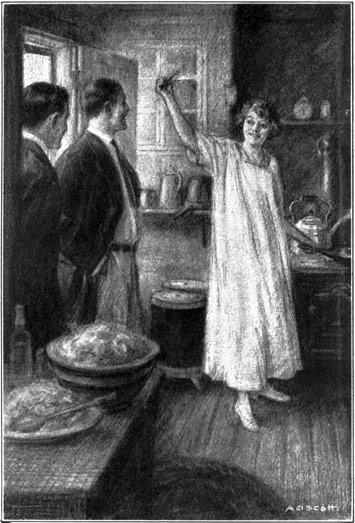
“I am willing to try. Let’s begin now! First we will learn how to spell things right here in the kitchen and then you can soon be reading recipes,” said Helen kindly. “Now we are making biscuit, so we will begin with that. First take two cups of flour,” and she wrote on the whitewashed wall of the kitchen: “2 cups of flour.”
Chloe was delighted with this kind of school, very different from her former experiences where she was made to sit for hours on a hard bench saying the same thing over and over with no conception of what it was all about. Now “2 cups of flour” had some sense in it, so had “2 spoons of baking powder.” “Lard the size of an egg” was a brilliant remark; “1 spoon of salt” had a gleam of intelligence, too; “1 cup of milk” was filled with gumption. In less than a week the girl could read and write the recipe for biscuit and was eagerly waiting for her beloved Miss Helen to advance her to cake.
Dr. George Wright was making a name for himself in his chosen profession. Older men were beginning to look upon him as an authority on nervous cases and now he had been asked to come in as partner in a sanitarium starting in the capital city of Virginia. Certainly he had been very successful in his treatment of Robert Carter’s case, so successful that even Mrs. Carter could not but admire him. She was still very much in awe of him, but he had her respect and she depended upon him. The daughters felt the same way without the awe. Douglas and Nan and Lucy were openly extravagant in their praise of him. Helen was a little more guarded in her expressions of admiration, but she had a sincere liking for him and deep gratitude not only for what he had done for her father but for his service to her.
She could never forget that it was Dr. Wright who had brought her to her senses when her father was first taken ill, making her see herself as a selfish, extravagant, vain girl. It takes some generosity of spirit to like the person who makes you see the error of your ways, but Helen Carter had that generosity. There were times when her cheeks burned at the memory of what Dr. Wright must have thought of her. How silly he must have found her, how childish!
After the experience in the mountains when the rattlesnake bit her on the heel and Dr. Wright had come to her assistance with first aid to the injured, which in the case of a snake bite means sucking the wound, Helen began to realize that what the young physician thought of her made a great deal of difference to her. His approval was something worth gaining.
Douglas had not told her she had written the letter to Dr. Wright as Bobby’s employer. She had a feeling that her dignity as teacher was involved and she must not confide in her family. She was waiting, hoping to hear from him, rather expecting him to write to Bobby and call him to account for his misdemeanors.
Bobby had been especially unruly all week. There was nothing he had not thought of doing in the way of mischief, and thinking mischief was almost identical with doing mischief where Bobby Carter was concerned. The deed was no sooner conceived than accomplished and the other children, who were inclined to be naughty, thought up extra things for him to do.
Putting a piece of rubber on the stove was certainly not Bobby’s idea, nor slipping chestnut burrs in the desk-seats while the girls were not looking, causing howls of anguish when they inadvertently sat down on the same. Bobby manfully took the blame for all of these things, however, confidently certain that no punishment worth speaking of would be meted out to him.
“He is honest, at least,” sighed Douglas, “and owns up every time.”
Friday afternoon on the way home she felt that maybe Nan’s name for their place was a good one. She was almost a dead warrior if not quite one.
“Oh, for a Valkyrie to bear me to Valhalla!”
Bobby was trudging along by her side looking as though butter would not melt in his mouth. What a sturdy little fellow he was growing to be! Douglas looked down on his jaunty, erect figure.
“Bobby, you are getting right fat.”
Bobby slapped his pockets. “That ain’t fat, that’s blame pay!”
“Blame pay! What on earth?”
“Oh, them is the gif’s I gits fer saying I done it ev’y time you asks us to hol’ up our han’s who done it.”
“Oh, Bobby!”
“You see, the big fellers say you ain’t man enough to whup ’em an’ you is too soft to whup me, so I don’t run no risk nohow. This is a top string I got for ’tendin’ like I put the rubber on the stove,—this here is a big apple I got for not fillin’ the girls’ desks with chestnut burrs,—this here pile er oak balls I come mighty near not gettin’. I sho’ did want to turn the fleas loose on Minnie Brice but the big boys was afraid I might not be able to open the little purse right and so one of them done it.”
“Fleas on Minnie Brice?”
“Yes, you never did fin’ out about it, so I didn’t have to own up. You know what a funny thin neck Minnie’s got, just like a mud turkle, and how she wears a stiff collar kinder like a shell and it sets out all around, fur out from her neck?”
“Yes, I know,” said Douglas, struggling with a laugh.
“Well, the fellers caught some fleas off’n ol’ Blitz’s houn’ dog an’ then they put ’em in a teensy money purse with a tight clasp, an’ while Minnie was leaning over studying her joggerfy, Tim Tenser dumped ’em all down her back.”
“Poor Minnie! No wonder she missed all of her lessons today. I could not imagine what was the matter with her. Bobby, you wouldn’t have done such a cruel thing as that surely!”
“Shoo! That ain’t nothin’. It might ’a’ been toads, ’cep’n the little ones is all growed up big now. We are a-savin’ up the toad joke ’til spring. First the fellers said I didn’t ’serve no blame money ’cause Minnie jes’ cried when she missed her lessons an’ didn’t scratch none, only wiggled, an’ teacher never did ask us to hol’ up our han’s who done it. But Ned Beatty said I was a dead game spo’t an’ I took the chanst an’ I mus’ have my blood money, an’ so I got all these here oak balls.”
“Bobby, do you realize that you must take all of these blame gifts back to the boys?”
“Blamed if I will!”
“Please don’t talk that way! Don’t say: ‘Blamed if you will.’”
“Well, wasn’t you a-talkin’ that way? Didn’t you say, ‘blame gif’s,’ with your own mouth? I’d like to know why I have to take them back.”
“Well, you got them for taking the blame and now you no longer take the blame but have told on the ones who did the naughty things.”
“But I ain’t a-tellin’ teacher! I’m a-tellin’ my own sister Douglas. You ain’t teacher ’cep’n when you is in school.”
“Oh, so that is the way you look at it! I suppose you think I am not your own sister while I am teacher, either, and when you worry me sick at school it is only teacher and not Douglas you are distressing so much,” and Douglas sat down on the roadside and burst out crying.
Now Douglas Carter was no weeper. I doubt if her little brother had ever seen her shed a tear in all of his seven years. And he, Robert Carter, Jr., had done this thing! He had made his sister Douglas cry. When she was playing teacher, she had feelings just as much as she did when she turned into his sister Douglas again. And what was this thing she was saying about his having to give back the blood money? Had he told on the boys after having received pay for taking the blame? Why, that was a low-down, sneaky trick!
“Don’t cry, Douglas, please don’t cry! I’m a-gonter take back all the things—’cep’n the apple—I done et into that a leetle bit.”
But the flood gates were opened and Douglas could not stop crying. Like most persons who cry with difficulty, when she once began she kept it up. Now she was crying for all the times she might have cried. She had had enough to make her cry but had held in. She was crying now for all the days and nights of anxiety she had spent in thinking of her sick father; she was crying for the stern way in which she had been forced to deal with her mother over extravagancies; she was crying for having to make Helen understand that there was no money for clothes; she was crying for having to be the adamant sister who forced Nan and Lucy to go on to school; she was crying because her own dream of college was to come to nothing; she was crying very little because of Bobby’s naughtiness, but he, of course, thought that it was all because of him.
One of her biggest grievances was against herself: why had she been so priggish with her cousin, Lewis Somerville? Last August he had come to her on the eve of his enlistment to go with the troops to the Mexican border and had plead so earnestly with her to try to love him just a little bit and to let him go off engaged to her, and she had turned him down with absurd talk of friendship and the like. He had astonished her when he made love to her, but she knew perfectly well in her heart of hearts that it would have astonished her a great deal more if he had made love to someone else.
No doubt that was what he was doing that minute: making love to someone else. A young man who looked like a Greek god was not going to be turned down by every girl. How good Lewis had always been to her and how well he had understood her! He thought she was cold and unfeeling now, she just knew he did. She had received no letters from him for weeks, at least it seemed weeks. Oh well, if he wanted to make love to other girls, why she wasn’t going to be the one to care!
“Douglas, I hear a auto a-comin’. If’n you don’t stop bawlin’ folks will see you.”
A car was coming! She could hear its chug as it climbed the hill half a mile off.
“Please wet my handkerchief in that little branch so I can wash my face,” she begged Bobby, while she smoothed her ruffled hair and wished she had one of Helen’s precious dorines to powder her red nose.
“Yo’ hankcher is as wet as water already. I don’t see what you want it any wetter for,” said Bobby, who might have quoted: “‘Too much of water hast thou, my poor Ophelia,’” had he known his Hamlet.
“I ain’t a-gonter be bad no mo’, Douglas,” declared Bobby as he brought the little handkerchief back from the brook dripping wet. “You mos’ cried yo’ face away, didn’t you, Dug?” and with that Douglas had to laugh.
“Feel better now?” he said with quite the big brother air. “That there car is jes’ roun’ the bend. I reckon if you turn yo’ face away the folks in it won’t know you is been a-bawlin’.”
The car slowed up, then stopped when the driver recognized Douglas, and Count de Lestis sprang out to greet her. The signs of the recent storm were still visible on her pretty face in spite of all the water Bobby had brought from the brook. Douglas tried to hold her head down so the count could not see her disfigured countenance, but such floods of weeping could not but be noticed.
“My dear Miss Carter, you are in distress!” He looked so truly grieved and anxious that already Douglas felt somewhat comforted. Sympathy is a great balm.
“It is nothing! I am a foolish, weak girl.”
“Not that! You are very intelligent and far from weak. Are you not the staunch ally? The poor Kaiser would not find you weak.”
“I done it all! I made her cry!” declared Bobby.
The count looked at the youngster, amused. “And so! Do little American gentlemen make their sisters cry?” Bobby hung his head. “Well, come on and let me take you home, and then I’ll take your sister for a little ride and wipe all the tears away with the wind.”
“Let me go riding, too. I don’t want to go home.”
“No, not this time. My little red car doesn’t like to take for long rides boys who make their sisters cry.”
So Bobby had to climb meekly in to be ignominiously dumped at the yard gate while Douglas was whisked off in the count’s natty little red roadster.
“Now you are looking like your beautiful self,” he declared, slowing down his racer and turning to gaze into Douglas’s face. “What is it that made you weep so profusely? Not the little brother. Beautiful damsels do not weep so much because of little brothers.”
Douglas smiled.
“Ah, the sun has come out! Now I am happy. I am so distressed by tears that I can hardly bear it.”
“You must have a very tender heart.”
“Yes, perhaps! Now tell me what caused your grief.”
How handsome this man was and how kind! He seemed like an old friend. He really did care what was troubling her and it would be a relief to pour out all of her foolish griefs. Douglas missed her father’s sympathy. She knew that he was as ready as ever with his love and solicitude for her, but she felt that she must not add to his worries one iota. Her mother was out of the question and Helen was too young. Before she knew it, she was trying to tell Count de Lestis all about it, all but about Lewis Somerville—somehow that was something she could not mention. Her grievances sounded very small when she tried to put them into words. Naturally she could not dwell upon her mother’s extravagancies or this man would think her poor little mother was selfish; Helen was such a trump, the fact that she longed for stylish clothes certainly was not enough to make a grown girl sit on the roadside and dissolve in tears; while Nan and Lucy were commuting to school like little soldiers. It ended by being a humorous account of Bobby and his blame pay.
Of course the count knew perfectly well that that was not all that had made this lovely girl give way so to grief. No doubt Bobby’s misbehavior was the last straw, but there had been a heavy load to carry before Douglas’s camel of endurance had got his back broken. He laughed merrily over the fleas and Douglas forgot all about her worries and laughed, too.
“Poor little Minnie! She did squirm so, and think of her being too ladylike to scratch, and how she must have disappointed those bad boys by refraining!”
“Yes, if all women would just squirm and not scratch it would take much from the pleasure of teasing them,” laughed de Lestis. “What amuses me is how boys are alike all the world over. The discipline of my school days was very strict, but a thing like that might have happened among boys in Berlin as much as here in a rural school in Virginia.”
“Berlin! But you are Hungarian!”
“So! So—but Hungarians can go to school in Berlin. Even Americans have profited by the educational advantages offered there.”
Douglas thought her companion’s tone sounded a little harsh. She bent her candid gaze on him and met his glowing eyes. Blue eyes looked unflinchingly into black until the steering of the red car forced him to give his attention to the wheel.
“I wish the count’s moustache did not turn up quite so much at the corners,” thought the girl. “It makes him look a wee bit like the Kaiser; of course, though, he is kind and the Kaiser is cruel.”
“Perhaps we had better turn around now,” she suggested gently, contrite that even for a moment she had thought this kind friend could resemble the hated Kaiser.
Certainly the wind had wiped away all traces of the emotional storm from Douglas’s countenance. The young man by her side could but admire the pure profile presented to him, with its soft, girlish lines but withal a look of strength and determination. Her loosened hair was like sunlight and her cheeks had the pink of the Cherokee rose. Profiles were all well enough, but he would like another look into those eyes as blue as summer skies after a shower.
“Of course, my dear Miss Carter, I know that the little rascal Bobby must have been very annoying but I cannot but think that you have not entrusted to me your real troubles.”
Douglas stiffened almost imperceptibly.
“When one finds a beautiful damsel sitting by the roadside in such grief that her charming face is convulsed with weeping, one cannot but divine that some affair of the heart has touched her. Tell me, has some bold cavalier trifled with her affections?”
Douglas stiffened more perceptibly.
“Your father told me of a young cousin, a Mr. Somerville, who is now on the Mexican border——”
“Father told you! I don’t believe it.”
“My dear young lady, he only told me there was such a cousin; you have told me the rest. Now! Now! Don’t let your sweet eyes shed another tear for him. He is not worth it! If he can find amusement in the ladies of Mexico, who are, when all is told, an untidy lot, why should you worry? There are other fish in the sea!”
If the Count de Lestis wished to see something more of Douglas’s eyes he had his desire fulfilled now. She turned and once more blue eyes looked unflinchingly into black. This time the black eyes had a mischievous gleam and the blue ones looked more like winter ice than summer skies.
“Now I have made you angry.” Once more his car took his attention for the moment.
“Not at all!” icily.
“You wish you had not come with me.”
“I appreciate your kindness in bringing me for the drive very much,” still cold and formal in tone.
“I guessed too well, that is where I sinned.”
Douglas was silent, but she still looked at her companion.
“She is like the little Minnie: she squirms but will not scratch.”
“I was just thinking,” said Douglas, changing the subject with a swiftness that disarmed the count, “your moustache certainly turns up at the ends just like Emperor William’s.”
“Isn’t it glorious to be living and for it to be Saturday?” yawned Lucy.
“Yes, and not to have to catch that old train,” and Nan snuggled down luxuriously under the bedclothes. “I used to think Saturday was a pretty good institution when we lived in town, but now—Oh, ye gods! Now!”
“Did you know that Saturday was decreed a half-holiday in the days of the Saxon King Edgar 958 A. D.?” asked Lucy, who had a way of springing historical facts on people.
“No, but I know it’s going to be a whole holiday for Nan Carter in the year of grace 1916. I intend to do nothing but laze the whole day long, laze and read.”
“I bet you won’t. I bet you go nutting with Mag and me, because if we go it means Billy goes along, and if he goes along he’ll be in a terrible grouch unless you go, too.”
October had delightfully spread over into November. The weather had obligingly stayed good, and although our Carters had been at Valhalla more than a month, they had experienced no real bad days.
Nippy, frosty nights had put Mr. Carter wise to the many cracks that he must stop up. Weather strips must be put on windows and doors, panes of glass must be puttied in. Suspicious stains on walls and ceilings warned him of leaks, but he had to wait for a rain to locate them. He found himself almost as busy as he had been before his breakdown, but busy in such a different way.
“I’m glad it’s Saturday! I think I won’t work today,” he had remarked to his wife at about the same time Nan and Lucy were having their talk. “Come and walk in the woods with me.”
That lady had graciously consented, if he promised not to go far and to lift her over fences.
“I think I’ll wash my hair today; and darn the stockings; and go over the accounts; and write some letters; and read the Saturday Evening Post,” said Douglas as she and Helen dressed hurriedly. Their little attic room was hot in summer and cold in winter.
Douglas had been thinking a great deal about her ride with the count. Had he only meant to tease her? Was he trying to flirt with her? Did she like him at all or did she in a way distrust him? She asked herself all of these questions. Of course she liked him! Why should she distrust a man because of the way his moustache grew? Of course he was teasing her, and who could help teasing a silly goose of a girl who sat on the roadside and bawled until her nose was disgracefully red, and then insisted it was all because her little brother had aided and abetted in the crime of putting fleas down a little girl’s neck? He had made a good guess about Lewis Somerville, because no doubt her father had told him that she and Lewis had been chums from the time they were babies.
“I only hope I will be able to make up to him for my discourtesy by being very polite to him the next time I see him,” she thought.
“Count de Lestis is coming to lunch with us today,” said Helen, almost as though she had been reading her sister’s mind. “Father asked him.”
“That’s good! Isn’t it nice for Father to have such a congenial friend?”
“And Mumsy! She enjoys his visits so much. I am going to try and have a scrumptious luncheon, but I tell you I am going to leave mighty little of it to Chloe.”
“I think she is improving, Helen.”
“Of course she is improving. She is trying so hard to do what I want her to and I am trying so hard to be patient. I think I am improving some myself.”
“Oh, honey, you are simply splendid. I think you have the hardest job of all and I think you are doing better than any of us.”
“Nonsense!” But Helen looked very happy over her sister’s praise. “I’d rather do general housework for six dollars a month than go every day and teach thirty little nincompoops a-b, ab.”
“But the thing is you are doing general housework for nothing a month.”
“I am doing a little teaching of a-b, ab, too, only my methods are different. I have evolved a very advanced style of teaching and Chloe, too, is learning to spell. My method is somewhat that of Dotheboys’ Hall—you remember: ‘W-i-n-d-o-w, window—Go wash them.’ I make her spell and write all the kitchen utensils. She learns while she is working and it makes her take an interest in becoming educated.”
“Oh, Helen, you are so clever! You must let me help about the luncheon.”
“How about washing your head; and writing your letters; and casting up the household accounts; and the Saturday Evening Post?”
“Well, the letters and Post will keep!”
On Saturday the rule was that the dead warriors must make up their own beds and clean their own rooms, so shortly after breakfast there was a general scramble in process. Helen turned Chloe loose in the dining-room to have it swept and garnished for their distinguished visitor.
What a pretty room it was, much the most attractive in the house, with the exception of the sitting-room, perhaps! Low, rough-hewn rafters were frankly exposed to view. The walls were sealed with pine boards. Walls and ceiling were both painted a very soft, pleasing grey-green. On the high mantel was an old-fashioned wooden clock with painted door, and this was flanked on both sides by funny old vases with large raised roses and gilt ears. Two high windows and a glass door, opening on a covered passage leading to the kitchen, gave a soft and insufficient light.
Douglas had just put the finishing touch to the table: a bunch of cosmos sent down by the Misses Grant. Nan had made the mayonnaise; and Lucy had found a great basket of mushrooms and peeled them for Helen to cream. Truly they were to have a scrumptious luncheon. The count had arrived and was playing lady-come-to-see, so Lucy said, with Mrs. Carter.
The whir of a motor drew the attention of all.
“Who on earth!” exclaimed Helen. “Surely not callers at this hour, just when my popovers are almost ready to eat!”
“Mo’ comply!” declared Chloe. “Dat ol’ red rooster what yo’ paw set so much sto’ by is been a-crowing halleluja all mornin’. I been a-tryin’ ter make him hesh, ’cause we ain’t got no mo’ cheers fer comply.”
“That’s so, there aren’t but eight dining-room chairs,” laughed Helen.
“My ’ployer done come and a soger is in with him!” cried Bobby, tearing excitedly by the dining-room in his race to open the gate for his beloved Dr. Wright.
Helen ran out in her pink bungalow apron, first peeping into the oven, not trusting Chloe yet to keep things from burning.
“Douglas!” she called excitedly, but Douglas, with flushed cheeks, bent over the bowl of cosmos.
“A soldier with him! What soldier? Could it be Lewis?” she asked herself.
It was Lewis Somerville, looking very handsome and upstanding indeed in his khaki uniform, with his face burned a deep bronze so that his eyes looked very blue and his teeth very white. He clambered out over the great basket of fruit Dr. Wright was bringing to Mrs. Carter, dropped the boxes and parcels piled in around him and hugged and kissed all the female cousins in sight, Helen, Nan and Lucy. He shook Bobby by the hand, knowing full well that that youngster would sooner die than be hugged and kissed.
“Douglas, where is Douglas?” he whispered to Helen.
“In the dining-room! You can get there around at the back of the house—in the basement. We thought you were still in Mexico.”
Lewis did not wait to tell her that he wasn’t, but doing double quick time he streaked around the house, and finding the basement stairs without any trouble, he was down them in one stride.
“Douglas!”
“Oh, Lewis!”
Douglas forgot that not so very many months before this time she had informed her cousin that she was too big to be kissed and that he was not close enough kin to warrant indiscriminate hugging. Certainly she was no younger than she had been eight months before and Lewis was no closer kin, but now she submitted to his embraces and even clung to him for a moment.
It was so wonderful to have him back safe and sound. She could hardly believe it was only yesterday that she had sat on the roadside and wept. He was her same Lewis, too. She felt instinctively that the count’s suggestion in regard to Mexican beauties was ridiculous.
“And Lewis, sergeant stripes on your sleeve, too! Why didn’t you tell me?”
“I did! Didn’t you get my letter?”
“No, not for weeks and weeks!”
“Strange! I must say I am not crazy about that letter’s being lost.”
“Can’t you tell me what was in it?”
“Sure! I’m telling you now,” and the young man caught her to him once more, but Douglas suddenly remembered she was too old to be kissed by a second cousin, once removed. “I’m not crazy about having anyone but you read that letter, though, not only because of my telling you this,” and he took another for luck, “but,” as Douglas recovered her maidenly reserve and pushed him from her laughing, “I said some other things in that letter that I wouldn’t like anyone and everyone to see.”
“State secrets?”
“Well, a newly-made sergeant would hardly have such things intrusted to him! It was only my opinion concerning the state of affairs down there on the border. I may be wrong about things, but a soldier has no right to blab his conclusions about conditions in belligerent countries, especially when the press is wary in its comments.”
“I wouldn’t worry a moment about it. If you could see the road that our R. F. D. has to come over you would not wonder that some of our letters jolt out. There is one creek to cross that is like going down the Grand Canyon.”
“If it only jolted out there and found watery oblivion, I shan’t mind. But what a bully little shack this is! Wright was afraid we would not get here in time for luncheon, and he and I were determined to lie and say we had eaten, but gee, I’m glad not to have to perjure my soul!”
“Miss Hell-e-en! Miss Hell-e-en! Yo’ popovers is done popped over!” came in a wailing shriek from the kitchen.
Helen went so fast her pink bungalow apron looked like a rosy streak. Dr. Wright, fearing some dire calamity had befallen someone and his “first aid to the injured” might be in demand, ran after her. The popovers had popped just right, however, but must be devoured immediately; so luncheon was served as quickly as possible.
“Bring those two chairs from the kitchen, Chloe,” commanded Douglas as she deftly rearranged the table for ten persons instead of eight.
“Now, Miss Douglas, don’t you know ’bout dem cheers in de kitchen? Th’ ain’t got no mo’ seat to ’em dan a rabbit.”
“Bring them anyhow,” laughed Douglas. “I can sit in one and Miss Helen in the other.”
In the confusion of placing family and guests, Douglas forgot all about the bottomless chairs. After everyone was seated she suddenly remembered them with horror.
“Suppose the count got one of them!” It made very little difference about anyone else. But the count! All of that charm and elegance in a chair with no seat!
As soon as grace was said, Bobby, with a shriek of delight, suddenly collapsed and disappeared.
“One chair accounted for!” thought Douglas.
Bobby’s heels were sticking up and he peered saucily through his feet at the astonished company.
“I done got a Goldilocks’ cheer,” he announced. “‘An’ Goldilocks sat, an’ sat, an’ sat, an’ sat ’til she sat the bottom out of the little bar’s cheer.’”
“Bobby, take your seat!” commanded Mr. Carter, trying to look stern.
“I done took it!”
“Get up!”
Easier said than done! Bobby was fast stuck, “I reckon my ’ployer’ll have to op’rate on me,” he said plaintively, “’fo’ I kin eat.”
There was a roar of laughter at this and Dr. Wright, who was sitting between Helen and Bobby, extricated the youngster and then changed chairs with him, whereupon they proceeded to the business of eating popovers and creamed mushrooms and the other good things that Helen had planned for the repast.
Douglas then laughingly told of their predicament in having only eight whole straight chairs in the house and of her intention of sitting on one of the decrepit ones herself and of having Helen sit on the other.
“It is rather like playing ‘Thimble, thimble! Who’s got the thimble?’” she laughed. “I hope whoever has it is comfortable.”
“Don’t all speak at once!” said Lucy. “Of course some of the company’s got it, because home folks would put you out of misery at once.”
Still silence and Douglas was mortally certain the count had it and was too polite to say so.
“He certainly has beautiful manners,” she said to herself, and turning from Lewis, who was endeavoring to monopolize her, she smiled her sweetest on the courteous foreigner. She felt she must make up to him anyhow for telling him his moustache turned up like the Kaiser’s.
“Isn’t it strange, Cousin Robert,” said Lewis to Mr. Carter, “I wrote Douglas I was coming and she never got my letter?”
The count’s manner was a little distrait. Evidently he was trying to hear what Douglas was saying and to listen to the conversation between Lewis and Mr. Carter at the same time.
“Is that so? I am afraid our postman is careless. He seems to get the mail mixed sometimes. Every now and then our letters get left at Grantly.”
“But the ladies up there would send them down, I am sure,” said Mrs. Carter.
“You got my telephone message all right, didn’t you?” Dr. Wright asked Douglas.
“What message?”
“Why, I telephoned Grantly I would be out today!”
“No, they did not deliver it.”
“Perhaps they will send the letter with the message,” suggested the count in an amused tone.
Just then Chloe fell down the steps into the dining-room with a plate of hot popovers, which she adroitly caught before they reached the floor.
“Miss Ellanlouise done sent Sis Tempy down with the news that you alls is gonter hab some comply. They done dis’greed whether they is a-comin’ yesterday or tomorrow.”
“Who is it coming?” laughed Helen.
“They done ’sputed whether it is a doctor or a lywer, an’ they ain’t able t’ agree what his name is, but Miss Ella thinks it is Stites an’ Miss Louise she holds that it is Bright. Both on ’em was a-tryin’ ter listen at the ’phome ter onct so they done got kinder twis’ed like.”
“When was the message sent?” asked Douglas.
“Sis Tempy said Miss Ella said it come of a Chuseday an’ Miss Louise called her back an’ tol’ her not ter pay no ’tention ter Miss Ella, that she knows it come of a Thursday.”
“Why, that must be my message I sent on Wednesday!” exclaimed Dr. Wright. “I am either Lawyer Stites or Dr. Bright.”
“Of course!” and everyone laughed heartily over the mistake of the peculiar old sisters.
“Well, it doesn’t make any real difference since you are here, does it?” asked Helen.
“Not a bit! Being here is what is important to me. Does it make any difference to you?”
Dr. Wright was able to say this in a whisper to Helen. It seemed very difficult for him to have many words in private with this girl, who seemed to him to become more charming every day. Certainly adversity had improved her in his eyes. The character and determination she had shown when once the gravity of her father’s condition had been explained to her were really remarkable in one so young, and one who had up to that time never done a single thing she had not wanted to do. Tête-à-têtes with Helen were made difficult for him by reason of his popularity with the whole Carter family. Mr. Carter had various questions to discuss with him; Mrs. Carter must always tell him her symptoms; Douglas wanted his advice about many things; Nan found him very sympathetic and always had something to confide in him; Lucy, realizing that Helen no longer looked upon him as an enemy to the family, had come over to his camp and now considered him her company just as much as anybody’s and demanded his attention accordingly. Of course Bobby knew he belonged exclusively to him. Was he not his ’ployer?
“Does it make any difference to you?” he repeated.
Helen was on the point of answering him very kindly when Count de Lestis leaned over and engaged her attention.
“Miss Helen, do not forget the promise you made me to come to Weston some morning with your father. There are many things I want to show you. I want your advice, too, about some pantry arrangements I am contemplating. What does mere man know of pantry shelves?”
“Oh, I’d love to come!” exclaimed Helen, and the kind answer she was preparing to give Dr. Wright never was spoken.
That young physician looked at the Hungarian count as though he would cheerfully throttle him. Helen’s advice about pantry shelves, indeed! What business had this foreigner to draw Helen into his household arrangements?
During that luncheon de Lestis managed to antagonize both Lewis Somerville and George Wright. Douglas had smiled entirely too many times on this stranger to suit Lewis, and Helen had been much too eager to pass on the housekeeping arrangements to accord with George’s ideas of United States’ relations with Hungary.
“Why is he not fighting with his country?” each young man asked himself.
Chloe was waiting on the table remarkably well, much to Helen’s gratification. Only once had she fallen down the steps, and, thanks to her teacher’s vigilance, she usually remembered to pass things to the left.
“You must try to show the Count de Lestis how much you have learned,” Helen had told her while she was preparing the lunch; “remember how interested he is in educating colored people.”
Helen, seated at the head of the table, was pouring the tea, Mrs. Carter having resigned her place to her daughter when she resigned herself to be a semi-invalid.
“Hand this to Count de Lestis,” Helen said, having put in sugar to his taste.
“Here’s yo’ C-U-P, CUP of T-E, TEA,” shouted Chloe, as she balanced the cup precariously on the tray.
“Beg pardon!” exclaimed the honored guest in amazement.
“C-U-P, CUP! H-O-T, HOT! T-E, TEA!”
The count took the tea with a puzzled look on his handsome countenance and Chloe fled from the room, not in embarrassment but to impart to Sis Tempy how she had done made Miss Helen proud by showing the count how much she done learned her to spell.
Everybody roared, even Mrs. Carter, who had come to the realization that the most dignified way to treat Chloe was to recognize her as a joke.
“It is this way,” said Helen when she could speak. “You see, I have been trying to teach the poor thing to read and spell. She told me of the wonderful work you are doing,” to the count.
“I am doing?”
“Yes, in your night school at Weston! It made me ashamed to think you, a foreigner, should be doing so much for the colored race, and I doing nothing, so I determined to do what I could with my own servant at least. I can’t tell you how splendid I think it is of you and your secretary to give so much time to the poor country darkies.”
The count flushed a dark red. He seemed actually confused by this girl’s praise.
“All of us think it is fine,” said Nan.
“Speak for yourself!” whispered Lucy. “Mag and I think it is smart Alec of him and we bet he does it ’cause he wants to, not to help the colored people.”
“I beg your pardon! Did you speak to me?” asked the count, recovering himself from the evident confusion into which Helen’s and Nan’s approbration seemed to have plunged him.
“I—I—said—er—I said you and your kind secretary must enjoy the work,” stammered Lucy.
“Do you find they learn easily?” asked Dr. Wright, trying to hide his feelings and wishing he had put in his spare time in altruistic work among the colored brethren.
“The truth of the matter is I do no teaching myself. This night school is a fad of Herz, my secretary.”
“Ah, but I know you do some, because Chloe tells me of how kindly you speak to the darkies,” insisted Helen. “She says you make beautiful talks to them sometimes and they are crazy about you.”
“They exaggerate!” shrugged the count. “They seem a simple, kindly folk, grateful for any crumb of learning.”
“Aren’t there any district schools here for the colored people?” asked George Wright.
“Yes, but no place for the older ones to learn. It is quite pathetic how they yearn for knowledge,—so Herz tells me.”
“Well, my opinion is that too much learning is bad for them,” blurted out Lewis.
“Oh, Lewis!” exclaimed Douglas. “How can you say such a thing? Too much learning can’t be bad for anybody.”
“What I mean is too much and not enough. They get just enough to make them big-headed and not enough to give them any balance.”
murmured Nan.
“Exactly!” said Lewis gratefully. “I don’t want to hold the darky down, but I do think he should be taught very carefully or he will get wrong notions in his head, social equality with the whites and such stuff.”
“I find Americans very strange when one gets them on the subject of social equality,” and de Lestis suddenly seemed very superior and quite conscious of his own station in life. “There is much talk of being democratic but not so much practice. Your Declaration of Independence plainly states that all men shall be free and equal, and still, while you grant the black race freedom, you deny it equality.”
“I reckon you don’t understand the South very well,” answered Lewis, his blue eyes flashing.
“Ah!” was all the count said, but he said it with a toploftical manner that irritated Lewis.
“The colored soldiers are excellent, so I have heard,” put in Douglas, hoping to get the subject changed, if not too abruptly.
“Yes, they are good,” said Lewis, “but that is because they are trained well. That is drinking deep of Nan’s Pierian Spring. I think a military training in colored schools is almost more important than in the white ones. It gives them the kind of balance they don’t get in any other way.”
“Why don’t you give the pupils in your night school some drilling?” asked Helen.
“Thank you for the suggestion!” and the count bowed low over Helen’s hand as they arose from the table at a signal from Mrs. Carter, who began to think the conversation was getting entirely too serious and not at all social. “I shall profit by it immediately and introduce a kind of setting-up exercise at least.”
“Now we’ll find out who had the other busted cheer!” cried Bobby.
It was the count, and his tact and good manners in patiently sitting through the meal on what must have been a rather uncomfortable perch made the females of the party, excepting Lucy, admire him just that much more, but it did not make George Wright and Lewis Somerville think any more highly of the good-looking foreigner.
“He had much better be fighting for his country,” grumbled Lewis to his companion in misery, “even if it would be on the wrong side.” Which was not the proper remark for a soldier in the army of a neutral nation.
The mystery that will never be solved for the human race is why some days must be dark and dreary and why those days sometimes stretch themselves into weeks.
The weather that had been so perfect when our Carters first came to Valhalla had held for a long time. Frosty, crisp autumn mornings that made the blood tingle in one’s veins, followed by warmer days and then cold bracing nights when a fire in the great chimney of the living-room was most acceptable, had become so much the rule that when the exception occurred no one was prepared to accept it.
Morning after morning Nan and Lucy had trudged cheerfully over the fields and through the lane to Grantly Station to catch the early train, enjoying the walk and not minding at all that the quarter of a mile was really three-quarters. Coming home was happy, too. The train reached Grantly by half-past three, the pleasantest time in an autumn afternoon, and the girls would loiter along the road, stopping to eat wild grapes or to crack walnuts or maybe to get some persimmons, delicious and shriveled from the hard frosts. Sometimes Billy and Mag would have the good news for them that the Suttons’ car was to be at Preston and that meant that our girls were to get out at that station and be run home by Billy.
They were great favorites with both Mr. and Mrs. Sutton who encouraged the intimacy with their son and daughter. Suitable companions are not always to be found in rural communities and the coming of the Carters to the neighborhood was recognized by that worthy couple as a great advantage to their children.
“Nan is a charming girl, William,” Mrs. Sutton had said to her husband, “and even if Billy fancies himself to be in love with her it will do him no harm, only good, since she has such good sense and breeding.”
“Of course it will do him good and maybe it is not just fancy on his part. We Suttons have a way of deciding early and sticking to it. Eh, Margaret? I remember you had your hair in a plait and wore quite short skirts when I began to scheme how best to get a permanent seat by you on the train, and here I’ve got it!” and Mr. Sutton gave his portly wife a comfortable hug.
“And Mag is having a splendid time with Lucy,” continued that lady, accepting the hug with a smile. “Lucy is so quick and clever, no one could help liking her. I, for one, am glad the Carters have come.”
“What do you think is the matter with their mother? They always speak of her as an invalid. She looks well enough to me, although of course not robust like one beautiful lady I know.” Mr. Sutton admired his wife so much that the flesh she was taking on just made her that much more beautiful in his eyes. He thought there could not be too much of a good thing.
“Invalid indeed! She is just spoiled and lazy,” declared Mrs. Sutton who was all energy and industry. “She is attractive enough but I should hate to be her daughter.”
“Yes, and I’d hate to be her husband, too!”
The Suttons had been most pleasant and hospitable to their new neighbors, although there could not have been two women brought together so dissimilar as Mrs. Sutton and Mrs. Carter. Mrs. Carter considered her mission in life to be as beautiful as possible and also charming. Mrs. Sutton had never had time to think what her mission in life was, she was so busy doing the things it seemed important to do. She was first of all the wife of a successful farmer and that meant eternal vigilance on her part, as the success of a farm depends so much on the management of women. Next she was the mother of two healthy, normal children who must be trained in the way they should go. After that she was an important member of a community where her progressive spirit was needed and appreciated. Her home, Preston, was where the Ladies’ Aid met and worked and kept the little church out of debt; there was headquarters for the Traveling Library; there the Magazine Club read and swapped periodicals. She was president of the Preston Equal Suffrage League, a struggling but valorous band, and now that work of organizations was sorely needed for suffering humanity, this same league was rolling bandages and making comfort kits for the Allies, showing that votes for women was not the only thing it could work for. Truly Mrs. Sutton was a busy and happy woman.
But we are forgetting that the weather seemed destined to become our topic! Certainly the Suttons are a more agreeable subject than the weather our girls were fated to endure. Of course the sun can’t shine all the time and in the natural course of events October days must shorten into November days and they in turn into December, with nights growing longer and longer and days shorter and shorter and both of them colder and colder. Drizzling rains must fall, even if a trusting family has taken its abode in a weather-beaten old house, up a muddy lane that must be walked through to reach the station.
yawned Nan one morning as the alarm went off, warning her it was time to rouse herself and Lucy. Lucy had curled up in a little ball, having gone to bed without quite enough cover. It had turned cold and damp during the night, a heavy rain had kept up for hours and now at six in the morning it was drizzling dismally.
“I don’t see how we can go to town to-day,” sighed Nan, peering out of the window. “It is so dark and gloomy.”
“I reckon the lane will be awfully muddy,” said Lucy, reluctantly uncurling herself, “and I believe I left my rubbers at school that time I took them in when I thought it was going to rain and it didn’t.”
“You’ll have to borrow Helen’s.”
“Gee! Isn’t it cold?” and Lucy drew back the foot she had tentatively poked out of bed. “I wish we could live in a steam-heated house again.”
Valhalla was heated by open fireplaces, drum stoves and the Grace of God, according to Chloe. There was a small stove in the younger girls’ room, but up to this time they had not felt the necessity of having a fire.
It seemed difficult on that rainy morning for everyone to awaken. Chloe’s feet and then her reluctant legs came through the trap-door of her attic room and slowly down the chicken steps leading into the kitchen long after Helen had started the kerosene stove and put on the kettle.
“I ain’t slep’ none,” she declared when Helen remonstrated with her because of her tardiness. “The rain done leaked in on my haid an’ I reckon I’s gonter die er the ammonia.”
“Oh, I fancy not! A little water won’t hurt you,” said Helen, flying around the kitchen like a demented hen trying to scratch up a breakfast for her brood. “Hurry up and set the table, it is so late.”
“Won’t hurt me! Lawsamussy, Miss Helen! Don’t you know that niggers can’t wash they haids in winter time? They do say they wool has deeper roots than what white folks’ hair is got an’ the water what touches they haids dreens plum down inter they brains.”
“Brains, did you say?” said Helen, but her sarcasm was lost on Chloe. “If it leaked on your head why didn’t you move your bed? It leaked on Miss Douglas and me, too, but we moved the bed.”
“Well, I was in a kinder stupid an’ looks like I couldn’t raise han’ or foot.”
“I can well believe it,” muttered Helen. “Please set the table as fast as you can!”
“Helen,” cried Lucy, hurrying into the dining-room, “you’ll have to lend me your rubbers! I left mine in town.”
“Have to?”
“Well, please to!”
“I hate for you to stretch my rubbers all out of shape.”
“Stretch ’em much! Your feet are bigger than mine.”
“That being the case I certainly won’t lend them to be dropped off in the mud.”
“Children! Children!” admonished Douglas, hurrying to breakfast. “What are you quarreling about?”
“Who shall be Cinderella!” drawled Nan. “And it seems a strange subject to dispute about on such a morning. For my part, I wish my feet were a quarter of a mile long and I could take three steps and land at the station.”
“It leaked in our room last night,” said Lucy.
“And ours!” chorused Helen and Douglas.
“Mine, too! But I ain’t a-keerin’,” from Bobby.
“My haid is done soaked up with leaks,” grinned Chloe.
“I really think Miss Ella and Miss Louise should have had the roof mended before we came,” said Douglas.
“Well, tonight we can go to bed with our umbrellas up,” suggested Nan.
“Yes! An’ wake up a corp!” said Chloe dismally, as she handed the certainly not overdone biscuit. “It am sho’ death ter hist a umbrell in the house.”
Nan and Lucy were finally off, forlorn little figures with raincoats and rubbers and dripping umbrellas. Helen’s rubbers were a bit too small, much to that young lady’s satisfaction and to Lucy’s chagrin.
“My feet will slim down some as I grow older, the shoe man told me. I betcher when I am as old as you are my feet will be smaller,” said Lucy as she paddled off with the rubbers pulled on as far as she could get them.
The road was passable until they got within a hundred yards of the station and then they struck a soft stretch of red clay that was the consistency of molasses candy about to be pulled. Nan clambered up an embankment, balancing herself on a very precarious path that hung over the road, but Lucy kept to the middle of the pike.
“I hear the train!” cried Nan. “We must hurry!”
“Hurry, indeed! How can anyone hurry through fudge?” and poor Lucy gave a wail of agony. She was stuck and stuck fast.
“Come on!” begged Nan, but Lucy with an agonized countenance looked at her sister.
“I’m stuck!”
“If I come pull you out, I’ll get stuck, too! What on earth are we to do?”
“Throw me a plank,” wailed Lucy in the tones of a drowning man. Her feet were going in deeper and deeper. Helen’s rubbers were almost submerged and there seemed to be nothing to keep Lucy’s shoes and finally Lucy from going the way of the rubbers.
Nan dropped her books, umbrella and lunch on the bank and pulled a rail from the fence. Lucy clutched it and with a great pull and a sudden lurch which sent Nan backwards into the blackberry bushes, the younger girl came hurtling from what had threatened to become her muddy grave.
The train was whistling, so they had to forego the giggling fit that was upon them and run for the station. The small branch that they must pass before they got there, was swollen beyond recognition, but one stepping-stone obligingly projected above water and with a mighty leap they were over. The accommodating accommodation train reached the station of Grantly before they did, but the kindly engineer and conductor waited patiently while the girls, puffing and panting, raced up the hill.
They had hardly recovered their breath when Billy and Mag boarded the train at Preston.
“Well, if you girls aren’t spunky!” cried Billy admiringly as he sank in the seat by Nan, which Lucy had tactfully vacated, sharing the one with Mag. “Mag and I were betting you couldn’t make it this morning.”
“We just did and that is all,” laughed Nan, recounting the perils of the way.
“And only look at my boots! Did you ever see such sights?” cried Lucy. “Oh, Heavens! One of Helen’s rubbers is gone!”
“That must have happened when I fished you out with the fence rail. I heard a terrible sough but didn’t realize what it meant. They were so much too small for you,” said Nan.
“Small, indeed! They were too big. Their coming off proves they were too big,” insisted Lucy.
“I’m glad your feet didn’t come off too, then,” teased Nan. “At one time I thought they were going to.”
Billy produced a very shady handkerchief from a hip pocket and proceeded to wipe off the girls’ shoes, while he sang the sad song of the Three Flies:
“But what I am worrying about,” he continued when his song had been applauded, “is how you are going to get home. Our car has been put out of commission for the winter. Mag and I had to foot it over the hill this morning, but our path is high and dry, while the road to Grantly is something fierce. If you get off at Preston and go home with us, I’ll get a rig and drive you over.”
“No, indeed, we couldn’t think of it,” objected Nan. “This is only the beginning of winter and we can’t get off at Preston every day and impose on you and your father’s horses to get us home. We shall just have to get some top boots and get through the mud somehow.”
“But you don’t know that stream. If it was high this morning, by afternoon it will be way up. The Misses Grant should have told you what you were to expect. They should have a bridge there, but it seems Miss Ella wants a rustic bridge and Miss Louise thinks a stone bridge would be better, so they go a century with nothing but a ford.”
“Going home I mean to pull another rail off the fence and do some pole vaulting,” declared Lucy. “I hope I can find Helen’s big old rubber I left sticking in the mud.”
“It may stay there until the spring thawing,” said Mag. “You had better stick to the path going home. It is better to stick than get stuck.”
“I wish I had some stilts,” sighed Nan. “They would carry me over like seven league boots.”
“Can you walk on them?” asked Billy.
“Sure! Walking on stilts is my one athletic stunt,” laughed Nan. “I haven’t tried for years but I used to do it with extreme grace.”
That afternoon Billy had a mysterious package that he stowed under the seats in the coach.
“What on earth is that?” demanded Mag.
“Larroes to catch meddlers!”
“Please, Billy!”
“Well, it’s nothing but some fence rails to help Nan and Lucy get home. I’m afraid the Misses Grant will object if they pull down a fence every time they get stuck in the mud.”
The parcel proved to contain two pairs of bright red stilts found at a gentleman’s furnishing store. They had been used to advertise a certain grade of very reliable trousers, of an English cut. Just before the train reached Preston Billy unearthed them and presented Nan and Lucy each with a pair.
“Here are some straps, too, to put on your books to sling them over your shoulders. You can’t walk on stilts and carry things in your hands at the same time. Tie your umbrellas to the stilts! So long!” and Billy fled from the coach before the delighted girls could thank him.
Going home over the muddy road was very different from the walk they had taken that morning. In the first place it had stopped raining and their umbrellas could be closed and tied to the stilts. The air was cold and crisp now and there was a hint of snow. They stopped in the little station long enough to strap their books securely and get their packs on their backs, and then, mounting their steeds, they started on their way rejoicing.
“I wonder if I can walk,” squealed Nan. “It has been years and years since I tried,” and she balanced herself daintily on the great long red legs.
“Of course you can! Once a stilt walker, always a stilt walker!” cried Lucy, starting bravely off.
Nan found the art was not lost and followed her sister down the muddy hill to the branch. Billy was right: it had been high in the morning but was much higher in the afternoon. The one stepping-stone that had kept its nose above water on their trip to town was now completely submerged.
“Ugggh!” exclaimed Lucy. “My legs are floating!” And indeed it was a difficult feat to walk through deep rushing water on stilts. They have a way of floating off unless you put them down with a most determined push and bear your whole weight on them as you step.
“Look at me! I can get through the water if I goose step!” cried Nan.
“Isn’t this the best fun ever? Oh, Nan, I pretty near love Billy for thinking of such a thing. Don’t you?”
“Well, I wouldn’t say love exactly.”
“I would! I can’t see the use in beating ’round the bush about such matters. He is certainly the nicest person we know and does more kind things for us.”
“He is nice and I do like him a lot,” confessed Nan.
“Better than the count and Mr. Tom Smith?”
“I don’t see what they have to do with it,” and Nan got rosy from her exertion of goose stepping through the water and up the muddy hill.
“Well, the old count talked about taking a trip with you to the land of dreaming, wherever that is, and Tom Smith took you on fine flying bats, but Billy here, he gets some stilts for you and lets you help yourself through the mud. I say, give me Billy every time!”
“Billy is a nice boy; but Count de Lestis is an elegant, cultured gentleman; and Tom Smith—Tom Smith—he—he——”
“I guess you are right—Tom Smith, Tom Smith he he! But flying machines wouldn’t do much good here in the mud, and stilts will get us over the branch dry shod. There’s Helen’s rubber!” and Lucy adroitly lifted the little muddy shoe out of the mire on the end of one of her stilts and with a skillful twist of the wrist flopped it onto dry ground.
When they reached the top of the hill where the road became better they hid their stilts in the bushes, up close to the fence, carefully covering them with dry leaves and brush.
“Our flamingo legs,” Nan called them. During that winter many times the girls crossed the swollen stream on those red stilts and truly thanked the kind Billy Sutton who had thought of them. They would cache them under the little station, there patiently and safely to await their return.
It was always hard to walk through the water and on one dire occasion when the stream was outdoing itself, having burst all bounds and spread far up on the road, poor Nan goose stepped too far and fell backwards in the water. Fortunately it was on her homeward journey and she could get to Valhalla and change her dripping garments. She came across the following limerick of Frost’s which she gleefully learned, feeling that it suited her case exactly:
It was astonishing how quickly that winter of 1916 and ’17 passed for those sojourners in Valhalla in spite of the fact that they were at times thoroughly uncomfortable. It is not an easy matter for persons, brought up in a modern, steam-heated house with three bath rooms, every form of convenience and plenty of trained servants, to adapt themselves to the simplicity of country life and that in its most primitive state.
Hard as the life was it agreed with them, one and all. Douglas and Bobby walked to school, rain or shine, but their road lay in the uplands where the mud rarely got more than ankle deep. Nan and Lucy had to contend with much more serious conditions, but thanks to their flamingo legs they got by.
The weather wasn’t always bad by any means. There were wonderful clear sparkling days with the ground frozen hard, and then came the snow that meant sleigh rides with the Suttons and grand coasting parties.
Mr. Carter was growing very robust from his labors of stopping up cracks and cutting fire wood. He gradually mended the leaks in the roof; puttied in the window panes; replaced the broken hinges and fastenings to doors and shutters; propped up sagging porch floors; and patched the cracked and fallen plastering.
The Misses Grant viewed his efforts with mingled satisfaction and embarrassment.
“We have intended to do all this for you, Mr. Carter, but Ella was so stubborn about the carpenter. She never would agree to having that new man at Preston, who is really quite capable,” Miss Louise would explain.
“Certainly not! We knew nothing about him and have always employed Dave Trigg——”
“But you know perfectly well that Dave Trigg is doubled up with rheumatism,” snapped Miss Louise.
“Yes, and you know perfectly well, too, that that man at Preston has moved away,” retaliated her tall sister, and so on would they wrangle.
“I enjoy doing it,” Mr. Carter would assure them. “My only fear is that I will get the place in such good order that you will raise our rent.”
Which sally would delight the souls of the ladies who were in danger of agreeing about one more thing, and that was the altogether desirability of the Carters and the especial desirability of Mr. Carter.
Accepting Mrs. Carter at the extremely high valuation of her patient family, they were ever kind and considerate of her. Many were the dainty little dishes they sent to Valhalla from the great house to tempt the palate of their semi-invalid tenant, vying with each other in their attentions.
“An’ she jes’ sets back an’ takes it,” Chloe would mutter. “Mis’ Carter done set back so much that settin’ back come nachel ter her now.
“That’s my ol’ Mis’.”
Chloe and Helen had continued the lessons in reading and writing. The whitewashed kitchen walls bore evidence to much hard work on part of both teacher and pupil. Chloe had learned to cook many simple dishes and to write and spell all she cooked. By slow stages, so slow they were almost imperceptible, the girl was becoming an efficient servant. Her wages were raised to eight dollars a month in spite of the remonstrances of her sister Tempy, who thought she must serve as long as she had before she could make as much.
“Sis Tempy been a-goin’ over ter night school at the count’s ev’y time she gits a chanst but she ain’t ter say larned nothin’.”
Helen and Chloe were engaged in the delectable task of making mince pies for Christmas. Chloe had just electrified Helen by writing on the wall of her own accord: “Reseat fer miCe Pize.”
“What does she learn?” asked Helen, smiling as she deftly rolled the pastry.
“She say they done started a kinder ‘batin’ siety an’ ain’t ter say foolin’ much with readin’ an’ writin’ an’ sich. The secondary ain’t so patient as what you is, an’ he uster git kinder worked up whin the niggers wint ter sleep in school.”
“I fancy that would be trying.”
“They’s drillin’ ’em now an’ they likes that ’cause the secondary done promised them from the count that some day he’ll gib ’em uniforms. Niggers is allus keen on begalia.”
“Does Tempy drill, too?”
“Lawsamussy, no! Women folks jes’ sets an’ watches. Tempy say she done march aroun’ enough fer Miss Ellanlouise, an’ as fer flingin’ broomsticks—she does enough of that ’thout no German gemmun a-showin’ her nothin’ ’bout how ter do it.”
“Do they drill with broomsticks?”
“Yassum, that’s what they tell me, but they do say——”
“Say what?” asked Helen as the colored girl hesitated.
“They don’t say nothin’!”
“You started to tell me something they say about broomsticks.”
“I ain’t started ter tell a thing!” and Chloe shut her mouth very tight and rolled her eyes back in a way she had that made you think she was going to turn herself inside out.
“What do they debate about?” asked Helen amused at Chloe’s sudden reserve.
“They ’spute ’bout the pros an’ cons of racin’.”
“Horse racing?”
“I ain’t so sho’, but from what Sis Tempy done tol’ me it mought be an’ agin it moughtn’t.”
“Does Tempy debate?”
“Sis Tempy! Yi! Yi!” and Chloe went off in peals of laughter. “Sis Tempy can’t argyfy with nothin’ but a rollin’ pin. She done put up a right good argymint only las’ Sunday with her beau, that big slue-footed nigger, Jeemes Hanks.”
“What was the argument about?”
“Jeemes he done say he’s jes’ as good as any white folks an’ some better’n a heap er them. He say his vote don’t count none an’ he ain’t able ter buy no good lan’ jes’ ’cause de white folks won’t sell him none up clost ter they homes,—an’ Sis Tempy ups an’ tells him that his vote ain’t no count ’cause he ain’t no count hisse’f. She tells him that buzzards lays buzzard eggs an’ buzzard eggs hatches out mo’ buzzards; an’ that made him hoppin’ mad ’cause that nigger Jeemes sho’ do set great sto’ by hisse’f.”
“Does James feel that white people ought to sell him land whether they want to or not?”
“’Zactly! He been wantin’ ter buy a strip from Miss Ellanlouise up yander by the clari’, not so fur from the great house. They’s glad enough ter sell some er that rocky lan’ off over by the gravel pit, but they don’t want no niggers fer clost neighbors.”
“And what did Tempy say?”
“She never said nothin’. She jes’ up’n driv him out’n the cabin with the rollin’ pin. She tells him while she’s a-lickin’ him, though, that he’s a-larnin’ his a-b-c’s upside down at the count’s school an’ fer her part she ain’t a-goin’ back.”
“Do you think the count is responsible for James’s nonsense?” asked Helen. “I can’t see how he got such notions from a gentleman like the count.”
“I ain’t a-sayin’! I ain’t a-sayin’!” and once more Chloe’s mouth went shut with a determined click and she rolled her great eyes.
Helen thought no more about it. Darkies were funny creatures, anyhow. Of course it was hard on James Hanks if he wanted to buy good ground and no one would sell it to him, but on the other hand one could hardly expect the Misses Grant to sell off their ancestral acres just to accommodate the slue-footed beau of their cook.
Miss Ella and Louise were entirely unreconstructed as far as the colored people were concerned. They were kind to them when they were ill and helped them in many ways, but they never for an instant lost sight of the fact that they were of an inferior race nor did they let the darkies lose sight of the fact. They were not very popular with their negro neighbors although they were mutually dependent. Grantly had to depend on colored labor and many families among them got their entire living from Grantly.
The medicine chest at the great house furnished castor oil and paregoric for all the sick pickaninnies for miles around; Miss Louise had to make up great jars of her wintergreen ointment so that the aching joints of many an old aunty or uncle might find some ease; while Miss Ella’s willow bark and wild cherry tonic warded off chills and fevers from the mosquito infested districts down in the settlement in the swamps.
The older members of the community of negroes appreciated the real goodness and kindness of the two old ladies and overlooked their overbearing ways, but the younger generation, who cared not for the ointment or tonic, could see nothing but arrogance in the really harmless old spinsters.
Most of the former slaves, who had at one time belonged to Grantly, had passed away. The few who remained were old and feeble and these had many arguments with the younger ones, trying to make them see the real kindness and goodness of Miss Ellanlouise.
“You done got fat on castor ile out’n the chist at Grantly whin you was a sickly baby,” old Uncle Abe Hanks would say to his refractory grandson Jeemes. “An’ you an’ yo’ paw befo’ you was pulled from the grabe by parrygoric from dat same chist, an’ now you set up here an’ say: ‘Down with southe’n ‘ristocrats!’ Humph! You’d better be a-sayin’: ‘Down with the castor ile an’ parrygoric!’ ‘Down with the good strong soup an’ fat back Miss Ellanlouise done sent yo’ ol’ gran’pap las’ winter whin there warn’t hide or har er his own flesh an’ blood come nigh him!’ Yes! They went down all right—down the red lane. You free niggers is got the notion you kin live ’thout the ’ristocrats. Why don’t you go an’ live ’thout ’em then? Nobody ain’t a-holdin’ you. As fer me—gib me ’ristocrats ev’y time!”
“The Count de Lestis is as ’ristocratical as those ol’ tabbies,” the grandson would reply sullenly, “and he doesn’t treat a colored gemman like he was a houn’ dog.”
“’Ristocratical much! That furrener? You ain’t got good sinse, boy. That there pretty little count didn’t even come from Virginny an’ all the ’ristocrats done come from Virginny one time er anudder. I done hear Ol’ Marster say dat time an’ time agin.”
“The count say he gonter sell us all the lan’ we want. An’ he say he gonter fetch over some nice, kind white folks ter live neighbors to us; white folks what is jes’ as good as these white folks ’roun’ here but who ain’t a-gonter hol’ theyselves so proudified like.”
“Yes! I kin see him now tu’nnin’ loose a lot er po’ white Guinnies what will take the bread out’n the mouth er the nigger. Them po’ white furreners kin live on buzzard meat, an’ dey don’ min’ wuckin’ day in an’ day out, an’ if’n dey gits a holt in the lan’ the nigger’ll hab ter go. As fer a-livin’ long side er niggers,—I tell you now, son, that the white folks what don’t min’ a-livin’ long side er niggers is wuss’n niggers, an’ I can’t say no mo’ scurrilous thing about them than that—wuss’n niggers!”
A strong discontent was certainly brewing among the younger generation of negroes. Conversations similar to the one between Uncle Abe Hanks and James were not uncommon in the settlement that lay midway between Grantly and Weston. This settlement was known by the exceedingly appropriate name of Paradise. There were about a dozen cabins there, some of them quite comfortable and neat, others very poor and forlorn.
There was a church, the pride of their simple hearts because it was built of brick; also a ramshackled old building known as “The Club.” This club had originally been a tobacco barn, built, of course, without windows, for the curing of tobacco. In converting it into a club house, windows had been cut in the sides but with no fixed plan. Wherever a member decided it would be nice to have a window, a window was cut. No two were the same size or on the same level. Most of them were more or less on the slant, giving the building the appearance of having survived an earthquake.
In this club house the secret societies met to hold their mysterious rites. Here they had their festivals and bazaars and sometimes, when the effects of protracted meetings had worn off and the ungodly were again to the fore, they would have dances that threatened to bring down the walls and roof of the rickety building. It was whispered through the county that a blind tiger was also operated there but this was not proven. Certainly there was much drunkenness at times in Paradise, considering the state was dry.
Count de Lestis was very popular in Paradise. He always had a kind word for old and young. Then, too, he had work for them and paid them well. His fame spread and actually there was a boom in Paradise. Other negroes in settlements near by were anxious to move to Paradise. Town lots were in demand and the club had a waiting list for membership. The church was full to overflowing when on Sunday Brother Si took his stand in the little pulpit.
Night school at Weston was something new and something to do, so the darkies flocked to it. Herz, the secretary, had his hands full trying to teach the mob that congregated three times a week to sit at the feet of learning. He did get angry occasionally when his pupils, tired out no doubt after a hard day’s work, would fall asleep with audible attestations.
Herz was in such strong contrast to his employer, the count, that he gave Helen and Douglas quite a shock when they first met him. They had walked over to Weston with their father, who had been prevailed upon to take the order for the restoration of the old mansion. Dr. Wright had been consulted as to the advisability of his trying to do this work and had approved of it as being something to occupy his patient without making him nervous. It meant many trips to Weston on the part of Mr. Carter and equally many to Valhalla on the part of the count.
De Lestis had done very little talking about Herz, mentioning him usually rather in the tone of one speaking of a servant, but Helen came to the opinion the moment she looked at him that there was nothing servile about him; on the contrary, he was evidently the more intellectual of the two men. He was a little younger than the count, much taller, with broad spare shoulders and a back as straight as a board. His blue eyes were very near sighted, necessitating the wearing of very thick lenses in his large gold-rimmed spectacles. His hair was yellow and grew straight up on his head like wheat stubble. His brow was broad and high and well shaped. He really was a handsome man except that his mouth was too full lipped and so very red. His English was perfect with no touch of accent as with the count. He said he had been born in Cincinnati and his father was a naturalized American, so even Douglas, the strong pro ally, had to accept him as German in name only.
Weston was a good three miles from Grantly by the road, but much closer if one took a path through the woods, skirting Paradise and approaching the old house from the rear. Truly it had been a grand estate in its day and de Lestis was determined to restore it to its pristine glory. He had owned the place about a year and had accomplished much in that time. The fences and gates were in perfect repair; the fields showed that good farming theories had already been put into practice; the woods, that some knowledge of forestry had been applied, as the undergrowth had been cleared away and useless timber been cut down to give room to valuable trees.
“What a lot of money must have been spent here,” said Douglas, noting the new fencing and well-built barns as they approached the house.
“Yes, de Lestis seems to have unlimited supplies of cash. I fancy he is a man of great wealth,” said Mr. Carter. “I have ordered a Delco light to be installed in his house. He spares no expense in restoring the old place. I was rather opposed to having the new lighting system. It seems such an anomaly in a colonial mansion.”
“But, Daddy, you wouldn’t want the count to grope his way around with tallow dips,” laughed Helen. “I fancy that was what was used when Weston was first built.”
“I’d have him do it rather than ruin the architectural effect of such a wonderful old house; but de Lestis has his own ideas about things and all he wants of me, after all, is to do the work of a contractor. As for Herz,—he has better taste than de Lestis, I believe.”
“Tell us about Herz, Daddy. You never have told us what he is like,” demanded Helen.
“You judge for yourselves,” answered the father.
The truth was that Mr. Carter had not known just what to make of Herz. Clever he was certainly and no underling, as they had gathered from de Lestis.
This was the girls’ first visit to Weston although the count had urged their coming many times. Douglas’s school was dismissed for the Christmas holidays and she felt like a bird out of the cage: two whole weeks of delightful freedom ahead of her!
Teaching had come easy to her and she had conquered Bobby and the other unruly pupils and felt that she was in a way getting on top of her work. The days passed rapidly and her school was in a fine condition, enthusiastic pupils and eager students. Nevertheless it was great to be having a holiday and she meant to make the most of it. She and Helen were planning a trip to Richmond after Christmas to visit Cousin Elizabeth Somerville. Lewis was stationed there with his company and his duties not being so very arduous, he hoped to spend much time with his favorite cousin. Valhalla was very lovely and the girls had grown very fond of it. Their plans for their father were working out and they knew they had done right in taking the place and moving the family to the country, but nevertheless they were looking forward with pleasure to the visit to Richmond and release from all of their duties for a few days.
What glowing girls they were! Robert Carter looked at them with pardonable pride as they tramped through the woods, their cheeks crimson with the exercise in the cold air. How they had shown the “mettle of their pasture” when the time came for them to take hold! He had always known that Douglas had a certain bulldog tenacity that would make her keep her grip no matter what happened, but Helen had astonished him. When something had snapped in his tired brain he had instinctively turned to Douglas as the person to decide for the family welfare, but Helen had shown herself capable far beyond his hopes. He well knew that her part of the work was most difficult, and he saw with wonder her patience with her mother and with the seemingly impossible Chloe.
“I’ll make it all up to them,” he said to himself.
The doctor’s prescription of country life and freedom from care with plenty of occupation for his hands was working wonders. This work he had been doing for de Lestis was not taxing his mind at all, and he suddenly realized that it was not because it was so easy but because his mind was in working order again. He felt his old power coming back to him, the power of concentration, of initiative. Sometimes he would try to lie awake at night just for the pleasure of feeling himself to be well.
His illness had been a blessing in disguise since it had brought out all this latent fineness in his girls. It had somehow made them more beautiful, too, at least they seemed so in the eyes of their doting father.
Approaching Weston from the rear, no one was in sight. Smoke arising from the kitchen chimney gave evidence of a servant’s being somewhere. The yard was in perfect order, with no unsightly ash pile or tin cans to offend the eye. To one side Mr. Carter pointed out the rose garden that the count had taken much care of, spending hundreds of dollars on every known variety that would flourish in that latitude. Beyond were greenhouses and hot beds that furnished lettuce and cauliflower and spinach through the winter for the master’s delicate palate.
“Isn’t it lovely?” gasped Helen. “It must be splendid to be rich.”
Mounting the broad steps leading to the pillared gallery they heard voices speaking in some foreign language, they could not tell whether it was German or not, and then a loud laugh and “Ach Gott!” in the count’s unmistakable baritone. Through the window they saw the two men, de Lestis and Herz, bending over a table spread with papers. Herz was pointing out something to his employer which seemed to delight him, as he was laughing heartily. This was gathered only by one glance, as immediately the Carters passed beyond the angle through which they could view the interior of the room and Mr. Carter knocked on the front door.
The door was not opened for several minutes. Evidently the count employed servants for such tasks and did not believe in opening doors with his own august hands. Helen gave an impatient rat tat again. She was not fond of waiting. The door was opened suddenly and by the count.
“Ah! My good friends!” he exclaimed enthusiastically. “I did not expect you until tomorrow, my dear Mr. Carter.”
“I came a day sooner because my daughters could come with me.”
“And what an honor!”
He ushered them into the room where they had viewed him for the moment in passing. There were no papers on the table now and everything was in perfect order. The secretary was standing at attention, awaiting an introduction to the ladies.
He bowed from his waist up, shutting up like a jack-knife. He had not the easy, graceful manners of the count, but seemed much blunter and less polished. One could not fancy his kissing the hand of a lady as the count was famous for doing.
Love at first sight is supposed to happen only in books but it does happen sometimes in real life, and on that frosty day in December it came to pass in the library at Weston, came like a flash of lightning, came without warning and without being wanted. Certainly the secretary had not wanted to stop the work he was engaged in that seemed to be so engrossing; he did not even want to meet these Carter girls but had been forced into it by his employer. What good would it do him to fall in love? He cared not a whit for women, anyhow, despised them in fact. But the little blind god, Cupid, took none of these things into consideration. He simply let fly his dart and as Adolph Herz straightened himself up after making his stiff, jack-knife bow, the arrow hit him square in his heart.
It was a toss of the penny which sister it should be; both of them were lovely, both of them rosy and charming. He looked at Douglas first, however, and never saw Helen at all, at least, seemed not to. He did not take his eyes from Douglas’s face during the entire call.
“Has the lighting system come yet?” asked Mr. Carter. “It should have been here by now.”
“Did you order one?” asked the count. “I understood I was to send the order and have done so. You sent it off, did you not, Herz?”
“Certainly! A week ago!”
“But you told me to order it,” insisted Mr. Carter. “I am sure you did.”
“Why, that is all right, my dear fellow,” said the count very kindly. “If both of them come it will make no difference. I can install one of them in the barn and garage.”
“Oh, but I cannot let you have the expense of both if I was at fault,” and Mr. Carter looked distressed. Was his head not behaving as it should, after all?
“Why, my dear Mr. Carter, it might easily have been my mistake and I cannot have you bothered about it. The expense is trifling. Miss Helen, help me to persuade your father that it is nothing.”
The count’s manner was so kindly and he seemed so anxious to make Mr. Carter feel that if any mistake had been made he, the count, had made it that Helen was deeply grateful. How much she liked this foreign nobleman, anyhow. He was always so gracious, so suave, so elegant. His heart must be tender, his disposition good, or how could he make all of the poor colored people like him so much? Helen was fully aware of the fact that the count was attracted by her, but there had been times when she was sure he was equally taken with Douglas, and certainly his manner to Nan on several occasions had been one of devotion. He always seemed to be coming out on the train with Nan and Lucy, and Lucy had intimated that he had caused Billy Sutton many sad hours by “hogging” the seat by Nan. Could he be a flirt? Helen put the thought from her. She hated a male flirt. Nevertheless she was conscious of the fact that she had a little tiny twinge of jealousy, so tiny that it was only a speck, but it was there.
“It’s Douglas’s hair and Nan’s eyes,” she thought. “I believe he thinks I’m more interesting than they are, though,” and then she took herself to task for a foolish, vain girl. “What difference does it make to me, anyhow? What do we know of this stranger and what is he to us?”
Now the girls gave their attention to the estate, for they were naturally interested in the work their father had undertaken. The workmen were through, carpenters, plasterers and painters, and the place had been turned over to Count de Lestis. Very beautiful it was and one for any owner to be proud of. The spacious hall, with its waxed floor and beautiful stairway with mahogany treads and bannisters, was as fine an example of southern colonial as one could find in the whole of Virginia. The furnishings were in keeping with the general plan of the house, as at Mr. Carter’s suggestion an antique dealer and decorator from Richmond had had his finger in the pie. Much of the furniture had been bought with the house, being old mahogany that had been at Weston for more than a century.
“How lovely it is!” gasped Helen as the doors to the great dining-room were thrown open.
“I am so glad you like it,” whispered the count in a very meaning tone. “I have your father to thank for its being so complete. Never have I seen work carried on so rapidly. I was afraid I would be living in the discomfort of shavings and mortar beds for months to come.”
“Daddy is always like that,” said Helen smiling. Nothing pleased Helen so much as praise of her father. “He can always make workmen work. They say in Richmond that not even plumbers disappoint him. He always turns over his houses on time unless there is something absolutely unforeseen, like a strike or something.”
“I am indeed fortunate in having prevailed upon him to do this for me.”
“But he has enjoyed doing it so much. You see Daddy has not been able to work for so long and I think he had begun to feel that maybe he had lost out, and this proves that he hasn’t. He does not know how to be idle. Why last summer when he was supposed to do nothing but rest he drew the plans and built bird houses for Bobby.”
“Ah, indeed! I am so glad you reminded me of something. Mr. Carter,” he called to that gentleman who was critically examining some electric wiring recently put in ready for the Delco batteries which were on the way, “I want now some plans for bird houses if such trivial work is not beneath you. I want bird houses for every kind of feathered songster that can be attracted and persuaded to live at Weston.”
“How wonderful!” cried Helen and Douglas in chorus. Douglas had been engaged in conversation by the secretary, who was limbering up in an amazing manner. He was most attentive, showing her into every nook and cranny of the old house. He opened sideboards and cabinets to reveal the exquisite finish of the satinwood drawers and shelves; he took down bits of rare old china from the plate rack in the dining-room, explaining the marks on the bottoms. He was so kind that Douglas almost liked him, but not quite.
“Adolph Herz is too German in sound,” the Anglo-Saxon in her cried out. “And then his mouth! It is so red!”
“Certainly I’ll enjoy drawing plans for bird houses,” laughed Mr. Carter. “I shall even take pleasure in carpentering them. They are really lots of fun to make.”
“I agree with you,” said Herz. “Simply drawing a design is never so much pleasure as carrying it out. How a sculptor can be willing to do only the clay modeling of his statue and then let someone else carve the marble is more than I can understand. When I think of something to be done, I must do it myself—trust it to no one.”
“Well, I am a lazy bones myself and anyone can do my work,” laughed the count. “Now Adolph here has drawn the plan for a pigeon house and he wants to build it himself. I tell him it is absurd, that any carpenter can carry out his ideas, but he will not listen to me. Adolph is a very stubborn man, Miss Carter.” He addressed this remark to Douglas who smiled at the young secretary. He was frowning heavily and his full lips were drawn into a hard red line. The count caught his eye and gave him a bantering look in return.
“Come on, Adolph, and show Mr. Carter your plans for the pigeon house!”
“They are not completed,” he answered sullenly.
“I am quite a pigeon fancier,” went on the master of Weston. “They are charming birds to raise and one can make much money on squabs. We are going into pigeon raising quite seriously. I think we shall build a very large house. Eh, Adolph?”
“Where will you put the pigeon house?” asked Mr. Carter.
“Right there on the roof, about in the centre of the house,” said the count, pointing to the top of the mansion.
“Not there! Surely you would not do such a thing!” cried Helen incredulously.
“Why not?”
“It would ruin the architectural effect of Weston,” declared Mr. Carter.
“I think not!”
“Well, I know it would,” maintained the architect stoutly. “Why, de Lestis, all of my work would be as nothing if you should put a pigeon house there. I beg of you not to!”
“But, my dear Mr. Carter, I am a pigeon fancier and want my pigeons at a point where I can watch them twirling and dipping. I love their cooing, too.”
“All right! It is your house and you can do as you choose with it, but please do not mention me as the architect who restored the place. I cannot stand for such a piece of Philistinism.” Mr. Carter laughed as he made the above remark, but his daughters knew by a certain look in his eyes that he was angry.
“Are you to have carrier pigeons?” asked Douglas, hoping to relieve the company of an embarrassment that seemed to have fallen upon it.
The secretary still had his mouth drawn in a stern line although he had smoothed his frowning brow. Helen was plainly put out at the count’s daring to go against her father’s artistic taste, while Count de Lestis seemed to be taking a kind of delight in teasing everybody.
“If you will promise to send me a message, I will,” he answered gallantly.
“Oh, that would be great fun! I have never seen a carrier pigeon.”
The count then devoted himself to Douglas for the rest of the visit, showing her the pantry shelves that he had on one occasion expressed himself as desirous for Helen to pass on.
“All we need now is a lady of the manor,” he said in a low tone. “It is not meet for man to live alone.”
Douglas looked at him quite frankly, her blue eyes steady as she gazed into his black ones. “Can’t your mother come and keep house for you?” she asked quite simply.
There was no flirting in Douglas Carter’s make-up. Herz, who refused to go far from her in spite of the count’s sudden devoted attentions, relaxed his grim expression that he had held ever since the pigeon house had been the subject of conversation. His mouth broke into a smile and his easy manner returned.
The Carters soon took their departure, although the master of the house was insistent that they should stay to tea with them.
“We must get back to Valhalla,” declared Douglas.
“Valhalla! Is that the name of your place?” asked Herz.
“That is the name my sister Nan gave it. She says we are all more or less dead warriors when the day is over. I don’t like giving it such a German name myself, but Nan says poetry is universal and—— Oh! I beg your pardon!” The girl had forgotten that her companion was of German birth.
“Do you dislike the Germans so much?” he asked.
“Not the German people——” she stammered. “Just the Imperial Government!”
“But aren’t the people the Government?”
“I hope not.”
“Ah, so Miss Carter has opened fire on you, too, has she?” laughed de Lestis. “If there were more fighters like her among the Allies, poor Germany would have her banners trailing in the dust by now.”
“I did not mean to be rude to Mr. Herz,” said Douglas. “I am too prejudiced in favor of France and England to remember my manners. If I have injured you, I beg your pardon,” and she gave the secretary her hand in good-by.
He blushed like a schoolgirl and stammered out some unintelligible something.
De Lestis renewed his attentions to Helen just as though he had not been hovering over her sister with tender nothings.
“He is a flirt!” thought Helen. “I think I can give him as good as he sends, but I am beginning to hate him.” She dimpled to his remarks, however, and as she bade him good-by at the door she smiled saucily into his eyes.
“To think of that man’s being willing to ruin his roof line,” sighed Mr. Carter as he and his daughters started on their homeward walk. “Just look how beautiful it is,” pointing to the old chimneys where the roof melted into the sky.
“It is a shame,” cried Helen. “But how cold it is! There now, I left my gloves on the library table.”
“Run back and get them, honey; Douglas and I will wait for you here by the stile.”
Helen ran back. Once more she glanced into the library where on their arrival they had caught a glimpse of the two men bending over the papers. Now what was her astonishment to see the secretary actually shaking the count, who was laughing heartily. The secretary’s eyes were flashing as he blurted out the words:
“Fool! Fool!”
The count opened the door quickly this time at her knock.
“Your gloves! I found them and almost hoped you would leave them with me, but the little hands would have been so cold. Indeed, they are so cold,” and he gallantly kissed them.
Helen seized her gloves and with glowing cheeks raced back to her father and sister. She gave her hands a vigorous rubbing on her grey corduroy skirt before she put on her gloves as though she might rub off the kiss. In the excitement over the dénouement of the visit she forgot for the time being that she had caught the secretary shaking his employer and calling him a fool.
The winter wore on. Our warriors were fighting the good fight and each night as they gathered round the cheerful fire in the great chimney in the living-room at Valhalla they had tales to tell of difficulties overcome. Of course there were failures, many of them, but each failure meant a lesson learned and better luck next time.
Douglas had days when the little ideas refused to shoot and her pupils seemed to be just so many wooden dolls, but she learned the rare lesson, that teachers must learn if they are to be successful: when a class won’t learn, and can’t learn, and doesn’t want to learn, there is something the matter with the teacher. When she came to this realization she took herself to task, and the dark days came farther and farther apart.
The letter she had written Dr. Wright had had a most salutary effect on Bobby. That young physician had taken the naughty boy for a long ride and had given him a man to man talk, first temporarily dismissing him from his employ and sternly forbidding him to hold out his hand when they were going around corners. He was not allowed to blow the horn at dangerous curves and all of his honors were stripped from him.
“It nearly killed me to do it,” George Wright confessed to Helen. “I couldn’t look him in the eye for fear of weakening, but he took it like the little man he is. I fancy Douglas will have no more trouble with him for a while. I am glad she asked me to help her out. It is no joke to teach your own flesh and blood. Bobby says he thought that Douglas was just playing school and he didn’t know he was really bothering her. He knows now and is even prepared to lick any boy not twice his size who disturbs his sister.”
Count de Lestis seemed to have much business that took him away from Weston. Sometimes he was gone for several weeks at a time, but when he returned he would drop in at Valhalla as though he had not been away at all. He was always a welcome visitor. Mrs. Carter greeted him as a long lost friend. He seemed to be the incarnation of the social world to the poor little lady, destined to spend her days out of her element. Mr. Carter had almost forgiven him the pigeon house, but not quite.
“There is something lacking, somehow, in a man who would do such a thing,” he had declared to Helen.
The pigeon house was built by the secretary, according to his own plans and specifications, and placed on the roof, where it loomed an eyesore to the artistic. Truly they seemed to be going into pigeon raising in good earnest. It was a huge affair, large enough to accommodate many pigeons; and then, with the careless expenditure of money that seemed to characterize the master of Weston, crates of pigeons arrived and were installed in their new quarters.
“The carrier pigeons have not come, but when they do I’ll bring one to you,” the count said to Douglas, “and you must promise to send me a message.” The girl laughingly promised.
The count was still doing what Helen called “browsing.” He flitted from sister to sister, whispering his tender nothings and for the moment seeming all devotion to the one with whom he happened to be.
“Thank goodness, I found out in time what a flirt he is!” Helen whispered to her inmost self. “Once, for just a fraction of a second, I was jealous of Douglas and of Nan, too. His house is so lovely and he is so rich and handsome and so fascinating, and I do so hate to be poor! But I can’t abide a male flirt!”
Nevertheless, Helen was very glad to see the count when he called at Valhalla and she was very successful in hiding her real feelings from that gentleman, who twirled his saucy moustache in masculine satisfaction when he thought of the attractive girl who so courteously received his attentions. Douglas’s indifference rather piqued him and he was constantly trying to break through it, but no matter what flattering remarks he made to her she never seemed to know they were intended for her, Douglas Carter.
“That young soldier is at the bottom of it!” he would exclaim to himself after trying his best to get an answering spark from this girl who appeared so altogether lovely in his eyes, more lovely and desirable because of her indifference, and then, too, because he knew instinctively that Herz was hopelessly in love with her; and many men are like sheep and go where others lead.
The secretary was becoming a real nuisance to Douglas, who in a way liked him, but who never got over his very German name and his red, red mouth. He so often seemed to know exactly the moment when she was to dismiss school and would appear as she locked the schoolhouse door and quietly join her on the walk home. He was very interesting and Douglas much preferred him to the count, who could not be with any female for more than a few moments without bordering on love-making of some kind. Herz had a great deal of information and this he would impart to Douglas in quite the manner of a professor as he walked stiffly by her side.
Bobby was not at all in favor of sharing the walks home with this tall, stiff stranger. Ever since Dr. Wright’s talk with him he had considered himself Douglas’s protector, and he liked to pretend that as they went along the lonesome road and skirted the dark pine woods he was going to shoot imaginary bandits who infested their path. He couldn’t play any such game with this matter-of-fact man stalking along by their side, explaining to Douglas some intricate point in philosophy.
“Say, kin you goose step?” he asked one day when Herz was especially irritating to him. Bobby had a “bowanarrow” hid in the bushes by the branch, with which he had intended to kill many Indians on their homeward walk.
“Yes, of course!” came rather impatiently from Herz, who thought children should be seen and not heard and that this especial child would be well neither seen nor heard.
“Well, do it!”
“Bobby, don’t bother Mr. Herz,” Douglas admonished.
“He kin talk an’ goose step at the same time,” Bobby insisted.
Herz began solemnly to goose step, expounding his philosophy as he went. Bobby shrieked with delight. This wasn’t such a bad companion, after all. It was so ridiculous that Douglas could hardly refrain from shouting as loud as Bobby.
“Is that the way the German soldiers really walk?” asked Bobby.
“So I am told.”
“Where did you learn to do it?” asked Douglas.
“I—I—at a school where I was educated.”
“Oh, but you are an American, so the count told me.”
“I am an American.” This was uttered in a very dead tone. The man suddenly turned on his heel and with a muttered good-by disappeared.
“Ain’t he a nut, though?” exclaimed Bobby.
“He is peculiar,” agreed Douglas.
“Do you like for him to walk home with you, Dug?”
“I don’t know whether I do or not.”
“Well, I don’t like it a bit, ’cep’n, of co’se, when he goose steps an’ then it’s great. I seen a colored fellow a-goose steppin’ the other day, an’ he says he learned it at the count’s school what Mr. Herz is a-teachin’. He says they call it settin’ up exercises, but he would like to do some settin’ down exercise. I reckon he was tryin’ to make a kinder joke.”
Every American will always remember that winter of 1917 as being one of extreme unrest. Would we or would we not be plunged into the World War? Should we get in the game or should we sit quietly by and see Germany overrun land and sea?
Valhalla was not too much out of the world to share in the excitement, and like most of the world was divided in its opinions. Douglas and her father were for the sword and no more pens. Helen and Mrs. Carter felt it was a pity to mix up in a row that was not ours, although in her secret soul Helen knew full well that the row was ours and if war was to be declared she would be as good a fighter as the next. Nan was an out and out pacifist and declared the world was too beautiful to mar with all of this bloodshed. Lucy insisted that Nan got her sentiments from Count de Lestis, who had been “hogging” a seat by her sister quite often in the weeks before that day in March when diplomatic relations with Germany were broken off by our country. As for Lucy: she could tell you all about the causes of the war and was quite up on Bismarck’s policy, etc. She delighted her father with her knowledge of history and her logical views of the present situation. She and Mag were determined to go as Red Cross nurses if we did declare war, certain that if they tucked up their hair and let down their dresses no one would dream they were only fourteen. Bobby walked on his toes and held his head very high, trying to look tall, hoping he could go as a drummer boy or something if he could only stretch himself a bit.
“Good news, girls!” cried Helen one evening in February when they had drawn their seats around the roaring fire piled high with wood cut by Mr. Carter, whose muscles were getting as hard as iron from his outdoor work.
“What?” in a chorus from the girls, always ready for any kind of news, good or bad.
“The count is going to have a ball!”
“Really? When?”
“On the twenty-second of February! He says if he gives a party on Washington’s birthday nobody can doubt his patriotism.”
“Humph! I don’t see what business he has with patriotism about our Washington,” muttered Lucy.
“But he does feel patriotic about the United States, he told me he did,” said Nan.
“I think he means to take out his naturalization papers in the near future,” said Mr. Carter.
“He tells me he feels very lonesome now that he is in a way debarred from his own country,” sighed Mrs. Carter. “That book he wrote has made the Kaiser very angry.”
“Well, after the war is over that book will raise him in the estimation of all democracies,” suggested Douglas.
“Mag says that Billy wrote to Brentano’s to try and get him that book and they say they can’t find it; never heard of it,” blurted out Lucy.
“It has perhaps not been translated into English,” said Helen loftily.
“Mag says that that’s no matter. Brentano will get you any old book in any old language if it is in existence.”
“How can they when a book has been suppressed? I reckon the Kaiser is about as efficient about suppressing as he is about everything else. Well, book or no book, I’m glad to be going to a ball. He says we must ask our friends from Richmond and he is going to invite everybody in the county and have a great big splendid affair, music from Richmond, and supper, too.”
“Kin I go?” asked Bobby, curling up in Helen’s lap, a way he had of doing when there was no company to see him and sleep was getting the better of him.
“Of course you can, if you take a good nap in the daytime.”
“Daddy and Mumsy, you will go, surely,” said Douglas.
“Yes, indeed, if your mother wants to! I’m not much of a dancer these days, but I bet she can outdance any of you girls. Eh, Mother?”
“Not as delicate as I am now; but of course I shall go to the ball to chaperone my girls,” said the little lady plaintively. “I doubt my dancing, however.”
“He says we must ask Dr. Wright and Lewis and any other people we want. He says he is really giving this ball to us because we have been so hospitable to him,” continued Helen.
“We haven’t been any nicer to him than Miss Ella and Miss Louise,” said Lucy, who seemed bent on obstructing.
“But they are too old to have balls given to them,” laughed Helen. “They are going, though. I went to see them this afternoon with Count de Lestis and they are just as much interested as I am. They asked the privilege of making the cakes for the supper and he was so tactful that he did not tell them he was to have a grand caterer to do the whole thing. The old ladies just love to do it, and one is to make angel’s food and one devil’s food.
“The Suttons are going,” and Helen held the floor without interruptions because of the subject that was interesting to all the family. “Mr. Sutton says if the roads permit he will send his big car to take our whole family, and if the roads are too bum he will have the carriage out for Mrs. Sutton and Mumsy, and all of us can go in the hay wagon.”
“Grand! I hope the roads will be muddy up to the hubs!” cried Lucy. “Hay wagons are lots more fun than automobiles.”
“Hard on one’s clothes, though,” and Helen looked a little rueful. The question of dress was important when one had nothing but old last year’s things that were so much too narrow.
“What are you going to wear to the ball?” asked Douglas that night when she and Helen were snuggling down in their bed in the little room up under the roof.
“I haven’t anything but my rose chiffon. It is pretty faded looking and hopelessly out of style, but I am going to try to freshen it up a bit. Ah me! I don’t mind working, but I do wish I were not an unproductive consumer. I’d like to make some money myself and sometimes buy something.”
Douglas patted her sister consolingly. “Poor old Helen! I do feel so bad about you.”
“Well, you needn’t! But I did see such a love of a dancing frock when we were down town that day with Cousin Elizabeth: white tulle over a silver cloth with silver girdle and trimmings. It was awfully simple but so effective. I could just see myself in it. I ought to be ashamed to let clothes make so much difference with me, but I can’t help it. I am better about it than I was at first, don’t you think?”
“I think you are splendid and I also think you have the hardest job of all to do: working all the time and never making any money.”
The next morning Douglas held a whispered conversation with Nan before they got off to their respective schools.
“See what it costs but don’t let Helen know. She will be eighteen tomorrow, and if it isn’t worth a million, I am going to take some of my last month’s salary and get it for her.”
When Nan, who was not much of a shopper, approached the great windows of Richmond’s leading department store, what was her joy to see the very gown that Douglas had described to her displayed on Broad Street and marked down to a sum in the reach of a district school teacher.
“It looks so like Helen, somehow, that I can almost see her wearing it in place of the wax dummy,” exclaimed Nan.
“Must I charge it, Miss Carter?” asked the pleasant saleswoman as she took the precious dress out of the show-window.
“Please, Miss Luly, somehow I’d rather not charge it, but I haven’t the money today. Couldn’t you fix it up somehow so I could take it with me and bring you the money tomorrow? We don’t charge any more, but if I don’t buy it right now I’m so afraid somebody else might get it.”
The smiling saleswoman, who had been waiting on the Carters ever since the pretty Annette Sevier came a bride to Richmond, held a conference with the head of the firm on how this could be managed.
“Miss Nan Carter is very anxious not to charge, but can’t pay until tomorrow.”
“Ummm! A little irregular! What Carter is it?”
“Mr. Robert Carter’s daughter!”
“Let her have it and anything else she wants on any terms she wishes. Robert Carter’s name on a firm’s books is the same as money in the bank. I have wondered why his account has been withdrawn from our store,” and the head of the firm immediately dictated a letter to his former patron, requesting in polite terms that he should run up as big a bill as he wished and that he could pay whenever he got ready. So very polite was the letter that one almost gathered he need not pay at all.
Mr. Carter laughed aloud when he read the letter, remembering those days not yet a year gone by when the bills used to pile in on the first of every month and he would feel that they must be paid immediately and the only way to do it was redouble his energy and work far into the night.
The flat box with the precious dancing dress was not an easy thing to carry on stilts, but the lane was muddy and Nan had to do it somehow. With much juggling she got safely over the dangers of the road and smuggled it into the house without Helen’s seeing it.
“I got it!” Nan whispered to Douglas when she could get her alone.
“But you didn’t have the money! I asked you to find out the price first,” said Douglas, fearing Nan, in her zeal, had overstepped the limit in price. “I didn’t want anything charged. I am so afraid we might get started to doing it again.”
“Never! I just kind of borrowed it until tomorrow. You see I struck a sale and they couldn’t save it for me because there were only a few of them. I told them I couldn’t charge but would bring the money tomorrow, and Miss Luly fixed it up for me, somehow, and told me I could have the whole department store on any terms I saw fit to dictate.”
Morning dawned on Helen’s eighteenth birthday but found her in not very jubilant spirits. It isn’t much fun to have an eighteenth birthday when you have to bounce out of bed and rush into your clothes to see that a poor ignorant country servant doesn’t make the toast and scramble the eggs before she even puts a kettle of water on for coffee. Chloe always progressed backwards unless Helen was there to do the head work.
Helen found Chloe had already descended her perilous ladder and had the stove hot and the kettle on as a birthday present to her beloved mistress. Chloe really adored Helen and did her best to learn and remember. The breakfast table was set, too, and Chloe’s eyes were shining as though she had something to say but wild horses would not make her say it.
The sisters came in at the first tap of the bell and her father was in his place, too. Helen started to seat herself at her accustomed place, but at a shout from Lucy looked before she sat. Her chair was piled high with parcels.
“Happy birthday, honey!” said Douglas.
“Happy birthday, daughter!” from Mr. Carter.
“Happy birthday! Happy birthday!” shouted all of them in chorus.
“Why, I didn’t know anybody remembered!” cried Helen.
“Not remember your eighteenth birthday! Well, rather!” said Mr. Carter.
Then began the opening of the boxes while Chloe stood in the corner grinning for dear life.
A pearl pin from Mrs. Carter, one she had worn when she first met her husband, was in the small box on top. An old-fashioned filigree gold bracelet was Mr. Carter’s gift. It had belonged to his mother, for whom Helen was named.
“It will look very lovely on your arm, my dear,” he said when Helen kissed him in thanks.
Cousin Elizabeth Somerville had sent her ten dollars in gold; Lewis, some new gloves; there was a vanity box from Lucy with a saucy message about always powdering her nose; a little thread lace collar from Nan, made by her own hands; and to balance all was a five-pound box of candy from Dr. Wright.
“I had a big marble for you, but it done slipt out’n my pocket,” said Bobby, and then he had to give a big hug and a kiss, which Helen declared was better than even a marble.
“But you haven’t opened your big box, the one at the bottom,” insisted Nan. It had got covered up with papers and Helen had overlooked it. “Please hurry up and open it because Lucy and I have to beat it. It will be train time before we know it.”
As Helen untied the strings and unwrapped the tissue paper that was packed around the contents of the big box you could have heard a pin drop in that dining-room at Valhalla. She eagerly pulled aside the papers and then shook out the glimmering gown.
“Oh, Douglas! Douglas! You shouldn’t have done it! It is even prettier than I remembered it to be!”
“Mind out, don’t splash on it,” warned Nan just in time to keep the two great tears that welled up into Helen’s eyes from spotting the exquisite creation.
“My Miss Helen’s gwinter look like a angel whin she goes ter de count’s jamboree,” declared Chloe.
“Well, your Miss Douglas is the angel and she’s going to have to have a new dress with slits in the shoulder-blades to let her wings come through,” sobbed Helen, laughing at the same time as she held the dress up in front of her and danced around the table. She had thought nobody remembered her eighteenth birthday and now found nobody had forgotten it.
“You shouldn’t have afforded it, Douglas. I can’t keep it. It would be too selfish of me.”
“Marked down goods not sent on approval,” drawled Nan.
Sergeant Somerville and Private Tinsley accepted the invitation to the count’s ball with alacrity. Their company had been mustered out just in the nick of time for them to obtain indefinite leave. It was rumored that they were to be taken in again, this time as regulars, but the certainty of having no military duties to perform for the time being was very pleasant to our two young men.
The Carter girls had taken the count at his word and invited several friends from Richmond to stay at Valhalla and attend the ball. Dr. Wright was eager to come and with the recklessness of physicians who use their cars for business and not for pleasure, he made the trip in his automobile. He had a new five-seated car, taking the place of his former runabout.
“M. D.’s and R. F. D.’s have to travel whether roads are good or bad,” he had declared.
The two young soldiers and Tillie Wingo had the hardihood to risk their necks with him, and at the last minute he picked up Skeeter Halsey and Frank Maury, who had been invited by Lucy so that she and Mag would not have to be wall flowers. Six persons in a five-passenger car insures them from much jolting, as there is no room to bounce.
Tillie was in her element with five pairs of masculine ears to chatter in. She and Bill were still engaged “in a way,” as she expressed it, although neither one of them seemed to regard it very seriously. Tillie insisted upon making a secret of it as much as she was capable, so that in Bill’s absence she might not be laid on the shelf.
“The fellows don’t think much of an engaged girl,” she said frankly, “and I have no idea of taking a back seat yet awhile.”
The recklessness of the guests in coming over Virginia roads in an automobile in the month of February was nothing to the recklessness of the Carters in inviting six persons to spend the night with them when they possessed but one small guest chamber.
“We can manage somehow,” Helen declared, “and, besides, we will be out so late dancing there won’t be much use in having a place to sleep, because we won’t have any time to sleep.”
“Only think of all of those bedrooms at Grantly with nobody in them!” exclaimed Lucy. “Those old ladies might just as well ask some of us up there, but they will never think of it, I know.”
“If they do, they will disagree about which ones to ask and which rooms to put them in, and we will never get the invitation,” laughed Helen. “Anyhow, they are dear old ladies and I am mighty fond of them.” Helen often ran up to the great house to ask advice from the Misses Grant about household affairs and was ever welcome to the lonely old women.
“They are certainly going to the ball, aren’t they?” asked Douglas.
“They wouldn’t miss it for worlds. They are having a time just now, though, because Tempy has left them. They can’t find out what her reason is and feel sure she didn’t really want to go; now her sister Chloe is so near she seemed quite content, but for weeks she has been in a peculiar frame of mind and the last few days they have caught her in tears again and again. They sent for Dr. Allison, who lives miles and miles from here, but Miss Ella and Miss Louise will trust no other doctor. He says as far as he can tell she is not ill. Anyhow, she has gone home, and today their man-servant departed, also. Of course they might draw on the field hands for servants, but they hate to do it because they are so very rough. They have had this man-servant for years and years, ever since he was a little boy, and they can’t account for his going, either. He had a face as long as a ham when he left them and gave absolutely no excuse except that his maw was sick, and as Miss Ella says, ‘His mother has been dead for ten years, and she ought to know, since she furnished the clothes in which she was buried.’ Miss Louise said she had only been dead eight, and they were her clothes, but they agree that she is dead at least, and can’t account for Sam’s excuse.”
“Poor old ladies, I am sorry for them,” said Douglas.
On the day of the ball, there was much furbishing up of finery at Valhalla. Mr. Carter’s dress suit had to be pressed and his seldom used dress studs unearthed. Mrs. Carter forgot all about being an invalid and was as busy and happy as possible, trying dresses on her daughters to see that their underskirts were exactly the right length and even running tucks in with her own helpless little hands.
“It is a good thing I don’t have to think about my own outsides,” said Helen, “as all of my time must be spent in planning for our guests’ insides. I tell you, six more mouths to fill is going to keep Chloe and me hustling.”
“It sho’ is an’ all them dishes ter wash is goin’ ter keep me hustlin’ some mo’,” grumbled Chloe. “An’ then I gotter go ter the count’s an’ stir my stumps.”
“I am sorry, but I am going to give you a nice holiday after it is all over,” said her young mistress kindly. The count had asked Helen to bring Chloe to look after the ladies in the dressing-room.
“I ain’t a-mindin’ ’bout dishes. I’s jes’ a-foolin’—— Say, Miss Helen, what does potatriotic mean?”
“Patriotic? That means loving your country and being willing to give up things for it and help save it. Everybody should be patriotic.”
“But s’posin’ yer ain’t got no country?”
“Why, Chloe, everybody has a country, either the place where you were born or the place where you have been living long enough to love and feel that it is yours.”
“But niggers is been livin’ here foreveraneveramen, an’ still they ain’t ter say got no country.”
“Why, you have! Don’t you think Uncle Sam would look after you and fight for you if you needed his help?”
“I ain’t got no Uncle Sam, but I hear tell that he wouldn’t raise his han’ ter save a nigger, but yit if’n they’s a war that he’ll ’spec’ the niggers ter go git shot up fer him.”
“Why, Chloe! How can you say such a thing?”
“I ain’t er sayin’ it—I’s jes’ a-sayin’ I hears tell.”
“Who told it to you?”
“Nobody ain’t tol’ it ter me. I jes’ hearn it.”
“Well, it’s not true.”
“I hearn, too, that they’s plenty er money ter go ’roun’ in this country, but some folks what thinks they’s better’n other folks has hoarded an’ hoarded ’til po’ folks can’t git they han’s on a nickel. An’ I hearn that they’s gonter be distress an’ misery, an’ wailin’ an’ snatchin’ er teeth ’til some strong man arouses an’ makes these here rich folks gib up they tin. Nobody ain’t a-gonter know who dat leader will be, he mought be white an’ thin agin he mought be black, but he’s a-gonter be a kinder sabior.”
“How is he going to manage?” asked Helen, amused at what sounded like a sermon the girl might have heard from the rickety pulpit of the brick church.
“I ain’t hearn, but I done gib out ter all these niggers that my white folks ain’t got no tin put away here in this Hogwallow or whatever Miss Nan done named it. They keeps their money hot a-spendin’ it, I tells ’em all.”
Helen laughed, and with a final touch at the supper table and a last peep at the sally lunn muffins, which were rising as they should, she started to go help her mother with the dancing frocks and their petticoats that would show discrepancies.
“Say, Miss Helen, is you sho’ Miss Ellanlouise is goin’ ternight?” asked Chloe, following her up the steps.
“Yes, Chloe, I’m sure.”
“An’, Miss Helen, if’n folks ain’t got no country ter love what ought they do?”
“Why, love one another, I reckon. Love the people of their own race, and try to help them.”
“Oughtn’t folks ter love they own color better’n any other?”
“Why, certainly!”
“If’n some of yo’ folks got into trouble, what would you do?”
“Why, I’d help them out if I could.”
“Even if’n they done wrong?”
“Of course! They would still be my own people.”
“If they ain’t ter say done it but is a-gonter do it, thin what would you do?”
“I’d try to stop them.”
“Would you tell on ’em?”
“I’d try to stop them first. Who has done wrong or is going to do it, Chloe?”
“Nobody ain’t done wrong an’ I ain’t a-never said they is. I ain’t said a word. This talk was jes’ some foolishness I done made up out’n my haid. But say, Miss Helen,—I’d kinder like ter stop at Mammy’s cabin over to Paradise befo’ I gits ter de count’s. I kin take my foot in my han’ an’ strike through the woods an’ beat the hay wagin thar, it goin’ roun’ by the road.”
“All right, Chloe!”
Helen rather fancied that Chloe wanted to see her sister, who was evidently contemplating some imprudence. She had been threatening to marry James Hanks, but her people had shown themselves very much opposed to it. Perhaps the girl was on the eve of an elopement which had called forth all of the above conversation from her sister. Where did she get all of those strange socialistic ideas? Was Lewis Somerville right and was the little learning a dangerous thing for these poor colored people? Surely she had helped Chloe by the little teaching she had given her. The girl was like another creature. She seemed now to have self-respect, and Helen felt instinctively that her loyalty to her and her family was almost a religion with her.
“How are Miss Ella and Louise going?” asked Douglas, as she stooped for a parting glance in the mirror which the sloping ceiling necessitated hanging so low that a girl as tall as Douglas could not see above her nose without bending double.
“In their phaeton,” answered Helen. “They don’t mind driving themselves. I asked them. You see with Sam gone they can’t get out the big old rockaway.”
“They must keep along near the hay wagon. Such old ladies should not be alone on the road,” said Douglas.
“I dare you to tell them that! They have no fear of anything or anybody. They say they have lived alone in this county for so many, many years that they are sure nobody will ever harm them.”
“Well, I am sure nobody ever would,” said Nan.
The girls had decided that the only way to take care of so many guests was to double up “in layers,” as Lucy called it. Bobby was sent over into the new house with Lewis and Bill, his old tent mates, for whom Nan and Lucy had vacated their room while they came over to the old house and brought Tillie Wingo with them.
“Three in a double bed and two in a single bed wouldn’t be so bad after a ball,” Nan had declared.
Dressing for the ball was the more difficult feat, however. The ceiling was so low and sloping and Tillie Wingo did take up so much room with her fluffy ruffles. The Carter girls were glad to see the voluble Tillie. She was such a gay, good-natured person and seemed so pleased to be included in this pleasure party. She looked as pretty as a pink in a much beruffled painted chiffon; and while they were dressing, she obligingly showed Helen the very latest steps in dancing.
Helen was charming in her birthday present dress. Nan declared she looked like the princess in the fairy tale with the dress like the moonlight.
“With all my finery, I don’t look nearly so well as you do, Douglas,” Helen declared.
Indeed Douglas was beautiful. She had on the graduating dress, the price of which had caused her so much concern the spring before. With careful ripping out of sleeves and snipping down of neck, Mrs. Carter had converted it into an evening dress with the help of a wonderful lace fichu, something left over from her own former splendor.
The sight of her eldest daughter all dressed in the ball gown brought tears of regret to poor Mrs. Carter’s eyes.
“What a débutante you would have made!” she sighed. “You have a queenly something about you that is quite rare in a débutante and might have made the hit of the season.”
“Oh, Mumsy, I’m a much better district school teacher!” and Douglas blushed with pleasure at her mother’s rare praise.
The girl had seen a subtle difference in her mother’s manner to her ever since she had felt it her duty to take a stand about their affairs. Mrs. Carter was ever gentle, ever courteous, but Douglas knew that she looked upon her no longer as her daughter somehow,—rather as a kind of taskmistress that Fate had set over her.
The young men were gathered in the living-room waiting for the girls and when they burst upon them in all the glory of ball gowns they quite dazzled them.
“Douglas!” gasped Lewis in an ill-concealed whisper, “you somehow make me think of an Easter lily.”
“Well, I don’t feel like one a bit. I can’t fancy an Easter lily’s dancing, and I mean to dance every dance I get a chance and all the others, too.”
“I reckon I can promise you that,” grinned her cousin.
Bill Tinsley made no ado of taking the pretty Tillie in his arms and opening the ball with a whistled fox trot.
“I’m going to get the first dance with you, and to make sure I’ll just take it now, please.”
“Don’t you like my dress?” asked Helen, twirling around on her toe before Dr. Wright, whose eyes plainly showed that he not only liked the dress but what was in the dress rather more than was good for the peace of mind of a rising young nerve specialist.
“Lovely!” he exclaimed, not looking at the dress at all, but at the charming face above the dress.
“Douglas gave it to me for a birthday present,—it was her extravagance, not mine. I think she is about the sweetest thing in all the world. The only thing that worries me is mashing it all up in the Suttons’ hay wagon.”
“Are the roads so very bad? Why not go in my car?”
“They are pretty bad, but no worse than the road from Richmond. It certainly is strange how that road changes. It was fine when the agent brought us out here to see the place. Wasn’t it?”
“It was, but I don’t think it is such a very bad road now. It may be because I like to travel on it. But come on and go with me in my car. If you will trust your dress and neck to me.”
“I will, since you put my dress first! Somehow that makes me feel you will be careful of it and respect it.”
A rattle of wheels and Billy Sutton came driving up in a great hay wagon filled with nice, clean straw, and close on his heels were Mr. and Mrs. Sutton in their carriage, which was to take Mr. and Mrs. Carter sedately to the ball.
“Helen and I are going in my car. Does anyone want to occupy the back seat?” asked George Wright, hoping he would be paid for his politeness by a refusal.
“No indeed, I adore a hay wagon! It’s so nice and informal,” cried Tillie.
Douglas did want to go, but felt perhaps it was up to her to chaperone the youngsters in the hay wagon, so for once Dr. Wright thought he was to get Helen for a few moments to himself.
“Chloe must go with us,” declared Helen. “She wants to stop in Paradise to see her mother.”
Dr. Wright cracked a grim joke to himself which concerned Chloe and the antipodes of Paradise, but he smothered his feelings and opened the door for the delighted colored girl, who had never been in an automobile before.
What a gay crowd they were in that hay wagon! Billy Sutton had contrived to get Nan on the front seat with him, where she was enthroned high above the others, looking down on the horses’ backs as they strained and pulled the great wagon through the half-frozen mud. Billy had some friends out from town who immediately attached themselves to Tillie Wingo, who was to beaux just as a honey-pot to bees. They stopped and picked up two families of young folks on the way to the count’s, and by the time they got them all in, the wagon was quite full.
“I am glad Helen didn’t trust her new dress to this,” Douglas whispered to Lewis.
“Well, I am glad you didn’t have on such fine clothes and came this way,” he whispered back. “Wright is too reckless for me on these country roads. Not that I am afraid myself, but I certainly should hate to see you turned over.”
“Whar Miss Ellanlouise?” asked Chloe, when she could get her breath after the first mad plunge into the delights of motoring.
“Oh, there! How selfish of me! I should have thought of it and asked them to go with us,” said Helen.
“We can go back for them,” suggested the doctor, who had begun to feel that he never would have a chance to see Helen alone.
“Oh, no, we needn’t mind. They are coming in their phaeton, and no doubt have started long before this. They are so good to me, I should have thought of them.”
Chloe was put out at Paradise, assuring her mistress she would come up through the woods in a few moments and no doubt be at her post in the dressing-room before the guests should arrive.
Paradise was very dark and lonesome. The few scattered cabins showed not a gleam. There was a dim light trickling from the windows of the club, but as they approached that rickety building, that disappeared. Helen saw some dark forms up close to the wall when she looked back after passing that place of entertainment.
“I reckon they are going to initiate someone tonight,” she thought.
“Chloe had such a strange talk with me today,” she told her companion and then repeated the conversation she had had with the colored girl. “I can’t quite understand her.”
“Perhaps this count is instilling some kind of silly socialistic notions in their heads,” suggested the doctor, who held the same opinion Lewis Somerville did of the gentleman who was to be their host for the evening. Indeed, he so cordially mistrusted him that only the fact he was to be with Helen had reconciled him to spending an evening under his roof.
“Oh, no, I can hardly think that, and besides, the count does not do the teaching. That is done by a Mr. Herz, his secretary. He is an American, born in Cincinnati. He seems to be very intelligent and certainly has taken a shine to Douglas. I don’t know just what she thinks of him, but she lets him walk home from school with her every now and then.”
“I don’t like the name much!”
“Well, the poor man can’t help his name. You speak as though we were already at war with Germany. I am trying to preserve our neutrality until war is declared.”
“My neutrality has been nothing but a farce since I have realized that Germany is at war with us.”
“You sound just like Douglas and Father. Will you go to war if it comes?”
“Why, of course! Would you have me do otherwise?”
“I—I—don’t know,” and Helen wished she had not asked the question that had called forth this query. This night was to be one of pleasure, feasting and dancing. War had no place in her thoughts when she had on her new dress and the music was coming from Richmond.
“Music and lights put me all in a flutter!” exclaimed Helen as they approached the broad and hospitable mansion.
Already there were several buggies and carriages in the gravelled driveway. The guests were arriving early, as sensible country people should. Let the city folks wait until far in the night to begin their revels, but those living in the country as a rule feel that balls should start early and break up early.
“Do you care so much for parties?”
“I think I must. I have not been to very many balls, because you see I am not out in society yet. I reckon I’ll never make my début now,” and Helen gave a little sigh.
“Does it make so very much difference to you?”
“Well, not so much as it would have a year ago. I used to feel that making one’s début was a goal that was of the utmost importance, but somehow now I do feel that there are things a little bit more worth while.”
“What for instance?”
“Getting Father well, and—and——”
“And what?”
“You might think I am silly if I tell you,—silly to talk about it.”
“I promise to think you are you no matter what else it is, and you are—well, never mind what you are.”
“Well, somehow I have begun to feel that helping people to be gay is important, like cheering up Miss Ella and Miss Louise. They have such stupid times. I really believe they quarrel just to make life a little gayer. I go to see them every day and it makes me feel good all over to know how much they like to have me come.”
“And you were afraid I’d think that was silly?” asked George Wright as he halted his car down under a great willow oak, well away from the other vehicles. How he wished they were to stay out under that tree all evening! Music and dancing were nothing to him compared to the pleasure he obtained from talking to this girl.
“Let’s sit here until the others come,” he suggested.
“And waste all that good music!”
Dr. Wright began to envy the Misses Grant whom Helen wanted to make happy.
“Of course not! I forgot how seldom you have a chance to dance.”
Weston was wonderfully beautiful. The electric lights may have been an anomaly, but they certainly helped to make the old house show what it was capable of. The dead and gone colonials who had built the place had been forced either to have their balls by daylight or to content themselves with flickering candles, which no doubt dropped wax or even tallow on the handsome gowns of the beauties and belles. The broad hall with the great rooms on each side seemed to be made for dancing. The floor was polished to a dangerous point for the unwary, but the unwary had no business on a ballroom floor.
The count seemed in his element as he received his guests, but Herz looked thoroughly out of place and ill at ease.
“Ah, Miss Helen! I am so glad to welcome you—and Dr. Wright—it is indeed kind of you to come! I am depending upon you, Miss Helen, to help me entertain these people who have come so promptly. They neither dance nor speak. Herz is about as much use to me on this occasion as a porcupine would be. Only look around the room at my guests!”
They did indeed look most forlorn. One old farmer was almost asleep while his wife sat bolt upright by his side with a long sad face and a deep regret in her eyes. No doubt, she was regretting the comfortable grey wrapper she had discarded for the stiff, best, green silk, and the broad easy slippers that had been replaced by the creaking shoes. Several girls with shining eyes and alert expressions were evidently wondering what ailed the young men who stood against the wall as though it might fall down if they budged an inch.
“Why are they wasting all this good music?” demanded Helen.
“As you say in America: ‘Seek me!’” laughed the host.
“Search me, you mean.”
“Ah, but is it not almost the same? What do you say, Dr. Wright?”
“Well, I’d rather someone would seek me than search me.”
“So! And now, Miss Helen, if you will discard your wraps and return quickly and help me I shall be most grateful. If these poor people do not get started they will go to sleep.”
Helen flew up to the dressing-room which, sure enough, Chloe had reached before her. The girl was huddled down in a corner of the room looking the picture of woe.
“Did you see Tempy?” asked Helen, taking for granted that Chloe had been speaking of her sister when she had asked about one’s duty to one’s own people.
“No’m!”
“Wasn’t she at your mother’s?”
“I don’t know, ’m!”
“Was your mother there?”
“Yassum!”
There was never any use in trying to make Chloe talk when she had decided not to, so Helen threw off her wraps and with a peep in the mirror where one could see from top to toe, she hastened to the aid of Count de Lestis.
“Mother will be along soon and she can do wonders with people who are bashful,” declared Helen, “but I’ll try my hand at it until she comes. They must dance, then they will thaw out.”
“Certainly, and will you dance with me to show them how?”
Helen forgot all about the fact that she had come with Dr. Wright and he might reasonably expect to claim the first dance.
“Yes, but you must introduce me to all these people and I’ll ask some of the girls to dance while you go get the young men to come fall in the breach.”
The shiny-eyed girls were willing enough and the young men seemed to think if the count didn’t mind his walls falling down, far be it from them to hold them up, so in a few moments the sad crowd were in a gale of good humor. The old farmer waked up and his wife looked as though she might try her new creaky shoes on the waxed floor if anyone would only ask her.
Dr. Wright looked on rather grimly as Helen was whisked from under his very nose. He might have stood it better if the count had not been such a perfect dancer and so very handsome. He had a way of whispering to his partner during the dance that was also a sore trial to the young physician.
“What could he be saying to Helen to make her dimple and blush?”
The arrival of the carriage containing Mrs. Sutton and Mrs. Carter with their rather bored husbands was a welcome interruption to the poor young man. Soon came the lumbering hay wagon with its giggling, chattering load, and then Helen was at liberty to dance with him, since the count perforce must again play the gracious host.
“Isn’t it perfect?” she exclaimed. “The floor, the music, and everything!”
“Not quite so perfect now as when you had the count for a partner, I am afraid,” he muttered, bending over to make her hear. He was too tall to converse while dancing with Helen. He had never regretted his inches before.
“Nonsense! You dance just as well as he does, and he talks so much while he is dancing. I hate to dance and talk, too,—just dancing is enough for me.”
“Me, too, then!” and once more he felt the satisfaction that a man who measures over six feet can’t help feeling.
Helen was right. Mrs. Carter was a born entertainer and she had hardly taken the social reins in her hands before the ball was running smoothly. Even Bobby found a partner, a funny little girl with such bushy hair that anyone could tell at a glance it had been put up in curl papers for several days. She looked like a pink hollyhock in her starched book-muslin that stood out like a paper lamp shade. Her round black eyes seemed very lovely to the gallant Bobby, who took her into the back hall where they turned round and round in imitation of the dance, and when dancing palled on them they showed each other how to make rabbits out of their handkerchiefs.
“This is the kind of party I like,” said the wholesome Mrs. Sutton. “Every Jill has her Jack and there are some Jacks to spare. Deliver me from parties where girls must sit against the wall and wait for partners to be released.”
“When you get the vote you can do the asking, and then parties where the females predominate will be more popular,” teased her husband.
“Nonsense! We can still do the asking if we care to. Come on and dance with me, sir!” and Mr. Sutton delightedly complied.
Mrs. Carter did not have to spend all the evening making other people have a good time. She was asked to dance by the count and her pretty little figure and graceful bearing attracted other partners, and she was soon tripping the light fantastic toe as untiringly as any of her daughters. Tillie Wingo herself did not get broken in on oftener.
Herz stood in corners, looking like one of the men out of Noah’s ark, Nan declared, so stiff and wooden.
“I don’t know which one he resembles most, Shem, Ham, or Japheth,” she whispered to Billy Sutton, “but I wonder if you licked him if the paint would come off.”
“I don’t know, but I’d like to try. I can’t abide that Dutchman. I believe he thinks he is superior to all of us, even his precious count. Jehoshaphat! I believe he is asking Douglas to dance.”
So he was. The secretary was stalking across the room, determination on his noble brow and his full mouth drawn together in a tight red line. He stopped in front of Douglas and placing one hand on his breast and the other one on his waist line in the back, he shut up like a jack-knife.
Douglas looked a little astonished, not knowing exactly what the young man wanted, and then the memory of the early days at dancing school came to her when the little boys were forced to bow to the little girls before they danced with them.
“Certainly,” she said, excusing herself from Lewis, who looked a little sullen, having expected to claim this particular waltz with his cousin, but who had neglected to do so, being too intent on gazing at her pretty flushed face.
Herz clasped her around the waist and began to twirl in a most astonishing manner. She could hardly keep her footing and very early lost her breath. Skilful guiding was not necessary, although when they arose to dance the floor was well filled with other couples, but these, knowing full well that discretion was the better part of valor, gave the spinning pair the right of way. The man never lost his gravity or dignity, but his mouth broke from the hard red line to its usual full-lipped curve. Douglas felt as though that dance would never end. His strong arm held her like an iron ring as round and round they went.
sang Billy Sutton, as he and Nan watched the gyrations of their host’s secretary. “Did you ever see such a proof of foreign blood in any man who pretends to be American born?”
“Why, Billy, he is American born. The count says he was born and raised in Cincinnati.”
“Yes, and the count says he himself was born and raised in Hungary, but I bet you anything they may have been born where they say they were but they were raised in Berlin. Look at that fellow and tell me if he doesn’t dance like Old Heidelberg.”
“The count doesn’t, anyhow. I never saw such divine dancing as the count’s.”
As though he had heard her, the handsome smiling de Lestis came to claim her for the rest of the dance.
“Aren’t these foreigners the limit?” said the boy, seeking the disconsolate Lewis. “I know I oughtn’t to say anything about a fellow when I am in his house, but somehow that count gets my goat.”
“Mine, too! Who is this Herz?”
“Oh, he is a kind of lady’s maid or secretary or something for his nibs. Says he is an American, but I have my doubts. I don’t see how Miss Douglas Carter can stand for him, but she lets him walk home from school with her any time, so I hear,” announced Billy, absolutely unconscious of the fact he was retailing very unwelcome news to his companion.
“Humph!” was all Lewis could say, but that monosyllable had a world of meaning in it. And so although the music was gay and the lights were bright and the laughter was merry in that ballroom, there were several sore hearts, and the little green-eyed monster was waltzing or fox trotting or one stepping every dance.
“I wonder why Miss Ella and Louise don’t get here,” Helen said to Dr. Wright, who had at last persuaded her to sit out one dance with him. “They have had plenty of time even with their slow old horse.”
They had found a sofa in the back hall behind a clump of palms. There were many plants artistically grouped by the florist from town, who had tastefully decorated the whole mansion.
“The telephone has been ringing a great deal since we came. Could they be trying to get the count? I always feel like jumping when the ’phone rings, feeling that it must be for me.”
“Oh, no! The ring for Weston is two long and three short rings. These country ’phones are hard to learn, but I often answer the one at Grantly for my old friends.”
“Listen, there goes the bell again! Goodness! I believe one of these ’phones that rings everybody’s number would send me crazy.”
“They say you get used to them. That is four shorts and a long. That’s for Dr. Allison, who lives miles and miles from here. Don’t you remember Page Allison, that lovely girl who came to Greendale with the Tucker twins? It is her father.”
“Of course I do, and I know Dr. Allison, too! A delightful gentleman!”
“I believe I’ll call up Miss Ella and see what is the matter,—why they don’t come on.”
George Wright sighed. There always seemed to be something to keep Helen from talking to him tête-à-tête. Still, he felt glad to think that Helen was so fond of these old ladies and so thoughtful of them.
The telephone was under the stairway, quite near their retired nook. Helen rang the number for Grantly and there was a quick response.
“Hello!” came in Miss Louise’s contralto notes.
“Miss Louise, this is Helen Carter! Why haven’t you started yet? Don’t you know the count can’t give a ball without you and Miss Ella?”
“Oh, my dear, my sister is ill, very ill,—fainted just as we were getting ready to leave. You see she would make that cake, that angel’s food, although I told her I was going to make a fruit cake, but you know Ella—— Oh, but how can I rattle along this way? I have been trying so hard to get Dr. Allison and he doesn’t answer.”
“Wait a minute, Miss Louise,” and Helen put her hand over the receiver and turned to Dr. Wright.
“Dr. Wright, will you take me to Grantly? Miss Ella has had a fainting fit—a stroke, I am afraid it is.”
“Take you! My dear, I’ll take you anywhere you want to go.”
“Miss Louise, Dr. Wright is going to bring me to Grantly in his automobile immediately. Don’t worry; we will be there soon.”
She rang off quickly and flew upstairs for her wraps. Chloe was not in the dressing-room, but she quickly unearthed her cape and hood from the bed where the many shawls and cloaks had been piled. On the way out she whispered to Nan where she was going, but told her not to tell the others, as she did not want to break up the ball or to cast a shadow on the happiness of the dancers.
Not a sound or glimmer of light in Paradise as they speeded silently through the settlement! The club, too, was deserted.
“I think you are splendid to be willing to give up this ball to go to the aid of these old ladies,” said Dr. Wright, drawing the rug more closely around Helen, as the air was quite nipping.
“Why, the idea of my not doing it! You must think I’m nothing but a heartless butterfly.”
“I think you are anything but one. You love dancing, though, so much. I should have come alone. Somehow I couldn’t make up my mind to forego the ride alone with you. Isn’t it a beautiful night?”
The stars were shining brightly but the lazy moon had not yet gotten up.
“If we find the poor old lady not too ill, I’ll take you back to the dance after we have made her comfortable. There will be a moon to light our way later on.”
“That will be fine! Maybe they won’t even miss us. But somehow I have a feeling that Miss Ella is very ill.”
“Five minutes more will decide the question. Hasn’t my new car eaten up distance, though? Just think, in old days what a time sick persons had to wait for a physician without telephones and without cars!”
“Dr. Allison still drives a fast horse to a light buggy. Page says he will none of horseless carriages. I believe it is only recently that he has submitted to a telephone.”
“It is a good thing his medical theories have not kept pace with his means of locomotion, or he would be a back number sure.”
Valhalla was very quiet, peacefully sleeping under the stars. What a haven of refuge it had been to the Carters! Helen looked lovingly at the picturesque roof lines as the car glided rapidly past.
“Do you know, I think that must be the most restful place in all the world? I have grown so attached to the little tumbledown house, leaks and cracks, smoking stove and all.”
“Hasn’t it been awfully hard on you?”
“Not any harder on me than on the others!”
“I can’t tell you what I think of all of you Carter girls for the way you have grappled with the winter in the country. I think you have had the hot end of it, too.”
There flashed through Helen’s mind a picture of the first time she saw the young doctor, in the library of their pretty home in Richmond. There had been no approval in his cold glance then, nothing but censure and severity. She had deserved it all. Did she deserve the praise he gave her now?
“The hot end is better than the cold end during the winter months,” she laughed. “At least I can stay snugly in the kitchen and not have to go out in all weathers like poor Douglas and the other girls.”
Miss Louise met them at the door, tears rolling down her fat cheeks. She still was dressed in her stiff black silk but had tied on a great gingham apron over her best dress.
“How good of you to come to us!” was all she could sob out.
“You should have sent for us immediately,” said Helen, putting her arms around the trembling old woman.
“Ella always wants Dr. Allison, and I hated so to break up the pleasure of the young people.”
“Where is your sister?” asked Dr. Wright, taking off his gloves and great coat, and extracting a small leather case from its pocket.
“I got her to bed after she came to.”
“She is conscious then?”
“Yes, but very low, very low. She has been so docile I am afraid she is going to die,” and the poor lady began to weep anew.
“Let me go in with the doctor,” insisted Helen. “I can do what is necessary and you might scare Miss Ella. She mustn’t be made to think she is so ill.”
The tall form of Miss Ella was stretched on the great four-posted bed, and so still was it that for a moment Helen was afraid to go near.
“She might be dead! She might be dead!” her heart cried out, but she shut her mouth very tight and advanced bravely up to the bedside.
“Miss Ella, Dr. Wright has come to see you. Dr. Allison will be here later on perhaps.”
“I’ll be better in a few moments. I must have fainted,” she said weakly. “I ought not to have tried the angel food cake. It is so tedious. Louise told me not to, but I was very headstrong.”
Helen looked up apprehensively at the doctor, who was feeling the patient’s pulse. It did seem rather ominous for Miss Ella to be so humble and to confess that Louise’s judgment was of any importance.
“What did you eat for dinner?” asked the doctor.
“I—I—don’t remember.”
“Think!”
“I reckon I ate some bread.”
“Nothing else?”
“I can’t remember.”
At a nod from the doctor Helen went out to seek this information from Miss Louise, whom she found huddled up on the hall sofa.
“Eat for dinner! I am sure I don’t know. She wouldn’t eat when I did and I do believe she didn’t eat anything.”
“How about supper?”
“Oh, we neither one of us ate any supper. We felt it would be discourteous to the count after all the trouble and expense he must have gone to, with caterers from Richmond and all.”
Helen flew back to the bedside of Miss Ella.
“She ate no dinner that Miss Louise can remember and neither one of them ate any supper,” she cried.
“Well, of course she fainted then. Can you take the matter in hand and get some toast and tea for both of them? Miss Louise will be toppling over next.”
Helen was intimate enough with the old sisters to know just where they kept everything and in short order she had a tray ready for poor half-starved Miss Ella.
“It was not a stroke at all,” Dr. Wright assured the anxious sister. “Nothing but hunger.”
“I told her to eat,” and Miss Louise looked venomously at the invalid.
“I came to get my dinner and you had taken all the breast of the chicken. I wasn’t going to eat your leavings,” declared Miss Ella, color coming back into her wan cheeks and the fire of battle to her faded eyes. Helen laughed happily. The sisters were quarreling again and everything was assuming a more normal aspect.
“Now both of you ladies must get to bed,” insisted the doctor, after Miss Louise had been persuaded to eat some of Helen’s good toast.
“I think you have had ball enough for tonight.” He looked at his watch. “I will take you back to Weston,” he whispered to Helen.
Helen would not go until both of her old friends were tucked peacefully in their great bed and then, kissing them good-night, she stole quietly from the room. She was greatly relieved that things had turned out so well and delighted that she was to be taken back to the ball.
“It’s pretty nice to do your duty and still have a good time,” she said to herself.
Dr. Wright was waiting in the hall for her. He silently bundled her up in her cape and hood and together they stepped on the gallery.
The lazy moon was up now and outshining the faithful stars. The great box bushes and thick hedge cast deep shadows across the lawn. The two stood for a moment in silence, drinking in the beauty of the scene.
“We can’t lock the front door,” said Dr. Wright finally. “I see it has an old-fashioned great brass key and the only way to lock it is to fasten the old ladies in the house.”
“Why, nothing will ever hurt those dear old folks,” laughed Helen. “There are as safe as can be. They tell me they often go to bed without locking doors. They usually have a quarrel about whether the front door has been locked or not, and get so excited they both forget to do it.”
“Listen! What is that?”
A low rumble of voices was heard, coming from the rear of Grantly.
“Could it be the dancers coming home?” suggested Helen.
“No, not from that direction!”
The rumble increased to a roar, low but continuous. Evidently a great many persons were talking or muttering and they were getting closer and closer.
“Let’s have a light, so we kin see!” said a voice louder and clearer than the rest, and then there was a guffaw from many throats.
“A lot of darkies!” gasped Helen. “What can they be doing here?”
“You go inside and I’ll see,” commanded the young man.
“I’ll do no such thing! I’ll go with you and see. If I go in the house again I’ll wake Miss Ella and Miss Louise up, and you said yourself that it was most important for them to have a night of unbroken rest.”
“Helen, I insist!”
“But I’m not going to be sent back in the house while you go get shot up or something, so there!”
“Shot up! The idea! It is nothing but some late revelers going home. Perhaps the darkies have been having a ball somewhere, too.”
“Perhaps, but they have no business coming through Grantly.”
There was a hoarse shout from the rear and suddenly a light shot up into the sky.
“The straw stack! They are burning the straw stack!” cried Helen.
George Wright quietly opened the great front door and picking Helen up in his arms, carried her into the hall. He put her down and hastily closed the door. Helen heard the great brass key turn in the lock.
It was very dark in the hall. She groped her way along the wall. It was all she could do to keep from screaming, but remembering her two old friends, now no doubt peacefully snoozing, she held herself in check. Suddenly she bumped square into the telephone.
“I’ll give a hurry call for the whole neighborhood,” she cried, and no sooner thought than done. It was said afterwards that no such ringing of a ’phone had ever been heard before in the county.
“Grantly on fire and a great crowd of negro brutes in the yard!” was the message that was sent abroad.
The two old ladies slept peacefully on. Helen could hear the deep stertorous snore, Miss Louise’s specialty, and the high steam-whistle pipe that Miss Ella was given to.
“I can’t stand this!” cried the girl. “They may be killing him this minute; and he expects me to stay shut up in this house while he gets shot to death!”
She felt her way back to the kitchen where she could see well enough, thanks to the fire that the desperadoes had kindled. She cautiously unlocked the door and stepped out on the back porch.
The negroes were dancing around the burning stack, led by a tall gangling man whom Helen recognized as Tempy’s slue-footed admirer, James Hanks. Some of them seemed to be rather the worse for drink, and all of them were wild-eyed and excited-looking.
“Come on, gent’men!” cried the leader. “Let’s git our loot while we’s got light a-plenty. The ol’ tabbies is safe at the count’s ball, safe an’ stuffin’.”
There was a shout of laughter at this witticism. Helen was trembling with fright, but not fright for herself. The dear old ladies were uppermost in her mind, and the doctor! Her doctor! Where was he? Would he tackle all of those crazy, half-drunk brutes single-handed and not even armed?
A sudden thought came to her. She slipped back into the kitchen. Remembering the box tacked to the wall, just over the kerosene stove where the matches were kept, she felt along the wall until her hand touched it. Then armed with these matches she crept back through the house to the great parlor where the trophies of the dead and gone great-uncle, the traveler in the Orient, were. She cautiously struck a match, thankful that the parlor was on the other side of the house from the fire, and seized at random what old arms she could lay her hands on: a great sword, that Richard the Lion-Hearted might have wielded, an Arabian scimiter and a light, curiously wrought shield. The sword was heavy but she managed to stagger along the hall with her load.
“Now remember, friends an’ citizens!” James Hanks was saying as he harangued the crowd. “This here prop’ty by rights b’longs to us. Ain’t we an’ our fo’bars done worked this here lan’ from time in memoriam? Ain’t we tilled the sile an’ hoed the craps fur these ol’ tabbies an’ what is we got to show fur it? Nothin’! Nothin’, I say! All we is a-doin’ on this sacred night is takin’ what is ourn. ’Tain’t meet nor right fur two ol’ women to hab control of all these fair lands, livin’ in luxry, wallowin’ in honey an’ rollin’ in butter, while we colored ladies an’ gent’men is fo’ced to habit pig stys an’ thankful to git sorghum an’ drippin’s. Don’t none of you go into this here undertakin’ ’thout you is satisfied you is actin’ up to principles. All what considers it they bounden duty to git back what is by rights theirn, jes’ step forward.”
Helen counted fifteen men as they reeled forward.
Where was Dr. Wright? Was he hearing the speech that the perfidious James was making? And the old ladies—were they still sleeping? The back porch was littered up with various barrels and boxes, and behind these Helen crouched. Of course she realized that the darkies thought that Grantly was empty and that they intended to break in and take what treasures they could find. Would they be scared off when they found someone was in the house, or would they feel that they had gone too far to retreat in their infamous undertaking? Whatever was to be the outcome, she must find the doctor and help him, die by his side if necessary.
What an ending to the ball, the ball where she had danced so gaily and happily! Had they missed them yet? She had not been able to tell what ’phones had answered her hurry call. She had only known that several persons got on the line and that her message had reached some ears, but whose she could not say.
The mob had started towards the front.
“Yes, we’ll go in the front way, now an’ ever after,” growled the leader. “Only las’ week that ol’ skinny Ella done driv me to the back do’. I come up the front way jes’ to tes’ her an’ she sent me roun’ to the back jes’ lak some dog. Whin we gits through, I reckon she’ll be glad enough if she’s got a back do’ to go in.”
Helen waited to hear no more but streaked around the opposite side of the house, bearing her ancient weapons. Peeping through the railing of the great gallery in front she espied George Wright calmly standing in the doorway which was flooded with moonlight.
Nan and Billy Sutton were the only persons at Weston who knew that Helen and Dr. Wright had left the house, and they, according to instructions, had kept mum.
“I hate for Helen to miss one teensy bit of the ball,” Nan said. “She does so adore dancing.”
“I should think she would. Anybody who can dance like that ought to like it. I think she is a ripper to go to those old grouches.”
“Now, Billy, that is no way to talk! Those old ladies are really lovely. You would have gone to them in a minute.”
“Well, maybe! But I wouldn’t have enjoyed leaving this to go.”
“Perhaps they will be able to come back. Miss Louise is an awful alarmist.”
Supper was served, the waiters from Richmond taking affairs into their own hands, so that the untrained country servants at Weston were pushed into the background.
“Miss Helen done said I’s got quite a el’gant air in serving,” grumbled Chloe, when she was not allowed to bear in the trays of dainties to the hungry guests. “I reckon these here town niggers thinks they is the king bees. I don’t care what they says, I’s gonter git a sicond hep ter my Miss Helen.”
The girl filled a tray with salad, croquettes, sandwiches and what not and made her way into the parlors. She peered around for her young mistress. The rooms were well filled with the country guests and many couples were having their supper in the nooks made by the skilful decorators of clumps of palms and evergreens. Chloe peeped behind them all and not finding her Miss Helen she went to Douglas.
“Whar Miss Helen?”
“Why, I don’t know, Chloe! What do you want?”
“I want my Miss Helen ter git her fill er victuals she ain’t had ter mess in.”
“I haven’t seen her,” laughed Douglas. “Ask Miss Nan.”
“Miss Nan, whar Miss Helen?”
“Why, Chloe, she has gone away but may be back later.”
“Whar she gone?”
“She told me not to tell, because she doesn’t want to disturb the others, but she has gone with Dr. Wright to see Miss Ella Grant, who is ill.”
“Miss Ellanlouise is here to the ball, ain’t they?”
“No, they didn’t come.”
“Miss Helen ain’t gone ter Grantly, is she?”
“Of course!”
Then poor Chloe dropped her tray, laden with goodies for her beloved mistress, and a mixture of salad and croquettes and sandwiches rolled over the floor.
“My Gawd! My Gawd!” shrieked the girl. “Whar the count? Whar Mr. Carter? Whar that secondary?”
“What is it?” demanded the count sternly, as he stepped over the débris.
“My Miss Helen done gone ter Grantly!”
“Is that so? Why did she leave?”
His calm tones quieted the girl a little.
“She done gone with Dr. Wright——”
“Miss Ella Grant is ill and Helen went with Dr. Wright to look after her,” put in Nan. “I don’t know why Chloe is so excited.”
By this time the guests were crowding around the corner where Nan and Billy had ensconced themselves for what they thought was to be a quiet little supper.
“’Cited! I tell you, you’d better git a move on you, you count and you secondary. The niggers is planning no good fur Grantly this night.”
“What negroes?” asked the count.
“’Tain’t no diffunce what niggers! You git out that little red devil of a mobile an’ you licksplit ter Grantly as fas’ as you kin, an’ you take mo’n one gun.”
If everybody had not been wrought up to a high pitch of excitement, they would have been amused to see this ignorant country black girl handing out orders to the Count de Lestis as though she were a duchess and he a stable boy.
The count motioned to Herz and they turned and left the room.
“I get in on this!” cried Lewis Somerville.
“And I! And I!” from every male throat in the room.
Many of the farmers had pistols with them, deeming it more prudent to go armed on midnight drives through the lonely districts. Mrs. Carter fainted when it was explained to her where her daughter had gone and what the danger was. For once in her life, however, her husband had no thought for her. He left her to the ministrations of the farmer’s wife in the stiff green silk, and hastened out to climb on the running-board of the count’s little car, which was already under way.
In what seemed like a moment since the poor Chloe had dropped her tray, there was not a single white male left at Weston, except Bobby Carter and he was only left because Lucy held him, scratching and fighting to go to the rescue of his precious sister. Even the musicians from Richmond had joined the posse. The negro waiters stepped gingerly around with many superior airs, congratulating themselves that they were as they were and not as the ignorant country blacks.
Chloe sat on the floor and rocked and moaned, refusing to be comforted.
“I done what she tol’ me was right!” was her cryptic remark which none understood.
“Why do we wait here?” asked Douglas, who was pale as death.
Mrs. Carter had been revived and was lying on a sofa.
“Why, indeed! Let’s get in the hay wagon and go,” said Nan.
“Who can drive it?”
“I!” cried the redoubtable Mrs. Sutton.
Almost all of the carriages and buggies had been requisitioned by the masculine element but the hay wagon remained and a few other vehicles. The horses were quickly unblanketed by the women with the help of the waiters. Mrs. Carter and Douglas were the last to leave the house, as the poor nervous lady was kept quiet until they were ready to start.
Just as they were going out the door Douglas heard a violent ringing of the telephone. Knowing the peculiarities of a country connection and its way of ringing at every house, and also knowing that the long, violent, protracted ringing meant emergency of some sort, Douglas ran to answer it. She distinctly heard Helen’s voice crying the alarm:
“Grantly on fire and a great crowd of negro brutes in the yard!”
“What is it, my dear?” feebly asked Mrs. Carter.
“Nothing at all!” said Douglas calmly. She felt that such a message would only upset her poor mother more, and it was best to keep it locked within her own panting breast.
If any of the persons in that hay wagon should live to be a thousand years old they could never forget that terrible ride over the rough, muddy roads on that twenty-second of February, 1917.
“Look, the moon is up!” whispered Lucy to Mag, both of them remembering the gay ride to the ball only a few hours before and how they had remarked that it would be so jolly going back because the moon would be up.
“Something’s on fire!” someone cried, and then the heavens were lit by the burning straw stack. A straw stack can make more light in the sky than a Woolworth building if both should be set afire; but the straw burns out so quickly that it is little more than a flash in the pan.
Mrs. Sutton proved a famous Jehu. She managed her team quite as well as Billy. Nan sat up on the high seat by her, looking with admiration at the strong, capable hands.
“Do you think they will be in time?” Nan whispered to her valiant companion.
“Sure they will, my dear! They are there by this time and I believe that fire is nothing but a straw stack. Look, even now how it is dying down! Poor Miss Ella and Miss Louise! They seem to have the faculty of not getting along with the darkies. They are as kind as can be to them when they are sick or in want, but they always have an overbearing manner with them when they are well. I wonder what that girl meant by saying she had done just as Helen had told her.”
“I don’t know. Helen has been so patient with Chloe and has really made a pretty good cook of her. She simply adores Helen. She comes to her with all kinds of questions to answer and problems of life to solve. Do you think these colored men would want to kill Helen just because they are angry with the Misses Grant?”
“No, my dear, I don’t think these colored men would want to kill anybody. God grant they are not drunk! That is the only danger I am fearing. I am not afraid of any sober negro alive, but a drunken one is to be avoided like a rattlesnake.”
“Well, Mrs. Sutton, I just feel somehow that God and Dr. Wright are going to take care of Helen,—and Miss Ella and Miss Louise, too.”
“I am sure of it, my dear. I am so sure of it that I am thanking God for having sent Dr. Wright and Helen to Grantly,—otherwise the poor, foolish old ladies might have been found there by the darkies when they expected the house to be empty, with everyone gone to the ball, and then there is no telling what would have happened.” Mrs. Sutton shuddered as though she were cold.
“I keep on thinking of Dr. Wright’s face,—his keen blue eyes and his jaw,—somehow, I believe that jaw will pull them out safely.”
And what a time we have had to keep Helen peeping through the railings at Dr. Wright as he stood in the brilliant moonlight on the gallery at Grantly, while the crazed mob of darkies advanced jauntily to the front of the old mansion! It was their intention to enter and claim the spoils thereof: treasures that they had begun to think belonged to them by reason of their long service and the service of their fathers and fathers’ fathers.
Confident that the mansion was empty, they made no endeavor to be quiet. All the white folks for miles and miles around were feasting at the count’s ball; as for the burning rick,—they had not thought that the fire would do more than warm things up for their deed.
“Now fur the loot!” cried James Hanks. “An’ we mus’ hurry up, ’cause whin the ol’ tabbies gits home from the ball they mus’n’t be hide or har of the house lef’ standin’.”
“Bus’ open the bar’l er coal ile!” suggested one black brute, “so’s we can pour her on.”
“They keep the coal ile in the woodshed,” a little bandy-legged man remarked.
“Now see hyar! Befo’ we enter this here domicyle, they’s to be a reg’lar understandin’ ’bout the findin’s,” continued James Hanks. “The money is to be ’vided ekal an’ the silvo and chino an’ other little value bowles is to be portioned out ’cordin’ to they valubility.”
“Sho’! Sho’! We’s all ’greed to that!” came in a chorus.
“I goes fust, as the man ’pinted by Gawd as yo’ leader.”
As James Hanks started up the broad steps he was dumfounded when Dr. Wright came forward. He retreated down the steps and the crowd of darkies behind him surged backward.
“What is it you want?” asked the young physician quite simply, in a voice as cool and natural as though he were a soda clerk dealing out soft drinks.
“We—er—we—we didn’t know any of the white folks was in.”
“Exactly!” and Dr. Wright came closer to the nonplussed darky. “Perhaps God has appointed me to defend this home.”
“We is hyar fur our rights,” came from the extreme edge of the crowd in a growling voice.
“Your rights!”
“Yessah!” and James Hanks spoke up more bravely, emboldened by the support he felt the crowd was able to give him.
“Aw go on, Jeemes! He ain’t even armed,” cried the black brute who had been so free in his suggestions about breaking open the barrel of kerosene. “Gawd wouldn’t send nobody ’thout even a razor.”
Helen saw the crowd pushing forward. She felt a choking in her throat and loosened the cord that fastened her evening wrap. The heavy cape and hood fell to the ground. She was over the railing in a twinkling of an eye, dragging her ancient weapons of offense and defense with her. The hood had loosened her hairpins and now her hair fell around her shoulders in a heavy shower. She ran along the gallery, dragging the sword with one hand and with the other clutching the shield and scimiter. Without a word she thrust the great sword in the outstretched hand of the young man.
He looked at her in astonishment and terror. Having locked her in the hall he had thought of course she would remain there. At least, he had so devoutly hoped so that he had made himself believe that was where he would find her when this wretched affair was over.
His face blanched and his knees trembled visibly. The fear that he had not felt for himself was intense for this girl, but he grasped the sword and waved it over the crowd.
At sight of Helen the crowd set up a groan. They sank on their knees or fell prone to the earth. God had sent an angel of vengeance with a flaming sword for their undoing. Indeed less superstitious persons than those poor darkies might have been startled by the sudden appearance of Helen Carter. Her dress, that Nan had described as like the moon, might well have been the garb of an angel. Her long light brown hair, usually so carefully coiffed but now falling below her waist, added to the make-up, as did also the ancient shield and the crescent scimiter.
With the shield held forward, as though to guard the doctor, and the scimiter raised aloft, she stood gazing on the trembling crowd.
“Gawd save this nigger! Gawd save this nigger!” cried the abject one with the bandy legs.
“A angel of destruction, carryin’ a flamin’ sword! Lemme git out’n this!” wailed another.
“’Twas Jeemes Hanks set fire to the straw stack! Not me! Not me!” from one who knelt and rocked himself back and forth.
“I ain’t teched a thing what don’t b’long to me!”
“I jes’ come along to see the fun! I ain’t nebber had no idee er harmin’ Miss Ellanlouise!”
“Me neither! Me neither!”
“Jeemes Hanks, He’s the one, good Gawd! He’s the one!”
James Hanks, goaded to desperation by the backslidings of his followers, turned on them in fury:
“You low down sneaks! Can’t you see that this ain’t no angel of the Lawd? This is one of them gals come to live in the ol’ tumble-down overseer’s house, jes’ a play actin’ to scare you. If’n we can’t down them we ain’t worth of the name of Loyal Af’cans. Come on, boys, an’ let’s finish ’em an’ thin we can git our loot. I ain’t afraid of them. A flamin’ sword ain’t in it with a gun.” He reached for his hip pocket.
Dr. Wright grabbed the angel of the Lord most unceremoniously and held her behind him. The kneeling and groveling mob was divided in its feelings as to whether Helen was or was not a celestial visitor, but they were one and all anxious to be through with the night’s work without bloodshed. This was an outcome they had not bargained for. To go to Grantly and get all the money that they ignorantly supposed the old ladies to possess, to steal the silver and whatever else they fancied and then to set fire to the ancient pile, thereby destroying all trace of their burglary, so that when the white folks came home from the count’s fine ball there would be naught to tell the tale, was a very different matter from this thing of having to get rid of two persons, perhaps kill them and then be found out.
“Jeemes, you is foolish in de haid,” spoke up Bandy-Legs.
“Indeed you are!” came in clear ringing tones from Helen as she waved her scimiter, the moonlight flashing on it. “This minute the whole county knows that Grantly is on fire and that all of you are here.”
“Oh, rats! Whatcher tryin’ ter give us?” from the scornful, incredulous leader.
“I am telling you what is so. As soon as I heard you in the yard and saw the light from the straw stack, I gave a hurry call and got the neighbors on the ’phone.”
“An’ what was you an’ the young man a-doin’ of in Grantly?” sneered James, coming up quite close to Helen. “Looks like whin Miss Ellanlouise is to the ball, it’s a strange place——” but James was not allowed to finish what he had to say. Dr. Wright’s powerful fist shot out and the darky received a scientifically dealt blow square on his jaw bone that sent him backwards down the steps, where he lay in a huddled heap and like the Heathen Chinee:
“Subsequent proceedings interested him no more”—at least, not for a while.
Their leader down and out, the crowd began to melt away, but in a tone that commanded instant obedience George Wright bade them to halt.
“Listen, you fools! If one of you budges from this spot until I give him permission I will lick him to within an inch of his life. Miss Ella Grant had a fainting spell and could not go to the ball, and Miss Carter and I came over here from Weston when her sister telephoned us the trouble she was in. We were just leaving the house when you arrived.”
“Is Miss Ellanlouise in dar now?” asked a trembling old man.
“Yes!”
“Praise be ter Gawd fer stayin’ our han’! Praise be ter Gawd!”
“Yes, you had better give praise. I am not going to tell you what I think of you for attempting this terrible thing. You know yourselves how wicked and foolish you are.”
Just then a light shot across the yard and in a moment the red car belonging to the count came whizzing into view.
“Now you may go, all but you, and you, and you!” indicating the ones who had been so glib about the kerosene and their rights, and the one who had known so well that God would not have sent an angel without even a razor.
The men pointed out tremblingly obeyed, coming up to the steps as though drawn by a magnet. The rest of the mob simply disappeared, dodging behind the box bushes and losing themselves in the convenient labyrinth.
That little red car had brought over six men: the count and his secretary, Mr. Carter, Mr. Sutton, Lewis Somerville and Bill Tinsley. Hardly a word had been spoken on that ride. The count had pushed the powerful engine to its utmost ability and it had taken the car through heavy mud, up hills and down dales, through mire and ruts with a speed truly remarkable.
“Some car!” remarked Lewis.
“Some!” grunted Bill.
Mr. Carter’s mouth was close set and his eyes looked like steel points. All of his girls were dear to him but Helen had always seemed closer for some reason; perhaps her very wilfulness was the reason. And now as he thought of her in danger, it seemed as though he could single-handed tackle any number of foes. He prayed continuously as he stood on the running-board of that speeding car, but his prayer was perhaps not very devout:
“Oh, God, let me get at them! Let me get at them!”
The relief of finding his dear girl alive and unharmed was so great that Mr. Carter sobbed. When Helen saw him jump from the car, she flew down the box-bordered walk and threw herself into his arms.
“Daddy! Daddy! We saved Miss Ella and Miss Louise!”
“And who saved you?”
“Dr. Wright saved me and I saved him.”
Mr. Sutton, who was magistrate for the district, made short order in arresting James Hanks and his companions. As the vehicles arrived with the other members of the posse there was some whisper of a lynching, but Mr. Sutton downed the whisper with contempt.
“There hasn’t been a lynching in Virginia for eighteen years and I should hate our county to be the one to break the record. It will have a much more salutary effect to have these poor fools locked up in jail and be brought to trial with all of their deviltry exposed and aired in the papers. After all, the only real harm done is the burning of an old rotting straw stack that was not fit for bedding, as I remember.”
The count and Herz were most solicitous in their endeavors to help in any possible way. It was decided that Grantly must be patrolled for the rest of the night, as it was feared that some of the darkies might return. Dr. Wright smiled at the suggestion. He knew full well that the poor negroes who had been allowed to depart would not be seen or heard of for many a day. He had seen too great and abject a fear in their rolling eyes to have any apprehension of danger from them.
James Hanks showed signs of returning life. The young physician leaned over him and felt his pulse.
“Umm hum! You had better be glad I didn’t break your jaw. You’ll be all right in a few days and in the meantime the quiet of the lock-up will be very good for your nerves.”
“Ah, then that is some work that Herz and I can do,” cried the count. “These men must be taken to jail, and why should not we attend to it? Eh, Adolph!”
“Certainly!” Herz had been looking very grim ever since Chloe had dropped the tray of second helpings for Helen.
“I wish we had handcuffs,” said Mr. Sutton.
“Why, that is hardly necessary. I should think Herz and I with pistols could take four poor devils, unarmed, to jail. Especially since one of those devils has been already put out of business by this skilful surgeon,” laughed the count.
“Yes, and I’ll go along with you,” sighed Mr. Sutton who was accustomed to early retiring. This midnight rioting was not much to his taste, but he was determined as magistrate of the district to see the matter safely through.
“Why, my dear man, there is not a bit of use in your going. You can trust Herz and me to land them safely.”
“Well, all right, but I feel responsible for the good of the community and these black devils must be locked up in the court-house jail before many hours.”
“You had better take my car,” suggested Dr. Wright. “It will hold the six of you more comfortably.”
“Oh, not at all! Mine brought six of us over here from Weston and can take six away. The prisoners can stand on the running-boards, all but the injured one, and he can sit by me. If any of them attempts to escape we can wing him quite easily.”
Dr. Wright felt rather relieved that his offer was turned down. No man would relish his perfectly new car being used to carry four bad darkies to jail over roads that were quite as vile as the prisoners.
Everyone felt grateful to the count for his unselfish offer, everyone but Skeeter Halsey and Frank Maury. They had fondly hoped to have a hand in the undertaking. The night had been a thrilling one for the two boys. They bitterly regretted that they had not got there in time to rush in and save Miss Helen.
“I felt like I could ’a’ killed at least six niggers,” Skeeter said to Lucy and Mag.
“Humph! Only six? I could have put a dozen out of business,” scoffed Frank; and Lucy and Mag were sure they could.
The boys were allowed to divide the patrol duties with Lewis and Bill, and very proud they were as they stalked up and down in front of the mansion and around the barnyard, keeping a sharp lookout for skulking blacks.
Almost everything has an amusing side if one can see it. Witness: the jokes that are cracked by the men in the trenches in the midst of the tremendous world tragedy. The amusing thing about that night’s happenings was that Miss Ella and Miss Louise slept right through it. Worn out by their cake making and wrangling, intensely relieved that it was nothing but hunger and not a stroke that had befallen one of them, they had slept like two children.
The court-house was due south of Grantly and towards it the count turned his powerful little car. After running about two miles, he made a deviation to the west and then to the north.
“How much gasoline have we?” he asked Herz.
“The tank is full.”
“Good! I take it you grasp my intentions.”
“Of course! I’m no fool. It would never do to have these idiots testify in court. Where to?”
“Richmond! There we can turn them loose with money enough to get north.”
“Boss, ain’t yer gonter han’ us over?” asked James Hanks, who was rapidly recovering.
“Naturally not! You can thank your stars that you are too big a fool to be trusted to face a judge,” snarled Herz.
The three negroes who were hanging to the car were jubilant at the news.
“I sho’ is lucky,” said one. “I ain’t nebber had no sinse an’ it looks lak it done he’p me out a heap ter be so foolish lak.”
“It would be much easier to shoot them all and testify that they endeavored to escape,” suggested Herz with a humorous twist to his ugly mouth.
“Oh, boss! Please don’t do no sich a deed,” whined James Hanks. “I ain’t never a-goin’ ter let on that you——”
“I know you are not!” and Herz put a cold revolver against the negro’s temple. “You are not even going to let on anything here in this car. Now you keep your mouth shut, and shut tight or I’ll blow your head off. We’ve got no use for people who fail.”
“Heavens! What a Prussian you are, Herz!” laughed the count.
Richmond was reached in safety. Money was handed out to each one of the grateful negroes with instructions to take the first train north and then to separate.
“They’ll catch you sure if you stick together. But if they do catch you, you keep your black mouths shut about anything connected with the Count de Lestis or me,—do you understand?”
They understood and made off as quickly as they could.
“Ain’t he a tur’ble slave driver, though?” said the bandy-legged one, and the others agreed.
No time for rest for the occupants of the little red car. Back they went over the muddy roads as fast as the wonderful engine could take them. It was just dawn when they reached a certain spot in the road on the way to the court-house where they considered it most likely they could work their machinations.
There was a sharp curve with a steep embankment on the outer edge. The car was carefully steered until two wheels were almost over the precipice. Then the count alighted, first turning off his engine. With shoulders to the wheel, the two men pushed until the machine toppled over into the ditch.
“There, my darling! I hated to do it. I hope you are not much hurt,” said the count whimsically.
“Now roll on after her,” and Herz pushed his employer over the embankment. Then he jumped down himself and wallowed in the mud.
“Here’s blood a-plenty for both of us. You can furnish blue blood but I have good red blood for two.”
He deliberately gashed his arm with his penknife and smeared his face with blood, and then rubbed it all over the countenance of the laughing count, who seemed to look upon the whole affair as a kind of college boy’s prank.
“Now your ankle is sprained and you can’t walk, so I’ll go to the nearest farmhouse for assistance and there telephone Mr. Sutton that his prisoners have escaped. You were pinioned under the car and I had to dig you out,—remember!”
“All right, but I wish you would have the sprained ankle and let me go for aid. I’m beastly hungry and besides I don’t want to be laid up just now. I rather wanted to take a walk with Miss Douglas Carter this afternoon. Heavens! Wasn’t she beautiful last night?”
“Humph!”
“Much more beautiful than her sister, although I tell you that that Helen was very wonderful, especially after her hair came down and she had played angel. I wish I could have taken that stupid doctor’s car instead of my own little red devil. I should have enjoyed ditching his car, but we needed the endurance and speed of my own darling.”
“You had better be having some pain now in case a traveler comes along the road. I’ll get help as soon as possible;” and Herz went off without any comment on the comparative beauty of the two Misses Carter. Douglas was to him the most beautiful person in all the world, but he hated himself for loving her, feeling instinctively that his love was hopeless. His very name was against him and should she ever know the truth—but pshaw! These stupid people never would find out things. They were as easy to hoodwink as the darkies themselves.
Mr. Sutton’s fury knew no bounds when he got the message from Herz that the prisoners had escaped. It was with difficulty that he composed himself sufficiently to ask after the welfare of the two gentlemen who had undertaken the job of landing the negroes safely in jail.
“The Count de Lestis has sprained his ankle and his face is all smeared with blood,—I could not tell how great were his injuries,” lied the unblushing one over the telephone. “I spent hours getting him from under the car. Fortunately the mud was soft and deep and he is not seriously injured.”
“Just where was the accident?”
“At that sharp curve in the road about two miles this side of the court-house,—just beyond the bridge.”
“Umhum! Do you need any assistance?”
“No, I thank you. I’ll get some mules to right the car. I think I am mechanic enough to repair the engine.”
“How about a doctor for your friend? Dr. Wright is still with the Carters.”
“Oh—er—ah—I think he can get along very well without calling in a physician. I have bandaged his ankle.”
“You did a good deal before you gave warning as to the escape of the prisoners.”
There was no answer to this remark, so without further ceremony Mr. Sutton hung up the receiver.
There was to be no rest for the weary, it seemed. A search party must be called and the country scoured for the missing men.
Dr. Wright was pretty sure that James Hanks would not have been able to travel very far after the knockout blow he had received, so when they could not find him in the woods near by it was decided he must be in hiding in some cabin. The search continued but no trace was found of the missing men.
“Sounds shady to me,” declared Lewis Somerville.
“The idea! You can’t mean that the count and Mr. Herz deliberately let the men get away!” exclaimed Douglas.
“I believe they are capable of it.”
“Lewis! How can you?”
“I tell you I mistrust them both. I don’t like their names—I don’t like their looks—I don’t like their actions.”
“Nor do I,” declared Billy Sutton, who had dropped in that morning to have a chat after the ball. Everybody was too exhausted to think of going on with any very arduous work.
“Well, I think that after you accepted the count’s hospitality you have no right to say things about him,” broke in Nan.
“Well, hasn’t he accepted the hospitality of this country, and what is he doing? Don’t you know it is that fool darky school that got all those poor nigs thinking that Grantly belonged to them? I bet Miss Helen agrees with me.”
“I—I—don’t know,” said Helen faintly. “I am all mixed up about the whole thing. Why should the count want to make trouble?”
The matter was discussed up and down by the young people. The males for the most part sided against the count and his secretary, the females, with the exception of Lucy and Mag, taking up for them. Mrs. Carter was most indignant that anyone should say anything disagreeable about a gentleman of such fine presence and engaging manners as the Count de Lestis, one who knew so well how to entertain and who was so lavish. As for the other man, that Herz, no doubt he was fully capable of any mischief. He could not dance, had no small talk, and held his fork in a very awkward way when at the table.
The count’s ankle did not keep him in very long. He was soon around, although he limped quite painfully. His only difficulty was in remembering which foot was injured. He renewed his attentions towards the ladies at Valhalla. His protestations of concern for the Misses Grant were warm and convincing. He offered to come stay with them or let Herz come until they were sure that the county had settled down into its usual state of safety and peace.
Those ladies were not in the least afraid, however, but still declared that nobody would ever hurt them. It turned out that on the night of what came so near being such a tragedy they had had in the house exactly three dollars and twenty cents. What an angry crowd it would have been when they began the division!
Now came stirring news in the daily papers.
Diplomatic relations were broken with Germany and the declaration of war imminent! Excitement and unrest were on every hand. Sometimes Nan and Lucy would come home laden with extras with headlines of terror and bloodshed. Mr. Carter occasionally went to town with them.
“I feel as though I must find out what people are saying and thinking,” he would declare.
The truth of the matter was that Mr. Carter was well,—as well as ever, and the mere chopping of wood and stopping of cracks was not enough to occupy him. It had seemed to him as he went on that mad ride to the rescue of his beloved Helen that he was absolutely himself again. No longer could he let people plan his life for him. He was a man and meant to take the reins into his own hands. Not that his girls had not driven the family coach excellently well. They were wonderful, but he was able to do it for himself now and he intended to start.
He consulted Dr. Wright:
“I tell you, Wright, I am as fit as a fiddle and can get to work now.”
“Of course you are! Didn’t I give you a year? You have not taken quite a year but the time is almost up. The shock that night of the ball helped you on to a complete recovery a little ahead of time. Sometimes a nervous patient gets a shock that does more than rest. The trouble is, one can’t tell whether it will kill or cure.”
“Well, this one cured all right. Why, man, I could build a cathedral tomorrow!”
“Good!”
“I never can thank you enough for your kindness to me and my family. If there is ever anything I can do for you——”
“No doubt there will be,” was the doctor’s cryptic remark.
Herz kept up his walks with Douglas, although the girl did nothing to encourage him. She did everything to discourage him, in fact, except actually ask him to let her alone. She would find him waiting on the road after school. Sometimes he would even come to the school door for her if for any reason she was detained. These walks were usually taken when the count was off on one of his many business trips.
In Virginia, March means spring, although sometimes a very blustering spring. If one wanders in the woods it is quite usual to find hepatica and arbutus making their way up through the leaves. The tender green begins to make its appearance on hedge and tree, and in the old gardens jonquils and daffodils and crocuses pop up their saucy heads, defying possible late snows and frosts.
The roads were still muddy but not quite so bad as in the winter, and now, more than ever, Douglas with her faithful protector, Bobby, could enjoy the walks to and from school. The stilts did not have to be used nearly so often, although Nan and Lucy had become such adepts on their flamingo legs that they often mounted them merely for the pleasure and not because of the mud.
Valhalla was growing lovelier day by day. The gaunt trees had taken on a veil of green. The nations were at war. The United States was being forced into the game in spite of her attempts at neutrality; but Mother Nature’s slogan was: “Business as usual!” and she was attending to it exactly as she had from the beginning and as she will until the end of time.
Spring had come in good earnest, and with her the myriads of little creatures who must work so hard for a mere existence. Strange scratchings had begun in the chimneys at Valhalla. The swallows were back and gave the Carters to understand that they had been tenants in that old overseer’s house long before those city folks ever thought of such a thing as spending the winter in such a place. The robins were hopping about the lawn, trying to decide where they would build, while the mocking-birds were already busy in the honeysuckle hedge.
One Saturday, the Saturday before war was actually declared, the Count de Lestis came to call, bringing with him in a lovely wicker cage a carrier pigeon for Douglas.
“You promised that sometimes you would send me a message, remember,” he said with the sentimental glance that Douglas refused to respond to.
“Certainly I will. I’ll send a note asking you to come to dinner. Would that do?”
“Anything you send will do,” he sighed.
The pigeon was a beautiful little creature with glossy plumage and dainty red legs.
“He will come back straight to Weston because he has young in the nest. He is not like some men who are up and away at the smallest excuse.”
“But how cruel to take him away from his young!”
“Ah, but the hausfrau is there! She will see that no harm befalls the babies. And, too, she will remain faithful until her lord returns. As faithful as a pigeon means true unto death.”
The pigeon house had continued to be a thorn in the flesh to Mr. Carter. It was painted white, as that is what the pigeons like, and it was so large and so out of tone with the fine lines of the roof that Mr. Carter declared he could not bear to go to Weston any more.
No trace of the lost negroes was found, although Mr. Sutton had detectives from Richmond to work on the case. They had evidently got away and well away. The farmer who had been so nearly asleep when Helen and Dr. Wright arrived at the ball, the farmer whose wife wore the stiff, green silk, declared he had passed that road on the way home that night and he had seen no sign of a red car turned turtle down a ditch. Of course the neighbors all said he had been driving in his sleep.
Mr. Sutton made a trip into Richmond and had a conference with the governor. He told him that the bloodhounds employed to trace the darkies had never left the scene of the accident, although they had had many things belonging to the escaped men as a clue to tracing them. The governor told Mr. Sutton something that made him open his honest eyes very wide. At the same time he was cautioned to keep his honest mouth shut very tight. He came back to Preston with an air of mystery about him that disconcerted his good wife greatly.
“Margaret, could you accommodate a guest just now?”
“Why, certainly, if it is necessary, but who is the guest?”
“A gentleman I have never met, maybe there will be two of them,—but we must pretend they are our very good friends.”
“Why, William, are you crazy?”
“No, ma’am!” and then he whispered something to her, although they were alone, and she, too, opened her eyes very wide but promised to keep her mouth shut.
The visitors came, two quiet gentlemen with good manners and simple habits. Mr. and Mrs. Sutton decided they should be some long lost cousins from the west who were in the country for their health. Thus they explained their visitors to Billy and Mag and their neighbors. They brought a small Ford runabout which they used a great deal.
Mr. Sutton had a long conference with Mr. Carter. There was some more opening of eyes and shutting of mouths.
“What a fool I have been!” cried that gentleman. “I can see it all now. Lewis Somerville tried to make me see but I was quite hard on the boy. Well! Well! What is to be done?”
“Nothing! Just bide our time.”
“See here, Sutton, I believe there was method in that man’s madness when he got two electric light systems. He told me to order one and then said his secretary had ordered one, too. Pretended he had not told me to, and then was tremendously kind and magnanimous about it. I began to think maybe I had not understood,—you see my head hadn’t been very clear for business for many months and I mistrusted myself. I’ll wager anything that that extra battery is running a wireless station at Weston.”
“Geewhilikins!” exclaimed the elder Sutton in very much the same tone his son might have used. “This business is growing very exciting.”
Sometimes the two quiet gentlemen visitors at Preston would go out for an airing in their little car, and finding a secluded spot in a pine woods, one of them would cleverly convert himself into an Armenian pedlar with a pack filled with cheap lace and jewelry. Then he would make the rounds of the cabins. He could speak almost no English when doing this part and seemed not to understand any at all. He visited every house in Paradise and from there made his way to Weston. His heavy, blue-black beard and long straggling hair so completely disguised him that the count never dreamed the man he saw at his kitchen door haggling with his colored cook over some coarse pillow shams was the same smooth-faced gentleman he had met that morning driving with his neighbor Sutton.
As a book agent, the clever detective gained access to the count’s library and actually sold him a set of Ruskin. As telephone inspector, he got much information desired, and as a government agricultural expert, he was favored with a long, intimate talk with the owner of Weston.
Old Blitz, the German farmer near Preston, came in for his share of visits, too, from pedlars and book agents, etc. The mills of the government were grinding slowly but they were grinding exceeding small.
The neighborhood was in absolute ignorance of the fact that their delightful count was being watched. His comings and goings were known. He had few secrets. It was learned by the detectives that he was not a Hungarian at all but his father was Austrian, his mother Prussian. He had been sent to this country by his government to make trouble among the negroes and to buy up tracts of land for future emigration. When the world was to be Prussianized, fair Virginia was not to be neglected.
The raid on Grantly was traced absolutely to his lectures and the teachings of Herz, the so-called secretary. The only thing that had gone wrong was that the negroes had acted sooner than their masters had planned. Their object had been to have a general uprising and they wanted it to be timed about when war was declared. Their schemes had not been directed against poor old Grantly especially, but against all the whites, with a view of keeping the darkies out of the army.
Herz turned out to be a full-blooded Prussian, who had lived in Cincinnati for about five years. He was a trusted spy of his government and had done wonderful work for them in Mexico. He was really the brains of the partnership and de Lestis the mixer. When de Lestis went off on his long business trips to Chicago and New York it developed he had been across the water several times, bearing with him maps and information that must be personally conducted.
A wireless station was suspected but it was difficult to locate.
“Look in the pigeon house,” suggested Mr. Carter, still bearing a grudge against the atrocity that had ruined his beloved roof line.
There it was, as neatly installed an instrument as one could find with the extra batteries doing the work perfectly. The telephone inspector found it quite easily. The pigeon house was a hollow sham. There was a reason for making it so large since the wireless was to have an inner chamber.
The net was drawing more closely around the two men but they, scornful of the intelligence of the stupid Americans, went unconcernedly on, laying their plans and hatching their deviltries. Many a laugh they had over the automobile accident.
“Those darkies before a clever lawyer would have been our undoing,” they admitted to one another.
The night school was discontinued for the time being and the poor colored people got back into their one time rut. Tempy resumed her labors at Grantly, a sadder and wiser girl. She no longer slept amidst the unwashed dishes but seemed anxious to become as good a servant as her sister Chloe. Sam, the factotum, returned in time to put in the garden.
There came a day in mid-April that will always be remembered by the dwellers in Valhalla. Herz had walked home from school with Douglas, and contrary to his custom, had come in when they reached the house. He was in a strange, fierce humor and it seemed to Douglas as though his near-sighted eyes were boring holes in her. She could not keep her mind and talk off the war and whenever war was mentioned he became very glum.
“Now that we are at war, will you not enlist?” she asked. “If you are a true American, I do not see how you can help it.”
“My eyes would debar me. Near-sighted men can’t always serve where they would like to,” he answered rather bitterly. “You see good in no one but a soldier.”
“Why, not at all!” blushed Douglas. “Of course, when my country is at war I want our young men to be willing to fight. Being a girl is all that keeps me here. You might work in a munition factory and help that way.”
“Ah, I should like that! Would you think more of me if I could help your country in some way?”
“Your country, too!”
Herz had come so close to her as they stood in the middle of the quaint old living-room that Douglas felt a desire to run away. She welcomed the sight of Helen running across the lawn from the direction of Grantly.
“Guess!” panted Helen, bursting in on them. “I have seen James Hanks! He was sneaking out of the kitchen at Grantly. Had been in to see Tempy, I reckon. The man is crazy about her. Miss Louise saw him, too, and has ’phoned Mr. Sutton. I fancy he is on the way over here now with those western cousins of his. Funny men, aren’t they? Miss Ella says she never heard of either Mr. or Mrs. Sutton’s having any western kin, and she has known them and all their people for pretty near a century. I believe they are detectives myself, trying to find those runaway darkies.”
While Helen was giving out this information, Herz stood as though he had turned to stone. His face was white with a red spot on each high cheek bone.
“Where is your carrier pigeon?” he asked Douglas abruptly.
“The cage hangs on the porch.”
He drew from his pocket a small note-book and wrote rapidly in it. Tearing out the sheet, he strode to the porch, and with a small rubber band he quickly attached the note to the foot of the docile bird that he had grabbed from the cage without even a “by your leave.”
“What are you doing?” demanded Douglas. Was the man crazy?
“Stop!” cried Helen. “Count de Lestis gave that bird to my sister.”
“Yes, and she was to send him a message. This is the message. It is as he would have it, I am sure. You remember he told you he would rather someone would seek him than search him. He shall have his choice.”
He carried the pigeon out on the lawn and freed it. The clever bird rose in a spiral flight and then started straight towards Weston and its mate. Without a word, Herz left the girls and started towards Weston, too, taking a line almost as straight as the one the pigeon had chosen.
“Is he crazy, Douglas?”
“I think he is something worse. I believe he is afraid of detectives.”
The count and his confederate got away,—although they were captured later on in North Carolina. The faithful red car carried them off rapidly. De Lestis was waiting for his one time secretary at the cross roads by Paradise.
“Did you destroy the papers and maps?” gasped that gentleman as he sprang into the car.
“How could I when your call was so urgent? I brought all the money, though. Those fools will never find the wireless. They have no imagination. And I have the grey paint to put my darling here in her uniform.”
That night, after having speeded for hours, the two men drew the little red car into the woods where they painted her a dingy grey. The count had purchased the paint only the day before at the country store.
“In case of an emergency!” he had told Herz.
Little did he dream that one of the visitors at Mr. Sutton’s found out before night that he had bought the paint, and that when messages were sent in every direction to look out for two German spies, information was also given that they would be in a red car that had more than likely been painted grey.
When Weston was thoroughly searched, many things besides the wireless station were brought to light. One of the detectives brought to Douglas a letter addressed in Lewis Somerville’s writing.
“Where did you find it?” blushed Douglas.
“In the count’s desk! I am sorry to have to tell you that it was my duty to read it before giving it to you.”
It was the letter Lewis had written from the Mexican border and no wonder Douglas blushed. He had made most violent love to her in this letter and had also spoken quite openly of the situation in Mexico from a soldier’s standpoint.
“Nothing is too small for them!” cried Douglas.
“But what an escape we have made!” exclaimed Helen. “I bet you that man has made love to every one of us except Lucy.”
“He had better not say anything sweet to me,” said that young lady. “Mag and I never could abide him.”
“Well, I liked him a whole lot,” sighed Nan. “He appreciated poetry so thoroughly.”
There were three young men who were secretly glad when the count and Herz were caught: Dr. Wright, Lewis Somerville and Billy Sutton. They did not wish to be ungenerous, but it was hard to have your especial girl monopolized on every occasion.
The Misses Grant never could be made to understand that their precious count was a spy. “He was a charming gentleman and we want to hear nothing unkind about him,” they actually agreed.
Mrs. Carter insisted it was all the doings of that common Herz, who did not know how to conduct himself in a ballroom and who held his fork so awkwardly at the table. And Mr. Carter, true to his professional instinct, declared he had had his doubts about de Lestis from the moment he sacrificed his roof line to the pigeon house.
But whatever the opinion held by the various members of the Carter family, all agreed that the surprising summer at Valhalla was one long to be remembered. Fascinating as had been its mysteries, its uncertainties, its new friendships and responsibilities however, not one of the family was sorry to return to Richmond. There, as fall advanced into winter, new doors of opportunity were opened and old associations renewed. Once more there were numbered among the city’s happily busy people “The Carter Girls of Carter House.”
THE END

The
Girl Scouts
Series
A new copyright series of Girl Scouts stories by an author of wide experience in Scouts’ craft, as Director of Girl Scouts of Philadelphia.
Clothbound, with Attractive Color Designs.
PRICE, 65 CENTS EACH.
For sale by all booksellers, or sent postpaid on receipt of price by the Publishers.
A. L. BURT COMPANY
114-120 EAST 23rd STREET NEW YORK
Marjorie Dean
High School
Series
Author of the Famous Marjorie Dean College Series
These are clean, wholesome stories that will be of great interest to all girls of high school age.
All Cloth BoundCopyright Titles
PRICE, 65 CENTS EACH
For sale by all booksellers, or sent postpaid on receipt of price by the Publishers.
A. L. BURT COMPANY
114-120 EAST 23rd STREET NEW YORK
Marjorie Dean
College
Series
Author of the Famous Marjorie Dean High School Series.
Those who have read the Marjorie Dean High School Series will be eager to read this new series, as Marjorie Dean continues to be the heroine in these stories.
All Clothbound. Copyright Titles.
PRICE, 65 CENTS EACH.
For sale by all booksellers, or sent postpaid on receipt of price by the Publishers.
A. L. BURT COMPANY
114-120 East 23rd Street, New York
The Camp Fire
Girls Series
By HILDEGARD G. FREY
A Series of Outdoor Stories for Girls 12 to 16 Years.
All Cloth Bound Copyright Titles
PRICE, 65 CENTS EACH
For sale by all booksellers, or sent postpaid on receipt of price by the Publishers.
A. L. BURT COMPANY
114-120 EAST 23rd STREET NEW YORK
The Blue Grass
Seminary Girls Series
BY CAROLYN JUDSON BURNETT
For Girls 12 to 16 Years
All Cloth Bound Copyright Titles
PRICE, 65 CENTS EACH
Splendid stories of the Adventures of a Group of Charming Girls.

The Mildred Series
BY MARTHA FINLEY
For Girls 12 to 16 Years.
All Cloth Bound Copyright Titles
PRICE, 65 CENTS EACH
A Companion Series to the famous “Elsie” books by the same author.
| MILDRED KEITH | MILDRED’S MARRIED LIFE |
| MILDRED AT ROSELAND | MILDRED AT HOME |
| MILDRED AND ELSIE | MILDRED’S BOYS AND GIRLS |
| MILDRED’S NEW DAUGHTER | |
For sale by all booksellers, or sent postpaid on receipt of price by the Publishers.
A. L. BURT COMPANY
114-120 EAST 23rd STREET NEW YORK

The
Radio Boys Series
BY GERALD BRECKENRIDGE
A new series of copyright titles for
boys of all ages.
Cloth Bound, with Attractive Cover Designs
PRICE, 65 CENTS EACH
For sale by all booksellers, or sent postpaid on receipt of price by the Publishers
A. L. BURT COMPANY
114-120 EAST 23rd STREET NEW YORK
The
Golden Boys
Series
Dean of Pennsylvania Military College.
A new series of instructive copyright stories for boys of High School Age.
Handsome Cloth Binding.
PRICE, 65 CENTS EACH.
For sale by all booksellers, or sent postpaid on receipt of price by the Publishers
A. L. BURT COMPANY
114-120 EAST 23rd STREET NEW YORK
The
Ranger Boys
Series
A new series of copyright titles telling of the adventures of three boys with the Forest Rangers in the state of Maine.
Handsome Cloth Binding.
PRICE, 65 CENTS EACH.
For sale by all booksellers, or sent postpaid on receipt of price by the Publishers.
A. L. BURT COMPANY
114-120 East 23rd Street, New York
The
Boy Troopers
Series
Author of the Famous “Boy Allies” Series.
The adventures of two boys with the Pennsylvania State Police.
All Copyrighted Titles.
Cloth Bound, with Attractive Cover Designs.
PRICE, 65 CENTS EACH.
For sale by all booksellers, or sent postpaid on receipt of price by the Publishers.
A. L. BURT COMPANY
114-120 East 23rd Street, New York
The Jack
Lorimer Series
BY WINN STANDISH
For Boys 12 to 16 Years.
All Cloth Bound Copyright Titles
PRICE, 65 CENTS EACH
CAPTAIN JACK LORIMER; or, The Young Athlete of Millvale High.
Jack Lorimer is a fine example of the all-around American high-school boys. His fondness for clean, honest sport of all kinds will strike a chord of sympathy among athletic youths.
JACK LORIMER’S CHAMPIONS; or, Sports on Land and Lake.
There is a lively story woven in with the athletic achievements, which are all right, since the book has been O. K’d. by Chadwick, the Nestor of American Sporting journalism.
JACK LORIMER’S HOLIDAYS; or, Millvale High in Camp.
It would be well not to put this book into a boy’s hands until the chores are finished, otherwise they might be neglected.
JACK LORIMER’S SUBSTITUTE; or, The Acting Captain of the Team.
On the sporting side, this book takes up football, wrestling, and tobogganing. There is a good deal of fun in this book and plenty of action.
JACK LORIMER, FRESHMAN; or, From Millvale High to Exmouth.
Jack and some friends he makes crowd innumerable happenings into an exciting freshman year at one of the leading Eastern colleges. The book is typical of the American college boy’s life, and there is a lively story, interwoven with feats on the gridiron, hockey, basketball and other clean honest sports for which Jack Lorimer stands.
For sale by all booksellers, or sent postpaid on receipt of price by the Publishers
A. L. BURT COMPANY
114-120 EAST 23rd STREET NEW YORK
Transcriber’s Note
A few obvious printer's errors have been corrected. Otherwise the original has been preserved, including inconsistencies in spelling, hyphenation or accentuation.