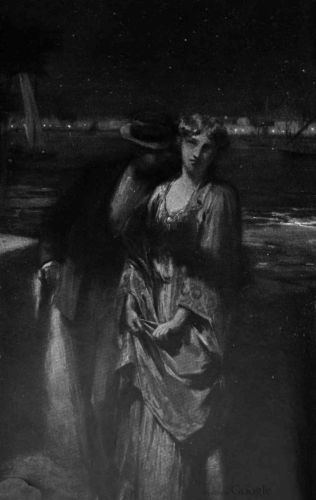
It was as if the stillness of the desert itself had encompassed the two
men. In their ears the slither of the brittle palm-leaves against one
another and the crackle of the fire were no longer sounds. They stared
at Fortune with that speechless wonder of men who had come unexpectedly
upon a wraith. What with the faint glow of the fire upon one side of her
and the pallor of moonshine upon the other, she did indeed resemble
man's conception of the spiritual.
Ryanne was first to pull himself together.
"Fortune, I am sorry; God knows I am. I'd have cut out my tongue rather
than have hurt you. I thought you were asleep in the tent."
"Is it true?"
"Yes." Ryanne looked away.
"I had not quite expected this: the daughter of a thief."
"Oh, come now; don't look at it that way. Smuggling is altogether a
different thing," protested Ryanne. (Women were uncertain; here she was,
apparently the least agitated of the three.) "Why, hundreds of men and
women, who regularly go to church, think nothing of beating Uncle Sam
out of a few dollars. Here's Jones, for instance; he would have tried to
smuggle in that rug. Isn't that right, Jones?"
"Of course!" cried George eagerly, though scarcely knowing what he said.
"I'd have done it."
"And you wouldn't call Percival a thief," with a forced laugh. "It's
like this, Fortune. Uncle Sam wants altogether too much rake-off. He
doesn't give us a square deal; and so we even up the matter by trying to
beat him. Scruples? Rot!"
"It is stealing," with quiet conviction.
"It isn't, either. Listen to me. Suppose I purchase a pearl necklace in
Rome, and pay five-thousand for it. Uncle Sam will boost up the value
more than one-half. And what for? To protect infant industries? Bally
rot! We don't make pearls in the States; our oysters aren't educated up
to it." His flippancy found no response in her. "Well, suppose I get
that necklace through the customs without paying the duty. I make
twenty-five hundred or so. And nobody is hurt. That's all your mother
does."
"It is stealing," she reiterated.
How wan she looked! thought George.
"How can you make that stealing?" Ryanne was provoked.
"The law puts a duty upon such things; if you do not pay it, you steal.
Oh, Horace, don't waste your time in specious arguments." She made a
gesture, weariness personified. "It is stealing; all the arguments in
the world can not change it into anything else. And how about my uncle
who fleeces the lambs at cards, and how about my mother who knows and
permits it?"
Ryanne had no plausible argument to offer against these queries.
"Is not my uncle a thief, and is not my mother an abettor? I do not
know of anything so vile." Her figure grew less erect. To George's eyes,
dimmed by the reflecting misery in hers, she drooped, as a flower
exposed to sudden cold. "I think the thief in the night much honester
than one who cheats at cards. A card-sharp; did you not call it that?
Don't lie, Horace; it will only make me sad."
"I shan't lie any more, Fortune. All that you believe is true; and I
would to God that it were otherwise. And I've been a partner in many of
their exploits. But not at cards, Fortune; not at cards. I'm not that
kind of a cheat."
"Thank you. I should have known some time, and perhaps only half a
truth. Now I know all there is to know." She held her hands out before
her and studied them. "I shall never go back."
"Good Lord! Fortune, you must. You'd be as helpless as a babe. What
could you do without money and comfort?"
"I can become a clerk in a shop. It will be honest. Bread at Mentone
would choke me;" and she choked a little then as she spoke.
"My dear Fortune," said Ryanne, calling into life that persuasive
sweetness which upon occasions he could put into his tones, "have you
ever thought how beautiful you are? No, I don't believe you have. Some
ancestor of your father's has been reincarnated in you. You are without
vanity and dishonesty; and I have found that these usually go together.
Well, at Mentone you had a little experience with men. You were under
protection then; protection it was of a sort. If you go out into the
world alone, there will be no protection; and you will find that men are
wolves generally, and that the sport of the chase is a woman. Must I
make it plainer?"
"I understand," her chin once more resolute. "I shall become a clerk in
a shop. Perhaps I can teach, or become a nurse. Whatever I do, I shall
never go back to Mentone. And all men are not bad. You're not all bad
yourself, Horace; and so far as I am concerned, I believe I might trust
you anywhere."
"And God knows you could!" genuinely. "But I can't help you. If I had a
sister or a woman relative, I could send you to her. But I have no one
but my brother, and he's a worse scoundrel than I am. I at least work
out in the open. He transacts his villainies behind closed doors."
George listened, sitting as motionless as a Buddhist idol. Why couldn't
he think of something? Why couldn't he come to the aid of the woman
he loved in this her hour of trial? A fine lover, forsooth! To sit there
like a yokel, stupidly! Could he offer to lend her money? A thousand
times, no! And he could not ask her to marry him; it would not have been
fair to either. She would have misunderstood; she would have seen not
love but pity, and refused him. Neither she nor Ryanne suffered more in
spirit than he did at that moment.
"Jones, for God's sake, wake up and suggest something! You know lots of
decent people. Can't you think of some one?"
But for this call George might have continued to grope in darkness.
Instantly he saw a way. He jumped to his feet and seized her by the
hands, boyishly.
"Fortune, Ryanne is right. I've found a way. Mr. Mortimer, the president
of my firm, is an old man, kindly and lovable. He and his wife are
childless. They'll take you. Why, it's as easy as talking."
She leaned back against the drawing of his hands. She was afraid that in
his eagerness he was going to take her in his arms. She wondered why, of
a sudden, she had become so weak. Slowly she withdrew her hands from
his.
"I'll cable the moment we reach port," he said, as if reaching port
under the existing conditions was a thing quite possible. "Will you go
to them? Why, they will give you every care in the world. And they will
love you as ... as you ought to be loved!"
Ryanne turned away his head.
Fortune was too deeply absorbed by her misery to note how near George
had come to committing himself. "Thank you, Mr. Jones; thank you. I am
going to the tent. I am tired. And I am not so brave as you think I am."
"But will you?"
"I shall tell you when we reach port." And with that she fled to the
tent.
Ryanne folded his arms and stared at the sand. George sat down and
aimlessly hunted for the stub of the cigar he had dropped; a kind of
reflex action.
The two men were all alone. The camel-boys were asleep. Mahomed had now
ceased to bother about a guard.
"I can't see where she gets this ridiculous sense of honesty," said
Ryanne gloomily.
George leaned over and laid his hand upon Ryanne's knee. "She gets it
the same way I do, Ryanne—from here," touching his heart; "and she is
right."
"I believe I've missed everything worth while, Percival. Till I met you
I always had a sneaking idea that money made a man evil. The boot seems
to be upon the other foot."
"Ryanne, you spoke about becoming honest, once you get out of this. Did
you mean it?"
"I did, and still do."
"It may be that I can give you a lift. You worked in your father's bank.
You know something about figures. I own two large fruit-farms in
California. What do you say to a hundred and fifty a month to start
with, and begin life over again?"
Ryanne got up and restlessly paced. Nonchalance had been beaten out of
him; the mercurial humor which had once been so pleasant to excite,
which had once given him foothold in such moments, was gone. He had only
one feeling, a keen, biting, bitter shame. At length he stopped in front
of George, who smiled and looked up expectantly.
"Jones, when you stick your finger into water and withdraw it, what
happens? Nothing. Well, the man who gives me a benefit is sticking his
finger into water. I'm just as unstable. How many promises have I made
and broken! I mean, promises to myself. I don't know. This moment I
swear to be good, and along comes a pack of cards or a bottle of wine,
and back I slip. Would it be worth while to trust a man so damned weak
as that? Look at me. I am six-foot two, normally a hundred and eighty
pounds, no fat. I am as sound as a cocoanut. There isn't a boxer in the
States I'm afraid of. I can ride, shoot, fence, fight; there isn't a
game I can't take a creditable hand in. So much for that. There's the
other side. Morally, I'm putty. When it's soft you can mold it any
which way; when it's hard, it crumbles. Will you trust a man like that?"
"Yes. Out there you'll be away from temptation."
"Perhaps. Well, I accept. And if one day I'm missing, think kindly of
the poor devil of an outcast who wanted to be good and couldn't be. I'm
fagged. I'm going to turn in. Good night."
He picked up his blanket and saddle-bags and made his bed a dozen yards
away.
George set his gaze at the fire, now falling in places and showing
incandescent holes. A month ago, in the rut of commonplace, moving round
in the oiled grooves of mediocrity. Bang! like a rocket. Why, never had
those liars in the smoke-rooms recounted anything half so wild and
strange as this adventure. Smugglers, card-sharps, an ancient rug, a
caravan in the desert! He turned his head and looked long and earnestly
at the little tent. Love, too; love that had put into his diffident
heart the thrill and courage of a Bayard. Love! He saw her again as she
stepped down from the carriage; in the dining-room at his side, leaning
over the parapet; ineffably sweet, hauntingly sad. Would she accept the
refuge he had offered? He knew that old Mortimer would take her without
question. Would she accept the shelter of that kindly roof? She must! If
she refused and went her own way into the world, he would lose her for
ever. She must accept! He would plead with all the eloquence of his
soul, for his own happiness, and mayhap hers. He rose, faced the tent,
and, with a gesture not unlike that of the pagan in prayer, registered a
vow that never should she want for protection, never should she want for
the comforts of life. How he was going to keep such a vow was a question
that did not enter his head. Somehow he was going to accomplish the
feat.
What mattered the ragged beard upon his face, the ragged clothes upon
his body, the tattered cloths upon his feet, the grotesque attitude and
ensemble? The Lord of Life saw into his heart and understood. And who
might say with what joy Pandora gazed upon this her work, knowing as she
did what still remained within her casket?
From these heights, good occasionally for any man's soul, George came
down abruptly and humanly to the prosaic question of where would he
make his bed that night? To lie down at the north side of the fire meant
a chill in the morning; the south side, the intermittent, acrid breath
of the fire itself; so he threw down his blanket and bags east of the
fire, wrapped himself up, and sank into slumber, light but dreamless.
What was that? He sat up, alert, straining his ears. How long had he
been asleep? An hour by his watch. What had awakened him? Not a sound
anywhere, yet something had startled him out of his sleep. He glanced
over the camp. That bundle was Ryanne. He waited. Not a movement there.
No sign of life among the camel-boys; and the flaps of the two tents
were closed. Bah! Nerves, probably; and he would have lain down again
had his gaze not roved out toward the desert. Something moved out there,
upon the misty, moonlit space. He shaded his eyes from the fire, now but
a heap of glowing embers. He got up, and shiver after shiver wrinkled
his spine. Oh, no; it could not be a dream; he was awake. It was a
living thing, that long, bobbing camel-train, coming directly toward the
oasis, no doubt attracted by the firelight. Fascinated, incapable of
movement, he watched the approach. Three white dots; and these grew and
grew and at length became ... pith-helmets! Pith-helmets! Who but white
men wore pith-helmets in the desert? White men! The temporary paralysis
left him. Crouching, he ran over to Ryanne and shook him.
"What...."
But George smothered the question with his hand. "Hush! For God's sake,
make no noise! Get up and stand guard over Fortune's tent. There's a
caravan outside, and I'm going out to meet it. Ryanne, Ryanne, there's a
white man out there!"
George ran as fast as he could toward the incoming caravan. He met it
two or three hundred yards away. The broken line of camels bobbed up and
down oddly.
"Are you white men?" he called.
"Yes," said a deep, resonant voice. "And stop where you are; there's no
hurry."
"Thank God!" cried George, at the verge of a breakdown.
"What the devil.... Flanagan, here's a white man in a dress-suit! God
save us!" The speaker laughed.
"Yes, a white man; and there's a white woman in the camp back there, a
white woman! Great God, don't you understand? A white woman!" George
clutched the man by the foot desperately. "A white woman!"
The man kicked George's hand away and slashed at his camel. "Flanagan,
and you, Williams, get your guns in shape. This doesn't look good to me,
twenty miles from the main gamelieh. I told you it was odd, that fire.
Lively, now!"
George ran after them, staggering. Twice he fell headlong. But he
laughed as he got up; and it wasn't exactly human laughter, either. When
he reached camp he saw Mahomed and the three strangers, the latter with
their rifles held menacingly. Fortune stood before the flap of her tent,
bewildered at the turn in their affairs. Behind the leader of the
new-comers was Ryanne, and he was talking rapidly.
"Well," the leader demanded of Mahomed, "what have you to say for
yourself?"
"Nothing!"
"Take care! It wouldn't come hard to put a bullet into your ugly hide.
You can't abduct white women these days, you beggar! Well, what have you
to say?"
Mahomed folded his arms; his expression was calm and unafraid. But down
in his heart the fires of hell were raging. If only he had brought his
rifle from the tent; even a knife; and one mad moment if he died for it!
And he had been gentle to the girl; he had withheld the lash from the
men; he had not put into action a single plan arranged for their misery
and humiliation! Truly his blood had turned to water, and he was worthy
of death. The white man, always and ever the white man won in the end.
To have come this far, and then to be cheated out of his revenge by
chance! Kismet! There was but one thing left for him to do, and he did
it. He spoke hurriedly to his head-boy. The boy without hesitation
obeyed him. He ran to the racing-camel, applied a kick, flung on the
saddle-bags, stuffed dates and dried fish and two water-bottles into
them, and waited. Mahomed walked over to the animal and mounted.
"Stop!" The white man leveled his rifle. "Get down from there!"
Mahomed, as if he had not heard, kicked the camel with his heels. The
beast lurched to its feet resentfully. Mahomed picked up the
guiding-rope which served as a bridle, and struck the camel across the
neck.
Click! went the hammer of the rifle, and Mahomed was at that moment very
near death. He gave no heed.
"No, no!" cried Fortune, pushing up the barrel. "Let him go. He was kind
to me, after his fashion."
Mahomed smiled. He had expected this, and that was why he had gone about
the business unconcernedly.
"What do you say?" demanded the stranger of Ryanne.
Ryanne, having no love whatever for Mahomed, shrugged.
"Humph! And you?" to George.
"Oh, let him go."
"All right. Two to one. Off with you, then," to Mahomed. "But wait! What
about these beggars of yours? What are you going to do with them?"
"They have been paid. They can go back."
The moment the camel felt the sand under his pads, he struck his gait
eastward. And when the mists and shadows crept in behind him and his
rider, that was the last any of them ever saw of Mahomed-El-Gebel,
keeper of the Holy Yhiordes in the Pasha's palace at Bagdad.
"Now then," said the leader of the strange caravan, "my name is
Ackermann, and mine is a carpet-caravan, in from Khuzistan, bound for
Smyrna. How may I help you?"
"Take us as far as Damascus," answered Ryanne. "We can get on from there
well enough."
"What's your name?" directly.
"Ryanne."
"And yours?"
"Fortune Chedsoye."
"Next?"
"Jones."
The humorous bruskness put a kind of spirit into them all, and they
answered smilingly.
"Ryanne and Jones are familiar enough, but Chedsoye is a new one. Here,
you!" whirling suddenly upon the boys who were pressing about. He
volleyed some Arabic at them, and they dropped back. "Well, I've heard
some strange yarns myself in my time, but this one beats them all.
Shanghaied from Cairo! Humph! If some one had told me this, anywhere
else but here, I'd have called him a liar. And you, Mr. Ryanne, went
into Bagdad alone and got away with that Yhiordes! It must have been the
devil's own of a job."
"It was," replied Ryanne laconically. He did not know this man
Ackermann; he had never heard of him; but he recognized a born leader of
men when he saw him. Gray-haired, lean, bearded, sharp of word, quick of
action, rude; he saw in this carpet-hunter the same indomitable
qualities of the ivory-seeker. "You did not stop at Bagdad?" he asked,
after the swift inventory.
"No. I came direct. I always do," grimly. "Better turn in and sleep;
we'll be on the way at dawn, sharp."
"Sleep?" Ryanne laughed.
"Sleep?" echoed George.
Fortune shook her head.
"Well, an hour to let the reaction wear away," said Ackermann. "But
you've got to sleep. I'm boss now, and you won't find me an easy one,"
with a humorous glance at the girl.
"We are all very happy to be bossed by you," she said.
"Twenty days," Ackermann mused. "You're a plucky young woman. No
hysterics?"
"Not even a sigh of discontent," put in George. "If it hadn't been for
her pluck, we'd have gone to pieces just from worry. Are you Henry
Ackermann, of the Oriental Company in Smyrna?"
"Yes; why?"
"I'm George P. A. Jones, of Mortimer & Jones, New York. I've heard of
you; and God bless you for this night's work!"
"Mortimer & Jones? You don't say! Well, if this doesn't beat the Dutch!
Why, if you're Robert E. Jones's boy, I'll sell you every carpet in the
pack at cost." He laughed; and it was laughter good to hear, dry and
harsh though it was. "Your dad was a fine gentleman, and one of the
best judges of his time. You couldn't fool him a knot. He wrote me when
you came into this world of sin and tribulation. Didn't they call you
Percival Algernon, or something like that?"
"They did!" And George laughed, too.
"You're a sight. Any one sick? Got a medicine-chest aboard."
"No, only banged up and discouraged. I say, Mr. Ackermann, got an extra
pipe or two and some 'baccy?"
"Flanagan, see what's in the chest."
Shortly Flanagan returned. He had half a dozen fresh corn-cob pipes and
a thick bag of tobacco. George and Ryanne lighted up, about as near
contentment as two men in their condition could possibly be.
Said Flanagan to Fortune: "Do you chew?"
Fortune looked horrified.
"Oh, I mean gum!" roared Flanagan.
No, Fortune did not possess that dubious accomplishment.
"Mighty handy when you're thirsty," Flanagan advised.
They built up the fire and sat round it cosily. They were all more or
less happy, all except Fortune. So long as she had been a captive of
Mahomed, she had forced the thought from her mind; but now it came back
with a full measure of misery. Never, never would she return to Mentone,
not even for the things that were rightfully hers. Where would she go
and what would she do? She was without money, and the only thing she
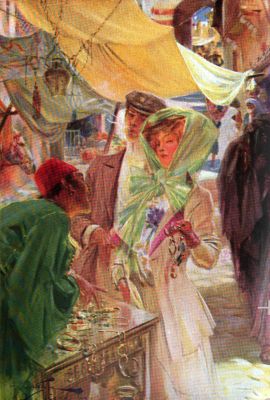
possessed of value was the Soudanese trinket Ryanne had forced upon her
that day in the bazaars. She heard the men talking and laughing, but
without sensing. No, she could not accept charity. She must fight out
her battle all alone.... The child of a thief: for never would her clear
mind accept smuggling as other than thieving.... Neither could she
accept pity; and she stole a glance at George, as he blew clouds of
smoke luxuriantly from his mouth and nose, his eyes half closed in
ecstasy. How little it took to comfort a man!
Ryanne suddenly lowered his pipe and smote his thigh. "Hell!" he
muttered.
"What's up?" asked George.
"I want you to look at me, Percival; I want you to take a good look at
this thing I've been carrying round as a head."
"It looks all right," observed George, puzzled.
"Empty as a dried cocoanut! I never thought of it till this moment. I
wondered why he was in such a hurry to get out. I've let that
copper-hided devil get away with that nine hundred pounds!"