“What is left when honour is lost?”
Publius Syrus.
Twilight was falling over The Birches, and Edward Carleton, seated alone
on the piazza, gazed out over the darkening fields into a world of ever
blending shadows and onward creeping dusk. Always, as long as the
weather permitted, after his evening meal, he loved to sit there,
puffing quietly at his big, old-fashioned, curved pipe, and letting his
memory roam back at will through scene after scene from the long years
that now lay behind him; or sometimes, more rarely, living in the
present, content merely to gaze out on blossoming flower, and tree in
full leaf; to watch the fiery colors of the sunset glow and die in the
far-off west; to hear from the orchard across the road a robin singing
his good night song; to listen to the thousand wonderful secrets which
Nature at the last loves to whisper to those who have lived their lives
pure in deed and word, and who have journeyed far onward into the
shadow, still kindly and serene, with the wonderful dreams of childhood
making beautiful their minds, and in their hearts the faith of little
children.
Often Henry Carleton sat there with him, but to-night the old man was
alone. An hour ago, a message had come from Henry, saying that he would
not be home until the following evening—perhaps not even then—that
business matters of importance had arisen, making it necessary that he
should remain in town. Characteristic of Henry Carleton’s unfailing
thoughtfulness the message had been, and it was of his brother, and,
with a half-sigh, of Jack as well, that Edward Carleton was thinking
now, as the darkness pressed closer and closer around the old house that
had sheltered for so many generations so many fathers and sons of the
Carleton blood.
From the entrance to the gravel walk, the sound of footsteps smote
briskly on his ear and he glanced up to see a tall and familiar figure
coming up the path. A moment later, and Jack had hastily mounted the
steps, scarce seeming to heed his father’s greeting, and speaking at
once, in a voice strangely unlike his own. “Father,” he said, “where’s
Henry?”
The old man gazed at him in surprise. “He’s not at home, Jack,” he
answered, and then, with a momentary foreboding, “What is it, my boy?
Nothing wrong?”
Jack laughed, a little grimly. “No, nothing like that,” he answered,
“I’m in trouble, that’s all. I’ve stayed too long in a falling market,
and got caught. If I can’t get help from Henry, I guess I’m done.”
In the darkness Edward Carleton reached out his hand, and laid it on his
son’s shoulder. “My dear boy,” he said, “I’m sorry. If only Henry has
the money available. But I don’t know. These must be terrible times for
every one. Tell him if there’s any way he can use what he holds for me,
that I asked him to do so. I’m so sorry, Jack—so sorry—”
With what was for him unusual feeling, Jack took his father’s hand in
both his own. “Thank you, father,” he said, “I know you are. It’s all my
own fault, of course. I don’t deserve any help. But it’s all come so
suddenly. I never thought—”
He broke off abruptly, then spoke again. “Well, I suppose I must get
back in town, I haven’t much time. I never dreamed of not finding Henry
here. I’m sorry I can’t stay. Good night, father,” and he was gone.
It was nearly two hours later when he hastened down Adams Street toward
the Harmon Building, where high overhead in many a window, lights
ordinarily extinguished by five or six o’clock, were still burning
brightly; some of them, indeed, destined to gleam and flicker throughout
that long, anxious summer’s night, and only to pale at last as the first
faint streaks of dawn struck through the shades on the men who planned
and toiled within, working feverishly, with gray, unshaven faces, and
weary, bloodshot, deep-sunken eyes.
Getting out of the elevator at the fourth floor, Jack hastily made his
way into Henry Carleton’s offices. Once there, however, although his
name was quickly sent in, he was compelled to wait for a full half hour
in the outer corridor, until at length a bell rang sharply, and a tired
looking clerk, with a nod of his head toward the inner office, signified
that the audience was granted. With a curious sense of old-time
familiarity, Jack entered the big square room which he had visited last,
now upward of three years ago, and closed the door behind him.
Over by the window, Henry Carleton was seated at his desk. He was a man
of about fifty, in complexion so dark as to appear almost swarthy, and
with coal black hair and beard, here and there just faintly touched with
gray. He was tall, much of Jack’s height and build, yet constructed upon
finer lines, with a sinuous grace of movement that had about it
something almost feline. His face was rather long, the forehead and
cheek-bones high, the eyes were black and piercing, and the lips of the
strong, well-chiseled mouth noticeably full and red. Altogether, an
interesting face, a fitting index to the dual personality of the
man—Henry Carleton the shrewd and able leader in the business world,
and Henry Carleton the musician and man of letters—the artist to his
finger-tips.
As Jack entered, he glanced up pleasantly enough, though far back in his
eyes there lurked a hidden gleam of some emotion difficult to fathom.
“Why, hello, Jack,” he said, “I’m surprised to see you. What brings
you here? Sit down.” He motioned toward a chair.
Jack Carleton came forward into the room, standing a little awkwardly
with his hand on the back of the proffered seat. “It’s the market,
Henry,” he said briefly, “I’ve got caught. I have to raise twenty
thousand by the opening to-morrow, or go under. I’ve just come from
home; I thought I’d find you there. I’ll tell you the truth. I hate like
hell to come to you, and you know it, but I’ve got to get the money
somehow, and if you can help me, I wish to Heaven you would.”
Henry Carleton gazed at him meditatively. “Better sit down,” he said
curtly, and this time Jack accepted the invitation. There was a short
silence. Then Henry Carleton drew a tiny note-book from his pocket, and
looked up, with pencil poised, “Now let’s have it,” he said.
Jack Carleton frowned. It was easy enough to see that the confession of
his sins was little less than torture to him. “Well,” he began, a trifle
defiantly, “it’s like this. I’ve got in a trifle deeper than I meant to
when I started. Things looked so like a cinch, I couldn’t help it. I’ve
fifteen hundred shares of Suburban Electric, and seven hundred Akme
Mining, and five hundred Fuel, and a little other stuff besides. My
heaviest account’s with Turner and Driver; then I’ve got an account with
Harris and Wheeler, and another with Claxton Brothers; altogether—”
Piece by piece the whole story came out. Henry Carleton wrote, figured,
meditated; asked a question here, another there; meditated again.
Finally he seemed to make up his mind. He spoke with deliberation,
weighing his words. “No one can tell,” he said, “what the next
twenty-four hours are going to bring. But what you ought to do is clear.
You’ve got to lighten up, to start with. Close out your account with
Harris, and with the Claxtons; hang on to what you have at Turner and
Driver’s, if you can. That’s enough; and that’s our problem: how best to
try to carry it through.”
As if the words brought him measureless comfort, Jack drew a long breath
of relief. “You think, then,” he asked, almost timidly, “you can fix it
somehow? You think you can get me by?”
Henry Carleton did not at once reply, and when he finally spoke, it was
but to answer Jack’s question with another. “Have you done everything
you can yourself?” he queried. “Where else have you tried?”
Jack gave a short mirthless laugh. “Where haven’t I tried?” he
retorted. “I’ve tackled about every friend and acquaintance I’ve got in
the world. I began four days ago. And I’ve had the same identical
come-back from every one of them. They’re sorry, but they have to look
out for themselves first. And security. They all talk about that. I
never knew before that security cut such a lot of ice with people. But
it does.”
Henry Carleton nodded grimly. “Yes, it does,” he answered dryly, “most
of us make that discovery sooner or later. And generally for ourselves,
too. And when you mention security, Jack, you’ve come right down to the
root of the whole trouble. We might as well acknowledge it now. I can’t
help you myself. I tell you so frankly. I couldn’t use trust funds for
such a purpose, of course. Any one would tell you that. That’s out of
the question. And my own money is hopelessly tied up. I couldn’t get the
sum you need under a month, if I could then. But there’s one thing I
might do. It isn’t business. I hate to try it. But I don’t want to see
you disgraced, Jack, if I can help it. Wait here a minute, till I see—”
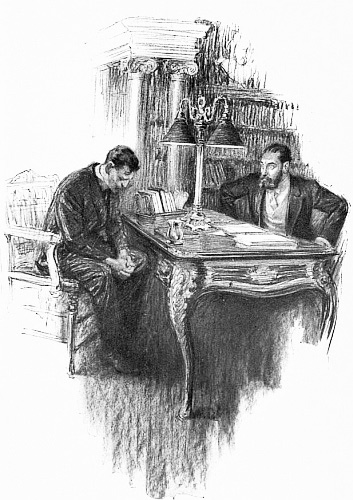
He rose and walked over to the telephone booth in the rear of his
office, and entering, closed the door behind him. In two minutes he came
back to his desk, penciled a name on a card, and handed it to Jack.
“This fellow Farrington,” he said shortly, “is under some obligations to
me. I think you’ll get what you want from him. Better see him anyway.
He’s in the Jefferson Building, top floor. I told him you’d be there in
ten minutes, at the most.”
Jack Carleton rose. “I’m much obliged, Henry,” he said, a little
lamely, “you’re very good. I’m much obliged. I’ll go right over, of
course.”
The other stood gazing at him with a curious expression on his swarthy
face, a curious gleam far back in his dark eyes. “Don’t mention it,” he
said smoothly, “Carletons must stand together, Jack. We mustn’t bring
dishonor on the name, whatever we do.”
Unerringly he had pierced the weak joint in the armor. Jack’s face went
whiter than before. He stood for a moment silent, then spoke with
effort. “No,” he answered, “we mustn’t do that,” and turning, he left
the room.
Up-town toward the Jefferson Building he hurried, half-daring, yet
half-fearing, to hope. Noting the number of the room on the framed
directory placarded within, he left the elevator at the tenth floor, and
hastening down the corridor, paused opposite the door. Externally the
office was a modest one, with “H. O. Farrington, Agent” inscribed in
plain black lettering on the glass. Entering, he found the interior to
correspond. A tiny room, with a small enclosure at one end, within which
sat Farrington himself, a man perhaps best described by saying that he
perfectly typified that somewhat vague being whom most of us have in
mind when we speak glibly of the “average man.” “Average” best described
him in height, build, and appearance, the nondescript sort of person
whom one meets on Monday, and passes in the street on Tuesday, wholly
unconscious of ever having seen him before.
As Jack entered, he glanced up quickly. “Mr. Carleton?” he questioned,
and as Jack nodded, motioned to a chair. “Just a minute,” he said, and
bent over his writing again. Presently, as he stopped, and reached for a
sheet of blotting paper, Jack ventured to speak. “I don’t know how much
you know about this—” he began, but the other raised his hand. “All
right,” he said briefly, and shoved a check and a receipt across the
desk, “Sign, please.”
Mechanically Jack glanced at the check. It was for the amount required.
Mechanically, too, he signed the receipt, and handed it back to
Farrington. Half unable to realize his good fortune, he rose, the check
in his hand. “I’m greatly obliged,” he said.
Farrington made no reply. Evidently words with him were precious things.
Perforce Jack turned to go, and then, half-way to the door, turned.
“Mr. Farrington,” he said hesitatingly, “if things should go lower—”
Farrington did not look up. “They won’t,” he said tersely.
Again Jack hesitated. Then, finally, “But if they should—” he said
again.
A little impatiently, Farrington raised his head. “We’ll see you
through,” he said. “Good night.” And Jack, not disposed to quarrel
further with fortune, closed the door behind him.
It was a quarter of ten on the morning following when he entered Turner
and Driver’s office, advancing to meet the senior partner with the
little strip of paper in his outstretched hand. Turner took it eagerly
enough, and as he scanned the amount, he nodded, while a wrinkle or two
seemed to vanish from his puckered and frowning brow. Then he looked
up. “Well, you got it,” he said, and Carleton hastened to assent. “Oh,
yes,” he returned lightly, “I got it all right. Why, didn’t you think I
would?”
The broker shrugged his shoulders. “Hard telling anything these days,”
he answered, “but I’ll tell you one thing, though; you’re mighty lucky
to be able to put your hands on it so easy. There’ll be more than one
poor devil this morning who would pretty near give his soul for a tenth
part of what you’ve got here. It’s a bad time for customers, Jack, and I
don’t mind telling you—” he lowered his voice confidentially—“that
it’s a bad time for brokers, too. A little piece of paper like this—”
he waved the check gently to and fro—“is a nice comforting sight for a
man; between you and me, I wouldn’t mind seeing three or four mates to
it. Yes, I’m glad to get it all right, on my account, and on yours,
too.”
Jack nodded. Somehow, entirely without justification, as he well knew,
the check had given him a feeling of great stability; at once, on
receiving it, he had felt that he had risen in his own self-esteem.
“Yes,” he assented, “I’m glad myself; and you needn’t worry about my
account, Jim. We’ll just leave it this way. Don’t treat mine as an
ordinary account; don’t sell me out, whatever happens. I’ve friends
that’ll see me through anything. If things should go lower, and you
should need more margin, just let me know, and I’ll get it over to you
right away. Will that be satisfactory?”
The broker nodded. “Why, yes, Jack,” he answered, “knowing the way
you’re fixed, I guess that’ll be all right, though with nine men out of
ten, of course I wouldn’t consider such a way of doing things. Business
is business, and when it comes right down to the fine point, why, it’s
the cold hard cash that counts, and nothing else; not friendship, or
honor, or gratitude, or common decency, even—” both face and voice had
hardened as he spoke; it was not his first panic—and then his look met
Carleton’s fairly and squarely. “But with you, Jack,” he continued,
“it’s different, as I say. Only let’s be perfectly sure that we
understand each other. I don’t believe myself, you know, that things can
go much lower; I think the chances are they’ve steadied for good; but
for argument, let’s suppose they do. Then, as I understand it, you don’t
want to have me sell you out at any price, no matter how far they break.
You’ll make good any time I ask you to. You give me your word on that?”
Carleton readily enough assented. “Why, sure,” he answered lightly, “of
course I do; you needn’t worry; I’ll make good,” and the broker nodded,
well pleased.
“One thing less to bother over, then,” he said. “You’ll excuse me now,
Jack, won’t you? This is going to be a horrible busy day, anyway, and
the Lord send it’s nothing worse than that; it wouldn’t take much now to
raise the very deuce.”
As he spoke the News Despatch boy entered, tossing down on the table a
half dozen sheets fresh from the press. Turner glanced at them, and
handed them over to Carleton, shaking his head as he did so. “London’s
not feeling gay,” he observed, “I call that a pretty ragged opening
myself. I don’t know what you think of it.”
Carleton read and nodded. It seemed as if everything in the half dozen
pages made for discouragement. London had opened weak—lamentably weak.
There were rumors of this—rumors of that—sickly, unhealthy mushroom
growths of the night. There was talk of failures—suspensions—financial
troubles of every kind—even the good name of a great bank was bandied
carelessly to and fro. Silently Turner crossed the room, and took his
seat at his desk; silently Carleton walked out into the customers’ room,
and joined the other unfortunates who had come slowly straggling in, and
who now stood around the ticker, waiting gloomily and apprehensively for
the opening bell to ring.
The tension of the moment was plainly enough to be read in the attitudes
and expressions of the members of the little group, not one of whom
failed in some manner or other to betray the fact that he was far from
possessing his usual poise and calm. Most of them, either consciously or
unconsciously, showed their nervousness so plainly and even painfully
that it was impossible to misinterpret the anxious glances cast first at
the clock, then at the tape, as the moment of the opening drew near.
One or two, indeed, essayed a nonchalance so obviously assumed as to
render even more apparent the emotion it sought to conceal. One young
fellow, with hat shoved far back on his head, hair in disorder, and a
restless, frightened look in his eyes, glanced at Carleton as he
approached.
“How you standing it, Jack?” he queried, with a faint attempt at
jocularity. “Bad night to sleep last night, I called it; guess most
likely ’twas something in the air.”
Another man, he of the toothpick, stout and coarse, held forth at some
length for the benefit of the rest. “Oh, it was perfectly clear, the
whole thing,” he was saying, with the air of one to whom all the
mysteries and marvels of stock fluctuations are but as matters writ
large in print the most plain. “You see Rockman and Sharp and
Haverfeller got together on this thing, and then they had a conference
with Horgan, and got him to say that he’d keep his hands off, and let
things alone; then they had a clear chance, and you can see what they’ve
done with it; oh, they’re clever all right; when those fellows get
together, it’s time to look out; you can’t beat ’em.”
He spoke with a certain condescending finality, as if he had somehow
once and for all fixed the status of the panic. After a moment or two a
gray, scholarly looking little man, with gentle, puzzled eyes, addressed
him, speaking with an air of timid respect for the stout man’s evident
knowledge.
“Do you imagine, sir,” he asked, “that securities will decline still
further in value? If they should, I am afraid that I might find myself
seriously involved. I can’t seem to understand this whole affair; I was
led to believe—”
The big man, charmed with the novelty of having a genuine, voluntary
listener, interrupted him at once.
“Oh, you don’t have to worry,” he said largely, “they might open ’em off
a little lower, perhaps, but they’ll go back again. Don’t you fret; the
country’s all right; they’ll come back; they always do.”
The little man seemed vastly comforted. “I’m very glad to hear you say
so,” he answered. “It would come very hard—I had no idea the risk was
so great—I was led to believe—”
The young man with the rumpled hair turned a trifle disgustedly to
Carleton. “Heard from London?” he asked abruptly. His brief, and not
wholly unintelligent connection with the game had led him to believe
firmly in facts and figures, not in the dangerous pastime of theorizing
over values, or speculating as to what the next move of the “big
fellows” might be.
Carleton nodded. “Weak,” he answered, his tone pitched low and meant for
his neighbor’s ear only, “horribly weak; and all sorts of stories
starting, too; it looks as bad as it could.”
The young man nodded. “I supposed so,” he said, with resignation, and
then added whimsically, “Well, there’s no use crying about it, I guess,
but it certainly looks as if this was the time when little Willie gets
it good and plenty, right in the neck.”
Just in front of them, a pale, slender man, with blinking eyes, and a
mumbling, trembling mouth that was never still, talked steadily in an
undertone, apparently partly to himself, partly to the man who stood at
his shoulder, a red-faced farmer with a hundred shares of Akme at stake.
“Now’d be the time,” he muttered, “now’d be the time to jump right in;
jump right in and buy four or five thousand shares; a man could make a
fortune, and get out for good; it’s the chance of a man’s life; to jump
right in and buy four or five thousand shares.”
The countryman gazed at him in silence, sizing him up at first
curiously, and then with a certain amused and not unkindly contempt.
“Four or five thousand!” he said, at last. “That ain’t enough. Buy ten
thousand while you’re at it. You’ll get twice as rich then,” but the
nervous man seemed to take no offense, and indeed, not even to notice
the remark. “Now’s the time,” he rambled on, and it was clear that it
was to himself alone that his mumblings were addressed, “to jump right
in; that’s the thing to do.”
To Carleton, all at once it seemed that the group around the ticker was
a gathering merely of the wrecks of men—of idle fools of greater or
less degree. All of them he pitied, except the big, coarse man with the
toothpick, for whom he felt a huge dislike; and most of all his pity
went out to the gentle man with the puzzled eyes; something unfair there
seemed to be in such a one being decoyed into the market game—something
repellant, as if one had lied, deliberately and maliciously, to a child.
Pity or anger—old or young—was there in all the group, he reflected
with sudden distaste, one real man? And then, instant and unexpected, a
lightning flame of keenest irony seemed to sear its way into his very
soul; suppose Farrington had withheld the check? Was there, in all the
group, himself included, one real man—
The bell rang. The ticker whirred. For a moment the dozen heads were
grouped closely together over the tape, and then—the first quotation,
five hundred Fuel at fifty-seven, gave warning of the truth; and the
second and third verified it beyond all doubt or questioning. No further
need of argument; no further agony; the suspense was over. So weak was
the opening as to be almost incredible, so weak that it took a moment or
two to adjust oneself to the shock. Akme Mining had closed the night
before at ten. Carleton, figuring on the lowest, had imagined that it
might open at eight and a half, or even eight. Two thousand shares came
over the tape at six and a quarter. Everything else was in like ratio;
everything else kept the same proportion—or lack of it. For perhaps ten
seconds there was silence absolute, and then the reaction came. The
young man with the rumpled hair turned sharply away, his hands thrust
deep into his trousers’ pockets, his lips curiously twisted and
contorted, the tip of his tongue showing between his teeth. He gazed up
at the blank wall, nodding unsmilingly to himself. “I thought so,” he
observed, quietly, “in the neck.”
The man with the mumbling mouth started again to speak. “Now,” he
muttered, “now would be the time; to jump right in—” and then, as if
just for a moment he caught a glimpse of himself and the figure he made,
old and futile, worn out and wan, he stopped abruptly, rubbing his eyes,
and for a time spoke no more, only standing there motionless, with the
force of a habit too strong to be broken, glancing down unseeingly at
the rows of little black letters and figures that issued steadily from
the ticker, only to pass, unregarded and unmeaning, beneath the vacancy
of his gaze.
Carleton had stood staring grimly with the rest. In a moment he felt a
hand laid upon his arm, and turned to meet the wistful glance of the
little gray man. “I beg your pardon,” he asked timidly, “but can you
tell me at what price Kentucky Coal is selling? I dislike to trouble
you, but I am entirely unfamiliar with the abbreviations used.”
Carleton nodded with the feeling that he might as well deal the little
man a blow squarely between the eyes. “Forty-eight,” he said shortly.
The little man turned very pale. “Forty-eight,” he repeated
mechanically, “can it be so? Forty-eight!” He shook his head slowly from
side to side, then glanced at Carleton with a smile infinitely gentle
and pathetic. “And to earn it,” he murmured, “took me twenty years;” and
then again, after a pause, “twenty years; and I’m afraid I’m pretty old
to begin again now.”
Carleton’s heart smote him. Gladly enough would he have sought to aid,
if a half of his own depleted fortune had remained to him. He stood for
a moment as if in a dream. The whole scene—the familiar office, the
stock-board, the ticker, the disheartened, discouraged group of
unsuccessful gamblers—it was all real enough, and yet at the same time
about it all there clung an air somehow theatric, melodramatic, hard of
realization. Then, from the doorway, Turner called him sharply, and he
hastened into the private office. Outwardly, the broker still had a
pretty good grip on himself, but in his tone his rising excitement was
easily enough discerned. “Look, Jack,” he said quickly, “things are bad;
there’s all sorts of talk coming over our private wire. Hell’s broke
loose; that’s the amount of it. I want you to get me ten thousand on
your account as quick as the Lord’ll let you; get fifteen, if you can.
It’s better for us both that way. Saves worrying—any more than anybody
can help. And Jack,” he added, “I’m not supposed to know this, neither
are you. But they’re letting go a raft of your father’s stuff over at
Brown’s. I don’t know what the devil it means, but I call it a mighty
bad sign.”
Carleton nodded, and without wasting time, left the room. The ten
minutes’ walk between Turner’s office and the Jefferson Building he
covered in half that time, and striding hastily down the corridor, had
almost reached Farrington’s door when a tall, red-faced young man,
emerging with equal speed, pulled up short to avoid the threatened
collision, and stood back for Carleton to enter. Glancing at him, Jack
recognized a casual acquaintance, and nodded to him as he passed. “How
are you, Cummings?” he said, and the other, looking at him a little
curiously, returned his salutation, and then passed quickly on.
Farrington was seated at his desk, and Jack at once, and without
ceremony, entered. Farrington, glancing up, acknowledged his greeting,
with a curt nod; then looked at him with questioning gaze. “Well?” he
said.
“Well,” Jack echoed, a trifle deprecatingly, “you can guess what I’ve
come for, I suppose. You saw the opening. I want ten thousand
more—fifteen, if I can have it—but ten will do.”
Farrington looked him straight in the eye.
“Ten will do,” he echoed; then, dryly, “I should think it would.” He
paused for the veriest instant, then added, with the utmost directness,
“It’s no go, Mr. Carleton. I’m caught myself. I can’t let you have a
cent.”
At the words the blood seemed suddenly to leave Jack Carleton’s heart.
Something tightened in his throat, and a faint mist seemed to gather
between Farrington’s face and his own. Then, as he came to himself,
“Can’t let me have it!” he cried sharply. “Why, you told me last night
you’d see me through, you won’t go back on your word now. The money’s
promised. It’s too late.”
Farrington’s face was expressionless. “You don’t realize,” he said,
“what a time this is. It’s one day out of a million—the worst there’s
ever been. If I could have foreseen—”
The telephone on his desk rang sharply, and he turned to answer it. Jack
Carleton sat as if stunned. This man had lied to him; had given him his
word, and now, with the market hopelessly lower, retracted it; had
thrown him a rope, and, as he hung helpless in mid air, was leaning
coolly forward to cut it, and let him perish. And he had promised
Turner—his word of honor. He felt physically faint and sick. Farrington
hung up the receiver, and then, as Jack started to speak, an
interruption occurred. Suddenly the door opened, and Cummings appeared
in the entrance. He seemed greatly hurried and excited, as if he had
been running hard. “All ready, Hal,” he cried, “he’ll ring you any
minute now. And when he does, buy like hell! For the personal, of
course! He says—”
Quickly Farrington cut in on him. “Shut up!” he cried, so sharply that
Jack could not but note his tone, “Can’t you see I’m busy? Wait outside,
till I’m through,” and Cummings, his red face many shades redder than
before, at once hastily withdrew.
Immediately Carleton leaned forward. “Look here,” he cried desperately,
“this isn’t right. You told me you’d see me through. Those were your
very words. You can’t go back on them now. If you do, you’ve got me
ruined—worse than ruined. It isn’t only the money; I’ve pledged my
word; pledged myself to make good. I’ve got to have it, Farrington;
that’s all; I’ve got to; can’t you understand?”
Farrington frowned. “You can’t have it,” he answered sharply, “and
don’t take that tone to me, either, Mr. Carleton. Haven’t I given you
twenty thousand already? You must have misunderstood me last night. I
said I’d see you through if I could, and now I find I can’t. That’s all.
I tell you I can’t; and I won’t stop to split hairs about it, either.
I’ve got too much at stake. You’d better not wait, Mr. Carleton. There’s
no use in it. There’s nothing for you here.”
Carleton’s eyes blazed. Just for an instant things swam before him; for
an instant he half crouched, like an animal about to spring. In the
office, absolute stillness reigned, save for the tall clock in the
corner ticking off the seconds—five—ten—fifteen—and then, all at
once, his tightly closed hands unclenched, his lips relaxed; on the
instant he stood erect, and without speaking, turned quickly on his
heel, and left the room.
Grim and white of face, he burst five minutes later into Turner’s
private office, with a bearing so changed that Turner could not help
but notice it, and read the trouble there. “Something wrong?” he asked
sharply, and Carleton nodded, with a strange feeling as if he were
acting a part in some sinister dream. “I couldn’t get it,” he said.
Turner gazed at him, frowning. “Nonsense,” he cried, and Carleton could
have laughed hysterically to hear his own words of ten minutes before
coming back to him: “You’ve got to get it. You told me you were all
right, Jack. You can’t do this now. Last night was the time to settle or
sell. You can’t turn around now. It’s too late.”
Carleton’s face was haggard, his mouth dry. He shook his head
stubbornly. “I can’t get it,” he said again.
The broker’s eyes grew suddenly hard. “Of course you can,” he cried,
“you said you could; you know you can get it, Jack; go ahead!”
But Carleton only shook his head once more. “It’s no use,” he answered
wearily, “I can’t get it, I say. I wouldn’t lie to you.”
It was an unfortunate phrase. The broker sneered. “Oh, no,” he cried,
“of course not. You wouldn’t lie to me. How about this morning?” And
then, struck suddenly by the expression on Carleton’s face, and perhaps
a little ashamed of his own loss of self-control, he hastened to add, in
a tone kindlier by far, “Come, come, Jack, this isn’t like you. There’s
something queer here. You told me you had friends who’d see you through.
You told me that not three hours ago. And if you lied to me, it was a
dirty thing to do, and a foolish thing, as well. Because now I’ve got to
sell you out; there’s no other way; and it leaves you ruined, and costs
me money, besides. But I won’t preach. Thank God, that’s one thing I’ve
never done yet. You’ve been a good customer here, and a good friend of
mine, too. So give it to me straight, Jack. If you lied to me, tell me
so. It’s bad enough for you; I won’t make it any worse. I’ll keep my
head shut, and you can pay me back as you’re able. But now look here—”
and his tone hardened again—“if it isn’t that; if it’s somebody else
that’s lied to you, and fooled us both, why that’s a different story
altogether. There’s nothing to stop us then, and by God, we won’t let it
stop us, either. We’ll tell the story all over this town, till we make
somebody good and sorry for what he’s done. Give it to me straight,
Jack. How did it happen? Is this whole business up to somebody else, or
is it up to you? Was it the truth you told me, or was it a lie?”
For a moment Carleton stood silent. Through his tired brain flashed evil
thoughts—suspicion—conjecture—the possibility of a just revenge. And
yet—it was all so confused—so uncertain. Blame there was
somewhere—but where? What could he really do? And then, curiously
enough, once more he seemed to see before his eyes the dark face of
Henry Carleton; once again he seemed to hear him say, “The Carletons
must stand together, Jack. We mustn’t bring dishonor on the name.” And
in that sudden instant Jack Carleton ceased all at once to be a boy, and
became a man. Low and hesitating came the words, the words that in the
broker’s eyes branded him for ever as a coward, beaten and disgraced,
and yet his gaze, fixed on Turner’s face, never faltered. “Jim,” he
said, “I’m sorry. It’s up to me. I told you a lie.”

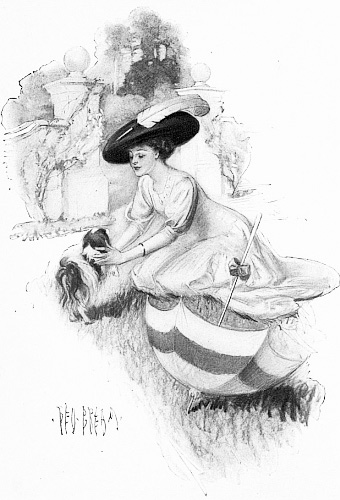 “The girl who knelt upon the grass.”—Page 29