INTRODUCTION. ASSYRIAN RECORD-ROOMS. LIBRARIES IN
GREECE, ALEXANDRIA, PERGAMON, ROME. THEIR SIZE, USE,
CONTEXTS, AND FITTINGS. ARMARIA OR PRESSES. THE VATICAN
LIBRARY OF SIXTUS V. A TYPE OF AN ANCIENT ROMAN LIBRARY.
 I propose, in the following Essay, to trace the methods adopted by man in
different ages and countries to preserve, to use, and to make accessible
to others, those objects, of whatever material, on which he has recorded
his thoughts. In this investigation I shall include the position, the
size, and the arrangement, of the rooms in which these treasures were
deposited, with the progressive development of fittings, catalogues, and
other appliances, whether defensive, or to facilitate use. But, though I
shall have to trace out these matters in some detail, I shall try to
eschew mere antiquarianism, and to impart human interest, so far as
possible, to a research which might otherwise exhaust the patience of my
readers. Bibliography, it must be understood, will be wholly excluded.
From my special point of view books are simply things to be taken care of:
even their external features concern me only so far as they modify the
methods adopted for arrangement and preservation. I must dismiss the
subject-matter of the volumes which filled the libraries of former days
with a brevity of which I deeply regret the necessity. I shall point out
the pains taken to sort the books under various comprehensive heads; but I
shall not enumerate the authors which fall under this or that division.
I propose, in the following Essay, to trace the methods adopted by man in
different ages and countries to preserve, to use, and to make accessible
to others, those objects, of whatever material, on which he has recorded
his thoughts. In this investigation I shall include the position, the
size, and the arrangement, of the rooms in which these treasures were
deposited, with the progressive development of fittings, catalogues, and
other appliances, whether defensive, or to facilitate use. But, though I
shall have to trace out these matters in some detail, I shall try to
eschew mere antiquarianism, and to impart human interest, so far as
possible, to a research which might otherwise exhaust the patience of my
readers. Bibliography, it must be understood, will be wholly excluded.
From my special point of view books are simply things to be taken care of:
even their external features concern me only so far as they modify the
methods adopted for arrangement and preservation. I must dismiss the
subject-matter of the volumes which filled the libraries of former days
with a brevity of which I deeply regret the necessity. I shall point out
the pains taken to sort the books under various comprehensive heads; but I
shall not enumerate the authors which fall under this or that division.
The earliest repositories of books were connected with temples or palaces,
either because priests under all civilisations have been par excellence
the learned class, while despots have patronised art and literature; or
because such a position was thought to offer greater security.
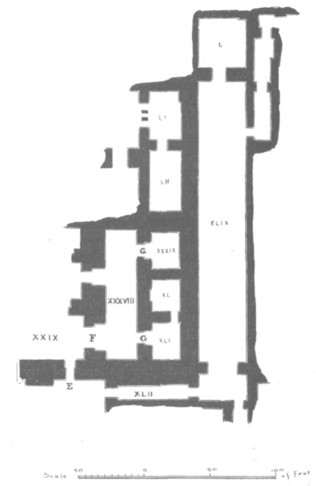 Fig. 1. Plan of the Record-Rooms in the Palace of Assur-bani-pal, King of Nineveh.
I will begin with Assyria, where the record-rooms, or we might almost say
the library, in the palace of Assur-bani-pal, King of Nineveh, were
discovered by Mr Layard in 1850 at Kouyunjik, on the Tigris, opposite
Mosul. The plan (fig. 1), taken from Mr Layard's work[1], will shew,
better than a long description, the position of these rooms, and their
relation to the rest of the building—which is believed to date from about
700 b.c. The long passage (No. xlix) is one of the entrances to the
palace. Passing thence along the narrower passage (No. xlii) the explorers
soon reached a doorway (E), which led them into a large hall (No. xxix),
whence a second doorway (F) brought them into a chamber (No. xxxviii). On
the north side of this room were two doorways (G. G), each "formed by two
colossal bas-reliefs of Dagon, the fish-god." "The first doorway," says Mr
Layard, "guarded by the fish-gods, led into two small chambers opening
into each other, and once panelled with bas-reliefs, the greater part of
which had been destroyed. I shall call these chambers 'the chambers of
records,' for, like 'the house of the rolls' or records, which Darius
ordered to be searched for the decree of Cyrus concerning the building of
the Temple of Jerusalem[2], they appear to have contained the decrees of
the Assyrian kings, as well as the archives of the empire."
Mr Layard was led to this conclusion by finding, in these rooms, enormous
quantities of inscribed tablets and cylinders of baked clay. "To a height
of a foot or more from the floor they were entirely filled with them; some
entire, but the greater part broken into many fragments, probably by the
falling in of the upper part of the building.... These documents appear to
be of various kinds. Many are historical records of wars, and distant
expeditions undertaken by the Assyrians; some seem to be royal decrees,
and are stamped with the name of a king, the son of Esarhaddon; others
again ... contain lists of the gods, and probably a register of offerings
made in their temples[3]."
So far Mr Layard. Subsequent researches have shewn that these two small
rooms—they were 27 feet and 23 feet long respectively, with a uniform
breadth of 20 feet—contained the literature as well as the official
documents of Assyria. The tablets have been sorted under the following
heads: History; Law; Science; Magic; Dogma; Legends: and it has been shewn
(1) that there was a special functionary to take charge of them; (2) that
they were arranged in series, with special precautions for keeping the
tablets forming a particular series in their proper sequence; (3) that
there was a general catalogue, and probably a class-catalogue as well[4].
Excavations in other parts of Assyria have added valuable information to
Layard's first discovery. Dr Wallis Budge, of the British Museum, whom I
have to thank for much kind assistance, tells me that "Kouyunjik is hardly
a good example of a Mesopotamian library, for it is certain that the
tablets were thrown about out of their proper places when the city was
captured by the Medes about b.c. 609. The tablets were kept on shelves....
When I was digging at Derr some years ago we found the what I call 'Record
Chamber,' and we saw the tablets lying in situ on slate shelves. There
were, however, not many literary tablets there, for the chamber was meant
to hold the commercial documents relating to the local temple...." Dr
Budge concludes his letter with this very important sentence: "We have no
definite proof of what I am going to say now, but I believe that the
bilingual[5] lists, which Assur-bani-pal had drawn up for his library at
Nineveh, were intended 'for the use of students.'"
To this suggestion I would add the following. Does not the position of
these two rooms, easily accessible from the entrance to the palace, shew
that their contents might be consulted by persons who were denied
admission to the more private apartments? And further, does not the
presence of the god Dagon at the entrance indicate that the library was
under the protection of the deity as well as of the sovereign?
As a pendant to these Assyrian discoveries I may mention the vague rumour
echoed by Athenæus of extensive libraries collected in the sixth century
before our era by Polycrates[6], tyrant of Samos, and Peisistratus,
tyrant of Athens, the latter collection, according to Aulus Gellius[7],
having been accessible to all who cared to use it. It must be admitted
that these stories are of doubtful authenticity; and further, that we have
no details of the way in which books were cared for in Greece during the
golden age of her literature. This dearth of information is the more
tantalizing as it is obvious that private libraries must have existed in a
city so cultivated as Athens; and we do, in fact, find a few notices which
tell us that such was the case. Xenophon[8], for instance, speaks of the
number of volumes in the possession of Euthydemus, a follower of Socrates;
and Athenæus records, in the passage to which I have already alluded, the
names of several book-collectors, among whom are Euripides and Aristotle.
An allusion to the poet's bibliographical tastes has been detected in the
scene of The Frogs of Aristophanes, where Æschylus and Euripides are
weighing verses against each other in the presence of Dionysus. Æschylus
exclaims:
και μηκετ' εμοιγε κατ' επος, αλλ' ες τον σταθμον
αυτος τα παιδι', ἡ γυνη, κηφισοφων,
εμβας καθησθω συλλαβων τα βιβλια,
εγω δε δυ' επη των εμων ερω μονον.
Come, no more single lines—let him bring all,
His wife, his children, his Cephisophon,
His books and everything, himself to boot—
I'll counterpoise them with a couple of lines[9].
With regard to Aristotle Strabo has preserved a tradition that he "was the
first who made a collection of books, and taught the kings of Egypt how to
arrange a library[10]"—words which may be taken to mean that Aristotle
was the first to work out the arrangement of books on a definite system
which was afterwards adopted by the Ptolemies at Alexandria.
These notices are extremely disappointing. They merely serve to shew that
collections of books did exist in Greece; but they give us no indication
of either their extent or their arrangement. It was left to the Emperor
Hadrian to build the first public library at Athens, to which, as it was
naturally constructed on a Roman design, I shall return after I have
described those from which it was in all probability imitated.
But, if what may be termed Greece in Europe declines to give us
information, that other Greece which extended itself to Asia Minor and to
Egypt—Greater Greece it would be called in modern times—supplies us with
a type of library-organisation which has been of far-reaching influence.
After the death of Alexander the Great (b.c. 323) a Greek dynasty, that of
the Ptolemies, established itself at Alexandria, and another Greek dynasty
at Pergamon. Both were distinguished—like Italian despots of the
Renaissance—for the splendour and the culture of their courts, and they
rivalled one another in the extent and richness of their libraries; but,
if we are to believe Strabo, the library at Pergamon was not begun until
the reign of Eumenes II. (b.c. 197-159), or 126 years after that at
Alexandria[11].
The libraries at Alexandria (for there were two)—though far more
celebrated and more extensive than the library at Pergamon—need not, from
my point of view, detain us for more than a moment, for we are told very
little about their position, and nothing about their arrangement. The site
of the earliest, the foundation of which is ascribed to Ptolemy the Second
(b.c. 285-247), must undoubtedly be sought for within the circuit of the
royal palace, which was in the fashionable quarter of the city called
Brucheion. This palace was a vast enceinte, not a separate building, and,
as Strabo, who visited Alexandria 24 b.c., says,
Within the precincts of the palace is the Museum. It has
a colonnade, a lecture-room, and a vast establishment
where the men of letters who share the use of the Museum
take their meals together. This College has a common
revenue; and is managed by a priest who is over the
Museum, an officer formerly appointed by the kings of
Egypt, but, at the present time, by the Emperor[12].
That the older of the two libraries must have been in some way connected
with these buildings seems to me certain from two considerations. First, a
ruler who took so keen an interest in books as Ptolemy, would assuredly
have kept his treasures under his own eye; and, secondly, he would hardly
have placed them at a distance from the spot where the learned men of
Alexandria held their meetings[13].
At some period subsequent to the foundation of Ptolemy's first library, a
second, called the daughter of the first[14], was established in connexion
with the Temple of Serapis, a magnificent structure in the quarter
Rhacôtis, adorned so lavishly with colonnades, statuary, and other
architectural enrichments, that the historian Ammianus Marcellinus
declares that nothing in the world could equal it, except the Roman
Capitol[15].
This brief notice of the libraries of Alexandria shews that the earlier of
the two, besides being in a building dedicated to the Muses, was also
connected in all probability with a palace, and the second with a temple.
If we now turn to Pergamon, we shall find the library associated with the
temple and τεμενος of Athena.
The founder selected for the site of his city a lofty and precipitous
hill, about a thousand feet above the sea-level. The rocky plateau which
forms the summit is divided into three gigantic steps or terraces. On the
highest, which occupies the northern end of the hill, the royal palace is
believed to have been built. On the next terrace, to the south, was the
temple of Athena; and on the third, the altar of Zeus. External to those
three groups of buildings, partly on the edge of the hill, partly on its
sides, were the rest of the public buildings. The lower slopes were
probably occupied in ancient times, as at present, by the houses of the
citizens.
These magnificent structures, which won for Pergamon the distinction of
being "by far the noblest city in Asia minor[16]," were in the main due to
Eumenes the Second, who, during his reign of nearly forty years (b.c.
197-159), was enabled, by the wise policy of supporting the Romans, to
transform his petty state into a powerful monarchy. The construction of a
library is especially referred to him by Strabo[17], and from the
statement of Vitruvius that it was built for the delight of the world at
large (in communem delectationem), we may infer that it was intended to
be public[18]. That he was an energetic book-collector, under whose
direction a large staff of scribes was perpetually at work, may be
gathered from the well-known story that his bibliographical rival at
Alexandria, exasperated by his activity and success, conceived the
ingenious device of crippling his endeavours by forbidding the exportation
of papyrus. Eumenes, however, says the chronicler, was equal to the
occasion, and defeated the scheme by inventing parchment[19]. It is
probable that Eumenes not only began but completed the library, for in
less than a quarter of a century after his death (b.c. 133) the last of
his descendants bequeathed the city and state of Pergamon to the Romans.
It is improbable that they would do much to increase the library, though
they evidently took care of it, for ninety years later, when Mark Antony
is said to have given it to Cleopatra, the number of works in it amounted
to two hundred thousand[20].
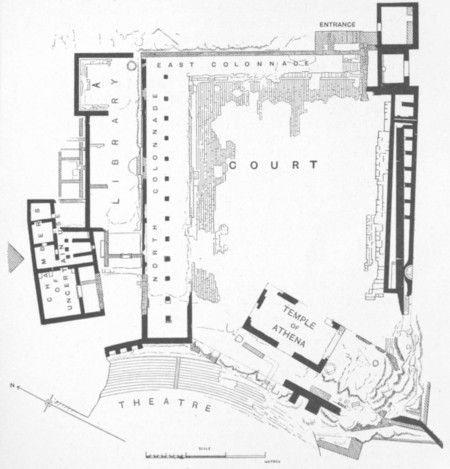 Fig. 2. Plan of the temple and precinct of Athena, Pergamon; with that of the Library and adjacent buildings.
The site of the acropolis of Pergamon was thoroughly explored between 1878
and 1886 at the expense of the German Government; and in the course of
their researches the archeologists employed discovered certain rooms which
they believe to have been originally appropriated to the library. I have
had the accompanying ground-plan (fig. 2) reduced from one of their
plates, and have condensed my description of the locality from that given
in their work[21]. I have also derived much valuable information from a
paper published by Alexander Conze in 1884[22].
Of the temple of Athena only the foundations remain, but its extent and
position can be readily ascertained. The enclosure, paved with slabs of
marble, was entered at the south-east corner. It was open to the west and
to the south, where the ground falls away precipitously, but on the east
and north it was bounded by a cloister in two floors. The pillars of this
cloister were Doric on the ground-floor, Ionic above. The height of those
in the lower range, measured from base to top of capital, was about 16
feet, of those in the upper range about 9 feet.
This enclosure had a mean length of about 240 feet, with a mean breadth of
162 feet[23]. The north cloister was 37 feet broad, and was divided down
the centre by a row of columns. The east cloister was of about half this
width, and was undivided.
On the north side of the north cloister, the German explorers found four
rooms, which they believe to have been assigned to library purposes. The
platform of rock on which these chambers stood was nearly 20 feet above
the level of the floor of the enclosure, and they could only be entered
from the upper cloister. Of these rooms the easternmost is the largest,
being 42 feet long, by 49 feet broad. Westward of it are three others,
somewhat narrower, having a uniform width of 39 feet. The easternmost of
these three rooms is also the smallest, being only 23 feet long; while the
two next have a uniform length of about 33 feet.
At the south-west corner of this building, but on a lower level, and not
accessible from it, other rooms were found, the use of which is uncertain.
We will now return to the eastern room. The foundations of a narrow
platform or bench extended along the eastern, northern, and western sides,
and in the centre of the northern side there was a mass of stone-work
which had evidently formed the base for a statue (fig. 2, A). The
discovery of a torso of a statue of Athena[24] in this very room indicated
what statue had occupied this commanding position, and also what had
probably been the use of the room.
This theory was confirmed by the discovery in the north wall of two rows
of holes in the stone-work, one above the other, which had evidently been
made for the reception of brackets, or battens, or other supports for
shelves[25], or some piece of furniture. The lower of these two rows was
carried along the east wall as well as along the north wall. Further,
stones were found bearing the names of Herodotus, Alcæus, Timotheus of
Miletus, and Homer, evidently the designations of portrait-busts or
portrait-medallions; and also, two titles of comedies.
Lastly, the very position of these rooms in connexion with the colonnade
indicates their use. It will be observed that the colonnade on the north
side of the area is twice as wide as that on the east side—a peculiarity
which is sufficient of itself to prove that it must have been intended for
some other purpose than as a mere covered way. But, if it be remembered
that libraries in the ancient world were usually connected with colonnades
(as was probably the case at the Serapeum at Alexandria, and was certainly
the case at Rome, as I shall proceed to shew) a reason is found for this
dignified construction, and a strong confirmation is afforded for the
theory that the rooms beyond it once contained the famous library.
When the Romans had taken possession of Pergamon, those who had charge of
the city would become familiar with the library; and it seems to me almost
certain that, when the necessity for establishing a public library at Rome
had been recognised, the splendid structure at Pergamon would be turned to
as a model. But, if I mistake not, Roman architecture had received an
influence from Pergamon long before this event occurred. What this was I
will mention presently.
No public library was established in Rome until the reign of Augustus.
Julius Cæsar had intended to build one on the largest possible scale, and
had gone so far as to commission Varro to collect books for it[26]; but it
was reserved for C. Asinius Pollio, general, lawyer, orator, poet, the
friend of Virgil and Horace, to devote to this purpose the spoils he had
obtained in his Illyrian campaign, b.c. 39. In the striking words of Pliny
"he was the first to make men's talents public property (ingenia hominum
rem publicam fecit)" The same writer tells us that he also introduced the
fashion of decorating libraries with busts of departed authors, and that
Varro was the only living writer whose portrait was admitted[27]. Pollio
is further credited, by Suetonius, with having built an atrium
libertatis[28], in which Isidore, a writer of the seventh century,
probably quoting a lost work of Suetonius, places the library, with the
additional information, that the collection contained Greek as well as
Latin books[29].
The work of Pollio is recorded among the acts of generosity which Augustus
suggested to others. But before long the emperor turned his own attention
to libraries, and enriched his capital with two splendid structures which
may be taken as types of Roman libraries,—the library of Apollo on the
Palatine Hill, and that in the Campus Martius called after Octavia, sister
to the emperor. I will take the latter first.
The Porticus Octaviæ, or, as it was sometimes called, the Opera
Octaviæ, must have been one of the most magnificent structures in Rome
(fig. 3). It stood in the Campus Martius, near the Theatre of Marcellus,
between the Capitoline Hill and the Tiber. A double colonnade surrounded
an area which measured 443 feet by 377 feet, with Jani, or four-faced
archways, at the four corners, and on the side next the Tiber a double
hexastyle porch, which, with a few fragments of the colonnade, still
exists in a fairly good state of preservation[30]. Within this space were
two temples, one of Jupiter, the other of Juno, a curia or hall, in
which the Senate frequently met, a schola or "Conversation Hall[31],"
and two libraries, the one of Greek, the other of Latin books. The area
and buildings were crowded with masterpieces in bronze and marble.
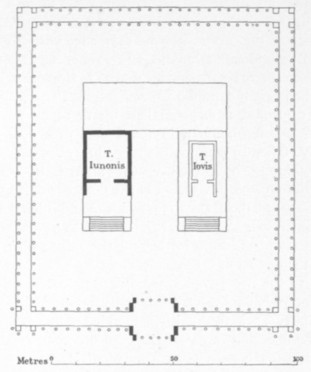 Fig. 3. Plan of the Porticus Octaviæ, Rome. From Formæ Urbis Romæ Antiqua, Berlin, 1896.
This structure was originally built by Quintus Metellus, about 146
b.c.[32]. One of the temples was due to his own liberality, the other had
been erected by Domitius Lepidus, b.c. 179. Now twenty years before,
Metellus had fought in a successful campaign against Perseus king of
Macedonia, in which the Romans had been assisted by Eumenes II.: and in
b.c. 148, as Prætor, he received Macedonia as his province. Is it not
possible that on one or other of these occasions he may have visited
Pergamon, and, when designing his buildings in Rome, have copied what he
had seen there? Again, in b.c. 157, Crates of Mallus, a distinguished
grammarian, was sent from Pergamon as ambassador to Rome, and, being laid
up there by an accident, gave lectures on grammar, in the course of which
he could hardly have failed to mention the new library[33].
The buildings of Metellus were altered, if not entirely rebuilt, by
Augustus, b.c. 33, out of the proceeds of his victorious campaign against
the Dalmatians; with the additional structures above enumerated. The
schola is believed to have stood behind the temples, and the libraries
behind the schola, with the curia between them[34]. Thus the
colonnades, which Metellus had restricted to the two temples, came at last
to serve the double purpose for which they were originally intended in
connexion with a library as well as with a temple.
The temple and area of Apollo on the Palatine Hill, which Augustus began
b.c. 36 and dedicated b.c. 28, exhibit an arrangement precisely similar to
that of the Porticus Octaviæ. The size was nearly the same[35], and the
structures included in the area were intended to serve the same purposes.
The temple stood in the middle of a large open peristyle, connected with
which were two libraries, one for Greek, the other for Latin books; and
between them, used perhaps as a reading-room or vestibule, was a hall in
which Augustus occasionally convened the Senate. It contained a colossal
statue of Apollo, made of gilt bronze; and on its walls were
portrait-reliefs of celebrated writers, in the form of medallions, in the
same material[36].
Of the other public libraries of Rome—of which there are said to have
been in all twenty-six—I need mention only three as possessing some
peculiarity to which I shall have to draw attention. Of these the first
was established by Tiberius in his palace, at no great distance from the
library of Apollo; the second and third by Vespasian and Trajan in their
Fora, connected in the one with the temple of Peace, and in the other with
the temple dedicated in honour of Trajan himself.
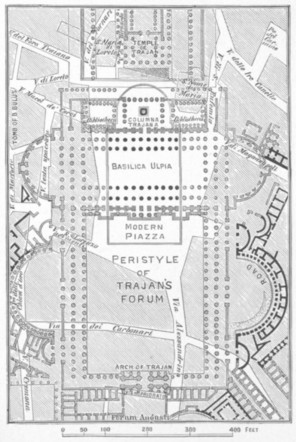 Fig. 4. Plan of the Forum of Trajan; after Nibby.
Of the first two of these libraries we have no information; but in the
case of the third we are more fortunate. The Forum of Trajan (fig. 4) was
excavated by order of Napoleon I., and the extent of its buildings, with
their relation to one another, is therefore known with approximate
accuracy. The Greek and Latin libraries stood to the right and left of the
small court between the Basilica Ulpia and the Templum Divi Trajani,
the centre of which was marked by the existing Column. They were entered
from this court, each through a portico of five inter-columniations. The
rooms, measured internally, were about 60 feet long, by 45 feet broad.
At this point I must mention, parenthetically, the library built by
Hadrian at Athens. Pausanias records it in the following passage:
Hadrian also built for the Athenians a temple of Hera
and Panhellenian Zeus, and a sanctuary common to all the
gods. But most splendid of all are one hundred columns;
walls and colonnades alike are made of Phrygian marble.
Here, too, is a building adorned with a gilded roof and
alabaster and also with statues and paintings: books are
stored in it. There is also a gymnasium named after
Hadrian; it too has one hundred columns from the
quarries of Libya[37].
A building called the Stoa of Hadrian, a ground-plan of which (fig. 5) I
borrow from Miss Harrison's Mythology and Monuments of Ancient Athens,
has been identified with part at least of that which Pausanias describes
in the above passage. A lofty wall, built of large square blocks of
Pentelic marble, faced on the west side by a row of Corinthian columns,
enclosed a quadrangular court, measuring 328 feet from east to west, by
250 feet from north to south. This court, entered through a sort of
propylæa on the west side (N), was surrounded by a cloister or colonnade
27 feet wide, and containing 100 columns. None of those columns are
standing, but their number can be accurately calculated from the marks of
the bases still to be seen on the eastern side of the quadrangle.
Within this area are the remains of a building of uncertain use, and at
present only partially excavated.
On the east side a row of five chambers, of which that in the centre was
the largest, opened off from the colonnade[38].
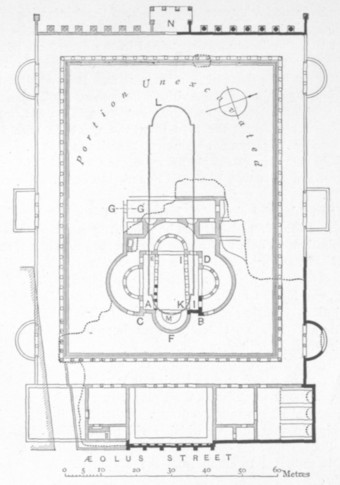 Fig. 5. Plan of the Stoa of Hadrian, at Athens.
AE, KI. Pier-arcade of the medieval church of the Panagia.
B. North-east angle of this church, of Roman work.
B, C, D, F. Portions of the Roman building which preceded the church.
L, M. Reservoirs.
N. Propylæa through which the court was entered.
If the ground plan of this structure (fig. 5) be compared with that of the
precinct of Athena and library at Pergamon (fig. 2), a striking similarity
between them will at once be recognised; and, whatever may have been the
destination of the building within the cloistered area, there can, I
think, be little doubt that the library was contained in the five rooms
beyond its limits to the east. They must have been entered from the
cloister, much as those at Pergamon were. It is possible that Hadrian may
himself have visited Pergamon, for Trajan had built an imperial residence
there; but, even if he did not do this, he would accept the type from the
great libraries built at Rome by Augustus. It should be mentioned that S.
Jerome specially commemorates this library among Hadrian's works at
Athens, and says that it was of remarkable construction (miri
operis)[39].
From this brief digression I return to the public libraries of Rome. In
the first place those built by Augustus had a regular organisation. There
appears to have been a general director called Procurator Bibliothecarum
Augusti[40]; and subordinate officers for each division: that is to say,
one for the Greek books, one for the Latin books. These facts are derived
from inscriptions found in Columbaria. Secondly, it may be concluded
that they were used not merely for reading and reference, but as
meeting-places for literary men.
The Palatine libraries evidently contained a large collection of old and
new books; and I think it is quite certain that new books, as soon as
published, were placed there, unless there was some special reason to the
contrary. Otherwise there would be no point in the lines in which Ovid
makes his book—sent from Pontus after his banishment—deplore its
exclusion. The book is supposed to climb from the Forum to the temple of
Apollo:
Signa peregrinis ubi sunt alterna columnis
Belides et stricto barbarus ense pater
Quæque viri docto veteres cœpere novique
Pectore lecturis inspicienda patent.
Quærebam fratres exceptis scilicet illis
Quos suus optaret non genuisse parens;
Quærentem frustra custos e sedibus illis
Præpositus sancto iussit abire loco[41].
Where, set between each pair of columns from some
foreign quarry, are statues of the Danaids, and their
barbarous father with drawn sword; and where whatever
the minds of men of old or men of to-day have imagined,
is laid open for a reader's use. I sought my brethren,
save those of course whom their father would fain have
never begotten; and, while I was seeking for them in
vain, he who was set over the room bade me leave that
holy ground.
The second couplet can only mean that old books and new books were alike
to be found there. The general nature of the collection, and its extent,
may be further gathered from the advice which Horace gives to his friend
Celsus:
Quid mihi Celsus agit? monitus multumque monendus
Privatas ut quærat opes, et tangere vitet
Scripta Palatinus quæcunque recepit Apollo[42].
What is my friend Celsus about? he who has been
reminded, and must still be reminded again and again,
that he should draw upon his own resources, and be
careful to avoid the multifarious writings which
Palatine Apollo has taken under his charge.
A man might say now-a-days, "Trust to your own wits, and don't go so often
to the library of the British Museum."
Aulus Gellius, who lived a.d. 117-180, speaks of "sitting with a party of
friends in the library of the palace of Tiberius, when a book happened to
be taken down with the title M. Catonis Nepotis," and they began asking
one another who this M. Cato Nepos might be[43]. This library contained
also public records[44].
The same writer tells a story of a grammatical difficulty which was to be
settled by reference to a book in templo Pacis, in the forum of
Vespasian; and again, when a particular book was wanted, "we hunted for it
diligently," he says, "and, when we had found it in the temple of Peace,
we read it[45]."
The library in the forum of Trajan, often called Bibliotheca Ulpia, was
apparently the Public Record Office of Rome. Aulus Gellius mentions that
some decrees of former prætors had fallen in his way there when he was
looking for something else, and that he had been allowed to read them[46];
and a statement of Vopiscus is still more conclusive as to the nature of
its contents. It tells us, moreover, something about the arrangement. In
his life of the Emperor Tacitus (Sept. a.d. 275—Apr. 276) Vopiscus says:
And lest anybody should think that I have given too
hasty a credence to a Greek or Latin author, the Ulpian
Library has in its sixth press (armarium) an ivory
volume (librum elephantinum) in which the following
decree of the Senate, signed by Tacitus with his own
hand, is recorded, etc.[47]
Again, in his life of the Emperor Aurelian, the same writer records how
his friend Junius Tiberianus, prefect of the city, had urged him to
undertake the task, and had assured him that: "even the linen-books
(libri lintei) shall be brought out of the Ulpian library for your
use[48]."
Books could occasionally be borrowed from a public library, but whether
from one of those in the city of Rome, I cannot say. The scene of the
story which proves this is laid by Aulus Gellius at Tibur (Tivoli), where
the library was in the temple of Hercules—another instance of the care of
a library being entrusted to a temple. Aulus Gellius and some friends of
his were assembled in a rich man's villa there at the hottest season of
the year. They were drinking melted snow, a proceeding against which one
of the party, a peripatetic philosopher, vehemently protested, urging
against the practice the authority of numerous physicians and of Aristotle
himself. But none the less the party went on drinking snow-water.
Whereupon "he fetched a treatise by Aristotle out of the library of Tibur,
which was then very conveniently accommodated in the temple of Hercules,
and brought it to us, saying——[49]." But I need not finish the
quotation, as it has no bearing on my special subject.
It is probable that numerous collections of books had been got together by
individuals in Rome, before it occurred to Augustus and his friends to
erect public libraries. One such library, that belonging to the rich and
luxurious Lucullus, has been noticed as follows by Plutarch[50]:
His procedure in regard to books was interesting and
remarkable. He collected fine copies in large numbers;
and if he was splendid in their acquisition, he was more
so in their use. His libraries were accessible to all,
and the adjoining colonnades and reading-rooms were
freely open to Greeks, who, gladly escaping from the
routine of business, resorted thither for familiar
converse, as to a shelter presided over by the Muses.
The Romans were not slow in following the example set by Lucullus; and a
library presently became indispensable in every house, whether the owner
cared for reading or not. This fashionable craze is denounced by Seneca
(writing about a.d. 49) in a vehement outburst of indignation, which
contains so many valuable facts about library arrangement, that I will
give a free translation of it.
Outlay upon studies, best of all outlays, is reasonable
so long only as it is kept within certain limits. What
is the use of books and libraries innumerable, if scarce
in a lifetime the master reads the titles? A student is
burdened by a crowd of authors, not instructed; and it
is far better to devote yourself to a few, than to lose
your way among a multitude.
Forty thousand books were burnt at Alexandria. I leave
others to praise this splendid monument of royal
opulence, as for example Livy, who regards it as "a
noble work of royal taste and royal thoughtfulness." It
was not taste, it was not thoughtfulness, it was learned
extravagance—nay not even learned, for they had bought
their books for the sake of show, not for the sake of
learning—just as with many who are ignorant even of the
lowest branches of learning books are not instruments of
study, but ornaments of dining-rooms. Procure then as
many books as will suffice for use; but not a single one
for show. You will reply: "Outlay on such objects is
preferable to extravagance on plate or paintings."
Excess in all directions is bad. Why should you excuse a
man who wishes to possess book-presses inlaid with
arbor-vitæ wood or ivory: who gathers together masses
of authors either unknown or discredited; who yawns
among his thousands of books; and who derives his chief
delight from their edges and their tickets?
You will find then in the libraries of the most arrant
idlers all that orators or historians have
written—book-cases built up as high as the ceiling.
Nowadays a library takes rank with a bathroom as a
necessary ornament of a house. I could forgive such
ideas, if they were due to extravagant desire for
learning. As it is, these productions of men whose
genius we revere, paid for at a high price, with their
portraits ranged in line above them, are got together to
adorn and beautify a wall[51].
A library was discovered in Rome by Signor Lanciani in 1883 while
excavating a house of the 4th century on the Esquiline in the modern Via
dello Statuto. I will narrate the discovery in his own words.
I was struck, one afternoon, with the appearance of a
rather spacious hall [it was about 23 feet long by 15
feet broad], the walls of which were plain and
unornamented up to a certain height, but beautifully
decorated above in stucco-work. The decoration consisted
of fluted pilasters, five feet apart from centre to
centre, enclosing a plain square surface, in the middle
of which there were medallions, also in stucco-work, two
feet in diameter. As always happens in these cases, the
frame was the only well-preserved portion of the
medallions. Of the images surrounded by the frames, of
the medallions themselves, absolutely nothing was left
in situ, except a few fragments piled up at the foot
of the wall, which, however, could be identified as
having been representations of human faces. My hope
that, at last, after fifteen years of excavations, I had
succeeded in discovering a library, was confirmed beyond
any doubt by a legend, written, or rather painted, in
bright red colour on one of the frames. There was but
one name polonivs thyan ..., but this name told more
plainly the purpose of the apartment than if I had
discovered there the actual bookshelves and their
contents[52].
When I had the pleasure of meeting Signor Lanciani in Rome in April, 1898,
he most kindly gave me his own sketch of the pilasters and medallion,
taken at the moment of discovery. I am therefore able to reproduce exactly
(fig. 6) one compartment of the wall of the library above described. The
height of the blank wall below the stucco-work, against which the
furniture containing the books stood, has been laid down as about 3 feet 6
inches, on the authority of Professor Middleton[53]. The remains of the
medallion are still to be seen in the Museo del Orto Botanico, Rome. The
person commemorated is obviously Apollonius Tyaneus, a Pythagorean
philosopher and wonderworker, said to have been born about four years
before the Christian era.
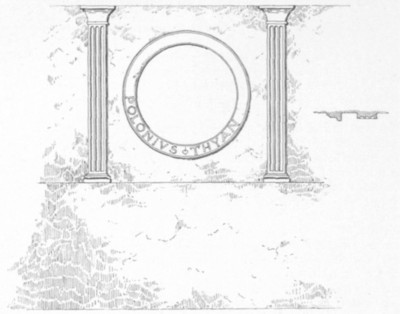 Fig. 6. Elevation of a single compartment of the wall of the Library discovered in Rome, 1883. From notes and measurements made by Signor Lanciani and Prof. Middleton.
A similar room was discovered at Herculaneum in 1754. A full account of
the discovery was drawn up at once by Signor Paderni, keeper of the
Herculaneum Museum, and addressed to Thomas Hollis, Esq., by whom it was
submitted to the Royal Society. I will extract, from this and subsequent
letters, the passages that bear upon my subject.
Naples, 27 April, 1754.
... The place where they are digging, at present, is
under Il Bosco di Sant' Agostino.... All the buildings
discover'd in this site are noble; ... in one there has
been found an entire library, compos'd of volumes of the
Egyptian Papyrus, of which there have been taken out
about 250....[54]
To the same.
18 October, 1754.
... As yet we have only entered into one room, the floor
of which is formed of mosaic work, not unelegant. It
appears to have been a library, adorned with presses,
inlaid with different sorts of wood, disposed in rows;
at the top of which were cornices, as in our own times.
I was buried in this spot more than twelve days, to
carry off the volumes found there; many of which were so
perished, that it was impossible to remove them. Those
which I took away amounted to the number of three
hundred and thirty-seven, all of them at present
uncapable of being opened. These are all written in
Greek characters. While I was busy in this work I
observed a large bundle, which, from the size, I
imagined must contain more than a single volume. I tried
with the utmost care to get it out, but could not, from
the damp and weight of it. However I perceived that it
consisted of about 18 volumes, each of which was in
length a palm and three Neapolitan inches, being the
largest hitherto discovered. They were wrapped about
with the bark of a tree and covered at each end with a
piece of wood. All these were written in Latin, as
appears by a few words which broke off from them. I was
in hopes to have got something out of them, but they are
in a worse condition than the Greek[55]....
From Sir J. Gray, Bart.
29 October, 1754.
... They have lately met with more rolls of Papyri of
different lengths and sizes, some with the Umbilicus
remaining in them: the greater part are Greek in small
capitals.... The Epicurean Philosophy is the subject of
another fragment.
A small bust of Epicurus, with his name in Greek
characters, was found in the same room, and was possibly
the ornament of that part of the library where the
writings in favour of his principles were kept; and it
may also be supposed that some other heads of
philosophers found in the same room were placed with the
same taste and propriety[56].
Between 1758 and 1763, the place was visited by Winckelmann, who wrote
long letters in Italian, describing what he saw, to Consigliere Bianconi,
Physician to the King of Saxony. One of these, dated 1762, gives the
following account of the library:
Ii luogo in cui per la prima volta caddero sott' occhio,
fu una piccola stanza nella villa d'Ercolano di cui
parlammo sopra, la cui lunghezza due uomini colle
braccia distese potevano misurare. Tutto all' intorno
del muro vi erano degli scaffali quali si vedono
ordinariamente negli archivi ad altezza d' uomo, e nel
mezzo della stanza v' era un altro scaffale simile o
tavola per tenervi scritture, e tale da potervi girare
intorno. Il legno di questa tavola era ridotto a
carboni, e cadde, come è facile ad imaginarselo, tutta
in pezzi quando si toccò. Alcuni di questi rotoli di
papiri si trovarono involti insieme con carta più
grossolana, di quella qualità che gli antichi chiamavano
emporetica, e questi probabilmente formavano le parti
ed i libri d' un' opera intiera[57]....
The place in which they [the rolls] were first seen was
a small room in the villa at Herculaneum of which we
spoke above, the length of which could be covered by two
men with their arms extended. All round the wall there
were book-cases such as are commonly seen in
record-rooms, of a man's height, and in the middle of
the room there was another similar book-case or table to
hold writings, of such a size that one could go round
it. The wood of this table was reduced to charcoal, and,
as may easily be imagined, fell all to pieces when it
was touched. Some of these papyrus rolls were found
fastened together with paper of coarser texture, of that
quality which the ancients called emporetica, and
these probably formed the parts and books of an entire
work.
The information which these observers have given us amounts to this: the
room was about 12 feet long, with a floor of mosaic. Against the walls
stood presses, of a man's height, inlaid with different sorts of wood,
disposed in rows, with cornices at the top; and there was also a table, or
press, in the centre of the room. Most of the rolls were separate, but a
bundle of eighteen was found "wrapped about with the bark of a tree, and
covered at each end with a piece of wood." A room so small as this could
hardly have been intended for study. It must rather have been the place
where the books were put away after they had been read elsewhere.
Before I quit this part of my subject, I should like to mention one other
building, as its arrangements throw light on the question of fitting up
libraries and record-offices. I allude to the structure built by
Vespasian, a.d. 78, to contain the documents relating to his restoration of
the city of Rome. It stood at the south-west corner of the Forum of Peace,
and what now exists of it is known as the Church of SS. Cosma e Damiano.
The general arrangement and relation to adjoining structures will be
understood from the plan (fig. 7). The room was about 125 feet long by 65
feet broad, with two entrances, one on the north-west, from the Forum
Pacis, through a hexastyle portico (fig. 7. 2), the other on the
north-east, through a square-headed doorway of travertine which still
exists (ibid. 1) together with a considerable portion of a massive wall
of Vespasian's time. After a restoration by Caracalla the building came to
be called Templum Sacræ Urbis. It was first consecrated as a church by
pope Felix IV. (526-530), but he did little more than connect it with the
Heroon Romuli (ibid. 5), and build the apse (ibid. 4).
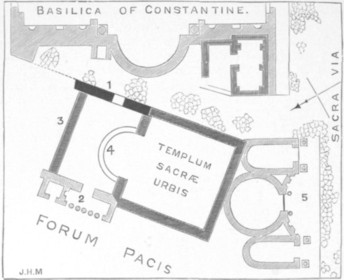 Fig. 7. Plan of the Record-House of Vespasian, with the adjoining structures.
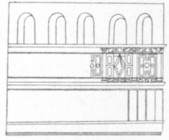 Fig. 8. Part of the internal wall of the Record-House of Vespasian. Reduced from a sketch taken in the 16th century by Pirro Ligorio.
The whole building was mercilessly mutilated by pope Urban VIII. in 1632;
but fortunately a drawing of the interior had been made by Pirro Ligorio
in the second half of the sixteenth century, when the original treatment
of the walls was practically intact. I give a reduced copy of a small
portion of this drawing (fig. 8). As Lanciani says:
The walls were divided into three horizontal bands by
finely cut cornices. The upper band was occupied by the
windows; the lower was simply lined with marble slabs
covered by the bookcases ... which contained the ...
records ...; the middle one was incrusted with
tarsia-work of the rarest kinds of marble with panels
representing panoplies, the wolf with the infant
founders of Rome, and other allegorical scenes[58].
I explained at the beginning of this chapter that my subject is the care
of books, not books themselves; but, at the point which we have now
reached in regard to Roman libraries, it is necessary to make a few
remarks about their contents. It must be remembered, in the first place,
that those who fitted them up had to deal with rolls (volumina),
probably of papyrus, but possibly of parchment; and that a book, as we
understand the word, the Latin equivalent for which was codex, did not
come into general use until long after the Christian era. Some points
about these rolls require notice.
The length and the width of the roll depended on the taste or convenience
of the writer[59]. The contents were written in columns, the lines of
which ran parallel to the long dimension[60], and the reader, holding the
roll in both hands, rolled up the part he had finished with his left hand,
and unrolled the unread portion with his right. This way of dealing with
the roll is well shewn in the accompanying illustration (fig. 9) reduced
from a fresco at Pompeii[61]. In most examples the two halves of the roll
are turned inwards, as for instance in the well-known statue of
Demosthenes in the Vatican[62]. The end of the roll was fastened to a
stick (usually referred to as umbilicus or umbilici). It is obvious
that this word ought properly to denote the ends of the stick only, but it
was constantly applied to the whole stick, and not to a part of it, as for
instance in the following lines:
... deus nam me vetat
Inceptos olim promissum carmen iambos
Ad umbilicum adducere[63].
... for heaven forbids me to cover the scroll down to
the stick with the iambic lines I had begun a song
promised long ago to the world.
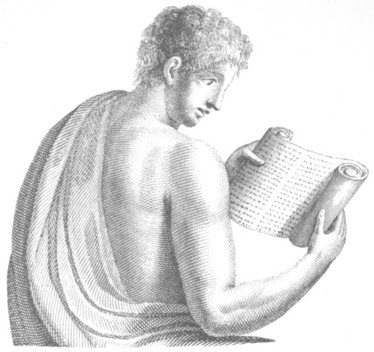 Fig. 9. A reader with a roll: from a fresco at Pompeii.
These sticks were sometimes painted or gilt, and furnished with projecting
knobs (cornua) similarly decorated, intended to serve both as an
ornament, and as a contrivance to keep the ends of the roll even, while it
was being rolled up. The sides of the long dimension of the roll
(frontes) were carefully cut, so as to be perfectly symmetrical, and
afterwards smoothed with pumice-stone and coloured. A ticket (index or
titulus, in Greek σιλλυβος or σιττυβος),
made of a piece of papyrus or parchment, was fastened to the
edge of the roll in such a way that it hung out over one or other of the
ends. As Ovid says:
Cetera turba palam titulos ostendet apertos
Et sua detecta nomina fronte geret[64].
The others will flaunt their titles openly, and carry
their names on an uncovered edge.
The roll was kept closed by strings or straps (lora), usually of some
bright colour[65]; and if it was specially precious, an envelope which the
Greeks called a jacket (διφθερα[66]), made of
parchment or some other substance, was provided. Says Martial:
Perfer Atestinæ nondum vulgata Sabinæ
Carmina, purpurea sed modo culta toga[67].
Convey to Sabina at Ateste these verses. They have not
yet been published, and have been but lately dressed in
a purple garment.
Martial has combined in a single epigram most of the ornaments with which
rolls could be decorated. This I will quote next, premising that the oil
of cedar, or arbor-vitæ, mentioned in the second line not only imparted
an agreeable yellow colour, but was held to be an antiseptic[68].
Faustini fugis in sinum? sapisti.
Cedro nunc licet ambules perunctus
Et frontis gemino decens honore
Pictis luxurieris umbilicis,
Et te purpura delicata velet,
Et cocco rubeat superbus index[69].
His book had selected the bibliomaniac Faustinus as a patron. Now, says
the poet, you shall be anointed with oil of cedar; you shall revel in the
decoration of both your sets of edges; your sticks shall be painted; your
covering shall be purple, and your ticket scarlet.
When a number of rolls had to be carried from one place to another, they
were put into a box (scrinium or capsa). This receptacle was
cylindrical in shape, not unlike a modern hat-box[70]. It was carried by a
flexible handle, attached to a ring on each side; and the lid was held
down by what looks very like a modern lock. The eighteen rolls, found in a
bundle at Herculaneum, had doubtless been kept in a similar receptacle.
My illustration (fig. 10) is from a fresco at Herculaneum. It will be
noticed that each roll is furnished with a ticket (titulus). At the feet
of the statue of Demosthenes already referred to, and of that of
Sophocles, are capsæ, both of which show the flexible handles.
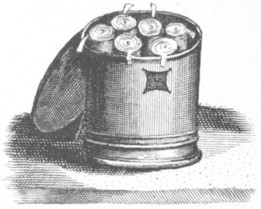 Fig. 10. Book-box or capsa.
I will next collect the information available respecting the fittings used
in Roman libraries. I admit that it is scattered and imperfect; but
legitimate deductions may, I think, be arrived at from it, which will give
us tolerably certain ideas of the appearance of one of those collections.
The words used to designate such fittings are: nidus; forulus, or more
usually foruli; loculamenta; pluteus; pegmata.
Nidus needs no explanation. It can only mean a pigeon-hole. Martial uses
it of a bookseller, at whose shop his own poems may be bought.
De primo dabit alterove nido
Rasum pumice purpuraque cultum
Denaris tibi quinque Martialem[71].
Out of his first or second pigeon-hole, polished with
pumice stone, and smart with a purple covering, for five
denarii he will give you Martial.
In a subsequent epigram the word occurs with reference to a private
library, to which the poet is sending a copy of his works.
Ruris bibliotheca delicati,
Vicinam videt unde lector urbem,
Inter carmina sanctiora si quis
Lascivæ fuerit locus Thaliæ,
Hos nido licet inseras vel imo
Septem quos tibi misimus libellos[72].
O library of that well-appointed villa whence a reader
can see the City near at hand—if among more serious
poems there be any room for the wanton Muse of Comedy,
you may place these seven little books I send you even
in your lowest pigeon-hole.
Forulus or foruli occurs in the following passages. Suetonius, after
describing the building of the temple of the Palatine Apollo by Augustus,
adds, "he placed the Sibylline books in two gilt receptacles (forulis)
under the base of the statue of Palatine Apollo"[73]; and Juvenal,
enumerating the gifts that a rich man is sure to receive if burnt out of
house and home, says,
Hic libros dabit, et forulos, mediamque Minervam[74].
The word is of uncertain derivation, but forus, of which it is clearly
the diminutive, is used by Virgil for the cells of bees:
Complebuntque foros et floribus horrea texent[75].
The above-quoted passage of Juvenal may therefore be rendered: "Another
will give books, and cells to put them in, and a statue of Minerva for the
middle of the room."
The word loculamentum is explained in a passage of Columella, in which
he gives directions for the making of dovecotes:
Let small stakes be placed close together, with planks
laid across them to carry cells (loculamenta) for the
birds to build their nests in, or sets of pigeon-holes
made of earthenware[76].
In a second passage he uses the same word for a beehive[77]; Vegetius, a
writer on veterinary surgery, uses it for the socket of a horse's
tooth[78]; and Vitruvius, in a more general way, for a case to contain a
small piece of machinery[79]. Generally, the word may be taken to signify
a long narrow box, open at one end, and, like nidus and forulus, may
be translated "pigeon-hole." Seneca, again, applies the word to books in
the passage I have already translated, and in a singularly instructive
manner. "You will find," he says, "in the libraries of the most arrant
idlers all that orators or historians have written—bookcases
(loculamenta) built up as high as the ceiling[80]."
Pegmata, for the word generally occurs in the plural, are, as the name
implies, things fixed together, usually planks of wood framed into a
platform, and used in theatres to carry pieces of scenery or performers up
and down. As applied to books "shelves" are probably meant: an
interpretation borne out by the Digest, in which it is stated that
"window-frames and pegmata are included in the purchase of a house[81]."
They were therefore what we should call "fixtures."
A pluteus was a machine used by infantry for protection in the field:
and hence the word is applied to any fence, or boarding to form the limit
or edge of anything, as a table or a bed. Plutei were not attached so
closely to the walls as pegmata, for in the Digest they are classed
with nets to keep out birds, mats, awnings, and the like, and are not to
be regarded as part and parcel of a house[82]. Juvenal uses the word for
a shelf in his second Satire, where he is denouncing pretenders to
knowledge:
Indocti primum, quamquam plena omnia gypso
Chrysippi invenias, nam perfectissimus horum est
Si quis Aristotelem similem vel Pittacon emit
Et iubet archetypos pluteum servare Cleanthas[83].
In the first place they are dunces, though you find
their houses full of plaster figures of Chrysippus: for
a man of this sort is not fully equipped until he buys a
likeness of Aristotle or Pittacus, and bids a shelf take
care of original portraits of Cleanthes.
This investigation has shewn that three of the words applied to the
preservation of books, namely, nidus, forulus, and loculamentum, may
be rendered by the English "pigeon-hole"; and that pegma and pluteus
mean contrivances of wood which may be rendered by the English "shelving."
It is quite clear that pegmata could be run up with great rapidity, from
a very graphic account in Cicero's letters of the rearrangement of his
library. He begins by writing to his friend Atticus as follows:
I wish you would send me any two fellows out of your
library, for Tyrannio to make use of as pasters, and
assistants in other matters. Remind them to bring some
vellum with them to make those titles (indices) which
you Greeks, I believe, call σιλλυβοι. You are not to do this if it is inconvenient
to you[84]....
In the next letter he says:
Your men have made my library gay with their
carpentry-work and their titles (constructione et
sillybis). I wish you would commend them[85].
When all is completed he writes:
Now that Tyrannio has arranged my books, a new spirit
has been infused into my house. In this matter the help
of your men Dionysius and Menophilus has been
invaluable. Nothing could look neater than those shelves
of yours (illa tua pegmata), since they smartened up
my books with their titles[86].
No other words than those I have been discussing are, so far as I know,
applied by the best writers to the storage of books; and, after a careful
study of the passages in which they occur, I conclude that, so long as
rolls only had to be accommodated, private libraries in Rome were fitted
with rows of shelves standing against the walls (plutei), or fixed to
them (pegmata). The space between these horizontal shelves was
subdivided by vertical divisions into pigeon-holes (nidi, foruli,
loculamenta), and it may be conjectured that the width of these
pigeon-holes would vary in accordance with the number of rolls included in
a single work. That such receptacles were the common furniture of a
library is proved, I think, by such evidence as the epigram of Martial
quoted above, in which he tells his friend that if he will accept his
poems, he may "put them even in the lowest pigeon-hole (nido vel imo),"
as we should say, "on the bottom shelf"; and by the language of Seneca
when he sneers at the "pigeon-holes (loculamenta) carried up to the
ceiling."
The height of the woodwork varied, of course, with individual taste. In
the library on the Esquiline the height was only three feet six inches; at
Herculaneum about six feet.
I can find no hint of any doors, or curtains, in front of the
pigeon-holes. That the ends of the rolls (frontes) were visible, is, I
think, quite clear from what Cicero says of his own library after the
construction of his shelves (pegmata); and the various devices for
making rolls attractive seem to me to prove that they were intended to be
seen.
A representation of rolls arranged on the system which I have attempted to
describe, occurs on a piece of sculpture (fig. 11) found at Neumagen near
Trèves in the seventeenth century, among the ruins of a fortified camp
attributed to Constantine the Great[87]. Two divisions, full of rolls, are
shewn, from which a man, presumably the librarian, is selecting one. The
ends of the rolls are furnished with tickets.
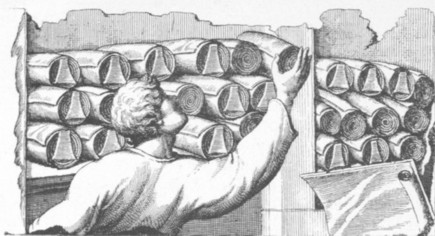 Fig. 11. A Roman taking down a roll from its place in a library.
The system of pigeon-holes terminated, in all probability, in a cornice.
The explorers of Herculaneum depose to the discovery of such an ornament
there.
The wall-space above the book-cases was decorated with the likenesses of
celebrated authors—either philosophers, if the owner of the library
wished to bring into prominence his adhesion to one of the fashionable
systems—or authors, dead and living, or personal friends. This obvious
form of decoration was, in all probability, used at Pergamon[88]; Pollio,
as we have seen, introduced it into Rome: and Pliny, who calls it a
novelty (novitium inventum), deposes to its general adoption[89]. We are
not told how these portraits were commonly treated—whether they were
busts standing clear of the wall on the book-cases; or bracketed against
the wall; or forming part of its decoration, in plaster-work or distemper.
A suitable inscription accompanied them. Martial has preserved for us a
charming specimen of one of these complimentary stanzas—for such they
undoubtedly would be in the case of a contemporary—to be placed beneath
his own portrait in a friend's library:
Hoc tibi sub nostra breve carmen imagine vivat
Quam non obscuris iungis, Avite, viris:
Ille ego sum nulli nugarum laude secundus,
Quem non miraris, sed puto, lector, amas.
Maiores maiora sonent: mihi parva locuto
Sufficit in vestras sæpe redire manus[90].
Placed, with my betters, on your study-wall
Let these few lines, Avitus, me recall:
To foremost rank in trifles I was raised;
I think men loved me, though they never praised.
Let greater poets greater themes profess:
My modest lines seek but the hand's caress
That tells me, reader, of thy tenderness.
The beautiful alto-relievo in the Lateran Museum, Rome, representing an
actor selecting a mask, contains a contrivance for reading a roll (fig. 12) which may have been usual in libraries and elsewhere, though I have
not met with another instance of it. A vertical support attached to the
table on which two masks and a MS. are lying, carries a desk with a rim
along its lower edge and one of its sides. The roll is partially opened,
the closed portion lying towards the left side of the desk, next the rim.
The roll may be supposed to contain the actor's part[91].
It is much to be regretted that we have no definite information as to the
way in which the great public libraries built by Augustus were fitted up;
but I see no reason for supposing that their fittings differed from those
of private libraries.
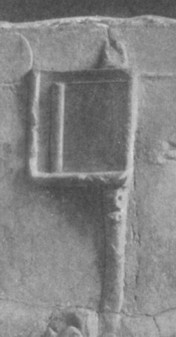 Fig. 12. Desk to support a roll while it is being read.
When books (codices), of a shape similar to that with which modern
librarians have to deal, had to be accommodated as well as rolls, it is
manifest that rectangular spaces not more than a few inches wide would be
singularly inconvenient. They were therefore discarded in favour of a
press (armarium), a piece of furniture which would hold rolls
(volumina) as well as books (codices), and was in fact, as I shall
shew, used for both purposes. The word (armarium) occurs commonly in
Cicero, and other writers of the best period, for a piece of furniture in
which valuables of all kinds, and household gear, were stowed away; and
Vitruvius[92] uses it for a book-case. A critic, he says, "produced from
certain presses an infinite number of rolls." In later Latin writers—that
is from the middle of the first century a.d.—no other word, speaking
generally, occurs.
The jurist Ulpian, who died a.d. 228, in a discussion as to what is
comprised under the term liber, decides in favour of including all rolls
(volumina) of whatever material, and then considers the question whether
codices come under the same category or not—thereby shewing that in his
day both forms of books were in use. Again, when a library (bibliotheca)
has been bequeathed, it is questioned whether the bequest includes merely
the press or presses (armarium vel armaria), or the books as well[93].
The Ulpian Library, or rather Libraries, in Trajan's Forum, built about
114 a.d.[94], were fitted up with presses, as we learn from the passage in
Vopiscus which I have already quoted; and when the ruins of the section of
that library which stood next to the Quirinal Hill were excavated by the
French, a very interesting trace of one of these presses was discovered.
Nibby, the Roman antiquary, thus describes it:
Beyond the above-mentioned bases [of the columns in the
portico] some remains of the inside of the room became
visible on the right. They consisted of a piece of
curtain-wall, admirably constructed of brick, part of
the side-wall, with a rectangular niche of large size in
the form of a press (in foggia di armadio). One
ascended to this by three steps, with a landing-place in
front of them, on which it was possible to stand with
ease. On the sides of this niche there still exist
traces of the hinges, on which the panels and the
wickets, probably of bronze, rested[95].
It seems to me that we have here an early instance, perhaps the earliest,
of those presses in the thickness of the wall which were so common
afterwards in the monasteries and in private libraries also. A similar
press, on a smaller scale, is described by the younger Pliny: "My
bedroom," he says, "has a press let into the wall which does duty as a
library, and holds books not merely to be read, but read over and over
again[96]."
It must not, however, be supposed that cupboards were always, or even
usually, sunk into the wall in Roman times. They were detached pieces of
furniture, not unlike the wardrobes in which ladies hang their dresses at
the present day, except that they were fitted with a certain number of
horizontal shelves, and were used for various purposes according to the
requirements of their owners. For instance, there is a sarcophagus in the
Museo Nazionale at Rome, on which is represented a shoemaker at work. In
front of him is a cupboard, exactly like those I am about to describe, on
the top of which several pairs of shoes are set out.
I can, however, produce three representations of such presses being used
by the Romans to contain books.
The first occurs on a marble sarcophagus (fig. 13), now in the garden of
the Villa Balestra, Rome, where I had the good fortune to find it in
1898[97]; and Professor Petersen, of the German Archaeological School, was
so kind as to have it photographed for me. He assigns the work to about
200 a.d.
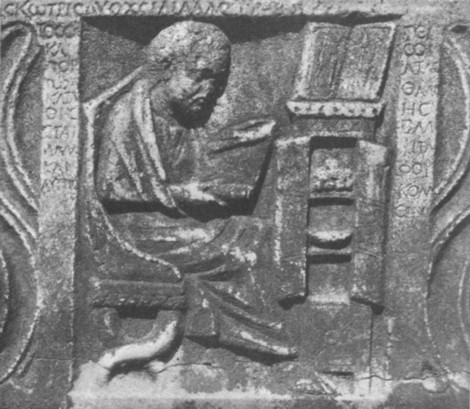 Fig. 13. A Roman reading a roll in front of a press (armarium). From a photograph of a sarcophagus in the garden of the Villa Balestra. Rome.
In the central portion, 21 in. high, by 15½ in. wide, is a seated figure,
reading a roll. In front of him is a cupboard, the doors of which are
open. It is fitted with two shelves, on the uppermost of which are eight
rolls, the ends of which are turned to the spectator. On the next shelf is
something which looks like a dish or shallow cup. The lower part of the
press is solid. Perhaps a second cupboard is intended. Above, it is
finished off with a cornice, on which rests a very puzzling object. There
are a few faint lines on the marble, which Professor Petersen believes are
intended to represent surgical instruments, and so to indicate the
profession of the seated figure[98]. There is a Greek inscription on the
sarcophagus, but it merely warns posterity not to disturb the bones of the
deceased[99].
The second representation (fig. 14) is from the tomb of Galla Placidia, at
Ravenna. It occurs in a mosaic on the wall of the chapel in which she was
buried, a.d. 449[100]; and was presumably executed before that date. The
press closely resembles the one on the Roman sarcophagus, but it is
evidently intended to indicate a taller piece of furniture, and it
terminates in a pediment. There are two shelves, on which lie the four
Gospels, each as a separate codex, indicated by the name of the
Evangelist above it. This press rests upon a stout frame, the legs of
which are kept in position by a cross-piece nearly as thick as themselves.
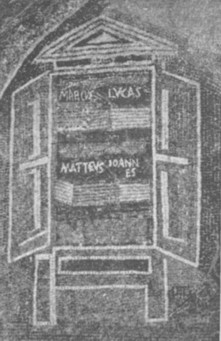 Fig. 14. Press containing the four Gospels. From a mosaic above the tomb of the Empress Galla Placidia at Ravenna.
The third representation of an armarium (fig. 15) occurs in the
manuscript of the Vulgate now in the Laurentian Library at Florence, known
as the Codex Amiatinus, from the Cistercian convent of Monte Amiata in
Tuscany, where it was preserved for several centuries[101]. The thorough
investigation to which this manuscript has lately been subjected shews
that it was written in England, at Wearmouth or Jarrow, but possibly by an
Italian scribe, before a.d. 716, in which year it was taken to Rome, as a
present to the Pope. The first quaternion, however, on one of the leaves
of which the above representation occurs, is probably older; and it may
have belonged to a certain Codex grandior mentioned by Cassiodorus, and
possibly written under his direction[102].
The picture (fig. 15), which appears as the frontispiece to this work,
shews Ezra writing the law. On the margin of the vellum, in a hand which
is considered to be later than that of the MS., are the words:
Codicibus sacris hostili clade pervstis
Esdra deo fervens hoc reparavit opus.
Behind him is a press (armarium) with open doors. The lower portion,
below these doors, is filled in with panels which are either inlaid or
painted, so that the frame on which it is supported is not visible, as in
the Ravenna example. The bottom of the press proper is used as a shelf, on
which lie a volume and two objects, one of which probably represents a
case for pens, while the other is certainly an inkhorn. Above this are
four shelves, on each of which lie two volumes. These volumes have their
titles written on their backs, but they are difficult to make out, and my
artist has not cared to risk mistakes by attempting to reproduce them. The
words, beginning at the left hand corner of the top-shelf, are:
| OCT.[103] LIB. | REG. |
| HIST. LIB. | PSALM. LIB. |
| SALOMON. | PROPH. |
| EVANG. IIII. | EPIST. XXI. |
| ACT. APOSTOL. |
The frame-work of the press above the doors is ornamented in the same
style as the panels below, and the whole is surmounted by a low pyramid,
on the side of which facing the spectator is a cross, beneath which are
two peacocks drinking from a water-trough.
I regret that I could not place this remarkable drawing before my readers
in the rich colouring of the original. The press is of a reddish brown:
the books are bound in crimson. Ezra is clad in green, with a crimson
robe. The background is gold. The border is blue, between an inner and
outer band of silver. The outermost band of all is vermilion.
I formerly thought that this book-press might represent those in use in
England at the beginning of the eighth century; but, if the above
attribution to Cassiodorus be accurate, it must be accounted another
Italian example. It bears a general similarity to the Ravenna book-press,
as might be expected, when it is remembered that Cassiodorus held office
under Theodoric and his successors, and resided at Ravenna till he was
nearly seventy years old.
The foundation of Christianity did not alter what I may call the Roman
conception of a library in any essential particular. The philosophers and
authors of Greece and Rome may have occasionally found themselves in
company with, or even supplanted by, the doctors of the Church; but in
other respects, for the first seven centuries, at least, of our era, the
learned furnished their libraries according to the old fashion, though
with an ever increasing luxury of material. Boethius, whose Consolation
of Philosophy was written a.d. 525, makes Philosophy speak of the "walls
of a library adorned with ivory and glass[104]"; and Isidore, Bishop of
Seville a.d. 600-636, records that "the best architects object to gilded
ceilings in libraries, and to any other marble than cipollino for the
floor, because the glitter of gold is hurtful to the eyes, while the green
of cipollino is restful to them[105]."
A few examples of such libraries may be cited; but, before doing so, I
must mention the Record-Office (Archivum), erected by Pope Damasus
(366-384). It was connected with the Basilica of S. Lawrence, which
Damasus built in the Campus Martius, near the theatre of Pompey. On the
front of the Basilica, over the main entrance, was an inscription, which
ended with the three following lines:
ARCHIVIS FATEOR VOLUI NOVA CONDERE TECTA ADDERE PRÆTEREA
DEXTRA LÆVAQUE COLUMNAS QUÆ DAMASI TENEANT PROPRIUM PER
SÆCULA NOMEN.
I confess that I have wished to build a new abode for
Archives; and to add columns on the right and left to
preserve the name of Damasus for ever.
These enigmatical verses contain all that we know, or are ever likely to
know, respecting this building, which is called chartarium ecclesiæ
Romanæ by S. Jerome[106], and unquestionably held the official documents
of the Latin Church until they were removed to the Lateran in the seventh
century. The whole building, or group of buildings, was destroyed in 1486
by Cardinal Raphael Riario, the dissolute nephew of Sixtus IV., to make
room for his new palace, now called Palazzo della Cancelleria, and the
church was rebuilt on a new site. The connexion with Pope Damasus is
maintained by the name, S. Lorenzo in Damaso. No plan of the old
buildings, or contemporary record of their arrangement, appears to exist.
My only reason for drawing attention to a structure which has no real
connexion with my subject is that the illustrious De Rossi considers that
in the second line of the above quotation the word column signifies
colonnades; and that Damasus took as his model one of the great pagan
libraries of Rome which, in its turn, had been derived from the typical
library at Pergamon[107]. According to this view he began by building, in
the centre of the area selected, a basilica, or hall of basilican type,
dedicated to S. Lawrence; and then added, on the north and south sides, a
colonnade or loggia from which the rooms occupied by the records would be
readily accessible. This opinion is also held by Signor Lanciani, who
follows De Rossi without hesitation. I am unwilling to accept a theory
which seems to me to have no facts to support it; and find it safer to
believe that the line in question refers either to the aisles of the
basilica, or to such a portico in front of it as may be seen at San
Clemente and other early churches.
A letter to Eucherius, Bishop of Lyons in a.d. 441, from a correspondent
named Rusticus, gives a charming picture of a library which he had visited
in his young days, say about a.d. 400:
I am reminded of what I read years ago, hastily, as a
boy does, in the library of a man who was learned in
secular literature. There were there portraits of
Orators and also of Poets worked in mosaic, or in wax of
different colours, or in plaster, and under each the
master of the house had placed inscriptions noting their
characteristics; but, when he came to a poet of
acknowledged merit, as for instance, Virgil, he began as
follows:
Virgilium vatem melius sua carmina laudant;
In freta dum fluvii current, dum montibus umbræ
Lustrabunt convexa, polus dum sidera pascet,
Semper honos nomenque tuum laudesque manebunt.
Virgil's own lines most fitly Virgil praise:
As long as rivers run into the deep,
As long as shadows o'er the hillside sweep,
As long as stars in heaven's fair pastures graze,
So long shall live your honour, name, and praise.[108]
Agapetus, who was chosen Pope in 535, and lived for barely a year, had
intended, in conjunction with Cassiodorus, to found a college for teachers
of Christian doctrine. He selected for this purpose a house on the Cælian
Hill, afterwards occupied by S. Gregory, and by him turned into a
monastery. Agapetus had made some progress with the scheme, so far as the
library attached to the house was concerned, for the author of the
Einsiedlen MS., who visited Rome in the ninth century, saw the following
inscription "in the library of S. Gregory"—i.e. in the library attached
to the Church of San Gregorio Magno.
SANCTORVM VENERANDA COHORS SEDET ORDINE LONGO
DIVINAE LEGIS MYSTICA DICTA DOCENS
HOS INTER RESIDENS AGAPETVS IVRE SACERDOS
CODICIBVS PVLCHRVM CONDIDIT ARTE LOCVM
GRATIA PAR CVNCTIS SANCTVS LABOR OMNIBVS VNVS
DISSONA VERBA QVIDEM SED TAMEN VNA FIDES
Here sits in long array a reverend troop
Teaching the mystic truths of law divine:
'Mid these by right takes Agapetus place
Who built to guard his books this fair abode.
All toil alike, all equal grace enjoy—
Their words are different, but their faith the same.
These lines undoubtedly imply that there was on the walls a long series of
portraits of the Fathers of the Church, including that of Agapetus
himself, who had won his right to a place among them by building a
sumptuous home for their works[109].
The design of Agapetus, interrupted by death, was carried forward by his
friend Cassiodorus, at a place in South Italy called Vivarium, near his
own native town Squillace. Shortly after his final retirement from court,
a.d. 538, Cassiodorus established there a brotherhood, which, for a time at
least, must have been a formidable rival to that of S. Benedict. A library
held a prominent place in his conception of what was needed for their
common life. He says little about its size or composition, but much
rhetoric is expended on the contrivances by which its usefulness and
attractiveness were to be increased. A staff of bookbinders was to clothe
the manuscripts in decorous attire; self-supplying lamps were to light
nocturnal workers; sundials by day, and water-clocks by night, enabled
them to regulate their hours. Here also was a scriptorium, and it
appears probable that between the exertions of Cassiodorus and his friend
Eugippius, South Italy was well supplied with manuscripts[110].
These attempts to snatch from oblivion libraries which, though probably
according to our ideas insignificant, were centres of culture in the
darkest of dark ages, will be illustrated by the fuller information that
has come down to us respecting the library of Isidore, Bishop of Seville
600-636. The "verses composed by himself for his own presses," to quote
the oldest manuscript containing them[111], have been preserved, with the
names of the writers under whose portraits they were inscribed.
There were fourteen presses, arranged as follows:
| I. | Origen. | VIII. | Prudentius. |
| II. | Hilary. | IX. | Avitus, Juvencus, Sedulius. |
| III. | Ambrose. | X. | Eusebius, Orosius. |
| IV. | Augustine. | XI. | Gregory. |
| V. | Jerome. | XII. | Leander. |
| VI. | Chrysostom. | XIII. | Theodosius, Paulus, Gaius. |
| VII. | Cyprian. | XIV. | Cosmas, Damian, Hippocrates, Galen. |
These writers are probably those whom Isidore specially admired, or had
some particular reason for commemorating. The first seven are obvious
types of theologians, and the presses over which they presided were
doubtless filled not merely with their own works, but with bibles,
commentaries, and works on Divinity in general. Eusebius and Orosius are
types of ecclesiastical historians; Theodosius, Paulus, and Gaius, of
jurists; Cosmas, Damian, etc. of physicians. But the Christian poets
Prudentius to Sedulius could hardly have needed two presses to contain
their works; nor Gregory the Great the whole of one. Lastly, Leander,
Isidore's elder brother, could only owe his place in the series to
fraternal affection. I conjecture that these portraits were simply
commemorative; and that the presses beneath them contained the books on
subjects not suggested by the rest of the portraits, as for example,
secular literature, in which Isidore was a proficient.
The sets of verses[112] begin with three elegiac couplets headed Titulus
Bibliothece, probably placed over the door of entrance.
Sunt hic plura sacra, sunt hic mundalia plura:
Ex his si qua placent carmina, tolle, lege.
Prata vides, plena spinis, et copia florum;
Si non vis spinas sumere, sume rosas.
Hic geminæ radiant veneranda volumina legis;
Condita sunt pariter hic nova cum veteri.
Here sacred books with worldly books combine;
If poets please you, read them; they are thine.
My meads are full of thorns, but flowers are there;
If thorns displease, let roses be your share.
Here both the Laws in tomes revered behold;
Here what is new is stored, and what is old.
The authors selected are disposed of either in a single couplet, or in
several couplets, according to the writer's taste. I will quote the lines
on S. Augustine:
Mentitur qui [te] totum legisse fatetur:
An quis cuneta tua lector habere potest?
Namque voluminibus mille, Augustine, refulges,
Testantur libri, quod loquor ipse, tui.
Quamvis multorum placeat prudentia libris,
Si Augustinus adest, sufficit ipse tibi.
They lie who to have read thee through profess;
Could any reader all thy works possess?
A thousand scrolls thy ample gifts display;
Thy own books prove, Augustine, what I say.
Though other writers charm with varied lore,
Who hath Augustine need have nothing more.
The series concludes with some lines "To an Intruder (ad
Interventorem)," the last couplet of which is too good to be omitted:
Non patitur quenquam coram se scriba loquentem;
Non est hic quod agas, garrule, perge foras.
A writer and a talker can't agree:
Hence, idle chatterer; 'tis no place for thee.
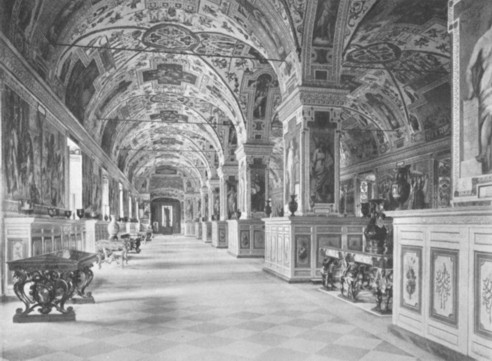 Fig. 16. Great Hall of the Vatican Library, looking west.
With these three examples I conclude the section of my work which deals
with what may be called the pagan conception of a library in the fulness
of its later development. Unfortunately, no enthusiast of those distant
times has handed down to us a complete description of his library, and we
are obliged to take a detail from one account, and a detail from another,
and so piece the picture together for ourselves. What I may call "the
pigeon-hole system," suitable for rolls only, was replaced by presses
which could contain rolls if required, and certainly did (as shewn (fig. 13) on the sarcophagus of the Villa Balestra), but which were specially
designed for codices. These presses were sometimes plain, sometimes
richly ornamented, according to the taste or the means of the owner. With
the same limitations the floor, the walls, and possibly the roof also were
decorated. Further, it was evidently intended that the room selected for
books should be used for no other purpose; and, as the books were hidden
from view in their presses, the library-note, if I may be allowed the
expression, was struck by numerous inscriptions, and by portraits in
various materials, representing either authors whose works were on the
shelves, or men distinguished in other ways, or friends and relations of
the owner of the house.
The Roman conception of a library was realised by Pope Sixtus V., in
1587[113], when the present Vatican Library was commenced from the design
of the architect Fontana. I am not aware that there is any contemporary
record to prove that either the Pope or his advisers contemplated this
direct imitation; but it is evident, from the most cursory inspection of
the large room (fig. 16), that the main features of a Roman library are
before us[114]; and perhaps, having regard to the tendency of the
Renaissance, especially in Italy, it would be unreasonable to expect a
different design in such a place, and at such a period.
This noble hall—probably the most splendid apartment ever assigned to
library-purposes—spans the Cortile del Belvedere from east to west, and
is entered at each end from the galleries connecting the Belvedere with
the Vatican palace. It is 184 feet long, and 57 feet wide, divided into
two by six piers, on which rest simple quadripartite vaults. The north and
south walls are each pierced with seven large windows. No books are
visible. They are contained in plain wooden presses 7 feet high and 2 feet
deep, set round the piers, and against the walls between the windows. The
arrangement of these presses will be understood from the general view
(fig. 16), and from the view of a single press open (fig. 17).
In the decoration, with which every portion of the walls and vaults is
covered, Roman methods are reproduced, but with a difference. The great
writers of antiquity are conspicuous by their absence; but the development
of the human race is commemorated by the presence of those to whom the
invention of letters is traditionally ascribed; the walls are covered with
frescoes representing the foundation of the great libraries which
instructed the world, and the assemblies of the Councils which established
the Church; the vaults record the benefits conferred on Rome by Sixtus V.,
in a series of historical views, one above each window; and over these
again are stately figures, each embodying some sacred
abstraction—"Thrones, dominations, princedoms, virtues, powers"—with
angels swinging censers, and graceful nymphs, and laughing satyrs—a
strange combination of paganism and Christianity—amid wreaths of flowers,
and arabesques twining round the groups and over every vacant space,
partly framing, partly hiding, the heraldic devices which commemorate
Sixtus and his family:—a web of lovely forms and brilliant colours,
combined in an intricate and yet orderly confusion.
It may be questioned whether such a room as this was ever intended for
study. The marble floor, the gorgeous decoration, the absence of all
appliances for work in the shape of desks, tables, chairs, suggest a place
for show rather than for use. The great libraries of the Augustan age, on
the other hand, seem, so far as we can judge, to have been used as
meeting-places and reading-rooms for learned and unlearned alike. In
general arrangement and appearance, however, the Vatican Library must
closely resemble its imperial predecessors.
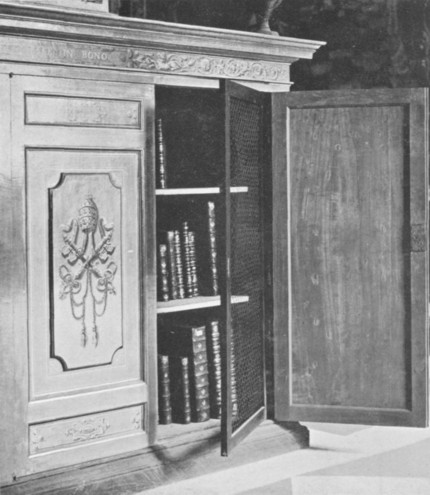 Fig. 17. A single press in the Vatican Library, open. From a photograph.
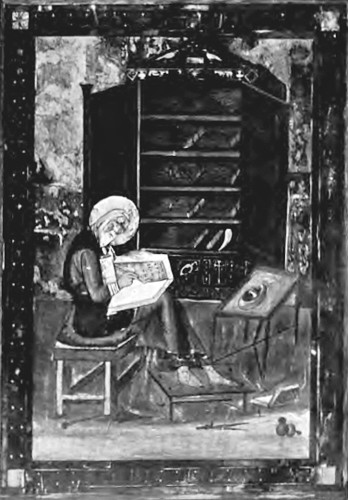 Fig. 15 Ezra writing the Law. Frontispiece to the Codex Amiatinus. In the background is a press with open doors. The picture was probably drawn in the middle of the sixth century A.D.

 When engaged in editing and completing The Architectural History of the
University and Colleges of Cambridge, I devoted much time and attention
to the essay called The Library. The subject was entirely new; and the
more I looked into it, the more convinced did I become that it would well
repay fuller investigation than was then possible. For instance, I felt
certain that the Customs affecting monastic libraries would, if one could
only discover them, throw considerable light on collegiate statutes
relating to the same subject.
When engaged in editing and completing The Architectural History of the
University and Colleges of Cambridge, I devoted much time and attention
to the essay called The Library. The subject was entirely new; and the
more I looked into it, the more convinced did I become that it would well
repay fuller investigation than was then possible. For instance, I felt
certain that the Customs affecting monastic libraries would, if one could
only discover them, throw considerable light on collegiate statutes
relating to the same subject.


 The evidence collected in the last chapter shews that what I have there
called the Roman conception of a library was maintained, even by Christian
ecclesiastics, during many centuries of our era. I have next to trace the
beginning and the development of another class of libraries, directly
connected with Christianity. We shall find that the books intended for the
use of the new communities were stored in or near the places where they
met for service, just as in the most ancient times the safe-keeping of
similar treasures had been entrusted to temples.
The evidence collected in the last chapter shews that what I have there
called the Roman conception of a library was maintained, even by Christian
ecclesiastics, during many centuries of our era. I have next to trace the
beginning and the development of another class of libraries, directly
connected with Christianity. We shall find that the books intended for the
use of the new communities were stored in or near the places where they
met for service, just as in the most ancient times the safe-keeping of
similar treasures had been entrusted to temples.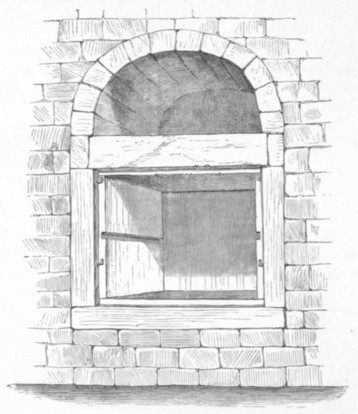


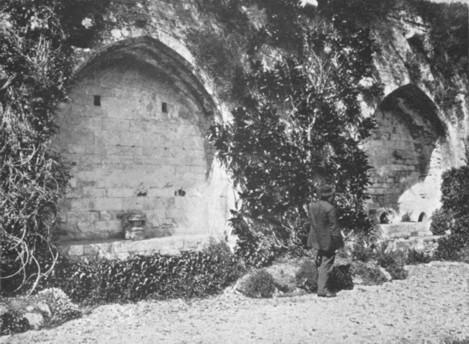

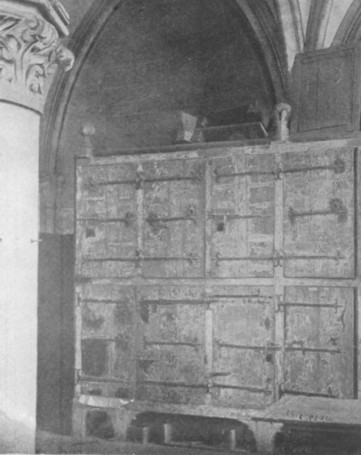
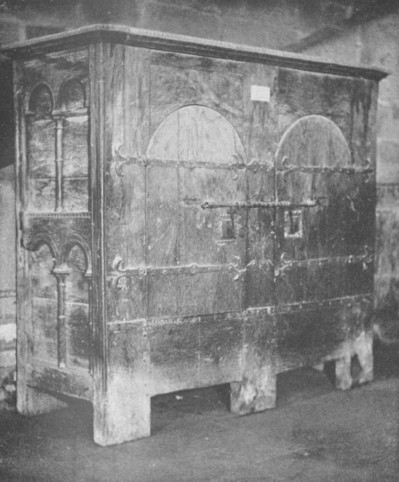
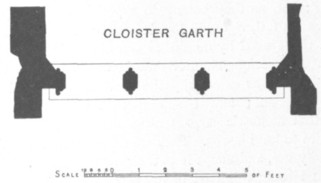
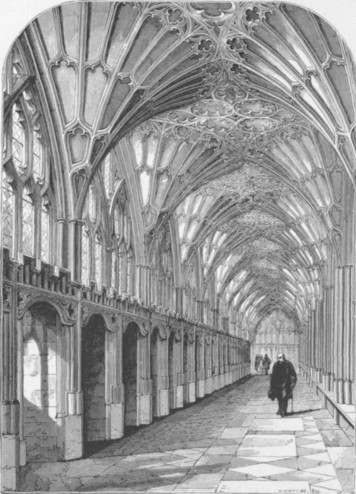
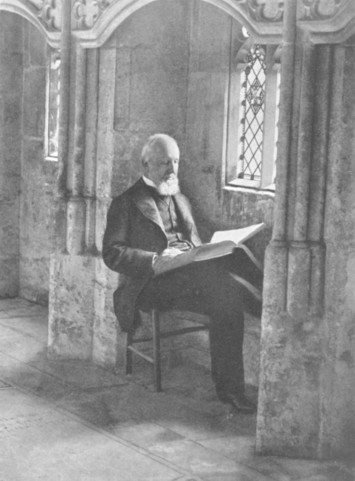
 In the last chapter I attempted to describe the way in which the Monastic
Orders provided for the safe keeping of their books, so long as their
collections were not larger than could be accommodated in a press or
presses in the cloister, or in the small rooms used by the Cistercians for
the same purpose. I have now to carry the investigation a step farther,
and to shew how books were treated when a separate library was built.
In the last chapter I attempted to describe the way in which the Monastic
Orders provided for the safe keeping of their books, so long as their
collections were not larger than could be accommodated in a press or
presses in the cloister, or in the small rooms used by the Cistercians for
the same purpose. I have now to carry the investigation a step farther,
and to shew how books were treated when a separate library was built.
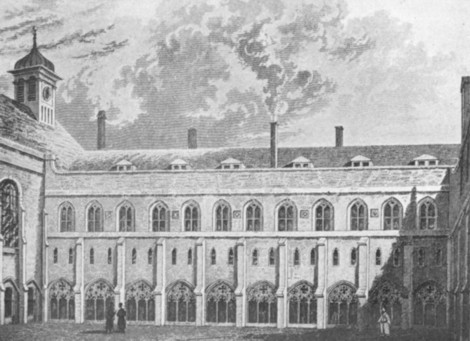


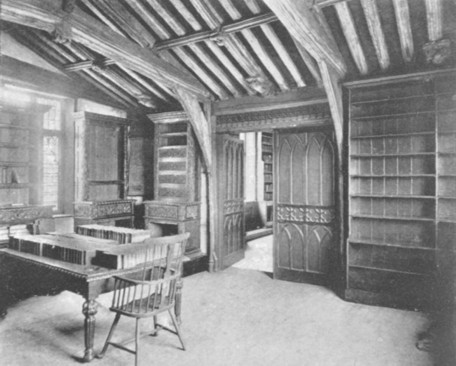


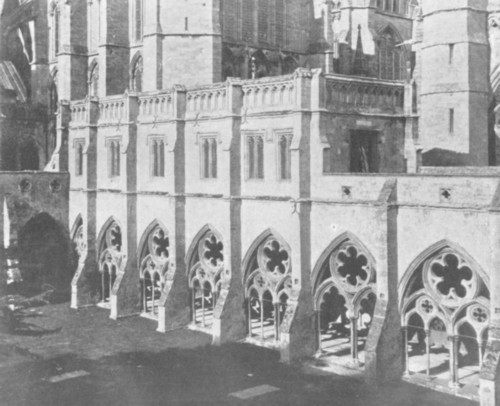

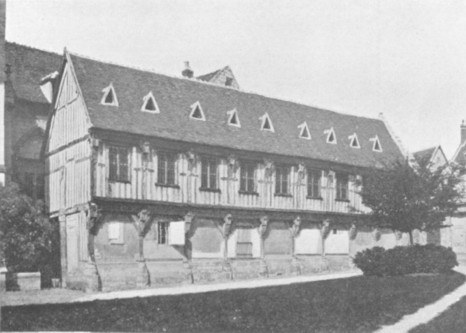
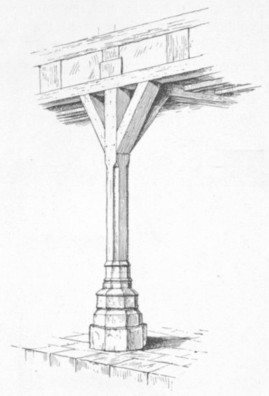

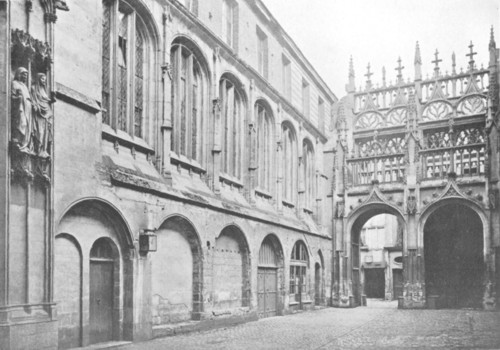
 How were the libraries mentioned in the preceding chapter fitted up? For
instance, what manner of bookcases did Archbishop Chichele put into his
library at Canterbury in 1414, or the "bons ouvriers subtilz et plains de
sens" supply to the Abbat of Clairvaux in 1496? The primitive book-presses
have long ago been broken up; and the medieval devices that succeeded them
have had no better fate. This dearth of material need not, however,
discourage us. We have, I think, the means of discovering with tolerable
certainty what monastic fittings must have been, by comparing the
bookcases which still exist in a more or less perfect form in the
libraries of Oxford and Cambridge with such monastic catalogues as give
particulars of arrangement and not merely lists of books.
How were the libraries mentioned in the preceding chapter fitted up? For
instance, what manner of bookcases did Archbishop Chichele put into his
library at Canterbury in 1414, or the "bons ouvriers subtilz et plains de
sens" supply to the Abbat of Clairvaux in 1496? The primitive book-presses
have long ago been broken up; and the medieval devices that succeeded them
have had no better fate. This dearth of material need not, however,
discourage us. We have, I think, the means of discovering with tolerable
certainty what monastic fittings must have been, by comparing the
bookcases which still exist in a more or less perfect form in the
libraries of Oxford and Cambridge with such monastic catalogues as give
particulars of arrangement and not merely lists of books.


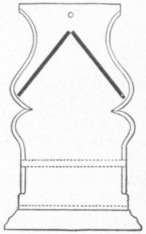

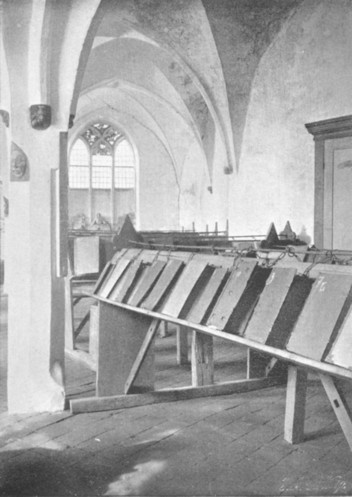
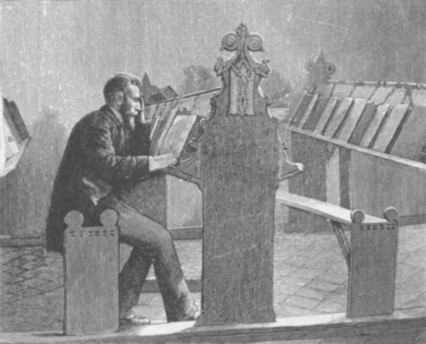
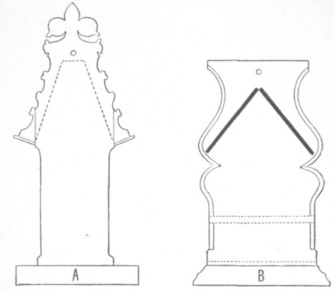
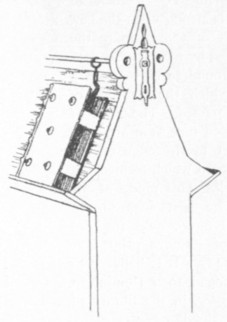
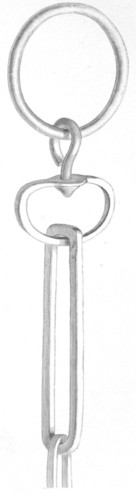
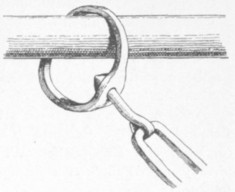
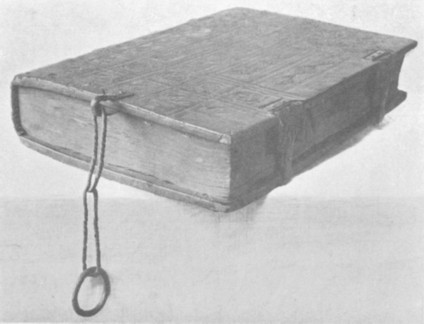
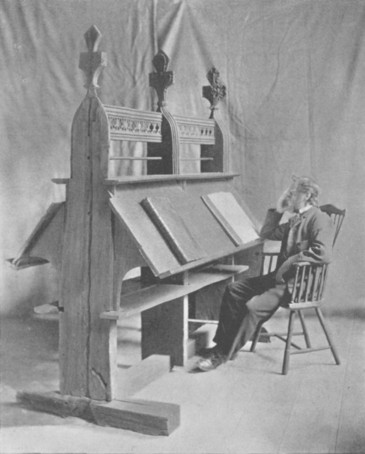
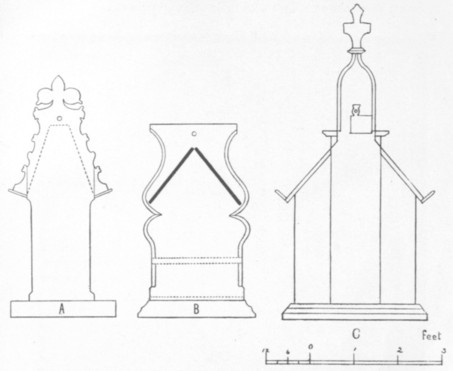
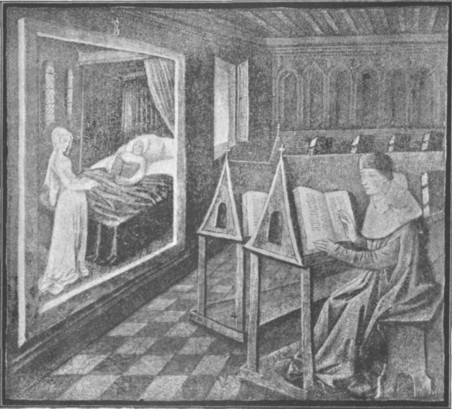
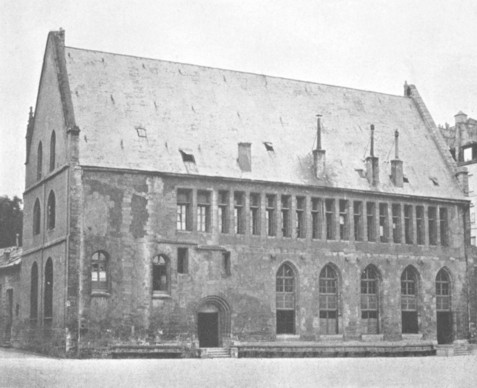
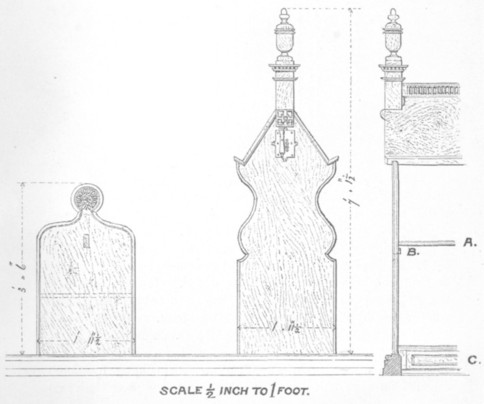
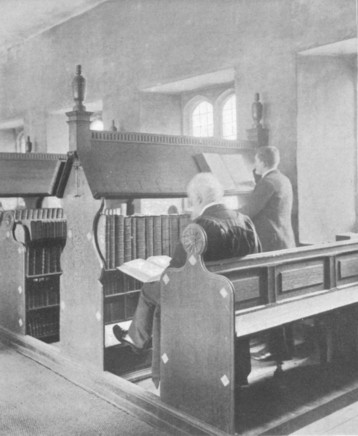
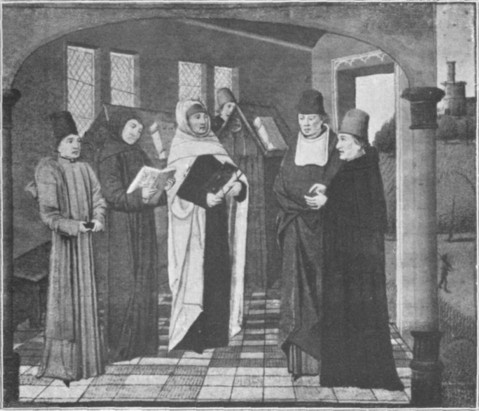
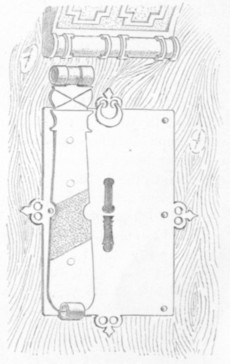

 If the evidence brought forward in the last chapter be accepted, the
Library which a Monastery or College built in the fifteenth century was a
long narrow room lighted by rows of equidistant windows. Occasionally, if
neighbouring buildings allowed, there was a window at the end of the room
also. The fittings were lecterns of wood. On these the books were laid,
each volume being fastened by a chain to a bar usually placed over the
desk, but occasionally, in all probability, in front of it or beneath it.
The readers sat on benches immoveably fixed opposite to each window. It is
obvious that reading was convenient enough so long as the students were
few, but if they were numerous and the books chained too closely together
much annoyance must have been caused. When the University of Oxford
petitioned Humphrey Duke of Gloucester in 1444 to help them to build a new
library, they specially dwelt upon the obstacles to study arising from the
overcrowded condition of the old room. "Should any student," they said,
"be poring over a single volume, as often happens, he keeps three or four
others away on account of the books being chained so closely
together
If the evidence brought forward in the last chapter be accepted, the
Library which a Monastery or College built in the fifteenth century was a
long narrow room lighted by rows of equidistant windows. Occasionally, if
neighbouring buildings allowed, there was a window at the end of the room
also. The fittings were lecterns of wood. On these the books were laid,
each volume being fastened by a chain to a bar usually placed over the
desk, but occasionally, in all probability, in front of it or beneath it.
The readers sat on benches immoveably fixed opposite to each window. It is
obvious that reading was convenient enough so long as the students were
few, but if they were numerous and the books chained too closely together
much annoyance must have been caused. When the University of Oxford
petitioned Humphrey Duke of Gloucester in 1444 to help them to build a new
library, they specially dwelt upon the obstacles to study arising from the
overcrowded condition of the old room. "Should any student," they said,
"be poring over a single volume, as often happens, he keeps three or four
others away on account of the books being chained so closely
together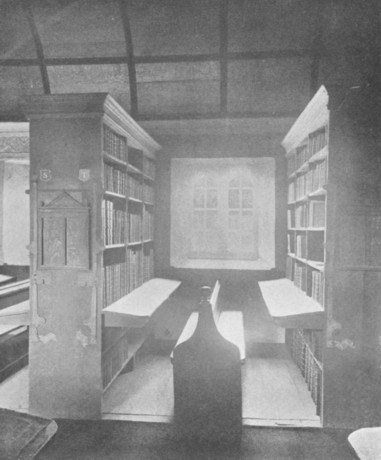
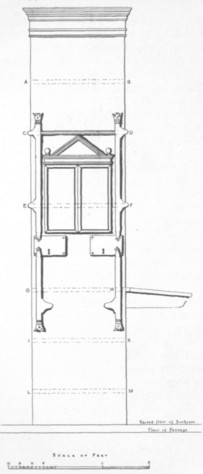
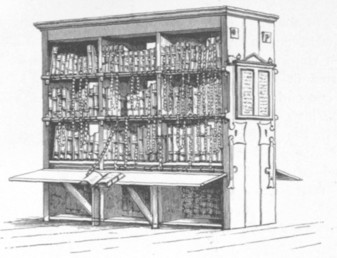
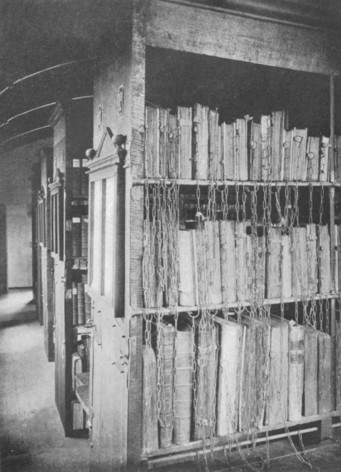
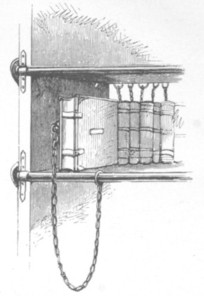
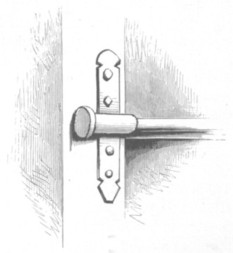
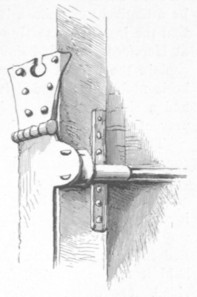
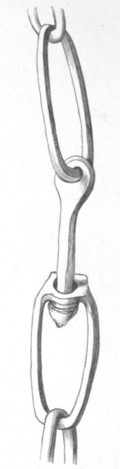


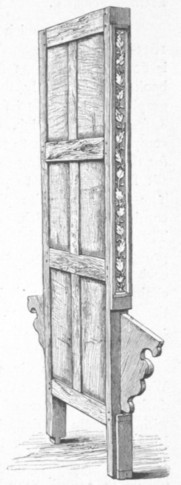
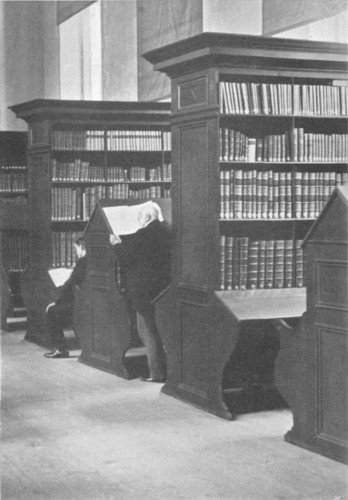

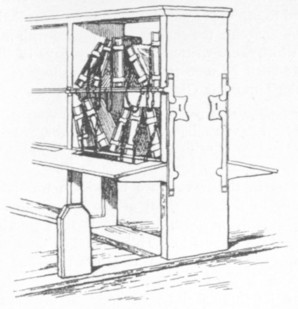
 While the "stall-system" was being generally adopted in England and in
France, a different plan was being developed in Italy. It consisted in a
return to the "lectern-system," with the addition of a shelf below the
lectern, on which the books lay on their sides when not wanted; and an
ingenious combination of a seat for the reader with the desk and shelf.
While the "stall-system" was being generally adopted in England and in
France, a different plan was being developed in Italy. It consisted in a
return to the "lectern-system," with the addition of a shelf below the
lectern, on which the books lay on their sides when not wanted; and an
ingenious combination of a seat for the reader with the desk and shelf.
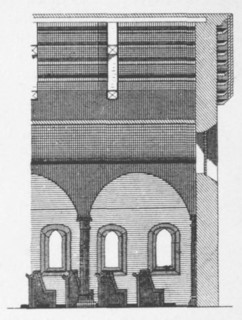
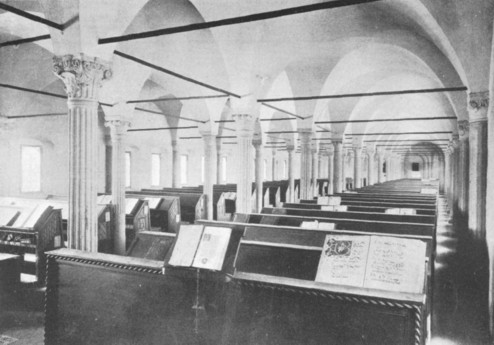
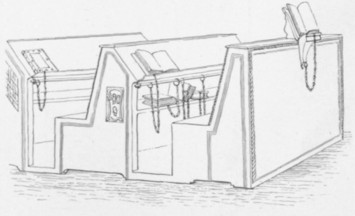
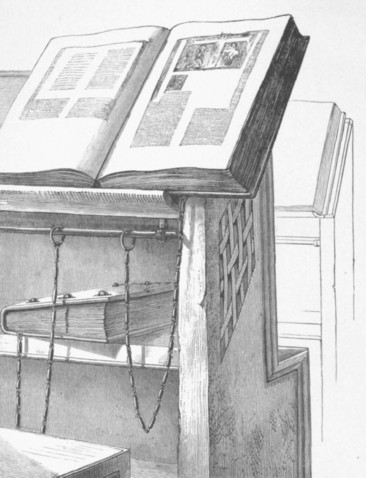
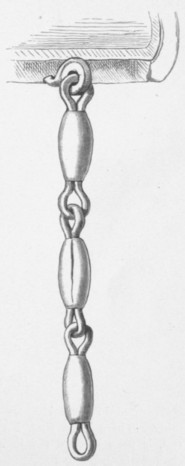
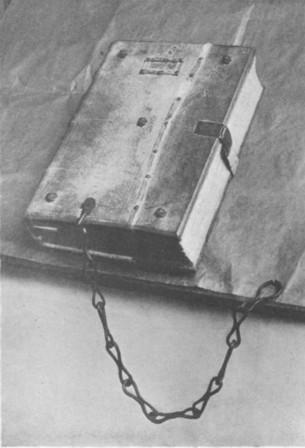



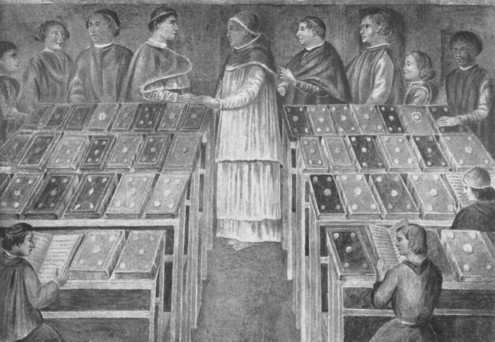
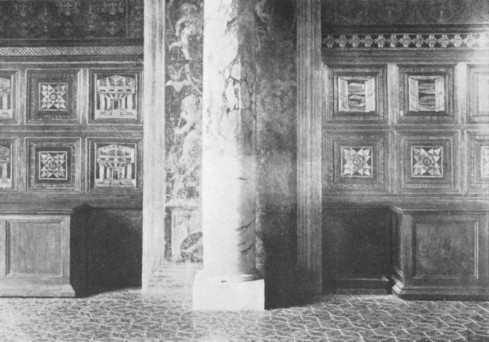
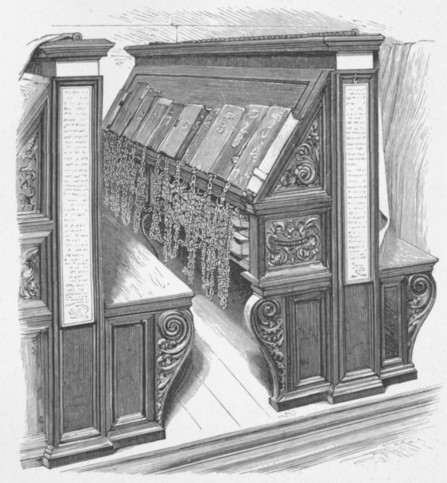
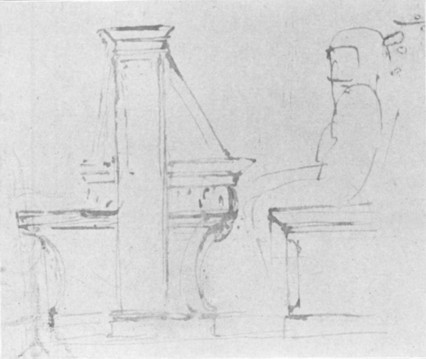
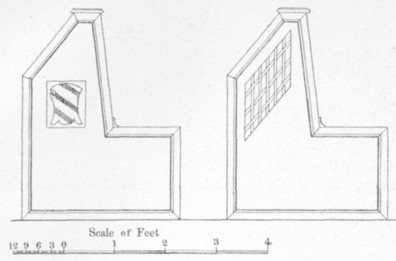
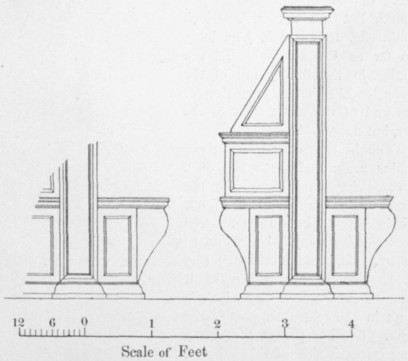
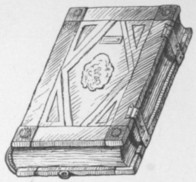
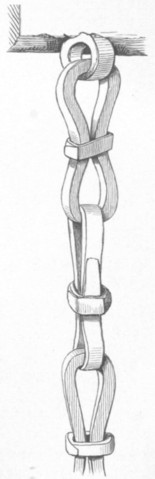
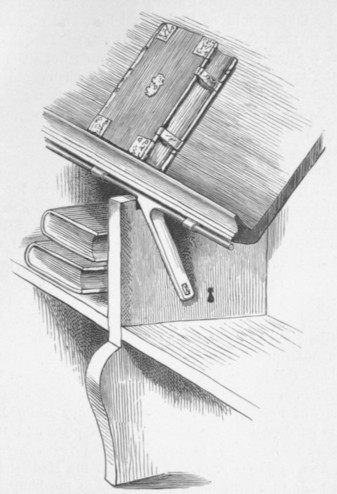
 I have now traced the evolution of the bookcase from a clumsy contrivance
consisting of two boards set at an angle to each other, to the stately
pieces of furniture which, with but little alteration, are still in use;
and I hope that I have succeeded in shewing that the fifteenth century was
emphatically the library-era throughout Europe. Monasteries, cathedrals,
universities, and secular institutions in general vied with each other in
erecting libraries, in stocking them with books, and in framing liberal
regulations for making them useful to the public.
I have now traced the evolution of the bookcase from a clumsy contrivance
consisting of two boards set at an angle to each other, to the stately
pieces of furniture which, with but little alteration, are still in use;
and I hope that I have succeeded in shewing that the fifteenth century was
emphatically the library-era throughout Europe. Monasteries, cathedrals,
universities, and secular institutions in general vied with each other in
erecting libraries, in stocking them with books, and in framing liberal
regulations for making them useful to the public.
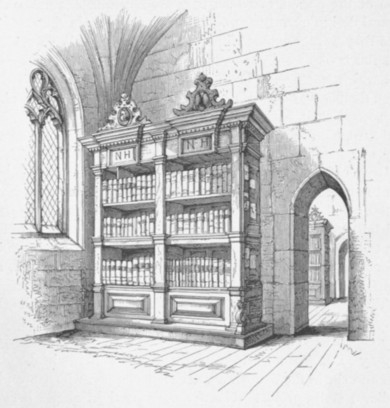

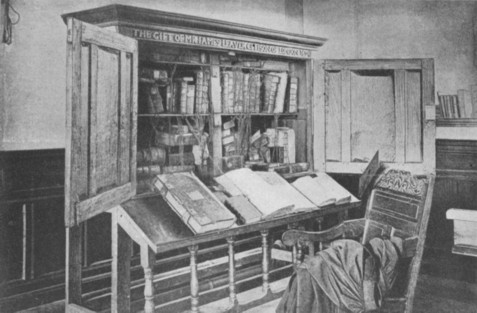
 While in England we were struggling with the difficulties of adapting
medieval forms of libraries and bookcases to the ever-increasing number of
volumes, a new system was initiated on the continent, which I propose to
call the wall-system.
While in England we were struggling with the difficulties of adapting
medieval forms of libraries and bookcases to the ever-increasing number of
volumes, a new system was initiated on the continent, which I propose to
call the wall-system.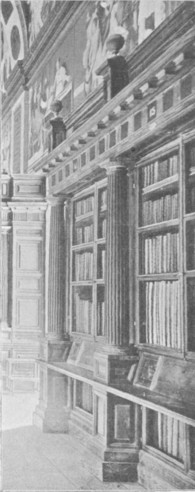
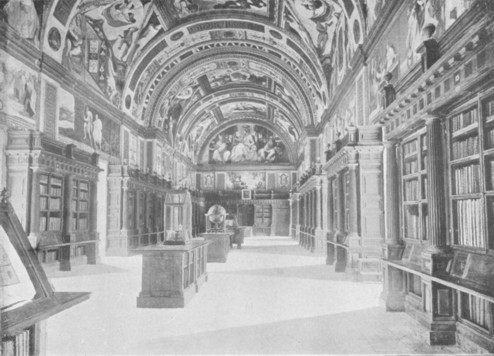
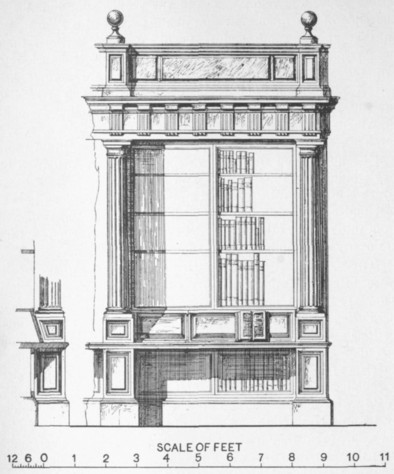
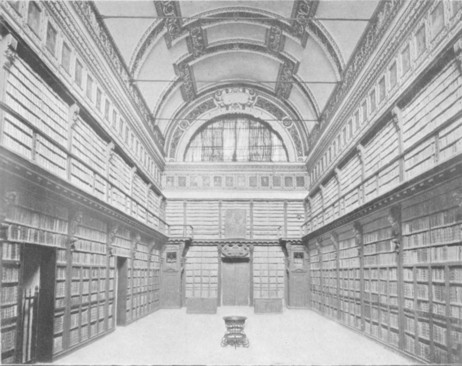

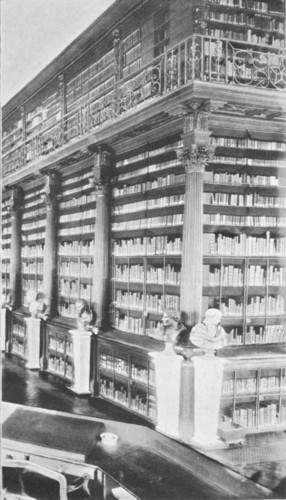

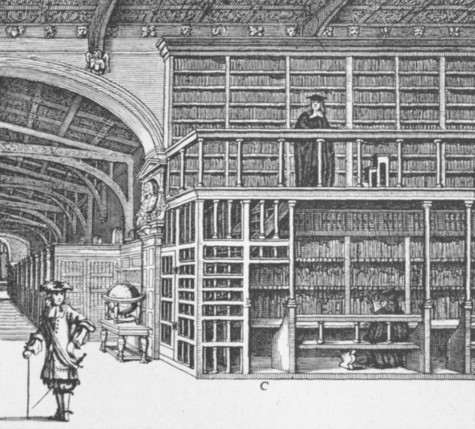
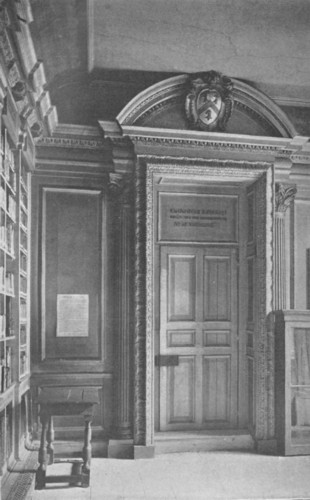
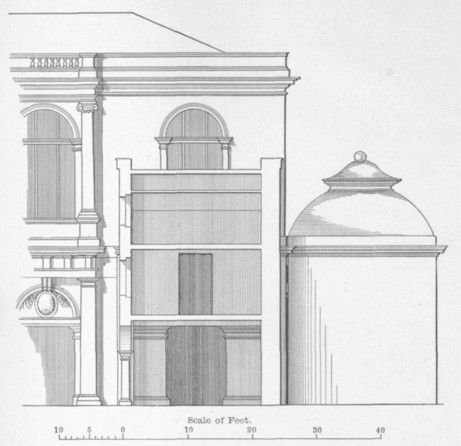
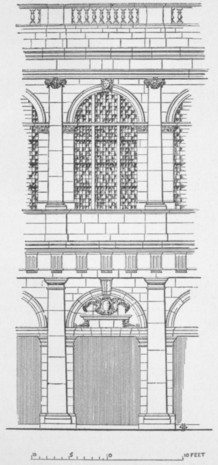
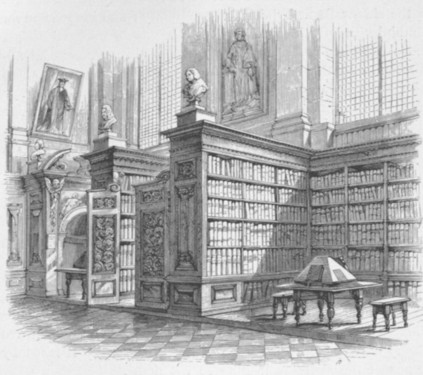

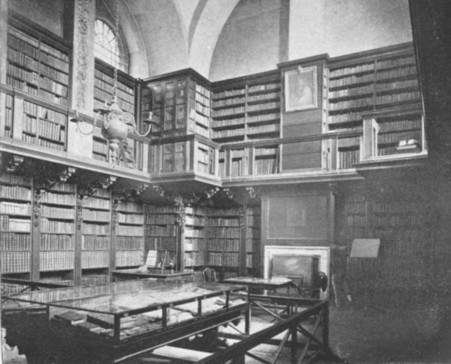
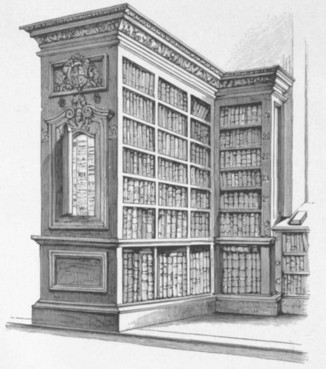
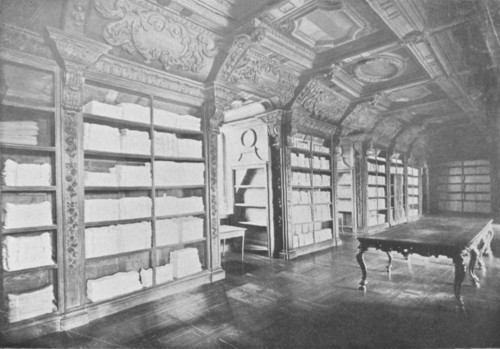

 In the previous chapters I have sketched the history of library-fittings
from the earliest times to the end of the eighteenth century. The
libraries to which these fittings belonged were, for the most part,
public, or as good as public. But, as in history we have recognised the
important fact that a record of battles and sieges and enactments in
Parliament gives an imperfect conception of the life of a people, so I
should feel that this archeological subject had been insufficiently
treated if I made no attempt to shew how private scholars disposed their
books, or with what appliances they used them. For instance, in what sort
of chair was the author of the Philobiblon sitting when he wrote the
last words of his treatise, 24 January, 1345, and how was his study in his
palace at Auckland furnished? Further, how were private students bestowed
in the fifteenth century, when a love of letters had become general?
Lastly, how were libraries fitted up for private use in the succeeding
century, when the great people of the earth, like the wealthy Romans of
imperial times, added the pursuit of literature to their other fashions,
and considered a library to be indispensable in their luxurious palaces?
In the previous chapters I have sketched the history of library-fittings
from the earliest times to the end of the eighteenth century. The
libraries to which these fittings belonged were, for the most part,
public, or as good as public. But, as in history we have recognised the
important fact that a record of battles and sieges and enactments in
Parliament gives an imperfect conception of the life of a people, so I
should feel that this archeological subject had been insufficiently
treated if I made no attempt to shew how private scholars disposed their
books, or with what appliances they used them. For instance, in what sort
of chair was the author of the Philobiblon sitting when he wrote the
last words of his treatise, 24 January, 1345, and how was his study in his
palace at Auckland furnished? Further, how were private students bestowed
in the fifteenth century, when a love of letters had become general?
Lastly, how were libraries fitted up for private use in the succeeding
century, when the great people of the earth, like the wealthy Romans of
imperial times, added the pursuit of literature to their other fashions,
and considered a library to be indispensable in their luxurious palaces?