This ebook was created in honour of Distributed Proofreaders' 20th Anniversary. — The Carcellini Emerald With Other Tales
The Project Gutenberg eBook, The Carcellini Emerald with Other Tales, by
Mrs. Burton Harrison
Note:
Images of the original pages are available through
Internet Archive. See
https://archive.org/details/carcelliniemeral00harriala
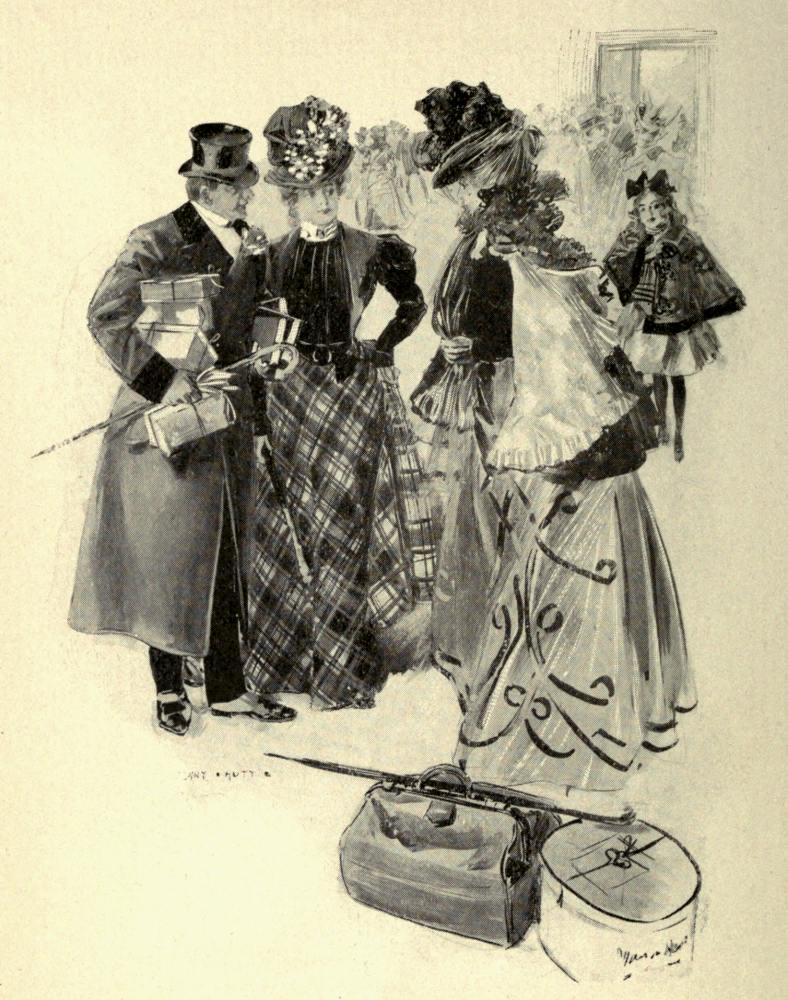
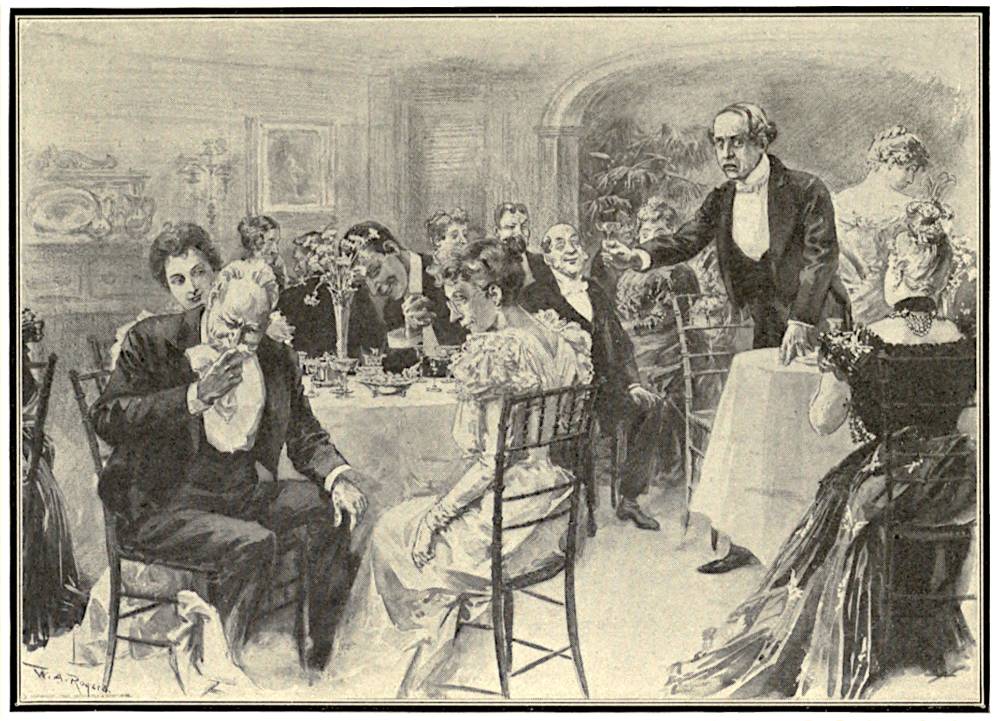
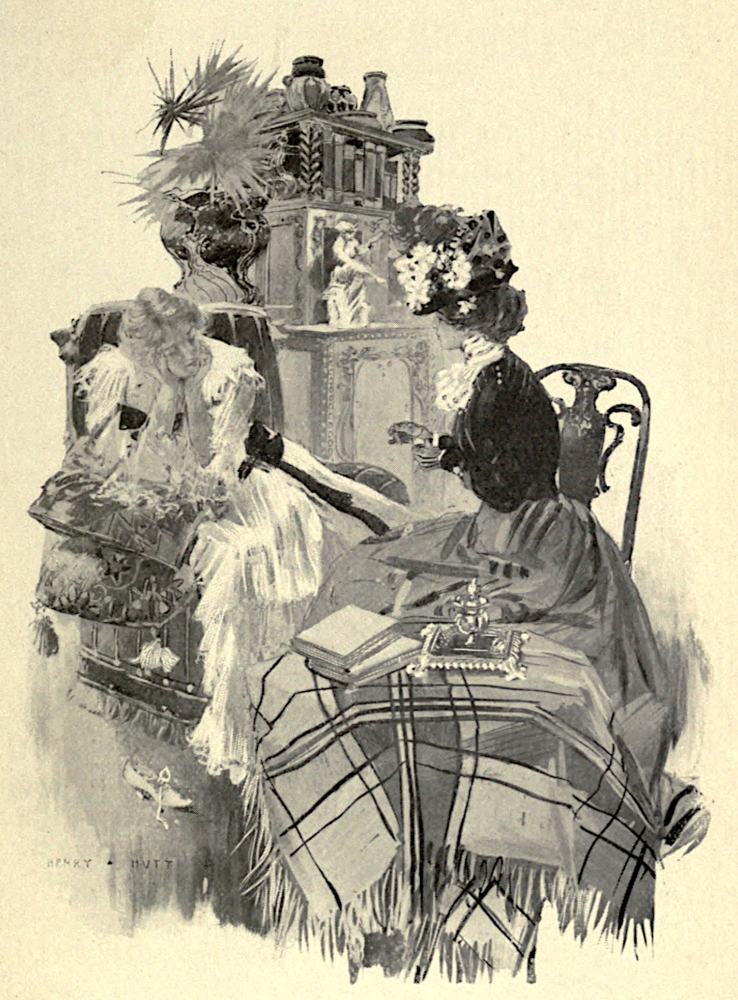
“MAID? NEVER HAD SUCH A THING IN MY LIFE,” LAUGHED
CECILY; “AND WHAT WOULD HA’ BEEN THE USE, WHEN MR.
LENVALE WOULD INSIST ON ESCORTING ME.”
The
Carcellini Emerald
With Other Tales
BY
MRS. BURTON HARRISON
HERBERT S. STONE AND COMPANY
CHICAGO AND NEW YORK MDCCCXCIX
COPYRIGHT 1899 BY
HERBERT S. STONE & CO.
THE PUBLISHERS ACKNOWLEDGE THE COURTESY OF
THE CURTIS PUBLISHING COMPANY (THE SATURDAY
EVENING POST), MAST, CROWELL AND KIRKPATRICK
(THE WOMAN’S HOME COMPANION), AND HARPER AND
BROTHERS, IN ALLOWING THE USE OF ILLUSTRATIONS
How did Ashton Carmichael come by his
aristocratic and decidedly individual place as a
dictator in New York’s smart society? Nobody
knew; nobody really cared. In his set it was
sufficient for one sheep to jump, and all the rest
would follow. He was as much a power as was
Beau Brummell over modish London in the days
of the Regency. Asked everywhere, deferred to
with bated breath by new aspirants, he was seen
only at the houses of authenticated fashion. In
the clubs to which he belonged—and the list of
them was long, following his name in the Social
Register—some men affected to pooh-pooh his
right to membership; but rarely was there a
member of a committee on admissions found to
vote against him on the score of fitness. Good-looking,
gentlemanlike, amusing when it suited
him to be so, sarcastic—and, on occasion, offensively
snobbish—his uncertainties of mood lent
zest to pursuit by his admirers. He had no
known income beyond that derived from a nebulous
business in real estate in which he was
alleged to hold a partnership. His place of residence
was in a couple of cheapish rooms in an
out-of-the-way neighborhood. But all the good
things of life seemed to fall easily to his share;
and winter and summer, on land, at sea, he was
heard of, in ripe enjoyment of luxuries earned or
inherited by other people.
As a matter of fact, while the general public
languished in ignorance of Carmichael’s antecedents,
there were two or three individuals in
New York who could have told his story from A
to Z, but preferred for various reasons to keep
their mouths shut. One of these was Tom
Oliver, Carmichael’s chum at college and his
sponsor in the initiatory steps of worldly progress.
Another was Tom’s sister Eunice, now
pretty Mrs. Arden Farnsworth, who, in days of
lang syne, had been engaged to her brother’s
handsome friend.
The third was a brave, hard-working young
woman journalist on the staff of a great city
newspaper; a girl who never troubled Carmichael
with her presence, although she bore his name,
and had given all her little patrimony to help her
only brother through the university and provide
him a start in life.
It was at the beginning of senior year, when
Tom Oliver came back to college to surprise his
friends by the announcement of his rich father’s
insolvency. Up to that time Tom had been
regarded as a prince of generosity and good-fellowship.
His liberal allowance was lavished
upon college subscriptions and other fellows’
debts as soon as it came into his hands. Before
the end of the month he was as impecunious as
the rest of them. The blow of his sudden
change of prospects did not, therefore, afflict him
as much as might have been expected. As for
the democratic, happy-go-lucky band who for
three years had made him their hero, it seemed,
if anything, to bring him nearer to their level.
As a rule, the chaps of their brotherhood were
the sons of toilers, accustomed to scant means
and modest ways of life, who looked forward to
opening the world’s oyster with their own swords,
or nobody’s. The man who appeared most to
feel the hero’s altered circumstances was his
room-mate, known as Ash Carmichael, a fellow
the crowd had taken in among them through a
not unnatural delusion that his being so intimate
with Tom made him of Tom’s sort. Oliver
and he had drifted together in freshman year, and
Ash was indebted to Tom for a long list of solid
benefits bestowed with the same recklessness of
consequences and loyalty of affection that had
marked every kind action of the young man’s
life.
On all occasions when it was possible Tom had
taken Ashton home to New York with him for
the holidays and flying visits. The latter had
spent two months of the summer preceding
senior year at the Olivers’ house at Newport,
where he had made acquaintance with some of
the people who were afterward to be his sponsors
in fashionable life. The stress he laid upon
these individuals, their homes and habits, had
elicited from his chum a great deal of good-natured
fun at Carmichael’s expense. But as
that was the only thing he ever enjoyed at the
expense of that individual, Tom was entitled to
make the most of it.
For Tom himself the smart people who forever
dined and drove and yachted and gave incessant
dinners had no attraction. Mrs. Oliver, a
devotee of the gay world, and Charlotte, her
older daughter, who followed in the mother’s
footsteps, had ceased chiding their recreant
brother, and were rather inclined to hustle him
out of the observation of their all-important
circle. Eunice, the younger girl, who adored
Tom, used often to fall behind in the fashionable
procession for the pleasure of sharing her brother’s
pastimes. In athletics Tom had trained
her well, and here Ash Carmichael had first
elicited her girlish admiration, for he was an
adept in all sports requiring grace and activity.
But then even Mrs. Oliver told her son that
his chum was the only “possible” college-mate
he had ever brought under the patrimonial roof-tree!
When the crash of Tom’s prospects came as to
finances Carmichael was disagreeably taken by
surprise. The manifestation to his friend of the
exact condition of his feelings on this subject
was, on the whole, more trying to Tom than the
original blow.
The first public move in the disintegration of
their friendship was Tom’s withdrawal from the
expensive rooms they had occupied together
since freshman year into much cheaper lodgings.
Ash promptly installed in his place a wealthy
and inane classmate whom the “crowd” had
antecedently styled “Miss Willie.” There was a
groan of derision among the fellows for this substitute
for Tom; and at an impromptu meeting
of leading spirits in Tom’s new rooms, in an old
and shabby quarter, it was voted to give Carmichael
henceforth what they called the “icy
nod.”
After the Christmas holidays, which Ash spent
with “Miss Willie’s” family, something occurred
to bring upon Tom’s former chum a ban more
serious than what had preceded it. The offense,
the discovery of it, the discussion, and the verdict
were known to only a few of Tom Oliver’s
most devoted henchmen. Outsiders, aware of
some dark mystery in process of solution, talked
of it—speculated curiously—but got no farther.
That Carmichael had done something awfully
shady was generally believed. What that something
was nobody could find out. But during
the whole time of the agitation Tom went about
black as a thunder-cloud and silent as the grave.
If the Faculty knew anything of these proceedings
it was based upon vague rumor only, or
came by intuition. They had nothing to take
hold of, on which to condemn Carmichael. It
was generally believed, among them and the
undergraduates, that a few men under Oliver’s
leadership had rectified whatever wrong was
done; had saved Carmichael from disgrace and
exposure; and had then agreed to hush the matter
up.
Before graduating, Carmichael took a prize
for an uncommonly clever essay, which he delivered
with ease and distinction before an audience
of whom the strangers applauded him to the
echo. When he took his degree, and the class
was about to scatter, he was so much alone that
nobody thought of asking what he meant to do
in the future. When next heard from by his late
associates Mr. Carmichael had set out on a journey
to Europe to end in the circuit of the globe,
as the companion of “Miss Willie,” whose family
defrayed all expenses.
About this time Tom Oliver, in a suit of
greasy overalls, was beginning his labors in the
repair-shops of a great railway in a little Pennsylvania
town, to obtain intimate personal knowledge
of all parts of the mighty motor that was
henceforward to control his destiny. For, at
the advice of a friend of his father, he had determined
to work up from the bottom of the railroad
business to as near the top as ambition and
energy might ultimately carry him. Tom had
need of all his pluck during the summer of this
first apprenticeship to toil. His father, overworried
and outworn, was stricken with apoplexy in
New York, and suddenly passed away. Simply
because he could not tell what better to do for
them, Tom transferred his mother and sisters to
live in a cottage in the suburbs of the town
where he was employed.
Oh, the tragedy of life when small souls meet
larger ones in everyday friction! Mrs. Oliver and
Charlotte, banded against Tom and Eunice, made
those summer days in the hot little house twice
their ordinary length. And Tom saw, in spite of
her persistent effort to make the best of things,
that little Eunice was carrying a burden more
heavy for her shoulders than the loss of a great
house, a troop of friends, servants, and finery.
Nor was it her mourning for the father she had
loved tenderly that oppressed her. Of him she
and Tom talked together frequently, and with
honest feeling. But there was something else—something
she hugged to her heart in silence,
that grew worse as the summer waned.
Just when matters were at their worst with the
little household—when petty domestic trials beat
like billows over poor Tom’s head—when Eunice
began to look like an image of hope deferred—a
visitor arrived. Tom heartily welcomed Arden
Farnsworth, a man much older than himself, who
in years past had been often at their home. A
dim idea that Farnsworth had come after Chatty
penetrated the brother’s head. It occurred to
him that among his mother’s abundant lamentations
for lost joys she had mentioned the fact
that last winter she had been almost sure Farnsworth
would propose for Chatty, but that he had
gone abroad and made no sign. And Farnsworth,
as everybody knew, would be a husband
in a hundred—well born, well placed, of such
character, means, and position as would anchor
the whole Oliver family away from the quick-sands
of their present uncertainties.
Then it came out it was Eunice, not Charlotte,
whom Farnsworth wanted for a wife—whom
he had loved for a year past, and left because he
feared she would laugh at the disparity between
their ages—nineteen and thirty-five—whom he
had now come back to America resolved to
secure, if earnest pleading would avail.
But Eunice, urged to the front by her mother,
who philosophically made up her mind that one,
if not the one she had counted upon of her
daughters, should recoup their lost fortune and
position, disappointed all the family hopes. She
told Arden Farnsworth that it was impossible for
her to marry him, and sent him away pierced
with sorrow at his failure. His generous nature
longed for an opportunity to place the dainty
little beauty back in the niche where she
belonged. For her sake he was prepared to
make any provision for Mrs. Oliver and Chatty,
short of offering them the hospitality of his
houses and yacht and other such covetable spots
where the Farnsworth Penates were enshrined.
In the tempest that broke over Eunice after
Farnsworth’s departure, Tom learned his sister’s
secret. She came to him, trembling and tearful,
nestled in his breast, and told him that for a
year she had considered herself engaged to
Ashton Carmichael.
“What!” shouted Tom, loosening his hold of
her, his eyes darting angry lightning. “That ——!
Why, Eunice, it is impossible! You
cannot have met him since I broke with him last
autumn a year ago.”
“Oh, Tom! How dreadful you look! Of
course I knew you were no longer friends. It
was just after poor papa’s troubles began when
Ashton wrote to me that you had separated, and
that pride would not allow him to correspond
with me after what had taken place between you.
Then once, during the Christmas holidays, I met
him in the street, and we took a walk together,
and he begged me to be true to him and all
would come out right. But still we did not
write, until—”
“Don’t tell me he dared approach you after
February!” exclaimed Tom, white to the lips
with anger.
“Yes. He said there had been such a bad
quarrel between you he feared it could not be
made up; but he asked me to meet him in
town—in a picture-gallery—and I did. Don’t
be angry, Tom. He wanted to let me off from
our engagement; indeed he did; but I saw he
was in great trouble, and so told him I would
never give him up so long as my love was worth
anything to him; that he needn’t write—I should
understand. After this he began coming down
to town to walk with me, which took place several
times—I couldn’t refuse him that comfort,
Tom.”
“Comfort! He was laughing in his sleeve,
the infernal scoundrel, that he was so outwitting
me! And I at that very time was holding him
up like a rock, to save him from utter ruin
before the world! But go on; for Heaven’s
sake, tell me all!”
“That is all, Tom. He sent me a clipping
about his essay, and I was proud. Then he
came once again, in June, to tell me he was
going to sail with Billy Innis around the world—and
from that day to this I have never heard
from him.” Her head dropped forward forlornly
upon her breast. Large tears flooded her blue
eyes and streamed down her childish face.
Tom’s tender heart smote him for having so
increased her grief.
“My dear,” he said, gently, “I would give anything
on earth if you had confided in me before.
In my desire to shelter a false and contemptible
fellow I have let you run into a trouble that
makes my blood boil to think of it. Now listen,
Eunice, and believe I speak plain truth. Not
only did Ash Carmichael throw me overboard the
minute our father lost his money, but last February
he was guilty of a transaction involving
me that might have landed him in state’s prison
if I had not consented to hush it up. Judge,
then, if he is likely to present himself before you
again. No, Eunice, he will never come back.
He was a coward, a cad, a sneak, to gratify himself
at your expense in that way; and my heart
aches for you, dear. But now that you know
him as he is you will never care for him again.
Think how much worse suffering was his sister’s,
to whom he wrote confessing all, when he was
in abject fear that I’d expose him. He had the
cunning to make her come East to beg for him.
For, at the first sight of that brave, tortured girl
I was disarmed of my thoughts of punishment
for him. For her sake, not his, I and two or
three other men he had involved in the affair
resolved to let him go and never to speak of it.
Except to you, now, the matter has not passed
my lips. And you best know why I have broken
our vow of secrecy.”
Again Eunice hung her head. The crimson of
deep shame deepened upon her face. For a
time her voice was stifled by the sobs that shook
her frame.
“Don’t cry, little sister,” Tom went on, distressfully.
“You make me feel like an ogre or
an executioner. But in this case there was no
such thing as being merciful; I had to tell you
to cure you, Eunice. Heaven knows the task
was not to my taste. Some day, if the opportunity
ever comes in your way, I should like you
to say a kind word or do a kind act to that girl.
She is a perfect heroine; and, if she did not fancy
herself under such tremendous obligations to me
already, I’d like to look Alice Carmichael up and
try to help her.”
“You are bigger and more generous than I
am, Tom,” cried Eunice, between gasps of pain.
“As I feel now, I pray God never to let me look
upon one of their blood again!”
Four or five years later saw Mr. Ashton Carmichael
a conqueror in the lists of New York’s
smart society. Among all the portals that flew
open at his magic touch there was one that
remained obstinately closed. This was the very
fine front door belonging to the new mansion up
town in which Arden Farnsworth had, two years
after her refusal to marry him, installed his
bride, recently Miss Eunice Oliver.
For Eunice, expanding into rare beauty during
her exile from the gay world, had come back to
take her place as a power in its councils, with a
new understanding of people and things. Her
grave husband was valued for his truth and loyalty
and virile force, immeasurably beyond what
her earlier love had been for his youthful graces
of exterior. With all her heart she loved and
was grateful to Farnsworth for “waiting till she
came to her senses,” as she often laughingly told
him. Long, long ago the sting of Carmichael’s
treatment had ceased to pain her. Her fancy
for him, in truth, expired that day when poor,
blundering Tom had revealed her lover’s treachery.
With the marriage of Eunice the pressure of
adverse circumstances had been lifted from the
Olivers. A former admirer of Miss Chatty’s, a
Mr. Ringstead, first discouraged by her mamma
because she did not want her daughter to remove
to Philadelphia, had gallantly come forward and
offered himself anew. Mrs. Oliver, clearing her
throat, suavely remarked to Chatty that she had
always considered Ringstead a most excellent
young man. To which Chatty pertly replied
that his excellence was secondary to the fact
that he was going to take her out of that hole of
a provincial town where Tom had buried them
alive. Mrs. Oliver, after the second nuptials in
her family, gave it out that she meant to divide
her time between her two married daughters and
“dear Tom,” whenever he could be persuaded to
settle in a decent place; and a short time after
went abroad, to the relief of all concerned.
Tom, during most of these early years a bird
of passage between different headquarters of the
railway that had annexed his services, was rarely
in New York. When occasionally he had fallen
in with some of his old college-mates they had
dined and talked together till well into next
morning, and word was passed along the line of
alumni of their year to this effect: “Tom is all
there, every inch of him”; “The same glorious
old fellow”; “True as steel”; “Deserves his
luck in business”; and the like.
But except for these banquets of good-fellowship,
Tom had almost dropped out of conventional
society, until Eunice Farnsworth at last
coaxed him to make her a little visit and take a
peep into the world that he had eschewed. It
would do him good, she urged, to see some of
the pretty girls and lively matrons who would
be present at, for instance, a dinner to be given
by Mr. Farnsworth’s cousin, Mrs. Ellison, in
honor of her daughter’s coming out. Mrs. Ellison,
rather a foolish woman Eunice must admit,
would be charmed to extend an invitation to him
at their request. It was to be a large affair of
thirty guests, and Eunice wanted people to see
her big handsome brother. “For you are the
pride of my heart, Tom; and I don’t care who
knows it,” she added, so genuinely that Tom
was brought into prompt submission to her will,
and promised coöperation in her schemes.
“Young lady from the Epoch waiting to see
you, sir,” said the servant at Carmichael’s lodgings,
encountering him in the hallway of that
domicile, as he let himself in by a pass-key late
one afternoon after a round of calls.
Carmichael was the picture of self-satisfied
complacency. In attire, in bearing, he knew
himself to be above criticism by the well
informed; and yet his vanity did not disdain the
looks of heartfelt admiration cast upon him by
the hand-maidens to whom his landlady paid
small wages for the promiscuous service of her
house.
“Another reporter!” he exclaimed, petulantly.
“Did I not tell you never to let them wait for
me?”
“She’s in there, sir, not in your sittin’-room,”
went on the girl, pointing to the closed door of
the boarding-house parlor. “She said it was
very important, Mr. Carmichael.”
Smiling at the awe-struck expression of the
domestic, whose class can never rid itself of
respect for private individuals “wanted” by the
press, he opened the door of a long, narrow
apartment with abundant cheap draperies,
spindle-work furniture, and artificial palms, to
find himself confronted by an unwelcome apparition.
“You!” he said, in a tone from which all self-complacency
had fled.
“Yes, I. I was assigned to you, and I had to
come. Until now I have been fortunate in
avoiding such a contingency.”
“I did not know you were in New York,” he
stammered, to gain time.
“I got this appointment on the Epoch last season,
through a friend. But I came here first in
summer, when you were cruising on Mr. Compton’s
yacht. You see it is not difficult for me to
keep account of your movements, you are such
a great man now; and besides, the others tell me
you are very good in giving them items about
your plans.”
Carmichael colored. He could not believe
that the cool, satiric, self-reliant speaker was
the orphaned sister who for years had made him
the god of her idolatry.
“You are looking well,” he said; “your profession
seems to agree with you. I hope you
have comfortable quarters. And if there is anything
I can do for you now, perhaps you will tell
me as soon as may be, since I am engaged for
dinner and have some letters to write before
dressing.”
“They sent me to ask you the correct date of
the Bachelor’s Ball, and any items about the
affair you may wish to publish,” she answered,
fixing upon his evasive eyes a pair of clear,
bright orbs.
“That is easily done,” he replied, with an air
of relief. “Or stop; leave me your address, and
I will send you the full data to-morrow after
the committee meets.”
“Send it to me at the office, please. But now
that our business is so satisfactorily disposed of
there is another little matter about which I
should like to speak to you in a more private
place.”
“But I am pressed for time, I tell you!” he
exclaimed, uneasily.
“It is something in the nature of a warning,”
she said, with a mocking intonation. “But just
as you choose, of course.”
“Come to my sitting-room on the floor above,
then,” he responded, ungraciously, leading the
way up the stairs.
The room into which he ushered her was a
curious combination of elemental homeliness and
the little belongings of advanced luxury, which
littered it from wall to wall. Alice Carmichael’s
quick eye did not fail to discern this discrepancy,
which she set down at once to her brother’s
habitual unwillingness to enjoy anything that
was not a gift from some one who could afford
to pay the piper. But despite her calm bearing,
her heart was torn at sight of him. A
thousand recollections, tender and poignant,
arose to overwhelm her. To Ashton’s infinite
relief, however, she continued to sit as unbending
as marble upon the edge of the cane-bottomed
chair he had offered her. He knew well
enough that after the first drop into sentiment
she would soon be herself again.
“I have always regarded it as a particular
piece of good fortune,” she began, presently,
“that so far as I have followed your fashionable
career fate has not brought you into contact with
any of the Olivers. When Mrs. Farnsworth
returned here to live it must have been a considerable
embarrassment to you to know how to
avoid meeting her. But that, I suppose, might
have been left to her woman’s tact to dispose of.
I am quite sure that neither she nor any one
of her family would ever voluntarily come to
look you in the face.”
Her victim winced, and she saw that he felt
the sting implied.
“Just now, with the omniscience of my fraternity,
I am in a position to know the list of guests
expected at Mrs. Ellison’s dinner for her débutante
daughter to-night. Not only are Mr. and
Mrs. Arden Farnsworth to be there, but Mr.
Thomas Oliver himself, who is in town stopping
with his sister for a few days.”
“The devil he is!” cried Carmichael, much
perturbed.
“You can hardly have expected to go on forever
escaping the sword of Damocles. Though,
as you know, you are perfectly safe from Mr.
Oliver and the Farnsworths, too; indeed, I
don’t believe they would turn on their heels to
look a second time if they saw you lying in the
gutter. But I have a feeling for them—a feeling
that I can’t ask you to understand—which
makes me wish to spare them the annoyance of
your presence. It will be the first time in years
that Mr. Oliver has appeared in the society of
his old friends. He has had a life of work and
care beyond his deserts. I should like to think
that this one evening’s enjoyment is not to be
spoiled for him.”
“I believe you are in love with that—— monolith!”
said her brother, with an oath.
Miss Carmichael looked at him with undisturbed
equanimity.
“What Mr. Oliver did for me in my hour of
greatest need would entitle him to the best my
heart could give. But you forget, I think, that
this and other experiences have made of me a
machine, not a woman. No need, however, to
tell you what he did for me, or what I am. Will
you stay away from the Ellisons’ dinner, or will
you not?”
“I shall go,” said Carmichael, stubbornly.
“I am to take in Miss Ellison, and to lead their
cotillon afterward. I could not be guilty of such
a departure from good form as to throw over the
Ellisons because this assorted lot of paragons of
yours are going to be there. Among thirty people
it is hardly likely I shall run counter to
them. And should I do so, I fancy my position
is assured beyond any attempt at a slight they
could put upon me. My dear girl, your attitude
in all this is in the last degree strained and
goody-goody. Leave me to paddle my own
canoe, as I have left you. We shall continue to
do without each other, I do not doubt. No man
alive could endure to have a Lady Macbeth kind
of female arise and stalk about him indulging in
remorseful soliloquies about his past. I am
sorry that the only visit you have done me the
honor to make me should have been devoted to
such a ridiculous and futile enterprise. And you
will permit me to suggest once more that I am
really very much afraid you are indulging in a
schoolgirl passion for your hero, the doughty
and horny-handed Tom.”
“Good evening,” said the reporter, briskly.
“You won’t forget to send that stuff about ‘The
Bachelor’s’ to me not later than to-morrow?”
She was up and off before he could intercept
her. The little servant-maid in the pink cotton
frock, with cap askew, was hovering outside his
door as Miss Carmichael went out of it.
“Ain’t he beautiful?” she said, with frank
pride. “I s’pose you’ll put another one o’ them
pieces a-praisin’ him into your paper? There’s
lots of the newspaper folks come here to see
him; and no wonder—an’ him keepin’ company
with all the high ’ristocrats o’ the city.”
A moment more and Alice was upon the street
mingling with the throng of workers like herself.
Although well in check about matters of mere
sentiment, for which there was no longer time in
her hurried existence, her thoughts had filled
with a vision of two children at their mother’s
knee, who shared everything in common until
time and the mother’s death and subsequent
hard circumstances had forced them apart forever.
Ah, well! she did not begrudge Ashton
anything she had done for him. But she was
glad their mother had not lived.
II
“It was so good of you to come early,” murmured
Carmichael’s hostess to him, when her
guests for the dinner were beginning to drop in.
“Now that you are here I feel a great weight off
my mind. This kind of thing is rather a tax
when there is no man at the head of the house,
don’t you think so? Please manage to slip off
and look into the dining-room to see if the lights
and ventilation are all right. I arranged the
cards myself, so I know that is as it should be.
You take in Gertrude, and on your other side I
have put the very prettiest young matron of my
acquaintance—Mrs. Arden Farnsworth, who
married my cousin, don’t you know? I knew
your fastidious taste would be pleased by her,
and it would be a sort of reward for your leading
our cotillon afterward. Here comes another
raft of people. Do look at the table, won’t you,
and tell my butler if you want any changes
made?”
Carmichael was accustomed to be deputy sovereign
in many fine houses. But he had never
felt as grateful for the privilege as now. His
plan was executed quickly. So eager was he to
effect a transfer of the cards of Eunice and her
companion away over to the other side of the
broad oval of damask bedecked with pallid
orchids in silver vases, silver flagons, and platters
of hothouse grapes, he did not think to notice
for whom was reserved the place next Miss
Ellison, whom he was to take in.
“What an escape!” he murmured inwardly,
when Mrs. Farnsworth’s cards were safely
exchanged for two others, taken at hazard from
the opposite side. “Our good hostess will think
it was her own carelessness, but I am safe. I
wish I had dared face the music, and sit next to
my late betrothed. There isn’t a woman of the
year that compares with her, and I’d like to
force her to notice me again. However, all
comes to him who knows how to wait, and Eunice
may once again be made to thrill at my words
of—”
He started guiltily; but it was only Mrs. Ellison’s
sleek butler asking at his elbow if all was
to the dictator’s fancy.
“Very good, Masters, though I see you have
taken on a little red-headed cub of a waiter who
spilled champagne down my neck at the last
Assembly supper. If I were you I wouldn’t have
the little brute at any price.”
“Beg pardon, Mr. Carmichael, the man shall
not be engaged here again,” said Masters, in
deep humility. And Ashton, having partially
settled his score with a poor menial who had
had the temerity to smile when he was laying
down the law about the terrapin at a subscription
ball, returned to the drawing-room.
It was quite filled up now with guests who had
come in—the women complacent in gorgeous
gowns, the men lagging, beginning to be bored,
eager for food, and inclined to take pessimistic
views of life by and large. They were waiting
for some one, it appeared; and presently, as the
door was thrown open, “Mr. and Mrs. Farnsworth
and Mr. Oliver” were heralded.
Eunice, hurrying forward to explain to the
hostess that one of their horses had slipped and
fallen upon the asphalt, was royal in her young
beauty. In her robes of shimmering rose color,
her head, neck, and bodice coruscating with jewels,
she stirred Carmichael’s selfish heart as
nothing in woman’s shape had done before. He
had to turn away to avoid showing his emotion.
“Don’t stare after Mrs. Farnsworth and forget
you’ve got to take me in,” said, in his ear,
the piqued voice of Miss Gertrude Ellison. “I
declare, she has just bewitched all the men.
I wish mamma hadn’t thought it necessary to
put her next to you. At this rate I shan’t get
the least notice taken of me. Luckily, I’ve got
on my other hand her brother, Tom Oliver, who
is as much a beauty as she is, in his way.”
Carmichael could not repress a movement of
tremor. At that moment he saw going in ahead
of them Oliver, who had been his dearest friend,
his most loyal benefactor, whom he had betrayed.
And for an hour and a half he was to
sit so near him that their glances could not fail
to meet. He wished now he had taken the
advice of his sister, and stayed at home.
“Dear me!” exclaimed little Miss Ellison,
coming to a halt behind their places. “It’s Mrs.
Dick Anstey who’s next to you, after all. I suppose
mamma changed her mind about Mrs.
Farnsworth.”
“I suppose so,” said Carmichael, stooping
mechanically to tuck in a corner of Mrs. Anstey’s
apple-green velvet skirt, as that lady took her
chair, having permitted a servant to advance it
toward her and the table. “That gown of yours
should be treasured, Mrs. Anstey,” he added.
“It is the most charming you have worn this season,
and that is saying much.”
Mrs. Anstey, who lived to dress, fluttered with
excitement at this compliment. It was unlooked
for from Carmichael, who, until now, had snubbed
her unmercifully wherever they had met. He
followed it up by devoting himself to her so
exclusively that three courses of the dinner had
passed before he gave heed to the heroine of
the feast.
“You are civil,” said Gertrude, finally. “I
don’t care, though; I have been well taken care
of. Do you know Mr. Carmichael, Mr. Oliver?”
she went on, with a coquettish glance back at
her right-hand neighbor, to include the two.
“I know Mr. Carmichael,” was the answer.
Full upon his false friend’s countenance flashed
Tom’s gaze of scorn. Little Miss Ellison, whose
attention was distracted by some one opposite,
did not observe this by-play. Carmichael was
enraged at himself for dropping his eyes upon
his plate. When he gained courage to lift them,
Tom had entered into close conversation with
Miss Cowper, who for some moments had been
awaiting attention on his other side.
“What’s the matter with you? You look
quite pale and rattled,” went on Miss Ellison,
who had a talent for attack. “One would think
you had seen a ghost. See, there is Mrs. Farnsworth
looking this way, to make sure I am
taking good care of her big brother, I suppose.
Let us both nod to her and she’ll know—Goodness!
What has she got against you, Mr.
Carmichael? I never in all my days saw such a
full-fledged specimen of the cut direct!”
Nor had Carmichael, in a much wider experience.
His ears tingled, his heart beat with
angry resentment. By not the quiver of an
eyelash had Eunice betrayed emotion at sight of
him, face to face. If he had been the footman,
just then engaged in projecting a silver dish
between her arm and her neighbor’s, she could
not more utterly have ignored his claim to her
acquaintance.
“Evidently it’s just as well Mrs. Farnsworth
did not sit next to you,” pursued Gertrude, at
an age to look for little beyond externals. “I
did not expect ever to see the great Mr. Carmichael
come such a nasty cropper. She must
be the only one of the ‘crowned heads’ who
doesn’t smile on you. But I must say she’s the
freshest and prettiest of the lot. When I get
to be as old as some women I know, I’m going to
stop playing kitten and settle down to be plain
cat. Eunice Farnsworth’s jewels are simply
wonderful. Not as showy as some, but very
fine. Mamma says our Cousin Arden has always
had the most perfect taste in precious stones.
The only time mamma ever got ahead of him in
a purchase was in the Carcellini emerald, a relic
from an old cardinal’s sale, I think. It was
offered in Paris when papa and mamma were
there—oh, long ago, when I was a little kid.
Cousin Arden’s order by cable, to buy it, came
to the dealer just after papa had drawn a check
in payment. Don’t know the Carcellini emerald?
Why, it’s famous everywhere. The only
thing approaching it in beauty and value belongs
to one of the Russian Grand Duchesses. Mamma
generally wears it at dinner, and I dare say
she has it on now. If you have really never
seen it, I’ll ask her to send the ring down for us
to look at.”
“Do you think she will trust us?” asked Mrs.
Anstey, who had turned to catch the latter part
of Gertrude’s chatter. “I have always been
dying to have a good look at the Carcellini
emerald.”
“Trust us? Of course. She often sends it
around the table for her friends to handle. Now
watch me telegraph her, and see if she doesn’t
understand.”
Leaning forward, the young lady managed to
convey to her mother the request. Shaking her
finger at the suppliant, yet amiably acquiescent,
Mrs. Ellison drew from her left hand an object,
which, amid flattering enthusiasm from her
guests, began its journey around the table. Little
cries of delight from the women, more
restrained expressions of admiration from the
men, followed the beautiful well of green fire in
its progress.
“Now look!” said Mrs. Anstey, when it came
to her. Slipping the ring upon her hand—a
pretty hand, we may be sure—where it sent into
prompt eclipse all the rest of her outfit of jewels,
she held it up for Carmichael to view.
“Did you ever see such a beauty?” she exclaimed.
“I declare I shall go home and never
sleep a wink to-night for coveting it! Such
color, such luster, and such size! It ought to be
on the turban of a Grand Mogul.”
Carmichael said nothing, but he stirred uneasily
upon his chair. The childish raptures of the
speaker seemed to him like the crackling of
thorns under the pot.
“There, Gertrude, take the tempter!” concluded
Mrs. Anstey, plucking the ring from her
hand and extending it with affected resignation.
“I tell mamma I will accept nothing less than
this for my wedding present,” answered Gertrude,
receiving it in her outstretched palm.
“But so far I can’t get her to promise it to me.
She says it must go by will to my eldest brother,
a boy at school, who doesn’t know the difference
between an emerald and a bit of glass, the
wretch! Look, Mr. Carmichael and Mr. Oliver;
I will show you something nobody else at the
table has seen. The prettiest thing about
the Carcellini is the way it answers to a shaft of
light. It leaps up like a fountain and fairly bubbles
radiance. See! I will lean over and hold it
between my thumb and finger sidewise under
this candle nearest us, and you can get the
effect.”
As she did so Carmichael’s eyes glittered and
his breath came quick. A moment later a shiver
of alarm and excitement ran around their quarter
of the table. In inclining her head to catch
the best light from the candle Gertrude Ellison
had set fire to the fanciful aigrette of twisted
tulle that soared high from her hair behind.
The young men on either side of her sprang upon
their feet. It was Oliver who, seizing the now
blazing ornament, plucked it easily from the
girl’s mass of fluffy hair and crushed out the
flames between his strong brown fingers.
“It is all over; I was not even singed, mamma,
thanks to Mr. Oliver,” called out Gertrude to
her mother, who had just perceived the commotion.
At once the inexorable law of conventional
society closed upon the little incident.
People resumed their interrupted chat, the servants
circled the board as before, everybody had
some anecdote to relate about a narrow escape
from burning that had come under his experience.
And then, amid the murmur of voices, the
tinkle of glasses, the strains from an orchestra
that had begun to play a waltz upon the upper
landing of the stairs, Gertrude Ellison turned
upon Carmichael a perfectly blanched face.
“Don’t give any sign,” she whispered, “but
tell me what I am to do. I have lost the Carcellini
emerald.”
Carmichael darted one swift glance toward
Tom Oliver, like the tongue of a toad flashing
out to catch a fly and withdrawing with its morsel.
“He knows nothing,” she went on, petulantly.
“He has been listening all this time to an interminable
story Annie Cowper has been telling
him. Who cares about her great-grandaunt’s
feathers catching fire from the chandelier at a
Colonial ball? I suppose the ring slipped off
down the satin of my skirt, and has rolled under
the table. I can’t make a fuss now, but I won’t
leave this spot while another person remains in
the room after me.”
“You are quite right to keep the thing quiet,”
he said, with consoling deliberation. “In a little
while your mother will be leaving the table.
You and I can hang back and intercept her after
every one has gone, unless you prefer to look
first and tell her afterward.”
“Oh, no; I dare not! I must tell her at
once!”
“Very well, then; I will help you. If I stay
behind while the other men go up to the smoking-room
it will be thought I have matters to
discuss with Mrs. Ellison about the cotillon.”
As the company arose from table, catching
the eye of Masters, the butler, he bade the men
remain behind their chairs, and let no one approach
the spot. He and Gertrude then hastened
to intercept Mrs. Ellison at the end of the
long procession, and make known to her the
loss.
“I always told you, child, what would happen
if you persisted in putting on a ring too large
for you,” she said, agitated, but (to do her justice)
courageous in calamity. “In that flurry
about the fire you must have let it slip to the
floor, and being unused to wearing it you didn’t
at first notice its absence. Let this be a lesson
to you, Gertrude, though I am sure you will find
the ring, with Mr. Carmichael’s kind aid. I
will make excuses for you. People will understand
your wanting to rearrange your hair. Mr.
Carmichael, I trust everything to you; and I
shall go on and receive the people who have
already begun to come for the cotillon. Tell
Masters to shut all the doors, and let not a soul
cross the threshold of the dining-room until you
give him leave.”
There are heroines in all walks of life, and
Mrs. Ellison, going forth to receive a set of gay
people, consumed by gnawing anxiety to see the
Carcellini emerald safely upon her finger, must
be numbered high up among them.
“My dear Arden,” she said later on, capturing
her cousin as he appeared in the doorway, coming
down from the smoking-room, “I am so
thankful you have come. Your wife has gone
home. She bade me tell you she did not feel
equal to the cotillon, but that she wanted you
to stop and help me out. Her brother took her
home. How nice to see you, Mrs. Arbuthnot.
Your daughters are looking charming; I hope
they both have partners for the cotillon. Gertrude
will be in directly. You know they are
joking her about having set her aigrette afire at
dinner, but it might have been something worse.
Arden, I really can’t endure this another minute.
For goodness sake, go into the dining-room and
see if Gertrude and Mr. Carmichael have found
the Carcellini emerald!”
“The Carcellini emerald!” repeated Farnsworth,
who, between vexation at his wife’s
unaccountable departure and stupefaction at his
cousin’s speech, did not know where to find himself.
“Is it possible you intrusted it to Gertrude?”
“Their delay distracts me. If it had been
underneath the table, at Gertrude’s feet, where
it might naturally have slipped down her satin
skirt, they would have returned by now.”
“What’s Carmichael got to do with it?” asked
Farnsworth, wrathfully. He, better than any
other, appreciated the enormous loss of the
splendid gem. “If I were you, Elizabeth, I
would not intrust the duties of a host to a pretentious
nobody like that fellow. Of course I’ll
go. I never heard of such a thing in all my life.”
He found the dining-room shut, every door
barricaded by Carmichael’s orders. Servants
and waiters were gathered curiously outside. At
the sound of Farnsworth’s voice demanding
admittance, Gertrude threw open the door and
ran to meet him, ghostly pale and trembling in
every limb. Behind her, candles in hand, with
which they had been going over the floor, already
lighted in every part by the full power of electricity,
stood Masters and Carmichael, both
anxious and perturbed.
“Oh, Cousin Arden, I’m almost crazy!” cried
the girl. “I can find no trace of it.”
In broken words she narrated the circumstances
of the ring’s disappearance.
“I was kept in here during the search by no
wish of mine, Mr. Farnsworth,” said the butler,
respectfully but firmly, when his young lady had
ceased speaking. “It’s a hard thing on a man
that has to live on the character he gets in a
place to be mixed up in an affair like this. And
when you are convinced, as I am sir, that the
ring is not to be found about this room, I should
take it very kind of you if you’d go upstairs with
me and make a search of my clothes without letting
me out of your sight.”
“Absurd, Masters,” put in Carmichael,
sharply. “Why, any one, to look at you, man,
can see you’re as much bothered as any one of us.
He has been invaluable, Mr. Farnsworth; no
one could have done more in our thorough
search.”
“You must excuse me for not inviting your
opinion, sir,” said Farnsworth, stiffly, confronting
the last speaker. “I think the man is quite
right in his request. Stay where you are, Masters,
and when I have been over the ground
here, and have satisfied myself the ring is missing,
I will go with you to your room. Gertrude,
my dear, do you, too, go upstairs and
search every portion of your clothes. Don’t
call a maid; we need take nobody more than is
necessary into our confidence. I’m inclined, as
it is, to think the matter might better have been
kept exclusively between the members of the
family.”
“I beg to be excused, Miss Ellison,” said
Carmichael, hotly. “Perhaps you will ask Mrs.
Ellison to tell Mr. Farnsworth that I remained
here at her particular request, to assist you in
your search. The whole matter is abhorrent to
me; but I think no gentleman could have refused
to be of service to his hostess under the circumstances.
And if Mr. Farnsworth has at any
time any other remarks to make to me upon this
subject I am quite at his disposition.”
But Mr. Farnsworth had apparently no desire
to hold further conversation of any kind with his
cousin’s guest. Gertrude, much overcome,
thanked Carmichael, and ran away to her own
room. There was nothing for Carmichael to do
but to withdraw likewise; but he did not leave
the house, remaining to perform his usual functions
as a cotillon leader, with “distinguished
success,” as the newspapers said next day.
By the time the guests crowded again into the
Ellison dining-room that night for a buffet supper,
the strange tale of the loss of the famous
ring was upon everybody’s lips. How it leaked
out no one knew. When Carmichael was consulted,
he announced himself to be in the confidence
of the family, and therefore preferred not
to speak. No one felt like alluding to it before
the hostess or her daughter, who were observed
to “keep up” with conspicuous courage.
When the last carriage had driven away, the
two ladies went with Mr. Farnsworth and a quiet,
gentlemanlike-looking man in morning dress,
who appeared from the regions of the men’s
dressing-rooms upstairs, into close council in
Mrs. Ellison’s boudoir.
“Try to remember,” said Mr. Farnsworth,
kindly, to Gertrude, who had begun to look
drawn and haggard at the end of a lengthy discussion
among the four, “upon which finger of
which hand you had put the ring when you began
to show the emerald to those gentlemen.”
“Why,” said the girl, suddenly, “I had never
put it on at all! I was holding it—so—between
the thumb and forefinger of my right hand,
turned sidewise to catch the light, when I felt
the blazing up of my aigrette. Then Mr. Oliver
jumped up and snatched the burning thing out
of my hair, and scorched his own hand in doing
it. It was all over very quickly. But I was so
startled, I did not think of the ring for some minutes;
and when I did, to my horror it was gone.”
“Were there any servants behind or near you
at the time, Miss Ellison?” said the quiet man
in morning clothes.
“I think some of them may have run up to
offer help, but I am not sure,” said Gertrude,
tears of nervous distress filling her eyes.
“But you are sure about the position of the
ring as you leaned forward beneath the candle?”
went on the same unemotional voice.
“Perfectly,” said Gertrude, with emphasis.
“In that I cannot be mistaken.”
There was silence for a few moments in the
little room with its pale brocades and Dresden
figurines and gilded furniture. Then the quiet
man spoke deliberately, drumming with a pencil
upon the edge of Mrs. Ellison’s dainty blotting-book.
“I have no sort of doubt, madam, that your
emerald was stolen. Who took it, and who has
it—whether we shall ever get it back—are questions
to which I propose to devote my best abilities.
If it was one of your own servants or
employés from outside, the appearance and character
of the jewel will soon put us on the track
of it. But if—” He paused, and cleared his
throat significantly.
“I had rather lose it,” interrupted Mrs. Ellison,
tearfully, “than suspect one of my guests.”
“But you will surely not refuse to oblige me,
madam,” said the detective, with a deprecating
smile, “with the name and address of the gentleman
who sat on the left hand of the young
lady at the time?”
This was too much for the overwrought mistress
of the house, who broke down in a fit of
hysterics that necessitated her prompt removal
to bed and the summons of a doctor, who for
some days kept her in the seclusion of her room,
then sent her with her daughter out of town.
Although a nine-days’ wonder in the conversations
of society, the story of the Carcellini
emerald had not, by a wonder, reached the public
prints. The absolute refusal of Mrs. Ellison
to proceed in the investigation, as far as her own
friends were concerned, blocked effectually the
roll of the wheels of justice in the direction
of finding a possible thief. The other servants of
her house, and the hired waiters present on the
occasion, had, to all appearance, come out
unscathed from the ordeal of suspicion, as well
as had honest Masters. The whole affair seemed
likely to remain among mysteries unsolved.
About a fortnight after the disappearance of
the jewel, a newspaper not averse to the elaboration
of savory personalities concerning the
wealthy leisure class published a carefully veiled
discussion of the affair at Mrs. Ellison’s. No
names were given, but hints were made of suspicion
attached in a certain high quarter, involving
a family of character and antecedents hitherto
beyond reproach. There was a light touch suggesting
that gallantry in the service of the fair
may sometimes be made to reap rich reward.
And the article, worded to excite curiosity without
conveying facts, ended by forecasting a new
chapter, at an early date, about the lost gem
that would surpass in excitement anything so far
derived from its adventures.
III
At this crisis of the matter of the Carcellini
emerald Eunice Farnsworth, who had seen her
lord depart for a banquet of public men, from
which even her claims could not appropriately
detain him, sat, one evening, quite alone. She
had eaten a ridiculous little dinner of the kind
affected by women deserted on like occasions,
had retired to her morning-room upstairs, and
was now sitting buried in the depths of an easy-chair,
with an open letter upon her knee.
For the first time in her married life Eunice
was unhappy. She had received that day,
inclosed by her friend Mrs. Ellison, a copy of
the mysterious newspaper article hinting darkly
that the suspicions of those who knew were now
turned upon a guest at the famous dinner where
the jewel had disappeared. Read by a casual
person the paragraphs were void of specific
application; to the initiated there could be but
one interpretation, and that connected with a
most odious act Mrs. Farnsworth’s own dear
brother, Tom!
“I am still far too wretched and broken up to
think of coming back to town,” said her correspondent,
who wrote from a Southern health
resort; “and Gertrude is just getting back her
nerve and tone. But rather than let such an
insinuation pass unchallenged we would do anything,
make any exertion. Of course, there are
only a few people who could understand the
detestable suggestion; but the hint that more is
to follow fills me with dismay. Why can’t they
let the whole affair alone? It is my loss, my misfortune.
I have accepted it, and that ought to
be the end. I have definitely withdrawn the
case from the hands of the detectives, feeling
assured that I could never take my place at the
head of my own table again if I pushed the misery
of suspicion into an innocent person’s life—and
that person my friend and chosen guest.
Arden may say, and probably does, to you,
‘Elizabeth was always obstinate.’ Perhaps I am;
but in this case I have already had more than
my share of distress and annoyance from outside
comment. They will be having it next that my
own Gertrude took the wretched emerald. I
wish my poor husband had never spent a fortune
in buying it for me. But this much is certain:
if it is necessary for me to come back to town in
order to refute the abominable insinuation
against your brother, I will do so—at any sacrifice.
The only thing that occurs to me is that
Arden may be able to choke off any further mention
of the affair in the newspaper that has done
us this injury.”
“I could tell her,” thought Eunice, bitterly,
“that Arden has already been in treaty with the
editor to that effect, and that he could get no
satisfaction, the man declaring that if the ‘gentleman’
alluded to was guilty of the theft, his
high place in society makes it a public duty to
expose him, especially since the owner of the
lost jewel has so weakly backed out of her
responsibility to justice.”
It was not a pleasant theme for thought.
Eunice longed for the bright, strong presence of
her brother to dissipate the clouds that seemed to
close her in. But Tom was away in the West
for an indefinite period. He had left town the
morning after Mrs. Ellison’s unlucky dinner,
from which he and his sister had withdrawn
simply because it was impossible for them, in
self-respect, to remain for a dance of which Carmichael
was the leader. Carmichael no doubt
had recognized their motive in quitting the
house. For this offense against his vanity, and
the refusal to know him that had preceded it,
was it possible that he—
Eunice sprang upon her feet. She had solved
the motive of the attack upon her brother. It
was Carmichael they had to thank for the foul
imputation. And upon this poor, lying, truckling
creature, living upon his wits and the patronage
of wealthy friends, she had once lavished
the treasure of her young, impulsive love! A
flood of shame and disgust ran over her. Then
anger filled up the measure of her emotions. If
she could only meet him—crush him with her
disdain—make him confess the new offense he
had committed against his former benefactor!
For Eunice, despite her marriage and the dignity
that fact gave her, despite her husband’s
wise control, was still a very young, impulsive
woman, and in that moment felt strong enough
for any deed of righteous wrath.
A servant, coming noiselessly into the room,
presented at her side a little tray containing a
card.
“But I told you I am not receiving, Jasper,”
she said, without offering to take up the card.
“The gentleman said it is about a matter of
business, madam, and that he will detain you a
few moments only.”
She glanced at the name, and felt a throb of
the heart that almost choked her utterance, for
it was the card of Ashton Carmichael!
Here, in her house! He had ventured to cross
her threshold! It must indeed be a matter of
importance that had nerved him to come here!
“Say I shall be down at once, Jasper.”
Her spirit rose as she went down the broad
stairway of her husband’s home. She was on
her own ground, safely intrenched; he was the
intruder whom a word could thrust from her
door.
Something of this was apparent in her beautiful
face, in her erect head, her eyes sparkling
with indignation.
Carmichael, who had not sat down in the
formal room of state into which they had ushered
him, felt it, and winced. He had come there
relying upon his unconquerable audacity, and to
be so soon put at a disadvantage he resented
bitterly. But he did not mean to let her speak
first.
“I know what you would say,” he began, with
an assumption of humility. “I am a pretender,
a man who pushes himself where he is not bidden;
a villain, if you like. But I have some
feeling left, and I mean to prove it to you.”
She inclined her head with cold disdain, still
standing before him.
“I put out of the question everything that
relates to our own two selves—though if you
knew all the story of that year—”
“You asked to see me on business, I understood,”
she interrupted, as if he had come to
peddle his wares in her drawing-room.
Carmichael blushed crimson. The sting of
her manner was intolerable.
“I came, if you will have it outright, to offer
to save you and your brother Tom from the
scandals that are already attacking his good
name,” he exclaimed, angrily. “For the sake
of old times I can forgive your inhospitality, and
even the insulting rudeness of your, and his,
and your husband’s manner to me at the Ellisons’
dinner. I suppose you did not dream that
entertainment was to terminate so unfortunately
for you. The mischief this article in the ——
has done him is, in point of fact, incredible. I
happen to have some control over the situation—”
“Then it is your work! I thought so,” she
said, cutting him short. “May I ask why you
presume to come to me?”
“You are determined to think the worst of
me,” he answered, growing white where he had
been red. “I repeat that I came in friendship.
I can be of service to you, and I offer to do my
best. I can, in two words, get the forthcoming
article suppressed, and will do so upon condition
that you withdraw your enmity to me before the
world; that you acknowledge and receive me in
your house, and consent to overlook the past;
that you induce your husband to treat me with
common civility. This is not so much for me to
ask from you—Eunice—the only woman I ever
loved, who has gone from me forever.”
For one moment her eyes met his, and she saw
that he spoke the truth in what he had said last—that
in all his poor, mean, warped life his feeling
for her had been the best he had known.
But even this feeling he would now make the
vehicle of his selfish schemes. Eunice tried to
compass, but could not, the infinite pettiness of
the bargain he strove to make with her. Her
brain, confused and shocked, refused to see,
what came to her afterward, that he could not,
at this crisis, afford to meet the open suspicion
and hostility of a man of Arden Farnsworth’s
importance.
“I do not see—I cannot believe—that we
should owe this to you,” she replied, more
softly. “I can speak certainly for Tom, that he
would resent your interference in any affair of
his. If I have done you injustice in supposing
you are responsible for our annoyance, I am
willing to ask your pardon. But I am sure—quite,
quite sure—we can none of us ever believe
in you again.”
“You are indeed implacable,” he muttered.
That she did not ask him to be seated cut him
to the quick. He lingered uncertainly for a few
moments, then bowing to her, took his leave.
The footman, standing in the hall outside,
opened the door for him, then was summoned
back by Mrs. Farnsworth.
“You will remember, Jasper, and tell the
others to remember, that I am never at home to
Mr. Ashton Carmichael again.”
The man, who, like the rest of his fraternity,
knew all the figure-heads of polite society, went
below and told his mates that there was “one
house, anyhow, that cheeky young feller Carmichael
was not to boss,” and he was glad to see
him made to eat a little humble pie. More than
ever her servants admired their fair young mistress,
whose wit and spirit and beauty, joined to
her friendly consideration for their feelings, had
elicited their unanimous and not-to-be-despised
applause.
“You are very brave and sagacious, my little
wife,” said her husband, when she told him later
on of her interview; “but you are playing an
unequal game. That fellow, if my instinct is
not at fault, will stop at nothing. And the key
to the present overture to you, my dear, is that
he’s afraid of me!”
“What can you have done to him, Arden, dear,
besides scowling most unbecomingly whenever
he has been near?”
“I stand, in a way, behind Elizabeth Ellison,
who, if she changes her mind—and women have
been known to do so—and takes my advice, will
run a very good chance of recovering the Carcellini
emerald.”
“Arden! What do you mean? It isn’t possible
you think—”
“Never mind what I think. Even to you,
dearest, I am not prepared to say it in plain
words. But this visit of his to-night, and his
proposition to put us under obligation through
this matter of Tom’s, is the most impudent bluff
I ever heard of. To-morrow I wire for Tom.
He will reach here in the course of the week,
probably; and we shall go together to that
newspaper office and force a withdrawal of their
threatened revelation. Depend on it, the matter
of Mr. Ashton Carmichael will not rest upon
this evening’s work. The Carcellini emerald
scandal is about to assume a new and interesting
phase.”
At the clubs that night, and in many homes
next day, it seemed that people had, simultaneously
and without apparent new provocation,
adopted Mr. Farnsworth’s view of the late
excitement. Flaring up from the coals, the
gossip about it began to burn with tenfold vigor.
Some oracles went so far as to declare that Mrs.
Ellison had recovered her jewel, had forgiven
the thief (who had gone to reside on a ranch in
New Mexico), and in token of gratitude for her
signal mercy was about to present the Carcellini
emerald to the Metropolitan Museum in Central
Park. The hint given by the offending newspaper
had not so far, prompted the general public
to bring Tom Oliver’s name into the affair.
He was too little known to the makers of paragraphs
and the purveyors of contemporaneous
news items to tempt the fate adumbrated for him
by Ashton Carmichael to his sister. But any
number of wild, vague, irrelevant stories were
started, and left to drift down the tide of idle
talk.
When Oliver, much disgusted on arrival in
New York by the revelations of his brother-in-law,
was about to set forth with that gentleman
upon the disagreeable mission of stirring up the
erring newspaper office with a very long pole,
Mr. Farnsworth, in leaving his front door, was
intercepted by a visitor—a young woman, closely
veiled, and wet by a driving rain, holding an
open umbrella in her hand.
“Eh? Very sorry, but—private business,
you say?—and I am not to speak for publication?
My dear lady, if you could oblige me with the
least idea of what you intend to say I could better—”
They were standing in the open door, Tom a
little in the rear of Farnsworth. Both men were
surprised at her sudden, impetuous gesture in
throwing back her veil, and revealing a strong,
excited face.
“Mr. Oliver! I must speak to you, too.
Don’t you remember Alice Carmichael?”
“This lady is entitled to the best respect any
man has to give her, Farnsworth,” said Tom,
offering her his hand. “It is a long time since
we have met, but I should have known you anywhere.
Farnsworth, mayn’t we step back into
your little study, to the fire, and let Miss Carmichael
tell us what is on her mind?”
“It seems that I am always doomed to come
to you, Mr. Oliver, under stress of circumstance.
This time, however, my errand shall be of the
briefest. I meant only to give this”—and she
held out a large brown envelope—“to Mr.
Farnsworth for you. It contains, as you will
find, the original of an article that was to go to
press to-night. It was surrendered to me of his
own free will by the author, who happens to consider
himself under some obligations to me for
past services. And it will not in any shape be
duplicated or repeated. The greatest favor you
can do me in return is to ask me no questions
concerning it.”
“Do you debar me from telling you that I am
everlastingly obliged to you?” cried Oliver.
“You can imagine what it was, Miss Carmichael,
to be summoned back to New York by my good
brother here, to find a mine of malice and filthy
lies ready to explode under my feet. I can’t tell
you yet what the whole confounded business
means. Indeed, I should be tempted to doubt
the existence of this rot”—he gave the envelope
a scornful shake—“unless you and Farnsworth
vouched for it.”
“If you don’t mind I will look over the contents,
to satisfy myself they are what we desired
to get hold of,” said Farnsworth, withdrawing
with the parcel to his desk.
“Do, please,” said Oliver, with a shrug. “I
certainly shall not glance at them. Pray sit
down by the fire, Miss Carmichael. I am sure
your feet are wet, and you seem to be shivering.
Let me ask my sister to come—”
“No, no!” she exclaimed, woefully, compressing
her lips to keep back the tears evoked by his
apparition. “This is a moment snatched from
business hours. I must be off. I am not cold;
it is nervousness, I suppose. Oh, think when
and how I saw you last, and you will not wonder!
And I have lately had much care. Please forgive
me, Mr. Oliver; I shall be all right soon.”
Many and varied had been the experiences of
other people’s griefs falling to Alice’s lot in her
professional career. For so long she had been
in the habit of putting a lock upon her own feelings,
while absorbing those of her studies for the
press, she could hardly believe she was giving
way to emotion on her own account.
She had spent the previous evening on duty in
the Tombs prison, gathering for publication the
last utterances of a wretched woman about to be
consigned for her crimes to life imprisonment.
From here she was going on to the tenement-house
district to write up the case of a starving
family for whom a newspaper fund was to be
created. Later that day she was due at a crush
reception, where there were dresses to describe.
Everywhere and every day of her busy, lonely
life, she was the human atom last to be considered.
“I suppose you think I am rather a lunatic,”
she went on, with an attempt at sprightliness,
seeing the deep concern in Oliver’s face. “But
you must not mind my giving way to this weakness.
It is a relief to think that anybody cares.
Now I shall go, please—not to keep you and Mr.
Farnsworth longer.”
Farnsworth, a sheaf of typed sheets in his
hand, came forward to join them upon the hearth-rug.
“This is the most diabolically ingenious effort
of imagination I ever saw!” he exclaimed, impulsively.
“What would be a fair punishment for
such a tissue of insinuations that can be read
in two ways, yet would succeed effectually in
damning the person they are aimed at, I cannot
think.”
The young journalist crimsoned to the roots
of her hair.
“I have not read it,” she said, in a faltering
tone. “I only—became aware—that it was in
existence—and I was anxious to save it getting
into print.”
“You have placed us under an obligation no
money could discharge,” went on Farnsworth,
kindly; “but—er—it would give me genuine
pleasure to express our gratitude in some substantial
way.”
“No, no; do not speak of it!” she cried.
“Your wife will tell you, Mr. Farnsworth, if this
gentleman does not, what a debt I am trying to
repay.”
Before they could interpose she had left the
room. Tom, overtaking her in the hall, urged
upon her to accept his escort, or his assistance
in some way; but with a melancholy smile she
waved him off, and taking up her wet umbrella
from the servant’s hands went out alone into the
rain.
“You don’t mean to tell me that fine, frank
womanly creature is the sneak’s own sister?”
enquired Farnsworth, when Tom, looking and
feeling crestfallen, went back into the study to
explain her identity. “It seems incredible! I
think her shyness with us is because she knows
Ashton inspired every word of this offending
article, that she, by good luck, has been able to
abstract from the writer’s clutches. Probably
some poor devil of a reporter she’s come across
and befriended. Jove! that girl was made for
better things than a life like hers. I must set
Eunice to work to get her out of it.”
“You will not succeed,” replied Tom. “She
is fine and self-helpful and proud to a degree, as
her brother is the reverse. There is only one
scheme that suggests itself to me,” he added,
after a pause. “Somebody should marry her.”
“It will be a very brave body who will saddle
himself with such a brother-in-law,” said Farnsworth,
meaningly. “Don’t let your chivalrous
sentiment run away with you, my friend. Unless
I am greatly mistaken, Ashton Carmichael has
in his possession the Carcellini emerald, and will
ultimately come to grief. What’s more, I
believe she thinks so, and that that accounts for
her nervousness with us. If I knew more about
him in the past I could better tell. I wish, in the
interests of justice, Tom, you would answer me
one question. Was the affair she alluded to of
a nature to justify us in suspecting him of an
act of criminal intent?”
“I cannot answer you,” replied the young
man, bluntly. “For years what I know of it has
never passed my lips; and I shall never again
tell that story.”
IV
The morning’s drizzle had settled into a steady
downpour when, after concluding her notes
upon the fashionable world as seen at Mrs. Hathaway’s
reception, Miss Carmichael, of the Epoch,
put on her rubber overshoes, extinguished her
smartest gown under a waterproof cloak, and
unfurling her faithful umbrella, slipped down
the steps and under the awning at the front door
to take an east-side car for down town.
Her destination was not unfamiliar, for the car
stopped at a crossing very near the house in
which she previously visited her brother, Ashton.
But as she rang the bell of his lodgings and awaited
the coming of the maid, Alice’s heart beat
with fierce excitement. To do what she now
purposed to accomplish would put into requisition
her best courage, tact, and persistence.
She had written to her brother asking an
interview with him at the moment when her suspicions
first fell upon his complicity with the
much-talked-of newspaper articles about the loss
of the emerald at Mrs. Ellison’s dinner. Upon
his churlish refusal to receive her on any terms
she had set her wits to trace out and discover
the tool whom he had doubtless employed to do
his noxious work.
This for a time she could not accomplish. But
chance finally threw into her way the knowledge
that on some previous occasion Carmichael had
had so-called literary dealings with a man named
Lance, a hack-writer of ability, whose bad habits
were fast bringing his usefulness to an end.
Now, indeed, fate played into her hands. The
year before she had nursed Lance’s child through
an illness ending in the girl’s death in her arms
in the boarding-house where they were both
living. For Alice, Lance would hazard his last
hope of earthly happiness. She was to him a
thing sacred and apart from his sordid world.
When she sought him out, and asked him point-blank
whether he had not been employed by her
brother, Ashton Carmichael, to transmit certain
information to a certain newspaper, the man was
fairly staggered.
“Your brother!” he exclaimed. “That poor
sycophant, whose pay even I blush to take? He
whom we call among ourselves the ‘Little
Brother of the Rich.’ Good Lord! You are as
far asunder as the poles.”
So Ashton thought, but with a difference!
When Lance understood the case he hastened
with almost pathetic eagerness to bring his finished
material and lay it in her hands.
“Is this little all I can do for you?” he asked.
“No, Mr. Lance. You might promise me
never to put your hand to such vile stuff again,”
she said, looking him fearlessly in the face.
“The wording only is my own. He gave me the
ideas. He said it would be a stinger to the man
he hated most. As for the morality involved, I
am past distinguishing between the grades of
principle—since she left me, and I see no more
of you!”
“There is something in which you might help
me,” she added, after revolving matters in her
mind. “I need to see my brother—to talk with
him alone. He has positively refused to receive
me in his rooms. I cannot push my way there
in the face of servants. Could you bring us
together, do you think?”
Lance brightened.
“Why not? I have an appointment to wait
for him at six on Friday. The people of the
house are used to seeing me come and go, sometimes
with a stenographer. I don’t know if you
are aware that he does a steady business contributing
‘society personals’ to our paper and to
others. His terms are high, but they like to
have him, because he’s a sure thing. Will
you prefer to go with me or to meet me
there?”
“I shall be there at a quarter before six,”
Alice had said, drawing a long breath.
She found Lance sitting in the hall.
“This is the lady I told you was coming to
take my place, Bridget,” said Lance to the servant,
pleasantly. Despite his shabby looks the
maids of the boarding-house liked him, whom
they called “Mr. Carmichael’s clerk.” The
woman answered him in a jovial tone:
“All right, Mr. Lance. The young lady can
go on up and sit in the sittin’-room.” As Lance
said good evening and went out she added,
sociably: “You run right up, miss. Second story
front. But, laws, I remember you was here before!
Our Mr. Carmichael do be mightily run
after by the newspaper folks. He’s such a high-flyer
in society. But he ain’t well, I’m thinking;
he looks like a sheet o’ paper nowadays.”
The winter’s day had closed in as Alice entered
her brother’s room, and sat down by the window,
listening to the drip, drip of the rain upon
the sills. She wanted time to think before he
should come in.
He would resent her intrusion angrily, of
course; but that would be nothing in comparison
with his wrath when he should know for what
she came.
For days she had carried fear around with her,
and slept with it at night. Putting together one
thing and another that had come to her about
the unlucky dinner at Mrs. Ellison’s, she had
conceived the horrible suspicion that her brother
was the thief of the ring. Since convicting him
as the source of the slanderous article inculpating
Tom, this suspicion had been growing into
assurance. Until that morning her chief yearning
desire had been to put Lance’s article safely
into Mr. Farnsworth’s hands. That accomplished,
she had for a moment breathed freer.
Then the blacker weight had settled down
again. A desperate resolve possessed her. She
must recover the ring from Ashton, and restore
it to its owner!
Did she not accomplish this, how could she
answer to her dead mother, who with her last
breath had prayed Alice to watch over the weakling
of her fold, and to forgive him until seventy
times seven?
Behind Alice was a line of Puritan ancestors
who had lived and died strong in the faith and
fear of a just God. Surely He would not permit
her to fail now upon the threshold of such an
endeavor. But how could she set about it?
How induce Ashton to confess his crime unless
he were sure he was found out?
As the moments elapsed that were to bring
the sound of his foot upon the stair the ticking
of his costly traveling clock over the mantel
beat louder and louder on her ear. Her brow
and hands were bathed in sweat, yet she was
clammy cold.
Six o’clock! He could not be long now.
Oh! she could never bring him to own the
truth. At the first hint of her mission he would
not hesitate to turn her with ignominy from the
house—to brand her as an impudent interloper.
If the ring were here on the table before her
she would even dare to take it, and escape, flying
till she had laid it in the right hands, risking
anything to save her brother from the consequences
of his sin and crime.
A single jet of gas burned low under a shade
of crimson silk above the writing-table, littered
with fantastic trifles in gold and silver, spoils of
his cotillons, gifts of his admirers. With fervid
fingers she turned on the full light, drew down
the window-shades and looked about her. There
was no desk, casket, or piece of furniture that
seemed a likely hiding place for so rare a treasure.
He would never dare to carry it about his
person. Nor, so long as the clamor concerning
it lasted, would he venture to dispose of the
Carcellini emerald!
Her face burning with another’s shame, Alice
went into the smaller hall-room, where his bed
was and his dressing things were kept. Still the
same commonplace furnishings, with a litter of
clothes and boots and trinkets of the toilet.
Here, too, she turned up the gas and lit it,
terrified lest interruption should find her without
excuse.
“For her sake,” she repeated, to give herself
courage in the search. Nothing was locked; all
was at the mercy of the maid who arranged and
dusted Ashton’s rooms. With her old instinct of
making his belongings tidy, as she had been
used to do when they lived together, Alice began
straightening the ties, laying the handkerchiefs
in piles, and putting the gloves in pairs.
Forgetting her real intent, she smiled as of
old to find behind a lot of other things a box
filled with a hodgepodge of buttons, sleeve-links,
cigar-cutters, scarf-pins, tangled with shoe-strings,
rubber bands, and other flotsam of a
crowded chest of drawers. This was Ashton all
over, careless fellow! For the hundredth time
his loving sister would extract the rubbish from
things of value, and set the whole to rights.
Out of the confusion of this receptacle she
rolled a quaint curio in the shape of a thimble-case
made from a carved Indian nut, with silver
frame and settings tarnished for a long want of
cleaning. The trifle was too old and shabby
now to tempt anybody’s cupidity, but it aroused
in Alice Carmichael a swelling tide of sentiment
that overflowed her eyes and softened her heart
to childlike tenderness. For it had been a gift
to their mother long ago; had lain in her work-basket,
and was once scrambled for by her children
with eagerness proportioned to her withdrawal
of it from their grasp. Later on it had
been given to Ashton, because he had first discovered
the trick of opening it by pressing a
hidden spring. By some freak of chance it had
knocked about among his belongings ever since.
Alice took the poor little blackened relic in
her hand and went back with it into the sitting-room,
where she dropped upon a chair, abandoning
herself to retrospect. Away flew the
hideous nightmare of her present quest. Ashton
and she were children together, she loving him,
sheltering him, proud of his beauty and accomplishments,
following his lead with blind idolatry.
With this amulet in her grasp she longed to
clasp him again in her arms, to talk with him of
their mother, their old home; to laugh and chaff
with him about the things of every day.
Mechanically her fingers fumbled with the
thimble-case, turning it over and over to feel
for the point of the carving that concealed its
mystery. Smiling, she discovered at last the
spring—touched it—the nut flew open—something
dropped into her lap that she reached
down to regain. She was astounded to find her
fingers close upon a gem that at the gleam of
gas-light falling full upon its lustrous surface
sent up a bubbling, dazzling fount of greenish
flame! She started with a convulsive movement
of dismay. There could be no doubt that she
held in her hand the Carcellini emerald!
Then flowed upon her soul a torrent of deepest
misery. Once before her brother had been
guilty of a theft—of moneys laid to Tom Oliver’s
account as treasurer of a college fund. But she
had paid that out of her poor earnings, and
Tom, for her sake, had offered to hush the matter
up, and give Ashton “another chance.”
And thus he had used his chance! The flaring
radiance of the jewel seemed to taunt her
anguish.
What should she do? Whither should she
turn to save him once again? Rising, her feet
refused to sustain her. As she stood dizzy,
trembling, aghast, holding the precious jewel as
she looked at it, the door opened and her brother
came into the room. His eyes flashed anger
at sight of her, but something more devilish
inspired him when he saw what she had in her
hand.
In two bounds he was across the room and had
seized her. She shut her eyes, and uttered a
prayer to God for strength. She was wiry and
vigorous, and did not mean to let Ashton take
the emerald from her if she could help it. At all
costs she would save him from himself. He
said not a word, nor did she. Each was fiercely
determined to conquer in the struggle. Too
well he knew that if he could regain his stolen
prize, and turn her from his room, her lips
would be sealed as before.
But he was not prepared for her physical
resistance. At his approach she had slipped the
gem into hiding in her dress, keeping her right
hand clenched as if she still held it in her grasp.
Without mercy he bent her arm back and
forth, hurting her cruelly, and at last, forcing
her bruised fingers apart, saw that she held nothing
between them. Then with a savage oath he
struck her full across the face!
Alice staggered back, stunned and dismayed.
But she did not waver in her intention to get by
him to the door, and thence make her escape
into the street. Once free of Ashton she would
carry the jewel to Mr. Farnsworth or Tom
Oliver if she could not reach its owner.
Ashton divined her scheme. His only hope
lay in keeping her prisoner till he could force
her to give up the gem. With more brutal words
he started to cut off her retreat by putting his
back against the door. His whole appearance
was transformed by furious passion.
At that moment help came to her from a quarter
on which she had not counted. She saw her
brother shiver all over, and grow deadly pale.
His left hand made a clutching movement
toward his heart; he staggered forward, and
fell—into her arms.
Alice had seen this once before—an occasion
never to be forgotten. She knew the terror-stricken
eyes, the awful, helpless appeal for relief
from sudden oppression. His livid features
brought back to her with agonizing force the
face of their dying mother under like conditions.
Exerting all her powers she dragged him to a
sofa, laid him down, and flew to ring the bell,
peal upon peal.
The maid who ran up to answer it gave one
frightened glance into the room and rushed back
to the landing to summon help from any one
who might be passing on the stairs. Her call
brought among others a gentleman just admitted
into the hall below. In the maze of her feelings
Alice hardly felt surprised to see Tom Oliver
entering her brother’s room. She begged him,
pathetically, to explain to the proprietors of the
house her right to be there, then went on her
knees again beside the prostrate form upon the
lounge. In a very few moments a physician
came, and Alice, giving place to him, let Tom
lead her over to a window, where he left her
looking out into the night.
Returning presently he told her that all was
over. Ashton had died without coming back to
consciousness.
“You will let me take charge of everything,”
he added, with deep feeling in his voice.
“When I stood with the doctor looking down at
him I forgot what I came here to say—everything,
in fact, but that I once loved him like a
brother.”
“I think I know what you came for,” she
answered, wistfully. “You meant to silence
him for the future, and now death has done it—oh,
how awfully!”
She shuddered. The pain of her body was
beginning to make itself severely felt. It recalled
to her the prize for which she had risked
so much, that lay close to the tumultuous beatings
of her heart. Above all things she longed
for advice from Tom concerning it, but could
not bring herself to speak the words that would
incriminate the dead.
When, some months later Tom Oliver asked
Alice Carmichael to be his wife she tried to make
him understand that in addition to other reasons
why she could not accept his “generous sacrifice,”
there was one supreme obstacle between
them.
“Do not tell me,” he said, with authority,
“what you conceive this to be. I know all that
I care to know of what has kept us apart till
now. It is the future, not the past, that you and
I have to deal with. I shall take you to live far
away from the scenes of your sorrowful memories—and
for the rest trust me!”
But no man, however thoughtful, however loving,
can extinguish in a faithful woman’s heart
the flame of her earliest tenderness. Often and
again Alice Oliver thinks of the lonely, unhonored
grave in which lies one who is never mentioned
in her little family. Less often—but now
always kindly—Eunice Farnsworth thinks of him,
too.
The restoration to its owner of the great Carcellini
emerald—without the ring—is well known
to have occurred directly upon Mrs. Ellison’s
return to town from her Southern journey. It
was sent back to her as mysteriously as it had
vanished. No clew was ever found that informed
the public of the author of either its disappearance
or its reappearance.
AN AUTHOR’S READING AND ITS CONSEQUENCES
AN AUTHOR’S READING AND ITS CONSEQUENCES
For some time Sutphen had been in proud possession
of a Literary Club, the leading spirit of
which organization was the lively and irrepressible
wife of the chief banker of the town.
People in Sutphen, including her family, her
followers and, last but not least, her husband,
never knew what Mrs. Chauncey Stratton was
going to do next for the benefit or entertainment
of their lives. She rushed them from
bazaar to out-door play, from concerts to cooking
classes. She and her coterie of womenfolk had
descended upon the editor of the principal newspaper,
and made him give them one issue of his
journal to be edited by them for charity. And
about six months before she had instituted a series
of fortnightly meetings, at which men and women
were to meet for discussion of books and current
events. After the president (of course,
Mrs. Chauncey Stratton) had accomplished the
matter of reading before the assembled club two
or three papers embodying her own views of
given subjects, and was getting a little tired
of it, her friends began dimly to feel that something
new would shortly be in order to brighten
these occasions—something fresh and metropolitan,
fin de siècle, that would carry Sutphen again
up on the wave of novelty.
But like all great leaders, Mrs. Chauncey
Stratton had malcontents in her camp—close to
her person—sharing in her daily councils. The
chief complaint made in vulgar parlance by these
unsatisfied ones was that they were tired of being
bossed.
The matter was under discussion one morning
in the cozy library of the secretary of the club,
a well-to-do spinster, Miss Cornelia Bennett,
whose claim to literary cousinship was based
upon substantial grounds. For some years she
had been in the habit of sending slips of linen
cloth to authors in America and Europe, with
the request that they would inscribe thereon
their names in pencil. These autographs, duly
returned to and “backstitched” in color by Cornelia,
were then assembled in a sort of “crazy
quilt,” and sold for the benefit of a hospital for
incurables. After this signal success in the
world of letters, Miss Bennett had been elected
without a dissenting voice to be Mrs. Stratton’s
second in command. She was a meek, ashen-hued
female, who, to all appearance, accepted
it as her manifest destiny to walk in Mrs. Stratton’s
tracks, never dreaming of such defiance as
pushing ahead of her, or crossing her line of
march. But, in reality, while engaged in covering
for distribution among the members of the
club the batch of new books ordered by Mrs.
Stratton from New York, a strange spirit of
revolt was kindling in her flat chest. Aiding
Miss Bennett in her work, sat Mrs. Mark Grindstone,
a large, dull, catarrhal lady, chosen to
serve as treasurer of their organization—chiefly
because she lived in a large, dull house, was
sustained by a large, dull husband, and wore to
church on Sundays a black velvet cloak bursting
with jet beads and bugles at every pore.
Dull as Mrs. Grindstone was, she yet possessed
the spirit of the traditional worm. “Of
what use is it,” she asked herself, “to wear the
handsomest cloak in Sutphen, if one is always to
be ordered to the right about by Annetta Stratton?”
And “Why have I been in correspondence with
the most prominent brain-workers of two hemispheres,”
wondered Cornelia, “if here I am
actually afraid to portion out the books before
Annetta Stratton comes? If we had only a
chance!” she murmured, making common cause
with Mrs. Grindstone, “to show her that when
called upon for independent action, we can be
her equals in success.”
“We will make a chance,” said Mrs. Grindstone,
after clearing her throat, rather unpleasantly,
Cornelia thought. “What Annetta does
not like to think is that other people can do
things without her telling them how. It would
be a good plan to keep quiet and go ahead, and
do some big thing exactly as she means to do
it—on the same scale, in every way.”
“Exactly!” said Cornelia, with animation, as
she wrestled with the crackly brown paper
enshrouding the last book of her pile. “One
such lesson would be enough for Annetta.”
“Just so,” said Mrs. Grindstone, fairly slapping
her last label into place.
“Look here, girls,” interposed old Mrs. Bennett,
who always read her morning’s paper from
the rising to the going down of its varied information;
“fine times have come to Sutphen.
Here’s a city caterer set up in that built-over
block on Main Street, where Blink’s shoe-store
used to be before the fire. There’s nothing he
doesn’t offer to furnish to customers—bread,
rolls, patty shells, ice-creams (French and American),
birthday cakes, weddin’ cakes, salads, cotillon
favors, Jack Horner pies—”
“AN OPPORTUNITY TO DECK OUT HER BOARD WITH AN EFFECT.”
“You don’t say so?” interpolated Mrs. Grindstone
with housekeeperish relish.
“Yes; and he undertakes to serve ‘dinners,
luncheons, teas, and receptions with glass, silverware,
and elegant services of china, competent
waiters and chefs, awnings, camp-chairs, crash,
tables, decorations—all in first-class style!’”
“For all the world as they do it in the city,”
exclaimed Miss Cornelia, excitedly. “Mother,
it does look as if Providence had rolled a stone
out of our pathway. Everybody knows we
could have had just as fine parties as Annetta
Stratton if we’d only not had to ask her how to
set about givin’ ’em. And so could you, Mrs.
Grindstone. Your house is two feet wider than
Annetta’s, four rooms on a floor, and splendid
chandeliers in every room. Just the place for
an evening reception, like the one I went to at
Professor Slocum’s in New York.”
“I have often thought of it,” sighed Mrs.
Grindstone. “Of course, there’d be some
trouble to get Mr. Grindstone into it. He’s
sort o’ set in his ways, and thinks it a sin to
light more than one gas burner in a room. But
we might get over him, if there was only any
excuse to give a party—any brides or explorers
or great folks that we knew, coming to town,
that had to be entertained.”
“That’s it,” said Miss Cornelia. “We are
as dull as ditchwater in Sutphen—unless Annetta
stirs us up,” she added, reluctantly.
At this moment, enter Mrs. Chauncey Stratton,
plump, rustling, well-dressed, with red
cheeks like a china doll, self-satisfaction in
every line of her face, in every movement of her
person. At the bare sight of her the two conspirators
shrunk into their shells. Old Mrs.
Bennett, who had returned to the perusal of a
column devoted to the wants of domestic service,
alone preserved her equilibrium.
“My dear girls,” exclaimed the oracle, dropping
into her chair at the literary table, “if I am
late, put it down to the claims of excessive correspondence.
And as I see you’ve finished
with the books, let me lose no time in informing
you that I have just had the good fortune to
conclude successfully a negotiation for a lecture
before our club from no less a literary light than
Timothy Bludgeon, who is at the —— Hotel in
New York.”
“Bludgeon, the English author!” replied Miss
Cornelia, faintly. “Not that I’ve much opinion
of his works, since he refused me his autograph
for my quilt, and even sent me a very tart letter
through his secretary. But, still, he is the lion
of the day.”
“Precisely,” observed Mrs. Stratton calmly;
“so I made up my mind to get him—and I did!”
Mrs. Grindstone made a series of muffled
sounds that might have been applause. In her
heart she was struck with jealous indignation.
Quick as a flash she and Cornelia saw open
before them another vista in which Annetta
would walk glorified, they remaining part of the
inconspicuous crowd ranged on either side of
her.
“I asked him to come for our meeting on
the fifteenth,” remarked Mrs. Stratton, with the
same exasperating composure born of certainty.
“And he could just fit it in on his way to Boston.
He will arrive on the 11 A.M. train on the
fifteenth, and leave next morning at the same
time, thus allowing to Sutphen just twenty-four
hours. I have decided to give him a dinner in
the evening, and to change the hour for the
lecture to the afternoon.”
“Such assurance!” said both satellites internally.
But they only murmured, “Splendid!”
“Just like you, Annetta,” and the like.
“Of course, you and dear Mr. Grindstone will
be included in my dinner list,” went on Mrs.
Stratton, addressing her now speechless treasurer.
“And you, Cornelia, will pair with old
Major Gooch. Sixteen I can seat easily, all
choice spirits, and the rest of the club will have
to be satisfied with an introduction to Bludgeon
over a cup of tea at five o’clock. Mr. Bludgeon
will, I fancy, see that Sutphen is not so far
behind New York in her style of doing things.”
“And what will the lecture be about?” ventured
Cornelia, more than anything else to cover
her own pique.
“Oh, that is of no consequence! Readings
from his own works, possibly. But the name of
Bludgeon is enough. It will exhaust a good
deal of the reserve fund of the club to pay him
his price, but I felt sure we could make that all
right, Mrs. Grindstone. That I had decided it
is best would, of course, be sufficient for the
club.”
And the treasurer was to have no voice in
this, her own especial branch of service! No
wonder Mrs. Grindstone’s spirit rose! Old Mrs.
Bennett, breaking in upon the conversation to
read aloud an obituary notice striking her fancy,
effected a happy diversion.
From that date Mrs. Stratton, absorbed in her
own ambitious plans for a feast to the English
author that should be described in the local
prints, and perchance quoted in metropolitan
news columns, saw but little of her two friends.
It was observed by some lookers-on that Cornelia
Bennett was seen moving about the streets with
animation, paying frequent visits to the new
caterer, Simonson, and preserving withal an air
of pleasing mystery. Other people saw good
Mrs. Grindstone going hither and thither in
much the same way. And putting two and two
together, Sutphen decided that there was to be
at least a “chicken salad and oyster spread” in
store for the members of the Literary Club, following
the appearance on their platform of the
great man, Timothy Bludgeon. The unliterary
portion of Sutphen licked its chops at the suggestion!
But a week before the appointed time, out
came a genuine surprise. Two sets of cards
were issued simultaneously. One from Mrs.
and Miss Bennett, inviting their friends to meet
Mr. Bludgeon at luncheon on the fifteenth; the
other stating that Mr. and Mrs. Grindstone
would be “At Home” on the evening of the
same day, at half-past ten o’clock, with
the additional words, “To meet Mr. Bludgeon”
inscribed across the tops!
Where now was the wind to fill Mrs. Stratton’s
sails? In vain might she whistle for it, when
her lion was due to roar at two banquets besides
her own in the self-same day. And worse than
all, Cornelia Bennett, in undertaking to give
this ridiculous luncheon of hers, would actually
take precedence in point of time of Mrs. Chauncey
Stratton! Of course the affair would be a
sad failure. Cornelia knew little, her mother
less, of the customs of entertaining in modern
society. Theirs would be homely doings.
Turkey with cranberry sauce, for example;
jellies in tall glasses set around a china compotier
of floating island; cakes, big and little. No
lobster farcie, no mushroom on toast, French
chops, birds, tongue in aspic, salads, ices—such
as Mrs. Stratton would have ordered. Mrs.
Grindstone’s festivity would be—equally, of
course—on the same old-fashioned lines. Oyster
stews and molds of ice-cream, the predominating
element of the table. A smell of fried oysters
enveloping all. Oh! Annetta well knew the
sort of thing to expect. She pitied poor Mr.
Bludgeon for falling into the hands of these
stupid, pushing women, who were not satisfied to
sit still and see her take the field of Sutphen’s
hospitality to distinguished strangers. One
thought occurred to her, to fill Annetta’s soul
with consolation! The weak spot in Sutphen’s
domestic panoply, as known to all Sutphen’s
housekeepers, was the general prevalence of plain
white or old willow-pattern china on the shelves.
Most of Sutphen’s lords and masters preferred
these varieties of porcelain, and had set their
feet down upon any suggestion of change.
Strange to say, even the amenable Mr. Chauncey
Stratton had once asserted himself so far as to
declare he preferred to eat his meals from the
dishes he had been accustomed to ever since his
wife and he had set up housekeeping. This was
the crumpled roseleaf in Mrs. Chauncey Stratton’s
couch of down. That her set of white
porcelain rejoiced in gilded edges, while those
of other people were plain, gave her but limited
satisfaction. For two years she had been bending
every energy of her mind toward securing a
set of Royal Meissen—“onion pattern”—that
she had seen in a famous shop in New York. For
two years Mr. Chauncey Stratton had resisted
her. His attitude was to be accounted for only
by the saying of old Mrs. Bennett, “The very
best and most biddable of husbands has his
obstinate spot, my dear; and when a woman
runs afoul of it, she might as well give up.”
Of late, coincidently with the threatened
dinner to Mr. Timothy Bludgeon, Mrs. Stratton
had seen a ray of light pierce the darkness surrounding
this question of china for the table.
In investigating the resources of Simonson, the
New York restaurateur, her eyes had sparkled
at the discovery in the rear of his premises of an
entire service of “onion pattern” Meissen—or
at least a good imitation of that desired original.
What an opportunity was here to deck out her
board with an “effect” in porcelain of the latter-day
style she aspired to introduce into Sutphen.
Little by little, the wily caterer had induced
her to trust the whole thing into his hands. In
cases where Simonson undertook to serve the
feast throughout, it was his custom, he said, to
supply also the table service, china, silver,
dishes, candelabra, rose-colored candles with
shades to match, side-dishes for bonbons—all.
Under these conditions he guaranteed that Mrs.
Stratton’s dinner should be the finest ever seen
in Sutphen. And thus it came to pass that with
a heart lightened of responsibility, but weighted
with some apprehension as to the amount of the
final bill, Mrs. Stratton had tripped away from
Simonson’s. Her last word, an afterthought
upon the sidewalk, which she returned to the
shop to deliver, was to enjoin upon the glib
caterer absolute silence regarding every detail of
her arrangements.
“MR. BLUDGEON HAD BETTER BE READ THAN SEEN.”
When the day arrived that was to see the triplicated
entertainment of the Englishman, Sutphen
was at fever-heat. So much had popular
imagination expected of the object of all these
cares, it was a distinct disappointment when a
solemn little black-a-vised man carrying an
American “dress-suit” case, stepped out of the
omnibus of the Dixon House and requested of
the clerk of that hostelry one of his one-dollar
rooms. Barring a further demand for hot water
in a jug—which the bell boy took to indicate
some intention toward a private brew of punch—there
was nothing to distinguish the great genius
from an ordinary commercial traveler. Some
enterprising spirits who had been hanging around
the hotel corridor to see this arrival, went home
and confided to wives and daughters their opinion
that Mr. Bludgeon had better be read than
seen. And these ladies who for days had been
conning well-thumbed volumes of his writings
sighed the sigh of discomfiture—feeling rather
glad, however, that certain entertainers who
were at that moment yearning for his arrival,
were destined to share their disillusionment.
Just before the arrival of her twelve guests for
luncheon, Miss Bennett received a hasty note
from Mrs. Stratton, expressing deepest regret
that her fatigue resulting from necessary cares
of state and home (of which naturally there was
no one to relieve her) would prevent her from
being present.
“‘A positively raging headache,’ she says,”
remarked Cornelia, compressing her lips. “Never
mind, mother; I don’t care. I’ll send right
over and fill up with little Miss James, the elocution
teacher. She is pretty and clever, and
can talk up to Annetta any day, if she only
gets the chance. And if you’ll believe me,
mother, it’s not so much headache the matter
with Annetta as vexation because I’m to skim
the cream off the milk pan first. Good gracious!
I’m tired to death myself, but I’d rather die
than give up now.”
Curiosity among Miss Bennett’s invités was
fully sated when, upon the arrival of the guest
of honor, luncheon was at once announced, and
they filed into the well-remembered dining-room,
where they had of old partaken of feasts of the
frizzled beef and scrambled egg description.
Here, mirabile dictu! was a board set out in modern
conventional fashion—a silver wine-cooler
full of roses in the center, silver dishlets holding
salted almonds, bonbons and little cakes around
it; at each cover a name card, napkin, glass for
claret, another for sauterne, and still another
for sherry, setting off a plate of blue Meissen
porcelain!
So far Mr. Bludgeon had said little beside
“hum!” and “ha!” He had devoured his bread
and bouillon in silence, and had drank a glass of
white wine; but now he bestowed upon the listening
public his first connected utterance:
“Hum! ha! very fair imitation,” he said
to his hostess, turning his plate upside down to
gaze upon the trade-mark on the bottom. “We
use this kind of thing in our own house for every
day. Perhaps you knew—but it may be only
chance—that this is my favorite pattern in china.
Looks clean and tidy somehow, so I tell my
wife.”
Sustained by this mark of approval, Miss Bennett
inwardly blessed Simonson, who, looking
unconscious in an evening dress suit, was occupied
at the side table, in dispensing platters of
fish croquettes to his two subordinates to serve.
She only wished that Annetta Stratton might
have been near enough to hear. The rest of
the meal, whisked along expeditiously by the
trained minions, went so fast, that Miss Bennett
could hardly believe her good luck when all
was over. True to the instincts of more artless
days, she had some thoughts of putting on her
bonnet and running out to talk it over with
Annetta. But her feet ached, her dress felt too
tight, her mother was fretting over the loss of
both pairs of spectacles, Simonson’s men were
overrunning everything, Mr. Bludgeon had gone
away without more than the scantest recognition
of her personality—so she went up to her bedroom
and had a hearty, nervous cry.
In the Lyceum Hall that afternoon, where the
literary club met at 4 P.M. for the “lecture,”
everybody was buzzing over the reports of the
Bennetts’ swell luncheon. Mrs. Chauncey Stratton,
who had insisted upon calling at the Dixon
House to fetch Mr. Bludgeon to the hall in her
own carriage, did not arrive till too late to hear
the gossip. Just before the solemn little man
stepped upon the platform, the great lady of
Sutphen passed up the middle aisle, wearing a
bonnet with plumes turning to all points of the
compass, a trailing skirt of rich satin, a jet
cuirass, and a large bouquet of violets in the
bosom of her gown. Smiling, nodding on all
sides with conscious pride, this patron of letters
took her seat beside Mrs. Mark Grindstone.
“Seems to me you’ve ‘picked up’ since lunch
time,” observed that lady, in her customary
muffled tones.
“I do feel better,” said Mrs. Stratton, unable
to cease bowing, although in conversation with
her friend. “So you were at poor Cornelia’s
little affair? Do tell me how it went off.”
“Six courses—three wines—the whole thing
served by Simonson—couldn’t have been better
done,” answered Mrs. Grindstone, lightly.
“Simonson?” The shot had gone home.
“Mr. Bludgeon was most agreeable. He particularly
noticed the table service, and seemed
so pleased,” went on Mrs. Grindstone, who had a
long score to settle. “But hush! Here he comes.
What do you suppose he is going to read?”
“Didn’t you see the program?” asked Annetta
in a chilly tone. “It was settled with me, by
letter. In fact I selected the extracts from his
own works, and it will be sure to be satisfactory
to all.”
We pass over the somewhat subduing effect
upon a large mixed audience, alien to him by
birth and training, of the Englishman’s recital
of his own gems of thought. The usual frost
accompanying this species of entertainment was
deepened while his tragic scenes and interludes
were rehearsed successively. Some members of
the Club were rash enough to whisper between
themselves that the entertainment wasn’t worth
the appropriation from their treasury required to
meet its cost.
During the “tea” with introductions, that
followed, Mrs. Stratton again rose to the occasion.
As the fairy godmother of Genius she was immense.
But Genius remained from first to last
unsmiling. Life was real, life was earnest to
him during that episode of American homage.
Seated at Mrs. Stratton’s right hand, at dinner
in her pleasant dining-room, Mr. Bludgeon, in
evening dress, unfolding his napkin, looked
almost amiable. When he caught sight of the
soup plate succeeding the one on which his
oysters had been served, his face actually expanded
into a smile.
“Very nice, very nice, upon my word,” he
said, indicating the object before him with a
condescending wave of his hand. “I had
always been told you Americans do things in
very lavish style, but, this, really, is more than
I could have expected, don’t you know?”
Annetta was radiant, although she could not
exactly understand why her guest’s gratitude for
courtesy extended took this form. Evidently
Simonson’s china, silver, roses, bonbons, decorations,
were on a scale surpassing anything in
Bludgeon’s previous experience of America.
She felt she could afford then and there to forgive
Cornelia Bennett for having had Simonson
for lunch.
The dinner, rather a weight upon the Sutphenites,
dragged heavily along, but it ended at
last, and after coffee and cigars (Simonson’s
cigars!) the gentlemen rejoined the ladies in the
drawing-room.
“I am sorry to say,” explained Mrs. Stratton
to her guest-in-chief, “that as we in Sutphen
keep rather early hours, the reception given for
you at my friend Mrs. Grindstone’s will have
already begun. Mr. and Mrs. Grindstone left
some time ago, with apologies to you. It is too
bad that we should have to deprive ourselves of
you; but I hope you will not quite forget our
home and our little efforts to be agreeable.”
“No, I shall not, by George,” exclaimed the
author, who had become a trifle more relaxed;
“and when I tell them at home about it, they
will hardly believe me, don’t you know!”
This put the apex upon Mrs. Stratton’s pyramid
of joy. In her own carriage, the author
seated beside her, facing her husband and Cornelia
Bennett, they drove to Mrs. Grindstone’s
house on the outskirts of the town.
The most novel revelation of Mrs. Grindstone’s
party, at first sight, was that all the gas
jets in the house were lighted and blazing—reckless
of the monthly gas bill. This was something
unprecedented, as also the cloak-room
(Simonson’s invention), the white-capped maids
(Simonson’s), and the four pieces of music hidden
by Simonson in a bower of palms on the stairway.
Only the familiar stooping figure of old
Mr. Grindstone in his worn frock coat with a
large new white silk tie, brought the public to a
realizing sense of where they were. If Simonson
could have tucked away the host into the hall
closet, along with superfluous wraps, umbrellas,
and old overshoes, that functuary would have
been very much relieved.
Mrs. Grindstone, on the contrary, who might
always be reckoned upon to come out strong in
the matter of finery, wore a brave new gown of
black silk and net, upon which had been let loose
a whole collection of green beaded butterflies.
The splendor of this reality at once effaced the
tradition of the velvet cloak. Mrs. Grindstone’s
flaxen gray hair strained to the summit of her
head, was there surmounted by an aigrette of
green feathers, caught by a diamond brooch.
Directly she saw her, Mrs. Stratton knew
why her friend had hurried home at the conclusion
of the dinner. Mrs. Grindstone had
not been willing to expend the first blush of
success of such a toilette upon another woman’s
entertainment.
“Isn’t she splendid?” whispered Cornelia. “No
such dressing has ever been seen in Sutphen, in
my time.”
“If I didn’t feel sure Mr. Bludgeon would
think it overdone,” said Annetta, shrugging.
But she was herself impressed, and greatly.
The revolt of Cornelia and Mrs. Grindstone from
her rule; their blossoming forth with all this
magnificence of a day; the fact that they would
henceforth stand side by side with her in the
reminiscences of how Sutphen welcomed Mr.
Timothy Bludgeon to its Literary bosom, made
Annetta smart. The one consoling thought was
that Mr. Bludgeon had told her his people at
home would not believe him when he described
to them her dinner.
“Now for the fried oysters and ice cream,”
thought Mrs. Chauncey Stratton when, later on,
old Mr. Grindstone offered his arm to her to follow
Mrs. Grindstone and Mr. Bludgeon into supper.
Here a new surprise—one greater than all the
rest—awaited her. Little tables, an innovation
undreamt of in simple Sutphen, were dotting the
whole room. At the chief one of these, the two
leading couples, flanked by Cornelia Bennett and
Major Gooch, were placed. In a trice, that
indefatigable Simonson had begun the service
of a supper in courses, closely resembling Miss
Cornelia Bennett’s lunch.
Annetta could have cried with annoyance.
Not only were the dishes, the silver, the candelabra,
and all the rest, just what had twice
already that day appeared before the Englishman—but
the china—the imitation “onion pattern”—was
identically the same.
Mr. Bludgeon, when this latter fact became
manifest to his observation, smiled for the second
time in Sutphen. It was not, at best, a gay,
hilarious, or even a complaisant smile; but a
reluctant smile of flattered vanity impossible to
mistake. Presently, when they called upon him
for a speech, he arose holding in his hand a glass
of Simonson’s (American) champagne. What
he said, preliminary to the gist of his remarks,
Mrs. Stratton hardly understood. Her brain
was tingling with vexation, she even snapped at
Cornelia in an undertone, and fairly turned the
cold shoulder on Mrs. Grindstone. When she
could at last control herself sufficiently to be
able to listen, the author had reached the climax
of his sentences, and Mrs. Stratton was rewarded
for all her labors in behalf of the Literary
Club, by hearing this:
“Before I came to this country,” said the
solemn little man, “I may have had doubts about
American hospitality. Since visiting Sutphen
especially, I have none remaining. You are the
most gracious hosts in the world. As an instance
of this fact, I shall always cite my unparalleled
experience to-day. At the luncheon of
your Secretary, the amiable lady who sits at the
table with me here, pleased me with her china
service; I happened to tell her it reminded me
of home. What was my surprise and gratification
to find that your accomplished President, at
whose house I was dining a few hours later on—to
whom no doubt my remark had been repeated—had
at such very short notice managed to duplicate
the set of china I had commended. And
now, again, what can I say? Words indeed fail
me, when at the hospitable board of your admirable
Treasurer, I find a third set of my favorite porcelain.
The resources of you Americans really
do surprise me. Such a compliment, so conceived,
so carried out, has never been paid to
me, before. Need I say that it goes to my inmost—”
“NEED I SAY THAT IT GOES TO MY INMOST—”
Mr. Bludgeon stopped. He had heard a
giggle of hilarity that could no longer be repressed.
The company, among whom Simonson
and his belongings had of course been under free
discussion ever since they had sat down to the
tables, fairly exploded with delight.
Mr. Bludgeon hemmed, hawed, colored—finally
took his seat. Mrs. Stratton hastily left
the room. Mrs. Grindstone and Miss Bennett,
sat on, mute, unrevealing as two Sphinxes—but
evidently not offended beyond hope of recovery.
Some time after Mr. Bludgeon’s visit to Sutphen
had begun to pass into tradition, poor
Simonson’s establishment in Main Street was
shut up. He had dragged along for some time;
but, lacking customers, finally decided to pack
up his onion-pattern china, and the rest, and had
emigrated to a more promising field for a caterer’s
operations. The day of his great success
had proved his Waterloo.
Mrs. Grindstone is now the President of the
Sutphen Literary Club—vice Mrs. Chauncey Stratton
resigned and gone abroad. Miss Bennett is
still the Secretary. Mr. Grindstone’s gas bills
remain reasonably low.
LEANDER OF BETSY’S PRIDE
LEANDER OF BETSY’S PRIDE
The close of a long, bright summer’s day at
one of the Virginian watering-places found a little
party of young people, most of them from the
North, importuning jolly old Dick Ross (an offspring
of the soil, and imbued with its traditions
as an orange-flower is with scent) to tell them
“stories.”
Ross, a tall, high-stepping, grizzled veteran,
who had come out of the civil strife a Brigadier-General
of Confederate Volunteers, and the hero
of a hundred daring adventures about which he
kept close as an oyster, was considered by the
bevy who now surrounded him the best boon of
their visit to the South. But for General Ross
it had been passing dull at the staid old mountain
spa, whither their respective families had
journeyed for health and pleasure. Evening
after evening, after they had danced together in
the moldering old drawing-room, or played cards
around a rickety table, seated in shabby chairs
of defaced mahogany with ancient haircloth
seats, or yawned because there was nothing else
to do, the apparition of the General’s lean figure
strolling into their hall of pleasures had been
hailed with delight. Through him the visitors
had become familiar with habits, customs, and
incidents of a bygone generation, in a community
as foreign to their own modes of thought as
if it had been geographically remote, like Russia
or the golden India. And on his side Ross never
realized what a tremendously old fogy he had
become till he saw the impersonal nature of the
approval expressed of him and his narrations in
the eyes of that pretty Puritan, little Miss
Eunice Hall of Boston.
She was a scion of a famous abolition tree.
Her progenitors had fought to the death against
Ross and his fellow-Virginians, and had triumphed
loftily over the eternal downfall of the
slave aristocracy in the crash of war. True, her
brother Angus, named for the sturdy representative
of their line who had done most mischief
to the South, showed but a homeopathically
diluted remnant of his ancestor’s spirit in this
respect. He had but a dim general idea of the
part his grandsire had played in the Senate of
the United States before the war, and was rather
bored when accosted about it by strangers. He
was more interested in his yacht, in golf, and in
University boat-races than in musty discussions
and wrangles about the right of men to hold their
brother men enslaved.
Eunice was different. Lately, since she had
come to womanhood, it had been her “fad” to
unearth every item concerning this mighty question
that had rent asunder for a time the great
country she revered. Since her mamma had
elected to take a cure at a placid Virginian watering-place
Eunice had found several good opportunities
to prosecute her researches—but none,
on the whole, as satisfactory as those afforded
by General Richard Ross.
The old bachelor had been absent for a few
days, having ridden away astride of a pair of
venerable saddle-bags on a fiery, half-broken
colt to visit some kinsfolks of whom he vaguely
spoke as residing “up in the country.” Now,
on his return to the “Old Blue,” as these
springs were generically termed, General Ross
consumed a hasty supper, endued himself in a
suit of spotless white duck, brushed his back
hair well to the front, and stepped into the parlor,
where he knew the young ladies were to be
found. He was received as a hero come home
from the wars.
“We have stagnated since you left,” said
Louisa Stapleton of New York. “While Eunice
filled up her note-book with yarns of your skirmishing,
there has been nothing for the rest of
us to do.”
“I am too much honored,” said the General,
bowing to Miss Hall, hand on heart. “But have
there been no new arrivals, no younger men to
push me into the background?”
“Only one newcomer,” said Eunice, making
place for him on a rusty sofa.
“And he a foreigner, ailing and married,”
added Louisa, disdainfully. “Who but Eunice
would have looked twice at that old fossil with
one foot in the grave?”
“He interested me, I don’t know why,” confessed
Miss Hall. “I met him first walking in
Chinquepin Hollow, his head sunk on his breast,
talking to himself. I thought I never saw such
a wreck of a handsome man. And his eyes,
when he fixed them on me in passing, burned
like live coals.”
Old Dick started irrepressibly.
“He—you met—oh, impossible! Gad, I believe
I’m possessed by one idea. A foreigner,
you say—traveling with his wife?”
“Yes; they stopped here but a day, to take
the evening train. As it happened, they had the
room next to mine, on the upper gallery; and as
our windows, opening at the floor, almost
touched, I heard them speaking to each other in
French in a very excited, agitated way. Fearing
I might overhear what was not intended for
my ear, I got up and stepped out upon the gallery.
Immediately there was silence, and a
long, emaciated hand, like yellow wax, drew in
their shutters close together.”
A burst of laughter followed this narration.
“Trust Eunice for hatching mystery,” said
Louisa, laughing. “I saw the couple getting
into the stage to go to the station: he, a prosaic
invalid, his head wrapped in a silk muffler; she, a
dumpy little French woman, perfectly commonplace.
Come, General Ross, have you not
brought back to us from your travels a new
story?”
“Something that happened before the war, in
a nice, gone-to-seed family,” added Louisa’s
younger sister, Blanche. “And pray let the
house have wainscoting and a secret chamber.”
“No, no; something real. A war story,” said
young Harry Lemist, who had a thirst for active
movement and little imagination.
“Upon my word,” said the General, when they
allowed him to reply, “I am almost afraid to tell
you what occurred in the room I slept in night
before last, for fear you will think I have trumped
it up to answer Miss Blanche’s requisition.”
“How awfully jolly,” exclaimed Louisa Stapleton,
pulling out the fringe of curls upon her
forehead.
“It was nothing of the kind, Miss Stapleton.
In point of fact it was about as disagreeable an
experience as I remember. But to tell the tale
connectedly I shall have to go back many, many
years, to the time when the old mansion that
sheltered me night before last was in its prime
of hospitable attraction for every one that strayed
within its gates. About a day’s ride from here
is ‘Betsey’s Pride,’ for by this quaint appellation
is still known the house built for his young wife
by a wealthy Virginian land-owner, just before
this century came in.”
“Not old enough by half,” exclaimed
Blanche, pouting.
“Truth will out, however,” answered the narrator,
accustomed to lawless interruptions. “It
is a fine old house built like Lee’s birthplace,
Stratford, in the form of a letter H. The cross
of the H is a large salon, now absolutely bare of
furniture. At the juncture of each wing with the
house arises a pile of chimneys, serving to support
a pavilion on the roof, where in old days a
darky band used to play for the gentry, of an
evening. There was a fish-pond up there, too,
in my boyhood; and there still is, at the back of
the house, an old ruined garden. When a lad
I loved nothing better than a visit in vacation to
‘Betsey’s Pride.’ The oldest son of this house
was my chum at the University, and also a kinsman,
though remote. We will call him, for
dramatic purposes, Llewellyn Chester. Chester
was always a handsome, easy-going, free-handed
fellow, brought up to consider himself the master
of abundant means. His people gave him the
best education of the times, and in due course
sent him to travel abroad, attended only by the
‘boy,’ who in old Virginian fashion had been
told off at a very tender age from among the
slaves to wait on him. Leander Jameson was
the ‘boy’s’ name. Smile if you will, young ladies,
but gentle and simple, white and colored, we Virginians
always relish fine-sounding names.
Leander was a very light mulatto, tall, erect,
manly, good-looking as his master, and of astonishing
versatility of talent. He could sing,
whistle, impersonate any one on the plantation,
was an adept in athletic exercises, and had, as
we said, the manners of a prince. Chester,
dependent on him for so many long years for
companionship, treated him with lavish indulgence
and generosity. While they were in Paris,
where Leander was, of course, received as an
equal by his class among the whites, Chester
had him take lessons in singing, dancing, fencing,
and the like; filled his pockets with money, and
turned him loose upon what, as it seems, was a
very wild career for both of them.
“When, a few years before the war broke out,
I again visited ‘Betsey’s Pride,’ it was to see
a woeful change in the circumstances of the
returned prodigal, my cousin. Chester’s parents
had died, his sisters had lived on there in seclusion,
little knowing that his extravagance had
wasted all his own and involved their substance.
When he finally turned up again, like a bad
penny, at their home, it was to linger a few
months and die. In his last illness poor Llewellyn
was nursed by Leander as no one else could
have nursed him. Such fidelity, tenderness!
Well, it’s not of that I started out to tell. Llew
Chester under the cedars of the family burying-ground,
his sisters had to hear that they were
ruined in fortune. But, then or since, those
two women would never hear a word said against
‘poor Llew.’
“Here comes in,” went on the General,
doughtily, “a chapter fortunately not common
among the slave-holding families of those days.
As the negroes on large plantations went on
multiplying and exacting care and outlay, the
revenues of their owners were naturally consumed.
But it was part of our religion to hold
fast to the trust committed to us by our fathers.
Nothing but dire want ever made a Virginian of
‘the real sort’ part with a slave for money.
When dire want came, so much the worse for
slave and master. It was a degradation that
bowed down the seller to the earth with shame—to
have to part with these people of our black
families. If anybody ever tells you to the contrary,
Miss Eunice, send him to me to be
convinced.”
The General, growing red in the face, winked,
gulped, got up and walked up and down the
room, tugged at his mustache, then sat down.
“I suppose none of you ever heard of the character
as much avoided in the society of decent
men with us as the headsman is in France—the
negro broker and trader. But there he was,
often growing fat and rich on the proceeds of
his horrid business; and, like the headsman,
when occasion demanded he turned up. Chester
had slighted in public one of the most formidable
of this fraternity, a man named Israel Johns, a
sullen bully, who laid up the slight in silence and
bided his time for revenge.
“As it happened, Johns’s opportunity did not
come till the breath had left his enemy’s body.
When it was known that the Misses Chester
would be forced to part with all of their ‘likely’
black people, in order to pay the debts of the
estate and live, the deepest feeling was everywhere
shown for the pair. My own mother went
a two days’ journey on horseback to weep with
them. Remember, the oversupply of slaves in
Virginia made their buyers very particular to
select the best, and it was therefore much feared
by the friends of the family that the first man to
go off would be Leander Jameson.”
“His master’s friend—intimate! Oh, infamous!
I would have starved first!” cried out
Eunice, a red spot glowing in either cheek.
“God knows I think so, too, Miss Eunice,”
said the old soldier, bowing his head sadly.
“But that such things were was part of our burden
and our curse.
“A number of us,” he went on presently, “old
friends and neighbors, met together and made a
purse to buy in Leander for the estate. But
we were tricked—outbidden—overruled. The
man who got him was, as you may surmise, none
other than Israel Johns. We learned afterward
that Johns said he would own that nigger if it
took every cent he had. I can see him now, the
dirty blackguard! A middle-sized, low-browed,
swart, powerful fellow, dark as a Spaniard, with
thick lips, curly black hair, and black, shifty
eyes that couldn’t look you in the face. It was
at the county court-house on New Year’s Day
where the auction had taken place. When
Leander found out who had become his owner
his eyes glared like a savage animal’s. I never
saw a handsome young face so transformed by
rage and despair. A man who stood next to me
said carelessly, ‘By Jove! it’s he that looks like
the master, and Johns like the man, I am thinking.’
“I will pass over the feelings of all concerned
when, in a few days, we heard that Johns had
started for New Orleans to sell his prize to the
highest bidder. I for one do not enjoy analyses
of human emotion under stress. When you
know that Chester had promised to free Leander
in order to enable the fellow to go back and
marry a Creole girl from Martinique whom he
had met in Paris, and had died without doing so,
you see how the affair stood. What followed is
well known to many persons. Johns flaunted
down to New Orleans with his chattel; and on
the way Leander conceived one of the most daring
schemes that was ever carried out to a successful
ending. He managed to get his master
drunk, and on arriving at New Orleans to actually
sell him for a thousand dollars to a buyer
before whom Leander had posed as a Virginian
planter on his travels, encumbered with a tipsy
ruffian he was glad to dispose of cheap.
“The complexion, good manners, educated
voice, and easy diction of Leander made this
thing possible. Upon receiving, as was agreed,
the money down, he at once disappeared; and
he has never been heard of since.”
“And Johns? What became of him?” asked
the hearers in concert.
“When he came to himself and found out his
condition he fought, blustered, was overcome
and held in servitude. Finally the law allowed
him to institute ‘a freedom suit’; and after
many disappointments and delays he was identified
as Israel Johns by persons sent from Virginia
to New Orleans for that purpose, at Johns’s expense.
By the time his freedom was secured and
he was restored to his privileges as a white citizen,
Leander Jameson was far beyond reach of
his vengeance. But Johns’s spirit was broken,
and a year later he died.”
“Is all that true?” asked Eunice Hall, who
had listened in breathless interest.
“To the best of my belief, yes; you may see
certainly that the tale is unvarnished by me.
But as I told you, it was only the prelude to a
personal experience of mine during the last six
and thirty hours. When, night before last, I
reached ‘Betsey’s Pride’ after a long day in the
saddle, I was kindly greeted by the two little
Miss Chesters, who continue to live there in the
most frugal way. War, that left over their
heads the shell of their father’s mansion, has
left them but little else besides. My visit was,
in rude fact, one of investigation—to see whether
the two ladies were supplied with the necessaries
of life, for which they are too proud to ask their
friends. After a meal and a conversation that I
can’t think of without a feeling like a knife
thrust into the heart, they showed me to my
room. It was, as I at once saw, the apartment
in which their brother Llewellyn had breathed
his last, a cold, bare place, the arrangement of
its furniture unchanged in all these weary years.
Through a crack widened around the window-frame
ivy had shot into the room and was curling
about the inner sash. The Miss Chesters
could not bear to remove this vine. ‘It looked
so sweet,’ they said, ‘growing in poor Llew’s
room.’ An old negro woman, who brought me
a jug of spring-water, hurried out as soon as she
had deposited her burden. By the look in her
face I knew she believed the place to contain
another presence than my own.”
“Now we are coming to the real thing!” exclaimed
light-hearted Blanche, clapping her
hands gleefully.
“It might be, if I knew how to dress it up in
fine words at awesome intervals; but I can’t. I
can just tell you the simple truth—that, awakening
in the middle of the night I saw, in the
moonlight, as plainly as I see you now, the face
and figure of Leander Jameson.”
“Good gracious!” cried Eunice, sitting bolt
upright, and fixing upon old Dick a fascinated
gaze.
“Of course, I had been thinking of him and
his master when I fell asleep. Of course, it was
an optical illusion,” added the old man. “I have
said so to myself a dozen times since it happened.”
“What did you do? What did he do?” queried
the listeners in unison.
They could not decide whether or not the General
was trying to take them in. But all the
same, the girls clutched at each other’s hands,
and the young men essayed to put on an air of
incredulous superiority as they waited for the
climax.
“Frankly speaking,” said the hero of many
fights with flesh and blood, “I pulled the clothes
over my head. He executed the usual ‘vanishing
act.’ When I looked again he was gone.
The only occupant of the room beside myself
was a rat that seemed to be dragging my boot
across the boards of the floor.”
“Was the window open?”
“Wide,” said the General; “and, as it was the
usual French window upon the ground floor of a
bachelor’s wing, nothing could have been easier
for a ghost than to step in and out over the sill.
Next morning I examined the premises, but on
the soft old green sward of a century that came
close to the window outside found no trace of
footsteps. The birds were singing in the very
room with me; the warm sunshine bathed its
every nook and corner. A young heifer, straying
up, looked as if she meant to step over the
threshold, but desisted. There was no trace or
filament of visitation, supernatural or otherwise.”
“Naturally, since you dreamed it,” said Mr.
Harry Lemist, convincingly.
“Naturally,” said the General. “I, too,
made up my mind to that view of the case. But
the whole thing was a curious episode. It
brought back the details of my poor friend’s life
and death, and of his valet’s reckless and successful
stroke for freedom. On my ride back
here to-day I have been recalling many instances
of the intercourse between Chester and Leander
Jameson—things I had long forgotten. One was
that, as lads, Chester had his ‘boy’ learn tattooing
of an old sailor in the neighborhood. The
first result of his accomplishment was the shield
of Virginia in blue on Chester’s forearm—‘Sic
semper tyrannis’ and the rest of it, buried with
him, of course—while Leander carried through
life, on the outside of his right hand, the crimson
image of the swan that is the Chester crest.”
Eunice Hall, self-contained little being that
she was, gave at this a galvanic start.
“Why!” she exclaimed, growing pale with
excitement, “I have seen it—that hand marked
with a crimson swan—only a little while ago!
It was the one thrust out to draw in the shutters
of the Frenchman’s window. I noticed it particularly.”
“By George—then it was Leander!” cried the
General, springing to his feet.
The best efforts of General Ross to trace the
fugitive and his wife resulted only in finding that
they had boarded a train bound northward, and
were by then probably safely in New York, if
not, as seemed likely, on the ocean sailing back
to Leander Jameson’s adopted home. That
the ex-slave had prospered in circumstances his
appearance and surroundings left no room to
doubt. The General’s idea that, broken in
health and knowing himself to be a dying man,
Leander had not been able to resist a secret visit
to the scene of his birth and of his early tragedy
was considered the correct one.
General Dick Ross still makes his annual visit
to drink the waters of “Old Blue.” The only
time he has been persuaded to cross Mason and
Dixon’s line, to pursue his investigations of society,
was for the purpose of attending the marriage
of Miss Eunice Hall, when that charming
enthusiast decided upon concentrating her efforts
at reform of the human race upon a single undefended
man.
THE THREE MISSES BENEDICT AT YALE
THE THREE MISSES BENEDICT AT YALE
A heavy fall of snow upon the old streets of
New Haven had not succeeded in blocking the
wheels of progress of that merriest season of the
collegiate year, known to the university world as
“Prom Week.” For three days a crowd of fair
visitors and their chaperons had trod the round
of gayeties; had frequented the concerts, germans,
teas, and receptions; they were now drawing
breath and gathering energy for the last
crucial test of physical endurance, the ball called
the Junior Promenade.
For, to properly celebrate this time-honored
and brilliant affair, custom decrees that the list
of thirty or more dances and intermissions printed
upon the ball-card presented to each damsel
crossing the threshold of this hall of raptures
shall, long beforehand, have been filled with
names by the brother, cousin, or admirer having
the list in charge. It follows naturally that by
the time not only all these dances are accomplished
but every “intermission” has been spent
in an impromptu dance to the music of the band,
alternating with the orchestra, night has brightened
into dawn.
THE THREE MISSES BENEDICT AT YALE.
When the girls are finally induced by their
exhausted matrons to withdraw from the giddy
whirl, they leave behind a set of men, wild-eyed,
and wilted as to shirt-fronts, cuffs, and collars,
but undaunted in spirit. These men, the givers
of the ball, then go away to their dormitories to
snatch an hour or two of slumber before chapel,
which has, not infrequently, been attended by
beings in ulsters worn over evening clothes. It
was to such tireless devotees rather invigorating
than depressing to see snowflakes come trooping
down upon the final scenes of their three-days’
gayety. Toward nine o’clock P.M. the streets
were encumbered by lumbering old hacks pulling
up before doors to receive their loads of
hooded and cloaked figures, then driving with
them at a furious pace to the door of the armory
where the “Prom” is given, and dashing off
again to secure new fares. The drivers of these
vehicles, known by name to most of the students,
extend to the university and its doings an almost
parental indulgence. To the guests who are
aiding to make the occasion brilliant they are
suave beyond imagination; solicitous of comfort,
descending from their perches to open the carriage
doors, and assisting parlously at the elbow
of the lady entering or getting out. Little of
the evening’s fun is to be theirs, honest fellows,
but they are sustained through the chilly vigils
of the night by esprit de corps and a brave desire
to keep up the credit of their town.
Quite early in the fray one of these hacks disgorged
under the armory’s awning a party consisting
of a mother, two daughters, and a girl
cousin, all three of the young women marked
with the same general characteristics of family,
but differing in feature and degree of beauty.
The mother, a stout, comely body, with diamond
butterflies quivering about the base of a
tall, black aigrette that, springing from her hair,
swept the carriage top as she sat, emerged with
a look denoting resolution to carry on the struggle
of spirit against flesh to the bitter end. For
was not her only son, her pride and joy, leader
of the revels as head of the floor committee of
the “Prom”? Not for worlds would she have
given up the wearying privilege of sitting out the
ball. Never, in her own palmiest days, had she
drawn near to a scene of gayety with a more
proud sense of identification than to-night, when
she shone in the reflected glory of her handsome
boy!
Jack Benedict was, on his part, modest, as
becomes the truly great! An immense favorite
with his class, he had been one of those fellows
who sail serenely through college life, winning,
without apparent effort, honors toiled for by
others without success. A good scholar, an
athlete of renown, frank, cordial, sympathetic,
he was put forward by the vote of his comrades
whenever opportunity occurred to represent
them before the world; the election to his present
post being upon one of these occasions.
Fresh-faced, clear-eyed, smiling, dressed in
immaculate attire, the tall young hero advanced
to meet his mother and, giving her his arm, conducted
the party along the length of the large
hall to a box fitted up for the friends of the committee
of management. The girls following
them were immediately surrounded by a throng
of men, consulting their dance programmes and
receiving with pride their compliments upon the
charming arrangements of the hall. It had
already been decided among the opinion-makers
that the three Misses Benedict were the stars of
the festive week, and their approbation of the
scene was generally awaited.
The vast inclosure of the armory was lined to
its arched roof with breadths of semi-transparent
stuff, alternatively pale lavender and yellow
in tint, giving it a delightfully fresh and blossomy
effect. From the ceiling, lighted by veiled
electric bulbs, depended a racing-shell filled
with flowers and a floral football, emblems of
the University’s late prowess in the athletic
world. From high stands on either side of the
hall the band, or else the orchestra, clashed
forth unceasingly enlivening strains. Beneath
one or the other of these draped eyries were seen
to disappear during the progress of the ball
panting and perspiring men, who went away
wilted after saltatory toil—but returned arrayed
in the glory of fresh linen, white collars, and
cuffs immaculate. Around the walls, hung with
tapestry and placques of flowers, were ranged
the boxes severally sold at auction to the highest
bidder among the classmen who desired thus
proudly to extol the ladies of their visiting families
and parties. In these dainty nooks were
assembled treasures from many a college sitting-room.
Easy-chairs, rugs, lamps, draperies,
tables, cushions—above all, cushions!—of every
size, material, and color, were brought hither by
their owners or borrowers from acquiescent
friends, to make resting-places for the chaperons,
and, when possible, the girls.
The wide, crash-covered floor, soon covered
with whirling figures, became a dazzling kaleidoscope.
The suggestion presented by the sight
was one of extraordinary brilliancy and lightness.
It was as if the Genius of American youth
were abroad and at his best. No face there
that did not gleam with happiness, no foot that
did not spring with rapturous life. Of those
encumbrances of an ordinary ball-room, the sad,
the sour, the world-weary, the middle-aged, none
was discernible. The young men and maidens
prominent in this function, gathered from far
and near in the broad Republic, were types of
blended races, or pure Americans such as one
may hardly see elsewhere in an Eastern festivity;
and the conventional uniformity of a dance in
New York, Boston, or Philadelphia was thus most
agreeably varied. And through all was apparent
to older eyes the joy of living and being that
comes only in the first quarter of the century of
life.
“Are you satisfied with it, madre?” asked
Benedict, as he stopped in his evening’s toil to
bend affectionately over his mother, where she
sat in front of the committee-box, her satin and
jet rustling in the breeze created by an ostrich-feathered
fan.
“Satisfied? Indeed I am! It is a perfectly
enchanting scene,” said the biased critic. “And
your decorations are really admirable. I never
saw such a well-managed dance. But, my dearest
boy, can’t you sit down and take a moment’s
rest? You will really wear yourself out.”
“No fear of that,” quoth Jack, inflating his
broad chest. “After to-night we shall all lapse
into ‘innocuous desuetude,’ and there’ll be full
time to repose. I hope you and the other mothers
can hold out. You won’t see much of your
charges, I’m afraid.”
Mrs. Benedict laughed cheerily. “Dear me,
no; they only rush back to be pinned or put to
rights, and are off again. As to keeping the
faces, much less the names, of their partners in
mind, I can’t pretend to do it. Agnes and Margaret,
being older, take it with more composure,
but Lou flies about as if she were on wings
instead of high heels. It was a whim of Agnes
and Margaret to come dressed alike in those
blue satin gowns with the chiffon ruffles, and I
must say they are becoming. I am proud of our
dear girls’ looks, aren’t you?”
“I should think so,” said Jack, starting with
something of a blush as she repeated this query.
He had been straining his gaze over the revolving
crowd, in the effort to identify not his sisters,
Lou and Margaret—pretty blonde girls of
eighteen and twenty—but his cousin Agnes, a
tall and rather stately young woman, a year
older than Margaret, whom he had his own private
reasons for not allowing to get far out of his
sight or thoughts.
Agnes, the orphan daughter of a good-for-nothing
cousin of Mr. Benedict’s, had a year or
two before, after the death of her father, been
taken by these kindly people to reside under
their roof in New York. When it was Jack had
first owned to himself that he loved her he could
not exactly say. But her clear, pale beauty, the
soft luster of her hazel eyes, her somewhat foreign
grace of speech and manner—born of wide
wanderings in Continental cities—had begun by
captivating his imagination, and ended by exciting
his enthusiastic affection. Now he thought
no vision of his future was complete without
Agnes installed in its penetralia. And as yet she
had no idea of it.
Knowing that his parents would disapprove of
love-making between the cousins until Jack had
at least been long enough out of college to see
his way clear to an independence, he had had
the rare strength of mind to keep his passion to
himself. Not even his mother suspected what a
cable had been thrown out to annex her bonny
craft to this landing-stage for life!
One person only had shared in his secret, and
he a classmate bound to Jack by the most intimate
of college ties, the man of all others in the
University whom Jack most admired and trusted.
This was Hubert Russell, who, coming a stranger
to Yale from his birthplace in a far Western
town, had remained an enigma to the many,
although treasured by the few who had found
him out. Russell was known as a brilliant
scholar, but had never been called a “grind.”
His isolation seemed to be a thing of preference.
To the society of women his objection was
apparently insuperable. No threshold in the
hospitable town had been crossed by him for
social purposes. Jack Benedict, who alone
seemed to exercise over him the magnetism that
drew him from his shell, had often talked to Russell
about his own family, and had striven without
success to induce his friend to visit them in
the holidays. Russell had listened with a sort
of fascinated reserve to Benedict’s happy boyish
confidences, but had not responded to them in
kind until one evening in junior year over their
pipes in Jack’s sitting-room. Then he had
blurted out a sad tale of his father’s disgrace
and imprisonment and death in the penitentiary,
following the embezzlement of trust-funds confided
to his keeping. This awful chapter had
left upon the boy’s mind an indelible imprint.
To remove the effect of it his mother had strained
every nerve to send him to an Eastern University.
At the beginning of freshman year he had
lost his mother, too; and since then the spell of
darkness had reassumed its sway over Hubert
Russell. Benedict, a wholesome, happy fellow,
born to no great inheritance of riches, and having
his own way to hew in the world’s wilderness,
then set himself to the task of restoring
Russell’s tone of mind and of dissipating in him
the uncertainty as to his right of place among
people of unblemished honor and respectability.
Little by little he had succeeded in bringing
about this result. In his zeal to win Russell’s
full confidence he had poured out his own—had
even told him of his love for the radiant cousin,
Agnes Benedict, whom Jack hoped one day to
win for his wife.
During the past days of gayety Russell had
been more miserably shy and reserved than ever.
In vain had Jack urged him to call upon or make
acquaintance with his family. As a last resort
he had gone to Russell’s room that afternoon,
and had shot into the letter-slit upon the locked
door a note inclosing a ticket for the “Prom,”
begging Hubert to look in at the ball, if only for
a glance in passing, at Jack’s people in their box.
While Jack now stopped to speak to his mother
he saw, with curious elation and surprise, Russell
standing a little distance away, talking with one
of the tutors. Before he had time to beckon his
friend, his sister Louisa and their cousin Agnes
hurried together into the box, forsaking each
the young man who had escorted her, to have
some trifling repair to her toilette made by Mrs.
Benedict.
“Oh, Jack!” exclaimed his madcap sister, “I
am too happy for anything, and Agnes should
be, if she is not, for she has evidently captivated
the best-looking man in the room—next to you,
of course—that tall, dark one over there. He
has done nothing but gaze after her in a moony,
melancholy way, while I am dying to know
him. Do fetch him here now, and introduce him,
there’s a dear. Only give me half a chance and
I can make him forget Agnes, I’ll promise you.”
“That?” said Jack, identifying at last the
individual she was trying to point out, and
watching for the effect of his revelation upon his
family. “I am not surprised that you want to
know him. That is my best friend, Hubert Russell.”
“Is that Russell?” said the three women in
concert. To them he had long been a household
word.
“Yes, and he came here to please me, dear old
chap. The trouble is, I don’t know whether
he’ll have the courage to follow it up by being
presented to you.”
“Lou does not know why he was so interested
in Agnes—my Agnes,” he added to himself,
striving to repress the exultation of his heart as
he looked upon her he loved.
II
Jack did not realize that his friend Russell
could have any confusion of mind as to which of
the three Misses Benedict was the cousin honored
by preference undeclared. The fact was that
Hubert had strayed into the whirl of the “Prom”
for, indeed, nothing but to please his friend. While
making up his mind to take his courage in two
hands and seek for an introduction, Russell had
espied, standing in a set of lancers, a girl who
then and there struck him as his ideal of scarce
acknowledged dreams of woman’s loveliness.
So swift yet strong was the impression thus received
that Russell gasped and wondered what
had come over him. The blood of young manhood
surging into his temples showed him in a
flash that he was to the full as weak as those at
whom he had often jeered—Jack Benedict, for
example, whose ravings over his pretty cousin
had often made Russell smile with superiority
and amusement. Whatever had been Russell’s
ambitions and hopes for the future, woman had
had no part in them. And yet, here in the
twinkling of an eye, the waving coils of a
maiden’s loosely bound hair, her airy grace, her
supple, slender waist and noble shoulders had
held him captive. When she turned and he
saw that her face was as lovely as her form, Russell
had actually started to go away. What evil
spell had fallen upon him to lure his steps into
this place? He resented Jack’s influence,
secretly objurgated Jack’s tiresome lady-love and
sisters, vowed he must and would return home—and
lingered.
When the set was over, and the girl went off
with her partner, Russell, half-ashamed, asked
the college official who had accosted him if he
knew who was the young lady in pale blue with
a small wreath of white roses perched sidewise
upon her hair.
“Let me see,” said the flattered tutor, squinting
his eyes to take in the receding figure.
“Isn’t that—yes, of course it is—a sister of Benedict’s?
I met them yesterday at Mrs. Clarkson’s
tea. But you ought to know Benedict’s
people better than I do, Russell.”
“You know I am a recluse,” said Russell,
coloring.
“Then I advise you to repair neglected opportunities
and make their acquaintance on the
spot. There’s another one—a little, jolly,
laughing girl, and a cousin—not so good-looking
by a long shot, but nice manners and intelligent.
Decidedly, Benedict’s party has lent luster
to the week.”
Before Mr. Grampion had finished his chuckling
remarks Russell had melted away from him, and
stood alone, irresolute. In this attitude he was
overhauled by Benedict, who, breathless, laid a
hand upon his shoulder.
“Here you are, you old fraud; come along
and be presented to my mother. She is all
anxiety to meet you. Expects you to have wings
and a harp, from my description. And the girls
are, luckily, all in the box for a minute’s breathing
spell. I call this kind, Russell, for you to
turn up here after all, and I’ll not forget it in a
hurry.”
Russell, having no alternative, rushed blindly
upon his fate. How could he tell Benedict that
he had already, without reason, without excuse,
fallen in love with Jack’s beautiful sister, and
knew that the better part of wisdom was to retire
from the fray before matters should get worse.
He walked, dream-like, beside his friend, went
through the ceremony of introduction to Jack’s
mother, received a kind hand-shake from Mrs.
Benedict, and scarcely venturing to look up,
heard Jack say:
“Mr. Russell, my sisters, my cousin—all Miss
Benedicts; so you will have no trouble in knowing
how to address them.”
Jack’s voice thrilled with affection for his
friend. Russell’s fingers clasped in succession
three gloved right hands. He knew by intuition
when he touched those of the girl whose charm
had enthralled him and, looking her full in the
eyes, met in return a glance of gentle approbation.
“Jack has cried me in their market better than
I knew,” he thought, gratefully. By the immediate
departure of the other two young ladies in
answer to the inspiriting strains of the “Washington
Post,” set to a two-step, together with
Jack’s flight in search of his own partner, Russell
found himself for a moment alone with the
Miss Benedict he most admired.
“I am not detaining you?” he asked, nervously.
“Not at all. In fact, I am stranded upon
your hands. My idea is that the man I promised
this dance to is fainting somewhere on the
outskirts of the crowd. When I saw him last he
was already pumped, and supper not yet served,”
she answered, laughing.
“I hope they will not revive him,” said Russell,
yielding for once to the temptation of the
hour.
Back of the committee box was a little room
set apart for wraps and tête-à-têtes, into which
he had the hardihood to invite his companion to
retire, hoping thus to seclude her from the observation
of her tardy dancer.
“Yes, do go; I shan’t tell,” said Mrs. Benedict,
smiling approval. “The little rest will do
you good, and I know Jack will think well of
your change of comrades.”
Thus everything conspired to bring closer
around poor Russell the net he had not sought
to weave. Sitting back among the cloaks and
hats, with the music floating in to them in softened
cadence, he could feast his eyes upon the
beauty that had ensnared him. Her talk, bright,
friendly, unaffected, girlish, was exactly calculated
to win him from his habitual attitude of
reserve. He found himself pouring out upon
her ear the stream of strong original thought and
language which had first made Jack Benedict his
ardent admirer. She, in turn, felt a sense of
pleasure and bedazzlement in this man’s society
that she had never known before. All Jack had
said of Hubert Russell was more than confirmed
by her talk with him; and before the brief period
of their isolation was ended, something of the
same everyday marvel worked upon him by her
was accomplished in her gentle breast by him.
A tremor of admiration, of preference for his
society, ran through her veins. She asked
herself timorously what should she do if she never
met him again; why fate had been so long in
granting to her this experience of delight!
An invasion of young men (the missing partner,
full of apologies for the accident of his
detention, and the man to whom the next intermission
was promised) broke up their tête-à-tête.
Russell hardly believed his good fortune when
she said, in a vexed aside:
“There, now, they have spoiled the best of
the evening for me. I am sure we shall have no
other chance to talk.”
“You are going to-morrow?” he murmured,
trying to seem indifferent.
“Yes, at eleven. I am so sorry,” she answered
in the same vein of restrained feeling.
“I must see you once more,” he said, briefly—then
drew within himself, frightened at his own
audacity.
After that he watched her from afar, not being
able to bring himself to join the throng of chatterers
who surrounded her in the intervals of
dancing or at supper time. Once only, Jack,
running upon him, paused under the weight of
official cares to say, brightly:
“You took to them, then? My people, I mean.”
“I should say I did. They are all delightful,
and your sister, Jack, is—well—”
“Which sister?” interrogated his friend, merrily.
“I actually do not know,” said Russell, shame-facedly.
“But she wears blue and has a wreath
of white roses.”
“That’s my sister Margaret. Do you know I
always had an idea that you would hit it off with
Margaret. She doesn’t let herself out to everybody
by any means. But, Hubert, you might
say one word for my own particular goddess—Agnes—who
is the chief woman in the world for
me, though I daren’t tell her so till I’m farther
ahead in fortune.”
“Agnes? Which is she?” answered Russell,
confusedly, conscious that he had given thought
only to the companion of his talk in the committee-room.
“Stupid!” laughed Jack, pulled this way and
that by people asking him questions. “There’s
but one Agnes, as I said, and she—er—she wears
blue.”
He was torn away by an imperative demand
for the floor manager, and Russell felt relieved.
“I should not like to have confessed to him
that neither of the others made the least impression
upon my sensibility. I saw, of course,
that there were two young females of pleasing
but conventional exterior—that was all. Only
the blindness of a brother could overlook the
fact that Margaret is far and away the most distinguished,
individual, high-bred, graceful,
gracious, of the three. A man who has once
spoken to Margaret would seek conversation
with the other two only when he had absolutely
no chance with Margaret.”
Russell stayed till daylight, looking in at the
armory windows, drove the last dancers to withdraw.
Poor Mrs. Benedict, yawning dismally
behind the ostrich-feather fan, had to confess
herself beaten by sheer fatigue. Walking stiffly
out upon the arm of her son, she soon fell into
the corner of her carriage, thanking heaven that
Jack could by no possibility be again the floor
manager of a Junior “Prom.” All around her
limp figures were seen slinking into retreat.
The most indefatigable of the dancers among
the men revealed foreheads streaked with matted
hair, staring eyes, shirt-fronts and collars
flaccid for want of starch, buttonhole bouquets
like crushed vegetables. Upon that stage of
the annual festivity it were well to let fall a
veil!
When Russell appeared at the carriage door
to aid Jack in putting his family into their
vehicle, a faint blush came into the clear pale
cheeks of his companion in the talk of a few
hours before.
“Might I—would you take a little stroll with
me before you leave?” he ventured, with throbbing
heart, to ask her.
“To-morrow? I mean, to-day?” she queried,
a little confused.
“Yes; you see it is my only chance.”
“I will be waiting in the little reception-room
of the hotel at ten,” she said, rapidly. It
seemed to her that they were in a boat being
borne onward by the current.
Jack and Russell walked together back to their
dormitory building, where each man occupied
with a room-mate a suite of two bedrooms and
a sitting-room. As the gray of the sky warmed
with rose color, Jack yawned mightily between
two puffs at a cigar.
“I’d give a kingdom for a solid eight hours’
sleep,” he said, stretching his arms out. “But
alas! I’ve got to be up betimes at the station,
on duty, putting ‘them’ in the train, you know, or
I think I’d take ‘cuts’ enough to tide me over a
half a day in bed.”
“That is one of those things I can’t do for
you, or I would,” said Russell. “I mean putting
the ladies in the train.”
“Why, man, are you made of iron and whale-bone
that you show not a sign of somnolence?”
asked Jack.
“Not in the least. I never so heartily wished
that I were constructed after that model as since
this evening’s experience. But remember that
you have danced many miles, while I’ve merely
hung around on the outskirts.”
“You sound gay as a lark. What’s come over
you? I’d advise a ball a week at this rate. Perhaps
you are going to come out as a ‘fusser’—a
regular squire of dames—in your old age.”
“No such good luck. I have seen but one
dame I should care to squire, and she—well—”
and Russell sighed genuinely.
“A confession?” exclaimed Jack, gleefully.
“But it’s never too late to mend, so go ahead.”
“I have no story. I am simply the victim of
overwhelming circumstances. Love came unsought,
unsent, and it will probably expire when
I do. So no more at present from yours idiotically.”
“I know you too well to press queries. You
will, as usual, just shut your jaw and glare in
silence if you don’t care to hold forth on any
topic. I, too, am ready for silence, though for
a grosser reason.”
They kept pace together without speaking,
until they reached the landing where Jack turned
in at his door, Russell ascending higher.
“Good night! Good day!” said Jack as they
parted. “By the way, I forgot to mention that
my mother tells me it was Agnes—my Agnes,
you know—and not my sister Margaret, with
whom you had that chat in the committee-room.
Now, I did suppose that even a churlish old bach
like you could tell the difference between those
two. Margaret’s a nice girl—a dear girl—but
Agnes—well, you know what I think of Agnes!”
“Agnes?” repeated Russell, almost in a whisper.
“Yes, my bride-to-be, when I get money
enough to claim her. My mother said she as
evidently took to you as you did to her. That’s
as it should be, old chap. When I’m awake
we’ll have a jolly long talk over her perfections.
Meantime, you evidently need sleep as much as
I do. I never saw such a pale face as you’ve
got on you suddenly. Brace up, and good-by
till we meet again.”
“Agnes,” repeated Russell, mechanically, as
he crept up his flight of stairs and went into his
room.
Down fell his card-castle! The havoc wrought
on him by that one short talk must be borne in
silence and lived down. It was Jack’s lady-love
that he had coveted. To follow up the advantage
he could not but feel that what he had
gained with her would mean treachery to Jack.
Rather than betray his friend he would so cancel
his engagement to meet her at ten o’clock that
she, considering him a boor, would not choose
to hold speech with him again. He would
simply fail to go to her hotel; and, cost him
what it might, this course were better than
undermining Jack.
III
As the hour of her appointment with Hubert
Russell passed without sign or token from him,
a blush of shame dyed the cheek of Agnes Benedict.
She wondered at herself for making this
engagement to meet Jack’s friend, and for feeling
ashamed to speak of it to her family. But
with a sort of desperate faith in him she waited
in the little reception-room at the foot of the
hotel stairs where she had promised to be found.
When she could wait no longer she went into her
room and burst into tears. Mortified by her
want of self-control, she promised herself that
Russell would yet explain satisfactorily the
slight to her. At the station, where Jack finally
appeared—arriving at a gallop in a cab just as
the train was about to start—she experienced a
new pang of disappointment. Not only was
Hubert Russell nowhere to be seen, but he had
sent no message. Agnes came to the swift,
maidenly conclusion that it was because she had
cheapened herself by making an appointment to
see him alone after but a half-hour’s acquaintance.
She would bear her punishment in silence,
and tell nobody—Jack, least of all.
As the days wore on, Agnes felt that something
had gone out of her life—something not quite
warranted by the briefness of that interlude at
the ball. Try as she might, she could not forget
Russell and the emotion he had caused in and
had seemed to feel for her. Jack’s letters home
spoke of him as winning new honors in the college
course. When June came the family went
up again to Yale to hear the speaking for the
“De Forest” medal, for which both Jack and
Russell were to be competitors. It was known
that popular opinion inclined to select Jack Benedict
as the prize-winner, but that Russell was
considered a close second. In their zeal for
their own hero the Benedicts were beginning to
look a little frigidly upon Jack’s opponent. And
it is safe to say that all of them, save Agnes,
hoped and prayed that Russell might not win.
Agnes, who would have given anything for an
excuse to stay away, found none. The appointed
day saw her one of an audience assembled within
the walls of the old college chapel, whose prim
Puritan interior made even this gala occasion
seem a little less cheerful than a funeral elsewhere.
She had been standing with her cousins
in the corridor as the procession of senior classmen
in caps and gowns filed by; and, to her
utter discomfiture, a momentary halt in the line
had brought her face to face with Hubert Russell.
In an instant the blood rushed into her
cheeks. Russell, looking her full in the face,
saluted her with conventional reserve. In reality
he felt more of inward excitement than did
she. A moment more and they had parted, she
to sit gathering her faculties together in one end
of the pew to which the Benedicts had been
assigned, and trying to believe that she had not
cared a bit.
“Did you see that Mr. Russell?” whispered
Louisa in her ear. “A stiff, cross-looking fellow,
spite of Jack’s praises. Oh, Agnes, if he
and not Jack should win the ‘De Forest’ I could
never get over it—never. I almost hate him
now, don’t you?”
“No-o,” whispered Agnes, blushing and hesitating.
“You are too angelic. And when any one can
see Jack cares more for what you think than for
all the rest of us put together! At any rate,
you will own that Hubert Russell is very uncivil.
He has never taken the least notice of Jack’s
family, and considering all Jack has been to him!
A man told me it is quite well known there’s a
cloud over Russell’s family—something really
dreadful, and that Jack has simply brought everybody
to forget it and to treat Russell as if it had
never been.”
“What Jack has done is grand, and I honor
him for it,” said Agnes. “Who dares judge a
man for the sins of his father? If ever any one
showed a high and noble nature in his countenance
it is Hubert Russell.”
“Don’t get excited,” said Lou, teasingly.
“The object isn’t worth it, in my opinion. I
suppose, though, you and Jack see things with
the same eyes nowadays.”
“Lou, you mustn’t. Jack and I are nothing
but cousins—dear cousins,” said Agnes, imploringly.
Mrs. Benedict, looking across Margaret, here
hushed their whispers. The exercises were
already under way.
When it was Jack’s turn to step upon the platform,
and after a courteous bow in his student’s
gown to the president and judges, to begin his
oration, all hearts in the audience warmed
toward the manly and graceful and straight-forward
young fellow. His essay, well-written,
carefully polished, was delivered with excellent
judgment, and when he had ended and stepped
down amid tremendous applause from his friends
and classmen, the general verdict was that it
would win the prize. Last upon the list of
speakers came Hubert Russell. The rather
measured applause bestowed on him as he appeared
was warmed up by the individual hand-clapping
of his friend and predecessor, Jack.
Hardly a smile lighted Russell’s dark and handsome
face as he began. His manner, never
prepossessing, seemed now under some spell or
chill of indifference.
By hazard the pew in which the Benedicts
were placed was well to the front, upon the left-hand
side of the speaker. As Russell finally
approached his peroration, his glance chanced
for a moment to rest upon the glowing, inspiring,
appealing countenance of a girl who leaned
forward to gaze on him with her whole soul in
her eyes. The effect of this was immediate.
Casting aside his embarrassment, his indifference,
he burst into a fervor of natural eloquence the
like of which had not been heard in that spot
that day, or for many a day. To Russell was
given the persuasiveness of speech, the music of
the voice, the flow of language, the flexibility
of countenance, that combined may give interest
to material of less value than was his. When he
had finished the brief essay there was no question
among his hearers as to who had spoken
best; they yielded him the spontaneous applause
that no favor to the individual can simulate.
Louder and longer than any other present applauded
honest Jack Benedict, who knew himself
outdone.
“Why, mother, that is not like you,” said Jack
that evening, when he went to take supper with
his family at their hotel.
Mrs. Benedict, who had been delivering herself
of a few rather bitter criticisms upon the
winner of the “De Forest” (news of the award
to Hubert Russell had just been communicated
to them by Jack), tried to smile deprecatingly,
and ended by dropping a few tears.
“I know it, Jack darling. But it’s because
you are so much more to us than any Mr. Russell.”
“Oh, mother dear, that’s the fortune of war.
Russell did it a thousand times better than ever
I could have done. When you think he has no
one—absolutely no human being to whom to
telegraph his success, and I have all of you—you
will see that what I have is more than a balance
for Hubert’s luck to-day.”
“Poor fellow! I wish he had come here with
you. I wish we could say something nice to
him,” said the good lady, her little fit of ill-temper
dissipated by native kindness of heart.
“He can’t be captured, I’m afraid. He is
more queer than ever regarding women since
the Prom. About that time he let me think he
was or had been hopelessly in love, and was
ashamed of himself for being so. Had he confided
in me, I should keep my lips sealed. But
no! Hubert Russell lives and must always live,
I fear, severely within himself.”
A secret love for some one that must govern
all his life! Agnes, listening, felt her heart
sink in very shame. Since she had heard Russell
speak, her fancy for him, that had but lain
dormant, had sprung up in full growth and vigor.
And now she was told that he whom she loved
in secret cared nothing at all for her. That
meeting on going into chapel but confirmed her
in this conviction. She little knew that a
glimpse of her face it was which had inspired his
brilliant effort of oratory. She little knew—
After supper, in the cool, soft evening air of
June, they walked over to the town green, and
while Mrs. Benedict and Margaret sat together
on a bench talking, Lou strolled in one direction,
accompanied by a certain young man who had
of late begun to arrest her butterfly attention,
while Agnes and Jack took another path.
The latter pair talked long and easily together,
of the interests shared by them through relationship
and intimacy of habit. It was only
when Jack began insensibly to glide into the
tone of tenderness she had noticed often of late
with some alarm that his cousin drew back a
little in her friendly attitude.
“Don’t Jack; there’s a dear boy,” she said,
coaxingly. “If you only knew how nice you can
be when you are sensible.”
Jack’s reply was a burst of long repressed
devotion, to which Agnes listened in dismay.
She had no idea matters had gone so far, and
was shocked at this evidence of deep feeling.
Very gently, very tenderly, she pleaded with
him to give up the idea, and after a long and
painful talk brought herself to the point of
avowing that her love was not hers to give.
Jack, who knew most of her acquaintances, could
not conceive of a rival among them. But the
double blow of losing in one day the cherished
hopes of two such prizes was more than the poor
fellow could meet with equanimity. In their
absorption, as they walked to and fro, neither
observed that Russell, straying out to be alone
beneath the starlight with his own swelling
emotions, had encountered them; had made an
irrepressible movement toward Agnes, then, seeing
the expression of Jack’s face, had hurried
on with a bitterness of jealousy in his heart that
robbed success of all its charms.
“AND WITH GLOOM IN HIS HEART HE WENT BACK TO HIS
LONELY ROOM AND LIFE.”
“Then you care for some one else?” Jack was
saying in a fierce undertone.
“Jack—don’t, please!” murmured she, tears
welling into her eyes.
“But I must know,” he went on, hardly aware
of his own insistence.
“Yes,” she said at last, never so faintly.
“But he does not care for me.”
All of Jack’s manhood answered to this pitiful
confession. He spoke to her gently, soothingly,
laid her hand in his arm, and told her he
would always watch over her like a brother.
And Agnes, reassured, looked up in his face with
loving gratitude.
At this point, Russell, on the return, again
passed them. A single glance at the couple convinced
him that Jack had won a prize dearer far
than the one his friend had that day wrested
from him.
“It was a miserable delusion of my vanity,”
Russell said within himself, “that made me
answer to the inspiration of her gaze. It is
Jack, the fortunate, the pet of Destiny, who
is to claim her. Here endeth the chapter of my
folly.”
And with gloom in his heart he went back into
his lonely room and life.
IV
Three years after the brief episode of Hubert
Russell’s two meetings with Agnes Benedict he
found himself enjoying a hard-earned holiday in
camp on an island in Georgian Bay. Since
graduating, he had made a quick climb up the
ladder of success. A series of fortunate circumstances
had enabled him to conquer difficulties
apparently insuperable. His residence in a
progressive town of the Middle West, congenial
occupation, and the sense of work well bestowed,
had done much to restore the healthy tone of
his mind, biased to melancholy through another’s
crime. He had corresponded intermittently
with Jack Benedict, but without touching upon
the subject of Jack’s domestic or sentimental
ties. He had read, in the “society” columns of
certain New York newspapers, of various occasions
upon which the three Misses Benedict
had appeared before the world; of their summers abroad and at home;
of the marriage of Margaret; and recently of the more than amateur
achievement of Agnes as the artist of some pastels
displayed at an exhibition in the spring.
What he had expected to read—the announcement
of her marriage with her cousin Jack—had
not yet reached Russell’s eye. When that event
should occur, and not till then, Russell said to
himself, he would give up, once and for all, the
haunting witchery of Agnes Benedict’s fair face.
Through the mists of three years of memory it
shone upon him still!
One day in August a little pleasure-yacht of
light draft and dainty build (meant to thread her
way between innumerable rocky islands and
dally beside tempting bits of shore, rather than
to brave the rough water of the open bay)
passed into an inlet where its owner had decided
to throw a rope over a large rock and stop to
lunch!
This primitive method of anchorage was a
favorite one with the owners of the Juanita, the
Cartwrights, a benevolent elderly couple from
New York, who, owning a summer residence
upon one of the islands lower down the bay,
often took their house-parties away for days of
pleasuring afloat. Mr. and Mrs. Cartwright had
now as their guests several young men and maidens,
among them Jack Benedict, his sister
Louisa, and his Cousin Agnes. All day the
Juanita had run through narrow channels of pale
green water, between rocky ramparts crowned
with spruce and birch, around the gray flanks of
which sprang from the water forests of bulrushes,
sprinkled with cardinal flowers and water-lilies.
As they now steered skillfully into the
channel, in which it was expected to find their
usual landing-place open to approach, an expression
of disappointment arose from the forward
deck, where gathered a little group of voyagers
in the gay attire of summer on the wave.
“A camp of men! Horrid things! Why did
they choose our island!” cried Lou Benedict,
pouting.
A rough house-boat anchored near the shore
formed the center of supplies for the camp,
often replenished by a tri-weekly steam launch
from the mainland. Around a fire built upon
stones a party of young men were making rather
bored preparations for their mid-day meal. As
the whistle of the toy yacht sounded a salute
they arose to their feet and came hurrying down
to the water’s edge, evidently not displeased at
the invasion of their privacy.
“Hubert Russell!” exclaimed Benedict, joyfully,
as he identified among them his old friend.
“Who would have dreamed of our meeting here?”
Greetings and introductions followed, and from
this point no expression was heard from the girls
of disapproval of “those horrid men.”
It was in truth a stalwart and good-looking
band of which Russell was the leader. Mr. and
Mrs. Cartwright, nominally joining forces with
them for luncheon, brought joy to the hearts of
these weary cooks and bottle-washers by the
unpacking of a dainty meal, well served by the
yacht’s cook and stewards. As the party
grouped itself under the shade of glimmering
birches, Russell, as if through a mockery of
Fate, found himself next to the lady of his
dreams. The talk, at first general, subsided
into chat between persons sitting at a picnic
casually side by side. Russell, almost fearing to
continue where he was, looked over the circle
to see Jack Benedict half reclining on the moss at
the feet of an extremely pretty girl in white
duck, a sailor-hat tied down with a white veil
half covering her face. Seeing him thus provided
for, Russell had less scruple in accepting
his own half-hour of joy.
He thought Agnes sweeter, more womanly,
more to his taste than ever. The rare experience
was his of finding one’s self confirmed in a
predilection after three years of total separation
from the object. They talked easily, without
reference to the past, without touching upon
intimate topics. He fancied, without being sure,
that Agnes knew the incidents of his advance since
leaving college. That she had thus kept track
of him was a flattery he must accept only because
he was Jack’s friend. When he left her, his
pulses bounding with delight of her presence,
Jack Benedict took him off to the roof of the
yacht’s deck, where they sat by the pilot-house
and smoked and chatted through a long and lazy
hour. During this time the rest of the party had
scattered for various enterprises—exploring the
waters in canoes, fishing, reading novels under
the deck-awning, or lounging beneath the trees
and overhanging rocks.
And as yet no word had passed Jack’s lips
concerning his sentimental relations with the
sex. Suddenly Mrs. Cartwright’s voice called
up to him:
“Mr. Benedict, won’t you please take a canoe
and paddle up that inlet yonder in search of your
cousin and Miss Clare? We shall be starting
before long, and I must begin to gather my
chickens under my wings.”
Jack blushed as he prepared to obey the
chaperon’s behest.
“You will think that for an engaged man I’m
rather forgetful of my treasure,” he said, smiling.
“I meant to tell you, Russell, that I’m to be
married in October.”
Russell’s heart gave a despairing leap.
“Wasn’t it to be expected?” he said, smiling
also.
“Well—I—there were reasons why I couldn’t
bring myself to write to you, old chap,” rejoined
Jack, as he dropped lightly into the canvas
canoe a deck-hand had put into the water, Russell
following. “And perhaps we need not discuss
it further. But I’m happier than I deserve
to be, and I have won a gem of purest ray.”
As they paddled rapidly around the sharp projection
of rocks that had seemed to block the
way ahead of them, they saw the girls’ canoe in
the center of a field of lily-pads bordering
another one of the rocky points here so numerous
in the channel. When the lily-gatherers,
who had half filled their craft with masses of
gleaming flowers and long, curling stems, espied
the search-party, they waved them a merry welcome.
“I knew they were not fishing; she’s too tender-hearted
by far,” exclaimed Jack, with a lover’s pride.
Simultaneously the smiles vanished from his
handsome face. A naphtha launch just then
passing into this inlet had left behind it a swell
that made the canoe containing the two girls rock
perilously from side to side. Agnes, evidently
recognizing the danger, sat quite still, but Edith
Clare threw herself forward with a scream and
clasped her companion in her arms. The canoe,
upsetting, plunged both occupants into the
broad-leafed greenery, under which they sank at
once out of sight.
“Can they swim?” asked Russell, quickening
his stroke.
“Yes, both of them, if they are not caught
below,” answered Benedict, hoarsely.
Their canoe shot madly forward. Prompt as
were the people in the naphtha launch in turning
back to attempt rescue, they could not vie with
these men in their eager effort to reach the
scene of the disaster. It was soon fatally evident
that while one of the young women had
arisen to the surface and was keeping herself
afloat, something had happened to prevent the
reappearance of the other. Jack was not so
quick as Hubert Russell to see that it was Agnes
who was missing. With misery clutching at his
heart-strings, Russell said, entreatingly:
“Let me save her for you, Jack! It will be
something to pay back all you’ve done for me if
I can put the woman I’ve loved ever since I
first laid eyes on her into your arms again.”
He could not see that Jack was not even looking
toward the place where Agnes had gone
down. All his thoughts were directed to the
spot whence Edith Clare called out to him to
save her. “Coming, my darling; have no fear,”
Jack answered her, tenderly.
“RUSSELL REAPPEARED, BRINGING WITH HIM THE SODDEN FORM OF AGNES.”
Russell, without an instant’s further delay,
dived overboard. The canoe, violently shaken,
was yet steadied by the other occupant, who succeeded
in reaching Edith and extricating her in
safety from her perilous surroundings.
An anxious interval, and Russell reappeared,
bringing with him the sodden form of Agnes,
who, snared and held under water by the green
serpents of the lily-stems, was quite inanimate.
They got her aboard the launch and hurried
back to the yacht, where poor Mrs. Cartwright
received them wringing her hands over this sad
ending of her day of pleasure. During the hour
while Russell waited in an agony of fear on deck,
Jack Benedict, who stood beside him, became
for the first time aware of his friend’s long ordeal
of repressed feeling for Agnes.
“And I might have spared you so much of it;
it was my fault; I only was to blame,” Jack
said, sorrowfully. “Ages ago, had I known
this, I might have told you how she gently and
tenderly—poor soul—but with finality, put a stop
to my boy’s dream of winning her. Now, when
God only knows whether she will be with us in
the future, I can say no more. I think, Hubert—mind,
I can’t say I am sure, but I think—she
must have loved you from the first.”
Russell could not speak. He wrung Benedict’s
hand, looking at him with hollow, haggard
eyes.
“So many people have known for the last two
years of my attentions to Edith Clare, we have
been so frequently announced by our friends to
be engaged, that, even before the engagement
was a fact, it did not occur to me that you,
though living so far from us, were in total ignorance
of our relations. You can see, Hubert, that
Edith is my other self. My fancy for Agnes
grew up with me, but the love for Edith came
with my maturer manhood. Our engagement
was announced only just before we all came off
here to visit Mrs. Cartwright, or I should have
written to inform you of it officially and of my
approaching marriage.”
“There!” exclaimed Russell, who was straining
his ears to hear sounds from the little inner
cabin, where Agnes lay under the care of Mrs.
Cartwright and a doctor—found, fortunately,
among the campers on the island. “I am sure
I heard her voice.”
Jack’s sister Lou came out to them, her face
beaming with delight. “She has stirred—has
spoken; she breathes easily now,” was what they
heard. “In a little while, the doctor says, she
will be herself again,” Lou tried to add, but was
choked by her excitement.
An hour or two later Russell, who had been
invited by their hostess to go back with them
for a little visit to her island villa, sat beside the
lounging-chair of Indian bamboo heaped with
rugs and cushions, in which they had placed
Agnes upon deck—clad for the occasion in
things they always carried aboard in a wardrobe
assembled for such emergencies. The yacht
was speeding merrily homeward over a track of
westering sunshine. Forest fires upon the small
islands along their route glowed like jewels
under canopies of dense, pearly smoke. In the
wake of the boat violet shadows appeared and
vanished into the water. All ahead of the two
was bright as the Promised Land.
What had so long seemed impossible to these
lovers had come about in the simplest fashion.
Their hands meeting had conveyed the joy of
each at reunion with the other. A few broken
words from Russell told Agnes that he had no
dearer wish than to win her love. And Agnes—Now
she was pouring out to him the confidences
of three years past; was claiming his in return;
was hanging upon his words, her face so full of
happiness as to tell its own story.
“We are all avoiding that part of the deck as
if it were a region of pestilence,” said Lou to
her future sister-in-law. “I don’t think I ever
saw such bare-faced love-making in public. I
have had to put up a parasol so as not to see
them. As for you and Jack, Edith, you may
step down from your pedestal as fiancés.
Although mamma will be very much taken by
surprise to hear that Agnes has come up into
these remote waters to annex a young man from
off an island, I think Jack will induce her to
feel resigned. Certainly, Russell is a fine,
manly fellow. From all I can see, I fancy there
will soon be only one Miss Benedict.”
“And for how long will there be even one?”
asked Edith, teasingly.
Lou blushed, and would not answer.
A GIRL OF THE PERIOD
A GIRL OF THE PERIOD
A great deal of feeble sympathy was expressed
for the Foljambes when it became known
they had lost their money. But regret for that
sort of misfortune to one’s neighbors is always
tempered when they have previously shone
before the world as the dispensers of extravagant
hospitality. Thrifty, self-centered people who
have been inconspicuous because of their objection
to amusing society at the expense of their
own purses, are apt, under similar circumstances,
to receive much more hearty condolence.
The Foljambes, father, mother, sons, and daughters,
invitations to whose parties had been
scrambled for in New York and Newport, during
several seasons past, were now reaping the harvest
of over-abundant giving.
It was generally agreed that Mrs. Foljambe,
a weak, silly woman with a bee in her bonnet
for fashionable life, had quite long enough
enjoyed her place in the fierce light that beats
upon the throne of American plutocracy. The
father, a clever financier, with the one social
accomplishment of effacing himself when the
strain of recognizing his individuality became
too great upon the frequenters of his house, was
dismissed with even scanter consideration. The
sons—one recently started in business, the other
but just out of college—were very little known
except to their cronies. The real stars of the
Foljambe family, those whose effulgence or
eclipse was likely to be of consequence in the
social firmament, were the daughters, Lilian
and Olive.
Of Lilian, the elder, it had been customary to
say that in a matrimonial point of view she
might be expected to do “anything.” Beautiful,
accomplished, fine of grain, cradled and bred in
polished luxury, she was the traditional princess
who could not sleep for the crumpled roseleaf
in her couch of down. Since she had made her
appearance before the world her friends had
watched, open-mouthed, to see who would
carry off the prize. Of the half a dozen men
prominently in her train, none could be adjudged
exactly fit for her. “Dancing men and dips”—meaning
diplomats—was the way they were
summed up. Of course it was not to be expected
that a mere diner-out and frequenter of
cotillons—a man whose boast it was not to have
missed a ball or banquet during the season—could
presume to mate with this very choice
specimen of the leading set in Manhattan’s
aristocracy. Lilian Foljambe was destined to
high place, name, fame, and representative position.
She was of the stuff—declared some
enthusiasts—of which the wives of our ambassadors
to foreign courts should be made. Though
if ever there was a head for which nature
intended a tiara—inherited, not bought—it was
Lilian Foljambe’s.
But Lilian had come to be four-and-twenty—an
age in woman when the insolence of youth
must needs begin to curb itself and look about
to reckon the comparative values of its chances
for actual establishment in life, without realizing
any of the hopes fixed upon her. She had,
needless to say, her full complement of unemotional
offers from the kind of young men whom
she met nightly wearing evening dress with white
waistcoats, who talked afterward at the club
together concerning their ill-luck with her, and
wondered “what the deuce the girl was waitin’
for.” She went abroad year after year with
her family, was presented at various courts,
made many titled acquaintances, was extolled
for her good looks, and reputed to have twice
her actual fortune. And still there was no hint
of the “great match,” or of any kind of a match,
for the fair Miss Foljambe.
Olive, on the contrary, with not half Lilian’s
beauty or style or grand air, had at twenty-one
her quiver full of admirers who would have liked
to be something more. Olive’s chief possessions
were a brown skin, a pair of laughing hazel eyes,
a bewitching mouth and teeth, plenty of common
sense, a merry nature, and a nimble wit.
During her first winter “out” she had announced
to her family her intention to marry Stephen
Luttridge, a clever young architect, who had
nothing in particular a year. Mrs. Foljambe—ranking
the outcome of Luttridge’s profession,
together with those of art and literature, as
in some way connected with food cooked in
chafing-dishes and a maid-servant receiving
cards between thumb and finger—looked honestly
alarmed. She induced her husband to
declare that he would give nothing “down”
with either daughter unless she should marry to
please her parents.
Olive smilingly declared that she could very
well afford to wait until Luttridge should have
three thousand a year, at which time she meant
to take the matter into her own hands. Mr.
Foljambe, egged on by his wife, had stipulated
that the affair should not be called an engagement.
And Olive had answered, laughing, that
she did not care what they called it, provided no
other girl got Stephen Luttridge.
Now a crash had come. Foljambe’s name,
hitherto most familiar to a set of men who had
confidence in his probity and were dazzled by
his schemes, had been seen of late in every
newspaper in connection with the story of his
stupendous, over-confident, and rash speculations.
And such a tremendous failure had not
been chronicled in years! It was a curious fact
that the men who commented on it said generally,
in conclusion, “If he could only have gone
on for one week longer, by George, he’d have
been safe!”
Foljambe was not afraid to meet his creditors.
He had chosen a trusty and capable friend to be
his assignee for their benefit, and was sure he
could more than pay his debts—though his
remaining assets were not all of a kind to be
immediately turned into cash, and he could
hardly expect much of a surplus for himself.
Indeed, nobody else expected his assignee to be
even able to satisfy the creditors; and so his
credit, even with his friends, was entirely gone.
He had given to his sons good educations with
which to fight the world on their own account—for
most young Americans a more fatherly benefaction
than a balance at a bank and leisure to
haunt clubs. And they were manly young fellows.
It was, in plain words, his womenkind of
whom Martin Foljambe was afraid.
His wife, with whom he had begun life in the
narrowest fashion—who had helped herself with
both hands to the accretions of his successful
business career—would never, he knew, be able
to forgive the folly of his downfall. With women
of her type, to have is to forget all previous
deficiencies, to claim prosperity as a right, to
resent reverses as a personal wrong. Sweet,
beautiful Lilian, who was the poetry of his
prosy existence, she would be gentle and forbearing
with him. But Lilian, deprived of her
luxuries, was an image he could not bear to contemplate.
He knew her to be so utterly unfitted
for the world of work-a-day. Olive, now, was in
some way different. She, like her sister, had
been an extravagant little puss. But Olive
had a way of pulling herself together and facing
contingencies that gave him more hope for her
endurance of the change.
Those were sad days in the great stately
house off the Park, and so well known to the
world of fashion, following the Foljambe failure.
The large staff of servants was prompt to desert
the sinking ship. A buxom kitchen-maid officiated
over the copper stew-pans of the departed
chef. Mrs. Foljambe, in her bed with nervous
prostration, in charge of a trained nurse, complained
that she could not get a cup of bouillon
fit to eat since Lenormand had left. Next the
stables were depopulated. Then the pictures and
curios and ceramics were sold at auction, and
the house was offered for sale by the assignee,
to whom everything had been surrendered. As
there is always in the great metropolis some
family stepping up to replace one that chances to
step down, the agents effected a prompt
“arrangement” by which the Foljambe mansion,
furniture and all, passed into other ownership.
In less than two months after his misfortune
Mr. Foljambe stepped out alone into the street,
and looked back upon a dwelling in which he had
no belongings save a couple of modest trunks
and several portmanteaux to be called for by an
expressman later on.
Who shall say that Martin Foljambe did not
feel a lump of bitterness in his throat as he gave
his final instructions to a care-taker and walked
hurriedly away into the avenue whence he
could no longer see his home? It had been at
his wife’s instigation that he had built it; she
had devised, superintended, ordered everything
on a scale that outshone most of his predecessors
in such constructions in their neighborhood.
The only things she had not concerned herself
about were the bills. Enormous as they were,
he had paid them without a hint to her that she
must have been cheated in various quarters.
But it had been many a long year since Mrs.
Foljambe had concerned herself about the sum
total of a bill!
All—all—the fruits of his manhood’s work had
been lavished at her feet, and here, when he was
wounded to the quick by the jilt Fortune, his
wife, where was she? Sailing eastward in the
best rooms of a crack ocean liner, in company
with her lovely Lilian, without whose society she
had declared it would be impossible to recover
the tone of her shattered nerves!
It was really the only thing for her to do, so
had said Mrs. Foljambe to her doctor, reminding
him of the tremendous help she had previously
derived from certain baths in Germany. The
doctor, wise in his generation and well aware of
what was expected of him, had suavely acquiesced.
Mr. Foljambe was informed by his wife
that her sole chance of recovery lay in the jaunt
in question—and as to expense, it was a real
economy, he knew. The money she was to have
at her disposal was a sum of a few thousand dollars
which had been given to her years before by
her husband—which he had invested for her
in her own name—and which had chanced to have
been never as yet spent by her. So the state-room
on the ship had been taken within a day or
two after she had announced to him her intention
of going abroad.
Lilian, clinging to her father’s neck with tears
and caresses, assured him that she did not want
to go; that it would be dull as ditchwater for
her, and that she should always be thinking of
him left behind. But Lilian was overpowered,
and in due time yielded to her mother’s decree
that her first duty was to her.
Not so Olive. Without protestation, without
gush over her father, she had calmly said she
had no idea of going abroad that summer. With
the help of her friend Luttridge she had picked
out a little flat on the west side of the Park,
where there were tree-tops for the trouble of
going to the window and a delightful sense of
being out-of-doors. The sale of her pearl necklace
had paid for the furniture. She retained as
cook the kitchen-maid who had been trained
under M. Lenormand, and then, when all
was done, announced to her father that they—he,
she, and the brother recently come home
from college—were going there to live, the
other brother having resigned his place in New
York and gone to the West to grow up with the
country.
The evening of the day that found Martin Foljambe
creeping dejectedly out of his former
mansion, with a heart in his bosom heavy as the
iron that had seared it, brought him uptown to
see for the first time Miss Olive’s new arrangements
for his comfort.
To Martin, past the age for picnics, the whole
thing appeared but a mournful makeshift. But
Olive and Luttridge, who came in to dine upon
a grilled fowl and a can of mock-turtle soup, and
Tom, the recent graduate, who was charged by
Olive “to help to cheer papa,” laughed and
chaffed and made merry with the glorious unconcern
of youth. After dinner, when the two
young men went out into the Park to smoke
their pipes, Olive sat with her father upon a sofa
pinched between two doorways of their narrow
sitting-room.
“And now tell me, papa,” she said with alarming
briskness, “just what I may expect as an
allowance to keep house upon.”
He explained that for the present he would
have nothing he could call his own except the
sum the assignee was paying him weekly for his
services in assisting to wind up the assigned
estate to the best possible advantage, and that,
even from that, certain amounts would have to
be deducted for use for things other than mere
housekeeping.
“Oh, well,” said she, “we shall be able to
live. And do you know, I already love this. It
is like a honeymoon without the bother of a
husband. You will have an excellent draught of
air through your bedroom. I forgot to tell you
that I got a note to-day from Mrs. Louis Rushmore
offering me the work on her husband’s
notes of that expedition they made last year
to Mexico. Mrs. Rushmore started in herself to
put them in shape for publication, but seems
to have got into a hole. You know, it is to be
a sort of ‘In Memoriam’ for Mr. Rushmore, published
on the most lavish scale, with illustrations
and all that. She recalled that when we all met
in Mexico Mr. Rushmore took rather a fancy to
me principally because I was the only person of
the party who could read his handwriting. You
remember, he got me to copy out in his note-book
certain of his own memoranda that he couldn’t
decipher to save himself?”
“And how, pray,” said Mr. Foljambe, writhing
upon the hard little sofa Olive and Luttridge
had thought so artistic in design, “did Mrs.
Rushmore come to suppose you were in need of
employment?”
“Because, daddy dear, I’ve been foraging
around for something to do, for a month past,”
said the girl, frankly. “You know I am nothing
if not up to date. I expected to be somebody’s
secretary, thanks to my good, clear handwriting.
But the blessing of Mrs. Rushmore’s work is that
I can do most of it just here, and at the same
time ‘boss’ the maid, who might get tired and
bolt if she were left too much to herself.”
“Poor Rushmore died just while he was deciding
to go into San Miguel with me,” remarked
Mr. Foljambe. “He was one of the careful,
conservative kind—while I—”
“Don’t be ashamed of your spirit of daring—don’t,
papa; you share it liberally with me!”
said Olive, gayly. “I haven’t the vaguest idea
of what San Miguel was or is, but I’m perfectly
sure I’d have gone into it and left Mr. Rushmore
trembling on the brink.”
“It was one of my failures, dear—a mining
speculation that promised everything, and flattened
out in a year or two. If I had the money
now that my holdings in that stock represent to
me, it wouldn’t be long before I should be out
of this pit, I tell you. Until I was failing, I hardly
counted the cost of it. What it has cost me
amounted to a fortune in itself; and I hold—or
rather my assignee for the benefit of my creditors
now holds—a strong majority of the whole
capital stock. But within the last few years
there has been no work done in the mine except
what the sale of ore extracted would pay for—which
has not been much—and the stock cannot
now be sold for even a penny a share. Indeed I
advised the assignee to-day to sell the shares to
anybody who will offer anything whatever for
them, and to do it quickly, before the chap can
change his mind. Olive, my child, whether you
succeed or not in your Rushmore business, I’m
proud of you for taking up the first work that
comes to hand. But there’s one thing I ought to
ask—how long is Luttridge going to be satisfied
to do without you?”
“Of course, papa, he was deadly foolish,” said
Olive, crimsoning. “He wanted to be married
right away, and come in here, the saucy fellow.
But I’ve stuck to my ultimatum of last autumn.
When he gets enough to keep us without my
being a drag on him, I’ll say ‘yes.’ Just now I
wouldn’t leave you for all the world. Every
minute of this day I’ve been thinking of your
getting home and finding everything so nice.”
Foljambe’s heart reproached him for his contempt
of her poor devisings. He caught his
brave little woman in his arms and kissed her as
he had not done in years.
Olive’s interest in deciphering the Rushmore
hieroglyphics grew with the continuance of her
work, which daily opened out into new channels
of discovery and information. Mrs. Rushmore,
rejoiced to find she had not misplaced her
confidence in the girl’s ability, went off to
Europe, leaving the whole charge of the book in
Miss Olive’s hands, together with a very liberal
sum to be paid her in weekly installments in
remuneration, and the promise of more to follow
when the work should be finished. Foljambe
himself, in better health and spirits for his
daughter’s guardian care, found that, on the
whole, his enjoyment of life was rather increased
than diminished. His younger son rejoiced his
family by finding employment as secretary to one
of his father’s old friends, who was primarily to
take him off for a summer of travel through
the wonders of the far West. Letters from Mrs.
Foljambe, while giving gratifying assurance of
her physical improvement and of the usual impression
made by Lilian’s beauty upon casual
grandees, did not now touch a sore spot in Martin’s
heart, for the simple reason that the wound
was healing under Olive’s influence.
Summer came, and Olive, at her desk heaped
with dictionaries, encyclopedias, and works of
reference, transferred from Mrs. Rushmore’s
library, had hardly time to wonder if she were
herself. While all the other young women of
her acquaintance were preparing gowns for their
holiday campaign, going off to lovely country
homes with keen zest for the outdoor life that
had previously been her greatest joy, or taking
wing for Europe, she in her trim cotton gown
sat down by nine o’clock to spend all the morning
hours in close devotion to her task in hand.
With her mental energies thus healthily astir,
her faculties bent upon elucidating and compiling
interesting facts, she was really happy and
at her best. She could truly say that she envied
no one in the world.
“After all, it’s no more than you, and Stephen
Luttridge, and lots of nice, clever men who
deserve just as much of the pleasure of life as I
do, are doing every day,” she said one evening,
when her father told her she was a chip off the
old block as far as working was concerned.
“And while you are endowing me with your
attributes, daddy, give me your pluck and—something
higher, please. Even if I weren’t
getting paid for it at the best market rates, I’d
never begrudge this summer, that’s brought me
to know my own dear father as he is. Thank
goodness, there comes Stephen to take me for
a walk. All this bottled-up energy of mine is
fearful if I get no physical outlet in the day.
Daddy, I forgot to tell you, I’ve been brushing
up my Spanish latterly. I’ve had two lessons a
week from a cheap and solemn little don
Stephen found for me. So many of my Mexican
letters are in Spanish I found it almost necessary
to know their language better. To-day my little
professor made me his farewell, and we had a
conversation in his own tongue that would have
startled you—I really think I talked faster than
he did—if not so grammatically.”
“I don’t doubt it,” replied her father, looking
at her admiringly. If Olive had told him she
had taken a prize for an essay in any branch of
science after two months of study he would
hardly have doubted her.
It was harder work when the heat of July
struck the city. Olive, yielding to her father’s
solicitation, went off then for a week to a friend
in the country, but came back determined not to
try the experiment again. She was out of all
touch with the people she met at the Claverings’
house party. Kind as they meant to be to her,
she had lost the shibboleth, the habit of thought
and speech, that could make her one of their circle.
And if, on her return to town, thoughts would
intrude of wide, smooth-shaven emerald lawns,
great forest trees parting to reveal vistas of hill
and lake, flower-beds blazoning the turf, rides
on horseback, days on the golf links, and long,
delightful country walks, she had courage to put
them aside. But all this happened to be at the
time of Luttridge’s holiday; when, seeing how
much he needed change from office work, Olive
had, in her own bright, imperious way, insisted
that her lover should go off to the Maine woods
for a fortnight’s fishing, without regard to her.
And Stephen, albeit reluctantly, had acquiesced.
One morning, as she sat down to her desk, the
ancient Aztecs seemed for a while to be more
than ever distressingly remote and uninteresting;
then the maid came in with a long chapter of
complaints about the iniquities of the janitor and
butcher boy. When that was over, Olive’s eye
fell upon her calendar. It was the day when,
the year before, the Foljambes had been giving
their great ball at Newport, accounts of which
were cabled over sea, and had filled the atmosphere
of the Western Hemisphere. Of what
consequence were the Foljambes now to the
world that had courted them?
“Evidently,” thought Olive, dashing into her
papers, with an heroic attempt to fix her mind
upon them, “it does me no good to go a-junketing.
Between me and my other life a gulf is fixed
that I should be wiser not to attempt to bridge.”
A ring at the gong-bell of the flat! So sharp
a ring as to make her start like a guilty creature.
This interruption brought her to the discovery
that, for the first time since her change of abode
and habit, she had been crying over “things.”
Katrina’s arrival with a dingy card revealed the
name of a Mexican, an ex-journalist, employed
by Mrs. Rushmore to make certain researches of
which the result was to be reported to Olive herself.
In her capacity of editor, the latter had
already received several communications from
this Mr. Ramirez.
“But there are two,” whispered Olive, who,
from her little study divided by curtains from
their only reception-room, could distinctly hear
voices and footsteps.
“Yes, m’m; but one of the gentlemen didn’t
give a card. He’s a—a person, m’m—not a
caller, and he’s jabbering away for dear life in
French or Eyetalian or Rooshan, or some o’
them desperate tongues, to the other one, m’m.
Shall I say you’ll be out directly, Miss Foljambe?”
“Yes, Katrina, and bring me a glass of water,”
said Olive, meekly. She was glad to remain
alone for a little while, subduing her nervous fit,
and swabbing the marks of tears around her
eyes. In her present unwonted resentment
against existing circumstances she was even
inclined to eschew the ancient Aztecs and the
whole splendid inheritance they have left to
posterity in the New World.
“It is really the heat that has got the better
of me,” she thought. “But how much worse
for poor Katrina in that little burning-glass of a
kitchen! I am ashamed of myself. I will, positively,
never do so any more.”
The voices of her waiting visitors, at first subdued
to the ordinary pitch of a stranger’s tones
upon entering an unfamiliar place, here forced
themselves upon her aural consciousness. The
men were speaking in Spanish, and certainly not
of the matters Olive was expected to hold in
common interest with Ramirez.
“It is not the first time, Juan, that you have
tempted me with ventures; and they have always
come to nothing. I haven’t the money to spare,
I tell you; and that’s flat.”
“There is no mistake this time, Ramirez. If
I could only make you believe me! If you do
not accept, I go to Señor Mores, who, when he
knows the facts, will take me up quickly. Think
of it! A beggarly sum in hand, we buy out the
San Miguel stock from a man who does not
know its value, and our fortunes are made forever.”
San Miguel stock! In a flash it came to Olive
that her father was the chief owner of San Miguel
stock.
“Why do you think I came to New York?”
went on the eager speaker. “For the pleasure of
that long, bone-breaking journey across the continent,
eh? Or to pass a month in this city,
where a poor man is ruined by charges if he
demands to eat or drink? Why did I fasten myself
to you to-day, and follow you here, when you
showed no desire for my company? Because I
wanted to get ahead of another man who will
arrive to-morrow morning. Am I to fail because
you, my oldest friend, will not help me to raise
the money? It is not a ‘fake,’ as you call it in
English. I swear to you that I speak the truth.
San Miguel is up, up—on the top of the wave.
In two days the newspapers will have the news
of their rich find. Here is a telegram I received
on arrival at my hotel, a few hours since. The
secret was to be kept only till Latimer, the clever
man of their syndicate, should have had time to
reach New York and visit Mr. Foljambe.”
“Foljambe! Caramba! Hold your tongue!”
hissed Ramirez.
There was a sudden hush. The conversation
passed into whispers. Olive, trembling with
excitement, slipped back into her bedroom, put
on her hat, seized gloves and parasol, and darted
out to the rear of the flat to interview Katrina.
“I cannot receive those men now, Katrina,”
said the young lady, breathlessly. “Give me full
time to get out of their way, and then—but not
until they call you—tell them I am not at home.”
“It’s not sneak-thieves they’d be, Miss Foljambe,
and you goin’ to call up the police?” the
maid asked with natural emotion.
“No, no, Katrina. They will do no harm.
But I cannot stop to see them. It is a matter of
important business for me to attend to. Something
I have found out that I must see my father
about, without delay. Mind, you are on no
account to give these men, if they ask for it, Mr.
Foljambe’s address downtown.”
“Trust me, miss,” said the woman, importantly.
“They’d never be gettin’ me to let on
where they’d find the master, poor gentleman,
after all the troubles he’s had already.”
Olive, considering every moment’s delay of
the men a clear gain, and reckless of the evident
belief of her honest handmaiden that she was
going to warn her father to flee from the
myrmidons of justice, hurried out of the front
door.
Katrina, anxious to fulfill the trust imposed in
her, tarried inconceivably long; when Ramirez,
his patience exhausted, rang her up for the
fourth or fifth time, the woman sauntered into
the room wearing an air of defiance blended with
cunning. Between Ramirez’s scant supply of
colloquial English and Katrina’s voluble mystifications
the two men were fairly routed. The
Mexican, putting his papers upon the table,
finally beat a retreat.
But he reckoned without his enemy.
“Maybe it’s me you think would be serving
yer dirty summonses upon the master!” cried
she, as, exploding with wrath, she picked up the
envelope and thrust it back on him.
“Come away, Ramirez; the creature is certainly
mad,” said the other, nervously. To his
mind this delay about trivialities, when he had a
fortune in his grasp, was insanity on Ramirez’s
part as well.
Fleet of foot and full of courage, Olive sped
upon her way. Reaching the nearest station of
the elevated railway she boarded a car and fell
into a seat, looking back in actual fear of finding
herself overtaken by the two Mexicans whom
she had eluded. After all, was it not a will-o’-the-wisp
she was pursuing? As it often happened
to her in acting upon impulse, the first
cool moment—though that did not come until
the train was well on the way downtown—brought
its pangs of self-distrust.
But nothing could go wrong about visiting
her own dear father and confiding in him her—A
sudden jarring of the wheels upon the rails,
a shock—what was it? Olive, together with the
other passengers in her end of the car, was shot
forward violently, all falling in a heap. Then
came a crash, a sound of shivered glass, some
screams from frightened women, and at last a
full stop—after which people picked themselves
up and wondered whether or not they were badly
hurt.
Coming around a curve they had run into the
rear end of a train stopped unexpectedly ahead
of them because of a breakdown of its engine.
There were no serious bodily injuries, but there
was much agitation and every prospect of a long
delay before the track could be cleared and the
train could proceed. Olive, the worse only for
a badly battered hat, a broken sunshade, some
damage to her clothes, and a scratch across her
brow, had her hands full for a time with pacifying
other more nervous women and crying children,
who could not be persuaded they were not
doomed to fall into the street below.
When at last she had succeeded in getting to
the plank-walk along the side of the railway
track, and had thus, with the assistance of a
train hand, reached the next station, she descended
to the level of Mother Earth with her
feelings somewhat dashed. In her forlorn plight
she was not fit to be seen on the streets, and
indeed the condition of her hat was so shocking
as to make her hesitate to enter a public vehicle.
There was not a cab in sight, but after a rapid
walk to Broadway she discovered a great wholesale
warehouse where, when she had explained
that she had just been in a collision on the railway,
they allowed her to purchase a cheap straw
hat that was at least better than the one she discarded.
More delays! The cable-car, into which she
finally got, ran along peacefully enough to just
below Canal Street, where a block occurred,
necessitating an attempt at possession of her soul
in patience until the moments grew to feel like
hours.
Unable to endure it longer, she sprang to the
ground, crossing through a jam of vehicles to
the sidewalk, then stood looking up and down
for a cab. Everybody stared at her, until she
was afraid she might be arrested upon a charge
of drunkenness, because of her excitement and
of her battered appearance.
Her face flamed with heat and exertion. The
wound in her forehead streaked her handkerchief
with blood. It was very near mid-day. Lacking
a parasol, the sun’s ardor seemed to her more
oppressive than it had ever been before. And,
as ill-luck would have it, the passing cabs at
that hour, in midsummer, and in that portion of
the town, were so few and far between, that not
one, not already occupied, came along until she
was ready to cry with anxiety. It was the first
time she had ever been there alone.
Poor Olive felt her courage oozing out at her
finger tips. After all, would not she be laughed
at by her father as a mistaken busybody, concerning
herself with affairs of which she had
no knowledge? And as the sun beat upon a
pavement swarming with alien folk who jostled
and stared at her, she almost gave up in
despair.
“You make some mistakes, my impetuous little
Olive,” had Stephen Luttridge said to her a
few days before they parted, “and—perhaps—commit
some follies. But your intuitions are
the keenest, your pluck the best, I have ever
seen in a woman. And I promise you now, I
am going to stand by them both, so long as we
both shall live.”
How Olive had glowed with pride at her lover’s
eulogy! As it here came to her memory, she
turned bravely around facing the Battery, and
started to walk.
The pain in her head was growing; she felt a
sensation of dizziness. In all that crowd, pressing
her onward or coming to meet her, there was
not a familiar face, or one to whom she could
appeal.
At this moment, a blue-coated officer crossed
the line of her uncertain vision. Olive ran forward,
laying her hand upon his arm, and
besought him to get a carriage for her. The
man, scrutinizing her closely, ended—to his
eternal credit, be it said—by speaking civilly.
“There’s one coming now, Miss, if you think
you’d be fit to drive alone. Perhaps you’d better
step into a drug store till your head cools
down a bit.”
“Oh! no, no. I am all right, officer; I only
want to get to my father’s office, No. — Wall
Street, please. Tell the driver to take me
quickly, and I’ll thank you very, very much.”
Once inside the friendly hansom, Olive’s courage
flowed back in a full stream. For half a
mile or more she lay at ease upon the cushions,
fanned herself, arranged her hat and veil anew,
thought of her father’s kind pity for her mischances,
and rejoiced in finding him—when,
presto! the horse was down upon his knees and
badly damaged, the passenger shooting forward,
her wrist twisted in the attempt to prevent herself
from falling further.
A crowd gathered about them. Olive, assisted
to alight, protested that she was not hurt; and a
good Samaritan, who saw the girl’s pallid cheeks,
led her into a neighboring doorway, summoning
another cab.
“You must let me take you to your destination,
though,” said the gentleman who had aided
her. “I happen to have daughters of my own
about your age, and should be very sorry to
have one of them left to shift for herself under
these circumstances.”
“It can’t be so very far now to my father’s
office in Wall Street,” replied Olive, suppressing
the pain of her injured wrist. “I am dreadfully
anxious to get to my father’s place of business.”
She mentioned his name, and the gentleman
took off his hat—but was evidently puzzled by
her forlorn appearance.
“I have good reason to know Martin Foljambe,”
he said, courteously. “But for his
generous action a few months ago—something he
need not have done, but chose to do—I should
have been hard hit. My name is Whitwell, and
I beg you to give yourself no further concern,
Miss Foljambe. I shall surrender you
safely to your father’s keeping in a very little
while.”
“Oh, if it is not too late!” exclaimed she, for
the first time losing her self-control.
“You are late for luncheon, if that’s what you
mean; but I dare say Mr. Foljambe will look out
for you. It is always a treat to my young
women to descend upon me for their mid-day
meal, and I am well broken in to supplying them.”
When they stopped before the desired building
and Olive offered him her purse to pay the cab,
her kind friend declined, of course, to receive it,
but observed that her cheeks had again grown
very white. In crossing the hall to the elevator
he made her lean upon his arm, and as they shot
up to the floor upon which Martin Foljambe now
transacted his affairs, in the office of his assignee,
her escort felt that she was trembling painfully.
“I am growing weaker,” thought poor Olive
to herself. “How wretched to frighten papa like
this. Oh, I must not, I will not faint! I will
hold out till I tell him about San Miguel.”
“Courage, my child,” said Mr. Whitwell.
“In one moment you’ll be there.”
At the end of a long corridor they saw the
names they had come in search of.
“He is in, Miss Foljambe,” said the young
man to whom she had put the query, “but I am
sorry to say our orders are that Mr. Foljambe is
not to be interrupted. He is receiving some
gentlemen on important business.”
“Two foreigners?” asked the girl, forcing herself
to speak calmly.
“I think so, Miss Foljambe. I was out at
lunch when they called, but I understood they
are Spanish gentlemen, and Mr. Foljambe’s
orders were most explicit that he is not to be
disturbed.”
Olive never knew how her strength held out
to march past the astonished clerk, tap at the
door of her father’s room, and follow this up by
entering the forbidden portal. Quite two hours
had passed since she had quitted her home upon
her mission of warning. There had been full
time for “Juan” to induce Ramirez to decide
upon their plan of action, find out Mr. Foljambe’s
habitat downtown, and proceed without
interruption to the spot.
As already stated, Foljambe had decided that
the mine was worthless, and had advised his
assignee to sell the San Miguel stock at whatever
price it would fetch. When, therefore, the
two Mexicans had appeared—offering for it a
merely nominal sum, to be sure, but accompanying
their proposition with the guileless explanation
that, as Juan lived near the mine and had a
little money, he was willing to risk something
on the venture of becoming part owner of the
property, though it seemed to be of no real value—Martin
considered himself in luck. He
thought that here was a windfall, though certainly
not a large one.
While Ramirez, interpreting for his friend
Juan, was in the very act of urging an immediate
acceptance, so that a matter of so little
importance might be closed without further
bother, and while Foljambe was holding back
with an attempt to prove his indifference, making
excuse that the assignee would arrive presently
and they could then decide the matter,
Olive had burst into the room.
“I beg your pardon, papa,” she said, frightened
and faltering; “there has been a little
accident, and I must speak to you alone.”
Foljambe, much startled, put his arm around
his daughter’s shoulders, placed her in a chair,
and requested his visitors to wait in another
room until the return of the gentleman through
whose hands the matter must pass. As they
went out Ramirez darted upon the almost fainting
girl a look of suspicion and resentment.
“What is it, my dear?” asked the father,
anxiously. “What in the world has brought
you down here alone, and in this condition?”
“Your friend, Mr. Whitwell, papa. He is
waiting outside, I think; but never mind him or
my appearance or anything, till I ask you if you
have sold your San Miguel stock.”
“Good heavens!” cried Martin; “and what do
you know, you kitten, about San Miguel stock?”
“Only that it’s up—up—on the top of the
wave,” she cried, breathlessly, repeating what
Juan had told in her hearing to Ramirez. “That
they have made a rich strike of ore. This man
I saw here just now has crossed the continent at
top speed to buy you out; and another person—somebody
called Latimer, who, he says, is the
clever man of the syndicate—will be in New
York to-morrow morning for the same purpose.
Oh, papa, if you have sold San Miguel it will
break my heart!”
“By George, I haven’t; but you were just in
time!” cried Foljambe, greatly excited. “It’s
the closest call I ever had in all my business
life. How on earth you found out, Olive, beats
me. But if it’s true—good heavens, child, how
did you find it out?”
“They were at our house this morning—talking
together in Spanish,” she said, her voice
beginning to sound to her further and further
away—“and I remembered what you had told
me about San Miguel. I started without waiting
a minute to find you, but the elevated train
broke down, and there was a block on the cable
cars—it was very hot—then my hansom horse
fell down, and I hurt my wrist—I’m afraid, papa,
it’s beginning to make me feel—a little weak.”
She could articulate no longer. Her words
trailed off into incoherency. The long strain
had been too much for her. For the first time
in her life, Olive fainted dead away.
Juan and Ramirez knew their game was up—knew
it before a message came to them from the
room where Mr. Foljambe was occupied in restoring
his daughter to consciousness, where Mr.
Whitwell, summoned to come in, was explaining
the circumstances of his encounter with the little
heroine.
For the visit and proposition of Mr. Latimer,
which occurred the morning following that of
Ramirez and his friend, Mr. Foljambe was sufficiently
prepared. Latimer’s surprise when his
offer to buy was declined outright, as was also
his rapid increase of the amount first suggested
as a fair equivalent for worthless stock, all this
is written on the tablets of Martin Foljambe’s
memory. He will probably never cease chuckling
over it as a pendant to his daughter’s clever
interference.
Olive went on with the Rushmore memorial
(which in due time appeared in print, with great
credit to the editor) until her father, coming in
one unbearably hot evening, gave her the welcome
tidings that San Miguel had set him on his
feet again.
“We shall be rich again, my girl, thanks to
your grit and common-sense,” he added, bending
over the sofa, where she reclined, rather languid
and overdone and trembling with excitement.
“And about the first use I shall make of spare
funds will be to set up you and Stephen. I take
it, from what your mother writes, Lilian
will marry that Captain Ramsdell. I don’t care a hang about his being
next in succession to a baronet, but I do like his asking her when he
thought she had lost her money.”
“The bell!” cried Olive, springing to her feet
as the welcome annunciator sounded. “Glad as
I am of your splendid news, papa, I am gladder
still that to-night has brought Stephen back.”
“I had quite forgotten that little circumstance,”
remarked Martin, as she flew by him
like a whirlwind to meet her lover in the hall.
THE STOLEN STRADIVARIUS
THE STOLEN STRADIVARIUS
In a low chair, drawn up to secure the full
light of a Welsbach burner, a little woman sat
darning stockings. Although full forty years of
age, she was astonishingly young and fresh.
Her dark hair, twisted in a shining coil at the
back of a small, well-shaped head, her rosy lips
and white teeth, the look of alert interest in her
hazel eyes, the plain but becomingly arranged
dress, all suggested that her present condition of
solitude was incidental rather than habitual.
The room in which Mrs. Blair’s deft needle
repaired the havoc of stalwart feet in their daily
walks to and from the money-getting haunts of
men, was clearly the resort of culture untainted
by vulgarity. On the second floor of a small
three-story dwelling in a street unknown to modern
fashion, years of use as a family gathering
place had toned its modest belongings into harmonious
attractiveness. If the furniture was
worn, it better accorded with the russet and
dun hues of the old books covering half the
walls; and the drawn curtains of faded crimson
stuff did not rebuke the faint odor of tobacco that
lingered in their folds. Above the books hung
numerous good engravings, photographs, and
etchings that lifted thought and piqued imagination
with suggestions of the wide world’s beauty
and romantic history. In the most isolated corner
a substantial table, littered with papers, a
letter-press, a stray pipe or two, a big common-sense
inkstand and writing pad, with a rack of
books of reference, betrayed the snug harbor
of a male brain-worker; while a stand of blossoming
plants in a south window, a tea-table set
with bits of quaint silver, and a couple of becushioned
wicker chairs indicated a woman’s idea of
dulce domum.
This room was, in fact, the common property of
a busy married pair and their busy children,
who rightly considered their reunions in its
pleasant precincts to be a fair equivalent for
other things denied them by Dame Fortune.
The house and its furniture, with a small sum
of ready money, had been the portion given to
Molly Christian on her marriage, two-and-twenty
years before, with Terence Blair. He was a
good-looking, well-bred, clever Irishman, who,
coming over to the New World to make a living
out of journalism, had at once anchored himself
happily by falling in love with and winning the
prettiest and best-balanced girl of his acquaintance
in New York.
Mr. Christian, Molly’s father, after so contributing
to his daughter’s needs, had wisely put what
remained of his fortune into an annuity that supported
the amiable but unpractical gentleman
until his death two years before our story opens.
This disposition of his funds had been indorsed
by Mr. Christian’s family and friends with more
satisfaction because of his previous persistency
of faith in certain silver and copper mines that
had given him every facility for cultivating the
process known as throwing good money after
bad.
Although Molly’s handsome Terence had not,
according to her expectation of him, quite set
the world of his craft on fire, he had made a
respectable livelihood; and she and their children
adored him for his sweet, cheery temper
and easy-going ways. Late in her life he had
imported to live with them a lively little old Irish
mother—styled by the juniors “Granny”—who
proved to be just the dash of flavor needful to
complete their family salad. Petulant, affectionate,
witty, and light-hearted, Granny had
bravely helped her daughter-in-law to bear the
increasing burden of domestic life on a limited
income in a community where upon working people
there is a call for every dollar before it is
well in hand.
As the children had grown up, and their varied
mental gifts cried aloud for the best education of
the times, Molly had, indeed, had much ado to
make both ends meet. Luckily for her, the
strain of keeping up appearances was not among
her trials.
When the Blairs had married, possessing between
them means enough to give and take the
hospitality of that simpler period, they were a
part of the circle that in those days codified the
social laws of the metropolis. Mistress Molly,
a whilom belle of her set, did not lack for attentions,
and Terence was popular. But very soon,
it became apparent to the young couple that they
were straining overmuch to keep abreast with
people who affected to put aside the hum-drum
ways of their Revolutionary, or Dutch, or Puritan
ancestors; that the growing elaboration of
life among their kind must drive the Blairs either
to accept without returning, or not to accept at
all. So Molly let go the threads of gossamer
that bound her to her world, and little by little
the Blairs had drifted into insignificance. To
Terence, with his insular density as to the shades
of difference in American society, it had not
seemed a mighty matter to give up Molly’s
friends; but she was a woman, and at first it
had cost her a few natural pangs. Now for
nearly twenty years she and Terence had lived
their own life, and on the whole had done very
well without the things forsaken.
How was it, then, that to-night, as the little
house-mother sat at her homely task, her
thoughts, roving over the field of her interests,
general and special, had settled with a tinge of
wistfulness upon a very trivial matter? In an
evening newspaper she had chanced to read the
account of a ball, given the night before for
the young daughter of one of her friends of early
years, when the débutante had literally walked
upon flowers.
“Lilies of the valley strewing the floor of the
alcove where Tilly Beaumoris stood beside her
mother to receive! And for my girl, to-night
of all nights, when she plays her violin before
Levitsky, not so much as a posy to wear in her
best frock!” This was the arrow that pierced
Mrs. Molly’s armor!
Yes, it was Kathleen, bright, radiant Kathleen—her
nineteen-year-old daughter, the sunshine
and perfume of their home—who had
begun to disturb the long-standing family peace.
What Molly had cheerfully accepted for herself,
she now, like a true American parent, began
to think might be bettered for Kathleen.
An hour before, she had seen the child—heaven
in her face—set forth with her father for a
musicale in the studio of an artist, who had
promised to fetch there to hear her play the
great Herr Levitsky himself, whose verdict
made or marred an aspirant in her field. And
Molly had no sort of doubt as to Kathleen’s
rare talent for the violin.
The only cloud upon Kathleen’s horizon had
been that mamma must stop behind.
Molly had pleaded—though Kathleen quite
understood it to be a pious fiction—that she
really could not make the effort to go to Crichton’s
musicale; that she was better off at home;
that she would certainly be nervous, and that
Kathleen would see it, and fail to play as well.
Kathleen knew—and Molly knew she knew—that
the frugal little lady’s only remaining evening
gown was too hopelessly decrepit to make another
appearance in public without the renovation
requiring time and outlay just then impossible
to bestow on it. As for its alternate—the old
black satin surviving the days of a fuller purse—that
had “suffered a sea change” into modern
conformity with gores, and gathers, and what
not, and was at the moment rippling sheenfully
from Kathleen’s own slender waist, the bodice
veiled in transparent gauze of the same somber
hue, through which the girl’s white throat and
splendid shoulders gleamed with a pearly luster.
What Kathleen had done to bridge over the
insincerity of her mother’s excuses, was to put
her strong, round arms about Molly’s neck and
half blind her with enthusiastic kisses.
Maurice, coming a moment later into the
room—Molly’s oldest son, Maurice, with his
six foot one of young manhood set off by cheap
broadcloth, speckless linen, and the ruddy hues
of health and modesty—had repeated Kathleen’s
onslaught; and lastly Terence, always laggard,
wearing his high hat of ceremony, and struggling
into his overcoat as he hurried in, had
kissed her good-by, and bade her be of good
cheer, since their girl was sure to do them credit.
Ah, well! What did anything matter so long
as she had these?
No, no, she did not envy her old friend, Lottie
Earl, now the important Mrs. Beaumoris of the
society newspapers, or covet ever so little that
lady’s grand establishments in town and country,
her yacht, her travels, and her vogue. It
had been only a silly passing fancy of Molly’s
about the waste of all those lilies, because Kathleen
had asked for a few to brighten her gala
toilet, and could not be gratified in view of the
winter woolens needed for poor, dear Jock—who
was serenely wearing his last year’s rags in a
snow-drift up at college!
Then merry Jock passed in review in his
mother’s anxious thoughts—Jock, whom the
family were putting through the university by
dint of constant self-denial and petty economy.
And then, Maurice, whose clever drawings were
beginning to be sought for by the editors; his
hopes and ambitions, his loving confidence in
her, flooded her heart with tender meditation.
Next, Terence had his turn, and there was a
space for Granny. And before all of these
images of her worship, Molly poured a libation of
love that made her as happy as a queen. Gone
now were the barbed thoughts of a little while
before. How “they” would laugh at her next
day, when she confessed her feelings as to Mrs.
Beaumoris, for to the Blairs most sentiments
were common property. Terence, his eyes full
of quizzical enjoyment, would call her a little
socialist. Maurice, throwing back his head in
a jolly laugh, would declare, provided the Blanks
gave him Horner’s new novel to illustrate, Mrs.
Beaumoris was welcome to strew forty thousand
lilies upon her daughter’s pathway. Granny
would let fly some cheerful satire, and Kathleen—well,
if to-night Levitsky approved of
Kathleen’s playing, after this the girl would be
too well satisfied with her lot in life to bestow
even a transient sigh upon anything lacking!
As the clock on the mantelshelf chimed eleven
Mrs. Blair started in surprise. Her stockings
were all done, and piled beside her in neat rolls;
and still there was time to run over those last
proofs of Terence’s, so that he, poor dear, might
get to bed for once in decent time.
It was not for the intellectual treat that Molly
Blair, her rather overtasked hazel eyes radiating
contentment, next set herself, with the careful
facility of one trained to the work, to read over
the pile of galley slips representing part of her
husband’s new book on the Romance Languages,
then running through the press. Truth to tell,
in her zeal of sympathy she almost knew the
paragraphs by heart.
So deeply immersed in her occupation was Mr.
Blair’s proofreader, however, that by and by,
although Molly had meant to listen for the welcome
sound, a latch-key was turned in the hall
lock below, and she did not hear it. A moment
later, a whirlwind, apparently, bore into
her presence a young creature with the brightest
eyes and ripest lips in the world.
“Oh! little mother, darling!” cried Kathleen,
breathlessly, “how shall I tell you my good news?
It was like a fairy tale; and Maurice thinks so,
too. He’s just as glad as I am, I can see; only
we’ve not had time to talk it over. Well—to
begin with—he was there—”
“Who, Maurice?” asked Molly, happily.
“No, you teasing mother—Levitsky—and
when Mr. Crichton took me up to introduce me,
the hero just glanced me over with his cold blue
eyes, and looked about as much pleased with new
company as the real lion does at the menagerie.
Then, I began to play. And what followed I
don’t know—except that the people were as still
as mice, and that I forgot even Levitsky standing
there, so tall and weary, between the folding
doors. And then—and then—everybody
clapped, and I played again; and, when I had
finished, papa, who was close behind me, took
my violin away. Next Levitsky came straight
through the crowd, and took me by the hand,
and said—oh! what do you suppose he said to
your good-for-nothing child? ‘Mademoiselle,
you have all the rest, if only you persevere till
you master the technique.’ His eyes were no
longer like steel; they shone on me with the
softest, friendliest gleam. That terrible golden
mane of his could never frighten me again, I
think. He was as gentle as you are, mother dear;
and there we stood talking till he left, and papa
said I must come away, too.”
“You will say I was, for once, fit to take care
of your treasure, won’t you, Molly?” supplemented
Terence, who had followed the family
swan upstairs. “When you see the state of
excitement she is in, you will agree that if that
little head isn’t turned to-night she’ll indeed be
a lucky girl. Levitsky showed pretty plainly
that it wasn’t by any means a thing of every day
for him to meet with the likes of her; and when
he roared, of course all the little animals chimed
in. I suppose, there’ll be no living in the house
with Kathleen after this.”
“Oh, yes! I shall be so good, so amiable,
everybody can live at peace with me,” cried
Kathleen, throwing off her fur-trimmed wrap and
revealing her beauty to the eyes that never tired
of it. “But here we are, mother, neglecting a
most important duty. In the fullness of his
pride, this heedless daddy of mine has gone and
invited two or three men to come in here presently
for supper.”
“Terence!” said Mrs. Blair, reproachfully.
“It’s only Malvolio, Molly dear, and little
Catullus Clarke—”
“Such a beautiful new poet, Mr. Clarke is,
mother, with night-black, silky hair and chiseled
features—don’t you remember papa’s review of
his book Sunday before last—here it is, this
dark-green duck of a booklet, with every modern
idea in the make-up—”
“But my dears, however will Mr. Catullus
Clarke bring himself to consort with a Welsh
rarebit?” interrupted the housekeeper, with some
severity. “And to save my life, that is all I can
think of to offer him.”
“He’ll tackle it fast enough,” said Terence,
comfortably. “But don’t fash yourself, Molly;
there’ll be oysters to stew in the big chafing-dish.
Maurice stopped behind us to fetch them
from our old friend Felsenberg’s, whose place
was open and in full blast as we passed. Come
downstairs now, and get things ready in the dining-room,
for it isn’t every day we celebrate our
daughter’s first step in the temple of Fame, I’d
have you remember, ma’am.”
“And, mother,” put in Kathleen, as they
adjourned below for action, “you will never
guess whom I met at Crichton’s! Mrs. Beaumoris
and her older daughter, who is a fanatic
for music.”
“Lottie Beaumoris?” said Molly, remembering
with a blush her envious soliloquy of a little
while ago.
“Yes, you know she is by way of being a patroness
of talent, and the daughter is one of the
little fishes that swim after Levitsky. They
were amazingly condescending to me, not in
the least identifying your child. Here comes the
wonderful part, mother. Mrs. Beaumoris has
engaged me to play at an afternoon party on the
25th, when Levitsky’s to be the star! I saw
in a minute that the master had suggested me,
and felt perfectly overwhelmed with thankfulness.
And the price, mamma—the price I am to be
paid is stunning. Perhaps Mrs. Beaumoris may
not think so, for I noticed she hesitated when
she offered it—but she little knew how my spirit
bounded at the offer. Let me whisper, dear; I
don’t mean that any one else shall hear.”
And bending her stately head to the level of
Molly’s little pink ear, she breathed into it a
sum which, to the simple notions of the mother,
seemed more than generous, although, as Mrs.
Beaumoris afterward boasted, she was “getting
this new girl for half price.”
“Is Kathleen telling of her latest captive?”
said Maurice, arriving with his can of oysters,
to find their little dining-room aglow with warmth
and comfort.
“Nonsense, Morry,” said his sister.
“Yes, but it’s true, she has got her net over
not only the great Levitsky, but a man who can
help her on tremendously, if he chooses to.
And he does choose apparently, since he asked
me when he might call here—and by the same
token, I told him we’d be having a bit of supper
later on, and would be glad to have him drop in.”
“Morry!” said both women, in a breath.
“Well, now, mother, isn’t it my business to
look after Kathleen’s musical interests? And
didn’t Crichton tell me this fellow was no end of
a swell in musical high society? The first time
I noticed him was in the train of those Beaumoris
females, who appealed to him for everything.
But he couldn’t take his eyes off my little
sister after she began to play.”
“I never even saw him,” exclaimed Kathleen.
“Or, stop! could that have been the beautiful
Raphael-faced creature who was standing between
the doors during my first piece?”
“I suppose you might call him Raphael-faced,”
said Maurice, with a brother’s fine scorn of his
sister’s enthusiasm for any man. “But I
looked at him purely in a business light, as an
impresario of young genius. He talked to me
some time, and accepted my invitation to drop
in. I don’t know, now that I come to think of
it, what there is about Thorndyke, but it’s something
not quite—well, I give it up. Judge for
yourselves when he arrives.”
And now, all was in readiness for the impromptu
feast. On the hob of the grate fire, a
kettle, indispensable to the impending brew of
Terence’s famous punch, simmered assurance
of speedy boiling. Terence—trusting to no one
the concoction of a Welsh rarebit, for which he
had won renown at Trinity College, Dublin, now
years too many ago to be mentioned—was
already at work over a chafing-dish. Kathleen,
her cheeks crimson, her lips of the true pomegranate
tint parted with delight—a large damask
napkin pinned over the front of her made-over
black satin—was peeling a lemon for the punch.
In this branch of culinary service she was
admitted to be an adept—so thin, so even, so
unbroken the golden spirals she produced!
Maurice, perched on the arm of his sister’s
chair, fell into lively whispering—for, to Kathleen,
almost before his mother, the boy was
accustomed to carry his hopes and fears. To
him also that evening had fallen a stroke of
good fortune. Had not he heard from Mr.
Malvolio, the art-critic of the Regulator, that
—— had spoken to him of putting the illustrations
of Horner’s book into the hands of “that
young Blair?” And was not —— the member of
the great publishing firm most to be relied upon
for the distribution of covetable plums?
Mrs. Blair, glancing back as she went into the
pantry to prepare for her oyster stew, thought
the old clock under which her children sat—whose
broad face had looked down for so many
years on the councils of her family—had never
seen a fresher, a more winsome pair, eager to
confront the great world on their own account.
The father, affecting not to be conscious of
Morry’s confidence to Kathleen, recalled the
days when he had peeped in on them at early
morning in their nursery, to find both youngsters
sitting in the same crib, with heads together
and tongues wagging industriously over their
forecasts for a day, then as wide and broad to
them as was the future now. Neither of his
children, Terence decided with satisfaction, had
parted with the simple straightforwardness of
that primal period.
Mr. Malvolio, whose ring startled Maurice from
his perch, and sent him to open the front door,
considered himself well favored in being admitted
to one of Blair’s little off-hand suppers.
As the famous critic and dictator upon matters
of pictorial art came into the room, his pallid,
mask-like face, and snaky, black locks disheveled
over a high forehead, suggested rather a
ghost at the feast than a would-be reveler.
After him presently arrived Mr. Catullus
Clarke, whose overcoat and galoches had but
just been deposited in the little hall, when a
third ring made itself audible.
“That’s Thorndyke, probably,” said Maurice,
hastening away—the maid servants of the Blair
household having been long abed and slumbering.
“Maurice has asked an important stranger to
join us,” said Mrs. Blair, with a little air of
apology to Malvolio.
“Thorndyke—I should think so,” said Malvolio,
but interrupted himself upon the entrance
of Kathleen’s “Raphael-faced” young man.
He had been going to say that Thorndyke was
much oftener visible in houses of the Beaumoris
variety than in the haunts of upper Bohemia, but
this struck him as hardly a gracious observation,
even among the easy-going Blairs.
The first appearance of the musical virtuoso
confirmed, in her mother’s eyes, Kathleen’s
description of him. There was an expression
singularly unworldly and winning about his fair,
handsome face. In his hand he bore a cluster
of rare white orchids, fringed with maiden hair
fern—“a real Beaumoris bouquet,” said proud
Molly to herself—which, with an almost reverential
air, upon being presented to that young
lady by her brother, he offered to Kathleen.
This act of public tribute from an oracle of
such repute in the world where she aspired to
shine filled the girl with tremulous delight. It
also disposed her to think more than kindly of
the giver. But Thorndyke did not follow up his
advantage by pressing himself upon her further
notice. He talked in turn with Terence Blair,
Mrs. Blair, and Malvolio; tasted and praised
Molly’s oysters, declined Terence’s punch, and
settled down in a corner to await further developments.
At this point of the proceedings still another
ring was heard—brisk, fearless, insistent, the
sort of ring Jack might have caused to resound
through the Giant’s castle.
“Who can that be?” asked Mrs. Blair. Terence,
to whom she addressed herself, did not
reply in words, but, with a sly smile twinkling
about his eyes and lips, referred her to Kathleen.
Kathleen, engaged in conversation with Mr.
Malvolio, whose quaint drolleries of speech gave
her continual pleasure, turned around with a
movement half impatient, half resigned.
“Ask Morry,” she said. But Maurice, quite
under the spell of Mr. Thorndyke, was listening
with delight to that gentleman’s discourse upon
some theme evidently kindling to the imagination.
“Morry would invite him, mother,” the girl
went on, with a trifle of petulance in her voice.
“It is only just Colin.”
II
“Only just Colin!” Behold a youth, tall,
heavily built, powerful, his head leaning a little
forward from the shoulders, his brown, healthy
face adorned with the expression of good will
toward mankind that, after all, is the one unfading
charm of the human countenance. It was
because of his trust in things that Colin never
felt abashed, greeting the great and the lowly
alike with honest good-fellowship. Although in
the eyes of a critical woman of the world his
person might have been found lacking in certain
exterior signs deemed by her class indispensable,
his looks and manner when he came into a room
carried with them irresistible attraction. An
ex-hero of the university, where Maurice had
been his devoted chum and follower, the echo of
Colin’s achievements in athletics had not yet died
out in the two years since he had graduated.
Take Jock Blair, for example, at present a junior
under the wing of the same alma mater, and seat
him at table in Colin’s company; a babbling and
confident young fellow enough in ordinary society,
Jock would be stricken dumb and reverent
in the presence of this composite Napoleon and
Wellington.
Now a hard worker in his first year at the law,
not even those outsiders, chill of blood, who
affect to contemn the practice of manly sports
among healthy young collegians, could have
found ground for a charge against Colin that he
was subordinating brain to muscle. Under his
new teaching, he had done more than well. To
the physical animation acquired in college he
had many times given thanks for helping him to
endure this later life, in which a walk uptown
after working hours was the chief outlet for his
tremendous energy of body.
When we have said additionally that Colin
was of a very short purse, and had no backing
of family in New York—seeing that his relatives
were unimportant residents of a small Western
town—that he was hopelessly in love with Kathleen
Blair, and that at college he had been dubbed
Colin chiefly because his real name was John
Walter Mackintosh, the tale is told.
Knowing that his charmer was that night to
undergo the ordeal of proving her quality as a
violinist before the supreme Herr Levitsky, our
young man had moved heaven and earth to get
an invitation to Crichton’s musicale; having
succeeded in which, he had passed through a
tumult of emotions regarding a proper appearance
for the occasion.
Maurice, sharing his confidence, had lent sage
advice. Colin, who perhaps for no other reason
would have taken on himself a debt, had secured
upon the installment plan of payment a new suit
of evening clothes, the genial sartor who provided
them supplying, out of the fullness of his
sympathy, facings for the coat of a better quality
of silk than was nominated in the bond. At the
instigation also of the more knowing Maurice,
the aspirant had next repaired to a much advertised
“Fire Sale” of “Gents’ Furnishings,”
where he had laid in a dozen white linen ties,
“imperceptibly damaged,” and six hemstitched
pocket handkerchiefs. This done, there was
yet a mighty obstacle to overcome. For two interminable
days Colin had not seen his way clear
to the possession of a pair of patent leather shoes.
Over and again he had surveyed wistfully his
rough ordinary footwear, and reluctantly decided
that it would not do. The jest of the bootmaker
to whom he had ventured a remonstrance as to
the high price of his wares, that it “took extra
leather to cover some men’s feet,” was iron entering
Colin’s soul.
At this critical juncture, somebody had been
called in haste from the law office claiming the
services of Mr. Mackintosh, to draw up an old
woman’s death-bed will. To Colin had been assigned
the task, and also, to his eternal gratitude,
the small fee resulting. The speed made
by him uptown that day after office hours, to
reach the bootmaker before his shop should be
closed, recalled to our hero some of his efforts
at sprinting between hoarsely cheering crowds
of college sympathizers.
Two minutes after he was invested in all his
hardly-won integuments, Colin had forgotten
them. He had long been planning how to present
Kathleen with some flowers to wear at the
musicale. Knowing her favorites, he had purchased
a sheaf of those “naiad-like lilies of the
vale, whom youth makes so fair, and passion so
pale,” at a cost that would deprive him of luncheon
money for some days; then, with a strong
desire to see her pleasure in them, had walked
around to the Blair’s house carrying the gift in
person.
On the doorstep his courage had failed. Kathleen,
sternly intent on checking his too rapid advance,
might, and no doubt would, decline his
offering. So rather miserably, the big young
man had turned around again and marched away
with his pasteboard box. At the corner, he bethought
him of a recent speech of hers—that
“better than anything but music,” she loved
flowers. This renewed his prowess. Again he
stormed the lady’s portal, and again fell away,
discouraged, in apprehension of her frown. The
scrutiny of a passing policeman served to weaken
his last remnant of resolution.
The lilies, returning with him to his lodging,
were, with continuing uncertainty, carried on to
Crichton’s studio. There Mr. Mackintosh,
proving to be the first arrival, had judged it best
to remain secluded in the cloak-room, until a
number of men, passing in, gave him countenance
to enter the scene of entertainment. His vague
plan of contriving to intercept Kathleen on her
arrival, and putting the flowers in Morry’s hands,
with the request that she should wear them, had
now vanished into thin air. He wished at last
he had never burdened himself with the confounded
things.
What Colin felt while Kathleen had witched
her audience with youth and loveliness and talent
may be divined by the reader. Perhaps by
ruffling the leaves of the book of Memory, some
chronicle may still be found there, uneffaced, to
suggest the proud tingling in the young man’s
veins! The little lock of darkest hair, that while
she wielded the bow had the habit of breaking
cover and falling down upon a fine jetty eyebrow,
the rich flush in her cheek swept by the
lashes of down-dropping eyes, the noble unconsciousness
of her face and figure, thrilled him
with a more passionate resolve than ever to win
her for his own.
When she had finished playing, and the crowd
thronged about her to indorse the master’s verdict,
Colin had kept aloof. He did not want to
spoil the hour by commonplace; and indeed his
heart was too full for utterance. Maurice, just
then running upon him in the throng, had bidden
his friend to supper. Colin, fed with new hope,
had returned again to the dressing-room, intending
to take a walk until it should be time to present
himself at the Blairs’. Between two men
talking over the performance of the evening as
they lighted their cigars, he heard Kathleen discussed
in terms that he considered daringly
impertinent. Although the phrases used were
chiefly those of custom upon the appearance of a
new performer in her field, one of the men lent
to them an emphasis so offensive that Colin had
much ado to restrain himself from flying at the
offender and choking him backward into a pile
of hats.
Tempted to leave his now oppressive offering
for beauty’s shrine in Crichton’s fireplace, he
took up again his box of flowers and went out
into the night. How far he wandered through
the chill, deserted streets in the effort to make
time pass ere he thought it proper to appear
before his goddess, Colin did not realize. When
he could bear no longer not seeing her, he had
rung Mr. Blair’s door-bell; but when he was
asked into the supper room, where they were all
assembled, the spurned and imprisoned lilies
were tucked away on the lower shelf of the
hat-rack, behind the galoches of Mr. Catullus
Clarke.
“And where will you sit, Mr. Mackintosh?”
asked Mrs. Blair, holding out a kind hand of
welcome to her new guest, who accordingly
dropped into the chair nearest her own.
Colin could hardly speak. In the stranger
guest, ensconced in intimate conversation with
Maurice, he recognized one of the men he had
desired to knock down in the dressing-room at
Crichton’s!
“Now, we may notice in Clarke’s poems,” Mr.
Malvolio was saying with wicked relish, “what
Emerson once remarked about Oxford. ‘Nothing
new or true, and no matter.’”
“I do not pretend to solve my own problems,
my dear fellow,” returned the poet, languidly,
as he lay back at ease in a large arm-chair, surveying
his patent-leather toes; “I only state
them to average intelligence, and then pray for
the interposition of the Power that brought
speech out of Balaam’s ass to give understanding
to some of my readers.”
“Indeed, yours is the dearest little book we
have had this month, Mr. Clarke,” exclaimed
Kathleen; “and your poster is the wildest and
weirdest in my collection.”
“Then I have not printed in vain, Miss Blair,”
answered the bardling, looking at her with
admiring eyes. In reality he was entirely happy.
It was only being overlooked that ever caused
Catullus pain.
“Gather your roses, while you may, Clarke,”
resumed Malvolio, cheerfully. “Presently the
twentieth century will throw upon you mysterious
folk a searchlight in which even you will
stand revealed, and then your occupation will be
gone. You owe Blair a debt of gratitude, by
the way, for slating you so discreetly a couple of
weeks ago. It’s immensely clever how he manages
to let his authors think the failure to appreciate
lies in him only, and that the world at large
is ablaze over their productions. Now, in that
thing about you, for instance, the readers of book
reviews—I wonder who they are?—must have
thought Blair a schoolboy who had accidentally
tangled an Olympic deity in the tail of his kite.
It was only after they had paid one fifty for
the volume, I dare say, that they found out the
truth.”
“Don’t spoil my wife’s supper by talking shop
over it,” said Terence reprovingly. “To come
here for the purpose of discussing modern literature—”
“You flatter Clarke,” interrupted Malvolio.
“Is hardly my idea of entertainment. You
might as well invite a letter-carrier to take a
walk for pleasure.”
“Or ask Malvolio to talk about Monet—” said
Clarke.
“Who has seen ‘Heart of Topaz’?” asked Terence
of his guests.
“I, says the fly, with my little eye,” answered
Malvolio. “It is a pretty peep-show; but she
is only Mrs. Tanqueray done into Japanese. If
we are to have that lady at all on our stage, let
her come in the strong, original guise of Pinero’s
heroine. Although you, my dear Miss Blair,
must stay away when she appears—”
“Now I protest,” said Mrs. Blair. “But at this
rate, we shall never find a subject of conversation
upon which we agree.”
“I beg your pardon,” exclaimed Malvolio,
whose glass Terence had just filled with a steaming
golden mixture of innocent appearance.
“There is one, and that one uppermost in all
our minds, yet deepest in our hearts—”
“Hear, hear!” murmured Mr. Clarke.
“I need not,” went on the speaker, arising
and holding his glass in his right hand, while
upon his saturnine countenance gleamed an
attempt at angelic amiability, “say many words
to emphasize the pleasure Miss Blair’s triumph
has given to-night to her hearers. Up to the
present time, I must confess, I have known
the young lady chiefly in her capacity of sub-critic
to her father. On various occasions like the
present, I have profited by her opinions upon
the topics of the hour; and I can truly say:
‘Now, by the salt wave of the Mediterranean, a
sweet touch, a quick venue of wit; snip, snap,
quick, and home; it rejoiceth my intellect: true
wit.’ But to-night she has soared into a region
whither I may not follow her, save with the reverential
eyes of an earth-bound loiterer; she has
been accepted among the musical elect, and
henceforward I can only offer my homage from
below. Tho’ such as it is—the tribute of enchanted
ignorance—it is hers most heartily; and
I ask you all to join with me in drinking the
health of the ‘Woman who has won!’”
“The woman who has won!” repeated Thorndyke,
significantly, in Kathleen’s ear. He had
crossed over for the first time to be near her,
and his gaze was radiant.
“Now, why couldn’t I say some of those fine-sounding
things?” poor Colin was grumbling inwardly, as he saw Kathleen
break into well-pleased smiles and bend blushing in the direction of
her extoller. “Old Malvolio has no business to take this on himself,
considering he’s no more musical sense than a turnip. That’s my
trouble, after all. I can’t keep up with the phrase-makers in their
eternal patter. And that man she is talking to her now! How am I to
tell Morry or her father the way I heard him speak of her a while
ago? How did he get here, anyway? Anybody can get in with Kathleen
better than I, it seems. If she’d give me only one of the sweet looks
she wastes upon all these literary freaks”—such, we grieve to
say, was the classification made by Mr. Mackintosh of the rank and
file of the Blairs’ associates—“I’d—”
His meditations were cut short by Kathleen
herself, who, supple as a snake, had glided
unnoticed to his elbow.
“You are the only one among us who has a
long face,” she said to him, softly, while across
and around the table now resounded a fusillade
of merry sayings and laughter. “Is it because
you disapprove of my playing in public?”
“Disapprove of you? Oh! good gracious,
no!” he answered, incoherently. “I am proud
to the core of my heart. But that doesn’t mean
I like to think of you on a platform. It makes
me wretched, and that’s the honest truth. You
ought to be shut in from vulgar gazers in a little
world of your own; and the question of dirty
money oughtn’t to enter into your art.”
“Perhaps not,” said the more practical Kathleen;
“but, after all, ‘dirty money’ puts the hallmark
upon accomplishment. And as to the
vulgar gazers and hearers, they light the torch
of genius. When I was last at the opera, in
those good seats in the parquet Mr. Toner
sent papa, I watched the artists closely, and saw
that every one of them was working with all his
or her might to do the best possible; and whenever
there came a burst of real applause—not
that little rainfall of claps one hears from the
gallery alone, but the kind that comes, quick as
near-by thunder after lightning, from the body
of the house—the ease and spontaneity of the
performance was increased. The very muscles
of their bodies seem to feel the tension, and their
faces to grow more luminous.”
“That may be true,” said poor Colin, who
was again out of his depth; “but somehow, I
don’t fancy you among them. I had rather see
you in the boxes with those nice girls who sit up
by their mammas, and have fellows dropping in
to call on them.”
“Please don’t!” cried she, with unaffected
earnestness. “I can’t imagine any life that would
suit me less than theirs. Sometimes, on a winter’s
night when daddy and I hurry by them in
the lobby, on our way to catch a cable car to
get home in, I think maybe I might enjoy wearing
one of their long fluffy white wraps like
plumage—that look like seraphs’ overcoats—and
having a footman in a fur cape to call my carriage.
But really, I don’t want riches or fashion;
I want opportunity only, and travel, and all the
music I can get, and flowers like those orchids,
and a new evening frock—and such nice things
as Mr. Thorndyke has been saying to me about
my touch, and—and to see my parents take a
little rest from work. But that’s what I talk
about to Morry, not to you. When his ship and
mine come in, you’ll see what we shall do with
our cargoes.”
Thus it was always. While she filled every
chink and cranny of Colin’s dreams of the
future, he had no part in hers. Swallowing his
pain, he tried to find something to say to her
about his pleasure in her success. He dared not
venture in this place to criticise their new guest.
“Oh! thank you,” she said, studying his appearance,
apparently for the first time. “And
to return the compliment, I ought to tell you
that you look—really very nice.”
“Morry put me up to it,” he said, glowing
with pleasure. “We had a council over my old
evening rig that had been through three years of
the University before it came to New York; and
he decided I could no longer pass muster.”
“Yes, I like you in these clothes,” she said,
critically. “But I think—though I’m not certain—your
collar should not turn down so low—and
I’m quite sure your hair is too long.”
“Really?” he exclaimed, smiling ecstatically.
It was so precious to have her speak to him in
this proprietary way, even though he knew, too
well, alas! that she was inspired by less than
the interest of a sister. He would have been
thankful, indeed, to have a part of Maurice’s
share in her regard.
“Yes, really,” she said. “But for those minor
points, I believe you are smart enough to appear
in the gilded halls of Mrs. Beaumoris, where, by
the way, I am to make my début on the twenty-fifth
as a paid performer.”
“You! oh, no!” he exclaimed, impetuously,
his brown face reddening.
“And why not, pray?” she answered, proudly
resentful of his protest. “What has become
of your theories about the dignity of honest
toil?”
“It’s not that—only—it is a chariot of fire
that is coming to snatch you away from me,” he
said, simply, and in spite of herself Kathleen was
touched.
Colin, seeing his advantage, tried to follow it
up. But it is the misfortune of those in his
peculiar state, that the very force of their desire
to be agreeable to the beloved object defeats
their chances of success. He could find nothing
appropriate to say, and felt as he looked—large,
lumbering, disconsolate.
No wonder Kathleen flitted away from him
to laugh and chaff lightly with the others. Even
little Catullus, with his poses and bushy hair and
solemn fripperies, made the time pass for her
more trippingly than did Morry’s friend.
Terence, however, in his element as a host,
presiding with rare grace and tact over their
frugal feast, understood better than any one the
art of amalgamating divers elements in a party.
To their number was presently added Duval of
the Clarion, who had just been writing his
critique of the last new play at the —— Theater,
that would help to form opinion on the subject
next morning at many breakfast tables. Talk
took itself wings, and soon was stirring with
mirthful impulse.
Then Terence, who possessed a tenor voice
that might have coined ducats for his family
where his pen won them a bare livelihood, sang
some of his Irish melodies—not Tom Moore’s
only, but Lover’s, and the like. Gazing for an
inspiration at his pretty Kathleen, he trolled
out the delicious by-gone serenade that carried
his wife back many a long year, and brought to
her eyes the tears of tenderest sentiment.
“Oh! Molly Bawn, why leave me pining,
All lonely waiting here for you,
When the stars above are brightly shining
Because they’ve nothing else to do?
“The flowers late were open keeping,
To try a rival blush with you;
But their Mother Nature set them sleeping,
With their rosy faces washed in dew.
“The wicked watch dog loud is growling;
He takes me for a thief, you see;
He knows I’d steal you, Molly darling,
And then transported I should be.
“Oh! Molly Bawn, why leave me pining,
All lonely waiting here for you,
When the stars above are brightly shining,
Because they’ve nothing else to do?”
Of all Mr. Blair’s listeners the only one who
wore an expression not in sympathy with the
pretty tuneful old song was Catullus; and even
he, sitting in a Yellow Book attitude, exhibited
the grace of magnanimous forbearance. So rapt
were the others in the charm of listening, they
paid no heed to “a new step on the floor” of the
adjoining room. It was a pattering little step,
much as if a mouse was scuttling through the
house; and at once the door opened, and in
came a tiny, bright-eyed old lady, fully dressed
and wide-awake, although her cap was a tiny bit
askew.
“Granny!” cried her family in a voice.
“You didn’t think, Terry, my boy, that I
could stop upstairs in bed, and hear you sing the
old songs down below,” answered Granny,
unabashed.
“You’re like the ‘good ould Oirish gintlemen,
all of the oulden toime,’ Granny,” said Maurice,
bringing forward her especial chair. “Don’t
you remember how he was supposed to be
defunct, and his friends were ‘waking’ him, and
the candles were lighted around his bed? The
corpse stood all the rest, but when the whisky
corks began to pop, he just sprang up and
shouted, ‘Whoop! Murther! d’ye think I’ll be
lying here dead, when such good stuff as that is
flying around my head?’”
“For shame, saucy boy,” said Granny, giving
her pet a little tap upon his hand that still
clasped hers. “No supper, thanks; I couldn’t
survive it, really; and not a wee drop of the
punch, even. Just go on with your nonsense,
good people, and let me listen. But first come
here, Kathleen, child, and tell me how you
stood your trial.”
“Let me settle your dear old cap, then,” replied
Kathleen, proceeding to put her offer into execution.
“It’s all right about me, Granny; I’m
a gold mine, as you’ll say when you know what
Mrs. Beaumoris is going to pay me for playing
at her party. And as to what Herr Levitsky
said, that will keep for to-morrow. Now, papa,
we want ‘Widow Malone,’ as only you can sing
it.”
“And afterward,” added Thorndyke, with
effusion uncommon in that measured personage,
“Miss Blair will surely not refuse to give us a
taste of her quality on the violin.”
Therefore, in due course, Miss Blair, standing
under the old clock, lifted her fiddle-bow, and
lo! the air about them thrilled with exquisite
sound. What she chose first to reproduce was
the quaint German Christmas hymn, “Joseph,
lieber, Joseph, mein,” written by Calvisius five
hundred years before. Then without warning
she broke into Granny’s favorite Irish jig, playing
it with such resistless vim and merriment
that every foot in the room began involuntarily
to keep time, and every face wreathed itself into
a smile. As quickly again the measure changed,
and now Kathleen was back in Crichton’s
studio, and her hour of triumph was lived again.
“You are a real witch,” said Colin, finding
himself near her after this. “You have got all
these people crazy about you. While you
played, I was wondering if you’ll ever be satisfied
with any one man for an audience.”
He turned, annoyed. There, behind him,
stood Mr. Thorndyke, silent, inscrutable.
“Indeed, and I will!” Kathleen said, merrily.
“And what must he be or do to deserve it?”
“Be?” exclaimed the girl. “Like the donkey,
all ears. And do? Give me a Stradivarius!”
A little later, when the company broke up and
the guests went their several ways, Mackintosh,
espying his forgotten flowers, had no longer the
impulse to offer them to Kathleen. The events
of the evening and the attentions of Thorndyke
had made her recede further than ever from his
reach.
“Will you ask your mother to have these
lilies?” he said, awkwardly thrusting the box
upon Maurice in the hall, and hurrying out of the
house.
When Colin reached the spot he by courtesy
called home he let himself in with a latch-key at
a mean-looking door, and climbed three flights of
stairs to his den. This was not exactly the traditional
hall-bedroom of the struggling clerk,
but a variant, in the shape of a middle room,
lighted and aired by a small skylight in the
roof only. In other respects it was as cheerless
as a ragged carpet, lame furniture, and mismatched
crockery could make it; but Colin
thought little of personal comfort, and the gloom
of his meditation as he threw himself upon a
creaking chair beside his iron bed was not due
to the young man’s meager surroundings. For
almost the first time in his life, he felt a sense
of impotency in meeting the future in fair fight;
and his ordinary trustful spirit rebelled against
thus leaving his affairs to “lie on the knees of
the gods!”
“Give her a Stradivarius!” he said aloud, bitterly.
And, somehow, with the phrase mingled
a haunting thought of the man with the angel
face, who had in Colin’s hearing spoken words
concerning Kathleen that were not in the least
angelic.
III
The words, “Give her a Stradivarius,” had
hardly been spoken aloud by young Mackintosh
when he was surprised by a knocking upon the
board partition dividing his attic room from the
one adjoining it. After a pause, during which
he listened, the knocking was renewed.
Colin, remembering that his neighbor was an
infirm and melancholy looking old fellow, whom
he sometimes met wearily climbing the stairs
with a loaf of bread and a brown paper bag of
comestibles hugged to his breast, fancied himself
called upon for help. He had but just
removed his coat and, putting it on, hastily ran
out into the entry, and tapped at the door of the
next room.
A feeble voice called to him to come in. The
interior resembled Colin’s own in lack of comfort.
A gas-jet was burning, which revealed,
lying dressed upon the bed close to the partition
wall, the man he had often seen—gentle-faced,
though hollow-eyed, and evidently racked by
some chronic malady.
“I beg your pardon, sir,” said Colin’s neighbor,
“but I must have been dreaming. I awoke
suddenly, believing I heard some one distinctly
say, ‘Give her a Stradivarius!’ And so I
knocked on the wall, the way I used to call my
nephew when he lived with me.”
“I did say those words,” answered Colin,
blushing. “I was thinking aloud.”
“I beg pardon again, sir,” said the man, sitting
up on the bed with an eager expression.
“This is a coincidence I think you will agree is
remarkable. I had fallen asleep thinking of a
Stradivarius. I was dreaming of it. In fact, I
rarely think of anything else, in these days.
For to have owned something that in my present
poverty would have been a little fortune, and to
have had it stolen from me by my—Good God!
I can’t speak of him. It’s too base for words.
Mr. Mackintosh, I’m ashamed of myself. You
see, I know your name. Mine is Rupert Thorndyke.”
“That seems somehow familiar,” said Colin,
racking his brain to recall where he had heard
the two names combined.
“No doubt, like most of us working folks, you
read about the doings of the fine people who constitute
high society in this town. Well, among
them you have often seen that name. The other
Rupert Thorndyke is as young and pushing and
successful as I am old and timid and collapsed.
He is away up among the tiptops, Mr. Mackintosh—dines
and wines with the millionaires, and
gives parties at his own rooms. I eat bread and
ham out of a paper bag upon yonder table,
and am thankful when I can afford a bottle of
beer or Rhine wine to wash it down. But he’s
of my own blood. My brother’s son, and my
only living relative—named for me, to my sorrow.
When his father was in business with me
in musical instruments at—Broadway I was
the senior partner, and we prospered for many
years. Then my brother got into speculations,
and I had to make good the money he lost.
Rupert, who was a clever dog, had been sent by
me to the University. Well, my brother died of
a broken heart; and Rupert came to live with
me for a while. Got me to send him to Europe
once or twice, which I could ill afford to do.
He was such a handsome fellow, had such a winning
way with him, one could refuse him nothing.
Then some of his former classmates at
college voted him into a fashionable club. I
paid the entrance fee and dues, keeping my
homely self out of sight of his grand companions.
Mr. Mackintosh, you will wonder at my want of
self-control. But you’re a gentleman, and have
got a heart, too—I can see it. I’ve often wanted
to make your acquaintance.”
“Go on, if it relieves you, Mr. Thorndyke,”
said the young man, dropping upon a chair
beside the bed.
“Then you will honor me by drinking a glass
of claret,” said the other, arising with some
difficulty from his recumbent position. “I am
rather stiff with rheumatic pains, as you see. I
lay down here before dinner to rest a while, and
must have slept till now. Pray share my good
luck. My employer—for I am serving where I
once ruled, Mr. Mackintosh—gave me a bottle
of Pontet Canet in honor of his birthday.”
“I have just supped, thank you,” said Colin,
unwilling to hurt him by refusal. “But I’ll have
a glass of wine with you with pleasure.”
The old man, shuffling about, produced glasses
and a bottle, together with a Bologna sausage
and some biscuits. As he sat munching and sipping
opposite Colin at table, his dull eyes
brightened with the feast.
“Good stuff, this,” he went on. “I’ll warrant
the great Mr. Rupert Thorndyke has no
more relish for his supper with the rich and
exclusive Mrs. Beaumoris after the theater to-night!
My employer gives me his morning
paper when he has done with it, Mr. Mackintosh,
and I bring it home, and under this gas-jet read
the fashionable intelligence. I always know
what’s going on in society. Look at this old
ledger; I have cut out and pasted in it all that
is said about my namesake—where he goes, and
what he does. Rupert is a musical virtuoso—hand
in glove with all the artists, who sing and
play at his rooms for nothing. The fine ladies
attend, too, and admire the beautiful upholstery
and decorations that I paid for when I was flush.
Rupert has a collection of musical instruments,
‘small but unrivaled,’ so the papers say. Mr.
Mackintosh, I’d give a year of my life to look
over that collection and make sure of my—my—lost
Stradivarius.”
“Do you mean to say—” began Colin, indignantly.
“When I failed in business I had saved that
violin to be sold only in case of dire emergency.
Rupert, better than another, knew its value.
He always coveted it, but though I had squeezed
myself dry to supply him, I would not give this
up. For a long time, I should tell you, I kept
on terms with my nephew. I never obtruded
myself, but I saw him from time to time, taking
a fool’s pride in the grand gentleman I had created.”
His head drooped forward. He seemed lost
in reverie. Colin, who had begun this adventure
with indifference, felt his suspicions awaken
and grow keen with the man’s story.
“A pride I am afraid your nephew did not
appreciate, Mr. Thorndyke,” said the young
man finally, to arouse him.
“Eh! Oh! of course not,” exclaimed the
instrument-maker, coming out of his trance. “I
was thinking of what a handsome fellow Rupert
is. His eyes are so blue, his smile so open, his
manner so winning, no one under God’s heaven
would take him to be a—oh! is he that? Has
my brother’s boy fallen so low? He might have
turned on the hand that fed and reared him; he
might have shaken me off because I am poor and
commonplace and rusty; but I can’t believe—yet
what must I believe? Listen, Mr. Mackintosh,
to the proofs. After my failure, as I said,
I had put away my precious Stradivarius in its
case, in a trunk in the one room I kept—better
than this, but still, one room only. I had to go
over to Philadelphia, once, to see a man from
whom I hoped to collect a few hundreds owing
me. I came back rejoiced because I had got
nearly the whole sum. The maid at the boarding-house
said nobody had called or asked for
me in my absence. I went straight to the trunk,
and opened it to put away my cash. I found
the violin-case empty—the treasure gone! Just
as I was about to give the alarm to the house, I
saw on the floor under the edge of the trunk,
this—”
He took from his pocket an unset scarabeus,
jade-green in hue, that might have been worn
in a man’s ring or pin.
“It was his. I had often seen him wear it in
a scarf. He had showed it to me on his first
return from Cairo. How could I alarm the
boarding-house, or set the police upon the track
of Rupert? Rupert a th— Oh, no! I won’t
say the word! Not till it’s proved will I call
him so. I found traces of wax on my latch-key
of the house door, that I had been in the habit
of throwing, with my other keys, on the dressing-table
every night. Rupert had recently sent
a man there with a note enclosing me a present
of twenty-five dollars. While I wrote the answer
the man must have taken the impression of my
keys. Mr. Mackintosh, I had mistrusted that
gift of money, though I kept it to pay my way
to Philadelphia, and my board. Although I had
given Rupert all, it was the first he had given
me. I returned it to him the day after my discovery
of the loss, with two lines, “Take your
money, and give me back my Stradivarius.”
He answered in such a brutal tone it makes me
sick to think of it, disclaiming all knowledge of
my Stradivarius. I burnt his letter, but these
words are sunk into my heart, ‘From this time
forth I refuse to see or to speak to one who has
done me this foul wrong.’ That was two years
ago, Mr. Mackintosh—two years ago. I have
not prospered since; I am living on a pittance
of pay because the times are hard, and my employer
has nothing like the business we used to
have. Are you cold, sir? If so, I can light the
gas-stove. I keep it for very cold weather generally.
My nephew, as I said, has gone to a
play to-night, to see Sara Bernhardt, with a party
invited by Mrs. Beaumoris. His friends are
very exclusive, and he is a great favorite—or
perhaps it was last night he went to the theater;
I am losing my memory, you see.”
“How does he continue to cut such a dash
without fortune?” asked Colin, anxious to satisfy
himself without exciting the poor old fellow’s
suspicion.
“Nobody knows exactly. He was always
lucky in speculation, and very daring. I gave
him money to start with—all I could spare—and
he went on and on. Yes, he must have a good
purse to live as he does. I don’t envy Rupert;
but oh! if I had the courage to go to-night and
try to get into his rooms—to say I am his uncle
and could wait till he came in—and then search
there, and find out—”
“Perhaps he has sold the Stradivarius,” said
Colin.
“Oh, don’t say that, Mr. Mackintosh. I hope
against hope that he’s keeping it as the gem of
his collection—that I may one day look at it
again. I’d know it in a hundred. There is a
tiny vein of color in the wood, that looks like
a hand with an outstretched finger, on the right
side, near the bridge of the instrument. Enough
for any one—for you, for instance, who know
nothing of violins, to identify it by. But I’d
know my beauty, as far as I could see her!”
As he filled a cracked glass with grape-juice
for the third time and tossed it off, Colin saw
that unusual treat had affected his poor old
brain.
“In vino veritas, Mr. Mackintosh,” he
resumed, smiling wistfully. “I’ve told you my
story as it hasn’t passed my lips since I got
my death wound. You go into society, don’t
you? I judge from this,” touching the sleeve of
Colin’s evening coat.
“To a very limited degree,” said Mackintosh,
feeling much abashed.
“Because, I thought if you do, it might come
in your way to help me.” But in the act of
making this suggestion the instrument-maker
forgot what he had begun to say. He wandered,
grew drowsy; and Colin, soon aiding him to bed,
left him there sound asleep.
The pathos of this incident dwelt with Mackintosh
for days. He longed to tell Kathleen,
whose interest, he knew, would be keenly aroused
in view of the object of the old artisan’s mania.
But in one way or another Colin failed to see any
of the Blair family. He continued to meet Thorndyke
on the stairs, and to exchange greetings
with him. There was, however, no repetition
of the first attempt at confidence. Thorndyke,
as if aware that he had betrayed too much,
looked shy of further converse with his stalwart
and friendly young neighbor. Colin had almost
begun to think the whole story a dream.
At last, when the need to look upon Kathleen’s
bright face became overpowering, Colin
turned, late one afternoon, through a softly falling
veil of snow in the direction of the Blairs’
house. As he shook off the feathered flakes
upon their door mat, he pleased himself by believing
he would be asked to walk at once into
the cosy intimacy of the family room, where at
that hour Kathleen and her mother were wont
to meet for tea.
Kathleen would be wearing her gown of brown
serge, with the slashes of crimson, that so well
became her glowing brunette beauty—looking
like the genius of home! Mrs. Blair would put
away her galley slips and blue pencil, and come
over to the tea-table beside the coal fire. Both
of these gentle creatures would turn upon him
the gaze of friendliest interest.
Colin’s gateway of hope, in the shape of Mr.
Blair’s front door, moved inward. Behind it
stood an elderly woman, endeavoring to dry her
parboiled hands upon a checked apron before
receiving the visitor’s card between thumb and
finger.
“Yes, sir, gone out; both Miss Kathleen and
the madam,” she said, with bursting pride. “It
was in a cab that I fetched meself from the
stable. Some kind of a grand music party,
where our young lady was goin’ to play, sir; and
they’d not be out of it till after six. No. 6—Fifth
Avenue, sir, they told the coachman. Perhaps
you’d be knowin’ the house, Mr. Mackintosh?”
Colin, blessing his stupidity in forgetting that
this was Kathleen’s important twenty-fifth,
retraced his steps. Down fell his air-castle of a
quiet hour with her. Vanished his fond imagining
of some token from her of sweet half-hidden
regret that they had been so long apart. With
cruel clearness of sight he beheld the true ambition
of her life. By the time he should have
taken a slow step higher in his profession, Kathleen
would have soared into an empyrean,
whither he could not follow. Henceforward a
fret and fever for public approbation would possess
her young being; she would be forever
unfitted to plod through life at a poor man’s
side—and, spite of his great love, Colin had no
mind to be the appendage of a successful public
favorite.
Doggedly, obstinately, the young fellow
tramped far uptown, welcoming the sting of wind
and snow in his face. Near the confines of
the Park he found himself, his bare hands in the
pockets of his overcoat, his face reddened with
cold, his jaw set, his eyes heavy, brought to a
halt before the house indicated to him by the
Blair’s voluble maid.
There could be no doubt that a festivity was
in progress behind the brick and marble front
here presented to the avenue. Over a carpet
running out to the curbstone, guests were passing
to and from their carriages, beneath the shelter
of an awning lighted by pendent lanterns. Spite
of the snow, the aperture on either side the
tunnel of striped canvas was blocked, not only
by footmen comfortably humped in mountains
of black fur, but by the lookers-on, who seem to
be never tired of this common phase of a city’s
pleasuring.
Colin, on the outer edge of one flank of the
vagrant army, stood for a while, governed by
some impulse he could not have explained.
Among his comrades were one or two women and
children, miserably clad, content to stand gaping
at the show. Colin, to all appearance one
of their class, excited no surprise, except that a
tawdry girl wearing an old feather boa coquettishly
around her throat asked him with some
vexation not to go crowding other folks out of
the places they had got before he came.
A lady effecting her exit from the house, was
met by a young man who had just jumped out
of a hansom, whom she greeted in accents maternally
affectionate.
“So late, Mr. Thorndyke?” she said, in staccato
reproach. “It’s almost over now, and
Levitsky will play no more. But Anatolia is
just about to sing her last. Nothing would
tempt me to leave, but that Nita, poor girl, is at
home with a bad throat.”
“It’s a success, then?” said (ignoring Nita)
the young man, at whom Colin Mackintosh gazed
eagerly, seeking to be convinced of his identity
with the thief of the Stradivarius.
He was handsome, golden-haired, open-faced,
smiling. What a brave nephew for the old
neighbor on the attic landing! But Colin did
not know his Christian name, and that—
“Ha, Rupert,” said a man, coming out.
“Why are you behind time? There’s a new girl
playing on the violin that I know will please your
fastidious fancy.”
The lady’s trim little brougham now stopping
the way, the two young men aided her footman
to introduce her goodly bulk within its open
door. At this achievement, the group around
the awning uttered an “A—a—h!” of satisfaction,
and the carriage drove away.
“Any new violinist that is worth the asking
you may count upon at my party on Wednesday
night,” said Thorndyke, carelessly. “And as I
know the young person in question fairly well,
I have little doubt of getting her to do what I
wish. If you are épris, Clarkson, drop in and I’ll
give you a chance at her.”
“All right, old chap, good-by.”
As the two men separated, Colin clenched his
fists.
None too soon for Kathleen’s eager ambition
had arrived the day of her appearance before an
audience that would make or mar her hope of
establishing herself as a performer, at semi-private
concerts.
Punctual to the hour appointed by her
patroness, the rusty cab, that in the eyes of the
Blairs’ maid servant had conferred style upon
their dwelling by pulling up in front of it, had
deposited at the Beaumoris portal the young
violinist and her mother.
In a wide hall, beneath orange trees ranged
against tapestries of great age and fabulous value,
they were received by two automata in claret
and silver livery, whose mission on gala days it
was to forever point out to guests the way
toward distant cloak-rooms. The fiddle-case,
no less than the hesitating manner of their entry,
betraying our ladies to these potentates, they
were hurried with scant courtesy upstairs, and
bidden to wait in the morning-room until the
pleasure of the mistress concerning them should
be ascertained.
Kathleen saw the flush on her mother’s cheek
at the moment when Molly caught the gleam in
her child’s eye.
“Don’t mind, darling.”
“It’s a mistake, of course, dearest,” were
spoken simultaneously. Thereupon the two
grasped hands for a little reassuring squeeze, and
looked around them comforted.
Neither had seen anything comparable to this
boudoir, its fantastic furnishings gathered from
every quarter of the globe, its floor strewn with
skins and rugs soft as velvet, its litter of costly
curios, and cushions heaped upon gilded couches.
Kathleen, getting up to pace the room with a
free, impatient step, paused oftenest before the
clusters of long-stemmed roses that hung their
royal heads over the rim of tall crystal vases,
and the gems of pictures upon the satin background
of the walls. Then standing amazed by
the writing-table, with its fittings and toys of
beaten silver, she whispered, merrily:
“What a contrast to our war-worn old writing
things at home. Upon this blotter one could
only write invitations to a Vere de Vere.”
She was interrupted by a Frenchwoman, whose
entry, with the glib assurance that Madame
would see them shortly, conveyed more of comradeship
than of respect.
There was a long wait. Kathleen, wearied of
her splendid prison, employed her time by falling
upon a novel, of whose contents she possessed
herself after the rapid fashion of the
reader accustomed to absorb new books.
Mrs. Blair took up no volume. In silence she
sat thinking of the days when she and Lottie
Earl, now the owner of this stately domicile, had
been schoolmates and bosom friends. To shut
her eyes to the Beaumoris luxury was to conjure
up Lottie’s early home in Clinton Place, whither
Molly had often repaired by invitation to spend
Saturdays. The sad-colored walls hung with
dreary landscapes in oil, upon which no eye was
ever seen to cast a fleeting glance; the carpet
and curtains flowered garishly, the basement
dining-room, the little girls exchanging vows of
friendship!
A more tender memory was that of the day
when Lottie’s mother had died. Was it not
Molly for whom they had sent to soothe and
console the terrified child? Molly’s faithful
breast upon which Lottie that night had sobbed
herself to sleep?
The door again opened. This time it was
Mrs. Beaumoris in person, attired for the reception
of her guests—Mrs. Beaumoris, perplexed,
annoyed, an open letter in her hand. It was an
easier matter for this lady to recognize fresh,
bright-eyed Molly Christian, who, under the
impulse of fond retrospect, now sprang up to
greet her, than for Molly to identify her old
playmate in this faded woman, with the pale hair
elaborately crimped, the cold, restless blue
eyes—the prim, unsmiling mouth!
Mrs. Blair’s affectionate words died upon her
lips. She faltered, blushed, and drew back with
a pang at the plain indication that her surprise
was as unwelcome as it was ill-timed.
“You—you—are Miss Blair’s mother?” said
Mrs. Beaumoris, in tones she could not make
other than thin and chill. “Why was I not told
of this before?”
“Because—because,” began Molly, and emotion
overpowered her, cutting short her speech.
“My mother thought it could naturally make
no difference whose child you had hired to play
before your guests,” said Kathleen, sweeping
grandly into the breach. “But we are quite
ready to go away now, if the arrangement does
not please you.”
“Of course not,” exclaimed their hostess,
recovering herself. “You will excuse me if I
am a little upset, when I tell you that not fifteen
minutes ago I received this letter from Madame
Claudia’s manager, saying the tiresome creature
has a cold and can’t sing this afternoon. All I
could do was to send off my maid in a cab,
offering Claudia’s terms to Anatolia, who’ll
come, I’m pretty sure, if for nothing but a chance
to supplant Claudia. Anatolia can’t stand being
last year’s favorite, and really she sang adorably
in Faust last week, when Claudia was ill, don’t
you think so—or did you not chance to hear
her? If she comes, she’ll be here for the end of
the first half of the programme. Your daughter
will play just before her—and will no doubt have
encores. Levitsky says everything that is nice
of you, Miss—er—you have no professional name,
I believe?”
“My name is Kathleen Blair,” said the girl,
carrying her head high. Into her heart, for the
first time in her life, entered the wandering
demon of revenge. She longed to be in a position
to return impertinence!
Kathleen’s second number upon the programme
of Mrs. Beaumoris’s concert left no doubt of
her success. Levitsky himself had conducted her
before the audience. Madame Anatolia had
coquettishly (in view of the audience) presented
the girl with her corsage bouquet of violets. As
Kathleen retired again into the little room serving
as a harbor for the performers, the musical
Miss Beaumoris (who kept outsiders from intruding
there), looking very sour, asked Miss Blair
to allow Mr. Rupert Thorndyke to compliment
her upon her achievement.
Kathleen possessed just enough of the spice
of Mother Eve to see that this courtesy on the
part of Miss Beaumoris had been wrung from her
by the newcomer. Madame Anatolia, whom Mr.
Thorndyke saluted with an air of cordial intimacy,
leaned over and whispered in the young
girl’s ear:
“Take care how you enjoy the dangerous delight
of his company in this house. They consider
him their own particular property.”
Molly Blair, standing guard over her beautiful
and successful child, could not understand the
reckless toss of Kathleen’s head, the defiance of
her curled lip.
“That lends zest!” Kathleen answered to
Anatolia, who smiled. The prima donna, knowing
the world as she did, had no objection to
enjoy a small comedy behind the scenes. Nor
was she disappointed. Rupert Thorndyke, with
an air of entire unconsciousness, refrained from
again turning toward the musical Miss Beaumoris.
With his handsome head bent over the newly
risen star, he exerted all his powers of fascination.
He was no longer the cool, indifferent
person who had dropped in at the Blair’s little
supper. Kathleen, excited, inclined to accept
him at his face value as a favored frequenter of
the Beaumoris’s house, and finding herself not a
little under the spell of his charm of manner and
sympathy of taste, enjoyed retaining him. Until
the time Mrs. and Miss Blair left the Beaumoris’s
house he was in close attendance at their side.
And when they parted he had obtained Mrs.
Blair’s rather dazzled permission to call upon
them the next day.
Thorndyke, meaning to put these ladies in
their carriage, was recalled on the portal by the
imperious Miss Beaumoris, who had, she said, to
consult him about a protégé of hers she desired
to launch at his musicale on Wednesday.
“Until to-morrow, then,” said Rupert Thorndyke,
regretfully turning back.
“Mother, he is absolutely beautiful!” said
Kathleen, with a girl’s ecstasy, as they went
down to stand on the sodden carpet waiting for
their cab to come up. “I think he must be some
prince in disguise, or something! Such a noble
air, such aristocratic features! And better than
all, mummy dearest, he has confided to me that
he gives music parties at his rooms, and we’re
asked to the next one, on Wednesday.”
“I suppose it is all right,” said Molly. “Or,
of course, the Beaumorises would not be having
him.”
“They can’t always get him, as you saw,” said
Kathleen, laughing. “I hope it was not wicked
to be as glad as I was when I saw their two cross
faces while he talked so long to me. But never
mind the man, mother. There is a joy still greater
in store for me. He says if I’ll play for him on
Wednesday, I may handle his Stradivarius!”
The cab that had brought Miss Blair to the
scene of her triumphs was not forthcoming.
The hoarse calls for it up and down the line were
unavailing.
“It’s but a step to the street-car, mother, if
we run for it,” cried Kathleen, gayly, peering
into the half-darkness at the open side of the
awning.
“I will take you home, if you don’t mind,”
said a voice out of the crowd, and Colin edged
his way toward them!
Colin was cold and out of humor. But he had
lingered on, and this was his reward.
“How delightful to see you!” exclaimed his
lady-love, heartily, and was indorsed by her
mamma. “So strange you should be passing
just at this minute! It will be ever so much
nicer having you, of course. Now let us run,
and jam ourselves into the next car.”
Mrs. Blair being seated with the violin-case
on her lap, the two young people stood side by
side in the crowded aisle of a Madison Avenue
car going downtown. Colin heard from his
eager comrade the full account of her exhilarating
afternoon. It made him sad, even while his
generous heart rejoiced in her rejoicing, to see
that she was already embarked with sails filled
and pennons flying upon the broad sea that
would separate them. And he wondered she
said nothing about the person whose name
excited his keenest curiosity.
Perhaps Kathleen felt guilty of having hailed
rather too gladly Mr. Rupert Thorndyke’s
distinguished homage. But even Madame
Anatolia had told her that his verdict was of
importance in the musical world.
“We all bow to him,” had said the good-natured
donna; “and he is badly spoiled, of
course. Don’t let your feelings get involved,
like that poor, ugly Miss Beaumoris. Thorndyke
is a mystery—and, I’m afraid, volage!”
Kathleen had laughed! She had no fear for
herself.
“And you are to keep on with this kind of
thing?” now said Colin, discontentedly.
“Of course!” exclaimed she. “Two ladies have
already booked my humble services; although
one of them did say, in excuse for herself, that
anything Mrs. Beaumoris started is sure to
run on for a while.”
“I shall never hear you perform,” he went on.
“So I’ll try to forget it. If I had my way, I’d
carry you off to a cloud-castle and keep you
shut in from all these insolent people.”
“But you can’t, Master Colin, so be satisfied,”
said she, coloring a little at the fervor he could
not exclude from his tones. “And as to hearing
me, you shall have an opportunity without
delay. Let us see if you are so eager to accept
it.”
“I will go wherever you bid me,” he replied,
more and more under the charm of her close
vicinity.
“Promise.”
“I promise.”
“How one’s eloquence is jolted out of one by
this!” she said, as they swung around the curve
into the tunnel. “Well, here is your chance.
Next week we are invited to a very exclusive
musicale. Levitsky’s to be there, and Anatolia—and
I’m to play (think of it, Colin!) on a Stradivarius!
Wait, don’t interrupt me. We were
asked to bring my father, or brother, as our
escort, and neither papa, nor Morry can get off,
I know. Papa has a club meeting, and Morry’s
slaving, day and night, to finish ——’s illustrations.
So, if you’ll take us to the party, we’ll
be only too much obliged.”
“I will, of course. But tell me—it is a matter
of the deepest interest—who is to furnish your
Stradivarius?”
“It belongs to the gentleman who is to give
the party, and Madame Anatolia says his rooms
and collection of musical instruments are ‘things
to be seen.’ He is one of the favorites of fortune,
and is coming to call on us in form to-morrow—and
his name is—Rupert Thorndyke!”
“I thought so,” said Colin, turning pale with
excitement, and perhaps a little jealousy.
“What, you, too, know about the wonderful
Mr. Thorndyke? Oh! but, of course, I remember,
you met him at supper at our house when
he brought me those white orchids, and you gave
mamma some lilies. Don’t you think his face
is like one of the angels in the photograph over
papa’s chair in the library? Now, don’t laugh—it
is, exactly. Mr. Thorndyke isn’t in the least
my idea of a man of fashion. He is almost artless—and
his eyes are so blue. Colin, what in
the world is the matter with you?”
“I do know something of your Mr. Rupert
Thorndyke,” said the young man, his face darkening.
“But I shan’t tell you yet. It is borne
in upon me that a better occasion will come.
And if you really accept my escort, I shall accompany
you with pleasure to this gentleman’s party.
A poor outsider, more or less, cannot spoil his
harmonious entertainment.”
Kathleen, wondering at all this, reached
home, the ladies bidding Colin good-by upon
their doorstep. That evening, when Malvolio
dropped in to see Terence Blair, the news of
Kathleen’s advance up the ladder of fame was
communicated to him.
“Sure and Kathleen’s the boldest little girl,”
commented Granny. “It’s my belief she’d have
no fear to be called on to play before the President
himself.”
“I know little about Rupert Thorndyke,” said
Terence; “but there’s no doubt he will have only
the best talent in his sling. But you, Malvolio,
who know everything—”
“Excepting the reason for Catullus Clarke,”
interpolated the art critic.
“—should be able to define for us the place of
our new patron in the arts.”
Malvolio shrugged, tossing his snaky locks to
one side of his high, white forehead.
“Rupert Thorndyke’s secret will never be
fathomed until they dissect him,” he said; “and
then in the core of his heart will be found the
one word ‘Self.’ He is a monumental egoist, in
the guise of a seraph. He is brilliant and
treacherous, unstable as water, holding no convictions
long enough to make anything he says
or does of lasting value. I am certain that he
is half-educated, half-baked in all respects. I
believe most of his ‘experiences’ of life to be
clever adaptations from things other people have
done, or told, or printed. But he is vastly good
company, and I’d be deuced glad if he were
coming to dine with me to-morrow. As to his
status, he is apparently well off—has one foot in
Bohemia, the other in society—and comes from
nobody knows where. Lastly, we are informed
that he might marry the oldest Miss Beaumoris,
and does not aspire to do so!”
The blushes dyed Kathleen’s cheeks at the
confirmation of Colin’s warning.
“Then you think, Mr. Malvolio, our girl had
better not be seen at his party?” said Mrs. Blair,
anxiously.
“My dear madame! On the contrary. I
should like amazingly to be seen there myself.
It is sure to be a rare treat to eye and ear. The
women will be of the highest world only.
The men judiciously combined. But I have
always had an idea that Thorndyke will some
day come a cropper. I feel like that fellow that
followed the menagerie around in order to be
there the day the lion-tamer should get eaten by
the lions. The day the accident occurred was
the one he was kept away. I have a conviction I
shan’t see Thorndyke’s discomfiture—but I could
wish that, to round out my theory of him, the
fates might accord to me this privilege.”
Kathleen, who would not have admitted to her
mother even, the thrill of excitement she had
been in since receiving the first fruits of Thorndyke’s
homage, went to bed that night, feeling
chastened in her pride. With her last waking
thoughts of the irresistible Thorndyke, blended
the image of loyal Colin, whom, after consultation
with their maid-servant, she now knew to
have been waiting outside Mrs. Beaumoris’s awning
for her in the falling snow.
Molly Blair, too, following a long talk with
her husband, that freed her fond heart of its
weight of pride in and anxiety for Kathleen,
went to sleep happy. With so many loving
souls around her, Terence had said, Kathleen
would be well guarded, and such a fine nature as
their girl’s was not to be spoiled in an hour or a
year by flattery. And Molly’s last thoughts
that night were of pity for poor Lottie Beaumoris.
The afternoon of sitting out the concert,
listening to the chatter of Lottie’s friends, had
thrown broad light upon a career the newspapers
had made to seem so dazzling. Lottie, weighed
down with petty cares, a target for petty malice,
was in her fine home not so well off as Molly in
her little threadbare house, full to the eaves
with ardent workers, living for each other and
for the best that was in them. Kathleen’s
début had taught her mother this!
Carefully assuming his recently acquired evening
clothes, and taking heed, we may be sure, of
the hints dropped by Kathleen on the occasion
of his former appearance in this conventional
attire, Mr. Colin Mackintosh stood prepared for
what to him was to be a great occasion.
Before setting out to the Blairs’ house he went
to his neighbor’s door and knocked. He knew
that he should find Mr. Thorndyke sitting doubled
up over his newspaper, under the gas-jet; but
to-night the old man’s face looked more pinched
and wan than usual, his breath came shorter,
the newspaper lay unread across his knees.
“I’m afraid you’re ill,” said Colin, kindly.
Hardly a day had passed since their first talk
that he had not extended to the friendless old
fellow some word or look of sympathy; and
Thorndyke, although Colin did not know it, had
conceived for him in turn an almost paternal
tenderness. In the utter loneliness of his life
the instrument-maker yearned for something to
link him with the world of everyday affection.
Colin’s active step upon the stairs had come to
be music to his ear—Colin’s greeting a solace
eagerly awaited.
“Not ill, my dear boy; only a little down to-night.
I begin to feel the climb up these long
flights. And so you are going off into some gay
scene, where people will be chatting and laughing?
I don’t envy you, for it’s getting on to ten
o’clock, and after that hour I can hardly keep
awake in these days. There’s a long paragraph—nearly
half a column—in the paper about an
affair that is to occur in my nephew’s rooms to-night.
I think I could tell you everybody that’s
expected there. There’s a young violinist—a
Miss Blair—who has made a hit recently—and
some famous professionals. Mr. Mackintosh, I
ought to tell you, too, that since I let out that
secret that’s corroding me I have felt much
ashamed. There was only this excuse for it—a
very little drink affects me, and I had already
had a glass of beer on my way home. The claret
finished me. It did not confuse my brain, but
just loosed my tongue. What I told you was
true, but it should have gone with me to my
grave.”
“You need never fear my making use of it
unfairly,” said Colin, pityingly. The meek submission
of the man was sadder than his outburst
of wrath had been.
“I know I can trust you. I wish it were in my
power to do something for you, Mr. Mackintosh.
If I die soon, you will have given me the last
gleams of pleasure in a disappointed life. I wish
I could help you in return.”
“You can to-night,” said Colin; “if you do
not mind lending me, for a purpose of my own,
the fine scarabeus you showed me. It shall be
returned to you without fail to-morrow.”
“Willingly, dear boy, willingly,” said the old
man, fumbling in his waistcoat pocket and bringing
out the sacred beetle wrapped in a bit of
tissue paper. “When I die I should like you to
have this to keep, and any other little thing I
have. There are a few good books, and—”
“My dear friend, you depress me,” said Colin,
taking the scarabeus, and shaking hands with the
lender.
“Do I? It never occurs to me to think of my
death as sad,” said Thorndyke, simply.
“Suppose,” said Colin, abruptly, “you had to
wish for the thing that would please you most—what
would it be?”
“A sight of my Stradivarius!” exclaimed the
instrument-maker, his dull eye kindling with fond
hope. “Mr. Mackintosh, something in your
face—it can’t be you have heard—no, I’m a
madman to dream of it—but it almost looked for
a minute as if you have good news.”
“I may be wrong, and I may be disappointed,”
said Mackintosh, with an air of quiet conviction,
nevertheless. “But I have an idea I’m on the
track of your lost treasure. If I succeed in
tracing it, I shall be more than glad. If I fail,
you will be no worse off than before. Good
night. Sleep well, and awake in better heart for
the morrow. But before I go,—upon second
thoughts,—I wish you would give me a written
order for your Stradivarius.”
After Colin left his room old Thorndyke abandoned
himself to almost childish glee. Next, for
a while, he paced the floor, then, sinking fatigued
into his chair, meditated long.
It was twelve o’clock when he started up again,
and taking the pencil with which he had scrawled
and signed the order Colin desired, wrote some
lines upon a paper torn from a memorandum
book. Putting these upon the table, old Rupert
Thorndyke went peacefully to bed.
At the same moment Rupert Thorndyke the
younger was presiding over the entertainment at
his rooms, for which fine ladies had been for some
time struggling to get cards of invitation. The
host’s vogue, grace, and tact had been at no time
more conspicuous. The affair, pronounced the
best of its kind, was about to pass into the chronicle
of jaded pleasure-seekers as an eminent success.
The turn of Kathleen, who had played once
upon her own violin, had now come around again
upon the programme. Mr. Malvolio—who, after
all, was there—had just sauntered up to whisper
in her ear:
“They say he is going to let you try his Stradivarius.
The rest of the women are green with
jealousy at this mark of favor. No one has
touched it heretofore.”
“If Mrs. Blair will allow her daughter to come
with me into the little room where I keep my
treasure—” Thorndyke was saying to her
mother, who, with Colin behind her, stood guard
over her young violinist.
“Certainly. Go with her, Colin, please, and
see that her head is not quite turned by these
honors,” said the unconscious Molly.
Colin needed no further impetus. In spite of
a cloud passing over the face of their handsome
host, the stalwart fellow placed himself at Kathleen’s
side and accompanied them.
A room of small dimensions, but with solid
doors, bolted as well as locked. On the walls,
in glass cases with a background of crimson
velvet, a small but exquisite assemblage of what
might be called the bric-à-brac of musical instruments.
Violins were there, but Colin’s eye
sought in vain for one bearing the mark of a tiny
hand with an outstretched finger.
“What a delightful nook!” cried Kathleen.
“How I wish there were time to look over its
wonders leisurely.”
“Some day—any day that you so ordain,” said
the virtuoso. “I and mine are at your command
always.”
Colin, seeing Thorndyke’s face transfigured
with delight in the girl’s youth and beauty,
raged inwardly. He recalled the value he had
heard him put upon all women, Kathleen in particular.
Strong as a lion to defend her, it was
hard for the young fellow to now contain himself
until he had wrought out his plan to avenge
the sins of this Rupert Thorndyke against the
one he had left in a shabby tenement.
He had no idea how he meant to bring about
the conviction of this man’s wrong-doing, or to
seek for the restoration of the other’s stolen
property. But whatever he did, Colin meant
that it should be short, sharp, and decisive!
At last chance favored him. His heart beat
hard as he followed Kathleen and Thorndyke
from object to object of the priceless array.
“I fear we should not keep all those people
waiting for us longer—” said the host finally.
“And I am palpitating with impatience to see
your chief treasure,” cried Kathleen.
“I have made a little shrine for it,” went on
Thorndyke, stooping to unlock a cupboard in the
wall. A second inner door of polished mahogany
yielded to a key carried on the owner’s
person. Within an air-tight receptacle lay a
violin-case, covered with rare leather fantastically
wrought in gold.
“Take and open it,” said Thorndyke, conveying
this to a nest in Kathleen’s soft bare arms.
“You are the first woman that I have entrusted
with my beauty.”
“My beauty!” Old Thorndyke’s very phrase!
Colin, the blood rushing to his brain with excitement
and indignation, looked on eagerly as the
instrument was taken from its case. There, in
the exact spot indicated by its rightful owner,
was a tiny shadow in the wood resembling a hand
with an outstretched finger!
“The desire of my life is accomplished,” said
Kathleen, lifting the violin to her shoulder and
letting the bow glide over the strings.
The sound that answered was like the wail of
a reproach.
“It has been waiting all this time for you!”
said Thorndyke, with tender emphasis, regardless
of their hearer. He, like Kathleen, seemed
to be under a sort of spell.
“Since when, may I ask?” interrupted Colin,
quietly.
Thorndyke turned and looked at him in cold
distaste.
“Since the creation of the instrument, no
doubt. Certainly since it came to me by inheritance.”
“By inheritance?” said the younger man, with
deliberate doubt in his intonation. “I think,
Mr. Thorndyke, that your uncle, who bears the
same name as yourself, would give a different
version of the way you acquired this costly possession.”
Thorndyke started violently.
“Do you mean to insult me?” he said in almost
a whisper, guilt written in his face.
Kathleen, spell-bound by Colin’s stern looks,
held the violin breathlessly.
“I mean, Mr. Thorndyke, to make absolutely
no fuss in this very unpleasant matter. But I
mean also to make it perfectly plain to you that
I know all about this Stradivarius with the mark
of a hand pointing. I am informed when and
how it was taken out of your uncle Thorndyke’s
trunk in his boarding-house. And if you will give
it up to him quietly, I shall not say another word
to any one concerning it.”
“An ingenious method to possess yourself of
a valuable piece of property,” sneered Thorndyke,
now livid with fear and rage.
“I have this to offer in exchange,” said Colin,
controlling himself perfectly, as he took out the
scarabeus and held it, together with the old
man’s written order for the violin, for the inspection
of the thief.
“My dear Colin,” exclaimed Kathleen, greatly
distressed and mortified at the scene. “You
must take me back to my mother. I insist—”
“Just as soon as Mr. Thorndyke gives a definite
answer to my proposition,” said Colin, fearlessly.
Thorndyke breathed hard. His eyes flashed
with a vengeful luster. He tried to speak, and
could not. Then, looking furtively about the
room, and seeming to grow smaller in the action,
he took the Stradivarius from Kathleen, put it
in an old and shabby case, and replacing the
empty ornamental cover in the secret chamber,
shut and locked this receptacle with elaboration.
With a supreme effort, he recovered his usual
manner.
“You will give this to my uncle, with my compliments,”
he said lightly, putting the precious
violin in Colin’s hands and reclaiming the scarabeus.
“And you might say from me, that
although I know the old boy is as mad as a
March hare, I don’t like to thwart his dear old
fancy. I was about indeed, to inform him,
through my lawyer, that a sum of money coming
out of an old investment of his and my father’s,
has been divided, and his share placed to his
credit in the —— bank. A thousand a year
only, but enough to keep him in comfort in the
lunatic asylum, where I feel sure he will bring
up.”
Kathleen, although he had avoided and ignored
her in the matter, had not waited for this
ending. With crimson cheeks and in great agitation,
she had slipped out to rejoin her mother.
A few moments later heard their host, standing
before his guests, offer a graceful explanation
that the condition of his Stradivarius would prevent
Miss Blair from to-night awakening its
hidden melodies.
Colin, clasping the recovered treasure like
the anchor of hope, was in the lobby awaiting the
ladies when they presently hurried out. On
the drive home he told them in simple but eloquent
language the full history of his old neighbor
and the stolen violin.
When he had finished, Molly was crying quietly.
Kathleen’s eyes flashed upon him such approval
as he had never seen in them before.
“I could love you for what you’ve done for
that poor old man, Colin,” she cried, with Irish
impulse, and stopped, blushing. “But I don’t
understand why Thorndyke made such a poor
fight.”
“It was ‘coward conscience,’” said Colin.
“For if I read him right, he would cut off his
right hand to avoid exposure or fiasco before
such people as were there to-night.”
“I could love you,” rang joyously in Colin’s
ears as he ran up his own steps, carrying the
violin. When he reached Thorndyke’s room,
late as it was, he could not resist trying to get
speech with his friend. His light tap bringing
no answer, he opened the door and went in.
The light over the transom showed him the old
man lying in his bed. Leaving the Stradivarius
upon the table, Colin stole away.
The next day the people of the house found
the old instrument-maker sitting in his chair, a
happy smile upon his face, the violin clasped in
his arms. He had been dead some hours, and
on his table lay a penciled will, bequeathing all
that he died possessed of, “without reserve,”
to his “beloved young friend, John Walter
Mackintosh.”
Thus, in due time, and to the enormous surprise
of everybody concerned, Kathleen came
into possession, not only of her coveted Stradivarius,
but of a husband, with an income small
but growing and sufficient to enable him to withdraw
his wife from public appearance as a paid
performer. Upon the authority of Mr. Rupert
Thorndyke, who lives and flourishes like the
green bay-tree, this is said to be a serious loss
to the world of music, but Kathleen does not
mind.
Malvolio still thinks the fall of Rupert Thorndyke
is to come!
WANTED: A CHAPERON
WANTED: A CHAPERON
Gwendolyn West sat alone in profound meditation
upon her future. She was the childless
young widow of a naval officer, whom she had
lost after six months of married life and two
years of separation during his absence on official
duty in foreign waters.
For three years she had mourned her lieutenant
dutifully. No crêpe had ever exceeded
Gwendolyn’s in depth and plenitude. At the
end of that time her free-spoken friend, Kate
Payne—who had politely encouraged her illusion
that the marriage was not a mistake—had told
her she was tired of seeing her look like the
German nursery picture of Slovenly Peter after
he was fished out of the forbidden inkstand.
Gwendolyn had laughed—and the deed was done.
She had now emerged into alleviated grays and
hopeful lilacs. Mrs. Payne, nodding approval,
said she had never seen such a creature for making
her clothes look stylish; and Gwendolyn, in
return, owned that the materials cost nothing
and were made up by a little woman “by the
day.”
“All the same, you look solvent, prosperous,
up-to-date. What can woman ask more?” said
Kate.
“Ask? My dear Kate, you have no idea how
hard put to it I am to make ends meet. I am so
poor it is a scandal. If my Aunt Althea had
not invested her money in this flat, when the
house was going up, and left it to me in her will,
I should be living in one room of a boarding-house,
with a folding-bed. As it is, I ought to
let the flat and eke out my ridiculous little
income with the proceeds. If I were abroad I
might live on it almost in comfort.”
“Nobody understands living abroad better
than you do.”
“Of course, since from nineteen to twenty-four
I knocked about there with Aunt Althea.
But my difficulty, absurd though it may seem
for a woman of almost thirty, is that I look
hardly old enough to live as a solitary female in
the places I know best on the other side. In
New York I am panoplied with respectability.”
“MY DEAR KATE, YOU HAVE NO IDEA HOW HARD PUT
TO IT I AM TO MAKE ENDS MEET. I AM SO POOR IT IS A
SCANDAL.”
“And boredom,” supplemented the frank
Mrs. Payne. “It is no fun to live here on the
outside of things, where one has been used to
the inside. The truth is, you ought to have had
a girl—not a boy, who would have been a handful,
and most probably a pickle—but a nice
little golden-haired angel, with short skirts and
long, black-stockinged legs, whom you would
have made a vision of picturesqueness in
dress.”
“Let us talk of what I have,” said Mrs. West,
with a sigh.
“It has just occurred to me that you would
make a capital chaperon for some breezy young
woman of large means, scant culture, and consuming
ambition to see the world. You have
position, manners, morals beyond question, and
would be a perfect teacher of how to dot one’s
i’s in good society.”
“What servitude!” exclaimed her friend,
shuddering. “I detest breezy people who are
uncertain of themselves. And there is nothing
so delusive as temper. She might make my life
a burden. How mortifying, too, to have to
conduct her along the primrose paths of society
in my own town! I should live over a volcano,
never knowing when she would break forth.”
“Take her traveling,” went on Madame.
“That is better,” said Gwendolyn. “But suppose
she fell ill, or flirted, or defied me, away off
there. She would be sure to do all three.”
“I should do nothing without being well paid
for it. With a full purse you can accomplish
wonders.”
“It would be such a relief to spend six months
or a year free from looking over that hateful
butcher’s book. Although I know that I and my
two maids eat nothing, our bills are awful, and
I can’t pretend to read butchers’ handwriting,
can you? ‘3 cucks, 0.90’; that’s what I labored
over for a whole morning, after I had ordered a
miserable little cucumber to be cut up with my
fish.”
“I am afraid the queen of your kitchen is a
wiser potentate than you credit her with being.
But, my dear, I have an inspiration. Yesterday
I got a circular from a new ‘Bureau of Information
Concerning Women’s Needs.’ It is
intended to bring together refined and cultivated
employers and employés, and to make a specialty
of companions, chaperons, and governesses. Suppose
I inquire—I know the woman at the head;
she will take pains to oblige me—and see if she
has any applications from young persons who
have left school and desire to be ‘finished’ in the
broadest sense—”
“Kate, Kate, you frighten me. You are such
a steam engine in accomplishing what you set
out to do I should be afraid to go out to walk
this afternoon lest I should come in to find my
treasure installed here in permanence.”
“You need not take her unless everything
suits. I really believe such a girl would rouse
you up, give you a new motive in life, and end
by being a blessing in disguise—”
“Very much disguised,” remarked Gwendolyn,
ruefully.
“It is now late February. You could sail in
March by the Southern route to Genoa, and
spend the spring in Italy.”
Gwendolyn flushed and sat bolt upright. Her
soul was pierced by the chant of nightingales in
the Cascine woods; of the singers upon the star
gondola by moonlight on the Grand Canal; of
the Amalfi boatmen resting upon their oars!
How well she would know where to go, and how
to enjoy the best of everything. She had been
starving for beauty for four years!
“Let me—let me have time to think,” she said
finally, with a sort of gasp.
“You poor victim, you have a most pathetic
air,” answered Mrs. Payne, getting up to go,
and kissing her. “Of course, you must think
over it. Let me know to-night; and to-morrow
morning, bright and early, I will order the
brougham and set forth upon my quest.”
A paid conductor and chaperon! Out of the
mists of recollection loomed up before Gwendolyn
a time, when sitting with her aunt and her husband
in the dining-room of a great hotel in
Amsterdam, she had seen the entry of a hot, red-faced
lady, preceding a string of girls of assorted
sizes, and marshaling them at table. Their
party was completed by one lean, henpecked
little boy, presumably the conductor’s son,
obtaining free of expense educational glimpses
into the vistas of old-world life.
From that day on Gwendolyn had continued
to meet them during their stay—fortunately
brief—in the great Dutch town. One of the girls
had taken a fancy to Mrs. West, and whenever
they came together in galleries and the like
annexed herself to Gwendolyn, asking flat questions
upon art, and detailing her grievances
against the head of their party. Mrs. Batt was
selfish; she had not fulfilled her promises to
them; she hurried them through things they
wanted to see; and lingered in places where the
fare was good and cheap, in order to feed up her
little boy.
And Mrs. Batt, in turn, running upon Gwendolyn
in a corridor upstairs at their hotel, told
her it was a dog’s life she was leading, pulled
around by these capricious girls, who didn’t
know what they wanted, and were forever having
headaches and tiffs with each other, and taking
offense about nothing, or else entering into conversations
with strange men and thinking it
clever. But for the advantage to her dear,
fatherless child Mrs. Batt could wish herself
back again in peace at New Corinth, Kansas,
whence they had all set forth in May.
Recalling all this, Gwendolyn drew a long
breath of dismay. Then the maid came in with
a sheaf of household bills and the announcement
that she and the cook had determined to leave
when the month should be up. An organ-grinder
in the street outside began to play:
“O! bella Napoli!
O! dolce Napoli!”
The sunshine that streamed through the
panes of her south windows was full of suggestions
of purple seas, overarched by an azure
dome, beneath which roses bloomed along the
shore, and jasmine and orange flowers distilled
their richest perfume. Oh! to be in the South—far
from the sound of trolley cars and all the
tokens of a city’s overcrowded life that, day or
night, can never be hushed!
If she had something of her very own—some
hearthside idol to go and come in her little
home, she would be more than content to stay
there.
Then Gwendolyn subjected herself to a secret
crucial test. She opened a case of photographs—a
receptacle made of old brocade, broidered with
silver thread, that she had picked up in the
Palais Royal in 1893—and extracted one of its
portraits. This was an up-to-date affair, executed
by a New York photographer of note. It
represented a man of five-and-thirty, good looking,
amiable, and weak.
She looked at it long and studiously. A line
dashed off at her writing-table, a call for a messenger,
a few hours’ delay, and he would be with
her. The very next day she might announce to
all interested her engagement to marry Mr.
Ernest Blythe. As Mrs. Blythe, provided she
could maintain a sufficient interest in yachting
and its devotees, no injunction would be laid
upon her habits or inclination. Blythe was rich,
easy-going to a ridiculous degree, as much in
love with her as his capacity would admit, and
was hers to take or leave.
But—Gwendolyn glanced up at an enlarged
photograph of the late Lieutenant West, hanging
in an ebony frame above that very writing-table,
as if to control its output of chirographical
amenities.
Her survey was not reassuring. “Oh! never,
never again!” she murmured audibly. It is only
once in a long while that women really speak to
themselves aloud, and that is when they want a
witness to some vow of a peculiarly binding
character.
She took Mr. Blythe with hastening finger tips
and drove him in at the very bottom of the pack.
It would be a long time before she could take
him out again.
Then something possessed her to go into a
dark closet and hunt around upon its seldom-visited
shelves to find a very old album of photographs,
dating back before her travels in Europe
with her nomadic Aunt Althea had weaned her
from thoughts of home.
She was eighteen then, and was making a visit
to the wife of a professor in a university town,
where most of these treasures of pictorial art had
been accumulated. What faded old things they
were, chiefly of undergraduates wearing queer
collars and scarfs, with coats that did not fit and
hair that was much too long! She had some
difficulty in finding the particular cabinet photograph
she sought, but it appeared at last, looking
straight at her with the fearless gaze of handsome
eyes that had once held over hers unwonted
power.
“Ten—more, nearly eleven—years ago,” she
mused. “He wore his hair like the sweep of a
mahogany banister, poor dear; but that was
a man.”
John Rufus Atwell was his rather uninteresting
name. He was a young widower of twenty-six
when he came back to take a post-graduate
course at —— from his home in a Western town,
where he had left his child with its mother’s
people. None of his surroundings or antecedents
had appealed in the least to the æsthetic and
superfine side of pretty Miss Gwendolyn. But
he had fallen in love with her, just like half a
dozen more of the youngsters. She had tried to
treat him just like them—and had failed. He
had given her a first lesson in virile resistance to
the exactions of coquettish femininity.
They had parted, though she had always
remembered him with something of tender
regret. But still the thing would have been
impossible—quite impossible! What had become
of him since she had not the vaguest idea.
That evening a little note went to Mrs. Payne
authorizing her to find out for her friend some
one who wanted an unexceptionable chaperon.
Mrs. Payne had good reason to think that
industrious intervention in a friend’s affairs is
sometimes approved by the Fates. The principal
of the new “Bureau of Information Concerning
Women’s Needs” expanded with satisfaction
on hearing of her errand.
It so happened that one of the earliest applications
that had come to them was from a family
in a Western State who desired to send their
daughter abroad under competent care. She had
looked into their references—although that was
scarcely needful when it was understood that the
father was the distinguished statesman, Honorable
John Mordaunt, Senator from ——, whose
name was in every newspaper one took up.
Mrs. Payne, reserving her decision as to this
proof of infallible respectability, was pleased to
be interested in the matter. She next read Mr.
Mordaunt’s letter to the principal, and put it
down even better pleased.
“That is nicely expressed,” she said, after
scrutinizing every point. “For a wonder, it is
not typed. He seems to be very much in earnest.
And his ideas about—her—remuneration
are certainly most liberal. Says nothing about
the mother—a cipher, probably. Girl too young
to be kept in Washington. I hope,” she continued
with sudden animation, “she is sound and
strong, and has had everything.”
“Had everything, Mrs. Payne?”
“Measles and whooping-cough—and her first
love affair.”
“I believe you will find my clients unexceptionable,”
said the principal, who was not fond
of jesting upon serious subjects.
“But they really must send her photograph,”
Mrs. Payne exclaimed as she rose, eager to convey
the result of her interview to Gwendolyn.
“And I think you may safely write to Mr. Mordaunt
that if everything goes well he may count
upon Mrs. Spencer West.”
“Mrs. Spencer West!” cried the principal,
who, it will be recalled, was a reader of current
prints. “Why, she is one of the most fashionable
ladies in New York.”
“Was. But her being so long in mourning has
shut her in, and it is desired by her friends to
rouse her from—ahem—her grief,” went on Mrs.
Payne nimbly. “We think she should have an
object. You see, now, Mrs. Smith, how careful
we should be to make no mistakes.”
“It is our aim to intermediate between only
the most refined and cultivated principals,” replied
Mrs. Smith, with a high-toned sniff.
“And it is understood that the matter is strictly
confidential.”
“That, Madame, is the very foundation-stone
of our enterprise.”
“Good morning, then. Perhaps, not to lose
time, you might write at once to Mr. Mordaunt.”
Whatever the principal of the B. I. W. N.
wrote, it brought a quick response. Mr. Mordaunt
was much gratified by her efforts in
his behalf, begged to inclose a photograph of his
daughter, and would be in New York on Sunday
for the purpose of settling preliminaries with
Mrs. Spencer West.
“He is terribly business-like,” said Gwendolyn,
discontentedly. “But, dear me! the girl
is pretty.”
“‘Pretty’ is tame,” said Mrs. Payne, taking
the picture from her friend. “She is beautiful,
in a rather common way. Ugh! That frock cut
half high, the hair done in a horn behind and
stuck through with a dreadful ornamental pin!
You should go to Paris, my dear, and put her in
Pacquin’s hands. But how very mature she
looks for seventeen. She is like one of our girls
in her third season.”
“You can see ‘local belle’ written all over
her. And those chains and rings and pins!”
said fastidious Gwendolyn. “Oh! I could never
do it in New York. And now to brace myself
for that dreaded meeting with the fond papa!”
It was not written on the cards that the meeting
in question should take place. Gwendolyn,
through nervousness and a heavy cold combined,
was in bed with a neuralgic headache when he
came. She could hear from where she lay the
clear, resonant tones, the masterful tread of
the Senator, which seemed to fill up the spaces
of her toy abode. She actually turned with her
face to the wall, and stopped her ears with
her fingers to avoid hearing more of him. Mrs.
Payne scolded her afterward for her nonsense.
“I feel better satisfied, now I have seen him,”
said Kate. “There is something in him—I can’t
express it—that inspires confidence. He tells
me the girl is motherless, and has been much
indulged by her grandparents and relatives. He
has been so busy with his affairs that he has seen
comparatively little of her. She is affectionate
and truthful, easy to lead, and hard to drive.
She has never known anything but East Ephesus
in her native State. She will come to you direct,
and you ought to sail as early as you can.”
Gwendolyn sat up in bed. Her headache was
nearly gone. A desperate resolve to do the
thing thoroughly, if at all, had come into her
brain.
PART II
A few days later Mrs. West stood in the crowd
on the platform at Jersey City awaiting a train
from the West, and holding in her hand a handkerchief
of azure silk, of which the duplicate
was to be waved by her arriving charge. Her
heart beat with an excitement it had not known
for long.
She had not many moments of uncertainty.
Even without the blue banner that bore down
upon her in the hands of the prettiest creature
in the throng, she would have recognized the
original of the picture.
Miss Cecily Mordaunt, beaming with complacency,
was attended by a man—gaunt, middle-aged,
uncouth, with every sign of adoration of
his companion written upon his countenance.
“You—you have got your maid?” asked
Gwendolyn, peering about in search of that
natural protector.
“Maid? Never had such a thing in my life,”
laughed Cecily. “And what would ha’ been the
use, when Mr. Lenvale would insist upon escorting
me every step of the way. We stopped in
Chicago two hours, and took a hack and drove
round to see the sights. I never was so surprised
to see any one as Mr. Lenvale. He stole
a march on the others, and sat in the smoking
car, and came in to join me when East Ephesus
was well out of sight. It almost seemed as if I
had to have him, to carry all that truck.”
“That truck” was an assortment of faded
flowers, bonbons, boxes, and baskets of fruit—with
railway reading enough to stock a stall.
“They kept bringing it until the train moved
off. Papa made me promise none of them
should come along, but I couldn’t help Mr. Lenvale,
could I, now?”
“I have a carriage waiting on the other side
of the ferry. We shall ask Mr. Lenvale to put
your belongings into that, and then we shall not
trouble him further,” said Gwendolyn, in her
soft, articulate voice. Poor Lenvale, although
she smiled kindly, saw that his doom was sealed.
“He’s a fright, isn’t he?” said heartless Cecily
as they drove away uptown. “I’m really tired
to death of him; but it wouldn’t do exactly to let
him know. When I saw you holding that blue
handkerchief my heart was in my mouth with
surprise. You look about as old as I am, or a
very little older. ‘Thank goodness she’s young
and pretty, and how well her clothes fit!’ I said
to Mr. Lenvale. When papa told me about you
I cried for twenty-four hours without stopping,
and all the girls came round to sympathize. I
supposed you were a prim old party, with a
whalebone back. Look here, now. Would you
mind my kissing you?”
A week later they sailed for Genoa. Gwendolyn
had engaged to attend them a courier-maid,
certified against sea-sickness, and as
possessing phenomenal accomplishments in the
science of hotel bills and tips.
Senator Mordaunt, just then held in the vise
of an important committee of inquiry over which
he presided, had agreed to run over on a night
train, breakfast with his daughter, see her off on
the steamer, then hurry back to Washington.
But at breakfast time arrived, instead of the
Senator, a telegram, at sight of which Cecily first
stamped her foot, then cried.
“I knew it! I have always had telegrams
when I wanted my father most,” she said between
her sobs. “He can’t get off, so sends me
his blessing, and his compliments to you. Who
wants to be blessed by telegraph?”
She was such a big, healthy, buoyant, fun-making
being it was impossible to think of her
as one who could suffer seriously or long, but
Mrs. West saw that she loved her father, and
that during a day or two of the voyage she
lamented for him in silence.
It was rough off the coast, the skies dull, the
company depressed. Gwendolyn lay most of
this time in her berth, committing Cecily to the
care of the courier-maid, and feeling too reckless
of outer things even to read the letter from
Washington marked “private and confidential”
that had come aboard by special delivery as the
ship was about to leave the dock. She had seen
that it was from Mordaunt, and was full of
injunctions about his daughter. It would keep.
On the afternoon of the third day out, the skies
had cleared, sunshine fell warm and bright
across the decks, there was a faint, sweet, far-away
promise of spring in the light and steady
breeze. The cabin passengers, to a man,
woman, and child, felt its reviving influence.
Creeping up on deck, Gwendolyn nestled into
her chair, looked lazily across the rail, and bethought
her of her letter.
After she had finished it she sat wondering.
For the first time she realized the magnitude
of her task. This was the cry of a strong man’s
heart for the right guidance and protection of
his only child. Too late had come to him consciousness
of the fact that Cecily had been left
to environments that had done her mischief.
She had been on the verge of running away to
marry a Mr. Parker Moffat, a crack baseball
player, a young man encouraged by her silly,
sentimental aunt.
The one worth talking about among her
admirers—who made her the acknowledged sovereign
of hearts in East Ephesus—had been
flouted by her so successfully that it was hardly
likely Angus McCrea would ever present himself
to Mrs. West’s notice. Should he do so, he was
the sole representative of her ‘home guard’ whom
Mordaunt would be willing for Cecily to receive.
Any overture from Moffat Mrs. West must incontinently
quash.
And he is my “obliged and faithful J. Mordaunt,”
quoth Gwendolyn. “Well, I feel as if
I had brought an explosive machine on board. I
am afraid my charge is nothing more or less than
an incorrigible flirt.”
The rest of the voyage proved this indubitably.
From the captain, who had her seated at table
at his left hand, to the officers, great and petty,
the deck stewards, the sailors with swabs, and
the little cabin boys, every male thing belonging
to the good ship was at Miss Mordaunt’s beck
and call.
The unmarried men among the passengers—including
a missionary going out to Asia Minor,
a German Baron, a magnate of Wall Street nursing
a weak lung, a silk merchant from lower
Broadway, two artists, and a popular young
author—surrounded her chair, like a swarm of
bees. The married men did the same whenever
they were released from supervision by their
wives; but it was a remarkably tranquil voyage,
and the women were ordinarily all on deck.
Gwendolyn’s sense of propriety suffered under
such fierce publicity. Miss Mordaunt’s sayings
and doings were bandied everywhere. The people
aboard who were previously known to Mrs.
West set afloat the story that her comet was a
cousin or niece going to join her family. Most
of these good folk thought it would be a happy
day for Mrs. West when she could surrender her
charge and fold her hands in repose.
Vigilance—perpetual vigilance—was evidently
to be the price of Gwendolyn’s peace. The
overwhelming spirits, the reckless sayings, the
audacious doings of Cecily began at breakfast
time and ended not till Gwendolyn forced her to
go below at bedtime. And the distressing part
of it was that the chaperon found herself, too,
laughing at the girl’s nonsense—giggling helplessly,
irrepressibly. Cecily affected her like
champagne or St. Moritz air.
At Gibraltar Miss Mordaunt said she was
going to cable to her papa. When they were off
again in the Mediterranean she threw her arms
around Gwendolyn’s neck and admitted that she
had cabled to some one else besides papa. No
coaxings could induce her to say more than this,
and Gwendolyn felt uncomfortable. At Genoa
the girl received two cable messages, sent in
care of the captain of the ship, who delivered
them to her with massive gallantry.
From that moment it seemed that Cecily’s
spirit of mischief had broken loose worse than
before. Mrs. West and the courier-maid, both
of them secretly devoted to her, were kept forever
on the alert to watch her vagaries. Upon
the tourist track of Europe she left behind her a
corruscating trail of anecdotes.
As the summer progressed Gwendolyn resigned
herself to being a marked woman, as the guardian
of the most original young person who had
appeared in the best-known haunts in a generation.
It was marvelous to see how Cecily’s
slang, loud speaking and dressing, and petty
offenses against good breeding had dropped
away from her. The outer shell of her became
conventional, but that was all.
When the handsome and well-born Marquis de
San Miniato followed them to Luzerne, and asked
Mrs. West for the hand of her charming charge
in marriage, Gwendolyn felt herself pulled up as
with too hard a curb.
“Of course you will not consider him,” she
said, much more confused than was the heroine
of the hour.
“I was thinking a little of getting married in
Italy in the fall,” answered Miss Mordaunt, pensively.
“A wedding would be so sweet in that
lovely old Duomo at Florence. And I couldn’t
have it in the Duomo unless I married a Catholic,
I suppose.”
“Cecily!”
“Gwen, dear, you can’t do it. You haven’t
the cut of a chaperon’s jib. Why, San Miniato
took us first for a pair of schoolgirls, and Mimms
for our governess. You’re a failure, and I’m a
terror; but we have had a good time, haven’t
we?”
“Cecily, your father—I have an idea he would
dislike this more than anything you could do.
Don’t, don’t answer Miniato now. Let me tell
him to go to America and see your papa. That
is the only decent thing to do.”
“The others—all but one—asked me first,”
said Cecily, dimpling. “But it’s a shame to
tease you, poor, dear little soul. Send Miniato
packing, if you like. I don’t generally—right
away. I keep them on as friends, like poor Mr.
Lenvale, till I can’t stand them a minute longer.
Anyhow, old Miniato’s a goose to think I’d
marry out of my own country and live away from
papa.”
Gwendolyn had the tact to say nothing. In a
moment Cecily began again.
“You’ve been so awfully good to me, Gwenny.
If I had had a mother, I’d have wanted her to be
like you. But my mother died when I was born,
and I had no one but an aunt and grandmother,
who—papa, couldn’t get along with them, and I
don’t blame him. He has been awfully generous—but
kept away. You know he has made
money himself, but he inherited a lot from his
mother’s brother on condition he’d change his
name. The Mordaunts were an older family
than the Atwells, and my uncle didn’t want
them to die out—”
“Atwell! It can’t be possible!” cried Gwendolyn,
“John Rufus Atwell?”
“Yes, that was his full name. Did you ever
know him?”
“Once, long ago,” said Gwendolyn, in a maze
of astonishment.
“I want to tell you a secret—if you won’t ask
me a single question in return,” went on the
girl, filled with her own affairs. “Although not
to San Miniato, I am really going to be married.
I’ve left my heart, my real heart, at home, with
the best fellow in the world. When I got to
Gibraltar I kept a promise I’d made to him, and
cabled out that he might come to us in September.
By the time we get to Paris he’ll be there,
and then, Gwenny, then—oh! You’ll be a jolly,
easy-going chaperon, and I the happiest girl in
the world. Now I’m off to take Mimms for a
perfectly horrid little walk, to see Thorwaldsen’s
Lion. If I ever get home to blessed East
Ephesus I’ll walk out by myself after dark, see
if I don’t.”
Gwendolyn’s face, when she was left alone
with these surprising revelations, was very pale.
After deliberation she took out a cable code
Mr. Mordaunt had sent her for exigencies, and
patched together words conveying the following
message:
“Fear daughter’s intention to marry. Had better come
at once. Meet us Paris. Will watch faithfully till then.”
They had found refuge from observation in a
quiet and cozy little hotel just out of the Champs
Élysées. For some days following their arrival
in Paris Cecily had been under a spell of gentleness.
She did not again allude to her hopes and
prospects, and Gwendolyn, trusting the matter
had blown by, said nothing, but never left her
side. Cecily did not know that her father was
expected. It had been agreed between Mordaunt
and his daughter’s chaperon to give his
visit the air of a happy afterthought.
When the day came that should bring relief to
the citadel, Gwendolyn breathed a long sigh.
Soon after their early breakfast, Cecily asked for
the company of Mimms to make some purchases
at the Bon Marché. She had equipped herself so
charmingly, her face and person breathed such
radiancy of good health and happiness, that
Gwendolyn could not resist giving the child a
parting squeeze and kiss.
“I shall wait for you to go in to the second
breakfast, dear,” she said, affectionately.
“Ah, Gwen, how I love you!” cried the girl
with a sudden burst. “Never be angry with me;
I was not brought up like other girls.”
She was gone. The little open cab containing
her and the grim Miss Mimms rattled down the
stony street to the Elysian Fields. Gwendolyn
sighed.
“She has tangled herself in my heart-strings,
certainly. I could not bear her to think me
treacherous. But my first duty was to him.”
As the hours passed she grew fidgety, rearranged
the ornaments, the flowers, the books, in
their pretty salon—ran to the window to look at
many cabs, and when at last the one arrived that
contained John Mordaunt, was quite unaware of
it.
He was treading on the heels of the garçon
who came up to announce him—in her presence
before she realized it.
“I knew you long ago through Mrs. Payne;
but you could not be supposed to identify me,”
he said, with strong feeling, as he took her hand.
“You have not changed in the least. And to
think that all these years I could not find out
whom you had married.”
Gwendolyn blushed deeply, and drew her hand
from his.
“It was so good of you to relieve my anxiety
about our girl,” she answered. “Now I begin
to think she said it to frighten me.”
“No matter, since I am here. But where is
she—my darling torment?”
Gwendolyn explained.
“Then sit down and let us learn each other all
over again,” said this taking-for-granted Senator.
Gwendolyn did not know why she obeyed; the
moments flew, she telling, he listening, and
vice versa. They were rudely interrupted by
the bursting open of the door and the entrance
of Miss Mimms, aghast.
“Oh! sir! Oh! m’m,” she cried, breathless.
“I’ve lost her. For the last hour I’ve been sitting
in the waiting-room at the Bon Marché, as
she bid me, and she’s never come back. And at
last a little boy came and put this note in my
hand for Mrs. West, and told me the young lady
said I was to go along home to the hotel.”
“My own Gwenny, forgive me,” ran the note. “I
couldn’t bear to meet him in a horrid, ordinary way. We
are off on top a tram to take our luncheon at Versailles,
and by five o’clock, I’ll be back and introduce him to you
in proper fashion.”
“If it’s that scoundrel Moffat, he’ll never
bring her back,” shouted John Mordaunt. “He
well knows she has a fortune from her uncle
coming to her on her marriage with no matter
whom. He’ll get her off somewhere and manage
to have a ceremony performed before he is interrupted.
He—”
“I believe in Cecily,” said Gwendolyn, quietly.
“Let us, you and I, Mr. Mordaunt, go directly
in pursuit of them. Cecily is foolish, reckless,
but she would never give you—and me—that
pain.”
“Then it is you who have made her know herself!
God bless you,” said the agitated man.
“Ah! Gwendolyn, why did I not have you from
the first?”
Miss Mimms afterward averred that you might
have knocked her down with a feather when, that
afternoon, the whole party of four came driving
up to the door of the hotel. (Miss M. had spent
most of her day suspended like a banner for royalty
out of the windows of the first floor.) He,
the young lady’s papa—looking like a general or a
judge, she couldn’t exactly say which, but as fine
a show of a man as she wished ever to see; Mrs.
West, so happy and smiling, just like a little
girl that has got a present she’d been crying for;
and Miss Mordaunt—well, nobody could beat
her for looks and pretty ways. At the very top
of the steps didn’t she seize Mimms and hug her,
and introduce her to “Mr. Angus McCrea, the
young man that ran away with me this morning,
and that’s going to be my husband”?
For Mr. Angus McCrea it was who had wooed
Cecily’s roving heart into his safe-keeping—a
fine, manly young fellow, to whom even John
Mordaunt, the discourager of sons-in-law, could
not take exception.
“And at any rate,” whispered saucy Cecily,
“it’s easy to see they were old sweethearts,
Gwen and papa. They are so taken up with
each other, Angus, you and I might give them a
lesson in self-control.”
PRINTED BY R. R. DONNELLEY
AND SONS COMPANY AT THE
LAKESIDE PRESS, CHICAGO, ILL.
Transcriber’s Note
The List of Illustrations at the beginning of the book was created by the
transcriber.
Inconsistencies in hyphenation such as “whale-bone”/“whalebone”
have been maintained.
Minor punctuation and spelling errors have been silently corrected
and, except for those changes noted below, all misspellings in the
text, especially in dialogue, and inconsistent or archaic usage,
have been retained.
Page 156: “upon which the three Misses Bendict” changed to “upon which the three Misses Benedict”.
Page 201: “from what your mother writes, Lillian” changed to “from what your mother writes, Lilian”.
Page 234: “grumbling inwardly, as he saw Kathleeen” changed to “grumbling inwardly, as he saw Kathleen”.