ESSENTIALLY, as I have already pointed out, bon enfant, I seldom let a
bad yesterday spoil a promising to-day; and when on peeping through my
curtains next morning I saw the sun had turned our forbidding camp of
the night before into a bland warm place across which birds darted
singing, a cheery whistle formed itself on my lips and I became aware of
that inward satisfaction our neighbours (to whom we owe, I frankly
acknowledge, much besides Alsace and Lorraine) have aptly named the
joie de vivre.
Left to myself this joie would undoubtedly always continue
uninterruptedly throughout the day. The greater then, say I, the
responsibility of those who damp it. Indeed, the responsibility resting
on the shoulders of the people who cross one’s path during the day is
far more tremendous than they in the thickness of their skins imagine. I
will not, however, at present go into that, having gradually in the
course of writing this become aware that what I shall probably do next
will be to collect and embody all my more metaphysical side into a
volume to itself with plenty of room in it, and will here, then, merely
ask my hearers to behold me whistling in my caravan on that bright
August morning, whistling, and ready, as every sound man should be, to
leave the annoyances of yesterday beneath their own dust and begin the
new day in the spirit of “Who knows but before nightfall I shall have
conquered the world?”
My mother (a remarkable woman) used to tell me it was a good plan to
start like that, and indeed I believe the results by nightfall would be
surprisingly encouraging if only other people would leave one alone.
For, as they meet you, each one by his behaviour takes away a further
portion of that which in the morning was so undimmed. Why, sometimes
just Edelgard at breakfast has by herself torn off the whole stock of it
at once; and generally by dinner there is but little left. It is true
that occasionally after dinner a fresh wave of it sets in, but sleep
absorbs that before it has had time, as the colloquialists would say, so
much as to turn round.
My hearers, then, without my going further into this, must conceive me
whistling and full of French joie in the subdued sunlight of the
Elsa’s curtained interior on that bright summer morning at Frogs’ Hole
Farm.
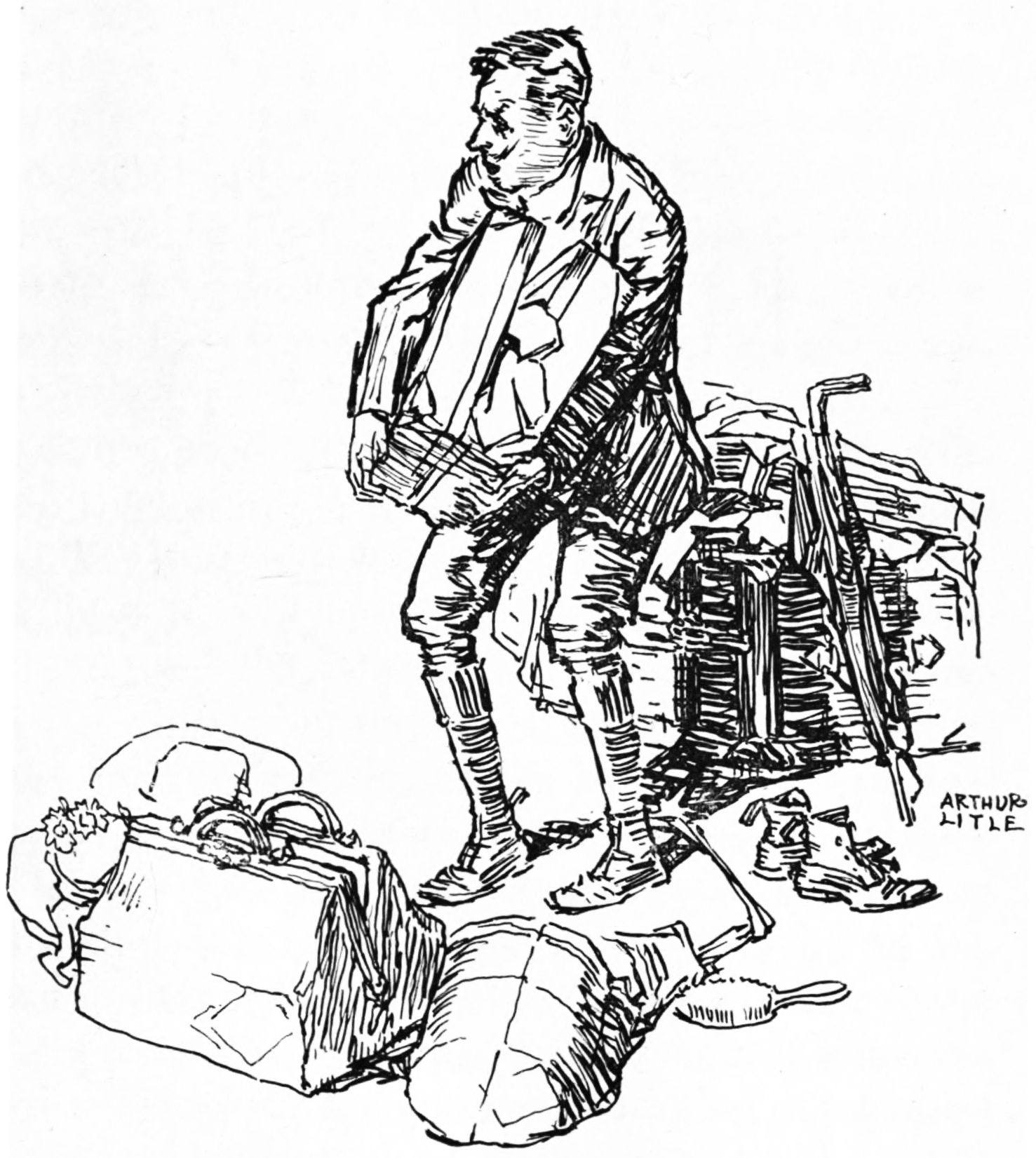
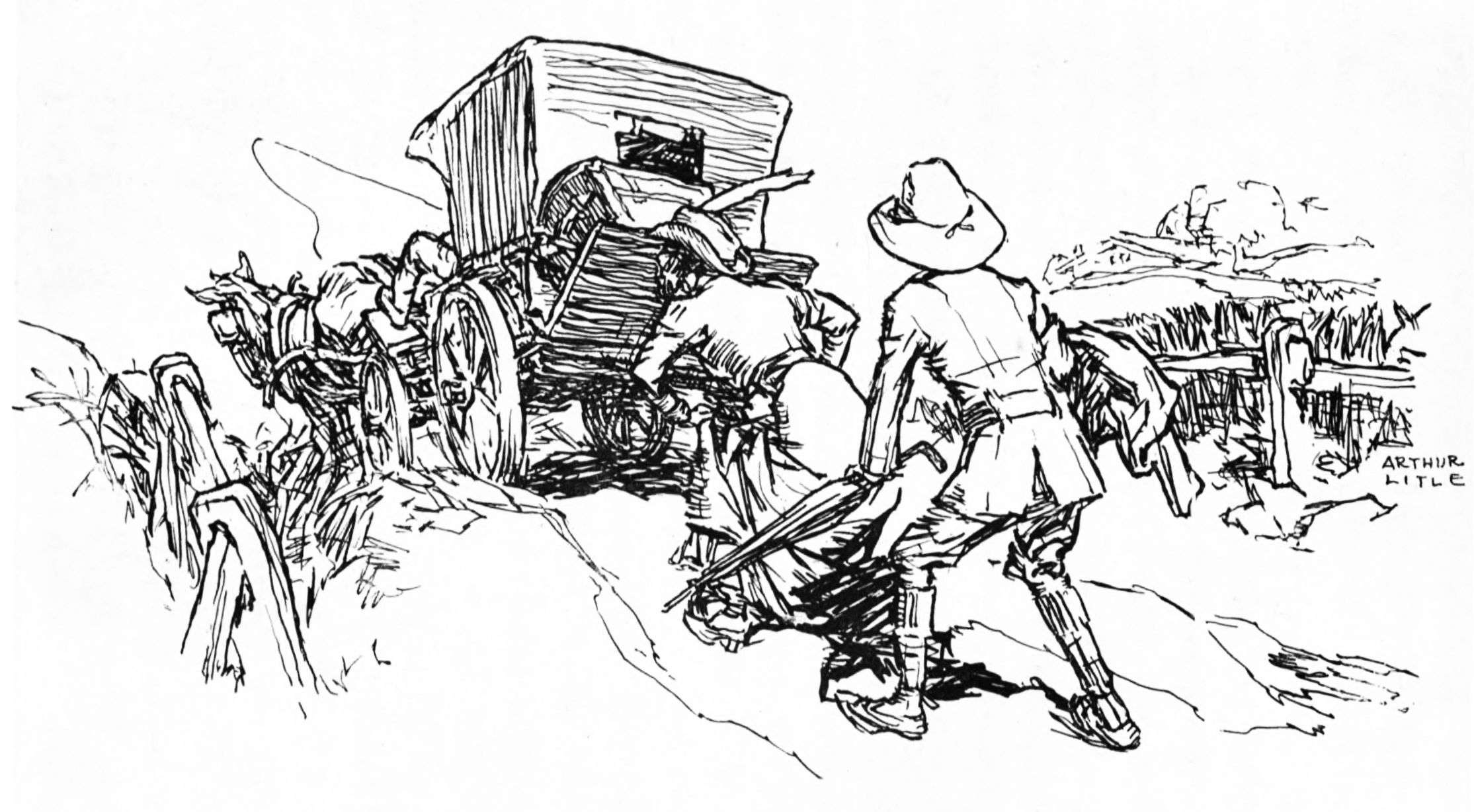
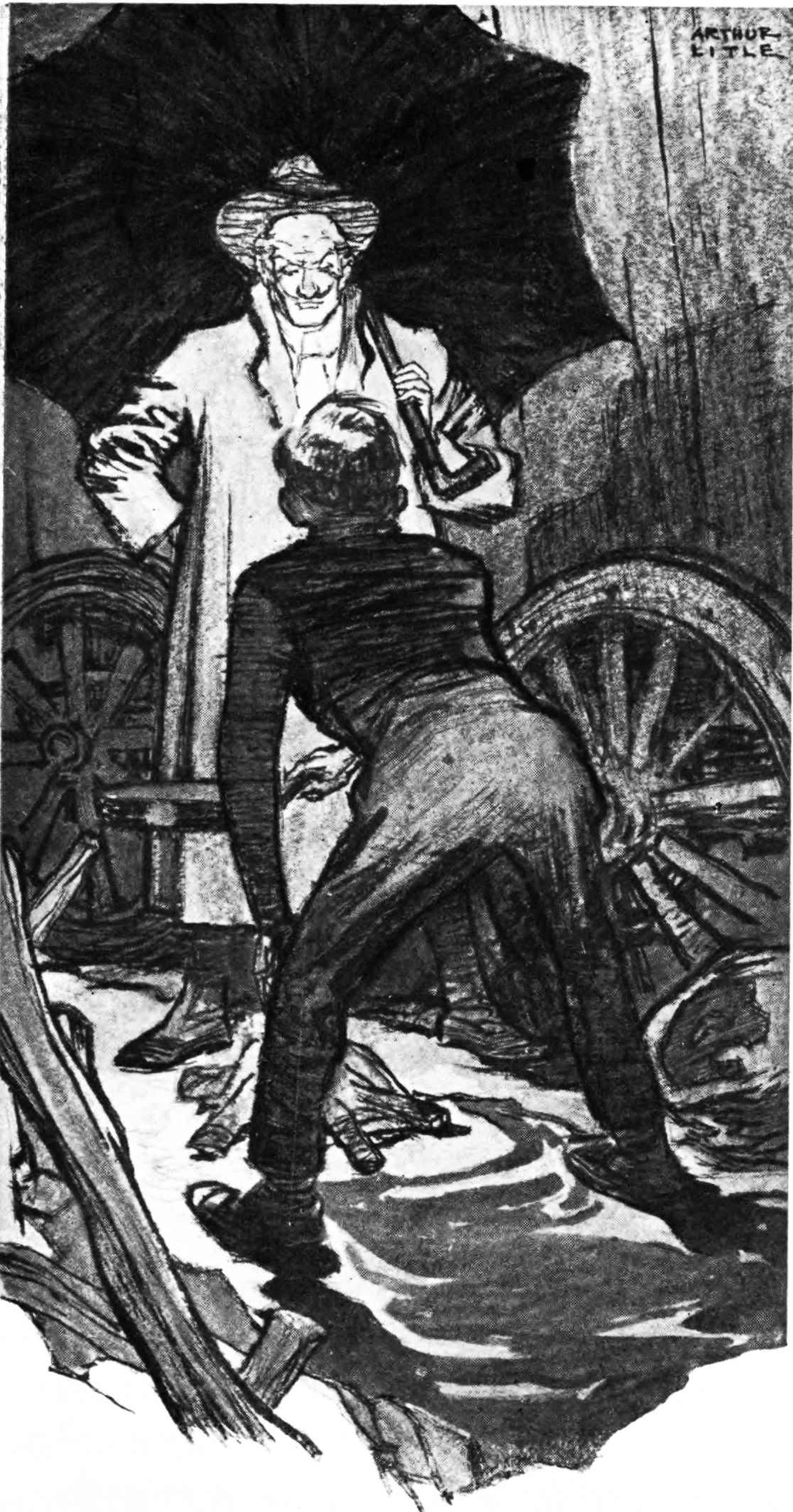
The floor sloped, for during the night the Elsa’s left hind wheel had
sunk into an uncobbled portion of the yard where the soft mud offered
no resistance, but even the prospect of having to dig this out before we
could start did not depress me. I thought I had noticed my head sinking
lower and lower during my dreams, and after having, half asleep,
endeavoured to correct this impression by means of rolling up my day
clothes and putting them beneath my pillow and finding that it made no
difference, I decided it must be a nightmare and let well alone. In the
morning, on waking after Edelgard’s departure, I realized what had
happened, and if any of you ever caravan you had better see when you go
to bed that all four of your wheels are on that which I called at
Queenboro’ terra cotta (you will remember I explained why it was my
wife was unable to be amused) or you will have some pretty work cut out
for you next morning.
Even this prospect, however, did not, as I say, depress me. Dumb objects
like caravans have no such power, and as nobody not dumb had yet crossed
my path I was still, so to speak, untarnished. I had even made up my
mind to forget the half-hour with Edelgard the previous night after the
ball, and since a willingness to forget is the same thing as a
willingness to forgive I think you will all agree that I began that day
very well.
Descending to breakfast, I experienced a slight shock (the first breath
of tarnish) on finding no one but Mrs. Menzies-Legh and the
nondescripts there. Mrs. Menzies-Legh, however, though no doubt feeling
privately awkward managed to behave as though nothing had happened,
hoped I had slept well, and brought my coffee. She did not talk as much
as usual, but attended to my wants with an assiduousness that pointed to
her being, after all, ashamed.
I inquired of her with the dignity that means determined distance where
the others were, and she said gone for a walk.
She remarked on the beauty of the day, and I replied, “It is indeed.”
She then said, slightly sighing, that if only the weather had been like
that from the first the tour would have been so much more enjoyable.
On which I observed, with reserved yet easy conversation, that the
greater part still lay before us, and who knew but that from then on it
was not going to be fine?
At this she looked at me in silence, her head poised slightly on one
side, seriously and pensively, as she had done among the Bodiam ruins;
then opened her mouth as though to speak, but thinking better of it got
up instead and fetched me more food.
At last, thought I, she was learning the right way to set about
pleasing; and I could not prevent a feeling of gratification at the
success of my method with her. There was an unusually good breakfast
too, which increased this feeling—eggs and bacon, a combined luxury not
before seen on our table. The fledglings hung over the stove with heated
cheeks preparing relays of it under Mrs. Menzies-Legh’s directions, who,
while she directed, held the coffee-pot in her arms to keep it warm. She
explained she did so for my second cup. I might and indeed I would have
suspected that she did so not to keep the coffee but her arms warm, if
it had not been such a grilling day. Heat quivered in a blue haze over
the hop-poles of the adjacent field. The sunless farmhouse looked
invitingly cool and shady now that the surrounding hill-tops were one
glare of light. To hold warm coffee in one’s arms on such a morning
could not possibly show anything but a meritorious desire to make
amends; and as I am not a man to do what the scriptural call quench the
smoking flax, and yet not a man to forgive too quickly recently
audacious ladies, I dexterously mingled extreme politeness with an
unshakable reserve.
But I did not care to prolong what was practically a tête-à-tête one
moment more than necessary, and could not but at last perceive in her
persistent replenishings of my cup and plate the exactly contrary desire
in the lady. So I got up with a courteously declining, “No, no—a
reasonable man knows when to leave off,” murmured something about seeing
to things, bowed, and withdrew.
Where I withdrew to was the hop-field and a cigar.
I lay down in the shade of these green promises of beer in a corner
secure from observation, and reflected that if the others could waste
time taking supererogatory exercise I might surely be allowed an
interval of calm; and as there are no mosquitoes in England, at least
none that I ever saw, it really was not unpleasant for once to
contemplate nature from the ground. But I must confess I was slightly
nettled by the way the rest of the party had gone off without waiting to
see whether I would not like to go too. At first, busied by breakfast, I
had not thought of this. Presently, in the hop-field, it entered my
mind, and though I would not have walked far with them it would have
been pleasant to let the rest go on ahead and remain myself in some cool
corner talking to my gentle but lately so elusive friend.
I must say also that I felt no little surprise that Edelgard should gad
away in such a manner before our caravan had been tidied up and after
what I had said to her the last thing the night before. Did she then
think, in her exuberant defiance, that I would turn to and make our beds
for her?
My cigar being finished I lay awhile thinking of these things, fanned by
a gentle breeze. Country sounds, at a distance to make them agreeable,
gradually soothed ear and brain. A cock crowed just far enough away. A
lark sang muffled by space. The bells of an invisible church—Raggett’s,
probably—began a deadened and melodious ringing. Well, I was not going;
I smiled as I thought of Raggett and the eagle, forced to make the best
of things by themselves. All round me was a hum and a warmth that was
irresistible. I did not resist it. My head dropped; my limbs relaxed;
and I fell into a doze.
This doze was, as it turned out, extremely à propos, for by the time
it was over and I had once more become conscious, the morning was well
advanced and the caravaners had had ample time to get back from their
walk and through their work. Sauntering in among them I found everything
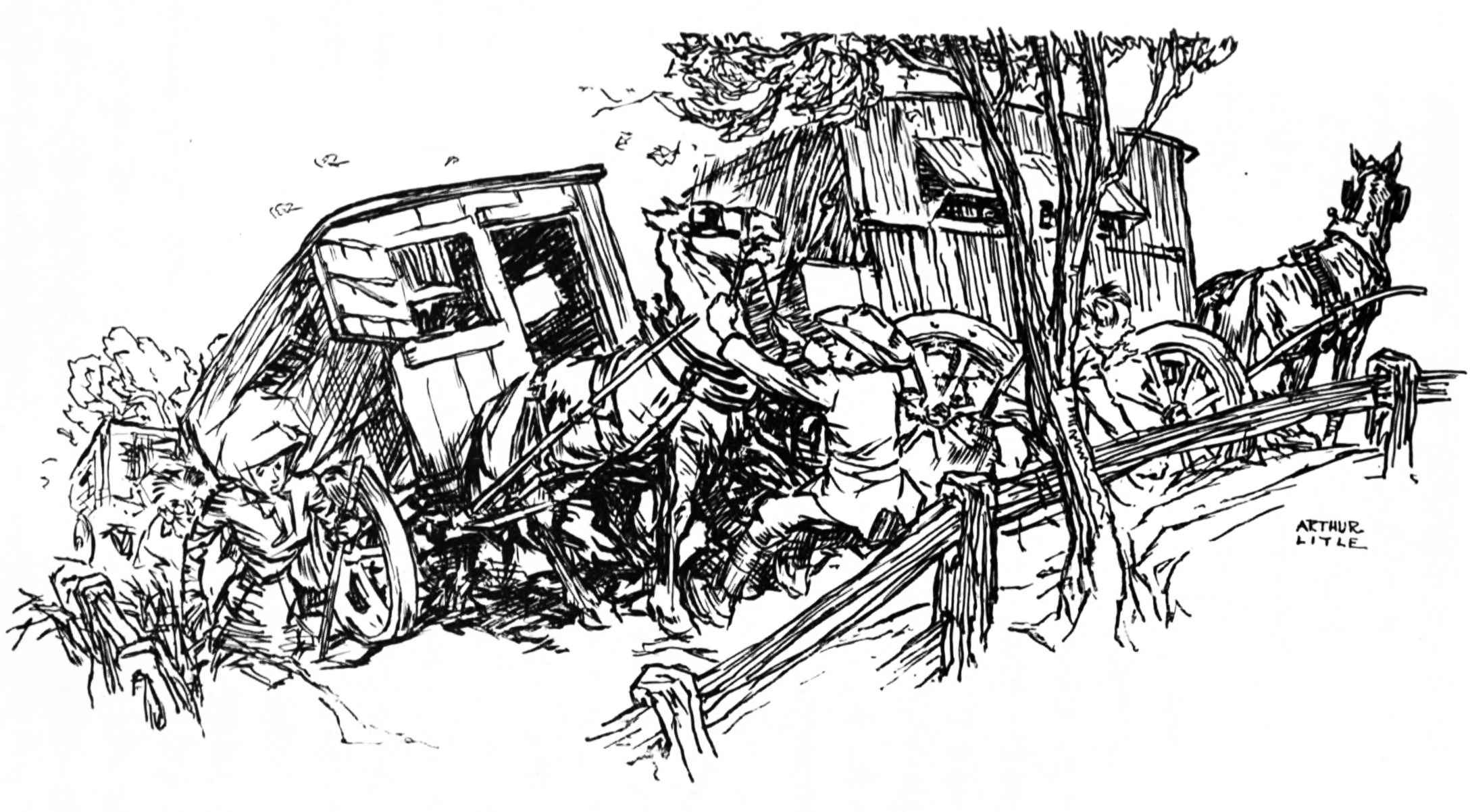
ready for a start except the Elsa, which, still with its left hind wheel
sunk in the soil, was being doctored by Menzies-Legh, Jellaby, and old
James.
“Hullo,” said Jellaby, looking up in the midst of his heated pushing and
pulling as I appeared, “been enjoying yourself?”
Menzies-Legh did not even look up, but continued his efforts with drops
of moisture on his saturnine brow.
Well, here my experience as an artillery officer accustomed to getting
gun-carriages out of predicaments enabled me at once to assume
authority, and drawing up a camp stool I gave them directions as they
worked. They did not, it is true, listen much, thinking as English
people so invariably do that they knew better, but by not listening they
merely added another half-hour to their labour, and as it was fine and
warm and sitting superintending them much less arduous than marching, I
had no real objection.
I told Menzies-Legh this at the time, but he did not answer, so I told
him again when we were on the road about the half-hour he might have
saved if he had worked on my plan. He seemed to be in a more than
usually bad temper, for he only shrugged his shoulders and looked glum;
and my hearers will agree that Mrs. Menzies-Legh’s John was not a
possession for England to be specially proud of.
We journeyed that day toward Canterbury, a town you, my friends, may or
may not have heard of. That it is an English town I need not say, for if
it were not would we have been going there? And it is chiefly noted, I
remembered, for its archbishop.
This gentleman, I was told by Jellaby on my questioning him, walks
directly behind the King’s eldest son, and in front of all the nobles
in processions. He is a pastor, but how greatly glorified! He is the
final expansion, the last word, of that which in the bud was only a
curate. Every English curate, like Buonaparte’s soldiers are said to
have done, carries in his handbag the mitre of an archbishop. I can only
regard it as a blessing that our Church has not got them, for I for one
would find it difficult with this possibility in view ever to be really
natural to a curate. As it is I am perfectly natural. With absolute
simplicity I show ours his place and keep him to it; and I am equally
simple with our Superintendents and General Superintendents, the nearest
approach our pure and frugal Church goes to bishops and archbishops.
There is nothing glorified about them. They are just respectable elderly
men, with God-fearing wives who prepare their dinner for them day by
day. “And, Jellaby,” said I, “can as much be said for the wives of your
archbishops?”
“No,” said he.
“Another point, then,” said I, with the jesting manner one uses to gild
unpalatable truth, “on which we Germans are ahead.”
Jellaby pushed his wisp of hair back and mopped his forehead. From my
position at my horse’s head I had called to him as he was walking
quickly past me, for I perceived he had my poor gentle little friend in
tow and was once again inflicting his society on her. He could not,
however, refuse to linger on my addressing him, and I took care to ask
him so many questions about Canterbury and its ecclesiastical meaning
that Frau von Eckthum was able to have a little rest.
A faint flush showed she understood and appreciated. No longer obliged
to exert herself conversationally, as I had observed she was doing when
they passed, she dropped into her usual calm and merely listened
attentively to all I had to say. But we had hardly begun before Mrs.
Menzies-Legh, who was in front, happened to look round, and seeing us
immediately added her company to what was already more than company
enough, and put a stop to anything approaching real conversation by
herself holding forth. No one wanted to hear her; least of all myself,
to whom she chiefly addressed her remarks. The others, indeed, were able
to presently slip away, which they did to the rear of our column, I
think, for I did not see them again; but I, forced to lead my horse, was
helpless.
I leave it to you, my friends, to decide what strictures should be
passed on such persistency. I cannot help feeling that it was greatly to
my credit that I managed to keep within bounds of politeness under such
circumstances. One thing, however, is eternally sure: the more a lady
pursues, the more a gentleman withdraws, and accordingly those ladies
who throw feminine decorum to the winds only defeat their own ends.
I said this—slightly veiled—to Mrs. Menzies-Legh that morning, taking
an opportunity her restless and leaping conversation offered to
administer the little lesson. No veils, however, were thin enough for
her to see through, and instead of becoming red and startled she looked
at me through her eyelashes with an air of pretended innocence and said,
“But, Baron dear, what is feminine decorum?”
As though feminine decorum or modesty or virtue were things that could
be explained in any words decent enough to fit them for a gentleman to
use to a lady!
That was a tiring day. Canterbury is a tiring place; at least it would
be if you let it. I did not, however, let it tire me. And such a hot
place! It is a steaming town with the sun beating down on it, and full
of buildings and antiquities one is told one must be longing to look at.
After a day’s march in the dust it is not antiquities one longs for, and
I watched with some contempt the same hypocritical attitude take
possession of the party that had distinguished it at Bodiam.
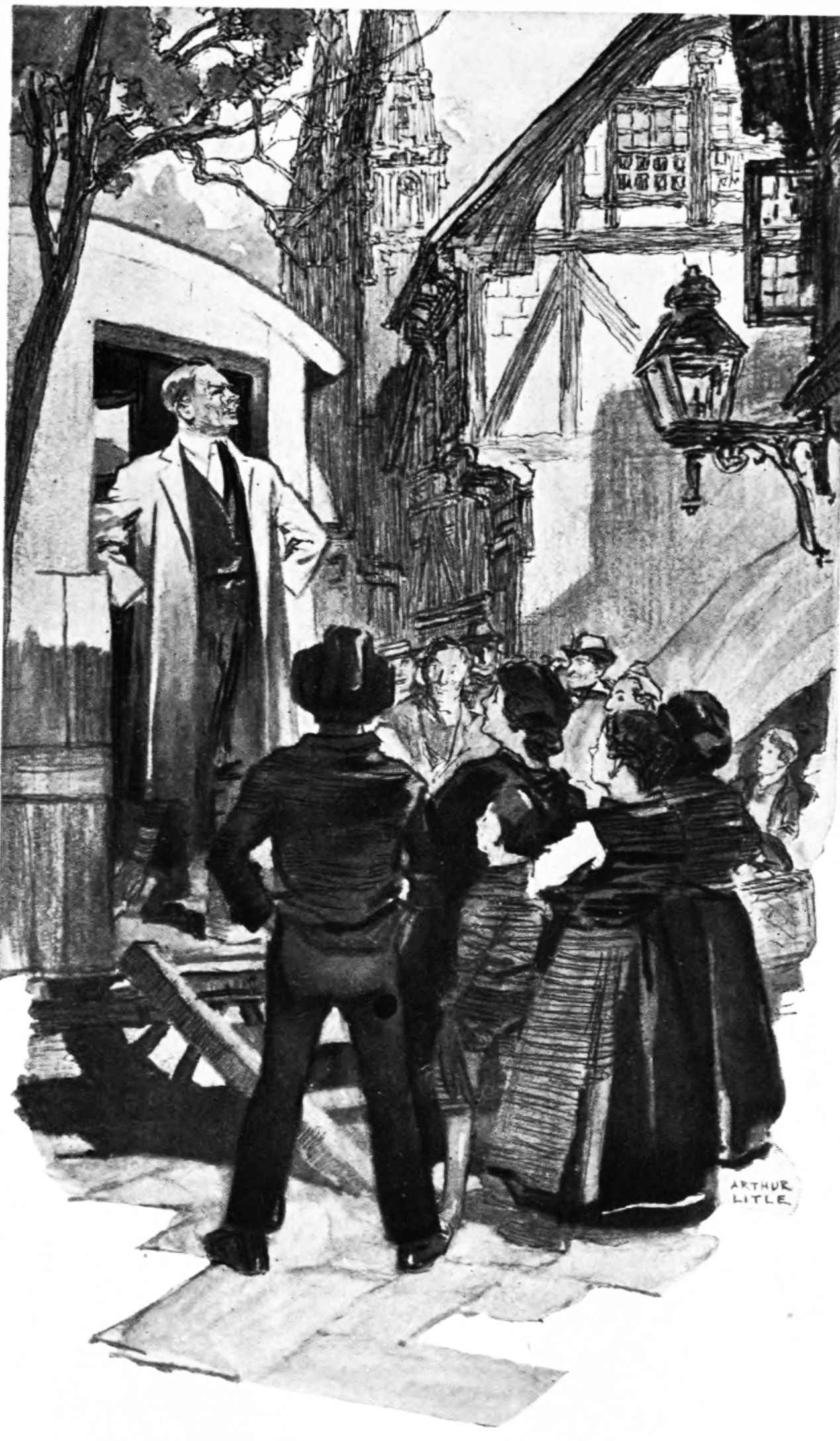
We arrived there about four, and Menzies-Legh pitched on an exceedingly
ugly camping ground on a slope just outside the city, with villa
residences so near that their inhabitants could observe us, if they had
telescopes, from their windows. It was a field from which the corn had
been cut, and the hard straw remaining hurt one’s weary feet; nor had
it any advantages that I could see, though the others spoke of the view.
This, if you please, consisted of the roofs of the houses in the town
and a cathedral rising from their midst in a network of scaffolding. I
pointed this out to them as they stood staring, but Menzies-Legh was
quite unshaken in his determination to stay just on that spot, in spite
of there being a railway line running along the bottom of the field and
a station with all its noises within a stone’s throw. I thought it odd
to have come to a town at all, for till then the party had been
unanimous in its desire to avoid even villages, but on my remarking on
this they murmured something about the cathedral, as though the building
below, or rather the mass of scaffolding, were enough to excuse the most
inconsistent conduct.
The heat of that shadeless stubblefield was indescribable. It did not
possess a tree. At the bottom was, as I have said, the railway. At the
top, just above where we were, a market garden, a thing of vegetables,
whose aim is to have as few shadows as possible. Languidly the party
made preparations for settling down. Languidly and after a long delay
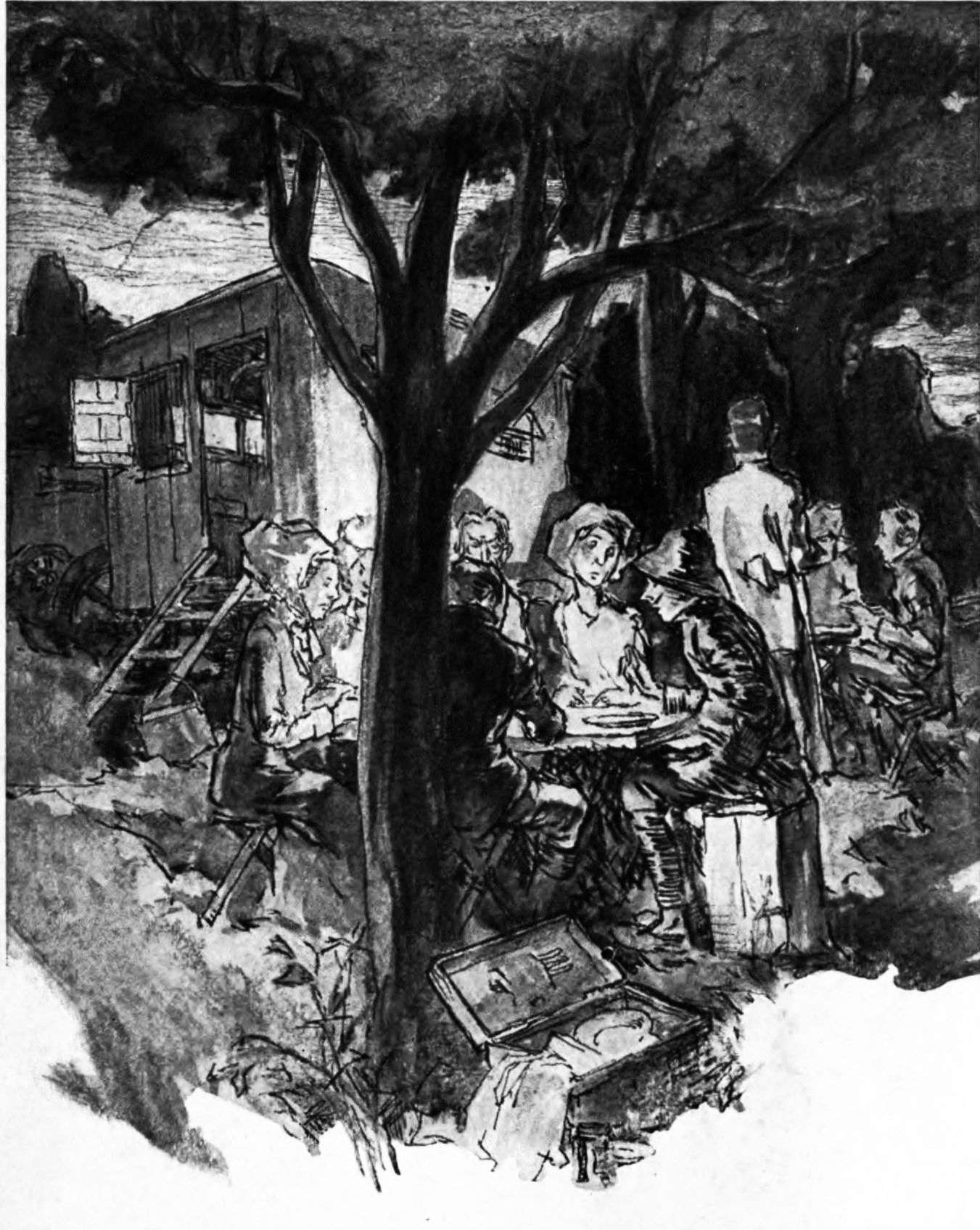
Menzies-Legh dragged out the stew-pot. In spite of the heat I was as
hungry as a man ought to be who, at four o’clock, has not yet dined, and
as I watched the drooping caravaners listlessly preparing the potatoes
and cabbages and boiled bacon that I now knew so very thoroughly, this
having been our meal (except once or twice when we had chickens, or, in
extremity, underdone sausages) since the beginning of the tour, a
brilliant thought illuminated the gloom of my brain: Why not slip away
unnoticed, and down in the town cause myself to be served in the
dining-room of an hotel with freshly roasted meat and generous wine?
Very cautiously I raised myself from the hard hot stubble.
Casually I glanced at the view.
With an air of preoccupation I went behind the Elsa, the first move
toward freedom, as though to fetch some accessory of the meal from our
larder.
“Do you want anything, Otto?” asked my officious and tactless wife
trotting after me—a thing she never does when I do want anything.
Naturally I was a little snappish: but then if she had left me alone
would I have snapped? Wives are great forcers of faults upon a man. So I
snapped; and she departed, chidden.
Looking about me, up at the sky, and round the horizon, as though intent
on thoughts of weather, I inconspicuously edged toward the market garden
and the gate. With a man in the garden searching for slugs I spent a
moment or two conversing, and then, a backward glance having assured me
the caravaners were still drooping in listless preparation round the
stew-pot, I sauntered, humming, through the gate.
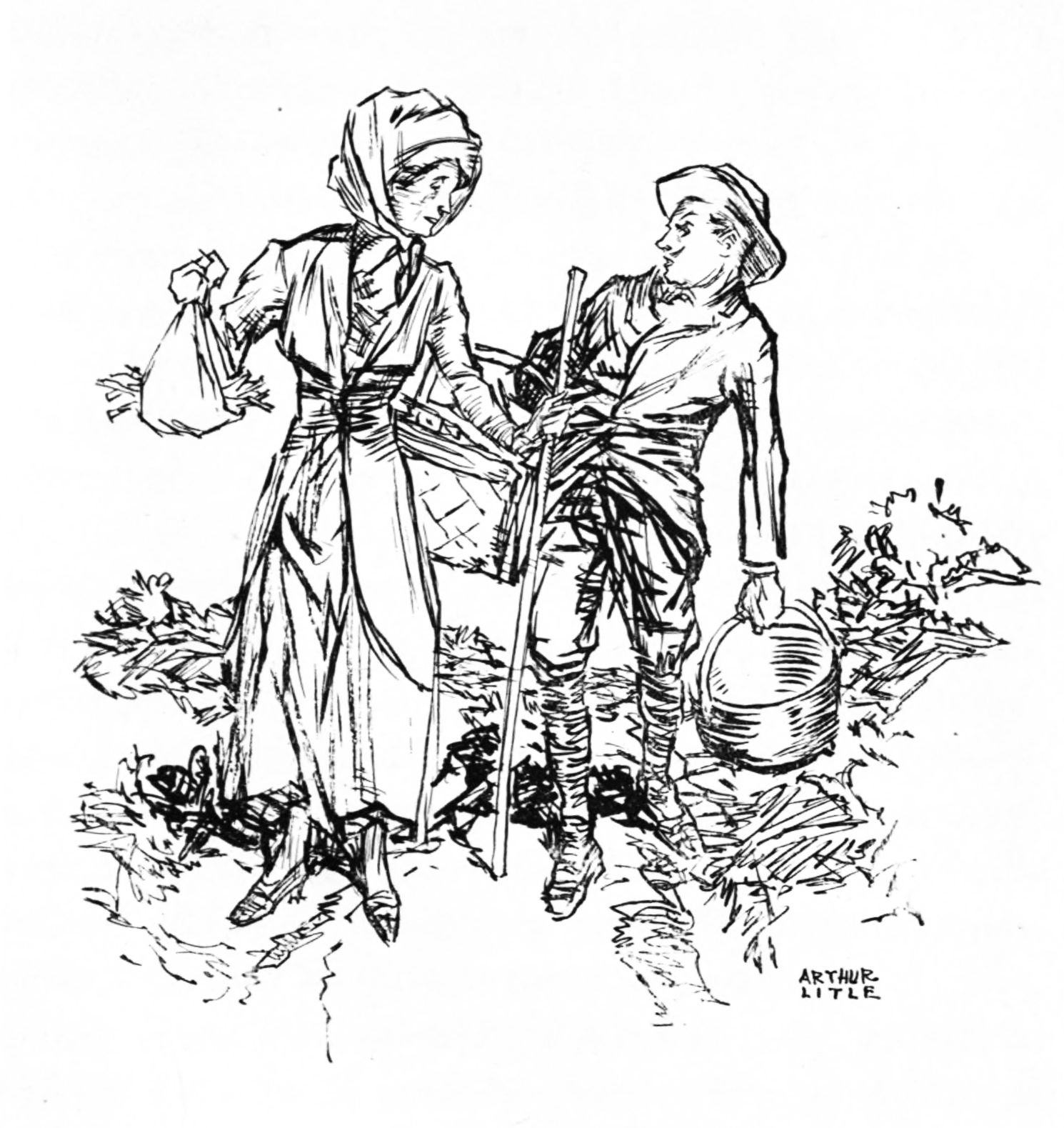
Immediately I ran into Jellaby, who, a bucket of water in each hand, was
panting along the road.
“Hullo, Baron,” he gasped; “enjoying yourself?”
“I am going,” said I with much presence of mind combined with the
seriousness that repudiates any idea of enjoyment, “to buy some matches.
Ours are running short.”
“Oh,” said he, plumping down his buckets and fumbling among the folds of
his flappy clothes, “I can lend you some. Here you are.”
And he held out a box.
“Jellaby,” said I, “what is one box to a whole—shall we call it
household? My wife requires many matches. She is constantly striking
them. It is her husband’s duty to see that she has enough. Keep yours.
And farewell.”
And walking at a pace that prohibited pursuit by a man with buckets I
left him.
I have had so many dinners in dining-rooms since that one at Canterbury,
ordered repasts without grease and that kept hot, that the wonder of it
has lost in my memory much of its first brightness. You, my hearers, who
dine as I now do regularly and well, would hardly if I could still
describe be able to enter into my feelings. I found a cool room in an
inn with the pleasantly un-English name Fleur de Lys, and a
sympathetic waiter who fell in at once with my views about fresh air and
shut all the windows. I had a newspaper, and I sipped a cognac while the
meal was preparing. I ordered everything on the list except bacon,
chickens, and sausages. I also would not eat potatoes, and declined, as
a vegetable, cabbage. I drank much wine, full-bodied and generous, but I
refused after dinner to drink coffee.
Filled and hallowed, once more in thorough tune with myself and life and
ready to take any further experiences the day might bring with unruffled
geniality, I left toward dusk the temple that had thus blest me (after
debating within myself whether it would not be prudent having regard to
the future in further lanes and fields to sup first, and regretfully
realizing that I could not), and leisurely made my way across the street
to that other temple, whose bells announced the inevitable service.
My decision to peep cautiously in and see whether the parson were alone
before definitely committing myself to a pew was unnecessary, first
because there were no pews but a mighty emptiness, and secondly because,
along the dusk of this emptiness, groups of persons made their way to a
vast flight of steps dividing the place into two and leading up to a
region, into which they disappeared, of glimmering lights. Too clever
now by far to go where there were lights and praying might be demanded
of me, I wandered on tiptoe among the gathering shadows at the other
end. It grew quickly darker among the towering pillars and dim, painted
windows. The bells left off; the organ began to rumble about; and a
distant voice, with a family likeness to that of Raggett, sing-songed
something long. It had no ups and downs, no breaks; it was a drawn out
thread of sound, thin and sweet like a trickle of liquid sugar. Then
many voices took up the sing-song, broadening it out from a thread to a
band. Then came the single trickle again; and so they went on
alternately, while I, hidden among the pillars, listened very well
pleased.
When the organ began, and an endless singing and repeating of the same
tune, I cautiously advanced nearer in search of something to sit on. To
the right of the steps I found what I wanted, an empty space in itself
as big as our biggest church in Storchwerder but small in comparison to
the rest, with immense windows full of the painted glass that becomes so
confused and meaningless in the dusk, no lights, and here and there a
chair or two.
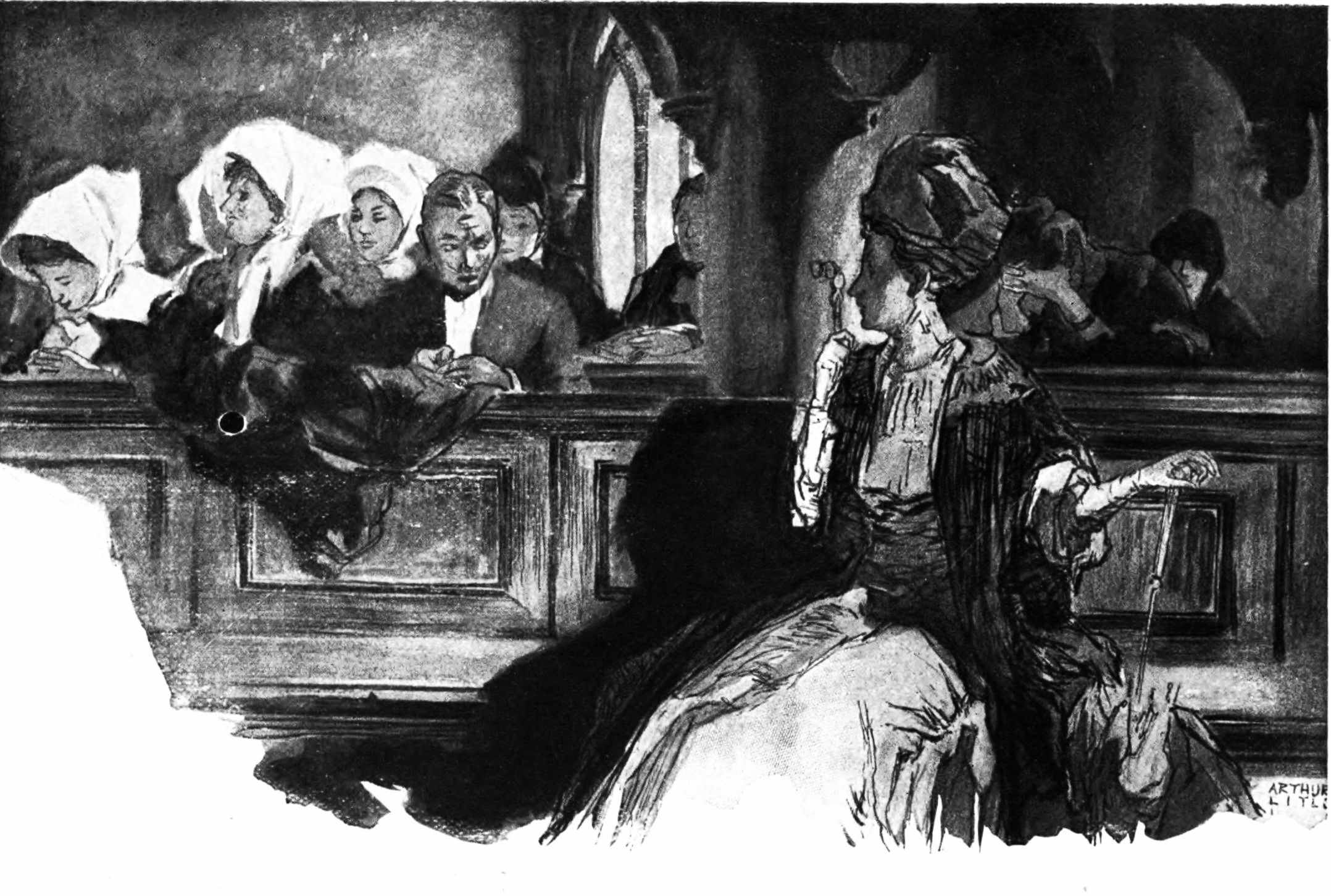
I sat down at the foot of a huge pillar in this dark and unobserved
corner, while the organ above me and the singing voices filled the
spaces of the roof with their slumber-inciting repetitions. Presently,
as a tired and comfortable man would do, I fell asleep, and was only
wakened by the subdued murmur just round the edge of the pillar of two
people talking, and I instantly, almost before my eyes opened,
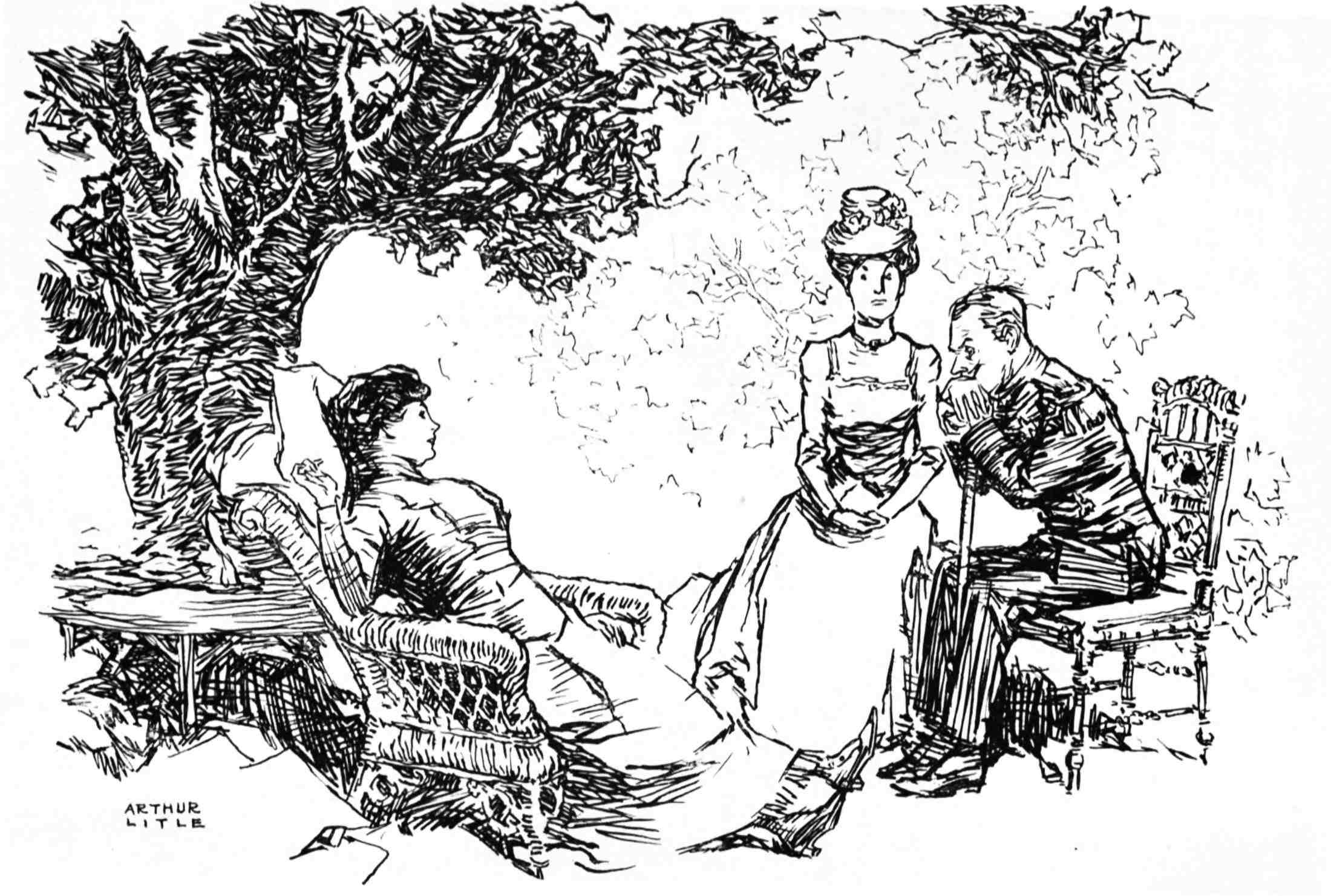
recognized that it was Frau von Eckthum and Jellaby.
They were apparently sitting on some chairs I had noticed as I came
round to the greater obscurity of mine. They were so close that it was
practically into my ear that they spoke. The singing was finished, and I
fancy the congregation had dispersed, for the organ was playing softly
and the glimmer of lights had gone out.
My ears are as quick as any man’s, and I was greatly amused at the
situation. “Now,” thought I, “I shall hear what sort of stuff Jellaby
inflicts on patient and inexperienced ladies.”
It also occurred to me that it would be interesting to hear how she
talked to him, and so discover whether the libel were true that except
in my presence she chatted and was jocular. Jocular? Can anything be
less what one wishes in the woman one admires? Of course she was not,
and Mrs. Menzies-Legh was only (very naturally) jealous. I therefore sat
quite still, and became extremely alert and wide awake.
They were certainly not laughing. That, however, may have been the
cathedral—not that men of Jellaby’s stamp have even a rudimentary sense
of reverence and decency—but anyhow part of the libel was disposed of,
for the gentle lady was serious. She was, it is true, a good deal more
fluent than I knew her, but she seemed moved by some strong emotion
which no doubt accounted for that. What I could not account for was her
displaying emotion to a person like Jellaby. The first thing, for
instance, that I heard her say was, “It is all my fault.” And her voice
vibrated with penitence.
“Oh, but it wasn’t, you know,” said Jellaby.
“Yes, it was. And I feel I ought to take a double share of the burden,
and instead I don’t take any.”
Burden? What burden could the tender lady possibly have to bear that
would not gladly be borne for her by many a masculine shoulder,
including mine? I was about to put my head round the pillar’s edge to
assure her of this when she began to speak again.
“I did try—at first,” she said. “But I—I simply can’t. So I shift it
on to Di.”
Di, my friends, is Mrs. Menzies-Legh, christened with prophetic paganism
Diana.
“An extremely sensible thing to do,” thought I, remembering the wiriness
of Di.
“She is very wonderful,” said Jellaby.
“Yes,” I silently agreed, “most.”
“She is an angel,” said her (I suppose naturally) partial sister, whose
sentiments were besides, no doubt, at that moment coloured by the
surroundings in which she found herself. But I could not help being
entertained by this example of lovable blindness.
“It is so sweetly good of her to keep him off us,” continued Frau von
Eckthum. “She does it so kindly. So unselfishly. What can it be like to
have such a husband?”
“Ah,” thought I, a light illuminating my mind, “they are talking of our
friend John. Naturally his charming sister-in-law cannot bear him. Nor
should she be called upon to do so. To bear her husband is solely a
wife’s affair.”
“What can it be like?” repeated Frau von Eckthum, in the voice of one
vainly trying to realize something beyond words bad.
“I can’t think,” said Jellaby, basely, I thought, for he professed much
outward friendship for John.
“Of course she is amused—in a way,” continued Frau von Eckthum, “but
that sort of amusement soon palls, doesn’t it?”
“Extraordinarily soon,” said Jellaby.
“Before it has so much as begun,” thought I, recollecting the man’s
sallow, solemn visage. But then it is no part of a wife’s functions to
be amused.
“And she is really sorry for him,” said Frau von Eckthum.
“Indeed?” thought I, entertained by the patronizing attitude implied.
“She says,” continued her gentle sister, “that his loneliness, whether
he knows it or not, makes her ache.”
Well, I did not mind Mrs. Menzies-Legh aching, so thought nothing
definite there.
“She doesn’t want him to notice we get out of his way—she is afraid he
might be hurt. Do you think he would be?”
“No,” said Jellaby. “Pure leather.”
I agreed, though once again surprised at Jellaby’s baseness.
“I can’t think,” continued Frau von Eckthum—“I suppose it’s because I
am so bad—but I really cannot think how she can endure him, and in such
doses.”
“He is undoubtedly,” said Jellaby, “a very grievous bounder.”
“What,” I wondered, “is a bounder?” But I applauded Jellaby’s sentiment
nevertheless, for there was no mistaking its nature, though his baseness
was really amazing.
“It must be because Di has such a vivid imagination,” continued her
sister musingly. “She sees what he might have been, what he probably was
meant to be——”
“And what he would still be,” put in Jellaby, “if only he would allow
his nice wife to influence him a little.”
“But John,” thought I, “in that is right. Let us be fair and admit his
good sides. A wife should never, under any circumstances, be allowed
allowed——”
Then, suddenly struck by the point of view, by the feminine idea
(Socialists have the minds of women) of a man’s being restored to what
he was primarily intended to be when he issued newly-made (as poets and
parsons would say) from the hands of his Maker through the manipulations
of Mrs. Menzies-Legh, my sense of humour played me a nasty trick (for I
would have liked to have heard more) and I found myself bursting into a
loud chuckle.
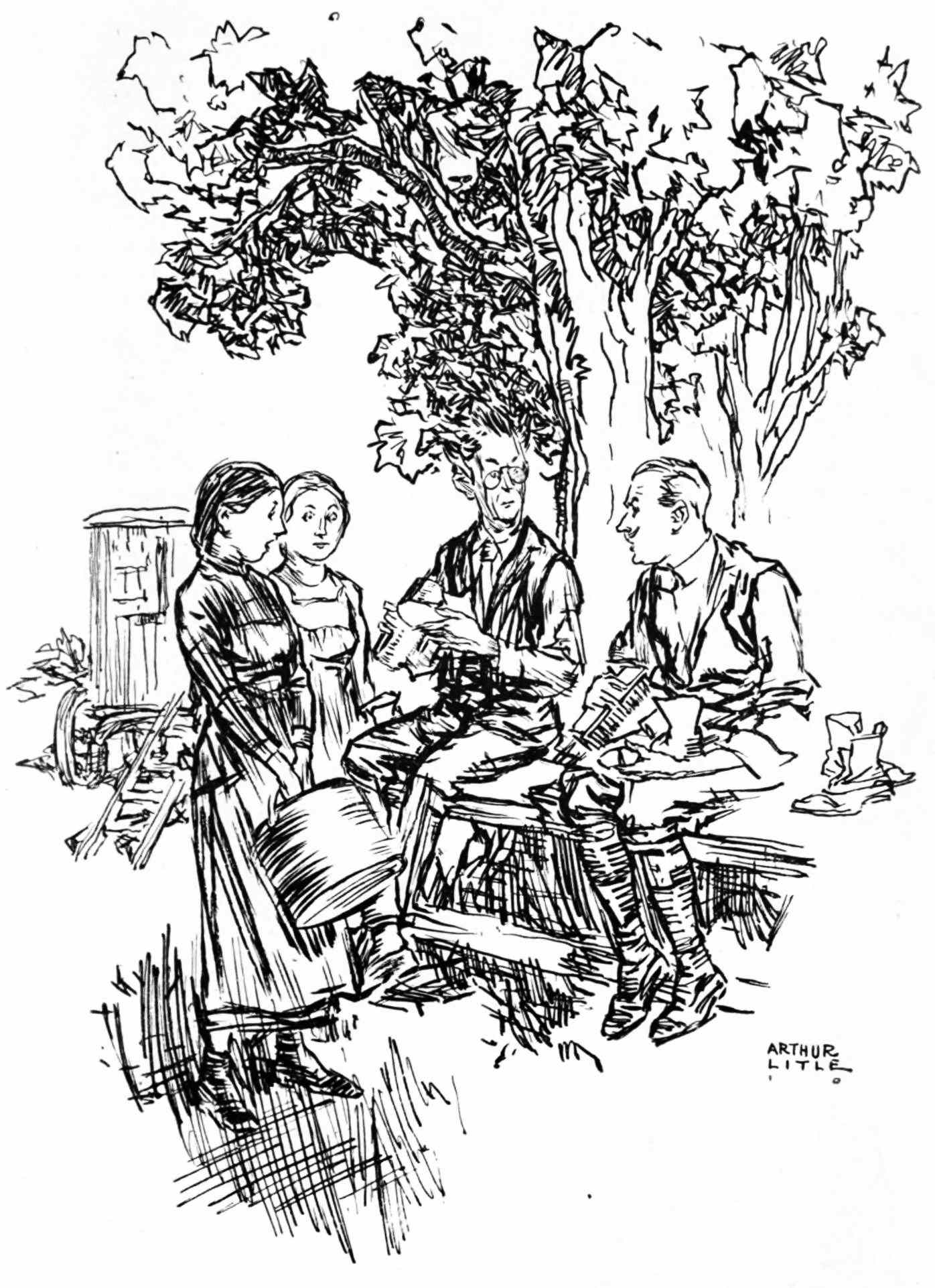
“What’s that?” exclaimed Jellaby, jumping up.
He soon saw what it was, for I immediately put my head round the edge of
the pillar.
They both stared at me in a strange alarm.
“Pray do not suppose,” I said, smiling reassuringly, “that I am a
ghost.”
They stared without a word.
“You look as though I might be.”
They went on staring.
“I could not help, as I sat here, hearing what you were saying.”
They stared as speechless as though they had been caught killing
somebody.
“I really am not a spirit,” said I, getting up. “Look—do I look like
one?”
And striking a match I playfully passed it backward and forward across
my features.
But its light at the same time showed me a flush of the most attractive
and vivid crimson on Frau von Eckthum’s face, colouring it from her hair
to her throat. She looked so beautiful like that, she who was ordinarily
white, that immediately lighting another I gazed at her in undisguised
admiration.
“Pardon me,” I said, holding it very near her while her eyes, fixed on
mine, still seemed full of superstitious terror, “pardon me, but I must
as a man and a judge look at you.”
Jellaby, however, unforgivably ill-bred as ever, knocked the match out
of my hand and stamped on it. “Look here, Baron,” he said with unusual
heat, “I am very sorry—as sorry as you like, but you really mustn’t
hold matches in front of somebody’s face.”
“Why sorry, Jellaby?” I inquired mildly, for I was not going to have a
scene. “I do not mind about the match. I have more.”
“Sorry, of course, that you should have heard——”
“Every word, Jellaby,” said I.
“I tell you I’m frightfully sorry—I can’t tell you how sorry——”
“You may be assured,” said I, “that I will be discreet.”
He stared, with a face of stupid surprise.
“Discreet?” said he.
“Discreet, Jellaby. And it may be a relief to you to know,” I continued,
“that I heartily endorse your opinion.”
Jellaby’s mouth dropped open.
“Every word of it.”
Jellaby’s mouth remained open.
“Even the word bounder, which I did not understand but which, I gathered
from your previous remarks, is a very suitable expression.”
Jellaby’s mouth remained open.
I waited a moment, then seeing that it would not shut and that I had
really apparently shattered their nerves beyond readjustment by so
suddenly popping round on them in that ghostly place, I thought it best
to change the subject, promising myself to return to it another time.
So I picked up my hat and stick from the chair I had vacated—Jellaby
peered round the pillar at this piece of furniture with his unshut mouth
still denoting unaccountable shock—bowed, and offered my arm to Frau
von Eckthum.
“It is late,” said I with tender courtliness, “and I observe an official
approaching us with keys. If we do not return to the camp we shall have
your sister setting out, probably on angelic wings”—she started—“in
search of you. Let me, dear lady, conduct you back to her. Nay, nay, you
need have no fears—I really can keep a secret.”
With her eyes fixed on mine, and that strange look of perfect fright in
them, she got up slowly and put her hand on my proffered arm.
I led her away with careful tenderness.
Jellaby, I believe, followed in the distance.