It was the 10th of July that we returned to Vevey, and it was just three
weeks later that the world—a world of peace and the social interchange
of nations—came to an end.
We had heard at Tours of the assassination of the Austrian archduke and
his duchess, but no thought of the long-threatened European war entered
our minds. Neither did we discover later any indications of it. If there
was any tension along the Franco-German border we failed to notice it.
Arriving at Vevey, there seemed not a ripple on the drowsy summer days.
Even when Austria finally sent her ultimatum to Serbia there was
scarcely a suggestion of war talk. We had all the nations in our hotel,
but they assembled harmoniously in the little reading room after dinner
over the papers and innocuous games, and if the situation was discussed
at all, the word "arbitration" was oftenest heard.
Neither did the news come to us gradually or gently. It came like a
bomb, exploded one evening by Billy Baker, an American boy of sixteen
and a bulletin of sorts. Billy had been for his customary after-dinner
walk uptown, and it was clear the instant he plunged in that he had
gathered something unusual.
"Say, folks," he burst out, "did you know that Austria has declared war
against Serbia and is bombarding Belgrade, and now all the others are
going to declare, and that us Americans have got to beat it for home?"
There was a general stir. Billy's items were often delivered in this
abrupt way, but his news facts were seldom questioned. He went on,
adding a quick, crisp detail, while the varied nationalities assumed
attitudes of attention. The little group around the green center table
forgot what they were there for. I had just drawn a spade when I needed
a heart, and did not mind the diversion. Billy concluded his dispatches:
"We've all got to beat it, you know, now, before all the ships and
trains and things are used for mobilization and before the fighting
begins. If we don't we'll have to stay here all winter." Then, his
mission finished, Billy in his prompt way pulled a chair to the table.
"Let me in this, will you?" he said. "I feel awfully lucky to-night."
Americans laugh at most things. We laughed now at Billy Baker—at the
dramatic manner of his news, with its picturesque even if stupendous
possibilities—at the vision in everyone's mind of a horde of American
tourists "beating it" out of Europe at the first drum-roll of war.
But not all in the room laughed. The "little countesses"—two Russian
girls—and their white-haired companion, talked rapidly and earnestly
together in low voices. The retired French admiral—old and
invalided—rose, his long cape flung back across his shoulder, and
walked feebly up and down, stopping at each turn to speak to his aged
wife, who sat with their son, himself an officer on leave. An English
judge, with a son at home, fraternized with the Americans and tried to
be gay with them, but his mirth lacked freedom. A German family
instinctively separated themselves from the others and presently were no
longer in the room. Even one of the Americans—a Southern girl—laughed
rather hysterically:
"All my baggage but one suit case is stored in Frankfort," she said. "If
Germany goes to war I'll have a gay time getting it."
Morning brought confirmation of Billy Baker's news, at least so far as
Austria's action was concerned, and the imminence of what promised to be
a concerted movement of other great nations toward war. It was said that
Russia was already mobilizing—that troops were in motion in Germany and
in France. That night, or it may have been the next, a telegram came for
the young French officer, summoning him to his regiment. His little son
of nine or ten raced about excitedly.
"L'Allmagne a mobilisé—mon père va à la guerre!"
The old admiral, too feeble, almost, to be out of bed, seemed to take on
a new bearing.
"I thought I was done with war," he said. "I am an invalid, and they
could not call on me. But if France is attacked I shall go and fight
once more for my country."
The German family—there were two grown sons in it—had already
disappeared.
It was about the third morning that I took a walk down to the American
Consulate. I had been there before, but had not found it exciting. It
had been a place of silence and inactivity. There were generally a few
flies drifting about, and a bored-looking man who spent an hour or two
there morning and afternoon, killing time and glad of any little
diversion in the way of company.
The Consulate was no longer a place of silence and buzzing flies.
There was buzzing in plenty, but it was made by my fellow
countrymen—country-women, most of them—who were indeed making things
hum. I don't know whether the consul was bored or not. I know he was
answering questions at the rate of one per second, and even so not
keeping up with the demand for information.
"Is there going to be a war?" "Is England going into it?" "Has Germany
declared yet?" "Will we be safe in Switzerland?" "Will all Americans be
ordered home?" "Are the trains going to be stopped?" "Will we have to
have passports?" "I have got a sailing in September. Will the ships be
running then?" "How can I send a letter to my husband in Germany?" "How
about money? Are the Swiss banks going to stop payment on letters of
credit?"—these, repeated in every varying form, and a hundred other
inquiries that only a first-class registered clairvoyant could have
answered with confidence. The consul was good-natured. He was also an
optimist. His replies in general conveyed the suggestion to "keep cool,"
that everything was going to be all right.
The Swiss banks, however, did stop payment on letters of credit and
various forms of checks forthwith. I had a very pretty-looking check
myself, and a day or two before I had been haggling with the bank man
over the rate of exchange, which had been gently declining. I said I
would hold it for better terms. But on the day that Germany declared war
I decided to cash it, anyway, just to have a little extra money in
case—
Oh, well, never mind the details. I didn't cash it. The bank man looked
at it, smiled feebly, and pointed to a notice on the wall. It was in
French, but it was an "easy lesson." It said:
No more checks or letters of credit cashed until further
notice.
By order of the Association.
I don't know yet what "Association" it was that was heartless enough to
give an order like that, but I hoped it would live to repent it. The
bank man said that in view of my position as a depositor he might be
induced to advance me 10 per cent of the amount of the check. The next
day he even refused to take it for collection. Switzerland is prudent;
she had mobilized her army about the second day and sent it to the
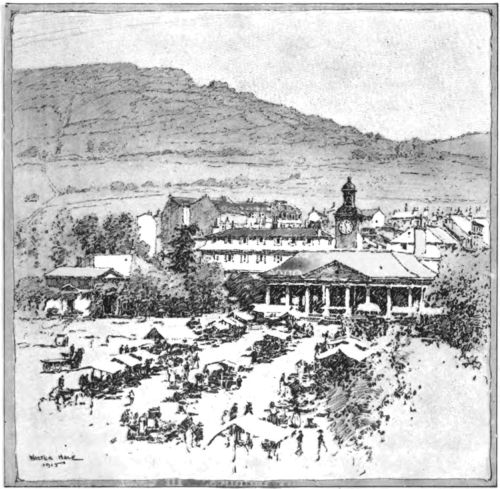
frontier. We had been down to the big market place to see it go. I never
saw anything more quiet—more orderly. She had mobilized her cash in the
same prompt, orderly fashion and sent it into safe retirement.
It was a sorrowful time, and it was not merely American—it was
international. Switzerland never saw such a "busted community" as her
tourists presented during August, 1914. Every day was Black Friday.
Almost nobody had any real money. A Russian nobleman in our hotel with a
letter of credit and a roll of national currency could not pay for his
afternoon tea. The little countesses had to stop buying chocolates. An
American army officer, retired, was unable to meet his laundry bill.
Even Swiss bank notes (there were none less than fifty francs in the
beginning) were of small service, for there was no change. All the
silver had disappeared as if it had suddenly dissolved. As for
gold—lately so plentiful—one no longer even uttered the word without
emotion. Getting away, "beating it," as Billy had expressed it, was
still a matter of prime importance, but it had taken second place. The
immediate question was how and where to get money for the "beating"
process. The whole talk was money. Any little group collected on the
street might begin by discussing the war, but, in whatever language, the
discussion drifted presently to finance. The optimistic consul was still
reassuring. To some he advanced funds—he was more liberal than the Bank
of Switzerland.
There was a percentage, of course—a lucky few—who had money, and these
were getting away. There were enough of them along the Simplon Railway
to crowd the trains. Every train for Paris went through with the seats
and aisles full. All schedules were disordered. There was no telling
when a train would come, or when it would arrive in Paris. Billy Baker
promptly mobilized his party and they left sometime in the night—or it
may have been in the morning, after a night of waiting. It was the last
regular train to go. We did not learn of its fortunes.
No word came back from those who left us. They all went with promises to
let us know, but a veil dropped behind them. They were as those who pass
beyond the things of earth. We heard something of their belongings,
however. Sometimes on clear days a new range of mountains seemed to be
growing in the west. It was thought to be the American baggage heaped on
the French frontier. Very likely our friends wrote to us, but there was
no more mail. The last American, French, and English letters came August
3d. The last Paris Herald hung on the hotel file and became dingy and
tattered with rereading. No mails went out. One could amuse himself by
writing letters and dropping them in the post office, but he would know,
when he passed a week later, that they had remained there. You could
still cable, if you wished to do so—in French—and there must have been
a scramble in America for French dictionaries, and a brisk hunting for
the English equivalents of whatever terse Berlitz idiom was used to
convey:
"Money in a hurry—dead broke."
Various economies began to be planned or practiced. Guests began to do
without afternoon tea, or to make it themselves in their rooms. Few were
paying their hotel bills, yet some went to cheaper places, frightened at
the reckoning that was piling up against settling day. Others, with a
little store of money, took very modest apartments and did light
housekeeping to stretch their dwindling substance. Some, even among
those at the hotels, in view of the general uncertainty, began to lay
in tinned meats and other durable food against a time of scarcity. It
was said that Switzerland, surrounded by war, would presently be short
of provisions. Indeed, grocers, by order of the authorities, had already
cut down the sale of staples, and no more than a pound or two of any one
article was sold to a single purchaser. Hotels were obliged to send
their servants, one after another, and even their guests, to get enough
sugar and coffee and salt to go around. Hotel bills of fare—always
lavish in Switzerland—began to be cut down, by request of the guests
themselves. It was a time to worry, or—to "beat it" for home.
We fell into the habit of visiting the Consulate each morning. When we
had looked over the little local French paper and found what new nations
had declared war against Germany overnight, we strolled down to read the
bulletins on the Consulate windows, which generally told us what steamer
lines had been discontinued, and how we couldn't get money on our checks
and letters of credit. Inside, an active commerce was in progress. No
passport had been issued from that Consulate for years. Nobody in Europe
needed one. You could pass about as freely from Switzerland to France or
Germany as you could from Delaware to New Jersey.
Things were different now. With all Europe going to war, passports
properly viséd were as necessary as train tickets. The consul, swamped
with applications, had called for volunteers, and at several little
tables young men were saying that they did not know most of the things
those anxious people—women, mainly—were asking about, but that
everything would surely be all right, soon. Meantime, they were helping
their questioners make out applications for passports.
There were applications for special things—personal things. There was a
woman who had a husband lost somewhere in Germany and was convinced he
would be shot as a spy. There was a man who had been appointed to a post
office in America and was fearful of losing it if he did not get home
immediately. There were anxious-faced little school-teachers who had
saved for years to pay for a few weeks abroad, and were now with only
some useless travelers' checks and a return ticket on a steamer which
they could not reach, and which might not sail even if they reached it.
And what of their positions in America? Theirs were the sorrowful cases,
and there were others.
But the crowd was good-natured, as a whole—Americans are generally
that. The stranded ones saw humor in their situation, and confessed to
one another—friends and strangers alike—their poverty and their
predicaments, laughing a good deal, as Americans will. But there were
anxious faces, too, and everybody wanted to know a number of things,
which he asked of everybody else, and of the consul—oh, especially of
the consul—until that good-natured soul was obliged to take an annex
office upstairs where he could attend to the manufacture of passports,
while downstairs a Brooklyn judge was appointed to supervise matters and
deal out official information in judicial form.
The judge was qualified for his appointment. Every morning before ten
o'clock—opening time—he got together all the matters—letters,
telegrams, and the like—that would be apt to interest the crowd, and
dealt this substance out in a speech, at the end of which he invited
inquiries on any point he had failed to make clear.
He got them, too—mainly questions that he had already answered, because
there is a type of mind which does not consider information valid unless
delivered to it individually and, in person. I remember, once, when
among other wild rumors it had been reported that because of the food
scarcity all foreigners would be ordered out of Switzerland in five
days, a woman who had listened attentively to the judge's positive and
thrice-repeated denial of this canard promptly asked him if she could
stay in Switzerland if she wanted to.
The judge's speech became the chief interest of the day. It was the
regular American program to assemble in front of the Consulate,
exchanging experiences and reading the bulletins until opening time. The
place was in a quiet side street of the quaint old Swiss city, a step
from the lake-front promenade, with a background of blue mountains and
still bluer water. Across the street stood a sixteenth-century château
with its gardens of greenery. At ten the Consulate doors opened and the
little group pressed in for the speech. I am sure no one in our stranded
assembly will easily forget those mornings.
Promising news began to come. The judge announced one morning that five
hundred thousand francs had been placed to the consular credit in
Switzerland by America for the relief of her citizens. Great happiness
for the moment! Hope lighted every face. Then some mathematician
figured that five hundred thousand francs amounted to a hundred
thousand dollars, and that there were ten thousand Americans in
Switzerland—hence, ten dollars apiece. The light of hope grew dim.
There was not a soul in that crowd who needed less than two hundred
dollars to pay his board and get him home. Ten thousand times two
hundred—it is a sizable sum. And what of the rest of Europe? The
mathematician figured that there were a quarter of a million Americans
in Europe, all willing to go home, and that it would take fifty million
dollars and a fleet of five hundred fair-sized ships to deliver them in
New York.
Still, that five hundred thousand francs served a good purpose. An
allotment of it found its way to our consul, to use at his discretion.
It came to the right man. Here and there were those who had neither
money nor credit. To such he had already advanced money from his own
limited supply. His allowance, now, would provide for those needy ones
until more came. It was not sufficient, however, to provide one woman
with three hundred francs to buy a set of furs she had selected, though
she raged up and down the office and threatened to report him to
Washington, and eventually flung some papers in his face. It turned out
later that she was not an American. I don't know what she was—mostly
wildcat, I judge.
Further news came—still better. The government would send a
battleship—the Tennessee—with a large sum of gold. The deposit of
this specie in the banks of Europe would make checks and letters of
credit good again. Various monies from American banks, cabled for by
individuals, would also arrive on this ship.
Things generally looked brighter. With the British fleet protecting the
seas, English, French, and Dutch liners were likely to keep their
schedules; also, there were some Italian boats, though these were
reported to be overrun by "swell" Americans who were paying as high as
one thousand dollars for a single berth. Perhaps the report was true—I
don't know. None of our crowd cared to investigate.
There were better plans nearer home—plans for "beating it" out of
Switzerland on a big scale. Special trains were to be provided—and
ships. A commission was coming on the Tennessee to arrange for these
things. The vessel had already left New York.
The crowd at the Consulate grew larger and more feverishly interested.
Applications for passports multiplied. Over and over, and in great
detail, the Brooklyn judge explained just what was necessary to insure
free and safe departure from Europe when the time came to go. Over and
over we questioned him concerning all those things, and concerning ever
so many other things that had no particular bearing on the subject, and
he bore it and beamed on us and was fully as patient as was Moses in
that other wilderness we wot of.
Trains began to run again through France; at least they started, and I
suppose they arrived somewhere. Four days, six days, eight days was said
to be the time to Paris, with only third-class coaches, day and night,
all the aisles full—no food and no water except what was carried. It
was not a pleasant prospect and few of our people risked it. The
Tennessee was reported to have reached England and the special
American trains were promised soon. In fact, one was presently
announced. It went from Lindau, through Germany, and was too far east
for most of our crowd. Then there were trains from Lucerne and
elsewhere; also, special English trains. Then, at last a Simplon train
was scheduled: Territet, Montreux, Vevey, Lausanne, Geneva—all aboard
for Paris!
Great excitement at the Consulate. The Tennessee money could arrive
any day now; everybody could pay up and start. The Brooklyn judge
rehearsed each morning all the old details and presented all the news
and requirements. The train, he said, would go through a nation that was
at war. It would be under military surveillance. Once on the train, one
must stay on it until it arrived in Paris. In Paris passengers must go
to the hotels selected, they must leave at the time arranged and by the
train provided, and must accept without complaint the ship and berth
assigned to each. It would be a big tourist party personally conducted
by the United States for her exiled citizens. The United States was not
ordering its citizens to leave Switzerland; it was merely providing a
means for those who must go at once and had not provided for
themselves. The coaches would be comfortable, the price as usual, red
cards insuring each holder a seat would be issued at the Consulate.
Tickets through to New York would be provided for those without funds.
The government could do no more. Any questions, please?
Then a sharp-faced, black-haired, tightly hooked woman got up and wanted
to know just what style the coaches would be—whether they would have
aisles down the side; whether there would be room to lie down at will;
whether meals would be served on the train; whether there would be time
at Dijon to get off and see some friends; whether she could take her
dog; whether her ticket would be good on another train if she didn't
like this one when she saw it. The judge will probably never go into the
tourist-agency business, even if he retires from the law.
Well, that particular train did not go, after all. Or, rather, it did
go, but few of our people went on it. There was a misunderstanding
somewhere. The Germans were getting down pretty close to Paris just
then, and from the invisible "somewhere" an order came countermanding
the train. The train didn't hear of it, however, and not all of the
people. Those who took it must have had plenty of room, and they must
have gone through safely. If the Germans got them we should have heard
of it, I think. Those who failed to take it were not entirely sorry. The
Tennessee money had not been distributed yet, and it was badly needed.
I don't know what delayed it. Somewhere—always in that invisible
"somewhere"—there was a hitch about that, too. It still had not arrived
when the next train was scheduled—at least, not much of it. It had
not come on the last afternoon of the last day, when the train was to go
early in the morning. It was too bad. There was a borrowing and an
arranging and a negotiating at the banks that had become somewhat less
obdurate these last days, with the Tennessee in the offing. But many
went away pretty short, and, but for the consul, the shortness would
have been shorter and more general.
It was a fine, big, comfortable train that went next morning. A little
group of us who were not yet ready to "beat it" went down to see our
compatriots go. There seemed to be room enough, and at least some of the
coaches had aisles down the sides. I do not know whether the
sharp-faced, tightly hooked woman had her dog or not. There was a great
waving, and calling back, and much laughter as the train rolled away.
You could tell as easily as anything that the Americans were "beating
it" for home.
Heavy installments of the Tennessee money began to arrive at the
Consulate next day. I got some of it myself.
A day or two later I dropped into the Consulate. It had become a quiet
place again, as in the days that already seemed very long ago. It was
hard to believe in the reality of the eager crowd that used to gather
there every morning to tell their troubles and laugh over them, and to
collect the morning news. Now, again, the place was quite empty, except
for a few flies drowsing about and the rather tired, bored-looking man
who came to spend an hour or two there every morning, killing time and
glad of any little diversion in the way of company.