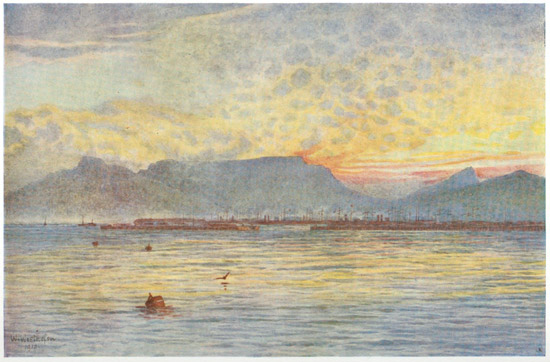
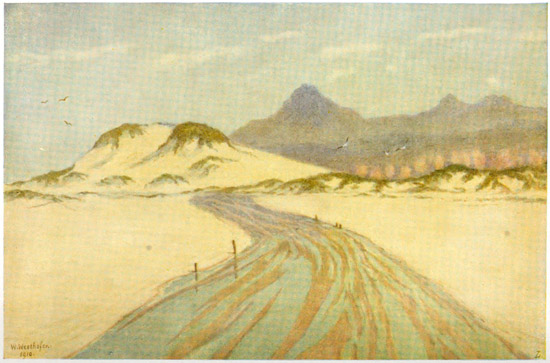
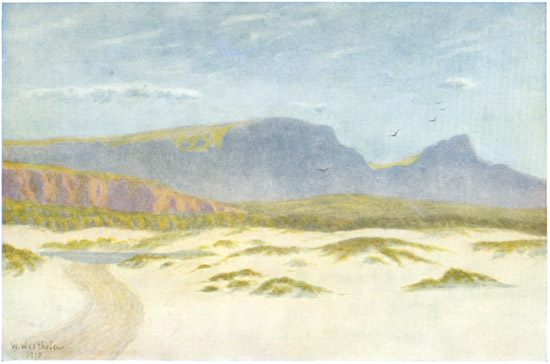
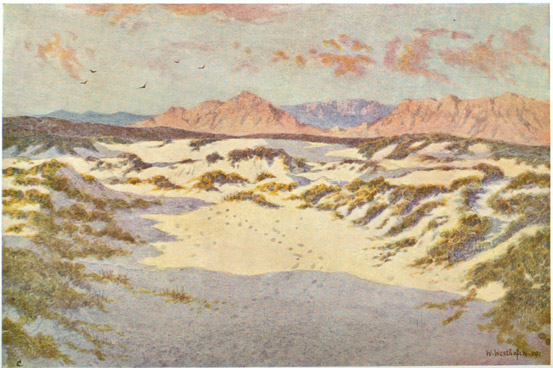
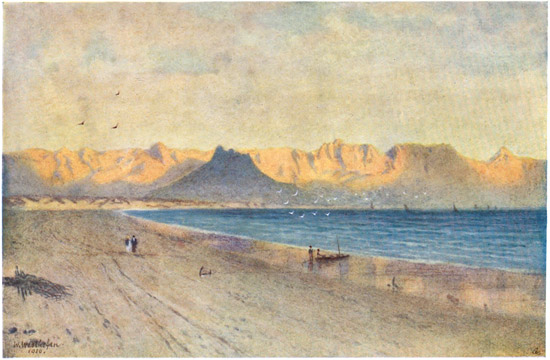
The blue shadow of Table Mountain falls straight
across the 'Flats,' or the sandy isthmus of the Cape
Peninsula—a long, intensely blue line stretching
from one ocean to the other.
In 1653 this shadow meant something more than
a beautiful shade; it was a boundary-line; it
meant safety and shade within its depth, war and
barbarians beyond.
Along its borders were dotted small forts and
watch-houses; there were even the beginnings of
a canal running parallel with the definite shade, to
intensify its significance.
The Dutch East India Company's long-suffering
and harassed Commander, Van Riebeek, with
infinite undertaking of dangers and difficulties, wild
beasts, Hottentots, and quicksands, rode across it,
and fixed its boundaries as proper limits to the
Settlements, which its most honourable directors
were pleased to call 'Goode Hoop.'
The blue shadow begins on the other side of the
Wind Mountain or Devil's Peak, and we will go
where it leads.
In 1663 there was a narrow road running close
up to the mountain rather higher up than the
present dusty main road. It ran as far as Rondebosch,
or 'Rond die Bostje,' whose round-wood
traditions are untraceable, Van Riebeek having
given orders that only the outer bushes should be
preserved as a convenient kraal for cattle. Along
this narrow road a small ox-cart rumbled every day
from the fort in Cape Town, dragging home logs of
wood from the almost unknown land beyond; its
driver running momentary risk of meeting in the
narrow way the lions, tigers, or rhino, that roamed
the mountain slopes.
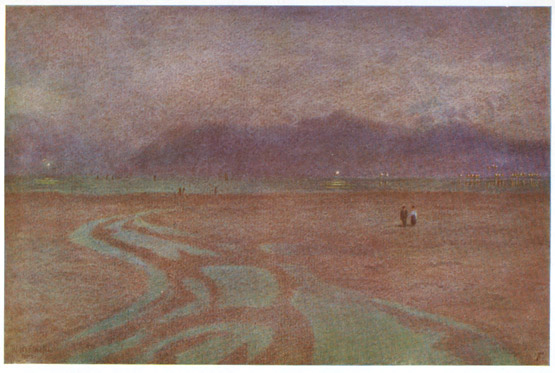
One end of the shadow falls into the sea at
Maitland or Paarden Island, and covers some
stretches of beach, small houses, and railway workshops.
There the rivers meet—the Diep River
from Milnerton, the Liesbeek and the Black Rivers
from across the Flats. They join and form the Salt
River, a wide, overflowing stream that is constantly
flooding the green lands between the sea and the
old Trek road to the north.
In the old days, this beach between Salt River
and Milnerton was the setting of tragedies: backed
in on the north and east by the Blaauwberg
Mountains and the Stellenbosch Ranges, and on
the south-east by the Hottentot's Holland.
From behind the Blaauwberg, or Blueberg, came
that long thin stream of Saldanhas from the north,
lighting their fires among the rushes of the Diep
River and the Salt Pans near the Tigerberg or
Leopard Mountains, which are the green, corn-sown
hills of Durbanville and Klipheuvel.
They brought with them, past the outpost
'Doornhoop' on the Salt River, to the very
gates of Van Riebeek's Fort, then standing where
the railway station now is, cattle and sheep and
wonderful stories of rich countries to the north
and north-east, where kings lived in stationary
stone houses and had much gold, their wives loaded
with bracelets and having necklaces of sparkling
white stones! The little dysentery-stricken settlement,
growing thin and determined on a carrot and
a snack of rhinoceros, opened the gates, bought the
scurvy cattle, believed the stories, and had visions
of reaching the fabulously renowned river 'Spirito
Sancto.' They dragged their waggons and their
precious oxen and horses over the scrub and sand-dunes;
and now one may see the fruits of these
brave but small expeditions in carefully compiled
but imaginative maps and plans, telling of how one
or another reached the banks of the Orange River
and found 'a great desert,' but found no great
kings, no gold, no cities.
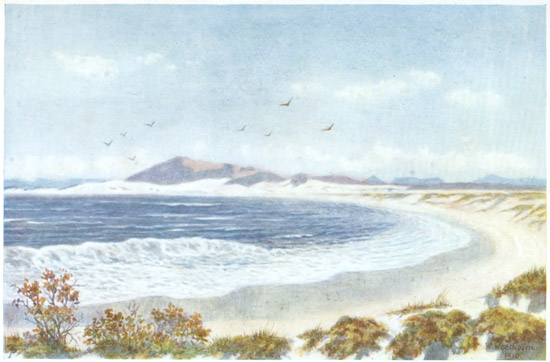
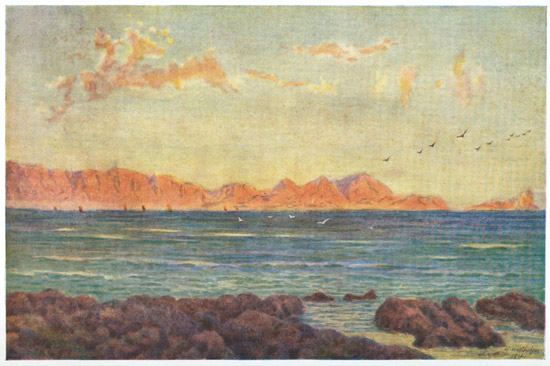
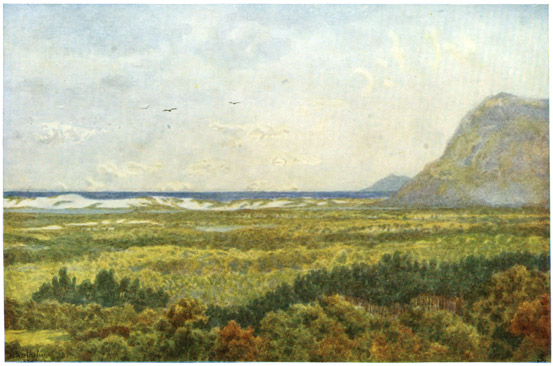
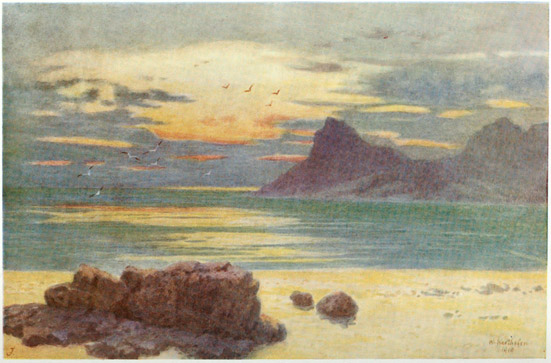
BLAAUWBERG AND HEAD OF TABLE BAY
Lying close to the shore are many wrecks, an old
order which has changed but slowly.
This corner of the bay was a dangerous roadstead
before the year 1653.
A scurvy gang of bastard natives called 'Watermen'
or 'Beach Rangers,' crawling like mammoth
cockroaches among the seaweed and wreckage, had
eked out their monstrous living long before the
Harlem dragged her anchor and stranded at the
mouth of the Salt River.
A grand string of names in the records of these
old wrecks; no cheap sloops, galleots, or second-rate
pirating-hulks, but big, stately merchantmen:
one, from France, La Maréchale, with a Bishop
on board who is uncommonly like the man who
became a Cardinal during the reign of 'Le Roi
Soleil.' He was on his way to Madagascar with
something political behind his mad-sounding
schemes for church-building (on such a sparsely
inhabited island) and for personally endowing the
buildings to the tune of hundreds of thousands; it
may be heresy, but there was something politically
consequent in the extraordinary story of this wreck
of La Maréchale and the energy of the French
seal-fisheries at Saldanha Bay.
To continue the rôle of backstairs glory: an
English ship—a well-known name, The Mayflower—on
her way from the east with John Howard, her
captain, got a bad time in the terrible bay, tearing
winds coming from the 'Wind Mountain' and
across from Robben Island.
The clearing of the roadsteads became almost a
yearly festival and a certain necessity.
So the blue shadow begins by the sea and ends
by the sea; but to reach the other end will take
us in a motor more than thirty minutes; an ox-waggon
lumbering across sandy dunes and along
stony mountain-paths took the early settlers something
more than a day or two. We did it riding,
and took something like a month; but one must
compromise to really enjoy life.
We rode one day along the main road to Rondebosch,
where the old Commanders would ride out
two hundred years ago, to inspect the Company's
granary, 'Groote Schuur,' and the Company's guesthouse,
'Rustenburg.'
The Cape Town length of the road has little of
interest. 'Roodebloem' comes into the list of old
homesteads; and down in the swampy green fields
of Observatory Road, where the clerk life of Cape
Town has its two acres and a cow, and near the
Royal Observatory, lived the Company's free
miller; and the Liesbeek waters worked his mill.
There is still an old mill in existence, but probably
of later date.
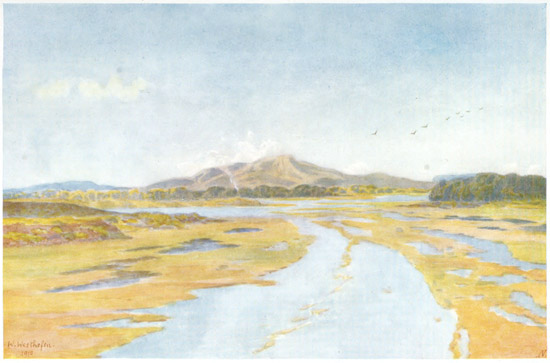
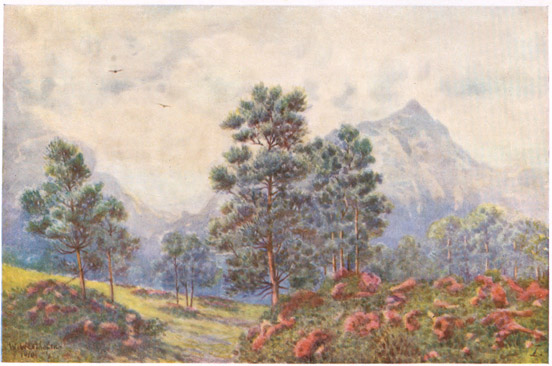
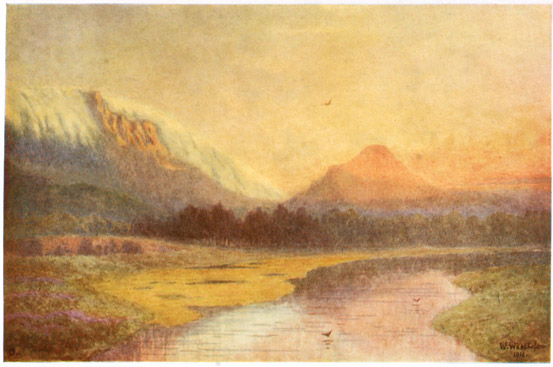
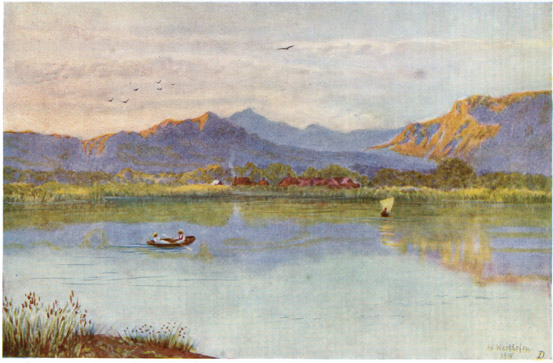
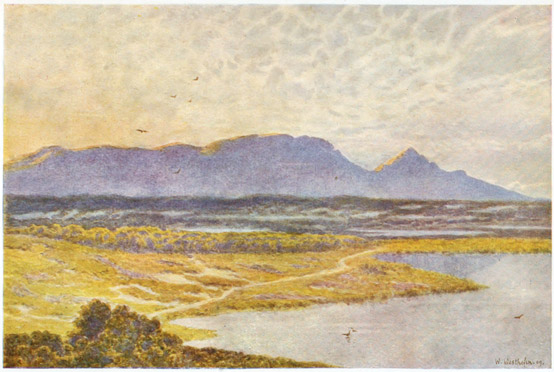
TIGERBERG AND DIEP RIVER
In 1658 the Company gave grants of land along
the Liesbeek River, mostly all along the west
side, beginning with the swampy land below the
Wind Mountain or Devil's Peak, granted to the
Commander's nephew-in-law, Jan Reyniez, and
ending on the south side, somewhere in Wynberg,
with the lands of Jacob Cloeten of Cologne. The
burghers, having formed into three companies—one
called Vredens Company—lying in lands on
the wrong side of the river at Rosebank, sent in a
petition, which was forwarded with all due delay to
the Commander and Council, who, 'having found,
according to the many deeds and diagrams, that
the land is quite dangerously situated, the owners
being exposed to the depredations of the Hottentots,'
granted new lands near the Company's
orchard, called 'Rustenburg.'
The conditions laid down by the Company to
freemen varied slightly in each little colony: there
were three along the Blue shadow:
'1. They might fish in the rivers, but not for
sale.
'2. The Company would sell them at ploughing
time a plough and twelve oxen. The ground
should be theirs for ever.
'3. That they should grow tobacco.'
These are some of the rules. Everyone knows
the story of how the rules later became unbearable—the
fixing of selling-prices by the Company, the
paying of taxes, the limitations set on selling
produce to the ships.
The conditions, however, and the dangers from
the Hottentots on the east side of the shadow, were
thankfully accepted.
In the old records there is the entry which
explains the position of these little colonies:
'February 21, 1657.
'Fine sunshine, fickle weather.'
'Many having been informed of the intention
of the Masters to establish freemen all about and
under favourable conditions, a party of five selected
a locality on the other side of the Fresh River
(Liesbeek), named by us the Amstel, below the
forests and beyond it where our woodcutters are,
near the crooked tree about three leagues from the
Fort, and as long and broad as they wished it, on
condition that they were to remain on the other
side of the river. Another party of four selected
a spot about a league nearer, at the Rondebosjen,
on this side of the river or Amstel, from the small
bridge leading to the forest as far as the spot
chosen for the redoubt, near where the bird trap is
to be built. The boundary of that land will be
three-quarters of a league long, the river will divide
them from the other party, and they will go back
as far as they like to Table Mountain and the
other mountains. The party of five may go forward
towards the mountains of the continent proper, as
far as they like; these two parties are therefore
stationed right on the isthmus in fruitful soil. The
further colony has therefore been named Amstel,
or the Groeneveld, and the farthest redoubt will
be about quarter of a league beyond it. The nearer
colony at Rondebosjen (which is to be converted
into a cattle kraal and to be provided with a gate)
is to be called the "Dutch garden." A redoubt
will also be built there.'
And then began some amusing correspondence
between the Honorable Commander and his honorable
employers at Amsterdam.
Very few of these freemen had wives. Jan
Reyniez had married the Commander's niece Lysbeth,
Jacob Cloeten sent to Cologne for Frau Fychje
Raderoffjes, and a few other wives were ordered
out; but, grumbled the Council from this strenuous
settlement, 'Here are good freemen, who would
willingly marry if there were any material (stoffe)'—to
quote from the old documents—
'These young men have accordingly prayed and
begged us [the Council spared no words] to ask
girls (meis-jen) for them, whom they may marry.
We therefore request outward-bound families to
bring with them strong, healthy farm girls, and
the Company would make the condition that,
when arriving at the Cape, the good ones might be
retained and all others permitted to go on; as
between Patria and this, it will be easily discovered
what sort of persons they are.'
So in like manner, as bread fell from heaven to
the Israelites in the desert, or as the British Government
supplied wives to their Virginian Colonies,
came wives to the freemen at the Cape. But
rather hard for the families who were to have their
good maids retained.
It is a surprising thing, in looking over the old
Roll-call, to find so few old Cape names. The
varying forms of spelling may account for this.
In the old title-deeds one finds some lands in
Table Valley granted to one Cornelius Mostaert,
a well-known name; then there are mentioned
Cloeten, Cloetas, Muller, Theunissen, Visagie, and
a Van der Byl, who was a 'messenger of justice,'
and rode from Cape Town to the Bosheuvel on his
rounds; but the large majority are almost unknown
names.
But we have arrived at Rustenburg, off the
wagon road which leads to the forest on the slopes
of the Bosheuvel, or 'Hen and Chickens Hill,'
where Amman Erichiszen, the keeper of the
forest lands, planted most energetically the great
pine-trees which now, like an invincible army,
have marched over all the lands.
It is said that the original buildings at Rustenburg
have been destroyed. Marinus and I choose
to think differently, as the position of the present
building must be on the exact spot. Rustenburg
has degenerated into a high school for girls, and
bears itself like an aristocrat in the stocks. Its
long teak windows and rows of Doric pillars look
imposing enough to suggest the ancient glories
which are so carefully recorded: 'This day the
Commander takes out a party to inspect the
Company's corn-lands at Rond die Bosje'—Van
Riebeek on his famous horse, 'Groote Vos'; Maria
de Quellerai, his wife, in a coach with the guests;
Governors on their way to the East—the Great
Drakenstein, Van Oudtshoorn, Governor Van
Goens, the Java Commander who gave so much
advice on his way to and fro, the Van der Stels
still working in the East; the Admirals of Return
and Outward Fleets—Vlemdingh, Van Tromp,
De Reuyter—with their wives and families; the
famous Commander of the French Fleet, M. le
Marquis du Quesne, and so many others. Do
their ghosts disturb the dreams of the little high-school
'backfish'?
At the back of the Rustenburg buildings, to the
left, following a path which was probably a way to
the Groote Schuur, are the remains of some old
orchard lands, and some years ago I remember
going with a troop of excited girls, in the terrifying
hour of twilight, to see the old slave burial-place,
which lay to the right of a path leading to the
summer-house and 'Rustbank'—a small white seat
still to be seen near the little red-roofed tea-house.
To the right of this spot is the house called 'The
Woolsack,' where Rudyard Kipling has lived every
summer for years. Here were remains of graves,
old bits of tombstone, old decaying skulls—oh!
the horror and pleasure of these evening desecrations!
An orgie for the emotions which makes
one adore the past.
Above the Woolsack towers the Wind Mountain,
on its slopes the white and grey granite temple of
the Rhodes Monument.
One day someone sat gazing at the big Devils
Peak, which shadows Groote Schuur and stands
like a rampart of the Citadel Mountain behind.
As he gazed he became inspired; he said: 'There
should be a monument to Rhodes, just there, on
those steep green slopes under the Watch House,
where the heavy Dutch cannon were dragged up
to defend the bay.' The Rhodes trustees rose up
and formed the chorus.
So began the drama of the monument.
The players were reinforced. Watts from London
sent a huge bronze group, Physical Energy, which
is the beginning in the game of progress. John
Swan, with his wonderful head of a Michael Angelo
prophet and a later Roman Emperor, Rodin of the
English, came himself and drew designs for paradoxical
lions.
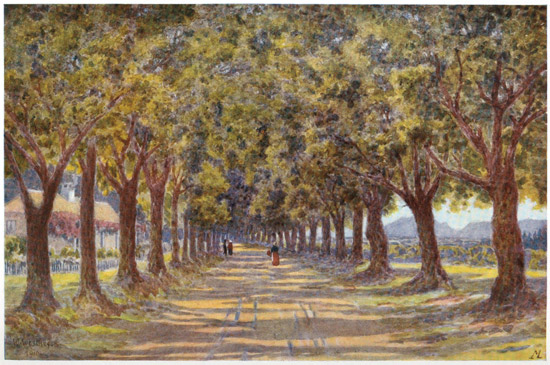
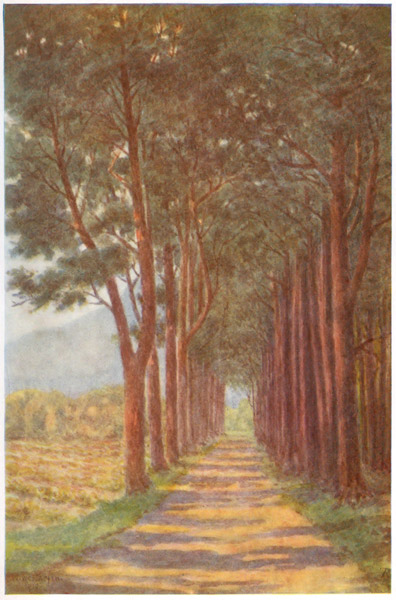
This was our train of mind as we rode up the fir
avenue of Groote Schuur bordered with blue
periwinkle flowers.
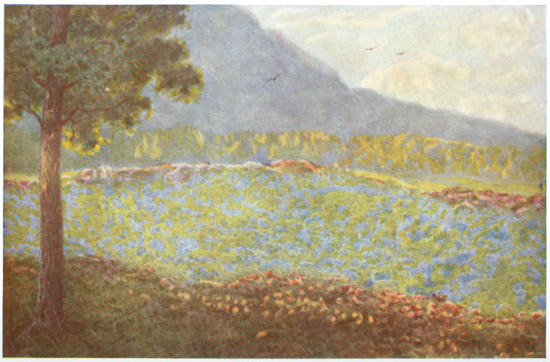
BLUE HYDRANGEAS AT GROOTE SCHUUR
Home of Rhodes and a hostel for passing visitors
of name and fame, it was the 'Great Barn' of long
ago—the Great Barn where the 'Company's'
corn, grown under such difficulties, was stored in
times of plenty, that there should be food for the
Company's servants, ever busy fighting off the
Hottentots across the Flats, when the Batavian
Directors, with great omnipotence, decreed that
the homeward-bound fleet should find no room to
carry rice to the vegetable settlement of Bonne
Esperance. For the Company settled in the
shadow, not to found an empire beyond the seas,
but to 'grow vegetables for their ships.'
Groote Schuur, the great barn with its present
building carefully imitative, its masses of blue
hydrangeas and wisteria, white-walled terraces of
plumbago and magenta bougainvillæa, and its tall
pine-trees and deep, fern-banked glen.
There is something adorable in the green plaque
over the front entrance—and instinctively it is
chapeau bas—a small group of Dutchmen and
Hottentots on the seashore—'The Landing of
Van Riebeek.' The simplicity of the thing starts
the weaving of the spell, which, in the plod, plod
of life at the Cape, is a forgotten aspect. No
nation can ever be great that has no time for
sentimental patriotism. Why is it that this Africa
cannot hold its people? There is talk of the Call
of the Sun, but it does not hold fast, this Sun call.
If Progress goes north and all new effort must
wander away from the Patria, it must not be
allowed to wander without the shibboleth of sentiment.
A domestic simile would be invidious.
Marinus, my guide, is used to my wanderings,
and the horses are slowly climbing the steep
gravelled path behind the house. Past cool woods
filled with arum lilies and fantastic, twisted young
oaks, looking to the heated imagination like fauns
and satyrs, which send back one's mind to a long-ago
atmosphere of mythology.
This atmosphere increases, and culminates at the
Temple of the monument.
In a large sloping field to the right of the path
live, in happy monotony, four or five llamas, while
in another teak-gated enclosure the striped zebras
are gazing in mild surprise at a fierce wildebeeste
stalking along the other side of the thin wire fence.
Far across the purple sandy flats with their blue
barriers to the north—the 'Mountains of Africa'—lie
the big vleis, or lakes, and near them the tall
white spire of the tiny Lutheran church, little
shepherd of all the German souls who cluster round
in white farms, growing lettuce on week-days and
singing Lutheran hymns on Sunday.
At the top of the gravel road, almost buried in a
kloof of stunted oaks and yellow protea-bush, is a
cottage, where the two sons of that fat King of the
Matabele, Lobengula, lived and were educated.
What has happened to them since Rhodes's death
I do not know; they may be studying French and
science at the Sorbonne, or, having married somebody's
'respectable English housemaid,' may be
the happy fathers of a tinted family of pupil
teachers or typewriters!
We climbed higher, and were soon in the shadow
of the Devil's Peak or Doves Peak.
The name 'Devil' must have drifted from the
'Cape' to the Wind Mountain. 'Windberg' was
the ordinary name for the Peak, and 'Devil's Cape'
was the name given to the Cape many years before
Diaz's ship was driven round into the Indian Ocean.
Humboldt, the German traveller, has interesting
information about this name. He says that on
Fra Mauro's world chart, published between 1457
and 1459, the Cape of Good Hope is marked 'Capo
Di Diab!'
Diaz, to his surprise and unintention, rounded
the Cape in 1486.
But even before this, others than the 'Flying
Dutchman' sailed these seas. On the old planisphere
of 'Semito,' made in 1306, the tricorned
shape of South Africa is shown, and in a note
added later to the planisphere it is stated that an
Indian junk coming from the East circumnavigated
this Cape 'Diab.'
To those who have thought of this Cape as
shrouded in mystery until the Portuguese sailors
rounded it, the shock might be similar to the state
of mind of the Ignoble Vulgar (used in the sense
of ignorance), who find, one day, that quite a
decent system of education existed before the
Flood; but shattering a fallacious perspective may
not necessarily widen a horizon, and Sheba's Mines
of Ophir, the voyages of the Phœnicians, Moorish
slavers, Indian junks, gold, and apes, and peacocks,
and Flying Dutchmen, may still be in the jig-saw
pattern border of South Africa.
Groups of almond-trees guide us to two cement
and iron cages. There, lying blinking benignly in
the sun, are the famous lions of Groote Schuur—almost
monuments in themselves.
Did not their ancestors roam over these very
slopes of the mountain, and swoop down into the
cornfields and ricefields of the Company's burghers,
seeking water and shelter from the raging north
winds, in the comfortable piece of land 'Rond die
Bosch' below?
Passing the lions, we are still mounting to the
east ridge of the Peak. Somewhere George Eliot
says, 'attempts at description are stupid—how can
one describe a human being?' The assertion does
not apply entirely to human beings. Who but
refuses to bear attempt at minute description, and
who but would fail in the attempt to describe the
wonderful view which suddenly appears—the
shining blue rim of Table Bay, a harmony in blue
and silver, Watts's 'Energy' in silhouette, the
giant horse and rider dominating a huge precipice,
the precipice which is the narrow, flat, and sandy
isthmus of the Peninsula? All round and down
the slopes are soft, green forests of firs.
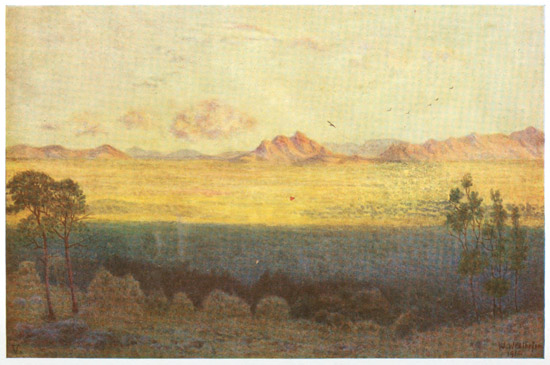
THE BLUE SHADOW—VIEW FROM RHODES'
MONUMENT
The inscription on the statue runs: 'Physical
Energy, by G. F. Watts, R.A., and by him given
to the Genius of Rhodes.'
From the foot of the group in bronze and granite
we look up the huge steps to the grey granite
temple, the grey rocks of the mountain behind,
and the 'Silver-Trees' keep the eye and senses
running along the gamut of greys.
Behind the tall pillars runs another inscription—'Dedicated
to the Spirit and Life Work of Cecil
John Rhodes.' The paradox to this will be found
in the statue, or bust, of Cecil John, to be placed
by the trustees in the niche below. It is in the
nature of man to embody, allegorically, in human
form, virtues and vices, but surely it were better to
leave the good deeds of the man, which belonged
to the Spirit, in the care of this wonderful grey
granite temple. To the Life and Spirit! Few
bodies make temples worthy of the Spirit, and
Cecil John failed to prove the rule. But 'how
truly great is the Actual, is the Thing, that has
rescued itself from bottomless depths of theory
and possibility, and stands as a definite indisputable
fact ...' and the Knowledge and the Practice,
which are the elements of the mighty Physical
Energy, hang over the abyss of the Known, the
Practicable.
The man and his life 'rest on solidity and some
kind of truth.'
So we came down from the heights.