Everybody agreed that the weather was remarkable
that fall; far into November it lasted
warm and bright, and Walter Grayson who
found life more endurable under the open sky
than within four walls, spent a large part of
each day out of doors attended by his faithful
Thompson.
Caro’s visit had stirred anew his longing for
the old companionships that had once been his.
When at length after their long absence they
had decided to come home, he had looked forward
to it almost eagerly, but his sister whose
pride shrank from sympathy took it for granted
that to meet his old acquaintances could be only
painful to him, and those who had ventured to
call were not admitted.
Walter was in the habit of acquiescing in her
decisions, and in the first shock of his illness
he had felt the same shrinking from pity, but
now the sense of loneliness was becoming almost
unbearable. As he was wheeled about
the garden he lived over again the merry days
of his childhood, and the quarrel that had separated
him from those he had cared most for,
seemed a small matter in the light of these
memories.
The Graysons had long been people of wealth
and influence in Charmington, and in Miss
Elizabeth’s opinion it was a direct insult when
her wishes were ignored and the beauty of the
avenue which had been named for her grandfather
was, as she thought, forever ruined.
That her personal friends could side against
her, added to the bitterness. She refused to
see that Dr. Barrows was not responsible for
his brother’s actions, and proudly withdrew her
friendship from the whole family, and her gifts
from the seminary.
No doubt her grief over her brother made
her more bitter than she would otherwise have
been; at least so Dr. Barrows thought, and
would not speak ill of her.
Walter upon whom she lavished everything
affection could suggest, or money buy, felt that
he could not ask for the only thing he really
wanted. And at times he told himself despondently
that he was forgotten, that his friends no
longer cared for him.
Caro’s simple friendliness had won his heart,
the possibility of seeing her again added a little
interest to his lonely life; and Thompson too,
seeing the good effect of her visit, was on the
watch for her.
When one afternoon they saw her in her
scarlet jacket, looking over the garden wall,
Walter waved his hand and Thompson grinned
broadly over the back of the chair, while Caro
nodded and smiled in response, quite as if they
had been old friends.
“Don’t you want to see your picture?” Walter
asked; “they are on the library table,
Thompson,” he added.
As the man went off Caro swung her feet
over on the Grayson side of the fence, and then
in another minute she had slipped down and
was beside Walter’s chair. “I mustn’t stay
long,” she said. “Marjorie has gone to the
dentist’s and I told her I’d wait till she came
back.”
“How is the cat?”
“He is very well, thank you, but he has been
bad. He stole a bird.”
“You don’t say so!”
“Yes, and so have I.”
“You don’t mean you have stolen a bird?”
Caro laughed. “Of course not; I wouldn’t
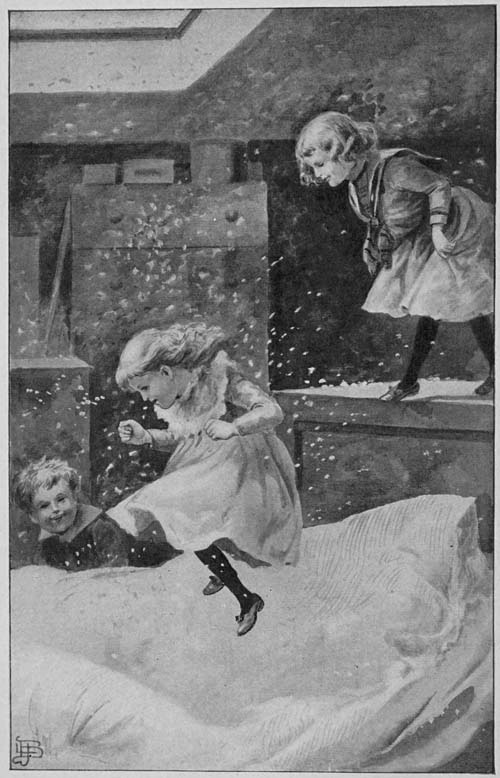
steal, but Marjorie and Tom and I jumped all
the feathers out of Aunt Charlotte’s bed.”
“What naughty children,” said Walter
smiling.
“Yes,” agreed Caro with a sigh, “and I
meant to be good while grandpa was away. I
promised him I’d try to be a candle and then
I forgot.”
“What do you mean by being a candle?”
“Oh—being pleasant and nice to Aunt
Charlotte and Jane,—not making trouble you
know. The feathers were all over the front
lawn and Mrs. Rice thought it was snowing.”
Caro laughed a little at the recollection.
“Grandpa said the best way to be a candle
was to love people, and I do love him ever so
much, but I don’t love Jane. I love Aunt Charlotte
too, but she doesn’t like to talk to me, so
I miss grandpa.”
“I know how that is. I too wish sometimes
for someone to talk to,” Walter replied.
Here Thompson appeared with the photographs,
and everything else was forgotten.
“They are a little too grave,” Walter said,
comparing them with the glowing face beside
him; “We must try again sometime.”
“And let’s have Trolley in it too,” Caro
suggested.
“Why certainly, that is a good idea. Do
you know Caro you remind me of my little
sister.”
“Do you mean Annette?”
“Why what can you know about her?”
Walter asked in surprise.
“Grandpa told me. I asked him who lived
in your house—and then I saw her window in
the chapel—the Good Shepherd you know.
Grandpa said she was a dear little girl. Do I
truly look like her!”
“Yes, there is something in your face and
smile that is like her;” Walter looked thoughtfully
at the picture.
“Won’t you please tell me about her?”
begged Caro.
And so while Thompson wheeled his master
up and down the garden paths, she walked beside
him and listened to the story of those days
when the gate now nailed up was always open,
and merry girls and boys ran back and forth.
“What nice times you did have!” Caro exclaimed,
pressing the palms of her hands together.
“I wish we could do some of those
lovely things. Couldn’t we have a picnic and
have a fire and roast potatoes and corn?”
Her interest was a pleasant thing to the invalid;
he laughed at the eager face; “Well,
why can’t we?” he said. “What do you think
Thompson?”
“Why of course we can, sir, if you like,”
was the answer.
“And have Marjorie and Tom?” cried Caro
eagerly.
It seemed impossible to refuse her, but when
he thought of it afterwards Walter began to
doubt if he had been wise. What would his
sister think—or the Barrows, when it was discovered
that he had been entertaining the children
in the garden? Still it was too late now—he
had promised.
As for Caro no doubts spoiled her anticipation.
She gave Marjorie a most animated account
of the pleasure in store for them, and her
cousin was as interested as she could wish.
“It will be lovely, Caro, and we’ll keep it a
secret,” she said, for there was nothing Marjorie
liked so well as a mystery.
Finding Tom, they proceeded to excite his
curiosity.
“Say—don’t you wish you knew what we
are going to do to-morrow?” they both exclaimed.
“What are you going to do?” he asked,
pulling his ear and realizing that he was about
to be teased.
“We can’t tell, but it is something awfully
nice,” said Caro, “Isn’t it Marjorie?”
“Isn’t it though!” and the two looked knowingly
at each other.
“There’s going to be something to eat,”
Marjorie added.
“A candy pulling, I bet,” cried Tom.
“No indeed!” they both cried.
After carrying this on for half an hour and
goading Tom to the point of desperation, Marjorie
said, “If you’ll promise honest truly you
won’t tell you can come over to-morrow and
maybe we’ll let you into it.”
“Truly I won’t tell,” Tom promised, brightening.
“Do you think you’d let him into it Caro?
He might spoil it.”
“Oh I guess so,” Caro replied, and they ran
off leaving him alone with his curiosity.
All this mystery added not a little to the delights
of the picnic next day in the Grayson
garden, and certainly for its size there was
never a merrier one.
Tom was a little uncomfortable at first, for
Marjorie’s dark hints about the garden had impressed
him deeply, but he soon recovered from
this and helped Thompson make a fire on the
very spot where Charlie and Walter had built
theirs in days gone by.
The children thought nothing ever tasted so
good as the corn roasted there; there were
grapes and apples besides and some fascinating
bon-bons, but the corn was the most fun, they
insisted.
Not being in the habit of providing for such
feasts Thompson forgot the salt, and Marjorie
and Caro had the excitement of running to the
house and having the cook inquire what they
were going to do with salt.
On a seat made of a plank supported on
bricks the three children sat and feasted and
chattered, while Walter looked on and enjoyed
the experience of acting once more as host.
Everybody knows the peculiar pleasure of a
fire out of doors; the day was cool enough to
make its warmth agreeable, and the sight and
sound of the crackling flames was like a tonic
to the spirits.
After the feast was over they played games,
such as “I have a word that rhymes with—”
and “My ship comes sailing—.”
They asked conundrums, and Thompson
showed himself to be an accomplished sleight-of-hand
man, finding silver dollars in impossible
places, and making handkerchiefs appear
and disappear, in a surprising manner. Never
was more fun crowded into one short afternoon.
“It has been a beautiful picnic, and I am
very much obliged to you,” Caro said to Walter
as they were separating.
“So am I,” echoed Marjorie, and Tom
would have said the same if he hadn’t been
bashful, as it was he could only grin.
“I am just as much obliged to you for coming
to my picnic,” Walter replied, and he added
to Caro, “Goodby little Candle.” This was
the first time in more than four years that he
had given any pleasure to anybody, he thought
on the way to the house.
Miss Elizabeth stood at the door: “Surely
Walter you are staying out too late,” she said:
“Are you not chilled?”
“Not at all; you can trust Thompson for
that,” he answered.
As for Thompson, he wished Miss Grayson
could have seen her brother as he told stories
and laughed at the pranks of his visitors, and
he determined that if he could bring it about
there should be more occasions of the sort.