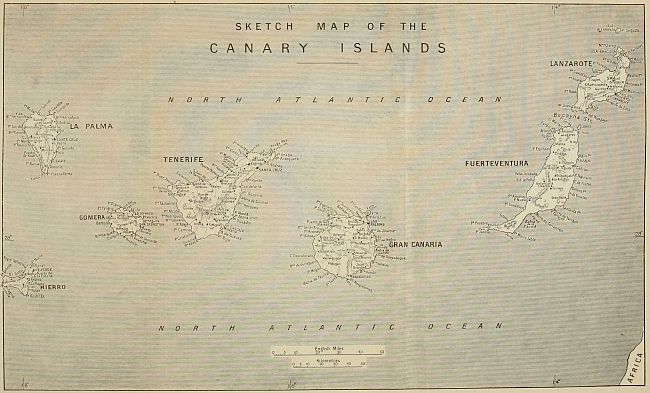
Probably many people have shared my feeling of
disappointment on landing at Santa Cruz. I had
long ago realised that few places come up to the
standard of one’s preconceived ideas, so my mental
picture was not in this case a very beautiful one;
but even so, the utter hideousness of the capital
of Teneriffe was a shock to me.
Unusually clear weather at sea had shown us
our first glimpse of the Peak, rising like a phantom
mountain out of the clouds when 100 miles distant,
but as we drew nearer to land the clouds had
gathered, and the cone was wrapped in a mantle of
mist. There is no disappointment attached to
one’s first impression of the Island as seen from the
sea. The jagged range of hills seemed to come
sheer down to the coast, and appeared to have been
torn and rent by some extraordinary upheaval of
Nature; the deep ravines (or barrancos as I afterwards
learnt to call them) were full of dark blue
mysterious shadows, a deeply indented coast-line
stretched far away in the distance, and I thought
the land well deserved to be called one of the
Fortunate Islands.
Santa Cruz, or to give it its full title, Santa Cruz
de Santiago, though one of the oldest towns in the
Canaries, looked, as our ship glided into the harbour,
as though it had been built yesterday, or might
even be still in course of construction. Lying low
on the shore the flat yellow-washed houses, with
their red roofs, are thickly massed together, the
sheer ugliness of the town being redeemed by the
spires of a couple of old churches, which look down
reprovingly on the modern houses below. Arid
slopes rise gradually behind the town, and appear
to be utterly devoid of vegetation. Perched on a
steep ridge is the Hotel Quisisana, which cannot
be said to add to the beauty of the scene, and
all my sympathy went out to those who were
condemned to spend a winter in such desolate
surroundings in search of health.
Probably no foreign town is entirely devoid of
interest to the traveller. On landing, the picturesque
objects which meet the eye make one realise that
once one’s foot has left the last step of the gangway
of the ship, England and everything English has
been left behind. The crowd of swarthy loafers
who lounge about the quay in tight yellow or white
garments, are true sons of a southern race, and
laugh and chatter gaily with handsome black-eyed
girls. Sturdy country women are settling heavy
loads on their donkeys, preparatory to taking their
seat on the top of the pack for their journey over
the hills. Their peculiar head-dress consists of a
tiny straw hat, no larger than a saucer, which acts
as a pad for the loads they carry on their heads,
from which hangs a large black handkerchief either
fluttering in the wind, or drawn closely round the
shoulders like a shawl.
Here and there old houses remain, dating from
the days when the wine trade was at its zenith,
and though many have now been turned into consulates
and shipping offices, they stand in reproachful
contrast to the buildings run up cheaply at a
later date. Through many an open doorway one
gets a glimpse of these cool spacious old houses,
whose broad staircases and deep balconies surround
a shady patio or court-yard. On the ground floor
the wine was stored and the living rooms opened
into the roomy balconies on the first floor. Here
and there a small open Plaza, where drooping
pepper trees shade stone seats, affords breathing-space,
but over all and everything was a thick
coating of grey dust, which gave a squalid appearance
to the town. Narrow ill-paved streets, up
which struggle lean, over-worked mules, dragging
heavy rumbling carts, lead out of the town, and I
was thankful to shake the dust of Santa Cruz off
my feet; not that one does, as unless there has
been very recent rain the dust follows everywhere.
An electric tramway winds its way up the slopes
behind the town at a very leisurely pace, giving
one ample time to survey the scene.
The only vegetation which looks at home in
the dry dusty soil is prickly pear, a legacy of
the cochineal culture. In those halcyon days
arid spots were brought into cultivation and the
cactus planted everywhere. In the eighteenth
century the islanders had merely regarded cochineal
as a loathsome form of blight, and it was forbidden
to be landed for fear it should spoil their
prickly pears, but prejudice was overcome, and
when it was realised that a possible source of
wealth was to be found in the cultivation of
the cactus, Opuntia coccinellifera, which is the
most suited to the insect, the craze began. Land
was almost unobtainable; the amount of labour
was enormous which was expended in breaking up
the lava to reach the soil below, in terracing hills
wherever it was possible to terrace; property was
mortgaged to buy new fields; in fact, the islanders
thought their land was as good as a gold-mine.
The following figures are given by Mr. Samler
Brown to show the extraordinary rapidity with
which the trade developed. “In 1831 the first
shipment was 8 lb., the price at first being about
ten pesetas a lb.; in ten years it had increased
to 100,566 lb., and in 1869 the highest total,
6,076,869 lb., with a value of £789,993.” The
rumour of the discovery of aniline dyes alarmed
the islanders, but for a time they were not
sufficiently manufactured seriously to affect the
cochineal trade, though the fall in prices began to
make merchants talk of over-production. The
crisis came in 1874, when the price in London fell
to 1s. 6d. or 2s., and the ruin to the cochineal
industry was a foregone conclusion. Aniline
dyes had taken the public taste, and though
cochineal has been proved to be the only red
dye to resist rain and hard wear, the demand
is now small, and merchants who had bought
up and stored the dried insect were left with
unsaleable stock on their hands. Retribution, we
are told, was swift, sudden, and universal, and
the farmer who had spent so much on bringing
land into cultivation foot by foot, realised that
the cactus must be rooted up or he must face
starvation.
Possibly there are many other people as ignorant
as I was myself on my first visit to the Canaries
on the subject of cochineal. Beyond the fact that
cochineal was a red dye and used occasionally as
a colouring-matter in cooking, I could not safely
have answered any question concerning it. I was
much disgusted at finding that it is really the
blood of an insect which looks like a cross between
a “wood-louse” and a “mealy-bug,” with a fat
body rather like a currant. The most common
method of cultivation, I believe, was to allow the
insect to attach itself to a piece of muslin in the
spring, which was then laid on to a box full of
“mothers” in a room at a very high temperature.
The muslin was then fastened on to the leaf of the
cactus by means of the thorns of the wild prickly
pear. When once attached to the leaf the madre
cannot move again. There were two different
methods of killing the insect to send it to market,
one by smoking it with sulphur and the other by
shaking it in sacks. A colony of the insects on a
prickly pear leaf looks like a large patch of lumpy
blight, most unpleasant, and enough to make any
one say they would never again eat anything
coloured with cochineal.
This terraced land is now cultivated with potatoes
and tomatoes for the English market, but the
shower of gold in which every one shared in the
days of the cochineal boom is no more, though the
banana trade in other parts of the island seems
likely to revive those good old days.
La Laguna, about five miles above Santa Cruz,
is one of the oldest towns in Teneriffe; it was the
stronghold of the Guanches and the scene of the
most desperate fighting with the Spanish invaders.
To-day it looks merely a sleepy little town, but can
boast of several fine old churches, besides the old
Convente de San Augustin which has been turned
into the official seat of learning, containing a very
large public library, and the Bishop’s Palace which
has a fine old stone façade. The cathedral appears
to be in a perpetual state of repairing or rebuilding,
and though begun in 1513 is not yet completed.
One of the principal sights of La Laguna is the
wonderful old Dragon tree in the garden of the
Seminary attached to the Church of Santo Domingo,
of which the age is unknown. The girth of its
trunk speaks for itself of its immense age, and I
was not surprised to hear that even in the fifteenth
century it was a sufficiently fine specimen to cause
the land on which it stood to be known as “the
farm of the Dragon tree.”
Foreigners regard the town chiefly as being a
good centre for expeditions, which, judging by the
list in our guide-book, are almost innumerable.
One ride into the beautiful pine forest of La Mina
should certainly be undertaken, and unless the
smooth clay paths are slippery after rain the walking
is easy. After a long stay in either Santa
Cruz or even Orotava, where large trees are rare,
there is a great enchantment in finding oneself
once more among forest trees, and what splendid
trees are these native pines, Pinus canariensis, and
in damp spots one revels in the ferns and mosses,
which form such a contrast to the vegetation one
has grown accustomed to.
Alexander von Humboldt who spent a few days
in Teneriffe, on his way to South America, landing
in Santa Cruz on June 19, 1799, was much struck
by the contrast of the climate of La Laguna to
that of Santa Cruz. The following is an extract
from his account of the journey he made across the
island in order to ascend the Peak: “As we
approached La Laguna, we felt the temperature
of the atmosphere gradually become lower. This
sensation was so much the more agreeable, as
we found the air of Santa Cruz very oppressive.
As our organs are more affected by disagreeable
impressions, the change of temperature becomes
still more sensible when we return from Laguna
to the port, we seem then to be drawing near the
mouth of a furnace. The same impression is felt
when, on the coast of Caracas, we descend from
the mountain of Avila to the port of La Guayra....
The perpetual coolness which prevails at La
Laguna causes it to be regarded in the Canaries as
a delightful abode.
“Situated in a small plain, surrounded by gardens,
protected by a hill which is crowned by a
wood of laurels, myrtles and arbutus, the capital of
Teneriffe is very beautifully placed. We should be
mistaken if, relying on the account of some travellers,
we believed it rested on the border of a lake.
The rain sometimes forms a sheet of water of considerable
extent, and the geologist, who beholds
in everything the past rather than the present state
of nature, can have no doubt but that the whole
plain is a great basin dried up.”
“Laguna has fallen from its opulence, since the
lateral eruptions of the volcano have destroyed the
port of Garachico, and since Santa Cruz has become
the central point of the commerce of the island.
It contains only 9000 inhabitants, of whom nearly
400 are monks, distributed in six convents. The
town is surrounded with a great number of windmills,
which indicate the cultivation of wheat in
these higher countries....”
“A great number of chapels, which the Spaniards
call ermitas, encircle the town of Laguna. Shaded
by trees of perpetual verdure, and erected on small
eminences, these chapels add to the picturesque
effect of the landscape. The interior of the town
is not equal to the external appearance. The houses
are solidly built but very antique, and the streets
seem deserted. A botanist should not complain of
the antiquity of the edifices, as the roofs and walls
are covered with Canary house leek and those
elegant trichomanes mentioned by every traveller.
These plants are nourished by the abundant
mists....”
“In winter the climate of Laguna is extremely
foggy, and the inhabitants complain often of the
cold. A fall of snow, however, has never been seen,
a fact which may seem to indicate that the mean
temperature of this town must be above 15° R.,
that is to say higher than that of Naples....”
“I was astonished to find that M. Broussonet
had planted in the midst of this town in the garden
of the Marquis de Nava, the bread-fruit tree (Artocarpus
incise) and cinnamon trees (Laurus cinnamonum).
These valuable productions of the South
Sea and the East Indies are naturalised there as
well as at Orotava.”
The most usual route to Tacoronte en route to
Orotava, the ultimate destination of most travellers,
is by the main road or carretera, which reaches
the summit of the pass shortly after leaving
La Laguna, at a height of 2066 feet. The redeeming
feature of the otherwise uninteresting
road is the long avenue of eucalyptus trees, which
gives welcome shade in summer. If time and
distance are of no account, and the journey is
being made by motor, the lower road by Tejina is
far preferable. The high banks of the lanes are
crowned with feathery old junipers, in spring the
grassy slopes are gay with wild flowers, and here
and there stretches of yellow broom (spartium
junceum) fill the air with its delicious scent.
Turns in the road reveal unexpected glimpses of
the Peak on the long descent to the little village
of Tegueste, and below lies the church of Tejina,
only a few hundred feet above the sea. Here the
road turns and ascends again to Tacoronte, and the
Peak now faces one, the cone often rising clear
above a bank of clouds which covers the base.
At Tacoronte the tram-line ends and either a
carriage or motor takes the traveller over the remaining
fifteen miles down through the fertile valley
to Puerto Orotava. The valley is justly famous for
its beauty, and in clear winter weather, when the
Peak has a complete mantle of snow, no one can
refrain from exclaiming at the beauty of the scene,
when at one bend of the road the whole valley
lies stretched at one’s feet, bathed in sunshine
and enclosed in a semi-circle of snow-capped
mountains. The clouds cast blue shadows on the
mountain sides, and here and there patches of
white mist sweep across the valley; the dark pine
woods lie in sharp contrast to the brilliant colouring
of the chestnut woods whose leaves have been
suddenly turned to red gold by frost in the higher
land. In the lower land broad stretches of banana
fields are interspersed with ridges of uncultivated
ground, where almond, fig trees and prickly pears
still find a home, and clumps of the native Canary
palm trees wave their feathery heads in the wind.
Small wonder that even as great a traveller as
Humboldt was so struck with the beauty of the
scene that he is said to have thrown himself on his
knees in order to salute the sight as the finest in
the world. Without any such extravagant demonstration
as that of the great traveller, it is worth
while to stop and enjoy the view; though, to be
sure, carriages travel at such a leisurely rate in
Teneriffe, one has ample time to survey the scene.
The guardian-angel of the valley—the Peak—dominates
the broad expanse of land and sea, in
times of peace, a placid broad white pyramid. But
at times the mountain has become angry and waved
a flaming sword over the land, and for this reason
the Guanches christened it the Pico de Teide or
Hell, though they appear to have also regarded it
as the Seat of the Deity.
Humboldt himself describes the scene in the
following words: “The valley of Tacoronte is the
entrance into that charming country, of which
travellers of every nation have spoken with rapturous
enthusiasm. Under the torrid zone I found
sites where Nature is more majestic and richer in
the display of organic forms; but after having
traversed the banks of the Orinoco, the Cordilleras
of Peru, and the most beautiful valleys of Mexico,
I own that I have never beheld a prospect more
varied, more attractive, more harmonious in the
distribution of the masses of verdure and rocks,
than the western coast of Teneriffe.
“The sea-coast is lined with date and cocoa trees;
groups of the musa, as the country rises, form a
pleasing contrast with the dragon tree, the trunks
of which have been justly compared to the tortuous
form of the serpent. The declivities are covered
with vines, which throw their branches over towering
poles. Orange trees loaded with flowers,
myrtles and cypress trees encircle the chapels
reared to devotion on the isolated hills. The
divisions of landed property are marked by hedges
formed of the agave and the cactus. An innumerable
number of cryptogamous plants, among
which ferns most predominate, cover the walls, and
are moistened by small springs of limpid water.
“In winter, when the volcano is buried under ice
and snow, this district enjoys perpetual spring. In
summer as the day declines, the breezes from the
sea diffuse a delicious freshness....
“From Tegueste and Tacoronte to the village of
San Juan de la Rambla (which is celebrated for its
excellent Malmsey wine) the rising hills are cultivated
like a garden. I might compare them to the
environs of Capua and Valentia, if the western part
of Teneriffe were not infinitely more beautiful on
account of the proximity of the Peak, which presents
on every side a new point of view.
“The aspect of this mountain is interesting, not
merely from its gigantic mass; it excites the mind,
by carrying it back to the mysterious source of its
volcanic agency. For thousands of years no flames
or light have been perceived on the summit of the
Piton, nevertheless enormous lateral eruptions, the
last of which took place in 1798, are proofs of the
activity of a fire still far from being extinguished.
There is also something that leaves a melancholy
impression on beholding a crater in the centre of a
fertile and well-cultivated country. The history of
the globe tells us that volcanoes destroy what they
have been a long series of ages in creating. Islands
which the action of submarine fires has raised above
the water, are by degrees clothed in rich and smiling
verdure; but these new lands are often laid waste by
the renewed action of the same power which caused
them to emerge from the bottom of the ocean. Islets,
which are now but heaps of scoriæ and volcanic
ashes, were once perhaps as fertile as the hills of
Tacoronte and Sauzal. Happy the country where
man has no distrust of the soil on which he lives.”
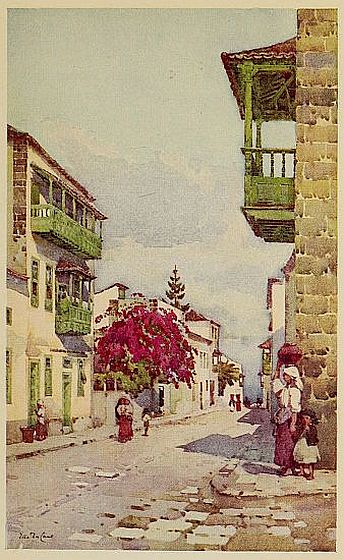
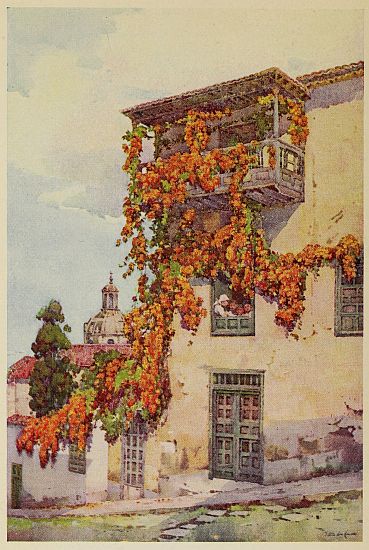
A STREET IN PUERTO OROTAVA
Low on the shore lies the little sea-port town of
Orotava, known as the Puerto to distinguish it from
the older and more important Villa Orotava lying
some three miles away inland, at a higher altitude.
Further along the coast is San Juan de la Rambla,
and on the lower slopes of the opposite wall of the
valley are the picturesque villages of Realejo Alto
and Bajo, while Icod el Alto is perched at the very
edge of the dark cliffs of the Tigaia at a height of
about 1700 ft. A gap in the further mountain
range is known as the Portillo, the Fortaleza rises
above this “gateway,” and from this point begins
the long gradual sweep of the Tigaia, which, from
the valley, hides all but the very cone of the Peak.
Above Villa Orotava towers Pedro Gil and the
Montaña Blanca, with the sun glittering on its
freshly fallen snow, and near at hand are the villages
of Sauzal, Santa Ursula, Matanza and La Victoria.
Though Humboldt describes them as “smiling
hamlets,” he comments on their names which he
says are “mingled together in all the Spanish
colonies, and they form an unpleasing contract with
the peaceful and tranquil feelings which these
countries inspire.
“Matanza signifies slaughter, or carnage, and the
word alone recalls the price at which victory has
been purchased. In the New World it generally
indicates the defeat of the natives; at Teneriffe the
village Matanza was built in a place where the
Spaniards were conquered by those same Guanches
who soon after were sold as slaves in the markets
of Europe.”
In early winter the terraced ridges, which are
cultivated with wheat and potatoes, are a blot in
the landscape, brown and bare, but in spring, after
the winter rains, these slopes will be transformed
into sheets of emerald green, and it is then that the
valley looks its best. For a few days, all too few,
the almond trees are smothered with their delicate
pale pink blooms, but one night’s rain or a few
hours’ rough wind will scatter all their blossoms,
and nothing will remain of their rosy loveliness but
a carpet of bruised and fallen petals.
The valley soon reveals traces of the upheavals of
Nature in a bygone age; broad streams of lava,
which at some time poured down the valley, remain
grey and desolate-looking, almost devoid of vegetation,
and the two cinder heaps or fumaroles resembling
huge blackened mole-hills, though not
entirely bare, cannot be admired. No one seems to
know their exact history or age, but it appears
pretty certain that they developed perfectly independently
of any eruption of the Peak itself,
though perhaps not “growing in a single night,”
as I was once solemnly assured they had done. One
theory, which sounded not improbable, was that the
bed of lava on which several English villas, the
church and the Grand Hotel have been built, was
originally spouted out of one of these cinder heaps,
and the hill on which the hotel stands was in former
days the edge of the cliff. The lava is supposed to
have flowed over the edge and accumulated to such
a depth in the sea below that it formed the plateau of
low-lying ground on which the Puerto now stands.
The little town is not without attraction, though
its streets are dusty and unswept, being only cleaned
once a year, in honour of the Feast of Corpus
Christi, on which day at the Villa carpets of
elaborate design, arranged out of the petals of
flowers, run down the centre of the streets where
the processions are to pass. My first impression of
the town was that it appeared to be a deserted city,
hardly a foot passenger was to be seen, and my
own donkey was the only beast of burden in the
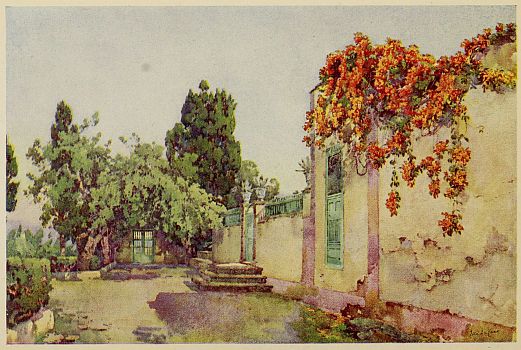
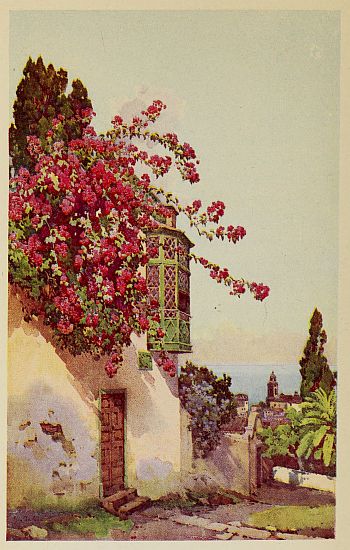
main street of the town. Gorgeous masses of
bougainvillea tumbled over garden walls, and
glimpses were to be seen through open doorways of
creeper-clad patios. The carved balconies with
their little tiled roofs are inseparable from all the
old houses, more or less decorated according to the
importance of the house. The soft green of the
woodwork of the houses, and more especially of the
solid green shutters or postijos, behind which the
inhabitants seem to spend many hours gazing into
the streets, was always a source of admiration to
me. The main street ends with the mole, and
looking seawards the surf appears to dash up into
the street itself. The town wakes to life when
a cargo steamer comes into the port, and then one
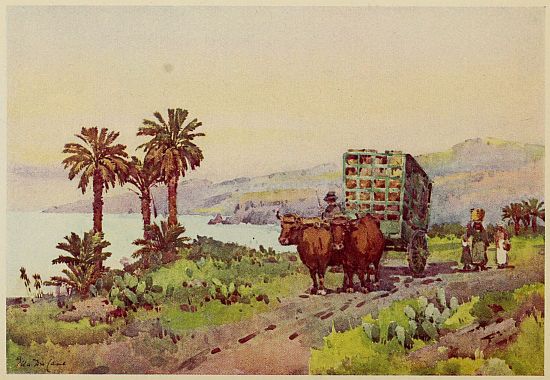
long stream of carts, drawn by the finest oxen I
have ever seen, finds its way to the mole, to unload
the crates of bananas which are frequently sold on
the quay itself to the contractors.
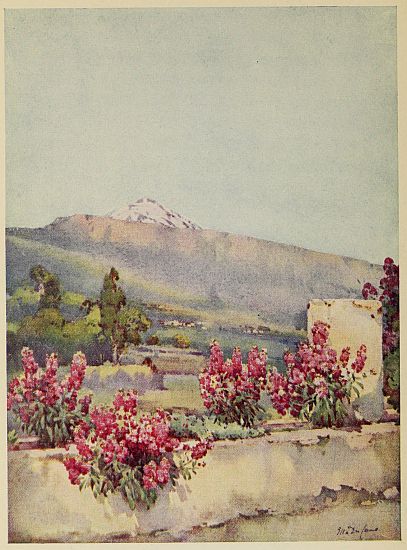
THE PEAK, FROM VILLA OROTAVA
II
TENERIFFE (continued)
About a thousand feet above the Puerto de
Orotava, on the long gradual slope which sweeps
down from Pedro Gil forming the valley of
Orotava, lies the villa or town of Orotava. This
most picturesque old town is of far more interest
than the somewhat squalid port, being the home of
many old Spanish families, whose beautiful houses
are the best examples of Spanish architecture in
the Canaries. Besides their quiet patios, which
are shady and cool even on the hottest summer
days, the exterior of many of the houses is most
beautiful. The admirable work of the carved
balconies and shutters, the iron-work and carved
stone-work cannot fail to make every one admire
houses which are rapidly becoming unique. The
Spaniards have, alas! like many other nations, lost
their taste in architecture, and the modern houses
which are springing up all too quickly make one
shudder to contemplate. Some had been built to
replace those which had been burnt, others were
merely being built by men who had made a fortune
in the banana trade. Not satisfied with their old
solid houses, with their fine old stone doorways and
overhanging wooden balconies, they are ruthlessly
destroying them to build a fearsome modern monstrosity,
possibly more comfortable to live in, but
most offending to the eye. The love of their
gardens seems also to be dying out, and as I
once heard some one impatiently exclaim, “They
have no soul above bananas,” and it is true that
the culture of bananas is at the moment of all-absorbing
interest.
Though the patios of the houses may be decked
with plants, the air being kept cool and moist by
the spray of a tinkling fountain, many of the little
gardens at the back of these old family mansions
have fallen into a sad state of disorder and decay.
The myrtle and box hedges, formerly the pride of
their owners, are no longer kept trim and shorn,
and the little beds are no longer full of flowers.
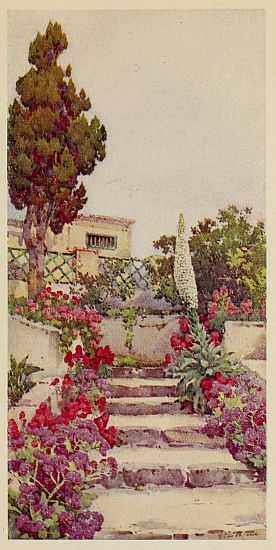
One garden remains to show how, when even
slightly tended, flowers grow and flourish in the
cooler air of the Villa. In former days a giant
chestnut tree was the pride of this garden, only its
venerable trunk now remains to tell of its departed
glories; but the poyos (double walls) are full of
flowers all the year, and the native Pico de paloma
(Lotus Berthelotii) flourishes better here than in
any other garden; it drapes the walls and half
smothers the steps and stone seats with its garlands
of soft grey-green, and in spring is covered with its
deep red “pigeons’ beaks.” The walls are gay with
stocks, carnations, verbenas, lilies, geraniums, and
hosts of plants. Long hedges of Libonia floribunda,
the bandera d’España of the natives, as its red and
yellow blossoms represent the national colours of
Spain, line the entrance, and in unconsidered damp
corners white arum lilies grow, the rather despised
orejas de burros, or donkeys’ ears, of the country
people, who give rather apt nick-names to not only
flowers, but people.
Though the higher-class Spaniards are a most
exclusive race, I met with nothing but civility from
their hands when asking permission to see their
patio or gardens; as much cannot be said for
the middle and lower classes of to-day, who are
distinctly anti-foreign. The lower classes appear
to regard an incessant stream of pennies as their
right, and hurl abuse or stones at your head when
their persistent begging is ignored, and even
tradesmen are often insolent to foreigners. A
spirit of independence and republicanism is very
apparent. An employer of labour can obviously
keep no control over his men, who work when they
choose, or more often don’t work when they don’t
choose, and the mother or father of a family keeps
no control over the children. One day I asked our
gardener why he did not send his children to
school to learn to read and write, as he was
deploring that he could not read the names of the
seeds he was sowing. I thought it was a good
moment to point a moral, but he shrugged his
shoulders, and said they did not care to go, and
also they had no shoes and could not go to school
barefoot. The man was living rent free, earning
the same wages as an average English labourer,
and two sons in work contributed to the expenses
of the house, besides the money he got for the crop
on a small piece of land which the whole family
cultivated on Sundays, and still he could not
afford to provide shoes in order that his children
should learn to read and write. Another man
announced with pride that one of his children
attended school. Knowing he had two, I inquired,
“Why only one?” On which he owned that
the other one used to go, but now she refused
to do so, and neither he nor his wife could
make her go. This independent person was aged
nine!
One of the great curiosities of the Villa was the
great Dragon Tree, and though it stands no more,
visitors are still shown the site where it once stood
and are told of its immense age. Humboldt gave
the age of the tree at the time of his visit as being
at least 6000 years, and though this may have been
excessive, there is no doubt that it was of extreme
age. It was blown down and the remains accidentally
destroyed by fire in 1867, and only old
engravings remain to tell of its wondrous size.
The hollow trunk was large enough for a good-sized
room or cave, and in the days of the Guanches,
when a national assembly was summoned to
create a new chief or lord, the meeting place
was at the great Dragon Tree. The land on
which it stood was afterwards enclosed and became
the garden of the Marques de Sauzal.
The ceremony of initiating a lord was a curious
one, and the Overlord of Taoro (the old name of
Orotava), was the greatest of these lords, having
6000 warriors at his command. Though the dignity
was inherited, it was not necessary that it should
pass from father to son, and more frequently passed
from brother to brother. “When they raised one
to be lord they had this custom. Each lordship
had a bone of the most ancient lord in their
lineage wrapped in skins and guarded. The most
ancient councillors were convoked to the ‘Tagoror,’
or place of assembly. After his election the king
was given this bone to kiss. After having kissed
it he put it over his head. Then the rest of the
principal people put it over his shoulder, and he
said, ‘Agoñe yacoron yñatzahaña Chacoñamet’
(I swear by the bone on this day on which you
have made me great). This was the ceremony of
the coronation, and on the same day the people
were called that they might know whom they had
for their lord. He feasted them, and there were
general banquets at the cost of the new lord and his
relations. Great pomp appears to have surrounded
these lords, and any one meeting them in the road
when they progressed to change their summer
residence in the mountains to one by the sea in
winter, was expected to prostrate himself on the
ground, and on rising to cleanse the king’s feet
with the edge of his coat of skins.” (See “The
Guanches of Teneriffe,” by Sir Clement Markham.)
After the conquest the Spaniards turned the
temple of the Guanches into a chapel, and Mass was
said within the tree.
In the Villa are several fine old churches, whose
spires and domes are her fairest adornment. The
principal church is the Iglesia de la Concepcion,
whose domes dominate the whole town. The
exterior of the church is very fine, though the interior
is not so interesting. It is curious to think
how the silver communion plate, said to have
belonged to St. Paul’s Cathedral in London, can
have come into the possession of this church. The
theory that this and similar plate in the Cathedral
at Las Palmas are the scattered remains of the
magnificent church plate which was sold and dispersed
by the order of Oliver Cromwell is generally
accepted.
The fine old doorway and tower of the Convent
and Church of Santo Domingo date from a time
when the Spaniards had more soul for the beautiful
than they have at the present time.
The narrow steep cobbled streets are hardly any
of them without interest, and the old balconies, the
carved shutters and glimpses of flowery patios, with
a gorgeous mass of creeper tumbling over a garden
wall or wreathing an old doorway, combine to make
it a most picturesque town. A feature of almost
every Spanish house is the little latticed hutch which
covers the drip stone filter. In many an old house
creepers and ferns, revelling in the dampness which
exudes from the constantly wet stone, almost cover
the little house, and even the stone itself grows
maiden-hair or other ferns, and their presence is
not regarded as interfering with the purifying
properties of the stone, in which the natives place
great faith. I never could believe that clean water
could in any way benefit by being passed through
the dirt of ages which must accumulate in these
stones, there being no means of cleaning them
except on the surface. The red earthenware water-pots
of decidedly classical shape are made in every
size, and a tiny child may be seen learning to carry
a diminutive one on her head with a somewhat uncertain
gait which she will soon outgrow, and in
a year or two will stride along carrying a large
water-pot all unconscious of her load, leaving her
two hands free to carry another burden.
REALEJO ALTO
A charming walk or donkey-ride leads from the
Villa along fairly level country to Realejo Alto,
passing through the two little villages of La
Perdoma and La Cruz Santa. In early spring the
almond blossom gives a rosy tinge to many a
stretch of rough uncultivated ground, and in the
villages over the garden walls was wafted the heavy
scent of orange blossoms. The trees at this altitude
seemed freer of the deadly black blight which
has ravaged all the orange groves on the lower
land, and altogether the vegetation struck one as
being more luxuriant and more forward. The
cottage-garden walls were gay with flowers: stocks,
mauve and white, the favourite alelis of the natives,
long trails of geraniums and wreaths of Pico de
paloma, pinks and carnations and hosts of other
flowers I noticed as we rode past.
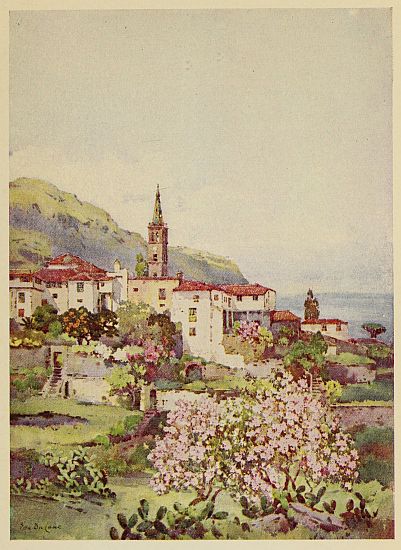
The village of Realejo Alto is, without doubt,
the most picturesque village I ever saw in the
Canaries. Its situation on a very steep slope with
the houses seemingly piled one above the other is
very suggestive of an Italian mountain village.
Part of the Church of San Santiago, the portion
next the tower, is supposed to be the oldest church
in the island, and the spire, the most prominent
feature of the village and neighbourhood, is worthy
of the rest of the old church. The interior of the
church is not without interest when seen in a
good light, and a fine old doorway is said to
be the work of Spanish workmen shortly after
the conquest. The carved stone-work round this
doorway and a very similar one in the lower village
are unique specimens of this style of work in the
islands.
The barranco which separates the upper and
lower villages of Realejo was the scene of a great
flood in 1820 which severely damaged both villages.
Realejo Bajo, though not quite as picturesque as
the upper village, is well worth a visit, and its inhabitants
are justly proud of their Dragon Tree,
a rival to the one at Icod which may possibly
some day become as celebrated as the great tree
at Orotava.
These two villages are great centres of the
calado or drawn-thread-work industry. Through
every open doorway may be seen women and girls
bending over the frames on which the work is
stretched. It is mostly of very inferior quality,
very coarsely worked and on poor material, and
it seems a pity that there is no supply of better
and finer work. Visitors get tired of the sight of
the endless stacks of bed-covers and tea-cloths
which are offered to them, and certainly the work
compares badly both in price and quality with that
done in the East.
III
TENERIFFE (continued)
A spell of clear weather, late in February, made
us decide to make an expedition to the Cañadas,
which, except to those who are bent on mountain
climbing and always wish to get to the very top
of every height they see, appeals to the ordinary
traveller more than ascending the Peak itself. In
spite of the promise of fine weather the day before,
the morning broke cloudy and at dawn, 6 A.M., we
started full of doubts and misgivings as to what
the sunrise would bring. We had decided to drive
as far as the road would allow, as we had been
warned that we should find nine or ten hours’ mule riding
would be more than enough, in fact, our
friends were rather Job’s comforters. Some said
the expedition was so tiring that they had known
people to be ill for a week after undertaking it.
Others said it was never clear at the top, we must
be prepared to be soaked to the skin in the mist,
for the mules to stumble and probably roll head
over heels, in fact that strings of disasters were
certain to overtake us. Our mules were to join
us at Realejo Alto, about an hour’s drive from the
port, and there we determined we would decide
whether we would continue, or content ourselves
with a shorter expedition on a lower level.
Sunrise did not improve the prospect, a heavy
bank of clouds lay over Pedro Gil, while ominous
drifts of light white clouds were gathering below
the Tigaia, and the prospect out to sea was not
more encouraging. The mules were late, in true
Spanish fashion, and we consulted a few weather-wise
looking inhabitants who gathered round our
carriage in the Plaza, shivering in the morning air,
with their mantas or blanket cloaks wrapped closely
round them. They looked pityingly at these mad
foreigners who had left their beds at such an hour
when they were not forced to—for the Spaniard is
no early riser—and were proposing to ride up into
the clouds. The optimistic members of the party
said: “It is nothing but a little morning mist,”
while the pessimist remarked, “Morning mists
make mid-day clouds in my experience.”
The arrival of the mules put an end to further
discussion. The muleteers were full of hope and
confident that the clouds would disperse, or anyway
that we should get above the region of cloud
and find clear weather at the top, so though our
old blanket-coated friend murmured “Pobrecitas”
(poor things) below his breath, we made a start
armed with wraps for the wet and cold we were to
encounter. The clattering of the mules as we rode
up the steep village street brought many heads to
the windows; the little green shutters, or postijos,
were hastily pushed open to enable the crowd,
which appeared to inhabit every house, to catch a
sight of the “Inglezes.” Inquiry as to where we
were bound for, I noticed, generally brought an
exclamation of “Very bad weather” (“Tiempo muy
malo”), to the great indignation of our men, who
muttered, “Don’t say so!”
The stony path from Realejo leads in a fairly
steep ascent to Palo Blanco, a little scattered
village of charcoal-burners’ huts at a height of
2200 feet. The wreaths of blue smoke from their
fires mingled with the mist, but already there was
a promise of better things to come, as the sun
was breaking through and the clouds were thinner.
The chant of the charcoal-burners is a sound one
gets accustomed to in these regions, and I never
quite knew whether it was merely a song which
cheered them on their downward path, or whether
it was to announce their approach and ask ascending
travellers to move out of their way, as the size of the
loads they carry on their heads makes them often
very difficult to pass. Presently two stalwart girls
came into sight, swinging along at a steady trot;
their bare feet apparently even more at home along
the stony track than the unshod feet of the mules,
as there is no stopping to pick their way, on they
go, only too anxious to reach their journey’s end,
and drop the crushing load off their heads. We
anxiously inquired as to the state of the weather
higher up, and to our great relief, with no hesitation,
came the answer: “Muy claro” (very clear),
and in a few minutes a puff of wind blew all the
mist away as if by magic, and there was a shout of
triumph from the men.
Below lay the whole valley of Orotava, and we
were leaving the picturesque town of the Villa
Orotava far away below us on the left. The little
villages of La Perdoma, La Cruz Santa, and the
two Realejos, Alto and Bajo, were more immediately
below us, and far away in the distance
beyond the Puerto were to be seen Santa Ursula,
Sauzal and the little scattered town of Tacoronte.
Pedro Gil and all the range of mountains on the
left had large stretches of melting snow, shining
with a dazzling whiteness in the sun. It had been
an unusual winter for snow, so we were assured,
and it was rare to find it still lying at the end of
February, but we were glad it was so, for it certainly
added greatly to the beauty of the scene.
At the Monte Verde, the region of green things,
we called a halt, for the sake of man and beast,
and while our men refreshed themselves with substantial
slices of sour bread and the snow white
local cheese, made from goats’ milk, and our mules
enjoyed a few minutes’ breathing-space with loosened
girths, we took a short walk to look down into the
beautiful Barranco de la Laura. Here the trees
have as yet escaped destruction at the hands of
the charcoal-burners and the steep banks are still
clad with various kinds of native laurel mixed with
large bushes of the Erica arborea, the heath which
covers all the region of the Monte Verde. The
almost complete deforestation by the charcoal-burners
is most deeply to be deplored, and it is
sad to think how far more beautiful all this region
must have been before it was stripped of its grand
pine and laurel trees. The authorities took no steps
to stop this wholesale destruction of the forests
until it was too late, and even now, though futile
regulations exist, no one takes the trouble to see
that they are enforced. The law now only allows
dead wood to be collected, but it is easy enough to
make dead wood—a man goes up and breaks down
branches of trees or retama, and a few weeks later
goes round and collects them as dead wood, and
so the law is evaded. As there is a never-ending
demand for charcoal, it being the only fuel the
Spaniard uses, so matters will continue until there
is nothing left to cut.
No doubt we were on the same path as that by
which Humboldt had travelled when he visited
Teneriffe in 1799 and ascended the Peak. His
description of the vegetation shows how the ruthless
axe of the charcoal-burners has destroyed some of
the most beautiful forests in the world. Humboldt
had been obliged to abandon his travels in Italy in
1795 without visiting the volcanic districts of Naples
and Sicily, a knowledge of which was indispensable
for his geological studies. Four years later the
Spanish Court had given him a splendid welcome
and placed at his disposal the frigate Pizarro
for his voyage to the equinoctial regions of New
Spain. After a narrow escape of falling into the
hands of English privateers the Trade winds blew
him to the Canaries. The 21st day of June, 1799,
finds him on his way to the summit of the Peak
accompanied by his friend Bonpland, M. le Gros,
the secretary of the French Consulate in Santa
Cruz, and the English gardener of Durasno (the
botanical gardens of Orotava). The day appears
not to have been happily chosen. The top of the
Peak was covered in thick clouds from sunrise up
to ten o’clock. Only one path leads from Villa
Orotava through the retama plains and the mal pays.
“This is the way that all visitors must follow who
are only a short time in Teneriffe. When people
go up the Peak” (these are Humboldt’s words)
“it is the same as when the Chamounix or Etna are
visited, people must follow the guides and one only
succeeds in seeing what other travellers have seen
and described.” Like others he was much struck
by the contrast of the vegetation in these parts of
Teneriffe and in that surrounding Santa Cruz,
where he had landed. “A narrow stony path leads
through Chestnut woods to regions full of Laurel
and Heath, and then further to the Dornajito
springs; this being the only fountain that is met with
all the way to the Peak. We stopped to take our
provision of water under a solitary fir tree. This
station is known in the country by the name of
Pino del Dornajito. Above this region of arborescent
heaths called Monte Verde, is the region of
ferns. Nowhere in the temperate zones have I
seen such an abundance of the Pteris, Blechium and
Asplenium; yet none of these plants have the
stateliness of the arborescent ferns which, at the
height of 500 and 600 toises, form the principal
ornaments of equinoctial America. The root of
the Pteris aquilina serves the inhabitants of Palma
and Gomera for food. They grind it to powder,
and mix it with a quantity of barley meal. This
composition when boiled is called gofio; the use of
so homely an aliment is proof of the extreme
poverty of the lower classes of people in the
Canary Islands. (Gofio is still largely consumed).
“The region of ferns is succeeded by a wood of
juniper trees and firs, which has suffered greatly
from the violence of hurricanes (not one is now
left). In this place, mentioned by some travellers
under the name of Caraveles, Mr. Eden states that
in the year 1705, he saw little flames, which
according to the doctrines of the naturalists of his
time, he attributes to sulphurous exhalations
igniting spontaneously. We continued to ascend,
till we came to the rock of La Gayta and to the
Portillo: traversing this narrow pass between two
basaltic hills, we entered the great plain of
Spartium.... We spent two hours in crossing
the Llano del Retama, which appears like an
immense sea of white sand. In the midst of the
plain are tufts of the retama, which is the Spartium
nubigenum of Aiton. M. de Martinière wished to
introduce this beautiful shrub into Languedoc,
where firewood is very scarce. It grows to a
height of 9 ft. and is loaded with odoriferous
flowers, with which the goat-hunters who met
in our road had decorated their hats. The goats
of the Peak, which are of a dark brown colour,
are reckoned delicious food; they browse on the
spartium and have run wild in the deserts from
time immemorial.” Spending the night on the
mountain, though in mid summer, the travellers
complained bitterly of the cold, having neither
tents nor rugs. At 3 A.M. they started by torch-light
to make the final ascent to the summit of the
Piton. “A strong northerly wind chased the
clouds, the moon at intervals shooting through
the vapours exposed its disk on a firmament
of the darkest blues, and the view of the volcano
threw a majestic character over the nocturnal
scenery.
“Sometimes the peak was entirely hidden from
our eyes by the fog, at other times it broke upon
us in terrific proximity: and like an enormous
pyramid, threw its shadow over the clouds rolling
at our feet.”
Scaling the mountain on the north-eastern side,
in two hours the party reached Alta Vista, following
the same course as travellers of to-day, passing
over the mal pays (a region devoid of vegetable
mould and covered with fragments of lava) and
visiting the ice caves. After the Laurels follow
ferns of great size, Junipers and Pines (not one is
now left of either) all the way up to the Portillo.
The Portillo was still towering far above us,
the gateway of the range, as its name implies,
through which we had to pass to get to the
Cañadas, and the stony path, though a well defined
one, meanders on, not at a very steep incline, past
rough hillocks where here and there pumice stone
appears. Gradually the heath, which was just
coming into flower, and in a few weeks would be
covered with its rather insignificant little white or
pinkish blossoms, becomes interspersed with codeso,
Adenocarpus viscosus, with its peculiar flat spreading
growth and tiny leaves of a soft bluish-green.
During all the long ascent there is no
sign of the Peak; the path lies so immediately
beneath the dividing range that it is not until the
Portillo itself is reached, that it suddenly bursts
into view. It is a grand scene which lies before
one. The foreground of rocky ground is interspersed
with great bushes of retama (Sparto-cytisus
nubigens), a species of broom said to be peculiar to
this district. In growth it somewhat resembles
Spartium junceum, commonly known in England as
Spanish broom, but is more stubby and perhaps not
so graceful. When in flower in May its sweet scent
is so powerful that not only does it fill the whole
air in this mountain district, but sailors are said to
smell it miles out at sea. Our guides told us some
bushes had white flowers and others white tinged
with rose colour. At this season large patches of
thawing snow take the place of flowers, but the
bushes of retama can be seen piercing the Peak’s
dense mantle of snow up to a height of quite
10,000 feet.
I had been told that all the beauty of the Peak
was lost when seen from so near, that the beautiful
pyramid of rock and snow which rises some 12,000
feet and stands towering above the valley of Orotava
would look like a mere hill when seen rising from
the moat of fine sand, which is what the Cañadas
most resemble, that in fact, all enchantment would
be gone. One writer even has gone so far as to
call the Peak an ugly cinder-heap when seen from
the Cañadas on the other side, and to say they found
themselves “in a lifeless, soundless world, burnt
out, dead, the very abomination of desolation,
where once raged a fiery inferno over a lake of
boiling lava.” I cannot help thinking that the
writer of the above must have been travelling under
adverse circumstances; it is curious how being overtired,
wet and cold will make one find no beauty
in a scene, which others, who like ourselves have
seen it in glorious sunshine, will describe as one of
the most beautiful sights in the world.
The path just beyond the Portillo (7150 ft.) divides,
and those who propose to ascend the Peak follow
the track up the side of the Montaña Blanca, a
snow-clad hump at the east base of the Peak. The
cone itself is locally called Lomo Tiezo, and rises
at an angle of 28°. The stone hut at the Alta Vista
(10,702 ft.) is where many a weary traveller spends
the night, before ascending the final 1400 ft. on
foot, as the mules are left at the hut. No doubt in
clear weather the traveller is well repaid, and the
scene is well described as follows by Mr. Samler
Brown: “Those who cannot ascend the mountain
would probably greatly help their imagination by
looking at a lunar crater through a telescope.
The surroundings are the essence of desolation and
ruin. On one side the rounded summit of the
Montaña Blanca, on the other the threatening craters
of the Pico Viejo and of Chahorra, the latter three-quarters
of a mile in diameter, 10,500 ft. high, once
a boiling cauldron and even now ready to burst
into furious life at any moment. Below, the once
circular basin of the Cañadas, seamed with streams
of lava and surrounded by its jagged and many-coloured
walls. Around, a number of volcanoes,
standing, as Piazzi Smyth says, like fish on their
tails with widely gaping mouths. On the upper
slopes the pine forests and far beneath the sea,
with the Six Satellites (the islands of La Palma,
Gomera, Hierro, Grand Canary, Fuerteventura and
Lanzarote) floating in the distance, the enormous
horizon giving the impression that the looker-on is
in a sort of well rather than on a height which,
taken in relation to its surroundings is second to
none in the world.”
To attain the rude little shrine at the Fortaleza
where a rest was to be taken, the path leads down
into the Cañadas itself. A stretch of fine yellow
sand, like the sand of the Sahara, thoroughly sun-baked,
proved too great a temptation to one of the
mules, and regardless of its rider and luncheon-basket,
it enjoyed a good roll in the soft warm bed—luckily
with no untoward results. After a welcome
rest in the grateful shade of a retama bush,
we turned our backs to the Peak and left this
beautiful solitary scene. The island of La Palma
seemed to be floating in the sky; the line of the
horizon dividing sea and sky appeared to be all out
of place, in fact it seems to be a weird uncanny
world in these parts, and though to-day the Peak
may be standing calm and serene, bathed in sunshine
and clad in snow, still it reminds one of the
death and destruction it has caused by fire and
flood, and who knows when it may some day awake
from its long sleep and shake the whole island to
its foundations.
It is an accepted theory that the Cañadas themselves
were originally an immense crater, the second
largest in the world, and during a period of activity
they threw up the Peak which became the new
crater. Probably during this process the Cañadas
themselves subsided, and left the wall of rock
which appears to form a perfect protection to the
Valley of Orotava in case the Peak should some
day again spout forth burning lava.
It was in the early winter of 1909 that the
inhabitants of Teneriffe were reminded that their
volcano was not dead. For nearly a year previously
frequent slight shocks of earthquake had warned
geological experts that some upheaval was to be
expected, which in November were followed by
loud detonations, each one shaking the houses in
Orotava. One of the inhabitants has described the
sensation as one of curious instability, that the
houses felt as though they were built on a foundation
of jelly. An entirely new crater opened twenty
miles from the Peak, and though so far distant
from Orotava, the flashes of light were distinctly
visible above the lower mountains on the south
side of the Peak. Very little damage seems to
have been done, as luckily there were no villages
near enough to be annihilated by the streams of
lava, but most exaggerated reports of the eruptions
were circulated in Europe, and it is even said that a
message was sent to the Spanish Government asking
for men-of-war to be sent at once to take away the
inhabitants as the island was sinking into the sea!
Many geological authorities have given it as their
opinion that it is most unlikely that there will be
another eruption in less than another hundred
years, which is consoling and reassuring.
As the paths were dry we were able to return
by a different route, which though rather longer is
far more beautiful, and to those who prefer walking
to riding downhill is highly to be recommended.
The mules appear to be more sure-footed in the
stony paths and once the region of the Monte
Verde begins again and the path is smooth their
unshod feet get no hold, and in wet weather the
path is a mere “mud slide” and should not be
attempted. It was a beautiful walk along the
crest of the range; the Peak was lost to sight but
the valley below lay filled with drifting patches of
light mist, through which could just be seen the
Villa bathed in the afternoon light, and above, all
was clear. Pedro Gil, and the Montaña Blanca
beyond, glowed in a red light, and right away in
the distance the mountains round La Laguna were
just visible.
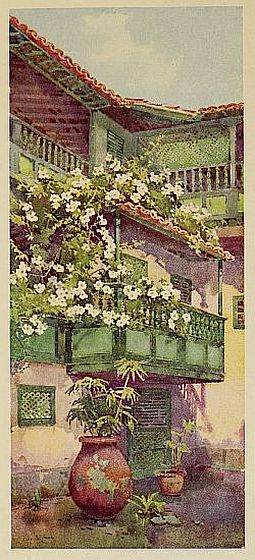
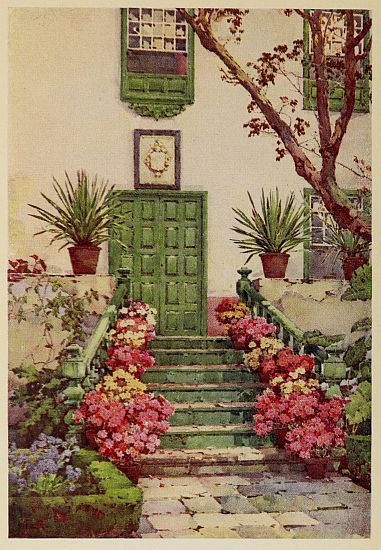
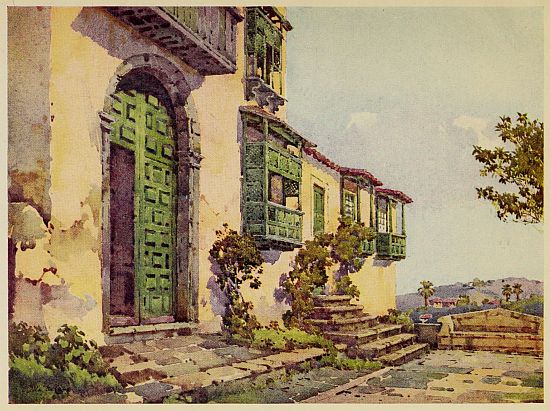
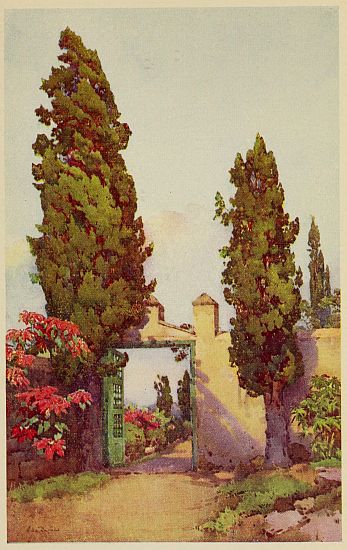
ENTRANCE TO A SPANISH VILLA
From La Corona the view is perhaps at its best.
On the left the pine woods above Icod de los Vinos
stretch away into the distance to the extreme west
of the island, and on the right the valley of Orotava
lies spread out like a map. Just below La Corona
one gets back into cultivated regions and the sight
of a country-woman with the usual burden on her
head reminded us how many hours it was since we
had seen a sign of life—not, indeed, since we had
passed the two charcoal-burners in the early morning
who had given such welcome news of clear
weather ahead. Icod el Alto, with the roughest
village street it has ever been my fate to encounter,
was soon left behind, and the mules trudged
wearily down as steep a path as we had met with
anywhere, to Realejo Bajo and back to civilisation
and the prosaic. A rickety little victoria with
three lean but gallant little horses took us home
exactly twelve hours from the time we started.
We had not meant to break records, and on
the homeward path had certainly taken things
easily—the ride from Realejo Alto to the Cañadas
was exactly four hours, one hour’s rest, five hours’
ride down, partly walking, and two hours’ driving—and
we were neither wet through nor so tired that
we were ill for a week. I had heard a good
description of mule riding by some one who was
consulted as to whether it was very tiring, and
his answer was, “It is not riding, you just sit, and
leave the rest to the mule and Providence!”
IV
TENERIFFE (continued)
I know nothing more enjoyable than a ramble
along the coast or up one of the many barrancos
in the neighbourhood of Orotava. I had always
heard that the Canary Islands were rich in native
plants, but I hardly realised that almost each
separate barranco (literally meaning a mountain
torrent, but now applied to any ravine or deep
gully) would have its own special treasures, and
that the cliffs by the sea are so rich in vegetation
that in many places they look like the most perfect
examples of rock gardens.
One of the best walks is up the steep little path,
hardly more than a goats’ track, which leads from
the Barranco Martinez to the cliffs below the
terrace of La Paz. It is possible to wander for
miles in this direction; occasionally, it is true, the
spell of enchantment in the way of plant collecting
will be broken by the path suddenly coming to
vast stretches of banana cultivation, but luckily
there is still a good deal of unbroken ground, and
the path leads back again to the verge of the cliffs
and inaccessible places. There are so many plants
that will be strangers to the newcomer that it is
hard to know which to mention and which to leave
out, as far be it from me to pretend to give a full
list of Canary plants, and the longer I stayed in
the islands the less surprised I was to hear that
a learned botanist had been four years collecting
material for a full and complete account of the
flora of the Canaries, and that still his work was
not completed. I think the first place must be
given to Euphorbia canariensis as one of the most
conspicuous and ornamental of the cliff plants.
Great clumps of this “candelabra plant,” as the
English have christened it (or cardon in Spanish),
are so characteristic that it will always be associated
in my mind with the cliffs of Teneriffe. Its
great square fluted columns may rise to 10 or
12 ft. leafless, but bearing near the top a reddish
fruit or flower, and having vicious-looking hooks
down the edges of its stout branches. If you gash
one of the columns with a knife out spurts its
sticky, milky juice, which if not really poisonous is
a strong irritant, and there is a legend that the
Guanches used it to stupefy fish, but precisely in
what manner I never ascertained. One feature of
the cliff vegetation cannot fail to strike every one,
and that is the soft bluish-green of nearly all the
plants. The prickly pears, as both the Cactuses
are commonly called, Opuntia Dillenii and Opuntia
coccinellifera—the latter especially appears to have
been introduced for the cultivation of cochineal,
and has remained as a weed—the sow thistles
(Sonchus), Kleinias, Artemerias, and nearly all the
succulent plants have grey-green colouring, which
is in such beautiful contrast to the dark cliffs. The
overhanging cliffs just below La Paz are of most
beautiful formation and colouring, in places a deep
brick red colour, owing to a deposit of yellow
ochre, and in others a tawny yellow, and so deep
are the hollows in the volcanic rocks and the air
chambers exposed by the inroads of the sea that
they have been made into dwellings. Apparently
more than one family and all their goods and chattels
are ensconced in the recesses of the rocks, and here
they live a real open air life, free from house tax or
any burden in the way of repairs to their dwellings.
The best of water-supplies is close at hand, indeed
the stream which gushes out of the rock provides
drinking water for the whole town, and when I was
told that one of these cave-dwellers was a harmless
lunatic, I thought there was a good deal of method
in his madness when I remembered the vile-smelling,
stuffy cottages that most of the poor inhabit.
Senecio Kleinia, or Kleinia neriifolia, has the
habit of a miniature dragon tree, its gouty-forked
branches having tufts of blue-green leaves. It
remains a shrubby plant about 5 ft. high, and
Plocama pendula, with its light weeping form
and lovely green colour, makes a charming contrast
to the stiff growth of the Euphorbias and
Kleinias, and all three are so thoroughly typical of
the cliff vegetation that they will probably be the
first to attract the attention of the newcomer.
Artemesia canariensis (Canary wormwood) is easily
recognised by its whitish leaf and very strong
aromatic scent, which is far from pleasant when
crushed. The native Lavender and various Chrysanthemums,
the parents probably of the so-called
“Paris Daisy” in cultivation, are common weeds,
but in March and April, the months of wild
flowers, many more interesting treasures may be
found, and while sitting on the rocks, within reach
of one’s hand a bunch of flowers or low-growing
shrubs may be collected, all probably new to a
traveller from northern climes. On the shady
damp side of many a miniature barranco or
crevasse will be seen nestling in the shadow of the
rocks which protect them from the salt spray,
broad patches of the wild Cineraria tussilaginis, in
every shade of soft lilac, prettier by far than any
of the cultivated hybrids. In one inaccessible spot
they were interspersed with a yellow Ranunculus,
and close by was one of the many sow-thistles
with its showy yellow flowers. On some of the
steep slopes, too steep happily for the cultivation
of the everlasting banana, the great flower stems
of the Agave rigida rear their proud heads twenty
feet in the air, and are the remains of a plantation
of these agaves, which was originally made with a
view to cultivating them in order to extract fibre
from their leaves. This variety is the true Sisal from
the Bahamas, botanically known as var. sisalana,
and the rapidity with which it increases once the
plants are old enough to bloom may be imagined
when it is said that from one single flower-spike
will drop 2000 new plants. Like many other
agricultural experiments in this island, fibre extraction
was abandoned, but I heard of some attempt
being made to revive it in the arid island of
Lanzarote. Among the beautiful strata of rock,
besides the Euphorbias and prickly pears, are to be
found many low-growing spreading bushes of the
succulent, Salsola oppositæ folia, Ruba fruticosa,
a white-flowering little Micromeria, Spergularia
fimbriata, whose bright mauve flowers would be
considered a most valuable addition to a so-called
“rock garden” in England, and the low-growing
violet-blue Echium violaceum, which is a dreaded
weed in Australia, where the seed was probably
accidentally introduced. I often used to think
when rambling over this natural rock garden
what lessons might be learnt by studying rock
formation before attempting to lay out in England
one of those feeble imitations of Nature which
usually result in lamentable failure, not only in
failure to please the eye, but failure to cultivate
the plants through not providing them with suitable
positions.
Those who have a steady head and do not mind
scrambling down steep narrow paths can get right
down on to the rugged rocks, and when a high sea
is running the spray dashes high on to the cliffs, and
one sits in a haze of white mist wondering how any
vegetation can stand the salt spray. The small
lilac Statice pectinata grew and flourished in
such surroundings, reminding one that in England
statices are generally called Sea Lavenders because
the native English Statice, S. Limonium, grows on
marsh land. The miniature-flowered heath-like
Frankenia ericifolia was also at home amid the
spray.
As the path in our wanderings frequently
led us back among large farms or fincas entirely
devoted to the cultivation of bananas, it may be
of interest to mention something of the history of
this most lucrative industry. It used to go to my
heart to see charming pieces of broken ground
being ruthlessly stripped of their natural vegetation,
old gnarled and twisted fig trees cut down,
and an army of men set to work to break up the
soil ready for planting. In most cases the top soil
is removed, and the soft earth-stone underneath
is broken up and the top soil replaced; but the
system appears to differ according to the nature of
the soil. Walls are constructed for the protection
of the plants, or in order to terrace the land and
get the level necessary for the system of irrigation
concrete channels being made for the water. So
the initial outlay of bringing land into cultivation
is heavy, but then the reward reaped is almost
beyond the dreams of avarice. Good land with
water used to fetch over £40 an acre per
annum—indeed, I have even heard of as high a
price as £60 having been obtained; that, even
if true, was exceptional; but perhaps nowhere else
in the world is land let for agricultural purposes
at such a rate. Land, however good, which was
not irrigated, was only fetching £4 to £6 an acre,
and though I was never able to ascertain exactly
how much per acre the water would cost, there is
no doubt the rate is a very high one; so the rent is
not all profit to the landlord. The life of a banana
plantation averages from twelve to fourteen years,
but for eighteen months no return is obtained, except
from the potato crop which is planted in between
the young plants, or, rather, the old stumps, from
which a young sucker will spring up and bear fruit.
That shoot will again be cut down, and by that
time several suckers will spring up, about three
being left as a rule on a plant, which will each bear
fruit in nine or ten months. An acre of land in
full bearing will produce over 2000 bunches, which
have to be gathered, carted, and carefully packed
for export.
Much of the labour on the plantations is done by
women, and long processions of them make their
way to the packing-houses, bearing the immense
bunches of green fruit on their heads. Bare-footed,
sturdy, handsome girls many of them, with curiously
deep voices in which they chant with a sing-song
note as they trip along with a splendid upright
carriage. Unfortunately their song is instantly
broken when they catch sight of a foreigner, and a
chorus of Peni, peni, peni, either getting louder and
louder if no attention is paid to the demand, or
turned to a bleating whine for una perrita (a little
penny), accompanied frequently by a volley of
stones. Foreigners complain bitterly of this begging,
but they have brought it on themselves by
throwing coins to children as they drive along the
road. Or when a crowd of urchins collects, as if to
reward them for their bright black eyes and pretty
faces, which many of them have, a shower of
coppers is thrown to them, so it is small wonder
that a race has grown up whose earliest instinct
teaches it to beg, and I feel sure that Peni is often
the first word that a toddling child is taught.
The packing-houses are also a blot on the landscape,
sometimes great unsightly sheds tacked on
to what has once been the summer residence of an
old Spanish family, and here crowds of men, women
and girls are wrapping up the bunches, which are
shipped in wooden crates by the thousand, and tens
or even hundreds of thousands, I should imagine,
judging by the endless procession of carts drawn by
immense bullocks which wend their way down to
the mole, when a steamer comes in to take a
whole cargo of the fruit to England. I used often
to wonder that it was possible to find such an unlimited
market for bananas when one thinks that
Grand Canary ships as many as Teneriffe, and they
have a formidable rival also in Jamaica. It is to be
hoped that the trade will not be overdone and the
markets fall, or that a blight will not come on the
plants, and that the Islands will not again suffer
from the ruin which followed the cochineal boom.
Bananas are said to have been introduced to the
Canaries from the Gulf of Guinea, but that was
not their real home, and no one knows how they
were originally brought from the Far East. From
the Canaries they were sent to the West Indian
Islands in 1516, and on from there to Central
America. Oviedo, writing about the natural history
of the West Indies, mentions having seen bananas
growing in the orchard of a monastery at Las
Palmas in 1520. The botanical name of the
Banana, Musa sapientum, was given in the old
belief that it was the fruit of the tree of knowledge
of good and evil. The variety now under cultivation
is Musa Cavendishii, the least tropical and
most suitable for cool climates. Locally they are
called Plátano, a corruption of the original name
Plántano, from plantain in English, under which
name they are always known in the East. Though
the plant has been known in the islands for nearly
four centuries, it was of no use as a crop before the
water which is so absolutely necessary for its cultivation
was brought down from the mountains.
Some residents—those, I noticed, who did not own
banana plantations—lament that the excessive
irrigation has made the climate of Orotava damper
than it used to be, but if the cultivation has brought
about a climatic change, it has also brought about
a financial change in the fortunes of the farmers
and landlords, and many an enterprising man, who
a few years ago was just a working medianero,
satisfied with his potato or tomato crop, has
little by little built up a very substantial
fortune.
A medianero is a tenant or bailiff who cultivates
the ground and receives a share of the profits. The
contract between the landlord and the medianero
varies a good deal on different estates, and the
system is rather complicated, but as a rule he
provides his tenant with a house rent free, pays for
half the seed of a cereal, potato or vegetable crop,
but none of the labour for cultivation, and the profits
made on the crop are equally divided. Sometimes,
especially in the case of banana cultivation, the
proprietor pays for half the labour of planting and
gathering the crop for sending to market, but never
for any of the intermediate labour. The landlord
provides the all-important water-supply, but all the
labour of irrigation has to be done by the medianero,
who also pays a share of taxes. The loss of a crop
through blight or a storm is equally shared. The
trouble of the system, which in some ways seems
a good one, must come in over the division of the
profits, as either the honesty of the tenant must be
implicitly trusted or an overseer must be present
when the crop is gathered to see that the landlord
gets his true medias.
At a higher altitude, some 800 or 900 ft. below
the village of Santa Ursula, which is justly famous
for its groups of Canary Palms, is a large estate,
as yet uncultivated from lack of sufficient water.
Besides the natural vegetation which stands the
summer drought, the owner has collected together
many drought-resisting plants, among which are
several natives of Australia. The Golden Wattle
seemed quite at home, though the trees have not yet
attained the size they would in their native country,
and small groves of Eucalyptus Lehmanni, with
their curious fluffy balls of flower, gave welcome
shade, and Australian salt bushes were being grown
as an experiment with a view to providing a new
fodder plant. The stony ground was covered
with a low-growing Cystus monspeliensis closely
resembling the variety much prized in England as
florentina, its white blossoms covering the bushes.
Many of the plants were the same as on the lower
cliffs, but Convolvulus scoparius I was much interested
to find growing in its natural state. The
growth so closely resembles that of the retama
that it might easily be mistaken for it; the natives
call it Leña Noel or Palo de rosa, but the flower
is like a miniature convolvulus growing all down
the stems. Both this and Convolvulus floridus
are known as Canary Rosewoods, and scoparius has
become rare owing to the digging of its roots from
which the oil was distilled. Dr. Morris of Kew
was a great admirer of C. floridus, and describes
guadil, as it is known locally, as “a most attractive
plant. When in flower it appears as if covered
with newly fallen snow. It is one of the few native
plants which awaken the enthusiasm of the local
residents.” Many Sempervivums were to be seen,
but S. Lindleyi is most curious. Its fleshy transparent
leaves grow in clusters and it has received
the local and very apt name of Guanche grapes.
Little Scylla iridifolium grew everywhere, and one
could have spent days collecting treasures, and I
felt torn in two between admiring the splendid
views which the headland commands, and trying
to add something to my most insufficient knowledge
of the native plants. Near the house in cultivated
ground were to be seen the two most
ornamental native brooms, Genista rhodorrhizoides
and Cytisus filipes; both are of drooping
habit, with very sweet-scented white flowers,
and should be more widely cultivated. The
former very closely resembles the variety mono-sperma,
which grows near the Mediterranean
coast.
STATICES AND PRIDE OF TENERIFFE
Here too were to be seen some splendid clumps
of the true native Statice arborea which for many
years gave rise to such botanical discussions. For
a long time this variety was lost and a hybrid of
arborea and macrophylla did duty for the true
variety, which was definitely pronounced extinct.
It was, I believe, Francis Messon who first collected
this plant in Teneriffe on his way to the Cape in
1773, and describes its locality as “on a rock in
the sea opposite the fountain which waters Port
Orotava.” These rocks were the Burgado Cove to
the east of Rambla del Castro, and it was again
found growing in this neighbourhood in 1829 by
Berthelot and Webb, who describe it in their
admirable book on the “Histoire Naturelle des Iles
Canaries.” Before this date another French
botanist, Broussonet, had “discovered” the plant
a few miles further along the coast, at Dauté
near Garachico, and after its complete disappearance
from the Burgado rocks, owing probably to
goats having destroyed it, it was re-discovered in
the Dauté locality a few years ago, through the
untiring efforts and perseverance of Dr. George
Perez. Having heard of the plants growing on
inaccessible rocks, he got a shepherd to secure the
specimens for him, the plants being hauled up by
means of ropes to which hooks were attached, and
it was no doubt thanks to their position that even
goats were not able to destroy them. So Statice
arborea was rescued and is once more in cultivation,
and one of the most ornamental and effective
garden plants it is possible to see. The loose
panicles of deep purple flower-heads last for weeks
in perfection, and are so freely produced that even
one plant of it seems to give colour to a whole
garden. The statices endemic to the various islands
form quite a long list and are all ornamental, and
prove the fact I have already mentioned of the
extremely restricted area in which many native
plants are found. The true Statice macrophylla
finds a home in only a small area on the north-east
coast of Teneriffe and is another very showy
species. Statice frutescens is very similar to Statice
arborea, but is of much smaller stature; its native
home appears to be—or to have been—on the
rocky promontory of El Freyle, to the extreme
west of Teneriffe.
From a single high rock, known as Tabucho,
near Marca, also on the west coast, came in 1907
a new variety, at first thought to be Preauxii, but
it was eventually found to be an entirely new
contribution and was named Statice Perezii after
Dr. Perez who discovered the plant and sent the
specimen to Kew.
The island of Gomera contributes the very blue-flowered
S. brassicifolia, its winged stems making
it easy to recognise, and from Lanzarote comes
S. puberula, a more dwarf kind, very varying in
colour. These appear to comprise the statices
best known now in cultivation, though there are
several other less interesting varieties.
Here, at Santa Ursula, great interest is also
taken in the Echiums, another race of Canary
plants. Echium simplex must be accorded first
place, as it is commonly called Pride of Teneriffe;
it bears one immense spike of white flowers, and
like the aloe, after this one supreme effort the
plant dies. The seed luckily germinates freely.
From the island of La Palma had come seed of
Echium pininana, and tales of a deep blue flower-spike
said to rise from 9 ft. to 15 ft. in the air, and
though the plants were only one year old some
showed promise of flowering. The pinkish
flowered E. auberianum, like so many of the
statices, has made its home in almost inaccessible
places among the rocks on the Fortaleza at a
height of some 7000 ft., close to the Cañadas.
Over the walls were hanging masses of Lotus
Berthelotii, one of the native plants I most
admired. Its long trails of soft grey leaves hang
in garlands and in spring come the deep red
flowers. The plant is known locally as Pico de
paloma (pigeon’s beak) and I found one seldom
gave it its true botanical name, which does not seem
to fit it. Here again is another plant whose native
lair has been lost. A stretch of country between
Villa Orotava and La Florida is known to have been
its home, but for years past botanists have hunted
for it in vain. A variety which differed slightly
found a home in the Pinar above Arico, but that
equally has disappeared.
V
TENERIFFE (continued)
To the east of the town lies a district where, in old
days, the Spaniards built their villas, as summer
residences, in which to escape from the heat and
dust of the town. In those days vineyards and
cornfields took the place of banana plantations and
potato fields, and near some of the villas are to
be seen to this day the old wine-presses with their
gigantic beams made of the wood of the native
pine. These presses have long been silent and idle,
as disease ravaged the vines some fifty years ago,
and “Canary sack” is no longer stored in the vast
cellars of the old houses.
LA PAZ
One of these old villas became our temporary
home, so I am to be forgiven for placing it first on
the list. A steep cobbled lane leads up from the
Puerto, bordered with plane trees, and here and
there great clumps of oleanders, to the plateau
some 300 feet above the sea on which stands the
house of La Paz. The outer gate is guarded by
the little chapel of Santo Amaro, and once a year
the clanging bell summons worshippers to Mass
and to escort the figure of the patron saint, amid
incense and rockets, down the long cypress avenue
to the terrace above the sea.
Each side of the faded green wooden doorway,
two giant cypresses stand like sentries to guard the
gate, through which may be seen, on one side, a
row of flaunting red poinsettias, waving their
gaudy blossoms above a low myrtle hedge, and on
the other side the high garden wall is draped with
orange creepers. At right angles to this path
facing the entrance to the house, a long avenue of
splendid lance-like cypresses rises above a thick
hedge of myrtles whose trunks speak for themselves
of their immense age. A round flight of
low steps leads to the forecourt, and the tiny inner
court is guarded by yet another faded green
doorway. Here flowers run riot in a little garden
where prim box hedges edge the paved walks. On a
flagged terrace stands the “House of Peace,” facing
the Atlantic, and from the solid green panelled door
there is an unbroken view down the long, straight
avenue to the dazzling, dancing sea below.
Over the door is a weather-stained coat-of-arms,
and above, again, on a piece of soft green scroll-work,
is the Latin motto “HIC EST REQUIES MEA,”
as here to his house of rest came the original owner,
to rest from his work in the town.
Very little seems to be known of the history of
La Paz, but it seems fairly certain that it was
built by an Irish family of the name of Walsh;
who, with many of their fellow countrymen, emigrated
to the Canaries after the siege of Limerick,
and in the church of N. S. de la Peña de Francia,
in the town, the tomb of Bernardo Walsh, who died
in 1721, bears the same arms as those which are
carved above the door. The family, who no doubt
entered into business in the town, appear to have
found a foreign name inconvenient and changed
it into Valois, as Bernardo Walsh is described as
alias Valois. The two Irish families of Walsh and
Cologan intermarried at some time, and the
property passed to the Cologans, who assumed
the Spanish title of Marquez de la Candia; to this
family La Paz still belongs, though it is many
years since they have lived there, and the present
owner, who lives in Spain, has never even seen the
property.
The traveller Humboldt is said to have been a
guest at La Paz for a few days, which has caused
many Germans to call it “Humboldt’s villa,” and
even to go so far as to say that he built it, though
he only paid a flying visit of four days to Orotava in
1799. From the account of his visit in his “Personal
Narrative” it appears doubtful as to whether he
stayed at La Paz or at the house belonging to the
Cologan family, in Villa Orotava. Alluding to his
short stay, he remarks: “It is impossible to speak
of Orotava without recalling to the remembrance of
the friends of science, the name of Don Bernardo
Cologan, whose house at all times was open to
travellers of every nation. We could have wished
to have sojourned for some time in Don Bernardo’s
house, and to have visited with him the charming
scenery of San Juan de la Rambla. But on a
voyage such as we had undertaken, the present is
but little enjoyed. Continually haunted by the
fear of not executing the design of to-morrow we
live in perpetual uneasiness....” Further on
he says: “Don Cologan’s family has a country
house nearer the coast than that I have just mentioned.
This house, called La Paz, is connected
with a circumstance that rendered it peculiarly
interesting to us. M. le Borde, whose death we
deplored, was its inmate during his last visit to the
Canary Islands. It was in a neighbouring plain
that he measured the base, by which he determined
the height of the Peak.” The house has no pretensions
to any great architectural beauty, but has
an air of peace and stateliness which the hand of
time gives to many a house of far less imposing
dimensions than its modern neighbour.
On one side of the house a few steps lead down
to the walled garden, a large square outlined and
traversed by vine-clad pergolas, which again form
four more squares. In the centre of one an
immense pine tree shelters a round water basin,
where papyrus and arums make a welcome shelter
for the tiny green frogs. One feature of these old
Spanish gardens might well be copied in other
lands; a low double plaster wall some two feet
thick, called locally a poyo, makes a charming
border for plants: geraniums, verbenas, stocks,
carnations, poppies, and the hanging Pico de
paloma, all look their best grown in this way, and
at a lower level a wide low seat ran along the
walls. The beds were edged with sweet-smelling
geranium, the white-leafed salvia, a close-growing
thyme, or box, all kept clipped in neat, compact
hedges. Some of the garden has now, alas!
been given over to a more profitable use than
that of growing flowers, and a potato crop is
succeeded in summer by maize, but enough
remains for a wealth of flowering trees, shrubs,
creepers and plants. The brilliant orange Bignonia
venusta covers a long stretch of the pergola, drapes
the garden wall and climbs up to the flat roof-top
of one of the detached wings of the house.
In summer a white stephanotis disputes possession
and covers the tiled roof of a garden shed, filling
the whole air with its delicious scent. Among
other sweet-smelling plants were daturas, whose
great trumpets are especially night-scented flowers,
and in early spring the tiny white blossoms of the
creeping smilex smell so much like the orange
blossoms which have not yet opened, that their
delicious fragrance might easily be mistaken for it.
Sweet-scented geraniums grow in every corner,
and heliotropes, sweet peas and stocks all add to
the fragrance of the garden.
The grounds contain several good specimen
palms, too many perhaps for the health of flowers,
as their roots seem to poison the ground; hibiscus,
coral trees, pittosperums and a long list of trees
common to most sub-tropical gardens find a home,
but the tree I most admired was a venerable specimen
of the native olive growing near a grove of
feathery giant bamboos.
The cypress avenue leads to a broad terrace at
a dizzy height above the sea; the surf beats against
the cliffs below, but the salt air does not seem to
affect the beautiful vegetation, and for long years
great clumps of Euphorbias and Kleinias have
stood against the winter storms when great breakers
roll in and crash against the rocks. On the left
lies the little flat town of the Puerto, over which
in clear weather the Island of La Palma emerges
from its mantle of clouds, and many a gorgeous
sunset bathes the whole town in a mist of rosy
light, recalling the legend that in days of old, navigators
had christened the little fishing-port the
Puerto de Oro, after Casa de Oro, the House of
Gold, which title they had given to the Peak, as
night after night the setting sun had turned its
cap of snow to pale gold.
On the right the broken coast-line stretches away
into the far distance, and the mountains rise above
the little villages; they in their turn are caught
by the setting sun and kissed by her last departing
rays, and turned to a rosy pink, but as the ball of
fire sinks into the sea, the shadows creep up, and in
one moment in this land which knows no twilight,
the light is gone and the cold greyness of night
takes possession.
Just behind La Paz are the Botanical gardens,
which owe their existence to the Marquez de
Nava, who in 1795 undertook at enormous expense
to level the hill of Durasno, and lay it out for
receiving the treasures of other climes. Though
complaints are often made of its distance from
the so-called “English colony,” the site was well
chosen, as the soil on this side of the barranco,
which separates it from the lava bed, is decidedly
more fertile, and being of a heavier nature and
deeper is less liable to blight and disease, which
are the curse of the gardens on light dry soil, and
which no amount of irrigation will cure. In this
garden are collected treasures from every part of
the world; new ground is sadly needed as the immense
trees and shrubs have made the cultivation
of flowers a great difficulty. Humboldt appreciated
the use of these gardens for the introduction of plants
from Asia, Africa and South America, remarking
that: “In happier times when maritime wars shall
no longer interrupt communication, the garden
of Teneriffe may become extremely useful with
respect to the great number of plants which are sent
from the Indies to Europe: for ere they reach our
coasts they often perish owing to the length of the
passage, during which they inhale an air impregnated
with salt water. These plants would meet
at Orotava with the care and climate necessary for
their preservation; at Durasno, the Protea, the
Psidium, the Jambos, the Chirinoya of Peru, the
sensitive plant, and the Heliconia all grow in the
open air.”
BOTANICAL GARDENS, OROTAVA
To give a list of all the trees and plants would
be an impossibility and any one who is interested
in them will find an excellent account of the gardens
in a pamphlet written by Dr. Morris of Kew,
who was much interested in his visit to the Canary
Islands in 1895. The gardens for some years fell
into a neglected state from lack of funds, but once
again bid fair to regain their former glory under
new management. Among the chief ornaments
of the gardens are the very fine specimens of the
native pine, Pinus canariensis, an immense Ficus
nitida, one of the best shade-giving trees, and
travellers from the tropics will recognise an old
friend in Ravenala madagascariensis, the “Traveller’s
Tree,” in the socket of whose leaves water is always
to be found.
Further up the road is the property of San Bartolomeo;
the land is now entirely devoted to banana
cultivation, the house is handed over to the tender
mercies of a medianero, and the garden tells a tale
of departed glories. In the patio of the house a
donkey is stalled under a purple bougainvillea, and
tall cypresses look down reproachfully at the fallen
state of things. In the chapel of the house mass
is still said daily, but for seven years I was told
the sala had not been opened. In the garden the
myrtle hedges have grown out of all bounds, jessamines
have become a dense tangle, and the plaster
poyos, which once were full of plants, are crumbling
to decay.
Near by is El Cypres, formerly a villa, and
named after its splendid cypresses, which mark
every old Spanish garden, and now unfortunately
appear to be little planted. This villa has been
turned into a pension, and its glory is also departed.
El Drago has been more fortunate, and has been
rescued by foreign hands, and the wealth of
creepers, especially Plumbago capensis, which in
autumn has a complete canopy of pale blue flowers
clambering over the pergolas, together with its
splendid trees, make a landmark in the landscape.
A few miles away I wandered one evening into
another deserted garden, not entirely uncared for,
as I was told the owner from the villa came there
for a few weeks in summer. This garden showed
that it had originally been laid out with great care
and thought, not in the haphazard way which
spoils so many gardens, and afterwards I learnt
that it had been planned by a Portuguese gardener,
and I recognised the little beds with their neat box
hedges, the clumps of rosemaries and heaths which,
though they were somewhat unkempt, showed that
in former days they had been clipped into shape
after the manner of all true Portuguese gardens. The
garden walls and plaster seats of charming designs
showed traces of fresco work in delicate colouring,
and soft green tiles edged the water basin, in which
grew a tangle of papyrus, yams and arums. A
garden house, whose roof was completely covered
with wistaria, was surrounded by a balcony whose
walls had also been frescoed, but now, alas, packing
cases for bananas had sorely damaged them. The
sole occupants of the garden appeared to be a pair
of peacocks; the male bird at the sight of an
intruder spread his fan and strutted down the
terrace steps to do the honours of the garden. The
flower-beds, which had once been full of begonias,
lilies, pelargoniums, and every kind of treasured
plant, are now too much overshadowed by large
trees, but I longed to have the restoring of this
garden to its former beauty.
On the other side of the yawning barranco lie
Sant Antonio and El Sitio del Pardo, both old
houses, built long before the town began to
develop and new houses cropped up on the western
side. Across this barranco a new road, which was
to lead from the carretera to the Puerto, was commenced
some years ago, and left unfinished, after
even the bridge had been constructed, because the
owner of a small piece of land refused to sell, or
allow the road to pass through his property. Thus
it remains a “broken road,” because, in true Spanish
fashion, no one had taken the trouble to make sure
that the land was available before the undertaking
was commenced; and still all the traffic to the
port has to wind its way slowly along several miles
of unnecessary road.
EL SITIO DEL GARDO
El Sitio is another old villa which was visited
by Humboldt, who was present on the eve of St.
John’s Day at a pastoral fête in the garden of
Mr. Little, who appears to have been the original
owner of El Sitio. Humboldt says: “This gentleman,
who rendered great service to the Canarians
during the last famine, has cultivated a hill covered
with volcanic substances. He has formed in this
delicious site an English garden, whence there is a
magnificent view of the Peak, of the villages along
the coast, and the isle of La Palma, which is
bounded by the vast expanse of the Atlantic. I
cannot compare this prospect with any, except the
views of the Bay of Genoa and Naples; but Orotava
is greatly superior to both in the magnitude of
the masses and richness of the vegetation. In the
beginning of the evening, the slope of the volcano
exhibited on a sudden a most extraordinary spectacle.
The shepherds, in conformity to a custom
no doubt introduced by the Spaniards, though it
dates from the highest antiquity, had lighted the
fires of St. John. The scattered masses of fire,
and the columns of smoke driven by the wind,
formed a fine contrast with the deep verdure of the
forest, which covered the sides of the Peak. Shouts
of joy resounding from afar were the only sounds
that broke the silence of nature in the solitary
regions.”
El Sitio is also well known as being the house
where Miss North made her headquarters when she
visited Teneriffe, and made her collection of drawings
of plants from Canary Gardens, which are in
the gallery at Kew. Miss North, in her book of
“Recollections,” appears to have thoroughly enjoyed
her stay, and describes this garden as follows:
“There were myrtle trees ten or twelve feet high,
Bougainvilleas running up cypress trees. Mrs.
Smith (the owner of the garden in those days)
complained of their untidiness, and great white
Longiflorum lilies growing as high as myself. The
ground was white with fallen orange and lemon
petals; the huge white Cherokee roses (Rosa lævigata)
covered a great arbour and tool-house with
their magnificent flowers. I never smelt roses so
sweet as those in that garden. Over all peeped
the snowy point of the Peak, at sunrise and sunset
most gorgeous, but even more dazzling in the
moonlight. From the garden I could stroll up
some wild hills of lava, where Mr. Smith had
allowed the natural vegetation of the island to
have all its own way. Magnificent aloes, cactus,
euphorbias, arums, cinerarias, sundry heaths, and
other peculiar plants, were to be seen in their fullest
beauty. Eucalyptus trees had been planted on the
top, and were doing well with their bark hanging
in rags and tatters about them. I scarcely ever
went out without finding some new wonder to
paint, lived a life of most perfect peace and happiness,
and got strength every day with my kind
friends.”
This property has been fortunate enough to
pass to other hands who still appreciate it, and
the above paragraph, though written so many
years ago, is still a very good description of the
garden.
Sant Antonio has not been so fortunate. For
some years its garden was the pride of Orotava. In
the terraced ground in front of the house, plants
and trees from every part of the world found a
home; but when the maker of this garden left it,
the owner ruthlessly tore up the garden to plant
bananas. Here and there among the banana-groves
may be seen a solitary bougainvillea still climbing
over its trellised archway, but little remains, except
on one terrace below the house, to show that the
garden was ever cared for. In the grounds there
still remains some very good treillage work. The
pattern of the screens, arches, and arbours are distinctly
Chippendale in character and design, and
are painted a soft dull green. In several other
instances I noticed admirable patterns in the woodwork
of screens to deep verandahs, and in the upper
part of wooden doorways. Chippendale must at
one time have been much admired and copied in
the Canaries, and to this day, in even the humblest
cottage, the chairs are of true Chippendale design,
though roughly carved.
VI
TENERIFFE (continued)
Icod de los Vinos, a little town on the coast, some
seventeen miles from Orotava, was in the days of its
prosperity a great centre of the wine and cochineal
trade. Its prosperous days are a thing of the past,
and to-day it appears to be rather a sleepy little
town; but possibly for just this reason it is more
picturesque than some of its richer neighbours,
whose inhabitants can afford to build modern and
most unsightly houses.
The drive from Orotava to Icod is by far the
most beautiful drive in the island. Once the dusty
stretch of carretera between the junction of the
road from Tacoronte to the Puerto is left behind,
the drive becomes full of interest. The road passes
below the picturesque little village of Realejo Bajo,
skirts the towering cliffs on which is perched the
little village of Icod el Alto some 1700 ft. above,
and winds along the sea shore. Every turn of the
road brings into sight a fresh view of the deeply
indented coast-line between the storm-bent old
tamarisk trees which edge the road for miles. The
long avenues of eucalyptus trees, with their ragged
bark hanging in strips, will always be associated in
my mind with all the carriage roads in Teneriffe.
Early in March the vegetation reminds one that
spring has begun. The geraniums in the cottage
gardens are showing promise of their summer
glory, fringing the walls or hanging in long trails
from the little flat roof tops. The winter rains
have washed the dust off the hedge-rows and
banks, and in places where water is dripping from
the rocks they are draped with a thick coating of
maiden-hair fern, and the pale lilac blossoms of the
wild coltsfoot, Cineraria tussilaginis, stud the banks.
I should imagine this to have been the parent of the
variety known in cultivation as Cineraria stellata,
so much grown of late years in English greenhouses.
The rocks themselves are studded with
the curious flat Sempervivum tabulæformæ, looking
like great green nail heads, and S. canariensis was
just throwing up flower-spikes from its rosettes of
cabbage-like leaves. Here and there a little waterfall
gives welcome moisture to water-loving plants.
Common brambles, encouraged by the dampness,
grow to vast dimensions and hang in rich profusion,
winding themselves into cords until they
look like the lianes of a tropical forest. Far down
in the crevasse below the stone bridges, the long
fronds of ferns, the untorn leaves of a seedling
banana, with the large leaves of the common yam,
suggest a sub-tropical garden.
Between the road and the sea are great stretches
of land cultivated with bananas, a mine of wealth
to their owners, who now no longer visit their
summer residences on these estates. Neglected
gardens tell a tale of departed glories, and many of
the houses are left to fall to rack and ruin, or are
merely inhabited by the medianero who has rented
the ground.
Near the outskirts of San Juan de la Rambla a
stone arch crosses the road, and just beyond, the
deep Barranco Ruiz cuts into the mountain sides.
It is a grand rocky ravine, and by a steep narrow
path which winds up the side it is possible to reach
Icod el Alto at the top of the barranco.
The little town of San Juan de la Rambla is very
picturesquely situated, and every traveller is shown
the beautifully carved latticed balcony on an old
house, as the carriage rattles through the little
narrow street. We are told that luckily the
balcony is made of the very hard and durable wood
of the beautiful native pine, Pinus canariensis,
which is rapidly becoming a rare tree in the lower
parts of the island. The wood itself is locally called
tea, and the trees are called teasolas by the country
people, who know no other name for them.
Once San Juan is passed the Peak becomes the
centre of interest. The luxuriant vegetation is left
behind, the beauty of the coast is forgotten, and
the completely different aspect which the Peak
presents from this side absorbs one’s attention.
The foreground is nothing but rocky ground, but
numbers of Cistus Berthelotianus brighten up the
barren ground with their bushes of showy rose-coloured
flowers. In places they were interspersed
with great quantities of asphodels, whose branching
spikes of starry white and brownish flowers seem
hardly worthy of their romantic name. In reality
they have always sadly shattered my mental picture
of the asphodel—the chosen flower of the ancients,
the flower of blessed oblivion—this surely should
have been a superb lily, pure white, and “fields of
asphodels” which we read of should be rich green
meadows full of moisture, where the lilies should
grow knee deep, not arid tufa slopes where erect
rods of this strange blossom rise from a cluster of
half-starved narrow leaves. The local name is
gamona, and in Grand Canary where they abound,
one large tract of land is called El llano de las
gamonas, the plain of asphodels.
At a higher level begins the Pinar or forest
of that most beautiful of all pines, the native Pinus
canariensis. Here on the lower cultivated ground
the few specimens that remain, having escaped
complete destruction, are mostly mutilated, having
had all their lower branches cut for firewood or
possibly for fear they should shade some little patch
of potatoes or onions, and the younger trees
resemble a mop more than a tree, with nothing left
but a tuft of fluffy branches at the top.
The little town of Icod de los Vinos is prettily
situated, being built on a great slope, intersected
by many streams of lava. There is a very picturesque
Plaza with a little garden and fountain in
front of the old convent of San Augustin, whose
façade has several carved latticed balconies which
are the great beauty of all the old houses in
Teneriffe.
Visitors to Icod are all taken to see their famous
dragon tree, Dracæna Draco, of which the inhabitants
are justly proud, as it is now the largest
and oldest in the island since the destruction of its
rival in Villa Orotava. We were assured its age
was over 3000 years, an assertion I was not
prepared to dispute, and hardly even ventured to
look incredulous, and so cast a slur on their almost
sacred El drago. There is no doubt the growth of
these trees is almost incredibly slow; they increase
in height in the same way as a palm, putting out
new leaves in the heart of the tufted crowns and
dropping an equal number of old ones, which
process leaves a curiously scarred marking on the
bark. No one seems to know how often a tuft
flowers, but certainly only once in many years, and
it is only after flowering that the stem forks, so in
specimens which are centuries old the head of the
tree becomes a mass of short branches with tufted
heads, which in their turn become divided, and so
it goes on until one begins to wonder whether there
is not some truth in the immense age attributed
to them. The curious aerial roots which descend
from the branches gradually creep down, and it is
the layers upon layers of these that strengthen the
original stem sufficiently to enable it to bear the
immense weight of its tufted crown, as decay seems
always to set in in the heart of the stem, and by the
time the trees attain to a venerable age they are
invariably hollow. An old document describing
the tree says “it has no heart within. The wood
is very spongy and light, so that it serves for the
covering of hives or making shields. The gum
which this tree exudes is called dragon’s blood, and
that which the tree sweats out without cutting is
the best, and is called ‘blood by the drop.’ It is
very good for medicine, for sealing letters, and for
making the teeth red.”
Icod is a good centre for expeditions, and those
who are brave enough to face the dirt and discomfort
of a Spanish fonda can pass a week or so very
pleasantly. It is a matter of great regret that
better accommodation is not available in many of
the smaller towns, and I own that personally I
could never bring myself to face the native inn.
No scenery is worth the discomfort of dirty beds,
impossible food and the noise of the patio of
a fonda, where as often as not, goats, chickens,
pigeons and a braying donkey all add to the concert
of the harsh loud voices of the women servants.
Now that motor-cars are available in Orotava it
renders matters much easier for making expeditions
in the day. Formerly, the greater part of the day
was occupied by the drive to and from Icod, but
if an early start is made, on arrival at Icod there
is still a long day before one, and it is possible to
make a visit to the old Guanche burial caves or to
continue the road to Garachico. This now unimportant
little village was once the chief port of the
island, and the number of old churches and convents
still remaining speak for themselves of the
former importance of the place. In the days when
Icod de los Vinos, as its name implies, was celebrated
for its vines, the wine which was made
there was shipped from the port of Garachico. The
old sugar factory which still stands was once the
property of an English firm, but the various booms
in the wine, cochineal and sugar trade, are things
of the past, and Orotava is now the centre of the
banana boom.
Possibly the pleasantest expeditions from Icod
are those which lead through the pine forest past
the Ermita Sta. Barbara. Good walkers will find
magnificent walks along fairly level paths once
they have accomplished the first climb of about
3000 ft., and can make their way along to the
Corona and down the steep zig-zag path below
Icod el Alto, or there is a lower track which makes
a good mule ride back to Orotava.
VII
TENERIFFE (continued)
Many visitors to Teneriffe find their way across
the mountains from Orotava to Guimar in the
course of the winter or spring, which is the best
time for the expedition. Though the actual time
required for the journey from point to point may
be only about seven hours, according to the condition
of the road, it is best to make an early start
and to have the whole day before one, so as to
have plenty of time to rest on the way and enjoy
all there is to be seen.
Once the last steep streets of the Villa Orotava
are left behind the country at once changes its
aspect. The banana fields, which have become
somewhat monotonous after a long stay in their
midst, have vanished, the air is cooler, and in
the early morning the ground is saturated with
dew. In spring the young corn makes the
country intensely green, and the pear and other
fruit blossoms lighten up the landscape, while in
the hedge-rows are clumps of the little red
Fuchsia coccinea, and great bushes of the common
yellow broom. Here and there the two Canary
St. John’s worts, Hypericum canariensis and
H. floribundum, are covered with berries, their
flowers having fallen some months before. Ferns
and sweet violets grow on the damp and shady
banks, and occasionally fine bushes of Cytisus prolifer
were to be seen smothered with their soft, silky-looking
white flowers. Gradually the region of
the chestnut woods is reached, but these having
only dropped their leaves after the spell of cold
weather early in January, are still leafless, and it is
sad to see how terribly the trees are mutilated by the
peasants. Though not allowed to fell whole trees,
the law does not appear to protect their branches,
and often nothing but the stump and a few
straggling boughs remain, the rest having been
hacked off for firewood. Small bushes of the
white-flowered Erica arborea soon appear, and the
showy rose-coloured flowers of Cistus vaginatus
were new to me.
At a height of about 3800 feet the level of the
strong stream called Agua Mansa is reached, and
though it is not actually on the road to Guimar
many travellers make a short détour to visit the
source of the stream and the beautifully wooded
valley. The absence of woods in the lower country
no doubt makes the vegetation on the steep slopes
of the little gorge doubly appreciated. Many
narrow paths lead through the laurel and heath,
and on the shady side of the valley the extreme
moisture of the air has clothed the stems of the
trees with grey hoary lichens. The luxury of the
sound of a running stream is rare in Teneriffe and
one is tempted to linger and enjoy the scene under
a giant chestnut tree, which has shaded many a
picnic party from the Puerto.
By retracing one’s steps for a short distance the track is regained;
Pedro Gil looms far ahead and the long steep ascent begins, up the
narrow mule path among thickets of the tree heaths. Here these heaths
are merely shrubby, not the splendid specimens which may be seen near
Agua Garcia, where they are protected from the charcoal-burners,
but the wide stretches covered with white flowers are very lovely
appearing through the mist, which even on the finest day is apt to
sweep across occasionally. The vegetation on these Cumbres is much the same as that which
is passed through on the way to the Cañadas, and in spring the Adenocarpus viscosus or anagyrus, its tiny yellow flowers growing among the
small leaves which crowd the branches, is about the last sign of plant
life. Above this region are merely occasional patches of moss which
live on the moisture of the mist which more often than not enwraps
these heights. In clear weather, the long and rather tedious scramble
of the last part of the road is soon forgotten in the delight at the
magnificent view at the end. The top of the pass, 6800 ft., is like
the back-bone of the island, and on the one side the whole valley of
Orotava lies stretched below, with the Peak standing grand and majestic
on the left, and on the other side lie the slopes down to the pine
woods above Arafo. It is hard to agree with a writer who describes the
scene as one of “immense desolation and ugliness, the silence broken
only by the croaking voice of a crow passing overhead.” It is just this
silence and stillness which appeals to so many in mountain regions;
there is something intensely restful yet awe-inspiring in the complete
peace which reigns in high altitudes in fair weather.
CONVENT OF SANT AUGUSTIN, ICOD DE LOS VINOS
A long pause is necessary to rest both man and
beast, as not only is the path a long and trying
one, but it is possible for the sun to be so extremely
hot even at that altitude that it seems to
bake the steep and arid slopes of lava and volcanic
sand, and the loose cinders near the end of the
climb make bad going for the mules. The so-called
path becomes almost invisible except to the
quick eye of the mules, accustomed as they are to
pick their way across these stretches of loose
scoriæ. Often the question “Which is the way?”
is met by the owner of the mule answering “Il
mulo sabe” (the mule knows), instead of saying,
“To the right” or “To the left,” and I generally
found he was right.
Many people prefer the ascent to the descent,
and certainly though I have nothing but praise for
mules as a means of locomotion going uphill,
there are moments when I preferred to trust to my
own legs going down the loose cindery track.
The fact that the eastern mountain slopes are
warmer and drier, as the rainfall is not so great,
encourages the vegetation to rise to a much
higher altitude and the barren world of lava and
cinders is sooner left behind. Our old friend the
Adenocarpus soon greeted us, like a pioneer of
plant life, and gradually came the different regions
of pine, tree heaths, laurels, and then the grassy
slopes.
The gorge known as the Valle is described as
“one of the most stupendous efforts of eruptive
force to be seen in the world, the gap appearing
to have been absolutely thrown into space.” A
network of what might well be mistaken for dykes
seems to cut up the surface, and the whole formation
of the Valle is of great interest to geologists.
To the ordinary observer it is certainly suggestive
of a desolate waste, and the black hill known as
the Volcan of 1705 does not help to give life to
the scene. The white lichen, which is the true
pioneer of plant life, is only beginning to appear,
though in crevices where deep cracks in the lava
have probably exposed soil below the sturdy
Euphorbias are getting a hold, and a few other
robust plants, such as the feathery Sonchus leptocephalus,
which I have always noticed seems to revel
in lava. Possibly another century may make a great
difference to the scene, but certainly during the
past two hundred years there has not been much
sign of returning vegetation, and the fiery stream
has done its work thoroughly. The relief is great
at once more reaching the pine woods above Arafo,
and the fatigue, not peril, of the descent being
over it is pleasant to find the comfort of the well-named
Buen Retiro Hotel at Guimar.
Though over a thousand feet above the sea, the
situation is so sheltered that Guimar boasts of one
of the best and sunniest climates in Teneriffe, the
little village lying as it were in a nest among the
hills. The flowery garden of the hotel tells its own
tale, better than any advertisement or guide-book,
and a week may be spent exploring the various
barrancos in the neighbourhood, especially by
botanists, or lovers of plants. The Barranco del
Rio is renowned as being about the best botanical
collecting ground in the island. Dr. Morris says
he found there no fewer than a hundred different
species of native plants, many of which he had not
seen elsewhere. The dripping rocks are clothed
with maiden-hair fern, and the giant buttercup,
Ranunculus cortusæfolius, appears to revel in the
damp and the high air. The Barranco Badajoz
is perhaps wilder and more precipitous; in places
the rocky walls of these gorges rise to 200 ft., and
appeal immensely to those who enjoy wild scenery.
The lack of a roaring river tumbling down them I
never quite got over, during all my stay in Teneriffe.
Perhaps in a bygone age they existed, and
owing to some eruption cracks were formed and
the water vanished, as the bed of the stream seems
to be there, but, alas! no water or only a trickling
stream. The tiniest stream has to be utilised to
provide water for a village below or for irrigation
purposes, and this, combined with the deforestation
of the island, no doubt has helped to drain the
barrancos. There is more water in the Guimar
ravines than in most, and from the Barranco del
Rio or the Madre del Agua I should imagine the
whole water-supply of the village is derived.
Those who are interested in relics should visit
Socorro, about an hour distant from Guimar, the
original home of the miraculous image of the Virgin
de Candelaria. So celebrated was this image that
nearly a whole book on the subject has been issued
by the Hakluyt Society, edited and translated from
old documents by Sir Clement Markham. The
image is supposed to have been found in about the
year 1400, by some shepherds, standing upright
on a stone in a dry deserted spot near the sandy
beach. A cross was afterwards erected by
Christians when the Spaniards occupied the island
to mark the spot, and in front of it was built the
small hermitage called El Socorro. One shepherd
saw what he supposed to be a woman carrying a
child standing in his path, and as the law in those
days forbad a man to speak to a woman alone in
a solitary place, on pain of death, he made signs
to her to move away in order that he and his sheep
might pass. No notice being taken and no reply
made, he took up a stone in order to hurl it at the
supposed woman, but his arm became instantly
stiff, and he could not move it. His companion,
though filled with fear, sought to ascertain whether
she was a living woman, and tried to cut one of
her fingers, but only cut his own, and did not even
mark the finger of the image. These accordingly
were the two first miracles of the sacred figure.
These shepherds related their experiences to the
Lord of Guimar, who after being shown the stiff
arm and cut fingers of the men, summoned his
councillors to consult as to what had best be done.
Accompanied by his followers and guided by the
shepherds, he came to the spot and ordered the
shepherds to lift the figure, as it apparently was
no living thing, and to remove it to his house.
On approaching the image to carry out their
Lord’s orders, the stiff arm of the one and the
cut fingers of the other instantly became cured.
The Lord and his followers were so struck
with the strange and splendid dress of the
woman, who was now invested as well with supernatural
powers, that they lost their first terror.
Determined to do honour to so strange a guest
within his dominions, the Lord of Guimar raised
the image in his arms and transported it to his
own house.
Unbelievers say that the image was merely the
figure-head of a ship which was washed up on the
beach, but the faithful maintain that so beautiful
was the image, so gorgeous its apparel and so
brilliant the gold with which it was gilded, that it
was the work of no human hands, and contact
with the sea would have destroyed the brilliancy of
its colouring.
The Lord of Guimar sent the news of the
wonderful discovery to the other chiefs in the
island, offering that the image, evidently endowed
with supernatural and healing powers, should spend
half the year within the territory of the Lord of
Taoro. This offer was declined, but the chief
came with many followers to see the new wonder,
which was set up on the altar in a cave and guarded
with great care. For some forty years the image
remained in the care of infidels, who regarded it
with great awe, and then it fell to the lot of a
boy named Auton, who had been converted to
Christianity by the Spaniards, to enlighten the
natives as to the nature of their treasure. On
being shown the figure he instantly recognised it
as being a representation of the Virgin, and after
having prayed before it, he instructed the natives
in the story of the Virgin Mary. The boy was in
return made sacristan of the image and it was
guarded day and night. At certain intervals
visions of processions on the beach were seen and
remains of wax candles were found, and a shower of
wax upon the beach was supposed to have been
sent to provide wax for candles to be burnt in
honour of Our Lady of Candelaria.
The neighbouring islands soon heard tales of
the holy relic and the inhabitants came to visit it.
For several centuries wonderful miracles were at
different times ascribed to it, and it continued to be
regarded with the deepest reverence, though the
housing and care of the image was the cause of
various feuds, and on one occasion it was stolen
and carried away to Fuerteventura, but was
returned.
Unfortunately, during a great storm in 1826,
the holy relic was swept away into the sea, and
thus was the original Virgin de Candelaria lost,
and though a new image was made and blessed by
the Pope it has never been regarded with quite the
same awe and reverence, though many pilgrims
visit the church on August 15, the feast of
Candelaria, and again on February 2.
VIII
GRAND CANARY
I have noticed that there is always a certain
amount of jealousy existing between the inhabitants
of a group of islands. In old days they
were of course absolutely unknown to each other,
and even spoke such a different language that they
had some difficulty in making themselves understood.
Though such is naturally not the case
to-day when in a few hours the little Interinsular
steamers cross from one island to another, still in
Teneriffe you are apt to be told there is nothing
to be seen in Grand Canary, or if you happen to
visit Las Palmas first you will probably be told
you are wasting your time in proposing to spend
some weeks or months in Teneriffe or in even
contemplating a flying visit to the other islands.
It was with a feeling of great curiosity that I
watched our approach to Grand Canary, as one
evening late in May our steamer crept round the
isthmus known as La Isleta and glided into the
harbour of Puerto de la Luz. Many towns look
their best from the sea and this is perhaps
especially true of Las Palmas. The sun was
setting behind the low hills which rise above the
long line of sand dunes, dotted with tamarisks,
running between the port and the isleta, and
in the evening light the town itself, some three
miles away, looked far from unattractive, its
cathedral towers rising above the palm trees on
the shore.
On landing the illusion is soon destroyed; the
dust, which is the curse of Las Palmas, was being
blown gaily along by the north-east wind, which
seems to blow perpetually, and the steam tram
which connects the port and the town was grinding
along, emitting showers of black smoke, and I
began to think the writer was not far wrong who
said Las Palmas was “a place of barbed wire and
cinders.”
Most travellers’ destination is the hotel at Santa
Catalina, lying midway between the port and the
town, and here many of them remain for the rest of
their stay, not being tempted ever to set foot outside
the pleasant grounds and comfortable hotel,
except possibly to play a game of golf on the
links above, which are a great attraction and boon
to those who are spending the winter basking in
the sunshine in search of health.
The island appears to have altered its name from
Canaria to Gran Canaria because of the stout
resistance offered by the natives, who called themselves
Canarios, to the Spanish invasion. The
original name is said to have had some connection
with the breed of large dogs peculiar to the island,
though none appear to exist now. As regards the
shape of the island the following is a very good
description: “The form of the island is nearly
circular, and greatly resembles a saucerful of mud
turned upside down, with the sides furrowed by
long and deep ravines. The highest point is a
swelling upland known as Los Pechos, 6401 ft.”
I own that as I approached the island there was
a curious sense of something lacking, something
missing, and then I realised that we were no
longer to live under the shadow of the Peak, that
an occasional distant glimpse is all we should see
of the great mountain which we had grown to
look on as a friend.
The nearest object of interest to the hotel is the
Santa Catalina fountain, where in August 1492,
after praying in the chapel, Christopher Columbus
filled his water-barrels with a store of water which
was to last him until the New World was sighted.
Columbus on each of his expeditions touched at
the Canaries; but at the very outset of his first
voyage, one of his ships having lost her rudder and
suffered other damage in storms encountered on
the way, Columbus cruised for three weeks among
the islands in search of another vessel to replace
his caravel. Though he heard rumours of three
Portuguese caravels hovering off the coast of Ferro
(now called Hierro) three days’ calm detained him,
and by the time he reached the neighbourhood
where the ships had been seen, they had vanished,
and repairing his rudder as best he could he started
in search of an unknown land, eventually reaching
one of the Bahama group. Columbus’ next visit
to the Canaries was on his second voyage of discovery,
when he again called at the islands, this
time taking wood, water, live stock, plants and
seeds to be propagated in Hispaniola, where he had
already been so struck with the beautiful and varied
vegetation. In the town of Las Palmas an old
house is pointed out as the house where Christopher
Columbus died; but I am afraid, if we are to
believe historians, this is merely a flight of the
imagination. In Washington Irving’s “Life of
Columbus” we are told that he died at Seville
surrounded by devoted friends, and a note says:
“The body of Columbus was first deposited in the
convent of St. Francisco, and his obsequies were
celebrated with funereal pomp in the parochial
church of Santa Maria de la Antigua, in Valladolid.
His remains were transported in 1513 to the Carthusian
convent of Las Cuevas, in Seville. In the
year 1536 the bodies of Columbus and his son
Diego were removed to Hispaniola and interred by
the side of the grand altar of the cathedral of the
city of San Domingo. But even here they did not
rest in quiet; for on the cession of Hispaniola to
the French in 1795 they were again disinterred,
and conveyed by the Spaniards with great pomp
and ceremony to the cathedral of Havanna in
Cuba, where they remain at present.”
One of the easiest expeditions from Las Palmas
is along the main road to the south of the island,
either driving or by motor. Long stretches of
banana fields provide the fruit for the English
market, which finds its way daily on to the mole:
and in spring hundreds of carts, with potato-boxes
labelled “Covent Garden,” come from the same
district. A little way before reaching the village
of Tinama, which is built amid desolate surroundings
of lava and black cinders, the road passes
through a tunnel, which must have been somewhat
of an undertaking to bore, and then a vast bed of
lava crosses the road. Here some huge clumps of
Euphorbia canariensis show that this plant is not
peculiar to any one island, but is equally at home
on any bed of lava or cliff.
Telde, famous for its oranges—said to be the best
in the world—is not a very interesting town; but
from a little distance, combined with the almost adjoining
village of Los Llanos, its Moorish dome amid
groves of palm trees, and scattered groups of white
houses, make it unlike most other Canary towns.
The celebrated orange groves are some distance off,
and it is feared that so little care is taken of the
trees that the disease and blight which have ravaged
nearly all the groves in the archipelago will soon
attack these. The disease could be kept at bay by
insecticides and combined effort, but it is no use
for one grower to wage war against the pest, if his
neighbour calmly allows it to get ahead in his groves,
though the excellence of the oranges makes it seem
as if they deserved more care. If disaster overtakes
the banana trade—and already I heard whispers
of grumbling at the absurd price of land, and
rumours of as good land and plenty of water to
be had on the West Coast of Africa, where labour
is half the price—possibly orange-growing may be
taken up by men who have learnt their experience
in Florida, and by careful cultivation another golden
harvest may be reaped.
The ultimate destination of most travellers in
this direction is the Montaña de las Cuatro Puertas
(the Mountain of the Four Doors), which is a most
curious and interesting example of a native place
of worship. The Canarios seem to have been
especially fond of cave-dwellings, which are very
common in Grand Canary, though they are by no
means unknown in the other islands; and it is no
unusual thing to find districts where a scanty
population is troglodytic in habit, living entirely
in cave-dwellings scooped out of the soft sandstone
rock. Some families have quite a good-sized
though strange home, and besides rooms with
whitewashed walls are stables for goats or mules.
One writer says: “The hall-mark of gentility in
troglodyte circles is the possession of a door. This
shows that the family pays house tax, which is not
levied upon those who live the simpler life, and are
content with an old sack hanging across the open
doorway.”
Webb and Berthelot, in their “Histoire Naturelle,”
seem to have been much struck by these
cave-dwellings, and the following account appears
in their description of the Ciudad de las Palmas:
“The slopes above the town on the west are pierced
by grottoes inhabited by families of artisans;
narrow paths have been made in the face of the
cliffs by which to get to these excavations. After
sunset, when the mountain is in deep shadow, the
troglodyte quarter begins to light up, and all these
aerial lights, which shine for a moment and then
instantly disappear, produce the most curious effect.”
The “Mountain of the Four Doors” is of much
larger dimensions than any ordinary cave-dwelling,
as the whole mountain appears to have been
excavated, and would certainly have made a very
draughty dwelling, as the four entrances which
give the mountain its name are only separated by
columns, thus allowing free entrance to the wind.
The sacred hill is said to have been partly occupied
by embalmers of the dead, the mummies being
eventually removed to the burial cave on one side.
Another side of the hill was the residence of the
Faycans, or priests, who conducted the funeral
ceremony; and there were the consecrated virgins,
or harimaguedas, who were here kept in the strictest
seclusion for years, employed in the gruesome
occupation of sewing the goat-skins for wrapping
up the mummies. The Canarios appear to have
regarded a shelf in the burial cave running north
and south as being the most honourable position,
and on these they placed the bodies of highest rank,
judging from the mummies found on them, as the
leather is often richly embroidered, and the greatest
care was taken in embalming the bodies. The inferiors
were laid east and west. Any one who is
interested in the study of the Canary mummies will
find much to interest them in the Museum in Las
Palmas, which is said to be richer in remains of
aboriginals than any other museum in the world.
Here may be seen rows of mummies in glass cases,
some curious pottery, and the Pintaderas, or dyes,
which were used to stamp designs on the skin or
leather.
AN OLD BALCONY
In the same museum the sight of the fearsome
“devil-fish,” in the room devoted to local fishes,
must, I think, have made many visitors from Orotava
shudder to think of the light-hearted way in which
they had gaily bathed on the Martianez beach—an
amusement I often considered dangerous from the
strength of the breakers and the strong undercurrent;
but when added to this I was assured
the monster, which is said to embrace its victims and
carry them away under water after the manner of the
octopus, was “not uncommon round the Canaries,”
I was thankful to think I had never indulged in
bathing.
IX
GRAND CANARY (continued)
Many of the residents of Las Palmas move to the
Monte for the summer, but even in late spring
most people are glad to get away from the town and
the white dust, which by then is lying ankle deep
on the roads. Monte is the only other place which
the ordinary traveller will care to stay in, as the
native inns in Grand Canary bear a bad reputation
for discomfort and dirt, and the Monte makes a
good centre for expeditions, besides being an entire
change of air and scene.
The last part of the drive up from the town
which is only some six or seven miles, affords good
views of the lie of the land and makes one realise
the immense length of the barrancos in this island.
It appears never to be safe to assert the name of a
barranco, as it is not uncommon for one ravine to
have four or five different names in the course of its
wanderings towards the sea. The great barranco
one looks down into from the road beyond Tafira is
called at this point the Barranco del Dragonal.
A BANANA CART
A century ago this district was a mere expanse of
cinders interspersed with the usual Canary plants
which find a home in the most desolate of lava beds.
Clumps of Euphorbias and its two inseparable
companions, the miniature dragon tree, Senecio
Kleinia, and the graceful Plocama pendula broke
the monotony of the grey lava. Now the scene
has changed and this once desolate region has been
transformed into one of the most fertile districts of
the island. On the terraced slopes vines flourish,
whose grapes produce the best red Canary wine.
Footpaths bordered with flowers lead through
these countless acres of vineyards, recalling the
fashion in Teneriffe of the flower borders, passeios,
which lead through many of the banana plantations,
showing that the owner of the land still had some
soul for gardening and a love of flowers, as he
spared a strip of the precious soil for flowers.
Many an alley in early winter is gay with rows of
poinsettias feeding and flourishing on the water
and guano which is given to the crop with a lavish
hand, or rows of scarlet and white geraniums
flank rose trees, interspersed here and there with
great clumps of white lilies. The country in late
spring is fragrant and gay from the bushes of Spanish
broom (Spartium junceum) which edge the lanes;
their yellow blossoms are in charming contrast to
the soft grey-green of the old agaves, which make
such excellent hedges.
Just behind the Monte lies the great basin of the
Caldera. It is best seen from the Pico de Bandama,
a hill 1840 ft., which not only commands an excellent
view of the crater, but of all the country round.
The Gran Caldera de Bandama, a vast complete
basin with no outlet, is over a mile across and 1000 ft.
deep, and consequently is one of the most perfect
craters in the world. The walls are formed of rocks
and here and there vivid bits of colouring speak for
themselves of its origin, and round the edge are layers
of cinders. It is to be hoped that it will not some
day come to life again and throw up a peak, as the
basin of the Cañadas is supposed to have thrown
up the great cone of the Peak of Teneriffe. It
looks peaceable enough to-day, a mule track leading
down into it. At the bottom of the crater
vines are cultivated, and a farmer calmly lives on
what was once a boiling cauldron.
The vines seem to thrive in the volcanic soil,
their roots go down deep in search of damper loam
below, and this possibly helps to keep them free of
disease, though in spring the effect of the tender
green shoots with their long twining tendrils is
sadly spoilt when, just as they are coming into
flower, the mandate goes forth to dust the growth
with sulphur. The men and women, who for the
past weeks have been busy gathering in the potato
crop, are now employed in sulphur dusting. For
two months or more whole families are engaged
with the potato harvest; the rows are either
ploughed up with a primeval-looking plough, or
hoed with the broad native hoe, which does duty
for spade or fork in this country, and then the
potatoes are collected with great rapidity, even the
smallest member of the family helping, sorted and
packed in deal boxes holding each some 60 or
70 lb., with a layer of palm fibre on the top, and
shipped to England. It is well known that Canary
new potatoes do not command a very good price in
the English market, and I often wondered whether
it is not the kind which is at fault. Kidney
potatoes, which are regarded in England as the
best for new potatoes, are hardly ever grown, the
Spaniards regarding them with horror and loathing,
and though English seed is imported annually, the
result to my mind seemed unsatisfactory, as I
never came across any young potatoes worthy of
the name “new potatoes.” Possibly the soil and
climate are unsuited, and there is a tendency I was
told in all varieties to excessive growth, and no
doubt the green peas and broad beans, which are
most suited to English soil, often here grow to
mammoth proportions, giving a poor result as a
crop, and it is only experience which proves which
are the varieties best suited to the climate and soil.
The peas which are grown from seed ripened in
the island degenerate to tasteless, colourless specimens,
producing tiny pods, with at the outside
three peas in them, and the French beans have
the same lack of flavour when grown from native
seed.
Potatoes and tomatoes are both unfortunately
liable to disease, and in some seasons the whole
crop is lost. The same disease appears to affect
both crops. Dr. Morris, when he visited the
islands, thought seriously of the outlook, unless
systematic action was taken. He says: “There is
a remedy if carefully applied and the crop superintended,
but the islanders seem to regard the
trouble with strange indifference, and go on the
plan of ‘If one crop fails, then plant another.’”
The volcanic soil appears to suit cultivated garden
plants, as well as vines, bananas and potatoes, and
the gardens in the neighbourhood of Telde are a
blaze of colour and have a wonderful wealth of
bloom in May, which is essentially the “flower
month” in all the islands. Earlier in the winter
it is true the creepers will have been at their best,
and by now the last trumpet-shaped blooms will
have fallen from that most gorgeous of all creepers,
Bignonia venusta, and the colour will have faded
from the bougainvilleas, red, purple, or lilac,
though they seem to be in almost perpetual bloom.
Allemandas flourish even at this higher altitude, as
does Thumbergia grandiflora, another tropical plant.
Though its bunches of grey-blue gloxinia-like
blooms are beautiful enough individually, it is
sadly marred by the dead blossoms which hang on
to the bitter end and are singularly ugly in death,
not having the grace to drop and leave the newcomers
to deck the yards of trailing branches,
with which the plant will in an incredibly short
time smother a garden wall or take possession of
and eventually kill a neighbouring tree. Roses
seem to flourish and bloom so profusely that the
whole bush is covered with blossoms, and a garden
of roses would well repay the little care the plants
seem to require. The Spaniards prefer to prune
their roses but once a year, in January, but by
pruning in rotation roses could be had all the year
round, and certainly half the trees should be cut
in October, after the plants have sent up long
straggling summer growth, and by January a fresh
crop would be in flower. But the native gardener
is nothing if not obstinate, and if January is the
month for pruning according to his ideas, nothing
will make him even make an experiment by cutting
a few trees at a different season, and in this month
are cut creepers, trees and shrubs, utterly regardless
as to whether it is the best season or not.
In most gardens the trees comprise several
different Ficus, the Pride of India (Melia Azedarach),
many palms, oranges, mangos and guavas,
lagerstrœmias, pomegranates and daturas, while
flower-beds are filled with carnations, stocks,
cinerarias, hollyhocks and longiflorum lilies, all
jostling each other in their struggle for room. The
country people struck me as having a much greater
love of flowers here than in Teneriffe, where a
cared-for strip of cottage garden or row of pot
plants is almost a rare sight, and roof gardening is
perhaps more the fashion. Geraniums and other
hanging plants tumble over the edge of the flat
roof tops, looking as though they lived on air, as
the boxes or tins they are grown in are out of
sight. Here the humblest cottager grew carnations,
fuchsias, begonias, and pelargoniums with
loving care in every old tin box, or saucepan, that
he could lay hands on. One reason that pot plants
are scarce is the enormous cost of flower-pots,
which are mostly imported, and often if I wished
to buy a plant, the price was more than doubled if
the precious pot was to be included in the bargain.
In May, the month especially consecrated to the
Virgin Mary, all her chapels and way-side shrines
are kept adorned with flowers. In the larger
churches the altar and steps are draped with blue
and white, and piled up with great white lilies
whose heavy scent mingling with the incense is
almost overpowering, but in the humbler shrines
the offerings are merely the contributions of posies
of mixed flowers, placed there probably by many
a woman who is called after Our Lady. I was
always struck by the number of way-side crosses and
tiny shrines in many of which a lamp shines nightly,
and yet I cannot say the people seemed to be either
reverent or deeply religious, and I was never able
to obtain an explanation of the crosses one came
across in unexpected places, even in the branches
of trees in the garden. At first I thought they
must be votive offerings in memory of an escape
from danger, possibly a child who had fallen from
the tree and escaped unhurt, but the gardener
merely said it was costumbre, the custom of the
country, and offered no further information. On
May 3, the Fiesta de la Cruz, every cross, however
humble, is decked with a garland of flowers,
which often hangs there until the feast comes
round again, and in front of many of the crosses a
lamp is lighted on this one night in the year.
On holidays and Sundays the women, especially
those who are on their way to Mass, wore their
white cashmere mantillas, and I inquired whether
this also had any connection with “Our Lady’s”
month of May, but I was told in old days they
were the almost universal head-dress, a fashion
which unfortunately is fast dying out. This
appeared to be the only distinctively local feature
of their dress, and the usual head-dress of the
women and children, with bright-coloured handkerchiefs
folded closely round the forehead and knotted
in the nape of the neck, is common to all the
islands. When the family is in mourning even the
smallest member of the household wears a black
handkerchief matching its bright black eyes, but
the day I fear is fast approaching when battered
straw hats will take their place, not the jaunty
little round hats with black-bound brims, which
every country woman wears to act as a pad for
the load she carries on her head. For generations
the women have carried water-pots and baskets
which many an English working man would
consider a crushing load, and no one can fail to
admire their splendid carriage and upright bearing,
as they stride along never even steadying their
load with one hand. The only peculiarity of the
men’s dress is their blanket cloaks; in some of the
islands they are made of mantas woven from native
wool, but as often as not an imported blanket is
used, gathered into a leather or black velvet collar
at the neck. On a chilly evening in a mountain
village every man and boy is closely wrapped in
his manta, often it must be owned in an indescribable
state of filth. At night they do duty as a
blanket on the bed, and in the day are dragged
through dust or mud, but cleanliness is not regarded
in Spanish cottages, where chickens, goats,
and sometimes a pig all seem to share the common
living-room.
AN OLD GATEWAY
I fear the few model dwellings which the tourist
is invited to inspect at Atalaya (the Watch Tower)
are not true samples of the average cottage or cave-dwelling.
Atalaya was formerly a native stronghold,
and one can quite imagine what formidable
resistance the invaders must have met with from
these primitive fortresses. The narrow ledges cut
in the face of the cliffs made the approach to them
almost inaccessible except to the Canarios, who
appear to have been as agile as goats, and from
the narrow openings showers of missiles could be
hurled at the attackers. Atalaya at the present
time is the home of the pottery makers. They
fashion the local clay into pots with a round stone
in just as primitive a way as did the ancient
Canarios. They seem to live a life apart, and are
regarded with suspicion by their neighbours, who
rarely intermarry with them. The whole colony
are inveterate beggars, old and young alike, but
as tourists invade their domain in order to say they
have seen “the most perfect collection of troglodyte
dwellings in the Archipelago,” and request
them to mould pots for their edification, it is
perhaps not surprising that they expect some
reward.
X
GRAND CANARY (continued)
Those who do not mind a long day and really early
start can see a good deal of the country and make
some very beautiful expeditions without facing the
terrors of the native inn. When even our guide-book—and
the writer of a guide-book is surely
bound to make the best of things—warns the
traveller that the “accommodation is poor,” or
that “arrangements can be made to secure beds,”
every one knows what to expect. So a long day,
however tiring, is preferable, if it is possible to
return the same night.
A drive of two hours leads to San Mateo, where
good accommodation would be a great boon, as it
is a great centre for expeditions, besides being
beautifully situated near chestnut and pine woods.
A rough mule track leads in something under three
hours to the Cruz de Tejeda, which is about the
finest excursion in the island. Good walkers will
probably prefer to trust their own legs rather
than the mule’s; but it is a stiff climb, as the
starting-point, San Mateo, is only some 2600 ft.
above the sea, while the Cruz is 5740 ft. Without
descending into the deep Barranco which leads
down to Tejeda itself, in clear weather the view is
magnificent. That most curious isolated rock, the
Roque Nublo, stands like a great pillar or obelisk,
pointing straight into the heavens, rising 370 ft.
above all its surroundings, and more than 6000 ft.
above sea-level, and is often clearly visible from
Teneriffe. The great valley of Tejeda lies stretched
before the traveller, who is surely well rewarded
for his climb by the splendid panorama. Deep
precipitous ravines full of blue shadows lie in vast
succession in front, and to the right the cultivated
patches in the valley are a bright emerald green
from the young corn, and over the deep blue sea
beyond, towers the great Peak of Teneriffe, looking
most majestic and awe-inspiring rising above the
chain of high mountains which are veiled in a
light, mysterious mist. Never, perhaps, is the
great height of the mountain so well realised,
as it stands crowning a picture which our
guide-book tells us is “never to be forgotten,
and second to none in Switzerland or the
Alps.”
THE CANARY PINE
Another favourite expedition for the energetic is
to the Cumbres, particularly for those who are bent
on reaching the highest land in the island. The
Pico de los Pechos is the highest point (6400 ft.),
but the Montaña de la Cruz Santa, on the left, is
generally chosen, as here parties of walkers and riders
can meet, under the shadow of the Holy Cross, where,
on the festivals of St. Peter and St. John, a religious
fiesta is held. Before the wholesale deforestation
took place, this district must certainly have been
much more beautiful; now it is a silent, shadowless
world, a desolate region of stony ground, over
which run great barrancos looking like deep rents
in the mountain sides. Probably no other island
has suffered more cruelly from the axe of the
charcoal-burner, and in the neighbourhood of Las
Palmas everything has been cut which could be
converted into charcoal, and nowadays that necessary
article of life to the Spaniard has to be
imported.
One of the most beautiful of all their native
forests, the forest of Doramas, is hardly worthy
of its name at the present time; scattered trees
on the mountain side are all that remains of one
of the most beautiful of primeval forests, which was
so celebrated in the days of the Canarios. Even in
1839, when Barker Webb and Berthelot visited the
forest, they lamented over the destruction of the
trees, and whole stretches of country which had
formerly been pine and laurel woods were only
covered with native heath. The prince Doramas,
who is said to have lived in a grotto in the
picturesque neighbourhood of Moya, gave his name
to the mountain and forest, and these travellers
visited his cave, which was still regarded with
great veneration on account of the tales of the
heroic and brave deeds and almost superhuman
strength of the prince, which had been handed
down from generation to generation. They found
the door, or rather entrance, to the grotto draped
with garlands of Hibalbera (Ruscus androgynus)
and the scarlet-flowered Bicacaro of the Guanches
(Canarina campanulata), as the spot was then
solitary and deserted. Some years before the
Spanish traveller Viera had been charmed by the
beauty of the forest, and a translation of passages
from his work on the “General History of the
Canary Islands” will show what a treasure the
Spaniards have lost in allowing the destruction of
the woods.
“Nature,” he says, “is here seen in all her
simplicity, nowhere is she to be found in a more
gay or laughing mood; the forest of Doramas is
one of the most beautiful of the world’s creations
from the variety of its immense straight trees,
always green and scattering on all sides the wealth
of their foliage. The sun has never penetrated
through their dense branches, the ivy has never
detached itself from their old trunks; a hundred
streams of crystal water join together in torrents
to water the soil which becomes richer and richer
and more productive. The most beautiful spot of
all in the depth of this virgin forest is called
Madres de Moya; the singing of the birds is
enchanting, and in every direction run paths easy
of access; one might believe them to be the work
of man, but they are all the more delightful
because they are not. By following one of these
paths one comes to the spot called by the Canarios,
the Cathedral, an immense and complete dome of
verdure formed by the meeting of the branches
of the magnificent trees. Laurels raise their great
trunks in colonnades, with their branches interlaced
and bent into gigantic arcades, which
produce a most marvellous effect. Advancing
under their majestic shadow one discovers at every
turn fresh views, and one’s imagination, carried
away by the tales of the ancients, is filled with
poetic impressions. These enchanted regions are
well worthy of the fictions of fables, and in the
enthusiasm they give birth to when wandering in
their midst, the Canarios appear to have lost
nothing of their celebrity; these are still the
Fortunate Islands and their shady groves the
Elysium of the Greeks, the wandering place of
happy souls.”
The poet Cayrasco de Figueroa, who was known
as the “divin Poête,” and whose tomb is to be
seen in one of the side chapels of the cathedral in
Las Palmas, wrote verses in praise of the forest,
which he must have seen in all its glory in 1581,
and some fifty years later the venerable don
Christobal de la Camara, Bishop of Grand Canary,
travelled all through it and wrote of “the
mountain of d’Oramas as one of the marvels of
Spain: the different trees growing to such a
height that it is impossible to see their summit:
the hand of God only could have planted them,
isolated among precipices and in the midst of
masses of rock. The forest is traversed by
streams of water and so dense are its woods, that
even in the days of greatest heat the sun can
never pierce them. All I had been told beforehand
of its beauties appeared fabulous, but when I
had visited it myself I was convinced that I had
not been told enough.”
Between 1820 and 1830 the forest seems to have
suffered much. At the former date some part of
the woods remained in all their pristine beauty on
the Moya side and the great Til (Laurus fœtens)
trees round Las Madres were still standing, but ten
years later, when Barker Webb and his companion
visited this spot again, these splendid trees were
shorn of their finest branches and the devastation
of the woods had begun.
Long before this date the mountain appears to
have become an apple of discord. Some influential
landed proprietors demanded the division of the
forest, the communes interfered, and eventually the
question became a political one. Just as a settlement
was arrived at the party in power fell and
General Morales arrived on the scene, having been
granted a large part of the forest by Ferdinand VII.
in recognition of his services, and the deforestation
of the district began in earnest, in spite of local
resistance to the royal decree.
In most of the islands some old pine has been
given the name of the Pino Santo, and protected
by a legend of special sanctity, but perhaps the
Pino Santo of Teror was the most venerated of all.
The tree, old historians tell us, was of immense
size and grew adjoining the Chapel of Our Lady;
so close, in fact, that one of its branches served as
the foundation of the belfry. The unsteadiness of
this strange foundation not unnaturally hastened the
destruction of the little tower, and on April 3, 1684,
the sacred tree, which collapsed from its great age
and weight, threatened to crush the chapel beneath.
The sacred image of Our Lady of the Pine was so
named because it was said to have been found in
the branches of the tree. This miraculous discovery
was made after the conquest in 1483. The
Canarios had often observed a halo of light round
the tree which they did not even dare approach, but
Don Juan de Frias, bishop and conqueror, more
courageous than the rest, climbed into the
branches of the tree and brought down a statue
of the Virgin. He is said to have found the
image among thick branches and between two
dragon trees, nine feet high, which were growing
out of a hollow in the pine branches. The figure
at once received the name of Nuestro Señora del
Pino, the church, which has been built on the site
of the old chapel, being dedicated to her. The
spot on which stood the sacred tree is now marked
with a cross, and a pine tree close by is said to be
a descendant of the Pino Santo. Nor is this all
the legend about this wonderful tree. A spring of
healing water issued from beneath it, and here the
faithful came to bathe and be healed of their ills.
An avaricious priest thinking he would collect fees
or alms from those who came to visit the spring,
caused it to be enclosed by masonry and a door,
which he kept locked, upon which the sacred
spring dried up, and his schemes were defeated.
Below the village to this day are some mineral
springs dedicated to Our Lady of Lourdes. Who
knows, possibly this is the same sacred spring
which has reappeared to benefit the sick.
XI
LA PALMA
Every one agrees that La Palma is almost the
most beautiful of the group of seven Fortunate
Isles, so it is all the more deeply to be deplored
that there is not better communication between
the little port of Santa Cruz de la Palma and
Teneriffe or Grand Canary. At rare intervals
during the winter, especially towards sunset, the
island had emerged from the clouds in which it is
usually enveloped and lain dark purple against a
golden sunset sky, an omen which we had learnt
to dread in Orotava, finding there was great truth
in the saying of the country people, “When La
Palma is to be seen, rain will come before two
days,” and sure enough the storm always came.
The little town of Santa Cruz, or La Ciudad as
it is locally called, as if it was the only town in the
world, is most picturesquely situated on steep
slopes, very much resembling the situation of
Funchal in Madeira on a smaller scale. Possibly
in days to come La Palma may have a great future
before it as a tourist resort, when the new mole
fulfils the hopes of natives and their port becomes
a coaling-station for larger steamers. An hotel
among the pine woods would certainly be very
attractive, especially in spring, when the whole
island is afoam with fruit blossom. At present a
bad fonda is the only accommodation in Santa
Cruz, and most people curtail their stay in consequence,
and hurry away at the end of three days
during which time the steamer has been at the
neighbouring islands of Hierro and Gomera, or
else they ride over to Los Llanos, spurred by the
report of a very fairly comfortable inn. The island
affords almost endless expeditions, especially to
good walkers, as the tracks are bad and slippery
for mules. Near Santa Cruz the Barranco de la
Madera is the home of the Virgin de las Nieves, a
very ancient and much venerated image of the
Virgin, to whom the church is dedicated. Every
five years this sacred figure is carried down to the
sea in solemn procession, and the stone ship at the
mouth of the great barranco, which is called after
Our Lady of the Snows, is rigged and decked in
gala fashion with bunting. Not only from all parts
of the island, but many devout Spaniards congregate
to do honour to her, and a great fiesta takes
place, which must be a curious and most interesting
ceremony.
The Barranco del Rio is the most beautiful of
all the walks in the neighbourhood. Like its
namesake near Guimar in Teneriffe, it is a happy
hunting-ground for the botanist, and those who
have a steady head and do not mind narrow paths
and precipices can wander far along through the
gorge, where the beautiful rocks are clad with
innumerable ferns and native plants.
In ancient days the Guanches gave the island
the name of Benahoave, meaning “my country,”
which sounds as though they were so proud of the
island when they took possession of it, probably
sailing across from Teneriffe, that they meant to
stick to it. The present name first appears on the
old Medici map in Florence (1351), which is said
to be the oldest chart of these waters. The name
is supposed to have been given to the island by an
expedition composed of Florentines, Genoese and
Majorcans who had visited the Canaries some ten
years before. It was probably the last-named who
christened the island La Palma, after the capital
of Majorca, so at the time of the conquest, though
the Spaniards introduced many changes in the way
of laws, religion and agriculture, they did not
change the European name by which the island
had become known.
Webb and Berthelot when they visited the island
in 1837 were loud in praise of the wealth and
luxury of the vegetation, which in their opinion
surpassed that of any other of the Canary group.
The island centres in the vast abyss of the Gran
Caldera, which centuries ago was the boiling cauldron
of a great crater. The islanders are immensely
proud of their old crater, and always assert that
the Peak of Teneriffe was merely thrown up by
their volcano in one of its most terrific upheavals.
As in the other islands at a certain elevation the
region of laurels and other evergreen trees, in whose
shade ferns flourish, is succeeded by the mammoth
heaths, and higher still come the beautiful pine
woods with their slippery carpet of pine needles on
which both man and beast find a difficulty in keeping
a footing. On the more arid slopes of parts of
the Cumbre the scattered vegetation is more suggestive
of Alpine regions. The above-mentioned
learned travellers attribute the presence of the
immense number of apparently wild almond and
other fruit trees to their having sown themselves
from the original trees introduced to the island
by the conquerors, who, determined to make the
most of the climate and soil, set about to change
the face of the land. The natural vegetation
receded to the higher regions as the lower parts
became more and more cultivated with almonds,
vines, oranges, lemons and bananas, which up to
then had been unknown in the island. In some
districts woods of chestnut trees, which were also
introduced, have taken the place of the virgin
forest. To these two travellers also belongs the
honour and glory of having discovered the Echium
peculiar to the Island, and they at once gave it
its local name, Echium pininana, though nana does
not seem very appropriate to it, as it is anything
but dwarf, growing to a height of 15 ft. with a
dense spike of deep blue flowers. Several of the
lovely Canary brooms appear to be indigenous to
the island, and Professor Engler of Berlin, who
visited La Palma last year, found the yellow-flowered
Cytisus stenopetalus in two varieties, palmensis
and sericeus, besides the graceful drooping
and sweet-scented white Cytisus filipes and Retama
rhodorrhizoides, and the Cytisus proliferus common
to most of the islands.
Most people prefer to visit the great crater from
Los Llanos, an expedition occupying three days.
The journey across the Cumbres viâ El Paso to
Los Llanos is one of extreme beauty, as the vegetation
begins very soon after leaving Santa Cruz,
and at a height of only 1000 ft. the chestnut,
laurel, and heath woods begin. The path winds
through these enchanting woods until at a higher
elevation the giant heaths alone are left. From the
top of the Cumbre Nueva there is a magnificent
view over the whole island, Santa Cruz nestling
among the hills by the shore and in the far distance
lie Teneriffe and Gomera. To the south is the old
Cumbre, called Vieja in contradistinction to its
newer neighbour; from one of its heights a stream
of lava is said to have descended in 1585, which is
probably the last occasion on which the volcano
showed any activity. The dense vegetation covering
some of the streams of lava speaks for itself of
their great age, as it is said that not a particle of
vegetation appears on lava until it has had four
centuries in which to grow cold, and then the first
sign of returning life is a peculiar lichen which
appears on the heaps of lava. The great mountain
of Timé, whose black and forbidding precipice
overhangs the Barranco de las Augustias, makes
many a traveller wonder who first had the courage
to make a path, steep and narrow though it is,
down the face of the rock. Possibly the goatherds,
pastors, first learnt the lie of the land, swinging
themselves on their lanzas or long spiked poles
from rock to rock with surprising agility, and then
others not trained to this strange mode of progression
made the paved track.
On the western slopes the pine woods soon commence,
the splendid trees increasing in size until the
sacred Pino de la Virgen is reached—a giant whose
trunk measures some 25 ft. round. Hardly a
traveller passes the shrine at its foot without dropping
a coin, however humble, into the money-box
which is kept for its support. How long the pine
has been regarded as a holy tree, or for how many
generations the lamp has been lighted nightly, I
know not; but in 1830 Berthelot wrote: “This
beautiful tree, said to be a contemporary of the
Conquest, shows no sign of age; a little statue of
the Virgin has been placed in the first fork of its
branches; every evening the woodcutters of the
neighbourhood come silently and reverently to
light the little lamp which hangs above the sacred
image. At dusk, if one passes near the Pino Santo,
this lamp, which shines alone in the depth of the
forest, casting shadows on the leafy bower which
protects this mysterious shrine, inspires one with a
sense of deep feeling and dread. The presence
of this tree, which has been made sacred and endowed
with mysterious powers, caused me to feel
for it the very greatest veneration.”
Though the little village of El Paso is situated
somewhat nearer to the Gran Caldera, few travellers
stop there, as it does not boast of an inn, however
humble, and to be taken as a “paying guest” does
not appeal to many people. It is better to push on
to Los Llanos, a pleasant village reached by a road
from Tazaconte, which runs through orange groves,
where in spring the air is heavy and sickly with the
scent of the blossom, and then passing through
almond groves and orchards of every kind of fruit
tree, so to the very last the beauty of road is kept
up, and the traveller is well repaid.
Though the expedition to the Gran Caldera is
always described as a tiring one, the natives would
feel deeply hurt if any visitor to their island did
not go to see their mighty crater. It is indeed
mighty—a vast basin, measuring in places four to
five miles across, and some 6500 to 7000 ft. deep;
its very size makes it difficult to realise that it is a
crater, and it might easily be regarded as merely a
deep hollow among the mountains. Though its
walls are great bare grey crags, the pine woods
which clothe the lower slopes of the hills which
rise from the bottom of the crater, in places the
bottom itself being clothed with trees, make it all
the less like an ordinary crater. Great deep ravines
tear the base, and these in their turn have become
pine woods, carpeted with soft and slippery pine
needles which for centuries possibly have lain
undisturbed. The Caldera is recommended as a
camping-ground, as water, which in Palma is scarce,
is to be found; in fact, innocent-looking dry stony
beds may through rainy weather on the higher land
suddenly become a roaring stream. Some people
might think it too inaccessible a spot, but the
solitude, and the sound of the wind whispering
among the pines, would appeal to many. That
the depth of the crater has altered since a bygone
age is evident, as caves of the Haouarythes, the
aboriginal inhabitants of La Palma, are now absolutely
inaccessible; nothing but a bird could reach
the entrance to them. The action of water is said
to account for this; possibly underground streams
broke loose after a plutonic effort and upheaval of
the volcano, and the upper crust subsided.
Peasants are still to be seen wearing the peculiar
hood or montera made of dark brown woollen
cloth lined with red flannel, in shape like a sou’wester,
turned up in front fitting closely to the
head, the flap hanging behind lined with red, or
sometimes if the flap is not required as a protection
against the weather the corners are buttoned over
the peak in front. The mantas, blanket cloaks, are
all made of wool woven in the island. These are
both articles of men’s dress. The women’s caps
have no flaps, and are very ugly, and the picturesque
dress which survived for a time in Breña Baja is
now extinct altogether, as are also the tiny round
hats made from the pith of the palm.
XII
GOMERA
Gomera is seldom visited by tourists, but a flying
visit can be paid to it during the stay of the inter-insular
boat which plies between the islands. In
summer its higher land and woods would be an
ideal camping-ground for a traveller with tents, and
the climate is said to be very good. The soil
appears to be extremely rich and well repays the
cultivator, but the Cumbres are still clad with
beautiful woods, which up to now have escaped
from the destructive charcoal-burners. The soil of
the island is volcanic, but it is one of the few of the
group which cannot boast of an old crater, and the
highest point is only about 4400 ft. A remarkable
feature of the vegetation is the entire absence of
pines; there are none at the present time, and old
historians always comment on their absence. This in
itself showed ancient writers the approximate height
of the island, as nowhere is the native Pinus canariensis
found in its natural conditions under
4000 ft. above sea level, while in the region below
that altitude Erica arborea flourishes. In Gomera
the heaths attain larger dimensions than in any
other island, and grow into real trees, and on the
beautiful expedition from San Sebastian, the port,
to Valle Hermoso (the Beautiful Valley), which
appears well to deserve its name, the traveller
passes through a succession of well-watered and
wooded country and lovely forest scenery, said to
be unsurpassed in the Canaries. San Sebastian was
formerly of more importance than it is now, as in
old days its naturally sheltered harbour was much
valued by navigators.
It was probably for this reason that it became
the favourite anchorage of Christopher Columbus
on his voyages of discovery. He first called at
Puerto de la Luz, in Grand Canary, in order to
repair the damage done to one of his fleet, but
leaving his lieutenant in charge of the damaged
ship, Columbus himself sailed to Gomera on
August 12, 1492. On this occasion he stayed for
eleven days, returning to Grand Canary to pick
up La Pinta, but he again called at Gomera on
September 1. He appears to have spent a week
in storing provisions, and several sailors from
Gomera joined his expedition. On his second
voyage he returned to his old anchorage, this time
again picking up sailors, and as he had a much
larger fleet of vessels under his command, besides
plants and seeds he embarked cows, sheep, goats,
pigs and chickens, all of which he wished to introduce
to the country he had already discovered, a fact
which has been of great interest to zoologists who
had been puzzled to determine the true race of
many animals found in the West Indies. Twice
again he visited Gomera, so there is no doubt it
was his favourite port of call. Some old historians
assert that for a time he lived in Gomera. At San
Sebastian an old house is still pointed out as having
belonged to him. After his marriage in Lisbon
with a daughter of the Portuguese navigator
Perestrello, for some years little seems to be known
of the admiral’s doings. The inhabitants of Madeira
claim that he lived in a house in Funchal, while
other writers affirm that he lived in Gomera and
speak of his return to “his old domicile” after one
of his voyages.
SAN SEBASTIAN
In old days the inhabitants were called
Ghomerythes, and after the conquest of the
island by the Spaniards, which did not prove
a difficult matter, as though the islanders were
a brave little band they knew little or nothing
of the art of warfare, the conquerors enlisted
the services of the natives to help them in
attacking the other islands. The island was not
left entirely undisturbed even after the conquest,
as Sir Francis Drake made several attempts to
take the island in 1585, and five years later a
Dutch fleet under Vanderdoes invaded the town.
On the walls of the quaint old church in San
Sebastian are paintings showing the repulse of
the Dutch fleet in the harbour in 1599. The
Moors in the seventeenth century attacked and
burnt a great part of the town.
A peculiarity of the island is the strange whistling
language, which probably in ancient times
was in universal practice, but is now more or less
confined to one district, the neighbourhood of the
Montaña de Chipude, being very rarely used by
the natives in San Sebastian, who have most of
them lost the art. The best whistlers can make
themselves heard for three or four miles, and in
the whistling district all messages are sent in this
way, which no doubt is of the greatest convenience
where telegrams are unknown and deep barrancos
separate one village from another. The greatest
adepts in the art do not use their fingers at all, and
by mere intonations and variations of two or three
notes a sufficiently elaborate language has been
invented to enable a conversation to be carried on.
The following may possibly be a traveller’s tale, but
it shows the use which can be made of the language:
“A landed proprietor from San Sebastian with
farms in the south took lessons secretly. The next
time he visited his tenants he heard his approach
heralded from hill to hill, instructions being given
to hide a cow here or a pig there, and so on, in
order that he should not claim his medias or share
of the same.” The writer of the above himself
heard the following short message given: “There
is a caballero here who wants a letter taken to San
Sebastian. Tell Fulano to take this place on his
way and fetch it.” This was at once understood
and acted upon. If any doubt is held as to the
accuracy of the message, the answer comes to
repeat, and when understood the receiver answers
back, “Aye, aye.” It is to be hoped that the
practice will not entirely die out, as I believe the
whistling language of Gomera is unique.
XIII
FUERTEVENTURA, LANZAROTE
AND HIERRO
The three islands of Fuerteventura, Lanzarote, and
Hierro, complete the group of seven Fortunate
Isles, as the little satellites of Graciosa, Alegranza,
Montaña Clara, are hardly more than large rocks,
uninhabited and only visited occasionally by fishermen.
Fuerteventura, though by no means a very
small island, being over 60 miles long and about
18 miles broad, has remained in a primitive and
unexploited condition, because in spite of the
fertility of the soil, which is said to be remarkable,
the scarcity of water is great and the inhabitants
are entirely dependent on the rainfall. In a good
year, namely a rainy year, the island grows a very
good wheat crop, almost larger than that of any
other island, but the absence of fresh-water springs,
or the apathy of the natives in not making use of
what there are, has prevented any agricultural
development. The island has no pine forest and
trees are scarce: great parts of it are barren, sandy
and rocky plains, and the little vegetation there is,
is said to resemble that which is found in certain
parts of the northern deserts of Africa. Its highest
point is only about 2700 ft. and is called Orejas
de Asno (Ass’s Ears), situated in the sandy peninsula
at the extreme south of the island. At the
present time travellers are warned that drinking
water is scarce, nasty, and frequently has to be
paid for. Whether the island is even drier than
it was at the beginning of last century I know not,
but Berthelot and his companion remark that
there were many good springs, which even in July,
the driest month, were cool and clear, but were
allowed to waste themselves, no trouble being
taken to collect the water either for irrigation or
domestic use.
Both Fuerteventura and the neighbouring island
of Lanzarote are given a distinctly African
appearance by the extensive use of camels as
beasts of locomotion and burden, donkeys even
being comparatively uncommon and difficult
to procure so communication between the
villages is almost entirely carried on by means of
camels.
Lanzarote received its name from a corruption
of the Christian name of a Genoese, Captain
Lancelot de Malvoisel, and in the old Medici map
the island is marked with the Genoese coat-of-arms
to show that it belonged to that town.
Though not as near the African coast as Fuerteventura,
which is only about 60 miles from Cape
Juby, the island is very African in aspect in
places, the camels, the vast stretches of blown
sand and the absence of vegetation being suggestive
of the Sahara.
The few springs in the north of the island are
utilised for growing crops of wheat and tomatoes,
but are not of sufficient size to allow of any
extensive plan of irrigation, and in the south the
inhabitants depend entirely on rain water.
Lanzarote is almost the most volcanic of all the
islands, and between 1730 and 1737 no fewer than
twenty-five new craters opened, so it is not to be
wondered at that the inhabitants were much
alarmed when fresh disturbances were felt in the
summer of 1824. In a series of letters written by
Don Augustin Cabrera, an inhabitant of the island
at the time, an excellent account is given of the
eruptions. A slight earthquake preceded the
sudden appearance of a new crater in the early
morning of July 1, 1824, in the neighbourhood of
Tao, in the centre of a plain. The crater, which
at first had the appearance of a great crevasse,
emitted showers of sand and red hot stones, and
did great damage to the surrounding country,
destroying some most valuable reservoirs, and it
was even feared that Tiagua, though a long distance
away, would be destroyed, as a montañeta in the
district began to smoke. On September 16, the
writer says that after eighteen hours the crater
had ceased its shower of hot ashes, but a dense
column of smoke spouted forth, and the rumbling
could be heard for miles round, and from the
montañeta, which at first had only smoked, came a
torrent of boiling water. “Yesterday,” says the
writer, “after there had been comparative quiet for
some time, a loud noise was heard, and the boiling
water spouted forth in torrents. At times there is
dense smoke, which clears away, and then comes
the water again.” Writing in October he gives a
most graphic and alarming account of an eruption
on September 29, when the volcano burst through
the lava deposit of 1730, and flaming torrents
flowed down to the sea. A noise like loud thunder
had continued unceasingly, and prevented the
inhabitants from sleeping, even many miles away.
No wonder they dreaded a repetition of the
disasters of 1730-37, as in two months two new
craters had opened. On October 18 another letter
says: “There is no doubt a furnace is under our
feet. For twelve days the volcano had appeared
dead, though frequent shocks of earthquake warned
us such was not the case, and true enough yesterday
the volcano burst through a bed of lava in the
centre of a great plain, sending up into the air a
column of boiling water 150 ft. high.” It is also
said that for several days the heat was suffocating,
and sailors could scarcely see the island because of
the dense mist.
The island has been a source of the deepest interest
to geologists, and both M. Buch and Webb
and Berthelot visited it between 1820-38, spending
many weeks in the island. Few travellers seem
to find their way there now, as there is no
port and no mole passengers have to be carried
ashore.
The little island of Graciosa, only five miles long
and a mile broad, separated from Lanzarote by the
narrow strait of El Rio, is a broad stretch of sand
covered with shells, but the three principal cones
in the island are said to be volcanic, and show the
origin of the island. After autumn rains, the sand
is covered with herbaceous plants, and in old days
the inhabitants of the north of Lanzarote used to
transport their cattle to feed there.
Montaña Clara, hardly more than a rock some
300 ft. high, lies to the north of Graciosa, and Allegranza,
the “Joy” of Bethencourt, as it was the
first soil on which he set foot, is to the north again,
and is really the first island of the Canary Archipelago,
so it consequently boasts of a lighthouse.
The possession of the island in old days was a
matter of much dispute, as the feathers of a bird
(Larus Marinus) were very valuable, and nearly
as profitable as the down of the eider; also puffins,
which existed here in vast numbers, were salted
and sold, and now a small amount of fish-curing is
done on the island at certain seasons. The greater
part of the island is taken up by a crater of considerable
extent, so even this tiny island is not
without its Gran Caldera.
A SPANISH GARDEN
Hierro, the Isle of Iron, is to the extreme south-west
of the Canary Archipelago, and for several
centuries was probably regarded by ancient navigators
as the most western point in the world—beyond
lay the unknown. The name is a corruption
by the Spaniards of the word heres, which in
the language of the original Ben-bachirs, whose
name was in its turn changed to Bembachos, meant
a small reservoir or tank for collecting rain water.
As the island is almost entirely dependent on the
rainfall these tanks were of the greatest value to
the natives, and in old records it is stated that a
here was much more valued in a marriage settlement
than land. The theory that the island was
called hierro, meaning iron, because of the presence
of the metal in the island is not much regarded,
as we are especially told by old historians that
when Bethencourt attacked the island the natives
were armed with lances which had not iron
heads, and the historian adds, the only iron these
natives knew was from the chains of their
oppressors, who appear to have treated them with
great cruelty.
The excessive moisture of the air and the presence
of a fair amount of wooded country which
attracts the moisture, enables the flocks of sheep
to live on the natural vegetation. The only water
they get is from eating leaves of plants when
saturated with dew, their principal fodder being
the leaves and even roots of asphodel, also
mulberry and fig leaves. Hierro is especially
celebrated for its figs, which are the best grown in
any of the islands, and extremely free fruiting. One
tree alone may bear 400 lb. of fruit.
The best-known springs are those of Los
Llanillos, which furnishes the best drinking water
in the islands, being said to be always clear and
cold, and the spring of Sabinosa. The latter is
warm, smells of sulphur, and has a bitter taste
and medicinal properties. One of Bethencourt’s
chaplains mentions that it has a great merit:
“When you have eaten till you can eat no more,
you then drink a glass of this water, and after an
hour all the meat is digested, and you feel just as
hungry as you did before you began, and can begin
all over again!”
There is no sea-port village, the landing-place
consisting merely of a small cove sheltered by
masses of fallen rock, and the little capital of
Valverde lies two hours distant on foot. As practically
no accommodation is to be relied on, those
who are bent on exploring the island are recommended
to provide themselves with a tent. The
vegetation is said to be of great interest to botanists,
and they appear to be the only travellers who ever
visit the island.
XIV
HISTORICAL SKETCH
Few people, until they are proposing to pay a visit
to the “Fortunate Islands,” a name by which the
group of seven Canary Islands seems to have been
known since very early days, ever trouble themselves
to learn anything of their history. Beyond
the fact that they belong to Spain, a piece of
information probably surviving from their school-room
days, they have never troubled their heads
about them, and I have known a look of surprise
come over the face of an Englishwoman on hearing
a Spaniard mention a fact which probably dated
“from before the Conquest, quite five centuries
ago,” entirely forgetting that “the Conquest”
could mean anything but the English conquest,
instead of the conquest of the Canary Islands by
the Spaniards at the latter end of the fifteenth
century.
Possibly the reason that so few authentic records
remain of their ancient history is that though the
outlying islands of the group are only some 80 or
100 miles from the African coast, still they were on
the extreme limit of the ancient world. The
various theories that they were really the home
of the Hesperides, or the garden of Atlas, King of
Mauretania, where the golden apple was guarded
by the dragon, the Peak being the Mount Atlas
of mythology, or again that they were merely
the remains of the sunken continent of Atlantis,
can never really be settled, but it seems almost
certain that they were not entirely unknown to
the ancients. The fact that Homer mentions an
island “beyond the Pillars of Hercules,” as the
Straits of Gibraltar were called, has caused the
adoption of the Pillars of Hercules, with a small
island in the distance surmounted with Oce ano,
as one of the coats-of-arms of the Islands, though
the more correct one appears to be the two large
dogs (because of the two native dogs which were
taken back to King Juba about 50 B.C., when
he sent ships from Mauretania to inspect Canaria)
supporting a shield on which is depicted the seven
islands. Herodotus in his description of the
countries beyond Libya says that, “the world ends
where the sea is no longer navigable, in that place
where are the gardens of the Hesperides, where
Atlas supports the sky on a mountain as conical as
a cylinder.” Hesiod says that “Jupiter sent dead
heroes to the end of the world, to the Fortunate
Islands, which are in the middle of the ocean.”
There is no doubt that the Romans, on re-discovering
the Islands, christened them Insulæ
Fortunatæ, which name has clung to them ever
since.
Pliny, in writing about the islands, quotes the
statements of Juba, who said the islands were placed
at the extreme limit of the world, and were perpetually
clothed with fire.
It is unfortunate that the Spaniards, when they
conquered the islands, took no trouble to preserve
any of their ancient records, and as the natives
could not write, any history which might have been
handed down from generation to generation was
entirely lost. For this reason very little is known
for certain as to what happened to the islands in the
Middle Ages, though they appear to be mentioned
by an Arabian geographer in the early part of the
twelfth century, who writes of “the island of the
two magician brothers, Cheram and Clerham, from
which, in clear weather, smoke could be seen issuing
from the African coast.” Various European
countries, having heard tales of islands beyond the
seas, appear to have made efforts to conquer them.
The fate of the Genoese expedition in A.D. 1291 is
not known, and though the French are said to have
“discovered” them in 1330, it was the Portuguese
who took advantage of this discovery, and a few
years later sent an expedition to conquer them.
They met with no success, and were repulsed by
the inhabitants of Gomera, and though they made
yet another attempt after a few years, it appears to
have been without result.
No doubt the comparative peace which reigned
in the islands for so long was owing to the fact that
Europe was too much occupied with civil wars and
crusades, to explore and conquer far-off lands, but
during the fourteenth century a French nobleman of
Spanish extraction was made “King of the Fortunate
Islands” by the Pope, and told to Christianise
them in the best way he could. Nothing much seems
to have come of these instructions, though some
missionaries were no doubt sent to Grand Canary.
The conquest of the islands seems to have
occupied the Spaniards for nearly a century, as in
1402 we read of Jean de Bethencourt (a name still
common in the islands), who fitted out a ship for
the purpose of conquering them and settling there.
Lanzarote was peaceably occupied, as its fighting
population was small, but in the neighbouring island
of Fuerteventura he was repulsed. Henry King of
Castille provided reinforcements, and, on condition
that the Archipelago should be annexed in his name,
Bethencourt was to be made “Lord of the Isles” of
four of the group. The four smaller islands were
soon brought under subjection—Fuerteventura,
Lanzarote, Gomera, and Hierro; in fact, in some
of the islands the newcomers were welcomed. The
three larger islands—Canary, Teneriffe, and La
Palma—proved a more serious undertaking, and
the invaders being stoutly resisted and lacking in
forces, their conquest was for a time abandoned,
and Bethencourt did not live to see them subjugated.
His nephew sold his rights to the Portuguese,
which complicated matters. It was not
until 1464 that any determined attack was again
made, though Spanish troops had made an unsuccessful
attempt to conquer La Palma some ten
years previously.
The Lord of Gomera, Diego de Herrera, made
most determined attacks in 1464, beginning unsuccessfully
in Canary; but in the same year he again
collected his forces and attacked Teneriffe, landing
at Santa Cruz. Don Diego, having been driven
into a corner by the Canarios, sent his son-in-law,
Diego da Silva, to make a counter-attack. He
fared no better, and escape being cut off, offered to
surrender, but quarter was denied. By a stratagem
a Canario leader was seized as a hostage, and Silva
demanded free passage to his ship, which was
granted. Silva had misgivings as to the sincerity
of the Canarios, and apparently was so glad to escape
with his life, that when he arrived at his ship he
and all his men voluntarily gave up their arms, and
vowed never again to fight the Canarios—a vow
which Silva, at any rate, kept, in spite of the
indignation of Diego. Some of the men broke
their promise, and joined Diego’s attacking forces
again; and on being taken prisoners by the natives,
instead of being put to death were condemned to
spend their lives in brushing away flies, as execution
was too high an honour for such base creatures.
Some years after, the “fly-flappers” were set at
liberty, as Diego succeeded in making a treaty
with the Canarios; but the island was far from
being conquered, and still offered stout resistance,
though the Spaniards seem by now to have determined
not to let such a prize escape them. Reinforcements
came from Spain, and a small body of
cavalry, we are told, terrorised the natives, and
though the Portuguese interfered on behalf of the
Canarios, the Spaniards now got a footing in the
island in the year 1478, during the reign of
Ferdinand V. of Castille.
After many unsuccessful attacks from the other
islands, it fell to the lot of Don Alonso de Lugo
to complete the work of Jean de Bethencourt.
“De Lugo el Conquistador, and afterwards
Governor of the Province of the Canaries, was a
Galician nobleman, who had served with distinction
against the Moors in the conquest of Granada,
and had been presented with the valley of Ageste
(Canary) in return for his services. Whilst there
he conceived the capture of Teneriffe and of La
Palma, reconnoitring their coasts and acquainting
himself with their geographical features.”
Helped by the inhabitants of Gomera, who by
this time had become accustomed to the rule
of the conquerors, De Lugo made a desperate
though unsuccessful attempt in 1491 to conquer
La Palma, which had remained in comparative
peace for over half a century. It was not till
1492, after months of desperate fighting, that he
succeeded in subduing the island and adding it as
a prize to the dominions of Spain.
A year later he turned his attention to Teneriffe
and landed at Añaza (Santa Cruz). He hoped that
quarrels among the Guanches might be in his
favour, but after a considerable number of his
men had been cut to pieces at Matanza (Place of
Slaughter) he was forced to retire, and after a
year’s fighting evacuated the island, until reinforcements
were sent to him. Before the close
of the same year he returned to the attack, and
desperate resistance was met with in the district
of La Laguna. The Guanches, though successful
in keeping the invaders at bay, were much discouraged
by losing several of their leaders, and
began to quarrel among themselves; how long
they might still have held out it is impossible to
know, but Providence seems at this moment to
have come to the help of the Spaniards.
The disease known as Modorra, possibly some
form of typhus fever, broke out among the Guanches.
Old writings describe this disease as being most
malignant and mysterious, and its effects among
the natives were appalling. The Spaniards remained
immune, but I should think it was not
without qualms that they watched the ghastly
destruction of their foes, who appear to have been
seized with hopeless melancholia, lost all wish to
live, and wandered about listlessly in troops or laid
down in caves to die. One writer says: “Even at
the present day such retreats are occasionally discovered,
little heaps of bones or seated skeletons
marking the spot where the despairing victims sank
to rise no more. It is said that some Spaniards,
reconnoitring on the road to La Laguna, met an
old woman seated alone on the Montaña de Taco,
who waved them on, bidding them go in and
occupy that charnel-house where none were left
to offer opposition.”
De Lugo seems to have passed through the
district of the modorra, but met with resistance
in the valley of Orotava, where the Mencey of
Taoro (the old name of Villa Orotava) advanced to
meet him with a considerable force. Another
sanguinary engagement took place at La Victoria
and the invaders again had to retreat. The
modorra still raged, and in 1496 the site of the
present villages of Realejo Alto and Bajo, in the
valley of Orotava, was the scene of the final
capitulation of the Guanches, worn out by illness
and perpetual fighting.
It is not altogether surprising that other
countries looked rather longingly at Spain’s new
possession, and both their Portuguese neighbours
and the Moors made one or two feeble attempts to
claim them.
England was not above making several attacks
on the Islands. One unsuccessful expedition
commanded by Sir Francis Drake was repulsed at
Las Palmas in 1595, and about sixty years later Sir
Robert Blake, in command of 36 vessels, attacked
Santa Cruz, in Teneriffe, but beyond destroying
forts, the shipping in the harbour, and sinking
some treasure galleons, he does not seem to have
done much. The English again disturbed the
peace of the islanders in 1743, but Admiral
Nelson’s attack of Santa Cruz in 1797 is the one
which is of principal interest to the English, from
the fact probably that it was Nelson’s one defeat,
and here also he lost his arm. To this day
Nelson’s two flags are carefully preserved in glass
cases on the walls of the Iglesia de la Concepcion
and are an object of great interest to many English
travellers. The news that a galleon laden with
treasure had arrived in Santa Cruz reached
Admiral Jervis during the blockade of Cadiz, and
he at once ordered Vice-Admiral Nelson, in
command of 1500 men and 393 guns, to proceed
to Teneriffe to secure the coveted prize. The
Spanish authorities were formally demanded to
deliver up the treasure on July 20, 1797, and
not unnaturally refused. The town seems to have
been strongly garrisoned, and Nelson, hampered by
an unfavourable wind, made unavailing attempts to
land and draw the soldiers from their forts. Under
cover of darkness 700 men succeeded in getting
close to the mole before the enemy discovered
them, but soon a deadly fire was opened upon
them, and several of the boats were sunk. Nelson
had no sooner set foot on the jetty than his arm
was shattered by a cannon ball. Incapacitated
though he was by pain and loss of blood, directly
he got back alongside his ship his first thought was
for the men who had been left behind, and orders
were at once given for the boat to go back to their
assistance. The men who had succeeded in landing
on the mole, encouraged by repulsing the enemy
and spiking their guns, made a desperate attempt
to attack the town. Their opponents were too
numerous for this brave little band, and the guns
from the Fort of San Christobal killed the greater
number of their officers and wounded the rest; the
survivors retreated in good order after holding their
position on the mole nearly all night. In consequence
of the darkness a party under Captain
Trowbridge became separated and eventually landed
at the other side of the town, and took possession
of the old Dominican Monastery. Taking it for
granted that Nelson’s party were in possession of
the mole, and advancing to meet them, Trowbridge
demanded the surrender of the fort, only to find
that his enemy and not his friends were the victors.
Eventually, seeing that success was impossible, he
asked for permission to leave the town with all
arms, and promised not to attack any part of the
Canaries, or in the event of these conditions being
refused he threatened to burn and sack the town.
It is well known in history how courteously (once
the evacuation terms were agreed to) the Spaniards
treated their foe. The wounded were carefully
tended, the invaders were allowed to buy provisions,
and presents were interchanged between the greatest
of England’s Admirals and Don Antonio Gutierrez,
the Comandante-General of the Canaries, and it is
said that the first letter Nelson wrote with his left
hand was to thank the Spanish general for his care
of his wounded men. After Nelson’s attack the
Canaries appear to have remained in the undisputed
possession of Spain, and were made a province of
the Mother Country, Santa Cruz, Teneriffe, being
made the capital and seat of government, somewhat
to the annoyance of the other islands. Those who
are really interested in the history of the conquest
of the Islands will find that there are many histories
written in Spanish, most of which are to be seen
in the great public library at La Laguna.
FLOWERS AND GARDENS OF MADEIRA — HIGHWAY AND HEDGES — SOME OTHER BEAUTIFUL BOOKS ON FLOWERS AND GARDENS
By FLORENCE DU CANE
Containing 16 full-page illustrations in colour
by Ella Du Cane
Price 6/-net
(By post, 6/6)
The Garden (on first edition).—“A charming book....
The coloured illustrations are not only instructive, but
gems of their kind.... Should be in every library.”
GARDENS OF SOUTH AFRICA
By DOROTHEA FAIRBRIDGE
Containing 16 full-page illustrations in colour
by Elizabeth Drake and others.
Price 10/6 net
(By post, 11/-)
Daily Mail.—“To pick up this book—with its singularly
beautiful pictures in colour—on a drear day of English
Autumn is to be vouchsafed a glimpse into a glowing
Horticultural Paradise.”
A FEW FLOWERS OF THE
ITALIAN RIVIERA
By HILDA G. DAY
With 16 full-page illustrations in colour by
the author.
Price 2/6 net
(By post, 2/9)
Published by
A. & C. Black, Ltd., 4, 5 & 6 Soho Square, London, W.1
By HERBERT A. MORRAH
New Edition, with 16 full-page illustrations
in colour by B. Benger
PRICE 3/6 NET (by post, 3/10)
Daily Telegraph.—“Mr. Berenger Benger has selected
delightful ‘bits’ for his brush, and has presented them
in a manner that makes us wish again to take to the open
road and the footpath way.... A pleasant addition
to our open-air literature.”
THE CALL OF THE OPEN
A Nature Anthology
Edited by L. H. STOWELL
With 16 full-page illustrations in colour and
decorative end-papers.
PRICE 3/6 NET (by post, 3/10)
In Imitation Leather, 6/-net (by post, 6/11)
“The Call of the Open” is an anthology of poems
about the open air, the countryside, the seasons, the sea
and shore, from the works of more than a hundred
poets, from Milton and Herrick to Masefield and
Drinkwater.
FLOWERS IN THE HOME
By MENIE WATT
With 8 full-page illustrations from photographs.
PRICE 2/6 NET (by post, 2/10)
The Times.—“A useful and charming little book on the
choice and arrangement of flowers for the room and
table.”
GARDENS IN THEIR SEASONS
A Nature Book for Young People
By C. VON WYSS
Containing 32 illustrations in colour and 32 in
black and white.
PRICE 2/6 NET (by post, 2/11)
Published by A. & C. Black, Ltd., 4, 5 & 6 Soho Square, London, W.1.
GARDENS OF ENGLAND
By E. T. COOK
Edited by E. T. ELLIS, F.R.H.S.
New Edition, containing 16 full-page illustrations
in colour by Beatrice Parsons
Price 6/-net
(By post, 6/6)
Country Life.—“... Highly deserving of a
place in the country house.... It is instinct
with the spirit of the garden, and no one could
turn its leaves, or look at the pictures, without
obtaining many a hint that could be put to
practical purpose.”
THE GLORY OF THE
GARDEN
By
M. E. KENNEDY-BELL, F.R.H.S.
With frontispiece in colour and attractive
picture jacket.
Price 2/6 net
(By post, 2/10)
The Scottish Field.—“It will be read with
delight by all true garden lovers.... The book
is full of delightful verse and attractively written
prose dealing with gardens and gardening.”
Published by A. & C. Black, Ltd., 4, 5 & 6 Soho Square, London, W.1.