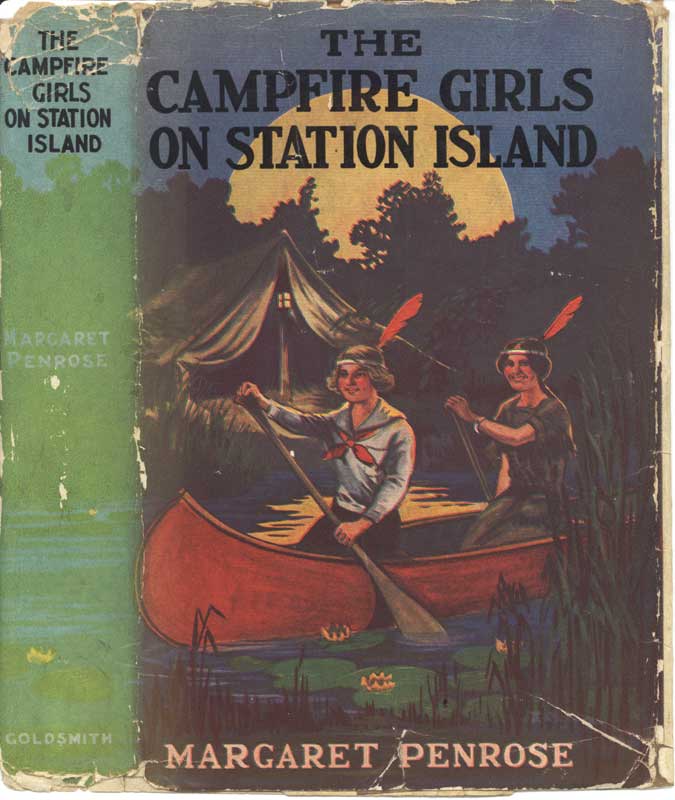
Amy Drew sat up in the canoe as high as
she could and stared ahead. Jessie’s observation
suggested trouble; but Amy
almost immediately burst out laughing.
“‘Drowning!’” she repeated. “Why, Jess
Norwood, you know that you couldn’t drown those
Dogtown kids. And if that isn’t some of them—Monty
Shannon, and the Costello twins, and the
rest of them—I’m much mistaken.”
“But see those barrels and tubs and what-all!”
gasped her more serious friend. “Look there!
It’s Henrietta!”
The fleet of strange barges that Jessie had first
spied included, it seemed, almost every sort of
craft that could be improvised. A rainwater barrel
led the procession of “boats,” and Montmorency
Shannon was in that, paddling with some
kind of paddle that he wielded with no little skill.
There were two wooden washtubs in which the
Costello twins voyaged. One was much lower in
the water than the other, giving evidence of having
shipped more water than its mate. In a water-trough
that had been filched from somebody’s
barnyard was little Henrietta and Charlie Foley.
37
“They will be overboard!” exclaimed Jessie,
anxiously. “Drive ahead, Amy—do!”
The wind was blowing directly in their faces
and from the direction of the Dogtown landing,
where the flotilla had evidently embarked. The
tubs spun around and around, the half-barrel in
which Monty Shannon sat tried to perform the
same gyrations, but Henrietta and the Foley boy
blundered ahead. It was plain to Jessie’s mind
that the reckless children could not have sailed in
the other direction had they wished to do so.
“What do you come out here for?” she shrieked
when the canoe drew near.
“Oh, Miss Jessie, we are going to the Carter
place,” sang out Henrietta.
“But the Carter place is down the lake, not up!”
exclaimed the exasperated Jessie.
“Yes. But the wind shifted,” said Henrietta.
“Where is your big canoe?” demanded Amy,
who could scarcely paddle from laughter, in spite
of the evident danger the children were in.
“That is what we started after,” said Montmorency
Shannon, his red head sticking out of the
barrel like a full-blown hollyhock. “It got away in
the night, or somebody let it go, and we saw it
away down by the Carter place. So—so we
thought we’d go after it.”
“And I warrant your mothers don’t know what
you are doing,” Jessie said sternly.
38
“Oh, they will!” cried Henrietta, virtuously.
“When they miss the washtubs,” put in Amy,
with laughter.
“When we tell ’em,” corrected little Henrietta.
“And we always tell ’em everything we do.”
“I see. After it is all over,” Jessie commented.
“We-ell,” said Henrietta, pouting, “we can’t tell
’em what we have done before we do it, can we?
For we never know ourselves.”
“You certainly cannot beat that for logic,” declared
Amy. She drove the head of the canoe to
the tub of the nearest Costello twin. “Get in here
carefully, Micky. You are going down.”
“That’s ’cause Aloysius always gets the best
tub. He ain’t sinking none,” said Michael Costello,
scowling at his twin.
“Quick!” commanded Amy, and the disgruntled
Costello swarmed over the side of the canoe. “We
can take in one more. Who is the nearest
drowned?”
“I’m sitting in half a foot of water,” confessed
the red-haired Shannon, grinning.
“A little soaking will do you good. I can guess
who suggested this crazy venture,” Jessie said.
“Come, Henrietta.”
“I need her to trim ship!” cried Charlie Foley.
“What do you want to trim your ship with—red,
white and blue?” demanded Amy. “If that
trough sinks I know you can swim, Charlie.”
39
The crowd would have had some difficulty in
getting back to shore with the wind blowing as
freshly as it did if the girls had not come along
and, in relays, helped them all back.
“What Mrs. Shannon will say when she sees her
two washtubs floating off like that, I don’t know,”
sighed Henrietta, after they were all ashore.
“One of ’em’s sunk, so she can’t see it,” Micky
Costello said calmly. “Maybe the other will go
down. Don’t you big girls say anything and maybe
she won’t find it out.”
Jessie and Amy had headed for Dogtown in the
first place without any expectation of playing a life-saving
part. Jessie thought they ought to see
Mrs. Foley, who was fleshy and easy of disposition,
and ask her about Henrietta’s visit. So they
accompanied the freckle-faced little girl to the
Foley house.
“I ain’t telling ’em all they can come to visit my
island, Miss Jessie,” said the little girl. “But of
course, the Foleys could come. Mrs. Blair and
Bertha wouldn’t mind just them, of course.
There’s only Mrs. Foley and Charlie and Billy
and the baby and three more boys and—and—well,
that’s all, only Mr. Foley. He wouldn’t
want to come.”
“You would better be sure of your island, and
just how much you own of it, Hen,” advised Amy
40
Drew. “It may not be big enough to hold everybody
you want to invite.”
“Why, Miss Amy, it’s a awful big island,” declared
little Henrietta. “It’s got a whole golf link
on it. I heard Mr. Blair say so.”
The “bulgy” Mrs. Foley welcomed the Roselawn
girls with her usual copiousness. Of course,
she had the youngest Foley in her lap, and the
housework was “at sixes and sevens,” since little
Henrietta had been at Stratfordtown for a week.
“How I’m going to git used, young ladies, to
havin’ that child away is more than I can say.
’Tis a great mistake I have all boys for childers.
There is nothing like a smart girl around the
house.”
Jessie, very curious, asked the woman what she
knew about Henrietta’s wonderful story of wealth.
“Sure, I’ve always expected it would come to
her some day,” declared Mrs. Foley. “Her
mother, who was a good neighbor of mine before
we moved out here to the lake, said Hen’s father
come of rich folks. They used to drive their own
carriage. That was before automobiles come in
so plenteous.”
“Did Bertha ever say anything about it, Mrs.
Foley?”
“Not much. ’Tis Hen will be the rich wan.
Oh, yes. And glad I am if the child is about to
come into her own. She’s no business to be
41
running down here every chance she gets. I had himself
telephone to Bertha when he went to town
this morning, and it is likely she will be here after
the child. Hen’s as wild as a hawk.”
Bertha Blair, in fact, appeared in a hired car
before Jessie and Amy were ready to return in
their canoe to Roselawn. She was quite as excited
as Henrietta had been about the strange fortune
that promised to come into their lives. Bertha
could tell the chums from Roselawn many
more particulars of the Padriac Haney property.
“If little Henrietta will only be good and not
be so wild and learn her lessons and mind what
she’s told,” Bertha said seriously, “maybe she will
have money and an island—or part of one, anyway.
But she does not behave very well. She is
as wild as a March hare.”
Little Henrietta looked serious for her; but
Mrs. Foley took her part at once.
“Sure don’t be expectin’ too much of the child
at wance, Bertha. She’s run as wild as the wind
itself here. She’s fought and played with these
Dogtown kids since she was able to toddle around.
What would ye expect?”
“But she must learn,” declared the older girl.
“Mrs. Blair won’t take us to the island this summer
if she is not good.”
“Then I’ll go myself,” announced Henrietta.
42
“It’s my island, ain’t it? Who has a better right
there?”
Jessie took a hand at this point, shaking her
head gravely at the freckled little girl.
“Do you suppose, Henrietta Haney, that your
friends—like Mrs. Foley or Mrs. Blair, or even
Amy and I—will want to come to your island to
see you if you are not a good girl?”
“Say, if I get rich can’t I do like I want to—like
other rich folks?”
“You most certainly cannot. Rich people, if
they are to be loved, must be even more careful in
their conduct than poor folks.”
“We-ell,” confessed the freckled little girl
frankly, “I’d rather be rich than be loved. If I
can’t be both easy, I’ll be rich.”
“Such amazing worldliness!” sighed Amy, raising
her hands in mock horror.
But Jessie Norwood truly wished the little girl
to be nice. Poor little Henrietta, however, had
much to unlearn. She chattered continually about
the island she owned and the riches she was to
enjoy. The smaller children of Dogtown followed
her—and the green parasol—about as though
they were enchanted.
“’Tis a witch she certainly is,” declared Mrs.
Foley. “She’s bewitched them all, so she has.
But I’m lost widout her, meself. When a woman
43
has six—and them all boys—and a man that
drinks——”
This statement of her personal affairs had been
so often heard by the three girls that they all tried
to sidetrack Mrs. Foley’s complaint. It was Jessie,
however, who advanced a really good reason
for getting out of the Foley house.
“I promised Monty Shannon I would look at
his radio set,” she said, jumping up. “You will
excuse us for a little, Mrs. Foley? You are not
going back to Stratfordtown at once, Bertha?”
“Before long. I have only hired the car for the
forenoon. The man has another job this afternoon.
And I must find that Henrietta again,” for
the freckle-faced little girl was as lively, so Amy
said, as a water-bug—“one of those skimmery
things with long legs that dart along the surface
of the water.”
The trio went out and across the cinder-covered
yard to the Shannon house. The immediate surroundings
of Dogtown were squalid, although its
site upon the edge of Lake Mononset might have
been made very pleasant indeed.
“If these boys like Monty Shannon and some of
the girls stay at home when they grow up they
surely will improve the looks of the village,” Jessie
had said. “For Monty and his kind are altogether
too smart not to want to live as other people do.”
“You’ve said it,” agreed Amy, with enthusiasm.
44
“He is smart. He has a better radio receiver than
you have. Wait till you see.”
“How do you know?” asked the surprised Jessie.
“He was telling me about it. You know how
often some ‘squeak box,’ or other amateur operator,
breaks in on our concerts.”
“We-ell, not so often now,” Jessie said. “I
have learned more about tuning and wave-lengths.
But, of course, I have only a single circuit crystal
receiving set. I have been talking to Dad about
getting a better one.”
“Monty will show you,” Amy said with confidence,
as they knocked at the Shannon door.
The little cottage was small. Downstairs there
were but two rooms. The door gave access to the
kitchen, and beyond was the “sitting-room,” of
which Monty’s mother was inordinately proud.
She was a widow, and helped herself and her children
by doing fine laundry work for the wealthy
people of New Melford.
From the front room when the girls entered
came sounds that they recognized—radio sounds
which held their instant attention, although they
were merely market reports at that hour in the
forenoon.
“Isn’t it wonderful?” Bertha Blair said, clasping
her hands. “I never can get over the wonder
of it.”
45
“Same here,” Amy declared. “When Jess and
I listened to you singing the ‘Will o’ the Wisp’ last
night it seemed almost shivery that we should
recognize the very tones of your voice out of the
air.”
“Huh!” exclaimed Montmorency, grinning.
“I got so I know the announcers, too. When that
Mr. Blair speaks I know him. Of course, I know
Mr. Mark Stratford’s voice, for I’ve talked with
him. I wouldn’t have such a fine machine here,
only he advised me.”
“Tell me,” Jessie said, “what is the difference
between my receiving set and yours, Monty?”
“If you want to hear clearly and keep outside
radio out of your machine, use a regenerative radio
set with an audion detector. The whole business,
Miss Jessie, is in the detector, after all. A
regenerative set of this kind is selective enough—that’s
the expression Mr. Mark used—to enable
any one to tune out all but a few commercial stations.
And they don’t often butt in to annoy you.
For sure, you’ll kill all the amateur squeak-boxes
and other transmission stations of that class.
“Now, I’m going to tune in for Stratfordtown.
They are sending the Government weather reports
and mother wants to know should she water her
tomatoes or depend on a thunderstorm,” and he
grinned at Mrs. Shannon, who stood, an awkward
46
but smiling figure, in the doorway between the two
rooms.
“’Tis too wonderful a thing for me to understand,
at all, at all,” admitted the widow. “However
can they tell you out of that machine there
is a thunderstorm coming?”
“Listen!” exclaimed the boy eagerly. There
was a horn on the set and no need for earphones.
He had tuned the market reports out. From the
horn came a different voice. But the words the
visitors heard had nothing to do with the report
on the weather. “What’s the matter?” demanded
Monty Shannon. “Listen to this, will you?”
“... she will come home at once. This is
serious—a serious call for Bertha Blair.”
“Do you hear that?” almost shrieked Amy
Drew. “Why, it must mean you, Bertha!”