E-text prepared by Brian Coe, Brian Wilcox, and the Online Distributed Proofreading Team ( http://www.pgdp.net ) from page images generously made available by Internet Archive ( https://archive.org ) — THE CAMPAIGN OF WATERLOO — BY JOHN CODMAN ROPES
The cover image was created by the transcriber and is placed in the public domain.
THE CAMPAIGN OF WATERLOO
SUPPLEMENTARY VOLUME.
AN ATLAS OF
THE CAMPAIGN OF WATERLOO.
By JOHN CODMAN ROPES.
Designed to accompany the author’s “Campaign of Waterloo; a Military History.”
Price, $5.00 net.
CHARLES SCRIBNER’S SONS,
Publishers, New York.
A MILITARY HISTORY
Member of the Massachusetts Historical Society, the Military Historical Society of Massachusetts,
and the Harvard Historical Society; Fellow of the American Academy of Arts and Sciences
and the Royal Historical Society; Honorary Member of the United States Cavalry
Association, etc. Author of “The Army under Pope,” in the Scribner
Series of “Campaigns of the Civil War”; “The First
Napoleon, a Sketch, Political and Military,” etc.
THIRD EDITION.
NEW YORK CHARLES SCRIBNER’S SONS
1893
COPYRIGHT, 1892, BY
CHARLES SCRIBNER’S SONS.
PREFACE — NOTE TO THE THIRD EDITION. — CONTENTS. — A PARTIAL LIST OF WORKS RELATING TO THE CAMPAIGN. 1
The need of another narrative of the campaign of Waterloo may not be
at first sight apparent. There has been a great deal written on this
subject, and much of it has been written by eminent hands. The last
and the most unfortunate campaign of the great soldier of modern times
has naturally attracted the repeated attention of military historians.
Jomini, Clausewitz, Charras, Siborne, Kennedy, Chesney, Vaudoncourt,
La Tour d’Auvergne, Thiers, Hooper, and many others have sought to
explain the almost inexplicable result,—the complete defeat in a very
brief campaign of the acknowledged master of modern warfare. One would
suppose that the theme had been exhausted, and that nothing more
remained to be said.
But several circumstances have contributed to render the labors of
these writers unusually difficult. In the first place, the overthrow
of Napoleon, which was the immediate result of the campaign, operated
to prevent a satisfactory account of it being given to the public
from the French point of view at the time when the facts were fresh
in men’s minds. The Emperor, exiled at St. Helena, could indeed give
his story; but, unable, as he was, to verify or correct his narrative
by citations from the orders that were given at the time, and by
conferring with the officers who had served under him, he has left us
an account, which, though by no means without historical value, is yet
so defective and erroneous in parts that it has aroused in the minds
of men who are not alive to the great difficulties which always attend
the composition of a military narrative, and who are not concerned
to make fair allowance for the unavoidable and peculiar difficulties
of one writing in the circumstances which surrounded Napoleon at St.
Helena, grave doubts as to the trustworthiness of his recollection
and even as to his veracity. The chief officers of the army have also
rendered little assistance to the historian. Ney was shot a few months
after the battle. Soult, Grouchy, d’Erlon and others were forced into
exile. No detailed reports were ever made by them. The royal government
did not concern itself about this episode in the experience of their
predecessors. What the French commander and his subordinates had to say
about the campaign came out by degrees, and much of it only after long
years of waiting. Many of the narratives were written and published
before all the facts had become known,—hence were necessarily more or
less imperfect.
With a few exceptions, too, the histories of this campaign have been
gravely affected by the partisanship of their authors. It is well-nigh
impossible for Thiers and La Tour d’Auvergne to admit any fault, for
Charras and Quinet to admit any merit, in Napoleon’s management of
affairs. It is equally difficult for the majority of English writers to
avoid taking sides against the Emperor in any of the numerous disputes
to which the campaign of Waterloo has given rise. These influences
have operated in many cases to deflect the narrative of the military
operations into a criticism of those who have written from the opposite
standpoint.
Nevertheless, all this discussion has not been by any means without
use. We have had many obscure corners cleared up, many seemingly
inexplicable problems solved, and we are now in possession, taking
all our information together, of nearly all, if not quite all, the
facts. It only remains to collect and co-ordinate them in a spirit of
impartiality. This is the task attempted in the present volume. It may
be added that the narrative and discussions will be confined to purely
military topics.
In the treatment of the subject, Napoleon will naturally be the central
figure. The campaign was his campaign, planned and executed by him,
frustrated by his opponents. It will be our endeavor to get at, as
nearly as we can, his intentions, his expectations, his views from day
to day of the facts of the case, so that we may, if possible, carry a
personal interest into the varying fortunes of those eventful days.
This will be found entirely consistent, it is believed, with an equally
careful attempt to view events from the standpoints which the English
and Prussian commanders must have occupied from time to time during the
campaign.
The general method of Colonel Chesney in his “Waterloo Lectures” is
adopted; that is, the chapters will first contain a statement or
narrative, and, afterwards, notes. In these we shall have occasion
to examine most of the controversies concerning this campaign. Those
persons who do not care for these discussions can read the chapters
seriatim.
Those controversies which would occupy too much space if given in the
text proper will be found in appendices.
A partial list of works relating to the campaign is prefixed.
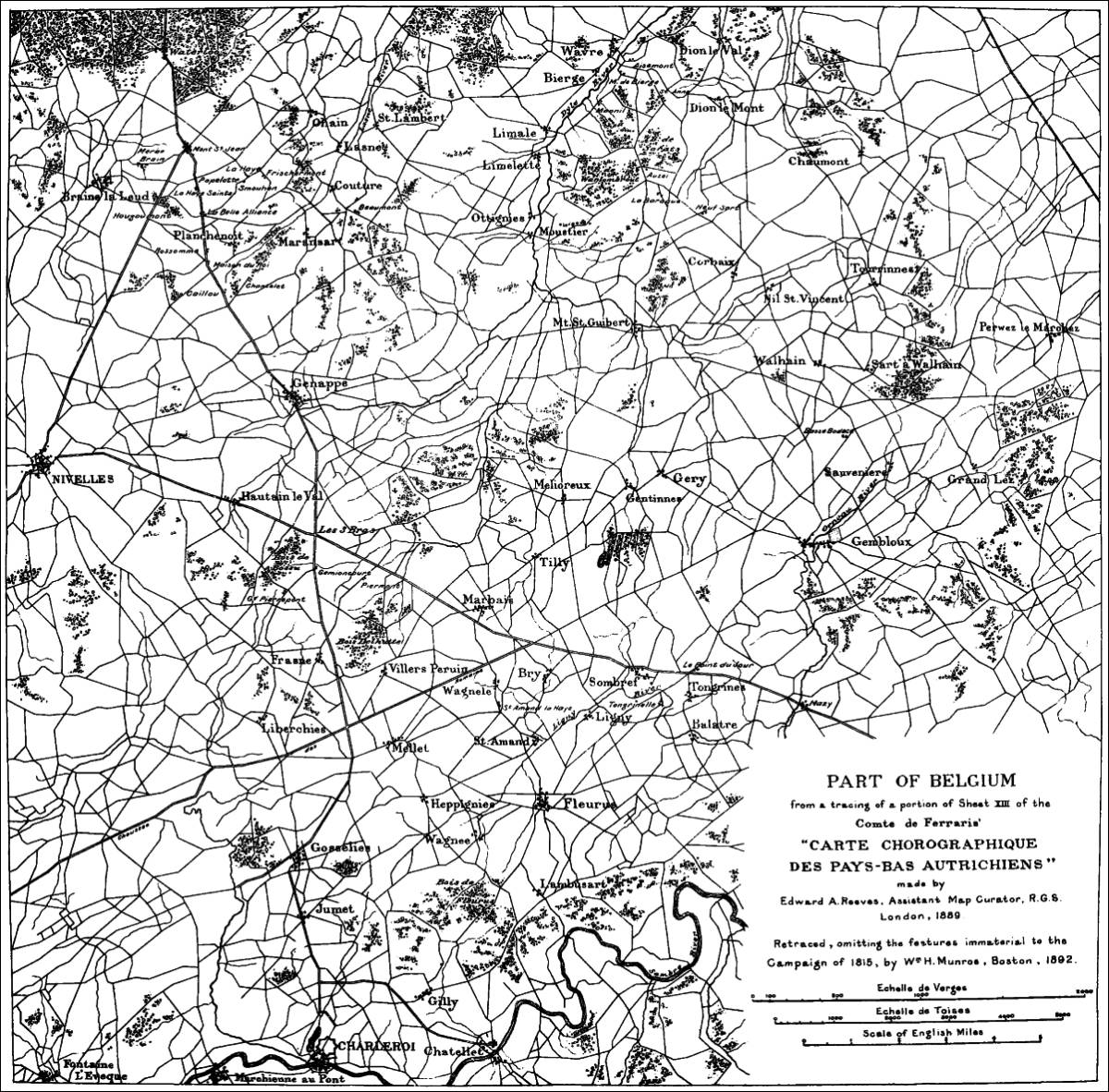
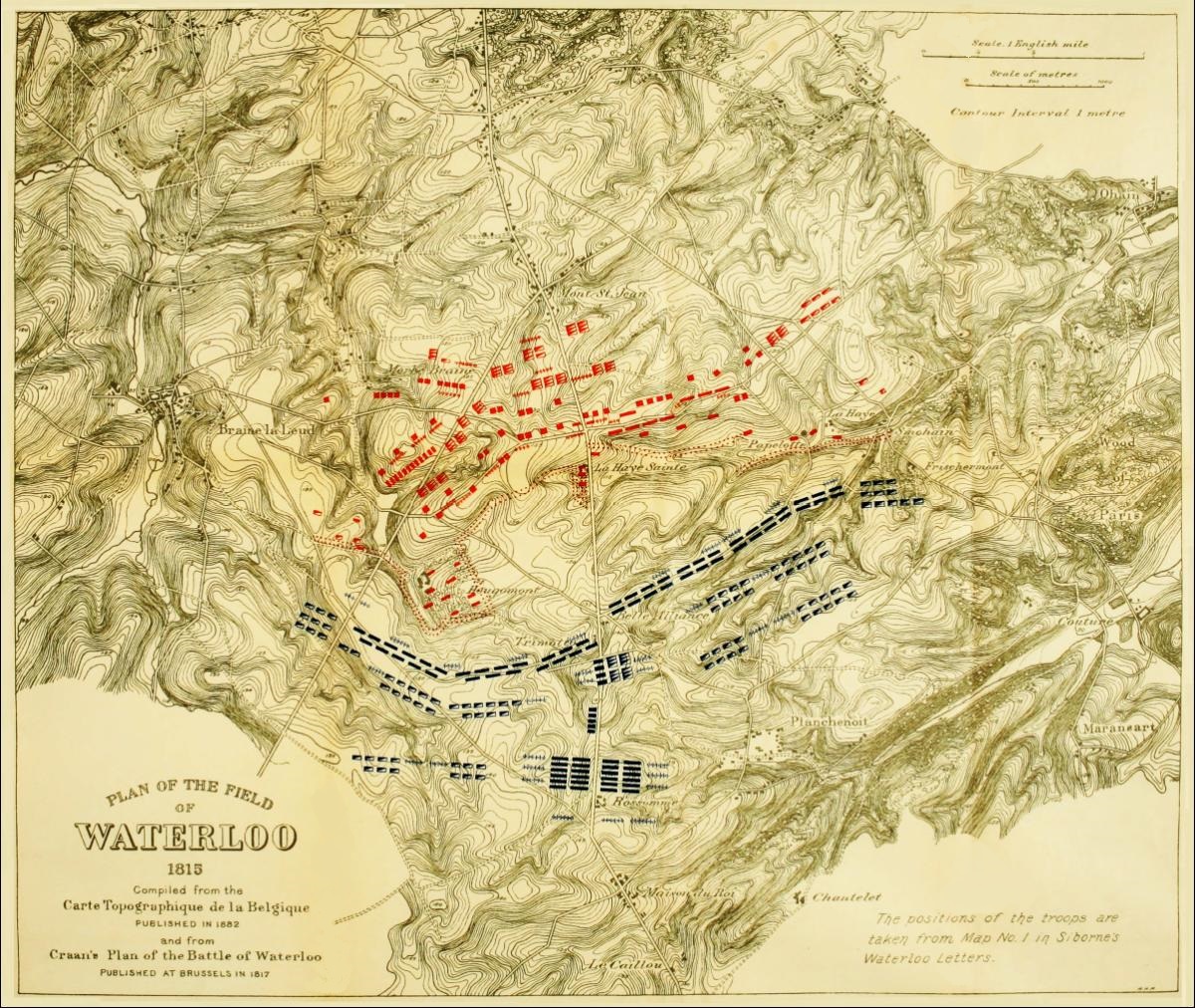
A map of the theatre of war in Belgium and another of the field of
Waterloo are inserted in the book.
For those students who desire to follow the campaign more carefully,
an Atlas has been prepared, which is sold separately. It contains
a general map of the whole theatre of war, eleven maps of Belgium,
showing the varying positions of the three armies during the campaign,
and two maps of the field of Waterloo, in which the topographical
features are shown by contour lines taken from the government
survey, and on which the positions of the troops are set down at the
commencement and close of the battle. The references in the text to
maps are to the maps in this Atlas.
Copies of all the important orders and despatches will be found in
Appendix C.
The author desires to express his thanks for valuable manuscripts,
books and references kindly furnished him by Major General R. Oldfield,
R. A., and Colonel F. A. Whinyates, R. A.; also for many useful
suggestions, and for assistance in many ways, to Major W. R. Livermore,
Corps of Engineers, U. S. Army, and Captain A. H. Russell, Ordnance
Department, U. S. Army.
He desires also to acknowledge the aid rendered him by M. Eugène
Wenseleers, Barrister of the Court of Appeal, Brussels, in ascertaining
the location of the Chateau Marette, at Walhain, where (and not at
Sart-à-Walhain, as has been generally believed) Marshal Grouchy was
when he heard the sound of the cannon of Waterloo.
99 Mount Vernon Street: Boston: June 1, 1892.
J. C. R.
Since the publication of this book the writer has been put in
possession of facts which have led him to reverse his opinion of the
truth of the story that the Duke of Wellington rode to Wavre on the
evening of the 17th of June, 1815.
The published statement of Marshal Grouchy in
1818 that he heard the Emperor blame Ney for
having disobeyed his orders to seize Quatre
Bras on the 15th
He is to ascertain whether the Prussians intend to
separate from the English or to unite with them
to cover Brussels or Liége in trying the fate of
another battle
History of Europe from the commencement of the French Revolution to
the Restoration of the Bourbons in 1815. By Archibald Alison, LL. D.
New Edition with Portraits. Vols. XIII and XIV. Wm. Blackwood & Sons,
Edinburgh & London, MDCCCL.
BATTY:
An Historical Sketch of the Campaign of 1815, illustrated by Plans of
the Operations and of the Battles of Quatre-Bras, Ligny and Waterloo.
By Captain Batty, of the First or Grenadier Guards. 2d Edition,
Considerably Enlarged. London, 1820.
BAUDUS:
Études sur Napoléon. Par le lieutenant-colonel de Baudus, ancien
aide-de-camp des Maréchaux Bessières et Soult. 2 Vols. Paris:
Debécourt: 1841.
BERTON:
Précis, historique, militaire et critique, des batailles de Fleurus et
de Waterloo. Avec une Carte. Par le Maréchal-de-Camp Berton. Paris:
Delaunay. 1818.
BIBLIOGRAPHY OF THE CAMPAIGN:
Prepared, with critical estimates, in October, 1875, by Justin Winsor,
now Librarian of Harvard College, in Bulletin No. 35 of the Public
Library of the City of Boston, of which Mr. Winsor was then Librarian.
It includes a notice of Maps and Plans.
Colonel Chesney gives a list of works cited by himself just after the
Table of Contents in his Waterloo Lectures.
Colonel Maurice in his book entitled “War,”—London and New York:
Macmillan & Co., 1891,—gives in the Appendix, pp. 128 et seq., a
list of books relating to the campaign of Waterloo,—with comments and
estimates.
BROWNE:
Wellington: or Public and Private Life of Arthur, first Duke of
Wellington. By G. Lathom Browne. London, W. H. Allen & Co. 1888.
BULLOCK’S DIARY:
Journal of R. H. Bullock, 11th Light Dragoons. English Historical
Magazine. July, 1888.
CAMPAGNE DE LA BELGIQUE:
Contenant
1. L’Ode sur la Bataille de Waterloo ou de Mont St. Jean:
2. Relation Belge sur la Bataille de Waterloo, et de la part qu’y a
prise la troisième division militaire du Royaume des Pays Bas:
3. Relation Française, par un témoin oculaire:
4. Campagne de Walcheren et d’Anvers; 1809:
5. Relation Anglaise, traduite sur le texte, publiée à Londres en
Septembre dernier.
Bruxelles, 1816. (With a portrait of the Prince of Orange, and maps.)
CHARRAS:
Histoire de la Campagne de 1815: Waterloo: Par le Lt-Colonel Charras.
5me Édition, revue et augmentée. Avec un Atlas nouveau. Leipzig: F. A.
Brockhaus. (No date.)
CHESNEY:
Waterloo Lectures: A Study of the Campaign of 1815. By Colonel Charles
C. Chesney, R. E., late Professor of Military Art and History in the
Staff College. Third Edition. London: Longmans, Green & Co. 1874.
CHURCHILL’S LETTER:
Letter to his father written by Major Chatham Horace Churchill, of the
1st Foot Guards, Aide to General Lord Hill. (Waterloo Roll Call, pp.
2, 14, 92, and Appendix.) The letter was first printed in the Life
of Sir William Napier, pp. 175 et seq. It was reprinted, with some
omissions and some additions, in an English magazine called Atalanta,
in November, 1887, where it erroneously said to have been “hitherto
unpublished.” The writer’s name is not given. Mr. Dalton, the compiler
of the Waterloo Roll Call, states in the Appendix (p. 235) that a copy
of the letter is in his possession. It would be well worth while to
republish it textually with notes.
CLAUSEWITZ:
Der Feldzug von 1815 in Frankreich. Hinterlassenes Werk des Generals
Carl von Clausewitz.
Zweite Auflage. Berlin: Ferd. Dümmler’s Verlagsbuchhandlung: 1862.
CLINTON:
The War in the Peninsula, and Wellington’s Campaigns in France and
Belgium. With original maps and plans. By H. R. Clinton. London:
Frederick Warne & Co. 1878.
CORRESPONDANCE de Napoléon 1er, publiée par ordre de l’Empereur
Napoléon III.
Tome XXVIII.
Tome XXXL Œuvres de Napoléon 1er à St. Hélène. Paris: Imprimerie
Impériale. 1869.
COTTON:
A Voice from Waterloo: a history of the battle, &c. By Sergeant-major
Edward Cotton, late 7th Hussars.
Fifth Edition, revised and enlarged. Printed for the author. London. R.
Green. 1854.
CRAAN, W. B.:
Plan du Champ de Bataille de Waterloo. Bruxelles: 1816.
DAMITZ:
Histoire de la Campagne de 1815: Par le major de Damitz,
officier prussien, d’après les documents du Général Grolman,
Quartier-Maître-Général de l’armée prussienne en 1815.
Traduite de l’Allemand par Léon Griffon. Avec Plans. 2 Volumes. Paris.
Correard. 1840.
D’AUVERGNE:
See La Tour d’Auvergne.
DAVOUT:
Histoire de la Vie Militaire, Politique, et Administrative du Maréchal
Davout, Duc de Auerstaedt, Prince d’Eckmühl. D’après les documents
officiels. Par L. J. Gabriel de Chenier. Paris: Gosse, Marchal & Cie:
1866.
DOCUMENTS INÉDITS:
Documents inédits sur la campagne de 1815, publiés par le Duc
d’Elchingen. Paris. 1840.
DRAME DE WATERLOO:
Le Drame de Waterloo: Grande Restitution Historique. Avec un plan. 3me
edition. Paris: Au Bureau de la Revue Spiritualiste. 1868.
DROUET:
Le Maréchal Drouet, Comte d’Erlon. Notice sur la vie militaire, écrite
par lui-même et dediée à ses amis. Publiée par sa famille. Avec
portrait. Paris: Gustave Barba: Libraire Éditeur. 34 Rue Mazarine. 1844.
ELLESMERE:
Essays on History, Biography, Geography, Engineering, &c. Contributed
to the Quarterly Review: By the late Earl of Ellesmere. London: John
Murray. 1858.
FRAGMENTS HISTORIQUES:
See Grouchy.
FRASER: Letters written during the Peninsula and Waterloo Campaigns. By
Sir A. S. Fraser. London: 1859.
FRASER:
Words on Wellington—the Duke-Waterloo—the Ball. By Sir Wm. Fraser,
Baronet. London. John C. Nimmo: 1889.
GARDNER:
Quatre Bras, Ligny and Waterloo. A narrative of the campaign in Belgium
in 1815. By Dorsey Gardner. London: Kegan Paul, Trench & Co. 1882.
GAWLER:
The Crisis and Close of the Action at Waterloo. By an Eyewitness.
Dublin. Richard Milliken & Son: 104 Grafton Street. 1833.
GÉRARD:
1. Quelques Documents sur la Bataille de Waterloo, propres à éclairer
la question portée devant le public par M. le Marquis de Grouchy. Par
le Général Gérard. Paris: Denain: Novembre, 1829. (With a Map.)
2. Dernières Observations sur les Opérations de l’aile droite de
l’Armée Française à la Bataille de Waterloo, en réponse à M. le Marquis
de Grouchy. Par le Général Gérard. Paris: Denain: 1830. (With a Map.)
3. Lettre à MM. Germain Sarrut et B. Saint Edme, Rédacteurs de la
Biographie des Hommes du Jour. Paris: 12 Mars, 1840.
GIRAUD:
The Campaigns of Paris in 1814 and 1815, etc. Translated from the
French of P. F. F. J. Giraud by Edmund Boyce. 2d Edition, enlarged.
London. 1816.
GNEISENAU:
Das Leben des Feldmarschalls Grafen Reithardt von Gneisenau. Vierter
Band. 1814, 1815. Von Hans Delbrück. Fortfetzung des Gleichnamigen
Werkes von G. H. Pertz. Berlin. 1880.
GOMM:
Letters and Journals of Field-Marshal Sir William Maynard Gomm, G. C.
B. From 1799 to Waterloo, 1815. Edited by Francis Culling Carr-Gomm.
London: John Murray. 1881.
GORE:
An Historical Account of the Battle of Waterloo; intended to elucidate
the topographical plan executed by W. B. Craän, J. U. D. Translated
from the French, with explanatory notes, by Captain Arthur Gore, 30th
Regiment of Foot. With Plates. London. Printed for Samuel Leigh. 1817.
Campagne de dix-huit cent quinze: ou Relation des Opérations Miliaires
qui ont eu lieu en France et en Belgique, pendant les Cent Jours.
Écrite à Sainte Hélène. Par le Général Gourgaud. Paris: 1818.
GOURGAUD (translation):
The Campaign of 1815. Written at St. Helena by General Gourgaud.
London: 1818.
GRENADIER GUARDS:
The Origin and History of the First or Grenadier Guards. By Lieut. Gen.
Sir F. W. Hamilton, K. C. B. In three volumes. London: John Murray.
1874.
GROUCHY:
1. Observations sur la Relation de la Campagne de 1815, publiée par
le Général Gourgaud, et Réfutation de quelques unes des Assertions
d’autres écrits relatifs à la bataille de Waterloo. Par le Maréchal de
Grouchy. Philadelphie. 1818.
2. The same, with omissions and changes. Philadelphia, 1819.
3. The same title except that the author’s name is given as “le Comte
de Grouchy.” Reprinted, with many omissions and changes, from the
Philadelphia edition of 1819. Paris: Chez Chaumerot Jeune, Libraire,
Palais Royal. 1819.3
4. Doutes sur l’Authenticité des Mémoires historiques attribués à
Napoléon et première réfutation de quelques unes des assertions qu’ils
renferment. Par le Comte de Grouchy: Philadelphie: Avril, 1820.
5. Fragments Historiques relatifs à la Campagne de 1815 et à la
Bataille de Waterloo. Par le Général Grouchy.
Lettre à Messieurs Méry et Barthélemy.
Paris: Firmin Didot Frères, 20 Novembre, 1829.
6. Fragments Historiques, &c.
De l’influence que peuvent avoir sur l’opinion les documents publiés
par M. le Comte Gérard.
Paris: Firmin Didot Frères, 20 Decembre, 1829.
7. Le Maréchal de Grouchy du 16 au 19 Juin 1815. Par le Général de
Division Sénateur Marquis de Grouchy. Paris. E. Dentu. 1864.
8. Mémoires du Maréchal de Grouchy. Par le Marquis de Grouchy, officier
de l’état-major. vol. 4. Paris: E. Dentu. 1874.
GURWOOD:
The Despatches of Field Marshal the Duke of Wellington. Compiled from
official and authentic documents, by Lieut.-Colonel Gurwood. Vol. XII.
London: John Murray: 1838.
HAMLEY:
The Operations of War explained and illustrated. By Edward Bruce
Hamley, Colonel in the Army, etc. Second Edition. William Blackwood &
Sons. Edinburgh and London. 1869.
HILL:
The Life of Lord Hill, G. C. B. By the Rev. Edwin Sidney, A.M. Second
edition. London: John Murray: 1845.
HISTOIRE DE L’EX-GARDE:
Depuis sa formation jusqu’à son licenciement. Paris: Delaunay: 1821.
HOOPER:
Waterloo: the Downfall of the First Napoleon: A History of the Campaign
of 1815. By George Hooper: author of “The Italian Campaigns of General
Bonaparte.” With Map and Plans. London: Smith, Elder & Co. 1862.
IMPERIAL GUARD:
See Histoire de l’Ex-Garde.
See St. Hilaire.
JOMINI (original):
Précis Politique et Militaire de la Campagne de 1815, pour servir de
supplement et de rectification à la Vie Politique et Militaire de
Napoléon racontée par lui-même. Par le Général J. Paris: 1839.
The Political and Military History of the Campaign of Waterloo.
Translated from the French of General Baron de Jomini, by Capt. S. V.
Benét, Ordnance Dept. U. S. Army. Second Edition. New York: D. Van
Nostrand: 1862.
JONES:
The Battle of Waterloo, with those of Ligny and Quatre Bras, described
by eye-witnesses, and by the series of official accounts published by
authority. To which are added Memoirs of F. M. the Duke of Wellington,
F. M. Prince Blücher, the Emperor Napoleon, etc., etc. Illustrated by
Maps, Plans, and Views of the Field, and Thirty-four Etchings from
Drawings. By George Jones, Esq., R. A. Eleventh Edition, enlarged and
corrected. London: L. Booth: Duke Street. 1852.
KENNEDY:
Notes on the Battle of Waterloo. By the late General Sir James
Shaw-Kennedy, K. C. B., acting at the time of the battle on the
Quarter-Master-General’s Staff of the Third Division of the Army.
London: John Murray: 1865.
LA TOUR D’AUVERGNE:
Waterloo: Étude de la Campagne de 1815. Par le Lieutenant-Colonel
Prince Édouard de La Tour d’Auvergne. Avec Cartes et Plans. Paris:
Henri Plon: 1870.
LEEKE:
The History of Lord Seaton’s Regiment (the 52d Light Infantry) at
the Battle of Waterloo. By the Reverend William Leeke, M. A. 2 vols.
London: Hatchard & Co. 1866.
LOBEN SELS:
See Van Loben Sels.
LOCKHART:
The History of Napoleon Buonaparte. By J. G. Lockhart. Third edition. 2
vols. London: John Murray. 1835.
The History of Napoleon Buonaparte. Reprinted from the Family Library.
London: William Tegg. 1867.
MARÉCHAL DE GROUCHY EN 1815:
See Grouchy.
MAURICE: ARTICLES ON WATERLOO:
By Col. J. F. Maurice, R. A. From the United Service Magazine. Vol.
123. In the years 1890 and 1891.
MÉMOIRES (original):
Mémoires pour servir à l’Histoire de France en 1815, avec le plan de la
bataille de Mont St. Jean. Paris: 1820.
MEMOIRS (translation):
Historical Memoirs of Napoleon. Book IX. 1815. Translated from the
original Manuscript by B. E. O’Meara. London: Printed for Sir Richard
Phillips & Co. 1820.
MERCER:
Journal of the Waterloo Campaign. Kept throughout the Campaign of 1815.
By the late General Cavalié Mercer, commanding the 9th Brigade Royal
Artillery. In 2 vols. Wm. Blackwood & Sons, Edinburgh & London. 1870.
MORRIS, O’CONNOR:
See O’Connor Morris.
MUDFORD:
An Historical Account of the Campaign in the Netherlands in 1815 under
his Grace the Duke of Wellington and Marshal Prince Blücher. By William
Mudford. Illustrated. London. 1817.
MÜFFLING: PASSAGES:
Passages from my Life; together with Memoirs of the Campaign of 1813
and 1814. By Baron von Müffling. Edited with notes by Col. Philip
Yorke, F. R. S. Second Edition, revised. London: Richard Bentley, New
Burlington Street. 1853.
Part II., beginning with page 197, contains an account of the Waterloo
Campaign.
MÜFFLING: SKETCH:
A Sketch of the Battle of Waterloo, to which are added the Official
Despatches of Field Marshal the Duke of Wellington, Field Marshal
Prince Blücher, and Reflections on the Battles of Ligny and Waterloo.
By General Müffling. With Craän’s Map of the Field. Sixth Edition.
Waterloo. H. Gérard, Publisher. 1870.
MUQUARDT:
Précis de la Campagne de 1815 dans les Pays-Bas. Bruxelles. Libraire
Militaire C. Muquardt: Merzbach and Falk, Éditeurs. 1887.
NAPIER:
Life of General Sir William Napier, K. C. B., Author of the “History of
the Peninsular War.” Edited by H. O. Bruce, M. P. 2 vols. London: John
Murray. 1864.
NAPOLEON:
See Correspondance.
„ Mémoires.
„ Memoirs.
NAPOLÉON À WATERLOO:
Souvenirs Militaires. Napoléon à Waterloo, ou Précis rectifié de la
Campagne de 1815. Avec des Documents nouveaux et des Piéces inédites.
Par un ancien officier de la Garde Impériale, qui est resté près de
Napoléon pendant toute la campagne. Paris: J. Dumaine, 1866.
NIEMAN’S DIARY:
The Journal of Henri Nieman of the 6th Prussian Black Hussars. From the
English Historical Magazine for July, 1888.
O’CONNOR MORRIS:
Great Commanders of Modern Times, and the Campaign of 1815. By William
O’Connor Morris. London: W. H. Allen & Co.: 1891.
OLDFIELD:
Letters on the Battle of Waterloo. MSS. By John Oldfield, Captain and
Brigade-Major, Royal Engineers.
OLLECH:
Geschichte des Feldzuges von 1815 nach archivalischen Quellen. Von
Ollech, General der Infanterie. Berlin: 1876.
O’MEARA:
See Memoirs.
PAJOL:
Pajol, Général en Chef. Par le général de division Comte Pajol—son fils
ainé. 3 vols. Paris. Firmin Didot Frères. 1874.
PASCALLET:
Notice Biographique sur M. le Maréchal Marquis de Grouchy, Pair de
France, avec des Éclaircissements et des Détails historiques sur
la Campagne de 1815 dans le midi de France, et sur la Bataille de
Waterloo. Par M. E. Pascallet, Fondateur and Rédacteur en chef de la
Revue Générale, Biographique, Politique and Littéraire. 2e Edition.
Paris. 1842.
QUINET:
Histoire de la Campagne de 1815. Par Edgar Quinet. Paris: Michel Lévy
Frères. 1862.
RELATION BELGE:
See Campagne de la Belgique.
ROGNIAT:
Réponse aux notes critiques de Napoléon sur l’ouvrage intitulé
“Considérations sur l’Art de la Guerre.” Paris. 1823.
SIBORNE:
History of the War in France and Belgium in 1815. Containing minute
Details of the Battles of Quatre Bras, Ligny, Wavre and Waterloo. By
Capt. W. Siborne; Secretary and Adjutant of the Royal Military Asylum
Constructor of the “Waterloo Model.” 2d Edition. 2 vols. London T. & W.
Boone: 1844. With an Atlas of Maps and Plans.
STANHOPE:
Notes of Conversations with the Duke of Wellington. 1831-1851. By
Philip Henry, 5th Earl Stanhope. New York, Longmans, Greene & Co. 1886.
ST. HILAIRE:
Histoire, anecdotique, politique et militaire, de la Garde Impériale.
Par Émile Marco de Saint-Hilaire. Paris: Eugène Penaud. 1847.
SUPPLEMENTARY DESPATCHES:
The Supplementary Despatches, Correspondence and Memoranda of Field
Marshal Arthur, Duke of Wellington, K. G. Edited by his son, the Duke
of Wellington, K. G. Volume X. London: John Murray. 1863.
THIERS:
History of the Consulate and the Empire of France under Napoleon. By M.
A. Thiers. Vol. XX. London: Willis and Sotheran. 1861.
TREUENFELD:
Die Tage von Ligny und Belle-Alliance. Von v. Treuenfeld,
Premier-Lieutenant im 2 Hessischen Infanterie-Regiment No. 82.
Mit 11 Karten. Hanover, 1880. Helwing’sche Verlags-Buchhandlung:
Schlägerstrasse 20.
VANDAMME:
Le Général Vandamme et sa Correspondance. Par A. Du Casse. 2 Vols.
Paris: Didier et Cie. 1870.
VAN LOBEN SELS:
Précis de la Campagne de 1815 dans les Pays-Bas. Par le major
d’artillerie E. Van Löben Sels, aide-de-camp de S. A. R. le Prince
Frédéric des Pays-Bas. Avec Plans. Traduit du Hollandais. La Haye: Chez
les Heritiers Doorman: 1849.
VAUDONCOURT:
Histoire des Campagnes de 1814 et 1815 en France. Par le Général
Guillaume de Vaudoncourt. Tome Quatrième. Paris. 1826.
VAULABELLE:
Campagne et Bataille de Waterloo. Par Achille de Vaulabelle. Bruxelles.
1853.
WATERLOO LETTERS:
Waterloo Letters. A selection from original and hitherto unpublished
letters bearing on the operations of the 16th, 17th and 18th June,
1815, by officers who served in the campaign. Edited, with explanatory
notes, by Major General H. T. Siborne, late Colonel R. E. Illustrated
with numerous Maps and Plans. London: Cassell & Co. Limited. 1891.
WATERLOO ROLL CALL:
The Waterloo Roll Call. By Charles Dalton, F. R. G. S. London. Wm.
Clowes & Sons, Limited. 13 Charing Cross, S. W. 1890.
WELLINGTON:
See Gurwood, and, also, Supplementary Despatches.
CHAPTER I. THE PLAN OF CAMPAIGN. — NOTE TO CHAPTER I.
Napoleon entered Paris on his return from Elba on the twentieth of
March, 1815. His first endeavor, after quieting the not very formidable
movements of the royalists in the south and west of France, was to open
communications with the great powers. He proclaimed his policy to be
strictly one of peace, and we have every reason to believe that his
intentions were sincerely pacific. But his agents were turned back on
the frontier. The nations of Europe refused to treat with him on any
terms, and entered into an offensive and defensive alliance against him
with the avowed purpose of driving him from the throne of France. The
armies of the neighboring powers began immediately to concentrate on
the border, and even Russia set her troops in motion for the general
attack upon France and her Emperor.
To meet this formidable coalition Napoleon bent all his energies. The
army had, since his first abdication, been reorganized, and many high
commands had naturally been given to the chiefs of the royalist party.
Much had to be done before the new arrangements, necessitated by the
re-establishment of the Imperial government, could be effected.
These changes in the military organization of the country required
time. Besides, Napoleon was not desirous to precipitate matters.
He was naturally solicitous not to appear to commence an avoidable
war. He was, moreover, much occupied with domestic politics, but of
his dealings with the chambers and of his new constitution we do not
propose to speak.
Besides increasing and reconstituting the army, work was begun on the
fortifications of the principal cities.
By the first of June, no change having taken place in the relations of
France with her neighbors, it became incumbent on the Emperor to decide
what he would do.
The situation was, in brief, as follows: Two large armies, one composed
of English, Dutch, Belgian and Hanoverian troops, with contingents
from Brunswick and Nassau, the whole under command of the Duke of
Wellington, the other composed of Prussians, Saxons, and other Germans
under Marshal Blücher, lay scattered in their cantonments in Belgium
to the north and east of the rivers Sambre and Meuse. On the eastern
frontier, the Austrians were collecting a formidable force, and
were expecting to be reinforced in July by a powerful Russian army.
If Napoleon should maintain a strictly defensive attitude, France
would again be the theatre of hostilities, as in the previous year.
True, time would be gained by the delay, and time was most important
for filling the ranks of the army, completing the fortifications,
manufacturing ammunition, and generally putting the country into
a state of defence. But when the invasion came, it would be made
in overwhelming force. It was possible, certainly, to hope for the
repetition of the exploits of 1814, for victories like Champ Aubert,
Montmirail and Rheims; on the other hand, bloody and indecisive battles
like those of Brienne, Laon, and Arcis-sur-Aube were to be expected
with equal probability. The thing for Napoleon to do, if possible, was
to reduce this tremendous disparity of numbers, and this could only be
effected by beating his enemies in detail. If he could dispose of the
armies of Wellington and Blücher now, he would have so much the better
chance against the Austrians and the Russians. And Napoleon undoubtedly
hoped that if fortune should favor him in 1815 as in 1805 and 1806, for
instance,—if he should be able to repeat in Belgium the astonishing
successes of Austerlitz and Jena,—he would not find it impossible to
make peace with his father-in-law, the Emperor of Austria, and that
Russia, whose interests in the war were remote and really theoretical,
would willingly retire from the contest. When we add to this that
Napoleon’s forte was the offensive, that his genius was specially
adapted for enterprising and daring strategy, we are not surprised that
he should have decided to move at once, with all his available force,
upon the armies of Wellington and Blücher.5
These armies were, as has been stated, lying in their cantonments on
and behind the Belgian frontier. (See Map 1.) Their front covered,
roughly speaking, an extent of a hundred miles, from Namur and Huy on
the east to Mons and Tournay on the west. They were distributed in
numerous towns and villages, some of these being as far back as forty
miles from the frontier. With the location of the various detachments
Napoleon was undoubtedly, to a great extent, acquainted. He calculated
that Wellington’s forces, which were scattered over a wide extent of
country, could not be concentrated in less than two days; and that it
would require more than one day for Blücher to assemble the four corps
of which his army was composed.
The high-road, which runs from Charleroi north through Quatre Bras,
Genappe and Waterloo to Brussels, ran between these armies,—that of
the Duke of Wellington lying to the westward of the road and that
of Marshal Blücher lying to the eastward of it. The Prussians lay
considerably closer to the frontier than the English and Dutch.
Wellington’s headquarters were at Brussels;
Blücher’s at Namur. The
turnpike, which runs from Namur through Quatre Bras to Nivelles, was
the main avenue of communication between these two armies.
The Prussian lines of supply extended by way of Liége and Maestricht
to the Rhine; the English by way of Ostend and Antwerp to the sea. The
bases of the two armies were thus situated in opposite directions.
It was, of course, probable that if either of these armies should be
obliged to retreat, it would retreat towards its own base. But to
retreat towards its own base would be to march away from its ally. On
this peculiarity in the situation Napoleon’s plan of campaign was, to
a great degree, founded. The situation was far more favorable for him
than if the 220,000 men in Belgium had all belonged to one army, for
now, not only were there two armies, under two commanders, in whose
operations he might safely count upon the existence of more or less
misunderstanding and failure fully to meet each other’s expectations,
but the two armies were bound, in case of disaster to either or both,
to follow lines of retreat which were wholly divergent.
We are now prepared to consider Napoleon’s plan. He proposed to
assemble his own forces with all possible secrecy in the neighborhood
of Charleroi,—near the point of junction of the two opposing armies.
He expected that, on the first news of his approach, the two armies
would respectively concentrate, and then endeavor to unite. He expected
that the Prussians, being less scattered than the English, and being
likely to know of the approach of the French before the English could
possibly hear of it, would be the first to concentrate, and he expected
therefore to encounter them alone and unsupported by their allies.
The statement of Napoleon’s plan of campaign in Gourgaud’s narrative is
as follows:—6
“The Prussian army, having intimation of the enemy’s intentions
eight or ten hours before the English, would accordingly be first
concentrated. Hopes were even entertained of attacking the Prussians
before their four corps were united, or of obliging them to fall back
in the direction of Liége and the Rhine, which was their line of
operations; and by thus separating them from the English, to create
an opportunity for new combinations.
“In these calculations, the characters of the enemy’s commanders were
much to be considered. The hussar habits of Marshal Blücher, his
activity and decided character, formed a strong contrast with the
cautious disposition, the deliberate and methodical manner of the
Duke of Wellington. Thus, it was easy to foresee, that the Prussian
army would be the first to be concentrated, and also that it would
evince more decision and promptitude in hastening to the aid of its
ally [than the English army would if the Prussians should be the
first to be attacked]. If Blücher had only two battalions ready to
act, he would be sure to employ them in support of the English army;
but there was reason to believe that Wellington, unless his whole
army was united, would not attack the French to succor Blücher. All
these considerations rendered it desirable that the attack should
be commenced against the Prussian army; it necessarily would, so we
thought, be the first to be concentrated, and this turned out to be
the fact.”
To the same effect the Emperor says in his “Memoirs”:—7
“The [Prussian] army was to assemble in rear of Fleurus. * * * In the
night between the 14th and 15th, confidential messengers returned to
the French headquarters at Beaumont, and announced that everything
was tranquil at Namur, Brussels and Charleroi; this was a happy
presage. To have thus succeeded in concealing from the enemy the
movements which the French army had made for the last two days, was
to have already obtained a great advantage. The Prussian army found
itself obliged either to establish a point of concentration further
back than Fleurus, or to receive battle in that position without
being able to be assisted by the Anglo-Dutch army. * * * All the
measures of Napoleon had therefore for their object to attack the
Prussians first.”
In a word, Napoleon believed that the allied generals had fixed the
points of concentration of their armies too near the frontier for
that concentration to be effected in season to oppose to his army an
overwhelming force; he thought it very likely also, for the reasons
above stated, that he would have only the Prussian army to deal with in
the first encounter of the campaign.
There were, to be sure, other courses open to him. He might direct
his army upon the communications of the Prussians by passing to the
eastward of them and turning their left flank. But this operation
involved a wide détour over a difficult country, and in the battle
which was certain to result, the Prussian and the English armies would,
beyond a doubt, both be united against him. On the other hand he could
turn Wellington’s right by moving viâ Lille, Valenciennes or Mons
upon Ghent or Brussels. An advance in this direction presented, to be
sure, fewer difficulties than the one just spoken of, and promised
greater advantages. The Duke himself always maintained that this
would have been Napoleon’s best move. It probably would have cut the
English communications with Ostend, and would very likely have forced
Wellington to evacuate Brussels without a battle, that is, unless
he cared to risk an engagement without the aid of his ally. But the
Prussians in the meantime would have concentrated without molestation
their whole army of 120,000 men, and if Wellington had been successful
in avoiding a battle with the French superior force, the two allied
generals ought to have been able either to manœuvre Napoleon out of
Belgium or to force him to battle on disadvantageous terms. It is
probable that in neither of these flanking movements would there be an
opportunity afforded for a direct, immediate, crushing blow upon one of
the allied armies, such as that which Napoleon thought it very possible
that the temerity of Marshal Blücher was going to present to him, if he
advanced by way of Charleroi.
We have seen that Napoleon seems to have thought it very likely that
Blücher would fight, but, of course, Napoleon could but conjecture
what Blücher would do; he could not certainly know that he would not
now, as he had done in Germany in 1813, avoid a direct conflict with
him, and retire on his base of operations. If Blücher should do this,
the two armies, it is true, would be separated and could be dealt with
accordingly; but the difficulties of the campaign would be vastly
greater than if the Prussian army should be practically disposed of by
a decisive victory at the outset. For if the Prussians should fall back
without hazarding a battle, they would have to be pursued, certainly
far enough to ascertain their real intentions, and to become assured
that they were, for the time being at least, definitely separated
from the army of Wellington. If this should appear to be the case
the question would then arise, which of the two armies should be
followed up; and in considering this question, the importance of the
occupation of Brussels, at that time the capital of the Netherlands,
would naturally influence Napoleon in favor of throwing the bulk of
his forces against the Anglo-Dutch. Napoleon, however, as we have
already said, seems to have thought it on the whole probable, knowing,
as he did, the daring and resolute character of the man, that Blücher
would fight, with or without the assistance of the English army, and
he also thought that the situation of the English army was such that
Blücher would not be likely to get much assistance from it. Napoleon,
therefore, hoped to open the campaign with a signal victory, crippling,
perhaps destroying, the Prussian army, and he knew that the result
of such a victory must be the retreat of the beaten Prussians in a
direction certain to separate them entirely and definitely from their
English and Dutch allies. The French Emperor would then be free to
carry the great bulk of his forces against the English and Dutch. If
Wellington stood, he expected to beat him; if he retreated, he would
leave Belgium and perhaps Holland at the disposal of the French.
Such, in brief, were Napoleon’s calculations and expectations.
The view given above of Napoleon’s plan has been by no means
universally accepted. It is often stated that he intended to separate
the two armies and attack them in detail, but if this expression is to
be understood as meaning that the former operation was to precede the
latter in point of time, it is not in our judgment a correct statement.
There never was, we believe, any expectation on Napoleon’s part that he
could, by throwing his army between those of Wellington and Blücher,
or by merely occupying strategic points, separate the allied armies
definitely from one another. What he did expect, was, as we have
seen,8 to encounter one of these armies, that commanded by Marshal
Blücher, alone and unsupported by its ally. If it should decline
an engagement, or should fight and be beaten, he calculated on its
retiring towards its own base of operations, and so separating itself
by every march taken in that direction from its ally.
But several writers on the campaign present us with quite other ideas
of Napoleon’s intended operations. And as it is obviously of the first
importance that we should start with a correct idea of Napoleon’s plan,
if we would follow the events of the campaign intelligently, we will
examine these other theories somewhat in detail.
Take first the view that Napoleon’s intention was to throw his army
between those of Wellington and Blücher.
This is Alison’s view. We cite
him, not because his name carries any weight as a military authority,
but because his error has been so clearly pointed out by no less a
person than the Duke of Wellington, in a criticism9 of Alison’s
History of Europe written by the Earl of Ellesmere, who wrote, as is
well known, under the Duke’s inspiration. In the following passage a
quotation is made from the work of the famous German military critic,
Clausewitz:—
“Mr. Alison (Hist. of Europe,10 etc., vol. x, p. 991) speaks of
‘Buonaparte’s favorite military manœuvre of interposing between
his adversaries, and striking with a superior force first on the
right hand and then on the left,’ as having been attempted by him
and baffled in this campaign. We doubt whether the expression of
interposing between two adversaries can be correctly applied to any
of Buonaparte’s successful campaigns, and we almost suspect that,
if he had in contemplation a manœuvre of so much hazard on this
occasion, it was the first on which he can be said to have attempted
it. Hear Clausewitz on this matter:—
“All writers who have treated of this campaign set out by saying
that Buonaparte threw himself between the two armies, in order
to separate them. This expression, however, which has become a
terminus technicus in military phraseology, has no clear idea for
its foundation. The space intervening between two armies cannot be
an object of operation.11 It would have been very unfortunate if a
commander like Buonaparte, having to deal with an enemy of twice his
force, instead of falling on the one half with his united strength,
had lighted on the empty interval, and thus made a blow in the air,
losing his time, whilst he can only double his own force by the
strictest economy of that commodity.
Even
the fighting the one army in a direction by which it will be pressed
away from the other, even if it can be effected without loss of time,
incurs the great danger of being attacked in the rear by the other.
If the latter, therefore, be not far enough removed to put this risk
out of the question, a commander will scarcely venture on such a line
of attack. Buonaparte, therefore, chose the direction between the two
armies, not in order to separate them by wedging himself between,12
but because he expected to find and fall on Blücher’s force in this
direction, either united or in separate bodies [corps].” Feldzug von
1815, &c., p. 54:13
* * * * * * * *
His main object was evidently to find the Prussian army, and beat it.”
Nevertheless we find Hooper,14 who wrote long after Clausewitz, making
the very statement which Clausewitz thought so objectionable:—
“He (Napoleon) calculated that if he struck at the centre of the two
armies he should be able to wedge himself in between them, crushing
any divisions which attempted to obstruct his progress, and, having
won a position of vantage, he imagined that it would be in his power
to manœuvre with rapidity from side to side and defeat each army in
succession.”
To the same effect writes Quinet:—
“He (Napoleon) will place himself between the two armies, at the
centre of the line, that is to say, at the extreme right of the
Prussian cantonments. By this move, the Duke of Wellington and
Marshal Blücher will be separated from the first hour. The occasion,
the moment, will decide on which of the two armies it will be best to
strike the first blow.”15
It is unnecessary to repeat what has been so well said above in
opposition to this view. It is plain that these
writers have misconceived Napoleon’s
plan. But we must consider this more fully.
This conception of the campaign is practically identical with the
theory first put forth by Rogniat in his “Considérations de l’Art de la
Guerre,” and repeated in his “Réponse aux Notes critiques de Napoléon,”
in the form of a criticism of Napoleon’s operations. He maintains that
Napoleon should have aimed first at seizing the two points of Quatre
Bras and Sombreffe on the Nivelles-Namur road, over which the allied
armies communicated with each other.
“If, instead of six leagues, he had made eight or nine (and he had
time enough, inasmuch as the Sambre was crossed at two o’clock), in
pushing his left to Frasnes and his advance-guard to Quatre Bras,
the centre and right to Sombreffe, with the reserves at Fleurus, he
would have obtained the precious advantage he ought to have aimed at,
that of separating the two opposing armies, of retarding the union of
their corps, of taking a central position and of attacking them one
at a time. In fact, Quatre Bras and Sombreffe are on the high-road
from Namur to Brussels; master of these points, he could then have
opposed the junction of the English on one side, of the Prussians on
the other.”16
This view has also received the endorsement of Jomini,17 who
evidently thinks that Napoleon must have entertained it.
“Napoleon perceived that their (the Prussian) army sought to assemble
between Namur and the causeway leading from Charleroi to Brussels, as
it was by this route that the English would come to their assistance:
now, under this supposition, the Emperor had but one wise course to
follow; the most simple glance at the map would sufficiently indicate
that it was essential to seize upon Sombreffe on the one side, and
the central point of Quatre Bras on the other. * * * Because, once
master of these two points, he was in position to act at will on
either of the opposing armies, and prevent their junction.”
To the same effect is the sketch of Napoleon’s plan
put forth
by his advocate, the Prince de la Tour d’Auvergne in his “Waterloo”:
“The Sambre crossed, he (Napoleon) would seize the line of
communication of the Anglo-Dutch and Prussians. Two columns would be
charged to establish themselves, one at Quatre Bras, the other at
Sombreffe.
“The separation consummated, he would easily make an end of both
the Prussians and the Anglo-Dutch. For this would only be to renew
a manœuvre familiar to him, and which had so often given him the
victory.”18
Charras, one of the Emperor’s hostile critics, takes the same view of
his intentions:
“It requires only a glance at the map to indicate with certainty the
point which it was his intention to reach in dictating his order of
movement. * * *
“The French army, occupying these places [Quatre Bras and Sombreffe]
in force, would find itself placed between the Anglo-Dutch and the
Prussians, thenceforward really capable,—to borrow from Napoleon his
own expression,—of attacking them in detail, leaving to them, if they
would escape from this misfortune,—the greatest that could befall
them,—only the alternative of yielding ground and of uniting their
forces at Brussels or beyond it.”19
Against this array of authority we oppose with confidence that of
Napoleon himself, of Wellington, and of Clausewitz. It was Napoleon’s
expectation, as we have seen above, that the Prussian army would be
the first to be concentrated, that it would offer battle at or near
Fleurus, and that he would be able to attack and overcome it before it
could be joined by the Anglo-Dutch forces.20 If Blücher fought at all
at that stage in the campaign, it stood to reason that he would fight
to the south of Sombreffe, for the preservation of his line ofcommunication with Wellington,—the Namur-Nivelles road.
Hence, the intention of occupying Sombreffe, as a preliminary to a
battle with the Prussians, could not, as we venture to think, have
entered Napoleon’s mind. On the contrary, he believed that the seizure
of Sombreffe would inevitably necessitate the retreat of the Prussians
to some point further north, as Wavre, or even to the neighborhood
of Brussels, where their junction with the English could be effected
without molestation.21
But the last thing which Napoleon wanted was that the allied armies
should retire to Wavre, or to the neighborhood of Brussels, and there
unite. He needed a battle, and a decisive success,22 and he needed it
at once. A war of manœuvres was not the game for him to play at this
crisis. It was of vital importance for him to rout, if possible, in
succession, the armies of Blücher and Wellington; a battle, therefore,
was what he sought, and he expected that Blücher would fight him, and
fight him alone. It was only by routing Blüchers army, or forcing it to
retreat, that he expected to separate it from that of Wellington.
It must also be borne in mind, that the mere occupation of two points
on the line of communication between two allied armies does not in any
way prevent the unimpeded concentration of each army, and its being
moved, when concentrated, in any direction that its commander may
decide on. The “line of communication” seized is not to be confounded
with the line of supplies or the line of retreat of either army. No
doubt, the occupation of any point or points on the line by which two
allied armies communicate with each other tends to embarrass them, to
hinder any combined movements, and to delay their union; but to direct
the march of an invading army
merely to compass this end,
when it is possible to defeat one of these opposing armies by engaging
it where it cannot be supported by its ally, is to miss the opportunity
of the campaign.
CHAPTER II. THE FRENCH ARMY. — NOTE TO CHAPTER II.
The French army, it is hardly necessary to state, had been seriously
affected by the sudden and complete change in government through which
France had passed in April, 1814. Without going into particulars, it
is sufficient to say that Napoleon found on his return from Elba much
which needed to be undone and more which it was necessary to do. But
the details of this partial reorganization do not greatly concern us.
Napoleon unquestionably did his utmost to bring the troops into a state
of efficiency. And he certainly was in great measure successful. The
larger part of the Marshals and high officers remained in France and
took command with cheerfulness, and the younger officers and the men
were unanimous in their devotion to the cause of their country against
the coalition. But some of the Marshals and generals high in rank
had retired into Belgium with Louis XVIII.; others declined active
service; and where there were so many defections, there was inevitably
not a little suspicion and disquietude. In the reorganization, which
was beyond a question necessary, great changes had to be made in the
higher commands, and the regiments, even, were to a greater or less
extent recast. The Guard was also reconstituted, a measure obviously
wise, taking account of the prestige which this famous corps had always
possessed, but a measure which, carried out as it had to be, in a very
brief period of time, could not but injure to a considerable extent
the value of the regiments of the line. It is true that France at this
time was full of veteran soldiers; some 200,000 men had returned into
the country from foreign prisons. There was an abundance of excellent
material. But the circumstances under which the existing military
force was reorganized and increased in numbers were unfavorable to the
moral of the soldiers and of the army generally, and there was not
sufficient time before the outbreak of hostilities to overcome the
disturbing influences inseparable from such a state of things. The
men were full of enthusiasm for and confidence in Napoleon; but they
mistrusted many of their commanders. They were old soldiers, nearly
or quite all of them, and understood their work perfectly; but the
changes of the last eighteen months had been so utterly perplexing,—so
thorough,—the new organization had been so recent and attended by so
many disquieting circumstances and disturbing rumors, that the absolute
confidence, which ought to exist between the officers and men of an
army as strongly as between the members of a family, did not prevail.23
Coming now to the personnel of the army: Napoleon’s old
chief-of-staff, Berthier, who had served him in this capacity for
twenty years, who had grown accustomed to his ways, and was able by
reason of his long experience to supplement his defects, had retired
into Belgium with the King. To supply his place the Emperor selected
Marshal Soult, certainly a very singular choice.24 Soult was a man
of Napoleon’s own age,—he had for several years commanded an army in
Spain, and had had, of course, a chief-of-staff of his own. To place
such a man at such a time of his life on staff duty when he should be
commanding troops, must strike any
one as strange. Such an officer is not fitted by his experience in an
independent command for the duties of a chief-of-staff. Those duties
he has been for years accustomed to turn over to a subordinate. The
personal attention which they need he has for years expected to be
given by a junior officer. It is out of the question that he can, all
at once, assume the extremely laborious duties which belong to the
chief-of-staff. We shall, before we get through, have more than one
opportunity to see how Soult performed his new tasks. It is safe to
say that there was many a younger officer in the French army who would
have served with much more efficiency in this all-important place, for
which the utmost vigor and alertness of mind and body are wellnigh
indispensable.
For the invasion of Belgium, Napoleon destined the 1st, 2d, 3d,
4th, and 6th Corps, and the Imperial Guard, besides a large force
of cavalry. The five corps-commanders, d’Erlon, Reille, Vandamme,
Gérard and the Comte de Lobau were all men of experience and admitted
capacity. Vandamme was known specially as a hard fighter. Gérard was a
comparatively young officer of great promise. The Comte de Lobau, under
his original name of Mouton, had distinguished himself in the Austrian
campaign of 1809. But no one of them equalled in military talent the
leading generals in the Italian or Austerlitz campaigns,—Masséna,
Lannes, Davout, Desaix, and their fellows. The commander of the
cavalry, Grouchy, was a veteran of twenty years’ hard fighting, but
was not credited with possessing any great capacity. The fact is that
Napoleon himself could not do for his own army what the turmoil and
chaos of the Revolution had done for the army of the republic, and
that was to override seniority and all ordinary claims to promotion,
and to open the door wide to youthful vigor and ambition. It was to
the confusion created by the Revolution that the formidable list of
warriors who served France so brilliantly for twenty years owed in
great measure their rapid advancement. Napoleon himself constitutes no
exception to this remark.
“The character of several of the generals had been weakened by the
events of 1814; they had lost something of that audacity, of that
resolution, of that confidence, which had * * * contributed so much
to the successes of former campaigns.”26
“Enriched, systematically corrupted, by the prodigality of the
Empire; enervated by luxury and pleasure; fatigued by twenty
years of war, several among the generals would have preferred the
tranquil life of their own homes to the labors of the march and the
discomforts of the bivouac. They had tasted of peace for a whole
year; they looked back on that period with regret. Some among them
had met with rude defeats while in independent commands, and they
remembered them well. Others, shaken by the cruel recollections of
1813 and 1814, despaired of the issue of the war in view of the
enormous armies of the coalition and of the feebleness of our means
of defence. All remained brave, intrepid; but all had not preserved
the activity, the resolution, the audacity of their early days. Their
moral was no longer equal to sustaining a reverse.”
These statements may very possibly be somewhat too highly colored, but
there is little doubt that there was a good deal of truth in them. It
is significant that they are made by writers who wrote of the campaign
from opposite points of view. Napoleon in his narrative of the campaign
sought to show that he was not the sole or even the chief cause of its
failure, and claimed that his orders were not carried out with the
spirit and energy which his lieutenants had once possessed. Charras
on the other hand, throughout his history, is uniformly harsh in his
comments on the Emperor’s conduct, and insists
that he was greatly lacking both
in physical strength and in energy of character. That both Charras and
Napoleon, therefore, state that the higher officers of the army were
not up to the mark of their earlier campaigns renders it very probable
that such was the actual fact.
The importance of this fact is to be seen in its true light only when
we bear in mind to how great an extent Napoleon’s campaigns required
for their successful conduct qualities in his lieutenants by no means
universally found even in respectable corps-commanders,—qualities far
in excess of those commonly demanded. Napoleon was not content with
mere obedience; he expected from his chief officers an intelligent
comprehension of his views, and a vigorous and daring execution of the
parts assigned to them,—a sort of coöperation, in fact. The movements
with which the campaign of 1809 opened will best illustrate, perhaps,
what is here referred to. It is not too much to say that without this
hearty and intelligent work on the part of his lieutenants many of
Napoleon’s most brilliant and successful campaigns could never have
been carried out. We shall see in the course of this narrative how much
he expected from Ney and Grouchy. Hence any inability or unwillingness
on the part of the leading officers to render this assistance must
be fully taken into account when we are seeking to understand this
campaign of Waterloo.
We have not spoken of the commander of the Guard, Marshal Mortier,
because he was taken ill just before the opening of the campaign, and
no one replaced him. General Drouot, an artillery officer of great
merit, was the adjutant-general of the Guard, and orders were given
through him.
At the last moment, on the eve of the opening of hostilities, the
Emperor sent for Marshal Ney. Why the orders to this distinguished
officer were not given earlier, we are not informed; it seems like
an unpardonable oversight, to say the least. As such Ney certainly
regarded it.28 Ney was given no time for preparation; it was only
by the exercise of great diligence that he reached the front when he
did, and that was at five o’clock in the afternoon of the 15th, after
the Sambre had been crossed. He was assigned to the command of the 1st
and 2d Corps, commanded by the Counts d’Erlon and Reille respectively;
but he was ignorant of their organization, and had even to learn the
names of the division commanders. It is difficult, if not impossible,
to understand this strange neglect of Napoleon. No one knew better than
he how important it is that the commander of an army or of a wing of
an army should have ample time to know his troops and to be known by
them, and that this was especially necessary where a reorganization had
recently taken place.
In the army, thus constituted, there were, then, three Marshals. Of
these, one, Soult, was serving in a new capacity for him, that of
chief-of-staff; another, Ney, had not been given a fair chance to get
a good hold on the troops assigned to him; the third, Grouchy, was
not a man of superior capacity, had never commanded an army-corps in
his life, and had only just been made a Marshal. Grouchy was at first
assigned to the command of the reserve cavalry, consisting of the four
cavalry corps of Pajol, Exelmans, Kellermann and Milhaud, numbering
in all 13,784 men. But the campaign had scarcely opened when he was
relieved from this duty, and placed in command of the right wing of the
army, consisting of the 3d and 4th Corps, those of Generals Vandamme
and Gérard, together with a considerable force of cavalry. Here again
was a singular neglect on Napoleon’s part of the importance of allowing
the new Marshal time to get used to his new duties; and, as we shall
ultimately have occasion to see, this circumstance operated most
unfavorably when Grouchy found himself in
an
independent command. It looks very much as if Napoleon only decided to
send for Ney at the last minute, and as if the assignment of Grouchy to
the command of the two corps of Vandamme and Gérard was not determined
on until the campaign had opened.
But not only was the organization of the army not as perfect as it
might have been by reason of the course which Napoleon pursued in
regard to Ney and Grouchy; there was an officer whom he ordered to
stay behind when he might have had him with himself as well as not, a
man of the highest reputation, the Duke of Auërstadt, the Prince of
Eckmühl, Marshal Davout. The Emperor had made him Minister of War, but
Davout begged to have a command in the field. He represented to the
Emperor,—29
“That the defence of Paris, notwithstanding its incontestable
importance, was, like all questions of interior defence, only
secondary, and essentially subordinate to the result of military
operations; that when it was a question of playing a decisive part
on the field of battle, it was not the time to make experiments with
new men; that it was necessary, on the contrary, for the Emperor to
surround himself with men who had given good account of themselves
and who had had long experience in high command. The Marshal did
not succeed in convincing the Emperor, who contented himself with
replying: ‘I cannot entrust Paris to any one else.’ ‘But, sire,’
replied Davout, ‘if you are the victor, Paris will be yours; and if
you are beaten, neither I nor any one else can do anything for you.’”
There can be no question that the Marshal’s reasoning was sound; but
Napoleon persisted in his course. What he lost by not having Davout
with him in this campaign, it is not easy to estimate; it is perhaps
foolish to conjecture. But it would probably not be going too far
to say that Davout in the place of either Ney or Grouchy would have
prevented the catastrophe of Waterloo.
This sketch of the personnel of the French army naturally leads up to
an estimate of its chief, that is, of his comparative fitness at this
period of his life to undertake the tasks of such a daring, laborious
and perilous campaign as this attack on Blücher and Wellington was sure
to prove.
Most historians have agreed that in point of bodily activity the
Emperor did not show himself in this campaign the equal of his former
self; in fact, most writers have gone farther than this; they have
attributed to him a lassitude of mind as well as of body, they have
found a want of the mental activity and a lack of the resolute will,
which had been so characteristic of him in his earlier days. The
portrait of Napoleon by General Foy is one of the best we have, and is
of especial value as having been drawn by a contemporary, who served
throughout his wars and commanded a division at Waterloo.
“With his passions, and in spite of his errors, Napoleon is, taking
him all in all, the greatest warrior of modern times. He carried
into battle a stoical courage, a profoundly calculated tenacity, a
mind fertile in sudden inspirations, which by unhoped-for resources
disconcerted the plans of the enemy. * * * Napoleon possessed in an
eminent degree the faculties requisite for the profession of arms;
temperate and robust, watching and sleeping at pleasure, appearing
unawares where he was least suspected, he did not disregard the
details to which important results are sometimes attached. * * * He
carried with him into battle a cool and impassible courage; never
was a mind so deeply meditative more fertile in rapid and sudden
illuminations. On becoming Emperor he ceased not to be the soldier.
If his activity decreased with the progress of age, this was owing to
the decrease of his physical powers.” And in a note he adds: “In the
latter years the Emperor had grown fat; he ate more, slept longer,
and rode less; but he retained all the vigor of his mind, and his
passions had lost little of their strength.”30
There is in fact no reason to doubt that Napoleon’s habitual activity
and even his capacity for physical exertion had in 1815 sensibly
diminished. Like most men of forty-five, he was not so full of energy
as he had been at five and twenty. He had also grown stout, and he was
furthermore a sufferer from some painful maladies which rendered it
difficult for him to keep on horseback for any great length of time.31
All these circumstances would naturally tend to diminish, more or less,
the once ceaseless activity of his mind; we may, therefore, expect to
find him less thoughtful, less vigilant, less careful, than he had been
in his earlier campaigns. But it is plain that the standard by which
the Napoleon of 1815 is tested is no ordinary standard,32 and it may
well be that although he may have failed to come up to the high mark
which he formerly attained, we shall nevertheless find in this campaign
of Waterloo no conspicuous lack of ordinary activity and energy.
In conclusion, we may fairly say that while we recognize that the
army with which Napoleon was preparing to take the field in June,
1815, was not as well-organized a body of troops as some of the armies
which he had led to victory, that its corps-commanders were not as
brilliant soldiers as were many of the distinguished generals of that
period, that peculiar circumstances rendered Soult, Ney and Grouchy
less serviceable than they probably would have been had things been
otherwise ordered, and that the Emperor himself was more or less deficient
in the never-resting activity
of mind and body which he had once possessed, we must not forget that
the soldiers and their officers were all veterans, that their generals
had won their rank by distinguished service on many a bloody field, and
that no man living surpassed their leader in military talent. It is not
correct to say33 that the army which Napoleon led into Belgium was
the finest he had ever commanded, but it is quite certain that it was
by far the best of the three armies then in the field.
The strength and composition of this army, was, according to
Charras,34 whom we may safely follow, as follows:—
The opinion expressed here in regard to the health of the Emperor is
substantially that entertained by Thiers and Chesney. The former says
that the Emperor’s brother Jerome, and also one of the surgeons on the
Emperor’s staff, both told him that Napoleon was a sufferer at this
time from an affection of the bladder. But this was, he says, denied by
Marchand, the Emperor’s valet. “Whatever may have been the health of
Napoleon at this epoch, his activity was not diminished.”39
To the same effect is Chesney’s opinion,40 opposing that of
Charras.41 Further evidence on the subject has been collected by
Mr. Dorsey Gardner.42 His conclusion is entirely opposed to that of
Colonel Chesney, and in our judgment he places altogether too much
reliance on that delightful, but gossipy, writer, the Comte de Ségur.
Ségur’s History of the Russian Campaign is the best known work on
the subject, but it is essentially a romance. In it he advances with
great boldness his favorite theme of the breaking down of Napoleon’s
health.43 But the Emperor’s health was able to endure
without injury that
terrible strain; he certainly showed in 1813 and 1814 every evidence of
physical vigor. No doubt the peculiar maladies from which he suffered
occasionally impaired the activity of both mind and body; but the talk
of Ségur verges at times on puerility. Gourgaud’s Examen Critique
of Ségur’s work points out its defects cleverly and unsparingly.
As for the conversation, referred to by Gardner, which the Earl of
Albemarle44 reports as having taken place in 1870 between his son and
General Gudin, who was, in 1815, a page in waiting on the Emperor,
to the effect that Napoleon secluded himself all the forenoon of the
day of the battle of Waterloo, and that “it was nearly noon when the
Emperor descended the ladder that led to the sleeping room and rode
away,” it is really impossible to accept the story. Charras, who for
his own reasons (and, by the way, not for the reasons which Chesney
very naturally supposes actuated him), endeavors to magnify Napoleon’s
inactivity throughout this campaign, represents him as, on this morning
of the 18th, reconnoitring the position after eight o’clock,45 giving
his orders for the marshalling of the army, watching the deployment
of the troops between nine and half-past ten, riding along the lines,
and dictating the order of battle before eleven o’clock. On all such
points we are quite safe in following Charras, and we must consider
Gudin’s story as having (to say the least) suffered greatly in its
transmission. Besides, there was no “ladder that led to the sleeping
room,” in the house46 in which Napoleon slept the night before
Waterloo.
To repeat, then, once more. Napoleon in this campaign was troubled by
and doubtless suffered considerably from some painful maladies; and,
even apart from this fact, we cannot look for the youthful vigor and
activity of 1796 or 1805 in the year 1815. He was not in these respects
equal to his former self; and it was further to be expected that the
deficiency of his physical energy would be accompanied by a diminished
mental alertness and vigilance. All the same, we think it will be
found that he showed in this campaign a very fair degree of strength
and activity. But we shall know more about this as we proceed with the
narrative.
CHAPTER III. THE ALLIED ARMIES. — NOTE TO CHAPTER III.
The army which was commanded by Field Marshal Blücher numbered about
124,000 men, and was thus composed:—47
Ist Corps: Zieten.
Four divisions of infantry,—
Steinmetz,—Pirch II.,—Jagow—Henckel
27,887
Men
One division of cavalry,—Röder
1,925
„
Artillery,—96 guns,—engineers, &c.
2,880
„
Total
32,692
„
IId Corps: Pirch I.
Four divisions of infantry,—
Tippelskirchen,—Krafft,—Brause,—Langen
25,836
„
One division of cavalry,—Jürgass
4,468
„
Artillery,—80 guns,—engineers, &c.
2,400
„
Total
32,704
„
IIId Corps: Thielemann.
Four divisions of infantry,—
Borcke,—Kämpfen,—Luck,—Stülpnagel
20,611
„
One division of cavalry,—Marwitz
2,405
„
Artillery,—48 guns,—engineers, &c.
1,440
„
Total
24,456
„
IVth Corps: Bülow.
Four divisions of infantry,— Hacke,—Ryssel,—Losthin,—Hiller
25,381
„
One division of cavalry,—
Prince William of Prussia
3,081
„
Artillery,—88 guns,—engineers, &c.
2,640
„
Total
31,102
„
Workmen, waggoners, &c., about
3,120
„
Grand Total
124,074
„
Leaving out the last item, we have an army consisting of 120,954 men.
Of these,
the infantry numbered
99,715
Men
„ cavalry „
11,879
„
„ artillery, 312 guns, numbered
9,360
„
Total as above
120,954
„
The headquarters of Zieten’s Corps were at Charleroi, of Pirch I. at
Namur, of Thielemann at Ciney, and of Bülow at Liége. The first three
of these places were near the frontier.
The Prussian army was mainly composed of veterans; even of the youngest
soldiers most had seen service in 1813 or 1814. The corps-commanders
were experienced officers, though only one of them, Bülow, had ever
had an independent command. Bülow had in 1813 won the battle of
Dennewitz against Marshal Ney. The troops were certainly not so inured
to war as were those of Napoleon’s army, nor were they so well led; but
they knew their trade, and were prepared for battle. Blücher himself
was a veteran of the Seven Years’ War. He had seen more than fifty
years of service. In the campaigns of 1806 and 1807 he had displayed
conspicuous zeal and courage. In those of 1813 and 1814, although too
old and infirm to assume all the tasks which ordinarily devolve on an
army-commander, he had yet, with the assistance of his chief-of-staff,
markedly increased his reputation. Nevertheless no one considered
him a general of a high order of talent. His conceptions of strategy
were crude and imperfect, and his blunders caused his command to be
more than once badly defeated by Napoleon in the winter campaign in
France in 1814. But Blücher was a thorough soldier, active, daring
and resolute, and never was afraid of taking responsibility. He was
moreover a great favorite with the army. He was animated by an almost
insane hatred of Napoleon, and he entered on the work assigned to him
by the allied powers with an eager determination that bordered upon
ferocity. This spirit of his infused itself into the army;48 every
man was ready to fight, and every man expected to beat in the end. His
chief-of-staff, Gneisenau, was an able administrator, and relieved the
old field-marshal from all attention to details.
The army commanded by the Duke of Wellington was a very heterogeneous
body of troops. Although nominally divided into corps, after the
fashion of the armies of the continent, this arrangement, being one
which had never been adopted by the
Duke before, was only imperfectly49 practised in the campaign of 1815.
We shall get a better idea of the strength of Wellington’s forces if
we enumerate them according to their different nationalities. Leaving
out the troops employed on garrison duty at Antwerp, Ostend, Ghent and
other places, estimated at 12,233 men,50 we find the forces available
for the field to have been thus composed:—
This army was organized, as we have said above, into two corps and a
reserve, in addition to which was a large
body of cavalry, and a
small force of reserve artillery. There were six (so-called) British
divisions in the army, only one of which, the 1st, Cooke’s, was
composed entirely of British troops,—the Guards; the others contained
troops of the King’s German Legion and Hanoverians. To each of these
divisions were attached two batteries. Six troops of horse-artillery
were attached to the cavalry.
The 1st and 3d British divisions, those of Cooke and Alten, with the
2d and 3d Dutch-Belgian divisions of Perponcher and Chassé, composed
the 1st Corps under the Prince of Orange. They covered the front of
the army from Quatre Bras to and beyond Enghien, occupying the country
in and around Nivelles, Roeulx, Soignies and Braine-le-Comte. They
numbered 25,233 men, with 48 guns.
The 2d and 4th British divisions, those of Clinton and Colville, with
the 1st Dutch-Belgian division of Stedmann, and Anthing’s Indian
brigade, constituted the 2d Corps under Lord Hill. They continued the
line of the army to the north and west, occupying the country in and
around Ath, Grammont and Audenarde. They numbered 24,033 men, with 40
guns.
The Reserve, or rather that portion of it destined for service in
the field, and not counting the troops on garrison-duty, was under
the immediate direction of the commander-in-chief. It was composed
of the 5th and 6th British divisions, those of Picton and Cole, of
the Brunswick Corps under the Duke of Brunswick, and of the Nassau
contingent under General Kruse. They numbered 20,563 men, with 64 guns.
The British and King’s German Legion cavalry was composed of seven
brigades, the whole under Lord Uxbridge. They numbered 8,473 men. To
this corps were attached, as has been stated, six horse batteries. This
cavalry was stationed mainly in rear of the 2d Corps, near Ninove and
Grammont; but one brigade under General Dörnberg was at and in the
neighborhood of Mons.
The Hanoverian, Brunswick and Dutch-Belgian cavalry were attached
respectively to the various divisions of these troops. They numbered
6,009 men, with one horse-battery of 8 guns.
To recapitulate:—
1st Corps: Prince of Orange
25,233
Men
2d Corps: Lord Hill
24,033
„
Reserve
20,563
„
Lord Uxbridge’s cavalry corps
8,473
„
Other Cavalry
6,009
„
Artillery—196 guns
8,166
„
Engineers, &c.
1,240
„
Total as above given
93,717
„
Of this miscellaneous force the Duke relied really only on his English
troops and those of the King’s German Legion, a corps raised originally
in Hanover, which had for many years belonged to the English crown.
These troops had served in the Peninsula for several years with great
credit. The Hanoverian contingent, strictly so called, was composed of
very raw troops, and the same was true of the Dutch-Belgians. Little
was known about the Brunswickers and Nassauers. The fidelity of many of
the allied troops was strongly suspected, as they had been raised in
countries which had for the past few years been subject to France, and
the sympathies of the soldiers were supposed to be with Napoleon.53
The Duke’s opinion of his army is well known. He considered it the
poorest he had ever led.54 Very possibly he may have underestimated
its quality; but certain it
is that the
force which he commanded was a very heterogeneous collection of troops,
that they had never acted in the field as an army before, and that the
character and steadiness of a considerable number were, on account of
either disaffection or inexperience, gravely doubted by their commander.
All this was in all probability known to Napoleon, and served as the
basis of his expectations, as we shall see later on.
Of the principal officers of this motley force, it is not necessary to
say much. The Prince of Orange, who commanded the 1st Corps, though
an officer of experience, had not distinguished himself as a general.
Lord Hill, who led the 2d Corps, was a very valuable man, whose merit
had been thoroughly ascertained in the Peninsula. Sir Thomas Picton
had a well-won reputation as a man of energy, courage, and capacity in
all the positions in which he had served. Then there were many junior
officers of great merit.
The Duke himself was in the prime of life, having just passed his
forty-sixth birthday. He had never met Napoleon before, but he had
often met and defeated his Marshals. His career had been one of almost
uninterrupted success. His experience in the field against French
soldiers had been large, and he was for this reason peculiarly fitted
for the work he had now in hand. He had shown very varied ability. His
military imagination, if one may use such a word, may not have been
large, but he had few equals in the faculty of making up his mind what
it was best to do under ascertained circumstances. His decisions were
always dictated by practical reasons. He never allowed sentiment to
hinder the exercise of his common sense. He could advance or retreat,
fight or decline to fight, with equal ease,—with him it was a mere
question of what it was best under the circumstances to do. Though
esteemed a cautious officer, he had shown over and over again that
he possessed not only courage and firmness, but that in daring, and
in coolly taking great risks, he was equal to any emergency. His hold
on his army, that is, on his own troops, was perfect. In ability,
reputation, and in social rank, his preëminence among the officers
of the British army and the King’s German Legion was cheerfully
acknowledged, and over these parts of his army he exercised a perfect
and unquestioned control. And his long experience in dealing with his
Spanish allies had given him an uncommon facility in administering the
affairs of such a composite body of troops as he was now to command.
These three armies were curiously different in their internal economy.
Napoleon, as we have said before, expected from his high officers
a sort of coöperation. The “Correspondence of Napoleon” is full of
long and confidential letters to his marshals, written during his
campaigns, explaining the situation, stating his own intentions at
length, giving them not only orders to be executed, but suggestions
for their guidance in case of the happening of certain contingencies.
We shall see excellent specimens of these letters in the course of
this narrative. Napoleon had been for years constantly in the habit of
directing complicated movements, in which the active and intelligent
comprehension of his main object and purpose on the part of his
lieutenants who were operating at a greater or less distance from him,
was essential to success. Hence these elaborate communications, in
which the style of the military order is but barely preserved, and in
which the effort of the writer to impart all the information in his
power to his correspondent and to give him an intelligent and precise
knowledge of the objects of the campaign, is very evident.
In the English army there was nothing of this sort. Obedience, not
coöperation, was what Wellington required, and it was all he needed.
Operating as he did on a much smaller scale than Napoleon, his simpler
methods were quite adequate to his wants. It is needless to say that
such a relation as that which existed between Napoleon and his old
companions in arms, who had begun their careers with him in Italy or
Egypt, never existed to the least extent in the English service.
The Prussian army was managed differently from either the English
or French. Baron Müffling, who was the Prussian attaché at the
headquarters of the Duke of Wellington, says:—55
“I perceived that the Duke exercised far greater power in the army
he commanded than Prince Blücher in the one committed to his care.
The rules of the English service permitted the Duke’s suspending
any officer and sending him back to England. * * * Amongst all the
generals, from the leaders of corps to the commanders of brigades,
not one was to be found in the active army who had been known as
refractory.
“It was not the custom in this army to criticise or control the
commander-in-chief. Discipline was strictly enforced; every one knew
his rights and his duties. The Duke, in matters of service, was very
short and decided.”
It is clear that Baron Müffling had seen a very different state of
things prevailing in the Prussian service,56 where it would seem
that advice was sometimes thrust upon the general-in-chief, and even
criticism was not silent. Perhaps the fact that the Prussian army was
always organized in corps, and that the chiefs of corps and all the
other high officers were men of an equal social rank, rendered it hard
to conduct matters according to the far more soldierly ways prevailing
in the English service. Whatever may have been the reason, however,
such would seem to have been the fact in the early part of this century.
The Earl of Ellesmere, who wrote, as has been before said, under the
inspiration of the Duke of Wellington, has given us the following
critical estimate of a portion of the Duke’s army. He is speaking of
the English and German infantry, some thirty thousand in all, which
fought at Waterloo.57
“Of this very body, which bore the brunt of the whole contest, be
it remembered that not above six or seven thousand had seen a shot
fired before. It was composed of second battalions to so great an
extent that we cannot but imagine that this disadvantage would
have been felt had the Duke attacked the French army, as he would
have attacked it at Quatre Bras on the 17th, if the Prussians had
maintained their position at Ligny—as he would have attacked it on
the 18th at Waterloo, if the army with which he entered the south
of France had been at his disposal. For purposes of resistance the
fact is unquestionable that these raw British battalions were found
as effective as the veterans of the Peninsula; but it might have
been hazardous to manœuvre under fire, and over all contingencies of
ground, with some of the very regiments which, while in position,
never flinched from the cannonade or the cavalry charges through the
livelong day of Waterloo.”
CHAPTER IV. THE FIFTEENTH OF JUNE.—NAPOLEON. — NOTES TO CHAPTER IV.
Napoleon, as we have said above,58 “proposed to assemble his own
forces with all possible secrecy in the neighborhood of Charleroi,”
and this step was, of course, the essential preliminary to the opening
of the campaign. The five corps of which the army was to be chiefly
composed, were widely separated from each other, and each was at a
considerable distance from Charleroi. The 1st and 2d Corps lay to the
westward of Charleroi, in the neighborhood of Lille and Valenciennes
respectively, the 3d and 4th Corps to the southeastward of Charleroi,
near Mezières and Metz; the 6th Corps was at Laon, about half way from
Charleroi to Paris, and the Guard partly at Paris, and partly, not far
off, at Compiègne. The four cavalry corps were stationed to the north
of Laon, between that place and Avesnes. The larger part of these
commands were placed on or near the frontier, and any movements on
their part were likely to be observed by the enemy. Nevertheless the
concentration of the army was safely and secretly effected. The 4th
Corps, which was near Metz, broke camp as early as the 6th of June, the
1st Corps, which was near Lille, as early as the 9th, the Guard left
Paris on the 8th, the other corps left their encampments at somewhat
later dates. The Emperor left Paris at half-past three o’clock
on the morning of the 12th, and so well
were his calculations made that, on the evening of the 14th, his
headquarters were at Beaumont, not more than sixteen miles south
of Charleroi, with the entire army within easy reach. And, by the
expedient which he adopted, of causing demonstrations to be made at
various points on the frontier, from the English Channel on the west
almost to Metz on the east, he diverted the attention of the enemy’s
pickets and created false alarms, so that his formidable army was
concentrated without arousing the serious concern of the chiefs of the
allied armies.
On the evening of the 14th, at Avesnes, the Emperor issued to his
soldiers one of his stirring orders;59 he reminded them that this
was the anniversary of Marengo and Friedland; he called upon them to
conquer or die.
As confirming what has been said above as to his plans and
expectations, he wrote to his brother Joseph the same morning, as
follows:60 “To-morrow I go to Charleroi, where the Prussian army is;
that will occasion either a battle or the retreat of the enemy.” To the
same effect he wrote at the same time to Davout:61 “I shall pass the
Sambre to-morrow, the 15th. If the Prussians do not retire, we shall
have a battle.” These letters show how perfectly clear his plan lay in
his own mind,—not as a project of separating the allied armies from one
another by occupying any points on the line by which they communicated
with each other, but as an intention of attacking and defeating the
army of Blücher before it could be supported by that of Wellington,
unless, indeed, it should fall back before him.
That evening at Beaumont was issued a general order62 for the forward
movement of the army, to commence at
half-past two o’clock the next morning, the 15th. For each corps
special directions were given, and also for each of the three divisions
of the Imperial Guard,—Marshal Mortier, its commander, having through
illness been obliged to remain at Avesnes. The 2d Corps, followed by
the 1st, was to advance on the left of the army; the 3d and 6th and the
Guard on the centre; and the 4th Corps, which was at Philippeville, on
the right. Charleroi was stated to be the general objective point of
the movement: but Reille was warned that the 2d Corps would probably
cross the Sambre at Marchienne, a few miles higher up, and Gérard
was by a later order6364 directed to cross with the 4th Corps at
Châtelet, a little lower down. The sappers were to precede each column
to repair the roads and bridges, which had been in the past few months
broken up by the French, in order to obstruct the march of the allies,
should they cross the frontier. The centre columns were to be preceded
by the cavalry of the 3d Corps and by the cavalry-corps of General
Pajol. The other three cavalry-corps, under the command of Marshal
Grouchy, were to follow the army. (See Map 2.)
By the carelessness of the headquarters-staff in sending but one
officer to Vandamme, and in not requiring a receipt65 from him, and by
the accident of this officer being thrown from his horse and failing
to deliver his message, Vandamme did not get this order in season; he
consequently was not able to get the 3d Corps on the road till seven
o’clock. This delay was, of course, vexatious, and operated to hinder
the movement upon Charleroi, and to render it less decisive than it
otherwise would have been.
An unhappy incident occurred to the 4th Corps. General Bourmont, who
commanded its leading division, deserted to the enemy, accompanied by
his staff. Bourmont was an old royalist, but he had apparently given in
his unqualified adhesion to the imperial cause. His treason could not
but have a very unfortunate effect on the soldiers, creating a feeling
of distrust in their officers, particularly in those of high rank.
With these deductions, the day of the fifteenth of June was decidedly
a successful one for the French. Although the Prussian General Zieten,
who, with the 1st Prussian Corps, held the line of the Sambre, having
advance-posts on the right or south bank, opposed at all points to the
French a skilful and obstinate resistance,66 the superiority of his
adversaries was too decided for a successful stand to be made anywhere.
In the centre, the operations were under the immediate direction of
the Emperor, who mounted his horse at three in the morning.67 In the
march on Charleroi the Young Guard followed the cavalry, Vandamme’s
Corps having been, as we have seen, delayed. Everywhere the enemy
were pushed back. Pajol entered Charleroi about noon. Here a halt was
made to allow Vandamme time to arrive, and the enemy took up a strong
position on the heights of Gilly, a little to the north and east of
Charleroi. Their firm attitude seems to have imposed somewhat68 on
Marshal Grouchy, who had come up with the cavalry-corps of Exelmans,
and on Vandamme, who in the afternoon arrived and took his proper post
in the advance; and it was not until about five o’clock,69 when
Napoleon assumed command in person, and with a vigor that
savored perhaps of
impatience assaulted the position, putting in even the cavalry of the
headquarters-guard, that the enemy gave way, and retired to Fleurus.
Vandamme and Grouchy, with Pajol’s and Exelmans’ cavalry, bivouacked a
mile or two south of Fleurus. The Guard rested between Charleroi and
Gilly; the 6th Corps on the south bank of the river, near Charleroi.
On the right, the corps of Gérard crossed the river at Châtelet, and
remained for the night on the road to Fleurus.
Thus, three corps,—the 3d, 4th, and 6th,—the Guard, and the greater
part of the cavalry, were concentrated near Charleroi and between
that place and Fleurus, ready to attack the Prussians at Fleurus or
Sombreffe the next day.
The Emperor’s headquarters were fixed at Charleroi.
Coming now to the operations of the left wing,—Reille, at the head
of the 2d Corps, starting from Leers, on the Sambre, at three in the
morning, drove the enemy from point to point, occupying the various
bridges across the river, until he reached Marchienne.70 By the terms
of an order71 dated 8.30 A.M. he was allowed to pass the Sambre at
this point, and by another order, which is not preserved, but only
referred to in an order to d’Erlon,72 he was directed to march on
Gosselies, and to attack a body of the enemy which appeared to be
there. In obedience to his instructions, Reille crossed the bridge at
Marchienne and moved directly upon Jumet, a village on the road leading
from Charleroi to Brussels. Here he encountered a Prussian rear guard,
which he quickly overthrew, and at once moved upon Gosselies. It was
“at this moment,” when he was marching on Gosselies,
he says, that Marshal Ney arrived and took
command.73 This was about five o’clock in the afternoon.74
Ney, who had just overtaken the army on the march, had ridden over from
Charleroi, where he had seen the Emperor, and had received75 from him
the command of the 1st and 2d Corps. Napoleon had told him that Reille
was marching on Gosselies, and, when he reached Reille, he found him,
as we have just seen, in the very act.
On his arrival at Gosselies, Ney carried forward with himself to
Frasnes the cavalry of the 2d Corps, Piré’s, and the division of
Bachelu. About half-past six,76 Ney with these troops drove
the enemy,—a brigade under Prince Bernard of Saxe Weimar,—from
Frasnes. They fell back to Quatre Bras. The division of Girard
was sent in pursuit of the Prussians, who had retired from
Gosselies on Fleurus. The other two divisions,—those of Jerome and
Foy,—remained at Gosselies. A division of cavalry of the Guard,
under Lefebvre-Desnouettes, about 2000 strong, which had been lent
temporarily to Ney, was placed by him in support of the troops at
Frasnes.77 Ney remained at Frasnes till a late hour in the evening.
Thus the 2d Corps had accomplished its tasks for the day. Its commander
had shown himself energetic and capable. The advance at Frasnes
observed the enemy’s post at Quatre Bras. The troops had had a very
exhausting day and needed a good night’s rest.
The 1st Corps, under the Count d’Erlon, did not do so well by any
means. To begin with, d’Erlon did not start at 3 A.M., as he was
ordered to do, but at 4 o’clock.78 His troops had no fighting
to do; they simply followed in the rear of the 2d Corps.79 They
had, to be sure,80 five miles farther to go, having bivouacked at
Solre-sur-Sambre, and they were, no doubt, affected by that tendency
to delay which seems always to attend the last half of a long marching
column; it is well known that the last half never keeps up, relatively,
with the first half. D’Erlon had also been required to detach part of
his troops at the various crossings of the Sambre.81 But these facts
afford no adequate explanation of the tardiness of this corps. At
night d’Erlon’s headquarters were at Marchienne; his leading division,
Durutte’s, had reached Jumet;82 but at least one-fourth of his troops
had not crossed the river. Nevertheless, by an order83 dated 3 P.M.,
d’Erlon had been informed that Reille had
been ordered to march on Gosselies and to attack the enemy there,
and that the Emperor wished him, d’Erlon, also to march on Gosselies
and to support this operation. Later in the day, or perhaps in the
evening,84 after Marshal Ney had assumed command of the two corps,
d’Erlon was informed85 that it was the Emperor’s intention that he
should join the 2d Corps at Gosselies, and that Ney would also give
him orders to that effect.86 This last sentence must imply that
Napoleon had enjoined on Ney to bring up these troops. It is true that
Charras87 says that, on the evening of the 15th, the 1st Corps was
in echelon from Marchienne to Jumet, implying that all the troops had
crossed the river; and this is the generally accepted belief.88 But
we find a despatch,89 dated at Marchienne at 3 A.M. of the 16th, from
the chief-of-staff of the 3d division of the 1st corps, Marcognet’s,
to General Noguès, who commanded the 1st brigade of that division,
informing him that the 2d brigade would remain at Marchienne until the
arrival of the 1st division, that of General Allix. This shows beyond a
doubt that, notwithstanding the order of three o’clock in the afternoon
for the 1st Corps to reach Gosselies and support Reille in attacking
the enemy, and the subsequent order to the same effect, yet,
at three o’clock in the morning of the 16th, twelve hours
afterwards, one division had not arrived at the river, and another
division (two brigades) was still at Marchienne. This state of facts,
it must be recollected, existed when the whole 2d Corps had been at
and beyond Gosselies for more than eight hours! It is impossible not
to blame d’Erlon for this excessive tardiness in the movements of his
corps,—not only for not having executed the order of three o’clock in
the afternoon to proceed at once to Gosselies, but generally, for not
having seen to it that his troops were, during the entire march, within
a short distance90 of the 2d Corps, a measure certainly, when all the
circumstances are taken into account,—and especially that the advance
of Reille was to be made in an enemy’s country and was actually stoutly
resisted,—of the most obvious necessity. And it must not be forgotten
that in Belgium in the middle of June, it is light until nine o’clock
in the evening, and the sun rises before four.
It may be remarked that the controversies which have been waged in
regard to the truth of Napoleon’s statement that he, on the 15th, gave
Ney verbal orders to seize and occupy Quatre Bras, have deflected the
attention of historians from the subject now under consideration,—the
conduct of d’Erlon in regard to the march of the 1st Corps on the
15th,—a subject closely connected, as we shall hereafter see, with the
operations of the army on the succeeding day.
In regard to the much vexed question referred to above, we shall say
nothing here. It is not pretended that Napoleon gave to Ney on the 15th
any written orders to go to Quatre Bras. Napoleon’s statement91 that
he gave him verbal orders to that effect has been
denied,
and is widely disbelieved. We prefer, for many reasons, to confine
our narrative to generally admitted facts, or to those which admit of
definite proof. What we have to say about this matter will be found in
the Notes to this chapter.
In summing up the situation, we may fairly conclude, that, with the
exception of the backwardness of the 1st Corps, the progress made
during the day had been satisfactory to the Emperor. He says himself:—
“All the Emperor’s manœuvres had succeeded to his wishes; he had it
thenceforth in his power to attack the armies of the enemy in detail.
To avoid this misfortune, the greatest that could befall them, the
only means they had left was to abandon the ground, and assemble at
Brussels or beyond that city.”92
Napoleon had in fact concentrated in front of Fleurus a sufficient
force wherewith to fight the Prussians, if, as he thought it not
unlikely, they should risk a battle on the next day. He was not
apprehensive of the Anglo-Dutch army joining their allies in this
battle, for Wellington, as he calculated, could not concentrate in
season a sufficient force to overcome the two corps which, under
Ney, he intended should occupy Quatre Bras the next forenoon. He had
purposely abstained from occupying Sombreffe, for he feared that if he
did this, Blücher, finding his communications with Wellington blocked
at this point, would retire without a battle, and endeavor to effect
a junction with the English at Wavre, or elsewhere to the northward;
whereas, so long as the road which connected his army with that of
Wellington remained free, Blücher might with confidence be expected to
risk a battle for the preservation of that line of communication, that
is, at or near Fleurus, with the expectation of being reinforced by his
ally. But if he ventured upon this course, Napoleon expected to beat
him, for Napoleon calculated that, by the occupation
of Quatre Bras the next
morning, he could prevent Blücher’s receiving any assistance from his
Anglo-Dutch allies.
A letter93 written by Baron Fain, one of the Emperor’s secretaries,
to Joseph Bonaparte, dated Charleroi, June 15th, at 9 o’clock in the
evening, states that the Emperor has just returned, very much fatigued,
having been on horseback since three in the morning, and has thrown
himself on his bed for a few hours’ repose; but that he will mount his
horse again at midnight. This, however, as we shall see hereafter, he
did not do, as at midnight Marshal Ney came to confer with him, having
just ridden back from his extreme front at Frasnes.
1. Marshal Ney was acting under considerable disadvantage during
this afternoon and evening. We have spoken of this subject before.
His difficulties are well pointed out by Colonel Maurice in a recent
paper,94 in which much stress is laid, and very justly, on the fact
that Ney had not with him a proper staff. It is true that Ney was no
neophyte in the practice of war, and that he was perfectly well known
to his corps-commanders, and in fact to his entire command. But he
arrived at the front late in the day,—at nearly five o’clock in the
afternoon,—and with but a single staff-officer. It was only natural and
right that he should personally occupy himself with the conduct of the
advance to Frasnes, that he should accompany the cavalry, and should
attend to the posting of Bachelu’s infantry division in support. And
he may very possibly have found the leading division of the 1st Corps,
Durutte’s, between Jumet and Gosselies95 on his return, late in the
evening, from Frasnes to the latter place. That the 1st Corps had not
fully executed its part of the programme must have been, however, only
too plain to him; and the necessity of exerting himself energetically
to bring it up to the
front96 if he would have his
whole command well in hand for to-morrow’s work must have appeared, in
view of d’Erlon’s slowness, most imperative. At least, there is every
reason to suppose this.
2. As to whether Napoleon accomplished as much as he had intended to
accomplish, or as much as he ought to have intended to accomplish, on
this day of the fifteenth of June, writers have differed. Those who,
like Jomini and Charras,97 maintain the theory that his intention was
to seize both Sombreffe and Quatre Bras at once, and those who, like
Rogniat, insist that this ought to have been his intention, whatever it
may in reality have been, hold that the operations of this first day
were incomplete. Jomini says:—98
“Napoleon had to renounce the idea of pushing on the 15th as far as
Sombreffe and Quatre Bras, which were to be the pivots of all his
after movements.” “One may feel assured,” says Charras,99 “that the
haste which Napoleon intended should characterize the march of the
army had for its object the occupation of Quatre Bras and Sombreffe
on the first day of the campaign. This occupation failed, in
consequence of a considerable loss of time; the principal avenue of
communication between Blücher and Wellington remained free, although
menaced; it is for this reason that we hold that Napoleon told the
truth in writing that ‘this loss of time was very injurious’ and that
we add,—the day of the 15th had been incomplete.”
The passage to which Charras here refers is to be found in the
Memoirs,100 and it runs thus:—
“On the same day [the 15th], the attack of the woods before Fleurus,
which had been ordered to commence at four o’clock in the afternoon,
did not take place until seven o’clock. Night came on before the
troops could enter Fleurus, where it had been the project of the
chief to place his headquarters that very day. This loss of seven
[sic]101 hours was very injurious at the opening of a campaign.”
A. Let us first consider this question so far as it affects the
operations of the centre and right of the army,—that is, with reference
to the non-occupation of Sombreffe on the 15th.
Rogniat’s criticism, that the Emperor ought to have aimed at seizing
Sombreffe on the 15th, is especially interesting, as it was answered by
Napoleon himself from St. Helena.
“He [Napoleon] ought to have carried his whole army the same day
as far as Fleurus, by a forced march of eight to ten leagues, and
to have pushed his advance guard as far as Sombreffe; but, instead
of hastening to arrive in the midst of his enemies, he stopped at
Charleroi, whether because he was retarded by the bad weather or for
other motives.”102
“The Emperor’s intention was that his advance guard should occupy
Fleurus,104 keeping [the bulk of] his troops concealed
behind the wood near this city;105 he took good care not to let his
army be seen, and, above all, not to occupy Sombreffe.106 This [the
occupation of Sombreffe] would of itself have caused the failure of all
his manœuvres; for then Marshal Blücher would have been obliged to make
Wavre the place for the concentration of his army, the battle of Ligny
would not have taken place, and the Prussian army would not have been
obliged to give battle [as it did] in its then not fully concentrated
condition, and not supported by the English army.”
In his “Réponse aux Notes critiques de Napoléon,”107 Rogniat
criticises this observation as follows:—
“In occupying Sombreffe on the 15th, Napoleon would have won, without
striking a blow, the immense result of isolating the two opposing
armies in order to fight them separately, a result which the victory
of Ligny, so dearly purchased, did not obtain for him.”108
While Rogniat thus condemns Napoleon for not having proposed to himself
to occupy Sombreffe on the 15th, Charras109 summarily dismisses
Napoleon’s statement just quoted, as unworthy of serious attention. Not
to have aimed at occupying Sombreffe on the 15th, he says, would have
been contrary to “the very principles of his strategy.” He accordingly
finds that in this respect
Napoleon had failed on the evening of the 15th to
attain his objective point.
Jomini’s view110 of Napoleon’s plan, as we have seen above, coincides
with that of Charras.111
In respect to these criticisms, we observe in the first place that
these writers have adduced no sufficient reason for distrusting
Napoleon’s own account of his plan and intentions. That account is
perfectly clear and consistent throughout. He wanted, he tells us, to
fight at the outset a decisive battle with one of the allied armies.
He looked for great results from such a battle. He expected, he says,
that the Prussians would be promptly concentrated, and would offer
battle near Fleurus,—to the south of Sombreffe; and that owing to the
unreadiness of the Anglo-allied army, and his proposed seizure of
Quatre Bras on the first day of the campaign, he would be able to fight
the Prussians, isolated, for the time being, from the English.112
While he claims to have ordered the occupation of Quatre Bras on the
first day, he nowhere says that he proposed to occupy Sombreffe on the
first day. When he is criticised for not having attempted this, he
maintains that he was right. He considered, he says, that Blücher’s
object in fighting a battle at this stage in the campaign must be the
maintenance of his communications with his allies;113 the Prussians
would, therefore, fight, if they fought at all, to the south of the
Namur-Quatre-Bras turnpike, somewhere to the south of Sombreffe. And,
as he expected great and perhaps decisive results114 from such a
battle, he contented
himself on the 15th of June with threatening with his
centre and right this turnpike, and purposely abstained from occupying
Sombreffe. For if Blücher should find Sombreffe occupied and his line
of communications with Wellington actually in the enemy’s hands,
it was probable, so Napoleon thought, that he would retire to some
point further north, where a union of the two armies could easily be
effected, and so this opportunity of fighting the Prussians alone and
isolated from the English would be lost.
In the second place, we fail to see that the plan which Rogniat blames
Napoleon for not having adopted, and which Jomini and Charras believe
he really entertained, but failed to carry into effect, that is, the
plan of occupying both Sombreffe and Quatre Bras on the 15th, was an
improvement in any way over Napoleon’s plan as described by himself,
as stated above. These writers would have Napoleon begin the campaign
by separating the two hostile armies by occupying two points on the
road by which they communicated with each other. Napoleon says that
if he had done this, while the two armies would certainly have been
separated, his chances of dealing decisively with one of them, alone
and unsupported by its ally, would most likely have vanished. And the
probabilities are that Napoleon was right in this opinion. Blücher
would naturally have retired, if he had found the Namur-Quatre-Bras
road occupied at Sombreffe by the French in force; he would have tried
to concert with Wellington some combined operation in the neighborhood
of Wavre or Brussels; and thus the opportunity which Napoleon had at
Ligny, where the Prussians were exposed to the attack of the main
French army without the assistance of a single English soldier, would
not have been offered by Blücher.
It seems to us that Napoleon is right in his contention, and that the
great chance which he had at the battle of Ligny of defeating one of
his two adversaries alone and unsupported, was in exact accordance
with his expectations, and, was, as much as such things ever are, the
result of his well-calculated dispositions.
We conclude, therefore, that there is no good reason to suppose
that Napoleon intended on the evening of the 15th to push forward
to Sombreffe and hold the Namur-Nivelles road at that point. He may
very possibly have expected to fix his headquarters at Fleurus,
but, although he did not succeed in doing this, his object had been
substantially attained at the close of the first day of the campaign,
so far as the operations of the right and centre were concerned.
B. Let us now consider the other branch of the question,—Did Napoleon
intend to occupy Quatre Bras on the 15th?
(1.) If we are correct in the view taken above, namely, that Napoleon
did not intend to seize Sombreffe on the 15th, because he feared that
if Blücher found his line of communications with Wellington occupied in
force at Sombreffe, he would retire to the northward, and there form
a junction with the Anglo-Dutch army, it would seem at first blush as
if Blücher might be expected to take the same course if he found the
turnpike to Nivelles occupied in force by the enemy at Quatre Bras. But
this seems to be pushing the argument too far. Blücher could hardly be
expected to be affected by the report of the occupation of Quatre Bras
so much as by the expulsion of Zieten’s Corps from Sombreffe, and by
the occupation of that place by the main French army. Theoretically, so
to speak, the seizure of any one point on the Namur-Nivelles turnpike
ought to produce the same effect on Marshal Blücher’s mind, and,
therefore, on his subsequent movements, as the seizure of any other.
Yet one can easily see that, practically, this might not be so. On the
other hand, there was certainly the risk that Blücher would not fight
at or near Sombreffe unless he thought he could count on receiving aid
from Wellington, and this expectation could hardly be entertained, if
he knew that the French were in possession of Quatre Bras. Still, the
importance of preventing Wellington, by an early occupation of Quatre
Bras, from assisting the Prussians in their resistance to the attack
which he hoped to make upon them the next day, may well have induced
Napoleon to give on the 15th to Marshal Ney orders to occupy Quatre
Bras at once, and to take the chance of the result of this step being
the withdrawal of the Prussian army to Wavre or Brussels.
(2.) But the matter is really of very little consequence, so far, at
least, as the successful carrying out of Napoleon’s plan is concerned.
Let us assume that Napoleon is correct in his statement that he gave
a verbal order to Ney on the 15th to push forward to Quatre Bras. We
have nevertheless just seen that the Memoirs testify to the Emperor’s
general satisfaction on the evening of the 15th with the progress that
had been made during the day, notwithstanding the non-occupation of
Quatre Bras. Napoleon has in fact nowhere said that it was necessary
to occupy Quatre Bras on the 15th. The written orders to Ney, on the
morning of the 16th, which we shall shortly have occasion to consider,
imply that, at the time he wrote them, Napoleon was content with Ney’s
having on the 15th occupied Frasnes and threatened Quatre Bras, and
that he then desired the movement on the latter point to take place on
the forenoon of the 16th, while he himself was massing his troops for
the advance on Sombreffe and the expected battle with the Prussians in
the afternoon. In truth, when we consider that the bulk of the army
under Napoleon in person could hardly have been in condition to engage
the Prussians at daybreak of the 16th, we can easily comprehend that
Napoleon,—whatever he might have enjoined on Ney at five o’clock in the
afternoon before, when he no doubt expected that much more progress
would be made before the next morning than actually was made,—should
have been quite content with Ney’s not having reached a point so far
to the front as Quatre Bras.115
As for Jomini116 and Charras,117 they admit that, when Napoleon
perceived the impossibility of seizing Sombreffe on the 15th, he ceased
to desire the occupation of Quatre Bras, and was quite content with
Ney’s advance remaining for the night at Frasnes. In their conclusion
we may, for the reasons we have just given, well agree, without
committing ourselves to their theory of Napoleon’s plan, which, as we
have seen above, differs materially from his own account of it.
We conclude, therefore, that the result of the operations of the first
day had also been satisfactory so far as the non-occupation of Quatre
Bras was concerned. But Marshal Ney’s command was far from being well
in hand at the close of the day, as we have had occasion to point out
above.118
3. But, it may fairly be asked, in view of what has been said, assuming
that Napoleon gave Ney a verbal order at five o’clock in the afternoon
of the 15th, why, if the non-occupation of Quatre Bras by Ney on that
evening did not really disarrange Napoleon’s plans, did Napoleon blame
Marshal Ney for not having occupied it? Because, in the first place, it
was a disobedience of orders; secondly, because Napoleon believed that
Ney’s stopping at Frasnes, this side of Quatre Bras, was dictated by an
exaggerated caution, which it was equally surprising and annoying to
find in a man like Ney; and, thirdly because when he came to write his
narrative of the campaign, he connected this hesitation to take risks,
which Ney had evinced on the 15th, with Ney’s very singular management
of his command on the next day,—of which
we can here say
nothing without anticipating our story. It was to Ney’s supposed faulty
arrangements on the 16th that the Emperor—who never knew all the facts
of the case, by the way,—naturally attributed the failure of the 1st
Corps to take part either in the battle of Quatre Bras or in that of
Ligny. Hence we find Napoleon severe on Ney for not boldly pushing out
to Quatre Bras on the evening of the 15th, not because it was necessary
to occupy the cross-roads that night,—for the next morning would have
done quite as well,—but because Ney’s hesitation seemed to the Emperor
to indicate in him a lack of that boldness and energy on which he had
always counted hitherto with entire confidence.
4. In what has just been said, we have assumed that Napoleon gave to
Ney a verbal order at five o’clock on the 15th to push forward with the
two corps and seize Quatre Bras. But was this the fact?
This question has been the subject of a great deal of controversy, as
every student of the campaign knows to his cost. In our view, as we
have just pointed out, it is not a matter of much consequence. Napoleon
nowhere claims that the failure of Marshal Ney to carry out this order
was a serious matter, although he does attribute his failure to carry
it out to an undue prudence and an unnecessary caution, for which he
censures him. Still, the matter has been so hotly contested, that it
may be best to address ourselves to it briefly.
The statements in Gourgaud’s narrative119 and the Memoirs,120 that
Napoleon ordered Ney, at their meeting near Gilly, to advance boldly
to Quatre Bras with his two corps and to take up a position beyond
it, with guards on the roads to Nivelles, Brussels and Namur, are
exceedingly positive and explicit. These statements were written in
1818 and 1820. The only piece of strictly contemporaneous
evidence that we have is the
statement in the official bulletin of the army,121 which was sent off
from Charleroi on the evening of the 15th, that Ney’s headquarters
were that evening at Quatre Bras,—and it certainly is a very strong
confirmation of Gourgaud and the Memoirs.122
Again, the reason given in Gourgaud123 and the Memoirs124 as
inducing Ney to halt this side of Quatre Bras, namely, that he deemed
it unwise to advance further to the front than the main body had
proceeded,—judging by the sound of the cannon, which came from the
neighborhood of Fleurus and Gilly,—is a very natural125 one. It is no
doubt the reason he gave to the Emperor at their interview that very
night at Charleroi.
Neither Ney nor Soult have left any statements in writing126 about
the matter. Nor is it claimed that Ney ever made any verbal statement
on the subject. Thiers127 asserts that Soult “frequently said * * *
that on the afternoon of the fifteenth of June he heard Napoleon order
Marshal Ney to proceed to Quatre Bras,” and he cites the memoirs of
General Berthezène, who commanded one of Vandamme’s divisions, to the
effect that Soult had told him that Napoleon gave these orders to Ney.
On the other hand we have a statement of Ney’s son, then Duke of
Elchingen, that Colonel Heymès, Ney’s aide-de-camp, said in 1841
to him,128 that the name of Quatre Bras was not pronounced in the
conversation between the Emperor and Marshal Ney on the afternoon of
the 15th. The Duke furthermore tells us129 that in 1829, Marshal Soult
told him and Colonel Heymès that the Emperor had no idea of having
Quatre Bras occupied on the evening of the 15th, and gave no orders to
that effect.
But how is it possible to reconcile this hearsay evidence, with the
undeniable fact that the official bulletin states Ney’s headquarters on
the evening of the 15th to be at Quatre Bras? It is surely much more
likely that these reports by Marshal Ney’s son, of statements by Heymès
and Soult, of their recollections, given respectively fourteen and
twenty-six years after the occurrence, are defective in some way, than
that the bulletin made up on the very evening should have contained a
statement that Ney was at Quatre Bras when he had never been directed
to go there. The contents of the bulletin must have been known to
Soult, the chief-of-staff of the army; in fact, the bulletin itself
must have been either actually composed by him or under his immediate
direction; and it is simply incredible that he should have inserted a
statement that Ney’s headquarters were, on the evening of the 15th,
at Quatre Bras if he knew that the Emperor had no intention of having
Quatre Bras occupied that evening, and had given no orders to that
effect. It is to be noted also that Charras makes but an incidental
mention of the bulletin,130 which is the only bit of contemporaneous
evidence that we have, and
confines his discussion of the testimony to an examination of these
reported sayings of Soult and Heymès. When we take also into account
that, in his carefully drawn Narrative,131 Heymès does not explicitly
state that Quatre Bras was not mentioned, that there is nothing
whatever from Soult over his own signature, that these sayings of Soult
and Heymès rest on mere hearsay evidence, and that they were spoken, if
spoken at all, many years after the campaign, it is evident that the
statement in the bulletin is by far the best evidence that we have. The
mention of Quatre Bras in the bulletin was made at the time,—before any
controversy had arisen,—it was moreover a mere incidental mention, and
cannot be supposed to have been intended to serve a purpose of any kind.
Where the evidence is so conflicting, it is impossible for many persons
to make up their minds. As we remarked before, the matter is not one of
any great importance in its bearing on the fortunes of the campaign.
The question, whether Ney received at five in the afternoon of the
15th of June verbal orders to seize Quatre Bras that evening, is of
consequence mainly with reference to the scope of Napoleon’s plan at
that moment, and also with respect to his reproach of unwarrantable
hesitation on the part of Marshal Ney. It seems to us, we frankly say,
on the whole, almost certain that the order was given. At any rate, we
can hardly doubt that, when the bulletin was sent off that evening to
Paris, it was believed at the headquarters of the army that Marshal Ney
was at Quatre Bras; we must admit this, unless we gratuitously invent
an intention to deceive the public on a point of this kind. And as Ney
could hardly have been supposed to occupy Quatre Bras without orders,
he must have been supposed by those who drew up the bulletin,—that is,
Soult, the chief-of-staff of the
army, and the Emperor himself,—to
have proceeded to Quatre Bras in conformity with the verbal order given
him that afternoon.132
The fact that the subsequent written orders to proceed to Quatre Bras,
issued on the morning of the 16th, make no mention either of this
verbal order, or of Ney’s failure to comply with it, does not seem
to us to tend in any way to show that the verbal order had not been
given. There would not only be no need of referring to such a fact in a
subsequent written order, but such a mention of it would be unusual and
unmilitary.133 What light, if any, the contents of the written orders
throw on the question of the previous giving of a verbal order, is a
matter that will be considered hereafter.
CHAPTER V. THE FIFTEENTH OF JUNE: BLÜCHER AND WELLINGTON. — NOTES TO CHAPTER V.
Marshal Blücher had long since fixed upon Sombreffe as the point of
concentration for his army, in the event of the French crossing the
Sambre at or near Charleroi, and he had even chosen the line of the
brook of Ligny, which borders the villages of St. Amand, Ligny, and
Balâtre, as a possible battlefield.134
On the night of the 13th of June, Zieten, who commanded the Ist
Prussian Corps, and whose headquarters were at Charleroi, saw the
French bivouac fires at Beaumont and Solre;135 and, on the evening of
the 14th, Blücher ordered the IId, IIId and IVth Corps to concentrate
at or near Sombreffe. Zieten with the Ist Corps was to make as
obstinate resistance as possible and fall back to and hold the village
of Fleurus, thus gaining time for the concentration of the whole
army.136
These measures, it is admitted by all writers, were taken without any
consultation being had with the Duke of Wellington at the moment. But
it is claimed that there existed a definite understanding between the
two commanders, in pursuance of which Blücher acted.137
There had been a meeting between Wellington and
Blücher at Tirlemont on May 3d, which the Duke138
in a letter to the Prince of Orange pronounces “very satisfactory.”
Baron Müffling, who was the Prussian military attaché at the Duke’s
headquarters, states139 that the lines of march which the English and
Prussian armies should respectively pursue in case France should be
invaded, were definitely agreed upon and laid down in writing. This
agreement may have been arrived at at that interview, though Müffling
does not say so. He then goes on to say:—140
“The junction of the English and Prussian armies for a defensive141
battle * * * was so distinctly prescribed by circumstances and by
the locality that no doubt whatever could be raised on the point.”
He then proceeds to give his views, and ends by saying:—
“The point of concentration for the Prussian army was accordingly
marked out between Sombreffe and Charleroi, and for the English, en
dernier lieu, between Gosselies and Marchiennes.”
We do not think142 that Müffling intends here to state that Blücher and
Wellington had made any agreement
as to
their respective action in case Napoleon should be the invader; he only
tells us what in his judgment was the true course for them to take,—the
course marked out, as he thought, by the circumstances and the
locality. That we are right in this, will appear when the likelihood of
Wellington’s having definitely agreed to advance his army to the very
borders of the Sambre and the immediate vicinity of Charleroi, in view
of his well-known anxiety for his communications, is considered for a
moment.143 We believe that the Duke, although doubtless informed of
Marshal Blücher’s intention to concentrate his army at Sombreffe in
case the enemy advanced by way of Charleroi, made no agreement whatever
with him as to his own movements. The two commanders no doubt fully
intended to act in concert, and expected and relied upon the hearty
support of each other, but there was not, as we believe, any definite
agreement as to the particular steps to be taken in the event of a
French invasion.
This matter is an important one to settle, because some Prussian
historians claim that Blücher gave battle at Ligny relying on
Wellington’s agreement to support him. We cannot decide on this
question at the present stage of our narrative; but we have already
seen that Blücher gave orders for his four corps to concentrate
at Sombreffe without any definite agreement or understanding with
Wellington that he was to be assisted by the English in the battle that
was almost certain to occur as a consequence of this concentration. All
he had a right to expect was, that the Duke, as soon as he was informed
of the situation, would at once assemble his forces, and, if he could
safely and wisely do so, would march to the assistance of his ally.144 But
the Prussian
Marshal took the risk of the English general’s not coming to his
support in the next day’s battle; for, in the first place, he knew the
scattered situation of the Anglo-Dutch troops, and that it would take a
couple of days or so to get them together; and, secondly, he could not
be sure that Napoleon might not, by operating with a part of his army
by way of Mons and Hal, induce the Duke to concentrate his forces so
far to the westward as to put it out of his power to render any help to
an army that was fighting in front of Sombreffe.
We have stated that, on the evening of the 14th, Blücher ordered the
IId, IIId and IVth Corps to concentrate at or near Sombreffe. In
compliance with these directions the IId and IIId Corps respectively
concentrated, and marched rapidly towards Sombreffe. But Bülow, whose
headquarters were at Liége, and who had, in obedience to his first
orders, concentrated his corps, took it upon himself to disobey a
subsequent order which he received about eleven o’clock in the morning
of the 15th, directing him to march at once upon Hannut, and to put
off the execution of this order until the next day. It is hardly
worth while to undertake to decide how far Gneisenau, Blücher’s
chief-of-staff, was, as has been often asserted, partly to blame for
this mischance, by not inserting in the order a statement to the
effect that hostilities were imminent. The matter has been often
discussed;145 it would seem that Bülow ought to bear the largest share
of the blame; but why Gneisenau, upon whose shoulders lay the burden
of effecting a concentration of the entire army by the morning of the
16th, should have omitted, when a
battle was imminent, to put the
commander of his most distant corps in possession of the facts of the
situation and of Marshal Blücher’s intentions, it is certainly not easy
to see. In such an exigency, the chief-of-staff must be held to the
duty of omitting nothing that would tend to accomplish his task.
The Duke of Wellington had been, as had Marshal Blücher, aware for the
last few days of the movement of large masses of French troops near the
frontier, but he had not deemed it necessary or desirable in any way to
alter his dispositions. He felt that his army was the force relied upon
to protect Brussels, where the King of the Netherlands was, and Ghent,
where the King of France was, and that it was of the utmost importance
that Napoleon should not be allowed to gain the political advantage of
putting those newly made sovereigns to flight,146 and repossessing
himself of Belgium and Holland. Moreover, of the importance of
preserving his own communications with Antwerp and Ostend the Duke was
well aware. He believed that Napoleon’s best move would be against his
communications;147 and he felt that, under this belief, he ought to
hesitate before concentrating his army and moving it by its left to
gain a union with that of Marshal Blücher.148
Hence he retained his own headquarters at Brussels, thirty-four
miles149 from Charleroi. His army, as has been already stated, lay in
cantonments to the westward of the Charleroi-Brussels turnpike. It is
well known that Wellington looked for a movement of the French either
on the road from Mons to Brussels or to the westward of that road. He
had repaired the fortifications
of Mons, Ypres, Tournay and other
places, and put them in a state of defence.150 It is also to be
observed that for the last three days before the opening of hostilities
the information that came to him of the enemy’s movements indicated
a probable concentration of their forces near Mons.151 Wellington’s
troops, if they remained in the positions which they occupied on
June 12th, for instance, could be concentrated at Braine-le-Comte
or Hal,—towns on the road from Mons to Brussels,—much more readily
than at Quatre Bras or Gosselies,—that is, they were well situated to
oppose such a movement of the French as that which the Duke thought
it most likely Napoleon would make. They were, it is true, still in
their cantonments, scattered about in the towns and villages, but the
Duke evidently thought that he would have time enough to assemble his
various detachments and concentrate his army after the movements of
his adversary should have been clearly ascertained. For holding this
opinion he has been sharply criticised, but this we will consider in
another place.
We must, therefore, bear in mind, first, that Wellington thought it
likely that Napoleon would advance, if he advanced at all, by way of
Mons, or to the westward of it, and, secondly, that he thought his
own army was well placed to meet such an advance. In fact we may go
further, and say that Wellington having this opinion about the line
which the French would probably take, felt it all the more necessary to
retain his troops in their existing positions, from which they could,
as he judged, easily be assembled to meet such an attack, because he
saw clearly that no assistance, certainly no
immediate assistance, could be expected from the Prussians, in such
an emergency, so remote were they from the Mons-Brussels route. If
Napoleon was to be met or baffled in such a movement it must be by
the Anglo-Dutch army. And the Duke also saw with equal clearness that
nothing could serve the purpose of the French, if they were making
their main attack by way of Mons, better than a premature movement
of the Anglo-Dutch army towards Quatre Bras and Sombreffe, by which
the communications of that army would be exposed throughout their
whole length. Hence it was to be expected that the Duke would be most
careful not to make such a premature movement, and, therefore, that he
would insist on being convinced that the main French attack was by way
of Charleroi before doing more than effecting the assembling of his
scattered troops at their respective places of rendezvous.
It so happened that the Prince of Orange, who commanded, as we have
said, the 1st Corps, left his headquarters at Braine-le-Comte early on
the morning of the 15th, rode to the outposts, heard some firing in the
direction of Thuin, a village some ten miles west of Charleroi, and
then rode straight to Brussels152 without stopping on his way at his
own headquarters. During his absence153 reports had been forwarded
to him from Generals Dörnberg and Behr, who were at Mons, to the
effect that all was quiet in their front, and from Van Merlen, whose
command lay a little to the eastward of Mons, that Steinmetz’s Prussian
brigade had been attacked early in the morning154 and that the enemy’s
movements seemed to be directed on Charleroi. These reports remained
some hours at the Prince’s headquarters, and were then
forwarded to the Duke
at Brussels, where they arrived in the evening. But before that time,
in fact by or before 3 o’clock in the afternoon, the Prince himself
had arrived, bringing his own report, which was a very indefinite one,
and which was to the effect that the enemy had attacked the Prussian
outposts near Thuin. This was the first information which the Duke
received of the outbreak of hostilities.155 About the same time, also,
a dispatch156 sent by Zieten to Müffling arrived, announcing that he
had been attacked before Charleroi.
Wellington gave sufficient credence to these reports to issue
orders157 for the immediate concentration of the different
divisions158 at the points designated for them respectively, and for
their being in readiness to march at a moment’s notice, but waited till
further reports from Mons should come in before doing more.159 These
orders were despatched between five and seven o’clock.160
They provided simply, as we have said above, for the
assembling of the various divisions of the army at
certain convenient places. There is, however, one passage in these
orders that requires attention. Alten’s division—the third British
division—had been directed in the first part of the order to assemble
at Braine-le-Comte, but it was further ordered to march to Nivelles
(where the two Dutch-Belgian divisions of Chassé and Perponcher had
been directed to assemble), if Nivelles had been attacked during the
15th, yet not until it should be found “quite certain that the enemy’s
attack is upon the right of the Prussian army and the left of the
British army.”161 This concentration of three divisions of infantry
with cavalry and artillery, say about 25,000 men, at Nivelles, seven
miles west of Quatre Bras, was thus the only provision made in this
first order or set of orders for the contingency of the French attack
being made on the lines on which it actually was made; and it would
seem to be a legitimate inference from this arrangement that Nivelles,
and not Quatre Bras, had been selected by Wellington as the point
of concentration for his army in case Napoleon advanced by way of
Charleroi. In this connection it is important to note that in a letter
dated 7 P.M., but probably not sent off till midnight, Müffling wrote
to Blücher that the Duke would be in the morning in the region of
Nivelles with his whole force.162
Later in the evening, a despatch from Blücher to Müffling, sent from
Namur, arrived,163 announcing the concentration of the Prussian army
at Sombreffe, and requesting Müffling
“To give him speedy intelligence of the concentration of Wellington’s
army. I immediately,” says Müffling, “communicated this to the Duke,
who quite acquiesced
in Blücher’s
dispositions. However, he could not resolve on fixing his point of
concentration before receiving the expected news from Mons.”
This information from Blücher, however, induced the Duke to issue,
about ten o’clock in the evening,164 a second set of orders, having
for their object a general movement of the army towards the east.165
Alten’s division was now positively ordered to Nivelles; Cooke’s
division of guards, which had been ordered to collect at Ath, some
thirteen miles south-west of its headquarters at Enghien, was now
ordered on Braine-le-Comte, eight miles south-east of Enghien; and the
second and fourth divisions, and the cavalry of Lord Uxbridge, which
constituted the extreme right of the army and had been cantoned between
Ath and Audenarde on the Scheldt, were now ordered to Enghien. Enghien
is about eight miles north-west of Braine-le-Comte, which is about nine
miles west of Nivelles, which in its turn is about seven miles west of
Quatre Bras. No orders were issued to the reserves.
Up to this point we can go by the records. But here we encounter
serious difficulties in the evidence. Everybody knows that, somehow or
other, the Duke of Wellington collected the next day at Quatre Bras a
considerable part of his army. We also know that it has been claimed
that during the night of the 15th and 16th the Duke ordered the whole
army to Quatre Bras. We shall presently have occasion to describe how
the Dutch-Belgian troops got there without his orders; but our task now
is to examine the orders which Wellington gave after the despatch of
those the substance of which
has just been given, and his Report of the campaign, and also his own
doings on the morning of the 16th, and see what light these documents
and doings throw upon the statements and claims which have been made
and set up in his behalf.
The Duke’s official report,166 dated Waterloo, June 19th, seems to
contain express reference to three sets of orders.
“I did not hear,” he says, “of these events [the French attack on
the Prussian posts on the Sambre] till in the evening of the 15th;
and I immediately ordered the troops to prepare to march,” that is,
by the orders which were sent off between 5 and 7 o’clock P.M., “and
afterwards,” that is, by the orders issued at 10 o’clock, “to march
to their left, as soon as I had intelligence from other quarters to
prove that the enemy’s movement upon Charleroi was the real attack.”
Then, after stating how the Prince of Orange reinforced the brigade
of Prince Bernhard at Quatre Bras, and had, early in the morning of
the 16th, regained part of the ground which had been lost the evening
before, he goes on to say:—
“In the meantime,”—that is to say, before the “early morning,”—“I had
directed the whole army to march upon Les Quatre Bras.”167
Müffling says168 that, towards midnight,169 the Duke entered his
room, and said:
“I have got news from Mons, from General Dörnberg, who reports that
Napoleon has turned towards Charleroi with all his
forces, and that there is no longer any
enemy in front of him; therefore orders for the concentration of my
army at Nivelles and Quatre Bras are already despatched. * * * Let us,
therefore, go170 * * * to the ball.”
In spite of this evidence, there is no little difficulty in arriving
at the conclusion that orders for a general concentration of the
Anglo-Dutch army at Quatre Bras were issued by the Duke of Wellington
either during the night of the 15th and 16th, or on the morning of the
16th. It is not only that no such orders as Müffling says the Duke
told him he had despatched,171 that no orders directing (to use the
Duke’s own words) “the whole army to march upon Les Quatre Bras,”—have
ever been produced,—that, in fact, not a single order of Wellington’s,
directing any troops, except those belonging to the reserves, upon
Quatre Bras, has ever been brought to light. This, though true, is not
conclusive. It is stated by Colonel Gurwood172 that the original
instructions issued to Colonel De Lancey173 were lost with that
officer’s174 papers; and it is of course possible that there may have
been instructions for him to issue orders for the different corps or
divisions to concentrate at Quatre Bras which were thus lost.175 But
the real difficulty in holding the theory that, at some time during
the night, or in the early morning of the 16th, the Duke issued such
instructions, is, that such a theory is apparently inconsistent with
the only orders176 given on the early morning of the 16th, of which we
have copies, and also, with the Duke’s actions during the same period.
Let us consider these points in their order. The orders to which we
have just referred are two in number; they are said to have been
signed by Colonel Sir W. De Lancey, the Deputy Quarter Master General
(or chief-of-staff). They are simply dated 16th June, 1815; neither
the place nor the hour is given, but they must have been written at
Brussels;177 and in the early morning. They are both addressed to Lord
Hill. The first directs him to move the second division of infantry
upon Braine-le-Comte, and informs him that the cavalry have also been
ordered to the same place. Now, although to move from Enghien, to
which place these divisions had been directed in the preceding order,
to Braine-le-Comte, is to approach Quatre Bras; it certainly is not
the same thing as to march to Quatre Bras. Braine-le-Comte is in fact
sixteen miles west of Quatre Bras. This despatch closes by saying:—“His
Grace is going to Waterloo.” This would seem to indicate that the Duke
had not made up his mind at that time whether he would personally go to
Nivelles or to Quatre Bras, the roads to
which points branch off
at Waterloo.178
The next despatch orders the troops at Sotteghem,—Stedmann’s 1st
Dutch-Belgian Division and Anthing’s brigade,—to proceed to Enghien, a
place some twenty-five miles to the west of Quatre Bras.
Here, then, are orders issued on the 16th, in the early morning, to be
sure, as we may suppose, but still some hours after the Duke had heard
from General Dörnberg at Mons that the French had turned off towards
Charleroi, and there is no word in them indicating any intention or
expectation of a concentration at Quatre Bras.179 It is inconceivable
that these orders, or at least the first of them, should have been
worded as they were, if the Duke, at the time of giving them, had the
intention of concentrating his army at Quatre Bras. They are evidently
based on the leading idea of the first two sets of orders, namely, of a
general movement of the army towards the east, so that a concentration
at Nivelles could be easily made.
The facts in regard to Picton’s division also seem to show that not
only at the time when the orders to that division were given, say at 2
A.M., but even when the Duke left Brussels at about 7.30 A.M., he had
not made up his mind to concentrate his army at Quatre Bras. Picton
was ordered to halt at Waterloo, where, as we have said, the roads to
Nivelles and Quatre Bras branch off. He arrived there about ten, halted
a couple of hours,180 and, “about twelve o’clock, an order reached him
for the continuation of the march of his division
upon Quatre Bras.”181 It would certainly
seem that when the Duke was riding to Quatre Bras that morning,—passing
Picton’s division on the road,—he had not decided whether to order
Picton to Nivelles or to Quatre Bras.182 He knew that the latter place
was occupied by a brigade or more of Dutch-Belgian troops, but he had
not ordered them there himself,—he had on the previous evening ordered
them to Nivelles; they had, in fact, come to Quatre Bras and stayed
there contrary to the orders which he had given; and apparently he had
not yet fully decided whether he would withdraw them or reinforce them.
If, therefore, we are to make up our minds solely from Wellington’s
acts in the morning of the 16th, and from the only orders issued that
morning of which we have copies, taken in connection with the previous
orders of which we have cognizance, it would seem, that the Duke from
the first intended to occupy Nivelles strongly, as a good thing to do
in any event; and that he finally determined on concentrating his army
in the neighborhood of that town. It is a fair inference from these
acts and orders that he had not, before he left Brussels, contemplated
concentrating his army further to the eastward; and that it was not
until he had ridden to Quatre Bras, and seen, as he supposed, a very
small force183 in front of him, that he, bearing in mind, no doubt,
that the reserves on the Brussels road and the troops at Nivelles
were not far off, decided to hold the place, and take the risk of the
enemy’s overwhelming him by a superior force; and that he then,—just as
soon as he had made
up his mind to this,—sent his aides to Picton and the rest on the
Brussels road, and to Nivelles; but that not even then was a general
concentration of the whole army at Quatre Bras ordered, in the strict
sense of the word, though, no doubt, every effort was made to collect
there all the troops that could be reached.
But there are two pieces of evidence which remain to be considered,
which contradict this inference, and warrant the conclusion that
before he left Brussels Wellington changed his mind, and did order
a concentration of his whole army at Quatre Bras, as he says in his
Report he did. The first is the letter184 which the Duke wrote to
Marshal Blücher on the morning of the 16th, and the second is the
“Disposition185 of the British Army at 7 o’clock A.M., 16th June,”
“written out for the information of the Commander of the Forces by
Colonel Sir W. De Lancey.”
The letter in question never, we believe, saw the light until it was
published at Berlin, in 1876, in Von Ollech’s History of the Campaign
of 1815. We shall give a full translation of it later on; the original
is in French. The “Disposition,” of which we give below an exact
copy,186 is not signed by Sir W. De Lancey, but by
DeLacy Evans.
Evans,187 who became afterwards a distinguished general officer, was
in 1815 a Major, and was serving as an extra aide-de-camp to Major
General Ponsonby, who commanded the second brigade of cavalry. His
attestation to this memorandum, therefore, can hardly have been made
at the time; but we have a right to suppose that the paper was in De
Lancey’s handwriting, or that Evans had some other sufficient grounds
for thus attesting its authenticity. It purports, in our opinion,188
to be a statement, prepared by Wellington’s chief-of-staff, of the
probable positions at 7 o’clock A.M. of the 16th of June, of the
various divisions of the army, and of their respective destinations.
That this “Disposition” was relied on by Wellington when he wrote his
letter to Blücher, seems, by comparing the two papers, very clear. We
find, for example, that the “Disposition” states that, of the four
divisions of the 1st Corps, Cooke’s was at 7 A.M. at Braine-le-Comte,
marching to Nivelles and Quatre Bras, Alten’s was at Nivelles, and
marching to Quatre Bras, and those of Chassé and Perponcher were at
Nivelles and Quatre Bras. We then find the Duke writing to Blücher,
that, at 10.30 A.M., one division of this corps was at Quatre Bras
and the rest at Nivelles. It cannot be denied that, so far as this
corps is concerned, certainly, the two papers hang together perfectly
well. Wellington had a perfect right to suppose that Cooke could get
from Braine-le-Comte to Nivelles, or nearly there, between seven and
half-past ten; and as for the positions of the other divisions, he
simply follows the memorandum which his chief-of-staff has prepared for
his information, and on which he had an undoubted right to rely. We
shall give, later on, other instances of this agreement between these
two papers. They seem to us to demonstrate the authenticity of the
“Disposition.”
Assuming now the authenticity of this memorandum, we wish to point
out that its statements necessarily imply that orders had been issued
to the army other than those of which we have copies,—that is, other
than those of which we have given abstracts above. Thus, all we have
hitherto been able to ascertain in regard to the orders to Cooke’s
division is, that it was by the 10 P.M. order of June 15, directed to
march from Enghien on Braine-le-Comte. It would appear from the De
Lancey Memorandum that it had been subsequently ordered to Nivelles and
Quatre Bras. And the Duke does not hesitate to tell Marshal Blücher—on
the strength of De Lancey’s statement, that, at 7 A.M., Cooke was at
Braine-le-Comte,—that Cooke must have arrived at Nivelles by half-past
ten,—he being, according to De Lancey’s memorandum, under orders to
proceed there.
So with the cavalry. We have seen above that in an early morning
order of the 16th, it is said that the cavalry had been directed on
Braine-le-Comte. Yet there must have been some subsequently issued
order to Lord Uxbridge, for we find the “Disposition” stating that the
cavalry is, at 7 A.M., at Braine-le-Comte, and is marching to Nivelles
and Quatre Bras; and Wellington, relying on this statement of his
chief-of-staff, that a subsequent order had been sent out ordering the
cavalry to continue their march to Nivelles, does not hesitate to tell
Marshal Blücher, that his cavalry will be at Nivelles at noon.
We shall have occasion hereafter to examine both papers in detail; but
what we have just pointed out will suffice for the purpose now in hand.
That is to say, the “Disposition” prepared for the Duke’s information
by Colonel De Lancey, and the letter of the Duke to Marshal Blücher are
pieces of strictly contemporaneous evidence; and show beyond a doubt
that further orders, issued subsequently to those of which we know the
tenor, and directing the army on Quatre Bras, were really given in
the morning of the 16th, as Wellington, in his Report of the battle,
explicitly states was the case.
Thus,—to recur for a moment to the orders dated on the 16th, and
to the inferences drawn from them,—although at the time when the
despatch dated the 16th to Lord Hill, to move the second division on
Braine-le-Comte, in which it was stated that the Duke was going to
Waterloo, was issued, the Duke assuredly had not made up his mind to
concentrate his army at Quatre Bras, nevertheless, he did subsequently,
and probably not long afterwards, make up his mind so to do, and
thereupon he issued an order for that division to march to Nivelles,
as the “Disposition” states. As for Stedmann’s division and Anthing’s
brigade, which were the subjects of the other order written on the
16th, the “Disposition” simply embodies the purport of this order. And
as for the halt of Picton’s division at Waterloo, to which we have
called attention above, if we suppose that, before he left Brussels for
Quatre Bras, the Duke had issued orders for the concentration of the
whole army, or, at any rate, of the bulk of the army, at Quatre Bras,
he may well have passed Picton’s division on its march to Waterloo,
assured that, after a brief rest at that place, which would do the
men no harm, an order would arrive from Brussels, where very possibly
the staff189 were writing out the orders to the army, for Picton to
continue his march to Quatre Bras.
Wellington’s decision to concentrate at Quatre Bras the whole army,—or
the bulk of the army,—for it does not appear even from the De Lancey
Memorandum that he ever expected the far distant divisions of Colville
and Stedmann to arrive in season,—was reached, in all probability,
while he was at the Duchess of Richmond’s ball. He went to the ball at
or soon after 10 P.M., and he stayed there until after 2 A.M.190 He
told the Duke of Richmond, just before he left the house, that he had
“ordered the army to concentrate at Quatre Bras.”191 At some time,
therefore, after the issuing of the orders to Lord Hill, which are
dated the 16th,192 and before 2 or 2.30 A.M., the Duke decided to
concentrate the army at Quatre Bras.
1. We may properly devote a few words here to the Duke of Wellington’s
“Memorandum on the Battle of Waterloo,” written in 1842, in reply to
Clausewitz’s History of the Campaign of 1815. There are some statements
contained in this paper which fairly take one’s breath away.
For instance, we learn that the Duke, “having received the intelligence
of” the French “attack only at three o’clock in the afternoon of the
15th, was at Quatre Bras before the same hour on the morning of the
16th,193 with a sufficient force to engage the left of the French
army.”194
The fact is, that, at 3 A.M. of the 16th only the brigade of Prince
Bernhard of Saxe Weimar was at Quatre Bras, and he had taken it there
entirely on his own responsibility, and not, as is implied in the above
statement, in obedience to orders from the Duke of Wellington.
But it is unnecessary to set forth in detail any refutation of such
statements as the above. The best English authorities do not rely195 on
this Memorandum, alleging that the Duke’s memory, when he wrote it, was
no longer exact.196 We are quite within bounds when we say
that this Memorandum adds nothing
to our knowledge of the facts. We may add that it is a pity that this
is so. Wellington wrote this Memorandum in 1842,—twenty-seven years
only after the date of the battle of Waterloo. This is not so very long
after the occurrence: we are now twenty-nine years after Gettysburg.
Very many officers conversant with the facts must have been then alive;
and the Duke had access to all the official papers. It is a pity,
we repeat, that he did not set himself to the task of drawing up an
exhaustive and accurate narrative of the facts of the campaign.
2. We desire to call attention again to the absence of evidence that
Wellington and Blücher had formulated any definite plan of concerted
action in the event of Napoleon’s invading Belgium.
One thing, at any rate, is quite clear, and that is that neither of
the allied commanders acted, so far as we can judge, in pursuance of
any such agreement. Blücher, when he hears of Napoleon’s advance to
Charleroi, orders his army to assemble at Sombreffe, and then sends
word to Wellington of what he has done; the latter, as we have seen,
although he learns that the enemy’s main attack is by way of Charleroi
and therefore upon the Prussians, and although he has long known that
in this event it was Blücher’s intention to concentrate his army at
Sombreffe, takes no instant steps to bring his army into close union
with that of Blücher. His first idea, certainly, is to assemble his
army at Nivelles. This difficulty, it is true, does not seem greatly
to trouble the writers who have adopted the theory of a previous
understanding or arrangement; it seems to be possible, for instance,
for Siborne, to believe that Wellington had agreed to concentrate at
Quatre Bras,197 and yet actually to call attention198 to the fact that
he halted Picton’s division
at Waterloo, hours after he had
known that Blücher was concentrating at Sombreffe, because he had
not then made up his mind whether to send Picton to Nivelles or to
Quatre Bras. But he and those other historians who have followed him,
or have adopted the same theory, have certainly a serious difficulty
to contend with. The Duke had been informed about mid-night199 that
Quatre Bras was occupied by a part of Perponcher’s division, and he
had heard also that Blücher was concentrating his army at Sombreffe.
If he had agreed with Blücher to concentrate the Anglo-Dutch army at
Quatre Bras, he would assuredly have given his orders accordingly, and
in season,—at least one would suppose so,—and he certainly could have
had a large force there by ten o’clock in the morning. But he acted, on
the other hand, as if he thought that he possessed perfect discretion
as to what he would do,—as if he was bound by no agreement whatsoever.
It is evident, in fact, that he did not make up his mind till shortly
before he left Brussels to go to Quatre Bras himself, whether he would
undertake to hold the place or not.
3. It is, however, to be noted that the action that was fought at
Quatre Bras assumed at once such importance in the eyes of the world,
that those historians who have been great admirers of the Duke have
very generally asserted that he had, almost from the first news of the
French attack, determined to concentrate his army there. This assertion
has been accompanied by many eulogistic remarks, in which Wellington’s
prescience and power of quick decision have been held up to an
undeserved admiration. “At ten the same night, however” [the 15th],
says Gleig,200 “the enemy’s movements had sufficiently
disclosed his intentions; and the whole army, with the exception of the
reserve, was put in motion. It marched by various roads upon Quatre
Bras.” Captain Pringle, of the Royal Engineers, upon whom Sir Walter
Scott largely relied for his narrative of the campaign, says:201
“Having obtained further intelligence about 11 o’clock [on the evening
of the 15th], which confirmed the real attack of the enemy to be along
the Sambre, orders were immediately given for the troops to march upon
Quatre Bras.”
We have just seen that no such orders were given until the early
morning hours of the 16th.
4. Assuming now, as we fairly may, that the Duke did not direct a
general concentration of his army at Quatre Bras until shortly before
he left Brussels, say, for a guess, at 2 A.M. of the 16th, let us
endeavor to get a notion, if we may, of his first intentions and
expectations, as shown in his previously issued orders.
He had directed three divisions on Nivelles,—all his reserves to a
point on the Charleroi-Brussels pike from which they could easily be
moved to Nivelles,—and his more westerly divisions to Enghien and
Braine-le-Comte, in the direction of Nivelles. Among the troops thus
directed on Nivelles were some that had been stationed at Genappe
and Quatre Bras. He had in fact ordered his army to concentrate at
Nivelles; notwithstanding that he had been informed that the French
attack was by way of Charleroi, that Blücher was concentrating at
Sombreffe, that a brigade of Dutch-Belgians was at Quatre Bras,
and that it had been skirmishing with the enemy. The question of
the appropriateness of his action to these facts is certainly an
interesting one.
Colonel Maurice, the most recent military commentator on the
campaign, discusses this question, and arrives at the conclusion that
Wellington’s original
intention of concentrating his army at Nivelles, was in accord
with the principles of war.202 “If there is one thing which rests on
more certain experience than another,” says he, “it is that an army
ought not to expose itself piecemeal to the blows of a concentrated
enemy. Wellington, therefore, contemplated concentrating his army
out of reach of the advancing French. Napoleon, from his general
knowledge of the position of the English army, assumed that they would,
of course, not venture to oppose him till they had fallen back to
concentrate. As the case actually happened, only the wild wandering
of d’Erlon’s Corps prevented Ney from overwhelming the force in his
presence at Quatre Bras.”
To this it may be replied:—
A. That Wellington, as we have stated above,203 knew at 11 P.M. of
the 15th that the main body of the French under Napoleon in person
were concentrating in front of the Prussians, who were themselves
concentrating at Sombreffe. He might, therefore, fairly reckon on being
able, if he acted with promptness, to assemble at Quatre Bras during
the next forenoon a force quite as large as any that might reasonably
be expected to be spared from the main body of the French to oppose
him. He, therefore, would not have exposed his troops “piecemeal
to the blows of a concentrated enemy,” if he had ordered a general
concentration at Quatre Bras after making sure that the main body
of the French was at or near Fleurus, and that the main body of the
Prussians was ready to receive them there.
B. It is perfectly true that had d’Erlon’s Corps come up in due time,
the forces which Wellington had at Quatre Bras, including the several
bodies of reinforcements, as they successively arrived, would have been overwhelmed in detail. But then,
as we shall shortly show, Wellington did not issue his orders for his
army to concentrate at Quatre Bras in season to effect his object. Had
he done so, on the night of the 15th and 16th, he would have had by
noon, certainly, a very much larger body of men than he actually did
have, very possibly enough to oppose successfully both d’Erlon and
Reille. It must be remembered that it was not until (say) 2 o’clock in
the morning, or thereabouts, that he gave any orders to any troops to
proceed to Quatre Bras.
We conclude, therefore, that Wellington would not have run any
unwarrantable risk by ordering his army to assemble at Quatre Bras as
soon as he had learnt of the French advance by way of Charleroi. And
that this was the true course for him to take is virtually admitted
by his own subsequent accounts of his doings,204 on which we have
commented above in our remarks on his “Memorandum on the Battle of
Waterloo.” (Ante, p. 90.) Had the instructions which he actually
gave been strictly carried out, had the brigade of Prince Bernhard of
Saxe Weimar been withdrawn to Nivelles in obedience to the orders of
10 P.M., Ney might have occupied Quatre Bras without opposition, in
the morning of the 16th. And although it is possible, and, in fact,
probable, that he would have been attacked by the English during the
afternoon, and while it would have been obviously out of the question
for him to have advanced on Brussels, leaving the English army at
Nivelles, yet, supposing that he had had both his corps with him, as he
ought to have had, he assuredly would have been able to spare a part of
his forces to take the Prussians in rear while they were fighting at
Ligny, as the Emperor (as we shall see) desired him to do.
C. As for Napoleon’s expectations in regard to the
English occupation of Quatre Bras
as given to us by Colonel Maurice, it must certainly be admitted by
everybody that Napoleon considered the occupation of the cross-roads as
of very great importance for himself, and that the reason why he gave
Ney 45,000 men of all arms was in order to make a sure thing of it.
Very possibly he did not expect that the English general would be able,
scattered as his army was in its cantonments, to assemble a very large
force there during the morning of the 16th. But it is evident that he
thought that his adversary’s getting 30,000 or 40,000 men together, and
either assisting the Prussians or attacking his left flank, was a thing
so likely to occur, and so dangerous a thing, if it did occur, that
he gave his two largest corps to his best fighting general in order
to provide fully for this contingency by seizing and occupying the
cross-roads of Quatre Bras. If the emergency arose, Napoleon was bound
to be prepared for it. If he had regarded it as extremely improbable
that the English would be encountered in force at or near Quatre Bras,
he would probably have strengthened his main army with one of the corps
which he gave to Ney.
5. That Wellington and Blücher erred in allowing their armies to remain
in their widely extended cantonments until Napoleon attacked them is
now generally admitted. Sir James Shaw-Kennedy’s remarks205 on this
point sum up the question forcibly:—
“They [the allied commanders] determined to continue in the
cantonments which they occupied until they knew positively the line
of attack. Now it may safely be predicted that this determination
will be considered by future and dispassionate historians as a
great mistake; for, in place of waiting to see where the blow
actually fell, the armies should have been instantly put in motion
to assemble. Nor was this the only error: the line of cantonments
occupied by the Anglo-Allied and Prussian armies was greatly too
extended. * * * From the time, therefore, that it became known that
Napoleon’s army was organized and formed into corps ready to take
the field, the armies of Wellington and Blücher should have been so
placed in cantonments as to be prepared to meet any of the cases
supposed,”—i.e., an advance of the French by any one of the great
Flanders roads,— * * * “and from the moment that it was known that the
French army was at all in movement, the allied armies should have been
withdrawn from their cantonments and placed very near to each other.”
Wellington and Blücher, it will be remembered, had known for several
days that Napoleon was massing his forces, and yet they put off till
the last moment even the assembling their corps and divisions in their
respective places of rendezvous.
Sir James Shaw-Kennedy then proceeds to discuss the proper “line of
cantonments” of the allied armies from the time when “it was known
that Napoleon had a large organized army ready to take the field,”206
and he gives it as his opinion that Blücher should have “made Genappe
his headquarters, cantoning his army between Louvain and Gosselies,
occupying the line of the Sambre from Namur to the frontier by strong
bodies of cavalry, &c.,” and that Wellington, having his headquarters
at Brussels, should have cantoned his army between Brussels and
Soignies, with cavalry outposts.
Charras207 expresses the same opinion as to the line of cantonments of
Wellington’s army, but he holds that by the end of May the Duke should
have carried his headquarters six or eight leagues [15 or 20 miles] in
advance of Brussels:208 while Blücher ought at the same time to have
removed his headquarters to Fleurus,209 and to have concentrated his
forces within a radius of six or eight
leagues (fifteen or twenty
miles); having outposts on the Sambre and Meuse.
In this last opinion, as he says, he follows Napoleon.210 The latter,
it is to be noted, does not criticise Wellington, as do Charras
and Clausewitz, for retaining his headquarters in Brussels, but
only,—in this connection, that is,—for the excessive extent of his
cantonments.211 Napoleon’s view seems to be that Brussels was the
right place for the headquarters of the Anglo-Dutch army and Fleurus
for those of the Prussian army; and that from the 15th of May both
generals should have greatly reduced the extent of their cantonments,
so that no part of their troops, except the advance-posts, should be
more than twenty miles distant from the headquarters of the army.
Had this course been adopted, he says the Prussians might have been
assembled at Ligny at noon of the 15th,212 ready to receive the attack
of the French army. He does not, however, go on and state his view of
the mode and time of the coöperation of the English army in that event.
We must content ourselves with merely stating these opinions.
6. That Marshal Blücher, who had allowed his troops to remain in their
widely scattered cantonments until the last moment, erred in giving
Sombreffe as the point of concentration of his army, seems on principle
and authority very clear. Napoleon’s remarks213 on this are as
follows:—
“Marshal Blücher ought, as soon as he knew that the French were at
Charleroi [that is to say, on the evening of the 15th,] to have
given, as the point of assembling of his army, not Fleurus, nor
where the French could not arrive until the evening of the 16th. By
doing so, he would have had all the day of the 16th, and the night
between the 16th and 17th, to effect the junction of his whole army.”
He also for the same reasons censures Wellington214 for establishing
“Quatre Bras as the point of reunion” for his army. Sir James
Shaw-Kennedy215 says to the same effect:
“The determination of Wellington and Blücher to meet Napoleon’s
advance at Fleurus and Quatre Bras was totally inconsistent with the
widely scattered positions in which they had placed their armies;
their determination in this respect amounted in the fullest extent to
that error which has so often been committed in war, by even great
commanders, of endeavoring to assemble on a point which could only be
reached by a portion of the troops intended to occupy it, while the
enemy had the power of concentrating upon it his whole force.”
We do not believe, as we have pointed out above, that any such
determination had been arrived at by Wellington and Blücher beforehand;
but, Blücher’s taking the decisive step of ordering a concentration
of his army at Sombreffe, instead of at Wavre, for instance, placed
Wellington, as we have just pointed out, under the necessity of
ordering a concentration of his army, or a part of it, at Quatre
Bras, unless he was prepared to leave his ally without support. The
criticisms of Napoleon and of General Shaw-Kennedy, are, therefore,
we submit, really confined to Blücher’s action. Napoleon is not
considering what Wellington ought to have done in view of the step
which Blücher took in concentrating at Sombreffe, but is only giving
his opinion, that, on general principles, Quatre Bras was not the
proper place of concentration for the English, just as Sombreffe was
not the proper place of concentration for the Prussians, after the French were
known to be advancing on Charleroi. It
must be noted that Napoleon and Kennedy both assume that the two allied
generals had agreed upon Sombreffe and Quatre Bras respectively.216 If
there was no such agreement, (and we think there was not any), then we
cannot properly consider Wellington’s decision to concentrate at Quatre
Bras except in connection with the fact that Blücher had committed
himself to a battle at Ligny and needed his support.
CHAPTER VI. THE FIFTEENTH OF JUNE: THE DUTCH-BELGIANS. — NOTE TO CHAPTER VI.
Turning now from the consideration of the arrangements ordered by the
allied commanders, our first attention is due to the occupation of
Quatre Bras by the brigade of Prince Bernhard of Saxe Weimar, belonging
to the Dutch-Belgian division of Perponcher in the corps commanded
by the Prince of Orange. This brigade, which was cantonned along the
turnpike from Genappe to Frasnes and in the neighboring villages,217
was, on the first news of hostilities, concentrated by its commander
at Quatre Bras, with its outposts at Frasnes, an act which, done
without orders, as it was, did him great credit.218 As a matter of
fact, however, orders were on the way directing the same thing. In
the absence of the Prince of Orange at Brussels, his chief-of-staff,
General Constant Rebecque, having heard of the advance of the French,
had already219 sent to Perponcher an order to assemble one brigade of
his division at Quatre Bras, and the other at Nivelles. Between 5 and
6 o’clock of the afternoon of the 15th Prince Bernhard’s brigade was
attacked near Frasnes by the advance of Reille’s Corps.220 At 9 he sent
off to Nivelles a report of the action; this was immediately forwarded
to Braine-le-Comte,
where the headquarters of the
Prince of Orange were;221 but he being at Brussels at the Duchess of
Richmond’s ball, Rebecque, his chief-of-staff, took it upon himself to
order Perponcher to support Prince Bernhard’s brigade at Quatre Bras
with the other brigade of his division, Bylandt’s.222 Rebecque then, at
10 P.M., sent a despatch to the Prince of Orange at Brussels informing
him what he had done.
About 11 o’clock,223 an hour at least after this order had been
expedited, arrived Wellington’s 5 o’clock order to the Prince of Orange
“to collect at Nivelles the 2d and 3d divisions of the army of the Low
Countries.” In obedience to this, a new order224 was made out and sent
to Perponcher, but he took it upon himself to carry out his earlier
instructions to assemble his whole division at Quatre Bras, and in this
he was supported by his corps-commander, the Prince of Orange. The
greater part of Bylandt’s brigade arrived in the early morning of the
16th. Perponcher arrived in person at 3 A.M.,225 the Prince of Orange
at 6 o’clock.226 (See Map 3.)
Thus was Quatre Bras occupied on the evening and night of the 15th, not
only without orders from Wellington, but contrary to his orders. Had
his orders been obeyed, Ney would have found on the next morning no one
to oppose him.
“Almost all historians” says Colonel Maurice,227 “write as if the
occupation of Quatre Bras by Prince Bernhard was a step for which he
not only deserves the greatest credit, but one which in itself was
sure to be of vast advantage to the English army.” In this opinion
Colonel Maurice does not share. We have fully treated of this subject
before.228 All we need say here is to repeat, that the question of
the suitableness of Quatre Bras as the point of concentration for
the Anglo-Dutch army could not have been considered by the Duke of
Wellington at this moment apart from the fact that Marshal Blücher
was concentrating his army at Sombreffe; and that, when this fact was
ascertained, the Duke must concentrate at Quatre Bras or abandon all
hope of assisting his ally. We have also pointed out that the fact
that the main French army was opposed to the Prussians constituted
this case an exception to the general rule; for, in this instance, ex
hypothesi, the Duke would encounter only those troops which Napoleon
would feel himself strong enough to detach from his main body.
If we are right in this contention, therefore, then the Dutch-Belgian
generals,—Constant Rebecque, Perponcher, and the Prince of Saxe
Weimar,—having learned the situation of the French and Prussian armies
before the Duke heard of it, did what Wellington, had he
known what they knew, would
have ordered to be done.229 And it may be added, that we fully concur
in the commendation which has so generally been awarded to them for
their prompt and vigorous action.
CHAPTER VII. THE MORNING OF THE SIXTEENTH OF JUNE: WELLINGTON. — NOTES TO CHAPTER VII.
The Duke of Wellington, as we have seen, did not decide on ordering
a general concentration of his army at Quatre Bras until the early
morning hours of the 16th of June.
We have produced above two orders, both addressed to Lord Hill, written
at Brussels on the morning of the 16th of June, and we have shown
that the first, at any rate, was written and sent out before the Duke
had made up his mind to concentrate his army at Quatre Bras. We have
also, however, shown, that before he left Brussels, he did make up his
mind to do this, and that orders to this effect were, no doubt, then
issued. We cannot fix the hour or hours at which this was done, but it
was undoubtedly before the Duke left Brussels. This last hour has been
differently fixed,230 but it was probably about half-past seven. He,
then, leaving the Deputy Quarter Master General and the other heads of
departments in Brussels,—231 presumably to attend to the issuing of the
orders for the concentration of the army at Quatre
Bras,—rode to the latter place, where he
arrived about 10 o’clock. Here he found only Perponcher’s division of
Dutch-Belgian troops, under command of the Prince of Orange.
At half-past ten, he wrote to Marshal Blücher the letter before
referred to, which, as we have said above, never, as we believe, saw
the light until it was published in Berlin,232 in 1876, in Von Ollech’s
History233 of the Campaign of 1815. We give a translation of it here in
full.
On the Heights behind Frasnes:
June 16, 1815. 10.30 A.M.
My dear Prince: My army is situated as follows:
The Corps d’Armée of the Prince of Orange has a division here and at
Quatre Bras, and the rest at Nivelles.
The Reserve is in march from Waterloo to Genappe, where it will
arrive at noon.
The English Cavalry will be at the same hour at Nivelles.
The Corps of Lord Hill is at Braine-le-Comte.
I do not see any large force of the enemy in front of us, and I
await news from your Highness and the arrival of troops in order to
determine my operations for the day.
Nothing has been seen on the side of Binche, nor on our right.
Your very obedient servant,
Wellington.
Let us see precisely how far this letter agrees with Colonel De
Lancey’s Memorandum, which he drew up—presumably before the Duke left
Brussels—for the Duke’s information, and of which we have before spoken,
entitled “Disposition of the British army at 7
o’clock A.M., 16th June.” (See Map 4.)
The 1st Corps, says the Duke in his letter, has a division here,—that
is, in rear of Frasnes,—and at Quatre Bras. This, as we have seen
above, was the 2d division of Dutch-Belgian troops,—Perponcher’s. The
rest of the 1st Corps, says the Duke, are at Nivelles. Now, of the
three divisions,—those of Chassé (Dutch-Belgian), Alten, and Cooke,
which constituted the rest of the 1st Corps,—the first two had been
ordered to Nivelles the previous evening,—the last, Cooke’s, is stated
in the De Lancey “Disposition” to be, at 7 A.M., at Braine-le-Comte.
The Duke, therefore, might well suppose that it would accomplish the
greater part of the distance between Braine-le-Comte and Nivelles, nine
miles, in three hours and a half.
The Duke next says “The Reserve is in march from Waterloo to Genappe,
where it will arrive at noon.” For this statement the Duke did not
have to refer to the “Disposition.” He had passed Picton’s division on
the road, a mile or two north of Waterloo, probably a little before 9
A.M.; and, supposing, as he did, that Picton either had then received,
or shortly would receive, orders to push on to Quatre Bras, he was
warranted in saying that the division would reach Genappe at noon. He
did not take the trouble to except from his general statement, which he
doubtless thought was sufficiently accurate for all practical purposes,
the division of Sir Lowry Cole, which the “Disposition” placed at
Assche, eight miles north-west of Brussels, nor the 5th Hanoverian
brigade, which was at Hal.
The Duke next says that the English Cavalry will be at Nivelles at
noon. The “Disposition” puts them at Braine-le-Comte at 7 A.M. Relying
on this statement, the Duke says they will accomplish the nine miles
between that place and Nivelles by noon.
“The Corps of Lord Hill is at Braine-le-Comte,” is the next and last
statement in the letter. That corps consisted of the 2d and 4th British
divisions, of the 1st Dutch-Belgian division, and of Anthing’s brigade.
As respects the 2d division, the “Disposition” states that it was at 7
A.M. at Braine-le-Comte. The 4th division, the “Disposition” states,
was at Audenarde at 7 A.M. and was marching on Braine-le-Comte; but the
Duke certainly could not have supposed it possible that that division
could have marched from Audenarde to Braine-le-Comte, a distance of
more than thirty miles, between seven and half-past ten in the morning.
And as for the 1st Dutch-Belgian division and the Indian brigade,
the “Disposition” puts them at Sotteghem, a village near Audenarde,
at 7 A.M., and states that they are marching on Enghien. The Duke,
therefore, had not the authority of the “Disposition” for the statement
made in his letter as to these portions of Lord Hill’s Corps; but
then these divisions had been stationed so far away, that probably
he never counted on them at all in his own mind in connection with a
concentration at Quatre Bras. These were the troops which he left at
Hal and Tubize on the day of Waterloo to protect his right.
It is, therefore, we submit, easy to see that the Duke had the
“Disposition” before him when he wrote the letter to Marshal Blücher.
He seems to have taken it,—so to speak,—blindfold; it never seems
to have occurred to him that it was practically impossible that his
various divisions could have been at seven o’clock that morning where
his chief-of-staff had said that they were. He accepted the memorandum
as official, and followed it substantially—with a few deviations, to
be sure, as we have pointed out—in his letter to Blücher. Not only
this; the Duke acted at once on the faith of the representations
contained in the “Disposition.” He, about noon, rode over to Brye to
confer with Marshal Blücher, and to propose to coöperate with him. It
is evident from the narrative234 of Baron Müffling, who accompanied
the Duke, that Wellington was, in his opinion, laboring under grave
misconceptions as to the whereabouts of his army. The conversation,
according to Müffling, was mainly concerned with the manner of the
promised coöperation,—Gneisenau wishing the Duke to march from Quatre
Bras to Brye, and Wellington being unwilling thus to expose his
communications with Brussels and Nivelles. Towards the close of the
discussion, says Müffling, the Duke adopted a suggestion of his, and
said “I will overthrow what is before me at Frasnes and will direct
myself on Gosselies.” We cite this simply to show how confident
Wellington was that he would find a sufficiently large force at Quatre
Bras on his return from Brye, at about half-past two o’clock. If
Alten’s division was at Nivelles at 7 A.M., en route for Quatre Bras,
it should have arrived there before noon. The reserves, which marching
from Brussels for Quatre Bras, had by 7 A.M. nearly reached Waterloo,
ought to be at Quatre Bras, which is not over eleven miles further,
by 2 or 3 P.M. If the cavalry was actually at Braine-le-Comte at 9
A.M. it might well be at Nivelles by noon, and at Quatre Bras, only
seven miles further, by 3 P.M. Cooke might be expected about the same
time, with his division of Guards. These expectations were no doubt
in the mind of the Duke of Wellington as he rode back to Quatre Bras
from his meeting with Marshal Blücher. The theory advanced, or perhaps
suggested, by the Prussian biographer of Gneisenau, Delbrück,235 that
the Duke misrepresented the position of his army for the purpose of
inducing Blücher to give battle at Ligny on the strength of his promise
to support him, and of his ability to keep his promise, so that he,
Wellington, might gain the necessary time for the concentration of his army, has
not, in our judgment,
anything to support it.236 The truth plainly is, that the Duke was
himself entirely deceived by the statement drawn up for his information
by his chief-of-staff. He took it for granted that the troops were
where they were stated to be, and made his dispositions accordingly.
He was destined thereby not only to be greatly disappointed, but to
incur imminent danger of defeat. For, as a matter of fact, many of
his divisions were at seven that morning nowhere near the positions
assigned them in Colonel De Lancey’s Memorandum. We shall refer to
this matter in another place; suffice it to say now that the Duke’s
reinforcements came on the field very much later than he had reason
to expect; that the allied troops were for a couple of hours or so
in a very precarious situation, and would without doubt have been
disastrously defeated had Napoleon’s orders been carried out.
1. It may be worth while to state, as nearly as we can, the actual
positions at 7 A.M. of the 16th of the various bodies of troops
mentioned in the “Disposition.” (See Map 5.)
The 1st division was not at 7 A.M. at Braine-le-Comte. It did not reach
that place from Enghien until 9 A.M.237 Its commander, General Cooke,
having received no further orders, halted the division till noon, when
he took upon himself the responsibility of continuing the march to
Nivelles, where he arrived at 3 P.M. Here he received orders to proceed
at once to Quatre Bras.
The 2d division, Clinton’s, which was also stated in the “Disposition”
to have been at 7 A.M. at Braine-le-Comte, and to be marching on
Nivelles, did not, in fact,238 receive the order to march from the
neighborhood of Ath, where it was stationed, to Enghien till twelve
hours after it was dated,—i.e., not until 10 A.M. of the 16th! The
troops did not reach Enghien till 2 P.M., and missing, apparently, the
direct road, did not arrive at Braine-le-Comte till midnight.
The 3d division, Alten’s, is said in the “Disposition” to have been at
Nivelles at 7 A.M., and marching to Quatre Bras. It did not arrive at
Nivelles till noon.239
The 4th division, Colville’s, was no doubt correctly
stated in the “Disposition” to
have been at Audenarde at 7 A.M. The 10 P.M. orders of the 15th of June
directed it on Enghien; and we must presume, for the reasons given
above, that further orders to march on Braine-le-Comte had been issued.
The 5th division, Picton’s, was not “beyond Waterloo” at 7 A.M., as
stated in the “Disposition.” In point of fact, it must have been some
six miles on the Brussels side of Waterloo at that hour.240 Included
in this division was the 4th Hanoverian brigade,241 and the Duke of
Brunswick’s Corps.
The 6th division, Cole’s, is no doubt correctly stated in the
“Disposition” to have been at 7 A.M. at Assche; but whether orders for
it to march to Genappe and Quatre Bras had arrived at so early an hour,
may be doubted.
Similar observations apply to the 5th Hanoverian brigade, stated in the
“Disposition” to have been at 7 A.M. at Hal, and marching to Genappe
and Quatre Bras, and to the 1st Dutch-Belgian Division and Anthing’s
Indian brigade, stated to be at Sotteghem, and marching to Enghien.
The “Disposition” states that the 2d and 3d divisions of the Army of
the Low Countries were at Nivelles and Quatre Bras at 7 A.M. This
was not true of the 3d division, Chassé’s, which did not assemble at
Nivelles till near noon.242 The 2d division, Perponcher’s, as we have
seen, was at Quatre Bras at 7 A.M.
As for the statement in the “Disposition” that Major
General Dörnberg’s brigade and
the Cumberland Hussars were “beyond Waterloo” at 7 A.M., it certainly
was far from correct. Dörnberg had been directed by an order sent off
from Brussels between 5 and 7 P.M. of the 15th to retire his brigade
from the neighborhood of Mons to Vilvorde, a town seven miles north of
Brussels. He could not have reached Vilvorde, which is a distance of
forty-five miles, until late in the afternoon.
As for the “remainder of the cavalry,” which was stationed in and near
Ninove, it not only was not at Braine-le-Comte at 7 A.M., as stated
in the “Disposition,” but it did not receive the first order,—sent
off from Brussels about 10 o’clock in the evening of the 15th,—until
shortly before six in the morning.243 It was therefore only an hour’s
march from Ninove on its way to Enghien at seven o’clock. It did not
reach the field till “the evening was far advanced and the conflict had
ceased.”244
Nor could Kruse’s Nassau brigade have passed Waterloo at 7 A.M., as
stated in the “Disposition,” en route for Genappe, for it did not
arrive at Quatre Bras in season to take part in the action.
We have been at some pains to lay the facts in regard to this
“Disposition” before the reader, because it certainly is the most
misleading statement ever drawn up “for the information” of a
commanding general. No thought seems to have been given either to the
time at which the orders could be received, or to the time required to
carry them out. An officer of sufficient experience in war to occupy
the post of chief-of-staff to the Duke of Wellington ought certainly to
have been quite competent to give to his commanding officer an estimate
of the probable positions at any given time of the
various divisions of the army, on which it would be safe to
rely.245
2. Whether, if such an estimate had been made, Wellington would have
stayed at Quatre Bras, may be a question, but he probably would have
risked it, as he evidently did not suppose the French to be in great
force in his front, and it was obviously of prime importance to retain
his communications with Blücher, if possible.
3. Finally, it must be said that the Duke of Wellington was not well
served by his subordinates on the day of the 15th in respect to the
transmission to him of information from the front.246 His first news
of the attack on the Prussian lines near Thuin did not arrive till 3
P.M., although the French movement must have been pronounced some ten
or eleven hours before that hour. Charleroi was occupied by the main
French column at noon, but all the Duke had heard at 10 P.M. simply
warranted him in writing that the enemy “appeared to menace Charleroi.”
Brussels is only 35 or 36 miles from Charleroi; and by a good despatch
system news of such importance ought to have been transmitted in four
hours. If that had been done,—if Wellington had known at four or five
o’clock in the afternoon positively that the French had occupied
Charleroi in force, and if his information from Mons had arrived at
the same time, as certainly ought to have been the case,—there is
every reason to suppose that he would at once have issued orders for
the concentration of the army at Quatre Bras. The orders which he did
issue to this effect were not sent out, as we have seen, till the early
morning hours of
the 16th, some
nine or ten hours later than those which we may fairly suppose he would
have issued, had information of the French movements been promptly
transmitted to him. But how far the commander-in-chief is himself
responsible for such delays as this is, of course, a question. It is
and must be for him to devise efficient methods, and to put them to the
test often enough beforehand to feel justified in relying on them in
a sudden emergency. And the situation in which the Duke of Wellington
was in the month of June, 1815, certainly would seem to have called for
the utmost watchfulness and for the taking of every precaution. It is
impossible not to conclude that he failed in these respects.
CHAPTER VIII. THE MORNING OF THE SIXTEENTH OF JUNE: NEY. — NOTES TO CHAPTER VIII.
Marshal Ney, as we have seen,247 rode back from the front at Frasnes to
report to the Emperor at Charleroi, where he arrived at midnight of the
15th. He informed the Emperor, so Colonel Heymès says,248
“Of the dispositions he had made. The Emperor made him stay to
supper, gave him his orders, and received the Marshal with the frank
confidence of the camp; he unfolded to him his projects and his hopes
for the day of the 16th, which was very soon to begin. He talked with
him a long time in the night of the 15th and 16th. All the officers
of the Imperial headquarters can attest this.”
Among these officers was, no doubt, Marshal Grouchy.
It goes without saying that at this interview Ney told the Emperor
that he had not occupied Quatre Bras, and why he had not done so. With
almost equal certainty may it be believed that Napoleon told him that
he must occupy the place the next forenoon.
“The 16th, at two o’clock in the morning, the Marshal returned to
Gosselies (i.e., from Charleroi), where he stopped some minutes in
order to confer with General Reille; he gave him the order to set
out, as soon as he could, with his two divisions and his artillery,
and to get his troops together at Frasnes, where the Marshal himself
would arrive almost as soon.”
And he adds that at 8 A.M. Reille at the head of his two divisions
was en route for Frasnes. General Reille, however, while he says250
that his troops were ready to march in the morning,251 says also that
at 7 A.M. he went to see Marshal Ney, to ask for orders; and that the
Marshal said he was expecting them from the Emperor. One may infer from
these statements, which are not perfectly consistent with each other,
that Ney, on his return to Gosselies from Charleroi, told Reille that
they must be ready to move at a moment’s notice, and that that officer
at once proceeded to get his men into marching order, and that he had
them on the Charleroi-Brussels turnpike, ready to march, before seven
o’clock. One may, perhaps, infer more than this; namely, that Ney,
immediately on his return from seeing the Emperor, ordered Reille to
proceed with his two divisions, as soon as he could, from Gosselies to
Frasnes, so that, when the order to seize Quatre Bras should arrive,
it might be executed promptly; but that he afterwards reconsidered the
matter, and allowed Reille to remain in Gosselies till the written
orders should come.
Whether this be so or not, however, it is plain that when Ney had
been, as Heymès says he had been, informed by the Emperor himself
of his projects for the ensuing day, he ought certainly to have
ordered Reille up to Frasnes at once, with the two divisions then
at Gosselies,—thereby uniting all of the 2d Corps that was under
his control,252—and to have seen to it that the 1st Corps was ready
to follow promptly in their rear. No special authority for this was
needed. In fact it was obviously necessary to get these two divisions
out of the way of the 1st Corps, which ought to be assembling at
Gosselies in the early morning, if it was to accomplish anything
of consequence during the forenoon. But Ney, whatever may have been
his first intentions on returning from seeing Napoleon, did actually
nothing of this kind.253 One cannot avoid the feeling that he was
unwilling to take the slightest responsibility, even that involved in
uniting the three divisions of the 2d Corps at Frasnes, and supplying
their place at Gosselies with the four divisions of the 1st Corps,—a
step which, taking account of the situation, and of the written orders
that had been issued to the 1st Corps, it was his manifest duty to
take. The consideration, that, by this course, the formal order to
seize Quatre Bras, which he undoubtedly expected, could be executed at
once, while, by retaining Reille at Gosselies until the order should be
received, the time required to march the five miles which lay between
Gosselies and Frasnes would postpone the carrying out of the movement
by some two hours or more, does not seem to have had any weight with
him. In fact, beyond getting Reille in readiness to march, Ney really
seems to have made no preparations to facilitate the execution of the
important order which he fully expected to receive.
That this statement is not too strong, appears when we consider what
Ney did to get the 1st Corps up and well in hand, a matter which
assuredly demanded his most strenuous and active efforts at this
moment. Ney arrived at Gosselies from Charleroi, as we have seen, about
2 A.M. He stayed there, apparently, till shortly after 7 A.M.254 We
know255 that, even at 3 A.M. one division of the 1st Corps had not
arrived at the river, and that another was still at Marchienne. The
other two divisions had crossed the Sambre, and the leading one256 was between
Jumet and Gosselies. Colonel
Heymès, after stating the positions of the English at Quatre Bras,257
says:258 “In default of staff-officers, of whom the Marshal had none,
officers of the chasseurs and lancers of the Guard were sent to meet
the 1st Corps in the direction of Marchienne-au-Pont; they had orders
to press its march to Frasnes.” But we shall presently see, that it was
not until 11 A.M., when Reille, with the divisions of Foy and Jerome,
was ordered to advance from Gosselies to Quatre Bras, that the first
three divisions of d’Erlon’s Corps were ordered to Frasnes. It appears,
then, from Heymès’ statement, that the activity exhibited by Marshal
Ney, to which he calls attention, was not shown until Ney had ordered
these divisions to Frasnes, that is, until after eleven o’clock. That
this conjecture is correct, appears also from the fact, stated by
Colonel Heymès,259 that the regiments of the chasseurs and lancers of
the Guard, from which officers were detailed on staff duty, as above
stated, were in reserve behind the village of Frasnes, and, therefore,
not at Gosselies. There is, therefore, nothing to show that Marshal
Ney did anything in regard to getting up the 1st Corps until after
11 o’clock A.M.260 If he had, Colonel Heymès, who was on his staff,
would doubtless have mentioned it. And it seems to be an unavoidable
inference from what Colonel Heymès says, that at the time when these
extemporized staff-officers were sent to find the 1st Corps and hurry
it up, part of it, at any rate, was supposed by Marshal Ney to be yet
in the neighborhood of Marchienne.
The first written order261 which Marshal Ney received on this morning
of the 16th, was from Marshal Soult, who informed him that the Count
of Valmy had been ordered to Gosselies with his corps of cavalry,
and placed under his, Ney’s, orders; these troops were to replace
the division of cavalry of the Guard under Lefebvre-Desnouettes.262
Marshal Soult then inquired whether the 1st Corps had executed its
movement, that is, had crossed the river, and had joined the 2d Corps
at Gosselies, in pursuance of the orders263 to the Count d’Erlon of
the day before. He further desired that Ney would inform him as to
the exact positions of the 1st and 2d Corps, and of the two divisions
of cavalry, which were attached to them. We do not know what answer
Marshal Ney returned to these interrogatories, but he told Reille,264
in the course of the conversation to which we have before referred,
shortly before seven o’clock in the morning, that he had rendered to
the Emperor an account of his situation. This first order, therefore,
must have arrived about 6 A.M.; and from its contents, and also from
the hour when it was sent, as well as from the tenor of the orders to
d’Erlon of the day before, we can see how carefully the operations of
the left wing were watched at the headquarters of the army.
Shortly after this conversation between Ney and Reille, the Marshal
went back to Frasnes,265 leaving word with Reille that, if any orders
for the movement of troops should arrive in his absence, they were
to be executed at once, and their contents communicated to the Count
d’Erlon, who was at Jumet, or in rear of that place.
About 9 o’clock, General Reille continues,266 a report was received
from General Girard, who commanded that division of the 2d Corps which
had gone off to the right and joined the main army, to the effect
that the Prussians were forming beyond Fleurus. This report Reille
transmitted at once to the headquarters of the army at Charleroi; but
he sent no word of it to Ney, at Frasnes, at that time.
About an hour afterwards, that is, about 10 A.M.,267 General Flahaut
of the Emperor’s staff, passed through Gosselies, bringing with him an
important letter268 for Marshal Ney, written by the Emperor himself,
the contents of which Flahaut communicated to Reille. Of this letter we
shall speak at length in another connection. Suffice it to say here,
that it treated of the occupation of Quatre Bras, the formal order for
which, emanating from the chief-of-staff, it stated would arrive about
the same time. This no doubt was the case.269
Reille’s orders from Ney, it will be recollected, were imperative and
precise, to execute270 at once during Ney’s absence, any instructions
for the movement of troops that might arrive. Yet we find him
writing271 from Gosselies at 10.15 A.M., to Ney at Frasnes,—a distance
of five miles,—to say that he has been informed by General Flahaut of
the contents of the Emperor’s letter, but that, in consequence of the
information as to the Prussians taking up their positions near Fleurus, which
he had received from Girard before 9 A.M., he has thought
it best to postpone the march of his two divisions from Gosselies to
Frasnes until the return of his messenger.272 And this, too, just
after he had read a letter from the Emperor himself, prescribing what
dispositions Ney should make of his troops after he had executed the
movement on Quatre Bras. One cannot but recall the criticisms on the
generals in this army made by both Napoleon and Charras, which we have
given in an earlier chapter.273 If Reille thought the information sent
by Girard was so important, why did he not send it to Ney at once,
instead of waiting an hour and a half?
Marshal Ney sent back a peremptory order to Reille to move up to the
front at once.274 The march began at about a quarter before twelve
o’clock,275 the division of Foy leading.
Let us now look at the Emperor’s letter and at the orders which Ney
received from Soult during the morning of the 16th.
The orders which were received by Ney on the 16th prior to the
commencement of the battle of Quatre Bras, were three in number. Of the
first276 we have already spoken.277 The second,278 which was the
formal order, directed the Marshal to put the 2d and 1st Corps, and the
3d Corps279 of cavalry, in march for Quatre Bras, where he was to take
up a position, and make reconnoissances
in the
directions of Brussels and Nivelles. He was to station a division with
cavalry at Genappe, and another division at or near Marbais.
The letter280 states that the major-general (Soult) has issued the
orders, but that Ney may perhaps receive this letter a little sooner,
as the Emperor’s aides are better mounted. The Emperor then tells
Ney what his own plans are for the day,—a subject which will be more
appropriately treated in another place,—and then says:—“You can then
dispose of your troops in the following manner: the first division at
two leagues in front of Quatre Bras; * * * six divisions of infantry
at and near Quatre Bras and another at Marbais, so that I can order it
to me at Sombreffe, if I have need of it. * * * The corps of the Count
of Valmy * * * at the intersection of the Roman and Brussels roads,
so that I may draw it to me, if I have need of it. * * * Your wing
will be composed of the four divisions of the 1st Corps, of the four
divisions of the 2d Corps, of the two divisions of light cavalry [those
of Jaquinot and Piré], and of the two divisions of the corps of Valmy.”
It has been asserted281 that this letter restricted Ney in the
employment of the cavalry of the Count of Valmy; but it seems perfectly
clear that all the above-mentioned bodies of troops are put explicitly
at Ney’s disposal for the purpose of carrying out the orders which he
would receive from the major-general; and that the dispositions of his
command which Ney is requested to make, are to be made only after the
accomplishment of the main object of the movement,—the seizure of the
cross-roads.
But it is impossible that Ney could have had any doubt on the subject,
inasmuch as there was a third formal order sent by Marshal Soult.
This order282 informs Ney that an officer of lancers reports
considerable bodies of the enemy near Quatre Bras. It then proceeds
thus: “Unite the corps of the Counts Reille and d’Erlon and that of
the Count of Valmy,283 who has this instant started to join you; with
these forces you ought to be able to beat and destroy any force of the
enemy which you may meet.” It then says that it is not very likely that
Blücher has sent any troops to Quatre Bras, so that Ney will have to
do only with the troops coming from Brussels. It concludes by stating
that Grouchy has made the movement on Sombreffe of which Ney had been
informed in the former order.
Now these orders, and certainly the last one, are as plain as plain can
be. They do not admit of two constructions. Yet Ney, still unwilling to
surrender his own judgment, still deeming it injudicious to push his
command so far in advance of the main army, orders284 the first three
divisions of the 1st Corps to take up a position at Frasnes. Frasnes,
it must be remembered, is two miles and a half from Quatre Bras,—nearly
two miles from the field of battle,—an hour’s march. Not only this,
but he orders the two divisions of cavalry of the Count of Valmy to
establish themselves at Frasnes and Liberchies,—the latter a village
two miles southwest of Frasnes.
Consider this a moment. The principal formal order directed Ney, in so
many words, to unite the two corps d’armeé, and the corps of cavalry,
and to take position at Quatre Bras,—not at Frasnes. Even if the
Emperor’s letter admitted of a construction at variance with this, so
far as the cavalry of the Count of
Valmy was concerned, the last order of Soult’s was unmistakable.
It left no room for latitude of construction. All the troops were
to be united in the effort to get possession of the intersection
of the roads, and the cavalry of the Count of Valmy is explicitly
included. Instead of carrying out this order, which was both plain
and peremptory, and called for the simultaneous employment of his
entire command, or, at any rate, for the employment of as much of
his command as he could assemble, more than half the force which had
been placed at Ney’s disposal was ordered by him to halt and “take
position,” “establish themselves,” two miles and more to the south of
the cross-roads. He himself, in his letter to the Duke of Otranto,285
states that the 1st Corps “had been left by him in reserve at Frasnes.”
Although this statement is incorrect, inasmuch as that unlucky command
never got quite so far as Frasnes, yet it shows beyond controversy what
Marshal Ney intended to do with the 1st Corps. He furthermore says in
this letter, that it was at the moment when he was about to order it up
from Frasnes, that he learned that the Emperor had disposed of it. That
is to say, he had actually intended to keep a whole corps of 20,000
men (or at least three-fourths of them) two miles from the battle-field
till five o’clock in the afternoon, for (as we shall see hereafter) it
was not until five o’clock that he learned that d’Erlon’s Corps had
wandered off.
1. The conduct of Marshal Ney on the 15th and 16th has been the
subject of violent and bitter disputes. One principal cause of these
disputes lies in the supposition that Napoleon in his accounts of the
campaign has misrepresented the facts, so as to throw a large part of
the blame for the final disaster undeservedly upon Ney. Accordingly,
what Napoleon has said about Ney, and his motives in saying it, have
been the subjects of discussion, rather than what Ney himself did. We
have strictly confined our narrative to the consideration of Ney’s
acts, orders, and statements, supplemented by those of one of his
corps-commanders and his chief-of-staff. From these it appears,
(a) That Ney was informed of the Emperor’s intentions during the night
of the 15th and 16th:
(b) That he contented himself, on his return to Gosselies at two
o’clock in the morning, with ordering Reille to get his two divisions
ready to move: he did not order Reille up to Frasnes as he might have
done; nor did he see to it that the places of Reille’s divisions at
Gosselies were taken by the two divisions of d’Erlon’s Corps, which, as
we have seen,286 were, at that hour well across the river:
(c) That instead of pushing right on to Quatre Bras with all his
disposable force when he finally got his written
orders, as those orders in express terms
peremptorily directed him to do, he ordered three divisions of the
1st Corps to take up a position at Frasnes, two miles from the field
of battle, and Kellermann’s two divisions of cavalry “to establish
themselves” partly there and partly at Liberchies, a village still
further from the field:
(d) That he deliberately intended those three divisions of the 1st
Corps and those two divisions of cavalry to stay at Frasnes and
Liberchies, as his reserve, instead of having them with him for
immediate use on the field of Quatre Bras:
(e) Lastly, all these things are admitted to be true; they are not
accusations against him; they are facts, stated by himself, either in
his own orders or letters, or by his own chief-of-staff, or by General
Reille.
2. There is certainly one inference to be drawn from these facts. It is
that Marshal Ney was not, in that night and morning, preparing for a
decisive blow. So much, we presume, will be conceded. It is also plain
that he was not proposing strictly to obey his orders. He evidently had
his doubts about the wisdom of his orders. He was not going to embark
too deep in what he evidently feared might prove a disastrous venture.
He would proceed to Quatre Bras with the three divisions of the 2d
Corps, but he would leave three divisions of the 1st Corps and the two
divisions of Kellermann’s cavalry to protect his flank and line of
retreat, and also to be at hand in case the Emperor should need them.
He did not dare to trust the Emperor fully. He must, he felt, in this
emergency, act according to his own judgment.
3. If we are right in this conclusion, we can easily understand why
Ney failed to carry out the order given to him at five o’clock on the
afternoon of the 15th, to seize Quatre Bras that evening. We have left
the much disputed question of the giving of this order on one side in
our narrative287 for reasons already stated; but we have, nevertheless,
expressed our opinion288 that the order was given. Ney’s conduct on the
16th is of a piece, we believe, with his conduct on the 15th.
4. No serious criticism can be passed, we think, on the tenor of the
orders issued to the corps-commanders of the left wing, or to the
commander of that wing, during the afternoon of the 15th and the
morning of the 16th. Neither the Emperor nor Soult could well have done
more than they did to arouse the energy of the officers who had charge
of the operations there.289 The orders were precise and imperative. The
trouble was that the officers to whom they were addressed lacked either
the disposition or the energy requisite to carry them into effect.
5. But why, it may be fairly asked, did not Napoleon, as soon as he had
found out that Ney had not seized Quatre Bras on the evening of the
15th, order him forthwith to proceed to do so in the early morning of
the 16th? Why this delay in sending him a formal written order?
This question will be considered in the next chapter, when we come to
describe Napoleon’s doings on the 16th.
CHAPTER IX. THE MORNING OF THE SIXTEENTH OF JUNE: NAPOLEON. — NOTES TO CHAPTER IX.
It is time that we returned to the headquarters of the French army.
Marshal Ney, as we have seen in the last chapter, reported in person
to the Emperor at Charleroi at midnight of the 15th. “He rendered
account” to him, says Colonel Heymès,290 “of the dispositions he had
made.” Napoleon was thus informed that Ney had halted at Frasnes and
had not occupied Quatre Bras, the evening before. Ney must have stopped
at Charleroi about an hour and a half, as he reached Gosselies on
his return about two in the morning. He must have told the Emperor
where some, at any rate, of his troops were,—that Bachelu’s infantry
division and Piré’s cavalry division of the 2d Corps were at Frasnes;
that the divisions of Jerome and Foy were at Gosselies; that Durutte’s
division of the 1st Corps was between Jumet and Gosselies. So much as
this Ney knew. But his arrival at the army had been so recent, and his
occupations since his arrival had been so engrossing, that he could
not probably have had much more information to give the Emperor as
to the whereabouts of the 1st Corps. His almost total deficiency of
staff officers was a grievous drawback, and prevented him from getting
that hold on his entire command which otherwise he no doubt would have
secured even by this time. Very possibly he had already
sent word to d’Erlon to hurry
up to the front. But he must have reported to the Emperor that a large
part of the 1st Corps, perhaps half of it, was still far to the rear.
Napoleon does not mention this interview in his Memoirs, or in the
Gourgaud Narrative, nor does he anywhere say that he, on the morning of
the 16th, gave to Marshal Ney any other orders than the written ones of
which we have in the last chapter given the substance.
It would seem from these orders that Napoleon thought it inexpedient
that Ney should make any further endeavor to carry Quatre Bras by a
coup-de-main. The situation was a different one from that which
existed (as Napoleon correctly supposed) the evening before. It might
now be expected that the cross-roads would be held by a respectable
force from Wellington’s army; or, at least, it was obviously unwise
and hazardous not to make adequate preparations for this very possible
state of things. It was also plain, from what Ney had stated at the
midnight conference, that his command would not be, in the early
morning hours, sufficiently concentrated for any decisive stroke.291
Hence, somewhere about five o’clock, the first of the three orders of
which we have spoken in the last chapter was sent off from Charleroi;
the one in which Ney was informed that Kellermann’s cavalry had been
ordered to him to take the place of that of Lefebvre-Desnouettes, and
in which he was directed to report to the Emperor whether the 1st Corps
had “executed its movement,” and to inform him of the exact positions
of the 1st and 2d Corps. This order, as we have seen, Ney replied to
before 7 A.M. His reply, which, we may assume, contained some news of
the advance of the 1st Corps, and also stated that the divisions of
Jerome and Foy of the 2d Corps were at Gosselies ready to march,
must have reached
headquarters shortly before 8 A.M. As soon as this reply was received,
Napoleon and Soult prepared the formal order for the conduct of the
left wing during the forenoon.
That order, as we have seen, directed Ney to unite the 1st and 2d Corps
and the cavalry of the Count of Valmy, and to proceed at once to take
possession of Quatre Bras. It was issued as soon as the Emperor had
become satisfied, from Ney’s report, that such a movement had become
practicable,—that is, that it could be made in sufficient force to
overcome any opposition it would be likely to encounter. Until he had
become satisfied of this, it was deemed unadvisable to issue the order
to advance beyond Frasnes.
We are able to fix the hour at which this formal order to seize Quatre
Bras was prepared by Soult with quite an approach to accuracy. We
know that Napoleon dictated a letter to Ney, which he sent by Count
Flahaut,292 and which arrived at Gosselies about the same time293
with the formal order,—that is,—about 10 A.M.294 Flahaut wrote295 to
Marshal Ney’s son, then Duke of Elchingen, that, to the best of his
recollection, the Emperor dictated the letter to him between 8 and 9
o’clock in the morning. Such a letter, dictated between 8 and 9, and
afterwards reduced to proper form, would have reached Gosselies, a
distance of about four miles and a half from Charleroi, about 10 A.M.,
as Reille296 says it did. This accords perfectly with the statement
made above that Napoleon waited to hear more definitely from Ney before
framing his order for the morning’s operations.
But the backwardness of d’Erlon’s Corps not only deferred
the forward moment of the left wing; it seems to have delayed the advance
of the main body. Until Napoleon could be sure that Ney with the large
force that had been assigned to him was in march on his left, able to
give a good account of any Anglo-Dutch forces which might attempt to
unite with the Prussians or to molest the left flank of the main French
army, he seems to have been unwilling to move upon Blücher. It was
part of his plan that Ney with the left wing should at least “contain”
that part of Wellington’s army which that general might reasonably be
expected to get together at Quatre Bras. Hence, when Ney reported to
the Emperor at midnight the very backward state of the 1st Corps, the
latter not only decided to wait before giving him further orders until
something more definite and satisfactory should be learned respecting
that corps, and until Ney could fairly be supposed to have had time
enough to get his entire command well in hand, but he also postponed
his own forward movement upon Fleurus and Sombreffe until Ney could
move simultaneously upon Quatre Bras. These considerations certainly
go far to account for and justify the delay in the early morning hours
of the 16th, which has drawn down upon the Emperor so much severe and
almost contemptuous criticism. Napoleon, in truth, could have done
nothing else, unless he had risked a battle with the Prussians on the
chance that Ney, with the 2d Corps alone, could prevent their being
assisted by the English. It is true, this is what actually happened;
but it was Napoleon’s intention that Ney should operate against the
English with his entire command, and in deferring the giving of orders
for the advance of the army until he had reason to believe that Ney
could do this, he was simply carrying out his original scheme.
To finish now with Napoleon’s intentions and expectations in regard
to his left wing. He may well have expected that Ney had, in advance
of receiving the formal order, sent Reille to Frasnes with his two
divisions, which Ney’s reply to his early morning inquiry had informed
him were then all ready to march, thus uniting the entire 2d Corps,
minus Girard’s division; also, that the leading divisions of the
1st Corps would be gotten under arms without delay in Gosselies, so
as to be ready to march at once. He must have expected his order to
reach Gosselies by 10 A.M., and Frasnes by 11 A.M., and he may well
have thought it quite possible,—as indeed it would have been,—that
Ney, at the head of three divisions of infantry and one of cavalry,
might be able to drive out of Quatre Bras the Dutch-Belgians who
had been encountered the evening before, unless, indeed, they had
been largely reinforced. At or about 1 P.M., however, the 1st Corps
ought to be arriving at Quatre Bras, as its leading divisions would
leave Gosselies—as Napoleon would have a right to suppose—between
10 and 11 A.M.; so that, by 2, or, at any rate, by 3 P.M., Marshal
Ney would have his entire command at Quatre Bras, well in hand, and,
pretty certain,—at least so Napoleon would be likely to think,—to be
successful over any troops they might encounter. On these expectations,
which, as we have seen, were quite warranted by the information he had
received, he based his calculations for the day’s doings.
While Napoleon was thus awaiting at Charleroi definite news of the
progress and condition of the left wing of his army, he employed his
time,—or a part of it, at least,—in determining on the lines of action
he would pursue in view of possible emergencies. As we have already
seen, he desired nothing so much as to join battle with Marshal Blücher
on the 16th of June. It had been his expectation297 that the Prussian
general would assemble his army near Sombreffe, and fight a battle,
somewhere to the south of that village, for the
preservation of his line of
communications with the Duke of Wellington,—the Namur-Nivelles
turnpike. At the same time, it was, of course, perfectly possible
that the allied commanders had made other arrangements.298 It was not
impossible, for instance, that Napoleon’s concentration had been such
a surprise to them that they were purposing to fall back, for the
present at least, either divergently towards their respective bases,
or in a northerly direction by parallel lines. In any event it would
be manifestly desirable to inform the commanders of the right and left
wings of the army of the Emperor’s probable course in any such event,
so that every advantage might be promptly taken of the situation. It
was certainly true, that instructions of this nature might not be
required; they would assuredly not be required if Blücher should do
what Napoleon had thought it likely he would do. In that case there
would be no need of elaborate instructions being given to either Ney
or Grouchy; the issue of the battle would settle everything. But in
order to be prepared for the other state of affairs, Napoleon employed
himself with preparing letters to the commanders of the wings of the
army.
The letter299 to Ney, which, as we have seen, was dictated by the
Emperor to General Flahaut between 8 and 9 A.M., and was carried by
that officer to Ney, whom it must have reached at Frasnes shortly
before eleven o’clock,300 informs him that Marshal Grouchy is marching
on Sombreffe with the 3d and 4th Corps; that the Emperor is taking
the Guard to Fleurus, where he will be before midday; that he will
attack the enemy if he meets him, and will clear the road as far to the eastward
as Gembloux. There, at Gembloux, the Emperor will make up his mind what to
do next,—perhaps at three in the afternoon, perhaps not till evening.
But he tells Marshal Ney that, just as soon as he has made up his mind,
he wants him to be ready to march on Brussels; that he will support
him with the Guard, which will be at Fleurus or Sombreffe,301 and
that he would like to get to Brussels the next morning. He then tells
him where he would like him to station his various divisions.302 He
informs him that he has divided his army into two wings and a reserve;
that Ney’s wing will consist of the 1st and 2d Corps, comprising eight
divisions of infantry and two of light cavalry, and of the cavalry of
the Count of Valmy; that Marshal Grouchy commands the right wing; that
the Guard will constitute the reserve. He closes by reiterating the
importance of Ney’s dispositions being so well made that he can march
on Brussels,—i.e., from Quatre Bras,—as soon as ordered to do so.
To Grouchy the Emperor sent a similar303 letter, giving him the
command of the 3d and 4th Corps,—those of Vandamme and Gérard,—and of
the three cavalry-corps of Pajol, Milhaud and Exelmans. He orders him
to Sombreffe with his entire command; the cavalry are to be sent off
at once, the infantry to follow without halting anywhere. The Emperor
states that he is removing his headquarters from Charleroi to Fleurus,
where he will arrive between 10 and 11 A.M., and that he is going to
Sombreffe, leaving the Guard, unless it should be necessary to employ
it, at Fleurus. “If the enemy is at Sombreffe,” he goes on to say, “I
propose to attack him; I propose to attack him even at Gembloux, and to possess
myself of that position; my intention being, after having
explored [connu] these two positions, to set out this night, and
operate with my left wing, which Marshal Ney commands, against the
English.” He then desires Grouchy to send him reports of everything he
may learn, and finishes by saying:—“All my information is to the effect
that the Prussians cannot oppose to us more than forty thousand men.”
It is quite true, that this last remark shows, as several writers304
have pointed out, that the Emperor was to a considerable extent
mistaken on this morning of the 16th in his apprehension of the
situation. But it is an error to take these letters as if they
were written for the purpose of giving Napoleon’s estimates of the
probabilities; they are rather instructions in the event of the
occurrence of not impossible contingencies. The fact in the case was
just this,—the main army was about to make a forward movement against
the Prussians; if they were found to be in force and offered battle,
the result of this battle would of course settle everything; but if
they should retire, instead of offering battle, they must be followed,
and that involved the separation of the French army into two unequal
portions. Hence it was very desirable to inform Ney, from whom in this
event the right wing and reserves would march away, about how far the
Prussians would be followed, and, especially to enjoin upon him, in
case the Emperor should deem it safe to leave the care of the Prussians
to Grouchy, and should himself retrace his steps, and, with his Guard,
join the left wing, to be ready to march on Brussels at an instant’s
notice.
It must be noted, too, that these letters, especially when taken in
connection with the formal orders of Soult to the two Marshals, show
how absolutely Napoleon
adhered to his original conception of the
campaign, as we have before described it. To attack the Prussians
first,—to follow them up for a considerable distance, so as to be
assured of the direction which their retreat was taking,—and then,
and only then, to return to the Brussels road and advance on the
English,—such was the programme marked out in the two letters to Ney
and Grouchy. We shall have occasion to refer to this in another place.
Lastly, while the Emperor expressly states in his letter to Grouchy
that he estimates that the Prussians can not oppose to him a force of
over forty thousand men, and while it may perhaps be inferred from
his letter to Ney that he thought that that officer would meet with
little or no opposition, it is to be observed that Napoleon acted in
all respects as if he expected that the enemy would be found in force.
Both Ney and Grouchy were explicitly directed to employ the whole of
their respective forces. We have spoken of this before as it affected
Ney. It was the same with the movement prescribed to Grouchy,—“Take
your right wing to Sombreffe,”—305i.e., the two corps-d’armée,
and the three cavalry corps. Whatever Napoleon may have conjectured as
to the force or intentions of the enemy, both of his movements this
forenoon,—that of the main army on Sombreffe, and that of the left wing
on Quatre Bras,—were to be made in force,—with all the force he could
muster. If he did expect, as some writers think, that his enemies would
retire before him, he at any rate made every preparation to fight and
overcome them, should they give him battle. It was in order, as we have
pointed out, that these movements might be made simultaneously, and in
sufficient force, that they were deferred to such a late period in the
day,—the backwardness of the
1st Corps having postponed for several hours the concentration of the left
wing.
It will be noticed that in none of these letters or formal orders is
the 6th Corps under the Count of Lobau mentioned. The inference is,
that, at that time, the Emperor desired to retain this body of troops
as a reserve for the whole army. He wanted to get along, if he could,
without employing it at all in the present stage of the campaign.
1. The very simple explanation suggested in this chapter of the cause
of the delay on the morning of the 16th in the movement of the main
body of the French army under the Emperor in person, namely, that that
movement was deferred because of the inability of the left wing of the
army to make a simultaneous movement on Quatre Bras, does not seem
to have occurred to most of the historians of this campaign.306 But
surely, when allowance is made for this fact, the severe criticisms
of Jomini,307 Charras,308 Siborne309 and others, must be held to be
quite beside the mark. Had Ney occupied Quatre Bras on the evening of
the 15th, the forward movement of the main French army would certainly
not have been thus delayed. It would doubtless have been made in the
early morning of the 16th, even though it might have been necessary to
give Ney the 6th Corps in place of the backward 1st. But as Quatre Bras
had not been occupied the evening before, and as the backward state
of d’Erlon’s Corps rendered it impossible for Ney to make a forward
movement with the entire force which had been assigned to him until
the forenoon was well advanced, the operations of the main body were
postponed, and the troops were allowed what would otherwise have been
an unnecessary310 time to rest and recruit.
2. It is to be observed here, that for the backwardness of the 1st
Corps at midnight of the 15th, Marshal Ney was in no wise responsible.
His recent arrival at the army and his lack of a proper staff exonerate
him completely from any blame for this unfortunate delay. For this
d’Erlon alone must be held responsible.
3. It is unnecessary to repeat here what we have said above as to Ney’s
conduct on his return to Gosselies from his interview with Napoleon at
Charleroi. It seems to us that any competent and energetic officer,
bent upon getting ready to execute his orders as soon as they should
be received, and to execute them to the letter when he should receive
them, would have accomplished far more than Marshal Ney accomplished
that morning.
4. We desire to call attention to the fact that up to this time there
is no evidence whatever of indolence, or irresolution, on the part of
the Emperor Napoleon. From the time when he left Paris at half-past
three in the morning of the 12th to the time of which we are now
writing, he seems to have been fully up even to his own high standard
of military activity and capacity. His general order for the movement
of the army on the 15th was as clear and full as it was possible for
an order to be. His energy and dash on the 15th were noticeable. His
vigor and endurance also seem to have been equal to the demands put
upon them. From three in the morning to eight in the evening of the
15th he was on horseback, and in personal command of the troops. At
midnight he had a long conference with Marshal Ney. Since the result
of that conference was, as we have seen, to induce the postponement of
the advance of the army, the Emperor may, very possibly, have taken
some rest in the early morning hours of the 16th. But the despatch to
Ney requesting from him an exact account of his position must have been
sent off about five, and at or soon after eight we find him dictating
to Count Flahaut the letters to Ney and Grouchy. It is hardly
necessary to add, that if the explanation given above of the causes of
the delay in the advance-movement of the army on the morning of the
16th be correct, there is not the slightest foundation for the charges
of hesitation or irresolution, which have been so often made.311
5. It seems to be difficult for some writers to keep steadily in mind
the absolute necessity of Napoleon’s either defeating the Prussians or
compelling them definitely to retreat, before he undertook any movement
in the direction of Brussels, either with the view of attacking the
English or of occupying that city. Thus Chesney,312 speaking of
Napoleon’s intentions on the morning of the 16th, says:—
“His morning orders clearly prove that he expected no serious
opposition from them (the Prussians) or the English at present, and
was divided only in his mind between the thought of pressing on
direct to Brussels between the two allied armies, or striking at the
supposed Prussian right, driven back on Fleurus the day before.”
But Napoleon’s letters to Ney and Grouchy, to which Chesney here
refers, explicitly contradict this supposition. Napoleon says in his
letter to Ney:—313
“I am sending Marshal Grouchy with the 3d and 4th Corps of infantry
to Sombreffe. I am taking my Guard to Fleurus, and I shall be there
myself before noon. I shall there attack the enemy if I meet him, and
I shall clear the road as far as Gembloux. There, after what shall
have passed, I shall make up my mind.”
And he directs Ney to be all ready to march to Brussels, as soon as he
(Napoleon) shall have arrived at a decision. But this decision, it is
to be observed, was not to be taken until the Prussians should either
have been attacked and
defeated, or should have fallen back at
least as far as Gembloux.
“If the enemy is at Sombreffe I am going to attack him; I am going
to attack him even at Gembloux, and to carry even that position; my
intention being, after having explored (connu) these two positions,
to set out this night and to operate with my left wing, which is
under the command of Marshal Ney, against the English.”
It is plain from both these letters that to say that Napoleon was
“divided in his mind” between “pressing on direct to Brussels between
the two allied armies” and attacking the Prussians in front of him,—in
other words, that he was hesitating which of these two courses he would
take, is a statement utterly without foundation. In both despatches he
states unequivocally his immediate intention,—namely, to attack the
Prussians; and it was only after he should have attacked and driven
the Prussians and forced them as far to the eastward as Gembloux, that
he proposed to retrace his steps, to reinforce Ney, and march against
the English. Brussels, indeed, was regarded by Napoleon as perhaps the
most important result of the campaign, next to the enormous military
advantage which would be secured by the defeat or dispersion of the
armies of Wellington and Blücher. But this was all. For the Emperor to
gain Brussels, these hostile armies must either be attacked and beaten,
or else they must definitely separate, each retiring towards its own
base. The idea of passing between the two armies at this stage of the
campaign, and so arriving at Brussels, it is safe to say, never entered
Napoleon’s mind. His object, as Jomini315 correctly states, was “not
to occupy Brussels, but to destroy the opposing masses in succession.”
CHAPTER X. THE BATTLE OF LIGNY. BLÜCHER’S DECISION TO ACCEPT BATTLE NOT DEPENDENT ON WELLINGTON’S ASSURANCE OF SUPPORT. — NOTE TO CHAPTER X.
Marshal Blücher, as we have seen,316 had, on the evening of the 14th,
ordered a concentration of his entire army in the neighborhood of
Sombreffe. This, as has been pointed out above, was done without
consultation, at the moment certainly, with the Duke of Wellington; and
we have before stated that we do not find that it was done in pursuance
of any previous arrangement between the two commanders. At any rate
it is not disputed that Marshal Blücher took up a position in order
of battle to the south of the Namur-Nivelles turnpike without having
received either by letter or word of mouth any assurance whatsoever
that his English ally was prepared to support him, other than that
contained in Müffling’s despatch, sent off from Brussels about
midnight, and informing him that Wellington expected to be at Nivelles
at 10 A.M. in strong force. Zieten’s (Ist) Corps, about five o’clock in
the morning of the 16th, withdrew317 from the neighborhood of Fleurus,
where it had passed the night of the 15th, to the north side of the
brook of Ligny, and took up position in the villages of St. Amand, Brye
and Ligny. Between 9 and 10 A.M. the IId Corps, commanded by Pirch
I.,318 arrived, and took
up a position behind that occupied by the Ist Corps.319 Between 11 A.M.
and 12 M. the IIId Corps, Thielemann’s, came up, and occupied the
line between Sombreffe and Tongrinelle. These were the positions
which were held during the battle by the three corps which had been
gotten together; the IVth Corps, Bülow’s, it was then known could not
come up during the day. Not until noon320 did Wellington’s letter,
dated “On the heights behind Frasnes, 10.30 A.M.,” arrive. Not
until 1 P.M.321 did the Duke himself meet Marshal Blücher. Then a
conversation took place between them. There is no doubt that Wellington
expressed322 himself as practically certain that the bulk of his army
would be assembled at Quatre Bras early in the afternoon. His verbal
statements to Marshal Blücher were to the same effect as the statements
contained in his letter. We have seen how mistaken he was in these,
and how he came to be mistaken. What he wrote and said, however, he
honestly believed; and he certainly did give to Marshal Blücher some
assurance that he should be supported by the Anglo-Dutch forces in
his impending struggle with the bulk of the French army. According to
some authorities, his assurance took the form of a positive promise of
support; and these writers do not hesitate to assert that Blücher’s
decision to accept battle at Ligny was based upon this definite
promise.323 “Upon this assurance,” says Charras, “the
Prussian general decided to receive the battle which he could have
avoided.”
The principal knowledge we have of the conversation between Wellington
and Blücher comes from what Müffling has told us about it.324 According
to him the last words the Duke spoke were:—“Well! I will come, provided
I am not attacked myself.” General Dörnberg’s evidence325 is to the
same effect. The latest Prussian historian of the campaign326 does not
claim that the Duke gave Blücher any unconditional promise of support.
That a different impression should have obtained currency with the
Prussians is very natural. The Duke’s statements of the proximity of
his army, made with perfect honesty, but based, as we have seen, on
very erroneous data, no doubt raised false hopes in the minds of the
Prussian generals. That these statements afterwards assumed in the
mind of General Gneisenau, the Prussian chief-of-staff, the aspect
and dimensions of a positive pledge of support, seems from Delbrück’s
Life of Gneisenau quite probable.327 But the evidence, what there is
of it, and the probabilities of the case, are all the other way. That
is to say, Blücher decided to fight at Ligny, without having any such
definite promise of support from Wellington, as the latter relied upon
when he decided to await the attack of the French at Waterloo, two days
later.
This will appear more clearly when we consider the other assertion made
on behalf of the Prussian commander, of which we have made mention
above,—namely, that Blücher’s decision to accept battle at Ligny was
based upon
this promise of support from Wellington.328 Delbrück, in his Life of
Gneisenau,329 says: “Although this position [i.e., at and near
Ligny] had been carefully considered and taken up with all caution, it
was yet not fully decided to receive battle.” This decision was not
arrived at, we are given to understand, until Blücher had received from
Wellington a promise of support. That could not have been until between
1 and 2 o’clock P.M., for the Duke did not arrive at Brye till one
o’clock. Müffling says330 that it was “when the heads of Napoleon’s
attacking columns showed themselves moving upon St. Amand” that “the
Duke asked the Field Marshal [Blücher] and General von Gneisenau: ‘Que
voulez-vous que je fasse?’”
That is, we are asked to believe that Blücher had not fully decided to
await the attack of these French columns, now seen to be advancing, in
the positions which had been deliberately selected, and on which the
troops had been carefully stationed, until the Duke of Wellington had
stated himself able to do what Blücher and Gneisenau wished him to do.
We are asked to believe that Blücher would have retreated if Wellington
had told him that his situation was such that he could not bring him
any aid.
We must say that such a contention seems to us hardly to deserve
serious consideration. It is surely plain enough that Blücher had
chosen a battle-field,—had posted his army there,—had encouraged his
troops to expect a conflict with the French,—without taking counsel
with the English general.331 Had he determined to fight only if he
should receive assurance of support from Wellington, would he not have
taken some pains to
obtain such assurance? Would he have left it entirely to
the chance of Wellington’s writing him a letter, or riding over to his
headquarters? These questions answer themselves.
We conclude, then, that it is a fact beyond controversy that Marshal
Blücher decided to accept battle at Ligny altogether independently of
any support or assistance that might be afforded him by the Anglo-Dutch
army. He deliberately ran the risk of encountering, unsupported by his
allies, and with such only of his troops as he could on short notice
collect close to the frontier, the bulk of the French army under
Napoleon himself. How far he was wise in this we will consider in
another place; what we have sought to make plain now is that such was
the fact.
What were the reasons which induced Marshal Blücher to take up a
defensive position at Ligny, and there await the attack of Napoleon?
The question is certainly an important one. We have considered above
and rejected the answer to this question offered by some Prussian
writers, that Blücher accepted battle only on the definite promise of
support from Wellington. It remains to see what other reasons have been
adduced for his taking a step so perilous to the fortunes of the allies.
Neither Clausewitz nor Jomini pay any attention to the question.
“Marshal Blücher was free to refuse the combat; he could very well
have avoided it, and have waited until the IVth Corps should have
joined him. But, seeing himself at the head of 80,000 men, it was not
in his firm and decided character to turn his back on an adversary.
He knew that he could not vanquish Napoleon by skilful manœuvres,
but only by repeated blows. The General and his army felt themselves
strong enough; that was of itself a reason for not avoiding a battle.”
He then goes on to show that a march to join the English army would
involve a temporary renunciation of the Prussian base of operations.
These are the reasons he gives. He adds most unexpectedly:—333
“It is then evident that the Prussians
decided on accepting battle because the Duke of Wellington had given
them his word.” But of any such fact as this no mention whatever is
made until the writer has occasion to speak334 of the conversation
between Wellington and Blücher between 1 and 2 P.M., when the French
were deploying their columns for the attack. It is impossible to
believe that Blücher had not before this made up his mind to fight,
altogether independently of anything Wellington might say to him.
Ollech335 suggests, as an answer to the question, “Why did Blücher give
battle on the 16th although a whole army corps had not arrived?” that
he did it in order to give the English army time to concentrate. This
writer does not pretend that Wellington gave the Field Marshal any
definite promise of support.336
Delbrück, in his Life of Gneisenau, says337 that Blücher, relying
on Wellington’s promise, and still hoping that at least late in the
evening a portion of the IVth Corps would arrive, concluded to give
battle.
There is really not much to be said on this subject. The truth is plain
enough. Blücher had, as we have said above,338 long ago fixed upon
Sombreffe as the point of concentration for his army in case the French
should cross the Sambre at or near Charleroi; and he had, most likely,
communicated this determination to the Duke of Wellington. In arriving
at this determination he undoubtedly assumed that he would be able to
collect his whole army together,—say, 120,000 men. He thought, and he
had a right to think, that if Napoleon
should advance by way of Charleroi,
he would be sure to attack the Prussian army if it should be found
posted at or south of Sombreffe; and that Napoleon would be obliged
to employ against it the bulk of his army. Hence Blücher calculated
that the Anglo-Dutch concentration could be effected without serious
molestation, and that some assistance at any rate from that quarter
might safely be counted on. But when the day arrived, he found that
he could not reckon on the arrival of one of his corps in time for
the battle. Yet he still adhered to his determination to accept the
contest, partly from unwillingness to retreat at the outset of the
campaign, and partly in the hope that important aid would be received
from Wellington. This determination, however, was arrived at without
consultation with Wellington and before his letter was received,—in
which, it is to be noted, there is no promise whatever,—and, of course,
before the Duke himself rode over to Brye. What Wellington said no
doubt strengthened the Field Marshal in his belief in the soundness of
his decision; it reinforced his judgment; it gave him hopes of victory.
But to say that his decision to receive the attack of the French at
Ligny was based upon any promise of support made by Wellington, is
entirely contrary to the evidence.
CHAPTER XI. THE BATTLE OF LIGNY. — NOTES TO CHAPTER XI.
Marshal Blücher had taken up a position, which although in some
respects determined by the nature of the ground, was nevertheless
intended to secure two objects,—first, his line of communications with
Namur, and an unobstructed march for his expected IVth Corps, Bülow’s,
and, secondly, his avenue of communication with the Anglo-Dutch
army, from which he expected to receive at least some assistance in
the course of the afternoon. It thus came about that the centre of
the Prussian army was at Sombreffe,—that the line of the right wing
ran through the villages of Ligny and St. Amand in a south-westerly
direction, and that that of the left wing ran from Sombreffe
through the hamlet of Mont Potriaux to Tongrinelle and Balâtre in a
south-easterly direction. This left wing consisted entirely of the
IIId Corps, Thielemann’s. It contained 22,051 infantry, 2,405 cavalry,
and 48 guns.339 The Ist Corps, Zieten’s held the front of the centre
and right wing, and was supported by the IId Corps, that of Pirch I.,
throughout its whole extent. These two corps contained 56,803 infantry,
6,093 cavalry, and 176 guns.340 The right wing was “in the air”; it
was possible to turn it completely, by way of St. Amand and Wagnelée.
Behind Ligny and St. Amand, and on commanding
ground, was the village of Brye.
Blücher’s whole force thus consisted of 87,352 men, of whom 8,498 were
cavalry,—with 224 guns.
Napoleon, having finished giving his orders shortly after nine, arrived
at Fleurus about 11 A.M.341 He busied himself, while the troops were
arriving, with examining the enemy’s position. From the tower of an old
and disused windmill in the outskirts of the town he made, it is said,
his first observations. Then he went,—without his staff, as his custom
was before a battle,—partly on horseback and partly on foot, along
the front of the enemy’s position, seeing for himself everything that
could be seen. By the time the troops had arrived in the neighborhood
of Fleurus, he had formed his plan. He had not, however, correctly
estimated the numbers of the force opposed to him; the nature of the
ground prevented his being able to see all the enemy’s troops.342
The more natural and obvious plan for Napoleon would have been to
direct his attack upon the exposed Prussian right wing, and to operate
in conjunction with the column under Marshal Ney, so far as that
might seem expedient. By moving upon Wagnelée and Brye, he would turn
the position of St. Amand, and almost certainly secure a victory.
But Napoleon did not see in this operation any chance of inflicting
a decisive blow.343 At most, he would only have defeated an exposed
wing of the enemy’s army. There would have been nothing to prevent its
falling back upon the centre and left wing. The Prussians would no
doubt be worsted, but their defeat could hardly be of a character to
cripple them. Nor would their communications be in the slightest degree
imperilled.
What Napoleon determined on was an operation far
more decisive. He saw that that part of the Prussian
army which lay in the neighborhood of Sombreffe, Tongrinelle and
Balâtre, placed there, as it had been, for the purpose of protecting
the communications with Namur, would in all probability not dare to
move from its position, and would accordingly not be able to take any
active part in the battle. He would therefore have to deal only with
that portion of the enemy’s army which lay between Sombreffe and St.
Amand,—say, two-thirds of their entire force. He also saw that if the
enemy’s centre, between Ligny and Sombreffe, could be broken, the
Prussian right wing would be separated from the rest of the army, and
that he might hope to overwhelm it. He saw also one other thing. If, at
or about the time when this success should be obtained, a strong column
from Marshal Ney’s command could march down the Quatre Bras-Namur
turnpike and move upon Brye, that success would almost certainly be of
the most decisive character.344 Attacked in front and rear at the same
time, its connection with the rest of the army severed, surrounded by
superior numbers, the utter rout of that part of the Prussian army was
inevitable. (See Map 6.)
At one o’clock the French army had arrived, and was in and about
Fleurus. The Emperor threw the 4th Corps, Gérard’s, about 16,000
strong,345 with 38 guns, far to the right, opposite the whole front of
the village of Ligny; the 3d Corps, Vandamme’s, about 19,000 strong,346
with 38 guns, connected with the left of the 4th Corps, and, assisted
by Girard’s division of the 2d Corps,
about 4,300 strong,347 with 8 guns,
menaced the Prussians in the village of St. Amand; while the cavalry of
Pajol and Exelmans, to the number of about 6,500 men,348 with 24 guns,
supported by Hulot’s division of the 4th Corps, observed the Prussian
left wing,—stationed from Sombreffe to Balâtre. The Guard, with
Milhaud’s Cuirassiers, in all about 22,000 men, with 102 guns,349 was
kept in reserve, near Fleurus, ready to strike the final blow when the
enemy in Ligny and St. Amand should have been sufficiently weakened by
a continuous struggle of three or four hours. The whole force consisted
of 67,787 men, of whom 13,394 were cavalry, with 210 guns.350 These
dispositions consumed perhaps an hour or more. At 2 o’clock the
chief-of-staff, Soult, wrote351 to Marshal Ney, informing him that,
at half-past two Marshal Grouchy, with the 3d and 4th Corps, would
commence an attack on a Prussian corps stationed between Sombreffe and
Brye; that it was the Emperor’s intention that Ney should also attack
the enemy before him; and, after having vigorously driven them, should
fall back upon the main army to join in enveloping this Prussian corps,
of which mention had just been made.
Then, at half-past two precisely, the battle began;352 Gérard
vigorously attacked Ligny,—Vandamme and Girard, St. Amand. With
equal vigor did the Prussians defend their positions. The engagement immediately
became very hot, and very sanguinary. Both sides fought with singular
determination. In less than an hour Napoleon was convinced that he had
more than a single corps to deal with,—as he had written to Ney,—it
was an army. The success, therefore, could be made more decisive than
he had at first thought possible, if only at the proper time Ney’s
coöperation could be secured. Without that coöperation, indeed, he was
practically sure of victory; it was plain to him that the Prussians in
the villages of Ligny and St. Amand and its neighboring hamlets, and
on the heights in the rear of these villages, were becoming exhausted,
and were suffering terribly from the fire of his guns, to which their
position on the heights exposed them;353 he knew that when the proper
moment arrived he could defeat them; but he wanted something more
than a defeat; he saw that the rout or capture of this part of the
Prussian army was a certain thing if Ney could only make that movement
from Quatre Bras upon their right and rear, of which he had spoken
in his 2 o’clock order. Hence at a quarter-past three Soult wrote to
Ney again,354 urging him to manœuvre at once, so as to envelop the
enemy’s right, and to fall on his rear. He told him that the Prussian
army was lost if he acted vigorously; that “the fate of France was in
his hands.” “Thus,” the order proceeds, “do not hesitate an instant to
make the movement which the Emperor orders, and direct yourself on the
heights of Brye and St. Amand to assist in a victory perhaps decisive.”
The officers who carried these orders had some
thirteen miles to ride, about six miles on cross-roads, as far as
Gosselies, and the remainder on the great Brussels turnpike, on which
d’Erlon’s troops were marching towards Frasnes. Their errands could
not have been performed in less than two hours,355 and as a matter of
fact they required three hours. Napoleon could hardly have expected
the first order to reach Ney much before 5 P.M., and the second hardly
before 6 P.M. The distance from Quatre Bras to Marbais, where the road
branches off from the Namur turnpike in the direction of Wagnelée, is
nearly four miles. If then at 5 o’clock it should be in Marshal Ney’s
power to execute the 2 P.M. order, his troops might be looked for or
heard from in the direction of Marbais about 7 o’clock. If he should be
unable to obey the 2 o’clock order, but should be able to execute the
3.15 order, his movement down the Namur road might be looked for about
8 o’clock.
The battle then went on with unabated determination and with heavy loss
on both sides. Blücher reinforced his troops from time to time; in this
way he exhausted his reserves; nearly all his divisions were brought
under fire. Napoleon on the other hand was exceedingly chary of giving
aid to the two corps engaged; he wished to keep his reserves as large
as possible; at half-past five he had employed ten thousand fewer men
than his adversary.356 At this time, also, the 6th Corps was well
on its way from Charleroi. The hour was approaching, too, when Ney’s
coöperation might be expected.
Up to this time Napoleon had remained in his position in front of
Fleurus;357 it was a central position, and nothing had called for his
personal superintendence elsewhere.
But now he prepared to strike the decisive
blow. He determined to put in the Guard. He proposed to send to
Vandamme the infantry division known as the Young Guard, and one of the
two brigades of the division known as the chasseurs of the Guard;358
the other brigade of this division he would place at the disposal of
Gérard. He himself, at the head of the infantry division of grenadiers
of the Guard, known as the Old Guard, with all the artillery of the
Guard, with Guyot’s division of the heavy cavalry of the Guard, and
Milhaud’s division of cuirassiers of the line,—to take the place of
Lefebvre-Desnouettes’ division of light cavalry of the Guard which was
with the left wing under Marshal Ney,—prepared to carry the village
of Ligny, and the commanding heights above and to the right of the
village, thereby breaking the centre of the enemy’s line.
At this moment, however, word came from Vandamme that a column of
the enemy was seen debouching from a wood some two miles away, and
apparently marching on Fleurus. This was not the quarter in which the
expected reinforcement from Ney was looked for. Curiously enough,
Vandamme did not ascertain what this column was. Why he should not
have done this it is not easy to see. Had he sent a patrol to find out
who these troops were, time would have been saved, and time, at that
hour in the day, was most important. The Emperor sent one of his own
aides to ascertain the facts; and, pending his report, suspended the
projected attack. The battle went on as before, but Blücher drew more
and more from his centre and left wing to support his right at St.
Amand and the neighboring villages.
In something less than two hours the aide returned.
The troops which Vandamme had reported advancing
were those of d’Erlon’s Corps.359 All anxiety was relieved. Napoleon
naturally concluded360 that d’Erlon had been sent by Ney, and
would immediately move on Brye. He instantly resumed the suspended
movement.361 Before half-past seven, Vandamme had received his
reinforcements, and had renewed the fight with energy. At the same time
the Emperor, at the head of the grenadiers and cavalry of the Guard and
of Milhaud’s cuirassiers, marched for the village of Ligny, of which
the eastern portion was already in the possession of Gérard’s Corps.
The Prussians, though fighting desperately, were speedily overcome;
the village was carried; the brook of Ligny, a serious obstacle for
both cavalry and artillery, was crossed on the bridges in the town; and
at half-past eight o’clock362 the French troops, passing out of the
northern end of the village, deployed on the heights lying between that
village and Sombreffe, and ascended the plateau, the key to the field
of battle, on which stood the windmill of Bussy. The Prussian troops
which Blücher had allowed to remain on this part of the line offered
a stout but ineffectual resistance. The old Marshal himself came up
from St. Amand, where he had wrongly supposed that the crisis of the
battle was being decided, and at the head of a body of cavalry fiercely
charged the victorious French. In one of the encounters his horse was
killed, he himself was badly bruised, and came very near being taken
prisoner.
Meantime, the Prussians fell back from St. Amand and the neighboring
villages, which were at once occupied by Vandamme. Brye, however,
was held until midnight by Pirch I. with a strong rear guard, and
Thielemann occupied Sombreffe and Point du Jour. The corps of Zieten,
followed finally by that of Pirch I., retreated on Tilly, a town just
north of Sombreffe, and in the direction of Wavre.
The Prussians lost363 in this battle about 18,000 men killed and
wounded; and, a day or two afterwards, about 10,000 or 12,000 more,
who would seem to have done their duty in the fight, abandoned their
colors, and retired towards Liége. These men belonged to provinces
which had formerly been part of the French Empire, and their sympathies
were with Napoleon.364 The French captured some thousands of the
Prussian wounded, and 25 or 30 guns. The French loss was between 11,000
and 12,000 men.365
The battle was over at about half-past nine. The 3d Corps established
itself in bivouac beyond St. Amand and Wagnelée; the 6th Corps occupied
the plateau of Bussy; the 4th Corps was on the right of the 6th, with
one division at and near Potriaux. The Guard and Milhaud’s cuirassiers
occupied a line behind these troops.366 At 11 P.M. the Emperor
returned to Fleurus,367 where he established his headquarters.
All parts of the French army on the field had taken part in this action
except the 1st and 6th Corps. The 1st Corps retired towards Frasnes
soon after it had been seen. As
for the 6th Corps, the order to Lobau,
which was not sent until 2.30 P.M., could not have reached him in his
bivouac near Charleroi till 3.30 P.M. He had eight miles to march
before reaching Fleurus; he was then directed on Ligny, and he passed
through Ligny, just after the successful attack of that place by the
Imperial Guard, to his final position on the plateau of Bussy, between
Brye and Sombreffe, where he arrived about 9.30 P.M.368 It has been
considered singular, that when Lobau arrived at Fleurus, say, about
7.30 P.M.,369 he should have been directed on Ligny, apparently to
support the movement of the Guard; whereas if he had been instructed
to move on Brye by passing around St. Amand and Wagnelée it would seem
that he might have struck the defeated Prussians in flank and rear, and
accomplished substantially what Napoleon expected from Ney. But the
withdrawal of the 1st Corps could only be explained by the supposition
that Ney had encountered the English in considerable force; and under
these circumstances Napoleon may have deemed it wiser to retain the 6th
Corps as a reserve for the whole army.370
The battle of Ligny was a great victory, although it was not a
decisive victory. Napoleon had diminished by one-third the strength of
his opponent’s army, and had also driven him from the field. He had
certainly achieved a great success. But the advantage obtained was not
all that he had a right to expect. Had it not been for the appearance
of d’Erlon’s Corps in the neighborhood of St. Amand, the attack by the
Guard would have been made at half-past five o’clock, when there would
have been sufficient daylight left to have made it possible to follow
up the victory. On such a result as would have been
obtained in this event Napoleon had a right to calculate,
and that he did not obtain such a result was in no way his fault.371
For the purpose therefore, of estimating the adequacy of the Emperor’s
measures to the task before him, and the danger which Marshal Blücher
ran when he accepted battle, we should consider what would have been
the result, if the attack of the Guard had been made two hours earlier
than it was made, and there had been two hours of daylight in which to
complete the defeat and to pursue the enemy.
As for the coöperation of Ney, that is a different matter. Napoleon
could not know what resistance Ney might encounter; hence he could not
calculate on his overcoming that resistance and sending a reinforcement
to the main army,—he could only hope that Ney would be able to do
this. If Ney should be able to keep off the English, all that Napoleon
had a right to calculate on would be effected. Whether Ney could have
accomplished more than he did accomplish will be considered in another
place.
Owing, then, to the postponement of the attack on the Prussian centre
caused by the unexpected apparition of a large body of troops (the 1st
Corps), in a quarter where it threatened the French left, the victory
of Ligny was by no means so complete as it otherwise would have been.
Darkness came on before the Prussians, retiring from St. Amand and the
neighboring hamlets, could be vigorously pressed. Nevertheless, the
victory of Ligny had disposed of Blücher for thirty-six hours, at the
very least. It gave Napoleon an opportunity of attacking Wellington
the next day without danger of interference from the Prussians. And as
this success had been achieved with no loss at all on the part of the
1st and 6th Corps and with a trifling loss on the part of the Guard, Napoleon
was in excellent condition to take advantage of the opportunity thus
presented. That is to say, the decision of Marshal Blücher to accept
battle when he had collected only three-fourths of his army, and the
inability of the Duke of Wellington to render him any assistance,
had produced this result at the close of the second day of the
campaign,—that one of the allied armies had been badly beaten, and
that Napoleon was perfectly free to attack the other the next day with
superior forces, most of which consisted of fresh troops.
1. Napoleon has been often blamed because he did not begin the battle
of Ligny till between two and three o’clock in the afternoon. We
have spoken of this criticism before, and recur to it now merely to
repeat that the greater part of this delay may (in all probability)
be accounted for by his wish that his own advance-movement should be
contemporaneous with that of the left wing, one-half of which was far
in the rear. There was probably also an unusual amount of time spent in
examining the position of the enemy.
“If the actual tactical shock of battle could have been arranged to
take place in the morning of the 16th, it would have been an enormous
mistake in Napoleon to have delayed it, for Blücher was collecting
his troops at that time, and, as the whole force of the Prussians
[including Bülow’s Corps, which for anything Napoleon knew to the
contrary, might arrive during the day] was far superior to the 75,000
men which he could use against it, nothing was so important as to
offer battle before it was all got together.”
It is also true,373 that, had Napoleon advanced early in the morning
with the main body of his army, leaving Ney to push forward with the
left wing as soon as he could, he would have been able to interrupt the
formation of the Prussian line of battle, and would not have been in the
least interfered
with by the Anglo-Dutch army. But Napoleon, although it is plain from
his letters to Grouchy and Ney that he did not expect to find either
the Prussians or the English in great force, preferred on the whole to
make his own advance coincide in point of time with that of Marshal
Ney. He could not estimate with any certainty the number of troops
which Blücher might have on the heights of Ligny or within call; he
could not know how large a part of his army Wellington had been able
to collect. Hence he decided to defer his own movement until Ney was
ready, or, at least, ought to have been ready, with all the troops
which had been assigned to him, to protect the left flank of the main
army from all danger of an attack by the Anglo-Dutch forces.
The question is one on which different opinions will always exist.
The course adopted by Napoleon was unquestionably the one most in
accordance with the principles of war. Whether a chance of success
justifies a departure from the practice of those principles, or whether
such a departure is warranted only in cases of emergency, is the real
question. We have no room to discuss it further here.
2. Napoleon’s plan of battle at Ligny has been severely criticised.
Clausewitz,374 Rogniat,375 Marshal Davout,376 are especially pronounced
in their opinion that Napoleon should have manœuvred so as to turn the
Prussian right, and not to pierce their centre. The question is thus
stated by Rogniat:
“We arrived upon their right flank; reason counselled us to attack
this wing; in this way we should have avoided in part the defiles of
the brook; we should have approached our own left wing, which was
fighting at Quatre Bras, so that both armies could have helped each
other, and finally we should have thrown the Prussians far from the
English, in forcing them to retire on Namur.”
“The question in this battle was not that of separating the English
from the Prussians; we knew that the English could not be ready to
act till the next day; but here the point was to hinder that part of
the IIId Corps of Blücher which had not joined him by 11 A.M., and
which came by way of Namur, and also the IVth Corps, which came from
Liége by way of Gembloux, from uniting [with the Ist and IId Corps]
on the field of battle. In cutting the enemy’s line at Ligny, his
whole right wing at St. Amand was turned and compromised; while by
simply becoming masters of St. Amand, we should have accomplished
nothing.”
In other words, Napoleon defends his plan of battle by showing that it
aimed at a decisive tactical success; that its accomplishment would
practically have destroyed half of the Prussian army; which an attack
upon the exposed right wing would not have effected. He contends that
the Prussians being, as they certainly were, on this day, completely
separated from the English, the best thing he could possibly do was to
take advantage of their faulty formation, and cut off and destroy the
two exposed corps. This he calculated he could effect with the troops
he had in hand. Then he undoubtedly hoped that he would get assistance
from Ney in this operation.378 The order to Ney at 2 P.M. shows this
beyond a question; and this order was reiterated at a quarter-past
three. Napoleon said to Gérard during the battle,379 “It is possible
that in three hours the issue of the war may be decided. If Ney
executes his orders well, not a cannon in the Prussian army can escape
capture. That army is taken en flagrant délit.” This last expression
occurs also in the 3.15 P.M. order. The possibility of Ney’s sending a
force down the Quatre-Bras-Namur turnpike to take
the exposed Prussian right
wing in rear, was therefore an additional reason for inclining him to
make his main attack at Ligny, and thereby isolate this wing, with the
hope of surrounding and destroying it. That he had no right to count
on Ney’s coöperation is certainly true, as has been stated above; but
then Napoleon believed that he could carry out his plan without Ney’s
coöperation, and that if Ney should assist him, his success would be
overwhelming.
To the reasons advanced by Rogniat for making the main attack upon the
right flank of the Prussians, Marshal Davout adds another:—380
“He ought not to have left the Prussian army between himself and
Marshal Ney; because, in that case, if he should beat the Prussians,
he would force them to retire in the direction of the English.”
To the same effect Clausewitz381 asks, “whether Bonaparte ought to
have arranged his attack so as to drive Blücher towards Wellington,
or so as to push him away from him,”—implying that the result of the
battle as fought by Napoleon had the former effect.
“If,” says Clausewitz, “Bonaparte had attacked St. Amand with his
right wing, Wagnelée with his left, and had advanced with a third
column against the road from Brussels,382 the Prussians, if they
lost the battle, would have been forced to retreat along the Roman
road, that is, towards the Meuse, and a union with Wellington in the
days immediately following the battle would have been very uncertain,
perhaps impossible.”
We can have no hesitation in admitting that if the Prussians had been
driven in the direction of the Meuse as the result of the battle, they
could not have afforded aid to the English on the 18th of June. But we
can hardly believe that if Napoleon had destroyed their Ist
and IId Corps, which he expected would be the result of
his plan of battle, the Prussians could possibly have afforded any
further assistance to the English. Still, while the decision of the
Prussian generals after the battle to maintain their communication with
the Duke of Wellington, and to come to his assistance at Waterloo with
their whole army, was not arrived at merely or chiefly because the
two corps which had been beaten at Ligny were able to fall back in a
northerly direction instead of in an easterly direction, in retiring
from the field of battle,383 it is certainly true that this fact
did make the task easier of accomplishment; it saved time, also. At
the same time, it did not affect in any way the risk involved in the
operation,—that of renouncing for the time being their line of supplies.
3. We have seen that Napoleon believed that Ney’s intervention, which,
as we have seen, might have occurred at the moment when the Prussian
centre was being pierced, would have gained him a great victory. But
Clausewitz384 asks: “Why was it inevitable that 10,000 men in the rear
of the strong Prussian army of 80,000 men, in an open country, where
one can see on all sides, should bring about its complete overthrow?”
In other words, Napoleon was not warranted (so Clausewitz contends) in
expecting such a decisive success, even if Ney should send 10,000 men
down the Namur road.
But Clausewitz has not in his question, above quoted, put the case
quite fairly. The question which Napoleon considered was this:—What
would in all probability be the effect upon two Prussian corps,
numbering at the commencement of the action not over 63,000 men,
attacked vigorously for three or four hours, subjected
during that time to a most
destructive fire of artillery, reduced by casualties to a force not
greatly exceeding 50,000 men, assailed in front by over 20,000 fresh
troops in addition to their opponents of the last few hours, forced to
make a precipitate retreat by having their connection with the rest of
their army broken,—what would be the effect upon them at this moment
of an unexpected and vigorous attack in rear of 10,000 fresh troops?
Napoleon thought and said, that, in his judgment, the result would be
the total rout of the two corps, the capture of all their guns and
perhaps half of their men. It is probable that he was right in his
opinion.
4. But how far was Napoleon warranted in expecting aid from Ney?
As to Ney’s whereabouts at the time when the 2 P.M. order should reach
him, say, at 5 P.M., we have spoken before,385 and have shown that,
long before that hour, certainly as early as 4 P.M., the whole of the
2d Corps and the greater part of the 1st Corps ought to have arrived
at Quatre Bras. In fact, it will be remembered that had Reille obeyed
at once Ney’s order to him he would have arrived at Quatre Bras at
noon; and there was nothing to prevent d’Erlon following promptly on
his traces. Napoleon, it is true, as we learn from his own narrative,
had heard of this vexatious delay, caused by Reille,—which he naturally
but erroneously attributed to Reille’s superior, Ney,—but he still
seemed to think it possible that Ney could be at Quatre Bras at noon,
notwithstanding. This, to be sure, was absolutely out of Ney’s power,
as we have seen; but there was no reason whatever why Ney should not
have had long before 5 P.M. his whole command well in hand, at or in
front of Quatre Bras. Napoleon was perfectly justified in assuming this
to be the case.
But though Ney might well be at Quatre Bras with
his whole force, he might yet be
entirely unable to comply with the Emperor’s order to detach a force to
attack the Prussians in rear.
Clausewitz386 points out that Ney with his 40,000 men could easily
encounter 50,000 to 60,000 English and Dutch. This is certainly true.
It may be added that the last dispatch387 sent to Ney informed him
that an officer of lancers had just informed the Emperor that large
masses of the enemy were to be seen near Quatre Bras. This information
was incorrect, as a matter of fact, yet it was believed to be true at
the time the despatch was written. Of course the truth may have been
ascertained before the 2 P.M. order was sent to Ney; but we do not know
this for a fact. There was certainly no reason why Napoleon should have
felt certain that Ney would find it possible to send troops to his
assistance; it all depended upon the forwardness of the concentration
of the Duke of Wellington’s army; and as to this Napoleon could but
guess,—he had no information at all.
5. If Napoleon, then, could not rely with any certainty on Ney’s
assistance, was he justified in adopting a plan of battle, to the full
success of which Ney’s coöperation was essential? Would it not have
been wiser for him to have adopted the plan recommended by Rogniat,
Davout and Clausewitz, and to have thrown his whole force on the
exposed right wing of the Prussians?
This question cannot be properly answered without a careful examination
of the tactical conditions, and this no one of Napoleon’s critics
has attempted with any detail. We will leave the matter, therefore,
with this single observation. Napoleon, when he had completed his
examination of the Prussian position, saw that there were open to him
two plans of attack, each giving excellent
promise of success. He chose the one which in his judgment offered
the greater chance of success, independent of Ney’s coöperation, and
promised a decisive success if Ney’s coöperation could be secured.
As it was, without Ney’s assistance, and in spite of an unfortunate
accident which caused an injurious delay in the final attack, he gained
a great victory. It hardly seems worth our while to speculate on what
the results would have been if he had adopted the other plan.
6. Why did not Napoleon order d’Erlon’s Corps to remain and take part
in the action? For not doing this he has been most severely criticised
by Charras388 and others. But Napoleon must have supposed that d’Erlon
had come upon the field under orders from Marshal Ney expressly to
remain and take part in the action. Why, then, should he send him any
orders? Jomini, indeed, says389 that Napoleon should have sent d’Erlon
an order directing him on Brye. We can see now that this would have
been wise; but it might well have appeared unnecessary at the time,
inasmuch as the order of 2 P.M. by implication directs Ney’s troops on
Brye. It must also be remembered that at this moment Napoleon had all
he could attend to in organizing the decisive movement on Ligny.
If any other explanation than the above be needed, it has been
furnished by Clausewitz.390 He says that the lateness of the hour
probably prevented Napoleon from directing personally the employment of
the 1st Corps.
“Napoleon seems to have received information of the approach of this
corps somewhere in the neighborhood of half-past five; it took till
seven before the news that it was d’Erlon was brought him; it would
have taken an hour before d’Erlon could have received the order, and
another hour would have passed before he could have
appeared in the
neighborhood of Brye,” i.e., in obedience to such an order.
The inference is that Napoleon may well have thought it better to let
d’Erlon proceed in obedience to the orders under which he was acting
when he came upon the field.
7. We may fairly say that Napoleon fought few battles in his whole
career more carefully and more skilfully than the battle of Ligny. The
difference between a brave and zealous general of ordinary capacity and
a master in the art was well illustrated on this field. Clausewitz’s
remarks on this battle are very clear and instructive. We give them in
full,—premising that the figures vary more or less from those which we
have adopted.
391“If we get a picture of the whole battle, it is like all modern
battles, a slow destruction of the opposing forces in the first line,
where they touch each other, in a fire lasting many hours, subjected
to only slight oscillations, till, at last, one part obtains a clear
superiority in reserves, i.e., in fresh bodies, and then with
these gives the deciding blow to the already wavering forces of the
enemy.
“Bonaparte advances with about 75,000 men392 against Blücher, whose
three united corps form a force of 78,000 men,393 that is of equal
strength.
“With about 30,000 men he combats, from 3 o’clock till 8, the two
chief points of Blücher’s position, St. Amand and Ligny. He employs
some 6,000 men to occupy the IIId Prussian army corps, and with
33,000 he remains far behind the fighting line, quietly in reserve.
Of these he employs 6,000 men finally to sustain the battle at St.
Amand.
“As early as 6 o’clock he determines to give the deciding blow at
Ligny with the Guard: at that moment he receives the information that
a considerable corps has appeared on his left flank, about one hour’s
march distant. Bonaparte stops his movement, for it might be a corps
coming from the enemy at Brussels. The fact is, it was
Frasnes against St. Amand. A troop of cavalry is sent in haste to
reconnoitre this corps, but nearly two hours go by before the news
comes back that it is the 1st French army corps. On this account the
attack on Ligny does not take place till 8 o’clock.
“Even this blow Bonaparte does not give with the whole mass of his
reserves, but only with about half of them, that is, with the Guard;
the 6th Corps remains behind as a reserve.
“Blücher has in the beginning of the battle employed the Ist army corps
of 27,000 men in the positions of Ligny and St. Amand, and the IIId, of
22,000 men, in that extending from Sombreffe to Balâtre, and has kept
back only the IId, with 29,000 men, as a reserve. It is true that the
IIId army corps could have been concentrated, since the enemy did not
attack it in earnest, and it may have been looked upon as a reserve.
Blücher, it is true, counted still on Bülow’s arrival; but it did not
take place, and so the situation of the Prussian reserves remained
always unfavorable. The IId army corps, that is, the reserves, were
gradually, as we have seen, employed to sustain the battle. Nothing
therefore remained to decide the battle even if the state of the battle
had remained perfectly balanced, or even had turned out favorably for
us.
“As the day ended, the situation of the opposing forces was somewhat as
follows: Blücher had used up in the villages 38,000 infantry, who had
suffered considerably, had in great part expended their ammunition, and
must be looked upon as useless, in which there was not much more force.
6,000 infantry were stationed behind the villages, scattered in single
battalions which had however not yet fought. The rest of the 56,000 men
of the Ist and IId army corps were cavalry and artillery, of which only
a small part was fresh.
“If the IIId army corps had been collected, or if it had been
sufficiently provided for, it would have been a reserve of about 18,000
men; it could therefore have been said that Blücher had still 24,000
men in reserve.
“Bonaparte, although originally some few thousand men weaker than
Blücher, had now, however, several thousand more fresh troops than that
general: the cause of this was his keeping back more men, a greater
economy of forces in the firing.
“This small394 superiority of reserves would naturally not have
decided much, but it must nevertheless be looked on
as the first cause of the victory.
“The second reason was the unequal result which the firing had up to
that time produced.
“It is true that when Bonaparte advanced against Ligny we still
occupied part of this village, but we had then lost the rest; it is
true that we still occupied a position between Wagnelée and St. Amand,
but here, too, we had lost villages and ground; the engagement had
therefore turned out everywhere a little to our disadvantage, and in
such a case the preparations for the deciding blow are already made.
“The third and most important reason was, however, without doubt, the
fact that Blücher did not have at his disposal the troops which had not
yet fought, namely, the IIId Corps. It is true that the XIIth brigade
was very near him, but that was too little: the IXth was also not far
away; but of this, as well as of the whole of Thielemann’s Corps,
there had been no thought; and the IIId Corps, therefore, as regards a
decisive blow to be given by it, was as good as out of reach and could
be used only for the retreat. Perhaps and very probably, this scattered
disposition of Thielemann is to be looked upon as on the whole an
actual advantage. If the IIId Corps had been at hand, it would have
been employed also, without increasing the chances for a successful
result, which, considering the turn which the whole affair had taken,
could have been secured only by a decided superiority, such, in fact,
as the arrival of Bülow’s Corps would have procured. And if the IIId
Corps had been used, the loss in battle would probably have been
greater by 10,000 men.”
We cannot leave this subject without calling attention to a remark395
of Marshal Davout’s in his criticism of the Emperor’s conduct of this
campaign. He speaks of him in connection with this battle as
“The Napoleon of the Moskowa, who, to make use of a vulgar
expression, takes the bull by the horns; this was the reason why this
battle was so bloody and so hotly fought, etc.”
How much justification there is for this remark appears from
Clausewitz’s review of Napoleon’s tactics, which we have cited above.
But Davout had a case to
make out, apparently, and he desired
to score a point at every stage of his criticism; an extremely common
temptation, by the way, to which very many critics yield. As for the
losses suffered by the French to which Davout refers, it must be
remembered that Napoleon would have brought the action to a close
two hours sooner, had it not been for the unexpected apparition of
d’Erlon’s Corps; and that a good part of the French loss was suffered
in those two hours. The same cause also operated to render the victory
much less decisive than it otherwise would have been, as darkness
came on before anything like pursuit could be attempted. Any fair
criticism, therefore, of Napoleon’s conduct of the battle of Ligny
ought to proceed on the supposition that this unlucky incident, for
which a superserviceable staff-officer was solely responsible, had not
occurred. On this supposition, then, the Prussian centre at Ligny would
have been broken between 6 and 7 P.M., the losses of the French would
have been much less, and their victory would necessarily have been much
more complete.
8. The wisdom of Napoleon’s course in arresting the attack on the
Prussian centre when the news of the appearance of a strange corps
which might possibly consist of hostile troops was brought to him, has
perhaps not received the attention it deserves. When Napoleon decided
to wait till he should learn what this body of troops might be, he
was all ready to give the finishing blow to the Prussian army. He was
pretty certain to break up a large part of that army. If the unknown
corps should turn out to have come from Ney, it was certainly in a
position where it could play a most important part in the attack. If,
on the other hand, it should turn out to have come from Wellington,
Napoleon, provided only that he should have time enough to complete his
contemplated stroke against Blücher, would probably be in a much better
situation to deal with his antagonists than he could otherwise hope to
occupy. It would seem, therefore, as if it was by no means clear that
Napoleon took the wisest course when he deferred the main attack on the
Prussians on the appearance of d’Erlon’s Corps.
9. It is not easy to see why Napoleon, certainly when he found that
he would have to fight a battle at Ligny, should not have ordered the
6th Corps up to Fleurus at once, so that he might have it close at
hand in case he needed it. The extreme importance of inflicting, if
possible, a crushing defeat on the Prussians was so clearly seen by
him, as his orders to Ney on the afternoon of the 16th and morning
of the 17th abundantly show, that we cannot understand why he should
not have availed himself of the aid of Lobau’s command. Lobau, even
if he were not sent for until 11 A.M., could have been at Fleurus at
or before 4 P.M.; and had he then been directed to march in rear of
the troops of Vandamme and Girard which were fighting at and near St.
Amand, he could have fallen upon the Prussian right and rear near Brye
at or about half-past five o’clock, which was the moment when Napoleon
was preparing for the decisive stroke at Ligny. Lobau could undoubtedly
have accomplished all that Napoleon expected from Ney. And the
coöperation of Lobau could have been arranged for without any chance of
failure, while that of Ney was necessarily dependent on the situation
in which he might find himself at Quatre Bras.
CHAPTER XII. THE BATTLE OF QUATRE BRAS. — NOTES TO CHAPTER XII.
Marshal Ney, as we have seen, took no steps what ever, on his return
to Gosselies from his midnight interview with the Emperor, to get his
command in readiness for the work of the coming day. Frasnes, in any
event, he must have known, would have to be occupied in force, whether
an advance from that place to Quatre Bras should be decided on or
not.396 Yet, instead of getting the divisions of Foy and Jerome up to
Frasnes at once, where Bachelu and Piré already were, and supplying
their place at Gosselies by the divisions of the 1st Corps, one of
which, we know (Durutte’s), had bivouacked between Jumet and Gosselies,
he suffered them to remain at Gosselies; and, so far as appears, sent
officers to hurry up d’Erlon only after he had ordered him to Frasnes
(ante, p. 119), that is, after 11 A.M. Then there was a delay of an
hour and three-quarters, for which Ney was not directly responsible,
which was caused by Reille,397 who, instead of obeying Ney’s order to
march promptly from Gosselies to the front on receipt of any orders of
movement from the headquarters of the army, delayed doing so until he
had informed Ney, who was at Frasnes, that he had heard from Girard
that the Prussians were concentrating near St. Amand, and had thereupon
received fresh orders. But this delay could never have occurred had
Reille been at
Frasnes himself, to which
place he ought to have been ordered by Ney hours before.
It is, therefore, perfectly correct to say, that if Reille’s two
divisions at Gosselies had been, early in the morning, ordered to
Frasnes, where Bachelu and Piré had been since the previous evening,
Marshal Ney could have commenced the battle of Quatre Bras with all
the 2d Corps, except Girard’s division, which was with the main army,
at eleven o’clock, the hour when he received his orders from Soult and
his letter from the Emperor. Or, if he had thought best to defer the
attack until he should have communicated to the Emperor the information
as to the concentration of the Prussian army near St. Amand conveyed
by Girard,398 he would have been able to obey his orders, whatever
they were, the moment his messenger returned. There was also no reason
why d’Erlon should not have been likewise ordered up from Gosselies
to Frasnes to support Reille, certainly with Durutte’s division,
leaving the other divisions to come along as fast as they could. And
it is not going too far to say that the measures above suggested were
simply those which common sense would dictate, to an officer in Ney’s
position.399
However, as a matter of fact, Ney did not take these measures, nor
did he, even on the receipt of his orders, which, as we have seen,
peremptorily directed him to assemble the 1st and 2d Corps and
Kellermann’s two divisions of cavalry, and with this force to carry
Quatre Bras, proceed to comply with them. He ordered d’Erlon to halt at
Frasnes; he ordered Kellermann400 to station
one division at Frasnes and one
at Liberchies; and he assailed the enemy’s position at Quatre Bras
about 2 P.M. with the infantry divisions of Bachelu and Foy, and the
cavalry division of Piré. It was not until nearly 3 o’clock401 that
the division of Jerome402 arrived, and took its place in the line of
battle. With the 2d Corps alone, then, did Marshal Ney attempt the task
which he had been directed to undertake with all the troops which had
been assigned to him. The 1st Corps and the cavalry he ordered to stay
behind to protect his flanks and line of retreat.
When such are the preparations, nothing but extraordinary luck can give
success in battle; and at first it seemed as if this luck was in store
for Marshal Ney. When he began the action, Perponcher’s Dutch-Belgian
division constituted the sole force of the enemy at Quatre Bras; and
Wellington not having yet returned from Brye, where he had been to see
Blücher, the Prince of Orange, a gallant young officer, but possessing
no remarkable abilities, was in command. Ney’s two divisions gave him a
slight superiority in infantry, which was augmented by the arrival of
the third, and his soldiers were much the better fighters. He easily
gained ground, and success seemed assured.
The Duke of Wellington reached the field about half-past two; and
of course assumed control. He now had occasion to see how far the
statements of the “Disposition” were from the actual facts; he found
himself obliged to sustain a vigorous and well-conducted attack by
superior forces, as best he might. Fortunately, about 3.30 P.M.,403
Picton’s British division arrived, followed immediately by the Duke of
Brunswick’s Corps, and Ney
found himself
slightly outnumbered.404 Nevertheless, the quality of his troops, both
officers and men, was so good, and his superiority to his antagonists
in cavalry and artillery was so great, that he continued the fight
with the expectation of success and with the chances in his favor.405
But no efforts of his could overcome the steadiness and courage of the
British infantry. The Dutch-Belgians retired after a couple of hours’
fighting; the Brunswickers were broken, and the Duke of Brunswick was
killed; but the British and Hanoverian troops, though outmatched at
this stage of the action, stubbornly maintained the fight.
At five or soon after, two brigades of Alten’s 3d British division
arrived, and gave Wellington an equality, perhaps even a slight
superiority in force. Ney, on the other hand, had not been reinforced
either by d’Erlon or by Kellermann’s two divisions of cavalry, all
which troops had been placed at his disposal by the Emperor, and all
which he had been, by the last order which he had received from Marshal
Soult, expressly directed to employ in the movement upon Quatre Bras.
That is to say, as late as five o’clock, when the battle had been in
progress for three hours, Ney had not got his command together, had
not, in fact, assembled one-half of it on the field. Where were these
missing troops? (See Map 7.)
Take, first, the case of the 1st Corps. We have seen that the division
of the 2d Corps, which was the last to arrive, arrived on the field of
battle at or shortly before 3 P.M. Quatre Bras is distant from Frasnes
about two miles and a half, and the field of battle, therefore, was
about two miles beyond Frasnes. Since Jerome arrived on the field at 3
o’clock, he must have left Frasnes about or soon after 2 o’clock. If
Durutte, who commanded the
leading division of the 1st Corps, had followed Jerome
promptly from Jumet, which is not over a mile and a half to the south
of Gosselies, he would have reached Frasnes before 3 o’clock. The other
two divisions, which were ordered to Frasnes, should have arrived
certainly in the course of the next hour and a half; so that by 4 or
4.30 P.M. Ney should have had the three divisions of the 1st Corps
which he had ordered to Frasnes, ready for use there.
What actually happened was this. Durutte, who commanded the leading
division of the 1st Corps, when in march from Jumet for Frasnes,406
received orders from Ney to continue his march to Quatre Bras. But, as
he was reaching Frasnes,407 he was ordered by one of the Emperor’s
aides, on his own responsibility,408 to direct his march towards Brye.
This order Durutte obeyed, and, on arriving at Frasnes, turned the head
of the column to the right. D’Erlon, who, had he been present, might
have stopped this unauthorized proceeding, had unfortunately ridden in
advance of his corps. The aide, who, according to d’Erlon’s statement,
was carrying a pencil note to Marshal Ney, came up with d’Erlon just
beyond Frasnes, and told him what he had done. D’Erlon then rode back
to join his command, sending his chief-of-staff to Marshal Ney to
inform him what had happened. The 1st Corps then proceeded by way of
Villers-Peruin towards St. Amand for possibly a couple of miles,409
when it was seen by Vandamme, who between 5.30 and 6 o’clock reported
to the Emperor the appearance of this unexpected body of troops.410
The corps must have
been seen, therefore,
shortly after 5 o’clock. It must, therefore, have left the Charleroi
road at Frasnes somewhere about 4.30 P.M. That is, the head of
d’Erlon’s column did not reach Frasnes till two hours and a half after
the rear of the 2d Corps had left it. For, as we have seen, the last
division of the 2d Corps, Jerome’s, had passed through Frasnes by 2
o’clock.
This fact, that there was a march of two hours and a half between
the two corps which constituted the principal part of Marshal Ney’s
command, has not received due attention.411 It is impossible to
account for it without laying a grave responsibility on the shoulders
of both Marshal Ney and the Comte d’Erlon. There is no need of dwelling
on the importance of the matter. That there was no sufficient effort
to obey the orders of the Emperor,—vigorously and energetically to
carry out the duty assigned to this wing of the army,—is too plain for
argument. It needs hardly to be remarked, that if Durutte had followed
closely on the traces of Jerome,—even if he had started from Jumet at
the moment when Jerome started from Gosselies, and had not (as would
have been natural and proper) moved up nearer to Gosselies before the
order to march to Quatre Bras arrived,—he could not have been turned
off the main road by the Emperor’s staff-officer, for, long before
half-past four o’clock, which was the hour when the staff-officer
reached Frasnes, Durutte would have been fighting the English at Quatre
Bras. One cannot avoid the conclusion that Marshal Ney’s measures for
getting his command together on the field of battle this day were
singularly ineffective.
For d’Erlon’s marching off towards St. Amand, Ney, of course, was in no
wise responsible. When he heard of it, he sent him a peremptory order
to return at once. For this he has been severely, and, in our opinion,
unjustly blamed by many critics who have approached the question in the
belief that d’Erlon was ordered to leave Ney’s immediate command by the
Emperor himself. But this was not so. Napoleon addressed no order to
d’Erlon. The only orders which the Emperor sent on this afternoon of
the 16th of June of which we have any knowledge were sent to Marshal
Ney. Napoleon cannot be imagined to have sent a direct order to one
of Ney’s corps-commanders, for they, the Emperor must have supposed,
were acting under the Marshal’s immediate supervision. Napoleon himself
always denied having sent any order to d’Erlon, and even Charras
believes him to be correct in this statement. We shall recur to this
subject later; suffice it to say here that we are inclined to think
that it was the 2 P.M. order that was shown, or, of which more likely,
the supposed purport or intent was stated, to Durutte.412 The time at
which Durutte’s column was perceived heading for St. Amand indicates
approximately when he must have left the turnpike at Frasnes; and this,
as we shall hereafter see, was about the hour when the officer who
carried the 2 P.M. order must have reached Frasnes.
D’Erlon, on receiving Ney’s order to return, retraced his steps,
leaving Durutte’s division on his right in the neighborhood of Marbais,
but he did not reach Frasnes till after 9 P.M. Thus the 1st Corps was
of no use either to Ney or Napoleon that afternoon.
Take next the case of Kellermann’s cavalry. The last order which Ney
received was, as we have seen, perfectly explicit in terms.413 It
directed him to “unite the corps of Counts Reille and d’Erlon, and that
of the Count of Valmy [Kellermann],” and stated that “with these forces
he ought to be able to beat and destroy any force of the enemy which
might present itself.” Yet Ney ordered one of
Kellermann’s divisions to halt at Frasnes and the other at
Liberchies,—two miles, and two miles and a half, respectively, from the
field of battle. It is not going too far to say that there is no excuse
for such flat disobedience of orders. Cavalry, as respects the use to
which they were put in those days, must be on the spot, ready to take
advantage in an instant of a weak place in the enemy’s line of battle.
No one knew this better than Marshal Ney. The disposition he made of
his cavalry was deliberately made, from the same reason which induced
him to order the 1st Corps to take up position at Frasnes,—probably
because he deemed it unwise and even dangerous that the left wing
should be advanced so far in front of the main army; and he did not
send for Kellermann till six o’clock, and then he only employed one
brigade.414
To return now to the battle. The arrival of Alten’s division gave
Wellington the advantage, certainly in point of numerical force;
still, the three infantry-divisions of the 2d Corps were superior in
numbers to the two divisions of Picton and Alten; and the Dutch-Belgian
and Brunswick troops had suffered so much that there was very little
fight left in them. The cavalry of Piré was easily superior to that of
the Brunswickers and Dutch-Belgians; none of the English cavalry had
arrived; and the French were decidedly superior in artillery.
About 5 P.M.415 the 2 o’clock order from Napoleon was received, but
it was impossible for Ney, situated as he was, to execute it. At 6
P.M.416 the 3.15 P.M. order arrived. Then, according to Charras,417
Ney for the first time sent to Kellermann to bring up L’Heritier’s division. The
veteran of Marengo made a gallant and at
first a successful charge418 at the head of the cuirassier brigade of
this division, but, finally, the galling fire from the British in the
farm-enclosures near the intersection of the roads, received when the
horses were blown and the impetus of the charge was exhausted, brought
about a panic, and the troops retired in great disorder. Soon after
this, which was the last offensive move made by the French, Cooke’s
division of the English Guards came up from Nivelles, and the French
were forced to retire to Frasnes, which they did in good order.
At the close of the action, the Duke of Wellington had employed his
1st, 3d and 5th British divisions, the 2d Dutch-Belgian division,
and the Brunswick contingent, numbering in all over 31,000419 men;
Marshal Ney, of the 43,000 men which had been entrusted to him and with
which he was to “beat and destroy any enemy’s force” in his front, had
brought to the encounter less than 22,000 men. The casualties of the
Anglo-Dutch army were nearly or quite 4,500,—those of the French over
4,000.
It cannot be seriously questioned that the result of the action would
have been a victory for the French if the 1st Corps, d’Erlon’s, had not
been diverted from the turnpike.420 The head of his column reached
Frasnes, as we have seen, about half-past four o’clock, and the leading
division could have been put in line before half-past five, that is,
shortly after the arrival of Alten’s division. Wellington at this
moment was deeply involved in the
battle. He was expecting
reinforcements hourly. He probably would not have thought of retiring.
In fact his deficiency in cavalry and artillery would have made it a
difficult matter to bring off his command in good order, and it is not
likely that any of his troops save his (so called) British divisions
could have sustained with firmness the strain of a retreat before an
enemy fired with the success of the first battle of the campaign.
The chances are that if d’Erlon’s Corps had marched straight on to
Quatre Bras, the result would have been a severe defeat for the Duke
of Wellington. Distrust and even demoralization would almost certainly
have appeared in most of his foreign contingents; and with only his
English regiments and those of the King’s German Legion he could not
have mustered a sufficient force to justify him in accepting battle at
Waterloo, even if he had been otherwise disposed to do so. In fact, one
may safely conclude, that the battle of Waterloo would not have been
fought had not d’Erlon’s Corps been turned aside by the unauthorized
act of the staff-officer. We may, and in fact we must, even go further.
It is altogether improbable that if Blücher had found that Wellington
was in no condition to receive battle on the 18th, he would have
deviated from his natural course of action after losing the battle of
Ligny; he would without doubt, in such case, have retired on either
Liége or Namur. These consequences are assuredly not too remote. The
immediate and palpable results of an action, or of a failure to act,
are within the legitimate field of inquiry; in fact, unless this be
permitted, history can yield no lessons at all; it is only when we
carry our speculation into the region of remote results, or vary too
much from the conditions which actually existed, that we are going
beyond the line of legitimate inference and useful deduction. It may be
added that it is, and in the nature of things must be, for each person
to draw the line in each case.
If, now, we ask what would probably have happened if Ney had collected
his troops at Frasnes during the forenoon, in order that he might be
able promptly to obey his orders as soon as they should be received,
as we have above maintained he ought to have done, we are inclined to
think that the simultaneous movement upon Quatre Bras between twelve
and two o’clock of 40,000 men would have brought about the prompt
retirement by the Prince of Orange421 of Perponcher’s division.
It would probably have fallen back on Nivelles, where Chassé was
assembling the other Dutch-Belgian division. Whether the Duke on
his return from Brye could have effected a concerted attack on the
French by combining a movement on the Brussels road by Picton and the
Brunswickers with one on the Nivelles road by Perponcher and Alten, it
is not easy to say. The advantage of position would have clearly been
with the French, and in fact they would have been considerably superior
in numbers. There would certainly have existed no reason why in this
case Ney could not have sent 10,000 or even 20,000 men down the Namur
road in compliance with the orders of 2 and 3.15 P.M.422
Neither of the above-described advantages was gained by Marshal Ney.
By leaving the divisions of Jerome and Foy at Gosselies instead of
bringing them up to Frasnes early in the morning,—by leaving that of
Durutte at Jumet, and the other three of d’Erlon’s divisions still
further in rear until long after the last regiments of the 2d Corps had
left Gosselies,—he rendered a prompt and bloodless occupation of Quatre Bras almost
impossible. Exactly how far he
was responsible for the gap between his two corps, we do not know.
But we can certainly say that a diligent and experienced officer in
Ney’s place would have known to a half an hour just how long after the
arrival of the last division of the 2d Corps, the van of the 1st Corps
might be expected. The whole management of Marshal Ney on this day
shows distrust of the Emperor’s judgment, unwillingness to take the
most obvious steps, finally, disobedience of orders. As the natural
consequence of his wilfulness and perverseness he failed to reap the
enormous successes which the Emperor’s sagacity had placed within
his power. All he did was to prevent Wellington from giving any aid
to Blücher. This he certainly accomplished; and an important service
it was. He also showed himself as he always did, a brave, resolute,
capable officer on the field of battle. Probably he did as much as any
one could have done with the force actually under his hand. But had
he taken the necessary steps to get the large and powerful body of
troops which Napoleon had entrusted to his care well in hand in due
season, he could not have failed, so far as we can see, to achieve a
striking success, which might very possibly have had a decisive effect
on the fortunes of the war. If each of the two allied generals had been
defeated at the outset of the campaign, the chances of Napoleon for
final victory would have been greatly in his favor.
In regard to the conduct of this battle by the Duke of Wellington
nothing new can be said. He has always received the credit which he
certainly fully merited, of maintaining most skilfully and with great
spirit and tenacity a fight in which he was outmatched until nearly the
close of the day. He had been gravely misled by his chief-of-staff as
to the situation of the various bodies which composed his army; and in
fact it must be admitted that his own calculations were very far from
being worthy of his reputation. Hence he ran the risk of encountering
a largely superior force; and that he had actually to deal with only
half of this force was due to no strategy of his. He found himself
in a most perplexing and dangerous situation, in which he displayed
undoubtedly great skill and courage, but for the successful result of
the day he was largely indebted to the “fortune of war.”423
1. Charras’ references to the orders to Marshal Ney as respects
Kellermann’s cavalry, are disingenuous and very misleading. They are
evidently intended to throw the blame for the non-employment of this
body of troops upon the shoulders of Napoleon.
It will be remembered that in his letter424 to Ney, which the Emperor
said might arrive a little before the formal order signed by Marshal
Soult, the Emperor told Ney what his wishes were as to the disposition
of his troops after he should have occupied Quatre Bras. One division
was to be stationed two leagues in front of Quatre Bras,—six divisions
around Quatre Bras,—and Kellermann’s cavalry at the intersection of
the Roman road with the Charleroi turnpike, so that the Emperor might
recall it, if he desired so to do. In the same letter he tells Ney to
be careful of Lefebvre-Desnouettes’ division, which belonged to the
Guard.
It seems plain enough that this letter must be taken in connection with
Soult’s definite order,425 to which the letter refers, which ordered
Ney to direct the 1st and 2d corps d’armée and the 3d corps of
cavalry,—Kellermann’s,—upon Quatre Bras, and there take up his position.
But the latest order426 of Soult positively instructs Ney to unite the
two corps of Counts Reille and d’Erlon and
also that of the Count of
Valmy, and says in so many words that with these forces he ought to be
able “to beat and destroy” the enemy.
There is not either in the letter or in these orders a single word
limiting the employment of Kellermann’s cavalry to “a case of
necessity.” Yet this is what Charras states427 was contained in Soult’s
order. He even says that Ney did not dare428 to employ but one out of
the four brigades of which Kellermann’s Corps consisted,—meaning that
he was so hampered by his orders.
Hooper429 also says that Ney used Kellermann’s cavalry “sparingly, in
obedience to the instructions of Napoleon.”
The orders speak for themselves. Ney was not only permitted to
use Kellermann’s Corps, but was positively directed to do so. It
was only in his use of the cavalry of the Guard—the division of
Lefebvre-Desnouettes430—that he was restricted.
2. Napoleon in his account of the campaign labored under a mistake as
to the time when he gave Ney his orders on the 16th. He says it was
in the night. This involved him in another mistake, namely, that the
orders directed Ney “to push on at daybreak beyond Quatre Bras.” It
is true that he rendered it possible for the readers of his book to
rectify these errors, for he says that Flahaut was the bearer of these
orders, and he survived the campaign. Doubtless if the Emperor could
have had access to him, these mistakes would have been rectified; as it
is, they render much of what Napoleon says of no value. Then, Napoleon
never learned the truth about the wanderings of d’Erlon’s Corps; and
this of course, invalidates his criticisms as to that matter.
But in regard to the main point made
in this chapter, the Emperor’s opinion is given explicitly. He blames
Ney431for not having “executed his orders and marched on Quatre
Bras with his 43,000 men.” That Ney should concentrate his entire
command was in reality, the burden of his orders.
That this neglect to keep his command together was in Napoleon’s eyes
Ney’s principal fault in his conduct on the 16th, appears unmistakably
from the following passages in Soult’s despatch432 to Ney of the next
day:—
“The Emperor has seen with pain that you did not yesterday unite
your divisions; they acted independently of each other; hence they
experienced losses.
“If the corps of the Counts d’Erlon and Reille had been together, not
an Englishman of the troops which attacked you would have escaped.
If the Count d’Erlon had executed the movement upon St. Amand which
the Emperor had ordered, the Prussian army would have been totally
destroyed, and we should have taken perhaps 30,000 prisoners.
“The corps of Generals Gérard and Vandamme and the Imperial Guard
have always been united: one exposes one’s self to reverses when
detachments are put in peril.
“The Emperor hopes and desires that your seven divisions of infantry
and your cavalry shall be well united and organized, and that
together they shall not occupy more than one league of ground, so
that you may have them under your hand and may be able to employ them
at need.”
What Soult told Sir William Napier,433 years afterwards, is without
question the truth:—“Ney neglected his orders at Quatre Bras.”
3. It may be worth while to correct a curious error into which Siborne
has fallen in his anxiety to show that Ney was not ordered to seize
Quatre Bras early in the morning. He434 calls attention to the fact
that the 2 P.M.
order to Ney was addressed
on the back of the letter to the Marshal at Gosselies. “This
circumstance,” he says, “proves that Napoleon was under the impression
that Ney had not at that time (two o’clock) commenced his attack, but
was still at Gosselies.” But this argument, if it is good for anything,
shows that Napoleon supposed that Ney and, of course, the bulk of his
command also, would be at Gosselies when the bearer of the letter
arrived there, say at 3 o’clock, which is simply absurd. The fact is
that, Ney having the previous night had his headquarters at Gosselies,
all orders to him were naturally and properly sent there first.
4. Jomini,435 in a letter to the Duke of Elchingen, suggests that
Napoleon might well have left Reille’s corps and Lefebvre-Desnouettes’
cavalry at Frasnes to watch the enemy at Quatre Bras, and thrown
d’Erlon’s Corps and Kellermann’s cavalry on the rear of the Prussians
at Brye, a manœuvre which, he says, “could be executed from Frasnes as
well as from Quatre Bras.” Into the merits of this suggestion we do
not propose to enter; there is certainly much to recommend it. But in
a postscript General Jomini takes special pains to express his opinion
that General Reille is not “deserving of the least censure” for having
deferred putting his corps in motion from Gosselies for Frasnes, on the
morning of the 16th, until he had communicated Girard’s information to
Marshal Ney.
“We must not forget that General Reille had just sent—nine
o’clock—positive information of the presence of the entire Prussian
army towards Ligny: he must have concluded from this that the left
would be called upon to take part in the attack of this army, and
that it would be unfortunate if, after such information, he took the
Genappe [Quatre Bras] route when it would be necessary to turn to
the right towards Brye. This reasoning was more than logical, it was
based on the laws of la grande tactique.”436
In this passage Jomini seems to overlook what he has just before said
about Frasnes. Even if the left should be called upon to take part
in the attack of the Prussians instead of being concentrated for the
attack of Quatre Bras, it would still be necessary for a large force to
establish itself at Frasnes, in order to observe the enemy at Quatre
Bras; to proceed then to Frasnes, with the two divisions of Foy and
Jerome, from Gosselies, where he was when the Emperor’s order reached
him, was the right thing for Reille to do in any event. Jomini in fact
suggests this very thing as in his judgment the correct course, viz.:
to leave the 2d Corps at Frasnes and to throw the 1st Corps on Brye.
This attempt, therefore, to justify Reille’s delay in marching to
Frasnes, fails.
5. Other theories than the one we have adopted as to the cause of
the wanderings of d’Erlon’s Corps have been broached. Thiers thinks
that Napoleon sent d’Erlon a direct order; Charras437 has combated
this view in a careful examination of the evidence, and we agree
with him. There is, however, considerable conflict of testimony.
Lieutenant-Colonel de Baudus, who was on the staff of Marshal Soult in
this campaign, in his “Études sur Napoléon,”438 tells this story:—
“At the moment when the affair [the battle of Ligny] was at its
height, Napoleon called me and said to me: ‘I have sent an order to
the Comte d’Erlon to direct his whole corps in the rear of the right
of the Prussian army; go and carry to Marshal Ney a duplicate of
this order, which ought to be communicated to him. You will tell him
that, whatever may be the situation in which he finds himself, it is
absolutely necessary that this disposition should be executed; that I
do not attach any great importance to what is passing to-day on his
wing; that the important affair is here, where I am, because I want
to finish with the Prussian army. As for him, he must, if he cannot
do better, confine himself to keeping the English army in
check.’439
When the Emperor had finished giving me his instructions, the
major-general [Soult] recommended me in the most energetic terms to
insist most forcibly on the Duke of Elchingen that, on his part,
nothing should hinder the execution of the movement prescribed to the
Comte d’Erlon.”
Notwithstanding this circumstantial narrative, we do not believe
that Napoleon sent d’Erlon a direct order. Napoleon had in all his
communications with Ney placed d’Erlon under him; the letter written to
Ney that morning by the Emperor said:—“The major-general has given the
most precise instructions, so that there shall be no difficulty about
obedience to your orders when you are detached from the main army; when
I am present, the corps-commanders will take their orders from me.” Now
Napoleon must have supposed that d’Erlon would be with Ney at 5 P.M.
Baudus’ book was published twenty-six years after the battle. His
recollection of the fact that he was sent on such a mission was no
doubt clear; very likely he remembered with approximate accuracy what
Napoleon and Soult said to him; but he may easily have been mistaken
as to the order itself. It would be very natural that an order to Ney
directing him to send the 1st Corps to attack the Prussian right might
be mistaken for an order to d’Erlon, who commanded the 1st Corps,
to do this. And what to our mind settles the matter is, that if the
order had really been one directed to d’Erlon, neither the Emperor nor
Soult would have wasted their time in asking Baudus to ask Ney not to
interfere with its execution. If, on the other hand, it was an order to Ney,
urging on him
to detach a part of his command to take the Prussians in rear, such
remarks as Napoleon and Soult made to Baudus were directly apposite,
and were made, no doubt, in order that they might be repeated to Ney,
so that he might enter more fully into the Emperor’s view of the
situation. Lastly, although no specific mention might be made in the
written order of the troops which Ney was to detach, it is extremely
probable that both Napoleon and Soult spoke of the 1st Corps in this
connection, as it was of course known that d’Erlon was to come up in
rear of Reille, who might very probably be actively engaged, and that
d’Erlon’s Corps, therefore, would probably be sent, if any was sent.
We have little doubt that Baudus carried the duplicate of the 3.15
P.M. order to Marshal Ney. Everything that he says about it points to
this; the statement that the battle was at its height when the order
was given to him would be true at a quarter-past three; the strong
language of the Emperor and Soult as to the importance of persuading
Ney to comply with their request has the same ring as the language of
the order.440 Baudus tells us that when he was nearing Quatre Bras he
was nearly run down by Kellermann’s cuirassiers, who were, as we have
seen,441 routed between 6 and 7 P.M.442 Charras says that the 3.15
P.M. order443 arrived at 6 o’clock.444 This
duplicate of it, dated 3.30
P.M.445 the transmission of which was delayed, as we have seen, by the
verbal messages to Ney, may very possibly not have reached the Marshal
till half-past six. Baudus found Ney in a state of great exasperation
against the Emperor, who had, as he had been told, ordered the 1st
Corps to march upon St. Amand without informing him of this change of
plan. The fact that Baudus saw nothing of the 1st Corps on the road
confirms our hypothesis that that corps had been turned off by the
bearer of the 2 P.M. despatch.
In conclusion, we may say that the evidence as to this matter is not
entirely satisfactory. D’Erlon says the order he saw was addressed to
Marshal Ney. Reille says the same. D’Erlon says the order was brought
by General Labedoyère; Heymès, by Colonel Laurent. Heymès says that
Colonel Laurent, after turning the 1st Corps off the turnpike, informed
Ney what he had done;446 Baudus says that Ney told him447 that he
never received any advice of the sort at all, and that he only learned
that the corps had gone off by sending to Frasnes for it, and there
being no troops there. It is idle to seek to reconcile these minor
contradictions. They are not important.
CHAPTER XIII. THE SEVENTEENTH OF JUNE: NAPOLEON. — NOTES TO CHAPTER XIII.
Napoleon had, thus far, as we have seen, in the main, accomplished his
programme. Things had turned out, so far as the enemy were concerned,
very much as he had originally expected. He had found Blücher
determined to fight; he had found Wellington wholly unprepared to
assist his ally. He had encountered the Prussians, therefore, alone;
and he had beaten them. He had, in the main, as we have said, done what
he expected to do. It now only remained to complete the original plan
marked out in the letters to Ney and Grouchy of the morning before;
and, leaving the latter with the 3d and 4th Corps and plenty of cavalry
to ascertain the direction in which the Prussians had retreated, to
march himself at the head of the 6th Corps and the Guard to join Ney,
and move promptly against the English. (See Map 8.)
There was no reason in the world for delay. As has been pointed out
above, Napoleon had not been obliged to employ all his troops in
obtaining the victory of Ligny. The troops which he intended to take
with him were fresh, or substantially so. The 6th Corps had not fired
a shot; the Guard, though it had lost perhaps a thousand men, had
certainly done no very hard fighting, and it had been brilliantly
successful. The cavalry, also, had suffered but little. Ney, too, had
plenty of fresh troops. The 1st Corps, d’Erlon’s, had not been engaged;
nor had the light cavalry division of Lefebvre-Desnouettes; only one
of the four brigades of Kellermann’s heavy cavalry had been in action
at Quatre Bras. Thus a formidable army, almost entirely composed of
fresh troops, could be led at once against the Duke of Wellington’s
heterogeneous forces. The weather, in the morning of the 17th, was
fine; the Prussians, wherever they had gone, were, at any rate, for
the time being, out of the way; there was no reason, we repeat,
why advantage should not have been promptly taken of the fortunate
situation in which the victory of Ligny had temporarily placed the
French,—why there should have been any hesitation whatever in dealing
with the Anglo-Dutch army, separated, as it now was, from its ally.
But we may go farther than this. Fortunate as the situation of the
French was on the morning after the battle of Ligny, there were grave
reasons for deeming this advantage to be very brief in its duration.
Napoleon had, indeed, won a victory over Blücher. But the tardiness of
d’Erlon and the disobedience of Ney had prevented Napoleon from getting
from his left wing the assistance on which he had counted; and he
himself had not seen fit to modify his operations so as to conform to
this different state of facts. He had not attacked the Prussians while
they were taking position on the heights of Ligny, because at that
early hour the forward movement of the main army could not have been
covered by the advance of the whole of the left wing. He had not been
able to win the crushing victory over the Prussians when concentrated
which he would undoubtedly have won if Ney had obeyed his orders
intelligently and boldly, and had been able, as he then would have been
able, to send a large force down the Namur road to take the Prussians
in rear. Lastly, Napoleon had not achieved the success on which he
had a right to count without the aid of Ney, for, on the unexpected
appearance of the 1st Corps, he had delayed the final stroke until it
was too dark to take full advantage of it. Napoleon had not in the
battle of Ligny, as he very well knew, destroyed the Prussian army. He
understood perfectly the difference between the victory he had actually
won and the victory which he would have won had he received from Ney
the assistance of d’Erlon’s Corps, or even of 10,000 men.448 Hence
it is remarkable that he should not have exerted himself to use his
incomplete success to the best advantage, and this required, of course,
the utmost energy and activity on his part.
There was also, had he only known it, a magnificent opportunity before
him on this morning of the 17th. For, owing to the carelessness of
the Prussian staff, Wellington had not been promptly informed of the
result of the battle of Ligny, and he was still at Quatre Bras, only
six miles from Brye, where he could be assailed in front and flank. He
had not yet succeeded in collecting his entire army. It was perfectly
practicable to attack him in this condition before the Prussians could
possibly reorganize their beaten forces, and come to his assistance.
For such an attack Napoleon had ample means, and of the best quality,
as we have just seen. Ney’s movements could easily be coördinated with
his own; Ney could attack the English in front, while the Emperor
brought up the 6th Corps and the Guard over the Namur-Quatre-Bras
turnpike directly upon their flank. The march from Brye could be begun
at sunrise,—at 4 A.M.; Quatre Bras could be reached before 7 o’clock.
Had Napoleon, then, acted with energy in accordance with his own plan,
he would have stood a very good chance of crushing this portion of
Wellington’s army,—so far from its ally, so open to attack.449 But,
apart from this, this was not one of those cases where time is required
to come to a decision; nothing was risked by marching against the
English at once. And, as it happened,
fortune had put in Napoleon’s
way the opportunity of striking a decisive blow.
Napoleon allowed this opportunity to escape him. Up to this moment we
have seen him as active, as sagacious, as energetic as ever. But it
would certainly seem that on this morning of the 17th he was not up
to the mark. He probably was greatly fatigued, and we need not wonder
at it. From half-past three on the morning of the 12th, when he left
Paris, to eleven o’clock at night of the 16th, when, having fought
and won the battle of Ligny, he sought rest at Fleurus, he had been
subjected to a tremendous strain. Neither Wellington nor Blücher had
had anything like it. He had been on the move and at work, night and
day. He had had to decide at the moment the most important questions,
he had had to take the gravest responsibilities. There was a natural
reaction. The Emperor yielded to the sense of fatigue. He put off
the execution of the next part of his plan. He moreover neglected to
ascertain the facts of the situation, and hence was unaware, until too
late, of the great opportunity then presented to him. General Jomini
considerately remarks:—450 “Undoubtedly the Emperor had powerful
motives for resigning himself to such inactivity; but these motives
have never reached us.”
Napoleon wasted most of the morning. He expected, he says, to hear
from Ney what the result of his operations had been; but that officer,
furious with the Emperor for having, as he supposed, withdrawn the
1st Corps without notice from his command,451 vouchsafed no report to
headquarters. Finally, about 8 A.M., General Flahaut, the Emperor’s
aide, who had carried the letter to Ney the previous morning and had
remained with him during the day, returned to Napoleon and brought him
the first information of the battle of Quatre Bras.
He also brought word that Ney had received no news of the result of
the battle of Ligny.452 Thereupon Soult wrote a despatch453 to Ney
informing him that the Prussians had been “put to rout,” and that
Pajol was pursuing them on the roads to Namur and Liége. Ney was
then told that the Emperor was going to Brye; that it did not seem
possible for the English to do anything against him, Ney, but that if
they should undertake anything, the Emperor would march directly upon
them. Then the Emperor comments on the fact that Ney did not act on
the preceding day with his entire force.454 Lastly, Ney is ordered to
take up position at Quatre Bras; but if that should not be possible,
then he was at once to state the facts in detail, and the Emperor would
immediately march on Quatre Bras himself, while Ney should assail the
enemy in front. If, on the contrary, there should be only a rear-guard
there, Ney was to attack it and take up position there. Ney was also
directed to inform the Emperor of the exact situation of his divisions,
and of all that was going on in his front.
That no move of importance was then under contemplation at headquarters
appears from this sentence:—
“To-day will be needed to terminate this operation, to supply
ammunition, bring in stragglers, and call in detachments. Give your
orders accordingly; and see to it that all the wounded are cared for
and transported to the rear; we hear complaints that the ambulances
have not done their duty.”
This despatch was probably written about 8 A.M.455 It is clear from
reading it that Napoleon presumed, as a matter of course, that
Wellington had long before heard of the defeat of Blücher, and had
fallen back towards Brussels, leaving only a rear-guard at Quatre Bras. Had
he known the truth,—which
was, as we shall soon see, that the Duke did not move a man till 10
A.M.,—he would no doubt have attacked him at once. It is true that
Napoleon’s conjecture as to Wellington’s movements was a very natural
one. It is true, also, that he had a perfect right to expect to receive
from the commander of his left wing an accurate and full account of
the situation there; Ney ought, it is not necessary to say, to have
prepared a report of the battle of Quatre Bras on the evening of the
16th, and sent it off to headquarters at once. Furthermore, he ought to
have informed the Emperor on the morning of the 17th that the English
were still at Quatre Bras in force. Napoleon’s inactivity does not
in the least excuse him. But Ney’s neglect to make proper reports of
the situation at Quatre Bras does not in any way justify Napoleon’s
delay in marching upon the English. The propriety of this step was not
dependent on the accounts to be received from Marshal Ney. To unite
the reserves to the left wing and move upon Wellington at the earliest
possible moment was the thing to do, whatever might be the reports from
Ney.
Marshal Soult seems to have been of no assistance to the Emperor on
this morning. If he had been a competent and efficient chief-of-staff
he would assuredly have had all needed information ready for the
Emperor when the latter made his appearance in the morning. As it
was, knowing nothing of what had happened at Quatre Bras till nearly
eight o’clock, waiting till it should suit Ney to furnish him with
the information requested in the 8 A.M. despatch, assuming that
Wellington must have heard of the defeat of Blücher and fallen back
in consequence, the Emperor amused himself with going over the field
of battle, and talking politics to the generals.456 He did not exert
himself in the least to stimulate the energy
and activity of his subordinates; in fact, he yielded to that lassitude
which is so apt to succeed unusual exertion. He deliberately postponed
the execution of the next step in his campaign, notwithstanding that
the incomplete result of his encounter with the Prussians rendered it
all the more imperative that no time should be lost and no opportunity
neglected.
During the forenoon, however, the troops intended to join Ney were
ordered to Marbais on the turnpike,—Lobau457 at ten o’clock,—the Guard
and Milhaud’s cuirassiers at eleven. At noon, it having been reported
that the English were still at Quatre Bras, another order458 was
sent to Ney, directing him to attack the enemy there, and informing
him that the Emperor was leading the troops now at Marbais to support
his operations. Thus the execution of the plan of campaign marked out
in the letters to Ney and Grouchy was at last resumed; the reserves
under Napoleon marched to join the left wing under Ney; the right wing
under Grouchy was assigned to take care of the defeated Prussians.
Girard’s division of the 2d Corps, which had suffered severely in the
battle,—Girard himself having been mortally hurt,—was left on the field
to take care of the wounded.
Napoleon had undoubtedly assumed that the Prussian army, if beaten,
would retire on its base of operations, towards Namur and Liége. This
assumption was strengthened by the circumstances of the battle of
Ligny. He had not failed to note the strong force retained by Marshal
Blücher to protect his communications with Namur as well as the road
to Gembloux, by which the IVth Corps was expected to arrive. He was
perfectly justified in inferring that if Blücher had established a new
or secondary base at Wavre, for instance, or
Louvain, or if he had had any idea whatever of renouncing his
line of communications, so as to be able to coöperate with the English
in subsequent operations, he would without doubt have placed his left
wing in a wholly different position, where he could have made some use
of it in the battle.459 The fact that Thielemann’s Corps was placed
where it could not be of any assistance to those of Zieten and Pirch
I., seemed to indicate that reliance was placed upon the English for
any help these corps might need, and corroborated the presumption that
Blücher and Gneisenau were willing to take the risk of the defeat of
a part of the Prussian army by accepting battle where support could
only be furnished by their allies, and had no intention whatever of
renouncing their base of operations, via Namur and Liége. Added
to these considerations was the general presumption against such a
dangerous and inconvenient course as a change of base must always
be.460
It must also be remembered that the Prussians held the villages of
Brye and Sombreffe till after midnight, so that there was no obstacle
whatever to the troops of the two beaten corps retiring after the
battle by the Quatre-Bras-Namur turnpike towards Namur. It may well be
questioned whether there was any need for these troops to cross the
pike at all; or whether any of them would have crossed it, had Blücher
given orders for the whole army to retire on Namur.461
Hence it was assumed at the headquarters of the French army that it was
in the direction of Namur that
the Prussians had retreated.462 Soult, early in the morning, sent out
Pajol on the Namur road with a division of his own corps, supported by
a brigade from Exelmans’ Corps, to ascertain the facts; and before 8
A.M. Pajol reported the capture of a battery and prisoners at Le Mazy
on that road.463 It was on this information that Soult informed Ney
that Pajol was pursuing the Prussians on the road to Namur.
It is nevertheless very strange that no reconnoissance should have been
ordered in the direction of Tilly and Wavre.464 This may perhaps be
partly due to the fact that the cavalry divisions belonging to the 3d
and 4th Corps, upon which such duties would most naturally fall, were
exhausted by their efforts of the day before, that the 6th Corps, which
bivouacked nearest to Brye, had no cavalry division attached to it, and
that the rest of the cavalry was on the right of the position. These
facts may perhaps serve to account in a way for what cannot but be
considered as an inexcusable neglect. There was plenty of cavalry with
the army. Exelmans could have been sent out towards Wavre, as easily
as Pajol towards Namur. Both routes were equally open to the enemy.
It was certainly by no means impossible that Blücher should, in spite
of his defeat, endeavor to keep up his communication with Wellington,
especially considering
that half his
army,—the IIId and IVth Corps,—was untouched, as Napoleon very well
knew. The neglect, therefore, to explore the country to the north of
the turnpike cannot be excused. The blame for this neglect must fall
primarily upon Napoleon, for he ought to have ordered Soult to attend
to this matter in the early morning. This he certainly failed to do.
Soult ought, to be sure, to have had the reconnoissance made, on his
own motion; and in neglecting this, he shows that he was not a good
chief-of-staff. But the Emperor seems to have been satisfied with what
Soult had done; hence, the blame of not ascertaining that the two
beaten Prussian Corps had retreated in the direction of Wavre, falls
finally on his shoulders. Nor can Napoleon’s fault in this matter
be explained or excused on the ground of his fatigue; it costs no
exertion to order a cavalry officer to make an exploration in a certain
direction; the reason the order was not given was because the Emperor
was so sure that such an exploration would result in nothing,—because
in fact he was so confident that the Prussians had retired to the
eastward, towards their base of operations. There was, it is true, as
we have pointed out above, strong reason to believe this to be the
fact; but there was also a possibility that it might not be the fact;
and if it should turn out not to be the fact, the plan of Napoleon
would have to be essentially modified, for a retreat of the two beaten
corps in the direction of Wavre, where they could easily be united
with the two unbroken corps, could hardly have any other object than a
junction with the English army, retiring, as that army was sure to do,
from Quatre Bras towards Brussels.
Before Napoleon left the field of battle for Marbais, shortly before
twelve o’clock, he called Grouchy to him and gave him instructions by
word of mouth. Up to this time no further information had been received
since Pajol had reported the capture of guns and prisoners on the Namur
road. The Emperor at first simply told him to take the 3d and 4th
Corps and the cavalry of Pajol and Exelmans and to pursue the enemy.
“I replied to him,” says Marshal Grouchy, whose account465 we are
now giving, “that the Prussians had commenced their retreat at ten
o’clock the evening before; that much time must elapse before my
troops, who were scattered over the plain, were cleaning their guns
and making their soup, and were not expecting to be called upon
to march that day, could be put in movement; that the enemy had
seventeen or eighteen hours the start of the troops sent in pursuit;
that although the reports of the cavalry gave no definite information
as to the direction of the retreat of the mass of the Prussian army,
it was apparently on Namur that they were retiring; and that thus, in
following them, I should find myself isolated, separated from him,
and out of the range of his movements. These observations,” Marshal
Grouchy goes on to say, “were not well received; the Emperor repeated
his orders, adding that it was for me to discover the route taken
by Marshal Blücher; that he himself was going to fight the English,
‘if they will stand on this side of the Forest of Soignes’466 that
it was for me to complete the defeat of the Prussians in attacking
them as soon as I should have caught up with them, and that I must
communicate with him by the paved road,”467—the Namur-Quatre-Bras
turnpike.
These objections raised by Marshal Grouchy were clearly not well
taken. His two corps had done the principal part of the fighting the
day before; they were unquestionably in need of repose the forenoon
after the battle. The fresh troops in the army were required for the
operations which were to be immediately undertaken against the English.
Hence the delay in beginning the pursuit of the Prussians, of which
Grouchy complained, was unavoidable, unless the whole plan of campaign
was to be changed. It would have been very desirable, no doubt, had it
been possible, to follow up the defeated Prussians with the greatest
promptness and vigor. But
under the circumstances this was
not practicable, unless, as we have said, Napoleon should change his
plan, and should march against Blücher with the bulk of his army,
consisting almost entirely of fresh troops, and should leave Grouchy
with the corps of Vandamme and Gérard to watch the English. This the
Emperor was not proposing to do. Moreover, if the Prussians were really
retiring on their base, as both Napoleon and Grouchy at this time
supposed was the case, delay in following them up could not be a very
material matter.468
Then, as for the objection that, if he followed the Prussians towards
Namur, he would “find himself isolated, separated from the Emperor,
and out of the range of his movements,” this was to a certain extent
unavoidable. The fact that such an objection should be raised shows how
unfit Grouchy was for an independent command. The slightest reflection
should have convinced him that the task assigned to him could not well
be assigned to any one else; and that it was a task which some one must
perform. It was, therefore, his manifest duty to undertake it with
cheerful alacrity, and not in the fault-finding spirit which he does
not even attempt to conceal.
These were the only orders which Marshal Grouchy ever admitted having
received on the 17th; he denied, over and over again, in his pamphlets
written about the battle, ever having received any written order,
whether from Napoleon or Soult, until the next day.469 In consequence
of these formal and explicit denials, which were very generally
credited, the statements made by Napoleon in his St. Helena narratives,
which, though anything but exact, nevertheless conveyed the truth
substantially, were generally disbelieved. For nearly thirty years
after the battle of Waterloo a wholly false notion was
prevalent as to the task assigned by Napoleon to Marshal
Grouchy. Neither Siborne, who wrote in 1844, nor Van Loben Sels, who
wrote in 1849, was aware of the existence of the written order which we
are now about to give. The mischievous influence which this deliberate
concealment of his orders by Marshal Grouchy has exerted upon the
general opinion of Napoleon’s conduct of this campaign can hardly be
exaggerated.
Shortly after giving these verbal orders to Grouchy, which were plainly
based on the theory that Blücher had fallen back on Namur, Napoleon
received470 a report from Berton, who commanded the brigade which
was sent out in support of Pajol, to the effect that he had been led
by the statements of the inhabitants to proceed to Gembloux, where he
had seen, at 9 A.M., a Prussian corps of some 20,000 men.471 This
certainly looked as if the Prussians were not retiring on Namur. The
first thing to be done, therefore, was to find out where they were
going, and what they were proposing to do. At Gembloux, so it now
appeared, one would be sure to get on the track of the Prussians, and
obtain news of their movements and designs. Accordingly the Emperor, in
the temporary absence of Marshal Soult, dictated to General Bertrand
the following order472 to Grouchy:—
“Proceed to Gembloux with the cavalry corps of General Pajol,
the light cavalry of the 4th Corps, the cavalry corps of General
Exelmans, the division of General Teste, of which you will take
particular care, it being detached from its own corps,473 and the 3d
and 4th corps of infantry.
“You will explore in the directions of Namur and of Maestricht,474
and you will pursue the enemy. Explore
his march, and instruct me respecting his manœuvres, so that I may be
able to penetrate what he is intending to do.475
“I am carrying my headquarters to Quatre Bras, where the English still
were this morning. Our communication will then be direct by the paved
road of Namur. If the enemy has evacuated Namur, write to the general
commanding the second military division at Charlemont to cause Namur to
be occupied by some battalions of the national guard and some batteries
which he will organize at Charlemont. He will give the command to a
brigadier-general.
“It is important to penetrate what the enemy is intending to do;
whether they are separating themselves from the English, or whether
they are intending still to unite, to cover Brussels or476 Liége, in
trying the fate of another battle.477 In all cases, keep constantly
your two corps of infantry united in a league of ground, and occupy
every evening a good military position, having several avenues of
retreat. Post intermediate detachments of cavalry, so as to communicate
with headquarters.
Dictated by the Emperor,
in the absence of the major-general, to the
Grand-marshal Bertrand.”478
Ligny, 17 June, 1815.
Not only is the tone of this letter altogether different from that of
the verbal orders previously given, but the duty assigned to Grouchy is
a wholly different one.
There is in the letter no trace of that certainty as to the position
of affairs so plainly exhibited in the verbal orders. The news that a
Prussian corps has been seen at Gembloux has evidently made a strong
impression on the Emperor. It may very possibly indicate that Blücher
is not falling back to Namur. The statement is twice made in the letter
that the Emperor is in doubt as to the
intentions of the Prussians, and the chief task
now imposed upon Grouchy is to ascertain those intentions. The
precise danger to be anticipated is stated explicitly. Grouchy is
warned in so many words that the Prussians may be intending to unite
with the English to try the fate of another battle for the defence
of Brussels,—which was exactly what they were intending to do, and
what they succeeded in doing. Whether they are or are not intending
to do this, is the principal thing for Grouchy to find out. As the
Emperor had previously informed Grouchy of his determination to
fight the English “if they will stand on this side of the Forest of
Soignes,”—which meant of course that he looked upon a battle with them
the next day as very possible,—this question of the Prussians uniting
with the English in fighting this battle was of vital importance
to him.479What Grouchy was to do if he found the Prussians
directing their movements so as to compass this end, it was left to
him to determine for himself. It might be that he could hinder the
accomplishment of their design most effectually by attacking them; it
might be that his best course would be to rejoin the main army as soon
as he could, or to manœuvre so as to act in conjunction with it. It was
impossible for Napoleon to tell beforehand how things would turn out.
Full discretion was therefore left to Grouchy to take whatever course
might seem best to him.
Marshal Grouchy was making his arrangements to get his command under
way when he received this letter. He experienced great delay in
beginning his march to Gembloux. Vandamme did not get started till two
o’clock. Gérard left Ligny an hour later. It came on to rain hard about
two o’clock, and the roads soon became
very bad. Grouchy did not succeed in getting farther with his
two infantry corps that night than Gembloux, which is rather less
than eight miles from St. Amand.480 The cavalry of Exelmans was,
however, stationed at Sauvenières, to gather information. Grouchy had
with him a force of 33,319 men of all arms, of whom 4,446 were the
cavalry belonging to the two corps of Pajol and Exelmans.481 Napoleon
took with himself Domon’s light cavalry division of the 3d Corps, but
Grouchy retained that of Maurin, belonging to the 4th Corps,—say, 1,500
men. That is, he had 6,000 cavalry in all.
At ten o’clock that evening Grouchy wrote to the Emperor from Gembloux
a letter482 which seemed to indicate that he comprehended, at least
to a certain extent, the nature of his task. He says that it appeared
to him that the Prussians had passed through Sauvenières, where his
(Grouchy’s) cavalry now have arrived, and that, at Sauvenières,
they had divided into two columns, one taking the road to Wavre, by
Sart-à-Walhain, and the other that to Perwez, a town on the way to
Maestricht. Grouchy then goes on to say:—
“One may perhaps infer that a part is going to join Wellington, and
that the centre, which is the army of Blücher, is retiring on Liége;
another column with artillery has effected its retreat on Namur.
Exelmans has been ordered to send this evening six squadrons to
Sart-à-Walhain and three to Perwez.
“According to their reports, if the mass of the Prussians is
retiring on Wavre, I shall follow them in that direction, in order
that they may not be able to gain Brussels, and to separate them from
Wellington.483
“If, on the contrary, my information proves that the principal Prussian
force has marched on Perwez, I shall direct myself on that city in
pursuit of the enemy.”
That Marshal Grouchy understood something of the nature of the task
before him is apparent from this despatch. But when he says that his
object in following the mass of the Prussians in the direction of Wavre
is to prevent their gaining Brussels, he is plainly beside the mark.
No movement of his from Gembloux to Wavre or in the direction of Wavre
could possibly hinder a force at Wavre from marching on Brussels.
When he declares that his object in proceeding in the direction of
Wavre would be to separate the Prussians from Wellington, he must be
understood to mean the direction of Wavre, as contradistinguished from
the direction of Perwez,—that is, in other words, if the Prussians go
north instead of east he will also go north instead of east. And as he
had abundance of cavalry, there was certainly no reason, now that he
had cause, as he says he had, to suspect that a part of the Prussians
had gone to Wavre, with the intention of uniting with Wellington,
why he should not have reconnoitred to his left the next morning and
ascertained the facts.
Leaving Marshal Grouchy at Gembloux with the right wing, we now return
to Napoleon, who, when we left him, was about to lead the reserves,
consisting of the 6th Corps and the Guard, and some cavalry, to Quatre
Bras. Orders, repeated orders, had been sent, as we have seen, to
Marshal Ney, to get him to move upon Quatre Bras. But Ney had not
moved a man.484 Charras thinks he must have informed the Emperor, in
obedience to the 8 A.M. order, that the English were still in force
in his front. But there is no evidence whatever of this. Charras
himself,485 after censuring the Emperor for his delays on
this morning, does not assign as
the cause of the second and more peremptory despatch to Ney, dated at
noon, any reply of Ney’s to the 8 A.M. despatch, but the return of a
reconnoitring party sent out by Napoleon himself, which reported the
English at Quatre Bras. If anything further were needed to show that
Ney vouchsafed no reply to the 8 A.M. despatch, it is found in the
fact that this noon order refers to no such reply. In fact it was not
until Ney saw the column under the Emperor in person advancing on the
Namur road that he put his cavalry in motion, and it was the Emperor’s
own staff officers486 that ordered d’Erlon forward in pursuit of the
English. This was about 1 P.M.
Wellington had collected at Quatre Bras about 45,000 men. The rest
of his army was at Nivelles and Braine-le-Comte. Since 10 A.M. he
had been quietly withdrawing his forces, and Ney had not offered an
interruption.487 Probably he did not know what Wellington was doing.
Yet Ney must have had at his disposal about 40,000 men, 25,000 of whom
had not fired a shot or drawn a sword. There is no saying what loss the
English might not have been obliged to suffer, if he had vigorously
pressed them. His conduct on this day is even more culpable than on the
day before. There was not only not any of that intelligent coöperation
which, as has been remarked, Napoleon always counted upon in his
lieutenants,—there was positive disobedience of orders.
At Quatre Bras, the Emperor, who had ridden from Ligny in his carriage,
mounted his horse,488 and led the pursuit in person. He now saw, and
no doubt with mortification, what an opportunity he had missed. He
was also, and with reason,
indignant489 with Ney for not having obeyed his orders, ascertained
that Wellington was withdrawing his forces, sent him word at once,
and energetically pressed the enemy. His fatigue seems to have
wholly disappeared, and he showed, this afternoon of the 17th as he
had on the afternoon of the 15th,490 how he could infuse his own
activity and energy into his troops. We have two pictures of Napoleon
on this afternoon, by eye witnesses. The Count d’Erlon, in his
autobiography,491 says:—
“The Emperor found me in advance of this position (Quatre Bras), and
said to me in a tone of profound chagrin these words, which have been
always graven on my memory:—
“‘They have ruined France; come, my dear general, put yourself at the
head of this cavalry, and vigorously push the English rearguard.’
“The Emperor never quitted the head of column of the advance-guard,
and was even engaged in a charge of cavalry in debouching from
Genappe.”
Says the author of “Napoléon à Waterloo,”—an officer of artillery of
the Guard, who was near the Emperor throughout the campaign:—492
“One must needs have been a witness of the rapid march of this army
on the day of the 17th,—a march which resembled a steeplechase
rather than the pursuit of an enemy in retreat,—to get an idea of
the activity which Napoleon knew how to impress upon his troops when
placed under his immediate command. Six pieces of the horse-artillery
of the Guard, supported by the headquarters squadrons, marched in the
first line, and vomited forth grape upon the masses of the enemy’s
cavalry, as often as, profiting by some accident of ground, they
endeavored to halt, to take position, and retard our pursuit. The
Emperor, mounted on a small and very
active Arab
horse, galloped at the head of the column;493
he was constantly near the pieces, exciting the gunners by his presence
and by his words, and more than once in the midst of the shells and
bullets which the enemy’s artillery showered upon us.”
There was a smart skirmish at Genappe. The 7th English regiment of
hussars was injudiciously ordered to charge the French lancers, and was
beaten back. Then the pursuing French, in mounting the hill behind the
town of Genappe, were ridden down by the 1st Life Guards.
During the whole afternoon the rain fell in torrents, and there was a
severe storm of thunder and lightning. Very possibly the bad weather
may have favored the retiring army. The retreat of the English was
continued to the position to the south of the hamlet of Mont St. Jean,
where the battle of the next day was fought.
1. In regard to Napoleon’s action with reference to the defeated
Prussians, it is necessary to distinguish between instituting a prompt
and vigorous pursuit of them, and taking immediate measures for
ascertaining in which direction they had retreated. The first was under
the circumstances impossible, that is, without an entire change of
plan, but the second was not only possible, but of prime necessity.
Charras,494 however, complains bitterly of Napoleon for not following
up the Prussians. “Not to pursue the vanquished, sword in hand, to
leave him time to collect himself, to reform his forces, to gather in
his reinforcements, was so strange a thing for troops accustomed to the
tactics of Napoleon.”
“If we seem here to find so great a difference from the earlier
methods of procedure adopted by the French, we must get a true
picture of the changed conditions. The extraordinary energy in
pursuit to which the brilliant results of Bonaparte’s former
campaigns were due, was simply pushing very superior forces after
an enemy who had been completely vanquished. Now, however, Napoleon
had to turn with his main force, and above all with his freshest
troops, against a new enemy, over whom victory had yet to be gained.
The pursuit [of the Prussians] had to be carried out by the 3d and
4th Corps, the very two who had been engaged in the bloodiest fight
till ten in the evening, and now necessarily needed time to get into
order again, to recover themselves, and to provide themselves with
ammunition.”
Napoleon, therefore, while censurable for not having ascertained as
early as possible the direction of the retreat of the Prussians, and
for not having moved promptly with his main body against the English,
can not be blamed for having allowed Grouchy’s troops to remain on the
field till noon, to recover from their fatigues.
2. It hardly needs to be said that if Napoleon had known that the
Ist and IId Prussian Corps were retiring on Wavre, he would not have
ordered Grouchy on Gembloux. Exactly what he would have done, it is
needless to conjecture, but in all probability he would have kept the
whole army together, or within easy reach, so as to have concentrated
an overwhelming force against Wellington the next morning, if not on
that afternoon.
3. To illustrate the effect which the concealment of the Bertrand order
by Marshal Grouchy has produced on the mind of an able critic, take the
following passages from Clausewitz,496 who wrote his narrative before
the order came to light:—
“Bonaparte, it is claimed, ordered Grouchy to keep between Blücher
and the road from Namur (Charleroi) to Brussels, for the second
battle would have to be fought on this road, and only thus was
there a possibility of Grouchy’s coöperating in it. But of such an
order nothing can be found except in the untrustworthy account497
of Bonaparte and of the men who have copied him. The account which
Grouchy gives of the movements of the 17th bears too much the
character of the simple truth498 not to gain credence; and, according
to this, Bonaparte’s instruction was directed in very general
terms towards pursuing Blücher, and was drawn up in very uncertain
expressions.”
499“As we read Marshal Grouchy’s account of the events which took
place with Bonaparte on the morning of the 17th, we see:—
(1) That this Marshal in all probability actually received no
other direction for his action on the 17th besides a very general
instruction to pursue the Prussians:
(2) That Bonaparte had no idea of the retreat of the Prussians
towards the Dyle, and considered the opinion that they had gone
towards Namur not unreasonable, and therefore did not give the
Marshal the direction of Wavre.”
Clausewitz concludes by surmising that Napoleon was “affected by a sort
of lethargy and carelessness.” Had Clausewitz known the truth, namely,
that Grouchy was sent off with a letter of instructions, telling him in
so many words that the Prussians might be intending to unite with the
English to fight a battle for the defence of Brussels on the turnpike
on which Napoleon was now marching with the intention of encountering
the English, we should have had a very different criticism from this,
we may be sure.
4. But it is a curious thing, that, even with those historians who
wrote after the Bertrand letter came to light, the influence of
Grouchy’s misrepresentations has induced a sort of ignoring of the
letter, and an acquiescence in the erroneous judgment of Napoleon’s
conduct formed when the existence of the letter was unknown, and when
the verbal instructions, as given by Grouchy, were all the orders which
it was believed that Napoleon ever gave to Grouchy. Thus Chesney,500
after giving the substance of the document, says:—
“Such was the whole tenor of this important letter, which serves to
show two things only: that Napoleon was uncertain of the line of
Blücher’s retreat, and that he judged Gembloux a good point to move
Grouchy on in any case.”
The injunction to Grouchy, though given by Chesney almost textually, to
ascertain whether or not the Prussians
were intending to unite with the
English and fight a battle for the defence of Brussels,—the very
thing which they actually were intending to do,—has evidently made no
impression whatever on his mind.
The same determination,—for we know not what other word indicates more
correctly the temper of mind which must possess a historian of this
campaign who shuts his eyes to the contents of the Bertrand letter,—the
same determination, we say, not to recognize the fact that the Bertrand
letter shows beyond a question that Napoleon was alive to the danger
that the Prussians might be intending to do exactly what they were
intending to do, that is, unite with the English and fight another
battle,—this time on the Brussels road,—is shown also by the latest
English critic, Colonel Maurice. He says:—501
“He (Napoleon) gave orders to Grouchy, with a force of 33,000
men and 96 guns, to pursue the Prussians, complete their defeat,
and communicate with him by the Namur road.502 Written orders
were subsequently given to Grouchy directing him to move on
Gembloux.”503
Here, the warning contained in the written order, the injunction to
ascertain whether the Prussians were intending to join Wellington, is
absolutely and quietly ignored. One would suppose that all that the
Bertrand letter contained was an order to move on Gembloux. Colonel
Maurice proceeds:—
“He (Grouchy) promised, that if, from the reports he received,
he gathered that the Prussians had for the most part retired on
Wavre, he would follow them there, in order to prevent them gaining
Brussels, and in order to separate them from Wellington. This is the
first indication we receive, on any authentic evidence, that any one
in the French army supposed that the duty of separating the Prussians
from Wellington would become the task of Grouchy’s force. Up till
then, all the French supposed thatthere was no prospect of Blücher’s attempting to unite with
Wellington.”503
Yet in the body of the Bertrand letter, of which Colonel Maurice quotes
the first line, are these words:—
“It is important to penetrate what the enemy is intending to do;
whether they are separating themselves from the English, or whether
they are intending still to unite, to cover Brussels, or Liége, in
trying the fate of another battle.”
We confess our inability to explain or account for criticism of this
nature, unless by the hypothesis that to a mind preoccupied with a
certain view, firmly held, it is often possible that the plainest
evidence should be, so to speak, invisible. It is as plain as anything
can be that Grouchy’s letter, from which Maurice makes his quotation,
is a reply to that part of the Bertrand letter which we have given
above; but Maurice, his mind full of the verbal orders only, wholly
overlooks this.
But Colonel Maurice and Colonel Chesney are not alone in their views.
General Hamley,504 in his account of the campaign, says of Grouchy:
“His orders were to follow them [the Prussians], complete their rout,
and never lose sight of them.” Hamley does not seem even to have heard
of the Bertrand order. Hence his elaborate criticism on Grouchy’s
conduct,505—leaving out, as it does, the two most important data,
viz.:—Napoleon’s explicit warning to Grouchy of the possibility of the
Prussians uniting with the English to fight a battle for the defence of
Brussels, and his equally explicit statement to Grouchy (as reported
by the latter), that he was going that very afternoon to attack the
English “if they will stand on this side of the Forest of Soignes,”—is
entirely beside the mark, and cannot be considered as possessing any
practical value whatever. He has
addressed himself to a case which never really existed.506
Hooper, also, omits entirely the information which the Emperor gave
of his own intention, and of his conjecture that the English might
fight “on this side of the forest of Soignes,”—where they actually did
fight,—and dismisses the explicit injunction for Grouchy to ascertain
the facts in these words:—507
“Yet some doubts of the correctness of his views had entered the mind
of the Emperor before he quitted Ligny, and he remarked (sic) to
Grouchy that it was important to learn whether the Prussians were
separating themselves from the English, etc.”
These instances suffice to show how seriously the concealment of the
Bertrand letter by Marshal Grouchy has affected the historians of the
campaign. The prominence assigned to the verbal orders to Grouchy, so
common in most of the narratives, is not only utterly useless,—but most
misleading.
5. But was the Bertrand letter sufficiently explicit?
Charras,508 who, unlike the English historians cited above, fully
admits that the letter shows that Napoleon saw “the possibility of
the union of the allied armies to cover Brussels,” observes that this
involved the necessity of reconnoitring in the directions of Mont St.
Guibert and Wavre. “Nevertheless,” he goes on to say,
“Napoleon did not make
this the subject of a special recommendation to Grouchy; * * * and
the latter, given over to his own inspirations, did not repair the
inconceivable fault of the commander-in-chief. He had an order to
proceed to Gembloux; he did not trouble his head about anything else.”
If Napoleon had entertained as low an opinion of Marshal Grouchy’s
capacity as Charras evidently did, it certainly would have been a
terrible mistake to have omitted to tell him to explore the region
between Gembloux and Wavre. But questions of this kind hardly bear
discussing; every one has his own opinions on such matters, based on
his own estimate of other men’s ability, his own experience, his own
notions of what is fitting. The suggestion of danger to the main army,
if it should find the Prussians as well as the English opposed to it on
the Brussels turnpike, would have amply sufficed for many generals. It
was not, however, sufficient, as we shall soon see, for Marshal Grouchy.
6. We cannot agree with those who contend that it was an error to
direct Grouchy on Gembloux in the first instance.509 Up to the moment
when the order was dictated to Bertrand no other considerable force of
the enemy had been discovered; at Gembloux, Berton had found a whole
corps. Here, therefore, one could not help getting at the direction
of the Prussian retreat. And, owing to the lack of an early morning
reconnoissance in all directions, this was, at noon, obviously the most
promising direction for the pursuing force to take.
7. We owe to Colonel Maurice some valuable suggestions which serve to
explain Napoleon’s neglect to take adequate measures to ascertain the
direction of the
Prussian retreat. He points out in the first place510 the folly of
such writers as Quinet, who would have Napoleon sleep in the midst of
his Guard,—who expect the commander of an army to do the work of a
sentry on the outer picket-line. It may be remarked in this connection,
by the way, that as the French were not able to push up to the Namur
turnpike on the evening of the 16th, their advanced posts could not
possibly have heard anything more than the withdrawal of the enemy
towards the pike, down which they might have marched without let or
hindrance towards Namur. Colonel Maurice in the next place quotes an
able criticism511 by an officer whom he does not name, to the effect
that Napoleon’s vast experience enabled him in his later years to
dispense with much of that personal attention to the facts which in his
earlier campaigns it had been absolutely necessary for him to give.
Colonel Maurice also calls attention to the circumstances which we have
detailed above, which very naturally induced Napoleon to adopt the
opinion that the Prussians had fallen back towards the Rhine.512
8. In conclusion, we may admit, fully, with Colonel Maurice, to whom we
owe a great deal for setting this matter of the probabilities of the
case in its true light, that Napoleon’s estimate of the probabilities
was a correct one. He was quite warranted under all the circumstances
in believing that the Prussians had retired towards their base.
Nevertheless, this belief does not justify him for having neglected to
ascertain the facts by a prompt exploration of the whole region through
which the Prussians could have retreated.
The lesson which this neglect teaches, is a plain one. It is, that
where there is any chance at all of the occurrence
of an event, which, if it does
happen, will be fatal, it is folly to trust to the probabilities of
the case; every precaution should be taken; nothing that can avert a
fatal calamity should be neglected, no matter how small may appear to
be the chance of its happening. In this case, we find Napoleon, at
one o’clock in the afternoon of the day after the battle of Ligny,
entirely ignorant of the whereabouts and intentions of the Prussians,
and, in fact, alarmed lest they should be intending to unite with the
English, whom he is expecting to fight the next day; obliged to go off
himself to join his left wing, and to leave the all-important task
of preventing the union of his adversaries to a newly-made Marshal,
in whose abilities he cannot place very great confidence. And all
this, because he did not have the facts as to the Prussian retreat
ascertained at day-break.
CHAPTER XIV. THE SEVENTEENTH OF JUNE: BLÜCHER AND WELLINGTON. — NOTES TO CHAPTER XIV.
Zieten and Pirch I. fell back after the battle of Ligny, as has
been above stated,513 in the direction of Wavre. Gneisenau, the
chief-of-staff of the Prussian army, on whom, in the absence of
Marshal Blücher, who was unhorsed and quite seriously bruised in a
cavalry encounter at the end of the day, and was supposed to have been
taken prisoner,514 the command devolved, gave the order at first for
the two beaten corps515 to retire on Tilly, and then, as one of his
staff-officers called his attention to the fact that Tilly was not
on all the maps, he substituted Wavre for Tilly as the point to be
reached.516
This step involved obviously the renunciation of the line of Namur.
It implied also that the IIId and IVth Corps, those of Thielemann and
Bülow, would be ordered to retire in the general direction of Wavre,
so that a union of the whole army might be effected somewhere to the
northward. But it did not necessarily imply that this union of the army
would be effected at Wavre; or even that, if effected at Wavre, it
would be followed by an attempt to unite with the Anglo-Dutch army. It
was quite possible that the two beaten corps might, after
reforming at
Wavre, be ordered in the direction of Maestricht, towards which place
the IIId and IVth Corps might also be ordered to retire. In fact, this
was the interpretation put by General Thielemann on the facts as he
first learned them. He wrote to Bülow,517 that he had heard nothing
from the Marshal, but supposed that the intention was that the Ist and
IId Corps were to fall back from Wavre towards St. Trond, which is a
town in the direction of Maestricht, some 35 miles from Wavre.
At the same time it is clear that Gneisenau, in ordering Zieten and
Pirch I. to Wavre, had taken the necessary preliminary steps to effect
a concentration of the whole army at that place, from which a movement
for the assistance of Wellington, if he should be willing to accept
battle at Waterloo, could be made. This union with the Anglo-Dutch
army was, therefore, naturally regarded by the Prussian officers and
soldiers as the real object of the movement to Wavre.518 It may be that
Gneisenau himself gave his orders with the sole intention of bringing
about a union of the two allied armies.519 But this is doubtful. It is
more likely that he ordered a retreat on Wavre, knowing that this alone
could render such a union possible, and leaving its practicability and
advisability to be determined afterwards.
It must be remembered that the step which Gneisenau had taken involved
a temporary change of base, with all
the many
inconveniences and risks therefrom resulting. The communications with
Namur must be abandoned. No such course as this had been thought of
when Marshal Blücher decided on accepting battle at Ligny; if it had
been, he would have posted his troops very differently, as we have had
occasion to observe.520 Gneisenau, however, though disappointed at not
receiving help from the English during the battle, yet influenced, very
possibly, by the fact that Wellington had successfully held his ground
against the attack of the French left wing,521 was extremely unwilling
to renounce, by retiring on Namur, all hopes of another battle to be
fought in coöperation with the English. Hence he determined to take at
any rate the first steps to make it possible to fight such a battle;
and in the absence of his chief, and in the confusion and turmoil
which followed the successful charge of the Imperial Guard, he did not
hesitate to take the responsibility of ordering the beaten corps to
retire on Wavre.522
But whether it would be wise to concentrate the whole army on Wavre
was a question that could not be settled in an instant. It was in
truth dependent on many things. The question of supplies of ammunition
was perhaps the most serious problem; but there were others, each
presenting more or less difficulty. Then, besides these, there was
the question of the amount of confidence to be placed in the Duke of
Wellington. The whole object, the sole justification, of the manœuvre
now in contemplation was the fighting another battle in coöperation
with the English. Here, of course, it had to be assumed that the Duke
would be desirous of fighting such a battle. But could Wellington be
relied upon to fulfil the expectations which would be entertained
in regard
to his willingness and ability to fight such a battle? Gneisenau had
been gravely disappointed by the non-arrival of support from the
English army during the battle of Ligny. He never had had,—so we learn
from Müffling,523—entire confidence in the Duke’s trustworthiness.
The letter524 received on the morning of the battle,—so far from
accurate,—the confident statements525 made by the Duke at Brye early
in the afternoon, on which such expectations had been formed, and
which had proved so utterly unreliable,—must have seriously shaken
Gneisenau’s belief in Wellington. He feared lest the danger to the
Prussian army involved in its concentration at Wavre might be incurred
only to see the Anglo-Dutch army marching off to Antwerp or Ostend.
During the night Marshal Blücher had been carried, badly bruised and
suffering a good deal,—a man, too, it must be remembered, seventy-two
years of age,526—to the little village of Mellery,—or Melioreux, as
the older maps have it,—a mile or two north of Tilly.527 Here, in
a little house, filled with wounded men, he passed the night. Here
Gneisenau, his chief-of-staff, and Grolmann, his quartermaster-general,
joined him. Here also was brought Lieutenant-Colonel Hardinge, the
English military attaché at Blücher’s headquarters, who had lost
his left hand in the battle.528 He gave to the Duke of Wellington,
twenty-two years after, an account of his experience during that
night, making the mistake,—natural enough under the circumstances, and considering how
long a time had elapsed,—of
locating the scene at Wavre, and not at Mellery. The story is thus
reported by Earl Stanhope:—529
“Yes,” said Hardinge, “Blücher himself had gone back as far as Wavre.
I passed that night, with my amputated arm, lying with some straw
in his ante-room, Gneisenau and other generals constantly passing
to and fro. Next morning Blücher sent for me. * * * He said to me
that he should be quite satisfied if, in conjunction with the Duke
of Wellington, he was able now to defeat his old enemy. I was told
that there had been a great discussion that night in his rooms,
and that Blücher and Grolmann had carried the day for remaining in
communication with the English army, but that Gneisenau had great
doubts as to whether they ought not to fall back to Liége and
secure their own communication with Luxembourg. They thought that
if the English should be defeated, they themselves would be utterly
destroyed.”
Colonel Maurice tells us in confirmation of this story that General
Hardinge “records that, as he was, on the 17th, lying on his bed,
Blücher burst into his room, triumphantly announcing: ‘Gneisenau has
given way. We are to march to join Wellington.’”530
If these statements are to be accepted literally, and there is,
perhaps, no sufficient reason why they should not be, the credit of
the decision remains wholly with Marshal Blücher. Still, it may, not
impossibly, be that Gneisenau, to whose action alone it was due that
the original intention of retreating on Namur, in case it should be
found necessary to retreat at all, had been departed from, felt himself
morally bound to present
to his impetuous and unthinking chief the more
cautious and conservative course; and that in reality he was not averse
to find that the movement which he had ordered in Blücher’s absence
should receive from his chief and his advisers such hearty approval and
be prosecuted to its natural result.
While the Ist and IId Corps were making their way towards Tilly and
Mont St. Guibert, Thielemann, in ignorance of the dispositions of the
commander-in-chief, retired from Tongrinelle and Balâtre to Sombreffe,
and thence continued his retreat to Gembloux, so as to approach the
IVth Corps, which had arrived late in the evening in the neighborhood
of Baudeset and Sauvenières. Thielemann reached Gembloux at 6 A.M.
of the 17th. Here he wrote a letter to Bülow, to which reference has
been already made. Bülow in reply requested him to retire to the
neighborhood of Corbaix, half way between Gembloux and Wavre, and
informed him that he himself was directing his corps on Wavre. In these
movements, which were to be nearly parallel, the corps of Bülow was to
keep to the eastward of that of Thielemann.
Thus the temporary separation of the four corps composing the
Prussian army worked no harm. The corps-commanders acted with
cheerful and zealous coöperation in the absence of orders from
the commander-in-chief. In fact nothing can be finer than the
spirit displayed by the Prussians after the loss of the battle of
Ligny,—whether we look at their willingness to take risks and make
sacrifices to ensure the success of the combined movement now in
process of execution, or at the harmony which prevailed among the chief
officers, which it is evident neither the loss of the battle nor the
non-arrival of Bülow’s Corps had disturbed in the least.
Orders were now issued for the retreat of the whole army on Wavre. It
was conducted as follows:—531
The Ist Corps marched from its position between Tilly and Mellery
early in the morning of the 17th, and proceeded through Gentinnes and
Mont St. Guibert towards Wavre, where it crossed the Dyle, and took up
position at Bierges.
The IId Corps followed by the same route somewhat later, and halted at
Aisemont, a village on the south side of the Dyle, opposite Wavre.
The IIId Corps rested at Gembloux till 1 or 2 o’clock P.M., and then
marched by way of Corbaix to Wavre, the head of the column passing
through the town in the evening, but the rear guard not arriving till
the morning of the 18th.
The IVth Corps marched in two columns, by way of Walhain and Tourinnes
to Dion-le-Mont, a village about two miles east of Wavre, where it
arrived about 10 P.M. of the 17th.
One brigade of infantry belonging to the IId Corps and some cavalry
were stationed for a time at Mont St. Guibert for purposes of
observation,532 and General Groeben, of Blücher’s staff, who
accompanied these troops, witnessed from a high hill near Tilly533 the
march of the troops which Napoleon carried with him to Quatre Bras, and
the movement of a smaller body, estimated by him at about 12,000 or
15,000 men, in the direction of Gembloux. He supposed, naturally, that
this was all the force which had been detached for the pursuit of the
Prussians.534 The march of the rest of Grouchy’s command was concealed
by the inequalities of the ground.
The artillery trains, containing the needful ammunition for the coming
battle, for the arrival of which Gneisenau
had felt great anxiety, arrived safely at
Wavre about 5 P.M. of the 17th.
Thus the retreat of the Prussians on Wavre had been successfully and
quickly accomplished, and, what is almost as important, it had escaped
the observation of the French. Marshal Blücher had collected at Wavre
somewhere about 90,000 men, and both the army and its leaders were
animated by the best spirit, impatient to encounter the enemy again,
and confident of success in another battle.
The Duke of Wellington spent the night after the battle of Quatre Bras
at Genappe, but returned to the front “at daybreak, or soon after.”535
A detachment of cavalry was soon afterwards sent out, which ascertained
that the Prussians had been beaten the day before, and were now
retreating on Wavre. This information reached Wellington about 7.30
A.M.536
Blücher had sent an officer, Major Winterfeldt, from the field of
battle the evening before to inform General Müffling of his intended
retreat, but he had been wounded,537 and the information had not
reached the Duke.
At 9 o’clock another officer arrived from Blücher,538 Lieutenant
Massow.539 The Duke told him that he would fall back to the position
of Mont St. Jean where he would give battle, if he were supported by
one Prussian corps. This answer Massow carried to Blücher. He arrived
at Wavre at noon. At this hour, as we are told by the latest Prussian
historian,540 it was not known
where the IIId or IVth Corps was, and
the reserve ammunition had not arrived.541 No decided assurance could,
therefore, be given during the day. Finally, about 11.30 P.M., news
arrived from Bülow of the arrival of his corps at Dion-le-Mont, and
about the same time a despatch from Müffling arrived, stating that the
Anglo-Dutch army had taken position for battle at Mont St. Jean. Then
Grolmann wrote to Müffling Blücher’s answer. It was sent off about
midnight of the 17th.
This despatch stated that Bülow would move at break of day by way of
St. Lambert to attack the right flank of the enemy, and that the IId
Corps would support the IVth Corps in this operation. The Ist and IIId
Corps were to hold themselves in readiness to do the like.
This despatch, which could not have reached Wellington until the
morning of the battle of Waterloo, seems actually to have contained the
first definite promise of support from Blücher.542 Long before its
arrival the Duke had taken up his position at Waterloo in the hope—in
fact, in the expectation,—of receiving some such promise of assistance
and support. Messages were doubtless exchanged, as we are told,543
between the English and Prussian headquarters during the whole day.
But the Duke received no positive assurance until the early morning
of the 18th that the Prussian army, or any part of it, would come to
his assistance. It is true that he was aware that the Prussians were
concentrating at Wavre; and he knew that their object in so doing
could be nothing else than to tender him their support in the battle
that was sure to occur the next day. But it must have required all the
resolution and courage which he possessed to have decided him to take up position for
battle without having
received any definite assurance that the necessary support would be
furnished.
For it was a perfectly possible thing that he might the next morning
be assailed by a hundred thousand men. Blücher had, no doubt, sent him
the information obtained by Groeben, that Napoleon had detached only
12,000 or 15,000 men to follow the Prussians, and was bringing against
the Anglo-Dutch army all his remaining troops.544 As we see it now,
that would have been Napoleon’s best course. If he had known the facts
at the time, as he might easily have done had he not neglected to take
the proper measures to ascertain them, that is what he probably would
have done. At any rate, Wellington had no assurance from any quarter
whatever that Napoleon would not do exactly that thing. If Napoleon
had done it, and if the weather had been fine and the ground hard,
what chance would Wellington have stood? The question is asked simply
to define the situation in which the Duke placed himself on the night
of the 17th and 18th. That is, we desire to bring out the fact that
Wellington in taking up position at Waterloo, instead of continuing
his retreat to Brussels and arranging with Blücher to do the like
from Wavre, ran a very great risk of being beaten before he could get
help from the Prussians, whereas if both commanders had proceeded to
Brussels, where the roads from Waterloo and Wavre converge, they would
have greatly outnumbered the French. This course was the one which
Napoleon maintained would have been the safer and wiser.545
Still, it must be remembered that both Wellington and Blücher were
anxious to close the campaign with a great battle, which was certain to
take place if Wellington stood at Waterloo, and that it was by no means certain
that Napoleon would push through
the forest of Soignes only to find the combined armies confronting him.
They also thought that there was a very fair chance that they would
succeed in effecting the union of their armies at Waterloo.
1. Colonel Maurice has recently examined the evidence in reference
to the communications which passed between the Duke of Wellington
and Marshal Blücher on the subject of the support to be given to
the English army by the Prussians.546 We think he has shown that
the account given in Siborne is not altogether correct, and we have
followed Colonel Maurice in preferring the statements of Müffling and
Ollech.
Siborne says547 that the Duke, on the morning of the 17th, sent back
the Prussian officer548 who first brought him the news of Blücher’s
defeat, with a letter to the Field Marshal, “proposing to accept a
battle on the following day in the position in front of Waterloo,
provided the Prince would detach two corps to his assistance”; and
that, in the course of the evening549 he received from Blücher a reply
in these terms:—
“I shall not come with two corps only, but with my whole army; upon
this understanding, however, that, should the French not attack us on
the 18th, we shall attack them on the 19th.”
Colonel Maurice is inclined to the opinion that the letter which is
quoted by Siborne is really one written to
Müffling at Blücher’s dictation on the following morning, after nine
o’clock, in which Müffling is desired to inform the Duke of Blücher’s
intentions, and in which some of the words given above are employed.
If this be so, and it seems very likely, the Duke not only took up
his position for battle before he had received any definite assurance
of support from his ally, but he did not get any until the arrival at
the Duke’s headquarters at Waterloo of the letter sent off from Wavre
between 11 and 12 P.M.,550 which could hardly be before 2 A.M. of the
18th. How much longer the Duke would have remained in his position
waiting for the promise of Prussian support, no one, of course, can
say. He certainly did not propose to stay and fight single-handed.
He had sent word to Blücher by Massow that without Prussian support
he would be obliged to fall back to Brussels.551 Yet according to
Siborne, he waited till evening,552 according to Ollech, he must have
waited till two o’clock in the morning, before receiving any definite
assurance of assistance.
2. But there is a story, which rests on testimony which it is
impossible to disregard, to the effect that the Duke, after having
caused his army to take up its position on the field of battle, rode
over to Wavre in the evening to ascertain for himself whether or not
he was to be supported by Marshal Blücher in the battle of the ensuing
day. This story has been carefully investigated by Colonel Maurice,553
and we shall state, as briefly as we can, the evidence collected by him.
We first find the story in print in the year 1835, in Lockhart’s Life
of Napoleon.554 It reads as follows:—
“All his arrangements having been effected early in the evening of
the 17th, the Duke of Wellington rode across the country to Blücher,
to inform him personally that he had thus far effected the plan
agreed on at Brye, and express his hope to be supported on the morrow
by two Prussian divisions. The veteran replied that he would leave
a single corps to hold Grouchy at bay as well as they could, and
march himself with the rest of his army upon Waterloo; and Wellington
immediately returned to his post.”
To this the following note is appended:—
“The fact of Wellington and Blücher having met between the battles of
Ligny and Waterloo is well known to many of the superior officers in
the Netherlands; but the writer of this compendium has never happened
to see it mentioned in print. The horse that carried the Duke of
Wellington through this long night journey, so important to the
decisive battle of the 18th, remained till lately, it is understood,
if he does not still remain, a free pensioner in the best paddock at
Strathfieldsaye.”
Lord Ellesmere, however, writing, as we have before had occasion to
remark, under the inspiration of the Duke of Wellington, states in a
review of a biography of Blücher that Lockhart is mistaken.555 But it
is curious that no statement whatever is given by him of the manner
in which the Duke passed the evening of the 17th. His actions are
accounted for only till dark.
The story is most circumstantially told in the journal of the Rev.
Julian Charles Young:—556
“In the year 1833, while living in Hampshire, no one showed my wife
and myself more constant hospitality than the late Right Honorable
Henry Pierrepont, the father of the present Lady Charles Wellesley. *
* * On one of our many delightful visits to Conholt, Mr. Pierrepont
had but just returned from Strathfieldsaye as we arrived. He had been
there to meet the judges, whom the Duke was accustomed to receive
annually, previously to the opening
of the assizes. After dinner, Mr. Pierrepont was asked by
the Duke of Beaufort, who, with the Duchess, was in the house, if he
had had an agreeable visit. ‘Particularly so,’ was the answer. ‘The
Duke was in great force and, for him, unusually communicative. The two
judges and myself having arrived before the rest of the guests, who
lived nearer Strathfieldsaye than we did, the Duke asked us if we were
disposed to take a walk, see the paddocks, and get an appetite for
dinner. We all three gladly assented to the proposition. As we were
stumping along, talking of Assheton Smith’s stud and hounds, one of
the judges asked the Duke if we might see Copenhagen, his celebrated
charger. ‘God bless you,’ replied the Duke, ‘he has been long dead; and
half the fine ladies of my acquaintance have got bracelets or lockets
made from his mane or tail.’ ‘Pray, Duke, apart from his being so
closely associated with your Grace in the glories of Waterloo, was he a
very remarkable—I mean a particularly clever horse?’
“Duke—‘Many faster horses, no doubt, many handsomer; but for bottom
and endurance, never saw his fellow. I’ll give you a proof of it. On
the 17th, early in the day, I had a horse shot under me. Few know it,
but it was so. Before ten o’clock I got on Copenhagen’s back. There
was so much to do and to see to, that neither he nor I were still for
many minutes together. I never drew bit, and he never had a morsel in
his mouth till eight P.M., when Fitzroy Somerset came to tell me dinner
was ready in the little neighbouring village, Waterloo. The poor beast
I saw myself stabled and fed. I told my groom to give him no hay, but,
after a few go-downs of chilled water, as much corn and beans as he
had a mind for, impressing on him the necessity of his strewing them
well over the manger first. Somerset and I despatched a hasty meal, and
as soon as we had done so, I sent off Somerset on an errand. This I
did, I confess, on purpose that I might get him out of the way; for I
knew that if he had had the slightest inkling of what I was up to, he
would have done his best to dissuade me from my purpose, and want to
accompany me.
“‘The fact was, I wanted to see Blücher, that I might learn from his
own lips at what hour it was probable he would be able to join forces
with us the next day. Therefore, the moment Fitzroy’s back was turned,
I ordered Copenhagen to be resaddled, and told my man to get his own
horse and accompany me to Wavre, where I had reason to believe old
‘Forwards’ was encamped. Now, Wavre being some twelve miles from
Waterloo, I was not a little disgusted, on getting there, to
find that the old fellow’s tent was two miles still farther off.
“‘However, I saw him, got the information I wanted from him, and made
the best of my way homewards. Bad, however, was the best, for, by Jove,
it was so dark that I fell into a deepish dyke by the roadside; and if
it had not been for my orderly’s assistance, I doubt if I should ever
have got out. Thank God, there was no harm done, either to horse or man!
“‘Well, on reaching headquarters, and thinking how bravely my old horse
had carried me all day, I could not help going up to his head to tell
him so by a few caresses. But hang me, if, when I was giving him a slap
of approbation on his hind-quarters, he did not fling out one of his
hind legs with as much vigour as if he had been in stable for a couple
of days. Remember, gentlemen, he had been out with me on his back
for upwards of ten hours, and had carried me eight and twenty miles
besides. I call that bottom! ey?’”
Then there is another piece of evidence. Colonel Maurice says:—557
“Mr. Coltman—a well-known barrister now alive—remembers to have
distinctly heard his father, then Mr. Justice Coltman of the Common
Pleas, tell the story, and say that he had heard it from the Duke’s
own mouth during a particular visit to the Duke at Strathfieldsaye in
a named year, 1838. He wrote to me, giving the story substantially,
though not with quite as much detail, and making the horse’s kicking
out in reply to the caress take place on the 18th instead of on the
17th, as it appears in Young’s narrative. He had at the time never
seen Young’s book. Obviously, the difference as to the day of the
kick is just such a lapse as would naturally occur in a narrative not
written down at the time. Either may be right.”
Notwithstanding the improbable features in these accounts,—and there
are many,558—it is at first sight
difficult to
account for the existence of this evidence, except on the supposition
that the story is true. But a close examination of the so-called Diary
of the Rev. Mr. Young shows that it is not, strictly speaking, a diary
at all, for the stories and remarks contained in it were not set down
at the time, as in an ordinary journal. Thus, this very story, the date
of which is given as 1833, is entered under the date of October 7,
1832. (Diary, p. 153.) Take another instance. The writer is speaking
of Mr. John Wilson Croker, and he says, under date of March, 1832
(pp. 144, 145), that “for forty years he [Croker] filled a prominent
position in the world of letters.” Now forty years before 1832, Croker
was only twelve years old. Again, in this very story of the ride to
Wavre, which is said to have been told in 1833, the Duke is made to
say of his horse Copenhagen that he had then “been long dead.” But, in
fact, Copenhagen did not die till 1836; the date of his death is given
on the grave-stone erected over his remains at Strathfieldsaye.
As for the letter of Mr. Coltman to Colonel Maurice, which is a
statement recently made of the former’s recollection of what he had
heard his father say that the Duke of Wellington told him in 1838, it
clearly cannot have much weight, unless corroborated.
There is, moreover, some newly-discovered evidence. It consists of
notes taken by the late Baron Gurney, of the Court of the Exchequer,
of conversations with the Duke of Wellington. In one of these, the
Duke was asked “whether a story was true of his having ridden over to
Blücher the night before the battle of Waterloo and returned on the
same horse. He said: ‘No; that was not so. I did not see Blücher the
day before Waterloo.’” This seems to settle the question.
3. We have spoken briefly of Napoleon’s opinion, that the Duke of
Wellington and Marshal Blücher ought to have retired on Brussels. The
passage to which we referred reads as follows:—559
“One may ask,—What ought the English general to have done after the
battle of Ligny and the combat of Quatre Bras? There cannot be two
opinions on this subject. He ought on the night of the 17th and
18th to have traversed the Forest of Soignes by the Charleroi pike,
while the Prussian army was traversing it by the Wavre pike; the
two armies could then unite at daybreak before Brussels, leaving
rearguards to defend the forest,—gain some days to give those of
the Prussians who had been dispersed by the battle of Ligny time to
rejoin the army,—obtain reinforcements from the fourteen English
regiments which were either in garrison in Belgium or had just landed
at Ostend on their return from America,—and leave the Emperor of the
French to manœuvre as he liked. Would he, with an army of 100,000
men, have traversed the forest of Soignes to attack on the other side
of it the two hostile armies united, more than 200,000 strong, and
in position? That would certainly have been the most advantageous
thing that could happen to the allies. Would he have been contented
to take up a position himself? He certainly could not have kept it
long, for 300,000 Russians, Austrians, and Bavarians, already arrived
at the Rhine, would in a few weeks have been on the Marne, which
would have obliged him to fly to the defence of the capital. Then,
the Anglo-Prussian army could have marched forward, and joined their
allies under the walls of Paris.”
It is plain that the course pointed out by the Emperor would have
avoided all the risks incurred by Wellington in giving battle at
Waterloo, with the needed support not available until afternoon. But
Clausewitz560 denies that Wellington incurred any risk.
“Wavre is distant from Wellington’s field of battle about two
[German, or about ten English] miles. From the moment when the Duke
of Wellington saw the enemy appear in his front up to
Blücher’s arrival,
six or eight hours would therefore have to elapse, unless Blücher had
started still earlier; but in that time a battle against 70,000 men
cannot be begun, fought and decided; it was therefore not to be feared
that Wellington would be defeated before Blücher arrived.”
It is, perhaps, a sufficient reply to this remark to recall the
fact that the battle of Ligny was begun at half-past two and was
completely finished at half-past nine, and that this period of seven
hours includes the delay of nearly two hours caused by the unexpected
appearance of d’Erlon’s Corps. It seems to us foolish to contend that
Wellington did not run a great risk of being defeated before the
arrival of the Prussians. Had the battle been begun five or six hours
earlier, all the troops in Napoleon’s army could have been employed
against the Anglo-Dutch forces, and the battle could have been fought
as the Emperor intended to fight it. The risk of being beaten, we
repeat, was a great risk; and we believe the Duke was quite aware that
it was such when he assumed it. The question then is,—recurring to
Napoleon’s censure on Blücher and Wellington for not having avoided
this risk by continuing their retreat to the immediate neighborhood
of Brussels,—whether the possibility of overthrowing Napoleon at the
beginning of the campaign by effecting a union of the allied armies at
Waterloo warranted the two allied commanders in taking the risk of the
defeat of the Anglo-Dutch army before this union could be effected. As
this question is evidently one capable of indefinite discussion, we
content ourselves with stating it.
CHAPTER XV. THE EIGHTEENTH OF JUNE: GROUCHY AND BLÜCHER. — NOTES TO CHAPTER XV.
Napoleon received Marshal Grouchy’s letter, dated Gembloux, 10 P.M.
of June 17th, about 2 A.M. of the 18th, at the Caillou House, on the
Brussels turnpike, where he passed the night of the 17th. A close
examination of it might have raised a suspicion in his mind that
Grouchy did not thoroughly comprehend his task, and that he might
possibly fail to take the right course, if the emergency, which he had
in his letter represented as not unlikely to occur, should actually
confront him. He had said, that, if he found that the mass of the
Prussians were retiring on Wavre, he “would follow them in that
direction, in order that they might not be able to gain Brussels, and
to separate them from Wellington,” but if they were retiring on Perwez,
that he would direct himself on that city. We have pointed out above
that it was clearly impossible for him to prevent the Prussians from
getting to Brussels. He was thirty miles from Brussels,—the Prussians
less than twenty,—and they were directly between him and Brussels. And
as for separating the Prussians at Wavre from Wellington, while Grouchy
must of course follow them in the direction of Wavre as distinguished
from that of Perwez, yet the only thing really open to him was to cross
the Dyle at once by the bridges of Moustier and Ottignies and then to
act in close connection with the main French army,—to stand between
it and the Prussians, and ward off the danger as best he might. This
could be done; but this was all that could be done. It was not to be
expected that an attack upon the Prussian rearguard at Wavre,—which was
the only other thing that Grouchy could do,—however vigorously made,
could have the result of detaining their whole army. But, in Grouchy’s
letter, a movement on his part to rejoin or to approach the main army
by crossing the Dyle, in case he found that the Prussians were massing
at Wavre, was not even mentioned.
Napoleon and Soult, therefore, one would suppose, might have seen by
the programme which Grouchy had marked out for himself in his despatch
that in all probability he was not clearly apprehending the situation,
and that it was therefore possible that he might make a serious,
perhaps a very serious, mistake the next day. They ought, therefore,
if they suspected this to be the state of the case, to have replied at
once, giving him precise instructions as to his course in the event
of the retreat of the Prussians on Wavre. They should have told him,
that, if he should find this to be the fact, he must at once march to
cross the Dyle above Wavre, at Moustier and Ottignies, approach the
main army, and act in conjunction with it. Yet although Grouchy told
the officer who carried the 10 P.M. despatch to wait for an answer,
none was returned.561 Grouchy was not even informed where the army was,
and that it was confronted by the English army in position. Nor was he
advised, as he surely should have been, that Domon’s reconnoissance
had proved that a strong Prussian column,—consisting, as we have seen,
of the two beaten corps, those of Zieten and Pirch I.,—had retired on
Wavre by way of Gery and Gentinnes.562 It is impossible to account for
these omissions.563
Now this last-mentioned fact, that “a pretty strong (Prussian) column”
had “passed by Gery and Gentinnes, directed on Wavre,” was the most
important fact that could be ascertained, both for Napoleon and
Grouchy. Napoleon had in fact, at 2 A.M. of the 18th, when Grouchy’s
letter arrived, strong reason to apprehend that Grouchy might, during
the night, ascertain that the whole of Blücher’s army had retired on
Wavre. It certainly would seem that this was one of those cases where
nothing should be omitted that could assist the mind of a subordinate
in arriving at a correct conclusion.564
Napoleon, however, seems to have thought it unnecessary to send Grouchy
any precise directions. We know that he expected Grouchy to arrive
the next afternoon by the bridge of Moustier. Marbot, whose Memoirs
have just been published, states,565 that, towards 11 A.M. of the day
of the battle, he was sent with his own regiment of hussars and a
battalion of infantry to and beyond the extreme right of the army, with
instructions, brought to him by one of the Emperor’s aides, to push
reconnoissances to the bridges of Moustier and Ottignies. He says that
these detachments were connected by cavalry-posts, “so that they could
quickly inform him of their junction with the advance guard of the
troops of Marshal Grouchy, which were to arrive on the Dyle.”
It may perhaps be, that Grouchy’s expressed intention that he would try
to prevent Blücher from joining Wellington was held by both the Emperor
and his chief-of-staff
as indicating with sufficient certainty that, if he found
that the Prussians were retiring on Wavre, he would proceed at once
to cross the Dyle at Moustier or Limale, and operate on the left bank
of that river, on the right of the main army.566 This course was
almost necessarily implied in an attempt to prevent the Prussians at
Wavre from joining the English, as we have just pointed out; it may
be, therefore, that the Emperor thought another order needless. But
whatever the reason, no order was sent to Grouchy till 10 A.M. the next
morning. This did not reach him till 4 P.M.567 that afternoon, when he
was fighting in front of Wavre.
Marshal Grouchy, then, acted up till 4 o’clock of the 18th of June
under the order dictated the previous day by the Emperor to Count
Bertrand. This fact we desire distinctly to bring out, so that there
shall be no possibility of further mistake on this subject. The history
of this day, from the very first narratives down to the very last, has
been illustrated by the mistakes of historians and critics as to the
orders under which Marshal Grouchy acted. Not only did Grouchy himself
deliberately deny for nearly thirty years that he received any written
order on the 17th, thereby misleading the most sagacious critics and
rendering their criticisms on this part of the campaign in great part
valueless, but even long after the fact was universally acknowledged
that he did get a written order in the shape of the Bertrand letter,
a certain unwillingness or inability to take in the meaning of this
written order, to recognize that it imposed a different task on
Marshal Grouchy from that laid upon him by the verbal orders which had
previously been given him, has, nevertheless, strangely enough existed.
We have pointed this out in the Notes to Chapter XIII; but we will add
one or two more instances here.
The Bertrand order, as we have seen, instructed Grouchy to find out
what the Prussians were intending to do,—whether they were intending
to separate themselves from the English, or to unite with them for
the purpose of trying the fate of another battle for the defence
of Brussels or Liége,—and the order closed without giving him any
directions whatever in case either of these emergencies should arise.
The thing which Grouchy was to do, therefore, was to ascertain whether
the Prussians were intending to unite with the English, and then to
act in accordance with his best judgment. No directions whatever,
we repeat, were given to him for his conduct if he should find that
the Prussians were intending to unite with the English. We have just
adverted to this omission of the Emperor to give Grouchy precise
instructions in this emergency. There is no question that he did not
give any. Grouchy was entirely untrammelled. If he found that the
Prussians were intending to unite with the English to fight another
battle for the defence of Brussels, he was absolutely free to adopt
whatever course might seem to him best.
Yet we find the latest American historian of this campaign, in speaking
of Grouchy’s rejection of the advice given by Gérard, when the cannon
of Waterloo was heard, saying, that the question was, “whether to turn
the army to its left on reaching Corbaix, and, crossing the Dyle by
the bridges of Moustier and Ottignies, to take the road to Maransart
and Planchenoit, or to adhere to the Emperor’s orders to follow the
Prussians whom they now knew to be at Wavre,”—568 and, again, that
Grouchy “persisted in adhering to the orders the Emperor had given
him.”569
In the same way we find the latest English commentator on the campaign
saying, “Whether Grouchy can
be held responsible for not having”
marched to the sound of the guns “when Napoleon’s instructions
directed him on Wavre, will always be a subject for endless, and, I
think, not very profitable, debate.”570
It is quite time that an end should be put to misunderstandings on this
subject. Until 4 P.M., we repeat, Grouchy acted under the Bertrand
order only.
To return to the narrative.
Marshal Grouchy had written to the Emperor at 10 P.M. of the 17th,
as we have seen, telling him that, “arrived at Sauvenières,
the Prussians had divided into two columns, one taking the road for
Wavre in passing by Sart-à-Walhain, and the other appearing to
be directed on Perwez.” He then went on to say that he would operate
in the direction in which he found that the mass of their forces had
gone.
Being thus in doubt as to the direction of the retreat of the enemy,
he determined to move at first on Sart-à-Walhain, from which point he
could march either on Wavre or on Perwez according to the information
he might there receive. Inclining probably at this time to the opinion
that the Prussians had retreated by way of Perwez, in which case there
would be no necessity for unusual haste, he determined to give his
troops a good night’s rest. Of the absolute necessity of gaining time
in case he should find that the Prussians had retreated on Wavre with
the intention of joining Wellington, he seems to have been utterly
unmindful.
Hence, at or soon after 10 P.M., he issued his orders to his
corps-commanders to march in the morning to Sart-à-Walhain.
Vandamme,571 whose corps had bivouacked
somewhat in advance of Gembloux,
was to start at 6 A.M. It was to be preceded in the march by Exelmans’
cavalry, the bulk of which was at Sauvenières. Gérard,572 whose troops
were in and about Gembloux, was to follow with his corps at 8 A.M.
Pajol573 was ordered from Mazy on the Namur road, where he then was,
taking with him the division of Teste, to Grand Leez, where he would
receive further orders.
Then, at 2 A.M., Grouchy writes to the Emperor to inform him that he
was intending to march on Sart-à-Walhain,574 but without indicating
his ulterior course.
During the early morning hours, however, information was received575
which removed his doubts as to the direction of the Prussian retreat,
for we find him writing to Pajol576 “at daybreak,” as follows:—
“The movement of retreat of Blücher’s army appears to me very clearly
to be upon Brussels.”577
Marshal Grouchy, therefore, at daybreak,—which in Belgium at that
season of the year is at least as early as 3.30 A.M.,—for the sun rises
at 3.48 A.M.,—had come
to the conclusion that Blücher was
retiring on Brussels by way of Wavre. Yet he still adhered to his plan
of marching on Sart-à-Walhain, although that place had been chosen the
evening before as the first stage in the next day’s march because he
had then been in doubt as to whether his ultimate movement would be in
the direction of Wavre or in that of Perwez.578 Moreover, although he
had come to the conclusion that the Prussians were retiring on Wavre,
towards the English, which made promptness and celerity on his part of
the very first importance, he did not change the very late hours he had
fixed for the march of the next morning. In fact, even these hours were
not adhered to. Exelmans,579 who preceded the column, did not start
till 7.30 A.M.; Vandamme,580 who came next, did not move until 8 A.M.;
and it was not until 9 A.M. that Gérard’s581 corps got through the
town of Gembloux, and was in full march for Sart-à-Walhain. And yet no
one knew better than Marshal Grouchy that the Prussians had many hours
the start of him, and that if he was going to do anything that day to
prevent them from joining Wellington, there was no time to be lost.
There is no difference of opinion among the Continental582 authorities
as to Marshal Grouchy’s true course on this morning. As soon as he had
arrived at the conclusion that the Prussians were retiring on Wavre,
which was, as we have seen, between 3 and 4 A.M., he should have
changed his evening orders entirely; he should
have begun his march at once, and
should have directed it to the bridge of Moustier. (See Map 9.)
“The Marshal should not, then, have hesitated; he should at daybreak
on the 18th have marched with all speed on Moustier with Exelmans,
Vandamme and Gérard, directing Pajol’s cavalry and Teste’s division
on Wavre, in pursuit of the enemy’s rearguard.
“Being able to reach Moustier by ten o’clock,584 he could have then
forwarded his infantry on Wavre by Limale, pushing Exelmans’ dragoons
on St. Lambert, or else have marched to Lasne himself.”
“But the moment he learnt that Blücher had turned towards the Dyle,
which must have happened in Gembloux in the night between the 17th
and 18th, the idea must have shot at once into his mind that this
could only be in order to join Wellington, for one does not leave
one’s natural line of retreat without reason. From that moment he
had to consider it his duty, not to lie at the heels of Blücher’s
rear-guard, but to get between him and Bonaparte, in order to be able
to throw himself in front of Blücher in case he wanted to march off
to his right. According to this, he would have to turn from Gembloux
to the Dyle by the shortest road, &c.”
“Everything indicated that the most advantageous manœuvre for
Blücher was that which would bring him the most quickly near
Wellington,—would unite the Prussians to the Anglo-Dutch. Since
the opening of hostilities the two allied generals had manœuvred
to bring about this union; and it was evident that they were not
going to renounce this idea after the defeat of one of their armies;
the activity, energy, audacity,—so well known,—of Blücher—the
tenacity,—equally well known,—of Wellington,
sufficed to guarantee that they would not easily renounce this intention.
“If they should succeed in this, Napoleon would find himself exposed to
being crushed under the weight of the two allied armies.
“This catastrophe, the greatest of all misfortunes, Grouchy ought,
before everything, to put himself in position to avert, so far as he
could do so. Hence it was imperative that he should come as speedily as
possible within the sphere of Napoleon’s operations; and hence, also,
he must march on Moustier.
“From this point, in fact, better than from any other, he would be
equally in position to diminish the consequences of the union of the
Prussians and the Anglo-Dutch, if it should already have been effected,
or to hinder it, if it should not yet have taken place.”
With these authorities we entirely concur. Marshal Grouchy, as soon as
he had made up his mind that Blücher was retiring on Brussels by way
of Wavre, should have marched for the bridge of Moustier, and should
have started at daybreak.587 Instead of this, he adhered to the
direction of Sart-à-Walhain, although, even if he were proposing to
follow Blücher straight to Wavre, Sart-à-Walhain was out of the direct
route. It had in fact been selected because it lay to the eastward
of the Wavre road. He might have saved from two to four hours by
starting at daybreak, but of this he was utterly unmindful. He did not
thoroughly reconnoitre with his cavalry towards the Dyle, to see if the
enemy were not marching towards the English, although it was certainly
his manifest duty to do so.588 All he did in this direction was to
send589 a staff-officer with a small escort at daybreak or soon after
to the bridge of Moustier, to see, apparently, if any Prussian troops
had crossed there, but
he rejoined Grouchy before Grouchy
had arrived at Sart-à-Walhain, that is, before 11 A.M. With this
exception the Marshal made absolutely no reconnoissances to his left
until he had arrived in front of Wavre.
Somewhere between 10 and 11 A.M. he reached Sart-à-Walhain. Thence
he proceeded to Walhain, or, as it is sometimes called, Walhain St.
Paul.590 He alighted at the house of a M. Hollert, the notary of the
neighboring village of Nil St. Vincent, who lived in a large house
in Walhain known as the Chateau Marette. Here he stopped to write
a despatch to the Emperor and to get his breakfast. The cavalry of
Exelmans and the 3d Corps under Vandamme had passed this point on the
road to Wavre, and had reached or perhaps passed Nil St. Vincent.
The despatch, which is dated Sart-à-Walhain, by an error for
Walhain,—11 A.M.,—begins by stating that the Ist, IId and IIId Corps
of Blücher’s army are marching in the direction of Brussels. Grouchy
subsequently says:—591
“This evening I expect to be concentrated at Wavre, and thus to find
myself between Wellington, whom I presume to be in retreat before
your majesty, and the Prussian army.”
He also states that some of the Prussians are proceeding towards
the plain of the Chyse, near the Louvain road, with the design of
concentrating there, or of fighting any troops which may pursue them
there, or of uniting themselves to Wellington. This part of the
despatch looks as if Grouchy thought that a part of the Prussians
intended to concentrate to his right. Still, as he distinctly states
that the Ist, IId and IIId Corps are marching in the direction of
Brussels, we must suppose that he is not referring to these three corps when he
speaks of those
Prussians who are proceeding towards the plain of the Chyse. So that,
when he says that at Wavre he expects to be between Wellington, who he
supposes is retiring on Brussels by the Charleroi turnpike, and the
Prussian army, three of whose corps are, he says, also retiring on
Brussels, it is difficult, if not impossible, to know what he means. He
seems to have been completely bewildered.
This despatch had hardly been handed to the staff-officer592 who
was to carry it to the Emperor, when the cannon of Waterloo was
heard. Then, at any rate, Marshal Grouchy knew that the English were
not retreating before Napoleon, but were standing “on this side of
the Forest of Soignes,” as the Emperor had, the afternoon before,
conjectured they might. Three Prussian corps had gone towards Brussels,
as Grouchy had just written to the Emperor. It was very possible that
they might at that moment be marching across the country to join the
Anglo-Dutch army. Perhaps nothing could prevent this. But it was
plainly Grouchy’s duty to march towards the Emperor as fast as he
could. If he could not prevent the Prussians from joining the English,
he might at any rate be able to prevent them from attacking the French.
If he should cross the Dyle at Moustier and Ottignies, and move
directly towards the line of march which they must take in order to
attack the French, their march would, if he arrived in time, assuredly
be suspended. This was at any rate the thing to try to do. It was to
be feared that a terrible disaster was impending over Napoleon and his
army; but there was a chance of averting it. There was only one thing
to do,—and that was, promptly and gallantly to make the attempt to
avert it. (See Map 10.)
Gérard, who had arrived at Walhain with his corps, strenuously urged
Grouchy to march to the sound of the
cannon. He pressed this on
Grouchy with perhaps undue heat; but the occasion was one that admitted
of no delay. The son of Marshal Grouchy, who may be supposed to have
heard his father’s account of the interview, says:—593
“The commander of the 4th Corps uttered haughtily, and in a fashion
little in harmony with the respect due to his chief and with military
discipline, the advice that the right wing ought to march to the
sound of the cannon in order to effectuate a junction with the
Emperor.
“Grouchy did not find the advice bad in itself, but the form employed
to present it. At the same time he consented to discuss Gérard’s
opinion with him.”
That personal feelings had some influence on Marshal Grouchy’s decision
would seem from the above statement very probable.594
We do not reproduce the arguments of Marshal Grouchy here, because
they are based mainly upon his statement, which we have found to be
erroneous, that “his instructions, from which he was not permitted to
depart, enjoined formally upon him not to lose sight of the Prussians
when he should have joined them.”
A discussion where one of the parties concealed the existence of a
written order, which prescribed no such instructions as those stated
above, cannot enlighten us much.
The difficulties of marching across the country by way of Mont St.
Guibert to the Dyle were also dwelt upon,—the chief-of-artillery of the
4th Corps, Baltus, having great doubts as to the possibility of such
a march, and the chief-of-engineers, Valazé, offering to remove the
obstacles.
Grouchy finally decided to resume the march towards Wavre. His army
marched in a single column by the
road which, passing through Nil St. Vincent and just to the
north of Corbaix, reaches La Baraque, and thence leads to Wavre by a
line, almost straight. Not a half a mile beyond La Baraque there is
a road which leads to the bridge of Moustier, less than three miles
off; three-quarters of a mile farther on is another road, which, with
its branches, leads to the bridges of Limelette and Limale, at a
distance of only two miles. Half a mile north of the bridge of Moustier
is another bridge, that of Ottignies. These bridges had not been
destroyed, and they were all unguarded.595 Then there were convenient
woods able to conceal any movement of the troops towards the river.
There was a slight affair in a wood a short distance beyond La Baraque,
in which the cavalry of Ledebur,596 assisted by two battalions of
infantry, skirmished for an hour or so. While this was going on, two
divisions of the IId Corps, which had been making their way through the
town of Wavre, were brought back, and took up position, facing south,
about a mile south of the town. But there was no resistance to speak
of. When the French advanced, the Prussians retired on Wavre.
In its march, which was made to the sound of the cannon of
Waterloo,597 the army of Marshal Grouchy had then abundant opportunity
to cross the Dyle at Moustier and Ottignies, at Limelette and
Limale.598 La Baraque, on the main road to Wavre, from near which the
roads to these bridges diverge, was reached about two o’clock.599
From this point on to Wavre,
the Prussians were clearly to be seen marching to the field of
Waterloo.600 If Grouchy had in season recalled Pajol and the division
of Teste from the extreme right of the column, in order to mask the
movement by threatening Wavre, it would certainly seem that Vandamme’s
Corps might have crossed at Limale and Limelette, and Gérard’s at
Ottignies and Moustier, and that, before 4 P.M., the whole force could
have been en route for St. Lambert.601
The fact is, the whole question of Grouchy’s flank march at noon has
been unnecessarily confused by three very general misconceptions,
namely:—
(1) That it was at Sart-à-Walhain where the sound of the cannon was
heard. It was at Walhain, a good mile nearer to the bridges.
(2) That it was necessary, in order to go to the bridges, for Grouchy’s
column to cut across the marshy and difficult country between Walhain
and Moustier,602 by way of Mont St. Guibert. Instead of this, the
main road could be kept until the army had arrived at La Baraque; or,
possibly, the 4th Corps could have taken a somewhat long cross-road
which leads to Moustier from Neuf Sart, a village on the main road
about a mile to the south-east of La Baraque, while the 3d Corps could
have marched on the roads which branch off to the bridges just beyond
La Baraque.
No doubt, if Grouchy had started at daybreak from Gembloux, as he
ought to have done, he would have passed through Mont St. Guibert,
and over very bad and miry roads; but to gain the bridge of Moustier
from Walhain, the route he actually pursued, by way of La Baraque, was
nearly as short as the other, and was, up to
that point, so far as we
know, a tolerable road.603 At least there were no such complaints of
it as were made of the roads from Ligny to Gembloux.
Now, from the point just beyond La Baraque, where the first road
branches off, it is nearer to Moustier than it is to Wavre. From where
the other road branches off to Limale and Limelette, the distance is
about the same as to Wavre. Making allowance, then, for the badness of
the river roads, on the one hand, and for the time saved by passing the
army over several instead of over one single road on the other hand,
and assuming that there had been no fighting, the whole force could
have successfully crossed the river by 4 P.M., which was the hour at
which Grouchy’s force arrived in front of Wavre.
(3) That there would have been any serious resistance experienced at
the bridges.
Not one of these bridges, as has been above pointed out,604 was
occupied in force by the Prussians. Only one, that at Limale, was
occupied at all, and that only by a small detachment. They had had also
some cavalry and two battalions of infantry in observation at Mont St.
Guibert, but these retreated to La Baraque on finding that the cavalry
of Exelmans had got in their rear by way of Corbaix.
Had Marshal Grouchy, therefore, pursued his march to the neighborhood
of La Baraque, which place his head of column reached about 2 P.M., and
had he then promptly availed himself of the roads which lead to the
bridges, directing Pajol, who was a very able and experienced officer,
to cover and conceal the movement with his cavalry and the division
of Teste, he could, as it seems to us, in all probability, have been
across the Dyle at 4 o’clock, ready to march towards Lasne and St.
Lambert.
Now at 4 o’clock only two brigades605 of Bülow’s (IVth) Corps had
passed through Lasne. They, with the artillery and cavalry which
accompanied them, were at that moment resting and reforming in the Wood
of Paris,606 a little wood just west of the town of Lasne, after an
exhausting march.607 The other two brigades were between St. Lambert
and Lasne. The IId Corps was stretched along the road between Wavre and
St. Lambert. It had not yet reached the latter place.608 The Ist Corps
was a mile and a half from Ohain, on the northerly road. The IIId Corps
was in and about Wavre. (See Map 11.)
If, then, Marshal Grouchy had succeeded in the operation of crossing
the Dyle at the four bridges or any of them while Thielemann’s Corps
was detained in Wavre by Pajol and Teste, and if he had boldly advanced
towards Lasne and St. Lambert, he would certainly have arrested the
march of Bülow and Pirch I. Although the Prussians would have been
superior in numbers, they yet would have been compelled to halt and
form line of battle on observing the advance of Grouchy’s 30,000 men.
The chances are that Grouchy would ultimately have been forced to
retire; he could hardly have been a match for the 50,000 men opposed
to him; and his retreat could at any time have been precipitated by
an attack on his right flank by Thielemann, if that officer had felt
himself at liberty to leave Wavre. Yet these operations would without
question have consumed the rest of the afternoon; it would almost
certainly have been impossible for the corps of Bülow and Pirch I. to
have attacked the French at Planchenoit that day. Zieten certainly
might have pursued his march unmolested if
he had thought it wise to do so. How these movements would
have affected the result of the battle of Waterloo, we will consider
when we come to the account of the battle. All we want to show at this
stage of the narrative is, that, had Gérard’s counsel been taken,
Marshal Grouchy’s command might have been across the Dyle at Moustier
and the other bridges by 4 P.M., and that at that moment the van of the
IVth Corps had only just passed through Lasne.
It is time that we returned to the Prussians.
Bülow, whose corps (the IVth) had not been engaged at Ligny, was
ordered to march at daybreak from Dion-le-Mont, where he had passed
the night, for St. Lambert, with the view of attacking the French
right.609 He had a long distance to go, and was, moreover, detained by
a fire which broke out in the streets of Wavre, and his main body did
not reach St. Lambert till noon.610 Here there was a long halt.611
The IId Corps was to follow the IVth, but for some reason or other it
did not begin to leave Wavre till nearly noon,612 and it was not until
4 P.M. that the whole corps had got through the town and had taken the
road for St. Lambert.613
The Ist Corps,—Zieten’s,—which was to march by the northerly road, by
way of Ohain, to join the army of Wellington, also did not start until
nearly noon.614 The IIId Corps, which was to be the last to leave
Wavre, was to march by way of Couture towards Planchenoit, in support
of the IVth and IId Corps. But it was to remain
in Wavre, if the enemy should show himself
there in force.
These arrangements, it must be confessed, do not indicate that
determination to march with all possible speed to the support of an
ally in danger of being defeated before the promised support arrives,
which has usually been attributed to Marshal Blücher. They are so
deliberate, so tardy even, that we must seek an explanation of them.
Bülow, it is true, moved out promptly enough; but the delay of the IId
Corps in leaving Wavre is most extraordinary, under the circumstances,
considering that its commander had been informed at midnight that the
IVth Corps had been ordered to march at break of day, and that he
himself had been ordered to join that corps immediately, and follow its
line of march.615
It appears now, from the recent history of Von Ollech, that about 9.30
A.M. Marshal Blücher dictated a note to General Müffling, stating
that he would place himself, ill as he was, at the head of his troops
in order to attack at once the right of Napoleon’s army; and that
Gneisenau, still disposed to be cautious in trusting to the assurances
of the English general that he would accept battle at Waterloo, added a
postscript in these words:—616
“General Gneisenau has been informed of the contents of this letter,
but asks your Excellency to ascertain definitely whether the Duke
really has a fixed determination to fight in his present position,
or whether perhaps it is a mere demonstration, which at the best
would be very unfortunate for our army. Your Excellency will have the
kindness to obtain for me full information on this matter, as it is
of the highest importance to be thoroughly assured of what the Duke
is going to do, in order to determine our course of action.”
Ollech617 goes on to tell us that Gneisenau was, even
at this late hour, not without his
misgivings. He says that Gneisenau believed that the Duke had left him
in the lurch at Ligny. He also says that he fully took in the exposed
situation of the Prussian army, if the Anglo-Dutch forces should fall
back to Brussels,—a retreat by way of Louvain being probably then the
only thing open to the Prussians. He says, indeed, that before an
answer was received to this communication, Gneisenau had determined to
go ahead, and carry out the plan, and that between 11 and 12 in the
morning Zieten had been ordered to Ohain.
But may we not fairly infer, that, under the impression of these
feelings,—of this doubt whether Wellington really intended to fight,—a
doubt, it must be remembered, which no sound of cannon until half-past
eleven in the morning came to dispel,—Bülow had been ordered to be very
cautious, and to proceed with all deliberation,—and that the departure
of Pirch I. and Zieten had been delayed? It would certainly seem as if
this were the case.
The welcome sound of the cannon of Waterloo, however, shortly before
noon, dispelled all doubts and all hesitations; and there can be no
question that every one in the Prussian army from the old Field Marshal
down to the privates in the ranks did their best for the success of
the day. The roads were frightful; it was almost impossible to get the
artillery and waggons over them; but every exertion was made.
Grouchy’s obstinate determination to operate on the right bank of the
Dyle brought him in front of Wavre. He displayed more troops than the
Prussian generals had supposed that he had with him. But their plan was
not altered. To Thielemann’s Corps alone was it left to defend the town.
It is not necessary to go into the details of this action. It was
not fought by Marshal Grouchy with any skill. The troops of Vandamme
entangled themselves in the vain endeavor to carry the lower bridges
in the town. The 4th Corps repeatedly but ineffectually endeavored to
get possession of the Mill of Bierges, just above the town. Here Gérard
was wounded. Between 6 and 7 P.M. Pajol carried the bridge of Limale,
and this position was held, despite an attempt of the Prussians to
repossess themselves of it. The attack on Wavre was conducted in the
most gallant manner by the French, but without any well-arranged plan.
Their efforts were in the main uselessly directed against an enemy
behind walls and in houses, when nothing would have been easier than
to have turned the whole position by crossing the river at Limale. The
resistance of the Prussians was worthy of all praise.
During the action Marshal Grouchy received two despatches from Marshal
Soult. These demand our careful consideration, not because they can in
any way explain the motives which actuated Marshal Grouchy in directing
his command upon Wavre instead of upon Lasne and St. Lambert, for they
were received too late to have influenced him at all, but because they
throw light on the expectations entertained by Napoleon in regard to
Grouchy’s movements and especially in regard to his coöperation with
the main army.
These orders were both signed by Marshal Soult, the chief-of-staff, and
were no doubt drafted by him.
The first, dated at 10 A.M., reads as follows:—618
In front of the Farm of Caillou,
June 18, 1815, 10 A.M.
Marshal:
The Emperor has received your last report, dated from Gembloux.619
You speak to his Majesty of only two Prussian columns, which have
passed at Sauvenières and Sart-à-Walhain. Nevertheless,
reports say that a third column, which was a pretty strong one, has passed by
Gery and Gentinnes, directed on Wavre.620
The Emperor instructs me to tell you that at this moment his Majesty
is going to attack the English army, which has taken position at
Waterloo, near the Forest of Soignes. Thus his Majesty desires that
you will direct your movements on Wavre, in order to approach us, to
put yourself in the sphere of our operations, and to keep up your
communications with us, pushing before you those portions621 of the
Prussian army which have taken this direction, and which may have
stopped at Wavre, where you ought to arrive as soon as possible.
You will follow the enemy’s columns which are on your right by some
light troops, in order to observe their movements and pick up their
stragglers. Instruct me immediately as to your dispositions and your
march, as also as to the news which you have of the enemy; and do not
neglect to keep up your communications with us. The Emperor desires to
have news from you very often.
The Marshal, Duke of Dalmatia.
To understand this despatch one must refer to that to which it
professes to be an answer, namely, that dated Gembloux, at ten
o’clock the night before. In that despatch Grouchy says, as will
be remembered,622 that, at Sauvenières, the Prussians apparently
divided into two columns, one directed on Wavre and the other on
Perwez; and that he will follow the principal force of the enemy in
either direction as his information may indicate. Now Soult, having
this before his eyes when he is writing the 10 A.M. despatch, simply
says,—Do not take the Perwez direction,—take the Wavre direction,—for
that will bring you nearer to us. We, also, have heard of a pretty
strong Prussian column which has retreated on Wavre; that is an
additional reason why you should take that direction. We want you to
approach us,—to get within the sphere (en rapport) of our operations;
to keep up your
communications with us; therefore you ought to get to Wavre as soon as
possible.
The object of directing Grouchy on Wavre was therefore that he might
approach the main army; that he might keep in strict communication
with it,—might be within the sphere of its operations. There is no
strategical or other object even hinted at in directing Grouchy on
Wavre, save that of approaching the main army.623 Nor is there any
difficulty whatever in discerning the meaning of the writer.
It is also perfectly plain that no opposition to Marshal Grouchy’s
occupation of Wavre was apprehended. It is therefore fairly to be
inferred that the writer intended, that, if the situation should be
such from any cause that the occupation of Wavre or the attempt to
occupy it, would not subserve the purpose of enabling Grouchy to draw
nearer to the main army, he should carry out this purpose in some
other way. It seems to us foolish to say that this despatch would have
justified Grouchy in taking the course which he did take, supposing,
that is, that he had received it in time for it to affect his action.
If, for example, a gentleman on a walking tour should order his servant
to bring his baggage to a certain town, so that he might easily get at
it from the place where he was himself expecting to be the next day,
and the servant should find that all communication between this town
and the region where his master expected to be had been interrupted by
some accident, like the destruction of a railway-bridge, for instance,
and he should nevertheless bring his master’s baggage to that town, instead of
bringing it within his
master’s reach by carrying it to some other place, justifying himself
by the terms of the letter, he would generally be regarded as having
acted like a fool. Yet this is very nearly a parallel case to that of
Marshal Grouchy, supposing that he had received the despatch in time
to have acted on it, and had then acted as he did. The only thing
needed to make it absolutely parallel is, that the servant in the case
supposed should be in possession of information, of which his master
was ignorant, making the carrying of the baggage to him at the earliest
possible moment a matter of the utmost importance. Then the cases would
be on all fours with each other.
But we have delayed perhaps too long to show that this order cannot
justify Grouchy’s action. Our excuse is that it has been so used by
more than one authority.624 Nor does the order show that Napoleon
would have made the same mistake that Grouchy did, as has sometimes
been thoughtlessly said; for Napoleon, at the time the despatch
was sent off, knew nothing, as has just been pointed out, of the
circumstances then under Grouchy’s observation.
It cannot, of course, be contended that Napoleon was not responsible
for this order of 10 A.M. A commander-in-chief must be supposed to
know what orders are issued in his name. Yet it is certainly true that
the directions given to Marbot do not tally at all with this order to
Grouchy. According to the latter, Grouchy would be looked for in the
direction of Wavre,—that is, of Lasne and St. Lambert; but Marbot was
given to understand that the Emperor expected Grouchy to cross the Dyle
at the bridges of Moustier and Ottignies. Colonel Marbot, in a letter
written to Marshal Grouchy in 1830, says:—625
“At the commencement of the action, towards 11 A.M., I was detached
from the division with my own regiment and a battalion of infantry,
which had been placed under my command. These troops were posted on
our extreme right, behind Frischermont, facing the Dyle.
“Particular instructions were given to me on the part of the Emperor
by his aide-de-camp, Labedoyère, and by a staff officer whose name I
do not recall. They prescribed to me to leave the bulk of my command
always in view of the field of battle, to post 200 infantry in the
Wood of Frischermont626 one squadron at Lasne, having outposts
as far as St. Lambert; another squadron, half at Couture, half at
Beaumont, sending reconnoissances as far as the Dyle, to the bridges
of Moustier and Ottignies.”
He then describes the arrangements for the speedy transmission of
intelligence, and proceeds:—
“A note from Captain Eloy,627 which the intermediate posts promptly
transmitted to me, informed me that he had found no force at
Moustier, nor at Ottignies, and that the inhabitants assured him that
the French on the right bank of the Dyle would pass the river at
Limale, Limelette and Wavre.”
He sent this word to the Emperor, who ordered him to push
reconnoissances in those directions. Then, half a mile beyond St.
Lambert, they captured some Prussians, who informed him that they were
followed by a large part of the Prussian army. He then says:—
“I proceeded to St. Lambert with a squadron to reinforce the troops
there. I saw in the distance a strong column, approaching St.
Lambert. I sent an officer in all haste to forewarn the Emperor,
who replied, telling me to advance boldly, that this body of troops
could be nothing else than the corps of Marshal Grouchy, coming from
Limale, and pushing before it some stray Prussians, of whom the
prisoners I had just taken were a part.”
Soon after, the fact that the approaching column was composed of
Prussian troops was manifest. The Emperor was now sure that Grouchy
would come by the upper bridges:—
“My adjutant, whom I had ordered to go and inform the Emperor of the
positive arrival of the Prussians at St. Lambert, returned, saying
to me that the Emperor ordered me to inform the head of Marshal
Grouchy’s column, which ought at this moment to be debouching by the
bridges of Moustier and Ottignies, since it had not come by Limale
and Limelette, of the fact that the Prussians were advancing by way
of St. Lambert.”
It is plain from the above narrative that the Emperor, when he sent
Marbot off, shortly before 11 A.M., expected Marshal Grouchy to arrive
during the afternoon,628 and that his first idea was that he would
arrive by the bridges of Moustier and Ottignies. This seems to show
that the Emperor did not revise the 10 A.M. despatch sent off by Soult,
which indicated that they expected Grouchy to arrive from Wavre.
Napoleon must have been at this hour,—10-11 A.M.,—making his final
preparations for the battle.
Then there was another despatch to Grouchy, which we also give here in
full:—629
Field of Battle of Waterloo,
the 18th of June: 1 P.M.
Marshal:
You wrote to the Emperor at 2 o’clock630 this morning, that you
would march on Sart-lez-Walhain; your plan then is to proceed
to Corbaix or631 to Wavre. This movement is conformable to his
Majesty’s arrangements which have been communicated to
you. Nevertheless, the Emperor directs me to tell you that
you ought always to manœuvre in our direction.632 It is for you to see
the place where we are, to govern yourself accordingly, and to connect
our communications, so as to be always prepared to fall upon any of the
enemy’s troops which may endeavor to annoy our right, and to destroy
them.
“At this moment the battle is in progress633 on the line of Waterloo.
The enemy’s centre is at Mont St. Jean; manœuvre, therefore, to join
our right.
The Marshal, Duke of Dalmatia.
“P. S. A letter, which has just been intercepted, says that General
Bülow is about to attack our right flank; we believe that we see this
corps on the height of St. Lambert. So lose not an instant in drawing
near us and joining us, in order to crush Bülow, whom you will take in
the very act.”
In this letter the Emperor’s desire that Grouchy would manœuvre in
his direction is expressed again and again, and even in the body
of the letter it is plain that some apprehension is entertained at
headquarters of an attack upon the right of the army by the Prussians.
The postscript, of course, speaks for itself.
Grouchy did not receive this letter till between 6 and 7 P.M.,634 when
it was too late for him to accomplish much. He, however, carried the
bridge of Limale, and established himself on the left bank of the Dyle
for the night.
Taking the two letters together,—and leaving out of view for the moment
the postscript of the second,—we see that Napoleon was expecting that
Grouchy would approach him. He had learned of the “pretty strong
column” which had passed by Gery and Gentinnes, directed on Wavre. He,
no doubt, supposed that Grouchy had also learned of it; and he knew
from Grouchy’s despatches of 10 P.M. of the 17th and 2 A.M. of the
18th, that Grouchy had recognized the necessity of manœuvring in the
direction of Wavre, if the mass of the Prussian army should have taken
that course. Hence he expected to see him. He thought it likely that
he would come by the bridges of Moustier and Ottignies, and strike in
on his right and keep off any of the enemy’s troops who might seek to
molest him.
Of any apprehension of a serious attack by the Prussians in force there
is no trace till we come to the postscript to the second letter. Up
to the time when this postscript was written, Napoleon would seem to
have felt pretty sure (though perhaps with some misgivings), either
that Grouchy would prevent the Prussians from attacking him, or would
himself join, or connect with, the main army. But the appearance of
the Prussians at St. Lambert and the absence of any information from
Grouchy evidently alarmed him.
1. The first question that demands consideration in connection with the
matters narrated in this chapter is this:—
Was it wise in Napoleon to detach from his main army such a large
force as that which he gave to Grouchy? Or,—to state the question
more carefully,—Napoleon, being, at 1 P.M. of the 17th (through his
own neglect, but the cause is not important in this connection), in
ignorance of the direction of the retreat of the Prussians, but having
in mind that they might be intending to unite with the English and
fight another battle for the defence of Brussels,635—was it wise in him
to detach 33,000 men from his main army to find out about and take care
of the Prussians?
This question, it must be observed, is quite a different one from
that presented to Napoleon in the forenoon of the 17th, when he and
Grouchy and every one else believed that the Prussians had fallen back
on Namur. If the Prussians had retreated on Namur, they had assuredly
given up all idea of further coöperation with the English, at any rate
for the present. The two corps entrusted to Marshal Grouchy might
perhaps accelerate their retreat, and ought to be able to prevent
an offensive return on their part against the communications of the
French. For this purpose they could perfectly well be spared; for the
army which Napoleon was taking with
him to Waterloo
was able alone to defeat the army of Wellington. It was a somewhat
larger army,636—it was composed throughout of excellent troops,—it was
full of enthusiasm,—and it was commanded by the greatest general of the
day. Nor was it a matter of any great importance that Grouchy could
not well be detached till after twelve o’clock, owing to the necessity
of giving his troops time to recover from the fatigues of the battle
of the day before, the stress of which had fallen almost wholly on
them, for, if the Prussians had retreated on Namur and Liége, there
was no special and imminent danger to be apprehended.637 To detach
Marshal Grouchy with 33,000 men under these circumstances, which were
then believed to exist, was one thing. But the question we are now
considering is,—whether Napoleon’s adhering to the plan of sending
Grouchy off with two corps is to be justified after he had seen reason
to be apprehensive of the possibility of the Prussians uniting with the
English to fight another battle for the defence of Brussels.
This danger of the union of the two allied armies was, as the Bertrand
order shows, distinctly recognized as a possible danger by Napoleon
when he dictated the order to Bertrand. It is true that Napoleon
did not think it likely that this union would be made, but he knew
perfectly well that if it should be made, it would place him in the
greatest peril. He, therefore, expressly warned Grouchy that the
Prussians might be intending to unite with the English to fight another
battle for the defence of Brussels; and we have seen that, in the event of
Grouchy’s finding this to be the case, Napoleon
expected him to cross the Dyle and act in conjunction with the main
army. If this was, in Napoleon’s opinion, to be his true course in
the not impossible event of Blücher’s falling back on Wavre, why send
him off at all? What was there to be gained by sending him off which
made it worth while to run the risks inseparable from detaching such
a large force from the main army when such a terrible danger as the
union of the Prussian and English armies was even remotely apprehended?
For there certainly was a chance of Grouchy’s not coming back in time
to prevent the catastrophe; Napoleon ran the risk of Grouchy’s not
receiving accurate or trustworthy information as to the doings of the
enemy,—of his not acting on the information which he might obtain in
accordance with sound military principles,—of his being delayed by the
destruction of the bridges, and by the manœuvres of the enemy.
But this is not all. If the Prussians had fallen back on Wavre with
the intention of uniting with the English and fighting another battle
for the defence of Brussels, as Napoleon in the Bertrand order warns
Grouchy they might be intending to do, they must have carried out their
project in great part at the time when Napoleon was dictating his order
to Bertrand. On this hypothesis, they had certainly already obtained a
great advantage over any force sent to pursue them or to interrupt the
execution of their scheme. Was it not therefore much wiser to keep the
whole army together, well in hand, and under the Emperor’s immediate
direction?
These risks and chances, and others, Napoleon took, when he sent
Grouchy off with his 33,000 men; and for what?
The fact probably is this; that Grouchy was originally ordered to
follow up and observe the Prussians when every one supposed them to
be retreating towards the Rhine, and especially to prevent or check
any offensive return upon the French communications; and that when
Napoleon, between 12 and 1, received information which awakened in
his mind doubts of the correctness of this supposition, and even some
apprehension that Blücher might be intending to unite with Wellington
and fight another battle for the defence of Brussels, he adhered to his
original disposition of Grouchy’s force, contenting himself with giving
him an express warning of the danger to be apprehended.
The question then comes down to this:—
If the Prussians were going to separate themselves from the English,
there was no great risk in making such a large detachment from the main
army, and there might very possibly be occasions in which a force of
33,000 men might accomplish more than a smaller one. It may, however,
well be questioned whether half the number would not have answered
every end, and allowed the Emperor the use of 15,000 more men in his
contest with Wellington, who certainly could have brought to the
encounter 18,000 more men than he actually had on the field.
On the other hand, if the Prussians were intending to unite with the
English, as Napoleon had some reason at any rate to believe, and if
Grouchy did not rejoin the main army, or at least act in connection
with it, or defeat the Prussians while marching to the field of battle,
Napoleon was ruined. There was then the risk of his not doing either
of these things,—whether through the Prussians having so many hours
the start of him,—or through ignorance of the facts,—bad roads,—broken
bridges,—unsound judgment,—it matters not,—and that risk was assumed
by Napoleon when he detached him, without, as it seems to us, any
compensating advantage.
Our conclusion, then, is this: if Napoleon had sent off Grouchy with
his 33,000 men in the full belief that the Prussians had fallen back on
Namur, he would be chargeable only with neglect in not having found
out where they had gone; but his sending off this large force after he
had so much reason to apprehend that the Prussians were intending to
unite with the English that he expressly warned Grouchy to that effect,
was to take a wholly unnecessary and very dangerous risk. It was to
persist in carrying out a plan which new information had rendered
entirely inapplicable to the circumstances as now understood to exist.
Had Napoleon, when he had come to entertain the apprehension that the
Prussians might be intending to unite with the English, followed on
the 17th the same general plan which he had adopted on the 15th, and,
leaving, say, Pajol with the division of Teste, to find out where the
Prussians had gone and what they were proposing to do, had taken the
rest of the army with him, sending Grouchy at daybreak of the 18th with
one, or perhaps both, of his corps to St. Lambert, with instructions
to delay the Prussians in every way possible should they come from
Wavre either to attack the main army or to reinforce Wellington, he
would have taken no serious risk, and he would have had his whole army
under his own eye and subject to his immediate control on the day of
the great battle. In this case Grouchy would have performed at St.
Lambert the task which Ney performed at Quatre Bras,—of preventing the
intervention of the other allied army in the battle then in progress.
There is not the least reason to suppose that this course would have
affected the decision either of Wellington to accept battle or of
Blücher to support him. But the chances in favor of Napoleon’s success
in the battle would have been vastly greater than they actually were.
2. We have expressed the doubt whether, even if the Prussians were
known to be separating from the English, it would not have been wiser
if Napoleon had given Grouchy only one corps wherewith to pursue
them. But while this may be true, we cannot agree with Sir James
Shaw-Kennedy in his reasons for criticising the detachment of Grouchy’s
force from the main army. He says:—638
“His (Napoleon’s) great difficulty—as he ought well to have known
from the experience of a whole succession of disastrous campaigns to
his armies in Spain—was the overthrow of the Anglo-Allied army; and
against it he should have led his last man and horse, even had the
risk been great in the highest degree; which, as has been seen,639
it clearly was not. Had Napoleon attacked the Anglo-Allied army with
his whole force, and succeeded in defeating it, there could be little
question of his being able to defeat afterwards the Prussian army
when separated from Wellington.”
“If Grouchy’s proper place was on the field of battle at Waterloo,
then Napoleon should have sent for him at daylight on the morning
of the 18th, when he saw the Anglo-Allied army in position and
determined to attack it.”
The difficulty with this reasoning, as it seems to us, lies in the fact
that it was not that he might be strong enough to defeat Wellington
that Napoleon needed to have all his army on the field of Waterloo, but
in order to prevent his being overwhelmed by the union of the army of
Blücher to that of Wellington. With the army of Wellington the force
Napoleon had at Waterloo was abundantly able to cope; but against the
two armies of Wellington and Blücher united, he was certain to succumb.
Hence, inasmuch as he, at 1 P.M. of the 17th, had changed his mind
as to the Prussian retreat, had come to regard as very questionable
the view which until after 12 o’clock of that day he certainly had
entertained, that the Prussians were separating themselves definitely
from the English, and had recognized the possibility of their uniting
with the English and even joining with
them in a battle
to be fought for the defence of Brussels, he should have changed his
dispositions accordingly. He should have left a comparatively small
force,—perhaps of cavalry only,—to follow up and find out about the
Prussians, and should have taken all his army-corps with him, because
if the Prussians should attempt to take part in the battle he would be
sure to need every man he could muster.641
3. It seems for many writers to be well-nigh impossible to treat
separately of the conduct of Marshal Grouchy. This may require some
effort of mind; but it surely is worth while to make it.642 Suppose
we are of opinion that Napoleon made a mistake in the first place in
detaching him with his 33,000 men; that he was furthermore inexcusable
in not advising him on the night of the 17th and 18th of the most
important fact that the two armies were confronting each other at Mont
St. Jean,—in not sending him the information which Domon had picked
up as to the retreat of a part of the Prussians towards Wavre,—and,
finally, in not directing him in precise terms, that, if he should find
that the Prussians were retiring on Wavre, he should cross the Dyle at
Moustier and Ottignies, and operate in connection with the main army.
Suppose, we say, we find all this to be true. We have yet to pass upon
Grouchy’s conduct.
The Emperor’s faults cannot excuse
Grouchy’s faults, nor can his faults excuse those of the Emperor.643
The object of military criticism is not to see which officer made the
most mistakes.
4. As to the proper course for Marshal Grouchy to take after he became
satisfied (as he did about daybreak of the 18th) that the Prussians
were retreating on Wavre, we have seen that the principal continental
critics,—Jomini, Clausewitz and Charras,—are of opinion that he should
at once have manœuvred to his left and crossed the Dyle, so as to get
in communication with the main army under the Emperor.
But General Hamley644 is of a different opinion. He approves of
Grouchy’s direct movement on Wavre. After remarking that Grouchy did
not know that Wellington would stop to fight at Waterloo, he says:—
“He thought the Prussians, if they were really moving on Wavre,
intended to join Wellington at Brussels. * * * And were they so
moving, he, by marching to Wavre, would threaten decisively their
communications with their base by Louvain, and so either prevent the
execution of their project, or render it disastrous.”
It is unnecessary to say anything in regard to this observation, except
that, if Grouchy thought as Hamley thinks he did,—and as he very likely
did,—he was wholly mistaken as to the intention of Marshal Blücher.
Very possibly he might have injured the Prussians a good deal had they
been intending to go to Brussels; but, as they were, on the contrary,
intending to join Wellington, who had taken up a position for battle to
the south of the Forest of Soignes, Grouchy’s calculations, as given
us by Hamley, were beside the mark, and his movements were entirely
useless.
It is certainly true, as Hamley says,645 that Grouchy did not know
that “Wellington would stop to fight at Waterloo.” But Grouchy
expressly says that Napoleon told him646 that he was going “to march
upon the English, and fight them, if they stood this side [i.e.,
south of] the Forest of Soignes,” i.e., at Waterloo. This indicated
that Napoleon thought it quite possible that the English might take
their stand there and fight. And the Bertrand order warned Grouchy
that the Prussians might be intending to unite with them to fight a
battle for the defence of Brussels. But this order, as we have observed
before, is utterly ignored by General Hamley.
5. We have pointed out in the text that the three principal Continental
critics,—Jomini, Clausewitz and Charras,—unite in the opinion that
Marshal Grouchy should have marched at daybreak for the bridge of
Moustier,—covering the movement by his cavalry. What would have been
the result of this manœuvre? (See Map 9.)
Let us suppose that the Prussian detachment of Ledebur, which was
stationed at Mont St. Guibert to observe the movements of Marshal
Grouchy’s column, had been driven out of their position, or flanked out
of it (as they finally were), before six in the morning, by the French
cavalry, and had been compelled to retire to the neighborhood of Wavre.
The movements of the main body of Grouchy’s command might, therefore,
without much difficulty, have been concealed from observation. At least
this seems to be assumed by Jomini,647 who says that Grouchy could
have been at the bridge of Moustier at 10 A.M.,—and then have moved “on
Wavre by Limale, pushing Exelmans’ dragoons on St. Lambert, or else
have marched to Lasne himself.”
But Charras648 thinks that the movement to Moustier would have been at
once perceived by Ledebur’s cavalry, and that Grouchy would probably,
on arriving at Moustier and Ottignies, have found himself in face of
40,000 men and 150 pieces of cannon, in position behind the Dyle,
and that it could only have been by a very unlikely concurrence of
circumstances that Grouchy could have seized these bridges before the
Prussians would have been in sufficient force to oppose him.
These conclusions seem to us very strained. Grouchy had 6,000 excellent
cavalry. Ledebur’s detachment consisted of two battalions of infantry,
four squadrons of cavalry and two guns,—possibly 1,500 men in all.649
A movement on Corbaix would have compelled him to fall back to La
Baraque as surely at five in the morning as at one in the afternoon,
when, as we have seen, it had this effect. Certainly, Ledebur could
have been got out of the way, and could only have reported that the
French were very active, and were manœuvring apparently on Wavre by
way of Corbaix and La Baraque. We see no reason to doubt that Jomini
is perfectly correct in supposing that the column of Marshal Grouchy,
with the exception of one of his cavalry divisions, say, that of Pajol,
supported, perhaps, by the infantry division of Teste, could have
crossed the bridges of Moustier and Ottignies, without any molestation
whatever, by or soon after 10 A.M., and that they might have been well
on their way towards Lasne and St. Lambert before the Prussians were
aware what they were about.
In speculations of this kind, it is very easy, of course, to omit by
accident some of the data of the problem. But when it is remembered
that the principal subject which the Prussians were contemplating that
morning was not the movements of the 12,000 or 15,000 men, who were
(as they supposed)650 all the troops which Napoleon had detached
against them, but the very serious question whether the whole army, or
three-fourths of it, should march across the country to attack Napoleon
and succor Wellington, we can hardly believe that any reports which
Ledebur could have brought in would have brought 40,000 men to the
bridges of Moustier and Ottignies by 10 or 10.30 A.M.
It seems to us, then, altogether probable that Marshal Grouchy could
have crossed the Dyle at Moustier and Ottignies with the bulk of his
forces before 11 A.M.651
At this hour, only “the advanced guard of Bülow’s corps had * * *
reached St. Lambert. The 16th, and then the 13th, brigade arrived much
later, and the 14th brigade, which formed the rear-guard was a long way
behind.”652 At this hour the Ist, IId and IIId Corps were still in and
about Wavre. It would have been at this moment, when the IVth Corps
was thus strung out, toiling through the bad roads, that Grouchy would
have made his appearance, and have commenced his march from Moustier
and Ottignies to Lasne and St. Lambert. Can it be believed that he
would not have stopped Bülow? What else could Bülow have done but halt,
and concentrate his command, and await the reinforcements which were
expected from Wavre? But this would have involved him in an engagement with
Grouchy’s force, from which he could be released only by the arrival of
those reinforcements. When would they have arrived? (See Map 10.)
If Grouchy’s movement on Moustier had not been observed and promptly
reported to Blücher,—which is the assumption on which we are
proceeding, as being on the whole the most probable,—there is no
reason to suppose that the Ist and IId Prussian Corps would have moved
out of Wavre earlier than they did,—that is, about noon.653 The IId
Corps followed the IVth, and would of course have become engaged with
Grouchy. The IIId would in time very likely have followed the IId; but
it probably would not have left Wavre till much later. These three
corps would have been Grouchy’s opponents; they would have outnumbered
him considerably, and would, no doubt, ultimately have worsted him.
But he probably would have prevented any portion of their troops from
attacking the main army under Napoleon.
As for the Ist Corps, there would have been nothing to prevent its
marching along the northerly road by way of Ohain to join Wellington,
if Zieten had thought it safe to run the chance of the Anglo-Dutch army
holding out until his arrival.
What effect these operations would have had on the issue of the battle
of Waterloo will be considered later.
6. We have stated above654 that Grouchy, once arrived at La Baraque,
might have crossed the Dyle by the four bridges of Moustier and
Ottignies, Limale and Limelette, without, as it seems probable to us,
encountering serious opposition.655 This view is strongly maintained
by Thiers, and as strongly contested by Charras. The
latter’s principal reason for doubting the feasibility of
this movement is the supposed presence in the woods of Sarats and
Warlombrout, which line the road from La Baraque to Wavre on the east
and west sides respectively, just after passing the former place, of
the two divisions of Reckow and Brause of the IId Corps, some 11,000 or
12,000 men.656 The wood of Warlombrout lies between the road leading
to Moustier and that leading to Limelette.
We think Charras in error as to the advanced position of these two
brigades, or divisions, as they may more properly be called.
Siborne makes no mention at all of the occupation of the wood of
Warlombrout, and says that that of Sarats was occupied by some
battalions of the 8th brigade, Reckow’s,657 and that the rest of the
brigade was in rear of the wood. He says that the 7th brigade, that of
Brause, was in reserve. Ollech658 says that Reckow’s brigade sent two
battalions into this wood of Sarats,659 and that the brigade took up
position between Manil and St. Anne, which is nearly a mile in rear
of the wood; and that the other brigade was in rear of this. He says
nothing about the occupation of the wood of Warlombrout.
We do not know where Charras obtained his information; but it seems
quite clear that the movement to the bridges would not have met with
the amount of opposition which he claims. These brigades of Reckow and
Brause were portions of the IId Corps, and were expecting to cross the
Dyle at Wavre, and march to support Bülow. No one, of course, can say
what these troops would have done had Grouchy attempted to cross the
Dyle by the bridges
or any of them; but it is certain that these troops were not then
expecting any such movement, nor were they stationed where they could
at once or easily have interfered with it.
7. Where was Grouchy when he heard the sound of the cannon of Waterloo,
and rejected the advice of Gérard to march to the support of the
Emperor?
That it was at Sart-à-Walhain where Marshal Grouchy heard the sound of
the cannon of Waterloo, is the universally accepted belief. But it is
an error. It may be interesting to see how it originated.
Berton, who wrote in 1818, says660 that Grouchy’s column “was still at
the village of Walhain when it heard the first cannon-shots of Mont St.
Jean,” and that it was there that Gérard gave his advice.661
Grouchy, writing his “Observations” the same year in Philadelphia,
which were reprinted in Paris in 1819, states662 that the cannon was
heard while they were skirmishing in the wood of Limelette, between 1
and 2 P.M.
Gérard, in a letter also written in 1819, states663 that it was “at
Wallin, or Sart-à-Wallin.” He says he found the Marshal eating some
strawberries. It was about 11 A.M., a little more, or a little less. He
gives an account of the interview, and then says “We quitted Wallin,
&c.”
His acting chief-of-staff, Colonel Simon Lorière, says in his
report:—664
“At 11 o’clock the Third [Fourth] Corps was entirely assembled at
Walin.
“The Count Gérard, who preceded the march of his corps, learnt that
Marshal Grouchy had stopped at a house in the village
belonging to
a M. Hollaert; he went there with the officers of his staff; he told me
to follow; we found his Excellency at breakfast.”
Colonel Denniée of Gérard’s staff locates the incident at Sarra-Walin,
and speaks of Gérard’s having found the Marshal at breakfast.665
Gérard wrote to a friend of his at Brussels to look up M. Hollaert; he
did so, and wrote666 to Gérard to say that he had been to see him at
Sarra-Walin.
This seems to have decided Gérard that the place was Sart-à-Walhain;
for he writes in 1820 to Colonel Grouchy, a son of the Marshal, as
follows:—667
“It was not at 3 o’clock in the afternoon that I rejoined the
commander-in-chief of the right wing, but towards 11 o’clock in the
morning; he was at Sarra-Walin, at the house of a M. Hollaert, a
notary, where he was breakfasting.”
Grouchy finally conceded to Gérard that it was long before they were
skirmishing in the wood of Limelette, that the sound of the cannon of
Waterloo was heard. He admitted in a letter668 published in 1829, that
it was at Sart-à-Walhain, and at 11.30 A.M. This is also the statement
made in the Grouchy Memoirs.669
Nevertheless it was at Walhain and not at Sart-à-Walhain where Marshal
Grouchy was when he heard the sound of the cannon, and Gérard proffered
his advice to march toward the field of battle. It is certain that the
incident took place at the house of a notary—a M. Hollaert (or Hollert,
as it should be spelled),—for many of the officers who give their
recollections mention his name; and it is in no wise remarkable that
the name of the village in which his house stood should have made no
distinct
impression on their memories. Now there was at that time no notary
at Sart-à-Walhain. There is none now. It is a very small village.
There was not in fact a notary’s office at Walhain in 1815; there was
none until 1818. But M. Joseph Hollert was in 1815 the notary of the
neighboring town of Nil St. Vincent, and he lived in a large house in
Walhain known as the Chateau Marette. It was here that he received
Marshal Grouchy in the forenoon of the 18th of June, 1815, and it was
into his garden that the officers went out from the house to catch the
direction of the firing.670
The matter is of no very great importance. Still, Walhain was certainly
a good mile nearer than Sart-à-Walhain to the bridges, whether Grouchy
marched by way of Mont St. Guibert or La Baraque. (See Map 11.)
CHAPTER XVI. THE BATTLE OF WATERLOO. — NOTES TO CHAPTER XVI.
Napoleon, as we have seen, took up his headquarters on the evening
of the 17th at the Caillou house on the Brussels road, about a mile
and a half south of the little tavern known then and now as La Belle
Alliance. All the afternoon and night it rained hard. We may suppose
that, as his custom was, he slept during the evening. At 1 A.M. of
the 18th, he mounted his horse, and, with Bertrand, rode out to the
front.671 Here he rode or walked along the line of the pickets until he
had satisfied himself that Wellington’s army was in position, awaiting
battle. The fires at which the soldiers of the English and Dutch army
were drying and warming themselves left no doubt of this. He must have
been occupied in this way more than two hours, as he was near the wood
of Hougomont at half-past two in the morning.
After returning, various reports came in. Between 7 and 8 A.M. he
received from an officer who had been sent to the advanced posts, word
that the enemy were retiring. This information he at once communicated
to d’Erlon,672 whose corps was in the first line,—that of Reille not
having got fully up,—and ordered him to put his troops in march and
to pursue the enemy with vigor. But d’Erlon having judged the enemy’s
movement quite differently, sent his chief-of-staff to the Emperor to
tell
him that
he, d’Erlon, thought that the English were making their dispositions to
receive battle. D’Erlon proceeds:—
“The Emperor came immediately to the advanced posts. I accompanied
him; we dismounted in order to get near the enemy’s vedettes, and to
examine more closely the movements of the English army. He perceived
that I was right, and being convinced that the English army was
taking position, he said to me:—
‘Order the men to make their soup, to get their pieces in order, and
we will determine what is to be done towards noon.’”
Napoleon seems in fact not to have spared himself any trouble, and
there evidently was no very conspicuous deficiency in the physical
energy of a man who, after a good afternoon’s work in the saddle in
directing the march of an army, was able to go out twice in the deep
mud during a rainy night and morning to visit the outer pickets of
his line of battle, nearly two miles from the house where he had
established his headquarters.
The reason of this apparently rather unnecessary solicitude is really
not far to seek. Napoleon felt as confident of beating Wellington’s
army that day as he had felt of beating Blücher’s army on the day but
one before, provided only that it would accept battle. He believed,
and he was justified in believing, that his army was superior to that
opposed to him, in fighting capacity certainly, and even, possibly, in
numbers. He trusted to Grouchy to keep the Prussians off, as he had on
the day of Ligny trusted to Ney to protect him against the English, and
he may also have thought it possible that Grouchy would arrive on the
field in time to make the victory more crushing,—playing, in this way,
much the same rôle which Napoleon had marked out for Ney at Ligny. He
accordingly feared nothing so much as the retreat of the English.
That he supposed that Grouchy would cross the Dyle at Moustier is
certainly a fair inference from Marbot’s report and letter, from
which we have made extracts above.673 That he should have been so
certain about it, however, is remarkable, as he had given Grouchy
no instructions674 of any kind whatsoever since he had sent him the
Bertrand order, and that left him entire freedom of action.
Another very remarkable thing is that Napoleon should not have drawn
from the fact that Wellington was awaiting battle the inference that
he was expecting the assistance, and the powerful assistance, of
Blücher.675 At least it would seem pretty certain that he did not draw
this inference, for he took neither of the steps which, if he had come
to that conclusion, would seem to be dictated by common sense,—he
neither attacked Wellington as early as he possibly could, nor did he
do anything to make sure of Grouchy’s intervention until 10 A.M., when
he sent him the order which we have given above.676 If, on his return
to the Caillou house at half-past three or thereabouts in the morning,
he had sent an officer to order Grouchy to march towards the main army
by the bridges of Moustier and Ottignies, he would have done only what
the fact of Wellington’s confronting him, which he had just ascertained
with his own eyes, should have led him to do.
The rain ceased, according to Charras,677 at 6 A.M.; Vaudoncourt,678 a
much earlier authority, puts it at 8 o’clock; Van Loben Sels679 says
that the rain had diminished at break of day, but it was not until 10
o’clock that the atmosphere became clear; Baudus,680 who was at the
battle on Soult’s staff, says
the rain ceased towards 9 o’clock. We may probably assume that the rain
had ceased by 8 o’clock, and that in another hour, had Napoleon so
chosen, he might have begun the battle.
This, in point of fact, he originally intended to do. He had issued an
order in good season to the corps-commanders, that they should see that
the soldiers cleaned their guns and got their breakfasts, so that at
9 o’clock precisely they should be ready to commence the battle.681
Drouot, who was a distinguished artillery-officer, and was then acting
as adjutant-general of the Guard, tells us682 that Napoleon intended
to begin the battle by 8 or 9 at the latest. But Drouot advised a delay
of two to three hours on account of the condition of the ground, which
the heavy rain of the past afternoon and night had rendered too soft
for the rapid and effective movements of artillery; and Napoleon, who
was himself an artillery officer, and always made great use of this
arm, yielded to the suggestion, and determined to put off the main
attack till towards one o’clock P.M.
About 8 A.M. the Emperor rode along the lines,683 examining the
enemy’s position, which he had already, as we have seen, inspected
twice since midnight. He then dictated an order of battle, or, rather,
an order of movement, the result of which would be that the army would
be arranged in three lines, ready for the attack. This marshalling of
the army was, according to all accounts, a magnificent and imposing
spectacle; the bands played; the men shouted “Vive l’Empereur!”; the
movement was skilfully designed and beautifully executed; but, except
as a way of occupying the time, it would probably never have been
thought of. It began shortly before
nine and was over by half-past
ten.684 It showed at any rate that had it been thought advisable, the
battle might have been begun at 9 A.M.
After this pageant “Napoleon passed before the lines and was received
by immense, by enthusiastic acclamations.”685 He then, shortly before
eleven o’clock, dictated his plan of attack. Of this we shall speak
later on.
One cannot but be struck with a recurrence here of the same error to
which we have had occasion to call attention before,—namely, the error
of acting on the probabilities of the situation when it is admitted
that a different state of things may nevertheless, in spite of the
probabilities, exist, and that, if it does exist, a wholly different
course of action must be taken, or a fatal result will inevitably
follow. Napoleon was, very likely, warranted in thinking it probable
that morning that, what with the loss and demoralization consequent
on their defeat at Ligny, and what with the interference with their
plans which Grouchy with his 33,000 men could reasonably be expected to
make, he himself was safe against any intervention on the part of the
Prussians. But he did not and could not know where the Prussians were;
in fact, he had great reason to believe that a large part of them had
gone to Wavre; and at that very moment he thought it very likely that
their action in going to Wavre would induce Grouchy to come to him by
way of Moustier. If, then, the exigency called in the Emperor’s mind
for this course on the part of Grouchy, why did it not equally demand
from Napoleon the promptest action against Wellington, and the exertion
of every means to make sure of Grouchy’s intervention? This criticism
is, in fact, only an extension of that made in reference to the step
taken by Napoleon in detaching Grouchy’s large force when he felt it
necessary at the same time to warn Grouchy
expressly that the Prussians might be
intending to unite with the English.
However we may explain these apparent contradictions, they certainly
existed in Napoleon’s mind and also in his actions. He was so sure
of having only the Anglo-Dutch army to fight that he deliberately
postponed attacking it until he could do so in the most approved style;
he was confident that if the Prussians had gone in the direction of
Wavre with the intention of joining the English or of attacking the
French, Grouchy would return to him by the bridge of Moustier. And
yet, from 1 P.M. of the afternoon of the 17th to 10 A.M. of the 18th,
he sent Grouchy no orders, and no information. Where such is the lack
of ordinary care on the part of the commanding general, a great deal
surely must depend upon the energy and capacity of the subordinate.
While this was the general situation at the French headquarters, the
Duke of Wellington, having with his customary carefulness set his army
in battle array, was quietly waiting until it should suit his adversary
to assault his lines. Every hour’s delay was a distinct gain to him;
and he knew it. He knew, what Napoleon of course could not know, that
the Prussians were on their way to attack the French and to join the
English.
At the same time, it must not be supposed that the Duke had no cause
for anxiety. Of the defects of his army he was well aware. No one knew
better than he that such a conglomerate mass of troops as that which he
commanded, consisting, too, in great part of raw and untried soldiers,
could not possibly be equal to the well-appointed army of Napoleon’s
veterans whose blows he was soon to receive. His only reliance,
therefore, was on Blücher’s promised support. As Sir James Shaw-Kennedy
well says:—686
“In order at all to understand the views of the Duke of Wellington
as to accepting battle on the field of Waterloo, it is essential
to keep this arrangement [i.e., with Blücher] fully in view;
otherwise the Duke might justly be accused of the utmost temerity
and folly in accepting battle, as much the greater portion of his
army consisted of mere Landwehr and of Dutch-Belgian troops. The
latter, from political and other causes, could not be depended upon;
which, in fact, had been already proved on the 16th. It would be
an error to suppose that it was from any want of courage that the
Dutch-Belgian troops could not be depended upon; proof enough exists
that the people of those countries are capable of the most heroic
and persevering exertions when engaged in a cause that they care to
support; but under the circumstances in which they were placed on
this occasion, they were without confidence, were not acting in a
cause which they cordially supported, and showed that it was not one
in which they wished to oppose themselves seriously to French troops.”
But Wellington felt that he could rely on Blücher’s promise, and he
took his chance that Blücher would be able to fulfil his promise, and
that he himself would be able to hold out until the promise should be
fulfilled. These risks, however, were by no means small.
In the first place, the Duke not only did not know that Napoleon had
given Grouchy two whole corps; he even supposed that he had given him
but one, and that Napoleon was confronting him on the morning of the
battle with his whole army, “with the exception of the 3d Corps, which
had been sent to observe Marshal Blücher.”687 This risk, fortunately
for the Duke of Wellington, was not actually incurred. But, all the
same, Wellington is entitled to the credit of having faced it with his
eyes open.
Secondly, there was the chance that Grouchy might intervene, and
prevent the Prussians from fulfilling their promise. We have already
shown what Grouchy could have done in this way had he either acted of his own
motion in accordance with the demands of the situation by
marching at daybreak for the bridge of Moustier, or had followed the
counsel of Gérard at noon.
The issue of the battle of Waterloo, in fact, might have been entirely
changed if the movements of troops not under the control of either of
the commanding generals had been other than they were; it is this fact
among others which gives the battle a peculiar interest.
The position to the south of the villages of Mont St. Jean and
Waterloo, known as the field of Waterloo, had been, some time before
the campaign opened, reconnoitred by the English engineers; “the
several sketches of the officers had been put together, and one fair
copy made for the Prince of Orange; a second had been commenced for
the Duke.”688 The chief-of-engineers, Lieutenant-Colonel Smyth,
who was present at the action of Quatre Bras, sent back to Brussels
during the afternoon, presumably by the Duke’s direction, for a
plan of this position; and the original sketches, which, together,
constituted a plan, were forwarded to him by Captain Oldfield, the
brigade-major of engineers.689 The next morning, “upon the receipt
of a communication from Blücher,”690 the Duke obtained from Colonel
Smyth these sketches, and gave them to Sir William De Lancey, his
Deputy-Quartermaster-General, or chief-of-staff, “with orders” (as
Major Oldfield states)691 “to take up the ground on which we fought
the next day. Colonel Smyth was at the same time desired to take the
necessary measures for entrenching the
village of Braine-la-Leud.”
To this position, then, well understood and mapped out, the Duke of
Wellington fell back on the afternoon of the 17th from Quatre Bras with
that part of his army which was under his immediate command, and to it
also he directed the greater part of the troops which were at Nivelles
and other places. (See Map 13.)
The position was a strong one. The first or main line of battle crossed
the Charleroi-Brussels pike at right angles where the road from Ohain
and Wavre strikes into it, nearly three-quarters of a mile south of the
hamlet of Mont St. Jean, where the chaussée to Nivelles branches off
from the pike. To the east of this pike the English left extended for a
mile or so,—for more than half this distance on the crest of a gentle
slope; but the little villages of Smohain, Papelotte and La Haye, lying
from a quarter to a half a mile in front, were occupied. To the west
of the pike the line ran along the same ridge for nearly a third of
a mile, when it turned somewhat towards the southwest, but still ran
along the crest of the ridge, and so continued for nearly a half a mile
farther. Here the line was covered by a garden and a considerable wood
enclosing a solid old building, known as the Chateau of Hougomont. This
building and its enclosures lay about 350 yards in front of the main
line of battle, at its extreme right, and they were occupied in force.
The ridge was admirably suited for defensive purposes. The reverse
slope offered excellent protection for infantry lying behind it; and
in front, there were no trees or other impediments; every movement of
the enemy was plainly to be seen, and was exposed to fire. Moreover the
ground over which the enemy must advance for the attack was so moist
and muddy, that all rapidity of movement, even of cavalry, was out of
the question.
Wellington had on the field the whole of the 1st, 2d, 3d, 5th and 6th
British divisions, one brigade (Mitchell’s) of the 4th division, the
2d and 3d Dutch-Belgian divisions, and the contingents from Brunswick
and Nassau,—numbering in all 49,608 infantry, 12,408 cavalry and 5,645
artillery, with 156 guns,—a total of 67,661 men.692
These troops, as we have before observed,693 were stationed on the
field without reference to the corps to which they belonged. The reason
for this probably was that the Duke desired to distribute his foreign
troops, on some, at any rate, of whom he placed no great reliance,
among his British troops and those of the King’s German Legion,
which were his main dependence. Then, inasmuch as the army had never
before acted by corps, or, in fact, at all, in the field, no special
inconvenience was to be apprehended from this arrangement.
To the eastward, or English left, of the turnpike, were stationed in
the first line the 5th and 6th British divisions, the 2d Dutch-Belgian
division, and the British cavalry brigades of Vivian and Vandeleur.
This part of the line seems to have been commanded by Sir Thomas
Picton,695 although it is not clear whether he had any authority
except over his own division, the 5th. Of these troops the cavalry were
stationed on the extreme left. One brigade of Dutch-Belgians, that
of Prince Bernhard of Saxe Weimar, occupied the villages of Smohain,
Papelotte and La Haye. The English infantry were placed on the reverse
of the slope of the ridge, so as to be sheltered from the enemy’s fire.
But the other Dutch-Belgian brigade, Bylandt’s, was, as Sir James
Shaw-Kennedy says,696 “posted, most unaccountably, in front of the
Wavre road, on the slope. * * * In this position, it was jutted forward
in front of the real line of battle, which was mainly the Wavre road.
It was directly exposed to the fire of the greatest French battery
that was on the field, and singly exposed to the first
onset of the French attacking columns.” Who was responsible for this
inconsiderate and dangerous measure we do not know. In rear of the left
wing, and protected from the French fire, stood the Union brigade, so
called, of Major General Sir William Ponsonby, composed of the Royal
Dragoons, the Scots Greys, and the Inniskilling Dragoons.
The right of the left wing rested on the Charleroi turnpike. The 3d
British division, Alten’s, continued the line to the west of the
turnpike. On the westerly side of the pike, and about 300 yards to the
south of the point where the Wavre road crosses it, was the farmhouse
of La Haye Sainte, which was strongly occupied by a battalion of the
King’s German Legion under Major Baring. An abatis was formed across
the road at the south end of the boundary wall of the house,697 but it
was broken up during the course of the battle.
Beyond the third division, on the allied right, were stationed the
two brigades constituting the 1st division, Cooke’s,—a part of the 2d
brigade, Byng’s, occupying, with some Nassau and other foreign troops,
the Chateau and enclosures of Hougomont.
The 2d division, Clinton’s, was in reserve near Merbe Braine, as was
also the Brunswick contingent. The 3d Dutch-Belgian division, Chassé’s,
was on the extreme right, and partly in the village of Braine-la-Leud.
The heavy cavalry brigade of Lord Edward Somerset was stationed in the
rear, near the Charleroi pike; the Dutch-Belgian cavalry were farther
to the right.
It is plain from the foregoing that, with the exception of the
unfortunate brigade of Bylandt, the army was skilfully arranged so as
to escape as far as was possible the fire of the enemy’s artillery,
which was known to be extremely formidable. The occupation of Hougomont
was most carefully attended to; the walls were loop-holed,—not
only of the house,
but of the garden; and, surrounded, as it was, on the sides nearest
the French by a considerable wood, it was a really strong place. So
long as it was held, the right of Wellington’s line was practically
unassailable.698 The farmhouse of La Haye Sainte on the Brussels
road was also made very strong, although, owing to some oversight,
no adequate mode of reinforcing the defenders, or of supplying them
with ammunition, was provided. No earth-works had been thrown up
anywhere.699 An abatis had, as has been observed, been placed across
the Charleroi road, and another was thrown across the Nivelles road in
rear of Hougomont.
Napoleon brought to the field of Waterloo the 1st, 2d, and 6th Corps
(minus the division of Teste), the Imperial Guard, the heavy cavalry
of Kellermann and Milhaud, the light cavalry of Domon, detached from
the 3d Corps, and of Subervie, detached from the cavalry-corps of
Pajol,—a total of 71,947 men, of whom 48,950 were infantry, 15,765
cavalry, and 7,232 artillery. There were 246 guns.700
The 1st Corps constituted the right of the first line. Its left rested
on the Charleroi turnpike near the inn of La Belle Alliance, and its
light cavalry observed the villages of La Haye and Papelotte on the
extreme right. The 2d Corps continued the first line to the west, the
cavalry of Piré being stationed beyond the Nivelles road. The 6th Corps
and the Guard, with the cavalry of Kellermann and Milhaud, were in
reserve.
Of the three divisions of the 2d Corps present at the battle,—that of
Girard having been left at Ligny,—the division of Jerome was on the
left, that of Foy in the
centre, and that
of Bachelu on the right,—its right resting on the Charleroi road.
Of the four divisions of the 1st Corps, that of Donzelot was the left,
and its left rested on the Charleroi road; then came that of Allix,
commanded by Quiot; then that of Marcognet, and then that of Durutte.
This last was opposite Papelotte and La Haye.
The two armies were nearly equal in numbers; and had that of the Duke
of Wellington been equal in point of material to that of the Emperor,
the advantage of position which it possessed would have fully made up
for the slight superiority in numbers possessed by the French. As it
was, however, the superiority of the French, not only in artillery
and cavalry, but so far as a large part of the Anglo-Dutch army was
concerned, in moral, was unquestionable, and Wellington’s only
justification for receiving battle lay, as Kennedy points out above, in
his expectation of receiving help from Blücher.
Napoleon, as we have seen, dictated his plan of battle before eleven
o’clock. It provided that,701 as soon as the whole army should be
ranged in order of battle, about 1 P.M., and the Emperor should give
the order to Marshal Ney, the attack should commence, having for its
object to get possession of the village of Mont St. Jean, where the
road from Nivelles strikes into the Charleroi turnpike. This attack was
to be made by the 1st Corps, supported on the left by the 2d Corps. To
aid this attack a formidable battery of seventy-eight guns, many of
them twelve-pounders, was to be moved forward on the east side of the
road to a ridge which ran in front of and parallel to the French line
of battle, and only 600 yards from the English position.
The Emperor had then definitely decided before eleven o’clock to defer
the principal move of the day till about one in the afternoon. In this
decision he was mainly, if
not wholly, influenced by the difficulties which he saw would be
caused by the deep mud of the fields over which his troops would have
to manœuvre.
The determination of Napoleon to make his main effort against the
village of Mont St. Jean, so as to possess himself of the principal
avenue of retreat open to the enemy,—the road to Brussels,—has always
elicited the commendation of military men. The Emperor undoubtedly
intended to aid the attack of the 1st Corps by advancing the 6th Corps
in its support; but this, as we shall see, owing to the intervention
of the Prussians, he did not attempt. Whether, in case the attack
had succeeded, so far as to give to the French the possession of
the Brussels road, the Forest of Soignes would have afforded cover
to Wellington’s retreating army, as English writers have always
maintained, or would have necessitated the abandonment of the greater
part of their artillery, as Napoleon contended, is a question which we
will not undertake to discuss here.
At 11.30 A.M., before the time arrived for beginning the main operation
of the day, Napoleon ordered Reille to attack Hougomont with his left
division, that of Prince Jerome.702 This movement, intended only as
a diversion, was undertaken without any sufficient examination of the
enemy’s position, and in the most inconsiderate manner.703 Neither
Jerome, who commanded the division, nor
Guilleminot, who, Charras maintains, really controlled
its operations, took the pains to direct the boiling courage and
superfluous energy of the men, which, skilfully used, might have
resulted in obtaining at least partial success. For example, the
western entrance of the Chateau was perfectly open to artillery fire,
and, had a few heavy guns been employed, the doors and adjacent wall
would have been demolished, and the building would probably have been
taken,704 although it is doubtful if it could have been held. Bags of
powder, also, would have destroyed the garden wall, but no one thought
of supplying them to the men.705 In consequence of these neglects, the
soldiers of Jerome’s division, after possessing themselves of the wood
and orchard, were shot down by their opponents from behind the garden
wall, and from the loopholes in the house and its outbuildings, and
could make no further progress. This, of itself, was, perhaps, of no
great consequence; but Reille, impatient of being thwarted, and still
neglecting to ascertain the precise reasons of the ill-success of the
attack, sent in the division of Foy to support that of Jerome. In fact,
later in the day, the division of Bachelu was also employed in this
useless and most costly attempt to get possession of Hougomont. When
it is considered that the 2d Corps contained on this morning not far
from 12,000 foot soldiers, and that very few of them assisted in the
attacks on the main line of the English army, one gets an idea of the
wasteful, and, in fact, inexcusable mismanagement of the resources of
the French army on this day. Not more than half the above number of men
were employed to maintain the position.
The main operation of the day was to be, as we have said, an advance by
the 1st Corps under d’Erlon to break the centre of the English line at
and near the junction of
the Wavre road with the
turnpike. The great battery of seventy-eight pieces of cannon continued
firing for an hour and a half at a distance of less than a third of a
mile from the crest in front of which lay the brigade of Bylandt, and
behind which lay the brigades of Kempt and Pack and Best of Picton’s
division. At half-past one Napoleon ordered d’Erlon forward.
His attack was to be made in four columns, marching in échelon, the
left in advance. The formation of these columns was so extraordinary,
and so ill-suited for the work to be done, that it has always excited
the comment of military men. We owe to Charras706 a clear explanation
of this formation. The first, or left, column consisted of the
brigade of Bourgeois of the division of Allix,—the other brigade of
this division, that of Quiot, being assigned to the special task of
capturing La Haye Sainte. This brigade of Bourgeois contained four
battalions, one behind another; each battalion stood in three ranks,
one behind the other; and there was a distance of five paces between
the battalions. The front of this column, therefore, consisted of
one-third of the number of men in the leading battalion; and there
being four battalions in the brigade, there were of course twelve ranks
in the column. It was the same, mutatis mutandis, with the other
columns. Donzelot’s division, which contained nine battalions, had,
therefore, twenty-seven ranks in its column; the divisions of Marcognet
and Durutte, which had only eight battalions each, had each twenty-four
ranks. This formation was quite an exceptional one. A column very
generally in use at that day consisted of a battalion in the centre, in
line,—that is, in three ranks,—flanked on either side, by battalions in
column of divisions, capable of promptly forming line or square. And
then there were other convenient formations in frequent use. But these
formations of d’Erlon’s divisions
were
unwieldy,—they lacked mobility. Why Ney and d’Erlon should have
departed from the usual practice on this occasion, no one knows.707
The story of d’Erlon’s charge has been often told.708 How the soldiers
of the unfortunate brigade of Bylandt, utterly unable, as they were,
after having been exposed to the fire of the great battery for an hour
and a half, to resist alone the impact of such an enormous force, broke
in confusion and fell to the rear amid the undeserved curses of their
English allies;709 how the French in their unwieldy masses pressed
forward to the crest of the ridge to receive the fire at short range
of the brigades of Pack and Kempt, which only the leading battalions
were able, owing to the faulty formation of the columns, to return at
all; and how, when staggered by the fire, and while endeavoring to
disengage their closely following ranks, Ponsonby’s brigade of heavy
cavalry charged them furiously, riding down between the columns,
throwing them into confusion, cutting down the exposed foot-soldiers,
capturing two eagles, and many prisoners, disabling some 15 guns, and
forcing the three left columns to fall back in disorder,—all this is
familiar to all readers of the story of Waterloo. It is difficult to
find a parallel to this clumsily executed movement of d’Erlon’s. At the
same time, faulty as the formation of the columns was, the troops got
actually on the crest of the British position; and had there been any
timidity or hesitation on the part of their adversaries, the columns
would undoubtedly have forced their way through the British line. But
the necessary time was not allowed them. Sir Thomas Picton was alive to
the danger; he was prompt to seize the opportunity; his troops by their close and
deadly fire threw the
heads of the columns into confusion, and then charged them with the
bayonet. Lord Uxbridge, who commanded the cavalry, rode over from his
own position on the other side of the turnpike, and ordered Ponsonby
to charge. He then returned to lead Somerset’s cavalry brigade in a
successful charge on the west of the pike. The whole affair was a great
and deserved success for the English. Their cavalry, however, was very
severely handled on returning to its original positions.
Shortly before d’Erlon moved out, Napoleon had seen a body of troops
on the heights of St. Lambert, far off on his right. It was soon
ascertained that they were Prussians. He then sent off the 1 P.M.
order to Grouchy.710 By the time that the unfortunate charge of the
1st Corps had resulted in the repulse narrated above, certainly before
3 P.M., Napoleon had decided that he must employ the 6th Corps in
resisting the Prussians, and not in supporting the 1st Corps in further
operations against the English, as he had originally intended to do.
But whatever shape the next movement might assume, the first thing to
be done was evidently to carry the farmhouse of La Haye Sainte, which
had just been unsuccessfully attempted.
This was undertaken in the same reckless and careless manner which had
characterized the assault on Hougomont. Although the French had an
abundance of heavy guns, none were used to batter down the doors and
walls, in front of which the bravest officers and men could accomplish
but little, and were sacrificed to no purpose.711 The place was
finally taken shortly before 4 P.M.712
But the capture of La Haye Sainte was only a necessary preliminary to
a serious attack on the enemy’s main line. Napoleon (or perhaps Ney)
seems to have thought that the troops of d’Erlon had been too severely
handled to warrant the expectation of any immediate aid from them. They
would require an hour or two, perhaps, to recover. At any rate, it was
determined to assail the English centre to the west of the Charleroi
road, and as the infantry of the 1st Corps were not for the moment
available, and as that of the 2d Corps, or at least, the greater part
of it, was engaged in attacking Hougomont, it was decided to make the
assault this time with cavalry alone.
The troops on this portion of Wellington’s line,—between the Charleroi
road and Hougomont,—had been subjected only to artillery fire, and even
that had not been anything like as severe as that sustained by the
troops exposed to the great French battery on the opposite side of the
road. They consequently were in good condition to resist cavalry,713
especially considering that the bad ground over which the cavalry must
pass would be certain to diminish the force of their assaults. Sir
James Shaw-Kennedy, who was on this part of the line, tells us that the
opinion at the time among the English officers was that the attack was
premature.
This was also Napoleon’s own opinion; he seems to have yielded to Ney’s
solicitations against his own judgment. But at this time, shortly after
4 P.M., the advance of Bülow’s Corps occupied the constant attention of
the Emperor; he was constrained to leave the conduct of the
battle against Wellington
to Marshal Ney, in whose tactical skill and management he had great
confidence, and to devote himself mainly to the task of directing the
movements of the 6th Corps and of those portions of the Guard, which
from time to time he was obliged to detach for its support, so as to
prevent the Prussians from seizing the village of Planchenoit and
thus menacing the communications of the army. Napoleon’s neglect of
the conduct of the operations against the English has often been the
subject of comment and severe criticism; but we imagine that he was far
more anxious to hinder the Prussians, who were aiming, so to speak, at
a vital part, from succeeding, than even to defeat the English. To fend
off the Prussians was an absolute necessity; to drive the English from
the field, a thing no doubt very desirable; but as there was no fear
that they would take the offensive, and as, if they did, the army, or,
at least, the great bulk of it, was in line of battle opposed to them,
no great danger was to be apprehended from them. Whereas the Prussians
were striking at the flank and rear, aiming to get control of the
Charleroi road, and thus of the line of communications and retreat of
the army. To prevent their succeeding in this was, therefore, of vital
importance. Hence Napoleon attended to this himself, and left to Ney
the conduct of the fight against Wellington’s army.
Marshal Ney, then, determined to carry the allied centre by charges
of cavalry. He seems to have made no effort to support this attack by
the infantry of the 2d Corps, although it would certainly have been
quite possible to have withdrawn at least Bachelu’s division from the
wood of Hougomont and to have used it with good effect. But Ney was
originally an officer of cavalry; this fact may have made him think
it possible to accomplish more with cavalry alone than to others
would seem practicable. At any rate, from 4 to 6 P.M. the splendid
divisions of Milhaud, Lefebvre-Desnouettes, Kellermann and Guyot were
successively launched against the English lines. Every one has heard
of the magnificent gallantry of these fine troops; every one knows the
indomitable steadiness with which their repeated onsets were borne.
At the close of these assaults the French cavalry had become wellnigh
exhausted; and they had not broken a single square. Nevertheless, the
English, Hanoverian, Nassau and Brunswick troops had suffered severely;
obliged to remain in squares for fear of the repeated irruptions of
the French cavalry, they presented an easy mark to the French infantry
skirmishers of Donzelot’s division, which with a portion of Quiot’s
was finally brought over from the east side of the turnpike, as well
as to the artillery from the French main position, which, necessarily
silent while the cavalry were on the plateau, constantly recommenced
its fire as soon as the cavalry retired down the slope, as was done
many times during these two hours. In fact this part of the allied line
was finally weakened so much that it was very near giving way, as we
shall shortly see. At one time, all the troops for nearly half a mile
to the west of the Brussels pike had retired from exhaustion, and in
disorder, and the Duke himself had to lead up fresh troops to take
their places.714
More, however, might have been accomplished by the French. For
instance, the enfilading batteries, which towards the close of the day,
dismounted Mercer’s guns715 and practically destroyed several squares
of infantry, might have been employed quite as easily two hours before,
and more of them might well have been used.716
But no use whatever was made,
except as above stated, of the very great advantage afforded by the
position of La Haye Sainte for the posting of batteries which should
sweep the whole line of the allies, dismount their guns, riddle their
squares, and render their infantry unable to resist the shock of
cavalry. Nor was the infantry of the 1st Corps brought up in season.
As for that of the 2d Corps, Ney hardly made any use of it at all; he
suffered it to remain in the wood and enclosures of Hougomont.
Napoleon said, and it cannot be seriously disputed, that the heavy
cavalry of the Guard, the division of Guyot, went in without his
orders. Whether Ney ordered it in is, however, doubtful. His
chief-of-staff, Colonel Heymès, denies that he did. He says that the
cavalry of the Guard went in of its own accord. (Doc. Inéd., pp. 16,
17.) At any rate, it was a great mistake, whoever committed it, as all
the authorities freely say. It destroyed the last cavalry-reserve of
the army.
While these operations were going on in front, Napoleon was personally
superintending the desperate and gallant fight made by the two
divisions of the 6th Corps under Lobau against Bülow’s advance.
The two leading divisions of the IVth Corps, which moved out about
4.30 P.M., were easily checked at first; but they rallied, and were
reinforced by the rest of the corps; and, between 5 and 6 P.M., Lobau
was driven back, and Planchenoit itself was threatened. The Emperor
was obliged to put in the Young Guard, which, with three batteries,
occupied Planchenoit, while the 6th Corps extended on its left so as
to connect with the right of the 1st Corps. But the Prussians drove
the Young Guard out of the village; and the Emperor had to order in
three battalions of the Old and Middle Guard with two batteries. These
troops, gallantly supported by the Young Guard, retook the town, and
the Prussians fell back some distance. Napoleon then seems to have
thought that the attack of the Prussians was exhausted. It was nearly
seven o’clock.717 In this action the fighting on both sides was very
obstinate. The French troops were superior in point of experience to
those of Bülow,—those of the 6th Corps were led by a very able officer,
Lobau, and the regiments of the Guard were the élite of the army.
Hence, though much inferior in numbers, they obtained this success,
which under other circumstances, would have been decisive. But in this
case their enemies had reinforcements at hand. Pirch I., at the head of
the IId Corps, was only two miles in rear.
This, however, Napoleon of course could not know. Hence, thinking that
the danger from the Prussians was practically over, he hastened towards
the front, where for the last hour, ever since the conclusion of the
cavalry attacks, the battle had languished. It had in fact consisted
during this period only of a general skirmish firing along the centre
of the English position to the west of the Brussels pike, the result of
which, however, was, undoubtedly, to weaken perceptibly the strength
and moral of the allied troops. This part of the English line was
in fact in a bad way at this period of the battle.718 As Sir James
Shaw-Kennedy, who was on this part of the line on the staff of the 3d
division, says:—719
“La Haye Sainte was in the hands of the enemy; also the knoll on
the opposite side of the road; also the garden and ground on the
Anglo-Allied side of it; Ompteda’s brigade was nearly annihilated,
and Kielmansegge’s so thinned, that those two brigades could not hold
their position. That part of the field of battle, therefore, which
was between Halkett’s720 left and Kempt’s721 right, was
unprotected; and being the very
centre of the Duke’s line of battle, was consequently that point, above
all others, which the enemy wished to gain. The danger was imminent;
and at no other period of the action was the result so precarious as at
this moment. Most fortunately Napoleon did not support the advantage
his troops had gained at this point by bringing forward his reserve;
proving that he did not exert that activity and personal energy in
superintending and conforming to the progress of the action, which he
ought to have done.”
As to this last observation, we have just seen how the Emperor was
employed during this critical period of the action. He was in truth
fighting another battle with inferior forces against the Prussians,
and this, too, at a distance of a mile and a half from the English
line of battle.722 The criticism on Napoleon is therefore unfounded;
it is due simply to the fact that his occupation during this period
of the battle was not borne in mind by General Shaw-Kennedy. But the
fact remains; if there had been no other battle to fight,—no desperate
action at Planchenoit, requiring the presence and personal direction of
the Emperor,—if the attack upon the allied lines could have been made
under the eye and direct orders of Napoleon himself,—in the opinion
of Kennedy, whose account of the battle is one of the best we have,
it would have gone hard with Wellington’s army. Add to this, that if
there had been no other battle to fight, the Emperor could have brought
16,000 fresh men to bear upon this exhausted force of Wellington’s.
It should be added, also, that the English heavy cavalry of Somerset
and Ponsonby, which had been well nigh exhausted by their charges at
the beginning of the action, and had suffered more or less during the
afternoon, were not able to render efficient service at the close of
the day.
Napoleon, as we have seen, as soon as he had, as he supposed,
definitely repulsed the Prussians in the neighborhood of Planchenoit,
hastened to the front, where he must have arrived somewhere about
seven o’clock. His absence from the field during this time was, as we
have seen, not due to any fault or neglect of his, but nevertheless
it was most unfortunate for the success of his army.723 Marshal Ney
had exhausted, as he supposed,724 all the resources available to him.
Over the Imperial Guard he had no authority; and the only infantry in
the army that had not been put in belonged to the Guard. Meanwhile
Wellington had exerted himself to the utmost to restore at least a
semblance of strength to his line of battle west of the turnpike; he
had rallied the men of Alten’s division, who had been shaken by the
fall of that officer, who was severely wounded; he had brought forward
some Brunswick troops; he had ordered Chassé’s (3d) Dutch-Belgian
division from its position near Merbe Braine to a position in rear
of the guards; he had brought over to the centre the light cavalry
brigades of Vivian and Vandeleur from the extreme left. He had, in
fact, done all that could be done, and he was now awaiting the next
move of his antagonist with a coolness, vigilance and alertness which
the discouraging aspects of the fight did not in the least affect. But
his situation was a perilous one. His losses had been very great. His
English troops were much exhausted; the patience and confidence of
most of his foreign allies were nearly worn out; and on that part of
his line lying to the west of the turnpike his artillery was mostly
dismounted. He had, however, in reserve some of his best troops, and
one or two batteries.
Maitland’s brigade of guards and Adam’s brigade of Clinton’s division
had suffered but little, and were troops of the best quality.
Ney had acquainted the Emperor with the state of things in his front,
and had been informed that, as soon as he could, the Emperor would
sustain him with a part of the Guard. Meantime, he was to collect as
much of the cavalry, and of Reille’s infantry, as he could, to support
the attack which might soon be expected to be made by the Guard,
supported by the infantry of the 1st Corps.
It was, as must be sufficiently apparent to the reader, out of the
question at this period of the action for Napoleon to organize an
attack against the English lines with the Imperial Guard, in any such
fashion as that which he employed with such crushing effect on the day
but one before, at Ligny. To begin with, the cavalry of the Guard, both
the light and the heavy, had been shattered, and virtually ruined for
the time being, by their repeated, ineffectual and costly efforts to
carry the plateau during the previous few hours. Then, but a fraction
of the infantry and artillery of the Guard was disposable. The Young
Guard, consisting of eight battalions, organized in four regiments,
with twenty-four guns, was in Planchenoit,725 where, also, was one
of the eight battalions of the Old Guard (grenadiers), two battalions
of the Middle Guard (chasseurs), and two batteries.726 Two more
battalions727 of the Old Guard and one battery were on the road which,
leading from Planchenoit to the Charleroi pike, comes out near the
Maison du Roi, and one battalion of the Middle Guard was at the farm
of Chantelet, in the neighborhood of the Caillou house, where were the
headquarters-baggage and trains. As each of the divisions of
the Guard consisted of eight battalions, there
were therefore but ten battalions left which could be employed against
the English.728 But, in addition to these detachments, for which we
have the authority of Charras, we learn from Damitz,729 who states
with more minuteness than any other author the disposition made of the
Imperial Guard, that one battalion of grenadiers and one of chasseurs
were brought forward from Rossomme and stationed near La Belle
Alliance. This left but eight battalions disposable for the projected
attack.
These eight battalions730 constituted four regiments, namely, the 3d
and 4th grenadiers (Old Guard) and the 3d and 4th chasseurs (Middle
Guard). The 3d and 4th regiments of grenadiers constituted the brigade
of General Roguet; the 3d regiment was commanded by General Poret
de Morvan, the 4th by General Harlet. The 3d and 4th regiments of
chasseurs constituted the brigade of General Michel; the 3d regiment
was commanded by General Mallet, the 4th by General Henrion.731 The
whole force, which could not have much exceeded 3,000 men, was under
the command of General Friant, a very distinguished officer, titular
colonel of the 1st regiment of foot-grenadiers of the Guard.
The Imperial Guard, which consisted of 24 battalions, organized into 12
regiments, of which 4 belonged to the
Old Guard,
4 to the Middle Guard, and 4 to the Young Guard, had been stationed at
the beginning of the day just in front of the farm of Rossomme, and on
either side of the Charleroi turnpike. From this point 16 battalions
had been detached to various points, as we have seen. The Emperor in
person now took the remaining 8 battalions732 from this position to
the front, and handed them over to Ney just to the south of La Haye
Sainte. This was about 7 P.M. Here he addressed them; he encouraged
them, and urged them to make their best efforts. These eight (or,
probably, only six battalions) were then formed in as many columns,
each of a front of two companies, and arranged in échelon,733 the
right battalion in front.734 This was the 1st battalion of the 3d
regiment of grenadiers, commanded by General Poret de Morvan. Two
batteries of horse-artillery, placed on the left flank, accompanied
the infantry. There seems to have been no arrangement for the proper
support of the movement by cavalry, although a body of cuirassiers did,
shortly before the main shock took place, charge Napier’s battery. They
were, however, easily and speedily driven off. The French cavalry was,
in fact, nearly exhausted. Protection on the left of the advancing
column, however, the Guard imperatively needed, as, in its march
towards the enemy, its left flank would inevitably be exposed to all
the troops stationed between the north end of Hougomont and the main
British line. On its right, the column was protected from a flank attack by the
troops of the 1st Corps. (See Map 14.)
It was, according to all the accounts, Napoleon’s intention that Reille
should disengage at least one division of his corps from the enclosures
of Hougomont, and support this charge of the Guard on the left; but
this does not seem to have been even attempted. D’Erlon, on the other
hand, must have exerted himself to the utmost to support the Guard;
for the divisions of Donzelot and Quiot most gallantly and forcibly
attacked the Anglo-Allied line for about a third of a mile to the west
of the turnpike, overthrowing and driving back the Brunswick and Nassau
troops, and even the Hanoverians and English, so that the personal
interposition of the Duke was required to reëstablish the line. These
attacks were made about the time when the Guard began its forward
movement, and they had the effect of shaking the allied troops on this
part of the field so much that they certainly could not have stood
another serious and well-sustained assault, such as might have been
delivered by the Imperial Guard.
But the movement of the column735 of the Imperial Guard was not made
in this direction, but diagonally across the field towards the enemy’s
right centre, where Wellington had stationed his reserves, and where he
had at least one battery, Bolton’s, then commanded by Napier, in good
condition.
The English, as soon as they perceived the famous bearskin caps of
the Imperial Guard, directed all their disposable guns upon their
approaching foes; but, whether it was owing to the smoke, or to the
inequalities of the ground, the Guard does not seem to have
suffered until it got
to close quarters with the 1st (Maitland’s) brigade of the English
guards.736
The leading battalion of the Guard was, as we have seen, formed in
column with a front of two companies in three ranks. As each battalion
had four companies,737 and consisted of about 500 men,738 there would
be about 75 men in the front rank of the leading battalion, allowing
for the file-closers. To its left and rear, marching in échelon, were
the other battalions which constituted the attacking force, accompanied
by two batteries of horse artillery of six pieces each, which kept up a
destructive fire as the infantry advanced. We quote from the journal of
an officer739 in the English guards:—
“Suddenly the firing ceased, and, as the smoke cleared away, a most
superb sight opened on us. A close column of Grenadiers (about
seventies in front) of la Moyenne Garde,740 about 6,000 strong,
led, as we have since heard, by Marshal Ney, were seen ascending
the rise, au pas de charge, shouting “Vive l’Empereur.” They
continued to advance till within fifty or sixty paces of our front,
when the brigade741 were ordered to stand up. Whether it was from
the sudden and unexpected appearance of a corps so near them, which
must have seemed as starting out of the ground, or the tremendously
heavy fire we threw into them, La Garde, who had never before
failed in an attack, suddenly stopped. Those, who from a distance
and more on the flank could see the affair, tell
us that
the effect of our fire seemed to force the head of the column bodily
back.
“In less than a minute above 300 were down. They now wavered, and
several of the rear divisions began to draw out as if to deploy, whilst
some of the men in their rear beginning to fire over the heads of those
in front was so evident a proof of their confusion that Lord Saltoun *
* * holloaed out, ‘Now’s the time, my boys.’ Immediately the brigade
sprang forward. La Garde turned, and gave us little opportunity of
trying the steel. We charged down the hill till we had passed the end
of the orchard of Hougomont, when our right flank became exposed to
another heavy column (as we afterwards understood, of the chasseurs of
the Garde) who were advancing in support of the former column. This
circumstance, besides that our charge was isolated, obliged the brigade
to retire towards their original position.”
It is plain from this account that the head of the French column
consisted of some 70 (or 75) men, as we have pointed out would be the
case if the leading battalion was in column with a two company front;
and that the fire of Maitland’s brigade, which must have had a front of
about 450 men, added to that of a part of Halkett’s brigade, to that
of Napier’s battery, and to that of the Dutch-Belgian battery of Van
der Smissen,742 which General Chassé had most opportunely brought up,
destroyed this leading battalion and one or more of those in échelon
with it on its left and rear. It is also clear from this account
that the pursuing troops soon found themselves flanked by the other
battalions of the Imperial Guard, which they took to be a separate
column, and were obliged to fall back. It is very unlikely, by the way,
that they advanced as far as the end of the orchard of Hougomont, a
quarter of a mile from their position.
It may be that the rear battalions of the Guard inclined in their
advance, by accident or oversight, more to their left than they should
have done, and thus presented
the appearance of a
separate column. General Maitland says:—743
“As the attacking force moved forward, it separated; the chasseurs
inclined to their left. The grenadiers ascended the acclivity towards
our position in a more direct course, leaving La Haye Sainte on their
right, and moving towards that part of the eminence occupied by the
1st brigade of Guards.”
He also speaks of the effect of the fire of the batteries which
accompanied the Guard:—
“Numerous pieces of ordnance were distributed on the flanks of
this column. The brigade suffered by the enemy’s artillery, but it
withheld its fire for the nearer approach of the column. The latter,
after advancing steadily up the slope, halted about twenty paces from
the front rank of the brigade.
“The diminished range of the enemy’s artillery was now felt most
severely in our ranks; the men fell in great numbers before the
discharges of grape shot and the fire of the musketry distributed
among the guns.”
General Maitland goes on to describe the repulse of the French attack:—
“The smoke of the [French] artillery happily did not envelop the
hostile column, or serve to conceal it from our aim.
“With what view the enemy halted in a situation so perilous, and in a
position so comparatively helpless, he was not given time to evince.
“The fire of the brigade opened with terrible effect.
“The enemy’s column, crippled and broken, retreated with the utmost
rapidity, leaving only a heap of dead and dying men to mark the
ground which it had occupied.”
The attempt of some of the rear battalions to deploy, noticed by
Captain Powell, is thus mentioned by Charras:—744
“Unhappily, whether by orders, or by the instinct of the soldier, the
Guard deploys, in order to reply to the musketry which decimates it
from moment to moment; and, by this movement, it masks
the two batteries
which have followed it, which have taken position on the crest of the
plateau, and whose fire has, up to this instant, protected its flanks.”
But what the leading battalions of the Guard needed at the moment
when they were being destroyed by the superior fire of the brigade of
English guards was not so much the continued effect of the fire of
artillery upon the brigade as the prompt advance of cavalry, which
would have compelled Maitland to throw his regiments into squares.
Failing this, the best thing for the Guard would have been a flank
attack on Maitland’s brigade by troops of the 1st Corps; but this was
averted by the gallant and skilful conduct of Sir Colin Halkett and
Colonel Elphinstone in bringing the remains of Halkett’s brigade, which
had suffered terribly during the past hour, to the left of the English
guards, and thus protecting them in their contest with the Imperial
Guard.745 In fact the attack on Halkett’s brigade by Donzelot’s troops
at this time was very sharp, and at one time caused great confusion.
It was a critical moment; for, if Halkett had been beaten, Donzelot’s
troops would have flanked Maitland’s brigade, and, attacked as it
then would have been, on front and flank, it would have been forced
to retire, and perhaps even routed. Donzelot’s troops did their best
to gain a foothold on the plateau; they did gain a temporary success;
they knew the importance of the task assigned to them, and gallantly
strove to support the charge of the Guard. On the other hand, the
intelligent appreciation of the emergency on the part of Halkett and
his subordinates, and their obstinate and courageous maintenance of
their exposed position deserve the highest commendation.
If this attack of the Imperial Guard had been supported
on the right by cavalry, this resistance on the part of Halkett’s and
Maitland’s commands could not have been encountered.
It seems probable that the failure of the attack of the Guard upon
Maitland’s brigade involved in confusion both the 3d and 4th regiments
of grenadiers (Old Guard), the four (or, more probably, three)
battalions of which were the leading battalions in the whole column.
This, however, is by no means certain. All we know is, that those
troops which were not swept off the field by the charge of Maitland’s
guards, among which assuredly were the 3d and 4th regiments of
chasseurs (Middle Guard), ignorant, probably, of the fate which had
befallen their comrades, steadily pursued their way towards the right
centre of the English position. As the eight (or, more probably, six)
battalions of the original column were formed in échelon, the right
in advance, it is plain that the march of the four (or, more probably,
three) rear battalions would bring them on a part of the English line
to the English right of the position of Maitland’s brigade,—in fact,
“towards that part of” the English “position which had been vacated
by the second brigade of Guards, when it moved to Hougomont.”746
In this direction, then, these remaining battalions of the Imperial
Guard advanced. To all intents and purposes they now constituted a
second column. As a second column they must have appeared not only to
the men of Maitland’s brigade, when their pursuit of the leading and
defeated battalions brought them on a line with the left échelons of
the original formation, but also to the troops of the brigade of Sir
Frederick Adam, who, having been lying behind a ridge, a little to the
north of Hougomont, were now advanced, and found the French guard in
full march for the summit of the acclivity.
The initiative seems to have been assumed without a
moment’s hesitation by Sir John Colborne, the lieutenant-colonel of
the 52d regiment, who brought his command into line parallel to the
flank of the Imperial Guard, and at once opened fire. This action was
approved on the spot by General Adam, who ordered the other regiments
of the brigade to support the 52d. The French column was obliged to
halt, and to deploy to its left, in order to return the fire, and for
a few minutes the action was very heavy on both sides.747 But the
other British regiments coming up, and the French, who were acting at a
manifest disadvantage in being thus compelled to halt when half way up
the slope, and resist an unexpected and resolute attack on their flank
while they were exposed also to the fire from the enemy’s batteries
in front, becoming evidently uneasy, Colborne ordered a charge, which
broke the column up completely. He followed the disintegrated and
demoralized battalions without an instant’s hesitation even across the
Charleroi turnpike.
In this attack, the Imperial Guard was supported on its left flank
neither by cavalry nor by the infantry of Reille’s Corps. Had either
been employed, the disaster could not have happened. A charge of
cavalry would have forced the 52d to form square; an advance of
Bachelu’s division, or a part of it, would have engaged all the
attention of Adam’s brigade, and permitted the Guard to pursue its way
unmolested to the crest of the hill.
What would have succeeded the repulse and defeat of the Imperial Guard
had the Prussians not interposed, no one of course can tell. But while
these movements were going on, about 7.30 P.M., the van of Zieten’s
Corps reached Papelotte;748 and the division of Steinmetz, supported
by cavalry and artillery, turning at once the right
of the 1st Corps and the
left of the 6th, advanced upon the field of battle, spreading terror
and confusion throughout the right wing of the French army. Durutte’s
and Marcognet’s divisions abandoned their positions; Lobau retired
towards Planchenoit; while the immense success which the English
had obtained over the French left in routing the Imperial Guard was
instantly improved by Wellington in ordering his two remaining and
as yet untouched cavalry brigades, those of Vivian and Vandeleur, to
charge. These bodies of horse, which had been, in the latter part of
the afternoon, brought over from the English left to the rear of their
centre, were now launched upon the troops of Donzelot and Quiot, and
the remains of the French cavalry; and then the Duke, seeing that the
battle was won, ordered the whole line to advance. (See Map 12.)
There was no resistance of any consequence made, except by the
scattered regiments of the Imperial Guard, and by the 6th Corps under
the Count de Lobau, which held Planchenoit against the renewed assaults
of Bülow’s Corps, supported now by two divisions of the corps of Pirch
I. until the retreat of the army beyond that point was assured. The
Emperor did what he could; he exerted himself in every way;749 his
headquarters-cavalry charged the English light horse; but the army was
too much exhausted to make any extraordinary exertions; and, attacked
both in front and flank as the French were, nothing but extraordinary
exertions could possibly suffice to check the victorious enemy,
superior in numbers as well as in position. Hence with the exception
of the 6th Corps, whose task was a definite one, and undoubtedly
comprehended by every soldier in it, and of which one of the most
courageous and efficient officers in the French army had charge, no
resistance on a large scale was offered. The 1st Corps was hopelessly disorganized,
and necessarily so; the 2d
Corps could no doubt have effected an orderly retreat on Nivelles,750
but Reille did not see the necessity of this course, and perhaps could
not have been expected to do so. Most of the battalions of the Guard
preserved their organization, and resisted heroically to the last. The
Emperor was finally forced to take refuge in one of the squares of
the Guard, and in its midst he was safely borne off his last field of
battle.751
The French army was routed; but its condition was made exceptionally
bad because only one avenue of retreat was followed, and also because
this avenue was practically blocked at Genappe by the supposed
necessity of crossing the Dyle on a single bridge.752 Had the army
been able to spread itself over an open country, it is not likely that
the rout would have been so complete, and it is quite certain that the
captures of artillery would not have been so great. But the Prussian
cavalry took up the pursuit which neither the Prussian nor the British
infantry were sufficiently fresh to maintain; and in the exhausted
condition of body and bewildered state of mind in which the mass of
the French soldiers were when the catastrophe came, little was needed
to complete their demoralization. At Genappe over a hundred pieces of
cannon were abandoned, and from that point on no attempt was made to
keep up even a semblance of order.
Such was the famous battle of Waterloo. It has become a synonym for
hopeless and irremediable disaster. It is not, however, necessary here
to review the causes of the catastrophe. What we have still to say on
this head we shall put into the Notes to this chapter. But there is one
subject that properly belongs here.
What would have been the effect if Grouchy had detained the corps of
Bülow and Pirch I., so that they could not have taken part in the
action?
In this discussion we shall assume the correctness of our conclusions,
reached previously, that if Grouchy had started at daybreak for the
bridge of Moustier, or even if he had followed the counsel of Gérard,
he would almost certainly have prevented Bülow, Pirch I. and Thielemann
from taking any part in the battle.753 We shall not reargue these
questions, for they have been already fully discussed.
Let us suppose, then, that Napoleon could have utilized his whole force
against the army of Wellington during the whole afternoon; that he
could have given his personal direction to the conduct of the action;
that he could have followed up the repulse of the 1st Corps with a new
attack in which Lobau should support d’Erlon, and in which the cavalry
should take its proper part; that he had been on the spot when La Haye
Sainte fell, and had improved that advantage as he well knew how to do;
that he had had the whole of the Imperial Guard—infantry, cavalry, and
artillery,—at his disposal for the carrying of Wellington’s position;
it seems to us there can be no reasonable question as to the result;
the Duke would have been badly beaten, and the action would in all
probability have been over, or substantially so, by six o’clock. This
question is not asked to gratify the imagination, or for purposes of
speculation, but simply that we may form a judgment on the adequacy
of Napoleon’s means to the end which he had in view; for, if military
history cannot assist us in forming correct opinions on the adequacy of
certain available means to the attainment of certain proposed objects,
it is of no use whatever. The view we hold as to the necessity of
Blüchers support to Wellington’s success is the same as that which we
have seen754 put forth by Sir James Shaw-Kennedy,
where he is justifying the Duke
for accepting battle at Waterloo.755
As for Zieten, he could not have come up till half-past seven o’clock,
which would have been too late for him to be of any use to the English.
The probability is that he would have joined the other corps that
were fighting Grouchy. It is hardly likely that he would have pursued
his intention of joining Wellington, after he had heard that the
other three corps were not likely to interfere in the battle between
Napoleon and Wellington. This would have been to run a great risk;
and one that under the circumstances no prudent officer would run. We
are supposing now that Zieten hears at Ohain, for instance, that the
other corps are engaged with Grouchy at St. Lambert or Couture,—now,
then, he must admit that if Grouchy shall be able, owing to obstinate
or skilful fighting, or to the lateness of the hour, or to chance, to
prevent Bülow, Pirch I. and Thielemann from attacking Napoleon that
afternoon, the chances are that Napoleon will defeat Wellington before
he, Zieten, can possibly arrive; and, therefore, for him to proceed
further than Ohain will simply be to involve himself in the disaster of
the Anglo-Dutch army.
But while we must state our conviction that Grouchy would have
prevented the defeat of Napoleon had he crossed the Dyle, we certainly
do not consider him the sole cause of the defeat.
1. That the tactics employed by the French at the battle of Waterloo
in their operations against the army of the Duke of Wellington were
unworthy of the experience and reputation of their commanders is almost
universally admitted. The word “commanders” is used advisedly, because
Ney seems to have had the immediate direction of the 1st and 2d Corps
even when the Emperor was personally superintending the battle, and
when Napoleon was called off to direct the defence of Planchenoit, Ney
was certainly in sole control. But this does not fully exonerate the
Emperor from responsibility for the dispositions which were made.
The faulty formation of d’Erlon’s Corps in its great assault on the
English left was the first blunder. The employment of the whole of
Reille’s Corps in the attack on Hougomont was the next. Then the
negligent and wasteful way in which the attacks on both Hougomont and
La Haye Sainte were conducted warrant severe criticism. The employment
of all the reserve cavalry of the army was a most unheard of and
uncalled for proceeding; they were all put in, and kept in until they
were all exhausted. One would certainly suppose that Ney, who was
responsible for this proceeding, must have seen, long before the close
of the afternoon, that the cavalry were being completely ruined, and
that no appreciable injury was being inflicted on the enemy.
We cannot but think that if Napoleon had personally directed the
battle at this period, this useless and wasteful employment of the
cavalry would not have been made. And we cannot help thinking, also,
that the Emperor would have brought some at least of Reille’s troops
out of the enclosures of Hougomont to support any attacks of cavalry
which he might have ordered, either in conjunction with the divisions
of Donzelot and Quiot, or with the Imperial Guard, which, but for the
attack of the Prussians, he would no doubt have put in between 4 and 5
o’clock. We must bear in mind, that Napoleon was fighting the Prussians
near Planchenoit during a large part of the afternoon, and, in fact
during the critical period of the battle; and that he cannot fairly be
held liable to the censure for the tactics used in the fight against
the English, which some English writers, in forgetfulness of this fact,
have undertaken to apply to him.
The 1st Corps, after its severe repulse, rallied well and did
extremely good work. The persistent attacks of Quiot’s and Donzelot’s
infantry showed great enterprise and daring, up to the very last; and
these troops deserve all praise. No doubt the bravery of the men of
the 2d Corps in their ineffectual attacks on Hougomont was equally
commendable; but it was a great waste of material to employ the entire
corps in such an operation as attacking Hougomont. Hougomont should
have been attacked, undoubtedly, but only by a moderate force; very
possibly it might have been carried, had proper means been employed.756
But it was of far more importance to utilize the infantry of the 2d
Corps in breaking the English lines to the eastward of Hougomont, in
conjunction with cavalry or the Imperial Guard, than to persist in
throwing fresh regiments against the brick walls of the house and
garden. Hougomont might in
fact have been turned; and, if
the last charge had succeeded, it would have been. A notable exception
to the unfavorable criticism on the French tactics on this day is made
by all historians when speaking of the gallant, skilful and obstinate
defence of Planchenoit against the Prussians by the 6th Corps under
the Count de Lobau, assisted by the Young Guard and some regiments of
grenadiers and chasseurs. No praise is too high for these troops.
2. The English tactics deserved, and have always received, the high
commendation of historians. Not only was the Duke himself always
watchful and alert, but his efforts were admirably seconded by his
officers. The unfailing energy and enterprise shown even at the very
close of this exhausting day by the Duke himself and his lieutenants
is at least quite as remarkable as the obstinacy and courage displayed
in resisting the repeated attacks of their antagonists. The conduct of
Maitland, Halkett and Colborne in the last great emergency exhibits
the tenacity, courage, presence of mind, and readiness to seize
the opportunity, which are the great military virtues, existing in
undiminished vigor at the close of a most bloody and doubtful contest.
3. The account given in the text of the charge of the Imperial Guard
does not agree fully with any of the narratives, but will be found,
on reflection, it is submitted, to harmonize most of the conflicting
evidence. The subject is a large one, and the testimony is very
confusing. It is impossible to reconcile all the statements. But it is
believed that the view maintained in the text,—that the Imperial Guard
advanced in one body, or column, not in two; that this column (as we
may call it, for lack of a better term) consisted at most of eight, and
probably of only six battalions, each formed in close column of grand
divisions,—that is, with a front of two companies,—the usual practice
in those days,—presenting about 75 men in the front rank,—that these
battalions advanced in échelon, the right in advance,—explains most
of the discrepancies, and accounts for all or nearly all the important
statements contained in the different narratives. It was the leading
battalions of this column which were met and defeated by Maitland’s
guards; it was the rear battalions which were flanked and routed by the
52d and the other regiments of Adam’s (light) brigade.
A. There is, in our judgment, no foundation for the hypothesis of two
columns, which, introduced by Siborne, has received the indorsement
of Chesney, Kennedy and Hooper. It is opposed to the contemporaneous
authorities of both nations. Napoleon’s report of the battle,757—Ney’s
letter to the Duke of Otranto,758—Drouot’s speech in the chamber of
Peers,759—speak but of one column,—of one attack,—of one repulse. Sir
Digby Mackworth, who was on Lord Hill’s staff, in a position where he
could observe everything, wrote in his journal at eleven o’clock at
night, after the battle was over, as follows:—760
“A black mass of the grenadiers of the Imperial Guard, with music
playing and the great Napoleon at their head, came rolling onward
from the farm of La Belle Alliance. * * * The point at which the
enemy aimed was now evident. It was an angle formed by a brigade of
guards [Maitland’s] and the light brigade [Adam’s] of Lord Hill’s
Corps.”
Mackworth then goes on to describe the contest, and the rout of the
enemy. There is not a word of there being two columns and two attacks.
This is true, it is believed, of all the early narratives by British
officers.761 It may fairly be deduced from this evidence
that the repulse of the right and advanced battalions by
the guards, and the attack on the left and rear ones by the light
brigade were nearly synchronous,—the latter being probably a few
minutes later than the former.
B. The claims put forward on behalf of the light brigade (Adam’s), and
specially of the 52d regiment, next demand our consideration.
Gawler, a distinguished officer of the 52d, in his “Crisis and Close of
the Action at Waterloo”762 admits that “the headmost companies of the
Imperial Guard * * * crowned the very summit of the position.” He says
that “the fire of the brigade of guards then opened upon them, but they
still pressed forward.” And he claims763 that their attack was repulsed
not “by a charge of General Maitland’s brigade of guards,” “but * *
* by a charge of the 52d, covered by the 71st regiment, without the
direct coöperation of any other portion of the allied army.”
Unfortunately for this claim, however, we have it from another officer
of the 52d, Leeke, that Gawler was on the extreme right of the
regiment.764 In this position, as
Leeke remarks, he could not have
seen what took place at the head of the French column.765 When he
says, therefore, that the flank attack of the 52d alone overthrew the
Imperial Guard, he is speaking without any personal knowledge of what
took place in the front of that column, and we are thrown back on the
evidence of the officers of Maitland’s brigade.
Leeke has a curious theory on this matter. He says that the advance of
the Guard was preceded and covered by “a mass of skirmishers,”766 and
that it was these skirmishers and these only that were driven off by
Maitland’s brigade.
In order to maintain this contention, Leeke is compelled to assume the
presence in front of the main body of the Imperial Guard of “massed
skirmishers” thrown out by the Guard, and also that the battalions of
the Guard never got nearer to Maitland’s brigade than 300 yards.767
But this is mere guess work. Sharpin, an officer in Napier’s battery,
which was stationed close to Maitland’s brigade, says:—768
“We saw the French bonnets just above the high corn and within 40 or
50 yards of our guns. I believe they were in close columns of grand
divisions.”
“A close column of grenadiers (about seventies in front) * * * were
seen ascending the rise * * * They continued to advance till within
50 or 60 paces of our front.”
“The Imperial Guard advanced in close column with ported arms, the
officers of the leading division in front waving their swords. The
French columns showed no appearance of having suffered on their
advance, but seemed as regularly formed as if at a field-day. When
they got within a short distance we were ordered to make ready,
present and fire.”
Leeke’s theory of “massed skirmishers” needs no further refutation.
There can be no question that the officers of Maitland’s guards saw
right before them the leading battalions of the Imperial Guard formed
in the ordinary manner, in close columns of grand divisions. The
skirmishers had all been withdrawn by the time the leading battalions
reached the top of the acclivity.
It should, however, be added that the left and rear battalions which
Colborne attacked in flank were entirely unaffected by the charge of
Maitland’s brigade. The British guards did undoubtedly charge the
troops in their front, and drove them down the hill a short distance,
but on finding other troops, i.e., the four (or, more probably,
three) rear and left battalions of the Imperial Guard, on their right
flank, they retired to the crest of the hill, and certainly did not
assist the 52d and the other regiments of Adam’s brigade in their
brilliant flank attack. The credit of having overthrown the rear half
of the column of the Imperial Guard is due entirely to that brigade;
and it assuredly was a most skilfully designed and daringly executed
movement. Colborne saw at a glance that the several battalions of the
Guard could not be deployed in such a way as to return anything like
as destructive a fire as that which the unbroken line of the 52d could
deliver. The Guard undoubtedly did its best; the firing was very hot
for a time; Gawler says771 his regiment lost 150 officers and men in
four or five minutes. But his
men were
perfectly steady; their fire was at very close range and well kept up;
they had the advantage of position; the loss of the French columns
was fearful;772 and when Colborne, perceiving that the moment had
come, ordered a charge, the Guard broke into a confused mass, and were
pursued to and across the Charleroi road. The flank attack of Adam’s
brigade was certainly a most brilliant, and yet a well-justified,
manœuvre,—impossible to any but veteran troops, and which none but
an experienced, vigilant and daring officer would ever have ordered.
Colborne took, it must be admitted, great risks. He says himself773
that, as his skirmishers opened fire on the Guards, his attention
was completely drawn to his position and dangerous advance,—a large
mass of cavalry having been seen on the right. Certainly it must have
required some nerve to decide to run such a risk as this, and on his
own responsibility too, for he advanced his regiment before receiving
any order from General Adam. But success justified his decision.
4. Whether Napoleon was warranted in ordering the Guard forward, or
rather that portion of it which could be mustered, is a question
which has been much discussed, and, we are inclined to think, to no
great profit. The answer must depend on the extent of the information
possessed by Napoleon as to the actual condition of things at the time
when he ordered the movement; and this, of course, must be mainly a
matter of conjecture. The order was given somewhere about half-past
six o’clock,—an hour before Zieten arrived at Papelotte; and Napoleon
certainly did not expect him. Bülow had been forced to retire. The news
from the front received by the Emperor when he was conducting the fight
against the Prussian flank attack near Planchenoit had been decidedly
favorable. The army of Wellington was
reported as manifestly getting weaker and
weaker. The guns placed near La Haye Sainte had done serious damage to
the English squares and batteries. The activity and energy of Quiot’s
and Donzelot’s infantry showed no abatement. It seems to us that the
Emperor had good reason to think that the English lines would give way
before a determined attack made by fresh troops, and those the veterans
of the Imperial Guard. He told Ney to mass on the right of Hougomont
all the troops of Reille’s Corps that he could collect, to concentrate
the divisions of Quiot and Donzelot near La Haye Sainte, and to prepare
to support the attack with cavalry.774
He must, however, have been grievously disappointed as to the execution
of this order by Marshal Ney. When the Emperor brought up the Guard,
Bachelu’s infantry had not been drawn out of the wood of Hougomont.775
Piré’s cavalry, which were in perfectly good condition, had not been
brought over from the Nivelles road.776 No attempt apparently had been
made to organize any cavalry force from the wrecks of the splendid
divisions which Ney had so obstinately and blindly launched again and
again upon the English squares. And the Emperor, who must have expected
that an officer of the ability and experience of Marshal Ney would have
made some at least of the necessary arrangements for the proper support
of the charging column, must have experienced a disappointment as
sudden as it must have been bitter, when he saw the battalions of the
Guard ascend the plateau without a regiment of cavalry to protect their
flanks, or any part of the 2d Corps supporting their attack.
The charge, such as it was, of the Imperial Guard at
Waterloo was
most firmly and gallantly met and repulsed. But it should never be
forgotten that it was not the sort of charge which Napoleon was in
the habit of making with his Guard; that it was, at best, a charge
of 8 battalions out of 24,—of 12 guns out of 96,—and that no cavalry
at all, light or heavy, supported the charging column. Made, as it
was, without supports, except so far as Donzelot’s gallant infantry
protected its right flank, it was a terrible mistake to make it. And
it is all but certain that if proper care and skill had been expended
on the preparations and accompaniments of the movement,—if, in a word,
Ney had kept his head cool and his hand steady, as did the Duke,—Piré’s
lancers and Bachelu’s division would have given abundant employment to
the whole of Adam’s brigade, and a few squadrons of horse could have
protected the advance on the right. This is not, we submit, going too
far in the region of conjecture. Bachelu and Piré, at any rate, were
close at hand, and under Ney’s command, and were, so far as we know,
doing nothing at the time when the charge was ordered.
Ney, in fact, contributed apparently little, except his example of
desperate courage, to the success of the day. But courage, though
indispensable, does not take the place of judgment and presence
of mind.777 Ney failed most unmistakably to make the most of his
resources; he lost sight, practically, of one of the two corps under
his orders; he used up all his cavalry; and he neglected to make even
the preparations and arrangements which were yet feasible to second the
attack of the Guard. It is impossible not to contrast his conduct with
that of Wellington, whose admirable forethought and coolness gave him the
control of the situation, and enabled him to utilize fully
all the resources which at the close of this trying day still remained
to him.
5. We have not thought it necessary to do more than to call attention
to the fact that the Duke of Wellington retained some 18,000 men of
Colville’s division at Hal and Tubize throughout this perilous and
bloody day. The best English authorities778 unhesitatingly condemn the
Duke’s action in this regard. Says Sir James Shaw-Kennedy:—779
“Wellington certainly ought to have had Colville, with the force
under his command, on the field of battle at Waterloo. There was no
cause whatever for his being kept in the direction of Hal. It would
have been a gross error on the part of Napoleon to have detached
any important force on that road, and Colville should, early on the
morning of the 18th, have been ordered to march to Waterloo, if he
had no information of the advance of the enemy on Hal.”
6. It may be thought by some that the effect upon the corps of Bülow
and Pirch I. of the appearance of Marshal Grouchy’s command, marching
from Moustier and Ottignies upon Lasne and St. Lambert, has been stated
too strongly in the text. But we cannot think so. Imagine 30,000 or
40,000 men marching in a long column along miry roads to attack an
enemy, and still some miles from the field of battle, perceiving a body
of troops of apparently equal or nearly equal strength moving right
upon their line of march, which is also their line of communications.
How many officers in Bülow’s position would not have halted to resist
such an attack?
It is to be observed, that the dilemma in which Bülow and Pirch I.
were placed by knowing that Grouchy was attacking Wavre was quite a
different one. In the first place, they, as we now know, estimated
Grouchy’s force
at only half its strength,—they never,
it must be remembered, actually saw it; and in the second place,
Grouchy might well be detained by Thielemann at and about Wavre until
the battle of Waterloo had been won.
If, however, Grouchy had been observed marching from the Dyle directly
on their columns en route for Planchenoit, the Prussian commanders
almost certainly would have been compelled to halt and to give him
battle. And this they must have done even although they might have
been satisfied that their forces were superior in numbers. A smaller
force, if it is directed on the line of march of a larger one, almost
inevitably must detain it.
7. The complete ruin which overtook the French army at Waterloo is
to be attributed mainly to the unexpected appearance and vigorous
attack of Zieten’s Corps at the close of the day, when the French
had become thoroughly exhausted, and when, owing to the darkness, it
was impossible for the Emperor to accomplish anything in the way of
rallying them or making new dispositions. The English had certainly
won a great success in routing the Imperial Guard; but they were not
strong enough to drive the French army from the field, even with
the assistance which Bülow and Pirch I. afforded on the side of
Planchenoit. They had cleared their front of the enemy from Hougomont
to the turnpike; but they were in no condition to attack the strong
position of the French, defended by the troops of the 2d Corps, and
crowned with many and powerful batteries. The French centre, Müffling
tells us,780 remained immovable after their right wing was in full
retreat, and it was not until some of Zieten’s batteries, which had
been brought over to the west of La Haye Sainte, opened fire, that it
began to retire. Then Wellington ordered his whole line to advance. But
it was a very thin line indeed, consisting, as Müffling says, only of
small bodies, of a few hundred
men each, and at great
intervals from each other. Müffling goes on to say:—781
“The advance of such weak battalions, with the great gaps between,
appeared hazardous, and General Lord Uxbridge, who commanded the
cavalry, drew the Duke’s attention to the danger; the Duke, however,
would not order them to stop. * * * The Duke with his practised
eye perceived that the French army was no longer dangerous; he was
equally aware, indeed, that, with his infantry so diminished, he
could achieve nothing more of importance: but if he stood still,
and resigned the pursuit to the Prussian army alone, it might
appear in the eyes of Europe as if the English army had defended
themselves bravely indeed, but that the Prussians alone decided and
won the battle.”
The rout of the divisions of Durutte and Marcognet was entirely due
to Zieten’s attack; this is universally admitted. Had it not been for
Zieten, then, the only contest that would have gone on that evening
would have been at and near Planchenoit; and it is hard to suppose
that Napoleon could not have maintained his position there, if he had
had his whole army to draw from when the Young Guard and Lobau needed
reinforcements. To the unexpected irruption of Zieten’s Corps,—or
rather of his leading division of infantry, all his cavalry, and most
of his artillery,—arriving at the close of the day, on the flank of the
army, and in perfectly open ground, is the rout of the French army,
therefore, principally to be attributed.
8. It only remains to discuss the question of the responsibility for
the intervention of the Prussians, as between the Emperor and Marshal
Grouchy. It may fairly be said that if either of them had taken all
the steps which the situation, as it presented itself to his mind,
demanded, this intervention might have been prevented.
If the Emperor, when he thought it possible that the Prussians might be
intending to unite with the English,
had taken Grouchy with him,
and had stationed his two corps, or one of them, on the day of the
battle, at or near Lasne and St. Lambert, or if he had employed one or
both of Grouchy’s corps in attacking the English, Blücher, it is safe
to say, would not have interfered in the duel between Napoleon and
Wellington.
If, after sending Grouchy off, Napoleon had informed him of the
impending battle, and had charged him to return to the main army by
way of Moustier if he found that the Prussians had gone to Wavre, it
is altogether probable that the march of the Prussians would have been
arrested.
On the other hand, if Grouchy had acted of his own motion on sound
military principles at daybreak of the 18th, or even had been willing
to follow the counsel of Gérard at noon, the same result would probably
have been attained.
Napoleon took a wholly unnecessary risk when he detached Grouchy with
such a large force, after he had reason to apprehend that the Prussians
were intending to unite with the English, and he negligently omitted to
take the usual means to reduce this risk by supplying his lieutenant
with the necessary information, and with precise orders in case he
should find that Blücher intended to coöperate with Wellington. He
trusted to Grouchy to take the right course, and Grouchy failed to
do so. Both Napoleon and Grouchy are therefore responsible for the
intervention of the Prussians and the loss of the battle.
CHAPTER XVII. CONCLUDING OBSERVATIONS.
The justification for this book on the well-worn subject of the
campaign of Waterloo is to be found, if at all, in its treatment of
certain topics to which we now propose very briefly to advert.
1. First among them is Napoleon’s plan of campaign.782 In regard
to this we have followed his own account, and have pointed out the
difference between it and the plan which it has been claimed he either
really did entertain or ought to have entertained.
2. In regard to the much-vexed question of the alleged verbal order to
Marshal Ney to seize Quatre Bras on the afternoon of the 15th of June,
new light, it is submitted, has been thrown.783 The contemporaneous
evidence of the bulletin, and the statement made by Marshal Grouchy in
1818, make it very difficult to disbelieve Napoleon’s account of this
matter.
3. The true cause of the delay on the morning of the 16th of June has
been, we submit, pointed out.784 The fact that d’Erlon’s Corps was so
far in the rear seems to have been the chief reason for delaying the
forward movement both of the left wing and of the main army.
4. It has been shown by Marshal Ney’s orders to his command, and from
other evidence furnished by his
defenders, that his
arrangements for carrying out his instructions on the 16th were
extremely defective, and, in fact, that he perversely departed from
the letter and spirit of his orders.785 It has also been shown that a
vigorous and unhesitating compliance with the orders which he received
would in all probability have changed the issue of the campaign.786
5. In regard to the movements of d’Erlon’s Corps on the 16th, it has
been shown that its leading division was two hours and a half behind
the rear divisions of the 2d Corps on the road to Quatre Bras; and
that if d’Erlon’s Corps had closely followed the rear division of the
2d Corps, it could not have been turned aside by the staff-officer’s
blunder.787
6. Attention has been called to Napoleon’s plan of battle at Ligny, and
to the criticisms which it has met with.788
7. The view of those writers who regard it as great negligence on
the part of Napoleon that on the morning of the 17th he did not take
adequate measures to ascertain the direction of the Prussian retreat,
is fully adopted.789
8. It is also maintained that Napoleon should on that morning at
daybreak have marched with the 6th Corps and the Guard to attack the
English at Quatre Bras in conjunction with Ney’s forces,—a point on
which most writers strongly insist.790
9. The connection between the injunction contained in the Bertrand
order and the new idea as to the projects of Marshal Blücher, which
Berton’s discovery of a Prussian corps at Gembloux had started in Napoleon’s
mind, is brought out;791 and
Napoleon is censured for having on the afternoon of the 17th detached
so large a force from his army when he had reason to apprehend that a
movement by Blücher with the intention of coöperating with Wellington
had been in operation since the previous evening.792
10. The warning contained in the Bertrand order is given its due
prominence; and the fact that Marshal Grouchy was acting under that
order, and therefore had entire liberty to take any steps which his own
judgment might approve to frustrate the attempt of the Prussians to act
in conjunction with the English, is strongly insisted on.793
11. It is shown that Grouchy was at Walhain, and not at Sart-à-Walhain
when he heard the sound of the cannon of Waterloo and rejected the
counsel of Gérard.794
12. That Napoleon expected Grouchy to arrive on the left bank of the
Dyle by crossing it at the bridge of Moustier is shown by Marbot’s
testimony; and attention is called to the inference which this fact
warrants, that Napoleon was not cognizant of the language used in the
10 A.M. order to Marshal Grouchy, which seemed to imply that Grouchy
was expected to reach Wavre first.795
13. It is pointed out that from about four o’clock in the afternoon
of the 18th of June to about half-past six, Napoleon’s attention was
absorbed by the attack of Bülow’s Corps upon the right and rear of the
French army; and that, for the mistakes committed during this period in
the assaults on the English army, Ney is mainly responsible.796 It is
furthermore shown that by
reason of this
distraction of the Emperor’s attention from the operations in his
front, valuable opportunities for success against Wellington’s army
were lost.797
14. Marshal Ney is censured for having done so little in the way of
preparation for the successful charge of the Imperial Guard.798
15. The questions relating to the formation of the Imperial Guard
in its charge against the English, and of its repulse and defeat by
the English guards and the light brigade, have received particular
attention. It is believed that the view here presented will be found to
harmonize nearly all the conflicting statements.799
16. It is maintained that Marshal Grouchy, if he had started for the
bridge of Moustier at daybreak,800 or had followed the advice of
Gérard at noon,801 would probably have stopped Bülow and Pirch I. by
engaging them, and that Zieten, in all probability, would not have
proceeded further than Ohain;802 in which case Napoleon would have
been able to employ his whole army against that of Wellington, and
would have defeated it.
Coming now to the Allies:—
17. It is contended that the definite understanding as to the steps
to be taken in the event of a French invasion, which has generally
been attributed to the Duke of Wellington and Marshal Blücher, did not
exist.803
18. That the Duke, in the early morning hours of the 16th, ordered a
general concentration of his army at Quatre Bras, as he says in his
Report he did, is shown by
an examination of his
letter to Marshal Blücher, and a comparison of that letter with the
statement as to the situation and destination at 7 A.M. of the 16th of
the different divisions of his army, known as “The Disposition,” drawn
up by Sir William De Lancey, the Deputy Quartermaster General, before
the Duke left Brussels.804
19. That the Duke, in issuing the order for concentrating at Quatre
Bras after he had become satisfied that Napoleon was concentrating in
front of Blücher, was acting in strict accordance with the demands of
the situation, is maintained:805 but it is shown that it was several
hours after Wellington received this information as to Blücher and
Napoleon before he issued the order, and that this delay was not
only uncalled for, but that it gravely imperilled the success of the
allies.806
20. It is shown that it is not true that Blüchers decision to fight at
Ligny was based on a promise of support from Wellington.807
21. Attention is called to the now generally admitted fact that it was
not until the early morning hours of the 18th that Blücher was able
to give Wellington definite assurance of his support in the battle of
Waterloo.808
22. The evidence in regard to the story that the Duke rode over to
Wavre on the evening of the 17th is given,809 and, on that evidence,
the story is rejected.
A few words in conclusion.
1. It does not seem to us that Napoleon can be charged with any lack
of activity or decision of character, except on the morning after the
battle of Ligny, when he was, as we imagine, pretty well tired out. But
his energy
speedily returned, and we
find him conducting the pursuit of the English during the afternoon,
and making an examination of their position in the mud and rain in the
middle of the night.
2. Nor was there any defect in his plan of campaign. Had Ney executed
his orders with promptness and without hesitation, the campaign would
have been finished on the 16th of June, either by Ney’s furnishing the
needed force to take the Prussians in rear at Brye and Wagnelée, or by
his defeating Wellington badly by the help of the 1st Corps. If either
of these things had happened, there could not possibly have been any
battle of Waterloo; the Prussian and English armies would have been
definitely separated; one, and perhaps both, would have been beaten;
and never, in all probability, would they have acted together again.
For this failure to achieve success on the second day of the campaign,
Ney and not Napoleon was responsible.
3. But for not overwhelming at Quatre Bras on the early morning of the
17th the two-thirds of his army which Wellington had collected there,
no one but Napoleon was responsible; and his failure to do this must be
attributed to his excessive fatigue.
4. Then, for his neglect to ascertain the direction of the
Prussian retreat on the same morning, Napoleon is responsible; and
although Soult ought to have attended to this, in his capacity of
chief-of-staff, yet, as the Emperor does not appear to have blamed him
for not having reconnoitred in the direction of Wavre, we must consider
Napoleon as open to this censure. It is true, it was not likely that
Blücher had retired in the direction of Wavre; but it was of vital
importance to know whether he had or not. Hence it was a great neglect
not to find out.
5. Napoleon is also solely responsible for having persisted in his
original design of detaching Grouchy in pursuit of the Prussians after
he had reason to believe that they were intending to unite with the
English, and to suspect, in fact, that they had been approaching the
English during the previous night and morning; and for contenting
himself with merely giving Grouchy a warning that this might be their
intention. He laid upon Grouchy, in fact, a burden which to that
officer, as Napoleon was well aware, was entirely new; hence, the
Emperor was not warranted in risking so much on the chance of Grouchy’s
being able to sustain it. It is this that Napoleon is to blame for
in this connection; for having, when he saw that the Prussians might
(as the Bertrand order expresses it) be “intending to unite with the
English to cover Brussels in trying the fate of another battle,”
persisted in adhering to his original plan,—devised when he and Grouchy
and everybody else supposed that the Prussians had gone to Namur,—of
sending Grouchy in pursuit of them with two corps d’armée. Many
writers will have it that “Napoleon did not in the least foresee the
flank march of the Prussians.”810 This,—if to foresee be equivalent to
expect,—may be true. But Napoleon certainly did, at 1 P.M. of the 17th,
recognize the possibility of the Prussians uniting with the English;
and the true criticism on him is, as it seems to us, that, having this
in mind, as a possibility, he should have detached Marshal Grouchy
with 33,000 men from the main army, and have been content to rely on
Grouchy’s being able to prevent this project of the Prussians from
being carried out. It must be added to this, that his neglect to send
Grouchy any information of his own situation, and any orders as to what
he expected him to do if he found the Prussians were marching to join
Wellington or to attack the main French army, showed an unjustifiable
reliance on the favors of fortune.
6. To Marshal Grouchy belongs the blame of having entirely failed to
apprehend his mission, as indicated to
him by
the express warning contained in the Bertrand order. Had he acted
intelligently in accordance with the information which he acquired in
the night of the 17th and 18th, he could have prevented the Emperor
from being overwhelmed by both the allied armies. At daybreak, as
appears from his letter to Pajol, he knew that the Prussians had
retired towards Wavre and Brussels. But the meaning of this fact he
utterly failed to grasp. He made no change in his previously ordered
dispositions, which this news should have shown him were wholly
unsuited to the situation as now ascertained. Nor did the sound of the
cannon of Waterloo produce on him a greater effect. He would not accept
the suggestion of Gérard. He persisted in a course which completely
isolated his command, and prevented it from playing any part in the
events of that memorable day. Napoleon, as we have pointed out, made a
great mistake in trusting so much to Grouchy’s good judgment; he took a
wholly unnecessary risk; he might, as well as not, have taken Grouchy,
with far the larger part of his command, with the main army; had he
done so, the catastrophe of Waterloo could not, so far as we can judge,
have happened. But had Grouchy acted up to the demands of the situation
in which he found himself, he also would have averted the ruin which
the unhindered union of the allies brought upon Napoleon and his army.
APPENDIX A. ON SOME CHARACTERISTICS OF NAPOLEON’S MEMOIRS.
Probably no military narratives that ever were written have been
subjected to more harsh and unjust criticism than the two accounts
of the campaign of Waterloo, which, under the names of the Gourgaud
Narrative and the Memoirs, were dictated or written by Napoleon at St.
Helena. To read the remarks of Charras, Chesney, Hooper, and others,
about these books, one would suppose that a military narrative is the
easiest, plainest sort of narrative to write, and that if a general
wished to compose it properly he would isolate himself from his
fellow-officers and subordinates, and get into some secluded corner of
the world thousands of miles from the records of the war-department.
For if this is not the view of these writers and of others like them,
they are either ignorant of the extreme difficulty which attends the
composition of a military narrative, or else are bent upon treating the
fallen Emperor with gross injustice.
For instance, Napoleon says in his “Memoirs”811 that “on the 14th
in the evening,”812 General Bourmont deserted to the enemy. The
whole army broke camp in the early hours of the 15th. When the 4th
Corps moved at five o’clock, it was discovered that Bourmont had
left. Charras states that the staff-records of the 4th Corps, to
which Bourmont belonged, mention that he deserted on the 15th, and
that he wrote a letter to Gérard announcing his desertion dated at
Philippeville on the 15th. But
Napoleon at St. Helena had neither
the staff-records of the 4th Corps to go by, nor the letter of Bourmont
to Gérard. Yet Charras813 calls the Emperor’s statement a designed
misstatement (une inexactitude calculée).
But we have no disposition to dwell on harsh criticisms of this kind.
Our purpose at present is to call attention to a peculiarity of
Napoleon’s which may serve to explain the existence in his Memoirs
of very definite statements which are apparently very wide of the
truth. This peculiarity is, that while his orders to his lieutenants
were often very general in their character,—pointing out clearly
enough, it is true, the thing to be aimed at, or the danger to be
feared,—but leaving entirely to the officer the course to be adopted
if the emergency should arise,—yet these orders never seem to have
been retained in Napoleon’s memory in the shape in which they were
given, but what he did recall about them was his expectation that, on
receiving his order, his lieutenant would act in such or such a manner.
This expectation, that such or such action would be taken by his
lieutenant on receiving such or such an order, was all that was left
of the order in his mind; and, when he came to write his narrative, he
would often (at any rate) state that he had given definite instructions
to such or such an effect, when all he had really done was to give a
general order, from the giving of which he expected such or such a
course of action to be taken by his subordinate.
Thus, take the orders to Ney, issued on the afternoon of the 16th, at 2
and 3.15 P.M.814 They were, as we have seen, very general in character;
Ney was directed, after he should have beaten, or, at least, checked,
the English, to turn round, and manœuvre so as to take the Prussians in
flank and rear. But the “Memoirs”815 say:—
“He [Napoleon] reiterated the order for him to push on in front of
Quatre Bras; and, as soon as he should have taken position there,
to detach a column of 8,000 infantry, with the cavalry-division of
Lefebvre-Desnouettes, and 28 pieces of cannon, by the turnpike which
ran from Quatre Bras to Namur, which he was to leave at the village
of Marbais, in order to attack the heights of Brye, in the enemy’s
rear.”
It is to be observed that the Memoirs make no mention of the orders
which were actually sent to Ney that afternoon. And Napoleon sent to
Ney no such order as this. What he here calls an order was really what
he expected Ney to do when he should get the 2 and 3.15 P.M. orders.
That this was so, appears from what follows:—
“After having made this detachment, there would still remain to him
[Ney] in his position of Quatre Bras 32,000 men and 80 pieces of
cannon, which would be sufficient to hold in check all the English
troops which could be expected to arrive from their cantonments
during the day of the 16th.”
That is,—the Emperor had figured it all out in his own head, as if he
were in Ney’s place. Ney could spare so many men and so many guns; he
would have so many men and so many guns left. But, in fact, the orders
to Ney left it to him to make these calculations for himself.
Let us apply now this mode of working of Napoleon’s mind to his
statements in regard to the orders which he says in his “Memoirs” he
sent to Grouchy.816
“At ten o’clock in the evening the Emperor sent an officer to Marshal
Grouchy, whom he supposed to be at Wavre, to inform him that there
would be a great battle the next day; that the Anglo-Dutch army was
in position in front of the Forest of Soignes, its left resting on
the village of La Haye; that he ordered him to detach before daybreak
from his camp at Wavre a division of 16,000 men of all arms and 16
pieces of cannon on St. Lambert, in order to connect with the main
army and operate with it; that as soon as he should be assured that
Blücher had evacuated Wavre, whether to continue his retreat on
Brussels or to move in any other
direction, he (Grouchy) was to march with the larger part of his troops
to support the detachment which he had sent to St. Lambert.”
Thiers817 finds in the minuteness of detail in which this supposed
order is stated in the Memoirs a proof that it could not have been
invented. We do not so regard the matter. To our mind, the terms in
which Napoleon has, in the extract given above, framed what he says was
the order which he sent to Grouchy, simply express the expectations
formed in his own mind of what Grouchy would do, when, after having
received the Bertrand order, he found that Blücher had fallen back
towards the English. We think the orders sent to Ney on the afternoon
of the battle of Ligny should serve as a guide to us here. We do not
believe that Napoleon sent to Grouchy any such order as that which
he gives in his Memoirs; but then we do believe that he sent him the
Bertrand order, which he does not even mention in his Memoirs, and
which in fact he no doubt forgot all about. And we believe that, having
a distinct recollection of having sent Grouchy an order, and also a
very distinct recollection of what he expected Grouchy would do when he
got the order, he has fused the two things in his mind, and has given
us his order in the terms of his expectations.
There is nothing very uncommon about this. It is certainly to be
distinguished from deliberate misrepresentation. It is partly, at any
rate, the result of an active imagination working on facts imperfectly
recollected, but which have been dwelt upon until the mind has become
disturbed and warped.
APPENDIX B. ON MARSHAL GROUCHY AND THE BERTRAND ORDER.
We have stated (ante, p. 208) that Marshal Grouchy “denied, over and
over again, in his pamphlets written about the battle, ever having
received any written order, whether from Napoleon or Soult, until the
next day (the 18th)”; and we have pointed out the grave misconceptions
of the conduct of Napoleon which have been the result of these denials
on the part of Marshal Grouchy, which, for many years, were very
generally credited. We now propose to prove the truth of our statement.
In 1818 Marshal Grouchy published in Philadelphia his “Observations
sur la Relation de la Campagne de 1815 publiée par le Général
Gourgaud.” After giving an account of the verbal orders which Napoleon
gave him, of his observations in regard to them, and of the Emperor’s
reply (ante, p. 207), he says:—818
“Such are the only dispositions which were communicated to me; the
only orders which I received.”
“But why, unceasingly repeats this ‘Combatant of Waterloo,’—why does
not Marshal Grouchy publish the text of the orders which he received?
“The reason is simple. It is that they were only transmitted to
me verbally. Those who have served under
Napoleon know how rarely he gives them in writing. * * * If it is of
any consequence to show that they were only verbal, I can find if not
a proof, certainly a strong indication of it in the letter of the
Major-General, Marshal Soult, in speaking of my march on Sartavalin. He
expresses himself in these terms:—
“‘This movement is conformed to the dispositions which have been
communicated to you.’
“He would not have failed to say to the instructions or the orders
which I have transmitted to you, and which you are acting under, if I
had received any except verbal orders.”
The point of this argument is fully seen only when we remember that the
Bertrand order was dictated by the Emperor in the absence of Soult, the
chief-of-staff, and therefore no copy of it was likely to be found on
the regular official files. But fortune enabled Grouchy to make sure of
this, for he had, soon after Waterloo, an opportunity of examining the
records of the chief-of-staff.
Accordingly, we find him, soon afterwards,820 in support of his denial
of having received the orders alleged in the Memoirs to have been sent
to him, saying, not, as he ought to have done, that he did receive an
order through Bertrand, which, however, was entirely different in its
tenor from those given in the Memoirs, but that he received on the 17th
no written order at all.
“The proof of this is in the order-book and correspondence of the
major-general, the organ of communication of the General-in-chief
with his lieutenants. This irrefutable document, which, when I
received the command of the army after the loss of the battle
of Waterloo, came into my possession, shows that no orders or
instructions except those contained in the two letters given
herewith, and dated at 10 A.M. and 1 P.M. of the 18th, were ever sent
to me.”
In a work published in Paris in 1829, speaking of the 10 A.M. order to
him of the 18th of June, he says:—821
“This letter, and that dated from the field of battle of Waterloo,
at one o’clock, are the only ones which I received and which were
written to me on the 17th and 18th. The book of the orders and
correspondence of the major-general, which I possess, proves this.
It gives the hours at which orders are given, and the names of the
officers who carry them; and its details do not permit a suspicion of
an omission any more than of a misstatement.”
It is rather remarkable, to say the least, that General Bertrand should
not have stated what he recollected about the matter. But he does not
appear to have done so; unless the mention in Jomini’s “Political and
Military History of the Campaign of Waterloo,”822 that General Bertrand
sent Grouchy a positive order to march on Gembloux, may be attributed
to information received from Bertrand.
The Bertrand order first saw the light in 1842,—twenty-seven years
after the battle of Waterloo. It was printed in a work entitled
“Notice Biographique sur le Maréchal de Grouchy, &c.,”823 by E.
Pascallet, editor of a Review treating of Biography, Politics and
Letters. The biography is eulogistic. The order is accompanied by no
explanation of the repeated denials, to which we have called attention
above, of any such order ever having been received by the Marshal.824
After this publication, however, the Bertrand order was acknowledged in
the memoirs of Marshal Grouchy. It is found in the work of the Marquis
de Grouchy, published in 1864, entitled “Le Maréchal de Grouchy du 16
au 19 juin, 1815,”825 written to refute the accusations of Thiers, and
in the 4th volume826 of the “Mémoires du Maréchal de Grouchy,” by his
son, the Marquis. In neither of
these books is there
any attempt at explaining away the point blank denials of the Marshal’s
having received any written order on the 17th of June. It would
certainly not be easy to conjecture what explanation could be given.
The order reads as follows (Pascallet, p. 79):—
“Rendez-vous à Gembloux avec le corps de cavalerie de général Pajol,
la cavalerie légère du quatrième corps, le corps de cavalerie du
général Excelmans, la division du général Teste, dont vous aurez
un soin particulier, étant détachée de son corps d’armée, et les
troisième et quatrième corps d’infanterie. Vous vous ferez éclairer
sur la direction de Namur et de Maestricht, et vous poursuivrez
l’ennemi. Eclairez sa marche, et instruisez-moi de ses manoeuvres,
de manière que je puisse pénétrer ce qu’il veut faire. Je porte mon
quartier-général aux Quatre-Chemins, où ce matin étaient encore les
Anglais. Notre communication sera donc directe par la route pavée
de Namur. Si l’ennemi a évacué Namur, écrivez au général commandant
la deuxième division militaire à Charlemont, de faire occuper Namur
par quelques bataillons de garde nationale et quelques batteries de
canon qu’il formera à Charlemont. Il donnera ce commandement à un
maréchal-de-camp.”
Il est important de pénétrer ce que l’ennemi veut faire: ou il se
sépare des Anglais, ou ils veulent se réunir encore, pour couvrir
Bruxelles et Liège, en tentant le sort d’une nouvelle bataille. Dans
tous les cas, tenez constamment vos deux corps d’infanterie réunis
dans une lieue de terrain, et occupez tous les soirs une bonne
position militaire, ayant plusieurs débouchés de retraite. Placez
détachemens de cavalerie intermédiaires pour communiquer avec le
quartier-général.
Ligny, le 17 juin, 1815.
(Dicté par l’empereur, en l’absence du major-général, au
grand-maréchal Bertrand.)
Passing now to Marshal Grouchy’s report to the Emperor, dated Gembloux,
June 17,1815, 10 P.M. This was printed for the first time in the Count
Gérard’s “Dernières Observations sur les Operations de l’Aile Droite
de l’Armée Française à la Bataille de Waterloo,” published in Paris in
1830. It reads as follows:—827
“Sire:
“J’ai l’honneur de vous rendre compte que j’occupe Gembloux, et que
ma cavalerie est à Sauvenières. L’ennemi, fort d’environ trente mille
hommes, continue son mouvement de retraite; on lui a saisi ici un
parc de 400 bêtes à cornes, des magasins et des bagages.
“Il paraît d’après tous les rapports, qu’arrivés a Sauvenières,
les Prussiens se sont divisés en deux colonnes: l’une a dû prendre
la route de Wavres, en passant par Sart-à-Wallain; l’autre colonne
paraît s’être dirigée sur Perwès.
“On peut peut-être en inférer qu’une portion va joindre Wellington,
et que le centre, qui est l’armée de Blücher, se rétire sur Liége:
une autre colonne avec de l’artillerie ayant fait son mouvement de
retraite par Namur, le général Excelmans a ordre de pousser ce soir
six escadrons sur Sart-à-Wallain, et trois escadrons sur Perwès.
D’après leur rapport, si la masse des Prussiens se retire sur Wavres,
je la suivrai dans cette direction, afin qu’ils ne puissent pas
gagner Bruxelles, et de les séparer de Wellington.
“Si, au contraire, mes renseignements prouvent que la principale
force prussienne a marché sur Perwès, je me dirigerai par cette ville
à la poursuite de l’ennemi.
“Les généraux Thielman et Borstell faisaient partie de l’armée que
Votre Majesté a battue hier; ils étaient encore ce matin à 10 heures
ici, et out annoncé que vingt mille hommes des leurs avaient été mis
hors de combat. Ils ont demandé en partant les distances de Wavres,
Perwès et Hannut. Blücher a été blessé légèrement au bras, ce qui ne
l’a pas empêché de continuer à commander après s’être fait panser. Il
n’a point passé par Gembloux.
Je suis avec respect
de Votre Majesté, Sire, Le fidèle sujet,
(Signé) Le Maréchal Comte de Grouchy.”
This version of Grouchy’s report from Gembloux has been adopted
textually by all writers on the campaign,—Charras,828 Siborne,829 La
Tour d’Auvergne,830 Chesney,831 Quinet,832 the author of “Napoléon à
Waterloo,”833 and others.
The salient thing in this report is its response to the Bertrand order.
That directed Grouchy to find out what the Prussians were intending
to do, whether to separate from the English, or to unite with them to
cover Brussels or Liége in trying the fate of another battle. Grouchy
says in this despatch, that, if the mass of the Prussians retires on
Wavre he will follow them in that direction in order that they may not
be able to gain Brussels and to separate them from Wellington; but it
on the contrary his information proves that their principal force is
marching on Perwès he will march on that city in pursuit of the enemy.
But in the Grouchy Memoirs this expression of intention is supplanted
by another.834
The whole clause reads as follows:—
“Si j’apprends par des rapports qui, j’espère, me parviendront
pendant la nuit, que de fortes masses prussiennes se portent sur
Wavre, je les suivrai dans cette direction, ET LES ATTAQUERAI DES QUE
JE LES AURAI JOINTES.”835
This substitution of an expressed intention to attack the Prussians
as soon as he should have caught up with them, if he finds them going
to Wavre, is a radical departure from the received text. It is not
difficult to see the motive for making this mutilation. Grouchy and
his defenders were unwilling to allow that he had, in this despatch,
expressed his intention of manœuvring with the object of separating
the Prussians from Wellington, for that was exactly what he distinctly
refused to do on the next day. And the reason which he alleged for
refusing to follow Gérard’s advice was, that he had been told by the
Emperor to follow the Prussians up closely, and attack them as soon as
he should catch up with them. Hence, to admit that the received text of his 10 P.M.
report on the 17th is correct, is to admit that Grouchy, at
the time he wrote it, took a different view of his task from that which
he put forward the next day, and ever afterwards maintained; it is, in
fact, to admit that he had received, understood, and was intending to
act under the Bertrand order, which warned him that the Prussians might
be intending to unite with the English; that on that evening of the
17th, at any rate, he fully recognized the real danger to be feared,
and regarded, as his great task, not the following on the heels of the
Prussians, and attacking their rear guard, but manœuvring so as to
prevent them from carrying out their purpose of joining the English.836
That the changes in the two Grouchy books are wilful mutilations of the
correct text, made for the purpose stated above, appears sufficiently
from the fact that the statement of what Grouchy was going to do, if he
found the Prussians retiring on Perwès is entirely omitted, apart from
the fact that not a single writer adopts the Grouchy version.
Charras puts it mildly in our opinion when he says of Grouchy,837—“He
has not always been very exact, or very sincere.”
APPENDIX C. — I. — II. — III. — IV. — V. — VI. SUBSEQUENT ORDER TO THE COUNT D’ERLON: June 15, 1815. — VII. ORDER TO GENERAL NOGUÈS: 3 A.M., June 16, 1815. — VIII. BULLETIN OF THE ARMY: June 15, 1815: Evening. — IX. WELLINGTON’S FIRST MEMORANDUM OF ORDERS: June 15, 1815. — X. WELLINGTON’S LETTER TO THE DUC DE FELTRE: 10 P.M., June 15, 1815. — XI. WELLINGTON’S “AFTER ORDERS”: 10 P.M., June 15, 1815. — XII. EXTRACT FROM WELLINGTON’S REPORT OF THE OPERATIONS: June 19, 1815. — XIII. WELLINGTON’S CONVERSATION WITH THE DUKE OF RICHMOND: June 16, 1815. — XIV. WELLINGTON’S ORDERS TO LORD HILL: June 16, 1815. — XV. EXTRACT FROM WELLINGTON’S “MEMORANDUM ON THE BATTLE OF WATERLOO.” — XVI. WELLINGTON’S LETTER TO BLÜCHER: 10.30 A.M., June 16, 1815. — XVII. SOULT’S FIRST ORDER TO NEY: June 16, 1815. — XVIII. THE EMPEROR’S LETTER TO NEY: June 16, 1815. — XIX. COUNT REILLE’S LETTER TO NEY: June 16, 1815. — XX. NEY’S ORDERS TO REILLE AND D’ERLON: June 16, 1815. — XXI. SOULT’S FORMAL ORDER TO NEY TO CARRY QUATRE BRAS: June 16, 1815. — XXII. SOULT’S SECOND ORDER TO NEY TO CARRY QUATRE BRAS: June 16, 1815. — XXIII. FLAHAUT’S LETTER TO THE DUKE OF ELCHINGEN. — XXIV. NAPOLEON’S LETTER TO GROUCHY: June 16, 1815. — XXV. THE 2 P.M.—June 16th—ORDER TO NEY. — XXVI. THE 3.15 P.M.—June 16th—ORDER TO NEY. — XXVII. SOULT’S LETTER TO NEY: June 17, 1815. — XXVIII. SOULT’S ORDER TO NEY: 12 M., June 17, 1815. — XXIX. CAPTAIN BOWLES’ STORY OF WELLINGTON AT QUATRE BRAS: June 17, 1815. — XXX. GROUCHY’S REPORT TO NAPOLEON FROM SART-À-WALHAIN: 11 A.M., June 18, 1815. — XXXI. GENERAL ORDER OF PREPARATION FOR THE BATTLE OF WATERLOO: June 18, 1815. — XXXII. ORDER FOR THE ATTACK TO BEGIN AT 1 P.M., June 18, 1815. — XXXIII. THE 10 A.M.—JUNE 18th—ORDER TO GROUCHY. — XXXIV. THE 1 P.M.—JUNE 18th—ORDER TO GROUCHY.
ADDRESS TO THE ARMY: June 14, 1815.
Corresp. Vol. 28, p. 324.
22052.—À L’ARMÉE.
Avesnes, 14 juin 1815.
Soldats, c’est aujourd’hui l’anniversaire de Marengo et de Friedland,
qui décidèrent deux fois du destin de l’Europe. Alors, comme après
Austerlitz, comme après Wagram, nous fûmes trop généreux; nous crûmes
aux protestations et aux serments des princes que nous laissâmes
sur le trône! Aujourd’hui, cependant, coalisés contre nous, ils en
veulent à l’indépendance et aux droits les plus sacrés de la France.
Ils ont commencé la plus injuste des agressions. Marchons donc à leur
rencontre: eux et nous ne sommes-nous plus les mêmes hommes?
Soldats, à Iena, contre ces mêmes Prussiens aujourd’hui si arrogants,
vous étiez un contre trois; à Montmirail, un contre six.
Que ceux d’entre vous qui ont été prisonniers des Anglais vous fassent
le récit de leurs pontons et des maux affreux qu’ils ont soufferts!
Les Saxons, les Belges, les Hanovriens, les soldats de la Confédération
du Rhin, gémissent d’être obligés de prêter leurs bras à la cause des
princes ennemis de la justice et des droits de tous les peuples. Ils
savent que cette coalition est insatiable. Après avoir dévoré douze
millions de Polonais, douze millions d’Italiens, un million de Saxons,
six millions de Belges, elle devra dévorer les états de deuxième ordre
de l’Allemagne.
Les insensés! Un moment de prospérité les aveugle. L’oppression et
l’humiliation du peuple français sont hors de leur pouvoir. S’ils
entrent en France, ils y trouveront leur tombeau.
Soldats, nous avons des marches forcées à faire, des batailles à
livrer, des périls à courir; mais, avec de la constance, la victoire
sera à nous: les droits, l’honneur et le bonheur de la patrie seront
reconquis.
Pour tout Français qui a du cœur, le moment est arrivé de vaincre ou de
périr!
NAPOLÉON.
D’après la copie. Dépôt de la guerre.
ORDER OF MOVEMENT: June 14, 1815.
Corresp. vol. 28, p. 325.
22053—ORDRE DE MOUVEMENT.
Beaumont, 14 juin 1815.
Demain 15, à deux heures et demie du matin, la division de cavalerie
légère du général Vandamme montera à cheval et se portera sur la route
de Charleroi. Elle enverra des partis dans toutes les directions
pour éclairer le pays et enlever les postes ennemis; mais chacun de
ces partis sera au moins de 50 hommes. Avant de mettre en marche
la division, le général Vandamme s’assurera qu’elle est pourvue de
cartouches.
A la même heure, le lieutenant général Pajol réunira le 1er corps de
cavalerie et suivra le mouvement de la division du général Domon, qui
sera sous les ordres du général Pajol. Les divisions du 1er corps de
cavalerie ne fourniront point de détachements; ils seront pris dans la
3e division. Le général Domon laissera sa batterie d’artillerie pour
marcher après le 1er bataillon du 3e corps d’infanterie; le lieutenant
général Vandamme lui donnera des ordres en conséquence.
Le lieutenant général Vandamme fera battre la diane à deux heures et
demie du matin; à trois heures, il mettra en marche son corps d’armée
et le dirigera sur Charleroi. La totalité de ses bagages et embarras
seront parqués en arrière, et ne se mettront en marche qu’après que le
6e corps et la Garde impériale auront passé. Ils seront sous les ordres
du vaguemestre général, qui les réunira à ceux du 6e corps, de la Garde
impériale et du grand quartier général, et leur donnera des ordres de
mouvement.
Chaque division du 3e corps d’armée aura avec elle sa batterie et ces
ambulances; toute autre voiture qui serait dans les rangs sera brûlée.
M. le comte de Lobau fera battre la diane à trois heures et demie, et
il mettra en marche le 6e corps d’armée à quatre heures pour suivre le
mouvement du général Vandamme et l’appuyer. Il fera observer, pour les
troupes, l’artillerie, les ambulances et les bagages, le même ordre de
marche qui est prescrit au 3e corps.
Les bagages du 6e corps seront réunis à ceux du 3e, sous les ordres du
vaguemestre général, ainsi qu’il est dit.
La jeune Garde battra la diane à quatre heures et demie, et se mettra
en marche à cinq heures; elle suivra le mouvement du 6e corps sur la
route de Charleroi.
Les chasseurs à pied de la Garde battront la diane à quatre heures, et
se mettront en marche à cinq heures et demie pour suivre le mouvement
de la jeune Garde.
Les grenadiers à pied de la Garde battront la diane à cinq heures et
demie, et partiront à six heures pour suivre le mouvement des chasseurs
à pied.
Le même ordre de marche pour l’artillerie, les ambulances et les
bagages, prescrit pour le 3e corps d’infanterie, sera observé dans la
Garde impériale.
Les bagages de la Garde seront réunis à ceux des 3e et 6e corps
d’armée, sous les ordres du vaguemestre général, qui les fera mettre en
mouvement.
M. le maréchal Grouchy fera monter à cheval, à cinq heures et demie
du matin, celui des trois autres corps de cavalerie qui sera le plus
près de la route, et il lui fera suivre le mouvement sur Charleroi; les
deux autres corps partiront successivement à une heure d’intervalle
l’un de l’autre. Mais M. le maréchal Grouchy aura soin de faire marcher
la cavalerie sur les chemins latéraux de la route principale que la
colonne d’infanterie suivra, afin d’éviter l’encombrement et aussi pour
que sa cavalerie observe un meilleur ordre.
Il prescrira que la totalité des bagages restent en arrière, parqués et
réunis, jusqu’ au moment où le vaguemestre général leur donnera l’ordre
d’avancer.
M. le comte Reille fera battre la diane à deux heures et demie du
matin, et il mettra en marche le 2e corps à trois heures; il le
dirigera sur Marchienne-au-Pont, où il fera en sorte d’être rendu avant
neuf heures du matin. Il fera garder tous les ponts de la Sambre, afin
que personne ne passe; les postes qu’il laissera seront successivement
relevés par le 1er corps; mais il doit tâcher de prévenir l’ennemi
à ces ponts pour qu’ils ne soient pas détruits, surtout celui de
Marchienne, par lequel il sera probablement dans le cas de déboucher,
et qu’il faudrait faire aussitôt réparer s’il avait été endommagé.
A Thuin et à Marchienne, ainsi que dans tous les villages sur sa
route, M. le comte Reille interrogera les habitants, afin d’avoir des
nouvelles des positions et forces des armées ennemies. Il fera aussi
prendre les lettres dans les bureaux de poste et les dépouillera pour
faire aussitôt parvenir à l’Empereur les renseignements qu’il aura
obtenus.
M. le comte d’Erlon mettra en marche le 1er corps à trois heures du
matin, et le dirigera aussi sur Charleroi, en suivant le mouvement du
2e corps, duquel il gagnera la gauche le plus tôt possible, pour le
soutenir et l’appuyer au besoin. Il tiendra une brigade de cavalerie en
arrière, pour se couvrir et pour maintenir par de petits détachements
ses communications avec Maubeuge. Il enverra des partis en avant de
cette place, dans les directions de Mons et de Binche, jusqu’ à la
frontière, pour avoir des nouvelles des ennemis et en rendre compte
aussitôt; ces partis auront soin de ne pas se compromettre et de ne pas
dépasser la frontière.
M. le comte d’Erlon fera occuper Thuin par une division; et, si le pont
de cette ville était détruit, il le ferait aussitôt réparer, en même
temps qu’il fera tracer et exécuter immédiatement une tête de pont sur
la rive gauche. La division qui sera à Thuin gardera aussi le pont de
l’abbaye d’Aulne, où M. le comte d’Erlon fera également construire une
tête de pont sur la rive gauche.
Le même ordre de marche prescrit au 3e corps pour l’artillerie, les
ambulances et les bagages, sera observé aux 2 e et 1er corps, qui
feront réunir et marcher leurs bagages à la gauche du 1er corps sous
les ordres du vaguemestre le plus ancien.
Le 4e corps (armée de la Moselle) a reçu ordre de prendre aujourd’hui
position en avant de Philippeville. Si son mouvement est opéré et
si les divisions qui composent ce corps d’armée sont réunies, M. le
lieutenant général Gérard les mettra en marche demain à trois heures
du matin, et les dirigera sur Charleroi. Il aura soin de se tenir
à hauteur du 3e corps, avec lequel il communiquera, afin d’arriver
à peu près en même temps devant Charleroi; mais le général Gérard
fera éclairer sa droite et tous les débouchés qui vont sur Namur. Il
marchera serré en ordre de bataille, et fera laisser à Philippeville
tous ses bagages et embarras, afin que son corps d’armée, se trouvant
plus léger, se trouve à même de manœuvrer.
Le général Gérard donnera ordre à la 14e division de cavalerie, qui a
dû aussi arriver aujourd’hui à Philippeville, de suivre le mouvement de
son corps d’armée sur Charleroi, où cette division joindra le 4e corps
de cavalerie.
Les lieutenants généraux Reille, Vandamme, Gérard et Pajol se mettront
en communication par de fréquents partis, et ils régleront leur
marche de manière à arriver en masse et ensemble devant Charleroi.
Ils mettront, autant que possible, à l’avant-garde des officiers qui
parlent flamand, pour interroger les habitants et en prendre des
renseignements; mais ces officiers s’annonceront comme commandant des
partis, sans dire que l’armée est en arrière.
Les lieutenants généraux Reille, Vandamme et Gérard feront marcher tous
les sapeurs de leurs corps d’armée (ayant avec eux des moyens pour
réparer les ponts) après le premier régiment d’infanterie légère, et
ils donneront ordre aux officiers du génie de faire réparer les mauvais
passages, ouvrir des communications latérales et placer des ponts
sur les courants d’eau où l’infanterie devrait se mouiller pour les
franchir.
Les marins, les sapeurs de la Garde et les sapeurs de la réserve
marcheront après le premier régiment du 3e corps. Les lieutenants
généraux Rogniat et Haxo seront à leur tête; ils n’emmèneront avec eux
que deux ou trois voitures; le surplus du parc du génie marchera à la
gauche du 3e corps. Si on rencontre l’ennemi, ces troupes ne seront
point engagées, mais les généraux Rogniat et Haxo les emploieront aux
travaux de passages de rivière, de têtes de pont, de réparation de
chemins et d’ouverture de communications etc.
La cavalerie de la Garde suivra le mouvement sur Charleroi et partira à
huit heures.
L’Empereur sera à l’avant-garde, sur la route de Charleroi. MM. les
lieutenants généraux auront soin d’envoyer à Sa Majesté de fréquents
rapports sur leurs mouvements et les renseignements qu’ils auront
recueillis. Ils sont prévenus que l’intention de Sa Majesté est d’avoir
passé la Sambre avant midi, et de porter l’armée à la rive gauche de
cette rivière.
L’équipage de ponts sera divisé en deux sections; la première section
se subdivisera en trois parties, chacune de 5 pontons et 5 bateaux
d’avant-garde, pour jeter trois ponts sur la Sambre. Il y aura à
chacune de ces subdivisions une compagnie de pontonniers.
La première section marchera à la suite du parc du génie après le 3e
corps.
La deuxième section restera avec le parc de réserve d’artillerie à la
colonne des bagages; elle aura avec elle la 4e compagnie de pontonniers.
Les équipages de l’Empereur et les bagages du grand quartier général
seront réunis et se mettront en marche à dix heures. Aussitôt qu’il
seront passés, le vaguemestre général fera partir les équipages de la
Garde impériale, du 3e corps et du 6e corps; en même temps, il enverra
ordre à la colonne d’équipages de la réserve de cavalerie de se mettre
en marche et de suivre la direction que la cavalerie aura prise.
Les ambulances de l’armée suivront le quartier général et marcheront
en tête des bagages; mais, dans aucun cas, ces bagages, ainsi que les
parcs de réserve de l’artillerie et la seconde section de l’équipage
de ponts, ne s’approcheront à plus de trois lieues de l’armée, à moins
d’ordres du major général, et ils ne passeront la Sambre aussi que par
ordre.
Le vaguemestre général formera des divisions de ces bagages, et il y
mettra des officiers pour les commander, afin de pouvoir en détacher
ce qui sera ensuite appelé au quartier général ou pour le service des
officiers.
L’intendant général fera réunir à cette colonne d’équipages la totalité
des bagages et transports de l’administration, auxquels il sera assigné
un rang dans la colonne.
Les voitures qui seront en retard prendront la gauche, et ne pourront
sortir du rang qui leur sera donné que par ordre du vaguemestre général.
L’Empereur ordonne que toutes les voitures d’équipages qui seront
trouvées dans les colonnes d’infanterie, de cavalerie ou d’artillerie,
soient brûlées, ainsi que les voitures de la colonne des équipages
qui quitteront leur rang et intervertiront l’ordre de marche sans la
permission expresse du vaguemestre général.
A cet effet, il sera mis un détachement de 50 gendarmes à la
disposition du vaguemestre général, qui est responsable, ainsi que tous
les officiers de la gendarmerie et les gendarmes, de l’exécution de ces
dispositions, desquelles le succès de la campagne peut dépendre.
Par ordre le l’Empereur:
Le maréchal de l’Empire, major général,
Duc de Dalmatie.
D’après l’original. Dépôt de la guerre.
Doc. Inéd., p. 22.
15 Juin.
A M. LE COMTE REILLE.
Commandant le 2e Corps d’Armée.
Monsieur le comte Reille, l’empereur m’ordonne de vous écrire de passer
la Sambre, si vous n’avez pas de forces devant vous, et de vous former
sur plusieurs lignes, à une ou deux lieues en avant, de manière à être
à cheval sur la grande route de Bruxelles, en vous éclairant fortement
dans la direction de Fleurus. M. le comte d’Erlon passera à Marchiennes
et se formera en bataille sur la route de Mons à Charleroi, où il sera
à portée de vous soutenir au besoin.
Si vous êtes encore à Marchiennes lorsque le présent ordre vous
parviendra, et que le mouvement par Charleroi ne pût avoir lieu, vous
l’opéreriez toujours par Marchiennes, mais toujours pour remplir les
dispositions ci-dessus.
L’empereur se rend devant Charleroi. Rendez compte immédiatement à Sa
Majesté de vos opérations et de ce qui se passe devant vous.
Le maréchal d’empire, major général,
Duc de Dalmatie.
Au bivouac de Jumignon, le
15 juin, 1815, à 8 heures et
demie du matin.
Doc. Inéd., p. 24.
A M. LE COMTE D’ERLON.
Bivouac de Jumignon, 15 juin,
10 heures du matin.
Monsieur le Comte, l’empereur m’ordonne de vous écrire que M. le comte
Reille reçoit ordre de passer la Sambre à Charleroi, et de se former
sur plusieurs lignes à une ou deux lieues en avant, à cheval sur la
grande route de Bruxelles.
L’intention de Sa Majesté est aussi que vous passiez la Sambre à
Marchiennes, ou à Ham, pour vous porter sur la grande route de Mons
à Charleroi, où vous vous formerez sur plusieurs lignes, et prendrez
des positions qui vous rapprocheront de M. le comte Reille, liant
vos communications et envoyant des partis des toutes les directions:
Mons, Nivelles, etc. Ce mouvement aurait également lieu si M. le comte
Reille était obligé d’effectuer son passage par Marchiennes. Rendez-moi
compte de suite de vos opérations et de ce qui se passe devant vous;
l’empereur sera devant Charleroi.
ORDER TO THE COUNT D’ERLON: 3 P.M., June 15, 1815.
Doc. Inéd., p. 25.
A M. LE COMTE D’ERLON.
(EXTRAIT DU REGISTRE DU MAJOR GÉNÉRAL.)
En avant de Charleroi, à 3 heures du soir,
15 juin 1815.
Monsieur le comte d’Erlon, l’empereur ordonne à M. le comte Reille de
marcher sur Gosselies, et d’y attaquer un corps ennemi qui paraissait
s’y arrêter. L’intention de l’empereur est que vous marchiez aussi
sur Gosselies, pour appuyer le comte Reille et le seconder dans ses
opérations. Cependant, vous devrez toujours faire garder Marchiennes,
et vous enverrez une brigade sur les routes de Mons, lui recommandant
de se garder très militairement.
Doc. Inéd., p. 25.
A M. LE COMTE D’ERLON,
COMMANDANT LE 1ER CORPS.
Charleroi, le 15 juin 1815.
Monsieur le Comte, l’intention de l’empereur est que vous ralliez
votre corps sur la rive gauche de la Sambre, pour joindre le 2e corps
à Gosselies, d’après les ordres que vous donnera à ce sujet M. le
maréchal prince de la Moskowa.
Ainsi, vous rappellerez les troupes que vous avez laissées à Thuin,
Sobre et environs; vous devrez cependant avoir toujours de nombreux
partis sur votre gauche pour éclairer la route de Mons.
Le maréchal d’empire, major général,
Duc de Dalmatie.
“Napoléon à Waterloo,” p. 144.
Ordre de mouvement adressé par l’adjudant commandant, chef d’état-major
de la 3e division du 1er corps, au général Noguès, commandant la 1er
brigade de cette division.
Quartier général à Marchienne-au-Pont:
16 juin (trois heures du matin).
D’après l’intention du général en chef, le lieutenant général me charge
de vous inviter à faire partir de suite votre brigade pour être rendue
à six heures du matin, et plus tôt s’il était possible, à Gosselies.
L’adjudant commandant,
chef d’état-major:
Ch. d’Arsonval.
P.S.
La 2e brigade reste ici jusqu’à l’arrivée de la première division, pour
se rendre ensemble à la même destination.
This indicates that at 3 A.M. of the 16th, while the 4th division
(Durutte’s) was in bivouac beyond Jumet (Doc. Inéd., Durutte’s
statement, p. 71, where he gives Gosselies, where the Second Corps was,
by mistake for Jumet), the 2d Division (Donzelot’s) must also have
crossed the river, the 3d division (Marcognet’s) was at Marchienne, and
the 1st (Allix’) had not yet reached the Sambre.
Corresp. vol. 28, p. 331.
22056.—BULLETIN DE L’ARMÉE.
Charleroi, 15 juin 1815, au soir.
Le 14, l’armée était placée de la manière suivante:
Le quartier impérial à Beaumont.
Le 1er corps, commandé par le général d’Erlon, était à Solre, sur la
Sambre.
Le 2e corps, commandé par le général Reille, était à Ham-sur-Heure.
Le 3e corps, commandé par le général Vandamme, était sur la droite de
Beaumont.
Le 4e corps, commandé par le général Gérard, arrivait à Philippeville.
Le 15, à trois heures du matin, le général Reille attaqua l’ennemi
et se porta sur Marchienne-au-Pont. Il eut différents engagements
dans lesquels sa cavalerie chargea un bataillon prussien et fit 300
prisonniers.
A une heure du matin, l’Empereur était à Jamioulx-sur-Heure.
La division de cavalerie légère du général Domon sabra deux bataillons
prussiens et fit 400 prisonniers.
Le général Pajol entra à Charleroi à midi. Les sapeurs et les marins
de la Garde étaient à l’avant-garde pour réparer les ponts; ils
pénétrèrent les premiers en tirailleurs dans la ville. Le général
Clary, avec le 1er de hussards, se porta sur Gosselies, sur la route de
Bruxelles, et le général Pajol sur Gilly, sur la route de Namur.
A trois heures après midi, le général Vandamme déboucha avec son corps
sur Gilly.
Le maréchal Grouchy arriva avec la cavalerie du général Exelmans.
L’ennemi occupait la gauche de la position de Fleurus. A cinq heures
après midi, l’Empereur ordonna l’attaque. La position fut tournée et
enlevée. Les quatre escadrons de service de la Garde, commandés par le
général Letort, aide-de-camp de l’Empereur, enfoncèrent trois carrés;
les 26e, 27e et 28e régiments prussiens furent mis en déroute. Nos
escadrons sabrèrent 400 ou 500 hommes et firent 1,500 prisonniers.
Pendant ce temps, le général Reille passait la Sambre à
Marchienne-au-Pont, pour se porter sur Gosselies avec les divisions du
prince Jérôme et du général Bachelu, attaquait l’ennemi, lui faisait
250 prisonniers et le poursuivait sur la route de Bruxelles.
Nous devînmes ainsi maîtres de toute la position de Fleurus.
A huit heures du soir, l’Empereur rentra à son quartier général à
Charleroi.
Cette journée coûte à l’ennemi cinq pièces de canon et 2,000 hommes,
dont 1,000 prisonniers. Notre perte est de 10 hommes tués et de 80
blessés, la plupart des escadrons de service, qui ont fait les charges,
et des trois escadrons de 20e de dragons, qui ont aussi chargé un carré
avec la plus grande intrépidité. Notre perte, légère quant au nombre, a
été sensible à l’Empereur, par la blessure grave qu’a reçue le général
Letort, son aide-de-camp, en chargeant à la tête des escadrons de
service. Cet officier est de la plus grande distinction. Il a été
frappé d’une balle au bas-ventre, et le chirurgien fait craindre que sa
blessure ne soit mortelle.
Nous avons trouvé à Charleroi quelques magasins. La joie des Belges
ne saurait se décrire. Il y a des villages qui, à la vue de leurs
libérateurs, ont formé des danses, et partout c’est un élan qui part du
cœur.
Dans le rapport de l’état-major général, on insérera les noms des
officiers et soldats qui se sont distingués.
L’Empereur a donné le commandement de la gauche au prince de la
Moskova, qui a eu le soir son quartier général aux Quatre-Chemins, sur
la route de Bruxelles.
Le due de Trévise, à qui l’Empereur avait donné le commandement de la
jeune Garde, est resté à Beaumont, malade d’une sciatique qui l’a forcé
de se mettre au lit.
Le 4e corps, commandé par le général Gérard, arrive ce soir à Châtelet.
Le général Gérard a rendu compte que le lieutenant général Bourmont, le
colonel Clouet et le chef d’escadron Villoutreys ont passé à l’ennemi.
Un lieutenant du 11e de chasseurs a également passé à l’ennemi. Le
major général a ordonné que ces déserteurs fussent sur-le-champ jugés
conformément aux lois.
Rien ne peut peindre le bon esprit el l’ardeur de l’armée. Elle regarde
comme un événement heureux la désertion de ce petit nombre de traîtres,
qui se démasquent ainsi.
Extrait du Moniteur du 18 juin 1815.
Gurwood, vol. xii, p. 472.
MEMORANDUM
For the Deputy Quarter Master General.
Movements of the Army.
Bruxelles, 15 June, 1815.
General Dörnberg’s brigade of cavalry, and the Cumberland Hussars, to
march this night upon Vilvorde, and to bivouac on the high road near to
that town.
The Earl of Uxbridge will be pleased to collect the cavalry this night
at Ninhove, leaving the 2d hussars looking out between the Scheldt and
the Lys.
The 1st division of infantry to collect this night at Ath and adjacent,
and to be in readiness to move at a moment’s notice.
The third division to collect this night at Braine le Comte, and to be
in readiness to move at the shortest notice.
The 4th division to be collected this night at Grammont, with the
exception of the troops beyond the Scheldt, which are to be moved to
Audenarde.
The 5th division, the 81st regiment, and the Hanoverian brigade of the
6th division, to be in readiness to march from Bruxelles at a moment’s
notice.
The Duke of Brunswick’s corps to collect this night on the high road
between Bruxelles and Vilvorde.
The Nassau troops to collect at daylight to-morrow morning on the
Louvain road, and to be in readiness to move at a moment’s notice.
The Hanoverian brigade of the 5th division to collect this night at
Hal, and to be in readiness at daylight to-morrow morning to move
towards Bruxelles, and to halt on the high road between Alost and
Assche for further orders.
The Prince of Orange is requested to collect at Nivelles the 2d and 3d
divisions of the army of the Low Countries; and, should that point have
been attacked this day, to move the 3d division of British infantry
upon Nivelles as soon as collected.
This movement is not to take place until it is quite certain that the
enemy’s attack is upon the right of the Prussian army, and the left of
the British army.
Lord Hill will be so good as to order Prince Frederick of Orange to
occupy Audenarde with 500 men, and to collect the 1st division of the
army of the Low Countries and the Indian brigade at Sotteghem, so as to
be ready to march in the morning at daylight.
The reserve artillery to be in readiness to move at daylight.
Wellington.
Gurwood, vol. xii, p. 473.
To the Duc de Feltre. à Bruxelles, ce 15 juin, 1815. à 10 heures du soir.
Monsieur Le Duc:
Je reçois les nouvelles que l’ennemi attaqua les postes Prussiens ce
matin à Thuin sur la Sambre, et il paraissait menacer Charleroi. Je
n’ai rien reçu depuis neuf heures du matin de Charleroi. * * * *
Wellington.
Gurwood, vol. xii, p. 474.
MOVEMENT OF THE ARMY.
After Orders, 10 o’clock p.m. Bruxelles, 15th June, 1815.
The 3d division of infantry to continue its movement from Braine le
Comte upon Nivelles.
The 1st division to move from Enghien upon Braine le Comte.
The 2d and 4th divisions of infantry to move from Ath and Grammont,
also from Audenarde, and to continue their movements upon Enghien.
The cavalry to continue its movement from Ninhove upon Enghien.
The above movements to take place with as little delay as possible.
Wellington.
Gurwood, vol. xii, p. 478.
TO EARL BATHURST.
Waterloo, 19th June, 1815.
My Lord,
Buonaparte, having collected the 1st, 2d, 3d, 4th, and 6th corps of the
French army, and the Imperial Guards and nearly all the cavalry, on the
Sambre, and between that river and the Meuse, between the 10th and 14th
of the month, advanced on the 15th and attacked the Prussian posts at
Thuin and Lobbes, on the Sambre, at daylight in the morning.
I did not hear of these events till in the evening of the 15th; and I
immediately ordered the troops to prepare to march, and afterwards to
march to their left, as soon as I had intelligence from other quarters
to prove that the enemy’s movement upon Charleroi was the real attack.
The enemy drove the Prussian posts from the Sambre on that day; and
General Ziethen, who commanded the corps which had been at Charleroi,
retired upon Fleurus; and Marshal Prince Blücher concentrated the
Prussian army upon Sombref, holding the villages in front of his
position of St. Amand and Ligny.
The enemy continued his march along the road from Charleroi towards
Bruxelles; and, on the same evening, the 15th, attacked a brigade of
the army of the Netherlands, under the Prince de Weimar, posted at
Frasne, and forced it back to the farmhouse, on the same road, called
Les Quatre Bras.
The Prince of Orange immediately reinforced this brigade with another
of the same division, under General Perponcher, and, in the morning
early, regained part of the ground which had been lost, so as to have
the command of the communication leading from Nivelles and Bruxelles
with Marshal Blücher’s position.
In the meantime, I had directed the whole army to march upon Les Quatre
Bras; and the 5th division, under Lieut.-General Sir Thomas Picton,
arrived at about half-past two in the day, followed by the corps of
troops under the Duke of Brunswick, and afterwards by the contingent of
Nassau.
At this time the enemy commenced an attack upon Prince Blücher with his
whole force, excepting the 1st and 2d corps, and a corps of cavalry
under General Kellermann, with which he attacked our post at Les Quatre
Bras.
* * *
I should not do justice to my own feelings, or to Marshal Blücher and
the Prussian army, if I did not attribute the successful result of
this arduous day to the cordial and timely assistance I received from
them. The operation of General Bülow upon the enemy’s flank was a
most decisive one; and, even if I had not found myself in a situation
to make the attack which produced the final result, it would have
forced the enemy to retire if his attacks should have failed, and
would have prevented him from taking advantage of them if they should
unfortunately have succeeded.
* * *
I have the honor to be, &c. Wellington.
Earl Bathurst.
Letters of the First Earl of Malmesbury, London; Bentley. 1870. vol. 2,
p. 445.
At the Duchess of Richmond’s ball at Brussels the Prince of Orange,
who commanded the 1st division of the army, came back suddenly, just
as the Duke of Wellington had taken his place at the supper table, and
whispered some minutes to his Grace, who only said he had no fresh
orders to give, and recommended the Prince to go back to his quarters
and go to bed.
The Duke of Wellington remained nearly twenty minutes after this, and
then said to the Duke of Richmond, “I think it is time for me to go to
bed likewise;” and then, whilst wishing him good-night, whispered to
ask him if he had a good map in his house. The Duke of Richmond said
he had, and took him into his dressing-room, which opened into the
supper-room. The Duke of Wellington shut the door and said, “Napoleon
has humbugged me (by G—), he has gained twenty-four hours’ march on
me.” The Duke of Richmond said, “What do you intend doing?”
The Duke of Wellington replied, “I have ordered the army to concentrate
at Quatre Bras; but we shall not stop him there, and if so I must
fight him here” (at the same time passing his thumb-nail over the
position of Waterloo). He then said adieu and left the house by another
way out. He went to his quarters, slept six hours and breakfasted,
and rode at speed to Quatre Bras, where he met Hardinge and went with
him to Blücher, who took him over the position at Ligny. The Duke of
Wellington suggested many alterations, but Blücher would not consent to
move a man.
The conversation in the Duke of Richmond’s dressing-room was repeated
to me, two minutes after it occurred, by the Duke of Richmond, who was to
have had the command of
the reserve, if formed, and to whom I was to have been aide-de-camp. He
marked the Duke of Wellington’s thumb-nail with his pencil on the map,
and we often looked at it together some months afterwards.
Signed by Colonel Sir W. De Lancey, Deputy Quarter Master General.
To General Lord Hill, G. C. B.
16th June, 1815.
The Duke of Wellington requests that you will move the 2d division of
infantry upon Braine le Comte immediately. The cavalry has been ordered
likewise on Braine le Comte. His Grace is going to Waterloo.
To General Lord Hill, G. C. B.
16th June, 1815.
Your Lordship is requested to order Prince Frederick of Orange to move,
immediately upon the receipt of this order, the 1st division of the
army of the Low Countries, and the Indian brigade, from Sotteghem to
Enghien, leaving 500 men, as before directed, in Audenarde.
SUPPLEMENTARY DESPATCHES, &c., of the Duke of Wellington:
vol. x, pp. 523 et seq.
But what follows will show that, notwithstanding the extension of the
Allied army under the command of the Duke of Wellington, such was
the celerity of communication with all parts of it, that in point
of fact840his orders reached all parts of the army in six hours
after he had issued them; and that he was in line in person with a
sufficient force to resist and keep in check the enemy’s corps which
first attacked the Prussian corps under General Zieten at daylight on
the 15th of June; having received the intelligence of that attack only
at three o’clock in the afternoon of the 15th, he was at Quatre Bras
before the same hour on the morning of the 16th,841 with a sufficient
force to engage the left of the French army.
It was certainly true that he had known for some days of the
augmentation of the enemy’s force on the frontier, and even of the
arrival of Buonaparte at the army; but he did not deem it expedient to
make any movement, excepting for the assembly of the troops at their
several alarm posts, till he should hear of the decided movement of the
enemy.
The first account received by the Duke of Wellington was from the
Prince of Orange, who had come in from the out-posts of the army of the
Netherlands to dine with the Duke at three o’clock in the afternoon. He
reported that the enemy had attacked the Prussians at Thuin; that they
had taken possession of, but had afterwards abandoned, Binch; that they
had not yet touched the positions of the army of the Netherlands. While
the Prince was with the Duke, the staff officer employed by Prince
Blücher at the Duke’s headquarters, General Müffling, came to the Duke
to inform him that he had just received intelligence of the movement of
the French army and their attack upon the Prussian troops at Thuin.
It appears by the statement of the historian842 that the posts of the
Prussian corps of General Zieten were attacked at Thuin at four o’clock
on the morning of the 15th; and that General Zieten himself, with a
part of his corps, retreated and was at Charleroi at about ten o’clock
on that day; yet the report thereof was not received at Bruxelles till
three o’clock in the afternoon. The Prussian cavalry of the corps of
Zieten was at Gosselies and Fleurus on the evening and night of the
15th.
Orders were forthwith sent for the march of the whole army to its left.
The whole moved on that evening and in the night, each division and
portion separately, but unmolested; the whole protected on the march by
the defensive works constructed at the different points referred to,
and by their garrisons.
The reserve, which had been encamped in the neighborhood and cantoned
in the town and in the neighborhood of Bruxelles, were ordered to
assemble in and in the neighborhood of the park at Bruxelles, which
they did on that evening; and they marched in the morning of the 16th
upon Quatre Bras, towards which post the march of all the troops
consisting of the left and centre of the army, and of the cavalry in
particular, was directed.
The Duke went in person at daylight in the morning of the 16th to
Quatre Bras, where he found some Netherland troops, cavalry, infantry,
and artillery, which had been engaged with the enemy, but lightly; and
he went on from thence to the Prussian army,843 which was in sight,
formed on the heights behind Ligny and St. Amand. He there communicated
personally with Marshal Prince Blücher and the headquarters of the
Prussian army.
In the meantime the reserve of the Allied army under the command of the
Duke of Wellington arrived at Quatre Bras. The historian asserts that
the Duke of Wellington had ordered these troops to halt at the point at
which they quitted the Forêt de Soignies. He can have no proof of this
fact,844of
which there is no evidence;845 and in point
of fact the two armies were united about mid-day of the 16th of June,
on the left of the position of the Allied army under the command of
the Duke of Wellington. These troops, forming the reserve, and having
arrived from Bruxelles, were now joined by those of the 1st division
of infantry,846 and the cavalry; and notwithstanding the criticism of
the Prussian historian on the positions occupied by the army under the
command of the Duke of Wellington, and on the march of the troops to
join with the Prussian army, it is a fact, appearing upon the face
of the History, that the Allied British and Netherland army was in
line at Quatre Bras, not only twenty-four hours sooner than one whole
corps of the Prussian army under General Bülow, the absence of which
is attributed by the historian to an accidental mistake, but likewise
before the whole of the corps under General Zieten, which had been the
first attacked on the 15th, had taken its position in the line of the
army assembled on the heights behind Ligny, and having their left at
Sombref.
It was perfectly true that the Duke of Wellington did not at first give
credit to the reports of the intention of the enemy to attack by the
valleys of the Sambre and the Meuse.
The enemy had destroyed the roads leading through those valleys, and he
considered that Buonaparte might have made his attack upon the Allied
armies in the Netherlands and in the provinces on the left of the Rhine
by other lines with more advantage. But it is obvious that, when the
attack was made, he was not unprepared to assist in resisting it: and,
in point of fact, did, on the afternoon and in the evening of the 16th
June, repulse the attack of Marshal Ney upon his position at Quatre
Bras, which had been commenced by the aid of another corps d’armée
under General Reille. These were the troops which had attacked on the
15th, at daylight, the Prussian corps under General Zieten, which corps
the Allied troops, under the Duke of Wellington, relieved in resistance
to the enemy.
Ollech, opposite p. 124.
Sur les hauteurs derrière
Frasne le 16me Juin 1815
à 10 heures et demi.
Mon cher Prince:
Mon armée est situé comme il suit:
Le Corps d’Armée du Prince d’Orange a une division ici et à Quatre
Bras; et le reste à Nivelles.
La Reserve est en marche de Waterloo sur Genappe; ou elle arrivera à
Midi.
La Cavalerie Anglaise sera à la même heure à Nivelles.
Le Corps de Lord Hill est à Braine le Comte.
Je ne vois pas beaucoup de l’ennemi en avant de nous; et j’attends les
nouvelles de votre Altesse, et l’arrivée des troupes pour décider mes
opérations pour la journée.
Rien n’a paru du côté de Binch, ni sur notre droite.
Votre très obéissant serviteur
Wellington.
Doc. Inéd., p. 26.
A M. LE MARÉCHAL
PRINCE DE LA MOSKOWA.
Charleroi, le 16 juin 1815.
Monsieur le maréchal, l’empereur vient d’ordonner à M. le comte de
Valmy, commandant le 3e corps de cavalerie, de le réunir et de le
diriger sur Gosselies, où il sera à votre disposition.
L’intention de Sa Majesté est qui la cavalerie de la garde, qui a
été portée sur la route de Bruxelles, reste en arrière et rejoigne
le restant de la garde impériale; mais, pour qu’elle ne fasse pas de
mouvement rétrograde, vous pourrez, après l’avoir fait remplacer sur la
ligne, la laisser un peu en arrière, où il lui sera envoyé des ordres
dans le mouvement de la journée—M. le lieutenant général Lefebvre
Desnoëttes enverra, à cet effet, un officier pour prendre des ordres.
Veuillez m’instruire si le 1er corps a opéré son mouvement, et quelle
est, ce matin, la position exacte des 1er et 2e corps d’armée, et
des deux divisions de cavalerie qui y sont attachées, en me faisant
connaître ce qu’il y a d’ennemis devant vous, et ce qu’on a appris.
Le major général,
Duc de Dalmatie.
Doc. Inéd., p. 32.: Corresp. vol. 28, p. 334.
AU MARÉCHAL NEY.
Mon cousin, je vous envoie mon aide de camp, le général Flahaut, qui
vous porte la présente lettre. Le major général a dû vous donner des
ordres; mais vous recevrez les miens plus tôt, parce que mes officiers
vont plus vite que les siens. Vous recevrez l’ordre de mouvement du
jour, mais je veux vous en écrire en détail parce que c’est de la
plus haute importance. Je porte le maréchal Grouchy avec les 3e et
4e corps d’infanterie sur Sombref. Je porte ma garde à Fleurus et
j’y serai de ma personne avant midi. J’y attaquerai l’ennemi si je le
recontre, et j’éclairerai la route jusqu’ à Gem bloux. Là, d’après ce
qui se passera, je prendrai mon parti, peut-être à trois heures après
midi, peut-être ce soir. Mon intention est que, immédiatement après
que j’aurai pris mon parti, vous soyez prêt à marcher sur Bruxelles.
Je vous appuierai avec la Garde, qui sera à Fleurus ou à Sombref, et
je désirerais arriver à Bruxelles demain matin. Vous vous mettriez
en marche ce soir même, si je prends mon parti d’assez bonne heure
pour que vous puissiez en être informé de jour et faire ce soir 3 ou
4 lieues et être demain à 7 heures du matin à Bruxelles. Vous pouvez
donc disposer vos troupes de la manière suivante. Première division à
deux lieues en avant des Quatre-Chemins, s’il n’y a pas d’inconvénient.
Six divisions d’infanterie autour des Quatre-Chemins et une division à
Marbais, afin que je puisse l’attirer à moi à Sombref, si j’en avais
besoin. Elle ne retarderait d’ailleurs pas votre marche. Le corps du
comte de Valmy, qui a 3,000 cuirassiers d’élite, à l’intersection
du chemin des Romains et de celui de Bruxelles, afin que je puisse
l’attirer à moi, si j’en avais besoin; aussitôt que mon parti sera
pris, vous lui enverrez l’ordre de venir vous rejoindre. Je désirerais
avoir avec moi la division de la Garde que commande le général
Lefebvre Desnoëttes, et je vous envoie les deux divisions du corps
du comte de Valmy pour la remplacer. Mais, dans mon projet actuel,
je préfère placer le comte de Valmy de manière à le rappeler si j’en
avais besoin, et ne point faire faire de fausses marches au général
Lefebvre Desnoëttes, puisqu’il est probable que je me déciderai ce soir
à marcher sur Bruxelles avec la Garde. Cependant, couvrez la division
Lefebvre par les deux divisions de cavalerie d’Erlon et de Reille,
afin de ménager la Garde; s’il y avait quelque échauffourée avec les
Anglais, il est préférable que ce soit sur le ligne que sur la garde.
J’ai adopté comme principe général pendant cette campagne, de diviser
mon armée en deux ailes et une réserve. Votre aile sera composée des
quatre divisions du 1er corps, des quatre divisions du 2e corps, de
deux divisions de cavalerie légère, et de deux divisions du corps du
Comte de Valmy. Cela ne doit pas être loin de 45 à 50 mille hommes.
Le maréchal Grouchy aura à peu près la même force, et commandera
d’aile droite. La Garde formera la réserve, et je me porterai sur
l’une ou l’autre aile, selon les circonstances. Le major général donne
les ordres les plus précis pour qu’il n’y ait aucune difficulté sur
l’obéissance à vos ordres lorsque vous serez détaché; les commandants
de corps devant prendre mes ordres directement quand je me trouve
présent. Selon les circonstances, j’affaiblirai l’une ou l’autre aile
en augmentant ma réserve. Vous sentez assez l’importance attachée a la
prise de Bruxelles. Cela pourra d’ailleurs donner lieu a des incidents,
car un mouvement aussi prompt et aussi brusque isolera l’armée anglaise
de Mons, Ostende, etc. Je désire que vos dispositions soient bien
faites pour qu’au premier ordre, vos huit divisions puissent marcher
rapidement et sans obstacle sur Bruxelles.
Charleroi, le 16 juin 1815.
N.
Doc. Inéd., p. 37.
A M. LE MARÉCHAL Prince de la Moskowa.
Gosselies, le 16 juin 1815,
10 heures et quart du matin.
Monsieur le Maréchal,
J’ai l’honneur d’informer Votre Excellence du rapport que me fait faire
verbalement le général Girard par un de ses officiers.
L’ennemi continue à occuper Fleurus par de la cavalerie légère qui a
des vedettes en avant; l’on aperçoit deux masses ennemis venant par la
route de Namur et dont la tête est à la hauteur de Saint-Amand; elles
se sont formées peu à peu, et out gagné quelque terrain à mesure qu’il
leur arrivait du monde: on n’a pu guère juger de leur force à cause de
l’éloignement; cependant ce général pense que chacune pouvait d’être de
six bataillons en colonne par bataillon. On apercevait des mouvements
de troupes derrière.
M. le lieutenant général Flahaut m’a fait part des ordres qu’il portait
à Votre Excellence; j’en ai prévenu M. le comte d’Erlon, afin qu’il
puisse suivre mon mouvement. J’aurais commencé le mien sur Frasnes
aussitôt que les divisions auraient été sous les armes; mais d’après
le rapport du général Girard, je tiendrai les troupes prêtes à marcher
en attendant les ordres de Votre Excellence, et comme ils pourront me
parvenir très vite, il n’y aura que très peu de temps de perdu.
J’ai envoyé à l’empereur l’officier qui m’a fait le rapport du général
Girard.
Je renouvelle à Votre Excellence les assurances de mon respectueux
dévouement.
Le général en chef du 2e corps.
Comte Reille.
Doc. Inéd., p. 38.
A M. LE COMTE REILLE,
Commandant le 2E Corps d’Armée.
Ordre de Mouvement.
Frasnes, le 16 juin 1815.
Conformément aux instructions de l’empereur, le 2e corps se mettra en
marche de suite pour aller prendre position, la cinquième division847
en arrière de Gennapes, sur les hauteurs qui dominent cette ville, la
gauche appuyée à la grande route. Un bataillon ou deux couvriront tous
les débouchés en
avant sur la route de Bruxelles. Le
parc de réserve et les équipages de cette division resteront avec la
seconde ligne.
La neuvième division848 suivra les mouvements de la cinquième, et
viendra prendre position en seconde ligne sur les hauteurs à droite et
à gauche du village de Banterlet849.
Les sixième et septième divisions850 à l’embranchement de Quatre-Bras,
où sera votre quartier général. Les trois premières divisions du comte
d’Erlon viendront prendre position à Frasnes; la division de droite
s’établira à Marbais avec la deuxième division de cavalerie légère du
général Piré; la première couvrira votre marche, et vous éclairera sur
Bruxelles et sur vos deux flancs. Mon quartier à Frasnes.
Pour le Maréchal prince de la Moskowa,
Le Colonel, premier aide de camp,
Heymès.
Deux divisions du comte de Valmy, s’établiront à Frasnes et à
Liberchies.
Les Divisions de la garde des généraux Lefebvre Desnoëttes et Colbert
resteront dans leur position actuelle de Frasnes.
Doc. Inéd., p. 27.
A M. LE MARÉCHAL
PRINCE DE LA MOSKOWA.
Charleroi, le 16 juin 1815.
Monsieur le Maréchal, l’empereur ordonne que vous mettiez en marche
les 2e et 1er corps d’armée, ainsi que le 3e corps de cavalerie, qui a
été mis à votre disposition, pour les diriger sur l’intersection des
chemins dits les Trois-Bras (route de Bruxelles), où vous leur ferez
prendre position, et vous porterez en même temps des reconnaissances,
aussi avant que possible, sur la route de Bruxelles et sur Nivelles,
d’où probablement l’ennemi s’est retiré.
S. M. désire que, s’il n’y a pas d’inconvénient, vous établissiez une
division avec de la cavalerie à Genappe, et elle ordonne que vous
portiez une autre division du côté de Marbais, pour couvrir l’espace
entre Sombref et les Trois-Bras. Vous placerez, près de ces divisions,
la division de cavalerie de la garde impériale, commandée par le
général Lefebvre Desnoëttes, ainsi que le 1er régiment de hussards, qui
a été détaché hier vers Gosselies.
Le corps qui sera à Marbais aura aussi pour objet d’appuyer les
mouvements de M. le maréchal
Grouchy sur Sombref, et de vous soutenir à la position des Trois-Bras,
si cela devenait nécessaire. Vous recommanderez au général, qui sera à
Marbais, de bien s’éclairer sur toutes les directions, particulièrement
sur celles de Gembloux et de Wavre.
Si cependant la division du général Lefebvre Desnoëttes était trop
engagée sur la route de Bruxelles, vous la laisseriez et vous la
remplaceriez au corps qui sera à Marbais par le 3e corps de cavalerie
aux ordres de M. le comte de Valmy, et par le 1er régiment de hussards.
J’ai l’honneur de vous prévenir que l’empereur va se porter sur
Sombref, où, d’après les ordres de Sa Majesté, M. le maréchal Grouchy
doit se diriger avec les 3e et 4e corps d’infanterie, et les 1er, 2e et
4e corps de cavalerie. M. le maréchal Grouchy fera occuper Gembloux.
Je vous prie de me mettre de suite à même de rendre compte à l’empereur
de vos dispositions pour exécuter l’ordre que je vous envoie, ainsi que
de tout ce que vous aurez appris sur l’ennemi.
Sa Majesté me charge de vous recommander de prescrire aux généraux
commandant les corps d’armée de faire réunir leur monde et rentrer les
hommes isolés, de maintenir l’ordre le plus parfait dans la troupe, et
de rallier toutes les voitures d’artillerie et les ambulances qu’ils
auraient pu laisser en arrière.
Le maréchal d’empire, major général,
Duc de Dalmatie.
Doc. Inéd., p. 31.
A M. LE MARÉCHAL
Prince de la Moskowa.
Charleroi, le 16 juin 1815.
Monsieur le Maréchal,
Un officier de lanciers vient de dire à l’empereur que l’ennemi
présentait des masses du côté des Quatre-Bras. Réunissez les corps des
comtes Reille et d’Erlon, et celui du comte de Valmy, qui se met à
l’instant en route pour vous rejoindre; avec ces forces, vous devrez
battre et détruire tous les corps ennemis qui peuvent se présenter.
Blücher était hier à Namur, et il n’est pas vraisemblable qu’il ait
porté des troupes vers les Quatre-Bras; ainsi, vous n’avez affaire qu’à
ce qui vient de Bruxelles.
Le maréchal Grouchy va faire le mouvement sur Sombref, que je vous
ai annoncé, et l’empereur va se rendre à Fleurus; c’est là où vous
adresserez vos nouveaux rapports à Sa Majesté.
Le maréchal d’empire, major général,
Duc de Dalmatie.
Doc. Inéd., p. 63.
A M. LE DUC D’ELCHINGEN.
Paris, 24 novembre 1829.
Je voudrais, mon cher Duc, pouvoir répondre d’une manière plus précise
à vos questions; mais, n’ayant pas pris de notes, il m’est impossible,
après un intervalle de quinze années, de me rappeler les détails que
vous tenez à savoir.
C’est moi qui ai porté, le 16, à monsieur votre père, l’ordre de
marcher aux Quatre-Bras et de s’emparer de cette position. L’empereur
me l’a dicté le matin de bonne heure, autant qu’il m’en souvienne,
entre huit et neuf heures.
Quant à celle à laquelle je l’ai remis à M. le maréchal Ney, il me
serait impossible de le dire, n’y ayant pas attaché d’importance dans
le moment.
Après le lui avoir remis, j’ai pris les devants et ai été rejoindre le
général Lefebvre Desnoëttes, qui commandait l’avant-garde. L’infanterie
s’est fait longtemps attendre, mais dès que monsieur votre père nous a
rejoints, et avant qu’elle fût arrivée, il a fait attaquer les troupes
anglaises. Voilà tout ce dont je puis me souvenir; je regrette que ce
ne soit pas plus circonstancié, puisque vous tenez à avoir des détails
plus précis.
Croyez, mon cher Duc, à la sincérité de l’amitié que je vous ai vouée.
Comte Ch. FLAHAUT.
Corresp. vol., 28, p. 336.
22059.—AU MARÉCHAL COMTE GROUCHY
Commandant l’aile droite de l’armée du Nord.
Charleroi, 16 juin 1815.
Mon Cousin, je vous envoie Labédoyère, mon aide de camp, pour vous
porter la présente lettre. Le major général a dû vous faire connaître
mes intentions; mais, comme il a des officiers mal montés, mon aide de
camp arrivera peut-être avant.
Mon intention est que, comme commandant l’aile droite, vous preniez le
commandement du 3e corps que commande le général Vandamme, du 4e corps
que commande le général Gérard, des corps de cavalerie que commandent
les généraux Pajol, Milhaud et Exelmans; ce qui ne doit pas faire loin
de 50,000 hommes. Rendez-vous avec cette aile droite à Sombreffe.
Faites partir en conséquence, de suite, les corps des généraux Pajol,
Milhaud, Exelmans et Vandamme, et, sans vous arrêter, continuez votre
mouvement sur Sombreffe. Le 4e corps, qui est à Châtelet, reçoit
directement, l’ordre de se rendre à Sombreffe sans passer par Fleurus.
Cette observation est importante, parce que je porte mon quartier
général à Fleurus et qu’il faut éviter les encombrements. Envoyez de
suite un officier au général Gérard pour lui faire connaître votre
mouvement, et qu’il exécute le sien de suite.
Mon intention est que tous les généraux prennent directement vos
ordres; ils ne prendront les miens que lorsque je serai présent. Je
serai entre dix et onze heures à Fleurus; je me rendrai à Sombreffe,
laissant ma Garde, infanterie et cavalerie, à Fleurus; je ne la
conduirais à Sombreffe qu’en cas qu’elle fût nécessaire. Si l’ennemi
est à Sombreffe, je veux l’attaquer; je veux même l’attaquer à Gembloux
et m’emparer aussi de cette position, mon intention étant, après avoir
connu ces deux positions, de partir cette nuit, et d’opérer avec mon
aile gauche, que commande le maréchal Ney, sur les Anglais. Ne perdez
donc point un moment, parce que plus vite je prendrai mon parti, mieux
cela vaudra pour la suite de mes opérations. Je suppose que vous êtes
à Fleurus. Communiquez constamment avec le général Gérard, afin qu’il
puisse vous aider pour attaquer Sombreffe, s’il était nécessaire.
La division Girard est à portée de Fleurus; n’en disposez point à moins
de nécessité absolue, parce qu’elle doit marcher toute la nuit. Laissez
aussi ma jeune Garde et toute son artillerie à Fleurus.
Le comte de Valmy, avec ses deux divisions de cuirassiers marche sur la
route de Bruxelles; il se lie avec le maréchal Ney, pour contribuer à
l’opération de ce soir, à l’aile gauche.
Comme je vous l’ai dit, je serai de dix a onze heures à Fleurus.
Envoyez-moi des rapports sur tout ce que vous apprendrez. Veillez à ce
que la route de Fleurus soit libre. Toutes les données que j’ai sont
que les Prussiennes ne peuvent point nous opposer plus de 40,000 hommes.
NAPOLÉON.
D’après la copie. Dépôt de la guerre.
Doc. Inéd., p. 40.
A M. LE MARÉCHAL
Prince de la Moskowa.
En avant de Fleurus,
le 16 juin à 2 heures.
Monsieur le Maréchal, l’empereur me charge de vous prévenir que
l’ennemi a réuni un corps de troupes entre Sombref et Bry, et qu’à deux
heures et demie M. le maréchal Grouchy, avec les troisième et quatrième
corps, l’attaquera; l’intention de Sa Majesté est que vous attaquiez
aussi ce qui est devant vous, et qu’après l’avoir vigoureusement
poussé, vous rabattiez sur nous pour concourir à envelopper le corps
dont je viens de vous parler.
Si ce corps était enfoncé auparavant, alors Sa Majesté ferait manœuvrer
dans votre direction pour hâter également vos opérations.
Instruisez de suite l’empereur de vos dispositions et de ce qui se
passe sur votre front.
Le maréchal d’empire, major général,
Duc de Dalmatie.
Au dos de cet ordre est écrit: A M. le Maréchal Prince de la Moskowa, A Gosselies, sur la route de Bruxelles.
Et au crayon: Wagnée Bois de Lombuc.
Un duplicata de cet ordre porte A M. le Maréchal Prince de la Moskowa, A Gosselies, sur la route de Bruxelles. Wagnée. Ransart.
Doc. Inéd., p. 42.
Monsieur le Maréchal, je vous ai écrit, il y a une heure, que
l’empereur ferait attaquer l’ennemi à deux heures et demie dans la
position qu’il a prise entre le village de Saint-Amand et de Bry: en
ce moment l’engagement est très prononcé; Sa Majesté me charge de vous
dire que vous devez manœuvrer sur-le-champ de manière à envelopper la
droite de l’ennemi et tomber à bras raccourcis sur ses derrières; cette
armée est perdue si vous agissez vigoureusement; le sort de la France
est entre vos mains. Ainsi n’hésitez pas un instant pour faire le
mouvement que l’empereur vous ordonne, et dirigez vous sur les hauteurs
de Bry et de Saint-Amand, pour concourir à une victoire peut-être
décisive. L’ennemi est pris en flagrant délit au moment où il cherche à
se réunir aux Anglais.
Le major général,
Duc de Dalmatie.
En avant de Fleurus, le 16 juin 1815, à 3 heures un quart.
Doc. Inéd., p. 45.
A M. LE MARÉCHAL
Prince de la Moskowa.
Flerus, le 15 [17] juin 1815.
Monsieur le Maréchal, le général Flahaut, qui arrive à l’instant,
fait connaître que vous êtes dans l’incertitude sur les résultats
de la journée d’hier. Je crois cependant vous avoir prévenu de la
victoire que l’empereur a remportée. L’armée prussienne a été mise en
déroute, le général Pajol est à sa poursuite sur les routes de Namur
et de Liége. Nous avons déjà plusieurs milliers de prisonniers et 30
piéces de canon. Nos troupes se sont bien conduites: une charge de six
bataillons de la garde, des escadrons de service et la division de
cavalerie du général Delort a percé la ligne ennemie, porté le plus
grand désordre dans ses rangs et enlevé la position.
L’empereur se rend au moulin de Bry où passe la grande route qui
conduit de Namur aux Quatre-Bras; il n’est donc pas possible que
l’armée anglaise puisse agir devant vous; si cela était, l’empereur
marcherait directement sur elle par la route des Quatre-Bras, tandis
que vous l’attaqueriez de front avec vos divisions qui, à présent,
doivent être réunies, et cette armée serait dans un instant détruit.
Ainsi, instruisez Sa Majesté de la position exacte des divisions, et de
tout ce qui se passe devant vous.
L’empereur a vu avec peine que vous n’ayez pas réuni hier les
divisions; elles out agi isolément; ainsi, vous avez éprouvé des pertes.
Si les corps des comtes d’Erlon et Reille avaient été ensemble, il ne
réchappait pas un Anglais du corps qui venait vous attaquer. Si le
comte d’Erlon avait exécuté le mouvement sur St. Amand que l’empereur a
ordonné, l’armée prussienne était totalement détruite, et nous aurions
fait peut-être 30,000 prisonniers.
Les corps des généraux Gérard, Vandamme et la garde impériale
ont toujours été réunis; l’on s’expose à des revers lorsque des
détachements sont compromis.
L’empereur espère et désire que vos sept divisions d’infanterie et
la cavalerie soient bien réunies et formées, et qu’ensemble elles
n’occupent pas une lieue de terrain, pour les avoir bien dans votre
main et les employer au besoin.
L’intention de Sa Majesté est que vous preniez position aux Quatre-Bras
ainsi que l’ordre vous en a été donné; mais si, par impossible, cela
ne peut avoir lieu, rendez-en compte sur-le-champ avec détail, et
l’empereur s’y portera ainsi que je vous l’ai dit; si, au contraire, il
n’y a qu’une arrière-garde, attaquez-la, et prenez position.
La journée d’aujourd’hui est nécessaire pour terminer cette opération,
et pour compléter les munitions, rallier les militaires isolés et
faire rentrer les détachements. Donnez des ordres en consequence, et
assurez-vous que tous les blessés sont pansés et transportés sur les
derrières: l’on s’est plaint que les ambulances n’avaient pas fait leur
devoir.
La fameux partisan Lutzow, qui a été pris, disait que l’armée
prussienne était perdue, et que Blücher avait exposé une seconde fois
la monarchie prussienne.
Le maréchal d’empire, major général,
Duc de DALMATIE.
Doc. Inéd., p. 44.
A M. LE MARÉCHAL
Prince de la Moskowa. 8514e corps d’armée [sic], à Gosselies.
En avant de Ligny, le 17 à midi.
Monsieur le Maréchal, l’empereur vient de faire prendre position, en avant
de Marbais, à un corps d’infanterie et à la garde impériale;
S. M. me charge de vous dire que son intention est que vous attaquiez
les ennemis aux Quatre-Bras, pour les chasser de leur position, et que
le corps qui est à Marbais secondera vos opérations; S. M. va se rendre
à Marbais, et elle attend vos rapports avec impatience.
Le maréchal d’empire, major général,
Duc de Dalmatie.
Captain Bowles in Lord Malmesbury’s Letters, vol. 2, p. 447.
“On the morning of the 17th, my company being nearly in front of the
farmhouse at Quatre-Bras, soon after daybreak the Duke of Wellington
came to me, and, being personally known to him, he remained in
conversation for an hour or more, during which time he repeatedly
said he was surprised to have heard nothing of Blücher. At length a
staff-officer arrived, his horse covered with foam, and whispered to
the Duke, who without the least change of countenance gave him some
orders and dismissed him. He then turned round to me and said, ‘Old
Blücher has had a d——d good licking and gone back to Wavre, eighteen
miles. As he has gone back, we must go too. I suppose in England they
will say we have been licked. I can’t help it; as they are gone back,
we must go too.’
He made all the arrangements for retiring without moving from the spot
on which he was standing, and it certainly did not occupy him five
minutes.”
Grouchy Mém. vol. 4, p. 71.
Sart-à-Walhain le 18 juin, onze heures du matin.
Sire:
Je ne perds pas un moment à vous transmettre les renseignements que je
recueille ici; je les regarde comme positifs, et afin que Votre Majesté
les reçoive le plus promptement possible, je les lui expédie par le
major La Fresnaye, son ancien page; il est bien monté et bon écuyer.
Les 1er, 2e et 3e corps de Blücher marchent dans la direction de
Bruxelles. Deux de ces corps out passé à Sart-à-Walhain, ou à peu de
distance, sur la droite; ils ont défilé en trois colonnes, marchant
à peu près de même hauteur. Leur passage a duré six heures sans
interruption. Ce qui a défilé en vue de Sart-à-Walhain peut-être évalué
à trente mille hommes au moins, et avait un matériel de cinquante à
soixante bouches à feu.
Un corps venant de Liége a effectué sa jonction avec ceux qui out
combattu à Fleurus. (Ci-joint une réquisition qui le prouve.)
Quelques-uns des Prussiens que j’ai devant moi se dirigent vers la
plaine de la Chyse, située près de la route de Louvain, et à deux
lieues et demie de cette ville.
Il semblerait que ce serait à dessein de s’y masser ou de combattre les
troupes qui les y poursuivraient, ou enfin de se réunir à Wellington,
projet annoncé par leurs officiers, qui, avec leur jactance ordinaire,
prétendent n’avoir quitté le champ de bataille, le 16, qu’afin d’opérer
leur réunion avec l’armée anglaise sur Bruxelles.
Ce soir, je vais être massé à Wavres, et me trouver ainsi entre
Wellington, que je présume en retraite devant Votre Majesté, et l’armée
prussienne.
J’ai besoin d’instructions ultérieures sur ce que Votre Majesté ordonne
que je fasse. Le pays entre Wavres et la plaine de la Chyse est
difficile, coupé, et marécageux.
Par la route de Wivorde, j’arriverai facilement à Bruxelles avant tout
ce qui sera arreté à la Chyse, si tant il y a que les Prussiens y
fassent une halte.
Daignez, Sire, me transmettre vos ordres; je puis les recevoir avant de
commencer mon mouvement de demain.
La plupart des renseignements que renferme cette lettre me sont fournis
par la propriétaire de la maison où je me suis arreté pour écrire à
Votre Majesté; cet officier a servi dans l’armée française, est décoré,
et parait entièrement dévoué à nos intérêts. Je les joins à ces lignes.
Doc. Inéd. p. 52.
A M. LE MARÉCHAL PRINCE DE LA MOSKOWA.
L’empereur ordonne que l’armée soit disposée à attaquer l’ennemi à
9 heures du matin; MM. les commandants des corps d’armée rallieront
leurs troupes, feront mettre les armes en état, et permettront que les
soldats fassent la soupe; ils feront aussi manger les soldats; afin
qu’à 9 heures précises chacun soit prêt et puisse être en bataille avec
son artillerie et ambulances, à la position de bataille que l’empereur
a indiquée par son ordre d’hier soir.
MM. les lieutenants-generaux, commandant les corps d’armée d’infanterie
et de cavalerie, enverront sur-le-champ des officiers au major-général
pour faire connaître leur position et porter des ordres.
Au quartier-général imperial,
le 18 juin 1815.
Le maréchal d’empire, major-général,
Duc de Dalmatie.
Doc. Inéd. p. 53.
Une fois que toute l’armée sera rangée en bataille, à peu près à
1 heure après midi, au moment où l’empereur en donnera l’ordre au
Maréchal Ney, l’attaque commencera pour s’emparer du village de Mont
St. Jean où est l’intersection des routes. A cet effet, les batteries
de 12 du 2me corps et celle du 6me se réuniront à celle du 1er corps.
Ces 24 bouches à feu tireront sur les troupes du Mont St. Jean, et le
comte d’Erlon commencera l’attaque, en portant en avant sa division de
gauche et la soutenant, suivant les circonstances, par les divisions du
1er corps.
Le 2e corps s’avancera à mesure pour garder la hauteur du comte d’Erlon.
Les compagnies de sapeurs du 1er corps seront prêtes pour se barricader
sur-le-champ à Mont St. Jean.
Au crayon et de l’écriture du Maréchal Ney.
Ajouté par M. le Maréchal Ney.
Le comte d’Erlon comprendra que c’est par la gauche que l’attaque
commencera, au lieu de la droite.
Communiquer cette nouvelle disposition au général en chef Reille.
AU DOS.
Ordres dictés par l’empereur, sur le champ de bataille du Mont St.
Jean, le 18, vers onze heures du matin, et écrits par le maréchal Duc
de Dalmatie, major général. Paris, le 21 juin 1815. Le Maréchal Prince
de la Moskowa Pair de France,
Ney.
Grouchy Mémoires, vol. 4, p. 79.
En avant de la ferme de Caillou, le 18 juin, 1815,
à dix heures du matin.
Monsieur le maréchal, l’Empereur a reçu votre dernier rapport, daté de
Gembloux.
Vous ne parlez à Sa Majesté que de deux colonnes prussiennes qui ont
passé à Sauvenière et à Sart-à-Walhain. Cependant des rapports disent
qu’une troisième colonne, qui était assez forte, a passé par Géry et
Gentines, se dirigeant sur Wavres.
L’Empereur me charge de vous prévenir qu’en ce moment Sa Majesté va
faire attaquer l’armée anglaise, qui a pris position à Waterloo, près
de la forêt de Soignes. Ainsi, Sa Majesté désire que vous dirigiez vos
mouvements sur Wavres, afin de vous rapprocher de nous, vous mettre
en rapport d’opérations et lier les communications, poussant devant
vous les corps de l’armée prussienne qui ont pris cette direction et
qui auraient pu s’arrêter à Wavres, où vous devez arriver le plus tôt
possible.
Vous ferez suivre les colonnes ennemies, qui out pris sur votre
droite, par quelques corps légers, afin d’observer leurs mouvements
et ramasser leurs traînards. Instruisez-moi immédiatement de vos
dispositions et de votre marche, ainsi que des nouvelles que vous avez
sur les ennemis, et ne négligez pas de lier vos communications avec
nous. L’Empereur désire avoir très-souvent de vos nouvelles.
Du champ de bataille de Waterloo, le 18 juin,
à une heure après midi.
Monsieur le Maréchal,
Vous avez écrit, ce matin à deux heures, à l’Empereur, que vous
marcheriez sur Sart-lez-Walhain; donc votre projet était de vous porter
à Corbais ou à Wavre. Ce mouvement est conforme aux dispositions de Sa
Majesté, qui vous out été communiquées. Cependant, l’Empereur m’ordonne
de vous dire que vous devez toujours manœuvrer dans notre direction.
C’est à vous de voir le point où nous sommes pour vous régler en
conséquence et pour lier nos communications, ainsi que pour être
toujours en mesure de tomber sur les troupes ennemies qui chercheraient
à inquiéter notre droite et de les écraser.
Dans ce moment, la bataille est engagée sur la ligne de Waterloo; le
centre ennemi est à Mont-Saint-Jean; ainsi manœuvrez pour joindre notre
droite.
P. S. Une lettre qui vient d’être interceptée porte que le général
Bülow doit attaquer notre flanc. Nous croyons apercevoir ce corps sur
les hauteurs de Saint-Lambert; ainsi, ne perdez pas un instant pour
vous rapprocher de nous et nous joindre, et pour écraser Bülow, que
vous prendrez en flagrant délit.
9 Ellesmere, pp. 161, 162. See Maurice, pp. 333 et seq.;
Jan. 1891.
10 In the edition of 1850, this passage (as we suppose it to
be) is found in vol. xiii, p. 625, and reads somewhat differently, but
the idea is precisely the same.
11 Thiers; vol. xx, book lx, p. 23, says: “He had conceived
the belief that the English and Prussians * * * would leave between
their respective forces a space, not very strongly guarded, and he
thought that, by bringing the whole strength of his army to bear
upon this point, he might become master of the position.”
13 In the edition of 1862, this passage is found in Chap. 22
on pages 46 and 47.
14 Hooper, p. 58. See also, by the same author, Wellington,
p. 207. To the same effect, see Clinton, p. 378. Cf. Rogniat,
Considérations, p. 339, who was the first to announce this theory.
18 La Tour D’Auvergne, pp. 41, 42; also, pp. 73 et seq.
19 Charras, vol. I, pp. 115, 116. See also Quinet, p.
101,—“Pour empêcher la réunion (of the English and Prussian armies) il
était indispensable de fermer à la fois les deux passages (Sombreffe
and Quatre Bras).”
20 Siborne (vol. I, p. 47) is perfectly clear on this
point.
30 Foy’s History of the War in the Peninsula; vol. 1, pp.
110-112: Histoire de la Guerre de la Peninsule; pp. 161-164.
31 Thiers, vol. xx, book lx, p. 37, n.: Grouchy Mém., vol. 4,
p. 44, n. 2; id. in Le Mal de G., p. 18, n. 2.
32 Soult told Sir W. Napier: “The Emperor seemed at times
to be changed; there were moments when his genius and activity seemed
as powerful and fresh as ever; at other moments he seemed apathetic.
For example, he fought the battle of Waterloo without having himself
examined the enemy’s position. He trusted to General Haxo’s report. In
former days he would have examined and re-examined it in person.” Life
of Sir W. F. W. Napier, vol. 1, p. 505.
35 Charras, vol. 1, p. 196, n., says that Jerome’s command
was purely nominal, and that Guilleminot, his chief-of-staff, really
commanded this division.
36 Bourmont deserted to the enemy early on the 15th June,
and was succeeded by Hulot.
37 We here follow many historians in calling Morand’s
command the Middle Guard, “la moyenne Garde.”
38 Charras’ summing up of the cavalry and artillery varies
from ours, and would seem to be 500 less than the number before given
by him.
42 Gardner; Quatre Bras, Ligny and Waterloo; pp. 31-37; p.
220, n. 138.
43 Histoire de Napoleon et de la Grande Armée pendant l’année
1812. Paris, 1825. Book 4, chaps. 2 and 6.
44 Fifty Years of my Life: by the Earl of Albemarle, p. 98.
Cf. Thiers, vol. XX, p. 37, note.
45 Charras, vol. 1, pp. 270, 271. This, as will be seen later
on, was the third reconnoissance since midnight.
46Cf. Fraser, Words on Wellington, p. 250. The Caillou
house was set on fire by the Prussians, but the principal rooms were
spared, and the house was afterwards carefully restored.
47 Charras, vol. 1, pp. 81, 82. See vol. 2, p. 202, note G,
where it is shown that the number of men in the artillery given by
Wagner is much too small.
48 The view of the Prussian army presented here is that of
Charras (vol. 1, p. 89); but Delbrück, the biographer of Gneisenau,
states that many of the troops were inexperienced, and some were
half-hearted in the cause. Gneisenau, vol. 4, pp. 381, 382. Cf.
Siborne, vol. 1, pp. 302, 303.
49 For instance, at the battle of Waterloo, troops of the 1st
Corps, that of the Prince of Orange, were stationed on both ends of the
line.
56 See, for instances, Müffling, Passages; pp. 15-18, 83,
304, 311: See also Stanhope, p. 110, for the “great discussion” the
night after the battle of Ligny, when “Blücher and Grolmann carried
the day for remaining in communication with the English army” against
Gneisenau. See post, p. 230.
75 Doc. Inéd., p. 4, statement of Colonel Heymès. The hour
given by Heymès, seven o’clock, is much too late. We can fix the time
of this conversation from a statement of Marshal Grouchy’s. That
officer (Observations, p. 61) tells us that on going to Charleroi to
take his orders from the Emperor just before the attack on Gilly, he
found him giving instructions to Ney. The attack on Gilly was ordered,
as we have seen above, at five o’clock, so that Ney must have joined
the Emperor some time before five, and probably reached Reille about
half or three-quarters of an hour later. Cf. Van Loben Sels, p. 140.
76 Report of Prince Bernard, given in full in Van Loben
Sels, p. 134, n. Heymès’ statement is all wrong as to the hours. He
says Ney met the Emperor at seven, put himself at the head of the 2d
Corps at eight, and occupied Frasnes at ten. Doc. Inéd., p. 4.
78 See Napoléon à Waterloo, p. 53, where d’Erlon’s order to
his troops to break camp at 4 A.M., instead of at 3 A.M., as had been
directed, is given in full, and severely commented on.
79 Charras, vol. 1, p. 98. Cf the 10 A.M. order to
d’Erlon: Doc. Inéd., IV, p. 24; App. C., iv; post, p. 367. This
directed d’Erlon to cross the Sambre at Marchiennes or Ham, and take up
a position close to that of Reille.
82 Durutte’s statement, Doc. Inéd., p. 71, that this Corps
camped at night beyond Gosselies, is wholly unsupported. Durutte
probably meant Jumet, not Gosselies. The divisions of Foy and Jerome,
of the 2d Corps, occupied Gosselies.
83 Doc. Inéd., V., p. 25; App. C, v; post, p. 367.
84 At six or seven o’clock, Charras thinks. Charras, vol. 2,
p. 224.
85 Doc. Inéd., VI., p. 25; App. C, vi; post, p. 368.
86 In some unaccountable way Chesney (Waterloo, pp. 118,
119) has overlooked these orders that Napoleon gave to d’Erlon to close
up on Reille at Gosselies. The Documents Inédits are not among the
authorities given in the List which follows his Table of Contents,
although they are referred to on page 119, and this may account for
this regrettable oversight. His blame of Napoleon, which is very
severe, is, therefore, entirely undeserved.
88 La Tour d’Auvergne, p. 91; Siborne, vol. 1, p. 82;
Quinet, p. 90; Hooper, p. 76: The author of “Napoléon à Waterloo” alone
states (p. 34) that a part of the 1st Corps had not crossed at night.
See also p. 60.
89 Napoléon à Waterloo, p. 144; App. C, vii; post, p.
368.
94 United Service Magazine: Sept., 1890: pp. 541 et seq.
95 Doc. Inéd., p. 71. Statement of General Durutte. As
we have before remarked, this officer probably mistook Jumet for
Gosselies. See ante, p. 50, note 25.
96 “An error was committed by suffering it [the 1st Corps] to
remain, during the night of the 15th, echeloned between Marchienne and
Jumet.” Gourg. p. 66.
98 Jomini, p. 125. Jomini says (p. 123) that “Napoleon gave
Grouchy a verbal order to push as far as Sombreffe that very evening,
if possible”; but no evidence of such an order is cited. See Jomini’s
letter to the Duc d’Elchingen, pp. 225, 226. Cf. La Tour d’Auvergne,
p. 69. That Napoleon nowhere blames Grouchy for not having pushed on
to Sombreffe on the 15th,—taken in connection with his censure of Ney
for not having seized Quatre Bras that evening,—is pretty good evidence
that he neither ordered nor expected Grouchy to reach Sombreffe.
99 Charras, vol. 1, p. 116: cf. vol. 2, p. 225, Note K.
104 Rogniat claims that there is a serious inconsistency
between this statement, as to the occupation of Fleurus by the
advance guard, and that in the Memoirs, where it is said that the
Emperor intended to place his headquarters there. This seems rather
hypercritical. Charras (vol. 2, p. 221) says “It stands to reason that
if he had had his headquarters in that city [Fleurus], he would have
occupied Sombreffe.” But this is surely going too far. Headquarters
might well have been in Fleurus, while the Prussians held the heights
of Brye and Sombreffe, and even the villages of Ligny and St. Amand;
and this actually was the case the next day,—the 16th. Fleurus, half
way between Charleroi and Sombreffe, was a very natural place for the
Emperor to aim at as his resting place for the night of the 15th.
105 Clausewitz, ch. 30, p. 60. But see Rogniat, Réponse, p.
262.
108 It is not easy to see what is meant here. It is certain
that, without having occupied Sombreffe on the 15th, Napoleon did
fight the Prussians separately on the 16th. That Ligny was not a more
decisive victory was due to special causes.
109 Vol. 1, p. 115, note. Quinet, p. 102, does not follow
Charras here.
111 La Tour d’Auvergne, pp. 73 et seq. takes the same view.
112Vaudoncourt, vol. 3, 2d part, pp. 134, 135, states the
Emperor’s plan with admirable clearness. But on pp. 165, 166, he slides
into the theory of Jomini.
113Cf. Clausewitz, ch. 22, p. 46. “It was certainly to
be assumed that both generals would remain in communication with each
other.”
114 “Bonaparte hoped, if he met Blücher’s main body, to
destroy it by a quick attack, before Wellington could arrive.” Ib.,
ch. 22, p. 46.
121 Corresp., vol. 28, p. 333: “L’Empereur a donné le
commandement de la gauche au prince de la Moskowa, qui a eu le soir
son quartier général aux Quatre Chemins, sur la route de Bruxelles.”
This Bulletin was printed in the “Moniteur” of the 18th. App. C, viii;
post, pp. 369, 370. It is to be found in Jones, pp. 378, 379.
122 Marshal Grouchy, in 1818, only three years after the
battle, in the first edition of the pamphlet which he published in
Philadelphia, entitled “Observations sur la Relation de la Campagne
de 1815, publiée par le Général Gourgaud,” in defending himself for
having, on the 18th of June, as he claims, strictly obeyed his orders,
instead of marching to the sound of the cannon of Waterloo, says (p. 32):—
“Besides, this way of looking at the matter was fortified in my eyes
by the disapproval which Napoleon had shown in my presence of the
conduct of Marshal Ney. I had heard him blame him for having suspended
the movement of his troops on the 15th at the sound of the cannonade
between Gilly and Fleurus, for having halted Reille’s Corps between
Gosselies and Frasnes, and for having sent a division towards Fleurus,
where the fighting was going on, in place of keeping himself to the
execution, pure and simple, of his orders, which prescribed to him to
march on Quatre Bras. (The italics are ours.)
And again, when speaking of his own refusal to entertain the suggestion
that he should march to the sound of the cannon, he says (p. 61):—
“Could I, moreover, so soon forget that Napoleon had censured Marshal
Ney for having halted at the sound of the cannon which were being fired
near Fleurus, for having sent troops in that direction, and for having
permitted himself to depart from the literal execution of his orders?”
Grouchy must be referring here to the scene at the Emperor’s
headquarters on the night of the 15th and 16th (see post, p. 116).
In the edition published in Philadelphia in 1819, and in the
reproduction of the pamphlet from this edition in Paris in the same
year, Grouchy omits the statement that he heard the emperor blame
Ney, and rests his argument on the censure on Ney’s conduct contained
in the Gourgaud Narrative. One may not unreasonably conjecture that,
after publishing the edition of 1818, he was informed that Ney’s
family denied that Ney had received on the 15th any order to go to
Quatre Bras, and that Grouchy was unwilling to give evidence in this
controversy against this contention of the friends of the Marshal.
Captain Pringle, R. E., in an Appendix to Scott’s Napoleon (Paris
edition, 1828, p. 833, n.), is the only author who cites the
above-quoted statements of Marshal Grouchy.
125Cf. Jomini, p. 214, to whom the hesitation of Ney
to occupy Quatre Bras seems justifiable, “unless the order to rush
headlong on Quatre Bras had been expressed in a formal manner.”
126 In his letter to the Duke of Otranto (Jones, 386), Ney
says: “The Emperor [on the 15th] ordered me immediately to put myself
at the head of the 1st and 2d Corps, &c., &c. With these troops * * *
I pursued the enemy, and forced him to evacuate Gosselies, Frasnes,
Millet, Heppignies. There they took up a position for the night. * * *
“On the 16th I received orders to attack the English in their position
at Quatre Bras.”
It will be observed that Ney omits to state what directions, if any,
the Emperor gave him on the 15th. He confines himself to enumerating
the troops placed under his orders and to stating what he accomplished
with them. The remark that he was ordered on the 16th to attack Quatre
Bras throws no light on the question we are examining, viz.:—what
orders were given to him on the 15th.
128 Letter from the Duke of Elchingen to General Jomini, 16
October, 1841, published in the “Spectateur Militaire,” Dec. 15, 1841,
as cited in Charras, vol. 1, p. 119, n. Cf. Heymès’ Statement, Doc.
Inéd., p. 4.
132 We cannot find any allusion to the evidence furnished by
this bulletin in any of the authorities, except in the “Waterloo” of
La Tour d’Auvergne (p. 75), in Mr. William O’Connor Morris’s “Campaign
of 1815” (Great Commanders of Modern Times, p. 327, note), and in the
work entitled “Napoléon à Waterloo,” p. 24, n., where the proper weight
is given to the matter. Hence the elaborate discussions of Charras and
Chesney, failing as they do, to meet this important piece of evidence,
do not greatly assist in arriving at a decision. The bulletin is not
alluded to in the Duke of Elchingen’s notes to the despatches collected
in his “Documents Inédits.”
The probability is that the existence of this Bulletin escaped
Chesney’s attention. Charras, however, cites the Bulletin (vol. 1, pp.
113, 114, notes). The fact that “Napoléon à Waterloo” was a reply to
the work of Charras, and that the “Waterloo” of La Tour d’Auvergne was
a reply to Chesney, accounts for our not finding the subject discussed
by Chesney and Charras. It is, however, difficult to understand why
Charras in his elaborate work should have overlooked the inference to
be drawn from the statement in the bulletin.
142 As does Chesney, for instance (p. 77), who says that
the English and Prussian chiefs agreed to assemble their armies
respectively at the points given in the above citation from Müffling.
Maurice also (pp. 145, 146, May, 1890) makes the same statement. Both
these writers evidently rest on the statement of Müffling, cited above,
which does not seem to us to sustain them. They are, however, careful
to confine the agreement to the measures to be taken in case the French
advanced by way of Charleroi. Cf. La Tour D’Auvergne, p. 107.
Siborne (vol. 1, pp. 39 and 40) says that Blücher and Wellington had
agreed in the above-mentioned event to concentrate respectively at
Sombreffe and Quatre Bras, but he gives no authority for the statement.
Jomini (p. 122) says substantially the same thing. Charras (vol. 1, p.
84) makes the same statement, also without citing any authority for it.
Very possibly he took it from Siborne. Cf. Chesney, p. 93.
143Cf. Supp. Desp., vol. x, p. 521: Memorandum on the
Battle of Waterloo. App. C, xv; post, pp. 374, 375, 376.
144 “Naturally, then, Prince Blücher * * * would expect to be
supported by Wellington, so far as the existing situation would make
this support possible to the Duke.” Ollech, p. 124.
145 Clausewitz, ch. 20; Chesney, pp. 82, 101; Siborne, vol.
1, pp. 70, 71, n. Charras, vol. 1, p. 128, n.; Gneisenau, vol. 4, pp.
360 et seq.; Ollech, pp. 90 et seq.Cf. Maurice, p. 259: June,
1890; also, p. 546: Sept., 1890.
146 Supp. Desp., vol. x, p. 521; Memorandum on the Battle of
Waterloo; App. C, XV; post, pp. 374, 375, 376; Ellesmere, p.
171.
147 Supp. Desp., vol. x, p. 530. App. C, XV; post,
pp. 374, 375, 376.
151 See this information collated in Maurice, pp. 147, 148:
May, 1890. He is also inclined to think that Napoleon ordered the
temporary occupation of Binche, with the intention of creating the
belief that a part, at least, of the French army was moving on Mons.
153 Ib., pp. 114, 115. Maurice, p. 540: Sept., 1890.
154 Steinmetz sent this message to Van Merlen at 8 A.M. Van
Loben Sels, p. 125, note. Chesney, p. 94, note.
155 Charras, who says, vol. 1, p. 130, that Wellington
received at nine o’clock in the morning a despatch from Zieten,
announcing that his advance posts had been attacked, is clearly in
error. Hooper, p. 83, points out that the expression on which Charras
bases his conclusion really means that 9 A.M. was the date of the
latest intelligence from Charleroi.
Siborne, vol. 1, p. 164, n., severely criticises the arrangements of
the Prince of Orange for the transmission of intelligence.
157 Gurwood, vol. xii, p. 472. App. C, ix; post, p. 370. We
rely mainly on the “Memorandum for the Deputy Quartermaster General,”
from which he drafted the orders. In some cases we know that the orders
actually sent varied somewhat from the terms of the Memorandum; this
was no doubt true in all cases; but the differences were not material.
See Van Loben Sels, p. 177, note (1).
158 0llech (p. 116) says Cooke’s division was not mentioned
in these orders. He is in error; it is Clinton’s division that is not
mentioned. Cooke’s was ordered to collect at Ath, not Clinton’s, as
Ollech has it.
164 At 10 o’clock, however, it was not known at Brussels
that Charleroi had been taken. In a letter to the Duc de Feltre, dated
10 P.M., the Duke says that the enemy “appears to menace” Charleroi.
Gurwood, vol. xii, p. 473; App. C, x; post, p. 371.
165 Gurwood, vol. xii, p. 474; App. C, xi; post, p. 371.
166 Gurwood, vol. xii, pp. 478, et seq. App. C, xii;
post, p. 372.
167 It is remarkable that this distinct and unequivocal
statement, made in an official report the day after the battle, should
have received so slight attention. It is hardly, if at all, alluded
to either by those who believe that Wellington did order his army to
concentrate at Quatre Bras, or by those who do not believe this. There
is no mention of it in Siborne, Chesney, Hooper, Kennedy, Maurice,
O’Connor Morris.
168 “Passages, p. 230. Cf. Maurice, p. 261: June, 1890.
169 Siborne (vol. I, pp. 79, 80) says this
information arrived about 10 P.M. Charras (vol. 1, p. 134) says it was
“towards eleven o’clock.”
170Cf. Letters of the First Earl of Malmesbury, vol. 2, p.
445 (London, Bentley, 1870,), where a similar statement is said to have
been made by Wellington to the Duke of Richmond just before the former
left the ballroom. See App. C, xiii; post, p. 373.
171 Müffling’s letter to Gneisenau, dated 7 P.M. but no
doubt sent off about midnight (Passages, pp. 229, 230) says that “as
soon as the moon rises, the reserves will march; and, in case the
enemy should not attack Nivelles, the Duke will be in the region of
Nivelles with his whole force in the morning in order to support
your Highness.” Gneisenau, vol. 4, p. 365, note. The letter does not
mention Quatre Bras. Delbrück, in his Life of Gneisenau, vol. 4, p.
367, says that “Müffling also reported about midnight to the Prussian
commander-in-chief that the allied army would be concentrated in twelve
hours, and that at ten o’clock on the following morning 20,000 men
would be at Quatre Bras, and the cavalry corps would be at Nivelles.”
But he cites neither Müffling nor any other authority for this amazing
statement. Müffling tells us himself that in his judgment the cavalry
could not reach Quatre Bras before nightfall,—hence they could reach
Nivelles only two or three hours before nightfall. Müffling, Passages,
p. 235.
172 Gurwood, vol. xii, p. 474. Cf. Maurice, p. 144: May,
1890. Van Loben Sels, p. 181. Ellesmere, pp. 173, 174.
173 The Deputy Quarter Master General, or chief-of-staff.
175 The orders themselves, however, would be received at the
headquarters of the different corps or divisions, and might, possibly,
be even now in existence.
176 Gurwood, vol. xii, p. 474; App. C, xiv; post, p. 374.
177 “Previously to starting from Brussels for” Quatre
Bras,—says Siborne, vol. I, p. 88.
178 Maurice, p. 344: July, 1890. This is Colonel Maurice’s
conclusion. So, Ollech, p. 118.
179 Siborne, vol. 1, p. 88, says: “With the early dawn of
the 16th of June, the whole of the Duke of Wellington’s forces were
in movement towards Nivelles and Quatre Bras.” And then he gives the
substance of the orders to Hill. It is not easy to follow Siborne’s
train of thought here.
180 Gomm, p. 352; Waterloo Letters, p. 23. Gomm says the
march was resumed at 1 P.M.
182 Maurice, p. 344: July, 1890. It is curious that the
contradiction between these facts and the Duke’s statement in his
Report should not have been commented on.
183 Wellington’s letter to Blücher: Ollech, p. 125; Maurice,
p. 257: June 1890; post, p. 106: App. C, xvi; post, pp. 376, 377.
184 Von Ollech, p. 125. Maurice, p. 257: June, 1890; post,
p. 106; App. C, xvi; post, pp. 376, 377.
186 Disposition of the British Army at 7 o’clock A.M., 16th
June.
1st division
Braine le Comte
marching to Nivelles and Quatre Bras.
2d „
„
marching to Nivelles.
3d „
Nivelles
„ to Quatre Bras.
4th „
Audenarde
„ to Braine le Comte.
5th „
beyond Waterloo
„ to Genappe.
6th „
Assche
„ to Genappe and Quatre Bras.
5th Hanoverian brigade
Hal
„ to Genappe and Quatre Bras.
4th „
beyond Waterloo
„ to Genappe and Quatre Bras.
2d division
army of the
at Nivelles and Quatre Bras.
3d „
Low Countries
1st division
„
Sotteghem
marching to Enghien.
Indian brigade
Major-General Dörnberg’s brigade and Cumberland Hussars
beyond Waterloo
„ to Genappe and Quatre Bras.
Remainder of the cavalry
Braine le Comte
„ to Nivelles and Quatre Bras.
Duke of Brunswick’s Corps,
beyond Waterloo
„ to Genappe.
Nassau
„
„ to Genappe.
The above disposition written out for the information of the commander
of the Forces by Colonel Sir W. De Lancey. The centre column of names
indicates the places at which the troops had arrived or were moving on.
The column on the right of the paper indicates the places the troops
were ordered to proceed to at 7 o’clock A.M., 16th June, previous to
any attack on the British.
(Signed) DeLacy Evans.
By the phrase—“the places at which the troops had arrived or were
moving on”—the writer means, in all probability, the places to which
the troops were, in his judgment, nearest, at 7 A.M.
188 Maurice (June, 1890, p. 261) adopts a different
construction of the statement; he thinks it means that the orders to
march to the various points named were issued at seven o’clock A.M. But
why should it have been thought necessary to give to the Commander of
the Forces information of the hour of issuing the orders? What he would
want to know would be where the various divisions probably were at a
given hour, and to what points they were marching.
189 Major Oldfield states that the Duke rode out to Quatre
Bras unattended by his Quartermaster-General, De Lancey, or by the
other heads of departments. Oldfield, MSS.
190 Lady Jane Dalrymple Hamilton, in her most interesting
Journal, now in the possession of her granddaughter, Lady Manvers,
says: “We found him [the Duke] there [at the ball] on our arrival at 10
o’clock. * * * We remained till past two, and, when I left, the Duke
was still there.”
213 Ib., p. 254. The words in brackets are in the edition of
1820, known as the “Mémoires,” but are not in the “Correspondance.” The
“Mémoires” also substitute “the 17th” for “the evening of the 16th.”
230 Müffling (Passages, p. 230) says about 5. Mudford puts it
at 7. Gardner, p. 58, at 8. Sir A. Frazer (Letters of Colonel Sir A.
S. Frazer, London, 1859, p. 536), writes at 6 A.M., that he has “just
learned that the Duke moves in half an hour.” The Duke had 22 miles
to ride to arrive at Quatre Bras, and he got there about 10 A.M. His
letter to Blücher is dated 10.30 A.M. Oldfield (MSS.) puts the time of
the Duke’s departure as before that of Sir George Wood and Lieutenant
Colonel Smyth, who “drove out in a calêche of the latter” “between
seven and eight o’clock,” and soon after the departure of the Brunswick
troops, which was “at an early hour.”
236 At the same time, it must be said that Delbrück was quite
naturally led to adopt this suggestion. It is only on the supposition
that the “Disposition” is an authentic document and that the Duke
followed it blindly, but honestly, in his letter to Marshal Blücher,
that we can find a satisfactory answer to Delbrück’s suggestion.
240 Siborne, vol. 1, p. 102, note. Gomm, pp. 353, 354.
Waterloo Letters, pp. 23, 24. Gomm says Picton’s division left Brussels
at 5 A.M., marched to Waterloo (a distance of about eleven miles), and
halted there two hours; and then at 1 P.M. resumed its march for Quatre
Bras, where it arrived at 3.30 P.M. Siborne (vol. 1, p. 102) says
that Picton arrived at a quarter before 3 P.M., having left Waterloo
about noon. As the distance is about thirteen miles, the later hour of
arrival given by Gomm is probably correct.
243 Historical Record of the Life Guards, p. 193: 2d Ed.
London; Longmans: 1840. Bullock’s Journal; English Historical Magazine,
July, 1888, p. 549.
244 Life Guards, p. 194. Bullock, p. 549, says eight
o’clock.
245 It ought to be remembered, however, that the “Disposition”
was in all probability drawn up in a great hurry. Wellington had
put off the decision to concentrate at Quatre Bras so late that
both the giving of the necessary orders and the preparation of this
“Disposition” must have been done in the greatest haste.
267 Reille in his “Notice Historique” says 11 A.M. But his
despatch to Ney, in which he says that he read the Flahaut order, is
dated 10.15 A.M. Doc. Inéd., XI, pp. 37, 38; App. C, xix; post, p.
379.
268 Ib., X, pp. 32 et seq. App. C, xviii; post, pp. 377,
378.
269 Ib., p. 30: at least this was the opinion of Marshal
Ney’s son.
271 Ib., XI, pp. 37, 38. App. C, xix; post, p. 379. He does
not mention in his “Notice Historique” that he delayed executing Ney’s
order.
272 The delay thus occasioned is estimated by Charras
(vol. 2, p. 238) at an hour and a quarter. It was really an hour and
three-quarters, as Reille ought to have started at ten.
282 Doc. Inéd., IX, p. x31; App. C, xxii; post, p. 381.
283 Charras (vol. 1, p. 190) says that this order differed
from Soult’s previous orders in authorizing Ney to employ the cavalry
of the Count of Valmy. But both Soult’s orders direct this in express
terms.
284 Doc. Inéd., XII, pp. 38, 39; App. C, xx; post, pp. 379,
380.
310 The Duke of Wellington, however, thought the inactivity
of Napoleon on the morning of the 16th was necessitated by the long
marches of the past few days. Ellesmere, pp. 296, 297. So, Clausewitz,
ch. 25, p. 53.
323 Charras, vol. 1, pp. 150, 151, and note. Damitz, p. 92.
Gneisenau, vol. 4, p. 375. Charras states in the note cited above that
Clausewitz “says that it was the promise of help from Wellington that
decided Blücher to receive battle,”—but we have not been able to find
the passage. He also says that Siborne substantially follows Damitz in
this matter; but we can not find that Siborne represents Wellington as
making any such promise. In his official report of the battle Blücher
does not claim that such a promise was given. Jones, pp. 320, 321.
327 Ollech (p. 142) quotes Gneisenau as writing on the 17th:
“We received from the Duke of Wellington the written promise that if
the enemy should attack us, he would attack them in the rear.” There
is no such promise in Wellington’s letter to Blücher.
328 La Tour D’Auvergne, p. 109, entirely disbelieves this
assertion.
343 For a further discussion of this subject see the Notes to
this chapter.
344 “A movement that would certainly have obtained an immense
victory.” Jomini, p. 223.
345 Charras, vol. 1, p. 155, n. The division of Hulot and the
cavalry of Maurin were stationed opposite the bend in the enemy’s line,
beyond Ligny. Ib., p. 161.
350 Ib., p. 155, n. This is exclusive of the 6th Corps, which
was in reserve. It numbered 10,465 men, with 32 guns.
351 Doc. Inéd., XIII, p. 40; App. C, xxv; post, pp. 383,
384.
352 The battle of Ligny has often been described. Charras, La
Tour d’Auvergne, Thiers, on the French side, Clausewitz and Ollech on
the German side, give excellent descriptions. Siborne’s account is also
very clear and good. It is unnecessary to repeat the details here.
353 Sir Henry Hardinge, speaking to the Duke of Wellington,
said: “When you had examined the Prussian position, I remember you much
disapproved of it, and said to me, ‘if they fight here they will be
damnably mauled.’” * * * The Duke added: “They were dotted in this way—all their bodies
along the slope of a hill, so that no cannon ball missed its effect
upon them.” Stanhope, p. 109. Cf. Hooper, p. 96.
354 Doc. Inéd., XIV, p. 42; App. C, xxvi; post, p. 384.
355 The Duke of Elchingen—Doc. Inéd., p. 41—estimates the
distance at nearly five leagues, that is, 12-1/2 miles, and allows two
hours for the time occupied. Charras, vol. 1, page 204, n., makes the
distance six leagues (15 miles) and estimates the time at three hours.
358 Sometimes classed as part of the Old Guard, as in
Charras, vol. 1, p. 67 and La Tour d’Auvergne, p. 48, and sometimes as
“the Middle Guard” (la Garde moyenne). See “Napoléon à Waterloo,” p,
315, n. 1; p. 325.
359 We shall consider in another place how d’Erlon’s Corps
came to be there. Shortly after it was seen by Vandamme it retired to
Frasnes.
360 La Tour d’Auvergne, p. 135: Jomini, pp. 138, 139.
361 There was no delay, as suggested by Siborne, vol. 1, p.
218. From where the Guard had been stationed to the northerly end of
the village of Ligny, where it was put in, was at least two miles and a
half. Only a small part of this distance had been traversed before the
news from Vandamme caused a halt.
362 Charras, vol. 1, p. 175, n. 2: letter from Soult to
Joseph Bonaparte.
363 Charras, vol. 1, p. 179, where he discusses the Prussian
authorities. Cf. Muquardt, p. 139, n.
364Cf. Gneisenau, vol. 4, pp. 381, 382. Müffling:
Passages, pp. 204, 205, 223. Siborne, vol. 1, pp. 302, 303.
378 Clausewitz (ch. 34, pp. 81 et seq.) points out that
Ney’s coöperation could not have formed an essential part of Napoleon’s
plan of battle, for Napoleon “could not know whether Ney would be able
to spare him a single man.”
382 It is not quite clear in which direction this column was
to advance.
383 Maurice, pp. 350, 351: July, 1890. Maurice thinks that
the beaten troops must have crossed the turnpike, even if they were
intending to retreat towards the Rhine.
393 Charras makes the Prussian army about 87,000 strong.
394 Unless we include the IIId Corps among the Prussian
reserves, the French superiority in reserves was very large; and
Blücher, as Clausewitz goes on to state, did not have the IIId Corps at
his disposal.
399 La Tour d’Auvergne, pp. 91, 92, 145; Muquardt, pp. 145,
146, 149, n. Charras, though discussing Ney’s conduct at considerable
length (vol. 2, pp. 236 et seq.), does not touch upon this part of
it.
400 Kellermann, Charras says, vol. 1, p. 188, had at 10.30
A.M. passed Gosselies. His two divisions were, therefore, long before
2 P.M., at Frasnes, and Liberchies.
401 “Vers 3 heures.” Reille’s statement, Doc. Inéd, p. 59.
402 Or that of Guilleminot, as Charras prefers to call it.
Charras, vol. 1, pp. 195, 196, n.
405 We shall not attempt a tactical account of the battle. It
is well described by Siborne and Charras, and there is much of value
in other writers. But it is not worth while at this late day to go
into detail.
417 Ib., p. 206. Charras says that Roussel’s division
remained where it was. He is probably correct. But see Siborne, vol. 1,
p. 136, and Hooper, p. 127.
418 Siborne is in error in supposing that there were two
charges. Only one brigade was put in, the cuirassiers, and this was
towards the end of the action.
419 Siborne, vol. 1, p. 153. Charras, vol. 1, p. 210, rates
Wellington’s force as high as 37,000 men.
420 Even Hooper admits (p. 137) that the “timely presence”
of these troops would have “placed Wellington in an extremity of
peril.” Cf. Siborne, vol. 1, pp. 162, 163.
421 The Duke of Wellington did not get back from Brye,
where he had gone to confer with Marshal Blücher, until half-past two
o’clock.
422 Jomini, however, says (p. 227) that all that could have
been expected of Ney even in this case would have been to maintain his
position. But he says this in a letter to Marshal Ney’s son, and his
statement cannot be taken seriously. The events of the day demonstrated
that one corps would have been amply sufficient to hold the place, had
it been once occupied by the French.
430 Even in regard to this division, Soult’s order plainly
implies that Ney might make use of it. Doc. Inéd., VIII, p. 28; App.
C, xxi.; post, pp. 380,381.
439 This is exactly what was enjoined on Ney by the 3.15
P.M. order. It is to be noted that, while the 2 P.M. order expressly
directed Ney to attack the English, and only after having vigorously
pushed them, to turn back and operate against the Prussians, the 3.15
P.M. order directed him to manœuvre at once,—that is, without waiting
until he should have driven the English,—so as to surround the Prussian
right wing. This is precisely what Baudus says the Emperor and Soult
desired him so strongly to urge upon Marshal Ney.
442 Heymès, Ney’s aide-de-camp, says (Doc. Inéd., pp. 9,
10) that it was just when Kellermann’s cuirassiers had been routed
that Colonel Laurent arrived and told Marshal Ney that he had ordered
d’Erlon to turn off the main road in the direction of St. Amand.
Baudus came up a little later, evidently, as he met the cuirassiers
some distance from the field of battle. But as Baudus saw nothing of
the troops of the 1st Corps, we think Heymès must be mistaken, as to
Laurent’s having just turned off the head of the column to the right.
If so, Baudus must have passed at least half the corps on the road.
443 According to Gourgaud, p. 57, Colonel Forbin-Janson
carried this order.
461 But see Maurice, pp. 350, 351: July, 1890. He thinks
that the troops of the two beaten corps must at first have retreated
northward,—that is, across the turnpike, in the direction of Wavre.
462 This mistake could not have been made, as Ollech points
out (p. 172) if the battle had been decided before nightfall.
463 As a matter of fact, these troops were not a part of a
column in retreat for Namur; but, of course, this could not be known at
once. See Siborne, vol. 1, pp. 286, 287. Clausewitz, ch. 37, p. 92.
464 Jomini states (p. 150, n.) that General Monthion
reconnoitred in the direction of Tilly and Mont St. Guibert in
pursuance of orders given him by the Emperor on the morning of the
17th. Siborne, vol. 1, p. 317, states that Domon’s cavalry division of
the 3d Corps, which had been temporarily attached to the main column,
reconnoitred the country between the Brussels road and the Dyle. This
must have been, however, in the afternoon of the 17th.
478 There are other readings varying in unimportant points
from the above.
479 Whether it was wise under these circumstances for
Napoleon to detach such a large force as that which he intrusted to
Grouchy, is a question which will be discussed in the notes to Chapter
XV.
482 Gérard: Dernières Obs., p. 15; Charras, vol. 1, p. 244;
Siborne, vol. 1, p. 297. Of the mutilations in the text affecting the
significance of this letter, contained in the Grouchy Memoirs, notice
will be taken in Appendix B, post, p. 359, where a full copy of it
will be given.
497 The Memoirs are exceedingly unsatisfactory in regard to
this part of the campaign. Napoleon evidently had no exact recollection
of the order which he dictated to Bertrand. He was only sure that he
gave Grouchy an intimation that he might need him. See App. A; post,
p. 351.
498 Very possibly Grouchy did tell “the simple truth” in his
account of the interview between himself and the Emperor. The trouble
with Grouchy was, that he did not tell “the whole truth.” He denied
having received any written order.
506 Hamley contends that the injunction to Grouchy—which, by
the way, is contained in both the written and the verbal orders,—to
communicate with Napoleon by the Namur-Quatre Bras turnpike, is not
consistent with a movement towards Wavre. But why should not this
arrangement have been prescribed for the sake of greater safety? If the
Prussians were moving towards Wavre and the Dyle, their cavalry might
be expected to make all communication across the country very hazardous
for couriers or staff-officers. And, as a matter of fact, it was by
the Brussels turnpike to Quatre Bras, thence by the Namur turnpike to
Sombreffe, and thence via Gembloux to Grouchy’s position in front
of Wavre, that Napoleon sent Grouchy the two orders on the day of the
battle. Napoléon à Waterloo, pp. 277, 278.
509 Assuming, that is, that it was wise in Napoleon to detach
Grouchy with his two corps from the main army after he had reason to
apprehend that the Prussians might be intending to unite with the
English. See the Notes to Chapter XV; post, pp. 273 et seq.
517 Ollech, p. 157. Maurice (pp. 354, 355: July, 1890) points
out that this serves, as far as it goes, to show that Napoleon might
have known of the retreat of Zieten and Pirch I. to Wavre without
changing his opinion that the whole Prussian army was intending to fall
back to the eastward.
519 This is Ollech’s opinion (p. 156): “Thus had Gneisenau
broken all bridges behind him, given up all communication with the
Rhine, that he might once again offer the hand to the English for a
common blow which should forever overthrow the French forces.” But
this is surely going too far. Communication with the Rhine could be
maintained as well by way of Maestricht as by way of Liége.
520Ante, pp. 151, 204. Cf. Gneisenau, vol. 4, p. 386
530 Maurice, p. 355: July, 1890. Colonel Maurice is inclined
to believe that the above incident “must have taken place in Wavre,
after the receipt of Wellington’s offer to remain and fight at
Waterloo, if Blücher would join him with one or two corps.” This is
certainly very possible. The incident reported in Stanhope’s work,
however, is stated to have occurred the night after the battle, which,
as we know from the Prussian historians, Blücher spent at Mellery.
Ollech, p. 157. Very possibly there may have been a second discussion
at Wavre on the 17th.
532 Ollech, p. 166. These troops were afterwards replaced by
two battalions of infantry, a regiment of cavalry, and two batteries,
under Lieutenant-Colonel Ledebur. See post, p. 260; Ollech, p. 168;
Siborne, vol. 1, p. 285.
538 For a capital story connected with this incident, see
the “Letters of the First Earl of Malmesbury,” vol. 2, p. 447. London,
1870. App. C, xxix; post, p. 386. See also Waterloo Letters, pp. 154,
167.
544 In point of fact Wellington supposed that only the 3d
Corps had been detached for the pursuit of the Prussians. See his
Official Report, Jones, p. 307.
553 Maurice, pp. 533-538: Sept., 1890; and pp. 330 et seq.,
January, 1891.
554 Vol. 2, p. 313. The History of Napoleon Buonaparte. By J.
G. Lockhart. 3d ed., 2 vols. John Murray: 1835. See also the same work,
p. 594; London: William Tegg: 1867.
555 Ellesmere, p. 157; Quarterly Review, vol. 70, p. 464.
556 A Memoir of Charles Mayne Young, Tragedian: With extracts
from his son’s journal. By Julian Charles Young, M. A., Rector of
Ilmington. London and New York: Macmillan & Co.: 1871; pp. 158 et
seq.
558 Mere improbability, however, is not a sufficient reason
for rejecting a story supported by credible evidence. It is always
impossible to place one’s self precisely in the position of those
of whom the story is told. And some, at any rate, of the improbable
features may be mere accretions on the original story.
562 Soult’s despatch to Grouchy: June 18th, 10 A.M.
563 Even if the Emperor had been asleep when Grouchy’s aide
arrived, or had been at the front, where he was between one and
two o’clock in the morning, to see if the English army was still
in position, a competent chief-of-staff should, of his own motion,
have sent back at once to Grouchy the information possessed at
headquarters.
564 Especially when, according to Marshal Marmont, the
subordinate was a man like Grouchy: Mém., vol. 4, p. 125. See, also,
Napoléon à Waterloo, p. 226, n.
565 Marbot, vol. 3, pp. 404 et seq.; Gérard: Dern. Obs.
p. 44.
570 Maurice, p. 550: Sept. 1890., The italics are our own. It
is possible that Colonel Maurice may have had in mind the language of
Soult’s order dated 10 A.M., in which Grouchy’s movement on Wavre is
approved. But this did not reach Grouchy till 4 P.M., as we have just
stated. See, also, Kennedy, p. 159.
571 La Tour d’Auvergne, p. 315, n. 1. The hour of starting is
given in the Grouchy Memoirs (vol. 4, p. 56) as “before four o’clock.”
But this is a gross and manifest error. Cf. Charras, vol. 2, p. 33,
where the hour is given as 6 A.M.
572 La Tour d’Auvergne, p. 316, n. 1; Grouchy Mém., vol. 4.
p. 55.
573 La Tour d’Auvergne, p. 316, n. 2; Grouchy Mém., vol. 4,
p. 57.
574 This despatch is not in existence, but its receipt was
acknowledged and the above statement in it was referred to in Soult’s
despatch to Grouchy, dated 1 P.M., June 18th. From Grouchy’s statement
that he was going to Sart-à-Walhain, Soult drew the inference that he
was going to Corbaix or to Wavre.
575 Gérard: Dern. Obs., pp. 13, 14; Letter of General
Exelmans.
577 There is in the Grouchy Mémoires, vol. 4, pp. 65,
66, what purports to be a copy of a despatch to the Emperor dated
Gembloux, 3 A.M. But its authenticity is more than doubtful. Cf.
La Tour d’Auvergne, p. 318, n. It begins with the statement that all
Grouchy’s reports and information confirm the idea that the Prussians
are retiring on Brussels, to concentrate there, or to deliver battle
after being united to the English.
578 Charras, vol. 2, pp. 33, 55. Charras seems to us to be
in error in supposing that Grouchy’s uncertainty still existed on the
morning of the 18th. He has, perhaps, overlooked the statement in
Grouchy’s order to Pajol, dated at daybreak, quoted in the text.
579 Gérard: Dernières Obs., p. 24; Letter of General
Exelmans.
587 We reserve for the Notes to this chapter the
consideration of the various opinions on the consequences of this
movement, had it been made.
588 See Siborne’s excellent remarks on this subject,—vol. 1,
pp. 318 et seq.
589 Declaration of M. Leguest, in the Grouchy Mém., vol. 4,
pp. 141, 142. The staff-officer, by name Pont-Bellanger, must have
left Moustier several hours before Marbot’s officer, Captain Eloy, got
there. See Marbot, vol. 3, p. 407.
593 Le Mal. de Grouchy, p. 15, n. 2: p. 59; Grouchy Mém.,
vol. 4, p. 75.
594 La Tour d’Auvergne, p. 328. Cf. Grouchy Mém., vol. 4,
p. 295.
595 The one of these bridges which was nearest Wavre, that
at Limale, was passed at six o’clock by Valin’s cavalry, without
experiencing any serious resistance. Siborne, vol. 2, p. 286. Berton,
pp. 66, 67. Marbot’s cavalry-picket occupied the bridge of Moustier all
the afternoon. Marbot, vol. 3, p. 407. Cf. Charras, vol. 2, p. 69.
623 Gérard (Dern. Obs. p. 19) remarks:—“If one analyzes
separately the text of these two despatches, * * * one perceives that
the Emperor has spoken of the direction of Wavre only because he finds
it indicated in the reports of the commander of the right wing. The
principal object of both of them was to insist upon movements which
would bring the troops of the right wing near the main body.” Gérard
is here referring to the order sent to Grouchy at 1 P.M. (post,
p. 270), as well as to that dated 10 A.M.
624 Chesney, p. 206; Kennedy, p. 162; Gardner, p. 161, n.;
Grouchy Mém., vol. 4, pp. 78, 80, 87.
625 Marbot, vol. 3, pp. 404 et seq. This letter is chiefly
made up from his report, which is to be found in “Napoléon à Waterloo,”
pp. 344 et seq. The editors of Marbot’s Memoirs say (vol. 3, p. 408)
that the steps they have taken to find the report at the War Office
have been unsuccessful.
628 This was Marbot’s own conviction; vol. 3, p. 408.
629 La Tour d’Auvergne, pp. 270, 271; Charras, vol. 1, pp.
286, 287; Siborne, vol. 1, pp. 400, 401; Napoléon à Waterloo, pp. 279,
280; App. C, xxxiv; post, p. 389.
630 The Grouchy Memoirs (vol. 4, p. 82) give this as 3
o’clock.
631 The text given in the Grouchy Memoirs, vol. 4, p. 82,
replaces this “or” by an “and.” This is not followed in any other
work.
632 The text of the Grouchy Memoirs inserts here the
following:—“and to seek to come near to our army, in order that you may
join us before any body of troops can put itself between us. I do not
indicate to you the direction you should take.”
633 The original is “engagée.” “This letter,” says Marshal
Grouchy (Fragm. Hist., Lettre à MM. Méry et Barthélemy; p. 14), “was
in a hand writing so difficult to decipher that I read it, as did
also my chief-of-staff, and my senior aide-de-camp, ‘gagnée.’” The
chief-of-staff, General Le Sénécal, says that the Marshal closely
questioned the officer who was the bearer of the despatch, but he was
so intoxicated that they could not get anything from him. Grouchy Mém.,
vol. 4, pp. 132, 133. Cf. Gérard, Dern. Obs., p. 20, n.
636 This statement is true only of the army which the Duke
had in line of battle at Waterloo. There were besides some 18,000 men,
stationed at Hal and Tubize, of whom he did not avail himself.
637 “Napoleon would not have lost his line of communication
with France had Blücher immediately reoccupied the position of Ligny
upon Napoleon’s leaving it; for his advance upon Wellington necessarily
opened to him both the Mons and Lille great lines to France.” Kennedy,
pp. 154, 155.
641 Marshal Soult, according to Baudus (vol. 1, pp. 222, 223),
was opposed to detaching Grouchy with the large body of troops assigned
to him. He said to one of his aides that it was a great fault to detach
so considerable a force from the army which was going to march against
the Anglo-Belgian troops; that in the condition in which the defeat of
the evening before had put the Prussian army, a feeble force, with the
cavalry of General Exelmans, would suffice to follow and observe it in
its retreat. We concur in Marshal Soult’s conclusion, but not with his
reasons. It was not because the Prussian army was so weak, but because
it was still so formidable, that Napoleon should have kept all his army
together.
642 See the admirable observations of Siborne (vol. 1, pp. 318
et seq.); and of Van Loben Sels, pp. 319 et seq. With many writers,
to blame Napoleon is to exonerate Grouchy; with others, again, to blame
Grouchy is to exonerate Napoleon.
643Cf. Kennedy, pp. 160, 161; Chesney, pp. 206, 207. On the
other hand see Van Loben Sels, pp. 323, 324.
648 Charras, vol. 2, pp. 62, 63. Hooper’s view [pp. 342 et seq.] is substantially that of Charras. He also seems to think that
unless Grouchy could succeed in defeating the Prussian troops opposed
to him, his intervention would be useless. It seems to us, on the other
hand, that all that it was needful for Grouchy to do was to engage, and
so to detain, the corps of Bülow and Pirch I.; and by marching from the
Dyle upon their line of march from Wavre to St. Lambert, he was, it
seems to us, certain to accomplish this. This view is well presented by
Quinet, pp. 301-304.
651 Siborne (vol. 1, p. 320) thinks that Grouchy could have
successfully crossed the Dyle even if he had not started from Gembloux
earlier than he did.
652 Siborne, vol. 1, p. 311; Charras, vol. 2, pp. 72, 73.
653 Charras, vol. 2, p. 43; Siborne, vol. 1, pp. 311, 312.
Kennedy (p. 163) seems to suppose that Pirch I. and Zieten followed
Bülow without any interval.
670 The writer has abundant proof of the above statements. He
has also visited the house. M. Wenseleers, who is referred to in the
Preface, obtained for him this information in 1888 and 1889.
671 Corresp., vol. 31, p. 219; Charras, vol. 1, p. 263.
672 Drouet, pp. 96, 97; Vaudoncourt, vol. 4, p. 24.
687 Wellington’s Official Report: Gurwood, vol. xii, p.
481.
688 Oldfield MSS.; Porter’s Hist. Royal Engineers, vol. 1,
p. 380. A copy of this sketch is inserted opposite page 565 of C. D.
Yonge’s “Life of Wellington”; London: Chapman and Hall; 1860. See,
also, p. 616 of the same work.
689 Curiously enough they were very nearly lost in the
action; the officer who had them in his keeping, Lieutenant Waters,
being unhorsed in the melée.
690 Probably the information brought by Lieutenant Massow;
ante, p. 233.
692 Siborne, vol. 1, pp. 460, 461; App. xxx. Charras, vol.
1, p. 269, n. 2, raises the total to 70,187 men of all arms, of whom
13,432 were cavalry. He gives the number of guns as 159.
700 Siborne, vol. 1, p. 461: App. xxxi. Charras (vol. 1. p.
238, n.) gives the total as 72,447 men and 240 guns.
701 Doc. Inéd., XIX, pp. 53, 54; App. C, xxxii; post, p.
388.
702 We shall not attempt to give a complete tactical
description of the battle of Waterloo. The narratives of Siborne,
Charras, Hooper, La Tour d’Auvergne, and others give all the facts.
With the exception of two or three points, their accounts do not differ
materially.
703 The following extract from a letter by Baron Müffling
written on June 24, 1815, is directly in point here:—
“Before we arrived there I said to the Duke, ‘If only there were an
apparently weak point in the right flank of your position, so that
Bonaparte might assail it right furiously, and neglect his own right
wing to such an extent that he should fail to discover the march of the
Prussians!’
“And see! when we arrived there, there lay the advanced post of
Hougomont, upon which he (B.) indeed fell.” Militär Wochenblatt, Nov.
14, 1891.
704 La Tour d’Auvergne, p. 266; Charras, vol. 1, p. 281.
711 Charras, vol. 2, p. 18. Colonel Heymès of Ney’s staff
says that more than 2,000 men were killed in endeavoring to get
possession of La Haye Sainte. Doc. Inéd., p. 17. This, however, must be
an excessive estimate.
712 Charras, vol. 1, pp. 302, 303; vol. 2, p. 18; Hooper, p.
213, n.; O’Connor Morris, p. 352. Other authorities put the capture of
La Haye Sainte two hours later. Colonel Heymès of Ney’s staff places
the hour between 6 and 7 P.M. Doc. Inéd., pp. 18, 19.
713 Kennedy, pp. 114-116. Kennedy’s account of this part of
the battle, as indeed of all parts of it, is most valuable; but we
think he is in error in supposing that La Haye Sainte had not fallen
before these cavalry attacks were made.
714 Kennedy, pp. 127 et seq.; Siborne, vol. 2, pp. 152 et
seq.
715 Mercer, vol. 1, p. 325; Napoléon à Waterloo, p. 315;
Siborne, vol. 2, pp. 154, 155. Mercer in his Diary seems to think these
enfilading batteries were Prussian; but see his letter and plan in the
Waterloo Letters, pp. 214 et seq.Cf. Waterloo Letters, p. 330.
718 Siborne, vol. 2, pp. 152 et seq.; Van Loben Sels, p.
295. Cf. Porter’s Hist. Royal Engineers, vol. 1, p. 382: Waterloo
Letters, p. 339, where the hour is fixed by Lieutenant-Colonel Dawson
Kelly at “about half-past six.”
724 The principal question as to this is in regard to the
corps of Reille, a part of which, certainly, might have been more
usefully employed in sustaining the cavalry attacks than in fighting
in the wood of Hougomont, or on the Nivelles road on the west side
of Hougomont. See Heymès’ statement in Doc. Inéd., pp. 17, 18.
729 Damitz, vol. 1, p. 285. Damitz gives a complete roster
of the Guard, and, in fact, of the whole army, at the end of his first
volume. He also gives the numbers of the regiments and battalions
detached in and around Planchenoit.
730 Damitz, vol. 1, p. 285, states that owing to the losses
suffered at Ligny these eight battalions had been consolidated into
six. Batty (pp. 106, 107) also says that the 4th regiment of grenadiers
consisted of but one battalion, and that the same was true of the 4th
regiment of chasseurs.
731 At least this was the fact on the 16th of June, prior to
the battle of Ligny. See the Roster at the end of Damitz’ first volume.
All these officers, except Henrion, are mentioned by Charras (vol. 1,
p. 322) as participating in this charge. Cf. Gore, p. 59. This work
is an explanation, in 1817, of Craän’s Map of the Field.
732 Ney: Letter to the Duke of Otranto; Jones, p. 387. But
Drouot (Jones, p. 227) and Napoleon (Corresp., vol. 31, p. 238) say
four battalions only, and the latter adds “of the Middle Guard.” It is
not unlikely that the other battalions had previously been brought up
to the neighborhood of La Haye Sainte.
734 This is implied in Damitz’ statement, vol. 1, p. 286, as
well as from Charras’ statement that the horse-batteries were on the
left flank of the column. It is distinctly so stated in Van Loben Sels,
p. 295.
735 We call the whole mass, consisting of columns of
battalions,—division (or two company) front,—arranged in échelon,—a
column, merely for convenience’ sake. It may be remarked that the
French infantry were formed in three ranks.
736 Waterloo Letters, pp. 254, 257; Contra, Siborne, vol.
2, p. 166.
739 Captain Powell, in Waterloo Letters, pp. 254, 255.
740 This is an error. “La Moyenne Garde” consisted solely of
the chasseurs of the Guard; the grenadiers constituted the Old Guard,
strictly so called. It is not uncommon to find the grenadiers and
chasseurs spoken of as constituting the Old Guard; this is Charras’
usage. But it is an error to speak of the grenadiers of the Middle
Guard. The grenadiers whom he saw were the 1st battalion of the 3d
regiment,—ante, p. 317. See Napoléon à Waterloo, p. 315, n. 1; pp.
321, 325, 327, n. 1. Contra, Gore, p. 75.
741 The 1st brigade of guards, about 1,800 strong,—Siborne,
vol. 1, p. 460. App. xxx. They were formed in four ranks.
755Cf. Wellington’s Report (Gurwood, vol. xii, p. 484;
App. C, xii; post, pp. 372, 373). where he says that he attributes
the successful result of the day to the assistance he received from the
Prussians.
761 Jones (Artillery Operations), p. 177; Sharpin in the
“Waterloo Letters,” pp. 228 et seq.; Gore, pp. 58 et seq. See,
also, Captain Batty’s account (pp. 106 et seq.,) in his “Historical
Sketch of the Campaign of 1815”: London, 1820. He was an ensign in
the 1st regiment of foot-guards in Maitland’s brigade. He speaks, it
is true, of the chasseurs of the Guard “forming another attack”; but
he says that it was when Maitland was advancing, that he perceived
the chasseurs “so far advanced as to menace the right flank of the
brigade,”—which is substantially the view maintained in the text. Cf.
Siborne, vol. 2, p. 170, where the same statement is made. Yet Siborne
(vol. 2, p. 174) says that “between the heads of the two attacking
columns there was a distance during their advance of from ten to
twelve minutes’ march.” How such an interval was possible, when the
contest of the Guard with Maitland’s brigade was of such extremely
short duration, is not apparent. See Maitland’s statement in “Waterloo
Letters”, pp. 244, 245; also statements of Powell and Dirom; pp. 255,
257, 258.
765 Lord Seaton, then Sir John Colborne, who commanded the
52d, admits that he did not himself see, and could not have seen, any
movement of the guards. He simply claims that the Imperial Guard halted
when his skirmishers opened fire on their flank. Leeke, vol. 1, p. 101.
775 Wellington brought up about this time to the right centre
of his line Chassé’s Dutch-Belgian Division, besides other troops.
776 Wellington about this time brought over the brigades of
Vivian and Vandeleur to the threatened centre of his line, as well as
the remnants of Somerset’s and Ponsonby’s brigades.
777 On Marshal Ney’s state of mind at this time, see
Gourgaud, pp. 48, n.; 111, 112; Corresp., vol. 31, pp. 249, 250;
Muquardt, p. 149, n.; Life of Sir W. Napier, vol. 1, p. 505,—where
Soult gives his opinion on Ney’s conduct; Berton, p. 41, where
Ney’s extraordinary letter to Fouché (Jones, pp. 385 et seq.) is
examined.
818 Observations, Phila. ed. 1818, p. 13. In the Philadelphia
edition of 1819, p. 12, and in the Paris edition, 1819, p. 13, the
statement is made somewhat stronger by the insertion of the words “word
for word.”
819 Obs., Phila. ed., 1818, pp. 26, 27; ed. 1819, pp. 24, 25;
Paris ed., pp. 30, 31.
820Doutes sur l’authenticité des Mémoires Historiques
attribués à Napoléon. Par le Cte de Grouchy. Philadelphie; Avril, 1820.
821 Fragments Historiques: Lettre à MM. Méry et Barthélemy, p.
5, note.
822 Jomini, p. 149. Jomini’s Preface is dated in 1838.
834 Grouchy Mém., p. 58; see, also, p. 263, where the writer
says that he has the original under his eyes. See, also, the same
thing in the “Mal de Grouchy en 1815,” p. 37; and also p. 194, where
Thiers is sharply taken to task for following the generally received
version.
839 The original instructions issued to Colonel De Lancey were
lost with that officer’s papers. These memorandums of movements have
been collected from the different officers to whom they were addressed.
841 The text cited is from the Supplementary Despatches; but
it seems to us quite possible that the reading of this passage given in
the Appendix to C. D. Yonge’s “Life of Wellington,”—London; Chapman &
Hall, 1860,—is the correct one. It there reads as follows:—
“He was at Quatre Bras before twenty-four hours on the 16th,”—that is
by 3 P.M., on the 16th,—which was the fact. There are other points
where these versions differ, but this is the most important one. See
ante, p. 90.
Clinton, H. R., his The War in the Peninsula, etc., concurs with Hooper in opinion as to Napoleon’s intention to wedge himself between the opposing armies, 11, n. 14, 141.
Colborne, Lieutenant-Colonel Sir John (afterward Lord Seaton), commander British 52d regiment, 324;
resists advance of the Imperial Guard, 324, 331-336.
Cole, Sir Lowry, commander British 6th division, 38;
is furnished copy of Wellington’s survey-sketches, 296.
Delbrück, Hans, his Das Leben des Feldmarschalls Grafen Reithardt von Gneisenau, cited, 34, 73, 78, 81, 109, 144, 145, 146, 149, 159, 204, 226, 228, 234.
Rebecque, General Constant, chief of staff to the Prince of Orange, orders Perponcher to the support of Prince Bernhard’s brigade at Quatre Bras, 101-103.
Reille, General Count, commander 2d French corps, 18;
Thiers, M. A., his History of the Consulate and the Empire of France under Napoleon, cited, 10, 24, 29, 30, 66, 154, 193, 292, 354.
U.
Union Brigade, British, commanded by Major-General Ponsonby, composed of the Royal Dragoons, Scots Greys, and the Inniskilling Dragoons, at Waterloo, 300, 306, 307, 313.
Uxbridge, Lord (afterwards Marquis of Anglesea), commander of combined cavalry of British and King’s German Legion, 38;
leads charge of Somerset’s cavalry at Waterloo, 307;
calls Wellington’s attention to danger of pursuit of the French with weakened battalions, 341.
V.
Vandamme, Count, commander 3d French corps, known as a hard fighter, 18;
his appearance and decisive attack upon the right flank of French army assured the allied victory, 340, 341.
PART OF BELGIUM
from a tracing of a portion of Sheet XIII of the Comte de Ferraris’
“CARTE CHOROGRAPHIQUE DES PAYS-BAS AUTRICHIENS”
made by Edward A. Reeves, Assistant Map Curator, R.G.S. London, 1889.
Retraced, omitting the features immaterial to the Campaign of 1815, by
Wm. H. Munroe, Boston, 1892.
GEO. H. WALKER & CO. LITH. BOSTON.
PLAN OF THE FIELD
OF
WATERLOO
1815
Compiled from the Carte Topographique de la Belgique
PUBLISHED IN 1882
and from
Craän’s Plan of the Battle of Waterloo
PUBLISHED AT BRUSSELS IN 1817
The positions of the troops are taken from Map No. 1 in Siborne’s
Waterloo Letters.
Map No. 13. The Field of Waterloo at 11.15 A.M. June 18, 1815.
GEO. H. WALKER & CO. LITH. BOSTON.
Transcriber’s Note:
The spelling, hyphenation, punctuation and accentuation are as the
original, except for apparent typographical errors which have been
corrected. Some unpaired double quotation marks could not be
corrected with confidence and were left as in the original.