It had taken Cornwallis a whole week to drive Washington from Brunswick
to Trenton; Washington had now made Cornwallis retrace his steps inside
of twenty-four hours. In the retreat through the Jerseys there had been
neither strategy nor tactics; nothing but a retreat, pure and simple. In
the advance, strategy and tactics had placed the inferior force in the
attitude menacing the superior, had saved Philadelphia, and were now in
a fair way to recover the Jerseys without the expenditure even of
another charge of powder.
While Washington was looking for a vantage ground from which to hold
what had been gained, everything on the British line was going to the
rear in confusion. Orders and counter orders were being given with a
rapidity which invariably accompanies the first moments of a panic, and
which tend rather to increase than diminish its effects.
What was passing at Brunswick has fortunately found a record in the
diary of a British officer posted there when the news of Washington's
coming fell like a bombshell in their camp. It is given word for word:
On the 3d we had repeated accounts that Washington had not only
taken Princeton, but was in full march upon Brunswick. General
Matthew (commanding at Brunswick) now determined to return to the
Raritan landing-place, with everything valuable, to prevent the
rebels from destroying the bridge there. We accordingly marched
back to the bridge, one-half on one side, the remainder on the
other, for its defence, never taking off our accoutrements that
night.
On the 3d, Lord Cornwallis, hearing the fate of Princeton, returned
to it with his whole force, but found the rebels had abandoned it,
upon which he immediately marched back to Brunswick, arriving at
break of day on the 4th. I then received orders to return to
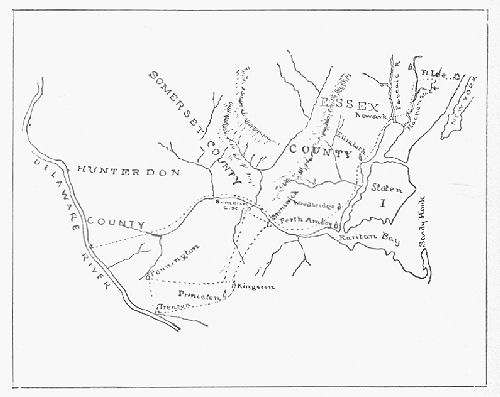
Sparkstown (Rahway?). Washington marched his army to Morristown and
Springfield. At about the time I arrived at Sparkstown, a report
was spread that the rebels had some designs upon Elizabethtown and
Sparkstown. The whole regiment was jaded to death. Unpleasant this!
Before day notice was brought to me by a patrol that he had heard
some firing towards Elizabethtown, about seven miles off. I
immediately jumped out of bed and directed my drums to beat to
arms, as nothing else would have roused my men, they were so tired.
Soon after this an express brought me positive orders to march
immediately to Perth Amboy, with all my baggage. At between six and
seven the rebels fired at some of my men that were quartered at two
miles distance. I had before appointed a subaltern's guard for the
protection of my baggage. This duty unluckily fell upon the
lieutenant of my company, which left it without an officer, the
ensign being sick at New York. I immediately directed my
lieutenant, who was a volunteer on this occasion, to march with his
guard, that was then formed, to the spot where the firing was,
while I made all the haste I could to follow him with the
battalion.
The lieutenant came up with them and fired upwards of twelve
rounds, when, the rebels perceiving the battalion on the march, ran
off as fast as they could. Had I pursued them I should perhaps have
given a good account of them.
The company baggage-wagon was, however, carried off by the Americans,
driver and all. The garrison got to Perth Amboy that night.
Elizabethtown was evacuated at the same time. The narrative goes on to
say:
The only posts we now possess in the Jerseys are Paulus Hook, Perth
Amboy, Raritan Landing, and Brunswick. Happy had it been if at
first we had fixed on no other posts in this province....
Washington's success in this affair of the surprise of the Hessians
has been the cause of this unhappy change in our affairs. It has
recruited the rebel army and given them sufficient spirit to
undertake a winter campaign. Our misfortune has been that we have
held the enemy too cheap. We must remove the seat of war from the
Jerseys now on account of the scarcity of forage and provisions.
The writer shows the wholesome impressions his friends were under in
this closing remark: "The whole garrison is every morning under arms at
five o'clock to be ready for the scoundrels."
In New York great pains were taken to prevent the truth about the
victories at Trenton and Princeton from getting abroad. False accounts
of them were printed in the newspapers, over which a strict military
censorship was established; but in spite of every precaution enough
leaked out through secret channels to put new life and hope in the
hearts and minds of the long-suffering prisoners of war.
It was one of the misfortunes of this most extraordinary campaign that
every blow Washington had struck left his army exhausted. After each
success it was necessary to recuperate. It was now being reorganized in
the shelter of its mountain fastness, strengthened by a simultaneous
uprising of the people, who now took the redress of their wrongs into
their own hands. No foraging party could show itself without being
attacked; no supplies be had except at the point of the sword. A host of
the exasperated yeomanry constantly hovered around the enemy's advanced
posts, which a feeling of pride alone induced him to hold. Putnam was
ordered up to Princeton, Heath to King's Bridge, so that Howe was kept
looking all ways at once. Redoubts were thrown up at New Brunswick,
leading Wayne to remark that the Americans had now thrown away the spade
and the British taken it up. Looking back over the weary months of
disaster the change on the face of affairs seems almost too great for
belief. From the British point of view the campaign had ended in utter
failure and disgrace. In England, Edward Gibbon says that the Americans
had almost lost the name of rebels, and in America Sir William Howe
found that he had to contend with a man in every way his superior.
INDEX
American Army, 12, 17 note;
marches to N. York, 12;
its efficiency, 14;
weakened by detachments, 19, 24 note;
reënforced, 19, 20;
effectives in summer of 1776, 22, 24 note;
defeated at L. Island, 29;
losses there, 31;
how posted after the battle, 31, 32;
driven from N. York, 39;
fights at White Plains and Fort Washington, 40;
losses there, 41;
is divided into two corps, 44;
dissension in, 49 note;
reduced numbers, 50;
summary of losses, 52, 53;
reaches the Delaware, 57;
in position there, 75;
is reënforced, 79;
time expiring, 80;
reënlistments, 97.
Bedford, L. I., seized by British, 27.
Bordentown, occupied by British troops, 71, 72;
evacuated, 95.
British Army of subjugation, 23;
by regiments, 25 note;
takes the field, 27;
drives the Americans from L. Island, 27 et seq.;
in winter quarters, 72, 76.
Brooklyn Heights fortified, 20, 24 note;
outer defences, 26;
turned by British, 27, 28.
Cadwalader, Col. John, 80, 87 note;
fails to get his troops across the Delaware, 83;
succeeds better in a second attempt, 94;
and occupies Bordentown, 95.
Clinton, Gen. Sir Henry, at N. York, 34;
moves to Throg's Neck, 36;
captures Newport, R. I., 70.
Cornwallis, Gen. Lord, surprises Fort Lee, 45;
is reënforced, 55;
pursues Washington, 55, 56, 57, 58 note;
is unable to follow him beyond Trenton, 62, 67 note;
has leave of absence, 71;
hastens back to Trenton, 97;
makes a forced march back to N. Brunswick, 106.
Declaration of Independence, read to the army, 23.
Donop, Col. Count, 72, 75;
abandons Bordentown, 95.
Ewing, Gen. James, 83, 87 note.
Fort Lee, 24 note;
evacuated, 45, 49 note.
Fort Washington, built, 21, 24 note;
assault and capture of, 40, 41, 42 note.
Gates, Gen. Horatio, brings troops from Ticonderoga, 63, 67 note;
refuses a command, 81.
Glover, Gen. John, at L. Island, 30;
at Trenton, 85, 88 note.
Greene, Gen. Nathaniel, advises the holding of Fort Washington, 40;
at Fort Lee, 45;
heads a column at Trenton, 87.
Griffin, Colonel, moves into the Jerseys, 82.
Hale, Capt. Nathan, taken and hanged, 36.
Harlem Heights, the army headquarters, 32, and note.
Haslet, Col. John, at Princeton, 105.
Heath, Gen. Wm., put in command in the Highlands, 44, 96, 106 note.
Howe, Gen. Sir William, lands at L. Island, 26;
his delays, 36;
moves into Westchester, 39;
fights at White Plains, 40;
and takes Fort Washington, 40;
inhumanity to prisoners by his permission, 52;
plans for next campaign, 70;
takes things easy, 71;
roused by Washington's bold strokes, 97.
King's Bridge, importance of, to N. York, 20, 21;
an outpost, 22, 24 note.
Kipp's Bay, landing-place of British, 34;
account by an eye-witness, 34, 35.
Knox, Gen. Henry, improves the artillery service, 16, 17;
at Trenton, 84, 85.
Lee, Gen. Charles, sent to N. York, 18 note;
ineffectually urges evacuation of Fort Washington, 41;
a rival of Washington, 41;
gets a separate command, 44;
moves to join Washington, 59;
his equivocal attitude, 50, 60;
his troops, 60, 67 note;
is reënforced, 61;
halts at Morristown, and is captured, 63;
probable aims, 65.
Long Island, campaign opened at, 26;
British plan of attack, 27;
flank march, 27, 28; evacuated, 30.
McDougall, Gen. Alexander, at Morristown, 96.
Mercer, Gen. Hugh, at Princeton, 104, 105, 107 note.
Mifflin, Gen. Thomas, at Trenton, 98.
New Jersey, invaded, 50;
apathy of people, 51;
military situation in, 71;
outrages perpetrated by the invaders, 77, 78;
arouse the people, 78;
mostly reconquered, 108, 112.
New York, the seat of war, 11;
its strategic value, 13;
defence determined upon, 13;
how effected, 20 et seq.;
the city and island in 1776, 20;
escapes bombardment, 30;
dispositions for holding the city, 31, 32;
evacuation ordered, 33;
takes place, 34;
partially burnt, 35.
North Castle, Washington retreats to, 40.
Percy, Gen. Lord Hugh, in command at Harlem, 36.
Philadelphia, critical situation there, 81.
Princeton, attacked by Washington, 103;
losses at, 105.
Putnam, Gen. Israel, commands at Philadelphia, 81;
sends a force into the Jerseys, 82, 88 note.
Rall or Rahl, Col., 72;
alarm of an attack, 89, 93 note;
fights bravely, and is mortally hurt, 91.
Reed, Joseph, 81, 87 note.
St. Clair, Gen. Arthur, at Princeton, 105.
Stark, Gen. John, at Trenton, 87, 106 note.
Sterling or Stirling, Lord (William Alexander), at Princeton, 62.
Sullivan, Gen. John, succeeds to command of Lee's corps, 64;
leads a column at Trenton, 87.
Throg's Neck, British land at, 39, 42 note.
Trenton, occupied as a British outpost, 72;
carried by assault, 89 et seq.;
fruits of victory, 91;
an epoch in the war, 93;
first abandoned, 93;
then reoccupied, 96.
Washington, Gen., at N. York, 12;
decides to act on the defensive, 18 note;
stands on his dignity, 24;
not in command at L. Island, 29;
orders its evacuation, 30;
moves to White Plains, 39;
rights there, but has to fall back, 40;
his dilemma, 43;
decides to divide his force, 44;
crosses into N. Jersey, 45;
manœuvring for delay, 50;
rises above partisanship, 54;
directs Lee to join him, 54, 55;
retreats to Newark, 55;
to New Brunswick, 56;
troops leave him, 56;
at Princeton, 57;
admirable retreat, 57;
crosses the Delaware, 62;
determines on striking the British outposts, 79, 80;
his plan, 82, 83;
marches on Trenton, 83 et seq.;
carries Trenton by assault, but is obliged to recross the Delaware, 91, 92;
but reoccupies Trenton, 96;
takes post there, 98;
steals a march on Cornwallis, 101, 107 note;
fights at Princeton, 103;
personal gallantry, 104;
marches to Somerset C. H., 106.
White Plains, Washington concentrates at, 39, 42 note;
action at, 40.
![[Click here to view this image enlarged.]](images/image1.jpg)
![[Click here to view this image enlarged.]](images/image2.jpg)
![[Click here to view this image enlarged.]](images/image3.jpg)
![[Click here to view this image enlarged.]](images/image4.jpg)
![[Click here to view this image enlarged.]](images/image5.jpg)
![[Click here to view this image enlarged.]](images/image6.jpg)