Head Quarters, April 30, 1776.
(Parole, Sawbridge.) (Countersign, Oliver.)
... Genl Greene's Brigade is to encamp tomorrow at 10 a.m. on the
ground marked out on Long Island....
[New York] April 30, 1776.
The Qr. Mrs. of the 9th, 11th, 12th regts. are to apply
to the Q. M. Genl. for tents & camp utensils this evening to be in
readiness to encamp agreeably to general orders to morrow morning—at
4 o'clock this p.m. Col. Varnum & Col. Hitchcock & Col. Little are
desired to attend at the General's quarters to go over to Long Island
& view the encampment marked out. A sergt. & 20 men are to parade
at White Hall to morrow at 7 o'clock, to be under the direction of
Engineer Smith.
[Long Island] May 4th, 1776.
Captain Spurs is to draw out a party of carpenters to make Bell tents,
they are to apply to Col. Miflin for tools, boards & nails to make
them of. 300 men for fatigue to morrow. The Quarter Master is to make
an estimate of the necessary quantity of boards to floor the tents &
apply to the Quarter Master general for them. The Cols. or commanding
officers of each regiment is to give an order for the boards,
certifying the quantity wanted. A return is to be made of the state of
the cartridges now in possession of the troops & the number wanted to
make up each man's twenty rounds.
[Col. Little's.]
Officers for fatigue to-morrow, Cap. Gerrish, Lt. Kent, & Lt.
Atkinson.
May 5th, 1776.
A fatigue party of 200 men to morrow morning properly officered. No
non-commissioned Officer or Soldier is to pass the ferries to New York
without permission from some of ye Field Officers. Any of the
troops attempting to pass over without permission will be confined &
tried for disobedience of orders. Any of the fatigue parties that
leave their work without liberty, shall do constant fatigue duty for a
whole week. As the security of New York greatly dependeth on this
pass, when these works are constructing the General hopes the troops
will carefully forward the same as fast as possible.
The inhabitants having entered a complaint that their meadow ground
was injured by the troops going upon it to gather greens, they are for
the future strictly prohibited going on the ground of any inhabitants,
unless in the proper passes to & from the encampments & the forts,
without orders from some commissioned officer. The General desires the
troops not to sully their reputation by any undue liberty in speech
or conduct but behave themselves towards the inhabitants with that
decency & respect that becomes the character of troops fighting for
the preservation of the rights & liberties of America.
The General would have the troops consider that we came here to
protect the inhabitants & their property from the ravages of the
enemy, but if instead of support & protection, they meet with nothing
but insult & outrage, we shall be considered as banditti & treated as
oppressors & enemies.
Head Quarters May 7, 1776.
(Parole, Devonshire.) (Countersign, Cavendish.)
Every regiment encamped in the lines & every regt. in the brigade
on Long Island, exclusive of their quarter & rear guards, are to mount
a picket every evening at retreat beating at sun set, consisting of
one Capt. 2 Subs, 1 drum & 1 fife & 50 rank & file—they are to lay
upon their arms, & be ready to turn out at a moments notice.
One Col. one Lt. Col. & one major are to mount every evening at
sunset as Field Officers of the picket.
Immediately upon any alarm or order from the Brig. Genl. of the
day, the pickets are to form in the front of their respective
encampments, & there wait the orders of the Field Officer commanding
the pickets, who is instantly to obey the orders of the Brigr.
Genl. of the Day.
A Brig. Genl. is to mount every morning at ten o'clock who will
receive all reports, visit all the outguards in the day time & report
all extraordinary occurrences to the Commander in Chief & the
Brigde Major of the day is constantly to attend head quarters to
receive all orders, & distribute them immediately.
The Col. is to go the grand rounds, & the Lt. Col. & the major the
visiting rounds of the Camp.
Brig. Genl. Greene will order the same picket to be mounted by the
regiments in his brigade as are mounted in the grand Camp. He will
also direct one field officer to mount daily to command them. Gen.
Greene will report all extraordinaries to the Commander in Chief.
Col. Prescott or the officer commanding on Nutten's or Governor's
Island & the officer commanding at Red Hook, are to report all
extraordinaries to the Commander in Chief on any appearance of the
enemy. The commanding officer at Red Hook will also dispatch a
messenger to Genl. Greene.
The officer commanding the riflemen upon Long Island will constantly
report all extraordinaries to Genl. Greene, & the officer
commanding upon Staten Island will do the same to the Commander in
Chief.
May 8, 1776.
Field officers for the picket, Major Angell, Adjt. for the day from
Col. Hitchcock's regiment.
Officers for picket tonight, Cap. Parker, Lt. Jenkins, Lt.
Burnham, Ensign Story. Officers for fatigue to-morrow, Cap. Dodge,
Lt. Jared Smith & Ensign Proctor.
Long Island, May 10th 1776.
The Brigde Major is to regulate the duty of the regiments, both
officers & soldiers, by their number & not by regiments, some being
much larger than others, & to establish a regular roster for the
regulation of the same. A subaltern & 11 men are to guard the stores &
ferries.
The officer commanding the guard is to receive his orders from Deputy
Commissary Brown for the number of sentries necessary for securing the
stores, to be relieved daily.
The Cols. or commanding officers of the ninth, eleventh, twelfth
Regts are to draw as many cartridges from the laboratory as will
furnish each man 20 rounds; as many to be delivered out as the
cartridge boxes will contain, the remainder to be tied up by the
capt of companies, & every man's name written on his cartridges,
that they may be delivered without confusion: All the bad cartridges
now in the regiments are to be returned to the Laboratory. The
Brigde Major will send a party to the Qr Mr Genl to draw
tents for the establishment of the main guard, to consist of a
subaltern and 21 men. An orderly sergeant from each regiment will
attend at the general's quarters daily; they are to bring their
provisions with them.
The commanding officers of the 9th 11th & 12th Regts are
to make returns of the guns out of repair & the number wanted to
furnish every non commissioned officer & soldier with a gun.
May 10th 1776.
A subaltern & 30 men are to parade immediately to fetch over 300
spears from the Qr Mr Genl's store. The officer must pick
those that are fit for use. He is also to bring over a grindstone to
sharpen the spears on. Col. Hitchcock will send over the arms of his
regiment that are out of order, to Mr. John Hillyard, foreman of a
shop at the King's Works (so called) where they will be immediately
repaired. Any soldier that has his gun damaged by negligence or
carelessly injured, shall pay the cost of repairing, the caps &
subs are desired to report all such.
May 11th 1776.
Field officer for picket tomorrow night Lt. Col. Henshaw, Adjt from
Col. Hitchcock's regt.
| | C. | S. | S. | C. | D. | F. | P. |
| Picket | 1 | 2 | 2 | 2 | 1 | 1 | 50 |
| Fatigue | 1 | 2 | 2 | 2 | 1 | 1 | 80 |
| Main Guard | | | 1 | | | | 8 |
Those non commissioned officers & soldiers who have occasion to go
over the ferry to New York will apply to Lt. Col. Henshaw for their
permits.
A regimental Court Martial will sit today at 12 o'clock at Capt
Wade's tent to try such prisoners as are contained in the Quarter
Guard of the regiment. Cap. Wade, Pres. Lt. Hodgkins, Lt. Parsons, Lt.
Knot & Ensn Pearson, members.
May 12th, 1776.
The 12th regiment exempt from fatigue tomorrow having to be
mustered.
May 14, 1776.
Field officer for picket tomorrow night, Major Collins, adjt. for
the day from Col. Hitchcock's Regt.
In Camp Long Island May 15, 1776.
The Col. desires hereby to remind the officers & soldiers of this
regiment of the Rules & Regulations of the army, & of the general
orders issued by the Commander in Chief agreable to them, especially
that the Rules & Regulations be often read to the men that no one
plead ignorance if he is called to account for the breach of any of
them.
The Col. desires & orders that the officers pay particular attention
that the Rules & Regulations be read to the men agreable to the
resolves of Congress, likewise that the officers of each company, off
duty, attend morning & evening to the calling of the roll & if
possible that a report be made every day of such as be absent. The
Col. is sorry to see so much inattention, of the officers & men to the
duties of religious worship, & he desires as we are all engaged in the
cause of God & our country, & are dependent on the Divine assistance
for protection & success, & as it is a duty incumbent on all as far as
possible in a social way to wait upon God in the way of his
appointment, to implore pardon & forgiveness of all our sins, & to ask
his guidance & direction in the prosecution of our affairs, that
neither officers nor soldiers will unnecessarily absent themselves
from the stated worship of God at the house of Prayer—or on the
Sabbath day.
Commissioned officers for picket tonight Cap. Baker, Lt. Knot &
Ensign Woodman. Commissioned officers for fatigue tomorrow, Capt.
Parker, Lt. Silvanus Smith & Lt. Lamborn; for main guard Ensign
Mitchell.
Brooklin May 16, 1776.
Col. Varnum's regiment to be off duty tomorrow morning in the
forenoon, to parade on the regimental parade at 8 oclock, to be
reviewed, & their arms examined. Every man in the regiment, that is
well, is to be on parade with arms & accoutrements. No soldier is to
borrow either arms or accoutrements from a soldier of either of the
other regiments, as the true state of the regiment with respect to
arms is wanted. Col. Hitchcock's regt. will be reviewed next day
after tomorrow. Col. Little's the day after that will be reviewed in
the same manner.
No soldier is to mount the picket guard without shoes.
May 16, 1776.
Tomorrow being the day appointed by the Continental Congress to be
observed as a day of fasting & prayer & his Excellency Genl.
Washington having ordered all duties to be discontinued except the
necessary guard until next day after tomorrow, there are no fatigue
parties to turn out tomorrow morning & the reviewing of Col. Varnum's
regiment is put off until next day after tomorrow, the other regiments
are to follow in order as in the morning orders. The general desires
that the troops of the 9, 11 & 12 regiments (except those on duty) may
be strict to attend the duties of the day in a devout & cleanly
manner. Field officers for picket tomorrow night—Adjt. from Col.
Varnum's regiment. Detail for Guard & fatigue as usual.
James Holland, a fifer in Cap. Dodge's Company is appointed fife major
to this regiment, & is to be obeyed as such.
Comd officers for picket tonight Lt. Atkinson & Lt. Fiske.
Head Quarters, 17 May 1776.
(Parole, New Castle.) (Countersign, Wilmington.)
Cap. Wolverton's Company of New Jersey is to join General Greene's
Brigade. The Cap. is to take his orders from the General respecting
his post....
May 17, 1776.
A corporal & 6 men to be sent for a guard to fort Sterling to mount at
9 O'clock. This guard is to be sent every other day. The corporal to
receive his orders from Lt. Randall of the train.
Field officer for picket tomorrow night Lt. Col. Henshaw, Adjt.
from Col. Varnum's regiment. Fatigue as usual.
May 19, 1776.
Field officer for picket tomorrow night Major Collins, Adjt. from
Col. Varnum's regiment. Detail as yesterday.
May 20, 1776.
Field officer for picket, Major Angell, Adjt. from Col. Hitchcock's
regiment.
May 21, 1776.
Field officer for picket tomorrow night, Lt. Col. Crary, Adjt.
from Col. Little's regiment.
May 23, 1776.
Field officer for picket to morrow night, Lt. Col. Henshaw,
adjutant from Col. Hitchcock's regiment.
Head Quarters, May 25, 1776.
(Parole, Mugford.) (Countersign, Leonard.)
A working party consisting of nine hundred men to be ordered tomorrow
morning from the different brigades, & the regiments.
| Genl. Heath's | { | Colos. Leonard's & Bailey's | } | To go to Powles Hook. |
| Colos. Read's & Baldwin's |
| Genl. Spencer's |
{ |
Colos. Parson's & Wylly's—To go to Bayard's Hill.
Colos. Huntington's to Red Hook. Arnold's to Fort Sterling.
Col. Ward's—50 men with 4 days provisions to cut pickets....
The remainder of this regiment's working party—at Fort George. |
| Lord Stirlings. |
{ |
Nixon's & Webb's
McDougall's & Ritzema's. |
} |
On Governor's Island every day
till further orders. |
May 25, 1776.
Cap. Silas Talbut of Col. Hitchcock's regiment, Capn. Frazier of
Capn. (Col.) Wayne's regiment, Lt. Noel Allen of Col. Varnum's
regiment & [Lt.] Samuel Huse of Col. Little's regiment are a
Committee to inspect the provisions for the troops of this brigade.
The commissaries & quartermasters are to apply to them to determine,
which is merchantable and which is not. Such as they say are good the
quarter masters are to receive and such as they condemn are to be
refused.
No non commissioned officer or soldier is to be out of camp after
retreat beating, & any that are discovered going out after that time
are to be taken up & confined in the main guard, & any that are coming
in, that have been out without leave from their officers are to be
confined; any sentry that permits them to pass without examination
will be punished for disobedience of orders.
Lt. Col. Cornell having reported great negligence among the guards,
for the future they will be visited by day & night, by the field
officer of the day. Every commissioned & non-commissioned officer that
commands guards is to be reported, that has not his guard in good
order. No soldier is to be absent from the guard without leave, & not
more than 2 commissioned officers nor more than one non commissioned
officer at a time. All guards except the picket are to mount at ——
o'Clock in the morning. The retreat is to beat half an hour after
sunset. At guard mounting in the morning, the field officer of the day
is to attend the parade & give to each respective officer a proper
detail of his guard.
One man from each detached guard is to be sent to the grand parade to
pilot the new guard to the relief of the old ones.
No person is to be admitted to any of the forts where there are cannon
or ammunition except a General officer by day, without the leave of
the officer commanding the guard, & a general officer after dark is
not to be admitted without leave first obtained of the commanding
(officer).
The officer commanding guards where there are cannon or ammunition, is
to be very watchful & not to suffer by day or night any person to
enter the forts unless they have business there, or are known to
belong to the army, or are with some officer belonging to the army.
Adjt. from Col. Varnum's.
Head Quarters, May 26, 1776.
(Parole, Hancock.) (Countersign, Trumbull.)
... The working party of Col. Nixon's regiment are to be ordered every
day to Long Island, instead of Governor's Island as mentioned in
yesterday's orders....
May 26, 1776.
Field officer for picket tomorrow night, Major Collins, Adjt. from
Col. Hitchcock's regiment.
May 29, 1776.
A garrison court martial to sit for the trial of prisoners now in the
main Guard.
The commanding officer of the Ferry Guard is to permit the Ferry boats
to pass until ten O'clock with common passengers, but no soldier is to
pass after retreat beating, unless the Col. or commanding officer of
the regiment, to which he belongs, certify the necessity. The troops
are to be under arms at roll calling, morning & evening. Every soldier
detected snapping his lock without orders from his officer, is to be
immediately sent prisoner to the main guard, there to be confined two
days & nights, & allowed nothing to eat or drink but bread & water.
All officers are desired to be more careful of discovering the
countersign to persons that have no right to know it.
Any soldier on guard that discovers the countersign to any of his
fellow soldiers, that are not on guard, is to be immediately confined.
Every one that gives the countersign, is to give it as softly as
possible so that if any person is listening, he may not hear it.
The sentries are not to suffer any person to stand near them, while
they are on their posts after retreat beating.
The General wishes that every part of camp duty may be done with as
much exactness, as if the enemy was encamped in the neighborhood, for
bad habits once contracted are difficult to get over, & doing duty in
a slovenly manner, is both disgraceful & dangerous to officers & men.
Field officer for picket tomorrow night, Major Smith, Adjt. from
Col. Hitchcock's regiment.
| | C. | S. | S. | C. | D. | F. | P. |
| Fatigue | 1 | 2 | 1 | 3 | 1 | 1 | 80 |
| Guard | | | 1 | 1 | 0 | 0 | 20 |
| Picket | 1 | 2 | 2 | 2 | 1 | 1 | 49 |
After Orders, May 31, 1776.
Gen. Washington has written to Genl. Putnam[230] desiring him, in
the most pressing form, to give positive orders to all the Cols. to
have colors immediately completed for their respective regiments.
June 1st, 1776.
A sergeant & 20 men to parade immediately to clear out Mr.
Livingston's Dock filled up by the Picket pealings. No pealings to be
thrown into the dock for the future.
Six o'clock this evening the troops to be all under arms to man the
works.
Five Cos. of Col. Varnum's Regiment upon the right in fort Box. The
other three upon the right of fort Green.
Col. Hitchcock's regt. to man fort Putnam & the redoubt upon the
left of it. 5 Cos. in the first & 3 in the Last.
Five Cos. of Col. Little's regiment in Fort Green & 3 in the oblong
square.
The independent Co. to be reserved in the rear of fort Green.
June 3d, 1776.
150 men & officers wanted from Cols Varnum's Hitchcock's & Little's
regts with arms blankets & 2 days provisions cooked & ½ a pint of
rum a man. To be ready to march at 3 o'clock to morrow morning every
man to take his blanket & none to go but such as are decently
dressed.
Camp Long Island, June 7, 1776.
Cols. of 9, 11, & 12 regiments to have all the arms in their
regiments that need repairing sent to the armorers.
The pikes to be placed in the works in the following order—100 in
fort Green, 30 in the works on the right of it, 20 in the oblong
redoubt, 50 in fort Putnam & 20 in the works on the left of it. Every
regt. to clean the spears once a week at their alarm Post.
The officers at the Ferry guard to stop all arms coming over the Ferry
to the island, & report immediately to the Genl. who has them &
where they say they are going. 2 sentries to be posted at the church
to stop all arms going eastward from the city, the names and place of
abode of any person stopped with arms to be taken & reported
immediately.
June 9th 1776.
Field officer for picket, Lt. Col. Henshaw.
The 9, 11, 12 Regts to parade tomorrow morning at 6 o'clock on the
right of the encampment, every officer & soldier not on duty or unwell
to join their respective regiments.
The Fatigue party not to turn out till after ye regiments are
paraded.
The officers of the 9th, 11th, 12th are desired to exercise
together by regts 4 days, & the whole of the officers of the three
regiments to exercise together once a week to be exercised by the Col.
of the Regt. in turn or by some person appointed by the Col. whose
turn it is. The Cols. of the 9, 11, 12, Regts are desired to
make returns of the state of the arms &c., agreably to yesterdays order
tomorrow.
Head Quarters June 10, 1776.
(Parole, Bedford.) (Countersign, Cumberland.)
The Brig. Gens. are requested to make their different Brigades
perfectly acquainted with their several alarm posts & to pay
particular attention to the men's arms....
June 12, 1776.
A garrison court martial to sit to-day....
The Col. or Commg: officers of the 9, 11, 12 Regts to certify
to the Deputy Commissary from day to day the necessary supplies for
the sick. The Surgeons to report every day the state and wants of the
sick. Centries posted at Hospitals & armory not to demand the
countersign of passengers unless they attempt to enter those places.
June 13, 1776.
The Camp Cullimen (?) of the 9. 11. 12 regts. to keep the streets
clean, remove the filth, cover the vaults every day & dig new ones
once a week; they must attend the Hospitals, & give directions for
having them kept in good clean order. Cols. are requested to appoint
nurses. No soldier to purchase clothing of another without leave, many
soldiers stealing and selling clothing.
June 14, 1776.
The 5 Cos. of Col. Waynes regt. on Long Island are to be
mustered to-morrow afternoon. A subaltern sergeant & 20 men to be
detached from the picket guard every evening to mount guard at Red
Hook Barbette battery to rejoin the picket in the morning.
In Camp Long Island, June 17, 1776.
The rank of the Captains in Col. Little's regt. being unsettled, a
Court to day is to establish their rank. The members to be from Col.
Varnum's & Hitchcock's Regts.
Col. Varnum's Regt. is to take fort Box & the Oblong redoubt for
their alarm posts, fort Box 6 cos., oblong redoubt 2 cos. Cap.
Woolverton's Independent Co. to join those in the redoubt, & to
receive orders from Col. Varnum.
Col. Hitchcock's Regt. to take fort Putnam & the fort or redoubt on
the left of it for their alarm posts.
Col. Little's Regt. to take fort Greene for their alarm post.
In case of an attack all these posts are to be defended to the last
extremity.
The lines to be manned every morning between day & sunrise & the
troops to be exercised at parapet firing.
Camp Long Island June 18, 1776.
The picket to be discontinued till further orders, except guard at Red
Hook.
300 men with their officers to parade at 8 O'clock tomorrow morning to
receive orders from Engineer Smith.
Head Quarters June 19, 1776.
(Parole, London.) (Countersign, Montgomery.)
A working party of 900 men properly officered to parade tomorrow
morning near the artillery park.... Brig. Gen. Greene & Col. Prescott
will furnish 150 men each as a working party on Governor's Island. On
the present emergency all working parties to work till 6 o'clock p.m.
Those who go by water will leave work sooner if wind & tide make it
necessary.
June 20, 1776.
Field officer, Lt. Col. Cornell, Adjt. from Col. Little's
Regt.
Col. Hitchcock's & Col. Little's regts. to furnish the fatigue
party to Governor's Island tomorrow. The remainder furnished by those
regts. to be upon the "Abatee" between fort Putnam & the redoubt on
the left of it, & the Cap. from fort Putnam to the half moon. Lt.
Col. Johnson's 5 Cos. of the 4th battalion of Pennsylvania
Regt. (Wayne's) to furnish the fatigue party for Cobble Hill. Col.
Varnum's Regt. to be employed on his alarm post. The Gen.
disapproves of the report for the establishment of the rank of the
12th regt. & directs the same court to sit again day after
tomorrow to examine the rank of the Caps. & to report how the court
conceives they ought to rank, & how it may be most equitably
established.
June 21, 1776.
For guard Lt. Burnham, for Red Hook tomorrow night Lt. Collins.
June 21, 1776.
Lt. Huse is requested to oversee the well-digging in fort Greene.
110 men for Governor's Island & 40 for Red Hook. Those that are to go
on the Island to be at St. George's Ferry by 8 o'clock. The others
to march to Red Hook as soon as they have had their breakfasts.
June 28, 1776.
Picket guard to mount from the 9, 11, 12, Regts. The 9 & 11
Regts to lie in their alarm posts—the 12th to lie in the oblong
redoubt.
Head Quarters, June 29.
... The Commissary Gen. to lodge a fortnights provision on Governor's
Island, Powles Hook & in all ye detached posts, Gen. Putnam
furnishing him a list of the men.
All soldiers intrusted with the defence of any work will behave with
coolness & bravery, & will be careful not to throw away their fire.
The Gen. recommends them to load for their first fire with one musket
ball & 4 or 8 buckshot according to the size and strength of their
pieces. If the enemy are received with such a fire at not more than 20
or 30 yards distance, he has no doubt of their being repulsed.
Brig. Genls. to order Chevaux de Freze & Fascines to close the
sally ports of their respective works. 26000 musket cartridges to be
sent Col. Prescott on Govr. Isld.
Head Quarters, June 30.
... Upon the signal of the enemy's approach or on any alarm all
fatigue parties are to repair to their respective corps ready for
instant action. Working parties are not otherwise to be interrupted in
finishing the defences....
In Camp Long Island, July 1, 1776.
Cols. or commd. officers of 9th, 11th, 12th, Regts.
are desired to make a line round each of the forts & fortifications
for the troops to begin a fire on the enemy if they attempt to storm
the works & the troops are to be told not to fire sooner than the
enemy's arrival at these lines, unless commanded. The line should be
about 80 yards from the parapet.
Comg. officers of the guards at Forts Green & Putnam to send a
patrolling party to patrol about the ¼ of a mile to prevent a
surprise by a partisan party.
The general thanks both officers & soldiers who turned out voluntarily
to work upon the Little Cobble hill; such public spirit is laudable &
shall not go unrewarded, if the genl. ever has it in his power to
make a more suitable acknowledgement.
No officer below the rank of a field officer to lodge out of camp from
their Cos. on any pretence, sickness excepted. The General
recommends the strictest discipline & daily attention to arms &
ammunition. Brigade being sickly the Gen. recommends the strictest
attention to the cookery & that broiling & frying meat so destructive
to health be prohibited.
A picket of one hundred to go to Red Hook to night by order of a
private message from his Excellency.
Tuesday July 2d, 1776.
A picket of 50 men in fort Putnam, 25 in fort Box, a sergt. & 12
men at the milldam from the 9th, 11th, 12th Regts. A
picket of 20 men at fort Sterling & 25 at Smith's redoubt on Cobble
Hill. Upon an alarm Col. Ward's regt. of Jersey militia to form in
the rear of Fort Green, the sentries to be placed at the front of the
redoubts. Major of Brigade to see to them. Patrols to be kept up from
fort Putnam every hour.
July 4, 1776.
Officers of the guards at ye different posts to be accountable for
everything in the forts but particularly for the rum lodged there for
the people in time of action. Any one destroying the tools or taking
the liquor without leave will be punished.
Every Regt. to furnish pickets for their alarm posts & to be
credited therefor in the detail for duty. The 9th, 11th,
12th, Regts. & the N.J. battalions under Col. Cadmus & Col. Ward
to furnish a fatigue party of 250 men tomorrow morning. Garrison Court
martial to sit tomorrow, Col. Little president. Caps. earnestly
requested to examine the arms and ammunition of their Cos. & have
them ready for action at all times.
Camp at Brooklin, July 6, 1776.
The Ferry guard upon a night alarm are to repair to fort Sterling. The
ground to be levelled from which Col. Hitchcock's Regt. moved. 233
men for picket from Col. Varnum's, Hitchcock's & Little's Regts. 66
men from the same for guard.
July 8, 1776.
Col. Varnum's Regt. to remove their encampment to Red Hook, & do
the duty of that post. Col. Forman's N.J. regt. to camp on the
ground lately occupied by Col. Hitchcock's regt.
July 8, 1776.
Col. Forman's Regt. to occupy Col. Varnum's old alarm posts,
namely, Fort Box and the Oblong redoubt. Brigade Major to lead the
troops to the alarm Post at 7 a.m. The guard for the several works to
be continued the same as before from the 11th & 12th of the old
establishment & the Jersey new levies, that the new levies may have
the benefit of the knowledge of the standing troops.
Head Quarters, July 9, 1776.
... The Continental Congress impelled by the dictates of duty, policy
and necessity have been pleased to dissolve the connection which
subsisted between this country & Gt. Britain, & to declare the
colonies of North America, Free & Independent States—the several
Brigades are to be drawn up this evening on their respective parades
at 6 o'clock when the declaration of Congress, showing the grounds and
reasons of the measure is to be read with an audible voice. The Gen.
hopes that this important Point will serve as a fresh incitement to
every officer & soldier to act with courage & fidelity, as knowing
that now the Peace & safety of this country depend (under God) solely
on the success of our arms, & that he is now in the service of a state
possessed of sufficient power to reward his merit & advance him to the
highest honor of a free country.
The Brigade Majors are to receive copies of the declaration to be
delivered to the Brigrs. & Cols.
July 9, 1776.
Adjt. for the day to carry the Parole & countersign to the guards
at Red Hook, Smith's Barbette, Fort Box, Fort Green & forts Putnam &
Sterling, & the ferry guard.
A fatigue tomorrow of 100 men for Smith's Barbette.
July 10, 1776.
Deputy Commissary, Mr. Brown, to issue provisions 3 times a week, Tu.
Th. & Saturdays.
Putrid fevers prevailing among the troops, the troops are forbid going
into the water only in the mornings and evenings, being dangerous in
the heat of the day.
A fatigue party of 150 to be furnished from the 11th & 12th &
Col. Forman's Regt. for Smith's Barbette to be continued till it is
completed.
July 11, 1776.
Fatigue parties to be turned out to be at work on the Hill by five in
the morning.
Camp Long Island, July 16, 1776.
Prisoners sent to the main Guard by the Field officer of the day with
or without arms, unless sooner released by him or the Gen. are only to
be kept till the mounting of the new guard, unless a crime be
delivered to the Cap. of the guard in writing against (the prisoners)
by the person that committed them, with his name to it.
Lt. Col. Cornell & Cap. Warner are appointed to oversee the works
at Smith's Barbette & complete them. They are to be excused from all
other duty. Fatigue parties for the future are to work as long as the
Cols. think advisable every cool day. The general wishes the troops
to be as industrious as possible, lest the enemy attack (the works)
before they are done.
A subaltern's Guard to mount at Rapalyea's mill upon the point every
night, to continue till sunrise.
Head Quarters, July 18 1776.
2 guns from fort Cobble Hill on Long Island to be a signal that the
enemy have landed on that Island.
July 18, 1776.
Field officer of the day tomorrow, Lt. Col. Henderson, Adjt.
from Col. Little's....
Patrolling parties to be sent out every hour to advance as silently as
possible & to stop & listen every few rods, to discover spies lurking
around the works.
Camp on Long Island, July 19 1776.
The works on Cobble Hill being greatly retarded for want of men to lay
turf, few being acquainted with that service, all those in Col.
Hitchcock's & Col. Little's Regts. that understand that business,
are desired to voluntarily turn out every day, & they shall be excused
from all other duty, & allowed ½ a pint of rum a day.
Half the fatigue party to work tomorrow at fort Sterling in widening
the ditch. Lt. Col. Cornell will detach the party & give the
necessary instructions. Cap. Newell of the Train to mount an artillery
guard on Smith's Barbette, on Cobble Hill, of a Sergeant & 6 men.
F. Officer of the day tomorrow Major Parker, Adjt. from Col.
Forman's Regt. (New Jersey).
July 22, 1776.
F. Offr. tomorrow, Col. Forman, Adjt. from his regt.
The Cols. or Cg. Offrs. of the 1st, 9th, 11th,
12th Regiments are requested to send in a return of vacancies, with
a list of names to fill them, by tomorrow at 9 a.m. The 11th,
12th & Col. Forman's Regts. are to parade on the regimental
parade tomorrow a.m. instead of going to their alarm posts. Comg.
off. of each regt. will receive orders on the spot when & where to
march.
The duties being exceedingly heavy on the men, the Genl. thinks
proper to lessen the fatigue party ½ & reduce the guard in forts
Green & Putnam ⅓, & a Serjt. & 12 men to mount in fort Box,
instead of the present guard.
July 24, 1776.
A fatigue party of 40 men & 1 sub. to cut fascines to parade this p.m.
4 days provisions to be provided. Passengers going into the city not
to be stopped at the ferry unless there is reason to suspect them. No
one to come out without a proper pass. Fatigue for home duty to be
lessened as much as the number detached.
In Camp Long Island, July 28, 1776.
The success of the campaign must depend on the health of the troops;
nothing should be neglected that contributes to it. Good Policy as
well as humanity claims the attention of every officer to this object;
our honor as well as our success depends on it.
The good officer discharges his duty not only in one but in every
respect. It is a mistaken notion that the minutiæ of military matters
is only an employment for little minds. Such an officer betrays a want
of understanding and showeth a person ignorant of the necessary
dependence and connection of one thing upon another. What signifies
knowledge without power to execute? He who studies the Branches of
military knowledge relating to Dispositions, & neglects to preserve
the health of his troops will find himself in that disagreeable
situation.
The general is pained to discover inattention to the digging and
filling vaults for the regts. & to the burial of filth and putrid
matter. The general directs camp Columen(?) of the several regts.
to dig new vaults, and fill up old ones every 3 days, & that fresh
dirt be thrown in every day to the vaults, & that all filth in and
about the camp be daily buried. The sickly season coming on, & Putrid
fevers prevailing, the Gen. recommends a free use of vegetables &
desires the men may keep themselves & clothes clean, & cook their
provisions properly; & little injury is to be dreaded. A neglect of
these matters at this critical season may be attended with dreadful
consequences.
Complaints are made of the troops stealing water mellons. Such
practices must be punished. A few unprincipled rascals may ruin the
reputation of a whole corps of virtuous men. The General desires the
virtuous to complain of every offender that may be detected in
invading people's property in an unlawful manner, whatever his station
or from whatever part of the country he may come.
Aug. 1, 1776.
All the straw bunks & —— in ye different regts. occupied by
the well to be collected for the sick of Col. Forman's regt. A
sergeant & 8 men to be employed cutting wood for a coal pit for the
armorers shop—apply to master armorers for orders.
In Camp Long Island, Aug. 4, 1776.
4 Cos. of Col. Gay's regt. to take fort Sterling for their alarm
post & 4—Cobble Hill.
The countersign having spread too generally in the camp, & amongst
many that don't belong to the army, the Genl. orders every person
to be punished who is base enough to discover it to those who have no
right to it.
No person allowed to pass after 10 o'clock with or without the
countersign within the limits of the camp or circle of the sentries,
except Genl. & Field Officers, Brigade Majors & expresses. This
order extends to inhabitants as well as the army.
A fatigue party from Col. Little's, Col. Forman's & Col. Gay's
regts. of 200 men, properly officered, to work at Fort Sterling
tomorrow. Col. Gay or the comg. officer of his regt. is directed
to lead his troops into their alarm posts at 5 o'clock this afternoon.
Officers are directed to acquaint themselves with the ground for miles
about their camps.
Morning Orders, Aug. 6, 1776.
Commanding Officers of fortifications are requested to pay particular
attention to ye provisions lodged at each alarm post for the
support of the troops in case of seige, and also that ye water
casks & cisterns are filled & when the water is bad to have it pumped
out & fresh water put in.
Aug. 6, 1776.
By a deserter from Sir Peter Parker's fleet we learn that the
Hessians, from England, & Clinton's troops from S. Carolina are
arrived & that the enemy meditate an attack on this Island & the city
of New York. The Genl. wishes to have the troops provided with
every thing necessary to give them a proper reception. Caps. are
directed to examine the arms of their cos. immediately.
Aug. 8, 1776.
A sub. & 20 men to parade immediately to march to Jamaica. Let the men
be decently dressed, & the officers keep them from offering insolence
or abuse to any person. They are to escort & assist Lt. Skinner &
wait there for his directions.
Aug. 9, 1776.
A report from Col. Hand mentions a large number of regulars drawn up
at Staten Island Ferry, & boats to embark in. No officer or soldier to
stir from his quarters that we may be ready to march at a moment's
warning if necessary.
Aug. 16, 1776.
Col. Smith (L.I. militia) to appt an Adjt., Q.M. & Serjt Maj.
& Q. Mr. Serjt to his regt., & to have the troops in his
regt not on duty exercised daily in learning the necessary
manœuvres and evolutions.
Genls. Nixon and Heard are to furnish a fatigue party from their
brigades and to form the necessary lines from fort Box to fort Putnam.
The gin shops and houses selling liquor, strictly forbidden to sell to
soldiers, excepting near the two ferries.
The inhabitants of houses near the lines are immediately to move out
of them, and they are to be appropriated to the use of the troops. The
General is determined to have any soldiers punished that may be found
disguised with liquor, as no soldier in such a situation can be fit
for defense or attack.
The General orders that no sutler in the army shall sell to any
soldier more than 1 gill of spirits per day. If the above orders are
not adhered to, there shall no more be retailed out at all.
The Colonels of regts. lately come in are immediately to make
returns to the Genl. of their number of men & where they are
quartered. Col. Hitchcock's and Smith's Regts are to do duty in
Genl. Nixon's brigade—Cols. Van Brunt's and Gay's Regts. to
do duty in Genl. Heard's brigade. Capts in the brigades are to
be particularly careful that the Rolls are called 3 times a day & that
the troops do not stray from quarters.
Head Quarters, Aug. 20, 1776.
... General Sullivan is to take command on Long Island till Gen.
Greene's state of health will permit him to resume it. Brig. Ld
Sterling is to take charge of Genl Sullivan's division.
[Long Island,] August 20, 1776.
Field Offr of the Day tomorrow, Col. Phipps, (?) Adjt from Col.
Little's regt.
August 21st, 1776.
Five hundred men to be on fatigue to-morrow to be on the works by 8
o'clock, to leave at 12, & begin at 2 o'clock, & work till half past
6. Nothing can be more disagreeable to the Genl. than to call upon
the men to be so constantly on fatigue, but their own salvation, and
the safety of the country requires it. He hopes that in 2 or 3 days
more the encampment will be so secure that he can release the men from
fatigue and give them an opportunity to rest from their labors.
Adjt. of the day to attend at the Genls. quarters every morning
at 8, and an orderly from each brigade daily. Four men are to be
drafted to row the Genls boat and do no other duty. The Brigade
majors, upon receiving orders from Head Quarters are to call at Gen.
Sullivan's quarters for his orders, or send adjts to take them off.
Col. Johnson's and Newcomb's regts are to consider the woods on the
west side of the creek as their alarm post, and repair there in case
of an alarm. Gen. Nixon will show the ground this evening at 6 o'clock
to the commg officers of the Regts.
Aug. 23, 1776.
The men not to turn out to their alarm posts this afternoon, (but) to
get 2 days' provisions ready, & to be at their alarm posts to-morrow
morning by 3 o'clock in order for action.
Cols. Miles & Ransom's (Remsen's of L.I.) regts. to take
possession of the Bedford road this night—Col. Ransom's regt. to
march at 5 o'clock. Col. Miles' regt. is on the spot. Cols.
Little's & Hitchcock's Regts to possess the Flatbush road &
Cols. Johnson's & Martin's to take possession of the road near the
river. All these regts. to be at their posts by 6 o'clock. Upon
their arrival the troops now there are to retire to their encampments
& get 2 days provisions dressed, & be ready for action. The Gen. will
never make a 3rd. requisition to the majors of brigade, to attend for
orders.
Long Island Aug. 24 1776.
A return to be made to the Gen. this afternoon at 5 o'clock of all
ye Light Horse & companies of troop within the lines. The adjt.
of Col. Little's regiment is to attend at Genls. quarters at 7
o'clock a.m. to-morrow.
The Genl. returns his thanks to the brave officers & soldiers who
with so much spirit & intrepidity repulsed the enemy & defeated their
designs of taking possession of the woods near our lines. He is now
convinced that the troops he has the honor to command, will not, in
point of bravery, yield to any troops in the universe. The
cheerfulness with which they do their duty, & the patience with which
they undergo fatigue evince exalted sentiments of freedom, & love of
country gives him most satisfactory evidence that when called upon
they will prove themselves worthy of that freedom for which they are
now contending.
Col. Ramsons (Remsen's) Regt. to mount no guard except quarter
guard of 12, but be considered a fatigue party, to which they are to
attend from day to day. The Genl. is sorry to find that Regt.
flying from their posts, when timid women would have blushed to have
betrayed any signs of fear at any thing this regt. discovered at
the time of their flight.
Officers are requested to see that their men always keep at least 2
days provisions, ready dressed by them. The Commissary is to deal out
one gill of rum per man each day on this Island until further orders.
Soldiers are not to be out of their encampment but upon urgent
business. Gen. Nixon to take command of the lines next the enemy until
further orders, to post his men in the edge of the woods next the
enemy. Brigde Majors to attend punctually at the Genl's.
quarters at 10 a.m.
Long Island Aug. 25 1776.
The following arrangement to take place on Long Island until further
orders—Viz: Col. Mile's 2 battalions, Col. Atlee's, Col. Lutzs, Major
Hayes, Col. Lashers and Drake's to be formed into one brigade under
the command of Gen. Ld. Stirling. Col. Hand's, Prescott's, (Late)
Nixon's, Varnum's, Hitchcock's, Little's, Smith's, & Ramson's to be
under Gen. Nixon. Wylly's, Huntington's, Taylor's, (Tyler's)
Silliman's, Chester's, & Gay's under Gen. Parsons; Johnson's,
Courtlandt's, Martins, Newcombs & Freeman's (Forman's), under the
command of Brig. Gen Hurd.
The General orders that the Brigrs. attend at Head Quarters at 8
a.m. to-morrow for directions. Brigde Major Box is appointed to act
as Adjt. Genl. for this department until further orders.
A Brigr. Genl. of the Day to attend the Grand Parade at Guard
mounting at 10 a.m., every day afterwards at 8, whose duty it shall be
to see that the guards are regularly made up, & properly posted & duly
relieved. No firing at the outposts to be allowed on any pretense,
except by permission of the Comg Gen. of the day, & none within the
lines except by permission. This order not to extend to sentries on
guard.
Brigr. for the day Gen. Ld. Stirling.
The Gen. is surprised to find the soldiers strolling about,
notwithstanding repeated orders, miles distant from the lines, at a
time when the enemy are hourly expected to make an attack. The
officers are enjoined to cause the arrest of any soldier who shall be
found strolling without the lines unless they can show a written
permit from their Cap. or Comg. officer of the regt. or company.
All the officers and soldiers are to keep within their quarters,
unless ordered on duty.
All troops in this department are desired to wear a green bough or
branch of a tree in their hats, till further orders.
Col. Ward's Regt. to be added to Gen. Parson's brigade. All the troops
not[231]——
All other troops not mentioned and those which may be sent here
without a General Officer to command them are to be considered as a
part of Lord Stirling's Brigade till further orders.
A return of the several Brigades to be made immediately. Eight hundred
(men) properly officered to relieve the troops on Bedford Road
to-morrow morning, six field officers to attend with this party. The
same number to relieve those on Bush (Flatbush) Road, and an equal
number those stationed towards the Narrows. A picket of three hundred
men under the command of a Field Officer, six Captains, twelve
Subalterns to be posted at the wood on the west side of the Creek
every night till further orders.
It is a very scandalous practice unbecoming soldiers whose duty it is
to defend the liberty and property of the Inhabitants of the country
to make free with and rob them of that property; it is therefore
ordered that no person belonging to this army do presume on any
pretense whatever to take or make use of any Corn, Poultry or
Provision, or anything else without the consent of the owners nor
without paying the common price for them; any breach of this order
will be severely punished. The Commanding Officer of each Regiment and
Company is to see this order communicated to their respective corps
and to see it carried into execution....
Brigadier Lord Stirling to command the front of our lines next
Hudson's River and to command the reserve within the lines, and when
either of the other Brigade Generals have the command of the Advance
Lines Lord Stirling is to have command of his post in his absence.
Each Brigadier General to assign the Alarm Posts to the several
Regiments under their command.
Head-Quarters Long Island Aug. 29, 1776.
| Parole, Sullivan, |
} |
| Countersign, Green. |
As the sick are an encumbrance to the Army, & Troops are expected this
afternoon from the flying camp in Jersey, under Genl Mercer, who is
himself arrived & room & cover is wanted for the troops, the
commanding Officers of Regt's are immediately to have such sick
removed. They are to take their Arms & Accoutrements & be conducted by
an Officer to the Genl Hospital, as a rendezvous & then to cross
to-gether under the directions of the Person appointed there, taking
general Directions from Dr Morgan. As the above Forces under Genl
Mercer are expected this afternoon, the General proposes to relieve a
proportionate Number of Regiments & make a change in the situation of
them.
The Commanding Officers of Regiments are therefore to parade their men
with their Arms, Accoutrements, and Knapsacks, at 7 oClock, at the
Head of their Encampments & there wait for Orders.[232]
[From MS. Order Book of Col. Wm. Douglas.]
Head-Quarters, New York, August 31, 1776.
(Parole, Harlem.) (Countersign, Flushing.)
... Both officers and soldiers are informed that the retreat from
Long-Island was made by the unanimous advice of all the General
Officers, not from any doubts of the spirit of the troops, but because
they found the troops very much fatigued with hard duty, and divided
into many detachments, while the enemy had their main body on the
Island, and capable of receiving assistance from the shipping. In
these circumstances it was thought unsafe to transport the whole of an
Army on an Island, or to engage them with a part, and therefore
unequal numbers; whereas now our whole Army is collected together,
without water intervening, while the enemy can receive little
assistance from their ships. Their Army is, and must be, divided into
many bodies, and fatigued with keeping up a communication with their
ships; whereas ours is connected and can act together. They must
effect a landing under so many disadvantages, that if officers and
soldiers are vigilant, and alert to prevent surprise, and add spirit
when they approach, there is no doubt of our success....
[Force, 5th Series, Vol. I., p. 1248.]
| Head-Quarters, Colonel Roger Morris's House, ten
miles from |
} |
| New York, September 19, 1776. |
Gentlemen: I was honoured the night before last with your favor of the
13th instant, and at the same time that I conceive your anxiety to
have been great, by reason of the vague and uncertain accounts you
received respecting the attack on Long Island, give me leave to
assure you that the situation of our affairs, and the important
concerns which have surrounded me, and which are daily pressing on me,
have prevented me from transmitting, in many instances, the
intelligence I otherwise should have conveyed.
In respect to the attack and retreat from Long Island, the publick
papers will furnish you with accounts nearly true. I shall only add,
that in the former we lost about eight hundred men; more than
three-fourths of which were taken prisoners. This misfortune happened
in great measure, by two detachments of our people who were posted in
two roads leading through a wood, in order to intercept the enemy in
their march, suffering a surprise, and making a precipitate retreat,
which enabled the enemy to lead a great part of their force against
the troops commanded by Lord Stirling, which formed a third
detachment, who behaved with great bravery and resolution, charging
the enemy and maintaining their posts from about seven or eight
o'clock in the morning till two in the afternoon, when they were
obliged to attempt a retreat, being surrounded and overpowered by
numbers on all sides, and in which many of them were taken. One
battalion (Smallwood's of Maryland) lost two hundred and
fifty-nine men, and the general damage fell upon the regiments from
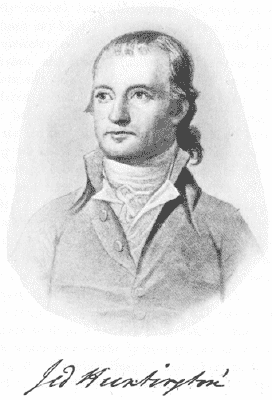
Pennsylvania, Delaware and Maryland, and Colonel Huntington's,
of Connecticut.
As to the retreat from the Island, it was effected without loss of
men, and with but very little baggage. A few heavy cannon were left,
not being moveable on account of the ground's being soft and miry
through the rains that had fallen.
The enemy's loss in killed we could never ascertain; but have many
reasons to believe that it was pretty considerable, and exceeded ours
a good deal. The retreat from thence was absolutely necessary, the
enemy having landed the main body of their army there to attack us in
front, while their ships of war were to cut off the communication with
the city, from whence resources of men, provisions, &c., were to be
drawn....
I have the honour to be, &c.,
Go. Washington.
To the Hon. Jeremiah Powell, Esq., President, &c.
[Force, 5th Series, Vol. II., p. 399.]
Long Island 29 Aug 1776.
... Before this reaches you the account of the battle of Tuesday last
will arrive—'tis impossible to be particular in a narrative of the
matter as many are yet missing, who we hope may come in. In the night
of the 26th nine Regiments of the English troops perhaps about 2500
with Field artillery &c. passed the Western road near the Narrows from
the flat land, for our lines. We had a guard of 400 or 500 men posted
in the wood, who about three o'clock Tuesday morning gave notice of
the enemy's approach, a body of about 1500. We immediately marched
down to oppose the progress of the enemy. We took possession of a hill
about two miles from camp and detached Col Atlee with a Reg't of
Delaware [Penn.] to meet them further on the road; in about 60 rods he
drew up & received the enemy's fire & gave them a well directed fire
from his Reg't, which did great execution & then retreated to the
hill; from thence I was ordered with Col Atlee & part of his Reg't &
Lt Col Clark with Col Huntington's Reg't to cover the left flank of
our main body.
This we executed though our number did at no time exceed 300 men & we
were attacked three several times by two Regiments ye 44th &
23d and repulsed them in every attack with considerable loss. The
number of dead we had collected together & the heap the enemy had made
we supposed amounted to about 60. We had 12 or 14 wounded prisoners
who we caused to be dress'd & their wounds put in the best state our
situation would admit. About 10 o'clock we found a large body of the
enemy had advanced on the other roads near our lines, but a constant
fire was kept up on the enemy till about 12, when we found them fast
advancing on our rear to cut off our retreat. Our little main body
advanced boldly up to the enemy in the rear & broke through their
lines and secured the retreat of most of the party; but it fared still
harder with my little party who had three times repulsed the enemy in
front and once in the rear; we had no notice of the retreat of the
main body till it was too late for us to join them, the enemy having
cut off our retreat on three sides & the main body having broke
through the enemy's lines on the other side and left them between us.
We had no alternative left but force through one line into a thick
wood, which we attempted & effected with part of our men, the other
part with Col. Clark being before sent into the wood. When we had made
our way into the wood, I was accidentally parted from Col. Atlee &
most of the men whom I have never seen since. I came in with 7 men
yesterday morning much fatigued. Our loss is impossible to be
ascertained. In my party a Lt. Col. Parry was killed and one wounded.
Our loss in killed & wounded is inconsiderable, but many are missing
among whom are General Sullivan & Lord Sterling. Colonels Miles,
Atlee, Johnson, Lt. Col. Clark Maj. Wells & several other officers of
distinction are yet missing. I think the trial of that day far from
being any discouragement, but in general our soldiers behaved with
firmness.
I am sir, with esteem & Regard
Yr. Humble Svt.
Sam'l H. Parsons.
Morrisania Oct. 8, 1776.
Dear Sir
Your's of the 2d inst I rec'd last night, for which I am obliged to
you. If any information I can give will contribute to your
satisfaction or my country's good I am happy in furnishing what falls
in my observation. I agree fully with you that you were in the dark
as to some facts relative to the transactions on Long Island & am
fully satisfied you still remain so, or you could not suppose the
surprise there was in the day time. To give you a clear idea of the
matter, I must trouble you with a description of that part of the
country where the enemy landed, and encamped, and the intervening
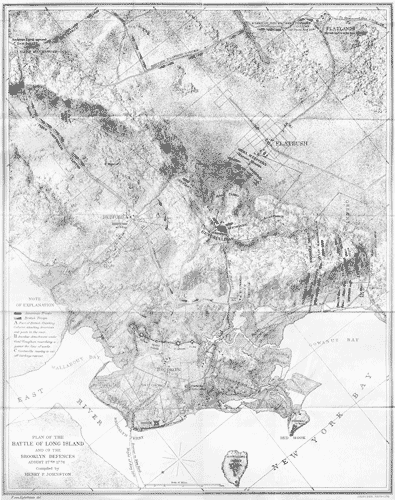
lands between that and our lines. From the point of land which forms
the east side of the Narrows, runs a ridge of hills about N.E. in
length about 5 or 6 miles, covered with a thick wood which terminate
in a small rising land near Jamaica; through these hills are three
passes only, one near the Narrows, one on the road called the Flatbush
Road & one called the Bedford Road, being a cross road from Bedford to
Flatbush which lies on the southerly side of these hills; these passes
are through the mountains or hills easily defensible being very narrow
and the lands high & mountainous on each side. These are the only
roads which can be passed from the south side the hill to our lines,
except a road leading around the easterly end of the hills to Jamaica.
On each of these roads were placed a guard of 800 men, and east of
them in the wood was placed Col Miles with his Battalion to watch the
motion of the enemy on that part, with orders to keep a party
constantly reconnoitering to and across the Jamaica road. The
sentinels were so placed as to keep a constant communication between
the three guards on the three roads. South of these hills lies a large
plain extending from the North River easterly to Rockaway Bay perhaps
5 miles & southerly to the sound bounded on the south by the sound and
on the north by the hills. Those hills were from two to three miles
and a half from our lines. The enemy landed on this plain & extended
their camp from the River to Flatbush perhaps 3 or 4 miles. On the day
of the surprise I was on duty, and at the first dawn of day the guards
from the West road near the Narrows, came to my quarters & informed me
the enemy were advancing in great numbers by that road. I soon found
it true & that the whole guard had fled without firing a gun; these
(by way of retaliation I must tell you) were all New Yorkers &
Pennsylvanians; I found by fair daylight the enemy were through the
wood & descending the hill on the North side, on which with 20 of my
fugitive guard being all I could collect, I took post on a height in
their front at about half a mile's distance—which halted their column
& gave time for Lord Sterling with his forces to come up; thus much
for the West road—On the East next Jamaica Col. Miles suffered the
enemy to march not less than 6 miles till they came near two miles in
rear of the guards before he discovered & gave notice of their
approach. This also was in the night & the guard kept by
Pennsylvanians altogether—the New England & New Jersey troops being
in the other two roads through which the enemy did not attempt to
pass.
We were surprised—our principal barrier lost by that surprise, but as
far as the cover of the night is an excuse we have it.—The landing of
the troops could not be prevented at the distance of 6 or 7 miles from
our lines; on a plain under the cannon of the ships, just in with the
shore. Our unequal numbers would not admit attacking them on the plain
when landed.
When our principal barrier was lost, our numbers so much inferior to
the enemy, they not disposed to storm our lines, but set down to make
regular approaches to us—were part of the reasons which induced a
retreat from thence and a consequent abandoning New York—. Our
sentinels & guards in my opinion were well posted, they might have
been better, too great security I thought prevailed with some leading
officers, but I still am of opinion, if our guards on the West road &
Col. Miles on East End of the hills had done their duty, the enemy
would not have passed those important heights, without such very great
loss as would have obliged them to abandon any further enterprise on
the Island....
I am sir
Your Most Humble Sv't
Sam'l H. Parsons.
[Originals in possession of Hon. Charles Francis Adams.]
New York Sept. 6, 1776.
Dear Sir:
I received your letter about half an hour ago by the messengers of the
honorable convention, in which you inform me that they are anxious to
be informed of any transactions at this place that may be of use to
the State, or otherwise of importance. My duty would have directed me
to execute this task before the receipt of your letter, had I been
possessed of the means of conveyance. I shall do it now as far as the
want of good pen and ink, as scarce as almost every other necessary
article, will permit.
I shall begin with our retreat from Long Island. For previous to that
event the convention was so near the scene of action that they must
have been acquainted with every occurrence. I was summoned to a
Council of War at Mr. Philip Livingston's house on Thursday 29th
ult. never having had reason to expect a proposition for a retreat
till it was mentioned. Upon my arrival at the lines on the Tuesday
morning before, and just after the enemy, by beating General Sullivan
and Lord Stirling, had gained the heights which in their nature
appear to have been more defensible than the lines were, it was
obvious to me we could not maintain them for any long time should the
enemy approach us regularly. They were unfinished in several places
when I arrived there, and we were obliged hastily to finish them, and
you may imagine with very little perfection, particularly across the
main road, the most likely for the approach of the enemy's heavy
artillery. In this place three of my battalions were placed, the
traverse of the line in ground so low, that the rising ground
immediately without it, would have put it in the power of a man at 40
yards' distance to fire under my horse's belly whenever he pleased.
You may judge of our situation, subject to almost incessant rains,
without baggage or tents and almost without victuals or drink, and in
some part of the lines the men were standing up to their middles in
water. The enemy were evidently incircling us from water to water with
intent to hem us in upon a small neck of land. In this situation they
had as perfect a command of the island, except the small neck on which
we were posted, as they now have. Thus things stood when the retreat
was proposed. As it was suddenly proposed, I as suddenly objected to
it, from an aversion to giving the enemy a single inch of ground; but
was soon convinced by the unanswerable reasons for it. They were
these. Invested by an enemy of above double our number from water to
water, scant in almost every necessary of life and without covering
and liable every moment to have the communication between us and the
city cut off by the entrance of the frigates into the East River
between (late) Governor's Island and Long Island; which General
McDougall assured us from his own nautic experience was very feasible.
In such a situation we should have been reduced to the alternative of
desperately attempting to cut our way [through] a vastly superior
enemy with the certain loss of a valuable stock of artillery and
artillery stores, which the continent has been collecting with great
pains; or by famine and fatigue have been made an easy prey to the
enemy. In either case the campaign would have ended in the total ruin
of our army. The resolution therefore to retreat was unanimous, and
tho' formed late in the day was executed the following night with
unexpected success. We however lost some of our heavy cannon on the
forts at a distance from the water, the softness of the ground
occasioned by the rains having rendered it impossible to remove them
in so short a time. Almost everything else valuable was saved; and not
a dozen men lost in the retreat. The consequence of our retreat was
the loss of [late] Govrs Island which is perfectly commanded by the
fort on Red Hook. The enemy however from fear or other reasons
indulged with the opportunity of two nights to carry off all except
some heavy cannon. The garrison was drawn off in the afternoon after
our retreat under the fire of the shipping who are now drawn up just
behind [late] Govrs Island, and the fire of some cannon from Long
Island shore; but with no other loss than that of one man's arm. What
our loss on Long Island was I am not able to estimate. I think the
hills might have been well maintained with 5000 men. I fear their
natural strength was our bane by lulling us into a state of security
and enabling the enemy to steal a march upon us. I think from the
best accounts we must have killed many of the enemy. We are sure that
late Colonel and afterwards General Grant who was so bitter against us
in Parliament, is among the slain. General Parsons late Col. and
promoted to the rank of a general officer escaped from the action and
pursuit as by a miracle. I believe him to be a brave man. He is a
Connecticut lawyer. He told me that in the action he commanded a party
of about 250 men, with orders from Lord Stirling to cover his flank;
and that when the enemy gave way, he threw into a heap about thirty of
the enemy's dead, and that in advancing a little further he found a
heap made by the enemy at least as large as that which he had
collected. Lord Stirling had ordered him to maintain his ground till
receipt of his orders to retreat. However, finding that no such
orders came; and finding the enemy by rallying to increase on his
hands, he flew to the place where Lord Stirling was posted, leaving
his party on the ground with strict orders to maintain it till his
return, but he found his Lordship and his whole body of troops gone.
There can be no doubt but Lord Stirling behaved bravely; but I wish
that he had retreated sooner. He would have saved himself and a great
number of troops from captivity, but he refused to retreat for want of
orders. We miss him much, he was a very active officer. General
Sullivan who was also made a prisoner in the action on the heights
went some days ago on parole to Congress to endeavor to procure his
exchange for Prescot. I have not heard of his return. Two or three
days ago the Rose frigate went up between the islands and took
shelter, after a severe cannonade from us, behind Blackwell's Island.
She retreated yesterday as far as Corlear's Hook, where she was
briskly cannonaded till night. I have not heard of her this morning.
By the loss on Long Island and the running away of our militia,
especially those of Connecticut, to their respective homes, our army
is much diminished, and I am sure is vastly inferior to that of the
enemy....
Poor General Woodhull with a lieutenant and four men were made
prisoners on Long Island. I had a letter from him dated the first
inst. but not dated from any place, nor does he tell me how he was
taken. He has lost all his baggage and requested of me two shirts and
two pairs of stockings, which I should have sent him had not the flag
of truce been gone before I recd the letter. I shall comply with
his request by the first opportunity. Commend me with all possible
devotion to the honorable Convention.
I am, Sir,
Your most obedient servant
Jno. Morin Scott.
P.S. The army badly paid & wretchedly fed. 1100 men arrived from the
southward. A deserter tells me be (?) 3000 foreign troops on Staten
island. I know not what the flying camp is doing. He says the enemy on
Long Island are 26,000. I believe this much exaggerated; and 1000 in
the shipping.
[Original in possession of Hon. John Jay, New York.]
New York 27th August 1776.
Dear Brother
Since my last the enemy have landed their main force on Long Island
near New Utrecht Church—between that & Flat Bush, our people and
theirs have frequent skirmishes in all which our people have had the
better of them. We have lost several men, killed and wounded—. Col.
Martin of New Jersey badly wounded in the breast, but I hope not
mortally. We just have received an account of a smart skirmish this
morning at break of day—the particulars I don't yet know, if I can
get them before the gentlemen go who bring this I will write you them.
Col. Huntington is unwell, but I hope getting a little better. He has
a slow fever. Maj. Dyer is also unwell with a slow fever. Gen'l Greene
has been very sick but is better. Genls. Putnam, Sullivan, Lord
Sterling, Nixon, Parsons & Heard are on Long Island and a strong part
of our army. We have a fine ridge of hills and woods to meet them in
on Long Island before they come near our lines.
I am dear Brother your Affectionate
Jos. Trumbull.
Jona Trumbull Junr Esq.
P.S. It was true the enemy attacked in the morning—Several parties of
them penetrated thro' the woods & the whole body are now thro' &
within 2 miles of our lines. Some parties of them have been up to the
lines but are drove back, or upon the Heights about 2 miles off from
the lines. There has been some very brisk firing & smart engagements;
what numbers are killed or wounded on either side—the firing ceases
at present but expect it renewed again by & by. We have lost a Mr.
Rutgers of this town, an artillery man & Lt. Col. Parry of
Pennsylvania. These are all we know yet.
Your's as before.
[Original in possession of Henry E. Parsons, Ashtabula, O.]
New York, Sept. 1st, 1776.
Honored Sir,
... We have been obliged to retreat from Long Island and Governor's
Island, from both of which we got off without loss of men. We have
left a great part of our heavy artillery behind. The field train is
off. We are in hourly expectation that the town will be bombarded and
cannonaded—and the enemy are drawing their men to the eastward on
Long Island, as if they intended to throw a strong party over on this
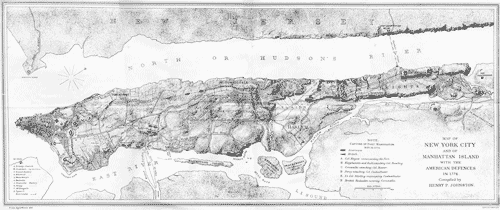
island, near Hell Gate, so as to get on the back of the city. We are
preparing to meet them. Matters appear to be drawing near to a
decisive engagement. Gen. Sullivan is allowed to come on shore, upon
his parole, and go to Congress, on the subject of exchange of himself,
Lord Sterling, and a large number who are prisoners; by the best
accounts we yet have, we have lost, in last week's defeat, about 800
men killed and missing; how many of each, is not yet known. I rather
expect that they will push in a body of troops between the town and
our posts at and near King's bridge. If they do we shall have them
between two fires, and must push them to the last extremity or be
killed or taken prisoners. The event is in the hand of the Almighty,
Disposer of all events....
I am, honored Sir,
Your dutiful son,
Jos. Trumbull.
[Collections of the R.I. Hist. Soc., Vol. VI.]
In Camp Long Island June 22d 76.
Dear Son—We still continue in Camp at this place. No arrivals since
my last. Some hints this morning that the Torys had laid a plan to
destroy the general officers of our army. The particulars I have not
yet. The Regt generally well.
July 6—1776.
About 160 ships and transports and other vessels are arrived with
about 10000 soldiers—Numbers are landed on Staten Island. We expect
12000 more to join them. Camp very healthy. I have lost only one man
since we left Prospect Hill (near Boston). Our men in good spirits. I
am of opinion our hands will be full—hope we shall do well.
July 31, 1776.
Ten ships are added to the King's troops—part very large, can't say
whether they are men of war or transports. This island is a place of
great importance, & if possible must be defended. We are five small
regts, are scattered, & have 10 forts to defend. Col. Hand's
Regt is scattered over 5 miles in length. I am posted in fort Green
which is the largest. I never desire to give it up, nor be taken while
I am alive. I am of opinion my regt. will stand fast in the cause
of the United States.
August 9, 1776.
The enemy were seen to embark 30 boats full of men on 3 vessels & 100
boats full on the other transports. We expected an attack, but all is
still & quiet.
Our enemies have been reinforced by the Hessians & Clinton's fleet.
Deserters say the enemy are 30,000 strong & Genl. Greene judges
them 20,000. I think them 16,000. We have only 1600 fit for duty on
Long Island. I shall pay the Q.M. Genl. the balance due him for
cloathing my regt. this day, which will square all accounts.
Aug. 22 1776.
I have thought fit to send you my will—you will take all charge
necessary &c.
The enemy this day landed on this Island & marched within 3 miles of
our camp. Three or four regiments lodge within 2 miles of the enemy. I
expect morning will bring us to battle.
In Camp New York Sep. 1, 1776.
The enemy left Staten Island & landed on Long Island the 22d.
Encamped on a large plain 5 or 6 miles across, at Flat Bush 4 miles
distant. Our troops encamped in the edge of the woods in front of
them. Our line extended about four miles on the night of the 27th.
In the morning, at 2 o'clock, the enemy attacked our right wing (a
smart engagement for some time).
The enemy also advanced on the left. Lord Stirling reinforced the
right wing & defended himself till 12 o'clock when our wing gave way.
My regt. was in the center on guard. The enemy's right wing almost
encircled 2 or 3 regt's & as they were not together they were not able
to defend themselves & retreated with about 20 wounded. Our people
came in about 11 o'clock. The enemy at the same time with their light
horse & English troops attempted to force our lines, but soon
retreated being met with a smart fire from our breast works.
Two deserters informed us that the enemies dead & wounded was upwards
of 500—I wish ours may not be more. On the morning of the 28th the
enemy were encamped on the heights in front of our encampment. Firing
was kept up on both sides, from the right to the left. Weather very
rainy. 29th very rainy. Firing by both sides in front of Fort
Putnam. About sunset the enemy pushed to recover the ground we had
taken (about 100 rods) in front of the fort. The fire was very hot,
the enemy gave way, & our people recovered the ground. The fire
ceased, & our people retired to the fort. The enemy took possession
again, & on the morning of the 30th had a breastwork there 60 rods
long, & 150 rods distant from fort Putnam.
Two ships of war had got up the sound as far as Hell gate by this
time. The general ordered each regt. to be paraded on their own
parades at 7 O'clock P.M. & wait for orders. We received orders to
strike our tents & march, with our baggage, to New York. Our lines
were manned until day break.
The reason of the retreat was, that we should have had no chance to
retreat if the ships came up. I am not certain we shall be able to
keep the city of New York. You may hear of our being at King's Bridge.
A great battle I think will be fought here, or near there.
I am in a good measure of health.
I am your affectionate father,
Moses Little.
To Mr. Josiah Little.
In Camp Fort Constitution, Oct. 1, 1776.
I have been solicited by Genl. Green to remain in the service. I
before declined, but he will not hear one word about my refusing to
serve.
[Original in possession of Benjamin Hale, Esq.]
Long Island 22d June, 1776.
My Dear—
... Last evening a Conspiracy of the Tories was discovered; their plan
was to murder Genl. Washington, seize on the Persons of the other
General officers, & blow up our Magazines, at the Instant of Time the
King's Troops should Land. A number of our Officers rode last Night to
Flat bush on this Island, & seiz'd the Mayor of the City, who is now
in safe Custody & suppos'd to be in the Conspiracy—several others
are also taken & the Names of others we have, which I hope we shall
soon be able to give a good account of.
In haste, I conclude
Yours affectionately,
Wm. Henshaw.
Augt. 29th 1776.
I have but just time to inform you I am well, as I hope this will find
you, our Family & Friends. You will undoubtedly hear, before you see
this, that we have had an engagement with the Enemy—were surrounded,
& had a Number Killed & Taken. I was with the Party who were
Surrounded & through a kind Providence, got through their fire without
being Wounded or Taken.—The Particulars of which I have not time to
relate as the Enemy are close to us & we expect to be attacked every
hour. I have wrote to Brother Josy by this conveyance which letter he
will let you see.—May God Bless & preserve you from every disaster,
is the unremitting wish of yours &c.
N. York Sept. 1st 1776.
Last Friday we left Long Island, (being unable to keep it any longer,
without being made Prisoners) and came to New York. How long we shall
stay here is uncertain—Our Public Enemies are numerous—Our private
Ones not a few. Happy shall I esteem myself, if I live to see these
Publick Calamities at an End, when we can live peaceably at home &
Enjoy the Fruit of our Labors, the Sweets of Liberty, & none to molest
us: 7 Regiments marched to King's Bridge Yesterday Afternoon. Lord
Sterling & Gen. Sullivan are made prisoners by the Enemy. Sullivan was
with us yesterday and is now gone to Philadelphia to Congress. Numbers
of our People who were surrounded by the Enemy at Flat Bush, and we
thought were Taken by them, have since got in—My Duty to Parents.
Love to Sally, Bettsey, Ruthy & Josey, Brothers, Sisters & all
Friends, with which I conclude,
Yours, &c.
White Plains, Octr. 31st, 1776.
In your last, you want to know whether I was in the Brush or
Battle,[233] mentioned in my last.—I was there. In our Brigade was
Kill'd & Wounded, 75—in the whole Kill'd & Wounded on our side, about
100—of the Enemy by the best Information we have about 500—since
which we have had several Skirmishes. I was not in them, though I saw
several of them. One of them last Week was fought by Reed's &
Learned's Regts., where we had six—kill'd & a number Wounded; the
Enemy had Kill'd & Wounded, about 200—the same Week, a Scouting Party
came across the famous Rogers Scouts, with a scouting party of the
Enemy, took 30 of them Prisoners, & kill'd a number of them—This Week
we had some Battles with them. Monday the 28th Inst. about 2000
of them came on a height of Land on these Plains, Attacked our
Picquet, & after some time, forced our People to give Back. The Loss
on either side I cannot ascertain, but suppose we had Kill'd & Wounded
near 100, as the Fire of Cannon & Small Arms was heavy for some time.
The Day before, they Attacked our Lines near Fort Washington with two
of their Brigades & some of their Ships—Their Ships were much
damaged; one of them they were obliged to Tow off; Our People at the
Lines reserv'd their Fire till the Brigades advanced pretty near, then
gave them a heavy Fire which caused them to Retreat; they form'd &
advanc'd the second time, when our People gave them the second Fire;
they Retreated as before, & form'd the Third time, came up & Fired at
the Lines, which was so warmly returned, that they Retreated. Our
People then Jump'd over the Lines, and pursued them, & Kill'd many,
but the Number is not ascertained.—should I have another Opportunity
to write, can better inform you: we had but one Kill'd in this Battle.
We took 14 Hessians one Day this Week, & one English Officer; have had
several Deserters come in this Week. The Enemy are now Encamp'd within
Gun shot of us, so that there is a continual firing of Small Arms—We
let two Hessians, which we took some time ago, return to the Enemy's
Camp—We daily expect an engagement with the Enemy——
Brother Denny was here Yesterday to see me; is well & station'd at
Terry Town on the North River about 8 miles from this. Capt.
Lincoln Parkman & our People in general, were well a few Days ago.
Should I live to see Peace restor'd & our Rights Secur'd, shall prize
the Blessing more than ever. I have heard many rumors that it would be
tedious to write. Last night we took Doct. Whitworth's son (of
Boston) Prisoner. He was in some office with the Enemy.
[Originals in possession of Miss H.E. Henshaw, Leicester,
Mass.]
[Without date.]
Previous to the Campaign in 1776, there were 3 Regts commanded by
Lt. Colonels. General Washington offered me the command of either of
them. I conversed with the Officers of these Regiments, & I found they
were averse to a change; I informed Gen'l W. that if I accepted his
offer, it would be injurious to the Service and declined it. He then
said he hoped I would not leave the Service, but would take a Lt.
Colonel's commission, which I did under Colonel Little, & in April we
marched for New York in the Brigade commanded by Genl Green. Soon
after Genl Washington came & ordered said Brigade to Long Island.
The latter part of August, I commanded in a picket guard at Flatbush,
where the enemy was encamped, who marched by the East wing of the
Pickets, and formed a line between us and our encampments, and knowing
the Gen. could not send us orders to retreat we marched to reach our
encampments. While marching in the rear of the enemy's line, they were
holding a Council of War, whether to storm our lines, or take them by
a regular siege. They chose the latter. Had they broke their lines and
marched into our front, we must have been made prisoners; but they
only turned on their heels and fired at us and we got in with little
loss.
[Original in possession of Miss H.E. Henshaw, Leicester,
Mass.]
Long Island 27 August 1776 7 p.m.
Dear Kitty:
Part of the enemy landed on the Island on the 22nd. they did not
advance farther than Flatbush until last night—I have had a fatiguing
time of it ever since—A number of our troops have been hemned in, but
behaved well. Many have got clear and many are yet missing. Our
Pennsylvanians were chiefly of the party.
I escaped my part only by being relieved at 2 o'clock this
morning—Major Burd and Col. Atlee were out and are yet missing. Jessy
and Jacky are yet with me
Adieu—May God preserve you
prays
Your affectionate
Edward Hand.
Mrs. Katherine Hand
Lancaster Pa.
[Original in possession of Mrs. S.B. Rogers, Lancaster, Penn.]
Long Island 3rd Sept. 1776.
Dear Sir.
I was taken prisoner at an advanced Post on the morning of ye
27th ulto after a skirmish, on the same day Capts. Herbert and
Heister were both made prisoners. I was used with great Civility by
General Grant & admitted to my Parole, Brigadier General Agnew and
Major Leslie and Major Batt also treated me with great Politeness.
You must be sensible that hard money can only be of service in my
present situation: The Politeness of several Gentlemen would have very
fully supplied me with it, but I have only taken what will be
immediately necessary for me. I should be much obliged to you if you
could procure me a small Bill of Exchange in which perhaps Mr. Dundas
of Reading could assist you, or Gold to the amount of about £20.
I can not learn the fate of poor Colo Hand or Jesse Ewing but
believe they are not prisoners.
Colo Reed, the Adjutant Gen'l will be the only Person who can
convey any thing to me, my Letter must be short, my Love to all the
Family.
I am Dear Sir
Your Affecte Brother [in-law]
Edw. Burd.
Jasper Yeates Esqr.
[Original among the Yeates papers.]
New York Aug. 30, 1776.
Honoured Sir:
After a very fatiguing march we are all safely arrived. The Genl.
yesterday gave orders for all the Regts on Long Island to hold
themselves in readiness to march at the shortest notice, and evacuate
our Lines for the enemy already had extended their advanced posts
across the Island, & we were entirely surrounded, so that the only
refuge he had left was New York—This morn'g a party about fifty men
went a marauding and were surprised by the enemy, who after firing
whole vollies secured one of the Boats, & then the Hessian Riflemen
began to play upon them, so that our loss including that of the first
engagement amounts to 500 men & upwards.
Lord Stirling & Genl. Sullivan are Prisoners, several officers are
still missing amongst whom are Col. Miles and Atlee—The militia from
Berks County are almost cut off. The inhuman wretches thrust their
bayonets through our wounded men and refused that mercy to us, which
we granted to them. The situation of New York is very critical, the
enemy being in possession of Long Island may reduce it to a Heap of
ashes in a days time.
The loss of the enemy amounts to 1500 men amongst whom are a Brigadier
Genl. and several Field Officers.—The Idea which we at first
conceived of the Hessian Riflemen was truly ridiculous but sad
experience convinces our people that they are an Enemy not to [be]
despised, Several Companies of their Light Infantry are cloathed
exactly as we are, in hunting shirts and trowers—Mr. Burd who
commanded a detachment of 200 men is not yet returned, and sorry am I
to say it, he is a Prisoner amongst them.—as this news must certainly
afflict Aunt and the whole family, I have forwarned my Brother from
making any mention of it.
Please to give my duty to Aunt, mammy, Kitty and my love to all the
children,
I remain, Honrd Sir
Yr dutiful & obliged Nephew
J. Ewing.
To Jasper Yeates, Esqr.
[Original among the Yeates papers.]
"To Jasper Yeates Esq. at Fort Pitt."
Lancaster Sept. 14, 1776.
Honrd Sir:
As it has pleased Divine Providence to spare my Life, I think it my
Duty to send you as good an act. of the Engagement together with the
enclosed Draught as lays in my power, as I had gone from Elizabeth
Point New Jersey to Long Island to see my brothers I had an
opportunity of seeing everything that occurred from the Time the Enemy
landed on the Island untill a Day or two before we retreated from
thence. Col. Hand's Regmt. had been on duty 2 days & the second Night
were relieved between 12 and 1 o'clock in the morning and about Two
it is thought the Enemy began their movements from Flat Bush to the
Right, and Left, and at between 7 & 8 o'clock in the morning we had
the mortification from our Lines to see our men commanded by Lord
Stirling almost surrounded by the Regulars, as they kept their stand
on a Hill without flinching an inch, The Regulars were firing at them
like Fury they at last descended then there was a continual peal of
Small Arms for an Hour or better, our men at last partly got off by
the Marsh, as in the Draught inclosed, I have been very Ill of a Fever
which I got by being cloathed too thin and lay at York about 2 Days
before our People had made that Grand Retreat from the Island which
will ever reflect honour to our Generals, from York I was removed to
King's Bridge twelve or fifteen miles from thence, after I had
recovered, my Health suffered from Travelling. The Colo. was good
enough to send me Home in a Carriage which thank God I happily—and
dont doubt of recovering Health shortly—I am Sir
Your affectionate
Nephew
Jno. Ewing.
P.S.
I shall refer you to the papers for our Loss in the Battle though it
is with infinite regret I must inform you of Major Burd's being among
the prisoners who Lord How treats them with great politeness. Time
will not permitt my saying so much as I would wish—I left the
Colo. & all friends very well at King's Bridge where the Regt.
is Stationed as I only left them this day week.
[Original among the Yeates papers.]
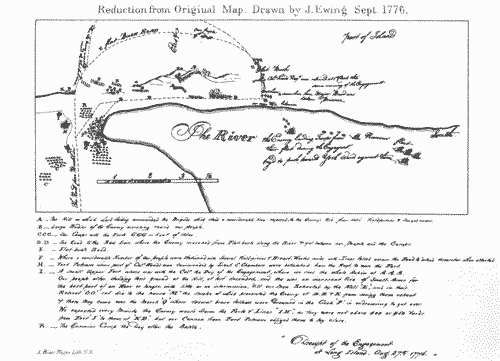
[Enlarge]
Reduction from Original Map. Drawn by J. Ewing Sept.
1776.
Transcriber's Note: In the following transcription
of the map legend, missing words or letters are supplied
in brackets. Otherwise spelling etc. have been retained as in the original.
A.—The Hill on which Lord Stirling commanded the Brigade which stood
a considerable time exposed to the Enemy's Fire from their
Field-pieces & small-arms.
B.—Large Bodies of the Enemy marching round our people.
CCC.—Our Camps with the Forts GGG in front of them.
D.D.—The Road to the Red Lion, where the Enemy marched from Flat-bush
along the River & got between our People and the Camps.
E.—Flat-bush Road.
F.—Where a considerable Number of our people were stationed with
Several Field-pieces & Breast-Works made with Trees felled across the
Road to defend themselves when attacked.
H.—Fort Putnam where part of Colo. Hand's men commanded by Lieut.
C. Chambers were detached from the Regt. to man the Fort.
I.—A small Upper Fort where [I] was with the Colo. the Day of the
Engagement, where we saw the whole Action at A.A.A. Our people after
standing their ground at the Hill, at last decended, and the[re] was
an incessant Fire of Small-Arms for the best part of an Hour or
longer, with little or no intermission, 'till our Men Retreated by the
Mill "I," and in their Retreat "O.O." set fire to the house "M" the
smoke of which prevented the Enemy at B.B. & K from seeing them
retreat & then they came over the Marsh "Q" where several brave
fellows were drowned in the Creek "P." in endeavoring to get over. We
expected every Minute the Enemy would Storm the Forts & Lines "IH," as
they were not above 400 or 450 Yards from Fort "I" to them at "KB,"
but our Cannon from Fort Putnam obliged them to lay close.
R.—The Enemies Camp the Day after the Battle.
"Draught of the Engagement at Long Island, Aug. 27th, 1776."
J. Bien Photo. Lith. N.Y.
Hon'ble Sir,
I recd. yours with pleasure because it was yours, all the Rest was
Indignation—We went over to Long Island, a Genl. Engagement
ensued, the Southern Troops i.e. Ld Stirlings Battalion bore the
Violence of the Attack & repulsed the Enemy but were outnumbered at
least three to one, & obliged to retire; the Delaware Battalion have
been complimented as the finest in the Service, they stood unmoved in
firm Array four Hours exposed to the fire of the Enemy, nor attempted
to retire till they received Orders from the Genl, then effected a
most H'oble Retreat up to the middle thro a Marsh of Mud & brought off
with them 23 Prisoners—I fear we shall be outnumbered, expect every
moment Orders to march off to Kingsbridge, to prevent the Enemy
crossing the East River & confining us on another Nook, what the Event
will be God knows—Lt. Stewart & Harney with 25 Privates fell in our
Regiment—Ld. Stirling & Genl Sullivan Prisoners—Miles & Atlee the
same Piper killed—250 of Smallmans (Swallwood's) missing—Atles cut
to pieces—I fear Genl. Washington has too heavy a task, assisted
mostly by Beardless Boys—if the Enemy can coop us up in N. York by
Intrenching from River to River, horrid will be the Consequences from
their command of the Rivers.
Between five & six thousand Dollars of Continental Money remain in my
hands, unknowing what to do with it, I have entrusted it to the care
of Dr. Rogers & Chaplain Montgomery—if I fall, please to take Order
in the Matter—I have not time to say one Word more, tis the first
Letter I have had time to write—please to mention to some of your
Friends below that I am well, by whose Means it may reach Mrs.
Haslet—I am with
Great Esteem, Sir your Most Obedt Humble Servant
John Haslet.
Honble Genl Rodney.
Camp at N. York Augt 31st 1776.
[Original in possession of Cæsar A. Rodney, Esq., Wilmington, Del.]
Brookline on L.I. Augst 24—1776
7 o'clock a.m.
... I never was in better Health and Spirits than now. On Thursday the
enemy landed on Long Island at 3 o'clock P.M. We had intelligence
that our Troops on the Island wanted to be reinforced. My Regiment and
3 more were ordered over for that purpose. My regt. was ordered down
into a woody Hill near Red Hook to take Post that night to prevent any
more troops from landing thereabout. We had the Heavens for our
Covering and the Earth for my bed, wrapt in my blanket, when after
posting my Sentries I slept finely. Was mighty well yesterday, and was
then ordered here where I & my Regt. now are. The enemy are about 3
miles East of our troops, were a part of them skirmishing with them
all day yesterday and are still on the same ground & have killed a
number of the enemy. The enemy are said to be 8 or 9000 that are
landed here. I am posted here at a fort & to see some breastworks
compleated. By the blessing of Heaven I trust we shall be able to give
a good acct of the enemy.... My love to our Dear Sons & accept the
same yourself from most affec. & loveing Husband
P.S. I refer you to Capt. Hawley for Particulars.
Flatt Bush on Long Island Aug. 25, 1776
2 o'clock p.m.
I wrote you yesterday morning from Brookline upon the Drum Head in the
field as I do now, which I hope you will receive this day.... Have not
so much as a bear skin to lie on, only my blanket to wrap me in, for
our removals from place to place are so quick & sudden that we can
have no opportunity nor means to convey beds &c., but go only with the
cloaths on our backs & our blankets and a little ready-cooked
victuals. I am now posted within about half a mile from the Regulars
with my Regt. under the Covert of a woody hill to stop their passage
into the Country. There are a number of Regts posted all around the
town within about the same distance & for the same purpose. The
regulars keep up an almost Constant Fire from their cannon & mortars
at some or other of us, but neither shott nor shell has come near my
Regt. yet and they are at too great a distance to fire muskets at as
yet. I have a scouting party going out now to see if they can't pick
up some or get something from them. I came to this post this day at 12
o'clock & shall remain here till this time to-morrow if God spares my
life, with no other covering than the trees. I cant learn anything
with respect to them different from what I wrote yesterday. The rest
of the troops & their Ships lie at Staten Island yet to wait the
success of this part of their army, as I suppose before they make any
other attempt. They have wounded in all of our men in 3 days skirmish
about 8 or 9 men, one or two mortally, which is not half the number
that we have killed for them beside wounded....
New York (Brooklyn) Aug 29 1776.
... Have been a stranger to a bed ever since last Wens'day night till
last night being relieved from manning a part of the lines with my
regt. where I had been 36 hours I was invited by our mutual friend
Major Mott to take part of his bed & have had a fine night indeed, the
Night before there was a waggon near our Lines into which I got &
wrapt myself in my Blanket after Twelve & half after One was waked &
acquainted that the Enemy were coming up to force our Lines & we
immediately took our Places in the Trenches & there remained untill
after Sun Rise, but it proved a false Alarm, our Enemy have encamped
in plain sight of our camp at the distance of about a mile & half, We
have had no General Engagement yet, but no Day passes without some
smart & Hot skirmishes between different Parties in which the success
is sometimes One Way & sometimes another, We are in constant
Expectation of a General Battle; no one can be here long without
geting pretty well acquainted with the whistleing of Cannon & musket
shott.
Harlem Heights Sep. 17th 1776.
... On the morning of last Sabbath we had news that the regulars on
Long Island were in motion as they would cross the East River & land
about 3 miles above the city. At this place lay their ships close in
with our shores & soon after the regulars marched in a large body down
to the shore & embarked on Board the flat bottomed boats. Upon this
their ships began a most incessant fire on our lines opposite to them
with their grape shot from which they were distant but about 50 rods &
behind which lay Genl. Wadsworth's & Col. Douglass' Brigades until
the fire was so hot from the ships that they were obliged to retreat.
On this the regulars landed & fired upon them which completed their
confusion & they ran away up here & are here now, but a part of them
were out in yesterday's action & behaved nobly.
Now as to myself & my brigade we were left to guard the city until all
the rest of the troops were drawn off & about half an hour or an hour
after all the other troops were gone I was ordered with my brigade to
march out of the city & man the lines on the East river opposite to
Bayard's Hill fort. Then I marched & saw the regular Army land above
me & spread across the Island from one river to another until my
retreat seemed to be entirely cut off & soon after received an order
to retreat if I could.
I attempted it along up through the woods by the North River when I
came in sight of the enemy several times but kept my brigade covered
in the woods so that I got thro' them to their uppermost guard & they
pursued & fired on my rear & took a few of my men. I immediately
formed about 300 of my men on an Hill to oppose them. On seeing this
the regulars fled & I pursued my retreat & got my brigade safe here
where I am now posted—a particular detail of the risks I ran must be
deferred. It was supposed by everybody that I & my brigade were
entirely cut off.
Harlem Heights, 17 Sept. 1777. 2 o'cl p.m.
Yesterday at 7 o'clock in the morning we were alarmed with the sight
of a considerable number of the enemy on the Plains below us about a
mile distant.—Our Brigades which form a line across the Island where
I am were immediately ordered under arms—but as the enemy did not
immediately advance we grounded our arms & took spades & shovels &
went to work & before night had thrown up lines across the
Island—There was nothing before but three little redoubts in about a
mile & we are at work this day in strengthening them. But yesterday a
little before noon we heard a strong firing about half a mile below us
in the woods near where we had two Brigades lying as an advanced
guard. The enemy in a large body advanced in the woods a little before
12 o'cl & began a heavy fire on those two Brigades who maintained the
fire obstinately for some time & then they were reinforced by several
regiments & the fire continued very heavy from the musketry & from
field pieces about two hours—in which time our people drove the
regulars back from post to post about a mile & a half & then left them
pretty well satisfied with their dinner since which they have been
very quiet. Our loss on this occasion by the best information is
about 25 killed & 40 or 50 wounded. The enemy by the best accounts
have suffered much more than we.
A prisoner we have I am told says that Genl. Howe himself commanded
the regular & Genl. Washington & Genl. Putnam were both with our
Troops. They have found now that when we meet them on equal ground we
are not a set of people that will run from them—but that they have
now had a pretty good drubbing, tho' this was an action between but a
small party of the army.
Camp at White Plains Oct. 29th 1776.
... Yesterday about 10 o'clock in the morning we had news that the
enemy were approaching, when I with my regiment & 3 others were
ordered out about 1½ miles below our lines to take post on a hill
to gall them in their march as they advanced. We accordingly took our
post & mine & one other regiment had the advantage of a stone wall
right in front at which we had been waiting but little time before the
enemy came up within 6 or 8 rods,—when our men rose from behind the
wall, poured in a most furious fire.
The enemy retreated & came on several times & were so hotly received
every time that finally we drove them off from the hill. We killed
some they did not carry off & some they did.
I had not one either killed or wounded. On this the enemy were coming
upon us with a number of field pieces & as we had none there to meet
them with, we were ordered to retreat over West on to another Hill &
join another party of men & accordingly did it & formed a line of
battle. We were I believe near 2000 on the Hill (Chatterton's). The
enemy soon brought their main body opposite to us & formed them into
three lines, one back of the other, & a large number of field pieces
in their front & howitzers with which they threw small bombs on
another Hill. Then they marched their first line off from the Hill
where they stood, down into a deep Valley that lay between us & then
they played on us most furiously with their artillery to keep us from
meeting their people in the hollow & in short the shot & shells came
like hail. I lay right in the heaviest of their fire, with my men by a
fence & had two wounded there & were soon ordered to another post
further on the line of battle up to which the enemy soon came as they
did for a long way in lengths. We gave them a heavy fire which made
them retreat but they soon returned when a most furious fire followed
which continued for a few minutes when their numbers were increased so
amazingly that we were obliged to retreat which we did thro' a most
furious fire from the enemy for half a mile for so far there was
nothing to cover us from it.... I have lost but 4 out of my reg't &
can hear of only 10 or 12 wounded. We are all now within our line &
the enemy are posted on a number of the neighboring hills & we
expected they would have come on this morning when we should have had
an engagement with both armies but they don't yet move & it is now
about 12 o'clock.
[Originals in possession of Mrs. O.P. Hubbard, New York.]
New York Sepr: 6th, 1776.
Dear Sir Your Favour of the 1st Instt: I have this Morning
received and am much obliged to you for it; in Order to answer your
Inquiries I must necessarily give you some Account of our out Lines on
Long Island before we left it, about 8 or Nine Miles below this Town
is that Strait of Water commonly called the Narrows, from the upper
end of it on the Long Island side a Bay puts into the Island on a
Course about Northeasterly and runs into the Land about Two miles;
from the Head of this Bay we had a line of Forts & Redoubts all
connected by Breast Works and some part of it picketed, up
Northeasterly and Northerly to a Bay on the Northwesterly part of the
Island rather above the City; The British Troops landed below the Bay
at the Narrows and marched to Flat Bush a Place on the Island about 6
or 7 miles from this city and 3 miles beyond our Lines, flat Bush
stands near the Westerly Side of a large Plain which is 4 or 5 miles
over and this plain is surrounded from the Southwest to the Northeast
with a larg Ridge of Hills covered with Woods. through this Ridge
there are three roads into the Country, toward New York two of them;
and one out to a place called Bedford; At each of these passes which
were from 1 to 1½ Mile asunder we had strong Guards posted
consisting of 600 or 700 Men, the other Forces which we had on the
Island were posted within the Lines and in the Forts and once in 24
Hours relieved the Guards out at those advanced Posts toward the
Enemy; I was posted out on one of these Advanced Posts on Sabbath Day
July (August) 25th, with my own Regimt and 2 more near by in
order to stop the Progress of the Enemy into the Country. I was
relieved on Monday about half (past) Two & marched Back within the
Lines to the Place where my Regiment was ordered for their Alarm Post
in order to man the Lines there in case the Enemy advanced which was
at the Northern Part of the Lines, and there was beside the Regiments
that were ordered to man the Lines some Regiments as a Corps de
Reserve to reinforce any Part of the Lines that might be attacked &c.
Early on Tuesday Morning the Guards at all those Three Avenues were
attacked (by) parties that vastly out numbered them, and soon were
drove from their Posts and soon broken at the Same Time.... [The
conclusion missing.]
[Original in possession of Mrs. O.P. Hubbard, New York.]
The evening preceding the action, General Washington, with a number of
general officers, went down to view the motions of the enemy, who were
encamped at Flatbush. The enemy appeared to be striking their tents,
and preparing for a march; whereupon it was ordered that 2400 men
should be posted as guards, in the following manner, viz: 800 on the
road that leads out of the Jamaica road by way of Yellow Hook to
Flatbush; these men were posted in a woods, at four miles distant from
our lines, to oppose the enemy if they attempted that road, and to
annoy them on their march: 800 more were posted in a woods upon the
Middle road, which leads out of the Jamaica road to Flatbush, about a
mile and a half from the lines; these were posted at about half a mile
distant from Flatbush, and near a mile from the parting of the road,
where an abatis was formed across the road, and a breastwork thrown
up and defended by two pieces of cannon: 800 more were posted at the
Bedford road, which leads out of the Jamaica road, at about three
miles distant from our lines; this party was ordered to guard the
Bedford road, and to patrol the road leading through the New Lots in
the east of the Bedford road, from which it parts at the Halfway
House, about six miles from the lines, and leads from it to Flatbush.
Five officers were also sent out on horseback to patrol the
last-mentioned road and that leading to Jamaica. At 10 o'clock at
night about 5000 of the enemy marched by way of the New Lots, and
arrived, near 2 in the morning, at Halfway House, without being
discovered; they took post in a field, and waited for daylight. The
five officers sent to patrol fell into their hands, and were all made
prisoners. About 3 in the morning a party of the enemy advanced into
the Western road, leading by Yellow Hook, and attacked our guards; the
guards returned their fire, threw them into confusion, caused the
whole to halt, and took one prisoner, who informed us that he belonged
to the regiment which attacked our guards, and was by their fire
thrown into confusion and forced to retreat, and that there were two
brigades, of four regiments each, on their march in that road,
commanded by Brigadier-General Grant. At daylight Lord Stirling was
ordered with two battalions, into that road, to oppose the enemy. He
took post on an eminence in front of the enemy whereupon a smart fight
ensued, which lasted near an hour, and then abated. Two field-pieces
were sent to Lord Stirling, which soon began to play upon the enemy,
who returned the fire from four field-pieces. The two parties stood
opposed to each other for near five hours, without either seeming to
have the advantage, keeping up a continual fire from their
field-pieces, and musketry, with some intervals.—About 8 o'clock
General Sullivan sent (went?) down the flat (bush) middle (road) and
inquired of the guards whether they discovered any movements of the
enemy in either of the roads. He was informed that the whole body of
the enemy had moved up the Yellow Hook road, whereupon he ordered
another battalion to the assistance of lord Stirling, keeping 800 men
to guard the pass.—About 9 o'clock, the enemy, who came by the
Halfway House, advancing, began a fire in the rear of the party and
advanced briskly to attack the men who guarded that Pass. General
Sullivan hearing at the same instant that the enemy were passing
through the woods to attack Lord Stirling in the rear, ordered 400 men
to succor him, and sent him orders to retreat as soon as possible. The
enemy then wheeled off to the right, and marched up to Fort Green in a
column to attack.—Upon receiving a heavy fire from the lines, were
forced to retire. They then fell back, and endeavored to cut off Lord
Stirling's retreat by destroying his party. He, with a party of his
troops' made an attempt on the enemy's left, commanded by Lord
Cornwallis, and ordered the rest of the troops to retreat across the
creek, which they did with some loss. The number of the enemy engaged
was not less than 11,000; of ours not more than 3,000. The enemy's
loss in killed was over 1,000, exceeding ours.
[From the South Carolina and American General Gazette,
Charleston, Oct. 2, 1776,
as reprinted in the Brooklyn
Advocate.]
In the Spring of 1776, I was appointed to the command of a regiment of
riflemen, consisting of 1,000 men, formed in two battalions.... My
regiment was soon ordered to join the army at New York. At that time
General Washington had 24,000 men in his army, upwards of 7,000 of
whom were returned sick and unfit for duty.
On the landing of the British army on Long Island, I was ordered over
with my rifle regiment to watch their motions. I marched near to the
village of Flat Bush, where the Highlanders then lay, but they moved
the next day to Gen'l Howe's camp, and their place was supplied by the
Hessians. I lay here within cannon shot of the Hessian camp for four
days without receiving a single order from Gen'l Sullivan, who
commanded on Long Island, out of the lines. The day before the action
he came to the camp, and I then told him the situation of the British
Army; that Gen'l Howe, with the main body, lay on my left, about a
mile and a-half or two miles, and I was convinced when the army moved
that Gen'l Howe would fall into the Jamaica road, and I hoped there
were troops there to watch them. Notwithstanding this information,
which indeed he might have obtained from his own observation, if he
had attended to his duty as a General ought to have done; no steps
were taken, but there was a small redoubt in front of the village
which seemed to take up the whole of his attention, and where he
stayed until the principal part of the British army had gotten between
him and the lines, by which means he was made prisoner as well as
myself. If Gen'l Sullivan had taken the requisite precaution, and
given his orders agreeably to the attention of the Commander-in-Chief,
there would have been few if any prisoners taken on the 27th of
August, 1776. As Gordon in his history of the war has charged me
indirectly with not doing my duty, I will here state my position and
conduct.
I lay directly in front of the village of Flat Bush, but on the left
of the road leading to New York, where the Hessians were Encamped. We
were so near each other, that their shells they sometimes fired went
many rods beyond my camp. The main body of the Enemy, under the
immediate command of Gen'l Howe, lay about 2 miles to my left, and
General Grant, with another body of British troops, lay about four
miles on my right. There were several small bodies of Americans
dispersed to my right, but not a man to my left, although the main
body of the Enemy lay to my left, of which I had given General
Sullivan notice. This was our situation on the 26th of August. About
one o'clock at night Gen. Grant, on the right, and Gen. Howe, on my
left began their march, and by daylight Grant had got within a mile of
our entrenchments, and Gen. Howe had got into the Jamaica road about
two miles from our lines. The Hessians kept their position until 7 in
the morning. As soon as they moved the firing began at our redoubt. I
immediately marched towards where firing was, but had not proceeded
more than 1 or 200 yards until I was stopped by Colonel Wyllys, who
told me that I could not pass on; that we were to defend a road that
lead from Flatbush road to the Jamaica road. Col. Wyllys bearing a
Continental, and I a State commission, he was considered a senior
officer and I was obliged to submit; but I told him I was convinced
the main body of the enemy would take the Jamaica road, that there was
no probability of their coming along the road he was then guarding,
and if he would not let me proceed to where the firing was, I would
return and endeavor to get into the Jamaica road before Gen. Howe. To
this he consented, and I immediately made a retrograde march, and
after marching nearly two miles, the whole distance through woods, I
arrived within sight of the Jamaica road, and to my great
mortification I saw the main body of the enemy in full march between
me and our lines, and the baggage guard just coming into the road. A
thought struck me of attacking the baggage guard, and, if possible, to
cut my way through them and proceed to Hell Gate to cross the Sound.
I, however, ordered the men to remain quite still, (I had then but the
first battalion with me, for the second being some distance in the
rear, I directed Major Williams, who was on horseback, to return and
order Lt. Col. Brodhead to push on by the left of the enemy and
endeavor get into our lines that way, and happily they succeeded, but
had to wade a mill dam by which a few were drowned,) and I took the
adjutant with me and crept as near the road as I thought prudent, to
try and ascertain the number of the baggage guard, and I saw a
grenadier stepping into the woods. I got a tree between him and me
until he came near, and I took him prisoner and examined him. I found
that there was a whole brigade with the baggage, commanded by a
general officer.
I immediately returned to the battalion and called a council of the
officers and laid three propositions before them: 1st, to attack the
baggage guard and endeavor to cut our way through them and proceed to
Hell Gate and so cross the Sound; 2nd, to lay where we were until
the whole had passed us and then proceed to Hell Gate; or, 3d, to
endeavor to force our way through the enemy's flank guards into our
line at Brooklyn. The first was thought a dangerous and useless
attempt as the enemy was so superior in force. The 2nd I thought the
most eligible, for it was evident that adopting either of the other
propositions we must lose a number of men without affecting the enemy
materially, as we had so small a force, not more than 230 men. This
was, however, objected to, under the idea that we should be blamed for
not fighting at all, and perhaps charged with cowardice, which would
be worse than death itself. The 3d proposition was therefore adopted,
and we immediately began our march, but had not proceeded more than
half a mile until we fell in with a body of 7 or 800 light infantry,
which we attacked without any hesitation, but their superiority of
numbers encouraged them to march up with their bayonets, which we
could not withstand, having none ourselves. I therefore ordered the
Troops to push on towards our lines. I remained on the ground myself
until they had all passed me, (the enemy were then within less than 20
yards of us,) and by this means I came into the rear instead of the
front of my command. We had proceeded but a short distance before we
were again engaged with a superior body of the enemy, and here we lost
a number of men, but took Major Moncrieffe, their commanding officer,
prisoner, but he was a Scotch prize for Ensign Brodhead, who took him
and had him in possession for some hours, was obliged to surrender
himself. Finding that the enemy had possession of the ground between
us and our lines, and that it was impossible to cut our way through as
a body, I directed the men to make the best of their way as well as
they could; some few got in safe, but there were 159 taken prisoners.
I was myself entirely cut off from our lines and therefore endeavored
to conceal myself, with a few men who would not leave me. I hoped to
remain until night, when I intended to try to get to Hell Gate and
cross the Sound; but about 3 o'clock in the afternoon was discovered
by a party of Hessians and obliged to surrender—thus ended the career
of that day.
[Penn. Archives, Second Series, Vol. I.]
Camp near Kingsbridge, 5th Sep'r, 1776.
Dear Sir,
I doubt not the Hon'ble the Convention of the State of Penn'a, is
anxious to know the state of the Provincial Troops since the Battle on
Long Island, and as I have now all the information to be expected
concerning it for the present, will give them every circumstance that
occurs to me. On the 26th of last month, Gen'ls Putnam, Sullivan and
others came to our camp which was to the left of all the other posts
and proceeded to reconnoitre the enemie's lines to the right, when
from the movements of the enemy they might plainly discover they were
advancing towards Jamaica, and extending their lines to the left so as
to march round us, for our lines to the left, were, for want of
Videttes, left open for at least four miles where we constantly
scouted by Day, which beside mounting a Guard of one hundred men & an
advance party of subaltern and thirty to the left of us, was hard Duty
for our Reg't: during the night of the 26th, we were alarmed three
Different times and stood to our Arms. As soon as it was light, Col.
Miles, from the right of our first Battn, sent me orders to follow
him with the second, to the left of our lines; when I had marched
about half a mile, I was ordered to the right about to join Col.
Willis's regt of New England troops, but by the time I returned to
the camp, Major Williams on horseback, overtook me with orders from
Col. Miles, to march Obliquely & join him, but could not say where I
might find him; I Observed the orders and directed a Subaltern from
the front of the Battn (which was marching in Indian file) with a
small party to the left of the Battn, and desired Major Patton to
send a Subaltern & small party from the rear to the right of the front
of the Battalion, which he mistook and took the one-half of the
Battn to the right, about two hundred yards, which immediately
threw the half the Battn, so far to the rear as to render it very
difficult to join without sustaining great loss, for presently after
we left our camp we discovered the Enemie's horse & foot to the number
of four or five Thousand in our front, and as we could discover
nothing of the first Battn, the Enemy being vastly superior to us
in Number, I immediately ordered the Battn to gain a Wood to the
left and then formed, but seeing a Number of Artillerymen dragging a
brass field-piece & Howit through a clear field in order to gain a
wood a little to the left of our Front, and knowing the Enemy were
also in our rear, I ordered that part of the Battn which was then
with me, to proceed to the second wood, & cover the Artillery and make
a stand, but the New England Regt aforementioned coming up with us,
and running thro' our files broke them, and in the confusion many of
our men run with them. I did all in my power to rally the musquetry &
Riflemen, but to no purpose, so that when we came to engage the Enemy,
I had not fifty men, notwithstanding which, we after about three
Rounds, caused the Enemy to retire, and as the Enemy's main body was
then nearly between us and the lines, I retreated to the lines, having
lost out of the whole Battalion, about one hundred men, officers
included, which, as they were much scattered, must be chiefly
prisoners; during this time, four or five Reg'ts, among which were our
musquetry & flying Camp, Delaware & Maryland Reg'ts, and some of our
Riflemen who had joined them, were engaged to the left of us and right
of the Lines. I had no sooner got into the Lines than the Enemy
advanced up to them and kept up a brisk fire on us, but only one man
killed in the Lines; as soon as we returned the fire with our rifles
and musquetry, they retreated, and if we had been provided with a
field piece or two, of which we had a sufficient number elsewhere, we
might have killed the greater part of their advance party; as soon as
the Enemy were beaten from the lines, I was ordered to a point about a
mile and a-half to the right, to cover the retreat of the Delaware
Battalion and the other Troops that might come over under the constant
fire of the Enemie's field pieces and Howits; here I remained 'till
almost night before I was relieved, notwithstanding the Generals there
had a number of Reg'ts who were not engaged, and had had little or no
fatigue. Upon the whole, less Generalship never was shown in any Army
since the Art of War was understood, except in the retreat from Long
Island, which was well conducted. No troops could behave better than
the Southern, for though they seldom engaged less than five to one,
they frequently repulsed the Enemy with great Slaughter, and I am
confident that the number of killed and wounded on their side, is
greater than on ours, notwithstanding we had to fight them front &
rear under every disadvantage. I understand that Gen. Sullivan has
taken the Liberty to charge our brave and good Col. Miles, with the
ill success of the Day, but give me leave to say, that if Gen.
Sullivan & the rest of the Gen'ls on Long Island, had been as Vigilant
& prudent as him, we might, & in all probability would have cut off
Clinton's Brigade; our officers & men in general, considering the
confusion, behaved as well as men could do—a very few behaved ill, of
which, when I am informed, will write you.... Col. Miles & Col. Piper
are prisoners, and I hear are well treated, poor Atly I can hear
nothing of. Col. Parry died like a Hero. No allowance has as yet been
made for the Lieutenant Coll's and Majors Table Expenses, in care of
separate commands. I hope we shall be put upon as respectable a
footing on that acc't as the Maryland officers are, our present pay
being not more than half sufficient to support us according to our
Rank in this Tory Country.
I am Dear Sir, in great Haste, your most H'ble Serv't
Daniel Brodhead.
P.S. The Great Gen'l Putnam could not, tho' requested, send out one
Reg't to cover our retreat.
[Penn. Archives, First Series, Vol. V.]
[Long Island, Feb. 26 (?) 1776.][234]
My Dear,
Our Regiment is now stationed on Long Island at and about the ferry.
We shall soon begin a fortification on this side that will command the
East River and the town. The troops in the City are fortifying in one
of the Streets that will command the old fort, if the Enemy should get
possession of it, (and are putting down the rear of the fort.) We have
begun another Fort near "Hell Gate." The men of war have dropped down
below the town and are very quiet, but supplied from the City by
orders of this Congress. Our troops are very hearty and fare well as
times will admit, most of the valuable articles are moved out of the
City, and one third of the inhabitants. What are left behind look
serious, as it is now a serious point with them. The destruction of
such a City as this would be a great loss, & I hope it will be
prevented. It will be in vain for us to expect to keep the shipping
out of the North River, unless we can fortify at the Narrows, where I
intend to view as soon as the weather is good. The Fenoex now lays
there in order to guard that place, but will not fire on us.
New York, July 20th, 1776.
You have likely heard before this that two ships passed this City
yesterday week, through a warm fire from our batteries, our Gunners
being in too much haste (I make no doubt,) was the occasion of our not
doing them much damage! and us the loss of 4 men in loading our
Cannon. The Enemy did us no harm by their own shot and shells, which
was warmly applied,—as soon as the fire had got pretty warm I receivd
orders to march my Regt to the grand parade which brought us into
Broadway, that leads along the North River, and as we were on our
march in Broadway the tyrants did not fail to pelt at that part of the
town smartly, but luckily for us the houses fended off the shot very
well, &c.... My Regt is now quartered in Broad Street.
N. York the 27th July, 1776.
No new arrivals of the enemy. The ships that went up the River I
believe would now be glad they were safe back to their old station (by
their motion). I had the Honor to dine with his Excellency Genl.
Washington day before yesterday at which time he had nothing new from
any quarter....
New York Aug. 10, 1776.
The enemy have a very formidable Army (some say more) but I suppose
equal in number to ours, and from the best intelligence it is expected
they will give us Battle soon, at which time I hope God in his
infinite mercy will be on our side, and we shall have no occasion to
dread their numbers, or experience. Our cause being so just, I
cannot but hope for success. Our lines are very extensive. The Enemy
are very compact, and together; at what place they will bend their
fury is unknown, but is expected to be at this City, and Long Island.
There sailed night before last, three Frigates and thirty transports
from the Hook, supposed to be gone round the east end of Long Island,
and are to come through the Sound, and land on the main to the
Eastward of us, whilst the Shipping goes up the north river, and lands
above us and endeavor to meet. If this be their plan I think we must
most surely work them! I suppose they may possibly fire the town, as
the buildings are many of them wood & very dry. But I do not believe
they will fire the town until they grow dubious about the victory, and
that will only serve to encourage us, and when the town is burned it
will be much easier to defend ourselves than at present. If the
"Hessian" troops are so lucky as to fall into our hands I am in
hopes they will meet with such treatment as properly belongs to their
Bloody crimes! For we have had no dispute with them but [they] have
turned themselves out as murderers of the innocent.
N. York, 13th of Augst 1776.
There was 43 large Ships came in yesterday—31 Ships, 10 Brigs & one
Scow. I am now going to sound the channel to see if it will not do to
sink some vessels against the fort....
New York, Augst 23, 1776.
... The Enemy landed yesterday on Long Island, at Gravesend, about
nine miles from our lines; our flying parties are annoying them all
the while. We have reinforced our side and I hope will be able to make
a good stand. We expect the fleet up every tide, if the wind serves.
Our fire ships in the North River have behaved manfully, have burnt
one of their tenders. The rest of the enemy left the river the first
opportunity afterwards. Our Connecticut Militia have come in
bravely; twelve Regts were on the grand parade yesterday at one
time! Almost one half of the grand army now consists of Connecticut
Troops!
New York, Saturday, Augst 24, 1776.
... Our men had yesterday two small brushes with the enemy on Long
Island, and repulsed them both times. As yet things look well on our
side; a few days will now determine as the work is begun. Our troops
are really in high spirits, and it is a general voice, let them come
on as they can or dare! There has been a heavy clashing of Arms on
Long Island this morning, but have not yet heard the Consequence....
N. York, Augst 26th 1776.
I am very well although many in the Regt are sick. We have not had
any general action yet. The two Armies are intrenched on Long Island
very near each other and very often exchange a few shots. We have had
no considerable loss as yet. Col. Martin of the Jersey's is supposed
to be mortally wounded. Both the lines are constantly reinforcing, and
by all appearances a general action can't be far off; we have got the
advantage of the hills & woods, they of the plains. We shall not
approach their lines, and if they do ours, it must cost them dear. The
wind and tide served this morning, but they have not dared to give us
battle in the City yet. The Lieut. Col. of the first battalion of York
troops is now before a court marshall for treacherous behavior, and by
the best accounts he will undoubtedly lose his life. I hope God in his
providence will guard us from falling by our open enemy, and from all
traiterous wretches.... It is expected that they mean to give battle
at two places at one and the same time, that is Long Island, and this
City.
N. York, Augst 31, 1776.
I take this as the first opportunity to acquaint you that on Tuesday
last we got a severe flogging on Long Island. The enemy surrounded a
large detachment of our army, took many, killed some, and the rest got
off. Major Genl. Sullivan & Brigr Genl. Lord Sterling, Col. Clark
and several other field officers are prisoners. Col. Johnson was
killed. By the best act's we killed more of them than they did of us.
But they took the most prisoners. We took twenty one, which I am a
witness to, as they came through my Regt as I was in the woods for
a covering party, and to prevent the enemy from flanking our right
wing. We were prevented from getting even one shot at them by a large
creek which we could not cross. I remained at the most extreme part of
the right wing of our Army in a thick wood to prevent their crossing a
creek, where our sentry's could hail and often fire at each other,
until night before last when I received orders to call in my guard
all, and march immediately with the utmost silence, which was soon
done, and the whole army retreated into this city, without the loss of
any lives, except 4 or 5, which were late yesterday morning and were
shot in a boat, as they were coming off. We have also evacuated
Governor's Island where we have lost some Cannon. What is to be our
next manouver I can't tell but I hope it is to make a good stand
somewhere. I am well convinced that for us to try to defend Long
Island, New York, and the Jersey's against their land forces &
shipping will require three armies as large as theirs, as they have
the water carriage to place their men when & where they please. Many
people I suppose will wonder at our leaving Long Island. But I would
have them suspend their judgment for a while, as they know not our
situation or the enemies! The shipping lay now close by the city,
and can in half an hour be abreast of it with the tide. I expect we
[shall] soon have a cannonade from our own battery on Long Island,
(Fort Sterling) which I have the mortification to think I helped build
myself, in cold tedious weather! They fired smartly from it yesterday
at our boats passing from Governor's Island....
Country Seat near Turtle Bay,
Septr 7th 1776.
Our Army is now in three grand Divisions. One at the City, which is
our right wing, commanded by Genl. Putnam, one at and above Kings
Bridge, commanded by Genl Heath, and one at and about Harlem,
commanded by Genl Spencer, which is the Division that I belong to, and
is called the Center Division. I have three Regts of militia in my
Brigade and they give me much fatigue & trouble. Col's. Cook,
Pettibone, & Talcott are the commanders. We are encouraged by 1500
Troops which have come in from Maryland. I am sorry to say it but it
is a truth, I do not believe that we have got in all our Army as many
men as the enemy. I have heard that it has been said in the country
that we should not have left Long Island, but salied out and drove the
enemy off. We never were more than one to three, on the Island,
neither was it so prudent to abandon other posts for that, as the
shipping could & have since come up the East River and then our
communication was gone, and the Army with it. We are now so as one
part can get to the other, without water carriage, & think if we will
only stand by each other, and not run home like cowards, with God's
blessing, we may keep them off, which is a victory of itself! I have
taken unwearied pains with the Militia, and I am afraid it is too much
fatigue for me, as my cough is a little increased. But I hope it is
only for a short time.... My expenses has been so large that my money
falls a little short. I was obliged to entirely support the sick of my
Regt for some time, but I suppose you have none to spare. I shall
make out, but not so well as I could wish....
In the field at the lines on Harlam Heights,
18th Sept 1776.
Since I wrote last we have had different scenes to go through. I lay
with my brigade a little below Turtle Bay where we hove up lines for
more than one mile in length. Gen'l Wadsworth managed the lines on the
right and I on the left. We lay in the lines Friday and Saturday
nights. Sunday morning at break of day, five ships weighed anchor and
fell in close within a musket shot of our lines quite to the left of
me. I then moved my brigade abreast of them. They lay very quiet until
10 o'clock and by that time they had about 80 of their boats from
under Long Island shore full with men which contained about five or
six thousand and four transports full ready to come in the second
boats. They very suddenly began as heavy a canonade perhaps as ever
was from no more ships, as they had nothing to molest them, but to
fire on us at their pleasure, from their tops and everywhere—their
boats got under cover of the smoke of the shipping and then struck to
the left of my lines in order to cut me of from a retreat. My left
wing gave way which was formed of the militia. I lay myself on the
right wing waiting for the boats until Capt Prentice came to me and
told me, if I meant to save myself to leave the lines for that was the
orders on the left and that they had left the lines. I then told my
men to make the best of their way as I found I had but about ten left
with me. They soon moved out and I then made the best of my way out.
We then had a mile to retreat through as hot a fire as could well be
made but they mostly overshot us. The brigade was then in such a
scattered poster that I could not collect them and I found the whole
army on a retreat. The regulars came up in the rear and gave me
several platoons at a time when I had none of my men with me and I was
so beat out that they would have had me a prisoner had not I found an
officer that was obliged to leave his horse because he could not get
him over a fence so as to get out of their way. I found myself gone if
I could not ride. I went over the fence and got the horse over whilst
they were firing, mounted him and rode off. We halted here at night
and on Monday the enemy came on and we gave them a good drubbing. I
have not time to give you the particulars of any part of our action. I
have lost my major, a prisoner,—One sargeant or more killed and four
wounded,—have missing out of my brigade which sustained the whole
fire but 8 or 9 as yet. I hope God will be on our side at last. It is
memoriable that I have lost no more and God be praised for it. Our
lines are now good and if they dare come on without their shipping I
hope we shall give them a drubbing. In the utmost haste
From your faithful husband
Wm. Douglas.
I this moment received yours of the 8th inst, but have not got my
horse yet. he is left on the road. My love to the children.
White Plains 31st Octr, 1776.
On Monday the enemy advanced to attack us at this place. I was ordered
out with my regiment with three others to meet and endeavor to retard
their march. We moved on and at about twelve were attacked by their
advanced guard. We drove them back but soon after the main body came
on and we stood them until they got on our flank and I ordered a
retreat. We had a most severe fire to retreat under, ten men to our
one, but we came off in good order and very surely fired on our
retreat all the way. I lost three dead and five wounded. They cut my
regiment off from our main body and got ahead of me but I took
advantage of a wood and got clear of them. My regiment has the honour
of behaving most nobly. They are now near neighbors, our lines are
about half a mile.
[Originals in possession of Benj. Douglas, Esq., Middletown,
Conn.]
Jamaica, August 27th, 1776.
Gentlemen—I am now at Jamaica with less than 100 men, having brought
all the cattle from the westward and southward of the hills, and have
sent them off with the troops of horse, with orders to take all the
rest eastward of this place, to the eastward of Hempstead Plains, to
put them into fields and to set a guard over them.
The enemy, I am informed, are entrenching southward, and from the
heights near Howard's.
I have now received yours, with several resolutions, which I wish it
was in my power to put in execution; but unless Cols. Smith and
Remsen, mentioned in yours, join me with their regiments, or some
other assistance immediately, I shall not be able, for the people are
all moving east, and I cannot get any assistance from them. I shall
continue here as long as I can, in hopes of a reinforcement; but if
none comes soon, I shall retreat and drive the stock before me into
the woods.
Cols. Smith and Remsen, I think, cannot join me. Unless you can send
me some other assistance, I fear I shall soon be obliged to quit this
place. I hope soon to hear from you.
I am, gentlemen, your most humble serv't.
Nathaniel Woodhull.
Westward of Queens County, August 27th, 1776.
Inclosed I send you a letter from Col. Potter, who left me yesterday
at 11 o'clock, after bringing about 100 men to me at Jamaica. Major
Smith, I expect has all the rest that were to come from Suffolk
county. There have about 40 of the militia joined me from the
regiments in Queens county, and about 50 of the troop belonging to
Kings and Queens counties, which is nearly all I expect. I have got
all the cattle southward of the hills in Kings county, to the eastward
of the cross-road between the two counties, and have placed guards and
sentinels from the north road to the south side of the Island, in
order to prevent the cattle's going back, and to prevent the
communication of the tories with the enemy. I am within about six
miles of the enemy's camp: their light horse have been within about
two miles, and unless I have more men, our stay here will answer no
purpose. We shall soon want to be supplied with provisions, if we
tarry here.
Jamaica, August 28th, 1776.
I must again let you know my situation. I have about 70 men and about
20 of the troop, which is all the force I have or can expect, and I am
daily growing less in number. The people are so alarmed in Suffolk,
that they will not any more of them march; and as to Cols. Smith and
Remsen, they cannot join me, for the communication is cut off between
us. I have sent about 1100 cattle to the great fields on the plains,
yesterday. About 300 more have gone off this morning to the same
place, and I have ordered a guard of an officer and seven privates.
They can get no water in those fields. My men and horses are worn out
with fatigue. The cattle are not all gone off towards Hempstead. I
ordered them off yesterday; but they were not able to take them along.
I yesterday brought about 300 from Newtown. I think the cattle are in
as much danger on the north side as on the south side; and have
ordered the inhabitants to remove them, if you cannot send me an
immediate reinforcement.
[Journals of the New York Provincial Congress.]
Long-Island, Aug. 28th, 1776.
Sir—I was just now honored with your favor of this date, with General
Woodhull's letter, and should esteem myself happy, were it in my power
to afford the assistance required, but the enemy having landed a
considerable part of their force, here, and at the same time may have
reserved some to attack New-York, it is the opinion, not only of
myself, but of all my general officers I have had an opportunity of
consulting with, that the men we have are not more than competent to
the defence of those lines, and the several posts which must be
defended. This reason, and this alone, prevents my complying with your
request. I shall beg leave to mention, in confidence, that a few days
ago, upon the enemy's first landing here, I wrote to Governor
Trumbull, recommending him to throw over a body of 1000 men on the
Island to annoy the enemy in their rear, if the state of the colony
would admit of it. Whether it will be done I cannot determine. That
colony having furnished a large proportion of men, I was, and still
am, doubtful whether it could be done. If it could, I am satisfied it
will, from the zeal and readiness they have ever shown to give every
possible succour. I am hopeful they will be in a condition to do it;
and if they are, those troops, I doubt not, will be ready and willing
to give General Woodhull any assistance he may want. But cannot the
militia effect what he wishes to do? They, I believe, must be depended
on in the present instance for relief.
I have the honor to be, in great haste,
Sir, your most obedient servant,
George Washington.
[Journals of the New York Provincial Congress.]
N. York. Aug. 15th, 1776.
Dear Sir, ... Great Changes[235] and Alterations have lately been
made; it gives me much Uneasiness that your Regiment is not going with
mine; can't learn what kind of a Place it is we are ordered to take,
but I sat out with a Determination to go anywhere & do anything, that
I was ordered to do—were you going up there with your Regiment, with
me, I should not wish to be better off. hope however we shall be able
to defend Ourselves against Rattle Snakes without you, which I am told
are very Plenty there; The General thinks however they [the enemy]
will attempt to take & occupy the River on both Sides there &
consequently has ordered two more of the established Regiments there;
if they come (& come they certainly will in a few Days) I will defend
the Place as long as I can; they have certainly been embarking for a
Day or two; I am yet fully of the Belief they will Land on Long Island
for One of their Places & where else I don't know, but I'm fully
persuaded, in more Places than One, I wish you & your Regiment all
Happiness. I know you will all play the man—the critical Hour of
America is come; beat 'em once, they are gone—
Compliments Mr. Coleman.
Dear Sir Adieu
Dan Hitchcock.
Aug. 29th 1776.
The Wrench I recd in my Back by the Starting of my Horse at my Gun
just as I was mounting him, was so great that I scarcely got off from
my Bed next Day, but feel much better of it now; I hear the Regulars
have built a Fort on the Hill east of Fort Putnam; I am astonished
that our People are not building two Forts where you & I have always
contended for Forts to [be] built. For Heaven's Sake apply to the
Generals yourself & urge the Necessity of it; let two Forts be built
there, & another just such abbatee as is built between Forts Greene &
Putnam, from Water to Water; it can be done in a Day—cut every apple
tree down—if our People are in Spirits; between us, I think our
Salvation depends upon it for their Bombs will drive us out of Fort
Putnam, & if they attempt to force & should get thro', we have 'em
between two Fires.
[Originals in possession of Chas. J. Little, Esq., Cambridge, Mass.]
The movements of the enemy indicating an intention to approach New
York by the way of Long Island, Gen. Washington ordered about 10,000
men to embark and cross the East River at Brooklyn. The regiment to
which I belonged was among the first that crossed over, and, on the
27th of August, the whole British army, consisting of their own
native troops, Hessians, Brunswickers, Waldeckers, etc, to the number
of at least 25,000 men, with a most formidable train of field
artillery, landed near Flatbush, under cover of their shipping, and
moved towards Jamaica and Brooklyn. As our troops had advanced to meet
the enemy, the action soon commenced, and was continued, at intervals,
through most of the day. Before such an overwhelming force of
disciplined troops, our small band could not maintain their ground and
the main body retired within their lines at Brooklyn, while a body of
Long Island Militia, under Gen. Woodhull, took their stand at Jamaica.
Here Gen. Woodhull was taken prisoner and inhumanly killed. The main
body of our army, under Major-Gen. Sullivan and Lord Stirling, fought
in detached bodies, and on the retreat both of those officers were
made prisoners. I also lost a brother the same day, who fell into
their hands, and was afterwards literally starved to death in one of
their prisons; nor would the enemy suffer relief from his friends to
be afforded to him.
This was the first time in my life that I had witnessed the awful
scene of a battle, when man was engaged to destroy his fellow man. I
well remember my sensations on the occasion, for they were solemn
beyond description, and very hardly could I bring my mind to be
willing to attempt the life of a fellow-creature. Our army having
retired beyond their intrenchment, which extended from Vanbrunt's
Mills, on the West, to the East River, flanked occasionally by
redoubts, the British army took their position, in full array,
directly in front of our position. Our intrenchment was so weak, that
it is most wonderful the British General did not attempt to storm it
soon after the battle, in which his troops had been victorious. Gen.
Washington was so fully aware of the perilous situation of this
division of his army, that he immediately convened a council of war,
at which the propriety of retiring to New York was decided on. After
sustaining incessant fatigue and constant watchfulness for two days
and nights, attended by heavy rain, exposed every moment to an attack
from a vastly superior force in front, and to be cut off from the
possibility of retreat to New York, by the fleet, which might enter
the East River, on the night of the 29th of August, Gen. Washington
commenced recrossing his troops from Brooklyn to New York. To move so
large a body of troops, with all their necessary appendages, across a
river full a mile wide, with a rapid current, in face of a victorious,
well disciplined army, nearly three times as numerous as his own, and
a fleet capable of stopping the navigation, so that not one boat could
have passed over, seemed to present most formidable obstacles. But, in
the face of these difficulties, the Commander-in-Chief so arranged his
business, that on the evening of the 29th, by 10 o'clock, the
troops began to retire from the lines in such a manner that no chasm
was made in the lines, but as one regiment left their station on
guard, the remaining troops moved to the right and left and filled up
the vacancies, while Gen. Washington took his station at the ferry,
and superintended the embarkation of the troops. It was one of the
most anxious, busy nights that I ever recollect, and being the third
in which hardly any of us had closed our eyes to sleep, we were all
greatly fatigued. As the dawn of the next day approached, those of us
who remained in the trenches became very anxious for our own safety,
and when the dawn appeared there were several regiments still on duty.
At this time a very dense fog began to rise, and it seemed to settle
in a peculiar manner over both encampments. I recollect this peculiar
providential occurrence perfectly well; and so very dense was the
atmosphere that I could scarcely discern a man at six yards' distance.
When the sun rose we had just received orders to leave the lines, but
before we reached the ferry, the Commander-in-Chief sent one of his
Aids to order the regiment to repair again to their former station on
the lines. Col. Chester immediately faced to the right about and
returned, where we tarried until the sun had risen, but the fog
remained as dense as ever. Finally, the second order arrived for the
regiment to retire, and we very joyfully bid those trenches a long
adieu. When we reached Brooklyn ferry, the boats had not returned
from their last trip, but they very soon appeared and took the whole
regiment over to New York; and I think I saw Gen. Washington on the
ferry stairs when I stepped into one of the last boats that received
the troops. I left my horse tied to a post at the ferry.
The troops having now all safely reached New York, and the fog
continuing as thick as ever, I began to think of my favorite horse,
and requested leave to return and bring him off. Having obtained
permission, I called for a crew of volunteers to go with me, and
guiding the boat myself, I obtained my horse and got off some distance
into the river before the enemy appeared in Brooklyn.
As soon as they reached the ferry, we were saluted merrily from their
musketry, and finally by their field pieces; but we returned in
safety. In the history of warfare, I do not recollect a more fortunate
retreat. After all, the providential appearance of the fog saved a
part of our army from being captured, and certainly myself among
others who formed the rear guard. Gen. Washington has never received
the credit which was due to him for this wise and most fortunate
measure....
As the enemy showed a disposition to cross over into Westchester, Gen.
Washington removed the main body of his army up to the White Plains,
taking possession of the high ground North and East of the town. Here
he seemed determined to take his stand, his lines extending from a
mountain on the right, called Chadderton's Hill, to a lake or large
pond of water on his left. An intrenchment was thrown up from right to
left, behind which our army formed. Long poles with iron pikes upon
them, supplied the want of bayonets. Chadderton's Hill was separated
from the right of our intrenchment by a valley of some extent, with
the river Bronx directly before it; but being within cannon shot of
our intrenchment on the right, Gen. Washington thought it best to
occupy it, and ordered Gen. McDougall, with 800 or 1000 men, to defend
it, and if driven from it, to retire upon the right of the line. The
American army were all at their several posts on the last September
and beginning of October; and here it looked as if Gen. Washington
intended to give battle to the British army. On the 27th October,
1776, it was announced at Head Quarters that the enemy was in motion
from Westchester, through Eastchester, directly toward the White
Plains. A detachment of 2000, or 3000 men was ordered to proceed on
the Old York road to meet the enemy in front. As our brigade formed
a part of the force, I, of course, was among them. Before the dawn of
day, on the 28th of October, we learned that the enemy were in full
march directly in front of us. Gen. Spencer, who commanded this body
of troops in advance, immediately made the necessary disposition to
receive the enemy, having the river Bronx on our right, and between us
and the troops on Chadderton's Hill. At the dawn of day, the Hessian
column advanced within musket shot of our troops, when a full
discharge of musketry warned them of their danger. At first they fell
back, but rallyed again immediately, and the column of British troops
having advanced upon our left, made it necessary to retire. As stone
walls were frequent, our troops occasionally formed behind them, and
poured a destructive fire into the Hessian ranks.
It, however, became necessary to retreat wholly before such an
overwhelming force. To gain Chadderton's Hill, it became necessary to
cross the Bronx, which was fordable at that place. The troops
immediately entered the river and ascended the Hill, while I being in
the rear, and mounted on horseback, endeavored to hasten the last of
our troops, the Hessians then being within musket shot. When I reached
the bank of the river, and was about to enter it, our chaplain, the
Rev. Dr. Trumbull, sprang up behind me on my horse, and came with such
force as to carry me with my accoutrements, together with himself,
headlong into the river. This so entirely disconcerted me, that by the
time I reached the opposite bank of the river, the Hessian troops were
about to enter it, and considered me as their prisoner. As we ascended
the hill, I filed off to the right, expecting our troops on the hill
would soon give them a volley. When they had advanced within a few
yards of a stone wall, behind which Gen. McDougall had placed them,
our troops poured upon the Hessian column, under Gen. Rahl, such a
destructive fire, that they retreated down the hill in disorder,
leaving a considerable number of the corps on the field. This relieved
me from my perilous situation, and I immediately remounted my horse,
and taking my course in the valley, directly between the hostile
armies, I rode to Head Quarters, near the Court-house, and informed
Gen. Washington of the situation of the troops on Chadderton's Hill.
The enemy having rallied, and being reinforced, made a second attempt
upon Gen. McDougall's detachment, who gave them a second warm
reception; but, being overpowered, retired upon the right of our line,
then in order of battle. A severe cannonade was kept up from both
armies through the day, and every moment did we expect the enemy would
have attempted to force us from our lines. In the mean time, Gen.
Washington had begun to remove his stores and heavy baggage up to
Northcastle. After remaining in our lines and on constant military
duty for several days and nights, on the 1st of November Gen.
Washington retired with his army to the heights in the neighborhood of
Northcastle.
[Memoir of Col. Benjamin Tallmadge. Prepared by himself. New York, 1858.]
... One evening while lying here (Turtle Bay) we heard a heavy
cannonade at the city; and before dark saw four of the enemy's ships
that had passed the town and were coming up the East River; they
anchored just below us. These ships were the Phœnix, of 44 guns;
the Roebuck of 44; the Rose of 32; and another the name of which I
have forgotten. Half of our regiment was sent off under the command of
our Major, to man something that were called "lines," although they
were nothing more than a ditch dug along on the bank of the river,
with the dirt thrown out towards the water. They staid in these lines
during the night, and returned to the camp in the morning unmolested.
The other half of the regiment went the next night, under the command
of the Lieut.-Colonel, upon the like errand. We arrived at the lines
about dark, and were ordered to leave our packs in a copse wood, under
a guard, and go into the lines without them; what was the cause of
this piece of wise policy I never knew; but I knew the effects of
it, which was, that I never saw my knapsack from that day to this; nor
did any of the rest of our party, unless they came across them by
accident in our retreat. We "manned the lines" and lay quite
unmolested during the whole night. We had a chain of sentinels quite
up the river for four or five miles in length. At an interval of every
half hour, they passed the watch-word to each other—"All is well." I
heard the British on board their shipping answer, "We will alter your
tune before tomorrow night"—and they were as good as their word for
once. It was quite a dark night, and at daybreak, the first thing that
saluted our eyes, was all the four ships at anchor, with springs upon
their cables, and within musket shot of us. The Phœnix, lying a
little quartering, and her stern toward me, I could read her name as
distinctly as though I had been directly under the stern—. As soon as
it was fairly light, we saw their boats coming out of a creek or cove,
on the Long Island side of the water, filled with British soldiers.
When they came to the edge of the tide, they formed their boats in
line. They continued to augment these forces from the Island until
they appeared like a large clover field in full bloom.... We lay very
quiet in our ditch, waiting their motions, till the sun was an hour or
two high. We heard a cannonade at the city, but our attention was
drawn to our own guests. But they being a little dilatory in their
operations, I stepped into an old warehouse which, stood close by me,
with the door open, inviting me in, and sat down upon a stool; the
floor was strewed with papers which had in some former period been
used in the concerns of the house, but were then lying in woful
confusion. I was very demurely perusing these papers, when, all of a
sudden, there came such a peal of thunder from the British shipping,
that I thought my head would go with the sound. I made a frog's leap
for the ditch, and lay as still as I possibly could, and began to
consider which part of my carcass was to go first. The British played
their parts well; indeed, they had nothing to hinder them. We kept the
lines till they were almost levelled upon us, when our officers seeing
we could make no resistance, and no orders coming from any superior
officer, and that we must soon be entirely exposed to the rake of the
guns, gave the order to leave the lines. In retreating we had to cross
a level clear spot of ground, forty or fifty rods wide, exposed to the
whole of the enemy's fire; and they gave it to us in prime order; the
grape shot and langrage flew merrily, which served to quicken our
motions.... We had not gone far (in the highway) before we saw a party
of men, apparently hurrying on in the same direction with ourselves;
we endeavored hard to overtake them, but on approaching them we found
that they were not of our way of thinking; they were Hessians. We
immediately altered our course and took the main road leading to
King's bridge. We had not long been on this road before we saw another
party, just ahead of us, whom we knew to be Americans; just as we
overtook these, they were fired upon by a party of British from a
corn-field, and all was immediately in confusion again. I believe the
enemies' party was small; but our people were all militia, and the
demons of fear and disorder seemed to take full possession of all and
everything on that day. When I came to the spot where the militia were
fired upon the ground was literally covered with arms, knapsacks,
staves, coats, hats and old oil flasks, perhaps some of those from the
Madeira town cellar in New York.... Several of the regiment were
missing among whom was our major; he was a fine man, and his loss was
much regretted by the men of the regiment. We lay that night upon the
ground which the regiment occupied when I came up with it. The next
day in the forenoon, the enemy, as we expected, followed us "hard up"
and were advancing through a level field; our rangers and some few
other light troops under the command of Col. Knowlton, of Connecticut
and Major Leitch of (I, believe) Virginia, were in waiting for them.
Seeing them advancing, the rangers, &c., concealed themselves in a deep
gully overgrown with bushes; upon the western verge of this defile was
a post and rail fence, and over that the forementioned field. Our
people let the enemy advance until they arrived at the fence when they
arose and poured in a volley upon them. How many of the enemy were
killed & wounded could not be known, as the British were always as
careful as Indians to conceal their losses. There were, doubtless,
some killed, as I myself counted nineteen ball-holes through a single
rail of the fence at which the enemy were standing when the action
began. The British gave back and our people advanced into the field.
The action soon became warm. Col. Knowlton a brave man and commander
of the detachment, fell in the early part of the engagement. It was
said, by them who saw it, that he lost his valuable life by
unadvisedly exposing himself singly to the enemy. In my boyhood I had
been acquainted with him; he was a brave man and an excellent citizen.
Major Leitch fell soon after, and the troops who were then engaged,
were left with no higher commanders than their captains, but they
still kept the enemy retreating. Our regiment was now ordered into the
field, and we arrived on the ground just as the retreating army were
entering a thick wood, a circumstance as disagreeable to them as it
was agreeable to us, at that period of the war. We soon came to action
with them. The troops engaged being reinforced by our regiment kept
them still retreating, until they found shelter under the cannon of
some of their shipping, lying in the North River. We remained on the
battle ground till nearly sunset, expecting the enemy to attack us
again, but they showed no such inclination that day. The men were very
much fatigued and faint, having had nothing to eat for forty-eight
hours—at least the greater part were in this condition & I among the
rest.... We had eight or ten of our regt killed in the action & a
number wounded, but none of them belonging to our company. Our Lt.
Col. was hit by a grape-shot, which went through his coat, westcoat
and shirt, to the skin on his shoulder, without doing any other damage
than cutting up his epaulette.
[A Narrative of Some of the Adventures, Dangers and
Sufferings of a Revolutionary Soldier, etc.
Hallowell, Me.
1830.]
Camp Near King's Bridge, Sept. 20, 1776.
You have most likely heard of our retreat from the city, before this,
but I will give you some of the particulars. Sunday morning last, our
regiment, with a number of other regiments, were ordered to the lines
a little below Turtle Bay, where lay five or six ships within musket
shot of our lines. About six o'clock a most furious cannonade began
from the ships. At the same time the enemy landed a large body of men
a little above where our men were posted, and marched directly for the
main road in order to cut off our retreat, which they had like to have
effected, as the greatest part of our army were from six to fourteen
miles distant from the city. In this skirmish we lost some men though
I think not many. I have been unwell about a fortnight, with a slow
fever and the camp disorder, which prevented my being in the skirmish.
I had not passed the enemy but a little while before the enemy came
up; and if I had been with the regiment at the lines, I was so weak
and feeble, I should without doubt have fallen into their hands. I
have now left the regiment for a few days, and am with brother
Chester, about sixteen miles from the city, getting better....
[Huntington Family Memoir, p. 164.]
Head Quarters N. York 3rd Sepr 1776.
Hond Sir
I have attempted to write to you several times since our Return from
Long Island, but have been as often interrupted by the vast hurry of
Business in which the General is engaged. He is obliged to see into,
and in a Manner fill every Department, which is too much for one
Man—Our Retreat [from Long Island] before an Enemy much superior in
Numbers, over a wide River, and not very well furnished with Boats
certainly does Credit to our Generals. The thing was conducted with so
much Secrecy that neither subalterns or privates knew that the whole
Army was to cross back again to N. York, they thought only a few
Regiments were to go back. General Howe has not yet landed upon this
Island, but I imagine something of that kind is in Agitation, as the
Fleet drew nearer and nearer, they are now about long Cannon Shot from
the Battery, but no firing on either side. We shall be prepared to
meet them here or retreat over Kings Bridge as we shall find Occasion,
our supernumerary and heavy stores are removed, we must leave our
heavy Cannon behind us in Case of Retreat, but I dont know that that
will be any loss, as we never used them to much advantage....
I am most dutifully & Affecty Yrs.
Tench Tilghman.
Head Quarters, Harlem Heights, Monday, 16 Sepr. 1776.
Our Army totally evacuated New York yesterday, the Enemy landed a
party of about 3000 from Appearance four miles above the City where
they encamped last Night. They kept up a very heavy fire from their
Ships while their Men were landing, altho' no Body opposed them, I
imagine they did it, thinking we might have some men concealed behind
some lines on the Water side. We removed everything that was valuable,
some heavy cannon excepted, before we left the Town. Our army is
posted as advantageously as possible for Security, out of reach of the
Fire of the Ships from either River; and upon high Grounds of
difficult Access. I dont know whether the New Engd Troops will
stand there, but I am sure they will not upon open Ground. I had a
Specimen of that yesterday. Hear two Brigades ran away from a small
advanced party of the Regulars, tho' the General did all in his power
to convince them they were in no danger. He laid his Cane over many of
the officers who shewed their men the example of running. These were
militia, the New England Continental Troops are much better....
Head Quarters Colo. Morris's 19th Sepr. 1776.
... On Monday last we had a pretty smart skirmish with the British
Troops which was brought on in the following Manner. The General rode
down to our farthest Lines, and when he came near them heard a firing
which he was informed was between our Scouts and the out Guards of the
Enemy. When our men came in they informed the General that there were
a party of about 300 behind a woody hill, tho' they only showed a very
small party to us. Upon this General laid a plan for attacking them in
the Rear and cutting off their Retreat which was to be effected in the
following Manner. Major Leitch with three companies of Colo.
Weedons Virginia Regiment, and Colo Knowlton with his Rangers were
to steal round while a party were to march towards them and seem as if
they intended to attack in front, but not to make any real Attack
till they saw our men fairly in their Rear. The Bait took as to one
part, as soon as they saw our party in front the Enemy ran down the
Hill and took possession of some Fences and Bushes and began to fire
at them, but at too great distance to do much execution: Unluckily
Colo. Knowlton and Major Leitch began their Attack too soon, it was
rather in Flank than in Rear. The Action now grew warm, Major Leitch
was wounded early in the Engagement and Colo. Knowlton soon after,
the latter mortally, he was one of the bravest and best officers in
the Army. Their Men notwithstanding persisted with the greatest
Bravery. The Genl finding they wanted support ordered over part of
Colo. Griffiths's and part of Colo. Richardson's Maryland
Regiments, these Troops tho' young charged with as much Bravery as I
can conceive, they gave two fires and then rushed right forward which
drove the enemy from the wood into a Buckwheat field, from whence they
retreated. The General fearing (as we afterwards found) that a large
Body was coming up to support them, sent me over to bring our Men off.
They gave a Hurra and left the Field in good Order. We had about 40
wounded and a very few killed. A Serjeant who deserted says their
Accounts were 89 wounded and 8 killed, but in the latter he is
mistaken for we have buried more than double that Number—We find
their force was much more considerable than we imagined when the
General ordered the Attack. It consisted of the 2d Battn. of
light Infantry, a Battn. of the Royal Highlanders and 3 Comps.
of Hessian Rifle Men. The prisoners we took, told us, they expected
our Men would have run away as they did the day before, but that they
were never more surprised than to see us advancing to attack them. The
Virginia and Maryland Troops bear the Palm. They are well officered
and behave with as much regularity as possible, while the Eastern
people are plundering everything that comes in their way. An Ensign is
to be tried for marauding to-day, the Genl. will execute him if he
can get a Court Martial to convict him—I like our post here
exceedingly, I think if we give it up it is our own faults. You must
excuse me to my other friends for not writing to them. I can hardly
find time to give you a Line.
[Memoir of Lieut. Col. Tench Tilghman. J. Munsell, Albany, 1876.]
New Jersey, Fort Constitution, Sept. 23, 1776.
I know you must be anxious for the certainty of events of which you
can have at that distance but a confused account, as I was on the spot
will endeavor to give you as Concise & Just account as possible; on
the 15th inst we evacuated New York & took all stores of every kind
out of the city, and took possession of the hights of Haerlem eight
miles from the City, the Enemy encamp'd about two miles from us; on
the 16th the Enemy advanced and took Possession of a hight on our
Right Flank abt half a mile Distance with about 3000 men, a Party
from our Brigade [Nixon's] of 150 men who turned out as Volunteers
under the Command of Lieut. Colo Crary of the Regmt I belong to
[Varnum's, R.I.] were ordered out if possible to dispossess them, in
about 20 minutes the Engagement began with as terrible a fire as ever
I heard, when Orders came for the whole Brigade immediately to march
to support the first detachment, the Brigade consisted of abt 900
men, we immediately formed in front of the Enemy and march'd up in
good order through their fire, which was incessant till within 70
yards, when we engaged them in that situation, we engaged them for one
hour and eights minits, when the Enemy Broke & Ran we pursued them to
the next hights, when we were ordered to Retreat. Our loss does not
exceed in killed and wounded twenty five men, the loss of the Enemy
was very considerable but cannot be ascertained, as we observed them
to carry of their dead and wounded the whole time of the Engagement,
they left a Number of killed and wounded on the Field of Battle & a
great number of Small Armes, the great Superiority of Numbers and
every other advantage the enemy had, when considered makes the Victory
Glorious, and tho' but over a part of their Army yet the consequences
of it are attended with advantages very great, as they immediately
quitted the hights all round us and have not been troublesome since,
our people behaved with the greatest Spirit, and the New England men
have gained the first Lawrells. I received a slight wound in the
Anckle at the first of the Engagement but never quited the field
during the Engagement. I'm now Ready to give them the second part
whenever they have an appetite, as I'm convinced whenever [they] stir
from their ships we shall drubb them.
[N.E. Hist. and Gen. Register, vol. xxx.]
On Sunday, the 15th, the British, after sending three ships of war
up the North River, to Bloomingdale, and keeping up, for some hours, a
severe cannonade on our lines, from those already in the East river,
landed in force at Turtle bay. Our new levies, commanded by a state
brigadier-general, fled without making resistance. Two brigades of
General Putnam's division, ordered to their support, notwithstanding
the exertion of their brigadiers, and of the commander-in-chief
himself, who came up at the instant, conducted themselves in the same
shameful manner. His excellency then ordered the heights of Harlaem, a
strong position, to be occupied. Thither the forces in the vicinity,
as well as the fugitives, repaired. In the mean time, General Putnam,
with the remainder of his command, and the ordinary outposts, was in
the city. After having caused the brigades to begin their retreat by
the route of Bloomingdale, in order to avoid the enemy, who were then
in possession of the main road leading to Kingsbridge, he galloped to
call off the pickets and guards. Having myself been a volunteer in his
division, and acting adjutant to the last regiment that left the city,
I had frequent opportunities, that day, of beholding him, for the
purpose of issuing orders, and encouraging the troops, flying, on his
horse, covered with foam, wherever his presence was most necessary.
Without his extraordinary exertions, the guards must have been
inevitably lost, and it is probable the entire corps would have been
cut in pieces. When we were not far from Bloomingdale, an aide-de-camp
came from him at full speed, to inform that a column of British
infantry was descending upon our right. Our rear was soon fired upon,
and the colonel of our regiment, whose order was just communicated for
the front to file off to the left, was killed on the spot. With no
other loss we joined the army, after dark, on the heights of
Harlaem.—Before our brigades came in, we were given up for lost by
all our friends. So critical indeed was our situation, and so narrow
the gap by which we escaped, that the instant we had passed, the enemy
closed it by extending their line from river to river. Our men, who
had been fifteen hours under arms, harassed by marching and
counter-marching, in consequence of incessant alarms, exhausted as
they were by heat and thirst, (for the day proved insupportably hot,
and few or none had canteens, insomuch, that some died at the works
where they drank,) if attacked, could have made but feeble
resistance....
That night our soldiers, excessively fatigued by the sultry march of
the day, their clothes wet by a severe shower of rain that succeeded
towards the evening, their blood chilled by the cold wind that
produced a sudden change in the temperature of the air, and their
hearts sunk within them by the loss of baggage, artillery, and works
in which they had been taught to put great confidence, lay upon their
arms, covered only by the clouds of an uncomfortable sky.... Next
morning several parties of the enemy appeared upon the plains in our
front. On receiving this intelligence, General Washington rode quickly
to the outposts, for the purpose of preparing against an attack, if
the enemy should advance with that design. Lieutenant-colonel
Knowlton's rangers, a fine selection from the eastern regiments, who
had been skirmishing with an advanced party, came in, and informed the
general that a body of British were under cover of a small eminence at
no considerable distance. His excellency, willing to raise our men
from their dejection by the splendor of some little success, ordered
Lieutenant-colonel Knowlton, with his rangers, and Major Leitch, with
three companies of Weedon's regiment of Virginians, to gain their
rear; while appearances should be made of an attack in front. As soon
as the enemy saw the party sent to decoy them, they ran precipitately
down the hill, took possession of some fences and bushes, and
commenced a brisk firing at long shot. Unfortunately, Knowlton and
Leitch made their onset rather in flank than in rear. The enemy
changed their front, and the skirmish at once became close and warm.
Major Leitch having received three balls through his side, was soon
borne from the field; and Colonel Knowlton, who had distinguished
himself so gallantly at the battle of Bunkerhill, was mortally wounded
immediately after. Their men, however, undaunted by these disasters,
stimulated with the thirst of revenge for the loss of their leaders,
and conscious of acting under the eye of the commander-in-chief,
maintained the conflict with uncommon spirit and perseverance. But the
general, seeing them in need of support, advanced part of the Maryland
regiments of Griffith and Richardson, together with some detachments
from such eastern corps as chanced to be most contiguous to the place
of action. Our troops this day, without exception, behaved with the
greatest intrepidity. So bravely did they repulse the British, that
Sir William Howe moved his reserve, with two field-pieces, a
battalion of Hessian grenadiers, and a company of chasseurs, to succor
his retreating troops. General Washington not willing to draw on a
general action, declined pressing the pursuit. In this engagement were
the second and third battalions of light infantry, the forty-second
British regiment, and the German Chasseurs, of whom eight officers,
and upward of seventy privates were wounded, and our people buried
nearly twenty, who were left dead on the field. We had about forty
wounded; our loss in killed, except of two valuable officers, was very
inconsiderable. An advantage so trivial in itself produced, in event,
a surprising and almost incredible effect upon the whole army. Amongst
the troops not engaged, who, during the action, were throwing earth
from the new trenches, with an alacrity that indicated a determination
to defend them, every visage was seen to brighten, and to assume,
instead of the gloom of despair, the glow of animation. This change,
no less sudden than happy, left little room to doubt that the men, who
ran the day before at the sight of an enemy, would now, to wipe away
the stain of that disgrace, and to recover the confidence of their
general, have conducted themselves in a very different manner.
[Life of General Putnam, by Colonel Humphrey.]
... Brigadier General Parsons: Says on the 15th, he ordered three
regiments of his brigade, viz: Prescott's, Tyler's, and
Huntington's, to march from the lines near Corlear's Hook to assist
the troops in the middle division under General Spencer, where the
enemy were attempting to land; that he soon rode on after these
regiments by General Putnam's order, and found them in the main road;
asked the reason why they were not near the river where the enemy were
landing, as he then supposed; was told by the officers that the
enemy's boats were gone farther eastward, and probably would land at
or near Turtle's Bay, on which they pursued their march on the road
to the barrier across the street; he, the examinant, being then near
the rear of the three regiments, observed the front to advance on the
road called Bloomingdale road, instead of going in the post-road; on
which he rode forward to the front of the brigade, in order to march
them into the other road, when he found Colonel Tyler with his
regiment, and was there informed they marched that way by order of
Generals Putnam and Spencer, who were just forward; this examinant
then rode forward on that road some little distance, perhaps sixty or
eighty rods, to a road which turned off eastward to the post road, and
found General Fellows' brigade in that cross road, marching
eastward, and also saw Generals Washington, Putnam, and others, at
the top of the hill eastward, and rode up to them; General
Washington directed that the examinant should attend to keep his
brigade in order and march on into the cross road; he accordingly rode
back and met the brigade as they came into the cross road; as he was
riding back he saw Colonel Tyler in a lot on the south side the cross
road coming from the Bloomingdale road to the cross road and asked
him why he was not with the regiment; he said he was very much
fatigued, it being very hot, and was going across the lot to join the
regiment, it being nearer than to keep the road; this examinant then
rode by the side of the brigade to near the top of the hill, his
attention being to keep the brigade in order, and then heard General
Washington call out, "Take the walls!" and immediately added, "Take
the corn-field!" a corn-field being then on the right adjoining east
on the main road, and north on the cross road; immediately from front
to rear of the brigade the men ran to the walls, and some into the
corn-field, in a most confused and disordered manner; this examinant
then used his utmost endeavour to form the brigade into some order
upon that ground, but the men were so dispersed he found it
impossible; he then rode back into the Bloomingdale road and there
found a considerable part of the brigade but in no order; General
Washington was then forward in the Bloomingdale road, and sent for
this examinant, and gave order to form the brigade as soon as could be
done, and march on to Harlem Heights; as soon as the brigade could
be reduced to any form, they marched on to Harlem Heights; when they
had proceeded about a mile or two, a sudden panick seized the rear of
the brigade; they ran into the fields out of the road; the reason he
knows not; in the fields he saw Colonel Tyler, which was the first
time he recollects to have seen the colonel after the time he saw him
crossing the lot to the front of his regiment....
Ensign Wait: Says that he was in the rear of the first company of
Colonel Tyler's regiment; that after the brigade had crossed over
from the Bloomingdale road towards the post road, where they met the
enemy, he saw Colonel Tyler at the head of the brigade; that when
orders were given to man the stone wall, he saw the Colonel at the
head of the regiment, who marched up to the fence and presented his
piece, and supposes that he fired; that after that he understood that
orders were given to go into the corn-field, that after they had got
into the corn-field, and a principal part of the brigade were
retreating, the examinant heard Colonel Tyler say to the men, "Why
do you run? this will never beat them;" that at that time he supposes
the Colonel was nearly in the same place where he was when the fire
first began, and that from his behaviour, he has no reason to believe
that the Colonel was at all intimidated; that from the situation the
Colonel was in at the time of the firing, he has reason to believe
that the Colonel was one of the last that retreated from the enemy;
that the first time he noticed the Colonel after the retreat from the
enemy, was when they had marched about a mile from the cross road up
the Bloomingdale road, where they got into some order, and that
after that the Colonel continued in the front till the brigade reached
the Heights of Harlem....
Paymaster Sill: Says that he had no opportunity of observing Colonel
Tyler's conduct from the time that they crossed over from the
Bloomingdale road towards the post road, and had returned back to
the Bloomingdale road and marched up it one mile; that when the
brigade had marched up that far, there was a cry from the rear that
the Light-Horse were advancing, and that a great part of the battalion
which Colonel Tyler commanded precipitately threw themselves into
the lot on the west side of the road; that the Colonel went into the
lot and this examinant with him; that from the Colonel's conduct at
this juncture, it appeared to this examinant that his design in going
into the lot was to bring back the men to the brigade, for that in his
presence and hearing the Colonel threatened to fire upon them if they
did not join the brigade.
Sergeant Palmer: Says that when the brigade crossed over from the
Bloomingdale road towards the post road, he was on the right of the
front rank of the brigade which was led by Colonel Tyler, and that
he had a full opportunity of observing the Colonel's conduct till the
time of the retreat; that on notice that the enemy were approaching
and orders given to take the wall, the Colonel advanced to it, still
keeping in the front, and was the first man in the brigade who fired;
that this examinant discharged his piece twice at the enemy, and on
looking around he saw the whole brigade were retreating, the Colonel
still remaining on the ground, with this examinant, and no person
within several rods of them; that upon this the Colonel ordered them
to stop, and asked them why they run and commanded the officers to
stop them; that this not being effected, the Colonel and he retreated,
the two last men of the brigade, the Colonel along the cross road as
far as he remained in sight, and this examinant along the corn-field;
that when this examinant joined the brigade in the Bloomingdale
road, he saw the Colonel at the head of it; that when the cry was
raised that the Light-Horse were advancing, which occasioned a great
part of the battalion in front to betake themselves to the lot on the
west side of the road, he heard the Colonel order them back.
Corporals Brewster and Chapman: Confirm what Sergeant Palmer
said, that the Colonel was the last man that retreated from the enemy,
and that they saw the Colonel, after having marched some distance on
the cross road, strike off to the right, with intent, as they
conceived, to get to the head of the regiment.
I do hereby certify that the whole Court were of opinion that there is
not sufficient evidence to warrant the charge of cowardice and
misbehaviour against Colonel Tyler; and that this report would have
been made immediately on taking the examinations, had not the Court
apprehended that, the Colonel, having been put under arrest by express
order from Head Quarters, some evidence against him might have been
pointed out from thence.
Camp at White-Plains, October 26, 1776.
John Morin Scott, Brigadier-General,
President.
[Force's Archives, Fifth Series, vol. ii. p. 1251.]
In Camp at Helegatte, September 24, 1776.
I had the honor on the 2d inst., of dispatching to Captain von
Wangenheim a complete relation, to date, of our doings here with the
condition, that he should send an exact copy of it to you, mentioning
that the continuation would be forwarded to you, with a similar
request to communicate it to Captain von Wangenheim.... I announced
therefore, that the army camped from New Thown to Blockwels
[Blackwell's] peninsula, only the brigade of Major-General Grand
remained under the orders of General von Heister at Belfort
[Bedford] opposite New York, with the two Hessian brigades of
Major-Generals Stirn and von Mirbach, together with Captain Bitter's
English artillery brigade, which were posted behind the hostile works,
in order to keep the rebels within bounds, in the city as well as in
their redoubts thrown up on the side of the city, for which end 1
Captain and 100 men, towards noon on the 2nd. of September, were
obliged to occupy Gouverneurs Island, upon which were found 10 iron
cannons spiked, 4 18- and 6 32-pounders, many unfilled bombs, some
thousand bullets, flour and salt meat in barrels. Every 24 hours this
post was relieved by the pickets of the English and Hessian regiments;
the shore was occupied from Helgatte to Reed-Hurck. Before Helgatte 2
frigates lay at anchor: la Brüne and Niger, both of 32 guns, with a
bombarding vessel, and on terra firma, just to the left side of these
vessels, a battery was erected of 2 24-pounders, 4 12-pounders and 2
howitzers. Blockwell Island was occupied by 1 Captain and 100 men of
the English infantry, and in the night of the 3d. of September the
frigate Rose of 32 guns sailed out of the fleet up the East River,
with 30 boats, leaving New York on the left, and without the slightest
difficulty anchored in Whall Bay [Wallabout] and Buschwickfeste. All
the enemy's cannon were put into a serviceable condition and conveyed
to the batteries, which were found in part and also erected on the
rising ground to the left of the village ferry as far as to
Gouverneurs Island.... Often in the night rebels came over to the
English camp in small boats, asked to serve, and enlisted in the newly
raised brigade, 2000 men strong, of a Colonel de Lancy, whose
ancestors settled on York Island, and who had much to suffer from the
present rebels. Some 100 men, from the prisoners of the attack of
August 27th., are also enrolled in this brigade. On the 4th. of
September, the English left their post on Blockwells Island, the
rebels occupied it in force, and so strong, that the outposts on the
main shore were exposed to a continuous fire, which even the great
battery could not silence. The 5th. of September, 5 wagons and the
requisite draught horses were furnished to every regiment, in New
Thown also a forage magazine was erected, and the inhabitants of Long
Island recognized the royal authority, excepting the county of
Suffolck, in which several thousand rebels still remain, not collected
together but scattered, ready to fight against us everywhere on the
first opportunity; why now Brigadier General Erkskine with his strong
detachment advanced no farther than 9 English miles beyond Jamaika and
the 6th of September was obliged to return is not to be divined; it
was then, that this best part of Long Island should have been kept for
the winter-quarters, for till now wherever the army has been the
country is stripped of provisions, cattle and horses, as everything is
declared rebel property; there is no longer an English regiment to be
found incomplete in horses, and this want will soon no longer appear
in the Hessian regiments, as many officers obtain the horses they need
for little money and even for nothing. I myself have 3 in this way.
The happiness of the inhabitants, whose ancestors were all Dutch, must
have been great; genuine kindness and real abundance is everywhere,
anything worthless or going to ruin is nowhere to be perceived. The
inhabited regions resemble the Westphalian peasant districts, upon
separate farms the finest houses are built, which are planned and
completed in the most elegant fashion. The furniture in them is in the
best taste, nothing like which is to be seen with us, and besides so
clean and neat, that altogether it surpasses every description.
The female sex is universally beautiful and delicately reared, and is
finely dressed in the latest European fashion, particularly in India
laces, white cotton and silk gauzes; not one of these women but would
consider driving a double team the easiest of work. They drive and
ride out alone, having only a negro riding behind to accompany them.
Near every dwelling-house negroes (their slaves) are settled, who
cultivate the most fertile land, pasture the cattle, and do all the
menial work. They are Christians and are brought on the coasts of
Guinea, being sold again here among the inhabitants for 50 to 120 York
pounds a head; 20 York shillings are such a pound and 37 York
shillings make the value of a guinea.
On the 7th the fleet was stationed between Reed Huck and Governeurs
Island nearer to New York, and the baggage of the Hessian corps,
remaining for the chief part on board was loaded upon one transport
for the greater convenience of each regiment, whereby there was a
great relief from the repeated sending, frequently in vain for want of
boats. The Brocklands-Leinen was to be demolished, but on the
representation of General von Heister, that this could not be done by
soldiers without compensation, especially as it would be the work of
four weeks, General Howe recalled this order....
Many subjects are returning to the legitimate authority, and on Long
Island the villages of Grevesand, New Utrecht, Flattbusch, Brockland
and Ferry are filled with the fugitive settlers, most of whom however
find their dwellings empty, furniture smashed, not a window left whole
and their cattle gone forever....
I am to present the compliments of General von Heister. Colonel George
Orboune, our Muster-Commissioner has already reviewed us. Major-Gen.
Mirbach has had an attack of apoplexy, but he expects to recover; but
Major-General Stirn and Col. von Hering are more sick.
With the greatest respect
(Signed) Baurmeister.
In the Detached Camp, at Helgatte, Sept. 24, 1776.
[Magazine of American History, N.Y., January, 1877. Original in the possession of Hon. George Bancroft.]
From the Old House at ye Manor of Fordham,
Oct. 3d, 76.
... The Enemy have not altered their situations much since you left
us. Not long since Genl Putnam with a party of 16 or 1800 men as
covering party went on to Harlem plains & with a number of waggons
brought off a large quantity of Grain, but not the whole, for just at
Day break the Enemy had manned their lines & were seen in collumn
advancing: as our party were not more than half theirs it was thought
best to retreat which was done in good order & without a skirmish. We
are daily fetching off large quantities of Hay & Grain from Morrisania
as we are daily in expectation of Landing & an attack there, though we
are determined not to leave the Ground without disputing it Inch by
Inch. Whilst you was here there was a frigate opposite the Wido
Morris's House. Since that there has another come through & anchored
just above Hell Gate opposite Harlem Church almost. Another has moved
up East of Morrisania a mile or two near Frogs point where if they
land they will probably march up through West Chester & come upon us
by Williams's Tavern.
[Original in possession of Rev. Dr. John Chester, Washington.]
| Fort Constitution |
} |
| Oct. 7: 1776. |
Dear Mother:
... On the 23d (Sept.) a detachment from several Corps commanded by
Lieut. Col. Jackson, consisting of 240 men were sent off to dislodge
the enemy from Montressor's (Ward's) Island, for which purpose six
boats were provided to carry 40 men each. Col. Jackson led, Major
Hendly, of Charlestown with him. They were met by the enemy at the
water's edge before they landed, who gave them a heavy fire.
Notwithstanding this the Col. landed with the party in his boat, gave
them battle and compelled them to retreat, called to the other boats
to push and land, but the scoundrels, coward-like, retreated back and
left him and his party to fall a sacrifice. The enemy seeing this, 150
of them rushed out of the woods and attacked them again at 30 yards
distance. Jackson with his little party nobly defended the ground
until every man but eight was killed on the spot, and himself wounded,
before he ordered a retreat. Major Hendly carrying off Col. Jackson
was shot dead as he was putting him into a boat, and not a single man
of the 8 but what was wounded. One of them died at the oar before they
landed on the Main. The officers who commanded the other boats are all
under arrest and will be tried for their lives. In short if some
example is not made of such rascally conduct, there will be no
encouragement for men of spirit to exert themselves. As the case now
is they will always fall a sacrifice, while such low-lived scoundrels,
that have neither Honour nor the Good of their Country at heart, will
skulk behind and get off clear.
Yours &c
John Glover.
[Collections of the Essex, Mass., Institute, vol. v. No. 2.]
Fort Lee, Nov. [17], 1776.
Your favor of the 14th reached me in a melancholy temper. The
misfortune of losing Fort Washington, with between two and three
thousand men, will reach you before this, if it has not already. His
Excellency General Washington has been with me for several days. The
evacuation or reinforcement of Fort Washington was under
consideration, but finally nothing concluded on. Day before yesterday,
about one o'clock, Howe's adjutant-general made a demand of the
surrender of the garrison in the general's name, but was answered by
the commanding officer that he should defend it to the last extremity.
Yesterday morning, General Washington, General Putnam, General Mercer,
and myself, went to the island to determine what was best to be done;
but just at the instant we stepped on board the boat the enemy made
their appearance on the hill where the Monday action was, and began a
severe cannonade with several field-pieces. Our guards soon fled, the
enemy advanced up to the second line. This was done while we were
crossing the river and getting upon the hill. The enemy made several
marches to the right and to the left,—I suppose to reconnoitre the
fortifications and the lines. There we all stood in a very awkward
situation. As the disposition was made, and the enemy advancing, we
durst not attempt to make any new disposition; indeed, we saw nothing
amiss. We all urged his Excellency to come off. I offered to stay.
General Putnam did the same, and so did General Mercer; but his
Excellency thought it best for us all to come off together, which we
did, about half an hour before the enemy surrounded the fort. The
enemy came up Harlem River, and landed a party at head-quarters, which
was upon the back of our people in the lines. A disorderly retreat
soon took place; without much firing the people retreated into the
fort. On the north side of the fort there was a very heavy fire for a
long while; and as they had the advantage of the ground, I apprehend
the enemy's loss must be great. After the troops retreated in the
fort, very few guns were fired. The enemy approached within small-arm
fire of the lines, and sent in a flag, and the garrison capitulated in
an hour. I was afraid of the fort; the redoubt you and I advised, too,
was not done, or little or nothing done to it. Had that been complete,
I think the garrison might have defended themselves a long while, or
been brought off. I feel mad, vexed, sick, and sorry. Never did I need
the consoling voice of a friend more than now. Happy should I be to
see you. This is a most terrible event: its consequences are justly to
be dreaded. Pray, what is said upon the occasion? A line from you will
be very acceptable.
I am, dear sir, your obedient servant,
N. Greene.
No particulars of the action as yet has come to my knowledge. [Mem. on
the back.] I have not time to give you a description of the battle.
[Life and Correspondence of Henry Knox, Maj. Gen., &c. By Francis S. Drake, Boston, 1873.]
Sunday April 23rd.—In Town were many Commotions tho' it was Sunday,
on account of various Reports, especially from Boston, that
Hostilities had been begun between the King's Troops and the
Provincials.
Thursday 27th. Late in the evening, Br. & Sr. Van Vleck arrived from
Bethlehem; but finding the Town in such Commotions, he did not think
it proper to stay for the present, apprehending that he might be
called upon to be a Member of the Committee, &c.; and therefore went
the following Evening to Jacobsen's at Staten Island.
Saturday 29th.—This whole week, ever since last Sunday all was
alarmed in the City; there was nothing but Com̅otion & Confusion.
Trade & publick business was at a stand;—soldiers were enlisted; the
Port was stopt, and the Inhabitants seized the Keys of the Custom
House; took the Arms & Powder into their Custody, not trusting the
Corporation, &c. A Panic & Fear seized the People; many were for
moving into the Country, & several did. The case was the same with
some of our People, & especially the Sisters;—we comforted &
encouraged them as well as we could. To-day matters as to the Town
took a Turn; the Divisions & Animosities among one another ceased;
from whence the most was to be feared at present;—they all in general
agreed to stand by one another, & use moderate measures; & since then
it is grown more quiet; & not so many fearful reports are spread.
Sunday 30th. This afternoon some of the new England Provincials came
to Town.
Friday May 26th.—Being informed this Ev'ning that the Provincial
Congress which has begun in this City, had made out that all those
Ministers that preach in English are by Turns to open each day the
Congress's Consultations with Prayers, some further Inquiry was made
into this Matter, & we understood,
Saturday 27th that the Matter is not so general as it is thought, &
that if it should be offer'd one may excuse one's self.
Tuesday June 6th.—There was again a Hurry in the Town on account of
the King's Soldiers being taken on Board of the Man of War. But we
remained in Peace.
Sunday 25th.—In the Town it was very noisy; for our Governor,
Wm. Tryon was expected to come in on his return from England; and
at the same time General Washington of the Provincials, who has been
appointed Chief Com̅ander of all the Troops by the Continental
Congress. They would show some regard to the Governor too, but the
chief attention was paid to Gen. Washington. At one Church the
Minister was obliged to give over; for the People went out, when the
General came, who was received with much ado. The Governor came on
shore late in the Ev'ning.
Thursday August 24th.—Last night was a great Disturbance in the
City. About Mid-night some of the Town Soldiers began to take away the
Can̅ons from the Battery. The Asia Man of War watched their motion;
the Captain Vandeput who is an humain Man & has no Intention to hurt
the Town, but must protect the King's Property, fired a couple of guns
about 12 o'clock;—his Barge & the Town People fired upon one another;
on both sides some were wounded, & one of the Barge Men killed. The
whole city got up; all was in alarm; the Drums beating, & the soldiers
gathering together. They got away 21 Can̅ons; the Man of War fired a
Broadside with balls, &c. Several houses were damaged. Many people
flew from their houses, & among them Sr. Kilburn, who was but
yesterday with her Effects, and many of Abr. V. Vlecks & his 2 little
children, &c. come back to her own house. Thus things went on till
Morning, & now the whole day thro' there is nothing but moving out of
the Town; & fearful Reports. Several of our People moved likewise Abm.
V. Vleck's family & Kilburn moved to Jas. Cargyll's, & on fresh
alarming news the next day, with Eliz. Vandeursen & Hil. Waldron to
Second River [New Jersey].
Friday 25th.—Things were the same in the Town as yesterday, &
rather worse. A correspondence was carried on between the Capt. of the
Asia, & the Mayor of the City, & thro' the latter with the Committee
or Congress, to adjust matters. Gov. Tryon acted as Mediator. Some
hot-headed Men seemed to insist on pursuing their rash measures, while
others, & rather the Majority, did not approve of it.
Monday 28th.—The Moving out of the Town continues, & the City looks
in some Streets as if the Plague had been in it, so many Houses being
shut up. Br. & Sr. Seuneffs, with their 7 children, moved to-day to
Philadelphia, for good & all.
Another measure in the Town, which takes place this Week, namely to
divide all Men between 16 & 50 years into Ward companies, caused
Troubles, & was one reason why Seuneff made Haste to get away, tho' he
will doubtless meet with the same in Philad.
Monday Sept. 11th.—Last week & to-day several of the Inhabitants
came back again to Town; also some of our People.
Monday 18th.—The Town-Soldiers, or the Minute Men made a great
Parade to-day; marching with their Baggage & Provision, &c. It was
thought they went on an Expedition, but it was only a Trial. They went
but 5 miles, & came back in the Ev'ning; they made not only for
themselves, but for the greatest Part of the Inhabitants an idle,
noisy, & exceedingly ill-spent Day; & they got, most of them, drunk;
fought together where they had stopt; & when they came back to Town;
so that many are now under the Doctor's & Surgeon's Hands. May the
Lord have Mercy on this poor City.
Tuesday Oct. 10th.—On account of an attempt which had been made to
take Blankets, Sheets, &c. out of the King's Store, the city was again
in danger of being fired upon, & it caused new fear & alarm. However
upon Consultations of the Com̅ittee or Congress & the Corporation,
the goods were carried back again, & this Storm blew over, tho' some
ill designed Persons were not pleased with it.
Other accounts & Reports this Week made that several families move
again out of the Town; & it is observed that some of the Head-Men
begin to hang down their Heads, & many believe they will be ruin'd
men.
Monday 16th.—The Report that the Crown Officers, & also our
Governor here, will be taken up, & on which account Gov. Tryon had
wrote a Letter to the Mayor, which appeared in print, caused new Alarm
this week.
Thursday 19th.—In the Afternoon a Captain[241] of the Rifle Men
who some time ago marched with his Company thro' Bethlehem, & now
coming from Cambridge near Boston died here, was interred in Trinity
Church-yard, with great Pomp, & military Honours. All the Companies,
many of the Clergy Men, & a great Concourse of the People attended.
Saturday 21st.—In the afternoon Br. & Sr. Henry Van Vleck all on
sudden resolved to leave N. York & to return to Bethlehem, or at least
for the present to go to Brunswig. The Reason was because a Report was
spread that a Transport with Troops had been cast away on the Jersey
Coast; from whence it was concluded, & they thought to have sure
Intelligence, that some Troops, with the Fleet from England, would be
here soon. They went this Ev'ning to Powl's Hook.
Thursday 18th January.—Last night and to-day Troops came in from
the Jerseys; the troubles begin again.
Monday 29th.—The troubles in the town increased. Tenbroeks' moved
to Second River on Wednesday. They would have gone on Tuesday, but the
weather was too bad.
Sunday 4th February.—This afternoon Mr. Lee, a General of the New
English (New England) troops came to town; as also the "Mercury," a
man of war, with General Clinton. The men of war here took a
merchant ship coming in, &c.; all which made many commotions in the
town.
Monday 5th.—Soldiers came to town both from Connecticut and the
Jerseys, and the whole aspect of things grew frightful, and increased
so from day to day. The inhabitants began now to move away in a
surprising manner. The weather was very cold, and the rivers full of
ice, which proved a great obstruction to the People's moving. However,
in the middle of the week it thawed fast, which seemed also to answer
the prevention of designs against the men of war, the execution of
which might have proved very fatal to the city. One could not pass the
streets without feeling a great deal; and at last we were obliged to
encourage it that our sisters and young People might retreat. At the
end of the week about 40 of our People were Moved.
Sunday 11th.—This was a gloomy day. The carts went all the day with
the goods of the people that are moving; moreover, in the forenoon the
Soldiers began to take away all the guns from the Battery and the
Fort, and continued till late. This caused an hourly expectation,
especially in the afternoon, that the men of war would fire; however
they did not. It did not at all look like a Sunday. In some churches
they had no service; in others hardly any People. In the forenoon we
had a discourse from behind the table, from the yesterday's
watch-word; "I the Lord do keep it; I will water it every moment, lest
any hurt it," &c. In the afternoon was preaching on Lamentations III.
39-41: "Wherefore doth a living man complain, &c. Let us search and
try our ways," &c. Both times we had more hearers than we expected.
Monday 12th.—His Majesty's ship, the "Mercury," with Genl. Clinton,
and the "Transport" with the soldiers left the harbour yesterday, to
proceed on their voyage southward. The moving out of the town
continues.
Saturday 17th.—The whole week those of our people who are yet in
town were visited. This morning the "Phœnix" went out of the
harbor, down to the watering place and the hook. In the afternoon the
"Asia," the ship with the Governor and the two Prices, moved also out
of the east river, and when she was opposite the White Hall she was
fast upon a rock. All was in agitation in town; and it seemed there
was a thought of attacking her, &c.; but they dropt it; and with the
high water the "Asia" got afloat and lies now in the bay below the
Island.
Wednesday 21st.—In the afternoon Sister Esther Pell came to town
from Middle Town Point. The boat she came in, laden with wood, was
stopped by the men of war, and was sent back; but the passengers were
allowed to come to town.
Sunday 25th.—In the forenoon only a discourse was kept on the
watch-word of to-morrow. In the afternoon a sermon was preached on
the day's gospel. Several of the New England people were present. In
the town the work at the entrenchments continued, and some branches of
trade were likewise working. At night Sister Shewkirk came back from
Second River.
Wednesday 13th March.—A packet from England arrived once again, and
brought an uncommon number of letters; but they came not on shore. The
postmaster would not take them, for fear that they might be seized
without the postage being paid. The people were not suffered to go on
board to fetch them; unless they took an oath to tell nothing that is
done in the city. A packet for Bethlehem, directed to Bro. Shewkirk,
had been sent from England along with the government despatches
post-free, and was brought by Mr. Ross in the King's Service, who had
been on board privately.
Sunday 7th April.—Easter. To-day and last night the commotions in
the city begin to be greater; attacks have been made on the little
islands, and at the watering place.
Monday 8th.—Sister Kilburn who had got the officers, &c., out of
her house, got it cleaned and in order again. Tho' these lodgers had
been better than common soldiers, yet she found her house and premises
much injured. Sister Hilah Waldron on the following days got likewise
the soldiers out of one of her houses, but she has suffered a great
deal more. Indeed it is beyond description, how these uncivilized,
rude, and wild People, abuse the finest houses in the city.
Tuesday 30th.—Sisters Kilburn and Hilah Waldron, and Sister Boelens
have got the soldiers out of their houses.
Friday 17th May.—This day had been appointed a day of fasting and
prayer throughout the country; therefore we had preaching in the fore
and afternoon. The Text, a.m., was from Joel ii. 12, 13, 14.
"Therefore also now, saith the Lord, turn ye even to me with all your
heart, and with fasting and with weeping, and with mourning; and rend
your hearts and not your garments, and turn unto the Lord your God;
for He is gracious and merciful, slow to anger and of great kindness,
and repenteth Him of the evil. Who knoweth if He will return and
repent, and leave a blessing behind Him?" The text, p.m., was from
Hosea xiv. 1-3: "O Israel, return unto the Lord thy God, for thou hast
fallen by thine iniquity," &c. Our Saviour gave grace, in this
critical juncture of affairs, to keep in the speaking to the subject
of the text, and to avoid in the application what might be
exceptionable. We had a pretty numerous auditory in the afternoon;
also some of the officers. All behaved with attention. To-day the news
came that the Provincials have raised the Siege of Quebec, with the
loss of their artillery, baggage, and some hundreds of sick.
Thursday 13th June.—Here in town very unhappy and shocking scenes
were exhibited. On Munday night some men called Tories were carried
and hauled about through the streets, with candles forced to be held
by them, or pushed in their faces, and their heads burned; but on
Wednesday, in the open day, the scene was by far worse; several, and
among them gentlemen, were carried on rails; some stripped naked and
dreadfully abused. Some of the generals, and especially Pudnam and
their forces, had enough to do to quell the riot, and make the mob
disperse.
Friday 14th.—A printed letter from the Continental Congress was
distributed, which gave intelligence that for certain, within ten
days, the fleet from Halifax would be here, and it was strongly
recommended to make all possible defence. In consequence of this, many
more troops came to town, and all was in alarm.
Tuesday 18th.—To-day men were drafted out of the different Ward
Companies. This matter gave us some anxiousness. Our brethren could
not stand out, as times and circumstances are, and had none to apply
to. One Alleviation is, that a man drafted may hire another man, if he
can get one. Of our people were only drafted Robt. Thomas and Abraham
Van Vleck. The town is now pretty full again of the soldiers that are
come from Pennsylvania and other parts; and the moving of the
inhabitants out of town continues.
Saturday 22d.—Yesterday and to-day the news came that the fleet was
arrived at the Hook, and the troops from Halifax; which caused new
alarm.
Sunday 30th.—Some of the inhabitants moved to-day out of town; the
Provincial Soldiers were busy, and had no service; and in general
there is little attention paid to the Sunday. Our preachings were yet
tolerably well attended. The to-day's Word was, "The work of
Righteousness shall be Peace, &c." At 5 was the Congregational
Meeting, in which we called to mind that to-day we conclude the first
half of this year; and how graciously our dear Lord has helped us
through in the troubles of the country, that begun to increase much
with the beginning of the year, and have lasted more or less ever
since; and now, as they approach yet more seriously, the watch-word
with which we begin the next half year, is very comfortable, and was
spoke upon: "Thou shalt know that I am the Lord, for they shall not be
ashamed that wait for me." Our brethren and sisters parted as if there
might again be a scattering, and it proved so; for, the following week
several more left again the town.
Monday 1st July.—The watch-word of the first day of this month was
very comfortable, and suitable to the time we are in. In the evening
the news came that the fleet, or part of it, had left the Hook, and
was coming nearer.
Tuesday 2d.—This, and more so when towards noon the first ships
appeared in sight this side the narrows,—put the whole town into
commotion. On the one hand every one that could was for packing up and
getting away; and on the other hand the country soldiers from the
neighboring places came in from all sides; and here the Ward
companies were likewise warned out. Theodore Sypher's wife and child
came to our house, and staid with us this night; but the next day went
to a house a couple of miles out of town. In the evening we had our
usual meeting.
Wednesday 3d.—Bro. Sleur who had brought his wife and daughter into
the country put several of his things into Bro. Henry Van Vleck's
vault; we put also in some goods belonging to the house, &c. To-day we
heard that the shop goods and clothes belonging to Sr. Hilah Waldron
and sons, Henry Ten Broeck, Eliz. Van Deursen, Sr. Keed, Sr. Kilburn,
Abr. Van Vleck, &c., to the amount of above £700, which went in a boat
yesterday with several other people's goods were taken, with the
boat, by a Man of War. Our people would not have sent their goods
with this boat, if they had not been encouraged by the people
belonging to the boat, whom they knew; and who repeatedly told that
they could not nor would they go down the river, but go up the
North river, or put the goods down at or about Powl's Hook; and yet
they went straight down towards the fleet. There were also some
passengers on board. From all circumstances it appeared plain that it
was done designedly.
Thursday 4th.—The fear that the fleet would come up to the town
began to subside. It was heard that they had taken possession of
Staten Island; and that they would hardly advance farther before the
fleet from England arrives. The country soldiers of the neighboring
places were sent back again; on the other hand more of the New England
troops came in.
Wednesday 10th.—Sr. Hilah Waldron, who had applied to Washington to
get a pass to Staten Island, but got none, went again to Second river,
in order to go with Sr. Kilburn to Elizabethtown, to try whether they
could get one there; for the captain of the Man of War had told them
that he wished they would come for their goods.
Friday 12th.—A few more ships came in through the Narrows, and it
was reported that the great fleet from England began to arrive. In the
afternoon about 3 o'clock there was unexpectedly a smart firing. Two
Men of War, with some Tenders came up. They fired from all the
batteries, but did little execution. The wind and tide being in their
favor, the ships sailed fast up the North river, and soon were out of
sight. When they came this side of Trinity Church, they began to fire
smartly. The balls and bullets went through several houses between
here and Greenwich. Six men were killed; either some or all by
ill-managing the cannons; though it is said that a couple were killed
by the ship's firing; one man's leg was broke, &c. The six were put
this evening into one grave on the Bowling Green. The smoke of the
firing drew over our street like a cloud; and the air was filled with
the smell of the powder. This affair caused a great fright in the
city. Women, and children, and some with their bundles came from the
lower parts, and walked to the Bowery, which was lined with people.
Mother Bosler had been brought down into their cellar. Phil.
Sypher's, with their child, which was sick, came again to our house.
Not long after this affair was over, the fleet below fired a Salute,
Admiral Howe coming in from England. The Srs. Van Deursen and Reed
would fain have gone out of town this evening, but they could not
bring it to bear.
Sunday 14th.—It was a wettish day, and it looked as if all was dead
in the town. The English (Church of England) churches were shut up,
and there was services in none, or few of the others; we had not many
hearers either.
Tuesday 16th.—Bro. Wilson who came to town last Friday,—for he
could be in peace no more at Second River, as the country people will
have the Yorkers to be in town,—asked for a pass to go over on
business; but they would give him none. This week they have begun to
let no man go out of the city. Last Sunday, a flag of truce brought a
letter to Washington; but having not the title which they give him
here, it was not received. Yesterday a message was sent down from
here; to-day an answer came, (Geo. Washington, Eqr., &c., &c.,) but
was again returned on account of the direction.
Thursday 18th, was the day appointed when Independence was to be
declared in the City Hall here; which was done about noon; and the
Coat of Arms of the King was burnt. An unpleasant and heavy feeling
prevailed.
Saturday 20th.—About noon a General Adjutant from Lord Howe came,
and had a short conversation with General Washington, in Kennedy's
house. When he went away he said, it is reported, to Washington and
the others with him: "Sir and gentlemen, let it be remembered that the
King has made the first overture for peace; if it be rejected, you
must stand by the consequences" and thus—which seems to have been the
main errand—he departed. Much politeness passed on both sides.
Monday 22nd.—Our Bro. Wilson looking at the ferry, whither his
negro was come with some goods from Second River, was put under arrest
by one Johnson, and treated very basely by him, on account of a charge
laid against him by one Gordon, at the Falls, about 12 miles from
Second River; that he and his son had spoken against the American
cause; were dangerous persons; and had done much mischief to their
neighborhood, &c. Bro. Wilson appeared before the Committee, the
chairman knew nothing of the charge. Wilmot, one of the Committee did,
but they could prove nothing; and Wilson could easily clear himself.
The result was,—if he resided at Second River, they thought he should
stay there. Many persons were ordered to-day to quit the town, because
they were suspected.
Tuesday 23d.—Bro. Wilson got a pass, and went to Second River
to-day.
Monday 29th.—Bro. Wilson came from Second River; he had got a
certificate of the Committee there, which cleared him sufficiently of
the late charge; and the Committee here gave him a pass to go to
Pennsylvania. He brought letters from Bethlehem, where he intends to
go this week; and returned to Second River this afternoon. He also
brought word that our people have got their goods that were taken with
the boat.
Wednesday 14th August.—There was much alarm in the town, as it was
expected that the next morning an attack would be made on the city by
the King's troops; which however, did not prove so.
Saturday 17th.—Towards night a proclamation was published, in which
all women, children, and infirm people were advised to leave the city,
with all possible speed; as a bombardment was expected; those that
were indigent should be assisted and provided for. This caused a new
fright. Some of the sisters yet in town came to Br. Shewkirk to advise
with him about it.
Sunday 18th.—Early in the morning the two men of war and their
tender, that had been up the North River, came back; which caused
again a sharp cannonading till they were passed. Yesterday, a
fortnight ago, they had been attacked by the Row-gallies and a
Privateer, which were obliged to desist from their attempt; having
been gradually worsted by the men-of-war, and lost several of their
men. Last week they attacked them with fire-ships, but could not
obtain their end, and lost one of their captains; they then sunk
vessels, and thought to be sure of having stopped their passage;
however, they came back. It was a rainy morning, with a north east
wind. The fright seemed to be not as great as it was when they went
up; and yet the balls hurt more houses; some men were likewise hurt.
Phil. Sypher's experienced a kind preservation. A nine pounder came
through the old German church on the Broad Way, into the house they
lived in, opposite the Lutheran church, and into the room where they
slept; but they were up and out of the room. The ball come through the
window, which it mashed to pieces, with part of the framework; went
through the opposite wall near the head of the bedstead; crossed the
staircase to another room; but meeting with a beam in the wall, came
back and went a part through the side wall, and then dropt down on the
stairs. A thirty-two pounder, supposed coming from the Powlis Hook
battery, fell into Sr. Barnard's garden, just before her door. If
there was service kept, it was but in one church. Our preaching in the
forenoon was on Jer. 45:19; "I said not unto the seed of Jacob, seek
ye me in vain," &c., and in the evening from Matt. 6, 19 20; "Lay not
up for yourselves treasures on earth" &c.
Wednesday 21st.—In the evening ... a very heavy thunder storm came
on. It lasted for several hours, till after 10 o'clock; an uncommon
lightning; one hard clap after the other; heavy rain mixed at times
with a storm like a hurricane. The inhabitants can hardly remember
such a tempest, even when it struck into Trinity church twenty years
ago; they say it was but one very hard clap, and together did not last
so long by far. Upon the whole it was an awful scene. Three officers,
viz., one Captain, and two Lieuts., were killed in one of the Camps;
they were all Yorkers; and one soldier of the New English People was
likewise killed in a house in the square; several others were hurt,
and the mast of one of the row gallies mash'd to pieces.
Thursday 22d and Friday 23d.—The king's troops landed on Long
Island. The troops from here went over, one Battalion after the other,
and many kept on coming in; yet, upon the whole their number certainly
was not so great as it commonly was made. In the evening we had the
congregational meeting with the little company that was present. We
resolved to drop the Wednesday meeting for the present, and to begin
that on Tuesday and Friday at 6 o'clock.
Monday 26th.—A good deal of firing was heard on Long Island, and
several skirmishes happened between the scouting parties, wherein the
Provincials sustained loss.
Tuesday 27th was a Fast and Prayer-day in this Province; which had
been appointed by the Convention; but here in the city it was not and
could not be observed. On the one hand, there are but few inhabitants
in the town, and the soldiers were busily employed; on the other hand
there was much alarm in the city. Soon, in the morning, an alarm gun
was fired in expectation, that the ships were coming up; which however
proved not so; but on Long Island there was a smart engagement, in
which the Americans suffered greatly. Two generals, Sullivan and
Sterling, and many other officers and soldiers were taken prisoners.
All the troops now went over; those from King's Bridge came likewise,
and went over the next morning. As very few of our people came, we
kept only a little meeting in the forenoon, in which a short discourse
was kept on Jer. 48, 17 and 18; and concluded with a moving prayer,
kneeling. This (the result of the battle) was an agreeable
disappointment for all honest men; for what could such a fast signify,
when men want to pursue measures against the Word and Will of God, &c.
Wednesday 28th.—The different parties on Long Island kept on to be
engaged with one another; the firing was plainly heard. Bro. Shewkirk
met with a young man, who waited on Ensign Goodman, and who was come
back from Long Island. He told him that he, and a small number of his
regiment—Huntington's,—had escaped with their lives. It had been a
sight he should never forget; such as he never wished to see again.
This young man is of a serious turn, and religious more than common,
and promises to be the Lords'. In the afternoon we had extraordinary
heavy rains and thunder. From one of the Forts of the Continental army
on Long Island, two alarm guns were fired in the midst of the heavy
rain; supposing that the regulars would attack their line somewhere
between Flatbush and Brockland; all the men were ordered out though it
rained prodigiously; it was found, after some time, that it was a
false alarm. The sound of these alarm guns had just ceased, when,
immediately after, a flash of lightning came, followed by a clap of
thunder. It was awful. The very heavy rain, with intermixed thunder,
continued for some hours till towards evening. In the night the
battling on Long Island continued, and likewise,
Thursday 29th; and in the afternoon such heavy rain fell again as
can hardly be remembered; nevertheless the operations on Long Island
went on more or less; and behold, in the night, the Americans thought
it advisable to retreat, and leave Long Island to the King's troops.
They found that they could not stand their ground, and feared to be
surrounded, and their retreat cut off. The great loss they had
sustained, the want of provision and shelter, in the extraordinary
Wet; the unfitness of many of their troops for war, &c.; undoubtedly
contributed to this resolution.
Friday 30th.—In the morning, unexpectedly and to the surprize of
the city, it was found that all that could come back was come back;
and that they had abandoned Long Island; when many had thought to
surround the king's troops, and make them prisoners with little
trouble. The language was now otherwise; it was a surprising change,
the merry tones on drums and fifes had ceased, and they were hardly
heard for a couple of days. It seemed a general damp had spread; and
the sight of the scattered people up and down the streets was indeed
moving. Many looked sickly, emaciated, cast down, &c.; the wet
clothes, tents,—as many as they had brought away,—and other things,
were lying about before the houses and in the streets to-day; in
general everything seemed to be in confusion. Many, as it is reported
for certain, went away to their respective homes. The loss in killed
and wounded and taken has been great, and more so than it ever will be
known. Several were drowned and lost their lives in passing a creek to
save themselves. The Philadelphia, Pennsylvania, and Maryland people
lost the most; the New England people, &c., it seems are but poor
soldiers, they soon took to their heels. At night, the few that came
or would come, had a meeting on the texts; and the next day we ended
this troublesome month with the watch-word, "He that believeth shall
not make haste." "Grant me to lean unshaken, &c."
Sunday 1st September.—We had our preaching in the forenoon, and in
the evening as usual; and in the afternoon the Congregation meeting.
At the preachings we had goodly companies of strangers.
Tuesday 3d.—The evening meeting was on the Watchword and Text. The
rebel army begun to re-collect themselves; and the greatest part
marched towards Harlem, and along the East River, some miles from
here; the king's army advanced eastward on Long Island, opposite the
Hell Gate, and thereabouts.
Monday 9th.—Whereas the troubles of War were now near Watts' House,
Phil. Sypher fetched his wife, child, and goods back from thence to
town, as also the things out of the Chapel House that had been there;
and it was just high time, else they might have been lost; for this
house soon after was plundered by the king's troops. Several other
people came back from those parts. By the measures and proceedings of
the Rebel army, it appeared evident, that they intended to leave the
city; for as they had begun last week, so all this week, they removed
their sick, their stoves, and ammunition, and gradually the soldiers
marched away. They likewise took the bells out of all the Churches and
conveyed them away.
Wednesday 11th and Thursday 12th.—Night and day they were busy to
bring their things away; and it appeared plain, that there would be a
change soon; the reports were various. Almost daily there was firing
from Long Island to Horn's Hook, and the ship yards here.
Friday 13th.—In the afternoon, some Men of War went up the East
river; the few cannons left, fired on the ships, which caused that
they fired back from Long Island and Governor's Island and very
smartly. Isaac Van Vleck, who is too much bewildered in the matter,
made haste to get out of town.
Saturday 14th.—In the afternoon more ships went up the East River,
which being fired on again, brought on another smart cannonading; some
Houses were damaged and it was very unsafe to walk in the streets. The
remainder of the Rebel army hasted away, and so did the members of
the Committee, and others of the deluded people.
Sunday 15th.—Soon in the morning when the tide served, more ships
passed up both the North and East river; and though what was yet in
town of the Rebel troops got away as fast as they could, yet they
fired again on the ships, as they did likewise from Powles Hook; which
caused a cannonading which made the houses shake, and the sound of it
was terrible. One large ball, supposed to come from Powles Hook flew
against the North Church, just opposite the chapel broke, and a part
of it went back into a neighboring cellar kitchen, where a negro woman
was, who came running over to the kitchen of the chapel-house; where
also Syphers' family was, who had been there all night, as they lived
near the fort, where the houses were most exposed to the firing. After
some time the firing ceased, and at the usual time we had the
forenoon's preaching, in all stillness; the only service kept in the
city. About this time the king's troops had landed on York Island,
about three miles from the city; there was some slaughter, and the
rebels were made to retreat towards Harlem. In the afternoon at three
was the congregation meeting; but the evening preaching we thought
proper to drop. There was a good deal of commotion in the town; the
Continental stores were broke open, and people carried off the
provisions; the boats crossed to Powles' Hook backward and forward yet
till toward evening; some people going away and others coming in; but
then the ferry boats withdrew, and the passage was stopped. Some of
the king's officers from the ships came on shore, and were joyfully
received by some of the inhabitants. The king's flag was put up again
in the fort, and the Rebels' taken down. And thus the city was now
delivered from those Usurpers who had oppressed it so long.
Monday Sept. 16th.—In the forenoon the first of the English troops
came to town. They were drawn up in two lines in the Broad Way;
Governor Tryon and others of the officers were present, and a great
concourse of people. Joy and gladness seemed to appear in all
countenances, and persons who had been strangers one to the other
formerly, were now very sociable together, and friendly. Bro.
Shewkirk, who accidentally, came to it, met with several instances of
that kind.—The first that was done was, that all the houses of those
who have had a part and a share in the Rebellion were marked as
forfeited. Many indeed were marked by persons who had no order to do
so, and did it perhaps to one or the other from some personal
resentment. Bro. Shewkirk, walking through the streets, saw to his
grief, that several houses belonging to our people were likewise
marked; as Sr. Kilburn's, Hilah Waldron's, and Sr. Bouquet's, King's,
Isaac Van Vleck's, &c. He wrote afterwards to Governor Tryon,
congratulating him on the late happy event, and at the same time
interceded in behalf of the 2 Ww's houses. The word of this day was
remarkable: "Israel shall be saved in the Lord, with an everlasting
salvation; ye shall not be confounded world without end." The
following day everything was pretty quiet, though almost daily they
brought in prisoners, who were lodged in the Dutch and Presbyterian
churches. The fear one had of the city's being destroyed by fire
subsided, and the inhabitants thought themselves now pretty secure;
little thinking that destruction was so near.
Friday 20th.—Bro. Jacobsen came from Staten Island, and it was a
true mutual joy to see one another; as, for a couple of months we
could have no communication with Staten Island. By him we heard that
our people there were all well.
Saturday 21st.—In the first hour of the day, soon after midnight,
the whole city was alarmed by a dreadful fire. Bro. Shewkirk, who was
alone in the chapel-house, was not a little struck, when he saw the
whole air red, and thought it to be very near; but going into the
street, he found that it was in the low west end of the town; and went
thither. When he came down the Broad Way, he met with Sr. Sykes and
her children. She was almost spent carrying the child, and a large
bundle besides. He took the bundle, and went back with them, and let
them in to our house; when he left them, and returned with their
prentice to the fire, taking some buckets along. The fire was then in
the lower part of Broad street, Stone street, &c. It spread so
violently that all what was done was but of little effect; if one was
in one street and looked about, it broke out already again in another
street above; and thus it raged all the night, and till about noon.
The wind was pretty high from south-east, and drove the flames to the
northwest. It broke out about White Hall; destroyed a part of Broad
street, Stone street, Beaver street, the Broadway, and then the
streets going to the North River, and all along the North river as far
as the King's College. Great pain was taken to save Trinity church,
the oldest and largest of the English churches, but in vain; it was
destroyed, as also the old Lutheran church; and St. Paul's, at the
upper end of the Broadway, escaped very narrowly. Some of our families
brought of their goods to our house. Bro. Shewkirk had the pleasure to
be a comfort to our neighbors, who were much frightened the fire might
come this way; and indeed, if the wind had shifted to the west as it
had the appearance a couple of times, the whole city might have been
destroyed. The corner house of our street, going to the Broadway,
catched already; Bro. Shewkirk ordered our long ladder, and the others
to be fetched out of our burying ground; which were of service in
carrying the water up to the roof of said house in buckets; and by the
industry of all the people the fire was put out. Several of our people
have sustained considerable loss: Sr. Kilburn has lost two houses;
Pell's three houses; Jacobson one, and Widow Zoeller her's; and others
have lost a part of their goods; as Lepper, Eastman, &c.
There are great reasons to suspect that some wicked incendiaries had a
hand in this dreadful fire, which has consumed the fourth part of the
city; several persons have been apprehended; moreover there were few
hands of the inhabitants to assist; the bells being carried off, no
timely alarm was given; the engines were out of order; the fire
company broke; and also no proper order and directions, &c.; all which
contributed to the spreading of the flames.
Monday 23d.—The fire has thrown a great damp on the former joyful
sensation; numbers of people were carried to Jail, on suspicion to
have had a hand in the fire, and to have been on the Rebel's side; it
is said about 200; however, on examination, the most men were as fast
discharged.
Bro. Conrad, also, was taken to Jail, but after a couple of days he
came out again. Daniel Van Vleck expected the same, which made his
wife and family much distressed; for he had often talked too
inconsiderate, and in a wrong spirit; however it blew over. After all,
it is observable, that those of our people who had kept themselves
free from the Infatuation, were acknowledged as such, and met with
nothing disagreeable of that kind.
November.—In November new troubles began on account of the
quartering of the soldiers, of whom more and more come in; as also
many of their women and children. Many of the public buildings were
already filled with Prisoners, or sick, &c; especially all the Dutch
and Presbyterian churches, as also the French church, the Baptists,
and new Quaker meeting; and we were not without apprehension, that
something of that nature might come upon us; and this the more, as the
Chapel-House has the appearance of a spacious building; and just
opposite the same they were fitting up the fine north church of the
English Dutch for Barracks.
Saturday 16th.—From early in the morning till towards noon, a heavy
cannonading was heard, tho' at a considerable distance; one heard
afterwards that the king's troops had attacked the lines and the
famous Fort Washington, and carried it; several thousands of the
rebels were taken prisoners, &c. The king's army has been about 2
months thereabouts; and there have been, from time to time, sharp
engagements, at the White Plains, &c; till at last they have driven
them away from the York Island; and it was a matter of moment, as now
one may hope that the communication with the Jerseys will be open'd,
as also with the places up the East River; so that the Inhabitants may
come to the city and provisions be brought in; especially wood, which
is not to be had, and is extremely dear; a cord of oak wood, bought
formerly for 20s. now 4£s. Fort Constitution, or Lee, opposite Fort
Washington, now Fort Kniphausen, on the Jersey side surrender'd, or
was left by the rebels; and the king's troops got soon master of this
part of the Jerseys, and advanced swiftly towards Philadelphia.
Monday, 18th.—In the forenoon, about 11 o'clock, 2 officers, with 2
other gentlemen came to see the chapel and house; Bro. Shewkirk showed
them about; one of the officers asked whether service was kept in the
chapel; and hearing it was, said, it would be a pity to take it; the
other ran about very swiftly, and saw every part of the premises. Bro.
Shewkirk, who easily could guess what the meaning was, as soon as they
were gone, made application to the present commanding General
Robertson, and to Governor Tryon. The former was not at home; the
latter received him kindly, but said he could do nothing in the
matter, as now all the power was lodged with the army; yet he would
recommend the matter to the General; and this he did in a few lines he
wrote under the petition, referring it to the favorable consideration
of the General. Bro. Shewkirk carried it to him, but he was not come
home yet, and so he left it there. He did not know that the 2000 and
more prisoners taken in Fort Washington, had come already to town. In
the afternoon about 4 o'clock he saw at once the street before the
window full of people. The serjeant of the guard came to the door, and
asked whether this was the Moravian meeting? He was order'd to bring
these 400 prisoners here by command of the Generals Smith and
Robertson. If the latter had order'd it, it may be it was done before
he came home to his quarters. Bro. Shewkirk, who was alone in the
house, did not know what to do; he could not go away. By and by the
Major who had command of the prisoners and another man came in; they
looked at the Chapel, and said it was too small; the latter said he
had told that before, he had been in the place before now, and knew
it. He spoke to Bro. Shewkirk, and condoled with him that the place
should be taken; they began to doubt of the certainty, and thought
there was a mistake in the matter; another young man of the city who
knows Bro. Shewkirk, and has now the care of the provisions for the
rebel prisoners, was likewise inclined in our favour. These 3 persons
went backward and forward to make another inquiry; at last one of them
came back and told he had met with the Deputy Barrack Master, a Jew;
who had told him they must be here. Well—the gate on the men's side
was open'd.
The serjeant of the guard, quite a civil man, advised to take all
loose things out of the chapel before the prisoners came in. This was
done accordingly. Phil. Sykes, who was come before this time, and
extremely welcome, while Bro. Shewkirk was alone in the house,
assisted herein; as also young Wiley; and it took up some time, during
which the Major came again, and order'd the serjeant to wait awhile
longer; he would go to Genl. Robertson. After some time he came back,
and addressed Bro. Shewkirk in a friendly manner; saying, he had
believed they would have been a disagreeable company; and took the
prisoners to the North Church. Bro. Shewkirk thanked the Major for his
kindness; may the Lord reward him as also the other two men. The
prisoners, with the guard, stood above half an hour in the street
before our door, and many spectators, of whom none, so far as one
could see, showed a wish for their coming in, but several signified
the reverse, and were glad when it did not take place. An old
gentleman, several weeks after, accosted Bro. Shewkirk in the street,
and told him how sorry he had been when he saw these people standing
before our door; he had heard Bro. Rice, &c. After this affair was
over, Bro. Shewkirk retreated to this room, and thanked our Saviour,
with tears, for his visible help; He has the hearts of all men in His
hands. If these prisoners had come in, how much would our place have
been ruined, as one may see by the North Church; not to mention the
painful thought of seeing a place dedicated to our Savior's praise,
made a habitation of darkness and uncleanness. Praise be to Him and
the Father!
As the winter quarters of the soldiers in this city were not settled
yet, the apprehension was not over, that some would be put to us; and
so one of our neighbors thought, who in time of peace was one of the
Common Council men; but at the same time he assured Bro. Shewkirk that
as far as he knew, none of the creditable and sensible men of the
town, wished it out of spite, &c. Bro. Shewkirk's character was
well-known, but the house was large, and there was want of room.
Sunday, December 1st.—In the afternoon about two o'clock, a company
of officers came into the House, looking for some quarter for
themselves. It was assured by some that they would not disturb our
church and service; some talked but of some rooms; others said they
must have the whole house, and the chapel too. One, a Cornet of the
Light Horse marked one room for himself; desired to clear it this
afternoon, and let him have a table and a couple of chairs, and he
would willingly pay for it. After they were gone, Bro. Shewkirk, and
Wilson who was just with him, went to Genl. Robertson. The Genl. was
kind; he said he had given them no orders; he intended to have no
place disturbed where service was kept. He took down Bro. Shewkirk's
name and the matter; which chiefly was, not to disturb our chapel, nor
to desire the whole house, Bro. Shewkirk offer'd a couple of rooms if
necessary; and at last said he would go to Alderman Waddel. He was
along with the officers in the street, before they came in, but told
Wilson he had nothing to do with it; he only upon their desire had
gone along with them, and hear what he knew of the matter, and they
should come along with him. When they were on the way, they met one of
those officers, (the Genl's clerk) and indeed him, who spoke the most
imperiously, and that he would have the chapel; upon which the Genl.
and they returned to the Genl's house. The officer spoke here quite in
another tone and said he had already told the other to look out for
another place, etc. The Genl. said he would see about the matter, and
give an answer the next morning. The brethren went home, and Bro.
Shewkirk held the congregation meeting for which the brethren and
sisters were gathered together. Upon this occasion we found again that
our neighbors were not against us. One said, it cannot be that they
would take your place, the only place where public service was held
when there was none in the whole city. In the evening the room which
the Cornet had marked was cleared, in case he should come; but none of
them came again. Some time after, Dr. Edmunds, belonging to the
hospital came one day, and with much civility and modesty inquired
after a room. Bro. Shewkirk, thinking perhaps it might be a means to
be free from a further endeavor of somebody's being quartered
here,—and moreover wishing to have a man in the house in these
days,—offered him the room the Cornet had marked; and after some
weeks he came, and proves a very civil and quiet gentleman, who causes
little or no troubles.
Monday 2nd.—The commissioner's extraordinary gracious proclamation
in the name of the King, was published in the public papers; by virtue
of which all rebels within 60 days may return without suffering any
forfeiture or punishment; and it has had a great effect; numbers are
come in, have signed the prescribed declaration, availed themselves of
the benefit of the proclamation, and returned to the peaceable
enjoyment of their property; though afterwards some of them have shown
their insincerity and bad principles, going back again to the rebels.
The officers yesterday doubtless thought in a hurry to secure lodgings
to themselves before the proclamation was published, as now they can't
take houses as they please. This was also the answer Genl. Robertson
gave to Bro. Wilson this morning, when he carried in his name, and
mentioned again our house and chapel. The Genl. said the proclamation
would settle these matters.
Tuesday 31st.—Whereas it is at present very unsafe in the evenings
to be out, on account of several late robberies, and persons having
been knocked down besides, we were obliged to submit to the times and
circumstances; and therefore the congregation members met at 4 o'clock
in the afternoon, and had a love feast; to praise together our dear
and gracious Lord for all his goodness bestowed on us during this year
full of troubles. Indeed these times have been a time of shaking, and
what had no root is dropped off.
Tuesday 7th January.—Since the attack and defeat which the Hessians
sustained near Trenton some time ago, the rebels are again in high
spirits; and whereas the King's troops have been ordered down towards
Philadelphia from Newark, and about Hackensack, the rebels are come
again to these places, and distress the inhabitants greatly. Several
are come to town, having fled from thence.
Tuesday 14th.—Upon the request of General Howe to lend our benches
for the entertainment on the Queen's birthday, several wagons full
were fetched.
Saturday 18th.—Several reports prevailed that a part of the rebel
army was approaching this city, and early this morning they had made
an attack upon a fort above King's Bridge; but they were repulsed.
Some of the soldiers here were ordered up that way to-day, and all the
night soldiers kept a look-out.
Monday 20th.—It appears from the public papers, that intelligence
has been had of a further intention to destroy this city by fire. For
this reason the city watch has been regulated anew, according to which
about 80 men watched every night in the different wards. Besides this,
some of the Light Horse patrol the streets in the night. Some other
regulations were likewise published, which give again an aspect of
matters coming again into some order. The effect has also shown
itself, the breaking down of fences, &c., does not go on as it did for
a while; the bread is larger &c.
To-day a beginning was made with the inhabitants to take the oath of
allegiance to his Majesty. Every day 2 wards are taken; it is done
before the governor, mayor, &c.
Thursday 6th February.—Our burying ground at Fresh Water, (corner
of Mott and Pell streets) lies entirely open; not the least of a board
or post is left.
Sunday 16th.—The evening preaching at 6, was on a part of the
to-day's Epistle: 2 Cor. vi: 1, 2; the subject,—"not to receive the
grace of God in vain." When near the conclusion, another cry of fire
was heard in the street, so that the last verses could not be sung. It
happened to be in the Broadway, but was put out soon.
Monday 17th.—Towards evening there was another alarm of fire, but
it proved to be a false one, and the engines were ordered back.
Thursday 4th March.—In the afternoon was the burial of Dr.
Autchmuty, Rector of Trinity Church here, who departed this life last
Tuesday. Bro. Shewkirk was invited, and was one of the ministers that
were pall-bearers. There was a large company of ministers present; the
most of them were strangers, partly belonging to the army. He was
buried in St. Paul's. The weather was bad, raining and snowing, yet
there was a great concourse of people. Mr. Inglis kept the funeral
service.
Sunday 16th.—Some wild officers who came into the evening meeting
disturbed the devotion somewhat; however they went away soon; the
auditory was pretty large and attentive.
Tuesday 18th.—We have had fine weather of late. On Sunday night
about 100 of the rebels being in a house somewhere above King's
Bridge, some of the King's troops went to take them prisoners; and as
soon as they saw and heard nothing of an opposition, they surrounded
the house, and the Captain and some men went in; but some of the
rebels took up their guns, and killed the captain, and 4 or 5 men;
upon which the others rushed in with their fixed bayonets, killed
about 40, and took the rest prisoners. In the Jerseys some fightings
have likewise been within these days.
Wednesday 29th May.—The King's troops are preparing for the
campaign, and to leave the town and winter quarters. The day before
yesterday some of the fleet with fresh troops from home arrived, and
yesterday a large number of troops came in from King's Bridge to
embark.
Saturday 31st.—As many troops are come in, some were lodged in the
North Church opposite us, who made a great wild noise. They were of
the recruits that are come from England. Others were lodged in the
Methodist meeting, and in the old Dutch church, &c.
Tuesday 3rd June.—The packet came in, as also more troops; but we
got no letter.
Wednesday 4th.—At noon a salute was given from all the ships in the
river, this being His Majesty's birthday. In the evening meeting we
blessed our dear king; afterwards the front of our house was
illuminated with 48 candles, and made a fine sight to the satisfaction
of the beholders. To-day our Sister Len. Venema came back out of the
country to our joy.
Thursday 5th.—In these days the troops were moving, and everything
was in an emotion; and on
Friday 6th.—Many went away into the Jerseys; more of the German
troops were arrived.
Wednesday 25th.—An account had come to town within these days, that
the intended expedition of the army had not succeeded:—finding the
rebel army too much entrenched and fortified; and therefore they had
returned to Amboy; would leave the Jerseys, embark, and go upon
another expedition. A good many of the army came to town, especially
also women and children, so as to make the place and streets pretty
full again. Several of the Jersey inhabitants flocked likewise to the
city. In the evening the xii. chapter of the Hebrews was read, and
spoken on.
Saturday 28th.—Since Thursday, a report prevailed that there had
been a smart battle in the Jerseys. After the King's troops had
embarked, and the day was appointed to sail on an expedition, the
general got intelligence that part of the rebel army was come within
three miles from Amboy; upon which the troops were ordered back on
shore, and march'd in the night to surround the rebels, with whom
Washington was, it is said. The reports vary much, and were
exaggerated exceedingly: 1,100 killed of the King's troops; 5 or 6,000
of the rebels; as many taken prisoners, and their artillery; they were
surrounded with Washington; that they could not escape; nay,
Washington was among the slain; Stirling dead of his wounds; Genl.
Livingston likewise, &c.; 400 Pennsylvanians had grounded their arms,
and come over to the regulars, &c., &c. To-day, the account fell very
much, and came down to a few hundreds lost on the rebel side; how many
on our side, is not said at all. Seventy were taken prisoners, who
were, together with a couple of field-pieces, brought to town early in
the morning. Matters go but slow, and cause concern to all
disinterested well-wishers.
Thursday 3rd July.—The King's army has left the Jerseys, and is
come back to Staten Island. Many came to town daily; so that it grows
quite full again for the present. The rebels have now the whole
Jerseys again except Powless's Hook; and we are just where we were
last year, after the being in possession of N.Y. Island. 'Tis very
discouraging, may the Lord pity this poor country.
[Original in the Archives of the Moravian Church.]
New York, April 9, 1776.
I have since my last been on Several Excursions in military
Capacity—That to West Chester County to Guard the Cannon & find out
the Authors of Spiking them, has probably ere this time reached you; I
shall not therefore trouble you with a detail.
You wish to hear what we are about in New York [ ] To be informed, picture to yourself the once
flourishing City evacuated of most of its Members (especially the
fair). Buisiness of every kind stagnated—all its streets that lead
from the North and East Rivers blockaded, and nothing but military
opperations our Current Employment.
I have been engaged for near three Weeks with the first independent
Battalion on fatigue duty, in erecting a Redoubt round the Hospital,
which we compleated on the 2d instant. This, tho' you will suppose
it did not agree well with the tender Hands & delicate Textures of
many, was notwithstanding with amazing agility and neatness, and
laying vanity aside, is generally judged to be the best work of the
kind in the city; the Hospital round which our Works are, is made an
Arsenal for Provisions. On Bayards Mount now called Montgomerie Mount,
as a Monument to that great Heroe, who honorably fell supporting
freedom's cause, there will be a Fortification superior in Strength to
any my Imagination could ever have conceived. Several hundred Men have
been daily employed there for upwards of four Weeks. The Parapet of
the old Battery is raised to a proper Height, with a sufficient number
of Ambersures—As also the Parapet on the Fort Wall. There are two
fortifications on Long Island opposite this City to command the
shipping, one on Gours Island, one at red Hook, and the City itself
and Suburbs filled with them. Sundays we have none of, all Days come
alike when [ ] is in question. We have Genls Putnam, Sullivan,
Heath, Thompson, & Ld Sterling among us, with I believe about 14
Thousand Troops; fresh arrivals from Cambridge Daily. And Washington
hourly expected with many more—On Sunday the 7th instant there was
an Exchange of many shot between our Rifle Men on Staten Island, and
the Man of War, who sent Barges there for Water, of which the Riflemen
prevented their supplying themselves—We know of four of their Men
being killed, nine wounded, and have 12 Prisoners. Our Comy now
Guards the Records of the Province which are removed to Mr. N. Bayards
Farm....
[Hist. Mag., Second Series, vol. v. p. 203. Communicated by Hon. Hamilton Fish.]
New York, 28th June, 1776.
My dear Friend,
... You will be in Boston long before this can reach you, and will
doubtless have heard of the Discovery of the greatest and vilest
attempt ever made against our country: I mean the plot, the infernal
plot which has been contrived by our worst enemies, and which was on
the verge of execution: you will, I say, undoubtedly have heard of
it, but perhaps I may give you a better idea of it than as yet you
have obtained. The Mayor of York with a number of villains who were
possessed of fortunes, and who formerly ranked with Gentlemen, had
impiously dared an undertaking, big with fatal consequences to the
virtuous army in York, and which in all probability would have given
the enemy possession of the city with little loss. Their design was,
upon the first engagement which took place, to have murdered (with
trembling I say it) the best man on earth: Genl Washington was to
have been the first subject of their unheard of Sacricide: our
magazines which, as you know, are very capacious, were to have been
blown up: every General Officer and every other who was active in
serving his country in the field was to have been assassinated: our
cannon were to be spiked up: and in short every the most accursed
scheme was laid to give us into the hands of the enemy, and to ruin
us. They had plenty of money, and gave large bounties and larger
promises to those who were engaged to serve their hellish purposes. In
order to execute their Design upon our General, they had enlisted into
their service one or two from his Excellency's life-Guard, who were
to have assassinated him: knowing that no person could be admitted
into the magazines or among the cannon but those who were of the
Artillery they have found several in our Regiment vile enough to be
concerned in their diabolical Designs—these were to have blown up the
Magazines and spiked the cannon. (Tell Homans, one Rotch, a fellow he
bled for me in Morton's company at No 1 is taken up with his
brother for being concerned.) Their Design was deep, long concerted,
and wicked to a great Degree. But happily for us, it has pleased God
to discover it to us in season, and I think we are making a right
improvement of it (as the good folks say). We are hanging them as fast
as we find them out. I have just now returned from the Execution of
one[242] of the General's Guard: he was the first that has been tried:
yesterday at 11 o'clock he received sentence, to-day at 11 he was hung
in presence of the whole army. He is a Regular-Deserter ... he
appeared unaffected and obstinate to the last, except that when the
Chaplains took him by the hand under the Gallows and bad him adieu, a
torrent of tears flowed over his face; but with an indignant scornful
air he wiped 'em with his hand from his face, and assumed the
confident look. You remember General Greene commands at Long Island;
with his last breath the fellow told the spectators, that unless
Genl Greene was very cautious, the Design would as yet be
executed on him.
The trial will go on, and I imagine they will be hung, gentle and
simple, as fast as the fact is proved upon them.
That any set of men could be so lost to every virtuous principle, and
so dead to the feelings of humanity as to conspire against the person
of so great and good a man as Genl Washington is surprising; few of
our countrymen (as you may imagine) are concerned; they are in general
foreigners: upwards of 30 were concerned, and 'tis said Govr Tryon
is at the bottom....
Our Expedition against the Light house did not succeed; they command
it so well with ye shipping that 'tis thought wise to let it
stand....
W. Eustis.
Monday Morning July 1st.—Since writing the above upwards of 100
sail have arrived: we conclude that the whole fleet is there: for we
have counted 140 topsail vessels; some say there are 160: people are
moving out of York; and I think we must very soon come to action; the
flower of our Reg. is picked for a field fight, which we imagine will
take place on long island. Wherever I am, whatever I am doing, my best
wishes will be for the felicity of my friend. Adieu. Heaven preserve
us to meet again.
[New England Hist. and Gen. Register, vol. xxiii. p. 205.]
New York, Aug. 20th 1776.
Dear Brother,
I have only time for a hasty letter. Our situation has been such this
fortnight or more as scarce to admit of writing. We have daily
expected an action—by which means, if any one was going, and we had
letters written, orders were so strict for our tarrying in camp that
we could rarely get leave to go and deliver them.—For about 6 or 8
days the enemy have been expected hourly, whenever the wind and tide
in the least favored. We keep a particular look out for them this
morning. The place and manner of attack time must determine. The event
we leave to Heaven. Thanks to God! we have had time for compleating
our works and receiving reenforcements. The militia of Connecticut
ordered this way are mostly arrived. Col. [Andrew] Ward's Regt has
got in. Troops from the Southward are daily coming. We hope, under
God, to give a good account of the Enemy whenever they choose to make
the last appeal.
Last Friday night, two of our five vessels (a Sloop and a Schooner)
made an attempt upon the shipping up the River. The night was too
dark, the wind too slack for the attempt. The Schooner which was
intended for one of the Ships had got by before she discovered them;
but as Providence would have it, she run athwart a bomb-catch which
she quickly burned. The Sloop by the light of the fire discovered the
Phœnix—but rather too late—however, she made shift to grapple
her, but the wind not proving sufficient to bring her close along side
or drive the flames immediately on board, the Phœnix after much
difficulty got her clear by cutting her own rigging. Sergt Fosdick
who commanded the above Sloop, and four of his hands, were of my
Company, the remaining two were of this Regt.
The Genl has been pleased to reward their bravery with forty
dollars each, except the last man who quitted the fire Sloop, who had
fifty. Those on board the schooner received the same.
I must write to some of my brothers lest you should not be at home.
Remain
Your friend and Brother
N. Hale.
Mr. Enoch Hale.
[Life of Captain Nathan Hale, the Martyr-Spy of the American Revolution. By I.W. Stuart,
Hartford, 1756.]
New York, April 12 1776.
"If you have any idea of our situation, you must be solicitous to hear
from us. When you are informed that New York is deserted by its old
inhabitants, and filled with soldiers from New England, Philadelphia,
and Jersey—you will naturally conclude, the Environs of it are not
very safe from so undisciplined a multitude, as our Provincials are
represented to be; but I do believe, there are few instances of so
great a number of men together, with so little mischief done by them;
they have all the simplicity of ploughmen in their manners, and seem
quite strangers to the vices of older soldiers. They have been
employed in erecting fortifications in every part of the town; and it
would make you sorry to see the place so changed: the old fort walls,
are demolished in part, although that is an advantage to the Broadway.
There is a Battery carried across the street, erected partly at Lord
Abingdon's expense, for the Fascines, were cut out of the wood that
belonged to the Warren estate: it was beautiful wood—Oliver De
Lancey, had been nursing it these forty years; it looks in a piteous
state now: Mr. D. hoped to have it somewhat spared by telling the New
England men, who were cutting it, that a third part belonged to one of
the Protesting Lords. One of them answered, 'Well, and if he be such
a great liberty boy, and so great a friend to our country, he will be
quite happy that his wood, was so happy for our use.' You remember
Bayard's Mount covered with cedars? It commanded a prospect
exceedingly extensive! The top of it is so cut away, that there is
room enough for a house and garden; a fortification is there erected
as well as round the Hospital:—in short, every place that can be
employed in that way, is or will be, so used. You may recollect a
sweet situation at Horn's Hook, that Jacob Walton purchased, built an
elegant house, and greatly and beautifully improved the place; he was
obliged to quit the place; the troops took possession, and fortified
there. Oh, the houses in New York, if you could but see the insides of
them! Kennedy's house, Mallet's, and the next to it, had six hundred
men in them. If the owners ever get possession, they must be years in
cleaning them. The merchants have raised their goods to an enormous
price; many articles are scarce indeed; and there is quite a hue and
cry about pins. Common rum, 6 to 7 shillings per gallon; poor sugar,
4l a hundred; molasses none; cotton 4s per pound."
[From the Historical Magazine.]
"General Howe finding himself at the head of 21,000 men, in high
health and fit for action, was determined to begin upon it as soon as
possible; accordingly a great number of regiments were reimbarked on
board the transports, and everything prepared for an Expedition, so
secret, that neither the second in Command at land or sea could guess
where the blow was to fall.
Everything being prepared, and the Cannon embarked in the night of the
21st of September [August], the Rainbow of 50 guns, commanded by Sir
George Collier, got under weigh, and anchored near a strong post of
the enemy's, called Denysys, upon Long Island, who fled from thence
instantly, expecting the man of war would level the place to the
ground.
A little after nine, the transports all anchored in Gravesend-bay on
the southern part of Long Island; the flat-bottom boats immediately
landed the troops, and the gallant Lord Howe was present to direct the
operation.
The army, when landed, consisted of 18000 men, the rest being left
upon Staten Island. Lord Cornwallis Commanded one of the
advance-posts, Gen. Grant another, and Earl Percy had a post of
difficulty and danger, to which he on all occasions shewed himself
equal. The King's forces lay still, getting ashore Cannon &c. for 3 or
4 days, and then encamped at Flatbush; after this they moved on in
three bodies, and surprised many of the enemy's outposts, and killed
and took a number of men."
"No doubt but before you receive this you'll be informed of the King's
troops being in possession of New York, to the great satisfaction of
the loyal part of its inhabitants, who have for a long time suffered
every hardship from a set of tyrants that is possible to be conceived;
however, they are now rewarded who have withstood the traitors, and
remained firm to their King. The Howes do all that is possible to
alleviate the sufferings of a persecuted people, who rather than turn
rebels have despised death and ruin; and if it had not pleased God to
send us death and relief, dreadful would have been the consequence to
every person that dared to be honest; however, we are now protected in
our lives and properties; and some thousands have joined the King's
troops; and every time they attack the rebels they rout them with
great loss; they fly before our victorious army on every onset; and I
don't doubt but in a very little time this daring rebellion will be
crushed. It would before now have been the case, had not the Americans
been fed with hopes from the Court of France. But now let France or
any other Power dare to assist them, we are prepared, and don't at all
fear but we shall be able to give them a proper reception. It is
resolved to attack Washington directly. Proper dispositions are making
for that purpose; and I hope by the next letter to give you an account
of an end being put to a government that have dared to call themselves
the Independent States of America. Almost all the New Yorkers have
returned to their allegiance, and there is not a doubt but the other
Colonies will do the same when they dare declare themselves, and be
properly supported by government.
"There is a broad R put upon every door in New York that is
disaffected to government, and examples will be made of its
inhabitants; on the other hand, every person that is well affected to
government finds protection."
"The following Letter is from an officer of eminence, who was present
at the engagement at White Plains, to his friend in Edinburgh:
"Camp at White Plains, 31 Miles from New York, N.E. within six Miles
of Hudson's River, Nov. 2, 1776.
"Our whole army, except about 2000 men, left New York Island, and on
the 12th of Oct. passed Hell-gates in our flat boats, and landed on
a part called Frogs-neck, in Westchester county; here we halted a few
days, until provisions were brought to us; and on the 18th we again
took to our boats, and passed a creek, in order to move this way, and
to cut the rebels off from King's-Bridge. On our march the 18th, we
had two pretty smart skirmishes, but made the provincials give way as
fast as we advanced. After marching about three miles, we halted to
get cannon, provisions, &c. brought forward. On the 26th we marched
again by New Rochelle, about four miles without opposition, where we
halted till the 28th; and finding that the rebels had moved to this
place from King's-bridge, we followed them, and drove them from hill
to hill, until we came within three quarters of a mile of their
entrenched camp, where they made a shew of disputing a commanding
ground. A brisk Cannonade ensued, and we attacked them on the top of a
rugged hill, where, though covered behind stone walls and fences, we
drove them off. We had about 200 killed and wounded. The rebels left
about 50 killed, besides what they carried off. We then encamped on
the ground, with an intent to drive them from their entrenchments; but
yesterday at day-break they went off of themselves and took post on
another hill, about three-quarters of a mile further on where they are
now. They have left a post behind them in New York Island, near
King's-bridge of about 1500 men, [Fort Washington] which, I think, we
shall give a very good account of. We have taken in their abandoned
works 74 pieces of cannon. Their whole force is now opposed to us.
They burn all the country as they retreat; they are a set of base
fellows. I do not imagine we shall go much further this campaign, but
just force them to go towards New England. I heard from Col. Campbell
the other day. He is well and anxious to be relieved. I write on my
knee very cramped, and have lain in a waggon for three nights past,
one of which was very wet."
The 31st of March 1776, I received General Washington's orders "to
march to New York by the way of Providence, to afford Governor Cooke
my best advice and assistance in the construction of the work there."
In this tour I went to visit Newport again, where I laid out some
additional works; on my return from Newport to Providence I met with
General Washington there, I believe the 6th of April, and obtained
leave to go by Brookfield to New York. I believe I tarried with my
family part of two days and then pushed for New York where I arrived
about the 20th. On my arrival at New York I was charged as chief
engineer with laying out and overseeing the works which were erected
during the campaign at New York, Long Island and their dependencies
with Fort Washington, Fort Lee, King's Bridge, etc., most of which,
but not all, appear in a plan of New York island etc., and
obstructions in the river, which accompanies Marshall's Life of
Washington. This was a service of much fatigue, for my whole time was
taken up from daylight in the morning until night in the business,
besides sometimes going in the night by water from New York to Fort
Washington.
September 8th 1776, a council of general officers had determined on
holding the City of New York. See General Washington's letter of that
date. On the 12th of September having been out with General Miflin, by
order of General Washington, to reconnoiter the country between
Kingsbridge and Morrisania and eastward, on our return we met with
General Washington near Harlem Heights, where we made our report to
him, in consequence of which a council of general officers was
convened, whose advice was the withdrawing the army from the
city,—see the General's letter of the 14th of September,—and this
measure was the salvation of the army, and which probably would not
have been but for the discoveries made by Miflin and myself.
My being appointed engineer by Congress was wholly unexpected. I had
begun to act in that capacity through pure necessity, and had
continued to conduct the business more from necessity and respect for
the General than from any opinion I had of my own abilities, or
knowledge of that art; true it is that after my arrival at New York I
had read some books on fortification, and I knew much more than when I
began at Roxbury, but I had not the vanity to suppose that my
knowledge was such as to give me a claim to the first rank in a corps
of engineers, yet my experience convinced me that such a corps was
necessary to be established, therefore near the last of September, I
drew up a plan for such an establishment and presented it to General
Washington, and which he transmitted to Congress—see his letter to
that body of the 5th of November 1776. In my letter to General
Washington on the subject I disclaimed all pretension of being placed
at the head of the proposed corps, and signified it would be my choice
to serve in the line of the army.
October 19th 1776, the British landed on Pell's point and some
skirmishing took place in the afternoon between part of Glover's
brigade and some advance parties of the enemy near East Chester, the
next morning by order of the General I set out from Kingsbridge to
reconnoiter their position etc. I set out in company with Colo
Reed, the adjutant-general and a foot guard of about twenty men, when
we arrived on the heights of East Chester we saw a small body of
British near the church, but we could obtain no intelligence; the
houses were deserted. Colo Reed now told me he must return to
attend to issuing general orders. I observed that we had made no
discovery yet of any consequence, that if he went back I wished him to
take the guard back for I chose to go alone. I then disguised my
appearance as an officer as far as I could, and set out on the road to
White-plains; however, I did not then know where White-plains was, nor
where the road I had taken would carry me. I had gone about two and a
half miles when a road turned off to the right, I followed it perhaps
half a mile and came to a house where I learned from the woman that
this road led to New Rochelle, that the British were there and that
they had a guard at a house in sight; On this information I turned and
pursued my route toward White-plains (the houses on the way all
deserted) until I came within three or four miles of the place; here I
discovered a house a little ahead with men about it. By my glass I
found they were not British soldiers; however I approached them with
caution. I called for some oats for my horse, sat down and heard them
chat some little time, when I found they were friends to the cause of
America, and then I began to make the necessary enquiries, and on the
whole I found that the main body of the British lay near New Rochelle,
from thence to White-plains about nine miles, good roads and in
general level open country, that at Whiteplains was a large quantity
of stores, with only about three hundred militia to guard them, that
the British had a detachment at Mamaraneck only six miles from
White-plains, and from Whiteplains only five miles to the North river,
where lay five or six of the enemies ships and sloops, tenders, etc.
Having made these discoveries I set out on my return. The road from
Ward's across the Brunx was my intended route unless I found the
British there, which haply they were not, but I saw Americans on the
heights west of the Brunx who had arrived there after I passed up. I
found them to be Lord Sterling's division; it was now after sunset. I
gave my Lord a short account of my discoveries, took some refreshment,
and set off for headquarters by the way of Philip's at the mouth of
Sawmill river, a road I had never travelled, among tory inhabitants
and in the night. I dare not enquire the way, but Providence conducted
me. I arrived at headquarters near Kingsbridge (a distance of about
ten miles) about nine o'clock at night. I found the General alone. I
reported to him the discoveries I had made, with a sketch of the
country; he complained very feelingly of the gentlemen from New York
from whom he had never been able to obtain a plan of the country, that
from their information he had ordered the stores to Whiteplains as a
place of security. The General sent for General Greene and Genl
George Clinton, since Vice-President of the United States. As soon as
General Clinton came in my sketch and statement was shown to him and
he was asked if the situation of those places was as I had reported.
Genl Clinton said it was.
I had but a short time to refresh myself and horse when I received a
letter from the General with orders to proceed immediately to Lord
Sterling's, and I arrived at his quarters about two o'clock in the
morning October 21st 1776. Lord Sterling's division marched before
daylight and we arrived at Whiteplains about 9 o'clock a.m. and thus
was the American army saved (by an interposing providence from a
probable total destruction.). I may be asked wherein this particular
interposition of providence appears, I answer, first, in the stupidity
of the British general, in that he did not early on the morning of the
20th send a detachment and take possession of the post and stores at
Whiteplains, for had he done this we must then have fought him on his
own terms, and such disadvantageous terms on our part, as humanly
speaking must have proved our overthrow; again when I parted with
Colo Reed on the 20th as before mentioned, I have always thought
that I was moved to so hazardous an undertaking by foreign influence.
On my route I was liable to meet with some British or tory parties,
who probably would have made me a prisoner (as I had no knowledge of
any way of escape across the Brunx but the one I came out). Hence I
was induced to disguise myself by taking out my cockade, loping my hat
and secreting my sword and pistols under my loose coat, and then had I
been taken under this disguise, the probability is that I should have
been hanged for a spy.
October 29th, the British advanced in front of our lines at
White-plains about 10 o'clock a.m., I had just arrived on Chatterton
hill in order to throw up some works when they hove in sight, as soon
as they discovered us they commenced a severe cannonade but without
any effect of consequence. General McDougal about this time arriving
with his brigade from Burtis's and observing the British to be
crossing the Brunx below in large bodies in order to attack us, our
troops were posted to receive them in a very advantageous position.
The British in their advance were twice repulsed; at length however
their numbers were increased so that they were able to turn our right
flank. We lost many men but from information afterwards received there
was reason to believe they lost many more than we. The rail and stone
fence behind which our troops were posted proved as fatal to the
British as the rail fence and grass hung on it did at Charlestown the
17th of June 1775.
After the affair of the 29th of October my time was employed in
examining the nature of the country in a military point of view in our
rear towards North Castle, Croton river, etc., until about the 5th of
November when I received the following order from the General which I
shall take the liberty to transcribe.
Headquarters Whiteplains, November 5th 1776.
Sir:—You are directed to repair to Wright's mills and lay out any
work there you conceive to be necessary, in case it is not already
done, from thence you are to proceed towards Croton bridge, and post
the two regiments of militia in the most advantageous manner, so as to
obstruct the enemies passage to that quarter, you are also to give
what directions you think are proper to those regiments, respecting
the breaking up the roads leading from the North river eastward, after
this you are to go up to Peekskill and direct Lasher's detachment to
break up the roads there. You are likewise to lay out what works will
be advisable there and order them to be set about.
Given under my hand—
Go. Washington.
To Colo Putnam, Engineer.
November 11th 1776, Genl Washington came to Peekskill and I went
with him to visit Fort Montgomery, on the same day or the next he
crossed the North river, leaving instructions with me to ascertain the
geography of the country with the roads and passes through and about
the highlands, a report of which I afterwards made with a sketch of a
plan.
December 8th 1776, I wrote to Genl Washington informing him that I
had accepted of a regiment in the Massachusetts line of the
Continental army, with my reasons for so doing, assuring him at the
same time of my attachment to him and readiness to execute any
service.
[Original in the archives of Marietta College, Marietta, Ohio.]
New York, Sept. 8th.
All the guards in the posts are to be continued as large as at any
time, & be very vigilant & alert. All the Regts are to lie on their
arms this night & be ready to turn out at the shortest notice, as it
is not improbable we may be speedily attacked. Gen. Wadsworth to send
an adjutant to Head Quarters tomorrow for orders.
Sept. 9th.
Guard same as this day & fatigues. The several Brigades in this
Division are to lodge on their arms this night & be ready to turn out
on the shortest notice. Cols. &c. are to take particular care of the
arms & ammunition. Col. Chester to send an adjutant to Head Quarters
for orders.
New York Sept 9th.
A serjeant, Corporal & 12 men daily to mount as a guard at Gen.
Nixon's quarters. Officers of guard in the night are to send visiting
rounds between every relief. Complaints are made that orders are not
made known to soldiers. The General expressly enjoins that the
adjutant see that the orders are daily read to the several regiments,
that the soldiers may not plead ignorance thereof.
Sept. 10th.
The Gen. desires officers not to suffer their men to straggle as we
may expect a sudden attack, when one is made. The Genl desires all
the officers to lodge in camp, as in the critical situation of
affairs, much depends on their vigilance.
Fort Constitution Sept. 30th.
Major Box is appointed & requested in conjunction with the Engineers
of this Department & Col. Bull to oversee & forward the
fortifications at Fort Constitution. Lt. Col. Cornell is appointed
Dep. Assistant Adj. Genl. for this Division. The Qr. Mr.
Genl is directed to provide tools of all kinds necessary for a
Blacksmith's & Armorer's shop, large enough to do the business of this
part of the army. Many trangressions of genl orders happen for want
of their being read & explained to the men. The Genl directs that
all orders issued be read to the men in Regts or Companies, & that
every Captain provide himself with an orderly book that the men may be
fully informed of their duty. The adjts of regiments are to report
any neglect.
Oct. 2d.
The Brigrs. or officers commanding Brigades are requested to send
the Brigde Majors or some other proper officers to fetch the new
regulations of the army, & distribute them among the Regts of their
Brigades & the C. officers of each regt or corps are directed to
have them read—to have the rules & regulations read first to the
whole regiment drawn up for that purpose & then order the Captains to
read them again to each of their companies the day after they have
been read to the regts—to be continued the first Monday in every
month. Lt. Mills of Col. Hitchcock's Regt is requested to collect a
party of carpenters from either of the Brigades, regts or corps in
this Division of the army, that are willing to enter the work for the
same pay, that was allowed last campaign. Officers for the day. Major
Bailey—for fatigue Major Bartholomew.
Oct 4th.
A guard to mount to-morrow at 8 a.m. to relieve the guard over
Hackensack River—to take 3 days provision with them. Officers for the
Day Lt Col. Crary—for fatigue Lt Col. Culbertson.
Oct. 6th.
The Post to be carried out at any time when he arrives, night or day.
No person under guard in the main guard to be released without
permission from the guard. A fatigue party of 400 to complete the
fortifications at Fort Constitution—Cols. Durkee's, Bradley's,
Rolling's & William's Regts. to form a brigade under Genl
Roberdeau, until his Excellency's pleasure be further known. The D.
Adjt. Genl is directed to appoint a grand parade, where all
guards for different posts are to parade.
Oct. 7th.
A guard of 50 men to relieve the guard at Hoebuck's Ferry
immediately, to take 4 days provisions. The commanding officers of
Regts—in the English neighborhood are to take care that none of the
rails are burnt in their Regts for fire wood. Regts are to be
furnished with firewood daily, apply to Q.M. Genl for teams. A sub.
& 30 men to go immediately for the stock brought from Bergen.
Oct. 8th.
Application for leave of absence from camp for a short time on the
occasional business of the regt. is to be made to the Brigr Genl
or the commanding officers of Brigade—Brigrs are desired not to
grant liberty of absence unless on real business. The houses upon the
waterside, near the ferry are to be cleared of the present inhabitants
for the use of the guards & ferrymen. A cap. & 40 men well acquainted
with rowing to be drawn for the management of the ferryboats. This
party to be excused from other duty & to be continued in that employ.
All the Axes in the different regts are to be delivered to the Q.M.
Genl Col. Biddle, & he is to deliver an equal proportion to the
Regts retaining enough for the Public works. Cap. Olney of Col.
Hitchcock's Regt & Cap. Warner of Col. Little's are appointed to
assist in overseeing the fortifications & are to be excused from all
other duty. Commanding officers of Regts are requested to fix upon
proper places for Barracks, none to be nearer the fort than 50 rods.
The Genl desires comg officers to divide the regts into
messes of 8 men. The men must build timber huts, as boards are not to
be had. Boards are to be had only for the roof. The huts are to be 12
feet long by 9 wide, to have stone chimneys & to be ranged in proper
streets. The guard at the Bridge to be relieved immediately. The Cap.
of the Artillery is directed to examine the state of the amunition in
the magazine & report to the D. At. Qr. The Genl directs that
none of the troops go out of drum call, without liberty from the
Comg officer of the regt. The rolls of companies are to be
called 4 times a day. Men not to be found when the regts are called
to parade may expect to be severely punished & the officers if
negligent of their duty are to be arrested—Adjutant Colman is
appointed to do the duty of Brigade Major for Genl Nixon's Brigade
while Major Box is employed on the Fortifications.
Oct. 13th.
Gen. Nixon's & Gen. Roberdeau's Brigade are to draw & cook themselves
3 days provisions immediately. The guard to be relieved from Col.
Ewing's Brigade, the guards at Bergen to be excepted. The other two
Brigades to hold themselves in readiness to march at a moment's
warning. Cap. Spurr from Col. Hitchcock's regt is to oversee
fatigue parties employed on Fortifications. The Comy is desired to
kill all the fat cattle brought from Bergen, that the inhabitants
don't claim—take an account of all the marks & numbers & have their
value estimated by 2 or 3 good men. The sheep that are fit are to be
killed for the use of the Army. An exact account of their number &
marks and value is to be kept. The Qr. M. Gen. is directed to take
all horses brought from Bergen & not claimed & to employ such as are
fit in the service; the rest to be disposed of at Public Vendue. Lest
any should be injured that cannot claim his property, a record is to
be kept describing the natural & artificial marks & the value of each.
Fort Constitution Oct. 13th.
It is Gen. Greene's orders that my Brigade move over the Ferry
immediately. The regiments to leave a careful officer & 12 men each to
bring forward their baggage to King's Bridge, who is to take care that
none of it be left behind or lost. When the Regts are over the
ferry, they will march to Mt Washington & remain there till further
orders—You will hurry the march as fast as possible, as they must
cross the ferry this night—
Jno Nixon B.G.
To Dudley Colman, A.B.M.
East Chester Oct. 16th.
The several regts in this Brigade are to draw 4 days provision &
have it cooked immediately. The Q.M. will apply to the assistant Q.M.
Genl for carriages to transport their provisions. Col. Varnum's
Regt to relieve Col. Nixon's at Froggs Point this p.m.
Oct. 16th.
Sir—You are to order Col. Varnum's regt to march immediately to
Froggs Neck to relieve Col. Ritzema's or Col. Malcolm's regt (which
of the two you find there not relieved). You will get a pilot from
Col. Nixon's regt to direct them thither.
Jno. Nixon B.G.
To Dudly Colman, Brigade Major.
Miles Square, East Chester Oct. 18th.
Sir—You will have a working party of 300 men & officers ready to go
to work as soon as the tools arrive, which I have sent for & you will
see that suitable guards are mounted by each regiment.
Jno. Nixon, B. Gen.
To D. Colman, B. Major.
Miles Square, Oct. 19th.
Gen. Lee returns his warmest thanks to Col. Glover, and the Brigade
under his command, not only for his gallant behavior yesterday, but
for their prudent, cool, orderly & soldier like conduct in all
respects. He assures these brave men that he shall omit no opportunity
of showing his gratitude. The wounded are to be immediately sent to
Valentines Hill at the second Liberty pole where surgeons should at
once repair to dress their wounds. They are afterwards to be forwarded
to Fort Washington.
Camp [Morristown?] Decr: 7th 1776.
Sir—
You are to proceed from hence to a certain mill about 8 miles distant
where you are to take Post in the most advantageous manner possible,
with half your Party, and remain yourself: The other half you are to
detach under the most understanding, cool officer you can select. He
is to proceed to Harrington Township, where they are to collect, all
the serviceable horses, all the spare Blankets (that is to leave a
sufficient number to cover the People) they are to collect any spare
shoes, great Coats, to serve as Watch Coats—The People from whom they
are taken are not to be insulted; either by actions or language; but
told that the urgent necessity of the Troop, obliges us to the
Measure—That unless we adopt it, their liberties must Perish—That
they must make an Estimate, of what is taken and the Publick shall pay
them—The officer who commands the Party detach'd, above all, must
take care to advance a Party, to look out, on the Road of Hackinsack
in the Front of the Party who are collecting, that they may not be
surprised, whilst they are thus occupied—A Canadian and Monsr.
Vernajou will conduct you; when the whole is finished, you are to
march by another Road to Morristown: By a Road which will be
indicated: you are not to suffer any Country People to pass by you,
who might inform the Enemy of your motions—if the Collecting Party
should be attacked, they will naturally return but in good order to
your Post—the horses and necessaries collected are to be brought up
to Morris Town and then be disposed of by the General—
Charles Lee, Major-General.
Colonel Chester.
[Original in possession of Rev. Dr. John Chester, Washington, D.C.]
"Gen. Lee had advanced with his Division to Baskenridge, about
twenty-two miles from the Enemy's advanced Guards, where they lodged
the night of Dec. 12th, Gen. Sullivan being with the body of the
Division, & Gen. Lee in the Rear, or on the flank of the rear about 2
Miles from the body, having with him only his aid-de-camp, Mr.
Bradford, a Major with an express from Gen. Gates, a French Colonel, a
French Captain, the latter in our service, the former just from Paris
by the way of Dartmouth in Mass. with dispatches for Congress, &
perhaps a dozen guards. The house was surrounded on one side with a
wood, on the other an orchard. The Gen. had just sent forward Gen.
Sullivan, who marched with the Division about 8 o'clock in the
morning, tarrying himself to finish dispatches to Gen. Gates, which
having just done, dressed & sent for his horses, was ready to mount, &
would have been gone in 5 or 10 minutes, when about 10 o'clock they
were surprised with about 50 horse, which came on the house from the
wood & orchard at once & surrounding fired upon it. The French Col.
escaped & was pursued & overtaken. Gen. Lee looked out of the window
to see how the guards behaved, & saw the enemy twice with his hanger
cut off the arm of one of the Guards crying for quarter—the guard
behaved well, fired at first, but were rushed upon & subdued. The Gen.
sees then that they must submit, & after walking the chamber perhaps
10 or 15 minutes, told his aid-de-camp to go down & tell them Gen. Lee
submitted. Mr. Bradford went to the door & on opening it a whole
volley of shot came in the door—he spoke loud & opened again &
delivered his orders. Gen. Lee came forward & surrendered himself a
prisoner of war, saying he trusted they would use him like a
gentleman. Of this one of them gave assurance & ordered him instantly
to mount. He requested His Hat & Cloke and Mr. Bradford went in to
fetch it, but changing his clothes on his return they did not know him
from a servant & laying down the General's Hat and Cloke he escaped
back into the house. They immediately rode back in triumph with the
Genl."
[From the Stiles MS. Diary, Yale College Library.]
Philadelphia[245] December 13 1776
My dear Spouse
The 11th in the Evening a Detachment of the Enemy took possession
of Burlington, about 20 miles from this City on the Jersey shore. The
Rest of their Army are at Trenton, and upon the Banks of the River
above it; their numbers are uncertain, but are computed about twelve
thousand, and as their Designs, are undoubtedly to gain Possession of
this City, the Congress, upon the advice of Genls Putnam and
Mifflin (who are now here to provide for the Protection of the
Place,) as well as the Result of their own Opinion, have adjourned
themselves to Baltimore in Maryland, about 110 miles from this City,
as it was judged, that the Council of America, ought not to sit in a
Place liable to be interrupted by the rude Disorder of Arms, so that I
am at this moment, going forward for that place. Whether the Army will
succeed in their cruel Designs against this City, must be left to time
to discover. Congress have ordered the General to defend it to the
last extremity, and God grant that he may be successful in his
Exertions.
Whatever Event may take place, the American Cause will be supported to
the last, and I trust in God that it will succeed. The Grecian, Roman
and Dutch States were in their Infancy reduced to the greatest
Distress, infinitely beyond what we have yet experienced. The God who
governs the Universe and who holds Empires in His Hand, can with the
least Effort of His Will, grant us all that Security Opulence and
Power which they have enjoyed.
The present scene it is true appears somewhat gloomy, but the natural
or more obvious cause seems to be owing to the term of enlistment of
the Army having expired. I hope we may have a most respectable one
before long established. The business of war is the result of
Experience.
It is probable that France before long will involve Great Britain in a
war who by unhappy Experience may learn the Folly of attempting to
enslave a People who by the ties of Consanguinity and Affection ever
were desirous of promoting her truest Happiness.
Gen. Howe has lately published a Proclamation abusing the Congress as
having sinister Designs upon the People and has offered to such as
will accept of Pardon upon an unlimited Submission, "Royal
Forgiveness." But who is base enough to wish to have a precarious Care
dependent upon the caprice of Power, unrestrained by any Law and
governed by the dangerous thirst of Avarice and Ambition?
My best love to my children and friends. May the Almighty ever have
you and them in his protection
yours with the most
Inviolable affection
Oliver Wolcott.
To Mrs. Laura Wolcott
Litchfield
Connecticut.
[Original in possession of Frederick H. Wolcott, Esq., Astoria, L.I.]