It was our old friend Oscar Preston who
said this. He was standing on the platform
in front of the station at Julesburg, gazing
after the stage-coach in which Leon Parker,
the disgusted and repentant runaway, whose
adventures and mishaps have already been
described, had taken passage for Atchison.
Oscar, as we know, had stumbled upon
Leon by the merest chance, and fortunately
2he was in a position to render him the assistance
of which he stood so much in need.
By advancing him money out of his own
pocket he had put it in Leon’s power to
return to the home he had so recklessly
deserted, and those who have read “Two
Ways of Becoming a Hunter” know how
glad the runaway was to accept his proffered
aid.
Up to this time Oscar had been all enthusiasm.
There was no employment in the
world that he could think of that so accorded
with his taste as the mission on which he had
been sent—that of procuring specimens for the
museum that was to be added to the other
attractions connected with the university at
Yarmouth.
His head was full of plans. So anxious was
he to make his expedition successful, and to
win the approbation of the committee who
employed him, that he had been able to think
of nothing else; but when he saw the coach
moving away from the station he began to
have some faint idea of the agony Leon must
have suffered when he found himself alone in
3that wilderness, with no friend to whom he
could go for sympathy or advice.
In short Oscar was very homesick. In a
few days, if nothing unforeseen happened,
Leon would be in Eaton, surrounded by
familiar scenes and familiar faces, while Oscar
himself would, in a short time, disappear as
completely from the gaze of the civilized
world as though he had suddenly ceased to
exist.
Even with his inexperienced eye he could
see that bad weather was close at hand.
Perhaps before he reached the foot-hills the
winter’s storms would burst forth in all their
fury, blocking the trail with drifts, and effectually
shutting him off from all communication
with those he had left behind.
He had never been so far away from his
mother before, and neither had she ever
seemed so dear and so necessary to him as she
did now.
And then there was Sam—impulsive, good-natured,
kind-hearted Sam Hynes—who had
so long been his chosen friend and almost constant
companion!
4Oscar would have given much if he could
have looked into his honest face and felt the
cordial grasp of his hand once more.
Some such thoughts as these passed through
the mind of the young hunter as he stood
there on the platform with his hands in his
pockets, gazing after the rapidly receding
stage-coach, and for a moment he looked and
felt very unlike the happy, ambitious boy who
had left Eaton but a short time before with
such bright anticipations of the future.
Then he dashed away the mist that seemed
to be gathering before his eyes, pushed back
his hat, which he had drawn low over his forehead,
and took himself to task for his weakness.
“A pretty hunter I shall make if this is the
way I am to feel!” was his mental exclamation.
“I talked very glibly to Sam Hynes
about going on a three or four years’ expedition
to Africa to collect specimens, and here I
am, homesick already, although I have been
away from Eaton scarcely two weeks. This
will never do. I must get to work at once.”
Just at that moment the stage-coach reached
5the top of a high ridge over which the road
ran, and Leon turned in his seat to wave
his farewell to the boy who had befriended
him.
Oscar waved his handkerchief in reply, and,
having seen the coach disappear over the brow
of the hill, he sprang off the platform and bent
his steps toward the fort.
As he passed through the gate, the sentry
respectfully brought his musket to a “carry.”
He had seen Oscar in familiar conversation
with all the high officers belonging to the post,
and that made him believe that the visitor,
young as he was in years, must be a person of
some importance.
He was well enough acquainted with the
men who commanded him to know that they
did not associate on terms of intimacy with
everyone who came to the post on business.
Oscar walked straight to the colonel’s head-quarters,
and the orderly who was standing in
the hall opened the door for him.
The room in which he now found himself
was not just such a room as he had expected
to see in that wilderness. The open piano, the
6expensive pictures, the papered walls, and the
richly upholstered easy-chairs that were arranged
in order about the table made it look
almost too civilized.
And yet there were a good many things in
it to remind one of the plains. There was no
carpet on the floor, but there were rugs in
abundance, although they were not such rugs
as we have in our houses. They were made of
the skins of the wild animals that had fallen to
the colonel’s breech loader.
The commandant was not only a brave
soldier, a successful Indian fighter, and a
daring horseman, but he was also an enthusiastic
sportsman and a crack shot with the
rifle.
The walls of his room were adorned with
numerous trophies of his skill as a hunter and
marksman in the shape of antlers, skins, and
deer heads (the latter not quite so well
mounted as they ought to be, Oscar thought);
and the brace of magnificent Scotch greyhounds,
which were lying at their ease on an
elk skin in front of the blazing logs that were
piled in the huge, old-fashioned fireplace, were
7fair specimens of the pack the colonel had
imported for the purpose of coursing the
antelope that were so abundant on the prairie.
The weapons the colonel used in war and
in the chase were conspicuously displayed,
and beside them hung Indian relics of all
descriptions.
There was the shield that had once belonged
to the hostile chief Yellow Bear, who had
given the soldiers and settlers a world of
trouble, and who was almost as celebrated in
his day as Sitting Bull was a few years ago.
It was ornamented with the scalps the chief
had taken during his numerous raids, and
exactly in the centre of it was the hole made
by a bullet from the colonel’s rifle, which had
put an end to one raid and terminated the
career of Yellow Bear at the same time.
Hanging on one side the portrait of a distinguished
army officer was the strong bow,
made of elk horn, and braced with deer
sinews, which the colonel used when he went
out to hunt coyotes; and on the other was the
tomahawk he had wrested from the hands of
the warrior who had rushed up to secure his
8scalp when his (the colonel’s) horse was shot
under him.
It was by no means the terrible-looking
weapon that Oscar had supposed an Indian
tomahawk to be. It was simply a plasterer’s
hatchet, which the former owner had purchased
of a trader.
The colonel, who was sitting in an easy-chair,
reading one of the papers which Oscar
had laid on his table the day before, looked
up as the boy entered and pointed to a seat on
the opposite side of the fireplace.
“Well, you have seen your friend off, I
suppose?” said he. “You arrived in the
nick of time, didn’t you? The doctor says he
honestly believes that Leon would have died of
homesickness if you had not come just as you
did. He has told me the lad’s story, and I
must say that, although I have often read of
such things, I never really believed that any
living boy could entertain notions so utterly
ridiculous. Why, just look at it for a
moment! You will begin your life on the
plains under the most favorable circumstances.
You will have the benefit of the experience of
9every hunter about the post, both professional
and amateur, be provided with all the necessaries
that money can buy, be looked after by
a competent guide, and yet before the winter
is over you will wish a thousand times that
you were safe back in Eaton again. Leon
could not hope for the aid and comfort that
will be so cheerfully extended to you. He
intended to go in on his own hook, using as a
guide some trashy novel, written by a man
who probably knows no more about life on the
plains than you do, and the consequence was
that his want of experience got him into
trouble at the very outset. That was a most
fortunate thing for him, for if one of our
Western ‘blizzards’ had overtaken him he
never would have been heard of again. I
hope his experience will be a lesson to him.”
“I hope so, from the bottom of my heart,”
said Oscar as he took the chair pointed out
to him, and patted the head of one of the
greyhounds, which arose from his comfortable
couch, and, after lazily stretching himself,
came up and laid his black muzzle on the
boy’s knee.
CHAPTER II. OSCAR’S OUTFIT.
10
“I have had your luggage taken in there,”
continued the officer, nodding his head
toward an open door, which gave entrance into a
cosey bedroom adjoining the sitting-room, “for
you are to be my guest as long as you remain
at the post. Now I don’t want to hurry you
away, for those letters you brought me will
insure you a welcome here and good treatment
as long as you choose to stay; but my experience
as a plains-hunter tells me that if you
want to reach a country in which game is
abundant before the bad weather sets in you
had better start pretty soon.”
“I know it, sir,” replied Oscar. “I shall
feel as though I was wasting valuable time as
long as I stay here, and I am anxious to get to
work without the loss of another day.”
“Oh, you can’t do that!” said the colonel.
“The time you spend here will not be wasted,
11because it is necessary that you should make
due preparation before you start. I tell you
it is no joke to spend a long, hard winter
among the hills, no matter how well housed
and provided with supplies you may be.
You told me, I believe, that you had purchased
a few things in St. Louis. Let me see
them. When I know just what you have I
can tell you what else you need.”
As the colonel said this he arose from his
seat and led the way into the bedroom which
had been set apart for Oscar’s use.
Producing a key from his pocket, the boy
unlocked the small packing-trunk in which a
portion of his outfit was stowed away, and
brought to light two pairs of thick army
blankets, which he handed over to the colonel.
“They will pass muster,” said the latter, as
he laid them upon the bed; “but those
things,” he added, as Oscar drew out a pair of
heavy boots with high tops, “you had better
leave behind. You don’t want to load your
pony down with articles that will be of no use
to you.”
“My pony! He can’t carry all my luggage.
12That box must go,” said Oscar, pointing to
a large carpenter’s chest, which had once
belonged to his father. “If I can’t take them
with me I might as well stay at home.”
“What’s in it?” asked the colonel.
“A complete set of taxidermist’s tools,
artificial eyes, a lot of annealed wire of
different sizes, some strong paper for making
funnels, pasteboard boxes and cotton for
packing away the smaller specimens, and—oh,
there are lots of things in it!”
“I should think so! Are you going to put
up your birds and animals as fast as you shoot
them?”
“No, sir. I couldn’t do that with the limited
facilities I shall have at my command.
I simply want to put the skins in such shape
that I can mount them when I get home. I
brought the eyes with me because it is easier
to insert them when the specimen is first
killed than it is to put them in after the skin
is brought to life again.”
“What do you mean by that? I’d like to
see you restore a dead bird to life.”
“I didn’t say I could do that,” answered
13Oscar, with a laugh. “But I can restore the
skin to life.”
“It makes no difference whether the body
is in the skin or not, I suppose?”
“None whatever. I don’t care if the body
was cooked and eaten a year before the skin
came into my hands. You see, it isn’t necessary
that we should use any extra pains in
caring for the skins of animals. No matter
how badly rumpled the hair may become it
can be combed straight at any time. When
the body has been taken out, and the bones
you need are nicely cleaned, and the eyes are
inserted, and the skin has been thoroughly
cured with arsenic, it is rolled up and packed
away until we get ready to use it.”
“I should think that if you left it for any
length of time it would become as hard as a
brick.”
“So it does, but that doesn’t hurt it in the
least. It is packed away in a box of wet sand,
and in twenty-four hours it is as soft and
pliable as it was when it was first taken from
the animal. That is what I meant when I said
I could bring a skin back to life.”
14“Oh! Ah!” said the colonel.
“Bird skins require very different treatment,”
continued Oscar. “The greatest pains
must be taken with them. As soon as the
specimen is killed the throat must be cleaned
out and stopped with cotton, to keep the
strong acid of the stomach from destroying
the small feathers that grow about the base of
the bill. It must then be put into a paper
funnel shaped like the cornucopias that are
sometimes hung on Christmas trees, and in
that way it can be carried to camp without the
ruffling of a feather. After the skin is taken
off and cured it must be smoothly laid out
between layers of cotton. If it becomes
wrinkled, or the plumage becomes displaced,
it is almost impossible to make a good job
of it.”
“Well, I declare!” said the colonel.
“Yours is not so easy a business, after all, is
it? I had no idea that there was so much in
taxidermy. How long does it take to learn
it?”
“A lifetime,” answered Oscar.
“Then I don’t think I’ll bother with it; my
15hair is white already, and the span of life that
is left to me is so short that I couldn’t master
even the rudiments of the science. Now
let’s go back to business. The hunters in this
country generally travel on foot, and let the
ponies carry their supplies; but you will need
a light wagon, and a good, strong mule to
draw it. Those boots you will find to be very
uncomfortable things to wear in this country
in winter. A pair of Indian leggings and
moccasins, which you can purchase of the
sutler, will keep you much warmer,” he
added, as Oscar drew out of the trunk first the
stock and then the barrel of a heavy Sharp’s
rifle and proceeded to put them together.
The colonel, who admired a fine weapon as
much as he admired a fast horse and a good
hunting dog, examined the rifle with the
greatest interest, now and then bringing it to
his shoulder and taking aim at the different
objects about the room.
There were but few articles in Oscar’s outfit,
and they consisted of two suits of durable
clothing, a light rubber coat, a heavy overcoat,
which was provided with a hood instead
16of a cape, a few fish lines, two dozen trout
flies, a light axe, a hunting knife with belt
and sheath, a frying-pan, some stout sacks in
which to stow away his provisions, and lastly
a neat little fowling-piece, which, being short
in the barrel, and weighing but a trifle over
seven pounds, was just the thing for use in
thick cover or in the saddle.
Every article passed muster except the
frying-pan. That, the colonel said, would do
well enough for city hunters, but it would
take up just so much room in the wagon; and
Oscar, before he had spent a month in the
hills, would probably throw it away and broil
his meat on the coals.
“Now what else do I need?” asked Oscar,
after the colonel had examined all the articles
in his outfit and passed judgment upon them.
“I shall want some provisions, of course.”
“Certainly. You will need some salt, two
or three sacks of hardtack, a little dried fruit,
a small supply of tea, coffee, sugar, and corn
meal, a pony, mule, and wagon, and a good
plainsman to act as guide and cook.”
“I suppose the sutlers can furnish me with
17everything except the last four articles,” said
Oscar. “Where are they to come from?”
“There will be no trouble about them.
Orderly, tell Big Thompson I want to see
him.”
The orderly, who had entered the room in
response to the summons, disappeared as soon
as he had received his instructions, and the
colonel went on:
“The mule and wagon can be found in the
village; there are always plenty of them for
sale, especially at this season of the year, and
the pony can be procured here at the post.
Two weeks ago a party of young braves, who
had been out on a stock-stealing expedition,
came in, very penitent, of course, and profuse
in their promises that they would not do so
any more; but I took away their arms and
dismounted them, and have orders from the
government to sell their ponies. They have
been appraised by the quartermaster, and you
can get one, ranging in price from twenty
to seventy-five dollars.”
“They can’t be good for much,” said Oscar.
“There’s right where you are mistaken,”
18answered the colonel, with a smile. “They
are just suited to the plains, and would live
where an American horse would starve to
death. And as for speed—well, we have
horses in the fort that would probably beat
the best of them in a race of three or four
miles, but beyond that it would be safe to
back the endurance of the pony. This man,
Big Thompson, whom I shall try to induce to
act as your guide, is my favorite scout. He
has been out with me on several campaigns,
and I know him to be perfectly reliable. As
he says himself, he isn’t much to look at, and,
having been born and brought up on the
plains, he is of course very ignorant, and has
some queer notions. He is as superstitious as
any Indian, and equal to the best of them in
hunting and trailing.”
“That reminds me of something,” said
Oscar suddenly. “My friend Leon said that,
just before Eben Webster robbed and deserted
him, they were warned by one of the escort of
a stage-coach that the Indians were on the
war-path. I hope I shall run no risk of being
discovered by them.”
19“You need not be at all alarmed. The
Indians to whom he referred were a party of
young braves, mostly boys, who broke away
from their reservation and went out to raid a
camp of their sworn enemies, the Pawnees.
They got neatly whipped for their pains, and,
on such occasions, they always try to console
themselves by taking the scalps of any small
party of whites who may chance to fall in
their way. They don’t like to go back to
their village empty-handed if they can help
it. If they had happened to meet Eben and
your friend they might have stolen everything
they had, but it isn’t at all likely that
they would have attempted any scalping so
near the post. Some of my troops have them
in charge, and they are probably safe at their
agency before this time. Here comes Big
Thompson now.”
As the colonel said this, the footsteps of the
orderly sounded in the hall, and a moment
later the door opened, admitting the man who
was to be Oscar’s companion and counsellor as
long as he remained on the plains.
CHAPTER III. BIG THOMPSON.
20
“How, kurnel!” exclaimed the newcomer.
“How!” replied the officer. “Sit down.”
“The race of giants is not extinct, after
all,” thought Oscar, as his eyes rested on the
tall, broad-shouldered man, who stepped
across the threshold, carrying a soldier’s overcoat
on his arm and a slouch hat in his hand.
“I don’t wonder that he is called ‘Big’
Thompson.”
He was big—that was a fact. He stood
considerably over six feet in his moccasins,
and must have weighed at least 250 pounds,
although there was not an ounce of superfluous
flesh on him.
He moved as if he were set on springs, and
his tightly fitting jacket of buckskin showed
muscles on his arms and chest the like of
which Oscar had never seen before.
21He wore no weapon, and in fact the boy did
not think he needed any, for he looked strong
enough to battle empty-handed with anybody
or anything.
Like most big men he was good-natured,—his
face testified to that fact,—and it needed
but one glance at it to satisfy Oscar that the
owner of it was a man who could be trusted
under any circumstances.
“Thompson,” continued the colonel, as the
scout seated himself in the chair that was
pointed out to him, and deposited his hat and
coat on the floor, “this young gentleman is
Mr. Oscar Preston, who has come out here
from the States to spend the winter in hunting.
He needs a guide who knows all about
the country and the game that is to be
found in it, and I have recommended you.
Now see if you can strike a bargain with
him.”
The scout listened attentively, and when
the colonel ceased speaking he turned and
gave Oscar a good looking over.
The boy thought he could not have been
very much impressed with his appearance, for,
22after running his eyes over him from head
to foot, he nodded his head slightly, said
“How!” in rather a gruff tone—that was his
way of saying “How do you do?”—and then
settled back in his chair and turned his face
toward the colonel again.
The latter went on to explain the nature of
Oscar’s business, and, as the scout knew no
more about taxidermy or a museum than he
did of chemistry or geology, the officer was
obliged to make use of a good many words,
and those of the simplest kind too, in order
to make him understand what it was that
brought the boy to the plains.
There were two things, however, that Big
Thompson did comprehend, viz., that Oscar
intended to spend the winter in some good
game country, and that he was able and willing
to pay liberally for the services of an experienced
plainsman to act in the capacity of
guide and cook.
The hunting Oscar intended to do himself.
He hastened to explain this fact to the scout,
adding that, when he presented his specimens
for the inspection of the committee at Yarmouth,
23he wanted to be able to say that they
had all fallen to his own rifle.
“Then we’ll starve fur want of grub, an’
you won’t get none of them things,” remarked
Big Thompson.
“What things?” asked Oscar.
“Them what-do-ye-call-’ems.”
“Specimens? Oh, I hope I shall! I have
a room full of them at home now.”
“What be they?”
“Birds, principally.”
“Did you ever see a b’ar?”
“Not a wild one.”
“Nor a painter nuther?”
Oscar replied in the negative.
“What do ye reckon ye’d do if ye should
see one o’ them varmints?” asked the
scout.
“I am sure I don’t know,” was the honest
reply.
“Wa-al, I kin tell ye. Ye’d take to yer
heels an’ leave me to shoot him. I’ve been
huntin’ with a heap of fellows from the States,
an’ that’s what they all do.”
“I know one fellow from the States who
24will not take to his heels at the sight of a bear
or a panther,” said Oscar to himself.
He did not speak the words aloud, for, being
no boaster, he preferred to be judged by
his actions.
Before many weeks had passed over his
head he had an opportunity to show what he
was made of, and then Big Thompson found
that he had been sadly mistaken in the boy.
If Oscar’s courage had not been equal to his
skill as a taxidermist the scout never would
have seen Julesburg again.
“I reckon ye wouldn’t mind if I should do
a little huntin’ an’ trappin’ on my own hook,
would ye?” said Big Thompson after a moment’s
pause.
“Certainly not. All I ask is that you will
let me go with you and see how it is done. It
is possible that I may make my living for
years to come in that way, and I want to know
how to go to work. Now let’s come to business.
What wages do you expect, and do you
want to be paid every month, or shall I settle
with you when we return to the fort in the
spring?”
25“Wa-al, pilgrim, we’ll settle up when we
come back, an’ it’ll be afore spring too,” replied
the scout, with a grin. “A kid like
yourself, who has lived in the States his
hull life, aint a-goin’ to stay all winter
in the hills—leastwise not if he can get
outen ’em. Ye hear me speakin’ to
ye?”
Without stopping to argue this point Oscar
again broached the subject of wages, and at
the end of a quarter of an hour the matter had
been satisfactorily settled and all arrangements
completed.
Thompson was to be allowed three days in
which to make ready for the journey. He was
a married man, and his cabin was located
twenty miles from the fort.
He wanted to move his family nearer to the
post, so that during his absence his wife could
easily procure the supplies she needed from
the sutler.
It would not be long, he said, before travelling
on the Laramie plains would be next to
impossible, and while he was gone he wanted
to know that his family was well provided for,
26and in no danger of being snowed up and
starved to death.
He would be at the post bright and early on
the following Monday, and would expect to
find Oscar all ready for the start.
This much having been arranged, and the
rate of the pay agreed upon, the scout put
on his coat and hat and walked out, accompanied
by the colonel and Oscar.
CHAPTER IV. PICKING OUT A PONY.
27
Standing in front of the door of the
colonel’s head-quarters was a sleepy-looking
sorrel pony, saddled and bridled.
He looked very diminutive when contrasted
with the heavy cavalry horse from which an
orderly had just dismounted, and so light
was his body and so slender his legs that it
seemed as if an ordinary twelve-year-old boy
would prove as heavy a load as he was able
to carry.
But to Oscar’s great surprise Big Thompson
walked straight up to the pony and
vaulted into the saddle, whereupon the little
fellow’s head came up, his sleepy eyes opened,
and, breaking at once into a gallop, he carried
his heavy rider through the gate and down the
hill out of sight.
Oscar watched him as long as he remained
28in view, and then broke out into a cheery
laugh, in which the colonel heartily joined.
“That beats me!” exclaimed the boy as
soon as he could speak. “I think it would
look better if Thompson would get off and
carry the horse instead of making the horse
carry him. His great weight will break the
beast down before he has gone a mile.”
“You don’t know anything about an Indian
pony,” replied the colonel. “I once had
occasion to send Thompson to Fort Laramie
with despatches, and he rode that same horse
eighty-five miles in twenty-four hours without
the least trouble.”
“I shouldn’t have believed that little animal
had so much strength and endurance,”
said Oscar, still more astonished. “Thompson
doesn’t seem to think much of my skill as
a hunter, does he?”
“You can’t wonder at it after the experience
he has had with people from the States.
He once shot four buffaloes for a gentleman
living in New York, who cut off the tails of
the game, took them home, and hung them up
in his library as trophies of his own prowess.”
29“I don’t see how he could do that,” said
Oscar almost indignantly. “I will gladly
pay Thompson for any specimens I cannot
procure myself, but I couldn’t have the face
to pass them off as my own. He hasn’t a very
high opinion of my courage, either. He
thinks I shall be willing to come back to the
fort before spring.”
“That’s another thing you can’t wonder at.
He knows what is before you, and you don’t.
Now you have two days to spend in any
manner most agreeable to yourself—this is
Thursday, and you are not to start until Monday,
you know—and, if you are not too weary
with travel, I think I can put it in your power
to obtain two or three fine specimens before
you start for the hills. Do you ride?”
“Yes, sir. I have broken more than one
colt to the saddle.”
“Then that is something you will not have
to learn over again. Could you stand a
fifteen-mile canter to-night?”
“I should enjoy it,” replied Oscar with
great eagerness.
“All right. We’ll make up a little party
30among the officers, and spend the greatest part
of to-morrow in coursing antelope. That is a
sport you know nothing about, of course, and
I tell you beforehand that your horsemanship,
and skill with the revolver and lasso,
will be pretty thoroughly tested.”
“Lasso?” repeated Oscar. “I didn’t know
that antelope were ever hunted with the lasso.”
“Certainly they are; and it is the most
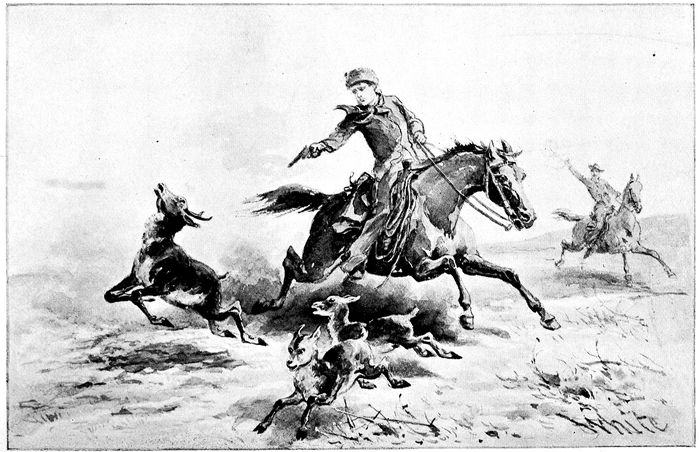
exciting way of capturing them. You can’t
imagine what hard riding it takes to enable
one to slip a lariat over the head of a youngster
about six months old. The little fellows
run like the wind, and have a way of dodging
and ducking their heads, just as the noose is
about to settle down over their necks, that is
perfectly exasperating. On Saturday we will
pay our respects to the wolves. They are not
worth a charge of powder, but we manage to
get a little sport out of them by shooting them
with the bow and arrow.”
“Then I shall not get any,” said Oscar. “I
don’t know how to use a bow.”
“You can’t learn younger. The first thing,
however, is to go down to the corral and pick
31out a pony. The quartermaster knows all
about them, and we will ask him to go with
us and make the selection. Orderly, tell
Major Baker I want to see him.”
The major, who was the acting quartermaster,
made his appearance in a few minutes,
and the three walked leisurely toward the
gate, discussing the merits of the captured
ponies as they went.
At a sign from the colonel, accompanied by
a pantomime that Oscar could not understand,
a man who was sitting on the opposite side
of the parade ground, with a blanket over
his shoulders, arose to his feet and disappeared
through an open doorway.
When he came out again Oscar saw that he
was an Indian, and that he had exchanged his
blanket for a coil of rope, which he carried in
his hand.
He fell in behind the colonel and his two
companions, and followed them down the hill
toward the corral in which the ponies were
confined.
There were twenty-five or thirty of them in
the enclosure, and they looked so very small,
32when compared with the cavalry horses that
were picketed on the outside, that Oscar could
hardly bring himself to believe that they were
full-grown animals.
They looked more like colts, and it did not
seem possible that they could carry a rider for
weeks at a time, with nothing but grass to eat,
or beat a Kentucky thoroughbred in a race of
twenty miles.
The officers stopped when they had passed
through the gate of the corral, and while the
major was running his eyes over the herd in
search of the particular pony he wanted to
find, Oscar had opportunity to take a good
survey of the Indian.
He was one of the Osage scouts attached to
the colonel’s command, and though not so
large a man as Big Thompson, he was taller
than either of the officers, and the battered
stovepipe hat he wore on his head made him
look taller than he really was.
He wore leggings and moccasins, a gray
flannel shirt, a tattered officer’s dress coat,
with a captain’s epaulet on one shoulder
and a sergeant’s chevron on the other, and
33the band on his hat was stuck full of
feathers.
He did not look like a very formidable person,
and yet, as Oscar afterward learned, he
had the reputation of being the bravest man
in his nation. He stood quietly by, with his
lasso on his arm, awaiting the colonel’s further
orders.
“There he is! there he is!” exclaimed the
major, laying his hand on his commander’s
shoulder, and pointing toward the pony of
which he was in search. “Come here,
Preston, and tell me what you think of
him.”
“I don’t see him,” replied Oscar, stepping
behind the major, and raising himself on tiptoe,
so that he could look along the officer’s
outstretched arm. “I can’t tell one from the
other. They are all sorrels, and look exactly
alike to me.”
“But there is a big difference in them, all
the same,” answered the major. “That fellow
is a trained hunter, and worth fifty dollars
of any man’s money. He will follow a buffalo,
antelope, or elk over the roughest ground or
34through a prairie-dogs’ village without making
a single misstep, and without the least guidance
from the reins. I know that to be a fact,
for I have seen him do it. If you want something
a little handsomer and more fancy,”
added the major, pointing to a pony that was
trotting about on the outskirts of the herd, as
if to show off the ribbons and feathers that
were braided in his mane and tail, “there he
is, and he is worth thirty dollars more.”
“I don’t care for anything fancy,” replied
Oscar. “I came out here to work, not to put
on style. Those thirty dollars are worth more
to me than they are to Uncle Sam.”
“I think the buffalo hunter is the one you
want,” remarked the colonel. “You will
have two days in which to try him, and if he
doesn’t suit you can bring him back and
exchange him for another.”
So saying he turned to the Osage, and
pointing out the horse in question, told him to
secure it.
The Indian at once went in among the
ponies, which had retreated to the furthest
corner of the corral, and when he came out
35again, leading the buffalo hunter by his
lasso, which he had twisted about the animal’s
lower jaw, the rest of the herd turned and
followed at his heels.
The presence of the Indian seemed to quiet
them at once. They stood in no fear of him;
but the moment they caught sight of the
white men, who were waiting in front of the
gate, they wheeled in their tracks and ran
back to the other end of the corral again.
When Oscar came to take a good look at
the animal he told himself that he was the
homeliest thing in the shape of a pony he had
ever seen.
There were a dozen others in the corral,
which, if left to himself, he would have selected
in preference to this one.
He was not at all pleased with the animal’s
actions, either; for when he advanced to lay
his hand upon him the pony snorted loudly,
threw his ears close to his head, and retreated
away from him as far as the length of the
lariat would allow. He was vicious as well as
homely.
CHAPTER V. LARAMIE PLAINS.
36
“That’s the way they all do at first,”
said the colonel, smiling at the rueful
look on Oscar’s face. “An Indian pony
doesn’t like a white man any better than his
master does, and, like his master, he must be
forced into submission. You are not afraid of
him, I suppose?”
“Oh, no, sir. Just let me get on his back,
with a good bit in his mouth, and I’ll manage
him.”
While on the way back to the fort the colonel,
with the major’s assistance, arranged all
the details of the hunting expeditions that
were to come off during the next two days, and
named the officers of the garrison who, being
off duty, would be at liberty to take part in
them.
It was decided that as soon as dress parade
and supper were over the party would leave
37the fort on horseback, taking with them a
light wagon, in which to carry their tents
and provisions, and bring back any game
that might chance to fall to their rifles.
By midnight they would reach a small
stream which ran through a country much
frequented by antelope in the early hours of
the morning.
There they would camp and sleep until daylight,
when they would take to their saddles
again and begin the hunt.
Having reached the gate the colonel gave
the Indian some instructions concerning Oscar’s
pony, after which he and the major walked on
to their quarters, while Oscar bent his steps
toward the sutler’s store, where he purchased
a saddle and bridle, a rawhide lasso and picket
pin, and a pair of elk-skin moccasins and leggings.
He hung the saddle, bridle, and lasso upon
a peg behind the stall in which the Indian had
left his pony, and the other articles were carried
into his bedroom and stored away in his
trunk.
After that Oscar had nothing to do but to
38amuse himself in any way he saw fit. His first
care was to get ready for the hunt, so that no
time would be lost when the hour for the start
arrived.
He filled his belt with cartridges for his rifle
and revolver, placed these weapons where he
could readily lay his hands upon them, took
from his trunk one of the thick, coarse suits of
clothing he intended to wear while in the hills,
and then set out to look about the fort.
He took a good survey of the stables and
barracks, peeped into all the warehouses that
were open, watched the teamsters, who were
busily engaged in hauling the winter’s supply
of wood into the fort, and finally, growing tired
of passing the time in this way, he went back
to the stable to take another look at his pony.
As he walked up and down the floor behind
the stall in which the animal was hitched, he
incautiously approached a little too near his
heels. In an instant the pony’s little ears
were thrown back close to his head, and his
hind feet flew up into the air with tremendous
force, but Oscar was just out of reach.
Fortunately he saw the motion of the
39pony’s ears, and, suspecting mischief, he
jumped aside just in time to avoid the blow,
which, had it been fairly planted, would have
ended his career as a taxidermist then and
there.
“That’s your game, is it!” exclaimed Oscar,
picking up the hat that had fallen from his
head. “Well, if you want a fight we may as
well have it out now as any time.”
So saying, Oscar took his bridle down from
its place on the peg and walked into the
stall.
The pony must have been astonished at his
boldness, and perhaps he was cured by it. At
any rate he offered but little resistance as
Oscar forced the bit into his mouth and
strapped the saddle on his back.
He raised no objections either when the
boy, having led him out of the stable, prepared
to mount him; but he did not wait for
him to be fairly seated in the saddle.
No sooner had Oscar placed his foot in the
stirrup and swung himself clear of the ground
than the pony broke into a gallop and carried
him swiftly out of the gate.
40Oscar could ride almost as well as he could
shoot. He was quite at home in the saddle,
and it seemed like old times to find himself
moving over the ground with a speed almost
equal to that of a bird on the wing, and to
hear the wind whistling about his ears.
The pony was perfectly willing to go and
the boy was perfectly willing to let him.
Up one hill and down another he went at an
astonishing speed, and when at last his rider
thought he had gone far enough he attempted
to check him by pulling gently on the reins
that were buckled to the snaffle bit and talking
to him in English.
But the pony, which had all his life been
accustomed to the severest treatment,—an
Indian has no more mercy on his favorite
horse than he has on the captives that fall
into his hands,—was not to be controlled by
gentle measures or smooth words uttered in
an unknown tongue, so Oscar was obliged to
resort to the curb.
That was something the pony could understand,
for he was used to it. After he had
been thrown almost on his haunches three or
41four times he slackened his pace and finally
settled down into a walk.
Then Oscar straightened up, pushed his hat
on the back of his head, and looked about him.
He was alone on the prairie.
Even the top of the tall flag-staff which
arose from the parade ground in the fort was
hidden from view by the last swell over which
the pony had carried him.
But there was no danger of getting lost, for
the trail was as clearly defined as any country
road he had ever travelled.
He followed it to the summit of the next
hill, which, being higher than the surrounding
ones, brought the flag-staff and a portion of the
hamlet of Julesburg again into view, and there
he stopped to take a survey of the country.
The ridge on which he stood stretched away
behind him as far as his eye could reach, and
in front terminated in a steep bluff, perhaps
a hundred feet in height, at the base of which
flowed the dark waters of the Platte.
To the north and west the long, regular
swells gave place to innumerable ravines,
which crossed and recrossed one another,
42and twisted about in the most bewildering
fashion.
They were deep and dark, and their precipitous
sides were so thickly covered with
stunted oaks and pines that the light of the
sun rarely penetrated to the bottom of them,
even at mid-day.
In the years gone by these same ravines
had afforded secure hiding-places for the
hostile Sioux, who had so stubbornly resisted
the onward march of the white man.
From their cavernous depths they had
poured forth in overwhelming numbers to
pounce upon some wagon train, and in them
they had found refuge when worsted in conflict
with the troops, their perfect knowledge
of the ground enabling them to effectually
baffle pursuit.
Far beyond the ravines, long miles away,
and yet rendered so distinct by the clear
atmosphere that it seemed to Oscar that but a
few hours’ ride would be required to take
him to it, was a tract of level prairie, which
stretched away through four degrees of longitude
to the foot-hills.
43This level prairie was known as the Laramie
plains, and even so far back as the day Oscar
gazed upon it it was historic ground. Little
mounds of stone, and the bleaching and
crumbling bones of horses and cattle, marked
the spot where more than one desperate battle
had been fought between the hardy pioneers
and their savage foes, and when Oscar, a few
days later, was brought face to face with these
mementoes, he wondered at his own temerity
in so eagerly accepting a commission that took
him to a country in which such scenes had
been enacted.
He knew that the Laramie plains were still
debatable ground; that the outrages that had
been perpetrated there might at almost any
day be repeated.
It was true that the country was now
thickly settled,—at least the old pioneer
thought so,—that comfortable ranches and
dug-outs were scattered over the prairie, from
fifteen to twenty miles apart, and that numerous
droves of sheep and cattle cropped the
grass which had once afforded pasturage for
countless thousands of buffalo; but these evidences
44of the irresistible progress of civilization
did not intimidate the Indian. They
rather served to enrage him and to excite his
cupidity.
Isolated ranches could be easily plundered,
and the flesh of sheep and cattle was fully as
palatable as that of the buffalo, which had
been driven away.
Of course there was no trouble to be apprehended
at that season of the year, it being too
near winter for the Sioux to break out into
open hostilities.
A plains Indian does not like to move during
the snowy season. Indeed it is almost
impossible for him to do so, for the reason
that his main dependence—his pony (without
which, so old hunters say, the Indian is not a
foe to be feared)—is utterly unfit for service.
His food being deeply buried under the
drifts, he is forced to content himself with the
branches of the cottonwood, which the squaws
cut for him to browse upon.
He becomes reduced almost to a skeleton,
and even staggers, as he walks about to find
some sheltered nook into which he can retreat
45for protection from the keen winds which cut
through the thickest clothing like a knife.
His master, whom he has perhaps carried
safely through a score of successful hunts
and forays, pays not the slightest attention to
him.
Comfortably settled in his teepee, hugging
a little fire over which a white man would
freeze to death, the warrior sits with his buffalo-robe
around him, passing the time in
smoking and sleeping, but arousing himself at
intervals to engage in a game of chance with
some of his companions, or to send his squaw
to the agency to draw the rations a generous
government provides for all the “good”
Indians.
But when spring comes, and the snow melts
away, and the tender grass begins to spring
and grow luxuriantly beneath the genial influence
of the sun, a great change takes place in
the Indian and his pony.
The latter quietly sheds the long, rough coat
he has worn all winter, and with it the burrs
and mud with which he was covered; his ribs
disappear, his skeleton frame begins to swell
46out into a well-rounded form, and all his old-time
life and spirit come back to him; while
his master, having shaken off his lethargy,
polishes up his weapons, lays in a new supply
of ammunition, and begins to look about for
something to do—something that will add new
laurels to those already won.
If he can find the least excuse for so doing
he is ready at any moment to take the war-path.
Oftentimes he has no excuse at all
beyond a desire to gratify his incontrollable
propensity for stealing and shooting.
Not infrequently a company of boys, who
are ambitious to prove themselves expert
thieves, and thus render themselves candidates
for the “sun-dance,” through which
trying ordeal all must pass before they become
full-fledged warriors, break away from their
agency and raid upon the sheep and cattle
herders before spoken of.
Sometimes whole bands and tribes break
out in this way, and spend the summer in
dodging the troops and sacking defenseless
ranches.
While the brave is on the war-path he is a
47“bad” Indian, and runs the risk of being
shot by anybody who meets him; but in spite
of this he enjoys himself to the utmost while
summer lasts.
It is not until the pleasant weather draws to
a close, and all the ranches he can find have
been plundered and burned, and all the sheep
and cattle in the country have been captured
or dispersed, and the fall buffalo-hunt is over,
and the cold winds begin to sweep over the
plains, that the Indian becomes repentant.
Then he thinks of his warm teepee in that
sheltered nook in the ravine, where his family
has lived all summer, subsisting upon government
rations, and he makes all haste to return
to it before the snows of winter come to shut
him up in the mountains.
CHAPTER VI. A RIDE THROUGH THE SAGE-BRUSH.
48
The moment the repentant and plunder-laden
warrior reaches his reservation he
becomes one of the “good” Indians, and is
entitled to all the privileges the government
accords to them.
These privileges consist principally in drawing
rations, riding stolen horses, dressing in
stolen clothing, carrying stolen weapons, and
wearing as an ornament on his shield the
scalp of the unfortunate ranchman to whom
the aforesaid stolen property once belonged.
He does this too right before the face and eyes
of the agent, who will not arrest him, and the
troops dare not.
“It must be a fine thing to be an Indian,”
said Oscar to himself as thoughts something
like these passed through his mind—“nothing
to do, and plenty to eat and wear. But, on
the whole, I think I’d rather be a taxidermist.
49Now, where shall I go? I would explore one
of these gullies if it were not for the associations
connected with them. I should expect
a band of hostiles to jump down on me at any
moment. But I’ll go, anyway. A pretty
hunter I shall make if I am afraid to ride into
a ravine just because it is dark. It isn’t at all
probable that I shall see a living thing.”
With this reflection to comfort him and
keep up his courage Oscar urged his pony
forward, and rode slowly along a well-beaten
path that ran through a thicket of sage-brush
and led in the direction he desired to go.
Then, for the first time since leaving the
fort, he wished that he had brought his
double-barrel with him, for he saw “specimens”
on every side. They first appeared in
the shape of a flock of sage-hens, which suddenly
arose from the brush close in front of
him, and sailed away toward the foot of the
ridge.
They were a little larger than the ruffed
grouse Oscar had so often hunted in the hills
about Eaton, and their flight, though strong
and rapid, was so even and regular that he
50would have had no trouble whatever in picking
out a brace of the best birds in the flock.
True to his hunter’s instinct, Oscar marked
them down very carefully, and while he sat
in his saddle, looking first at the fort and
then at the place where he had seen the birds
settle to the ground, debating with himself
whether or not it would be a good plan to go
back and get his gun, something that looked
like a yellowish-gray streak emerged from the
sage brush, and ran with surprising swiftness
down the path, which, at this point, happened
to be perfectly straight. Just before it reached
the first turn it halted suddenly, and gave
Oscar a view of the first mule rabbit he had
ever seen.
He did not wonder at the name it bore, nor
did he any longer doubt the truth of the
stories he had often read in regard to the
attempts made by old plainsmen to pass the
creature off on inexperienced pilgrims as a
genuine mule. Its ears looked altogether too
long for so small an animal, and Oscar wondered
if they did not sometimes get in its
way.
51He studied the rabbit with a great deal of
interest, noting particularly the position of
the body and the ears. He knew now how
he would set up the first one he brought to
bay.
“It’s a lucky thing for you that I left my
gun behind, my fine fellow,” said Oscar, as he
rode slowly toward the rabbit, which gazed at
him as if he were no more to be feared than
one of the sage-bushes that lined the path.
“You would be booked for Yarmouth, sure.
If I only had you out on the open prairie,
I’d make you show how fast you could
run!”
When the rabbit thought Oscar had come
near enough, he began moving away with
long, deliberate bounds, and at the same
moment the boy gave his pony the rein and
started forward in pursuit.
The animal heard the clatter of hoofs behind
him, and letting out two or three sections
in its hind legs,—that is the way old plainsmen
express it, when they want one to understand
that a rabbit has made up his mind to exhibit
his best speed,—he shot ahead like an arrow
52from a bow, and was out of sight in a twinkling.
He did not turn into the bushes, but kept
straight down the path, completely distancing
the pony before the latter had made a dozen
jumps.
“Oh, if I only had some dogs like the
colonel’s!” said Oscar, after he had succeeded
in making his horse comprehend that
he was expected to settle down into a walk
once more. “With a brace of greyhounds to
run antelopes, wolves, and jack rabbits, and a
well broken pointer to hunt sage hens, one
could see splendid sport right here in the
neighborhood of the fort. I am sure those
birds would lie well to a dog, and I have not
the least doubt——”
The young hunter’s soliloquy was cut short
by the sight of an apparition in blue flannel
and buckskin which just then came into
view.
It proved, on second look, to be a man
dressed in the garb of a hunter; but such a
man and such a garb Oscar had never seen
before. No description could do them justice.
53The man belonged on the plains, that was
evident. So did Big Thompson, to whom
Oscar had that day been introduced; but the
two were as different in appearance as darkness
and daylight.
The one had gained Oscar’s confidence the
moment he looked at him; but the sight of
this man aroused a very different feeling in
his breast, and caused him to bless his lucky
stars that the meeting had taken place so near
the fort.
He was a person whom the young hunter
would not have cared to meet in any lonely
spot.
With a muttered exclamation of anger, the
man jerked his horse part way out of the path,
and Oscar made haste to ride on and leave him
out of sight.
CHAPTER VII. ANOTHER UNEXPECTED MEETING.
54
When two or three bends in the path had
shut the stranger out from view, Oscar
drew a long breath of relief and began a mental
description of him.
He was fully as tall as Big Thompson, as
thin as a rail, and blessed with a most sneaking,
hangdog cast of countenance. He was
clad in a blue flannel shirt, a soldier’s overcoat,
and a pair of buckskin trousers, all of which
had grown dingy with age and hard usage.
On his head he wore a brimless slouch hat,
and on his feet a pair of ancient moccasins,
and between the moccasins and the tattered
bottom of his trousers—which were much too
short for him—could be seen an ankle which
was the color of sole-leather. His hands and
the very small portion of his face that could
be seen over a mass of grizzly whiskers, were
of the same hue.
55This uncouth object sat on his saddle—a
piece of sheepskin—with his back rounded
almost into a half circle, and his long neck
stretching forward over his pony’s ears.
He did not look like a very dangerous character,
but still there was something about him
which made Oscar believe that he was a man
to be feared.
While the young hunter was busy with his
mental photograph of the stranger, his pony
was walking rapidly down the path which now
emerged from the sage-brush and entered the
mouth of one of the ravines.
Oscar looked into its gloomy depths and
drew in his reins, although he did not draw
them tightly enough to check the advance of
his pony.
“I don’t know whether I had better go in
there or not,” thought Oscar, facing about in
his saddle to make sure that the ill-looking
fellow who had obstructed his path in the sage-brush
was out of sight. “If he followed this
road, he must have come out of this ravine,
and who knows but there may be more like
him hid away among these trees and bushes?
56But who cares if there are?” he added, slackening
the reins again. “If I am going to be a
hunter, I may as well begin to face danger one
time as another, for it is something I cannot
avoid. I’ll never start out by myself again
without my rifle or shot-gun.”
The path was quite as plainly defined at this
point as it was in the sage-brush, and of course
Oscar had no difficulty in following it. Neither
did he have any fears of being lost in the labyrinth
before him, for all he had to do when he
had ridden far enough was to turn about and
the path would lead him back to the sage-brush
again.
He kept on down the ravine for a mile or
more, peering into the dark woods which had
so often echoed to the war-cry of the hostile
Sioux, wondering all the while who the
strange horseman was and where he lived, and
finally he began to think of retracing his
steps, but just then his ear caught the sound
of falling water a short distance in advance
of him.
He had heard much of the trout-streams of
this wild region, and his desire to see one
57induced him to keep on, little dreaming that
when he found the stream he would find
something else to interest him.
When Oscar had ridden a few rods farther
he came within sight of the falls, the music of
whose waters had attracted his attention, and
also in sight of a smouldering camp fire.
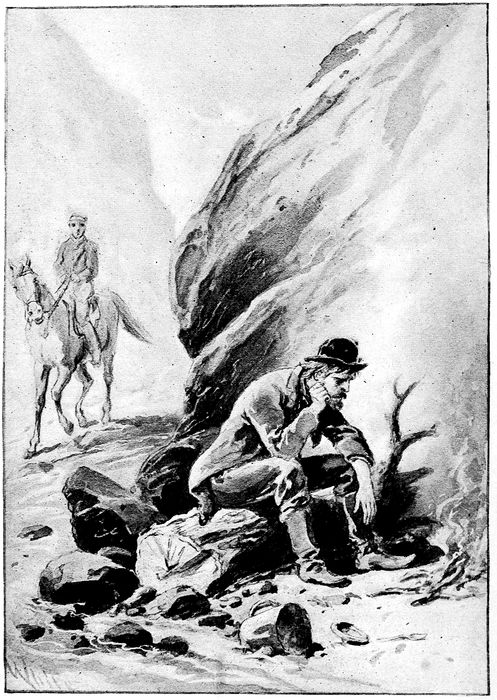
Seated on a log in front of it, with his elbows
on his knees and his chin resting on his hands,
was a figure almost as forlorn and dilapidated
in appearance as was the horseman he had
seen in the sage-brush.
He was gazing steadily into the fire and
seemed to be very much engrossed with his
own thoughts; but when the sound of the
pony’s hoofs fell upon his ear he sprang up
and gazed at Oscar as if he were fascinated.
The camp, upon which our hero had so
unexpectedly stumbled, was located in the
mouth of a ravine that branched off from the
one he had followed from the foot of the
ridge.
The fire was built upon the opposite bank of
the stream, which here ran across the main
ravine to mingle its waters a few miles farther
58on with those of the Platte, and behind it was
a clear space a dozen or more feet in diameter
that served as the camp.
Various well-known signs, which did not
escape his quick eye, told Oscar that the camp
had been occupied for several days, and yet
nothing in the way of a shelter had been erected,
the campers, no doubt, being fully satisfied
with the protection afforded them by the overhanging
cliff and the thick cluster of evergreens
that grew at its base.
And there were other things missing, too,
which Oscar had never failed to see in every
camp whose inmates had any respect for their
health and comfort. The supply of wood was
exhausted, and although there was an axe
handy the campers had sat musing by the fire
until it had almost burned itself out, being too
lazy to chop a fresh supply of fuel.
There was nothing in the shape of bed
clothes in sight, or any provisions, or any
packages that looked as though they might
contain provisions; and the only cooking
utensil to be seen was a battered and blackened
coffee-pot, which lay on the edge of the
59brook, where it had stopped when its owner
angrily kicked it out of his way.
Having noted these evidences of the extreme
poverty and utter shiftlessness of the campers,
the young hunter turned his attention to the
figure before the fire, who still stood and
gazed at him as if he were spellbound.
The boy was somewhat surprised at the
result of his hurried observations, for he saw
at once that the camper was not a born plainsman.
Beyond a doubt he had known better
times. His clothing, as well as a certain
indefinable air and manner which are inseparable
from those who have all their lives been
accustomed to good society, loudly proclaimed
these facts.
He looked like a broken-down gentleman,
but still there was something of the backwoods
about him, too. A stiff hat that had
once been black covered his long uncombed
hair, and his clothing was all of the finest
broadcloth, and cut in faultless style; but his
trousers were worn in a pair of heavy cowhide
boots, and a glaring red shirt-collar was
turned down over the collar of his coat. He
60was young in years, but wore a full beard and
mustache, the latter having been long and
carefully cultivated, while the whiskers were
of recent growth.
Oscar took all these little points in at a
glance, and was about to turn away with an
apology for his intrusion, when something
in the carriage of the head and the position
assumed by the camper caused him to pause
long enough to look him over a second time.
He had never seen the face before, that was
certain; but there was something about the
form that seemed familiar to him.
“It is nothing but a foolish notion of mine,
of course,” said Oscar to himself, as he drew
in the reins preparatory to turning his pony
about.
Then speaking aloud, he said:
“I didn’t mean, sir, to jump over in your
camp in this unceremonious way. I wasn’t
aware there was anyone here. I wish you
good-day!”
To Oscar’s unbounded surprise, the reply
that came across the brook was a volley of
violent imprecations. They were called forth,
61not by anger, apparently, but by overwhelming
amazement; and the strangest part of the
whole proceeding was that they were uttered by
a familiar and well-known voice—a voice that
Oscar had not heard for many a long month.
The effect of this interchange of compliments
was astonishing. The camper came
close to the bank of the stream, and leaning
forward until his body was bent almost
double, shaded his eyes with his hand and
gazed fixedly at Oscar, who, having suddenly
grown too weak to keep his feet in his stirrups,
was obliged to cling to the horn of his
saddle with both hands, in order to keep his
swaying body from toppling over headlong to
the ground.
They stood thus for a few seconds without
speaking, and then the camper, after a great
effort, recovered the use of his tongue.
“It is Oscar Preston, as sure as I’m a sinner!”
he exclaimed, in a hoarse whisper.
“Tom, is that you?” said Oscar, in the
same husky voice.
Then there was silence. The two seemed
to have been struck dumb again, and to be
62utterly unable to remove their eyes from each
other. But at length the camper slowly, inch
by inch, brought himself into an upright position,
and, moving with stealthy footsteps, and
keeping his gaze fastened upon Oscar, as if he
feared that the boy was an apparition that
might vanish into thin air if he made the least
noise or lost sight of him for an instant, he
walked back to his log by the fire, and seating
himself upon it, buried his face in his hands.
These actions aroused Oscar, who rode
across the brook, and, after tying his pony to a
convenient sapling, he went up to the log and
seated himself beside the camper.
The latter did not notice him for several
minutes; but, at length, as if he began to feel
ashamed of the weakness he had exhibited, he
straightened himself up and looked defiantly
into Oscar’s face.
It was Tom Preston, sure enough (Oscar
recognized him now, in spite of his whiskers),
but how changed from the dashing, dandified
book-keeper he had known at Eaton! He
seemed to have grown ten years older since
the day his brother last saw him.
CHAPTER VIII. TOM PRESTON.
63
“Tom,” said Oscar, as soon as he could
speak, “you are the last person on
earth I expected to meet in this wilderness.”
“I may say the same in regard to yourself,”
answered Tom sullenly. “What brought you
here?”
“I came on purpose to hunt.”
“You did?”
Tom was greatly amazed when he heard this.
He ran his eye over Oscar from head to foot,
critically examining his neat, warm outfit, and
noting, with no little bitterness of heart, the
air of comfort and contentment which those
who are prosperous in the world seem to carry
with them wherever they go, and then he
looked down at himself.
Oscar, following the direction of his gaze,
saw that his suit of broadcloth was very seedy
64and threadbare, and that in some places it
was almost worn through.
What would Tom do when winter fairly set
in, and the ravines were piled full of snow,
and the keen winds came roaring down from
the mountains? If that was the warmest suit
he had, he would certainly freeze to death.
“Where is your overcoat?” asked Oscar,
looking about the camp.
“Overcoat?” repeated Tom, with a sneering
laugh. “Do you imagine that I am able to
own such a thing? My uncle’s got it.”
“Your uncle?”
“Yes—Uncle Solomon, who lives in Denver.
I had to shove it.”
Oscar looked down at the ground, and turned
these words over in his mind. He did not
quite understand them, and yet he was almost
afraid to ask Tom to explain.
He wanted to know all about his brother’s
circumstances and plans for the future, for he
was as ready to assist him as he had been to
assist Leon Parker; but still he did not like
to ask too many questions, for Tom spoke very
gruffly, and in a tone of voice which showed
65that he was in no mood to say much about
himself.
Finally, Oscar came to the conclusion that
Tom, having become pressed for money, had
been obliged to pawn his overcoat, and the
latter’s next words proved that this conclusion
was the right one.
“The old skinflint took advantage of my
necessities, as people of that class always do,”
said he. “He gave me only fifteen dollars for
it, and it cost me forty. But those fifteen
dollars came in very handy, I tell you, for
with them I was able to purchase three flannel
shirts and these boots, which are a mile too
big for me. Now, let me tell you what’s a
fact, Oscar. You had better take the advice
of one who has been through the mill, and dig
out for the States while you have the chance.
I was as spruce as you are when I first came
out here, and now look at me. Just look at
that!” he went on, thrusting out a foot which,
up to the time he left home had always been
encased in boots made of nothing heavier then
French calf-skin or patent leather. “If I had
been compelled to wear such stogas while I
66was in Eaton, I should have thought I was
very badly abused, but now I have to wear
them, or go without any. I’ll tell you another
thing—if you stay here you needn’t look to
me for help. It is as much as I can do to take
care of myself.”
Here Tom got upon his feet and walked
back and forth in front of his brother, shaking
his fists in the air and swearing audibly.
“Those three thousand dollars didn’t do
you much good, did they?” said Oscar, after
a moment’s pause.
“Where did I get three thousand dollars?”
demanded Tom, suddenly stopping in his walk
and looking down at his brother.
“I am sure I don’t know; but an examination
of your accounts showed a deficit to that
amount.”
“Ah! That may be; but I didn’t have any
such sum when I came out here. I spent a
good deal before I left Eaton.”
“What did you do with the money you
brought with you?” inquired Oscar, who
hardly expected that Tom would reply to the
question.
67“Oh, I dropped it!”
“Did you lose it?”
Tom nodded his head, and resumed his
walk.
“How did it happen?”
“Why, I was fool enough to buck the tiger
down in Denver, if you must know,” answered
Tom snappishly. “I wanted to increase my
capital, and the consequence was I lost it
all.”
“You don’t mean to say that you gambled
it away?” Oscar almost gasped.
“Well, that’s about the plain English of
it,” was the careless reply.
“O Tom!” exclaimed Oscar. “What do
you suppose mother would say if she knew
it?”
“I don’t intend that she shall know it, and
she never will unless you get to swinging that
long tongue of yours. It was my intention to
shut myself out so completely from the world
that nobody in Eaton would ever hear of me
again; and I should have succeeded if some
evil genius had not sent you prowling through
this ravine. What brought you here, anyway?
68I tell you again that I can’t take care
of you, and I won’t, either! By the way, for
how much did you get into old Smith?”
It was plain enough to be seen that Tom, in
his endeavors to account for his brother’s unexpected
presence in that country, was shooting
wide of the mark. He readily believed
that Oscar, like himself, had stolen money
from his employers and fled from Eaton in
order to escape punishment at the hands of
the law.
He could not think of anything else that
would be likely to bring Oscar so far away
from home.
“There’s just one thing about it,” said Tom
to himself, after he had looked at the matter
from all points and arrived at what he considered
to be a perfectly satisfactory conclusion,
“his money will soon be wasted—if it
hasn’t been wasted already—and now that he
has found me, he will naturally expect me to
help him; but I can’t do it, and I won’t, and
he might as well know it first as last. How
much money did you bring away from Eaton
with you?” he asked aloud.
69“About eleven hundred dollars,” replied
Oscar, who knew that his brother was very
far from suspecting the real facts of the case.
“And I left five hundred behind me.”
“Good for you!” exclaimed Tom. “You
made a bigger haul than I did. You kept that
five hundred to fall back on, I suppose. I
wish I had been sharp enough to do the same.
What did you do with the rest?”
“I saved every cent of it, except what I was
obliged to spend.”
This answer almost took Tom’s breath away,
and caused him to make a radical change in
the programme he had marked out for himself.
Oscar did not fail to see it all, for Tom’s
thoughts could be easily interpreted by the
expression of his face.
“I don’t gamble, you know, and neither
am I given to drink,” continued Oscar.
“Do you mean to say that I am?” demanded
Tom, once more pausing in his walk.
“I do, for your face says so. No one ever
saw a total abstainer with such eyes and
such cheeks as you are carrying about with
70you to-day. Now, Tom, it may be to your
interest to tell me all about yourself. I
arrived at the fort no longer ago than yesterday
morning, but I have already started one
disgusted runaway on the road toward home,
and I am able to help you.”
These words removed a heavy load of
anxiety from Tom’s mind. His brother was
willing to help him.
He was very impatient to know how much
help—in other words, how much money—Oscar
would be likely to give him; but, for
the moment, his curiosity overcame his greediness.
He wanted to hear all about that runaway.
CHAPTER IX. TOM’S STORY.
71
“What was that runaway’s name?”
asked Tom. “Was he from Eaton?”
“He was, and his name was Leon Parker,”
replied Oscar. “He wasn’t satisfied with as
comfortable a home and as kind a father and
mother as any boy ever had, so he ran away
and came out here to be a hunter.”
“Well, of all the born idiots I ever heard
of, he is the beat!” exclaimed Tom, who
could hardly believe his ears.
“That’s my opinion exactly. If he could
see you now, or if he could have seen the
miserable being I met while I was riding
through the sage-brush a little while ago, he
would be——”
“While you were riding through the sage-brush!”
interrupted Tom. “Did you come
that way?”
“Yes; I came directly from the post, and
72on the road I nearly ran over the meanest
specimen of humanity my eyes ever rested
upon. I tell you, I wouldn’t like to meet him
on a dark night, if I had anything about me
that was worth stealing.”
“Oh, he isn’t as bad as he looks,” said Tom.
“How do you know he isn’t?” asked Oscar,
who was greatly amazed. “It isn’t possible
that you are acquainted with him?”
“Yes, it is possible,” replied Tom, turning
away his head so that his brother might not
see the hot blush of shame that momentarily
overspread his features. “I know him, and,
more than that, he is my partner. I am getting
ready to start out with him.”
“Worse and worse,” said Oscar, who was
utterly confounded. “Why, Tom, what in
the world is going to become of you?”
“No preaching now!” was the angry
rejoinder. “I had to put up with it from
mother while I was at home, but I am not
obliged to submit to it now, and I won’t,
either! If you want to talk business, go
ahead; but if you want to preach, wait until
some other time.”
73The words he had in his mind were:
“If you want to preach, clear out, and leave
me as you found me.”
But he recollected himself in time, and did
not utter them.
Oscar had expressed a desire to assist him,
and, consequently, it would not be wise to
make him angry.
“You told me that you had already helped
one runaway, and that you would help me,”
continued Tom, seating himself on the log by
Oscar’s side, and laying his hand familiarly on
his shoulder. “Now, let’s talk about that.
How much are you going to give me, and how
did you happen to strike it so rich? I mean,
how did you manage to secure so large a haul
and get away with it?” he added, seeing the
inquiring look on his brother’s face.
“Let me hear your story, and then you shall
hear mine,” answered Oscar. “Tell nothing
but the truth, now. How came you in this
fix?”
“Well, to make a long story short, I came
out here with about fifteen hundred dollars in
my pocket, intending to go to the mines, but—unfortunately
74for me—I struck Denver on the
way, and stayed there until I had squandered
all my money. Then I had to go to work. A
fellow can’t live in this country without doing
something to bring in the stamps, I tell you,
for he has to pay two prices for all the necessaries
of life.
“The first position I managed to work myself
into was that of mule-whacker—teamster,
you know; but I didn’t understand the care of
stock. I wasn’t strong enough to handle the
heavy boxes and bales of freight, and after one
of the mules had kicked me over a few times, I
became sick of the job, threw it up, and went
back to Denver. Everything there was full—more
applicants than there were places for
them to fill.
“One day while I was wandering about the
streets, waiting for something to turn up, I
came across a college graduate who was sawing
wood for his dinner. After a little talk with
him, I made up my mind that I would have to
come down to it, too, so I took in every job of
that kind I could find, swept out saloons and
stores—in fact, did anything that would bring
75me money enough to pay for a decent meal
once a day.”
“Where did you sleep?” asked Oscar.
“In deserted shanties, principally,” was the
reply. “When I was hungry or thirsty, and
couldn’t find any way to earn money, I pawned
some of the clothing I had purchased in St.
Louis. At last I had nothing left but my overcoat,
and I dared not think what I should do
when that, too, was gone. But they say it is
always darkest just before daylight, and, as it
happened, I struck a lead just in the nick of
time—struck it rich, too.
“While I was sweeping out a saloon to pay
for my breakfast, this man—who is now my
partner—came in for his regular eye-opener.
After he had drank it, he fell into conversation
with two or three fellows who were sitting
around, and then I learned that he was a professional
wolfer. He said that he had made
thirty-five hundred dollars out of his last season’s
catch, and had come to the settlements to
sell his plunder and have a good time. Having
spent all his money, and winter being close at
hand, he was getting ready to start out again.
76All he lacked was a companion, but he couldn’t
find one.
“I don’t know what it was that prompted
me to follow him out of the saloon when he
left, but I did it, and I tell you it was a most
lucky thing for me. I told him that I didn’t
know anything about a wolfer’s business, but
I must do something to earn my grub and
clothes, and offered, if he would take me with
him and teach me the tricks of the trade, to
give him one-third of my catch. He jumped
at my offer, and here I am, but in this condition,”
said Tom, arising to his feet and turning
his trousers’ pockets inside out, to show
that they were empty.
“I don’t see that you have had any good
luck yet,” replied Oscar. “You seem to be
completely strapped.”
“So I am, but I consider myself very fortunate,
all the same, for I am in a fair way to
make a splendid living. Thirty-five hundred
dollars in one season, and all the summer to
rest in! Just think of it! Why, man alive,
we’ll be rich in five years! We’ll have a
cattle ranch of our own, live on the fat of the
77land, and fairly roll in money!” cried Tom,
trying in vain to infuse some of his bogus
enthusiasm into his brother, who was not at
all impressed by these visions of ease and
wealth.
We said that Tom’s enthusiasm was not
genuine, and neither was it. It was assumed
for a purpose, and Oscar knew what that purpose
was before his brother’s next words
revealed it.
“Come to think it all over, I am heartily
glad I met you,” continued Tom. “Here we
are, brothers, strangers in a strange land, and
both in trouble. Our interests are identical.
Two can do more than one, and we ought by
all means to hang together. You must have
seven or eight hundred dollars, haven’t you?”
“Yes, I have that much.”
“Can you get hold of that five hundred you
left behind?”
“I suppose I can, but I don’t want it.”
“Oh, we shall need it, sooner or later, and
you might as well make arrangements accordingly.
That makes twelve or thirteen hundred
dollars that we are sure of. Now I’ll tell
78you what we’ll do. We’ll go halves on that,
and I will drop my old partner and take you
in his place. What do you say?”
Oscar did not say anything immediately.
His brother’s proposition was rather more than
he had bargained for. This was the point Tom
had been trying to reach ever since he found
out that Oscar had money in his possession.
The latter had seen it very plainly, and knew
that the matter must at some time be thoroughly
discussed, and Tom be given to understand
that his offer of partnership could not
be entertained. He knew, too, that there
would be an explosion when the denouement
came, and Tom learned how sadly he had been
mistaken in regard to some things, and for
this reason Oscar was anxious to put the critical
moment off as long as he could.
CHAPTER X. TOM LEARNS SOMETHING.
79
“What do you think of my plan,
anyhow?” asked Tom. “Isn’t it
glorious?”
“I would rather know what you think of
it when you have heard my story, which I
will begin as soon as you have finished
yours,” answered Oscar. “You have not
yet given me any idea of your business.
Where’s your home?”
“Haven’t got any. Don’t need one.”
“How did you come up from Denver?”
“Walked every step of the way, and my
partner’s pony carried the plunder.”
“He didn’t have to overtax his strength,
did he?” said Oscar, looking at the battered
coffee-pot in the brook, which was the only
thing in the shape of “plunder” or luggage
that he had seen in the camp, if we
except the axe which rested on the other end
80of the log that served them for a seat.
“Where is your rifle?”
“Don’t need that, either, although I confess
it would be a nice thing to have at hand
in case of trouble. My partner has one, and
I was going to depend on him to supply our
larder and keep us in bait. I suppose you
have firearms?”
“Yes; I have a rifle, revolver, and shot-gun.”
“All right. We are well provided for in
that line, but strychnine is what we shall
depend on, so don’t forget to lay in a good
supply of it when you go back to the village.
Before you go I will tell you what else we
need, and bright and early to-morrow morning
we’ll set out. When we reach a country
in which wolves are known to be plenty,
we’ll make a camp, and go to work at once.
The first thing will be to procure bait,
which may be anything in the shape of
fresh meat that comes in our way. The
skin we shall save, of course; but the
meat will be cut up into pieces, sprinkled
with strychnine, and scattered about over
81the snow. The next morning we’ll go out
and bring in our dead wolves. The skins
will be taken off and cured, and the carcasses
will serve as bait for other wolves.”
“You will need warmer clothes than
those you have on, if you are going to be
exposed to the weather,” said Oscar.
“I know it; and I shall depend on you
to buy some for me. I shall soon be able
to repay you, for there is money in this
business. Everybody says so.”
“I am glad of it, and since you seem
determined to go into it, I hope you will
be successful. If you are, you can return
Mr. Smith’s money with legal interest.”
Oscar watched his brother narrowly as he
uttered these words, and was not much
surprised at the effect they produced upon
him.
Tom jumped to his feet, and doubling
up his fists, began flourishing them in the
air over his head, preparatory to saying
something emphatic. Then, suddenly recollecting
himself, he dropped his hands by
his side, and took his seat on the log again.
82“I can do that, can’t I?” said he, with a
great show of earnestness, which, like the
enthusiasm he had exhibited a few minutes
before, was all “put on” for the occasion.
“It would restore me to my old standing in
society, wouldn’t it?”
“No, it wouldn’t, although it would go a
long way toward it. It is, in fact, the very
first step you must take if you want to regain
the confidence of the folks in Eaton. There is
a stain upon your character, and you must live
it down. That’s what I had to do.”
“You! My conduct didn’t affect you in
any way.”
“I should say it did, and in more ways than
one. Mr. Smith discharged me because he was
afraid to trust me, and that is what brought
me out here. You remember how much sport
you used to make of my taxidermy, don’t you?
Well, it is now bringing me in a hundred dollars
a month, clear of all expenses. I received
enough in advance to make mother comfortable
a long time, and a thousand dollars
besides with which to pay my bills.”
“Why, what do you mean?” exclaimed
83Tom, who was quite as much astonished as
Oscar expected him to be.
“I mean just what I say. I have a life
position, if I succeed in satisfying my employers,
with the promise of a big increase in my
salary. I may go to Africa after I get through
here on the plains.”
“Oh, now, leave off chaffing me!” said
Tom impatiently. “I am in no humor for
nonsense.”
“It is not nonsense. I will tell you all
about it, and when you have heard my story,
you are at liberty to think what you
please.”
Oscar then went on to describe, in as few
words as possible, all the incidents which had
operated to make so great a change in his circumstances.
He told the story of his discharge from the
store, of the vindication of his character by
the discovery of the thief who had been systematically
robbing the money-drawer (Oscar
did not yet know that his friends, Sam Hynes
and Miles Jackson, had anything to do with
that affair), and of Mr. Smith’s efforts to
84induce him to return to his old situation at an
increased salary.
He told how he and Sam Hynes had rescued
Professor Potter when the latter was capsized
off the head of Squaw Island, and wound up
his narrative by giving the details of his visit
to Yarmouth, and his employment by the committee
who controlled the immense fund which
was to be expended in adding a museum to the
university.
Tom listened in genuine amazement; and,
by the time the story was finished, he was so
angry that he could scarcely breathe.
He would have been glad, indeed, if he could
have disbelieved every word his brother
uttered, but his story bore the impress of
truth upon the face of it.
We know how he had accounted for Oscar’s
presence there on the plains, and he had fairly
rejoiced in the belief that his brother was a
runaway thief like himself.
Misery loves company, you know, and
Tom found great satisfaction in the thought
that Oscar, whom everybody in Eaton
believed to be strictly honest and truthful,
85had at last yielded to temptation and sunk
to a level as low as that which he himself
occupied. But, when the real facts of
the case were revealed—when Tom learned
that his brother had left home in broad
daylight, and with his mother’s full and
free consent; that he was backed up by a
committee worth a hundred thousand dollars,
and provided with letters that would
place him on terms of intimacy with the
highest officers on the plains, both civil
and military; that those officers would give
him a good “send-off,” and stand ready
at all times to assist him by every means
in their power—when Tom thought of all
these things, his rage got the better of
him, and he jumped to his feet with the
wildest kind of a warwhoop.
“Have you got the impudence to come here
and tell me that you are growing rich every
day, while I am freezing and starving?” he
demanded, in a voice which was rendered
almost indistinct by intense passion.
“I tell you that I have a steady income,
and it is the truth,” replied Oscar.
86“And you never stole any of old Smith’s
money?”
“Of course not. I never handled a dishonest
penny in my life.”
“And do you know that while you were
comfortably housed at the fort last night,
and having a good time with those officers,
who wouldn’t look at me any sooner than
they would look at a yellow dog—do you
know that while you were enjoying yourself
in that way, I was sitting shivering over
this camp fire, with nothing but hardtack to
eat, and nobody but an ignorant, ragged
backwoodsman for company? Do you know
it?” yelled Tom, who hardly realized what
he said in the excess of his fury. “What
do you mean by it? and what amends are
you going to make for treating me so?”
“I don’t know that I can make you any
amends,” said Oscar, who was greatly astonished.
“You surely can’t expect me to come
out here and shiver over a miserable camp
fire, and take a ragged backwoodsman for
a companion, just because you choose to
do so!”
87“You know well enough that I didn’t
mean that!” Tom almost shrieked. “Why
didn’t you do something for me?”
“I didn’t know you were here.”
“And it would have made no difference
if you had known it. But that’s always
the way. Those who are lucky don’t care
a straw for those that are unlucky. The
harder a fellow tries to better his condition
in life the worse he is off. There is no
one who has planned and schemed more
than I have to make money, and now look
at me! You, on the contrary, took matters
easily, and Fortune has showered favors on
you by the bucketful. You will go off to
the hills with a guide, provisions, and clothing
in abundance, and everything else that
will enable you to live in camp as comfortably
as you would at home, while I——”
Tom was too angry to say more just
then. He walked back and forth in front
of his brother, shaking his fists in the air
and swearing at the top of his voice.
CHAPTER XI. TOM BECOMES DESPERATE.
88
“Look here,” said Tom, suddenly pausing
in his walk and looking down at his
brother. “The fact that you came honestly
by your money will not interfere with our
arrangement, will it?”
“I know what you mean, of course,” answered
Oscar, “but I can’t consent to it. My
instructions are most explicit, and the money
I shall spend is not my own.”
“What’s the odds? Who’ll know whether
you obey orders or not? How much are you
to pay your guide?”
“A dollar and a half a day from the time
we leave the fort until we get back.”
“Well, you will save all that by taking me
in his place; and that consideration ought to
have some weight with you, if you are as careful
of the committee’s money as you pretend
to be. When you go back to the post, tell him
89that you don’t want him—that you have made
other arrangements—and be ready to meet me
in the sage-brush to-morrow at sunrise. I shall
want a pony, of course, and while you are
about it you might as well bring me a rifle and
a supply of ammunition. In the meantime, I
will shake my partner, and we’ll set out
together. When we find a place that suits us,
we’ll go into camp, and while you are securing
specimens I will put in the time in catching
wolves. What do you say to it?”
“I say that there are many objections to
your plan,” replied Oscar. “In the first place,
my instructions are to hire a guide, and I have
done so. If I should discharge Big Thompson,
now that I have engaged him——”
“Big Thompson?” interrupted Tom. “He
isn’t your guide, I hope?”
“He is; and he was recommended to me by
the colonel commanding the post.”
“I don’t care who recommended him, he’s a
rascal.”
“Do you know him?” asked Oscar.
“Not personally; but my partner does, and
he doesn’t know any good of him, either. I
90wouldn’t pass a minute alone in the hills with
him for all the money there is in the States.”
Oscar called to mind the kindly face of
his guide, and the clear, honest-looking eyes
which had gazed straight into his own whenever
their owner spoke to him, and contrasted
the man to whom that face and those eyes
belonged with the sneaking ruffian he had met
in the sage-brush; and the conclusion at which
he arrived was that there was nothing in the
world that would induce him to change companions
with Tom.
Before he would do that he would throw up
his situation and look about for some other
occupation that would support himself and his
mother.
Believing that Tom’s “partner” had some
good cause for hating Big Thompson, Oscar
said no more about him, but went on to state
the other objections he had to Tom’s plan.
“Another reason why I can’t agree to your
proposal is that I am working on a salary, and
I am in duty bound to do the best I can for
those who employ me,” said he. “What
could you and I accomplish by roaming about
91among the hills without an experienced hunter
to show us where the game is? You would
catch no wolves, and I should find no specimens.”
“Yes, we would, for game of all kinds is so
abundant that we couldn’t run amiss of it,”
answered Tom.
Without stopping to argue this point, Oscar
continued:
“There is still another reason. I am only
on probation now, and unless I can show
that committee that I am a hunter as well
as a taxidermist, I shall have to step aside
and give place to somebody else. You can
see for yourself that it is to my interest
to do the best I can at the start.”
“You seem to be full of excuses, but you
needn’t offer any more,” said Tom, with
suppressed rage. “If you don’t want to
agree to my proposal, say it in so many
words.”
“I don’t want to agree to your proposal,”
returned Oscar. “I can’t.”
“You were ready enough to help Leon,
who is nothing to you, and who did his
92best to injure you in every possible way
while you lived in Eaton!” sneered Tom;
“but when your brother asks you for a lift,
you refuse to raise a finger. Lend me a
hundred dollars to buy an outfit with. Can
you do that?”
“No, I can’t. I haven’t got the money.”
“There! What did I tell you?” Tom
almost shouted. “A little while ago you
said you had a thousand dollars.”
“But it doesn’t belong to me. I have
to use it in paying my expenses.”
“And Leon’s too!” exclaimed Tom. “You
must have paid his stage and railroad fare
out of that fund.”
“I did; but I shall have to replace it out
of my own pocket.”
“You couldn’t lend me a hundred dollars,
and replace it in the same way, I suppose?”
“No, I could not, for two reasons: In the
first place, that mortgage must be paid, so
that mother can be sure of a home of her
own; and in the next, I don’t know how
much money I shall need this winter. I must
93feed my guide as well as myself, and when
we come back to the fort I must pay him
cash in hand for his services. Then I have
a pony, mule, and wagon to buy, and it will
cost a snug sum to transport myself and the
specimens I hope to procure to Eaton.
Wouldn’t I be in a pretty fix if I should
find my money was running short?”
“You could draw on that committee for
more, couldn’t you?”
“No, I couldn’t. That wasn’t in the bargain.”
“What’s the odds? Take the risk. Tell
them that you were robbed, or that your expenses
were a little heavier than you thought
they would be.”
“I’ll not tell a lie to please anybody,”
said Oscar indignantly.
“Of course not! Of course not!” yelled
Tom, who was so nearly beside himself with
fury that he could not stand still even for a
moment. “You were quite willing to help a
boy who has slandered you, and to work yourself
to death in order to win the approbation
of strangers, but you wouldn’t give your
94needy brother fifteen cents to save him from
starving.”
“I’ll tell you what I will do,” said Oscar,
paying no heed to Tom’s remarks. “I will
give you a suit of warm clothing and an
overcoat, if you will accept them.”
It was right on the point of Tom’s tongue
to tell Oscar to bundle up that suit of warm
clothing and the overcoat, and take them
to Guinea, or some other place under the
equator—not because he did not need the
clothing, but because he wanted money
more, and it made him angry to know that
he could not get it.
If Oscar had been able to comply with
his demands, every cent would have been
squandered, and his brother would have
started out in his threadbare suit to face
the winter’s storms.
Tom did not utter the words that arose to
his lips. He paced back and forth for some
minutes, with his eyes fastened on the ground,
when suddenly a daring project suggested
itself to him.
Without stopping to dwell on it, he strode
95up and faced his brother. There was a wild
look in his eyes, and his fingers worked
convulsively.
“How much money have you got in your
pocket?” he asked, in as steady a tone as he
could command.
“Not a red cent,” was the reply. “I left
it all at the fort. I thought it would be
safer there.”
“And I wasn’t mistaken, either,” said
Oscar, to himself, as he looked up at his
brother. “No honest face ever wore an expression
like that. I think I would be safer
at the fort myself.”
Tom could not meet his brother’s gaze. He
turned away his head and resumed his seat on
the log.
Oscar had never before come so near being
robbed as he had that day. Tom was really
in terrible straits, and so very much in need
of money that he would not have hesitated to
knock his brother senseless, if he had been
sure that by so doing he could secure possession
of his well-filled pocket-book.
If the latter had not been thoughtful enough
96to place all his money in his trunk before
setting out on his ride, there would have been
a desperate battle on the banks of that little
stream; and it is possible that before it was
ended Tom would have discovered that he had
undertaken more than he could accomplish.
He was much larger and heavier than his
brother, and plumed himself on being a boxer,
but he was weakened and dispirited, by long-continued
dissipation, while Oscar, having
lived a strictly temperate life, was always in
condition to do his best.
“Don’t you think it about time to turn over
a new leaf?” asked Oscar, as he arose to his
feet and laid his hand on his brother’s shoulder.
“One is getting pretty near the end of
his rope when he can bring himself to think
seriously of committing such a crime as you
had in contemplation a few minutes ago.”
Tom did not raise his head or utter a sound.
He could not find words with which to deny
the accusation.
CHAPTER XII. OSCAR TALKS TO THE COLONEL.
97
“What shall I do with the clothes?”
continued Oscar. “Shall I bring
them to you, or would you rather go up to the
sutler’s and pick them out for yourself?”
“I’d rather you would bring them to me,”
answered Tom, without looking at his brother.
“Bring them to the mouth of the ravine, and
I will meet you there—say in a couple of hours.
You had better not come in here again, for my
partner is an odd sort of a fellow, and doesn’t
like to have any strangers about his camp. If
I shouldn’t happen to be on hand when you
come back, don’t wait for me. Just hide the
clothes in the bushes at the foot of a big rock
you will see there, and I’ll find them. You
will know what rock I mean when you see it,
for there is a large oak tree leaning over it.
Good-by till I see you again.”
While Oscar was listening to what his brother
98had to say in regard to the disposal of the
clothing, something told him that Tom did not
intend to be at the place appointed to receive
them.
Impressed with this idea, and believing that
it would be a long time before he would meet
him again,—if, indeed, he ever met him,—he
resolved to extort from him a promise that
he would not only withdraw from the companionship
of such men as the one he had
seen in the sage-brush, but that he would
make an honest and persevering effort to
refund the money he had stolen, and regain a
place among reputable people. But he did
not have time to say a word, for Tom’s good-by
was an abrupt dismissal.
That he intended it should be taken as such
was proved by his actions. As soon as he
ceased speaking, he caught up the axe and
plunged into the bushes.
“Don’t leave me in that way. I want to
say something more to you,” cried Oscar.
He listened intently for a reply, but the
only one he received was the echo of his own
voice thrown back from the cliffs.
99He called again, with no better success, and
then, unhitching his pony, he sprang upon
his back, and slowly and sadly rode down
the ravine.
He turned in his saddle occasionally, to run
his eye over the thicket in which Tom had
disappeared; but he could see nothing of him,
and finally a sudden turn in the road shut the
camp out from his view.
The exhilarating gallop Oscar had enjoyed
on his new pony had done much to cure his
homesickness and banish the gloomy thoughts
that had crowded upon him when he saw Leon
Parker setting out for the States; but the
events of the last half hour had brought
them all back again.
He had never dreamed that he would stumble
upon his brother in that wilderness, or
that he would ever see him in a condition
so deplorable.
Tom’s ill-gotten gains, which he had expected
would bring him so much happiness,
had brought him nothing but misery. He
was thinly clad, his pockets were empty, he
had often gone hungry, and he was the companion
100and associate of the lowest characters.
“His case certainly looks desperate,” thought
Oscar, glancing at his watch and putting his
pony into a gallop, “and I am completely at
my wit’s end. I don’t know what to do, and
I wish there was someone here to whom I
could go for advice. Tom will never be anything
better than he is while he remains with
such fellows as that ‘partner’ of his, that’s
certain; but how shall I get him away from
them? That’s the question that troubles me.”
And we may add that it troubled him all
the way to the fort; but just as he was riding
into the gate a thought passed through his
mind, inducing him to turn his pony toward
the stable instead of toward the hitching-post
in front of the commandant’s head-quarters, as
he had at first intended to do. If anybody
could help him it was the colonel.
He would not take the officer into his confidence,
of course, but he would question him
in a roundabout way, and perhaps during the
conversation some hint would be dropped that
would show him a way out of his difficulty.
101Leaving his pony in the stall that had been
set apart for his use, Oscar walked across the
parade-ground and entered the hall leading to
the colonel’s quarters, the orderly, as before,
opening the door for him. He was glad to
find that the officer was alone. He was engaged
in writing, but when Oscar came in he
laid down his pen and greeted him with:
“Ah! you have turned up at last, have you?
I have had an orderly looking for you, thinking
that perhaps you would like to take a
short ride to try your new horse.”
“I have just returned from a five-mile gallop,”
answered Oscar, who hoped that the
colonel would not offer to accompany him
when he left the fort to carry the clothes to
the ravine. “I am going to start right back,
and this time I shall take my gun with me. I
saw some grouse and a big jack-rabbit down
there in the sage-brush.”
“Oh, you can find them any day if you keep
your eyes open,” said the colonel carelessly.
“But I suppose you might as well begin to
form your collection one time as another.
How does your pony suit?”
102“Very well so far. He showed a disposition
to be ugly at first, but I had no trouble
to bring him to his senses. By-the-way, I
met a couple of wolfers while I was gone.”
“Well, what did they steal from you?”
“Nothing, sir. The only thing I had with
me that was worth stealing was my pony. No
doubt you will be surprised when I tell you
that one of these wolfers is an old acquaintance
of mine.”
“You don’t say so!” exclaimed the colonel,
who was indeed surprised. “You beat anybody
I ever heard of. How many more
acquaintances are you going to find while
you are out here? Are you going to ship this
fellow off to the States, too?”
“No, sir; because he can’t very well—I
mean he doesn’t want to go back where he
came from,” stammered Oscar, who was not a
little confused when he found that he had let
out more than he had intended.
“Ah!” said the colonel in a very significant
tone of voice. “It is a wonder you met him
at all, for these wolfers generally have good
reasons for keeping themselves hidden in the
103thickest part of the woods they can find. If
you have cause to dislike this man—whoever
he is—you may have the satisfaction of knowing
that he can’t get any lower down in the
world—not by land, as some humorist remarks.”
“I have no cause to dislike him,” replied
Oscar. “On the contrary, I think a good deal
of him; but I do not like the company he
keeps. I met his partner while I was riding
through the sage-brush, and I must say that
he was the worst specimen of humanity that I
ever looked at. He was tall and raw-boned,
with grizzly hair and whiskers, a pair of wild-looking
eyes——”
“And rode a little sorrel pony, with a sheepskin
for a saddle,” added the colonel. “That
was Lish, the Wolfer. I know him. Where
is he now?”
“In the village, probably. I judge so, from
the fact that, when I met him, he carried a
couple of empty sacks across his pony’s
neck. I thought he was going after supplies.”
“Where did you find his companion?”
104“In camp, on the banks of the brook that
runs through the ravine, about——”
“Orderly, tell Lieutenant Fitch I want to
see him!” shouted the colonel.
Oscar was very much surprised at this unceremonious
interruption, and he was still
more surprised, and not a little alarmed,
besides, when the lieutenant—who happened
to be close at hand—entered the room in haste,
and was thus addressed by his superior:
“Mr. Fitch,” said the colonel, “Lish, the
Wolfer, has been in Julesburg. How long ago
was it you met him?” he added, turning to
Oscar.
“About two hours, I should say.”
“Well, he has had plenty of time to get
drunk. Go and find him, Mr. Fitch, and
listen to what he has to say. When he is in
his cups, he is like an Indian in the war-dance—much
given to boasting of his valorous
deeds. If he says anything relating to that
affair of last summer, take him into custody
at once, and then go up and arrest his companion,
whom you will find on the banks of
that little trout-stream we fished in last summer.
105If one had a hand in it, the other did,
too, and so we must pull them both.”
Having received his instructions, the lieutenant
hurried from the room, while Oscar
sank helplessly back in his chair, almost overcome
with bewilderment and alarm.
“Worse and worse,” he thought, when he
had recovered himself so that he could think
at all. “Tom has been doing something else
that renders him liable to arrest. What will
become of him?”
Then, seeing that the colonel’s eyes were
fastened upon him with an inquiring look, he
called a sickly smile to his face, and asked, in
a voice that was strangely calm, considering
the circumstances:
“Are the wolfers all bad men?”
“Oh, no. There are exceptions, of course;
but take them as a class, they are a desperate
lot. I know of several men, two of whom I
have in my mind at this moment, who made
their start in life as wolfers. One of them is
now a prosperous merchant in an Eastern city,
and the other is running an extensive cattle
ranch in Texas. But they were careful of
106their money, while the majority of those who
follow that business squander every cent
they earn. They brave hunger, cold, and all
sorts of hardships for several months in the
year, and devote the rest of their time to
getting rid of their money. They are held in
supreme contempt by all honest plainsmen,
and this acquaintance of yours had better
break off associating with them before he gets
himself into trouble, if he hasn’t done so
already. If he is going to be a wolfer, he had
better hunt alone than in the company of that
miserable fellow he seems to have chosen for a
companion. No matter how much money he
makes, Lish will find means to obtain possession
of the whole of it.”
“Do you think he will rob him?” exclaimed
the boy.
“He is capable of anything,” was the
colonel’s reply.
And it was accompanied by a shrug of
the shoulders that spoke volumes and
excited a train of serious reflections in
Oscar’s mind.
CHAPTER XIII. OSCAR WRITES A NOTE.
107
While the colonel was speaking, Oscar
had twisted uneasily about on his
chair, waiting with the utmost impatience
for him to bring his remarks to a close.
At almost any other time he would have
plied the officer with questions regarding
the class of nomads known as “wolfers,”
for he would like to have learned more
about them; but he had already found out
all he cared to know just then.
Tom was suspected of complicity in some
crime that rendered him liable to punishment;
and, if he escaped and went to the
hills with Lish, he would run the risk of
being robbed by him.
Oscar thought it was his duty to warn him
of these dangers. He knew that the lieutenant
would carry out his instructions with the
108utmost promptness and decision—these regulars
waste no time when acting under orders—and
not a moment was to be lost.
The colonel settled back in his chair as
though he had nothing more to say just then,
and Oscar arose to his feet and went into his
bedroom.
After slinging on his powder-flask and shot-pouch,
and making sure that the little box in
the stock of his fowling-piece was filled with
caps, he opened his trunk, and, taking from it
a sum of money sufficient to pay for the clothes
he had promised to purchase for his brother,
he went back into the colonel’s room.
There the officer detained him for a few minutes
in order to describe the localities in the
immediate vicinity of the fort in which he
would be likely to find the most game, and to
tell him how to shape his course in order to
reach those localities. He thought he was
doing the boy a kindness; but instead of that
he was putting him on nettles.
Oscar listened as patiently as he could; and,
when the colonel ceased speaking, he bade him
good-by and left the room.
109He bolted through the outer door, and ran at
the top of his speed across the parade-ground
to the sutler’s store. Fortunately there were
no customers present, and so the sutler was at
liberty to attend to his wants at once.
Slinging his double-barrel over his shoulder
by the broad strap that was attached to it,
Oscar quickly selected the articles he thought
his brother needed, paid the price demanded
for them, and, as soon as they had been tied
up in a compact bundle, he hurried to the
stable after his horse.
The animal, as before, showed a desire to
use his heels, but Oscar, having no time to
waste, paid not the slightest attention to him.
The curb and the rawhide lasso were both
brought into requisition; and, before the vicious
little beast was fairly through smarting under
the energetic pulls and blows he had received,
he had carried his rider through the gate and
out of sight of the flag-staff.
The pony accomplished the distance that
lay between the fort and the mouth of the
gully in much less time than he had accomplished
it before; for Oscar made no effort to
110check him, not even when he was moving with
headlong speed down the steep path that led
through the sage-brush.
Almost before he knew it, the boy found
himself in the mouth of the ravine, and there
he drew rein and brought his pony to a stand-still.
He now had another cause for uneasiness.
Suppose the lieutenant had found Lish at the
village, and that the wolfer had said or done
something to warrant his arrest! Suppose,
too, having placed Lish safely in the guard-house,
the young officer should come after
Tom, and find Oscar there in the ravine!
Even if he did not suspect him of something—and
it is hard to see how the lieutenant
could help it when he caught sight of the big
bundle that was tied to the horn of Oscar’s
saddle—would he not mention the circumstance
to the colonel when he made his report,
and wouldn’t the colonel have a word or two
to say about it?
“Gracious!” exclaimed Oscar; “I’ll be in
trouble myself if I don’t look out. What
could I say to the colonel if he should ask me
111what I was doing here, and what I had in my
bundle? Tom!” he added, calling as loudly
as he dared. “If you are about here, show
yourself without any fooling. I am in a great
hurry, and I have news for you.”
Tom was about there, but he would not
show himself. He was lying at the foot of
a scrub-oak, on the other side of the ravine,
keeping a close watch over his brother’s
movements; but not even the announcement
that Oscar had some news to communicate,
could induce him to stir from his place of
concealment. He felt so heartily ashamed of
himself that he did not want to meet his
brother face to face again, if he could
help it.
“I can’t waste any words on him. There
are his clothes, and when he wants them he
can come after them,” said Oscar, pitching
the bundle down behind the rock Tom had
described to him. “Now then, I don’t know
whether or not I shall have time to do it,
but I’ll take the risk.”
So saying, Oscar drew from his pocket a
diary and lead-pencil, and dashed off a short
112note to his brother, using the pommel of his
saddle for a writing-desk. The pony was as
motionless as the rock beside which he
stood.
Probably he thought—if he was able to
think at all—that Oscar had ridden into the
bushes in order to conceal himself from some
enemy who was in pursuit of him. At any
rate, he showed the training he had received
at the hands of his Indian master.
The note ran as follows:
Dear Tom:
Here are the clothes you need. I am sorry I cannot
see you again, for I should like to ask you some questions
in regard to a certain “affair” that happened last
summer; and in which you and Lish, the Wolfer, are
supposed to have been engaged. If you had anything
to do with it, you will know what I mean, and you had
better dig out of here without the loss of a minute’s
time. Go off somewhere among white folks; begin all
over again, with an earnest resolution to do better, and,
as soon as you are able, make amends for what you have
done. But first drop Lish, as you would drop a hot
potato. You will never amount to a row of pins so long
as you have anything to do with him or men like him.
I have as good evidence as I want that he will rob you
before the season is over, as Frank Fuller and Eben
Webster robbed Leon Parker. If you had no hand in
that “affair,” whatever it may be, come up to the fort as
113soon as you have read this note and put on these clothes,
and I will do everything in my power to give you a
start. In either case drop Lish. It would be better for
you to work for nothing and board around, as you did
in Denver, than to associate longer with him.
For prudential reasons, Oscar signed no
name to the note; and, indeed, no signature
was needed to tell Tom where it came from.
He read it over hastily, and bending down
from his saddle, he thrust it under the string
with which the bundle of clothing was tied up.
“It isn’t as emphatic as I wish it was,”
thought he, “but I have no time to re-write it,
and I don’t know that I could make any improvements
in it if I should try. I would
much rather talk to him, and I wish he
had——”
Just then the pony’s head came up with a
jerk, and his ears were thrown back as if he
were listening to some sound behind him.
He did not turn about as most horses would
have done, nor did he move one of his feet an
inch—not even when the clatter of hoofs on
the hard path began to ring out clearly and
distinctly, as it did a moment later.
114Somebody was coming through the sage-brush
toward the ravine—that was evident.
Beyond a doubt it was the lieutenant; and
here was Oscar, fairly cornered.
A person thinks rapidly when placed in a
situation like this, and it did not take the boy
an instant to make up his mind that everything
depended on his pony.
The rock behind which he had hidden the
bundle stood on the hillside, fully twenty feet
from the path, and the intervening space was
thickly covered with trees and bushes.
If the pony could be kept from revealing his
presence, it was possible that the approaching
horseman might pass on into the ravine, without
suspecting that there was anyone near
him.
“It’s rather a slender chance,” Oscar
thought, as he swung himself from the saddle
and seized his pony by the bit; “but it is the
only one I have. Now, old fellow,” he added
in a whisper, “just imagine that I am an
Indian hiding here to escape from a white
man who wants to shoot me!”
If the pony had been able to understand
115every word his master said to him, he could
not have behaved with more circumspection.
He stood perfectly still, and there was
nothing but the motion of his ears to indicate
that he heard anything.
Oscar kept a close watch of the path through
a convenient opening in the bushes, and presently
the horseman passed across the range of
his vision.
CHAPTER XIV. LEFT IN THE SAGE-BRUSH.
116
The opening in the bushes was so small
that Oscar was able to obtain but a
momentary glimpse of the passing horseman,
but that momentary glimpse was enough to
satisfy him on two points. It was not the
lieutenant, after all, but Lish, the Wolfer, and
he had not been to the village for the purpose
of getting drunk, as the colonel had intimated,
but to lay in some necessary supplies in the
way of provisions. The well-filled bags that
were slung across his pony’s neck, and the side
of bacon which hung from the muzzle of the
long rifle he carried over his shoulder testified
to this fact.
Oscar drew a long breath of relief when he
saw the man ride down the path, and told
himself that one thing was certain: If Tom
was determined to go with the wolfer he would
117have something to eat during the journey to
his hunting-grounds, and if he went hungry
after that, it would be because his partner was
too lazy to keep the larder supplied with meat.
As soon as the wolfer had passed out of
hearing Oscar mounted his pony and rode
down into the path. He made his way around
the brow of the hill; and, when he had put a
safe distance between himself and the mouth
of the ravine, he checked his pony and proceeded
to load his gun.
“Tom has got the matter in his own
hands,” said he, as he rested the butt of the
weapon on the toe of his boot and poured a
charge of powder into each barrel. “If he
had nothing to do with that ‘affair’ that happened
last summer—I wish to goodness I
knew what it was—and has any desire to turn
over a new leaf and to go to work in earnest,
he will come up to the fort as soon as he has
read that note. If he does not come I shall
have to look upon his absence either as a confession
of guilt, or as a declaration that he prefers
the companionship of such men as that
wolfer to the society of honest folks. In
118either case I have done all I can, and the business
ends right here so far as I am concerned.”
Oscar would have been very much surprised
if anyone had told him that he had not seen
the end of the business after all; that, in fact,
he had seen only the beginning of it.
The note he had written, as well as the
clothing he had purchased to keep Tom from
freezing, were destined at no distant day to
be produced as evidence against him.
Was it a dread of impending evil that
prompted him to say, as he placed the caps on
his gun and started his pony forward again:
“Mr. Chamberlain was always right, and
he shot close to the mark when he told me
that I would not find plain sailing before me,
simply because I was about to engage in a
congenial occupation. I have been at the fort
but a few hours, and yet I have wished myself
back in Eaton more than a dozen times.
Why didn’t I keep away from that ravine?
Thoughts of Tom will force themselves upon
me continually, and all my pleasure will be
knocked in the head. How can I enjoy myself
when I know that he is in such a situation?
119Hold on there! I am ready for you
now!”
Although he was deeply engrossed in his
meditations, Oscar could still keep an eye out
for game; and when that flock of sage-hens
arose from the bushes almost at his pony’s
feet, they did not catch him napping.
Being accustomed to the noise made by the
grouse of his native hills when it suddenly
bursts from its cover, the sound of their wings
did not startle him as it startles the tyro.
He was so excited that he did not think to
stop his pony, but still he was cool enough to
make his selections before he fired; and when
he saw, through the thick cloud of smoke that
poured from each barrel, two little patches of
feathers floating in the air, and marking the
spot where a brace of the finest members of
the flock had been neatly stopped in their
rapid flight, he knew that his ammunition had
not been expended in vain.
There was another thing Oscar did not think
of, and that was whether or not his pony would
stand fire. But it was now too late to debate
that question, and besides, it had been settled
120to his entire satisfaction. Almost simultaneously
with the quick reports of the fowling-piece
there arose other sounds of an entirely
different character—a crashing in the bushes,
followed by muffled exclamations of astonishment
and anger. These sounds were made by
Oscar, who had been very neatly unhorsed.
The pony would no doubt stand fire well
enough to suit his half-savage, rough-riding
Indian master, but he was not steady enough
to suit the young taxidermist.
When the double-barrel roared almost between
his ears, his head went down, his hind
feet came up, and Oscar, being taken off his
guard, went whirling through the air as if he
had been thrown from a catapult.
He lost no time in scrambling to his feet,
but he was too late to catch his pony. All he
saw of him was the end of his tail, which was
flourishing triumphantly in the breeze as the
tricky little beast went out of sight over the
brow of the hill.
“Well, go if you want to!” shouted Oscar,
holding one hand to his head, and rubbing his
shoulder with the other. “You’ll never come
121that on me again, I tell you. I can hunt
just as well on foot. Now, where’s my
gun?”
The weapon had been pitched into a thick
bush, a short distance in advance of the one
in which Oscar had brought up, and fortunately
it had sustained no injury beyond a
few deep scratches in the stock, which
Oscar tried to rub out with the sleeve of
his coat.
The boy’s first care was to put fresh loads
into each barrel, and his second to hunt up
his specimens, which he found to be perfect
in every way.
After examining them to his satisfaction,
he placed them in a couple of paper cones
which he had taken the precaution to put
into his game-bag before leaving the fort, and
then set out in search of the jack-rabbit he had
seen a few hours before.
He did not waste any time in looking for his
pony, for he knew that all efforts to recapture
him would be unavailing. The animal would
no doubt make the best of his way back to the
corral from which he had been taken in the
122morning, and Oscar would find him there when
he returned to the fort.
If he ever got on his back again, he would
teach him that he was expected to halt the
instant he saw his rider raise a gun to his face,
and give him to understand, besides, that any
and every attempt to throw that rider would
be sure to bring a certain and speedy punishment.
The young hunter walked up and down the
ridge several times, carefully beating the cover
on each side of the path, but he could not make
the jack-rabbit, or any member of his family,
show himself.
Probably there were plenty of his species
running about in the brush, within easy range,
or hiding away in secure retreats, listening to
the sound of his footsteps; but he had no dog
to drive them out into the open so that he
could get a shot at them. How Bugle
would have enjoyed an hour’s run in that
thicket!
Becoming weary of the hunt at last, Oscar
looked at his watch, felt of his head—which
must have been pretty severely bumped, judging
123by the way it ached—and drew a bee-line
for the post.
Tom had been allowed ample time to read
the note and put on the clothes that had been
provided for him; and, if he thought it best to
come up to the fort, Oscar wanted to be on
hand to meet him. It was near the hour of
dress-parade, too.
As soon as that was over, and supper had
been served, the officers who were to compose
the hunting expedition were to be ready for
the start.
Oscar knew that the hunt had been planned
solely for his own benefit, and since the colonel
had shown him so much courtesy, it would not
do for him to be a minute behind time.
There was a vast difference, Oscar found, in
traveling over two miles and a half of prairie
on a swift and willing horse, and walking the
same distance when one has an aching head on
his shoulders and a fowling-piece to carry, even
though it does weigh but little over seven
pounds.
It seemed a long way from the sage-brush to
the fort, but he reached his journey’s end at
124last, and just in time to see the companies fall
in for dress-parade.
From the top of the hill on which the fort
was located, Oscar witnessed, for the first time,
this imposing ceremony, which took place on
a level plain a short distance away.
It consisted principally of a short exercise
in the manual of arms, the reception of the
reports of the first sergeants, and the publication
of the latest orders.
There were eight companies in line, and
every one of them was composed entirely of
well-dressed veterans. There was not a man
in the ranks who had not heard the warwhoop,
and joined in headlong charges against
the hostile Sioux.
They presented a fine appearance as they
sat there in their saddles, the rays of the
declining sun glancing from their bright
weapons and burnished accoutrements, every
man’s arm and body moving as one, in obedience
to the sharp words of command. As
Oscar looked at them his heart thrilled, and
he wished that he was a soldier himself.
This wish he communicated to a young
125second lieutenant, Joel Warwick by name, who
was to be one of the hunting party, and who
joined him as soon as the parade was dismissed.
The officer stared at Oscar a moment, as if
to assure himself that he was really in earnest,
and then astonished him by saying:
“I would change places with you to-day,
if I could, and give you boot into the bargain.
You see us now in our Sunday clothes, and
you think we look nice. So we do; for there’s
not a finer sight to be seen in this world than
a battalion of cavalry drawn up in line, unless
it be that same battalion making a charge.
But you ought to see us and our clothes after
a hard scout!”
“Well, you don’t go on scout every day,”
said Oscar. “Besides, you have a life position;
you get good pay for what you do, and
there are your chances for promotion. You’ll
be a colonel yourself some day.”
“Not much. We go by the seniority rule
in peace times, and there are a good many on
the list above me, I tell you. Nothing but a
war that will kill off some of my seniors will
advance me.”
CHAPTER XV. THE HUNTING PARTY.
126
Joel Warwick was a dashing young
officer, proud of his chosen profession,
and anxious for an opportunity to distinguish
himself in it. Although he was fresh from
West Point—he had been on the plains but
little more than a year—he had shown himself
to be possessed of a good many qualities that
go to make up a first-class soldier.
“I have been thinking of you ever since we
were introduced,” continued the lieutenant,
“and wondering if you really knew the worth
of the attentions that have been shown you.
You came out here a perfect stranger, and yet
you were received at once on terms of intimacy
by the colonel, who can’t do too much for you;
while we little fellows, who have risked our
lives in obedience to his orders, must keep our
distance. The gulf between line and field officers
in the regular army is a wide one, and no
127subordinate must attempt to cross it. Before
my commander will be as free with me as
he is with you, I must wear an eagle on my
shoulders.”
“And yet he thinks a great deal of you,”
said Oscar. “He told me that you would
some day make a fine officer.”
“Did he say that?” exclaimed the lieutenant,
his eyes sparkling with pleasure. “Well,
I knew that he was satisfied with me. If he
wasn’t, he never would have invited me to go
on this hunt.”
“What did you do to please him?”
“I rode my horse to death while carrying
despatches for him. While we were out on
our last scout, it became necessary for him to
communicate with the commandant at Fort
Wallace; so he started me off with Big Thompson
for a guide. I rode a splendid animal,
which my father had presented to me when I
was first ordered out here, and which I believe
to be equal, if not superior, to anything that
ever stood on four feet; but, before we had
gone half the distance, he was completely done
up, and Thompson had to shoot him. That
128was in accordance with orders, you know. If
a horse gives out, he is killed, to keep him
from falling into the hands of the hostiles who
may use him against us. My guide then ran
ahead, on foot, and I rode his horse. And
would you believe it?—that miserable little
pony of his was none the worse for the journey,
and neither was Thompson, while I was so completely
played out that I wasn’t worth a cent
for a whole week. By the way, I thought I
saw you leave the post on horseback?”
“So I did; but out there in the sage-brush
he threw me, and made off before I could catch
him. I hope to find him somewhere about the
corral.”
“I hope you will, but I am afraid you
won’t. I think you will find that he has
struck a straight course for the camp where
his old master hangs out. Let’s go and see if
we can find him, and then we’ll come back
and take a look at that mule and wagon the
quartermaster sent up from the village. The
man who owns them has been waiting for you
over an hour.”
“Have you heard anybody else inquiring
129for me?” asked Oscar, thinking of his brother.
“Well, I have done all I can,” he added to
himself, upon receiving a reply in the negative.
“Tom has made his own bed, and he must
occupy it.”
What the lieutenant said about the pony
made Oscar a little uneasy. If it was true
that the animal had gone off to hunt up his
former owner, he might make up his mind
that he had seen the last of him; for the
Indian would take particular pains to see that
he did not fall into the hands of the soldiers
again very soon.
If he did not send him off to some secure
hiding-place among the ravines, he would turn
him loose with a lot of other ponies, and the
most experienced horseman at the post could
not have picked him out from among them.
If by any chance he was discovered and
taken possession of by the soldiers, some
“good” Indian would lay claim to him, and
the agent—who is always more in sympathy
with his Indians than he is with the troops
whose presence protects him—would order
him to be given up.
130The lieutenant explained all this to Oscar
as the two walked toward the corral. When
they arrived there they could see nothing of
the missing steed.
The guards were questioned, but the invariable
reply was that no pony wearing a saddle
and bridle had passed through the lines that
afternoon.
He was not to be found in his stall either:
and, after spending half an hour in fruitless
search, Oscar gave him up for lost, and followed
the lieutenant across the parade-ground
to the colonel’s quarters, in front of which
stood the wagon and mule the quartermaster
had sent up for the boy’s inspection.
“Be you the college-sharp that’s needin’ a
mu-el?” asked a roughly dressed man, who
arose from the warehouse steps and sauntered
up to them while they were critically examining
the wagon and the long-eared animal that
was hitched to it.
Oscar looked at the man, and then he
turned and looked at the lieutenant, who said
in a low tone:
“Every expert is called a ‘sharp’ out here.
131If he is a good poker-player he is called a
card-sharp; if he is an eloquent preacher he is
called a gospel-sharp—and no disrespect is
intended either. It is simply a plainsman
way of talking. He has heard somewhere
that you are backed up by a university, and
that’s the reason he calls you a college-sharp.
It’s a pretty fair looking rig, isn’t it? I don’t
know that you can do better, for you may rest
assured that the quartermaster wouldn’t pick
out anything inferior for you. You can
easily find sale for it when you come back;
and, if your horse is lost, and you don’t feel
like buying another, you can ride the mule
when you want to go hunting. Now, then,
what are you laughing at?”
“I am laughing at the idea of making a
hunting horse out of a mule,” replied
Oscar.
“Now, I’ll tell you what’s a fact—they
make good ones,” exclaimed the lieutenant.
“One of our favorite scouts rides a mule on
all his hunting excursions, and that same
mule can make an elk break his trot quicker
than any thoroughbred in the regiment.”
132The officer might almost as well have talked
Greek, for Oscar did not know what he meant
when he spoke of an elk being made to break
his trot; but, before he could ask an explanation,
the lieutenant continued:
“You look him over, and I’ll go and find
the major. It isn’t always safe to invest in
horse- or mule-flesh in this country until you
know how many owners it has. You don’t
want to pay for it more than once.”
The young officer hurried off as he said this,
and Oscar was left to complete his examination
alone.
It was easy enough to see that the mule was
a superior animal. Although he was not very
large or heavy, he was well put together, and
looked strong enough to draw a much weightier
vehicle than the one to which he was hitched—a
light “three-spring,” built something like an
ambulance, and provided with a canvas top
to protect its cargo from the weather.
Oscar had already made up his mind to purchase,
and a few words from the major—who
presently came up—confirmed him in his decision.
133The money—a good round sum—was paid
over to the owner, who departed satisfied; the
mule and wagon were given into the charge of
one of the teamsters, and Oscar and the lieutenant
hurried to their rooms to get ready for
supper.
During the meal the loss of Oscar’s pony
was discussed, and the conclusion at which all
the officers arrived was that the young taxidermist
was just fifty dollars out of pocket,
besides the amount he had paid for the lasso,
saddle, and bridle, which the animal had carried
away with him.
“No doubt those articles will be very acceptable
to the Indian, who will be delighted to
get his horse back again,” said the major.
“But I can mount you for this hunt. I’ll
give you Gipsy. She is a beautiful rider, and
as gentle as a kitten. She is pretty fast, too,
but when you are in the chase you’ll have to
look out for her. She is not as sure-footed as
your last pony, and if you should happen to
get into a prairie-dog’s nest she might break
her legs, and your neck into the bargain.
While you are gone I’ll make every effort to
134recover your horse, but you mustn’t be disappointed
if I fail.”
Supper over, Oscar went into his room to
get ready for the start. When he came out
again he carried his heavy Sharpe’s rifle on his
shoulder, a pair of saddle-bags, containing a
few necessary articles, over his arm, and a belt
filled with cartridges was buckled about his
waist.
The other members of the party were waiting
for him on the parade-ground. There were six
of them in all, not counting the soldier who
was to drive the wagon in which the tents and
other camp equipage was stowed away, and
the Osage guide, who sat on his pony near the
gate, waiting for the party to start.
The hunters were all in their saddles, and
the colonel’s hounds were frisking about in
front of the wagon, with every demonstration
of joy.
The quartermaster stood holding by the
bridle a beautiful little nag, which was affectionately
rubbing her head against his shoulder.
This was the major’s holiday horse—the one
135he rode on dress-parades, and other extra
occasions. The one he rode on his scouts and
campaigns was a tall, raw-boned roan, which
he called his war-horse.
Oscar threw his rifle over his shoulder—it
was provided with a sling similar to the one
that was attached to the fowling-piece—placed
his saddle-bags in the wagon, and mounted his
horse, whereupon the guide put his pony in
motion and rode out of the gate, the cavalcade
following close at his heels.
The sun was just setting as they started out;
and, before they had proceeded many miles on
their way, night settled down over the prairie.
As the sky was cloudy, and no stars were to
be seen, the darkness soon became intense. All
Oscar could see in advance of him was the white
blanket worn by the Indian guide, who kept
steadily on his way, as sure of his course as
he would have been in broad daylight.
But the darkness did not affect the spirits of
the hunters, who acted like a lot of boys just
turned loose from school. Even the colonel
had thrown aside his dignity, and seemed
delighted to have the opportunity to let out
136a little of the jovial spirit and good feeling
which had so long been restrained by the
requirements of official etiquette.
He shouted and sang songs until he was
hoarse, and even yelled back at the wolves,
which now and then serenaded the party.
Shortly after midnight they arrived at the
place which had been selected for their camping-ground—a
little grove of timber situated
on one of the branches of the Platte.
Here the wagon was brought to a halt, and
almost before Oscar had had time to gain any
idea of his surroundings, the horses had been
staked out, the tents pitched, and a fire started
in the edge of the timber.
Oscar had often made camp in the woods
after dark, but he found that the officers were
better at such business than he was.
CHAPTER XVI. A CHASE AND A CAPTIVE.
137
Having picketed his horse and placed
his saddle and bridle under the wagon
with the others, Oscar joined the group about
the fire, who were preparing to dispose of a
second supper before going to bed—their long
ride in the keen air having given them a most
ravenous appetite.
Oscar was as hungry as the rest, and never
did he partake of homely fare with more relish
than he did that night. The black coffee
sweetened with brown sugar, and served up
without milk, was equal to any his mother had
ever made; the fat bacon was better than most
beef, and the hardtack was to be preferred
to pastry.
He ate his full share of the viands, and then
rolled himself up in his blankets, and, with
his saddle for a pillow, slept the sleep of the
weary, until he was aroused by the voices of
138the teamsters, who, with the help of the Indian,
had kept watch of the horses during the
night.
A dash of cold water in his face, and a hasty
breakfast, prepared him for the hunt, the details
of which were arranged while the horses
were being brought up.
“Now, Oscar,” said the colonel, as he
sprang into the saddle and led the way toward
a plateau that lay about two miles distant
from the camp, “stay as close to me as you
can, and if we don’t secure a specimen of
something before another meal is served up to
us, it will not be our fault. What do you
intend to do with that rifle, I’d like to
know?”
“Why, I am going to shoot a prong-horn
with it if I get the chance,” answered Oscar.
“Take it back to camp, and tell the teamsters
to take care of it until you return,” said
the colonel. “It will only be in your way.
Your revolver and lasso are what you must
depend on this morning.”
Oscar hastened to obey, and, when he
reached the camp, he found that the colonel
139had not brought his hounds along. As soon
as he came up with the officer again he asked
why he had not done so.
“We want to see some sport while our
horses are fresh,” was the reply, “and the
best way to get it is to run the game down ourselves.
A dash of three or four miles will take
all the breath out of them, and then we’ll give
the hounds a chance. This afternoon we will
try still-hunting, which has gone almost out of
style, except among the Indians and a few
white pot-hunters, and then you can use your
rifle.”
During the ride to the plateau the colonel
improved the opportunity to give Oscar some
instructions in regard to the manner in which
antelope were hunted, and the course he must
pursue to make the hunt successful.
He showed him how to throw the lasso, and,
although the boy tried hard to imitate him,
he did it simply out of politeness, and not
because he believed that he would ever be able
to capture anything with that novel weapon.
He could throw the lasso with all ease as far
as its length would permit, and sometimes the
140noose would go, and sometimes it wouldn’t.
He was not very expert with the revolver
either, and often wished he had held fast to
his rifle.
When the hunting party mounted the hills
that led to the plateau, Oscar obtained his
first view of a prong-horn.
He was disappointed, as almost everybody
is who sees for the first time something he has
often read or heard about. He knew that the
antelope seldom exceeds three feet in height
at the shoulders, and that it rarely weighs
more than sixty or seventy pounds; but still
he did not expect to find it so diminutive a
creature.
There were several small herds grazing
quietly within range of his vision, and but for
their color they might have been taken for so
many sheep.
Having carefully marked the position of
the different herds, the hunters drew silently
back down the ridge, and following in the
lead of the colonel made a detour of a mile or
more, in order to reach some hillocks on the
leeward side of the game, under cover of
141which they could approach some hundreds of
yards nearer to the spot on which they were
grazing.
On reaching this place of concealment, they
dismounted for a few minutes to tighten their
saddle-girths, arrange their lassoes and look to
their revolvers; and, when everything was ready
for the exciting chase that was to follow, they
rode out on the plateau and showed themselves
to the antelope.
The actions of the animals, who were thus
disturbed at their quiet repast by the sudden
appearance of enemies whose presence they
had never suspected, astonished Oscar.
Instead of setting off in full flight at once,
as he had expected they would, they one and
all made a few “buck-jumps”—that is, sprang
straight up and down in the air; and then,
running together in a group, stood and stared
at the intruders.
But when the colonel, with a wild Indian
yell and a wave of his hat, dashed toward
them at the top of his speed, they scattered
like leaves before a storm, and made off at
their best pace.
142Oscar followed close at the colonel’s heels,
the gallant little black on which he was
mounted easily keeping pace with the officer’s
more bulky horse; and presently he
saw a full-grown doe, with a couple of fawns
at her side, break away from the others and
direct her course across the plateau toward
the lower prairie that lay beyond.
“There’s your chance, Preston!” shouted
the colonel. “Shoot the doe and lasso the
youngsters. You’ll never find finer specimens
if you hunt until your hair is as white
as mine. Go it, now, and don’t forget that
the louder you yell the more fun you’ll
have!”
The hubbub that arose behind him made
Oscar believe that the other members of the
party must be of the same opinion.
The chorus of whoops and howls that rent
the air when the game was seen in full flight
was almost enough to raise a doubt in his
mind as to whether his hunting companions
were friendly white men or hostile Indians.
Oscar shoots the Prong-horn.
143The colonel kept on after a magnificent buck
on which he had set his eye. Oscar turned off
in pursuit of the trio which had been pointed
out to him as his quarry, and Lieutenant Warwick
came dashing after him, uttering hideous
yells to urge both horses to renewed exertions.
The prong-horns ran with such surprising
swiftness that Oscar, almost from the start,
began to despair of overtaking them; but by
the time he had gone half a mile, he saw that
he was rapidly closing up the gap that lay
between himself and the game.
If the antelope’s staying powers were equal
to its speed for a short distance, all efforts to
run it down on horseback would be unavailing;
but it soon begins to show signs of weariness,
and then even a moderately fast horse can
come up with it.
As soon as he had approached within easy
range, Oscar drew his revolver from his belt,
and, by a lucky snap shot, threw the doe in
her tracks—an achievement which the lieutenant
hailed with another chorus of yells.
Well satisfied with his work so far, Oscar
returned his revolver to its place, and taking
his lasso from the horn of his saddle, kept on
144after the fawns, which were running wildly
about, as if bewildered and terror-stricken by
the loss of their guardian.
He hardly expected to capture one of them,
for the little fellows, having shown themselves
to be very light of foot, now proved that they
were equally quick at dodging and doubling;
but after he had made a few throws, which
were nimbly eluded by the game, he succeeded,
to his great surprise and the infinite delight of
the lieutenant, who still followed close at his
heels, shouting out words of encouragement
and advice, in slipping the noose over the head
of the nearest fawn and pulling it to the
ground.
In an instant the two horses were at a stand-still,
and the lieutenant was on the ground
beside the struggling captive. With his own
lariat he securely tied its feet, and then he
threw off the noose that was around its neck.
“Go on and capture the other one,” he
shouted, “and you will have a couple of the
nicest pets you ever saw! You know how it
is done now.”
Setting his horse in motion again, the successful
145hunter galloped away in pursuit of the
captive’s mate, and soon discovered it standing
on a little hill a short distance away,
looking wistfully around, as if trying to find
its lost companion.
It allowed Oscar to come pretty close to it
before it took the alarm; but when it was
fairly started it made up for lost time. It ran
faster than it did before; and it was only after
a two-mile chase that Oscar was near enough
to it to use his lasso.
He threw until his arm ached, and was on
the point of settling the matter with a shot
from his revolver, when the fawn, in the most
accommodating manner, ran its head directly
into the noose and was quickly pulled to the
ground.
“There!” exclaimed Oscar, panting loudly
after his exertions, “I did it, didn’t I? Now,
Gipsy, I am going to see if you are as smart
as your master thinks you are. I want you to
hold that fellow for me until I see what he
looks like.”
Oscar had often heard and read of the wonderful
intelligence exhibited by trained horses
146in assisting their riders to secure animals that
had been lassoed in the chase, but he had
never put the least faith in it. Now he had
an opportunity to test the matter for himself,
and the result proved that their skill had not
in the least been exaggerated.
Having wrapped his lariat around the horn
of his saddle, Oscar dismounted to take a
nearer look at his captive.
As he approached, the little creature sprang
to its feet, but was almost instantly pulled
down again by a quick movement on the part
of the horse, which stepped backward, throwing
her weight upon the lasso as she did so.
“I declare, you do understand your business,
after all, Gipsy!” exclaimed the boy,
who watched her movements with great admiration.
“Now, how am I going to tie this
fellow? I believe I’ll slip that noose under
his forelegs, and make him walk to camp. If
he doesn’t feel like going peaceably, I can
make the mare drag him. Hollo! What’s
that?”
Oscar, who had bent over his captive in readiness
to carry out the plan he had hit upon,
147suddenly straightened up, and burying his
hands deep in his pockets, looked first toward
a distant swell, down which the lieutenant was
coming at headlong speed, waving his hat in
the air and uttering triumphant yells, and
then he looked at the fawn.
He was a born hunter, and whenever he
bagged any game of which he had long been in
search, and which promised, when mounted,
to make an unusually fine specimen, he was a
proud and happy boy; but just now he felt
anything but pride in his success.
His little captive shed tears so copiously,
and looked up at him with so appealing an
expression, that Oscar, for the moment, was
completely unnerved.
Then, too, its forelegs were lacerated, the
skin having been cut away by repeated blows
from the sharp points of the hinder hoofs,
and Oscar knew that it must be suffering
intensely.
Besides this, Gipsy, who was doing her
duty faithfully, was leaning back so heavily
on the lariat that the iron ring which formed
the noose was pressed down upon the little
148creature’s throat until it seemed on the point
of strangling.
“Good gracious!” cried Oscar, who took
this all in at a glance, “I can’t stand it, and I
won’t, either. There you are! Clear out, and
take better care of yourself in future.”
To run to his horse and undo the lariat that
was made fast around the horn of his saddle
was scarcely the work of a moment.
Holding it in his hand, just tightly enough
to prevent the captive from jumping to its feet,
he approached it, and with a quick movement
opened the noose and threw it off its neck.
The fawn was on its feet in an instant, and
in a few seconds more it was making railroad
time down the ridge.
CHAPTER XVII. COURSING AND STILL-HUNTING.
149
Oscar watched the fawn as long as it
remained in sight; and was glad to see
that the injuries it had inflicted upon itself
did not in the least interfere with its running.
When it disappeared from his view, he
mounted his horse and turned about, to find
the lieutenant sitting motionless in his saddle
and looking at him with every expression of
astonishment.
“What did you do that for?” he asked, as
Oscar came up. “That wasn’t a very bright
trick.”
“I couldn’t help it,” was the reply. “He
cried so, and seemed to be in such misery.”
“Well, you beat anybody I ever heard of!”
exclaimed the young officer, who could scarcely
believe his ears. “You come out here on
purpose to hunt game, and when you secure as
fine a specimen as one can find in a year’s
150shooting, you must up and let it go because it
cries!”
The lieutenant shouted out the last word at
the top of his voice, and clapped his hands, and
waved himself back and forth in the saddle,
and laughed until Oscar was obliged to laugh
too.
“That’s the way they all do,” continued the
officer, as soon as he could speak. “You’ll
have to get used to it.”
“I can’t, and I’ll not try,” was the emphatic
rejoinder. “I’ll never chase another
antelope on horseback, unless I am in danger
of going hungry. Why, his forelegs were all
cut to pieces!”
“That’s another thing they always do when
they begin to get tired and are hard pressed.
It is because they don’t pick up their forefeet
fast enough to keep them out of the way of
the hind ones. Well, we have seen all we
shall see of this drive, and we’d better go
back and find the others. The colonel will
want to try the speed of his dogs now.
You’ll not mind looking at a pretty race, I
suppose?”
151“I shall take no part in it,” answered
Oscar. “If the colonel wants more antelope,
why doesn’t he shoot them and be done with
it?”
The lieutenant shrugged his shoulders as if
to say that what the colonel did was something
he could not answer for, and after that the
two rode in silence, the officer now and then
turning in his saddle to gaze in the direction
in which the fawn had disappeared, and acting
altogether as if he had half a mind to turn
about and resume the pursuit on his own
responsibility.
He believed in making as large a bag as he
could when he went hunting, and the loss of
the fawn troubled him not a little.
Oscar had almost decided to let the other
captive go free also; but, when he reached the
place where it had been left, he found that it
was but slightly injured, not having been so
long and perseveringly pushed as its mate;
so he decided to keep it if he could, and take
it back to the States with him.
Sam Hynes would go into ecstasies over a
gift like that, and, as for his handsome sister,
152she—that is—well, he would take it home with
him, anyhow.
Having made his lasso fast around the
fawn’s fore shoulders, Oscar, with the lieutenant’s
assistance, untied its legs and allowed
it to spring to its feet.
It “bucked” beautifully for a while, and
made the most desperate efforts to escape;
but at last it became exhausted by its useless
struggling and permitted its captor to lead
it back to the place where the doe had been
brought down by the shot from Oscar’s
revolver.
She proved to be a very fine specimen, and
the lieutenant, who had been in at the death
of more than one antelope during the time he
had been on the plains, assured the lucky
hunter that he would see but few larger.
While they were examining their prize the
colonel and the rest of the party appeared on
the plateau; and, after looking at the boys
through their field-glasses, one of them separated
himself from his companions and began
riding his horse in a circle at a full gallop.
“What is he doing that for?” asked Oscar,
153when he saw the lieutenant laugh and swing
his hat about his head.
“I suppose he wants us to go there,” was
the reply; “but he is giving the wrong signal.
He is riding ‘Danger! get together at once.’
The first time I saw that signal, I tell you it
made my hair stand right up on end. I was
out on a scout with a small party, when one
of our lookouts, who was so far away from us
that we could hardly see him with the naked
eye, began riding in a circle; and, by the time
we were ready for action, we had ten times
our number of Indians down with us. We
can communicate with one another with our
horses and our hands as easily as we could
with signal-flags. If two or more columns of
troops are marching through the same country
out of sight of each other they raise smokes.”
The lieutenant went on to explain the different
signals that were in vogue among the
soldiers; and, by the time he had succeeded in
making Oscar understand them, they reached
the plateau where the colonel’s party was
engaged in picking up the antelope that had
fallen to their revolvers, and putting them
154into the wagon, which the teamster had
brought up in obedience to a signal from his
commander.
The officers were loud in their praises of
Oscar’s skill, he having been the only one who
was fortunate enough to capture any of the
fawns alive, and they were both surprised and
amused when they learned that one of his captives
had been set at liberty “because it
cried.”
Leaving the teamster and the Indian to pick
up the rest of the game and to care for the
captive fawn, the party, accompanied by the
hounds, which were now to be allowed to
share in the sport, rode away from the plateau
from which all the herds had been driven by
the noise of the chase, and set out to hunt up
a suitable coursing-ground.
After a five-mile gallop they found themselves
on a level plain, bounded on all sides by
high ridges, on the top of which they saw several
small herds of prong-horns feeding in fancied
security. They had taken measures to
provide for their safety, having posted sentinels
on the highest points of the ridges.
155From their commanding elevations these
lookouts could survey the plain for a long
distance on two sides, their view in other directions
being obstructed at intervals by thickly
wooded ravines, under cover of which a
cautious hunter could approach within easy
rifle-range.
The colonel, who always acted as chief
huntsman, now made a change in his programme.
Three of the party were at once sent off with
orders to make a wide detour and find concealment
in one of the ravines before spoken of.
When they had approached as close to the
game as they could, they were to show themselves
suddenly, and drive the herds into the
plain, so that the hounds would be given a fair
chance to show their speed.
As soon as the selected three had ridden
away, the rest of the party, of whom Oscar
was one, moved behind a swell out of sight;
and, after turning their horses loose, stretched
themselves out in the grass to wait until the
time for action arrived.
The hounds were with his party, and, well
156trained as they were, it was a task of no little
difficulty to restrain them. They had obtained
a fair view of their prospective game, and were
eager to be sent in pursuit of it. The colonel
frequently consulted his watch; and, at the end
of an hour, gave the order to “catch up,”
which is a plainsman’s way of saying “get
ready for the start.”
He had calculated, almost to a minute, the
time which the detachment he had sent off
would consume in reaching the cover of the
nearest ravine.
As he and Oscar rode to the top of the swell
behind which they had been concealed, three
mounted figures suddenly appeared in sight
and charged upon the game.
The little animals scattered in all directions,
some securing their safety by turning squarely
off and running the wrong way, while the
others, seeing no enemy on the plain below
them, darted down the ridges and held a
straight course for the colonel’s party.
The impatience of the hounds increased as
the distance between them and the approaching
antelope was lessened; but their master
157had them under perfect control, and not one
of them moved until the word was given.
When the nearest of the herd had arrived
within three hundred yards of the ridge on
which their new enemies were crouching in
the tall grass, the colonel raised a yell, and
the chase began.
It was fully as exciting as Oscar thought it
would be, but he did not take as much interest
in it as his friends did, for he could not help
feeling sorry for the terrified creatures, who
had nothing but their speed to depend upon.
Like the rest, he urged his horse forward at
her best pace, in order to obtain as good a view
of the run as he could; but his sympathies
were all with the game, and he could not
repress a shout of exultation when he saw one
of the antelope suddenly turn at bay and tumble
the nearest hound over with a vicious prod
from his sharp little horns.
But, before it could repeat the blow, the
other hound—the sagacious animals hunted in
couples—pulled it down and ended its struggles
in a moment.
Three antelope were captured during the
158run; and, as both horses and dogs were pretty
well tired out by this time, the hunters dressed
their game on the spot, and then set out for
camp. Supper was waiting for them, and they
were hungry enough to do ample justice to it.
There was still one way of hunting prong-horns
that our hero had not tried, and when
the colonel had smoked his after-supper cigar
he proposed to show Oscar how it was done.
Leaving the rest in camp with the hounds,
they rode back to the plateau on which they
had first sighted game in the morning, each
carrying his rifle slung over his shoulder, and
in his hand a long pole, with a red handkerchief
attached to it.
The animals they had pursued in the morning,
having got over their fright, had returned
to their feeding grounds, and the colonel’s first
move was to attract the attention of some of
them, which he did by riding slowly back and
forth on the edge of the plateau.
Then he and Oscar dismounted, and, after
hobbling their horses, planted their poles in
the ground a few rods apart, and lay down in
the grass to await developments.
159The prong-horns watched all their motions
with the keenest interest, and, as if by a common
impulse, began circling around the fluttering
handkerchiefs as if trying to learn what
they were put there for.
Three of their number, one of them being
the finest buck in the herd, very soon found
out; for, the instant they came within range,
the ready rifles cracked, and both the bullets
went straight to the mark.
The colonel got in another effective shot
before the herd was out of reach of his breechloader,
and these three, added to the number
they had shot in the morning and secured
with the aid of the hounds, made eleven fine
animals they had to show as the result of
their day’s work.
Oscar, all inexperienced as he was, had
done better than any of his companions. If
he had not released that captured fawn, he
would have had more to his credit than any
other member of the party.
CHAPTER XVIII. “CLIMB DOWN, PARD!”
160
It was a merry party that assembled around
the camp-fire that night as well as a tired
one. Oscar sought his blanket at an early
hour, and fell asleep listening to the hunting
stories that were told, of which each officer,
and especially the colonel, seemed to have an
inexhaustible stock; but he was up in the
morning with the rest, and fully as eager as
they were to engage in the day’s sport, which
was to consist in shooting wolves with the
bow and arrow, and coursing them with the
hounds after the horses became weary.
He had no sympathy for the wolves, and
tried as hard as he could to send his arrow
into one; but the missiles all went wide of
the mark, and, after he had emptied his quiver
without bringing one of the animals to bag, he
had recourse to his revolver, with which he
succeeded in knocking over a specimen.
161Oscar had always been of the opinion that
nobody but an Indian could use the bow and
arrow, and that even he was glad to lay it
aside as soon as he had secured possession
of a rifle; but in this he was mistaken.
An Indian certainly does long for a rifle
above everything else in the way of a weapon,
but he never gives up his bow and arrow, not
even at this day, when Winchester rifles that
shoot sixteen times without reloading can be
had with comparatively little exertion.
The bow is more effective at close quarters
than a muzzle-loading rifle, because it can be
used with much greater rapidity; and ammunition
is costly, and must be purchased of the
trader, while the bow and arrow are implements
the Indian can make for himself.
And as for skill in shooting—that was something
that even a white man could acquire
by practice.
Oscar was astonished to see what an
adept the lieutenant had become during his
short experience on the plains. He rarely
missed pinning a wolf to the ground while
his horse was going at full speed; and, with
162the colonel’s strong elk-horn bow, he could
draw an arrow to the head with the greatest
ease, while Oscar found it a task of no
little difficulty to string it.
Some of the incidents of the day were amusing
as well as exciting; and, although Oscar
thoroughly enjoyed himself, and won praise
for his perseverance and horsemanship, if not
for his skill, he was glad when the late dinner
was over, and the order was given to catch up.
He had nothing of which to complain, having
secured with his own weapons as many
specimens as he could use; but he thought he
had lingered long enough in the vicinity of
the fort, and was impatient to be off for the
hills.
He had found out, through the colonel, that
it was a wild and lonely region to which Big
Thompson intended to guide him, and that
more than one hunter had gone there who had
never been heard of afterward; but everybody
said that game of all kind was abundant,
and that was just what he had been sent out
there to find.
The night ride to the fort was accomplished
163without any incident worthy of note, and at
twelve o’clock the hunters were all in their
beds, sleeping soundly.
Sunday was emphatically a day of rest with
Oscar, and he needed it, for his hard riding
had set every bone in his body to aching.
The others did not mind it in the least, for
it was no uncommon thing for them to spend
whole weeks in the saddle; but with Oscar it
was an unusual experience, and it was a long
time before he could pass a day on horseback
without feeling the effects of it afterward.
On Monday morning he was up long before
daylight, and in an hour’s time he was ready
for the start.
His luggage and the chest containing his
tools were put into the wagon; the skins of
the specimens he had already secured were
packed in cotton and stowed away in one of
the warehouses for safe keeping, and the captive
fawn was given into the charge of the
lieutenant, who promised to take the best possible
care of it.
The pony the quartermaster had selected
for him, and which had never been heard of
164since he threw his rider in the sage-brush, was
duly paid for; and the rest of his money was
placed in the hands of the colonel, all except
a small sum which he kept out to pay for any
little articles of luxury—such as milk, butter,
and eggs—he might wish to purchase at the
ranches along the route.
No one had been inquiring for him at the
fort during his absence; and this proved that
Tom had either done something which made
him afraid, or ashamed, to show himself, or
else that he was entirely satisfied with his
present companion, and had no desire to
better his condition in life.
Such reflections as these, which constantly
forced themselves upon Oscar’s mind, did
much to mar his pleasure.
By the time Oscar had eaten breakfast
Big Thompson and his pony were on hand.
The guide looked dubiously at his employer’s
outfit, and then glanced down at the
saddle-bags that contained his own, but he
had no fault to find.
He waited patiently until the boy had taken
leave of all the officers, who wished him every
165success in his undertaking; and, when he saw
Oscar climb to his seat in the wagon, he
turned his pony about and led the way from
the fort.
Our hero had decided to take the lieutenant’s
advice, and make his mule do duty as a
hunting-horse. That would be taking a long
step backward, Oscar thought; for, judging
by the actions of his long-eared friend, there
was about as much speed in him as there was
in a cow. His gait in the wagon was a lumbering
trot, which he was obliged to assume
in order to keep pace with the fast-walking
little beast on which the guide was mounted.
He scraped his hind feet on the ground as
he went along, allowed his ears to bob back
and forth in the laziest kind of a way, and if
by chance the pony increased his lead by a few
yards, the mule, instead of quickening his own
pace in order to overtake him, would utter a
mournful bray, as if begging him to slacken
up a little.
Oscar was not at all pleased with him, but
he could not afford to pay fifty dollars for
another mustang; and, as the mule would not
166be required to draw the wagon after the foot-hills
were reached, it was nothing more than
fair that he should earn his living and pay
for himself, by carrying his master in pursuit
of game.
He was not satisfied with his guide, either.
The latter kept just far enough ahead of the
wagon to make conversation impossible, and
Oscar was left to the companionship of his
own thoughts, which were not of the most
agreeable nature.
The officers of the post, having taken a deep
interest in him and his business, had tried hard
to make his sojourn with them an occasion
long to be remembered; and to give up his
familiar intercourse with them for the society
of this uncongenial man was by no means a
pleasant thing to do.
The prospect before him was gloomy enough,
Oscar thought; but, fortunately, things did
not turn out as badly as he anticipated.
The guide misunderstood him, just as
Oscar misunderstood the guide and the
mule. They were both better than they
seemed to be. It needed trouble to bring
167out their good qualities; and that came soon
enough.
Shortly after noon, by Oscar’s watch, the
guide halted on the banks of a small stream;
and, after removing the saddle and bridle from
his pony, turned the animal loose to graze.
He said nothing to Oscar; and the boy, who
now began to feel provoked at his studied
neglect, said nothing to him.
“I can hold my tongue as long as he can
hold his,” was Oscar’s mental reflection. “If
I must depend upon myself for companionship
I can do it; but he’ll attend to all the camp-work,
I tell you, because that was what he was
hired for.”
Stopping the wagon near the place where the
guide was starting a fire, Oscar unhitched the
mule, turned him loose without removing any
part of the harness except the bridle, and
throwing himself down between the roots of a
convenient tree, watched the motions of his
guide, who now began preparations for dinner.
He filled the frying-pan with bacon for
Oscar, the slices he intended for himself being
impaled upon a stick, which was thrust into
168the ground in such a way that the meat hung
over the flames.
Then he placed the coffee-pot on the coals,
and brought from the wagon tin cups and a
tin plate, on which he had deposited a few
hard crackers.
When the bacon was cooked to his satisfaction
he placed the frying-pan on the ground in
front of his employer, and set a cup filled with
coffee beside it, after which he seized a handful
of crackers and sat down on the other side
of the fire to eat his bacon, using as a fork the
stick on which it had been roasted.
“This is about the worst dinner I ever had
set before me,” thought Oscar. “If Thompson
can’t do better than this I’ll cook for myself.
There are plenty of other things in the wagon,
and he might take a little pains to get up
something a fellow can relish. I am not used
to having my grub shoved at me as one would
shove a bone to a hungry dog.”
As soon as the guide bad satisfied his own
appetite he began gathering up the dishes,
which he packed away in the wagon, after giving
them a hasty dip in the stream.
169He did not ask Oscar if he were ready to
start; and, in fact, he did not seem to care. He
hitched the mule to the wagon (that was an
act of condescension that Oscar did not look
for); and, having saddled his pony, rode off,
leaving the boy to do as he pleased about following
him.
He acted the same way when they went into
camp that night; and, during the whole of the
next day, he never spoke a word to Oscar.
He was sociable enough with the stockmen
whose ranches they passed along the road, but
not a syllable did he utter for his employer’s
benefit until he was ready to make another
halt for the night. Then he reined up in front
of a dug-out, and turned in his saddle to say:
“Pilgrim, if ye’d like to sleep under a white
man’s roof onct more afore ye git to the hills,
here’s yer chance. I reckon mebbe ye’d best
do it, kase why, we leave the trail fur good
bright an’ arly to-morrer mornin’.”
Then, without waiting to hear what the boy
had to say to his proposition, he raised his
voice and called out:
“Halloo, thar, Ike! Have ye went into yer
170den, like a prairie-dog in winter, an’ pulled
the hole in arter ye? If ye aint, come outen
that. I’ve brought ye a tenderfoot fur a
lodger.”
The dug-out looked like a mound of earth,
about thirty feet long and half as wide; but
that it was a dwelling was evident, from the
fact that a piece of stovepipe projected from
the roof, the thick cloud of smoke that rose
from it indicating that a fire had just been
started in the stove below.
A flight of rude steps, not made of boards,
but dug out of the hard earth, led down
to the entrance, in which hung an army
blanket that did duty as a door. Taken
altogether, it was a very forlorn-looking
place. There was not another human habitation
in sight.
As the guide ceased speaking, an answering
whoop, uttered in a stentorian voice, came
from the inside; and presently the blanket
was raised and the owner of the voice appeared
in the doorway.
He was a tall, brawny man, roughly dressed,
but still rather neater in appearance than the
171other dwellers in dug-outs whom Oscar had
seen along the trail.
His hair and whiskers looked as though they
were combed occasionally, and it was plain
that he had sometimes washed his face, for
when he came to the door he brought with
him a towel, which he was using vigorously.
If he recognized an old acquaintance in the
guide, there was nothing in his actions to
indicate the fact. Indeed, he did not appear
to see him. His gaze was fixed upon Oscar,
at whom he stared with every indication of
astonishment. He looked very hard at him
for a moment; and, uttering an exclamation
under his breath, stepped back into his house,
dropping the blanket to its place.
Before the boy—who was somewhat surprised
at these actions—could look toward his
guide for an explanation, the man again appeared
at the door, and this time he carried
something besides a towel in his hands. It
was a double-barrel shot-gun.
Oscar heard the hammers click as they were
drawn back, and a moment later the weapon
was looking him squarely in the face, while
172the ranchman’s eye was glancing along the
clean brown tubes, and his finger was resting
on one of the triggers.
“Climb down, pard,” said he in savage
tones. “I have been waiting for you.”
CHAPTER XIX. THE STOLEN MULE.
173
To say that Oscar was astonished at the
ranchman’s words and actions would but
feebly express his feelings.
He was utterly confounded; and, instead
of obeying the order to “climb down,” he
looked toward his guide, whose blank expression
of countenance showed that he understood
the matter no better than his employer
did.
“You heard me, pard,” continued the
ranchman, seeing that Oscar did not move.
“You had better be a-tumbling, for I can’t
hold on to this barker much longer.”
This implied that the ranchman was about
to shoot; and Oscar, now beginning to realize
the danger of his situation, sprang out of the
wagon with such haste that he missed his footing
as he stepped upon the wheel, and fell
headlong to the ground.
174He scrambled to his feet as quickly as he
could, his movement being greatly accelerated
by the report of the gun, which, however, was
not pointed toward himself.
As quick as Oscar was, the guide was
quicker. Without saying a word Big Thompson
swung himself from his pony, and, dashing
forward, seized the gun; and it was during
the short but desperate struggle that ensued
that the piece was discharged.
The ranchman fought furiously to retain
possession of the weapon, but it was
quickly torn from his grasp, and then the
two men backed off and looked at each
other.
“Now, Ike Barker!” exclaimed the guide,
who was the first to speak, “what’s the
meanin’ of sich actions as them, an’ what did
ye do it fur, I axes ye?”
“I’ll talk to you after a while,” was the
ranchman’s reply. “That’s my mule, and I
am going to have him!”
“Sho!” exclaimed the guide, whose face
relaxed on the instant.
After a little reflection he stepped up and
175handed back the gun he had taken from the
ranchman.
This action satisfied Oscar that Big Thompson
began to understand the matter, and considered
that there was no longer any cause for
apprehension. Indeed, Oscar began to understand
the matter himself.
He was suspected of being a thief; but that
did not trouble him, for he knew that he
could easily prove his innocence. But, if the
mule was a stolen animal, he would have to
give him up to his lawful owner and purchase
another. The very thought was discouraging.
His departure for the foot-hills would be
delayed, and it would take two hundred dollars
to buy another team. He had already
drawn heavily on his reserve fund; and, if
there were many more unexpected drafts
made upon it, the expedition would have to
be abandoned for want of means to make it
successful.
“Now, young man,” continued the ranchman,
“where did you get that mule?”
“Wal, if that’s what ye wanted to know,
why couldn’t ye have axed the question without
176pintin’ yer we’pon around so loose an’
reckless?” exclaimed Big Thompson.
“I bought him at the fort,” replied the
boy. “The major found him at Julesburg,
and it was by his advice that I made the purchase.
I paid cash for him, and in the presence
of two witnesses.”
“What sort of a looking fellow was it who
sold him to you?” asked the ranchman, who
had walked up and taken the mule by the
head, as if to show that he intended to hold
fast to his property, now that he had found it
again.
“I thought he was a respectable looking
man,” replied Oscar. “He wore a red shirt,
coarse trousers and boots——”
“I don’t care anything about his trousers
and boots,” exclaimed the ranchman impatiently.
“How did he look in the face?
That’s what I want to know.”
Oscar described the man as well as he could;
and, when he had finished, Ike Barker, as he
had been called, shook his head, and remarked
that, although he was acquainted with almost
everybody in that part of the country, he did
177not know any man who answered Oscar’s
description.
“But there is one thing I do know,” said
he, turning to the guide—“that mule and that
wagon belong to me. They were stolen early
last summer by that miserable Lish, the
Wolfer—you know him, Thompson—and when
I——What’s the matter with you, young
man?”
“Nothing,” answered Oscar, with more
earnestness than the occasion seemed to
require.
“Then what did you say ‘Ah!’ for?”
asked the ranchman.
Oscar hesitated. He did not know what
reply to make to this question. The truth
was the exclamation that attracted the notice
of the ranchman had been called forth by a
variety of conflicting emotions.
Lish, the Wolfer, was the chosen companion
and friend of his brother Tom. He was suspected
by the commandant of the fort of having
been engaged in something during the previous
summer that rendered him liable to
arrest; and no doubt the stealing of the mule
178and wagon was the “affair” to which the
colonel referred.
If that was the case, Tom could have had no
hand in the matter, for it was only recently
that he had fallen in with the Wolfer.
Oscar knew now what Tom was suspected of;
and he knew, too, that he was innocent. That
was a great relief to him. But he knew, also,
that his brother was the willing associate
of a thief who was in danger of being apprehended
or shot at any minute; and the
knowledge of the fact weighed heavily on
his mind.
What would his mother say if she knew it?
If he gave a truthful answer to the ranchman’s
question, he would be obliged to explain
all this, and that was something he
would not have done for the world.
However, he knew that he must make some
reply, so he gathered his wits as quickly as
he could, and said:
“I will answer your question by asking
another. If you knew who it was that stole
your mule, why were you in such haste to get
the drop on me?”
179Oscar had picked up this expression since
he came on the plains.
“To get the drop” on one, means, in
frontier parlance, to get the advantage of
him.
“When I first came up here you said you
had been looking for me,” continued Oscar.
“How did you know that your mule was in
my possession?”
“I didn’t know that he was in your
possession. I only knew that he was
coming, and that he would be here to-night.”
“Who told you?”
“Nobody told me. I found it out in this
way.”
As the ranchman said this, he advanced and
handed Oscar a piece of soiled paper, on which
was written something that almost knocked
him over.
He had never dreamed that he could have
an enemy in that country, where he was so
little known; but here was the plainest evidence
to the contrary.
The note ran as follows:
180Mr. Barker:
The mule I stole from you last summer will be along
this way to-morrow afternoon. He will be driven by a
young tenderfoot, who will claim to have purchased
him from someone at the post; but don’t you believe
him. He stole him, as I did. Be on the watch.
“Now,” continued the ranchman, after
Oscar had finished reading the note, and his
words found an echo in the heart of the young
taxidermist, who backed up against the wagon-wheel
and gazed fixedly at the paper he held
in his hand, “there’s something that isn’t
exactly square about this business. The language
made use of in that communication is as
correct as any I could use myself, and I have
had some schooling; in fact, I spent four
years in William and Mary College. I am
acquainted with Lish, the Wolfer—that is, I
know as much about him as any white man
does, for he used to herd for me—and if I had
a sheep on my ranch as ignorant as he is I’d
make mutton of him at once. Lish never
wrote that note. He has somehow managed
to pick up a partner who knows a thing or
two, and he is the one who did the writing.”
Oscar knew that very well. He recognized
181the bold, free hand as soon as he put his eyes
upon the note. It was his brother’s.
“I wouldn’t be willin’ to give much fur that
feller’s ketch,” remarked Big Thompson.
“Lish is mighty keerless when it comes to the
dividin’.”
“I thought at first it was a trick of some
kind,” continued the ranchman, whose tone
seemed to grow kindlier the longer he talked
to the now discouraged young hunter; “but
when I saw the mule I knew it wasn’t. I am
sorry I dropped on you so suddenly, for I
really believe you bought the mule.”
“Indeed I did, sir,” answered Oscar, trying
to choke down a big lump that seemed to be
rising in his throat. “As I told you, I paid
the money for him in the presence of witnesses.”
“Have you done anything to make an enemy
of Lish?”
“I never exchanged a word with him.”
“Nor his partner, either?”
“I have never injured his partner in any
way.”
“Well, I can’t understand the matter at
182all,” said the ranchman. “Lish had some
object in sending me that note, but what it
was I don’t know. But I do know that the
mule is mine, and that I must have him if I
have to fight for him.”
These words were uttered in a quiet but
decided tone, and Oscar knew that the ranchman
meant all he said.
CHAPTER XX. INSIDE THE DUG-OUT.
183
Poor Oscar! This was a most unexpected
and disastrous ending to the expedition
upon which he had set out with such high
hopes.
What would his mother do now? What
would be the verdict of the committee, who
seemed to have so exalted an opinion of his
abilities, and whose confidence in him had led
them to place in his hands a thousand dollars
of the university’s money?
It is true that he still had funds at his command,
but he had use for them. If another
mule must be purchased, where was he going
to obtain the money to pay his guide? It was
a bad case, altogether, and almost any boy
would have been utterly discouraged. Oscar
certainly was, and he was on the very point of
abandoning the whole thing in despair, when
something prompted him to say to himself:
184“If I give up here, I must return that money;
and how in the world am I to do that?”
This thought frightened him, and made him
almost desperate. He hastily reviewed the
situation, and in two minutes more had made
up his mind how to act.
“All right, Mr. Barker,” said he, giving
back the note which the latter had handed
him to read. “If this is your mule it is
nothing more than fair that you should have
him. Thompson,” he added, turning to his
guide, who had stood by, an interested
listener to all that had passed between the
ranchman and his employer, “what will you
take for your pony?”
“Wal,” said the latter, suddenly straightening
up and winking hard, as if he had just
been aroused from a sound sleep, “he aint
fur sale, that there hoss aint.”
“Mr. Barker,” continued Oscar, “have
you an extra pony that you would be willing
to dispose of? I haven’t money enough with
me to pay for him; but I will give you an
order on the colonel, which I assure you will
be honored.”
185“No,” was the disheartening reply. “I
have but one, and I can’t spare him. But
you don’t need a pony to carry you back to
the fort, even if you are a tenderfoot. You
can easily walk that distance.”
“Who said anything about going back to
the fort?” exclaimed Oscar, almost indignantly.
“I have not the slightest intention
of going back. I shall not allow this expedition
to fall through for the want of a little
pluck now, I tell you. I’ll walk, since I can’t
buy a horse, but it will be toward the foot-hills.
I’ll take what I can on my back; and,
Thompson, you will have to carry the rest.
We’ll not stop here to-night. We can easily
make five miles more before it is time to go
into camp, and every mile counts now.”
“The foot-hills!” exclaimed the ranchman,
who was plainly very much surprised. “What
are you going there for at this time of year?”
“I am going to hunt. I was sent out by the
Yarmouth University to procure specimens for
its museum,” answered Oscar.
“You were?” exclaimed the ranchman.
“Yes, I was.”
186Ike Barker looked toward the guide, who
nodded his head in confirmation of Oscar’s
statement, whereupon the ranchman backed
toward the little mound of earth that had been
thrown up when the steps were dug out, and
seated himself upon it.
“This beats my time all hollow,” said he.
“It is the truth, whether it beats you or
not,” replied Oscar, who showed that he could
be independent if he was in trouble. “I have
my credentials in my pocket. I should have
been successful in my undertaking if I hadn’t
been foolish, or, rather, unfortunate enough to
buy this stolen mule. I shall have to leave my
chest behind, after all. Mr. Barker, can I hire
you to take it back to the fort for me?”
“Not by a long shot!” exclaimed the
ranchman, suddenly jumping up and seizing
Oscar by the arm. “Thompson, you turn
your pony loose and unhitch that mule. You
come into my den with me, Mr.—Mr.—What’s
your name?”
“Preston—Oscar Preston. But I don’t want
to go into your den.”
“Well, you’ll go, all the same. What sort
187of a man do you suppose I am, anyhow—a
heathen?”
Before Oscar could reply, the ranchman, having
tightened his grasp on his arm, dragged
rather than led him down the stairs, ushered
him into the dug-out, and seated him on an
inverted dry-goods box that stood in the corner
near the stove.
“There!” said he. “Sit down and talk to
me, while I go on getting supper. I didn’t
expect company to-night; and, as I have sent
most of my grub and all my sheep off to the
hills, I can’t give you as good a meal as I could
if you had come a week ago. I should have
been on the way to the hills myself by this
time, if it hadn’t been for that note I found
fastened to my door. How is everything
in the States? Got any late papers with
you?”
The friendly tone in which these words were
spoken surprised Oscar. Could this be the
same man who had pointed a loaded gun at
his head a few minutes before?
While his host was speaking, Oscar had
leisure to look about him. He had never
188before seen the inside of a dug-out, and he
was not a little astonished at the appearance
of it.
It was really a comfortable dwelling, and
not the dirty hole he had expected to find it.
There was plenty of room in it; and the furniture
it contained, although of the rudest
description, showed that it had been fitted up
as a permanent abode.
There were two bunks beside the door; and
in one of them a comfortable bed was made
up. The other was empty. The walls were
covered by blankets and buffalo robes; two
small dry-goods boxes did duty as chairs, and
a larger one served as the table.
There was a small cupboard on each side of
the stove, one of which contained a few tin
dishes, while the other, Oscar noticed with
some surprise, was filled with books.
A solitary candle burned in a bracket candlestick
that was fastened against the wall; but,
as there was a reflector behind it, the interior
of the dug-out was well lighted.
The ranchman talked incessantly while he
was busy with his preparations for supper;
189but Oscar was too deeply engrossed with his
own affairs to pay much attention to him.
The loss of the mule weighed heavily on his
mind; but, after all, it did not trouble him
so much as did the note which the ranchman
said he had found fastened to his “door.”
Oscar knew then, as well as he knew it
afterward, that the note had been written by
his brother, at the dictation of Lish, the
Wolfer, and that it could have been written
for no other purpose than to get him into
trouble with the ranchman; but why the
Wolfer and Tom should want to get him into
trouble was something he could not divine.
It was something that baffled him completely.
Worse than all, he was obliged to keep his
own counsel; there was no one to whom he
could go for advice.
He would have been glad to continue the
journey that night; for he wanted to get away
by himself and think the matter over.
Presently the guide came in, having unhitched
the mule and turned his pony loose
to graze, as the ranchman had directed.
He had but little to say while disposing of
190his share of the homely supper that was
speedily served up on the large dry-goods
box, but left the ranchman and Oscar to do
the talking.
The little he did say was addressed to his
employer, who learned that he had attained
to high rank during the last half-hour.
Although Oscar did not know it, he had
made two firm friends by the course he had
pursued.
An experienced plainsman has not the
slightest respect for a “gentleman sportsman,”
which is the title that hunters from the
States generally assume for themselves; and
that was the reason why Big Thompson had
been so morose and taciturn ever since leaving
the fort.
It would have been bad enough, the guide
thought, to spend the winter in the mountains
in company with one of his own kind—a man
upon whom he could depend in any emergency,
and who could relate stories of adventure
around the camp-fire as thrilling as any he
could tell himself; but the thought of passing
long months in the society of a tenderfoot, and
191a stripling, besides, was most distasteful to
him.
He had consented to act as Oscar’s guide
simply because he knew the colonel wished
him to do so, and because he had been made
aware of the fact that the boy had money to
pay him for his services; but he would much
rather have remained near the fort, and passed
the time in idleness.
Now he seemed to have different opinions.
A boy who could look into the muzzle of a
double-barrel with as little trepidation as
Oscar had exhibited, and who could hold to
his purpose in spite of difficulties and disappointments
that would have disheartened
almost anybody, must have something in him,
even if he was a tenderfoot.
Not being accustomed to such things, the
guide did not know how to acknowledge his
mistake directly, but he could indirectly; and
he did it by dubbing Oscar “professor,”
by which dignified title he ever afterward
addressed him.
That was Big Thompson’s way of showing
his friendship; but the ranchman, although
192he very soon fell into the way of calling Oscar
by the same title, showed his appreciation of
the boy’s pluck and independence in a much
more substantial manner.
CHAPTER XXI. THE RANCHMAN SAYS SOMETHING.
193
“Now, professor,” said the ranchman, as
he rose from his box and filled his
pipe for his after-supper smoke, “you look
as though a wink of sleep would do you good.
Whenever you get ready to turn in, bring
your blankets from the wagon and take possession
of that empty bunk. It belongs to my
herdsman, who has gone to the hills with the
stock.”
Oscar was glad to comply at once with the
invitation. He had found that riding in a
wagon behind a lazy mule, which had to be
urged all the time in order to keep him in
motion, was almost as hard work as riding on
horseback, and he was tired and sleepy.
Rude as the bed was, after he had got it
made up, it looked inviting, and he lost no
time in tumbling into it. But he did not fall
asleep at once, as he had expected he would,
194for his mind was too busy with the events of
the day.
The ranchman and Big Thompson drew
their boxes in front of the stove, smoked their
pipes, and, without taking the trouble to ascertain
whether or not the boy was asleep, discussed
him and his affairs with the utmost
freedom.
The guide was talkative enough now, and
Oscar wondered if he would use his tongue as
freely when they were alone in the hills.
“Who is this young fellow, anyhow?” was
the ranchman’s first question.
“Oh, he’s one of them thar crazy loons who
aint got nothin’ better to do than tramp
about the country, an’ ketch all sorts of critters,
an’ stuff ’em full of hay or something,”
said Big Thompson.
And the tone in which the reply was made
led Oscar to believe that the guide had anything
but an exalted opinion of a boy who
could pass his time in that way.
“Then he really is a taxidermist, is he?”
“Which?” exclaimed Big Thompson.
“I mean that he is what he pretends to be?”
195“I reckon. They called him a college-sharp
down to the post; an’ the kurn, he took him
in the minute he came thar, an’ treated him
like he was a little juke, or one of them thar
nobby fellers from across the water. If it
hadn’t been fur the kurn, ye wouldn’t ’a’
ketched me here with him.”
Oscar might have heard much more of this
sort of talk if he had chosen to listen; but,
as he was not in the habit of playing eavesdropper,
he turned his face to the wall, drew
the blankets over his head, and composed himself
to sleep.
Early the next morning he was awakened
by the banging of the stove-lids, and started
up, to find his host busy with his preparations
for breakfast.
He wished the boy a hearty good-morning,
but he did not have anything of importance
to say to him until the meal was over, and
Oscar, arising from his seat, pulled out his
pocket-book.
“How much do I owe you, Mr. Barker?”
said he.
“Look here, professor,” replied the ranchman,
196with a smile, “after you have been in
this country a little longer, you will know
better than to ask a question like that.”
“Very well,” said Oscar, who knew what
that meant. “I am greatly obliged to you
for your hospitality. Now, I can’t take my
outfit with me; and I ask you again if I can
hire you to take it back to the fort for me?”
“And I tell you again that you can’t,” was
the blunt, almost rude, reply.
“Well, will you take it for nothing—just to
accommodate me?”
“No, I won’t.”
“Very well,” said Oscar again. “Then I
shall have to abandon the most of it right
here. Thompson, come out to the wagon and
select such things as you think we ought to
take with us.”
“Are you going to walk to the foot-hills?”
asked the ranchman, with an amused twinkle
in his eye that made Oscar angry. “The valley
to which Thompson intended to take you
is all of a hundred miles from here.”
“I don’t care if it is a thousand. I am
going there, if I live,” was the quick and
197decided reply. “If my guide will stick to me—and
I know he will, for the colonel said so—I’ll
make a success of this expedition, in spite
of everything.”
“You’re mighty right—I’ll stick to ye!”
exclaimed Big Thompson; and, as he spoke,
he advanced and extended a hand so large
that Oscar’s sturdy palm—which was promptly
placed within it—was almost hidden from
view. “I never seen sich grit in a tenderfoot
afore. Perfessor, ye kin swar by Big Thompson
every time, an’ don’t ye never forgit it!”
“Pilgrim,” said the ranchman, “you said
something last night about credentials. Perhaps
you wouldn’t take offence if I should ask
you to produce them. We always like to know
a little about strangers who pass through this
country, claiming to be something grand.”
“I don’t claim to be anything grand. I
simply say that I have been sent out here to
collect specimens of natural history for the
Yarmouth University; and, if you don’t believe
it, look at that!” exclaimed Oscar indignantly,
at the same time handing out a letter
signed by the president of the college and the
198secretary of the committee, under whose instructions
he was working. “Probably you
will say next that I stole your old mule!”
“Well, I have yet something to say,” answered
the ranchman, as he opened the letter;
“and, when I say it, it will be to the point.
You hear me?”
These words were spoken in a very decided
tone, and Oscar could not make up his mind
whether the ranchman was angry or not.
Sometimes he was sure he was, and then again
he was equally sure he wasn’t.
He was certainly acting very strangely, and
so was Big Thompson, who, after his outburst
of enthusiasm, relapsed into silence again,
and now seemed to be utterly indifferent to all
that was passing before him.
He stood in front of the stove, with his
head inclining a little forward, so that it
might not come in contact with the rafters;
and Oscar could not tell by the expression on
his face whether it would be safe to depend
on him for help in case of trouble between
himself and the ranchman, or not.
“Look here, professor,” said the latter,
199after he had read and returned Oscar’s credentials,
“that’s my mule and wagon.”
“Well, I don’t dispute it, do I? Take
them and welcome.”
“But look here, professor,” repeated the
ranchman; “I’m a student myself—I haven’t
brains enough to be a scholar—and I couldn’t
think of throwing a straw in the way of those
young fellows out there in Yarmouth, who
want a museum to assist them in studying
natural history; so, Thompson, you just go
out and hitch up that mule; and, professor,
you jump into the wagon and go on, and
good-luck attend you.”
Oscar was electrified. He could hardly believe
that he was not dreaming. The only
thing real about the whole proceeding was the
tremendous grip the ranchman gave him as he
said this. There was no dream about that.
“Do you mean to tell me that I can have
the mule?” exclaimed Oscar, as soon as he
could speak.
“Yes,” replied the ranchman, still holding
Oscar’s hand in his own. “I see very plainly
that you can’t go on without him, and so I
200will lend him to you. When you come back
in the spring, you can give him up. If you
don’t find me here—and you may not, for life
in these parts is so uncertain that a fellow
can’t tell to-day where he will be to-morrow—he
is yours, to sell or to keep, just as you
please.”
Oscar now began to realize that the ranchman,
in spite of a certain flippancy of manner,
was in earnest; and the revulsion of feeling
was so great that, for a moment, the dug-out
seemed to swim around him.
“Mr. Barker,” he stammered, trying to
squeeze the huge palm, to the strength of
which his own would have offered about as
much resistance as a piece of pasteboard,
“I don’t know how to thank you for your
kindness.”
“Then I wouldn’t try,” the ranchman
said lightly. “Besides, it is not kindness;
it is only justice. You had no means of
knowing that the mule was stolen, and it
wouldn’t be right for me to take him away
from you. If I should claim him now, and
thereby put the success of your expedition in
201jeopardy, I could never look a white man in
the face again.”
Ike Barker spoke seriously now; and, for
the first time since his arrival at the dug-out,
Oscar began to see what manner of man it
was with whom he was dealing. His backwoods
bluntness of manner was entirely
foreign to him. He had learned to assume
it in order to conceal feelings and sentiments,
the exhibition of which would have been
regarded by those with whom he was daily
thrown in contact as unmanly in the extreme.
CHAPTER XXII. THE CAMP IN THE FOOT-HILLS.
202
“I say, perfessor, I reckon ye had an idee,
mebbe, that I was kinder goin’ back on
ye, when we was down thar to Ike Barker’s,
didn’t ye?”
The nearest approach to a smile that Big
Thompson could command overspread his face,
as he removed his pipe from his mouth long
enough to address this question to his
employer.
It was the first time he had in any way
referred to the incidents that had happened at
the ranchman’s dug-out.
The guide was seated on his blanket in
front of a cheerful fire; and Oscar stood in
front of the open door, watching the storm
that was raging.
The air was filled with snow-flakes, and the
evergreens behind the cabin were bending low
before a furious gale.
203The short winter’s day was drawing to a
close, and as the young hunter gazed at the
fading landscape before him, and listened to
the howling of the wind, he thrust his hands
deeper into his pockets, shivered almost involuntarily,
and thanked his lucky stars that he
was comfortably sheltered.
Big Thompson’s question aroused him from
his revery. He stepped back into the cabin,
closed the door behind him, and dropped the
heavy bar that secured it in its place.
“Yes, I did think so,” said he, as he turned
down his coat-collar and shook the snow-flakes
from his cap. “All you did for me
was to take that gun out of Ike Barker’s
hands. After you had done that, you stood
and looked on with the utmost indifference.”
“Wal, no,” answered the guide slowly.
“I heard every word he said to ye, an’ if I
hadn’t knowed the man I might have jined in
the talk ye had with him. But, ye see, I
knowed him. I knowed the mu-el was his’n,
kase he said so; but that didn’t pester me
none, fur I was sartin that when he found out
who ye was an’ all about ye, he wouldn’t
204make no furse about the critter. That’s why
I kept my mouth shet. I knowed ye wasn’t
in no danger.”
Oscar and his guide were now fairly settled
in their camp in the foot-hills; and if Leon
Parker could have looked in upon them
that stormy night he would have gone into
ecstasies.
Their journey from Ike Barker’s ranch had
been accomplished without the occurrence of
any incident worthy of note.
The weather was all they could have desired,
and Oscar and Big Thompson got on
very well together.
The guide no longer held himself aloof, as
he did at the beginning of the journey. He
admired the courage the boy had exhibited,
and used his best endeavors to prove himself
an agreeable and entertaining companion.
The first thing he did was to take Oscar’s
place in the wagon, and give the boy his pony
to ride.
They made rapid progress after that, for the
mule was not long in finding out that in Big
205Thompson he had a driver who knew how to
manage him.
The guide had an almost inexhaustible
fund of stories at his command, and enlivened
many a weary mile of the way by relating
them to his employer, who was always glad to
listen.
This camp was located in a pleasant valley
in the very heart of the foot-hills; and they
supposed that there was not a human being
within a hundred miles of them.
The valley, so the guide informed Oscar,
was twenty miles long and half as wide. A
deep and rocky ravine gave entrance to it;
and it was in a sheltered nook, about halfway
between the mouth of this ravine and the
opposite end of the valley, that the camp had
been made.
This was the place for which Big Thompson
had been aiming ever since leaving the fort.
He assured Oscar that it was a fine hunting-ground;
and they had not been in the valley
twenty-four hours, before the boy saw enough
with his own eyes to convince him that such
was the fact.
206The game, which always retreats to the
foot-hills on the approach of cold weather,
seemed to have flocked here for shelter; and
a better winter abode could not have been
found.
The high and thickly wooded hills, that arose
on every side, effectually shut off the icy blasts
that came roaring down from the mountains;
the pasturage was rich and abundant; and
the clear, dancing trout-brook that wound
through the valley afforded a never failing
supply of water.
Oscar had discovered an otter-slide on the
banks of the stream; and that indicated that
fur-bearing animals were to be found in the
vicinity.
He had seen a big-horn watching him from
the summit of a distant hill; the first blow he
struck with his axe, when he went out to cut
logs for the cabin, had frightened from his
concealment in the bushes the first mule-deer
he had ever seen; and a herd of lordly elk,
led by a magnificent buck, which Oscar resolved
he would one day secure, had fled precipitately
at the sight of their first camp-fire.
207But such harmless animals as these were not
the only inhabitants of the valley. The fierce
carnivora that preyed upon them had followed
them from the mountains; and the
first night that Oscar passed in the valley
had been enlivened by a chorus from a
pack of gray wolves, followed by a solo from
a panther.
A trap, baited with a muskrat, which Oscar
had set for a mink, was robbed by a wolverine;
and one morning, while they were out hunting
for their breakfast, Big Thompson showed
him where a bear had crossed the brook. All
these things seemed to indicate that their
opportunities for sport and excitement would
prove to be excellent.
The hunters’ first care, on arriving at their
camping-ground, was to provide a house for
themselves, which they did by erecting a neat
and roomy log cabin in the sheltered nook
before spoken of.
It was different from those erected by the
early settlers, in that it had no windows and no
chimney; all the light, during the daytime,
being admitted through the door, and through
208an opening in the roof, at which the smoke
passed out.
Under this opening a hole about two feet
square had been dug in the dirt floor, and this
served as the fireplace.
Oscar and his guide had been exceedingly
busy during the last three days; but now their
work was all done, and they were securely
housed for the winter.
Although it was cold and bleak outside,
the interior of the cabin was warm and cheerful.
A fire burned merrily on the hearth;
and, by the aid of the light it threw out, one
could easily see that the hunters had not
neglected to provide for their comfort in
various ways.
The cabin was provided with a table, a cupboard
for the dishes, and a stool for each
of its occupants—all made of slabs split from
pine-logs, hewn smooth with an axe; and
the various articles comprising their outfit
were disposed about the room in orderly
array.
There were no buffalo-robes for beds, but
there were fragrant pine-boughs instead,
209blankets in abundance, and a joint of venison
hanging from the rafters overhead.
One end of the cabin was occupied by the
wagon, which had been taken to pieces and
stored there for protection from the weather.
In the rear of this cabin was another, not
quite so carefully built, into which the pony
and mule were driven every night. During
the day they were allowed to roam at will in
the valley (the guide said that when the snow
came and covered the grass they would be
obliged to cut down cottonwood trees for them
to browse upon); and, as soon as it began
to grow dark, they were shut up for security.
All the “signs” indicated that beasts of
prey were abundant in the valley; and, if a
pack of wolves or a hungry grizzly should
chance to make a meal of the mule, how would
they get Oscar’s specimens and chest of tools
back to the fort in the spring?
Taken altogether, it was just such a camp
as he had often read of; and Oscar, as he
rubbed his hands over the fire and gazed
about their comfortable quarters, grew enthusiastic.
210“Now, this is what I call comfort,” said
he. “With plenty to eat, a good supply of
firewood close at hand, a tight roof to shelter
us from the storm, and no enemies to trouble
us—what more could a couple of hunters ask
for? I don’t think spending a winter in the
foot-hills is so bad after all.”
The guide smiled and nodded his head significantly,
but made no other reply. He knew
that this was the poetry of a hunter’s life,
and that the prose would come soon enough.
Having arranged his blankets and thrown
a few sticks of wood upon the fire, Oscar
removed his boots and coat and lay down to
rest, leaving Big Thompson to the companionship
of his pipe and his own thoughts.
He lay for a long time watching the sparks
as they ascended toward the opening in the
roof, and listening to the roaring storm, which
seemed to increase in violence every moment;
and finally, while he was laying elaborate
plans for the capture of some of the wolves,
whose mournful howls now and then came
faintly to his ears, he passed quietly into the
land of dreams.
211He did not know that there was another
camp in the valley, and that other ears besides
his own were listening to the howls of those
same wolves, but such was the fact.
CHAPTER XXIII. HUNTING THE BIG-HORN.
212
Oscar slept soundly that night, in spite
of the roaring of the wind and the howling
of the wolves, and awoke at daylight to
find breakfast waiting for him. A glance out
at the door showed him that the storm had
ceased. The weather was clear and cold, and
the snow covered the ground to the depth of
six inches.
“Just deep enough for tracking,” Oscar
remarked, as he gave his hands and face a
thorough washing in it.
Of course the first thing on the programme
was a hunt.
That was what the boy came out there for,
and he was anxious to begin operations at
once.
He longed to bring down one of the big-horns
he had seen watching him at his work, and to
knock over one of the lordly elk that had
213scurried away with such haste when he and
Big Thompson kindled their first camp-fire in
the valley.
So very impatient was he that the breakfast
the guide had so carefully prepared did not
delay him more than five minutes.
He did not sit down to the table at all, but
swallowed his coffee scalding hot, and walked
up and down the cabin, buckling on his
accoutrements with one hand, while he had his
venison and cracker in the other.
The guide was more deliberate in his movements.
He was almost too deliberate, Oscar
thought.
After he had fully satisfied his appetite, he
put away the dishes, slowly filled and lighted
his pipe; and, not until he had set the cabin in
order did he take his rifle down from the pegs
on which it rested, and sling on his powderhorn
and bullet-pouch.
Then a short consultation was held; and,
after the guide had repeated some of the instructions
he had given Oscar in regard to
deer-hunting, and described to him the place
at which he intended to camp at noon, they
214left the cabin, Big Thompson turning his
face toward the brook that flowed through the
valley, while Oscar directed his course along
the base of the cliffs.
“Now, perfessor, yer sartin ye aint afeard
of nothing?” said the guide, as they were
about to separate.
“Of course not,” answered Oscar promptly.
“You must have asked me that question a
dozen times since we planned our hunt yesterday
afternoon.”
“Wal, I know it. I ax ye kase it aint
every tenderfoot who would care to go philanderin’
off by himself in a country like this.”
“You suggested it yourself,” said Oscar.
“You said that if we hunted about half a
mile apart, we would stand a better chance of
scaring up game than we would if we went
together.”
“An’ I say so now.”
“Then we’ll carry out our plan. I shall
not be afraid until I see something to be
afraid of. Good-by! If you reach the camping-ground
before I do, don’t forget to give
me the signal.”
215“He’s a cool one, if he is a tenderfoot,”
muttered Big Thompson, as he shifted his
heavy rifle to the other shoulder, and continued
on his way toward the brook. “If I
could see him facin’ some kind of a varmint,
like a grizzly or panther, I could tell jist how
much pluck he’s got. I’ll be kinder keerful
how I go too fur away frum him, kase he may
see sumthin’ to be afeard of afore he knows
it.”
Meanwhile, Oscar was walking slowly along,
just outside the bushes and evergreens that
lined the base of the bluffs, looking for a ravine
that would lead him from the valley into the
hills.
“Thompson gave me emphatic instructions
to keep within hearing of him,” said the boy
to himself; “but I shall do as I please about
that. He may find a deer or two drinking at
the brook; but my chances for jumping game
along here are not worth a copper. I am
hunter enough to know that; so I’ll just go
up this way and see if I can find one of those
sheep.”
As Oscar said this, he turned into a deep
216gorge that opened into the valley, and began
picking his way carefully over the snow-covered
bowlders toward the hill which had
served as a lookout station for the sentinel
big-horn.
All that the young hunter knew of the habits
of these animals he had gained from conversation
with his guide.
He had learned that, like the antelope, they
always put out sentinels when they were feeding;
that those sentries invariably stationed
themselves on the highest hills in the vicinity
of the flock; that their eyes were keen, and
their noses so sharp that they had been known
to detect the presence of the hunter while he
was yet more than half a mile away; that
they were to be found on their feeding-grounds
only in the morning or late in the afternoon;
that when they had satisfied their appetites
they retreated to the most inaccessible ledges,
to which no enemy could follow them without
their knowledge; and that, owing to their
timidity and vigilance, it was almost impossible
to bring one of them to bay, except under the
most favorable circumstances.
217Oscar thought of all these things as he
toiled slowly up the gorge, stopping every
few feet to examine the ground before him,
and making use of every bush and bowlder to
cover his advance; and the difficulties he saw
in his way made him all the more determined
to succeed.
“Big Thompson doesn’t think much of my
abilities as a hunter,” said he to himself,
“and I don’t know how I could surprise him
more than by shooting a big-horn, unless I were
to shoot a panther or a grizzly, and that is
something I don’t expect to do. In fact, I
have no desire to attempt it. The wind is in
my favor, and that is something upon which I
can congratulate myself.”
For nearly an hour Oscar continued to
work his way along the ravine; and, when he
believed that he had arrived at a point opposite
the pinnacle on which he had seen
the sentinel big-horn, he turned into the
bushes and began clambering slowly up the
cliff.
As it was almost perpendicular, his progress
was necessarily slow, but he reached the top at
218last; and, cautiously raising his head, looked
over it.
He had no sooner done so than he uttered
an exclamation under his breath, and drew his
head quickly back again.
He crouched behind the cliff long enough to
cock his gun, and then he straightened up, at
the same time drawing the weapon to his
shoulder.
Before him was a level plateau, containing
perhaps ten or fifteen acres. On the right,
and in front, it was bounded by the gorge that
Oscar had been following; and on the left was
the valley in which the camp was located.
On the other side rose a perpendicular wall
of rock that extended entirely across the
plateau. Near the base of this rock were the
objects that had attracted Oscar’s attention—four
gray wolves, which were feasting on a
mountain sheep they had killed for their
breakfast. Oscar knew at once that it was a
sheep, for he could see the head and horns.
“What a pity that I didn’t happen along
here when they first killed him!” was the
boy’s mental reflection. “He must have been
219a fine fellow, judging by the size of those
horns. Well, as I didn’t get the sheep, I’ll
knock over a couple of the wolves for our
museum; and the horns I’ll give to Sam Hynes
to put up in his mother’s dining-room.”
So saying, Oscar rested his rifle over the top
of the bluff; and, drawing a bead on the largest
of the wolves, waited with all the patience he
could command for one of his companions to
get behind him, hoping to kill both of them
with one bullet.
The wolves gnawed and snapped at one
another over their meal; and, although they
were constantly changing their positions, and
the two that Oscar wished to secure frequently
came within range, their motions were so
rapid that he dared not fire at them for fear
of missing his mark.
At the report of his gun they would doubtless
take to their heels, and his chances for
shooting one on the run were not one in a
thousand.
While the boy was waiting for a shot, he
was suddenly startled by hearing a loud snort
close at hand; and, turning his head quickly,
220he was astonished almost beyond measure to
see an immense mountain-sheep standing on
the edge of the plateau.
His gaze was fastened upon the wolves,
whose presence did not seem to cause him the
least alarm. It rather seemed to encourage
him; for now and then he lifted one of his
forefeet, and stamped it spitefully on the
ground, after the manner of a domestic
sheep.
It was the first of these animals of which
Oscar had ever obtained so near a view; and
he told himself that in color and shape it
resembled a deer more than it resembled anything
else.
It was covered with hair instead of wool,
and its color was tawny, changing to white on
the flanks and breast. But it carried the
horns of a sheep, and they were really magnificent.
Where the animal came from so suddenly
Oscar did not know, nor did he stop to ask
himself the question. He was there, and the
next thing was to secure him.
Remembering the mountain-sheep’s wary
221nature, Oscar exercised the utmost caution in
turning the muzzle of his rifle from the wolves
toward the buck.
Fortunately he succeeded in accomplishing
this without alarming the timid animal, which
was giving all his attention to the wolves;
and, glancing along the clean, brown barrel,
the boy was on the very point of pressing the
trigger when another interruption occurred.
Three or four heads, adorned with horns
like the gnarled branches of an oak, suddenly
appeared above the edge of the plateau, and
as many more came close behind them; these
were followed by others; and, in less than a
minute, a dozen full-grown bucks were standing
in plain view of the young hunter, and
not more than fifty yards away.
CHAPTER XXIV. A FREE FIGHT.
222
The sight was one that would have made
the nerves of even an experienced
hunter thrill with excitement; and we can
imagine the effect it must have had upon
Oscar, who had never seen anything like it
before.
He knew now where the leading buck came
from so suddenly. He and the rest of the flock
had been down to the valley to slake their
thirst at the brook, and were now returning to
their feeding-grounds.
Probably the sheep the wolves had killed
was a member of the same flock, which had
been left behind by his companions. That he
had not been attacked while in their company
was speedily proved to Oscar’s entire satisfaction.
The hunter did not shoot for two reasons.
The newcomers, when they mounted the bluff,
223stepped up between him and the leading buck,
completely concealing him from view; and
even if he could have seen him, it was by no
means certain that Oscar would have brought
him down, for there were others in the flock
that were just as large as he was, and whose
horns were just as finely developed. It was
hard to choose among so many.
While Oscar was running his eye over the
flock, trying to make a selection, the big-horns
ranged themselves in a half-circle on the edge
of the plateau, and snorted and stamped their
feet while they watched the wolves at their
repast.
The fierce animals evidently did not like the
looks of things at all, for they stopped their
quarrelling among themselves; and, keeping
one eye on the sheep, growled savagely at
them, while they made all haste to finish what
was left of their breakfast.
Matters stood thus for just about a minute,
and then one of the sheep bounded forward
with an angry snort; and, lowering his head,
struck the nearest of the wolves a blow in the
ribs that fairly lifted him off his feet.
224As quick as thought the gallant buck turned
upon another; but, before he could strike him,
the wolves closed upon him and pulled him to
the ground.
They did not have time, however, to inflict
any serious injury upon him; for he was too
promptly backed by every one of his companions.
Rushing forward in a body, they closed
upon the wolves from all sides; and Oscar
was the amazed spectator of one of the
strangest battles that any hunter ever witnessed.
He was deeply interested in it, and so
greatly bewildered, besides, that he entirely
forgot that he had a loaded gun in his
hands.
For a few seconds the combatants were
mixed up in the greatest confusion, and it
was a wonder to Oscar that the bucks, in
their terrific rushes, did not knock one another
over; but they seemed to know just
where to strike, and every charge they made
was followed by a yelp of pain from some
unlucky wolf.
225The fight had hardly commenced before it
became apparent to Oscar that the wolves were
getting the worst of it, and would have been
glad to escape if they could; but their enemies
had hemmed them up against the rocks,
and every time one of them attempted to
break through the encircling ranks, he was
met by a blow that knocked him back again.
Finally, one succeeded in working his way
out. Nearer dead than alive, he suddenly
made his appearance from beneath the feet of
the charging big-horns, and started across the
plateau with all the speed he could command;
but his pace was not rapid, for the life had
been well-nigh knocked out of him by the terrific
blows he had received.
He was pursued by a splendid old buck,
which came up with him just as he reached
the edge of the plateau, and sent him heels
over head into the gorge.
In his eagerness to inflict further punishment
upon his discomfited enemy, the buck
approached within less than twenty-five
yards of the concealed hunter before he became
aware of his presence.
226Then he must have discovered him, or
caught his wind, for he stopped suddenly,
and, wheeling like a flash, went back across
the plateau with short, high bounds, at the
same time uttering notes of warning that
brought the battle to a close at once.
His companions gathered about him in a
frightened group; and Oscar, knowing that in
a moment more they would be off like the
wind, drew his rifle quickly to his face and
pulled the trigger.
The buck which had discovered his presence
paid for his vigilance with his life. He fell
dead in his tracks, and the others fled with
every demonstration of terror.
In less time than it takes to write it, Oscar
threw out the empty shell, pushed in a fresh
cartridge which he had held in his hand, and,
just as the big-horns were about to plunge
headlong into the gorge, he made a hasty
snap-shot, and had the satisfaction of seeing
another of their number fall to his knees;
and, after struggling a moment to regain his
feet, roll over on his side.
Such luck as this was quite unexpected,
227and it set Oscar almost wild with excitement.
Leaping upon the plateau, he ran forward
to examine the first buck he had brought
down, at the same time sending up the
hunter’s cry with all the power of his lungs.
“Who-whoop!” he shouted.
“Who-whoop!” came the answer almost
immediately.
And, to Oscar’s delight, it sounded close to
the foot of the bluff.
This proved that Big Thompson had struck
the trail of the big-horns in the valley, and
that he was following it up.
“What ye doin’ thar?” asked the guide.
“I have been getting the start of you,”
replied Oscar.
“An ye’ve gone an’ skeered away them big-horns,
an’ haint got nuthin’, nuther,” said
Thompson.
“What’s the reason I haven’t?” shouted
Oscar in reply. “I’ve got two sheep—and, I
declare, I’ve got a wolf also,” he added, a
moment later. “Two of them, and another
big-horn, as I live!”
228After the big-horns discovered his presence,
Oscar had paid no attention whatever to the
wolves.
He supposed that they had taken themselves
safely off as soon as their enemies stopped
pounding them; but just then he happened
to cast his eye toward the battle-ground, and
discovered, to his surprise, that the conflict
had been more desperate than he had imagined.
One of the wolves lay motionless at the foot
of the rocks, another was vainly endeavoring
to crawl off on two legs, and one of the finest
big-horns in the flock was straggling feebly
near by.
A merciful bullet from Oscar’s rifle quickly
put the wounded sheep out of its misery, and
a second shot tumbled over the disabled wolf.
“What in creation are ye wastin’ so much
powder fur, up thar?” cried the guide, who
was working his way slowly up the side of the
almost perpendicular bluff.
“I am not wasting it,” was the boy’s
answer. “If you don’t believe it, come up
and see for yourself.”
Big Thompson was coming with all possible
229haste, but he could not scale the bluff as easily
as the sheep did, and it was fully ten minutes
before he reached the plateau.
Those ten minutes were occupied by Oscar
in dragging his game together, and securing
the head of the big-horn that had been killed
by the wolves.
The guide reached the top at last, and his
countenance indicated that he was not a little
astonished at what he saw before him.
Leaning on his rifle, he looked first at the
game, then at the young hunter, and finally
he advanced and shook hands with him.
He was so nearly out of breath that he could
not congratulate him upon his success in any
other way.
In a few hurried words Oscar told what he
had done since parting from Big Thompson
three hours before, dwelling with a good deal
of enthusiasm upon the courage displayed by
the sheep in attacking the wolves, and winding
up with the remark that he had no idea that
so timid an animal could make so gallant a
fight.
“Wal,” replied Big Thompson, who had by
230this time recovered a little of his breath,
“they aint by no means as skeery as ye
think. It’s a fact that they’ll ginerally run
like the wind if they see a man or get a sniff
of him, but they don’t mind facin’ any varmints
they ketch on their feedin’-grounds.
If you should happen to get one of ’em cornered,
he’d double ye up quicker’n ye could
say ‘Gineral Jackson.’ I knowed a feller
onct who was larruped by an old doe whose
lamb he wanted for his dinner, an’ that thar
feller was jest my size, an’ they called him
Big Thompson.”
“I never heard of such a thing before,”
said Oscar, who had always believed that
nothing inferior in strength to a bear or panther
could get the better of his stalwart guide.
“Tell us all about it.”
“That’s all thar is to tell. I plumped the
lamb over fust; an’ the doe, she run off.
After follerin’ her fur half a mile I found her
ag’in, and knocked her over, too; but I didn’t
kill her. When I went to take her by the
horns she jumped up an’ give me a whack
that laid me out flatter’n a slap-jack. When
231I kinder come to myself, about an hour afterward,
I found her standin’ over her lamb;
an’ that time I made sure work of her. Now,
perfessor, what be ye goin’ to do next?”
“I want to get this game to the camp with
as little delay as possible,” answered Oscar.
“I have a good deal of work before me, and I
can do it now easier than I can after the
specimens are frozen. But how are we going
to get them to the cabin? Why, those sheep
must weigh two or three hundred pounds
apiece.”
Oscar had been revolving this problem in
his mind while his guide was climbing the
bluff, and it puzzled him not a little; but
Big Thompson solved it without an instant’s
hesitation.
CHAPTER XXV. OSCAR DISCOVERS SOMETHING.
232
“I believe you hunters generally make
a litter to carry your game home on,
don’t you?” continued Oscar.
“We do sometimes, when thar’s two fellers
to tote it,” replied Big Thompson.
“Well, there are two of us here; but I
never could carry one end of a litter with all
those animals piled on it. The distance is too
great and the load would be too heavy.”
“Yes, I reckon seven or eight hundred
pounds would be a pretty good lift for a chap
of your inches, an’ yer a mighty well put up
sort of a boy, too. We’ll have to snake ’em
thar.”
“That would never do,” returned Oscar,
quickly. “It would spoil the skins to haul
the game so far over the snow.”
233“They shan’t tech the snow at all. I’ll tell
ye what I mean.”
Big Thompson gave the boy his rifle to hold,
and, with the hatchet he always carried in his
belt, cut down a small pine tree, which was to
be used as a drag.
With the aid of this drag they succeeded,
after infinite trouble, and two hours’ hard
work, in transferring all the game from the
plateau to the mouth of the gorge.
One of the big-horns was then placed on the
drag and the guide started with it for the
cabin, leaving Oscar to protect the rest from
any hungry beast which might chance to pass
that way.
The guide was obliged to make four trips
between the gorge and the camp, and, as it was
no easy work to haul the drag and its heavy
burdens through the snow, two hours more
were consumed, so that it was near the middle
of the afternoon before Oscar saw his specimens
safely housed.
After full justice had been done to the cutlets,
which, under Big Thompson’s supervision,
were cooked to perfection, Oscar set to work
234upon one of the sheep, while the guide sat by,
smoking his pipe and watching all his movements
with the keenest interest.
At midnight Oscar was tired enough to go to
bed. He slept soundly until eight o’clock the
next morning; and then awoke, to find that
the fire had nearly gone out, that the breakfast
that had been prepared for him was cold, and
that the guide was missing.
“He’s gone out to set some of his traps,”
said Oscar to himself, as he drew on his boots
and went out to get an armful of wood from
the pile in front of the cabin. “He told me
last night that that was what he was going to
do to-day. Well, I have three or four hours
more of hard work before me; and, when it is
done, I’ll take a stroll down the valley and see
what I can find to shoot at.”
In a very few minutes the fire was burning
brightly; and, after he had washed his hands
and face, and brushed his hair in front of a
small mirror that hung on the wall (he never
neglected such little things as these simply
because he was a hunter, and a hundred miles
away from everybody except his guide), Oscar
235placed the coffee-pot and frying-pan on the
coals, and laid the table for his breakfast.
He had brought with him a good many
things in the way of supplies that Big Thompson
had never seen in a hunter’s camp before,
such as condensed milk, pressed tea, sugar,
self-leavening flour, canned fruits, pickles,
onions, beans, and desiccated potatoes.
It was just as easy, he thought, to live well,
even in that remote region, as it was to keep
himself neat in appearance; and he intended
to do both.
Having eaten a hearty breakfast and set
things in order in the cabin, Oscar resumed
work upon his specimens; and, by twelve
o’clock, the skins of the sheep, as well as those
of the wolves, were packed snugly away in one
corner, surmounted by the horns he intended
to present to his friend, Sam Hynes.
This done, he buckled on his cartridge-belt,
thrust a hatchet into it, and, taking his rifle
down from its place over the door, set out for
a hunt by himself.
Before deciding on his course, he stopped
to see which way the wind was blowing. On
236glancing at the boughs of the evergreens behind
the cabin, he observed that they hung
motionless; there did not seem to be a breath
of air stirring; but the boy, knowing that
there is always more or less motion in the
atmosphere, took a hunter’s way of finding
out which direction the breeze came from.
This he did by moistening his finger in his
mouth and holding it above his head. The
back of his finger was toward the upper end
of the valley; and, as it grew cold almost instantly,
Oscar knew that what little wind
there was, came from the mountains. He
knew, too, that experienced hunters, while
seeking for game, always travel against the
wind; so, without further hesitation, he
shouldered his rifle and started up the valley.
“The elk we saw on the day we arrived
here went in this direction,” thought he, as
he trudged along, keeping just in the edge
of the timbers for concealment; “and who
knows but I may be lucky enough to find
them again? If I could get a fair shot at the
old buck that carries those splendid antlers, I
should have a prize indeed!”
237Oscar worked his way cautiously through
the woods, stopping now and then behind a
convenient tree to take a survey of the valley
before him, but not a living thing could he
see.
All the game-animals seemed to have taken
themselves off to a safer neighborhood; but
that some of them had recently been about
there was made apparent to Oscar before he
had gone two miles from the cabin.
All of a sudden, while his thoughts were
wandering far away from the valley, across
the snow-covered prairie to the little village
of Eaton and the friends he had left there, he
came upon the place where a couple of deer
had passed the preceding night.
He knew there were two of them, a large and
a small one, for he could see the prints made
by their bodies in the snow when they lay
down to sleep.
He was satisfied, also, that they had left
their beds that morning, for the appearance of
the tracks that led to and from the thicket
in which they had passed the night, told
him so.
238It had thawed just enough the day before to
melt the top of the snow, and during the night
it had frozen hard enough to form a thick crust
over it.
The bottom of the tracks that led into the
thicket was covered with this crust, while in
those that led out of it the snow was soft to
the touch.
Oscar was hunter enough to settle this matter,
but it needed the skill of a more experienced
person to determine how long the deer
had been gone, and whether or not it would be
worth while to pursue them.
“These tracks were not made by elk,
because they are too small,” thought the boy,
stooping down and looking through the trees
on all sides of him, although he knew perfectly
well that the animals that made the tracks
were a long way from there at that moment.
“They couldn’t have been made by common
deer, either, for they’re too deep. There must
have been heavy bodies on top of those little
feet to sink them to such a depth in the snow.
I wonder if they could have been made by
black-tails? I wish Thompson was here.”
239But Big Thompson was not there, and consequently
if there was anything done toward
securing the deer, whatever their name might
be, Oscar must do it alone and unaided.
He did not expect to be successful in his
efforts, but that did not deter him from taking
up the trail at once.
Breaking into a rapid trot, which he had
been known to sustain for three or four miles
without the least inconvenience, he followed
the tracks out of the timber and across the
valley toward the brook.
When he reached the stream he found that
the deer had spent considerable time there,
browsing among the willows, for a good many
branches were broken down, twigs and leaves
were scattered about over the snow, and the
two trails ran across each other in every direction;
but, by devoting himself entirely to the
tracks made by the larger animal, the young
hunter succeeded in following him through all
his devious windings, and he finally trailed
him out of the willows and back across the
valley to the timber that grew at the foot of
the hills.
240Here he stopped, discouraged.
“It’s no use,” said he, as he looked about
for a fallen log on which he could sit down and
rest for a few minutes. “I have followed this
trail for two hours and a half,” he added, consulting
his watch, “and now I must give it up.
They were frightened at something as they
passed along here, and began to run. Their
tracks show that very plainly, and Thompson
says that if a black-tail once makes up his
mind that it is necessary for him to show his
speed, he will keep it up until——Hello!
what’s that?”
While Oscar was looking around for a seat,
he discovered something he was not looking
for, and that was another trail, that led diagonally
across the valley from the willows until
it struck the trail of the deer, a few yards
from the spot on which he stood, and then it
turned and followed in the direction in which
the game had fled.
Oscar ran up to this trail and examined it
with no little interest. It was made by a
man—a big man, too, judging by the size of
his feet—and he wore moccasins.
241The distance between his tracks showed
that he had broken into a run the moment he
struck the trail, and this made it evident that
he had decided to pursue the deer.
“Aha!” said Oscar, shouldering his rifle,
and once more setting off at his best pace,
“Thompson has the start of me this time.
But I can’t imagine how he comes to be here,
for I understood him to say that he was going
down the valley to the place where we saw
that otter-slide. I’ll not go back to camp
until I find him.”
Oscar now had an opportunity to make
some estimate of the speed his guide could
put forth when occasion rendered it necessary.
He must be set on springs that recoiled
sharply whenever his feet touched the ground,
Oscar thought, for his tracks were so far apart
that the boy could scarcely step into them.
Furthermore, he kept up the same pace
without intermission for two long, weary
miles; and then Oscar began to realize that
Big Thompson could run long as well as
rapidly.
The boy was nearly out of breath by this
242time; and, after a short burst of speed, made
with the hope of coming within sight of his
guide, he settled down into a walk.
As he moved slowly along, some things Big
Thompson had told him in regard to mule-deer
came into his mind.
The guide had informed him that in vigilance
this animal was fully equal to the mountain
sheep, and that in cunning he could give
a fox points and beat him.
One of the favorite tricks of an experienced
old buck was this: when he became aware
that he was pursued, he would run like the
wind until he was certain that he had gained a
good start of his enemy, then take a short circle
to the right or left of his trail, run back a
mile or two parallel with and a short distance
from it, and finally stop on some hill, from
whose summit he could see the country over
which he had just passed without being seen
himself. When he discovered the hunter
advancing along the trail below him, he would
take to his heels again, only to repeat the trick
a few minutes later.
It was the recollection of this piece of information
243that caused Oscar to turn his head and
look toward a ridge on his right hand, that
terminated in a bluff, about fifty feet in
height.
As he did so, his eyes opened to their widest
extent, and his hands trembled as he took his
gun from his shoulder, and laid it in the hollow
of his arm.
CHAPTER XXVI. THE RIVAL HUNTERS.
244
The top of the ridge was thickly covered
with bushes, and it was something Oscar
imagined he saw behind those bushes that
caused his eyes to open, and set his hands to
trembling violently.
Arising above the top of the thicket was an
object that looked for all the world like a pair
of wide-spreading antlers; and on the ground
could be dimly seen another object, that greatly
resembled a doe lying down.
A person whose eyes were less keen than
Oscar’s might have looked toward the top of
the ridge a score of times without seeing anything
but bushes there; but the young hunter
was positive that the deer he had been following
were stationed within easy range of him,
closely watching all his movements.
Why did he not bolt at once and shoot at
245them? For the reason that he knew that so
long as he kept moving, and the animals
fancied themselves unobserved, they would
remain motionless in their place of concealment;
but the instant he came to a stand-still,
they would take the alarm and show him their
heels. Besides, he wanted to obtain a better
view of them, if he could, to gain a favorable
position for a shot, and to make sure that they
were really live deer, and not creatures of his
imagination.
With these thoughts in his mind, Oscar
walked slowly along the trail, keeping his
eyes fixed upon the shrubbery.
In a few seconds another cluster of bushes
shut the doe out of his sight. This seemed
to cause her some uneasiness, for she promptly
arose to her feet and moved nearer to the
buck, so that she could look through the tops
of the bushes at the hunter. It was plain that
she thought it best to keep her eyes on
him.
The buck, at the same time, shifted his own
position very slightly, and thus brought himself
in front of an opening in the thicket,
246through which Oscar saw that he could obtain
a fatal, or at least a disabling shot.
These movements on the part of the game
removed all doubts from the mind of the
young hunter.
He was looking at live deer, and nothing
else.
Still keeping his gaze fixed upon the animals,
he moved along the trail about ten yards
further; and, when he had taken an extra
cartridge from his belt, he faced about and
walked back, at the same time drawing the
rifle to his face.
He kept the weapon directed toward the top
of the ridge; and, when the muzzle of it came
within range of that clear space in the bushes,
he pressed the trigger.
An instant afterward there was a great commotion
behind the thicket. A cloud of snow
and deep leaves flew into the air, raised by the
doe as she bounded high in her tracks and
sought safety in flight, and by the hind feet of
the buck, which, giving one convulsive spring,
came crashing through the tops of the bushes,
and rolled down the bluff, landing in a heap
247almost at the feet of the hunter, who jumped
quickly to one side to avoid the blows from
the sharp little hoofs that were flourished so
spitefully in the air.
But his struggles did not long continue. He
was hard hit; and, by the time Oscar had
thrown the empty shell out of his rifle and put
in the cartridge he held in his hand, the buck
was stone dead.
The report of his gun awoke a thousand
echoes, which reverberated among the rocks
and gorges until it seemed as if a dozen
answering shots were coming from as many
different points of the compass, and fell upon
the ears of a man who, carrying his rifle at a
trail, moving with long, swinging strides, and
keeping his eyes fastened upon the tracks in
the snow, was making his way through a dense
thicket a quarter of a mile distant.
He stopped suddenly when he heard it;
and, having made sure of the direction from
which the report came, he uttered an exclamation
indicative of astonishment and anger;
and, turning short off from the trail, ran at
the top of his speed toward the valley.
248Arriving at the edge of the timber, he peeped
cautiously through the bushes, and saw Oscar
standing below him, leaning on his rifle and
looking at the prize he had secured.
The hunter either recognized in him somebody
against whom he held a grudge, or else
he was enraged over the loss of the game
he had so long and perseveringly followed;
for he raised his rifle to his face and pointed
it at the boy as if he had half a mind to drop
him as Oscar had dropped the mule-deer.
It was probable, however, that he had no
such intention, for he did not cock his gun.
He was only acting out in pantomime what he
would have been glad to do in reality, if he
had not been afraid of the consequences.
Just then Oscar raised his head and set up
a shout that once more put the echoes at work
among the hills. The sound seemed to startle
the concealed hunter, for he straightened up
quickly and cast suspicious glances behind
and on both sides of him, at the same time
straining his ears to catch the reply, if any
were given.
After looking and listening for two or three
249moments he again brought his rifle to a trail,
glided away as noiselessly as a spirit, making
use of every tree and rock to conceal his progress,
and presently he was lost to sight in the
depths of the woods.
“Who—whoop!” yelled Oscar again, when
he thought he had waited long enough for a
reply. “Where is Thompson, I wonder? If
he can’t hear the call he ought certainly to
have heard the report of the gun, and I don’t
see why he doesn’t answer it. That was the
agreement between us. If we were hunting
out of sight of each other he was to reply to
my shot, and come to me at once. I’ll try him
again.”
Oscar looked around for some mark upon
which to exercise his skill, and discovering a
white spot on a tree fifty yards away, took a
quick aim at it, and had the satisfaction of
seeing the centre of the spot disappear.
The echoes answered as before, but the boy
heard nothing that sounded like the sharp,
whip-like report of Big Thompson’s muzzleloader.
He shouted until he was hoarse, but no
250reply came back to him save the sound of his
own voice thrown back from the cliffs.
“I think I’d better not waste any more
time,” said Oscar, after he had waited nearly
half an hour for the guide to make his appearance.
“If he comes back this way he will,
of course, strike my trail, and he is such a
runner that it will not take him long to come
up with me. Now, the next thing is to find
a drag.”
Slinging his rifle over his shoulder, Oscar
drew his hatchet from his belt; and, after a
short search among the saplings in front of
him, selected one that he thought would
answer his purpose.
A few blows with the hatchet brought it to
the ground; and, when some of the useless
branches had been cut off, the buck was placed
upon it—not without a good deal of hard work,
however, during which Oscar’s strength was
all brought into requisition—and the hunter
set out for camp well satisfied with his success.
It was a task of no little difficulty to haul so
heavy a burden through the snow, and Oscar
was often obliged to stop and rest.
251During every one of these halts he renewed
his efforts to attract the attention of his guide
by shouting and firing his gun, but still no
answer was returned.
Just as it was growing dark he reached the
cabin; and, with a sigh of relief, put his rifle
in its place, and sat down on one of the stools
to take another good look at his prize.
After resting a few moments, he took a
tape-line from one of the pockets of his saddle-bags
and proceeded to make some measurements.
Here is the entry he made in his diary—or,
rather, a portion of it:
I have to-day secured my first specimen of the—I
don’t know whether to call it Cervus columbianus or
Cariacus columbianus, or Cariacus macrotis; for no
two authorities I have read agree on that point. If he
is a deer at all, he belongs to the family Cervidæ, and
therefore ought to be called Cervus something. Who
knows but I may some day be an authority on these
little matters myself? He is a mule-deer; I know that
much, and his dimensions are as follows: spread of
antlers, fifty inches; fourteen well-developed prongs.
Height, five feet four inches from the ground to tip
of antlers; at the haunches, three feet eight inches.
Length of ears, a fraction over eight inches. Body,
round and plump; legs very slender; feet so small that
252they seem greatly disproportioned to the size of the
animal. Color of coat a dark gray, tipped with black,
changing to yellow and white on the breast and flanks,
and to a tawny on the legs. Tail, thin and switchy;
white at the top, and terminating in a black brush three
inches in length. Weight, about two hundred and
fifty pounds.
After Oscar had made this entry, and while
he was sitting with his elbow on his knee and
his chin resting on his hand, looking down at
the deer to see if there were any points about
him that he had not noted, he heard footsteps
breaking through the crust outside the cabin;
and the next moment the door opened, admitting
Big Thompson, who carried something
slung over his shoulder. He stopped on the
threshold and uttered an exclamation of
astonishment.
“What have you got there?” inquired
Oscar.
The guide handed over his bunch of game,
consisting of an otter and several mink, for
his employer’s inspection, and turned his
attention to the deer, which he examined
with considerable interest.
“Ye’ll never get a better one, if ye stay
253here till yer har’s as white as the driven
snow,” said he. “’Taint often ye see a
black-tail larger’n this yere. An’ I think I
heard ye say that ye didn’t know nothin’
’bout huntin’ big game.”
“And I told you the truth,” replied Oscar.
“But I have paid strict attention to everything
you said in regard to the habits of the
animals found in these hills, and when I go
hunting I make use of the information you
have given me. I know enough to beat you,
don’t I?”
“Looks like it from here,” answered the
guide.
“And you had the start of me, too,” continued
Oscar. “I followed your trail until I
was tired out, and then, happening to recall
what you said regarding the habit a mule-deer
has of doubling on his trail, I looked
toward the top of a bluff a little distance
off and there he was. That’s the way I got
him. What was the reason you didn’t answer
my signals?”
“Look a-here, perfessor,” said the guide,
drawing the other stool up on the opposite
254side of the fire and seating himself, “what
be ye tryin’ to get through yerself?”
“Nothing at all. I am simply trying to
make you understand, that, while you were
following the deer, I got the start of you.”
“Whar did ye shoot him?” asked Big
Thompson.
“About four miles up the valley. And you
were there, too, for I saw your trail.”
“Not much, ye didn’t!” exclaimed the
guide, who was very much surprised. “Kase
why—I was five miles down the valley.”
“You were?” said Oscar, now beginning to
be surprised himself. “Then there’s another
hunter about here.”
“Mebbe it was a bar track ye seed?” suggested
the guide.
“Don’t you suppose I can tell the print of a
moccasin from a bear track?” inquired Oscar.
“Of course, you don’t know who he is.”
“In course not; but I’ll find out to-morrer,
while yer fixin’ up that black-tail. I allers
like to know who my neighbors be. I know
this much, howsomever. If this yere valley is
git tin’ settled up, it aint no place fur me an’
255you. Somebody’ll have to be movin’; but it
won’t be me an’ the perfessor,” he added to
himself.
Oscar laughed outright. The idea that a
hunting ground, covering over three hundred
square miles, was too densely populated when
there were only three hunters in it, amused
him.
He did not object to the presence of a third
party. On the contrary, if they chanced to
meet him, and he proved to be the right sort
of man, Oscar would have been in favor of
inviting him to take up his abode in the cabin.
He was a professional hunter, or he would not
be in the hills at that season of the year, and
he would have stories to tell that would help
while away the long winter evenings.
Big Thompson had other ideas. He had
suspicions also; and, if he had communicated
them to Oscar, it is probable that the boy would
have thought as he did—that somebody would
have to be moving.
CHAPTER XXVII. BIG THOMPSON FOLLOWS A TRAIL.
256
Both the hunters had work to do that
night; and, as soon as supper had been
eaten, they set about it; Oscar devoting himself
to the deer, while Big Thompson removed and
stretched the skins of the otter and mink he
had shot during the day.
The boy was so much interested in what
his guide was doing that he made very little
progress with his own task.
Big Thompson, having spent many a year in
the woods before he became a government
scout, was an expert in all that pertained to
the trapping and preserving of skins, and he
handled his knife with a dexterity that excited
Oscar’s admiration and envy.
His work being done at the end of an hour,
he lighted his pipe and watched the boy until
he grew sleepy, and then he bade him good-night
and sought his blanket.
257Nothing more was said about the unknown
hunter, and Oscar never thought of him again
until the next morning, when he awoke to find
that the guide, after preparing breakfast for
his employer, had taken his rifle and set off by
himself.
“He has gone out to see who my rival was,”
thought Oscar, as he threw off the blankets
and drew on his boots. “I hope he will find
him and bring him here to live with us. There
is room enough in the cabin for three, and
there is game enough in the valley to keep us
all busy. If he stays off there by himself, I
am afraid he will shoot that big elk, and that
would be a disappointment to me. After I
have eaten breakfast, I’ll take a stroll down
the brook and see if I can find some of Thompson’s
traps. When I see how they are set, I’ll
put out some for myself. I might just as well
earn a few extra dollars while I am here as
not. I have spent a good deal of the committee’s
money that I had no business to spend,
and every cent of it must be replaced.”
Having disposed of a hearty breakfast—it
was astonishing what an appetite the cold,
258bracing air from the mountains gave him—Oscar
shouldered his rifle and left the cabin.
He was gone all day; and when he came
back, just before dark, he carried over his
shoulder a fine bunch of mink and otter, which
he had found in the guide’s traps and deadfalls.
He had taken particular notice of the nature
of the localities in which these traps and deadfalls
were set, and thought he had learned
enough to warrant him in beginning the business
of trapping on his own responsibility.
Big Thompson had already returned, and
supper was nearly ready.
“That’s what I have done to-day,” said
Oscar, as he entered the cabin and exhibited
his bunch of game. “Now, what have you
done?”
“I’ve found out that we’ve got the country
to our own two selves ag’in, like we’d oughter
have,” answered Big Thompson. “That feller
has dug out.”
“I am sorry to hear it,” said Oscar. “I
was in hopes you would find him and bring
him back with you.”
259“I might have fetched him here if I’d found
him, an’ then ag’in I mightn’t. I don’t reckon
ye’d make friends with every feller ye’d meet
in the settlements, would ye? Wal, ’taint
safe to do so out yere in the hills, nuther.
Most likely he heared ye yellin’ an’ shootin’
yesterday, an’ has gone off to find more elbow-room.”
“I should think he ought to have heard me,
if he was anywhere within a mile of the valley,”
said Oscar, with a smile. “I tell you I
awoke the echoes. But it seems to me that
you fellows want a good deal of elbow-room.
I wouldn’t care if there were a dozen other
hunters here. Do you know who he was?”
“I didn’t see him,” was the answer.
“But do you know who he was?” repeated
Oscar, who saw something in his guide’s
manner which led him to the belief that he
wasn’t telling all he knew.
“Look a-yere, perfessor! Do ye s’pose I
kin tell a man’s name by seein’ the size of his
hoofs in the snow?” demanded Big Thompson.
“No, I can’t. My ole pop, when he
larnt me trailin’, never told me how to do that.”
260Oscar was entirely satisfied with, the reply.
He little imagined that the guide, although he
uttered nothing but the truth when he affirmed
that he had not seen the man, could, nevertheless,
tell all about him.
When Big Thompson left the cabin, at the
first peep of day, he bent his steps toward the
bluff on which Oscar had killed the mule-deer;
and, after an hour’s rapid walking, found his
trail, as well as that of the unknown hunter.
This he took up at once, and followed
through all its numerous windings among the
hills and gorges, until at last he came to the
spot where the tracks, which had thus far
been a good distance apart, were made in pairs.
“This is whar he stopped when he heared
the perfessor’s gun,” said the guide to himself.
“Then he went on a few steps an’
stopped; then a leetle further, an’ stopped
ag’in, an’ that’s the way the tracks were
made so clost together. Finally, he branched
off this yere way, t’wards the bluff, to see who
it was a-shootin’ down thar in the valley.”
Big Thompson also “branched off” at this
point, following the trail to the edge of the
261timber; and, by taking his stand behind the
same cluster of bushes that had served the
unknown hunter for a concealment, he could
see the spot on which Oscar stood while he
was examining his prize.
Taking up the trail again, he pursued it at
a swifter pace, his knowledge of woodcraft
enabling him to pick out every tree and
bowlder behind which the hunter had stopped
to survey the ground before him; and, after
another hour’s rapid travelling, came within
sight of a smouldering camp-fire.
He ran up to it at once; and, dropping the
butt of his rifle to the ground, halted to take
a survey of its surroundings.
The guide had already told himself who
Oscar’s rival was; and, if there were any lingering
doubts in his mind as to his identity, they
were now all dispelled.
The hastily constructed shelter, under which
the snow was almost as deep as it was in the
woods, the carcasses of the wolves that were
scattered about, and the whole untidy and
neglected appearance of the camp, fully satisfied
him that he had made no mistake.
262A plain trail led away from the camp, and
this had been made by two persons (one of
whom wore boots) and an unshod pony.
The owners of the camp had eaten an early
breakfast, and set out to find less populous
hunting grounds.
The guide followed their trail until he had
made sure of their direction, which he knew
to be another valley among the hills a few
miles away, and then he turned about and
retraced his steps.
“I understand sunthin’ now that I didn’t
quite see into afore,” thought he. “Lish
knowed that me an’ the perfessor would be
sartin to strike fur this valley, and that’s why
he put that thar writin’ on to Ike Barker’s
door. He reckoned that if Ike tuk back his
muel, as a’most any other feller would ’a’done,
that would knock us in the head, an’ him an’
his pardner would have the country to themselves.
But that thar leetle game didn’t work,
did it, Lish? I knowed it was yerself the
minute I seed yer trail a-dodgin’ ahind all them
trees an’ rocks. Ye knowed the perfessor was
a-hollerin’ fur me, an’ ye didn’t want to see
263me, did ye? No; I reckon ye didn’t—kase
why, when we set eyes on to each other, we’ll
pull ha’r, me an’ you will.”
The guide did not explain all this to his
employer, because he knew, as well as if Oscar
himself had told him so, that there was something
between him and Lish the Wolfer, or
between him and his partner, whoever he
might be.
When Oscar read the note the ranchman
found fastened to his door, he was nearly overwhelmed
with excitement, or something else,
and the guide had noticed it. So had Ike
Barker, and the two had discussed the matter
after the boy fell asleep in his bunk; but, of
course, without arriving at any solution of the
mystery.
It was plain enough to Big Thompson that
his young employer knew more about one or
the other of these two worthies than he cared
to reveal; but he had never said anything to
him about it, for he knew that it was no concern
of his.
If Oscar were in need of his assistance, and
chose to take him into his confidence, he would
264give him all the help he could. Until then he
would keep his mouth closed.
This was the way Big Thompson looked at
the matter, and the conclusions at which he
arrived showed that he was as expert at following
out a course of reasoning as he was at
following a trail.
During the next three weeks our hunters
employed their time in much the same way
that they had employed it during the three
days the incidents of which we have so minutely
described. They had come out there
to hunt and trap; and they went about their
business as regularly as a carpenter or a
book-keeper goes about his daily work.
Oscar passed one day in stalking some of
the numerous herds of elk that roamed in the
upper end of the valley, and the next in visiting
traps he had set along the banks of the
brook.
Good luck attended all his efforts except
in two, or, we may say, three instances. He
never went out after the elk that he did not
succeed in bringing down one; and, whenever
he made the round of his traps, he always
265brought to the cabin at least half a dozen,
and sometimes more, valuable fur-bearing
animals.
He had secured another mule-deer—a doe—which
was a fit companion for the buck he
had killed; he had prepared for mounting
several fine specimens of the beaver, otter,
mink, and marten tribes; he had knocked
over two or three gray foxes, and a common
wolf which he found feasting on a deer he
had slain; he had bagged some representatives
of all the game-birds with which the woods
were inhabited; and the pile of furs he intended
to sell, and which grew larger every
day, satisfied him that he could refund every
dollar of the committee’s money that he had
advanced to assist Leon Parker and his brother
Tom, and have a handsome surplus left to put
into his own pocket.
These things made his heart light and his
sleep sound; but he became nervous and impatient
when he reflected that, with all his
careful stalking, he had not been able to get a
shot at that big elk with the splendid antlers;
that he could not obtain so much as a glimpse
266of the thieving wolverine which was making a
business of robbing his traps, or of the panther
which serenaded him and his companion
nearly every night.
The guide, who had heard so much about
that big elk that he became as anxious to
secure him as Oscar was, advised the boy to
run him down on horseback; and at last
Oscar consented to try it.
Then he found that he had missed a good
deal of sport during the time he had devoted
to still-hunting.
An elk, when he is disturbed by a hunter,
makes off at a trot which is the very poetry of
easy and vigorous motion.
So rapid is his pace, and so long-winded is
he, that the hunter who would overtake him
must be mounted on a fleet and enduring
horse; and, furthermore, he must push him
hard enough at the start to make him “break
his trot”—that is, compel him to change his
gait to a gallop.
Although he can trot twenty miles without
showing any signs of fatigue, going up the
side of a mountain, or through a dense forest,
267where the way is obstructed by rocks and
fallen trees, with as much ease, apparently, as
he would pass over an open prairie, a short
gallop—even on the smoothest ground—exhausts
him; and then the hunter can ride close
enough to him to use his rifle or revolver.
Oscar knew all this, for his guide had more
than once explained it to him.
Hunting on horseback was easier than hunting
on foot; and, after his first day in the
saddle, Oscar never went elk-stalking again.
He lived on horseback during the daytime,
for he always rode the guide’s pony; the
guide himself rode the mule.
This much-abused animal, although he was
the very personification of laziness and obstinacy
when hitched to the wagon, was all life
and animation when he had a rider on his
back.
He proved to be very light of foot; and, on
more than one occasion, tested the speed of the
pony to the utmost.
He was very knowing, too, and it was not
many days before Oscar found it out. If it
had not been for that same mule this expedition
268would have ended in failure, in spite of
the success that had thus far attended them.
He did something that raised him to a high
place in the boy’s estimation; and anybody
who struck that mule a blow after that, in his
presence, would have been very likely to get
himself into trouble.
CHAPTER XXVIII. “OLD EPHRAIM.”
269
Oscar and his guide enjoyed some
splendid runs after they gave up still-hunting
and took to the saddle; and Big
Thompson, who had been surprised at the
skill the boy exhibited in stalking, and the
success that attended him, was perfectly
astonished when he saw him ride.
His seat was easy and graceful; and, although
he seemed to make no effort to keep
it, he was never unhorsed. In the ardor of
the chase he seemed to forget everything except
the game before him.
With his bridle flying loose in the wind, and
his hands grasping his rifle, which he carried
ready for a shot, he would press close upon
the flanks of a flying herd, single out the best
buck in it, and follow him at headlong speed
270through the thickest woods, over the roughest
ground, and down declivities that in his sober
moments he would have hesitated to descend
at a walk; and when at last the elk’s trot was
broken and his spirit began to flag, the loud
report of the breech loader would announce
that that run was over.
It was surprising how soon he and the pony
came to have unlimited confidence in each
other. The little horse entered into the sport
with as much eagerness as Oscar did; and he
would face every thicket and take every leap
that came in his way, all the while straining
every nerve to bring his rider to close quarters
with the animal he had selected. And it was
surprising, too, how quickly he learned which
animal it was that Oscar wanted to bring to
bay.
After he had followed him through a few of
his windings, guided by his rider’s hand, he
would take up the pursuit on his own responsibility,
and stick close to that particular elk,
paying no attention to the other members of
the herd.
During these runs Thompson always kept
271a little in the boy’s rear, advising and encouraging
him, except when that big elk was
started, and then he would take the lead, if he
could, and try his best to secure him; but this
elk seemed to bear a charmed life.
A good many bullets had been sent after
him, and sometimes the hunters were positive
that he had been hard hit; but the next time
they jumped him—and they saw him almost
every time they went to the upper end of the
valley—he would throw his heavy antlers back
on his shoulders, stick his nose straight out
before him, and trot off as rapidly as ever.
“I am afraid we’ll have to give it up,” said
Oscar one day, as they were slowly working
their way homeward after another unsuccessful
attempt to bag the big elk.
They had not been entirely unsuccessful, for
Oscar had brought down a specimen with
which he would have been quite satisfied if he
had never seen that other buck.
This specimen was slung across the mule’s
back. It was easier to get the game home in
that way than it was to haul it on a drag.
“Look a-yere, perfessor!” exclaimed the
272guide. “Ye said somethin’ t’other day ’bout
sendin’ me back to the fort, didn’t ye?”
“Yes, I did,” replied Oscar. “There are
several persons in the States who ought to
know what I am doing out here; and besides,
I believe there are letters for me at
the fort.”
“All right,” said the guide. “Now jest
take my advice, an’ let that ole buck alone
till I come back. If ye keep on foolin’ with
him the fust thing ye know he’ll take that
herd o’ his’n off to some other valley, an’
then ye’ll have to give him up, sure. It’s a
wonder to me that he haint tuk ’em off long
ago. If he stays yere we’ll have him as
sartin as he’s a elk.”
“If we can get him when you come back
why can’t we get him now?” asked Oscar.
“Kase we aint got what we want, that’s
why. I’ve got somethin’ to hum that’ll fetch
a muel-deer every time; an’ seems to me that
it had oughter fetch that thar buck too.
When I come back I’ll bring it with me.”
“What in the world is it?”
“Wal, now, perfessor, if I promise ye,
273honor bright, that ye shall have that thar
buck to take back to the States with ye,
hadn’t ye oughter be satisfied with that?”
Oscar thought he had, but still it was hard
work to control his curiosity.
The boy had often talked of sending his
guide to the fort to mail some letters he had
written, and to bring back any addressed to
himself that the colonel might have in his
possession; and Big Thompson had as often
declared his readiness to start as soon as the
weather and the travelling would permit.
There had been several days during the
last three weeks on which it stormed so
violently that the hunters were confined
within doors.
Oscar passed those stormy days in writing
letters, and jotting down in his diary the particulars
of such hunting expeditions as he
thought worth preserving, while the guide
smoked his pipe and meditated.
After these storms the guide’s chances
for making the journey seemed greatly lessened.
The snow was now more than a foot deep on
274a level in the valley; and Big Thompson said
that in the gorges, and on the exposed prairie,
where the wind had a full sweep, the drifts
must be twenty feet deep.
“An’ the longer I wait the wuss the goin’
will git,” said he, as he lay on his blanket that
night, watching Oscar, who was busy with the
elk he had shot during the day. “I’ll try it
to-morrer.”
And he did.
When it was four o clock by Oscar’s watch
breakfast had been disposed of, and the guide,
having provided himself with a few pounds of
crackers and several slices of cooked venison—all
of which he wrapped up in his blankets,
and carried over his shoulder, slung on his
rifle’s barrel—left the cabin in company with
his employer, and led the way toward the
gulch that ran from the valley to the prairie.
But he did not go far into the gulch. It was
filled with drifts, and one glance at them was
enough for Oscar, who urged the guide to give
it up and go back to the cabin.
“It would not be many days,” he said,
“before a crust would form over the newly
275fallen snow, and then he could make the
attempt with every hope of success.”
But Big Thompson, being made of sterner
stuff, declared that, having got so far on his
way, he would not turn back until he was
compelled to do so.
He asked Oscar to repeat the messages he
wished to send to the various officers at the
post, told him to go straight back to the cabin,
and be very careful of himself during his
absence, and then shook him warmly by the
hand and set out on his lonely journey.
The boy watched him as long as he remained
in sight, but instead of going back to camp, as
he had been told to do, he built a fire under
the bluff, and sat down beside it to await the
guide’s return.
“He’ll be back pretty soon,” thought Oscar,
“and I wish I had brought the coffee-pot with
me, for he will need something to refresh him.”
Sure enough, Big Thompson returned just
before noon (it was a little after daylight when
he took leave of his employer), covered with
snow from head to foot, and as nearly
exhausted as a man like him could be.
276The snow was so deep and soft that he had
gone scarcely five miles up the gorge before he
was glad to turn back.
It was a fortunate thing for him that he did
so, for on the very next day the weather
suddenly changed, and a “blizzard,” such as
Big Thompson himself had not often seen, and
which continued for thirty-six hours, roared
through the hills.
If the guide had gone on toward the fort
the storm would have overtaken him on the
prairie; and Oscar might have been left to pass
the rest of the winter alone, and to find his
own way out of the hills in the spring.
On the fourth day the skies cleared, and the
guide, who had made a pair of snow shoes,
was ready to set out again as soon as he saw
indications of settled weather.
The snow in the valley was too deep for
hunting on horseback, and Oscar and his companion
were obliged to go on foot.
The first day on which the weather permitted
them to go out of doors they spent in
making the rounds of their traps, one going
up and the other down the valley, and the
277next they passed in company, hunting for
nothing in particular, but ready to knock over
any animal that came in their way, provided
he was worth a charge of powder and lead.
It was on the afternoon of this day that our
hero saw a sight he did not soon forget.
He and his companion, after taking lunch
on the bank of the brook, set out to beat a
thick grove in the upper end of the valley, in
which the herds of elk always sought concealment
when pressed by the hunters.
Oscar had been instructed to follow the
stream, which here ran through a wide but
shallow gorge, while the guide made a circuit
of a mile or two, crossed the gorge at the
upper edge of the timbers, and came down on
the other side, hoping to drive something
within reach of the boy’s breech loader.
Neither of them had had a chance for a shot
during the day, and everything seemed to
indicate that they were destined to go home
empty-handed.
Oscar had been out of sight of the guide for
an hour or more. He was walking slowly up
the gorge, moving with that stealthy step
278which he had practised so often that it was
becoming a confirmed habit with him, and as
he rounded the base of a lofty rock, under
whose cover he had stopped a few minutes to
listen and peep through the wood on each side
of him, he found himself on the brow of a
little hill, and within less than twenty yards
of an enormous grizzly bear.
The boy knew that the animal belonged to
this species, because he could distinctly see
the erect mane between the shoulders, the
dark stripe extending along the back from the
base of the skull to the tail, the white tips of
the brownish-yellow hair with which the body
was covered, the pale muzzle, and the huge
feet, with their sabre-like claws.
The animal was lying down on the sunny
side of an overhanging rock, but he was not
asleep.
His head was raised, his eyes were fastened
upon a thicket on the opposite side of the
little glade in which the rock stood, and his
whole attitude indicated that he was listening
intently.
A moment after Oscar discovered him he
279arose to his feet;, and the mane between his
shoulders bristled like the hair on the back of
an angry dog’s neck.
The young hunter’s heart seemed to stop
beating. If the bear had looked large while
he was lying down he looked four times
larger when he got up.
How any man could willingly risk his life
in an encounter with a beast like that Oscar
could not understand.
Trembling with fear lest the bear should
suddenly turn his head and discover him,
Oscar drew back quickly behind his rock,
whispering softly to himself:
“It is Old Ephraim, as sure as the world!”
This was the name that Big Thompson
almost invariably applied to an animal of
this species. He seldom called it a grizzly.
CHAPTER XXIX. A LUCKY SHOT.
280
In none of his hunting excursions had
Oscar ever been very badly troubled by
what is known as the “buck-fever.” It is true
that the sight of big game always startled
him at first, but when the time came to shoot
his hands were as steady as those of Big
Thompson himself.
On this occasion, however, all his nerve
seemed to desert him completely. Slowly and
cautiously he moved out from behind his rock,
and, raising his rifle to his shoulder, tried to
bring the sights within range of a spot behind
the bear’s fore shoulder, near the region of his
heart; but the weapon swayed about like a
sapling in a gale of wind, and in two seconds’
time he had covered every inch of that side of
the bear’s body except the one at which he
wished to shoot.
281“This will never do!” thought Oscar,
drawing in a long breath, as if he hoped in
that way to calm his agitated nerves and stop
the rapid beating of his heart, which now
thumped loudly against his ribs. “If I don’t
kill him dead, or disable him at the first shot,
my life is not worth a row of pins. If I stay
here, or run, it’s an even chance if he don’t
discover me and assume the offensive. I don’t
know what to do.”
Oscar drew himself a little further back
behind his rock, and took a moment in which
to think the matter over.
He could not shoot; he dared not retreat;
and he was afraid to stay where he was. It
looked as though he had got himself into a
tight place.
It has been said by those who ought to
know, for they have “been there,” that when
a person is drowning the whole of his life passes
in review before him, like the scenes of a panorama;
and Oscar could now affirm, from personal
experience, that a boy who unexpectedly
finds himself in the presence of a full-grown
grizzly has to pass through the same ordeal.
282He did, at any rate. He seemed to remember
everything he had ever done. Scenes and
incidents long since forgotten, and which he
had hoped would never be recalled to him,
flashed through his mind like lightning.
His heart beat loudly and more rapidly than
before, and Oscar became thoroughly frightened
when he found that his strength was all
leaving him. His rifle seemed to weigh a ton, and
he gladly would have laid it down if he had not
been afraid of attracting the bear’s attention.
All this while the grizzly stood motionless in
his tracks, looking toward the thicket on the
opposite side of the glade and listening. He
did not appear to be aware of the boy’s presence,
for he never once turned his gaze in his
direction; but it was plain that something had
aroused his suspicions.
Knowing that it would be the height of folly
to risk a shot while his nerves were in that
condition, the boy also turned his head toward
the thicket; but his senses were not as keen
as those of the bear, and he could neither see,
hear, nor smell anything.
There was something approaching that cluster
283of bushes, however, and Oscar found it out
a few moments later.
All of a sudden a tall figure glided out from
behind a tree, and Big Thompson, carrying his
rifle at a trail, and keeping his eyes fastened on
the snow, moved out into plain view.
Then Oscar saw, for the first time, that the
bear’s trail led from that thicket to his den
under the rock. The guide, whom the boy
supposed to be a mile away at that moment,
had found it and was following it up.
He was running right into danger too. His
eyes being fastened on the trail, he did not
see the bear, which was as close to him as it
was to Oscar. At least that was what Oscar
thought; but, as it happened, the wary old
hunter knew where the bear was as well as his
employer did.
The boy’s fears were greatly increased now.
For a moment he seemed utterly incapable of
moving or speaking; and then, his power of
action and speech coming back to him as suddenly
as it had deserted him, he sprang to his
feet and raised a shout that could have been
heard half a mile away.
284“Look out there, Thompson!” he yelled.
“The bear is right in front of you!”
There is nothing of which the grizzly stands
so much in fear as the sound of the human
voice.
Numerous instances are on record bearing
evidence to the fact that men who have been
stricken down and seriously wounded by these
fierce animals have saved their lives by setting
up piercing shrieks of pain and terror.
This grizzly proved to be as timid as any of
his species in this respect. When Oscar’s
shout awoke the echoes of the grove he turned
quickly; and, giving vent to a hoarse “huff,
huff!” which resembled, in everything except
volume, the sound uttered by a wild hog when
he is suddenly startled, made all haste to get
around the rock out of sight; but before he
had taken half a dozen steps he was floored
by a bullet from Big Thompson’s rifle.
Now it so happened that this veteran
hunter was quite as much disconcerted at the
sound of Oscar’s voice as the grizzly was. He
never dreamed that the boy was anywhere in
that vicinity; and if he had held his peace a
285moment longer the guide would have given a
much better account of himself.
As it was, Oscar’s shout of warning disturbed
his aim; and instead of killing the
bear outright, as he could have done under
almost any other circumstances, he only succeeded
in inflicting upon him a painful wound,
which aroused all the ferocity in his nature at
once.
He got upon his feet in an instant, and,
uttering growls of rage that made Oscar shiver
all over, charged toward the hunter, whose
coolness and courage were wonderful to
behold.
Having no time to recharge his muzzle
loader, Thompson grasped the barrel with both
hands, and, swinging the heavy weapon over
his head, calmly awaited the onset.
It was a picture for a painter; and on the
brow of the hill a little distance away was
another picture for that same painter, if he
wanted something to represent “Fright.”
There stood Oscar, with open mouth and
staring eyes, watching all that was going on
below him, and so utterly overcome with terror
286that he did not know he had a gun in his
hands.
Down came the guide’s rifle with tremendous
force, and the anxious spectator held his
breath in suspense while he awaited the result
of the stroke. He fully expected to see the
bear tumbled over with a broken head, for it
did not seem possible that anything in the
shape of a skull could withstand a blow like
that.
It was simply terrific. The stock of the rifle,
broken short off at the grip, flew ten feet away
in one direction, while the barrel, slipping
from the hunter’s hand, went whirling through
the air in another.
The blow checked the bear for perhaps ten
seconds, just long enough to give Big Thompson
time enough to gather himself for a jump.
He made half a dozen of them—wonderful
jumps they were, too—directing his course
toward the hill on which Oscar stood, with the
intention of seizing one of the overhanging
branches and swinging himself out of the
reach of his enraged enemy; but he had not
calculated on the depth of the snow, and the
first thing he knew he was floundering in a
drift that was waist deep.
Oscar saves Big Thompson’s life.
287He was wedged in so tightly that he
could scarcely move, while the bear’s superior
strength and weight enabled him to work his
way through it without the least difficulty.
The fierce animal closed in rapidly upon the
now helpless hunter, and Oscar’s first impulse
was to take to his heels, in order that he might
not see that which would surely follow when
the bear came up with him.
But instead of acting upon it he did something
else—something that excited Big Thompson’s
unqualified admiration, and caused Oscar
himself the most unbounded astonishment
whenever he thought of it afterward.
He drew his gun to his shoulder, and the
solid rock beside which he stood was not
steadier than the muzzle of that weapon.
Taking a quick aim at the butt of the bear’s
ear, near the place where the spine joins the
base of the skull, he pressed the trigger, and
the enraged animal fell as if he had been struck
by lightning.
So did Oscar, who, as soon as he saw the
288result of his shot, sunk down beside the rock, at
the same time letting go his hold upon his gun,
which slid, muzzle foremost, down the hill, and
buried itself almost out of sight in the snow.
For a moment or two after that Oscar must
have been unconscious. He did not see the
guide move; but when he looked toward him
again Big Thompson had worked his way out
of the drift; and, having picked up the barrel
of his rifle, was searching for the stock.
Seeing Oscar sitting at the foot of the rock,
he called out to him in a cheery voice:
“Wal, perfessor, if ye haint done it fur
Ole Ephraim this time I’m an Injun. What
be ye sittin’ up thar fur? Come down an’ take
a look at him.”
The boy tried to obey. With great difficulty
he arose to an upright position; but his
legs refusing to support him, he rolled helplessly
down the hill and landed in a snow-drift,
from which he was extricated by Big
Thompson, who placed him firmly upon his
feet.
“Why, perfessor!” he exclaimed with
some anxiety, as he gazed into the boy’s pale
289face; “what’s the matter of ye? Thar aint
no color into ye at all.”
“I don’t wonder that I look white,” panted
Oscar. “I never before was so badly frightened.
I haven’t a particle of strength. I
thought you were a goner, sure.”
“Me too,” said Big Thompson cheerfully.
“I must say that you took it very coolly.
You didn’t show the least fear. Your face
isn’t white.”
“Wal, arter ye have been knocked about
the mountains an’ prairies, an’ been snowed
an’ rained an’ blowed on as often as I have, ye
won’t show much white neither,” was the
reply. “Of all the tenderfeet I ever seed yer
the best. Put it thar!”
Oscar complied, and an instant afterward
made the firm resolution that if he ever again
did his guide a service he would not shake
hands on the strength of it.
The hunter’s long, bony fingers closed over
his palm with almost crushing force, and it
was a long time before he forgot the terrible
shaking up that followed. This was Big
Thompson’s way of showing his gratitude.
290“Now,” continued the latter, as he resumed
the search for the stock of his rifle, “thar’s
nigh on to a thousand pound of bone an’
muscle into that thar feller, an’ it would take
us a week to drag him to the shanty; so I say
let’s camp here till ye fix him up for stuffin’.
We aint got no blankets, but we’ve both got
hatchets, an’ firewood is plenty.”
Oscar was only too glad to give his consent
to this arrangement. He was so weak from
fright that the bare thought of walking to the
cabin made him feel as though he wanted to
sit down and take a long rest.
Big Thompson evidently understood just
how he felt, for he straightway proceeded to
strip the boughs from some of the evergreens
that stood close by, and when he had piled
these boughs under the overhanging rock he
seated Oscar upon them.
After that he rolled the bear upon a drag,
drew it up under the rock, and having started
a roaring fire, picked up his employer’s
breech loader and went out to shoot something
for supper.
“Ye needn’t be oneasy, kase I shan’t go
291fur away,” said he as he was about to set off.
“I don’t reckon ye feel so pert as usual
arter seein’ Ole Eph with his dander riz,
so I’ll kinder keep within shootin’ distance
of ye.”
Big Thompson disappeared in the grove, and
Oscar, with that delicious feeling of relief
and contentment which a weary traveller experiences
when he reaches his comfortable
home and sinks into his easy-chair after a
long, tiresome, and dangerous journey, settled
back on his fragrant couch and feasted
his eyes on the grizzly. He was like a boy with
his first pair of skates—he could look at nothing
else.
CHAPTER XXX. OSCAR HAS A VISITOR.
292
When Big Thompson returned from his
hunt, half an hour later, carrying over
his shoulder a haunch of venison wrapped in
the skin of a red deer, he was astonished to
find his employer hard at work gathering a
supply of fuel. His bed of boughs had been
removed, and its place was occupied by a
roaring fire, which had been kindled close
against the base of the rock.
“I did that because we haven’t any blankets,
and the night promises to be a cold
one,” said Oscar, who was himself again.
“As soon as the ground and the rock are
sufficiently warmed we’ll take the fire away,
put our beds there, and sleep as comfortably
as we could in the cabin.”
“Sho!” exclaimed the guide. “I have
warmed my bed that way lots of times. But
who larnt ye so much?”
293“I got the idea from a book I read long
ago.”
The guide, who had often wondered at his
young employer’s knowledge of woodcraft,
was obliged to confess that books might be of
some use, after all.
They had certainly been of use to Oscar,
who knew many things about a hunter’s life
with which the majority of sportsmen into
whose company Big Thompson had been
thrown were entirely unacquainted.
By the time the steaks which the hunter
cut from the haunch had been broiled on the
coals, Oscar had thrown together a pile of firewood
large enough to last all night. The fire
threw out a very bright light; and, by the aid
of it, he worked at his bear until nearly twelve
o’clock.
Big Thompson had in the meantime raked
the fire away from the rock and placed two
beds of boughs there, and when Oscar took
possession of the one that had been arranged
for himself he was surprised to find how warm
and comfortable it was.
His sleep was sound and refreshing, in spite
294of the want of blankets; and the next morning’s
breakfast, although it consisted of nothing
but a piece of venison washed down with
a cup of cold water from the brook, was eaten
with a relish.
At nine o’clock the hunters started for their
camp in the valley, Big Thompson leading the
way with the skin and bones of Old Ephraim
on his back, and Oscar following with the hide
of the red deer, which was much too valuable
to be left behind for the wolves.
The boy’s load grew larger and heavier
before they reached the cabin, for they stopped
on the way to look at his traps. Some of them
had been sprung without catching anything;
in others the bait was missing (this proved that
that thieving wolverine had been at it again);
but the rest had done their full duty, and
twenty dollars’ worth of skins were that night
added to those that were to be sold to replace
the amount he had taken from the committee’s
money.
The third day after this was the one Big
Thompson had set for his departure for the
post. He and his employer were up at four
295o’clock, and while one was preparing breakfast
and making up a bundle of provisions for the
journey, the other brightened up the fire and
sat by it while he wrote a hasty letter to the
secretary of the committee and to Sam Hynes,
in both of which he gave a short account of
the manner in which he had secured the skin
of the first grizzly.
He told Sam that he intended to accompany
his guide a mile or two on his journey; but
instead of that he went with him to the mouth
of the gorge, which was at least twelve miles
from the camp.
When they reached it Big Thompson put
on his snow-shoes and turned to take leave of
his companion, and this time he showed considerable
feeling over it. He had not yet forgotten
that the boy had saved his life.
“Now, perfessor,” said he, extending his
hand, which Oscar took after some hesitation,
“thar’s one thing I see about ye that I don’t
seem to like fust-rate. Ye haint been trounced
half enough, kase ye haint never been larnt
how to mind. I told ye, t’other day, to go
straight to the cabin an’ stay thar; but when
296I cum back I found ye camped thar under the
bluff. Sich doin’s as them won’t go down
with Big Thompson. Now I tell ye ag’in to
draw a bee-line for the shanty; an’ that don’t
mean for ye to go philanderin’ off alone by
yerself in the hills. ’Taint kase I’m afeard
of yer bein’ chawed up by some varmint, fur a
boy who kin kill the fust grizzly he ever seed
with one bullet is able to take keer on hisself.
’Taint that I’m afeard of, but it’s somehow
kinder been a-runnin’ in my mind that sunthin’s
goin’ to happen to ye; an’ if ye say the
word I won’t budge another inch.”
“Nonsense!” laughed Oscar. “I tell you
to go, and may good luck attend you. If
there are any letters or papers for me at the
post I want them.”
“Very good; yer the boss. But when I tell
ye to keep outen them hills ye’d best do it;
kase why, I’ve knowed better hunters than me
an’ you ever dare be to go off alone by theirselves
an’ never come back. It’s mighty easy,
when the snow’s as deep as it is now, fur a
feller to roll over into a gulch an’ break his leg
or twist his ankle, an’ if ye done that ye’d
297freeze or starve without nobody to help ye.
I’ve knowed sich things to happen more’n
onct.”
“Don’t worry about that,” replied Oscar.
“I promise you that I’ll not go out of the valley
while you are gone. I will do no hunting
at all until I get out of meat. Now good-by.
Don’t waste an hour, for I shall be lonely
without you. And I say, Thompson, don’t
forget to bring that thing, whatever it is, that
you use in hunting mule-deer.”
The guide turned away without making any
reply. He could not trust himself to speak.
Oscar, who stood there leaning on his rifle,
and watching him as he moved rapidly on his
snow-shoes over the tops of the drifts, little
dreamed how hard it was for the hunter to set
out on his lonely tramp that morning.
He cared nothing at all for the journey, for
he had often made longer and more difficult
ones; but, somehow, his heart had grown very
tender toward the boy of late, and he could not
bear to part from him.
The guide never stopped to look back.
Oscar kept his eyes fastened upon him as long
298as he remained in sight, and when at last he
disappeared around a bend in the gorge the
young hunter shouldered his rifle and turned
his face toward the brook.
“He’ll certainly succeed this time,” said he
to himself; “and when he comes back I shall
have letters from home. In the meantime I
shall learn how it seems to be alone in the
hills. Thompson needn’t be at all afraid that
I shall go out of the valley. I have no desire
to meet Old Ephraim’s brother, and if I should
happen to fall over a cliff and hurt myself I
should be in a fix indeed. I never thought of
that.”
The guide’s traps and deadfalls, which were
all set in the lower end of the valley, were
better than his own, or else that wolverine
never visited them, for in every one that was
sprung that morning the boy found something
to take home with him.
They were all carefully reset, fresh bait was
supplied for those that needed it, and Oscar
spent so much time at this work that he did
not reach the cabin until near the middle of
the afternoon.
299The remaining hours of daylight were spent
in replenishing the pile of wood at the door,
and as soon as it began to grow dark the pony
and mule were driven into their quarters for
the night.
This done, Oscar shut himself in the cabin,
and after eating a hearty supper went to work
to remove and stretch the skins of the animals
he had taken from the guide’s traps.
The cabin, which had always appeared so
cheerful and inviting to him, was very gloomy
now, and Oscar never before felt so lonely and
down-hearted.
He had a good many days of this sort of life
before him, for he knew that the guide could
not make the journey in less than three
weeks, and it was quite possible that four
might elapse before they would again take
each other by the hand.
A great many things might happen in that
time, Oscar told himself; and, sure enough,
some things did happen to him that would
certainly have been averted if Big Thompson
had been there.
Oscar slept but little that night, and was
300glad when daylight came. While he was
busy he did not have time to think how lonely
he was, and before he left his blanket he made
the mental resolution that every one of his
waking hours should be devoted to some kind
of work.
This particular day he intended to spend in
visiting his own traps, and he began his round
as soon as he had eaten his breakfast, released
the mule and pony from their shelter, and cut
down a cottonwood or two for them to browse
upon.
The weather having become settled again,
the animals that found pasturage in the valley
were once more on the move; and while Oscar
was walking toward the brook he crossed the
trails of several deer. They were all fresh,
and when he found one that was considerably
larger than the rest he was strongly tempted
to follow it, but he lacked the courage.
He had grown very timid since his encounter
with the grizzly, and the fear of spraining an
ankle, or breaking a leg by falling over the
brink of some deep gorge, made him shudder.
“If I stay in the valley, as I was told to do,
301I shall be in no danger of meeting with such
an accident,” thought he, as he forced his way
through the willows toward the brook. “The
deer will gain confidence if they are not disturbed
during the next three or four weeks,
and when Thompson returns there will still be
time enough left to——Hello, here!”
Just at that moment Oscar came out of the
willows and stopped on the bank of the brook
in plain view of the spot on which he had set
one of his steel traps.
He confidently expected to find something
in it, but not only was he disappointed in this,
but when he came to look a little closer he saw
that the trap was missing.
“Aha,” thought the young hunter. “That
rascally wolverine has been caught napping at
last. He put his foot into the trap and
dragged it away with him; but of course he
left a broad trail, and I shall have no difficulty
in following it.”
Oscar walked up the bank until he arrived
opposite the spot on which the trap had been
set, and there he stopped and stood motionless,
looking the very picture of astonishment.
302There was a trail there, but it was not such
a trail as the wolverine makes. He had seen
that often enough to be able to recognize it the
moment he laid his eyes upon it.
The trap had been set in the bed of the
stream—the water ran so rapidly that it did
not freeze—but the chain that secured it led
to the bank, where it was firmly fastened to a
convenient root.
Knowing that the wolverine is a very strong
animal, Oscar expected to find this chain
broken; but instead of that he saw that it
had been unfastened, and by human hands
too, for right there on the edge of the bank
were the prints of moccasined feet, showing
where the thief had stood when he undid the
chain.
He saw further that a trail made by those
same feet led directly up the bank, and this
suggested something to him.
Glancing quickly about among the willows to
make sure that the thief was nowhere in sight,
Oscar hurried down the stream as far as his
trapping ground extended, following the trail
all the way.
303He found that it led to every one of his
traps and deadfalls, and that every one of the
former was missing. Some of the deadfalls
were left undisturbed, for the reason, probably,
that there was nothing in them; but all
those that contained any game had been
plundered.
Having satisfied himself on this point,
Oscar retraced his steps to the spot where he
first discovered the trail, and, taking it up
again, followed it along the bank.
The thief had played the same game up
here. He had made the entire round of
Oscar’s traps, and the boy counted fourteen
deadfalls which he was certain had been
robbed.
“If each of them had a mink in it that rascal
has made twenty-eight dollars, not counting
the skins he must have taken out of some
of the steel traps,” said Oscar, while he wished
from the bottom of his heart that he was as
large and strong as his guide, so that he could
follow the thief and give him a good thrashing
for what he had done. “If they were all fishers
or martens he has made double that sum.
304Now who is he, and where is he? That’s the
question. This trail looks like the one I saw
on the day I shot my first mule-deer. The
tracks are wide apart, and in one of them is
the print of a patch on the bottom of the moccasin.
I noticed that in the other trail.
What’s to be done about it? Since he has
found my traps, who knows but he has found
Thompson’s too?”
When this thought passed through Oscar’s
mind, he started at his best pace down the
stream to see how far the depredations of the
thief extended.
He did not, however, go all the way to the
guide’s trapping grounds, for before he got
there he saw enough to indicate that the thief
had not been so far down the stream.
A short distance below the place from which
Oscar’s first trap had been stolen the trail
branched off from the brook and led toward
the outer edge of the willows, from which the
cabin could be distinctly seen. The thief had
passed along here for half a mile or more,
making frequent halts behind rocks and trees
to reconnoitre the camp, and then the trail ran
305back across the brook and struck off through
the open valley toward the hill on the opposite
side.
After following it long enough to make sure
that the thief came from those hills (remember
that he had been following the back trail all
this while), Oscar turned about and went back
to the cabin.
Having put his rifle in its place over the
door, Oscar sat down to think about it, and to
make up his mind what he ought to do under
the circumstances; and it was while he was
thus engaged that a light step sounded outside
the cabin, and the door, which he had left
ajar, was pushed a little further open.
But Oscar did not know it, for he was
wholly wrapped up in his meditations. The
first thing that aroused him was the creaking
of the wooden hinges. Then he looked up to
see that a shaggy, uncombed head, covered
with a greasy felt hat, had been thrust into
the cabin. Under the hat was a most villainous
and repulsive countenance that Oscar recognized
at once.
Knowing the man and the reputation he
306bore, he jumped to his feet with an exclamation
of astonishment, and made a dash for his
rifle; but at the same instant the door was
thrown wide open, and the tall, slouching figure
of Lish the Wolfer barred his way.
CHAPTER XXXI. TOM AND HIS PARTNER.
307
“Well, if this doesn’t bang me completely!
Who in the world would
ever have dreamed of seeing that boy out
here? I can’t describe the feelings I experienced
when he first came in sight. I knew
that I was neither asleep nor dreaming, and I
was really afraid that my senses were deserting
me. If I haven’t passed through enough since
I left home to unsettle almost anybody’s mind
I don’t want a cent. This much I know—I’ll
never be surprised at anything that happens
hereafter.”
It was Tom Preston who spoke. The last
time we saw him he was hurrying into a
thicket, with an axe on his shoulder, ostensibly
for the purpose of cutting some wood for the
fire, which he had allowed to burn itself
nearly out; but his real object was to get
308away from his brother, whose presence he
could no longer endure.
He now stood in the edge of the thicket,
listening to the echoes made by the pony’s
feet as Oscar rode away from the camp. As
soon as the sound ceased he walked out of the
bushes, threw his axe spitefully down upon
the ground, and seated himself on his log
again. He had never been so nearly overcome
with rage before in his life.
“This is a pretty state of affairs, I must
say!” he exclaimed aloud. “Here’s Oscar,
with a thousand dollars in clean cash at his
command, a fine hunting rig of his own, a
pony to ride, and living like a gentleman at
the fort, with those gold-bespangled officers,
who wouldn’t so much as look at me if they
met me on the trail, or even speak of me,
unless it was to say, ‘There goes some worthless
vagabond.’ And he even had the impudence
to tell me that he has a guide, and is
going to the mountains in style; while I——It’s
a lucky thing for him that he left his
money at the fort,” said Tom, grinding his
teeth in his fury. “I’d have choked some of
309it out of him in short order. He must have
seen at a glance how miserable I am, and yet
he seemed to take delight in telling me how
comfortably he is situated.”
For a long time Tom sat on his log, making
himself miserable with such thoughts as these,
and the longer he indulged them the madder
he became. He could see very plainly that
there was a wide gulf between him and his
brother, and it hurt him terribly to know that
he had made that gulf by his own acts.
He had never dreamed that there was anything
in Oscar, or “Old Sober Sides,” as he
used to call him; but here he was, the associate
of a college faculty and the daily companion
of officers who held high and honorable
positions under the government.
As for himself, there was only one person in
the world he could lean upon, or to whom he
could look for a kind word; and he was so low
down in the scale of humanity that, had he
presumed to intrude among those with whom
Oscar associated on terms of the closest intimacy,
he would have been promptly kicked
out of doors.
310When Tom thought his brother had been
allowed time enough to ride to the fort, and
purchase the blankets and clothing he had
promised to give him, he arose to his feet and
walked slowly down the ravine.
“If there were any way in which I could
smash up that expedition of his, and send him
back to the States with as heavy a heart as I
carry at this moment, I’d do it,” said Tom,
who was so envious of Oscar that he would
gladly have injured him by every means in his
power; and, this being his state of mind, he
was quite eager to fall in with a plan that was
suggested to him a few days afterward. “It
must be broken up, for it would never do to
allow him to go back to Eaton and Yarmouth,
and earn honors and money there, while I am
out here in this deplorable condition. I’ll
speak to Lish about it as soon as he comes
back.”
While Tom was ready to throw all the obstacles
he could in the way of his brother’s
success, he was equally ready to accept from
him a suit of thick clothes and a pair of
blankets to keep him warm of nights. He
311thought Oscar ought to be on his way back by
this time, and so he was, as Tom found when
he reached the mouth of the ravine.
He was coming at a gallop along the path
that led through the sage-brush. Tom did not
want to meet him again, so he sought a hasty
concealment among the bushes on the side of
the ravine opposite to that on which stood the
rock he had described to his brother.
He heard Oscar pronounce his name and say
that he had news for him, but he could not
be coaxed out of his hiding-place. He saw the
bundle that Oscar carried on the horn of his
saddle, watched him as he rode up the bank
toward the rock behind which the bundle was
to be left, and wondered what it was that kept
him there so long.
He also saw his worthy partner when he
went by, and was somewhat surprised that
Lish, whose eyes were as sharp as an Indian’s,
did not see the trail that Oscar’s pony made
when passing through the bushes. Oscar, too,
saw the wolfer, as we know, and made all
haste to quit the ravine as soon as he had
passed out of hearing.
312“He’s gone at last,” said Tom, as he drew
a long breath of relief, sprang to his feet, and
ran across the ravine toward the rock. “If
he had stayed here much longer I should
have thought that he was making the clothes
or weaving the blankets for me. Oh, I see
what it was that kept him,” he added, snatching
up the note that Oscar had thrust under
the string with which the bundle was tied.
“Perhaps I shall now find out what it was he
wanted to tell me, and perhaps, too, he has
been thoughtful enough to put a ten-dollar
note into this. No, he hasn’t! I might have
known better than to expect it.”
Tom opened the letter, but there was nothing
but writing in it. He quickly made himself
master of its contents; and, after cramming it
into his pocket, untied the bundle, threw out
the blankets, which were on the top, and began
a hurried examination of all the pockets in his
new suit; but he did not find what he was
looking for—every one of them was empty.
“He must have hurt himself,” said Tom in
great disgust, as he picked up the blankets,
one after the other, and shook them violently
313in the air, at the same time keeping a close
watch of the ground under them to see if anything
fell out. “A pair of blankets, an overcoat,
and a suit of clothes, but not a cent of
money, although he knows that I stand in
great need of it. You haven’t made anything
by this day’s work, Mr. Oscar. Yes, you
have,” he added a moment later. “You have
made an implacable enemy of me, and of Lish
also; for I know he will be hopping mad when
I read that note to him. I wish I knew what
that ‘affair’ was, for then I could read something
to Lish to make him madder. No matter.
I can make up something.”
Although Tom’s rage was greatly increased
by the sight of his brother’s gift—the articles
comprising it were not as fine and costly as he
had expected them to be—he did not hesitate
to take it. On the contrary, he made all haste
to pull off his threadbare garments and get
inside the new and warmer ones.
He did not abandon his old clothes, but
wrapped them up in his blankets, threw them
over his shoulder, and started toward the bottom
of the ravine.
314Just as he reached it his steps were arrested
by an exclamation of astonishment that fell
upon his ear, and, looking up, he saw Lish the
Wolfer peeping out from behind a rock a little
distance away.
“Hello! What brought you back here?”
exclaimed Tom. “I thought I saw you ride
toward the camp a quarter of an hour ago.”
“Mebbe ye did,” replied the wolfer, still
keeping his position behind the rock, and
showing nothing but his head around the side
of it. “Thar’s been a hoss through this gulch
since I went away. But, see here, pard. Ye
don’t look like yerself.”
“Don’t I?” replied Tom, who now walked
up and presented himself before the wolfer.
“Well, you can see that it is I, can’t you?
Come on. I’ve a story to tell and a letter to
read to you; and if you don’t get mad and
vow vengeance against the one who wrote it,
you are not the man I take you for. Lish, you
had an awful row with some fellow last summer,
and injured him seriously, and if you
don’t dig out of here in a little less than no
time you’ll be arrested.”
315“’Taint no sich thing!” exclaimed Lish,
stopping suddenly, and facing his companion.
Tom saw at once that he had made a mistake.
If he had been a little better acquainted
with his partner he never would have accused
him of being in a fight with anybody, for he
lacked the courage to carry him through such
an ordeal.
“Well, you are suspected of it, anyway,”
said Tom; “and if you stay here and allow
yourself to be taken into custody our trip to
the hills is up stump. But you did steal something,”
he added, closely watching his companion’s
face, on which a change at once
became visible, “and I know it.”
That he had hit the nail on the head this
time was evident. Lish turned all sorts of
colors, and looked up and down the ravine,
and before and behind him, as if he were trying
to make up his mind which way he would
run, in case circumstances rendered it necessary
for him to seek safety in flight.
Finally he backed into the bushes, and said,
almost in a whisper:
“Who told ye that story, pard?”
316“I will begin at the beginning and tell you
all about it,” was Tom’s reply. “You met a
boy on horseback up there in the sage-brush,
didn’t you? Well, that fellow was my
brother, whom I supposed to be a long way
from——Don’t interrupt me now,” he exclaimed,
when he saw his companion’s eyes
growing larger and his mouth open as if he
were about to speak. “Let me tell my story
in my own way, and then I will answer all the
questions you can ask. That was my brother,
as I told you, and he is——”
Here Tom went on to tell, in language the
wolfer could easily comprehend, all about the
unexpected meeting between himself and
Oscar, and to repeat, as nearly as he could,
the conversation that passed between them.
He described how his brother happened to
be there, told what he intended to do, how
much money he had, and wound up with the
remark that he was soon to start for the hills,
with Big Thompson for a companion.
Then he exhibited the new clothes and
blankets that Oscar had purchased for him,
and finally he came to the note, which he read
317to suit himself, not forgetting to put in something
about the theft Lish had committed,
and going into the particulars of that terrible
fight he was suspected of being engaged in
during the previous summer.
It may have been all imagination on Tom’s
part, but he really thought that his companion
seemed to grow taller and swell out considerably
when he read that imaginary part of the
letter that related to the fight. He certainly
did grow bigger in feeling, if not in person,
for he had never before been suspected of
“severely injuring” anybody, and he regarded
it as a high honor. He forgot the strange
story to which he had listened, and became
lost in admiration of himself.
“Mebbe thar’s sunthin’ in that thar account,
arter all,” said he, looking reflectively at the
ground. “I’ve had so many of them triflin’
skrimmages, an’ tumbled over so many fellers
that I don’t seem to rightly know which one
that thar letter tells on. Don’t amount to
nothin’ when ye gits used to ’em.”
As the wolfer said this he drew himself up to
his full height and looked formidable indeed.
CHAPTER XXXII. THE WOLFER’S PLAN.
318
“If folks don’t want to git hurt they mustn’t
come within reach of this yere,” continued
Lish, tapping the handle of the knife
he wore in his belt.
“I suppose not,” said Tom, who could not
help feeling the most profound contempt for
his lying partner. “Now what did you
steal?”
“Wal, that thar aint by no means so triflin’,”
replied Lish, once more lowering his
voice and glancing suspiciously about him.
“I reckon mebbe we’d best move on an’ change
our camp afore one of them sergeants comes
down here with a squad. I seed a young leftenant
down thar to the settlement, an’ I
kinder thought he was arter me by the way he
looked; but I had disremembered all about
319stealin’ that thar muel from Ike Barker last
summer. The kurn knows it, I reckon.”
“Of course he does!” replied Tom promptly.
“Who told him?”
“My brother did. He’s just that sort.”
“What’s he got ag’in me, do you reckon?”
asked Lish, who seemed to be all in the dark.
“Nothing at all. He wants to injure me,
and the only way he can do it is by breaking
up our expedition. He knows that I am going
to make money this winter, and he doesn’t
like it. He wants to keep me away from the
hills, and that is the reason he is trying to
have you arrested.”
“I wish I could bring the sights on my rifle
an’ the tip eend of his nose in range for jest
half a minute,” said the wolfer in savage tones,
as he came out of the bushes and led the way
down the ravine. “I’d make him think creation
was comin’, sure!”
“I don’t want you to shoot at him,” said
Tom, who need not have had any fear on this
score. “I only want you to help me serve him
as he is trying to serve me. He is getting on
in the world altogether too fast.”
320“Wharabouts in the hills is him an’ Big
Thompson goin’?”
“I don’t know. He didn’t tell me.”
“We must watch ’em an’ find out. If we
see that they are strikin’ for our grounds we
must shoot their critters an’ stop ’em. Thar
aint room enough in our valley fur me an’ Big
Thompson.”
“You don’t like that man, do you? What
has he done to you?”
The two worthies had by this time reached
the place where Lish had left his horse. The
latter did not answer Tom’s question, but
threw one of his long legs over the pony’s
back, and rode toward the camp, leaving his
partner to follow on foot.
He did not even offer to carry Tom’s bundle,
for he was too lazy to make any unnecessary
exertion.
While on the way down the ravine Tom
made repeated efforts to find out why it was
that Lish hated Oscar’s guide so cordially, but
the answers he received did not let him into
the secret of the matter.
All he could learn was that Big Thompson
321had interfered too much with the wolfer’s business,
and that the latter owed the guide a
grudge for it.
He had never been able to have a settlement
with him, but he would have it the very first
time they met.
The facts of the case were that Big Thompson,
in his capacity of government scout, had
several times caused the wolfer to be arrested
on the charge of selling arms and ammunition
to hostile Indians.
While there was not the least doubt of his
guilt, there was no evidence on which he could
be convicted, and he had always been released,
after a short confinement in the guard-house.
This, of course, made Lish very angry, and
on one occasion he had tried to make matters
easier for himself, and deprive the government
of a faithful servant at the same time, by sending
a ball after Big Thompson; but the long
chase that followed, and the noise of the
bullets which his determined pursuer sent
whistling about his ears, satisfied him that the
scout was a good man to be let alone.
He never repeated the experiment, but took
322the best of care to keep out of Big Thompson’s
sight. The latter had not forgotten this little
incident, and that was the reason he threatened
to pull the wolfer’s hair when he met him.
As soon as Tom and his companion reached
their camp, they packed up the little luggage
they possessed, and struck deeper into the
woods.
Two hours afterward they were snugly settled
in a thicket on the side of a bluff, from
which they could see the bottom of the ravine
for the distance of half a mile, and thus detect
the presence of anyone who might approach
the bluff before they could be seen themselves.
In this camp they passed only their nights,
their waking hours being given to watching
the fort from the top of the hill on which the
sage-brush grew. They were waiting to see
what Oscar and his guide were going to do.
This was a matter of no little importance to
the wolfer.
Whenever Tom grew down-hearted and discouraged
Lish had always tried to cheer him
up by describing to him a beautiful valley
among the hills, in which not only wolves, but
323game animals of all kinds were so abundant
that one soon grew tired of shooting and trapping
them.
It was true that there was a valley something
like this a few days’ journey distant,
and it was also true that Oscar’s guide knew
as much about it as Lish did, and that he
quite as fully appreciated the hunting and
trapping to be found there.
He had led a party of sportsmen to that very
place a summer or two ago, and his presence
there had caused the wolfer to pack up his skins
and leave with the utmost precipitation.
Lish wanted to go to that same valley this
winter, and if events proved that Big Thompson
was going there too, he must be stopped
at all hazards. It was too fine a hunting
ground to be given up to anybody.
These days of waiting were very tedious to
Tom, who soon grew tired of lying around in
the brush, watching for somebody who never
showed himself. All this while Oscar was
enjoying the best of sport, in company with a
select party, coursing antelope and shooting
wolves with the bow and arrow; but Tom and
324his companion did not see him when he left
the fort or when he came back to it, for the
reason that on both occasions they were
soundly asleep in their camp on the bluff.
Monday morning dawned at last, and they
had scarcely taken up their usual stations
when a horseman rode out of the fort, followed
by a covered wagon, drawn by a large
mouse-colored mule.
Tom saw them, but he would have paid no
very particular attention to them had it not
been for the actions of the wolfer, who, after
uttering an exclamation indicative of the
greatest amazement, rubbed his hands together
and chuckled to himself.
“It’s them,” said he; “the very fellers
we’ve been a-waitin’ fur so long. That one
on the pony is Big Thompson, an’ I reckon
t’other one is yer brother, aint it?”
“I can’t tell yet. He’s too far away,”
replied Tom. “You seem to be glad that we
are about to make a start.”
“Yes, I be; but that aint what makes me
feel so peart. That thar muel an’ wagon is
the very ones I borrered from Ike Barker last
325summer. I sold ’em down in Denver; an’ if
the feller I sold ’em to haint brung ’em up
here an’ sold ’em to yer brother, I’m a Dutchman!
Now, if they’re goin’ to our grounds,
they’ll foller the trail, an’ that’ll take ’em
right past Ike Barker’s ranch. If they’ll only
go thar we’ll bust ’em up higher’n the
moon!”
“How will we do it?” asked Tom.
“I’ll tell ye when the time comes. Stay
here an’ keep your eyes on to ’em, while I go
back to camp arter our plunder.”
As there was no very hard work about this,
Tom readily consented to do as his companion
desired. He lay concealed in the edge of the
brush, watching the wagon, and as it drew
nearer to him he saw that the driver of it was
his brother. He recognized him by the clothes
he wore. He shook his fist at him as he
passed along the base of the hill.
When the wolfer came back an hour later,
leading his pony, which was loaded with their
camp equipage and provisions, Tom met him
at the mouth of the ravine.
He told him which way the wagon had gone,
326and Lish declared that it was all right. He
thought he knew where Big Thompson was
going, but they would watch him a day or two,
he said, until they were sure of his course, and
then they would get ahead of him and carry
out the plan he had determined upon.
We have already told what the plan was,
and therefore it is needless to dwell upon it.
The note Ike Barker found fastened to his
door was written by Tom at his partner’s dictation,
and as Lish could not have been induced
to undertake so dangerous a mission
himself, Tom volunteered to put it where the
ranchman could find it.
This he did without being discovered, but
he breathed a great deal easier when he came
back from the dug-out and joined his companion,
who was waiting for him behind a
swell a little distance away.
“There was a blanket hanging in the doorway,
and I fastened the note to it with a pin
I happened to have in my coat,” said Tom,
with a sigh of satisfaction. “I guess they
have gone about as far toward the hills as
they will get this fall—don’t you?”
327“I’m sartin of it,” answered the wolfer, who
seemed to be as highly elated as Tom was.
“Ike’ll know his critter as soon as he puts his
peepers on to him, and he’ll have him back
spite of Big Thompson or anybody else. He’s
that kind of a feller.”
If Tom had really succeeded in stopping his
brother’s progress it would have been a most
unfortunate thing for himself. But Oscar was
helped out of the difficulty by the kindness of
the ranchman, and thus it happened that he
was in a condition to give assistance to Tom at
a time when he stood in the greatest need
of it.
After this piece of strategy the wolfers journeyed
more rapidly toward the hills. Having
no wagon to impede their movements, they
were able to take a straight course for the
valley of which Lish had so often spoken, and
in this way they gained nearly three days on
Oscar and his guide, who were obliged to keep
to the “divides.”
With his usual caution, the wolfer proceeded
to hide himself as soon as he reached
his hunting grounds.
328He went the whole length of the valley, and
when at last he was ready to make his winter’s
camp, he selected a spot that was almost
hemmed in by high and perpendicular bluffs,
and which could be approached only from one
direction.
Long before they were settled in this camp
(their only shelter was a hastily constructed
“lean-to,” through whose roof the snow found
its way to the ground almost as readily as it
did anywhere in the woods) Tom had become
heartily disgusted with his partner and tired
of his company.
He turned out to be a regular tyrant; and
when things went wrong—and they never
seemed to go any other way—he abused Tom
without stint.
He could do this with impunity now, for
Tom could not desert him with any hope of
finding his way back to civilization; nor could
he resist his partner’s tyranny without bringing
upon himself certain and speedy punishment.
There was a wicked gleam in the
wolfer’s eye sometimes that fairly made Tom
tremble.
CHAPTER XXXIII. LISH DECIDES TO MOVE.
329
The wolfer had brought Tom to the hills
with him for a purpose. He intended to
make him do all the drudgery of the camp,
and to increase his own profits in the spring
by stealing the skins the boy might find time
to capture.
But Tom was not long in discovering that
his catch was not likely to be very large. He
was expected to cook all the meals and cut all
the wood for the fire.
As their larder was not very well supplied,
the cooking did not amount to much, but the
chopping did.
Being more accustomed to handling a pen
than he was to swinging an axe, he made very
slow progress with this part of his work, and
by the time it was done there were but a few
hours of daylight left.
Still he did manage to take a few pelts, and
330it seemed to him that he ought to have taken
more, for some of his baits were always missing,
and on following up the trail that led
from them, he not unfrequently found the
carcasses of the wolves that had eaten the
baits—minus the skins.
Lish was systematically robbing him. Knowing
where the boy put out his baits, he visited
them early every morning, taking as many
skins as he thought he could without exciting
his companion’s suspicion, and then going off
to hunt up his own.
“He’ll never know the difference,” Lish
often said to himself, “an’ I don’t reckon it
makes any odds to me if he does, fur if he
opens his yawp I’ll wear a hickory out over his
back. The spelter’ll all be mine some day,
anyhow. I aint a-goin’ to show him the way
to this nice wolf ground an’ give him grub an’
pizen fur nothin’, I bet you!”
“This is some more of my honest partner’s
work,” Tom would say when he found the
body of a wolf from which the skin had been
removed. “It beats the world what miserable
luck I do have! I can’t make a cent, either
331honestly or dishonestly. Oscar knew what he
was talking about when he said that Lish
intended to rob me. Why didn’t I go up to
the fort to see him, as he wanted me to do,
instead of making myself unhappy over his
good luck? If he were only here now how
quickly I’d bundle up my share of the skins
and find my way to his camp!”
We have said that things always went wrong
with Lish, but that is not in strict accordance
with the facts.
There was one hour in every twenty-four
during which he allowed his good nature to
triumph over the tyrant in his disposition, and
that always happened at night, provided his
own catch had been tolerably fair, and he had
been able to steal a few skins from Tom without
being caught in the act.
On these occasions Lish entered into friendly
conversation with his partner over his pipe,
during which he never failed to make a good
many inquiries concerning Oscar and his business,
and he seemed particularly desirous of
finding out just how the young taxidermist
looked and acted.
332This led Tom to believe that Lish was greatly
interested in his brother and his movements,
and so he was; for he had not yet been able to
settle down into the belief that his plan for
keeping Oscar out of the hills would prove
successful.
Through the influence of Big Thompson a
compromise of some kind might be effected
between Oscar and the ranchman, or the boy
might purchase the stolen mule and wagon.
In either case he and his guide would be
able to continue their journey with but little
delay, and come into the valley in spite
of the wolfer’s efforts to keep them away
from it.
This was what Lish was afraid of, and it was
one cause of his constant ill-humor.
When the snow fell and blocked the gorge
he would feel safe, and not before. The wolfer
knew Big Thompson, but Oscar he did not
know,—he did not have time to take a very
good look at him when he met him in the sage-brush,—and
he wanted to learn all about him,
so that he would be sure to recognize him if he
chanced to encounter him in the valley. He
333had another idea in his head too; and what it
was shall be told further on.
The wished-for storm came at last, and Tom
was disposed to grumble sullenly when he
awoke the next morning and found three
inches of snow on his blanket; but Lish was
as gay as a lark, and excited the suspicions of
his companion by offering to help him prepare
the breakfast.
All the wolfer’s fears were banished now.
If Big Thompson was not in the valley already,
he would not be likely to get there at all, for
the gale must have filled the gorge full of
snow. But Lish wanted to satisfy himself entirely
on this point; so he left the camp as
soon as he had eaten his bacon and cracker,
and, after stealing a few skins from Tom, set
out to visit the lower end of the valley.
On his way there, he struck the trail of two
mule-deer, and this caused him to postpone
his reconnoissance for the present. He was
getting tired of bacon, and believing that a
fresh steak for dinner would be more palatable,
he took up the trail at once, and followed
it at the top of his speed.
334About two miles further on the trail left
the valley and turned toward the hills. When
Lish saw this he deposited his wolf-skins in
the fork of a small tree, and having thus
put himself in light running order, he went
ahead faster than ever.
By the time he had run himself almost out
of breath he had the satisfaction of discovering,
by signs which an experienced hunter can
readily detect, that he was closing in upon
the game.
He had already begun to look around for it,
when he was startled almost out of his moccasins
by the report of a rifle, which sounded
close at hand, followed by a tremendous crashing
in the bushes, as a fine doe broke cover and
dashed down a hill a short distance away.
Lish could easily have shot her, as she passed
without seeing him; but he never thought of
it. His whole mind was concentrated on something
else. Who fired that gun? Being determined
to find out, the wolfer ran to the
edge of the bluff and looked over.
“That thar letter that Tom writ an’ put
on to Ike Barker’s door didn’t stop ’em, arter
335all,” said Lish to himself, as he stretched his
long neck out to its full length, and took
a good survey of the hunter below him.
“Here’s one of them pizen critters now. He’s
gone an’ killed my black-tail, an’ now he’s
a-yellin’ for Big Thompson. So ye’re the
chap as wanted to have me put into the guard-house
ag’in, be ye? Fur two cents I’d——”
The wolfer finished the sentence by drawing
his rifle to his shoulder, as if he were about to
shoot.
After taking a good aim at Oscar’s head he
lowered the weapon and looked nervously
about him, at the same time listening for Big
Thompson’s reply. He wanted to see which
way it came from, so that he could secure
his own safety by running off in another
direction.
But there was no answer to Oscar’s repeated
calls, and the wolfer finally mustered up
courage enough to start for camp, not forgetting
to stop on the way and take down the
bundle of skins he had left in the tree.
Hearing nothing of his dreaded enemy, his
fears left him after a while, and he was able to
336think the matter over and make up his mind
what he would do about it. One thing was
certain—he dared not remain longer in that
valley, for there was no knowing at what
moment he and Big Thompson might run
against each other in the woods. In order to
avoid that it was necessary to break camp at
once and start for new hunting grounds.
“I won’t tell Tom who them fellers is,”
thought the wolfer as he neared his camp,
“for if I do he’ll run off and jine ’em. Now
whar is he, do ye reckon? He’s allers off
when he’s wanted to hum.”
Tom, having completed his morning’s drudgery,
had gone out to visit the baits he had
scattered around the day before, and he did
not come in until it was almost dark.
Lish waited and watched for him with no
little impatience, constantly harassed by the
fear that Tom would somehow discover that
his brother was in the valley, in which case he
knew that he would be obliged to pass the rest
of the winter alone, doing all his own work
about the camp, and catching all his own
skins. Tom was too valuable an assistant to
337be given up, and the wolfer resolved to hold
fast to him as long as he could.
Tom came in at last, staggering under the
weight of his day’s catch, and was instantly
put on his guard by the friendly greeting his
partner extended to him.
The wolfer’s cordiality, however, was all
assumed for the occasion. If Lish had acted
out his feelings he would have abused Tom
soundly for being so long absent from camp,
and, in his rage, he might have done something
even worse; but knowing that it would not be
safe to say or do too much just then, he bottled
up his wrath, to be held in reserve until some
future occasion, and said cheerfully:
“Pard, ye’ve done fine; ye have so. An’
yer the green young feller that wanted me to
show ye how to pizen wolves! Ye know more
about the business now nor I do, an’ I’ve follered
it a good many years. Now I reckon ye
must be a trifle tired arter packin’ all them
skins so fur, an’ if ye’ll cook the supper I’ll
chop the wood.”
“What’s up, I wonder?” thought Tom, as
he threw his hides down in one corner of the
338lean-to. “He don’t speak that way to me
unless he wants me to do something for him.
Well,” he added aloud, “where is it?”
“Whar’s what?” asked Lish.
“The deer, or whatever it was, that you
shot. I heard the report of your gun.”
“So ye did; but I didn’t get him. I
missed him.”
Lish put a stop to the conversation by grabbing
the axe and going at the pile of fuel in
front of the cabin as if he meant to do something;
but when he had cut a few sticks of
half-decayed wood he was tired enough to
stop and rest.
“Say, pard,” he exclaimed, “I’ve been a
prospectin’ to-day! The varmints aint by no
means as plenty about yere as they had ought
to be, but I know whar thar’s piles of ’em in
a leetle valley ’bout ten miles deeper into the
hills. We want to go whar the wolves is, ye
know; so to-morrow mornin’ we’ll pack up
bright an’ arly an’ dig out.”
“Oh, that’s what you want, is it?” thought
Tom. “Well, I don’t care where we go. I’ve
got to endure your detestable company all
339winter, I suppose, and I might as well be in
one place as another. I shall not see a happy
day anywhere.”
“What do ye say, pard?” exclaimed Lish.
“I say all right,” was the indifferent reply.
That this was all the wolfer wanted was
evident from his actions. He threw down the
axe, declaring that he was awful tired after
his long tramp, and picking out the warmest
place beside the fire, he took possession of it,
leaving Tom to cook the supper and cut the
wood besides.
CHAPTER XXXIV. A CLIMAX.
340
At daylight the next morning breakfast
had been eaten, and the two wolfers
were on their way to their new hunting
grounds, Lish leading his pony, which was
loaded with their outfit and the skins they
had secured, and Tom bringing up the rear.
If the latter had been as skilled in woodcraft
as his brother was he would not have
been long in finding out that Lish had told him
a falsehood regarding his movements of the
previous day.
There were no signs of a trail in the gorge
which they followed from one valley to the
other, and that proved conclusively that the
wolfer had not been along there during the
last twenty-four hours.
But Tom took no note of the fact. He was
utterly indifferent to everything around him,
341and it is hard to tell how he would have lived
if he had not been cheered and sustained by
the hope—which sometimes amounted to positive
conviction—that there were brighter days
in store for him, and that his affairs would
soon take a turn for the better.
He was in a very repentant frame of mind,
and promised himself over and over again that,
if he ever got back among civilized people, he
would lead an honest and respectable life, in
spite of all the temptations that could be
thrown around him.
His first hard work should be to return every
cent of Mr. Smith’s money, and when that was
done he would once more be able to look
honest men in the face.
The valley, which they reached at noon that
day, was by no means as fine a hunting ground
as Tom had expected to find it. It was not so
well watered or so effectually protected from
the storms as the one in which they had first
taken up their abode, and consequently the
deer, and the wolves that preyed upon them,
were not found in any great numbers.
Their want of success of course had its effect
342upon the temper of his partner, and for three
long weeks he never spoke a civil word to
Tom, who lived in constant apprehension of
open violence.
Lish grumbled every time the firewood gave
out before morning, and swore whenever he
looked at the very small supply of bacon and
cracker they had left.
Finding that he grew worse every day, Tom,
who feared an outbreak above all the other
evils that threatened him, gradually gave up
wolfing and devoted himself to his camp
duties; but not even the sight of the nice fat
grouse that were set before him every night,
and which Tom had snared in the neighboring
woods, could put Lish in good humor.
From this time forward Tom provided all
the fresh meat that was served up in that
camp, for Lish would not expend his ammunition
on anything smaller than a deer, and that
was an animal he did not often see.
When Tom stopped putting out bait for the
wolves he gave the wolfer another cause for
displeasure, and the man took his own way to
show how mad he was over it.
343One afternoon, when Tom came in from
making the round of his snares, he was surprised
to see that the skins they had captured,
which were piled in one corner of the
lean-to after being cured, had disappeared.
Believing that the camp had been robbed
during his absence, and that he would be sure
to suffer for it when his partner returned at
night, Tom threw down the grouse he had
captured and made the circuit of the lean-to,
looking for the robber’s trail.
He found it after a short search, and the
moment he saw it he knew that it had been
made by Lish himself. He followed it up for
a few hundred yards, taking care to step
exactly in the wolfer’s tracks, and presently
came within sight of a tree, which had been
partly uprooted by the wind.
Among the branches, about twenty feet
from the ground, was a small platform, built
of poles, and on this platform was something
covered with a blanket.
To scramble up the inclined trunk, raise the
blanket, and see what was under it was
scarcely two minutes’ work. The blanket was
344one of his own, and the objects it concealed
and protected from the weather were the skins
he and Lish had captured.
At the sight of them Tom uttered a low
whistle; and, after looking all around to make
sure that his partner was nowhere in sight, he
backed down the trunk and set out for camp
at a rapid walk, being careful, as before, to
step squarely into the wolfer’s tracks.
Arriving at the lean-to, he replenished the
fire; and, picking up one of the grouse, began
plucking it, working as fast as he could in
order to make up for lost time.
He knew that Lish would be sure to take
him to task for something the moment he
returned, and if he did not find a cup of hot
coffee waiting for him, supplemented by as
good a supper as Tom’s limited means would
allow him to prepare, something disagreeable
might happen.
“What object could Lish have had in view
when he stole those skins out of the camp and
hid them in that tree?” Tom asked himself
over and over again. “I can’t think of any
unless he intends to clear out and leave me to
345shift for myself. If he should do that, what
in the world would become of me?”
While Tom was turning this alarming
thought over in his mind he heard somebody
coming toward the camp at a rapid
pace, stamping furiously through the crust
as if to give emphasis to some words he was
muttering to himself, but which Tom could
not catch.
The next moment the wolfer came round
the side of the lean-to. In one hand he
carried his rifle and in the other a stout
switch, which he was brandishing wildly
over his head. His face was fairly black
with fury.
“Look a-yere!” he yelled, as he leaned
his rifle up in one corner and approached
the place where Tom was sitting. “What
ye bin a-snoopin’ round out thar in the
timber fur to-day? Don’t be long in speakin’
up, kase this hickory is gettin’ heavy, an’
it will have to drop somewhar purty soon!”
Tom was surprised, and greatly alarmed
besides. He was alarmed by the expression
of almost ungovernable fury he saw in the
346wolfer’s face, and surprised to learn that his
movements had been so readily detected, after
all the pains he had taken to cover his trail.
But there was nothing surprising in that,
for if he had carefully examined his trail he
would have seen that there were the prints
of two boot heels in each one of the tracks
that had been made by the wolfer’s moccasined
feet.
“What ye bin a-pokin’ yer nose into my
business fur?” shouted Lish, making the
switch whistle as he whirled it around his
head. “What made you go out an’ hunt up
them skins?”
“What made you hide them?” asked Tom,
as soon as he could speak. “It looks as
though you were trying to rob me of my
share. Some of those skins belong to me.”
“I hid ’em kase I aint a-goin’ to have ye
slip inter the camp when I aint here, an’ go
off to find yer brother.”
“If my brother was anywhere within reach
of me it would take a better man than you to
keep me here,” was the thought that passed
through Tom’s mind.
347But he knew better than to give utterance
to it.
“Thar don’t none of them pelts b’long
to ye, an’ I don’t want ye to fergit it,
nuther!” exclaimed Lish. “Ye haven’t pizened
a dozen varmints since we come to this
yere place.”
“That’s because I can’t do all the work
about camp and put out baits too,” replied
Tom. “If you will cut the wood I’ll do the
cooking and catch as many skins as you do
into the bargain.”
“Yer so powerful lazy yer don’t ’arn yer
salt,” said the wolfer, paying no attention to
this proposition. “Now I’ll jest tell ye what’s a
fact. If ye don’t mind yer own business an’ let
mine be I’ll lay that hickory over yer head till
ye see more’n a hundred stars. Ye hear me?
I’ll put it here in this corner, so’s to have it
handy. Ye’ve been a-spilin’ for a trouncin’,
an’ I’m jest the feller to give it to ye.”
Tom drew a long breath of relief, but made
no reply.
He had been expecting something like this
for a long time, and he was glad to know that
348his punishment was to be postponed for a few
hours at least.
He did not go near the skins again (if he
had he would not have found them in the tree,
for they had been removed to other and safer
quarters), but gave all his time to his camp
duties and to keeping Lish supplied with fresh
meat, which the latter was sure to call for
every night and morning.
Tom’s object was to put off the day of his
“trouncin’” as long as he possibly could.
One afternoon, about two weeks after the
occurrence of the events we have just described,
Tom had the misfortune to cut his
foot while he was chopping wood.
The wound would have been considered a
serious one under any circumstances, but
situated as he was it became positively dangerous.
Lacking the forethought as well as the
means to provide for such accidents as this,
he had brought no bandages or liniment with
him, and all he could do was to pull off his
boot, apply some ice-cold water—which was
about the worst thing he could have put on
349it—wrap the injured member up in one of his
extra shirts, and crawl to his bed under the
lean-to.
Lish swore loudly when he came in. He
fairly surpassed all his previous efforts in this
line; and one, to have heard the abuse he
heaped upon the head of his unfortunate
partner, would have supposed that Tom had
been guilty of some great crime.
The wolfer now had to cook for himself and
cut his own wood. A short experience must
have disgusted him with this sort of work;
for, on the third morning after the accident,
Tom awoke from a troubled slumber to find
his last blanket and his partner missing. If
it had not been for the fact that the pony was
standing near the dying embers of the fire, he
would have believed that Lish had deserted
him in his trouble.
The wolfer was gone two whole days and a
part of another, and when at last he came
within sight of the camp he was followed by a
very small pony, which fairly staggered under
the weight of a huge pack he bore upon his
back.
350Where he had been, and what he had been
doing, of course Tom did not know; but he
could see by the expression on his face that
Lish was highly elated over something. He
really looked good-natured.
“Hello, pard!” he exclaimed as he came
to a halt in front of the lean-to. “How ye
makin’ it by this time? If we aint struck it
rich now we never will! That thar pony
is jest loaded down with jest the finest lot
of——”
Lish stopped and looked about him, evidently
not at all pleased with the gloomy
appearance of things. A few green boughs
sputtered on the fire, giving out a dense
smoke, but no flame; Tom was flat on his
back, just as he had left him, and there was
no dinner waiting for him.
“Why didn’t ye get me nothin’ to eat?”
demanded Lish.
“Why didn’t you send a messenger on
ahead to tell me that you were coming?”
replied Tom, driven almost desperate by the
pain of his wound, which was growing worse,
in spite of the best care he could give it.
351“Wal, ye see me here now, don’t ye?”
retorted Lish. “Git up from thar an’ make
me a cup of coffee.”
“I can’t; the coffee is all gone.”
“Then give me a partridge an’ some bread!”
commanded the wolfer, beginning to grow
angry.
“I can’t do that either. I haven’t been
able to visit my snares since you went away,
and there is not a crumb of cracker left.”
“Thar aint?” shouted Lish, while an ominous
light shone in his eyes. “An’ ye aint
done nothin’ but lay thar an’ stuff yerself till
our coffee an’ grub’s all gone! Git up from
thar, I tell ye, an’ go out an’ ketch me a
partridge!”
“I can’t,” replied Tom, who, seeing that
an outbreak was not very far distant, began
to be terribly alarmed. “I can’t walk a step.
You have no idea how I suffer all the
time.”
“’Taint nothin’ on ’arth but laziness that
is the matter of ye!” said Lish as he laid
down his rifle and picked up the switch. “If
ye won’t move, I’ll have to move ye. Git up
352from thar! Git up, ye lazy wagabone, an’
git me sunthin’ to eat! Do ye reckon yer
goin’ to git up?”
These words were accompanied by a shower
of blows, which fell upon Tom’s head and
shoulders with such force that the sound of
them could be, indeed was, heard a considerable
distance away.
If his life had depended upon it, poor Tom
could not have maintained an upright position
for half a minute. He had tried it often
enough to know. Whenever he attempted it
the blood rushed into his foot, causing him the
most intense anguish.
He could only lie there and make feeble,
but unavailing, efforts to shield his face, which
seemed to be the mark at which his tormentor
aimed his blows. His shrieks of agony fell
upon deaf ears, the wolfer having determined
to beat him until he got upon his feet.
They were both so completely engrossed—Lish
in raining his blows upon his helpless
victim, and Tom in trying to ward them off—and
the hubbub they occasioned was so great,
that they did not hear the sonorous bray which
353awoke the echoes of the hills, nor the noise
made by rapidly advancing hoofs.
Just as Tom was about to give up in despair,
and allow the wolfer to beat him to death—if
he had made up his mind to do so—a
large mouse-colored mule, without saddle or
bridle, but carrying a rider on his back, suddenly
appeared upon the scene.
The mule was coming at a furious pace directly
toward the lean-to, and for a moment
it looked as though he was going to run right
through it; but he stopped when he reached
the side of the pony, and his rider swung
himself to the ground.
No sooner was he fairly landed on his feet
than he dashed forward with an angry exclamation,
and planted his fist so squarely and
forcibly against the wolfer’s neck that he
doubled him up like a piece of wet cloth, and
brought the fracas to a close in an instant.
CHAPTER XXXV. WHAT OSCAR’S VISITOR DID.
354
Lish the Wolfer had not passed many
days in his new camp before he began to
see very plainly that he had not bettered his
prospects by coming there. For reasons we
have already given, game was not as abundant
as it was in that other hunting ground, and
something must be done about it, or the furs
he would carry back to the settlements in the
spring would not sell for any great sum.
There was only one thing he could do, and
that was to carry out a plan that had long ago
suggested itself to him.
Lish knew that a man of Big Thompson’s
active habits would not be content to pass
more than half his time in camp doing
nothing, but that he would devote all his
spare hours to trapping. He was as successful
in this line as he was in causing the arrest of
355those who violated the law by selling arms
and ammunition to hostile Indians, and if
Lish could only find out where his traps were
set, and visit them occasionally while the
lawful owner was absent, he might make
something handsome by it.
The only objection to this plan was that
there was a spice of danger in it; but this
Lish hoped to avoid by the celerity and
secrecy of his movements.
Having pondered the matter for almost a
month, the wolfer set out for the valley from
which he had so hastily retreated, intending
to give it a good looking over, and to be
governed in his future movements by what he
saw there.
He took Tom’s last blanket from his
shoulders while the latter was asleep, and left
him without a stick of wood with which to
replenish the fire when he awoke.
He went into camp that night on the side of
the valley directly opposite to the thicket in
which Oscar’s cabin stood; and, at an early
hour the next morning, he had that cabin
under surveillance. He saw Big Thompson
356and his young companion when they started
for the gorge—this was the morning on which
the guide began his second journey to the
fort—and, as soon as they were out of sight,
he ran across the valley from the willows and
plunged into the woods behind the cabin.
The impulse to look into it, and see if there
was anything there worth stealing, was very
strong; but the fear that Big Thompson might
come back and find him there was stronger,
and he did not yield to that impulse.
He followed about half a mile in the rear
of the two hunters, keeping them always in
sight; and, when he saw them shake hands and
separate at the mouth of the gorge, one going
on toward the prairie, while the other—after
loitering about for a while—came back into
the valley, his delight knew no bounds.
He knew as well as Oscar did that Big
Thompson was about to make an effort to
reach the fort; and his first care must be to
watch him, and see if he succeeded in getting
through the gorge. If he did, so much the
better for himself, for he would have a clear
field for his operations.
357Leaving Oscar to go where he pleased, until
it suited his convenience to look after him,
the wolfer ran along in the edge of the woods
until he reached the gorge. A high hill arose
on one side of it, and this the wolfer scaled,
after considerable trouble, and sat down on
the top of it to watch Big Thompson’s progress.
From his lofty perch he kept the guide in
sight for more than an hour; and the ease
with which the latter passed over the drifts
would have satisfied a less crafty and suspicious
person that there was no danger to be
apprehended from his unexpected return.
But Lish was so very much afraid of Big
Thompson that he dared not take any risks.
He kept his position on the top of the hill
until it was almost dark, and then scrambled
down and ran back to his camp.
“I s’pose I might have turned that thar chap
outen that thar cabin, an’ slept for onct with
a tight roof over my head an’ plenty of blankets
to keep me warm,” muttered the wolfer,
as he searched about in the timber for some
dry wood with which to start his fire. “But
if Big Thompson should ’a’ happened to come
358back in the night—whooppee! Howsomever,
who keers? I’ll go thar bright an’ arly in the
mornin’, and take everything I kin lay my
hands on to. I’ll larn that young chap that
he’s barkin’ up the wrong tree when he tries
to shet me into the guard-house!”
By the time daylight came, however, the
wolfer had made a slight change in his programme.
Before visiting the cabin, he thought
it would be a good plan to hunt up Big Thompson’s
traps, and thus make sure of something
to repay him for his long journey. After that
he would take a look at the camp, and, if the
coast was clear, make a descent upon it; but,
if he found that the guide had returned during
the night, he would pick up the game he had
stolen from the traps and make all haste to
get back into his own valley.
This programme was duly carried out, and
the result exceeded the wolfer’s most sanguine
expectations. Both sides of the brook
were lined with traps, and Lish robbed and
stole so many that, by the time he found the
last one, his load was as heavy as he could
conveniently manage.
359His first work was to lighten it, which he did
by removing the skins of the stolen animals,
which, with the traps, he placed among the
evergreens, out of sight.
He was very proud of his morning’s work,
and his success gave him courage.
The wolfer now crossed to the nearest bluffs;
and, running along under cover of the timber,
finally took up a position from which he could
command a view of the cabin door.
He saw Oscar when he came out and went
toward the brook to make the round of his
traps, but he did not dare go any nearer the
cabin. The fear that Big Thompson might
be in there held him back.
It was three hours before the young taxidermist
returned; and, when he came in sight,
there was something in his attitude and
movements which told Lish that the boy had
discovered his loss.
As soon as Oscar disappeared through the
door, the wolfer arose to his feet and came out
of his hiding place. This was the time, if
ever, to ascertain whether or not Big Thompson
was at home.
360He ran toward the cabin with noiseless footsteps;
and, placing his ear close to one of the
cracks between the logs, listened intently.
No sound came from the inside, and this
emboldened him to move around to the door
and listen there. Still he heard nothing, and
this gave him courage to thrust his head into
the cabin.
There sat Oscar, gazing fixedly into the fire,
and he was alone. The hinges creaked dolefully
as the wolfer laid his hand upon the
door, and this aroused Oscar, who jumped to
his feet and ran forward as if he meant to shut
the intruder out; but, if that was his object,
Lish defeated it by throwing the door wide
open and stepping across the threshold.
“Hold on thar!” he exclaimed in tones
which he intended should strike terror to the
boy’s heart and drive away all thoughts of
escape or resistance. “If ye come an inch
nigher I’ll send ye to kingdom come quicker’n
ye could bat yer eye!”
Oscar stopped and stood motionless, for it
would have been folly to do anything else.
The wolfer held his rifle at a “ready,” the
361hammer was raised and his finger was on the
trigger.
“So yer the chap as wanted to put me into
the guard-house, be ye?” exclaimed Lish,
after he had given his prisoner a good looking
over.
“I?” cried Oscar. “I guess not!”
“Wal, I guess ye be,” said Lish, taking
something from his pocket and throwing it at
Oscar—he was afraid to hand it to him for
fear that the boy would seize his gun. He
was so big a coward that he dared not meet a
youth of sixteen on anything like equal terms.
“Read that, an’ see if ye aint.”
It was a piece of paper; and, when Oscar
picked it up and opened it, he saw that it was
the note he had written to his brother on the
day he left that bundle of clothing behind the
rock.
But there were some words in the note that
did not belong there—some that related to a
fight and a theft, and an attempt that was to
be made to arrest the wolfer. Tom had put
them there to refresh his memory, and to
enable him to read the note twice alike.
362Oscar saw through it all, and wondered how
his brother could be guilty of such an act
of meanness, to call it by no harder name.
“What do ye say now?” demanded the
wolfer, as Oscar tossed the note back to him.
“I have nothing at all to say. What are
you going to do about it?”
“I’ll mighty soon show ye!” Lish almost
shouted. “Git outen here. Cl’ar yerself sudden,
an’ don’t let me find yer in sight when
I come out, nuther!”
Oscar, who was so greatly bewildered that
he scarcely knew what he was doing, put on
his overcoat and cap and left the cabin, the
wolfer stepping out of the door and covering
him with his rifle as he passed.
“Well,” said he resignedly, as he walked
slowly toward the brook, “this knocks us.
There is no way out of this scrape. The man’s
object is revenge as well as plunder, and
he’ll not leave us a skin. My rifle, revolver,
ammunition, and provisions will all go, too;
for what he can’t carry away he will doubtless
destroy. O Tom, how could you put him up
to such a thing?”
363Having reached the willows, Oscar found a
hiding-place among them, and set himself
to watch the movements of the robber. Of
course he could not tell what he was doing
inside the cabin, but he noticed that he came
to the door every few minutes and looked
down the valley toward the gorge.
Oscar knew that he was watching for Big
Thompson, and wished most heartily that the
guide would make his appearance. But luck
was on the wolfer’s side this time, and he was
allowed to proceed with his depredations without
being disturbed.
After he had been at work in the cabin a
quarter of an hour, he came to the door, carrying
over his shoulder the plunder he had
selected, and which was made up in the form
of a pack-saddle.
This made it evident that he intended to
make either the pony or the mule carry it
home for him. He wanted to catch the mule,
knowing him to be a valuable animal; but
that sagacious quadruped had evidently had
quite enough to do with Lish, for, when the
man approached, he turned his heels toward
364him, laid back his ears, and seemed so anxious
to get a kick at him that the robber dared not
go near him.
So he was obliged to content himself with
the guide’s pony, which offered no resistance
as Lish caught him by the foretop and led
him toward the cabin.
After slipping a bridle over his head and
placing his plunder upon his back, the wolfer
took a last look at the gorge and led the pony
up the valley out of sight, the mule following
quietly at his heels.
CHAPTER XXXVI. THE TABLES TURNED.
365
When the wolfer had disappeared,
Oscar arose from his place of concealment
and walked slowly toward the cabin.
While on the way his attention was attracted
by the actions of the mule; which, after following
the pony a short distance down the
valley, stopped and brayed after him, as if
urging him to come back.
Oscar supposed that he would, of course, go
off with the mustang (the two animals never
seemed to be easy when they were out of sight
of each other), but the mule showed no desire
to do anything of the kind.
He called to his companion several times,
and then, turning about, galloped up to Oscar
and brayed at him, as if he were trying to tell
him how lonely he was.
“So you are going to stay with me, are
366you?” said the boy dolefully. “That is
very kind of you. I must give you back to
your master in the spring, and if you had
gone off, I should have been two hundred
dollars more out of pocket; but where I
should have raised the money to pay for
you is more than I can tell. Come on, old
fellow!”
The mule followed Oscar toward the cabin,
and would probably have gone in there with
him, if the door had not been closed in his
face.
Oscar was gone but a minute, and when he
came back he had a piece of hard tack in his
hand. He gave the mule a bite of it, and,
holding the rest just in front of his nose,
led him around to his quarters and shut him
up. Oscar felt a little easier after that.
Having put it out of the mule’s power to
run after his companion, the young taxidermist
went back into the cabin to see how
things looked there. It was in the greatest
confusion; but, without wasting any time
in useless repining, he set to work to restore
order.
367At the end of half an hour he had got
matters in such a shape that he could make
an estimate of his losses. His rifle was gone
from its place over the door, but the cartridges
that belonged to it were all there.
The thief had not taken them, because he
did not know how to manage a breech
loader; and he had carried off the rifle in
order to put it out of Oscar’s power to follow
him and recover his property by force
of arms. A good portion of the bacon and
crackers was missing, but the cans containing
the condensed milk and preserved fruits
were none of them gone. The robber did
not know what they were. The saddles,
bridles, both his blankets, all his cherished
specimens, and every one of the skins he
and the guide had trapped had disappeared;
but the wolfer had not wantonly destroyed
anything, and Oscar was very thankful for
that.
This forbearance on his part was all owing
to his wholesome fear of Big Thompson. If
Lish had known that his dreaded enemy was
more than forty miles from the valley, and
368increasing the distance at every step, he
would have taken more time to select his
plunder; and his desire to be revenged upon
Oscar for something the boy never did might
have led him to burn all that he could not
carry away.
Having put everything that was left in its
place, Oscar threw a few sticks of wood on
the fire, drew a stool up beside it, and sat
down to think over the events of the day;
but an instant afterward he jumped to his
feet, placed the stool in front of the door,
stepped upon it, thrust his hand into the
space between the roof and the topmost log,
and could scarcely repress a shout of exultation
when his hand come in contact with
something wrapped in a piece of deer-skin.
“The thief didn’t get this, anyway,” he
said, as he drew the stool back to the fire. “If
I had had it in my hands when I first saw his
ugly head sticking in at the door, I don’t know
whether he would have had so easy a time in
robbing the cabin or not.”
As Oscar spoke, he unwrapped the deer-skin
and brought to light a silver-mounted revolver
369and two boxes of cartridges. When he first
came into the hills, he had always been in the
habit of carrying the weapon with him on his
hunting excursions; but, having seen how
handy it was to have something else in his belt
when it became necessary to build a fire in the
woods or to cut a drag, he had put the revolver
carefully away, and carried a hatchet instead.
While Oscar sat holding the weapon in his
hand, an idea suddenly suggested itself to him—one
that caused him the most intense excitement,
and led him to believe that his affairs
were not in so desperate a state after all.
Why could he not follow the robber, watch
his camp when he saw him leave it, run up
and recover the articles that had been stolen
from him, and get away with them before Lish
returned? Or, what was to hinder him from
making use of the very tactics which the wolfer
had so successfully employed—namely, surprising
him in his camp, ordering him out of
doors at the muzzle of his revolver, and making
off with his property; taking with him the robber’s
rifle, so that the latter could not pursue
him with any hope of success.
370“I’ll do it!” said Oscar to himself. “We
are both out of reach of the law; and, since
there is no officer here to protect me, I have
a perfect right to protect myself. Yes, sir;
I’ll do it.”
Oscar was so very highly elated that he
could not sit still; so he arose from his stool
and walked up and down the cabin while he
matured his plans, which were to be carried
into operation the following morning.
Being afraid to allow the mule his liberty,
he cut a quantity of cottonwood boughs which
he threw into the stable for him to browse
upon; brought him some water from the
brook; and, having provided for his comfort
as well as he could, left the cabin—with his
revolver for company—to make the round of
Big Thompson’s traps. He knew that the
best way to make the time pass rapidly was
to keep busy.
By daylight the next morning breakfast
had been disposed of; and Oscar, having put
on his overcoat—taking care to see that his
trusty revolver and a plentiful supply of
cartridges were safely stowed away in one of
371the pockets—released the mule from his prison
and sprang upon his back.
Did that long-eared animal know where he
was going, and what he intended to do? It
certainly looked like it; for, during the whole
of the journey to and from the wolfer’s cabin,
he was under as perfect control of his rider as
he would have been if he had had a bit in his
mouth.
Oscar guided him by touching his head with
his hand on the side opposite to that toward
which he wished him to turn. But he did not
require any guidance at all after he struck the
pony’s trail.
He followed it through all its windings, and
in due time brought his rider to the place
where the wolfer had passed the night. It
was in his old camp—the one he and Tom had
occupied when they first came into the valley.
The fire was still burning, and this showed
Oscar that he was close upon the heels of the
robber.
From this point forward Oscar was often
obliged to check the mule’s impatience, which
he did by talking to him. The animal, if left
372to himself, would have broken into a gallop
and brought the boy face to face with Lish in
less than half an hour; but this was something
that Oscar particularly wished to avoid.
His object must be accomplished by strategy,
or it could not be accomplished at all. What
he was most afraid of was that the mule would
give notice of his approach and warn the thief
at the same time by setting up one of his
resounding brays; but happily his fears were
not realized. The animal was as silent as
though he had lost all power to utter a sound.
After leaving the camp in which the wolfer
had passed the night, the trail wound through
a deep gorge that led from one valley to the
other.
It was about ten miles across here, and the
eager mule walked so much faster than the
pony could with his heavy burden that if he
had had a mile further to go he would have
brought the thief and his pursuer together
before the camp was reached.
He nearly overtook Lish as it was, for he was
not more than ten minutes behind him.
Lish the Wolfer foiled.
373Almost before Oscar knew it he found himself
riding out of the gorge into a valley, and
there, a little to his left and in plain view of
him, was a smouldering fire, and beside it
stood Big Thompson’s pony, with his pack
still on his back.
Under the lean-to, in front of which the
miserable fire was smoking, was a prostrate
figure, dressed in a suit of clothes that Oscar
instantly recognized, and over him stood Lish
the Wolfer, holding a heavy switch in his
hand.
Both were talking loudly, one commanding
and threatening, while the other begged and
protested. The next moment the wolfer began
a fierce attack upon the prostrate figure,
who struggled feebly, and cried in vain for
mercy.
All this passed in half a minute’s time. Oscar,
astonished and alarmed by his unexpected
proximity to the wolfer’s camp, tried to stop
the mule; but the animal, which up to this
moment had been so docile and obedient, disregarded
his commands, uttered a loud bray,
and started on a full gallop for the camp. He
had seen his companion, and a curb-bit would
374not have kept him from hastening to join
him.
But Oscar made no further effort to check
him; he did not think of it. All idea of concealment
and strategy was gone now. His
brother was being severely beaten before his
eyes; and, worse than that, he was taking the
punishment without making any determined
effort at resistance. This proved that there
was something the matter with him, and that
he needed help. Fortunately for Tom, it was
close at hand.
While the wolfer, warming to his work, was
putting in his blows with such force that the
end of the switch began to show signs of wear,
something like a clap of thunder sounded close
to his ear; and, when he picked himself up
from the corner of the lean-to, into which he
had been sent headlong by Oscar’s terrific
blow, he saw the two brothers with their
arms around each other. The face of one was
suffused with tears, while that of the other
wore a threatening scowl. In this one’s right
hand, which was supporting Tom’s head, was
something that was still more threatening—a
375cocked revolver, whose muzzle was pointed
toward the corner from which the bewildered
wolfer was slowly rising.
“Tom! Tom! what is the meaning of all
this?” cried Oscar in great alarm. “Tell
me quick what has happened. Why, what’s
this?”
The hand which he drew tenderly across his
brother’s battered countenance was marked
with a crimson stain.
Oscar gazed at it a moment in speechless
amazement; then he looked at his brother’s
bandaged foot, and finally he turned his eyes
toward the wolfer.
At the sight of him he jumped to his feet,
caught up the switch, which had fallen from
the wolfer’s hand, and attacked him with
the greatest fury. Lish howled loudly, and
tried to fight off the blows, but he might
almost as well have tried to resist Big
Thompson. His active young assailant was
as strong just then as two boys of his age
generally are; and, to show that he had both
the determination and the pluck to back up
his strength, we will simply mention the
376fact that when Lish, driven desperate with
pain, dashed forward to close with him,
Oscar met him full in the face with a left-hander
that knocked him clean through the
brush side of the lean-to.
“Look out, Oscar! Look out!” cried the
amazed and terrified Tom, who now, for the
first time, found his tongue. “He’s got a
knife!”
But Oscar’s blood was up, and he did not
heed the warning. He ran quickly out of the
front of the lean-to, intending to meet Lish
on the outside. But the latter was too smart
for him. He was almost out of sight in the
woods, running like a deer, his hair sticking
straight out in the wind behind him.
“What’s the matter with you?” panted
Oscar, as he threw all that was left of the
switch upon the fire. “Have you frozen one
of your feet?”
“No; I cut it with an axe,” sobbed Tom.
“O Oscar, you don’t know how glad I am to
see you again!”
These were the pleasantest words to which
the boy had listened since he left home. There
377was so much meaning in them that a protracted
conversation between them was not
necessary.
“Can you sit on a horse?” he asked.
“I can try,” replied Tom, smiling through
his tears. “But I am pretty weak, and almost
frozen. I have had nothing much to eat for
thirty-six hours, and I haven’t been able to get
about to gather any firewood.”
“Hasn’t your partner taken care of you?”
exclaimed Oscar.
“Not by a great sight. He stole my last
blanket, took almost all the food we had, and
left me to shift for myself. When you came,
he was beating me because I could not get him
something to eat. How could I make him a
cup of coffee when there wasn’t any coffee?”
Oscar jerked the remnant of the switch off
the fire and went out to look for Lish. But
that worthy was out of sight.
CHAPTER XXXVII. BIG THOMPSON’S HUNTING DOG.
378
“Well, I declare, Oscar! How nicely
you are situated, and how well you
live!”
Tom Preston gave a sigh of satisfaction as
he settled back on his elbow and put down his
cup, after taking a refreshing drink of the
strong, hot coffee.
He lay upon a comfortable bed, beside a
roaring fire; and his foot, which bore an ugly
looking wound, had just been dressed with
some soothing liniment.
Beside him, on the floor, was the best dinner
he had eaten for many a day, consisting of
juicy venison steaks, corn-bread, canned fruit,
and pickles.
He and Oscar had been at home about twenty-four
hours, and the cabin was wearing its old-time
look again. The specimens and skins
379were all there, so were the saddles and bridles,
and Oscar’s breech loader rested in its accustomed
place over the door.
Everything the wolfer had stolen had been
recovered except the small portion of bacon he
had eaten in his camp in the upper end of the
valley; and there was, also, one thing there he
did not steal—at least from Oscar—that was
his rifle.
At first the young hunter did not know
whether to take the weapon home with him or
not, for he had no desire that the wolfer should
starve for want of means to procure food.
But Tom insisted on it, and Oscar at last
yielded to his wishes.
“He’s as treacherous as the wolf he hunts,”
declared Tom, “and if you leave him that
rifle, he will surely waylay you and use it
against you. Take it by all means. It will
help pay for the skins and blanket he has
stolen from me. You needn’t be afraid that
he will starve. Nearly all the fresh meat we
have had this winter I caught in my snares,
and he can get some in the same way. We
will leave him his pony, so that he can get his
380spelter to the settlement in the spring, and
that is all we will do for him.”
The return journey had been accomplished
without any mishap. The mule led the way,
carrying the pack. Tom came next, riding
Big Thompson’s pony, and Oscar brought up
the rear on foot.
They spent the first night in the wolfer’s
abandoned camp, arriving at the cabin about
noon on the following day.
They could not travel faster on account of
Tom’s injuries. The wound in his foot was
very painful, and he was black and blue all
over from the beating the wolfer had given
him; but his tongue was all right, and he
kept it going incessantly.
He gave his brother a truthful account of
his wanderings, which we do not repeat here
because it has nothing to do with our narrative;
and the stories he told of his partner’s
tyranny, and the description he gave of the
sufferings he experienced while he was alone
in camp, made Oscar wish most heartily that
he had used something besides a switch on the
wolfer.
381He told how he had tried to injure his brother
because he envied him in his prosperity, but
Oscar would not allow him to dwell upon that.
He knew all about it, he said; it was all
past and gone, and they would not make
themselves unhappy by referring to it, or even
thinking of it again.
He said everything he could to strengthen
Tom’s resolutions of amendment, and had the
satisfaction of knowing, in after years, that
the severe lessons the latter had received
during his sojourn among the hills had not
been thrown away upon him.
For a week or two the brothers kept a constant
watch for the wolfer; and, if he had
come near that camp again, he would have
met with the warmest kind of a reception.
But he had already put a good many miles
between himself and that valley, and Tom and
Oscar never saw him again.
Everything went smoothly with them after
that. Tom’s foot healed rapidly, and in a few
days he was able to get about and do his share
of work in the cabin, which he kept as neat as
a new pin.
382The stolen traps were again doing duty at
the brook; and Oscar, without saying a word
to his brother about it, every day laid by a
portion of the skins he took from them, to be
sold for Tom’s benefit.
It would be hard work for the latter to begin
his new life with empty hands, and it would
perhaps encourage him to know that he had
a few dollars to fall back upon in case of
emergency.
As soon as he was able to ride to the brook
without inconvenience, Tom put out a few
deadfalls for himself, and it was not long
before the skins he captured exceeded in value
those the wolfer had stolen from him.
The weeks wore on, and finally Oscar began
to look anxiously for Big Thompson. Every
other day he and Tom rode down to the gorge
to see if they could discover any signs of his
approach, but they always came back disappointed.
The guide, however, was daily making long
strides toward them, fully as impatient to see
Oscar as the boy was to see him, and he arrived
when he was least expected. One night,
383just after the supper table had been cleared
away, he walked into the cabin, wrapped up
in his soldier’s overcoat, and carrying his rifle
and snow-shoes over his shoulder.
Oscar sprang to meet him; and the greeting
that passed between them gave Tom some idea
of the strength of the affection they cherished
for each other.
“Who’s that thar?” demanded the guide,
when his eyes fell upon the new occupant of
the cabin.
“That’s my brother,” replied Oscar. “Tom,
this is my guide, of whom you have often
heard me speak.”
Tom arose and extended his hand, but the
guide pretended that he did not see it. He
put his rifle and snow-shoes in one corner of
the cabin, and then turned and looked down
at Tom.
“So yer the fine young feller as wanted to
bust my pardner up, be ye?” said he sternly,
while Tom grew a shade whiter as he noticed the
expression that settled on the speaker’s face.
“Now, Thompson, that’s enough of that,”
interrupted Oscar. “It was all settled long
384ago. Don’t say another word about it, for we
want to forget it.”
“I’m amazin’ proud to hear it,” growled
the guide. “But if ye can’t forgit it, an’ it
aint settled nuther, an’ ye wan’t it should be
settled——”
He finished the sentence by striking his
clenched hand into his open palm.
“But I tell you it is settled!” exclaimed
Oscar. “Sit down and don’t spoil a family
reunion by showing your temper. Let us
see how agreeable you can be. If you don’t,
the next time I see you pursued by a grizzly,
I’ll——”
“Say no more, perfessor,” said Big Thompson,
the scowl instantly fading from his face.
“Put it thar!”
“Excuse me,” answered Oscar, thrusting
his hands into his pockets. “Where are my
letters and papers?”
The guide did not act as though he heard
the question. He pulled his pipe from his
pocket, and, after filling and lighting it with
a brand from the fire, he drew a stool close to
Oscar’s side and sat down.
385“Now,” said he, “I’m all ready. Go on.”
“Go on with what?”
“I want to know jest everything that’s
happened in this yere valley since I’ve b’en
gone. An’ I say ag’in, go on.”
Oscar, who knew that it was of no use to
oppose the guide when he had determined
upon any particular course of action, began
the story of his adventures, intending to hurry
through with it as soon as he could, and make
another demand on Big Thompson for the letters
and papers he carried in his pocket; but,
as he dwelt upon the exciting scenes through
which he had so recently passed, he became
interested, and, before he knew it, he was giving
a spirited and graphic account of them.
Big Thompson kept his eyes fastened upon
the boy’s face, listening so intently that he
allowed his pipe to go out; and he almost
jumped from his seat when Tom exclaimed, as
Oscar was about winding up his story:
“You ought to have seen him, Thompson.
He knocked Lish flatter than a pancake twice,
and thrashed him until he wore a five-foot
switch down to two. I lay there and saw it all.”
386“Perfessor,” said the guide, whose astonishment
and admiration knew no bounds,
“did ye lick Lish in a fair rough an’ tumble?”
“I made him stop pounding my brother,”
replied Oscar, “and I recovered everything
he stole from us, into the bargain.”
“Perfessor,” repeated the guide, “put ’em
thar! Put ’em both thar!”
But Oscar very wisely made all haste to put
them somewhere else. He put them into his
pockets, and the guide, not knowing any other
way in which to express his hearty approval
of his employer’s conduct, brought one of his
huge hands down upon his knee with such
force that the boy shook all over.
This action was taken as a declaration of
hostilities by a formidable body guard the
guide had brought with him. A shrill bark,
followed by a series of growls that were meant
to be very fierce, came from somewhere about
Big Thompson’s person, and the next instant
a very diminutive head, surmounted by a pair
of fox-like ears and covered with hair so long
that it almost concealed the knowing little eyes
that glared upon him, suddenly appeared from
387between the buttons of the guide’s overcoat,
and a row of sharp white teeth gleamed in the
firelight.
Oscar started back with an exclamation of
astonishment, while Tom and the guide gave
vent to hearty peals of laughter.
“Perfessor,” said the latter, thrusting his
hand inside his overcoat and drawing out the
animal to which the head belonged, the smallest,
homeliest specimen of a Scotch terrier
that Oscar had ever seen, “that thar big elk is
jest as good as skinned an’ stuffed already. I
call him Pink, on account of the color of his
ha’r—which is black. What do you think of
him fur a huntin’ dog?”
“A hunting dog!” repeated Oscar, still
more astonished. “Do you mean to tell me
that you are going to catch that magnificent
elk with such a miserable little——Humph!
You can’t get a fair view of him without the
aid of a microscope, and a fair-sized rat would
scare him to death. Now hand out my mail.”
Big Thompson complied this time, and he had
a good bundle of it, too, when it was all put
together—papers from Eaton and Yarmouth,
388letters from his mother, Sam Hynes, and Leon
Parker, others from Professor Potter and the
committee, and the rest were from the officers
of the fort, who praised him extravagantly for
the courage he had exhibited in his encounter
with the grizzly, the particulars of which they
had heard from Big Thompson.
The papers were passed over to Tom, and
Oscar also gave him all his letters to read,
with the exception of two, addressed in a
neat, feminine hand, which were put safely
away in his pocket, only to be taken out again
at intervals and read and reread until they
were almost worn out.
The boys became silent after the letters
appeared, for the news they contained made
them homesick.
Big Thompson, finding that nothing more
was to be got out of his employer that night,
cooked and ate a hearty supper and went to
bed, his little hunting dog curling himself up
with him under the blankets.
CHAPTER XXXVIII. FAREWELL TO THE HILLS.
389
“I say, perfessor, what in creation brung
that thar brother of yours out to this
country, and throwed him into the company
of such a varmint as that Lish?” asked Big
Thompson, as Oscar joined him at the woodpile
the next morning, where he stood taking
an observation of the weather.
“Oh, he came out here to make his fortune;
and, like a good many others who have tried
it, he spent all his money, and had to take up
with the first thing that came in his way.”
With this introduction, Oscar went on to
tell as much of Tom’s history as he was willing
the guide should know. He went more
into the particulars of the matter than he
would have done under almost any other circumstances,
for he saw very plainly that his
companion was not at all pleased to have Tom
there.
390He very naturally supposed that anyone
who could willingly associate with such a
fellow as the wolfer must of necessity be as
bad and worthless as he was, and Oscar’s first
task was to free his mind from this impression.
His next was to awaken sympathy for
the unfortunate Tom, and in both these efforts
he succeeded beyond his expectations.
He had the gratification of seeing that, after
his conversation with him, Big Thompson was
as friendly toward Tom as he was toward himself.
“He is not going home with me,” said Oscar
in conclusion. “He came out here with a
good deal of money in his pocket, and I don’t
blame him for wanting to stay until that money
is all replaced. When we get to the fort I
am going to see what I can do for him.”
Oscar felt better after this talk with his
guide, and urged him to hurry up the breakfast,
as he was impatient to see that fine hunting
dog at work.
He made all sorts of sport of the shaggy, ill-looking
little fellow, who must have understood
some of his disparaging remarks, for he
391promptly and fiercely resented every attempt
that Oscar made to scrape an acquaintance with
him. Big Thompson only grinned and nodded
his head, as if to say, “Wait and see,” and so
confident was he of success during the coming
hunt that he told Tom to follow about a mile in
their rear with the mule, and come up to them
when he heard them shoot.
Breakfast over, the two hunters set out on
foot, Big Thompson carrying his dog under
his arm; and, after three hours’ rapid walking
through the willows that lined the banks
of the brook, they came within sight of the
grove at the upper end of the valley. When
they had approached within a quarter of a
mile of it, the boy’s heart bounded with hope,
for he saw a large elk—the very one he
wanted most—walk out of the timber, take a
look about him, and then walk back again.
The guide now took the lead, moving with
noiseless steps, and Oscar followed close behind.
They approached within less than two hundred
yards of the grove without alarming the
game, and there they halted. It was evident
that a number of elk were browsing in the
392grove, for the bushes could be heard crashing
in every direction.
“Now, then,” whispered the guide, lifting
the dog in the air, so that he could look over
the thicket behind which they had crept for
concealment, “do you hear ’em in thar? If
yer sartin ye do, go in and fetch ’em out.”
He placed the dog upon the ground, and the
little animal was off like a shot. He ran with
surprising swiftness across the intervening
space, and disappeared in the grove, which
presently began to echo with his shrill bark.
This was followed by an increased commotion
in the bushes, and Oscar’s first thought
was that the insignificant little beast was driving
the elk away; but Big Thompson must
have had a different opinion, for just then he
laid his hand on the boy’s arm, and said, in a
very low tone:
“He’s found ’em. Get yer we’pon ready,
kase he’ll fetch ’em out in plain sight afore
long.”
And so it proved. The lordly elk, finding
themselves pursued by so small an animal—the
like of which they had never seen before—stopped
393and stared at him with great curiosity;
and finally, becoming annoyed by his constant
yelping, they began to show their displeasure
by stamping their fore feet on the ground and
making short dashes at him.
As fast as they advanced, the dog retreated
in the direction of the willows in which the
hunters were concealed; and a few minutes
later he came pell-mell out of the bushes,
closely pursued by one of the does.
Then Oscar saw, for the first time, what
the dog’s tactics were. As soon as the doe
stopped, he wheeled about and began barking
at her again, keeping just far enough
away to be out of reach of her dangerous
hoofs, and close enough to annoy her.
The rest of the herd came out, one after the
other—there must have been twenty-five or
thirty of them in all—and the last one that
appeared was the big elk.
He took up a position between the doe and
his companions; and, after making one or two
unsuccessful efforts to strike him with his
hoofs, stood still and shook his horns at him.
The animals were all so much interested in
394Pink and his movements that they did not
seem to think of anything else.
“What do ye think of that mis’able leetle
cur dorg now, perfessor?” whispered the
guide, as Oscar cocked his rifle and raised it
slowly and cautiously to his shoulder. “Take
all the time ye want, and don’t shoot till yer
hands is stiddy and ye kin git a fair squint.
If they don’t wind us, Pink’ll fetch ’em right
into—— I say, ye done it, didn’t ye?”
While the guide was uttering these words
of caution and advice, Oscar’s rifle spoke; and
the big elk, pierced through the spine, fell to
his knees and rolled over dead.
The rest of the herd fled in the greatest confusion;
and Pink, alarmed by the noise of
the hoofs, and believing, no doubt, that they
were about to charge him in a body, took to
his heels and made all haste to get into the
willows; but, finding that he was not pursued,
he quickly mustered up courage sufficient to
run back to the prostrate elk, which he was
the first of the party to examine.
“I’ve got him at last, thanks to you,
Thompson,” said Oscar, as he leaned on his
395rifle and looked down at the fallen monarch.
“In all my collection there is but one specimen
that I value more highly than this one, and
that is the grizzly. Pink, you’re a brick, and
I’ll never make sport of you again.”
The dog evidently did not appreciate the
compliment, or else he did not put any faith in
the promise; for, when Oscar attempted to lay
his hand on his head, the little animal backed
away and growled savagely at him.
Tom presently came up with the mule, and,
in two hours more, the new specimen had been
carried to the cabin and Oscar was hard at
work upon it.
This was Oscar’s last notable exploit among
the foot-hills. Of course the sport did not end
with the shooting of the monarch elk, for there
were still many animals in the valley that were
not represented in his collection, and Oscar’s
efforts to secure them were not always unattended
by danger.
He kept on adding to his specimens, and
now and then he did something in a quiet way
that made him feel good for a week.
One of these achievements was the bagging
396of the wolverine which had so often robbed his
traps. The animal was fairly outdone in cunning,
and knocked over when he did not know
that there was an enemy near him.
The rest of the winter was passed in much
the same way as were the days whose incidents
we have so minutely described. The hunters
devoted a good deal of their time to trapping,
and their pile of skins grew larger every
day.
The traditional January thaw came at last,
and set the eaves to dropping and the brook to
running for a few days; and then Jack Frost
reasserted his power, and shut everything up
tight again.
Many a hard storm roared through the valley
after that, but the weather gradually grew
warmer, the snow melted slowly away, and
finally the grass began to appear in the sunniest
places, and the drifts to look as though
the wind had scattered dust over them.
It was no longer necessary to cut down trees
for the pony and mule to feed upon. They
preferred the withered grass to the innutritious
buds and twigs of the cottonwood, and the
397change in their diet soon began to make a
change in their appearance and spirits.
Spring was coming, but so slowly that Oscar
grew tired of waiting for it. It seemed as
though the deep drifts in the gorge would
never melt away; and when they did, a roaring
torrent, which showed no indications of drying
up, took their place. The grass in the valley
was seen before the gorge was passable.
The day of their deliverance was close at
hand, however, and one bright morning the
guide aroused the slumbering boys by shouting
out the order to “catch up.”
This meant to cook and eat the breakfast,
saddle the pony, and hitch the mule to the
wagon, which had for days been loaded and
ready for the start.
These duties consumed but little of their
time, for all three worked as if they were in a
great hurry.
In less than an hour the wagon, with Tom
and the guide on the seat, was on its way down
the valley, while Oscar lingered behind for a
moment to make sure that nothing had been
forgotten.
398It was not without a feeling of sadness that
he took his last look about the cabin in which
he had spent so many happy hours.
The journey to the fort was safely and
quickly accomplished.
They found Ike Barker in his dug-out, and
the greeting he extended to them was cordial,
indeed.
He kept Oscar busy until midnight relating
the incidents of his life in the foot-hills; but
there were some things that happened there
which he did not hear from the boy’s lips, for
his modesty compelled him to leave them out.
He heard them from the lips of Big Thompson,
who finished the story after Oscar had
gone to sleep. The ranchman was delighted at
what the guide told him, and took his own
way to show it.
“Mr. Barker,” said Oscar the next morning
at breakfast, “I am greatly indebted to
you for your kindness, and I am sorry that I
can return you nothing but my hearty thanks.
There are your mule and wagon, and if——”
“Don’t want ’em!” exclaimed the ranchman.
“I’ve got better. Take ’em up to the post
399an’ sell ’em for what you can get. Look here,
professor,” he added hastily, seeing that the
boy was about to speak, “I know I don’t live
like one of the royal blood, but I’ve got money
for all that; and, if you think you are in danger
of running short of funds, say the word and I’ll
lend you all you want. You saved Thompson’s
life, and whipped Lish the Wolfer in a
fair fight; and that shows that you are a boy
after my own heart.”
Oscar, who was greatly surprised at this
kind offer, could only stammer out his thanks
and reply that he did not stand in any need of
pecuniary assistance.
“Then perhaps I can help you in another
way,” continued the ranchman, who was bent
on showing his regard for Oscar. “I can
give your brother something to do. I have
been unfortunate myself, and I know how it
seems to have a helping hand extended in
time of trouble. Tom, how would you like to
herd sheep?”
“I don’t know. I never tried it. But I
am willing to do anything that will bring me
an honest living.”
400“That’s the sort of spirit I like. I’ll give
you forty dollars a month and board, and a
pony to ride. Yes or no?”
Tom said “Yes,” of course; and, after a
short consultation, it was decided that he
should go to the post to sell his furs and see
his brother off, and then come back to the
ranch on foot, and assume his duties as
sheep-herder.
Oscar afterward had a private interview with
the ranchman, and left him with the feeling
that Tom could not have fallen into better
hands.
Oscar spent but two days at the fort—pleasant
days they were, too, and everybody seemed
glad to see him—for he was impatient to be
on his way home.
Their furs, and the mule and wagon, were
disposed of without the least trouble; and,
out of the money he received, Tom gave
Oscar two hundred dollars to be handed to
Mr. Smith.
It wasn’t much, Tom said, but still it would
show the grocer that he intended to make all
the amends in his power.
401Tom and the guide assisted him to pack his
specimens, which were put into boxes and addressed
to himself at Yarmouth, and placed in
the freight wagon that was to convey them to
the nearest railroad station.
There was one thing that Oscar could not
take back with him, greatly to his disappointment,
and that was the fawn he had captured
with the lasso.
These little animals never live long in confinement,
especially if they have been driven
hard previous to their capture; and it had died
during his absence.
Lieutenant Warwick had seen to it that the
skin was carefully preserved; but, as it had
been taken off in the same manner that a butcher
would remove the hide from a slaughtered
ox, and was afterward tanned with the hair
on, it was not of much value as a specimen.
But then, somebody could make a rug of it,
and so it was packed up to be taken to Eaton.
At last, when everything was ready for the
start, and the farewells had all been said, Tom
set out for Ike Barker’s ranch, and Oscar
stepped into the stage-coach.
402His heart was by no means as light as he
had supposed it would be, for the pleasure
he anticipated in once more shaking hands
with his friends in Eaton was marred by the
sorrow he felt at parting from those with
whom he had so long been associated.
But one thing was certain: the last few
months of his life had not been wasted. He
had earned money enough to lift the mortgage
from the roof that sheltered his mother,
and he had been able to assist Tom in his
extremity. The latter was on the right
track now, and Oscar fervently hoped that
he would allow no temptations to switch him
off.
Sam Hynes, warned by a telegram which
Oscar sent from Albany, met the returned
hunter at the depot, and stuck to him night
and day during the week he spent in Eaton,
where everybody made a lion of him.
His mother, of course, was overjoyed to
meet him, and listened with a beating heart
to what he had to say in regard to Tom, who,
during the rest of his life on the plains, was
the regular recipient of something that did
403much to sustain and encourage him in his
efforts to reform—a mother’s letters.
That week passed all too quickly for Oscar,
who, at the end of it, was once more obliged
to tear himself away from home and go to
work.
He had months of it before him, too, for
the specimens he had secured were all to be
stuffed and mounted. He was almost overwhelmed
by the attentions he received on every
hand.
It was not long before everybody in the city
knew who he was and what he had done; at
least it seemed so, for everybody stared at him
on the streets, and Oscar finally began to wish
that he was back in the foot-hills, out of sight.
The committee were more than pleased with
his success, and with the appearance of his
specimens; and the first year he spent in their
employ was only the beginning of a long and
profitable engagement with them.
THE END.
Specimen Cover of the Gunboat Series.
The Famous Castlemon Books.
BY
Harry Castlemon.
No author of the present day has become a greater favorite with boys than
“Harry Castlemon;” every book by him is sure to meet with hearty reception
by young readers generally. His naturalness and vivacity lead his
readers from page to page with breathless interest, and when one volume is
finished the fascinated reader, like Oliver Twist, asks “for more.”
⁂ Any volume sold separately.
GUNBOAT SERIES. By Harry Castlemon. 6 vols., 12mo. Fully illustrated. Cloth, extra, printed in colors. In box
$7 50
Frank, the Young Naturalist
1 25
Frank in the Woods
1 25
Frank on the Prairie
1 25
Frank on a Gunboat
1 25
Frank before Vicksburg
1 25
Frank on the Lower Mississippi
1 25
GO AHEAD SERIES. By Harry Castlemon. 3 vols., 12mo. Fully illustrated. Cloth, extra, printed in colors. In box
$3 75
Go Ahead; or, The Fisher Boy’s Motto
1 25
No Moss; or, The Career of a Rolling Stone
1 25
Tom Newcombe; or, The Boy of Bad Habits
1 25
ROCKY MOUNTAIN SERIES. By Harry Castlemon. 3 vols., 12mo. Fully illustrated. Cloth, extra, printed in colors. In box
$3 75
Frank at Don Carlos’ Rancho
1 25
Frank among the Rancheros
1 25
Frank in the Mountains
1 25
SPORTSMAN’S CLUB SERIES. By Harry Castlemon. 3 vols., 12mo. Fully illustrated. Cloth, extra, printed in colors. In box
$3 75
The Sportsman’s Club in the Saddle
1 25
The Sportsman’s Club Afloat
1 25
The Sportsman’s Club among the Trappers
1 25
FRANK NELSON SERIES. By Harry Castlemon. 3 vols. 12mo. Fully illustrated. Cloth, extra, printed in colors. In box
$3 75
Snowed Up; or, The Sportsman’s Club in the Mts.
1 25
Frank Nelson in the Forecastle; or, The Sportsman’s Club among the Whalers
1 25
The Boy Traders; or, The Sportsman’s Club among the Boers
1 25
BOY TRAPPER SERIES. By Harry Castlemon. 3 vols., 12mo. Fully illustrated. Cloth, extra, printed in colors. In box
$3 75
The Buried Treasure; or, Old Jordan’s “Haunt”
1 25
The Boy Trapper; or, How Dave Filled the Order
1 25
The Mail Carrier
1 25
ROUGHING IT SERIES. By Harry Castlemon. 3 vols., 12mo. Fully illustrated. Cloth, extra, printed in colors. In box.
$3 75
George in Camp; or, Life on the Plains
1 25
George at the Wheel; or, Life in a Pilot House
1 25
George at the Fort; or, Life Among the Soldiers
1 25
ROD AND GUN SERIES. By Harry Castlemon. 3 vols., 12mo. Fully illustrated. Cloth, extra, printed in colors. In box
$3 75
Don Gordon’s Shooting Box
1 25
Rod and Gun
1 25
The Young Wild Fowlers
1 25
FOREST AND STREAM SERIES. By Harry Castlemon. 3 vols., 12mo. Fully illustrated. Cloth, extra, printed in colors. In box
$3 75
Joe Wayring at Home; or, Story of a Fly Rod
1 25
Snagged and Sunk; or, The Adventures of a Canvas Canoe
1 25
Steel Horse; or, The Rambles of a Bicycle
1 25
WAR SERIES. By Harry Castlemon. 4 vols., 12mo. Fully illustrated. Cloth, extra, printed in colors. In box
5 00
True to his Colors
1 25
Rodney, the Partisan
1 25
Marcy, the Blockade Runner
1 25
Marcy, the Refugee
1 25
OUR FELLOWS; or, Skirmishes with the Swamp Dragoons. By Harry Castlemon. 16mo. Fully illustrated. Cloth, extra
1 25
Specimen Cover of the Ragged Dick Series.
Alger’s Renowned Books.
BY
Horatio Alger, Jr.
Horatio Alger, Jr., has attained distinction as one of the most popular
writers of books for boys, and the following list comprises all of his best
books.
⁂ Any volume sold separately.
RAGGED DICK SERIES. By Horatio Alger, Jr. 6 vols., 12mo. Fully illustrated. Cloth, extra, printed in colors. In box
$7 50
Ragged Dick; or, Street Life in New York
1 25
Fame and Fortune; or, The Progress of Richard Hunter
1 25
Mark, the Match Boy; or, Richard Hunter’s Ward
1 25
Rough and Ready; or, Life Among the New York Newsboys
1 25
Ben, the Luggage Boy; or, Among the Wharves
1 25
Rufus and Rose; or, the Fortunes of Rough and Ready
1 25
TATTERED TOM SERIES. (First Series.) By Horatio Alger, Jr. 4 vols., 12mo. Fully illustrated. Cloth, extra, printed in colors. In box
5 00
Tattered Tom; or, The Story of a Street Arab
1 25
Paul, the Peddler; or, The Adventures of a Young Street Merchant
1 25
Phil, the Fiddler; or, The Young Street Musician
1 25
Slow and Sure; or, From the Sidewalk to the Shop
1 25
TATTERED TOM SERIES. (Second Series.) 4 vols., 12mo. Fully illustrated. Cloth, extra, printed in colors. In box
$5 00
Julius; or the Street Boy Out West
1 25
The Young Outlaw; or, Adrift in the World
1 25
Sam’s Chance and How He Improved it
1 25
The Telegraph Boy
1 25
LUCK AND PLUCK SERIES. (First Series.) By Horatio Alger, Jr. 4 vols., 12mo. Fully illustrated. Cloth, extra, printed in colors. In box
$5 00
Luck and Pluck; or John Oakley’s Inheritance
1 25
Sink or Swim; or, Harry Raymond’s Resolve
1 25
Strong and Steady; or, Paddle Your Own Canoe
1 25
Strive and Succeed; or, The Progress of Walter Conrad
1 25
LUCK AND PLUCK SERIES. (Second Series.) By Horatio Alger, Jr. 3 vols., 12mo. Fully illustrated. Cloth, extra, printed in colors. In box
$5 00
Try and Trust; or, The Story of a Bound Boy
1 25
Bound to Rise; or Harry Walton’s Motto
1 25
Risen from the Ranks; or, Harry Walton’s Success
1 25
Herbert Carter’s Legacy; or, The Inventor’s Son
1 25
CAMPAIGN SERIES. By Horatio Alger, Jr. 3 vols., 12mo. Fully illustrated. Cloth, extra, printed in colors. In box
$3 75
Frank’s Campaign; or, The Farm and the Camp
1 25
Paul Prescott’s Charge
1 25
Charlie Codman’s Cruise
1 25
BRAVE AND BOLD SERIES. By Horatio Alger, Jr. 4 vols., 12mo. Fully illustrated. Cloth, extra, printed in colors. In box
$5 00
Brave and Bold; or, The Story of a Factory Boy
1 25
Jack’s Ward; or, The Boy Guardian
1 25
Shifting for Himself; or, Gilbert Greyson’s Fortunes
1 25
Wait and Hope; or, Ben Bradford’s Motto
1 25
PACIFIC SERIES. By Horatio Alger, Jr. 4 vols., 12mo. Fully illustrated. Cloth, extra, printed in colors. In box
$5 00
The Young Adventurer; or, Tom’s Trip Across the Plains
1 25
The Young Miner; or, Tom Nelson in California
1 25
The Young Explorer; or, Among the Sierras
1 25
Ben’s Nugget; or, A Boy’s Search for Fortune. A Story of the Pacific Coast
1 25
ATLANTIC SERIES. By Horatio Alger, Jr. 4 vols., 12mo. Fully illustrated. Cloth, extra, printed in colors. In box
$5 00
The Young Circus Rider; or, The Mystery of Robert Rudd
1 25
Do and Dare; or, A Brave Boy’s Fight for Fortune
1 25
Hector’s Inheritance; or, Boys of Smith Institute
1 25
Helping Himself; or, Grant Thornton’s Ambition
1 25
WAY TO SUCCESS SERIES. By Horatio Alger, Jr. 4 vols., 12mo. Fully illustrated. Cloth, extra, printed in colors. In box
$5 00
Bob Burton
1 25
The Store Boy
1 25
Luke Walton
1 25
Struggling Upward
1 25
New Book by Alger.
DIGGING FOR GOLD. By Horatio Alger, Jr. Illustrated 12mo. Cloth, black, red and gold
1 25
Specimen Cover of the Wyoming Series.
A New Series of Books.
Indian Life and Character Founded on Historical Facts.
By Edward S. Ellis.
⁂ Any volume sold separately.
BOY PIONEER SERIES. By Edward S. Ellis. 3 vols., 12mo. Fully illustrated. Cloth, extra, printed in colors. In box
$3 75
Ned in the Block House; or, Life on the Frontier
1 25
Ned in the Woods. A Tale of the Early Days in the West
1 25
Ned on the River
1 25
DEERFOOT SERIES. By Edward S. Ellis. In box containing the following. 3 vols., 12mo. Illustrated
$3 75
Hunters of the Ozark
1 25
Camp in the Mountains
1 25
The Last War Trail
1 25
LOG CABIN SERIES. By Edward S. Ellis. 3 vols., 12mo. Fully illustrated. Cloth, extra, printed in colors. In box
$3 75
Lost Trail
$1 25
Camp-Fire and Wigwam
1 25
Footprints in the Forest
1 25
WYOMING SERIES. By Edward S. Ellis. 3 vols., 12mo. Fully illustrated. Cloth, extra, printed in colors. In box
$3 75
Wyoming
1 25
Storm Mountain
1 25
Cabin in the Clearing
1 25
New Books by Edward S. Ellis.
Through Forest and Fire. 12mo. Cloth
1 25
On the Trail of the Moose. 12mo. Cloth
1 25
By C. A. Stephens.
Rare books for boys—bright, breezy, wholesome and instructive; full of adventure and incident, and information upon natural history. They blend instruction with amusement—contain much useful and valuable information upon the habits of animals, and plenty of adventure, fun and jollity.
CAMPING OUT SERIES. By C. A. Stephens. 6 vols., 12mo. Fully illustrated. Cloth, extra, printed in colors. In box
$7 50
Camping Out. As recorded by “Kit”
1 25
Left on Labrador; or The Cruise of the Schooner Yacht “Curfew.” As recorded by “Wash”
1 25
Off to the Geysers; or, The Young Yachters in Iceland. As recorded by “Wade”
1 25
Lynx Hunting. From Notes by the author of “Camping Out”
1 25
Fox Hunting. As recorded by “Raed”
1 25
On the Amazon; or, The Cruise of the “Rambler.” As recorded by “Wash”
1 25
By J. T. Trowbridge.
These stories will rank among the best of Mr. Trowbridge’s books for the young—and he has written some of the best of our juvenile literature.
JACK HAZARD SERIES. By J. T. Trowbridge. 6 vols., 12mo. Fully Illustrated. Cloth, extra, printed in colors. In box
$7 50
TRANSCRIBER’S NOTES
Silently corrected typographical errors and variations in spelling.
Retained anachronistic, non-standard, and uncertain spellings as printed.