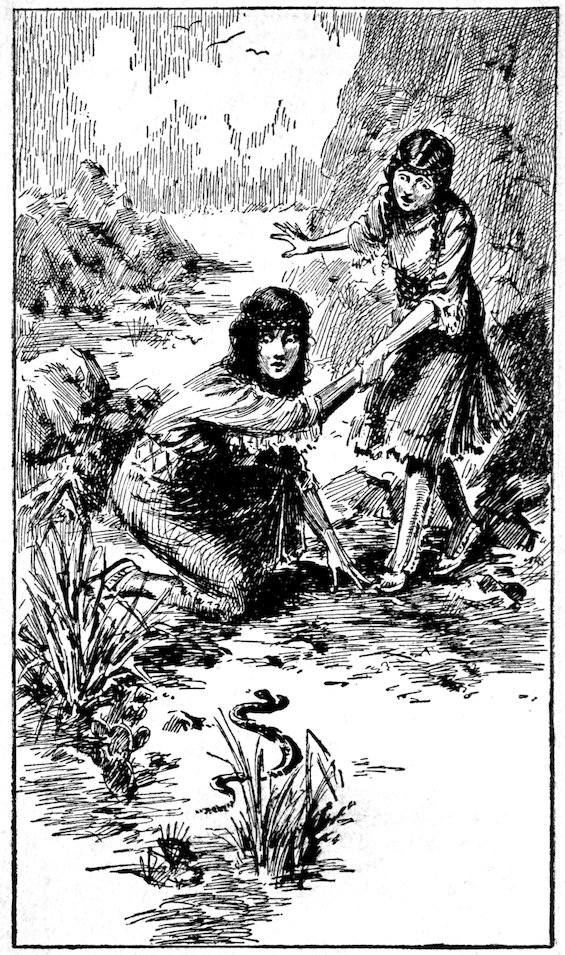
ILLUSTRATIONS — CHAPTER I Flower of Gold
6
| Vera’s Movement had been too Quick |
Frontispiece |
|
PAGE |
| Billy Gave an Upward Leap |
50 |
| A Second Time the Indian Picked up Bettina |
146 |
| The Great Mass Wriggled and Curved |
253 |
7
The Camp Fire Girls on the Edge of the Desert
The last flames of the camp fire were
slowly dying. But, as the sun
was sinking, the little space in the
woods surrounding the fire was lit with the
color of flame.
A girl sat there alone in her ceremonial
camp fire dress. A band of bright gold
braid bound her head. One could learn
from the insignia on her costume that she
was already a torch bearer. Above the
orange and red of the flame was the touch
of white in her emblem, portraying the
ascending smoke. She was like a guardian
spirit of the fire.
Perhaps she may have been dreaming or
merely repeating something aloud to herself.
For, seated on the ground, the girl was
8leaning forward with her chin resting in her
hand, and, although her eyes were closed,
a book lay open in her lap. Between the
leaves of the book was a sheet of paper
upon which some lines were written in lead
pencil. Here and there a word was marked
out and another inserted in its place.
Finally the camp fire girl, unclosing her
eyes, picked up this paper and, after first
glancing around to be sure that the trees
and grass about her had no ears, read aloud
in a low voice:
In the moon of the peach blossoms,
Towards the land of the setting sun,
Ghosts of old camp fires keep calling;
Camp fires whose race has been run.
I can see the sands of the desert;
I can hear strange desert cries;
And ever my thoughts go homing
To a tent under desert skies.
“Bettina,” a voice called.
And, like a flash, the girl in the camp fire
dress, leaning over, dropped the paper with
her poem upon it into the fire.
“Polly, I am here under our pine trees,”
she called back.
9Then, getting up, she stood with her back
to the sun. She had yellow-brown hair
which looked gold in this light, a slender
figure and delicate features, and must have
been about sixteen.
The girl who joined her was a complete
contrast. Since they were in the woods
together, one might have been thought a
gypsy and the other, except for her dress,
some Norse maiden who had stepped forth
from Scandinavian mythology.
The younger girl was small and had dark
hair falling to her shoulders. Her eyes
were black and her color brilliant. She
was wearing a short skirt, a red sweater
and a black velvet tam o’shanter, while
over her arm she carried a long gray cloak.
“How could you come out here alone,
Bettina?” she demanded reproachfully,
marching forward as soon as she appeared
upon the scene and throwing the coat about
the other girl’s shoulders.
“As soon as our Camp Fire girls had disappeared
mother asked me what had
become of you, and I have been looking for
you ever since. It must have been an
hour ago? What makes you such a goose?”
10She spoke straightforwardly but without
ill nature, so the older girl only laughed
and shook her head.
“I am accustomed to being called a
dreamer, Polly, cousin of mine, and a good
many other things by my family, but not
a goose. Still, I expect you are right.”
She put her arm across her cousin’s
shoulder.
“When the girls were getting ready to go
I slipped out here to the woods by myself.
I was tired and wanted to be alone for a
little while, but I should have told some
one. Has Aunt Mollie worried about me?
I built a fire, so I was not cold.”
Polly glanced back at the dying flames, as
the two girls started for home.
“Your fire does not appear very warming,”
she answered bluntly. “And mother
was worrying. As you came to us, Bettina,
because you were not well, naturally we
feel responsible. But I suppose you were
reading or writing, or else in the clouds.
Funny why people in the clouds always
wish to inhabit them alone. There ought
to be room in the clouds for companions as
well as in other places.”
11The two girls were walking now arm in
arm through a small pine woods in New
Hampshire, just as another Polly and
Betty had walked a good many years before.
But these two girls—although their names
were alike, and although they too were
members of a Sunrise Hill Camp Fire Club—were
utterly unlike the former ones in
temperament and experience.
Bettina was the daughter of Betty Ashton
and Anthony Graham. After her
father had served his state as Governor for
two terms, he had been sent as United
States senator to Washington, where the
family had since been living, coming back
home to New Hampshire only for occasional
summer vacations.
Yet now it was April and Bettina was
on her way to the old Webster farmhouse
which stood, as it always had, not far from
the first Sunrise Hill Camp.
In reality she and Polly Webster were
not cousins, since Polly was Mollie O’Neill’s
oldest child and named for her famous aunt;
but the friendship between the mothers
and the families was so great that it had
passed into an intimacy closer in this world
12many times than the intimacies of relationship.
For since Polly O’Neill, who was
now Mrs. Richard Burton, traveled a great
part of the year, because of her own and her
husband’s profession, and because of her
fondness for Europe, Mollie and Betty,
now Mrs. Webster and Mrs. Graham,
had grown to depend more on each other
than in their girlhood days. So, when
the spring came, and Bettina was not
well in Washington, she had been sent
at once to Mollie Webster’s home and
Mollie’s care.
The girls walked quickly, as it was nearly
dusk; Polly with the ease and swiftness of
a girl who had been brought up in the
country, and Bettina nearly as easily, yet
with a different kind of grace. For there
are persons who seem to be able to move
with almost no effort, and their shy fleetness
is characteristic of certain temperaments.
In almost all cases you will find it among
persons who have deep emotions but strange
reserves.
Bettina Graham talked very little and
perhaps this alone made her unusual among
girls.
13After a few further moments of silence on
her part, Polly glanced up at her.
“It is curious, Bettina, that no one of your
names suits you. You were called Bettina
and ‘Little Princess’ when you were a tiny
girl and now you are taller than your
mother or any of us. ‘Tall Princess’
would be a better title at present. Even your
Camp Fire name is too difficult to say—‘Anacaona,’
Flower of Gold—though I suppose
the meaning is charming. But I am
too matter-of-fact a person to like anything
so fanciful.”
An elusive sense of humor may sometimes
hide behind reserve, which served
Bettina now and then not to take Polly too
seriously.
“I am afraid nothing altogether suits
about me,” she returned, smiling, however,
and not speaking as if she were sorry for
herself. “At least, I fear that is what my
mother sometimes thinks, although she is
good enough to try to conceal the fact. I
am a disappointment to her. Here I am
nearly sixteen and supposed to come out
in society in another two or three years—and
with a mother who is almost the most
14popular woman in Washington. Yet I
hate even to appear at one of our own small
tea parties. I never can think of a single
thing to say to strangers. The truth is,
Polly, one of the reasons I was not well this
spring was because mother wished me to
help her entertain more and I dreaded it.
It is such peace to be here in these quiet
woods.”
Then both girls paused for a moment.
The woods were no longer still.
Some one was walking toward them—a
young fellow who kept striking at the trees
and shrubs with a small stick he held in his
hand. He was singing in a charming tenor
voice, but stopped, took off his hat and
bowed almost too gracefully to the two
girls.
“Hello!” Polly said, indifferent but
friendly enough.
Bettina scarcely moved her head. She
flushed a little though as the young man
passed, but did not speak until he was out
of sight.
“I wish I might have had my visit without
any other guest. I don’t like Ralph
Marshall.” And then, “but please do tell
15me at once, Polly. I have been realizing
ever since you joined me that you had
more news. All day I have been feeling it
in the atmosphere. You have had another
letter.”
Nodding, Polly slipped her hand into
her pocket.
“You do know about things, Bettina,
before they happen. It is what everybody
says about you, but please don’t guess
about my future, I prefer not knowing till
the time comes.”
She took out the letter and her eyes were
brilliant.
“Yes, Tante has written again; the letter
is addressed to me, but is for both of us.
She says we are to talk over her plan to our
families at once and that of course they will
disapprove as they always have disapproved
of everything she has ever suggested or
done. But, just the same, we are to make
them agree finally. She says we must—even
if she has to come home and then go
from here to Washington to argue the
question.”
“It is too like what one has dreamed of
to come true,” Bettina began, and then
16stopped because Polly had taken her by
both shoulders and was shaking her.
“The things that Tante plans always
come true, no matter how everybody else
opposes them. That is one of the blessed
facts about her. Ever since I can remember
she had been more than a fairy godmother
to us.” And Polly’s face showed that
there was one person in the world about
whom she was not matter-of-fact. Indeed,
no one understood—not even Polly herself
how much hero worship she felt for her
mother’s famous sister.
But they were nearly at home. Lights
were shining through the windows of the
living room at the big farm, and on the
veranda two persons were waiting.
“Let us not speak of the plan until after
tea,” Polly whispered, as her father and
mother walked forward to meet them.
Polly slipped her hand in her father’s and
they went swinging along hand in hand back
to the house.
Mrs. Webster walked more slowly with
Bettina keeping beside her. She was still
unchanged from our Mollie O’Neill, except
that there were a few gray hairs which had
17come when her children were ill. She was
plump, of course, but then soon after her
marriage Mollie had settled down to the
serenities of life, and they had kept her
eyes as blue and her skin as soft and rose-colored
as ever.
She enjoyed being solicitous about some
one’s health and at present was much concerned
about Bettina’s. But she was more
concerned later because, when supper time
arrived, one of her sons had not come in.
And this was Billy Webster, who was not in
the least like his father—the Billy Webster
of other days. This Billy was always in the
habit of doing all the things he should not,
and Dan, all the things he should. And
Mollie might have remembered that this
difference in her twin sons was not unlike
her own and her sister’s behavior in other
days. But they had had no father to guide
them and her husband was strict with his
sons.
Ralph Marshall—the other visitor at the
farm whom the girls had passed in the
woods—was having dinner with other
friends, and for this Bettina at least was
grateful.
18Yet the meal was not so agreeable as
usual. Bettina and Polly were too silent
and too absorbed, Mrs. Webster was plainly
nervous and Dan, who was like her in almost
every way, shared her emotion.
“It would not be a propitious evening
for persuading her father to see things as
she wished him to,” Polly thought. But
Billy was always the family difficulty.
Half an hour later he had not yet appeared
in the library. Neither had Polly or Bettina
broached the subject on both their
minds, although Polly sat on the arm of her
father’s chair reading the same book with
him.
Better than any one, she understood her
father. He would not show anxiety; but
until Billy came in he would not be able to
give his attention to anything else, and his
reading was only a pretense.
Then, just a few moments after half-past
eight, there was an unexpected noise along
the drive leading up to the front door.
Polly reached the window first. She
could see the lights of an approaching automobile
which, a moment later, stopped at
the foot of their steps.
19To her amazement her small brother,
who had been at home but a few hours
before, stepped out of the car with a suitcase
in his hand. The next instant some
one following ran in ahead of Billy.
Polly reached the front door in time to
open it for their visitor; but, by this time
the family was in the hall, and the figure
swept by Polly to throw her arms about her
mother’s neck.
“Mollie O’Neill, are you glad to see me?
I have just traveled hundreds of miles until
I am nearly dead. Yes, I know I ought to
have telegraphed, but I’ve something I
want to talk to you about and I did not
want you to know I was coming. You
might have tried to stop me, Richard did
try.”
Then she stopped embracing Mrs. Webster
and kissed Polly and Bettina and Dan
and Mr. Webster—all as gaily and quickly
as possible.
Of course it was Polly O’Neill—Mrs.
Richard Burton—for no one else had such
a fashion of turning up at unexpected
moments.
“But, Tante, we have not even mentioned
20your scheme—your letter only arrived
today,” Polly Webster said aloud.
Mrs. Webster shook her head and laughed
at the same time.
“Of course you want to do something
impossible, Polly O’Neill Burton, but I
am glad to see you for any reason. It has
been two years since you were here. Where
did you find my Billy?”
A boy of about fourteen, small for his
age and with fair hair and blue eyes, had
by this time slipped quietly in and put down
the suitcase. He had spoken to no one.
“Where did I find Billy?” Polly was
moving toward the big living room. “I
found him because he and I are birds of a
feather, which means we know where to
look for each other.”
CHAPTER II Dream Places
21
“It isn’t so impracticable as you think,
Mr. William Webster,” said Polly
O’Neill Burton from the depth of a
big camp chair.
It was a warm April afternoon and tea
was being served out under the elms not far
from the Webster house. Mollie Webster
sat before a big wicker table covered with
the Webster tea service and china over a
hundred years old.
Dan Webster, who was a big, dark-haired
fellow with blue eyes and his mother’s
sweet nature, was carrying about teacups.
He was followed by Ralph Marshall, who
was spending a spring vacation from college
at the Webster farm, and was now
making himself useful by serving the hot
muffins and cakes.
Billy Webster sat apart from the others
reading, while Bettina and Polly were on
either side of Mrs. Burton’s camp chair;
22and Mr. Webster stood upright, smiling
down on its occupant.
“When was there anything that Polly
O’Neill wanted from her girlhood up that
wasn’t practical according to her view?”
he demanded.
The Polly in the camp chair reached up
and took hold of his hand.
“Do sit down, William, I suppose I must
call you by that bugbear of a name, since
we have another Billy and are getting so
hopelessly old. We shall have to find
another name for Polly as well, now that
we are going to be together for a long time.”
And having persuaded her brother-in-law
to sit down beside her, the older Polly
pulled one of the younger’s curls, “Why not
Peggy, ‘Peg o’ My Heart,’ after the charming
play? But see here, William, I have
persuaded my husband to come around to
my way of thinking, and he is not an easy
person to manage.
“Although she won’t confess it, Mollie
is half persuaded; and when I can lead you
to the light, then I must see Betty and
Anthony. But, seriously, why not? It
will be a wonderful experience for the girls
23and one we shall never forget in this life
and perhaps in another. I have to spend a
year outdoors. For that length of time I
am not to be allowed to act for a single
night. Richard must, of course, go on with
his engagements. Now I never am able to
see my family or my friends when I am
working and I regret it a great deal more
than any of you realize.
“Instead of being sent off somewhere
with my maid to a horrid hotel, where I
shall probably die of the blues and the lonesomes,
as I did once years ago before Bobbin
and Richard rescued me, why won’t all of
you or some of you come and camp in the
desert with me?”
Polly’s cheeks were glowing with two
bright spots of color and her eyes darkening
as they always did in moments of excitement
or pleading. She had forgotten the
sofa pillows back of her, upon which she was
supposed to recline, like an invalid, and had
raised herself upright in her chair with one
foot twisted up under her.
Mrs. Richard Burton was still as slender
as Polly O’Neill had been, but, unlike
Mollie, her black hair had no gray in it.
24Her years of work and success had kept her
extraordinarily young; but then she had
that vivid quality which keeps people from
ever growing old. She was not beautiful
and never had been, even as a girl; yet
her face was extraordinarily fascinating
and her voice had an almost magic quality
in it, which had come from her long years of
training as an actress.
Everybody watched her now, as they
always did whenever she talked.
“I’ll come with pleasure, Mrs. Burton,”
Ralph Marshall answered, walking over
toward her chair with his offerings from
the tea table.
Looking at him in a friendly but half critical
fashion, she shook her head. Her
sister had explained that Ralph was a
college student and the son of one of the
richest men in the state, who was also a
friend of her husband’s and of Senator
Graham’s.
“Sorry, but this is a Camp Fire girls’
expedition and no male persons are allowed
except relatives,” Mrs. Burton returned
good-naturedly.
Then, moving her head in order to speak
25to her sister, she observed Ralph drop a
small piece of paper into Bettina’s lap.
Also she saw Bettina flush as her hand
closed quickly over it.
“You know, Mollie, years ago when we
started our Sunrise Camp Fire club we
began to wish then that we might live outdoors
some day in a climate where it would
be possible the whole year through. Well,
it has taken half a lifetime to accomplish,
but the idea is practical now. And even
if we have become somewhat elderly Camp
Fire girls, your Polly and Bettina’s Betty
are not. Then I want to ask some other
girls—Dick and Esther’s two daughters—enough
to form another Sunrise Hill
club.”
“But it is the most extravagant project I
ever heard of in my life, Polly,” Mrs.
Webster remonstrated. “I suppose you
haven’t the shadow of an idea what it may
cost to have a dozen young persons living
with you in a tent in Arizona, or half a
dozen tents. It all sounds too hot and
terrifying to me for anything. Please do
forget all about it, my dear, or we shall all
be so uncomfortable,” she ended plaintively,
26as if there were no escape had her twin
sister made up her mind.
The others laughed.
“But you are not to come with us, Mollie,
if you don’t like the idea, and perhaps you
would be frightened. Once years ago, I
spent a night alone near the desert and I
have never forgotten the wonder of it. But
you will let me have Polly with me for the
summer at least, and perhaps the boys.
The children have never been away from
New England and it will be a part of their
education to see this western country of
ours.”
At a short distance from the family group
Billy Webster had suddenly ceased reading.
He was white and delicate looking for a
country boy.
“Under no circumstances can the boys go
with you, Polly,” Mr. Webster said positively.
And Polly Webster, although appreciating
her own selfishness, gave a sigh of relief.
This speech of her father’s gratified the
desire of her own heart, since it meant
that she was to be allowed to go.
But the older Polly seemed not to have
heard.
27“Yes, I do know in a way what it will
cost,” she argued. “At least, Richard
says I can perfectly afford it and he looks
after the money we both earn. Besides,
Mollie dear, as I have no children of my
own, I don’t see why I can’t do for yours
and a few others now and then.”
And Mollie, at the moment, said nothing
more, for Polly’s one baby had died a few
years before.
“I have written to Esther in Boston that
I want her two daughters, and I am going
to Washington to see Betty as soon as I am
strong enough.”
Then she turned to Bettina. Since the
beginning of their conversation Bettina had
not spoken. Polly scarcely remembered
her making a dozen speeches since her
arrival, unless they were answers to questions.
As she had been talking all her life
whenever there was the least opportunity,
Polly Burton feared that she was not going
to be able to understand Bettina. Then
Betty had written such odd letters about
her only daughter, as if she herself did not
altogether understand her.
But Betty’s letters had placed Bettina
28on a kind of pedestal, suggesting that she
lived in a finer, purer atmosphere than other
girls. Mrs. Burton was not so sure. At
this moment she did not like the fashion in
which Bettina had received a mysterious
note from Ralph Marshall. It looked
secretive. And Bettina was still flushed
and embarrassed.
Polly felt a sudden qualm. After all, she
knew little about girls, and if anything
happened to Betty’s or Mollie’s daughter
while under her care, would she not always
feel responsible?
Bettina at this instant suddenly jumped
up, her face growing warm and lovely as
she started running across the grass lawn
like a graceful child.
The next moment, forgetting her years and
everything else, Mrs. Burton fled after her.
For they had both discovered almost
simultaneously that a carriage was entering
the gate which divided the Webster farm
from the grounds about the house. And
out of the carriage a handkerchief was
being riotously waved.
At their approach the carriage stopped
and a woman alighted.
29She put her hands on Bettina’s shoulders
kissing her on both cheeks.
“You are looking better, darling.”
Then she turned.
“Polly O’Neill, didn’t you know I would
come from Washington as soon as I learned
you were in this part of the world? How
can you look so exactly like you always did
as a girl, in spite of your age and honors?
You are thin as a rail.”
It was Betty Ashton—Mrs. Anthony
Graham—exquisitely dressed and perhaps
more beautiful than ever. She was now
recognized as one of the loveliest women in
Washington; indeed in the United States.
Yet she and the really great actress
came gaily walking across the lawn, with
their arms about each other like school girls.
“Don’t tell me you think I have gained
a pound, Polly O’Neill Burton, or I shall
never forgive you, though of course I know
I have gained twenty. How did I find out
you were here? Why, Bettina telegraphed
me. Isn’t she lovely. She said you had
some wonderful scheme on hand. Whoever
saw Polly without a problem. Have
your own way, dear, as far as I am concerned.
30It isn’t such a bad way as it
sometimes seems. But I do wish you
looked stronger.”
Then Mollie joined her sister and friend.
CHAPTER III The Human Equation
31
In an unscientific fashion Mrs. Burton
was searching for her purse. She had
peered in the bureau drawers, in her
dismantled trunk, and was now sitting on
the edge of her bed trying mentally to
discover the lost object.
Since her arrival at her sister’s home
when had she last seen her pocketbook
and for what purpose had she used it?
Ordinarily Mrs. Burton traveled with a
maid, who attended to as many details of
life for her as were possible, in order that
she might save her strength for her work.
Also because Polly Burton was not much
more dependable about small matters than
Polly O’Neill had been. But at present
Marie was away on a holiday, trying to
reconcile herself to the prospect of a year
of life in the wilderness, instead of in hotels,
or in Mr. and Mrs. Burton’s New York
city apartment, where they lived when
they were acting in New York.
32As Polly with her usual impetuosity had
decided to follow her letter to her niece a
few hours after the letter was written,
there had been no opportunity to find
another maid. Not that one was in the
least useful or desirable in Mollie’s house.
Mrs. Burton was not spoiled into the idea
of thinking that she required the services
of a maid except when she was at work.
However, at present she was still in her
dressing gown and with her bed unmade.
Mollie always insisted that her sister have
her breakfast in bed during the first of her
visit and until she was entirely rested.
It was now nine o’clock. The early
search for the pocketbook was really due
to this fact. At any moment the other
Polly, whom the family were now struggling
to learn to call Peggy, might appear to
offer her aid and to help make the bed.
This morning visit represented the one
opportunity when she and her adored Tante
might have a talk without being interrupted.
And this was why Mrs. Burton had been
searching for her money. For here was
her chance for bestowing a gift upon her
namesake, and through her upon Dan and
33Billy, without family discussion or objection.
Always she looked forward to this
moment as one of the chief pleasures of
her visit to her sister.
Not that Mollie and her husband were
poor. They were unusually prosperous,
owning one of the best farms in New
England. But they did not have money
for unnecessary things. Indeed, no matter
what they might have had, they would
never have permitted it to be used extravagantly.
Therefore Peggy—and her
adopted name will be used henceforth, since
no one, not even the public, could call her
distinguished aunt by any name save Polly
Burton—and her brothers rarely had much
money of their own to spend. Tante,
however, was a delightfully extravagant
person, who never had forgotten how poor
she used to be herself, and how many
impossible things she had then wished
for.
Therefore, a few moments later, when
Peggy knocked at her door, an abstracted
voice bade her enter. For the purse had
not even been mentally found. Yet, as
far as she could recall, Polly thought she
34had put it in her top bureau drawer. There
at present, however, it was not.
She lifted her eyes as her niece came in.
“‘Peggy of my Heart,’ look in the bureau
drawer and find my pocketbook,” she began
nonchalantly, knowing that it was a wise
method to pursue in persuading another
person to find a lost treasure. Better to
begin by not confusing the searcher with
the sense of loss.
So Peggy looked for five minutes and,
being a matter-of-fact person, she looked
thoroughly.
“It isn’t here,” she announced, with
the conviction characteristic of her.
Her aunt waved a vague hand.
“Be sure to look everywhere, dear.”
And Peggy conscientiously looked, Mrs.
Polly Burton assisting with less energy.
But by and by, when both of them were
exhausted from the most fatiguing occupation
in the world—searching for and not
finding a desired object—they sat down on
opposite sides of the bed, facing each
other.
“How much money did you have in
your purse, Tante?” Peggy demanded,
35speaking with the severity each member
of her family and her intimate friends
employed in discussing practical matters
with the famous but sometimes erratic
lady.
“A hundred dollars,” Polly returned
with emphasis. “Only yesterday afternoon
when we came in from tea I counted the
money carefully and then thought I put
the purse in the top drawer. Afterwards
I was out of my room until about ten
o’clock last night and then your mother
and Aunt Betty and I came up here and
talked.”
Peggy frowned.
It amused her aunt to watch her. Peggy
had so much the look of her father—the
boy with whom Polly O’Neill had used
to have so many quarrels—in spite of the
difference in their coloring. If Peggy was
as obstinate as he had been, it was to be
hoped that aunt and niece would have few
differences of opinion.
But Peggy’s attention at present was
concentrated on the lost money.
“Mother will be terribly distressed when
she hears, for it must have been one of the
36servants. And we have had all of them a
long time.”
“Oh, for goodness sake, it does not matter
so much as all that.” Polly spoke like
an embarrassed girl. “And in any case
please don’t tell mother.”
“She will not only be worried but vexed
with me as well. Somehow I must have
been careless, and there is nothing worse,
I think, than holding other people responsible
for one’s carelessness. The money
will turn up or else I’ll write Uncle Richard.”
But Peggy was not so easily diverted
from an idea or a purpose.
There was a characteristic line from her
forehead to the end of her short, straight
nose. Also she had a fashion of lifting her
head and looking fearlessly ahead, as if
she were contemplating something in the
outside world, when in reality she was only
thinking.
“Billy might help us,” she said suddenly.
“He knows all the servants on the place
and they like him better than they do the
rest of us.”
And, without waiting for her aunt’s
consent, Peggy disappeared.
37She was gone a long time—so long that
Mrs. Burton grew annoyed. She made her
own bed and made it extremely well, having
never forgotten this part of her Camp Fire
education. She also wrote a note to her
husband, who was on a tour in the West.
She was just contemplating dressing and
joining the others downstairs when Peggy
came back. Billy was with her, and Billy
bore the lost pocketbook.
His expression was odd, but it was Peggy
about whom Polly felt suddenly frightened.
Her usually brilliant color was gone, and
her lips were in a hard line.
“Billy took your purse,” and then in a
queer voice, “but please make him explain.
I cannot.”
Billy laid the purse gently on his aunt’s
knee and looked directly at her.
It chanced that Polly was sitting in a
tall chair so that her eyes were on a level
with the boy’s.
It had always been Polly’s impression
that Billy was her favorite of her sister’s
children; perhaps because he was not the
favorite with his mother or father. And
then undeniably he was a problem.
38“I took your pocketbook, Tante.”
He spoke with a little embarrassment—not
a great deal. “I needed some money
at once and knew you would give it to
me later. There was no chance to ask.
You were downstairs and when I came
up afterwards to tell you mother and Aunt
Betty were in here and I did not wish them
to know.”
There was a slight exclamation of consternation
and shame from Peggy, but
Mrs. Burton was speechless.
She was not a moralist—that is, it was
difficult for her to know how to preach.
But would preaching or anything she could
say make Billy understand the wrong he
had done? His mother and father were
the most punctilious people in the world?
What must they not have said to him in
times past? He was not a child.
“I am sorry, Billy; it wasn’t square,”
Polly said finally, but looking and feeling
more ashamed than the boy himself apparently
did.
Billy’s blue eyes were puzzled and regretful,
but not conscience-smitten.
“You intended to persuade father to
39take me west with you and I would rather
have gone than anything in the world,” he
remarked slowly in reply. “Now you
don’t want me to go because you are
afraid of the responsibility I would be,
and you don’t trust me.”
He did not put this as a question. He
was making a statement. Nevertheless
his aunt answered, “Yes.”
Then, without any further explanation
and without even asking to be forgiven,
Billy walked out of the room.
“He is the queerest boy in the world,”
Peggy said in distressed tones when the
door closed; “and worries mother and
father nearly to death. No one of us
understands him. He does whatever he
likes and then accepts his punishment
without a word. He does not like the farm
as Dan and I do, and has never been a
hundred miles away. Yet he would rather
do a horrid thing like this and so spoil
his chance for going west with you. Father
might have given in.”
Polly arose. “Let’s not talk about it.
Run downstairs, dear; I am going to put
on my riding habit. Will you see if the
40horses will be ready at eleven? Aunt
Betty and I are going to ride over the
country together. I can’t walk very far
and it is our best chance for discovering
our old haunts. I knew every inch of this
country once as a girl and want to see our
old Sunrise Hill cabin again. Don’t speak
of what has happened.”
Then as Peggy started to leave, her aunt
thrust the delayed gifts for herself and Dan
into her hand. They were two ten-dollar
bills.
Afterwards when Peggy had gone,
she nervously counted over her money;
Billy had taken only ten dollars—her usual
gift to him. For even this she was thankful.
But for what purpose had the boy needed
money in such a hurry? And why had she
discovered him on the night of her arrival
waiting alone at the side of the road when
he should have been at home with his
family?
Well, perhaps it was best to have found
out Billy’s peculiarities before taking him
away with her. Nevertheless, Mrs. Burton
was profoundly sorry. Certainly the boy
needed help of some kind. Yet she would
41probably not be equal to the problem of
suddenly adopting a large and nearly grownup
family of girls.
“Fools rush in,” Polly smiled and then
sighed. “But, after all, I won’t have an
opportunity for worrying over my own
health very often.”
Then she went down to the living room.
CHAPTER IV The April Woods
42
“Again the blackbirds sing; the streams
Wake, laughing, from their winter dreams,
And tremble in the April showers
The tassels of the maple flowers.”
Polly recited Whittier’s verse with a
wistful inflection in her voice that
made her companion turn from looking
at the scenery to gaze at her.
“Don’t make a cheerful poem sound like
a lament for all the lost springs in the world,
Polly darlint,” Betty Graham pleaded.
“I declare you become more of a fascinator
the older you grow. But I suppose that is
a part of your genius. Funny we didn’t
know you were a genius in the old Sunrise
Hill Camp Fire days, and only thought you
were ‘fee’ as the Irish say. Queer there
is another Camp Fire organization of girls
now, with our old title and with Mollie
Webster for their guardian! Ah well, times
do change, though I know that is not an
original remark.”
43Polly laughed. The two friends were
cantering along side by side through a lane
in the New Hampshire woods. They were
on their way to see the old cabin where
long ago they had lived and worked together
with nearly a dozen other girls for a happy
year.
The riding was difficult because the road
was still muddy from spring rains, but
Polly rode frequently in Central Park when
she happened to be in New York City and
Betty, in an effort to keep her figure, had
daily horseback exercise in Washington.
At present they were actually paying more
attention to each other’s conversation than
to their horses.
“And here I am adopting some of Mollie’s
Camp Fire responsibilities without being
half so well equal to them as she is. Do
you think my scheme of taking a few of her
Camp Fire girls and some of my own to
camp on the edge of the Painted Desert
with me a mad scheme, Betty? Of course,
I have to see the girls first and choose the
ones I wish and then argue the matter with
their parents. You and Anthony are going
to allow me to have Bettina?”
44Involuntarily both women had slowed
down their horses.
“We cannot help it very well, Polly,”
Mrs. Graham replied. “Bettina has
thought of nothing else and dreamed of
nothing else since you first wrote of your
plan to her and to Polly—oh, to Peggy, I
mean. I do hate this business of two persons
in one family having the same name.
We have had trouble enough with the difficulty
in our own family. Bettina has even
written some charming verses about the
desert, which she showed to me the night
of my arrival.
“But I am afraid I shall never have any
more influence over my daughter after she
has been with you, dear. Truth is, Bettina
and I adore each other but are not in the
least alike. And Anthony says I must
give Bettina the chance to do the thing she
believes she would love. She does not care
in the least for society or many people, and
it is so hard for me to understand,” Betty
Graham ended wistfully.
But in return her beloved friend only
laughed. “Nonsense, Betty; we are not
all born beauties and belles, as you were.
45Oh, yes, I do think your Bettina is very
pretty, so don’t get your mother bird
feathers ruffled. But I don’t think ‘the
little Princess’ is the beauty her mother
was and is.” Then seriously, “Of course
I shall do my best to look after your
daughter, Betty dear, if anything should—”
she hesitated.
Her friend answered gravely, “Of course
her father and I will both understand. But
Bettina knows nothing of the actual world.
She has lived in her ambitions and dreams.
Hard as it is for us, she must take her own
risks and learn her own lessons.”
“If only you would come with me, Betty—you
or Mollie. I may not be equal to the
task alone,” Polly suddenly announced,
having felt another qualm at the task ahead
of her. Then she laughed.
“I have just had the funniest letter from
Sylvia Wharton. You see, I wrote and
asked Sylvia to take a year from her hospital
work and come west to look after me.
Doctor Sylvia flatly declines and suggests
that she has more important things to do.
Still, she has done a Sylviaesque thing! She
proposes, or rather orders me, to take with
46me a young woman who started her hospital
training and has broken down. She has
recovered, but Sylvia thinks the change
will help her. Also, she says the young
woman is particularly well adapted for
looking after all of us.
“She writes that I won’t need a maid and
am to leave poor Marie in New York. She
is right, I expect, about Marie, but I won’t
do that. However, I don’t think it will be
a bad idea, if the young woman Sylvia
wishes me to take is fairly agreeable. She
can teach my Camp Fire girls first-aid
requirements and then, if any one is ill,
help in an emergency.”
Mrs. Betty Graham nodded her handsome
head.
“Sylvia is always sensible and has been
from her youth up, in contrast to you, dear.
However, don’t think that you and your
girls are to be left in peace in your desert
camp, Polly. I cannot go along with you
at present, but I wouldn’t miss the experience
of being with you for a time for a year
of every-day life. So I’ll turn up some
time when you least expect me—and I shall
bring my Tony. You haven’t invited my
47son to your camp, Polly; are you taking
Dan and Billy?”
For the second time Mrs. Burton’s expression
changed to one of anxiety. “I wish
I knew whether to ask your advice about
something, Betty.”
But, before she had finished, her horse
stumbled in a hole ahead and, becoming
frightened, started to run.
First Polly felt herself being thrown
violently forward, then tilted to one side,
then backward and forward again. However,
she had no idea of being frightened
and, although her saddle girth was broken,
she still held on. Really, the first thought
flashing through her consciousness was the
recollection of her sister Mollie’s parting
words:
“Do please remember, Polly, that you
are not young as you used to be. I don’t
approve of this horseback riding for women
of yours and Betty’s age. And I always
feel more nervous about your getting into
trouble than I do my own children.”
Then her own reply: “Nonsense, Mollie;
you always were a ‘’fraid cat.’ I expect to
ride a bucking broncho for the next year,
48so I certainly ought to be able to manage
one of William’s quiet steeds.”
However, Polly Burton was becoming
unable to manage one of “William’s quiet
steeds.”
Although, by a firmer clutch on the reins,
she had been able to keep herself in the
saddle without its slipping off, yet her horse
kept pounding ahead, paying not the least
attention to her exhortations or her
pulling.
A difficulty was that the horse was often
used for driving and had a less sensitive
mouth than those to which its rider had been
accustomed.
However, the experience might be exhilarating
if the saddle did not slip off entirely,
as the road lay straight ahead. The horse
would stop when he grew tired. There
was only one trouble to be particularly
feared and that was the loss of one’s breath
from a pain in the side which the hard awkward
riding might bring on.
The other horse had straightway been
outdistanced. After one cry from Betty,
Polly heard no other sound from her.
But now the pain was coming which was
49the trial of her life, and a sense of dizziness
followed.
Fortunately a little ahead, on a path that
ran alongside the road, a boy and a girl
were walking. Polly believed she called to
them, although they must have heard the
noise of the runaway first.
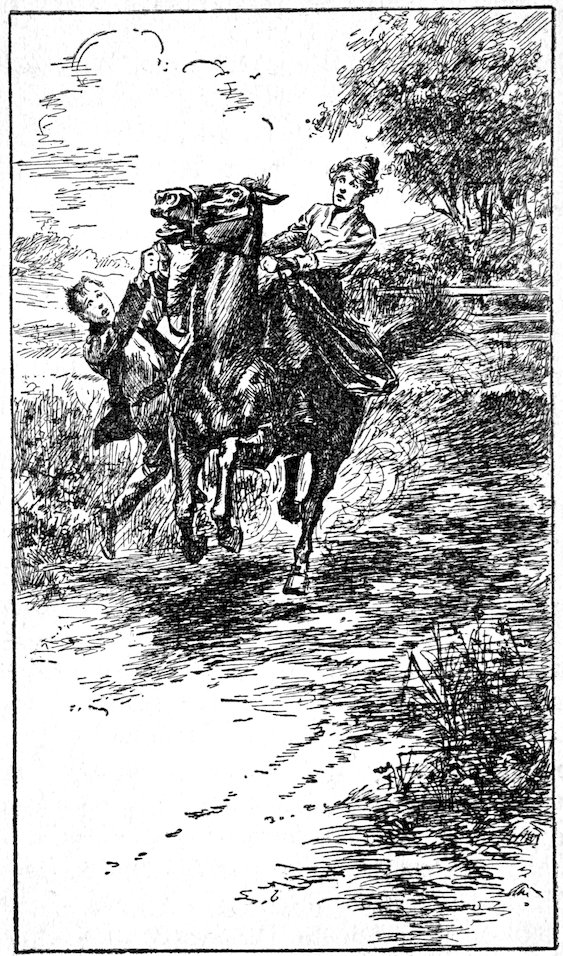
For Billy Webster moved only a few
steps and then stood waiting for the horse
to come opposite him. When it did he
made an upward leap. Seizing the bridle
he continued holding on to it until the horse,
after running a few yards more, peacefully
stopped as if this had been his intention all
along.
However, before this instant, looking
down upon her nephew, it seemed to Mrs.
Burton that he was very inadequate to the
task ahead of him, although she never had
seen any one so calmly determined.
When the horse ceased running Billy
must also have lifted her down. The next
thing she was conscious of was hearing him
say:
“I don’t think you need be frightened,
Vera; she has not really fainted.”
50
Billy Gave an Upward Leap
51Then Mrs. Burton discovered that she
was seated on the ground with her back
against a tree, and with her riding hat dangling
rakishly over one eye. Above her a
girl whom she had never seen before was
anxiously bending.
Without making an effort to speak until
the pain in her side grew less severe and her
breathing more natural, Polly at once tried
to straighten her hat.
But Billy continued to talk as if nothing
unusual had occurred and as if his aunt
could give him her undivided attention.
“I have been thinking the matter over,
Tante, and I want to explain something to
you,” he said as he made a slight movement
with his hand toward the girl. “This is
Vera Lageloff, a friend of mine. I took
your money before you had a chance to
give it to me because Vera’s people needed
it and I knew it would be useless to ask
father. I hope you will pardon me. I
suppose it was not square. Vera’s father
is one of my father’s farmers, who has been
working a part of our land on shares. He
has not been straight or industrious and
father has asked him to go. Of course, he
had to find some other place to go, but
52he had no money and there are several other
children. Vera told me that he had a
chance, if he could only get the money for
a railroad ticket, but had to have it at once.
I had been to their house the night I met
you. I did not tell them at home, because
father does not like my interfering with his
working people. And he does not trust
Vera’s father. I don’t trust him, either,
but I don’t wish his children to suffer. Do
you?”
Billy had at last concluded his speech.
While he was talking it occurred to his
aunt, who was accustomed to having a good
deal of attention paid to her health, and
indeed to all her concerns, that her nephew
was but little interested in her accident.
But then he was never interested in anything
which he considered unessential.
Nevertheless, there was something about
this youthful Billy Webster, which made
him difficult to answer readily. If he was
not going to become a socialist or an anarchist,
at any rate he was a law unto himself.
Yet his aunt did not clearly understand
what point he was trying to make at the
present moment. In reply she murmured
53something about being sorry; but this was
not the time for such a discussion. In any
case, his father must, of course, know best.
Then, struggling to get on her feet again
and finding the girl beside her trying to help,
Mrs. Burton for the first time acknowledged
their introduction. She scarcely
looked at the girl, because Billy again took
up the conversation and was more amazing
this time than before.
“I do hope you will take Vera to camp
with you, Tante. She is a member of
mother’s Camp Fire club and mother likes
her. Besides, she ought to get away from
her family.”
Billy’s effrontery or his belief in his own
judgment affected his aunt curiously. She
had never known anything like it before.
However, she had seen but little of Billy
in the last few years, and before now he
had appeared only as a shy, delicate boy.
Fortunately, before having to reply one
way or the other to his latest demand, Mrs.
Burton observed Betty Graham riding up
the road toward her as rapidly as her horse
could travel. Betty’s concern over her
friend’s experience and its possible unfortunate
54consequences was in striking contrast
to the coldness and lack of interest of the
younger generation.
Afterwards, returning home a little later
on an entirely subdued animal, Mrs. Burton
regretted that she had not looked at Billy’s
friend more carefully. At present she
believed she would hardly recognize the
girl if they chanced to meet again. And
undoubtedly the Russian girl and her
nephew must be devoted friends.
CHAPTER V Observation
55
Two girls were standing on the rear
platform of a big observation car
that had left Chicago a number of
hours before.
They were charmingly dressed for travel—one
in a brown corduroy coat and skirt,
a cream-colored blouse and a soft brown
felt hat, with a single cream-colored wing
in it, and the other in blue. The first
was a small, dark girl with a brilliant color,
scarlet lips and black eyes. But little in
the swiftly passing landscape seemed to
escape her interest.
The other girl was perhaps a year older
and had light golden-brown hair. Her
eyes were sometimes gray, sometimes blue
and now and then faintly green, should she
chance to be standing under a group of
trees or surrounded with any green foliage.
Her dress was like that of her companion
except for the difference in color. Her
56expression was less animated; her vision
appeared to be not only an outward but
an inward one. She saw the landscape
before her with pleasure and yet had even
greater pleasure in the reflections it brought
to her mind.
Finally, the train gave an unexpected
lurch in making a wide curve, and she
slipped her arm through her companion’s.
“Isn’t it heavenly, Peggy?” she demanded.
And then. “I know I am
selfish, so please don’t reproach me; but
sometimes I have wished that just you and
I were going to camp with Tante. We
have not been away very long, but we
seem to be an odd combination.”
The other girl laughed.
“Traveling with a group of girls Tante
has chosen, did you expect anything else?
The oddness of our party has probably
only begun, Bettina. You know Tante
has a curious fashion of liking or disliking
an individual for what he or she
happens to be, without any reference to
their circumstances. And she has selected
her Camp Fire club in this way. I suppose
when you become as famous as she
57is you can afford to do as you like,” Peggy
Webster concluded.
In spite of the difference in their natures
the two girls were devoted friends.
Bettina now looked a little wistful.
“Tante does not like me much, does
she, Peggy? Oh, I don’t mean that she
is not fond of me, because I am my mother’s
daughter and, for old associations, and she
would do any kindness for me. But one
knows when a person is attracted toward
one without being told. Tante is much
more interested in that queer Russian girl,
Vera, and in the girl she brought with her
from Chicago.”
For a moment Peggy Webster continued
to watch the landscape apparently sailing
by. Then she answered.
“I think we had better go back to the
others, Bettina, as it is nearly tea time.
Yes, I agree with you that it does seem
unfortunate that we girls start out by
appearing to be so uncongenial. But perhaps
our Camp Fire club life together will
alter us. At least we will understand
each other better after a few months of
living together anyhow. Mother says that
58is one of the most important influences of
the Camp Fire. You know it is supposed
to teach us to put aside the conventional
society idea and learn to care for each
other as men sometimes do. We are all
girls and, whatever our circumstances, have
pretty much the same needs and ideals.”
Then feeling her cheeks crimson because
she feared that her words held a suggestion
of preaching, Peggy turned and started to
lead the way back into the observation
car. Bettina, however, did not at once
follow her.
The rear half of the observation train
was occupied by the new Sunrise Hill
Camp Fire club. Mrs. Polly Burton, the
new Camp Fire guardian, sat by one of
the windows, glancing out at the great
grain fields through which their train was
cutting its way like a mammoth thrashing
machine.
She was elegantly dressed in a tailored
suit of dark blue cloth; and behind her
hung a fur coat for use in case the weather
should turn suddenly cold. Her bags and
all her appurtenances of travel showed
wealth and luxury, and yet, in spite of all
59this and of her distinguished reputation,
the great lady herself looked fragile
and subdued. Indeed, she bore a striking
resemblance to the very Polly O’Neill who
so often used to start out on a task in a
sudden burst of enthusiasm, only to find
later that she had scarcely the ability or
strength to go on.
Not alone did Bettina believe that the
new club was an oddly assorted group!
Only in Chicago had they actually begun
their journey to the West together.
Some time before, Mrs. Burton had left
her sister’s home in New Hampshire and
in Chicago joined her husband, who was
playing there during the late spring season.
A few days before, Mr. and Mrs. Webster
had come on from their home to Chicago
in order to chaperon the new group of
Camp Fire girls that far along the way.
There they had been joined by Mrs. Burton
and one other new club member besides
Polly’s French maid, Marie.
Marie had traveled with Polly everywhere
since her marriage, having charge of her
clothes—both her stage and personal ones—and
striving, though vainly, to turn her
60mistress into the fashionable, conventional
character it was impossible for her ever
to be.
At present Marie was hovering about,
paying Polly small attentions which annoyed
her, and which she felt were not
good for the intimacy she hoped to establish
with her Camp Fire girls.
Personally she wished to forget her usual
style of life—the fatigue, the excitement,
even her own success—and to have the
girls forget it. But Marie was a constant
and persistent reminder of all these things.
Yet when she had suggested to Marie that
she remain behind, as she would dislike a
western camp, Marie had burst into such
French tears and such French protestations
that Mrs. Burton, who was never very
firm where her affections were concerned,
had given in.
Now Marie was really the most trying
member of the ill-assorted party.
“Do please go back to your own place
and leave me alone, Marie,” Mrs. Burton
finally said, unable longer to conceal her
irritation. “I am not a hopeless invalid
and, even if I were, I should not wish you
61to be constantly pushing cushions behind
my back.”
Then, as Marie flounced off in a temper,
Mrs. Burton laughed and sighed.
Although accustomed to having thousands
of eyes fixed upon her while she was
acting, Polly had become embarrassed by
the critical survey of two pair which were
at present across from her. They belonged
to her own Camp Fire group—Esther’s
and Dick Ashton’s older daughter Alice,
and Ellen Deal, the young woman Sylvia
Wharton had more or less thrust upon the
party.
Ellen was from a small town in Pennsylvania,
but with her small, neat figure,
high color and sandy hair, she might have
come from a real English village in Yorkshire
or Lancashire. She was older than
the other girls and had already showed
a decided fancy for Alice Ashton. Mrs.
Burton fancied that she disapproved of her
and would not try to conceal her point of
view. She might really be too blunt to
make for happiness in a Camp Fire club.
Alice Ashton was a typical Boston girl.
She was like her mother in appearance,
62except that her hair was a darker red, and
she was handsomer than her mother had
ever been. She wore glasses and was a
graduate of Wellesley College. In accepting
the Camp Fire invitation Alice had
frankly stated that she wished to make an
especial study of Arizona Indian customs
for her English work the following year.
But she had not seen her mother’s old
friend since she was a little girl and, in
Alice’s case, Polly also felt she had proved
a disappointment.
It was natural that Alice should expect
a famous actress to be impressive in manner
and appearance, and Polly Burton was
neither—of which she was well aware. She
was very slight and vivid and not always
sure of herself or her moods. Really Alice
gave her the feeling that she should resign
at once as Camp Fire guardian and let
Alice reign in her place. She would probably
fill it far better.
But Sally Ashton was different, and Mrs.
Burton felt that one might get amusement
if not edification out of Sally. The very
name of Sally was an encouragement to do
or say something saucy. And this Sally
63had large, soft brown eyes and wavy hair
and little white, even teeth. If her expression
was at present demure, one could see
possibilities behind the demureness.
In order not to think of herself as under
a critical survey, Mrs. Burton continued
studying her new group of girls.
Sally was at the moment talking to the
girl whom she had invited and who had
joined the party with her at Chicago. If
Gerry Williams’ history was so unusual
that it might be best not to confide her
story to the Camp Fire girls until they
knew each other better, at least Mrs.
Burton was happy in the choice of her.
She was so pretty and charming and
seemed to have so many possibilities
if only she could have the proper influences.
Gerry was about sixteen and slender, with
lovely light hair, blue eyes, and with almost
too much color in her cheeks. Fortunately
she had once been a member of a Camp
Fire club in Chicago and so knew of their
methods and ideals.
There was no suggestion then that Gerry
would be a problem in the new club.
64Already she seemed to be making friends
with most of the other girls.
Vera—Billy’s adored friend—might be
the trial. The girl had been born in Russia
and brought to the United States about six
or eight years ago. She spoke English
perfectly and did not seem to be ill at
ease, although she talked very little. However,
Vera’s heavy dark face, with her low
brow and long dark eyes, was an interesting
one. Curiously, she was also a friend of
Mrs. Webster’s—it was Mollie who had
added her plea to Billy’s that the Russian
girl be a Camp Fire guest.
“Yet, after all, what understanding had
she of girls? And how little she had seen
of them since her own girlhood!” Mrs.
Burton concluded.
Then, just as she was again becoming
depressed, she saw her adored niece coming
down the aisle.
Peggy always brought an atmosphere of
relief and reasonableness. In fact, she
discovered at once that her aunt was feeling
frightened and unequal to the plan
ahead. Of course, it was a great undertaking
for a woman who had been spoiled—as
65Polly O’Neill Burton had been—by
husband, family, friends and an admiring
public—and not in good health—to suddenly
become guide, philosopher, mother
and friend to a number of strange girls.
In spite of their audience, Peggy leaned
over and kissed her.
“It will be all right, Tante; don’t be
downcast. Only at present everybody is
homesick and tired as you are. Can’t we
have tea? You are not sorry we have
come?”
“Certainly not,” and Polly smiled at her
own childishness while she rejoiced over
Peggy’s sweetness and good sense.
Of course, she had known there would be
difficulties in so original a Camp Fire club
experiment. But when did anything worth
while ever arrange itself without difficulties?
Ten minutes later two colored stewards
in white uniforms had arranged the tables
and brought in tea.
In entire good humor Mrs. Burton presided
while the men were kept busy passing
back and forth innumerable cups of tea and
plates of sandwiches.
The girls were fifty per cent more cheerful
66and consequently more agreeable. At
the table nearest Mrs. Burton were Peggy,
Sally Ashton and Gerry Williams.
All at once Mrs. Burton turned to her
niece.
“What in the world has become of
Bettina, dear?” she demanded. “I had
not missed her until this moment. I am
not a very successful old woman who lived
in a shoe with so many children she couldn’t
tell what to do, for I don’t even know when
one of mine is lost.”
Peggy got up.
“Bettina is out on the back platform
dreaming, I suppose. I told her to come
in with me a quarter of an hour ago. I’ll
go get her.”
However, after a little time, Peggy returned
alone looking a little cross.
“Bettina has disappeared. I can’t find
her,” she announced. “As I did not want
to miss tea, I asked our porter to look.”
And no one thought of being worried
about Bettina until the porter came to say
that no young woman answering Bettina’s
description could be found.
CHAPTER VI Experience
67
But Bettina was not conscious of how
long a time had passed, or that she
was causing anxiety.
An unusual experience had come to her,
and a most unconventional one.
Standing there at the back of the observation
car, she had forgotten Peggy’s suggestion
that she return to the rest of the
girls. But perhaps she would not have
gone in any case, because Bettina was not
enjoying their society. She was shy, or
perhaps cold. It was difficult to tell which
was the influence at work. Nevertheless,
she was finding it as much of a trial to be
friendly and at ease with her fellow-travelers
as she had with her mother’s older and
more conventional guests in Washington.
But it is possible that Bettina had inherited
some of her father’s reserve—the reserve
which had made Anthony Graham work
and study alone during those many hard
years before reaching manhood.
68However, to make up for her lack of
interest and her uncongeniality with people—as
is true with nearly all such persons—Bettina
had an unusual fondness for nature.
Now, the landscape of Kansas had not
appealed strongly to any one of the other
girls. Usually the country was flat and
covered with great fields of young corn or
wheat, with prosperous farm-houses standing
in the background. Yet Bettina saw
color and grace in everything.
As the car rushed along, with its rattling
and banging, she was trying to recall a line
of Kipling’s poetry which described the
sound the wind made through the corn.
After Peggy left her, Bettina had caught
hold of the wide railing at the end of the
car for safety. She was now occupying the
entire rear platform of the observation
train alone. She was swaying slightly with
the movement, with her eyes wide open and
her lips slightly parted. Having taken off
her hat, the afternoon sunshine made amber
lights in her hair as it flickered amid the
brown and gold.
Then, suddenly, Bettina became conscious
that some one else had come out on
69the same end of the car with her and was
standing near.
It was stupid and self-conscious to flush
as she always did in the presence of strangers.
“I hope I do not disturb you,” she then
heard a voice say courteously. And, turning
her head to reply, Bettina beheld a
young man of about twenty. He looked
very dark—a Spaniard she believed him for
the moment. His eyes were fine and clear,
with a faraway look in them; his nose,
aquiline; and he held his head back and his
chin uplifted.
“You don’t trouble me in the least,”
Bettina replied, feeling her shyness vanish.
“Besides, I was just going back to my
friends.”
Yet she did not go at once.
She was interested in the unusual appearance
of her companion. He had folded his
arms and was looking gravely back at the
constantly receding landscape.
“And east is east and west is west,
And never the twain shall meet.”
He spoke apparently without regarding
Bettina and softly under his breath.
70Therefore it was Bettina who really began
their conversation, their other speeches to
each other having expressed only the ordinary
conventionalities between fellow-travelers.
“It is curious—your repeating those lines,”
Bettina returned, her eyes changing from
gray to blue, as they often did in moments
of friendliness. “I have just been standing
here trying to recall another line of Kipling’s
poetry. And it has come to me since
you spoke: ‘The wind whimpers through
the fields.’ Do you care for Kipling’s
poetry?”
The young man turned more directly
toward Bettina.
“I am an Indian,” he explained simply.
“It is natural that I should think of those
lines, for I have been for several years at a
college in your eastern country and am now
returning to my own people and my own
land. I am a Hopi. My home is in the
province of Tusayan, Arizona, in the town of
Oraibi. We are Indians of the Pueblo.”
“But you—” Bettina hesitated.
The young fellow threw back his head
and, then realizing that custom demanded
71it, lifted his hat. He was dressed as any
other young college man might be, except
that his clothes were simple and a little
shabby.
“I am not entirely Indian,” he continued,
still so serious that Bettina was unconscious
of there being anything out of the way in
his confidence. “My mother was a Spanish
woman, I have been told; but she died at
my birth and now my father is again married
and has children by a woman of his own
race. Yet I am glad to return to my own
people, to wear again the moccasin of brown
deer-skin and the head-band of scarlet.”
Instinctively the young man’s pose
changed. Bettina could see that his
shoulders lifted and that he breathed more
deeply. He stood there on the platform
of the most civilized and civilizing monster
in the world—a great express train—gazing
out on the fields as if he had been an Indian
chief at the door of his own tepee, surveying
his own domains.
Naturally Bettina was fascinated. What
young girl could have failed to have been
interested? And Bettina had lived more in
books and dreams than in realities.
72“We are also going to Arizona,” Bettina
added quickly. “I have never been West
before, though I have longed to always.
We are to camp somewhere on a ranch not
far from the Painted Desert. Do Indians
live near there and would you mind telling
me something of them? Are they still warlike?
Sometimes I feel a little nervous, for
we are to be only a party of girls and our
Camp Fire guardian, except that we are to
have a man and his wife for our cook and
guide.”
For an instant the young fellow laughed
as any other boy would have done, and
showing white, fine teeth. Afterwards he
relapsed into the conventional Indian
gravity.
“My own people are peaceful and always
have been, except when we have been
attacked by other Indians. Hopi means
‘peaceful people,’ and we have lived in
Arizona, the land of ‘few springs,’ since
before the days when your written history
begins. The Apaches have always been our
bitterest enemies. But they will not harm
you—the great hand of your United States
Government is over us all,” he concluded.
73And Bettina could not tell whether he
spoke in admiration or in bitterness.
It was growing cooler and she shivered—not
in reality from the cold half
so much as from her interest in the conversation.
Nevertheless the Indian saw her slight
movement.
“You are cold; you must be careful in
the desert, as often the night turns suddenly
cool after a scorching day. May I take
you to your friends?”
Bettina was accustomed to having her
own way. She was enjoying the talk with
her unusual acquaintance far more than
anything that had taken place since their
journey began. Therefore it did not occur
to her to consider that her absence might
create uneasiness.
“Are you going to do anything else? If
you are not I wonder if you would mind
our finding a place somewhere and talking?”
she suggested. “I know it is asking a great
deal of you, but there are so many things I
wish to know about the West.”
Bettina was like an eager child. But,
then, ordinary conventionalities never
74troubled her, unless they were forced upon
her consideration.
And what could the young man do except
assent.
He found Bettina a camp chair at the
rear end of the adjoining car and himself
a small one beside it.
But the chairs were not outside; they
stood in an enclosed space just inside the
train and beside a great window.
When her companion sat down beside
her, one could not get a full view of Bettina.
However, Peggy did not pass her by, for
she did not go into this car to search. But
the colored porter did. Yet he had been
told to discover a young woman who was
alone, dressed in a blue suit and wearing a
blue hat.
And Bettina was not alone. She was
deeply engaged in conversation, and without
a hat, so, although the porter did hesitate
beside her, he did not interrupt, deciding
that she was not the young woman he
sought.
But here Mrs. Burton and two of the
girls found her a few moments later.
As soon as the man returned and declaring
75that Bettina had vanished, Polly had
become instantly terrified. For a woman
who was to be chaperon to half a dozen or
more girls, she had far too much imagination.
At once she conceived the idea that
Bettina had fallen off the train—and—what
could she say to the child’s mother and
father? It was too dreadful!
Indeed, Mrs. Burton would have had the
train stopped immediately, except that
Peggy and Ellen Deal, who at once rose to
the occasion, insisted that Bettina be
reconnoitered for again.
But when Bettina was finally traced and
discovered in agreeable conversation with a
strange young man, her chaperon was
angry. Indeed, the natural Polly wished
to assert herself and give the girl just such
a scolding as she would have bestowed upon
her mother in their younger days. Only,
of course, the present, more elderly Polly
was convinced that Betty would never have
been so inconsiderate as her daughter.
However, remembering her own dignity
as a newly-chosen Camp Fire guardian,
after a few moments of reproach, she did
manage to control her temper.
76And Bettina, although making no defense,
was sorry. She had not been intentionally
selfish, only she did not see but one side of a
situation until usually it was too late. She
lived—as so many other people do—in her
own visions and her own desires. Yet, at
present, she deeply wished her mother’s
old friend to care for her and exaggerated the
failure she was making with her. Without
appreciating it, Polly walked in a kind of
halo of achievement and charm before
Bettina’s eyes. Therefore, it was unfortunate
Bettina did not realize that everything
and everybody in the world Mrs. Polly
Burton took more seriously than she did
her own fame, and that the dearest desire
of her heart at the present time was that
her new Camp Fire girls should regard her
as their friend.
CHAPTER VII Sunset Pass
77
Two days later, however, a few
hours after breakfast, Mrs. Polly
Burton was also interested in Bettina’s
new acquaintance, and was making
the young man useful.
The afternoon of their meeting Bettina
had endeavored to introduce him, but had
found this difficult because she did not
know his name.
At the time, the Indian had met the
situation with no more awkwardness than
any other young fellow in the same position
would have shown. He had at once
given his name to Mrs. Burton as John
Mase. However, both she and the girls,
who were her companions, understood this
was not the young man’s Indian name, but
probably the one which had been bestowed
upon him at a government school and
which he evidently preferred using at college
and among strangers of the white race.
78The following day none of the Camp Fire
party saw anything of him, though frankly
all the girls were curious, after learning of
Bettina’s escapade. It was on the second
morning that, going back to his own coach
from the dining car, the young man chanced
to pass Bettina and Mrs. Burton. At the
moment they were seated side by side in
one compartment. But it was Mrs. Polly
Burton—the official guardian of the new
group of Camp Fire girls en route to their
desert camp—who this time accosted him.
For the young Indian had only bowed and
continued to walk gravely on.
But the train was now entering the
Arizona plateau country. By nightfall
the Camp Fire party expected to arrive
at a tiny village not far from Winslow and
the next day begin the trek to their own
camp.
Already the air was clear and brilliant.
Away to the west were the outlines of high
mountains and the peaks of giant canyons.
Here and there were bits of dreary, olive-gray
desert and then an unexpected green
oasis.
In the night it appeared as if the face of
79the world had changed, and with it the
Camp Fire girls had changed also. If
there were further coldness or friction
between them, it had disappeared in their
great common interest in the things before
them and in the dream of their new life
together in the desert. And, though they
were too absorbed at the time for reflection,
this is the way in which all friction between
human beings may be destroyed; unconsciously
the girls were acquiring one of the
big lessons of the Camp Fire work—to
live and think outside themselves.
At every station there were dozens of
Indians offering their wares for sale. To
eastern girls it seemed scarcely possible
that they were still in the United States,
so unlike was this new land. Yet the
Camp Fire girls nobly refrained from making
purchases, having solemnly promised to
add nothing to their luggage until they
reached camp.
Yet, in reality, it was the sight of so
many Indian treasures which inspired Mrs.
Burton to speak to Bettina’s Indian acquaintance.
She appreciated that he must
know more of the requirements of camp life
80in Arizona than she could learn from any
number of books or from the conversation
of a dozen acquaintances.
Yet possibly this was just a “Pollyesque”
excuse. She may have been attracted by
the young Indian’s appearance, as Bettina
had previously been, and simply wished to
be entertained by him.
He was so grave and yet so courteous;
and his voice had the gentle, caressing sound
which afterwards the campers learned was
a peculiarity of Hopi Indians.
“My father is a kiva chief,” he explained
good-naturedly. “We have many chiefs
among the Hopis, but the kiva is the
underground chamber for our religious ceremonies,
and the kiva chief has charge of
them.”
He seemed to be as willing to talk to
Polly as he had to Bettina on their first
meeting. But then Bettina was beside
them, listening with the soft color coming
in her cheeks from her deep interest, and
the blue in her sometimes gray eyes.
She had been sitting with Mrs. Burton
and separated from the others when the
young Indian joined them. It was extraordinary
81how soon they were surrounded.
First Peggy came and took a seat across
from her aunt and then Alice Ashton, intending
to make a special study of Indian
custom, therefore felt it her duty to make
the young man’s acquaintance. Ellen
Deal frankly leaned over from her place on
the opposite side of the aisle and Gerry
came and stood beside Bettina. Only
Vera and Sallie Ashton appeared uninterested.
Vera, because she was too shut up
inside herself to be natural; and Sallie,
because she was too much entertained by
a light novel and a five-pound box of chocolates,
into which she had been dipping
steadily for several days without the least
injury to her disposition or her complexion.
When the young Indian sat down she
had simply given him a glance from over
the pages of her book and then glanced
at Bettina. Afterwards she had smiled
and gone on reading. Sally and Bettina
knew each other, of course, though not
intimately, considering the fact that their
mothers were sisters. But then they only
met now and then and there was no congeniality
82between them. Alice and Bettina
were better friends.
“Gerry Williams and Bettina looked a
little alike,” Mrs. Burton reflected, even
while she was listening with interest to the
conversation of their new acquaintance.
But then it had become second nature to
study the girls traveling with her ever
since their departure.
“Gerry was perhaps prettier than Bettina,
or at least some people might think
so,” Polly decided, feeling that in some way
the idea was a disloyalty to her own friendship
with Bettina’s mother. And certainly
Gerry was easier to understand!
She was standing now beside Bettina,
her eyes a lighter blue, her hair a paler
gold, but she was about the same in height
and slenderness. And she was talking to
the young Indian as if they had known each
other a long time, while Bettina, now
that other people were present, remained
silent.
“Do you mean to be a chief yourself
some day?” Gerry asked, her blue eyes
widening like a child’s from curiosity.
Gerry was a pretty contrast to the young
83Indian; so delicately fair in comparison
with his bronze vigor.
She looked almost poorly dressed as she
stood by Bettina, but girls do not realize
that handsome clothes are not necessary
when one is pretty and young. Gerry’s
traveling dress was also blue, a brighter
color, and equally becoming. Just for half
an instant, and before the young man
answered, it flashed through Polly Burton’s
mind that the young Indian might become
interested in Gerry if they should chance
to meet often. And Gerry had not the
social training to make her realize how
wrong it might be to cultivate such a friendship.
The next instant, however, Mrs.
Burton had forgotten the absurdity of her
own idea. Besides, in all probability they
would not see the young man again.
“I am studying law at Yale,” he answered,
surveying Gerry with a peculiar
long stare he had given no one else. “It
is my plan to work among my own people,
but in the white man’s way.”
Before the morning had passed he had
confessed to Mrs. Burton his own name.
At least he made his confession looking
84directly at her as the official chaperon.
But really he seemed less conscious of the
group of girls about him than any American
college fellow could have managed to be.
“Se-kyal-ets-tewa (Dawn Light). The
name was a beautiful one, but small wonder
the young man preferred being called by his
adopted name! He smiled when he explained
that it was against the better judgment
of a Hopi Indian to confess his own
title. A friend might tell it for him, but to
speak one’s own name was to invite disaster.
Indeed, during the long morning’s talk
together, Mrs. Burton was puzzled to discover
how far the young man had been
converted to American ideas and ideals,
and how far he still believed in and preferred
his own. He made no criticism of
either. He merely answered a hundred
inquiries from half a dozen young women
for the distance of a hundred miles or
more, and never lost his temper or suggested
that some of the questions were absurd.
Only once did he smile with slight sarcasm.
In her best Boston manner Alice Ashton
had asked a question not complimentary
to Indian women.
85“The Hopi women have always had the
privilege of voting,” he replied. “I believe
you will find them the original American
suffragettes, since we came to this country
a good many years before the Pilgrim
fathers. You do not vote in Boston, I
think.” And then all the party laughed
except Alice, who had not a sense of humor.
Although Sallie, her younger sister, was
not supposed to hear, she flashed a pleased
smile above the pages of her book. For
Alice was the learned member of the
family and Sally the frivolous, so now and
then it was fun to score.
When lunch time arrived the Indian
would not remain longer with the Camp
Fire party, although Mrs. Burton felt it
her duty to issue an invitation. She was
pleased with his good sense in declining.
However, on leaving, he did say: “You
may some day wish to come to my village
in Oraibi, and then I would like to show you
both beautiful and curious things.”
For an instant, just as he was making
this remark, his glance rested on Bettina.
She could not have defined it to herself,
but in some way his invitation appeared
86to have been addressed to her. And Bettina
determined to accept. The young
Indian had interested her in the account
he gave of his life and people. Bettina
was not fond of a conventional existence
and had often wished to see a simpler and
freer life. The Hopi Indians appeared to
have arrived at a curious combination of
civilization and what we call savagery.
For instance, the old and infirm in a Hopi
community are never allowed to want.
The “Law of Mutual Help” suggests a
better way of life than Lloyd George’s
far-famed “old-age pensions” in the
British Isles.
So Bettina sat dreaming and reflecting
the greater part of the afternoon, while
the other girls packed and unpacked,
laughed and talked, excited over the prospect
of arrival.
By an accident it was just before sunset
when they reached a small wayside station
known as Sunset Pass, because the Sunset
trail led away from it. The party expected
to spend the night at a big ranch house
some miles away and, if possible, make
camp the next morning.
87But, as they left the train, suddenly
the day had changed from heat to coldness.
The girls and Mrs. Burton, as well, felt an
uncomfortable sense of chill at their
surroundings.
The little western station looked so bare
and dreary. There were scarcely a dozen
frame houses in view and these were all
built alike and had no flowers or shrubbery
to relieve their dullness.
Near the station was an extraordinary
structure, which covered more than a half
acre of ground. It was built of wooden
planks so crossed and recrossed as to form
small rooms or pens. It might have been
an enormous open-air prison and was in
fact. Weird and lonely noises issued from
it—the bleating of hundreds of sheep waiting
for a cattle train to ship them to the
eastern market.
Had she been alone, Mrs. Burton felt
she would have given way to homesickness.
However, as Camp Fire guardian and
the oldest member of what was after all her
own expedition, she must appear cheerful.
Then Marie unexpectedly relieved the
situation.
88Descending from the train to the wooden
platform, Marie gave a long look at the
surroundings and burst into tears. And
her tears were not of the silent variety.
Sally Ashton and Peggy giggled irresistibly,
but everybody smiled.
Marie looked so incongruous. Her costume
was the perfectly correct one she
wore when following her famous mistress
through a sometimes curious crowd at the
Grand Central Station in New York
City, or through another almost equally
large.
But it was Gerry Williams, after all, who
went to Marie and patted her sympathetically
on the shoulder. Mrs. Burton was
pleased. And it was true that, in spite of
other weaknesses, Gerry did things like
this naturally, although she may not have
been entirely unconscious, even at this
moment, of their Camp Fire guardian’s
presence.
Gerry knew that the celebrated Mrs.
Burton had taken a fancy to her and
intended making the most of it.
Then Gerry’s prettiness also appealed
strongly to Polly Burton. It was of the
89fair ethereal kind—an entire contrast to her
own appearance. Moreover, one must
remember how Polly O’Neill had always
admired beauty and how great a point she
had made of her friend Betty Ashton’s in
their old Camp Fire days.
Although Gerry’s sympathy was not
effective, Mrs. Burton knew how to check
her maid’s tears.
“I am cold; will you please put my fur
coat on me, Marie,” she suggested, whispering
something consoling as Marie slipped
her into it.
Then Mrs. Burton became nervous.
She and her Camp Fire party were
standing alone on a deserted platform in a
place which appeared to be a thousand
miles from nowhere. For there was no
one in sight except a little bent-over station
master inside a kind of wooden box,
who looked like a clay model of a man
molded by an amateur artist.
As he did not emerge from his shack,
Mrs. Burton started toward him.
Certainly she had expected that every
arrangement for meeting them had been
made beforehand, her husband having spent
90a small fortune on telegrams for this
purpose.
However, she had gone but a few steps
when the tallest man she ever remembered
seeing came striding toward her.
“I guess this is the party looked for,”
he remarked with an agreeable smile.
“Arizona hasn’t seen such a bunch of
pretty girls in a long spell. Come this
way; my wife is expecting you at the
ranch house, but I got tired waiting for
you and have been loafing about in the
neighborhood.”
Then he led the way, the Sunrise Camp
Fire party of course following.
Waiting for them a little out of sight
was an old-fashioned stage-coach drawn
by a pair of fine horses.
The driver, who was Mr. Gardener, the
wealthy owner of Sunset Ranch, assisted by
the dwarf station master piled all the girls’
luggage on top the stage; the heavier
trunks were to be sent for later.
Then the coach started down a long,
straight road facing the west.
The sky was a mass of color far more
vivid and brilliant than an eastern sunset.
91Beyond, almost pressing up into the clouds,
were the distant peaks of extinct volcanoes.
It was as if they had once flung their molten
flames up into the sky and there they had
been caught and held in the evening clouds.
It does not seem credible that eight
women can remain silent for three-quarters
of an hour, and yet the Camp Fire party
was nearly so. Then they drew up in front
of a big one-story house with a grove of
cottonwood trees before it.
On the porch waiting to receive them
stood Mrs. Gardener, the wife of their
driver and the owner of the ranch house
and the great ranch itself, near whose
border the Camp Fire party expected to
pitch their tents.
CHAPTER VIII At The Desert’s Edge
92
Soon after sunrise the next day the
Camp Fire party planned to leave the
big ranch house.
Mr. and Mrs. Gardener had already
assured them that their camping outfit had
been sent on ahead the day before to the
borders of Cottonwood Creek, so there need
be no delay when the campers arrived.
One of Mr. Gardener’s own men had it in
charge and, as soon as the expedition
joined him, would aid in the choice of a
camping site. Water, one must remember,
was the great problem in Arizona and they
must, therefore, select a place near a clear
creek.
It was not yet daylight when Bettina
Graham first opened her eyes the morning
after their arrival, and yet she felt completely
rested. She was sleeping beside
Peggy, while on the opposite side of the
room were Gerry Williams and the Russian
girl, Vera Lageloff.
93“Camping also makes strange bedfellows,”
Bettina thought with the quiet sense
of humor so few people realized she possessed.
She was not homesick—life at
present held too many fascinating possibilities—but
it was natural that she should
begin thinking of her own home in Washington,
and more especially of her own suite
of rooms. They had been recently refurnished—as
a birthday gift from her father—in
pale grey and rose color, with the furniture
of French oak.
Bettina appreciated that she had known
nothing but the fair side of life—that it
was almost a weakness of her father’s to
do more for her than she even desired.
Senator Graham was not ashamed of his
own humble past and the hard struggle of
his boyhood; but, like many another self-made
man, for this reason he wished his
family to have every indulgence. Yet,
although the close bond of sympathy was
between Bettina and her father and Tony
and his mother, Senator Graham did not
wish his daughter to know only the life of
luxury and self-indulgence.
Therefore, it was he who had been most
94in favor of the western camping experiment.
Bettina was to long remember his
saying that he wished her “to find herself”
and that this one must do away from one’s
own family.
In camping with so wealthy and famous
a woman as Polly Burton there would be
scarcely any great hardships to be endured.
The new Sunrise Camp Fire girls were in
more danger of having life made too easy
for them rather than too difficult. Yet
there might be circumstances now and then
which would require good sense and courage
to overcome. And, most of all, Bettina
needed to see the practical side of
every-day life.
“It was so like Polly O’Neill to get
together such an extraordinarily unlike
group of girls, but I had hoped Polly
O’Neill Burton might have better judgment,”
Betty Graham had lamented to her
husband and daughter, half in earnest and
half amused.
But when her husband assured her that
this was one of the particular reasons why
he wished Bettina to form one of the
group, Mrs. Graham, suddenly remembering
95his humble origin, had been wisely
silent.
Therefore, before setting out on their
western trip, Bettina had firmly made up
her mind to do her best to be friendly with
the entire group of Camp Fire girls. And,
on waking this first morning of their arrival,
she was in a measure reproaching herself
for her lack of effort on the journey.
Then unexpectedly Bettina sat upright
in bed, feeling that she must get out of
doors at once. She needed to breathe the
fresh air in order to get rid of a stupid
impression which had just taken hold of
her.
All her life Bettina had been given to
odd fancies—impressions which annoyed
her mother deeply, and which she herself
considered strange and uncomfortable.
Just at this moment, for instance, and in
the midst of her good resolution, Bettina
had been assailed by a kind of presentiment.
She had a feeling, which was part
mental and part physical, that among the
four girls in the room—for Vera and Gerry
Williams were sleeping opposite herself and
Peggy—one of the four of them, either consciously
96or unconsciously would bring misfortune
upon the others.
Yet, even as she thought this, Bettina was
embarrassed and ashamed and, in the gray
light of the early morning, she felt her
cheeks flushing.
But deny or be ashamed of the fact as
she would, nevertheless it was true that
Bettina Graham, ever since she was a
little girl, had a curious fashion of knowing
certain events were to take place before
they occurred.
She moved over now to the edge of the
bed. Then a faint noise disturbed her.
Turning, she saw that Gerry Williams
had also awakened and was half way out
of her bed. She could just faintly see her
delicate outline—the pretty tumbled light
hair and smiling blue eyes.
Bettina made a slight sign to her and
began quietly to dress. A few moments
later the two girls slipped out and went
downstairs and out of doors.
It was not dark now, for daylight was
breaking. Guided by a sound they heard,
the girls went to the left of the big ranch
house. And there, tied to hitching posts,
97were half a dozen burros with women’s
saddles on them; also a pair of little gray
mules packed like camels of the desert with
great loads hanging from their backs and
extending out on either side.
A young man was bending over arranging
one of these packs.
He looked up surprised as the two girls
came toward him. He was dressed like
the usual western cowboy, with the big hat
and flannel shirt and his trousers ending
inside his riding boots. He must have
been about twenty-one.
Gerry smiled at him.
“This must be our caravan. I wonder
if I can manage to ride? I never have in
my life.”
The young man lifted his hat.
“This is the Sunrise Camp Fire outfit.
I am glad to meet some of its members at
such an hour.”
He pointed toward the east where the
sun was now rising above the horizon.
“Perhaps I may be able to show you how
to ride, as I am to be your guide.”
In reply, Gerry laughed and Bettina
shook her head.
98“No, I think not,” Gerry returned.
“Mrs. Burton told us that she had engaged
an elderly man and his wife to be our guide
and cook. She wrote to secure them
weeks ago.”
The young man did not reply.
But an hour afterwards Mrs. Burton,
who never remembered having gotten up
so early since the long-ago Sunrise Camp
Fire days, was engaged in argument on this
same subject.
“But, my dear Mr. and Mrs. Gardener,
surely you can see this young man is impossible,
no matter how trustworthy he may
be or how excellent a knowledge of the
country he may have!” She gave a semi-tragic
shrug of her shoulders. “You may
not have considered that I am to have six
young girls in my camp and one only a
little older, besides myself and my maid.
And now to hear we are to have an ex-college
youth to look after us when I wished
a man of fifty at least! You know yourself,
Mrs. Gardener, that anything may
happen.”
Mrs. Burton was standing beside her
host and hostess at one side of the big
99ranch house veranda at six o’clock that
same morning. She looked very fragile
and young herself in comparison. For,
although Mrs. Gardener was not tall, she
made up in breadth what she lacked in
height.
She now patted Mrs. Burton’s shoulder,
as if she had been a child needing encouragement.
“Nonsense, my dear; the young man
will do you no harm. Husband and I are
sorry that the man and wife we engaged
for you disappointed us. But getting help
of any kind out here is a problem. Besides,
it’s better that those Camp Fire girls of
yours should do their own cooking. This
one young man cannot do any mischief
when there are so many of you. His tent
will be far enough away not to make him
a nuisance, and yet you can get hold of
him when you need him. But you must
remember that husband and I are near and
ready to be of whatever service we can.”
The fact that the new Sunrise camp
would be anywhere from ten to twenty
miles away did not suggest itself to Mrs.
Gardener as representing distance, so little
100do people in the western states consider
space. Then she broke into cheerful little
good-natured chuckles.
“Were you planning, Mrs. Burton, to be
a kind of Mother Superior, and run a nunnery
in our Arizona wilderness? You’ll
find it pretty hard work to hide those girls
out here where girls are scarce. If they
had not been, how do you suppose I would
have gotten my good-looking husband?”
Then Polly turned in despair to Mr.
Gardener.
“Your wife is an incorrigible woman.
But at least tell me who this young man
is, his name, and why you think he can be
trusted as a safe protector for eight lone
women? Really, you must find me a
proper person, Mr. Gardener. Your young
man will have to guide us today, since there
is no one else, but in a few days—say, in a
week—you’ll get somebody else?”
Mrs. Burton looked so young and so
alarmed at the responsibilities she had
assumed that Mr. Gardener nodded his
head reassuringly.
“Certainly, I’ll find some one else for
you in time, if you prefer. But Terry
101Benton is all right. He got tired of school
and came out here to work for me and has
been with me on the ranch for a year. He
is a pretty nervy fellow to undertake this
job, I think, and he wouldn’t except to
accommodate me.” Mr. Gardener deliberately
winked a very large, childlike blue
eye. “I had to produce some one to keep
my word. But I tell you I am nervous
about Terry. There are enough girls to
take care of themselves.”
Polly was uncertain whether she wanted
to laugh or cry. Being a Camp Fire
guardian under the present circumstances
was not an easy position. Really, she had
not anticipated the things that could
happen.
“And you actually called our new guide,
Terry, Mr. Gardener. You know that
means he is an Irishman. Don’t contradict
me. Being Irish myself, I shall know when
I see him, anyhow. I expect to have a
good many problems with my Camp Fire
girls, but the Irish problem I won’t have.”
Then, as Mrs. Burton turned away, she
said, not aloud but to herself:
“Besides, Terry rhymes with Gerry, or
102will rhyme with some one else. I wish
there were no young men in Arizona for
the next few months.”
As a matter-of-fact, Gerry did require a
a good deal of assistance in the long trek
to find a suitable camping place. But,
then, the new guide’s labors were of various
kinds. He rode ahead on a lank, ugly-looking
pony, his long legs trailing almost
to the ground and followed at uncertain
intervals by the girls and Mrs. Burton.
Now and then several of them would
change from the backs of the burros to the
solitary farm wagon, which carried their
provisions and always Marie, who had
wept once more at the thought of mounting
a burro.
Polly was finding her maid all the problem
Sylvia had insisted she would be. But
there were three seats in the wagon, beside
the place of the boy who was driving, and
the other two were sufficient when the
girls or their guardian grew tired. The
little gray pack mules—Tim and Ina—trotted
behind the wagon.
Certainly the Camp Fire caravan party
formed an odd picture as they trailed
103across the ranch. Yet they fitted into the
scenery through which they were passing.
Over the same trail in bygone days many
other women had traveled. Today the
girls were wearing their regulation Camp
Fire dresses, only instead of skirts they
wore khaki trousers and leather leggings
and soft hats. Each girl had her hair
braided and hanging down for greater
convenience.
At first they only followed the ranch
roads through great fields of purple clover
and then through several acres of peach
orchard. But at last they came to a wilder
country near the outskirt of the big ranch.
Here they were nearing the neighborhood
of the Painted Desert.
Short stretches of sand, yellow with
flowering bunches of rabbit brush or gray
with the ice plant, showed here and there.
Then a mesa suddenly arose many feet
above the desert and often covered with
grass, or a verdant bit of valley showed
further on.
Riding ahead, the new guide frequently
pointed out objects of interest—a giant
yucca tree, or queer animals scooting to
104their burrows. But never once did he
betray his nationality by a single speech—not
even by a light in his eye.
And, whenever she could remember, Mrs.
Burton watched the young man narrowly.
Yet it was hard for her to play chaperon
when there was so much she wished to see
and understand. And, really, Terry did
seem to be a nice fellow.
An hour after the Camp Fire party had
eaten lunch and recommenced their journey,
they discovered their possessions waiting
in the neighborhood of Cottonwood
Creek and watched over by one of Mr.
Gardener’s men. Several weeks ago Mr.
and Mrs. Burton had purchased the necessary
camping outfit and sent them on
ahead to be taken care of at the ranch.
So, the wagon joining the procession, the
entire party journeyed on for another two
hours.
It was Peggy Webster who finally
selected the ideal mesa for the new camp,
and as much for sentiment as any other
reason. She was riding ahead when she
chanced to see a mesa about twenty feet
high, with a group of pine trees growing
105upon it and a portion of the ground covered
with soft pine needles.
Giving the reins of her burro to Bettina,
Peggy climbed alone up the steep side, in
which there were jagged steps of sandstone
inlaid with agate.
The Camp Fire party halted below.
Some miles beyond they could faintly see
the outline of giant cliffs.
Mrs. Burton followed her niece, finding
the view from this particular spot beautiful
beyond words.
“May we have our camp here if we can
find water near?” Peggy entreated. “We
can see the sunrise over the hills, and this
is to be a new Sunrise camp.”
And Polly Burton nodded absently,
thinking of another camp fire.
At the moment they were in the wonderful
plateau country of Arizona and near
the Painted Desert, which has no connection
with the great Arizona desert to the
south. Encircling them halfway around
were giant hills and cliffs. The air was so
clear one could see many miles. Small
wonder that the restless Spanish adventurers
of the sixteenth century came here
106to search for the seven lost cities of
Cibola!
A little later Terry Benton reported that
clear water was not far away, and the other
girls followed their guardian and Peggy to
the top of their enchanted mesa.
A stream emptied into Cottonwood
Creek, whose water was too muddy for the
campers to use, but would serve for their
horses. The creek was only a short distance
away. Then the pine trees would
be a shelter from the midday heat.
By nightfall the Sunrise Camp Fire tents
were pitched. The men did the heavier
part of the work, but the girls used their
camp fire knowledge as never before in their
simpler camping experiences.
Besides, they were inspired by the wonderful
air and the romantic beauty of the
country about them.
It turned out that Peggy Webster and
Vera Lageloff were natural leaders in outdoor
work. Peggy, because she had a great
deal of common sense and no hesitation in
telling the others what to do. Vera, however,
worked with such quiet intensity that
inevitably one sought to keep up with her.
107Although, laboring with her hands as she
had not in many years, Mrs. Burton
observed that all the girls were doing their
share of the work, except Sally Ashton.
Sally appeared to be one of the charming,
lazy people who take life easily. And
there was no time to reproach anyone
today.
There were two large sleeping tents for
the Camp Fire girls and a smaller one for
their guardian, who preferred being alone at
night, except for the presence of the
devoted Marie. Then there was the
kitchen, or general utility tent, in case rain
should make cooking or domestic work
outdoors impossible.
However, the array of tents seemed
unnecessary, for rain seldom falls in the
early summer in northern Arizona. And
that first night everybody slept out of
doors, except Marie.
They brought out their blankets and
there, on the top of the mesa, lay down
under the stars. The night was too clear
to fall asleep at once.
Terry Benton and the man and boy,
who had assisted in bringing the outfit and
108provisions to camp, found a place in the
cottonwood grove below the mesa, within
call but out of sight of the Camp Fire
party.
To have learned to know and understand
this group of girls it would have been
interesting to have been able to read what
was going on in their minds on this first
wonderful Arizona night out of doors. But
who of us is not thankful that our thoughts
at least are our own?
CHAPTER IX Undercurrents
109
A week later and life among the
new Sunrise Hill Camp Fire girls
appeared to be moving with entire
smoothness.
The girls had their regular schedule of
work and it was simple enough to gain
new Camp Fire honors in a land whose
every phase was unusual and absorbing,
and where work in itself became an adventure.
In a low camp chair outside her own tent
one morning Mrs. Burton was resting an
hour or so after breakfast. She assisted
with the work whenever it was possible,
but it was one of her doctor’s orders that
she spend a part of each day as quietly as
possible.
Inside her tent she could hear Marie
making their beds and sighing with each
movement. Marie was still unreconciled.
Still, she insisted upon wearing her conventional
110maid’s dress of black cloth in
the mornings with white collars and cuffs
and black silk in the afternoons, with
always a tiny piece of white embroidery
perched on top her shining black hair. She
was very piquant, was Marie, but one can
imagine how absurd she looked amid a
group of Camp Fire girls in camp fire costumes
on a plateau in Arizona.
However, Mrs. Burton was not worrying.
Life at present was too delightful to allow
small matters to count. And Marie would
doubtless, become reconciled to the West, as
many another equally homesick person has
before her.
The day was blue and silver, the sky
almost cloudless, the sun turning the sands
to silver and glistening white on the summits
of the cliffs beyond. But under the
pine trees on top of the mesa it remained
cool and serene.
Gerry Williams was lying at full length
on the ground near Mrs. Burton. This she
usually managed to accomplish, no matter
how the other girls might try to forestall
her. Undoubtedly, except for Peggy
Webster, she appeared to be Mrs. Burton’s
111favorite, and Peggy was her own niece,
almost her own child, as she had none of
her own. But, then, Peggy was too straightforward,
too downright, to let any one get
ahead of her, even so clever a girl as Gerry.
Gerry had been shelling peas for luncheon,
but had stopped with her task only half
finished.
At present, a few yards away, Peggy
was seated, stripping the husks from a
great pile of sweet corn. Her hair was not
long and hung straight and black just below
her shoulders. She wore a band of scarlet
about her head, holding the hair back from
her eyes. Peggy’s cheeks were crimson
and her skin browner than ever from the
Arizona sun. Partly to tease her and
partly because she did look like an Indian,
the other girls had recently insisted upon
naming her Minnehaha, “Laughing Water,”
which Peggy considered ridiculous.
She was not laughing at present, however,
but frowning and keeping resolutely at her
task. Bettina sat near her, reading. Vera
was on the other side, peeling potatoes.
In some curious fashion the more unpleasant
tasks in camp appeared always to fall to
112Vera. There are people in the world like
this, so that one wonders if they select the
tasks or if the tasks select them. Alice
Ashton and Ellen Deal were merely sewing
on an outdoor costume for Ellen while
Sally was pretending to write a letter.
The cover had been firmly placed on her
box of chocolates. She had produced a
box from her pocket a short time before,
but, as Camp Fire guardian, Mrs. Burton
had really felt obliged to object.
Too much eating of sweets was against
all Camp Fire regulations. Moreover,
where had Sally acquired such an inexhaustible
supply? Terry Benton had been
seen to appear with a box which he must
have ridden a great many miles to secure.
There must have been something about
Sally which immediately suggested sweets
to her young men friends. Although Mrs.
Burton was secretly amused that the serious-minded
Dick and Esther Ashton should
have so frivolous a daughter, Sally must be
made to respect rules and preserve her
health.
“Mrs. Burton, do you know what I am
thinking of?” Gerry asked, with a soft
113inflection in her voice which was very
attractive. “I wish we had a Camp Fire
name for you, but I can’t think of any
title lovely enough. Bettina,” she called
across, “you are everlastingly reading.
What name can we give to the most
delightful and gifted person in the world?”
Gerry’s flattery was so transparent that
Mrs. Burton laughed.
But Bettina was so absorbed that she did
not understand, for she did not answer at
once. And for the first time at Gerry’s
words, Polly observed that Bettina was
reading when the girls were supposed to be
at some kind of work.
It was Peggy who replied with an unmistakable
lifting of her eyebrows.
“Why not call Tante the Queen of Sheba,
Gerry, and be done with it? I suppose,
because we know so little about her, she
has always seemed to me to be the most
extraordinary of women. Then, she made
Solomon answer all her questions, and I
don’t believe even Tante could accomplish
more than that.”
Naturally the girls laughed at Peggy’s
speech and Mrs. Burton as well; nevertheless
114she did feel a little aggrieved. There
had been a note of sarcasm in Peggy’s
voice which she had never heard there before
in any reference to her. Could the sarcasm
have been intended for Gerry or for
her?
Polly was a little worried at the two girls’
attitude toward each other, yet the fault did
appear to be Peggy’s. Could Peggy be a
little jealous at her interest in a strange
girl, of whose history she knew nothing.
But Peggy had finished her task by this
time and, getting up with a great kettle of
corn swinging on her arm, remarked cheerfully:
“Glad I am through with my work,
especially as I won’t be at home to eat any
of the corn. You remember, Tante, that
Bettina and Vera and I are going off for a
ride with our new Camp Fire guide. We
have finished our share of the work.”
Vera continued being busy for a few
moments, but Bettina got up slowly, still
holding the book half open in her hand.
Something in her manner annoyed Mrs.
Burton and she spoke quickly and thoughtlessly
after her old fashion:
“You and Vera seem to have been industrious
115enough, Peggy, but I cannot see that
Bettina has done a conspicuous share.”
She was sorry the next instant, for
Bettina made no reply but, flushing, walked
quietly away.
She was not accustomed to criticism and
it had been difficult to keep her temper.
But Peggy waited until she was out of
hearing and then deliberately set down her
kettle.
“That was not fair of you, Tante, and
you give a wrong impression of Bettina to
the other girls. She was reading some
Indian legends which I asked her to learn
and tell at our camp fire this evening.
They form as much a part of our honor work
as other things, and I thought, if we were
to visit the Indian reservations and see their
summer festivals, it would be interesting to
know more about them. Good-by; don’t
worry about us; we shan’t be long.”
Then off she and Vera went toward their
sleeping tent in order to change to their
riding clothes.
They left Mrs. Burton feeling suddenly
discouraged with herself as a Camp Fire
guardian when, a few moments before, the
116atmosphere had been so serene. She was
particularly sorry that the one girl with
whom she seemed least able to get on was
the daughter of her most beloved friend.
But Gerry interrupted her train of
thought. She was sitting up now, and
close enough to take hold of Mrs. Burton’s
hand. Gerry always appeared sweet tempered,
no matter what occurred.
“You have not told us, nor let us choose
a name for you,” she murmured with the
half-affectionate and half-admiring manner
which she always showed to the older
woman.
But this time Mrs. Burton was not
interested.
“Wait until I have earned a title. I may
not be a worthy Camp Fire guardian. But,
in any case, the girl among us whom we shall
decide has done most for our camp fire
during this summer shall have from me, if
it is possible, the gift she most desires.”
Then, before any one could answer, a
man came toward them over the trail at
the top of the mesa.
He was not a prepossessing figure. He
must have been over forty years old and
117his skin looked as brown and as hard as
the bark on a tree. Indeed, Sally Ashton
insisted that he had once been a tree in the
petrified forest nearby and, in some strange
fashion, had been transformed into a man.
Yet Mrs. Burton looked at him with
pleasure. His age and his lack of attractiveness
was greatly in his favor, in her
eyes. But, then, he carried himself erectly;
walked with a long, swinging stride which
was peculiar to the West; and obviously
had a sense of humor.
Mr. Gardener had brought him to camp
a few days before, to act as the second of
the Sunrise Hill Camp Fire guides. Mrs.
Burton must have made the Gardeners see
that Terry Benton was an impossibility.
Not that any fault was to be found with
Terry himself except that his age or rather
his youth was against him.
The new guide Mr. Gardener introduced
as an old friend of his—Mr. Jefferson
Simpson—who was temporarily out of a
job. The truth of the matter was, Mr.
Simpson had been a fairly rich man until
a few weeks before, but a silver mine he
owned had suddenly ceased producing and
118Mr. Simpson’s ranch and his money had
gone to keep the stockholders from loss.
At this moment he lifted his hat and,
though he appeared perfectly polite, one
could guess that he was secretly amused at
his latest occupation. He may have had
a variety of jobs in his day, but never
anything like this.
“Good morning. The ponies are ready
and needing exercise,” he announced.
At this moment Marie appeared at the
door of her mistress’ tent.
Her costume was irreproachable; her
figure as nearly perfect as a small, well-rounded
person’s figure can be. But
Marie’s expression, as she surveyed the
new guide, changed from the disconsolate
to the disdainful.
“Evidently this was the type of man the
West produced. He had no style, no manners—and
his clothes!” As Marie gazed
at the rough gray flannel shirt, the rusty
gray hat and discolored khaki trousers, and
her mind went back to the immaculate
persons she was in the habit of seeing in
the lobbies of the theaters on Broadway, she
visibly shuddered.
119It was barely possible that Mr. Jefferson
Simpson understood her expression.
“Perhaps Mam’selle will come along;
the trail may be a bit steep, but we shall
not go far; and perhaps it may be best to
have an older person with us. There is a
little trick burro I can have ready in a
moment.”
Marie refused to reply; shrugging her
shoulders, she vanished inside the tent.
But Mrs. Burton exchanged a brief
glance with the new Camp Fire guide.
Did he also understand that Marie was
extremely sensitive about her age and that
she expected to be regarded as a girl,
although undoubtedly she must have been
nearer thirty than twenty. The shadow of
a smile was exchanged between them.
At the same instant Peggy and Vera and
Bettina came out from their tent, having
changed into their riding costumes—short
skirts and trousers and high boots.
Peggy kissed her aunt farewell and, rather
shyly at her invitation, both Vera and
Bettina followed suit. Not that Polly
Burton was usually demonstrative, except
with the few persons whom she really
120loved. But she wished to make amends
to Bettina and, at the moment, this
appeared the only way.
Later, she and the remaining four girls
watched the others wind their way along
the trail below the mesa and disappear
toward the northwest.
After lunch, when Polly had gone inside
her tent to write her husband, and Alice
and Ellen Dean were taking afternoon
naps away from the heat of the early
afternoon sun, Sally Ashton and Gerry
Williams went down toward Cottonwood
Creek together. They did not mention
their going to any one, but it was cooler in
the neighborhood of the creek.
CHAPTER X The Ride
121
The three girls and Mr. Simpson
were riding slowly across the Arizona
sands toward the neighborhood
of the Little Colorado River.
It was true they were only on an exploring
expedition, for they had solemnly promised
not to enter the region of the Painted
Desert nor one of the Petrified Forests until
the others could be with them, even if they
should reach the borders.
They were really impatiently waiting to
make these expeditions, because of their
Camp Fire guardian. It was she who had
suggested that they first learn something
of the routine of their new camp life and
more of the climate of outdoors Arizona,
before attempting any strenuous sightseeing.
The fact was—and the girls understood
it—that Mrs. Burton was not yet
strong enough to accompany them, and
that she would be desolate at being left
behind. For, in spite of all her travels
122and experience, she felt as much enthusiasm
and excitement over their plans as any one
of the Camp Fire girls.
Nevertheless, she was willing to agree
that it might be a good scheme to find out
something of the nature of the country
they were to journey across, and how difficult
the traveling might be. As Peggy,
Vera and Bettina were really more accustomed
to riding than the other girls, they
were permitted to undertake the first short
trip alone.
Their guide rode first, with Peggy next,
Vera following and Bettina last. Their
burros were more accustomed to moving
in single file and, in most places the trail
was so narrow, this was necessary.
Because the day was so brilliant, at first
the glare of the sun was uncomfortable.
They rode for several miles beyond the
ranch before seeing anything except
stretches of sand broken by an occasional
mesa towering many feet above them, or
else a tiny oasis in the midst of the sands.
But beyond them, always in dim outline,
were the cliffs bordering the smaller canyons
of the Little Colorado.
123With Vera between them, Bettina and
Peggy found it difficult even to call out
often to each other.
Yet, unconsciously perhaps, there were
already three little groups amid the new
Camp Fire club. Bettina and Peggy had
been friends ever since they were little
girls and, while they might be unlike and
might now and then disapprove the one of
the other, yet always they were loyal and
devoted. Vera was in a way an odd side
to the triangle.
For several years Peggy had known her;
indeed, they had met soon after Vera’s
father had come to the Webster farm. But
there had been no intimacy between the
two girls. It was Billy’s odd friendship
with the Russian girl that had led his
mother to take an interest in her and ask
her to join the Camp Fire club, of which
she was guardian.
And it was Billy who had commended
Vera to his sister’s interest just before the
girls left on the western trip together.
“Be good to Vera, please, Peggy. She
is queer like I am, and perhaps we don’t
think about things as other people do. But
124she is the bravest person in the world and
the truest, once she cares for you. She
does not talk much, but try to understand
her.”
And Peggy was trying, partly for Billy’s
sake and partly for Vera’s own. She had
a strange feeling about her younger brother—a
feeling his entire family shared. None
of them could decide whether he was going
to be a genius or whether he was just
“queer,” with the genius left out. And
this subtle difference is perhaps the most important
fact in this world. So Billy’s family
worried over him and were frequently angry
with him, and yet never forgot him.
Then Vera was interesting in herself.
She was not so shy as her companions
believed; in reality, her shyness was more
reserve while she was quietly studying their
temperaments. It may be that she had
some plan in mind which might some day
make this knowledge valuable. In the
meantime she quietly attached herself to
the company of Peggy and Bettina. Now
and then the two girls were a little bored
by it, preferring to be alone, and yet they
did not wish to appear unkind.
125This morning Peggy would like to have
discussed several questions with Bettina,
but not before Vera, since they were intimate
personal subjects, not camp fire
matters. In fact, they concerned Gerry
Williams and her aunt, for Peggy had
noticed something which she believed no
one else had.
But the three girls would not dismount
to rest or eat lunch until they came to the
neighborhood of the river. They were not
far, now, from the Painted Desert. Beyond
were the buttes where the Hopi Indians
had built their villages so that far above
the plain they might be safe from the wild
Apaches.
The girls found a shelter of rocks near
the river. Below was a steep descent to
the water.
Vera was serving the luncheon; Peggy
was lying flat down on the warm rocks with
her arms outstretched; while Bettina sat
with her chin in her hand, watching the
far horizon.
“I wonder if we shall ever come across
that young Indian again?” Vera said unexpectedly.
She happened at the moment to
126be passing a paper napkin filled with sandwiches
to Bettina.
“Yes,” Bettina answered in a matter-of-fact
fashion so that Peggy turned her head
toward her and stared.
“Why do you think so, Anacaona, Flower
of Gold?” she inquired slowly, smiling and
using Bettina’s Indian Camp Fire name
purposely. “Did he tell you at your first
meeting that he meant to find you again?”
Bettina shook her head, but she had
flushed and was sitting upright, her expression
puzzled, but no longer dreaming.
“It was funny for me to say that, wasn’t
it? But perhaps Vera’s asking me the
question at that moment was odd. No;
I suppose it wasn’t. It was natural that
we should both be thinking of the Indian
villages, with the outline of them before
us and all of us so curious to see what
they are like. And I—oh, well, why
shouldn’t I be truthful? You may be
amused or think I am ridiculous, if you
like. But I have felt, all along, our meeting
with the Indian was not just accidental.
We are sure to see him again and I know
he will make our stay out here more interesting
127if we do. He can teach us such a
lot of things.”
“And I suppose Bettina can teach him
nothing. Queer you liked him, Bettina,
when you are usually so shy with strangers,”
Peggy said slowly. In reality, she
was paying but little attention to what
she was saying, for she was almost asleep.
The sun was so hot and the wind so sweet,
and they had ridden steadily for several
hours. Peggy did not know that she could
feel such a pagan as she had in this past
week. No wonder the primitive outdoor
peoples worshiped the Sun God.
Mr. Simpson had gone to give the burros
water and would be back in quarter of an
hour. In reality, she was more sleepy than
hungry, and they must soon go on with
their riding.
This time Peggy closed her eyes entirely,
although still believing that she was only
drowsy and not asleep. And yet, the instant
after, she felt her own arm lifted from
the rock where it had been extended and
flung violently across her body. Then she
heard a cry from Bettina and saw her
spring up.
128Vera’s movement had been too quick for
Peggy either to see or hear. But, getting
up she now saw that Vera must have leaped
forward and seized her arm in order to save
her. She must have acted instantaneously
and instinctively, for there had been no
time for taking thought. Now she was
leaning against a rock, with her face slightly
pale and her lips set. Just beyond lay a
rattlesnake with its head crushed against
the opposite ledge of stone.
“That was one of the quickest and bravest
things I ever saw anyone do, Vera,”
Bettina said, her own face paler than the
girl’s to whom she spoke. “I believe I
saw that snake about to strike at Peggy’s
arm at almost the same instant you did,
but I was too paralyzed with horror to
cry out; certainly I did not move. But
I shall never forget, Vera, and I am more
than grateful to you.”
Peggy laughed, but a little uncertainly,
although she was really less concerned than
the other two girls, not having been aware
of her own danger.
“After all, Bettina dear, I am the one
to be grateful to Vera—not you.”
129She held out her hand. There was always
something a trifle boyish about Peggy, she
was so direct.
“It would have been pretty horrid to
have started the summer with an accident,
and Tante would have been absurdly worried.
Billy told me what a lot of courage
you had. I should have been sorry if you
had suffered because of me. It was stupid
of me to have been so careless. Enough
people have warned us to look out for dangers
here, but the country is so alluring
one forgets that evil things love the sun as
well as the good.
But Vera had come forward and was
picking up the scattered luncheon which
she had thrown down in her haste.
“Please don’t say anything more,” she
remarked a little impatiently. “What I
did was the simplest thing in the world.
You must remember I have lived outdoors
and worked in the fields since I was a little
girl. In Russia we used to take the babies
out to the fields in baskets, and some one
had to watch by them. Promise me not
to speak of this again.” Vera flushed.
“Billy is mistaken in thinking I am brave;
130only there are some things I am not afraid
of. I am a coward about others.”
There was no doubting her sincerity
and, while Peggy was hesitating what to
say next, Mr. Simpson came along the path
leading one of the burros, the others meekly
following their leader.
A few moments later the girls mounted
and started on again. The afternoon’s
ride was to be more difficult. They were
planning to follow an old trail which led
along the side of the river and now and
then came close to the cliffs and deep ravines
which fringed the river bed on the northern
side.
They rode as they had in the morning,
with the guide ahead and Bettina in the
rear. But if the girls had any desire to
exchange confidences at present, it was out
of the question. One might be familiar
with horseback riding and fairly valiant
in spirit and yet, according to the old phrase,
find one’s heart in one’s mouth every few
minutes.
In places the trail was scarcely a yard
wide, with a sheer wall of rock on one
side and a sharp precipice on the other.
131Yet the burros moved on as serenely as if
they had been following a main traveled
road.
Bettina wondered half a dozen times if
the other girls felt as nervous as she did.
Once or twice she smiled, remembering
her previous experiences in riding. In the
country, visiting Peggy, she had ridden over
the fields occasionally, but ordinarily her
riding had been confined to a riding school
in Washington, or to morning rides in the
parks and suburbs of Washington. It
was true that she had been a little vain of
her ability at jumping hurdles in the riding
school contests, but her father had never
been willing to have her take fences in
English fashion in cross-country rides.
Now, however, she wished that she had
learned not how to jump hurdles but how
to keep her seat winding up an almost
perpendicular trail without being frightened.
The little burro jogged along, now apparently
standing nearly upright, now swinging
from side to side, but of course the rider was
perfectly safe so long as the burro did not
slip. And this they never did—or so one
was always told in the burro country.
132Every once in a while Mr. Simpson
would look back and call out reassuringly,
and Bettina would unite with the other
girls in cheerful replies.
Really, the scenery was so wonderful,
it was annoying not to be able to give it
one’s full attention!
Ahead Bettina saw the trail rising almost
to a peak in front and narrowing at the
same time. Involuntarily she reined in her
burro and thus dropped a few yards further
behind the other riders. Then it occurred
to her that she would prefer walking and
leading her burro for a part of the way.
In this fashion she could rest and enjoy
the landscape and, though Bettina did not
make the confession to herself, she had
really more confidence in herself than she
had in her burro.
Calling ahead her intention to the others,
she believed they heard. Indeed, she
thought she heard Peggy laugh in her
teasing, boyish fashion. Then Bettina
dismounted, but kept the reins in her
hands. The others could not travel very
rapidly up so steep and rocky an incline,
and so would not get far in advance. In
133case they did, they must of course wait
for her until she caught up.
But Bettina was not to find walking so
easy as she had expected, and then her
burro would not go slowly. He kept trotting
on ahead, forcing Bettina to run beside
him on the narrow path until she was out
of breath. The stones cut even into her
heavy-soled riding boots.
She was angry; the burro was so stupid—so
ridiculously devoted to one idea—like
stupid human beings frequently are. He
had been trained to follow his companions,
and follow them he would at whatever cost.
The other burros were forging ahead so
that, apparently, his reputation depended
on keeping his place in the line.
Once Bettina stumbled and heard the
earth sliding down the ravine, but would
not look. All her life gazing down upon
great distances had made her sick and dizzy,
but then a great many persons are affected
in this same fashion.
Regaining her foothold, Bettina must at
the same time have lost both her temper
and her judgment. With the idea of forcing
her burro to walk, she struck him with
134a small switch which she had picked up
along the way.
Immediately, shaking his obstinate head,
he jerked and ducked at the same instant.
Clumsily Bettina lost her hold on the
bridle and then beheld her small steed go
plowing up the narrow incline, leaving
her well behind.
The situation was so absurd and a little
tiresome. However, Bettina realized she
had brought it on herself, though this is
but small consolation in adversity.
Alone, Bettina walked more slowly.
After all, was she as sure-footed as she had
presumed? There was comfort in the idea
that, as soon as her burro rejoined the
others, they would find out she had disappeared
and wait until she came up to
them.
Bettina did not realize that, hearing her
burro jogging on behind at an even pace,
the girls naturally believed she was riding
him. One could not easily look behind
during such an ascent.
Mr. Simpson, in front, also failed to miss
Bettina for about five minutes. The time
could not have been longer than that.
135Until then, glancing back of him he could
see the three burros, but of the riders only
Peggy who rode next him. And he heard
no cry of any kind.
Finally they reached a broader space—a
kind of small plateau where there was a
wonderful view of the river and of the giant
depression to the northwest that cradled
the famous Painted Desert.
“Suppose we rest for a moment,” Mr.
Simpson called back.
Stepping off his broncho, for his legs
almost touched the ground as he rode, Mr.
Simpson turned to Peggy. Then, in a
flash he discovered the third burro stopping
quietly when the others did, but without
a rider.
“Miss Graham has chosen to walk up
the trail; I’ll go and see if I can help,”
he said hastily. And before Peggy and
Vera were fully aware of Bettina’s disappearance,
their guide had started down
again.
“Tiresome of Bettina. Why did she
not tell us if she meant to dismount?”
Peggy said irritably. She was not nervous,
but the trail was a winding one, and she
136could not yet see Bettina climbing up
toward them. They must, in a few moments,
of course.
They waited five moments; then ten.
At the end of fifteen minutes Mr. Simpson
returned.
“We had best start back on the homeward
trail. I don’t understand my not being
able to find Miss Graham. I must look
more thoroughly as we go down.
Jefferson Simpson was not the kind of
man who lost his nerve. He had confronted
difficult situations a good many
times in his rather strenuous existence.
The idea of playing guide to a number of
young women had struck him as an amusing
departure. He had been a rancher, a
miner, a cowboy, an Indian agent. Why
not add another rôle to his many parts for
a few months at least? It had not struck
him that his new occupation might have a
serious side. At present, however, it did.
He did not like not having found Bettina.
There was simply no accounting for her
disappearance in so short a time, and along
a trail where no one else had lately passed.
Fortunately Mr. Simpson’s manner never
137betrayed his emotions. Before Peggy and
Vera he behaved as if Bettina must be
comfortably awaiting them not far off.
But, while he led Bettina’s riderless burro,
both girls saw that he stared over the
sides of the ravines every foot along the
route.
And they looked, too, although the
thought that any human being should ever
slip in some of the places made one ill.
In a little more than an hour, when
they had again reached the place where
they had eaten lunch and without finding
Bettina, the new guide insisted that Peggy
and Vera find their way back alone to
their camp.
It was a difficult situation to know what
one should do; but they must take their
chances of finding the route. Mrs. Burton
must learn what had become of them.
And to desert the lost! Jefferson Simpson’s
queer brown face twisted. “This is
a sheep country, you know, and I’ve been
a shepherd along with the rest of my jobs.
‘There were ninety and nine.’ Remember
the rest of that old song. Tell Mrs. Burton
I’ll be home with the one that is lost
138in a short time after you get there.
Good-by.”
So Vera and Peggy, seeing that there
was nothing wiser to be done than follow
their guide’s advice, waved farewell to him
and took the long trail alone toward camp.
But they did not mind the journey if they
could have known where Bettina had
vanished.
CHAPTER XI Dawn Light
139
It was curious that the guide had not
seen the place where Bettina had fallen.
A few moments after her burro had
deserted her, Bettina, hurrying up the
incline to join her companions, slipped on
a loose stone. Yet this would not have
been serious had she given up and allowed
herself to go. Instead she stumbled sideways,
tried to regain her balance, stumbled
a second time, and then, looking down,
found herself at the edge of a ravine that
had a sheer descent of thirty or more feet.
Even now Bettina might have saved herself
by dropping down on her knees or
flinging herself backward. But the sight
of the precipice must have made her dizzy,
or else she was too frightened to think.
For she went over quietly and without
even a cry for help. And afterwards she
did not call out. In falling Bettina’s
head had struck against a jutting rock, so
140that she lay crumpled up between two
walls of stone with a deep crevice between
them. Her position was a strange one.
She seemed to be sitting in a giant chair,
except that one leg was bent beneath her
and her head drooped forward on her
breast.
Yet the stones and earth were misplaced
where Bettina had slipped, and if the
searchers had been less anxious, or more
accustomed to their task, they must have
found her. Mr. Simpson had not this
second excuse. When he went back, after
leaving Peggy and Vera, he did discover
the place where Bettina had disappeared,
but by that time Bettina was not there.
Yet, certainly an hour had not passed
since her two friends and their escort had
gone slowly past.
It was perhaps about fifteen minutes
after they had gone when a young man
appeared on the same trail. He was not
riding, but walking more swiftly and more
surely than any four-footed animal trained
to the western trails.
He wore an odd costume—a soft shirt
of an unbleached cotton almost the color
141of the yellow sand; a pair of leather trousers
fringed at the knee and held about the
waist with a broad leather belt brightly
decorated in beads, forming designs of
animals and birds. His legs were bare
and his feet in moccasins.
Yet he was whistling as he came along—an
unusual air and an unusual act for an
Indian. He was whistling the “Marseillaise,”
perhaps the greatest song of national
freedom in the world. And the young man
was an Indian, although his skin was only
a light bronze. The carriage of his head,
the free movements of his body, and in
some strange way his expression betrayed
him.
So far as one could have observed him,
he seemed to be looking neither to the
right nor the left; neither the glory of the
encircling ledge of blue hills nor the river
gorge interesting him. Nevertheless, when
he came to the spot where Bettina had
lost her footing, he stopped as abruptly as
an animal who is suddenly arrested by an
unexpected smell.
The next instant the young Indian was
lying across the trail, with his head extending
142over the ledge and gazing down at the
broken shelves of rock.
At first he could see nothing unusual.
It was afternoon and the sun was casting
a brilliant, slanting light across the
ravine. For the instant it blinded one.
The next, the Indian’s keen eyes were
caught by what looked like a golden ball
caught between a wide split in two rocks
about midway of the precipice. The illusion
was a ridiculous one and yet it made
one think of some golden legend of the sun.
However, almost before the impression
came it was gone, and the Indian discovered
a figure held between the two rocks.
He could not, of course, see anything except
that the figure was a woman’s, and that the
sunlight had made the hair a bright amber.
Yet, it was so extraordinary to find a
human being alone and in such a plight,
it is small wonder that the young man remained
staring. He was a dreamer also.
No man or woman can spend long hours
in great open spaces alone with only the
wind and the sky and the desert for company
without being either a dreamer or a
fool. Soon after he began climbing down
143the sides of the ravine as quickly and as
unafraid as another man might descend the
rounds of a ladder.
He used both his hands and feet, stepping
from one almost invisible projection
to another, until he reached the summit
of what appeared like a stone chair with
two great sides in which Bettina was imprisoned.
Then he dropped lightly down
to the ledge and stood upright about a
foot away from the still figure.
She was not a woman, but a girl; this
he saw at once, and she appeared only
unconscious. A cut was bleeding where
her head must have struck. Yet what
could have happened that she could be
thus alone?
Several times the young Indian called.
No answer came. Then he lifted Bettina
and began the ascent of the slope. Another
man—not accustomed to the outdoors and
not an athlete—could not have accomplished
the feat of getting Bettina back on
the trail again without assistance. She
was slender enough, but tall and at present
a dead weight.
Nevertheless the young Indian lifted her
144across his shoulder and, holding her with
one arm, climbed up the way he had come.
He was panting and his mouth set with
fatigue and determination, however, when
he finally brought her to the small plateau
where he could lay her down comfortably.
It was the place where her loss had been
discovered a short time before.
The Indian must have known the locality,
for he went away and in a little while
came back with water which he held in a
giant cactus leaf.
But Bettina did not respond to the cool
water on her face, nor to the air, nor her
change of position.
Plainly her rescuer was puzzled what
to do next. He stood erect a few moments
gazing up and down the trail, as if finding
it impossible to believe that the girl he had
just found had been deserted by her friends.
Yet, calling again, he had no answer.
Something must be done; she must be
taken to some one who would properly
care for her. How else could one know
how serious her injury? She appeared to
be only stunned by her fall, and yet the
cut near her temple might be serious.
145A second time the Indian picked up
Bettina. This time, instead of continuing
along the trail in the direction he had been
taking, he turned backward; otherwise he
must have met Mr. Simpson.
But the young man knew of no one in
that direction to whom he could safely
deliver his charge, while a few miles to the
north near the border of the Painted Desert
was one of the wisest persons in his
acquaintance. He had to leave the river
trail and strike across the sand dunes, but
the way was familiar. The distance meant
but little for the Indian walked so swiftly.
Once he thought he felt the figure he
carried stir a little, but looking closely
could see no change.
Nevertheless it was about an hour before
sunset when the Indian came to the friend
he sought in the neighborhood of the desert.
Nearer now he could see the ancient
terraces of the five Hopi villages built on
top the three mesas on the far side of the
desert, and only to be entered by long
climbing up the precipitous walls.
But the home he sought was not in one
of the villages.
146
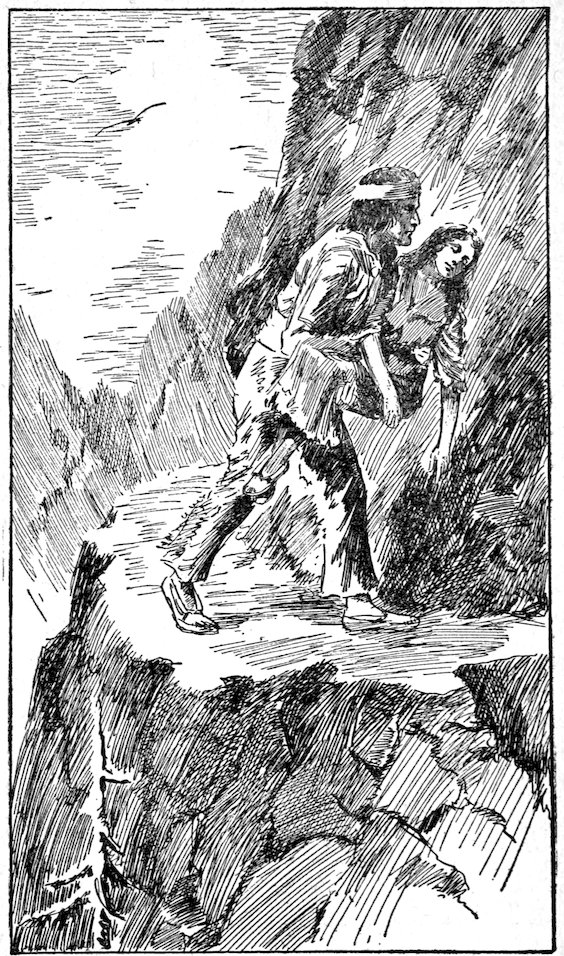
A Second Time the Indian Picked up Bettina
147The Indian would not have confessed,
but he was glad when he saw a small house,
apparently built of clay dried by the sun,
standing with one wall formed of a sandstone
cliff.
Squatting in front of this house was an
Indian woman who appeared very old.
She had a big jar of brown pottery before
her and with a yucca stem was making a
geometric design upon it. This was Nampu,
who had come from the village of Hano to
settle at the edge of the desert, the better
to pursue her work unobserved. She was
one of the most famous pottery makers in
all the region. But she was more than
this. Nampu was a medicine woman.
It is one of the peculiarities of the Hopi
Indians that they have medicine women as
well as medicine men.
The young Indian laid Bettina down at
old Nampu’s feet.
“She had fallen over a cliff; I found her
and did not know what to do. Therefore
I came to you,” he explained as briefly
as possible.
But the Indian woman made no reply
at all; she merely grunted. However, she
148put down her work and, picking Bettina
up, disappeared inside her house.
The young man lay down on a mat outside
the opening which served for the door.
Ten minutes went by. He could hear the
woman moving about inside. Then he
thought he heard a voice that was not an
Indian’s.
Afterwards Nampu came out and sat
down at her pottery again.
“She will be all right soon. Sleep now
best. Awake, tell us where she come from.
Then you can go find friends.”
So they waited and Se-kyal-ets-tewa saw
the sun setting behind his village and heard
the peculiar bark of the coyote that comes
at evening, and the short, quick yelp of
the prairie wolf.
Only once did the companions speak.
Then the young man asked.
“Where is Dawapa?”
“She come later; gone to get water.”
Really it was Bettina who aroused them
both.
The Indian woman had taken off her
shoes, so she came quite noiselessly and
stood at the door of the hut.
149She was puzzled beyond understanding
by what must have happened to her. But
she was not frightened. For Bettina was
not made nervous or unhappy by the circumstances
that would have alarmed most
girls, but by little ordinary things which
would have affected some girls not at all.
Now the beauty and the strangeness of
the scene before her filled her with an
emotion that was part pleasure and part
pain. The evening was so beautiful. Never
had she seen such a glory of color in the
sky, and the Indian woman and the youth
outside the door were like sentinels of some
past age.
Curiously it was Bettina who recognized
having seen her rescuer before. He had
not known her as the girl whom he had
met on the train coming west in all the
distance he had carried her to Nampu’s
hut. But, then, Bettina’s eyes were closed,
her face smeared with blood and dirt, and
she was wearing a costume that seemed
strange to the young man. It was in a
way like an Indian girl’s and yet oddly
different. For Bettina was wearing only
a part of her Camp Fire costume—the riding
150trousers and boots being an original
departure—because of the unusual circumstances
of their present camp fire life in
Arizona.
As soon as she walked toward him the
Indian got up and stood as erect as he
had that day of their first odd meeting.
But this second time was far more interesting.
One could not have mistaken him for
any other nation than his own at this hour.
Still he showed no sign of ever having
seen Bettina before until she put out her
hand.
“I have something to be grateful to you
for; I am not sure just how grateful I should
be,” she began. “But I am glad that it
is some one I have met before who has
helped me. Now will you be good enough
to tell me how I can manage to get back
to my friends. We are camping at one
end of the Gardener’s ranch near the
neighborhood of Cottonwood Creek. Is
there any way I could drive back?” Bettina
smiled. “I am perfectly all right,
only I do feel a little weak and tired. Yet
my friends will be so uncomfortable not to
151know what has become of me. You remember
meeting Mrs. Burton, don’t you?”
“Yes,” the young man answered.
Nampu grunted again.
“You stay here the night; Gardener ranch
fifteen, twenty mile away. Tewa tired.”
The young Indian shook his head.
“I will find your camp tonight. You
must stay here, Miss Graham.” He had
not forgotten Bettina’s name, at least.
But now it appeared strange to have
him speak and behave in so quiet and
well-bred a fashion. Seeing him in an
Indian costume, here in the land of his
birth and among his own friends, one forgot
the young man’s college training, and
all that was supposed to go with it.
“But the distance! It is not possible,”
Bettina urged.
The young man’s lips arched, showing
white, strong teeth.
“I have been winner of the prize as
runner at our Snake ceremony. If that is
not enough, I won the championship of the
United States in the University long-distance
running contests this spring.”
Before Bettina could reply, the sound of
152some one approaching caught her attention.
Then, as she turned, she saw a girl of
about her own age coming near, holding
on her shoulder a large water jug. But
the strange fact was that the girl was blond—fairer
than she herself or than Gerry. Indeed,
she had hair light as corn silk, pale
blue eyes and a too white skin. Nevertheless
she was dressed like an Indian maiden.
Her hair was arranged over her ears in
great puffs resembling squash blossoms,
signifying among the tribes of the Pueblo
Indians that the girl is unmarried.
“This is Dawapa,” the old Indian woman
said civilly.
But Dawapa went shyly and quickly by
into the house, not waiting for any explanation
of Bettina’s presence in her home.
And it was not until afterwards that
Bettina learned Dawapa was an Albino,
and that there are such girls and boys born
now and then among the Hopis.
CHAPTER XII The Painted Desert
153
By noon the next day Mrs. Burton
and her niece arrived at Nampu’s
house near the Painted Desert to
find Bettina.
The Indian showed them the way.
The night before, he had appeared at the
new Sunrise Hill camp at a little after ten
o’clock, finding only Mrs. Burton and a few
of the girls there. Peggy and Vera and
Ellen Deal had insisted upon joining the
searching party from the Gardener ranch
led by Terry Benton, who had gone out to
look for Bettina.
Fortunately the Indian had come upon
them and told them of her rescue on his
way to camp so they were following behind
more slowly. It was thus that he arrived
alone.
Mrs. Burton’s welcome was very enthusiastic;
indeed, she showed even more
gratitude and friendliness than Bettina.
154In a way she was more relieved. Moreover,
almost at once she recognized the young
man as the one whom they had met on the
train.
She was walking alone up and down near
the border of their mesa, and had been
doing this almost without ceasing ever since
Vera and Peggy returned bringing the news
of Bettina’s loss. They did not mention
what they feared, but the same impression
came readily enough to the others. And
Mrs. Burton thought of almost nothing else.
Over and over she kept repeating to
herself that if an accident must happen to
one of the Camp Fire girls, it had better
have been any girl than Bettina. But
not because she cared for her most.
The Arizona night was very clear, so
that she saw the Indian a long way off.
For the first few moments she hoped, of
course, that the oncoming figure might be
Bettina’s; but a little later the idea was
impossible. For she recognized that the
figure was a man’s, and from his odd costume
that he must be an Indian.
He came striding on toward the mesa,
swiftly climbed the steep path and walked
155directly up to Mrs. Burton, who was waiting
there alone. The girls were in their
tents—not sleeping, but talking together
in low voices. Sally and Gerry were
whispering—a fashion they frequently
indulged in.
Ten minutes before, Marie had urged
her mistress to lie down, but Mrs. Burton
had insisted that she would be far less
nervous if allowed to remain out of doors.
“I came with news of Miss Graham;
she is safe,” the young Indian announced
as soon as he was within speaking distance,
sensibly relieving Polly’s anxiety at once.
Something—the curious contrast between
his cultivated manner and voice and his
costume—made Mrs. Burton recognize him
at once.
“Then our meeting on the train was a
happy accident. I felt it might be,” she
returned cordially, holding out her hand.
“Sit down beside me, please, and tell me
just what has happened.”
Now, that the strain was over, Mrs.
Burton felt oddly weak in the knees, as one
often does after a period of anxiety.
Yet, later, when she knew that Bettina
156was safe and not seriously hurt, Mrs.
Burton found that her sense of romance had
not so completely disappeared that she
did not enjoy continuing to sit there for a
few added moments.
The young Indian was so handsome; his
personality and his appearance so fitted
into the unusual and picturesque landscape.
Then there was something in his grave
courtesy which pleased the older woman.
He slept that night wrapped in a blanket
on the mesa at some distance from Mrs.
Burton’s tent, next morning acting as her
escort.
But it was not possible that the little
party of three start off at once. First, Mrs.
Gardener had to be persuaded to come
down from the ranch house to spend the
day and night with the other Camp Fire
girls. For Polly had concluded, since
Nampu’s house was so near the Painted
Desert, the girls could come on the following
day and join her there for their first
expedition into the desert.
On their arrival Polly had found Bettina
a little pale and tired, but otherwise wonderfully
recovered from Nampu’s healing herbs.
157Then, after a little talk, the three girls—Bettina,
Peggy and the Indian girl—had
wandered off, while all afternoon Mrs.
Burton sat with old Nampu and Se-kyal-ets-tewa.
He did not seem to care to be with the
girls.
Mrs. Burton wondered at this. Yet she
did not understand Indian customs.
There was undoubtedly a deep intimacy
between Nampu and the young man.
Could it be possible that the daughter,
Dawapa, was the bond?
Although living at a little distance from
her own people, Nampu was a distinguished
woman among them. In the Indian world
there was no more famous maker of pottery.
Her daughter was being trained to the same
work. Nampu was a typical squaw—silent,
a little dirty, squatting all day in
the sun, with only her wonderful old
wrinkled hands moving like an artist’s and
setting her apart from the rest of her
tribe.
About the daughter it was more difficult
to determine. She seemed abnormally
shy—more like a frightened wild animal
158than a human being. Then it was difficult
to determine whether her odd appearance
made her beautiful or ugly. Doubtless her
own people might think her beautiful,
because of the contrast her fairness offered.
Nevertheless the Indian boy was so
unlike either Nampu or her daughter,
separated from them by what appeared like
centuries in education and feeling.
Yet, watching him today, the great
actress was not so sure. She liked to study
faces and temperaments. The Indian had
changed since their meeting on the train.
Then he had been far more like an American
or, rather, like the type we now regard as
American, since, after all, he had the first
right to this name. But in this short time
since his homecoming, he was not the same.
It may be that his Indian costume made
the difference. Yet it would be interesting
to see just how much influence modern
civilization did have upon the Indian character.
Was it not, after all, just a veneering,
and would the young man not return
to his own customs and his own people
when the American influence was removed?
They were sitting in front of Nampu’s
159house while Mrs. Burton made these reflections.
She was resting in the shadow of
the cliffs behind the hut on a splendid
Indian blanket of black and red. Near her
Nampu was molding a great earthenware
bowl, shaped and colored like a great red
disk cut in two and hollowed on the inside.
Around it the crude outline of a snake lay
coiled. Already Polly had asked to be
allowed to purchase it.
A few yards off Se-kyal-ets-tewa sat
upright with his legs crossed underneath
him. He was silent unless he was spoken
to, but he seemed to keep his eyes fixed on
the three girls who formed another group
at some distance off.
None of his new acquaintances at their
second meeting thought of or spoke to
the Indian by the English name of John
Mase—the name by which he had introduced
himself on the train.
Suddenly Mrs. Burton turned to him.
“I hope you will come to see us as often
as possible at camp,” she began, speaking
with her usual impulsiveness and thinking
it might be amusing to study the different
influences at work in the Indian youth.
160“I would like to have you teach us of your
people and some day take us to your village
perhaps. Later on we are hoping to see
your great August festivals.”
Mrs. Burton had not meant to be condescending,
but there may have been an
unconscious suggestion in her tone. The
Indian hesitated and frowned. Then, seeing
that the three girls were coming toward
Nampu’s house, he rose up.
“Thank you,” he answered, but without
signifying whether his reply meant agreement.
Next day Peggy Webster asked him the
same question.
She and Bettina and Dawapa were standing
in a small group at the entrance of the
Painted Desert, waiting for the others
to join them. They had walked from
Nampu’s house—a distance of only a mile
or two.
“You will not disappoint us, Se-kyal-ets-tewa,”
Peggy urged, thrusting her hands
into her pockets in a boyish fashion and
nodding her head vigorously. “But if
you do decide to come won’t you give us
some other name to call you by? Life
161isn’t very long at best and Se-kyal-ets-tewa——”
The Indian smiled. He understood and
liked Peggy, as all other boys and men who
were worth while did. She was so simple
and straightforward and so without the
least trace of coquetry.
“Yes, if Mrs. Burton and the rest of you
really wish it, I will come when I can,
although I have other more important work
to do,” he answered proudly. Then smiling
again, “Perhaps the last two syllables of
my name will be less difficult. Tewa alone
means ‘Keeper of the Trail.’”
He was looking directly at Peggy and
talking to her, not appearing to notice
Bettina nor the Indian girl.
Nevertheless Bettina replied:
“I was lucky when you chanced to be
the ‘Keeper of my Trail’ yesterday.”
She was smiling, also, and yet she spoke
seriously. “I wish I knew how to thank
you.”
A moment afterwards the entire party
was entering the Painted Desert.
It was as if they had come into a country
where, long centuries ago, Titanic artists
162and alchemists had poured out their paints
and jewels.
The mounds of earth with plateau-like
surfaces called mesas were red, blue, green
or orange and took strange, fantastic shapes.
Fallen between the mesa were petrified
trees which had split open and were filled
with precious stones. Now and then a
petrified tree appeared embedded in the
sandstone of the mesa showing along its side.
No one of the party realized how many
miles were walked that day. Nevertheless,
after a time, Bettina naturally grew
weary. Yet she did not wish to mention
her fatigue, realizing that she had simply
not entirely recovered from her experience
of thirty-six hours before.
So, whenever it was possible she sat
down, allowing the others to wander on
without her.
They were about to start on the homeward
journey when she chanced to speak
to Tewa again, and this time they were
alone.
Bettina was sitting in the sand with her
chin in her hand by the side of a giant
petrified tree. She was staring at the place
163where it had split open in falling, showing
not only stones but precious and costly
gems on the inside.
Bettina was thinking so deeply that she
did not hear the Indian coming toward her.
He did not speak until she seemed to
feel her eyes drawn away from the things
at which she was gazing, by another pair
of eyes looking upon her. Then she
started a little.
“Mrs. Burton sent me to tell you that
you were to ride back to Nampu’s house
in the wagon. You did not hear me coming?
The Indian moves silently because
the moccasins we wear are best suited to
the sands of the desert.”
The young man, thrusting his hands inside
his belt, drew out an exquisite pair of
moccasins made for a woman and of softest
leather and embroidered in bright beads.
“You will wear these and you will be
less tired,” he said.
Were they a gift and, if so, what ought
she to do? Bettina did not know whether
she should accept them.
But the Indian seemed to take her acceptance
for granted.
164“I am sorry to have startled you,” he
continued, holding out his hand to assist
her in getting up.
But, for a moment after she had arisen,
Bettina stood beside him, making no effort
to move on.
It was odd how little shyness she felt.
It was easier to talk to this Indian; to explain
to him what she was thinking and
feeling than to any young man acquaintance
of her own race.
“I wonder if you have ever read the
Bible,” Bettina asked unexpectedly, and
then, seeing the Indian looked startled, she
laughed.
“Oh, I am not a missionary trying to
convert you. It is odd, but this place
suddenly made me think of a chapter in
Revelations. I suppose because I never
could have imagined anywhere else such a
profusion of jewels.”
“I have read your Bible,” the young
man returned. “But I do not believe in
it for the Indian. For us our own religion
seems best. Yet I think I can recall the
verses you mean.”
“‘And the foundations of the wall of the
165city were garnished with all manner of
precious stones. The first foundation was
jasper; the second sapphire; the third a
chalcedony; the fourth, an emerald;
“‘The fifth, sardonyx; the sixth, sardius;
the seventh, chrysolite; the eighth, beryl;
the ninth a topaz; the tenth, chrysoprasus,
the eleventh, a jacinth; the twelfth, an
amethyst.’”
The young man pronounced each word
slowly and Bettina held her breath. Never
could she have a more curious experience
than this. She would never forget these
past few minutes.
The air of the desert was like crystal—the
place a marvel of strange color. And as
the Indian recited, Bettina seemed able to
count each jewel in the stones before her.
How strange life was, that she should
hear these exquisite symbolic verses repeated
by a Pagan in a land which had
once belonged to his Pagan ancestors.
CHAPTER XIII The Eternal Feminine
166
This morning there seemed to be a
great deal of activity about the
new Sunrise Hill camp. But then,
no matter how people may talk of leading
the simple life, there still remains a good
deal of work to be done to make even the
simple life agreeable.
The four tents stood in a kind of half
circle in front of the small group of pine
trees, which had influenced the choice of
the camping site. Before the central tent
was a tall totem pole, as yet uncolored and
uncarved, which was later to record the
experiences of the Arizona Sunrise Camp
Fire club. It had been purchased from an
Indian wood carver and had a strange head
on top, resembling a sardonic American
eagle.
Below and beyond the chosen mesa, and
some distance off, lay Cottonwood Creek.
The creek, fringed with tall cottonwood
167trees, was nearly a mile in length. To the
south lay the Gardener ranch and toward
the west the beginning of the desert, with
the Hopi reservations farther on.
This morning, half a dozen yards from
the kitchen tent, the camp fire was burning,
and above it hung a huge iron pot.
Nearby, peering through a pair of large
round glasses, Alice Ashton was engaged
in studying a recipe book. The book had
been compiled in Boston and Alice was
baking beans for lunch. As the book had
been a present from her mother to the
Camp Fire club, Alice, although she knew
exactly how the beans should be done,
preferred resorting to it, as she always did
to the wisdom of the printed page.
Ellen Deal was endeavoring to render
her assistance but evidently her services
were not desired. Nearly a month having
passed with the Camp Fire club in Arizona,
Ellen and Alice had become great friends.
Alice conceded that the other girl had a
scientific mind and was an authority on
health but, when it came to baking beans,
Boston must remain pre-eminent.
Mrs. Burton, sitting under one of the
168pine trees in her favorite place and reading
a lot of mail, now and then glanced about
her.
Alice’s earnestness was amusing—what a
contrast she and Sally were, although they
were sisters with only two years difference
in their ages.
There were a good many letters—two
from her husband, one from her sister, Mrs.
Webster, and another from her beloved
Betty Graham in Washington.
Mr. Simpson had driven to the post-office
box on the Gardener ranch and returned
with the mail only half an hour before.
Since then he had been engaged in digging
at the pathway up the side of their mesa, so
as to make the ascent less difficult for the
campers.
“Marie!” Polly called. But when Marie
did not answer, she did not call a second
time. What was it about their kind, ugly
guide that seemed to inspire her maid with
a kind of viciousness? Marie had just
marched to the side of the mesa and was
at this moment shaking Indian blankets
just above Mr. Simpson’s head, while he
devotedly dug and chiseled at their trail.
169Marie did look ridiculously picturesque
in her French maid’s costume of black and
white, waving the brilliant, many-colored
Indian blankets in the breeze, like some
small insect with wings all too big, which
seemed for the moment about to carry her
over the cliff.
Mr. Simpson must have been amused
also, for he climbed up his own steps to
speak to her, and Mrs. Burton did not hear
what he said, but saw Marie flounce and
toss her head after his remark.
No one of the other girls was in sight at
present.
Vera, Peggy and Bettina had taken one
of the burros and gone off to stroll along
the creek and gather wood which they
stacked on the burro’s back for the camp
fire. Sally, who was the acknowledgedly
lazy one of the Camp Fire girls, was probably
off pretending to read somewhere, and
Gerry might possibly be with her.
But the Camp Fire guardian was glad to
feel that no one was far away and that
things were comparatively peaceful.
Indeed, except for Bettina’s accident some
little time before, which had amounted to
170almost nothing, they had spent several
delightful weeks at camp. Now and then
they, of course, took trips about the country
and had seen several of the smaller
nearby villages; also they had visited one
of the petrified forests, but there had been
no difficulties which were not amusing.
And the girls seemed to be growing more
friendly under the influence of the Camp
Fire club life.
Polly was thinking of these facts with a
degree of quiet satisfaction. Her husband’s,
her friends’ and her sister’s letters
had all faintly suggested possible complications.
None of them appeared sure of her
as a safe and sane Camp Fire guardian, no
matter how good her intentions. Her
husband naturally was uneasy about her
health, realizing she had much responsibility
to which she was unaccustomed,
while Betty and Mollie were uneasy
over their only daughters. Mollie really
could be forgiven, for Billy had been ill for
several weeks and she herself was worn with
nursing. She wrote that he seemed to
have greatly missed Vera’s companionship.
And Mrs. Burton wondered what her eccentric
171little nephew could find in the companionship
of the quiet Russian girl.
But at this moment she saw Gerry at
some little distance off coming across the
sands and then more slowly climbing up the
steps of the mesa.
She looked very fair and sweet as she
came across the trail. She wore no hat
and her pale yellow hair was the color of
corn silk. It was tied back loosely with a
band of ribbon and she wore an ordinary
morning camp fire costume. Gerry had
not yet gotten beyond the first order of the
camp fire.
Her hat, however, was filled with lovely
wild flowers, which she cast at once into
her Camp Fire guardian’s lap.
“This is my morning tribute, dear lady,”
she began. “I have been wandering about
looking for them for you.”
Now Polly Burton was aware that Gerry
always flattered her, but she did not dream
for a moment that this had anything to do
with her especial fondness for her. There
was an unusual bond between them—one
which she had not yet confided to the other
girls and probably would not until their
172camp fire days were over. Besides this,
Gerry did seem to have a particularly sweet
nature, even though the usually reasonable
Peggy did not like her. But, then, the
other girls did, and Peggy was a little
spoiled and apt to be too blunt. She and
Gerry would become more friendly later,
was always her aunt’s conclusion.
“Were you alone, Gerry?” Mrs. Burton
asked. “You know I would rather you
girls did not go far from camp by yourselves.
This country is too unfamiliar to
all of us.”
But she picked up the flowers and held
them lovingly against her face. They had
not the usual fragrances, but a kind of
aromatic sweetness.
“Oh, I wasn’t alone all the time,” Gerry
replied evasively, although the older woman
did not notice this. “I followed Vera and
Peggy and then came back along the
creek.”
“But what about Bettina?” Polly asked
carelessly, “I thought she went with the
other two girls.”
She was not especially interested in her
own question, for she was really thinking
173of her husband. But something in Gerry’s
manner at this instant arrested her attention.
Gerry had not answered, but instead had
turned her face and was gazing at the
landscape.
“Where was Bettina?” Mrs. Burton
asked more sharply, annoyed simply because
Gerry had not replied to her question.
Then Gerry turned slowly around.
“She started with the other girls, but
said she was tired and sat down to rest
under one of the trees by the creek. On
my way back I saw that Tewa had joined
her there. I did not know you expected
him at camp today. He has been here
twice already this week to tell us Indian
stories. I sometimes wonder how he manages
to come so far.”
“Oh, that is no concern of ours,” Mrs.
Burton returned lightly, “so long as you
girls are interested in what he has to tell
us. And Bettina seems to be more entertained
than any one else.”
Gerry laughed a curious little laugh and
then stopped abruptly.
She was sitting on the ground facing
174Polly, with her hands clasped gracefully
over her knees and her head tilted back so
that her blue eyes were upturned.
“I wonder if you will be cross with me,
dear lady, if I say something to you?” she
asked with a slight flush and tightening of
her lips, which were rather thin.
Still Polly was not paying serious attention
to her companion.
“Why should I be angry, Gerry? I have
not been with you so far in our acquaintance,
dear. You have been a more satisfactory
Camp Fire girl than I believed you
could be at the beginning. Besides, I
made up my mind that if I was permitted
to be a Camp Fire guardian, I must reform
my own temper before I could influence the
girls. So fire away, Gerry, and test me,”
she ended lightly, slipping her letters back
into the envelopes, but glancing at them
again as she did so.
Yet Gerry did not speak at once.
“I was just wondering if you knew how
intimate Bettina and your Indian protégé
are,” she said finally, “and if you mind?
It seems odd to me when you were not willing
to have Terry Benton continue as our
175guide, when he was a nice American fellow.
And this Indian——”
Impulsively Gerry reached out and took
hold of Polly’s hand, looking at her with a
kind of playful apology.
“I don’t mean to criticise you, you know.
I would never do that, and besides, I
wouldn’t dare anyhow. But I feel you
cannot have noticed their friendship. It is
only because I realize Bettina does not
understand some things as I do; has never
been up against the world as I have
that——”
“Be quiet, Gerry.”
Undeniably Mrs. Burton’s amiability,
which she had announced as necessary to
her Camp Fire work, had suddenly vanished.
“One thing I shall never allow in my
Camp Fire club is for one girl to talk to
me unkindly of another. If Bettina is
friendly to Tewa it is because she is grateful
to him, as I am. He is an unusual
fellow and she may help him with his
education. I am afraid, Gerry, you do
not understand just who Bettina is, nor
who her father and mother are.”
Polly hesitated. After all, Gerry’s influences
176had been so different. She must
not be too angry with her.
“Don’t let me hear any suggestions of
this kind again about any one of the
Camp Fire girls,” she ended more kindly.
“It is because I want you to forget a good
deal of nonsense that I brought you out
here with us.”
Gerry said nothing and, getting up,
Polly laid her hand lightly on Gerry’s
head.
“Let us forget this past few moments
altogether—both of us,” she suggested, and
walked away.
She had seen Bettina and Tewa strolling
slowly away from the neighborhood of
Cottonwood Creek toward their mesa.
Bettina was nearly as tall as the Indian
and in her picturesque camp fire costume,
did not look out of place beside her
companion.
CHAPTER XIV Antagonisms
177
Dinner was finished and yet it was
early evening.
Over in the west the sunset was
flaming the sky with the brilliant colors of
this land of clear atmospheres.
Seated in a group about a smouldering
outdoor fire were eight girls—seven of them
in ceremonial camp fire costumes and one
of them dressed as an Indian. Curious that
the Indian girl should be the fairest of
them all!
Her pale yellow hair was fixed in the
elaborate fashion of the Hopi maidens,
with great loops over each ear, her dress
of white. About her throat were several
strings of uncut turquoise. The dress itself
was made of a single piece of woolen
cloth—really a white blanket—with a deep
border of bright blue and red at the bottom
and at the top. Around her waist was a
white belt and on her feet soft white moccasins,
178with strings of white leather wound
about her legs almost to the knees until she
looked as if she were wearing white top
boots.
Dawapa was also in her ceremonial costume,
as she was the guest of the Camp
Fire girls. At the moment she was deftly
fashioning a baho, or feather prayer plume.
The other girls were watching her with
interest.
They were at some distance back from
the fire with the evening wind blowing the
smoke away to the northwest among the
blue peaks of the San Francisco hills and
the gorges of the Grand Canyon.
Gerry Williams was sitting next to
Dawapa, with Sally Ashton on her other
side, Sally’s brown head resting against
Gerry’s shoulder and her lids closing now
and then over her big brown eyes. She
looked like a sleepy, sweet-tempered doll.
Opposite were Vera and Bettina, and in
front Alice, Peggy and Ellen. They had
broken their usual Camp Fire circle formation
in order the better to observe their
guest.
Their Camp Fire guardian was not with
179them at the moment, having gone to her
tent after dinner. It seemed better, now
and then, to Polly that she leave the girls
alone.
On the ground beside Dawapa was a
large round basket, flat like a tray and
woven in red and green grasses, with a disk
inside to represent the sun.
In spite of the lateness of the hour,
as it was still sufficiently light, Alice and
Ellen and Vera were working at their own
weaving. Since her arrival two days before,
the Indian girl had been teaching the Sunrise
Hill Camp Fire club to improve their
hand craft in more than one way. Although
Dawapa was not yet an artist to equal
her mother, her skill in basketry, in silver
work and more especially in pottery had
awed the American girls. It was one
thing to be a modern Camp Fire girl, no
matter how successful in the obtaining of
the green honors, and another to have been
born to the life of the camp and the inheritances
of generations of hand workers.
“What is that pretty thing you are
making used for, Dawapa?” Gerry asked,
glancing up from her own pretty hands,
180which were idly crossed in her lap, toward
the other still fairer girl. Gerry did not
seem to be making a great effort to add to
her Camp Fire honors and thus attain to
a higher membership.
The Indian girl was almost abnormally
shy and timid—or at least she appeared
timid to the Camp Fire girls. But she had
been to a government school and spoke a
fair amount of English.
“We plant our prayer plumes on the
altar when we pray to the Indian Gods,”
she answered gently, with a faraway look
in her light blue eyes. “Our first prayer
is for good thoughts—then that our children
may be wise and strong, and that the God
of the Sky may be glad of us.”
Gerry laughed. It was odd how few
things seemed to strike her as serious.
Alice Ashton frowned. She was not
pleased at her younger sister’s intimacy
with Gerry, of whose history they knew
almost nothing.
“That is lovely, Dawapa; thank you for
telling us,” she returned, wondering if the
Indian girl would feel that they had less
good manners than her own people. “After
181that, do you not pray for something you
especially wish for—the thing you most
desire?”
Alice spoke earnestly and the other
girls remained silent. Perhaps there was
not one among them who did not cherish a
secret wish; perhaps for some simple,
material possession, or perhaps an ambition
which only the future could gratify.
But Dawapa only nodded her head and
did not reply.
Gerry leaned over.
“Oh, if that prayer plume thing brings
one good luck, give it to me?” she demanded,
reaching over and making an
attempt to take the baho from the Indian
girl’s hand.
But Dawapa held to it firmly.
“Don’t do that, Gerry,” Bettina Graham
said hastily and with a note of authority.
“Dawapa told you that the prayer plume
is a part of the Indian religious ceremony.”
After all, Bettina Graham was her
mother’s daughter, and courtesy and good
breeding had been the rule of her life.
She did not dislike Gerry; indeed, she had
not paid a great deal of attention to her,
182but occasionally something in the other
girl’s behavior offended her almost unconsciously.
And, in a way, Gerry knew and resented
this. In fact, she had immediately decided
that what Bettina’s friends called shyness
was only hauteur, due to her father’s
prominence and her own social position.
At Bettina’s speech she now flushed
angrily, but drew away from the Indian
girl. Then she laughed a faintly mocking,
insinuating laugh.
“I beg your pardon; I had forgotten
what a convert you have become to ‘the
poor Indian.’”
Just exactly what Gerry meant by this
stupid speech, Bettina did not appreciate.
However, she did know that it was her
intention to be rude.
“You have extraordinarily bad manners,
Gerry. I wonder if it is because you do
not know better?” Bettina returned
quietly. By this time she was also angry,
but she had a self-possession which gave
her the advantage. Yet, the moment her
sentence was finished, Bettina regretted it.
Among the new Sunrise Hill Camp Fire
183club this was the first open quarrel, and the
other girls were looking uncomfortable.
Bettina had not meant to make her accusation
so sweeping. Having lost her temper,
she had simply said more than she should,
as most of us do under similar circumstances.
Moreover, Bettina felt a little
stab at realizing that Gerry would doubtless
tell her side of their difficulty to their
Camp Fire guardian. In Bettina’s mind
there was little doubt whose part she
would take.
“You are hateful, Bettina,” Sally Ashton
murmured, still a little sleepily. She had
not listened carefully to what had been
said, but wished to announce herself as
Gerry’s champion. The truth was that
Alice had recently lectured her younger
sister on the subject of their intimacy, and
Sally intended to show how utterly unimpressed
she was by family advice.
If Gerry intended continuing the quarrel
she did not say anything more at this
instant. For, glancing up, she had seen
that Mrs. Burton had come out of her tent
and was walking slowly towards them.
Bettina also had seen her and was a
184little puzzled that Gerry did not make the
best of her present opportunity. Then she
concluded that Gerry was a little ashamed,
as she herself was, over their childish lack
of self-control. Perhaps next day there
would be a chance to straighten things out
when they were alone, particularly as they
were expecting guests to arrive at their
camp fire at any moment.
“Our visitors have not yet appeared,
have they?” Polly asked a moment later,
as she sat down next to her niece.
Straightway Gerry kissed her hand to
their Camp Fire guardian across the
intervening space, looking as sweet and
unruffled as if nothing unpleasant had
occurred.
Really, by this time only Peggy showed
any especial expression of annoyance.
Peggy simply refused at all times to pretend
to any state of mind she did not feel.
Although she had not spoken, recognizing
that she had no part in Bettina’s and
Gerry’s quarrel, none the less was she
ruffled.
Recognizing this fact, but not understanding
the cause, Polly slipped her
185arm affectionately through Peggy’s and
held her close for a moment. She could
feel the girl grow less rigid; see her expression
change and soften. There was
no doubting the sincerity of the devotion
between the niece and aunt, even if now
and then they did not entirely approve
of each other’s actions. Mrs. Burton,
however, had not the faintest idea that
Peggy would at any time oppose her in
a matter of importance. Perhaps she had
grown too accustomed to believing in her
own charm and unconsciously in the influence
of her own success. So far no one
appreciated the fact that Peggy Webster
was one of the few people who absolutely
had to think for herself, and to be faithful to
the truth and to justice as she saw it.
“Terry Benton’s note to me said he
wished to bring half a dozen other friends
with him tonight, so that was rather an
unnecessary question on my part,” Mrs.
Burton went on, wondering why the group
of girls remained so silent and constrained,
and glancing with more attention from one
face to the other.
Some little time before, Mrs. Burton
186had been compelled to surrender the idea
that she could order her Sunrise Hill Camp
Fire club as if it were a nunnery and she
the Mother Superior. At least, this was
the accusation which Mrs. Gardener had
certainly made on their arrival. Really,
Polly had only wished to keep clear of
entanglements. But Terry Benton, although
not permitted to remain as guide, had
manifested no ill feeling. Indeed, ever
since he had been a more or less frequent
visitor at camp, bringing an occasional
friend with him. He and Gerry
and Sally seemed to have formed a kind
of three-cornered friendship.
Tonight, however, was the first time
that he had suggested bringing so many
visitors at one time. But Terry had
written to say he had a friend from the
East who had just arrived at the Gardener
ranch and wanted to call. There were
also four or five western fellows who declined
to be put off any longer.
Therefore Mrs. Burton had acquiesced
and written to say she and the Camp Fire
girls would be glad to see them. After all,
she remembered how important a part
187their boy friends had played in her own
Camp Fire days. Perhaps it was a sign
of age to have expected other girls to be
different. Anyhow, Mrs. Burton had the
grace to laugh at herself after submitting
to the inevitable. And she was now first
to spy their expected guests.
But the moment after, Sally also had
seen them and jumping quickly to her feet,
all her sleepiness vanished, began waving
a yellow scarf.
The newcomers made an effective picture,
riding in single file along the trail which
led from the Gardener ranch. Although
the sun was not entirely down, the moon
had risen and was showing faintly in the
opposite sky. Later would be revealed,
the Pleiades which the Indian calls the
time of the sweet influences.
The young men were wearing rough-rider
costumes. Observing Sally’s signal,
Terry Benton, who was leading the line
of march, rose in his saddle and saluted.
The next instant six other men followed
suit and together they halloed across the
desert the long, curious cry of the western
cowboy.
188But the girls had also risen in a picturesque
group about their camp fire, calling
back in return the now world-famous camp
fire cheer:
“Wohelo for aye, Wohelo for aye, Wohelo, Wohelo, Wohelo for aye!
Wohelo for work, Wohelo for health, Wohelo for love.”
Ten minutes later, leaving their burros
below fastened to the trees near Cottonwood
Creek, Terry and his friends, after climbing
the mesa, came directly toward Mrs. Burton.
And before Terry could introduce any
one of them, a young man held out his
hand.
“I have met you before, Mrs. Burton.
You remember you said I could not be a
member of your Camp Fire club? Well, I
have done the next best thing, I am a
visitor at the Gardener ranch. Benton and
I are old friends, and when he wrote me of
what was going on out here, I guessed the
rest. Besides Mrs. Webster and Mrs.
Graham confessed. I think they want a
first-hand report of Miss Bettina and Miss
Peggy from me.”
189But Peggy had by this time joined her
aunt.
“Ralph Marshall; how extraordinary to
see you out here! You are the very last
person I would ever have dreamed of. I
thought, after your visit to us, you were to
stay on and study scientific farming with
father.”
“Oh, well, I have concluded to be a
ranchman instead,” Ralph returned, smiling
and shaking hands with Peggy.
Peggy was pleased to see him. He had
been a guest at their place several times
while she was growing up and was really a
charming fellow, if a little spoiled by his
father’s wealth. Then his people were
friends of Bettina’s mother and father, as
well as of her own.
CHAPTER XV The Storm
190
Ralph Marshall decided that he
never had seen Bettina Graham so
agreeable nor so good looking as
she was tonight.
Ralph was a great admirer of Bettina’s
mother; indeed, whenever he made a visit
to Washington, he was always in Mrs.
Graham’s train. And he knew that Mrs.
Graham wished him to be friends with her
daughter; indeed, she had frankly told him
so, announcing that she believed the one
would be good for the other. For Bettina,
in her mother’s eyes, was too grave, too
given to yielding to odd fancies and too
indifferent to people, while Ralph, in contrast,
was too frivolous and fond of society.
He was some day to inherit great wealth,
so his father was trying vainly to interest
him in something of importance. His
excursions to Washington and his connection
with Senator Graham were in order to
191inform him of national affairs. Failing
that interest, for Ralph had announced
himself as bored to death by politics, he had
gone for a few weeks to the Webster farm,
pretending to have developed a curiosity
concerning scientific farming.
But, really, Ralph was only concerned at
present with having an agreeable time. He
was not a student and had barely managed
to be allowed to remain at college. He was
not a first-rate athlete, for athletics required
too much self-sacrifice to appeal to Ralph.
But he had a charming voice and was one
of the stars of his college glee club, and
there was not a man in college who danced
better.
So he and Bettina really were too great
a contrast in all their ideas and desires
ever to have been intimate friends up to
the present time, in spite of the family
wishes.
Tonight, however, Ralph had concluded
that Bettina was almost a real girl, and not
a prig given to writing poetry and reading
a lot of dull books that would bore any
natural human being to death. She was
evidently interested in all kinds of outdoor
192sports, which she must have learned through
her Camp Fire work, and Ralph always
had been forced to concede that Bettina
knew how to dance. She was so tall and
slender and, just as she had a peculiar
light grace in walking, so she had it in
dancing.
Ralph and Bettina were dancing together
at the time the young man was reaching
these conclusions—dancing outdoors on the
smooth plateau of the mesa on a wonderful,
white night. Bettina’s hair was shining
in the moonlight, and she was stirred
out of her usual coldness by the beauty and
novelty of her surroundings. So it was
small wonder that Ralph, who was a romantic
person, was at present taking a more
kindly view of his companion.
However, Bettina had not changed to
the same degree in her opinion of Ralph.
She was still convinced that he was exactly
the kind of man she would always least
admire. Bettina’s ideal was represented
by her father, who had made his own way
by a strenuous and self-denying youth.
Moreover, Bettina had never forgiven Ralph
for his discovery of the poem she had
193written and believed she had safely burned
that afternoon at the Webster farm.
But the music ceased. After Bettina
and Ralph stopped dancing they walked
together to the side of the mesa and Bettina
sat down.
The music consisted of a Victor, which
Mrs. Burton had brought with them as a
part of the camping outfit, and tonight
Marie had the music in charge.
She looked like a little French figure of
Pierette in her tight-fitting black dress, and
with her face oddly white in the moonlight.
For Marie insisted upon following the
French fashion of using a great deal of white
powder in spite of her mistress’ remonstrances.
The Victor had been placed in a convenient
position and Marie mounted on a
stool beside it. Almost for the first time
since their arrival in camp, Marie appeared
almost gay as she ground out the records
and watched the dancers.
Mr. Jefferson Simpson had come forth
from his lone tent near the creek and
established himself several yards away, to
smoke a meditative cigar and observe the
194proceedings with his twinkling, philosophic
eyes.
“It is great out here, isn’t it?” Ralph
said, as he arranged himself in a picturesque
attitude, lying at full length on the sands
near Bettina’s feet.
“And it wasn’t so worse—that little poem
of yours I found this spring; at least, not
for stuff of that kind.” And Ralph spoke
with a fine scorn of the poets and poetry
of all ages.
“I can repeat the thing, I think. Indeed,
to tell you the truth, after I
read it over I learned the words and
have been singing them to some music I
know.”
And Ralph sang under his breath in a
charming voice:
“In the moon of the peach blossoms,
Toward the land of the setting sun,
Ghosts of old camp fires keep calling;
Camp fires whose race has been run.
“I can see the sands of the desert;
I can hear strange desert cries;
And ever my thoughts go homing
To a tent under desert skies.”
195In the beginning Bettina was uncertain
whether she was pleased or annoyed at
Ralph’s reminding her of an embarrassing
experience. But undoubtedly, by the
close of the song, she was flattered.
Ralph really made the most of her little
poem.
“The meter is very poor—so poor I
threw my poem away—but the music is
lovely and you sing awfully well,” Bettina
conceded, finding herself not so bored by
her companion as she always had been in
the past. But then, they had scarcely been
together for a ten-minutes’ conversation
alone in their entire acquaintance before
tonight, both Bettina and Ralph having
taken pains to avoid it.
“Anacoana, Flower of Gold, is your
Camp Fire name, isn’t it?” Ralph continued,
gazing somewhat sentimentally at
Bettina with his hazel-brown eyes. His
hair was nearly the same color, and his
teeth strong and white. Indeed, the only
contradictory thing in Ralph’s appearance
was his mouth, which was fine and clearly
cut—contradicting the weakness of the rest
of his face.
196This time Bettina was annoyed. It was
useless to try to be sensible with Ralph
Marshall, as he was always under the
impression that he must be languishing
when talking to a girl.
And Bettina did not like this; neither
did she know exactly how to behave under
the circumstances. It would have been
simple enough to have laughed Ralph into
better judgment of her and of the situation.
But Bettina was no longer sufficiently at
ease.
“Oh, that is rather an absurd name which
my father once chose for me as a Camp Fire
name and by which I have been embarrassed
ever since,” she answered coldly, not
returning her companion’s gaze, but sitting
up stiffly.
Her attitude gave Ralph the desire to
flee. Bettina was a literary iceberg, after
all! But how escape when one was lying
at full length on the ground gazing with
at least an appearance of ardor upon an
unresponsive maiden, unless some one came
to the rescue?
Ralph glanced about and suppressed a
sigh of relief.
197Terry Benton and a girl were coming
toward them.
And Bettina was equally relieved by the
vision of Sally Ashton—a Sally no longer
suggesting the least appearance of sleepiness,
or of anything but sweetness and
animation. It is curious, but there
are a number of girls in this world—and
an equal number of women—who
really never do wake up until
something masculine appears upon their
horizon.
Sally was laughing and talking, her
cheeks crimson and her big brown eyes
shining.
“We have come to look for you, Bettina.
Tante was afraid you and Mr. Marshall
might be lost.” For Polly was ‘Tante’ to
all of the Camp Fire girls who were the
daughters of her old friends, as well as to
her own niece.
The fact was, however, that she had not
suggested to Sally to look for Bettina and
Ralph—the suggestion had come from
Gerry. And Gerry had not mentioned
Bettina. She had simply told Terry Benton
that she had not yet met his eastern friend,
198and did he suppose that Ralph had already
run away?
So Terry and Sally had good-naturedly
set off to find him.
Sally’s explanation had been the only
excuse she could think of at the moment,
since, under the circumstances, she did not
wish to mention Gerry’s name. She was
not really bad-tempered or deceitful; it
seemed impossible that any daughter of
Esther and Dick Ashton’s could be! But
the fact was that Sally was like a pretty,
soft kitten. She did not wish her pleasures
interfered with, and if they were she was
capable of a scratch. Moreover, she had
fallen very much under the influence of an
older girl who had experiences of life
which Sally considered extremely fascinating.
And at present Gerry’s power
was perhaps stronger than the Camp
Fire’s.
Bettina and Ralph both got up hastily.
The four of them were about to move
away when, unexpectedly and almost simultaneously,
their attention was attracted
by the silhouette of a figure coming alone
along the western trail from the desert to
199the ranch, running with extraordinary
swiftness.
But at some distance off he stopped and
stood perfectly still, gazing in the direction
of the mesa.
“An Indian—and a stunning one!” Ralph
exclaimed in surprise and excitement. Having
only just arrived in Arizona, he had not
yet learned to take the appearance of an
Indian upon the scene as a matter of course.
And the figure below was a fine one—nearly
six feet in height, with broad,
slender shoulders, perfectly erect, the head
thrown back, motionless as a man in bronze.
“Oh, that is our Indian, or Tante’s or
Bettina’s,” Sally replied teasingly. “However,
I ought not to speak of him disrespectfully,
for he is the son of an Indian chief
and a chief himself, I believe, when he
happens to be at home from college.
Really, he does seem to be an unusual
fellow.”
“There are several of these Indian students
at my college,” Ralph remarked.
“Queer contrast their existence must offer,
if they return to their own people in the
holidays.”
200Ralph was watching as he talked.
The man below had started to move
again and was climbing the ascent to the
mesa. It chanced that the trail was not
far from the spot where the two Camp Fire
girls and their companions were standing.
When the Indian reached the top he
hesitated a moment, perhaps surprised by
the unexpectedness of seeing two strange
young men. But, without making any
sign, he went on in the direction of the
group of tents.
Not far from her own tent Mrs. Burton
was sitting in a big camp chair, with
Dawapa on the ground beside her. The
Indian girl had been frightened by the
appearance of so many strangers.
Standing in front of Mrs. Burton was a
big, good-looking fellow named Howard
Brent, the son of another Arizona ranchman,
with whom she was talking.
The Indian stopped in front of them,
but Polly did not notice until she heard a
little suppressed cry from the girl beside
her.
Mrs. Burton was not altogether pleased
at the sight of the young man.
201After all, he had too mysterious a fashion
of appearing at camp unexpectedly.
But something in the dignity and aloofness
of his manner always impressed her.
“I am sorry,” he said. “I did not know
you had friends with you or I would not
have come. They must have told you to
be prepared before now.”
“Told me what?” Mrs. Burton demanded
with her usual impatience.
“That a storm is coming.”
The Indian pointed toward the southwest.
“Nonsense,” the young ranchman beside
Polly replied. And then in a patronizing
fashion: “The Indians out here think they
are great weather prophets, and that they
know the signs in the sky as well as we
know the face of a clock.”
The young ranchman looked up at the
sky and then sniffed the air.
“Not a sign of a storm that I can make
out, and I was born and brought up in
Arizona.”
“Oh, well; even if a storm does break on
us, I suppose we can find refuge in our
tents,” Mrs. Burton added, not specially
202interested in the subject of the weather
at the present moment, and thinking that
Tewa might have manufactured a more
worthwhile excuse for his appearance.
In response the Indian said nothing, but
the other man laughed.
“I don’t believe you realize what an
Arizona storm toward the end of July may
mean, Mrs. Burton. However, there is no
reason for worrying tonight.”
Tewa turned away, not replying to Mrs.
Burton’s vague invitation to remain.
The next instant, however, Dawapa had
jumped up and seized the young man by
the arm.
“Take me home; I don’t like it here.
I have fear, Tewa,” Dawapa whispered.
Her companion shook his head.
“It is too far; there will be no time
before the storm gets here.” Freeing himself,
he walked quickly away.
Half an hour later the first informal
Sunrise Camp Fire dance was over. The
young men guests had started back on the
trail toward the Gardener ranch.
In another half hour Mrs. Burton and
the girls were in their tents asleep.
203Tewa, the Indian, had disappeared.
Only Mr. Simpson had not retired. He
had gone down to his own solitary tent
after the young men visitors departed.
But he did not seem able to sleep.
The moon had gone down, but the night
was still fairly clear, with a few stars
overhead.
However, over toward the southwest
there was a yellowish white cloud rolling
up the horizon. Suddenly, all the vitality
and freshness had gone from the
atmosphere.
But more important, down in the neighborhood
of the creek there were queer
rustlings in the branches of the tall cottonwood
trees, as if the birds were whispering
together. On the ground there was the
faint sound of running, soft-padded feet.
Also Mr. Simpson heard familiar cries
of the animals farther off—the queer barking
of the coyotes, the snarl of a wild cat—signaling
each other of the approach of
danger.
Perhaps the tents ought to be more
securely fastened down in case of danger.
Mr. Simpson was again climbing the
204mesa when he saw away off, coming from
the neighborhood of the Painted Desert
toward them, what appeared like a giant.
It was a huge column of sand borne straight
upright.
A hurricane was behind it!
CHAPTER XVI After Effects
205
One of the conspicuous characteristics
of Mrs. Richard Burton was that
she was at her best in emergencies.
But, as she was a celebrated actress, it was
of course easy to understand her appreciation
of dramatic moments.
Before Mr. Simpson reached the top of
the mesa she had awakened.
Something—a sound or an increasing
heaviness in the atmosphere—had brought
her slowly back to consciousness. Half a
moment she lay wondering why she felt
such a sense of impending calamity when,
so far as she knew, everything about her
was peaceful. Marie was breathing contentedly
in her cot on the opposite side of
the tent.
Getting up, Polly put on a heavy rose-colored
silk dressing gown—the admiration
of the Camp Fire girls—and walked
to the opening of a tent.
206The air was thick; the sense of calamity
more convincing.
Going outdoors, Mrs. Burton looked up
at the sky. The funnel-shaped, yellowish
white cloud was coming closer, but not so
close as the extraordinary pillar of sand.
Then she saw Mr. Simpson and ran forward
to meet him.
“Get the girls out of their tents quickly,
or the tents will be down upon them.”
There was a great bell fastened to a post
near one of the tents for use in emergencies,
but Mrs. Burton could not have
reached it in time. However, before she
got there it had begun ringing and the
girls had run quickly out in response.
Some instinct must have taught them the
proper thing to do, for, in an instant, they
had dropped flat down on the ground.
There was no place nearby to take refuge—no
cavern in the rocks—only the flat
surface of the mesa.
It is extraordinary how few people show
nervousness or cowardice in the face of
unexpected danger.
Now, of the little Camp Fire party, none
of whom knew anything before of the perils
207of an Arizona storm, and entirely unprotected
as they were, only Gerry Williams
and Marie were frightened.
When Gerry came out of her tent she
was clad only in a thin little wrapper. As
soon as she looked up at the sky and heard
the muffled roar of the oncoming storm,
which in a strange way seemed only to
increase the stillness nearer by, quite senselessly
she started running—running alone
along the top of the mesa as if she meant
to plunge over for safety.
Sally Ashton, who had followed nearest
her, made no effort to stop her. Indeed,
Sally flew straight to her sister Alice’s
arms and they quietly lay down beside
each other, covering their faces with their
hands. For it is an odd thing how many
differences members of a family may have
and yet, in a moment of peril, they are
reunited, deserting many an affection which
had seemed a stronger tie than blood.
But, fortunately for Gerry Williams, Vera
had seen her loss of judgment. Vera it
was who had aroused soon after Polly had
left her tent and, guessing at once what
was about to take place, had rung the bell.
208For Vera had the gift for sudden, quick
action without waiting for advice.
That instant she seized Gerry by the
shoulders and, as she was much the stronger,
threw her down in the sand, pinioning herself
on top of her and holding her still.
She was not a moment too soon, for almost
at once the storm passed over them. And
all this, of course, has taken longer in the
telling than in the time of action.
The column of sand drew nearer, like a
vast herald of disaster with the wind
roaring behind it.
And in the face of the terrific sound,
Marie began screaming.
It was so nonsensical and yet it set on
edge the nerves of everybody who was close
enough to hear her.
She was kneeling with her face buried
in her hands, crying as loud as a frightened
child, and occasionally murmuring a word
or two of a Latin prayer, when she could
gather sufficient self-control.
Mrs. Burton chanced not to be near
enough to speak to her, but she did see
Mr. Simpson go to Marie and sit down
beside her. What he said must have had
209a somewhat soothing effect, for she did not
cry quite so noisily, or it may have been
that the storm was at the instant passing
over them.
Any one who has ever experienced a
western storm will tell you of having gone
through almost the same physical experience.
First, there is a terrible sense of
oppression, then, a sound of a tremendous
roaring in the ears and of heavy pressure,
followed by a queer tingling and burning
of the skin.
However, as a matter-of-fact, the Sunrise
Camp Fire party did not meet the real
force of the storm. In the eccentric fashion
that a hurricane often shows, it turned as
it neared their mesa and swerved toward
the south. But they had at least a portion
of it and were bathed in fine sand like a
down-pouring of rain.
Yet the whole incident was over in such
a little while! And the entire party got
up almost simultaneously, as if they had
been Mohammedans praying in the desert—the
early morning prayer of every true
follower of the Prophet. For it is the
Mohammedan custom at a given moment
210at sunrise and at sunset to kneel and,
burying the face in the hands, pray with
the face turned toward Mecca. And, also,
at a given moment, in Moslem countries
the prayer is over with the ringing of a
great muezzin bell.
Naturally, as Camp Fire guardian, Polly
was most anxious to learn the effects of
the past few moments upon the girls,
whose welfare she took almost too seriously
perhaps.
But as soon as she staggered up she
heard a voice beside her saying quietly:
“Don’t try to talk for a moment, Mrs.
Burton, please. The air is still bad. It
may hurt your throat.”
And Polly saw that Ellen Deal had come
directly to her. The next moment she
had brought a camp chair and was gently
forcing her into it.
Polly was pleased and touched. She
had not devoted as much attention to Ellen
as she had to some of her other guests.
For one thing, Ellen was older and seemed
to have one of the slight natures it is
hard to be intimate with at first. However,
she believed that Ellen must have fine
211qualities, else the severe Dr. Sylvia Wharton
would never have been so anxious for her
to be one of the party. And later, perhaps,
she would have her chance.
“You are very good; there is nothing
the matter with me,” Mrs. Burton murmured,
and then frowned and smiled apologetically
at the same time. For her voice
apparently seemed to have departed and
she was absurdly weak. But, then, she
must remember that she had originally
come to Arizona because this very trouble
made her acting impossible.
However, the Camp Fire girls really
appeared more entertained than frightened
by what they had undergone.
“I feel rather like a kitten that has been
left out over night,” Sally remarked. “My
fur is all ruffled.” She sat blinking her big
soft brown eyes and shaking her brown hair,
which was in a mass of brown fluff over her
shoulders. If Sally had dreamed how
much she did make people think of a kitten,
perhaps she would not have said this.
Yet she did know, since “kitten” had been
her father’s name for her ever since she
was a tiny child.
212At present Alice was entirely concerned
with her younger sister.
“You are sure you are all right, dear?
I was so worried about you. As the storm
blew across us I was thankful to remember
you had gained five pounds since we arrived
at the Camp Fire,” Alice said, speaking
with such an appearance of solemnity that
it was difficult to decide whether she was
joking. But, then, as growing too fat was
Sally’s particular horror in life, she was of
course teasing her in the usual elder sister
fashion.
Sally pretended not to hear.
“Where is Gerry? Is she all right?”
she demanded. “She was just in front of
me before the storm broke. Here she
comes, now.”
In fact, Gerry was at the moment only
a few steps away, leaning on Vera’s arm
and looking fragile and shaken.
“I am abominably afraid of storms;
have been always,” she exclaimed petulantly.
“So I suppose you were right
not to let me run. Perhaps I might have
been knocked down. Still, I think you
were frightfully rough, Vera. Perhaps you
213can’t help it, having been brought up in
the country.” And Gerry ended her speech
with the fine scorn which one remembers
the city mouse felt for the country mouse
in the old fable.
“Yes, I am sorry if I hurt you,” Vera
returned, quietly disengaging her arm from
the other girl’s, now that she saw there
was nothing the matter and knowing that
she preferred being with Sally. She herself
wished to learn how Peggy and Bettina
and their Camp Fire guardian had passed
through the storm.
It was now nearly daylight on the top
of the mesa. The sun had not risen, but
there was a kind of general grayness that
preceded the approach of dawn. At least,
it was possible for the girls to grope their
way about and to recognize each other as
they approached close by.
Vera now saw that Bettina had gone
over toward Mrs. Burton and that Peggy,
in her usual practical fashion, was wandering
about trying to discover how much
damage had been done. The Indian girl
was with her.
It was a piece of good fortune, or perhaps
214what is usually the cause of good
fortune—a piece of good sense—that the
camp fire had been put out before the girls
had retired for the night. In these dry
months in Arizona, when there is ordinarily
so little rainfall and living so near the great
ranch fields of corn and alfalfa, Mr. Gardener
had suggested that it was wiser to
take every precaution. Now the ashes had
blown in every direction and the three
sticks, which usually stood like a tripod
above the camp fire, had tumbled abjectly
down. More important, the kitchen tent
had collapsed.
When Vera reached Peggy she discovered
that she was pulling at the tent ropes and
trying to find out the extent of the damage.
“Do try to dig out a saucepan or a
kettle or anything you can find, please,
Vera,” Peggy suggested. “I am going to
start a fire and make some coffee, if one of
us can find the stuff. Nothing happened
of any consequence and yet my knees are
as shaky as if I had been through the war.
And I’m afraid Tante will be ill. Mother
wrote me not to forget—even if she never
spoke of the fact—that she really is out
215here for her health. I don’t know whether
being a Camp Fire guardian can be much
of a health cure, but at least it is stimulating.”
And Peggy laughed and set to working
vigorously with Vera’s aid to search
out what was needed. In the meantime,
Dawapa kept fairly close beside her. For,
apparently, she was less shy with her and
liked her best.
Bettina had knelt down beside Polly.
“I hope you are all right,” she began,
wishing that she did not always appear so
cold and reserved before her mother’s best
beloved friend, and that she could show
the extent of the admiration and affection
she felt for her.
“You are very good, ‘Little Princess,’
to think of me,” Polly said more lovingly
than she usually spoke to any of the girls
except Peggy and Gerry. “But I seem
to be hoarse as a crow from the sand in
my throat. Sit here beside me for a
moment, won’t you? After a little we must
all go back to bed. Ellen has gone to hunt
up a blanket or something for me. Are
you cold?”
Bettina shook her head “No,” but she
216sat down close to Polly, wishing that she
could take her hand, or do one of the pretty
things with her that came so easily to Gerry
Williams or any of the girls even without
the claim that she had upon her mother’s
old friend.
A moment later she and Mrs. Burton
were both laughing, in spite of the
strangeness and discomfort of their situation.
Marie had found her mistress.
“We will go back to ceevelization today,
nes pas. The West it is too terreeble.
It will be ze death of madame.”
Marie was shaking her hands and rolling
her eyes. Even in the semi-darkness
one could guess her expression from the
tones of her voice. “But for Meester
Simpson, I should have been killed.”
“Oh, not so bad as that, Mam’selle,”
Mr. Simpson added, for he had followed to
see that all was well. “I’ll go now, Mrs.
Burton, and see that the sleeping tents are
steady, so that you may have a little rest
tonight.”
“And you’ll find some wraps for the girls,
please, Marie?” Polly added, knowing that
217the wisest way to quiet Marie’s excited
nerves was to give her an occupation.
She then closed her eyes, it seemed to
be for only two or three moments, but
opened them in time to see the Indian,
who had warned them earlier in the evening
of the approach of the storm, coming
toward her for the second time as she
supposed. She had been foolish, perhaps,
not to have heeded his information, but
they could have done nothing, except perhaps
to start out for the Gardener ranch.
And more than possibly they would not
have arrived in time. Then, as nothing
had really happened of consequence, they
must have had the long ride in vain. However,
Mrs. Burton felt that she owed the
Indian youth an apology for her careless
disregard of his good intention.
She was opening her mouth to speak to
him when she found that Tewa had apparently
not even seen her.
He had dropped down on his knees before
Bettina, and yet far enough away to be
entirely respectful.
“You are not hurt; all is well with you,
Anacoana? I have been waiting in a cave
218not far away, where I wished that all of
you might take refuge,” he explained.
Bettina felt her cheeks crimson and a
sensation more of surprise than anything
else for the instant kept her silent.
She had told Tewa her Camp Fire name
and he had used it several times. But
that had not seemed remarkable. They were
friends and she had found him unusually
interesting. He had told her of the work
he hoped to do for his people as a lawyer
representing their claims before the great
Government of the United States which so
often had misunderstood the Indian. And
Bettina, whose life had largely been spent
in Washington among the lawmakers of
the country, had found nothing ridiculous
in this idea.
Tewa had even confessed the struggle
he had always to make, not to
return to the life and customs of his
own people at each homecoming. And
Bettina had urged him to follow his larger
ideal.
Now, however, his use of her Camp Fire
title—even his interest in her welfare—struck
her as almost impertinent. Yet
219she did the Indian the justice to realize
he had not meant this.
“We are all perfectly safe; the storm
was not in the least serious,” Bettina
replied coldly, although she could feel her
voice suddenly shaking.
Although Mrs. Burton had not yet
spoken, Bettina was aware that she had
become deeply annoyed; that in some
fashion she was entirely misunderstanding
the situation. But how could she explain;
what was there to say at the moment?
“Go to your tent, please, Bettina; I will
speak to Tewa,” Polly said with a coldness
of which she was always capable. The
whole atmosphere had changed. Bettina
felt humiliated and angry, but obedience
was the only possible thing. Yet she had
the sensation of not having been altogether
fairly treated. Why was there no real
sympathy and understanding between
Mrs. Burton and her? She ought not to
be made responsible for a situation she
could not have avoided.
But Bettina did not see their Camp Fire
guardian alone until late that coming
afternoon.
220On her dismissal she had found Peggy
and Vera, and assisted them with the making
and serving of the coffee. She had
also scorched her cheeks, which were burning
hot in any case, making a plate of toast.
Then, after a frugal breakfast and just as
the sun was rising over the new Sunrise
Hill camp, the campers went back to bed.
And no one got up until about lunch
time.
Polly did not come out of her tent all
day.
However, just before dusk she sent for
Bettina.
Sitting up in bed, Mrs. Richard Burton
was looking rather more frail than the people
who loved her would like to have seen.
And Bettina was also worried by her appearance,
although she did not know just what
to say.
Of course, the fact of the matter was
that Polly had been uncomfortable all day
over what she thought was Bettina’s too
intimate friendship with the young Indian,
in whom she herself was interested. She
knew that she did not understand Bettina’s
disposition, and that she did not have her
221confidence. She was also afraid of her own
ability as a satisfactory Camp Fire guardian.
All this, beside the experience of the
night, had made her ill and undeniably
cross.
“In future, as a favor, Bettina, I must
ask you to have nothing more to do with
Tewa. The young man comes here to
camp as a teacher—not to be a cavalier
to any one of you girls. You are to have
nothing more to do with him.”
Polly Burton spoke in the domineering
tone which she often used when she was
cross. She had been doing this ever since
her girlhood and always in the old days it
had offended Betty Aston, who was now
Betty Graham and Bettina’s mother. It
offended Bettina at the moment. No one
had ever really ordered her to do this or
that in her life—this was neither her mother
nor her father’s method.
Besides, it struck Bettina as unfair to
her and to the young man who had befriended
her.
Tewa had been invited to camp by their
guardian and had been treated as a friend.
He was educated and courteous, and Bettina
222did not wish to appear unkind or
ungrateful. Besides, by this time it struck
her as absurd to have paid any attention
to the young Indian’s use of her Camp Fire
name.
But Tante was looking at her and waiting
for an answer. And evidently she had
no idea that the answer could be of but
one kind.
“Very well; I shall do what you wish,
of course,” Bettina replied, but speaking
with a dignity and a hauteur which had
partly helped to earn for her the once
childish title of “Little Princess.” “But
really, Tante, I do not see why you are
suddenly taking this attitude; nor what
Tewa has done that we should not be
friendly with him. I do not see why, because
he is an Indian, we should be less
courteous to him than he has been to us.
I am sorry that he called me by my Camp
Fire title tonight, but I can’t see that it
makes a great difference.”
“I prefer not to discuss the subject,
Bettina,” Polly answered decisively. Nor
did she show the least sign of relenting at
Bettina’s acquiescence.
CHAPTER XVII Mistakes
223
Certainly, in the days that followed,
Bettina kept her word.
Watching her, as she felt it her
duty to do, her Camp Fire guardian could
not see the slightest swerving from her
promise.
Yet Se-kyal-ets-tewa continued to come
now and then to camp, and Mrs. Burton
continued to like him, as she had from their
first meeting on the train.
After all, she was not so conventional a
woman that she should have objected to a
friendship between Bettina and the young
man, simply because he was an Indian. He
was well educated; even more than that,
he was a student and would one day be a
leader among his own people. And never,
except for a single moment the night of the
storm, had he apparently failed in entire
respect to each member of the Camp Fire
club. He was far more courteous, more
224dignified and more helpful than an American
fellow would have been under similar
circumstances.
But it was true that Mrs. Burton considered
Bettina more anxiously than she did
the other girls, for several reasons. In the
first place, there was always Betty—Bettina’s
mother—to be thought of, who was
a far more conventional woman than her
celebrated friend Polly Burton would ever
learn to be. This had been true in their
girlhood, and the different circumstances of
their lives had emphasized it. For Betty
Graham, as Senator Graham’s wife, living
in Washington, was compelled by the conditions
of political life, as well as by her
own nature and point of view, to conform
to the conventions that every capital city
requires. And Polly Burton and her husband,
although famous members of their
profession, naturally passed a wholly different
existence. They knew all the actor
people with whom they worked—rich and
poor, successful and unsuccessful. It was
impossible to Polly Burton, as it had been
to Polly O’Neill, to like people for their possessions—or
even for their attainments—but
225only for some characteristic which
appealed to her vivid and emotional temperament.
So she was always making odd
and not always desirable friendships and
generously doing for people, some of whom
were worth while and some who were not.
So, personally, she would like to have
befriended Se-kyal-ets-tewa far more than
she was at present doing. But the idea of
Bettina’s befriending him was not the same
thing. For Mrs. Burton considered that
Bettina’s mother would have objected to
any possibility of an intimacy between her
daughter and any young man not in her own
social position. Betty herself had been in
love with Anthony Graham before he was
a person of the least importance; but
grown people have a way of forgetting the
facts in their own lives. However, Polly
may have been mistaken in her theory of
Bettina’s mother’s point of view. In writing,
she had never mentioned the young Indian,
except in a casual fashion, and never that
Bettina appeared more interested in him
than any one of the other girls. Indeed,
she had not thought this herself until
Gerry’s suggestion to her.
226After all, was Gerry behind the present
situation? Would Mrs. Burton have paid
any attention to Tewa’s simple speech or
to his frank show of concern, except for
Gerry’s past innuendos? So slight a thing
can arouse human suspicion in this unstable,
all too human, world.
However, as a matter of justice, Mrs.
Burton was not aware that Gerry’s speech
had any influence upon her.
And, unfortunately, Bettina’s present
coldness was not only bestowed upon Tewa
but upon the Camp Fire guardian as well.
She was angry and hurt over what appeared
to her a nonsensical and arbitrary attitude.
But she said nothing to any one of what
had taken place—not even to Peggy—and
Mrs. Burton said nothing either.
If Bettina had known, however, there
was some one else watching her—the last
person whom she would ever have dreamed
of. This was the Indian girl, Dawapa.
Dawapa was staying with the Camp Fire
girls at their Arizona camp. Occasionally
she went home to old Nampu’s house, but
only to return within a few hours. She
was an odd creature—a skilful artist—knowing
227how to make beautiful pottery;
a weaver of wonderful baskets—a clever
worker in brass and silver, but with little
other sense. The new Sunrise Camp Fire
girls had learned a great deal of hand craft
from their Indian guest. However, she was
unlike the ordinary Indian girl. Indeed,
she had never had many companions among
the members of her own race. They were
gay and energetic, laughing and chattering
among themselves, with jokes and quarrels
and interests much like any other race of
girls.
But something about Dawapa had kept
her apart from them. She was morbidly
shy and timid, and yet in a way she had a
curious pride about herself, feeling that her
fair skin and hair set her above other
Indian maidens. Besides, her mother,
Nampu, was rich, her pottery having gone
all over the world to be placed in museums
in far countries, revealing the possibilities
in art of the American Indian.
So in her way Dawapa was vain, as many
shy people are vain without being suspected
of it by other people. And she had decided
that she wished to be betrothed to the
228young Indian chieftain, Se-kyal-ets-tewa.
For it was thus Dawapa thought of him.
His American ideas, his college education,
did not interest her. She believed that, like
all good Indians, he would return to his
own people and take up the work of his
father—a kiva chief, when his college days
were past.
To an American girl this attitude of
Dawapa’s may seem a strange one, as she
was only between sixteen and seventeen
years old. But there was nothing extraordinary
in it; the Indian girl marries young,
and in the Hopi country it is the girl who
proposes marriage. Also the children
belong to their mother’s clan.
Before the coming of the corn time
Dawapa had begged old Nampu to make
her wishes known to Se-kyal-ets-tewa’s
people. But Nampu, for all her stupid and
squaw-like appearance, was wiser and more
acquainted with the ways of the white
world than one would have given her credit
for.
She had known the Indian boy since his
childhood and many an hour he had talked
to her of his ambitions, his dreams, while
229she worked swiftly and silently at her pottery.
She knew that he had taken all the
prizes at the government schools; that his
teachers at the schools had insisted he be
sent East to college. Old Nampu also knew
that Se-kyal-ets-tewa’s desires had become
like those of the white youth. He would
wish to have at least some part in choosing
his own life companion.
Therefore the old Indian woman had put
Dawapa off, telling her that she was too
young; that the Indian youth must be
allowed to finish his education. She had
not told her that marriage between them
was impossible, because Nampu herself
wished that it might take place. The
Indian gods would see to it, perhaps, by the
mysterious methods which they alone
understood. Besides, old Nampu, as we
know, was also a medicine woman, and
there are love potions which may be made
from herbs as well as healing ones.
Then Dawapa came to visit the Sunrise
Camp Fire girls and believed she saw that
Tewa fancied the white girl, Bettina.
Dawapa did not have the average intelligence
of the girls of her own race. Certainly
230she had no appreciation of simple
friendliness.
But there was so little upon which to
hang her suspicions that Dawapa would
probably have let the idea slip from her
mind, except that Gerry Williams, who
guessed the situation, occasionally teased
her concerning it.
It may be that Gerry simply was teasing,
since there are persons who have a
mischievous spirit without having a malicious
one.
But, then, behind everything else that
had happened, or was to come, was the
fact that Gerry disliked Bettina.
Since their first meeting she had not liked
what she called her coldness and pride.
Then there was the more recent sting of
their open quarrel. Moreover, to Gerry’s
nature it was tantalizing to know that Bettina
had the very things she most desired,
without appreciating them; even though
with her prettiness and wit she expected
some day to acquire all she wished.
As a matter-of-fact, however, Bettina was
not conscious that Gerry actually disliked
her; only that they were antagonistic.
231For her share of their quarrel she had
apologized on the following day, being too
well bred and really too sweet-tempered not
to feel remorse.
July’s golden sun had faded and the blistering
dog-days’ sun of August arrived, and
with it the time for the Sunrise Camp Fire
girls and their guardian to make their pilgrimage
to the nearby Indian villages to
witness their August ceremonial dances.
For then the Indian priests performed great
magic that the gods might send down much
rain on the corn crops.
Therefore, under the direction of Mr.
Jefferson Simpson, the Camp Fire tents
were transferred from the neighborhood of
Cottonwood Creek to the valley near the
base of the three mesas, where the five
Hopi villages stand.
The Camp Fire party went a few days
in advance of any of the important ceremonies,
knowing a great number of tourists
would come crowding in as the time of the
flute and snake dances drew near.
It was the evening of the second day
after their arrival at the new tenting place,
and Mrs. Burton and her niece were taking
232a walk a little after their camp fire
supper. The other girls were busy with
the work, but Polly had asked that Peggy
be spared to her.
They were strolling along hand in hand,
like two girls, looking up toward the summit
of a mesa several hundred feet in
height. To the north and left was the
largest of the Hopi villages—the town of
Oraibi. Below in the valley were the cornfields
of the Indians, now tall and green,
although with only small ears of corn showing
on the waving stalks. Here, also, were
their peach orchards and gardens.
But the woman and girl had come away
from these and were walking along a road
almost at the bottom of the mesa. It was
difficult to see the village in detail from
below, as the houses seemed to be colored
like the living rock.
“Tewa says his town of Oraibi was on
this very spot, in 1540, when Coronado
discovered the province of Tusayan,” Peggy
remarked. She was in a reflective mood,
since neither she nor her aunt had been
talking for the past five minutes, so intent
were they both on the strangeness of their
233surroundings. “Odd, isn’t it, Tante, that
the civilization out here is really older than
one finds in many places in Europe, only
we know so little of it. You’ll take me to
Europe some day, won’t you?”
Polly nodded. “Take you any place in
the world you wish to go, Peggy mine, if I
am free and you think you love me enough
to endure my society. Sometimes I am
afraid, however, I am not a very successful
Camp Fire guardian. What do you girls
honestly think of me?”
Polly looked directly at her niece and her
lips twitched, a little with amusement and
a little with concern.
One knew that, to a straightforward
question, Peggy Webster was unable to
return anything but a truthful answer.
She flushed slightly.
“They think you are awfully charming,
dearest.”
Polly laughed. “To be charming, Peggy,
is hardly a valuable characteristic of a
Camp Fire guardian, or even of a Camp
Fire girl, since there are a number of things
I can think of as more important. Go
ahead; be honest, dear. I have been
234thinking if our Camp Fire club is to go on
for a time longer, as I wish it to do, I
ought to know what we are accomplishing
together.”
“Oh, well, Tante, you are terribly inspiring;
the girls all think that and say they
never felt so happy or so alive as they have
since they came out here with you, and
they never have learned so many things.
But——”
“But what, Peggy, please?” Polly asked
more seriously than she had yet spoken.
“But,” continued Peggy a little desperately,
as if she felt herself pushed to the
wall, “some of us don’t—at least, I don’t
think you understand all of the girls equally
well. Sometimes you seem to have favorites.
Oh, I don’t mean that you are not
extremely kind to us all alike, and I don’t
want you to feel that any one is ungrateful.”
“Has some one complained of me to
you, Peggy?” Mrs. Burton asked quickly.
Peggy shook her head. “Goodness no,
dear, and it isn’t fair for you to be asking
me questions if you are going to get wrong
impressions from me. Mother always told
me that you did not like being criticised.”
235“Ridiculous! Think of Mollie Webster
daring to tell her daughter a thing like that
when she has been criticising me all her
life and I have never dared resent anything
she has ever said. I suppose because
the things were mostly true,” Mrs. Burton
ended, with her cheeks as crimson as a
girl’s. “But you are right, Peggy; perhaps
we had best not talk personalities. I am
sorry I am not ‘understandy.’ It is perhaps
the most valuable trait a Camp Fire
guardian can have. Anyhow, I’ll be glad
when the next few days are over. I confess
I feel nervous over looking after all of
you girls through these strange Indian ceremonies.
They sound terrifying to me—the
weird costumes and noises—and I’ve
positive nightmares over the snake dance.”
“Oh, you have too much imagination,
Tante, and you take us too seriously.
After all, we are not babies and you are
not responsible if things do go a little
wrong with us. I sometimes think I ought
to look after you more,” Peggy answered
seriously. “But you know we have a
friend at court. Tewa’s father is a kiva
chief in Oraibi and Tewa will be sure to try
236to take care of us. He promised Bettina
and me to show us over his father’s house
one day. May we go? I’d like to see a
real Indian house.”
Mrs. Burton shook her head. “We will
be tired out with things Indian in the next
week,” she answered, evading the question.
“But I am glad that Terry Benton and
Ralph Marshall and perhaps some of their
friends are to watch the ceremonies with
us. I feel a good deal more comfortable,
being in their society than in an Indian’s
on their festival days. I have no doubt
Tewa’s veneering of civilization will pass
from him completely.”
Peggy laughed and threw back her head
so that her dark eyes, clear and frank as a
sweet boy’s, rested on the summit of the
old cliffs above them.
“Oh, I don’t believe the Indian is as
bad as he is painted,” she said jokingly.
“Really, there are ideas and symbols in their
religion which seem to me very beautiful
when one understands them. And Tewa is
a very fine fellow, I think, regardless of his
nationality. But come on, let’s go back,
dear. How cool the nights do grow out
237here, even after the hot August days.
Don’t those gray Indian houses, with the
ladders leading to their second floors, look
like ruins of romantic old stone battlements?”
CHAPTER XVIII The Indian Village
238
Not only was the Sunrise Camp Fire
guardian a little relieved by the
companionship of Ralph Marshall
and Terry Benton and their western friend,
Howard Brent, the next day, but the girls
as well.
The climb up a precipice of four hundred
or more feet to reach the village of Oraibi
required a good deal of effort, but, fortunately,
the camping party had grown
accustomed to climbing in the past two
months. But once there, for the difference
in appearance between Oraibi and a white
man’s city, one might have made a journey
to the moon.
The houses were gray, like the native
stone, and built on terraces with outside
ladders ascending to their second floors.
They were made of slabs of stone set in
mud, and had many tiny windows.
Today the narrow streets were thronging
239with Indian men and women dressed in
extraordinary festal clothes.
The Camp Fire party had arisen at daylight
and yet they had missed the singing
and the race from the plain below in the
early morning performance of the great
Snake Ceremony. At present, young men
and old kept appearing out of kivas, which
are the underground chambers where the
Indian secret religious ceremonies are performed.
And their faces were so strangely
painted, their heads decorated with such
brightly colored feathers, and their bodies so
strung with beads, gay blankets and strips
of long fur, that they might have come
from some region far deeper under the
ground.
The group of Camp Fire girls remained
as close together as possible.
For, beside the Indians, there were many
tourists in the streets—Mexican cowboys,
western ranchmen, travelers from the East
and visiting Indians from other tribes.
Whenever it was possible, Bettina kept
her arm linked in Peggy’s, for Peggy was
such a sensible person she seldom suffered
from imaginative fears. However, Peggy’s
240attention was absorbed, whenever the young
man could manage it, by Howard Brent.
He seemed to like Peggy’s straightforwardness
and her fearless, original comments on
everything that interested her.
Ralph Marshall and Terry Benton devoted
themselves to Sally Ashton and
Gerry Williams, except when they deserted
the girls to talk to Mrs. Burton. And
this they seemed to do as often as it was
possible.
Although Ralph Marshall had been to
camp two or three times since the evening
of the dance, Bettina had never talked
to him again alone. She was polite, of
course, because of her mother’s wishes,
but it was idle to attempt a friendship
with any human being with whom one felt
so uncongenial. His somewhat flippant
comments on the Indian preparations they
were witnessing annoyed Bettina.
Nevertheless she wondered how she could
have ever believed that she would be
attracted by the life and customs of the
Indians. If they were a peaceful semicivilized
tribe, their appearance belied it.
Bettina did not understand that the Snake
241Festival, which they expected to witness
that day, was the strangest and most
incomprehensible of all the religious ceremonies
of the western Indians.
The morning songs had been sung; the
race of the young Indian warriors, from the
plain to the mesa to obtain the consecrated
objects to place in their fields of corn, had
taken place.
There would be nothing further of importance
until toward noon.
Therefore, the Sunrise Camp Fire party
was wandering about, not knowing exactly
what to do next.
They were standing in front of an Indian
house which looked a little handsomer than
the others, when the door opened and a
young man came out.
He was really splendid in appearance,
for he was not costumed in the fantastic
fashion of the other braves. He wore a
shirt of a wonderful shade of blue—the
dye once made by the Hopi Indians—but
now almost unknown, leather trousers, an
embroidered belt, and moccasins bound
about his legs with strips of leather. In
his belt there was a beautiful hand-made
242javelin or dagger with a hilt of unpolished
jewels, turquoise and topaz and sapphires.
His face and body were unpainted, but
about his head was a circle of gray and
white feathers fastened to a band on which
was set in jewels a design meant to represent
the rising sun. And the young man’s
figure was nearly perfect and his skin of
light bronze.
He would have moved on, merely bowing
gravely to his friends, for they of course
immediately recognized him, except that
Mrs. Burton impetuously spoke. She was
really filled with admiration and also with
amazement. Could it be possible that a man
with the education and apparently the intellect
the young Indian had, could take part
in a ceremony which one knew to be as revolting
to civilized ideas as the Snake dance?
“Tewa, is it true you are one of the
Snake Priests?” Mrs. Burton demanded
unexpectedly.
The young man turned and came up to
her.
Ralph Marshall, who was standing beside
Mrs. Burton at the moment, gave a low
exclamation.
243“Mase, it can’t be you,” he said in
astonishment, making no effort to conceal
his bewilderment. “Why, at college I
should never have thought you would ever
dress or behave like your own people
again. You were a grind except when it
came to being on top in athletics.”
It was the Indian who explained the
situation.
“Mr. Marshall and I were classmates at
college.” Then, without appearing to notice
the others in the group, all of whom were
listening to his reply: “I see no reason,
Marshall, why you should be astounded.
I am an Indian; being educated as a
white man has neither changed my race nor
blood. Many of the customs that seemed
good to my father still seem good to me.
We shall never understand each other.
When the Indian wants rain to save himself
and his people from hunger he prays
to the gods who have power over the clouds
to send down rain on the earth. In your
white man’s religion, though you say if
you have faith the size of a mustard seed
you can remove mountains, yet you make
no prayers to the forces of nature. No,
244Mrs. Burton, I am not a Snake Priest,”
Se-kyal-ets-tewa answered, “or my costume
would be unlike this, as you will see later.
But I am one of the runners at dawn and
at dusk when the ceremony is over.” He
stopped, hesitating a moment and looking
from Mrs. Burton to Bettina, to whom he
had not yet spoken.
“You said at one time that you would
like to see inside an Indian house. This is
my home. Would you and your friends
care to look through it?”
No one could have spoken more simply
or more courteously, and Mrs. Burton was
unfeignedly glad to accept. Indeed, she
was first to follow the young man indoors,
the rest of the party close behind her, and
Bettina still holding to Peggy’s arm.
They came into a big living room, the
floor covered with sand, but clean and
straight. Jars and vases of handsome
pottery were about the room and the walls
hung with bright blankets.
In the room was Dawapa and an elderly
Indian squaw whom Tewa explained was
his father’s wife. Only here did he show
any feelings of embarrassment or shame.
245He was careful to let them know that the
squaw was not his own mother.
But the interesting room was the corn
room, or the Indian storehouse. Here the
corn was sorted according to color—blue
and red and yellow—and laid on the stone
floor. In one corner of the room were
three hollow stones and a big stone to be
held in the hands and used for grinding
corn.
As Peggy was interested in this and the
room was not large, she walked over
toward the place, leaving Bettina for the
moment alone. However, standing near
were Mrs. Burton and Ralph Marshall,
Gerry Williams and Vera.
But Bettina was not talking to any one
of them and was a few feet away.
At once the Indian youth turned and
walked up to her.
“Have I offended you, Miss Graham?”
he asked. “I thought you were my friend
and the thought gave me pleasure. But
of late you do not speak to me. You do
not care to listen to the legends and songs
of my people, which you once said you
enjoyed. If you are weary I do not wish
246to trouble you, but if I have given you
cause for anger I desire to ask pardon.”
There was nothing in what the Indian
said to make one embarrassed or unhappy;
his manner was perfectly respectful and
courteous, yet Bettina found herself blushing
hotly. She realized that the others,
even if they were not listening, could not
fail to hear. And she wondered what her
Camp Fire guardian would think of the
situation.
But Bettina was not a coward, nor was
she ever wilfully unkind. Indeed, she had
an unusual gentleness and sweetness and
did not like to wound.
“No, you have not offended me and I
am still interested in what you used to
tell me,” she answered with quiet friendliness,
“only it is not possible that I should
listen to you any more.”
Whatever the young man’s feelings at
Bettina’s reply, he gave no sign, and she
moved across the room and stood pretending
to look at a crude drawing in bright
colors which was painted on the wall.
Her back was turned to the rest of the
party.
247As the room was a small one, Peggy and
a few of the others had already gone out of
doors.
Except the Camp Fire guardian, really
no one paid much attention to the conversation
between Bettina and their Indian host
save Gerry Williams. Ralph Marshall
looked at them a little curiously, but was
too well bred to overhear what was being
said.
But Gerry saw that Mrs. Burton was
pleased, both with Bettina’s speech and
manner and suffered an uncomfortable pang
of jealousy. She had no idea of being able
to rival Peggy Webster in her aunt’s affections,
but she did not intend that any one
else should supplant her as the next favorite.
Gerry really felt a great admiration and
affection, a girl’s hero worship—which is
more frequent than most people realize—for
the great actress who had made so
much of her life with no help save her own
ability. But, more than this, Gerry felt
that it would be extremely useful to her if
she could have Mrs. Burton’s friendship
and, more than that, her assistance. For
Gerry had her own way to make and did
248not see how she could make it in the way
she wished unaided.
More than this, she disliked Bettina, and
a sudden spirit of mischief possessed her.
As soon as Bettina walked away, Tewa
joined Mrs. Burton and together they left
the room, the others following. But Gerry,
seeing that Bettina had not turned, remained
behind till the last.
Then, just as soon as she saw that
Bettina had become aware the others were
leaving her, Gerry slipped out, quickly
fastening the big wooden door behind
her. It fastened with a crude wooden
latch.
It did not occur to Gerry that Bettina
would not soon follow them. Some one
in the Indian house would be sure to open
the door as soon as she called out.
Once in the narrow street where the
crowds were now gathering in greater
number, Gerry really repented her foolish,
indeed her malicious, childishness. She
thought of returning herself to open the
door, but she had been careful to hide
from Bettina’s gaze and, even if Bettina
saw what she had done, Gerry was of
249course prepared to insist she had not
dreamed the room was not empty.
In the street Tewa said good-by to the
Sunrise Camp Fire party at once, and they
started immediately toward the great Snake
Kiva.
A special effort had been made that Mrs.
Burton and her party have entrance to
this underground chamber where the first
part of the famous festival was to take
place.
It was then nearly noon and it was with
difficulty that each person made the way
along. Except that Ralph tried to be of
service to Mrs. Burton in engineering her,
and Sally clung to Terry Benton’s arm, the
others struggled alone, too intent on the
surroundings to think of anything else.
Moreover, the procession of Snake Priests
were passing on their way to the kiva.
Each priest wore on his head a brilliant
head-dress of gay feathers and about his
knee a tortoise shell rattle. And all of
them were painted in an alarming fashion
and had their necks strung with silver and
jeweled beads.
They went first into the underground
250chamber which was on the outskirts of the
village, the persons who were to be allowed
to enter following behind them. For, this
rite of the Snake Ceremony the Indian
guards carefully.
The Camp Fire party was standing
crowded to one side and as near the entrance
as possible.
The scene made one’s nerves on edge
with a curious combination of fear, repulsion
and curiosity.
A large bowl in which holy water was
placed was brought into the kiva and the
floor then sprinkled with sand for about
ten feet. Around the sand the Snake
Priests seated themselves on flat stones,
one priest costumed as a War God.
All this the Camp Fire party watched
with absorbing interest and no particular
horror.
But, now, three or four of the priests
arose and, going over to a corner of the
kiva, picked up great jars in which the
rattlesnakes had been kept for several days.
Quite calmly and coolly each priest thrust
his hand into the jar and, pulling out the
snakes as if they had been long coils of
251ribbon, thrust them into a canvas bag
which he carried.
As they started back toward the other
priests, instinctively Peggy Webster made
her way toward Mrs. Burton and slipped
her hand into hers. In spite of the heat of
the day and the stuffiness inside the great
chamber, her aunt’s hand was cold as ice.
“I feel horribly ill, Peggy, dear; I don’t
know why I ever thought of bringing you
girls to a festival like this, no matter how
celebrated.”
Peggy looked quickly about at their group
and for the first time missed Bettina. But,
being wise, Peggy said nothing.
The girls did not seem to be so unpleasantly
affected as Mrs. Burton; but, then, none
of them had quite her sensitiveness and
quick response to emotions and conditions,
except, perhaps, Bettina, who was not
present.
“I think you had better go out, Tante,”
Peggy whispered.
Polly set her teeth with her old obstinacy.
“No, dear, remember I am the Camp Fire
guardian; I can’t leave you girls alone to a
scene like this.”
252The solemn moment had arrived; a low
chanting song begun.
A priest stuck his hand into the bag,
drawing out as many snakes as possible.
These he flung into the great basin of holy
water. Other priests followed suit. Then,
when the snakes had been washed, they
drew them out, flinging them onto the
floor of sand where the great mass wriggled
and curved and twisted, kept in place by
other priests with snake whips.
In spite of her effort, in spite of her
self-condemnation, Mrs. Burton felt
the scene getting farther and farther
away and a kind of darkness steal over
her.
Then she heard Peggy’s voice saying
quietly, “You must walk, Tante; we are
all going to get out of this.”
A few moments later, in the fresh air
again, Polly was even more annoyed with
her own weakness and failure as a Camp
Fire guardian. But, of one thing was she
determined; no more of this particular
Indian festival did she wish her Camp Fire
girls to see. Beautiful and symbolic as
many of their customs, the Snake Festival,
whatever its mystic origin, was not one for
women to witness.
253
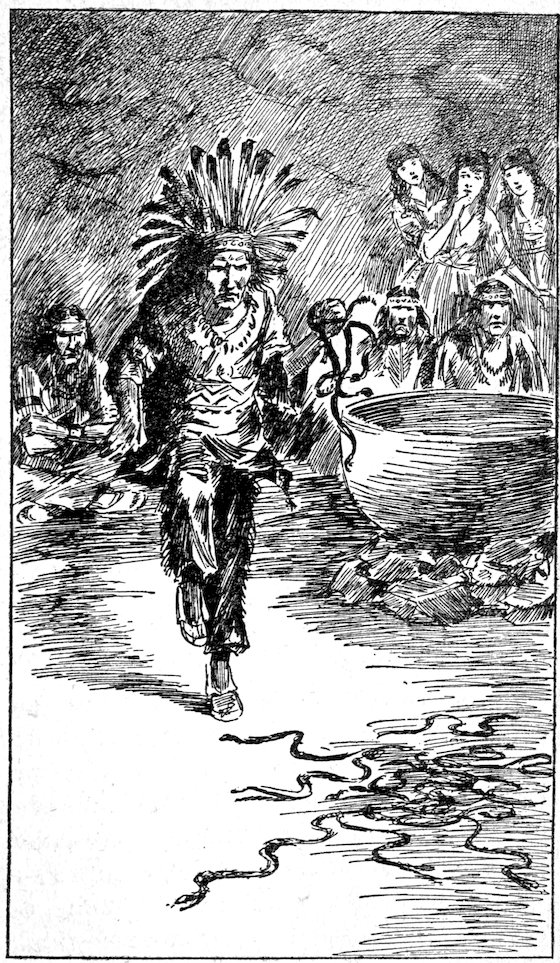
The Great Mass Wriggled and Curved
254Yet Mrs. Burton feared the girls would
oppose the return to camp.
The actual Snake dance did not take
place till sundown.
Fortunately no one objected to going
down to camp for food and rest, except
Alice Ashton. Alice seemed perfectly calm
and self-possessed. As she was making a
study of Indian customs, she was aggrieved
at being taken away in the midst of the
most interesting part of the ceremony.
However, she was too well brought up to
do more than mildly object.
Then, as they made their way toward
the nearest trail leading down the precipitous
mesa, almost at the same instant several of
the Camp Fire group missed Bettina.
CHAPTER XIX Readjustments
255
“It is incredible, Bettina’s talent for
disappearing,” Mrs. Burton said to
Peggy in a low voice, torn between
anxiety and anger.
But this time it was Peggy who appeared
the more uneasy and required cheering.
“I don’t think Bettina is responsible for
her accident exactly, Tante,” she returned.
“And something unexpected must have
happened this time. I hate the thought
of the ‘Little Princess,’ as I used to call
her, being alone in a mixed crowd like this.
No one appreciates how shy she is and she
really isn’t much good at looking after
herself; Aunt Betty has always been so
careful with her.”
“Well, we won’t trouble about that
now,” Mrs. Burton remarked more reassuringly,
appreciating Peggy’s greater nervousness.
“The thing is to look for her;
she can’t be far away and doubtless we shall
256find her in a few moments. Bettina
must have waited behind when we came
out of the kiva. I was so uncomfortable
or I should have noticed before that she
did not follow us.”
“Bettina was not in the kiva with us;
I found that out while we were there; but
it was not worth while to speak of it until
we had come out and you were better.”
Polly’s lips twitched a little with a
smile not unmixed with criticism of herself.
“Peggy, dear, I really think you ought
to be Camp Fire guardian instead of me;
you have so much more sense,” she whispered,
turning to go back.
“I hate being called sensible,” Peggy
returned ungratefully. “I know it makes
me less attractive than other girls.” And
this really is the unreasonable attitude
of a good many persons who have otherwise
a tremendous lot of sense, not realizing
perhaps that good judgment is about the
most valuable human attribute.
Ten minutes afterward Peggy and Mrs.
Burton, who were in advance of the others,
saw Bettina walking toward them with the
257Indian whom they had said good-by to perhaps
three-quarters of an hour before.
The streets were now less crowded, so it
was not difficult to see them. They were
walking in silence, but Bettina’s face was
pale and her lips held close together, perhaps
to keep them from trembling.
Peggy glanced quickly from Bettina’s
face to her aunt’s. And her own heart
sank.
She knew that her beloved Tante was not
a particularly reasonable person at any
time and that Bettina had fallen from
grace, not once but several times since
their camping expedition. She also knew
that Bettina was extremely proud and
reserved, and that she would not condescend
to explanations and asking forgiveness.
Peggy felt that she had rather a task
before her with them both.
“I am sorry, I can’t explain now why I
was delayed,” Bettina exclaimed as she
came up to them. “I only wish you had
not waited for me.”
Then she turned to her companion.
“Thank you, good-by,” was all she said
to him.
258But she did not appear penitent or even
particularly chagrined at any inconvenience
she may have caused the rest of the party.
Then she joined Ellen and Alice and
walked down to their temporary camp
below the mesa with them.
Peggy kept beside her aunt whenever the
descent made it possible, but she did not
talk to her a great deal, nor did she again
mention Bettina.
However, Peggy realized the difficulty
was not over.
Her aunt’s face was whiter than Bettina’s
and her blue eyes held a coldness
which was rare to them, since they were
Irish eyes, usually warm and radiant and
with a compelling power, which was a
mark of her genius.
It was self-evident that she believed Bettina’s
act to have been sheer bravado—a
deliberate intention to remain and talk
alone with the young Indian, in defiance
of her own expressed wish.
After a late luncheon the Camp Fire
group separated, each one of them going to
some chosen spot to rest, the young men
returning to the village.
259Polly went to her own tent worn out
and depressed, knowing that she was not
able to talk to Bettina for the present.
And, more than this, that she must make
up her mind what was best to be done in
the future.
Peggy found Bettina, not in her tent
but sitting some distance away with a book
but making no effort to read.
Peggy sat down beside her and put her
arm across her shoulder.
This was a peculiar boyish fashion which
Peggy had of expressing affection.
“It is all right, Bettina; I don’t blame
you a bit,” she remarked loyally, “only
under the circumstances I do think you
ought to explain to Tante just what happened.
I have not spoken of it to either
of you, but I have seen she did not like
your being friends with Tewa. Still, I
think it is partly because of what your
mother would think.”
“There is nothing I can very well
explain,” Bettina returned. “It is merely
a matter of my word, and I am not even
sure myself of what happened. But, of
course, I will tell; I have really nothing to
260hide. Then you see, Peggy, dear, I am
not accustomed to having my word
doubted.”
Bettina held her chin high with a fleeting
look which suggested her mother,
though she was not usually like her. And,
though Peggy swallowed a sigh, seeing
Bettina had no desire even to confide in her
at present, she asked no further questions,
except to add:
“You’ll go to Tante, won’t you? After
all, she is our Camp Fire guardian and
must feel responsible for us. I don’t think
we will get much from our experience
together unless we accept some leadership.”
And, though Bettina made no reply,
Peggy’s last words did make an impression.
“I think I’ll wait until she sends for
me,” she added finally.
So the girls waited for about two hours
and, by and by, Marie came to say that
Madame Burton would like to speak to
Miss Bettina and that they would find her
at the edge of the peach orchard, on the
other side of their encampment.
Explaining that she knew the place
because she and her aunt had walked there
261together the evening before, Peggy went
with her friend.
But their Camp Fire guardian did not
look very formidable, nor very impressive
when the girls finally discovered her. Until
one came close up to her she looked slender
and young; indeed, like a girl herself.
Marie had brought over a chair and she
was sitting under a big peach tree, with the
fruit hanging rose color and the leaves
green above her head and her hands
clasped together in her lap.
Yet, when they were near enough, Peggy,
who understood her aunt better, saw a
strained look of regret and suffering about
her face, but also a look of determination,
which the friends of Polly O’Neill’s and of
Polly Burton’s understood very well. Possibly,
if she had not been an obstinate person,
she would never have succeeded as she
had in her work.
“I am sorry to have you come so far to
me, Bettina,” she began, “but I preferred
having our talk away from the other girls.
I did not expect you, Peggy, but after all it
is as well you are here. Bettina may tell
you what she does not think it worth while
262to confide in me and that is why—with, so
far as I can see, no real end to gain—she
defies my wish.”
The beginning was unfortunate. The
woman and the two girls realized it at once
and perhaps they were all sorry.
But Bettina’s face flushed and her lips
closed firmly together. Nether girl sat
down and Bettina held her hands clasped
tight together before her. She looked very
pretty and of such delicate high breeding
that, watching her, Mrs. Burton felt a
sensation of self-distrust.
But Bettina was also determined to be
obstinate and ungrateful.
“If you believe I made any effort to
deceive you, it is not worth while my telling
you differently, is there?” Bettina said
in a low voice. “I don’t know how it
occurred; I was stupid, I know, but, as I
started out of the Indian house this morning
just as I got to the door, it closed and
fastened on the outside. I tried to push
it open but could not manage it.”
Mrs. Burton was sitting straight upright
with her eyes fastened on Bettina’s.
“But, my dear child, that sounds ridiculous,
263you know. The door could not have
latched itself; it was too crude and clumsy
an affair. Besides, why did you not call
out? We could not have gotten far
away.” Always she had been too impatient
with the people who did not think
and act quickly, Polly Burton should have
remembered. Also, she might have remembered
the spirit in which she was apt to
receive criticism when she was young. But
this is another something which older
persons forget.
“I did call,” Bettina replied. “But I
think I was too surprised at first. Then I
thought some one would surely come back
and open it for me.”
“And Tewa did come?” Mrs. Burton
asked.
The question was a distrustful and an
unkind one, and there was a painful
silence afterwards.
“Tewa did come, but not for some time
afterwards. The house must have been
empty until then, else I thought the Indian
woman or Dawapa would have heard.
But I did not mean them. I thought whoever
closed the door—” Bettina answered,
264however, with no perceptible change in her
voice.
“But who did close the door?”
Polly was sorry for her last question.
Even if she did suspect Bettina of disobedience
to her, and of a very obstinate
determination to have her own way, she
did not appreciate just how unlovely her
own view of Bettina’s deception was, until
she had given it expression.
“I am not sure,” Bettina replied.
“Besides, I would rather not talk on the
subject any more. Feeling as you do
about me—and for what reason I don’t
understand—I think I would rather go
home as soon as you can arrange it for me.”
Bettina had spoken, but all three of
them knew it was the idea which had been
in their Camp Fire guardian’s mind.
Sorry she was, of course, and perhaps
bitterly disappointed, but the act appeared
inevitable. There could not be misunderstanding
and mutual antagonism between
a Camp Fire guardian and one of her own
group of girls, and particularly away from
home and in the Camp Fire guardian’s
charge.
265“I am sorrier than I can say, Bettina,”
Mrs. Burton added, more gently than she
had yet spoken. “But I am afraid we
don’t understand each other and, as you
are not willing to trust my judgment rather
than your own, why perhaps it is best.
Only your mother will be grieved and
angry and disappointed with both of us.”
And Polly Burton’s voice was suddenly
full of tears. The thought of Bettina being
Betty’s daughter and causing the first real
trouble that had ever come between them
in so many devoted years, filled her with
sorrow and bitterness. After all, she had
hoped to give Bettina a great deal of
pleasure; this was the only possible reason
for bringing her or any of the Camp Fire
girls west, and had she asked a great deal
in return?
And although Bettina heard her Camp
Fire guardian’s reply in silence, she too felt
as if she were in the midst of a wretched
dream from which there seemed to be no
way of awaking. The whole difficulty was
such a matter of misunderstanding, so
“much ado about nothing.” And her
mother and father would be both disappointed
266and offended with her. They both
loved and admired Mrs. Burton more than
almost anyone in the world. It would not
be easy for them to understand why their
daughter should make so manifest a failure
with her.
Clearly Bettina also realized that she
was also forfeiting her position as a Camp
Fire girl. Every effort might be made to
conceal the reason for her being sent home,
but the truth would inevitably become
known, or, if not the truth, something more
trying.
However, Bettina did not speak; it
would not have been possible at the
moment. She was saved from it by Peggy.
Peggy, who never had cried since she
was a baby—about whom it was a joke in
her family that she had not the usual feminine
fountain of woe—now had her eyes
full of tears and her lips shook.
“If Bettina has to go back home, I am
going with her,” she replied firmly, although
her voice was lower than usual.
Mrs. Burton looked at her in astonishment.
“You, Peggy! Then you mean that you
267prefer to take Bettina’s view of the question,
rather than mine; that you think she
has a right to do as she likes, without
respect to my judgment!”
Really, Polly’s tone expressed only surprise
for the instant, as she was too amazed
over Peggy’s lack of loyalty for any other
emotion.
Peggy shook her head. “No, dear; it
isn’t that, and you know I care for you
more than anybody in the world, almost;
but I don’t think you are being fair to Bettina.
If she goes home alone, not only her
own family but mine and all our friends
who find out, will think she has done something
dreadful. And she has not done
anything dreadful so far as I can see.
No one will ever know how I hate giving
up our camping together, yet I feel I
must go.”
“Very well, Peggy,” Mrs. Burton
answered in a voice she had never used to
the girl before. “Suppose we go back now
to camp.”
CHAPTER XX Understanding
268
Just at the door of Mrs. Burton’s tent
Bettina stopped a moment.
“May I come in for a little, please,
Tante; I have not told you everything,”
she said under her breath, her face, which
had been pale until this moment, flooding
crimson.
But it was the first time for several
weeks that Bettina had used the title by
which she had always called Mrs. Burton
when she was a little girl.
“Certainly,” Polly answered quietly,
opening the flap of her curtain and entering,
the two girls following, for Peggy
seemed determined to have a part in each
interview.
Her tent had been a parting gift from
her husband and was an unusually comfortable
one, which held a divan, a low
table and a chair, beside the sleeping cots.
There were Indian blankets on the floor for
rugs.
269Polly sat down on the chair, motioning
to the girls to be seated on the divan.
“I am tired,” she apologized.
And Peggy saw with a pang of remorse
and regret that her aunt looked ill as well
as unhappy over what she had been through
with Bettina and herself. And Peggy also
wondered whether she would ever be forgiven,
realizing what a difference it would
make in all her future life should she lose
her affection. Sitting down now beside
her aunt she did not dare speak to her nor
touch her.
Bettina, however, would not sit down.
Suddenly she looked like a contrite child,
instead of the somewhat arrogant and
superior character she had been pretending
to be for the past few hours.
Reaching into her pocket she drew forth
a small wooden statuette, carved and
brilliantly colored.
“Tewa gave me this; I thought maybe
you ought to have it,” Bettina said penitently.
“It seems absurd to me and yet
I did not like to refuse and hurt his feelings
by not accepting. I think it is a kind of
an idol which is supposed to bring good
270fortune. Anyhow, Tewa won it at an
Indian race this morning, and he gave it
me when he returned to the house and
found me there.”
And, like a child giving away a new doll,
Bettina handed the little image to her
Camp Fire guardian.
Bettina and Mrs. Burton both looked so
absurd that, partly from nervousness and
more from amusement, Peggy giggled
irresistibly.
For an instant Polly and Bettina
attempted to pay no attention to her; then
Mrs. Burton’s blue eyes lightened and she
bit her lips. Bettina only remained grave.
Then, unexpectedly, because she always
had done unexpected things and always
would, Polly Burton, having changed but
little from Polly O’Neill, reached out and
impulsively took Bettina’s hand.
“My dear, I wonder if we have both been
absurd and I have been unfair?” she questioned.
“It is only because I have cared
so much——”
Bettina sat down on the rug and, unlike
her usual reserved self, put her head down
on Mrs. Burton’s knees, covering her face.
271“Please don’t make me go home; I don’t
want to,” she whispered, “but in any case
Peggy shan’t go with me.”
Then, before any one else could speak,
Vera, without asking permission, walked
inside the tent.
“I am so sorry to interrupt,” she began,
“but Gerry Williams asked me to come
and explain something to you. She says
she closed the door on you, Bettina, in the
Indian house this morning, partly for a
joke and perhaps because, in a way she
hoped to make Mrs. Burton angry with
you.”
Vera spoke in an entirely matter-of-fact
fashion, as if there were nothing unusual in
her statement. But the others stared at
her in surprise.
“I thought it was Gerry, but I was not
sure enough to say so,” Bettina murmured,
“and I am afraid I don’t understand now.”
“But why should she?” Mrs. Burton
questioned.
Peggy, as usual, came directly to the
point.
“It wasn’t so extraordinary; Gerry is
built that way. I guessed her measure
272from the beginning. But the thing that
puzzles me, Vera, is not Gerry’s mischievousness,
but how you induced her to
confess.”
“Oh, I saw that something troubled her
and I simply went to her and asked what
it was. I had been just ahead of her when
we left the Indian room and I suspected.
But I did not speak of that. I usually can
persuade people to tell me the things that
worry them.”
Mrs. Burton took Bettina’s hand.
“I am glad we were friends before this
happened, but I am afraid matters are still
wrong as I now have the problem of
Gerry. I did not dream of the difficulties
a Camp Fire guardian might have; certainly
not of so unsuccessful a one as I am.
Gerry will have to go back, and I had
hoped we might do something for her.”
Polly stopped and hesitated.
“Please, not on my account,” Bettina
urged gently. “After all, it was only a
silly thing that Gerry did—not worth much
attention.”
“And after all you have always said,
Gerry has not had the chance the rest of us
273have had,” Peggy interposed, which was
good of her, since she had not liked Gerry
from the beginning, and liked her even less
well now.
Mrs. Richard Burton gave an expressive
shrug of her slender shoulders.
“I expect I am more at fault than any
one else; but life is a matter of the future—not
of the past—isn’t it? And yet I am
sure we have all learned many worthwhile
things from our few months of campfire
life together. So, suppose we let
Gerry have another chance. In the meantime
we may be missing a wonderful sight.
Let us walk toward Oraibi together.”
Taking Bettina’s arm in hers, Mrs.
Burton left her tent, Vera and Peggy just
behind. Then, after calling the other girls,
they went again toward the road near
the mesa crowned with the village of
Oraibi.
In the plain above they could faintly
see the Snake Priests moving around in a
large circle—then more and more quickly.
It was not possible to appreciate exactly
what they were doing, for, although the
Camp Fire party had found a slight elevation
274to stand upon, the mesa remained
many feet above.
It was just as well, however, that they
could not see more distinctly.
They did discover that, when the priests
left the circle of dancers, they ran to the
four quarters of the mesa and cast their
offerings over their sides.
And then the Camp Fire party returned
again to their camp, since the crowds of
tourists were coming quickly down and
darkness was falling.
Neither did they think again of the
young Indian, who went away that night
many miles across the plain to plant a
feather prayer plume at a shrine of white
shells in the desert. Not until morning
did Dawn Light return to the village of
his fathers.
The next volume of the Camp Fire
series will be called “The Camp Fire Girls
at the End of the Trail” and will continue
to tell of the adventures and romances of
the girls in the far West. New characters
will be introduced and new and interesting
developments in the lives of the present
heroines.
BOOKS BY MARGARET VANDERCOOK
The Ranch Girls at Rainbow Lodge
The Ranch Girls’ Pot of Gold
The Ranch Girls at Boarding School
The Ranch Girls in Europe
The Ranch Girls at Home Again
The Ranch Girls and their Great Adventure
THE RED CROSS GIRLS SERIES
The Red Cross Girls in the British Trenches
The Red Cross Girls on the French Firing Line
The Red Cross Girls in Belgium
The Red Cross Girls with the Russian Army
The Red Cross Girls with the Italian Army
The Red Cross Girls Under the Stars and Stripes
STORIES ABOUT CAMP FIRE GIRLS
The Camp Fire Girls at Sunrise Hill
The Camp Fire Girls Amid the Snows
The Camp Fire Girls in the Outside World
The Camp Fire Girls Across the Sea
The Camp Fire Girls’ Careers
The Camp Fire Girls in After Years
The Camp Fire Girls in the Desert
The Camp Fire Girls at the End of the Trail
- Moved “BOOKS BY MARGARET VANDERCOOK” section from the beginning too the end of the
book.
- Silently corrected obvious typographical errors and variations in spelling.
- Retained archaic, non-standard, and uncertain spellings as printed.