“Portland harbor is so beautiful that I hate to leave it,” Ellen said
to the other girls as they were getting under way.
“So do I,” agreed Mabel. “There never was anything so lovely as that
harbor with the lighted bridge running across it.”
“And it just seemed too wonderful to be true for those northern lights
to appear on top of everything else. I would have given anything if
the rest of you had been up on deck to see them too. I didn’t know
what had happened till Breck stuck his head up through the galley
hatch and told me,” Jane said.
“Speaking of Breck,” Frances put in, “have you ever seen anything like
the change in that gentleman? When we first came on board, he was
silent as the grave and solemn as any owl, and now he works around on
deck, whistling and he talks a lot more. And,” she added, “he knows
how to talk remarkably well too.”
“But have you noticed to whom he talks?” inquired Mabel with a teasing
glance at Jane.
“Why no, come to think of it, I hadn’t noticed particularly.”
“As if you would notice anything, Ellen, with Jack anywhere near you.
If I ever get so wrapped up in my fat Charlie, will you all promise to
drown me?” begged Mabel.
“You are both of you unbearable. But promise to drown you? No, it
would hasten your death too much,” and Frances laughed at Mabel’s
pleading face. “The disease is just as bad in you as in Ellen. The
only difference is in the way it affects you. It makes Ellen a little
quieter than usual and you a little noisier.”
The “Boojum” had gathered speed and was roaring along with the spray
coming over the bow and drenching the girls to such an extent that
they were forced to go and sit tamely in the cockpit, a thing that was
distasteful to them all, but particularly to Frances and Jane.
“If our wind and luck hold, we can easily make Vinal Haven tonight,”
said Charlie, looking up from the chart he and Jack had been reading.
“For my part,” announced Frances, “I hope it doesn’t. We have been too
lucky, always doing just what we set out to do. With the exception of
turning over at Plymouth, everything has happened according to Hoyle.”
“Well, we will see if we can’t arrange a little shipwreck for the
bloodthirsty lady from the wild and woolly west,” laughed Jack.
At sunset the “Boojum” was nosing her way through a little group of
islands, lying purple on the dark water. To port lay the largest, its
rocky cliffs taking on weird lights from the sinking sun.
Jane caught her breath in a little gasp of admiration. Reaching for
the chart, she quickly found their whereabouts. “Mr. Wing,” she called
excitedly, “this is just too lovely a spot to pass. The chart says
it’s Hurricane Island and dead ahead is Old Harbor. Can’t we stop here
tonight instead of going on to Vinal Haven. Old Harbor ought to be a
good anchorage. It is protected on three sides by these islands.”
“Why Plain Jane, as far as I am concerned, we can. The others are an
easy-going bunch and generally want to do whatever anybody suggests.
Let me see the chart.”
Jane hung over him until he nodded his head in approval of the
harbor’s description on the chart and then dashed forward to free the
anchor.
“Oh! Breck, did you ever in your life see anything quite as beautiful
as that big island with the sun slipping down back of it?” she asked
him as he leaned against the foremast, looking out for buoys.
“I am mighty glad you asked Mr. Wing to anchor here tonight. I was
just thinking that was just what I would do if I were on my own boat.”
“Can you tell whether those purplish humps on the island are houses or
just huge boulders? It seems a funny place for a settlement and,
besides, there isn’t a single light in any of the windows if they are
houses and not rocks,” asked Jane, peering into the fast-gathering
darkness.
“Tomorrow, if you say so and there is time, I’ll row you over and we
can find out. I don’t believe I ever heard of Hurricane Island before.
It’s a nice adventurous kind of name though.”
Mabel came bouncing along the deck in the way peculiar to her and
broke in with, “Everybody is raving about the beauty of this place
and, of course, I know it is really lovely but nobody will listen to
me and my material thoughts. I have seen one million lobster pots, I
know and, Breck, please try and see tomorrow if you can’t get some for
us. Where there are so many lobster pots, there must be some people
to take the lobsters out.”
The next morning directly after breakfast Jane and Frances took the
dinghy and rowed over to explore a small island running up into a high
peak. Mr. Wing had promised to let the little party stay at this
interesting spot for as long as they liked. The original plan had been
to cruise on to Bar Harbor and then come leisurely back to New York.
With one accord, it had been decided that it would be more fun to stop
at Old Harbor for a few days than to go on to Bar Harbor for, as Mabel
said, “there is nothing at Bar Harbor but clothes and silly little
men,” and Charlie had said, “What about the fluffy little girls?”
Jack and Ellen and Mabel and Charlie had gone out in the tender to
follow some fishermen and make arrangements for getting Mabel the
coveted lobsters. Mr. Wing, the steward, and Breck had stayed aboard
the “Boojum” to keep ship, which meant for Mr. Wing, lying on the deck
mattress and dozing in the sun; for the steward, a general galley
cleaning, and for Breck the filling of many sheets of white paper with
his surprisingly small writing.
“Now that we are here,” Frances said to Jane as she jumped out on the
rocky beach of the island, “I don’t see what in the world we are going
to tie the dinghy to.”
“Why not lug one of these rocks down and set it on the rope? That
ought to hold it,” suggested Jane.
Assuring themselves that the dinghy was made fast, the two friends set
out to see the island. It was literally covered with blueberries, as
they had so often found to be the case in the other little islands
they had seen during the trip.
After eating her fill, Jane announced that she was going to lie down
and go to sleep in the sun.
“Lazy Jane, no sleep for me. I am going to climb to the very top of
the hill and to the very top of the huge rock on top of the hill.
Excelsior! It will be a gorgeous view up there. You ought to come.”
Frances started out with many flourishes of a long stick she had
found.
The warmth of the sun and the sound of the water beating against the
rocks that bordered the island soon sent Jane into a delicious sleep.
Frances clambered up the hill, stopping now and again to look out over
the water, the panorama becoming more beautiful as she climbed higher.
It was difficult climbing too, for there were many loose rocks and
she started several miniature land slides.
On the extreme top of the hill was a rocky plateau, in the center of
which lay a shallow pool of stagnant water. As she drew near, two huge
black crows cawed and flew from its edge.
“Ugh!” she said. “How very gruesome, and how silly for me to be
talking out loud.” Then she heard a little sound as of a sharp,
intaken breath, coming from behind a big, flat rock to the left of
where she stood. She went quickly and leaned over the rock. At the
sight of a man’s prostrate figure she involuntarily drew back.
“Dern the luck,” said the figure in a rather weak voice.
“If you would ask me I would say ‘bless the luck’,” contradicted
Frances, coming forward to see what was the trouble.
At the sound of her voice, the man tried to raise himself on an elbow
but, making a wry face, he gave it up.
“I am in luck now somebody has come, but I have been here since
yesterday afternoon,” he said.
“What in the world happened to you?”
“Slipped on a rock. Think I must have broken my thigh bone; anyway I
can’t move my left leg.”
“It would hurt terribly to move you without a stretcher, wouldn’t it?”
“One thing certain, it couldn’t hurt me any more than just staying
here.”
“Well, then I will go down and get Jane,” announced Frances.
“What good will a Jane do? I don’t want to be rude, but this thing
hurts like the devil.”
“Say whatever you want to; you might be allowed that. I’ll be back in
a jiffy.” Frances shot down the hill with lightning speed. She pounced
on Jane and woke her with a little shake.
Jane rubbed sleepy eyes and raised a critical eyebrow.
“Broken-legged man—up on top—by himself—how in the world can we get
him down?” panted Frances.
“Have to improvise a stretcher,” said Jane, wide awake at once. “Thank
heavens for the blessed old Camp Fire organization. We can take the
oars and slip our skirts on them and that will make a dandy
stretcher.”
“Jane, you are a perfect peach! I never would have thought of that,”
Frances told her friend as they ran down to where they had left the
dinghy.
To their dismay they found that the tide had gone out and the constant
tugging had slipped the rope out from under the rock and the dinghy
was slipping along on the tide about a hundred yards from shore.
Quickly the girls got out of their skirts and, in their jersey silk
bloomers and flannel blouses, waded out into the water toward the
rapidly receding boat.
Giggling a little with excitement, Frances said, “Goodness, but I am
glad we left our shoes on. These rocks would have simply killed our
feet.”
Soon they were in deep water and they struck out with the strong
double over arm that had been the envy of Ellen. In no time, they had
wriggled over the side of the dinghy and were pulling for the island.
This time the two girls dragged the dinghy clear of the receding tide
to be sure that they would have no further misadventures.
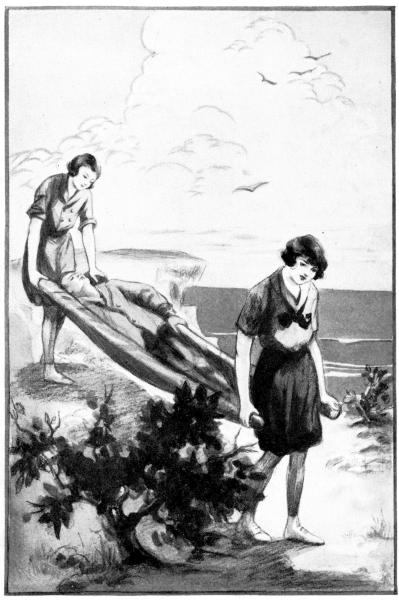
Each one taking an oar and a skirt, they started the uphill climb.
“Suppose you hadn’t found him, Frances. Wouldn’t it have been awful?”
and Jane shuddered a little at the thought. “What does he look like?”
“I didn’t have time to notice much but that he had on a heavy gray
sweater and fearfully dirty white duck trousers. I don’t even know
whether he is big or little.”
On reaching the rocky plateau, Jane exclaimed, “Frances, this is the
most moving-picturey place to discover an injured gent I ever saw!”
Frances led her around the big rock and she looked down at the man.
“How much do you weigh?” Jane asked by way of greeting.
The man smiled a little at this and answered, “One hundred and eighty,
but, after no dinner or breakfast, I suppose I have wasted away to a
mere nothing.”
“Well, Frances, that means each of us carries ninety pounds down the
hill. But we can do it as long as we don’t have to do it every day.”
“Of course, I couldn’t think of letting you do such a thing,” objected
the man.
“I would like to know how you are going to help it. To be sure, we
could go back to the boat and get one of the boys, but that would just
delay the game and I know you ought to get that leg set as soon as
possible. Besides, I don’t believe men are any better in an emergency
than girls, ’specially Camp Fire Girls; do you, Jane?”
The girls slipped the skirts on the oars and laid the improvised
stretcher close beside the man. He was able to help them a little
and, without causing him too much pain, they at last had him on the
stretcher.
“I am awfully sorry for you; it will be hard on you going down this
hill, but we will try not to bump you,” Jane promised him.
The man on the stretcher had not lost a bit of his hundred and eighty
pounds, the girls decided as they lifted their load. Both of them were
thankful for their hard muscles and good wind. After what seemed ages,
they reached the beach and set the stretcher in the dinghy. Then both
of them threw themselves flat on the seaweed that the tide had left
and rested and caught their wind. The man had lost consciousness from
the painful journey down and from lack of food.
“No use bringing him to till we get on the boat. It will hurt him
horribly getting him over the side. Another thing, Jane, there won’t
be room enough for both you and me in the dinghy now. You pull a
better oar than I do, so you get in and row the man out and I’ll swim
along out in a minute. I’ll get there soon after you do.”
“But I could come back for you,” objected Jane. “You must be dead
tired.”
“Of course I don’t feel ‘fresh as a daisy,’ but it is no harder for
me to swim out to the boat than it is to row out.”
There was no one on deck of the “Boojum” as Jane brought the dinghy
carefully alongside. She called to Breck and he came up from the
galley.
At his surprised look she said, “Frances found this broken-legged man
up on the top of the hill on that island and we brought him down. He
has fainted or something and I don’t see how we can get him over the
side of the ‘Boojum’.”
“How in the world you two kids did it is beyond me, but I will ask
questions later. Mr. Wing and I can rig up a bosun’s chair and get him
on board all right.”
Breck waked Mr. Wing and they set to work to rig the bosun’s chair and
soon had the man lying on one of the transoms in the saloon.
“Now,” said Mr. Wing, “it yet remains for us to get a doctor to him.”
“Mr. Wing,” said Breck in an embarrassed way, “it wouldn’t do for me
not to tell you this. I have had three years of medicine at Harvard
and was with an ambulance corps in France during the first two years
of the war. What I mean is that I can set the leg and I think I had
better do it before it swells any more. Jane, you get some waste from
the locker to the right of the engine and pack some long planks for
the splints. If it is necessary, we can get him into a cast at
Portland.”
With deft hands Breck got off the man’s shoe and cut away the duck
trousers. Jane, with her head in a whirl, found two suitable boards in
the galley, evidently parts of a box in which provisions had come, and
she mechanically began to pad them with waste. “That makes him about
thirty,” she thought, “because it has been two years since the war. I
hope he doesn’t think of me as a perfect kid. I will be twenty-one in
a month, anyway.”
A wet and bedraggled Frances clambered over the side and appeared in
the saloon just in time to get a weary, grateful smile from the man as
he came to.