It was a golden July afternoon two
months later when all nature was a
splendid riot of color and perfume.
In a hammock under a group of pine trees
a girl lay half asleep. Now and then she
would open her eyes to glance at the lazy
white clouds overhead. Then she would
look with perhaps closer attention at the
figure of another girl who was seated a few
yards away.
If the girl in the hammock was dreaming,
her companion fitted oddly into her dream.
She was dressed in a simple white muslin
frock and her hair had a band of soft blue
ribbon tied about it. In her lap lay an
open book, but no page had been turned
in the last fifteen minutes and indeed she
was quieter than her friend who was supposed
to be asleep.
“Betty,” a voice called softly, “bring
your chair nearer to me. I have done my
219
duty nobly for the past two hours and have
not spoken a single, solitary word. So
even the sternest of doctors and nurses
can’t say I am unfaithful to my rest cure.
Besides it is absurd, now when I am as
well as any one else. Yes, that is much
better, Betty, and you are, please, to gaze
directly into my face while I am talking to
you. I haven’t liked your fashion lately
of staring off into space, as you were doing
just recently and indeed on all occasions
when you believe no one is paying any
special attention to you.”
With a low curtsey Betty did as she was
commanded. She even knelt down on the
ground beside the hammock to look the
more directly into the eyes of her friend.
But as she continued, unexpectedly a slow
color crept into her cheeks from her
throat upwards until it had flushed her
entire face.
“I declare, Polly,” she exclaimed jumping
to her feet abruptly and sitting down in
her chair again, “you make me feel as though
I had committed some offence, though I do
assure you I have been as good as gold, so
far as I know, for a long, long time.”
220
Polly was silent a moment. “You know
perfectly well, Betty, that I don’t think
you have done anything wrong. You need
not use that excuse to try and deceive me,
dear, because it does not make the slightest
impression. The truth is, Betty, that you
have a secret that you are keeping from me
and from every one else so far as I know.
Of course there isn’t any reason why you
should confide in me if you don’t wish.
You may be punishing me for my lack of
confidence in you last winter.”
This last statement was possibly made
with a double intention. Betty responded
to it instantly.
“Surely, Polly, you must know that
would not make the slightest difference,”
she returned earnestly. And then the next
instant, as if fearing that she might have
betrayed herself: “But what in the world
makes you think I am cherishing a secret,
you absurd Polly? I suppose you have had
to have something to think about these
past two months, when you have spent so
much time lying down. Well, when I see
how you have improved I am quite willing
to have been your victim.”
221
With a quick motion the other girl now
managed to sit upright, piling her sofa
cushions behind her. Her color was certainly
sufficiently vivid at this instant.
But indeed she was so improved in every
way that one would hardly have known her
for the Polly O’Neill of the past year’s
trials and successes. Her figure was almost
rounded, her chin far less pointed and all
the lines of fatigue and nervous strain had
vanished from her face. But Polly’s temper
had not so materially changed!
“It isn’t worth while to accuse me of
having tried to spy into your private
affairs, Princess,” she replied haughtily.
“But if you do feel that I have, then I
ask your pardon for now and all times.
I shall never be so offensive again.”
There followed a vast and complete
human silence. Then Polly got up from
her resting place and went and put her arm
quietly about her friend.
“Princess, I would rather that the stars
should fall or the world come to an end,
than have you really angry with me,” she
murmured. “But you know I did not mean
to offend you by asking you to confide in
222
me, don’t you? Anyway I promise never,
never to ask you again. Here, let me have
the Woodford paper, please. I believe
Billy brought us the afternoon edition.
I wonder if he and Mollie will be gone on
their boating expedition for long? They
must have been around the lake half a
dozen times already.”
As though dismissing the subject of their
past conversation entirely from her mind,
Polly, resuming her hammock, now buried
herself in the columns of the Woodford
Gazette. Apparently she had not observed
that no reply had been made either to her
accusation or apology. She could see that
Betty was not seriously angry, which was
the main thing.
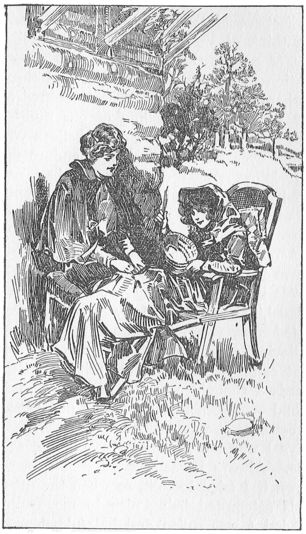
“Get out your embroidery, Princess,
and let me read the news aloud to you;”
she demanded next. “I love to watch you
sew. It is not because you do it so particularly
well, but because you always
manage to look like a picture in a book.
Funny thing, dear, why you have such a
different appearance from the rest of us.
Oh, I am not saying that probably other
girls are not as pretty as you are, Mollie
223
and Meg for instance. But you have a
different look somehow. No wonder Angel
thinks you are a fairy princess.”
But at this moment an unexpected
choking sound, that seemed in some fashion
to have come forth from Betty, interrupted
the flow of her friend’s compliments.
“Please don’t, Polly,” she pleaded.
“You know I love your Irish blarney most
of the time beyond anything in this world.
But now I want to tell you something.
I have had a kind of a secret for over a
year, but it is past now and I’m dreadfully
sorry if you believe you find a change in
me that you don’t like. I suppose sometimes
I do feel rather blue simply because
I am of so little account in the world.
Please don’t think I am jealous, but you
and Sylvia and Nan and Meg are all doing
things and Esther and Edith and Eleanor
are married and Mollie helps her mother
with your big house. I believe Beatrice
and Judith are both at college, though we
have been separated from them for such a
long time. So you see I am the only good-for-nothing
in the old Sunrise Hill Camp
Fire circle.”
224
“Yes, I see,” was the somewhat curt
reply from behind the outspread paper.
“Mrs. Martins told me yesterday that
the surgeons Dr. Barton brought to see
Angelique think she may be able to walk
in another year or so and I believe Cricket
is to give up her crutches altogether
in a few months,” Polly presently remarked.
In the sunshine Betty Ashton’s face shone
with happiness. “Yes, isn’t it wonderful?”
she remarked innocently.
“Of course, doing beautiful things for
other people isn’t being of the slightest
use in the world,” the other girl continued,
as though talking to herself. “Yet Mrs.
Martins also said yesterday, that she and
Angelique believed they had strayed into
Paradise they were so happy here at the
cabin with the prospect of Angel’s growing
better ahead of them. And I believe
Cricket dances and sings with every step
she takes nowadays.”
“But I?” interrupted Betty.
“No, of course you have had nothing
in the world to do with it and I never
accused you for a single instant,” her
225
friend argued, and then Polly fell to reading
the paper aloud.
“‘The friends of Doctor and Mrs. Richard
Ashton, now of Boston, Massachusetts, but
formerly of Woodford, New Hampshire,
will be delighted to hear of the birth of
their son, Richard Jr., on July the fourteenth.’
How does it feel to be an aunt?”
the reader demanded.
“Delicious,” Betty sighed, and then began
dreaming of her new nephew, wondering
when she was to be allowed to see him,
until Polly again interfered with her train
of thought.
“‘Mr. and Mrs. Frank Wharton entertained
at dinner last night in their new home
in honor of Mr. Anthony Graham, our
brilliant young congressman who has returned
to Woodford for a few days.’ Well,
I like that!” Polly protested. “Think of
Frank and Eleanor daring to give a dinner
party and asking none of their other old
friends or relatives. They must feel set
up at being married before the rest of us.”
For the first time Betty now actually
took a few industrious stitches in her
embroidery. “Oh, they probably did not
226
have but two or three guests. You know
how papers exaggerate things, Pollykins,
I would not be so easily offended with my
relations,” she protested.
“No, but you used to be such an intimate
friend of Anthony Graham’s. Do
you know I look upon him as one of your
good works, Betty? I wonder if he will
condescend to come to the cabin to see us,
now he is such a busy and distinguished
person. Is he as much a friend of yours
now as he used to be?”
Unexpectedly Betty’s thread broke, so
that she was forced to make another knot
before replying.
“Friend of mine? No, yes; well, that is
we are friendly, of course, only Anthony has
grown so fond of Meg Everett lately that
he has not much time for any one else.
But please don’t speak of anything I
ever did for him, Polly. I beg it of you as
a special favor. In the first place it was so
ridiculously little and in the second I think
it pretty hard on Anthony to have an
unfortunate accident like that raked up
against him now that he has accomplished
so much.”
227
“Oh, all right,” Polly returned, thoughtfully
digging into the earth with the toe
of her pretty kid slipper.
“Good heavens, speaking of angels or
the other thing!” she exclaimed, a moment
later, “I do declare if that does not look
like Anthony Graham coming directly toward
us this instant. Do go and speak to
him first, dear, while I manage to scramble
out of this hammock.”
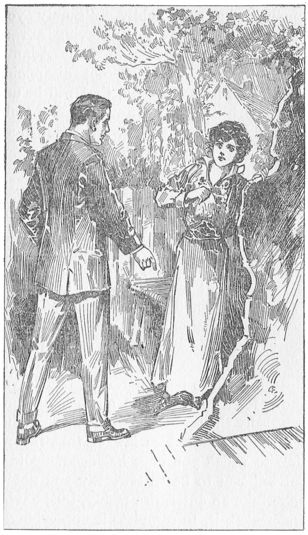
Ten minutes later Anthony was occupying
the chair lately vacated by Betty,
while Polly was once more in a reclining
position. Knowing that she was still
regarded as a semi-invalid, Anthony had
insisted that she must not disturb herself
on his account. He had explained that
the reason for his call was to find out how
she was feeling. So, soon after this statement,
Betty had left the two of them
together, giving as an excuse the fact
that as she had invited Anthony to stay
with them to tea she must go to the cabin
to help get things ready.
After Betty’s disappearance Polly did
not find her companion particularly interesting.
He scarcely said half a dozen
228
words but sat staring moodily up toward
the dark branches of the enshadowing pine
trees. This at least afforded Polly a fine
opportunity for studying the young man’s
face.
“You have improved a lot, Anthony,”
she said finally. “Oh, I beg your pardon,
I am afraid I was thinking out loud.”
Her visitor smiled. “Well, so long as
your thoughts are complimentary I am
sure I don’t mind,” he returned. “Keep
it up, will you?”
The girl nodded. “There is nothing I
should like better. You know it is odd,
but the Princess and I were talking about
you just when you appeared. I must say
I am amazed at your prominence, Anthony.
I never dreamed you would ever amount
to so much. It was funny, but Betty used
always to have faith in you. I often wondered
why.”
This time her companion did not smile.
“I wish to heaven then that she had faith
in me now, or if not faith at least a little
of her old liking,” he answered almost
bitterly. “For the last year, for some
reason or other, Miss Betty has seemed to
229
dislike me. She has avoided me at every
possible opportunity. And I have never
been able to find out whether I had
offended her or if she had merely grown
weary of my friendship. I have been so
troubled by it that I have made a confidant
of Miss Everett and asked her to help me
if she could. I thought perhaps if Betty—Miss
Betty, I mean—could see that Meg
Everett liked me and was willing to be my
intimate friend, that possibly she might
forgive me in time. But it has all been of
no use, she has simply grown colder and
colder. And I fear I only weary Miss
Everett in talking of Miss Betty so much
of the time. She recently told me that I
did.”
Polly’s lips trembled and her shoulders
shook. What a perfectly absurd creature
a male person was at all times and particularly
when under the influence of love!
The next moment the girl’s face had
strangely sobered.
“You are not worthy to tie her shoe-string,
you know, Anthony; but then I
never have seen any one whom I have
thought worthy of her. Most certainly
230
neither Esther nor I approved of the
nobility as represented by young Count
Von Reuter.”
Aloud Polly continued this interesting
debate with herself, apparently not concerned
with whether or not her companion
understood her.
“Certainly I am unworthy to tie any one’s
shoe-string,” the young man murmured
finally, “but would you mind confiding in
me just whose shoe-string you mean?”
From under her dark lashes half resentfully
and half sympathetically the girl surveyed
the speaker. “You have a sense of
humor, Anthony, and that is something to
your credit,” she remarked judicially.
“Well, much as I really hate to say it, I
might as well tell you that I don’t think
the Princess dislikes you intensely, provided
you tell her just why you have been
so intimate with Meg for these past
months. No, I have nothing more to say.
Only I am going down to the lake for half
an hour to join Mollie and Billy Webster
and if you wait here you may have a
chance of speaking to Betty alone when she
comes to invite us in to tea.”
231
Then quietly Polly O’Neill strolled away
with every appearance of calmness, although
she was really feeling greatly perturbed
and distressed. Certainly something must
have worked a reformation in her character,
for although she positively hated the
idea of Betty Ashton’s marrying, had she
not just thrust her deliberately into the
arms of her fate. Yet, of course, her feeling
was a purely selfish one, since she had no
real fault to find with Anthony. So if
Betty loved him, he must have his chance.
Then with a smile and a sigh Polly once
more shrugged her shoulders, which is the
Irish method of acknowledging that fate is
too strong for the strongest of us. She
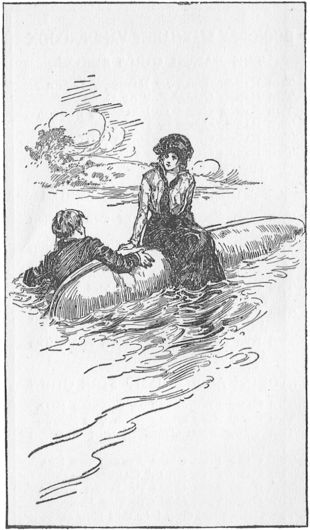
reached the edge of the lake and madly
signaled to Mollie and Billy to allow her
to enter their boat. They were at no
great distance off and yet were extremely
slow in approaching the shore. Evidently
they seemed to feel no enthusiasm for the
newcomer’s society at the present moment.
“I thought you were asleep, Polly,”
Mollie finally murmured in a reproachful
tone, while Billy Webster eyed his small
canoe rather doubtfully.
232
“She won’t carry a very heavy load,
Miss Polly,” he remarked, drawing alongside.
Polly calmly climbed into the skiff,
taking her seat in the stern.
“I can’t sleep all the time, sister of
mine,” she protested, once she was comfortably
established, “much as I should
like to accommodate my family and friends
by the relief from my society. And as for
my being too heavy for your canoe, Billy
Webster, I don’t weigh nearly so much as
Mollie. So if you think both of us too
heavy, she might as well get out and
give me a chance. You have been around
this lake with her at least a dozen times
already this afternoon. Besides, I really
have to be allowed to remain somewhere.”
Plainly Mollie’s withdrawal from the
scene had no place in Billy’s calculations,
for without further argument he moved
out toward the middle of the pond.