The commemoration of the Pascha is the first
annual Christian solemnity with which history makes
us acquainted. And it will be well that the student
should bear in mind that the term ‘Pascha’ was
used in early times to signify, more particularly, not
Easter (for which it was used in later times), but
the day of the Lord’s Crucifixion, more commonly
without, and sometimes together with, the succeeding
two days, including the day of the Resurrection.
But most commonly the word is employed in the
earlier literature of the subject to signify the commemoration
of the day of the Crucifixion, which was
generally held to have corresponded in the history
of the Passion to the day upon which the Paschal
lamb was sacrificed in the Jewish ritual[140].
It is scarcely possible to conceive that, even if
the Christian religion had taken its rise in circumstances
altogether dissimilar from those amid which
as a matter of history it actually emerged, there
would have been no commemoration of such great
events as the death and rising again of its Founder.
But the first disciples of Christ being Hebrews, and
their converts at first being also in a large measure
Hebrews, it was inevitable that the great Hebrew
festival of the Passover should take to itself a new
colouring and a new significance in Christian thought.
Thus we find St Paul speaking of Christ as ‘our
Pascha’ (i.e. Paschal victim), which ‘hath been sacrificed
for us’ (1 Cor. v. 7). And he adds, ‘therefore
let us keep the feast (or keep festival) not with the
old leaven, neither with the leaven of malice and
wickedness, but with the unleavened bread of sincerity
and truth.’ It would indeed be unwarrantable
to infer from this passage that a Christian Pascha
was actually observed as a festival at the time when
St Paul wrote to the Corinthians. But it is obvious
that the passage is steeped in reminiscences of the
Hebrew festival, and that these are already receiving
a new complexion and a new meaning.
The observance of the Christian Pascha first
comes into marked prominence about the middle
of the second century. At that date it was everywhere
a recognised institution of the Church; but
there were differences between the Churches of proconsular
Asia (the Asia of the seven Churches of
the Apocalypse) and the Church at Rome and in
other places, as to the particular day upon which the
commemoration should be observed. The evidence
with regard to the early stages of the dispute is
scanty. Such details as we possess are not free from
obscurity and have been variously interpreted.
In a work like the present volume we can do
no more than lay before the student the results
which seem to us to have the greater weight of
probability in their favour.
The Asiatics, it would seem, began to celebrate
the festival of the Pascha on the fourteenth day of
the moon of the Hebrew month Nisan, the day upon
which the Jews put away all leaven from their houses
and slew the lamb of the Passover. On the whole,
the evidence seems to make for the Asiatic Christians
terminating the preceding fast on the evening of
that day, and on the same evening celebrating the
Paschal feast consisting of the Eucharist, accompanied,
perhaps, by the Agape. It was on the fourteenth
Nisan, according to the prevailing Asiatic belief, that
the Lord suffered death upon the cross, and in His
sacrifice became the true representative of the Paschal
lamb which had been his antitype. Foreign as it
must be to us with our habits of thought to conceive
of a festival being kept on the day of the Crucifixion
(that is, on the evening which was regarded as the
beginning of the following day), we must suppose
that the realisation of the blessings of the redemption
purchased by the Saviour’s blood overtoned (to borrow
a term from the art of music) the imaginative presentment
of the historical sufferings of the Cross.
Our own English term, ‘Good Friday,’ seems to have
originated with a similar way of regarding the facts[141].
From what has been said, it will be apparent
that, as the fourteenth day of the moon might fall
upon any day in the week, the commemoration of
the Resurrection, three days later, might also fall
upon any day of the week. At Rome, and in various
other places, the festival of the Resurrection was
always observed on a Sunday, because it was on the
first day of the week that the Saviour rose from the
dead. The Asiatics laid stress on the day of the
month—the lunar month—on which the Saviour
suffered: the Roman Church insisted that the sixth
day of the week, Friday, was the proper day for commemorating
the Crucifixion, and that the following
Sunday should be kept as the feast of the Resurrection.
Those who made the fourteenth day of the
moon to be necessarily the day for the celebration
of the Pascha were known as ‘Quartodecimans[142].’
The dispute was further complicated by the
difference with regard to the observance of the fast.
The Asiatics terminated their fast on the evening
of the day of the Crucifixion. The Romans continued
it till the morning of the day of the Resurrection.
The Asiatics claimed St John and St Philip, the
Apostles, as the originators of the usage which they
followed; and at the close of the second century
they were able to recite a long list of holy bishops
and martyrs who had never deviated from the practice
of their Churches.
It was some time about the middle of the second
century that St Polycarp, bishop of Smyrna, the
personal disciple of St John, visited Rome, and conferred
with Anicetus, the bishop of that city, on this
and other subjects. On the Paschal question neither
bishop was convinced by the other; but it was agreed
that on such a matter it was not essential that there
should be uniformity. The discussion was carried
on with moderation, the two bishops received the
Eucharist together, and Anicetus, ‘out of reverence’
for Polycarp permitted him to act as celebrant in
his church[143].
The subject of the proper time for observing the
Christian Pascha continued to excite discussion;
and between A.D. 164 and 166, on the occasion of
disputes at Laodicea, a defence of the practice of
proconsular Asia came from the pen of one of the
bishops of that region, Melito, bishop of Sardis.
Unfortunately no remains of the work of Melito
survive of such a kind as would help us to understand
the writer’s argument, or to clear the difficulties
which surround the attempt to form a well
assured picture of the practice of his part of the
Christian world. It has indeed been conjectured
that the work of Melito was directed mainly against
certain sectaries, perhaps Ebionites, who on the fourteenth
day of Nisan feasted after the manner of the
Jews upon a paschal lamb. This practice was so
distinctly Judaistic, that it was rejected everywhere
by the orthodox.
Of vastly more importance and significance, as
affecting the whole Church, were incidents which
occurred towards the close of the century. Victor,
bishop of Rome, successor next but one to Anicetus,
was a man of different temper; or, at all events, he
attached a much higher importance to uniformity
as to the time of observing Easter. Interest in the
question was roused in various quarters. Councils
of bishops (at the instance of Victor) discussed it
in Gaul, in Greece, in Palestine, in Pontus, and as
far east as Osrhoene beyond the Euphrates. By this
time it was found that what, for convenience, we
may style the Western practice was also largely
followed in the East. The churches, however, of
proconsular Asia still maintained their old position.
A letter written by Polycrates, bishop of Ephesus,
to Victor on their behalf is preserved by Eusebius[144].
Victor, departing from the moderate policy of
his predecessor Anicetus, thought the time had come
for dealing more drastically with his opponents on
the Paschal question, and sought to cut them off
from the communion of the Catholic Church[145].
Victor’s attitude called forth remonstrances from
various quarters, and was the occasion of a remarkable
letter written by Irenaeus, bishop of Lyons, in the
name of the brethren in Gaul, over whom he presided.
He declares that the mystery of the Lord’s Resurrection
should indeed be celebrated only on a Sunday,
yet he strongly urges the impropriety of Victor’s
cutting off ‘whole Churches of God’ because of
differences on such a matter. He then adds that
the controversy was not only on the question as to
the day on which Easter should be celebrated, but
also on the length and manner of the preceding fast,
varieties as to which he recounts (see p. 79); and
he goes on to remind Victor that bishops of Rome
in former times, while strictly preserving their own
usages, did not break the peace of the Church by
excommunications directed against those who followed
other ways[146]. Letters of similar purport were addressed
by Irenaeus to various other bishops. The result of
this intervention was that the Asiatic Churches were
for the time left undisturbed in the practice of their
traditional usages. How soon the Asiatic Churches
fell into line with the majority is not apparent. But
it seems evident that the change had taken place
before the Council of Nicaea.
We have seen that in the attempts to commemorate
on the proper days the death and resurrection
of the Lord, the Asiatics thought most of
the day of the month, and the Westerns and those
who concurred with them thought most of the day
of the week. But the latter party had obviously to
make some attempt to lay down a rule which would
at least approximate the date of their Pascha to
the time of the year when the Lord suffered. The
vernal equinox was taken by them, and by the
Church of Alexandria, as the fixed point to which
the date of Easter should bear some settled relation.
It is perhaps impossible to determine with precision
when the rule came to be generally accepted
that the full moon, which was to regulate the date
of Easter, was the first full moon after the vernal
equinox. We find that this is the rule which
governs the Paschal Tables of Hippolytus (of which
more will be said hereafter), and we find it expressly
enjoined in that ancient collection of Church law
which goes under the name of the Apostolic Canons.
The Tables of Hippolytus can, with reasonable
certainty, be assigned to A.D. 222. In the Apostolic
Constitutions, the date of which it is impossible to
determine with any close approach to certainty[147], the
rule runs, ‘Observe the days of the Pascha with all
care after the vernal equinox, that ye keep not the
memorial of the one passion twice in a year. Keep
it once only in a year for Him who died but once[148].’
The mystical reason assigned here also appears in
the letter of the Emperor Constantine, announcing
the decision to which the Nicene Council came upon
the Paschal question[149]. Later on the reader will find
what is probably meant by keeping the Pascha twice
in the same year[150].
It would not perhaps be fitting to pass over in
silence the attempt made in the early part of the
third century by the Roman ecclesiastic, Hippolytus,
to construct a cycle which would make it possible
to predict the day on which Easter would fall in any
future year.
As to who this Hippolytus was, Eusebius and
subsequent students among the Fathers appear to
have known scarcely anything. Eusebius speaks of
the many writings of Hippolytus, and gives the titles
of some of them, and describes one more particularly.
This was a treatise Concerning the Pascha, in which
was to be found a certain sixteen-year rule (canon)
about the Pascha, the boundary of the writer’s computation
being the first year of the Emperor Alexander[151],
i.e. Alexander Severus, whose first year was A.D. 222.
The brief statement of Eusebius, dull and prosaic
in itself, acquired suddenly a new and extraordinary
interest in the year 1551, when during some excavations
made in the neighbourhood of Rome, in the
Via Tiburtina (the road to Tivoli), a much shattered
statue was unearthed, which on being pieced together
exhibited, on the sides of the chair in which the figure
of a venerable looking man was represented as seated,
two elaborate numerical tables, in Greek characters,
one showing the day of the month on which the
Pascha, or fourteenth day of the moon, would fall
from A.D. 222 to A.D. 333: the other showing, for
the same number of years, the day of the month
upon which Easter ought to be kept. The statue,
as restored, may now be seen in the Museum of the
Vatican. The Tables are constructed in seven
columns of sixteen years each. On the back of the
chair were inscribed in Greek the titles of various
books, many of which corresponded with the titles of
works attributed to Hippolytus by Eusebius. There
could be no reasonable doubt that the statue was the
statue of Hippolytus, and that the Tables represented
his calculations as to the time for keeping Easter.
A further confirmation of the correctness of this
inference (though confirmation was indeed scarcely
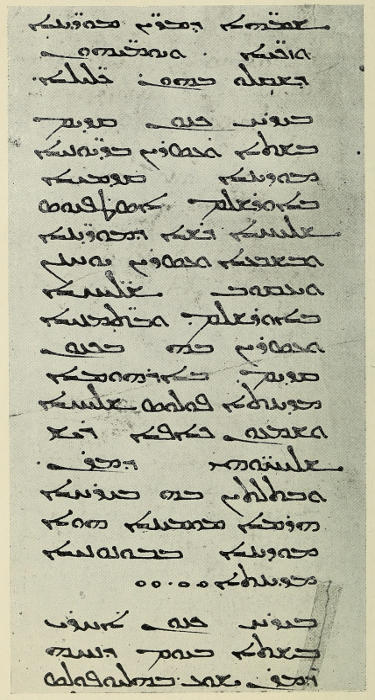
needed) emerged when a Syriac version of the Cycle
of Hippolytus was discovered in a chronological
treatise by Elias of Nisibis[152]. It corresponds exactly
with the Tables inscribed on the chair.
An examination of the Tables of Hippolytus
reveals that he assumed ‘that after eight years
the full moons returned to the same day of the
solar month; and he took notice that after sixteen
years the days of the week moved one backward;
that is to say, the full moon in the first year of
the cycle being Saturday, April 13, after sixteen
years it would be Friday, April 13, and so on[153].’ But
for the purposes of what he supposed would be a
perpetual Kalendar, Hippolytus desired to ascertain
after what interval the full moon would fall not only
on the same day of the solar month, but on the same
day of the week. He assumed that this would happen
after seven cycles of sixteen years.
We can also infer that Hippolytus probably
placed the vernal equinox on March 18, for every
full moon entered in his Tables is placed either
on (as in the case of A.D. 235) or after that date.
Again, the examination of his Tables reveals
what may seem to us the somewhat arbitrary regulation
that if the full moon fell upon Saturday the
Feast of the Resurrection should not be kept on
the following day, but on Sunday a week later.
The explanation probably is that it was considered
that Easter should never be held earlier than the
sixteenth day of the moon, that is, two days after
the day of the Crucifixion. If the full moon fell
upon Friday, then the following Sunday would be
Easter; but if the full moon fell upon Saturday, the
day of the Crucifixion was taken to be the following
Friday, and Easter would be two days after.
No Easter cycle yet devised is free from errors,
which have to be met by adjustments; but the Cycle
of Hippolytus was such that the errors accumulated
rapidly. It was more than two days wrong at the
end of the first sixteen years; and five days wrong
at the end of the second cycle; at the end of the
third cycle it would be nine days wrong[154]. This must
have been soon discovered; and the cycle had to
be discarded. It is the earliest Easter cycle known
to us.
A cycle on the same lines as that of Hippolytus,
which has been (probably incorrectly) attributed to
St Cyprian, will be found in Fell’s edition of Cyprian
(1682), among the works commonly assigned to that
writer. By whomsoever it was composed it is ushered
in with a great flourish of trumpets, and the author
feels sure that he has been led by nothing short of
divine inspiration to the discovery. These Tables
can be assigned to A.D. 243. One cannot but suspect
that the author had got hold of the Hippolytean
Tables before their worthlessness was discovered.
Such seem to have been the best efforts of the
learning of Western Christendom in the third century
to deal with the Paschal problem. Nor at this
period was the Church of Alexandria, which at a
later date became the paramount authority on such
questions, any better equipped. Dionysius, about
the middle of the third century, justly styled by
Eusebius ‘the great bishop of Alexandria,’ made use
of the eight-year cycle, which, like its variant, the
sixteen-year cycle, gathered error rapidly.
It was, however, another distinguished Alexandrian,
more than a quarter of a century later, who
was the first, so far as we know, to make use of
the old nineteen-year cycle for the determination of
Easter. This was Anatolius, a native of Alexandria,
and eminent for learning of various kinds (among
which arithmetic, geometry, and astronomy are particularised),
who became bishop of Laodicea in Syria
Prima in A.D. 270. The nineteen-year cycle, with
some modifications, eventually, though slowly, displaced
all rivals[155].
We may pass on now to the consideration of the
determinations on this question arrived at by the
Council of Nicaea.
The varieties of usage as to the dates of keeping
the Pascha had disturbed the mind of Constantine
before he issued his invitations to the bishops of the
empire to attend the Council. His trusted adviser,
Hosius, bishop of Corduba, had been sent by him
to the East in the hopes that by his arguments
and persuasion the followers of the Eastern practice
might be induced to yield. But the mission was
ineffective, and the matter was submitted to the
great Council in A.D. 325. We have no record of
any of the proceedings connected with the matter
beyond what is to be found in a Synodical Letter
of the Council, and a circular letter of the Emperor.
We cannot help feeling some surprise that the Council
did not enact any canon on the subject; but it
was probably believed that the adoption of a rigid
canon, with an attendant anathema, might have
produced a formal schism, while a statement of the
opinion of the Council could scarcely fail to be highly
influential in eventually securing uniformity. The
letter of the Council, preserved by Socrates[156], is addressed
to the Church of Alexandria and the brethren
in Egypt, Libya, and Pentapolis. It simply announces
‘the good news’ that, in accordance with the desire
of those to whom the letter was addressed, the question
had been elucidated by the Council, and that all
the brethren of the East, who had formerly celebrated
the Pascha ‘with the Jews,’ will henceforth keep it
‘at the same time as the Romans, and ourselves, and
all those who from ancient times celebrated the day
at the same time with us[157].’
The Emperor is more full. He says that it was
thought by all that it would be fitting that the
Pascha should be kept on one day by all; that it
was declared to be particularly unworthy to follow
the custom of the Jews who had soiled their hands
with the most dreadful of crimes, and who are blinded
with error, so that they even frequently celebrate two
Paschas in one year. ‘Our Saviour has left us only
one festal day of our deliverance, that is to say, of
his holy passion; and he has willed that his Catholic
Church should be one.’ How unseemly is it that
some should be fasting while others are seated at the
banquet! He hopes that every one will agree in this.
It had been resolved that the Pascha should be kept
everywhere on one and the same day[158].
There is nothing in these letters to show what
rule had been established. All that is laid down
is that the Pascha should be kept everywhere on
the same day; and it assumed that the Roman and
Alexandrian rules as to Easter were identical, and
were well known. As a matter of fact, while the
Churches of Rome and Alexandria were at one both
in keeping Easter on a Sunday, and on a Sunday
after the vernal equinox, they were not agreed in
their methods of calculating the Sunday upon which
Easter would fall. Hence, long after the Council
of Nicaea, several instances occur in which a day
was taken for the Easter festival at Rome which
differed from the day which the Alexandrian experts
had calculated to be the correct day.
It is worthy of observation that the Emperor in
his letter reprobates what he assumes was the Jewish
practice of frequently celebrating two Paschas in the
same year. What is probably meant is that the
Jews at that time (whatever their earlier practice
may have been) did not think it necessary to keep
the Passover after the vernal equinox. Now the
vernal equinox was taken as the beginning of the
tropical or solar year; and it might happen from
time to time that the full moon of Nisan fell in
one year after the vernal equinox, and in the following
civil year before the equinox, which would give
two passovers in the same solar year. If this interpretation
of the words of Constantine’s letter be
correct, it would imply that the Christian Pascha
should always be celebrated after the equinox, which
was certainly already the general practice. But no
specific rule with reference to the equinox is laid
down in express terms either by the Fathers of the
Council or by the Emperor.
It will be observed that in the Letter of Constantine
he states that the Lord has left us ‘only
one festal day of our deliverance, that is to say, of
his holy passion.’ The dominant thought connected
with the word Pascha was still that of the Crucifixion.
At a later period writers, for the sake of accuracy,
made the distinction between the ‘Pascha of the
Crucifixion’ (πάσχα σταυρώσιμον) and the ‘Pascha
of the Resurrection’ (πάσχα ἀναστάσιμον); and
eventually the thought of the Crucifixion disappears
from the connotation of the word, which has
given the name for what we call Easter to the
French (pâques); the Italians (pasqua); and the
Spaniards (pascua)[159].
After the Council of Nicaea, although the Quartodeciman
practice lingered on among unorthodox
sectaries, the differences among Catholics were in
the main confined to such questions as, When was
the equinox? and What Tables should be used for
predicting the Sunday which should be observed as
Easter Day? The Synod of Antioch in A.D. 341
(can. 1) could now make bold to advance a step beyond
the Oecumenical Council, and enacted a canon
pronouncing excommunication against any who acted
contrary to the command of the great and holy
Synod assembled at Nicaea regarding the Pascha[160].
In principle the Church was united; but there were
differences in the application of the principle. In
A.D. 444, and eleven years later, in A.D. 455, Pope
Leo the Great was in perplexity as to the day upon
which Easter should be kept. In A.D. 444 he wrote
to Cyril of Alexandria on the subject. The answer
he received was that the proper day was not March 26
(as the Latins would make it) but April 23. In
A.D. 455 Leo was much moved by finding that the
Alexandrian computists had given April 24 for Easter
Day, while those at Rome had assigned the festival
to April 17, a week earlier. The matter seemed to
him of sufficient importance to justify his writing to
Marcianus, Emperor of the East, whom he now besought
to intervene, and direct the Alexandrians not
to name April 24, declaring that so late a date was
beyond the ancient Paschal limits. Leo also wrote
on the same subject to the learned and once beautiful
Eudocia Augusta, who, though now spending her old
age in retirement and devotion at Jerusalem, was not
without influence in church affairs. The Emperor
had enquiries made among certain bishops of the
East and communicated with the Alexandrians. The
result was that the observance of April 24 was reaffirmed,
and the bishop of Rome reluctantly submitted
for the sake of peace[161].
The account of the matter lies in the fact that
while the Alexandrians had long before adopted the
Paschal limits that still continue to rule our Easter,
that is, from March 22 to April 25, the Latins,
though at this date accepting the prior limit, hesitated
as to the later, because the Easter Tables then
in use among them had placed the later Paschal limit
on April 23.
The position of authority conceded to the Church
of Alexandria on the question as to the date of the
Pascha was due to the acknowledged learning and
skill of the astronomers and mathematicians of that
city in matters of chronology and the computation
of time. It was the practice of the bishop of Alexandria,
as early at least as the middle of the third
century, to issue what were styled ‘Festal Letters’
or, at a later date, ‘Paschal Letters,’ commonly of
the nature of a homily on the religious lessons of the
Paschal season, with an announcement as to the date
of the next Pascha. These letters were commonly
issued by the bishop a year in advance, and were
sent by special messengers to his comprovincial
bishops.
It has been supposed by several ecclesiastical
historians of repute that the Council of Nicaea
expressly authorised the bishop of Alexandria to
issue these preparatory notices to the authorities in
the various churches of Christendom. The evidence
for this opinion is lacking; but certainly, as a matter
of fact, the judgment of Alexandria carried great
weight. In the West, however, the general practice
was that Metropolitans should determine the date,
and announce the day to their suffragans. In the
sixth century the Council of Orleans (A.D. 541) directs
that if the Metropolitan were in doubt he should
consult the Apostolic see (Rome), and act in accordance
with its decision (can. 1). About one hundred
years later it would appear from the fifth canon of
the Council of Toledo (A.D. 633) that the Spanish
Metropolitan bishops did not receive information as
to the date of Easter from any external source. They
are directed to enquire among themselves by letter
three months before the Epiphany, and make the
announcement; and the reason assigned for this
canon is that erroneous Easter Tables had caused
differences.
To attempt anything like a detailed account of
the varieties in the methods adopted for the determination
of Easter which held their ground for a
time, some in the East, some in the West, would
be unsuitable in an introductory work like the present.
The extraordinary persistence exhibited by
the Celtic Churches of Britain and Ireland in maintaining
for a long time their own method of computing
Easter against the Roman method introduced
by Augustine of Canterbury and his followers, is an
important and interesting feature in the history of
Christianity in these countries. It is enough here
to say that the native Churches were not Quartodecimans
(as has sometimes been incorrectly alleged),
but were adhering to a cycle which they had received
long before the Roman missionaries arrived in Britain[162].
We must here be content with briefly noticing some
of the leading features in the history of the change
which gradually led up to the adoption of the
Nineteen-Year Cycle as modified and propounded by
Dionysius Exiguus in the early part of the sixth
century.
After the abandonment of the Cycle of Hippolytus
there is found in use at Rome an 84-year cycle. In
this the date of Easter is believed to have oscillated
between March 25 and April 21; and between the
fourteenth and twentieth day of the moon. This
system, according to the results of recent research,
was modified in A.D. 312 and again in A.D. 343.
This cycle (still of 84 years) came to be known as
the supputatio Romana. Easter could not now fall
earlier than the sixteenth, nor later than the twenty-second
of the moon, while its date limits were March
22 and April 21. This supputatio, with some modifications,
served the bishops of Rome during the
fourth and the greater part of the fifth century. The
Alexandrians, on the other hand, had about A.D. 277
come to use the more exact Nineteen-Year cycle,
with possible Easters between March 22 and April 25,
and between the fifteenth and twenty-second of the
moon[163].
In the pontificate of Leo the Great the differences
which he had with the Church of Alexandria as to
the date of Easter caused him to direct his archdeacon,
Hilary (who afterwards succeeded to the
papal throne), to investigate the whole question.
Hilary resorted to the aid of Victorius of Aquitaine,
who happened to be then at Rome. Victorius devised,
or adopted, a cycle of 532 years, a combination
of the lunar cycle of 19 years with the so-called
solar cycle of 28 years (19 × 28 = 532). His Easter
limits were March 22 and April 24.
The cycle of Victorius met with favourable acceptance,
more particularly in Gaul, where it continued
in use till nearly the end of the eighth century.
At Rome, whatever may have been the position
actually attained by the cycle of Victorius, it and
all other devices for determining Easter gave way
in the sixth century (A.D. 527) before the Paschal
Tables of Dionysius Exiguus. This remarkable person,
who came to occupy an eminent place in the
science of chronology generally, as well as in the
computations necessary for ecclesiastical purposes,
was a monk, a Scythian by birth, who settled in a
monastery at Rome. It is to him that we owe in
chronology the adoption by Western Christendom
of what we know as the ‘Christian Era’ and ‘the
year of our Lord,’ now in universal use for the
dating of the events of history, and of all our documents
public and private.
The system of Dionysius was, practically, the
adoption of the Nineteen-Year Cycle of the Alexandrians.
It fixed the date of the vernal equinox
at March 21, placed the Paschal limits at March 22
and April 25, and declared Easter to be the next
Sunday after the Paschal full moon. We have here
in full the rule which eventually came to prevail
everywhere. But its adoption was not immediate
in all countries[164].
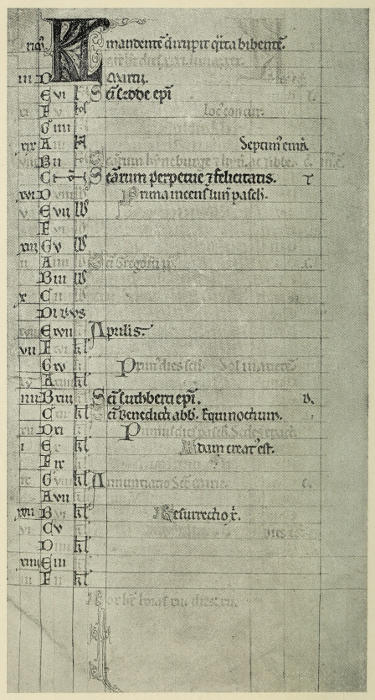
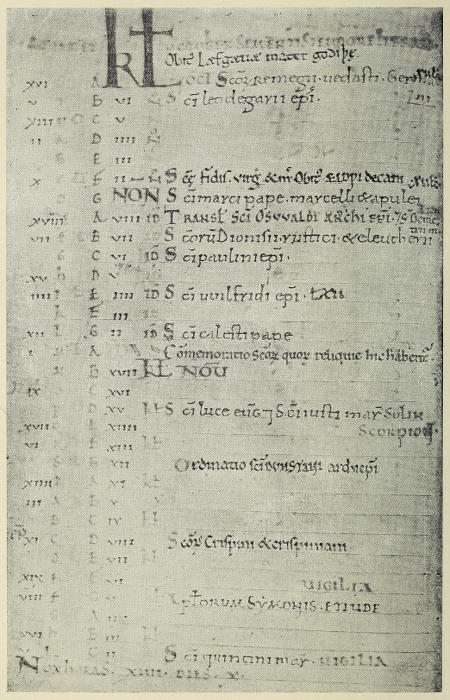
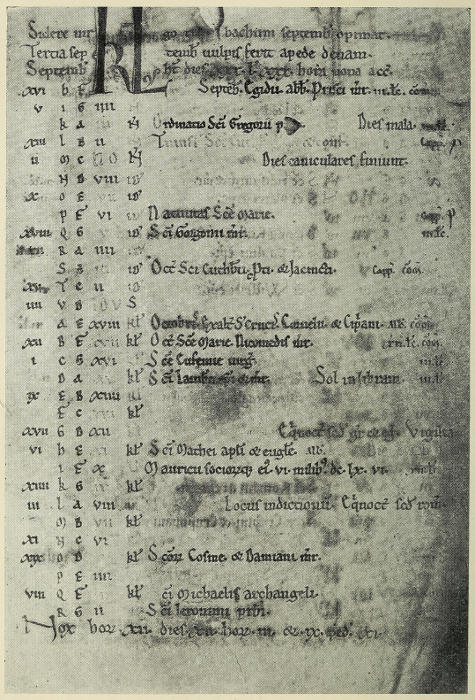
The space at our disposal will not allow of our
treating in detail of the work of the computists, and
of the ‘Sunday Letters,’ ‘Epacts,’ and other technical
terms which appear in the old Church Kalendars.
For these, as well as for such terms as ‘Indiction,’
‘Lunar Regulars,’ ‘Solar Regulars,’ and ‘Concurrents,’
reference may be made to such books as Sir
Harris Nicholas’ Chronology of History, and Giry’s
fuller and lucid Manuel de Diplomatique.
The defects of the Nineteen-Year Cycle became
apparent after some lapse of time. There were two
grave sources of error. First, the Kalendar proceeded
on the assumption that the solar year consisted of
365¼ days; but the true solar year is 11 minutes
and some seconds shorter than the Kalendar year,
and the accumulation of this error gradually brought
confusion into the system. In one hundred and
thirty years the Kalendar will have gained on the
true solar year by almost exactly one day. At the
date of the Council of Nicaea (A.D. 325) the vernal
equinox was placed at March 21, but in the year
A.D. 450 the true vernal equinox would be on March
20. In A.D. 585 the equinox would be on March 19;
in A.D. 715 on March 18, and so on. And thus it
will be seen that in A.D. 1582, when the Kalendar
was reformed, the real vernal equinox was about ten
days earlier than the March 21 of the Kalendar.
The second source of error lay in the assumption
that at the close of a cycle of nineteen years there was
an exact agreement of solar and lunar time. Nineteen
solar years, of 365¼ days, make 6939 days and
18 hours; but 235 moons of 29 days, 12 hours,
44 minutes, and 3 seconds and a fraction make 6939
days, 16 hours, and a fraction over 31 minutes. So it
comes about that the solar time in nineteen years is
nearly 1½ hours in excess of the real lunar time. In
other words, the moons in the second cycle of nineteen
years make their changes nearly 1½ hours earlier
than they did in the first cycle. It is easy then
to show that in about 308 years this difference would
amount to a whole day; and in A.D. 1582, when the
Gregorian reform was effected, the moon in the
heavens made its changes nearly four days before
the time which was indicated for these changes in
the Kalendar.
We must omit any notice of the various schemes
for reforming the Kalendar prior to the reformation
of Gregory XIII. After he had consented to the
general idea that a reformation should be undertaken,
various schemes were proposed. Of these,
that of Luigi Lilio, a physician and astronomer of
the city of Rome, obtained the preference[165]. And it
is on the lines suggested by Lilio that the work was
accomplished, mainly by a German mathematician
then resident at Rome, the Jesuit, Christopher
Schlüssel (or, in the Latin form of his name, Clavius),
who afterwards published at Rome, in folio,
an exposition of the work done, under the title
Romani Calendarii a Gregorio XIII Pontifice
Maximo restituti Explicatio (1603).
The Gregorian Reform is an ingenious and, indeed,
brilliant practical solution of the problems presented
by the condition of the Kalendar at the close of the
sixteenth century. The characteristic features of the
Gregorian system will now be described.
1. It was known that the true vernal equinox
was at this date (1582) about ten days earlier than
March 21 as marked in the Kalendar. Should the
equinox be fixed as at March 11? It was resolved
to keep the equinox at the nominal date of March
21, and to bring the date into conformity with facts
by the simple process of striking out ten nominal
days. It was decreed that the day following Oct. 4,
1582 (when what is known as the New Style was to
make its beginning), should be counted, not as Oct. 5,
but as Oct. 15. And thus in the following year, 1583,
the true vernal equinox would fall on March 21, as
it was supposed to have fallen in A.D. 325, the date
of the Council of Nicaea.
2. But how was it to be provided that in the
future the same errors which had vitiated the old
Kalendar should not come in time to vitiate the new?
It will be remembered that the time of the old
Kalendar had gained on true solar time at the rate,
almost precisely, of one day in every 130 years. If
the counting of one day could be suppressed in every
130 years, the end would be obtained. For purposes
of practical convenience the reformers of the Kalendar
assumed that 133 years should be taken as the period
in which the Kalendar time exceeded the solar time
by one day. The difference, for the purpose in hand,
was insignificant; and, as will be seen hereafter, this
deliberately chosen error will not affect the Kalendar
to the extent of one day till A.D. 5200, while it makes
calculations much simpler.
Now the plan adopted to prevent the accumulation
of the error in the old Kalendar was as follows:
if one day could be withdrawn in every 133 years,
or, what is the same thing, three days in every 399
years, the object would be attained.
In the Old Style, every year of an exact century—every
centurial (or, as it was sometimes called,
secular) year—was a leap-year of 366 days. What
would be the effect of treating every centurial year
as a common year of 365 days? We should have
suppressed four days at the end of four centuries
when we ought to suppress only three in 399 years.
So it was suggested that while three successive
centurial years should be regarded as common years,
the fourth centurial year should be treated as a leap-year.
Thus, in both Old and New Style the years
1600 and 2000 are leap-years; but 1700, 1800, and
1900, which in the Old Style were leap-years, are in
the New Style treated as common years of 365 days.
And the rule laid down in the Gregorian system was
that if the number expressed by the first two figures
of the century was exactly divisible by 4 it should
be a leap-year, but if not exactly divisible by 4 it
should be treated as a common year. The numbers
16 and 20 are exactly divisible by 4, but 17, 18, and
19 are not so divisible. The years 1600 and 2000
are in the New Style leap-years, but the years 1700,
1800, and 1900 are in the New Style common years.
It is true that the adoption of 133 years, instead
of 130 years, as the time in which in the Old Style one
day was gained by the Kalendar on the sun, imports
an error into the system, which causes the Kalendar
to fall behind the sun. This error, as has been said,
will accumulate to the extent of one day in A.D. 5200.
It may be thought that, if men be on the earth at
that date, they will know how to deal with the case.
Yet it is suggested for the instruction of our remote
posterity that they will have only to make A.D. 5200
a common year, instead of a leap-year, to bring things
back to correctness[166].
For the Sunday letters in the New Style and for
the Cycle of Epacts in the Gregorian Kalendar, see
Dr Seabury, Theory and Use of the Church Calendar.
The work of the Gregorian reformation is marvellous
in its elaborate ingenuity. It even provides
for a case which will not occur till Dec. 31, A.D. 8600.
Yet it does not reach the attainment of an exact
correspondence with astronomical phenomena. And
it has been frequently observed that the new moons
of the Kalendar may occur one, two, or even three
days later than the new moons of the astronomer.
In fact the astronomical new moon rarely occurs on
the date marked for the ecclesiastical new moon.
But care has been taken that the new moon of the
Kalendar never occurs earlier than the new moon
of astronomy.
As was to be expected, the countries of Europe
which recognised the authority of the bishop of
Rome were not long in accepting the reformation
of the Kalendar. Spain, Portugal, and part of
Italy made the change on the same day as at
Rome, that is on Oct. 15 (5), 1582. In France
and Lorraine the change was made on December
20 (10) in the same year; in the Roman Catholic
cantons of Switzerland in 1583 or 1584; in Poland
in 1586; in Hungary in 1587. In Protestant
countries and countries where Protestants were
numerous the alteration was more slowly effected.
But Denmark was an exception, for the New Style
was adopted in 1582. In Holland and the Low
Countries the provinces were divided in their
acceptance of the New Style, and in some places
the change was not effected till the year 1700. In
Germany we also find a variety of usages: Austria
and Roman Catholics in other parts accepted the
change in 1584, but Protestants did not yield till
1700, when they adopted the Kalendar of the German
astronomer, Erhard Weigel, which differed from the
Gregorian Kalendar only in the rule for determining
Easter. This variation brought about the result
that the Protestants and Roman Catholics sometimes
celebrated Easter on different days. In 1778
Frederick the Great ordained that from that time
Easter should be kept at the time ascertained from
the Gregorian Paschal moon. Weigel’s Kalendar was
also adopted in the Protestant cantons of Switzerland
in 1700. In Russia, Greece, and throughout the
Christian East the Old Kalendar is still in use[167].
Great Britain was the last of the countries of
Western Europe to adopt the New Style. It is true
that as early as March 16, 1584-5, a bill was
introduced in the House of Lords under the title,
‘An Act giving her Majesty [Queen Elizabeth]
authority to alter and new make a Calendar according
to the Calendar used in other countries.’ The
bill was read a second time in the House of Lords,
and proceeded no further.
Through an extraordinary blunder, it has been
stated by writers of repute that Scotland adopted
the New Style in A.D. 1600. The error originated
in the fact that King James VI, with the advice
of the Lords of his Privy Council, ordered by proclamation
dated Haliruidhous, Dec. 17, 1599, that
on and after Jan. 1, 1600, the year should be held
to begin on Jan. 1 instead of March 25: but there
was no rectification of the Kalendar by the omission
of nominal days. In England the legal year
continued to begin on March 25 till 1752. The
accession of James VI to the throne of England on
the death of Elizabeth occurred on March 24, 1602,
according to the English style, but on March 24,
1603, according to the Scottish style. In this and
such like cases the double dates may be wisely
employed, thus, March 24, 1602-3. But Scotland
did not use the New Style till it was adopted in
1752, in accordance with the provision of the Act
of Parliament of Great Britain (24 George II, c. 23),
entitled ‘An Act for regulating the commencement of
the Year, and for correcting the Calendar now in use.’