These are the haunts of Meditation, these
The scenes where ancient bards th’ inspiring breath
Ecstatic felt.
Thomson.
As a centrical situation from which to undertake a Tour to
either North or South Wales, and to which conveyances are now
established from all parts of England and Scotland, I fixed on
Oxford. And should the Tourist’s undertaking be
commenced early in the season, and his time to enjoy it be ample,
he will have the opportunity of viewing this seat of learning and
nursery of the arts to advantage; the elegant piles of building
which Oxford exhibits, the stores of learned wealth which it
possesses, and the beautiful paintings which adorn its halls and
colleges, are so cheaply and so fully described in the Oxford
Guides, that to attempt to do it in this work would be
superfluous, if not ridiculous: still I may be excused for
pointing out to those whose period of stay may be limited, the
objects more particularly worthy their attention. The three
churches generally viewed are St. Mary’s, All Saints, and
St. Peter’s in the East. St. Mary’s is the
church used by the University on Sundays and holidays: All Saints
is a beautiful modern structure, in the High-street: St.
Peter’s in the East is very ancient; it was formerly the
University Church, and is now, during Lent, attended by the
members of it, for afternoon service.
The Bodleian or University Library, one of the largest in
Europe, as well as the Picture Gallery, are to be seen in summer,
from eight to two o’clock, and from three to five; in the
winter only till three in the afternoon. The Arundel
marbles are placed in a large room on the north side of the
Schools. The Theatre, in which are held the Public Acts,
called the Comitia, and Encænia, and Lord Crewe’s
annual commemoration, in June or July, of the benefactors to the
University, when the prizes adjudged to particular performances
are publicly recited, is a superb edifice, and was built by Sir
Christopher Wren, at the expense of Archbishop Sheldon: it cost
16,000l.; its roof has been greatly admired. Near
this, on the west, stands the Ashmolean Museum of natural
curiosities, coins, &c. &c. and on the other side of the
Theatre, the Clarendon Printing-house. Southward of the
Schools stands in a fine area the celebrated Radcliffe Library, a
noble building with a handsome dome.
St. Mary Magdalene College at the east end of the city, near
the river Cherwell, is particularly worthy of attention, were it
only to see the picture of our Saviour bearing his cross;
supposed to be painted by Guido. Such is the awful
solemnity of the place, and the impressive beauty of this
painting, as well as of the windows, particularly of that
representing the last judgment, that none can be better
calculated to give a favourable bias to the mind of youth; for
should religion waver in the mind, the sweet benignity of Him who
died to save mankind
Shall on the heart impress such grateful love,
That Atheist ne’er can shake, or Deist move.
The
Cloister of this College, which remains in its primitive state,
is the most venerable of the University; the interior is
ornamented with curious hieroglyphics, the key to which is very
fully given in the Oxford Guide, from an ancient manuscript in
the College.
Passing by numerous other Colleges and Halls, all interesting,
if the time and inclination of the Tourist permit him to visit
them, I shall proceed to Christ Church, which merits particular
attention. This College consists of four courts: 1. The
great Quadrangle; 2. Peckwater square; 3. Canterbury court; 4.
The Chaplain’s court; and some other buildings. The
noble west front is 382 feet in length. Over the great gate
in the middle of this front is a beautiful tower, designed by Sir
Christopher Wren, erected by Dr. Fell, in which is hung the great
bell, called Tom, the weight of which is eight tons and a half:
on the sound of this bell, the scholars of the University are to
retire to their respective Colleges.
The great Quadrangle is 264 by 261 feet in the clear.
The Hall takes up more than half the south side: we ascend to it
by a spacious and stately staircase of stone, the roof of which,
supported by a single pillar, is beautiful. The staircase,
lobby, and entrance into the hall, have been altered under the
direction of Mr. Wyatt. The Hall is by far the most
magnificent room of the kind in Oxford. There are near 300
compartments in the cornice, which are embellished with as many
coats of arms, carved and blazoned in their proper colours.
At the upper end of the hall the beautiful gothic window merits
attention.—For the long list of portraits of eminent
persons that adorn the walls, vide Oxford Guide.
Christ Church, which is the cathedral of the diocese, formerly
belonged to St. Frideswide’s Monastery; for the roof of the
choir, which is of beautiful stone-work, it was indebted to
Cardinal Wolsey.
The east window was painted by Mr. Price, senior, of London,
from a design by Sir James Thornhill. The window at the
north corner of the west end is curiously painted, representing
St. Peter delivered out of prison by the angel. It was
executed by Oliver, in his eighteenth year. The fine ring
of ten bells in the steeple, as well as Tom before described,
were brought from Oseney Abbey. Choir service is performed
every day at ten and five; except on Sundays and holidays, when
it is at eight in the morning.
Three sides of Peckwater court are uniform, designed by Dr.
Aldrich. On the fourth side is the Library, 141 feet long,
built in the Corinthian order. In the lower apartments to
the right and left are deposited the celebrated collection of
pictures, given to the College by Gen. Guise. Amongst these
is the celebrated performance of Annibal Caracci, representing
his family in a butcher’s shop. St. Francis in a
vision supported by angels, by ditto. A Medusa’s
head, by Rubens. Two Nativities, by Titian. A
Nativity, by Raphael. The flight into Egypt, by Guido
Rini. Two half-lengths of women, by Dominichino.
Jesus and Saint John embracing, by Raphael, &c. &c.
For a farther account of the various beauties of Oxford, I
must again recommend the Tourist to refer to the Oxford Guide, as
well as for information with respect to Heythrop, the seat of the
Earl of Shrewsbury, 17 miles N. of Oxford; Ditchley, the seat of
the Right Honourable Lord Dillon, about four miles and a half
from Heythrop; or Nuneham Courtney, the seat of Earl Harcourt, which affords
the richest treat to the admirers of fine paintings that the
country affords.
But if a soldier’s ardour warms his soul, and he would
fain be led to deeds of arms, pursue the road to honour, and seek
the pinnacle of fame, to Blenheim’s towers let him turn his
steps; and let the gentle Rosamond’s hard fate midst
Woodstock’s bowers beguile him of a sigh; for love and war
should still go hand in hand. Here well-earned honours have
been well repaid; and great as Marlborough’s noble deeds in
arms shall shine in the historic page, still shall a
sovereign’s and a nation’s gratitude outvie the
hero’s deeds.
Blenheim, the princely residence of his grace the Duke of
Marlborough, is situated about eight miles from Oxford, to the
west of Woodstock, from which town you enter the Park by a
spacious portal of the Corinthian order. The noble view of
the castle of Blenheim, the extent of the park, the lake, valley,
and richly varied scenery, are from hence highly
impressive. The architecture of this noble pile of
building, the interior finish and display of the arts, increase
rather than diminish the first impression. The
circumference of the park is about eleven miles: the gardens are
tastefully displayed, owing much to nature, whose beauties are
here happily blended with art.
The distance from Woodstock to Witney is eight miles and three
quarters, by a turnpike road; thence to Burford, seven miles and
a quarter; Northleach, nine miles; Cheltenham, twelve miles and
three quarters.
’Twas from hence with a friend, an equal admirer of
Nature’s landscapes, and attached to pedestrian
independence, that they agreed to visit the wild and impressive scenery
of the Cambrian mountains. The outlines of their route
being arranged, they sallied forth in the month of July from this
place so much resorted to, and celebrated for its mineral
waters. Since it has become a place of fashion, the
lodging-houses have been considerably improved, and rendered
comfortable for the company, who make this place their
residence. The season usually commences about May, and
frequently continues till the beginning of November. The
majority of the company who frequent Cheltenham resort here not
so much for the purpose of water-drinking, as to enjoy the
delightful walks and rides, and partake of the sociability of the
neighbourhood.
The Walk at the Pump-room, well planned, and kept in excellent
order, is planted on each side with limes; at the end is a small
square, where the pump is situate, with a room on the left for
the accommodation of the company to promenade, measuring
sixty-six feet by twenty-three: on the opposite side a
reading-room, with a billiard-table over: and a house, the
residence of the attendant at the Spa: beyond that is a similar
walk which leads to another serpentine walk; from the end of
this, the spire of Cheltenham church forms a beautiful
object. Near these walks stands, on an eminence, the seat
of the Earl of Fauconberg; which was the royal residence during
their Majesties’ stay from July 12 to August 16, 1788.
In respect to the Rides, Cleave Hill, Dowdeswell,
&c. Tewkesbury and Glocester, are most admired.
Speaking of the history of the place, we find Cheltenham was a
town in the reign of King William the Conqueror; Edward likewise
is supposed to have marched through it, before he encamped his
army on the field of Tewkesbury, previous to the battle of the houses of York
and Lancaster.
Three days may be passed very pleasantly at this place, in
viewing the various improvements that have been made in the last
twenty-five years, tending both to increase the health and
pleasure of its numerous and respectable visitors: for these
improvements the town is greatly indebted to the exertions of
Messrs. Moreau, King, and Fotheringham, the masters of the
ceremonies. Duty with such men scarcely required the
additional stimulus of interest to render it efficacious; but
with so powerful an auxiliary it was irresistible: thousands have
been expended after thousands; public spirit was roused, and
competition excited. The public as well as Messrs.
Thompson, Skillicorne, Capstack, Smith, Barrett, Watson and Co.,
and all others who have spiritedly adventured their property,
will, I hope, derive mutual advantage, if not checked by the high
charges of some of the head inns, and the enormous establishments
of the overbearing, monopolizing barrack lodging-houses,
apparently better calculated for workhouses or houses of
correction, than places of residence for valetudinarians.
The wells and baths are numerous, and calculated, under proper
medical superintendance, for all chronic disorders and
constitutions; but they are not to be trifled with: professional
advice, for their proper use, is absolutely necessary.
Of the efficacy of the water, to which this town is indebted
for its present celebrity, I refer my readers to a Treatise
published by Dr. Fothergill, of Bath.
The church is a respectable old building, by far too crowded
and encumbered with galleries, and what are intended as
accommodations for a large congregation, to allow all
parties to participate in and profit by the excellent and elegant
moral and religious discourses there delivered.
The rooms and public receptacles for company, it should be the
business of some party to see closed, at all events on Sunday,
and particularly on Sunday morning, against those errant
gamblers, that will eventually be the bane of Cheltenham.
Libraries and Banks are numerous, as are conveyances to London
through Oxford, and to Bristol through Glocester: here likewise
are conveyances to Hereford, Worcester, Birmingham, &c., and
by that route to North Wales; but this is not to be depended
upon: but to South Wales, through Glocester and Hereford, the
conveyance by coach and waggon for passengers or baggage is ready
and convenient.
For further particulars relative to this splendid modern
establishment, for such Cheltenham certainly may with propriety
be designated, I must refer the reader to the Cheltenham Guide;
the information derived from which will amply repay him for its
trifling cost. From hence to Glocester, eight miles one
furlong, the road excellent; and if time allows, Tewkesbury is
worthy of a visit, being only nine miles from Cheltenham, and ten
miles and an half from Glocester.
Its ancient abbey is a venerable building, founded in 715 by
two brothers, Odo and Dodo, who endowed it with the manor of
Stanway in Glocestershire, &c. &c. sufficient to maintain
a prior and four monks of the order of Benedictines: this priory
was afterwards, about the year 980, subjected to the priory of
Cranbourne, in Dorsetshire, but being subsequently rebuilt in
1102, by Robert Fitz-Hamon, and its endowments greatly enlarged,
Girald the
Abbot of Cranbourne, on account of the fruitfulness of the soil
and superiority of its situation, removed his establishment to
it, leaving only a prior and two monks at Cranbourne. From
this period it appears to have risen in consequence as a
town.
The ashes of many noble characters are here deposited; and
amongst the rest, amidst the mingled heap of slain and murdered
at and after the battle of Tewkesbury, those of the accomplished
and lamented Edward, Prince of Wales, son of King Henry the
Sixth; Edmund, Duke of Somerset; his brother John de Somerset,
the Earl of Devonshire; Lord Wenlock, master of the horse to the
Prince, with numerous others. Here likewise rest in peace,
where all animosities are forgotten, the remains of false,
fleeting, perjured Clarence; as also those of
Isabel his wife, who was buried with great pomp and
solemnity.
Further particulars of this ancient town, the reader will
obtain by reference to a small but interesting historical work,
on the Antiquities of Tewkesbury, by W. Dyde of that place; who,
after giving a very full and explicit account of the contest
betwixt the houses of York and Lancaster, concludes by saying,
“The local memorials of this very decisive battle are but
few. The principal scenes of the action are the meadow,
which has received the appellation of Bloody Meadow, and the
Vineyard. The former lies between two gently descending
banks, about half a mile south-west of the town, and was the spot
where the slaughter was the greatest. The latter was the
place where Queen Margaret lay, and where some intrenchments are
still to be traced.”
Stebbing says, “to the monastery and convent of
Tewkesbury, King Henry the Seventh granted the parochial church
of Towton to pray for the soul of Edmund Duke of
Somerset, his brother John, and others, who lost their lives in
the quarrel of the house of Lancaster.”
The entrance to Tewkesbury from Worcester, or Hereford and
Malvern, after a heavy fall of rain, presents to the eye the
largest moveable body of inland water I have witnessed in
England; the junction of the Severn, and the Warwickshire Avon,
each overflowing their banks, rushing down two beautiful vales to
join their currents opposite the town, and augmenting their
volume by the two tributary streams of the Carron and the
Swilgate, impress you with the idea of the vicinity of the sea,
and the power of the tide, to collect so large a body of that
fluid element in such overpowering currents. The drive or
ride from Tewkesbury to Upton, and from thence to Malvern hills,
is beautiful; indeed not one inch of this delightful country
should be missed or slighted, by travelling over it in the dark
or in bad weather: the view from Malvern hills over Worcester,
and the rich vale through which the Severn’s current rolls,
is perhaps as fine a one as the eye of the painter could wish to
be indulged with. Winding round the Malvern hills by a good
turnpike road, you gain the Herefordshire view, with the
mountains of Wales in the back ground, having Ross on the left,
and Bromyard, Leominster, and Salop on the right; descending the
hill, you soon reach Ledbury, scarcely remarkable for any thing
but the antiquity of its houses, and the fine quality of the
cider and perry made in its vicinity. Malvern is about an
equal distance from Ledbury and Upton, and those places are
nearly equidistant from
The pin manufactory was established here by John Tisley, in
the year 1626, and the business is now become so extensive, that
the returns from London alone are estimated at near twenty
thousand pounds per annum. Before the introduction of pins
into England, anno 1543, skewers of brass, silver and gold, and
likewise thorns curiously scraped, called by the Welsh women
pindraen, were used. Though the pins themselves are
apparently simple, yet their manufacture is not a little curious
and complex. The wire in its most rough state is brought
from a wire company in the neighbourhood of Bristol: till the
year 1563, English iron wire was drawn out by manual
strength. The first operation attending this curious
process is the fixing the circular roll of wire to the
circumference of a wheel, which in its rotation throwing the wire
against a board, with great violence, takes off the black
external coat: vitriol is next applied to bring the brass to its
common colour. The brass wire being too thick for the
purpose of being cut into pins, is reduced to any dimension the
workman pleases, by forcibly drawing it through an orifice in a
steel plate, of a similar diameter. The wire being thus
reduced to its proper dimensions, is next straightened: it is
then cut into portions of six inches in length, and afterwards to
the size of the pin, and each piece respectively sharpened on a
grinding-stone, turned by a wheel. We now come to a
distinct branch of the manufactory: the forming the heads, or, as
the workmen term it, head spinning: this is accomplished by means
of a spinning-wheel, which, with astonishing rapidity, winds the
wire round a small rod: this, when drawn out, leaves a hollow
tube between the circumvolutions: every two circumvolutions, or
turns, being cut with shears, form one head. The heads thus
formed are distributed to children, who, with great dexterity, by
the assistance of an anvil, or hammer, worked by the foot,
fix the point and the head together. The pins, thus formed,
are boiled in a copper, containing a solution of block-tin
pulverized, and the lees of port; and by this last process, it
changes its yellow brassy colour, and assumes the appearance of
silver or tin. The labourers are all paid according to the
weight of their work.
Near Glocester, at the small island of Alney, formed by the
river Severn dividing itself into two branches, historians relate
that Canute and Edmund, after many bloody engagements in Essex,
determined to prevent a farther effusion of blood by a single
combat. Neither, however, as the story relates, obtaining a
victory, peace was concluded, and the kingdom divided between
them. We paid, however, little regard to the supposed place
of this contest, as it was not for us puisne antiquarians to
discuss points, on which the greatest historians had so
materially differed.
The roads round Glocester have been greatly improved of late
years, more particularly the one to Ross and Hereford, which was
hilly, rocky and generally dangerous: their texture and surface
are now totally changed, and, winding the hills, the gradual
ascent removes both danger and difficulty; the expense must have
been enormous, and the traveller pays proportionally in turnpike
tolls; they are, generally speaking, round Glocester and
Hereford, the highest in England. Nothing can surpass the
excellence of the road from Glocester to Bristol, to which
conveyances are constantly going; and to such parties as have not
visited that eager bustling mart of trade, two or three days may
be afforded with a certainty of meeting with the most ample
return for the trouble and expense bestowed. The Church of
St. Mary Redcliff, which is both ancient and beautiful; the Abbey
Church or cathedral; the docks; the charities, and particularly
that for teaching the blind to work; the hot wells at Clifton;
St. Vincent’s rocks, and the diminished vessels gliding on
the Avon; the beautiful views, mansions, villas, and pleasure
grounds in every direction in its vicinity, evincing at once the
taste and opulence of its merchants and citizens, but
particularly those going to and returning from King’s
Weston, the view of Lord de Clifford’s mansion, and the
varied prospects it commands, as well as those from the park and
plantations, which are open to the public, constantly varying the
scenery on the Avon, Kingroad, and the distant Cambrian Alps,
afforded pleasure so exquisite to my romantic fancy, that for ten
times the labour and expense bestowed, I would not have debarred
myself of them. Here most happily are blended commercial
riches and the life of trade with all that nature’s bounty
can bestow to please the fancy or delight the sight.
The antiquity of Bristol is recorded by Gildas, who has set it
down as one of the principal fortified cities in Britain, when
the Romans abandoned the island in the year 430. But little
mention is made of it again in history till the year 1063, when
Harold, the son of Earl Godwin, embarked from Bristol with an
army to wreak his vengeance on Griffith, King of Wales, who had
committed divers aggressions. After sailing along the coast
and landing his men at various points, he reduced the country to
yield obedience to King Edward, and having compelled the Welsh to
cut off the head of their king and give him hostages for their
fidelity, he returned again to England.
The Castle of Bristol was formerly of great extent and
strength, and is repeatedly mentioned by historians for the gallant
defences it has made, and the noble prisoners it has held in safe
custody; but it was not till the time of Charles the First that
it belonged to the city, when being found to be a harbour and
receptacle for rogues and vagabonds, it was first added to the
jurisdiction of the county of the city of Bristol, and afterwards
sold to the mayor and burgesses for 959l., to be held
under the manor of East Greenwich in Kent, at the yearly fee-farm
rent of 40l.
Both Henry the Second and Henry the Third, during their
minorities, were placed at Bristol as a place of security, at
which they might receive their educations. It was here in
the year 1211 that the following infamous act of tyrannic cruelty
was exercised by King John. That monarch having laid a
heavy tax upon all the Jews throughout his dominions, one of that
race, named Abraham, having refused to pay the tax, was fined in
the sum of ten thousand marks; this the obstinate Jew likewise
refused to pay, which so much exasperated the King, that he
commanded one of his teeth to be drawn every day till the sum was
paid; the unfortunate Jew had seven of them taken out of his
head, and then submitted to the payment, rather than lose his
last tooth, he having but one left.
Bristol sends two members to Parliament; the first regular
summons by writ was issued by King Edward the First, directing
that two proper persons should be sent as its representatives to
the Parliament at Shrewsbury.
“King Henry the Seventh visited Bristol in 1490, and
held his court in St. Augustine’s Back, when the citizens,
willing to shew the King all the respect they could during his
residence, arrayed themselves in their best clothes; the King
thinking some of their wives rather too well dressed for their
station, ordered that every citizen who was worth
20l. in goods, should pay twenty shillings, for that their
wives went so sumptuously apparelled.”
The present Cathedral was the collegiate church of the
monastery of St. Augustine, originally founded by King Henry the
Second, and Robert Fitzharding, father of Maurice, the first of
the Berkeley family. At the suppression of the monasteries
by King Henry the Eighth, after that of St. Augustine had been
destroyed, with the exception of the gate, and the west end of
the collegiate church had begun to share the same fate, the King
changed his mind, and resolved upon erecting it into a bishopric,
directing the church to be repaired, and thenceforth termed the
cathedral church of the holy and undivided Trinity, appointing
Paul Bush, rector of Winterborn, to be the first bishop,
appropriating the revenue of the suppressed monastery, amounting
to 765l. 15s. 3d. per annum, partly to the
bishop and partly to the chapter; consisting of a Dean and six
Prebendaries. He likewise took the county of Dorset from
the see of Salisbury, transferring it to that of Bristol.
The interior of the Cathedral, though not to be named with
those of Glocester and Worcester, is still worthy of attention;
particularly its vaulted roof, those of the side aisles, and an
emblematic picture of the Holy Trinity, by Vansomers, over the
altar. The windows of the side aisles, which are of
enamelled glass, are said to have been the gift of Nell
Gwynn.
On the south-west of the cathedral are the cloisters; and at
the south-east corner of the cloisters is the bishop’s
palace, which was in great part rebuilt in 1744, when the
following extraordinary circumstance happened. “A
parcel of plate, supposed to have been hidden during the time of
the civil wars, fell through the floor in the corner of one of the
rooms; this accident occasioned the floor to be taken up, when,
to the surprise of those persons present, a dungeon underneath
was discovered, in which were found many human bones, and
instruments of iron for torture; at the same time was laid open a
private passage to this dungeon, which passage was part of the
original edifice; it was an arched way only large enough for one
person to pass, and was made within the wall; one end led to the
dungeon, and the other end to an apartment of the house, which by
appearance had been made use of for a court of judgment.
Both the entrances of this mural passage were walled up, and so
concealed, that no one could suspect the wall to be
hollow.”
St. Mary Redcliff Church, which is supposed to be one of the
most beautiful gothic structures of a parish church in England,
next merits attention. The present edifice was erected by
William Caning, an eminent merchant of Bristol, about the year
1456; the foundation having been commenced by his grandfather of
the same name, on the site of the former church, built by Simon
de Burton, in the year 1294. Caning having been rendered
unhappy by the death of his wife, and being pressed by the King
to a second marriage, he took holy orders to avoid an act so
repugnant to his feelings; he was afterwards Dean of Westbury, to
which he was likewise a great benefactor. He died in 1474,
and was buried in the south end of the aisle of this church, in
which are two monuments erected to his memory; in the one he is
represented in his magisterial robes (he having been five times
Mayor of Bristol) with his lady by his side, with a long
inscription on two tables. In the other monument he is
habited as a priest.
The roof, which is of stone displaying many curious devices,
with much good workmanship, and the lofty pillars which
support it, are beautiful; the interior, which consists of a
middle and two side aisles, has a light and highly pleasing
effect, and is generally much admired. The altar is very
elegant and richly decorated, and over it are three capital
paintings by Hogarth. The organ, which is of great size and
compass, contains upwards of one thousand speaking pipes, and for
richness of tone is scarcely to be equalled. It was in a
room over the north porch entrance in an old chest that
Chatterton, then a youth of seventeen, gave out that he found the
poetical manuscripts, ascribed to Rowley and others, and said to
have been written in the fifteenth century.
Chatterton’s father was sexton of St. Mary’s Redcliff
and master of a charity school in Pile-street, in which school,
under a Mr. Love, who succeeded his father, and at the Colston
Blue-coat school, he received his education.
The Exchange in Corn-street is a noble building of freestone
highly finished; it cost upwards of 50,000l. The
principal front is 110 feet; it is of the Corinthian order upon a
rustic basement. Next to the Exchange stands the
Post-office, and higher up on the opposite side of the street,
the Council-house, where the mayor or some other magistrate sits
daily to administer justice, from twelve till two
o’clock.
The charities of this city are numerous and extensive; the
Infirmary is a noble building, situate in Earl-street, St.
James’s; it is conducted on the most liberal plan.
The port of Bristol has of late years been greatly enlarged
and improved, principally on a plan suggested by the Rev. William
Milton, Rector of Heckfield, Hants; an excellent engineer, and a
man of most extensive mechanical abilities, whose only reward for
so great a service rendered to this wealthy port was a present of
a piece of plate; had he rendered as great a service to the
merchants and corporation of Liverpool, he would most likely have
obtained a handsome independence for life; for although the
charities of Bristol speak highly in its favour, still its high
spirit, its hospitality, or its generosity are not quite so
proverbial as those of Liverpool.
The Hot-well is distant about a mile and a half to the west of
Bristol, in the parish of Clifton: the water is too well known
for its great efficacy in pulmonary complaints, and cases of
general debility, to require any recapitulation of its virtues,
in this slight sketch of the Hot-well and Clifton.
As a place of fashionable resort, not only for invalids, but
for pleasure, its beautiful situation, both for walks and rides,
the gentility of the company that frequent it, the easy and well
regulated expence with which persons may with comfort and
respectability reside here, must always ensure it an overflow of
company in the season. The Avon below St. Vincent’s
rocks is but little wider than it is at Bristol; but as the
spring tides rise from 30 to 36 feet, the heaviest ships can
navigate it at such times.
St. Vincent’s rocks, overhanging the Avon, afford to the
pedestrian, and particularly to the botanist, an infinity of
amusement; a great portion of the plants, if not peculiar to this
spot, are but rarely to be met with elsewhere.
These rocks are chiefly composed of a species of
chocolate-coloured marble, bearing a good polish; it is worked
into chimney-pieces, &c., with good effect, the refuse
burning into a strong and beautiful white lime. The
reverberation of sound occasioned by the miners blasting these
rocks, and the dreadful crash of the masses thus hurled from
their native beds down the craggy precipices is grand and
terrific; it is in the fissures of the rocks thus opened that
those beautiful crystals, called Bristol stones, are found.
is one of the most charming villages in England. On
every side the views are beautiful; and although its population
is great, still it has not lost its rural appearance. From
the salubrity of the air, numerous respectable families have
taken up their residence in the village and its vicinity; but
these elegant mansions being surrounded by their gardens and
shrubberies, they have prevented the ground from being too much
covered with buildings.
the seat of Lord de Clifford, is about four miles north-west
of Bristol. It is a noble mansion, built by Sir John
Vanbrugh, somewhat in his usual style; but the situation
according with the style better than usually fell to the lot of
that architect, it has a grand and noble effect. The
collection of paintings here are by esteemed masters, and very
fine; the gardens, hot-houses, &c. are kept up in very great
style. The park, which is richly wooded and beautifully
diversified, offers a rich treat to the painter; the varied
prospects obtained at every turn and opening of its numerous
walks and vistas are as rich and extensive as nature in this
climate can afford. The whole, under very trifling
restrictions, are most kindly and liberally left open by his
Lordship, for the public to enjoy. Kingsweston inn, just
above the park, is a comfortable house, delightfully
situated.
To the west of Kingsweston, on a hill called Penpold, is a
pleasure-house: from this hill, which is of great height, the
most beautiful prospects are to be enjoyed. You look down
on that fine sheet of water, Kingroad and the Severn Sea;
commanding alternately views of Somersetshire, Glamorganshire,
and Monmouthshire, with Wales in the back ground; Glocestershire
and Wiltshire: this with the bustle of the shipping in the nearer
sea view, so engage the attention, that time flies unheeded
by.
From hence proceed to Shirehampton, a pleasing village,
leading to a good inn, called Lamplighters’ hall, a place
of considerable resort, during the summer months, to witness the
busy scene at the mouth of the Avon: it is situated close to high
water mark, on the bank of the river, opposite to Pill or
Crockern Pill, where is a Custom-house, at which all vessels
leaving the port of Bristol are obliged to take their last
clearance in going out, and from which they are furnished with
pilots inwards. The ride from hence, when the tides are not
too high, over turf to the mouth of the Avon, is very fine.
The house is built purposely to enjoy the busy scene which the
river and Kingroad here present; and its accommodations are
remarkably good, and the charges reasonable.
Frenchhay, in Glocestershire, is about four miles north-east
of Bristol; the drive this way is beautiful, from the numerous
noblemen and gentlemens’ seats and highly cultivated
grounds, which occupy both sides of the road. It was here,
during the war, that the great depôt of French prisoners
was established.
At the east end of the common is a remarkable lusus
naturæ, which was taken out of a stone quarry at Downend;
its form is an entire perfect muscle, consisting of the upper and
under shell, which are closed together; its weight is nearly two
tons.
Bristol is but one stage from either the Old or New Passage; it
is eleven miles to the New, and nine to the Old. The mail
and most of the coaches pass their passengers, &c. by the New
Passage, as saving a stage on the Milford road. Chaises or
horses are generally charged at the rate of twelve miles to
either.
At Aust (or the Old Passage) it is about two miles over to
Beachley, in the parish of Tidenham, Glocestershire. This
is the direct way to Chepstow, Newent, and all the forest of
Deane, Herefordshire, Worcestershire, and the upper part of
Monmouthshire.
At the New Passage, it is about three miles over at high water
to Port Skewith, near St. Pierre in Monmouthshire. When the
wind is S.E. or N.W., it is directly across the river, therefore
you must be at the passage where you intend to cross, an hour
before high water, as they can only go over then, and that but
once, there being no passage during the flood or ebb.
Should the traveller have before visited Bristol, or decline
this excursion, he will find the walk from Glocester to
is by no means uninteresting; the distance eight miles and
three quarters, through Highnam and Minsterworth; the country is
studded with half-seen villas, and animated with churches, whilst
the retrospect commands a fine view of Robin Hood’s hill,
with the dark tower of Glocester cathedral, just rising in the
perspective.
At Westbury is the seat of Maynard Colchester, Esq. The
church, with a detached spire, stands close to the house.
Near this place mineralogists will be highly gratified by
visiting a cliff, called Garden, or Golden Cliff; which is most
beautifully encrusted with mundic and crystals. This rock, standing
close to the Severn, is only accessible at the reflux of the
tide: and when illuminated by the sun wears a most beautiful
appearance.
Between Westbury and Newnham, in an extremely delightful
valley, bordering on the forest of Deane, is situate
the seat of Sir Thomas Crawley Bovey. This valley was
formerly called Castiard, or the Happy Valley; and a monastery
for Cistercian monks was founded here by Roger, the second Earl
of Hereford, and the charter confirmed by King Henry II.
The abbey was standing till the year 1777, when part of it was
unfortunately consumed by fire; since that a considerable portion
of building has been added, and it is become a very desirable
summer residence. The views from the park, behind the
house, are very extensive, commanding the vale of Glocester, and
the river Severn, gay with vessels; whilst the extensive forest
of Deane, and Flaxley Abbey, form nearer objects for
admiration. This wood abounds with the most charming walks;
and while it affords refreshing shelter from a summer’s
sun, admits partial views of the adjacent country. Camden,
in speaking of the forest of Deane, derives its name from Ardene,
a wood, in the Gaulic and British languages. It lies
between the two rivers Severn and Wye, and contains thirty
thousand acres. The soil is well adapted for the growth of
oaks and forest timber; and the situation particularly commodious
for exporting it for ship-building, and other purposes. The
immense quantities of wood annually felled for the use of the
navy have so thinned this forest of its timber, that it is now
preserved till a certain growth, by act of parliament.
Camden observes, that the oak of this forest was so considerable,
that the
Spanish armada had orders to destroy the timber of it in the year
1588. It suffered considerably in the great rebellion.
The iron manufactory has long been carried on in this forest;
and to this day immense beds of iron cinders are found, the
reliques of the Romans. These cinders are not half
exhausted of their ore, and are consequently worked over again: a
proof that the Romans knew only the weak power of the foot
blast. As we drew near
the Severn became more considerable. The town, situated
on the banks of the river, and backed by the forest of Deane, is
very ancient, and in the year 1018, this manor was granted by
King Canute to the Benedictine abbey of Pershore, in
Worcestershire. [23] The churchyard affords a variety
of objects worthy the attention of the passing stranger, amongst
which the church of Westbury forms the most conspicuous feature
in the landscape. The view, previous to our descending the
hill to
is extensive and beautiful. In this place iron-works are
carried on by Mr. Pitchcock. About a mile from Lidney, the
Old Passage.—King’s Road, with the merchant ships
lying off Bristol,—Glocestershire and Somersetshire hills,
studded with gentlemens’ seats, churches, and half-seen
cottages, form a cheerful landscape.
The weather prevented our seeing the celebrated walks of
Piercefield, but we promised ourselves the pleasure of visiting
them on our return down the Wye. The castle of Chepstow,
called Cagwent, or Castell Gwent, stands on a rock washed by the
river Wye, near its influx into the Severn. Topographical
writers differ in their accounts concerning the antiquity of the
castle, but it is generally supposed to have been built at the
same time with the town, appearing at that period to have been a
kind of citadel to Chepstow. [24] The castle was
formerly of great extent, as, according to Leland’s
account, the “waulles began at the end of the great bridge
over Wy,” yet, “in the castel ys one tower, as I have
heard say, by the name of Langine.” Little now
remains of its former grandeur: but, impelled by an irresistible
curiosity, we ascended the decayed steps of the tower, from
whence the eye traced with pleasure the windings of the Wye, till
it was at last lost in conjunction with the Severn. We
examined the apartments in which Henry Marten, one of the
regicides, who sat to condemn King Charles I., was confined
twenty years.
Grand views of the Bristol Channel still continued to form
interesting objects from the road; but about three miles from
Chepstow, we turned into some fields on the right, to examine the
ivy-mantled walls of
On our first entrance, we gazed with that rapt astonishment,
which fears to disturb, or be disturbed, by the mutual
communication of thought. Mr. Warner, in his survey of this
ruin, was much disappointed; but I cannot help allowing, although
the view from it was inferior to Chepstow, that its antiquated
walls wear a nobler appearance; and the gloom that reigns around it
forces a sigh, and evinces the transitory nature of sublunary
greatness. The antiquity of the building is very
obscure. Passing through the village of Caldecot, we soon
entered
on the western side, through the broken fragments of its
walls, of which one immense mass has recently fallen. This
ancient town is now a village, with a few scattered cottages, but
was formerly celebrated, under the auspices of Agricola, for its
temples, theatre, porticoes, and baths; few vestiges of its
former splendour are now extant. A few fragments of loose
stones only remain to point out its former extent. In an
orchard, adjoining a farm-house belonging to Mr. Lewis, is the
beautiful tesselated Roman pavement, discovered in the year
1777. The tesseræ or dies, about an inch in breadth,
and half in depth, are nearly square, consisting of four colours,
red, yellow, blue, and white, [25] which are still in
great preservation; the whole is surrounded with a border, much
resembling a Turkey carpet. The daily depredations on these
curious remains of antiquity are greatly to be lamented.
In the road from Caerwent, amongst other objects for
admiration, the mansion of Sir Robert Salusbury, on the left,
commanding an extensive view, attracted our notice. Passing
through the neat village of Christchurch, animated with
white-washed cottages, and graced with its simple church, which
stands on an eminence, we left the turnpike-road at the
thirteenth mile-stone; and following a footpath through some
fields, near the banks of the Usk, soon entered the ancient city
of Caerleon.
has been celebrated in all ages of British History. It
was a Roman city of great power, strength, and importance, under
the name of Isca Silurum, and their chief station in the
country of the Silures; and equally, and perhaps still
more known, for having been King Arthur’s seat of
government: a prince, equally renowned in history, chivalry, and
poetry. This city was formerly a metropolitan see, but
Saint David, the national saint of Wales, thinking the noisy
intercourse of a populous city, like Caerleon, ill adapted for
contemplation, or the solitary cast of his mind, removed it to
Minevia, which from that period has been called Ty Dewi by the
Welsh, and Saint David by the English. [26] The remains of its ancient
grandeur are still discernible. Whilst tracing the extent
of its amphitheatre, surrounded by a circular entrenchment, we
took a retrospect on the exertions of man, the fate of kingdoms,
and of rulers; and, marking the grand destruction of ages, it
seemed to convince us of the transientness of human worth and
happiness!
Reascending Christ-church hill, we had a fine view of the
county of Monmouth like a map beneath us. Near
a new stone bridge has been erected by contract for ten
thousand one hundred and sixty-five pounds, by Mr. Edwards, son
to the Edwards, who built the famous Pont-y-pridd. It
consists of five arches.
The
commerce and population of this town are greatly increased of
late years. As a sea-port it is safe; its chief trade is in
iron and coal. The Monmouthshire Canal communicates here by
a basin with the Usk river, and by that means with the Bristol
Channel; and as the Monmouthshire Canal again communicates with
the Brecon Canal and the Avon, Ebwy and other rail roads, Newport
becomes the grand depôt for the heavier articles of trade
of that part of the interior of South Wales. The Crumlin
bridge branch is eleven miles five furlongs, its falls, three
hundred and sixty-five feet. Pontypool, eleven miles, falls
four hundred and forty-seven feet. Brecknock, thirty-seven
miles seven furlongs.
A circuitous, but more romantic route from Chepstow to
Newport, is recrossing the Wye, passing over the forest of Deane,
through Saint Briaval’s to Monmouth. The road is not
bad, but narrow; if travelling with a carriage, it will be
necessary to be provided with a horn, which, upon your sounding,
if you find answered, you must wait till the party so answering
comes past.
The views to the right over the Severn and Glocestershire are
most rich and extensive, and those from the summits of the
overhanging rocks of the Wye, awful and terrific: before you
reach Monmouth the country becomes thickly inhabited, which the
beautiful situations it affords readily accounts for; and from
Monmouth to Ragland and Usk, the same continues to be the
case.
one of the finest ruins in Wales, (for although Monmouthshire
is now an English county, it formerly was Welsh,) stands near the
village of that name: it may be pleasantly and leisurely viewed in
the day, with Usk and Caerleon, affording time to reach
Newport.
The first view of it is considerably impeded by the
surrounding trees, but the closer inspection presents such a mass
of ruin as well proves its ancient strength and grandeur.
From the citadel, which lies to the south of the main building,
the communication was by a drawbridge over the moat, by which it
was surrounded; it was a hexagon, apparently five stories high,
and of much strength, with bastions.
Round the citadel were raised walks, and in the walls are
small recesses. A stone staircase still remains, leading to
the top of one of the towers, from which not only the ruins, but
the adjacent country, are viewed to much advantage. The two
courts of the castle both communicate with the terrace.
The main entrance is magnificent, much overhung with ivy; the
gothic portal is defended by two massive towers, and the building
being faced with hewn free-stone, exhibits a less desolate aspect
than it would otherwise do. The whole range of offices and
apartments appears to have been on a splendid scale, and the
building shows various specimens of architecture, from the time
of Henry the Fifth to that of Charles the First.
The large banquetting hall divides the two courts; it still
retains the arms of the Marquis of Worcester, with the motto
“Mutare vel timere sperno.”
During the civil wars, Henry, first Marquis of Worcester,
several times afforded a refuge to Charles the First, but at
length, when that monarch’s fortune was past retrieving,
Ragland Castle, after having been various times summoned by
detachments of the Parliamentary forces, was regularly invested
and taken by Sir Thomas Fairfax; a window is still shewn,
through which a girl in the garrison, by waving a handkerchief,
introduced his troops. The aged Marquis was sent prisoner
to London, where he died in the 85th year of his age, and his
property having been confiscated, and the castle dismantled, it
became a prey to his own tenantry, who pulled it down for the
sake of the materials, but more particularly for the staircases,
of which they removed above twenty.
At the Restoration, this with other estates was restored to
the family, but in such a state of ruin, that being considered
unworthy their repairing, it was left as an object of pillage to
the vicinity, which it has but lately, since its ruins have
become venerable, ceased from being. It appertains to the
noble house of Beaufort.
The library, which was here destroyed by the mad fanatic
soldiery of Cromwell, is greatly to be regretted, as it possessed
Welsh manuscripts of great importance; the collection was very
large, and the loss not to be estimated, many being unique.
The domain appertaining to this princely residence was very
extensive and well arranged, and in Ragland Church are still to
be seen the vestiges of splendid memorials erected for Marquisses
of Worcester, and other noble personages.
which is the next place of note on the route, is believed to
be the Burrium of the Romans. It was formerly a place of
much note; its situation is low, but capable of being rendered
most beautiful, its surrounding scenery holding forth the most
tempting lures to improve nature by art, at a trifling
expense.
The Usk
is here become a noble river, and its fish, particularly its
salmon, are held in the highest estimation. Along the river
is a beautiful walk to the ruins of the castle, from which you
gain a fine view of the town, and the surrounding slopes and
heights, and in few places is to be seen so large a body of clear
water, in so expanded and rapid a stream. When I visited
it, it was not the season for fishing, but I must confess, I
sighed to leave it behind me. To the flyfisher few places
hold forth such inducements to settle as Usk. I fancied
myself in a Swiss valley where I could cultivate my vines, my
lavender, and my roses, supply my table with exquisite fish and
game, enjoy pure air, and a fine climate.
The best and pleasantest road to Caerleon is over the bridge
to Llanbaddock, three furlongs; by Llangibby castle, and
Llangibby, one mile two furlongs; to Llanhenock, three miles;
Caerleon, two miles seven furlongs; Newport, five miles.
boasts numerous inducements to stay the progress of the
antiquary; it is by some called the Isca Augusta, or Isca Colonia
of the Romans, and was a principal garrison, being the head
quarters or main station of the second Augustan legion, having
under it numerous other stations.
Mr. Cox states the shape of this ancient city to be an oblong
square, three sides straight, the fourth curved; the south angle
is near the end of the Round Table field, where the walls are
nearly twelve feet thick; the south-west side passes the
amphitheatre parallel to the Usk; the walls are again to be
traced by the Broadway along the Benhouse field; the west angle
runs alongside the Malpas road; on this flank a gateway leads to
Goldcroft common; the north angle forms part of a stable in the
New Inn yard, is again visible in the Castle yard, and turns the
east angle near a rail-road by the Castle ditch; hence the line
curves again, touches on the foss of the Castle, passes through
gardens, &c. and is lost in a lane near the quay till it
again becomes discernible near the south angle. The
circumference of the walls, in which there appear to have been
four gates, one in the centre of each flank, was about 1800
feet.
It was a station of the Prætor, and its splendid
palaces, its stately edifices and gilded roofs, might, according
to Giraldus Cambrensis’ exaggerated account, have vied with
those of Rome itself; its baths, its aqueducts, its stoves, and
proofs of ancient grandeur, were even in his time amply displayed
in their ruins; numerous are the coins that have been here
collected and the riches this spot has afforded to the cabinets
of the curious.
Between Caerleon and Newport is St. Julians, once the
residence of Lord Herbert of Cherbury: the walk to it in fine
weather is pleasant, and although now converted into a farmhouse,
traces of its former respectability are evident. In a small
barn near to it are likewise to be seen the remains of St.
Julian’s abbey. According to some accounts, such was
the extent of Caerleon in the days of its grandeur, that it
extended as far as Christ Church and this place, and covered a
tract of country nine miles in circumference.
Ascending the Gam, the ships in the Bristol Channel, with the
islands Flat and Steep Holmes rising in the midst of the sea, and
the shores of Somerset and Devon, formed pleasing objects in the
distant view, whilst the mellow green of nearer woods and
meadows, watered by the Usk, made a combination of views gay and
beautiful.
Newport
Castle, standing on the bank of the river Usk, is a small
distance from the bridge: it evidently appears to have been once
a place of considerable extent, and built for the defence of the
passage over the river; three strong towers commanded the Usk,
but towards the town, a common wall, without any flanks, seems to
have been its sole defence. Some of the windows still
remain, the relics of Gothic architecture, and appear to have
been elegantly decorated. From the tower is a fine view of
the Usk. Between Newport and
we crossed the little stream of Ebwith, near the Park of
Tredegar House, belonging to Sir Charles Morgan. The
grounds are well planned, and command the hills of Machen and
Twynbarlwm, with the Church of Bassaleg rising in the centre, on
an eminence. The whole valley, indeed, lies prettily.
Passing through the villages of Pediston and Castletown, we soon
reached the bridge of two arches, over the river Romney, which
divides England from Wales.
The situation of Cardiff is on a low flat, near the mouth of
the Taff, over which is a bridge, built by Mr. Parry, in the year
1796: it consists of three large and two smaller arches.
The tower of the Church is very light, and of elegant
workmanship; but there is nothing in the inside worthy of
notice.
The Castle derives its name from the river Taff, which washes
its walls; Caertaph signifying the town or castle upon
Taff. Robert Fitzham, on having conquered Glamorganshire,
divided the country into different portions, among the twelve
Norman knights, as a reward for their service, and took for his
own share the town of Cardiff; and erected, in the year 1110, this
Castle, in which he generally resided, and held his court of
chancery and exchequer. In the beginning of May, 1645,
during the troubles under King Charles I., it was in the
possession of the Royalists, but it was surrendered to the
Parliament before August, 1646.
We entered the Castle by two strong gates, which still remain
in great preservation, but we were displeased with the modern
architecture of the new-built mansion; the neat shorn grass and
the gravel walk were circumstances that ill accorded with the
mutilated walls of an ancient ruin, which has braved the storms
of so many centuries. The circumstance which tends to
ensure this castle a melancholy place in history, is the unjust
confinement of Robert, Duke of Normandy, brother to William
Rufus, and King Henry I. The accounts, however, of his
confinement have been greatly exaggerated by historians; but a
dark vaulted room beneath the level of the ground, measuring
nearly a square of fifteen feet and a half, is still pointed out
as the place of his confinement; a small crevice in the top,
about half a yard in length, and three inches wide, was the only
place to admit the air. In this situation he died, after an
imprisonment of twenty-six years, and was buried in Glocester
Cathedral, where his effigy as large as life, carved in Irish
oak, and painted, is yet shown.
The Keep, which is still very perfect, of an octagon shape,
stands on an eminence in the centre of a large square.
Having walked round the ramparts, which command extensive views
of the adjacent country, we visited the castle itself, which has
within these few years, been repaired, but still remains in an
unfinished state.
In the dining-room are some portraits, in length, of the Windsor
family: the most striking are, Sir William, who first raised
forces for Queen Mary. Sir Edward, who first entered the
breach, at the taking of St. Quintin, in Flanders, where the
famous constable De Montmorency was taken prisoner.
In the breakfast parlour is a family piece, consisting of
seven figures: it was painted in the year 1568. Holbein, I
rather imagine, was the painter: it consists of two sisters
playing at cards, and two brothers at drafts, with Edward, Earl
of Windsor, and his lady looking on. The style is stiff,
with ruffs, small black caps and feathers.
Andrew Windsor, to the right of the fire-place; general in
the reign of Queen Anne, serving in the twenty-eighth regiment of
foot
|
Kneller.
|
Thomas Windsor, to the left, who served in several wars of
William and Queen Anne, and was colonel of the third regiment of
Dragoon guards, in the reign of King George I.
|
Kneller.
|
Lady Ursula Windsor
|
Ibid.
|
Hon. Master Windsor
|
Unknown.
|
A good painting of Ursula, Countess of Windsor, with her
grand-daughter Ursula Windsor
|
Kneller.
|
Thomas, Lord Windsor, governor of Jamaica
|
Vandyke.
|
Hon. Charlotta Windsor
|
Dahl.
|
Hon. Ursula Windsor
|
Ibid.
|
Hon. Dixia Windsor, storekeeper of the
ordnance, and for six successive parliaments member for
Cambridge.
|
This Castle belongs to the Marquis of Bute. In this
place, Robert, Earl of Glocester, founded a priory of White
Friars, and another of Black, which continued till the reign of
King Henry VIII. Only the shell of the White Friars is now
extant, and the ruins of the Black Friars are inhabited by
fishermen. It has only one church, which is of Norman
architecture, with a rich and handsome west door, and an elegant
tower.
The races at Cardiff, in October, are very good, and with the
balls, are frequented by a brilliant display of beauty and
fashion; the ordinaries are likewise well attended by the
principal nobility and gentry of the country, and are very
good.
From Cardiff we walked to inspect the remains of the once
celebrated city of
The ruins of the old Cathedral are very beautiful; the
door-cases are all Norman architecture, elegantly moulded; two of
which, on the north and south sides, are fine specimens of that
æra. All the other parts are Gothic: the nave is
unroofed. Within these ruins we entered the Cathedral,
which carries with it more the appearance of a modern theatre
than a place of divine worship, so erroneous was the taste of the
architect, in combining with the sacred Gothic a fantastical work
of his own. Among several ancient monuments, are two very
elegant ones of the Mathews family, [35a] whose descendants
own the site of the bishop’s castle, of which only the gate
remains: the rest, with the archdeacon’s house, was
destroyed by Owen Glendour. [35b] There are
likewise the monuments of two Bishops, with another, and the
figure of Lady Godiva, full length, carved in marble on it.
The present cathedral was built by Bishop Urban, about the
year 1107: its length is two hundred and sixty-three feet and a
half, breadth sixty-five feet, and height one hundred
and nineteen feet; like Bangor, it has no cross aisle.
Near this city is the rural village and the castle of St.
Fajans, celebrated for a sanguinary battle, fought in its
vicinity between the Royalists and Republicans during the
Protectorate of Cromwell, in which the former were defeated with
the loss of nearly the whole of their troops. Landaff,
although it ranks as an episcopal city, and was one of the first
places in the British dominions in which a religious
establishment was founded, boasting the erection of its first
church A.D. 186, is now little
better than a village dependant on Cardiff for its supplies: even
its clergy find few inducements to draw their attention to it,
beyond what duty requires: they possess a chapter-room, kitchen,
and office for the Proctor-general, yet seldom meet more than
once a year for the audit.
Landaff stands on a small eminence, commanding a view of
Cardiff and the surrounding country.—We returned again to
Cardiff, and the first six miles of our road to
were not very interesting, till ascending Thorn Hill, the
beauties of the vale below, with the Flat and Steep Holmes rising
in the distant prospect, the ruins of Cardiff Castle, and the
ivy-mantled walls of Landaff cathedral, amply compensated for the
trouble of climbing this eminence. A little farther on,
Caerphily Castle burst upon our sight, and
—“seemed to frown
In awful majesty on all around.”
The founder, and the time of its erection, are very uncertain;
but I refer my readers to the first volume of the
Archæologia; to an ingenious Dissertation, by Daines
Barrington, where it is satisfactorily proved to have been the
work of King Edward I. This castle is one of the noblest
ruins of ancient architecture now remaining in the kingdom, and
exceeds all in bigness, except that of Windsor. The hall
and the chapel may still be traced; the former measures about
seventy feet in length, thirty-four in breadth, and seventeen in
height. The roof is vaulted about eight feet high, and
supported by twenty arches. On the north side is a chimney
ten feet wide, with two windows on each side, extending down to
the floor, and carried above the supposed height of this
room. At each angle was originally a round tower of four
stories, communicating with each other by a gallery. On the
west side of the hall stairs is a low round tower, of one story,
called the Mint-house, with three painted arches on the south
side, and a square well on the west. The leaning tower,
towards the east end, more particularly engaged our notice: it is
divided into two separate parts by a large fissure, which runs
from the top down almost to the middle. Its lineal
projection is supposed to be on the outer side about eleven feet
and a half. On the west and north are visible vestiges of a
draw-bridge.
The east wall, on the south side of the principal entrance, is
fluted between the buttresses, with battlements on their tops, to
protect the intermediate walls.
This castle was that to which the Spensers retired in the
reign of Edward II. but being taken, there were discovered within
the walls, 2,000 fat oxen, 12,000 cows, 25,000 calves, 30,000 fat
sheep, 600 horses, 2,000 fat hogs; besides 2,000 beeves, 600
sheep, and 1,000 hogs salted: 200 tons of wine, 40 tons of cider,
and wheat for 2,000 men for four years.
We now
came to the celebrated
so justly styled the Garden of South Wales: the rapid Taff
forms an almost continued uproar for many miles; on the opposite
side the mountains rose almost perpendicularly in a massy wall,
and sometimes to the water’s edge, finely clothed with
wood. Every circumstance conspired to heighten the solitary
grandeur of the scene, and to prolong the luxurious melancholy
which the views inspired. In this celebrated vale is found
the famous Pont-y-prid, or New Bridge, about three quarters of a
mile from the Duke of Bridgewater’s Arms. This
wonderful bridge of one arch is the segment of a circle; the
chord of it is one hundred and forty feet, and the height of the
key-stone from the spring of the arch, thirty-two feet and a
half. It was erected in the year 1750, by William Edwards,
a country mason, who failed in his attempt three times, till, on
lightening the abutments, it has resisted for many years the
torrents of the Taff.
This bridge, which in its present state is nearly useless,
might, at a very trifling expense, be made as useful as it is
wonderful; but the river, which is at most times fordable,
renders this perhaps unnecessary. Till this bridge was
erected, the Rialto at Venice was esteemed the largest arch in
Europe; its span or chord being ninety-eight feet: but this
bridge is forty-two feet wider; being, it is supposed, the
largest arch in the world.
Wales is generally remarkable for its white-washed cottages,
the origin of which custom is attributed to Glamorganshire: the
cleanliness, as far as this county is concerned, is chiefly on
the outside; but so great is their attachment to lime white, that
even the stone garden-wall, the pig-sty, or any stone within
moderate distance of the cottage receives its due share of
attention; in some parts even the blue slate roof, which to the
eyes of an Englishman forms a happy contrast to the whitened
wall, is offensive to the eyes of the Welsh, and the roof
undergoes the same process as the walls.
The intrusion of art in this romantic valley, where nature has
been so lavish of her beauties, is much to be lamented. A
canal, for the purpose of conveying the iron from the Merthyr
works to Cardiff, renders that a place of frequent business and
confusion, which was originally so well adapted to retirement and
reflection.
Not only the road from hence to Merthyr, but all the way from
Cardiff to that place, the road is esteemed amongst the best in
Wales; the views along it are likewise such as to keep the
attention alive, nature and art combining to give effect: in one
place the rapid Taff is seen breaking its way through the woody
cliffs, to the lowest level of the vale, and in the next instant
the boats are seen navigating the canal, which winds its course
most strangely round the mountain’s brow, three hundred
feet above the current of the Taff.
Long before you reach Merthyr, the blackened atmosphere points
out the site; but when immediately upon it, you are obliged to
inquire where it is, and the way to it: from Cardiff you approach
it by the Plymouth works, belonging to Mr. Hill: these lie wide
and scattered, and are still extending, the road passing through
them for a considerable distance; they are altogether worked by
water, forming various fine falls from the same source, viz. the
Taff.
After passing these, you appear entering on an extended suburb
to a large town; but the town itself is nowhere visible: it
is without form or order; in short, to get to your inn you can
scarcely find your way along the main road; for to dignify it
with the name of street, is more than it merits; yet here is
collected together a larger and more bustling population than any
other town in the principality can boast; its markets are large,
well attended, and more than reasonable; its shopkeepers are
numerous and thriving; and all that seems to be required to make
this town one of the most respectable in the principality, is, a
little attention to order and cleanliness: the lower classes, it
is true, are miserably poor; still, even about the iron-works,
there are so many better provided for, and so much money is
monthly put into circulation, that but little trouble would be
wanted to make it assume the appearance, as well as enjoy the
reality, of being a populous busy town of trade.
The largest works at Merthyr are the Cyfartha, belonging to
Mr. Crawshay: these now consist of six blast furnaces, and two
near the town, with fineries, air and puddling furnaces, mill
forges, &c. in proportion. The blast is furnished by a
steam engine of eighty horse power and an immense overshot
water-wheel, fifty feet in diameter, by seven feet in width: this
wheel rests on gudgeons which weigh one hundred tons: it consumes
about twenty-five tons of water per minute; part of the water is
brought a considerable distance along a trough supported by stone
pillars; the rest is furnished from the Taff.
The gudgeons of all the wheels, and of such parts of the
machine where there is any friction, have water continually
running over them, to prevent their taking fire. It is the
particular office of one man to grease every part of the machine
whilst in motion; to accomplish which, he is frequently obliged
to ride on an iron bar, similar to the lever of a pump when in motion, a
considerable way from the ground. The whole of this
machinery is worked by water, not more than a foot deep, which is
conveyed by a long spout to the top of the wheel, where it
discharges itself. The ore, lime-stone, and coals, which
they use to promote the fusion of the ore, are all found on the
spot. The ore, previous to its being thrown into the
furnace, is burnt in a common lime-pit, the goodness of it is
afterwards proved, by its adhesion to the tongue: the coal is all
charked, and continually put into the furnace with certain
proportions of ore. From the pigs, the iron is rolled into
flat plates by a cylinder; this is performed with the greatest
despatch. The gaunt figures of the workmen excite both pity
and terror, and the sallow countenances and miserable air of the
people prove it is a labour very prejudicial to their health.
Mr. Crawshay employs upwards of five thousand men in his works
only; but to form an estimate of the numbers employed, and the
produce of iron afforded, I subjoin the following list of the
principal works in the vales from Abergavenny to Neath, each
furnace producing, on an average, from forty-five to seventy tons
of iron per week. The two large furnaces belonging to
Messrs. Crawshays, near to Merthyr, are said to have furnished,
for a short period, upwards of one hundred tons each per
week.
Clydac, or Llanelly (in the parish of latter)
|
|
Freer
|
2 furnaces
|
Blenavon, Hill
|
4
|
The Varteg
|
2
|
Nant-eglo, Bayley
|
4
|
Beaufort, Kendal
|
3
|
Ebro Vale, Harford
|
2
|
Sirhowy, Harford
|
2
|
Tredegar, S. Homfray and Co.
|
5
|
Romney, Mrs. Hall
|
2
|
Dowlass, Guest and Co.
|
8
|
Penydarran, Forman and Thompson
|
5
|
Cyfartha, Crawshays
|
8
|
Plymouth, R. I. and A. Hill
|
5
|
Aberdare, formerly Thompson and Scales, now Scales and
Co.
|
3
|
Abernant, ditto, Tappendens
|
1
|
Hirwaen
|
2
|
Myers and company, four miles short of Neath,
charcoal furnace, &c.
|
The immense collections of cinder, or refuse from the ore,
astonish the beholder: it appears almost incredible, that the
labour of man could transport such quantities of materials; but
when, added to this, you reflect that nearly the whole has passed
through the furnaces, and been moved two or three times, how much
is the wonder increased! In short, to witness what immense
capitals, indefatigable industry, and human ingenuity can
accomplish, in dragging forth the bowels of the earth, the vales
of the Taff from Brecon to Cardiff, and the very numerous vales
running parallel with the Taff, betwixt Abergavenny and Neath,
should be explored, both above ground, and in the mines; the
value of the inclined planes and rail-roads only would be
immense.
About three miles to the north-east of Merthyr, are the
remains of Castle Morlais, an extensive and singular ruin: it was
originally a British post, afterwards rebuilt by Gilbert, Earl
of Glocester, in the reign of Edward I., and the source of a
quarrel betwixt that nobleman and Humphrey de Bohun, Earl of
Hereford, which brought down the anger of the monarch on both
their heads to such extent, as to subject them to fine and
imprisonment: it was so completely destroyed by the Parliamentary
army in the seventeenth century, that its form and extent are
difficult to trace; a small keep, or look out, on the most
elevated part of its scite, still however remains: its upper
story is much dilapidated; and the walls as well as roof, nearly
destroyed, except the door-way and window, which are of
freestone: from the top of one of these, the view of the Black
Mountains, &c. is most extensive: the lower apartment (part
of the vaulted roof of which has at length yielded to time, and
the injuries of the animals who have resorted to the upper
apartment for shelter) has once been curious; the arches, twelve
in number, which supported its roof sprang from a pillar in the
centre; the rib of the arch is freestone, and shows good masonry;
the wall is likewise rubbed stone, part of which has been
defaced, apparently to see if it communicated with any other part
of the castle, or contained any thing worthy the searching
for. The pleasantest way for an active person to ascend to
this ruin, is at the bridge above the Cyfartha works, to take the
right bank, ascending the little Taff: for some distance you pass
along the quarries, and at length reach a path cut through the
woods, along the banks of this romantic stream: the termination
of the path obliges you to incline to the right, and passing two
fields, you begin to ascend the hill between a stone wall and
extensive lime-stone quarries, belonging to the Pendarren
works. The ascent is steep; but if fine, you are amply
repaid, on reaching the summit, by the extensive views you
command. Dowlass works, which, as well as Cyfartha, have eight
furnaces, are seen from here to great advantage. The
descent to Merthyr, along the rail-road from the lime-stone
quarries you passed in ascending, is easy and pleasant, running
alongside the beautiful grounds of Mr. Forman, formerly belonging
to Mr. S. Homfray, and which a former tourist describes as
containing all of elegance or comfort that Merthyr can boast
of. From hence we travelled the road to Pont Neath Vechan,
the first part of which is hilly, rough, and through a barren
country; but the latter half is rich in scenery, sublime and
awful, from pendent rocks and gushing cataracts, and worthy the
time and observation of the admirer of nature’s
beauties.
About a mile and a half from Vechan, we unexpectedly descended
by an excellent road through a wood into a rich romantic valley,
watered by Neath river. In this retired situation we found
the Angel inn, of Pont Neath Vechan. Description can
scarcely suggest the full grandeur and magnificence of this
valley: woods, rocks, and waterfalls, all unite to render it
beautiful. Our Cicerone first conducted us to the fall of
Scotenogam, on the river Purthen, about a mile and a half from
the house. This fall we saw to great advantage, the river
having gathered in its course the accumulation of many torrents
after the rain, precipitated itself into one majestic expanse of
water, near seventy feet high; whilst the dark lowering rocks, on
each side, contrasted finely with the varied vegetation around
us. The descent is by no means easy; but the grandeur of
the scene amply compensated for all difficulties. Our
Cicerone next conducted us to a very inferior one, called
the Lady’s Cascade, on the river Neath; but of this we
caught a very indifferent prospect, the ascent of the mountain
being inaccessible, and the water too high to admit of our
obtaining a due inspection of it. We then returned to our
inn, and set out on a different road, in quest of nature’s
landscapes.—Having walked about three miles, we heard the
angry roar of small cascades; these we considered preludes to
scenes of nature’s grandest cast, where the rushing
waterfall swells into a torrent; and accordingly we soon found
ourselves near the fall of Lower Culhepste. The character
of this cataract differs very much from that of Scotenogam; being
broken in its descent from projecting rocks, of an immense
size. About a quarter of a mile from hence we descended a
rugged and steep rock, to examine the fall of Upper Culhepste,
about fifty feet high. The singularity of this fall invites
the curiosity of the traveller more than any other in Wales: the
whole river precipitates itself with such violence, as to leave a
space between the rock and the fall sufficiently wide for a
horse-path. Though in less than two minutes we were
completely wet by the spray, yet the effect was awful and
sublime; and it was necessary to remember the fixed foundation of
the rocks above our heads, to soften the awe they inspired.
“The effect of sunshine on the cascade,” says Mr.
Malkin, “when behind it on a fine day, is both grand and
beautiful. The particles of water glittering with a silvery
brightness, as they fall; the uncommon brilliancy of every thing
without, seen through such a medium, contrasted with the dark
green of the moss, everlastingly wet with spray; the corroded
dinginess of the rock; the damp and vaporous gloom of the
atmosphere within; altogether form a singularly mingled scene of
awe and gaiety.”
Near
this fall is Porthogo Cavern, through which the river Vendre
runs. The water was too high to admit our entrance; our
conductor, however, informed us, he had penetrated about half a
mile, but found the river wind so many ways, he judged it safer
to return, lest he should share the fate of a poor man, who lost
himself in this cavern for the space of three days. On our
return, a very intelligent gentleman, staying in the
neighbourhood, strenuously recommended us to descend a steep
mountain, on our left, to survey a curious quadrangular strata of
marble in the rock below. With some difficulty we effected
our purpose, having waded twice through the river. This
strata in Welsh is called bwr maen, which signifies a
stone bow: it is situated close to the river Dynnas, which,
forcing its way through some broken fragments of the rock, forms
a cascade a little above. The price offered for this grey
marble, in London, is fifteen shillings a foot square.
About five miles from Vechan, is the seat of Mrs. Holbrow, on
the right. We were prevented visiting the waterfalls of
Melincourt and Aperdulas, the river, owing to the late floods,
being too deep to ford. Our route still continued through
the valley we had so much admired the evening before. As we
drew near
the tower of Knole Castle had a pleasing effect from a
distance: it was built by Sir Herbert Mackworth, and is at
present in the possession of H. I. Grant, Esq. The windows
from the banqueting-room command a circle of many miles in
diameter, composed of Neath valley and river, with the smoky town
of Neath—the Mumbles’ Point—Swansea, and the
Channel. The artificial cascade is well contrived; but, after the
foaming torrents of Scotenogam and Culhepste, appears very
tame.
The site of the refectory, the chapel, the hall, and several
other rooms, in the ruins of Neath Abbey, may still be
traced. It stands on the east of the river, and was
formerly, by Leland’s account, the “fairest abbay of
all Wales;” but in his Collectanea [47] he seems to give Margam the preference
of all the Cistercian houses in these parts. It was founded
for white monks, by Richard de Granville. About the time of
its dissolution, it contained only eight monks and was valued at
132l. 7s. 7d. per annum. In this abbey
the unfortunate King Edward II. secreted himself in the year
1326, when prevented, by contrary winds, from his intended escape
to Ireland; he was soon, however, discovered, and confined in the
castle of Kenilworth, under the custody of the Earl of
Leicester. Near the ruins are the copper-works: the ore is
chiefly imported from Cornwall and Wicklow in Ireland; being
calcined, and thereby losing its sulphur, it is refined by the
simple process of frequent melting, and taking off the dross,
which forms a scum: lastly, being moulded into small plates, or
pigs, it is shipped for the market. The method of reducing
the metal, when melted into small particles, is by pouring it
into water; and when thus reduced, it is called
copper-shot. Brass is a compound of copper thus reduced,
and lapis calaminaris pulverized in crucibles, and moulded or
cast into plates. Lapis calaminaris is dug in great
quantities near Holywell in Flintshire.
Neath, although surrounded by beautiful scenery, is itself
unpleasantly situated: it is low, the streets narrow, the
buildings old, and there is in the first view of it an air of desertion
and poverty, that sets the traveller against it; yet it possesses
some trade as a sea-port, in coals, iron, and copper, for which
it is now considerably indebted to its canal, which communicates
betwixt Aberdare and Britton Ferry. The ruins of the castle
still exist, but possess no particular merit, derived either from
strength, beauty, or antiquity. A navigable canal has been
made to communicate with all the interior parts of the country to
Pont Nedd Vechan. The market days at Neath are Wednesdays
and Saturdays. It is one hundred and ninety-six miles one
furlong from London. Near Neath is Cringell, the residence
of Wm. Davis, Esq. author of a History of this County; and about
a mile up the vale of Neath, is Cadoxton Lodge, near which is a
cascade. The road from hence to Swansea is very good, and
not incommoded by the smoke of the copper-works, as it was
formerly; but for horse or foot passengers, though more
circuitous, there is a pleasant way by
This village is much resorted to, on account of its beautiful
situation; and many a white-washed cottage straggles through the
hamlet. The plantations of the Earl of Jersey, late Lord
Vernon’s, are well disposed, and edge the water’s
brink: the river is constantly filled with vessels, whose gay
streamers glittering to the sun-beam, present to the eye a
constant moving object. The richness and beauty of this
spot is scarcely to be equalled in all the principality: and the
climate is so mild, that myrtles, magnolias, fuschias, and other
tender exotics, grow luxuriantly in the open air. The
church-yard is very beautiful, and beneath the shade of its trees
a friend of the Editor of the present Edition wrote the following
lines:
When death has stolen our dearest friends away,
Some tears to shed is graceful:—but to mourn
Loudly and deeply, that their pains are o’er,
Is but to prove, we lov’d ourselves far more,
Than e’er we cherish’d, lov’d, or valued
them.
To bear misfortune with an equal mind;
To mount the aspiring pinnacle of fame,
With a warm heart, and temperate resolve;
To curb the rage that prompts to wild revenge;
To pay the malice of an envious throng
With pity and forgiveness; and to weep,
With tears of joy, that our most “useful” friend
Has paid the debt Eternity demands,
Alike bespeak nobility of mind,
And the proud hope, that heaven’s decrees are just.
Stranger! of peasant or of royal line;
Treasure these thoughts, and Autumn’s yellow leaf
Shall never fill thine aged eyes with tears!
Having crossed the Ferry, we proceeded on the sands to
The whole of this walk commanded a boundless view of the ocean
to the west, whilst to the south the faint hues of the
Somersetshire coast skirted the horizon.
Swansea, or Abertawe, is a well-built sea-port town, on the
river Tawe, much resorted to during the summer months. The
machines for bathing are kept about half a mile from the
town. The castle is supposed to have been erected by Henry,
Earl of Warwick, in the reign of King Henry I.; and is at present
the property of the Duke of Beaufort; the small arches round the
top of it are exactly similar to the building of Lantphey castle,
and King John’s Hall, St. David’s,
Pembrokeshire. This castle is now turned into a gaol and
workhouse. The market-place is said to be covered with the
lead of St. David’s cathedral, given by Cromwell to a
gentleman of Swansea.
The clay used for the pottery, long carried on in this place,
is brought from Corfe, in Dorsetshire: having been mixed with
finely-ground flint, and dissolved in water, it is passed through
sieves, till it has lost all its coarser particles; then exposed
to heat, which evaporates the water, and leaves the clay of a
consistency sufficient for working. The vessel is first
rudely formed by the hand, the clay being stuck to a circular
board, which has an horizontal rotation. The other
operation consists in the more perfect forming of the work by
various processes, and the colouring, glazing, painting, and
stamping; drying and baking kilns complete the work.
The harbour of Swansea, which is large, has had great sums
expended upon it, without much judgment having been evinced in
the expenditure: the piers, which are extensive, are already
frequently wanting considerable repairs, and will always be a
source of emolument to those who know how to make the most of a
good job. Swansea Bay is beautiful, and the sail from
Swansea to Ilfracombe, one of the pleasantest and cheapest I ever
enjoyed. The entrance into the latter harbour is grand and
terrific; the stupendous rocks by which it is sheltered and
enclosed, impressing the mind, on a temperate day, with that
pleasing awe, which in a more tempestuous time, “when the
raging billows roar,” would amount to horror and
dismay. Ilfracombe affords comfortable accommodation to
remain at; but to remove inland, you have to send to Barnstaple
for a
conveyance: it is a most romantic situation. Swansea is
seen to great advantage from the bay, its best front being
towards the Channel; it is a mixture of good and bad, of old
streets and new, wide and narrow, pride and poverty, much show
and little wealth. The market, which is on a Saturday, is
greatly improved of late years, and not only affords comforts but
luxuries; yet Swansea, except to those who are acquainted with
it, is a more expensive place to reside at for a short time than
an English watering place: still those lodgings, which are so
highly rated during the season, are comfortable retreats to
half-pay officers during the winter months; and from the mildness
of the climate, and many families taking up their residence at it
during that period, Swansea, were it not for the faults and
greediness or mismanagement of some of its inhabitants, would
rise to wealth and respectability. The playhouse is
respectable, and the performers generally good, but badly repaid
for their exertions. The post-office is here very regular,
and conveyances to Bristol, Gloster, or London, although
expensive, regular and safe. A walk may be comfortably
enjoyed in five minutes after a shower, or between showers,
without wet feet; and both drives and rides in the vicinity are
numerous and beautiful. The libraries are good,
well-supplied, and civil, and the shops accommodating, and
plentifully stocked: still I should think the traveller would
take more money at Merthyr than Swansea, and four times as much
at that little high-spirited place, Caermarthen, as at either;
such at least must be the case, if any criterion is to be formed
from the quantum of circulating medium required, as gained from
the requisitions for the exchange of the new for the old coinage,
Caermarthen having wanted upwards of 20,000l. and Swansea
not having required 4,000l. The mail road to
Caermarthen is by Pontarddylais, nine miles; Llanon, four miles;
Caermarthen, thirteen. Swansea is about two hundred and
five miles from London. Its population consists of 10,255
inhabitants. It has some trade to the Baltic; and more than
100,000 chaldrons of coals are annually exported.
about five miles from Swansea, is finely situated on an
eminence, commanding a delightful prospect of the surrounding
country, and the Mumbles’ Bay. The ivy-mantled walls
of this castle are sufficiently perfect to distinguish what the
apartments were originally designed for. It formerly
belonged to the lords of Gower, but is now in the possession of
the Duke of Beaufort. It is a majestic ruin, standing in a
bold position, commanding a beautiful view of the country, the
Bay of Swansea, and surrounded by broken cliffs. The walls
are so little injured by time, that the design of the apartments
may easily be traced. The general figure is polygonal; the
ramparts lofty, but not flanked with towers, except just at the
entrance. It is a good specimen of the Gothic style; and is
ascribed to the Earl of Warwick, in the reign of Henry the
First. Our curiosity being satisfied, we hastened to
the
celebrated, far and near, for the goodness and abundance of
its oysters. This village stands at the extremity of
Swansea Bay, on a vast mass of splintered rock: from this
elevation the wide expanse of the ocean and Swansea Bay are
viewed to great advantage. These rocks are inaccessible at
high-water, except in a boat; on the farthest is erected a light-house,
serviceable to the navigation of the British Channel. The
lodging-house above Oystermouth, called Thistle-boon, commands a
fine view of the Peninsula of Gower; the Bay of Swansea on one
side, and that of Caermarthen on the other.
At Pennard we descended some immense sand-banks, which led us
into Oxwich Bay: at the head of the sandbanks are the small
remains of an old castle, [53a] scarcely worthy of
observation. The sands in this bay are extremely fine, and
the bold projections of the rock exhibit nature in her most awful
and impressive attitudes. To the right of Oxwich Bay is
situate, at Penrice, [53b] the seat of Mr.
Talbot: the grounds are well planned, and command extensive views
of the sea: the old castle, rising behind the house, gave the
whole a fine effect. It has been converted into an
aviary. Lady Mary Talbot, (now Cole), has the most
beautiful flower garden in the whole principality.
Between Penrice and the neat village of
we observed to our right, on a hill, a large flat cromlech,
several tons weight, resting on about six smaller ones, placed
perpendicularly, and standing about five feet high: this is
vulgarly called King Arthur’s stone. The lifting of
this stone in its present place is mentioned in the Welsh
Historical Triades as one of the three arduous undertakings
accomplished in the Island of Britain. On a hill, opposite
our inn, we discovered evident vestiges of a Roman
encampment. From this elevation the eye caught a fine view
of Caermarthen Bay, and the bold promontory of Worm’s Head, to the
south-west: this rock is only accessible at low water.
The country through which we traversed for the four or five
last miles, is inhabited by a colony of Flemings, who settled
here in the reign of King Henry I. In the reign of this
King’s father, a great number of Flemings having been
driven out of their habitations by a very extraordinary
inundation of the sea, sought protection in England, where they
were cordially received. But so many of these people being
dispersed in different parts of the kingdom, began, by the
increase of their numbers, to create some uneasiness; which King
Henry I. removed, by settling them as a colony in South Wales,
and gave them the country adjoining to Tenby and
Haverfordwest. By this wise policy, the king rid his own
dominions of an incumbrance, and curbed the insolence of the then
rebellious Cambrians. [54] The little
territory they inhabit is called Gwyr; and by the English,
Little England beyond Wales: because their manners and language
are still distinguishable from the Welsh, and in point of speech
assimilate the English. These Flemings, to this day, seldom
or never intermarry with the Welsh: they speak good English, and
are very much averse to the manners and language of the country
they inhabit; both sexes generally distinguish themselves by
wearing a short cloak, called gowyr wittle.
In preference to a long walk, of near thirty miles, we crossed
the river Bury, at Loughor, in the church-yard of which village
we found the following epitaph:
The village maidens to her grave shall bring
Selected garlands, each returning spring:
Selected
sweets! in emblem of the maid,
Who, underneath this hallowed turf, is laid:
Like her, they flourish, beauteous to the eye.
Like her, too soon, they languish, fade and die.
From Loughor we proceeded to
a miserable dirty place, filled with miners and sailors.
From hence to
the road leads over the Penbree hills; and from this
elevation, the scenery is viewed to great advantage.
The castle of Kidwelly, otherwise Cathweli, was formerly, I
imagine, of great extent, and is still the most perfect we had
hitherto met with in Wales. The extent of the apartments is
distinguishable; some of the staircases accessible; and the four
round towers, keep, gateway, and yard, spread an awful gloom
around, whose beauties time had just sufficiently impaired, to
heighten its grandeur and sublimity. To this castle King
John retired, when at war with his Barons. Our guide
expatiated much on the history and events of the castle, and told
the story with as much agitation and interest, as if it had
happened yesterday. The road to
we found unpleasantly hilly, but occasional valleys to our
left enlivened our walk. Near Caermarthen we crossed a
bridge of freestone over the Towy. This river, running
through the middle of this shire, falls into the British Sea at
Caermarthen Bay, and is navigable for small vessels as far as the
bridge. Immediately over it, upon a hanging rock, stand the
remains of a once renowned castle. This town was the site
of a Roman station, Maridunum, and, according to
Giraldus’s authority, was anciently a place of great
strength, and fortified with brick walls, which are yet partly
extant, near the river. This place, now considered as the
capital of the county, was formerly the residence of the Prince
of South Wales; and the ancient Britons here held their
parliaments. The chancery likewise, and exchequer for South
Wales, were kept here, when this territory was first erected into
a principality, by the crown of England. In the
thirty-eighth year of King Henry VIII. it was created a
borough-town.
No part of Wales can boast a more generous or higher-spirited
people than the gentry in the vicinity, and the inhabitants of
Caermarthen. Its trade is likewise considerable, as the
circumjacent country, for a very considerable distance, is
dependent upon it for the common luxuries, and what are now
deemed, even in Wales, necessaries of life, for which they bring
for sale or barter the most simple article of the native produce;
and you may frequently see the basket that has been brought for
miles, not contain a sixpenny-worth of herbs, eggs, &c.; yet
this trifle is to them of consequence, and enables them to add to
the little stock of tea, tape, or pins, which they require.
The busy scene of a Caermarthen market is highly interesting,
particularly to one fond of the study of political economy.
“Man wants but little here below,
Nor wants that little long.”
How cheap must be the subsistence of a party who can walk
twelve or fourteen miles to earn sixpence, or disburse a shilling or
eighteen-pence, and how few must be their weekly wants which so
small a sum can satisfy! It is true, they divide this
labour, and each take their turn of village or neighbourly
duty. The market of this place is not only extremely
reasonable, but excellent; hardly excelled in quality by any but
Worcester, the cleanliness and beauty of the exhibition of which
beats all England. Caermarthen has abundance of good meat,
fish, poultry, butter, wild-fowl, and game. In December,
1819, I bought three fine turkeys for nine shillings, fowls from
eightpence to one shilling each, and other things in proportion;
still the taxes are the same as in England, and good land is high
rented; but the wants of the tenantry are fewer; small farms are
abundant, and every cottage has its garden and plot of ground, as
well as waste land generally: fuel is likewise cheap.
The view from Caermarthen over the Towy is beautiful, and not
to be enjoyed any where to greater advantage than from the back
rooms of the Ivy Bush inn, or the terrace walk in the
garden. Its population is rated at between 7 and 8000, and
its houses at about 1200. The market days are Saturday and
Wednesday. It is 231 miles from London, by Bristol, and 216
by Glocester.
The mail arrives from London at nine in the morning, and
departs at two o’clock in the afternoon generally. I
should feel it the height of ingratitude, if I failed to notice
the great attention paid to strangers who attend divine service
at the church: not only are they immediately accommodated in
comfortable pews, but prayer-books are supplied to them by the
son of the clerk. In short, I witnessed that courtesy and
attention to strangers, and backwardness to receive remuneration,
that I never saw evinced at any other place.
The
late Ivy Bush was the house of Sir Richard Steele, who obtained
it and his property in this neighbourhood by marriage with the
heiress of Jonathan Scurlock, Esq. After the death of his
wife he retired to a small farm-house, called the White House,
lying about a mile from Caermarthen, and there he wrote his
celebrated comedy of the Conscious Lovers.
At some distance from Caermarthen are several very remarkable
caves: whence Merlin is supposed to have delivered his
oracles.
Of Merlin and his skill what region doth not
hear?
Who of a British nymph was gotten whilst she play’d
With a seducing spirit.
Drayton, Polyolbion,
s. v.
Caermarthen gave birth to Merlin, who is styled, by an ancient
author, “the sonne of a badde angell, or of an incubus
spirit, the Britaine’s great Apollo, whom Geoffrey ap
Arthur would ranke with the south-saying seer, or rather with the
true prophets themselves; being none other than a meere seducer,
and phantastical vizard.” He flourished in the year
480.
Some few years after this tour, I took the road to Caermarthen
from Ragland, through Crickhowel, Brecon, Llandovery, and
Landilo. Passing through Abergavenny, we paused for a few
days at Crickhowel, where we amused ourselves in fly-fishing in
the river Usk.
Crickhowel stands in the centre of a vale, scarcely surpassed
by that of the Towy; and is supposed to have been built in the
time of Howel Dha, about the year 940. The castle presents
little to attract attention. The church contains some few
ancient monuments; but the principal objects for a traveller are
to be found at a short distance from the town; viz. a remarkable
cave south of Langattock; a waterfall in a dingle, leading to
Llanelly iron-works; the remains of a castle, on what is called
the Camp Hill; and the beautiful village of Lambeter, the walks
of which are, of themselves, almost worthy a journey into
Wales. The society around Crickhowel is highly respectable;
but there are no noblemen’s seats, and only one park within
the distance of many miles. The natural scenery, however,
amply compensates.
From Crickhowel we proceeded to a village, named Cwmdu,
situated between two chains of mountains. The village is
poor to the last degree, but the land is rich; and the valley, in
which it is situated, may be called the granary of
Brecknockshire. There is scarcely a field on the lower
sides of the hills, that does not present a spot favourable to
build upon. From the farm and house, called Cwmgû, is
one of the most beautiful views in all Wales; commanding, as it
does, the vale of Usk, the river winding through it, innumerable
fields, a high mountain towards the north, the town of Crickhowel
on the east; the ruins of Tretower below; a woody hill rising
above it; and, from a field at a short distance from the house,
the double head of the Beacons, towering, as it were, into the
clouds.
Brecon, or Aber Honddu, is a very romantic town; with good
inns, and every accommodation for a respectable family. The
views around it are beautiful; the Priory groves, as a public
walk, are the most delightful in all Wales, perhaps in Britain;
while the castle, the priory, and other fragments of antiquity,
afford ample materials for the contemplation of those who connect
scenes with former events. For within the walls of the
castle was planned the union of the two houses of York and
Lancaster.
Passing
through Trecastle, a miserable village, once a large town,
possessing the ruins of a castle, we entered a valley, winding
for six or eight miles at the feet of mountains, and presenting
at every step something to admire, we arrived at Llandovery, or
Llanymddvri, situated on the banks of the Brane, near the head of
the upper vale of Towy. Here we found the remains of a
small castle, once in the possession of Richarde de Pws; small in
dimensions, and uninteresting in its history; but the town
derives some notice from its having produced Rhys Prichard,
author of a book, well known in almost every Welsh house by the
name of the Vicar’s book. He sleeps here
without inscription or monument.
From Llandovery the road and the Towy proceed to Llandilo
through a country at once rich in fertility, and beautiful in
point of scenery. Llandilo is remarkable for a battle,
fought in 1281, between Edward the First and Llewellyn the
Great. It has no feature in itself worthy of attention; but
its environs are beautiful to the last degree.
About a mile from this town, on the road to Caermarthen, are
the ruins of Dinevawr Castle, the most celebrated spot in the
principality. This castle was erected by Roderique the
Great in the year 877. So much have been written of these
ruins, of the noble park, belonging to Lord Dynevor, and the
country round, that I shall merely observe, that, after passing a
few hours in admiration, we passed on to Grongar Hill, and sate
beneath the hawthorn, under which Dyer is supposed to have
written his beautiful poem. I cannot, however, refrain from
quoting a passage from Spenser, where he describes the Cave of
Merlin, which he places near the rocks of Dinevawr.
If thou shouldst ever happen that
same way
To travel, go to see that dreadful place:
It is a hideous, hollow, cave-like bay
Under a rock, that has a little space
From the swift Barry, tumbling down apace,
Amongst the woody hills of Dinevawr.
But dare thou not, I charge, in any case
To enter into that same baleful bower,
For fear the cruel fiends should thee unawares devour.
But standing high aloft, low lay thine
ear;
And there such ghastly noise of iron chains,
And brasen cauldrons thou shalt rumbling hear,
Which thousand sprights with long enduring pains
Do toss, that it will stun thy feeble brains.
And often-times great groans, and grievous
stounds,
When too huge toil, and labour them constrains.
And often-times loud strokes, and ringing sounds
From under that deep rock most horribly rebounds.
Faerie
Queene, B. iii. Cant. 3.
The view from Grongar Hill is inexpressibly beautiful.
To attempt describing it would only be showing the poverty of
human language.
From this spot the road winds to Caermarthen with many a
graceful curve, through a country presenting a multitude of
objects for the pencil of an accomplished painter.
The regular road to Tenby is by St. Clears, nine miles one
quarter: Cold Blow, ten miles seven furlongs; left to Tenby,
eight miles and a quarter; at St. Clears, is the Blue Boar, and
at Cold Blow, the Windsor Castle; but should the Tourist prefer
the coast to the regular road, I should recommend him to visit
Llanstaphan castle, at the mouth of the Towy; a large and
venerable ruin, memorable for the siege it sustained about the
middle of the twelfth century, when defended by Meredith ap Gruffydd,
who defeated all the attacks of the Normans, &c. who besieged
it. The village, which is now resorted to for sea-bathing,
is situate at the bottom of the hill. At high water, there
is a ferry to the village on the opposite side: at low water, at
particular periods, the sands may be crossed on horseback; but
strangers should not attempt this without a guide. From
Llanstaphan the Tourist may proceed by Llaugharne, Green Bridge,
&c.
From Caermarthen we were recommended to go to
in order to see the castle; but it by no means answered our
expectation: little part of it now remains; and the neat gravel
walk in the garden is ill adapted for the mutilated walls of an
ancient ruin. From the neighbouring heights, grand and
extensive sea-prospects interest the traveller. At this
place was born the once celebrated Dean Tucker. One mile
distant is another ruin called Rock Castle, but supposed to have
been a monastery. About five miles from Llaugharne, we
passed a small place, called
It derives its name from an excavation in the rock, through
which a little rivulet runs for a mile and a half. This
cavity is completely concealed from the road, and impossible to
be discovered, unless pointed out. But I would advise
travellers to alter their route from Swansea, and pursue the
straight road to Caermarthen, by Pontarddylais, where is a
comfortable inn, and so to Tenby, by Narbeth. By these
means they escape the unpleasant roads (and almost, indeed,
inaccessible for carriages), leading from Oystermouth to
Cheriton, and likewise from Llaugharne to Tenby. But should
the Tourist be led by an invincible curiosity to inspect the
ruins of Kidwelly Castle, it may easily be accomplished, by
pursuing the turnpike road to Kidwelly, and from thence to
Caermarthen. In this last route you only omit visiting the
seat of Mr. Talbot, of Penrice, though an object highly worthy of
inspection.
At Saunders’ Foot is a small bay, formed on one side by
a rock, called the Monkstone, and on the other by the
Caermarthenshire coast. Near this place is situate the seat
of Captain Ackland; and from thence to Tenby, the dark lowering
rocks rose perpendicularly to a considerable height, and then
branched out into overhanging crags. It was now
dusk;—and at this transforming hour, the bold promontories
became shaded with unreal glooms,—the projecting cliffs
assumed a more terrific aspect,—and the wild, overhanging
underwood
“Waved to the gale in hoarser
murmurs.”
is much resorted to during the summer months for
bathing. It stands on a rock facing Caermarthen Bay: the
bold promontory of the Monkstone Head to the north, and St.
Catherine’s Point to the south, form a fine
amphitheatre. The shore is well adapted for bathing; the
machines excellent; and a singular rock, rising in the sea close
to the shore, shelters the bathing machines even in the most
boisterous weather. On the south of Tenby, at the extremity
of the small island of St. Catherine’s, attainable at
low-water, are the remains of a Roman Catholic chapel.
Entirely through this island is a singular perforation, which,
without any difficulty, may be penetrated at the reflux of the
tide. The views from the south sands are remarkably beautiful;
the character of the rocks is here awfully wild, craggy, and
impending; and the distant fishing-boats, with their white sails,
and the voices of the fishermen, who constantly frequent this
coast, borne at intervals on the air, are circumstances which
animate the scene: whilst the islands of Caldy and St.
Margaret’s opportunely rise, to render the terrific ocean
beautiful. The retrospect is equally interesting; the neat
town of Tenby, with the mutilated walls of its castle, closes
this charming scene.
The ancient walls of Tenby are still sufficiently perfect to
show its former strength and extent; and the four round towers,
standing on the extremity of the rock, point out the situation of
its castle. Near this is a ruinous building, supposed to be
the remains of a Flemish manufactory, probably woollen. On
the north sands is likewise another walk, equally beautiful,
commanding the whole extent of Caermarthen Bay. On the
summit of the rocks, over these sands, is the walk called the
Croft.
Tenby is greatly indebted to Sir William Paxton for his
exertions in improving it. The inconvenience it so long
laboured under from want of water has been, through his means,
completely removed, and that most necessary article of life is
now enjoyed by its inhabitants in great purity and profusion.
From the general high state of perfection, and transparent
clearness of the sea-water at Tenby, it has become a place of
that fashionable resort, that both hot and cold sea-water baths
became requisite for the comfort and infirmities of its numerous
genteel visitors: these Sir William has likewise caused to be
erected on the most convenient plans, with extensive reservoirs,
dressing, and lounging-rooms, &c. under the superintendence
of Mr. Cockerell. The bath-house is beautifully situated
outside the harbour, adjoining the Castle Hill: an excellent
carriage-road leads to it; and a large vestibule is allotted for
servants to wait in: lodgings and refreshments are likewise
provided for such as require them. The dressing-rooms for
the warm and vapour baths are raised to any temperature by warm
air; and there is a cupping-room, provided with all necessary
apparatus, for such as require that operation.
The principal inns and hotels are Shaw’s,
Jenkins’s, the Lion and the Bull; there is a theatre,
bowling-green, assemblies, billiard-rooms, library, &c.
&c. Horses are to be hired: and both rides and walks,
in the vicinity, are beautiful and abundant.
This place, from the vast quantity of fish caught near the
coast, is called Tenby-y-Piscoid. The Church of Tenby is a
large, handsome, and antique edifice, and contains several
monuments, bearing an ancient date, worthy of notice. On
the left of the altar is one to William Risam, with the following
inscription:
Two hundred pounds
and 50 more
He gave this towne
to help the poore.
The use of one on cloth
and coles bestowe
For twelve decrepid mean
and lowe.
Let 50 pounds to five
Be yearly lent
The other’s use on Burges’
sonne’s be spent.
On the
same side is a monument to the memory of John Moore, Esq., who,
at the age of fifty-eight, and having by his first wife six sons
and ten daughters, fell desperately in love, which not being
returned, he died of a consumption at Tenby. The following
epitaph is very allusive to his unfortunate catastrophe:
He that from home for love
was hither brought,
Is now brought home, this God
for him hath wrought.
Another monument to Morgan Williams:
Igne probatur
En animus rursus clare in corpore
Morgan Williams,
descended from the heiress of
Robert Ferrar, Bishop of St. David’s,
Burnt alive by bigots under Q. Mary;
was lately chief of Gargam,
and senior in council at
Madras.
Where Oct. 27, 1690, aged 49 years,
he resign’d the President’s chair
and his breath together.
An employment of full thirty years
chronicles the continual
approbation of his conduct,
particularly as
chief commissioner of the circuit.
To the south of Tenby are some insulated rocks, in which are
many curious excavations, and several islands, the principal of
which is Caldy Island, consisting of about 600 acres,
200 of which are in a state of cultivation. The tower of
its ancient priory is still standing.
If the Tourist has leisure and opportunity, many excursions
may be made during his stay at Tenby. The first and most
important is, to Pembroke and Milford Haven. The road
affords many grand and extensive sea views, with a faint prospect
of Lundy Isle. About four miles from Tenby stand the ruins
of Mannorbeer castle, [67a] supposed to have
been erected about the time of William Rufus. A little
farther on, the ivied-mantled walls of Carew Castle [67b] burst upon us; and, about three miles
from Pembroke, the decayed and broken walls of Llanfeth, or
Lantphey Castle, attracted our notice, once the residence of the
Bishops of St. David’s, but now a monument of
desolation. The three buildings of Swansea Castle; Lantphey
Court; and King John’s Hall, St. David’s; are very
similar in their workmanship. We now arrived at
Mr. Wyndham has so minutely delineated the present state of
this castle, that I cannot do better than transcribe his
account:
“The approach to Pembroke from the river
shows the town and castle to the most beautiful advantage.
The town is situated upon the ridge of a long and narrow rock,
gradually ascending to the highest point, on which stands the
castle, at the brink of the precipice. If I may compare
small things with great, it much resembles the situation of
Edinburgh.
“The castle is of Norman architecture, mixed with early
Gothic. The principal tower, which is uncommonly high and
perfect, has even its stone vaulted roof remaining. The
walls of this tower are fourteen feet in thickness, the diameter
of the space within is twenty-five, and the height, from the
ground to the crown of the dome, is seventy-five feet; but
visible marks appear within, that its height was originally
divided by four floors.
“King Henry VII. was born in the present castle.
The natural cavern, called the Wogan, lies immediately under the
chapel, and opens with a wide mouth towards the river. A
communication from the cavern to the castle was made by a
staircase, on the outside of the rock; the entrance was
barricaded with a strong wall, partly remaining, through which
there is now a large door-way opened to the shore of the
river. The cavern appears nearly circular; its diameter is
fifty-three feet; and its height is proportionable to the
diameter.
“In the civil war this castle was a garrison for the
crown; and being besieged, made a gallant defence.”
In a cavern under this castle is a remarkable echo.
Pembroke is by many still considered the next town, in South
Wales, to Caermarthen; but, although the situation is fine, and
the main street good, still the residue of the town shows evident
symptoms of decay, and that it lacks that trade and notice which
Haverfordwest is deriving from its downfall. It gives the
title of Earl to the Herbert family.
The two churches within the walls are ancient. St.
Michael’s is of Norman architecture; it is at the east end
of the town: St. Mary’s in the centre of it. The
priory church has its nave vaulted with stone; it is paved with
glazed bricks, with arms, flowers, &c. upon them. Near
the church is the prior’s mansion, which still exhibits
proofs of its former splendour and the large establishment of its
possessors: it is now become a humble dilapidated farm-house;
and, to trace its origin, you must go to the foundation. In
1811 Pembroke contained 501 houses, and a population of 2415
persons. From hence is a pleasant excursion, the account of
which, as given by Mr. Fenton, in his work on Pembrokeshire, I
subjoin:—
“Quitting the magnificent ruins of Pembroke,
pass through Monkton, from the height of which an admirable view
may be attained; reach Dry Burrows, a furzy moor, covered with
tumuli. To the left stands Orielton. Here, turn to
the right, passing Castleton, still you will observe various
tumuli: from this height to the right, the navigation from
Pennarmouth to the town of Pembroke. The coast here is
famous for oysters of superior excellence, in inexhaustible
quantities. Descend by Hênllan, anciently inhabited
by the descendants of Gwynfard Dyfed: hence to Pwllcrochon
church-yard, upon a small creek of Milford Haven, in which a
memorable skirmish took place between the king’s and
parliament’s forces. The parish church of
Rhôscrowther is dignified with a handsome tower, and the
interior contains some figures well sculptured: distant a quarter
of a mile stands Iestingtown, or vulgarly Iseston, long the
residence of the family of Meares; it appears to have been
castellated. Not far from the church is a well, called St.
Degmen’s, to which great virtues have been ascribed.
Skirting the Bay of Nangle, reach the village of that name, so
called from being somewhat placed in angulo. It
bears marks of former consequence: in the church is a monument to
Brigadier Ferrars. To the north of a brook, running behind
the church-yard, are the remains of a considerable building, with
a square tower, called the castle, said to have been the
principal residence of the Sherborne’s, ancient Lords of
the Vill; it is now an inn. Hence along the coast is a
block-house, a singular building, reared upon the very edge of a
horrid precipice overhanging the sea, fronting another upon the
dale side of Milford. The masonry of these buildings is
excellent; their origin is uncertain. Leaving Bangeston on
the left, after passing over a sandy tract, you reach the village
of Castle Martin, an ancient British post, part of the works of
which are still remaining. A little further is Merion
Court, belonging to Lord Cawdor; and, near to the village, to the
north-east, a British circular camp. The road now passes
the extremity of Lord Cawdor’s property at Brawnslade,
farmed on the most improved principles. Still further along
the coast is Bully Bear, where are the remains of a fortified
camp. Hence to Linney Point, and the Head of Man, a
promontory of great height, awfully overhanging its base: near
this, a fine view of an insulated rock, called Pennyholt Stock,
pass the Wash to a Danish camp; in which is that wonderful chasm
called the Caldron: the entrance to the camp is by a winding
ascent; it has been of considerable extent and great strength;
and, with the Caldron and rock, most curious and worthy of
observation. Bosherton Meer is occasionally agitated to
such an extent as to be heard at a considerable
distance—resembling thunder, and its foam rising many feet
above the mouth of the pit. At a short distance to the
east, is a fissure in the cliffs not discernable till nearly on
its edge, called Penny’s and Adam’s Leap, over which
these hunters were precipitated: proceed to the Horse Block, and
St. Govan’s Chapel and Well, to the latter of which great
virtues are ascribed. The surrounding scenery is in the
highest degree picturesque: the larger bay is surrounded by
cliffs, in the form of an amphitheatre; that in which the
hermitage is placed is truly romantic. In proceeding to
Stackpool Court, after again gaining the height, you pass
Buckspool, and from thence to Bosherton; below the village, pass
under a tongue of land, on which are the remains of a strong
encampment; near this is a small cavern, in the Limestone Rock,
where human bones have been found. Harold is said to have
infested this coast, and to have left marks of his predatory
victories inscribed—
Hick Haroldus victor fuit.
Of three stones, the most east stands in Stackpool Park Warren,
pitched upon one end; the second, surmounting a carnedd, is in a
field called Horsestone Park, consisting of a great mass of
limestone, six feet above the ground, five in breadth, and a foot
in thickness; it is bedded in an almost circular mound of
stones. The third stone is upon the same line, but more
west; it is the tallest, almost incrusted with a minute
lichen.”
Stackpool Court (from the broad rock at the mouth of Broad
Haven) is the elegant seat of Lord Cawdor. It is on the
west side of the pool, on a fine eminence, at the edge of a bold
declivity. It bore originally a castellated form, but lost
its ancient baronial character. In the civil wars it was
fortified and garrisoned for the king. The walls were so
strong, that the ordnance made little impression. The
present mansion, which occupies the same site, is of wrought
limestone; its architecture is heavy. Lady Cawdor has
contributed to Mr. Fenton’s Tour, from her own pencil, a
charming view of this vicinity, taken near the bridge, in
crossing from the house to the park. The house has two
fronts, the principal one facing the pleasure-ground, the other
opening to a fine piece of water. You enter the latter
front from a broad terrace, extending to the whole length; and,
after descending, it continues to the extent of a spacious
conservatory. The house is formed into many fine
apartments, and the library is large. In one room,
containing family pictures, is a whole length of Lord Cawdor, by
Sir J. Reynolds, and another of Lady Cawdor, by Sir W.
Beechey. The offices are well arranged, and the stables
form a detached large quadrangular building. Of Stackpool,
says Mr. Fenton, without straining a compliment, there are few
places which display more magnificence without, or more sumptuous
hospitality and elegant comforts within. But, to sum up the
importance of this place, be it known that it stands in the midst
of a property of fifteen thousand acres of most valuable
land! Opposite is the park, well stocked with deer,
deformed by some barren sand-banks, and at present deficient in
wood. The borders of the lake, and the pleasure-grounds,
are, however, richly wooded. Between the park and the sea
there is a warren, formed of mountains of sand, and consolidated
by that valuable plant môrhesg (juncus maritimus), sea or
mat rushes. The lake is abundantly stocked with wild fowl,
which collect at a call, and consent to be fed like barn-door
poultry.
Passing along the park, enter the pleasant village of
Stackpool, where the ancient lords’ vassals resided: hence
descend to a vale on the right, where a private gate leads
through a woody avenue to the church of Chereton, or Stackpool
Elidur, so named from its founder. It stands at the head of
a sequestered dell; is a plain building, with a tower; consists
of a nave and chancel, having two small aisles on the south
side. On the north side of the chancel, under a wrought
canopy of stone, lies a cross-legged knight, said to represent
Elidur de Stackpool, the first possessor of Stackpool; the same
whom Giraldus mentions, who took the cross at the time that
Archbishop Baldwin made his transit through the country.
Ascend to St. Petroc’s, a rectory in the gift of Lord
Cawdor: the church is small, but very light and neat. The
only conspicuous monument is a handsome mural marble tablet, to a
Lady Jane Mansell, wife first of Sir Roger Lort, and afterwards
Sir Edward Mansell, of Muddlescombe, Bart. in the County of
Caermarthen. The rectors of this place have been observed
to live to a great age.
At a
short distance from Stackpool stands the chapel of St. Gowen,
situated in a fine amphitheatre of rocks, rising immediately over
the sea. In respect to this scene, the Author of the
Beauties, Harmonies, and Sublimities of Nature, thus expresses
himself:—“As for you, my Lelius, never shall I forget
your enthusiasm, when we visited the chapel of St. Gowen,
situated among those stupendous rocks, which, forming a
semicircular area towards the sea, commands a noble prospect of
the coast of Devon. The language you employed on that
interesting occasion, never can I be so base as to forget!
‘If our prayers are at one time more acceptable than at
another, it must assuredly be in those moments when our souls are
elevated by such scenery as this! Often have I been awed to
devotion at Rome and at Loretto, in the presence of Canons,
Bishops, and Cardinals; but here, in the rude simplicity of
nature, I feel my spirit separate, as it were, from the tenement
which has so long chained it to the earth, and wing its course
directly up to heaven! The magnificent area, in which this
small chapel is situated, is a temple more sublimely grand and
affecting than all the mosques of Turkey, and all the cathedrals
of France, Italy, or Spain.’”
At Pembroke we hired a boat, [74] intending to sail
round the extensive Haven of Milford; and, as we retired from the
shore, we took a retrospect of the dilapidated walls of the
castle, once the terror, and even in ruins, the pride of the
scene. It is most advisable to make this excursion at high
water, as it adds much to the picturesque scenery of the tout
ensemble.
is justly compared to “an immense lake; for, the mouth
not being at any distance visible, the whole haven seems
land-locked. Though it is a mile and three quarters wide,
it could not be defended against an enemy, nor is there a
sufficiency of timber in the neighbourhood. [75a]
“This haven is formed by a great advance of the sea into
the land, it being above ten miles from the southernmost point at
Nangle to Pembroke, beyond which the tide comes up to and beyond
Carew Castle. It is capable of holding the whole navy of
England; and the same is said of Cork Harbour. [75b] The spring tides rise thirty-six
feet, the neap above twenty-six. Ships may be out of this
haven in an hour’s time; and in eight or ten hours over at
Ireland, or the Land’s End; and this with almost any wind,
by day or night.”
“In surveying the estuary of Milford Haven,” says
a writer, whom we shall frequently have occasion to quote,
“expanding into one of the finest harbours in all Europe,
and wearing the appearance of an immense lake, sufficiently large
to contain the entire navy of the British Crown, secure from
winds and tempests, and where a large fleet might manœuvre
with the greatest safety,—what ideas of power and
magnificence are awakened in the mind! Then by a magic
glance we traverse the tempestuous Channel to the Irish coast,
and call to mind the various crimes and injuries which that
ill-fated country has committed and received. Returning to
the spot whence we had travelled, beholding the creeks and bays,
the woods,
and various agreeable accompaniments, which embellish this
majestic estuary; who is there that does not derive the highest
satisfaction in recalling to memory the beautiful scene in
Cymbeline, where Imogen, in the character of Fidele, has flowers
sprinkled over her grave, and a solemn dirge performed in honour
of her memory?”
Our reception at the miserable place of
did not induce us to stay longer than was sufficient to
recruit ourselves. We found the dirty inn pre-occupied by
unfortunate Irish refugees: their situation was indeed
melancholy; driven from their country, their friends, and all
most dear to them!—And wishing to forget their past
sufferings, the following lines seem applicable to their
situation:
“Oh! Could oblivion’s friendly
draught
Soothe all our sorrows to repose;
Nor that intruder, restless thought,
Renew our agonizing woes!
“Then, all unconscious of the past,
The present hour might calmly glide;
Keen retrospect no more be cast
O’er life’s tempestuous, changeful
tide:
“Yet Heaven, to all its creatures kind,
With peace can gild the deepest gloom;
And, ’mid misfortune’s wrecks, the mind
May sweet serenity assume.”
Having refreshed ourselves, we walked to
a small village, opposite Hubberston: several comfortable
houses are situated on the hill, commanding a delightful view of the
haven. Such was Milford when originally described in this
work: but it now ranks as a town of some consequence in
Wales. The haven, from its extent and safety, held forth
such great inducements to improve the vicinity, and gradually to
raise it into consequence as a seaport, that the Right Hon.
Charles Greville, whose property it became on the death of Sir W.
Hamilton, obtained an Act of Parliament for the building of the
town, and the privileges it was to enjoy. After having
selected the situation, which is one of the finest parts of the
haven, Mr. G. laid down the ground-plan of the streets: the
principal ones run in parallel lines east and west, and in the
direction of the shore, with short streets of communication
intersecting them at right angles. The houses are generally
good, and many calculated for the residence of opulent
families.
The church is near the haven, at the east end of the lowest
street. The windows contain the arms of Hamilton, Barlow,
and Greville. The tower, at the west end of the edifice, is
very conspicuous in sailing up the haven. The custom-house
is at the lower end of the town, by the water side. The
dock-yards are immediately in front of the town: they are
calculated for the building of line of battle ships, as well as
frigates: it was formed after a plan by Lord Spencer.
Packets are stationed here under excellent regulations, for the
conveyance of the mails and passengers to Waterford.
The mail from London arrives here every evening, and departs
in the morning. Markets are held on Tuesdays and
Saturdays.
To the west of Milford is Priory Pill, on the opposite bank of
which is Haking, or Old Milford. Wet docks were about to be
established on this creek, but the design was
abandoned. Between Haking and Hubberstone is the
observatory and mathematical school. Being satisfied with
our day’s excursion, we again returned to our comfortable
quarters at Tenby, which we left with regret a few days
afterwards.
We again pursued the Pembroke road; and, about two miles from
Tenby, the neglected walls of
invited curiosity;—and,
“Deep struck with awe, we mark’d the
dome o’erthrown,
Where once the beauty bloom’d, the warrior shone:
We saw the castle’s mouldering tow’rs
decay’d,
The loose stone tott’ring o’er the trembling
shade.”
This castle, once the residence of the famous Sir Rhys ap
Thomas, I imagine, was intended more for a noble residence than a
place of defence. The walls of this building are very
thick, and constructed with stones of a large size, strongly
cemented with mortar. It is situated on a branch of Milford
Haven, and consists of a range of apartments built round a
quadrangle, with a circular tower at each corner. The south
wall is entirely demolished; but the north consists of a spacious
hall, measuring one hundred and two feet by twenty, supposed to
have been built by Sir John Perrot: above and under this hall,
are noble apartments and extensive offices. This castle
appears to have been erected at different times, if we may judge
from the architecture. Every ledge of the walls of the
towers, denoting the different stories, was embossed with
vegetation, which seemed to grow from the solid stone. Over
the gate-way, at the west side, are the arms of England, Duke of
Lancaster, and Carew; and contiguous to this entrance is another spacious
room, measuring eighty feet by thirty.
The village of Carew is poor: there is, by the side of the
road, a cross, fashioned out of a single stone, fourteen feet
high, and carved all over.
Leaving Carew, we crossed a small bridge over an arm of
Milford Haven, and continued our route across a barren and
uninteresting heath; till, descending to the village of
the luxuriant plantation of firs, belonging to Sir William
Hamilton, attracted our attention. Small vessels constantly
frequent this quay, from whence a quantity of small coal is
shipped to different parts. From hence the road is
extremely barren and unpicturesque; but, about three miles
from
an arm of Milford Haven again burst upon our sight. Near
it is situated the uninhabited house of Sir William Owen.
In crossing the ferry, Picton Castle, the property of Lord
Milford, formed a prominent feature in the gay scene; and
Slebitch, the seat of Mr. Philips, standing at the end of the
Haven, contributes considerably to this picturesque
prospect. The grounds of
through which we passed, about five miles in extent, seemed to
be well planned, and kept in excellent order. This castle
has always been inhabited; and, having escaped the fate of all
other castles in Wales, during the civil wars, it retained, till very
late, much of its original external form.
Mr. Fenton’s description of this noble spot is so
correct and energetic, that I shall, in justice to him, as well
as to Picton, here insert it. “Picton castle owes its
beauties to circumstances that wealth cannot supply, or titles
confer; circumstances that age, and an unbroken line of ancestry
in its possessors, have given value to, and have made venerable;
an ancient structure, that nothing can so much disfigure as an
attempt to modernize, and make less so;—a castle (and I
believe a solitary instance) never forfeited, never deserted,
never vacant; and that never knew a melancholy blank in its want
of a master; from whose walls hospitality was never exiled, and
whose governors might be said to have been hereditary; a castle
in the midst of possessions and forests coeval with itself, and
proudly looking down over a spacious domain, on woods of every
after-growth, to an inland sea, bounding its property and its
prospects beyond them; for such is Picton Castle.”
The ground plan occupies an oblong area, having three large
projecting bastions on each side. At the east end was the
grand gate, with a portcullis between two similar bastions: this,
without any injury to the general aspect, has yielded to a modern
entrance, as has the moat and drawbridge, to a terrace, with an
open parapet: the additions at the west end are not so fortunate:
they injure the appearance, but add to the comforts of the
castle, as a modern residence; affording Lord Milford more ample
scope for that noble hospitality which he so liberally exercises
according to the usage of his ancestors.
Lord Milford possesses a fine cabinet of drawings by eminent
masters, collected in Italy by Sir Erasmus Phillips, his
uncle. The park is well wooded, but destitute of
deer. The gardens, forcing houses, &c. &c. are very
extensive, and in high order.
A beautiful walk, which passes near the old encampment, called
Castle Lake, leads to Slebech, an ancient commandery of the
Knights of St. John of Jerusalem, but neither trace nor vestige
of the old commandery are now to be found. The church is
ancient and respectable, but not large; it contains two figures
in alabaster, believed to be of the Barlow family.
Returning again to Picton, at the extremity of the park, a
good turnpike road soon conducted us to
which is considered as one of the largest towns in South
Wales. It is very irregularly built, on the declivity of a
hill, which is, in some parts, so very steep, that the
ground-rooms frequently overlook the neighbouring roofs; yet
there are some good houses. It is considered as a county of
itself, and sends one member to parliament. The town was
formerly fortified by a strong wall, or rampart, on the western
summit; the shell of a once extensive castle is still remaining;
this is now converted into a gaol.
The parade, commanding a cheerful view of the neighbouring
country, and the ruins of an ancient abbey, extends for a
considerable way, by the side of a hill. At the extremity
of this walk stands the ruins of an ancient priory of black
canons; the remains are now very inconsiderable, but we easily
traced the chapel, over one end of which is an arch, still in
good preservation, and beautifully enwreathed with the rich
drapery of ivy.
The
castle, which was built by Gilbert de Clare, first Earl of
Pembroke, was a strong edifice; but the keep now only remains;
and that has been converted into a gaol. From its elevated
situation, it has a commanding appearance, and an air of ruined
grandeur, more interesting than the proudest modern edifice can
boast.
Haverford is called by the Welsh, Hwlfordh. [82a] Having finished our survey of
Haverford, we started early the next morning, proposing to
breakfast at
where we understood we should meet with every thing
comfortable; but, to our disappointment, we found a most
miserable, dirty pot-house, destitute of even the common comforts
of life. I recollected Shenstone’s complimentary
lines on an inn, but could not apply them on the present
occasion:
“Whoe’er has travell’d
life’s dull round,
Where’er his stages may have been,
May sigh to think that he has found
The warmest welcome at an inn.” [82b]
The road from Haverford to Newgin we found very uninteresting;
and the shell of
did not detain us long. It stands on a rocky eminence,
now completely in ruins, with only one tower remaining.
“Roach Castle (says Leland) in Rouseland, to the right of
the road to St. David’s, shews a round and some double
out-works, visible at a great distance. It belonged to the
Lords Ferrars, and old Langeville, Knt. of Bucks.”
In descending the hill to Newgin, the dark lowering rocks,
which form that fine bay, called St. Bride’s, exhibited a
grand prospect. In the centre of this bay is situated
Newgin, bounded on the south by the island of Skomar, and on the
north by Ramsay. The fields adjacent to this place have
been frequently inundated by extraordinary overflowings of the
sea: at the reflux of the tide, the sands admit of most excellent
walking.
The saunter from hence to the city of
now properly deserving the name of a village, was rather more
captivating than our walk before breakfast: it was occasionally
enlivened by the prospect of the wide ocean, boundless to our
view on one side, whilst before us the fantastic shapes of the
rocks off St. David’s Head, exhibited nature in her most
awful and striking attitudes. Above the rest, Caern Thydy
lifted its bold promontory, as if to give effect to the rude
landscape. About half way between Newgin and St.
David’s, the beautiful little village of Solva unexpectedly
burst upon our view; studded with neat white-washed cottages, and
enclosed on each side with lofty rocks, which here form a
picturesque and interesting chasm. These rocks, indeed, I
could almost imagine were torn asunder by some convulsive rent of
the
earth. The cathedral, and dilapidated ruins of the
episcopal palace, are situated at the bottom of a steep hill, and
scarcely visible in the town: these, and the prebendal houses,
were formerly enclosed by a strong stone wall, with four gates,
computed at eleven hundred yards in circuit. David, [84] the national saint of Wales, with the
consent of King Arthur, is said to have removed the metropolitan
see from Caerleon to Menevia, which has ever since been called Ty
Dewi by the Welsh, and St. David by the English. What was
the condition and extent of this town formerly, it is difficult
to say, having been so frequently destroyed. At present it
is a very small city, and has nothing to boast but its ruined
palace, and old cathedral, dedicated to St. Andrew and St. David,
which has often been demolished; but rebuilt, in its present
form, by Bishop Peter, according to Giraldus, in the reign of
King Henry II.; or, as Willis, in the year 1110, in Rhos Vale,
below the town. It is still esteemed a noble pile,
consisting of two transepts, measuring in length, from east to
west, three hundred feet; and the body with the aisles,
seventy-six feet broad.
Behind the choir is a most beautiful chapel, with a rich roof
of carved stone, built by Vaughan, in the time of King Henry
VIII., as a kind of presbytery, between the choir and
Lady Chapel. In the last, whose roof, as well as those of
the aisles of the choir and transepts, have been down ever since
the civil war, are monuments of three bishops, and in the nave,
&c. four or five more. In the north wall of the choir
is the shrine of St. David; a kind of altar tomb, with a canopy
of four pointed arches, and in front four quatrefoil holes, into
which the votaries put their offerings, which were taken out by
the monks at two iron doors behind. In the choir are also
the monuments of Owen Tudor, second husband of Queen Catharine,
Rhys ap Tudor, [85a] Bishops Jorwerth and Anselm, in the
thirteenth century, and Edmund, Earl of Richmond, father of King
Henry VII. This last monument is said to have prevented
King Henry VIII. from removing the see to Caermarthen.
Giraldus Cambrensis, who was archdeacon of Brecon, canon of
Hereford, and rector of Chesterton, Oxford, was buried here in
1213. [85b] On the north side of the church
are some walls of St. Mary’s College, founded by Bishop
Houghton, and John of Gaunt, in 1365, valued at one hundred and
six pounds per annum. [85c]
It is much to be regretted, that so little regard has been
paid to the internal appearance of this noble pile; the whole of
it has lately been white-washed, which gives it too much the air
of a modern building: the external part, I am sorry to add, has
been equally neglected; and the chapels and monuments exposed to
the wanton mischief of boys and idle people. The stone,
likewise, with which it is built, is of so soft a substance, that
it even moulders with the touch of the finger; but possibly it may, by
being exposed to the air, like the Bath stone, become more solid;
and, when by time it shall have acquired a darker hue, may then
better correspond with the original building.
The Bishop’s Palace now stands a monument of desolation;
and as we walked over the loose fragments of stone, which are
scattered through the immense area of the fabric, the images of
former times rose to reflection,—when the spacious hall
stood proudly in its original splendor; when the long aisles of
the chapel were only responsive to the solemn, slow-breathed
chant. In this palace is a very long room, purposely
erected for the reception of King John: at the extremity of it is
a circular window, of very elegant and curious workmanship.
According to Le Neve, Dubritius, Archbishop of Caerleon, is
called by this title, as Archbishop of Wales, at the first
establishment of the Christian religion in the British
islands. Godwin fixes no time of his coming in, but only
says, that he, waxing old, resigned his see to David, a disciple
of his; that he died, and was buried in the Isle of Bardsee, Nov.
14, 522.
David removed the see, as before stated, from Caerleon to
Menevia; and, by the time Godwin allows him to sit, viz.
sixty-five years, and to die in 642, we may suppose he came in in
577. It is said he lived to a great age, viz. 146 years;
and dying in 642, as is aforesaid, was buried in the cathedral
which himself had caused to be built; and his successors shewed
so great a respect to his memory, as to call the see by his name,
which it still retains, they for a long time afterwards styling
themselves Archbishops of St. David’s; of these, (including
David), there were twenty-five, with Sampson, who, by reason of a
contagious sickness in his diocese, retiring into Bretagne, and taking
his pall with him, his successors, either for want of that, or by
some other occasion, lost their title of Archbishop; but yet for
several years they held the archiepiscopal power of consecrating
bishops, which was exercised under twenty-two of them, down to
Bishop Bernard, who was consecrated in 1115. He, by command
of King Henry I., resigned this power to the see of
Canterbury. From this period, down to the time of Bishop
Vaughan, it had many benefactors; amongst whom, as most
prominent, stand the names of Peter de Leia, Bishops Gervase,
Beck, Martin, Gower, and Vaughan.
“During this interval,” says Mr. Rees, “St.
David’s acquired the highest celebrity; and the shrine of
the founder was resorted to by the greatest monarchs of the
age. In the list of these royal visitors, are to be
included the names of William the Conqueror, who made his
pilgrimage in 1079; King Henry the Second, who honoured Bishop
David Fitzgerald with his company in 1171; and King Edward the
First, and Eleanor his queen, who made their pilgrimage in 1284,
when Bishop Beck held the see. The pilgrims of inferior
rank who resorted here were innumerable, and their offerings
served greatly to enrich the ecclesiastics, who spared no pains
to enhance the merit of the penance, by which the poor votaries
thus soothed their consciences, and emptied their pockets.”
[87]
Giraldus gives us a true description of the country round St.
David’s, representing it as “a stony, barren,
unimprovable territory, undecked with woods, undivided by rivers,
unadorned with meadows, exposed only to wind and
storm.” Such, indeed, is the state and situation of
St. David’s; and, the environs having no hedges to divide
the property of the farmers, the sheep, and even the geese, are
all tethered together.
In this now dilapidated city was born Asserius, Bishop of
Sherbourne, who wrote a life of King Alfred, and is supposed to
have been instrumental in inducing that Prince to found the
University of Oxford.
The walk to St. David’s Head, though barren, represents
a view striking and awful; sublimity gives place to elegance: yet
what is it to view?—a boundless waste of ocean;—not a
glimpse of smiling nature,—not a patch of vegetation, to
relieve the aching sight, or vary the objects of
admiration. The rocks on this shore are shaken into every
possible shape of horror; and, in many parts, resemble the
convulsions of an earthquake, splintered, shivered, and
amassed. On these rocks stood the famous rocking stone, or
Y mean sigl; which, “though twenty yoke of oxen
could not move it, might be shaken with the slightest
touch.” We understood it was thrown off its balance,
by order of the farmer, to prevent the curious from trampling on
his grounds. “A mile strait west from St.
David’s, betwixt Portclais and Porthmaur,” [88] is the shell of Capel Stinen, St.
Stinan’s or St. Justinian’s chapel.
From this spot is an extensive view of Whitsand Bay, called by
the Welsh Porth Maur, or the Great Bay; in which stand the
six rocks, called the Bishop and his Clerks. Half a league
from hence is
half a mile long, and three quarters broad, and divided into
two considerable farms. The whole island is well stocked
with rabbits; and, during the spring, the Razorbill, Puffin, and
Harry birds, resort here in flocks. It has undergone many
changes from the continual wearing of the waves. There is a
tradition, that the embarkation for Ireland anciently took place
at Ramsey; but sailors doubt the truth of this circumstance, from
the circumstances of the tides. Our walk from St.
David’s to
afforded us little room for observation; the eye, however,
kept in view a wide range of the unbounded ocean; till, dim with
exertion, it by degrees reposed on the dark lowering rocks,
which, disregarding the angry roar of the waves, seemed to
project their broad sides, to augment the idle tumult.
Quitting the turnpike road, in search of the place where the
French effected their landing, in the year 1797, we passed a neat
house, called Caergwent, belonging to Mrs. Harris. The kind
attentions of a farmer, in the neighbourhood of this memorable
spot, claim our warmest acknowledgments. Having finished a
most comfortable meal at Mr. Mortimer’s house (which,
during the confusion, was considered the head-quarters of the
French, commanded by General Tate), he explained all the
minutiæ respecting this circumstance; and very obligingly
pointed out the situation of their camp, and related many
entertaining and interesting anecdotes. Deeply impressed
with gratitude towards Mr. M. for his civilities, we soon arrived
at Goodric sands. This spot was very judiciously selected by Lord
Cawdor, as a proper place for the French to lay down their arms;
for, had they resisted, a cannonade of grape-shot, from a
neighbouring fortress, would have instantly played upon
them. Fishguard stands on a steep rock, with a convenient
harbour, formed by the river Gwain; though its situation and bay
are interesting, it is by no means a desirable place to remain
long at.
Several druidical monuments [90] engaged our
attention, as we drew near
called by Giraldus, Llanhever, or the Town on the river
Nevern. The fragments of the castle are too insignificant
to invite the curiosity of the passing traveller: it was
demolished by Llewllyn, Prince of South Wales, when possessed by
the Flemings.
The country beyond Newport presented a more pleasing
countenance: wood, water, hill, and vale, all unite, even to
induce the plodding citizen to pause, and wish to spend the
evening of his days in the vicinity of its enchantment. In
this interesting situation, we found the village of
Velindre:—we here particularly observed the slaty quality
of the hills, and could not avoid condemning the folly of the
inhabitants of Velindre in building their cottages of mud, and
sparingly covering them with straw, when nature herself seemed to
place comforts, if not luxuries, before their view. But,
perhaps, these reproaches were ill-grounded; for thus veiled in
obscurity, they were happy, as they knew not enough of the world
seriously to regret the want of these conveniences: their
situation, indeed, seemed to verify the philosophical sentiment of
Gray:
“Since ignorance is bliss,
’Tis folly to be wise.”
For though they suffer the extremes of filth and penury, yet
they enjoy the two inestimable blessings, health and
felicity. The broken towers of
soon attracted our notice. The relics of this ruin stand
on a point of rock, impending over the river Tyvi, whose beauty
time had only impaired to heighten its grandeur. Two
imperfect circular towers, and the fragments of a wall, now only
remain.
The river Tyvi, I imagine, abounds with fish, as we observed
at every door in the village of Kilgerran a coracle. [91] The construction of this little
water conveyance is remarkably simple, and intended solely for the use of
fishing: a thick skin, or coarse pitched canvas, is stretched
over wicker-work. This singular fishing-boat conveys only
one man, who manages it with the greatest adroitness imaginable;
the right hand being employed in using the paddle, the left in
conducting the net, and the teeth in holding the line. Two
coracles generally co-operate, to assist each other in fishing:
they usually measure about five feet long, and four broad, and
are rounded at the corners; and, after the labours of the day,
are conveyed on their backs to the little cots of the fishermen,
being looked upon as a necessary appendage to the cottage
door.
Description can scarcely suggest the full magnificence and
beauty of the saunter from hence to Cardigan: the valley, about
two miles in extent, seemed to possess all that nature inherits;
sloping hills, two hundred feet high, covered with wood, from the
water’s edge to their highest summit, and at the most
acceptable distances, and truly happy situations, interrupted by
a bold, naked, and projecting rock; whilst the broad and
translucid stream of the Tyvi reflects, as in a mirror, the
blackness of the impending shades. The retrospect commands
the romantic ruins of Kilgerran castle, whose mutilated walls
close this delicious landscape. The whole valley bears a
strong resemblance to the situation of the celebrated
Piercefield. As this spot is entirely lost by keeping the
turnpike road, it is advisable for travellers in general, to hire a
boat from Cardigan to Kilgerran: this, our humble, and less
encumbered mode of travelling rendered unnecessary.
Near Kilgerran are Castle Maelgyn, and Pentre, the seat of Dr.
Davies; both handsome modern mansions, surrounded by pleasing
gardens and plantations.
At Lechryd, not far from Kilgerran, extensive tin-works are
carried on by Sir Benjamin Hamet. Having already examined
works of this nature at Neath, we preferred the romantic vale of
Kilgerran; as to accomplish both would have occupied too much
time. We entered the town of
over a handsome stone bridge, built over the Tyvi, which is
here of considerable width. In front of this stands, on a
steep eminence, the castle, consisting chiefly of its outer
walls, which prove it to have been once a considerable
building. This place, considered the principal town of the
county, is called by the Britons Aberteivi; which name it
receives from standing near the mouth of the river Tyvi. It
was fortified, together with the castle, by Gilbert, son of
Richard Clare, and demolished by Rhees ap Gryffith.
Cardigan had once a strong castle; but it was destroyed in the
civil wars, and an elegant mansion erected on its site by Mr.
Bowen: the cellars of which were anciently the dungeons of the
keep. At the end of the bridge is a chapel, said to be
erected on the spot, where Giraldus preached the Crusade.
The town is large and regular; its chief trade consisting in
lead, exported to Ireland. It sends one member to
Parliament, and gives the title of Earl to the family of
Brudenell. The Church is large, and well built, with a
handsome tower. The new gaol, finished in the year 1797, is
conveniently situated, and appears to be a well-planned
building. One mile from Cardigan is
called, by Leland, [94] a “Priory of
Bonhommes.” The Monasticon places this house amongst
the Benedictines; but it was that strict and reformed sort of
Benedictines, called the Order of Tiron, founded by Martin of
Tours, who conquered the country of Cemmeis, about the time of
King William the Conqueror. Part of the ruins is now
converted into a chapel, for the convenience of the
vicinity. St. Dogmael’s is now a mere fishing
village.
At the second mile-stone, in our road from Cardigan to the
village of
we halted a short time, to take a retrospect of the country we
had passed. From this spot, the town and castle of
Cardigan, standing on an eminence, in the centre of a broad
valley, and encircled with hills, beautifully introduced
themselves to our view. From hence to
grand sea prospects continued to enliven our
route;—whilst the faint and still fainter hues of the coast
of Ireland appeared just visibly skirting the distant
horizon. Aberaeron is situated in a vale, near the conflux
of the river Aeron with the sea: from whence it receives its
name; Aber signifying the mouth of any thing.
The
entrenchment, mentioned by Sael, in his Collection of Tours,
about a mile from Aberaeron, is now almost washed away by daily
encroachments of the sea. We lamented that the druidical
sepulchral monuments, mentioned by the same author, were
inadvertently passed unnoticed by us.
In this day’s journey we still continued to indulge the
sublime emotions, which an unconfined view of the ocean always
inspires; a serene day, with partial gleams of sunshine, gave
magical effects to the scenery; and the sea was enlivened with
many a vessel, passing each other in various directions, and
contributing to render the terrific ocean beautiful. Before
us, the towering mountains of Merionethshire glittered in all
those colours of beauty, which constitute the sublime; and we
appeared only to climb one hill to view others still rising in
endless perspective: over the whole was diffused the rich glow of
evening; and the distant mountains were variegated by the parting
tinge of lingering day. A neat Church, backed by romantic
hills, animated the village of Llanrysted. Three miles
from
we paused at Llanryan bridge, to admire the rich banks rising
on each side of the river Ystwith, over which this bridge is
thrown; it is built in the style of the celebrated Pont-y-prid,
in the vale of Glamorganshire. We entered the town of
Aberystwith over a temporary wooden bridge. [95] In the year 1796, a stone bridge
experienced the same fate with many others in Wales, occasioned
by a sudden thaw: Mr. Edwards, from Dolgelly, has lately erected
another, by contract, consisting of six arches.
Aberystwith, partaking much of the dirt of seaports in
general, is situated at the termination of the vale of Rhyddol,
in the bay of Cardigan, and open to St. George’s
Channel. The environs are stony and rugged; the coast
affords indifferent bathing, being much exposed; and the shore
rough and unpleasant. In fine, it is, in almost all
respects, the reverse of Tenby, except it has the advantage in
the number of houses, and, consequently, more company. At
the extremity of the town, upon an eminence, stand the ruins of
an ancient castle, of which little now remains but a solitary
tower, overlooking a wide expanse of sea. It was rendered
famous, by being, at one time, the residence of the great
Cadwalader, and in all the Welsh wars was considered as a
fortress of great strength: it was built by Gilbert Strongbow, in
the year 1107, and rebuilt by King Edward I. in 1277, a few years
before his complete conquest of Wales. The ruin of the
castle now affords a pleasant walk.
At this castle Edmund Goodere, Esq. farmer of the mines royal
in the county of Cardigan, had letters patent, 13th of Charles
I., to erect a mint for coinage of such silver as was raised from
the said mines royal in Wales; but the castle and houses for the
mint were destroyed by the civil war. On the 6th of March,
1646, on his petition to this effect, the smelting house, near
the refining mills, was appropriated by Parliament to this
purpose, till the castle should be refitted.
But what formerly rendered this town more considerable, were
the rich lead mines in its vicinity. These mines are said
to have yielded near a hundred ounces of silver from a ton of
lead, and to have produced a profit of two thousand pounds a
month. Sir Hugh Middleton here made the vast fortune, which
he afterwards expended on the New River, constructed for the
purpose of supplying the northern side of London with
water. But Thomas Bushell raised these mines to their
greatest height: an indenture was granted to him by King Charles
I. for the coining of silver pieces, to be stamped with ostrich
feathers on both sides, for the benefit of paying his
workmen. This gentleman was afterwards appointed governor
of Lundy Isle. The most considerable lead mine was that of
Bwlch-yr-Eskir-his, discovered in the year 1690. The ore
was here so near the surface, that the moss and grass in some
places scarcely covered it. [97]
Close to the site of the old castle, Mr. Uvedale Price, of
Foxley, in Herefordshire, has erected a fantastic house in the
castellated form, intended merely as a summer residence.
Aberystwith has of late years been in all respects greatly
improved; for being the principal place of summer resort for
bathing and pleasure from North Wales and the adjacent English
counties, every inducement has been held forth that could attract
company from its new competitors: the roads are now good, and the
inns and accommodations excellent. The population consists
of 2,397 persons.
The bathing is well conducted, and although the beach, as at most of
our watering places, is formed of pebbles, still there are
generally good sands to bathe on at all hours of the tide.
During the season, assemblies are held here as at Brighton,
Ramsgate, and other English sea-bathing places. Formerly,
the town-hall likewise served as a theatre, but another building
has now been erected for that purpose. Notwithstanding
Aberystwith is prevented by the sand bar at the entrance from
receiving vessels of large tonnage, still its trade is
considerable and increasing, carried on by vessels from 250 tons
burthen down to 18.
Mr. Meyrick’s remarks with respect to this port are
perfectly correct. “Were two piers made on those
ridges of the rock called the Wey, which afford the strongest
foundations, the harbour would be handsome, capacious, and
convenient. Besides, by cutting a passage across the road
to the north of the town, and carrying it along the marsh into
the sea, for the Rhyddol, just at the angle it makes when it
takes a south-west course, an excellent back-water would be at
hand, and would clear away any bar that might be formed at the
mouth of the harbour, and keep it free from mud.”
It has two markets in the week; Monday for butter, &c.,
and Saturday for meat, besides which, it is generally well
supplied with fish, with which it furnishes the interior of the
country as far as Shrewsbury and Worcester. The views from
the castle and cliffs, not only over Cardigan Bay, but over the
cloud-capped summits of Cader Idris and Snowdon, are extensive
and sublime.
We determined to pursue the banks of the meandering Rhyddol,
in preference to the turnpike road, in our way to Havod.
This valley comprehends every thing that constitutes the
beautiful; it is inclosed by high mountains on each side,
vegetating to their summits; indeed, all the tints of verdure and
diversity of foliage here introduce themselves in one view; the
Rhyddol struggling with the huge masses of rock,—its
never-ceasing, tumultuous motion,—its sparkling
foam;—in fine, every thing that can be imagined, by the
most enthusiastic admirer of nature, is blended in this short
excursion:—
—“is not this vale
More free from peril than the envious courts?
Here feel we but the penalty of Adam,
The season’s difference, as the icy fang
And churlish chiding of the winter’s wind.”
Shakspeare.
“The vale of Rhyddol,” says Mr. Gilpin, “is
a very grand and extensive scene, continuing not less than ten
miles, among rocks, hanging woods, and varied ground, which, in
some parts, become mountainous: while the river is every where a
beautiful object; and twice or three times, in its passage
through the vale, is interrupted in its course, and formed into a
cascade. This is a circumstance in a vale, I think,
rather uncommon. In a contracted valley it is
frequent: but an extended vale is seldom so interrupted as
not to give way to the river on one side or the other.”
To the inquisitive pedestrian (for this vale is inaccessible
for carriages), the old Church of Llanbadem Vawr, which signifies
the Church of Great Paternus, a native of Bretagne, is
particularly interesting; who, as the writer of his life
expresses it, “by feeding governed, and by governing fed
the Church of Cretica.” To his memory, this Church,
and formerly an episcopal see was founded; but the
bishopric, as Roger Hovedon writes, “early declined,
because the parishioners slew their pastor.” [100] As we drew near the
a long chain of mountains excited our admiration, encircled
half way down with a thick mist, similar in appearance to a
girdle: this circumstance seems to justify the bold imagery and
beautiful description of a mountain given by the Poet:
“As some tall cliff that lifts its awful
form,
Swells from the vale, and midway leaves the storm;
Though round its breast the rolling clouds are spread,
Eternal sunshine settles on its head.”
Goldsmith.
The comfortable inn, situated near this romantic spot, stands
in front of the River Rhyddol, and commanding the most
picturesque view fancy can paint, was built by the respectable
and truly hospitable owner of Havod.
This celebrated Bridge, so much the object of curiosity and
admiration, is so completely environed with trees, that many
travellers, not intent upon deep investigation, or in pursuit of
Nature’s landscapes, may pass over it without the least
suspicion of the dreadful aperture, or the ancient structure that
conveys them over the gulf. On the eastern side we
descended a steep and treacherous bank, consisting of slate rock
or laminac, I should imagine, near an hundred feet: this is the
computed measurement; but the eye, confused by the awfulness of
the scene, loses its faculty of judging. From this spot,
the vast chine, or chasm over which the bridge is thrown, is seen to
great advantage. The whole of this fissure was probably
occasioned by some convulsion of Nature, as each indenture seems
to correspond with the opposite protuberance. Under the
bridge, the river Mynach in its confined course, meeting with
obstructions of massy rock, and fragments of prodigious size,
rushes through the chasm with irresistible violence.
This bridge is called in Welsh Pont-ar Fynach, or Mynach
Bridge; it consists of two arches, one thrown over the
other. The foundation of the under one is of great
antiquity, and vulgarly attributed to the invention of the Devil;
it is supposed to have been erected as far back as the year 1087,
in the reign of King William II., by the Monks of Strata Florida
Abbey, the ruins of which are still visible, about ten miles from
hence. Gerald mentions his passing over it, when he
accompanied Baldwin, Archbishop of Canterbury, at the time of the
Crusades, in the year 1188, and in the reign of King Richard
I. The original arch being suspected to be in a ruinous
condition, the present bridge was built over it, at the expense
of the county, in the year 1753. The width of the chasm is
estimated at about thirty feet.
Our Cicerone first conducted us to a fall on the river
Rhyddol, unobserved in Walker’s Description of the
Devil’s Bridge, and unnoticed by Warner. The
character of this fall is remarkably singular: a huge fragment of
rock, projecting over the river for a considerable way,
precipitates the water in a singular and almost inexpressible
direction: the rocks are occasionally variegated by the dark
foliage of underwood, and sometimes barren, rugged, and
impending.
Description cannot suggest the full magnificence of the
prospect which spread before us, on our arrival at the grand Fall
of the Mynach; for though it may paint the grandeur of the
elegance of outline, yet it cannot equal the archetypes of
Nature, or draw the minute features, that reward the actual
observer at every new choice of his position: reviewing this
thundering cataract, in the leisure of recollection, these
nervous lines of Thomson seem to describe much of the scene:
“Smooth to the shelving brink a copious
flood
Rolls fair and placid, where collected all
In one impetuous torrent, down the steep
It thundering shoots, and shakes the country round.
At first an azure sheet, it rushes broad;
Then whitening by degrees, as prone it falls,
And from the loud resounding rocks below
Dash’d in a cloud of foam, it sends aloft
A hoary mist, and forms a ceaseless shower.
Nor can the tortured wave here find repose:
But raging still amid the shaggy rocks,
Now flashes o’er the scatter’d fragments, now
Aslant the hollow channel rapid darts;
And falling fast from gradual slope to slope,
With wild infracted course and lessen’d roar,
It gains a safer bed, and steals at last
Along the mazes of the quiet vale.”
The following table, taken from Walker’s Description of
the Devil’s Bridge, gives the exact height from the top of
the bridge to the water underneath; and the different falls from
thence till the Mynach delivers itself into the Rhyddol
below.
|
Feet
|
From the bridge to the water
|
114
|
First fall
|
18
|
Second ditto
|
60
|
Third ditto
|
20
|
Grand cataract
|
110
|
From the bridge to the Rhyddol
|
322
|
The rocks on each side of the fall rise perpendicularly to the
height of eight hundred feet, and are finely clothed with the
richest vegetation to the loftiest summit.
Near the basin of the first fall from the bridge we entered a
dark cavern, formerly inhabited by a set of robbers, two brothers
and a sister, called Plant Mat, or Plant Fat, signifying
Matthew’s Children. Tradition reports, that they
committed various depredations in the neighbourhood, and lived
concealed in this “specus horrendum” for many years,
from the keen research of “day’s garish
eye.” The entrance just admits sufficient light to
make “darkness visible.”
With regret we left this romantic spot; where, if retirement
ever had “local habitation,” this was her
“place of dearest residence.” “One
excursion,” says Mr. Cumberland, “to this place, will
not suffice common observers; nor indeed many, to the lovers of
the grand sports of Nature.” “The Mynach”
(in another place he describes,) “coming down from beneath
the Devil’s Bridge, has no equal for height or beauty that
I know of; for, although a streamlet to the famous fall of Narni
in Italy, yet it rivals it in height, and surpasses it in
elegance.
“After passing deep below the bridge, as through
a narrow firth, with noises loud and ruinous, into a confined
chasm, the fleet waters pour headlong and impetuous, and leaping
from rock to rock, with fury literally lash the mountain’s
sides; sometimes almost imbowered among deep groves, and flashing
at last into a fanlike form, the fall rattling among the loose
stones of the Devil’s Hole—where, to all appearance,
it shoots into a gulf beneath, and silently steals away: for so
much is carried off in spray, during the incessant repercussions
it experiences, in this long tortuous shoot, that in all
probability, not half the water arrives at the bottom of its
found and sullen grave.”
Four miles from hence, on the Llandiloe’s road, is
situated
the celebrated seat of the late Mr. Johnes. The former
part of the road is barren and uninteresting; but, on our first
entrance into the grounds, all our past complaints were lost in
expressions of admiration. “A Philosopher has
said,” says a modern Tourist, “that the man, who
makes two blades of grass grow, where only one grew before, is
greater than the greatest hero. If this be true, Mr. Johnes
must rank before all the conquerors of the world, as he has made
the barren wilderness around him to smile, and converted the
worthless heath into waving woods, luxuriant corn-fields, and
pastures.” From October 1795, to April 1801, Mr.
Johnes planted more than 2,065,000 trees; besides a great number
of acres, that he sowed with acorns. Since this period the
plantations have been extended on the same scale with equal
spirit; from one to two hundred thousand trees being planted
every year. The Mansion is a very elegant piece of
architecture, built of Portland stone, and the plan entirely
novel, being a mixture of the Moorish and Gothic, with turrets
and painted windows. The whole of it indeed does great
credit to the architect, Mr. Baldwyn of Bath. It is
situated near the banks of the river Ystwith, and beautifully
environed by lofty hills, clothed with oak. The interior of
the house corresponds in elegance with the exterior.
From the hall we were conducted through a suite of elegant
apartments, very judiciously fitted up with paintings, statues,
and antiques; but the Library more particularly engaged our
notice, containing a choice and valuable collection of books:
this octagonal room is built in the form of a dome with a gallery
round it, supported by a colonnade of variegated marble pillars
of the ancient Doric order, with a circular window at top for the
admission of light. We entered through a handsome door,
inlaid with a large reflecting mirror: immediately opposite is
another door of transparent plate-glass, leading to the
conservatory, three hundred feet in length, and containing a
number of curious and rare exotics, with a walk down the centre
of the building. In fine, the effect of the tout
ensemble can better be imagined than described.
Amongst the other things worthy of admiration, a handsome
statue, in the library, of Thetis dipping Achilles in the River
Styx, more particularly detains attention. We next passed
through the Billiard-room, and were conducted to the top of the
staircase, to admire two elegant paintings, the subjects taken
from Captain Cook’s Voyages: the painter is unknown.
Many of the rooms are beautifully furnished with rich Gobelin
tapestry.
To
give my readers a just conception of the beauties of Havod, I
shall beg leave to borrow the elegant description of it, drawn by
the pen of Mr. Cumberland.
“Havod is a place in itself so pre-eminently
beautiful, that it highly merits a particular description.
It stands surrounded with so many noble scenes, diversified with
elegance, as well as with grandeur; the country on the approach
to it is so very wild and uncommon, and the place itself is now
so embellished by art, that it will be difficult, I believe, to
point out a spot that can be put in competition with it,
considered either as the object of the painter’s eye, the
poet’s mind, or as a desirable residence for those who,
admirers of the beautiful wildness of Nature, love also to inhale
the pure air of aspiring mountains, and enjoy that santo
pacé, as the Italians expressively term it, which
arises from solitudes made social by a family circle.
“From the portico it commands a woody, narrow, winding
vale; the undulating forms of whose ascending, shaggy sides, are
richly clothed with various foliage, broken with silver
waterfalls, and crowned with climbing sheep-walks, reaching to
the clouds.
“Neither are the luxuries of life absent; for on the
margin of the Ystwith, where it flows broadest through this
delicious vale, we see hot-houses and a conservatory: beneath the
rocks a bath; amid the recesses of the woods a flower garden;
and, within the building, whose decorations, though rich, are
pure and simple, we find a mass of rare and valuable literature,
whose pages here seem doubly precious, where meditation finds
scope to range unmolested.
“In a word, so many are the delights afforded by the
scenery of this place and its vicinity, to a mind imbued with any
taste, that the impression on mine was increased, after an
interval of ten years from the first visit, employed chiefly in
travelling among the Alps, the Apennines, the Sabine Hills, and
the Tyrollese; along the shores of the Adriatic, over the
Glaciers of Switzerland, and up the Rhine; where, though in
search of beauty, I never, I feel, saw any thing so
fine—never so many pictures concentred in one spot; so
that, warned by the renewal of my acquaintance with them, I am
irresistibly urged to attempt a description of the hitherto
almost virgin haunts of these obscure mountains.
“Wales, and its borders, both North and South, abound,
at intervals, with fine things: Piercefield has grounds of great
magnificence, and wonderfully picturesque beauty. Downton
Castle has a delicious woody vale, most tastefully managed;
Llangollen is brilliant; the banks of the Conway savagely grand;
Barmouth romantically rural; the great Pistill Rhayader is
horribly wild; Rhayader Wennol, gay, and gloriously
irregular,—each of which merits a studied description.
“But, at Havod, and its neighbourhood, I find the
effects of all in one circle; united with this peculiarity, that
the deep dingles, and mighty woody slopes, which, from a
different source, conduct the Rhyddol’s never-failing
waters from Plynlimmon, and the Fynache, are of an unique
character, as mountainous forests, accompanying gigantic size
with graceful forms; and taken altogether, I see ‘the
sweetest interchange of hill and valley, rivers, woods and
plains, and falls, with forests crowned, rocks, dens, and
caves,’ insomuch, that it requires little enthusiasm there
to feel forcibly with Milton,
‘All things that be send up from earth’s great
altar
Silent praise!’
“There are four fine walks from the house,
chiefly through ways artificially made by the proprietor; all
dry, kept clean, and composed of materials found on the spot;
which is chiefly a coarse stone, of a greyish cast, friable in
many places, and like slate, but oftener consisting of immense
masses, that cost the miner, in making some parts of these walks,
excessive labour; for there are places, where it was necessary to
perforate the rock many yards, in order to pass a promontory,
that, jutting across the way, denied further access; and to go
round which, you must have taken a great tour, and made a
fatiguing descent. As it is, the walks are so conducted,
that few are steep; the transitions easy, the returns commodious,
and the branches distinct. Neither are they too many, for
much is left for future projectors; and if a man be stout enough
to range the underwoods, and fastidious enough to reject all
trodden paths, he may, almost every where, stroll from the
studied line, till he be glad to regain the friendly conduct of
the well-known way.
“Yet one must be nice, not to be content at first to
visit the best points of view by the general routine; for all
that is here done, has been to remove obstructions, reduce the
materials, and conceal the art; and we are no where presented
with attempts to force the untamed streams, or indeed to invent
any thing where nature, the great mistress, has left all art
behind.”
Such was the just description of Havod; but this magnificent
mansion, with the costly furniture, plate, pictures, and above
all to be regretted, the splendid library of scarce and valuable
books, was consumed by fire, during the absence of the owner, on
the 13th of March, 1807.
All that the most indefatigable industry could accomplish was
done by Mr. Johnes, to replace the losses he had
sustained; but the Welsh manuscripts, and many other valuable
works and specimens of art here destroyed, no labour or money
could restore. The actual pecuniary loss suffered by Mr.
Johnes, over and above the 20,000l. he was insured,
amounted to between 50 and 60,000l.; but, like the
destruction of the labours of Lord Mansfield and Dr. Priestley,
no estimate can be put on the loss the proprietor and the world
experienced, in thus rendering abortive forty years of study,
research, and expenditure on literary valuables. Prior to
the decease of Mr. Johnes, who did not long survive his loss, the
exterior of the building was nearly restored to its former
appearance; but the interior arrangement was considerably
altered. He likewise again established a most sumptuous
collection of books, &c. part of which, the Pesaro library,
was on its way from Italy, having been purchased by Mr. Johnes
prior to the conflagration: it comprises many very valuable books
in the Spanish, French, and particularly the Italian language,
rare editions of the classics, and almost all the productions of
the Aldini press.—A minute description of the interior of
Havod, prior to the fire, is given by Mr. Malkin, which is now
particularly interesting. Unfortunately no catalogue of the
books and manuscripts was ever taken, Mr. Johnes not having
completed his collection.
Formal slaves of art, avaunt!
This is Nature’s secret haunt:
The Genius of the landscape, I
Guard it, with a jealous eye—
Guard it, that no footstep rude
Upon her privacy intrude.
Here,
with mystic maze, her throne
Is girt, accessible to none:
But to the highly-honour’d few
To whom I deign to lend my clue;
And chief to him, who in this grove,
Devotes his life to share her love:
From whom she seeks no charms to hide,
For whom she throws her veil aside,
Instructing him to spread abroad
Scenes for Salvator—or for Claude.
Far, oh far hence, let Brown and Eames
Zig-zag their walks, and torture streams!
But let them not my dells profane,
Or violate my Naiad train:
Nor let their arrogance invade
My meanest Dryad’s secret shade,
And with fantastic knots disgrace
The native honours of the place—
Making the vet’ran oak give way,
Some spruce exotic to display:
Their petty labours he defy’d,
Who Taste and Nature would divide!
Anon.
We now for many miles passed a barren, dreary country,
completely encircled with hills; and we only climbed one to
observe still others rising in the distant perspective: not even
a house or tree appeared to interrupt the awfulness of the
mountains, which, after the copious fall of rain in the night,
teemed with innumerable cataracts. According to our
directions, we enquired at the foot of Plinlimmon for Rhees
Morgan, as a proper man to be our conductor over the heights of
the “fruitful father of rivers.” This man being
absent, the whole family appeared thunderstruck at our
appearance, and ran with all haste imaginable into their
miserable cot. One apartment served for the inhabitants of
every description, with only one small hole to admit the light;
the entrance unprotected by a door, but with a blanket as a
substitute, was exposed to the pitiless blast of the
winter’s storm.
“Ah! little think the gay licentious
proud
Whom pleasure, power, and affluence surround:
They, who their thoughtless hours in giddy mirth
And wanton, often cruel, riot waste;
Ah! little think they while they dance along,
. . . . . . . . . . . . . .
. . . . how many drink the cup
Of baleful grief, or eat the bitter bread
Of misery. Sore pierced by wintry winds,
How many shrink into the sordid hut
Of cheerless poverty.”
Thomson.
With some difficulty we prevailed on the female part of the
family to give us proper directions to the source of the
meandering Wye, [111] and rapid Severn. The latter
they only understood by the name of Halfren, its original British
name; it is likewise called in Latin, Sabrina. From the top
of Plinlimmon we for the first time discovered the shaggy summit
of Cader Idris, and the spiral head of Snowdon. “With
respect to Plinlimmon mountain,” says Mr. Malkin, “it
is inferior only to Snowdon and Cadir Idris; if to the latter, in
point of size and height. It takes its name from five
beacons; many of which, if not all, still remain, and are seen at
some distance. We may indeed compare Plinlimmon with those
formidable personages of poetical creation, who walk with their feet
upon the earth, and their heads in the region of the
heavens.” There is nothing particularly engaging in
the character of this mountain, except in its giving rise to no
less than six or eight rivers, and, on this account, has
frequently been celebrated by the Poet. Though its summit
commands a circle of many miles diameter, yet the prospect by no
means answered our expectations. We descended into a swampy
bottom, which afforded us unpleasant walking for two or three
miles, when a most delightful and well-cultivated valley
unexpectedly enlivened our spirits. The sun was making
. . . . . . . “a golden set,
And by the bright track of his fiery car
Gave signal of a goodly day to morrow,”
just as we entered this interesting vale; the hay-makers, in
the coolness of the evening, were returning to their homes,
“Each by the lass he loved.”
In short, the whole valley breathed delicious fragrance: add
to this, innumerable cataracts rushed from the mountain’s
summits, occasioned by the last copious rains.
From hence a good turnpike road soon conducted us to the
romantic town of
considered as the centre of the woollen manufactory in this
part of the country, principally of the strong cloth, or high
country cloth. [112] The situation of Machynlleth (or as it
is pronounced by the Welsh, Mahunthleth), is extremely romantic;
stupendous mountains forming a natural rampart round the
town. This town is supposed to have been the Maglona of the
Romans, and where, in the name of Honorius, a Lieutenant was
stationed to awe the mountaineers. It is 206 miles from
London, and 33 from Montgomery: its population, 1,595
persons. We here visited the neglected mansion where Owen
Glyndour assembled the states of the principality, in the year
1402, and accepted from their hands the crown of Wales.
Part of the house is now converted into a butcher’s
shop:—
“Sic transit gloria mundi.”
In fine, the only evident remains of its ever having been
celebrated in the annals of history, is a spacious
door-way. The town itself, in many parts, bears the
appearance of antiquity: the streets are considerably wider than
Welsh towns in general, and the market-place is well-built:
tanning and the manufacture of flannels and webs constitute the
principal employment of the inhabitants.
As we entered Machynlleth, being the first town in North
Wales, we were in a manner instinctively induced to reflect on
the various incidents that had befallen us from our first
sallying forth on our pedestrian excursion. We took a
retrospect of all our little troubles with equally as much
delight as the sailor, who, by the blessing of Providence, has
escaped the most imminent dangers: all our past imaginary dangers
(for imaginary evils are frequently worse than real ones) were
overbalanced with reflections on the many hours of pleasure that
were flown unheeded by: these reflections brought to my
recollection some interesting lines in Bowles’s sonnets,
which I involuntarily exclaimed aloud:
“Fair scenes, ye lend a pleasure long unknown
To him who passes weary on his way;
The farewell tear which now he turns to pay
Shall thank you, and whene’er of pleasures flown
His heart some long-lost image would renew,
Delightful haunts! he will remember you.”
At the village of Kevn Kaer are the remains of an oval camp, a
wall, and ditch: evidently Roman, from the coins and other
antiquities found there.
The sublimity of the walk to Talylyn literally “beggars
description.” Having crossed a bridge of eight
arches, thrown over the river Dovey, high mountains closed us on
every side, shook into every possible form of horror; huge masses
of rock hung over our path, and it seemed necessary to remember
their firm basis, to soften the terror they inspired; whilst
other mis-shapen fragments lay scattered at the side of the
road. The transparent Dyflas, whose clear surface reflected
the tremulous picture in all its colours, forms one continued
cataract for five or six miles, overflowing with the innumerable
tributary torrents which hurry themselves down from the highest
summit of the surrounding rocks; whilst, to give effect to the
whole prospect, the shaggy head of Cader Idris towers, the
majestic sentinel of the scene, whose “cloud capt”
summit the eye aches in surveying. To our great
disappointment, the weather prevented our ascending this
celebrated mountain giant. Cader Idris is esteemed, in
height, the second mountain in all Wales, rising two thousand
eight hundred and fifty feet above the green of Dolgelly. [114]
If the weather proves favourable to ascend Cader Idris, travellers
may be very comfortably accommodated with beds at
a small village, situate at the foot of the mountain; and
where they will likewise meet with a conductor, in every respect
suited for this Alpine excursion. Mr. Jones, the landlord
of the Blue Lion, used all his influence to detain us until the
weather wore a more favourable aspect; but we determined to make
Barmouth our head quarters. Quitting, therefore, our polite
landlord, we soon arrived at the pool of Three Grains, which
though of inferior size, yet is generally credited to be
unfathomable; it abounds in fish, and derives its name from three
immense stones, or rather fragments of rock, near it, which the
common people confidently assert, and believe the giant Idris
took out of his shoes as he passed this pool.
Having ascended several hills, a quick descent of three or
four miles soon brought us to
surrounded with a “tempestuous sea of mountains,”
and watered by the rapid current of the river Avonvawr, over
which is thrown a large and handsome stone bridge at the entrance
of the town.
This town was known to the Romans, if we may judge from the
coins found at a well in its vicinity, bearing this inscription
“Imp. Cæsar.
Trajan.” It contains 537 houses, and 3064
inhabitants: but the church is little better than a barn, with a
covered roof, supported by two rows of rude oak pales, and a bare
earth floor.
In the neighbourhood of this romantic spot, and indeed in many
parts of Merionethshire, the manufacture of strong cloth has long
been carried on. [116]
No one can picture to themselves a more delightful situation
than that of Dolgelly:—an inclosed vale, encircled with the
craggy and subject mountains of Cader Idris, forming an
amphitheatre,—watered by the Alpine torrent of the
Maw,—and richly clothed with wood. But necessity has
no law; the best inn was pre-occupied, and no comfortable
accommodations could be found; and, though drenched with rain, we
were compelled to quicken our pace to the well-known
bathing-place of Barmouth.
Such, at the present day, is not likely to be the fate of the
traveller, as Dolgelly boasts of three inns, the Lion, the Angel,
for travellers without a carriage, and the new inn, called the
Ship. One, two, or more days will be passed here very
pleasantly, either in excursions to Cader Idris, Dol-y-melynllyn,
the waterfalls of the Rhaiadr-du, Rhaiadr y Mawdach and Pistyll y
Cayne; or, under the sanction of Sir R. Hoare, who says he knows
of no place where so many inducements are held out to excite the
traveller to make excursions in its vicinity, he may visit the
vale of the Dee, Caer Gai, an old Roman station, at the end of
the lake of Bala, and Dinas y Mowddu, to enable them to
accomplish which, ponies and a guide are to be
procured.—The following is Dr. Mavor’s account of the
Cader Idris Guide, an original Caleb Quotem, and the bill of
introduction he delivered to his employers:
“Lege, aspice
Conductorem, et ride.
Robert
Edwards,
second son of the celebrated tanner, William Edwards, ap
Griffith, ap Morgan, ap David, ap Owen, ap Llewellyn, ap
Cadwalader; great, great, great grandson of an illegitimate
daughter of an illustrious hero, (no less famed for his
irresistible prowess, when mildly approaching under the velvet
standards of the lovely Venus, than when sternly advancing with
the terrible banners of the bloody Mars) Sir Rice ap Thomas!!! by
Anne, alias Catherine, daughter of Howill ap Jenkin, of
Ynys-y-maesgwyn; who was the thirteenth in descent from Cadwgan,
a lineal descendant of Bleddyn, ap Cynfyn, Prince of Powis.
Since his nativity full two and eighty times hath the sun rolled
to his summer solstice; fifty years was he host of the Hen and
Chickens alehouse, Pen-y-bont, twenty of which he was apparitor
to the late right reverend Father in God, John, Lord Bishop of
Bangor, and his predecessors: by chance, made a glover, by
genius, a fly-dresser and angler. He is now, by the All
Divine assistance, conductor to, and over the most tremendous
mountain Cader Idris, to the stupendous cataracts of Cayne and
Mowddach, and to the enchanting cascades of Dol-y-melynllyn, with
all its beautiful romantic scenery; guide general, and
magnificent expounder of all the natural and artificial
curiosities of North Wales; professor of grand and bombastic
lexicographical words; knight of the most anomalous, whimsical,
(yet
perhaps happy) order of hare-brained inexplicables.”
“He is a little slender man, about five feet four inches
in height, and, notwithstanding his advanced age, hopped and
skipped about the room with all the vivacity and agility of a
school-boy. The manner in which he expresses himself is as
droll as his appearance. He was dressed in a blue coat with
yellow buttons, a pair of old boots, and a cocked hat and feather
of enormous size.”
Mr. Pugh, in his Cambria Depicta, gives a portrait of him from
the life, seated on his poney, conducting a party up the
mountain, and adds to his bill the two following lines:
“Mark, traveller, what rarely
meets thy view,
Thy guide, a giddy Boy of eighty-two.”
Mr. Warner’s description of the view from the summit of
Cader Idris is just and concise.
“The afternoon was gloriously fine, and the
atmosphere perfectly clear, so that the vast unbounded prospect
lay beneath, unobscured by cloud, vapour, or any other
interruption, to the astonished and delighted eye; which threw
its glance over a varied scene, including a circumference of at
least 500 miles. To the north-east was Ireland, like a
distant mist upon the ocean; and a little to the right, Snowdon
and the other mountains of Caernarvonshire. Further on, in
the same direction, the Isle of Man, the neighbourhood of
Chester, Wrexham, and Salop; the sharp head of the Wrekin, and
the undulating summit of the Cleehills. To the south, I saw
the country round Clifton, Pembrokeshire, St. David’s, and
Swansea; to the west, a vast prospect of the British Channel,
bounded by the horizon. Exclusive of these distant
objects, the nearer views were wonderfully striking.
Numberless mountains, of different forms, appearances, and
elevation, rose in all directions; which, with the various
harbours, lakes, and rivers, towns, villages, and villas,
scattered over the extensive prospect, combined to form a scene
inexpressibly august, diversified, and impressive.” [119]
Mr. Aikin ascended it from Dolgelly. Llyn y Gader lies
about a mile and a half on the high road to Towyn, which having
arrived at, we quitted the road, and began our ascent. When
we had surmounted the exterior ridge, we descended a little to a
deep clear lake, which is kept constantly full by the numerous
tributary torrents which fall down the surrounding rocks.
Hence we climbed a second and still higher chain, up a steep but
not difficult track, over numerous fragments of rock, detached
from the higher parts: we now came to a second and more elevated
lake, called Llyn y Cae, clear as glass, and overlooked by steep
cliffs, in such a manner as to resemble the crater of a volcano,
of which a most accurate representation may be seen in
Wilson’s excellent View of Cader Idris. A clear,
loud, and distinct echo repeats every shout which is made near
the lake. The waters of this lake cover an extent of fifty
acres, abounding with trout and other fish. We now began
our last and most difficult ascent, up the summit of Cader Idris
itself. The loose columnar stones lie about in all
directions, assuming in many places so regular an appearance,
that they might be mistaken for Druidic remains. Some of
them stand erect, like Maenhirion, and one is dignified with the
title Llêch Idris. Nearer the summit, numerous masses
of irregular figures present themselves. Having gained this
ascent, a small plain forms the base to two eminences, or rocky
heads, of nearly equal height, one lying towards the north,
called Tyrran Mawr, the other to the south, called Pen y
Gader. We made choice of the latter, which appeared the
most elevated, and seated ourselves upon its highest pinnacle to
rest, after a laborious ascent of three hours. We were now
above all the eminences within a vast expanse, and as the clouds
gradually cleared away, caught some grand views of the
surrounding country. The huge rocks, which we before looked
up to with astonishment, were now far below our feet, and many a
small lake appeared in the valleys between them. To the
north, Snowdon and its dependencies shut up the scene; on the
west, we saw the whole curve of the bay of Cardigan, bounded at a
great distance by the Caernarvon mountains, and nearer, dashing
its white breakers against the rocky coast of Merioneth.
The southern horizon was bounded by Plinlimmon, the bay of
Swansea, the Channel peeping through the openings of the Brecon
mountains; and on the east, the eye glanced over the lake of
Bala, the two Arennig mountains, the two Arrans, and the long
chain of the Ferwyn mountains, to the Breddin hills, on the
confines of Shropshire. Dimly, in the distant horizon, was
beheld the Wrekin, rising alone from the plain of Salop.
“In viewing scenes, so decidedly magnificent,” says a
pictorial writer, “and to which neither the pen, nor the
pencil of the painter, can ever do justice; and the contemplation
of which has the power of making ample atonement for having
studied mankind, the soul expanding and sublimed, quickens with a
spirit of divinity, and appears, as it were, associated with the
Deity himself. For, in the same manner as a shepherd feels
himself ennobled, while sitting with his prince; so, and in
a far more unlimited degree, the beholder feels himself advanced
to a higher scale in the Creation, in being permitted to see and
to admire the grandest of the works of nature.”
Having satisfied our curiosity, and being thoroughly chilled by
the keen air of these elevated regions, we began to descend down
the side opposite to that which we had come up.
The first stage led us to another beautiful mountain lake, the
cold clear waters of which discharge their superabundance in a
stream down the side of the mountain. All these lakes
abound with trout, and in some is found the gwniad, a fish
peculiar to rocky Alpine lakes. Following the course of the
stream, we came upon the edge of the craggy cliffs which overlook
Talyllyn lake. A long and difficult descent conducted us,
at last, to the borders of Talyllyn, where we entered the
Dolgelly road.
The mountain,
in height the second in Wales, rises on the sea-shore, close
upon the north side of the estuary of the small river Disynwy,
about a mile from Towyn. It proceeds with almost a constant
ascent; first northwards for about three miles, then, for ten
miles further, runs east-north-east, giving out from its summit a
branch nearly three miles long, in a south-west direction,
parallel to the main ridge. It is very steep and craggy on
every side; but the south descent, especially to the border of
Talyllyn lake, is the most precipitous, being nearly
perpendicular. Its breadth bears but a small proportion to
its length; a line passing along its base, and intersecting the
summit, would scarcely equal four miles and a half; and in the
other parts, it is a mere ridge, whose base hardly ever exceeds
one mile in breadth. Cader Idris is the beginning of a
chain of primitive mountains, extending in a north-north-east direction,
and including the Arrans and the Arennigs. It is much
loftier, and more craggy than the slate and secondary mountains
which surround it.
The following Ode, by a friend, was written at the fountain
welling from the side of this mountain.
The winds are hush’d: the woods are
still;
And clouds around yon towering hill,
In silent volumes roll:—
While o’er the vale, the moon serene
Throws yellow on the living green;
And wakes a harmony between
The body and the soul.
Deceitful calm! yon volumes soon,
Though gilded by the golden moon,
Will send the thunder’s
roar:
Gloom will succeed the glowing ray;
The storm will rage with giant sway;
And lightnings will illume its way
Along the billowy shore.
’Tis thus in life, from youth to age,
Through manhood’s weary pilgrimage,
What flattering charms infest!
We little think beneath a smile,
How many a war, how many a wile,
The rich, confiding, heart beguile,
And rob it of its rest.
Then let me near this fountain lie;
And let old Time in silence fly,
Stealing my youth away!
Far from the riot of the mean,
Oh! let me o’er this fountain lean;
Till Death has drawn the darksome skreen,
That hides eternal day.
Mr. Bingley ascended this mountain from the Blue Lion, kept by
Jones, before mentioned, who acts as guide: from this spot Mr.
Bingley declares himself capable of attaining the summit in two
hours, from which he describes the views to be more varied, if
not so extensive, as from Snowdon.
“In descending,” he says, “I took a
direction eastward of that in which I had gone up, and proceeded
along that part of the mountain called Mynydd Moel. The
path in this direction is sufficiently sloping to allow a person
to ride even to the summit. A gentleman, mounted on a
little Welsh poney, had done this a few days before I was
here.”
“About two miles from Dolgelly is the pretty
village of Llanettyd, and from hence, a road through the vale to
Maentwrog, which vale is seen to much advantage from the
bridge. From this village likewise a path leads to Y
Vanner, or Kymmer Abbey, founded in 1198, by Meredith and
Griffith, lords of Merioneth, and sons of Cynan ap Owen Gwynedd,
prince of North Wales. The monks were of the Cistercian
order, and the abbey was dedicated to St. Mary.
“The approach to Barmouth was formerly over a prodigious
mountain, surmounted with great difficulty, and passed with
apprehension of destruction. The magistrates of the
county, however, bent on improvement, agreed with an undertaker
to form a road out of the steep rocks jutting out from the sea,
and to guard it with a wall. The labour was astonishing,
the price two guineas a yard. It is now a most charming
road, exhibiting romantic boldness of scenery.
“A stone bridge of several arches conducts over Wnion,
which here flows many hundred feet wide. On the right, at a
mile distant from the town, on the bank of the river, are the
ruins of Kymmer Abbey. Two miles from Dolgelly is Nanneau
Park, once the residence of Hawel Sele, an inveterate enemy of
Owen Glyndwr, the ancient seat of the family of that name, now of
Sir William Vaughan, Bart. The road is by a steep ascent,
and the house stands on very high ground. Sir Robert
Vaughan erected a new and handsome mansion. In the upper
part of the park are the remains of a British post, called Moel
Orthrwn, or the Hill of Oppression. Returning towards
Barmouth, you regain the road at Llan Ettyd, where the tide flows
to a considerable height. Brigs are built here of 200 tons
burden.
“From Llan Ettyd to Barmouth is ten miles of most
excellent road, winding round the hill opposite to Dolgelly, on a
shelf of rock, through hanging woods, across a handsome stone
bridge over the Mawddach, when it joins the Wnion. The
expanse of water here is considerable at high tide, having the
appearance of a large lake, enveloped by mountains. The
vivid summit of Cader now assumes the appearance of a
volcano. The road follows the inequalities of the shore,
till it occupies a narrow shelf of the perpendicular rock of
Barmouth. Here is a fine view of the river falling into the
beautiful bay of Cardigan.”—Nicholson.
It is advisable for all travellers, pedestrians not excepted,
to leave Dolgelly at high water, as without that, the scenery
loses much of its beauty; if convenient, it is certainly
preferable to hire a boat at the Stoves; the charge is three
shillings and sixpence; by this you will save a walk of eight
miles, and both from your situation, and from being more at your
ease, will better admit of your observing the surrounding
scenery, with which you cannot fail to be highly gratified.
This short excursion of eight miles is truly grand, awful, and
sublime; and, though many parts of this striking valley are
richly cultivated, yet, by the side of the road, enormous
mountains, formed into the most capricious shapes, shoot into the
clouds, sometimes projecting so far over the road, as seemingly
designing to impede our farther progress: the wide expanse of the
ocean in front, with the arm of the sea running up the country in
the centre of the valley; in fine, the tout ensemble
claimed our highest admiration.
Barmouth, though considered as a bathing-place, is very
inferior to Tenby, yet its situation for grandeur of rocks has
been frequently compared, by many Tourists, to Gibraltar; and by
others esteemed not unlike St. Kitts, in the West Indies.
The vast sand-banks, formed by the tides, immediately in front of
the town, are the only barriers which protect it from the
inundations of the sea. The shore is extremely level, and
affords, for many miles, excellent riding.
Barmouth is the only port in the county of Merioneth: but the
entrance to it is difficult. The town is built on ledges of
rock, one rising above another, so that the inhabitants of one
street look down upon the chimnies of that which is before
them.
The board and lodging is regulated on the same excellent plan
here as at Tenby, with very little difference in respect to the
expense. We could not avoid observing the number of pigs,
which are esteemed in this part of the country far superior to
any in England, lying in every corner of the street; and these
pigs, I rather imagine, consider themselves, during the night,
inmates of the peasant’s cottage: yet these hardships, if
they may be distinguished by that name, the inhabitants of the
hovel suffer without complaint, and deem themselves perfectly
happy as long as they possess a pile of turf to keep off the
inclemency of the winter’s blast, a small strip of ground
well stocked with potatoes, some poultry, and a fat pig: one
hovel, however, protects them all. Though, to appearance,
their situation is most miserable, yet it has no effect on their
tempers and dispositions; their hospitality, and indeed kindness,
towards strangers in distress, is an interesting trait in their
character: to instance this I am induced to mention an anecdote
which took place at Hubberstone, not long ago. A lady
anxiously waiting the arrival of her husband from Ireland at the
miserable village of Hubberstone, soon interested even the meaner
inhabitants of the place in her behalf; who, willing to render
her situation as comfortable as possible, seemed to vie with each
other in producing the most delicious fruits, and the choicest
garlands of flowers, to present them to the unhappy consort; and,
not content alone with this, she was generally greeted in the
streets, with the phrase, “There goes poor Mrs.
L—.” The lady, at last, impatient for the
arrival of her husband, determined to sail for Ireland. The
faithfulness of the little group that accompanied her to the
shore can better be imagined than described; the last farewell,
with tears of artless innocence, and the beseeching that
Providence “who governs the waves, and stills the raging of
the sea,” to grant her a prosperous voyage, all this seemed
to come so thoroughly from the bottom of their hearts, that we
cannot avoid feeling ourselves interested in their behalf.
The road from hence to
is stony and uninteresting; to the left, an unbounded view of
the wide ocean; and, in front, the steep mountains of North Wales
rose in endless perspective. About four miles from
Barmouth, we past the two lodges at Tal-y-bont, leading to
Corsy-Gedol, the seat of Sir Thomas Mostyn. It is
practicable to go by the sands; but we were given to understand
that the turnpike was, if anything, shorter, the scenery more
pleasing, and the guides necessary for crossing those dangerous
sands, in general, most complete villains.
Harlech, anciently called Twr-Bronwen, though formed by King
Edward I. into a borough, can now be esteemed little more than a
dirty village: the present castle, one of the most entire in
Wales, is founded on a very high rock, projecting in the Irish
sea. It consists of a square building, each side measuring
about seventy yards, having at every corner a round tower.
From each of these issued formerly a round turret, all now
destroyed, except one or two. These fortifications, fosses,
and situation on the verge of a perpendicular rock, rendered it
almost invulnerable.
This castle is one of the strongest and handsomest in
Wales. It is in the possession of the Crown, and in time of war has
a small garrison for the defence of the coast. From the top
of the walls to the marsh the height is very considerable, and
from thence the bay of Cardigan is seen to great advantage: in
addition to this, the shagged summits of Cader Buchan and
Snowdon, in Caernarvonshire, being enveloped in clouds, appear
scarcely visible.
At the public-house we accidentally met with a well-informed
man, who minutely delineated every part of the castle; and,
beginning with the founder, in the true characteristic style of a
Welshman, ran through his pedigree several generations: this,
however, did not interest us cursory pedestrians; and, with
little persuasion, we soon induced him to write down, in as
concise a manner as possible, any information he was acquainted
with respecting the castle: “The founder of Harlech castle,
a.d. 552, was Maelgwyn; Gwynedd; made
Caer Dugoll (Shrewsbury); Caer Gyffin (Aber Conway); Caer Gollwyn
(Harleck); supposed to be buried in Cirencester, and reigned
thirty-four years.” Whether this information is
correct, I will not take upon me to assert; but meeting with a
Welshman in this part of the country capable of writing, rather
surprised us, and induced me to transcribe this short
paragraph.
In the year 1408 it was taken by the Earl of Pembroke; and
afforded likewise shelter to Margaret of Anjou, after the battle
of Northampton in 1460; and was the last in North Wales which
held out for the King, being surrendered to General Mytton in
1647.
In a garden near this castle was dug up, in the year 1692, an
ancient golden torques, of a round form, an inch in
circumference, and weighing eight ounces. This curious
relic of British antiquity, exhibited in a drawing by Mr.
Pennant, still continues in the possession of the Mostyn
family. As we had not an opportunity of examining the
original, this account can only be gathered from the information
of former authors, who represent it as “a wreathed bar, or
rather three or four rods twisted together, about four feet long,
flexible, but bending naturally only one way, in form of a
hat-band: it originally had holes at each end, not twisted or
sharp, but plain, and cut even.”
In the year 1694, the prodigious phenomenon of fire or kindled
exhalation, which disturbed the inhabitants of this
neighbourhood, is both singular and extraordinary: sixteen ricks
of hay, and two barns, were burnt by a kindled exhalation, or
blue weak flame, proceeding from the sea: this lasted about a
fortnight or three weeks, poisoning the grass, and firing it for
the space of a mile. It is extraordinary, that it had no
effect on the men who interposed their endeavours to save the
ricks from destruction, even by running into it. For a more
accurate account of this singular phenomenon, I refer my readers
to the Philosophical Transactions, No. 208, and likewise to the
Addenda in Camden: suffice it to say, that the air and grass were
so infected, that it occasioned a great mortality of cattle,
horses, sheep, and goats. The various conjectures that have
been formed, to account for this kindled exhalation, seem to be
very unsatisfactory; something similar to this, both in the
appearance and in the effect, happened in France, in the year
1734.
As from the unfavourableness of the weather, we had not
contemplated the rich scenery between Barmouth and Dolgelly, with
that nice investigation which it deserved, we determined, by
returning to our obliging landlady at the Corsy-Gedol arms, to
seize the opportunity of again admiring its beauties; and, by
taking a more circuitous route to the vale of Festiniog, pay
that attention to the falls of Doll-y-mullin, Moddach, and Cayne,
which they so deservedly require.
This second saunter we found by no means tedious: the scene
seemed perpetually changing at every unexpected curvature of the
road; and the rude features of the mountains appeared to assume
new forms, as the winding presented them to the eye in different
attitudes; whilst the shifting vapours, which partially concealed
their minuter grandeur, assisted the illusions of the
sight. Amidst new woods, rising in the majesty of foliage,
the scattered cottage, with its bluish smoke curling high in the
air, was frequently rendered interesting by its neat simplicity;
and served to constitute the romantic beauties of this
picturesque ramble.
This pleasing scenery varied little till we arrived within two
miles of Dolgelly, when several gentlemens’ seats burst
upon our sight; and leaving that enchanting spot to the left, at
the Laneltyd turnpike, a different object presented itself to our
view. For four miles we walked by the side of a hill, the
most translucent stream attending us the whole way; for, though
the road was situated so much above it, yet the sandy bottom,
with the finny tribe, in considerable numbers sporting in this
transparent element, were easily descried. On each side the
mountains rose to a considerable height, with the craggy summit
of Cader Idris claiming the pre-eminence. We soon arrived
at the small ale-house, (Traveller’s Rest), where we met
the labourer of Mr. Madox, whom we were recommended to inquire
for, as a proper cicerone to the water-falls in his
vicinity. Having finished our scanty but wholesome repast,
we repaired with an old woman (the labourer being confined to the
house by indisposition), to the fall of Doll-y-mullin.
There appeared to be something singular in the appearance of this
“mountain elf:” destitute of shoes and stockings, in
the true Cambrian style, she tripped it, occasionally singing,
and sometimes discontented with the world, herself and every
thing, uttering a most dismal groan. This excited our
curiosity; but, to learn much of her situation we soon found
impracticable; her knowledge of the English language was very
trivial; and, as she seemed not much inclined to give us any
information respecting the adjacent country, we found it useless
to make inquiries concerning her condition in life.
Our surly conductress first led us through Mr. Madox’s
grounds; to the left of the Tan-y-bwlch road, by a most
delightful walk cut through the wood, we soon reached the Fall of
Doll-y-mullin, the roaring of which had a long time announced its
vicinity. This cataract, though considered only as a
prelude to the grand Falls of the Cayne and Moddach, is still
worthy the attention of the passing traveller: for, though the
river precipitates itself not more than fifty feet, yet, the
projection and situation of the rocks, and the thick oak
carelessly throwing its broad brown arms across the troubled
waters, is singularly pleasing. We had hitherto only
contemplated this scene from the foot of the fall; but how noble
the effect when we began to wind up the steep ascent, and paused
at every basin, which the water had formed in the excavated
rock!
By a retrograde saunter we soon gained the Tan-y-bwlch road;
and, passing over the romantic bridge of Pont ar Garfa,
beautifully entwined with the rich drapery of ivy, we ascended a
steep path over the slaty mountain of Tylyn Gwladys, two miles in
extent.—Sublimity, indeed, gave place to elegance: behind
us, the huge steep of Cader Idris, lifting high above the
rolling clouds its shaggy head, of which, at intervals, we caught
a glance through the thick mist which enveloped it; in front,
Snowdon, conscious of pre-eminence, rose in the distant
perspective: these were the boundaries of our view. On the
opposite side a barren mountain, dignified by the name of Prince
of Wales, appeared scarcely accessible, but to the steps of the
enthusiast. This formerly afforded a vast quantity of ore,
but it has lately so much failed, as not to produce even a
sufficiency to remunerate the miners. While traversing
these barren mountains, it is not less singular than interesting
occasionally to meet the most delicious valleys, watered by some
foaming river; these are often literally surcharged
“With weighted rains, and melted Alpine
snows.”
Such is the true characteristic of the Welsh scenery: the
finest verdure and the most enchanting valleys are discovered in
the bosom of sterility; where natural cascades, precipitating
themselves from their rude pinnacles, alone disturb the silence
which reigns in that asylum. These render it more
enchanting to the inquisitive pedestrians, for these landscapes
are only accessible to their steps: and the distant swell of the
cataract had now long proclaimed our proximity to the object in
pursuit. The Falls of the Cayne and the Moddach are at no
great distance from one another, being only separated by a thick
wood. Crossing a small bridge, above fifty feet from the
water, formed only by the trunk of an oak, which has accidentally
fallen across the rapid torrent, our conductress very judiciously
selected the latter as the first object of our admiration.
The computed measurement of this fall is estimated at between
seventy and eighty feet, dividing itself into three
distinct parts, each finely broken by the projected rocks.
The quantity of water is very inconsiderable; but the whole is
admirably presented to the eye in one view. The first fall,
about twenty feet, precipitates itself into a deep pool, thirty
feet diameter; from thence over a second ledge, thirty feet high;
and, lastly, it discharges itself into a pool of considerable
dimensions. The declivities of the rocks are luxuriantly
clothed with wood; the oak more particularly spreading its
gigantic arms across the foaming torrent: a variety of trees,
indeed, profusely embellish the whole of this glen, which are
finely contrasted with the dark brown rocks; constituting so
finished a picture, and representing such a variety of colours,
that their beauties can be better conceived than described.
We now returned to the Fall of the Cayne, infinitely superior
to any in Wales, being two hundred feet perpendicular,
uninterrupted by rocks, and not intercepted by the thick wood
which encircles it. For a considerable time we both of us
gazed with that rapt admiration, which loathes to be disturbed by
the mutual exchange of ideas; and, stunned with the continual
uproar, and never-ceasing tumultuous motion of the sparkling
foam, we silently admired the grandeur of the landscape. On
each side the horrific crags seemed to bid defiance to the
goat’s activity. The Cayne, after this stunned
cataract, throws its troubled waters over a rocky bed, till it
unites itself with the Moddach below.
“The feelings, with which we view objects of the above
description,” says the author of the Beauties, Harmonies,
and Sublimities of Nature, “oppose the theory of Mr. Burke,
who confines sublimity to objects of terror, those of Lord
Kaimes, and Dr. Gerard, who make it to consist in
magnitude, and Dr. Blair, who places it in ‘force,’
are equally erroneous. The idea of Longinus, were we to
associate sublimity in poetry with that of the material world,
(which we are, however, not authorized to do,) is far from being
correct. He defines it ‘a proud elevation of
mind.’ When applied to material objects, this is
neither cause nor consequence; for the experience of every man,
from the proudest of princes to the humblest of peasants,
proclaims, that the effect of all sublimity is astonishment,
blended with awe: and when, at one moment, did pride and awe
unite in the same bosom? The difference between sublimity
of writing, and sublimity in objects, has not been sufficiently
distinguished by the several writers on the subject of
taste. No objects are beautiful or sublime, but by virtue
of association. If they were, the Vale of Aylesbury would
be beautiful to him, who had long resided in the Vale of Clwyd:
and the Cliffs of Dover and the Peaks of Scotland would be
equally sublime to the native of Crim Tartary and the peasant of
the Tyrol. The opinions of many philosophers, in respect to
the pleasure we derive from objects, which excite our pity, are
equally false. The Abbé du Bos, Fontenelle, Hume,
Akenside, and Burke, are all in error. We must refer to
principles; and the principle in this argument resolves itself
into the conclusion, that misfortune elicits sympathy, after the
same manner that magnets affine, and planets gravitate. But
actual final causes we have no power to define; though we
frequently presume to do so. Man, indeed, has the faculty
of judging, limitedly, of effects; but vain, proud, and arrogant
as he is, he can only reason hypothetically, when he would treat
of final causes and of final consequences.”
With reluctance we left this romantic situation; and, according
to the directions of our conductress, soon found ourselves in the
turnpike-road to Tan-y-bwlch, understanding that Mr.
Warner’s route to Pen-street afforded indifferent
walking. Stupendous mountains attended us some way; and, to
borrow a description from a celebrated author, they “looked
like the rude materials of creation, forming the barrier of
unwrought space.” The sun was now making a
“golden set:” the mountains were thrown together in
noble masses, appearing to scale the heavens, to intercept its
rays, and emulous to receive the parting tinge of lingering
day. We were watching with admiration the mild splendour of
its light, fading from the distant landscape, when we perceived
the rich vale of Festiniog suddenly open itself to our view: we
observed the busy group of haymakers, who had completed their
day’s labour, returning to their homes:
“While heard from dale to dale,
Waking the breeze, resounds the blended voice
Of happy labour, love, and social glee.”
Pleased with this rustic scene, we caught the cheerful song,
which was wafted on the gentle breeze. With pleasure we
anticipated a saunter through this vale, early the ensuing
morning: for one tint of sober grey had now covered its various
coloured features, and the sun had now gleamed its last light
upon the rivulet which winds through the bottom.
The “rich-hair’d youth of morn” had not long
left his saffron bed, and the very air was balmy as it freshened
into morn, when we hurried from our inn to enjoy the luxuries of
the vale of Festiniog, so well celebrated by the pen of Lord
Littleton: “With the woman one loves, with the friend of
one’s heart, and a good study of books, one may pass an age
there, and think it a day. If one has a mind to live long,
and renew his youth, let him come and settle at
Festiniog.” These are the sentiments of Lord
Littleton, in which seemed to be verified the situation of Mr.
Oakley, who has selected this spot for his residence.
Tan-y-Bwlch hall (for by that name is Mr. Oakley’s seat
dignified) is environed by a thick wood, which climbs the steep
mountains behind his mansion. We followed the meandering
and translucent waters of the river Dryryd, till we arrived at
the village of Maetwrong, situated about the middle of this
paradise. Passing through the village we observed a small
but neat cottage, which was rendered interesting to the wayfarer,
by its neat simplicity. A large old fashioned chimney
corner, with benches to receive a social party, formed a most
enviable retreat from the rude storms of winter, and defied alike
the weather and the world:—with what pleasure did I
picture
“A smiling circle, emulous to
please,”
gathering round a blazing pile of wood on the hearth, free
from all the vicissitudes and cares of the world; happy in their
own home, blessed in the sweet affection of kindred amity,
regardless of the winter blast that struggled against the window,
and the snow that pelted against the roof. On our entering,
the wife, who possessed “the home of happiness, an honest
breast,” invited us to take a seat under the window; which,
overlooking the village, and the dark tower of the church,
offered the delights of other seasons. The sweets of a
little garden joined its fragrance to the honey-suckle, which
enwreathed with rich drapery the windows; and here too lay the
old family Bible, which had been put aside on our first
entrance. We regretted our not having had an opportunity of
seeing the husband, whom I make no doubt
“Envied not, and never thought of kings,
Nor from those appetites sustain’d annoy,
That chance may frustrate, or indulgence cloy;
Each season look’d delightful as it past,
To the fond husband, and the faithful wife.”
“About a mile east of this village,” says Mr.
Evans, “are two remarkable waterfalls, called Rhaiadr Du,
on the river Cynvel, one about three hundred yards above, and the
other below a rustic bridge thrown over the river, to which it
leads. The upper fall consists of three steep rocks, over
which the water foams into a deep black bason, overshadowed by
the adjoining rocks. The other is formed by a broad sheet
of water, precipitated down a rock forty feet high, and darkened
by the numerous foliage around it, almost to the edge of the
stream. Between the cataract and the bridge is a tall
columnar rock, called the pulpit of Hugh Llwyd Cynvel, and
situate in the bed of the river, from whence, sage tradition
says, a magician used to deliver his nocturnal
incantations.” There are few objects in Wales more
worthy to be visited, than these waterfalls.
From Festiniog, a pleasant excursion may be made to Tremadoc
and Cricceath, and from thence to Pwllheli and Bardsey
island. Tremadoc, which is situate at the mouth of the
Traeth Mawr, in the promontory of Llyn, is about eight miles from
Pont-Aber-Glaslyn: its situation is low, being three feet below
low water mark, built on land reclaimed from the sea, by the
spirited exertions of William Alexander Madocks, Esq. of
Tany-yr-alt.
The
town, which is an oblong square, contains a handsome
market-house, over which are assembly-rooms: a church, a good
inn, the Tremadoc Arms, and a bank. The reclaimed land
consists of about two thousand acres, which, in less than three
years, was covered with vegetation; it now produces excellent
crops of wheat, barley, clover, &c. &c.
Mr. Madocks, after having succeeded in this arduous
undertaking, set about the still more difficult one of throwing
an embankment across the mouth of the Traeth Mawr; as an
inducement for the accomplishing of which, a grant was made to
him from the crown, in 1807, of the whole of these sands, from
Pontaber-glasllyn to the point of Gêst.
The length of the embankment, from north to south, would be
about a mile; its breadth at the base one hundred feet, at the
top thirty. The whole of this has been completed to within
one hundred yards in the centre, and it is to be hoped this noble
work will still be accomplished: funds only seem now necessary
for its completion: strong chain cables extended across the
opening, and hulks then sunk and filled would soon allow them to
finish the embankment. After seeing those in North Holland
nothing is to be despaired of. Long faggots, from seven to
ten feet, straw, rushes, and sand are the best sea-walls, sloping
them gradually for the rise of the tide. Those in Holland
seemed constantly to have been increased by the action of the
sea, instead of having been diminished.
is a small borough and market town. Its population is
now about four hundred: it, jointly with Caernarvon, &c.
sends a member to parliament.
Its
ruined castle is not unworthy of attention; it stands on an
eminence projecting into the sea, and the entrance to it by land,
being only along an isthmus, defended by a double foss and
vallum, it must formerly have been strong. The gateway is
between two towers, or bastions, externally round, but square
within; the facings of which are ascribed to Edward the 1st.; the
other towers are entirely square. There have been two
courts, but neither of them large, nor indeed has the whole
castle been a building of any other than small extent.
It is now in a ruinous state. The view from the ruins
over the bay to Haerlech is beautiful. In the neighbourhood
of Pwllheli are several respectable family seats; and the country
in its vicinity is generally better cultivated than the rest of
the promontory: the town itself is irregular and unpleasant; but
it carries on a good coasting trade, and vessels of considerable
burthen are here built. The petty sessions for the district
of Llyn are held here; it is likewise contributory to Carmarthen,
in sending a member to parliament. Along the coast to
Bardsey Island, a considerable trade in fishing is carried on:
herrings frequent this coast in great abundance, and are very
fine: some are cured here, and quantities sold to the
Irish. Here likewise are taken both john dories and smelts;
the former of which was rejected by the fishermen on the score of
its ugliness.
The sail from hence to Bardsey Island is both tedious and
dangerous. Passing the bay called Hell’s Mouth, of
which, Mr. Bingley says, “I never saw a place which
presented so favourable an appearance, and that was at the time
so much dreaded by the mariners as the present. It is at
the very end of the promontory, and from point to point is
supposed to measure about eight miles; it is also nearly
semicircular. None but strange vessels, even in the most
boisterous weather, ever seek for shelter here; and when they are
so unfortunate, they are soon stranded and never again
return. ‘We remember, (says Mr. Jones, in one of his
letters,) more misfortunes to have happened in this bay, and more
inhumanity shewn to the sufferers, than we have ever heard of any
where else on the Welsh coast.’ My pilot, who had
been long acquainted with every part of these coasts, informed
me, that, from whatever point of the compass the wind blew out at
sea, on account of the surrounding high rocks, it always came
into the mouth of this bay; and from whatever quarter the tide
flowed, the upper current here always sets inwards. From
these circumstances, the common tradition is, that the place
obtained the appellation of Hell’s Mouth.
“The whole coast, from the Rivals round the end of the
land, nearly to Pwllheli, is terminated only by high and steep
rocks, inhabited in the summer by a variety of
sea-fowl.” Mr. Bingley, having failed in his attempt
to land in Bardsey, gives the following account of that island,
from the letters of the Rev. — Jones, vicar of Aberdaron,
to whose parish it belongs.
“This island, which is the property of Lord Newborough,
is somewhat more than two miles long, and one in breadth; and
contains about three hundred and seventy acres of land; of which
nearly one-third is occupied by a high mountain, that affords
feed only for a few sheep and rabbits. Its distance from
the main land is about a league. Towards the south-east and
south-west it lies entirely open, but on the north and north-east
it is
sheltered by its mountain, which to the sea presents a face of
perpendicular, and in some parts overhanging rocks. Among
these precipices the intrepid inhabitants, in the spring of the
year, employ themselves in collecting the eggs of the various
sea-fowl that frequent them. This is usually done
bare-footed, to prevent them from slipping from heights, whence
they must be dashed to pieces; and their concern for their safety
while seizing these eggs, is infinitely less than that of the
beholder, sitting securely in the boat below.
Nor untrembling canst thou see,
How from a craggy rock, whose prominence
Half o’ershades the ocean, hardy men
Fearless of dashing waves do gather them.
“These poor fellows do not often meet with accidents,
except by the giving way of pieces of the rock. In this
case they are irrecoverably lost. The men who venture
without ropes are accounted by the natives the most bold
climbers: those who are more cautious fix a rope about their
middle, which is held by some persons on the top of the
rock. By this they slip down to the place where they think
the most eggs are to be found. Here, untying it from their
body, they fasten it to the basket that is to contain the eggs,
which they carry in their hand. When this is filled, they
make a signal to their companions to draw them up. In this
manner they proceed from rock to rock, ascending or descending as
they find it necessary. They adopt the same modes in
collecting samphire, with which the rocks also abound.
“On the south-east side of the island, the only side on
which it is accessible to the mariner, there is a small but
well-sheltered harbour, capable of admitting vessels of thirty or
forty tons burthen. In this the inhabitants secure their
own fishing-boats. The soil is principally clay, and
produces excellent barley and wheat; vetches, peas, and beans,
are said to succeed sufficiently well; but to oats it is not so
favourable. Trees will not grow here, the keen westerly
winds immediately destroying the young plants. Indeed,
except a small quantity of fine meadow land, all the lower ground
of the island is of little value. No reptile is ever seen
in this island, except the common water lizard. None of the
inhabitants ever saw in it a frog, toad, or snake of any
kind.
“Till about fourteen years ago, no sparrows had been
known to breed here: three nests were, however, built, during the
same spring, and the produce has since completely colonized the
place.
“There are here but eight houses, although the number of
inhabitants is upwards of seventy. Two or three of the
principal of these rent the island of Lord Newborough. They
pay for it a hundred guineas a-year, and have their land tythe
free, and are also freed from taxes and rates of every
description. They keep about twenty horses and near thirty
cows. All the former, though greatly overstocking so small
a place, are absolutely necessary, on account of the great labour
required in carrying up the sea-weeds from the coast for
manure.
“The sheep are small, and on the approach of a stranger,
as Mr. Jones informs me, they squall not much unlike hares.
Their activity is very remarkable. In the year 1801, Mr.
Jones had one of them on his farm, at Aberdaron, that had twice
ventured through the sea, though the channel is three miles
across, and regained the island. The inhabitants train
their dogs to catch them; but if the sheep once gain the rocks,
they bid defiance to every attempt for the time, as,
rather than suffer themselves to be seized, they will plunge from
thence into the sea. At the time of the year when the
females usually drop their offspring, the inhabitants watch them
every day, and before they are able to follow their dams, they
mark them in the ears: they then suffer them to range at
liberty. Without this attention, from the extreme wildness
of the animals, the owners would never be able to distinguish
their respective property. Some few of the sheep of the
island, from having been rendered tame when young, are more
easily managed: these alone submit to be folded in the
evening.
“Curiosity induces many persons to visit this island
almost every summer; but the grandest sight the present
inhabitants ever witnessed, was a visit of the proprietor, Lord
Newborough, and several persons of distinction, in the whole to
the number of about forty. This company embarked in
fishing-smacks from Porther, near Carreg Hall, in the parish of
Aberdaron. On their arrival in the island, marquees were
immediately pitched. The whole company dined in the open
air; and at the conclusion of their repast, all the inhabitants
were assembled. The ensuing scene reminded a gentleman of
my acquaintance, who was present, of what he had read respecting
the inhabitants of some of the South Sea islands. They were
drawn up into a circle, and Lady Newborough adorned the heads of
the females with caps and ribbons, whilst Lord Newborough
distributed hats among the men. The nominal king and queen
of the island were distinguished from the rest by an additional
ribbon.”
Mr. B. concludes by giving the following history of Bardsey:
“The Welsh name of this place is Ynys-Enlli. During
the violent struggles between the Welsh and English, it was
styled by the poets the sanctuary or asylum of the Saints, and it
was sometimes denominated the Isle of Refuge. Some of these
poets assert that it was the cemetery of twenty thousand
saints! [144]
“The reputed sanctity of this island induced the
religious to resort to it, from many very distant parts of the
country. It has been asserted by several writers, that
Roderic Moelwynog, prince of North Wales, first founded here a
monastery, some time in the eighth century. He might,
perhaps, rebuild or enlarge it, but there are good grounds, from
Welsh manuscripts, for supposing that there was a religious house
in this island of a much more early date. There is an old
legend yet extant, written in Monkish Latin, which assures us
that the Almighty had entered into a particular covenant with
Laudatus, the first abbot of Bardsey, in return for the piety of
his monks. This granted to all the religious of the
monastery of Bardsey, the peculiar privilege of dying according
to seniority, the oldest always going off first. By this
privilege, it is stated, that every one knew very nearly the time
of his departure. The following is a translation of
it:—‘At the original foundation of the monastery of
this island, the Lord God who attendeth to the petitions of the
just, at the earnest request of the holy Laudatus, the first
abbot, entered into a covenant with that holy man, and
miraculously confirmed his promise, unto him, his successors, the
abbots and monks for ever, while they should lead holy and
religious lives, that they should die by succession, that is,
that the oldest should die first, like a shock of corn ripe for
the sickle. Being thus warned of the
approach of death, each of them, therefore, should watch, as not
knowing at what exact hour the thief might come; and, being thus
always prepared, each of them by turns should lay aside his
earthly form. God, who is ever faithful, kept his covenant,
as he formerly did with the Israelites, inviolable; until the
monks no longer led a religious life, but began to profane and
defile God’s sanctuary by their fornications and abominable
crimes. Wherefore, after this, they were permitted to die
like other men, sometimes the older, sometimes the younger, and
sometimes the middle-aged first; and, being thus uncertain of the
approach of death, they were compelled to submit to the general
laws of mortality. Thus, when they ceased to lead a holy
and religious life, God’s miraculous covenant also ceased:
and do thou, therefore, O God, have mercy upon us.”
The ancient building is now entirely destroyed; but, about the
ground where the monastery stood, a great number of graves have
very lately been discovered, lined with white stone or tile, and
distant about two feet from each other. All the religious
duties of the inhabitants are now performed in the parish church
of Aberdaron. Sometimes, however, in stormy weather, they
are under the necessity of interring their own dead in the
island.
At Pwllheli good accommodation will be found at the Crown and
Anchor inn; but if proceeding farther in the Llyn, the traveller
must depend solely on the hospitality of individuals.
The market-days at this place are Wednesdays and Saturdays:
its population is rated at about thirteen hundred. The
beach here is excellent; and so much resorted to in the summer
season that it appears probable it will grow into notice as a sea
bathing-place. Several hundred acres of land in the
vicinity of the town, which used to be overflowed by high tides,
have been reclaimed by embankments on both sides of the
town. It is governed by a mayor, two bailiffs, and a
recorder.
Returning from Pwllheli, towards Criccaeth, the country wears
the most beautiful aspect. The richly wooded scenery is
relieved by shaggy rocks and partial views of the sea, being
caught through the opening glades passing Llanstundwy, situate on
the river Dwyfor, which after heavy rains overflows its banks and
greatly incommodes it. I left the road, and proceeded by
Trefan Hall, the handsome mansion of Mr. Roberts, to a cromlech,
about a mile distant, called Coeten Arthur, or Arthur’s
Quoit, which the said Arthur, as report says, threw from a
mountain near Beddgelert. It is handsome and in high
preservation: the top stone is nearly three feet in
thickness. But a still finer cromlech is about a mile from
this, at a farm called Ystim Cegid; the flat stone of this is
about eighteen inches in thickness, and is about thirty-six feet
in circumference: its form is triangular, and its supporters of
that height, that will allow a man on horseback to go under it;
this also is called Arthur’s Quoit. From hence to
Criccaeth the road is dull and uninteresting: near the ruins of
the small chapel of Bettws, is Chewilog, an old mansion, formerly
belonging to the ancestors of Sir Howel, surnamed y-Fwyall, from
his remarkable dexterity in the use of the battle-axe, which
weapon he used with such effect in the battle of Poictiers, that
the capture of the French monarch is, by many, ascribed to him;
at all events, his conduct on that day drew down upon him the
regards of the Black Prince to such extent, that he not only
bestowed upon him the constableship of Criccaeth castle,
but likewise knighted him; and, in perpetual memorial of his good
services, it was directed that a mess of meat should, at the
expence of the crown, be every day served up before the axe with
which he had performed such good service. After the mess
had been brought before the knight, it was taken and distributed
among the poor. Eight yeomen attendants were constituted to
guard the mess, who received each eight-pence a day pay, and were
termed yeomen of the crown: these were continued on the
establishment till the reign of Queen Elizabeth; and it is by
many conceived, and by no means improbable, that the yeomen of
the crown, which we do not read of in history till the reign of
Henry the VIIth, are indebted to these for their origin.
After the death of Sir Howel, the mess was still carried before
the axe, and bestowed on the poor for the repose of his
soul. Besides the above honours conferred upon him, he was
constable of Chester castle; had Dwyfor, and others, the
king’s mills, to farm; with a grant of the wiers and
fisheries on the coast, and many other offices of great trust and
profit.
Between Criccaeth and Penmorva, you pass Stumllyn, formerly
the seat of the Wynnes, now the seat of — Jones, Esq. of
Machynlleth. Near Clenenney, on Bwlch Craig Wenn, is a fine
Druidical circle, consisting at present of thirty-eight stones;
and about a mile from this, above Penmorva, is another. On
Llysdin farm some small urns, containing human bones and ashes,
have lately been discovered. At a small distance is
Brynkir, which Lord Lyttleton took up his residence at when he
visited this part of the principality. This part of the
country was formerly the seat of dreadful feuds, and appears to
have been inhabited by a most ferocious and irascible set of
beings. They were of two clans, one descended from Owen
Gwynedd, prince of North Wales; the other was derived from
Collwyn ap Tangno. The history of Evionedd, or Eifionydd,
is during that period one of revenge, perfidy, and slaughter; and
to such extent was it carried, that Meredith ap Jevan preferred
taking up his residence in Dolwyddelan castle, at that time
surrounded by robbers and freebooters, to residing in this
district, giving to his friends the following decisive reason:
“If, (said he), I live in my own house in Evionedd, I must
either kill my own kinsmen, or submit to be murdered by
them.” He, therefore, rather chose to fight with
thieves and outlaws than with his own immediate relatives.
“They would quarrel,” says Sir John Wynne,
“if it was but for the mastery of the country, and the
first good morrow. John Owen, ap John, ap Meredydd, and
Howel ap Madoc Vychan, fell out for no other reason. Howel
and his people fought valiantly: when he fell, his mother placed
her hand on his head, to prevent the fatal blow, and had half her
hand and three of her fingers cut off, by some of her nearest
kindred. An attempt was made to kill Howel ap Rhys, in his
own house, by the sons of John ap Meredith, for no other reason
than that their servants had quarelled about a fishery. The
first set fire to the mansion with great bundles of
straw:—the besieged, terrified with the flames, sheltered
themselves under forms and benches, while Rhys, the old hero,
stood sword in hand, reproaching his men with cowardice, and
telling them he had often seen a greater smoke in that hall on
Christmas even.
“These flagitious deeds seldom met with any other
punishment than what resulted from private revenge, and too often
composition was made for the most horrible murders. There was a gwerth, or price of
blood, from the slaughter of a king, to the cutting off one of
his subject’s little fingers.”
Williams’s Caernarvon.
the Head of the Marsh, is a wood-clad village, romantically
situated in a nook, between some high rocks at the end of a tract
of meadows, on the western bank of Traeth Mawr.
The church contains a monument to the memory of Sir John Owen,
a valiant commander in the army, and a staunch supporter of
Charles I. Being tried with the Earl of Holland, Lords
Loughborough, Goring, and other noble supporters of the royal
cause, after the death of the king, he exhibited a spirit
coinciding with his former noble daring; and, on being condemned
to lose his head, he bowed to the court, thanking them for the
honour they intended him. On being asked by a member what
he meant, in his usual blunt manner he replied, “I think it
a great honour for a poor gentleman of Wales to lose his head
with such noble lords:—by G—, I was afraid you would
have hanged me.”
Great intercession being made for the other noble personages,
and no one applying or interesting themselves on behalf of Sir
John, Cromwell, as related by some authorities, and Hutchinson
and Ireton, as stated by others, interfered for the worthy
knight, whose life was spared: after a few months confinement, he
was allowed to retire to Clenenney, where he died.
Mr. Williams, rector of Llauberis, from whose work, recently
published, on the history, antiquities, &c., of
Caernarvonshire, I before quoted, says, in speaking of the
situation of Penmorva, and the meadows lying between it and
Traeth Mawr, “they were formerly subject to the overflowing
of the higher tides, till an embankment was made by W. A. Madox,
Esq.; a gentleman to whom this part of the country is greatly
indebted for numerous and great improvements, particularly for
the erection of an embankment, about a mile in length, in order
to reclaim some thousand acres of land; and which now forms a
safe and convenient road between the counties of Caernarvon and
Merioneth, across the Estuary of Traeth Mawr; whereas, formerly,
many lives were lost in going over those dangerous sands.
Tremadoc, a new town, which bears the name of its founder, is
about a mile distant from Penmorva, and contains from eighty to a
hundred houses. Here is a handsome new church, a
market-place, a comfortable inn, and a great number of good
shops: near the town are several good houses, built by the same
gentleman, particularly Tan-yr-Allt, Morva Lodge, &c.: all of
which, as well as every thing in or about this little town,
evidently prove the individual who planned and conducted the
whole, to be a person of cultivated mind, improved taste, and
superior judgment and ability. A market has been
established here; and the fairs, which used to be at Penmorva on
the following days, March 6, May 14, August 20, September 25, and
Nov. 12, have mostly deserted that place, and are held at
Tremadoc.—Here is an excellent salmon fishery, a good shore
for bathing, and a safe harbour for vessels under 120 tons
burthen. It is greatly to be lamented, that the beneficial
improvements by the before-mentioned public-spirited gentleman,
W. A. Madox, Esq. and carried by him to such a state of
forwardness, should not be completed. In the year 1625, Sir
John Wynne, of Gwydir, conceived the great design of gaining this
immense track (Traeth Mawr,) as well as the lesser one (Traeth
Bach,) from the sea, by means of an embankment; and for that
purpose he implored the assistance of his illustrious countryman,
Sir Hugh Middleton, in a letter which has been preserved, and,
together with that gentleman’s reply, printed in Mr.
Pennant’s tour. A bridge over Traeth Bach, and a new
line of road along the sea coast to Barmouth, and a stage coach
or some other more regular mode of conveyance between North and
South Wales, particularly during the summer months, are still
left among the desiderata of this portion of the
principality.”
From Tremadoc, an excellent road of about five miles brought
us to the far-famed Pont Aber-Glaslyn, or the bridge of the
harbour of the Blue Lake; and not uncommonly styled the
Devil’s Bridge. This last appellation has very
frequently misled strangers, who, confounding it with the
well-known bridge at Havod, have been much disappointed, their
expectations being raised very high, from the general description
of that place. Of this, indeed, we found an instance on the
very spot. This bridge connects the two counties of
Merionethshire and Caernarvonshire; being, from the parapet to
the water, forty feet. From the description of former
tourists, it did not answer our expectations; but the salmon-leap
is an interesting object from the bridge: the height is about
fifteen feet; and, though we observed very many attempt this
surprising feat of agility, not one succeeded. Some
fishermen below soon excited our curiosity, and salmon was here
offered for sale at three-pence per pound.
An intelligent man here offered himself as our guide to the
rich copper-mines, in the vicinity of Pont Aber-Glaslyn.
This miner, having worked both here and at the Paris Mountain,
confidently asserted, that one pound of this ore was now esteemed
equivalent to twice the quantity produced in Anglesea. Yet for
a considerable time little advantage was derived from the
concern, till a company obtained a lease of the mountain from Mr.
Lloyd, the proprietor: and having placed an intelligent agent in
a house near the mines, entered on the concern with that spirit
which merited success. Stupendous cliffs, by the road side,
literally rise eight hundred and sixty feet perpendicularly, and
hang in the most capricious forms over the torrent; which,
straggling amongst the recesses of stone, is hastening forward to
disembogue itself into the estuary of Traeth Mawr. The pass
is not more than seventy feet; after much rain it is entirely
inundated by the overflowings of the Glaslyn, which reflect, as
in a mirror, the blackness of the impending cliffs. On the
Caernarvonshire side are several lead mines; but they have not
proved sufficiently rich to reward the labour of working.
The situation of our inn at
is very romantic, and would form an interesting drawing, by
taking in a small bridge of two arches below the house. It
is completely encircled by lofty mountains, which may be
considered as subject to the “cloud-capt
Snowdon.”
Situate at the junction of three vales, its beautiful meadows
form a fine contrast to the surrounding rugged scenery. The
church is small, but lofty; it is supposed to be erected on the
site of an ancient priory of Augustine monks, dedicated to St.
Mary, and founded, according to the account of Mr. Rymer, in his
Fœdera, by Lleyelyn ap Iorweth, in gratitude for the
preservation of his son, and as an atonement for the rash effects
of his intemperate rage, so pathetically described in the
following poem: but both the Mr. Williamses, who have written on
Caernarvonshire, support the opinion of its earlier
establishment, looking upon it as the most ancient foundation in
the country except Bardsey. Its revenues, according to the
Reverend P. B. Williams’s account, must have been
considerable; which he likewise accounts for as necessary, from
its being on the great road from England and South Wales to North
Wales, and from Ireland to England. In order to enable the
prior to keep up his usual hospitality, Edward the First, after
it had greatly suffered by fire in 1283, most generously, at his
own expense, repaired all the damages; and Bishop Anian, about
the year 1286, to obtain for it benefactions, remitted to all
such benefactors who truly repented of their sins, forty days of
any penance inflicted on them.
BY WILLIAM
SPENCER.
The spearman heard the bugle sound,
And cheerly smiled the morn;
And many a brach, and many a hound,
Attend Llewelyn’s horn.
And still he blew a louder blast,
And gave a louder cheer;
“Come, Gelert, why art thou the last
Llewelyn’s horn to hear?
“Oh where does faithful Gelert roam?
The flower of all his race;
So true, so brave: a lamb at home;
A lion in the chase.”
’Twas only at Llewelyn’s board,
The faithful Gelert fed;
He watch’d, he serv’d, he cheer’d his lord,
And centinel’d his bed.
In sooth, he was a peerless hound,
The gift of royal John: [154]
But now no Gelert could be found,
And all the chase rode on.
And, now, as over rocks and dells
The gallant chidings rise,
All Snowdon’s craggy chaos yells,
With many mingled cries.
That day Llewelyn little loved
The chase of hart or hare,
And scant and small the booty proved,
For Gelert was not there.
Unpleased, Llewelyn homeward hied;
When near the royal seat,
His truant Gelert he espied,
Bounding his lord to greet.
But when he gain’d his castle door,
Aghast the chieftain stood;
The hound was smear’d with gouts of gore,
His lips and fangs ran blood!
Llewelyn gazed with wild surprise,
Unused such looks to meet;
His favourite check’d his joyful guise,
And crouch’d, and lick’d his feet.
Onward in haste Llewelyn past,
And on went Gelert too:
And still, where’er his eyes he cast,
Fresh blood-gouts shock’d his view!
O’erturn’d his infant’s bed he found,
The blood-stain’d covert rent:
And all around the walls and ground,
With recent blood besprent.
He call’d his child; no voice replied;
He search’d with terror wild;
Blood, blood, he found on every side,
But no where found the child!
“Hell-hound, by thee my child’s
devour’d!”
The frantic father cried:
And to the hilt the vengeful sword,
He plunged in Gelert’s side.
His suppliant, as to earth he fell,
No pity could impart;
But still his Gelert’s dying yell
Past heavy o’er his heart.
Aroused by Gelert’s dying yell,
Some slumberer waken’d nigh:
What words the parent’s joy can tell,
To hear his infant cry!
Conceal’d between a mingled heap,
His hurried search had miss’d;
All glowing from his rosy sleep,
His cherub boy he kiss’d!
Nor scratch had he, nor harm, nor dread,
But the same couch beneath
Lay a great wolf, all torn, and dead,
Tremendous still in death!
Ah!
what was then Llewelyn’s pain!
For now the truth was clear;
The gallant hound the wolf had slain,
To save Llewelyn’s heir.
Vain, vain was all Llewelyn’s woe;
“Best of thy kind, adieu!
The frantic deed which laid thee low,
This heart shall ever rue!”
And now a gallant tomb they raise,
With costly sculpture deckt;
And marbles storied with his praise
Poor Gelert’s bones protect.
Here never could the spearman pass,
Or forester unmoved;
Here oft the tear-besprinkled grass,
Llewelyn’s sorrow proved.
And here he hung his horn and spear,
And oft as evening fell,
In fancy’s piercing sounds would hear
Poor Gelert’s dying yell!
And till great Snowdon’s rocks grow old,
And cease the storm to brave,
The consecrated spot shall hold
The name of Gelert’s grave.
Since the author’s first visit, much has been added to
the picturesque scenery of Beddgelert, through the liberal and
patriotic spirit of Thomas Jones of Boyntirion, Esq. the worthy
proprietor of this romantic vale. A most excellent inn has
been erected, and no expense spared in rendering the
accommodations for the tourist and the traveller the most
attractive, as well as the most comfortable. It is
worthy of remark, that this spot was selected by the monks as
favourable to the desponding gloom of popish superstition.
The parish church, which is situated within a few hundred yards
of this inn, was formerly a part of a priory of Augustine monks,
founded by Anion, Bishop of Bangor, in the thirteenth century;
and supposed by some to be the oldest religious house in
Wales. Part of the cloisters still remain. The
monastery was destroyed by fire during the reign of Edward the
First. The present appearance of the vale is, however,
calculated to produce sensations of a very different description,
and presents objects the most alluring to the lovers of mountain
scenery. The tourist, whether he be a poet, a philosopher,
or an antiquary, will here find abundant sources of recreation to
detain him for some days. Within the distance of an
hour’s walk from the inn, are situated
beautifully diversified by thriving plantations, and elegant
villas. In this vale stands Diras Envys, or the Castle of
Ambrosius, to which Vortigern is said to have fled for refuge,
after having called in the Saxons; by which he for some time,
avoided the odium and persecution of his countrymen.
commanding a most splendid view of the lakes of Nanlley
including the floating island, mentioned by Camden, the sea being
also visible at a distance. Here King Edward is said to
have encamped his army in his last expedition into Wales, when he
completed the subjugation of the country.
Beddgelert is now a thoroughfare, with a good road from
Caernarvon to Dolgelly, Welsh Pool, Shrewsbury, Bishop’s
Castle, Ludlow, and Worcester; it is therefore a most convenient
station from whence to make excursions to some of the most
interesting scenery in North Wales, among the first of which is
the ascent of the mighty and once wood-covered Snowdon.
How often has the idea of this stupendous mountain filled my
heart with enthusiastic rapture! Every time I cast my eyes
on that solemn, that majestic vision, it is not without the most
powerful emotion; it excites that tender melancholy, which exalts
rather than depresses the mind! How delightful to bid adieu
to all the cares and occupations of the world, for the reflection
of those scenes of sublimity and grandeur, which form such a
contrast to the transientness of sublunary greatness! With
what anxiety have we watched the setting sun, loitering just
below the horizon, and illuminating the highest summit of Snowdon
with a golden tinge; and we still watch the passing clouds of
night, fearing lest the morning should prove unfavourable for our
Alpine excursion!
We engaged the miner [158a] as our conductor
over the mountain, who entertained us much with displaying, in
strong colours, the tricks and impositions of his brother guides.
[158b]
At
half-past twelve, we started from our inn, determined to see the
sun rise from its highest summit. The night was now very
dark, and we could just discover, that the top of Snowdon was
entirely enveloped in a thick impenetrable mist: this
unpropitious omen staggered our resolutions; and we for some time
hesitated respecting our farther progress; but our guide assuring
us that his comfortable cottage was not far distant, we again
plucked up resolution; and, quitting the high way about two miles
on the Caernarvon road, we turned to the right, through a boggy,
unpleasant land, and in danger of losing our shoes every step we
took. This soon brought us to the comfortable cot, the
filth and dirtiness of which can better be imagined than
described; a worm-eaten bed, two small stools, and table fixed to
the wall, composed the whole of his furniture; two fighting-cocks
were perched on a beam, which Thomas seemed to pride himself in
the possession of: the smoke of the fire ascended through a small
hole in the roof of this comfortable mansion, the door of which
did not appear proof against the “churlish chiding of the
winter blast.”
Such, indeed, was the situation of this Cambrian mountaineer:
and, though, in our own opinion, misery, poverty, and dirt
personified, seemed to be the real inhabitants of this cottage,
yet there was something prepossessing in his character; for
frequently, with the greatest vehemence imaginable, and in the
true style of an anchorite, he declared, that, “though he
boasted not riches, yet he boasted of independence; and though he
possessed not wealth, yet he possessed the home of happiness, an
honest breast.”
The morning appearing to wear a more favourable aspect, we
again sallied forth; the bogs, however, still rendered it
extremely unpleasant. But this inconvenience was only
temporary; we soon came to a part of the mountain entirely
composed of loose stones and fragments of rock, which affording
only a very treacherous footing, you are liable to perpetual
falls. The mountain now became much steeper, the path less
rocky, and our mountaineer, the higher we proceeded, more induced
to exhibit feats of his agility, by occasionally running down a
short precipice, and then, by a loud shout of vociferation,
shewing us the obedience of the sheep, who instantaneously
flocked around him at the sound of his voice: it is singular, the
caution implanted in this animal, by instinct, for the mutual
protection of each other; from the liberty they enjoy, they
seldom congregate in one flock, but are generally discovered
grazing in parties from six to a dozen, one of which is regularly
appointed centinel, to watch the motions of their inveterate
enemies (foxes and birds of prey), which infest this
mountain. A wider expanse of the hemisphere disclosed
itself, and every object below us gradually diminished as we
ascended. The freshness of the mountain whetted our
appetites; and our conductor, with very little persuasion, soon
influenced us to open our little basket of provisions. The
sun, the “rich hair’d youth of morn,” was just
peeping from his bed; and having refreshed ourselves, with eager
impatience, we again climbed the rugged precipice; for we had
still a considerable height to ascend. We now passed
several steep declivities by a narrow path not more than three
yards wide, with a dreadful perpendicular on each side, the sight
of which almost turned us giddy. As we were passing this
hazardous path, a thick mist enveloped us, and an impenetrable
abyss appeared on both sides; the effect, indeed, can scarcely be
conceived; our footing to us, puisne mountaineers, seemed very
insecure; and a total destruction would have been the consequence
of one false step. The air grew intensely cold, and, by our
guide’s recommendation, we a second time produced our
pistol of rum, diluted with milk; but this cordial must be used
with caution, as a very small quantity of strong liquor affects
the head, owing to the rarefaction of the air. On our
reaching the summit, all our difficulties were forgotten, and our
imaginary complaints overborne with exclamations of wonder,
surprise, and admiration. The light, thin, misty cloud,
which had for some time enveloped us, as if by enchantment,
suddenly dispersed; the whole ocean appeared illuminated by a
fiery substance, and all the subject hills below us, for they
resembled mole-hills, were gradually tinged by the rich glow of
the sun; whose orb becoming at length distinctly visible,
displayed the whole island of Anglesea so distinctly, that we
descried, as in a map, its flat and uncultivated plains, bounded
by the rich and inexhaustible Paris mountains, in the vicinity of
Holyhead. The point on which we were standing did not
exceed a square of five yards, and we sickened almost at the
sight of the steep precipices which environed us; round it is a
small parapet, formed by the customary tribute of all strangers,
who visit this summit, and to which we likewise contributed, by
placing a large stone on its top; this parapet, indeed, sheltered
us from the chilly cold, and protected us from the piercing wind,
which this height must naturally be exposed to.
We remained in this situation for a considerable time, and
endeavoured, without success, to enumerate the several lakes,
forests, woods, and counties, which were exposed to us in one
view; but lost and confounded with the innumerable objects worthy
of admiration, and regardless of the chilling cold, we took a
distinct survey of the Isle of Man, together with a faint
prospect of the Highlands in Ireland, which appeared just visibly
skirting the distant horizon; but another object soon engrossed
all our attention:
“The wide, the unbounded prospect lay before
us;
But shadows, clouds, and darkness, rest upon it:”
For we unexpectedly observed long billows of vapour tossing
about, half way down the mountain, totally excluding the country
below, and occasionally dispersing, and partially revealing, its
features; while above, the azure expanse of the heavens remained
unobscured by the thinnest mist. This, however, was of no
long continuance: a thick cloud presently wet us through; and the
point on which we were standing could alone be
distinguished. As there appeared little or no chance of the
clouds dispersing, we soon commenced our descent.
Respecting this Alpine excursion, suffice it to say, that though
our expectations were raised exceedingly high, it infinitely
surpassed all conception, and baffled all description; for no
colour of language can paint the grandeur of the rising sun,
observed from this eminence, or describe the lakes, woods, and
forests, which are extended before you; for description, though
it enumerates their names, yet it cannot draw the elegance of
outline, cannot give the effect of precipices, or delineate the
minute features, which reward the actual observer, at every new
choice of his position; and, by changing their colour and form in
his gradual ascent, till at last every object dwindles into
atoms: in short, this interesting excursion, which comprehends
every thing that is awful, grand, and sublime, producing the most
pleasing sensations, has left traces in the memory which the
imagination will ever hold dear.
The view from the summit of Snowdon is thus described by the
author of the Beauties, Harmonies, and Sublimities of Nature.
“After climbing over masses of crags and
rocks, we ascended the peak of Snowdon, the height of which is
3571 feet above the level of the Irish Sea. Arrived at its
summit, a scene presented itself, magnificent beyond the powers
of language! Indeed language is indigent and impotent, when
it would presume to sketch scenes, on which the Great Eternal has
placed his matchless finger with delight. Faint are thy
broad and deep delineations, immortal Salvator Rosa!
Powerless and feeble are your inspirations, Genius of Thomson,
Virgil, and Lucretius!
“From this point are seen more than five and twenty
lakes. Seated on one of the crags, it was long before the
eye, unaccustomed to measure such elevations, could accommodate
itself to scenes so admirable:—the whole appearing, as if
there had been a war of the elements; and as if we were the only
inhabitants of the globe, permitted to contemplate the ruins of
the world. Rocks and mountains, which, when observed from
below, bear all the evidences of sublimity, when viewed from the
summit of Snowdon, are blended with others as dark, as rugged,
and as elevated as themselves; the whole resembling the swellings
of an agitated ocean.
“The extent of this prospect appears almost
unlimited. The four kingdoms are seen at once: Wales,
England, Scotland, and Ireland! forming the finest panorama the
empire can boast. The circle begins with the mountains of
Cumberland and Westmoreland; those of Ingleborough and
Penygent, in the county of York, and the hills of Lancashire
forefollow: then are observed the counties of Chester, Flint,
Denbigh, and a portion of Montgomeryshire. Nearly the whole
of Merioneth succeeds; and drawing a line with the eye along the
diameter of the circle, we take in the regions, stretching from
the triple crown of Cader Idris to the sterile crags of Carnedds
David, and Llewelyn. Snowdon rising in the centre appears,
as if he could touch the south with his right hand, and the north
with his left. ‘Surely,’ thought Colonna,
‘Cæsar sat upon these crags, when he formed the
daring conception of governing the world!’
“From Cader Idris, the eye, pursuing the orbit of the
bold geographical outline, glances over the bay of Cardigan, and
reposes for a while on the summit of the Rivel. After
observing the indented shores of Caernarvonshire, it travels over
a long line of ocean, till, in the extremity of the horizon, the
blue mountains of Wicklow terminate the perspective. Those
mountains gradually sink along the coast, till they are lost to
the eye; which ranging along the expanse, at length, as weary of
the journey, repose on the Island of Man, and the distant
mountains of Scotland. The intermediate space is occupied
by the sides and summits of mountains, hollow crags, masses of
rocks, the towers of Caernarvon, the fields of Anglesea, with
woods, lakes, and glens, scattered in magnificent
confusion. A scene like this commands our feelings to echo,
as it were, in unison to its grandeur and sublimity: the thrill
of astonishment and the transport of admiration seem to contend
for the mastery; and nerves are touched, that never thrilled
before. We seem as if our former existence were
annihilated; and as if a new epoch were commenced. Another
world opens upon us; and an unlimited orbit appears to display itself,
as a theatre for our ambition.”
The first two miles of our descent we by no means found
difficult, but wishing to take a minute survey of the picturesque
Pass of Llanberris, we changed the route generally prescribed to
strangers, and descended a rugged and almost perpendicular path,
in opposition to the proposals of our guide, who strenuously
endeavoured to dissuade us from the attempt; alleging the
difficulty of the steep, and relating a melancholy story of a
gentleman, who many years back had broken his leg. This had
no effect: we determined to proceed; and the vale of Llanberris
amply rewarded us for the trouble.
Mr. Williams of Llandigai, in his observations on the Snowdon
mountains (which, from his having been a resident on the spot,
may be considered as entitled to the greatest credit,) makes the
following remarks on the probable derivation of their names, and
the customs and manners of their inhabitants.
“It would be endless to point out the absurd conjectures
and misrepresentations of those who have of late years undertaken
to describe this country. Some give manifestly wrong
interpretations of the names of places, and others, either
ignorantly or maliciously, have as it were caricatured its
inhabitants. Travellers from England, often from want of
candour, and always from defect of necessary knowledge, impose
upon the world unfavourable as well as false accounts of their
fellow-subjects in Wales; yet the candour of the Welsh is such,
that they readily ascribe such misrepresentations to an ignorance
of their language, and a misconception of the honest, though
perhaps warm temper of those that speak it. And it may be,
travellers are too apt to abuse the Welsh, because they cannot
or will not speak English. Their ignorance ought not to
incur disgust: their reluctance proceeds not from
stubbornness, but from diffidence, and the fear of
ridicule.
“The inhabitants of the British mountains are so humane
and hospitable, that a stranger may travel amongst them without
incurring any expense for diet or lodging. Their fare an
Englishman may call coarse; however, they commonly in farm-houses
have three sorts of bread, namely, wheat, barley, and oatmeal;
but the oatmeal they chiefly use; this, with milk, butter,
cheese, and potatoes, is their chief summer food. They have
also plenty of excellent trout, which they eat in its
season. And for the winter they have dry salted beef,
mutton, and smoked rock venison, which they call Côch ar
Wyden, i.e. The Red upon the Withe, being hung by a
withe, made of a willow or hazel twig. They very seldom
brew ale, except in some of the principal farm-houses: having no
corn of their own growing, they think it a superfluous expense to
throw away money for malt and hops, when milk, or butter-milk
mixed with water, quenches the thirst as well.
“They are hardy and very active; but they have not the
perseverance and resolution which are necessary for laborious or
continued undertakings, being, from their infancy, accustomed
only to ramble over the hills after their cattle. In summer
they go barefoot, but seldom barelegged, as has been lately
asserted by a traveller. They are shrewd and crafty in
their bargains, and jocular in their conversation; very sober,
and great economists; though a late tourist has given them a
different character. Their greetings, when they meet any
one of their acquaintance, may to some appear tedious and
disagreeable: their common mode of salutation is ‘How is
thy heart? how the good wife at home, the children, and the rest
of the family?’ and that often repeated. When they
meet at a public house, they will drink each other’s
health, or the health of him to whom the mug goes at every
round. They are remarkably honest.
“Their courtships, marriages, &c. differ in nothing
from what is practised on these occasions among the lowlanders or
other Welsh people; but as there are some distinct and local
customs in use in North Wales, not adopted in other parts of
Great Britain, I shall, by way of novelty, relate a few of
them:—When Cupid lets fly his shaft at a youthful heart,
the wounded swain seeks for an opportunity to have a private
conversation with the object of his passion, which is usually
obtained at a fair, or at some other public meeting; where he, if
bold enough, accosts her, and treats her with wine and
cakes. But he that is too bashful will employ a friend to
break the ice for him, and disclose the sentiments of his heart:
the fair one, however, disdains proxies of this kind, and he that
is bold, forward, and facetious, has a greater chance of
prevailing; especially if he has courage enough to steal a few
kisses: she will then probably engage to accept of his nocturnal
visit the next Saturday night. When the happy hour arrives,
neither the darkness of the night, the badness of the weather,
nor the distance of the place, will discourage him, so as to
abandon his engagement. When he reaches the spot, he
conceals himself in some out-building, till the family go to
rest. His fair friend alone knows of and awaits his
coming. After admittance into the house a little chat takes
place at the fireside, and then, if every thing is friendly, they
agree to throw themselves on a bed, if there is an empty one in
the house; when Strephon takes off his shoes and coat, and
Phillis only her shoes; and covering themselves with a blanket or
two, they chat there till the morning dawn, and then the lover
steals away as privately as he came. And this is the
bundling or courting in bed, [168] for which the
Welsh are so much bantered by strangers.
“This courtship often lasts for years, ere the swain can
prevail upon his mistress to accept of his hand. Now and
then a pregnancy precedes marriage; but very seldom, or never,
before a mutual promise of entering into the marriage state is
made. When a matrimonial contract is thus entered into, the
parents and friends of each party are apprised of it, and an
invitation to the wedding takes place; where, at the appointed
wedding-day, every guest that dines drops his shilling, besides
payment for what he drinks: the company very often amounts to two
or three hundred, and sometimes more. This donation is
intended to assist the young couple to buy bed-clothes, and other
articles necessary to begin the world. Nor does the
friendly bounty stop here: when the woman is brought to bed, the
neighbours meet at the christening, out of free good-will,
without invitation, where they drop their money; usually a
shilling to the woman in the straw, sixpence to the midwife, and
sixpence to the cook; more or less, according to the ability and
generosity of the giver.
“When the parish-bell announces the death of a person,
it is immediately inquired upon what day the funeral is to be;
and on the night preceding that day, all the neighbours assemble
at the house where the corpse is, which they call Ty Corph, i.e.
‘the corpse’s house.’ The coffin, with
the remains of the deceased, is then placed on the stools, in an
open part of the house, covered with black cloth; or, if the
deceased was unmarried, with a clean white sheet, with three
candles burning on it. Every person on entering the house
falls devoutly on his knees before the corpse, and repeats to
himself the Lord’s prayer, or any other prayer that he
chooses. Afterwards, if he is a smoker, a pipe and tobacco
are offered to him. This meeting is called Gwylnos, and in
some places Pydreua. The first word means Vigil; the other
is, no doubt, a corrupt word from Paderau, or Padereuau, that is,
Paters, or Paternosters. When the assembly is full, the
parish-clerk reads the common service appointed for the burial of
the dead: at the conclusion of which, psalms, hymns, and other
godly songs are sung; and since Methodism is become so universal,
some one stands up and delivers an oration on the melancholy
subject, and then the company drop away by degrees. On the
following day the interment takes place, between two and four
o’clock in the afternoon, when all the neighbours assemble
again. It is not uncommon to see on such occasions an
assembly of three or four hundred people, or even more.
These persons are all treated with warm spiced ale, cakes, pipes
and tobacco; and a dinner is given to all those that come from
far: I mean, that such an entertainment is given at the funerals
of respectable farmers. [170a] They then
proceed to the church; and at the end of that part of the burial
service, which is usually read in the church, before the corpse
is taken from the church, every one of the congregation presents
the officiating minister with a piece of money; the
deceased’s next relations usually drop a shilling each,
others sixpence, and the poorer sort a penny a-piece, laying it
on the altar. This is called offering, and the sum amounts
sometimes to eight, ten, or more pounds at a burial. The
parish-clerk has also his offering at the grave, which amounts
commonly to about one-fourth of what the clergyman
received. After the burial is over the company retire to
the public-house, where every one spends his sixpence for ale; [170b] then all ceremonies are
over.”—Mr. W. then proceeds to explain the good and
ill resulting from the prevalence of Methodism, and those
fanatics termed Ranters, &c., and states, that “the
mountain-people preserve themselves, in a great measure, a
distinct race from the lowlanders: they but very seldom come down
to the lowlands for wives; nor will the lowlander often climb up
the craggy steeps, and bring down a mountain spouse to his
cot. Their occupations are different, and it requires that
their mates should be qualified for such different modes of
living.
“I will not scruple to affirm, that these people have no
strange blood in their veins,—that they are the true
offspring of the ancient Britons: they, and their ancestors, from
time immemorial, have inhabited the same districts, and, in one
degree or other, they are all relations.”
The vale of Llanberris is bounded by the steep precipices of
Snowdon, and two large lakes, communicating by a river. It
was formerly a large forest, but the woods are now entirely cut
down. We here dismissed our Cambrian mountaineer, and
easily found our way to Dolbadern (pronounced Dolbathern) Castle,
situated between the two lakes, and now reduced to one circular
tower, thirty feet in diameter, with the foundations of the
exterior buildings completely in ruins: in this, Owen Gôch,
brother to Llewellin, last prince, was confined in prison.
This tower appears to have been the keep or citadel, about ninety
feet in height, with a vaulted dungeon. At the extremity of
the lower lake are the remains of a British fortification, called
Caer cwm y Glô: and about half a mile from the castle, to
the south, at the termination of a deep glen, is a waterfall,
called Caunant Mawr; it rushes over a ledge of rocks upwards of
twenty yards in height, falls some distance in an uninterrupted
sheet, and then dashes with a tremendous roar through the
impeding fragments of the rock, till it reaches the more quiet
level of the vale. Returning to the lakes, you have a fine
view of the ruins, with the promontory on which they are
situated; and that with greatly heightened effect, if favoured by
their reflection on the glassy surface of the waters, to which
you add the rocky heights on each side; Llanberris
church, relieving the mountain scenery, and the roughest and most
rugged cliffs of Snowdon in the back-ground topping the whole,
which give together a grand and pleasing coup
d’œil.
In this vicinity are large slate quarries, the property of
Thomas Asheton Smith, Esq.; and a rich vein of copper ore.
These afford employ to great numbers of industrious poor: to the
men, in obtaining the ore and slates, and the women and children
in breaking, separating, and preparing the different sorts for
exportation, or for undergoing farther preparatory processes to
fit them for smelting. From hence a rugged horse-path
brought us to the Caernarvon turnpike-road, about six miles
distant; the high towers of the castle, the very crown and
paragon of the landscape, at last pointed out the situation
of
and having crossed a handsome modern stone bridge thrown over
the river Seiont, and built by “Harry Parry, the modern
Inigo, a.d. 1791,” we soon
entered this ancient town, very much fatigued from our long
excursion.
The town of Caernarvon, beautifully situated and regularly
built, is in the form of a square, enclosed on three sides with
thick stone walls; and on the south side defended by the
Castle.
The towers are extremely elegant; but not being entwined with
ivy, do not wear that picturesque appearance which castles
generally possess. Over the principal entrance, which leads
into an oblong court, is seated, beneath a great tower, the
statue of the founder, holding in his left hand a dagger; this
gateway was originally fortified with four portcullises. At
the west end, the eagle tower, remarkably light and beautiful, in
a polygon form; three small hexagon turrets rising from the middle,
with eagles placed on their battlements; from thence it derives
its name. In a little dark room [173a] in this tower, measuring eleven feet
by seven, was born King Edward II. April 25, 1284. The
thickness of the wall is about ten feet. To the top of the
tower we reckoned one hundred and fifty-eight steps; from whence
an extensive view of the adjacent country is seen to great
advantage. On the south are three octagonal towers, with
small turrets, with similar ones on the north. All these
towers communicate with each other by a gallery, both on the
ground, middle, and upper floor, formed within the immense
thickness of the walls, in which are cut narrow slips, at
convenient distances, for the discharge of arrows.
This building, founded on a rock, is the work of King Edward
I., the conqueror of the principality; the form of it is a long
irregular square, enclosing an area of about two acres and a
half. From the information of the Sebright manuscript, Mr.
Pennant says, that, by the united efforts of the peasants, it was
erected within the space of one year.
Having spent near three hours in surveying one of the noblest
castles in Wales, we walked round the environs of the town.
The terrace [173b] round the castle wall, when in existence,
was exceedingly pleasing, being in front of the Menai, which is
here upwards of a mile in breadth, forming a safe harbour, and is
generally crowded with vessels, exhibiting a picture of national
industry; whilst near it a commodious quay presents an
ever-bustling scene, from whence a considerable quantity of
slate, and likewise copper, from the Llanberris mine, is shipped
for different parts of the kingdom.
Caernarvon may certainly be considered as one of the
handsomest and largest towns in North Wales; and under the
patronage of Lord Uxbridge promises to become still more populous
and extensive.
In Bangor-street, is the Uxbridge Arms hotel, a large and most
respectable inn; where, as well as at the Goat, the charges are
moderate and the accommodations excellent.
Caernarvon is only a township and chapelry to
Llanbeblic. Its market is on a Saturday, which is well
supplied and reasonable; and with the spirited improvements made
to the town and harbour, has been the means of greatly increasing
its population: according to the late returns it contains 1008
houses, and 6000 inhabitants. The church, or rather chapel,
has been rebuilt by subscription. Service is performed here
in English, and at the mother church at Llanbeblic [174] in Welsh.
The
Port, although the Aber sand-banks forming a dangerous bar, must
ever be a great drawback upon it, has not only been wonderfully
improved, but is in that progressive state of improvement by the
modern mode of throwing out piers, that vessels can now, of
considerable tonnage, lie alongside the quay, and discharge or
take in their cargoes in perfect safety; this bids fair, as may
be seen by the rapid increase of its population and tonnage, to
make it a place of trade and considerable resort: yet still it
only ranks as a creek, and its custom-house is made dependent on
that of the haven of Beaumaris; to the comptroller of which its
officer is obliged to report: this must be a considerable
hindrance to its trade, particularly in matters out of the
customary routine. The county hall, which is near the
castle, is a low building, but sufficiently commodious within to
hold with convenience the great sessions. Caernarvon
possessed such great favour with Edward the 1st. as to have the
first royal charter granted in Wales given to it. It is by
that constituted a free borough: it has one alderman, one deputy
mayor, two bailiffs, a town-clerk, two serjeants-at-mace, and a
mayor; who, for the time, is governor of the castle, and is
allowed 200l. per annum to keep it in repair; it, jointly
with Conway, Nevin, Criccaeth, and Pwllheli, sends a member to
parliament; for the return of whom, every inhabitant, resident or
non-resident, who has been admitted to the freedom of the place,
possesses a vote.
It is allowed to have a prison for petty offences independent
of the sheriff. Its burgesses likewise were exempt
throughout the kingdom from tollage, lastage, passage, murage,
pontage, and all other impositions of whatever kind, with other
privileges, too numerous to insert.
The county prison is likewise near the castle. It was
erected in the year 1794. The new market-house, containing
the butchers’ shambles, &c. is a well-contrived and
convenient building, affording good storage for corn and other
articles left unsold.
The site of the ancient town of Segontium, which lies about
half a mile south of the present one, will be found worthy the
attention of the traveller; it was the only Roman station of note
in this part of Cambria, on which a long chain of minor forts and
posts were dependent. It is even maintained, and that by
respectable authorities, that it was not only the residence, but
burial-place of Constantius, father of Constantine the Great; but
most probably this arises from confusing Helena, the daughter of
Octavius, duke of Cornwall, who was born at Segontium, and
married to Maximus, first cousin of Constantine, with Helena his
mother, whom these authorities assert to have been the daughter
of a British king. A chapel, said to have been founded by
Helen, and a well which bears her name, are amongst the ruins
still pointed out.
Since the numerous late improvements have been going forward,
at and near Caernarvon, new and interesting lights have been
thrown on the ruins in its vicinity, which will form a rich treat
to the antiquary.
Near the banks of the Seint, from which Segontium took its
name, and which runs from the lower lake of Llanberris, are the
remains of a fort, which appears to have been calculated to cover
a landing-place from the river at the time of high-water: it is
of an oblong shape, and includes an area of about an acre; one of
the walls which is now standing is about seventy-four yards, and
the other sixty-four yards long, in height from ten to twelve
feet, and nearly six feet in thickness. The peculiar plan
of the Roman masonry is here particularly discernible, exhibiting
alternate layers, the one regular, the other zig-zag; on these
their fluid mortar was poured, which insinuated itself into all
the interstices, and set so strong as to form the whole into one
solid mass; retaining its texture even to the present day, to
such a degree, that the bricks and stone in the Roman walls yield
as easy as the cement.
English history has spoken so fully on this place, as
connected with Edward the 1st., on the title, which he, from his
son being born in this castle, so artfully claimed for him, and
the future heirs apparent to the British throne, as affording to
the Welsh a prince of their own, agreeable to their wishes, and
the quiet annexation of the principality to his dominions, which
Edward by this means obtained, that it appears superfluous to
enlarge upon it in this work.
Several excursions may be made from Caernarvon, with great
satisfaction to the tourist; the principal of which is a visit
to
the elegant seat of the Marquis of Anglesea, situated in the
Isle of Anglesey, and distant about six miles from Caernarvon: if
the wind and tide prove favourable, the picturesque
scenery of the Menai will be viewed to great advantage by hiring
a boat at the quay. [178] But if this
most advisable plan should not be approved of, the walk to the
Moel-y-don ferry, about five miles on the Bangor road, will prove
highly gratifying: the Menai, whose banks are studded with
gentlemen’s seats, appearing scarcely visible between the
rich foliage of the oak, which luxuriates to the water’s
brink, is filled with vessels, whose shining sails, fluttering in
the wind, attract and delight the observing eye; whilst the voice
of the sailors, exchanging some salute with the passing vessel,
is gently wafted on the breeze.
Crossing the ferry, we soon reached the ancient residence of
the arch-druid of Britain, where was formerly stationed the most
celebrated of the ancient British academies: from this
circumstance, many places in this island still retain their
original appellation, as Myfyrim, the place of studies: Caer
Idris, the city of astronomy; Cerrig Boudin, the
astronomer’s circle. The shore to the right soon
brought us to the plantations of Plâs-Newydd, consisting
chiefly of the most venerable oaks, and noblest ash in this part
of the country:
. . . “Superior to the pow’r
Of all the warring winds of heaven they rise;
And from the stormy promontory tower,
And toss their giant arms amid the skies;
While each assailing blast increasing strength
supplies.”
Beattie’s
Minstrel.
Beneath their “broad brown branches,” we
discovered several cromlechs, the monuments of Druidical
superstition; several stones of enormous size support two others
placed horizontally over them. [179] For what
purpose these ancient relics were originally erected, it is not
for us puisne antiquarians to discuss; and with eager impatience
we hurried to visit the noble mansion, which has not yet received
the finishing stroke of the architect; sufficient, however, is
accomplished to form a conjecture of its intended splendour and
magnificence. The whole is built, stables included, in a
gothic castellated form, of a dark slate-coloured stone: on
entering the vestibule, we, for a short time, imagined ourselves
in the chapel, a mistake, though soon discovered, to which every
visitor is liable; the ceiling having gothic arches, with a
gallery suitable to it, and several niches cut in the side walls:
we were next conducted through a long suite of apartments, the
design of them all equally convenient and elegant. The
landscape from the Gothic windows is both beautiful and sublime:
a noble plantation of trees, the growth of ages; the winding
strait of the Menai, gay with vessels passing and repassing: and,
beyond this tranquil scene, the long range of the Snowdon
mountains shooting into the clouds, the various hues of whose
features appear as beautiful as their magnitude is sublime.
The house is protected from the encroachment of the sea, by a
strong parapet embattled wall; in fine, this magnificent seat of
the gallant Marquis seems to possess many conveniences peculiar
to its situation: the warm and cold baths, constantly filled by
the Menai, are sequestered and commodious, and every part of the
house is abundantly supplied with water.
Since the last edition of this work was published, this
splendid residence has been finished in a style corresponding to
the promises it held forth, and now ranks amongst the first in
the principality.
The park, though small, is well-wooded, and laid out with
taste; and the woods extending along the bold cliffs of the
Menai, with the parapeted bastion wall, which supports the
terrace at the bottom of the lawn, cause this elegant edifice,
with its turrets and gilded vanes, surrounded by its venerable
groves, to be viewed to great advantage from the water or
opposite shore. The front is composed of a centre nearly
semilunar, with two wings semioctagonal; these receive a bold and
happy finish from octagonal turrets rising from the basement of
each angle of the front and wings, several feet above the
embattled parapet, finishing in small spires surmounted by gilt
vanes.
Behind the house are two of the largest cromlechs; the upper
stone of one is twelve feet seven inches long, twelve broad, and
four thick, supported by five upright ones; the other is close to
the first, and is only about five feet and a half square.
Not far from these is a carnedd, part of which is destroyed;
within was found a cell, about seven feet long and three wide,
covered with two flat stones. On the top of the stones were
two semicircular holes, for what purpose intended I leave to
others to determine; some conceive they were places of
confinement, and these holes served as stocks, in which to secure
the victims of the Druidical sacrifices; but let us rather hope
not; for as the learned of those days here for a period
found a shelter, and as these woods
“Were tenanted by bards, who nightly
thence,
Rob’d in their flowery vests of innocent white,
Issued with harps, that glitter to the moon,
Hymning immortal strains:”
Mason’s
Caractacus.
we may as reasonably conceive that learning, poetry, music and
religion, would soothe and soften the angry passions of the soul,
as that they would rouse to the horrid immolation of human
sacrifices.
Being unavoidably prevented at this time from visiting the
celebrated Paris mountain, the property of the Marquis of
Anglesea and the Rev. Mr. Hughes, we again returned to the hotel
at Caernarvon; purposing to stay the following day (Sunday), for
the purpose of making a strict enquiry into the religious sect,
settled here, and in many parts of Wales, called Jumpers. [181]
The account we had received from our landlord, we imagined was
exaggerated; and this more strongly induced us to visit the
chapel, that we might be enabled, in future, to contradict this
ridiculous report.
At six in the evening the congregation assembled; and, on our
entrance into the chapel, we observed on the north side,
from a sort of stage or pulpit, erected on the occasion, a man,
in appearance a common day-labourer, holding forth to an ignorant
and deluded multitude. Our entrance at first seemed to
excite a general dissatisfaction; and our near neighbours, as if
conscious of their eccentricities, muttered bitter complaints
against the admittance of strangers. The chapel, which was
not divided into pews, and even destitute of seats, contained
near a hundred people: half way round was erected a
gallery. The preacher continued raving, and, indeed,
foaming at the mouth, in a manner too shocking to
relate:—he allowed himself no time to breathe, but,
seemingly intoxicated, uttered the most dismal howls and groans
imaginable, which were answered by the congregation, so loud as
occasionally to drown even the voice of the preacher. At
last, being nearly exhausted by continual vociferation, and
fainting from exertion, he sunk down in the pulpit. The
meeting, however, did not disperse: a psalm was immediately sung
by a man, who, we imagined, officiated as clerk, accompanied by
the whole congregation. The psalm had not continued long,
before we observed part of the assembly, to our great surprise,
jumping in small parties of three, four, and sometimes five in a
set, lifting up their hands, beating their breasts, and making
the most horrid gesticulations. Each individual separately
jumped, regularly succeeding one another, while the rest
generally assisted the jumper by the help of their hands.
The women always appeared more vehement than the men, and
infinitely surpassed them in numbers; seeming to endeavour to
excel each other in jumping, screaming, and howling. We
observed, indeed, that many of them lost their shoes, hats, and
bonnets, with the utmost indifference, and never condescended to
search after them; in this condition, it is not unusual to
meet them jumping to their homes. Their meetings are twice
a week, Wednesdays and Sundays. Having accidentally met
with a gentleman, at the hotel, a native of Siberia, we invited
him to our party; and, induced by curiosity, he readily
accompanied us to the chapel. On the commencement of the
jumping, he entreated us to quit the congregation, exclaiming
“Good God! I for a moment forgot I was in a Christian
country. The dance of the Siberians, in the worship of the
Lama, with their shouts and gesticulations, is not more
horrid!” This observation so forcibly struck me, that
I could not avoid inserting it in my note-book.
With disgust we left the chapel, and were given to understand,
by our landlord, they celebrate a particular day every year, when
instances have been known of women dying by too great an
exertion; and fainting is frequently the consequence of their
excessive jumping.
This sect is by no means confined to the town of Caernarvon;
but in many villages, and several market towns, both in North and
South Wales, they have established regular chapels.
“They have (says a correspondent to the Gentleman’s
Magazine) [183] periodical meetings in many of the
larger towns, to which they come from thirty to forty miles
round. At one held at Denbigh, about last April, there
were, I believe, upwards of four thousand people, from different
parts. At another, held at Bala, soon afterwards, nearly
double that number were supposed to be present.” The
last number appears rather to be exaggerated, though the letter
being dated from Denbigh, should be considered as
authoritative.
Another correspondent to the Gentleman’s Magazine
gives the following information respecting the sect: “That
they are not a distinct sect, but Methodists, of the same
persuasion as the late Mr. Whitfield; for though there are
several congregations of the Wesleyan Methodists in this country,
there is no such custom amongst them. But jumping during
religious worship is no new thing amongst the other party, having
(by what I can learn) been practised by them for many years
past. I have seen some of their pamphlets in the Welsh
language, in which this custom is justified by the example of
David, who danced before the ark; and of the lame man, restored
by our blessed Saviour, at the gate of the temple, who leaped for
joy.” How far this gentleman’s account may be
accurate, I leave for others to decide: it is certainly to be
lamented, in a country where the Christian religion is preached
in a style of the greatest purity and simplicity, that these poor
ignorant deluded wretches should be led to a form of worship so
dissonant to the established church of England, and indeed by a
poor ignorant fellow, devoid of education and common sense.
The same road we had so much admired the preceding Saturday
soon brought us to
the oldest episcopal see in Wales; being founded in 516.
The situation is deeply secluded, “far from the bustle
of a jarring world,” and must have accorded well with
monastic melancholy; for the Monks, emerging from their retired
cells, might here indulge in that luxurious gloominess, which the
prospect inspires, and which would soothe the asperities
inflicted upon them by the severe discipline of
superstition. The situation of Bangor appears more like a
scene of airy enchantment than reality; and the residences of the
Canons are endeared to the votaries of landscape by the prospect
they command. On the opposite shore, the town of Beaumaris
was seen straggling up the steep declivity, with its quay crowded
with vessels, and all appeared bustle and confusion; the
contrast, which the nearer prospect inspired, was too evident to
escape our notice, where the
“Oak, whose boughs were moss’d with
age,
And high top bald with dry antiquity,”
afforded a seat for the contemplation of the wide expanse of
the ocean, which is seen beyond the little island of Puffin, or
Priestholm; so called from the quantity of birds of that species,
which resort here in the summer months.
The cathedral has been built at different times, but no part
very ancient; the church was burnt down by Owen Glendwr, in the
reign of King Henry IV.; the choir was afterwards built by Bishop
Henry Dene, (or Deane), between the years 1496 and 1500; the
tower and nave by Bishop Skevington, in 1532. The whole is
Gothic architecture, with no other particular ornament to
distinguish it from a common English parish church. There
are, however, several bishops [185] buried in the
choir. I could dwell with pleasure on the picturesque
beauties of this little episcopal see; but a repetition of the same
epithets, grand, beautiful, sublime, fine, with a long catalogue,
which must necessarily occur, would appear tautologous on paper,
though their archetypes in nature would assume new colours at
every change of position of the beholder.
This bishopric owes the chief of its revenues and immunities
to Anian, bishop of the diocese, in the reign of Edward the
First; who being in high favour with that monarch, and having had
the honour of christening the young prince, born at Caernarvon,
afterwards Edward the Second, had, as a compensation for the
temporalities confiscated in the reign of King Henry the Third,
various manors, ferries, and grants from the revenues of the
principality allotted to the see.
Mr. Evans, in his valuable work, the Topography of North
Wales, has clearly refuted the improbable charge made against
Bishop Bulkely, of having sold the cathedral bells; and, on the
contrary, proves from documents, that the cathedral was indebted
to him for considerable repairs, and that likewise by his will he
was a benefactor to it; this falsehood, which originated with
Godwin, in his Treatise, entitled “De Presulibus,” as
a piece of scandal against the church, met with but too ready a
belief from former tourists, whose false records, Mr. Evans
deserves great credit for refuting.
Bangor is governed by the Bishop, whose steward holds the
courts. From being a quiet, retired place, it has now
become a scene of commercial bustle and activity, and is rapidly
rising into an important town. The opening of Lord
Penrhyn’s slate quarries, and the great increase of
travelling through it since the union with Ireland, have been the
great causes of its increased and growing prosperity. From the
convenience for sea-bathing, the excellent new roads which branch
from it in every direction, the beauties of scenery which
surround it on every side, its proximity to many of the finest
objects which Wales can boast of, and the great interest which is
excited in the suspended bridge over the Menai Strait, it has
become a place of fashionable resort; and during the summer
exhibits a scene of gaiety and cheerfulness, that forms a
striking contrast to its ancient monastic gloom. The
tourist will find this a fit spot for his head quarters, as he
can branch out in various directions, and each affords him ample
scope for his sketch-book, or his contemplation.
Public baths are much wanted here; and it is to be hoped, that
the spirit of improvement, which has lately manifested itself in
this neighbourhood, will not rest till these are
accomplished.
The castle is said to have been built by Hugh, Earl of
Chester, in the reign of William the Second; it stood on a steep
hill, on the south side of Bangor, called Castle Bank, but there
is not at this time a vestige remaining.
A pleasant walk leads to the Bangor Ferry Inn, delightfully
situated, overlooking the Straits of
This Strait, which separates Anglesea from the main land,
although bearing only the appearance of a river, is an arm of the
sea, and most dangerous in its navigation at particular periods
of the tide, and in boisterous weather: during the flood, from
the rush of water at each extremity, it has a double current, the
clash of which, termed Pwll Ceris, it is highly rash and
dangerous to encounter. In the space of fifteen miles,
there are six established ferries: the first of which to the
south is Abermenai, the next near Caernarvon, and three miles
north from the first is Tal y foel; four miles further, Moel y
don; three miles beyond which is the principal one, called
Porthaethwy, but more generally known as Bangor Ferry; it is the
narrowest part of the Strait, and is only about half a mile wide;
this is the one over which the mails and passengers pass on their
route to and from Holyhead, and near which is the bridge, of
which a particular description and plan is for the first time
given; a mile further north is the fifth, Garth Ferry; and the
sixth, and widest ferry at high water, is between the village of
Aber and Beaumaris. Yet notwithstanding these ferries, the
principal part of the horned cattle that pass from Anglesea are
compelled by their drivers to swim over the passage at Bangor
Ferry, to the terror and injury of the animals, and the disgust
and horror of the bystanders.
There appears but little doubt of Anglesea having been once
connected with the main land, as evident traces of an isthmus are
discernible near Porthaeth-hwy; where a dangerous line of rocks
nearly cross the channel, and cause such eddies at the first
flowing of the tide, that the contending currents of the Menai
seem here to struggle for superiority. This isthmus once
destroyed, and a channel formed, it has been the work of ages, by
the force of spring tides and storms, gradually to deepen and
enlarge the opening; as it appears by history, that both Roman
and British cavalry, at low water, during neap tides, forded or
swam over the Strait, and covered the landing of the infantry
from flat-bottomed boats.
The violent rush of water, and consequent inconvenience,
delay, and danger, when the wind and tide are unfavourable to the
passage over Bangor Ferry, in the present state of
constant and rapid communication with Ireland, gave rise to the
idea of forming a bridge over the Menai. Various estimates
and plans were submitted to the public consideration by our most
celebrated engineers, and men of science; when, after numerous
delays, Mr. Telford’s design for one on the suspension
principle was adopted, and money granted by parliament for
carrying it into effect. The first stone of this
magnificent structure was laid on the 10th of August, 1819,
without any ceremony, by the resident engineer, Mr. Provis, and
the contractors for the masonry.
“When on entering the Straits,” [189] says a recent author, “the
bridge is first seen, suspended as it were in mid air, and
confining the view of the fertile and richly-wooded shores, it
seems more like a light ornament than a massy bridge, and shows
little of the strength and solidity which it really
possesses. But as we approached it nearer, whilst it still
retained its light and elegant appearance, the stupendous size
and immensity of the work struck us with awe; and when we saw
that a brig, with every stick standing, had just passed under
it,—that a coach going over appeared not larger than a
child’s toy, and that foot-passengers upon it looked like
pigmies, the vastness of its proportions was by contrast fully
apparent.” The whole surface of the bridge is in
length 1,000 feet, of which the part immediately dependent upon
the chains is 590 feet, the remaining distance being supported by
seven arches, four on one side and three on the other, which fill
up the distance from the main piers to the shore. These
main piers rise above the level of the road 50 feet, and through
them, two archways, each 12 feet wide, admit a passage.
Over the top of these piers, four rows of chains, the extremities
of which are firmly secured in the rocks at each end of the
bridge, are thrown; two of them nearly in the centre, about four
feet apart, and one at each side. The floor of the road is
formed of logs of wood, well covered with pitch, and then strewn
over with granite broken very small, forming a solid body by its
adhesion to the pitch impervious to the wet. A light
lattice work of wrought iron to the height of about six feet,
prevents the possibility of accidents by falling over, and allows
a clear view of the scenery on both sides, which can be seen to
great advantage from this height. Having expressed our
admiration of the skill evident in the construction, at once so
simple and so useful, and having satisfied our curiosity on the
top, we descended by a precipitous path to the level of the
water, and gazed upwards with wonder, at the immense flat surface
above us, and its connecting gigantic arches. The road is
100 feet above high water, and the arches spring at the height of
60 feet from abutments of solid masonry, with a span of 52
feet. These abutments taper gradually from their base to
where the arch commences, and immense masses as they are, show no
appearance of heaviness; indeed, taking the whole of the Menai
Bridge together, a more perfect union of beauty with utility
cannot be conceived. It has been erected to bear a weight
upon the chains of 2,000 tons; the whole weight at present
imposed is only 500, leaving an available strength of 1,500 tons;
so that there is an easy remedy for a complaint which has been
made of its too great vibration in a gale of wind, by laying
additional weight upon it. The granite of which the piers
and arches are built, is a species of marble, admitting a very high
polish; of this the peasantry in the neighbourhood avail
themselves, and every one has some specimen of polished marble
ready to offer the tourist. There is so much magnificence,
beauty, and elegance, in this grand work of art, that it
harmonizes and accords perfectly with the natural scenery around,
and though itself an object of admiration, still in connection it
heightens the effect of the general view.
which forms one of the six counties of North Wales, was to
that principality what the island of Sicily was to Italy, its
granary, and chief dependence for subsistence; it was likewise
the favourite spot, and the last asylum of the Druids in Britain;
it was to their venerable and sacred groves, in this their last
sanctuary, that they fled from Roman tyranny; and it was here,
around their altars, defenceless and undefended, save by
firebrands snatched from beneath the sacrifice, that these
venerable bigots fell, on the score of their religion, under the
murderous swords of Pagans, who, their means of attaining
knowledge being considered, were more ignorant than
themselves. Neither have we a right, on the bare testimony
of these their bloody tyrannical persecutors, to believe them to
have been guilty of the horrid rites and human sacrifices of
which they are accused. In what portion of history do we
find the state, the hero, or the conqueror, wanting a good and
sufficient reason to cover the plea for conquest or aggression;
and, above all, do we ever find the Romans, throughout
their history, wanting in such plea to cover the basest of their
actions? It was the religious stimulus by which the Druids
urged the Britons, even the females, to deeds of heroic madness,
to which the Romans owed the dear purchase in life and blood of
their British conquest; and which, whilst that stimulus existed,
they were but too well aware, must ever be insecure: no wonder
then, that to cover the inhumanity of a cold-blooded warfare of
extermination against a priesthood, that controlled and guided
the energies of a daring people, they should represent them in
their bloody orgies as immolating human victims: nay, most
probably, even the accusation was founded in truth, but grossly
and wilfully misrepresented; for the ministers of religion being,
most probably, the administrators of justice, and sole keepers of
traditionary laws, the sacrifice of guilty culprits to such laws,
to make a deeper impression on the minds of hardy but
superstitious barbarians, was made a religious act. When we
reflect on the late horrible sacrifices that have been made in
this country in the nineteenth century, to its offended laws, and
on those disgusting, though less dreadful exhibitions, which are
made so frequently, in a leading street of the metropolis of
Britain, that they, from their business-like, unceremonious mode
of execution, no longer deter from similar offences: and when we
see the culprits come forth attended by ministers of religion,
who may appear to uninformed by-standers to superintend the
ceremony, as to the lot of one of them it falls to give the fatal
signal; we should reflect how such a spectacle may be
misrepresented by an Indian, a Chinese, or an Esquimaux, and then
judge with due candour of the religious rites and actions of the
Druids.
Anglesea can no longer, with propriety, as it did of old, bear the
title of Ynys Dowyll, or the Shady Island; for those sacred
groves, those venerable oaks, which fell not under the harsh
mandates of its Roman, Saxon, or English invaders, have yielded
to the hand of time, or the avarice of man; and the late
appearance of the island was unsheltered and exposed, almost with
the exception of the respected hallowed shades of Plas-Newydd and
Baron Hill; but numerous and thriving plantations are now
springing up, doing away with that sterile appearance; and the
better and more speedily to accomplish this desirable end, public
nursery grounds have been established in the centre of the
island, to afford facilities for, and to encourage
planting. It has had the desired effect; and by an
improvement in smelting the ore, and extracting the sulphur from
it, vegetation is no longer injured, even where there is any soil
on the Parys Mountain.
It was formerly divided into seven districts, or comots, but
at present its divisions are only six. It contains about
two hundred thousand acres of land; is in length, from north-west
to south-east, about twenty miles; in breadth, from north-east to
south-west, about sixteen miles; and in circumference, about
seventy-six miles: has seventy-four parishes, and four market
towns, and is in the diocese of Bangor. The number of
houses are estimated at 7183; the inhabitants at 37,045. It
sends two members to parliament; one for the county, and one for
Beaumaris.
From its too great deficiency of wood, and live fences, the
sterility of the Parys Mountain and its vicinity, and the rocky
appearance of the soil, there was formerly no semblance of that
exuberant fertility that would allow this small partially
cultivated island to export to the extent it does, both in live
stock and grain, viz. about 15,000 head of black
cattle, about 5000 hogs, great numbers of sheep, and nearly 4000
quarters of corn, besides numerous other articles of produce and
manufacture. Its climate is more mild than that of Wales
generally, but it is at the same time subject to fogs and damp;
the advantage and disadvantage both attributable to the sea
breezes. It is well watered by numerous rivulets, and has
abundance of harbours: among the first is that well known and
highly useful one of Holyhead, which has of late been greatly
improved: that of Beaumaris is likewise good, and capable of
carrying on considerable trade; besides these, there are the
minor ones of Red Wharf Bay, Dulas Bay, Amlwch, from which the
copper ore, &c. obtained from Parys Mountain is shipped, and
which might be greatly improved, Cemlyn, Aberfraw, &c.: most,
or all of them, might, at a small expense, be rendered still more
safe and useful. Besides its exports in corn and cattle,
this small island carries on great trade in copper, ochre,
sulphur, mill-stones, lead, &c. &c. It likewise
produces various specimens of marble, (well known in London as
Mona marbles) and amongst others, the asbestos: it yields potters
clay and fullers earth, as well as coals, which are now worked in
the neighbourhood of Llangafni. Neither is the sea less
bountiful than the land; affording a bill of fare that would not
disgrace the table of a London alderman.
On account of the great thoroughfare which this island has
become since the Union, from the exertions made by government to
afford safety and facility in the forwarding the principal Irish
mails and despatches, the roads are kept in excellent order.
the largest and best built town in Anglesea, is pleasantly
situated on the western shore of the bay of that name, and
commands a fine view of the sea and the Caernarvonshire
mountains. Its original name was Porth Wygyr. Its
harbour is well sheltered, and affords ample protection for
coasters, and ships of considerable burthen, which, during
northerly winds, are driven there in great numbers, to avoid the
dangers of a lee shore. As no manufactures of consequence
are carried on in its neighbourhood, it is rather calculated for
great retirement, than for active bustle; but being the county
town, it is now and then enlivened by the gaieties attendant upon
assizes, elections, and other public meetings.
The castle, built by Edward I. in 1295, stands in the estate
of Lord Bulkeley, close to the town, and covers a considerable
space of ground; but from its low situation it was always
inferior in point of strength to the castles of Conway and
Caernarvon.
Close above the town is Baron Hill, the seat of Lord Viscount
Warren Bulkeley, delightfully situated on the declivity of a
richly wooded bank, and possessing a complete command of every
object which can add to the charms of picturesque scenery.
The park extends to, and nearly surrounds, the west and north
sides of the town; whilst the rising ground, upon which the
mansion stands, shelters the town from the rude blasts that would
otherwise assail it; thus giving it that protection from the
raging of the elements which the noble owner ever affords to its
inhabitants, when sorrow and adversities assail their domestic
peace. To enumerate all the acts of Lord Bulkeley’s munificence and kindness would be
impossible, but a few of them may be seen in the neighbourhood of
Beaumaris.
The beautiful road of four miles and a half, along the shore
of the Menai to Bangor Ferry, was made at the expense of Lord and
Lady Bulkeley in 1804: it cost about £3000, and, when
completed, was presented to the public and has since been
maintained at his lordship’s expense. A road
possessed of greater picturesque beauty is not to be found in
Britain.
The church is kept in repair by his lordship, to which he has
presented an excellent organ, a set of elegant communion plate, a
clock, and a peal of six fine toned bells; together, costing
about £1200. He has also given a good house to the
rector for the time being. The national school, as well as
the minister’s house, was built by public subscription, on
land given by Lord Bulkeley; and the master’s and
mistress’s salaries have since been paid by him and his
lady.
Many more acts of their liberality might be enumerated, but
these are sufficient to prove them zealous protecting friends,
and kind neighbours. Their numerous deeds of private
charity ought not to be blazoned to the world, but they will live
long in the grateful remembrance of those around them.
Beaumaris, situated 249 miles from London, had, in 1811, 249
houses, and 1,810 inhabitants; and in 1821 a population of
2,205. It is governed by a mayor, recorder, two bailiffs,
twenty-four capital burgesses, and several inferior
officers. It formerly possessed an extensive trade; but has
declined since the rise of Liverpool.
From Beaumaris we proceeded, by Dulas and Red Wharf Bay, to
Amlwch; the distance is about sixteen miles, through a pleasant country,
in parts greatly resembling England. About a mile from Red
Wharf Bay you pass the village of Pentraeth, The End of the
Sands. The situation is pleasant; and Mr. Grose was so
taken with the picturesque beauty of its small church, as to give
a view of it in his Antiquities.
Near this, in a field at Plâs Gwynn, the seat of the
Panton family, are two stones, placed, as tradition says, to mark
the bounds of an astonishing leap; which obtained for the active
performer of it the wife of his choice; but it appears, that as
he leaped into her affections with difficulty, he ran away from
them with ease; for going to a distant part of the country, where
he had occasion to reside several years, he found, on his return,
that his wife had, on that very morning, been married to another
person. Einson, on hearing this, took his harp, and,
sitting down at the door, explained in Welsh metre who he was,
and where he had been resident. His wife narrowly
scrutinized his person, unwilling to give up her new spouse, when
he exclaimed:
Look not, Angharad, on my silver hair,
Which once shone bright of golden lively hue:
Man does not last like gold:—he that was fair
Will soon decay, though gold continue new.
If I have lost Angharad, lovely fair!
The gift of brave Ednyfed, and my spouse,
All I’ve not lost, (all must from hence repair)
Nor bed, nor harp, nor yet my ancient house.
I once have leap’d to show my active power,
A leap which none could equal or exceed,
The leap in Aber Nowydd, which thou, fair flower!
Didst once so much admire, thyself the meed.
Full
fifty feet, as still the truth is known,
And many witnesses can still attest;
How there the prize I won, thyself must own:
This action stamp’d my worth within thy
breast.
Bingley’s
North Wales.
At Llanfair, which is about a mile distant from this road, was
born the celebrated scholar and poet, Goronwy Owen, who,
notwithstanding his acknowledged and admired abilities, was,
after a series of hardships and struggles, obliged to expatriate
himself to the wilds of Virginia, where he was appointed pastor
of the Church. He was well versed in the Latin, Greek, and
oriental languages, was a skilful antiquary, and an excellent
poet. His Latin odes are greatly admired; but his Welsh
poems rank him among the most distinguished bards of his
country.
About five miles west of Beaumaris is Peny-mynydd, the
birth-place of Owen Tudor, a private gentleman, who, having
married Catherine of France, the Dowager of our Henry V., in
1428, became the ancestor of a line of monarchs. They had
three sons and one daughter. The daughter died in her
infancy: Edmund was created Earl of Richmond, and marrying a
daughter of the Duke of Somerset, had Henry, afterwards Henry
VII. Jasper was created Earl of Pembroke; and Owen became a
monk. By means of his marriage, therefore, Owen Tudor not
only became father to a line of kings; but in his son, as Gray
says, Wales came to be governed again by their own princes.
The Tudor family became extinct in Richmond Tudor, who died in
1657, and the estate belongs to Lord Bulkeley. In the
Church is one of their monuments, removed from Lanvaes Abbey at
its dissolution.
is about two miles east of Amlwch, near the coast: Mr.
Bingley’s account of which, and the superstitious
ceremonies still attaching to it, is both curious and
entertaining:
“The Church is by no means an inelegant
structure; and adjoining to it is a small chapel of very ancient
foundation, that measures in its interior twelve feet by fifteen,
called Myfyr, the confessional. A curious closet of
wood, of an hexagonal form, called St. Elian’s
closet, is yet left in the east wall; and is supposed to have
served both the office of communion table, and as a chest to
contain the vestments and other utensils belonging to the
chapel. There is a hole in the wall of the chapel, through
which the priests are supposed to have received confessions: the
people believe this hole to have been used in returning oracular
answers to persons who made enquiries of the saint respecting
future events. Near the door is placed Cyff Elian,
Elian’s chest, or poor-box. People out of
health, even to this day, send their offering to the saint, which
they put through a hole into the box. A silver groat,
though not a very common coin, is said to be a present peculiarly
acceptable, and has been known to procure his intercession, when
all other kinds of coin have failed! The sum thus
deposited, which in the course of a year frequently amounts to
several pounds, the church-wardens annually divide among the poor
of the parish.
“The wakes of Llanelian were formerly held on the three
first Friday evenings in August; but they are now confined to
only one of those days. Young persons from all parts of the
adjacent country, and even from distant counties,
assemble here; most of whom have along with them some offering
for the saint, to ensure their future prosperity, palliate their
offences, and secure blessings on their families, their cattle,
and corn.
“The misguided devotees assemble about the chapel, and
having deposited their offerings, many of them proceed to search
into their future destiny in a very singular manner, by means of
the wooden closet. Persons of both sexes, of all ages and
sizes, enter the small door-way, and if they can succeed in
turning themselves round within the narrow limits of the place,
(which measures only betwixt three and four feet in height, about
four feet across the back, and eighteen inches in width) they
believe that they shall be fortunate till at least the ensuing
wake; but if they do not succeed in this difficult undertaking,
they esteem it an omen of ill-fortune, or of their death within
the year. I have been told, that it is curious enough to
see a stout lusty fellow, weighing perhaps sixteen or eighteen
stone, striving to creep into these narrow confines, with as much
confidence of success as a stripling a yard high; and when he
fails in the attempt, to see him fuming and fretting, because his
body, which contains in solid bulk more than the place could
hold, were it crammed into all corners, cannot be got in.
But when we consider, that superstition and enthusiasm have
generally little to do with reason, we must not wonder at this
addition to the heap of incongruities that all ages have afforded
us.
“Llanelian was formerly a sanctuary, or place of refuge
for criminals. In digging a grave in the churchyard, about
sixteen years ago, a deep trench was discovered, which extended
about twenty yards in a transverse direction across. It was
found to contain a great quantity of human bones; and is supposed
to have been the place of interment of a number of sailors, who perished
in a storm that drove them upon this coast.”
or the Winding Loch, is a dirty-looking straggling
town, founded on rocks. It owes its support chiefly to the
copper works in its vicinity. The church is a neat modern
structure, dedicated to Elaeth, a British saint: the port, which
is but small, is, notwithstanding, excellently adapted for the
trade which is carried on; it is narrow, capable of only
containing two vessels abreast, of about 200 tons burthen each,
and of these it will furnish room for about thirty; the entrance
is by a chasm between two rocks.
The Parys mountain, like the works at Merthyr, shews what the
industry of man is capable of accomplishing in removing rocks,
mountains, and dragging forth the bowels of the earth. To
those who possess good nerves, the view of this scene of wealth
and industry will afford gratification unalloyed; but to those
not so blessed, the horrific situations in which the principal
actors of the scene are placed, poised in air, exposed to the
blasting of the rocks, and the falling of materials, which
themselves are sending aloft, or from those which may be
misdirected, as ascending from the workings of others, by
striking against projecting crags, seem to threaten death in so
many varied shapes, that the wonder and admiration excited by the
place are lost in pity and anxiety for the hardy miners.
From the top of the mountain, the dreadful yawning chasm, with
the numerous stages erected over the edge of the precipice, appal
rather than gratify the observer. To see the mine to
advantage, you must descend to the bottom, and be
provided with a guide, to enable you to shun the danger, that
would be considerable, from the blasts and falling materials; the
workmen generally not being able to see those that their
operations may endanger.
The Mona mine is the entire property of the Marquis of
Anglesea. The Parys mine is shared.
The mountain has been worked with varied success for about
sixty-five years: it is now believed to be under the average; but
whether that arises from the low price of the article, or the
mine being exhausted, I am unable to say: for a considerable
period, it produced 20,000 tons annually. One bed of ore
was upwards of sixty feet in thickness. In the blasting the
rock, to procure the ore, from six to eight tons of gunpowder are
yearly consumed.
“This celebrated mountain,” says Mr. Evans,
“is easily distinguished from the rest; for it is perfectly
barren from the summit to the plain below: not a single shrub,
and hardly a blade of grass, being able to live in its sulphurous
atmosphere.
“No grassy mantle hides the sable hills,
No flowery chaplet crowns the trickling rills;
Nor tufted moss, nor leathery lichen creeps
In russet tapestry, o’er the crumbling steeps.”
Darwin.
From hence we proceeded to
called in Welsh Caergybi, situated on an island at the
western extremity of Anglesea. It has lately changed its
aspect from a poor fishing village to a decent looking town, in
consequence of its being the chief resort for passengers to and
from Dublin. The distance across the channel is about
fifty-five miles; and there are sailing packets
which daily cross the channel, with the mail and government
despatches.
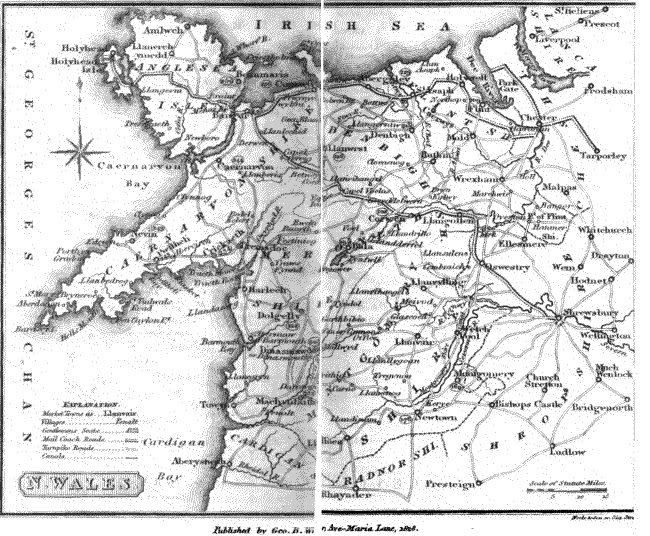
In addition to these, government has placed steam packets on
this station: the two I have had the pleasure of seeing are the
finest and most complete vessels of their tonnage I ever
beheld. Each vessel has two cabins, beautifully fitted up,
light and airy; and every thing appears to have been attended to,
that can either add to the comfort or safety of the passengers:
expense has not been spared for that which was useful, and
conducive to safety; and the equipment having been superintended
by Captain Rogers, an experienced officer, on the Holyhead
station, nothing has been misapplied. The passage is
effected in from five and a half to seven hours, a distance of
fifty-five miles; and the letters are delivered in Dublin from
London in the short space of forty hours.
In short, the attention which government has evinced to
facilitate the communication between the two kingdoms merits
every praise. Neither exertion nor expense have been spared
in improving the roads from Shrewsbury to Holyhead, which
improvements have been executed under the direction of Mr.
Telford, who is now commencing on that from Chester to the above
place; and when the suspension bridge over Conway Ferry (towards
which, parliament has voted a grant of 40,000l.) shall be
completed, in addition to that over the Menai at Bangor Ferry,
but few passengers will run the risk of a dilatory and dangerous
passage by Liverpool or Parkgate, when they may have a certain
and a safe one by Holyhead, with excellent roads and
accommodation; and without the trouble of the ferries, which were
formerly an inconvenience to persons taking this route.
Near
the centre of the town, on a rock close above the sea, is a
church, on the site where St. Cybi, in A.D. 380, founded a small monastery,
which, in 580, was converted into a college by Maelgwyn
Gwynedd, or, according to some, by Hwfa ap Cynddelw,
Lord of Llifon, one of the fifteen tribes of North Wales.
James I. granted this college to Francis Morris and Francis
Phillips, which afterwards became the property of Rice Gwyn, Esq.
who bestowed the great tithes on Jesus College, Oxford, for the
maintenance of two fellows and two scholars: from that time the
parish has been served by a curate nominated by the
College. This church is a handsome embattled edifice, built
in the form of a cross, with this inscription, on a pediment of
the north transept: “Sancte Kyb. ora pro
nobis.” The walls of the church-yard are
seventeen feet high, six feet thick, and form a quadrangle; three
sides of which are evidently Roman, although ascribed to
Caswallon Lawpir, a chieftain of Anglesea, in the fifth
century: the east side is a modern low wall on the verge of the
cliffs.
A fine extensive pier is now nearly completed, on an island
called Ynys-halen, which forms the north side of the
harbour; at the extremity of which, is a fine light-house,
exhibiting a brilliant light by oil gas. This grand
national undertaking has already afforded an asylum to the trade
of the Channel: no less than sixty or eighty vessels have entered
the harbour in one day, and many more have sailed out in one
time. Before the erection of the pier, which commenced in
1809, many valuable vessels, seeking for shelter in stormy
weather, were lost with their crews on the southern shores of the
harbour. From this port are sent upwards of 40,000 bushels
of excellent grain every year. It contains 4071
inhabitants.
Under
the mountain which overhangs the town, called the Head, is a
large cavern, supported by natural huge pillars, named the
Parliament House: this, as well as several others, perforate deep
into the mountain, and is inaccessible without a boat. The
South Slack light-house, on an islet, within about twenty yards
of the bold cliffs of the mountain, exhibits a revolving light of
the greatest utility. The islet is connected with the
mountain by means of a rope bridge, which is perfectly safe to
cross over, and worthy the attention of the curious. Among
these rocks vast numbers of the peregrine falcon take up their
abode, together with pigeons, gulls, puffins, razor-bills, and
other sea-birds.
In returning from Holyhead, we stopped at Gwyndy, or the Wine
House, about twelve miles and a half from the Head and the
Ferry.—Mr. Bingley gives the following account of the
origin of its name: “About the reign of Edward the Fourth,
and for some years subsequent to that period, the gentlemen of
Wales frequently invited their friends, in large parties, to
exercise in wrestling, tournaments, and other feats of activity:
but as these meetings, in consequence of the numbers invited,
were usually attended with great expense, they were always held
in the house of some neighbouring tenant, who was supplied with
wine from the lord’s cellar; this was sold to the visitors,
and his master received the profits. These houses were
denominated Gwyndu, or wine houses; and, from this circumstance,
the present place had its name.”
Having again reached Bangor, we determined still farther to
explore the beauties of this delightful spot and its vicinity:
having taken a hasty refreshment, we bent our steps towards
Abercearn, near the mouth of a small rivulet that empties itself into
Port Penrhyn, and from thence proceeded to
the mansion of George Hay Dawkins Pennant, Esq. which is
delightfully situated on a wooded eminence, between the estuaries
of the Cegin and the Ogwen, about two miles east of the city of
Bangor. It commands a fine view of the bay and town of
Beaumaris to the north; the Great Ormes Head, and Penmaen-maur
terminate the prospect on the east; and towards the south, the
scene is closed by a bold and romantic range of mountains.
A short distance west of the Castle is Port Penrhyn, where the
slates are brought down from Mr. Pennant’s quarry, and
shipped in immense quantities to various parts of the
world. It is easy of access, perfectly sheltered, and
capable of accommodating trading vessels of upwards of 300 tons
burthen.
It is but justice to the successor of the late Lord Penrhyn to
say, that along with the estate, he appears to inherit the same
spirit for improvement. The recent extension of the quay at
Port Penrhyn, is one of the many instances which might be
recited; by it, accommodation has been given to about fifty sail
of traders, in addition to the former shipping-place, making the
total length of the quay upwards of three hundred yards. A
neat stone bridge over the river Cegin, which runs in at the head
of the port, forms a complete connexion between the quay, the
limeworks, the sea shore, and the city.
Penrhyn Castle possesses a great curiosity; and Mr.
Evans’s account of it, in his Topography, being both
judicious and entertaining, I subjoin it. It is the Hirlas
or drinking-horn of Piers Gryffydd, which is perhaps the only
elegant specimen of that kind of utensil elucidatory of ancient
manners.
“It is a large bugle horn of an ox, ornamented with
enchased silver, and suspended by a chain of the same metal,
having the initials of his own name and family engraved at the
end. In the royal court of Cambria, there were legally
three sorts of horns, for the purpose of private or public
libations. The first was y corn ydd yfo y brenin, or the
one solely appropriated to the king’s use; second, corn
cyweithas, by which the domestics of the palace were summoned to
duty. And, third, corn y pencynydd, committed to the
custody of the chief huntsman. Each of these was to be of
the reputed value of one pound. On grand occurrences, the
domestics of the palace were permitted to drink out of the
sovereign’s horn, and the chamberlain, or high steward, on
such occasions, furnished handsome potations of the generous
metheglin. The contents of the horn, at these times,
assumed the name of the sacred potion, similar to the wassail
bowl, or the apostle’s cup, in use among the
Saxons. Ulphus, when he conveyed certain lands to the
church of York, is said to have quaffed off the sparkling
contents of such a vessel, drinking a health, “Deo et
Sancto Petro,” to God and St. Peter. On festive
days, the imperious custom was to empty the horn at one tip, and
instantly blow it, as a testimony that no dereliction of draught
had occurred.
“Fill the horn with
foaming liquor,
Fill it up, my boy, be quicker;
Hence away despair and sorrow,
Time enough to sigh to-morrow.
Let the brimming goblet smile,
And Ednyfed’s cares beguile.
Gallant youth, unus’d to fear,
Master of the broken spear;
And the arrow-pierced shield,
Brought with honour from the field.
Like an hurricane is he
Bursting on the troubled sea.
See their spears distain’d with gore,
Hear the din of battle roar,
Bucklers, swords, together clashing,
Sparkles from their helmets flashing,
Hear ye not their loud alarms?
Hark! they shout—to arms! to arms!
Thus were Garthen’s plains defended,
Melor fight, began and ended:
There two princes fought; and there
Was Morach Vowran’s feast exchang’d for rout and
fear.” [208]
The rail-road and inclined planes formed by the late Lord
Penrhyn, to reduce the labour and risk of bringing down the
slates to the port, with numerous other improvements, are
estimated to have cost his lordship one hundred and seventy
thousand pounds.
The much admired church of Llandegai is a neat Gothic edifice,
which has recently been greatly improved and beautified; the late
Lady Penrhyn having left a noble bequest for that
purpose. “The whole interior has been renewed, viz.
the seats, pulpit, communion, ceiling, plaistering, and floor,
and the tower raised, in order to admit a peal of six bells: a
legacy for which has been also left by Lady Penrhyn, as well as
one for the erection of a monument to her deceased lord, which is
now fixed up in the church, and is a most superb and elegant
piece of work.” Williams.
It is made of statuary marble, and represents two large
figures; the one is a female peasant girl weeping over the loss
of her deceased lord and lady; the other a quarryman, with an
iron bar and slate knife in his hand, earnestly regarding the
inscription, which commemorates his benefactors. Besides
these, the following four smaller figures strongly depict the
wonderful changes effected on the face of the country, and on the
morals, habits, and comforts of its inhabitants, by the noble and
spirited exertions of the late Lord Penrhyn.
The first is a boy, with two reeds in his mouth, feeding his
goats in the mountains, being an emblem of this country, on its
appearance to Lord Penrhyn when it was in a very rough
state. 2nd, Two boys working in the slate quarry; being an
emblem of industry. 3rd, One boy teaching another; being an
emblem of religion. 4th, Three boys standing in a wheat
field, bearing their sickles; being an emblem or representation
of plenty. Here likewise are interred the remains of the
celebrated Archbishop Williams; who is represented in his robes
in a kneeling position on a mural monument.
Mr. Pennant’s slate quarry is about six miles from
Bangor, on the road to Capel-Curig, and Cerniogi-Mawr. St.
Ann’s chapel, near the quarries, was erected, and liberally
endowed by the late Lord Penrhyn; and Lady Penrhyn
left a sum of money for an organ, and a suitable stipend for the
organist.
The traveller is greatly indebted to the present Mr. Pennant,
as well as to the late Lord Penrhyn, for the very great and
comfortable accommodation he now derives from their exertions on
this line of road. The inn at Capel-Curig is now large and
convenient; in addition to which, and to save time, Mr. Pennant
has caused to be erected a cottage and stables, to enable parties
in haste, as well as the mail and coaches, to change horses
without going down to the inn.
Near the slate quarry is the pretty cottage of the late Lady
Penrhyn, called Ogwen Bank. It is a perfect paradise,
arising out of chaos; the style is the florid Gothic, and shews
great taste in the designer. The centre contains an elegant
room, the front of it forming the segment of a circle; the wings
contain coach-houses and stabling. Over the river Ogwen, in
a rough and picturesque part of it, is a bridge corresponding
with the house. All visitors to the house are requested to
sign their names in a book kept for that purpose. This
beautiful cottage is hid from the road by the trees and
plantations.
Having satisfied ourselves with the view of this charming
retreat, we proceeded to a comfortable inn, called Tynymaes, (now
a post-house, with good stables,) and partook of some
refreshment, prior to a more full investigation of the horrors
and beauties of the vale of Beavers, or Nant Ffrancon; for in
this once solitary and dreadful glen, those useful and
astonishingly ingenious animals were once found, whose skins were
then valued at 120 pence. The awful grandeur of the
surrounding barren rugged rocks are finely contrasted by the rich
verdant bottom of the glen, and the thick foliage and luxuriant
plantations of Ogwen Bank. Descending from the
road into a hollow, we had a fine view of the cataracts of
Benglog; down which the waters of five lakes rush into the pool
beneath; the lower fall of the three, which is the largest, is
seen to the greatest advantage, by climbing a rugged rock.
“Here,” says Mr. Bingley, “the stream roared
with vast fury, and in one sheet of foam, down an unbroken and
almost perpendicular rock. The sun shone directly upon it,
and a prismatic bow was beautifully formed by the spray.
The tremendous roar of the water, and the broken and uncouth
disposition of the immediately surrounding rocks, added greatly
to the interest of the scene. After a while I climbed a
rocky steep to the second or middle fall. Here the river is
precipitated, in a fine stream, through a chasm between two
perpendicular rocks that each rise several yards above.
From the station I took, the immense mountain Trivain was seen to
fill up the wide space at the top; heightened greatly in effect
by a dark aërial tint arising from the extreme heat of the
day, and the lowering clouds that were floating around. The
masses of black rocks, surrounded by foam, near the top of the
fall, I could have fancied were floating along the torrent, and
rushing to the bottom. The stream widens as it descends,
and below passes over a slanting rock, which gives it somewhat of
a different direction. In the foreground was the rugged bed
of the stream, and the water was seen to dash in various
directions among the broken masses of rock. The third
cataract, to which I now clambered, I found very grand and
majestic, yet by no means equal to either of the former.
These waterfalls are scarcely known in the adjacent country, and
have been unaccountably omitted even in Mr. Pennant’s Tour,
although this gentleman accurately describes most of the
scenery around them.
“Leaving the falls, the trouble of visiting which had
been amply repaid by the pleasure I had derived from them, I
regained the road. On crossing the upper end of the vale, I
was delighted with a very beautiful and unexpected view for
nearly its whole length; where the mountains down each side
appeared, to a great distance, falling off in beautiful
perspective.”
Mr. Bingley experienced not more pleasure than we did in the
view of these cataracts; but he was fortunate in having more
leisure to add to it, by viewing Y Trivaen or the Three Summits,
which bounds the right extremity of the hollow, and Llyn Ogwen,
from which the river of that name takes its rise: Mr.
Hutton’s description of it made us greatly regret the
pleasure we were obliged to decline; but having upwards of five
miles to return to Bangor, although our road was all down hill,
we found it necessary so to do, from the previous fatigues of the
day: rocks, Welsh roads, and the viewing of slate quarries, prove
the stamina of a tourist. Mr. Hutton approached Llyn Ogwen
from Capel-Curig, where there is now an excellent inn, much
frequented during the summer months by parties of pleasure.
His description is as follows:
“A stranger to the country, to the language,
and almost to man, I returned to Nant Gwynant, slept at
Capel-Curig, and was wandering over Lord Penrhyn’s new road
towards Caernarvon. The cascades on my left were rolling
down with violence, after heavy rain, when a sheet of water, one
mile long and three quarters wide, presented itself to view;
which by the map I knew must be Ogwen Pool. But what was my
surprise, when, at the extremity of the pool, I instantly found
myself upon a precipice two hundred feet high, and in a moment, a
most beautiful valley burst upon me of nearly one mile wide and
four long; the river rushing down this precipice in several
stages, and winding full in view through this delightful
valley. The rocks appeared tremendous, the mountains
sloping, and the verdure increasing with the descent, to the
bottom, where, if poetically inclined, I might say, ‘Nature
sat in majesty, adorned in her best robe of green
velvet.’ When I had travelled about three miles along
this sequestered valley, I saw four people endeavouring to repair
a gate. I addressed one who appeared likely to understand
English. He readily answered several questions respecting
the road, and other objects. ‘My way, I am informed,
Sir, lies through Nant Frangon; pray how shall I know when I am
in it?’ ‘You are in it now.’ Over
part of this vale impends Yr ala wen, its front torn into amazing
gullies.”
The new mail road between Bangor and Cernioga Mawr, through
Capel-Curig, saves upwards of nine miles; by this road, through
Shrewsbury, the distance to London is two hundred and thirty-six
miles three furlongs: the old mail road, through Chester, is two
hundred and fifty-one miles one furlong; and the former road,
through Shrewsbury, Llanrwst, Conway, and over Penmaen-Maur, is
two hundred and forty-five miles, or by Bridgenorth, two hundred
and fifty-two miles.
Along this road lies some exquisite scenery: and the following
passage from the Beauties, Harmonies, and Sublimities of Nature,
will agreeably illustrate the feelings with which it impregnated
the author.
“As Helvidius was making an excursion among
the mountains, stretching to the east of Moelshiabod, he arrived
at the
bridge, across a small rivulet; and sitting down upon the grass,
fell asleep under the shade of a large holly tree. He awoke
just as the sun was sinking in the horizon; a slight shower
succeeded; all nature became renovated; and the perfumes, which
embalmed the air, seemed even capable of wafting him to the
Elysian Fields. The tree, beneath which he reposed, stood
in a valley, matchless even in the Island of Madagascar; and the
cones of several mountains gave an air of grandeur to the
perspective, which nature has forbidden in most other
regions. He was lost, as it were, in the enthusiasm of his
admiration! At that moment Lord — passed in his
coach, apparently insensible to the scenes, through which he was
conveyed. Oh! how an indiscriminate mingling with men
blunts the best feelings of the human heart! ‘Had his
Lordship,’ thought Helvidius, ‘seen these lovely
pictures, even a thousand and a thousand times before, he might
have derived enjoyment from witnessing them again; since it is
the autumnal season of the year; and the woods and shrubs growing
out of the rocks, are variegated in a manner, that even Salvator
Rosa would have loved to look upon them!’
“Though Helvidius was mortified at this insensibility on
the part of the statesman, and felt so ready to condemn his taste
and want of sensibility, he was weak enough to feel more at war
with himself, than with him: and began seriously to question,
which were the wiser of the two; the man who loves, or he who
neglects, the varied objects of the material world.
‘He is a Peer,’ exclaimed he to himself, ‘a man
of education,—a statesman,—one who is looked up to in
the world, as being, in a manner, pre-eminent over his
species:—he seems to have little relish for all these
objects, which I have been looking upon with such
enthusiasm. It must be folly and weakness in me, therefore,
to indulge this humour; a humour, which, from what I have seen of
mankind, I am sensible, most men, who look not up through every
object that he sees, to the Architect, that makes it, would
esteem frivolous and idle, if not criminal. There are no
silver mines here: nor does this rivulet leave any gold dust upon
its shores!’ He sat down mortified. To
dissipate his chagrin, he took a volume of Epictetus out of his
pocket, and opening the book, his eye alighted upon the following
passage. ‘As when you see an asp in a golden casket,
you do not esteem that asp happy, because it is inclosed in
materials so costly and so magnificent, but despise and would
shun it, on account of its venom: so, when you see vice lodged in
the midst of wealth and the swelling pride of fortune, be not
struck with the splendour of the materials, with which it is
surrounded, but despise the gross alloy of its manners and
sentiments.’ Upon reading this passage, Helvidius
became instantly ashamed of his folly, and reconciled to his
enthusiasm. ‘Though this is a man,’ said he to
himself, ‘who, like the King of Sweden’s enchanted
cup, can almost make the wind turn to any part of the compass,
which pleases his humour most: though he is perpetually
surrounded by persons, who, if he were to take his shoe from off
his foot, hurl it into the air, and proclaim it a god, would
worship it as it fell; and though he is a rising sun, whom half
the world would worship, yet would I rather be able to trace the
Power, which formed this holly tree, up to as far as my
imagination is capable of soaring, than be the man for him to
shake by the hand; to admit to his banquets; to revel with his
minions; to hang, as it were, upon his lips; and to be raised to
ecstacy by his smiles!
“Climb at court for me, that will
Tottering favour’s pinnacle;
All I wish is to be still.
Settled in some secret nest,
In calm quiet let me rest:
And far from off the public stage,
Pass away my quiet age.”
On leaving Bangor we proceeded to the pretty little village of
Aber, which gives its name to the last of the ferries over the
Menai. The walk from the village across the Lavan Sands to
the ferry is about four miles. This walk it would be
hazardous for a stranger to undertake without a guide, as the
sands frequently shift. During foggy weather, the large
bell of Aber, given for this purpose by Lord Bulkeley, is
constantly rung, as a guide to direct those coming from the
island.
Near the bridge is a circular mount, seemingly artificial,
which was the foundation of a small castle, probably constructed
of timber, as many of the Welsh fortresses were: the vestiges of
the moat and its feeder from the river still remain.
“Traces of buildings have been discovered
near this spot, which were probably the remains of the
prince’s palace, as the inhabitants still pretend to show
strangers the foundation of the old kitchen. Several
memorials, &c. appear in our Welsh histories, dated Aber
Garth Celyn, which is the ancient name by which this place was
distinguished.”—Williams.
At the siege of Montgomery, in the reign of Henry the Third,
Llewelyn ap Iorwerth took prisoner a potent baron, named William
de Breos, whom he conducted to this castle. William, who
was both accomplished and handsome, gained not only the
friendship of his conqueror, but likewise the
affections of his wife, [217] with whom he
ventured to carry on an intrigue. This not having been
discovered by Llewelyn till after the baron had been ransomed, he
condescended to resort to a breach of hospitality, for the
purpose of getting him again into his power.
De Breos having accepted an invitation from Llewelyn to visit
him, the latter no sooner got possession of his person, than he
caused him to be hung on the side of the opposite hill. The
next morning the bard of the palace (the princess being ignorant
of his fate) accosted her in the following rhyme:
“Diccyn, doccyn, gwraig Llywelyn,
Beth a roit ti am weled Gwilym?”
“Tell me, wife of Llywelyn, what you would give for a
sight of your William?”
To which the princess answered:
“Cymru, Lloegr a Llywelyn
Y rown I gyd am weled Gwilym!”
“Wales and England and Llywelyn,
I’d give them all to see my William!”
The bard, thus aggravating Llywelyn’s cruelty, shewed
him to her hanging on a tree, on the side of the hill, at a place
called Wern Grogedig. Upon a mountain, about a mile south
of Llywelyn’s castle, in a field called Cae Gwlyn du, is a
cave where William de Breos was interred, still called Tyddyn
Gwilyn.
Aber is much resorted to during the summer season, the sands
at high water affording excellent bathing: the inn
likewise affords good accommodation. It chiefly belongs to
Lord Bulkeley, and exhibits numerous proofs of his
lordship’s benevolence; amongst the rest, a new steeple to
the church, with a ring of bells.
From hence, after passing Gosddinog (Mrs. Crawley’s) we
soon reached the dark lowering promontory of Pen-mawn-mawr, about
eight miles from Bangor, rising perpendicularly, in a massy wall,
to the height of one thousand four hundred feet: huge fragments
of shattered rock are scattered by the side of the road; and a
wall, scarcely five feet high, alone protects a carriage from the
steep precipice; which from the slightness of the foundation, has
even fallen down in many parts. In this awfully sublime
situation we remained for some time, astonished at the bold
protuberance of the rocks, which seemed to project their dark
sides to augment the idle roar of the waves.
The difference between looking up and looking down a precipice
is well marked by Mr. Jefferson, in the account he furnished the
Marquis de Chastellux, of the Virginian bridge of rocks.
“Though the sides of the bridge,” says he, “are
provided, in some parts, with a parapet of fixed rocks, yet few
men have resolution to walk to them, and look over into the
abyss. You voluntarily fall on your hands and feet, creep
to the parapet, and look over it. Looking from the height
about a minute gave me a violent head-ache. If the view
from the top be painful and intolerable, that from below is
delightful in the extreme. It is impossible for the
emotions, arising from the sublime, to be felt beyond what they
are on the sight of so beautiful an arch; so elevated and so
light, springing up, as it were, to heaven. The rapture of
the spectator is indescribable.”
In
keeping the direct line of road the traveller leaves behind him
many antiquities worthy of attention; Mr. Williams’s
account of which, from his being a resident near the spot,
appearing to be the best, as well as containing a most full and
interesting description of the ancient Welsh or British games, I
shall transcribe: at the same time, strongly recommending the
work to such as wish to take a minute survey of this
county.—His route is reversed, “but as most strangers
will, no doubt, proceed from Conway to Bangor, it shall be my
endeavour to act as their guide, and mention some particulars
which are worth their attention along this road. For the
first two miles he will proceed up hill, until he comes to an
opening between two rocks, near a place called Sychnant, when all
of a sudden a most magnificent scene presents itself. From
hence, he commands a full view of Beaumaris Bay, generally
covered with a number of small vessels; the Puffin, or Priestholm
island, the village of Llangoed, the town of Beaumaris,
Baron-hill, and the Friars; the former, the beautiful seat of the
Lord Viscount Bulkeley, and the latter, that of his brother, Sir
Robert Williams, Bart. M.P., all on the Anglesea shore. On
the Caernarvonshire side, Bangor and Penrhyn Castle; and last,
though not least, the huge Penmaen-mawr, protruding its rocky
front into the sea, forming a natural barrier in such manner (to
all appearance) as to cut off every communication this way, and
render any farther progress impracticable. The art of man
has, however, at length conquered these difficulties, and
surmounted every obstacle, for about the year 1772, an excellent
road was formed along the edge of this once tremendous and
dangerous precipice, under the direction of the ingenious Mr.
Sylvester, parliament having generously voted a grant for
this purpose. Prior to this event several fatal accidents
had happened here; and one or two nearly miraculous escapes are
recorded in Pennant’s tour through North Wales. At
that time, no carriage passed this way, and consequently, all the
travelling was either on foot or on horseback. Dean Swift
was generally a pedestrian, and in one of his rambles he left
these lines, written on a pane of glass, at the old inn, (now a
farm-house) near this mountain:—
Before you venture here to pass,
Take a good refreshing glass;
And when you are over, take another,
Your fainting spirits to recover.
“Before the traveller descends from the top of Sychnant,
just mentioned, to the little vale Dwygyfylchi, he should deviate
a little to the left, in order to examine some antiquities, near
a place called Gwddw Glâs, in that parish. Here are
several circles of stones, of various diameters, and large
Carneddau, viz. barrows, or tumuli; supposed to have been
memorials of those heroes who fell in the field of battle, as
cistfaens, or stone coffins, are frequently discovered in some of
these circular heaps or collection of stones. The principal
circle now consists of ten upright stones, at unequal distances:
the largest is eight feet three inches high; on the ground is
another, eleven feet two inches; the diameter of this circle is
eighty feet.
“Near this are four other smaller circles; in the centre
of one is a flat stone, the remains of a cromlech, from which it
may be conjectured, that it was a Druidical or bardic
circle. About a quarter of a mile from these is a large
circle, composed of small stones, and near it another of large
stones; and not far from these another circle, composed of
smaller stones.
“Near the last is a huge upright stone, called Maen y
Campiau, or the stone of games; and nearly contiguous is a
carnedd, and a small circle of twelve stones; adjoining to these
are also a great number of what are now called in this country,
Cyttiau Gwyddelod, (woodmen or Irishmen’s huts) being the
foundations of small buildings, made of round stones; and the
vestige of a road is still visible in a direction from hence
towards the Conway. Some of these last, might probably have
been the summer habitations or encampment of a small detachment
of the Roman legion, stationed at Caer Rhun, or Conovium, for the
purpose of protecting their cattle.
“Having mentioned Maen y Campiau, it may not perhaps be
considered a digression to enumerate the twenty-four Welsh or
British games, of which there were ten Gurolgampau, or
manly games; viz. 1. to lift up great weights; 2. running; 3.
leaping; 4. swimming; 5. wrestling; 6. riding. These six
were styled Tadogion, viz. pertaining to fathers, or grown up
persons, and required only bodily strength and activity; this
last, Marchogaeth, is supposed to have included charioteering, or
the skilful driving and management of different kinds of
carriages. The other four were, 1. archery; 2. playing with
the sword and buckler; 3. playing with the Cledda deuddwrn, or
two-handed sword; 4. Chwarau ffoun ddwybig, or playing with the
two-end staff or spear. Next to these were the ten
Mabolgampau, or those more peculiarly adapted to young
men; viz. 1. coursing; 2. fishing; 3. fowling; the remaining
seven were of the domestic kind; 1. Barddoniaeth, or
poetical composition; 2. Chwareu’r, Delyn, or playing
upon the harp; 3. reading Welsh; 4. singing with the harp; 5. singing
between three or four, most probably in alternate stanzas, or
Pennillion; 6. drawing or painting, particularly coats of arms;
7. heraldry. After these were four Gogampiau, or
minor games; viz. 1. Chwarau Gwydd-bwyll, a game similar to that
of draughts; 2. Chwarau Tawl-Bwrdd, probably back-gammon, as this
word is supposed to be derived from the Welsh language;
viz. Back, little, and Cammawn, or Gammon, Battle; and
Tawl-Burdd, means the toss on the table; 3. Chwarau Ffristeal, or
the game of the dice-box; in what manner it was played is not
known at present; 4. Cyweiriaw Telyn, or the tuning of the
harp.
“After visiting these circles, the traveller may either
proceed to the top of Pen-maen-mawr, or descend to the high road,
near Dygyfylchi church, not far from which, just at the foot of
Pen-maen-bach, is Pendyffryn, the seat of T. Smith, Esq. In
the clefts of the rocks, above the turnpike-gate, near
Pen-maen-mawr, grows the Cratægus Aria, or white
beam-tree. Mr. Pennant observes, the Swiss procure a good
kind of ardent spirit from the berries. The summit of this
mountain seems to have been fortified by two or three walls, one
within the other; and there are still visible the remains of a
great number of huts, or small buildings, most probably at one
time, the habitations of soldiers; it was, no doubt, a strong
military post, and is supposed to have been made use of by the
Britons and Romans. The Roman road from Segontium to
Conovium must have passed near it, probably on the south side;
and this high mountain, so conspicuous and so easily
distinguished at a distance, formed a kind of link, no doubt, in
the military chain of communication between this county and
Denbyshire, as it is very visible from Dinorwick, (now called Pen
Dinas), a Roman encampment in the parish of Llandeiniolen, near
Caernarvon on the west, and from many fortified eminences in the
other county, on the east. The usual signals in ancient
times were fires by night, and a particular kind of flag by
day. Having examined the immense ruins of Braich y Dinas,
we now proceed along the high road, through the parish of
Llanfairfechan; and leaving that small church, on an eminence, a
little to the left of the road, and on the right, Brynn y Neuadd,
an old neglected family seat, at one time the property of
Humphrey Roberts, Esq. and afterwards conveyed to the Wynnes of
Plas Newydd, near Denbigh, by the marriage of his daughter to a
son of that family; we soon pass Gorddinog,” &c.
Williams.
Pursuing a good turnpike-road from Mrs. Crawley’s, we
presently came in sight of the towers of
standing on a rock, so picturesquely alluded to in the Bard of
Gray.
“On a rock, whose haughty brow,
Frown’d o’er old Conway’s foaming flood,
Robed in a sable garb of woe,
With haggard eyes the poet stood.”
The castle, built by Edward I., is a magnificent fortress, in
the form of a parallelogram.
An air of proud sublimity, united with singular wildness,
characterises the place. The evening was far advanced; and
part of its ruins were shining with the purple glow of the
setting sun, whose remaining features stood in darkened majesty,
when we entered this monument of desolation. Passing over a
plank, originally the site of the drawbridge, we came into the
outward court, strongly defended with battlements; from thence we
examined the grand entrance of the castle, with several abutments
projecting forward, similar in style to Caernarvon. On the
south side of the court is the grand hall, measuring an hundred
and thirty feet by thirty-two, with eight light Gothic arches,
five of which are still in good condition. At one end is
the chapel, with a large window, a beautiful specimen of Gothic
architecture. It was founded on the solid rock, by Edward
I. in the year 1284; the walls are from eleven to fifteen feet
thick: all the towers are defended by small round ones,
projecting two or three feet over, with a regular communication
round the whole castle by galleries, on the same plan as at
Caernarvon. The steps are decayed and broken, and the
looseness of the stones rendered a footing very insecure; but,
impelled by an irresistible curiosity, we ascended the most
perfect tower, and an extensive prospect presented itself to our
view. The foundation of one of the principal towers,
looking towards a small river, which here joins the Conway, has
lately given way, and torn down with it part of the building; the
remainder now hangs in an extraordinary manner. The whole
town is enclosed with strong walls, and defended by a number of
towers, which communicate with the castle by a gallery; there are
likewise several gateways at certain distances.
The ancient church next attracted our attention, but did not
detain us long, as the monuments for the Wynnes are the only
things worthy of inspection, except the following inscription,
which is engraved on a flat stone, in the nave of the church:
“Here lyeth the body of Nicholas Hookes, of Conway, gent.,
who was the 41st child of his father, William Hookes, Esq. by
Alice, his wife, and father of 27 children; who died the 20th day
of March, 1637.” Few districts in the world
can, perhaps, produce a record similar to the preceding.
From thence we surveyed the remains of the college, which in
the reign of King Edward I. was intended for the instruction of
youth. It is now in complete ruins: the workmanship
curious, with several sculptured arms. In this town is an
ancient house, built in the form of a quadrangle, by the Wynnes,
in the time of Queen Elizabeth, now inhabited by poor
families. The house is adorned after the fantastical
fashion of the times in which it was erected; the roof is
singularly carved, and the front decorated with the arms of
England, with several curious crests, birds, and beasts: it bears
the date of the year 1585. The arms of Elizabeth are carved
over the door, fronting the street.
The river Conway has been celebrated from the earliest period
of British history, for its pearl fishery. Pliny asserts
that Julius Cæsar dedicated to Venus Genetrix, in her
temple at Rome, a breast-plate, set with British pearls; and
other authorities go so far as to assign the desire to get
possession of these jewels, as one of the reasons of his invading
the British isles. The shell in which they are found is
called the pearl muscle, and is the same which by Linnæus
is termed Mya Margaritifera.
The fish, which generate these concretions, are considered in
a sickly state; and it is said that on their being squeezed, they
can and will eject them, which they occasionally do spontaneously
on the sands. I am given to understand, that a very
considerable trade is carried on by an individual, very snugly,
at this very day, in pearls collected from the Conway and
adjacent coast. Some years ago, Sir Robert Vaughan appeared
at court with a button and loop in his hat, set with pearls from
the Conway; and Mr. Edward Llwyd says, that the pearls found here
are as large and as well coloured as any in Great Britain.
“Immediately at the foot of the castle,” says a
recent traveller, [226] “a
suspension-bridge is thrown over the previously dangerous ferry,
in the erection of which great taste has been exhibited.
Castellated towers support the chains, and where the road enters
the town, a toll-house, in the shape of a dilapidated tower, has
been erected, which perfectly harmonizes with the view around it,
and taken altogether, the bridge seems to be the draw-bridge of
the castle, and does not detract from the antique grandeur of the
scene. Mr. Telford is the architect of this, as well as of
the Menai Bridge; and though it possesses nothing of the immense
proportions, it is equally elegant and well adapted to its
situation.”
Edward the First made this a free borough. It is now
governed by one alderman, a recorder, coroner, water-bailiff, and
two serjeants-at-mace, chosen annually, and is a contributory
borough with Caernarvon, Pwllheli, Nevin, and Criccaeth, in
returning a member to parliament. Its market is on
Friday.
The usual route, and the one which we intended to pursue,
laying by St. Asaph and Chester, we determined first to explore
some of the beauties of the vale of Conway; and with this object
in view, took the road leading to Llanwrst: it possesses the
charming varieties of wood, water, and a richly cultivated
country, backed by mountain scenery. We soon reached Caer
Rhun, the site of the ancient Conovium of the Romans, where the
tenth legion were stationed. The late Rev. Hugh Davies
Griffith, vicar of the parish, and a gentleman well known for his
antiquarian researches, traced out here the remains of a Roman
pottery: many utensils of various sorts had previously been
found, mostly imperfect, some well designed and very
curious. Amongst other things found here, was a small
brazen circular shield, of curious workmanship, embossed, a
little more than a foot in diameter, and with a projecting pike
of wrought iron, of about four inches and a-half, placed in the
centre; it had circles of brass studs, and appeared to have been
lined with leather and stuffed with hair. Numerous Roman
coins were likewise found, and near this is a hill, called Mynydd
Caer Leon, or the Hill of the Legion. Mr. Williams
says, “This legion was denominated Antoniana Augusta.
The XXth, stationed at Chester, (Caer Lleon Gawr, or Caer Lleion
ar Ddyfrdwy), was distinguished by the name of Vicessima Victrix:
and the Second Legion, stationed at Caer Leon, in Monmouthshire,
or Caer Lleon ar Wysc, was known by the title of Augusta
Britannica. There was, no doubt, a Roman road from hence to
Segontium, on the west, and to Varium or Bodvarri and Caerwys on
the east, and another probably through Dolyddelen, to Sarn Helen
and Tommen y Mur, in Merionethshire; Pen y street, Dolgelly,
Castell y Beri, near Tal y Llynn, to Penal, near Machynlleth,
where there was a Roman encampment, and where very considerable
remains were discovered.”
The next object worthy of attention is Rhaiadr Mawr, or the
Great Waterfall, about seven miles from Conway; Mr.
Bingley’s account of which is so correct and spirited, that
I shall give it verbatim. “I ascended along a winding
path, which, after about a quarter of an hour’s walk, conducted
me to the bed of the river, near the station from whence it was
to be seen to the greatest advantage. The water, from the
late dry weather, was very inconsiderable; still, however, the
scene was highly picturesque. From the upper part two
streams descended at some distance from each other. The
range of rock, down which the water was thrown, was very wide and
extremely rude, being formed in horizontal ledges, into deep
clefts and enormous chasms. On the various lodgments of the
rocks were numerous pendant shrubs. The dark shades of the
clefts, and the irregular brilliancy of the prominent features of
the scene, from the reflected rays of the sun, contrasted again
with the foaming of the water, were truly grand. The
colours of the rock, which were every where also very dark, were
rich and highly varied. The streams united a little above
the middle of the fall: they rushed from thence in foam over the
rocks, and, from the deep shelvings, in many places the water was
entirely hidden from me below. In addition to this, nearly
every different stratum of rock threw it into a fresh
direction. In the whole scene there was the utmost
irregularity. On the right of the cataract, the enclosing
rocks were nearly perpendicular, very lofty, and crowned with
pendant foliage. Those on the left were very high and
towering, adorned on the lodgments with grass and ferns. I
should have made a drawing of this cataract, had it been possible
to have expressed it with any justice on an octavo plate; this,
however, was altogether impossible. The above description
is expressed in terms infinitely too feeble to give any correct
idea of the scene. This waterfall appeared to me by much
the most grand and picturesque of any that I have seen in North
Wales.
“In descending to the road, I had an extensive view along the
whole vale of Conway. It appeared from this eminence to be
much varied, and on the whole very beautiful.”
Besides this, many other waterfalls and cascades, along this
charming river, will amply repay this digression, and entice the
tourist forward to its junction with the Lledr and Machno.
Near Llanwrst, Gwydir-house and woods, and at that place, the
church, and the famous bridge, built by Inigo Jones, will engage
his attention. Beyond the vale is beautiful and romantic,
far exceeding my powers of description; all that wood, water, and
the most rugged rocks, and picturesque mountain scenery can do to
delight the lovers of nature, heightened by the relief of a
highly cultivated country, interspersed with gentlemen’s
seats, frequently breaking on the view, are here amply afforded
them. Proceeding up the vale, and through Gwydir woods, you
reach Bettws y Coed; thence to the new iron Waterloo-bridge over
the Conway, on the great Irish road, visit the falls of the
Conway and Machno, return to Bettws, proceed up the Lligwy to
view the Rhaidar y Wennol, or Cataract of the Swallow, which,
when it possesses its customary body of water, is truly
tremendous. In going from hence to the excellent inn at
Capel-Curig, by making a circuit of about four or five miles to
the southward, you may visit Dolwyddelan Castle, the residence of
Meredith ap Jevan, before mentioned in the account of Llyn.
From Capel-Curig, proceeding towards Bangor, till the road nearly
reaches the river Ogwen, he may with labour and difficulty trace
the old Roman road, from Segontium to Conovium, or, without any
risk of satiety, retread his steps by Llanwrst to Conway.
The trade of Conway consists in the exportation of slate and
copper from the Llandidno mines, from whence the finest specimens
of Malachite copper is brought. The town and castle of
Conway are seen to great advantage in crossing the river, which
is here about half a mile over, and at high water washes the
walls of that massy ruin: in the middle of the channel is a small
rocky island. We observed from this situation the two
castles called Bodscallan and Dyganwy; the small remains of the
latter stand on a high rock above the river: the former is a
beautiful seat of the Mostyns.
Crossing the ferry we determined on exploring the Criddin, a
Commot, or Hundred of Caernarvonshire, at the extremity of which
is that noted landmark, the Great Orme’s Head. This
commot is supposed to contain some of the best arable and meadow
land in this part of the principality; the shores and cliffs
likewise afford excellent limestone, and pebbles for paving; both
of which are shipped in large quantities for Liverpool and other
markets. Dyganwy, or Dinas Gonwy, The Fort of the
Conway, was once the residence of Maelgwyn Gwynedd, Prince of
North Wales, who here held his court. The following
anecdote of which, as connected with Taliesin, the British Bard,
I shall give the heads of from Mr. Bingley:
“Gwyddno Garanhir, brother of Maelgwyn, who
likewise resided in the neighbourhood, had near his residence a
weir, called Gored Wyddno, Gwyddno’s Weir, which is
even yet known by the same name, and belongs to Sir Thomas
Mostyn, as owner of the house of Bodscallon. Elphin, the
son of Gwyddno, was an extravagant youth; and at one time he had
so greatly exhausted his finances, that he was compelled, as a
temporary relief, to ask his father the benefit of the weir for a
single night. The request was complied with, but not a single
fish was caught. [231] A leathern basket was however
taken up, which, on examination, was found to contain a
child. This was an unfortunate circumstance to one so much
in want of even a successful tide. Elphin had, however, the
humanity to direct that the child should be taken care of, and
that no expense should be spared in his education. The
youth, who was named Taliesin, was introduced by Elphin at his
father’s court; and his first step towards fame was in
reciting there a poem containing the history of his life, called
Hanes Taliesin. Maelgwyn Gwynedd was greatly surprised at
his talent, and himself became afterwards his patron. Some
time after this a dispute took place at Diganwy, betwixt Elphin
and his father, of so serious a nature, as to cause the former to
be thrown into prison. His attentions to Taliesin now
proved of the utmost importance to him. The bard addressed
to the prince a poem on his patron, which excited his
commiseration, and caused him to issue an immediate order for
Elphin’s release. Taliesin continued to receive,
throughout the whole of his life, the attentions, the
admirations, and the applause which his talents justly merited;
and after his death, he was honoured with the appellation of
The Prince of the British Bards.”
Gloddaith woods particularly, and most part of this small
district, afford considerable amusement to the botanist; as will
the libraries of Sir Thomas Mostyn, Bart. at Gloddaith and
Bodysgallen, to the antiquarian and the historian. The
former of these seats was built in the reign of
Queen Elizabeth; since which period both mansion and furniture
have experienced but trifling alterations.
The tremendous precipice on the west side of the Ormshead is
worthy of a visit. The sea view is very extensive, and
generally enlivened by the passing of Liverpool shipping; you
likewise command a view of the Isle of Man, and occasionally
views of the Irish, Lancashire, and the distant haze of the
Scottish coast. The sea birds frequent these cliffs and
shores in great abundance, more particularly gulls, razor-bills,
and guillemots, corvorants, herons, and the peregrine falcon; the
latter of which, in the days of falconry, were held in such high
estimation, that the celebrated Lord Burleigh sent a letter of
thanks for a present of a cast of hawks from this place to an
ancestor of Sir Thomas Mostyn’s. Unprotected by any
shelter, on the summit of the high promontory, stands the small
church of Llandudno, but little famous for any thing but its
singular situation, and its service as a beacon. Proceeding
along the mail-road, with the sea on our left, and low rocks on
our right, nothing particular attracted our attention, till in
descending a hill about two miles from the neat bathing-town
of
we observed on our right, two immense caverns, about half way
up the mountain; they are called Cavern-arogo, and run four or
five hundred yards into the ground; but their real extent has
never been ascertained with accuracy. From these mountains
vast quantities of lime are shipped for Liverpool and many parts
of England.
Abergele, situate on the edge of Rhuddlan Marsh, is a small
neat town of one street, resorted to in the summer season for
bathing. The sands afford excellent walking; in the evening
we lingered on the beach for a considerable time, enjoying the
calm, but cheerful beauty of nature, and inhaling the pure
sea-breeze—for
. . . “The wind was hush’d;
And to the beach each slowly-lifted wave,
Creeping with silver-curl, just kiss’d the shore,
And slept in silence.”
Mason’s
Garden.
With pleasure mixed with reverential awe, we trod Rhuddlan
Marsh, so celebrated in the annals of history. Here the
ill-fated Richard II. was betrayed into the hands of Bolingbroke,
and taken prisoner to Flint: here, Offa, king of Mercia, met his
untimely death: here the Welsh, under the command of Caradoc, in
the year 795, were defeated in a conflict with the Saxons, and
their leader slain in the action. This memorable and tragic
event is handed down to posterity by an ancient celebrated and
affecting ballad, called Morva Rhuddlan, or the Marsh of
Rhuddlan, composed by the bards on the death of Prince
Caradoc.
The ground we trod, connected with so many events, revived in
our minds the memory of past ages; a series of historical events
came to our recollection: events, that are now so distant, as
almost to be obliterated from the page of history. Passing
over a bridge of two arches, thrown over the river Clwyd, we
entered
once the largest and most respectable town in North
Wales. Walking over the ruins of the castle, in which
Edward 1st. kept three Christmases, I recurred, by a natural
association of ideas, to the times, when the parliament-house, the halls,
and courts, echoed with the voices of those, who have been long
since swept from the earth by the unerring hand of death.
One solitary Gothic window is now only remaining to distinguish
the old parliament-house, where King Edward the 1st. instituted
that famous code of laws, under the title of the statute of
Rhuddland, from a neighbouring barn: and what once contained the
parliament of England, now contains nothing but bark for the
supply of a tan-yard.
The old castle is built of red stone; it consists of a square
area, strongly fortified with a wall. This court we entered
through the grand gateway, between two round towers: the opposite
side corresponds. The whole is encircled by a deep
entrenchment faced with stone on the river side, with two square
towers, one of which still remains.
“The Bishop of St. Asaph,” says Mr. Evans,
“distributes among the farmers of the parish of Rhyddlan,
five guineas for the best crop of turnips; and three guineas for
the best crop of wheat upon a fallow, manured only with lime
compost. All the competitors partake of a feast on the day
of decision; and the victors, beside their premiums, have the
honourable distinction of being crowned with the garland of
Ceres, by some of the ladies present.” This stimulus
has had great effect in exciting a spirit of improvement.
The road from hence to
affords a most rich and beautiful walk, extending along the
celebrated vale of Clwyd. This rich tract of land, called
the Eden of North Wales, extends in length about twenty-five
miles, and in breadth about eight. The neighbourhood of Ruthin affords the best view of this
vale. Though it is by no means so interesting and romantic
as the vale of Glamorgan, yet its high cultivation, and the
picturesque, but moderate height of the hills, rising on each
side of the river Clwyd, renders the scenery pleasing: its chief
produce is corn. Both these vales claim the attention of
the traveller; and both have to boast of particular
beauties. One mile from St. Asaph we passed, on our right,
the elegant seat of Sir Edward Lloyd. We still followed the
banks of the Clwyd; and at the farthest extremity a light elegant
bridge of seven arches, with the dark tower of St. Asaph’s
cathedral rising on an eminence just over it, gave a picturesque
effect to the whole scenery.
The town itself is built on a hill, in one straight line, with
a few neat houses. The cathedral naturally demands
attention: the inside is remarkably neat and elegant, entirely
Gothic, with the ceiling of chesnut, and open ribs like the
skeleton of a ship. The monument of David ap Owen, bishop
of this diocese, was particularly pointed out to us. The
bishop’s palace has been entirely rebuilt by the present
diocesan. The choir consists of a bishop, dean, six canons,
seven prebends, and four vicars. There are no monuments in
the churchyard, and few of any importance within its venerable
walls.
St. Asaph receives its derivation from its patron, who
established a bishop’s see here, in the year 590: but in
British it is named Llan-Elwy, on account of the conflux of the
Elwy with the Clwyd. It is singular, that the cathedral is
not used as a parish church, as all the other Welsh cathedrals
are; and that the bishop’s jurisdiction extends over no
entire county, but includes part of Flintshire, Denbighshire, Montgomeryshire, Merionethshire, and
Shropshire.
From St. Asaph to Holywell the distance is about ten
miles. The first part of the road continuing through the
vale of Clwyd, affords prospects of agricultural riches rarely
excelled; the latter part is rocky and rugged, but
pleasant. On the one side you enjoy the distant view of
Denbigh, with its ancient castle fast mouldering to decay, and on
the other that of Rhyddlan, backed by the distant sea view.
The whole of this tract of country abounds in lead-mines and
calamine. Between this road and the sea stands Downing,
late the residence of the celebrated Mr. Pennant, to whom the
world was so much indebted for his numerous and laborious
literary publications.
On the summit of a lofty hill called Carreg, in the parish of
Whitford, about two miles to the left of the road, is an ancient
circular building, which Mr. Pennant believed to have been a
Roman pharos, constructed to assist in the navigating the
difficult channel of Seteia Portus to and from Deva. This
appears the more probable, as it still forms a prominent
landmark, highly useful to the small Welsh sloops and coasting
vessels, which in fine weather drop along with the tides from the
lime-rocks, between Llandrillo and Llanddulas, to Parkgate,
Liverpool, &c.; in one of which I witnessed the rising sun
just as we opened the rich and beautiful vale of Clwyd;—a
scene so pre-eminently fine and impressive, that the lapse of
five-and-twenty years has not effaced it from, or weakened it in
my recollection.
is a place of considerable trade and bustle, with easy access
to the sea. It is pleasantly situated on the side of a hill,
possessing many good houses; but is chiefly famous for its well,
which although only little better than a mile from the sea,
furnishes a sufficiency of water to work eleven mills and
factories, viz. one corn mill, four cotton mills, and six copper
and brass mills and forges.
The quantity of water thrown up is, on an accurate
calculation, proved to exceed eighty-four hogsheads in a
minute. It is covered by a small Gothic building, the
canopy of which is of most delicate workmanship. For its
origin, miracles, &c. I must refer the reader to the Life of
St. Winifred, or some of the numerous authorities that have
particularized them: suffice it to say, that the devotees of this
saint (whose head was cut off, and so effectually replaced on her
shoulders, that she survived it fifteen years) were very
numerous; and in the last age the well was so noted, that,
according to Mr. Pennant, “The Prince, who lost three
kingdoms for a mass, payed his respects on the 29th of August,
1686, to our saint, and received as a reward a present of the
very shift in which his great grandmother, Mary Queen of Scots,
lost her head.”
“The Church being situated below the town, the sound of
the bell can be heard but a short distance; to summon the
inhabitants to their devotions, therefore, a person parades the
town with a large bell, suspended from his neck.” [237]
The supply of water from this well is scarcely ever perceived
to vary; and it has never been known to be frozen, a circumstance
of far greater importance than its miraculous qualities.
The stage from Holywell to Flint is only six miles, and, like Flint
itself, affords little subject for observation or remark.
is a small market town, created a free borough in the reign of
Philip and Mary, and confirmed in the 12th of William III.
It, in conjunction with Caerwys, Rhyddlan, Caergwrle, and
Overton, sends a member to parliament, elected by such
inhabitants as pay parochial taxes. The castle, begun by
Henry II., and finished by Edward I., stands upon a rock, in a
marsh upon the south bank of the Dee; the channel of which once
ran in considerable depth under its walls, which, even at the
present day, are washed at high tides. By whom, and when it
was founded, is uncertain. It is chiefly famous for being
the place where Edward II. received his obnoxious favourite,
Piers Gaveston, on his return from banishment; and where Percy,
Earl of Northumberland, surrendered Richard the Second into the
hands of the Duke of Lancaster. “When Richard arrived
at Flint,” says the author of the Beauties, Harmonies, and
Sublimities of Nature, [238] “he said to
the Duke of Lancaster, afterwards Henry the Fourth, ‘Cousin
of Lancaster, you are welcome.’ ‘My Lord the
King,’ returned the Duke, bowing three times to the ground,
‘I am arrived sooner, than you appointed me; because the
common report of your people reached me, that you have, for one
and twenty years, governed them rigorously, and with which they
are by no means satisfied. It is my desire, if God be
willing, to assist you to govern them better for the
future.’ ‘Fair Cousin,’ returned the
wounded monarch, assuming an air of cheerfulness, ‘Fair
cousin, since it pleases you, it pleases me also.’ The King and the Duke soon after
made their entry into London, which Shakspeare has described so
beautifully. Richard resigned his crown; and, as a
recompence was soon after murdered in Pontefract
castle.” In the reign of Charles the First, the
castle was repaired by Sir Roger Mostyn, and sustained a
lengthened siege, till all the provisions were exhausted, when it
made an honorable surrender in December 1646: it, with Hawarden
and other castles, was dismantled by order of parliament.
In proceeding to Chester, you regain the high road at
Northop. Three miles and a half beyond which, to the left,
about a quarter of a mile from the road, on the edge of a glen,
and surrounded by a wood, are to be traced the remains of Euloe
Castle, a small fortress: the proprietor of which, named Howell,
was entitled by ancient custom to give the badge of a silver harp
to the best harper in North Wales. But it is chiefly
remarkable for the defeat which Henry the Second received in the
wood in its vicinity, from David and Conan, the two sons of Owen
Gwynedd. By stratagem, they drew the English army into a
narrow pass betwixt the hills: when attacking its front, flanks,
and rear, they routed it with the most dreadful slaughter.
Regaining the road, you soon reach Hawarden, a small neat town,
chiefly remarkable for the ruins of its ancient castle, so
frequently mentioned in history: its remains are to be traced in
the grounds of Lady Glynne, at the east end of the town; little
now remains of them, but, from the eminence on which they stand,
you command a fine view of the Dee, and the county of
Chester.
Carlisle, and Conway are the only three British towns or cities that
have preserved their ancient walls anyways entire. Those of
Chester are nearly two miles in circumference, and sufficiently
broad to afford room for two persons to walk abreast; for this
purpose they are now kept in repair, affording an agreeable
lounge, fresh air, and, from the different sides, varied and
extensive views.
The rows are another peculiarity belonging to Chester: the
streets, which are much broader than those of old towns or cities
generally, are considerably excavated: on this lower level are
the warehouses, kitchens, &c. and on the first floor, with
galleries, or rows as they are termed, in their front, are the
shops. These galleries afford a covered walk for foot
passengers: they are inconvenient, particularly for ladies, as at
every crossing you have to descend and ascend the different
steps: they give an air of great singularity to the city.
Chester was formerly termed Caerleon Gawr, or Vawr, and was,
during the time of the Romans, the station of the twentieth
legion. Numerous Roman antiquities have been found here,
such as altars, &c. and a hypocaust or furnace for
heating a sudatorium, was a short time back to be seen at the
Feathers’ inn.
The castle is situate at the north-west extremity of the
city. It was founded by Hugh Lupus, in the reign of William
the Conqueror, and has within these few years undergone
considerable alterations. In it was confined the beautiful,
but unfortunate Mary Queen of Scots after her defeat at
Langside.
The cathedral is a heavy irregular pile of building, affording
little either within or without worthy of observation. It
is built of bad stone, on which the workmanship bestowed was
quite good enough: it stands on the site of the ancient Abbey of
St. Werburgh. The altar-piece is a fine specimen of tapestry,
representing the history of Elymas the sorcerer, taken from one
of the Cartoons of Raphael.
The bishop’s palace, in the Abbey Court, is a handsome
modern stone building. The exchange, or town hall, is an
elegant and useful fabric, standing in the middle of the
city. It is supported on columns, and contains, as well as
the common hall, assembly rooms, with every convenience for the
corporation meetings and entertainments. The shire hall is
a handsome stone building, with one of the most complete and
elegant court rooms in the kingdom. The new gaol is
likewise a well-constructed edifice, having five yards, and all
the necessary conveniences for a separation of prisoners.
Anxious to view the superb seat of the Earl of Grosvenor, Eton
Hall, we did not afford that time to examine this ancient city
which it merited; it will not, therefore, be right for the
tourist to be satisfied with this as a guide to its antiquities,
but rather to purchase the local one, which will afford every
information.
the seat of Earl Grosvenor, recently erected by the present
noble earl, is a splendid Gothic mansion, standing on the site of
the ancient fabric, in an extensive park, surrounded with fine
and venerable timber. The basement of the ancient pile has
been preserved, but the superstructure has been enlarged to
double the original dimensions. The style of architecture
is Gothic: but it is proper to observe, that the cathedral
Gothic, of the age of Edward the Third, as exhibited in York
Minster, the church of Newark-upon-Trent, and other celebrated
structures in England, is chiefly imitated, especially on the
outside; though Mr. Porden, the architect, has not scrupled to
avail himself of the low Tudor arch, and the forms of any other
age that suited his purpose, which was to adapt the rich variety
of our ancient ecclesiastical architecture to modern domestic
convenience. The same style prevails through the whole of
the interior, but more or less embellished, to suit the uses of
the apartments respectively. Round the turrets, and in
various parts of the balustrades, are Gothic shields, charged in
relievo with the armorial bearings of the Grosvenor family, and
of other ancient families, that by intermarriages the Grosvenors
are entitled to quarter with their own. The windows, which
are rich in tracery, are of iron, cast from models in wood by the
iron-founders of Chester, and are, perhaps, the first that have
been made of that material, moulded on both sides and grooved to
receive the glass. The walls, balustrades, battlements, and
pinnacles, are of stone, brought by land-carriage about sixteen
miles, from quarries near Fordsham. It is of a light and
beautiful colour, which harmonizes with the hues of nature in the
landscape.
The park is flat, but the distant country is elevated and
various. To the west the mountains of Wales, with
Moel-Famma, rise directly in front; and to the south and east the
hills of Shropshire and Cheshire, with that remarkable knowl on
which Beeston Castle is situated. The city of Chester lies
on the north. From various parts of the park and grounds
this noble mansion is seen to much better advantage, than by the
regular approaches from Chester, &c.
“The entrance to the house is in the middle of the west
front, under a vaulted portico, which admits a carriage to the
steps that lead to the hall, a spacious and lofty room,
occupying the height of two stories, with a vaulted ceiling,
embellished with the Grosvenor arms, &c. in the knots that
cover the junction of the ribs. The pavement is of
variegated marbles in Gothic compartments. On each of the
sides is an ornamented marble chimney-piece, and four niches with
pedestals and canopies. The niches, it is probable, will
hereafter be filled with statues, and the walls covered with
historical paintings; for which no family can furnish more ample
materials, as the heads of it were engaged in most of the
military transactions of the English in the chivalrous
ages. At the end of the hall, a screen of five arches
supports a gallery, that connects the bed-chambers on the north
side of the house with those on the south, which are separated by
the elevation of the hall. Under this gallery, two open
arches to the right and left conduct to the grand staircase, the
state bed-room, and the second staircase; and opposite to the
door of the hall is the entrance to the saloon. The grand
staircase is highly ornamented with niches and canopies, and with
tracery under the landings, and in the principal ceiling, which
is crowned with a double sky-light of various coloured
glass. The steps of the second staircase, with its tracery
and balustrade, are all of cast-iron. The state bed-room is
lighted by two painted windows, with tracery and armorial
bearings, and contains a magnificent bed. On entering the
saloon, the eye is struck with the splendour of three lofty
painted windows, which contain, in six divisions, the portraits
of the Conqueror’s nephew, Gilbert le Grosvenor, the
founder of the Grosvenor family, and his lady; of William the
Conqueror, with whom Gilbert came into England; the Bishop of
Bayeux, uncle to the Conqueror; the heiress of the house of
Eaton; and Sir Robert le Grosvenor; who distinguished himself in the
wars of Edward the Third, and more particularly by his legal
contest with Sir Richard le Scroope, for the family
arms—azure, one bend, or; in which Sir
Richard gained his point. Sir Robert being obliged to add
to them un bordure argent—objecting to which he was
allowed to bear the arms of his relation Hugh Lupus, first Earl
of Chester, azure, a garbe, or, which is the
family coat to this day. These windows are from cartoons by
Mr. Thresham and others. The saloon is a square of thirty
feet, formed into an octagon by arches across the angles, which
give the vaultings a beautiful form. The chimney-piece is
of statuary marble, and opposite to it is an organ, both richly
decorated. On the left of the saloon is an ante-room, that
leads to the dining-room, and on the right another that leads to
the drawing-room, both decorated, but in a subordinate degree to
the state-rooms with which they communicate. The windows of
these rooms are glazed with a light mosaic tracery, and exhibit
the portraits of the six Earls of Chester, who, after Hugh Lupus,
governed Cheshire as a county palatine, till Henry the Third
bestowed the title on his son Edward; since which time the eldest
sons of the kings of England have always been Earls of
Chester.
“The dining-room, situated at the northern extremity of
the east front, is about fifty feet long, and thirty feet wide,
exclusive of a bow containing five arched windows; the opening of
which is thirty feet. In the middle window is the portrait
of Hugh Lupus. This portrait, with the six Earls of Chester
in the ante-room windows are the work of Messrs. Davenport, of
Staffordshire, from Cartoons by Mr. Singleton. The ceiling
is of bold and rich tracery, with coats of arms in proper
colours, and a large ornamented pendant for a chandelier.
At the end, opposite to the entrance, is an arched recess
containing the sideboard, and on each side of it is a large
niche, with its pedestal and canopy. The opposite end of
the room has a similar recess, under which is the door from the
ante-room, and similar niches on each side of it. Other
niches and canopies, of smaller size, ornament the jambs of the
arched recess and the bow.
“The drawing-room, which is at the southern extremity of
the east front, is of the same form and dimensions as the
dining-room; with the addition of a large window that looks to
the south, and commands a view of the groves and fertile meadows
of Eaton, with the village and spire of Oldford above them.
All the windows of this room are adorned with heads and figures
of the ancestors of the family; among which are the portraits of
the present Earl and Countess, in a beautiful brown
chiaro-oscuro, executed by Messrs. Bachelor and Silk, of
Newman-street, and do credit to the talents of those ingenious
artists. The niches, canopies, and other ornaments, are the
same in situation as those of the dining-room, but of a lighter
and richer design. The ceiling is a piece of embroidery of
the nicest materials and workmanship; where all the coats borne
by the Grosvenor family are blazoned in their proper colours, and
also the arms of Egerton, Earl of Wilton, the father of the
present Countess Grosvenor. The arms of Egerton appear in
various parts of the house, and will mark the date of this fabric
to future antiquaries, if all other memorials should be forgotten
or destroyed. The colour of the saloon is blue, the
ante-dining-room of light blue, the dining-room of a bright
scarlet, the ante-drawing-room is hung with light blue satin, the
drawing-room with crimson velvet: the curtains and draperies are
of crimson and gold satin, with gold tassels and fringes, disposed
in a striking and picturesque manner by Messrs. Gillow, under the
direction of Joseph Kay, Esq. architect to the post-office.
All the other furniture of these apartments is the work of the
same artificers, and appropriate to the style of the house.
The vistas from the dining-room, through the two ante-rooms, and
the saloon to the south window of the drawing-room, and in the
opposite direction from the drawing-room to the dining-room,
terminating with the splendidly furnished side-board of plate,
perhaps cannot be exceeded in novelty and variety by any thing of
the kind in England.
“The library is in the centre of the south front.
The ceiling and the large bow-window, with their ornaments, are
in the same style as the rooms already described, but less
rich. The book-cases are of English oak, with arches of
tracery, buttresses, pinnacles, and battlements. The
sitting-room of the Countess is the only room on this floor with
square-headed windows and a flat ceiling, and is an apartment of
singular beauty.
“The middle window of the saloon opens to a vaulted
cloister, occupying the space between the dining and
drawing-room, in the east front, which affords a sheltered walk
in all weathers. A flight of steps leads from the cloister
to a spacious terrace, three hundred and fifty or sixty feet
long, laid out in gravel-walks and beds of flowers; from whence
other steps at each end and in the middle descend to the garden
and pleasure grounds, which are disposed with much taste.
The view from the terrace is rich and various.
“Our limits will not admit of a particular description
of the offices and stables, though both are deserving of
attention. The latter surround a court of 160 feet by 100,
and are decorated with battlements and turrets, and a clock
tower, supported by flying buttresses, in a style of Gothic
architecture plainer than that of the house.
“Eaton Hall and the buildings here described, with their
furniture, were designed by and executed under the direction of
Mr. Porden, of Berners-street.” [247]
Having been highly gratified with the inspection of this noble
edifice and grounds, we returned to Chester by the side of the
Dee, a pleasant walk of about three miles; amply prepared to do
justice to the hospitable board of a kind friend. Finding
but little conversation to be obtained from us, but on the
subject of Eaton Hall, he kindly furnished us with the preceding
account, which he assured us had been corrected, and was the best
extant.
Hugh Lupus, before spoken of, was appointed by William the
Conqueror, first Earl of Chester; which was erected into a county
palatine, enjoying a sovereign jurisdiction, having parliaments
and distinct courts of law. There is still kept in the
British Museum the identical sword with which Lupus was invested
with his dignity; by virtue of which the Earls of Chester were
created sword-bearers of England, and as such were accustomed to
officiate at the coronation of the kings of England. On the
blade of this sword is the following inscription—Hugo
comes Cestriæ.
Chester is famed for the elegant manners of its inhabitants;
and no city in the kingdom can, I believe, boast of more polished
or agreeable society. Our regret at leaving it was so
great, that I should recommend the tourist who carries with him letters
of introduction to Chester, to make arrangement for three or four
days or a week’s stay at this engaging place.
From Chester to Mold there is but little worthy of
remark. The distance is about twelve miles: part of the
road lies over an extensive flat, called Saltney, a rich and
well-cultivated tract of country. Mold is a small neat
town, situate in a pleasant valley, surrounded by gentle
acclivities: here the assizes for the county of Flint are
held. It formerly possessed a strong castle on the north
side, built on a mount called the Bailey-Hill, of which but few
vestiges are now remaining: it is famed in history for the sieges
it sustained. The church is a handsome structure, worthy of
attention, built in the reign of Henry the Seventh, and contains
some fine monuments.
In the vicinity of Mold are large cotton spinning-mills,
belonging to a company at Manchester. The two Leeswoods,
one the residence of the Rev. Hope Wynne Eyton, the other of Mr.
Garnor, formerly of Sir George Wynne, are more remarkable for the
gardens, grounds, and more particularly the beautiful iron gates
at the entrance of the lawn of the latter, than for size and
architecture.
Tower, the residence of the dowager Mrs. Wardle, is a specimen
of the ancient border-houses on the confines of Wales and
Scotland. It is a square tower, consisting of three
stories: in the lower story there still remains a staple in the
ceiling—a memorial of the rudeness of the times.
During the wars between the houses of York and Lancaster, this
place was inhabited by Reinallt ap Gryffydd Bleyddyn; one of the
six gallant captains who defended Harlech Castle on the part of
Henry the Sixth. He and his people were in continual feud
with the citizens of Chester. In 1465, a considerable
number of the latter came to Mold fair. A fray
ensued between the two parties, and dreadful slaughter was made
on both sides. Reinallt however got the victory, taking
prisoner Robert Bryne or Browne, Mayor of Chester, who, in his
private capacity as a draper, had attended the fair; whom he led
to this tower, and hung on the staple in his great hall.
About a mile north-west of the town is Maes Garmon, famous for
the celebrated battle of the Victoria Alleluiatica; in which the
Britons, under the two bishops Germanus and Lupus, in Easter
week, 448, defeated and destroyed the Picts and Saxons.
Germanus, having previously directed his soldiers to repeat
loudly and generally the word he should give, he at the proper
time pronounced Alleluja! The whole army caught the
sacred sound; which they repeated with such energy, that the
mountains echoed the religious exultation; and both combined to
strike such terror into the invading foe, that he fled in the
utmost consternation: numbers fell by the sword, and as many
perished in the adjacent river. This event is commemorated
by the Hallelujah Monument, erected by the late Nehemiah
Griffith, Esq. of Rhual. Mold has two inns, the Black Lion
and Griffin: its market is on a Saturday.
From Mold to Denbigh the distance is about sixteen miles and a
half. On the left of the road is Kilken, visited on account
of the beautiful carved roof of its church, brought from
Basingwerk Abbey, on the dissolution of that house. Above
it, on the summit of Moel Famma, is the monument, erected by the
inhabitants of the counties of Flint and Denbigh, in
commemoration of his late majesty King George the Third having
completed the fiftieth year of his reign. The column was
designed by Mr. Harrison, of Lancaster, the architect of Chester
Castle, &c. Under the column were deposited in a vase
numerous coins, illustrative of this memorable reign. Lord
Kenyon laid the first stone on the 25th of October, 1810.
In the neighbourhood of Kilken are numerous rich lead mines and
other works; amongst which, Pen y fron, belonging to Mr. Ingleby,
and Llyn y Pandu, held under Lord Grosvenor, by the late John
Wilkinson, Esq., are amongst the richest for their veins, these
being from four to six feet thick; but the great bodies of water
from which they have to free these mines, by means of powerful
steam-engines, are great drawbacks upon their profits.
Moel Arthur, another portion of the Clwydian Hills, has on the
top of it the remains of a fortified British camp, having two
very deep fossæ, with corresponding valla, on the
approachable sides; and on the precipitous one is a smooth
terrace, apparently levelled by art, for exercising the
troops.
Penbedw Hall, the seat of Mr. Williams, is a handsome
object. On the left of the road, at a small distance from
the house, is a carnedd or tumulus, and the remains of a
Druidical circle.
Bodfari is by some conjectured to be the Varis of Antoninus;
but on this point antiquaries and historians are not agreed,
others believing Caerwys to have been that station.
Bachegraig is a most singularly constructed house, built by
Sir Richard Clough, who served his apprenticeship to Sir Thomas
Gresham; and having acquired a great fortune by trade,
contributed liberally, like his master, towards the building of
the Royal Exchange. The house consists of a kind of centre
and three sides, which form a quadrangle, enclosing a square area
or court. The principal part comprises a hall, with an
adjoining parlour of large dimensions; and the other parts of the
building are carried up to the unusual height of six stories,
terminating with a cupola. We from hence turned back to
which lies to the right of the road. It was formerly a
place of much consequence, at which the assizes for the county of
Flint were held, as were likewise a species of British Olympics,
it being the seat of the “Eisteddfod,” or Sessions of
the Bards and Minstrels; the grand theatre where, in honourable
contention, they tried their skill, poured forth their
extemporaneous effusions, awaked their harps to melody,
“And gave to rapture all the trembling
strings.”
Under the British princes, the bards and minstrels were
associated in corporate, or rather collegiate bodies; into which
none were admitted, but such as had given proof of their skill in
the respective sciences before proper judges, duly appointed by
royal commission. And although the institution is now
dissolved, and the character officially no more, yet those who,
“born with music in their souls, that wish to feast
on raptures ever new,” will consentaneously say,
“But hail ye mighty masters of the lay,
Nature’s true sons, the friends of man and truth!
Whose song, sublimely sweet, serenely gay,
Amused my childhood, and inform’d my youth.
O let your spirit still my bosom soothe,
Inspire my dreams, and my wild wanderings guide!
Your voice each rugged path of life can smooth;
For well I know wherever ye reside,
There harmony, and peace, and innocence abide.”
Beattie’s
Minstrel.
The
distance from Caerwys to Denbigh is about ten miles. You
pass Lleweni Hall, formerly occupied by the Hon. Thomas
Fitzmaurice, uncle to the Marquis of Lansdown, brother to the
Earl of Shelburne, and father of the late noble possessor.
Mr. Fitzmaurice used here to bleach the cloths made on his
estates in Ireland. He travelled to Chester in his coach
and six, and when there stood behind a counter selling
cloth. He lived with the affected humility of a tradesman,
and the pomp of a lord: his conduct was singular, but his motives
were good.
situated nearly in the centre of the vale of Clwyd, is a
well-built town, standing on the declivity of a hill. A
large manufactory of shoes and gloves is here carried on, and
annually supplies London with a vast quantity. The ruins of
the Castle, still remaining on a rock commanding the town, are
too celebrated in history, and too cruelly shattered by the
ravages of war, to be passed unnoticed. The principal
entrance forms a fine Gothic arch, with the statue of King Edward
the First, its founder, above it, in an elegant niche, curiously
carved, encircled with a square stone frame. No part of
this castle is perfect; but the huge thick fragments, which are
scattered in the most extraordinary and fantastical manner, seem
to tell its former magnificence; and a present view of things,
such as they are, with a retrospect of what they originally were
spreads a gloom over the mind, and interrupts the pleasure of
contemplation; yet still the singular character of this ruin is
particularly interesting. Masses of wall still remain, the
proud effigies of sinking greatness; and the shattered tower
seems to nod at every murmur of the blast, and menace the
observer with immediate annihilation. Amongst
these ruins we lingered till the whole was silvered by the pale
rays of the moon. To form a conjecture on the extent of its
apartments is now impossible; but it is thus described by Leland
in his Itinerary:
“The castelle is a very large thinge, and hath many
toures in it; but the body of the work was never finischid.
The gate-house is a mervelus strong and great peace of worke, but
the fastigia of it were never finischid. If they had beene,
it might have beene counted among the most memorable peaces of
workys in England. It hath dyverse wardes and dyverse
portcolicis. On the front of the gate is set the image of
Henry Lacy, Earl of Lincoln, in his stately long robes.
There is a nother very high towre, and large, in the castelle,
caullid the Redde Towre. Sum say, that the Earl of
Lincoln’s sunne felle into the castelle welle, and there
died; wherapon he never passid to finisch the castelle.
King Edward the Fourth was besiegid in Denbigh castelle, and ther
it was pactid betwene King Henry’s men and hym that he
should with life departe the reaulme, never to returne. If
they had taken King Edwarde there debellatum
fuisset.” After the restoration of Charles II., it
was blown up by gunpowder.
The parish church stands within the walls of the original
town. Below the castle are the fragments of an old church,
which, for particular reasons, that cannot now be ascertained,
was never finished: it contains nine windows on two sides, with a
large and handsome one on the east.
In this town was born the famous Sir Hugh Myddleton. The
market is held on a Wednesday: its distance from London, through
Mold, is 218 miles.
In conjunction with Ruthin and Holt, it sends a member to
Parliament. The principal inns are the Bull and the
Crown.
The vale of Clwyd still retains the character of luxuriant
fertility. About two miles from hence, in our way to
“Denbigh, fair empress of the vale,” with its
tottering towers, formed a most beautiful landscape; whilst the
neat little hamlet of Whitchurch peeped from among the pomp of
groves.
At the small village of St. Fynnon St. Dyfnog, this curious
inscription over a door,
“Near this place, within a vault,
There is such liquor fix’d,
You’ll say that water, hops, and malt,
Were never better mix’d;”
invited the “weary-way wanderer” to partake of the
good things within. This inclined us to be better
acquainted with the author of this extraordinary stanza;
and we entreated the landlord to be our director to the
much-esteemed well of St. Dyfnog. Passing through the
church-yard, and from thence through the passage of an
alms-house, we reached a plantation of trees, with a broad gravel
walk, almost concealed from day’s garish light by the thick
foliage. This brought us to the fountain, enclosed in an
angular wall, which forms a bath of considerable size; and so
—“far retired
Among the windings of a woody vale,
By solitude and deep surrounding shades,
But more by bashful modesty, conceal’d,”
that
the “lovely young Lavinia” might here plunge into the
flood, secure from the intrusion of Palemon. Many wonderful
qualities are attributed to this fountain; but it is more
particularly celebrated for the cure of the rheumatism: the water
has no peculiar taste. We returned by a subterraneous path
under the road, which led to the pleasure grounds adjoining the
seat of Major Wylyn.
Several seats were beautifully dispersed on each side of the
vale; among which, Lord Bagot’s and Lord Kirkwall’s
formed the most prominent features in the landscape.
Ruthin is a large neat town, only divided from the parish of
Llanruth by a strong stone bridge: the church, which is
beautifully situated, is a handsome modern edifice: and the site
of the old chapel is now converted into a bowling-green.
Owen Glendwr, as an act of revenge on Lord Grey, plundered the
town in the year 1400, during a fair, and then retired among the
mountains. In the last century, the loyalists fortified the
castle, and sustained a long siege in the year 1646.
We still continued skirting the rich vale of Clwyd; but
winding up a steep hill, overlooking the whole of it from one
extremity to the other, we were reluctantly compelled to bid a
final adieu to all its vistas, hamlets, steeples. The whole
prospect, glowing with luxuriance, seemed to assume fresh
beauties at this our farewell view: the cattle, which were
grazing in the shorn meadows, and beautifully contrasted with the
ripening corn, appeared more animated; and we discovered, or
thought we discovered, an additional number of villages, peeping
from the woody skirts of the sloping hills. From this point
the vale is certainly seen to great advantage. To give a
still greater effect, a thunder-storm came rolling on; and the clouds
were
“Silent borne along, heavy and slow,
With the big stores of steaming oceans charged.”
This storm compelled us to seek for shelter in a miserable
pot-house; but the civility of the landlady fully compensated for
its want of accommodations. The effects of the storm
rendered the remainder of our journey much more agreeable, and
the heat less oppressive: a dull uninteresting road continued
till we arrived within four or five miles of
The contrast was too striking to escape our notice; but,
having climbed a steep eminence, the eye commanded an almost
boundless range of land; and the faint colour of the hills,
retiring in the distance, was beautifully combined with the
mellow green of nearer woods. The counties of Cheshire,
Shropshire, and a considerable part of Wales, were extended like
a map, for our inspection; the town of Wrexham, rising in the
bottom, animated the scene, with its noble tower overtopping the
numberless little steeples near it. Close to the road we
observed several coal and lead mines, and a melting-house for
forming lead into pigs: these works belong to Mr. Wilkinson.
The dirty outskirts of Wrexham by no means prepossessed us in
favour of the town; but, viewing it more leisurely, we can safely
affirm, that it is not only the largest, but the best built town
in Wales.
A friendly clergyman conducted us to the church, an elegant
building of the reign of King Henry the Seventh, and called
one of the seven wonders of Wales. The tower is an hundred
and forty feet high, and esteemed “a beautiful specimen of
the florid, or reformed Gothic, which prevailed about that
time:” all the figures and ornaments are well designed, and
still in high preservation. The inside is not less elegant;
it has lately been neatly repaired, with a good gallery and
organ: the painted altar-piece is well executed. On the
left, facing the altar, is a very handsome monument by
Roubilliac, to the memory of Mrs. Mary Middleton; both the design
and execution reflect the highest credit on the sculptor.
The subject is the Last Day: at the sound of the trumpet a tomb
of black marble bursts open, and a beautiful female figure,
clothed in white, appears rising from it, just awoke from the
sleep of death; her form dignified; candour, innocence, and
celestial joy shine in her countenance, and give it the most
feeling and animated expression. In the back ground, an
obelisk, supposed to be erected to her memory, is rent asunder:
above, an angel, enveloped in a cloud, is pointing to brighter
scenes.
In this church are two other monuments, executed by the same
celebrated master, in memory of some of the Middletons.
Their designs, though striking, cannot be compared to his Last
Day.
The altar-piece was brought from Rome by Elihu Yale, Esq.
whose tomb bears the following inscription:—
Born in America, in Europe bred,
In Afric travell’d, and in Asia wed:
Where long he lived and thrived—in London died.
Much good, some ill he did, so hope all’s even,
And that his soul, through mercy, ’s gone to
heav’n!
You that
survive and read this tale, take care
For this most certain exit to prepare.
When blest in peace, the actions of the just
Smell sweet, and blossom in the silent dust.
Our worthy conductor, perceiving we were great amateurs of
painting, and careful that nothing of consequence should be
passed unnoticed by us, particularly wished us to examine the
performance of a young artist then at Wrexham. A copy,
amongst others, of a painting of Rembrandt’s, taken by Mr.
Allen from a celebrated picture, in the possession of Lord
Craven, was most ingeniously executed. The subject is an
old man instructing a young boy; the attention of the latter most
admirably preserved; the head of the former, and the hand
particularly, most highly finished. Without any
exaggeration, this painting would do credit to the most
scientific painter, and be esteemed invaluable; it is therefore
to be hoped, from the hands of so young an artist as Mr. Allen,
that this performance will be disposed of where judges of
painting may view it with a critic’s eye, and recommend its
merits to those who can afford to encourage industry and
ingenuity.
Our friend’s invitation to his hospitable parsonage, and
agreeable family, was too kindly urged possibly to be refused:
and, in our way to
we visited the seat of P. Yorke, Esq. The grounds and
plantations are very extensive; and the bowery walks, while they
afford refreshing shelter from a summer’s sun, allow
partial views of the counties of Cheshire and Shropshire, with
the Wrekin and Brydyork Hills; in short, through these groves
“How long soe’er the wanderer roves, each
step
Shall wake fresh beauties, each short point presents
A diff’rent picture—new, and yet the same.”
The tower of Wrexham, and the town itself, as occasion offers,
is a nearer and an additional charming object. In an
alteration of the walks, a few years since, were discovered below
the surface of the ground the shattered walls of an ancient
castle. These fragments Mr. Yorke has left unimpaired, and
they remain a memento of the vicissitudes of fortune: the
entrenchments round the castle, and likewise the original site of
the keep, are still very apparent.
The house itself is very indifferent: Watt’s Dyke runs
through part of the grounds. In a parlour opposite the
garden we observed some fine paintings of the Hardwicke
family. Mr. Yorke has dedicated another room to the royal
tribes of Wales, [259] where the arms and lines of the
descent, as far as they can be traced, are emblazoned and hung
up.
In the coolness of the evening our hospitable host conducted
us to the neat and elegant little country church of March Wiel,
lately cased with stone; and in the year 1788 ornamented with a
new painted window, by Mr. Egington, near Birmingham. The
twenty-one compartments contain the arms and crests of the
Middletons and Yorkes, with rich transparent borders. This
window is undoubtedly very elegant, but the subject, in my
opinion, more adapted to a ball than an ornament to a church window. The high tower appears not in proportion
with the body of the church.
Deeply impressed with sentiments of gratitude towards our
reverend friend, and sensible of his hospitality and kind
intentions, we took our leave of him early the next morning, and
pursued our route to
purposing to visit Wynnstay Park, the much-admired seat of Sir
Watkin Williams Wynne. On leaving March Wiel, a most
delightful prospect spread before us; in the retrospect, the
tower of Wrexham church brought to our recollection the views of
Magdalen College tower, in the vicinity of Oxford.
The park of Wynnstay is well stocked with red deer; excellent
plantations; and the house is an elegant modern structure; but
has nothing in the inside particularly deserving the attention of
the traveller. In the grounds, the chief object worthy of
inspection, is a very elegant obelisk, erected to the memory of
the present Sir Watkin’s father. The height is an
hundred and one feet; the base of it sixteen, and the top nine,
built with free-stone, and fluted. Round the top is formed
a gallery, with a handsome urn in bronze, after an elegant
design, cast in London: round the base of the column are wreaths
of oak leaves, in the beaks of four eagles, cast in the same
metal. On the south-west side is a door, with a stair-case
within the obelisk leading to the top. We regretted that
the key could not be procured, as the prospect from that
elevation must be extremely fine. On the other three sides,
an appropriate inscription, in English, Welsh, and Latin, is to
be carved.
Through this park runs Offa’s Dyke, thrown up by the great king
of Mercia, from whence it derives its name, to check the
irruptions of the Welsh, mark the confines of each country, and
give greater security to his own. It begins at Basingwerk
in Flintshire, and ends at Chepstow in Monmouthshire; extending
in a line of not less than one hundred and fifty miles over rocks
and mountains. This great undertaking still retains the
ancient name of Clawdh Offa, or Offa’s Dyke.
Passing through the little village of Ruabon, situated at the
extremity of Sir Watkin’s park, a very interesting and
picturesque country, composed of rich valleys and gently sloping
hills, presented itself to our view; and, at some distance, we
soon caught a glimpse of Chirk Castle, a noble seat of the family
of the Middletons, standing on an eminence. Four miles from
Llangollen we inquired for the wonderful
(pronounced Pont y Casulte) or famous aqueduct, erected near
that bridge, over the river Dee, and found ourselves within half
a mile of this great and astonishing undertaking. The stone
of which it is built resembles that of Portland; and the effect
which it produces, from whatever point it is viewed, is highly
pleasing. On the middle column is the following
inscription:
“The Nobility and
Gentry of
The adjacent counties,
Having united their efforts with
The great commercial interest of this country,
In
creating an intercourse and union between
England and Wales,
By a navigable communication of the three rivers,
Severn, Dee, and Mersey;
For the mutual benefit of agriculture and trade,
Caused the first stone of this aqueduct of
Pontcysyllty,
To be laid on the 25th day of July, M.DCC.XCV.
When Richard Myddleton, of Chirk, Esq.
M.P.
One of the original Patrons of the
Ellesmere Canal,
Was Lord of this Manor,
And in the reign of our Sovereign,
George the Third;
When the equity of the Laws, and
The security of Property,
Promoted the general welfare of the nation;
While the Arts and Sciences flourished
By his patronage, and
The conduct of Civil Life was improved
By his example.”
“Pont y Cyssyllte, a bridge of several arches, close to
it, is quite eclipsed by its stupendous height and
magnitude. In it we recognize the great water conveyances
of ancient Rome, which, though superior in point of length, were
inferior in other respects. Its direction is north and
south, crossing the Dee at right angles. It forms,
connected as it is with the surrounding fine scenery, a noble and
magnificent picture; but to view it to the best advantage, the
stranger must ascend the acclivities on either side of it: from
whence he will be highly pleased with a scene, in which there is
every concomitant circumstance that can please the lover of
nature and art.”
The
extent of the aqueduct is nine hundred and eighty-eight feet, and
exhibits nineteen arches, each forty-five feet span. The
summit has a water-trough of cast iron, one thousand and nine
feet in length, and in breadth eleven feet eight inches.
The elegant piers lessen upwards gradually, from ten feet width,
and twenty-one feet depth at the base, to seven feet width, and
twelve feet depth at the top. These piers are one hundred
and sixteen feet high from the river, and from their ending, to
the greatest height of the building, twenty feet; making the
total elevation, one hundred and twenty-six feet. To each
end of the aqueduct are added ten feet six inches of
iron-work. From centre to centre of each arch are screwed
together eleven strong iron plates, as strengtheners.
The lime rocks here are very great; and, by calcination on the
spot, are rendered fit for immediate use; and, as the Ellesmere
canal is opened for public traffic, they must yield immense
profit to the proprietors, who are now enabled to supply all the
neighbouring counties, Chester, Liverpool, &c.
Wood, water, and sloping hills, all combine to render this
vale interesting. Several detached cottages are sprinkled
through its wooded declivities; and here and there a
gentleman’s seat, “embosomed high in tufted
trees,” makes a pleasing feature in the fascinating
landscape. Returning to the turnpike road, a short saunter
soon brought us to the romantically-situated town of
(pronounced Thlangothlen) completely environed with mountains,
with a high hill to our right, bearing on its narrow peak the
small remains of Castle Dinas Brân. The bridge,
adjacent to the town, thrown over the rapid Dee, consisting of
six arches, and formerly esteemed one of the principal wonders of
Wales, by no means answered our expectations. Some
difficulty, no doubt, attended its first erection, as the
foundation is built on the solid rock.
The elegant description of the valley in the kingdom of
Amhara, by Dr. Johnson, is very applicable to Llangollen; for
“all the blessings of nature seemed here to be collected,
and its evils extracted and excluded.” Without a sigh
of regret, not like the discontented Rasselas, I could here pass
the remainder of my days, “in full conviction, that this
vale contains within its reach all that art or nature can
bestow. I could pity those, whom fate had excluded from
this seat of tranquillity, as the sport of chance, and the slaves
of misery.” Such is the enviable situation of Lady
Eleanor Butler and Miss Ponsonby; who, thus veiled in obscurity,
have fitted up in a true characteristic style an elegant little
cottage, at the west extremity of the town, situated on a
knoll. The two rooms which are allotted for the inspection
of strangers are very handsomely furnished: the dining-room is
ornamented with drawings, the most favourite spots in the
vicinity being selected as the subjects. The window
commands a prospect of the mountains, which awfully rise in
front. The study, looking on the well-arranged plantations
of the garden, was appropriately furnished with a choice
collection of books. We regretted, in the absence of the
gardener, that we could not gain admittance to the grounds.
The vale of Llangollen, and this enviable retreat, have been the
subject of much admiration, both in verse and prose; and highly
deserve the praises which have been lavished upon it:
“Say, ivy’d Valle Crucis; time
delay’d
Dim on the brink of Deva’s wand’ring
floods,
Your ivy’d arch glitt’ring through the tangled
shade,
Your grey hills tow’ring o’er your night
of woods;
Deep in the vale recesses as you stand,
And, desolately great, the rising sign command;
Say, lovely ruin’d pile, when former years
Saw your pale train at midnight altars bow;
Saw superstition frown upon the tears
That mourn’d the rash, irrevocable vow;
Wore one young lip gay Eleanora’s [265a] smile?
Did Zara’s [265b] look serene one
tedious hour beguile?”
The bridge of Llangollen is thus described by the elegant pen
of Mr. Pennant:—“The bridge, which was founded by the
first John Trevor, bishop of St. Asaph, [265c] who died in 1357, is one of the Tri
Thlws Cymru, or three beauties of Wales: but more remarkable for
its situation than structure. It consists of five arches;
whose widest does not exceed twenty-eight feet in diameter.
The river usually runs under only one; where it has formed a
black chasm of vast depth, into which the water pours with great
fury from a high broken ledge, formed in the smooth and solid
rock, which composes the whole bed of the river. The view
through the arches, either upwards or downwards, is extremely
picturesque.”
Having satisfied our curiosity, Dinas Brân, or Crow
Castle, next invited our attention; and having attained the
summit of a steep and craggy hill, commanding a pleasing view of
Llangollen, we arrived at the ruins, which crest this
precipice. The remains of this castle are now so trifling,
that it scarcely repays even the enthusiast the trouble
of ascending. Its appearance is by no means picturesque;
not a tree to give effect to the crumbling walls: nor has time
spared one of the towers. It was formerly the residence of
Myfanwy Vechan, so celebrated in verse. The castle is built
of the stone which composes the hill, on which it is erected.
The prospect is very pleasing. Chirk Castle, Wynnstay
Park, [266] and many other seats of
respectability, more particularly conspicuous. Great part
of the vale, and the meandering course of the Dee, may here be
traced; whilst the opposite hills are shelved off in an
extraordinary and unusual manner, resembling so many walls or
fortifications.
The Author of the Beauties, Harmonies, and Sublimities of
Nature, thus describes his ascent up this mountain.
“The sun was shooting its evening rays along the vale,
embellishing every thing they touched. It having rained all
the morning, the freshness with which spring had clad every
object, gave additional impulse to all our feelings.
Arrived at the summit, the scene became truly captivating: for
nature appeared to have drawn the veil from her bosom, and to
glory in her charms. The season of early spring, which, in
other countries, serves only to exhibit their poverty, displayed
new beauties in this. Nature had thrown off her mantle of
snow, and appeared to invite the beholder to take a last look of
her beauties, ere she shaded the cottage with woodbine,
or screened with leaves the fantastic arms of the oak. The
clouds soon began to form over their heads, and a waving column
lightly touched their hats. Around was one continued range
of mountains, with Dinas rising above
the river. Immediately below, lay a beautifully diversified
vale, with the Dee,—Milton’s ‘Wizard
Stream,’—combining all the charms of the Arno and the
Loire, winding through the middle of it: while on the east side
of the mountain several villages seemed to rest in calm
repose. This beautiful scene was soon converted into a
sublime one. For the clouds assuming a more gloomy
character, the tops of all the mountains around became totally
enveloped; and our heads were now and then encircled with a heavy
vapour. A more perfect union of the beautiful and
magnificent it were difficult to conceive. No object was
discernible above; but below, how captivating! Their feet
were illumined by the sun, their heads, as it were, touching the
clouds. Above, all was gloomy and dark; below, the sun,
from the west, still illumined the villages and spires, the
cottages and woods, the pastures and fields, which lay scattered
in every direction; while the Dee, at intervals, swept, in many a
graceful curve, along the bottom of the vale. These
objects, so variously blended, and so admirably contrasted with
the sombre scene above them, called to the imagination the golden
thoughts of Ariosto; and inspired such a combination of feelings,
that, for a time, they were absorbed in silent meditation.
While they were indulging in this repose, the sounds of village
bells, in honour of a recent marriage, came floating on the
breeze from below. The sounds, softened by the distance,
and coming from a region so far beneath, lulled them with a
choral symphony, that excited the most delightful sensations. And such must ever be the effect on
those whose happiness has not been smothered beneath a load of
splendid vacuities; in whom society has not engendered an
infinity of wants; in whom ignorance has not awakened pride,
arrogance, and vanity; and in whom content has the power of
lulling every fever of illegitimate desire.”
Having descended this steep eminence, we continued our route
to Vale Crucis Abbey, about two miles distant from
Llangollen. It would be advisable for strangers first to
visit Valle Crucis, and take Dinas Brân Castle in their way
back to their inn. The transmutations of time are
frequently ridiculous: the long aisles of this monastery, which
were once only responsive to the slow-breathed chant, now repeat
the rude dissonance of ducks, cows, and all manner of
poultry. Instead of these emblems of rusticity, the
mind’s eye is more accustomed to appropriate these antique
edifices to the midnight procession of monks issuing from their
cells to perform the solemn service. These neglected walls
are too deeply shrouded by the melancholy grove of towering ash,
contiguously formed, to be seen to advantage. An axe,
judiciously used, would be of service to the ruin, as the elegant
window of the chapel is completely concealed by the luxuriant
vegetation around; still, however, a pleasing melancholy pervades
the whole scene. The abbey is beautifully skreened on all
sides by woody hills, which entirely protect it from the
inclemency of the winter.
This ancient Cistertian monastery was founded by Madoc ap
Griffith Maelor, in the year 1200, and is sometimes called
Llan-Egwiste, or Llanegwast. In this vale is the pillar of
Eglwyseg: but the country people appeared quite ignorant of its
situation. Returning to Llangollen, we pursued the turnpike
road to the neat village of
For some way we followed the straight and formal course of a
canal, near this, communicating with the Pont-y-Cyssyllte; we
again paused to survey this wonderful design. The vale, on
our left, was indescribably beautiful; and over the whole was
diffused the purple glow of the evening. The prospect was
composed of the miniature parts of the immense landscape we had
viewed from Dinas Brân Hill, each of which we now
contemplated separately as a scene. The moon’s
chequered gleam besilvered the walls of Chirk castle, just as we
entered the Hand inn, where, after the fatigues of a long walk,
we met with excellent accommodation, when considered as a
village.
After breakfast the next morning we endeavoured to obtain
admission to see the inside of Chirk Castle, but without success;
though now only inhabited by servants, who were peremptorily
commanded to admit no strangers. It is situated on an
eminence, surrounded by a park and fine plantations, which are
very judiciously laid out. This elegant mansion has been in
the possession of the Middleton family ever since the year
1614. Having gratified ourselves with a survey of this
noble park, we returned to the Oswestry road. Leaving the
village of Chirk, we crossed a new bridge of one arch, elegantly
constructed. Near it is another aqueduct, of considerable
extent, now erecting over this river and valley, which though
very inferior to the Pont-y-Cyssyllte, is still a great
undertaking: it is several hundred yards in length, and the brick
piers rise fifty or sixty feet above the level of the
water. Near this is a rich coal mine, lately
discovered.
From hence to Oswestry we traversed a rich enclosed country,
and enjoyed a scene particularly pleasing: all the inhabitants
were collected, to gather in the produce of the ripened field;
and
“Through their cheerful band the rural
talk,
The rural scandal, and the rural jest,
Fled harmless.”
To the traveller and the poet such scenes afford an ample
field for amusement; but waving corn is ill adapted to the canvas
of the painter. About two miles from Oswestry, we passed
through the little town of
At this place was fought the battle between Oswald, the
Christian King of the Northumbrians, and Penda, the Pagan King of
the Mercians, in which the former lost his life. An easy
walk soon brought us to
Its only relics now remaining are the ruins of a chapel, built
over a remarkably fine spring of water; to this was formerly
attributed the cure of various diseases, incident both to man and
beast; and though its miracles have long ceased, yet it still
bears the name of the saint. The remains of the castle,
supposed to have been built at the time of the conquest, are now
almost too trivial to be noticed. This town was garrisoned
by the king, in the beginning of the civil wars, but captured in
June, 1644, by the Earl of Denbigh and General Mytton.
In passing through the town of Oswestry we noticed the church,
as being a very neat building; but, either from our own neglect,
or imagining it not to be ancient, we did not inspect the
interior. Oswestry suffered greatly by fire in the year
1542, and likewise in 1567.
“The church of St. Oswalde, (says Leland), is a very
faire leddid chirch, with a great tourrid steple, but it standeth
without the new gate; so that no chirch is there withyn the
towne. This chirch was sum time a monasterie, caullid the
White Minster. After turnid to a paroche chirch, and
the personage impropriate to the abbey of Shreusbyri. The
cloister stoode in hominum memoria ubi monumenta
monachorum. The place and streate wer the chirch standithe
is called Stretllan.” From this place to
situate on the north bank of the Evyrnwy, a continuation of
the rich enclosed country, showing to advantage the agriculture
of these parts, attended us till we reached the foot of the hill
of Llanymynach. From the summit of this we enjoyed a most
beautiful and boundless prospect, commanding the whole dome of
the sky. All individual dignity was overpowered by the
immensity of the whole view, which consisted more particularly of
the rivers Virnwy and Tannad, joining their waters with the
Severn; the lofty waterfall of Pystyll Rhaiadr—the Breddin
Hills—and the Ferwyn Mountains. The geological
observations on Llanymynach Hill, by Mr. Aikin, are so accurate,
that to attempt any further description would be deemed highly
presumptuous in me; I shall therefore avail myself of an account,
so ably delineated.
“The hill of Llanymynach is not only
remarkable for the fine prospect from its top, it is still more
worthy notice, as containing by far the most extensive lime works
of any
in this part of the country. The lime of Llanymynach rock
is in high request as a manure, and is sent by land-carriage as
far as Montgomery, New-town, and even Llanidloes: it sells at the
kilns for sevenpence a bushel; and from thirty to thirty-six
bushels are reckoned a waggon load; the coal with which it is
burnt, is brought partly from the neighbourhood of Oswestry, and
partly from Sir Watkin Williams Wynne’s pits, near
Ruabon. The lime lies in strata, parallel to the horizon,
varying in thickness from three inches to five feet; it is of an
extraordinary hardness, with but little calcareous spar, and few
shells, or rather marine exuvial; its colour reddish brown,
burning to almost white. Between the strata of lime we
found a very tenacious smooth clay, orange colour ochre, and
green plumose carbonate of copper, or malachite. It was in
search of this copper, that the Romans carried on here such
extensive works, of which the remains are still very visible:
they consist of a range of from twenty to thirty shallow pits,
the heaps of rubbish from the mouths of which abound with small
pieces of copper ore, and a cave of considerable dimensions,
terminating in an irregular winding passage of unknown length,
connected with which are two air shafts still remaining open, and
the appearances of several others now filled up: in some of these
caverns are found large and beautiful specimens of
stalactite. One of the levels was explored some years ago,
and in it was discovered a skeleton, with mining tools, and some
Roman copper coins. The whole mass of the hill seems more
or less impregnated with copper: whenever the surface is
uncovered, there are evident marks of the presence of this metal,
and the stones composing the rampart of Offa’s Dyke, which
encompasses two sides of the hill, are in many parts covered with
cupreus efflorescences. Between the village and the rock
passes a branch of the Ellesmere canal, which, when navigable,
will add much to the value of these works, by rendering them more
accessible to the surrounding country, and may induce some
spirited adventurer to re-commence a search after copper, which,
it is evident, was formerly prosecuted with considerable
success.”
This description of Llanymynach Hill we pronounce, from our
own observation, to be very accurate, so that the length of the
quotation will be readily excused. Leaving the pretty
village of Llanymynach, situated on the banks of the Virnwy, we
resumed our journey to Welsh Pool. The face of the country
was pleasing; and we soon reached the Breddin Hills, on whose
summit a column is erected to commemorate the victory of Admiral
Lord Rodney over the French, in the year 1782. Not far from
hence we passed a handsome aqueduct, admirably constructed over
the river Virnwy, of great strength and stability. The vale
of the Severn affords much picturesque scenery, and we at length
arrived at
about three miles from that place. Several vessels were
lying here, which carry on a constant traffic with Worcester, and
the towns situated on the banks of this noble river. Before
our entrée into Pool, Powis castle appeared on an
eminence, immediately rising behind the town, and beautifully
backed by a large plantation of trees.
Welsh Pool derives its name from a black pool in its
neighbourhood, (its Welsh appellation signifying a quagmire or
pool), and is one of the five boroughs in Montgomeryshire, which
jointly send a member to Parliament. The town is by no
means neat: it stands on a low hill, and consists of one principal
street, in which are situated the new county hall and
market-places. The Severn is navigable within three
quarters of a mile of this town, which is computed at not less
than two hundred miles from its junction with the British
channel. It is the great market for the Welsh flannel,
called gwart, or webb, prepared in many parts of Merionethshire,
and generally used for soldiers’ clothes. This trade,
however, has of late been very inconsiderable.
Powis castle (anciently called Poole Castle) the seat of Lord
Clive, lies to the right, about one mile from Pool, on the ridge
of a rock, retaining a mixture of castle and mansion. Here
Lucien Buonaparte lived several years. It is built of red
stone, and originally contained within its walls two castles: the
entrance is between two round towers. There are several
family portraits in a long gallery, measuring one hundred and
seventeen feet by twenty. The gardens still retain that
stiff formality so much in vogue many years ago; but the curious
water-works, in imitation of the wretched taste of St. Germains
en Laye, are now destroyed. The prospect from the castle is
very extensive, comprehending a view of Welsh Pool, Vale, and
Freiddin Hills. From hence to
the Ellesmere canal accompanied us part of the way; and at
length, after a fatiguing walk, we reached the Green Dragon, a
small and comfortable inn. The site of Montgomery is very
pleasing, on a gentle ascent, and backed by a steep hill,
beautifully clothed with the rich plantations belonging to Lord
Powis. The town itself is a straggling place, and has
little to recommend it. The remains of the castle are now too
trifling to interest the passing traveller.
In the year 1094, this castle was gallantly defended by the
Normans; but the Welsh, at last, finding means to undermine the
walls, took it by storm; and after putting the garrison to the
sword, levelled it to the ground. It was rebuilt by King
Henry III., in the year 1221, as a check to the incursions of the
Welsh: but a second time razed to the ground by Llewelyn the
Great, Prince of Wales. It afterwards became the seat of
the ancestors of the Lords Herbert of Cherbury, who was born
here, and continued in possession of their descendants, till
reduced to its present ruinous condition by the civil wars.
The road to
brought us through a very rich country; and, on ascending a
hill, about five miles from Montgomery, a retrospect of the far
distant mountainous country of Wales, to which we were now
bidding a last adieu, irresistibly brought on a train of serious
reflections. In a retrospect like this, where the subject
and the scene must inspire serious thoughts, such traces are not
unpleasing; they tend to promote one general effect—the
love of contemplation. We enumerated the little incidents
which had taken place, indulging reflections on scenes for ever
past:—we erected on the spot which we esteemed most adapted
to retirement, the visionary cottage: our schemes were instantly
arranged: fancy fashioned its ornaments, adapted its
appendages,—and fancy will ever exceed realities. But
all our air-built plans of future happiness soon vanished: and,
alas! when
. . . “fancy scatters roses all around,
What blissful visions rise! In prospect bright
Awhile
they charm the soul; but scarce attain’d,
The gay delusion fades. Another comes;
The soft enchantment is again renew’d,
And youth again enjoys the airy dreams
Of fancied good.”
Bishop’s castle is situated in a bottom. We found
it a more extensive place than we expected; but being shortly
convinced that there was nothing particular to require a long
stay, and having recruited ourselves at the Castle Inn, we
hastened to leave the town. The road, for the first seven
miles, continually dipped into shallow valleys, well wooded,
affording cursory views, with many a substantial farmer’s
habitation lurking amongst the trees. At length a rich and
noble vale, with extensive woods on our right, animated with
several gentlemen’s seats, and watered by an overflowing
stream running immediately close to the road accompanied us
to
situated on an eminence in the midst of this most luxuriant
country. After the many indifferent Welsh towns which we
had passed through since the commencement of our pedestrian
excursion, we felt ourselves not a little chagrined at our
uncouth appearance on entering so gay a place. The streets
are commodious, and the houses and public buildings extremely
neat. The gravel walks round the castle are extensive, and
command, at occasional points, distinct prospects of the
gentlemens’ seats in the neighbourhood, with their grounds
and noble plantations. The river Teme gives additional
beauty to this fascinating spot: the new bridge recently erected
a little below the castle, forms likewise, from this spot, by no means an
uninteresting object; add to this, at suitable distances, the
river, by means of dams, is formed into small artificial
cascades. At the extremity of the town is another bridge,
separating the counties of Shropshire and Hereford. These
walks were laid out in the year 1772, by the Countess of Powis,
at a great expense. The overshadowing trees not only afford
refreshing shelter from a summer’s sun, but are likewise a
protection from the piercing winter’s wind: indeed,
. . . “I could rove
At morn, at noon, at eve, by lunar ray,
In each returning season, through your shade,
Ye rev’rend woods; could visit ev’ry dell,
Each hill, each breezy lawn, each wand’ring brook,
And bid the world admire; each magic spot again
Could seek, and tell again of all its charms.”
Towards the north, the mazy course of the Teme,—Oakley
Park, the elegant seat of the Dowager Lady Clive,—the Clee
Hills,—the celebrated Caer Caradoc, with the other
eminences near Stretton, terminating the view, present a most
pleasing landscape. Towards the west, a combination of
rock, wood, and water, gratifies the warmest wish of fancy.
The Whitecliff, opposite to the castle, and Hackluyt’s
Close, near the Leominster road, are the two other most favourite
walks; but that round the castle is resorted to as the most
fashionable promenade. The town of Ludlow has been
calculated to contain seven hundred and two houses, and nearly
three thousand five hundred and sixty-five persons. [277] The public buildings are the
market house, the guildhall, the prison (called
Gaolford’s tower), and the cross. The rooms over the
latter are dedicated for the instruction of thirty poor boys, and
fifteen poor girls; and the former at a proper age are
apprenticed out. The town enjoys no particular manufactory,
but its chief trade consists in the article of gloves.
The castle, the palace of the Prince of Wales in right of his
principality, is now entirely in ruins, except Mortimer’s
Tower, which was repaired by Sir Henry Sidney, during his
presidency. It is now inhabited by an old servant of Lord
Powis’s, a very civil and intelligent man, who related with
the utmost concern the sad vicissitudes this castle had
experienced: he insisted on our entering the tower of his
habitation, and ascending the crumbling stairs, for a full
display of the various beauties in the vicinity of Ludlow.
He expatiated much on a valuable diamond ring, which he had
discovered himself when attempting to drain a cellar; the
inscription of Hebrew characters round the gold within the ring
was interpreted by the learned, “a good heart;” this,
and several coins of silver and gold, which were found at the
same time, are now in the possession of Lord Powis: near the same
spot a number of skeletons were likewise dug up. He next
conducted us to a small room in this tower, to observe an old
stone placed over the fire-place, with a cross, the letters W. S.
and the date 1575, engraven on it.
Over the south-east gateway, leading into the interior of the
castle, are the arms of Elizabeth, Queen of England; and beneath,
those of the Sydney family, with the following inscription:
HOMINIBUS INGRATIS LOQUIMINI
LAPIDES.—ANN, REGNI
REGINÆ
ELIZABETHÆ 23.—THE 28
YEAR
COPLET OF THE RESIDENCE
OF SIR HENRY SYDNEY KNIGHT
OF THE MOST NOBLE ORDER OF THE
GARTER, 1581.
This castle, founded by Roger de Montgomery, on a rock, in the
north-east angle of the town, supposed to be in the year 1112,
was considerably enlarged by Sir Henry Sidney. Its ancient
British name, Dinan Llys Tywysog, signifies the Prince’s
Palace. The vicissitudes of war have frequently been
exemplified in this castle; it has had its lords and its princes;
it has been plundered, captured, dismantled, and repaired, in
those periods of civil warfare, which this unfortunate country in
former times continually experienced. Phillips, in the
History and Antiquities of Shrewsbury, during those melancholy
troubles, gives some account of this castle. Some
historians affirm that King Edward V. and his brother were born
in Ludlow Castle; but others, not crediting this assertion,
attribute their birth-place to Wigmore; certain, however, it is,
that during their minority they here held their court, under the
tuition of Lord Anthony Woodville and Lord Scales, till they were
removed to London, and soon after smothered in the Tower by the
command of their cruel and ambitious uncle, the Duke of
Gloucester. Here, likewise, Prince Arthur, the eldest son
of King Henry VII., celebrated his marriage with the virtuous
Catherine of Arragon; and in the year 1502 he here paid the debt
of nature, and was buried in the cathedral church of
Worcester.
The account of the representation at Ludlow of Milton’s
celebrated mask of Comus, is thus mentioned in the life of that
poet, prefixed to Newton’s edition:—“It was in
the year 1634 that this Mask was presented at Ludlow
Castle. There was formerly a president of Wales, and a sort
of a court kept at Ludlow, which has since been abolished; and
the president at that time was the Earl of Bridgewater, before
whom Milton’s Mask was presented on Michaelmas night; and
the principal parts, those of the two brothers, were performed by
his lordship’s sons, the Lord Brackly and Mr. Thomas
Egerton; and that of the lady, by his lordship’s daughter,
the Lady Alice Egerton.”
In the first year of William and Mary the presidency was
dissolved by act of parliament, “being a great grievance to
the subject, and a means to introduce an arbitrary power,
especially in the late reign, when a new convert family were at
the head of it.”
The church next demanded our attention, the only one belonging
to this town. The time of the foundation of this ancient
and elegant structure cannot now be strictly ascertained: it is
situated on an eminence, in the centre of the town. The
square tower is lofty, and of very light architecture, but the
upper part suffered much from the all-destroying hand of Oliver
Cromwell. The highly finished statues round the battlements
are much mutilated, and many entirely destroyed. On
entering the church, six light Gothic fluted arches on each side,
with four similar ones of larger dimensions, supporting the
tower, are strikingly grand. Under the organ-loft we passed into
the chancel, now only made use of for the administration of the
sacrament. This is a most elegant building, with thirteen
stalls on each side, similar, in style, to the generality of
cathedrals. The seats of the stalls, all of which turn
back, exhibit specimens of curious workmanship, with strange
devices and ridiculous conceits. Some of the glass painted
windows are still in good preservation: the large one over the
altar-piece represents the history of St. Lawrence, to whom this
church is dedicated, in fifty-four compartments. The other
windows of the chancel are much mutilated, collected from
different parts of the church, and several panes broken by the
unmeaning idleness of boys, regardless of these valuable relics
of antiquity.—In the side of the wall, near the altar, are
two stone stalls, with a piscina opposite.
In this chancel is a handsome monument, erected to the memory
of Robert Townsend and his wife, with several figures of their
sons and daughters carved round the bottom; over them are the
arms of their family and connexions; it bears the date of 1581: a
modern monument to Theophilus Solway, Esq. An ancient one
to Ambrosia Sydney, who died at Ludlow Castle. This lady
was daughter to Sir Henry Sydney, who attained the important
situation of the presidency of Wales in the year 1564. He
died at Bewdley in 1584, and left this singular injunction to his
executors: “That his heart should be buried at Shrewsberry,
his bowels at Bewdley, and his body at Ludlow, in the tomb of his
favourite daughter Ambrosia.” This order was
punctually executed; and the leaden urn, containing his heart,
was six inches deep, and five inches in diameter at the top, with
this inscription carved three times round it:
“Her lith the Harte of Syr Henrye Sydney, L. P. anno Domini, 1586.” For an engraving of
this urn, taken from a drawing of Mr. S. Nicholas, see the
Gentleman’s Magazine for September, 1794. Another
monument to Edward Weston and his wife, kneeling opposite to each
other.
In this church is likewise buried Sir John Bridgeman, the last
president but one of Ludlow Castle. He was extremely rigid
in his office; and one Ralph Gittins, who had probably
experienced his severity, composed the following epitaph on
him:
“Here lies Sir John Bridgeman, clad in his
clay:
God said to the Devil, Sirrah, take him away.”
Should the Tourist find time to make any stay at Ludlow,
several excursions in the neighbourhood will prove highly
gratifying. Oakley Park, the elegant seat of the Dowager
Lady Clive, claims the greatest attention; it is situated about
two miles from Ludlow, on the banks of the Teme River: just
beyond this, a seat of — Walpole, Esq. About five
miles distant is Downton Castle, the noble mansion and fine walks
of Richard Payne Knight, Esq. one of the representatives in
parliament for the borough of Ludlow. Being necessitated to
leave this charming country by a particular day, we had no
opportunity of visiting these celebrated and much admired
houses.
With regret we left the delightful situation of Ludlow; and,
crossing Lawford’s bridge, we ascended an eminence along a
beautiful terrace, commanding a most charming and pleasant
country to our left, with the fertile county of Hereford,
abounding with orchards, which were all bending with the produce
of the year. About two miles from Ludlow, on the right, we
paused to admire the delightful seat of Theophilus Richard Solway,
Esq., situated on an eminence, and skirted by a rich plantation
of wood towards the west: it is called the Lodge.
Descending into a bottom, a rich country, studded with
farm-houses, soon brought us to the town of
or Leminster, consisting of one long street. The
market-place in the centre, bearing a very old date, and likewise
the church, are both deserving of the traveller’s
notice. It is situated in a flat, and the country round it
is not particularly interesting. From hence a
turnpike-road, showing to advantage the rich culture of the
country, soon brought us within sight of the venerable cathedral
of
backed by a sloping eminence just rising behind, and
beautifully clothed with wood. Being under a particular
engagement to meet a party at Ross, to accompany us down the Wye
the following day, time would not allow us to investigate this
respectable city so minutely as it deserves. Our
observations, therefore, were so cursory, that the Hereford Guide
must supply the deficiencies in this part of our journal; this
neglect the Tourist must attribute to our delay at the engaging
town of Ludlow.
At Hereford we for some time hesitated respecting the hire of
a boat to convey us to Ross; but the exorbitant demand of the
boatmen soon determined us to pursue the turnpike road, and
follow as near as possible the course of the Wye. The
orchards were overcharged with “bending fruit,” and
seemed to prognosticate a more favourable cider season than has
of late been experienced. The retrospect of the city, with
its ancient cathedral, formed a most attracting view; and
about three miles a most lovely vale, bounded by the hills of
South Wales, arrested our attention. A continuation of the
same scenery of orchards, in which Herefordshire so peculiarly
abounds, with the road continually dipping into shallow valleys,
attended us within five miles of Ross; when, ascending a steep
hill, a view of that town, or, rather, of its far conspicuous
spire, broke in upon the reposing character of the scene.
This presently conducted us to Wilton bridge, thrown over the
Wye; and, leaving the castle to the left, we ascended the town
of
to the inn, so celebrated as the original habitation of Mr.
Kyrle; more generally known by the name of the Man of Ross.
The landlord seems rather to depend upon the custom of strangers,
from this circumstance, than the accommodations the inn
offers. On the bridge we paused a short time to take a view
of the meandering Vaga, which here considerably widens.
Several pleasure-boats, of various constructions, were riding at
anchor, and united to enliven the watery scene; whilst its smooth
tranquil surface reflected and reverted every object situated on
the banks.
The life and character of Mr. Kyrle has too often been
insisted on, and too frequently celebrated in verse, to be again
repeated, unless to “point out its moral to the
heart;” teaching us that self-approbation can confer an
inward happiness superior to all worldly applause; for,
“What nothing earthly gives, or can
destroy;
The soul’s calm sunshine, and the heart-felt joy,
Is virtue’s prize.”
Such
a bustle pervaded the whole town, of parties assembling here for
an aquatic expedition to Monmouth the following day, that with
difficulty we obtained a small room. From this circumstance
it would be advisable for parties to secure themselves
accommodations during the summer months, a considerable time
beforehand; such is the continued assemblage of parties forming
for the Wye. A boat likewise should be hired, and by
mentioning the number of your party, the landlord will be a
proper judge respecting the size. Strangers may pass with
pleasure the greatest part of a day in surveying the views in the
vicinity of Ross; views, which must gratify the most superficial
observer, but more particularly from the churchyard. A walk
may be preferred through the latter place to the Prospect, so
called from the profuse variety of objects in the beautiful and
the sublime, which are presented from this spot. The sudden
bursts of such a collection of beauties, the eye, indeed, cannot
contain without gratification. The river below bends itself
in the whimsical and fantastical shape of a horse-shoe; this
singular wind of the river—the ruins of Wilton
Castle—the luxuriant counties of Hereford and Monmouth, and
the beautiful Chase Woods, all combine to promote one peculiarly
grand and striking effect. To enter into a minute
description of objects so various and extensive, is impossible:
in fine, to delineate the beauties of the Vaga, with all its
accompaniments, would be enumerating every object that is
interesting in nature. Having sufficiently contemplated the
view from the Prospect, a ramble through the meadows will next
prove highly pleasing.
The situation of Ross, though exceedingly beautiful, has
nothing in itself to detain attention: the streets are narrow,
dirty, and inconvenient. The castle of Wilton, situated on
the banks of the Wye, was founded in the reign of King Henry the
First: it was formerly a nunnery, from whence the Greys de Wilton
derive their title.
Early in the morning we congratulated each other on the
favourable state of the weather, and with good spirits provided
all the necessaries requisite for our water expedition; the
enjoyment of which depends much upon the season. The hire
of the boat to Monmouth by water is one pound eleven shillings
and sixpence, not including ten shillings for provisions for the
men, who likewise expect an additional small sum, after the
fatigues of the day. The boat, navigated by three men, will
contain ten or twelve people without any inconvenience, and is
properly protected by an awning from the heat of the sun.
The distance from Ross to Chepstow, by water, is more than forty
miles, which strangers occasionally accomplish in one day: but
this hurrying method will not allow them an opportunity of
inspecting, with proper attention, the various objects which
deserve to be noticed; and they cannot possibly find time to
leave their boat, and climb the rugged steep banks of the Wye in
search of views, which, though visited by the discerning few, yet
merit the regard of every amateur of nature’s
landscapes. And here it may not be improper to mention,
that the boatmen too frequently suffer these most interesting
spots to be passed unnoticed by strangers, merely from laziness,
or to avoid the delay of a few minutes. Gilpin, in his
excellent treatise, Observations on the River Wye, thus analyzes,
in the second section, the beauties of the “echoing
Vaga,” and divides its constituent parts into—the
steepness of its banks, its mazy course, the ground, woods, and
rocks, which are its native ornaments, and, lastly, the
buildings. To this he might with propriety have added
its echoes, the variety of views from its banks, the fishing
coracles, which are continually on the river; for all these
contribute to form one pleasing and interesting effect.
We embarked on board our boat a little below the town; and the
first object which drew our attention was the ivy-mantled walls
of Wilton castle. The annual growth of the few trees which
encircle it, will in time render it a more picturesque object; it
is at present so sufficiently seen from the water as not to
require the stranger to disembark for farther inspection. A
few yards below we passed under Wilton bridge; an elegant
structure of several arches. From hence, for four or five
miles, the banks are tame and uninteresting, and so high above
the river as to prevent a prospect of the adjacent country; but a
group of cattle, some ruminating on the brink, some browzing on
the ashlings which overhung the stream, and others
—“From their sides,
The troublous insects lashing with their tails,
Returning still,”
formed a “rural confusion.” The velocity of
the stream shortly brought us to that noble scenery, about four
miles from Ross, which so eminently distinguishes and constitutes
the beauty of the Wye: before us, the noble remains of Goodrich
Castle, cresting a steep eminence, enveloped with trees,
presented themselves; behind, the thick foliage of Chase Woods
closed the picture. The happiest gradation of tints, and
the liveliest blending of colours were here conspicuous. On
the right hand we landed on the shore, in order to make a minute
investigation of the castle: it is certainly a grand ruin, and
stands on an eminence, naturally so steep as to render it, in
former times, capable of some resistance against a formidable
enemy. On our first entrance into the ruin we naturally
indulged reflections on past scenes, contemplated the traces of
ancient splendor; and, connecting what remains with what is
destroyed, we pondered on the vanity of human art and the ravages
of time, which exhibit, in this ruin, their completest
triumph. The warrior who strove to preserve its original
grandeur against the attacks of Cromwell is buried in Walford
Church, situated on the opposite side of the river, and seen from
the castle. The different parts of the building bear
evident marks of its having been erected at various times: from a
seat in the castle-yard is the most advantageous spot for
surveying, in one view, the whole of this ruin: [288] an octagon pillar of light and elegant
workmanship, is seen to great advantage through the gateway, and
adds considerably to the magnificence of this ancient pile: it
now belongs to Dr. Griffin, of Hadnock, the lord of the
manor.
To return to our boat, we took a different and more circuitous
route, for the purpose of inspecting the remains of Goodrich
Priory, now converted into a farm. The chapel has
experienced the same vicissitude; and those walls, which formerly
re-echoed with the chanting of voices and the solemn peal, now
repeat the continued strokes of the flail. In many parts of
the walls, the initials of names of persons who have long since
paid the debt of nature, and left behind no other memorial, are
carved with characteristic rudeness, showing to every passing
stranger the prevalency of that universal passion—the love
of fame. The Gothic windows, and the cross erected on each
end of the building, show evident marks of its former
purpose. The boat usually meets the passengers at another
reach of the river; but it is a plan by no means to be
recommended; since by missing a circuit round the castle, its
different tints and variety of attitudes, occasioned by one of
the boldest sweeps of the Wye, are entirely lost. A short
time after we had taken our last retrospect of Goodrich castle,
the spire of Ruredean Church [289] appeared in front,
just peeping from among the woody skirts of the forest of Dean; a
little below, Courtfield House, belonging to Mr. Vaughan, was
seen in a very picturesque point of view, with the ruins of the
chapel, forming the back-ground. In Courtfield House,
tradition reports, the warlike King Henry the Fifth was nursed;
and in the church of Welsh Bicknor, situated to the right in a
noble amphitheatre enclosed with rocks, first embraced the
Christian religion.
A busy scene of craft loading and unloading, and coals
shipping for various parts from the quay at Lidbrook, presents a
picture of cheerful activity, and forms a pleasing contrast to
the quiet, rich, and retired spots we had left behind us: such
spots as were well adapted to form the mind of Britain’s
glory—the virtuous Henry. The banks now became richly
clothed with wood, from the summits of the highest rocks to the
water’s edge; and a hill in front, called Rosemary Topping,
from the mellow luxuriance of its sides, closed the
prospect. Almost every sweep presents a new object to
strike the admiration of the spectator; the transitions are
sudden, but never so harsh as to disgust. Even the contrast
between the embellishments of art we had just left, and the wild
rocks which here exhibit nature in her most striking attitudes,
gave an additional impression to each other.
We now reached the fine mass of rocks called Coldwell; one of
which, Symond’s Yatch to the left, it is customary for
company to ascend, in order to view the mazy and circuitous
course of the river, and the extensive prospect around. The
forest of Dean, the counties of Monmouth, Hereford, and
Gloucester were extended before us, studded with villages,
diversified with clusters of half-visible farm-houses; with many
a grey steeple, “embosomed high in tufted
trees.” In painting the several views from this
summit the happiest description would fail; the impression can
only be conveyed by the eye. The river here makes a most
extraordinary winding round the promontory; and having completed
a circuit of more than five miles, flows a second time
immediately under Symond’s Yatch. [290] The whole of this mazy course
may be traced from this eminence. From hence we discovered a
very remarkable polysyllabical articulate echo, and we reckoned
twelve distinct reverberations from the explosion of a gun fired
on this spot. It is here again customary for the boatmen to
impose on strangers, and if they can prevail on them, during
their walk to Symond’s Yatch, will take the boat round the
circuit of five miles, and meet them at New Wier, in order that
no time should be lost; but this laziness we by no means
encouraged; and the whole course of this extraordinary and
romantic sweep proved highly gratifying. Goodrich Spire,
which we again wound round, presented itself: huge fragments of
massy rocks which have rolled down from the precipices opposite
Manuck farm, here almost choked up the course of the
stream. The changing attitudes and various hues of
Symond’s Yatch, lifting its almost spiral head high above
the other rocks, as we receded and drew near it, supplied a
combination of tints surprisingly gay and beautiful; and having
accomplished a sweep of five miles, we reached, within a quarter
of a mile, the spot where we began our ascent to this steep
eminence.
The
view of New Wier next unfolded itself; but a disagreeable scene
here generally occurs, and interrupts the pleasure of
contemplation: a large assemblage of beggars, men, women, and
children, on the banks, bare-footed and scarcely a rag to cover
them, followed our boat, imploring charity; and several almost
throwing themselves into the water, to catch your money, which
every now and then the bigger seize from the less.
But I have omitted to mention, that before we reached the New
Weir, the spire of Haunton on Wye, cresting a hill at the
extremity of a long reach, and a fantastic barren rock, jutting
out from the green foliage which encircles it, presenting itself
bold and conspicuous, formed prominent and interesting features
in the landscape; this is called Bearcroft, receiving its
appellation from the very respectable and learned counsellor of
that name. Several rocks, indeed, particularly in this part
of the river, are named by the council, who have long made it a
practice of exploring the rich and bold scenery of the Wye on
their assize circuit. Gilpin, considering New Weir as the
second grand scene on the Wye, thus describes it:
“The river is wider than usual in this part, and takes a
sweep round a towering promontory of rock, which forms the side
screen on the left, and is the grand feature of the view.
On the right side of the river the bank forms a woody
amphitheatre, following the course of the stream round the
promontory: its lower skirts are adorned with a hamlet, in the
midst of which volumes of thick smoke thrown up at intervals from
an iron forge, as its fires receive fresh fuel, add double
grandeur to the scene. But what peculiarly marks this view
is a circumstance on the water: the whole river at this place
makes a precipitate fall, of no great height, indeed, but enough
to merit the name of a cascade, though to the eye above the
stream, it is an object of no consequence. In all the
scenes we had yet passed, the water moving with a slow and solemn
pace, the objects around kept time, as it were, with it; and
every steep, and every rock, which hung over the river, was
solemn, tranquil, and majestic. But here the violence of
the stream, and the roaring of the waters, impressed a new
character on the scene: all was agitation and uproar; and every
steep, and every rock stared with wildness and
terror.”—The accuracy and elegance of this
description, drawn by so masterly a pen, I hope will amply
compensate for the length of this quotation. The extensive
iron works mentioned in this passage belong to Mr. Partridge.
Below the New Weir a continuation of the same rich scenery
still arrested our attention, and rocks and wood seemed to
contend which should be most conspicuous; till the winding of the
river round Doward’s Rock, on which was formerly a Roman
station, brought us under the house of Mr. Hatley, which commands
a view of the river as far as Monmouth, when it is terminated by
the town, and bridge of six arches. As we drew near
the house of Dr. Griffin, situated on an eminence, and a
banqueting-room erected by the inhabitants of the place, appeared
above the town on the left.
The town of Monmouth lies too low to form a grand appearance
from the water, but is, in itself, neat and well-built, and
pleasantly situated on the banks of the Wye. As we repaired
to our inn, we were both involuntarily led to take a retrospect
of the past amusements of the day. The partial gleams of
sunshine had given additional tints to the rich and bold scenery, and
every thing had conspired to render it a most interesting aquatic
excursion. The variety of scenes which Claude would have
selected, had he now existed, for his canvass; with rapture, too,
would he have caught the tints, and with the happiest effect
combined the objects into a picture; kept up our attention, and
removed that sameness which too often accompanies water
excursions. Such has been the pleasure of our first
day’s water expedition; and from the impression it made on
us we eagerly looked forward to some future period when we may
again retrace views which memory will ever hold dear, and the
pleasure be then redoubled with the remembrance of past
occurrences.
Opposite the Beaufort Arms, the most convenient inn in the
town, is the town-house, handsomely built, with a full length
statue on the outside, facing the street, with this inscription
under it: “Henry the Fifth, born at Monmouth, August the
ninth, 1387.” On the birth of this warlike and
virtuous prince, the charter was granted to the town of Monmouth;
it is governed by a mayor, two bailiffs, fifteen aldermen, nine
constables, two serjeants, and two beadles. The castle now
bears few vestiges of its former grandeur; and of the regal dome,
scarcely a wreck has escaped, through the long lapse of years,
and the ravages of time: where a mighty king once gave audience,
and where vassals knelt, now assemble the animate appendages of a
farm-yard.
Near the castle is a very antiquated house, now converted into
a school, the property of the Duke of Beaufort. To this
town Wihenoc de Monemue, or Monmouth, in the reign of Henry the
First, brought over a convent of Black Monks from St. Florence,
and placed them first in the church of St. Cadoc near the castle,
and after in the church of St. Mary. It was among
other ancient priories seized by the crown during the wars with
France, but was restored again, made denison, and continued till
the general suppression in the reign of King Henry the Eighth. [295] From hence we walked to the
church-yard; close to which is the room where Geoffery of
Monmouth composed his well-known history: this is now a
day-school. Monmouth has likewise to boast of a free-school
founded here from the following curious circumstance: Mr. Jones,
a native of Newland, being in distress, left this parish, and
went to London, where he engaged himself as servant to a Hamburgh
merchant, and proving trusty in his office, he was by degrees
advanced, till at length he attained a fortune of his own.
Willing to prove how far the charity of his native place would
extend towards him, in disguise he applied for that relief which
he was enabled to show towards others; but his parish taking no
notice of him, referred him to Monmouth, and would not redress
his pretended complaints; the latter, however, being more
charitably disposed, relieved him according to his wishes.
Having thus proved their generosity, he acquainted them of his
real situation, and promised to repay their kindness by obliging
them in any demand they should request. On this they
solicited the foundation of a free-school, which he immediately
built, liberally endowed, and which, from that time, has been
well supported. The walk to the Folly, we were informed,
would have afforded us some beautiful and extensive prospects;
the whole of which information we should probably have found
true, but the evening closing we were very reluctantly
necessitated to return to our inn.
Early
in the morning we renewed our survey of Monmouth. The
church first demanded notice: it is a handsome structure, but the
inside offers nothing remarkable for the inspection of the
antiquary. The gaol, built after the plan of the benevolent
Howard, is situated in a healthy spot; and in every respect
rendered as commodious and comfortable as such a place will allow
for the unfortunate inhabitants. Monmouth, indeed, contains
several good houses, and the neighbourhood is respectable.
A bridge at the extremity of the town, with the ancient gateway,
bears every mark of antiquity.
The hire of a boat from Monmouth to Chepstow is on the same
plan as from Ross to Monmouth, the distance being nearly
equal. Nothing now remained but to recommence our water
excursion; and we accordingly embarked a quarter of a mile below
the town, where the river Monnow joins itself with the Wye; from
hence Monnow-mouth, or Monmouth. The weather still
continued favourable for our schemes: the banks on the left were
at first low, but as we receded from the town, the spire of
Monmouth in the retrospect, with the Kymin Woods rising from a
rock of great height on our left, under which the river meanders,
and to our right Pen-y-vall Hill engaged our attention, and was
the bold and rich scenery we enjoyed on our first
re-embarkation.
The same scenery of rock, wood, and water, which so captivated
us on the preceding day, still continued, occasionally
diversified by light vessels skimming by our boat, and increasing
in number as we approached nearer the sea. The rude hail of
the boatmen as they passed, was re-echoed by the rocks; and the
dingy white sails of the vessels, which soon disappeared round
some bold promontory, were particularly picturesque.
Coleman’s Rocks appeared alternately mantled with underwood and
pointed crags; large fragments scattered in the river here divide
the counties of Monmouth and Gloucester. At Redbrook Hills,
the curling smoke issuing from the iron-works formed a pleasing
accompaniment to the scenery, and the whole exhibited a picture
of industrious labour. These works belong to Mr. Turner:
the wood and meadow-land of Whitebrook Hills were finely
contrasted with the busy scene at Redbrook. From hence a
long reach, with Fidenham Chase Hill rising conspicuously in the
front, brought us to the village of
diversified with cottages from the base to the highest summit
of the sloping eminence. This village is about nine miles
from Monmouth, and arrests particular observation: here vessels
of considerable burden were loading with iron and other
commodities for various ports. The appearance of the river
here changed; the translucent stream, which had hitherto
alternately reflected, as in a mirror, the awful projection of
the rocks, and the soft flowery verdure of its banks, was
affected by the influence of the tide, and rendered turbid and
unpleasant to the sight.
A turn of the river soon brought us to the village of
where we observed the ruins of a mansion belonging to Mr.
Farmer of Monmouth. This house appears of an old date, and
might probably claim the attention of the curious antiquary, was
he not so wrapt up in contemplating the venerable abbey, which
presents its Gothic pile in solemn majesty. This august
building, great in ruins, and awfully grand in appearance,
impels the stranger, as it were imperceptibly, to land and
inspect its noble arches, tottering pillars, and highly-finished
windows: the specimens of ancient architecture, which formerly
were delicately wrought by the hand of art, are now finely decked
by that of nature. On our first entrance our attention was
too much engrossed to exchange the mutual communication of
thought; but the care which has been officiously taken to remove
every fragment lying scattered through the immense area of the
fabric, and the smoothness of the shorn grass, which no scythe
should have dared to clip, in a great measure perverts the
character of the scene: these circumstances but ill accord with
the mutilated walls of an ancient ruin, which has braved the
pitiless storms of so many centuries. In this respect we by
no means agreed with Mr. Gilpin, who thus describes it: “We
excuse—perhaps we approve—the neatness that is
introduced within. It may add to the beauty of the
scene—to its novelty it undoubtedly does.” But
when this disgust was a little abated, we indulged those
reflections which scenes of ancient grandeur naturally
recall.
This beautiful ruin is cruciform, measuring two hundred and
thirty feet in length, and thirty-three in breadth; the transept
is one hundred and sixty feet long. [298] This
Cisterian Abbey was founded by Walter de Clare in the year 1131,
and dedicated to St. Mary in the reign of King Henry VIII.
It experienced the same fate with many other monasteries, and was
granted at its dissolution to the Earl of Worcester in the year
1537.
“As the Abbey of Tintern,” says the author of the
Beauties, Harmonies, and Sublimities of Nature, “is the
most beautiful and picturesque of all our Gothic monuments, so is the
situation one of the most sequestered and delightful. One
more abounding in that peculiar kind of scenery, which excites
the mingled sensations of content, religion, and enthusiasm, it
is impossible to behold. There every arch infuses a solemn
energy, as it were, into inanimate nature: a sublime antiquity
breathes mildly into the heart; and the soul, pure and
passionless, appears susceptible of that state of tranquillity,
which is the perfection of every earthly wish. Never has
Colonna wandered among the woods, surrounding this venerable
ruin, standing on the banks of a river, almost as sacred to the
imagination as the spot, where the Cephisus and the Ilyssus
mingle their waters, but he has wished himself a
landscape-painter. He has never sat upon its broken columns
and beheld its mutilated fragments; and its waving arches and
pillars, decorated with festoons of ivy; but he has formed the
wish to forsake the world, and resign himself entirely to the
tranquil studies of philosophy. Is there a man, my Lelius,
too rich, too great, too powerful, for these emotions? Is
there one too ignorant, too vain and too presumptuous to indulge
them? Envy him not! From him the pillars of Palmyra
would not draw one sigh; the massacre of Glencoe, the matins of
Moscow, or the Sicilian vespers, would elicit no tear.”
As we receded from the banks, Tintern Abbey, with the Gothic
fret-work of the eastern window, seemingly bound together by the
treillage of ivy, appeared in the most pleasing point of view;
sloping hills and rich woods forming a fine back-ground. As
we drew nearer
some most noble rocks, “Nature’s proud
bastions,” opened upon us to the left, grander than any we
had hitherto admired, and which we had previously determined were
inconceivably fine, and surpassed any idea we had formed of the
channel of this romantic river. To add to the magnificence
of the whole, the setting sun tinged the rocks with the most
resplendent colours, and the dewy freshness of the evening
improved the charm of the scene; the one enchanting the sense,
the other refreshing it. The lofty Wynd Cliff to the right;
and Piercefield, with the curious projecting rocks, called the
Twelve Apostles and Peter’s Thumb, heighten to the very
extent of beauty this noble view; gratifying beyond measure to
the admirer of nature. Another reach brought us in sight of
Chepstow Castle on a prominent rock, of which it seemed to form a
part; noble in situation, and grand in appearance. The
handsome new bridge, the rocks, and the scarce visible town, here
made a most charming picture: this we enjoyed exceedingly, but
regretted a few more minutes would set us on shore, and conclude
our excursion on the Wye; an excursion, which, the farther we
proceeded the more we were interested; and so much so, as to
determine a renewal of this pleasing tour another summer.
The former wooden bridge over the Wye at this place was of very
singular construction; the boards forming the flooring were all
designedly loose, but prevented by pegs, fastened at the
extremity of them, from being carried away by the tide, and by
that ingenious contrivance they gradually rose and fell with it,
which is here frequently known to rise to the extraordinary
height of seventy feet.
Not having visited the church in consequence of the bad
weather at the commencement of our tour, we determined now to
inspect it. The entrance through the western door is an
elegant specimen of Saxon architecture, richly
wrought, with three arches; in the inside is the monument of
Henry Marten, one of the regicides who presided at the
condemnation of King Charles I., and was confined in the castle
twenty years. A curious carved one to the Marquis of
Worcester and lady, though not buried here; and another of the
date 1620, to the memory of Mrs. Clayton and her two husbands,
both kneeling. This church originally belonged to the alien
benedictine priory of Strigule, but was converted at the
Reformation into the parish church of Chepstow.
Admittance to the celebrated walks of Piercefield can only be
obtained on Tuesdays and Fridays. To survey these with that
attention which they deserve would occupy several hours; the
liveliest description cannot do justice to the rich and bold
scenery, with all its accompaniments; the eye can alone receive
the impression, for,
“How long soe’er the wand’rer
roves, each step
Shall wake fresh beauties, each short point presents
A diff’rent picture; new, and yet the same.”
“The winding of the precipice (says Gilpin) is the
magical secret by which all these enchanting scenes are
produced.” At one point, both above and below, as far
as the eye can reach, rolls in majestic windings the river Wye:
at another, the Severn, hastening to meet “its sister
river,” is discovered, till at last they are both lost in
the Bristol Channel: at another, these scenes are concealed, and
thick woods, apparently coeval with time itself, and a long range
of rock, burst upon “the wanderer” with irresistible
beauty and attraction. The occasional recurrence also of
the rude beach, overshadowed by some umbrageous tree, and
concealed from the steep precipice below by thick underwood, allow only
glimpses of the surrounding scenery.
I have thus brought my Tour to a conclusion; a Tour, which has
been productive of much amusement, and, I hope, not entirely
devoid of advantage. It only remains, therefore, for me to
add, that the two friends, having completed a pedestrian circuit
of near eight hundred miles, parted with mutual regret, jointly
exclaiming,
“Cambria, as thy romantic vales we leave,
And bid farewell to each retiring hill,
Where fond attention seems to linger still,
Tracing the broad bright landscape; much we grieve
That mingled with the toiling crowd, no more
We may return thy varied views to mark.”


