"Signorino! Signorino! Are you ready?"
It was Gaspare's voice shouting vivaciously from the
sunny terrace, where Tito and another donkey, gayly caparisoned
and decorated with flowers and little streamers
of colored ribbon, were waiting before the steps.
"Si, si! I'm coming in a moment!" replied Maurice's
voice from the bedroom.
Lucrezia stood by the wall looking very dismal. She
longed to go to the fair, and that made her sad. But
there was also another reason for her depression. Sebastiano
was still away, and for many days he had not
written to her. This was bad enough. But there was
something worse. News had come to Marechiaro from
a sailor of Messina, a friend of Sebastiano's, that Sebastiano
was lingering in the Lipari Isles because he had
found a girl there, a pretty girl called Teodora Amalfi,
to whom he was paying attentions. And although
Lucrezia laughed at the story, and pretended to disbelieve
it, her heart was rent by jealousy and despair,
and a longing to travel away, to cross the sea, to tear
her lover from temptation, to—to speak for a few
moments quietly—oh, very quietly—with this Teodora.
Even now, while she stared at the donkeys, and at
Gaspare in his festa suit, with two large, pink roses
above his ears, she put up her hands instinctively to
her own ears, as if to pluck the ear-rings out of them, as
the Sicilian women of the lower classes do, deliberately,
sternly, before they begin to fight their rivals, women
who have taken their lovers or their husbands from them.
Ah, if she were only in the Lipari Isles she would
speak with Teodora Amalfi, speak with her till the
blood flowed! She set her teeth, and her face looked
almost old in the sunshine.
"Coraggio, Lucrezia!" laughed Gaspare. "He will
come back some day when—when he has sold enough
to the people of the isles! But where is the padrone,
Dio mio? Signorino! Signorino!"
Maurice appeared at the sitting-room door and came
slowly down the steps.
Gaspare stared. "Eccomi!"
"Why, signorino, what is the matter? What has
happened?"
"Happened? Nothing!"
"Then why do you look so black?"
"I! It's the shadow of the awning on my face."
He smiled. He kept on smiling.
"I say, Gasparino, how splendid the donkeys are!
And you, too!"
He took hold of the boy by the shoulders and turned
him round.
"Per Bacco! We shall make a fine show at the fair!
I've got money, lot's of money, to spend!"
He showed his portfolio, full of dirty notes. Gaspare's
eyes began to sparkle.
"Wait, signorino!"
He lifted his hands to Maurice's striped flannel jacket
and thrust two large bunches of flowers and ferns into
the two button-holes, to right and left.
"Bravo! Now, then."
"No, no, signorino! Wait!"
"More flowers! But where—what, over my ears,
too!"
He began to laugh.
"But—"
"Si, signore, si! To-day you must be a real Siciliano!"
"Va bene!"
He bent down his head to be decorated.
"Pouf! They tickle! There, then! Now let's be
off!"
He leaped onto Tito's back. Gaspare sprang up on
the other donkey.
"Addio, Lucrezia!"
Maurice turned to her.
"Don't leave the house to-day."
"No, signore," said poor Lucrezia, in a deplorable
voice.
"Mind, now! Don't go down to Marechiaro this afternoon."
There was an odd sound, almost of pleading, in his
voice.
"No, signore."
"I trust you to be here—remember."
"Va bene, signorino!"
"Ah—a—a—ah!" shouted Gaspare.
They were off.
"Signorino," said Gaspare, presently, when they were
in the shadow of the ravine, "why did you say all that
to Lucrezia?"
"All what?"
"All that about not leaving the house to-day?"
"Oh—why—it's better to have some one there."
"Si, signore. But why to-day specially?"
"I don't know. There's no particular reason."
"I thought there was."
"No, of course not. How could there be?"
"Non lo so."
"If Lucrezia goes down to the village they'll be filling
her ears with that stupid gossip about Sebastiano and
that girl—Teodora."
"It was for Lucrezia then, signorino?"
"Yes, for Lucrezia. She's miserable enough already.
I don't want her to be a spectacle when—when the
signora returns."
"I wonder when she is coming? I wonder why she
has not written all these days?"
"Oh, she'll soon come. We shall—we shall very soon
have her here with us."
He tried to speak naturally, but found the effort
difficult, knowing what he knew, that in the evening
of that day Hermione would arrive at the house of the
priest and find no preparations made for her return, no
one to welcome her but Lucrezia—if, indeed, Lucrezia
obeyed his orders and refrained from descending to the
village on the chance of hearing some fresh news of her
fickle lover. And Artois! There were no rooms engaged
for him at the Hôtel Regina Margherita. There were
no flowers, no books. Maurice tingled—his whole body
tingled for a moment—and he felt like a man guilty of
some mean crime and arraigned before all the world.
Then he struck Tito with his switch, and began to gallop
down the steep path at a breakneck pace, sticking his
feet far out upon either side. He would forget. He
would put away these thoughts that were tormenting
him. He would enjoy this day of pleasure for which
he had sacrificed so much, for which he had trampled
down his self-respect in the dust.
When they reached the road by Isola Bella, Salvatore's
boat was just coming round the point, vigorously propelled
by the fisherman's strong arms over the radiant
sea. It was a magnificent day, very hot but not sultry,
free from sirocco. The sky was deep blue, a passionate,
exciting blue that seemed vocal, as if it were saying
thrilling things to the world that lay beneath it. The
waveless sea was purple, a sea, indeed, of legend, a wine-dark,
lustrous, silken sea. Into it, just here along this
magic coast, was surely gathered all the wonder of color
of all the southern seas. They must be blanched to
make this marvel of glory, this immense jewel of God.
And the lemon groves were thick along the sea. And
the orange-trees stood in their decorative squadrons
drinking in the rays of the sun with an ecstatic submission.
And Etna, snowless Etna, rose to heaven out of
this morning world, with its base in the purple glory
and its feather of smoke in the calling blue, child of the
sea-god and of the god that looks down from the height,
majestically calm in the riot of splendor that set the
feet of June dancing in a great tarantella.
As Maurice saw the wonder of sea and sky, the boat
coming in over the sea, with Maddalena in the stern
holding a bouquet of flowers, his heart leaped up and he
forgot for a moment the shadow in himself, the shadow
of his own unworthiness. He sprang off the donkey.
"I'll go down to meet them!" he cried. "Catch hold
of Tito, Gaspare!"
The railway line ran along the sea, between road and
beach. He had to cross it. In doing so one of his feet
struck the metal rail, which gave out a dry sound. He
looked down, suddenly recalled to a reality other than
the splendor of the morning, the rapture of this careless
festa day. And again he was conscious of the shadow.
Along this line, in a few hours, would come the train
bearing Hermione and Artois. Hermione would be at
the window, eagerly looking out, full of happy anticipation,
leaning to catch the first sight of his face, to receive
and return his smile of welcome. What would her
face be like when—? But Salvatore was hailing him
from the sea. Maddalena was waving her hand. The
thing was done. The die was cast. He had chosen
his lot. Fiercely he put away from him the thought
of Hermione, lifted his voice in an answering hail, his
hand in a salutation which he tried to make carelessly
joyous. The boat glided in between the flat rocks.
And then—then he was able to forget. For Maddalena's
long eyes were looking into his, with the joyousness
of a child's, and yet with something of the expectation
of a woman's, too. And her brown face was alive
with a new and delicious self-consciousness, asking him
to praise her for the surprise she had prepared, in his
honor surely, specially for him, and not for her comrades
and the public of the fair.
"Maddalena!" he exclaimed.
He put out his hands to help her out. She stood on
the gunwale of the boat and jumped lightly down, with
a little laugh, onto the beach.
"Maddalena! Per Dio! Ma che bellezza!"
She laughed again, and stood there on the stones
before him smiling and watching him, with her head a
little on one side, and the hand that held the tight
bouquet of roses and ferns, round as a ring and red as
dawn, up to her lips, as if a sudden impulse prompted
her now to conceal something of her pleasure.
"Le piace?"
It came to him softly over the roses.
Maurice said nothing, but took her hand and looked
at her. Salvatore was fastening up the boat and putting
the oars into their places, and getting his jacket and hat.
What a transformation it was, making an almost
new Maddalena! This festival dress was really quite
wonderful. He felt inclined to touch it here and there,
to turn Maddalena round for new aspects, as a child
turns round a marvellous doll.
Maddalena wore a tudischina, a bodice of blue cotton
velvet, ornamented with yellow silken fringes, and opening
over the breast to show a section of snowy white
edged with little buttons of sparkling steel. Her petticoat—the
sinava—was of pea-green silk and thread,
and was partially covered by an apron, a real coquette
of an apron, white and green, with little pockets and
puckers, and a green rosette where the strings met round
the supple waist. Her sleeves were of white muslin,
bound with yellow silk ribbons, and her stockings were
blue, the color of the bodice. On her feet were shining
shoes of black leather, neatly tied with small, black
ribbons, and over her shoulders was a lovely shawl of
blue and white with a pattern of flowers. She wore
nothing on her head, but in her ears were heavy ear-rings,
and round her neck was a thin silver chain with
bright-blue stones threaded on it here and there.
"Maddalena!" Maurice said, at last. "You are a queen
to-day!"
He stopped, then he added:
"No, you are a siren to-day, the siren I once fancied
you might be."
"A siren, signorino? What is that?"
"An enchantress of the sea with a voice that makes
men—that makes men feel they cannot go, they cannot
leave it."
Maddalena lifted the roses a little higher to hide her
face, but Maurice saw that her eyes were still smiling,
and it seemed to him that she looked even more radiantly
happy than when she had taken his hands to spring
down to the beach.
Now Salvatore came up in his glory of a dark-blue
suit, with a gay shirt of pink-and-white striped cotton,
fastened at the throat with long, pink strings that had
tasselled ends, a scarlet bow-tie with a brass anchor and
the Italian flag thrust through it, yellow shoes, and a
black hat, placed well over the left ear. Upon the forefinger
of his left hand he displayed a thick snake-ring
of tarnished metal, and he had a large, overblown rose
in his button-hole. His mustaches had been carefully
waxed, his hair cropped, and his hawklike, subtle, and
yet violent face well washed for the great occasion.
With bold familiarity he seized Maurice's hand.
"Buon giorno, signore. Come sta lei?"
"Benissimo."
"And Maddalena, signore? What do you think of
Maddalena?"
He looked at his girl with a certain pride, and then
back at Maurice searchingly.
"Maddalena is beautiful to-day," Maurice answered,
quickly. He did not want to discuss her with her
father, whom he longed to be rid of, whom he meant to
get rid of if possible at the fair. Surely it would be easy
to give him the slip there. He would be drinking with
his companions, other fishermen and contadini, or playing
cards, or—yes, that was an idea!
"Salvatore!" Maurice exclaimed, catching hold of the
fisherman's arm.
"Signore?"
"There'll be donkeys at the fair, eh?"
"Donkeys—per Dio! Why, last year there were over
sixty, and—"
"And isn't there a donkey auction sometimes, towards
the end of the day, when they go cheap?"
"Si, signore! Si, signore!"
The fisherman's greedy little eyes were fixed on Maurice
with keen interrogation.
"Don't let us forget that," Maurice said, returning his
gaze. "You're a good judge of a donkey?"
Salvatore laughed.
"Per Bacco! There won't be a man at San Felice
that can beat me at that!"
"Then perhaps you can do something for me. Perhaps
you can buy me a donkey. Didn't I speak of it
before?"
"Si, signore. For the signora to ride when she comes
back from Africa?"
He smiled.
"For a lady to ride," Maurice answered, looking at
Maddalena.
Salvatore made a clicking noise with his tongue, a
noise that suggested eating. Then he spat vigorously
and took from his jacket-pocket a long, black cigar.
This was evidently going to be a great day for him.
"Avanti, signorino! Avanti!"
Gaspare was shouting and waving his hat frantically
from the road.
"Come along, Maddalena!"
They left the beach and climbed the bank, Maddalena
walking carefully in the shining shoes, and holding her
green skirt well away from the bushes with both hands.
Maurice hurried across the railway line without looking
at it. He wanted to forget it. He was determined to
forget it, and what it was bringing to Cattaro that afternoon.
They reached the group of four donkeys which
were standing patiently in the dusty white road.
"Mamma mia!" ejaculated Gaspare, as Maddalena
came full into his sight. "Madre mia! But you are
like a burgisa dressed for the wedding-day, Donna Maddalena!"
He wagged his head at her till the big roses above his
ears shook like flowers in a wind.
"Ora basta, ch' è tardu: jamu ad accumpagnari li
Zitti!" he continued, pronouncing the time-honored
sentence which, at a rustic wedding, gives the signal to
the musicians to stop their playing, and to the assembled
company the hint that the moment has come to
escort the bride to the new home which her bridegroom
has prepared for her.
Maddalena laughed and blushed all over her face,
and Salvatore shouted out a verse of a marriage song
in high favor at Sicilian weddings:
"E cu saluti a li Zituzzi novi!
Chi bellu 'nguaggiamentu furtunatu!
Firma la menti, custanti lu cori,
E si cci arriva a lu jornu biatu—"
Meanwhile, Maurice helped Maddalena onto her donkey,
and paid and dismissed the boy who had brought it
and Salvatore's beast from Marechiaro. Then he took
out his watch.
"A quarter-past ten," he said. "Off we go! Now,
Gaspare—uno! due! tre!"
They leaped simultaneously onto their donkeys, Salvatore
clambered up on his, and the little cavalcade
started off on the long, white road that ran close along
the sea, Maddalena and Maurice in the van, Salvatore
and Gaspare behind. Just at first they all kept close
together, but Sicilians are very careful of their festa
clothes, and soon Salvatore and Gaspare dropped farther
behind to avoid the clouds of dust stirred up by the
tripping feet of the donkeys in front. Their chattering
voices died away, and when Maurice looked back he saw
them at a distance which rendered his privacy with
Maddalena more complete than anything he had dared
to hope for so early in the day. Yet now that they
were thus alone he felt as if he had nothing to say to
her. He did not feel exactly constrained, but it seemed
to him that, to-day, he could not talk the familiar commonplaces
to her, or pay her obvious compliments.
They might, they would please her, but something in
himself would resent them. This was to be such a
great day. He had wanted it with such ardor, he had
been so afraid of missing it, he had gained it at the cost
of so much self-respect, that it ought to be extraordinary
from dawn to dark, and he and Maddalena to be
unusual, intense—something, at least, more eager, more
happy, more intimate than usual in it.
And then, too, as he looked at her riding along by the
sea, with her young head held rather high and a smile
of innocent pride in her eyes, he remembered that this
day was their good-bye. Maddalena did not know that.
Probably she did not think about the future. But he
knew it. They might meet again. They would doubtless
meet again. But it would all be different. He
would be a serious married man, who could no longer
frolic as if he were still a boy like Gaspare. This was
the last day of his intimate friendship with Maddalena.
That seemed to him very strange. He had become
accustomed to her society, to her naïve curiosity, her
girlish, simple gayety, so accustomed to it all that he
could not imagine life without it, could scarcely realize
what life had been before he knew Maddalena. It
seemed to him that he must have always known Maddalena.
And she—what did she feel about that?
"Maddalena!" he said.
"Si, signore."
She turned her head and glanced at him, smiling, as
if she were sure of hearing something pleasant. To-day,
in her pretty festa dress, she looked intended for
happiness. Everything about her conveyed the suggestion
that she was expectant of joy. The expression
in her eyes was a summons to the world to be very
kind and good to her, to give her only pleasant things,
things that could not harm her.
"Maddalena, do you feel as if you had known me
long?"
She nodded her head.
"Si, signore."
"How long?"
She spread out one hand with the fingers held apart.
"Oh, signore—but always! I feel as if I had known
you always."
"And yet it's only a few days."
"Si, signore."
She acquiesced calmly. The problem did not seem
to puzzle her, the problem of this feeling so ill-founded.
It was so. Very well, then—so it was.
"And," he went on, "do you feel as if you would
always know me?"
"Si, signore. Of course."
"But I shall go away, I am going away."
For a moment her face clouded. But the influence
of joy was very strong upon her to-day, and the cloud
passed.
"But you will come back, signorino. You will always
come back."
"How do you know that?"
A pretty slyness crept into her face, showed in the
curve of the young lips, in the expression of the young
eyes.
"Because you like to be here, because you like the
Siciliani. Isn't it true?"
"Yes," he said, almost passionately. "It's true!
Ah, Maddalena—"
But at this moment a group of people from Marechiaro
suddenly appeared upon the road beside them, having
descended from the village by a mountain-path. There
were exclamations, salutations. Maddalena's gown was
carefully examined by the women of the party. The men
exchanged compliments with Maurice. Then Salvatore
and Gaspare, seeing friends, came galloping up, shouting,
in a cloud of dust. A cavalcade was formed, and
henceforth Maurice was unable to exchange any more
confidences with Maddalena. He felt vexed at first, but
the boisterous merriment of all these people, their glowing
anticipation of pleasure, soon infected him. His
heart was lightened of its burden and the spirit of the
careless boy awoke in him. He would take no thought
for the morrow, he would be able to take no thought so
long as he was in this jocund company. As they trotted
forward in a white mist along the shining sea Maurice
was one of the gayest among them. No laugh rang out
more frequently than his, no voice chatted more vivaciously.
The conscious effort which at first he had to
make seemed to give him an impetus, to send him onward
with a rush so that he outdistanced his companions.
Had any one observed him closely during that
ride to the fair he might well have thought that here
was a nature given over to happiness, a nature that was
utterly sunny in the sun.
They passed through the town of Cattaro, where was
the station for Marechiaro. For a moment Maurice felt
a pang of self-contempt, and of something more, of something
that was tender, pitiful even, as he thought of
Hermione's expectation disappointed. But it died away,
or he thrust it away. The long street was full of people,
either preparing to start for the fair themselves
or standing at their doors to watch their friends start.
Donkeys were being saddled and decorated with flowers.
Tall, painted carts were being harnessed to mules.
Visions of men being lathered and shaved, of women
having their hair dressed or their hair searched, Sicilian
fashion, of youths trying to curl upward scarcely
born mustaches, of children being hastily attired in
clothes which made them wriggle and squint, came to
the eyes from houses in which privacy was not so much
scorned as unthought of, utterly unknown. Turkeys
strolled in and out among the toilet-makers. Pigs accompanied
their mistresses from doorway to doorway
as dogs accompany the women of other countries. And
the cavalcade of the people of Marechiaro was hailed from
all sides with pleasantries and promises to meet at the
fair, with broad jokes or respectful salutations. Many
a "Benedicite!" or "C'ci basu li mano!" greeted Maurice.
Many a berretto was lifted from heads that he had never
seen to his knowledge before. He was made to feel
by all that he was among friends, and as he returned
the smiles and salutations he remembered the saying
Hermione had repeated: "Every Sicilian, even if he
wears a long cap and sleeps in a hut with the pigs, is a
gentleman," and he thought it very true.
It seemed as if they would never get away from the
street. At every moment they halted. One man begged
them to wait a moment till his donkey was saddled, so
that he might join them. Another, a wine-shop keeper,
insisted on Maurice's testing his moscato, and thereupon
Maurice felt obliged to order glasses all round, to
the great delight of Gaspare, who always felt himself
to be glorified by the generosity of his padrone, and
who promptly took the proceedings in charge, measured
out the wine in appropriate quantities, handed it
about, and constituted himself master of the ceremony.
Already, at eleven o'clock, brindisi were invented, and
Maurice was called upon to "drop into poetry." Then
Maddalena caught sight of some girl friends, and must
needs show them all her finery. For this purpose she
solemnly dismounted from her donkey to be closely
examined on the pavement, turned about, shook forth
her pea-green skirt, took off her chain for more minute
inspection, and measured the silken fringes of her shawl
in order to compare them with other shawls which were
hastily brought out from a house near-by.
But Gaspare, always a little ruthless with women,
soon tired of such vanities.
"Avanti! Avanti!" he shouted. "Dio mio! Le
donne sono pazze! Andiamo! Andiamo!"
He hustled Maddalena, who yielded, blushing and
laughing, to his importunities, and at last they were
really off again, and drowned in a sea of odor as they
passed some buildings where lemons were being packed
to be shipped away from Sicily. This smell seemed to
Maurice to be the very breath of the island. He drank
it in eagerly. Lemons, lemons, and the sun! Oranges,
lemons, yellow flowers under the lemons, and the sun!
Always yellow, pale yellow, gold yellow, red-gold yellow,
and white, and silver-white, the white of the roads,
the silver-white of dusty olive leaves, and green, the dark,
lustrous, polished green of orange leaves, and purple
and blue, the purple of sea, the blue of sky. What a
riot of talk it was, and what a riot of color! It made
Maurice feel almost drunk. It was heady, this island of
the south—heady in the summer-time. It had a powerful
influence, an influence that was surely an excuse
for much. Ah, the stay-at-homes, who condemned the
far-off passions and violences of men! What did they
know of the various truths of the world? How should
one in Clapham judge one at the fair of San Felice?
Avanti! Avanti! Avanti along the blinding white road
by the sea, to the village on which great Etna looked
down, not harshly for all its majesty. Nature understood.
And God, who made Nature, who was behind
Nature—did not He understand? There is forgiveness
surely in great hearts, though the small hearts have no
space to hold it.
Something like this Maurice thought for a moment, ere
a large thoughtlessness swept over him, bred of the sun
and the odors, the movement, the cries and laughter of
his companions, the gay gown and the happy glances
of Maddalena, even of the white dust that whirled up
from the feet of the cantering donkeys.
And so, ever laughing, ever joking, gayly, almost
tumultuously, they rushed upon the fair.
San Felice is a large village in the plain at the foot of
Etna. It lies near the sea between Catania and Messina,
but beyond the black and forbidding lava land. Its
patron saint, Protettore di San Felice, is Sant' Onofrio,
and this was his festival. In the large, old church in
the square, which was the centre of the life of the fiera,
his image, smothered in paint, sumptuously decorated
with red and gold and bunches of artificial flowers, was
exposed under a canopy with pillars; and thin squares
of paper reproducing its formal charms—the oval face
with large eyes and small, straight nose, the ample forehead,
crowned with hair that was brought down to a
point in the centre, the undulating, divided beard descending
upon the breast, one hand holding a book, the
other upraised in a blessing—were sold for a soldo to
all who would buy them.
The first thing the party from Isola Bella and from
Marechiaro did, when they had stabled their donkeys
at Don Leontini's, in the Via Bocca di Leone, was to
pay the visit of etiquette to Sant' Onofrio. Their laughter
was stilled at the church doorway, through which
women and men draped in shawls, lads and little children,
were coming and going. Their faces assumed
expressions of superstitious reverence and devotion.
And, going up one by one to the large image of the
saint, they contemplated it with awe, touched its hand
or the hem of its robe, made the sign of the cross, and
retreated, feeling that they were blessed for the day.
Maddalena approached the saint with Maurice and
Gaspare. She and Gaspare touched the hand that held
the book, made the sign of the cross, then stared at Maurice
to see why he did nothing. He quickly followed
their example. Maddalena, who was pulling some of
the roses from her tight bouquet, whispered to him:
"Sant' Onofrio will bring us good-fortune."
"Davvero?" he whispered back.
"Si! Si!" said Gaspare, nodding his head.
While Maddalena laid her flowers upon the lap of
the saint, Gaspare bought from a boy three sheets of
paper containing Sant' Onofrio's reproduction, and three
more showing the effigies of San Filadelfo, Sant' Alfio,
and San Cirino.
"Ecco, Donna Maddalena! Ecco, signorino!"
He distributed his purchases, keeping two for himself.
These last he very carefully and solemnly folded
up and bestowed in the inner pocket of his jacket,
which contained a leather portfolio, given to him by
Maurice to carry his money in.
"Ecco!" he said, once more, as he buttoned the flap
of the pocket as a precaution against thieves.
And with that final exclamation he dismissed all
serious thoughts.
"Mangiamo, signorino!" he said. "Ora basta!"
And they went forth into the sunshine. Salvatore
was talking to some fishermen from Catania upon the
steps. They cast curious glances at Maurice as he came
out with Maddalena, and, when Salvatore went off with
his daughter and the forestiere, they laughed among
themselves and exchanged some remarks that were evidently
merry. But Maurice did not heed them. He
was not a self-conscious man. And Maddalena was far
too happy to suppose that any one could be saying
nasty things about her.
"Where are we going to eat?" asked Maurice.
"This way, this way, signorino!" replied Gaspare,
elbowing a passage through the crowd. "You must
follow me. I know where to go. I have many friends
here."
The truth of this statement was speedily made manifest.
Almost every third person they met saluted Gaspare,
some kissing him upon both cheeks, others grasping
his hand, others taking him familiarly by the arm.
Among the last was a tall boy with jet-black, curly hair
and a long, pale face, whom Gaspare promptly presented
to his padrone, by the name of Amedeo Buccini.
"Amedeo is a parrucchiere, signorino," he said, "and
my compare, and the best dancer in San Felice. May
he eat with us?"
"Of course."
Gaspare informed Amedeo, who took off his hat, held
it in his hand, and smiled all over his face with pleasure.
"Yes, Gaspare is my compare, signore," he affirmed.
"Compare, compare, compareddu"—he glanced at Gaspare,
who joined in with him:
"Compare, compare, compareddu,
Io ti voglio molto bene,
Mangiamo sempre insieme—
Mangiamo carne e riso
E andiamo in Paradiso!"
"Carne e riso—si!" cried Maurice, laughing. "But
Paradise! Must you go to Paradise directly afterwards,
before the dancing and before the procession and before
the fireworks?"
"No, signore," said Gaspare. "When we are very
old, when we cannot dance any more—non è vero,
Amedeo?—then we will go to Paradiso."
"Yes," agreed the tall boy, quite seriously, "then we
will go to Paradiso."
"And I, too," said Maurice; "and Maddalena, but not
till then."
What a long time away that would be!
"Here is the ristorante!"
They had reached a long room with doors open onto
the square, opposite to the rows of booths which were
set up under the shadow of the church. Outside of it
were many small tables and numbers of chairs on which
people were sitting, contemplating the movement of the
crowd of buyers and sellers, smoking, drinking syrups,
gazzosa, and eating ices and flat biscuits.
Gaspare guided them through the throng to a long
table set on a sanded floor.
"Ecco, signorino!"
He installed Maurice at the top of the table.
"And you sit here, Donna Maddalena."
He placed her at Maurice's right hand, and was going
to sit down himself on the left, when Salvatore roughly
pushed in before him, seized the chair, sat in it, and
leaned his arms on the table with a loud laugh that
sounded defiant. An ugly look came into Gaspare's
face.
"Macchè—" he began, angrily.
But Maurice silenced him with a quick look.
"Gaspare, you come here, by Maddalena!"
"Ma—"
"Come along, Gasparino, and tell us what we are to
have. You must order everything. Where's the cameriere?
Cameriere! Cameriere!"
He struck on his glass with a fork. A waiter came
running.
"Don Gaspare will order for us all," said Maurice to
him, pointing to Gaspare.
His diplomacy was successful. Gaspare's face cleared,
and in a moment he was immersed in an eager colloquy
with the waiter, another friend of his from Marechiaro.
Amedeo Buccini took a place by Gaspare, and all those
from Marechiaro, who evidently considered that they
belonged to the Inglese's party for the day, arranged
themselves as they pleased and waited anxiously for the
coming of the macaroni.
A certain formality now reigned over the assembly.
The movement of the road in the outside world by the
sea had stirred the blood, had loosened tongues and
quickened spirits. But a meal in a restaurant, with
a rich English signore presiding at the head of the
table, was an unaccustomed ceremony. Dark faces
that had been lit up with laughter now looked almost
ludicrously discreet. Brown hands which had been
in constant activity, talking as plainly, and more expressively,
than voices, now lay limply upon the white
cloth or were placed upon knees motionless as the knees
of statues. And all eyes were turned towards the giver
of the feast, mutely demanding of him a signal of conduct
to guide his inquiring guests. But Maurice, too, felt
for the moment tongue-tied. He was very sensitive to
influences, and his present position, between Maddalena
and her father, created within him a certain confusion
of feelings, an odd sensation of being between
two conflicting elements. He was conscious of affection
and of enmity, both close to him, both strong, the
one ready to show itself, the other determined to remain
in hiding. He glanced at Salvatore, and met the
fisherman's keen gaze. Behind the instant smile in
the glittering eyes he divined, rather than saw, the
shadow of his hatred. And for a moment he wondered.
Why should Salvatore hate him? It was reasonable
to hate a man for a wrong done, even for a wrong deliberately
contemplated with intention—the intention
of committing it. But he had done no real wrong to
Salvatore. Nor had he any evil intention with regard
to him or his. So far he had only brought pleasure
into their lives, his life and Maddalena's—pleasure and
money. If there had been any secret pain engendered
by their mutual intercourse it was his. And this day
was the last of their intimacy, though Salvatore and
Maddalena did not know it. Suddenly a desire, an
almost weak desire, came to him to banish Salvatore's
distrust of him, a distrust which he was more conscious
of at this moment than ever before.
He did not know of the muttered comments of the
fishermen from Catania as he and Maddalena passed
down the steps of the church of Sant' Onofrio. But
Salvatore's sharp ears had caught them and the laughter
that followed them, and his hot blood was on fire.
The words, the laughter had touched his sensitive Sicilian
pride—the pride of the man who means never to
be banished from the Piazza—as a knife touches a raw
wound. And as Maurice had set a limit to his sinning—his
insincerity to Hermione, his betrayal of her complete
trust in him, nothing more—so Salvatore now,
while he sat at meat with the Inglese, mentally put a
limit to his own complaisance, a complaisance which had
been born of his intense avarice. To-day he would get
all he could out of the Inglese—money, food, wine, a
donkey—who knew what? And then—good-bye to
soft speeches. Those fishermen, his friends, his comrades,
his world, in fact, should have their mouths shut
once for all. He knew how to look after his girl, and
they should know that he knew, they and all Marechiaro,
and all San Felice, and all Cattaro. His limit, like Maurice's,
was that day of the fair, and it was nearly reached.
For the hours were hurrying towards the night and farewells.
Moved by his abrupt desire to stand well with everybody
during this last festa, Maurice began to speak to
Salvatore of the donkey auction. When would it begin?
"Chi lo sa?"
No one knew. In Sicily all feasts are movable.
Even mass may begin an hour too late or an hour too
early. One thought the donkey auction would start
at fourteen, another at sixteen o'clock. Gaspare was
imperiously certain, over the macaroni, which had now
made its appearance, that the hour was seventeen.
There were to be other auctions, auctions of wonderful
things. A clock that played music—the "Marcia
Reale" and the "Tre Colori"—was to be put up; suits
of clothes, too; boots, hats, a chair that rocked like a
boat on the sea, a revolver ornamented with ivory.
Already—no one knew when, for no one had missed
him—he had been to view these treasures. As he
spoke of them tongues were loosed and eyes shone
with excitement. Money was in the air. Prices were
passionately discussed, values debated. All down the
table went the words "soldi," "lire," "lire sterline,"
"biglietti da cinque," "biglietti da dieci." Salvatore's
hatred died away, suffocated for the moment under the
weight of his avarice. A donkey—yes, he meant to get
a donkey with the stranger's money. But why stop
there? Why not have the clock and the rocking-chair
and the revolver? His sharpness of the Sicilian, a
sharpness almost as keen and sure as that of the Arab,
divined the intensity, the recklessness alive in the
Englishman to-day, bred of that limit, "my last day
of the careless life," to which his own limit was twin-brother,
but of which he knew nothing. And as Maurice
was intense to-day, because there were so few hours left
to him for intensity, so was Salvatore intense in a different
way, but for a similar reason. They were walking
in step without being aware of it. Or were they not
rather racing neck to neck, like passionate opponents?
There was little time. Then they must use what
there was to the full. They must not let one single
moment find them lazy, indifferent.
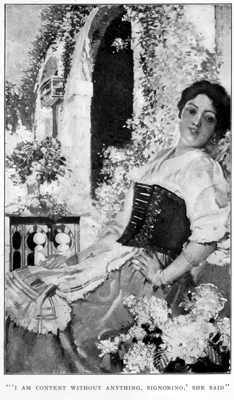 "'I AM CONTENT WITHOUT ANYTHING, SIGNORINO,' SHE SAID"
Under the cover of the flood of talk Maurice turned
to Maddalena. She was taking no part in it, but was
eating her macaroni gently, as if it were a new and
wonderful food. So Maurice thought as he looked at her.
To-day there was something strange, almost pathetic, to
him in Maddalena, a softness, an innocent refinement
that made him imagine her in another life than hers,
and with other companions, in a life as free but less
hard, with companions as natural but less ruthless to
women.
"Maddalena," he said to her. "They all want to
buy things at the auction."
"Si, signore."
"And you?"
"I, signorino?"
"Yes, don't you want to buy something?"
He was testing her, testing her memory. She looked at
him above her fork, from which the macaroni streamed
down.
"I am content without anything, signorino," she said.
"Without the blue dress and the ear-rings, longer
than that?" He measured imaginary ear-rings in the
air. "Have you forgotten, Maddalena?"
She blushed and bent over her plate. She had not
forgotten. All the day since she rose at dawn she
had been thinking of Maurice's old promise. But she did
not know that he remembered it, and his remembrance
of it came to her now as a lovely surprise. He bent his
head down nearer to her.
"When they are all at the auction, we will go to buy
the blue dress and the ear-rings," he almost whispered.
"We will go by ourselves. Shall we?"
"Si, signore."
Her voice was very small and her cheeks still held
their flush. She glanced, with eyes that were unusually
conscious, to right and left of her, to see if the
neighbors had noticed their colloquy. And that look
of consciousness made Maurice suddenly understand that
this limit which he had put to his sinning—so he had
called it with a sort of angry mental sincerity, summoned,
perhaps, to match the tremendous sincerity of
his wife which he was meeting with a lie to-day—his
sinning against Hermione was also a limit to something
else. Had he not sinned against Maddalena, sinned
when he had kissed her, when he had shown her that
he delighted to be with her? Was he not sinning now
when he promised to buy for her the most beautiful
things of the fair? For a moment he thought to himself
that his fault against Maddalena was more grave,
more unforgivable than his fault against Hermione.
But then a sudden anger that was like a storm, against
his own condemnation of himself, swept through him.
He had come out to-day to be recklessly happy, and
here he was giving himself up to gloom, to absurd self-torture.
Where was his natural careless temperament?
To-day his soul was full of shadows, like the
soul of a man going to meet a doom.
"Where's the wine?" he called to Gaspare. "Wine,
cameriere, wine!"
"You must not drink wine with the pasta, signorino!"
cried Gaspare. "Only afterwards, with the vitello."
"Have you ordered vitello? Capital! But I've finished
my pasta and I'm thirsty. Well, what do you
want to buy at the auction, Gaspare, and you, Amedeo,
and you Salvatore?"
He plunged into the talk and made Salvatore show
his keen desires, encouraging and playing with his
avarice, now holding it off for a moment, then coaxing
it as one coaxes an animal, stroking it, tempting it to
a forward movement. The wine went round now, for
the vitello was on the table, and the talk grew more
noisy, the laughter louder. Outside, too, the movement
and the tumult of the fair were increasing. Cries
of men selling their wares rose up, the hard melodies
of a piano-organ, and a strange and ecclesiastical chant
sung by three voices that, repeated again and again, at
last attracted Maurice's attention.
"What's that?" he asked of Gaspare. "Are those
priests chanting?"
"Priests! No, signore. Those are the Romani."
"Romans here! What are they doing?"
"They have a cart decorated with flags, signorino,
and they are selling lemon-water and ices. All the people
say that they are Romans and that is how they
sing in Rome."
The long and lugubrious chant of the ice-venders rose
up again, strident and melancholy as a song chanted
over a corpse.
"It's funny to sing like that to sell ices," Maurice said.
"It sounds like men at a funeral."
"Oh, they are very good ices, signorino. The Romans
make splendid ices."
Turkey followed the vitello.
Maurice's guests were now completely at ease and perfectly
happy. The consciousness that all this was going
to be paid for, that they would not have to put
their hands in their pockets for a soldo, warmed their
hearts as the wine warmed their bodies. Amedeo's
long, white face was becoming radiant, and even Salvatore
softened towards the Inglese. A sort of respect,
almost furtive, came to him for the wealth that could
carelessly entertain this crowd of people, that could buy
clocks, chairs, donkeys at pleasure, and scarcely know
that soldi were gone, scarcely miss them. As he attacked
his share of the turkey vigorously, picking up
the bones with his fingers and tearing the flesh away
with his white teeth, he tried to realize what such
wealth must mean to the possessor of it, an effort continually
made by the sharp-witted, very poor man.
And this wealth—for the moment some of it was at his
command! To ask to-day would be to have. Instinctively
he knew that, and felt like one with money
in the bank. If only it might be so to-morrow and for
many days! He began to regret the limit, almost to
forget the sound of the laughter of the Catania fishermen
upon the steps of the church of Sant' Onofrio. His
pride was going to sleep, and his avarice was opening its
eyes wider.
When the meal was over they went out onto the
pavement to take coffee in the open air. The throng
was much greater than it had been when they entered,
for people were continually arriving from the more distant
villages, and two trains had come in from Messina
and Catania. It was difficult to find a table. Indeed,
it might have been impossible had not Gaspare ruthlessly
dislodged a party of acquaintances who were comfortably
established around one in a prominent position.
"I must have a table for my padrone," he said. "Go
along with you!"
And they meekly went, smiling, and without ill-will—indeed,
almost as if they had received a compliment.
"But, Gaspare," began Maurice, "I can't—"
"Here is a chair for you, signorino. Take it quickly."
"At any rate, let us offer them something."
"Much better spare your soldi now, signorino, and
buy something at the auction. That clock plays the
'Tre Colori' just like a band."
"Buy it. Here is some money."
He thrust some notes into the boy's ready hand.
"Grazie, signorino. Ecco la musica!"
In the distance there rose the blare of a processional
march from "Aïda," and round the corner of the Via
di Polifemo came a throng of men and boys in dark
uniforms, with epaulets and cocked hats with flying
plumes, blowing with all their might into wind instruments
of enormous size.
"That is the musica of the città, signore," explained
Amedeo. "Afterwards there will be the Musica Mascagni
and the Musica Leoncavallo."
"Mamma mia! And will they all play together?"
"No, signore. They have quarrelled. At Pasqua we
had no music, and the archpriest was hooted by all in
the Piazza."
"Why?"
"Non lo so. I think he had forbidden the Musica
Mascagni to play at Madre Lucia's funeral, and the
Musica Mascagni went to fight with the Musica della
città. To-day they will all play, because it is the festa
of the Santo Patrono, but even for him they will not
play together."
The bandsmen had now taken their places upon a
wooden dais exactly opposite to the restaurant, and
were indulging in a military rendering of "Celeste Aïda,"
which struck most of the Sicilians at the small tables
to a reverent silence. Maddalena's eyes had become
almost round with pleasure, Gaspare was singing the
air frankly with Amedeo, and even Salvatore seemed
soothed and humanized, as he sipped his coffee, puffed
at a thin cigar, and eyed the women who were slowly
sauntering up and down to show their finery. At the
windows of most of the neighboring houses appeared
parties of dignified gazers, important personages of the
town, who owned small balconies commanding the
piazza, and who now stepped forth upon these coigns
of vantage, and leaned upon the rails that they might
see and be seen by the less favored ones below. Amedeo
and Gaspare began to name these potentates. The
stout man with a gray mustache, white trousers, and a
plaid shawl over his shoulders was Signor Torloni, the
syndic of San Felice. The tall, angry-looking gentleman,
with bulging, black eyes and wrinkled cheeks, was
Signor Carata, the avvocato; and the lady in black and
a yellow shawl was his wife, who was the daughter of
the syndic. Close by was Signorina Maria Sacchetti,
the beauty of San Felice, already more than plump, but
with a good complexion, and hair so thick that it stood
out from her satisfied face as if it were trained over a
trellis. She wore white, and long, thread gloves which
went above her elbows. Maddalena regarded her with
awe when Amedeo mentioned a rumor that she was
going to be "promised" to Dr. Marinelli, who was to
be seen at her side, wearing a Gibus hat and curling a
pair of gigantic black mustaches.
Maurice listened to the music and the chatter which,
silenced by the arrival of the music, had now burst
forth again, with rather indifferent ears. He wanted to
get away somewhere and to be alone with Maddalena.
The day was passing on. Soon night would be falling.
The fair would be at an end. Then would come the
ride back, and then——But he did not care to look
forward into that future. He had not done so yet.
He would not do so now. It would be better, when the
time came, to rush upon it blindly. Preparation, forethought,
would only render him unnatural. And he
must seem natural, utterly natural, in his insincere surprise,
in his insincere regret.
"Pay for the coffee, Gaspare," he said, giving the
boy some money. "Now I want to walk about and
see everything. Where are the donkeys?"
He glanced at Salvatore.
"Oh, signore," said Gaspare, "they are outside the
town in the watercourse that runs under the bridge—you
know, that broke down this spring where the line
is? They have only just finished mending it."
"I remember your telling me."
"And you were so glad the signora was travelling the
other way."
"Yes, yes."
He spoke hastily. Salvatore was on his feet.
"What hour have we?"
Maurice looked at his watch.
"Half-past two already! I say, Salvatore, you
mustn't forget the donkeys."
Salvatore came close up to him.
"Signore," he began, in a low voice, "what do you
wish me to do?"
"Bid for a good donkey."
"Si, signore."
"For the best donkey they put up for sale."
Salvatore began to look passionately eager.
"Si, signore. And if I get it?"
"Come to me and I will give you the money to
pay."
"Si, signore. How high shall I go?"
Gaspare was listening intently, with a hard face and
sullen eyes. His whole body seemed to be disapproving
what Maurice was doing. But he said nothing. Perhaps
he felt that to-day it would be useless to try to
govern the actions of his padrone.
"How high? Well"—Maurice felt that, before Gaspare,
he must put a limit to his price, though he did not
care what it was—"say a hundred. Here, I'll give it
you now."
He put his hand into his pocket and drew out his
portfolio.
"There's the hundred."
Salvatore took it eagerly, spread it over his hand,
stared at it, then folded it with fingers that seemed for
the moment almost delicate, and put it into the inside
pocket of his jacket. He meant to go presently and
show it to the fishermen of Catania, who had laughed
upon the steps of the church, and explain matters to
them a little. They thought him a fool. Well, he
would soon make them understand who was the fool.
"Grazie, signore!"
He said it through his teeth. Maurice turned to Gaspare.
He felt the boy's stern disapproval of what he
had done, and wanted, if possible, to make amends.
"Gaspare," he said, "here is a hundred lire for you.
I want you to go to the auction and to bid for anything
you think worth having. Buy something for your
mother and father, for the house, some nice things!"
"Grazie, signore."
He took the note, but without alacrity, and his face
was still lowering.
"And you, signore?" he asked.
"I?"
"Yes. Are you not coming with me to the auction?
It will be better for you to be there to choose the things."
For an instant Maurice felt irritated. Was he never
to be allowed a moment alone with Maddalena?
"Oh, but I'm no good at——" he began.
Then he stopped. To-day he must be birbante—on
his guard. Once the auction was in full swing—so he
thought—Salvatore and Gaspare would be as they were
when they gambled beside the sea. They would forget
everything. It would be easy to escape. But till that
moment came he must be cautious.
"Of course I'll come," he exclaimed, heartily. "But
you must do the bidding, Gaspare."
The boy looked less sullen.
"Va bene, signorino. I shall know best what the
things are worth. And Salvatore"—he glanced viciously
at the fisherman—"can go to the donkeys. I have
seen them. They are poor donkeys this year."
Salvatore returned his vicious glance and said something
in dialect which Maurice did not understand. Gaspare's
face flushed, and he was about to burst into an
angry reply when Maurice touched his arm.
"Come along, Gaspare!"
As they got up, he whispered:
"Remember what I said about to-day!"
"Macchè——"
Maurice closed his fingers tightly on Gaspare's arm.
"Gaspare, you must remember! Afterwards what
you like, but not to-day. Andiamo!"
They all got up. The Musica della città was now
playing a violent jig, undoubtedly composed by Bellini,
who was considered almost as a child of San Felice,
having been born close by at Catania.
"Where are the women in the wonderful blue dresses?"
Maurice asked, as they stepped into the road; "and the
ear-rings? I haven't seen them yet."
"They will come towards evening, signorino," replied
Gaspare, "when it gets cool. They do not care
to be in the sun dressed like that. It might spoil their
things."
Evidently the promenade of these proud beauties was
an important function.
"We must not miss them," Maurice said to Maddalena.
She looked conscious.
"No, signore."
"They will all be here this evening, signore," said
Amedeo, "for the giuochi di fuoco."
"The giuochi di fuoco—they will be at the end?"
"Si, signore. After the giuochi di fuoco it is all finished."
Maurice stifled a sigh. "It is all finished," Amedeo had
said. But for him? For him there would be the ride
home up the mountain, the arrival upon the terrace
before the house of the priest. At what hour would he
be there? It would be very late, perhaps nearly at
dawn, in the cold, still, sad hour when vitality is at
its lowest. And Hermione? Would she be sleeping?
How would they meet? How would he——?
"Andiamo! Andiamo!"
He cried out almost angrily.
"Which is the way?"
"All the auctions are held outside the town, signore,"
said Amedeo. "Follow me."
Proudly he took the lead, glad to be useful and important
after the benefits that had been bestowed upon
him, and hoping secretly that perhaps the rich Inglese
would give him something to spend, too, since money
was so plentiful for donkeys and clocks.
"They are in the fiume, near the sea and the railway
line."
The railway line! When he heard that Maurice had
a moment's absurd sensation of reluctance, a desire to
hold back, such as comes to a man who is unexpectedly
asked to confront some danger. It seemed to him that
if he went to the watercourse he might be seen by Hermione
and Artois as they passed by on their way to
Marechiaro. But of course they were coming from Messina!
What a fool he was to-day! His recklessness
seemed to have deserted him just when he wanted it
most. To-day he was not himself. He was a coward.
What it was that made him a coward he did not tell
himself.
"Then we can all go together," he said. "Salvatore
and all."
"Si, signore."
Salvatore's voice was close at his ear, and he knew by
the sound of it that the fisherman was smiling.
"We can all keep together, signore; then we shall be
more gay."
They threaded their way through the throng. The
violent jig of Bellini died away gradually, till it was
faint in the distance. At the end of the narrow street
Maurice saw the large bulk of Etna. On this clear afternoon
it looked quite close, almost as if, when they got
out of the street, they would be at its very foot, and
would have to begin to climb. Maurice remembered his
wild longing to carry Maddalena off upon the sea, or to
some eyrie in the mountains, to be alone with her in
some savage place. Why not give all these people the
slip now—somehow—when the fun of the fair was at
its height, mount the donkeys and ride straight for the
huge mountain? There were caverns there and desolate
lava wastes; there were almost impenetrable beech
forests. Sebastiano had told him tales of them, those
mighty forests that climbed up to green lawns looking
down upon the Lipari Isles. He thought of their silence
and their shadows, their beds made of the drifted leaves
of the autumn. There, would be no disturbance, no
clashing of wills and of interests, but calm and silence
and the time to love. He glanced at Maddalena. He
could hardly help imagining that she knew what he was
thinking of. Salvatore had dropped behind for a moment.
Maurice did not know it, but the fisherman had
caught sight of his comrades of Catania drinking in a
roadside wine-shop, and had stopped to show them the
note for a hundred francs, and to make them understand
the position of affairs between him and the forestiere.
Gaspare was talking eagerly to Amedeo about the things
that were likely to be put up for sale at the auction.
"Maddalena," Maurice said to the girl, in a low voice,
"can you guess what I am thinking about?"
She shook her head.
"No, signore."
"You see the mountain!"
He pointed to the end of the little street.
"Si, signore."
"I am thinking that I should like to go there now
with you."
"Ma, signorino—the fiera!"
Her voice sounded plaintive with surprise and she
glanced at her pea-green skirt.
"And this, signorino!"—she touched it carefully with
her slim fingers. "How could I go in this?"
"When the fair is over, then, and you are in your
every-day gown, Maddalena, I should like to carry you
off to Etna."
"They say there are briganti there."
"Brigands—would you be afraid of them with me?"
"I don't know, signore. But what should we do there
on Etna far away from the sea and from Marechiaro?"
"We should"—he whispered in her ear, seizing this
chance almost angrily, almost defiantly, with the thought
of Salvatore in his mind—"we should love each other,
Maddalena. It is quiet in the beech forests on Etna.
No one would come to disturb us, and——"
A chuckle close to his ear made him start. Salvatore's
hand was on his arm, and Salvatore's face, looking
wily and triumphant, was close to his.
"Gaspare was wrong, there are splendid donkeys here.
I have been talking to some friends who have seen them."
There was a tramp of heavy boots on the stones behind
them. The fishermen from Catania were coming
to see the fun. Salvatore was in glory. To get all and
give nothing was, in his opinion, to accomplish the legitimate
aim of a man's life. And his friends, those who
had dared to sneer and to whisper, and to imagine that
he was selling his daughter for money, now knew the
truth and were here to witness his ingenuity. Intoxicated
by his triumph, he began to show off his power
over the Inglese for the benefit of the tramplers behind.
He talked to Maurice with a loud familiarity, kept laying
his hand on Maurice's arm as they walked, and even called
him, with a half-jocose intonation, "compare." Maurice
sickened at his impertinence, but was obliged to endure
it with patience, and this act of patience brought to the
birth within him a sudden, fierce longing for revenge, a
longing to pay Salvatore out for his grossness, his greed,
his sly and leering affectation of playing the slave when
he was really indicating to his compatriots that he considered
himself the master. Again Maurice heard the call
of the Sicilian blood within him, but this time it did not
call him to the tarantella or to love. It called him to
strike a blow. But this blow could only be struck
through Maddalena, could only be struck if he were
traitor to Hermione. For a moment he saw everything
red. Again Salvatore called him "compare." Suddenly
Maurice could not bear it.
"Don't say that!" he said. "Don't call me that!"
He had almost hissed the words out. Salvatore
started, and for an instant, as they walked side by side,
the two men looked at each other with eyes that told
the truth. Then Salvatore, without asking for any explanation
of Maurice's sudden outburst, said:
"Va bene, signore, va bene! I thought for to-day
we were all compares. Scusi, scusi."
There was a bitterness of irony in his voice. As he
finished he swept off his soft hat and then replaced it
more over his left ear than ever. Maurice knew at once
that he had done the unforgivable thing, that he had
stabbed a Sicilian's amour propre in the presence of witnesses
of his own blood. The fishermen from Catania
had heard. He knew it from Salvatore's manner, and
an odd sensation came to him that Salvatore had passed
sentence upon him. In silence, and mechanically, he
walked on to the end of the street. He felt like one
who, having done something swiftly, thoughtlessly, is
suddenly confronted with the irreparable, abruptly sees
the future spread out before him bathed in a flash of
crude light, the future transformed in a second by that
act of his as a landscape is transformed by an earthquake
or a calm sea by a hurricane.
And when the watercourse came in sight, with its
crowd, its voices, and its multitude of beasts, he looked
at it dully for a moment, hardly realizing it.
In Sicily the animal fairs are often held in the great
watercourses that stretch down from the foot of the
mountains to the sea, and that resemble huge highroads
in the making, roads upon which the stones have
been dumped ready for the steam-roller. In winter
there is sometimes a torrent of water rushing through
them, but in summer they are dry, and look like
wounds gashed in the thickly growing lemon and orange
groves. The trampling feet of beasts can do no harm
to the stones, and these watercourses in the summer
season are of no use to anybody. They are, therefore,
often utilized at fair time. Cattle, donkeys, mules are
driven down to them in squadrons. Painted Sicilian
carts are ranged upon their banks, with sets of harness,
and the auctioneers, whose business it is to sell miscellaneous
articles, household furniture, stuffs, clocks,
ornaments, frequently descend into them, and mount
a heap of stones to gain command of their gaping audience
of contadini and the shrewder buyers from the
towns.
The watercourse of San Felice was traversed at its
mouth by the railway line from Catania to Messina,
which crossed it on a long bridge supported by stone
pillars and buttresses, the bridge which, as Gaspare had
said, had recently collapsed and was now nearly built
up again. It was already in use, but the trains were
obliged to crawl over it at a snail's pace in order not to
shake the unfinished masonry, and men were stationed
at each end to signal to the driver whether he was to
stop or whether he might venture to go on. Beyond
the watercourse, upon the side opposite to the town of
San Felice, was a series of dense lemon groves, gained
by a sloping bank of bare, crumbling earth, on the top
of which, close to the line and exactly where it came
to the bridge, was a group of four old olive-trees with
gnarled, twisted trunks. These trees cast a patch of
pleasant shade, from which all the bustle of the fair was
visible, but at a distance, and as Maurice and his party
came out of the village on the opposite bank, he whispered
to Maddalena:
"Maddalena!"
"Si, signore?"
"Let's get away presently, you and I; let's go and
sit under those trees. I want to talk to you quietly."
"Si, signore?"
Her voice was lower even than his own.
"Ecco, signore! Ecco!"
Salvatore was pointing to a crowd of donkeys.
"Signorino! Signorino!"
"What is it, Gaspare?"
"That is the man who is going to sell the clock!"
The boy's face was intent. His eyes were shining,
and his glum manner had vanished, under the influence
of a keen excitement. Maurice realized that very soon
he would be free. Once his friends were in the crowd of
buyers and sellers everything but the chance of a bargain
would be forgotten. His own blood quickened but
for a different reason.
"What beautiful carts!" he said. "We have no such
carts in England!"
"If you would like to buy a cart, signore——" began
Salvatore.
But Gaspare interrupted with violence.
"Macchè! What is the use of a cart to the signorino?
He is going away to England. How can he take a cart
with him in the train?"
"He can leave the cart with me," said Salvatore, with
open impudence. "I can take care of it for the signore
as well as the donkey."
"Macchè!" cried Gaspare, furiously.
Maurice took him by the arm.
"Help me down the bank! Come on!"
He began to run, pulling Gaspare with him. When
they got to the bottom, he said:
"It's all right, Gaspare. I'm not going to be such
a fool as to buy a cart. Now, then, which way are we
going?"
"Signore, do you want to buy a very good donkey, a
very strong donkey, strong enough to carry three Germans
to the top of Etna? Come and see my donkey.
He is very cheap. I make a special price because the
signore is simpatico. All the English are simpatici.
Come this way, signore! Gaspare knows me. Gaspare
knows that I am not birbante."
"Signorino! Signorino! Look at this clock! It plays
the 'Tre Colori.' It is worth twenty-five lire, but I will
make a special price for you because you love Sicily and
are like a Siciliano. Gaspare will tell you——"
But Gaspare elbowed away his acquaintances roughly.
"Let my padrone alone. He is not here to buy. He
is only here to see the fair. Come on, signorino! Do
not answer them. Do not take any notice. You must
not buy anything or you will be cheated. Let me make
the prices."
"Yes, you make the prices. Per Bacco, how hot it
is!"
Maurice pulled his hat down over his eyes.
"Maddalena, you'll get a sunstroke!" he said.
"Oh no, signore. I am accustomed to the sun."
"But to-day it's terrific!"
Indeed, the masses of stones in the watercourse seemed
to draw and to concentrate the sun-rays. The air was
alive with minute and dancing specks of light, and in
the distance, seen under the railway bridge, the sea
looked hot, a fiery blue that was surely sweating in the
glare of the afternoon. The crowd of donkeys, of cattle,
of pigs—there were many pigs on sale—looked both
dull and angry in the heat, and the swarms of Sicilians
who moved slowly about among them, examining them
critically, appraising their qualities and noting their defects,
perspired in their festa clothes, which were mostly
heavy and ill-adapted to summer-time. A small boy
passed by, bearing in his arms a struggling turkey. He
caught his foot in some stones, fell, bruised his forehead,
and burst out crying, while the indignant and terrified
bird broke away, leaving some feathers, and made off
violently towards Etna. There was a roar of laughter
from the people near. Some ran to catch the turkey,
others picked up the boy. Salvatore had stopped to
see this adventure, and was now at a little distance surrounded
by the Catanesi, who were evidently determined
to assist at his bidding for a donkey. The sight
of the note for a hundred lire had greatly increased their
respect for Salvatore, and with the Sicilian instinct to
go, and to stay, where money is, they now kept close
to their comrade, eying him almost with awe as one
in possession of a fortune. Maurice saw them presently
examining a group of donkeys. Salvatore, with an
autocratic air, and the wild gestures peculiar to him,
was evidently laying down the law as to what each animal
was worth. The fishermen stood by, listening attentively.
The fact of Salvatore's purchasing power
gave him the right to pronounce an opinion. He was in
glory. Maurice thanked Heaven for that. The man in
glory is often the forgetful man. Salvatore, he thought,
would not bother about his daughter and his banker
for a little while. But how to get rid of Gaspare and
Amedeo! It seemed to him that they would never
leave his side.
There were many wooden stands covered with goods
for sale in the watercourse, with bales of stuff for suits
and dresses, with hats and caps, shirts, cravats, boots
and shoes, walking-sticks, shawls, household utensils,
crockery, everything the contadino needs and loves.
Gaspare, having money to lay out, considered it his
serious duty to examine everything that was to be
bought with slow minuteness. It did not matter
whether the goods were suited to a masculine taste or
not. He went into the mysteries of feminine attire
with almost as much assiduity as a mother displays
when buying a daughter's trousseau, and insisted upon
Maurice sharing his interest and caution. All sense of
humor, all boyish sprightliness vanished from him in
this important epoch of his life. The suspicion, the intensity
of the bargaining contadino came to the surface.
His usually bright face was quite altered. He looked
elderly, subtle, and almost Jewish as he slowly passed
from stall to stall, testing, weighing, measuring, appraising.
It seemed to Maurice that this progress would never
end. Presently they reached a stand covered with
women's shawls and with aprons.
"Shall I buy an apron for my mother, signorino?"
asked Gaspare.
"Yes, certainly."
Maurice did not know what else to say. The result of
his consent was terrible. For a full half-hour they
stood in the glaring sun, while Gaspare and Amedeo
solemnly tried on aprons over their suits in the midst
of a concourse of attentive contadini. In vain did Maurice
say: "That's a pretty one. I should take that one."
Some defect was always discoverable. The distant
mother's taste was evidently peculiar and not to be
easily suited, and Maurice, not being familiar with it, was
unable to combat such assertions of Gaspare as that
she objected to pink spots, or that she could never be
expected to put on an apron before the neighbors if the
stripes upon it were of different colors and there was no
stitching round the hem. For the first time since he was
in Sicily the heat began to affect him unpleasantly.
His head felt as if it were compressed in an iron band,
and the vision of Gaspare, eagerly bargaining, looking
Jewish, and revolving slowly in aprons of different colors,
shapes, and sizes, began to dance before his eyes. He
felt desperate, and suddenly resolved to be frank.
"Macchè!" Gaspare was exclaiming, with indignant
gestures of protest to the elderly couple who were
in charge of the aprons; "it is not worth two soldi!
It is not fit to be thrown to the pigs, and you ask
me——"
"Gaspare!"
"Two lire—Madonna! Sangue di San Pancrazio, they
ask me two lire! Macchè!" (He flung down the apron
passionately upon the stall.) "Go and find Lipari people
to buy your dirt; don't come to one from Marechiaro."
He took up another apron.
"Gaspare!"
"One lira fifty? Madre mia, do you think I was born
in a grotto on Etna and have never——"
"Gaspare, listen to me!"
"Scusi, signorino! I——"
"I'm going over there to sit down in the shade for a
minute. After that wine I drank at dinner I'm a bit
sleepy."
"Si, signore. Shall I come with you?"
For once there was reluctance in his voice, and he
looked down at the blue-and-white apron he had on
with wistful eyes. It was a new joy to him to be bargaining
in the midst of an attentive throng of his compatriots.
"No, no. You stay here and spend the money. Bid
for the clock when the auction comes on."
"Oh, signore, but you must be here, too, then."
"All right. Come and fetch me if you like. I shall
be over there under the trees."
He waved his hand vaguely towards the lemon
groves.
"Now, choose a good apron. Don't let them cheat
you."
"Macchè!"
The boy laughed loudly, and turned eagerly to the
stall again.
"Come, Maddalena!"
Maurice drew her quickly, anxiously, out of the crowd,
and they began to walk across the watercourse towards
the farther bank and the group of olive-trees. Salvatore
had forgotten them. So had Gaspare. Both father
and servant were taken by the fascination of the
fair. At last! But how late it must be! How many
hours had already fled away! Maurice scarcely dared to
look at his watch. He feared to see the time. While
they walked he said nothing to Maddalena, but when
they reached the bank he took her arm and helped her
up it, and when they were at the top he drew a long
breath.
"Are you tired, signorino?"
"Tired—yes, of all those people. Come and sit down,
Maddalena, under the olive-trees."
He took her by the hand. Her hand was warm and
dry, pleasant to touch, to hold. As he felt it in his the
desire to strike at Salvatore revived within him. Salvatore
was laughing at him, was triumphing over him,
triumphing in the get-all and give-nothing policy which
he thought he was pursuing with such complete success.
Would it be very difficult to turn that success into
failure? Maurice wondered for a moment, then ceased to
wonder. Something in the touch of Maddalena's hand
told him that, if he chose, he could have his revenge
upon Salvatore, and he was assailed by a double temptation.
Both anger and love tempted him. If he
stooped to do evil he could gratify two of the strongest
desires in humanity, the desire to conquer in love and
the desire to triumph in hate. Salvatore thought him
such a fool, held him in such contempt! Something
within him was burning to-day as a cheek burns with
shame, something within him that was like the kernel
of him, like the soul of his manhood, which the fisherman
was sneering at. He did not say to himself strongly
that he did not care what such men thought of him.
He could not, for his nature was both reckless and sensitive.
He did care, as if he had been a Sicilian half
doubtful whether he dared to show his face in the piazza.
And he had another feeling, too, which had come to him
when Salvatore had answered his exclamation of irresistible
anger at being called "compare," the feeling that,
whether he sinned against the fisherman or not, the
fisherman meant to do him harm. The sensation might
be absurd, would have seemed to him probably absurd
in England. Here, in Sicily, it sprang up and he had
just to accept it, as a man accepts an instinct which
guides him, prompts him.
Salvatore had turned down his thumb that day.
Maurice was not afraid of him. Physically, he was
quite fearless. But this sensation of having been secretly
condemned made him feel hard, cruel, ready, perhaps,
to do a thing not natural to him, to sacrifice another
who had never done him wrong. At that moment it
seemed to him that it would be more manly to triumph
over Salvatore by a double betrayal than to "run
straight," conquer himself and let men not of his code
think of him as they would.
Not of his code! But what was his code? Was it
that of England or that of Sicily? Which strain of
blood was governing him to-day? Which strain would
govern him finally? Artois would have had an interesting
specimen under his observant eyes had he been
at the fair of San Felice.
Maddalena willingly obeyed Maurice's suggestion.
"Get well into the shade," he said. "There's just
enough to hold us, if we sit close together. You don't
mind that, do you?"
"No, signore."
"Put your back against the trunk—there."
He kept his hat off. Over the railway line from the
hot-looking sea there came a little breeze that just
moved his short hair and the feathers of gold about
Maddalena's brow. In the watercourse, but at some
distance, they saw the black crowd of men and women
and beasts swarming over the hot stones.
"How can they?" Maurice muttered, as he looked
down.
"Cosa?"
He laughed.
"I was thinking out loud. I meant how can they bargain
and bother hour after hour in all that sun!"
"But, signorino, you would not have them pay too
much!" she said, very seriously. "It is dreadful to
waste soldi."
"I suppose—yes, of course it is. Oh, but there are
so many things worth more than soldi. Dio mio! Let's
forget all that!"
He waved his hand towards the crowd, but he saw
that Maddalena was preoccupied. She glanced towards
the watercourse rather wistfully.
"What is it, Maddalena? Ah, I know! The blue
dress and the ear-rings! Per Bacco!"
"No, signore—no, signore!"
She disclaimed quickly, reddening.
"Yes, it is. I had forgotten. But we can't go now.
Maddalena, we will buy them this evening. Directly
it gets cool we'll go, directly we've rested a little. But
don't think of them now. I've promised, and I always
keep a promise. Now, don't think of that any more!"
He spoke with a sort of desperation. The fair seemed
to be his enemy, and he had thought that it would be
his friend. It was like a personage with a stronger
influence than his, an influence that could take away
that which he wished to retain, to fix upon himself.
"No, signore," Maddalena said, meekly, but still
wistfully.
"Do you care for a blue dress and a pair of ear-rings
more than you do for me?" cried Maurice, with sudden
roughness. "Are you like your father? Do you only
care for me for what you can get out of me? I believe
you do!"
Maddalena looked startled, almost terrified, by his
outburst. Her lips trembled, but she gazed at him
steadily.
"Non è vero."
The words sounded almost stern.
"I do—" he said. "I do want to be cared for a
little—just for myself."
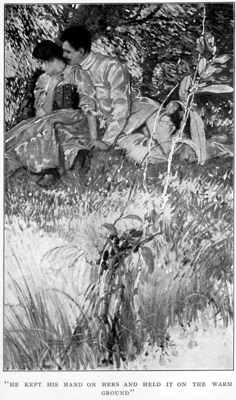 "HE KEPT HIS HAND ON HERS AND HELD IT ON THE WARM
GROUND"
"HE KEPT HIS HAND ON HERS AND HELD IT ON THE WARM
GROUND"
At that moment he had a sensation of loneliness like
that of an utterly unloved man. And yet at that moment
a great love was travelling to him—a love that
was complete and flawless. But he did not think of it.
He only thought that perhaps all this time he had been
deceived, that Maddalena, like her father, was merely
pleased to see him because he had money and could
spend it. He sickened.
"Non è vero!" Maddalena repeated.
Her lips still trembled. Maurice looked at her doubtfully,
yet with a sudden tenderness. Always when she
looked troubled, even for an instant, there came to him
the swift desire to protect her, to shield her.
"But why should you care for me?" he said. "It
is better not. For I am going away, and probably you
will never see me again."
Tears came into Maddalena's eyes. He did not know
whether they were summoned by his previous roughness
or his present pathos. He wanted to know.
"Probably I shall never come back to Sicily again,"
he said, with pressure.
She said nothing.
"It will be better not," he added. "Much better."
Now he was speaking for himself.
"There's something here, something that I love and
that's bad for me. I'm quite changed here. I'm like
another man."
He saw a sort of childish surprise creeping into her face.
"Why, signorino?" she murmured.
He kept his hand on hers and held it on the warm
ground.
"Perhaps it is the sun," he said. "I lose my head
here, and I—lose my heart!"
She still looked rather surprised, and again her ignorance
fascinated him. He thought that it was far more
attractive than any knowledge could have been.
"I'm horribly happy here, but I oughtn't to be
happy."
"Why, signorino? It is better to be happy."
"Per Dio!" he exclaimed.
Now a deep desire to have his revenge upon Salvatore
came to him, but not at all because it would hurt
Salvatore. The cruelty had gone out of him. Maddalena's
eyes of a child had driven it away. He wanted
his revenge only because it would be an intense happiness
to him to have it. He wanted it because it would
satisfy an imperious desire of tender passion, not because
it would infuriate a man who hated him. He
forgot the father in the daughter.
"Suppose I were quite poor, Maddalena!" he said.
"But you are very rich, signorino."
"But suppose I were poor, like Gaspare, for instance.
Suppose I were as I am, just the same, only a contadino,
or a fisherman, as your father is. And suppose—suppose"—he
hesitated—"suppose that I were not
married!"
She said nothing. She was listening with deep but
still surprised attention.
"Then I could—I could go to your father and ask
him——"
He stopped.
"What could you ask him, signorino?"
"Can't you guess?"
"No, signore."
"I might ask him to let me marry you. I should—if
it were like that—I should ask him to let me marry
you."
"Davvero?"
An expression of intense pleasure, and of something
more—of pride—had come into her face. She could
not divest herself imaginatively of her conception of
him as a rich forestiere, and she saw herself placed high
above "the other girls," turned into a lady.
"Magari!" she murmured, drawing in her breath,
then breathing out.
"You would be happy if I did that?"
"Magari!" she said again.
He did not know what the word meant, but he thought
it sounded like the most complete expression of satisfaction
he had ever heard.
"I wish," he said, pressing her hand—"I wish I were
a Sicilian of Marechiaro."
At this moment, while he was speaking, he heard in
the distance the shrill whistle of an engine. It ceased.
Then it rose again, piercing, prolonged, fierce surely with
inquiry. He put his hands to his ears.
"How beastly that is!" he exclaimed.
He hated it, not only for itself, but for the knowledge
it sharply recalled to his mind, the knowledge of exactly
what he was doing, and of the facts of his life, the
facts that the very near future held.
"Why do they do that?" he added, with intense
irritation.
"Because of the bridge, signorino. They want to
know if they can come upon the bridge. Look! There
is the man waving a flag. Now they can come. It is
the train from Palermo."
"Palermo!" he said, sharply.
"Si, signore."
"But the train from Palermo comes the other way,
by Messina!"
"Si, signore. But there are two, one by Messina
and one by Catania. Ecco!"
From the lemon groves came the rattle of the approaching train.
"But—but——"
He caught at his watch, pulled it out.
Five o'clock!
He had taken his hand from Maddalena's, and now
he made a movement as if to get up. But he did not
get up. Instead, he pressed back against the olive-tree,
upon whose trunk he was leaning, as if he wished
to force himself into the gnarled wood of it. He had
an instinct to hide. The train came on very slowly.
During the two or three minutes that elapsed before it
was in his view Maurice lived very rapidly. He felt sure
that Hermione and Artois were in the train. Hermione
had said that they would arrive at Cattaro at five-thirty.
She had not said which way they were coming.
Maurice had assumed that they would come from Messina
because Hermione had gone away by that route.
It was a natural error. But now? If they were at the
carriage window! If they saw him! And surely they
must see him. The olive-trees were close to the line
and on a level with it. He could not get away. If he
got up he would be more easily seen. Hermione would
call out to him. If he pretended not to hear she might,
she probably would, get out of the train at the San
Felice station and come into the fair. She was impulsive.
It was just the sort of thing she might do.
She would do it. He was sure she would do it. He
looked at the watercourse hard. The crowd of people
was not very far off. He thought he detected the form
of Gaspare. Yes, it was Gaspare. He and Amedeo were
on the outskirts of the crowd near the railway bridge.
As he gazed, the train whistled once more, and he saw
Gaspare turn round and look towards the sea. He held
his breath.
"Ecco, signorino. Viene!"
Maddalena touched his arm, kept her hand upon it.
She was deeply interested in this event, the traversing by
the train of the unfinished bridge. Maurice was thankful
for that. At least she did not notice his violent
perturbation.
"Look, signorino! Look!"
In despite of himself, Maurice obeyed her. He wanted
not to look, but he could not help looking. The engine,
still whistling, crept out from the embrace of the
lemon-trees, with the dingy line of carriages behind it.
At most of the windows there were heads of people
looking out. Third class—he saw soldiers, contadini.
Second class—no one. Now the first-class carriages
were coming. They were close to him.
"Ah!"
He had seen Hermione. She was standing up, with
her two hands resting on the door-frame and her head
and shoulders outside of the carriage. Maurice sat absolutely
still and stared at her, stared at her almost as
if she were a stranger passing by. She was looking
at the watercourse, at the crowd, eagerly. Her face,
much browner than when she had left Sicily, was alight
with excitement, with happiness. She was radiant.
Yet he thought she looked old, older at least than he
had remembered. Suddenly, as the train came very
slowly upon the bridge, she drew in to speak to some
one behind her, and he saw vaguely Artois, pale, with
a long beard. He was seated, and he, too, was gazing
out at the fair. He looked ill, but he, too, looked happy,
much happier than he had in London. He put up a thin
hand and stroked his beard, and Maurice saw wrinkles
coming round his eyes as he smiled at something Hermione
said to him. The train came to the middle of
the bridge and stopped.
"Ecco!" murmured Maddalena. "The man at the
other end has signalled!"
Maurice looked again at the watercourse. Gaspare
was beyond the crowd now, and was staring at the train
with interest, like Maddalena. Would it never go on?
Maurice set his teeth and cursed it silently. And his
soul said; "Go on! Go on!" again and again. "Go on!
Go on!" Now Hermione was once more leaning out.
Surely she must see Gaspare. A man waved a flag.
The train jerked back, jangled, crept forward once
more, this time a little faster. In a moment they would
begone. Thank God! But what was Hermione doing?
She started. She leaned further forward, staring into
the watercourse. Maurice saw her face changing. A
look of intense surprise, of intense inquiry, came into it.
She took one hand swiftly from the door, put it behind
her—ah, she had a pair of opera-glasses at her
eyes now! The train went on faster. It was nearly
off the bridge. But she was waving her hand. She
was calling. She had seen Gaspare. And he? Maurice
saw him start forward as if to run to the bridge. But
the train was gone. The boy stopped, hesitated, then
dashed away across the stones.
"Signorino! Signorino!"
Maurice said nothing.
"Signorino!" repeated Maddalena. "Look at Gaspare!
Is he mad? Look! How he is running!"
Gaspare reached the bank, darted up it, and disappeared
into the village.
"Signorino, what is the matter?"
Maddalena pulled his sleeve. She was looking almost
alarmed.
"Matter? Nothing."
Maurice got up. He could not remain still. It was
all over now. The fair was at an end for him. Gaspare
would reach the station before the train went on, would
explain matters. Hermione would get out. Already
Maurice seemed to see her coming down to the watercourse,
walking with her characteristic slow vigor. It
did not occur to him at first that Hermione might refuse
to leave Artois. Something in him knew that she was
coming. Fate had interfered now imperiously. Once
he had cheated fate. That was when he came to the
fair despite Hermione's letter. Now fate was going
to have her revenge upon him. He looked at Maddalena.
Was fate working for her, to protect her?
Would his loss be her gain? He did not know, for he
did not know what would have been the course of his
own conduct if fate had not interfered. He had been
trifling, letting the current take him. It might have
taken him far, but—now Hermione was coming. It was
all over and the sun was still up, still shining upon the
sea.
"Let us go into the fair. It is cooler now."
He tried to speak lightly.
"Si, signore."
Maddalena shook out her skirt and began to smile.
She was thinking of the blue dress and the ear-rings.
They went down into the watercourse.
"Signorino, what can have been the matter with
Gaspare?"
"I don't know."
"He was looking at the train."
"Was he? Perhaps he saw a friend in it. Yes, that
must have been it. He saw a friend in the train."
He stared across the watercourse towards the village,
seeking two figures, and he was conscious now of two
feelings that fought within him, of two desires: a desire
that Hermione should not come, and a desire that she
should come. He wanted, he even longed, to have his
evening with Maddalena. Yet he wanted Hermione to
get out of the train when Gaspare told her that he—Maurice—was
at San Felice. If she did not get out she
would be putting Artois before him. The pale face at
the window, the eyes that smiled when Hermione turned
familiarly round to speak, had stirred within him the
jealousy of which he had already been conscious more
than once. But now actual vision had made it fiercer.
The woman who had leaned out looking at the fair
belonged to him. He felt intensely that she was his
property. Maddalena spoke to him again, two or
three times. He did not hear her. He was seeing the
wrinkles that came round the eyes of Artois when he
smiled.
"Where are we going, signorino? Are we going back
to the town?"
Instinctively, Maurice was following in the direction
taken by Gaspare. He wanted to meet fate half-way,
to still, by action, the tumult of feeling within him.
"Aren't the best things to be bought there?" he replied.
"By the church where all those booths are?
I think so."
Maddalena began to walk a little faster. The moment
had come. Already she felt the blue dress rustling
about her limbs, the ear-rings swinging in her ears.
Maurice did not try to hold her back. Nor did it occur
to him that it would be wise to meet Hermione without
Maddalena. He had done no actual wrong, and the
pale face of Artois had made him defiant. Hermione
came to him with her friend. He would come to her
with his. He did not think of Maddalena as a weapon
exactly, but he did feel as if, without her, he would be
at a disadvantage when he and Hermione met.
They were in the first street now. People were beginning
to flow back from the watercourse towards the
centre of the fair. They walked in a crowd and could
not see far before them. But Maurice thought he would
know when Hermione was near him, that he would feel
her approach. The crowd went on slowly, retarding
them, but at last they were near to the church of Sant'
Onofrio and could hear the sound of music. The "Intermezzo"
from "Cavalleria Rusticana" was being
played by the Musica Mascagni. Suddenly, Maurice
started. He had felt a pull at his arm.
"Signorino! Signorino!"
Gaspare was by his side, streaming with perspiration
and looking violently excited.
"Gaspare!"
He stopped, cast a swift look round. Gaspare was
alone.
"Signorino"—the boy was breathing hard—"the signora"—he
gulped—"the signora has come back."
The time had come for acting. Maurice feigned surprise.
"The signora! What are you saying? The signora
is in Africa."
"No, signore! She is here!"
"Here in San Felice!"
"No, signore! But she was in the train. I saw her
at the window. She waved her hand to me and called
out—when the train was on the bridge. I ran to the
station; I ran fast, but when I got there the train had
just gone. The signora has come back, and we are not
there to meet her!"
His eyes were tragic. Evidently he felt that their
absence was a matter of immense importance, was a
catastrophe.
"The signora here!" Maurice repeated, trying to make
his voice amazed. "But why did she not tell us?
Why did not she say that she was coming?"
He looked at Gaspare, but only for an instant. He
felt afraid to meet his great, searching eyes.
"Non lo so."
Maddalena stood by in silence. The bright look of
anticipation had gone out of her face, and was replaced
by a confused and slightly anxious expression.
"I can't understand it," Maurice said, heavily. "I
can't—was the signora alone, or did you see some one
with her?"
"The sick signore? I did not see him. I saw only
the signora standing at the window, waving her hand—così!"
He waved his hand.
"Madonna!" Maurice said, mechanically.
"What are we to do, signorino?"
"Do! What can we do? The train has gone!"
"Si, signore. But shall I fetch the donkeys?"
Maurice stole a glance at Maddalena. She was looking
frankly piteous.
"Have you got the clock yet?" he asked Gaspare.
"No, signore."
Gaspare began to look rather miserable, too.
"It has not been put up. Perhaps they are putting
it up now."
"Gaspare," Maurice said, hastily, "we can't be back
to meet the signora now. Even if we went at once we
should be hours late—and the donkeys are tired, perhaps.
They will go slowly unless they have a proper
rest. It is a dreadful pity, but I think if the signora
knew she would wish us to stay now till the fair is over.
She would not wish to spoil your pleasure. Do you
think she would?"
"No, signore. The signora always wishes people to
be happy."
"Even if we went at once it would be night before
we got back."
"Si, signore."
"I think we had better stay—at any rate till the
auction is finished and we have had something to eat.
Then we will go."
"Va bene."
The boy sounded doubtful.
"La povera signora!" he said. "How disappointed
she will be! She did want to speak to me. Her face
was all red; she was so excited when she saw me, and
her mouth was wide open like that!"
He made a grimace, with earnest, heart-felt sincerity.
"It cannot be helped. To-night we will explain
everything and make the signora quite happy. Look
here! Buy something for her. Buy her a present at
the auction!"
"Signorino!" Gaspare cried. "I will give her the
clock that plays the 'Tre Colori'! Then she will be
happy again. Shall I?"
"Si, si. And meet me in the market-place. Then
we will eat something and we will start for home."
The boy darted away towards the watercourse. His
heart was light again. He had something to do for the
signora, something that would make her very happy.
Ah, when she heard the clock playing the "Tre Colori"!
Mamma mia!
He tore towards the watercourse in an agony lest he
should be too late.
Night was falling over the fair. The blue dress and
the ear-rings had been chosen and paid for. The promenade
of the beauties in the famous inherited brocades
had taken place with éclat before the church of Sant'
Onofrio. Salvatore had acquired a donkey of strange
beauty and wondrous strength, and Gaspare had reappeared
in the piazza accompanied by Amedeo, both
laden with purchases and shining with excitement and
happiness. Gaspare's pockets were bulging, and he walked
carefully, carrying in his hands a tortured-looking parcel.
"Dov'è il mio padrone?" he asked, as he and Amedeo
pushed through the dense throng. "Dov'è il mio padrone?"
He spied Maurice and Maddalena sitting before the ristorante
listening to the performance of a small Neapolitan
boy with a cropped head, who was singing street
songs in a powerful bass voice, and occasionally doing
a few steps of a melancholy dance upon the pavement.
The crowd billowed round them. A little way off the
"Musica della città," surrounded by a circle of colored
lamps, was playing a selection from the "Puritani."
The strange ecclesiastical chant of the Roman ice
venders rose up against the music as if in protest. And
these three definite and fighting melodies—of the Neapolitan,
the band, and the ice venders—detached themselves
from a foundation of ceaseless sound, contributed
by the hundreds of Sicilians who swarmed about the
ancient church, infested the narrow side streets of the
village, looked down from the small balconies and the
windows of the houses, and gathered in mobs in the
wine-shops and the trattorie.
"Signorino! Signorino! Look!"
Gaspare had reached Maurice, and now stood by the
little table at which his padrone and Maddalena were
sitting, and placed the tortured parcel tenderly upon it.
"Is that the clock?"
Gaspare did not reply in words, but his brown fingers
deftly removed the string and paper and undressed his
treasure.
"Ecco!" he exclaimed.
The clock was revealed, a great circle of blue and
white standing upon short, brass legs, and ticking loudly,
"Speranza mia, non piangere,
E il marinar fedele,
Vedrai tornar dall' Africa
Tra un anno queste vele——"
bawled the little boy from Naples. Gaspare seized the
clock, turned a handle, lifted his hand in a reverent gesture
bespeaking attention; there was a faint whirr, and
then, sure enough, the tune of the "Tre Colori" was tinkled
blithely forth.
"Ecco!" repeated Gaspare, triumphantly.
"Mamma mia!" murmured Maddalena, almost exhausted
with the magic of the fair.
"It's wonderful!" said Maurice.
He, too, was a little tired, but not in body.
Gaspare wound the clock again, and again the tune
was trilled forth, competing sturdily with the giant
noises of the fair, a little voice that made itself audible
by its clearness and precision.
"Ecco!" repeated Gaspare. "Will not the signora
be happy when she sees what I have brought her from
the fair?"
He sighed from sheer delight in his possession and
the thought of his padrona's joy and wonder in it.
"Mangiamo?" he added, descending from heavenly
delights to earthly necessities.
"Yes, it is getting late," said Maurice. "The fireworks
will soon be beginning, I suppose."
"Not till ten, signorino. I have asked. There will
be dancing first. But—are we going to stay?"
Maurice hesitated, but only for a second.
"Yes," he said. "Even if we went now the signora
would be in bed and asleep long before we got home.
We will stay to the end, the very end."
"Then we can say 'Good-morning' to the signora
when we get home," said Gaspare.
He was quite happy now that he had this marvellous
present to take back with him. He felt that it would
make all things right, would sweep away all lingering disappointment
at their absence and the want of welcome.
Salvatore did not appear at the meal. He had gone
off to stable his new purchase with the other donkeys,
and now, having got a further sum of money out of the
Inglese, was drinking and playing cards with the fishermen
of Catania. But he knew where his girl and Maurice
were, and that Gaspare and Amedeo were with them.
And he knew, too, that the Inglese's signora had come
back. He told the news to the fishermen.
"To-night, when he gets home, his 'cristiana' will be
waiting for him. Per Dio! it is over for him now. We
shall see little more of him."
"And get little more from him!" said one of the fishermen,
who was jealous of Salvatore's good-fortune.
Salvatore laughed loudly. He had drunk a good
deal of wine and he had had a great deal of money
given to him.
"I shall find another English fool, perhaps!" he said.
"Chi lo sa?"
"And his cristiana?" asked another fisherman.
"What is she like?"
"Like!" cried Salvatore, pouring out another glass
of wine and spitting on the discolored floor, over which
hens were running; "what is any cristiana like?"
And he repeated the contadino's proverb:
"'La mugghieri è comu la gatta: si l'accarizzi, idda
ti gratta!'"
"Perhaps the Inglese will get scratched to-night,"
said the first fisherman.
"I don't mind," rejoined Salvatore. "Get us a fresh
pack of cards, Fortunato. I'll pay for 'em."
And he flung down a lira on the wine-stained table.
Gaspare, now quite relieved in his mind, gave himself
up with all his heart to the enjoyment of the last
hours of the fair, and was unwearied in calling on his
padrone to do the same. When the evening meal was
over he led the party forth into the crowd that was
gathered about the music; he took them to the shooting-tent,
and made them try their luck at the little figures
which calmly presented grotesquely painted profiles to
the eager aim of the contadini; he made them eat ices
which they bought at the beflagged cart of the ecclesiastical
Romans, whose eternally chanting voices made
upon Maurice a sinister impression, suggesting to his mind—he
knew not why—the thought of death. Finally,
prompted by Amedeo, he drew Maurice into a room where
there was dancing.
It was crowded with men and women, was rather
dark and very hot. In a corner there was a grinding
organ, whose handle was turned by a perspiring man
in a long, woollen cap. Beside him, hunched up on a
window-sill, was a shepherd boy who accompanied the
organ upon a flute of reed. Round the walls stood a
throng of gazers, and in the middle of the floor the
dancers performed vigorously, dancing now a polka,
now a waltz, now a mazurka, now an elaborate country dance
in which sixteen or twenty people took part,
now a tarantella, called by many of the contadini "La
Fasola." No sooner had they entered the room than
Gaspare gently but firmly placed his arm round his
padrone's waist, took his left hand and began to turn
him about in a slow waltz, while Amedeo followed the
example given with Maddalena. Round and round
they went among the other couples. The organ in the
corner ground out a wheezy tune. The reed-flute of
the shepherd boy twittered, as perhaps, long ago, on
the great mountain that looked down in the night
above the village, a similar flute twittered from the
woods to Empedocles climbing upward for the last time
towards the plume of smoke that floated from the volcano.
And then Amedeo and Gaspare danced together
and Maurice's arm was about the waist of Maddalena.
It was the first time that he had danced with her,
and the mutual act seemed to him to increase their
intimacy, to carry them a step forward in this short
and curious friendship which was now, surely, very
close to its end. They did not speak as they danced.
Maddalena's face was very solemn, like the face of one
taking part in an important ceremonial. And Maurice,
too, felt serious, even sad. The darkness and heat of
the room, the melancholy with which all the tunes of
a grinding organ seem impregnated, the complicated
sounds from the fair outside, from which now and again
the voices of the Roman ice-venders detached themselves,
even the tapping of the heavy boots of the dancers
upon the floor of brick—all things in this hour moved
him to a certain dreariness of the spirit which was
touched with sentimentality. This fair day was coming
to an end. He felt as if everything were coming to
an end.
Every dog has his day. The old saying came to his
mind. "Every dog has his day—and mine is over."
He saw in the dimness of the room the face of Hermione
at the railway carriage window. It was the face
of one on the edge of some great beginning. But she
did not know. Hermione did not know.
The dance was over. Another was formed, a country dance.
Again Maurice was Maddalena's partner. Then
came "La Fasola," in which Amedeo proudly showed
forth his well-known genius and Gaspare rivalled him.
But Maurice thought it was not like the tarantella upon
the terrace before the house of the priest. The brilliancy,
the gayety of that rapture in the sun were not
present here among farewells. A longing to be in the
open air under the stars came to him, and when at last
the grinding organ stopped he said to Gaspare:
"I'm going outside. You'll find me there when
you've finished dancing."
"Va bene, signorino. In a quarter of an hour the
fireworks will be beginning."
"And then we must start off at once."
"Si, signore."
The organ struck up again and Amedeo took hold of
Gaspare by the waist.
"Maddalena, come out with me."
She followed him. She was tired. Festivals were
few in her life, and the many excitements of this long
day had told upon her, but her fatigue was the fatigue
of happiness. They sat down on a wooden bench set
against the outer wall of the house. No one else was
sitting there, but many people were passing to and fro,
and they could see the lamps round the "Musica Leoncavallo,"
and hear it fighting and conquering the twitter
of the shepherd boy's flute and the weary wheezing
of the organ within the house. A great, looming darkness
rising towards the stars dominated the humming
village. Etna was watching over the last glories of the
fair.
"Have you been happy to-day, Maddalena?" Maurice
asked.
"Si, signore, very happy. And you?"
He did not answer.
"It will all be very different to-morrow," he said.
He was trying to realize to-morrow, but he could not.
"We need not think of to-morrow," Maddalena said.
She arranged her skirt with her hands, and crossed
one foot over the other.
"Do you always live for the day?" Maurice asked her.
She did not understand him.
"I do not want to think of to-morrow," she said.
"There will be no fair then."
"And you would like always to be at the fair?"
"Si, signore, always."
There was a great conviction in her simple statement.
"And you, signorino?"
She was curious about him to-night.
"I don't know what I should like," he said.
He looked up at the great darkness of Etna, and
again a longing came to him to climb up, far up, into
those beech forests that looked towards the Isles of
Lipari. He wanted greater freedom. Even the fair
was prison.
"But I think," he said, after a pause—"I think I
should like to carry you off, Maddalena, up there, far
up on Etna."
He remembered his feeling when he had put his arms
round her in the dance. It had been like putting his
arms round ignorance that wanted to be knowledge.
Who would be Maddalena's teacher? Not he. And
yet he had almost intended to have his revenge upon
Salvatore.
"Shall we go now?" he said. "Shall we go off to
Etna, Maddalena?"
"Signorino!"
She gave a little laugh.
"We must go home after the fireworks."
"Why should we? Why should we not take the
donkeys now? Gaspare is dancing. Your father is
playing cards. No one would notice. Shall we? Shall
we go now and get the donkeys, Maddalena?"
But she replied:
"A girl can only go like that with a man when she is
married."
"That's not true," he said. "She can go like that
with a man she loves."
"But then she is wicked, and the Madonna will not
hear her when she prays, signorino."
"Wouldn't you do anything for a man you really
loved? Wouldn't you forget everything? Wouldn't you
forget even the Madonna?"
She looked at him.
"Non lo so."
It seemed to him that he was answered.
"Wouldn't you forget the Madonna for me?" he
whispered, leaning towards her.
There was a loud report close to them, a whizzing
noise, a deep murmur from the crowd, and in the clear
sky above Etna the first rocket burst, showering down
a cataract of golden stars, which streamed towards the
earth, leaving trails of fire behind them.
The sound of the grinding organ and of the shepherd
boy's flute ceased in the dancing-room, and the
crowd within rushed out into the market-place.
"Signorino! Signorino! Come with me! We cannot
see properly here! I know where to go. There
will be wheels of fire, and masses of flowers, and a picture
of the Regina Margherita. Presto! Presto!"
Gaspare had hold of Maurice by the arm.
"E' finito!" Maurice murmured.
It seemed to him that the last day of his wild youth
was at an end.
"E' finito!" he repeated.
But there was still an hour.
And who can tell what an hour will bring forth?

 See p. 399
"HE STOOD STILL, GAZING AT THEM AS THEY PRAYED"
See p. 399
"HE STOOD STILL, GAZING AT THEM AS THEY PRAYED"


