In the first chapter of
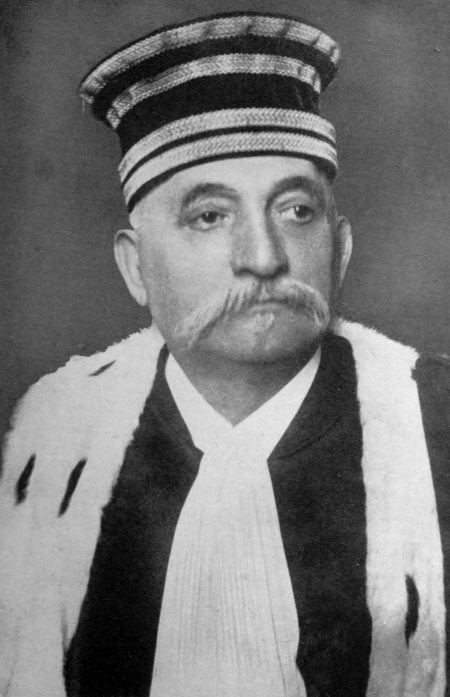
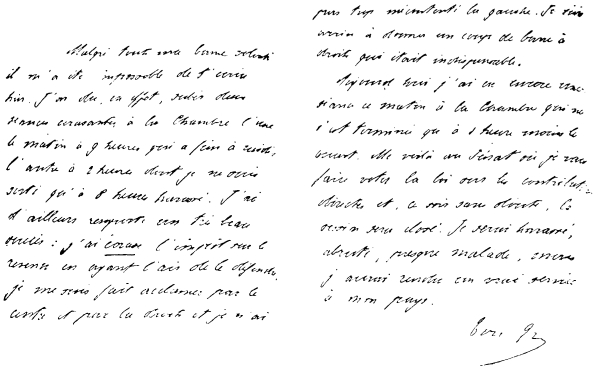
this book is reproduced in extenso the statement of Monsieur Victor
Fabre, Procureur Général, a legal official of judge’s rank, whose
position somewhat resembles that of the Public Prosecutor in England.
Monsieur Fabre, the gravity of whose statement caused the downfall of
the Monis-Caillaux Cabinet, declared that pressure had been brought
to bear on him to postpone or adjourn the trial of a financier named
Rochette, who, since the postponement of his trial has escaped abroad,
and is abroad still.
The bearing of this statement on the Caillaux drama will be seen in
a moment by the perusal of the examination on March 20, 1914, of
Monsieur Monis and of Monsieur Caillaux by the parliamentary commission
appointed after the storm caused by Monsieur Barthou’s reading of
Monsieur Fabre’s statement to inquire again into the facts of the
postponement of Rochette’s trial. I quote the details from the official
records transcribed from the shorthand notes of the parliamentary
inquiry which are in my possession. The inquiry was voted by the
Chamber of Deputies on March 17. I may add here that Monsieur Fabre,
whose written statement made it necessary, was punished for making
that statement, or, rather, for allowing himself to be coerced by the
Prime Minister and Monsieur Caillaux, and now occupies a position
of lower rank with a smaller salary, at Aix instead of Paris. His
successor as Procureur Général, Monsieur Herbaux, will probably act as
public prosecutor when Madame Caillaux is tried. On March 20, 1914,
at half-past nine in the morning, Monsieur Monis, who was by then no
longer Prime Minister, was introduced before the Commission of Inquiry,
consisting of Monsieur Jaurès, who presided, and thirty-two other
deputies. “Early in the month of March 1911,” said Monsieur Monis,
“when my Cabinet was barely a fortnight old, I received the visit of
the Minister of Finance, Monsieur Caillaux. Monsieur Caillaux told me
that he was anxious to oblige the lawyer, Maître Maurice Bernard,
who had represented him in his divorce proceedings against his first
wife (Madame Gueydan Dupré), and that Maître Bernard had asked for a
postponement of the Rochette affair.”
“Monsieur Caillaux,” Monsieur Monis said, “pointed out that apart
from his own wish to oblige Maître Bernard it might be dangerous, for
political reasons, to refuse his request for the postponement of the
Rochette trial.” “Maître Bernard,” he said, “is a very vehement man, and
a lawyer of great gifts. If the trial takes place now he is certain to
point out the number of issues of bonds and shares which have been made
in recent years on the Bourse, and authorized by the Government, which
have dwindled in value, which have caused heavy loss to investors,
which issues of stock have never, for all that, resulted in the taking
of legal proceedings. An outcry is sure to be raised round a speech of
this kind in the Law Courts, and the outcry is sure to have political
results. One of the first of these will surely be a number of questions
in the Chamber of Deputies. The Government has troubles enough of its
own just now without adding to them in this way. It will be much wiser
to grant Maître Bernard’s request and postpone the trial.”
It was as a result of this conversation between Monsieur Monis, the
Prime Minister, and his colleague the Minister of Finance, Monsieur
Caillaux, that the trial of Rochette was postponed. Even without going
into any details now, though I am afraid that it will be necessary
to go into a good many details presently, the verbatim report of
this interview throws a curious light on the close connexion in
France between the Government of the country and the country’s legal
procedure. Monsieur Caillaux’s reference to Rochette’s power, or rather
the power of Rochette’s lawyer, of causing the Government serious
inconvenience by an exposure of the number of losses to which French
investors have been subjected recently, points very clearly to a none
too heavily veiled attempt on the part of Rochette to blackmail the
Minister of Finance, and not only points to such an attempt, but looks
very much as though it had succeeded, for the blackmailer’s object in
this case was not money but time, and he was given time to escape doing
it. But perhaps the best way to realize what this man Rochette was and
is, and how he obtained the power of forcing the French Government to
take so strange a step as to order a judge and the Public Prosecutor to
postpone his trial and so secure his impunity and his escape from all
further worry, is to look into the history of Monsieur Rochette himself
from the beginning.
Rochette was the son of country farmers, or field labourers—people
at all events in poor circumstances. His early years are wrapped in
mystery, for although it is currently believed that he was an errand
boy and afterwards a waiter in a small café in a little town near
Fontainebleau, Rochette himself has always denied this. What is certain
about him is that in 1903 or 1904, nine or ten years ago, Rochette,
who had just finished his military service and who was therefore
twenty-three or twenty-four years old at the most, came to Paris and
became a bank clerk. He had a little money even then, which he himself
says he inherited and which was £2000 or £2500 at the most. He used
this money to launch several financial enterprises, and succeeded in
obtaining an incredible amount of credit for them with incredible rapidity.
This young man, whether he be a swindler or not, and even now that is
an open question, is undoubtedly a financial genius with a wonderful
charm of manner. He made use of these two assets to start several
companies, the first of which were the Banque Franco-Espagnole, the
Crédit Minier, the Société des Mines de la Nerva, the Laviana, the Val
d’Aran, the Paral Mexico, the Union Franco-Belge, the Syndicat Minier,
the Mines de Liat, the Buisson Hella and the Manchon Hella.
The flotation of nearly all these companies of different kinds, for
the exploitation of banks, mines, electric lamps and incandescent gas
mantles, was an immediate success, and hundreds of thousands of pounds
flowed into the coffers of this young financier. The Crédit Minier
in Paris, which was his headquarters, employed an enormous staff of
clerks, had gorgeous offices, and very shortly after its foundation
bore the appearance of a prosperous bank doing an enormous business. As
a matter of fact the Crédit Minier and Rochette really did an enormous
business, for not only from Paris, but from the provinces, where he had
branches everywhere, Rochette reaped a harvest of gold which flowed in
like Pactolus from the pockets of small investors who believed in him.
At the very beginning their belief was well justified, for everything
Rochette touched turned to gold.
Very soon after his establishment in Paris Rochette was said to be
worth somewhere between three and four million pounds sterling. Of
course most of this money was employed in his financial enterprises,
but these were successful beyond the dreams of avarice, and the prices
of shares in the Rochette flotations rose and rose continuously. To
mention one only among the number, shares of the Hella Gas Mantle
Company which had been issued at £4 a share ran up in the course of a
very few months to nearly £21 (518 frcs. was the exact figure) a share.
Some idea may be formed of the confidence inspired by Rochette from the
fact that when, in 1908, five years after his first appearance on the
Paris market, the financier was arrested, ten thousand shareholders of
his companies signed a petition for his immediate release, and sent it
to the Chamber of Deputies.
At the time of his arrest there were many more people
than these ten thousand shareholders who pinned their faith to Rochette and
his enterprises, and who maintain even now that his downfall was due to a
conspiracy against him by financiers who were interested in the fall
of his shares. To a certain extent this contention was true, as we
shall see later on by some of the evidence given on oath before the
Commission of Inquiry. A number of charges were formally made against
Rochette by a number of people who had lost money and considered him
responsible for the loss. These charges became so many that the Public
Prosecutor, after consulting the Minister of Justice sent for Monsieur
Rochette one day, and asked him, in view of the fact that a number of
the actions brought against him had been amicably arranged between the
parties while others of a graver nature charging him with fraud had
resulted in acquittal, whether he would consent to a friendly though
judicial examination of his books. This examination took place, took
place it may be remarked at the expense of Rochette himself, who was
perfectly willing to pay for it, and the accountants’ verdict was by no
means altogether unfavourable to the young financier. Rochette, having
triumphed, continued his issues of companies, and general opinion
began to rank him with the Rothschilds and the other overlords of high finance.
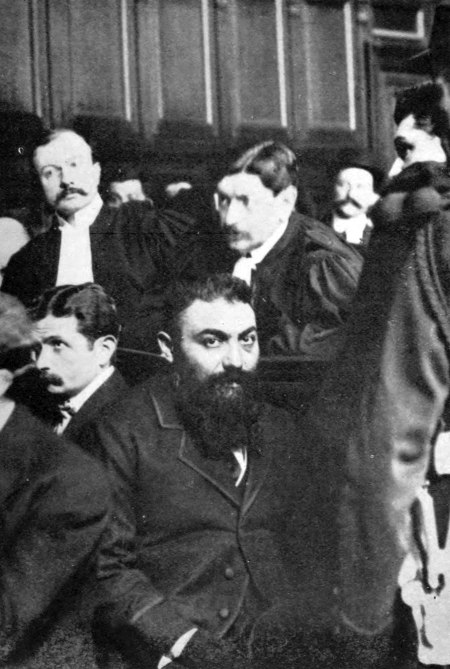
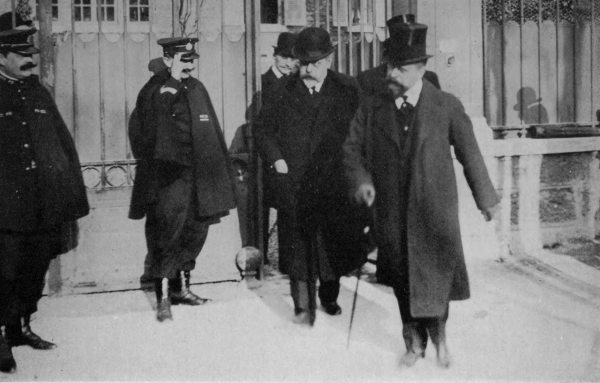
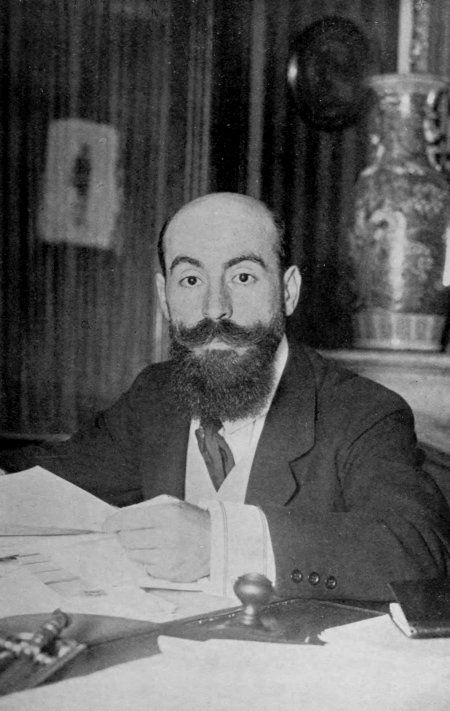
Agence Nouvelle—Photo, Paris
ROCHETTE IN COURT
(Rochette is the central figure with the black beard)
France rejoices, however, in the possession of a succession of more
or less avowedly Socialist Governments which govern or try to govern
the country on fatherly lines, and the French Government on the one
hand, and the judicial authorities on the other, began to look with
suspicion and alarm on Rochette’s increasing prosperity. The Bourse,
too, began to become suspicious of Rochette’s success, and an opinion
began to gain ground that sooner or later his rocket-like flight into
the regions of high finance would be followed by one of those crashing
stick-like falls, by one of those disastrous krachs of which so many
have been chronicled during the last century in all great capitals. It
was towards the end of February or the beginning of March 1908, that
Rochette made his big mistake. He attacked the Petit Journal, one
of the biggest and most influential newspapers in France. Rochette
made this attack on the Petit Journal and on its managing director
Monsieur Prevet, a member of the Senate, because he had a very definite
object in view. Rochette’s companies appealed to the imagination and to
the pockets of the small investor, and the small investor in France is
not a regular reader of financial newspapers, which he neither trusts
nor understands.
These small financial newspapers are legion, but although Rochette
undoubtedly had numbers of them at his disposal he realized that a
paper more generally read and appealing more directly to the people he
wanted to touch was necessary to his ambitions, and to the greater and
wider success for which he was working. He made up his mind, therefore,
to obtain control of the Petit Journal, a newspaper which is sold
all over France in every town, in every village, and in every hamlet,
and which, though it no longer enjoys the largest circulation of any
newspaper in France, was one of the two newspapers most suitable for
his purpose and the only one of the two which he had any chance at all
of getting. In order to obtain control of the Petit Journal, Rochette
set to work with tactics which were characteristic of the astuteness
and the utter lack of scruple of the man. He issued circulars which he
had printed in enormous quantities, forwarded them to every shareholder
of the Petit Journal, and scattered them broadcast, elsewhere. In
this circular, which was issued in view of the next general meeting of
the shareholders of the paper, a meeting which was to be held on April
5, 1908, Rochette painted the financial position of the Petit Journal
in the blackest possible colours, stating without the slightest
reference to truth, that the paper as a property was in a very bad way,
and advising shareholders to sell their shares.
The managing director of the Petit Journal, the powerful member
of the Senate, Monsieur Prevet, was naturally very much annoyed and
somewhat alarmed by these manœuvres, and took legal action to put a
stop to them. He commenced a prosecution against a “person or persons
unknown,” by which euphemism of course Rochette was indicated, for
the purpose of putting a stop to the disloyal manœuvres by which
Monsieur Rochette was rapidly obtaining a large number of shares and
powers of attorney from discontented shareholders.
Monsieur Prevet realized that unless some such immediate action were
taken it was more than possible that at the general meeting of the
Petit Journal Company on April 5, 1908, the discontented shareholders
either in person or by proxy would oust him, Monsieur Prevet, from his
position as managing director of the Petit Journal, and would hand
over the control of this newspaper with its enormous influence and
immense phalanx of readers to the financier Rochette. Monsieur Prevet
occupied a very high position. He was not only the managing director of
the Petit Journal, he was not only a member of the Senate, but he was
actually, at that time, the “rapporteur” or advisory summariser for the
Senate on the big question of the purchase by the State of the Western
Railway.
It is a curious sidelight on the Rochette affair that this financier
who had begun his career five years before with a capital of £2000 was
the principal mover in the immense agitation against the acquisition
by the State of the Western Railway of France. That he moved in this
matter on purely personal grounds is of far less importance than the
fact that if he had succeeded in overthrowing Senator Prevet the French
nation would undoubtedly have been spared a very heavy money loss,
for the acquisition by the State of the Western Railway has been a
disastrous undertaking from a money point of view, and has cost and
will continue to cost French taxpayers a large sum of money every year
till the railway begins, if it ever does begin, to pay. Rochette’s
attacks on Monsieur Prevet, and his obvious intentions on the Petit
Journal created a storm of antagonism against him in the French Press.
In spite of the persistent and unfailing confidence of his shareholders
public opinion began to make itself felt, and as always happens in
France when public opinion is roused, a great deal of mud began to
be flung and accusations of corruption became very frequent and were
directed against the highest in the land. The Government was hotly
accused of laxity, and Monsieur Georges Clemenceau, who was Prime
Minister in 1908, was accused of moral complicity with the financier
Rochette. It is a curious proof of the poetical justice, which comes
to its own even in financial questions, that these accusations against
Monsieur Clemenceau did more to cause the eventual downfall of Rochette
than anything which had happened before. They made “the tiger” angry,
and when Monsieur Clemenceau grew angry with Rochette, the day of
Rochette’s wane had dawned. Accusations were launched against the high
magistrates, who were accused of weakness and of being afraid to take
action. Members of Parliament were directly accused in the public
Press of protecting Rochette and his enterprises, and of taking money
for so doing. No day passed without the launching of an accusation
against some member of the Chamber or the Senate of having accepted
heavy bribes to cover Monsieur Rochette, or to back him up, and the
names of numbers of well-known men who are now more or less indirectly
connected with the Caillaux drama were constantly mentioned at the time
in connexion with Rochette, the financier.
The connexion between the two cases, the case of Rochette and the
Caillaux drama which followed the attack in the Figaro on Monsieur
Caillaux’s conduct in connexion with it, is curiously close. There have
been two Parliamentary inquiries into the Rochette affair. In the
first one in 1911, among the members of the Parliamentary Commission
we find the names of Monsieur Caillaux himself (he very nearly, in
fact, was the president) and of Monsieur Ceccaldi, who was approached
by Monsieur Caillaux on the afternoon of the crime, and to whom the
Minister of Finance confided his uneasiness with regard to his wife. In
the list of the second Commission Monsieur Ceccaldi’s name and others
closely connected with the Caillaux drama appear once more. But there
was no question, yet, in 1908, of a Rochette inquiry, for the affaire
Rochette was only just beginning. Monsieur Clemenceau fired the first
shot, as Monsieur Clemenceau was bound to do. There had been talk on
the Bourse, there had been talk in the newspapers, Monsieur Clemenceau
had been accused of slackness, and he had made up his mind that he
would not justify the accusation.
On Friday (it is quite a curious coincidence that so many important
dates of the Caillaux, Agadir, and Rochette affairs should have fallen
on a Friday)—on Friday, March 20, 1908, at exactly twenty minutes to
twelve in the forenoon, Monsieur Clemenceau, the Prime Minister, sent
for Monsieur Lépine, who was then Prefect of Police, and ordered him
to take measures for a judicial inquiry into Rochette’s financial
transactions. Monsieur Lépine spent exactly a quarter of an hour
with Monsieur Clemenceau in his room at the Home Office in the Place
Beauvau, and at five minutes to twelve he returned to the Police
Prefecture, sent for Monsieur Mouquin, the head of the Research
Department of the Paris police, and for Monsieur Yves Durand, his chef
de Cabinet, and told them what Monsieur Clemenceau had said to him.
Now the French have a way of their own of conducting these matters.
The State does not prosecute for fraud. Monsieur Lépine’s orders were
to find a plaintiff who would bring a charge against Rochette, who
would show proof that Rochette had damaged his pocket, and who would be
willing to pay the caution which the French courts require from such a
plaintiff before legal action begins. Monsieur Yves Durand was ordered
by Monsieur Lépine to go out and find such a plaintiff. Monsieur
Lépine, in his examination by the Parliamentary Commission on July 26,
1911, was very explicit with regard to his own opinion and the opinions
he had heard expressed on Rochette’s financial undertakings. He alluded
to them as “a house of cards built on puffs of hot air, kept afloat by
public credulity and bound to fall to pieces at the first breath of suspicion.”
Monsieur Lépine had urged the judicial authorities to take action in
the Rochette case long before action was taken, and he alluded with
some bitterness to the difficulty in getting a serious charge brought
against any financier suspected of fraud who was rich enough to make it
worth the while of his creditors to withdraw such charges. There had
been several charges made against Rochette, and they had all fallen
through because the plaintiffs got their money or got money enough to
induce them to withdraw.
When, therefore, Monsieur Lépine told Monsieur Yves Durand, his chef de
Cabinet, that he must go out and find him a plaintiff, he added that he
himself knew of nobody who was likely to assume the rôle. The French
law gives no greater claim on the assets in such a case to the man who
goes to the expense of prosecuting than it affords to all the other
creditors, and as he has to put up funds for the prosecution, it is
often, as Monsieur Lépine explained, more than difficult to find a
victim ready to fleece himself after he has been fleeced. But Monsieur
Yves Durand happened to have heard that Monsieur Prevet was a likely
man to undertake the prosecution, and he called on him immediately.
He went first to his private house, failed to find him there, and
found him eventually at his office in the Petit Journal building in
the Rue Lafayette. Monsieur Prevet told Monsieur Yves Durand that a
banker named Gaudrion was perfectly ready to prosecute Rochette, and
that he had mentioned his willingness to him. Monsieur Yves Durand and
Monsieur Prevet drove together immediately to the Rue de la Chaussée
d’Antin, where Monsieur Gaudrion had his office. They found Monsieur
Gaudrion there and he told them that although he was not ready to
prosecute Rochette himself, a friend of his, Monsieur Pichereau,
whom he described as a man of property living at Corbeil, was ready
to prosecute and would do so. Monsieur Pichereau, Monsieur Gaudrion
declared, had put £6000 into some of Rochette’s financial enterprises,
the Nerva Mines and Hella Gas Mantle Co. among others, had lost a good
deal of his money, and was ready to do everything possible to get some
of it back again.
At a quarter past two that afternoon, the afternoon of Friday, March
20, 1908, Monsieur Yves Durand returned to the Police Prefecture
and told Monsieur Lépine what he had done. Monsieur Lépine sent
Monsieur Yves Durand to the Procureur de la République, Monsieur
Monier (Monsieur Monier has been promoted since and is the high legal
authority whom Madame Caillaux consulted on the morning of the day
she shot Monsieur Calmette, as to the means of putting a stop to his
campaign against her husband), whom he was to advise of the existence
of a plaintiff ready to prosecute Rochette.
Monsieur Lépine, in his evidence before the Parliamentary Commission of
Inquiry, explained that he had hoped to get the whole matter settled
that same day, or at all events between the closing of one Bourse and
the opening of the next, so as to avoid news of the prosecution being
allowed to leak out and to be used as a basis for speculation. However,
Monsieur Monier told Monsieur Yves Durand that he would see Monsieur
Pichereau on the next day, Saturday, at two o’clock, and he informed
the Procureur Général and the Minister of Justice that a charge in due
form was to be laid against Rochette on the morrow. At ten o’clock the
next morning, Saturday, March 21, Monsieur Yves Durand went to Monsieur
Gaudrion at his office and told him that the Procureur de la République
would receive Monsieur Pichereau’s charge at two o’clock that afternoon
at the Palace of Justice. Monsieur Pichereau was in Monsieur Gaudrion’s
office, and had drawn up and signed his accusation against Rochette.
Monsieur Gaudrion read it through to Monsieur Yves Durand, who was not
in the least aware that Monsieur Pichereau was not the proprietor of
Nerva shares and Hella Gas Mantle shares as he stated himself to be in
his accusation, but that Monsieur Gaudrion was really the shareholder,
and that Pichereau was only a man of straw. Gaudrion was a speculator.
He had sold shares “short” in the Rochette enterprises, and seeing his
way to a Bourse coup he had coached Pichereau in the part he was to
play, given him a few shares of his own with which to play it, and paid
him a thousand pounds so that he should be able to make the necessary
guarantee on bringing his action and have something over for himself.
Monsieur Yves Durand, who got himself into terribly hot water over
these preliminaries when the whole matter came to light, and who was
openly accused of speculating himself on the fall of Rochette shares,
declared that he was quite unaware of this dishonest combination, and
that he had been misled by Monsieur Prevet, who had told him that he
knew all about Gaudrion and about Pichereau as well. At a quarter-past
two that afternoon Pichereau laid his formal charge against Rochette
at the Palace of Justice, deposited £80 by way of guarantee for costs,
and signed a request to be a civil party to the action. The matter was
placed in the hands of the examining magistrate, Monsieur Berr, for
his immediate attention, and poor Monsieur Berr sat up all Saturday
night and all Sunday night, and worked through all day on Sunday at the
Rochette dossier. At ten o’clock on Monday morning, March 23, 1908,
Rochette was arrested.
Of course the arrest of Rochette created an immense sensation, and
equally of course it occasioned the downfall of the shares of the
companies in which he was interested. But while these shares tumbled
headlong, an immense wave of public indignation swelled against the
financier’s arrest, for so far from finding empty coffers at the
offices of the Crédit Minier, the authorities admitted that there were,
in cash, £240,000 at this office, and £160,000 more at the Banque
Franco-Espagnole, a sister enterprise of Rochette’s. Rochette had
been arrested and sent to the Santé prison on Monday, March 23, 1908.
On Wednesday he wrote a letter to the examining magistrate, Monsieur
Berr, in which he protested with some appearance of justice against
his arrest and the situation created by it for the shareholders of his
companies. “It is my duty,” wrote Monsieur Rochette, “to declare that
on the day of my arrest I left the industrial and financial companies
under my control in an excellent situation. There were about £240,000
in cash in the safe of the Crédit Minier, and £160,000 in the safe of
the Banque Franco-Espagnole. This makes a total of £400,000. If I were
a malefactor, as attempts are being made to prove me, it would have
been easy for me to get out of my difficulties. I was advised from
all sides of the intrigues which were in course against me under the
leadership of a few men who considered that the growing prosperity of
my companies threatened the enterprises of which they were at the head.
It was these men who put up the plaintiff Pichereau. It was these men
who managed to get you to take action, and who are really responsible
for the exceptional measures which have been taken against me and the
establishments which I control. You have put me in prison, sir, and you
have refused to allow me to communicate with anybody except yourself
outside the prison. You have given orders for the dismissal of all the
clerks of the Crédit Minier and the Banque Franco-Espagnole. You have
closed these establishments. You have given orders for the closing of
all the provincial branches. You have struck a terrible blow at these
companies, without having heard what I have to say, without having
questioned me, without any preliminary examination by accountants of
the financial condition of my banks, without the slightest concern
for the shareholders or the other people interested. Do you know of
any bank, of any financial institution however powerful that would
be capable of withstanding such a blow? And for whom, why, on whose
account, have you done all this? For Pichereau! On account of one
single plaintiff at whose request a judicial examination was ordered,
and of whom after four days imprisonment I know nothing at all, for I
know neither the man himself nor the charge he has made against me.”
The examining magistrate, on receipt of this letter, confronted
Monsieur Rochette with Monsieur Pichereau, and told the financier the
exact terms of Monsieur Pichereau’s claim. Monsieur Pichereau claimed
to have bought Nerva Copper Mines of the B series, which proved to
be unnegotiable, and he put in nine documents to prove it. Rochette
declared that the nine documents proved nothing, that before his arrest
an attempt had been made to blackmail him, that these same documents
had been offered him on that occasion for £3200, and that he had
refused the offer. In proof of this, he stated that copies of Monsieur
Pichereau’s nine documents would be found among his (Rochette’s) papers
in the private desk in his office.
In connexion with these statements, it was proved that a number of
attempts had been made to blackmail Rochette, and that he had always
refused any advances of the kind. It is needless to say that the arrest
of this man and the closing of the banks and shutting down of mines and
other enterprises in which he was interested had a disastrous effect
on the market. All the money, and there was a great deal of money in
Rochette’s safes, had been sequestrated by the legal authorities, and
therefore of course no payments could be made. To put one case only,
eighteen hundred men and women in the employ of the Syndicat Minier
were clamouring for wages which could not be given them.
Eventually the court decided that liquidators should be appointed who
should pay out money from a reserve fund of £110,000 which the Crédit
Minier placed in the liquidator’s hands for this purpose. In July 1908,
Rochette was declared a bankrupt. He resisted vigorously, and even
now many people are inclined to doubt whether the declaration of
his bankruptcy was legally justifiable. But the whole matter of
Rochette’s financial position soon became involved in such a tangle of
legal procedure that it is quite impossible to say whether Rochette
could have got out of his difficulties if he had been left alone,
or whether he could not. It is noteworthy at all events that a very
large percentage was paid to his creditors. On the other hand, the
Rochette enterprises were wildly speculative, and new flotations were
frequently used to fill up financial gaps in former enterprises which
were unsuccessful. One thing is very certain, and was proved during the
parliamentary inquiry into the beginnings of the Rochette affair. A
large number of people, Monsieur Gaudrion among them, had been keenly
interested in the downfall of Rochette and had sold quantities of the
shares in his companies for a fall some time before it came. Most of
them had lost money. Gaudrion, on March 16, that is to say a week
before Rochette’s arrest, had been severely bitten by a sudden upward
jump, or “‘bear’ squeeze,” as it is called, on the Bourse, and was
forced by the rapid rise of Rochette’s shares to buy back with a loss
of nearly £5000.
Rochette was tried, and the case went against him, but again there
were illegalities in the trial. Information was communicated to the
court which was not, as the French law insists that it should be,
communicated first of all to the defendant or his lawyer. In the
course of the trial the liquidator, who had been officially appointed,
announced that he had distributed 50 per cent. to the creditors of
Rochette, and that he would be able to pay the 50 per cent. balance
integrally. Rochette lodged an appeal against the verdict, and at
the same time took legal action against Pichereau for making a false
declaration. His appeal was heard, dismissed, and judgment rendered,
by the Tenth Correctional Chamber of the Seine Tribunal on July 27,
1910—two years after his original arrest. The case was a long one,
very complicated, and proceedings had been obstructed legally, whenever
and wherever Rochette and his lawyers could obstruct them. The case,
however, provoked considerable scandal. Charges of illegality were made
by Rochette and his lawyer, Maître Maurice Bernard, in court and before
the case came to court, the Press took hold of the matter, and on July
10 Monsieur Yves Durand resigned and left the employ of the Prefecture
of Police. It was proved that this chef de Cabinet of Monsieur Lépine
was a sleeping partner in a stock-broking firm which had made a lot
of money by dealing in the shares of Rochette companies at the time
of his arrest, and though Monsieur Durand was not actually proved to
have profited by these transactions, grave suspicion rested on him
and made his official position untenable. On July 11, 1910, Monsieur
Jaurès brought the question of Rochette’s arrest before the Chamber,
and accused Monsieur Clemenceau in clear terms of having proceeded
illegally against the man, irrespective of his guilt or innocence.
It is worth noticing that the Rochette question had now become, as
almost everything becomes in France, a political matter, and that the
Socialists, with Monsieur Jaurès at their head, affected to consider
Rochette a victim of arbitrary treatment by vested authority. A
Parliamentary Commission of Inquiry was appointed on July 12 to examine
the question. Monsieur Caillaux was a member of this Commission,
and if he had not just at that time taken Ministerial rank he would
very probably have been its president. The first meeting of the
Parliamentary Commission was held on July 15. The first witness called
was Monsieur Yves Durand, who had been Monsieur Lépine’s chef de
Cabinet. His evidence has already been summarized in the last chapter,
and need not therefore be repeated. Monsieur Monier, who was at that
time Procureur de la République (a position which is more or less
equivalent to that of Deputy Public Prosecutor), produced an immense
budget of documents, all of which accused Rochette of fraud. These
accusations stated that the Nerva Mines Company, the Syndicat Minier,
the Banque Franco-Espagnole, the Crédit Minier, Franco-Belgian Union,
the Laviana Coal Company, the Liat and Val d’Aran Mines, the Hella
Incandescent Mantle Company, and the Buisson Hella, nine companies
in all, which Rochette had launched by public subscription, had been
floated fraudulently and irregularly. The charge was that these
companies had no reasonable prospect whatever of earning money by
honourable means, and that there were no real commercial assets for
exploitation behind them.
On July 26 Monsieur Lépine was examined by the Commission. He began by
affirming that the arrest of Rochette had been perfectly justified, and
while admitting that Monsieur Yves Durand had perhaps not been prudent
enough in arranging the preliminaries and checking the information he
received, he acquitted him of all personal action of a dishonourable
nature. He defended the arrest of Rochette, and declared that its
consequence had been to put a brake on the wild speculation which
Rochette’s issues had created. “I consider,” said Monsieur Lépine,
“that the arrest of Rochette turned off the tap and prevented him from
making new issues of shares. This preventive measure was a public
benefit. Some people lost money undoubtedly, but they deserved to lose
it. The speculation mania had been enormous and widely spread. It had
been crazy. There were shares which were worth £4 one morning and which
were run up to £22 before the same evening. If matters had been allowed
to go on like this, financial catastrophe would surely have followed.”
In the deposition on November 16 made before the Commission d’Enquête
by Monsieur Georges Clemenceau, the ex-Premier, after declaring that
he himself had no personal knowledge of Rochette, described with
characteristic brevity the conversation which he had with Monsieur
Lépine just before Rochette’s arrest. “This has got to be finished
off promptly,” I told him. “Do you believe Rochette to be an innocent
man against whom calumniators are at work?” Monsieur Lépine replied:
“Rochette is a scoundrel. He is a serious danger to the small
investor, and if he is allowed to go on as he has begun we shall have
a catastrophe one of these days.” “I told Monsieur Lépine to go and
see the magistrates and make arrangements,” said Monsieur Clemenceau.
“If I had to begin it all over again I would do again exactly what I
did before, and I am quite certain that if I had allowed Rochette to
get clear away with his millions out of private people’s pockets then,
there would be a Commission of Inquiry at work now asking me to explain
my complicity with the man.”
Monsieur Lépine was called before the Commission of Inquiry again on
November 18, and once more affirmed his conviction that Rochette’s
arrest had been necessary. He gave a few significant details of
Rochette’s methods. Rochette had bought properties for £8000 and
floated them as a company for £32,000. He had bought the Aratra Mines
for £9000, and floated them with a capital of £200,000. Patents for
which Rochette had paid £1200, and which, Monsieur Lépine declared,
were really not worth four shillings, were valued in the prospectus of
the company, which asked for, and obtained, subscriptions, at £480,000.
There were fictitious dividends declared, fraudulent balance sheets
concocted, prices inflated to figures which had no real existence
except by Rochette’s will. Rochette paid enormous sums for advertising.
One newspaper alone cost him £14,000. His advertising adviser drew
a salary of nearly £2000 a year. On one deal he spent £52,000, for
advertisement alone, in twelve months, and he spent £24,000 on
advertisement in the ten weeks before he was arrested. In three years
he created fifteen companies, issued £4,800,000 worth of shares, and
bought over £3,000,000 worth of his own shares at prices above the
price of issue to inflate and to keep prices up. He had then about a
million and a half sterling in cash to play with.
On July 27, 1910, Rochette was sentenced to two years’ imprisonment
and a fine of £120, by the Tenth Correctional Tribunal of the Seine
Department. The verdict, with its “attendu,” or reasons, took two and
a half hours to read aloud, though it was read with the extraordinary
volubility of which only a French clerk of the court possesses the
secret. I have this verdict before me in its printed form. It is
printed in very small print by the official printing works of the
Chamber of Deputies, for the copy I possess was printed for the use
of the Commission of Inquiry. The verdict, which is, as I have said,
very closely printed, fills forty large quarto sheets of paper. Against
this verdict Monsieur Rochette appealed again, and in the meanwhile the
Commission of Inquiry spent many full days discussing the questions as
to whether Monsieur Clemenceau had really ordered Monsieur Lépine to
find a prosecutor against Rochette, whether Monsieur Lépine had really
said that Monsieur Clemenceau had given him these orders, whether
orders had been given or whether suggestions had been made—the usual
waste of time and the usual mass of irrelevant detail which appears
to be inseparable from the work of a parliamentary inquiry into any
question in any country.
Ultimately, after long, long days of verbiage which appear curiously
useless now, Rochette himself was asked to give evidence before the
Parliamentary Commission of Inquiry. He was delighted to attend, for he
had nothing to lose and he had everything to gain by his attendance. He
also had a great deal to say, and said it very well, for Rochette is a
born orator. Naturally enough, he took the opportunity of pleading his
own case from A to Z once more, and of denouncing the illegality of his
arrest in March 1908. He launched accusations against the police, he
launched accusations against members of Parliament, he was very rude
indeed to financiers of repute. Above all, he was always interesting,
and often amusing, and he certainly made his case appear clearer than
it had ever appeared before.
His evidence is well worthy of consideration in detail, for it must not
be forgotten that one of the men before whom he gave it was Monsieur
Joseph Caillaux, and that he gave this evidence on November 25, 1910.
A few months later, in March 1911, Monsieur Caillaux, who no doubt had
been impressed by Rochette’s powers of oratory, advised his colleague,
Monsieur Monis, of the dangers that might be incurred, politically
speaking, if pressure were not brought to bear on the legal authorities
for the postponement of Rochette’s trial, in accordance with the wishes
of this extraordinary expert in legal obstruction. It is fair to infer,
I think, that Rochette’s attitude before the Commission of Inquiry
had impressed Monsieur Caillaux considerably, but Monsieur Caillaux’s
political enemies ascribed his attitude to motives of another kind.
Rochette’s evidence, if evidence it can be called, occupies twenty-five
closely printed pages in quarto in the transcription printed for the
Commission of Inquiry of the shorthand notes which were taken. One of
the first points Rochette made was on the question of the money which
he spent on advertising his various enterprises. He admitted that
the figures quoted against him were very largely correct, that for
instance, he really had spent as much as £2500 a week for ten weeks on
advertising, “but,” he said, “it is only a question of proportion after
all. The Bon Marché, the Louvre, or the Printemps can spend thousands
on advertising where it would be criminally foolish of a small grocer
to spend hundreds. I am not a small grocer. During the period from
January 1 to March 23, 1908, in which my publicity bill was £24,000,1
did nearly half a million sterling of business.”
Rochette then made a vicious attack on Monsieur Prevet and the Petit
Journal, but vicious though his attack was, it was distinctly
plausible. “A shareholder of the Petit Journal called on me,” he
said. “He brought some very interesting figures with him. These figures
showed that in 1901 the shareholders of the Petit Journal got £2
dividend and the shares were worth £44 to £48. In 1902,” he said
“Monsieur Prevet became director and six years afterwards, at the
beginning of 1908, the shares were worth from £10 to £12 and the
dividend was only sixteen shillings! This drop in value was not due to
a general slump in the newspaper industry, for the Petit Parisien,
the Journal, and the Matin, all of them halfpenny morning papers,
had increased the value of their respective properties enormously.”
Rochette’s visitor maintained, Rochette declared to the Commission,
that if Monsieur Prevet’s management was disastrous to the Petit
Journal shareholders, the fact was largely due to Monsieur Prevet’s
need of money, which was notorious. Rochette went, he said, into the
question of the Petit Journal’s next dividend. He saw, he declared,
that it was problematical, and he therefore “inspired,” though he did
not write, the circular which had been sent to the Petit Journal’s
shareholders. “With regard to Monsieur Prevet’s action at this time,”
says Rochette, “if he really wanted to protect the interests of his
shareholders and not his own, all he had to do would have been to send
out a private circular of his own to the shareholders, a list of whose
names was in his possession, and convince them that my statements were
wrong. He couldn’t, of course, do this, because my statements were
right, and that is why he was afraid that I should take his position
on the paper from him at the next general meeting. That is also why I
was arrested just before that general meeting. The shares had to be
deposited at the office of the Petit Journal for voting purposes
about March 19. Monsieur Prevet was able to convince himself that his
authority with the shareholders had dwindled, and he thought it safer
for himself to get rid of me.”
Several attempts were made, according to Rochette, during the month of
March 1908, to induce him to fall into cleverly laid traps which would
make his arrest easy. “These traps were laid cleverly, but not cleverly
enough,” Rochette declared, “and I was too astute to allow myself to be
caught in them. That was why,” he added, “I was arrested on Pichereau’s
disgracefully vamped-up charge.” Rochette was convinced, he told the
members of the Parliamentary Commission of Inquiry, that the anonymous
letters and anonymous telephone calls warning him that his arrest
was imminent with which he was bombarded between March 8 and 21 were
police tactics for the purpose of persuading him to take flight and
so to make matters easy for everybody. “I did not take flight,” said
Rochette proudly, “and when I was arrested there were £440,000 in my
safe. I could have taken this money out at any time. I did not take
it.” Rochette declared that the examining magistrate, Monsieur Berr,
had shown unfair prejudice against him from the moment of his arrest,
and that this was so apparent that his lawyer, Maître Maurice Bernard,
had made this accusation to the examining magistrate’s face: “I know
that my client’s arrest was arranged, ‘worked’ if you will, by three
men, Monsieur Lépine, Monsieur Prevet, and yourself!” And the examining
magistrate made no reply. “Ten thousand shareholders in my companies
signed a petition against my arrest and forwarded it to the Chamber of
Deputies,” was one of Rochette’s points. “In this petition they stated
that my arrest had been caused by Monsieur Prevet with the complicity
of Monsieur Gaudrion and Monsieur Pichereau. In February 1909,”
Rochette declared, “one of the experts who was examining my books
walked into Monsieur Berr’s room in the Palace of Justice. I was in
the little room next door, and I heard Monsieur Blanc, the expert in
question, who had not seen me, ask the examining magistrate whether
my case would come on for trial before the Correctional Court before
Easter or not. This was proof that the experts and everybody else knew
at this time that I was to be sent for trial, and that the pretence of
examining my books was only a pretence and nothing more. The examining
magistrate had made his mind up to send me for trial directly he had me
under arrest. The Crédit Minier,” Rochette declared, “ought never to
have been put into bankruptcy. None of my societies ought to have been
declared bankrupt, for every creditor was paid 100 per cent. The only
money that was lost was about £160,000, and that loss was due to the
disgraceful “bearing” of my shares by speculators. It is not fair to
say that I caused this loss of £160,000 to investors. The truth is that
people who were too well informed were allowed to make £160,000 at the
expense of the public. I have done nothing to be ashamed of. I have
committed no fault. Surely the success of the Crédit Minier is not a
fault. It had twenty-five customers when I started it, and five years
later there were fifty thousand of them. I wish to point out,” said
Rochette, “that my enterprises existed and did well before my arrest,
and continue to exist after it and in spite of it. I venture to state
positively that very few financiers who suffered as I have could make
the same statement. The net result of my arrest was the heavy drop of
the shares of my enterprises, a loss of £240,000 by the Crédit Minier,
and the ruin of shareholders whom the krach caught unawares. Of
the £240,000 which the Crédit Minier lost, certain speculators made
£160,000, and £80,000 went to the expenses of the bankruptcy. The
liquidator alone was paid between £12,000 and £16,000.”
Rochette told the Commission of Inquiry that he had intended taking
charge of the Petit Journal, as he had taken control in the krach
of the Say sugar refinery. He was, at that time, endeavouring to get
hold of the concession of the Paris Omnibus Company and was backing up
the Darracq group with money so that Monsieur Darracq could obtain the
concession from the Municipal Council. Monsieur Rochette, questioned
very closely by the members of the Commission, was forced to admit
that one of his lawyers, Monsieur Rabier (one of the stalwarts of the
Caillaux party in Parliament), drew about £500 a year for legal advice,
and on other occasions received sums varying from £2800 to £3200. The
members of the Commission expressed doubt about these figures, and a
curious story was told by a former clerk of Rochette’s with regard to
his book-keeping methods.
From this story it appeared that efforts were usually made by Rochette
to conceal the real amounts which were paid for their services to
newspapers and to those lawyers in the employ of the financier who
happened to be members of Parliament or political personages. Curiously
enough most of Rochette’s lawyers happened to be political personages,
and one of the lawyers of the Crédit Minier was Monsieur René Renoult,
who is a member of the present Cabinet. In many ways the examination
of Rochette by the Parliamentary Commission was an eye-opener to the
public. Accusations of venality on the part of public men are so common
in France, owing to the licence allowed in the Press, that such words
as “corruption,” “theft,” “lying” and the like have almost lost their
force when applied to men in the van of politics. But the details of
the manner in which Rochette conducted his business impressed and
alarmed the public by their unpleasant likeness to the unsavoury
details of the Panama case.
One of the members of the Commission, Monsieur Jules Delahaye,
who throughout the inquiry acted very much like a counsel for the
prosecution of every political man who was mixed up in the Rochette
affair, pointed out this unsavoury resemblance. “I consider Monsieur
Rochette to be a great corrupter of public morals,” he said. “I am not
at all content with his explanations. They do not satisfy me. There are
matters of far greater gravity behind his methods than he would have us
suppose, and I would ask my colleagues to concentrate their attention
on the items of Rochette’s expenditure for publicity with the same
intensity as the attention of the Parliamentary Commission had at the
time to be concentrated, with the results which you remember, on the
publicity accounts of the Panama Canal. In this case, as in the case
of Panama, public morals have been corrupted. Millions (“of francs”
is meant, of course) have been employed, not only to buy publicity in
the newspapers, but, as the Prefect of Police has told us, to corrupt
the moral and financial rectitude of people of all ranks and all
stations in Paris, in the provinces, all over France. I will go so
far as to say that the taint actually extended to the Church. That is
a characteristic of the affair.” (Page 547 of the official shorthand
reports of the Parliamentary Commission.)
Rochette paid, in many ways, on the plea of publicity. He was in the
habit, when he wanted to pay and to preserve secrecy for the payment,
of sending a note down to the cashier of the Crédit Minier with his
initials “H.R.” and a little cross marked on it next to the amount.
These little crosses were used in the books, it is suggested, to
signify that the amounts entered against certain names were not the
real amounts paid, which were much larger. The payments were made
directly from hand to hand by Monsieur Rochette to his political
friends and helpers, and no receipts passed. I do not propose to go
very much into detail on this uncomfortable question. The evidence
of Monsieur Duret, who acted as Rochette’s private secretary, and
that of Monsieur Yenck, a clerk in the Crédit Minier, leaves a very
uncomfortable taste in the mouth. Monsieur Yenck declared that Monsieur
Duret’s sole business was to act as intermediary between political
men and Rochette. He used to speak in very familiar terms of many
well-known politicians, and was on the friendliest terms with Rochette
himself. He always called Rochette by his first name, “Henri,” and was
in the habit of alluding to Monsieur Rabier as “Rab.” It was Duret who,
according to Yenck, secured, by political influence, the decoration
of the Legion of Honour for Henri Rochette. Yenck declared that Duret
had on one occasion made erasures in the private books of the Crédit
Minier, so as to avoid scandal. He told the Commission that Duret, whom
he had seen with a scratcher in his hand, and one of the Crédit
Minier’s private books in front of him, had explained what he was
doing by the remark: “I am very much afraid that Henri is going to be
arrested, and I don’t want the name of ‘Rab’ to be found in the books.”
(Page 566 of the official shorthand reports of the Parliamentary Commission.)
On February 1, 1912, the judgment against Rochette was annulled on
grounds of technical irregularity, by the Court of Correctional Appeal,
and the conclusions of the Parliamentary Inquiry Commission were laid
on the table of the Chamber of Deputies. It will be remembered that
according to the statement made by the Procureur Général, Monsieur
Victor Fabre, the Prime Minister, Monsieur Monis, had brought influence
to bear on him for the postponement of the Rochette trial on appeal
from the judgment of July 1910. Monsieur Jaurès, the President of the
Committee of Inquiry, on March 20, 1912, told the Chamber the history
of the Rochette case as he knew it, and he knows it perhaps better than
any other Frenchman living except Rochette himself. He told the story
of the strangely illegal manner in which the police had had Rochette
arrested. He pointed out that the police and the lawyers had been at
loggerheads as to the procedure to be employed. The police acted in
one way, the Parquet (that is to say the legal authorities) acted in
another, and by their ill-considered lack of unity of action with the
Parquet, the police had undoubtedly served the interests of a number of
men who had speculated and had made money on the downfall of Rochette.
It was, said Monsieur Jaurès, a curious fact that while the arrest of
Rochette could not be effected for the mere purpose of protecting the
small investor, it was effected by means of a conspiracy between a
banker, Monsieur Gaudrion, who had sold Rochette shares for the fall,
and Monsieur Prevet, the director of a newspaper, who was anxious to
throttle a competitor.
In this conspiracy Monsieur Gaudrion furnished the prosecutor and
Monsieur Prevet supplied the influence. Monsieur Gaudrion did not,
himself, prosecute. He could not do so because he had been in trouble
with the laws of his country. He found a man of straw to act as
prosecutor in his stead, a man named Pichereau, and gave him shares and
money to act against Rochette. “When we examined Monsieur Gaudrion
before the Commission of Inquiry, I said to him,” said Monsieur
Jaurès, “I can understand that you, who were gambling for the fall
of Rochette shares should be anxious for the arrest of Rochette, but
why did Pichereau ruin himself by bringing an action which made the
shares in which he had invested his whole fortune perfectly valueless?”
“Gaudrion answered,” said Monsieur Jaurès, “‘The shares did not belong
to Pichereau’,” and this was the truth. Monsieur Jaurès suggested that
the conspiracy had gone even further. Monsieur Clemenceau, who was
Prime Minister, told us that he intervened because he was anxious to
scotch the legend that the Government were protecting Rochette. “I told
him to be careful,” said Monsieur Jaurès. Monsieur Prevet had told the
Commission that Gaudrion had advised him on March 19 or early on the
morning of the 20th, of the readiness of Pichereau to prosecute.
At half-past eleven on the morning of March 20, Monsieur Clemenceau
telephoned for Monsieur Lépine and told him to find a prosecutor.
Monsieur Lépine spoke to Monsieur Yves Durand, and Monsieur Yves
Durand went straight to Monsieur Prevet. “When I pointed out,” said
Monsieur Jaurès, “the significance of these dates, Monsieur Clemenceau
exclaimed. ‘It is a coincidence.’ Monsieur Lépine also said, ‘It is a
coincidence,’ and I can say no more than ‘It is a coincidence’ to the
Chamber to-day.”
Here in a few words we have the real origin of the affaire Rochette,
and the “coincidence” which Monsieur Jaurès pointed out to the Chamber
is a painfully suggestive one. Rochette, after his first sentence, was
allowed to drag proceedings out for many months, from July 27 of one
year to April 29 of the next, though the courts always found against
him except in very minor subsidiary actions. He then secured a further
postponement from April 29, 1911, till January 12, 1912. During all
this time Rochette had been a free man, and he was able to continue his
financial operations. His reasons for spending immense sums of money on
securing these postponements of his trial were self-evident. Monsieur
Jaurès pointed out these reasons to the Chamber. Rochette said to
himself, Monsieur Jaurès explained, that the more business he did, the
more chance he had of ultimate escape. If during these months of delay
he succeeded in bringing off one substantial coup he would cease to
be the adventurer who was a danger to the small investor, and would be
considered as the clever and successful financier who had triumphed
over the illegality of his arrest in the first place.
In this speech before the Chamber, Monsieur Jaurès referred to the
contradictions in the evidence of the Procureur Général Monsieur Fabre,
the Prime Minister Monsieur Monis, and Judge Bidault de L’Isle, with
reference to the last and longest postponement of the Rochette trial
from April 29, 1911, to January 12, 1912. He alluded to the rumour
which was gaining ground that political influence had been brought to
bear on the judicial authorities for the postponement of the trial. He
expressed the regret that these rumours had not been probed until after
the truth was made clear and he declared that Monsieur Fabre had said
either too much or too little before the Parliamentary Commission. We
know the truth now. We know that political influence was brought to
bear for the postponement of the Rochette trial, we know who brought
that influence to bear, and the truckling with the truth on the part
of those concerned in the postponement must be the subject of the next
chapter of this book, for this one is, I fear, too long already.