Transcriber’s Note: Maps are clickable for larger versions.
Department of Culture, Recreation and Tourism
Louisiana Archaeological Survey and Antiquities Commission
Anthropological Study No. 2
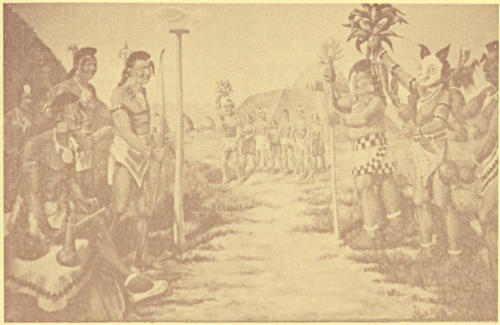
Green Corn Ceremony of prehistoric Caddo Indians.
Presumed village, dress, and utensils about A.D. 1000 as reconstructed
from archaeological findings. Mural in Louisiana State Exhibit Museum,
Shreveport.
Clarence H. Webb
Hiram F. Gregory
August 1978
Baton Rouge, Louisiana
STATE OF LOUISIANA
Edwin Edwards Governor
DEPARTMENT OF CULTURE, RECREATION AND TOURISM
Dr. J. Larry Crain Secretary
ARCHAEOLOGICAL SURVEY AND ANTIQUITIES COMMISSION
Ex-Officio Members
Dr. Alan Toth
State Archaeologist
Dr. E. Bernard Carrier
Assistant Secretary, Office of Program Development
Mr. William C. Huls
Secretary, Department of Natural Resources
Mr. Leon Tarver
Secretary, Department of Urban and Community Affairs
Appointed Members
Mrs. Lanier Simmons
Mrs. Dale Campbell Brown
Mr. Thomas M. Ryan
Mr. Fred Benton, Jr.
Dr. Clarence H. Webb
Dr. Jon L. Gibson
Mr. Robert S. Neitzel
Editor’s Note
More than 10,000 years of human settlement in Louisiana have left a
cultural heritage that is both rich and informative. With the publication of
“The Caddo Indians of Louisiana,” the Department of Culture, Recreation
and Tourism is pleased to continue the series of Anthropological Studies that
will illuminate some of the major episodes in Louisiana’s past.
The two authors of the present study are eminently qualified authorities
on the Caddo Indians. Dr. Clarence H. Webb, a well-known Shreveport
physician, is equally distinguished by his pioneer archaeological efforts in the
Caddoan area. For more than four decades, he has led the professional
community in the illumination of Caddoan prehistory. Dr. Hiram F. Gregory
is Professor of Anthropology at Northwestern State University and also a
veteran of many years of Caddoan archaeology. His professional career,
which began with an exhaustive study of the Spanish presidio of Los Adaes,
has acquired a pronounced ethnohistoric orientation in recent years as the
result of his close cooperation with the Caddo and other living Indian groups.
Recognizing that the past belongs to everyone, and not just to a handful of
scholars, the Anthropological Studies are directed to a general audience. It is
hoped that these studies will bring cultural enrichment to the people of
Louisiana and stimulate an interest in preserving our historic and archaeological
resources for enjoyment and study by future generations.
Alan Toth State Archaeologist
State of Louisiana EXECUTIVE DEPARTMENT Baton Rouge
Edwin Edwards Governor
July 5, 1978
CITIZENS OF LOUISIANA
This second edition of the Anthropological Study Series of the Department of Culture,
Recreation and Tourism and the Louisiana Archaeological Survey and Antiquities Commission
is dedicated to the late Margaret Elam Drew, a charter member of the Commission.
Affectionately known by professional and amateur archaeologists as “Lady Margaret,” Mrs.
Drew and her close friend, Mrs. Rita Krouse, were instrumental in fostering statewide
governmental and private sector support for the protection of Louisiana’s archaeological
resources.
Mrs. Drew was the wife of Representative Harmon R. Drew of Minden. Her interest in
archaeology began in 1962, with her daughter’s curiosity about the location of Indian tribes in
Northwest Louisiana. Mrs. Drew, a devoted history buff, and Mrs. Krouse enthusiastically
began researching possible Indian sites.
The Drew-Krouse team contacted Dr. William Haag, the Louisiana State University professor
later named as Louisiana’s first State Archaeologist, for advice. Their research marked the
beginning of a fifteen-year partnership of field excursions, field training schools and dedicated
efforts to enlighten the public on archaeology and its importance to everyone.
Webster Parish had no registered archaeological sites in 1962. Through the efforts of Mrs.
Drew and Mrs. Krouse there are now twenty-nine such sites. Claiborne Parish had two
registered sites; there now are twenty-five. Mmes. Drew and Krouse established seventeen
sites in Bienville Parish alone.
In 1974, on Dr. Haag’s recommendation, I was honored to appoint Margaret Drew a charter
member of the Louisiana Archaeological Survey and Antiquities Commission. Her appointment
was but a token of her colleagues and my appreciation for her efforts to promote the
establishment of the Antiquities Commission and her work to obtain public and private funds
for archaeological site surveys.
The publication of this study recognizes and honors the late Margaret Drew. Her selfless and
tireless dedication to the preservation of our archaeological resources will, through ages to
come, be credited with helping preserve this precious part of Louisiana’s cultural heritage.
Cordially,
EDWIN EDWARDS
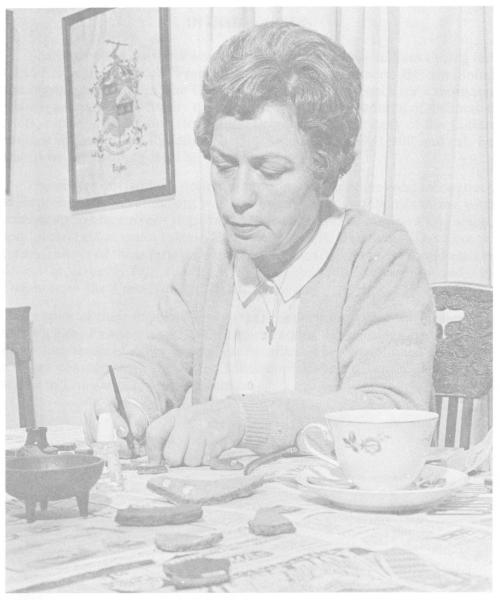
Margaret Elam Drew
(1919-1977)
INTRODUCTION
Northwestern Louisiana was occupied by the Caddo Indians during the
period of early Spanish, French, and American contacts. By combining
history and archaeology, the Caddo story can be traced back for a thousand
years—a unique opportunity made possible by a long tradition of distinctive
traits, especially in pottery forms and decorations. Our story of the Caddo
Indians in Louisiana, therefore, begins around A.D. 800-900 and can be
traced by archaeology well into the historic period.
The center of Caddoan occupation during contact times and throughout
their prehistoric development was along Red River and its tributaries, with
extensions to other river valleys in the four-state area of northern Louisiana,
southwestern Arkansas, eastern Texas, and eastern Oklahoma. The successful
agriculture of these farming peoples was best adapted to the fertile valleys
of major streams like the Red, Sabine, Angelina, Ouachita and—in
Oklahoma—the Canadian and Arkansas rivers.
In spite of their linguistic (language) connections with Plains tribes like
the Wichita, Pawnee, and Arikara, the Caddos in Louisiana had customs
much like those of other Southeastern tribes. They maintained trade and
cultural contacts with the lower Mississippi Valley tribes of eastern and
southern Louisiana for many centuries.
PRE-CADDOAN DEVELOPMENTS
Northwestern Louisiana was occupied for thousands of years before the
beginnings of Caddo culture. In the upland areas, along small streams and
bordering the river valleys, projectile points and tools of Early and Late
Paleo-Indian peoples have been found (Webb 1948b; Gagliano and Gregory
1965). In the western plains, the makers of the fluted Clovis and Folsom
points hunted now extinct types of big game (mammoth, mastodon, sloth)
between 10,000 and 8000 B.C. The later Plainview, Angostura, and
Scottsbluff points have been found with the extinct large bison. Since all of
these distinctive projectile point types have been found in the Louisiana
uplands and mastodon bones, teeth, and tusks have been found in Red River
Valley, big game hunting was possible in the state. However, no camp or kill
sites of Paleo-Indian people have been found thus far.
The oldest camp sites in the Caddo area of northwestern Louisiana are
those of the San Patrice culture, thought to date between 8000 and 6000 B.C.
This culture, which some students look upon as late Paleo-Indian and others
as early Archaic, was named for a stream in De Soto and Sabine Parishes
(Webb 1946). When a camp site of two bands of San Patrice people was
excavated south of Shreveport (Webb, Shiner and Roberts 1971), only their
typical points and a variety of small scraping, cutting, and drilling stone tools
were found. The tools indicated that they still depended largely on
hunting—probably deer, bear, bison, and smaller animals—with a gradual
increase in reliance on gathering wild plant foods. Stone points and tools of
San Patrice people have been found over much of the terrace and upland
parts of Louisiana.
A combination of hunting, fishing, and gathering of native foods by bands
of people, whom we call Archaic, was characteristic throughout Louisiana
from 6000 B.C. until almost the time of Christ. In favorable locations they
congregated in larger groups, at least during certain times of the year, but did
not form definite year-round settlements. Grinding stones and pitted nut
stones show that Archaic people harvested seeds and nuts, such as hickory
nuts, walnuts, pecans, acorns, and chinquapins (chestnuts). They also made
ground stone celts (hatchets) for wood cutting and polished stone ornaments,
especially beads. They hunted with darts which are heavier than arrows and
were thrown with the atlatl, or throwing stick.
Toward the end of the long Archaic period, by 1500 B.C., the Poverty
Point culture developed in northeastern, central, and southern Louisiana.
Sites of this culture have not been found on Red River, but there are Poverty
Point sites on the Ouachita River and the late Archaic people on Red River
had a few items—soapstone vessels, hematite plummets or bolas weights,
polished or effigy beads—which may have been traded from Poverty Point.
People who lived in small settlements and made pottery appeared in the
area about the time of Christ. Their crude pottery was generally plain and
resembled that of Fourche Maline people in eastern Oklahoma and southwestern
Arkansas. In northwestern Louisiana, the culture is called Bellevue
Focus, named for a small mound site on Bodcau Bayou near Bellevue, in
Bossier Parish (Fulton and Webb 1953). The small conical Bellevue mound
was found to cover flexed and partly cremated burials, and is thought to
represent the beginning of the trait of building mounds as burial commemorations
in this part of the state. There was no sign of cultivated plants,
although the Marksville people of this time may have grown maize (corn) and
squash. Probably, the Bellevue people lived largely as had the Archaic folk,
by hunting, fishing, and gathering of the abundant native foods. At another
half dozen small sites along the Red River Valley margins and on the lateral
lakes, small conical mounds show a culture like that of Bellevue. One of these
in Caddo Parish also had polished stone and native copper beads with
cremated burials. An occasional decorated pottery sherd found at these
Bellevue sites resembles Marksville and Troyville pottery of the lower Mississippi
Valley.
The Fredericks mound and village site, near Black Lake in Natchitoches
Parish, seems to be an outpost or colony of central Louisiana Marksville and
Troyville cultures, probably inhabited between A.D. 100 and 600. A few
scattered sherds at other sites along Red River show a thin occupation or
trade with Marksville, but Fredericks is the only large mound and village site
of this intrusive culture in the area.
The first widespread occupation of northwestern Louisiana by pottery
making, farming people was that of Coles Creek culture. This culture developed
along the lower Mississippi Valley, in Louisiana and Mississippi,
including the lower Red River, starting about A.D. 700. Probably because
their agriculture was more advanced, Coles Creek populations increased and
spread widely, up the Mississippi Valley, throughout northern Louisiana,
eventually into the Caddoan area of the other three states, and even to the
Arkansas River in central Arkansas and eastern Oklahoma.
Coles Creek hamlets and villages were on the river banks, on the lateral
lakes, and on streams in the uplands. Many settlements were larger than in
previous times and large ceremonial centers evolved, some of which featured
mounds around a central plaza. There probably were temples atop the
flat-topped mounds and burials within other mounds. The temples were
either chiefs’ or priests’ lodges, or sacred temples, and ceremonies and
festivals presumably were held in the plazas. Pottery was well made and
hunting was with the bow and arrow which replaced the atlatl and dart in this
area about A.D. 600.
Distribution of principal archaeological sites in northwestern Louisiana. Reprinted with permission of
New World Research and the U.S. Army Engineer District, New Orleans.
EARLY CADDO CULTURE: ALTO FOCUS
At some time before A.D. 1000, and probably by A.D. 800, the traits
associated with the beginnings of prehistoric Caddo culture replaced Coles
Creek over the four-state area. The change may have started along Red River
in northwestern Louisiana, although others have thought that a group of
“culture bearers” entered the Caddoan area of eastern Texas overland from
the more advanced culture centers of the Mexican Highlands.
Whether the ideas that are shown in the prehistoric settlements came
overland or up the rivers, two conclusions seem certain: (1) early Caddoan
culture existed for a time with late Coles Creek; and (2) Caddo beginnings
added new customs and traits that seem to have originated in Middle
America, especially in the Mexican Highlands and on the upper Mexican
Gulf Coast.
The early Caddo unquestionably derived many things from Coles Creek.
Their settlement patterns were similar, a culture change from Coles Creek to
Caddo often occurring in the same village or even in building levels of the
same mound. The Caddo continued bow and arrow hunting, with identical or
slightly changed stone arrow points. Coles Creek and Caddo peoples practiced
the same kind of intensive maize-beans-sunflower-squash-pumpkin
agriculture or horticulture. They both made clay or stone effigy pipes and
smoked tobacco ceremonially. The Caddo shared many of the Coles Creek
pottery types, especially in the utility vessels, with minor changes taking place
through time, as is to be expected. The Caddo retained strong religious and
civil authority in the villages and the major ceremonial centers and were
organized under a chieftain type of authority. There are similarities to Coles
Creek, finally, in Caddoan ceremonial festivities, games, and customs of
burying the dead in mounds alongside the plazas.
A Middle American origin can be assumed for a number of Caddoan
ceramic ideas. The bottle and the carinated bowl—a bowl with a sharp angle
separating the rim from the sides or the base—vessel shapes are likely
Mexican introductions. The same is true of the low-oxygen firing of pottery
and the burnishing or polishing of the exterior to produce glossy mahogany
brown or black surfaces. Decoration of these surfaces was often by engraving
after firing, combined with cut-out areas and insertion of red pigment into the
designs, and the frequent use of curved line rather than straight line designs.
The curved motifs included concentric circles, spirals, scrolls, interlocking
scrolls, meanders, volutes, swastikas, and stylized serpent designs. A few
curvilinear designs were present in the earlier Marksville and Coles Creek
pottery, but they became more varied and frequent in Caddoan ceramics.
Another trait introduced from Middle America was that of placing the
burials of important people, such as chiefs, priests, and family members of the
ruling class, in shaft graves, sunk into mounds or special cemetery areas.
Some of the more important early Caddo tombs are quite large, as much as
fifteen to twenty feet in length and eight to sixteen feet in depth. Many had
special sands or pigments on the pit floor, numerous offerings, and indications
that retainers or servants were sacrificed to accompany the revered
person in the afterlife. Shaft tombs in mounds and pyramids occurred in the
Maya areas of Guatemala and Yucatan, and also in the Mexican Highlands,
before and during the time of the early Caddos.
Other Mexican traits were the concepts of the long-nosed god and the
feathered serpent. These symbols are seen in the Caddo area in sheet copper
masks, on carved stone pipes, and on carved conch shells. In Middle America,
the long-nosed god symbol relates to the worship of the rain god, Chaac, and
the feathered serpent is the symbol of Quetzalcoatl (Kukulcan in Maya).
Signs of elaborate ceremonialism have been found in large Caddoan
mound groups or centers in each of the four states: Davis, Sanders, and Sam
Kaufman sites in Texas; Spiro and Harlan in Oklahoma; Crenshaw, Mineral
Springs, Ozan, and East mounds in Arkansas. Along Red River in northwestern
Louisiana, the well-known early Caddo centers are Gahagan and
Mounds Plantation.
The Gahagan site is on the west side of Red River, almost equidistant
between Natchitoches and Shreveport. Formerly it was situated on an old
channel but much of the channel and site have been destroyed by river caving.
A village area, a conical burial mound, and a small flat-topped mound
surrounded a large plaza at Gahagan. Another small mound is about a
quarter mile distant. The burial mound was excavated by Clarence B. Moore
in 1912, and by Webb and Dodd (1939). Moore described a central shaft,
eleven feet in depth and thirteen by eight feet in dimensions, with five burials
and more than 200 offerings. Webb and Dodd found two additional pits
along the slopes, both starting at the mound surface and terminating near the
base. They were nineteen by fifteen and twelve by eleven feet in dimensions,
and contained six and three burials, respectively. Between 250 and 400
offerings were preserved in each pit.
The burial offerings at Gahagan included ornate pottery, beautifully
flaked stone knives (called Gahagan blades), batches of choice flint arrow
points, long stemmed or figurine pipes of clay and stone, copper-plated ear
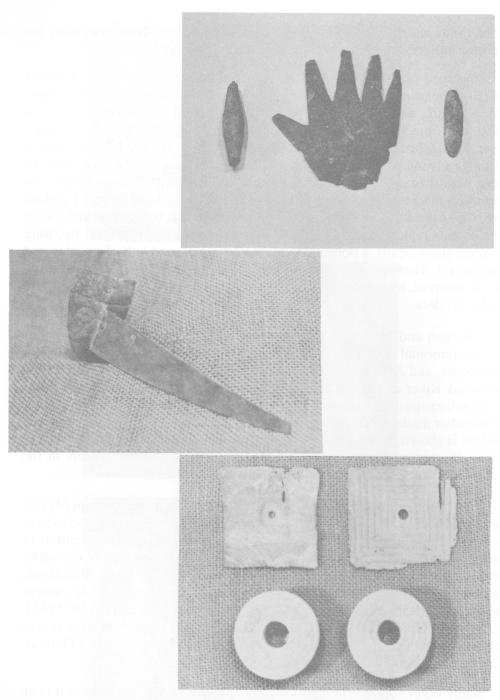
ornaments, sheet copper plaques, copper hand effigies, long-nosed god copper
masks, polished greenstone celts (some spade-shaped), bone hairpins,
and shell beads or ornaments. All of these are unusual for this area and show
that the early Caddos had widespread trade channels for these esoteric
objects and materials. The sources are as distant as the Gulf coast, the
Kiamichi Mountains of Oklahoma, the central Texas plateau, Tennessee or
Kentucky, and, possibly, the Great Lakes area.
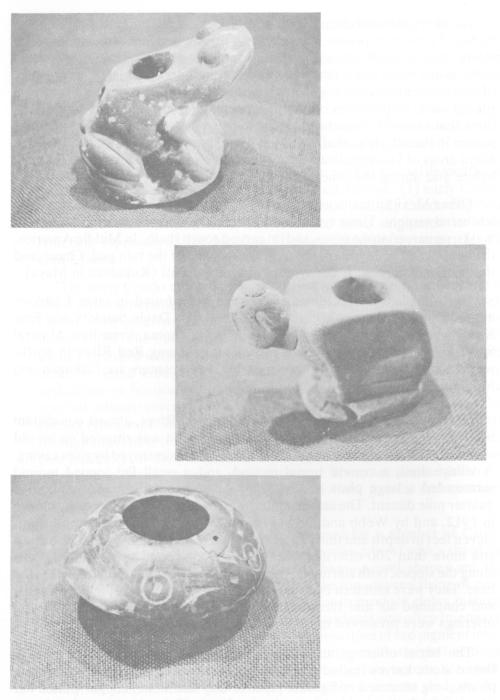
Frog and human effigy stone pipes and polished and engraved pottery vessel made about A.D. 1050.
Artifacts from the Gahagan Mound site, Red River Parish, Louisiana.
The second Caddo site where high ceremonialism existed is at Mounds
Plantation, on an old Red River channel just north of Shreveport. An oval
plaza, more than 600 yards in length and 200 yards in width (about twenty-five
acres), is surrounded by seven mounds of varying sizes, with two smaller
mounds at some distance. It was first described by Clarence B. Moore (1912),
then studied by surface collections and limited excavations by Ralph R.
McKinney, Robert Plants, and Clarence H. Webb, with assistance of friends
(Webb and McKinney 1975). At least four culture periods were indicated by
pottery sherds. Excavations proved that Coles Creek people established and
laid out the site, probably constructing at least four of the mounds around the
plaza. A flat mound on the northwest corner, started by these people, was
built higher by the early Caddos in what seems to have been a period of rapid
culture change. The mound may have been the location of an arbor or lodge
where food was prepared and served during festivals or ceremonies held in
the adjoining plaza.
At the southeast end of the plaza, the Coles Creek people prepared a
large burial pit, measuring sixteen by fourteen feet, in which they placed ten
adult or adolescent burials in two parallel rows. Offerings found by the
investigators were limited to flint arrow points, bone pins, smoothing stones,
traces of copper-plated ear ornaments, and ankle rattles of tortoise shells
filled with pebbles. A small mound had been built over this pit, and into this
mound later Coles Creek burials had been placed.
Subsequently, the Alto Caddos also used this mound for burials, digging
four large shaft tombs and three smaller pits. All but one of these features
contained offerings of superior quality. The most spectacular of the graves
was a large crater-shaped pit adjoining the Coles Creek pit. It was nineteen
by seventeen feet in dimensions, and was cut through the mound to a depth of
four feet below its base. In it were the skeletons of twenty-one persons, from
elderly adults to unborn infants. An adult male, six feet tall, was provided
with numerous personal effects which included a sheathed knife on his left
forearm and a well-preserved five and one-half foot bow of bois d’arc wood
placed by his left side. He is thought to have been the paramount person
whose death occasioned the immense tomb, the ceremonial offerings, and the
presumed sacrifice of tribal members to accompany him in the afterlife. Part
of the tomb was covered with a framework of cedar logs, thus accounting for
the unusual preservation of many cane and wooden objects.
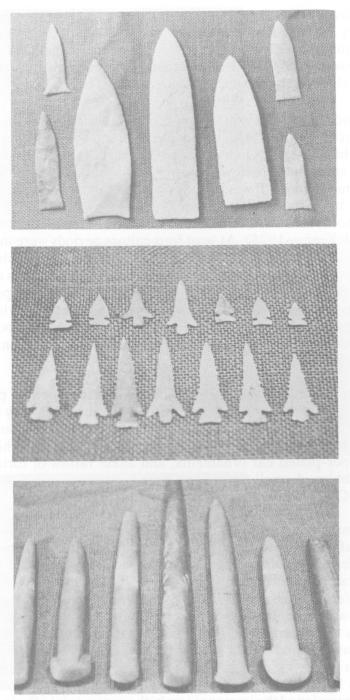
Prehistoric Caddoan stone knives, finely chipped arrow points, and ceremonial polished greenstone celts
from Gahagan Mound site. These Early Caddo artifacts date to the 11th century A.D.
Preserved offerings included an ornate pottery bowl, decorated with a
thumb-finger cross and eye symbols, flint knives of Gahagan type, fifty-three
arrow points, a long-stemmed pipe, copper-plated ear ornaments, puma
teeth, and objects of wood which included knife handles, a comb, a baton,
several small bows, and wooden frames. Also present were leather, plaited
cording or twine, and about 200 fragments of split cane woven mats, some of
them with diamond or bird head designs. A half pint of seeds beside the
important male were identified later as purslane (Portulaca oleracea), a plant
sometimes used for food by aboriginal people. Also beside the male were
four objects typical of Poverty Point or late Archaic manufacture: two long
polished stone beads, a polished hematite plummet, and half of a perforated
slate gorget. These ancient objects, from a time 2000 years before the Caddo
burial occurred, must have been found and kept as venerated talismans by the
Caddo leaders.
Gahagan and Mounds Plantation have their counterparts as early Caddoan
ceremonial and trade centers at a dozen similar large sites in Texas,
Oklahoma, and Arkansas. The best known is the Spiro mound center on the
Arkansas River in eastern Oklahoma, where enormous amounts of well-made
and exotic objects from the entire midportion of the United States were
gathered or made as offerings. Close contact between these large ceremonial
centers is shown by the similarity of objects, materials, or artistic concepts
across the entire Caddo area. Contacts with other cultural centers in the
Mississippi Valley and into the Southeast also are seen.
Contrasting with these important centers, with their reflection of Middle
American ceremonialism, organized religio-civil leadership class, and expensive
cruel burial ceremonies, there were many small villages and hamlets of
early Caddo people. Their habitations, tools, and some customs are known by
explorations of sites at Smithport Landing (Webb 1963), Allen, Wilkinson,
Swanson’s Landing, and Harrison’s Bayou along the western valley escarpment
(Ford 1936; Webb and McKinney 1975; Gregory and Webb 1965).
Colbert and Greer sites on upland streams in Bienville Parish, and the recent
study of a hamlet at Hanna on the Red River below Gahagan (Thomas,
Campbell and Ahler 1977).
Early Caddo copper objects from Gahagan include beads, a hand effigy, a finger cover, a Long-Nosed God
mask, and copper-plated ear ornaments.
Many other small settlements of this time are known but have not been
studied, thirty to forty altogether between Natchitoches and the Arkansas
state line (Thomas, Campbell and Ahler 1977; Webb 1975). They are found
in the Red River Valley, on lateral lakes and streams, and in the uplands.
Apparently, these were simple farming, gathering, hunting, and fishing folk
who did not share in the exotic materials of the complex regional centers.
They probably did participate in ceremonies, festivities, and renewals of faith
by visits to the centers and may have provided food, local materials, and
occasional man-power in exchange for leadership and protection. For the
next 500 years there is no evidence of the Caddo being threatened by
outsiders.
BOSSIER FOCUS
Between A.D. 1100 and 1200 the early Caddo culture was changing into
a simpler culture that has been named Bossier, for the parish in which it was
first discovered (Webb 1948a). The large centers faded out or were inhabited
by small groups. The people seem to have been secure, not menaced, and
beginning to spread out along the streams in small settlements or family
homesteads. Local materials were used and few exotic objects have been
found. Burial customs became simpler, usually single graves with a few
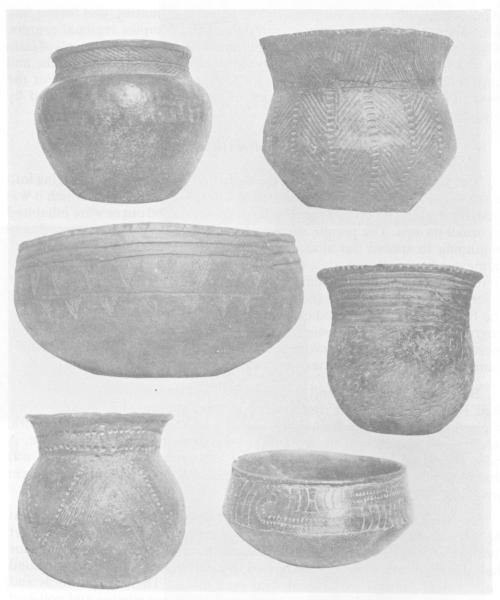
offerings and situated near the home or in small cemeteries. The pottery of
the Bossier folk was of good quality and still had some of the decoration by
engraving, incising, and punctating techniques of the earlier period, but
increasing amounts of everyday wares were decorated by simple brushing
(similar to Plaquemine pottery of eastern and southern Louisiana).
Between Caddo Lake and Natchitoches the location of settlements in the
Red River Valley almost disappeared at this time, possibly signifying the
beginning of the Great Raft. The villages and hamlets were on the lateral
streams, lakes, and into the uplands, along virtually every watercourse. A
calm period of pastoral life is indicated and probably lasted until it was
shattered in 1542 by Moscoso’s tattered Spanish army and the subsequent
arrival of other Europeans.
One such hamlet or family homestead of Bossier people is under study at
the Montgomery site in upper Webster Parish at the Springhill Airport
(Webb and Jeane 1977). The people seem to have lived here long enough for
their thatched roof, clay-daubed houses to have been repaired and relocated
a number of times, leaving numerous post molds. Their simple tools and
arrow points were made of local cherts; ornaments are missing and polished
stone tools are rare. Residues of gathered or hunted food stuffs are present:
hickory nuts, acorns, persimmons, mussels, turtle, fish, and deer bones. No
corn, beans, or pumpkin seeds have been found, but they must have grown
these crops and probably did so in gardens rather than in fields. Their pottery,
as shown by broken sherds, ranged from rough culinary or storage pots to
nicely engraved bowls and red-surfaced or engraved bottles.
Bossier Focus pottery from Mill Creek site, Lake Bistineau. Photos courtesy of Sergeant O. H. Davis.
A Bossier group of higher culture lived along Willow Chute, an old Red
River channel in the valley east of Bossier City. Farming homesteads and
hamlets are strung along its course and two large mounds—Vanceville and
Werner—mark the Bossier ceremonial centers. Beneath the Werner mound,
destroyed in the 1930’s, were the ruins of an immense lodge which was
circular with a projecting entrance. The entire lodge measured eighty by
ninety feet. It was probably ceremonial, or the lodge of a Caddi (chief), as few
arrows, tools, or personal possessions were found. There were quantities of
deer and other animal bones, fish and turtle bones, and mussel shells. Broken
pottery in large amounts denoted feasts and the ceramics were of exceptional
quality. No burials or whole vessels were found.
Each lateral lake along Red River—Black Bayou, Caddo, Wallace, Clear,
and Smithport lakes on the west side; Bodcau, Bistineau, Swan, and Black
lakes on the east—has Bossier period sites around its margins. Occupations
continue westward to Sabine River and into eastern Texas, southward almost
to Catahoula Lake, eastward along D’Arbonne and Corney bayous toward
the Ouachita, and northward into Arkansas. Either late Bossier or Belcher
people could have been in the populous Naguatex district described by the
De Soto chroniclers, encountered just before the Spaniards crossed Red
River.
BELCHER FOCUS
The Belcher mound site, in Red River Valley about twenty miles north of
Shreveport, gives its name to this Caddo culture period. Radiocarbon dates at
the site and comparisons with other cultures suggest that the Belcher Focus
began about A.D. 1400 and lasted into the 17th century. During its beginning.
Belcher culture probably overlapped and coexisted with Bossier culture.
The Belcher site was excavated by Webb (1959) and his associates over a
ten year period. The Belcher mound contained a succession of levels on
which houses were built, burned or deserted, and covered over with new
buildings. Burials were placed in pits beneath the house floors or through the
ruins of burned houses. It is inferred that the houses were ceremonial lodges
or chiefs’ houses. The earliest house was rectangular, with wall posts erected
in trenches and packed with clay; a seven-foot entranceway projected northeastward.
The walls were clay-daubed, and the gabled roof covered with
grass thatch. Later houses were circular, also with projecting entranceways,
and with interior roof supports and central hearths. They also were daubed
and thatch-covered, but were divided into compartments, which contained
internal posts for seats or couches and sometimes small hearths for each
compartment. Food remains found on the floors of Belcher houses included
maize, beans, hickory nuts, persimmon seeds, pecans, mussel and snail shells,
and bones of deer, rabbit, squirrel, fox, mink, birds, fish (gar, catfish, buffalo,
sheepshead, and bowfin), and turtle. Belcher tools encompassed stone celts
(hatchets or chisels), arrow points which had tiny pointed stems, flint scrapers
and gravers, sandstone hones, bone awls, needles and Chisels, shell hoes,
spoons and saws, and pottery spindle weights.
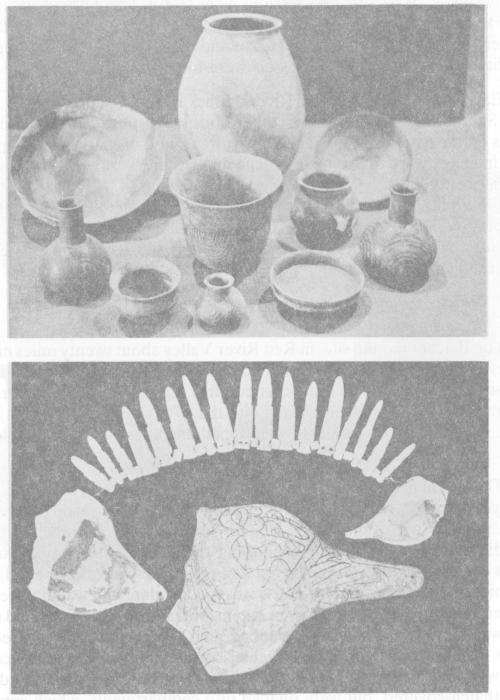
Prehistoric Caddo pottery, conch shell ceremonial drinking cups, and lizard effigy shell necklace from
Belcher Mound, Caddo Parish, Louisiana. Artifacts date approximately A.D. 1300 to 1400.
Ornaments found with burials or on house floors at Belcher include
beads, anklets, pendants and gorgets of shell, pearls, ear ornaments of shell,
bone and pottery, bone hairpins, bear tooth pendants, shell inlays, and small
shell bangles. Some of the shell pendants were carved in lizard or salamander
effigy forms. Ceremonial drinking cups made of conch shells were sometimes
decorated, one bearing a composite flying serpent-eagle design. Platform and
elbow pipes were of baked clay. Split cane basketry or matting fragments
show herringbone or 1-over-4-under weave.
Belcher pottery was superior to that of the Bossier people and, indeed, is
some of the best in the entire Caddoan area. There was a diversity of bowl,
bottle, urn, jar, vase, miniature, and compound forms. Large storage ollas
were found broken on house floors. Techniques of decoration involved
engraving, stamping, incising, trailing, ridging, punctating, brushing,
applique nodes, insertion of red or white pigment into designs, red slipping,
polishing, pedestal elevation, rattle bowls, bird and turtle effigies, and tripod
and tetrapod legs. Many of the vessels had ornate or intricate curvilinear
designs, with scrolls, circles, meanders, spirals, and guilloches; sun symbols,
crosses, swastikas, and triskeles were added.
Many of the twenty-six burials found in Belcher mound exhibited a
carry-over of the early Caddo burial ceremonialism, presumably including
human sacrifice. Individuals or groups of up to seven persons were placed in
shaft burial pits, and often were surrounded by many pottery vessels—sometimes
in stacks—in addition to tools, arrows, ornaments, food offerings,
vessels with spoons, decorated drinking cups, pipes, and other indicators of
high rank. As many as twenty to forty pottery vessels had been placed in a
single pit. Even small children had ornaments and numerous vessels, as
though they were of the nobility. This suggests a hereditary social ranking as
was found among the Natchez Indians.
Other mound centers of Belcher culture, occurring along Red River into
southwestern Arkansas, show similar ceremonialism. Villages and hamlets
along the river to Natchitoches and into the uplands are marked by typical
Belcher pottery sherds. In all, late Belcher people were dispersed widely, and
their way of life gave rise to the generalized cultural base that existed at the
time of European intrusion.
THE HISTORIC CADDO
If one views the Caddoan archaeological sequence as a tree trunk, identifiable
branches seem to begin spreading by about A.D. 1450 (Belcher
Focus). After that point, several distinct tribal branches can be recognized,
each with its own particular language, or dialect, and customs. Within relatively
short distances these groups often exhibited striking differences.
The Louisiana Caddoan-speaking groups were the Adaes, Doustioni,
Natchitoches, Ouachita and Yatasi. These groups seem to have been concentrated
around Natchitoches, Mansfield, Monroe, and Robeline, Louisiana.
Their total aboriginal territory stretched from the Ouachita River west to the
Sabine River and south to the mouth of Cane River.
On Red River, in northeastern Texas and southwestern Arkansas, there
were other Caddoan groups: Kadohadacho, Petit Caddo, Nasoni, Nanatsoho,
and Upper Natchitoches. Eventually, due to pressure from the Osage,
these groups migrated south to Louisiana and settled north of the Yatasi,
near Caddo Prairie and Caddo Lake.
The Caddoan tribes seem to have had strong cultural affiliations. In fact,
some anthropologists have considered them part of three vast inter-tribal
confederacies (Swanton 1942; Hodge 1907). In eastern Texas another
group, led by the Hasinai, consisted of the Ais, Anadarko, Hainai, Hasinai,
Nabiti, Nacogdoches, and Nabedache. This group also has been considered a
large confederacy (Hodge 1907).
The various peoples mentioned above seem to have been regional groups,
fairly fluid in nature, but tied to general geographic boundaries. Linguistic
differences served to differentiate them (Taylor 1963:51-59) and some, like
the Adaes, could hardly be understood by the others. However, the
Kadohadacho language dominated in the east—where nearly everyone understood
it—and the Hasinai language in the west.
These groups had chiefs, or Caddi. Generally one man had more prestige
than any other Caddi, but multiple chiefs—usually two—were present in
most communities. Other groups seem to have had tama (local organizers),
but chiefs were weak or lacking. Polity, then, consisted of the Caddi, or chiefs,
and tama, a sort of organizational leader (often confused with the chief by
early Europeans) who was powerful enough to gather the people for work,
war, or ceremonials. The Caddi were a select group—likely the historic
equivalent to the priest-chiefs of prehistoric times. Priests and witches composed
a non-secular leadership among the Caddoan groups, but by historic
times they had become somewhat separate from the warrior-chiefs who led
the tribes.
It can be seen, then, that the Caddoan peoples had several of the criteria
of true chiefdoms (Service 1962): territory, leadership, and linguistic-cultural
distinctiveness. All of the Europeans—French, Spanish and
Anglo-American—who dealt with them left records relative to their character
and intelligence. As late as the 19th century the Caddo still boasted that
they had never shed white blood (Swanton 1942) and their chiefs still were
respected.
In the age of tribal self-determination and Indian sovereignty, it seems in
order to explain basic Caddo tribalism. Contrary to many other southeastern
Indian groups, the Caddoan people seem to have clung tenaciously to land
and leadership even after the erosive effects of European contact. The fact
that their roots extended into prehistory gave them strength and self-confidence.
They kept their faith and polity, and their traditions remain even
today.
EUROPEAN CONTACT
The earliest contacts with Europeans in Louisiana were fleeting. The best
accounts were left by Henri de Tonti who reached a Natchitoches village in
February of 1690. He was searching for the lost La Salle expedition and went
on to visit the Yatasi, Kadohadacho, and Nacogdoches (Williams 1964). No
other visits seem to be recorded for the next decade, even though Spanish
efforts to Christianize the East Texas Caddo intensified. Contact is indicated
by the 1690’s in such practices as the tribes holding Spanish-style horse fairs
(Gregory 1974).
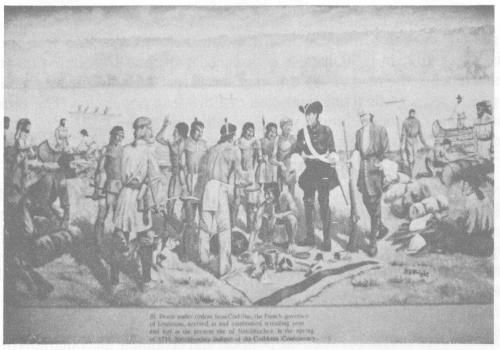
St. Denis and the Natchitoches Indians, 1714. Mural in Louisiana State Exhibit Museum, Shreveport.
In 1701 Governor Bienville and Louis Juchereau de St. Denis, guided by
the Tunica chief, Bride les Boeufs or Buffalo Tamer, arrived at the Natchitoches
area. They visited the Doustioni, Natchitoches, and Yatasi villages,
and then returned to New Orleans. Bienville was especially desirous of
contacting the Kadohadacho to the north (Williams 1964; Rowland and
Sanders 1929). This trip, ostensibly for exploration, was probably an attempt
to obtain two commodities the French in lower Louisiana were desperate for:
livestock and salt (Gregory 1974). The Tunica had long engaged in the
Caddoan salt, and later, horse trades (Brain 1977), and like them, the
Natchitoches quickly began capitalizing on their French connection. The
Natchitoches employed an old Caddoan trade strategy, that of moving to the
edge of another tribe’s territory, in order to be near their customers, and later
returning to their own territory. Accordingly, the Natchitoches claimed a
crop failure and relocated to the vicinity of Lake Pontchartrain, to trade with
the French. Eventually, in 1714, they returned to Red River with St. Denis
(McWilliams 1953). Likewise, the Ouachita had just moved back from the
Ouachita River where they had relocated in order to trade with Tunican
speakers (Gregory 1974).
After St. Denis returned to Red River in 1714, the Caddoan people in
Louisiana were to be impacted constantly by European migrants. Indian
polity and territory were eroded severely by more European settlements and
the depredations of displaced populations of other Indian tribes like the
Choctaw, Quapaw, and Osage.
Fort St. Jean Baptiste aux Natchitos was founded in 1714; it was the
earliest European settlement in northwestern Louisiana. The East Texas
missions, started in 1690, had not introduced many non-Indians to that area.
The French settlements were different, however, and the Caddoan people
began to see a gradual augmentation of European population. The French
had, in general, good relations with the Caddo and by the 1720’s a number of
them had Caddoan kinsmen.
In 1723, to counter French attempts at establishing a western trade, the
Spanish established an outpost, Nuestra Señora del Pilar de Los Adaes
(Bolton 1914). The Spanish presidio, or fort, became a hub for clandestine
traders—French, Indian and Spanish—and lasted for some fifty years (Gregory
1974). Horses, cattle, and Lipan Apache (Connechi) slaves were traded
via Los Adaes, and by the mid-eighteenth century the Spanish governors had
named the site the capital of Spanish Texas.
The Caddo—Adaes, Natchitoches, Ouachita, Doustioni, and all the
others—were caught between the political and economic machinations of the
European powers. Gradually, the seesaw of European boundaries crossed
what the Caddo all knew as their tribal territories. Traders resided in their
larger communities, and seasonal hunts to the west tied them to the mercantile
policies of the French and Spanish. After Louisiana was ceded to Spain at
the end of the French and Indian War, French traders were left in charge of
most Indian affairs in Louisiana because of the quality of their relationship to
the Indians. For example, Athanase de Mézières (Bolton 1914), St. Denis’
son-in-law, became a power on the frontier because of his close relationship
to the Caddo.
Caddoan interaction, 18th century A.D.
Caddoan-European ties remained close until 1803 when the Louisiana
Purchase brought Anglo-Americans into contact with the Caddoan groups.
The Anglo-Americans had new trade and military policies, and in spite of
their agreement to recognize all prior treaties between France, Spain, and
Indian tribes, they were not very careful to do this. The French and Spanish
had ratified land sales by tribes and had insisted that their citizens respect
Caddoan land and sovereignty, but the Americans saw new lands with few
settlements, and were quick to encourage white settlement. The old Caddo-French-Spanish
symbiosis was ending.
European settlements in Caddoan area, 18th century A.D.
The Caddoan-speaking groups began to move together by the late
eighteenth century. The Kadohadacho apparently absorbed several smaller
groups—Upper Natchitoches, Nanatsoho, and Nasoni—and shifted south.
Osage raids had taken their toll and the Kadohadacho moved to Caddo
Prairie, farther from the plains, on marginal land (Swanton 1942). They
settled on the hills to the southwest of the prairie (Soda Lake) near modern
Caddo Station and added their numbers to the other Red River tribes in
Louisiana.
Beset by many problems, the American agents at Natchitoches began
moving the agency about, trying to keep the Caddo away from white settlements.
It was moved to Grand Ecore, Sulphur Fork, Caddo Prairie, and
finally to Bayou Pierre about six to seven miles south of Shreveport (Williams
1964).
The Louisiana Caddoans also found themselves estranged from their
cultural kinsmen in eastern Texas. First, the East Texas tribes remained
under Spanish domination while their neighbors were American. Policies in
Texas were quite different until the Texas Revolution and the foundation of
the Republic in the 1830’s and 1840’s. The new Texicans refused to allow old
patterns of trade and traverse for fear of having to deal with even larger
Indian populations.
The Caddoan tribes were consolidated enough by 1834 that the American
agents had begun to treat them as though they were a single group. The
term Caddo, an abbreviated cover term for Kadohadacho, one of the larger
groups, began to cover all the tribes in the American Period. It was this
amalgam of tribal units with which the United States decided to deal.
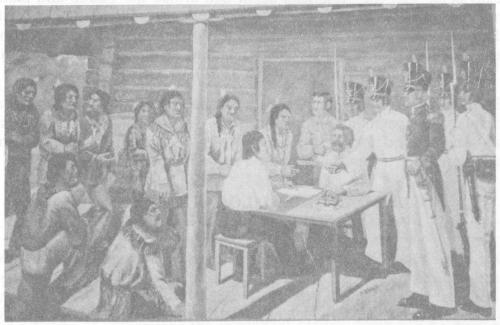
Caddo Indian Treaty of Cession, July 1, 1835. Mural in Louisiana State Exhibit Museum, Shreveport.
On June 25-26, 1835, some 489 Caddo gathered at the Caddo Agency
seven or eight miles south of Shreveport on Bayou Pierre and on July 1, 1835,
they agreed to sell to the United States approximately one million acres of
land in the area above Texarkana, Arkansas, south to De Soto Parish,
Louisiana (Swanton 1942). Two chiefs, Tarsher (Wolf) and Tsauninot, were
the leaders of the Caddoan groups present at the land cession.
Present also at the land cession was their interpreter, Larkin Edwards, a
man they regarded so highly that they reserved him a sizable piece of land
(McClure and Howe 1937; Swanton 1942). Further, the treaty reserved a
sizable block of land for the mixed Caddo-French Grappe family. Descended
from a Kadohadacho woman and a French settler, François Grappe had
served his people well. His efforts to protect not only the Caddo, but also the
Bidai and others in East Texas, from American traders had resulted in his
termination as chief interpreter for the American agents. The Caddoan
people continued to respect and honor him.
The Caddo were to be paid $80,000, of which $30,000 was in goods
delivered at the signing, and the remainder in annual $10,000 installments
for another five years. Immediately Tarsher led his people into Texas and
settled on the Brazos River, much to the chagrin of Texas authorities (Gullick
1921). Another group, led by Chief Cissany, stayed in Louisiana. They lived
near Caddo Station in 1842 (seven years after the land cession). Texicans
actually invaded the United States to insist that the Caddos disarm, the rumor
in Texas being that the American agent had armed the Caddo and made
incendiary remarks regarding the new Republic. The Louisiana chiefs offered
to go to Nacogdoches as hostages to show their good faith, but the
Texicans refused them on the grounds it might mean recognition of Caddoan
land rights and polity in Texas (Gullick 1921).
Eventually these Louisiana Caddo left—their credit was cut off by local
merchants, their payments ended, and the United States protection was
failing—and headed for the Kiamichi River country in Oklahoma. The
Caddoan presence in Louisiana, after a millennium, or more, was over.
CADDOAN TRIBAL LOCATIONS AND ARCHAEOLOGY IN LOUISIANA
One of the most difficult problems in American archaeology is the firm
connection of historic tribal locations to specific material remains and sites.
In recent years a number of efforts (Wyckoff 1974; Tanner 1974; Williams
1964; Gregory and Webb 1965; Neuman 1974) have dealt with this topic for
the Louisiana Caddoan groups.
Again, the term Caddo has no real meaning. Each of the groups had its
own political existence, and both the Spanish and French realized that. Their
approach to Indian affairs has left us much better information than that of the
Americans. John Sibley, the first American agent, with the aid of the half-Caddo,
François Grappe, gave us good information, but through time the
American policy increasingly obscured tribal groups. By the time of the 1835
land cession the Americans were talking merely of the Caddo Nation. In the
1835 Treaty not a single warrior was identified by tribe, nor were the chiefs
(Swanton 1942); this was a purely political machination by the Americans.
Caddoan and adjacent Indian groups about A.D. 1700.
Since the early American policy has obscured the tribal diversity and
history of the Caddoan groups in Louisiana, it seems in order to return to the
older practice of recognizing the individual groups. Each will be discussed
briefly, in turn, and archaeological sites will be related where possible. As was
the practice in French and Spanish days, the tribes will be discussed from
southernmost to northernmost, as they would be encountered as one
ascended the Red River.
THE NATCHITOCHES
The Natchitoches, or “Place of the Paw-Paw” (all translations by Melford
Williams, personal communication, 1973), sometimes simply stated as the
“Paw-Paw People,” were the southernmost Caddoan group. They had absorbed
the Ouachita (“Cow River People”) by 1690 (Gregory 1974) and will
be treated as a single group here.
The Natchitoches lived in a series of small hamlets, each with its own
cemetery and corn fields. One hamlet had a temple which was described by
Tonti (Walker 1935) and their whole settlement stretched from about Bermuda,
Louisiana, to the vicinity of Natchitoches. Throughout their early
history they remained in the alluvial valley of the Red River where only a few
areas, usually “islands” of older terraces, were above the active floodplain.
Wyckoff (1974) has stated that they preferred the tupelo gum-bald cypress
biotic zone along the Red River, but in reality they seem to have lived on the
mixed hardwood, cane-covered natural levees or in the oak-hickory ecological
communities found on higher ground.
Natchitoches chiefs’ names are scarce, and one gets the impression that
their chiefs were not very powerful. However, St. Denis seems to have
purchased property from a chief called the White Chief. It can be assumed
that the tribes all had Caddi, tama and priests. However, it seems that there
were more egalitarian structures among the Natchitoches, Adaes, and Yatasi
than in the East Texas or Great Bend groups.
Documents indicate that at least four sites were occupied by the Natchitoches
between 1690 and 1803: White Chief’s village, Captain’s village
(Pintado Papers), La Pinière village (Bridges and Deville 1967:239), and Lac
des Muire village (Sibley 1832; Abel 1933). There are a larger number of
archaeological sites which have yielded Natchitoches Engraved, Keno
Trailed, or Emory Incised ceramic vessels or sherds, catlinite pipes, glass
trade beads, copper or brass objects, knives, and gun parts. These include the
U. S. Fish Hatchery (Walker 1935), the Lawton (Webb 1945), the Southern
Compress (Gregory and Webb 1965), Natchitoches Country Club, Chamard
House, American Cemetery, Settle’s Camp, and Kenny Place sites (Gregory
1974).
The Southern Compress and American Cemetery sites seem to correspond
to White Chief’s villages. The Fish Hatchery and Kenny Place sites are
likely combinations of Ouachita and Natchitoches groups visited by Tonti
and others. Settle’s Camp site and Country Club site are along the high hills
west of the modern town of Natchitoches and may well be the dispersed
settlement known as La Pinière (Pine Woods) to the French. Chamard House
site may have belonged to the French trader Chamard, or possibly one of the
Grappes; located on the bluff overlooking the active Red River, it remains
undocumented.
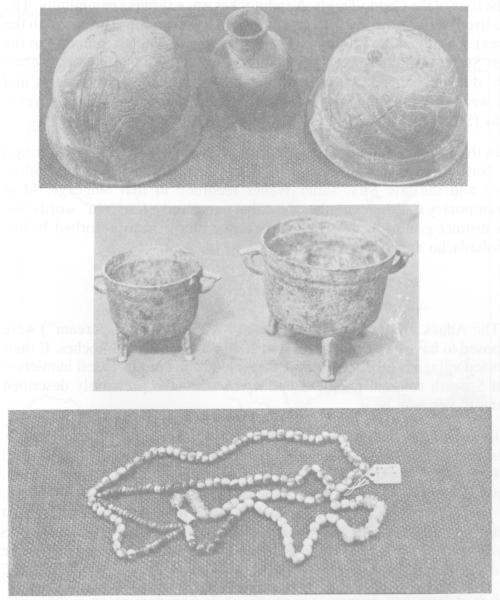
Historic Natchitoches pottery, French iron tripod pots, and Venetian glass trade beads. These 18th
century A.D. artifacts were found at the Southern Compress and Lawton sites.
The Lawton site was the site seized for debts from the son of the Christian
Indian, known as Pierre Captain, probably a sub-chief or possibly a tama, of
the Natchitoches (Pintado Papers: 139). The latest Natchitoches village, Lac
des Muire, was north of Powhatan and on the west bank of the Red River.
Sibley (1922) pointed out that although the tribe was reduced in number they
retained their language and distinctive dress. They were farmers and lived in
houses, presumably their traditional wattle-daub constructions.
Natchitoches land was gradually surrounded by Anglo-Americans and,
by the time of the Caddo Treaty, Natchitoches was a thriving community. The
tribe lived north of the town, near the Grappes (their cultural broker with the
whites). Local tradition holds that they were loaded on a steamboat on the
Front Street dock and taken to Oklahoma in 1835—something that obviously
did not happen. In 1843 the tribe was still together under Chief
Cho-wee (The Bow) and living near the Kadohadacho on the Trinity River in
Texas (Swanton 1942:96).
In the 1960’s Caddos living near Anadarko, Oklahoma, still could sing a
few Natchitoches songs (Claude Medford, Jr., personal communication,
1975) and the late Mrs. Sadie Weller recorded in that language. Most
contemporary Caddo remember the tribal name and a few “old” words, but
as a distinct group the Natchitoches seem to have been absorbed by the
Kadohadacho and Hasinai.
THE ADAES
The Adaes (from Na·dai which meant “A Place Along a Stream”) were
supposed to have had a village on Red River, near the Natchitoches. If their
reported village is taken to mean a dispersed series of kin-based hamlets—what
Spanish colonial people called rancherías—the previously described
Chamard site may be it.
In the 1720’s the Spanish established a mission for the Adaes, but its
priest and one lay-soldier were expelled by the French lieutenant, Blondel
(Bolton 1921). At the time there were no Indians living at the mission.
Apparently, they relocated nearer the Spanish, but conversions were rare,
and the Adaes were more interested in trade than religion. So, for that
matter, were the Spanish, and when the presidio (now called Los Adaes) was
established in 1723, ostensibly to protect the mission, the Adaes seem to have
lived all around the vicinity.
Los Adaes then became essentially an Indian dominated community:
Lipan, Coahuiltecans, Adaes, Wichita, Tawakoni, and others lived there off
and on. Even the commandant, Gil Ybarbo, was married to a mestiza, a
half-Indian woman. Whenever the Spanish authorities in Texas needed
translators for Caddoan languages, they sent for soldiers from Los Adaes
(Blake Papers).
There was an Adaes village near Big Hill Firetower at a place called La
Gran Montaña (Bolton 1962) which has never been found, and another
nineteenth century village on Lac Macdon. The latter is probably a later
village than the one known on Spanish Lake where burials with European
goods were excavated by James A. Ford (1936, unpublished fieldnotes,
Museum of Geoscience, Louisiana State University).
Historic archaeological sites in the Caddoan area.
Taylor (1963:51-59) finally placed Adaes as a definite Caddoan language,
but it was the most deviant of all (Sibley 1832), and the Adaes became
more and more western in their cultural orientation (Gregory 1974). They
gradually extended to the Sabine River where a late trash pit (A.D. 1740) at
Coral Snake Mound may be evidence of their presence (McClurkan, Field
and Woodall 1966). It contained glass trade beads, and a French musket lock
was found nearby. Their Lac Macdon village, where they remained as late as
1820, was probably near the water body known today as Berry Brake and
may well be on Allen Plantation.
Little is known of Adaes history or culture. De Mézières (Bolton
1914:173) noted that they were severely impacted by Europeans and “extremely
given to the vice of drunkenness.” Like the Natchitoches, they seem
to have had close relationships with the Yatasi who were sometimes called
the Nadas, likely a homonym for Na·dais.
One Adaes chief who was their leader in the 1770’s has been identified
and they are clearly an archaeologically distinct group. Gregory (1974) has
pointed out the higher frequencies of bone-tempered pottery and the ceramic
types Patton Engraved and Emory Incised from trash pits at Los Adaes.
Unlike the Natchitoches and others, the Adaes are not remembered by
contemporary Caddo who may have heard of them merely as part of the
Yatasi, who are remembered as a group. Many may have been absorbed, as
Christians, into the general mestizo population at Los Adaes and still have
descendants in northwestern Louisiana.
THE DOUSTIONI
Swanton (1942) translates Doustioni as “Salt People,” and they seem to
have lived near the salines northeast of Natchitoches. Little else is known
about them, and they do not seem to persist into the nineteenth century. They
either disappeared or mingled with the Natchitoches.
A large village site, on Little Cedar Lick, has yielded shell-tempered
sherds, Venetian glass beads, and French faience, all early to middle
eighteenth century artifact types. The site probably was the major Doustioni
settlement. Other evidence of late occupations appears at Drake’s Lick.
Williams (1964) points out that the Doustioni once had a village below the
Natchitoches, and, though it has not been located, it may have been near the
confluence of Saline Bayou and Red River, somewhere below Clarence,
Louisiana. Saline Bayou provides easy access to the salt licks and was described
by several early travelers (Le Page du Pratz 1774).
THE OUACHITA
The Ouachita were living on the river of that name before 1690. The most
likely site is Pargoud Landing at Monroe where recent excavations have
yielded early trade beads but no other goods (Lorraine Heartfield, personal
communication, 1977). Other sites considered for the historic Ouachita were
the Keno and Glendora sites (Gregory 1974; Williams 1964), but these are
not certain since they may represent a Koroa (Tunica) village with Caddoan
trade connections or vice-versa. However, animal burials and grave arrangements
show that these sites are closer culturally to the Red River sites
than to other sites on the Ouachita. Gregory (1974) has discussed the Moon
Lake and Ransom sites northeast of Monroe as possible Ouachita sites, but
these may have been earlier Koroa sites also.
As was discussed earlier, the Ouachita fused with the Natchitoches, likely
at or near the U.S. Fish Hatchery site, which revealed their ceramic styles and
animal burials. Fish Hatchery was a very early French contact site (Gregory
and Webb 1965; Gregory 1974), and it is the only historic Caddo site to share
deliberate burial of animals (horses) with the Ouachita River sites. The
Ouachita apparently were absorbed completely before the 1720’s.
THE YATASI
The name Yatasi, meaning simply “Those Other People” in
Kadohadacho language (Melford Williams, personal communication, 1977)
apparently was applied to a number of groups living in the hills north of the
Adaes and south of Caddo Lake. At least three villages are attributed to them
historically. One, located near Mansfield on Bayou Pierre in the Red River
Valley north of Natchitoches, was large enough to have a resident trader
(Bolton 1914). The Pintado Papers also refer to a group and their chief,
Antoine, who were living on a prairie known as Nabutscahe near Mansfield as
late as 1784. Another village was located near LaPointe on Bayou Pierre
(American State Papers 1859), and a third was near the Sabine River close to
modern Logansport (Darby 1816).
As was pointed out, the Adaes and Yatasi apparently were fairly closely
related, and they may not have been real tribes, but rather a series of
kin-linked bands, each with its own autonomy. The Caddoan term for these
groups sounds much like a more inclusive term which lumps small, scattered
groups. Whether their “chiefs” were really chiefs or local, heuristic leaders
remains problematical. Bolton (1914) mentions chiefs, stating that the
Athanase de Mézières gave peace medals to two chiefs, Cocay and Gunkan,
in 1768.
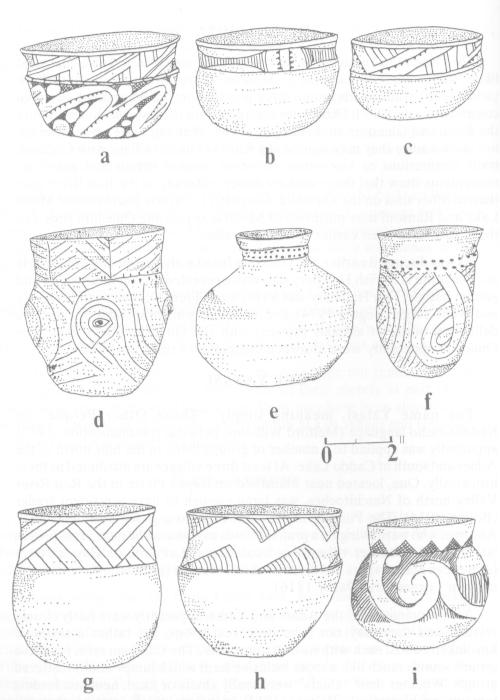
Historic 18th century A.D. Caddoan pottery vessels from Los Adaes, Natchitoches Parish, Louisiana.
Presently, the archaeological picture seems to support the hypothesis that
the Yatasi included a number of small autonomous bands. A cluster of sites is
located around Chamard Lake: the Arnold or Bead Hill site (Gregory and
Webb 1965), the Wilkinson site (Ford 1936), and the Eagle Brake site
(Gregory 1974). These sites have fairly large, deep middens and all have
yielded Natchitoches Engraved sherds and trade goods. This is somewhat
different from the scattered shallow sites nearer Natchitoches and suggests
more clustered populations, but still a dispersed settlement pattern. None of
these archaeological sites seems to correspond to the Red River-Bayou
Pierre sites, though they shared the drainage. Although it is known that the
Lafittes, Poisot, and Rambin claims were near the Yatasi villages, and all of
these settlers traded with the tribe (Pintado Papers:82-84), their
documented sites remain to be found.
Contemporary Caddo, most of whom are Kadohadacho or Hasinai, frequently
mention the Yatasi when asked about other groups and know they
once existed. However, it remains obscure whether the Yatasi were one or
many little groups. They seem to have been absorbed by the Kadohadacho,
but it is hard to trace them after the American land sales.
THE KADOHADACHO
The Kadohadacho (“Great Chiefs” in the Caddoan languages) were the
dominant Caddoan-speaking group in the Red River Valley. They occupied a
widely dispersed settlement with a temple and a mound, in northeastern
Texas and probably near the Great Bend at Texarkana. The Petit Caddo,
Nasoni, Nanatsoho, and Upper Natchitoches were absorbed by the
Kadohadacho, and the tribes abandoned their Great Bend villages (at least
four archaeological sites there seem related to these groups) and shifted
south to Caddo Lake. Once there, their chief, Tinhiouen, dealt politically
with both the Spanish (Bolton 1914) and the Americans.
The Kadohadacho language was the most widely understood of all the
Caddoan tongues, and, according to early accounts (Sibley 1922), the tribe
was the most influential of all the Caddos. They had a sort of warrior class
comparable to the “Knights of Malta.” It is, therefore, not surprising that the
Kadohadacho became the Caddo Nation of the American Period (Williams
1964).
The Kadohadacho settled, at least by 1797 (Swanton 1942), at a location
known as Timber Hill (Mooney 1896:323) near Caddo Lake (Swanton
1942). Williams (1964) has pointed out that this village has never been
located archaeologically. However, it should be noted that the Texicans
placed the tribe near Caddo Station in 1842 (Gullick 1921).
Immediately after the American land treaty, the tribe apparently split
into factions. A group under Tarsher moved to the Brazos River in Texas; the
others stayed in Louisiana until at least 1842, when they apparently moved to
live with the Choctaw some time that year (Swanton 1942:95).
The late Miss Caroline Dormon (1935, unpublished field notes, Special
Collections, Eugene Watson Library, Northwestern State University) recorded
a single burial, with a “silver crown, copper, etc.,” which was found
near Stormy Point on Ferry Lake by James Shenich, son-in-law of Larkin
Edwards. This burial may have been very near the Kadohadacho village.
According to the Dormon notes, this was a favorite crossing to Shreveport
and the Indian trace was visible as late as the 1860’s. In spite of the fact that
“Glendora Focus” artifacts were not present (Williams 1964), it can no
longer be said that there were no historic Caddoan sites in the Treaty Cession
areas of De Soto and Caddo parishes. In fact there is a good possibility that
this was the grave of the powerful chief, Dahaut, who died in 1833 (Caddo
Agency Letters).
CADDOAN HERITAGE
The Caddo left their names, art, and culture in Louisiana. A number of
colonial European families can boast of Caddoan ancestors: Grappes, Brevelles,
Balthazars, and others. In Oklahoma, after years of wandering, the
Kadohadacho and Hasinai have become the dominant groups. Yet, as has
been pointed out, old traditions persist. People still recall stories of floods on
Caddo Prairie which left cows hanging by their horns in the trees, and know
that Natchitoches meant the place of “little yellow fruits” that do not grow in
Oklahoma.
At Binger and near Hinton, Oklahoma, the old songs and dances continue
to be heard and seen. The Turkey Dance still is held before the sun sets,
and individuals sing the “Dawn Song” or “Tom Cat Song” on their way home
from the dancing.
The Caddo now visit Louisiana, especially Natchitoches and Shreveport,
to see the places of their tradition. Places are part of Indian tradition and
pilgrimages are sacred acts. Perhaps now other Louisianians will join the
Caddo who realize how much Indian culture remains in northwestern
Louisiana.
BIBLIOGRAPHY
American State Papers
1859 Documents of the Congress of the United States in Relation to the
Public Lands, Class VIII, Public Lands, Vol. 3, Washington.
Blake Papers
1939 Translations of the Spanish Records of Nacogdoches County,
Texas. Manuscript. Special Collections Library, Stephen F. Austin
University, Nacogdoches.
Bolton, Herbert E.
1914 Athanase de Mézières and the Louisiana-Texas Frontier, 1768-1780.
Arthur H. Clark, Cleveland.
1921 The Spanish Borderlands. Yale University Press, New Haven.
1962 Texas in the Middle Eighteenth Century. Russell and Russell, New
York.
Brain, Jeffrey P.
1977 On the Tunica Trail. Louisiana Archaeological Survey and Antiquities
Commission, Anthropological Study No. 1, Baton Rouge.
Bridges, Catherine and Winston Deville
1967 Natchitoches and the Trail to the Rio Grande: Two Eighteenth
Century Accounts by the Sieur Derbanne. Louisiana History,
Vol. 8, pp. 239-247.
Caddo Agency Letters
1819-1835 Correspondence of George Gray and Jehiel Brooks. Microfilm.
National Archives, Washington.
Darby, William
1816 A Geographical Description of the State of Louisiana. John
Melish, Philadelphia.
Ford, James A.
1936 Analysis of Indian Village Site Collections from Louisiana and
Mississippi. Department of Conservation, Louisiana Geological
Survey, Anthropological Study No. 2.
Fulton, Robert L. and Clarence H. Webb
1953 The Bellevue Mound: A Pre-Caddoan Site in Bossier Parish,
Louisiana. Bulletin of the Texas Archeological Society, Vol. 24,
pp. 18-42.
Gagliano, Sherwood M. and Hiram F. Gregory, Jr.
1966 A Preliminary Survey of Paleo-Indian Points from Louisiana.
Louisiana Studies, Vol. 4, No. 1, pp. 62-77.
Gregory, Hiram F., Jr.
1974 Eighteenth Century Caddoan Archaeology: A Study in Models
and Interpretation. Unpublished Ph.D. thesis. Department of
Anthropology, Southern Methodist University, Dallas.
Gregory, Hiram F., Jr. and Clarence H. Webb
1965 European Trade Beads from Six Sites in Natchitoches Parish,
Louisiana. Florida Anthropologist, Vol. 18, No. 3, Part 2, pp.
15-44.
Gullick, Charles Adams (Editor)
1921 Papers of Mirabeau Lamar, 6 Vols. A. C. Baldwin and Sons,
Austin.
Hodge, Frederick Webb (Editor)
1907 “Caddo.” Handbook of American Indians North of Mexico.
Bureau of American Ethnology, Bulletin 30, Part 1, Washington.
La Page du Pratz, Antoine Simon
1774 The History of Louisiana. English translation published by T.
Becket, London. (Original: Histoire de la Louisiane, Paris 1758).
McClure, Lilla and J. Ed Howe
1937 History of Shreveport and Shreveport Builders. J. Ed Howe,
Shreveport.
McClurkan, Burney B., William T. Field and J. Ned Woodall
1966 Excavations in Toledo Bend Reservoir, 1964-65. Papers of the
Texas Archaeological Salvage Project, No. 8, Austin.
McWilliams, Richebourg G. (Editor)
1953 Fleur de Lys and Calumet: Being the Pénicaut Narrative of French
Adventure in Louisiana. Louisiana State University Press, Baton
Rouge.
Mooney, James
1896 The Ghost-Dance Religion and the Sioux Outbreak of 1890. 14th
Annual Report of the Bureau of American Ethnology, 1892-1893,
Part 2, pp. 322-324, Washington.
Moore, Clarence B.
1912 Some Aboriginal Sites on Red River. Journal of the Academy of
Natural Sciences of Philadelphia, Vol. 14, pp. 482-644.
Neuman, Robert W.
1974 Historic Locations of Certain Caddoan Tribes. In Caddoan Indians
II, pp. 9-147. Garland Publishing Inc., New York.
Pintado Papers
n.d. Land Claim Documents, State of Louisiana. Manuscript. Louisiana
State Land Office, Baton Rouge.
Rowland, Dunbar and Albert S. Sanders
1929 Mississippi Provincial Archives, 1701-1729. Mississippi Department
of Archives and History, Jackson.
Service, Elman
1962 Primitive Social Organization. Random House, New York.
Sibley, John
1832 Historical Sketches of the Several Indian Tribes in Louisiana,
South of the Arkansas River, and Between the Mississippi and
Rio Grande. American State Papers, Class II, Indian Affairs, Vol.
1, pp. 721-731, Washington.
1922 A Report from Natchitoches in 1807. Edited by Annie Heloise
Abel. Museum of the American Indian, Heye Foundation, Indian
Notes and Monographs, Miscellaneous Series, No. 25, pp. 5-102.
Swanton, John R.
1942 Source Material on the History and Ethnology of the Caddo
Indians. Bureau of American Ethnology, Bulletin 132,
Washington.
Tanner, Helen Hornbeck
1974 The Territory of the Caddo Tribe of Oklahoma. In Caddoan
Indians IV, pp. 1-67. Garland Publishing Inc., New York.
Taylor, Allen R.
1963 The Classification of the Caddoan Languages. Proceedings of the
American Philosophical Society, Vol. 107, No. 1, pp. 51-59.
Thomas, Prentice Marquet, Jr., L. Janice Campbell and Steven R. Ahler
1977 The Hanna Site: An Alto Village in Red River Parish. New World
Research, Report of Investigations No. 3. Unpublished Manuscript,
U.S. Army Corps of Engineers, New Orleans.
Walker, Winslow M.
1935 A Caddo Burial Site at Natchitoches, Louisiana. Smithsonian
Miscellaneous Collections, Vol. 94, No. 14, Washington.
Webb, Clarence H.
1945 A Second Historic Caddo Site at Natchitoches, Louisiana. Bulletin
of the Texas Archeological and Paleontological Society, Vol.
16, pp. 52-83.
1946 Two Unusual Types of Chipped Stone Artifacts from Northwest
Louisiana. Bulletin of the Texas Archeological and Paleontological
Society, Vol. 17, pp. 9-17.
1948a Caddoan Prehistory: The Bossier Focus. Bulletin of the Texas
Archeological and Paleontological Society, Vol. 18, pp. 100-143.
1948b Evidences of Pre-Pottery Cultures in Louisiana. American Antiquity,
Vol. 13, No. 3, pp. 227-232.
1959 The Belcher Mound: A Stratified Caddoan Site in Caddo Parish,
Louisiana. Memoirs of the Society for American Archaeology, No.
16.
1963 The Smithport Landing Site: An Alto Focus Component in De
Soto Parish, Louisiana. Bulletin of the Texas Archeological Society,
Vol. 34, pp. 143-187.
Webb, Clarence H. and Monroe Dodd
1939 Further Excavations of the Gahagan Mound: Connections with a
Florida Culture. Bulletin of the Texas Archeological and Paleontological
Society, Vol. 11, pp. 92-126.
Webb, Clarence H. and David R. Jeane
1977 The Springhill Airport Sites, J. C. Montgomery I (16 WE 32) and
II (16 WE 33). Newsletter of the Louisiana Archaeological Society,
Vol. 4, No. 3, pp. 3-7.
Webb, Clarence H. and Ralph McKinney
1975 Mounds Plantation (16 CD 12). Caddo Parish, Louisiana.
Louisiana Archaeology, Vol. 2, pp. 39-127.
Webb, Clarence H., Joel L. Shiner and E. Wayne Roberts
1971 The John Pearce Site (16 CD 56): A San Patrice Site in Caddo
Parish, Louisiana. Bulletin of the Texas Archeological Society,
Vol. 42, pp. 1-49.
Williams, Stephen
1964 The Aboriginal Location of the Kadohadacho and Related
Tribes. In Explorations in Cultural Anthropology, edited by Ward
H. Goodenough, pp. 545-570. McGraw-Hill Book Company,
New York.
Wyckoff, Donald G.
1974 The Caddoan Cultural Area: An Archaeological Perspective. In
Caddoan Indians, I, pp. 6-16. Garland Publishing Inc., New York.