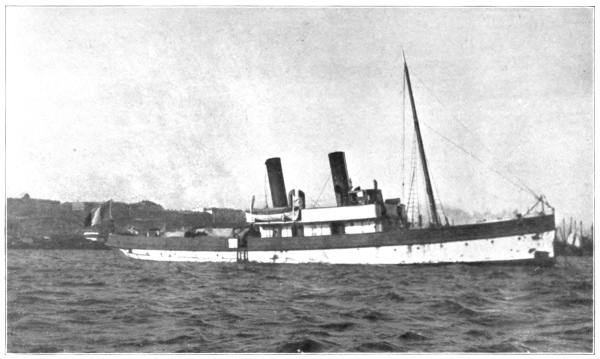
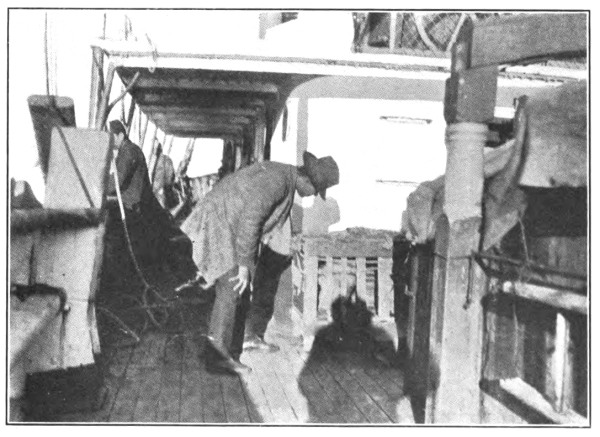
The France Does Her Best in the Run for the Uncensored
Cable, Sticks in the Mud, but Gets Away and Arrives at Sulina Mouth with an Hour to Spare
Every line of enterprise is subject to disappointment and the newspaper
business is no exception. I arrived on board the France with my mind
picturing an eight-hour drive for the Roumanian cable, and my story in
print in the afternoon edition of my paper the next day.
“All right,” I called from the rowboat as soon as I was in hearing
distance of the France. “Get up the anchor—let her go,” but the only
reply I had as I climbed over the side of my ocean-going greyhound of
a tug was the sad face of old man Gileti and a series of deprecating
shrugs and gestures accompanied by a line of guttural explanations in
Greek. Nothing is more exasperating than delays on a cable story, and
the language that floated over the expanse of Odessa harbor when I
finally learned what my skipper had to say was certainly a disgrace,
even for a journalist. In a word, the old Greek had failed to get the
France port clearance, which meant that we could not get away until
the next day, and that my precious “beat” must be delayed at least 24 hours.
The whys and the wherefores were transmitted later by Morris, who spent
an hour in getting the facts from the slow-witted old Greek. My chief
of staff, secretary and steward was filled with disgust and had spent a
half hour outlining through an interpreter to the wretched captain the
enormity of his crimes.
“Yes, sir,” he told me, “I have surely made old man Gileti sit up.
I have put him wise to the fact that for a sure-enough dub and
promiscuous fat-head, he has the rest of the world beat, yes sir, beat,
backed into a siding with the switch locked. In fact, I regard that
man, sir, as dead slow; yes, sir, slow, paralyzed in fact,” etc.
Just how all these things had been translated I did not ask, but I did
ask why the man had failed to get the shipping papers, without which
we could not go to sea. When a skipper enters a port, he takes his
papers ashore and leaves them with the authorities until sailing time,
when an official brings them off and gives clearance of the harbor. If
a ship sails without its papers, it loses all caste and is liable to
confiscation by any warship that might get wind of the fact. Hence the
necessity of the delay.
“The old man, sir,” Morris continued, “was stalled. How? Yes sir, by
some old Roosian! These dogs (meaning Greeks) are easy bluffed. Old
man Gileti goes ashore this morning as directed. He sits for some
hours on a bench. Along comes a guy in rich uniform and sees the old
man with our papers in his mit. Gileti hands over and then sits some
more. Finally another general or something comes along and gives him
a bum steer that the stuff’s off and its back to the ship with him,
bein’ as it’s a holiday and too much trouble to do business. The old
man hollers a little, but bein’ a fool and using Greek when it ain’t
getting through none, he fails to score, and next he knows he is showed
out of the office by one of those Cossack fellers that has a bayonet on
his gun. Quick as he’s out they locks up and goes home, and there ain’t
nothing doing for Gileti, so he comes aboard.”
The next morning early I had a kindly interview with the Greek, and
sent him off again for his papers, with two men to interpret and my
Black Prince to see that the goods were delivered. But even this
formidable array found Russian officialdom a hard proposition to get
quick action out of. Eight hours of red tape, bluffs and counter
bluffs, persuasion, threats and pleadings, it took before the business
was completed, and it was five in the afternoon when I saw the official
launch with Morris and the Greeks sitting in the stern, coming out to us.
“Have got. Can do,” yelled the steward when he was in ear-shot. This
time there was no delay, and as soon as the skipper was on deck the
forward donkey engine was spitting the water out of the valves, and a
moment later dragging in the anchor, and a delightful sound it was to
hear it coming in over the windlass, link after link. Clang! Clang!
Clang! rang the telegraph and the dial registered, “Stand by” in the
engine room.
Old man Gileti was slow usually, but with an anxious correspondent
at his elbow to “jack him up,” he moved fast this time. No sooner
did the rusty anchor head come dripping out of the water than “slow
ahead” rang in the engine room. Black smoke pouring out of the two
red funnels and the rattle of coal from the stoke-hold testified that
the Turkish firemen were working for once in their lazy lives. “Hard
aport” went the wheel, and the France swung her nose toward the open
sea. “Steady,” and she straightened out for her course. “Half speed”
and then “Full speed ahead,” read the dial down where the engines were
picking up their sea-pace at every stroke. Two minutes later we were
outside the breakwater, dipping our sturdy little nose into the chop
of that wretched Euxine. “South by west a quarter west,” the skipper
called in Greek, and the man at the wheel spun the helm until the
compass checked the course, and the France stiffened down for the 90
mile run to Sulina, where the Roumanian cable to the outside world lay
awaiting us.
Once on our course I went below and had my dinner served royally in
the saloon with Stomati presiding over the cuts in the galley and
Monroe D. talking like a windmill and “standing by” with the service.
“Yes, sir. Fine business, sir. We are making 12 knots, sir, and we are
about to pull off an immense cup (no doubt intended for coup) on the
situation. Yes, sir, I regard this trip as one of the great events in
the history of journalism. I assure you I do, sir, yes, sir. I have
just told Stomati that I regard this as one of the great achievements
of our career and Stomati, sir, he was impressed. I could see it, sir,
Stomati was dead to rights. I told that man, sir, that we had all the
rest of the men in our profession looking like two-spots,” a pause for
wind, and then—“In my opinion, sir, old man O’Conor (referring to the
British Ambassador) will be delighted. His important dispatches have
been delivered. Yes, sir, delivered; in fact, placed in the hands of
his Britannic majesty’s consul at Odessa, and, sir, I must say I do say
that I regard this as a most important act. Yes, sir, most important. I
have told Stomati so, and, sir, Stomati agreed, for he told Spero and
Spero, sir, he feels awe, sir, yes, I assure you he does, awe, that he
is a member of this important expedition. Spero, sir, is a slow man and
a heavy thinker, but when Stomati explained, I could see that Spero
understood and appreciated. (Yes, sir, I will pass you another cut.)
But as I was saying, it is my opinion that the British government will
decorate us—yes, sir, handsomely. No doubt the Victoria Cross will—”
But here I cut him off, having finished my dinner and a cigar besides,
and sent him to the galley to get his own meal, and more important,
to give me an opportunity to write my story. During the delay of the
day, I had examined every member of the crew that had been ashore, to
gather any additional data for my cable. This with the mass of material
picked up the day before, gave me enough for a column message, which
I proceeded to rap out on my machine. People generally seem to think
that newspaper stories must be in cipher, for few of the uninitiated
realize that a thousand dollars on cable toll for a single dispatch is
nothing unusual. The writing of a cable differs only from a written
article in that one cuts local color and descriptive matter a bit in
favor of facts. By force of habit, a cable arranges itself in one’s
mind unconsciously and can be written as fast as one can work a
machine. Then there only remains to read over the copy and blue pencil
all superfluous “thes,” “ands,” adjectives, and everything in fact
that the foreign editor in the office can supply by the study of the
context. Thus a 2000 word story will “skeletonize” to perhaps 1200 and
be re-expanded in the office to 2500. The office files contain vast
stores of information. If a name or place is mentioned, it is looked
up and its significance or location incorporated into the cable as
printed. The result is a detailed story and an accurate one as far as
the editorial half is concerned. It took me a half hour to write my
story and another fifteen minutes to “skeletonize” and re-copy it ready
for the telegraph office. It came to 895 words.
When I had finished, I sent for the chief engineer. It was now ten
o’clock in the evening, and I must get my cable off surely by daylight
to insure its getting the edition. We had a heavy head sea and in spite
of Morris’ assertion of 12 knots, we weren’t doing much over 8½. We
needed all we had, and so I wanted to talk with the man who had charge
of the turns of the propeller. I wanted to imbue in him the news idea
and the news spirit which, once aroused, are stronger forces for speed
and quick action than unlimited golden promises. So when he came in, I
gave him a cigar and then for an hour I labored with him, pouring out
all the eloquence which the love of the work must always bring from the
lips of any true newspaper man who works neither for money, reputation
or glory, but for the fascination of “THE CABLE GAME” which knows not
the limitations of conventions, and is bounded only by time and space.
Any man can talk on the one subject that lies nearest his heart, and it
is a poor newspaper man indeed who cannot wax eloquent over the “cable
game.” He lives it every waking hour of the day and dreams of it when
he sleeps. It is for no material gain which he labors, but the pure
love of the work itself. There are dozens of such men who suffer untold
hardships and face any risk simply to get their stories out. They care
little whether their names are signed or not, and their one aim is that
their paper shall be the first to have the news, and that their version
of it may have the front page wherever newspapers are published. It
may be the depths of winter, and miles away from a cable office, but
he will gladly ride hours in a driving snowstorm, even if it takes his
last breath to get his story on the wire. Perhaps it is summer in the
tropics, but he faces the heat as readily as the cold of winter. Hunger
and hardships of all kinds are a part of the day’s work to him if he
can but land that priceless “story,” which is the only object of his
life from day to day. Few people who read the daily papers dream of the
suffering and heart-burn that “special cables” have cost some man in
some far corner of the globe. The story which they read complacently
at their breakfast table has often all but cost the sender his life in
getting it to the telegraph, but the correspondent does it and counts
the cost as nothing if he gets his “beat.” From the world he looks for
no recognition, and if his chief at home is satisfied, the cable man
rejoices and his heart is glad.
All of this I told my nervous little Greek engineer and then pointed
out that now he as well as I was a correspondent, and not only he,
but every man on the boat was one. “I can do nothing alone,” I told
him. “It is only by your co-operation that we can make this expedition
a success, yours and every other member of this crew,” and then I
explained to him the value of time. How that minutes were worth dollars
and days thousands, and that an hour saved might mean the difference
between success and failure.
“You have seen the situation in Odessa,” I pointed out to him. “You
know as well as I do that there are hundreds of foreigners, your
countrymen and mine included, whose lives and property are insecure
every day that this reign of terror lasts. They are praying for relief
from their home governments and there” (I pointed to my typewriter
cable blanks on the table) “is the story of their plight, and their
prayer for help. Ten hours after we reach Sulina, that story will be in
print, and in 24 it will have been read by every foreign office in the
world, and who can tell what will be the result? Next week this time
there may be a fleet of warships plowing these waters at full speed to
bring protection to every port in southern Russia. Have you ever been
in peril and without protection? Have you ever longed and prayed for
the sight of a battleship or cruiser flying a friendly flag? Have you
watched the harbor mouth day in and day out for the smudge of smoke
which may mean the coming of succor? Can you realize what bluejackets,
machine guns and friends mean to the people in Odessa? Realize it and
you know what the value of minutes and, much more, hours may mean.
Perhaps I understand it more than you possibly can, for training on
an American paper makes a man consider time more than anything on
earth. You people aboard don’t know how the newspapers in America and
in England, too, spend thousands to save minutes. Go to a big meeting
in my country, and sit through two hours of speeches. When you leave
the hall, a newsboy will hand you a paper with the ink still wet, with
a complete account of the first hour and a half of what has gone on
within.”
The engineer was visibly impressed.
“I can’t understand,” he said, “how your paper can spend so much money
for a month of news, much less for one story.”
I laughed and told him of a correspondent in the far east who got to
the cable office with a big story. He had barely time to catch the
morning edition of his paper. He threw in his 1000 words of copy, and
while he was waiting to see that it got off, he saw through the window
the correspondent of his paper’s greatest rival at home tearing madly
toward the telegraph office with his story clutched in his hands. He
looked at his watch and saw that his rival might send his cable after
his own, and still get it published the same morning, thus preventing
him from scoring a “beat.” For a moment only he was paralyzed, and
then he drew from his pocket a novel which he had been reading. With
one quick snatch he ripped out twenty pages, stuck his scarf pin
through to hold them together, and in pencil scrawled across the top
of the first page the name of his paper and signed his name on the
last, and as his rival entered the door, he tossed to the operator
what amounted to some 7000 additional words of copy. By the time the
operator had finished sending this stuff it was just an hour too late
for his rival’s cable to get the morning edition. The result was that
his story appeared in New York the next morning and was copied all
over the world as the big “beat” of the year. To be sure, it cost the
management nearly $5000 extra in cable tolls, but they alone got the
story that morning.
“Did the correspondent lose his job?” gasped the chief.
“Not on your life,” I told him. “On the contrary, he got a cable of
congratulations on his quick action and a raise of salary the same day.”
“Well, what do you think of that?” ejaculated the chief.
I saw I had him interested, and so while I was at it I gave him the
story of how a newspaper man saved the Suez Canal to England. “In some
way the correspondent of an English paper found that the Khedive of
Egypt, who held the controlling interest in the stock of the canal,
was going to sell out. In an instant the man realized that he held in
his hand the biggest story of his day. Were it published, every power
in Europe would be bidding, and no doubt the French, who then had the
greatest influence in Egypt, would carry off the plum, which was worth
a dozen wars for any power to possess. So he held his tongue and sent
a rush message, not to his paper, but to the premier of England. Old
Palmerston saw the situation as quickly as had the newspaper man, and
closed the deal by cable for $20,000,000, and then made parliament
raise the cash. The result was that the newspaper account was the first
notice that France had of the loss of the opportunity. So you see,
chief, where hours and minutes were worth not thousands, but millions
on one occasion.”
I had his attention now, and so I threw in the local touch to round it
off with.
“That’s what time means to the outside world, but I have not told you
how the office is crying for it. You see, now we have been out nearly
a week, and my chief at home is getting anxious. I can see the foreign
editor sitting at his desk to-morrow. For three days he has been
expecting a cable from us. He locks up his forms about half past three,
and after that our cable will be too late. He is expecting something
good, and for two days now he has been holding space for us on the
‘front page’ up to the last moment. Every day that three o’clock comes
and no news from us, he is sick with disgust. Now, chief, if we can
get to Sulina by daybreak, we will give him his story, our story, and
the story of what Odessa is suffering. That cable there will come in to
his desk in four or five sheets about five minutes apart. When he sees
the date and first sentence, he will know it is from us, and before the
end has been received, the first pages will be in type, and in fifteen
minutes after he has O. K.’d the last sentence, the great presses in
the basement of the building will be roaring worse than one of your
Black Sea hurricanes, and the neatly folded papers will be coming out
at the rate of 60,000 an hour, and before we are through coaling in
Sulina to-morrow afternoon, every newsboy in Chicago will be crying,
‘Extra, latest news from Russia; all about Odessa,’ and our story will
be speeding east, west, south and north to a hundred different cities.”
I could see that my little Greek friend was getting enthusiastic. I
took my dispatch lovingly in my hands and fingered it for a moment, and
then “I have done all I can do, chief. It is up to you, now, whether we
print this cable to-morrow or two days from now.”
He jumped up from the table and seized his hat.
“What do you want me to do?” he asked, filled with the spirit of the game.
“I want speed, all that you can get down there below the grating.”
Without a word he turned and climbed the companion-way. I heard his
quick step on deck above my head, and he was gone. A few minutes later
I followed him and went down into the engine room. By the throttle
stood my little friend, with one hand on the valve gear and his eye
on the steam gauge. I put my hand on the eccentric arc of the high
pressure engine and, with my watch in hand, counted the heartbeats of
our 1000 horse power triples.
“One hundred and eight revolutions,” I said. “Not bad.”
The chief never took his eye from the gauge.
“You watch. We can do better than that.”
In the stoke-hold just ahead I could hear the Turks heaving in the
coal, and I was glad at heart.
“You’ve got those fellows working for once,” I commented.
“I have that,” he replied. “I’ve woke up the day shift and have two men
working on each boiler, and the gauge there tells the business.”
I followed his eye and watched the hand flicker with each stroke of the
engine. Pound by pound the pressure from the boilers was shoving it up.
When it reached 160, the chief gave the wheel that opens the valve in
the main steam pipe from the boilers a half turn and said:
“Now count her revolutions.”
With my eye on the second hand of my watch, I counted “105, 6, 7, 8, 9,
10, 11, 12,” and snapped the lid with approbation.
“We’ve more coming yet,” grinned the sturdy little Greek.
His interest once aroused, he was doing his best. A moment later I
counted 115.
“She did 117 on her trial trip,” volunteered the engineer, “and she’ll
do it again if she holds together,” and he opened the valve to its full
and screwed in the valve gear until he had the steam cut off to its
minimum stroke to keep pace with the up and down racing of the pistons,
while his second crawled about dropping oil in cupfuls on the working
bearings to keep her from heating. The chief timed her himself. I
watched him.
“What is she doing?” I asked, as he closed his watch.
“You count,” he said.
“I make it 118,” I replied, looking at him with my best smile of
approval.
“Right you are,” he said. “One hundred and eighteen it is, and just one
better than she’s ever done before,” and he winked as he rubbed the oil
off his grimy face with a piece of cotton waste.
“I’d put her up some more,” he said apologetically, “but I’m afraid
she’d prime. Anyhow,” (with a glance at the gauge) “she blows at 180
pounds, and we’re 178 now.”
“Keep her where she is,” I said, “and you’re doing fine.” And I wrung
his hand and went on deck.
Trembling from end to end with the revolution of her engines, the
France was beating her way toward the cable at nearly 11 knots an
hour, and going into a heavy head sea at that. I blessed the sporty
little Greek and went below to try and get a bit of shut-eye before
daylight.
In the saloon I found Morris and the second engineer, who had just
turned out of his bunk preparatory to going on his watch in the engine
room at 1 a. m. With one shoe on and the other in
his hand he sat spell-bound as he listened to the narration of one of Morris’s
hair-raising Philippine experiences. I had intended turning in at once,
but lighted a cigar instead for a chat with the machinist for the few
minutes he had to spare.
Our conversation naturally drifted to the subject which we both had in
common, and before we knew it we were deep in a discussion as to the
respective merits of turbine and reciprocating engines. The engineer
was still nursing his unshod foot, forgetful of all but the question we
were arguing.
“For my part,” he was saying, “give me for all around service triple
expansion—I don’t say but what for high speed like torpedo boats and
such, turbines may not be good, but they do say the blades sheer in
bucketsful at high pressure driving. Now you take a four-cylinder
triple turning her darndest—”
He paused suddenly and looked sharply at me. We had both felt a barely
perceptible tremor run through the ship. A tumult of anger swept
through my veins.
“She touched bottom,” I explained, furious at even the prospect of a
further delay in getting my story to the cable.
“That’s funny,” mused the engineer, slipping on the belated boot in a
hurry. “It surely felt like sliding over a mud bank. We must be ten
miles from shore at least. But it can’t be, for the old man hasn’t even
slowed her down. We must have dreamed it.”
“Nothing of the sort,” I replied, having been there many times before.
“We are too near the shore, and the skipper’s either drunk or asleep. I
am going on deck,” and I got up and put on my coat and started for the
stairs.
I had barely put my foot on the bottom step when we felt the sudden
check to our speed and that subtle velvety sensation of a ship sliding
through mud. I turned and looked at the engineer, who was at my heels.
“The fool,” he muttered, and then a lot of Greek expletives which
sounded good to me. “He’s piled her up on the mud bank.”
And even as he spoke there came the frantic clanging of the telegraph
in the engine room, and almost instantly the dying pulse of the engines
as the chief engineer shut off the steam. The pistons had been slipping
merrily up and down in their guides driving the shaft at its maximum,
and for a few strokes their impetus carried them, but the life was
gone, and after a few half-hearted revolutions they came to a sullen
standstill, the high pressure engine just at the end of its reach
and the low caught in the middle of its stroke. The absolute silence
was broken only by the lap of the waves breaking on our steel sides.
In a moment I was on the bridge with Morris at my heels. A tumult of
Greek voices in the wheel-house told of the endeavors to adjust the
responsibility of the blunder. It is always so with the Greeks. In
an emergency they all begin to quarrel as to who is to blame. So it
was at this juncture, and until I had Stomati translating some strong
Anglo-Saxon language, the idea of how we were going to get afloat
again did not seem to have crossed any one’s mind. They all united in
condemning Spero as the simplest way out of the matter, and let it go
at that.
It was almost full moon. The wind had gone down, and for once the sea
was as calm as a lake. Four or five miles away, dead ahead, a light
glimmered, and with my night glasses I could see the outline of the low
lying shore against the sky. It was way below zero—a dead, cold calm,
the sort of cold that hurts one’s lungs to breathe.
As we stood arguing on the bridge the safety valves on the starboard
boilers lifted and the steam deflected from the engines came roaring
out of the steam pipe aft the funnel, going straight up into the cold
air in great expanding clouds of fleece.
Old man Gileti rang full speed astern and eagerly the three cylinders
breathed again as they took up their triple chorus down in the engine
room. For an hour they worked, first ahead and then astern in a frantic
effort to slip her out of the bank. But it was no use. We had been
driving at nearly fourteen knots and had gone head-first into a wet
and sticky bank of mud, and her nose was buried three feet deep in the
clinging mess.
I got the chief down into my saloon as being the only rational man
aboard, and together we studied out our position on the chart. We were
some 15 miles north of the Danube’s mouth and four miles off shore. The
skipper had mistaken a light in a house for the harbor light, and had
turned in for the shore just an hour too soon. The names we devised to
apply to that skipper would have frozen his marrow could they have been
translated. The little engineer had been moving heaven and earth to
give me speed, and he almost wept at the delay. I told him that I must
be at the cable office by seven in the morning, and to pass the word
forward to the crew that if they did not get her off by three o’clock
I should lower the boat and take four men to pull me to the shore. The
idea of a four-mile sea-pull with the mercury freezing put more life
into the crew than I could have believed possible. I told Morris that
he would have to go, too, and his teeth chattered in anticipation as he
flew forward to Stomati to get him to urge the crew into action.
The skipper, who was really much depressed, held a council of war, and
things began to move. The boat was swung clear of the davits, while
Spero and another got away the port anchor. This was lowered gingerly
into the life-boat, and then, with four men straining at the oars,
it was pulled with the cable paying slowly out, 80 fathoms astern. I
stood aftside the France shivering in the moonlight, and watched them
gently pry the seven-hundred pound anchor out of the swaying life-boat
and heard the splash of it as it went into the water. Then the donkey
engine with Nicholas at the valve began to take in the cable, and link
by link it came out of the water, until at last it stretched taut from
the forward hawser hole to the anchor that bit the mud 500 feet astern.
“Full speed astern,” rang the order in the engine room, and the
propeller churned the mud. Nicholas threw the donkey valve wide, and
with desperate pantings and gaspings the windlass tugged at the cable.
Inch by inch almost imperceptibly it came in. For a minute or two the
struggle of steam vs. mud continued, and then suddenly the donkey,
choking with delight, began to gather in the cable with metallic
rattlings, and the crew cheered lustily as the France slid back into
the arms of her native element.
In five minutes we had the boat on the davits again and the anchor on
deck, and were beating down the coast. At five, a bend in the coast
showed the white glimmer of the Sulina beacon, and we cut her speed
down to a few knots, for our haven was in sight. Two hours later we
crossed the bar and steamed into the Danube, and I went below for the
hour that remained before daylight.