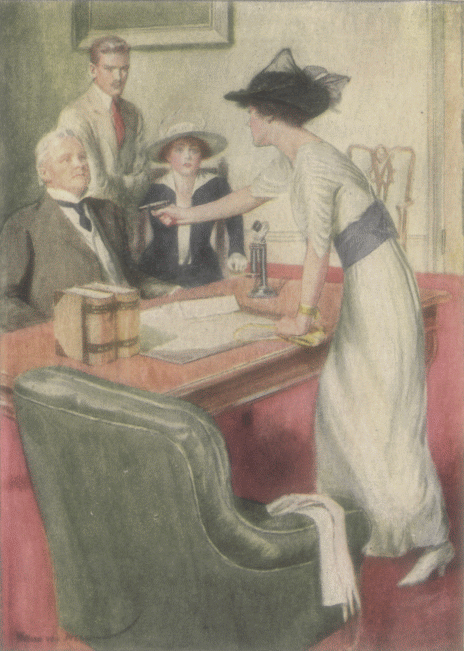
“Somewhat unexpected, isn’t it?” Harleston asked.
“To whom—you, her, or myself?” Mrs. Spencer inquired.
“To you.”
“Not at all. I’m never surprised at anything!” Then just a trace of
derision came into her face. “Won’t you present me, Mr. Harleston?”
“Certainly, I will,” he responded gravely, and arose.
“Another unexpected!” she mocked. “But she is good to look at, Guy, I
must grant you that. Also—” and she laughed lightly.
“One moment,” said he tranquilly, and turned toward Mrs. Clephane—who had
caught sight of him and was undecided what to do.
Now, smiling adorably, she came to meet him.
“The two beauties of the season!” he thought;
and as he bowed over her hand he whispered: “Not a word of explanation
now; and play ignorance of everything.—Understand?”
“I don’t understand—but I’ll do as you direct,” she murmured.
“I want to present you to Mrs. Spencer—the woman whom, you will recall, I asked
you in the red-room if you recognized. Be careful, she is of the enemy—and
particularly dangerous.”
“Everyone seems to be dangerous except myself,” she replied. “I’m an imbecile,
or a child in arms.”
“I’m not dangerous to you,” he answered.
“That, sir, remains to be proven.”
“And I like your idea of the child in arms—provided it’s my arms,” he
whispered.
Her reply was a reproving glance from her brown eyes and a shake of the head.
“I’m delighted to meet you, Mrs. Clephane,” Mrs. Spencer greeted, before
Harleston could say a word. She made place on the divan and drew Mrs. Clephane
down beside her. “You’re Robert Clephane’s widow, are you not?”
“Robert Clephane was, I believe, a distant cousin,” Mrs. Clephane responded.
“De Forrest
Clephane was my husband. Did you know him, Mrs. Spencer?”
“I did not. Robert—” with the faintest stress on the name—“was the only
Clephane I knew. A nice chap, Mrs. Clephane; though, since you’re not his
widow, I must admit that he was a bit gay—a very considerable bit indeed.”
“We heard tales of it,” Mrs. Clephane replied imperturbably. “It is an
ungracious thing, Mrs. Spencer, to scandalize the dead, but do you know
anything of his gayness from your own experience?”
Harleston suppressed a chuckle. Mrs. Clephane would take care of herself, he
imagined.
Mrs. Spencer’s foot paused in its swinging, and for an instant her eyes
narrowed; then she smiled engagingly, the smile growing quickly into a laugh.
“Not of my own experience, Mrs. Clephane,” she replied confidentially, “but I
have it from those who do know, that he set a merry pace and travelled the
limit with his fair companions. It was sad, too—he was a most charming fellow.
Rumour also had it that he was none too happy in his marriage, and that
his Mrs. Clephane was something of the same sort. I’ve seen her
several
times; she was of the type to make men’s hearts flutter.”
“It’s no particular trick to make men’s hearts flutter,” said Mrs. Clephane
sweetly.
“How about it, Mr. Harleston?” Mrs. Spencer asked.
“No trick whatever,” he agreed, “provided she choose the proper method for the
particular man; and some men are easier than others.”
“For instance?” Mrs. Spencer inflected.
“No instance. I give it to you as a general proposition and without charge;
which is something unusual in these days of tips and gratuities and subsidized
graft and things equally predatory.”
Mrs. Spencer arose. “The mere mention of graft puts me to instant flight,” she
remarked.
“And naturally even the suggestion of a crime is equally repugnant to you,”
Mrs. Clephane observed.
“‘As a general proposition,’” Mrs. Spencer quoted.
“And general propositions are best proved by exceptions, n’est-ce pas?”
was the quick yet drawling answer.
The two women’s eyes met.
“I trust, Mrs. Clephane, we shall meet again and soon,” Mrs. Spencer replied,
extending her hand.
“Thank you so much,” was Mrs. Clephane’s answer.
Mrs. Spencer turned to Harleston with a perfectly entrancing smile.
“Good-night, Guy,” she murmured.—“No, sir, not a foot; I’m going up to my
apartment.”
“Then we will convoy you to the elevator. Come, Mr. Harleston.”
“It is only a step,” Mrs. Spencer protested.
“Nevertheless,” said Mrs. Clephane, “we shall not permit you to brave alone
this Peacock Alley and its heedless crowd.”
And putting her arm intimately through Mrs. Spencer’s she went on: with
Harleston trailing in the rear and chuckling with suppressed glee. It was not
often that Madeline Spencer met her match!
When the car shot upward with Mrs. Spencer, Harleston gave a quiet laugh of
satisfaction.
“Now shall we go in to dinner?” he asked.
Mrs. Clephane nodded.
“The table in the corner yonder, Philippe,” Harleston said.
“Who is Mrs. Spencer?” she inquired, as soon as they were seated.
“You’ve never heard of her?”
“No—nor seen her before tonight. One is not likely to forget her; she’s as
lovely as—”
“Original sin?” Harleston supplied.
Mrs. Clephane smiled.
“Not at all,” said she. “Diana is the one I was about to suggest.”
“She may look the Diana,” he replied, “but she’s very far from a Diana, believe
me, very far indeed.”
“I am quite ready to believe it, Mr. Harleston.” She lowered her voice. “I have
much to tell you—and,” with a quick look at him, “also something to explain.”
“Your explanation is not in the least necessary if it has to do with anything
Mrs. Spencer said.”
“Under the circumstances I think I should be frank with you. Mrs. Spencer said
just enough to make you suspect me; then she dropped it—and half a lie is
always more insidious than the full truth.”
“My dear Mrs. Clephane,” he protested, “I assure you it is not necessary—”
“Not necessary, if one is in the diplomatic profession,” she cut in. “Murder
and assassination both of men and of reputation, seem to be a portion of this
horrible business, and perfectly well recognized as a legitimate means to
effect the end desired. I’m not in it—diplomacy, I mean,—and I’m mighty
thankful I’m not. Mrs. Spencer cold as ice, crafty as the devil, beautiful as
sin, and hard as adamant, knowing her Paris and London and its scandals—I
suppose she must know them in her profession—instantly recognized me and placed
me as Robert Clephane’s wife. For I am his wife—or rather his widow. I lied to
her because I didn’t intend that she should have the gratification of seeing
her play win. She sought to distress and disconcert me, and to raise in your
mind a doubt of my motives and my story. It may be legitimate in diplomacy, but
it’s dastardly and inhuman. ‘Rumour also had it that he was none too happy in
his marriage, and that his Mrs. Clephane was something of the same sort—she was
of the type to make men’s hearts flutter.’ You see, I recall her exact words.
And what was I to do—”
“Just what you did do. You handled the matter beautifully.”
“Thank you!” she smiled. “Yet she would win in the end—with almost any other
man than you. She plays for time; a very little time, possibly. I don’t know.
I’m new in this business—and can’t see far before me. Indeed, I can’t see at
all; it’s a maze of horrors. If I get out of this mess alive, I’ll promise
never to get mixed in another.”
“Why not quit right now, Mrs. Clephane?” Harleston suggested.
“I won’t quit under fire—and with my mission unaccomplished. Moreover, this
Spencer gang have ruffled my temper—they have aroused my fighting blood. I
never realized I had fighting blood in me until tonight. Mrs. Spencer’s ugly
insinuation, topping their attempted abduction of the evening, has done it. I’m
angry all through. Don’t I look angry, Mr. Harleston?”
“You’re quite justified in looking so, dear lady; as well as in being so,”
Harleston replied. “Only you don’t look it now.”
“You’re a sad flatterer, sir!” she smiled. “Believe me, had you seen me in the
room to which they decoyed me with a false message from
you, you would believe that I can look it—very well look it.”
“So that was the way of it!” Harleston exclaimed “Tell me about it, Mrs.
Clephane. I was sure that you were a prisoner somewhere in this hotel; to find
you every room was being inspected.”
“Why did you think I was a prisoner in the midst of all this gaiety?” she
asked.
“Because I was lured by a message purporting to be from you to the ninth floor
and garroted. I escaped. However, that is another story; yours first, my lady.”
“You too!” she marvelled.
He nodded. “And now we are sitting together at dinner, looking at the crowd,
and you’re about to tell me your story.”
“Thanks to you for having escaped and rescued me!” Mrs. Clephane exclaimed.
“The management devised the way.”
“But you prompted it—you are the one I have to thank.”
“If you insist, far be it from me to decline! It’s well worth anything I can do
to—have you look at me as you’re looking now.”
“I hope I’m looking half that I feel,” she replied instantly.
“A modest man would be more than repaid by half the look,” he returned.
“Are you a modest man?” she smiled.
“I trust so. At least, I am with some people.”
“You’re giving every instance of it with me, though it may be a part of the
game; even the rescue may be a part of the game. You may be playing me against
Mrs. Spencer, and taking advantage of my inexperience to accomplish your
purposes—”
“You don’t think so!” he said, with a shake of his head.
“No, I don’t. And maybe that only proves my inexperience and unfitness.”
For a moment he did not reply. Was she playing him? Was it a ruse
of a clever woman; or was it the evidence of sincerity and innocence? It had
the ring of candour and the appearance of truth. No one could look into those
alluring eyes and that fascinatingly beautiful face and harbour a doubt of her
absolute guilelessness. Yet was it guilelessness? He had never met
guilelessness in the diplomatic game, save as a mask for treachery
and deceit. And yet this seemed the real thing. He wanted to believe it. In
fact, he did believe it; it was simply the habit of his experience warning him
to beware—and because it was a woman it warned him all the more.... Yet he cast
experience aside—and also the fact that she was a woman—and accepted her story
as truth. Maybe he would regret it; maybe she was playing him; maybe she was
laughing behind her mask; maybe he was all kinds of a fool—nevertheless, he
would trust her. It was—
“I’m glad you have decided that I’m not a diplomat—and that you will trust me,”
she broke in. “I’m just an ordinary woman, Mr. Harleston, just a very ordinary
woman.”
He held out his hand. She took it instantly.
“A very extraordinary woman, you mean, dear lady,” he said gravely. “In some
ways the most extraordinary that I have ever known.”
“It’s not in the line of diplomacy, I hope,” she shrugged.
“Not the feminine line, I assure you; Madeline Spencer is typical of it, and
the top of her class—which means she is wonderfully clever, inscrutable as
fate, and without scruple or conscience. No,
thank God, you do not belong in the class of feminine diplomats!”
“Thank you, Mr. Harleston!” she said gently, permitting him, for an instant, to
look deep into her brown eyes. “Now, since you trust me, I want to refer
briefly to Mrs. Spencer’s insinuation.”
“Robert Clephane was all that she said—and more. Middle-aged when he married
me, before a year was passed I had found that I was only another experience for
him; and that after a short time he had resumed his ways of—gaiety. Not caring
to be pitied, nor to be so soon a deserted wife, nor yet to admit my loss of
attraction for him, I dashed into the gay life of Paris with reckless fervour.
I know I was indiscreet. I know I fractured conventionality and was dreadfully
compromised—but I never violated the Seventh Commandment. Robert Clephane and I
were not separated—except by a locked door.
“Then one day some two years back, dreadfully mangled, they brought him home.
An aeroplane had fallen with him—with the usual result. That moment saw the end
of my gay life. I passed it up as completely as though it had never been.
The reason for it was gone. After a very short period of mourning, I took up
the quietness of a respectable widow, who wished only to forget that she ever
was married.”
“I can understand exactly,” said Harleston. “You shall never hear a word from
me to remind you.”
“I’ve never heard anything to remind me of the past until this alluring
beauty’s insinuations of a moment ago. That is why it hit me so hard, Mr.
Harleston. And why did she do it? Is she jealous of you, or of me, or what?”
“She’s not jealous of me!” he laughed. “I know her history; it’s something of a
history, too.... Sometime I’ll tell you all about it; it’s an interesting tale.
Is it possible you’ve never heard in Paris of Madeline Spencer?”
“Never!”
“Nor of the Duchess of Lotzen?”
“Great Heavens!” she cried. “Is she the Duchess of Lotzen?”
“The same,” Harleston nodded.
“H-u-m! I can understand now a little of her—No wonder I felt my helplessness
before her polished poise!”
“Nonsense!” he smiled.
“Why should such an accomplished—diplomat want to injure me with you?” she
asked.
“She was not seeking to injure you in the sense that you imply,” he returned.
“Her purpose was to put you in the same class as herself, so that I should
trust you no more than I do her; to make you appear an emissary of France, in
its secret service, playing the game of ignorance and inexperience for its
present purpose. For you, as a personality she does not care a fig. To her you
are but one of the pieces, to be moved or threatened as her purpose dictates.
In the diplomatic game, my lady, we know only one side—all other sides are the
enemy; and nothing, not even a woman’s reputation, is permitted to stand for an
instant in the way of attaining our end.”
“Therefore a good woman—or one who would forget the past—has no earthly
business to become involved in the game,” Mrs. Clephane returned. “I shall get
out of it the instant this matter of the letter is completed—and stay out
thereafter. Even friendship won’t lure me to it. Never again, Mr. Harleston,
never again for mine!”
“I wish you would let it end right now,” he urged.
“That wouldn’t be the part of a good sport, nor would it be just to Madame
Durrand. She trusts me.”
“Then inform the French Ambassador of all the facts and circumstances and
retire from the game,” he advised.
“Shall I inform him over the telephone?” she asked.
“You would never get the Ambassador on the telephone, unless you were known to
some one of the staff who could vouch for you.”
“I don’t know anyone on the staff, but Mrs. Durrand has likely communicated
with the Embassy.”
“If she has, she had given them a minute description of you, yet that can not
be used to identify you over the telephone.”
“I hesitate to go to the Embassy without the letter,” she said.
“Why do you hesitate?” he smiled.
“Because I—don’t want to admit defeat.”
“Which of itself will serve to substantiate your story. One skilled in the game
would have lost
no time in informing the Embassy of the loss of the letter. He would have
realized that, next to the letter itself, the news of its seizure was the best
thing he could deliver—also, it was his duty to advise the Embassy at
the quickest possible moment. You see, dear lady, personal pride and pique play
no part in this game. They are not even considered; it’s the execution of the
mission that’s the one important thing; all else is made to bend to that single
end.”
“Then I should go to the French Embassy tonight with my story?” she asked.
“You should have gone this morning—the instant you were returned to the hotel!
Now, unless Madame Durrand had written about you, it’s a pretty good gamble
that the Spencer crowd has forestalled you.”
“Forestalled me! What do you mean?”
“Mrs. Spencer admitted to me that your release was someone’s blunder. The
normal thing was to hold you prisoner and so prevent you from communicating
with the Ambassador until they had obtained the letter or defeated its purpose.
That was not done; but Spencer, you may assume, has attempted to rectify their
blunder—possibly
by impersonating you, and giving the Marquis d’Hausonville some tale that will
fall in with her plans and gain time for her.”
“Impersonating me!” Mrs. Clephane exclaimed incredulously.
“Yes. She knows all the material circumstance—witness the telephone call that
inveigled you into the drive up the Avenue, et cetera—and she’ll take
the chance that you are not known to the Marquis nor any of the staff, or even
the chance that Madame Durrand has not yet informed them. Indeed she may have
taken precautions against her informing them. A few bribes to the hospital
attendants, carefully distributed, would be sufficient. It’s not everyone who
could, or would venture to, pull off the coup, but with Spencer the very daring
of a thing adds to its pleasure and its zest.”
“You amaze me!” Mrs. Clephane replied. “I thought also that diplomacy was the
gentlest-mannered profession in the world—and the most dignified.”
“It is—on the surface. Fine residences, splendid establishments, brilliant
uniforms, much bowing and many genuflections, plenty of parade and
glitter—everything for show. Under the surface: a supreme contempt for any code
of honour, and a ruthlessness of purpose simply appalling—yet, withal, dignity,
strained at times, but dignity none-the-less.”
“Then it isn’t even a respectable calling!” she exclaimed.
“It’s eminently respectable to intimidate and to lie for one’s country—and to
stoop to any means to attain an end.”
“And you enjoy it!” she marvelled.
“I do. It’s fascinating—and I leave the disagreeable portion to others, when it
has to do with those not of the profession.”
“And when it has to do with those of the profession?”
“Then it’s all in the game, and everything goes to win—because we all know what
to expect and what to guard against. No one believes or trusts the enemy; and,
as I said, everyone is the enemy but those who are arrayed with us.”
“So instead of being the finest profession in the world—and the most
aristocratic,” Mrs. Clephane reflected, “a diplomat is, in truth, simply a
false-pretence artist of an especially refined and dangerous
type, who deals with the affairs of nations instead of the affairs of an
individual.”
“Pretty much,” he admitted. “Diplomacy is all bluff, bluster, buncombe, and
bullying; the degrees of refinement of the aforesaid bluff, et cetera,
depending on the occasions, and the particular parties involved in the
particular business.”
“Again I’m well content to be simply an ordinary woman, whose chief delight and
occupation is clothes and the wearing of clothes.”
“You’re a success at your occupation,” Harleston replied.
“Some there are who would not agree with you,” she replied. “However, we are
straying from the question before us, which is: what shall I do about informing
the Marquis d’Hausonville? Will you go with me?”
“My going with you would only complicate matters for you. The Marquis would
instantly want to know what such a move on my part meant. I’m known to be in
the secret service of the United States, you must remember. Furthermore your
tale will accuse me of the taking of the letter—and you see the merry mess
which follows. I cannot return the letter—it’s in possession
of the State Department. I’m far transgressing my duty by disclosing anything
as to the letter. Indeed, I’m liable to be disciplined most drastically, even
imprisoned, should it chance that the United States was involved.”
“You’ve told me nothing more than you’ve already told the Spencer crowd,” she
objected.
“The difference is that the Spencer crowd are trying to obtain something to
which they haven’t the least right—and I’m playing the game against them. You
see my peculiar position, Mrs. Clephane. I’ve told you what I shouldn’t,
because—well, because I’m sure that you will not use it to my disadvantage.”
She traced the figures on her gown with the tips of her fingers, and for awhile
was silent—
“It’s all so involved,” she reflected; “such wheels within wheels, I am
completely mystified. I’m lost in the maze. I don’t know whom to believe nor
whom to trust—except,” and suddenly she smiled at him confidently, “that I
trust you.”
He held her eyes with his own as he leaned forward across the table and
answered very quietly:
“I shall try, dear lady, to be worthy.”
“And now,” she laughed, “may I tell you what happened to me when you were
called to the telephone?”
“You may talk to me forever,” he replied.
“And what as to the French Ambassador?” she asked.
“Bother the Marquis—he may wait until morning.”
“Tomorrow, then, is beyond the forever?”
“Tomorrow may take care of itself!”
“Don’t be sacrilegious, sir.”
“I’ll be anything you wish,” he replied.
“Then be a good listener while I tell my tale. It was this wise, Mr. Harleston.
Immediately after you were called away, indeed you were scarcely out of the
room, a page brought a verbal message from the telephone operator that my maid
had been found unconscious in the corridor of the eighth floor, and carried
into 821. I hurried to the elevator. As I entered the door of 821, I was seized
from behind and a handkerchief bound over my mouth and eyes. I then was tied in
a chair, and a man’s voice said that no further harm would come to me if I
remained quiet until morning. I did not see the faces of my assailants;
there were two at least, possibly three, and one I think was a woman. My
feelings and thoughts until the electrician released me may be imagined. It
seemed days and days—and was somewhat uncomfortable while it lasted. When
released I hurried down to look for you—or to write you a note of explanation
if I couldn’t find you. I’m sort of becoming accustomed to being abducted and
kindred innocent amusements. I suppose the only reason they didn’t kill me is
that they can’t kill me more than once; and to kill me now would be too early
in the game.”
“Killing is rarely done in diplomacy,” observed Harleston, “except in large
numbers; when it ceases to be diplomacy and becomes war. In fact, only bunglers
resort to killing; and if the killing be known it ends one’s career in the
service. To have to kill to gain an end is conclusive evidence of incompetency.
I mean, of course, among reputable nations. There are some thugs among the
lesser Powers, just as there are thugs among the ’oi polloi.”
“Then Mrs. Spencer is an accomplished—diplomat,” Mrs. Clephane remarked.
“She is at the top of the profession,—and
as a directing force she is without a superior.”
“You are very generous, Mr. Harleston!”
“I believe in giving the devil his dues. Indeed, in handling some affairs, she
is in a class by herself. Her beauty and finesse and alluringness make her
simply irresistible. It’s a cold and stony heart that she can’t get inside of
and use.”
“A man’s heart, you mean?”
“Certainly. A man is in control of such affairs.”
“Then Mrs. Spencer’s presence here indicates that this letter matter is of the
first importance to Germany.”
“It indicates that her business is of the first importance to Germany; the
letter may simply be incidental to that business, in that its delivery to the
French Ambassador will embarrass or complicate that business. The latter is
likely the fact.”
“It grows more involved every minute,” Mrs. Clephane sighed. “It’s useless to
try to make me comprehend. I want to hear what happened to you; such simple
concrete doings are more adapted to my unsophisticated mind.”
“When I returned to the telephone, you were gone,” he said; “I waited awhile,
then cruised through the rooms, then went back to our place and waited again.
Finally I went in to dinner, leaving word to be notified the moment you
returned. I was at my soup when a note was brought to me saying that you had
just seen someone whom you wished to avoid, and asking me to dine with you in
your apartment—and that you would explain your disappearance. I went up at once
to No. 972; and there encountered pretty much similar treatment to yours,”—and
he detailed the episode, down to the time she reappeared in the corridor.
She had heard him through without an interruption; at the end she said simply:
“I’ve absolutely no business in this affair, Mr. Harleston. When such things
can happen in this hotel, in the very centre of the National Capital and among
the throngs of diners and guests, it behooves an ordinary woman to seek safety
in a hospital or a prison. It seems that the greater the prominence of the
place, the greater the danger and the less liability to arrest.”
“In diplomacy!” he acquiesced.
“Then again, I say, Heaven save me from meddling in diplomacy!”
“Amen, my lady! Moreover,” he added, as they arose and passed into the
corridor, “I want you as you are.”
Once again their eyes met—she coloured and looked away.
“Play the game, Mr. Harleston,” she reminded, “play the game! And thank you for
a delicious dinner and a charming evening—and don’t forget you’ve an
appointment at ten.”
“I had forgotten!” he laughed, drawing out his watch.
It was ten minutes of the hour.
“Take me to the F Street elevator and then hurry on,” said she.
“And you will do nothing—and go nowhere until tomorrow?” he asked.
“I’ll promise to remain here until—”
“I come for you in the morning?” he broke in.
“If I’m not abducted in the interval, I’ll wait,” and stepped into the car.
“Good-night, Mr. Harleston!” she smiled—and the car shot upward.
“Hum!” muttered Harleston as he turned for his
coat and hat. “I may be a fool, but I’ll risk it—and I think I’m not.”
It was but a step to Headquarters and he walked.
“The Superintendent,” he said to the sergeant on duty in the outer office.
“The Chief has gone home, Mr. Harleston,” was the answer.
“Home?”
“Yes, sir, two hours ago; he’ll not be back tonight.”
“Get him on the telephone,” Harleston directed.
“Yes, sir, Mr. Harleston.... Here he is, sir—you can use the ’phone in the
private office.”
“Hello! Is that you, Ranleigh? Yes, I recognized the voice. Did you telephone
me at the Chateau about six-thirty?... You didn’t?... You were on your way home
at that hour.... Yes, exactly; it was a plant.... Do you know Crenshaw escaped
from my apartment.... Yes, I saw him in the Chateau this evening.... What?...
Yes, better look up Whiteside at once.... Yes, in the Collingwood.... Very
good; I’ll meet you there.... All right, I’ll tell the sergeant.”