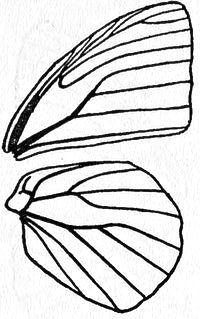
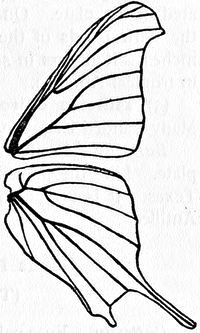
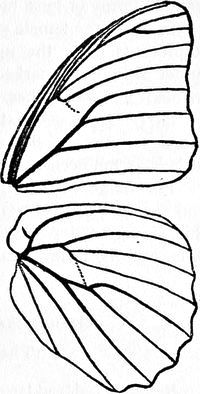
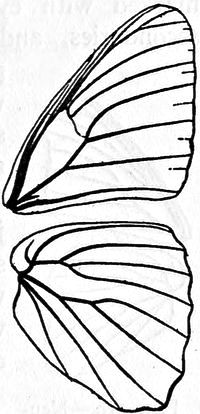
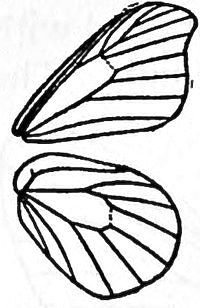
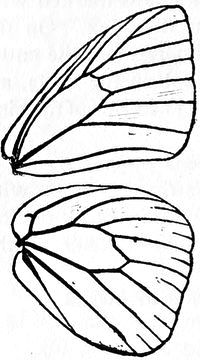
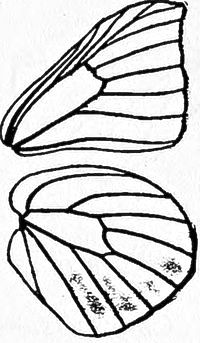
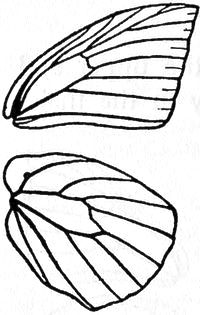
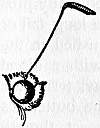
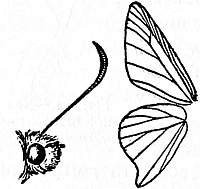
"Entomology extends the limits of being in new directions, so that I walk in
nature with a sense of greater space and freedom. It suggests, besides, that the
universe is not rough-hewn, but perfect in its details. Nature will bear the closest
inspection; she invites us to lay our eye level with the smallest leaf and take an
insect view of its plane."—Thoreau.
"My butterfly-net and pocket magnifying-glass are rare companions for a walk
in the country."—William Hamilton Gibson, Sharp Eyes, p. 117.
Butterfly.—The butterflies of this subfamily are mainly of
moderate or large size, though some of the genera contain quite
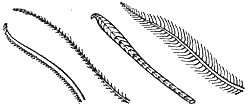
small species. The antennæ are always more or less heavily
clothed with scales, and are usually as long as the abdomen, and
in a few cases even longer. The club is always well developed;
it is usually long, but in some genera is short and stout. The
palpi are short and stout, densely clothed with scales and hairs.
The thorax is relatively stout, in some genera exceedingly so.
The fore wings are relatively broad, the length being to the breadth
in most cases in the ratio of 5 to 3, or 3 to 2, though in a few
mimetic forms these wings are greatly produced, and narrow,
patterning after the outline of the Heliconians and Ithomiids, which
they mimic. The fore wings are in most genera produced at the
apex, and more or less strongly excavated on the outer margin
below the apex. The discoidal cell is usually less than half the
length of the wing from base to tip. It is occasionally open, but
is more generally closed at its outer extremity by discocellular
veins diminishing in thickness from the upper to the lower outer
angle of the cell. The costal nervure usually terminates midway
between the end of the cell and the tip. The two inner subcostal
nervules usually arise before the end of the cell; the outer subcostal
nervules invariably arise beyond the end of the cell.
The hind wings are rounded or angulated, with the outer
border scalloped or tailed; the inner border always affords a
channel for the reception of the abdomen. The costal nervule
invariably terminates at the external angle of this wing. The
discoidal cell is frequently open, or simply closed by a slender
veinlet, which it is not always easy to detect; the anal vein is
never lacking.
The fore legs are greatly reduced in the male, less so in the
female.
Egg.—The egg is either somewhat globular, or else barrel-shaped,
with the sides marked with net-like elevations, or vertically
ribbed (see Figs. 1, 8, 10).
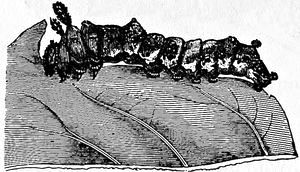
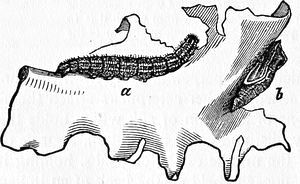
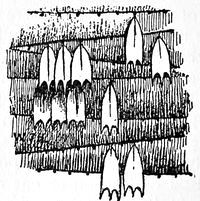
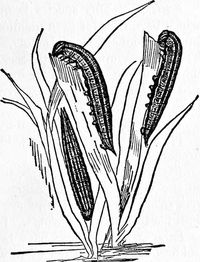
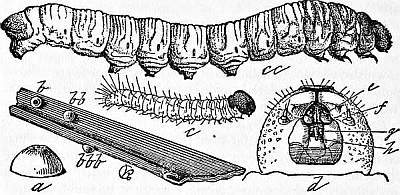
Caterpillar.—When first emerging from the egg the caterpillar is
generally furnished with long hairs rising singly from wart-like elevations
which are arranged either in longitudinal rows or in geometric
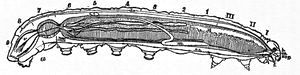
patterns (Fig. 85).
As the caterpillars pass
their successive moults
the hairs are transformed
into branching spines or
tubercles (see Plate III,
Figs. 28-38).
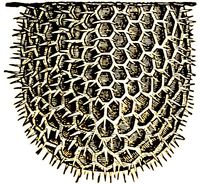
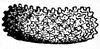
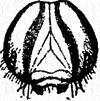
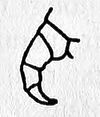
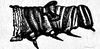
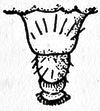
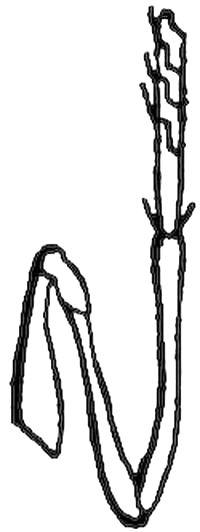
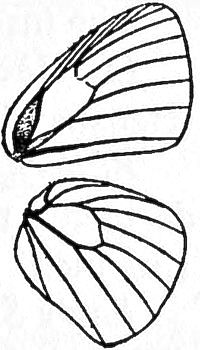
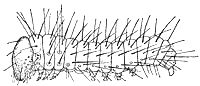 Fig. 85.—Caterpillar of Vanessa antiopa, just
hatched. (Greatly magnified.) (After Scudder.)
Fig. 85.—Caterpillar of Vanessa antiopa, just
hatched. (Greatly magnified.) (After Scudder.)
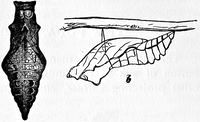
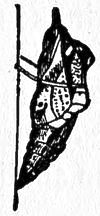
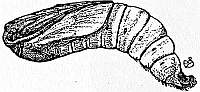
Chrysalis.—The chrysalis
invariably hangs suspended
from a button of silk, and is frequently furnished,
especially on the dorsal or upper surface, with a number of
prominences; the head is usually bifurcate, or cleft (see Plate IV,
Figs. 21, 39, etc.).
This is the largest of all the subfamilies of the butterflies, and
is widely distributed, including many of the most beautifully
colored and most vigorous species which are known. There are
twenty-six genera represented in our fauna, containing about one
hundred and seventy species.
Genus COLÆNIS, Doubleday
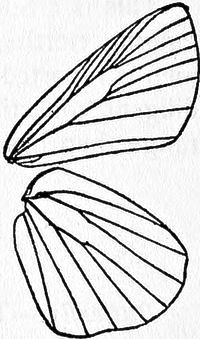
Butterfly.—Butterflies of moderately large size, the fore
wings greatly produced and relatively narrow; the hind wings
evenly rounded and relatively small, of bright reddish-brown
color, with darker markings. The species are mimics, and in the
elongation of their wings reveal the influence of the Heliconians,
protected species, which abound in the regions in which the genus
attains its greatest development. The median vein in the upper
wing is characterized by the presence at the base of a minute,
thorn-like, external projection; the second subcostal nervule is
emitted beyond the cell; the cell of the hind
wing is open.
The life-history of the two species found
within our fauna has not as yet been carefully
worked out, and aside from a knowledge of
the fact that the caterpillars closely resemble
in many respects the caterpillars of the two
succeeding genera, being provided with branching
spines on their bodies, we do not know as
yet enough to give any complete account of
the early stages of these insects.
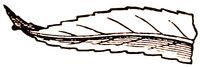
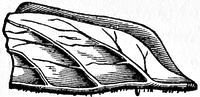
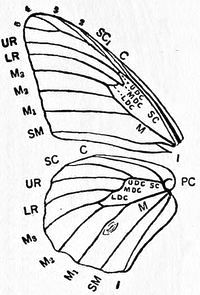
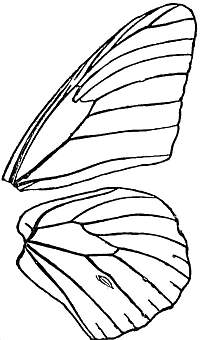
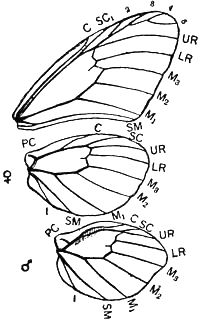
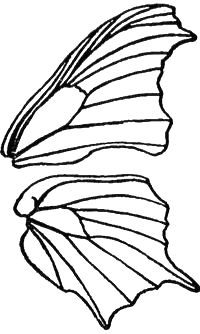
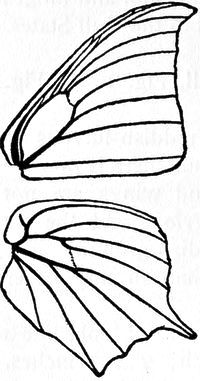
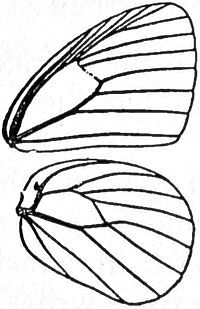
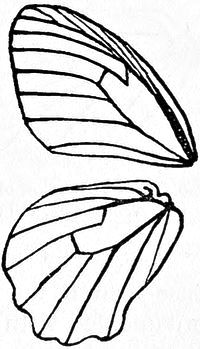
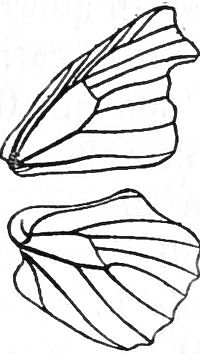
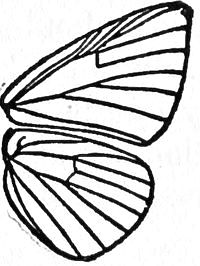
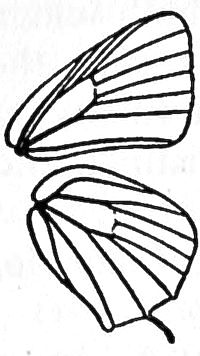
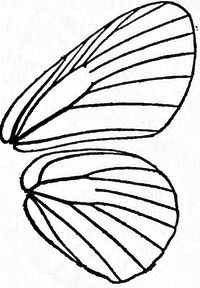
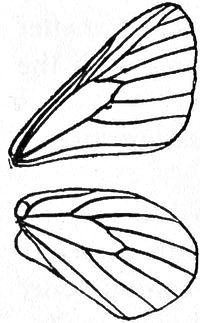
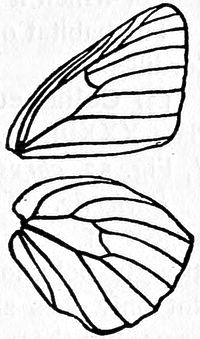
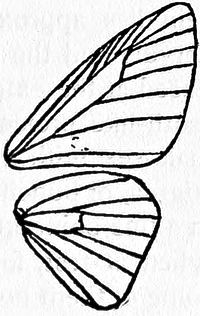
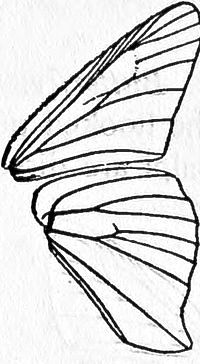
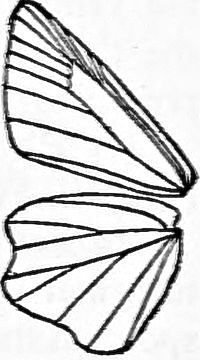
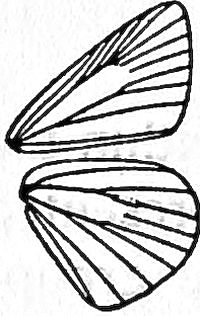
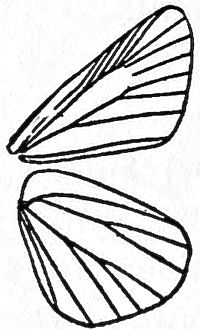
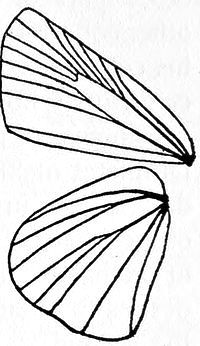
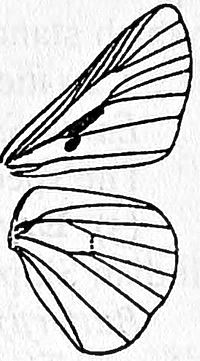
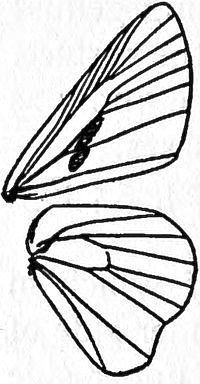
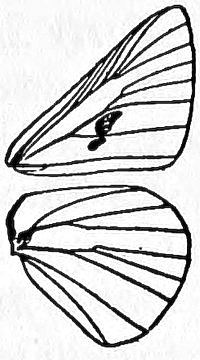
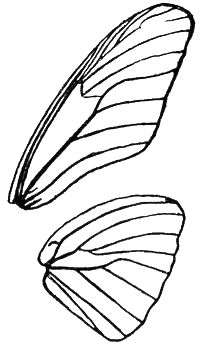 Fig. 86.—Neuration
of the genus Colœnis,
slightly less
than natural size.
Fig. 86.—Neuration
of the genus Colœnis,
slightly less
than natural size.
(1) Colænis julia, Fabricius, Plate VIII,
Fig. 6, ♂ (Julia).
The upper side is dark reddish-orange, the
borders are black, a black band extends from
the costa at the end of the cell to the outer margin on the line of
the third median nervule; the costal area on the hind wings is
silver-gray; the wings on the under side are pale rusty-red, mottled
with a few darker spots, principally on the costa, at the
end of the cell, and at the apex of the primaries. There are a few
crimson marks at the base of the hind wings, and two light-colored
lunules near the inner angle of the hind wings. Expanse of wing,
3.50 inches.
This butterfly, which mimics the genus Heliconius in the outline
of the wings, is very common in the tropics of America, and
only appears as an occasional visitant in southern Texas.
(2) Colænis delila, Fabricius, Plate VIII, Fig. 4, ♂ (Delila).
The Delila Butterfly very closely resembles Julia, and principally
differs in being paler in color and without the black band
extending from the costa to the outer margin of the primaries.
This species has nearly the same form and the same size as the
preceding, and, like it, is occasionally found in southern Texas.
It is very common in Central America and the West Indies. One
of the earliest memories of my childhood relates to a collection of
Jamaican butterflies in which were a number of specimens of this
butterfly, which I have always much admired.
Genus DIONE, Hübner
(Agraulis, Boisd.-Lec.)
Butterfly.—Head large, the antennæ moderately long, with
the club flattened; the tip of the abdomen does not extend
beyond the inner margin of the hind wings; the cell of the hind
wings is open; the primaries are elongated, nearly twice as long as
broad, with the exterior margin excavated; the secondaries at the
outer margin denticulate. The prevalent color of the upper side of
the wings is fulvous, adorned with black
spots and lines, the under side of the wings
paler brown, in some of the species laved
with pink and brilliantly adorned with large
silvery spots, as in the genus Argynnis.
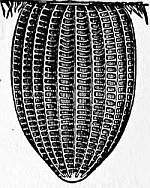
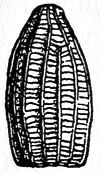
Egg.—Conoidal, truncated on top, with
fourteen ribs running from the apex to the
base, between which are rows of elevated
striæ, causing the surface to appear to be
covered with quadrangular pits.
Larva.—The caterpillar is cylindrical in
its mature stage, tapering a little from the
middle toward the head, which is somewhat
smaller than the body. The head and
each segment of the body are adorned with
branching spines.
Chrysalis.—The chrysalis is suspended, and has on the dorsal
surface of the abdomen a number of small projections. At the
point where the abdominal and thoracic segments unite on the
dorsal side there is a deep depression, succeeded on the middle
of the thorax by a rounded elevation composed of the wing-cases.
At the vertex of the chrysalis there is a conical projection; on the
ventral side the chrysalis is bowed outwardly.
This genus is confined to the New World, and contains five
species. It is closely related to the genus Colœnis on the one
hand and to the genus Argynnis on the other. It is distinguished
from Colœnis by the more robust structure of the palpi, which
closely approximate in form the palpi of the genus Argynnis. It
is distinguished from the species of the genus Argynnis by the
form of the wings and by the open cell of the secondaries. The
larva feeds upon the different species of the genus Passiflora.
I cannot at all agree with those who have recently classed this
butterfly with the Heliconians. In spite of certain resemblances
in the early stages between the insect we are considering and
the early stages of some of the Heliconians, and in spite of the
shape of the wings, which are remarkably elongated, there are
structural peculiarities enough to compel us to keep this insect
in the ranks of the Nymphalinæ, where it has been placed for
sixty years by very competent and critical observers. In a popular
work like this it manifestly is out of place to enter into a
lengthy discussion of a question of this character, but it seems
proper to call attention to the fact that in the judgment of the
writer the location of this genus in the preceding subfamily does
violence to obvious anatomical facts.
(1) Dione vanillæ, Linnæus, Plate VIII, Fig. 7, ♂ (The Gulf
Fritillary).
Butterfly.—The upper side is bright fulvous; the veins on the
fore wings are black, very heavy near the tip; there are four
black spots on the outer border, and three discal spots of the
same color; there are three irregular black spots toward the end
of the cell, pupiled with white; the hind wings have a black
border inclosing rounded spots of the ground-color; between the
base and the outer margin there are three or four black spots; the
under side of the fore wings is light orange, the markings of
the upper side showing through upon the under side; the apex
of the front wing is brown, inclosing light silvery spots; the secondaries
are brown, with numerous elongated bright silver spots
and patches. The female does not differ from the male, except
that she is darker and the markings are heavier. Expanse, 2.50-3.25
inches.
Caterpillar.—The caterpillar is cylindrical, with the head
somewhat smaller than the body, pale yellowish-brown in color,
marked with longitudinal dark-brown bands, of which the two
upon the side are deeper in color than the one upon the back,
which latter is sometimes almost entirely effaced; the base is
slaty-black. There are orange spots about the spiracles. There
are six rows of black branching spines upon the body, and two
similar spines upon the head, these latter somewhat recurved.
The feet and legs are black. The caterpillar feeds upon the
various species of passion-flower which are found in the Southern
States.
Chrysalis.—The chrysalis is dark brown, marked with a few
small pale spots.
This species ranges from the latitude of southern Virginia
southward to Arizona and California. It is abundant also in the
Antilles and Mexico.
Genus EUPTOIETA, Doubleday
Butterfly.—Butterflies of medium size, having wings of a
yellowish-brown color, marked with black, the under side of
the wings devoid of silvery spots such as are found in the genera
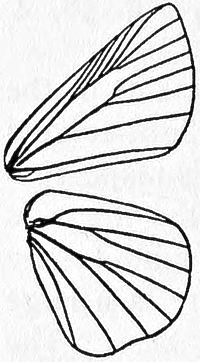
Dione and Argynnis. The palpi have
the second joint strongly developed, increasing
in thickness from behind forward, and
thickly covered with long hair; the third joint
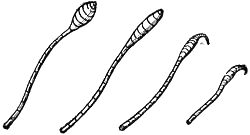
is very small and pointed; the antennæ are terminated
by a conspicuous pear-shaped club. The
cell of the fore wing is closed by a very feeble
lower discocellular vein, which unites with the
median vein at the origin of the second median
nervule; the cell of the hind wing is open,
though occasionally there are traces of a feebly
developed lower discocellular vein on this wing.
The outer margin of the fore wing is slightly excavated
below the apex; the outer margin of the hind wing is somewhat
strongly produced at the end of the third median nervule.
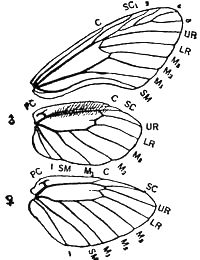
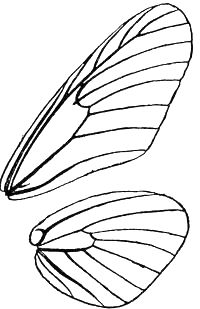
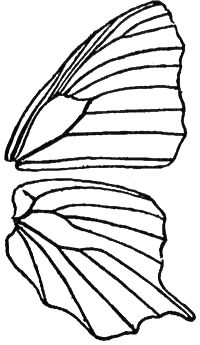
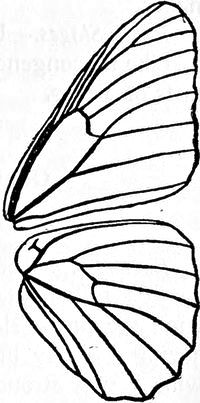
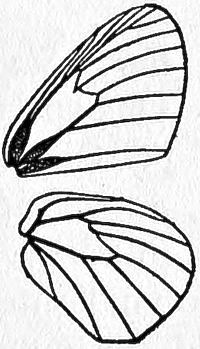
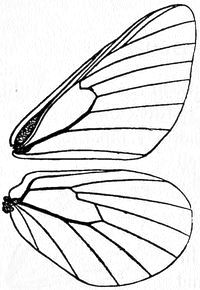
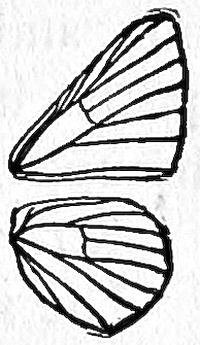
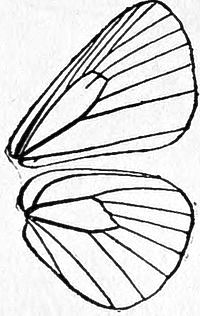
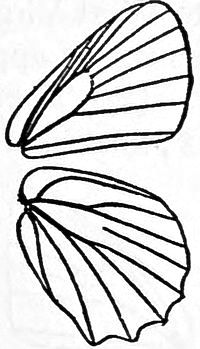
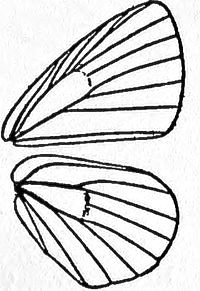
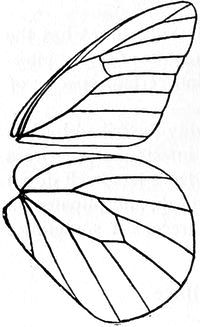
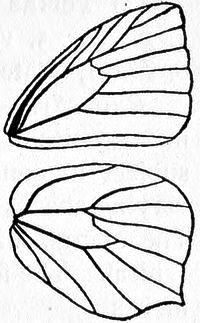
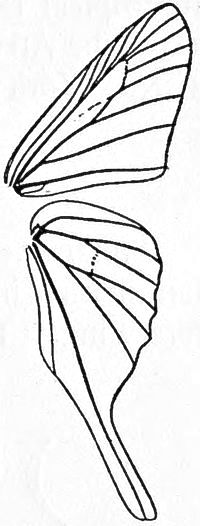
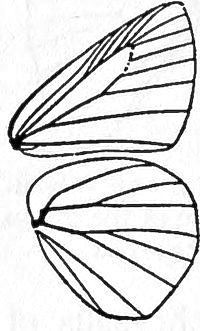
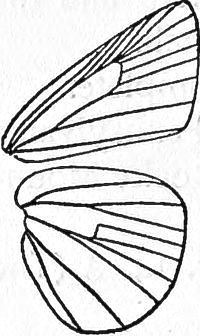
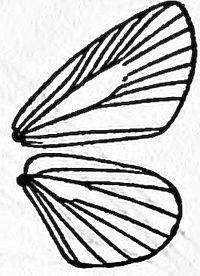
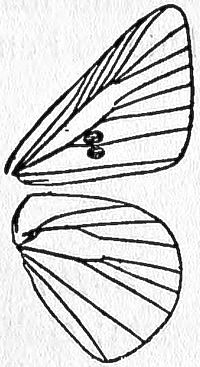
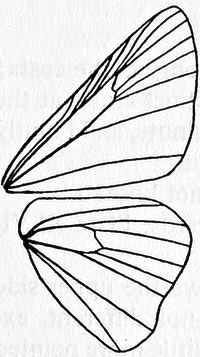
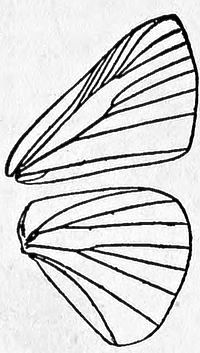
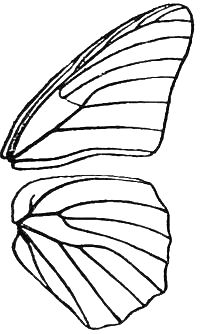 Fig. 88.—Neuration
of the genus
Euptoieta.
Fig. 88.—Neuration
of the genus
Euptoieta.
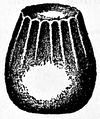
Egg.—Short, subconical, with from thirty to forty vertical
ribs, pale green in color.
Caterpillar.—The caterpillar is cylindrical, with short branching
spines arranged in longitudinal rows upon the body, the
spines on the first segment being bent forward over the head.
The head is somewhat smaller in the mature stage than the body.
Chrysalis.—The chrysalis is suspended, marked upon its
dorsal side with a number of small angular eminences, with the
head and the ventral side evenly rounded.
The larva of these insects feeds upon the various species of
passion-flower. It is also said to feed upon violets. The butterflies
frequent open fields, and are sometimes exceedingly abundant
in worn-out lands in the Southern States.
There are two species of this genus, both of which are found
within the United States, and range southwardly over the greater
portion of Central and South America.
(1) Euptoieta claudia, Cramer, Plate VIII, Fig. 9, ♂ (The
Variegated Fritillary).
Butterfly.—The upper side of both wings is dull ferruginous,
darker toward the base, crossed by an irregular black median
line, which is darker, broader, and more zigzag on the fore wing
than on the hind wing. This line is followed outwardly on both
wings by a pair of more or less wavy limbal lines, inclosing
between them a series of round blackish spots. The outer margin
is black, with the fringes pale fulvous, checkered with black
at the end of each nervule. At the end of the cell in the fore
wing there are two black lines inclosing paler fulvous spots, and
both wings near the base have some curved black lines. On the
under side the fore wings are marked somewhat as on the upper
side, but paler in color, with a large apical patch of brownish-gray
broken by a transverse band of darker brown. The hind
wings are dark brown, with the markings of the upper side
obscurely repeated; they are mottled with gray and crossed by a
broad central band of pale buff.
The species varies very much, according to locality, both in size
and in the depth of the markings. Expanse, 1.75-2.75 inches.
Egg.—The egg is conoidal, relatively taller than the eggs of
the genus Argynnis, which closely resemble it. There is a
depression at the apex, surrounded by a serrated rim, formed by
the ends of the vertical ribs, of which there are about twenty,
some longer and some shorter, about half of them reaching from
the apex to the base. Between these vertical ribs there are a
multitude of smaller cross-ridges.
Caterpillar.—The caterpillar is cylindrical, reddish-yellow in
color, marked with two brown lateral bands and a series of white
spots upon the back. There are six rows of short branching
spines upon the body, which are black in color; the two uppermost
of these spines on the first segment are much elongated
and are directed forward. The head is smaller than the body in
the mature caterpillar, and is black. On the under side the caterpillar
is pale or whitish; the legs are blackish-brown. It feeds
upon the passion-flower.
Chrysalis.—The chrysalis is pearly-white, marked with black
spots and longitudinal streaks.
This species has been taken as far north as Long Island and
Connecticut, though it is a very rare visitant in New England; it
is quite common in Virginia and thence southward, and occurs
not infrequently in southern Illinois and Indiana, ranging westward
and southward over the entire continent to the Isthmus of
Panama, and thence extending over the South American continent,
wherever favorable conditions occur.
(2) Euptoieta hegesia, Cramer, Plate VIII, Fig. 8, ♂ (The
Mexican Fritillary).
The upper side is marked very much as in the preceding
species, but all the lines are finer and somewhat more regular,
and the basal and discal areas of the hind wings are without dark
spots in most specimens. The under side is less mottled and
more uniformly dark rusty-brown than in E. claudia. Expanse,
about 2 inches.
The life-history of this species has not as yet been thoroughly
worked out, but there is every reason to believe that the insect
in its early stages very closely approaches the Variegated Fritillary.
It is a Southern form, and only occasionally is taken in
Arizona and southern California. It is common in Central and
South America.
LUTHER'S SADDEST EXPERIENCE
"Luther, he was persecuted,
Excommunicated, hooted,
Disappointed, egged, and booted;
Yelled at by minutest boys,
Waked up by nocturnal noise,
Scratched and torn by fiendish cats,
Highwayed by voracious rats.
"Oft upon his locks so hoary
Water fell from upper story;
Oft a turnip or potato
Struck upon his back or pate, Oh!
And wherever he betook him,
A papal bull was sure to hook him.
"But the saddest of all
I am forced to relate:
Of a diet of worms
He was forced to partake—
Of a diet of worms
For the Protestants' sake;
Munching crawling caterpillars,
Beetles mixed with moths and millers;
Instead of butter, on his bread,
A sauce of butterflies was spread.
Was not this a horrid feast
For a Christian and a priest?
"Now, if you do not credit me,
Consult D'Aubigné's history.
You'll find what I have told you
Most fearfully and sternly true."
Yale Literary Magazine, 1852.
Genus ARGYNNIS, Fabricius
(The Fritillaries, the Silver-spots)
"July is the gala-time of butterflies. Most of them have just left the chrysalis,
and their wings are perfect and very fresh in color. All the sunny places are bright
with them, yellow and red and white and brown, and great gorgeous fellows in
rich velvet-like dresses of blue-black, orange, green, and maroon. Some of them
have their wings scalloped, some fringed, and some plain; and they are ornamented
with brilliant borders and fawn-colored spots and rows of silver crescents....
They circle about the flowers, fly across from field to field, and rise swiftly in the
air; little ones and big ones, common ones and rare ones, but all bright and airy
and joyous—a midsummer carnival of butterflies."—Frank H. Sweet.
Butterfly.—Butterflies of medium or large size, generally
with the upper surface of the wings reddish-fulvous, with well-defined
black markings consisting of waved transverse lines,
and rounded discal and sagittate black markings
near the outer borders. On the under
side of the wings the design of the fore wings
is generally somewhat indistinctly repeated,
and the hind wings are marked more or less
profusely with large silvery spots. In a few
cases there is wide dissimilarity in color between
the male and the female sex; generally
the male sex is marked by the brighter
red of the upper surface, and the female by
the broader black markings, the paler ground-color,
and the sometimes almost white lunules,
which are arranged outwardly at the base of
the sagittate spots along the border.
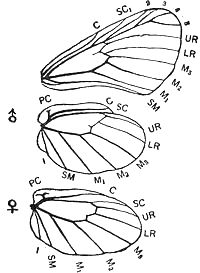
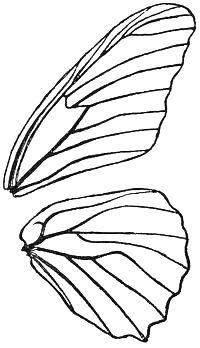
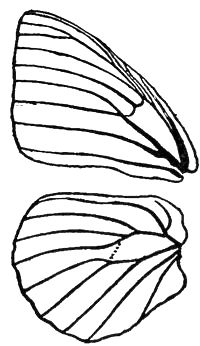
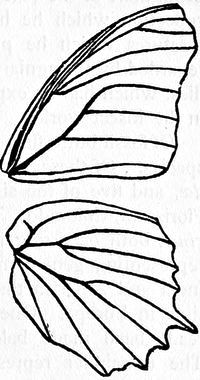
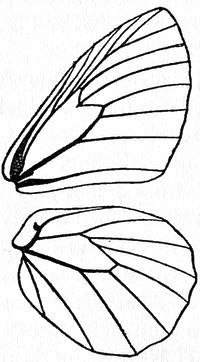
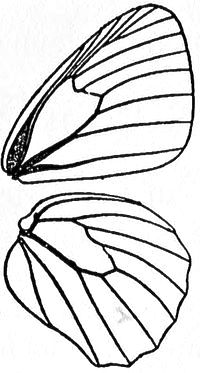
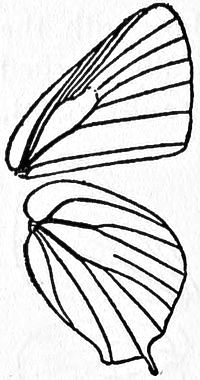
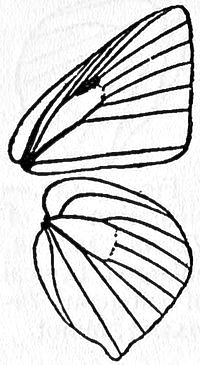
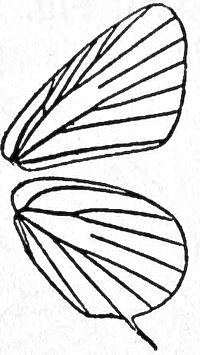
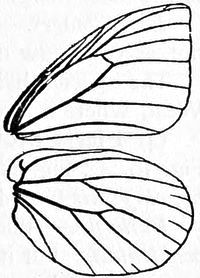
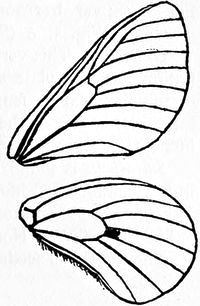
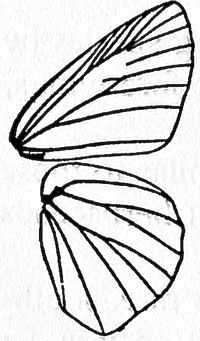
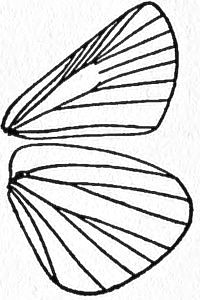
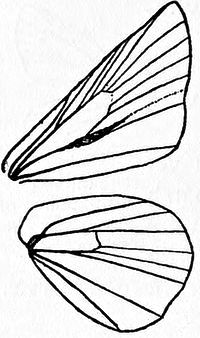
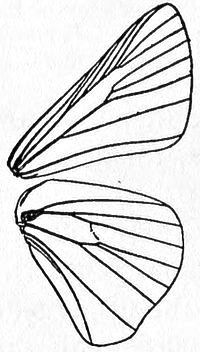
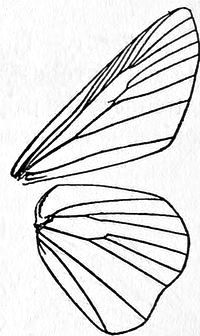
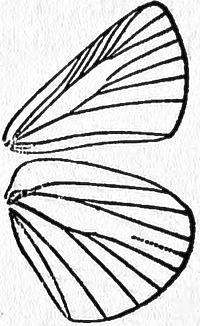
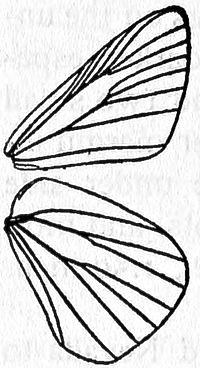
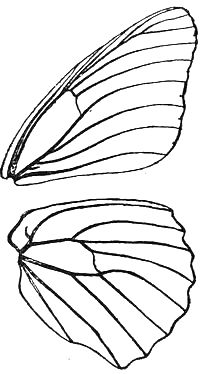 Fig. 89.—Neuration of
the genus Argynnis.
Fig. 89.—Neuration of
the genus Argynnis.
The eyes are naked; the palpi strongly
developed, heavily clothed with hair rising
above the front, with the last joint very small and pointed. The
antennæ are moderately long, with a well-defined, flattened club.
The abdomen is shorter than the hind wings; the wings are
more or less denticulate. The subcostal vein is provided with
five nervules, of which the two innermost are invariably given
forth before the end of the cell; the third subcostal nervule
always is nearer the fourth than the second. The cell of the
fore wing is closed by a fine lower discocellular vein, which
invariably joins the median vein beyond the origin of the second
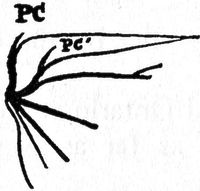
nervule. The hind wing has a well-defined precostal nervule;
the cell in this wing is closed by a moderately thick lower discocellular
vein, which joins the median exactly at the origin of the
second median nervule. The fore feet of the males are slender,
long, and finely clothed with hair. The fore feet of the females
are of the same size as those of the males, but thin, covered with
scales, and only on the inner side of the tibiæ clothed with moderately
long hair.
Egg.—The eggs are conoidal, truncated, and inwardly depressed
at the apex, rounded at the base, and ornamented on the
sides by parallel raised ridges, not all of which reach the apex.
Between these ridges there are a number of small raised cross-ridges.
Caterpillar.—The caterpillar is cylindrical, covered with spines,
the first segment always bearing a pair of spines somewhat
longer than the others. All of the species in North America, so
far as their habits are known, feed upon violets at night. During
the daytime the caterpillars lie concealed.
Chrysalis.—The chrysalis is angular, adorned with more or
less prominent projections. The head is bifid.
The genus Argynnis is one of the largest genera of the brush-footed
butterflies. It is well represented in Europe and in the
temperate regions of Asia, some magnificent species being found
in the Himalayas and in China and Japan. It even extends to
Australia, and recently two species have been discovered in the
vicinity of the great volcanic peak, Kilima-Njaro, in Africa. But
it has found its greatest development upon the continent of North
America. The species composing this genus are among our most
beautiful butterflies. Owing to the fact that there is a great tendency
in many of the forms closely to approximate one another, the
accurate distinction of many of the species has troubled naturalists,
and it is quite probable that some of the so-called species will
ultimately be discovered to be merely local races or varietal forms.
The species that are found in the eastern part of the United States
have been studied very carefully, and their life-history has been
worked out so thoroughly that little difficulty is found in accurately
determining them. The greatest perplexity occurs in connection
with those species which are found in the region of the
Rocky Mountains. While silvery spots are characteristic of the
under side of most of the fritillaries, in some species the silvery
spots are not found; in others they are more or less evanescent,
occurring in the case of some individuals, and being absent in the
case of others.
(1) Argynnis idalia, Drury, Plate X, Fig. 3, ♁; Plate V,
Fig. 4, chrysalis (The Regal Fritillary).
Butterfly.—The upper side of the fore wings of the male is
bright fulvous, marked very much as in other species of the genus.
The upper side of the hind wings is black, glossed with blue,
having a marginal row of fulvous and a submarginal row of
cream-colored spots. On the under side the fore wings are fulvous,
with a marginal row of silver crescents, and some silvery
spots on and near the costa. The hind wings are dark olive-brown,
marked with three rows of large irregular spots of a dull greenish-silvery
color. The female is at once distinguished from the male
by having the marginal row of spots on the hind wings cream-colored,
like the submarginal row, and by the presence of a
similar row of light spots on the fore wings. Expanse, 2.75-4.00
inches.
Egg.—The egg in form is like those of other species of
Argynnis.
Caterpillar.—The caterpillar moults five times before attaining
to maturity. When fully developed it is 1.75 inches long, black,
banded and striped with ochreous and orange-red, and adorned
with six rows of fleshy spines surmounted by several black
bristles. The spines composing the two dorsal rows are white,
tipped with black; those on the sides black, tinted with orange
at the point where they join the body. The caterpillar feeds on
violets, and is nocturnal in its habits.
Chrysalis.—The chrysalis is brown, mottled with yellow and
tinted on the wing-cases with pinkish. It is about an inch long,
and in outline does not depart from the other species of the genus.
This exceedingly beautiful insect ranges from Maine to Nebraska.
It is found in northern New Jersey, the mountainous
parts of New York and northern Pennsylvania, and is reported
from Arkansas and Nebraska. It is rather local, and frequents
open spots on the borders of woodlands. At times it is apparently
common, and then for a succession of seasons is scarce. It
flies from the end of June to the beginning of September.
(2) Argynnis diana, Cramer, Plate IX, Fig. 1, ♂; Fig. 2, ♁
(Diana).
Butterfly.—The male on the upper side has both wings deep
rich brown, bordered with fulvous, this border being more or
less interrupted by rays of brown along the nervules and two
rows of circular brown spots, larger on the fore wings than on
the hind wings. The wings on the under side are pale buff,
deeply marked with black on the base and middle of the fore
wings, and clouded with grayish-fulvous on the inner two thirds
of the hind wings. A blue spot is located near the end of the
cell in the fore wings, and the hind wings are adorned by a marginal
and submarginal row of narrow silvery crescents and a few
silvery spots toward the base. The female on the upper side is
a rich bluish-black, with the outer border of the fore wings marked
by three rows of bluish-white quadrate spots, the outer row
being the palest, and often quite white. The hind wings are
adorned by three more or less complete rows of bright-blue
spots, the inner row composed of large subquadrate spots, each
having a circular spot of black at its inner extremity. On the
under side the female has the ground-color slaty-brown, paler on
the hind wings than on the fore wings, which latter are richly
marked with blue and black spots. The silvery crescents found
on the under side of the hind wings of the male reappear on the
under side of the female, and are most conspicuous on the outer
margins. Expanse, 3.25-4.00 inches.
Egg.—The egg is pale greenish-white, and conformed in outline
to type.
Caterpillar.—The larva is velvety-black, adorned with six
rows of fleshy spines armed with bristles. The spines are
orange-red at the base. The head is dull brown.
Chrysalis.—The chrysalis is dusky-brown, with lighter-colored
short projections on the dorsal side.
This splendid butterfly, which is the most magnificent species
of the genus, is confined to the southern portion of the Appalachian
region, occurring in the two Virginias and Carolinas, northern
Georgia, Tennessee, and Kentucky, and being occasionally
found in the southern portion of Ohio and Indiana, and in Missouri
and Arkansas.
(3) Argynnis nokomis, Edwards, Plate X, Fig. 1, ♂; Fig.
2, ♁ (Nokomis).
Butterfly.—The male on the upper side is bright fulvous, with
the characteristic black markings of the genus. On the under
side the wings are pale greenish-yellow, with the fore wings
laved with bright pink at the base and on the inner margin.
The spots of the upper side reappear on the under side as spots
of silver bordered narrowly with black. The female has the
ground-color of the upper side yellow, shaded outwardly with
fulvous. All the dark markings of the male sex reappear in this
sex, but are much broader, and tend to fuse and run into one
another, so as to leave the yellow ground-color as small subquadrate
or circular spots, and wholly to obliterate them at the base
of the wings. On the under side this sex is marked like the male,
but with all the markings broader. Expanse, 3.40-3.60 inches.
This species, the male of which resembles the male of A. leto,
and the female the same sex of A. diana, is as yet quite rare in
collections. It has been taken in Arizona and southern Utah.
We have no knowledge of the life-history of the species.
(4) Argynnis nitocris, Edwards, Plate XIII, Fig. 4, ♂, under
side (Nitocris).
Butterfly.—The male is bright reddish-fulvous, marked like A.
nokomis. The under side of the fore wings is cinnamon-red,
ochre-yellow at the tip. The hind wings are deep rusty-red,
with a broad yellowish-red submarginal belt. The silver spots
are as in A. nokomis. The female on the upper side is blackish-brown,
darker than A. nokomis. The extradiscal spots in the
transverse rows are pale yellow, and the submarginal spots
whitish. The under side of the fore wings is bright red, with
the tip yellow. The hind wings on this side are dark brown, with
a submarginal yellow belt. Expanse, 3.25-3.75 inches.
This species, like the preceding, is from Arizona, and nothing
is known of its egg, caterpillar, or chrysalis.
(5) Argynnis leto, Edwards, Plate IX, Fig. 5, ♂; Fig. 6, ♁
(Leto).
Butterfly.—The male on the upper side is marked much as A.
nokomis, but the ground-color is duller red, and the basal area is
much darker. The under side of the fore wings is pale fulvous,
upon which the markings of the upper side reappear; but there are
no marginal silver crescents. Both wings on the under side are
shaded with brown toward the base; the hind wings are traversed
by a submarginal band of light straw-yellow. The female
is marked as the male, but the ground-color is pale straw-yellow,
and all the darker markings are deep blackish-brown, those
at the base of both wings being broad and running into one another,
so that the inner half of the wings appears to be broadly
brownish-black. On the under side this sex is marked as the
male, but with the dark portions blacker and the lighter portions
pale yellow. Expanse, 2.50-3.25 inches.
The life-history of this insect remains to be worked out. It is
one of our most beautiful species, and occurs in California and
Oregon.
(6) Argynnis cybele, Fabricius, Plate IX, Fig. 3, ♂; Fig. 4,
♁; Plate XIII, Fig. 1, ♁, under side; Plate V, Figs. 1-3, chrysalis
(The Great Spangled Fritillary).
Butterfly.—The male is much like the male of A. leto, but the
dark markings of the upper surface are heavier, and the under
sides of the hind wings are more heavily silvered. The yellowish-buff
submarginal band on the under side of the hind wings is
never obliterated by being invaded by the darker ferruginous of
the marginal and discal tracts of the wing. The female has the
ground-color of the wings paler than the male, and both wings
from the base to the angled median band on the upper side are
dark chocolate-brown. All the markings of the upper side in
this sex are heavier than in the male. On the under side the female
is like the male. Expanse, 3.00-4.00 inches.
Egg.—Short, conoidal, ribbed like those of other species, and
honey-yellow.
Caterpillar.—The larva in the mature state is black. The head
is blackish, shaded with chestnut behind. The body is ornamented
with six rows of shining black branching spines, generally
marked with orange-red at their base. The caterpillar,
which is nocturnal, feeds on violets, hibernating immediately
after being hatched from the egg, and feeding to maturity in the
following spring.
Chrysalis.-The chrysalis is dark brown, mottled with reddish-brown
or slaty-gray.
This species, which ranges over the Atlantic States and the
valley of the Mississippi as far as the plains of Nebraska, appears
to be single-brooded in the North and double-brooded in Virginia,
the Carolinas, and the Western States having the same
geographical latitude. A small variety of this species, called A.
carpenteri by Mr. W.H. Edwards, is found in New Mexico
upon the top of Taos Peak, and is believed to be isolated here in
a colony, as Œneis semidea is isolated upon the summit of Mount
Washington. Specimens of cybele much like those of this New
Mexican variety are found in eastern Maine and Nova Scotia, and
on the high mountains of North Carolina.
(7) Argynnis aphrodite, Fabricius, Plate XIV, Fig. 11, ♁,
under side; Plate V, Fig. 5, chrysalis (Aphrodite).
Butterfly.—This species closely resembles cybele, but is generally
smaller, and the yellow submarginal band on the hind
wings is narrower than in cybele, and often wholly wanting, the
hind wings being broadly brown, particularly in the female sex.
The under side of the fore wings at the base and on the inner
margin is also brighter red.
The caterpillar, chrysalis, and egg of this species closely resemble
those of cybele. The caterpillar has, however, a velvety-black
spot at the base of each spine, the chrysalis has the
tubercles on the back shorter than in cybele, and the basal segments
are party-colored, and not uniformly colored as in cybele.
(8) Argynnis cipris, Edwards, Plate XII, Fig. 3, ♂; Fig. 4,
♁ (The New Mexican Silver-spot).
Butterfly.—This species, which belongs to the Aphrodite-group,
may be distinguished by the fact that the fore wings are
relatively longer and narrower than in aphrodite. The black
markings on the upper side of the wings in both sexes are narrower,
the dusky clouding at the base of the wings is less pronounced,
and the ground-color is brighter reddish-fulvous than
in aphrodite. On the under side the fore wings lack in the
male the pinkish shade at the base and on the inner margin
which appears in aphrodite, and both the male and the female
have the inner two thirds of the hind wings deep cinnamon-red,
with only a very narrow buff submarginal band, deeply invaded
on the side of the base by rays of the deeper brown color of the
inner portion of the wing. Expanse, 2.75-3.15 inches. The
insect flies from late June to the end of August.
Caterpillar, etc.—We know nothing of the larval stages of
this insect. The specimens contained in the Edwards collection
came from Colorado, Utah, and New Mexico, and these localities
approximately represent the range of the species.
(9) Argynnis alcestis, Edwards, Plate X, Fig. 6, ♂, under
side (The Ruddy Silver-spot).
Butterfly.—Very much like aphrodite, from which it may be
most easily distinguished by the fact that the hind wings are
uniformly dark cinnamon-brown, without any band of buff on
the outer margin. Expanse, 2.50-3.00 inches. The insect flies
from late June to the end of August.
Egg.—Greenish, conoidal, with about eighteen vertical ribs.
Caterpillar.—Head black, yellowish behind. The body velvety-black,
ornamented with black spines which are yellowish at
their basal ends. The caterpillar feeds on violets.
Chrysalis.—Reddish-brown or gray, irregularly mottled and
striped with black, the abdominal segments slaty-gray, marked
with black on the edges where the short angular projections are
located.
This butterfly is found in the Western States, extending from
the prairie lands of northwestern Ohio to Montana. It largely
replaces aphrodite in these regions.
(10) Argynnis nausicaä, Edwards, Plate XI, Fig. 9, ♂ (The
Arizona Silver-spot).
Butterfly.—The species is related to the foregoing, but is
rather smaller in size. The upper side of the wings is dusky
reddish-brown, with the characteristic markings of the genus.
On the under side the fore wings are pink, laved with buff at the
tip. The hind wings on this side are deep cinnamon-brown,
mottled with buff on the inner two thirds; a narrow but clearly
defined submarginal band of bright yellowish-buff surrounds
them. The silvery spots are clearly marked. The female has the
black markings broader and more conspicuous than the male.
Expanse, 2.25-2.50 inches.
This insect is quite common in the mountain valleys of Arizona,
at an elevation of from six to seven thousand feet above
the level of the sea, and flies in July and August. We have no
knowledge of the early stages, but it probably does not differ
greatly in its larval state from the allied species of the genus.
(11)Argynnis atlantis, Edwards, Plate X, Fig. 9, ♂; Plate
V, Fig. 6, chrysalis (The Mountain Silver-spot).
Butterfly.—This insect, which resembles aphrodite, is distinguished
from that species by its smaller size, its somewhat narrower
wings, the deeper brown color of the base of the wings on
the upper side, and their darker color on the under side. The
submarginal band is pale yellow, narrow, but distinct and always
present. Expanse, 2.50 inches.
Egg.—Conoidal, with twelve to fourteen ribs, honey-yellow.
The caterpillars are hatched in the fall, and hibernate without feeding
until the following spring.
Caterpillar.—The head is dark blackish-brown. The body
is velvety-purple above, a little paler on the under side. The
usual spines occur on the body, and are black, grayish at the
base. The larva feeds on violets.
Chrysalis.—The chrysalis is light brown, speckled, except on
the abdominal segments, with black.
This species ranges from Maine to the mountains of western
Pennsylvania, and thence southward along the central ridges of
the Alleghanies into West Virginia. It is also found in Canada,
and extends westward into the region of the Rocky Mountains.
It is especially common in the White Mountains of New Hampshire
and the Adirondacks.
(12) Argynnis lais, Edwards, Plate XIV, Fig. 12, ♂; Fig.
13, ♁ (The Northwestern Silver-spot).
Butterfly.—The male is bright reddish-fulvous on the upper
side, slightly obscured by fuscous at the base. The discal band
of spots common to both wings is broken and irregular, and the
spots on the hind wings are quite small. The fore wings on the
under side are buff at the tips and pale red at the base and on
the inner margin, lighter at the inner angle. The under side of
the hind wings as far as the outer margin of the discal row of
silvery spots is dark brown, mottling a yellowish ground. The
submarginal band of the hind wings is pale yellow and moderately
broad. The female is marked much as the male, but the
discal band of spots on the upper side of the fore wings is confluent
and broader, the fringes whitish, and the spots included
between the sagittate marginal spots and the marginal lines paler
than in the male sex. Expanse, 2.00-2.20 inches.
Caterpillar, etc.—The early stages are unknown.
This species is found in the territories of Alberta and Assiniboia,
and in British Columbia among the foot-hills and the lower
slopes of the mountain-ranges.
(13) Argynnis oweni, Edwards, Plate XII, Fig. 5, ♂; Fig.
6, ♁, under side (Owen's Silver-spot).
Butterfly, ♂.—The wings on the upper side are dull reddish-fulvous,
not much obscured with brown on the base, the black
markings moderately heavy, the two marginal lines tending to
flow together. The fore wings on the under side are yellowish-buff
from the base to the outer row of spots, or in some specimens
with the buff lightly laved with reddish; the nerves reddish-brown.
The subapical patch is dark brown, with a small silvered
spot; the five submarginal spots are small and obscurely
silvered. The hind wings are dark brown on the discal area
and outer margin, with a rather narrow grayish-buff submarginal
band, strongly invaded by projections of the dark brown of the
discal area. The spots of the outer discal row are generally well
silvered; the inner spots less so in most cases.
♁.—The female has the wings more or less mottled with
yellowish outside of the mesial band. The black markings are
very heavy in this sex. On the under side the spots are well
silvered.
The dark markings on the upper side of the wings of the male
are much heavier than in A. behrensi. On the under side of the
wings in both sexes it may be distinguished from behrensi by
the fact that the ground-color toward the base is mottled with
yellow, and not solid brown as in behrensi. Expanse, 2.25-2.40
inches.
This species abounds on Mount Shasta, in California, at an
elevation of seven to eight thousand feet above sea-level.
(14) Argynnis cornelia, Edwards. Plate XI, Fig. 8, ♂
(Miss Owen's Fritillary).
Butterfly, ♂.—The upper side of both wings is dark brown
from the base to the mesial band of spots, with the exception of
the outer end of the cell. The space beyond the band is reddish-fulvous;
the dark markings are not very heavy; the two marginal
lines are fine, and confluent at the ends of the nervules.
The under side of the fore wings is reddish-brown from the base
to the outer margin on the inner half of the wing; the outer
spaces toward the apex are yellowish; the subapical patch is
reddish-brown, inclosing a small silvery spot; the outer margin
is reddish-brown, adorned with five small silvery spots toward
the apex. The hind wings on the under side are almost solid
reddish-brown to the clear yellow submarginal belt, only slightly
mottled on the discal area with buff. The spots are small and
well silvered.
♁.—The female on the upper side is duller red, with the dark
markings heavier; the marginal spots on the fore wings are pale
yellowish, and the marginal lines are confluent on the upper half
of these wings. The wings on the under side in this sex are as
in the male, but the ground-color on the inner half of the wings
is darker, and the spots are more brilliantly silvered. Expanse,
2.30-2.50 inches.
Early Stages.—Unknown.
This pretty species is found with A. electa and A. hesperis in
Colorado. It was originally described from specimens taken at
Manitou and Ouray, and named by Edwards in honor of a deceased
daughter of Professor Owen of the University of Wisconsin.
(15) Argynnis electa, Edwards, Plate X, Fig. 8, ♂ (Electa).
Butterfly.—The male is dull reddish-fulvous on the upper
side. The black markings are narrow. The base of both wings
is slightly obscured. On the under side the fore wings are pale
cinnamon-red, with the tip dark cinnamon-red. The hind wings are
broadly dark cinnamon-red, mottled on the disk with a little buff.
The submarginal band is buff, quite narrow, and often invaded
by the ground-color of the inner area. The silvery spots are
usually very well marked and distinct, though in a few instances
the silvery color is somewhat obscured. The female has the
black markings a little heavier than in the male; otherwise there
is but little difference between the sexes. Expanse, 2.00-2.25
inches.
Caterpillar, etc.—The early stages are unknown.
This species has been confounded with A. atlantis, from
which it is wholly distinct, being much smaller in size, the fore
wings relatively broader, and the markings not so dark on the
upper surface. It is found in Colorado and Montana, among the
mountains.
(16) Argynnis columbia, Henry Edwards, Plate XIV, Fig. 3,
♂ (The Columbian Silver-spot).
Butterfly.—The male has the upper side of the fore wings pale
reddish-fulvous. In the median band of both wings the spots do
not flow together, but are separate and moderately heavy. The
under side of the fore wings is pale fulvous, buff at the tip; spots
silvered. The hind wings on the under side are light rusty-red,
but little mottled with buff on the disk; the submarginal band is
narrow, buff, and sometimes almost wholly obscured by the darker
ground-color. The spots, which are small, are well silvered.
The female is much lighter than the male, and, as usual, the dark
lines are heavier than in that sex. The spots of the median band
are bent and partly lanceolate, and the light spots of the outer
border are whitish. Expanse, 2.25-2.50 inches.
Caterpillar, etc.—The early stages have not as yet been
worked out.
This species, which is related to electa, may easily be distinguished
from it by the pale marginal series of light spots, in the
male, between the sagittate spots and the dark outer marginal
lines, which latter are confluent, forming a solid dark outer border
to the wing, while in electa they are separated by a narrow
band of light-brown spots. The female is also much lighter and
larger than in electa, as has been pointed out. The types which
came from the Caribou mining region of British Columbia are in
my possession, as are those of most of the other North American
species of the genus.
(17) Argynnis hesperis, Edwards, Plate XII, Fig. 1, ♂;
Fig. 2, ♁ (Hesperis).
Butterfly.—The male on the upper side of the wings is fulvous,
shaded with dark fuscous for a short distance from the
base. The black spots of the median band are rather broad, and
seem to coalesce through dark markings along the nervules.
The under side of the fore wings is pale ferruginous, tinged with
a little buff at the tips, which, together with the outer margin, are
somewhat heavily clouded with dark ferruginous. The under
side of the hind wings is dark ferruginous, with a narrow buff
submarginal band, which in some specimens is almost lost.
The female is paler than the male in the ground-color of the
upper side, the black markings are heavier, the marginal lines fuse,
as do also the sagittate marginal markings, leaving the marginal
spots between them, which are quite light in color, deeply bordered
on all sides by black. The under side is like that of the
male, but darker and richer in color. In neither sex are the light
spots marked with silver; they are opaque, yellowish-white.
Expanse, 2.25-2.40 inches.
Caterpillar, etc.—The life-history remains to be learned.
This insect is not uncommon among the mountains of Colorado.
(18) Argynnis hippolyta, Edwards, Plate XII, Fig. 10, ♂
(Hippolyta).
Butterfly.—The male is fulvous upon the upper side, all the
dark markings being heavy and black, and the basal areas of the
wings clouded with fuscous, this dark clouding on the hind
wings reaching down and nearly covering the inner angle. The
fore wings on the under side are buff, laved with pale red at the
base, marked with ferruginous on the outer margin and about
the subapical spots. The submarginal and subapical spots are
silvered, especially the latter. The hind wings are deep ferruginous,
mottled with buff. The submarginal band is buff, narrow,
and dusted with more or less ferruginous. All the spots are well
silvered. The female has the basal area of the fore wings bright
pinkish-fulvous, and the belt of the secondaries almost lost in the
deep ground-color.
(19) Argynnis bremneri, Edwards, Plate X, Fig. 7, ♂
(Bremner's Silver-spot).
Butterfly.—The male on the upper side is bright fulvous. The
black markings, especially those about the middle of the wing,
are heavy. Both wings at the base are clouded with fuscous,
the under side of the primaries red toward the base, buff on the
apical area; the subapical and the upper marginal spots well
silvered; the hind wings with the inner two thirds more or less
deeply ferruginous, a little mottled with buff, very rarely encroached
upon by the dark color of the inner area, except occasionally
near the anal angle. Expanse, ♂, 2.40 inches; ♁, 2.70
inches.
Early Stages.—The early stages have not as yet been described.
This species is found in Oregon, Washington, Montana, and
in the southern portions of British Columbia and Vancouver's
Island.
(20) Argynnis zerene, Boisduval, Plate XIV, Fig. 9, ♂,
under side (Zerene).
Butterfly.—The male on the upper side is reddish-fulvous,
with rather heavy black markings, the mesial band of spots being
confluent. The under side of the fore wings is reddish, inclining
to pink, with the apex laved with buff. The hind wings have
the ground-color purplish-gray, mottled on the inner two thirds
with ferruginous. The spots are not silvered, but are a delicate
gray color. The female is colored like the male, but the red at
the base of the fore wings in this sex is much deeper, and the
yellow at the apex of the primaries contrasts much more strongly.
The spots on the under side in the female sex are frequently well
silvered, though in many specimens they are colored exactly as
in the male sex. Expanse of wing, ♂, 2.17 inches; ♁, 2.50
inches.
Early Stages.—The early stages of this species have not as
yet been ascertained.
This beautiful butterfly, which is somewhat inclined to variation,
is found in northern California, being quite common about
Mount Shasta. It is also found in Oregon and Nevada. One
of the varietal forms was named Argynnis purpurescens by the
late Henry Edwards, because of the decided purplish tint which
prevails on the under side of the secondaries, extending over the
entire surface of the hind wings and covering likewise the apex
of the fore wings. This purplish-brown is very marked in specimens
collected about the town of Soda Springs, in northern
California.
(21) Argynnis monticola, Behr, Plate XIII, Fig. 7, ♂, under
side; Fig. 8, ♂; Plate XIV, Fig. 17, ♁ (Behr's Fritillary).
Butterfly.—This species is very closely allied to the preceding
in some respects; the upper surface, however, of the wings
in both sexes is brighter than in zerene, and the dark markings
stand forth more clearly upon the lighter ground-color. The
wings are not shaded with fuscous toward the base as much as
in A. zerene. While the markings on the upper side are almost
identical with those of Dr. Boisduval's species, they are much
brighter and clearer, giving the insects quite a different aspect.
On the under side the wings are colored as in zerene, the primaries
in the male being ferruginous, laved with a little red toward
the base, marked with purplish-gray toward the apex, the light
spots near the end of the cell on this wing being pale buff. The
hind wings are very uniformly purplish-gray, mottled with dark
brown, the spots very little, if at all, silvered in the male. In the
female the fore wings are bright red at the base, and the hind
wings are colored as in the male; but all the spots in both the
fore wings and hind wings are broadly and brightly silvered.
Early Stages.—The early stages have not been ascertained,
and there remains something here for young entomologists to
accomplish.
This species is quite common in the same localities as the last,
and some authors are inclined to regard it as being a mere variety,
which is a belief that can only be verified by careful breeding
from the egg.
(22) Argynnis rhodope, Edwards, Plate XI, Fig. 6, ♁, under
side (Rhodope).
Butterfly.—In the male sex the upper side is bright fulvous,
with both wings on the inner half heavily clouded with dark fuscous.
The black markings are very heavy and confluent. The outer
border is solid black, very slightly, if at all, interrupted by a narrow
marginal brown line, in this respect resembling A. atlantis.
On the under side the fore wings are dark ferruginous, on the
outer margin rich dark brown. Between the spots at the end
of the cell and the nervules below the apex are some clear, bright
straw-yellow spots. The upper spots of the marginal series are
silvered. The hind wings are dark reddish-brown, very slightly
paler on the line of the marginal band. The spots are pale straw-yellow,
except those of the marginal series, which are distinctly
silvered. The female on the upper side is of a lighter and
brighter red, with the markings dark and heavy as in the male
sex. On the under side the markings in the female do not differ
from those in the male, except that the primaries on the inner
half and at the base are bright pinkish-red. Expanse, ♂, 2.20
inches; ♁, 2.40 inches.
Early Stages.—Unknown.
This striking species has been heretofore only found in British
Columbia.
(23) Argynnis behrensi, Edwards, Plate XIV, Fig. 10, ♂,
under side, (Behrens' Fritillary).
Butterfly.—The male on the upper side is dull fulvous,
clouded with fuscous at the base, the black markings much narrower
and lighter than in the preceding species. The primaries
on the under side are pale fulvous, clouded with dark brown at
the apex. The subapical spots and the upper spots of the marginal
series on this wing are well silvered. The hind wings on
the under side are deep reddish-brown, with the marginal band
only faintly indicated. All the spots are distinctly well silvered.
The female does not differ materially from the male, except in the
larger size and the somewhat paler ground-color of the upper side
of the wings. On the under side the wings are exactly as in the
male, with the marginal band even less distinct than in that sex.
Early Stages.—Not yet ascertained.
The type specimens upon which the foregoing description is
founded came from Mendocino, in California.
(24) Argynnis halcyone,, Edwards, Plate XIII, Fig. 5, ♂;
Fig. 6, ♂, under side, (Halcyone).
Butterfly, ♂.—The primaries are produced and relatively
narrower than in the preceding species, fulvous on the upper
side, with the black markings distinct, the mesial band of the
secondaries confluent. The fore wings on the under side are
pale fulvous, reddish at the base, pale buff at the end of the cell
and on the costal margin before the apex. The subapical spots
and the pale spots of the marginal series are very little silvered.
The hind wings have the inner two thirds deep reddish-brown,
slightly mottled with buff. The marginal band is buff, and all
the spots are well silvered.
♁.—The female, which is considerably larger than the male,
is marked much as in that sex; but all the black markings are
heavier, and on the under side of the primaries the base and inner
margin are laved with red. The marginal band on the hind
wings is not as distinct in this sex as in the male, in many specimens
being somewhat obscured by olive-brown. Expanse, ♂,
2.50 inches; ♁, 2.90-3.10 inches.
Early Stages.—Not known.
This species, which is still rare in collections, is found in
southern Colorado and the adjacent parts of Utah and Arizona.
(25) Argynnis chitone, Edwards, Plate XIV, Fig. 16, ♁
(Chitone).
Butterfly, ♂.—The wings on the upper side are dull fulvous,
greatly obscured by brown at the base of the wings. The dark
spots and markings are not heavy. The fore wings on the under
side are yellowish-fulvous at the base and on the inner half of
the wing; the apical patch and the nervules on the apical area
are heavy ferruginous; the marginal spots are buff, with no
silver. The hind wings on the under side are light ferruginous,
mottled with buff; the belt is broad, clear buff; the outer margin
is brown. All the spots are small and imperfectly silvered.
♁.—The female is nearly the same shade as the male, with
the marginal spots on the under side always silvered, the remainder
without silver, or only now and then with a few silvery
scales. Expanse, 2.25-2.50 inches.
Early Stages.—Not ascertained.
This species occurs in southern Utah and Arizona.
(26) Argynnis platina,, Skinner, Plate XVIII, Fig. 7, ♂
(Skinner's Fritillary).
Butterfly, ♂.—The original description of this species, contained
in the "Canadian Entomologist," vol. xxix, p. 154, is as
follows:
"♂.—Expands two and a half inches. Upper side: Rather
light tawny or even light buff. Black markings dense and wide,
with outer halves of wings looking rather clear or open, with
rows of round spots not very large; marginal border light;
bases of wings not much obscured. Under side: Superiors have
the two subapical silver spots and silver spots on margin well
defined; color of inner half of wing rosy. The silver spots on
the inferiors are large and well defined, and placed on a very
light greenish-gray ground. The intermediate buff band is well
defined, comparatively wide, and very light in color. ♁.—The
ground-color on the inferiors below is reddish-brown in the
female."
Early Stages.—Unknown.
This species occurs in Utah and Idaho, and is possibly a varietal
form of A. coronis, specimens agreeing very nearly with the
type figured in the plate being contained in the Edwards collection
under the name of A. coronis.
(27) Argynnis coronis, Behr, Plate XI, Fig. 10, ♂; Fig. 11,
♁ (Coronis).
Butterfly, ♂.—The wings on the upper side are yellowish-brown,
with but little brown obscuring the base. The dark
markings are not heavy, but distinct. The fore wings on the
under side are buff, with the basal area orange-fulvous. The
subapical and submarginal spots are more or less imperfectly
silvered. The hind wings are brown, mottled with reddish.
The discal area is buff, and the belt is pale yellowish-buff. All
the spots are large and well silvered on these wings.
♁.—The female is paler than the male, with the markings on
the upper side a little heavier. The wings on the under side are
much as in the male sex. Expanse, ♂, 2.10-2.50 inches; ♁, 2.50-3.00
inches.
Early Stages.—The early stages remain to be ascertained.
This species ranges from southern California northward to the
southern part of British Columbia, and is found as far east as
Utah.
(28) Argynnis snyderi, Skinner, Plate XVIII, Fig. 6, ♂
(Snyder's Fritillary).
Butterfly, ♂.—The wings on the upper side are light tawny,
but little obscured by fuscous at the base. The black markings
are moderately heavy and very sharply defined against the
lighter ground-color. The outer margin is distinctly but not
heavily marked. On the under side of the fore wings there are
two subapical and five marginal silver spots. The ground-color
of the under side of the hind wings is grayish-green, with a narrow
pale-buff marginal belt. The spots are large and well silvered.
♁.—The female is much like the male, but on the hind wings
the ground-color from the base to the outer belt is brownish.
Expanse, ♂, 3.00 inches; ♁, 3.30 inches.
Early Stages.—Unknown.
This species, which is very closely allied to A. coronis, is
found in Utah.
(29) Argynnis callippe, Boisduval, Plate XI, Fig. 1, ♂;
Fig. 2, ♁; Fig. 3, ♁, under side (Callippe).
Butterfly,.—This species may easily be recognized by the
general obscuration of the basal area of the wings, the light-buff
quadrate spots on the discal area of the fore wings, and the
clear oval spots of the same color on the hind wings, as well as
by the light triangular marginal spots, all standing out distinctly
on the darker ground. The wings on the under side are quite
pale buff, with the spots large and well silvered. Expanse, 2.30-3.00
inches.
Early Stages.—Unknown.
Callippe is abundant in California.
(30) Argynnis nevadensis, Edwards, Plate X, Fig. 4, ♂,
under side (The Nevada Fritillary).
Butterfly, ♂.—The ground-color is pale fulvous, but little obscured
with fuscous at the base. The outer margins are heavily
bordered with black. The dark markings of the discal area are
not heavy. The fore wings on the under side are pale buff, the
spots well silvered; the hind wings are greenish; the belt is narrow
and clear, and the spots are large and well silvered.
♁.—The female is much like the male, but larger and paler.
The outer margin of the fore wings in this sex is more heavily
marked with black, and the marginal spots are light buff in color.
Expanse, ♂, 2.50-3.00 inches; ♁, 3.00-3.50 inches.
Early Stages.—These remain to be discovered.
This species is found in the Rocky Mountains of Utah, Nevada,
Montana, and British America.
(31) Argynnis meadi, Edwards, Plate XIV, Fig. 1, ♂; Fig. 2,
♂, under side (Mead's Silver-spot).
Butterfly.—This species is very closely allied to the preceding,
of which it may be an extreme variation, characterized by the
darker color of the fore wings on the upper side, the nervules
being heavily bordered with blackish, and the deeper, more solid
green of the under side of the wings. All the specimens I have
seen are considerably smaller in size than A. nevadensis.
Early Stages.—Wholly unknown.
This species or variety is found from Utah northward to the
province of Alberta, in British America.
(32) Argynnis edwardsi, Reakirt, Plate XI, Fig. 4, ♂; Fig. 5,
♁ (Edwards' Fritillary).
Butterfly.—This beautiful insect is closely related to the Nevada
Fritillary, from which it may be distinguished by the brighter
color of the upper side, the heavier black borders, especially in
the female sex, and the olive-brown color of the under side of the
hind wings. The olivaceous of these wings greatly encroaches
upon the marginal belt. Expanse, 3.00-3.25 inches.
Early Stages.—These have been carefully and minutely described
by Edwards in the "Canadian Entomologist," vol. xx,
p. 3. They are not unlike those of A. atlantis in many respects.
This species is not uncommon in Colorado and Montana.
(33) Argynnis liliana, Henry Edwards, Plate XIII, Fig. 11,
♂ (Liliana).
Butterfly, ♂.—The wings on the upper side are reddish-fulvous.
The black markings and the spots are slight. The fore
wings on the under side are yellowish-buff; the base and the
hind margin to below the cell, brown, with buff on the median
interspaces. The outer end of the cell is yellowish-buff. The
subapical patch is brown, adorned by two or three well-silvered
spots. The five upper marginal spots are well silvered. The
hind wings are brown, but little mottled with buff. The spots
are well silvered. The marginal belt is narrow, ochreous-brown.
♁.—The female is much paler than the male, and the marginal
spots on both wings are much lighter. On the under side the
wings are as in the male sex, with the basal area and the nervules
of the fore wings red. Expanse, ♂, 2.20 inches; ♁, 2.35 inches.
Egg.—W.H. Edwards gives the following description: "Conoidal,
truncated, depressed at summit, marked vertically by
twenty-two or twenty-three ribs, which are as in other species
of the genus; the outline of this egg is much as in eurynome,
the base being broad, the top narrow, and the height not much
more than the breadth; color yellow."
Caterpillar.—The same author has given us a description of
the caterpillar immediately after hatching; but as the young larvæ
were lost after being sent to Maine to be kept over winter we do
not yet know the full life-history.
The range of this species is northern California and Utah, so far
as is known at present.
(34) Argynnis rupestris, Behr, Plate XII, Fig. 8, ♂. Fig. 9,
♂, under side (The Cliff-dwelling Fritillary).
Butterfly, ♂.—The upper side of the fore wings is deep reddish-fulvous,
with the black markings very heavy. The fore wings on
the under side are buff, shaded with red at the base and on the
inner margin. The spots are buff, without any silver. The hind
wings are buff, mottled with cinnamon-red, sometimes dark,
sometimes lighter. The marginal belt is narrow, buff, encroached
upon by the darker color of the median area at the ends
of the oval spots. None of the spots is silvered, except very
lightly in exceptional cases.
♁.—The female is much like the male on the upper side, with
the dark markings much heavier, the ground-color somewhat
paler, and the marginal row of spots quite light. The wings on
the under side are more brightly tinted than in the male, and the
marginal spots are more or less silvered. Expanse, ♂, 2.00 inches;
♁, 2.20 inches.
Early Stages.—Nothing is as yet known about the egg and
larva.
This species is quite abundant at a considerable elevation upon
Mount Shasta, Mount Bradley, and in the Weber Mountains in
Utah.
(35) Argynnis laura, Edwards, Plate XII, Fig. 11, ♂; Fig. 12,
♁ (Laura).
Butterfly, ♂.—The upper side is deep reddish-fulvous, with
both wings somewhat obscured at the base by fuscous. The
black markings on the upper side of the wings are heavy; the
outer margin is also heavily banded with dark brown, the marginal
lines being fulvous. The four spots on the hind wings are
lighter in color than the ground. The fore wings on the under
side are reddish-orange, with the apex and the hind margin
yellowish-buff. The apical and upper marginal spots are more
or less well silvered. The hind wings are pale yellow, the marginal
belt very broad and clear yellow. All the spots are large
and well silvered.
♁.—The female is much paler than the male, but otherwise
closely resembles that sex. Expanse, ♂, 2.20 inches; ♁, 2.35
inches.
Early Stages.—Unknown.
This species is found in northern California, Oregon, Washington,
and Nevada.
(36) Argynnis macaria, Edwards, Plate XIII, Fig. 9, ♂ (Macaria).
Butterfly, ♂.—The upper side of the wings is yellowish-fulvous,
the black markings very light. The fore wings on the under
side are orange-red, at the apex yellowish-buff. The subapical
upper marginal spots are lightly silvered. The hind wings are
yellowish-buff on the outer third, mottled with brown on the
basal and median areas. The marginal belt is clear buff. The
spots are large and well silvered.
♁.—The female is paler than the male. On the upper side of
the hind wings the second row of silver spots is indicated by
spots much paler than the ground. The black markings are
lighter than in the male. Expanse, ♂, 2.00 inches; ♁, 2.20 inches.
Early Stages.—Unknown.
This species, which is somewhat like A. coronis, but smaller,
and brighter fulvous, is found in California, but is still quite rare
in collections.
(37) Argynnis semiramis, Edwards, Plate XIII, Fig. 2, ♂,
under side; Fig. 3, ♁ (Semiramis).
Butterfly, ♂.—The wings are bright fulvous on the upper side,
with the black markings much as in A. adiante, slight on the fore
wings and even slighter on the hind wings. The under side of
the fore wings is cinnamon-red at the base and on the inner half
of the wing, beyond this buff. The apical patch and the outer
margin are brown. The upper marginal spots and two spots on
the subapical patch are well silvered. The hind wings are rusty-brown
from the base to the second row of spots, mottled with
lighter brown. The marginal belt is clear brownish-buff. All
the spots are well silvered.
♁.—The female on the upper side is colored like the male, with
the dark markings somewhat heavier. On the under side the
fore wings are laved over almost their entire surface with red, the
upper angle of the cell alone being buff. The hind wings are in
many specimens fawn-colored throughout, except that the marginal
band is paler. In a few specimens the ground is darker and
the band more distinct. All the spots are well silvered. Expanse,
♂, 2.60 inches; ♁, 2.75-3.00 inches.
Early Stages.—The life-history of this butterfly has not been
ascertained.
The species appears to be very common at San Bernardino,
California, and vicinity, and resembles A. adiante on the upper
side and A. coronis upon the lower side.
(38) Argynnis inornata, Edwards, Plate XIII, Fig. 10, ♁, under
side (The Plain Fritillary).
Butterfly, ♂.—This species resembles A. rupestris in its markings,
but is somewhat paler, the black margins are heavy and
the black markings on the disk comparatively light; the base of
the wings is obscured with fuscous. On the under side the fore
wings are cinnamon-brown, with the apical area buff. The hind
wings are reddish-brown, with the marginal band clear buff. All
the spots are buff, and completely devoid of silvery scales.
♁.—Paler than the male on the upper side. The fore wings
on the under side are orange-fulvous; the hind wings are pale
greenish-brown, mottled with buff. In some specimens a few
silver scales are found on the submarginal spots. Expanse, ♂,
2.50 inches; ♁, 2.70 inches.
Early Stages.—Unknown.
This butterfly, which is as yet not very common in collections,
is found in California and Nevada.
(39) Argynnis atossa, Edwards, Plate XIII, Fig. 12, ♂
(Atossa).
Butterfly, ♂.—The upper side is bright yellowish-fulvous, with
the wings at the base slightly dusted with brown. The margins
of both wings are bordered by a single line, there being no trace
of the outer line usually found in other species of the genus. The
dark markings of the outer margin are almost entirely absent, and
those of the discal and basil areas very greatly reduced. On the
under side both wings are very pale, the spots entirely without
silver, in some specimens even their location being but faintly indicated.
The fore wings at the base and on the inner margin are
laved with bright red.
♂.—The female resembles the male, except that the red on the
under side of the fore wings is in many specimens very bright and
fiery. Expanse, ♂, 2.50 inches; ♁, 2.75-3.00 inches.
Early Stages.—Entirely unknown.
This butterfly, which is still rare in collections, has been taken
in southern California. It may be an extreme variation of the next
species, A. adiante, Boisduval.
(40) Argynnis adiante, Boisduval, Plate XIV, Fig. 4, ♁ (Adiante).
Butterfly, ♂.—The wings on the upper side are bright fulvous;
the black markings are slight. The fore wings on the under side
are pale buff, much lighter at the apex, laved with orange-red at
the base. The hind wings are pale buff, clouded with fawn color on
the basal and discal areas. All the spots which are generally silvered
in other species are in this species wholly devoid of silvery scales.
♁.—The female is like the male, but the black markings on
the upper side are heavier, and the basal area and inner half of
the primaries are laved with brighter and deeper red. Expanse,
♂, 2.30-2.40 inches; ♁, 2.30-2.60 inches.
Early Stages.—Unknown.
This species is found in southern California, and is somewhat
local in its habits, hitherto having been taken only in the Santa
Cruz Mountains.
(41) Argynnis artonis, Edwards, Plate XII, Fig. 13, ♂, under
side (Artonis).
Butterfly, ♂.—Closely resembling A. eurynome, Edwards,
from which species it may be at once distinguished by the entire
absence of silvery scales upon the under side of the wings,
and also by the fact that the silver spots on the under side of
the hind wings are not compressed and elongated as much as
in eurynome, and by the further fact that all the dark marginal
markings of the under side are obliterated.
♁.—The female does not differ materially from the male, except
that the dark markings on the upper side are all much heavier,
standing out very distinctly upon the paler ground, and the marginal
spots within the lunules are very light in color and relatively
large. On the under side the fore wings are laved with red, very
much as in the female of A. adiante. Expanse, ♂, 1.75-2.00
inches; ♁, 2.00-2.15 inches.
Early Stages.—These still remain to be ascertained.
This interesting butterfly, which seems to indicate a transition
between the butterflies of the Adiante-group and those of the
Eurynome-group, has been found in Colorado, Nevada, Utah, and
Arizona.
(42) Argynnis clio, Edwards, Plate XIV, Fig. 5, ♂; Fig. 6, ♁;
Fig. 7, ♂, under side (Clio).
Butterfly.—Closely resembling A. eurynome and A. artonis.
Like artonis, the spots on the under side of the wing are without
silver. The female very closely resembles the female of artonis,
and in fact I am unable to distinguish the types of the females of
the two species by any marks which seem to be satisfactory.
Expanse, ♂, 1.75 inch; ♁, 1.75-1.90 inch.
Early Stages.—Unknown.
This species, which is as yet comparatively rare in collections,
is found in Montana and the province of Alberta, in British America,
at a considerable elevation.
(43) Argynnis opis, Plate XIV, Fig. 8, ♂, under side (Opis).
Butterfly.—This species, which apparently belongs to the
Eurynome-group, appears by the location of its markings to be
closely related to eurynome, but on the upper side the wings of
both the male and female are more heavily obscured with fuscous
at the base; the dark markings are heavier than in eurynome, and
in both sexes it is smaller in size, being the smallest of all the
species of the genus thus far found in North America. The spots
on the under side of the wings are none of them silvered. Expanse,
♂, 1.50 inch; ♁, 1.60 inch.
Early Stages.—Nothing is known of these.
The types came from Bald Mountain, in the Caribou mining
district of British Columbia.
(44) Argynnis bischoffi, Edwards, Plate XI, Fig. 7, ♂
(Bischoff's Fritillary).
Butterfly, ♂.—The fore wings on the upper side are bright reddish-fulvous,
the base of the primaries and the inner half of the
secondaries being heavily obscured by blackish, so as to conceal
the markings. Both wings have moderately heavy black marginal
borders. The other markings are as in A. eurynome. On
the under side the fore wings are buff, laved with reddish at the
base. The hind wings are pale buff, with the basal and discal
areas mottled with green. The marginal belt is clear buff. In
some specimens the spots on the under side are not silvered; in
others they are well silvered.
♁.—The female on the upper side is very pale buff, slightly
laved with fulvous on the outer margin of both wings. All the
markings are heavy; the margins of both wings are solid black,
the spots within the lunules being pale and almost white. The
fore wings at the base and the inner half of the hind wings are
almost solid black. On the under side the wings are very much
as in the male, and the same variation as to the silvering of the
spots is found. Expanse, ♂, 1.80 inch; ♁, 1.90 inch.
Early Stages.—Unknown.
The types of this genus came from Sitka, in Alaska. It may
be an extreme boreal variation of A. eurynome.
(45) Argynnis eurynome, Edwards, Plate XII, Fig. 7, ♂;
Plate XIV, Fig. 14, ♁; Fig. 15, ♂, under side (Eurynome).
Butterfly, ♂.—The wings on the upper side are bright
yellowish-fulvous, but little obscured at the base. The outer
margins are edged by two fine lines which are occasionally confluent.
The under side of the fore wings is pale buff, laved with
cinnamon-brown at the base and along the nervules; the spots
on the margin and in the apical area are well silvered. The
hind wings on the under side are buff, with the basal and discal
areas mottled with pale brown or pale olive-green. The marginal
belt is broad and clear buff; all the spots are well silvered.
♁.—The female is like the male, but paler, with the dark
markings, especially those of the margin, heavier. The marginal
spots inclosed by the lunules are much paler than the ground-color,
and in many specimens almost white. On the under side
the wings in this sex are like those of the male, but the fore
wings are more heavily laved with cinnamon-brown at the base.
Expanse, ♂, 1.70-2.00 inches; ♁, 2.00 inches.
Early Stages.—Mr. Edwards, in "The Butterflies of North
America," vol. ii, has given us a beautiful figure of the egg of
this species. Of the other stages we have no knowledge.
A. eurynome is a very common butterfly in Colorado, Montana,
and British America, and is the representative of a considerable
group, to which the four preceding species belong,
if, indeed, they are not local races or climatic varieties of eurynome,
a fact which can be demonstrated only by the careful
breeding of specimens from various localities. There is a fine field
here for study and experiment.
(46) Argynnis montivaga, Behr, Plate X, Fig. 5, ♂, under
side (Montivaga).
Butterfly.—This species in both sexes very closely approximates
the foregoing. The main points of distinction consist in
the somewhat darker red of the upper side of the wings, the
slightly heavier dark markings, and the absence on the under
side, especially of the hind wings, of the olive-green shade
which is characteristic of typical specimens of A. eurynome.
The mottling of the basal and median areas on this side is reddish-brown.
The spots are more or less silvered on the under
side. Expanse, ♂, 1.75 inch; ♁, 1.90 inch.
Early Stages.—Unknown.
This species is found in the Sierras of California and among
the mountains of Nevada.
(47) Argynnis egleis, Boisduval, Plate XIII, Fig. 13, ♂; Fig.
14, ♁, under side; Fig. 15, ♁ (Egleis).
Butterfly, ♂.—The ground-color of the wings on the upper
side is deep fulvous, with rather heavy black markings. The
wings on the under side are pale fulvous, mottled with buff on
the subapical interspaces of the fore wings. The basal and discal
areas of the hind wings are mottled with brown, which in many
specimens is of a distinctly purplish shade. In some specimens
the inner half of the primaries is rather heavily laved with red.
The spots on the under side are either silvered or without silver,
in the latter case being pale buff.
♁.—The female is much like the male, but paler. The red
on the under side of the primaries is deeper, and the purplish-brown
on the inner surface of the secondaries is also darker.
Expanse, ♂, 2.25 inches; ♁, 2.50 inches.
Early Stages.—These remain to be ascertained.
This is a common species in California and Nevada. For
many years it has been placed in all catalogues at the end of the
list of the species of this genus, where I also leave it, though to
my way of thinking its proper location is near A. rupestris. It
certainly reveals but small affinity to the species of the Eurynome group.
Besides the species of Argynnis enumerated in the foregoing
pages and delineated upon the plates, there are several others of
more or less doubtful validity credited to our fauna, and a number
of varieties which have received names. With all of these
the more advanced student will become familiar as he prosecutes
his researches, but it is not necessary to speak of them here.
A RACE AFTER A BUTTERFLY
There is much that is pleasing about "first things." I shall
never forget the first dollar I earned; the first trout I took with
my fly; the first muskalonge I gaffed beside my canoe on a still
Canadian lake; the first voyage I made across the Atlantic. So I
shall never forget my first capture of a female specimen of Argynnis
diana.
My home in my boyhood was in North Carolina, in the village
of Salem, famous as one of the most successful of the settlements
made by the Moravian Brethren under the lead of the good Count
Zinzendorf, and well known throughout the Southern States as
the seat of an excellent seminary for young ladies. The Civil War
broke out, and the hopes cherished of sending me North to be
educated were disappointed. I was left to pursue my studies
under a tutor, and to roam the neighborhood in quest of insects,
of which I gathered a large collection.
One day I spied upon a bed of verbenas a magnificent butterfly
with broad expanse of wing and large blue spots upon the secondaries.
In breathless haste I rushed into the house and got my
net. To the joy of my heart, when I returned to the spot, the
beauty was still hovering over the crimson blossoms. But, as I
drew near with fell intent, it rose and sailed away. Across the
garden, over the fence, across the churchyard, out into the
street, with leisurely flight the coveted prize sped its way, while
I quickly followed, net in hand. Once upon the dusty street, its
flight was accelerated; my rapid walking was converted into a
run. Down past the church and—horribile dictu!—past the
boarding-school that pesky butterfly flew. I would rather have
faced a cannonade in those days than a bevy of boarding-school
misses, but there was no alternative. There were the dreaded
females at the windows (for it was Saturday, and vacation hour),
and there was my butterfly. Sweating, blushing, inwardly
anathematizing my luck, I rushed past the school, only to be
overwhelmed with mortification by the rascally porter of the
institution, who was sweeping the pavement, and who bawled
out after me: "Oh, it's no use; you can't catch it! It's frightened;
you're so ugly!" And now it began to rise in its flight.
It was plainly my last chance, for it would in a moment be lost
over the housetops. I made an upward leap, and by a fortunate
sweep of the net succeeded in capturing my prize.
Many years later, after a long interval in which ornithology
and botany had engrossed my mind to the exclusion of entomology,
my boyish love for the butterflies was renewed, and I
found out the name of the choice thing I had captured on that hot
July day on the streets of Salem, and returned to North Carolina
for the special purpose of collecting a quantity of these superb insects.
My quest was entirely successful, though my specimens
were not taken at Salem, but under the shadow of Mount
Mitchell, in the flower-spangled valleys which lie at its feet.
Genus BRENTHIS, Hübner
"The garden is fragrant everywhere;
In its lily-bugles the gold bee sups,
And butterflies flutter on winglets fair
Round the tremulous meadow buttercups."
Munkittrick.
Butterfly.-Small or medium-sized butterflies, very closely approximating
in form and color the species of the genus Argynnis,
in which they are included by many writers. The principal
structural difference between the two genera is found in the fact
that in the genus Brenthis only one of the subcostal nervules
arises before or at the end of the cell of the primaries, while in
Argynnis the two innermost subcostal nervules thus arise. In
Brenthis the palpi are not as stout as in Argynnis, and the short
basal spur or branch of the median vein of the front wings,
which is characteristic of the latter genus, is altogether lacking
in Brenthis.
Egg.—The eggs are subconical, almost twice
as high as wide, truncated at the top, and
marked with thirteen or fourteen raised longitudinal
ridges connected by a multitude of
smaller cross-ridges.
Larva.—The caterpillars are not noticeably
different in their general appearance from those
of the genus Argynnis, except that they are
smaller and generally not as dark in color as
the larvæ of the latter genus. They feed, like
the caterpillars of Argynnis, upon violets.
Chrysalis.—The chrysalis is pendant, about
six tenths of an inch long, and armed with
two rows of sharp conical tubercles on the
back.
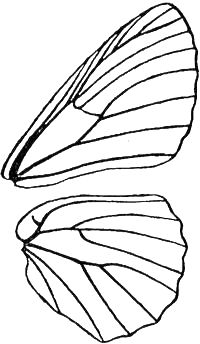 Fig. 90.—Neuration
of the genus Brenthis,
enlarged.
Fig. 90.—Neuration
of the genus Brenthis,
enlarged.
(1) Brenthis myrina, Cramer, Plate XV, Fig. 1, ♂; Fig. 2,
♂, under side; Plate V, Figs. 12-14, chrysalis (The Silver-bordered
Fritillary).
Butterfly.—The upper side of the wings is fulvous; the black
markings are light, the borders heavy. The fore wings on the
under side are yellowish-fulvous, ferruginous at the tip, with the
marginal spots lightly silvered. The hind wings are ferruginous,
mottled with buff. The spots, which are small, are well silvered.
Expanse, ♂, 1.40 inch; ♁, 1.70 inch.
Egg.—The egg is conoidal, about one third higher than wide,
marked by sixteen or seventeen vertical ribs, between which are
a number of delicate cross-lines. It is pale greenish-yellow in
color.
Caterpillar.—The caterpillar has been carefully studied, and
its various stages are fully described in "The Butterflies of New
England," by Dr. Scudder. In its final stage it is about seven
eighths of an inch long, dark olive-brown, marked with green,
the segments being adorned with fleshy tubercles armed with
needle-shaped projections, the tubercles on the side of the first
thoracic segment being four times as long as the others, cylindrical
in form, and blunt at the upper end, the spines projecting
upward at an angle of forty-five degrees to the axis of the tubercle.
Chrysalis.—The chrysalis is yellowish-brown, spotted with
darker brown spots, those of the thoracic and first and second
abdominal segments having the lustre of mother-of-pearl.
This very pretty little species has a wide range, extending
from New England to Montana, from Nova Scotia to Alaska, and
southward along the ridges of the Alleghanies into Virginia and
the mountains of North Carolina.
(2) Brenthis triclaris, Hübner, Plate XV, Fig. 3, ♂ (Hübner's
Fritillary).
Butterfly, ♂.—The male above is bright fulvous, with the
base of the fore wings and the inner margin of the hind wings
heavily obscured with blackish scales. The usual dark markings
are finer than in the preceding species; the black marginal borders
are not so heavy. The submarginal spots are relatively large and
distinct in most specimens, and uniform in size. The light spots
of the under side of the median band of the hind wings show
through from below on the upper side lighter than the ground-color
of the wings. On the under side the fore wings are fulvous,
tipped with ferruginous. The hind wings are broadly ferruginous,
with a couple of bright-yellow spots near the base and a
curved band of yellow spots crossing the median area. The
outer margin about the middle is marked with pale fulvous.
The spots on the under side are none of them silvered.
♁.—The female is much paler than the male in most cases,
and the marginal spots within the lunules are very pale, almost
white. The submarginal row of round black spots is relatively
large and distinct, quite uniform in size. On the under side the
wings are much more conspicuously marked on the secondaries
than in the male sex, being crossed by three conspicuous bands
of irregularly shaped yellow spots, one at the base and one on
either side of the discal area. The submarginal round spots of
the upper side reappear on the under side as small, slightly
silvered, yellow spots. The marginal spots are bright yellow,
slightly glossed with silver. Expanse, ♂, 1.50 inch; ♁, 1.60 inch.
Early Stages.—Unknown.
This extremely beautiful little species is found throughout
arctic America, is not uncommon in Labrador, and also occurs
upon the loftier summits of the Rocky Mountains in Colorado
and elsewhere. It is, as most species of the genus, essentially
arctic in its habits.
(3) Brenthis helena, Edwards, Plate XVIII, Fig. 16, ♂,
under side; Fig. 17, ♂ (Helena).
Butterfly, ♂.—The wings on the upper side are fulvous,
greatly obscured by brown at the base of the fore wings and
along the inner margin of the hind wings. The usual black
markings are light, and the marginal border is also not so heavily
marked as in B. myrina. The fore wings on the under side are
pale fulvous, laved with ferruginous at the tip. The hind wings
are brightly ferruginous, with small yellow marginal spots, and
paler spots inclining to buff on the costal border and at the end
of the cell, about the region of the median nervules.
♁.—The female is very much like the male on the upper
side, but the ground-color is paler. On the under side the
wings are somewhat paler, and all the spots and light markings,
especially on the secondaries, are far more conspicuous, being
bright yellow, and standing out very prominently upon the dark
ferruginous ground. Expanse, 1.40 inch.
Early Stages.—The early stages of this insect are not as yet
known.
Helena appears to be a common species in Colorado, Montana,
and New Mexico. It is subject to considerable variation,
both in the intensity of the coloring of the under side of the
wings, and in the distinctness of the maculation.
(4) Brenthis montinus, Scudder, Plate XV, Fig. 7, ♂; Fig.
8, ♁, under side (The White Mountain Fritillary).
Butterfly, ♂.—The upper side is fulvous, closely resembling B.
chariclea, but the ground-color is darker. The under side of the
hind wings is deep ferruginous, mottled with white, the most
conspicuous of the white spots being a white bar occurring at the
end of the cell, and a small round white spot at the base of the
wing. The hind wings have also a marginal row of slightly silvered
white spots.
♁.—The female is very much like the male, but the ground-color
of the upper side is paler. Expanse, ♂, 1.50 inch; ♁, 1.75 inch.
This interesting butterfly is found on the barren summits of
Mount Washington, New Hampshire. It represents the survival
of the arctic fauna on these desolate peaks, and, like the arctic
flora of the spot where it is found, is a souvenir of the ice-age,
which once shrouded the northeastern regions of the United
States with glaciers.
(5) Brenthis chariclea, Schneider, Plate XV, Fig. 4, ♂
(Chariclea).
Butterfly, ♂.—Fulvous on the upper side, with heavy black
markings, both wings greatly obscured at the base by fuscous.
On the under side the fore wings are pale yellowish-fulvous,
mottled with ferruginous at the tip and on the outer margin.
The hind wings on the under side are dark purplish-ferruginous,
mottled with yellow, crossed by a central row of conspicuous
yellow spots. The row of marginal spots and two or three small
spots at the base are white, slightly silvered.
♁.—The female differs from the male in having the markings
of the upper side darker and heavier, and the outer margins more
heavily marked with black, and having all the spots on the under
side more distinctly defined against the dark ground. Expanse,
♂, 1.50 inch; ♁, 1.75 inch.
Early Stages.—Undescribed.
This species, like B. freija, is circumpolar, being found in Lapland,
Greenland, and throughout arctic America. It also occurs
within the limits of the United States, in the Yellowstone Park at
considerable elevations, and is not uncommon on the high mountains
in British Columbia, numerous specimens having been captured
in recent years about Banff and Laggan, in Alberta.
(6) Brenthis boisduvali, Duponchel, Plate XV, Fig. 5. ♂;
Fig. 6, ♁, under side (Boisduval's Fritillary).
Butterfly.—Somewhat closely resembling B. chariclea, but
with the markings much heavier on the outer margin, and the
base of the wings generally more deeply obscured with dark
brown. The wings on the under side in color and marking
closely approximate those of B. chariclea, and I have been unable
to distinguish the specimens marked as boisduvali, and contained
in the Edwards collection, from the specimens designated as B. chariclea
in the same collection, so far as the color and maculation
of the under sides of these specimens are concerned. Expanse,
♂, 1.50 inch; ♁, 1.75 inch.
Early Stages.—Unknown.
This species, originally described from Labrador, is found
throughout boreal America and British Columbia.
(7) Brenthis freija, Thunberg, Plate XV, Fig. 9, ♂; Fig. 10,
♁, under side (The Lapland Fritillary).
Butterfly.—The wings are pale fulvous, the fore wings at the
base and the hind wings on the inner half being deeply obscured
with fuscous. The markings are quite heavy. The fore wings
on the under side are very pale fulvous, yellowish at the tip,
mottled with ferruginous. The hind wings are ferruginous on
the under side, mottled with yellow. The spots are quite large,
consisting of lines and dashes, and a marginal row of small lunulate
spots, pale yellow or white, slightly silvered. Expanse,
1.50 inch.
This butterfly is circumpolar, being found in Norway, Lapland,
northern Russia, and Siberia, through Alaska, British
America, and Labrador, occurring also upon the highest peaks
of the Rocky Mountains as far south as Colorado.
(8) Brenthis polaris, Boisduval, Plate XV, Fig. 11, ♂;
Fig. 12, ♂, under side (The Polar Fritillary).
Butterfly.—The upper side dull fulvous; the markings on the
inner half of the wings are confluent, and lost in the brownish
vestiture which obscures this portion of the wing. The outer
median area is defined by irregular zigzag spots which flow together.
Beyond these the submarginal row of small black spots
stands out distinctly upon the lighter ground-color of the wings.
The outer margin is marked by black spots at the end of the
nervules, on the fore wings somewhat widely separated, on the
hind wings narrowly separated by the lighter ground-color. On
the under side the wings are fulvous, with a marginal row of
white checkerings on both wings. The hind wing is deeply
mottled with ferruginous, on which the lighter white markings
stand forth very conspicuously. Expanse, ♂, 1.50 inch.; ♁,
1.50-2.00 inches.
Early Stages.—Unknown.
This butterfly has been found in Labrador, Greenland, and
other portions of arctic America, as far north as latitude 81° 52´.
(9) Brenthis frigga, Thunberg, Plate XV, Fig. 13, ♂; Fig.
14, ♁, lower side (Frigga).
Butterfly, ♂.—On the upper side this butterfly somewhat
closely resembles polaris, but the markings are not so compact—more
diffuse. The fore wings at the base and the hind wings
on the inner two thirds are heavily obscured with brown. The
outer margins are more heavily shaded with blackish-brown than
in B. polaris. On the under side the wings are quite differently
marked. The fore wings are fulvous, shaded with brown at the
tips, and marked with light yellow on the interspaces beyond
the end of the cell. The hind wings are dark ferruginous, shading
into purplish-gray on the outer margin, with a whitish quadrate
spot on the costa near the base, marked with two dark
spots, and a bar of pale, somewhat obscured spots, forming an
irregular band across the middle of the hind wings.
♁.—The female does not differ greatly from the male, except
that the spots on the under side of the hind wings stand forth
more conspicuously, being lighter in color and better defined.
Expanse, 1.65-2.00 inches.
This pretty little butterfly occurs in Labrador, across the continent
as far west as northern Alaska, and is also occasionally
taken upon the alpine summits of the Rocky Mountains as far
south as Colorado.
(10) Brenthis bellona, Fabricius, Plate XV, Fig. 16, ♂; Plate
V, Fig. 10, chrysalis, side view; Fig. 11, chrysalis, side view
(Meadow Fritillary).
Butterfly.—Pale fulvous on the upper side, with the dark
markings on the inner half of the wing narrow, but more or less
confluent. The dark markings on the outer part of the wing are
slighter. The fore wings are a little angled on the outer margin
below the apex. On the under side the fore wings are pale fulvous,
mottled with purple at the tip and on the outer margin.
The hind wings on this side are ferruginous, mottled with
purple. Expanse, 1.65-1.80 inch.
Egg.—The egg of this species is similar in form, size, color,
and markings to the egg of B. myrina.
Caterpillar.—The caterpillar also in its early stages closely resembles
myrina, but in its mature form it differs in not having the
spines on the second segment of the body lengthened as in that
species.
Chrysalis.—The chrysalis, which is represented in Plate V, is
bluish-gray in color, marked with dark spots. The life-history
has been given us by several authors.
This butterfly is very common in the whole of the northern
United States, as far south as the mountain-ranges of Virginia,
and occurs throughout Quebec, Ontario, and British America, as
far west as the foot-hills of the Rocky Mountains. It flies commonly
with B. myrina, the only other species of the genus found in the
densely populated portions of our territory, from which it may be
at once distinguished by the entire absence of the silvered markings
which make B. myrina so bright and attractive.
(11) Brenthis epithore, Boisduval, Plate XV, Fig. 17, ♂;
Fig. 18, ♂, under side (Epithore).
Butterfly.—This species on the upper side is pale fulvous, with
the markings slighter than in B. bellona, and the inner half of the
hind wings much more heavily clouded with fuscous. On the
under side the wings are somewhat like those of B. bellona, but
less purple and mottled more distinctly with yellow. Expanse,
♂, 1.50 inch; ♁, 1.85 inch.
Early Stages.—Undescribed.
This species appears to replace B. bellona, its close ally, in
California, Oregon, and the States eastward as far as parts of
Colorado.
(12) Brenthis alberta, Edwards, Plate XV, Fig. 15, ♂ (Alberta).
Butterfly.—This, the least attractive in appearance of the
species composing the genus, has pale wings with a "washed-out"
appearance on the upper side, almost all the dark markings
being greatly reduced or obliterated. On the under side the wings
are even more obscurely marked than on the upper side. The female
is darker than the male, and specimens have a greasy look.
Expanse, ♂, 1.55 inch; ♁, 1.65-1.75 inch.
Early Stages.—Unknown, except the egg and the young
caterpillar, which have been most beautifully figured by Edwards
in vol. iii of "The Butterflies of North America." The only
locality from which specimens have as yet been received by collectors
is Laggan, in Alberta, where the species apparently is not
uncommon at lofty elevations above sea-level.
(13) Brenthis astarte, Doubleday and Hewitson, Plate XVIII,
Fig. 14, ♂; Fig. 15, ♁, under side (Astarte).
Butterfly.—This rare insect, the largest of the genus, may at
once be distinguished from all others by the very beautiful markings
of the under side of the hind wings, crossed by a band of
irregular, bright-yellow spots, which are narrowly edged with
black, and beyond the black bordered by red. Expanse, ♂, 2.00
inches; ♁, 2.15 inches.
Early Stages.—Unknown.
The first description and figure of this insect were given by
Doubleday and Hewitson in their large and now very valuable
work on "The Genera of Diurnal Lepidoptera." They correctly
attributed it to the Rocky Mountains, but Kirby afterward
gave Jamaica as its habitat, and this led to its subsequent redescription
by Edwards under the name Victoria. It is a rare species
still, having been received only from Laggan, Alberta, where it
was rediscovered by that most indefatigable collector and observer,
Mr. T.E. Bean. It frequents the highest summits
of the lofty mountains about this desolate locality. Mr. Bean
says: "Astarte seems always on the lookout for an entomologist,
whose advent is carefully noted, and at any approach of
such a monster nearer than about fifteen feet, its wings rise to
half-mast, vibrate there a doubtful instant, and away goes the
butterfly."
In addition to the thirteen species figured in our plates there
are two other species of the genus, B. butleri, Edwards, from
Grinnell Land, and B. improba, Butler, from near the arctic circle.
It is not likely that many of the readers of this book will encounter
these insects in their rambles, and if they should, they will be able
to ascertain their names quickly, by conferring with the author.
SUSPICIOUS CONDUCT
The entomologist must not expect to be always thoroughly
understood. The ways of scientific men sometimes appear
strange, mysterious, bordering even upon the insane, to those
who are uninitiated. A celebrated American naturalist relates
that on one occasion, when chasing butterflies through a meadow
belonging to a farmer, the latter came out and viewed him with
manifest anxiety. But when the nature of the efforts of the man
of science had been finally explained, the farmer heaved a sigh
of relief, remarking, in Pennsylvania Dutch, that "he had surely
thought, when he first saw him, that he had just escaped from a
lunatic asylum." The writer, a number of years ago, after having
despatched a very comfortable lunch, sallied forth one afternoon,
in quest of insects, and in the course of his wanderings came
upon a refuse-heap by the roadside, opposite a substantial house,
and on this heap discovered an ancient ham, which was surrounded
by a multitude of beetles of various species known to
be partial to decomposed, or semi-decomposed, animal matter.
He proceeded immediately to bottle a number of the specimens.
While engaged in so doing, the window of the house across the
way was thrown up, and an elderly female thrust her head out,
and in strident voice exclaimed: "Hey, there! What are you
doin' with that ham? I say, don't you know that that ham is
spiled?" As he paid no attention to her, she presently appeared
at the door, came across the street, and remarked: "See here,
mister; that ham's spiled; Lucy and me throwed it out, knowin'
it was no good. If you want a good meal of wittles, come into
the house, and we will feed you, but for mercy's sake leave that
spiled ham alone." It took considerable effort to assure her that
no designs upon the ham were cherished, and she went away,
evidently completely mystified at the wild conduct of the well-dressed
man who was grubbing in the rubbish-pile.
Genus MELITÆA, Fabricius
(The Checker-spots)
"The fresh young Flie,...
... joy'd to range abroad in fresh attire,
Through the wide compass of the ayrie coast;
And, with unwearied wings, each part t'inquire
Of the wide rule of his renowned sire."
Spenser.
Butterfly.—Small. The tibiæ and the tarsi of the mesothoracic
and metathoracic legs are more lightly armed with spines than in
the genera Argynnis and Brenthis. The palpi are not swollen.
They are clothed with long hairs and have the third joint finely
pointed. The antennæ are about half as long as the costa of the
fore wings, and are provided with a short, heavy, excavated, or
spoon-shaped club. The subcostal of the fore wings is five-branched,
the first nervule always arising before the end of the
cell, the second at the end or just beyond it. The cell of the primaries
is closed, of the secondaries open. The markings upon the
wings are altogether different from those in the two preceding
genera, and the spots on the under side of the wings are not
silvered, as in the genus Brenthis.
Egg.—The egg is rounded at the base, subconical, truncated,
and depressed at the upper end and fluted by light raised ridges
(see p. 4, Fig. 8).
Caterpillar.—The larvæ are cylindrical, armed in the mature
form on each segment with comparatively short spines thickly
covered with diverging hairs, or needle-shaped
spines. They are known in some species to
be gregarious in their early stages, and then
to separate before maturity. They feed upon
the Scrophulariaceæ, upon Castileja, Diplopappus,
and other plants.
Chrysalis.—The chrysalis is pendant,
rounded at the head, provided with more or
less sharply pointed tubercles on the dorsal
surface, and generally white or some shade
of light gray, blotched with brown or black,
and marked with reddish or orange spots
on the dorsal side.
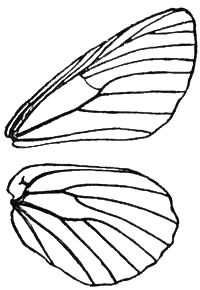 Fig. 91.—Neuration
of the genus Melitæa.
Fig. 91.—Neuration
of the genus Melitæa.
This genus is very large and is distributed widely over all the
colder portions of the north temperate zone. There are many
species found in Europe, in Siberia, in China, and in the northern
islands of Japan. On the upper slopes of the Himalayas it is also
represented by a few species. In North America the genus is
well represented, the most of the species being found upon the
mountain-slopes and in the valleys of the Pacific coast region.
Only two species occur in the Eastern States.
(1) Melitæa phaëton, Drury, Plate XVI, Fig. 1, ♂; Plate V,
Figs. 15, 16, chrysalis (The Baltimore).
Butterfly, ♂.—The upper side is black, with a marginal row
of red spots, followed by three rows of pale-yellow spots on the
fore wings and two on the hind wings. Besides these there are
some large red spots on the cells of both wings, a large red spot
about the middle of the costa of the hind wing, and a few scattering
yellow spots, forming an incomplete fourth row on the
fore wing and an incomplete third row on the hind wing. On
the under side all the spots of the upper side reappear, but heavier
and more distinct, and on the hind wings there are two additional
rows of yellow spots, and a number of irregular patches of red
and yellow at the base of both wings.
♁.—The female is much like the male. Expanse, ♂, 1.75-2.00
inches; ♁, 2.00-2.60 inches.
Egg.—The egg which is outlined upon p. 4, Fig. 8, is
brownish-yellow when first laid, then changes to crimson and
becomes black just before hatching. The eggs are laid by the
female in large clusters on the under side of the leaf of the food-plant.
Caterpillar.—The life-history in all the stages will be found
minutely described by Edwards in "The Butterflies of North
America," vol. ii, and by Scudder in "The Butterflies of New
England," vol. i. The mature larva is black, banded with
orange-red, and beset with short, bristly, black spines. Before
and during hibernation, which takes place after the third moult,
the caterpillars are gregarious, and construct for themselves a
web in which they pass the winter. After the rigors of winter
are past, and the food-plant, which is commonly Chelone glabra,
begins to send up fresh shoots, they recover animation, scatter,
and fall to feeding again, and after the fifth moult reach maturity.
Chrysalis.—The chrysalis is pendant, formed generally at a
considerable distance from the spot where the caterpillar feeds,
for the larvæ wander off widely just before pupation. It is pearly-gray,
blotched with dark brown in stripes and spots, with some
orange markings.
This very beautiful butterfly is quite local, found in colonies in
swampy places where the food-plant grows, but in these spots
sometimes appearing in swarms. It occurs in the northern portions
of the United States and in Canada, extending as far north
as the Lake of the Woods, and as far south as West Virginia. It
does not occur west of the Rocky Mountains.
(2) Melitæa chalcedon, Doubleday and Hewitson, Plate
XVI, Fig. 2, ♂ (Chalcedon).
Butterfly.—The male and female are much alike. The wings
are black, spotted with red and ochreous-yellow. On the under
side they are brick-red, with the spots of the upper side repeated,
and in addition at the base a number of large and distinct yellow
spots. Expanse, ♂, 1.75-2.00 inches; ♁, 2.50 inches.
Early Stages.—For a knowledge of these the reader may consult
Edwards, "The Butterflies of North America," vol. i, and
"Papilio," vol. iv, p. 63; Wright, "Papilio," vol. iii, p. 123, and
other authorities. The egg is pale yellowish when first laid,
pitted at the base, and ribbed vertically above. The caterpillar is
black, with the bristling processes on the segments longer than
in the preceding species. The chrysalis is pale gray, blotched
with brown. The food-plants are Mimulus and Castileja.
This very pretty species is apparently quite common in northern
California about Mount Shasta. It is subject to variation, and I
possess a dozen remarkable aberrations, in one of which the fore
wings are solid black without spots, and the hind wings marked
by only one central band of large yellow spots; another representing
the opposite color extreme, in which yellow has almost
wholly replaced the black and red. The majority of these aberrant
forms are females. They are very striking.
(3) Melitæa macglashani, Rivers, Plate XVI, Fig. 3, ♂
(Macglashan's Checker-spot).
Butterfly.—Larger than the preceding species, with the red
spots on the outer margin bigger, the yellow spots generally larger
and paler. Expanse, ♂, 1.85-2.00 inches; ♁, 2.25-3.00 inches.
Early Stages.—Unknown.
This insect is represented in the Edwards collection by a considerable
series. They come from Truckee, California.
(4) Melitæa colon, Edwards, Plate XVI, Fig. 5, ♂ (Colon).
Butterfly.—Of the same size and general appearance as M.
chalcedon, with which I believe it to be identical, the only possible
satisfactory mark of distinction which I am able to discover
on comparing the types with a long series of chalcedon being
the reduced size of the marginal row of yellow spots on the
upper side of the primaries, which in one of the types figured in
the plate are almost obsolete. They appear, however, in other
specimens labeled "Type." The learned author of the species
lays stress, in his original description, upon the shape of the spots
composing the band of spots second from the margin on the
under side of the hind wings; but I find that the same points he
dwells upon as diacritic of this species are apparent in many
specimens of what undoubtedly are chalcedon. Expanse, 1.75-2.50
inches.
Early Stages.—These have not been recorded.
The types came from the region of the Columbia River, in
Washington and Oregon.
(5) Melitæa anicia, Doubleday and Hewitson, var. beani,
Skinner, Plate XVIII, Fig. 13, ♂ (Bean's Checker-spot).
Butterfly.—M. anicia is a well-known Californian species,
smaller than M. chalcedon, and with a great deal of red on the
basal and discal areas of both wings upon the upper side. An
extremely small and dark form of this species, found on the bleak,
inhospitable mountain-tops about Laggan, in Alberta, has been
named by Dr. Skinner in honor of Mr. Bean, its discoverer. The
figure in our plate, which is taken from Dr. Skinner's original
type, sufficiently defines the characteristics of the upper surface.
Expanse, 1.50 inch.
Early Stages.—The early stages of M. anicia and its varietal
forms are quite unknown.
M. anicia is found in Colorado, Montana, Washington, and
British America.
(6) Melitæa nubigena, Behr, Plate XVI, Fig. 6, ♂; var.
wheeleri, Edwards, Plate XVI, Fig. 9, ♂ (The Clouded Checker-spot).
Butterfly.—Smaller than any of the foregoing species, and
characterized by the much redder ground-color of the upper side
of the wings, an extreme form being the variety M. wheeleri, in
which the black ground-color is greatly reduced and almost
wholly obliterated on parts of the primaries. There are other
marks of distinction given in the figures in the plate which will
enable the student easily to recognize this species, which is subject
to much variation, especially in the female sex. Expanse,
1.20-1.50 inch.
Early Stages.—Mead, in the "Report upon the Lepidoptera of
the Wheeler Survey," has described the caterpillar and chrysalis.
The species is common in Nevada.
(7) Melitæa augusta, Edwards, Plate XVI, Fig. 4, ♂ (Augusta).
Butterfly,.—This is another species in which red predominates
as the color of the upper side, but it may at once be distinguished
by the broad, clear red band on the secondaries, on either side of
which are the marginal and outer median rows of yellow spots,
and by the bands of yellow spots on the primaries, which are not
so well marked in M. nubigena. Expanse, ♂, 1.50-1.75 inch;
♁, 1.75-2.00 inches.
Early Stages.—Unknown.
The habitat of this species is southern California.
(8) Melitæa baroni, Henry Edwards, Plate XVI, Fig 7, ♂
(Baron's Checker-spot).
Butterfly.—This species closely resembles chalcedon upon the
upper side, but is smaller and much more heavily spotted with deep
red on the upper side toward the base and on the median area of
the wings. The bands of light spots on the under side are paler
than in chalcedon, being white or very pale yellow, narrow, and
more regular. Expanse, ♂, 1.50-1.80 inch; ♁, 1.60-1.90 inch.
Early Stages.—These are in part given by Edwards, "The
Butterflies of North America," vol. iii. The food-plant is Castileja.
The young larvæ have the same habit as those of M. phaëton in
the matter of spinning a common web in which to hibernate.
The species is found in northern California.
(9) Melitæa rubicunda, Henry Edwards, Plate XVI, Fig. 10,
♂ (The Ruddy Checker-spot).
Butterfly.—Of the same size as M. baroni, from which it is
most easily distinguished, among other things, by the tendency of
the outer row of small yellow spots near the margin of the hind
wings on the upper side to become greatly reduced, and in a majority
of specimens to be altogether wanting, as in the specimen
figured in our plate. Expanse, ♂, 1.50-1.60 inch; ♁, 1.80 inch.
Early Stages.—For a knowledge of what is thus far known of
these the reader may consult the "Canadian Entomologist," vol.
xvii, p. 155. The caterpillar feeds on Scrophularia.
The range of this species is in northern California.
(10) Melitæa taylori, Plate XVI, Fig. 16, ♂ (Taylor's
Checker-spot).
Butterfly.—This insect resembles M. baroni, but is smaller,
the red spots on the wings are larger and more conspicuous, and
the light bands of pale spots more regular and paler in color, in
many specimens being quite white. It looks at first sight like a
diminutive edition of Baron's Checker-spot, and possibly is only
a northern race of this species. Expanse, ♂, 1.25-1.50 inch; ♁,
1.50-1.75 inch.
Early Stages.—Mr. W.H. Danby of Victoria, B.C., informs us
in the "Canadian Entomologist," vol. xxi, p. 121, that the food-plant
of this species is the ribwort-plantain (Plantago lanceolata,
Linn.).
It is found on Vancouver's Island.
(11) Melitæa editha, Boisduval, Plate XVI, Fig. 8, ♂ (Editha).
Butterfly.—Characterized by the considerable enlargement and
the disposition in regular bands of the pale spots on the upper side
of the primaries, and by the tendency to a grayish cast in the darker
markings of the upper side, some specimens, especially females,
being quite gray. Expanse, ♂, 1.50 inch; ♁, 2.00 inches.
Early Stages.—The food-plants, according to Henry Edwards,
who described the caterpillar and chrysalis in the "Canadian
Entomologist," vol. v, p. 167, are Erodium cicutarium, clover,
and violets.
The habitat of this species is southern California.
(12) Melitæa acastus, Edwards, Plate XVI, Fig. 11, ♂; Fig.
12, ♂, under side (Acastus).
Butterfly.—With thinner and less robust wings than any of the
species of the genus hitherto mentioned. It is prevalently fulvous
upon the upper side, and on the under side of the hind wings
heavily and somewhat regularly banded with yellowish-white
spots, possessing some pearly luster. Expanse, ♂, 1.50 inch;
♁, 1.60 inch.
Early Stages.—Unknown.
Common in Nevada, Utah, and Montana.
(13) Melitæa palla, Boisduval, Plate XVI, Fig. 13, ♂; Fig.
14, ♂, under side (The Northern Checker-spot).
Butterfly.—On the upper side resembling the preceding species,
but with the median band of spots on the hind wings paler.
On the under side the markings are different, as is shown in
the plate. Expanse, ♂, 1.50 inch; ♁, 1.75 inch.
Early Stages.—The larva and chrysalis were described by
Henry Edwards, the actor naturalist, in the "Proceedings of the
California Academy of Sciences," vol. v, p. 167. The food-plant
is Castileja.
The species ranges from California to Colorado, and northward
into British Columbia.
(14) Melitæa whitneyi, Behr, Plate XVII, Fig. 7, ♂; Fig. 8,
♂, under side (Whitney's Checker-spot).
Butterfly.—The markings are much as in M. palla, the spots
are lighter fulvous and larger than in that species, the yellow
bands on the under side are more prominent, and the marginal
spots have a silvery luster which is lacking in M. palla. The
female has the yellow of the under side more prominent than is
the case in the male sex. Expanse, ♂, 1.50 inch; ♁, 1.70 inch.
Early Stages.—Altogether unknown.
Whitney's Checker-spot ranges from California into Nevada.
(15) Melitæa hoffmanni, Behr, Plate XVII, Fig. 13, ♂; Fig.
14, ♁, aberration (Hoffmann's Checker-spot).
Butterfly, ♂.—General style of marking much as in the two
preceding species, but with the basal area black, and the black
markings toward the outer margin not so heavy, giving it here
a more fulvous appearance. The median bands on both wings
are broader and paler than in M. palla. The under side is much
as in the last-mentioned species, but the yellow markings are
more prominent.
♁.—Much like the male. Expanse, ♂, 1.35 inch; ♁, 1.45
inch.
Early Stages.—Unknown.
This species, which is found in California and Nevada, is
subject to extreme variation, and I have placed upon the plate
one out of many beautiful and singular aberrations which I
possess.
(16) Melitæa gabbi, Behr, Plate XVI, Fig. 15, ♂ (Gabb's
Checker-spot).
Butterfly.—In the style of its markings on the upper side it
almost completely resembles M. acastus, but the dark markings
are slighter, giving the wings a more fulvous appearance. On
the under side the bands are narrower, defined more sharply
with black, and pearly, almost silvery white, whereas in acastus
they are pale yellowish-white, and not so lustrous. Expanse, ♂,
1.20 inch; ♁, 1.50 inch.
Early Stages.—Unknown.
The habitat of this species is southern California.
(17) Melitæa harrisi, Scudder, Plate XVII, Fig. 5, ♂; Fig.
6, ♁, under side; Plate V, Figs. 17-18, chrysalis (Harris'
Checker-spot).
Butterfly, ♂.—Wings fulvous, black at the base and on the
outer margin, with five fulvous spots in the cell of the fore wing,
two below the cell; and three in the cell of the hind wing.
The black border is widest at the apex of the fore wing, and below
this runs inwardly on the veins. There are two white spots
near the apex. At the anal angle on the hind wing the border
is somewhat divided so as to present the appearance of two indistinct
lines. On the under side the wings are fulvous, marked
with black bands and spots, and crossed by bands and crescents
of pale yellow, as is shown in the figure on the plate.
♁.—The female is much like the male. Expanse, ♂, 1.50
inch; ♁, 1.75 inch.
Egg.—The eggs are lemon-yellow, in the form of a truncated
cone, with fifteen or sixteen vertical ribs, which are highest
about the middle.
Caterpillar.—The matured caterpillar is reddish-fulvous, with
a black stripe on the back. Each segment is marked with one
black ring before and two black rings behind the sets of spiny
tubercles with which the segments are adorned. There are nine
rows of spines, those above the feet being quite small. The
spines are black, tapering, and set with diverging black hairs.
The food-plants are aster and Diplopappus umbellatus.
Chrysalis.—The chrysalis is pearly-gray or white, blotched
with dark brown or black.
This choice little butterfly ranges from Nova Scotia to Wisconsin,
extending as far south as northern Illinois, and northward
to Ottawa.
(18) Melitæa elada, Hewitson, Plate XVII, Fig. 2, ♂
(Hewitson's Checker-spot).
Butterfly, ♂.—The wings on the upper side are black, crossed
by numerous bands of small fulvous spots, the one crossing
the middle of the median area being composed of the largest
spots. The fore wings on the under side are fulvous, shading
outwardly into ferruginous. The spots and bands of the upper
side reappear upon the under side, but are lighter, and the submarginal
row of crescents is pale yellow and very distinct, the
spot between the second and third median nervules being the
largest, and the spot between the fourth and fifth subcostals
being only a little smaller. The under side of the hind wings is
deep ferruginous, crossed by bands of pearly pale-yellow spots,
those of the outer margin being the largest.
♁.—The female is much like the male, with the ground-color
a little paler. Expanse, ♂, .90 inch; ♁, 1.00-1.10 inch.
Early Stages.—Unknown.
This little species is found in western Texas, Arizona, and
northern Mexico.
(19) Melitæa dymas, Edwards, Plate XVI, Fig. 18, ♁
(Dymas).
Butterfly.—This species is closely related in size and the style
of some of the markings to the foregoing species, but may be
at once distinguished by the lighter ground-color, which is pale
fulvous, and the totally different style of the marginal markings
on the under side of the wings. The female represented in the
plate is a trifle paler than the male. Expanse, ♂, .85 inch; ♁,
1.00 inch.
Early Stages—Unknown.
The habitat of this species is southwestern Texas.
(20) Melitæa perse, Edwards, Plate XVI, Fig. 19, ♂
(Perse).
Butterfly.—This is nearly related to the two foregoing species,
but the ground-color is darker fulvous than in dymas, the markings
are slight as in that species, and the arrangement of the
spots and bands on the under side is similar. The marginal
crescents on the under side of the primaries are largest at the
apex and rapidly diminish in size, vanishing altogether about
the middle of the wing. Expanse, ♂, 1.00 inch; ♁, 1.10 inch.
Early Stages.—These remain to be discovered.
The only specimens so far found have come from Arizona.
(21) Melitæa chara, Edwards, Plate XVII, Fig. 3, ♂; Fig.
4, ♂, under side (Chara).
Butterfly.—No lengthy description of this pretty little species
is required, as the plate, which gives both sides of the wings,
shows their peculiarities with sufficient accuracy to enable an
exact determination to be made. The whitish spot on the costa
before the apex on the upper side, and the chalky-white markings
and spots on the under side, serve at once to distinguish
this form from its near allies. Expanse, ♂, 1.00 inch; ♁, 1.25
inch.
Early Stages.—Unknown.
I have a large series of this species, all from Arizona, where
it appears to be common.
(22) Melitæa leanira, Boisduval, Plate XVI, Fig. 20, ♁
(Leanira).
Butterfly, ♂.—Ground-color brownish-black, fulvous on the
costa, with submarginal, median, and basal rows of yellow spots.
Both the primaries and secondaries have a marginal row of red
spots, and the former have in addition a submarginal row of such
spots. The under side of the primaries is reddish-fulvous, with
the markings of the upper side reproduced. The secondaries
have a marginal row of yellow crescents, then a black band inclosing
yellow spots, then a median band of long yellow crescents.
The remainder of the wing to its insertion is black, spotted
with yellow.
♁.—Much like the male. Expanse, ♂, 1.50 inch; ♁, 1.75 inch.
Early Stages.—Unknown.
This pretty insect ranges from southern California and Arizona
to Nevada, Montana, and British America.
(23) Melitæa wrighti, Edwards, Plate XVII, Fig. 9, ♂; Fig.
10, ♁, under side, (Wright's Checker-spot).
Butterfly.—Much like M. leanira, but with more fulvous upon
the upper side of the wings, and the under side yellow. The
black bands on the secondaries are reduced, and the dividing-lines
between the spots are confined to the nervules, which are
narrowly black. This is probably only a varietal form of the
preceding species. I figure the types. Expanse, ♂, 1.30 inch;
♁, 1.80 inch.
Early Stages.—Unknown.
Habitat, southern California.
(24) Melitæa alma, Strecker, Plate XVII, Fig. 1, ♂ (Strecker's
Checker-spot).
Butterfly, ♂.—The upper side of the wings is bright fulvous,
with the margins and veins black. There are three rows of
transverse spots paler than the ground-color. The fore wings on
the under side are pale fulvous, with pale-yellow spots and a submarginal
and marginal row of yellow spots separated by a narrow
black line. The hind wings on this side are yellow, with the
veins and margins black, and a transverse double band of black
on the outer margin of the median area.
♁.—Much like the male, but larger, and redder on the upper
side. Expanse, ♂, 1.25 inch; ♁, 1.50 inch.
Early Stages.—Unknown.
The specimens I have came from the Death Valley. The species
occurs in southern Utah and Arizona.
(25) Melitæa thekla, Edwards, Plate XVII, Fig. 15, ♂, under
side; Fig. 16, ♂ (Thekla).
Butterfly, ♂.—The upper side of the wings is fulvous, black
toward the base and on the outer margin. The primaries are
adorned with a large oval pale-fulvous spot at the end of the cell,
a small one on the middle of the upper side of the cell, and another
small one below the cell, at the origin of the first median nervule.
The discal area is defined outwardly by a very irregular fine black
transverse line, beyond which is a transverse band of pale-fulvous
oblong spots, an incomplete series of spots of the ground-color
sharply defined upon the black outer shade, followed by a row of
irregular white submarginal spots. The transverse bands of spots
on the primaries are repeated upon the secondaries, where they
are more regular and the spots more even in size. On the under
side both wings are pale red, with the light spots of the upper side
reappearing as pale-yellow sharply defined spots. The fringes are
checkered black and white.
♁.—Much like the male, but larger. Expanse, ♂, 1.35-1.50
inch; ♁, 1.50-1.75 inch.
Early Stages.—Unknown.
This species is common in Texas. It is identical, as an examination
of the type shows, with M. bolli, Edwards, and the
latter name as a synonym falls into disuse.
(26) Melitæa minuta, Edwards, Plate XVII, Fig. 11, ♂,
under side; Fig. 12, ♂ (The Smaller Checker-spot).
Butterfly, ♂.—This species is fulvous on the upper side, rather
regularly banded with black lines. The veins are also black. The
result is that the wings appear to be more regularly checkered than
in any other species which is closely allied to this. The markings
of the under side are white edged with black, and are shown very
well in the plate, so that a lengthy description is unnecessary.
Expanse, ♂, 1.25-1.35 inch; ♁, 1.50-1.60 inch.
Early Stages.—Unknown.
The specific name, minuta, is not altogether appropriate.
There are many smaller species of the genus. It is found rather
commonly in Colorado, Arizona, and New Mexico.
(27) Melitæa arachne, Edwards, Plate XVI, Fig. 22, ♁
(Arachne).
Butterfly.—I have given in the plate a figure of a female bearing
this name in the Edwards collection. It is remarkably pale
on the upper side. There is a large series of types and paratypes
in the collection, but all of them vary on the upper side of the
wings in the intensity of the fulvous ground-color and the width
of the black markings. Underneath they are absolutely like M.
minuta. I think M. arachne is without much doubt a synonym
for M. minuta. The species varies very greatly. The types are
from Colorado and western Texas. Expanse as in M. minuta.
Early Stages.—Unknown.
(28) Melitæa nympha, Edwards, Plate XVI, Fig. 21, ♂
(Nympha).
Butterfly.—This species differs from M. minuta only in having
the black markings darker and the outer median bands of spots
on the upper side yellow. On the under side the pattern of the
markings is exactly as in M. minuta. It seems to me to be a
dark, aberrant form of M. minuta, but is very well marked, and
constant in a large series of specimens, so that we cannot be sure
until some one breeds these creatures from the egg. Expanse,
the same as that of M. minuta.
Early Stages.—Unknown.
Habitat, Arizona.
In addition to the species of the genus Melitæa illustrated in our
plates there are a few others which are credited to our fauna, some
of these correctly and some erroneously, and a number of so-called
species have been described which are not true species, but varieties
or aberrations.
COLLECTING IN JAPAN
I was tired of the Seiyo-ken, the only hotel at which foreigners
could be entertained without the discomfort of sleeping upon the
floor. There is a better hotel in Tokyo now. I had looked out
for five days from my window upon the stinking canal through
which the tide ebbs and flows in Tsukiji. I felt if I stayed longer
in the lowlands that I would contract malarial fever or some other
uncomfortable ailment, and resolved to betake myself to the mountains,
the glorious mountains, which rise all through the interior
of the country, wrapped in verdure, their giant summits capped
with clouds, many of them the abode of volcanic thunder. So I
went by rail to the terminus of the road, got together the coolies
to pull and push my jinrikishas, and, accompanied by a troop of
native collectors, made my way up the Usui-toge, the pass over
which travelers going from western Japan into eastern Japan
laboriously crept twelve years ago.
What a sunset when we reached an elevation of three thousand
feet above the paddy-fields which stretch across the Kwanto
to the Gulf of Yeddo! What a furious thunder-storm came on just
as night closed in! Then at half-past nine the moon struggled
out from behind the clouds, and we pushed on up over the muddy
roads, until at last a cold breath of night air sweeping from the
west began to fan our faces, and we realized that we were at the
top of the pass, and before us in the dim moonlight loomed the
huge form of Asama-yama, that furious volcano, which more than
once has laid the land waste for leagues around, and compared
with which Vesuvius is a pygmy. We slept on Japanese mats,
and in the morning, the drops glittering on every leaf, we started
out to walk through the fields to Oiwake, our baggage going forward,
we intending to loiter all day amid the charms of nature.
Seven species of lilies bloomed about us in the hedges and the
fields; a hundred plants, graceful and beautiful in blossom, scented
the air with their aroma, and everywhere were butterflies and
bees. Above us hung in the sky a banner, the great cloud which
by day and by night issues from the crater of Asama-yama.
Five species of fritillaries flashed their silvery wings by copse
and stream; great black papilios soared across the meadows;
blue lycænas, bright chrysophani, and a dozen species of wood-nymphs
gamboled over the low herbage and among the grass.
Torosan, my chief collector, was in his element. "Dana-san"
(my lord, or my master), "this kind Yokohama no have got."
"Dana-san, this kind me no catchee Tokyo side." And so we
wandered down the mountain-slope, taking species new alike to
American and Japanese, until the sun was sinking in the west.
The cloud-banner had grown crimson and purple in the sunset
when we wandered into the hospitable doorway of the wayside
inn at Oiwake. There we made our headquarters for the week,
and thence we carried away a thousand butterflies and moths
and two thousand beetles as the guerdon of our chase.
Genus PHYCIODES, Doubleday
(The Crescent-spots)
"Flusheth the rise with her purple favor,
Gloweth the cleft with her golden ring.
'Twixt the two brown butterflies waver
Lightly settle, and sleepily swing."
Jean Ingelow.
Butterfly.—The butterflies composing this genus are generally
quite small. Their wings on the upper side are fulvous, or
brown with black margins, spots, and lines upon the upper side
of the wings, and with the under side of the wings reproducing
the spots of the upper side in paler tints. Of the spots of the under
side of the wings one of the most characteristic is the pale crescent
situated on the outer margin of the hind wings,
between the ends of the second and third median
nervules. This spot is frequently pearly-white
or silvered. Structurally the butterflies of
this genus may be distinguished from the preceding
genus by the enlarged second joint of the
palpi and the very fine, extremely pointed third
joint. In the neuration of the wings and in their
habits these butterflies closely approximate
Melitæa.
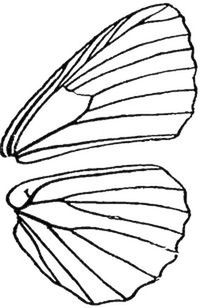 Fig. 92.—Neuration
of the genus
Phyciodes.
Fig. 92.—Neuration
of the genus
Phyciodes.
Eggs.—The eggs are always higher than
broad, with the surface at the base more or
less pitted, giving them a thimble-like appearance. On the
upper end in some species they have a few short, vertical ridges,
radiating from the micropyle.
Caterpillar.—The caterpillar is cylindrical, marked with pale
longitudinal stripes upon a darker ground, and adorned with
tubercles arranged in regular rows. These tubercles are generally
much shorter than in the genus Melitæa. The caterpillars do not,
so far as is known, weave webs at any time.
Chrysalis.—The chrysalis is pendant, with the head slightly
bifid. The dorsal region of the abdomen is provided with slight
tubercles. The color is generally some shade of pale gray,
blotched with black or dark brown.
This genus finds its principal development in South and Central
America, which are very rich in species, some of them
mimicking in a most marvelous manner the butterflies of the protected
genus Heliconius and its allies. The species found in the
United States and Canada are for the most part not very gaily
colored insects, chaste shades of brown, or yellow, and black
predominating.
(1) Phyciodes nycteis, Doubleday and Hewitson, Plate XVII,
Fig. 28, ♂, under side; Fig. 29, ♂; Fig. 30, ♁; Plate V, Fig.
19, chrysalis (Nycteis).
Butterfly.—On the upper side very closely resembling Melitæa
harrisi, for which it may easily be mistaken upon the wing. The
under side of the hind wings is very different, and may at once
be distinguished by the lighter color of the base of the wing,
and the pale, silvery crescent on the outer margin. Expanse, ♂
1.25-1.65 inch; ♁, 1.65-2.00 inches.
Egg.—The egg is half as high again as broad, marked with
sixteen or seventeen vertical ribs above, and pitted about the
middle by hexagonal cells. It is pale green in color.
Caterpillar.—The caterpillar undergoes four moults after
hatching. In the mature stage it is velvety-black, with a dull
orange stripe along the back, and purplish streaks on the sides.
The body is studded with whitish spots, each giving rise to a
delicate black hair, and is further beset with rather short, black,
hairy spines.
Chrysalis.—The chrysalis is pearly-gray, blotched with dark
brown.
The life-history of this species has been carefully worked out,
and all the details may be found described in the most minute
manner by Edwards and by Scudder.
The insect ranges from Maine to North Carolina, and thence
westward to the foot-hills of the Rocky Mountains.
(2) Phyciodes ismeria, Boisduval and Leconte, Plate XVII,
Fig. 24, ♂; Fig. 25, ♂, under side (Ismeria).
Butterfly, ♂.—Easily distinguished from all other allied species
by the double row of small light spots on the dark margin of the
fore wings on the upper side, and by the silvery, narrow, and
greatly bent line of bright silvery spots crossing the middle of the
hind wings on the under side.
♁.—The female is like the male, but larger and paler and all
the spots on the upper side are pale fulvous, and not as distinctly
white on the outer margin as in the male sex. Expanse, ♂,
1.15-1.35 inch; ♁, 1.35-2.00 inches.
Caterpillar.—The caterpillar, according to Boisduval and
Leconte, is yellowish, with blackish spines and three longitudinal
blackish stripes. The head, the thoracic legs, and the under side
are black; the other legs are yellow.
Chrysalis.—According to the same authors, the chrysalis is
pale gray, with paler light spots and nearly white dorsal tubercles.
This insect ranges over a wide territory from Canada to the
Southern and Western States east of the Rocky Mountains.
(3) Phyciodes vesta, Edwards, Plate XVII, Fig. 17, ♂; Fig.
18, ♁; Fig. 19, ♁, under side (Vesta).
Butterfly, ♂.—On the upper side it closely resembles the winter
form marcia of Phyciodes tharos, Drury; but the black
markings are more evenly distributed. The under side is a pale
yellowish-fulvous, and the black markings are slight.
♁.—The female is like the male, but paler. Expanse, ♂,
1.15 inch; ♁, 1.25 inch.
Early Stages.—The chrysalis has been described by Edwards
in the "Canadian Entomologist," vol. xi, p. 129. This is all
we know of the early life of the insect.
It is found in Texas and Mexico.
(4) Phyciodes phaon, Edwards, Plate XVII, Fig. 22, ♂; Fig.
23. ♁, under side (Phaon).
Butterfly, ♂.—The ground-color of the male is paler on the
upper side than in Phyciodes tharos, and the black markings are
much heavier. The median band on the fore wings is yellowish.
The wings on the under side are yellow, shaded with fulvous on
the primaries, on which the dark markings are heavy.
♁.—Like the male. Expanse, ♂, .90 inch; ♁, 1.25 inch.
Early Stages.—Unknown.
This insect inhabits the Gulf States, and has been occasionally
taken in Kansas.
(5) Phyciodes tharos, Drury, Plate XVIII, Fig. 1, ♂; Fig.
2, ♁; var. marcia, Edwards, Plate XVIII, Fig. 3, ♂; Fig. 4, ♁;
Plate V, Figs. 20-22, chrysalis (The Pearl Crescent).
Butterfly.—This very common and well-known little insect
scarcely needs to be described. The upper side is bright fulvous,
with heavy black borders; all the other dark markings are slight.
The wings on the under side are paler, with the dark markings of
the upper side showing through, and there are additional markings
of brown on the hind wings. Expanse, ♂, 1.25 inch; ♁, 1.65 inch.
Early Stages.—The early stages of this insect have been
worked out with the most extreme care by Mr. Edwards, and the
reader who is curious to know about them should consult "The
Butterflies of North America." Dr. Scudder also has minutely
and laboriously described the early stages in "The Butterflies of
New England." The egg is light greenish-yellow. The caterpillar,
which feeds upon various species of aster and allied Compositæ,
is dark brown after the third moult, its back dotted with
yellow, adorned with short, black, bristly spines, which are yellow
at the base. The chrysalis is grayish-white, mottled with
dark spots and lines.
This species is one of many dimorphic species, the winter
form marcia, which emerges in spring, having the under side
brighter, and the light markings more conspicuous on that side
than in the summer form, which has been called morpheus. Concerning
all of this, and the way in which cold affects the color of
butterflies, the reader will do well to consult the splendid pages
of Edwards and of Scudder.
The pretty little Pearl Crescent ranges from southern Labrador
to Florida; in fact, all over North America north of Texas and
south of the region of Hudson Bay, except the Pacific coast of
California.
(6) Phyciodes batesi, Reakirt, Plate XVII, Fig. 35, ♂; Fig.
36, ♁, under side (Bates' Crescent-spot).
Butterfly, ♂.—On the upper side much like P. tharos, with
the black markings very heavy. The under side of the hind
wings is uniformly pale fulvous or yellow, with a row of faint
submarginal brown spots.
♁.—Like the male. Expanse, ♂, 1.25 inch; ♁, 1.50-1.65
inch.
Early Stages.—Unknown.
This species ranges from New York to Virginia, and westward
to Ohio.
(7) Phyciodes pratensis, Behr, Plate XVII, Fig. 37, ♂; Fig.
38, ♁, under side (The Meadow Crescent-spot).
Butterfly, ♂.—The butterfly resembles the preceding species
on the upper side, but the ground-color is much paler and the
black markings are not so heavy. The under side of the wings
is pale fulvous, spotted with yellow.
♁.—The female has the black markings of the upper side
heavier than the male, and all the spots pale yellow. The markings
on the under side are heavier than in the male sex. Expanse,
♂, 1.15 inch; ♁, 1.40 inch.
Early Stages.—Unknown.
The range of this species is the Pacific coast from Oregon to
Arizona.
(8) Phyciodes orseis, Edwards, Plate XVII, Fig. 31, ♂
(Orseis).
Butterfly, ♂.—The dark markings on the upper side are much
heavier than in either of the two preceding species, and the fulvous
spots are smaller, the marginal crescents more regular and
distinct. The markings on the under side are also much heavier
than in P. batesi or P. pratensis.
♁.—The female is like the male, but all the dark markings are
heavier and the pale markings lighter. Expanse, ♂, 1.35 inch;
♁, 1.60 inch.
Early Stages.—These remain to be described.
Phyciodes orseis ranges from Washington Territory in the
north to Mexico in the south.
(9) Phyciodes camillus, Edwards, Plate XVII, Fig. 32, ♂;
Fig. 33, ♁; Fig. 34, ♂, under side (The Camillus Crescent).
Butterfly, ♂.—The male is more like P. pratensis, but the
light spots on the primaries are paler, on the secondaries brighter,
fulvous. The dark markings on the under side are less pronounced
than in pratensis.
♁.—The female is much like the male. Expanse, ♂, 1.30
inch; ♁, 1.50 inch.
Early Stages.—These are wholly unknown.
The species is reported from British Columbia, Colorado, Montana,
Kansas, and Texas.
(10) Phyciodes mylitta, Edwards, Plate XVII, Fig. 40, ♂,
under side; Fig. 41, ♂ (The Mylitta Crescent).
Butterfly, ♂.—Broadly bright fulvous on the upper side,
with the dark markings slight; on the under side closely resembling
P. tharos, var. marcia, Edwards.
♁.—The female is like the male, but paler. Expanse, ♂, 1.15
inch; ♁, 1.25-1.50 inch.
Early Stages.—These have been described by Mr. Harrison G.
Dyar in the "Canadian Entomologist," vol. xxiii, p. 203. The
eggs are laid in clusters upon the thistle (Carduus). The caterpillar
in its final stage after the fourth moult is black, yellowish
below, with a faint twinned yellow dorsal line and faint lines of
the same color on the sides. The spines, which are arranged in
six rows, are black; those of segments four, five, and six, yellow.
The chrysalis is dull wood-brown.
This species has a wide range in the region of the Rocky
Mountains, extending from Washington to Arizona, and eastward
to Colorado.
(11) Phyciodes barnesi, Skinner, Plate XVIII, Fig. 5, ♂
(Barnes' Crescent-spot).
Butterfly, ♂.—Very like the following species, with the light
fulvous of the upper side of the wings more widely extended,
causing the dark markings to be greatly restricted. The figure
in the plate is, in this species as in most others, that of the type,
and I am under obligations to Dr. Skinner for kind permission to
have the use of the specimen. Expanse, 1.75 inch.
The type came from Colorado Springs.
(12) Phyciodes montana, Behr, Plate XVII, Fig. 26, ♁,
under side; Fig. 27, ♁ (The Mountain Crescent-spot).
Butterfly.—Upon the upper side the wings are marked
much as in P. camillus, but are prevalently bright fulvous, with
the dark markings quite slight in most specimens. On the
under side the wings are pale yellowish-fulvous. The female
usually has the secondaries crossed by a broad median band of
very pale spots. Expanse, ♂, 1.25 inch; ♁, 1.50 inch.
Early Stages.—Unknown.
The habitat of this species is the Sierras of California and
Nevada.
(13) Phyciodes picta, Edwards, Plate XVII, Fig. 20, ♁,
under side; Fig. 21, ♂ (The Painted Crescent-spot).
Butterfly.—The butterfly in both sexes somewhat closely resembles
P. phaon on the upper side. On the under side the fore
wings are red on the median area, with the base, the costa, the
apex, and the outer margin pale yellow; the black markings very
prominent. The hind wings on the under side are nearly immaculate
yellow. Expanse, ♂, .80-1.10 inch; ♁, 1.10-1.25 inch.
Early Stages.—These may be found described with minute exactness
by Mr. W.H. Edwards in the pages of the "Canadian
Entomologist," vol. xvi, pp. 163-167. The egg is yellowish-green.
The caterpillar moults five times. When mature it is
about six tenths of an inch long, armed with seven principal
rows of short spines, which appear to vary in color in the spring
and fall broods, being light brown in the June brood and greenish-yellow
in the October brood. The prevalent color of the caterpillar
is some shade of yellowish-or greenish-brown, mottled
with lighter and darker tints. The chrysalis is yellowish-brown.
The food-plants of the caterpillar are various species of aster.
This species is found as far north as Nebraska, and is abundant
in Colorado and New Mexico, ranging southward through Arizona
into Mexico.
Genus ERESIA, Doubleday
Butterfly.—Small butterflies, closely resembling the species of
the genus Phyciodes in the neuration of the wings, and only differing
from them in the outline of the outer margin of the primaries,
which are more or less excavated about the middle.
In the style of the markings they differ
somewhat widely from the butterflies of the genus
Phyciodes, notably in the absence of the crescents
on the margins of the wings. The wings on the
upper side are generally some shade of deep brown
or black, marked with spots and bands of white
or fulvous, the median band on the hind wings
being generally more or less conspicuous. In the
pattern of their markings they illustrate a transition
from the genus Phyciodes to the genus Synchloë.
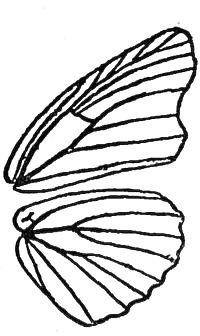 Fig. 93.—Neuration
of the genus
Eresia, slightly
enlarged.
Fig. 93.—Neuration
of the genus
Eresia, slightly
enlarged.
Egg.—Hitherto undescribed.
Caterpillar.—Cylindrical, with seven rows of spines, one
dorsal, and three lateral on each side; the spines are short, blunt,
and armed with short bristles. The head is subcordate, with the
vertices rounded. It moults four times.
Chrysalis.—Cylindrical, abdomen stout, head-case short, beveled,
nearly square at top, the vertices pyramidal. There are
three rows of small tubercles on the dorsal side of the abdomen.
The caterpillars so far as known feed upon various Compositæ,
as Diclippa and Actinomeris.
The genus, which is somewhat doubtfully separable from Phyciodes,
and probably possesses only subgeneric value, is well
represented in Central and South America. But three species
are found in the faunal region of which this book treats.
(1) Eresia frisia, Poey, Plate XVII, Fig. 42, ♂ (Frisia).
Butterfly.—Upper side reddish-fulvous, clouded with fuscous
at the base. On the basal area are waved black lines, separate
on the hind wings, more or less blended on the fore wings.
The outer border is broadly black. Between this border and
the basal third the wing is crossed by irregular black bands, the
spaces between which are paler fulvous than the base and the
hind wings, those near the outer margin being whitish. These
bands are continued broadly across the hind wings. The
wings on the under side are fulvous, mottled with dark brown
and white, and spotted with conspicuous white spots. The
male and the female closely resemble each other. Expanse, 1.40
inch.
The early stages are wholly unknown.
The only locality within the limits of the United States in
which this insect has been found is Key West, in Florida. It is
abundant in the Antilles, Mexico, Central and South America.
(2) Eresia texana, Edwards, Plate XVIII, Fig. 8, ♁; Fig. 9,
♂, under side (The Texan Eresia).
Butterfly.—Black on the upper side of the wings, shading
into reddish-brown on the basal area. The fore wings are
spotted on the median and limbal areas with white, and the hind
wings are adorned by a conspicuous median band of small white
spots. On the under side the fore wings are fulvous at the base,
broadly dark brown beyond the middle. The light spots of the
upper side reappear on the lower side. The hind wings on
the under side are marbled wood-brown on the basal area and the
inner margin, darker brown externally. The white macular band
of the upper side reappears on this side, but less distinct than
above. Expanse, ♂, 1.25-1.50 inch; ♁, 1.60-1.75 inch.
Early Stages.—For the only account of the life-history of this
species the reader is referred to the "Canadian Entomologist,"
vol. xi, p. 127, where the indefatigable Edwards gives us an
interesting account of his original observations.
This insect ranges from Texas into Mexico. It has been confounded
by some with a closely allied insect, Eresia ianthe,
Fabricius, and to show the difference we have given in Plate
XVIII, Fig. 12, a representation of that species, by means of which
the reader will be enabled to mark the difference on the upper
surfaces of the two species.
(3) Eresia punctata, Edwards, Plate XVII, Fig. 39, ♂ (The
Dotted Eresia).
Butterfly.—A lengthy description of this little species is
scarcely necessary, as the figure in the plate will suffice for its
accurate determination. Nothing is known of its early stages.
Expanse, 1.10 inch. It is found in New Mexico, Texas, Arizona,
and Mexico. It has been recently declared to be identical with
E. tulcis, Bates, an opinion I am not quite prepared to accept, but
which, if correct, will force us, according to the law of priority,
to substitute the name given by Bates for that given by Edwards.
Genus SYNCHLOË, Boisduval
(The Patched Butterflies)
Butterfly.—Medium-sized or small butterflies, rather gaily
colored, although the species found in the United States are not
very brilliant. They may be distinguished structurally from the
butterflies of the two preceding genera not
only by their larger size and the spindle-formed
third article of the palpi, which in
the genera Eresia and Phyciodes is thin and
pointed like a needle, but also by the fact
that the lower discocellular vein of the fore
wings is generally quite straight and not
bowed or angled as in the before-mentioned
genera.
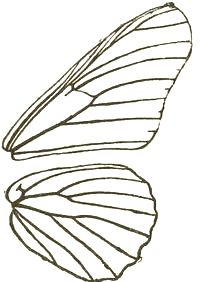 Fig. 94.—Neuration of
the genus Synchloë, enlarged.
Fig. 94.—Neuration of
the genus Synchloë, enlarged.
Egg.—Similar in appearance to the eggs
of the genus Phyciodes: obovoid, truncated,
and slightly depressed at top, rounded at the
bottom; the lower three fifths with shallow
depressions; the upper part with about twenty-four light blunt-edged
ribs. The eggs are laid in clusters upon the leaves of
Helianthus.
Caterpillar.—Varying in color, generally black or some shade
of red or brown, covered with spines which are arranged as in
the genus Melitæa and are thickly beset with diverging bristles.
The caterpillar moults four times.
Chrysalis.—Shaped as in the genus Melitæa, light in color,
blotched with dark brown or black spots and lines.
The genus is well represented in Central and South America.
Some of the species are polymorphic, many varieties being produced
from a single batch of eggs. The result has been considerable
confusion in the specific nomenclature.
(1) Synchloë janais, Drury, Plate XVIII, Fig. 10, ♂ (The
Crimson-patch).
Butterfly.—Fore wings black above, spotted with white;
hind wings black above, marked in the center with a broad band
of crimson. On the under side the markings of the upper side
of the fore wings are reproduced. The hind wings on the under
side are black at the base and on the outer third; immediately at
the base is a yellow bar; across the middle is a broad yellow
band laved outwardly by red, upon which are numerous black
spots. There is a marginal row of yellow spots and an inner
row of smaller white spots on the limbal area. Expanse, 2.50-3.00
inches.
Early Stages.—What is known of these is contained in articles
published by Mr. William Schaus, "Papilio," vol. iii, p. 188;
and by Henry Edwards, "Entomologica Americana," vol. iii,
p. 161, to which the reader may refer.
The habitat of the species is Texas, Mexico, and Central
America. The insect is very variable in the markings both of
the upper and under sides, and several so-called species are only
varietal forms of this.
(2) Synchloë lacinia, Hübner, Plate XVIII, Fig. 11, ♂;
form crocale, Edwards, Plate XXIV, Fig. 8, ♂, under side;
Fig. 9, ♂ (Lacinia).
Butterfly.—This is a protean species, a dozen or more well-marked
varietal forms being produced, many of them from a
single batch of eggs. The wings on the upper side are black;
both primaries and secondaries are crossed about the middle by
a band of spots, generally broken on the primaries and continuous
on the secondaries. These spots in the typical form lacinia are
fulvous, and the bands are broad. In the form crocale the spots
are white, the bands narrow. A great variety of intergrading
forms are known and are represented in the author's collection,
most of them bred specimens reared from the egg. On the
under side the fore wings are marked as on the upper side. The
hind wings on the under side are black, with a marginal row of
spots, a transverse straight median band, a short basal band, and
a costal edging, all bright straw-yellow; in addition there is a
submarginal row of small white spots and a crimson patch of
variable size at the anal angle. Expanse, ♂, 1.50-2.00 inches; ♁,
1.75-2.75 inches.
Early Stages.—These are described fully by Edwards in the
"Canadian Entomologist," vol. xxv, p. 286.
Lacinia ranges from Texas and New Mexico to Bolivia.
FAUNAL REGIONS
That branch of zoölogical science which treats of the geographical
distribution of animals is known as zoögeography. None of the
zoölogical sciences has contributed more to a knowledge of the facts
with which zoögeography deals than the science of entomology.
Various divisions of the surface of the earth, based upon the
character of the living beings which inhabit them, have been suggested.
At the present time, however, it is agreed that in a
general way five major subdivisions are sufficient for the purposes
of the science, and we therefore recognize five faunal regions,
namely, the Palæarctic, which includes the temperate regions of
the eastern hemisphere; the Indo-Malayan, covering the tropics
of Asia and the islands lying south of that great continent, including
Australia; the Ethiopian, covering the continent of Africa
south of the lands bordering on the Mediterranean, and extending
northward into the southern part of Arabia; the Neotropical,
covering the continent of South America and the islands of the
Caribbean Sea and the Gulf of Mexico; and, finally, the Nearctic,
covering the temperate and polar regions of North America. The
butterflies with which this volume deals are mostly nearctic
species, only a few species representing the neotropical region
being found as stragglers into the extreme southern portion of
the United States.
These five faunal regions are characterized by the presence of
certain groups of insects which are more or less peculiar to them.
In the Palæarctic Region, for instance, we find a very great development
of the Satyrinæ, of the genera Argynnis, Melitæa,
and Lycæna, and of the genus Colias. The genus Papilio is but
poorly represented, there being only three species found on the
entire continent of Europe, and comparatively few in Asia north
of the Himalayan mountain-ranges.
As soon as we pass from the boundaries of the Palæarctic
Region into India there is discovered a great number of species
of the genus Papilio. The Euplœinæ, of various genera, swarm,
and splendid creatures, magnificent in color, present themselves,
replacing among the Nymphalinæ the small and obscurely colored
forms which are found among the mountains of Europe and
on the great Asiatic steppes. In the Indo-Malayan Region one
of the most gorgeous of the papilionine genera is known as Ornithoptera.
These great "bird-wing" butterflies are most brilliant
in color in the male, and in the female attain an expanse of wing
reaching in some species eight and even nine inches, so that it
would be impossible to represent them in their natural dimensions
upon a page such as that which is before the reader. One
of these giants of the butterfly family, named Victoria after her
Majesty the Queen of England, is found in the Solomon Islands,
and is probably the largest of all known butterflies. One specimen,
belonging to the author, has an expanse of wing exceeding
nine inches. Among the strangest of recent discoveries is Ornithoptera
paradisea, which is found in New Guinea. The male has
the hind wings produced in the form of a very delicate and slender
tail; the upper surfaces of the wing are broadly marked with
shining green and lustrous orange upon a velvety-black ground.
The female is black with white spots, slightly marked with yellow,
being obscure in color, as is for the most part characteristic
of this sex among butterflies, as well as other animals.
The Ethiopian Region is rich in beautiful butterflies of the genus
Callosune, which are white or yellow, having the tips of the anterior
wings marked with crimson or purple. There are many
scores of species of these which are found on the grassy park-like
lands of southeastern Africa, and they range northward through
Abyssinia into Arabia, and a few species even invade the hot
lands of the Indian peninsula. In the great forests of the Congo
and in fact throughout tropical Africa, the genus Acræa, composed
of beautiful insects with long, narrow wings like the genus
Heliconius, but for the most part yellow, rich brown, and red,
spotted with black, abound. And here, too, are found some of
the noblest species belonging to the great genus Papilio, among
them that most singular and, until recently, rarest of the genus,
Papilio antimachus of Drury, one specimen of which, among a
dozen or more in the author's possession, has wings which exceed
in expanse even those of Ornithoptera victoria, though this butterfly,
which seems to mimic the genus Acræa, has comparatively
narrow wings, and they, therefore, do not cover so large an
area as is covered in the case of the genus Ornithoptera.
In the Neotropical Region we are confronted by swarms of
butterflies belonging to the Ithomiinæ, the Heliconiinæ, and the
Acræinæ, all of which are known to be protected species, and
which are mimicked by other species among the butterflies and
moths of the region which they frequent. A naturalist familiar
with the characteristics of the butterfly fauna of South America
can at a glance determine whether a collection placed before him
is from that country or not, merely by his knowledge of the
peculiar coloration which is characteristic of the lepidoptera of
the region. The most brilliant butterflies of the neotropical
fauna are the Morphos, glorious insects, the under side of their
wings marked with eye-like spots, the upper side resplendent in
varying tints of iridescent blue.
In the Nearctic Region there is a remarkable development of
the genera Argynnis, Melitæa, and Phyciodes. There are also a
great many species of the Satyrinæ and of the Hesperiidæ, or
"skippers." The genus Colias is also well represented. The
Nearctic Region extends southwardly into northern Mexico, at
high elevations, and is even continued along the chain of the
Andes, and there are species which are found in the vicinity of
San Francisco which occur in Chili and Patagonia. In fact, when
we get to the southern extremity both of Africa and of South
America we find certain genera characteristic of the north temperate
zone, or closely allied to them, well represented.
Genus GRAPTA, Kirby
(The Angle-Wings)
Butterfly.—Medium-sized or small, characterized by the more
or less deeply excavated inner and outer margins of the fore wings,
the tail-like projection of the hind wings at the extremity
of the third median nervule, the closed cell
of the same wings, and the thick squamation of
the palpi on the under side, while on the sides
and tops of the palpi there are but few scales.
They are tawny on the upper side, spotted and
bordered with black; on the under side mimicking
the bark of trees and dead leaves, often with
a c-shaped silvery spot on the hind wings. The
insects hibernate in the butterfly form in hollow
trees and other hiding-places.
Egg.—The eggs are taller than broad, tapering upward from
the base. The summit is broad and flat. The
sides are marked by a few equidistant narrow longitudinal ribs,
which increase in height to the top. A few delicate cross-lines
are interwoven between these ribs. They are laid in clusters or
in short string-like series (see p. 5, Fig. 10).
Caterpillar.—The head is somewhat quadrate in outline, the
body cylindrical, adorned with rows of branching spines (see
Plate III, Figs. 23, 27, 31-33, 38).
Chrysalis.—The chrysalids have the head more or less bifid.
There is a prominent thoracic tubercle, and a double row of
dorsal tubercles on the abdomen. Viewed from the back they
are more or less excavated on the sides of the thorax. In color
they are generally some shade of wood-brown or greenish.
The caterpillars feed for the most part upon the Urticaceæ,
plants of the nettle tribe, such as the stinging-nettle, the elm,
and the hop-vine, though the azalea and wild currants furnish
the food of some species.
The genus is confined mainly to the north temperate zone.
(1) Grapta interrogationis, Fabricius, Plate I, Fig. 3, [male],
under side; form fabricii, Edwards, Plate XIX, Fig. 1, [male]; form
umbrosa, Lintner, Plate XIX, Fig. 2, [female]; Plate III, Fig. 23, larva,
from a blown specimen; Fig. 27, larva, copied from a drawing
by Abbot; Plate IV, Figs. 21, 22, 24-26, 40, chrysalis (The Question-sign).
Butterfly.—Easily distinguished by its large size, being the
largest species of the genus in our fauna. The fore wings are
decidedly falcate, or sickle-shaped, bright fulvous on the upper
side, spotted and bordered with dark brown and edged with pale
blue. On the under side they are mottled brown, shaded with
pale purplish, and have a silvery mark shaped like a semicolon
on the hind wings. The dimorphic variety umbrosa, Lintner, has
the upper side of the hind wings almost entirely black, except
at the base. Expanse, 2.50 inches.
Early Stages.—These have been frequently described, and the
reader who wishes to know all about the minute details of the
life-history will do well to consult the pages of Edwards and
Scudder, who have written voluminously upon the subject. The
food-plants are the elm, the hop-vine, and various species of nettles.
This is one of our commonest butterflies. It is double-brooded
in the Middle States. It hibernates in the imago form,
and when the first warm winds of spring begin to blow, it may
be found at the sap-pans in the sugar-camps, sipping the sweets
which drip from the wounded trunks of the maples. It ranges
all over the United States, except the Pacific coast, and is common
throughout Canada and Nova Scotia.
(2) Grapta comma, Harris, form dryas, Plate XIX, Fig. 3, ♂;
form harrisi, Edwards, Fig. 4, ♂; Plate III, Fig. 38, larva; Plate
IV, Figs. 27, 29, 30, 39, 46-48, chrysalis (The Comma Butterfly).
Butterfly.—Dimorphic, in the form dryas with the hind wings
heavily suffused with black, in the form harrisi predominantly
fulvous. Expanse, 1.75-2.00 inches.
The caterpillars feed upon the Urticaceæ, and are very common
upon the nettle. They vary greatly in color, some being
almost snow-white. This species is found throughout Canada
and the adjacent provinces, and ranges south to the Carolinas and
Texas and over the Northwestern States.
(3) Grapta satyrus, Edwards, Plate XX, Fig. 1, ♁; Fig. 2, ♁,
under side; form marsyas, Edwards, Plate XIX, Fig. 14, ♂; Fig.
15, ♂, under side; Plate III, Fig. 33, larva; Plate IV, Figs. 41,
42, chrysalis (The Satyr).
Butterfly.—The species is so accurately depicted in the plates
that a description is hardly necessary. The form marsyas is
smaller, brighter, and with the dark spots on the upper side of
the hind wings reduced in size. Expanse, 1.75-2.00 inches.
The food-plant of the caterpillar is the nettle. It occurs occasionally
in Ontario, and thence ranges west, being not uncommon
from Colorado to California and Oregon.
(4) Grapta hylas, Edwards, Plate XIX, Fig. 7, ♂; Fig. 8, ♂,
under side (The Colorado Angle-wing).
Butterfly.—The butterfly closely resembles G. silenus on the
upper side, but may easily be distinguished by the uniform pale
purplish-gray of the lower side of the wings. Expanse, 2.00 inches.
The early stages are unknown. The insect has thus far been
found only in Colorado, but no doubt occurs in other States of
the Rocky Mountain region.
(5) Grapta faunus, Edwards, Plate XIX, Fig. 12, ♂; Fig. 13,
♂, under side; Plate III, Fig. 32, larva; Plate IV, Figs. 31, 33-35,
chrysalis (The Faun).
Butterfly.—This species is readily recognized by the deep
indentations of the hind wings, the heavy black border, and the
dark tints of the under side mottled with paler shades. Expanse,
2.00-2.15 inches.
The caterpillar feeds on willows. It is found from New England
to the Carolinas, and thence westward to the Pacific.
(6) Grapta zephyrus, Edwards, Plate XX, Fig. 5, ♂; Fig. 6,
♂, under side (The Zephyr).
Butterfly.—Fulvous, marked with yellowish toward the outer
margins, the dark markings upon which are not as heavy as in
the other species of the genus. On the under side the wings are
paler than is the case in other species, reddish-brown, marbled with
darker brown lines and frecklings. Expanse, 1.75-2.00 inches.
The caterpillar, which feeds upon Azalea occidentalis, is described
and figured by Edwards in "The Butterflies of North
America," vol. i. Zephyrus is found throughout the region of
the Rocky Mountains, from Colorado to California, and from
Oregon to New Mexico.
(7) Grapta gracilis, Grote and Robinson, Plate XIX, Fig. 10,
♂; Fig. 11, ♁, under side (The Graceful Angle-wing).
Butterfly.—A small species, rather heavily marked with dark
brown or blackish on the upper side. The wings on the under
side are very dark, crossed about the middle by a pale-gray or
white band shading off toward the outer margins. This light
band serves as a means of easily identifying the species. Expanse,
1.75 inch.
The early stages are unknown.
The species has been found on the White Mountains in New
Hampshire, in Maine, Canada, and British America, as far west
as Alaska.
(8) Grapta silenus, Edwards, Plate XIX, Fig. 5, ♂; Fig. 6,
♁, under side (Silenus).
Butterfly.—Larger than gracilis, and the wings more deeply
excised, as in faunus. On the under side the wings are very
dark, with lighter irrorations, especially on the fore wings. Expanse,
2.00-2.30 inches.
The early stages have never been studied. This species
appears to be found only in Oregon, Washington, and British
Columbia.
(9) Grapta progne, Cramer, Plate XX, Fig. 3, ♂; Fig. 4, ♂,
under side; Plate III, Fig. 31, larva; Plate IV, Figs. 32, 37, 38,
chrysalis (Progne).
Butterfly.—A rather small species, with light-fulvous fore
wings, shading into yellow toward the outer margins; the dark
markings slight, but deep in color. The secondaries are heavily
bordered with black on the outer margin. On the under side the
wings are very dark, variegated with paler shades, somewhat as in
G. gracilis. Expanse, 1.85-2.00 inches.
The early stages have been quite fully described by various
authors, and the reader may consult "The Butterflies of New
England," vol. i, pp. 266-268, for a full account. The caterpillar
feeds on the elm, but more commonly on various species of the
Grossulaceæ, or currant tribe, wild or domesticated. It ranges
from Siberia to Nova Scotia, and southward as far as Pennsylvania.
There are several other species of Grapta found in our fauna,
which are not delineated in this book; but they are rare species,
of which little is as yet known. The types are in the collection
of the writer, and if the reader finds any species which he cannot
identify by means of this book the author will be pleased to help
him to the full extent of his ability.
Genus VANESSA, Fabricius
(The Tortoise-shells)
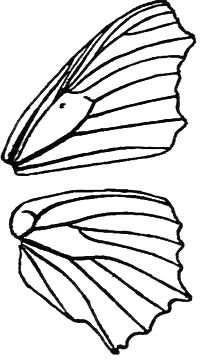 Fig. 96.—Neuration
of the genus
Vanessa.
Fig. 96.—Neuration
of the genus
Vanessa.
Butterfly.—Medium-sized insects, the wings on the upper
side generally some shade of black or brown, marked with
red, yellow, or orange. The head is moderately
large, the eyes hairy, the palpi more
or less heavily scaled, the prothoracic legs feeble
and hairy. The lower discocellular vein
of the fore wings, when present, unites with
the third median nervule, not at its origin, but
beyond on the curve. The cell of the primaries
may or may not be closed. The cell of the secondaries
is open. The fore wings have the outer margin
more or less deeply excavated between the
extremities of the upper radial and the first median,
at which points the wings are rather strongly
produced. The hind wings have the outer margin denticulate,
strongly produced at the extremity of the third median nervule.
Egg.—Short, ovoid, broad at the base, tapering toward the
summit, which is broad and adorned with a few narrow, quite
high longitudinal ridges, increasing in height toward the apex.
Between these ribs are a few delicate cross-lines. They are
generally laid in large clusters upon twigs of the food-plant.
Caterpillar.—The caterpillar moults four times. In the mature
form it is cylindrical, the segments adorned with long,
branching spines arranged in longitudinal rows; the spines much
longer, and branching rather than beset with bristles, as in the
genus Grapta. It lives upon elms, willows, and poplars.
Chrysalis.—The chrysalis in general appearance is not unlike
the chrysalis of Grapta.
The genus is mainly restricted to the north temperate zone
and the mountain regions of tropical lands adjacent thereto.
The insects hibernate in the imago form, and are among the first
butterflies to take wing in the springtime.
(1) Vanessa j-album, Boisduval and Leconte, Plate XIX,
Fig. 9, ♁ (The Compton Tortoise).
Butterfly.—No description is required, as the figure in the
plate will enable it to be immediately recognized. On the under
side of the wings it resembles in color the species of the genus
Grapta, from which the straight edge of the inner margin of
the primaries at once distinguishes it. It is a very close ally of
the European V. vau-album. Expanse, 2.60-2.75 inches.
The caterpillar feeds upon various species of willow. It is a
Northern form, being found in Pennsylvania upon the summits of
the Alleghanies, and thence north to Labrador on the east and
Alaska on the west. It is always a rather scarce insect.
(2) Vanessa californica, Boisduval, Plate XX, Fig. 11, ♂
(The California Tortoise-shell).
Butterfly.—On the upper side deep fulvous, mottled with yellow,
spotted and bordered with black. On the under side dark
brown; pale on the outer half of the primaries, the entire surface
marked with dark lines and fine striæ. Expanse, 2.00-2.25 inches.
Early Stages.—The larva and chrysalis have been described
by Henry Edwards in the "Proceedings of the California Academy
of Sciences," vol. v, p. 171. The caterpillar feeds upon
Ceanothus thyrsiflorus.
This insect is a close ally of the European V. xanthomelas.
It ranges from Colorado to California and as far north as Oregon.
(3) Vanessa milberti, Godart, Plate XX, Fig. 10, ♂; Plate
III, Fig. 36, larva; Plate IV, Figs. 43, 49, 50, chrysalis (Milbert's
Tortoise-shell).
Butterfly.—Easily distinguished by the broad yellow submarginal
band on both wings, shaded outwardly by red. It is nearly
related to the European V. urticæ. Expanse, 1.75 inch.
The life-history has been worked out and described by numerous
writers. The caterpillars feed upon the nettle (Urtica).
This pretty little fly ranges from the mountains of West Virginia
northward to Nova Scotia and Newfoundland, thence westward
to the Pacific.
(4) Vanessa antiopa, Linnæus, Plate I, Fig. 6, ♁; Plate
III, Fig. 28, larva; Plate IV, Figs. 51, 58, 59, chrysalis (The
Mourning-cloak; The Camberwell Beauty).
Butterfly.—This familiar insect needs no description. It is
well known to every boy in the north temperate zone. It is one
of the commonest as well as one of the most beautiful species of
the tribe. A rare aberration in which the yellow border invades
the wing nearly to the middle, obliterating the blue spots, is sometimes
found. The author has a fine example of this "freak."
The eggs are laid in clusters upon the twigs of the food-plant
in spring (see p. 5, Fig. 11). There are at least two broods
in the Northern States. The caterpillars feed on willows, elms,
and various species of the genus Populus.
Genus PYRAMEIS, Doubleday
Butterfly.—The wings in their neuration approach closely to
the preceding genus, but are not angulate, and the ornamentation
of the under side tends to become ocellate, or marked
by eye-like spots, and in many of the species is ocellate.
Egg.—The egg is broadly ovoid, being much like the egg of the
genus Vanessa.
Caterpillar.—The caterpillar in its mature form is covered with
spines, but these are not relatively as large as in Vanessa, and are
not as distinctly branching.
Chrysalis.—The chrysalis approaches in outline the chrysalis of
the preceding genus, and is only differentiated by minor structural
peculiarities.
The genus includes only a few species, but some of them have
a wide range, Pyrameis cardui being almost cosmopolitan, and
having a wider distribution than any other known butterfly.
(1) Pyrameis atalanta, Linnæus, Plate
XLIII, Fig. 4, ♂; Plate III, Fig. 35, larva; Plate
IV, Figs. 52, 53, 55, chrysalis (The Red Admiral).
This familiar butterfly, which is found
throughout North America, Europe, northern
Asia, and Africa, needs no description beyond
what is furnished in the plates. Expanse, 2.00
inches. The food-plants are Humulus, Bœhmeria,
and Urtica.
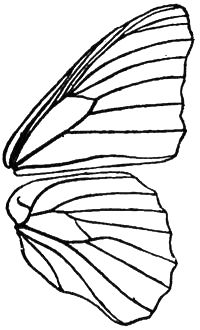 Fig. 97.—Neuration
of the genus Pyrameis.
Fig. 97.—Neuration
of the genus Pyrameis.
(2) Pyrameis huntera, Plate I, Fig. 2, ♂;
Plate XXXIII, Fig. 6, ♂, under side; Plate III,
Fig. 34, larva; Plate IV, Figs. 54, 63, 64, chrysalis
(Hunter's Butterfly).
Butterfly.—Marked much like the following species, but easily
distinguished at a glance by the two large eye-like spots on the
under side of the hind wings. Expanse, 2.00 inches.
Early Stages.—These have been frequently described, and are
in part well depicted in Plates III and IV. The food-plants are
cudweed (Gnaphalium) and Antennaria.
Hunter's Butterfly ranges from Nova Scotia to Mexico and
Central America east of the Sierras.
(3) Pyrameis cardui, Linnæus, Plate I, Fig. 1, ♂; Plate III,
Fig. 37, larva; Plate IV, Figs. 60-62, chrysalis (The Painted
Lady; The Thistle-butterfly).
Butterfly.—This is undoubtedly the most widely distributed
of all known butterflies, being found in almost all parts of the
temperate regions of the earth and in many tropical lands in both
hemispheres. It is easily distinguished from the preceding species
by the more numerous and much smaller eye-like spots on
the under side of the hind wings. Expanse, 2.00-2.25 inches.
Early Stages.—These have been again and again described at
great length and with minute particularity by a score of authors.
The food-plants of the caterpillar are thistles (Carduus), Urtica,
Cnicus, and Althæa.
(4) Pyrameis caryæ, Hübner, Plate XX, Fig. 12, ♂ (The
West Coast Lady).
Butterfly.—This species is easily distinguished from P. cardui,
its nearest ally, by the absence of the roseate tint peculiar to that
species, the tawnier ground-color of the upper surfaces, and the
complete black band which crosses the middle of the cell of the
primaries. Expanse, 2.00 inches.
Early Stages.—These have not all been thoroughly described,
but we have an account of the larva and chrysalis from the pen
of Henry Edwards, in the "Proceedings of the California Academy
of Sciences," vol. v, p. 329. The food-plant of the caterpillar
is Lavatera assurgentiflora. This species ranges from Vancouver's
Island to Argentina, and is found as far east as Utah.
WIDELY DISTRIBUTED BUTTERFLIES
The primal curse declared that the earth, because of man's
sin, should bring forth thorns and thistles, and thistles are almost
everywhere. Wherever thistles grow, there is found the thistle-butterfly,
or the "Painted Lady," as English collectors are in the
habit of calling it, Pyrameis cardui. All over Europe, all over
North America, in Africa,—save in the dense jungles of the Congo,—throughout
South America, in far-off Australia, and in many of
the islands of the sea this beautiful butterfly is found. At some
times it is scarce, and then again there are seasons when it fairly
swarms, every thistle-top having one of the gaily colored creatures
seated upon its head, and among the thorny environment
of the leaves being found the web which the caterpillar weaves.
Another butterfly which bids fair ultimately to take possession of
the earth is our own Anosia plexippus, the wanderings of which
have already been alluded to.
Many species are found in the arctic regions both of the Old
World and the New. Obscure forms are these, and lowly in their
organization, survivors of the ice-age, hovering on the borderline
of eternal frost, and pointing to the long-distant time when
the great land-masses about the northern pole were knit together,
as geologists teach us.
One of the curious phenomena in the distribution of butterflies
is the fact that in Florida we find Hypolimnas misippus, a species
which is exceedingly common in Africa and in the Indo-Malayan
subregion. Another curious phenomenon of a like character is
the presence in the Canary Islands of a Pyrameis, which appears
to be only a subvariety of the well-known Pyrameis indica,
which is common in India, southern China, and Japan. Away
off in southeastern Africa, upon the peaks and foot-hills which
surround the huge volcanic masses of Kilima-Njaro, Kenia, and
Ruwenzori, was discovered by the martyred Bishop Hannington
a beautiful species of Argynnis, representing a genus nowhere
else found upon the continent of Africa south of Mediterranean
lands. Strange isolation this for a butterfly claiming kin to the
fritillaries that sip the sweets from clover-blossoms in the Bernese
Oberland, in the valleys of Thibet, and on the prairies of the
United States.
Genus JUNONIA, Hübner
(Peacock Butterflies),
Butterfly.—Medium-sized butterflies, with eye-like spots upon
the upper wings. Their neuration is very much like that of the butterflies
belonging to the genus Pyrameis, to which they are closely
allied. The eyes are naked, the fore feet are scantily
clothed with hair, and the lower discocellular
vein of the fore wing, when present, does not terminate
on the arch of the third median nervule before
its origin, as in the genus Vanessa, but immediately
at the origin of the third median nervule.
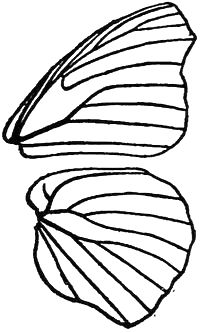 Fig. 98.—Neuration
of the genus
Junonia.
Fig. 98.—Neuration
of the genus
Junonia.
Egg.—Broader than high, the top flattened,
marked by ten vertical ribs, very narrow, but not
very high. Between the ribs are a few delicate
cross-lines.
Caterpillar.—The caterpillar is cylindrical,
the segments being adorned with rows of branching
spines and longitudinally striped.
Chrysalis.—The chrysalis is arched on the dorsal surface and
marked by two rows of dorsal tubercles, concave on the ventral
side. The head is slightly bifid, with the vertices rounded.
There are eighteen or more species which belong to this genus,
of which some are neotropical, but the greater number are found
in the tropical regions of the Old World. Three forms occur
within the limits of the United States, which have by some authors
been reckoned as distinct species, and by others are regarded
merely as varietal forms.
(1) Junonia cœnia, Hübner, Plate XX, Fig. 7, ♁; Plate III,
Figs. 29, 30, larva; Plate IV, Figs. 56, 57, 65-67, chrysalis (The
Buckeye).
Butterfly.—The figure in the plate is far better than any verbal
description. On the under side the eye-like spots of the upper
side are reproduced, but are much smaller, especially on the hind
wings. There is much variety in the ground-color of the wings
on the under side. Some specimens are reddish-gray, and some
are quite heavily and solidly pinkish-red on the secondaries.
Expanse, 2.00-2.25 inches.
Egg.—The egg is dark green.
Caterpillar.—The caterpillar is dark in color, longitudinally
striped, and adorned with branching spines, two of which are on
the head and point forward.
Chrysalis.—The chrysalis is generally pale wood-brown,
strongly arched on the dorsal and concave on the ventral side.
It always hangs at less than a right angle to the surface from
which it depends.
This is a very common butterfly in the Southern States,
ranging northward as far as New England, westward to the
Pacific, and southward to Colombia. The caterpillar feeds on
various species of plantain (Plantago), also Gerardia and Antirrhinum.
When I was a lad in western North Carolina these
insects fairly swarmed one summer; thousands of the caterpillars
could be found in worn-out fields, feeding on the narrow-leaved
plantain, and every fence-rail had one or more of their
chrysalids hanging from the under side. I have never seen such
multitudes of this species since then. The butterflies are quite
pugnacious, and will fight with other passing butterflies, dashing
forth upon them, and chasing them away.
(2) Junonia lavinia, Cramer, Plate XX, Fig. 8, ♂ (Lavinia).
Butterfly.—This species may be distinguished by the more
rounded apex and the more deeply excavated outer margin of the
fore wings, and also by the decided elongation of the outer margin
of the hind wings at the end of the submedian vein. The wings
are paler on the upper side than in the preceding species, and the
eye-like spots much smaller. Expanse, 2.00 inches.
The early stages are not accurately known. The insect is
common in the Antilles and South America, but is only now and
then taken in the extreme southern parts of Texas.
(3) Junonia genoveva, Cramer, Plate XX, Fig. 9, ♂ (Genoveva).
Butterfly.—Much darker above than either of the two preceding
species. The transverse subapical band is pale yellow,
almost white; the ocelli of the wings are more as in lavinia than
in cœnia. Expanse, about 2.00 inches.
This form, if found at all in our fauna, is confined to the extreme
South. I have seen and possess some specimens reputed
to have come from Texas. The specimen figured in the plate
was taken in Jamaica, where this form is prevalent.
Genus ANARTIA, Doubleday
Butterfly.—The head is small; the eyes are round and prominent;
the tongue is long; the antennæ are relatively long, having
the club short, compressed, and pointed. The palpi have the
second joint thick, the third joint gradually tapering
and lightly clothed with scales. The fore
wings are rounded at the apex, and have the
outer and inner margins somewhat excavated.
The outer margin of the hind wings is sinuous,
produced at the end of the third median nervule.
The cell of the hind wing is open. The subcostal
nervules in the fore wing are remarkable
because of the tendency of the first and second to
fuse with the costal vein. The prothoracic feet of the
male are small and weak; of the female, stronger.
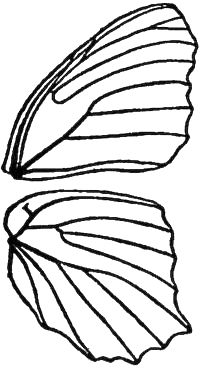 Fig. 99.—Neuration
of the genus
Anartia.
Fig. 99.—Neuration
of the genus
Anartia.
Early Stages.—These, so far as is known to
the writer, await description.
There are four species belonging to this genus, only one of
which is found within the limits of the United States. The
others are found in Central and South America.
(1) Anartia jatrophæ, Linnæus, Plate XX, Fig. 13, ♂ (The
White Peacock).
Butterfly.—There can be no mistake made in the identification
of this species if the figure we give is consulted. The male
and female are much alike. Expanse, 1.75-2.00 inches.
Early Stages.—So far as is known to me, these have never
been described. The butterfly is common throughout the
tropics of the New World, and is occasionally found in southern
Texas and Florida.
Genus HYPANARTIA, Hübner
(The Banded Reds)
Butterfly.—The palpi of medium size, well clothed with
scales; the second joint moderately thick; the third very little
thinner, blunt at the tip. The antennæ have a distinct, short,
well-rounded club. The fore wings have the
first two subcostal nervules arising before the
end of the cell, close to each other. The third
subcostal arises midway between the end of the
cell and the origin of the fourth subcostal. The
cell of the fore wing is closed by a stout lower
discocellular vein which is more or less continuous
with the third median nervule. The hind wing
has the cell open or only partially closed.
Early Stages.—But little is known of the early
stages of this genus.
The species reckoned as belonging to Hypanartia
number less than a dozen, most of which
are found in tropical America, but, singularly enough, two species
occur in tropical and southern Africa, and another has been described
from Madagascar.
(1) Hypanartia lethe, Fabricius, Plate XXIV, Fig. 10, ♂
(Lethe).
This very handsome insect, which is quite common in tropical
America, is another straggler into our fauna, being occasionally
found in southern Texas. But little is known of its early
life-history. Expanse, 2.00 inches.
Genus EUNICA, Hübner
(The Violet-wings)
Butterfly.—The head is narrow, hairy; the eyes prominent.
The antennæ are long and slender, having a greatly enlarged club
marked with two grooves. The palpi have the third joint in the
case of the female longer than in the case of the male. They are
relatively short, thickly clothed with hairs and scales lying closely
appressed to the surface. The fore wing has the costal and
median vein enlarged and swollen at the base. The subcostal has
five nervules, the first two of which arise before
the end of the cell, the third midway between the
end of the cell and the fourth nervule. The upper
discocellular vein is wanting; the middle discocellular
vein is bent inwardly; the lower discocellular
vein is somewhat weak and joins the median vein
exactly at the origin of the second median nervule.
The cell of the hind wing is lightly closed.
Early Stages.—Very little is known of the early
stages of this genus.
The butterflies are characterized by the dark-brown
or black ground-color of the upper side,
generally glossed with rich blue or purple. On
the under side the markings are exceedingly variable and in most
cases very beautiful. The genus is characteristic of the neotropical
fauna, and there are over sixty species which have been described.
The males are said by Bates, to whom we are indebted for most
of our knowledge of these insects, to have the habit of congregating
about noon and in the early afternoon in moist places by
the banks of streams, returning toward nightfall to the haunts of
the females. In this respect they resemble club-men, who at the
same hours are generally to be found congregating where there is
something to drink. Only two species are found in our region,
and are confined to the hottest parts of Texas and Florida, ranging
thence southward over the Antilles and Central America as
far as Bolivia.
(1) Eunica monima, Cramer, Plate XXI, Fig. 7, ♂; Fig. 8,
♁ (The Dingy Purple-wing).
Butterfly.—This obscure little butterfly represents in Florida
and Texas the great genus to which it belongs, and gives but a
feeble idea of the splendid character of its congeners, among
which are some exceedingly beautiful insects. Nothing is known
of its life-history. It is common in the Antilles and Mexico.
Another species of the genus, Eunica tatila, has recently
been reported from the extreme southern portion of Florida.
Genus CYSTINEURA, Boisduval
"And here and yonder a flaky butterfly
Was doubting in the air."
McDonald.
Butterfly.—Small butterflies, with elongated fore wings, the
hind wings with the outer margin rounded, slightly crenulate.
The head is small; the palpi are very delicate and
thin, scantily clothed with scales. The costal
vein of the fore wing is much swollen near the
base. The subcostal vein of this wing sends
forth two branches before the end of the cell.
The upper discocellular vein is lacking; the middle
discocellular is short and bent inwardly; the
lower discocellular is almost obliterated, and
reaches the median vein at the origin of the second
median nervule. In the hind wing the cell is open,
and the two radial veins spring from the same point.
Early Stages.—Very little is as yet definitely
ascertained as to these.
But one species is found within the limits covered by this work.
Seven species have been described, all of them inhabiting Central
or South America.
(1) Cystineura amymone, Ménétries, Plate XXIV, Fig.
7, ♂ (Amymone).
Butterfly.—The fore wings are white on the upper side,
dusted with gray at the base, on the costa, the apex, and the
outer margin. The hind wings are gray on the basal area, pale
yellowish-brown on the limbal area, with a narrow fuscous margin.
On the under side the markings of the upper side reappear,
the gray tints being replaced by yellow. The hind wings are
yellowish, with a white transverse band near the base and an incomplete
series of white spots on the limbal area. Expanse,
1.50 inch.
The early stages await description. The insect is found
about Brownsville, Texas, and throughout Mexico and Central
America.
Genus CALLICORE, Hübner
(The Leopard-spots)
Butterfly.—Small-sized butterflies, with the upper side of the
wings dark in color, marked with bands of shining metallic blue
or silvery-green, the under side of the wings generally more or
less brilliantly colored, carmine upon the primaries
and silvery-white upon the secondaries,
with the apex of the primaries marked with
black transverse bands and the body of the
secondaries traversed by curiously arranged
bands of deep black, these bands inclosing
about the middle of the wing circular or pear-shaped
spots. All of the subcostal nervules in
this genus arise beyond the end of the cell.
The costal and the median veins are swollen
near the base. The cell in both the fore and
hind wings is open.
Early Stages.—Very little is known of these.
This genus numbers about thirty species, almost all of which
are found in South America, only one being known to inhabit the
United States, being found in the extreme southern portion of
Florida, and there only rarely.
(1) Callicore clymena, Hübner, Plate XXI, Fig. 5, ♂; Fig.
6, ♂, under side (The Leopard-spot).
Butterfly.—The wings on the upper side are black, the primaries
crossed by an oblique iridescent bluish-green band, and
the secondaries marked by a similarly colored marginal band. On
the under side the primaries are crimson from the base to the
outer third, which is white, margined with black, and crossed by
an outer narrow black band and an inner broad black band. The
secondaries on this side are white, marked about the middle by
two large coalescing black spots, and nearer the costa a large
pear-shaped spot, both ringed about with black lines. Beyond
these black rings are two black bands conformed to the outline
of the inner and outer margins of the wing, and, in addition, a
fine black marginal line. The costa is edged with crimson.
Expanse, 1.75 inch.
Early Stages.—Unknown.
The Leopard-spot is found occasionally in Florida, but quite
commonly in the Antilles, Mexico, and Central America.
Genus TIMETES, Boisduval
(The Dagger-wings)
Butterfly.—The palpi are moderately long, thickly clothed with
scales, the last joint elongated and pointed. The antennæ have a
well-developed club. The fore wings and the hind wings have
the cell open. In the fore wing the subcostal
vein, which has five branches,
emits the first nervule well before the
end of the cell, the second a little beyond
it, and the third and fourth near
together, before the apex of the wing.
The third median nervule of the hind
wing is greatly produced and forms the
support of the long tail which adorns
this wing. Between the end of the submedian
vein and the first median nervule
is another lobe-like prolongation of the
outer margin of the wing. The butterflies
are characterized for the most part
by dark upper surfaces, with light under
surfaces marked with broad bands and
lines of varying intensity of color. They
are easily distinguished from the butterflies
of all other genera of the Nymphalidæ by the remarkable
tail-like appendage of the hind wing, giving them somewhat the
appearance of miniature Papilionidæ.
Early Stages.—Nothing of note has been recorded of their
early stages which may be accepted as reliable, and there is an
opportunity here for study and research.
There are about twenty-five species belonging to the genus,
all found within the tropical regions of America. Four species
are occasionally taken in the extreme southern portions of Florida
and Texas. They are all, however, very common in the Antilles,
Mexico, and more southern lands.
(1) Timetes coresia, Godart, Plate XXI, Fig. 1, ♂; Fig. 2,
♂, under side (The Waiter).
Butterfly.—Easily recognized by means of our figures, which
show that this creature deserves the trivial name I have bestowed
upon it. In its dark coat and white vest it gracefully attends the
feasts of Flora. Expanse, 2.50 inches.
So far as I am aware, nothing reliable has been recorded as
to the early stages of this insect. It is occasionally found in
Texas.
(2) Timetes petreus, Cramer, Plate XXI, Fig. 3, ♂ (The
Ruddy Dagger-wing).
Butterfly.—The upper side of the wings is accurately delineated
in the plate. On the under side the wings are pale, with
the dark bands of the upper side reproduced. Expanse, 2.60
inches. It occurs in southern Florida and Texas, and elsewhere
in tropical America.
(3) Timetes chiron, Fabricius, Plate XXI, Fig. 4, ♂ (The
Many-banded Dagger-wing).
Butterfly.—Easily recognized by means of the figure in the
plate. Like the preceding species, this is occasionally found in
Texas. It is very common in Mexico, South America, and the
Antilles.
Genus HYPOLIMNAS, Hübner
(The Tropic Queens)
Butterfly.—Eyes naked. The palpi are produced, rising above
the head, heavily scaled. The antennæ have a well-developed,
finely pointed club. The fore wings have stout costal and median
veins. The subcostal throws out five nervules, the first two
before the end of the cell, the third midway between the end of
the cell and the outer border; the fourth and the fifth diverge from
each other midway between the third and the outer border, and
both terminate below the apex. The upper discocellular vein is
wanting; the middle discocellular vein is bent inwardly; the lower
discocellular is very weak, and, in some species, wanting. The
cell of the hind wing is lightly closed.
Caterpillar.—The caterpillar is cylindrical, thickest toward the
middle. The head is adorned with two erect rugose spines; the
segments have dorsal rows of branching spines, and three lateral
rows on either side of the shorter spines. It feeds on various
species of malvaceous plants and also on the common portulaca.
Chrysalis.—The chrysalis is thick,
with the head obtusely pointed; the
abdominal segments adorned with a
double row of tubercles. The thorax
is convex.
This genus, which includes a large
number of species, reaches its fullest
development in the tropics of the Old
World, and includes some of the most
beautiful, as well as the most singular,
forms, which mimic the protected species
of the Euplœinæ, or milkweed butterflies,
of the Indo-Malayan and Ethiopian
regions. In some way one of the
most widely spread of these species,
which is found throughout the tropics
of Asia and Africa, has obtained lodgment
upon the soil of the New World,
and is occasionally found in Florida,
where it is by no means common. It
may be that it was introduced from Africa in the time of the
slave-trade, having been accidentally brought over by ship. That
this is not impossible is shown by the fact that the writer has,
on several occasions, obtained in the city of Pittsburgh specimens
of rare and beautiful tropical insects which emerged from chrysalids
that were found attached to bunches of bananas brought
from Honduras.
(1) Hypolimnas misippus, Linnæus, Plate XXI, Fig. 9, ♂;
Fig. 10, ♁ (The Mimic).
Butterfly, ♂.—On the upper side the wings are velvety-black,
with two conspicuous white spots on the fore wing, and a larger
one on the middle of the hind wing, the margins of these spots
reflecting iridescent purple. On the under side the wings are
white, intricately marked with black lines, and black and reddish-ochraceous
spots and shades.
♁.—The female mimics two or three forms of an Oriental
milkweed butterfly, the pattern of the upper side of the wings
conforming to that of the variety of the protected species which
is most common in the region where the insect is found. The
species mimicked is Danais chrysippus, of which at least three
varietal forms or local races are known. The American butterfly
conforms in the female sex to the typical D. chrysippus, to which
it presents upon the upper side a startling likeness. On the
under side it is marked much as the male. Expanse, ♂, 2.50
inches; ♁, 3.00 inches.
Early Stages.—What has been said as to the early stages in
the description of the genus must suffice for the species. But
little is as yet accurately known upon the subject.
The range of H. misippus is southern Florida, the Antilles,
and the northern parts of South America. It is not common on
this side of the Atlantic, but very common in Africa, tropical
Asia, and the islands south as far as northern Australia.
Genus BASILARCHIA, Scudder
(The White Admirals)
Butterfly.—Head large; the eyes are large, naked; the antennæ
are moderately long, with a distinct club; the palpi are compact,
stout, produced, densely scaled. The fore wings are subtriangular,
the apex well rounded, the lower two thirds of the outer margin
slightly excavated. The first two subcostal
nervules arise before the end of the cell. The
hind wings are rounded, crenulate.
Egg.—Nearly spherical, with the surface
pitted with large hexagonal cells (see p. 3,
Fig. 1).
Caterpillar.—The caterpillar in its mature
state is cylindrical, somewhat thicker before
than behind, with the second segment adorned
with two prominent rugose club-shaped tubercles.
The fifth segment, and the ninth and
tenth segments also, are ornamented with dorsal
prominences (see p. 8, Fig. 20).
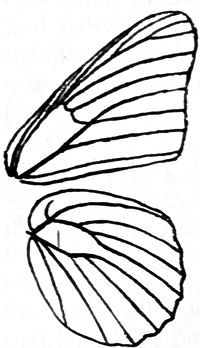 Fig. 106.—Neuration of
the genus Basilarchia.
Fig. 106.—Neuration of
the genus Basilarchia.
Chrysalis.—The chrysalis is suspended by
a stout cremaster; the abdominal segments are
rounded. On the middle of the dorsum is a prominent projecting
boss. The thorax is rounded. The head is rounded or slightly bifid.
The caterpillars feed upon the leaves of various species of oak,
birch, willow, and linden. The eggs are laid upon the extreme
tip of the leaves, and the infant caterpillar, feeding upon the leaf
in immediate proximity to the point where it has been hatched,
attaches bits of bitten leaf by strands of silk
to the midrib, thus stiffening its perch and
preventing its curling as the rib dries. Out
of bits of leaves thus detached it constructs a
packet of material, which it moves forward
along the midrib until it has completed its
second moult. By this time winter begins
to come on, and it cuts away for itself the material of the leaf
on either side of the rib, from the tip toward the base, glues
the rib of the leaf to the stem by means of silk, draws together
the edges of the remaining portions of
the leaf, and constructs a tube-like hibernaculum,
or winter quarters, exactly
fitting the body, in which it passes the
winter.
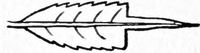 Fig. 107.—Leaf cut
away at end by caterpillar
of Basilarchia (Riley).
Fig. 107.—Leaf cut
away at end by caterpillar
of Basilarchia (Riley).
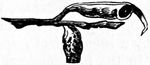 Fig. 108.—Hibernaculum, or
winter quarters, of larva of Basilarchia.
Fig. 108.—Hibernaculum, or
winter quarters, of larva of Basilarchia.
There are a number of species of the
genus found in the United States, the
habits of which have been carefully studied, and they are among
our most interesting butterflies, several species being mimics of
protected species.
(1) Basilarchia astyanax, Fabricius, Plate XXII, Fig. 1, ♂;
Plate III, Figs. 17, 21, 25, larva; Plate IV, Figs. 12, 13, chrysalis
(The Red-spotted Purple).
Butterfly.—This common but most beautiful species is sufficiently
characterized by the plate so far as the upper surface is
concerned. On the under side the wings are brownish, banded
with black on the margins; the lunules are on this side as above,
but the inner band of spots is red. There are two red spots at
the base of the fore wings, and four at the base of the hind wings.
The palpi are white below, and the abdomen is marked with a
lateral white line on each side. Expanse, 3.00-3.25 inches.
Egg.—The egg, which resembles somewhat closely that of
B. disippus (see p. 3, Fig. 1), is yellowish-green, gradually turning
dark brown as the time for the emergence of the caterpillar
approaches.
Caterpillar.—The caterpillar is so well delineated in Plate III,
Fig. 17, as to obviate the necessity for a lengthy verbal description.
Chrysalis.—What has been said of the caterpillar is also true
of the chrysalis (see Plate IV).
The larva feeds upon the willow, cherry, apple, linden (Tilia),
huckleberry, currant, and other allied shrubs and trees. The
butterfly is somewhat variable, and a number of varietal forms
have been described. It ranges generally over the United States
and southern Canada as far as the Rocky Mountain ranges in
the West, and is even said to occur at high elevations in Mexico.
(2) Basilarchia arthemis, Drury, Plate XXII, Fig. 4, ♂, form
lamina, Fabricius; Fig. 5, ♂, form proserpina, Edwards, Plate III,
Fig. 26, larva; Plate IV, Figs. 14, 23, chrysalis (The Banded Purple).
Butterfly.—Easily distinguished in the form lamina from astyanax,
which in other respects it somewhat closely resembles, by
the broad white bands crossing both the fore wings and the hind
wings, and followed on the secondaries by a submarginal row of
red spots shading inwardly into blue. In the form proserpina
there is a tendency on the part of the white bands to become obsolete,
and in some specimens they do entirely disappear. The
likeness to astyanax in such cases is striking, and the main point
by which the forms may then be discriminated is the persistence
of the red spots on the upper side of the secondaries; but even
these frequently are obsolete. Expanse, 2.50 inches.
Egg.—The egg is grayish-green, with "kite-shaped" cells.
Caterpillar.—Greenish-or olive-brown, blotched with white
in its mature form, which is well represented in Plate III. It
feeds upon the willow, the hawthorn (Cratægus), and probably
other plants.
Chrysalis.—The figure in Plate IV is sufficiently exact to obviate
the necessity for further description.
This beautiful insect ranges through northern New England
and New York, Quebec, Ontario, and the watershed of the
Great Lakes, spreading southward at suitable elevations into
Pennsylvania. I have taken it about Cresson, Pennsylvania, at an
elevation of twenty-five hundred feet above sea-level. It is not
uncommon about Meadville, Pennsylvania. The species appears
to be, like all the others of the genus, somewhat unstable and
plastic, or else hybridization is very frequent in this genus. Probably
all the species have arisen from a common stock.
(3) Basilarchia weidemeyeri, Edwards, Plate XXII, Fig. 6,
♂ (Weidemeyer's Admiral).
Butterfly.—Superficially like arthemis, but easily distinguished
by the absence of the lunulate marginal bands of blue on the
margins of the hind wings and by the presence of a submarginal
series of white spots on both wings. Expanse, 3.00
inches.
Early Stages.—These have been described by W.H. Edwards
in the "Canadian Entomologist," vol. xxiv, p. 107, and show
great likeness to the following species, B. disippus. The caterpillar
feeds upon cottonwood (Populus).
The insect is found on the Pacific slope and eastward to Montana,
Nebraska, and New Mexico.
(4) Basilarchia disippus, Godart, Plate VII, Fig. 4, ♂;
Plate III, Figs. 19, 22, 24, larva; Plate IV, Figs. 18-20, chrysalis
(The Viceroy).
Butterfly.—This species mimics Anosia plexippus in a remarkable
manner, as may be seen by referring to Plate VII. An aberration
in which the mesial dark transverse band on the secondaries
has disappeared was named pseudodorippus by Dr. Strecker.
The type is in the Mead collection, now belonging to the writer.
Expanse, 2.50-2.75 inches.
Early Stages.—These have all been carefully studied by numerous
writers. The egg is depicted on p. 3, Fig. 1. The caterpillar
is shown on p. 8, as well as in Plate III.
The species ranges everywhere from southern Canada and
British America into the Gulf States.
(5) Basilarchia hulsti, Edwards, Plate VII, Fig. 5, ♂ (Hulst's
Admiral).
Butterfly.—This form is apparently a mimic of Anosia berenice.
The ground-color of the wings is not so bright as in B. disippus,
and the mesial band of the secondaries on the upper side is relieved
by a series of small whitish spots, one on each interspace.
The perfect insect can easily be distinguished by its markings.
Expanse, 2.50-2.60 inches. Thus far it is only known from Utah
and Arizona. The early stages have not been described.
(6) Basilarchia lorquini, Boisduval, Plate XXII, Fig. 3, ♂
(Lorquin's Admiral).
Butterfly.—Easily distinguished from all the other species of
the genus by the yellowish-white bar near the end of the cell of
the fore wings and the reddish color of the apex and upper margin
of the same wings. Expanse, 2.25-2.75 inches.
Early Stages.—These have been partially described by Henry
Edwards, and minutely worked out by Dr. Dyar, for whose description
the reader may consult the "Canadian Entomologist,"
vol. xxiii, p. 172. The food-plant of the caterpillar is Populus,
willows, and the choke-cherry (Prunus demissa).
Besides the forms figured in our plates there is a species in
Florida named floridensis by Strecker, and subsequently eros by
Edwards, which is generally larger and much darker than B. disippus,
which it otherwise closely approximates.
THE BUTTERFLIES' FAD
"I happened one night in my travels
To stray into Butterfly Vale,
Where my wondering eyes beheld butterflies
With wings that were wide as a sail.
They lived in such houses of grandeur,
Their days were successions of joys,
And the very last fad these butterflies had
Was making collections of boys.
"There were boys of all sizes and ages
Pinned up on their walls. When I said
'Twas a terrible sight to see boys in that plight,
I was answered: 'Oh, well, they are dead.
We catch them alive, but we kill them
With ether—a very nice way:
Just look at this fellow—his hair is so yellow,
And his eyes such a beautiful gray.
"'Then there is a droll little darky,
As black as the clay at our feet;
He sets off that blond that is pinned just beyond
In a way most artistic and neat.
And now let me show you the latest,—
A specimen really select,
A boy with a head that is carroty-red
And a face that is funnily specked.
"'We cannot decide where to place him;
Those spots bar him out of each class;
We think him a treasure to study at leisure
And analyze under a glass.'
I seemed to grow cold as I listened
To the words that these butterflies spoke;
With fear overcome, I was speechless and dumb,
And then with a start—I awoke!"
Ella Wheeler Wilcox.
Genus ADELPHA, Hübner
(The Sisters)
Butterfly.—This genus is very closely allied to the preceding,
and is the South American representative of Basilarchia. The
only difference which is noticeable structurally is in the fact that
the eyes are hairy, the palpi not so densely clothed with scales.
The prothoracic legs of the males are smaller
than in Basilarchia. The cell of the primaries
is very slightly closed by the lower discocellular
vein, which reaches the median a little beyond
the origin of the second median nervule.
The outer margin of the fore wing is rarely
excavated, as in Basilarchia, and the lower
extremity of the hind wing near the anal
angle is generally more produced than in the
last-mentioned genus.
Early Stages.—The life-history of the genus
has not been carefully worked out, but an
account has been published recently of the
caterpillar of the only species found within
our fauna, which shows that, while in general
resembling the caterpillars of the genus Basilarchia,
the segments are adorned with more branching spines
and with short fleshy tubercles, giving rise to small clusters of
hairs.
The chrysalids are of peculiar form, with bifid heads and
broad wing-cases. They are generally brown in color, with metallic
spots. The only species in our fauna is confined to southern
California, Arizona, and Mexico.
(1) Adelpha californica, Butler, Plate XXII, Fig. 2, ♁ (The
Californian Sister).
Butterfly.—Easily recognized by the large subtriangular patch
of orange-red at the apex of the primaries. In its habits and
manner of flight it closely resembles the species of the genus
Basilarchia. Expanse, 2.50-3.00 inches.
Early Stages.—So far as is known to the writer, these have
not been described, except partially by Henry Edwards in the
"Proceedings of the California Academy of Sciences," vol. v,
p. 171. The caterpillar feeds upon oaks.
The insect is found in California, Nevada, Arizona, and
Mexico.
Genus CHLORIPPE, Boisduval
(The Hackberry Butterflies)
Butterfly.—Small butterflies, generally some shade of fulvous,
marked with eye-like spots on the posterior margin of the
secondaries, and occasionally upon the outer margin of the
primaries, the fore wings as well as the hind
wings being in addition more or less strongly
spotted and banded with black. The eyes are
naked; the antennæ are straight, provided with a
stout, oval club; the palpi are porrect, the second
joint heavily clothed with hairs, the third joint
short, likewise covered with scales. The costal
vein of the fore wing is stout. The first subcostal
vein alone arises before the end of the cell. The
cell is open in both wings.
Egg.—The eggs, which are deposited in clusters,
are nearly globular, the summit broad and
convex. The egg is ornamented by from eighteen
to twenty rather broad vertical ribs, having no great elevation,
between which are numerous faint and delicate cross-lines.
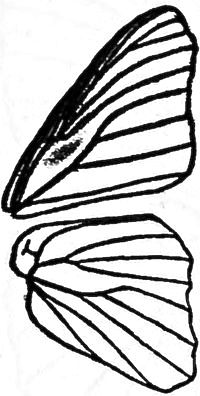 Fig. 110.—Neuration
of the genus
Clorippe, ♂.
Fig. 110.—Neuration
of the genus
Clorippe, ♂.
Caterpillar.—The head is subquadrate, with the summit
crowned by a pair of diverging stout coronal spines which have
upon them a number of radiating spinules. Back of the head, on
the sides, is a frill of curved spines. The body is cylindrical,
thickest at the middle, tapering forward and backward from this
point. The anal prolegs are widely divergent and elongated, as
in many genera of the Satyrinœ.
Chrysalis.—The chrysalis is compressed laterally and keeled
on the dorsal side, concave on the ventral side, the head distinctly
bifid. The cremaster is very remarkable, presenting the
appearance of a flattened disk, the sides studded with hooks, by
means of which the chrysalis is attached to the surface, from
which it depends in such a manner that the ventral surface is
parallel to the plane of support.
The caterpillars feed upon the Celtis, or hackberry.
There are a number of species, mainly confined to the southwestern
portion of the United States, though some of them range
southward into Mexico. Two only are known in the Middle
States. The species are double-brooded in the more northern
parts of the country, and the caterpillars produced from eggs laid
by the second brood hibernate.
(1) Chlorippe celtis, Boisduval and Leconte, Plate XXIII,
Fig. 3, ♂; Fig. 4, ♁; Fig. 11, ♂, under side (The Hackberry
Butterfly).
Butterfly, ♂.—The primaries at the base and the secondaries
except at the outer angle pale olive-brown, the rest of the wings
black. The dark apical tract of the primaries is marked by two
irregular, somewhat broken bands of white spots. There is a
red-ringed eye-spot between the first and second median nervules,
near the margin of the fore wing, and there are six such
spots on each hind wing. On the under side the ground-color is
grayish-purple; the spots and markings of the upper side reappear
on this side.
♁.—The female has the wings, as is always the case in this
genus, much broader and not so pointed at the apex of the primaries
as in the male sex, and the color is much paler. Expanse,
♂, 1.80 inch; ♁, 2.10 inches.
Early Stages.—These are beautifully described and delineated
by Edwards in "The Butterflies of North America," vol. ii.
The caterpillar feeds on the hackberry (Celtis occidentalis).
This species is found generally from southern Pennsylvania,
Ohio, Indiana, and Illinois to the Gulf of Mexico. It is not, so
far as is known, found on the Pacific coast.
(2) Chlorippe antonia, Edwards, Plate XXIII, Fig. 12, ♂
(Antonia).
Butterfly.—Bright yellowish-fulvous on the upper side.
Easily distinguished from celtis by the two eye-spots near the
margin of the primaries. Expanse, 1.75-2.00 inches.
Early Stages.—Unknown.
Antonia is found in Texas.
(3) Chlorippe montis, Edwards, Plate XXII, Fig. 7, ♂; Fig.
8, ♁ (The Mountain Emperor).
Butterfly.—Very closely allied to C. antonia in the style and
location of the markings, but tinted with pale ashen-gray on the
upper side of the wings, and not yellowish-fulvous as in the last-named
species. Expanse, ♂, 1.75 inch; ♁, 2.15 inches.
The early stages are unknown.
Montis occurs in Arizona and Colorado, and by some writers
is regarded as a varietal form of antonia, in which opinion they
may be correct.
(4) Chlorippe leilia, Edwards, Plate XXIII, Fig. 11, ♂ (Leilia).
Butterfly.—Like antonia, this species has two extra-median
eye-spots on the primaries, and thus may be distinguished from
celtis. From antonia it may be separated by its larger size and
the deeper reddish-brown color of the upper surfaces. Expanse,
2.10-2.50 inches.
Early Stages.—Unknown.
So far we have received this butterfly only from Arizona.
(5) Chlorippe alicia, Plate XXIII, Fig. 9, ♂; Fig. 10, ♁
(Alicia).
Butterfly.—Very bright fawn at the base of the wings, shading
into pale buff outwardly. There is but one eye-spot on the primaries.
The six eye-spots on the secondaries are black and very
conspicuous. The marginal bands are darker and heavier than
in any other species of the genus. Expanse, ♂, 2.00 inches;
♁, 2.50 inches.
The early stages are only partially known.
Alicia ranges through the Gulf States from Florida to
Texas.
(6) Chlorippe clyton, Boisduval and Leconte, Plate XXIII,
Fig. 5, ♂; Fig. 6, ♁; Plate III, Fig. 20, larva; Plate IV, Figs.
15-17, chrysalis (The Tawny Emperor).
Butterfly, ♂.—The fore wings without an extra-median eye-spot,
and the secondaries broadly obscured with dark brown or
blackish, especially on the outer borders, so that the eye-spots
are scarcely, if at all, visible.
♁.—Much larger and paler in color than the male, the eye-spots
on the secondaries conspicuous. Expanse, ♂, 2.00 inches;
♁, 2.50-2.65 inches.
Early Stages.—The life-history has been carefully worked out,
and the reader who wishes to know all about it should consult the
writings of Edwards and Scudder.
This species is occasionally found in New England, and ranges
thence westward to Michigan, and southward to the Gulf States.
It is quite common in the valley of the Ohio.
(7) Chlorippe flora, Edwards, Plate XXIII, Fig. 1, ♂; Fig.
2, ♁ (Flora).
Butterfly, ♂.—The ground-color is bright reddish-fulvous on
the upper side. The usual markings occur, but there is no eye-spot,
or ocellus, on the primaries. The hind wings are not
heavily obscured with dark brown, as in clyton, and the six
ocelli stand forth conspicuously upon the reddish ground. The
hind wings are more strongly angulated than in any other
species. The borders are quite solidly black.
♁.—The female is much larger than the male, and looks like a
very pale female of clyton. Expanse, ♂, 1.75 inch; ♁, 2.35 inches.
Early Stages.—The life-history has been described by Edwards
in the "Canadian Entomologist," vol. xiii, p. 81. The habits of
the insect in its early stages and the appearance of the larva and
chrysalis do not differ widely from those of C. clyton, its nearest ally.
Flora is found in Florida and on the borders of the Gulf to
Texas.
Genus PYRRHANÆA, Schatz
(The Leaf-wings)
Butterfly.—Medium-sized butterflies, on the upper side of the
wings for the most part red or fulvous, on the under side of the
wings obscurely mottled on the secondaries and the costal and
apical tracts of the primaries in such a manner as to cause them to
appear on this side like rusty and faded leaves. Structurally they
are characterized by the somewhat falcate shape of the primaries
and the strongly produced outer margin of the secondaries about
the termination of the third median nervule. The first and second
subcostal nervules coalesce with one another and with the costal
vein. The costal margin of the fore wing at the base is strongly
angulated, and the posterior margin of the primaries is straight.
The cell of the secondaries is very feebly closed.
Egg.—Spherical, flattened at the base and somewhat depressed
at the apex, with a few parallel horizontal series of raised points
about the summit.
Caterpillar.—Head somewhat globular in appearance; the anterior
portion of the first thoracic segment of the body is much
smaller in diameter than the head; the body
is cylindrical, tapering to a point.
Chrysalis.—Short, stout, with transverse
ridges above the wings on the middle
of the abdomen, keeled on the sides. The
cremaster is small and furnished with a globular
tip, the face of which is on the same
plane as the ventral surface of the body,
causing the chrysalis to hang somewhat obliquely
from the surface which supports it.
This is a large genus of mostly tropical
species, possessed of rather singular habits.
The caterpillars in the early stages of their
existence have much the same habits as the
caterpillars of the genus Basilarchia, which
have been already described. After passing
the third moult they construct for themselves
nests by weaving the edges of a leaf together, and thus conceal
themselves from sight, emerging in the dusk to feed upon the
food-plant. They live upon the Euphorbiaceæ, the Lauraceæ, and
the Piperaceæ. The insects are double-brooded in the cooler
regions of the North, and are probably many-brooded in the
tropics.
(1) Pyrrhanæa andria, Scudder, Plate XXIV, Fig. 1, ♁ (The
Goatweed Butterfly).
Butterfly, ♂.—Solidly bright red above, the outer margins
narrowly dusky on the borders. On the under side the wings
are gray, dusted with brown scales, causing them to resemble
the surface of a dried leaf.
♁.—The female has the upper side paler and marked by pale
fulvous bands, as shown in the plate. Expanse, ♂, 2.50 inches;
♁, 3.00 inches.
Early Stages.—In Fig. 21, on p. 9, is a good representation of
the mature caterpillar, the nest which it constructs for itself, and
the chrysalis. A full account of the life-history may be found
in the "Fifth Missouri Report" from the pen of the late C.V. Riley.
The caterpillar feeds on Croton capitatum.
The insect ranges from Illinois and Nebraska to Texas.
(2) Pyrrhanæa morrisoni, Edwards, Plate XXIV, Fig. 2, ♁
(Morrison's Goatweed Butterfly).
Butterfly, ♂.—Much like P. andria, but more brilliantly and
lustrously red on the upper side, and marked with paler macular
bands like the female.
♁.—Differing from the female of P. andria in the more macular,
or spotted, arrangement of the light bands on the wings, as
is well shown in the plate. Expanse, 2.25-2.50 inches.
Early Stages.—Unknown.
This species occurs in Arizona and Mexico.
(3) Pyrrhanæa portia, Fabricius, Plate XXIV, Fig. 3, ♂ (Portia).
Butterfly.—Splendid purplish-red on the upper side. On the
under side the fore wings are laved with bright yellow on the
basal and inner marginal tracts, and the secondaries are dark
brown, irrorated with blackish scales arranged in spots and striæ.
Expanse, 2.75-3.00 inches.
Early Stages.—Unknown.
Portia occurs in the extreme southern part of Florida and in
the Antilles.
Genus AGERONIA, Hübner
(The Calicoes)
Butterfly.—The antennæ moderately long, delicate, terminated
in a gradually thickened club. The eyes are naked; the palpi
are compressed, only slightly porrect, not
densely covered with scales. The neuration
is alike in both sexes, the costal and the median
veins greatly thickened toward the base. The
first and second subcostals arise from before
the end of the cell; the fourth and fifth subcostals
arise from a common stem emitted
from the third subcostal beyond the end of
the cell. The cells in both the fore and hind
wings are closed. The butterflies are of
medium or large size, curiously marked with
checkered spots, blue and white, with
broad paler shades on the under side of the
secondaries. They are rapid fliers and are
said to alight on the trunks of trees with
their wings expanded and their heads
down. When flying they emit a clicking sound with their
wings.
Early Stages.—Very little is known of these.
The chrysalids are slender and have two ear-like tubercles on
the head.
This genus is, strictly speaking, neotropical. About twenty-five
species have been described from Central and South America,
some of them being exceedingly beautiful and rich in color.
The two species credited to our fauna are reported as being
occasionally found in Texas. I have specimens of one of the
species which certainly came from Texas. I cannot be so sure
of the other.
(1) Ageronia feronia, Linnæus, Plate XXIV, Fig. 4, ♂
(The White-skirted Calico).
Butterfly.—Easily distinguished from the only other species
of the genus found in our fauna by the white ground-color of
the under side of the hind wings. Expanse, 2.50 inches.
Early Stages.—Unknown.
This remarkable insect is said to be occasionally found in Texas.
(2) Ageronia fornax, Hübner, Plate XXIV, Fig. 5, ♂, under
side (The Orange-skirted Calico).
Butterfly.—Closely resembling the preceding species on the
upper side, but at once distinguished by the orange-yellow
ground-color of the under side of the hind wing. Expanse, 2.60
inches.
Early Stages.—Unknown.
Like its congener, A. fornax is reported only from the hotter
parts of Texas.
Genus VICTORINA, Blanchard
(The Malachites)
Butterfly.—Large butterflies, curiously and conspicuously
marked with light-greenish spots upon a darker ground; wings
upon the under side marbled with brown about the spots and
having a satiny luster. The third median nervule of the fore
wing is very strongly bowed upward. The cells of both wings
are open. The hind wing is tailed at the end of the third median
nervule. The two first subcostals arise before the end of the
cell; the fourth and fifth spring from a common stem which is
emitted from the third beyond the end of the cell, as the cut shows.
Early Stages.—We know nothing of
these.
This genus, in which are reckoned
five species, all found in the tropics of
the New World, is represented by but a
single species in our fauna, which occurs
in southwestern Texas and in Florida.
It is very common in the West
Indies and Central America.
(1) Victorina steneles, Linnæus,
Plate XXIV, Fig. 6, ♂ (The Pearly Malachite).
This splendid insect is occasionally
found in southern Florida and the extreme
southern part of Texas. It is common
throughout tropical America. Nothing
has ever been written upon its early
stages.
FOSSIL INSECTS
Investigations within comparatively recent times have led to
the discovery of a host of fossil insects. A few localities in
Europe and in North America are rich in such remains, and the
number of species that have been described amounts to several
thousands. Strangely enough, some of these fossil insects are
very closely allied in form to species that are living at the present
time, showing the extreme antiquity of many of our genera. One
of the comparatively recent discoveries has been the fossil remains
of a butterfly which Dr. Scudder, who has described it, declares
to be very near to the African Libythea labdaca, which differs in
certain minor anatomical respects from the American Libytheas
which are figured in this work; and Dr. Scudder has therefore proposed
a new generic name, Dichora, meaning "an inhabitant of
two lands," which he applies to the African species because
related to the extinct American butterfly. The strange discoveries,
which have been made by palæontologists as to the
huge character of many of the mammals, birds, and reptiles
which at one time tenanted the globe, are paralleled by recent
discoveries made in insect-bearing strata in France. M. Charles
Brongniart of the Paris Museum is preparing an account of the
collection which he has made at Commentry, and among the
creatures which he proposes to figure is an insect which is
regarded by Brongniart as one of the forerunners of our dragon-flies,
which had an expanse of wing of two feet, a veritable giant
in the insect world.
Of fossil butterflies there have thus far been discovered sixteen
species. Of these, six belong to the subfamily of the Nymphalidæ,
and five of the six were found in the fossiliferous strata of
Florissant, Colorado. Two species belong to the subfamily Satyrinæ,
both occurring in deposits found in southern France, and
representing genera more nearly allied to those now found in
India and America than to the Satyrinæ existing at the present
time in Europe. One of the fossils to which reference has already
been made belongs to the subfamily of the Libytheinæ.
The remainder represent the subfamilies of the Pierinæ, the
Papilioninæ, and the family Hesperiidæ.
It is remarkable that the butterflies which have been found in
a fossil state show a very close affinity to genera existing at the
present time, for the most part, in the warmer regions of the
earth. Though ages have elapsed since their remains were
embedded in the mud which became transformed into stone,
the processes of life have not wrought any marked structural
changes in the centuries which have fled. This fixity of type
is certainly remarkable in creatures so lowly in their organization.
 Front cover
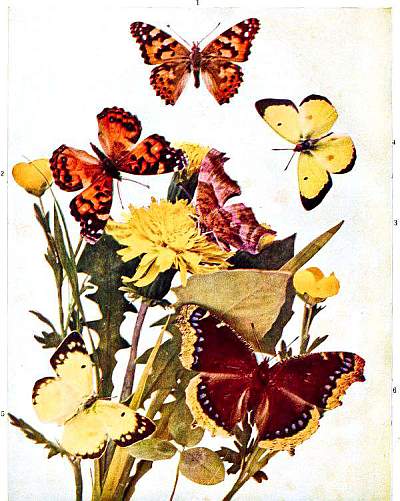 SPRING BUTTERFLIES.
Pyrameis Cardui, Linn., (The Painted Lady); 2. P. Huntera, Fabr., ♂ (Hunter's Butterfly); 3. Grapta Interrogationis, Fabr., ♂ (The Question
Sign); 4. Colias Philodice, Godt., ♂; 5. Do., ♁ (The Clouded Sulphur); 6. Vanessa Antiopa, Linn., ♁ (The Mourning Cloak).
COPYRIGHTED BY W.J. HOLLAND, 1898
SPRING BUTTERFLIES.
Pyrameis Cardui, Linn., (The Painted Lady); 2. P. Huntera, Fabr., ♂ (Hunter's Butterfly); 3. Grapta Interrogationis, Fabr., ♂ (The Question
Sign); 4. Colias Philodice, Godt., ♂; 5. Do., ♁ (The Clouded Sulphur); 6. Vanessa Antiopa, Linn., ♁ (The Mourning Cloak).
COPYRIGHTED BY W.J. HOLLAND, 1898