Inconsistent hyphenation and spelling in the original document have
been preserved. Obvious typographical errors have been corrected.
With Illustrations from Photographs
By the Author
COMPLETE IN TEN VOLUMES
BATTLE CREEK, MICHIGAN
THE LITTLE-PRESTON COMPANY, LIMITED
M C M I
Copyright 1901
BY E. BURTON HOLMES
ALL RIGHTS RESERVED
The "Edition Original" of The Burton Holmes Lectures
is Limited to One Thousand Sets.
The Registered Number of This Set is —— ——.
Mr. Holmes has been asked to supply data for a biographical sketch.
He replies that his biography will be found in his lectures, each lecture
being a chapter from his life of travel. Thirty chapters of this autobiography
appear in these volumes,—thirty preliminary chapters,—for
Mr. Holmes hopes that his life of travel is but just begun.
Elias Burton Holmes was born in Chicago in January, 1870, inheriting a
love for travel. In 1883 he acquired a love for photography. In 1886 he
traveled abroad and took pictures. He has been traveling and taking
pictures ever since. In 1890 he appeared before his first audience,—the
members of the Chicago Camera Club, reading and illustrating an account
of a tour "Through Europe with a Camera." In 1893 he made his first
professional appearance in the recital hall of the Auditorium, Chicago,
describing a journey to Japan. Kind friends and curious acquaintances
insured the success of this venture, and encouraged Mr. Holmes to enter
upon a career in which the labor has been a labor of love. For five successive
winters the Burton Holmes Lectures were among the features of the
amusement season in the cities of the Middle West. In 1897, on the retirement
of Mr. John L. Stoddard from the field which he had created and
occupied for nineteen years, Mr. Holmes found himself prepared to carry
on the work begun by Mr. Stoddard.
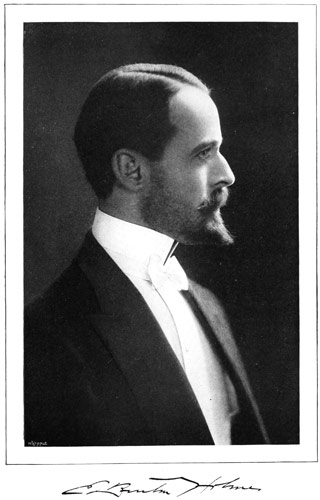
E. Burton Holmes
TO
MY
THREE
FOREWORD — INTO MOROCCO — FEZ
Half-Tone Etchings and Colored Inserts by
WHIPPLE ENGRAVING CO., Chicago....
Decorative Titles by ARTHUR DODDS, Rochester, N. Y.... Typography, Electrotyping,
Presswork and Binding by ELLIS
PUBLISHING COMPANY, LTD., Battle Creek,
Mich.
To transfer the illustrated lecture from public platform to
printed page is to give permanent form to the ephemeral. To
set down in formal black and white the phrases framed for
the informality of speech is to offer them to a keener scrutiny
than they were meant to bear. To reproduce in miniature,
by means of the half-tone engraver's art, pictures that were
intended to meet the eye, enriched by color and projected in
a darkened auditorium, is to reduce mountains to mole-hills
and to dim the brilliancy of nature to a sober gray.
In these volumes The Burton Holmes Lectures undergo a
trying transformation. The words and the pictures are the
same, but the manner of presentation must affect the value
and force of both. The appeal is now made not to expectant
auditors in the sympathetic atmosphere of a place of entertainment,
but to readers uninfluenced by the tone and the
inflection of the speaker, and free from the magical influence
of pictures that glow and fade as the traveler tells his tale.
In an illustrated lecture the impression upon eye and ear
should be simultaneous, that the suggestion of travel may be
successfully produced. It may be pardonable to cite, in proof
of the completeness of the illusion, an incident which conveys
a convincing compliment to the art of the illustrated lecture.
On the screen a picture of a village at sunset—a river flows
at the spectators' feet—misty mountains rise in the distance—the
calmness of approaching night seems to hover in the
golden twilight. All this simply an effect produced by the
projection of a colored photograph and the utterance of a few
suggestive words. A woman in the audience looks and listens—and
then unconscious of the humor of her words, murmurs
to a companion, "Oh, if some one could only paint that!"
Therefore the author begs that all who read, will, at the
same time, listen with the mental ear to catch the shade of
meaning that should be conveyed by every phrase, and that
they will endeavor to project the illustrations, through the
lenses of imagination upon the screen of fancy, and thus re-magnify
the mole-hills into mountains, re-tint the landscapes
and the cities, and restore to the sunset-skies their wonted
wealth of color.
In appearing before a new audience—the reading public—the
author is cheered by the thought that it is an audience,
not of strangers, but of friends, who, as readers in their easy
chairs at home, will manifest toward him the same indulgence
that they have shown as auditors in the orchestra stalls of
theaters or the seats of lecture-halls.
The author gladly acknowledges his debt of gratitude to
his auditors, who, by their support and sympathy, have made
possible the years of travel which these volumes represent;
and to his fellow-workers whose efforts have contributed in so
large a measure to the success of his lectures, to Katharine
Gordon Breed, who was the first to realize the possibilities of
the art of coloring lantern slides; to Oscar Bennett Depue,
who, with modesty and self-effacement, has devoted himself
to the operating of the illustrating instruments and to the
development of the art of motion-photography, and to Louis
Francis Brown, who, with business ability and tact, has
directed the public presentations of The Burton Holmes
Lectures.
E. BURTON HOLMES.
New York, March 4, 1901.
THE PLAYERS.
INTO MOROCCO
The transatlantic steamers, that
every season bear so many of our
fellow-countrymen from our own shores
directly to the ports of Italy, pass, as all
travelers know, through the Gibraltar
Straits. Those who have sailed this
course undoubtedly recall with a thrill
of pleasure the morning when, after
eight days upon the broad Atlantic,
they waked to find on either hand
the shores of a great continent,—the
hills of Spain upon the north, and opposite,
the grim forbidding mountains
of Morocco.
They will recall, as well, those
two gigantic rocky promontories which
guard the western entrance to the Mediterranean,—those
historic Pillars of Hercules called by the ancients Calpe
and Abyla,—the rocks that for the men of that time marked
the extreme western boundary of the known world.
For centuries Calpe and Abyla, sea-girt mountains torn
asunder by some god of might, were looked upon as the very
ends of the earth. Beyond them no man dared venture.
GIBRALTAR
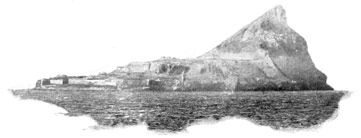
Calpe is now the famous fortress of Gibraltar, a bit of
Spain held by the British Empire. Abyla, upon the shore of
Africa, is now the penal colony Ceuta, a piece
of Moorish territory, conquered
and held by force of
Spanish arms. At
the bases of these
two mighty cliffs the
waters of two oceans
mingle; for there the wide
Atlantic, the waterway of
the new world, touches the historic inland ocean, around the
shores of which are grouped the nations that have ruled the
world in ages past. The narrow channel that links the seas
together serves also to separate two lands so widely dissimilar
that nowhere in the world may the traveler, with so little
effort, enjoy a greater shock of contrast than by crossing the
Gibraltar Strait from Southern Spain to Tangier, in Morocco.
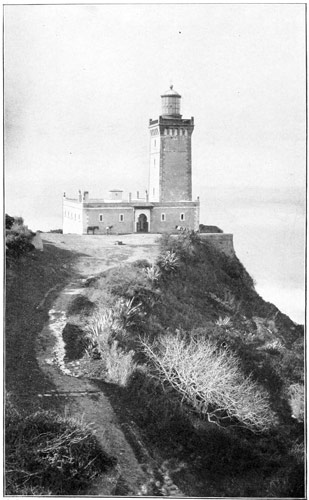
CAPE SPARTEL LIGHT (By Permission)
In the space of a few short hours he may there go back a
thousand years; pass from to-day to a mysterious yesterday,
strangely remote from us in life and thought. Within sight
of the shores of Europe, within sight of the Spanish railway
stations, within sound of the cannon of Gibraltar, he will
find a land in which there are no roads of any sort, a people
who still use in war the picturesque Arabian flintlock and
the clumsy yataghan; he will find a remnant of the Middle
Ages, so perfectly preserved by the peculiar embalming influence
of the Mohammedan religion that the Morocco of to-day
differs little from the Morocco of the year one thousand.
A CITY LIKE A DRIFT OF SNOW
One of the most keenly relished moments of my life was
the moment when that tiny patch of white, at first so like a
drift of snow on the distant Moorish hills, finally resolved
itself into a city of strange African aspect, and our ship
dropped anchor in what the Moors are pleased to call the
harbor of Tangier. At last we are about to touch the shore
of the strangest, most inaccessible, and most mysterious land
that borders on the Mediterranean. Algeria and Tunis have
been modernized by France; railways transport pilgrims to
and from the Holy Sepulcher in Palestine; Egypt is but an
Anglo-Saxon playground; Greece also has her roads of steel,
her daily papers, and her parliament. But Morocco remains
unique. Isolated from the world of to-day, and—thanks to
that isolation—completely independent, the Empire of the
Moorish Sultan has preserved the customs and traditions
of its past, untouched
by modern civilization,
unchanged by European
influence. The
land is to-day as it
was, and as it shall be—at
least until it be
conquered by the infidel,
and the throne of
the descendants of the
Prophet be overthrown
by the enemies of
Allah.
CORSAIRS OF TO-DAY
CORSAIRS OF TO-DAY
Meantime, the contemporary
devotees of Allah have taken cognizance
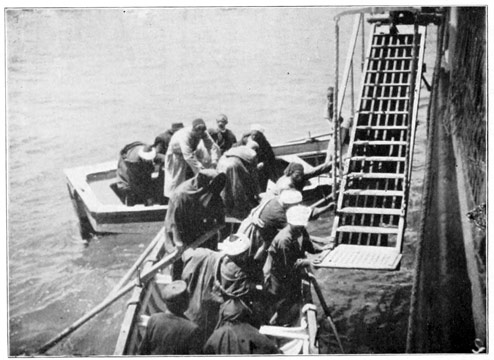
of our arrival. Lighters are quickly
manned, and we are treated to an excellent representation of
the manner in which Christian ships were boarded and
pillaged by Barbary pirates, in the day when the Corsairs
ruled the sea, and all Christendom paid forced tribute to the
Sultans, Deys, and Bashas of the Barbary States. A horde of
turbaned porters and guides overrun the decks, seize indiscriminately
all visible handbags, bundles, and boxes, and
toss them, yelling madly all the while, into the boats which
rise and fall alongside as the huge swells from the Atlantic
glide swiftly underneath
our ship.
Emulating wise and
pious Moslems, we
decide to trust in
Allah for the recovery of our belongings in due time; and,
while the battle of the baggage rages, we turn our attention
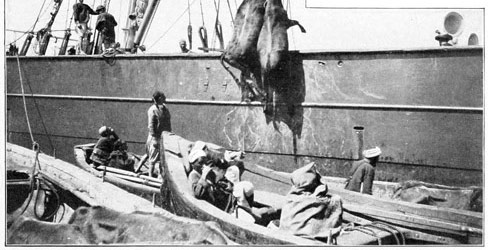
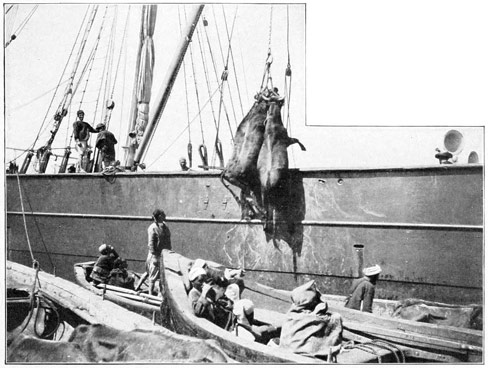
to a neighboring cattle-ship, where the embarkation of its
bovine passengers is proceeding with much celerity and considerable
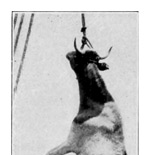
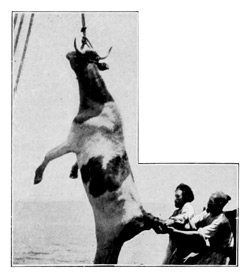
discomfort to the unhappy creatures. The horns of
each steer are bound with rope; a hook descends, is engaged
in the loops; the donkey-engine snorts, and skyward go the
astonished steers, two at a time, in attitudes painfully undignified.
But painful as is this rise in beef, the worst is still
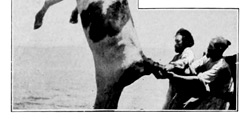
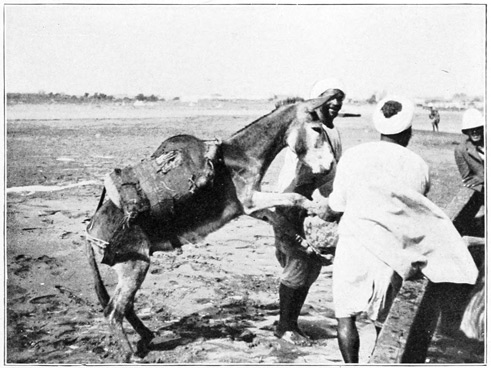
to come. To land the animal in the
proper place upon the deck, fearless Arabs
seize his tail, and by a series of vigorous
yanks and twists cause the suffering creature
to alight with his nose pointed toward
the pen in which he may leisurely readjust
his elongated carcass,
recover from his undisguised
indignation, and console
himself by watching the precipitate
arrival of some other
steer with whom he may
have had unfriendly relations
on the Moorish plains. Thus it is that hundreds of
head of Moorish cattle begin their fatal voyage across the
strait; for vast quantities of Moroccan beef go to feed the
lean and hungry Spaniard, or to supply the brawn and
muscle of Gibraltar's sturdy English garrison.
PIRATES OR PORTERS
A RISE IN BEEF
A RISE IN BEEF
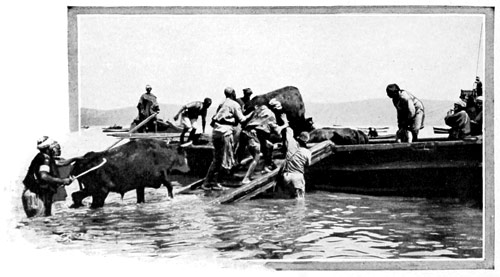
Having witnessed the acme of this cruelty, we observe
with comparative unconcern the unceremonious manner in
which the animals are persuaded to enter the lighters. A
yelling band of Arabs and negroes boost and shove the resisting
brute up the gangplank and tumble him head foremost
into an already crowded boat, where he regains his feet as best
he may. The thuds of falling bodies, the wild cries of the
savage workers, continue until, the cargo complete, the craft
puts off.
A TAIL OF WOE
A TAIL OF WOE
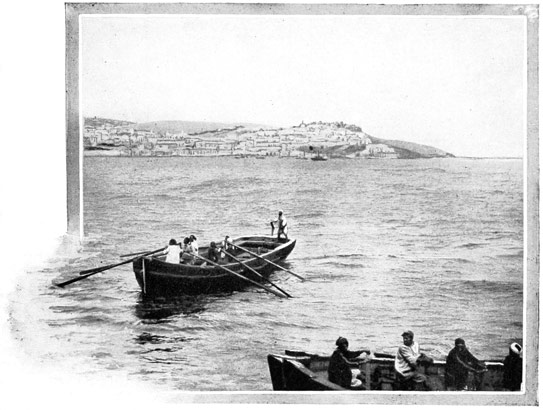
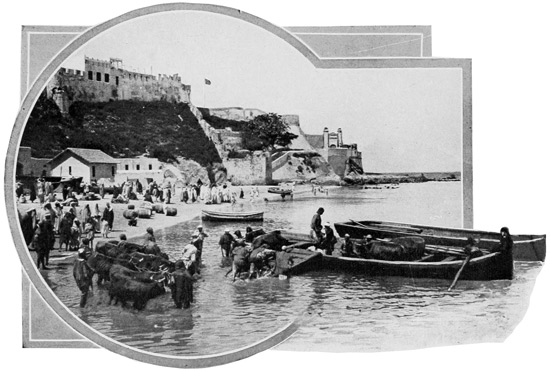
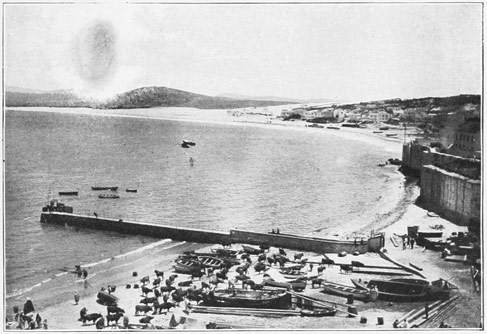
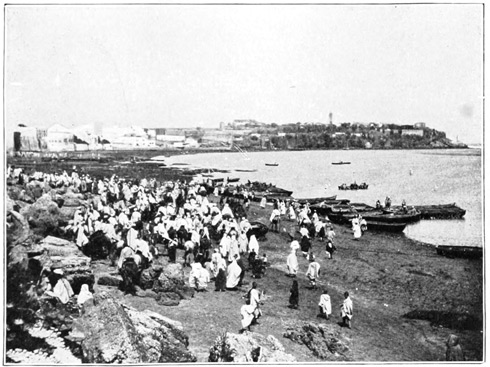
Looking around we find that we have neared the
beach, above which rise the frowning walls of old Tangier.
Formerly all passengers landed on the beach, and in rough
weather the arrival of a tourist party was a diverting spectacle,
the frightened passengers being carried from the tossing
rowboats to the sandy beach upon the broad backs of
native porters. These porters are invariably Jews, for we are
given to understand that no self-respecting Moslem would
bend his back to so vile a burden as the carcass of a "Christian
dog." We almost regret the tameness of our own
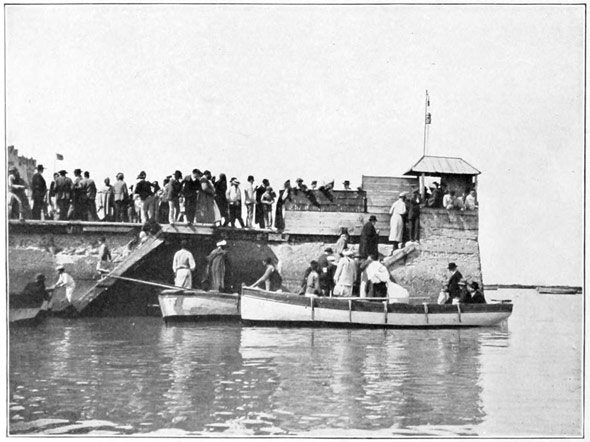
arrival, for, thanks to a comparatively calm sea, our boats are
able to approach the little pier, and to land us without danger
or discomfort save that occasioned by the pressing curiosity
of the crowd assembled to watch the coming of the money-spending
infidel.
PERSUASIVE METHODS
THE BEACH
THE PIER
THE HARBOR OF TANGIER
The pier, by the way, represents the one harbor-improvement
grudgingly executed by the Moors. The harbor of
Tangier could be made most secure at small expense, but the
Moors prefer not to tamper with it. "God made it so," they
tell us; "we would not presume to alter the wise arrangements
of the Almighty." They did not even attempt to
repair the old breakwater built by the English years ago and
blown up by them upon the close of the brief British occupation.
The mention of a British occupation recalls a bit of
history. Tangier was taken by the Portuguese in 1471. By
them it was held until a Portuguese princess, Catarina of Braganza,
went to England as the bride of Charles the Second.
She brought to him a splendid dower, including two then
unimportant pieces of real estate,—the island of Bombay in
far-off India, and this city of Tangier at the Mediterranean's
western gate. Strange indeed the fate of these two bits of
real estate. Bombay, the hopeless, far-away possession,
became in time the glorious Indian Empire. Tangier, with
its unrivaled situation at one of the great doorways of the
western world, was held for twenty years, and then, through
sheer stupidity, abandoned to barbarism. It was returned by
England to the Moors as a free gift; a transaction almost
unique in Britain's history. But we must not forget that
Gibraltar was not yet a cushion for the British lion's paw;
had it been so, another paw would have rested firmly on this
Moorish shore, insuring to England absolute control of the
Gibraltar Strait.
THE CONTINENTAL HOTEL
But if the Anglo-Saxon armies long since relinquished
this invaluable prize, the Anglo-Saxon tourist has made
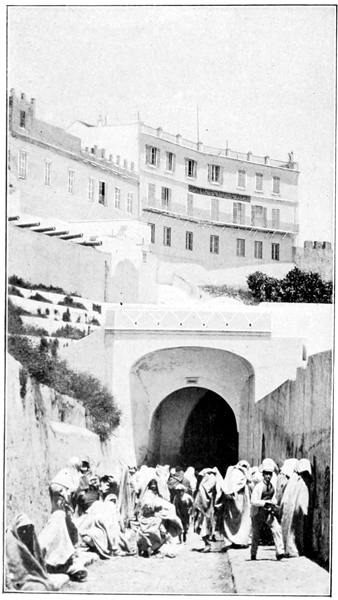
Tangier his own. Having passed the solemn Moors who sit
at the water-gate at receipt of custom, we find ourselves in a
trough-like passage above which rises that stronghold of the
globe-trotter, the Continental Hotel. It appears like a huge
grin upon the frowning face of the walled city; and its hospitable
and cheery aspect contradicts the hostile impression
produced by the cannon on the ramparts and the scowling
looks of some of the inhabitants.
Let not the tourist be disappointed because a modern
structure first obtrudes itself. Tangier is not the real
Morocco; it is a
Moslem seaport,
defiled by contact
with an infidel
world.
THE HILLS OF SPAIN ARE SEEN ACROSS THE STRAITS
A CROWD OF MENDICANTS
The late Sultan
of Morocco
disowned the
city. When last
he came and beheld
the changes
wrought by foreigners,
it is said
that he exclaimed:
"Allah confound
these
greedy Christians!—they
have stolen from
me my beautiful
Tangier!"
PENNIES FOR THE POOR
AFTER
TASTING
GOVERNMENTAL
GENEROSITY
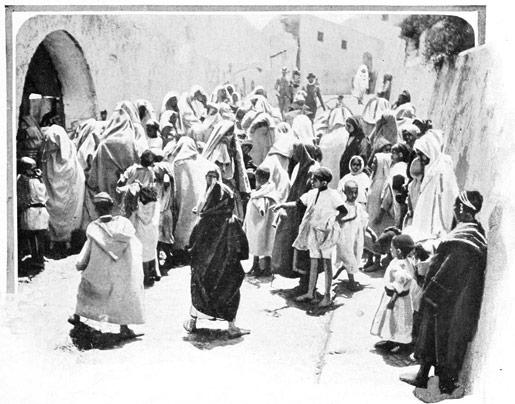
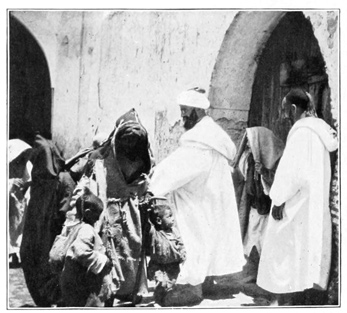
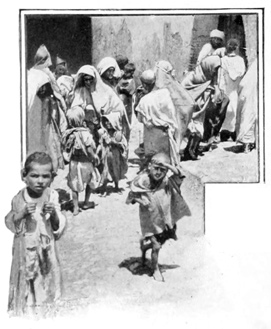
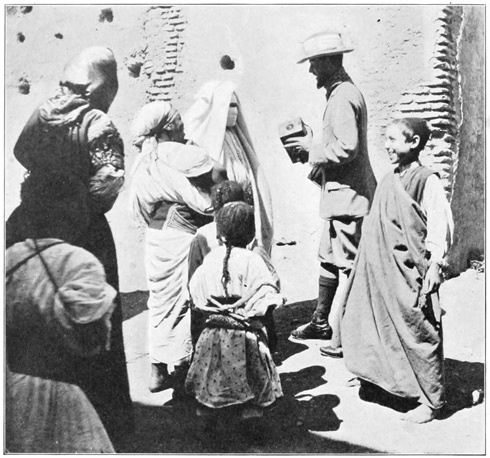
The crowd we
see near yonder
doorway is gathered
by a distribution
of pennies
to the poor,—an
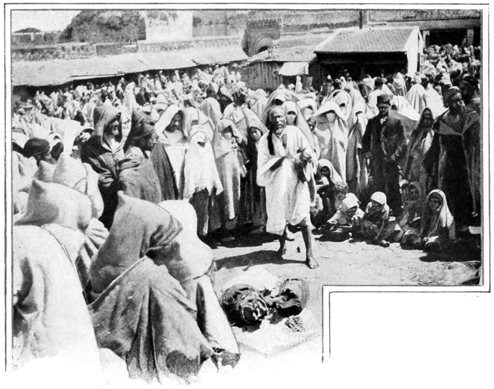
act of charity performed every week by the officials of
the custom-house. How superbly important seems the white
robed Moor charged with the graceful task of pressing into
every outstretched dirty palm a shining Spanish copper worth
about two cents, while his assistant keeps his eyes well open
to detect repeaters. Every now and then there is a lively
row, resulting from the detection of some clever unfortunate,
who has changed rags with a fellow
pauper, and has complacently applied for a second dose of
governmental generosity. Utter poverty and black misery
are depicted upon the rags and visages of the expectant
throng—even the babies wear oldish, knowing expressions
on their little faces. A strange feature is the curious little
pigtail worn by the boys,—a pigtail growing all awry, sprouting,
not from the crown, but from one side of the head.
The pigtail is an agent of salvation; on it depends the
hope of heaven;
for we are told
that at the day
of judgment
Allah is to lift
the righteous
faithful by their
pigtails into
paradise. Apropos
of this statement
and other
statements heard
in the course of
our journey, it
may be well to quote an Arab maxim: "Never believe all
you hear; for he who believes all he hears often will believe
that which is not." Another maxim from the same source
contains excellent advice for the traveler, and much comfort
for the lazy: "Do not do all that you can; for he who does
all he can, often will do that which he should not." Another
is a pearl of great price to the returned traveler especially:
"Do not say all you know; for he who says all he knows
often will say that which he knows not." There is yet a
fourth gem of Arabian wisdom with a similar setting: "Do
not spend all you have; for
he who spends all he hath,
often will spend that which
he hath not."
COMRADES IN POVERTY
The arrival in Tangier is
unlike that in any other city
in the world. Every native
face is a type, every group a
picture. We begin to
love the dirt, the smells
(not all bad ones, by any means, merely
strange foreign smells suggestive of what
is old and Oriental), and as we make
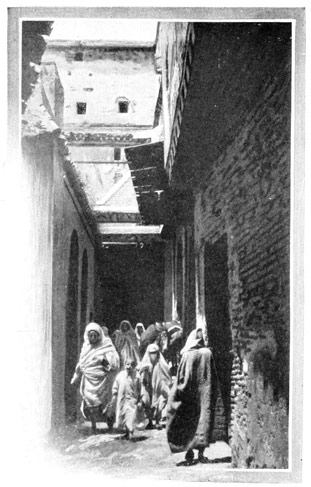
our way into the perplexing maze of
Tangier's weird little alleys, we
seem to have taken a journey
backward through the ages.
Our sensations might be those
of one suddenly transported
from this familiar earth to
a strange planet; and yet
the hills of Spain are seen
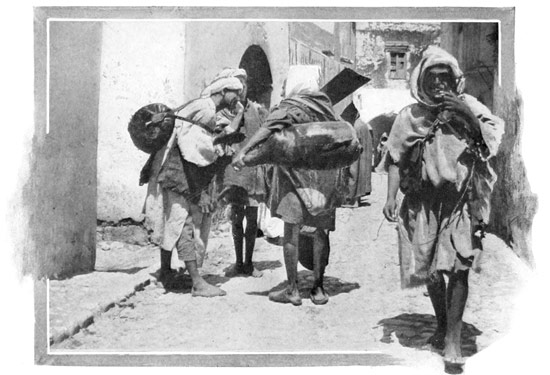
across the straits. A group
of water-carriers earnestly
discussing some important
piece of news that probably
will never be published to the
Christian world, forms a picture
almost Biblical in its antiquity.
They are retailers of that precious
beverage,—the beverage of all
the worshipers of Allah,—the true gift
of God, pure water. We can forgive the
Moslem many things, because he never has been, and,
so long as he clings to the religion of his fathers, never
will be, a drunkard. The water-bags are goat-skins, the
hind leg serving as a faucet; but although we are as
thirsty as the African sun itself, we do not patronize these
itinerant fountains; being newly come to Tangier, our
squeamishness interferes with an indulgence in many little
comforts; but what a surprising revolution will be worked
by an expedition into Morocco! We shall return from the
interior with adamantine sensibilities as regards such trifles.
But to-day we are open to impressions of all kinds. So
dazed are we by the strangeness of our surroundings that we
have left no words with which to express our delight when,
stepping out at last upon the balcony of our hotel, we look
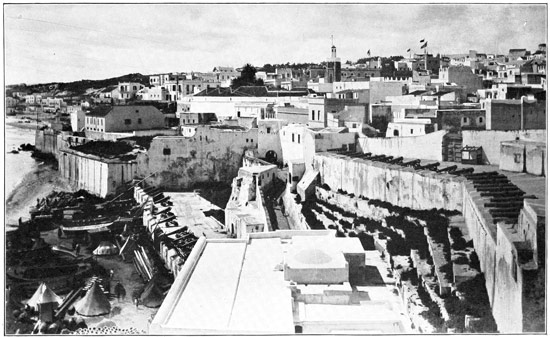
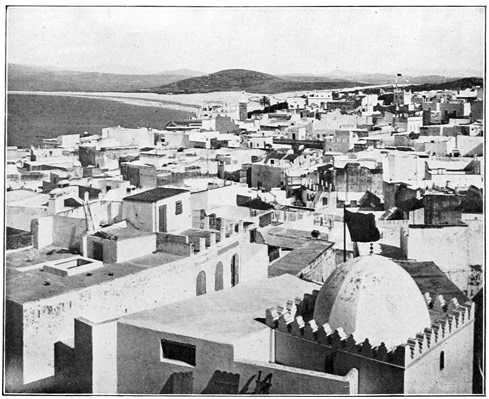
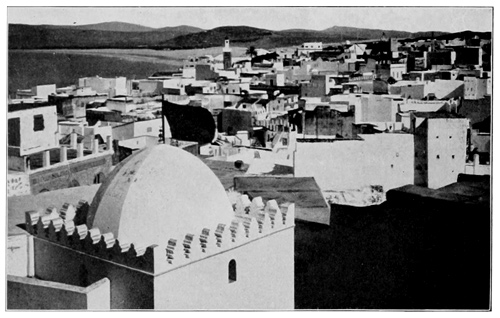
down upon Tangier, the "White City of the Straits." Below
us is the beach, dotted with the rude camps of pilgrims who
are awaiting ships for Mecca; above it are tiers of batteries;
beyond we see a mass of white cubes, the dwelling-houses of
the Moors. A dainty minaret, green-tiled
and graceful, rises from this angular snow-bank; near it, the
flags of foreign nations float above their respective consulates
and legations. Strange indeed this mingling of the Occidental
and the Oriental, beautiful indeed this city of Tangier,
the sentinel city of Morocco, posted here at the corner of
Africa to watch with jealous eyes for the coming of the
inevitable conqueror who is to sally forth from the gates of
Christendom, dimly discerned across the Gibraltar Channel.
Of small account will be these batteries, furnished with antiquated
cannon. These crippled dogs of war rend nothing
more tangible than air, and damage nothing but ear-drums.
And frequently is the air rent, and the ear assaulted, for the
arrival of every man-of-war is greeted with a ferocious salvo
of artillery, at sound of which the Moors gaze proudly seaward,
expand their chests, recall the days when Moorish
corsairs ruled the seas, and dream of future victories for the
armies of the Prophet.
WATER CARRIERS
The sunshine in this land is wonderful; at seven in the
morning it is so brilliant that we cannot bear the reflection
from the chalky housetops, and recover the use of our eyesight
only when in the dark and narrow corridors that serve
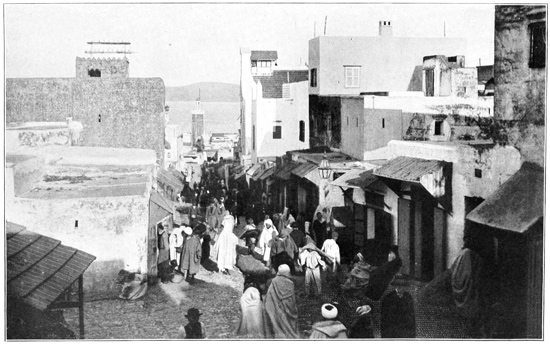
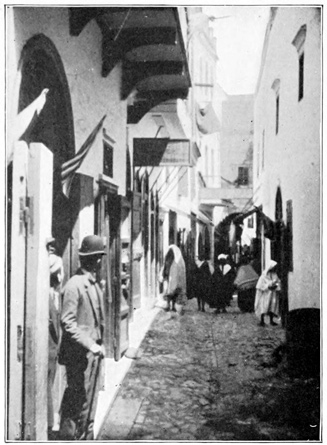
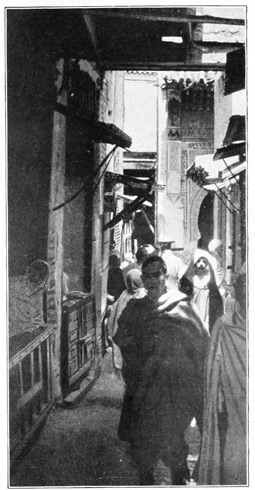
the Tangerines in lieu of streets. The thoroughfare which
every visitor must traverse when going from the hotel to the
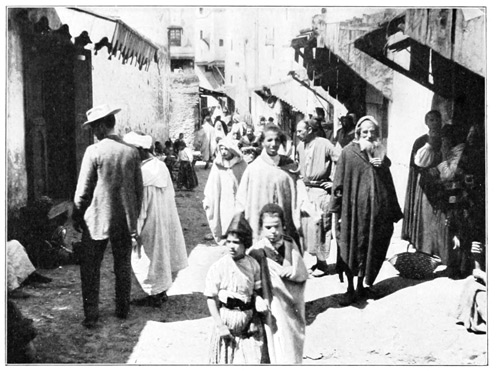
great or lesser market-places, is distinctly banal in aspect.
It is the leading shopping street of the European residents;
its shops
are stuffed with
canned provisions,
patent-medicines,
and playing-cards,
while a saloon or
two make known
their presence,
even to the blind,
by strong gin-like
aromas wafted
thence. When
lost in the labyrinthine
maze
of Moorish Tangier,
the foreigner
has but to follow
his nose to reach
the place where
rum and brandy
are on sale, and European civilization well in evidence. Then
he may emerge into the lesser market-place, or "Soko," as it
is called in local speech. Here he finds one tiny French cafe
and the postal stations of England, Spain, and France; for
as Morocco's postal-service is on a par with its other governmental
enterprises, these nations each maintain post-offices
in Tangier and an elaborate courier service in the interior.
European mails now penetrate to Fez, even to Mequinez and
Morocco City, with tolerable dispatch and certainty.
TANGIER
THE WHITE CITY OF THE STRAITS
THE STREET OF EUROPEAN SHOPS
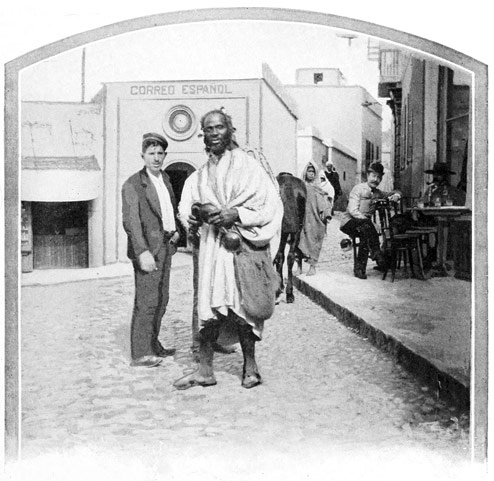
While we refresh ourselves at the cafe, we are amused by
the ape-like antics of a negro from the far-away province of
Suss. His wig of wool is hung with shells and teeth and
nails, all of which clatter as he dances to the music of a
pair of iron castanets.
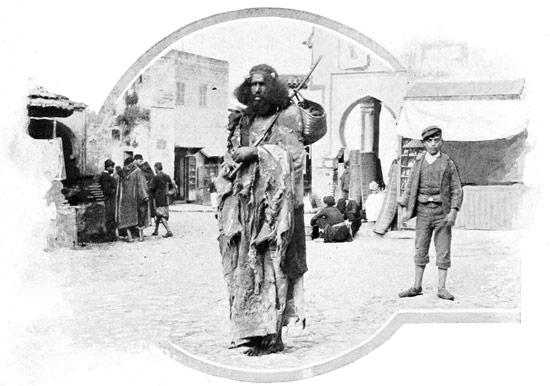
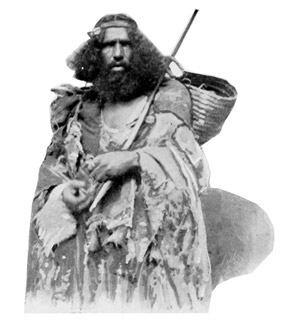
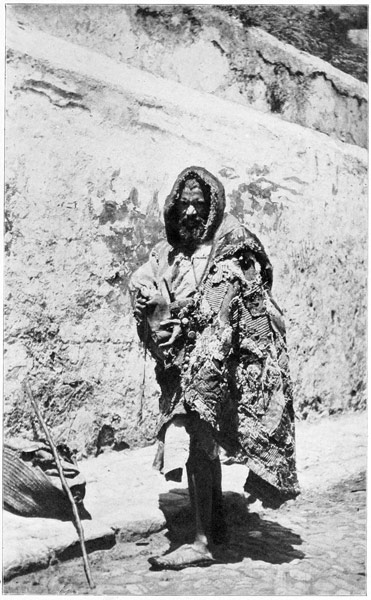
But he cannot compare in picturesqueness with this other
visitor—a superb representative of the saintly beggar class.
So imposing a revelation of dignity in rags it is not possible
to find among men of any other race or creed. We learn
that this haughty mendicant is crazy; that in Morocco,
insanity is the most valuable asset of those who desire to
engage in what European residents irreverently term the
"saint business." The Moors are convinced that if the mind
of a man inhabit not his body, it is because God, having
discerned in that mind much beauty of holiness, retains it in
paradise as a thing too precious to be sent with the man to
earth. Therefore great consideration should be shown for
the mortal coil pertaining to
that mind. Thus "crazy" has become a synonym for
"sanctified," and an insane man has but to mumble prayers,
and watch his saner fellow-citizens vie with one another in
propitiating him with gifts and offerings. But sometimes
this insanity is only feigned, and some of these weird characters
are in reality agents of the militant Moslem brotherhoods
of Tripoli and Tunis, charged with the spreading of a
Mohammedan propaganda and the keeping alive of bitter
anti-Christian agitation.
THE CAFE IN THE LITTLE SOKO
A...
SINGING NEGRO
FROM THE
SUSS
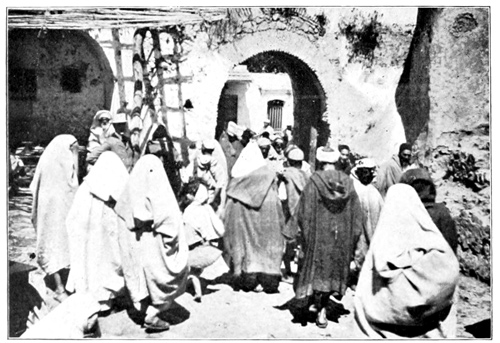
If we follow this splendid miserable, we shall presently
lose sight of him in the confusion of the be-draped,
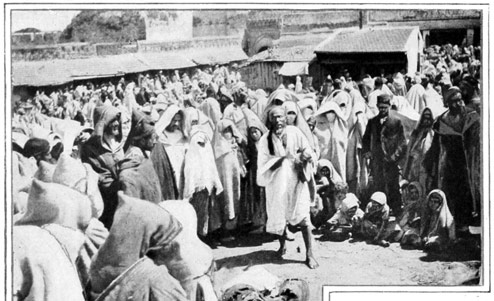
be-hooded crowd surging through the upper gate that opens
toward the greater market-place, or "Soko," on the high
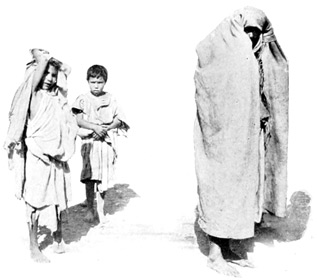
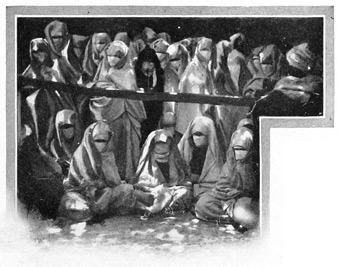
ground behind the city. The women are closely veiled
and buried in the smothering folds
of the white woolen
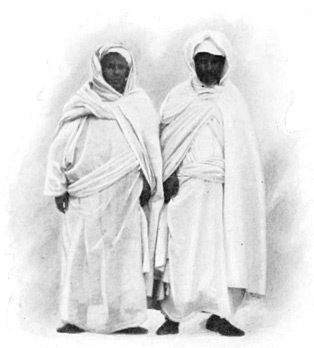
"haik." All rich
men wear the
colored caftan, or
the white burnoose,
and some are draped in muslin veils; the poor men wear the
rough brown jelaba, a sack-like garment with a pointed hood.
On feet that are not bare are yellow slippers; on the heads,
a red fez, a white turban, or a monkish-looking hood.
DIGNITY IN RAGS
A SPLENDID "MISERABLE"
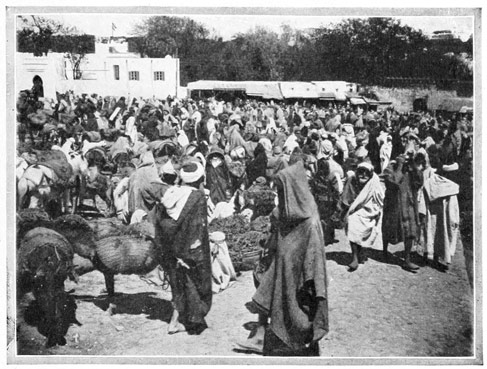
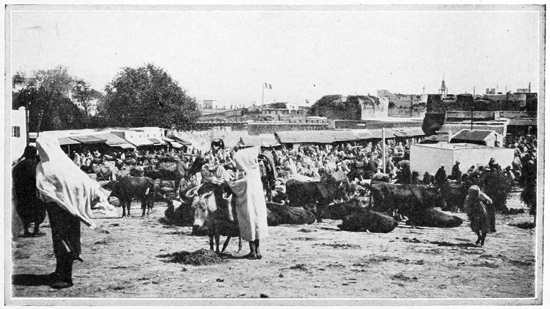
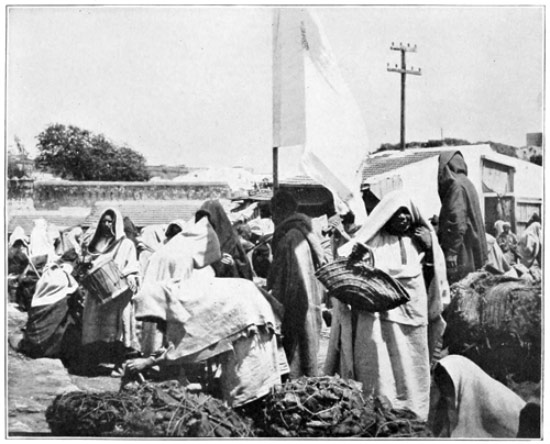
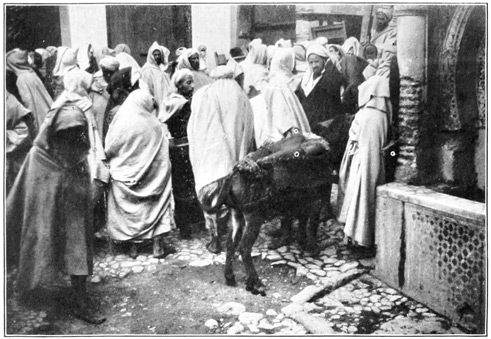
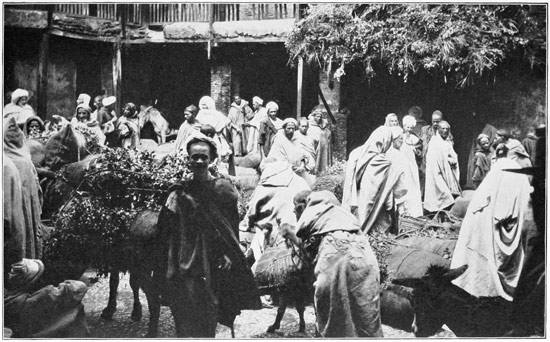
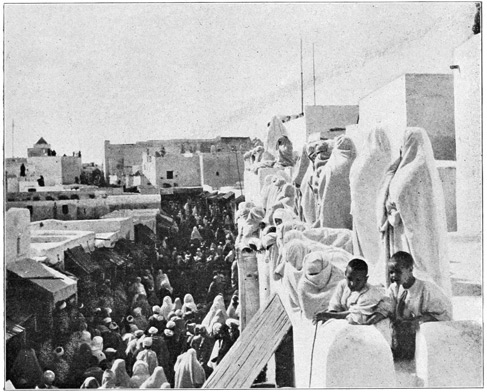
The Soko on Thursday or on Sunday (local market-days)
is a sight to be remembered. The market-place itself is,
literally, out of sight; during the night and early morning,
living things, from men to mules, from women to camels,
and things inanimate, from eggs to beef and mutton, from
oats to olive oil, have been gathered together, spread out,
heaped up, forming a mass that moves and gives forth cries
and odors. Twice every week the sun looks down upon a
scene like this. Here in the Soko is the true frontier between
the Christian and the Moslem worlds. Here is the borderland
of the real Africa; here couriers from Fez and from the
desert region farther south meet the postmen of the European
provinces; here surges the murky tide
of African humanity; here breaks the
last sun-crested wave of continental
civilization; here top-hats and turbans
mingle; here Europe ends
and Africa begins.
THE BE-DRAPED, BE-HOODED CROWD
From the windows of
the legation of a European
nation which open upon
the Soko, there are wafted
lively measures of piano
melody; and these are almost
drowned by the prayers
of beggars, the vociferations
of the trading throng, and
the incantations of half-crazy conjurors. Conquering our first
emotion of aversion, almost of fear, we press through the ill-smelling,
yelling crowd, and work our way to the front rank
of a magician's audience. The conjuror welcomes us with
curses, and refuses to continue his performance until our
cameras have been
lowered, and our
offering of money
has been cast into
the ring of spectators.
Then, muttering strange prayers, he gathers from the
ground a handful of straw, calls on his god, and on the generosity
of the onlookers, and blowing upon the straw causes
it miraculously to burst into flames, which instantly consume
it. More offerings are then demanded, more prayers are said,
and more unflattering remarks are made concerning us; for to
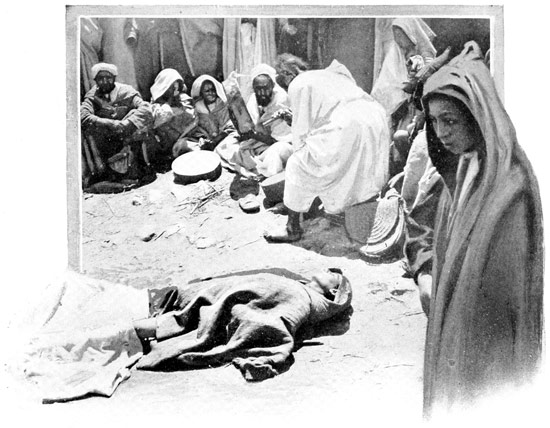
curse and to insult a Christian is a pious deed. Another trick
is performed: A youth is (supposedly) hypnotized, and while
he seems unconscious, a long bodkin is thrust through the
flesh of his throat and the ends left protruding, while the old
fakir takes up the most successful collection of the afternoon.
Because we do not give more silver coins instead of Moorish
coppers, the holy wonder-worker exhausts his stock of anti-Christian
expletives, much to the edification of his sympathetic
congregation. So great is the hatred of Christians on
the part of the lower classes that even the beggars return
curses instead of thanks, atoning for the sin of receiving
unclean Christian money by calling down the wrath of
heaven, not only upon our heads, but also upon the heads of
all who are dear to us, or related to us, even unto the fourth
and fifth generation of those who have preceded us and are
responsible for our existence. One simple and popular
anathema is, "May Allah burn your grandmother!" Another
expresses the wish that the wife of your great-grandfather
may enjoy perpetual torridity in the nether world.
THE BORDERLAND OF THE REAL AFRICA
THE SOKO ON SUNDAY
A CURSING CONJUROR
A CURSING CONJUROR
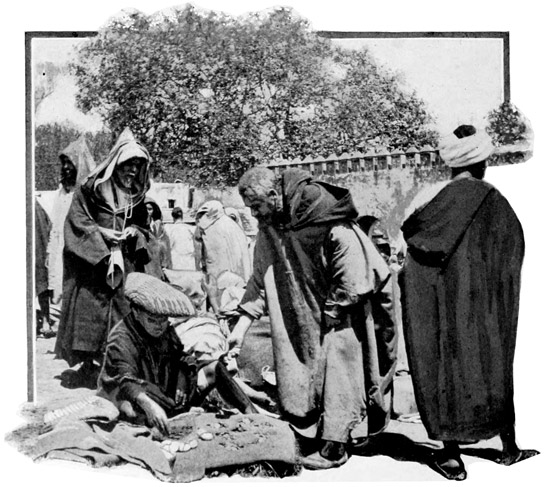
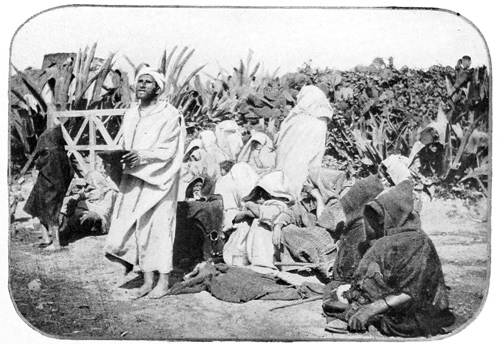
The blind mendicants beg in little companies of six or
eight. One sightless horrible, standing, cries aloud for
charity in the name of his companions. These are not
pleasant sights, but no true impression of Tangier can be
imparted if we leave out of the picture the rags, the beggars,
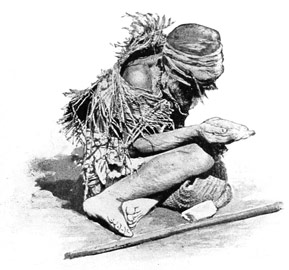
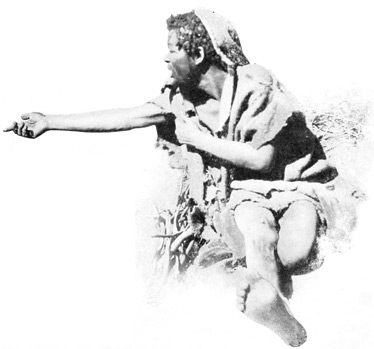
and the dirt. One more sad spectacle must suffice—that of
an old beggar, shriveled by age, baked by the cruel sun, bent
beneath the burden of many hopeless years, not even clad in
rags, but merely covered with a mat of straw—a superlative
expression of Moroccan misery.
"MAY ALLAH BURN YOUR GRANDMOTHER!"
HYPNOTIZED!
A PETTY TRANSACTION
MOROCCAN
MISERY
Here we may recall the story of the English clergyman,
who, touched at the sight of all this misery and ignorance,
resolved to tell the gospel-story to the people of Tangier—to
make a public exhortation in the market-place. With the
greatest difficulty he secured a capable interpreter, for most
of the hotel guides feared to assist him in his rash and
dangerous crusade. When the pious preacher began his
sermon in the market-place, he was not only surprised, but
thoroughly delighted at the reverence with which his
glowing words, translated by
his guide, were received by the attentive
throng of Moslems. When he had
finished, he was even urged to speak
again. Undoubtedly the good man carried
away a soul filled with joy
because of the good seed he had
planted here. One English newspaper
chronicled the marked
interest shown by the heathen in
the words of Christian truth; but
it is to be hoped that the good
man will never learn that while
he stood in the center of this meeting place and spoke, his
diplomatic interpreter and guide not only held the respectful
ears of the crowd, but possibly saved the missionary's life
by cleverly turning the orthodox sermon into one of the
favorite romances from the "Arabian Nights."
A SYNDICATE OF BLIND BEGGARS
MOSLEM SALVATIONISTS
No, it is virtually impossible to turn the Moslem from the
faith of his fathers. His religion forms too intimate a part of
his daily life; his religious fasts and festivals are observed
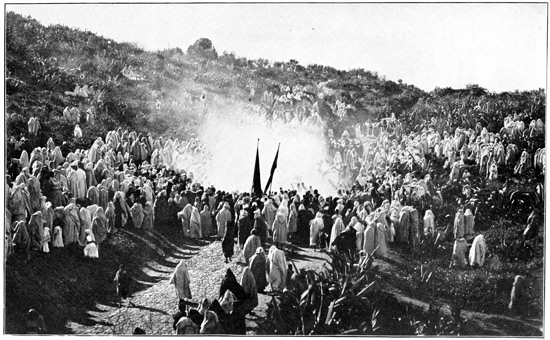
with a strictness that is absolute. We chanced to witness
the celebration of the great feast called Aid-el-Kebir. The
early morning finds us on a hillside near the market, where
there is gathered a multitude of spectral forms. Here the
slanting rays of the newly risen sun draw out all shadows to
a grotesque length, while from the midst of the assemblage
there bursts a cloud of smoke which like a veil conceals
the wild tribesmen who are there performing a fantastic
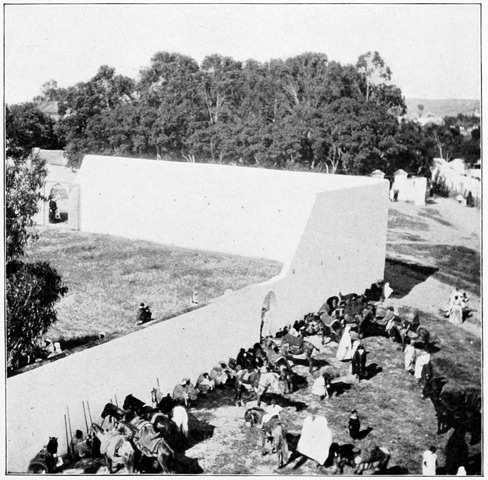
powder-play with old-fashioned noisy flintlocks. An hour
later the populace repairs to the high-walled garden of a
suburban mosque to witness the sacrifice of a magnificent
ram. The ram, however, is not allowed to die in peace, for
according to an ancient custom its bleeding body must be
borne swiftly down through the city streets to the great
mosque in the lower town, where, if it arrives living, the
omen for the year is pronounced good; if dead, the wise men
shake their heads and prophesy disaster. Hence are the
swiftest runners employed to dash with the dying burden
across the Soko, into the city gates, down abrupt alleys to
the other sanctuary. Like a host of madmen they rush past
us, the sheep slung in a basket dragged by four men. Thrice
do the bearers stumble, thrice is the bleeding mass rolled in
the dust, thrice is the mad race resumed, the people urging
on the panting runners with cries, and sticks, and stones.
The sacrificial ram is dead upon arriving at the mosque, yet
it is given out by the authorities that it was still alive. The
disorderly mob disappears through the arched portals of the
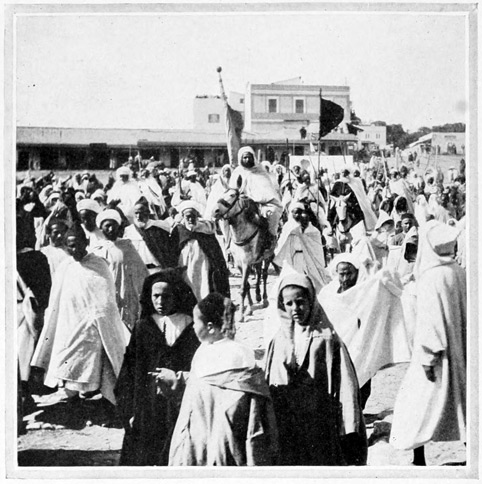
town, and a dignified procession crosses the Soko. The
Basha, or Governor, of the province of Tangier, with his
mounted escort, is returning from the recent ceremony.
Although his salary is only seventy-five dollars a month, this
wise official, by strict economy, has grown very rich. He,
like all the swells, rides a handsome mule; for in Morocco
mules enjoy much favor and are preferred to horses for long
journeys and for city promenades; in fact, for everything,
save battle.
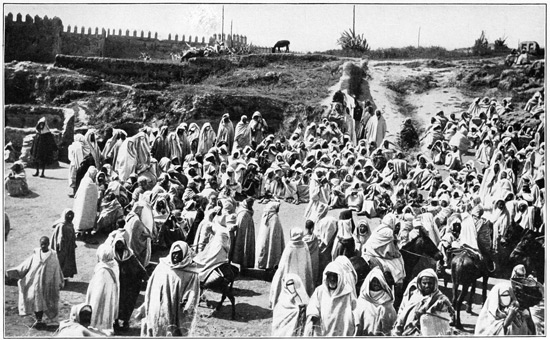
GATHERING TO CELEBRATE THE "GREAT FEAST"
(Photograph by Mr. White, of Tangier)
NEAR THE SUBURBAN MOSQUE
THE BASHA OF TANGIER
A feast is held in every house upon this sacred day, a
sheep being sacrificed for each adult member of the family.
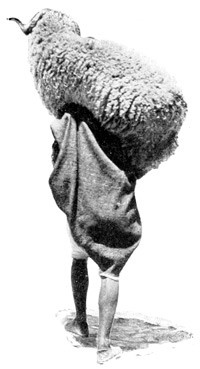
We see many a woolly burden carried
through the streets upon the shoulders
of the purchaser. Other means also are
employed for the successful home-bringing
of the fatted creatures. One man
will attempt to drag the balky ram by the
horns; another, more clever, will seize the
hind feet and shove the sheep along as one
would push a wheelbarrow, the result being a
wildly zigzag progress down the steep, narrow
streets. Throughout the entire Moslem world
this day of Aid-el-Kebir is celebrated. At
Mecca, the fountain-head of the Moslem faith,
a hundred and twenty thousand sheep are put
to the knife at each recurrence of the festival.
Even in Tangier the feast may be likened to
an ovine Saint Bartholomew Massacre, a day as fatal to these
woolly victims as is Thanksgiving day to the devoted gobblers
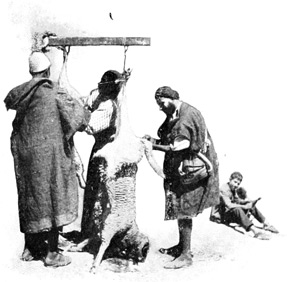
of New England. The city becomes a mammoth butcher-shop;
the gutters in the narrow streets run red with blood.
To escape these little tragedies, we make our way up to the
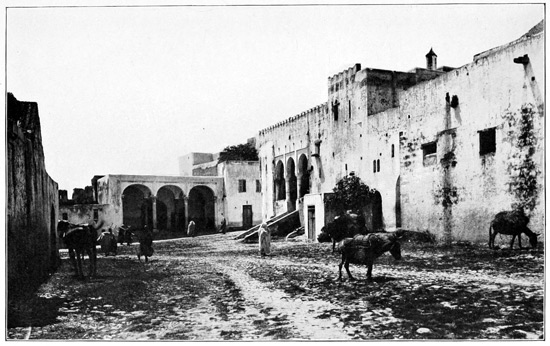
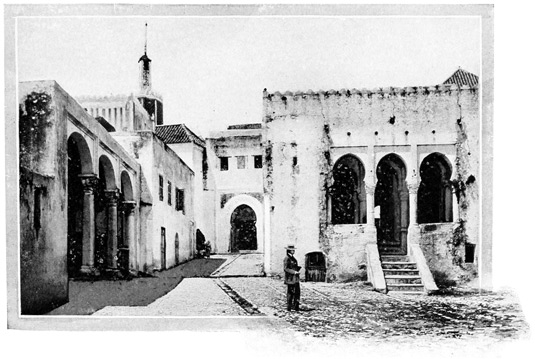
higher regions of the town, where the Palace of the
Governor, the Treasury Building, and the Prison are
found in close proximity to one another. We
find the palace inaccessible, the treasury empty,
and the prison full.
THE SACRIFICIAL RAM
AN OVINE SAINT BARTHOLOMEW
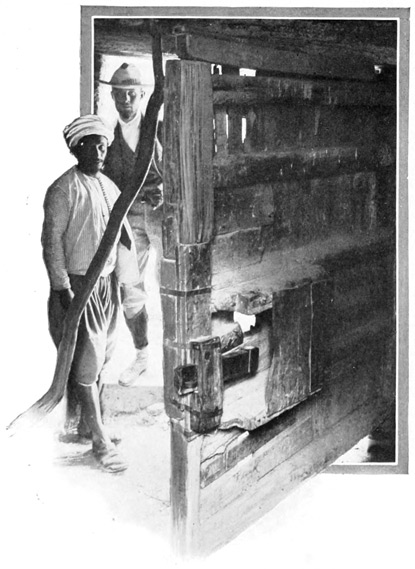
The prison externally is a blank,
white structure, high and in sad want
of repair. We enter a small vestibule,
where several lazy guards
are stationed; they indicate
an opening in the wall, a
window, protected by heavy
bars and closed by a thick
metal shutter. This, they say, is the unique means of
ingress to the prison. No means of egress is required, for
prisoners seldom come thence alive. A hasty glance through
a round hole in the metal shutter reveals a filthy, spacious
hall, crowded with animated mummies loosely wrapped in
earth-colored tatters. We are told that no food is furnished
to the prisoners save that which may be brought by pitying
outsiders, friends of the unfortunates within. The government
allows its victims the one privilege of reaching out
through the little aperture for the bread of pity. Some of
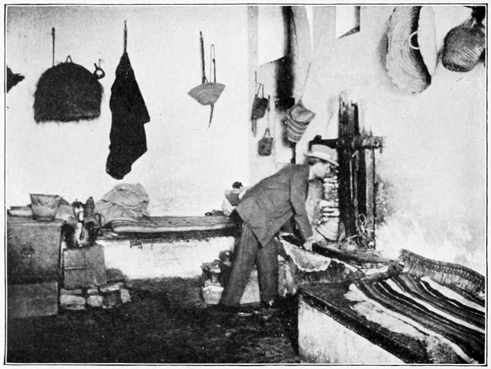
the prisoners make colored baskets, like those which hang
upon the wall, and eke out an existence by the sale of these.
The presence of a traveler becoming known in the den,
baskets by the dozen come tumbling out to tempt him in
charity to buy.
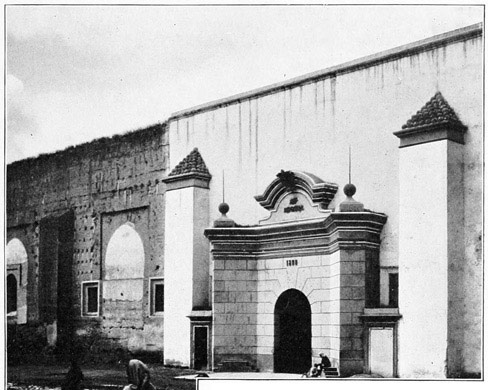
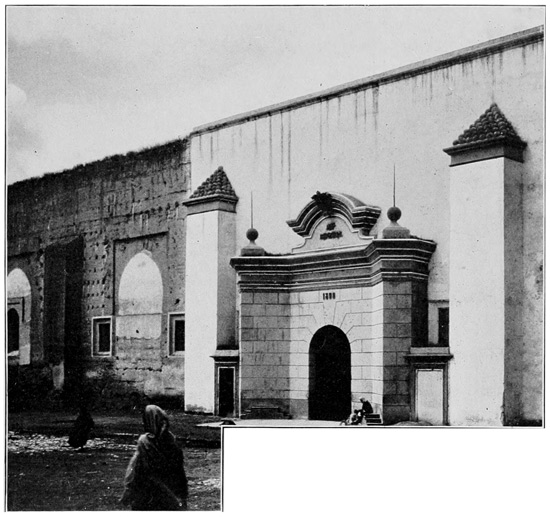
THE ONLY DOORWAY TO THE PRISON
THE PRISON
While it is difficult for a man to get out of the prison, it
is absolutely impossible for a man to enter the harem of the
neighboring palace of the
Basha; but foreign women are sometimes presented to the
Basha's wives. One feminine visitor reports that the mysterious
beauties examined carefully the details of her dress.
"Oh," said one to another, as she discovered that the white
hands were gloved, "see!—the American lady has two skins
upon her hands!" In reply to a question as to what little
present might be welcome, one Oriental matron replied with
much enthusiasm, "Ah, send us from your country some
of those pretty little combs with the fine teeth—they are so
much more useful than our coarse ones, and—we need them
very much!"
THE BASHA'S PALACE AND THE TREASURY
AT THE U. S. CONSULATE-GENERAL
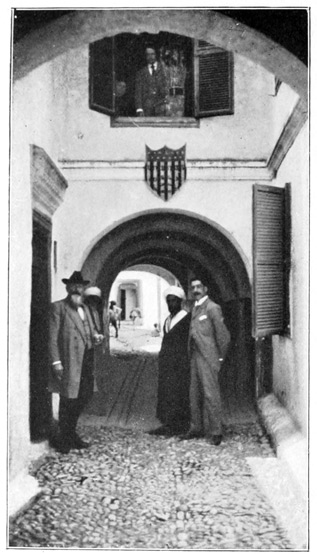
Leaving the inhospitable palace, we descend to the one
building of all Tangier, in which we are certain to receive a cordial
welcome. The shield of the United States Consulate-General
dispels the Moorish gloom of at least one dim thoroughfare.
Here in this land of despotism and darkness it shines forth
like a symbol of liberty and light. The Consul-General, Dr.
J. J. Barclay, tells us
with justifiable pride
that his grandfather,
the Hon. Thos. Barclay,
negotiated the
first treaty between
the United States
and the Empire of
Morocco. He shows
us two interesting
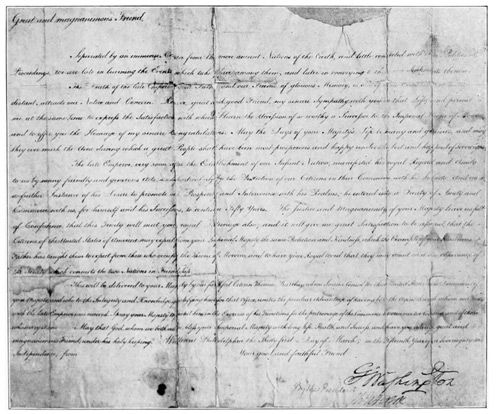
documents; one, the
Consular Commission
signed by
George Washington;
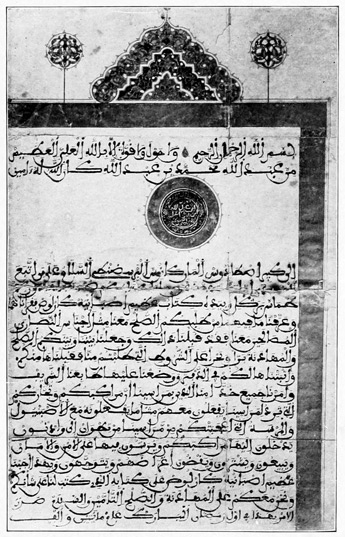
the other, the Exequatur
granted by
the Sultan to the
first Consul of the
young American
Republic. The following
is a translation
of the Exequatur,
made by the official
interpreter of the
Consulate-General:
"In the name of God, the Clement and Merciful. There
is no strength or force but in God, the High and Eternal.
From Abdallah Mohammed, Ben Abdallah, in whom the
Almighty deposited his confidence."
IMPERIAL SEAL
"To the great President of the American States: I salute
you with empressment, and hope in God you are well. The
Ambassador, Thomas Barclay, has come to us bearing a precious
letter from the Spaniard Charles. We have read it, and
we understand all its contents in which you asked us peace
with you like the other Christian nations with whom you have
made peace. We accept your demand, and peace be between
us on land and sea, and according to the Treaties you demanded
from us. We have written this in our letter to you, to which
I affixed my Sheriffian seal, and we have ordered all our employees
in my seaports to do with your vessels and merchandise
that go to my seaports, as they do with those of the Spaniards,
and your vessels can enter, and anchor with safety in any of
my seaports you choose, from Tetuan to Wadnoon; they can
also buy and sell, and do business for themselves, and they
can depart. We have answered just like this to the great
Spaniard Charles, who wrote me a letter on your behalf. I
join with you in perfect peace and friendship. In peace.
"This is written the first day of the blessed month of
Ramadan 1200 (1785-1786)."
AN AMERICAN HOUSE IN TANGIER
COMMISSION OF CONSUL THOMAS BARCLAY SIGNED BY GEORGE WASHINGTON
To Dr. Barclay we confided our cherished plans for a
journey into Morocco, and asked him to advise, assist, and
guide us. He became most zealous in our cause; made light
of the difficulty and danger said to attend the journey, spoke
in glowing terms of the pleasures and surprises in store for
us. Within the week all the formalities incident to our
departure are complied with. The Moorish Minister of Foreign
Affairs has graciously granted us permission to traverse
the Empire of his Master, the Sultan of Morocco, and he has
provided us with letters to many provincial chiefs, and to the
Governor of Fez, the capital. He has promised us a military
escort equal to our needs, and has called down blessings upon
us, and has accepted the usual little token of our high esteem
in the form of a pile of Spanish dollars. All this we owed
to the good offices of Dr. Barclay, to whom also we owed
a delightful
glimpse of the
gay social life led
by the foreign
residents and
diplomats in old
Tangier.
EXEQUATUR OF THE FIRST U. S. CONSUL TO TANGIER
The hillsides
round about the
city are dotted
with luxurious,
palatial villas, in
the drawing-rooms
of which
cosmopolitan
gatherings discuss
the latest
continental news
in half a dozen
languages. According
to an
English dictum,
"Society in Tangier
is split into
three factions,—those who will know one another, those
who won't know one another, and those who must know
one another, but don't like to." There are artists,
musicians, and diplomats, millionaires and globe-trotters,
and ex-consuls and ex-ministers by the dozen; for they
say that when one has lived in Tangier, it is not possible
to be contented elsewhere. Therefore many men
who come hither for a few years of diplomatic service,
end by purchasing hillside villas and becoming permanent
residents.
A LAST LOOK AT TANGIER
Tangerine hospitality is famous for its freedom, but we
have little time for social dissipations. Every moment is
occupied in preparations for departure. A few days more
and we are to leave this most attractive corner of Cosmopolis,
bid farewell to friends, to comfort, and to civilization. The
hotel will give place to the tent, the daily pony-canter on the
beach to the long weary marches of our caravan over hills and
mountains, in the region where there are no roads, where
to-day is the same as yesterday. We are to voyage forth
upon a strange expanse, where the ship of Moorish civilization,
stranded upon the shoals of the religion of immutability,
has lain rotting since the conquest of Granada.
It is but right that you should know something about the
men upon whom our future comfort, welfare, and safety
entirely depend. Let me introduce, first of all, the most
faithful of guides, the most honest of dragomans, the cheeriest
of companions, the cleverest of pathfinders, the best of cooks,
and—the most amusing prevaricator I have ever known.
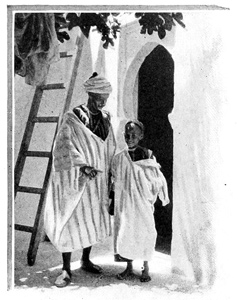
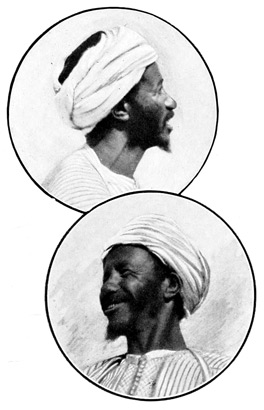
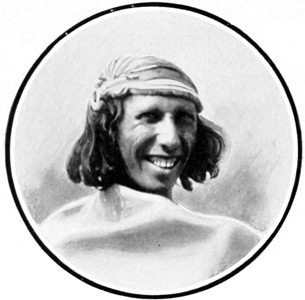
His name is like all Moorish names, a mouthful, "Haj Abd-er-Rahman
Salama." We see him first at the door of his
dwelling, a bright young Salama at his side. We speak
with him in French and Spanish, for his much-advertised
command of English is monumentally inadequate. Moreover
in French he speaks like a gentleman, in English like a
blackguard; one language having been learned in Algiers
and in Paris, the other picked up from profane sportsmen,
while serving as dragoman for pig-sticking expeditions. As
for his name, we forget it altogether, and address him simply
as Haj, the word "Haj" being a sort of honorific prefix, meaning
Pilgrim, in other words, a righteous Moslem who has
made the Holy Pilgrimage to Mecca. When it was noised
abroad that we were thinking of a trip to Fez, the professional
guides of Tangier looked on us as lawful, tempting
prey. One Jewish pathfinder proffered his services and outfit
for seven English pounds a day. Then others came with
other propositions, and there ensued a veritable rate-war in
which tents figure in place of Pullman cars, and, in place of
sixty-miles-an-hour locomotives, mules that travel only sixteen
miles a day. And Haj triumphed over all competitors, not
because he made the lowest bid, but because we saw in him a
useful, clever man, full of resource,
one of the few Moorish
minds able to respond to Anglo-Saxon
sympathies. He is one
who has bridged the gulf between
the Moslem and the
Christian races, at the cost,
possibly, of his orthodoxy and
his hopes of heaven.
THE BEST OF GUIDES,
HAJ ABD-ER-RAHMAN SALAMA
In violent contrast to him
in these respects, is our military
escort: our fighting-force,
assigned us by the government
and consisting of one personal
unit—with dignity
and bigotry
and decorative
picturesqueness
enough for half a
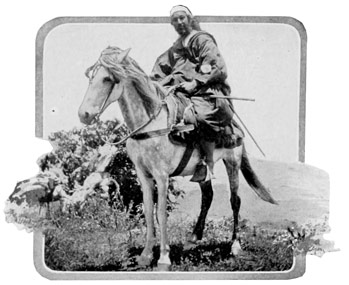
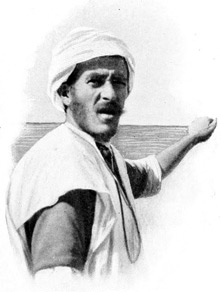
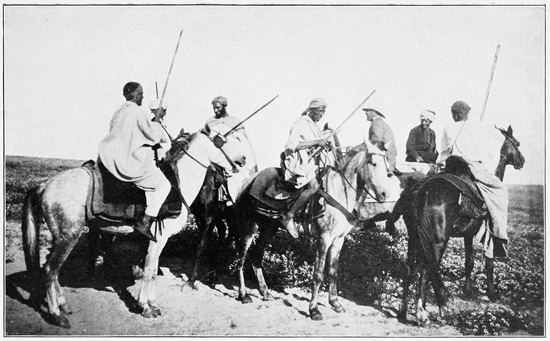
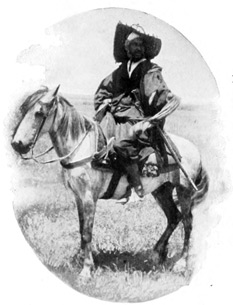
regiment. Kaid
Lharbi, for such
are his title
and name,
belongs to
the Makhazni,
or corps of irregular
cavalry,
the most ornamental
branch of the Moorish Sultan's army. No traveler is
permitted to go into Morocco unless chaperoned by a Makhazni.
Kaid Lharbi will be for us a sort of living passport, his presence
at the head of our caravan assuring all persons that we
are traveling under the protection of the Moorish government,
and that offenses against us will be severely punished.
Without this living token of governmental sanction for our
expedition, it would be within the power of any local chief to
arrest our progress, sending us back in ignominious captivity
to Tangier; or, if he preferred, he could rob us with
impunity. Kaid Lharbi is therefore a valuable acquisition
from the standpoints both of safety and of picturesqueness.
He is Moorish in the fullest sense; he thinks such thoughts
and dreams such dreams as did his fathers half a thousand
years ago. He carries a flintlock made in Tetuan, and is
supplied with a lump of lead and a small bullet-mold, that
in case of attack he may be able to cast the necessary bullets.
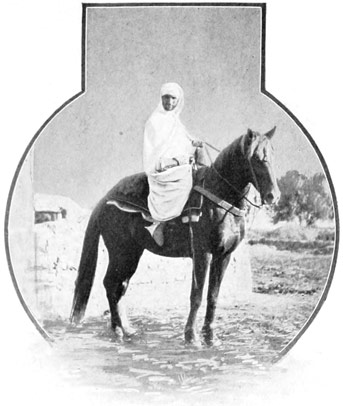
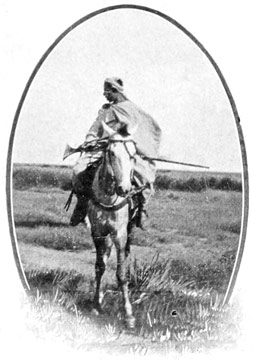
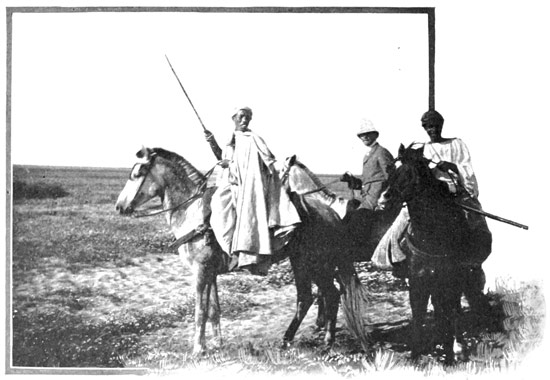
KAID LHARBI, OUR MILITARY ESCORT
The sixth day of May is appointed for the departure of
our caravan. It is a memorable day for us, because it marks
the close of a long period of doubt and uncertainty as to the
possibility of undertaking the expedition, and because it
marks the beginning of a new life—the entry into a new
world, which is yet immeasurably old. The pack-mules in
charge of the three servants have been sent on ahead to await
us in the suburbs. Kaid Lharbi, muffled in his blue burnoose,
has been stationed like an equestrian statue at the door of the
hotel since early morning. Haj, the guide, is here, there, and
everywhere, attending to the thousand and one little details
and difficulties that always arise at the last moment.
We bid adieu to our acquaintances at the hotel door. At
last the start is made, we file through narrow streets, cross
the crowded market-place, and on its outskirts overtake the
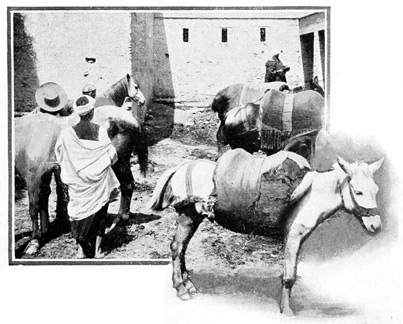
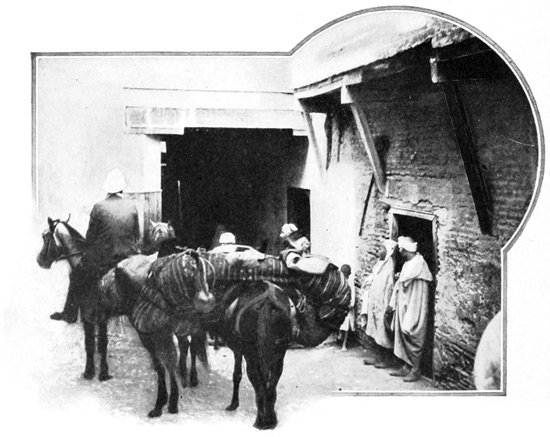
pack-mules and the muleteers. A few necessary articles,
brought at the last moment by our thoughtful Haj, who
would have felt himself disgraced had he forgotten anything,
are added to the already heavy burdens of the mules.
THE DEPARTURE
Then at a signal, our men, the skeptic Haj, and all the
rest reverently turn their faces toward the East, toward
Holy Mecca, while Kaid Lharbi, his
head bent low over his horse's neck, intones an impressive
prayer for the successful and happy termination of our
journey. This pious duty done, the order for a forward
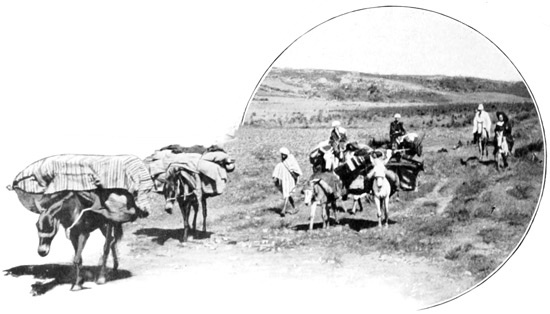
march is given, and in single file our little train of men,
horses, mules, and donkeys winds its way out of Tangier,
every hoof-beat of the animals taking us nearer to the
Middle Ages. Gradually the suburban street becomes a
lane, gradually the lane fades away, becoming a mere trail,
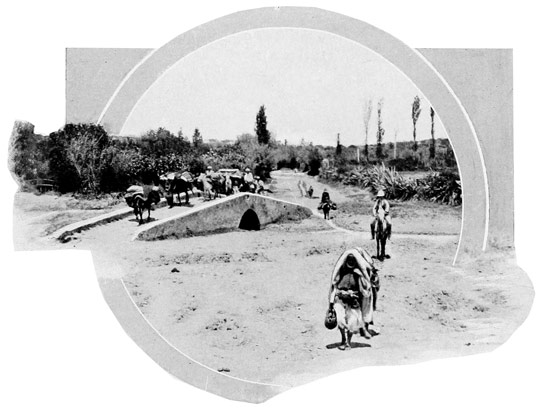
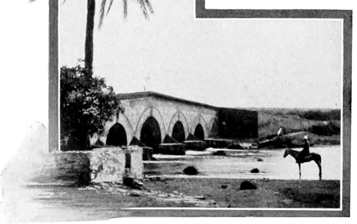
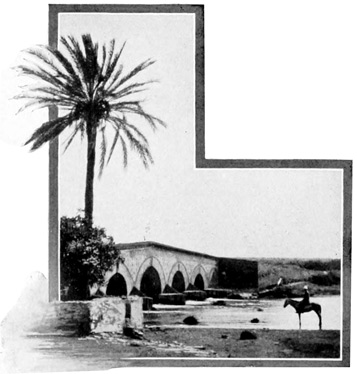
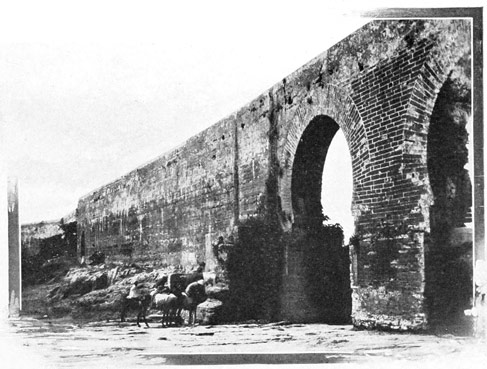
and finally the trail itself, crossing a ruined bridge, loses
itself in the roadless vastness of the Moorish Empire.
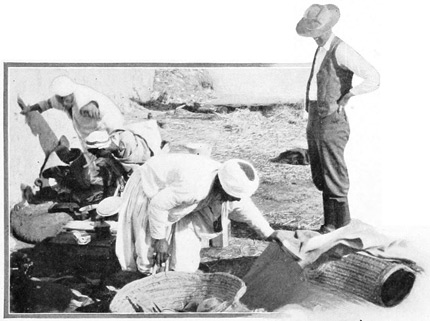
ADDING THE LAST
ITEM TO THE PACKS
THE EDGE OF CIVILIZATION
Never in all my travels have I more keenly felt that
oppressive sense of separation from things known and familiar
than at this moment. No previous departure by train or
steamer had ever seemed so definitely to break the link that
binds us to our own age and our own civilization. Here, at
the bridge that spans a dry and thirsty river-bed, all semblance
of civilization abruptly terminates; before us lies a
land without railways, without roads, without fences, hedges,
trees—without dividing lines of any kind, save long low
ranges of barren hills and, in the eastern distance, the crests
of savage mountains. Across this roadless empire we are
now to travel for many days; overhead there will hang at
times a scorching sun, at times dark storm-clouds are to form
our canopy; around us is to stretch a savage, silent land.
Before us lies a scarcely distinguishable track, worn by the
hoofs of countless caravans in years
that are uncounted. But
for me, in
the foreground
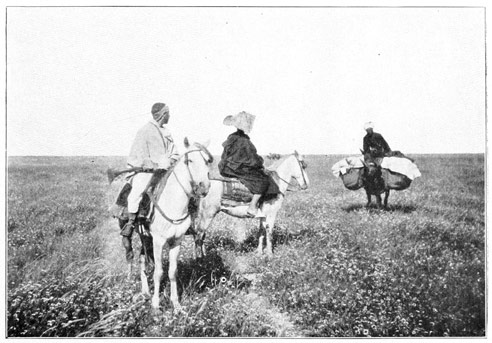
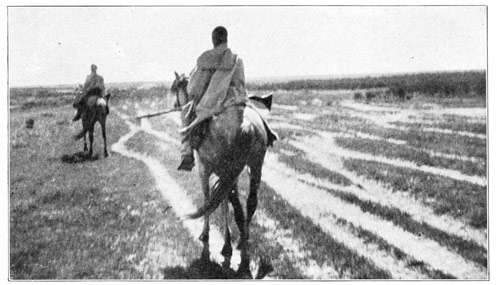
of every Moorish landscape looms the figure of Kaid Lharbi.
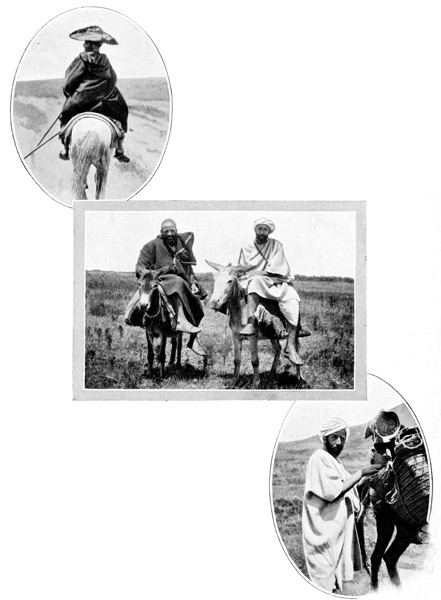
All day I looked over my horse's ears upon Kaid Lharbi's back,
his horse's tail, and his cloak of blue, his broad-brimmed
hat, such as are made and worn by
the women of Tetuan, its brim so
broad that colored cords are required
as guy ropes to sustain it. That
famous hat served both as a parasol
and umbrella; the image of its expansive
brim, flapping gaily in the
breeze, or drooping gloomily beneath
an avalanche of water from the skies,
will never be effaced from memory.
All day I looked upon that hat; at
night I saw it in my dreams; and, at
the journey's end, I acquired it by
purchase, and it now hangs upon my
wall,—a mute reminder of a memorable
ride.
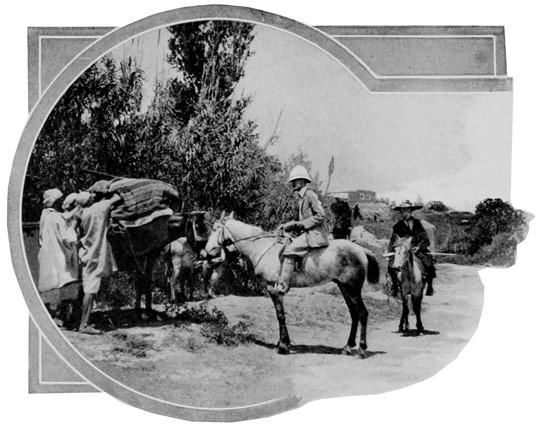
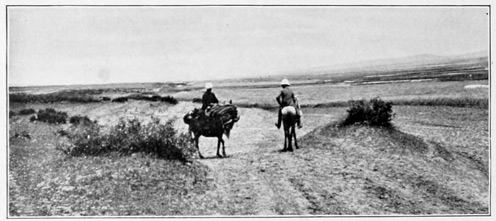
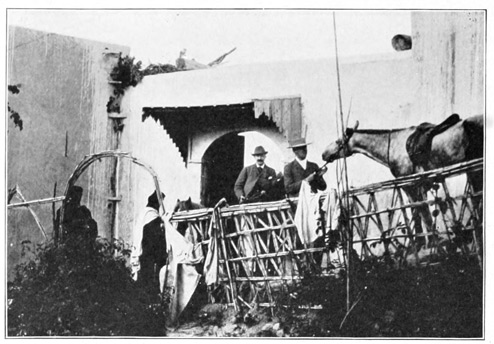
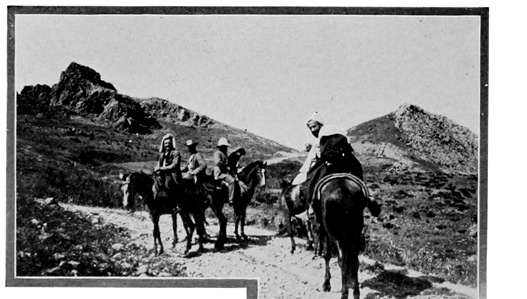
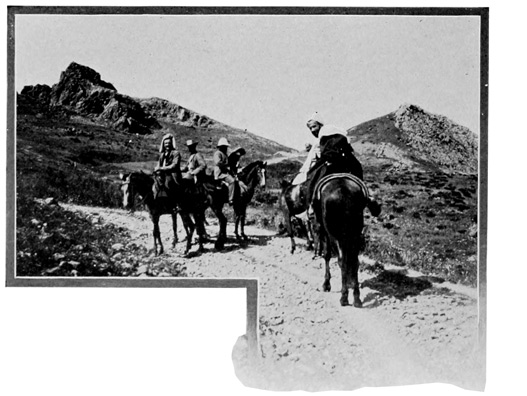
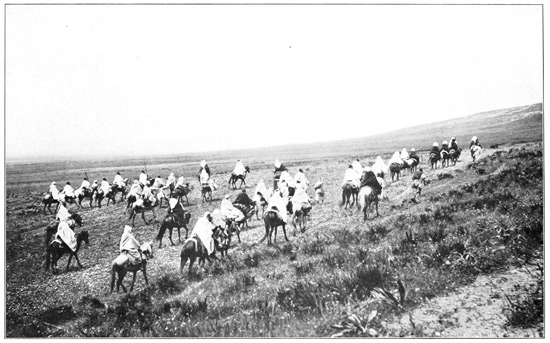
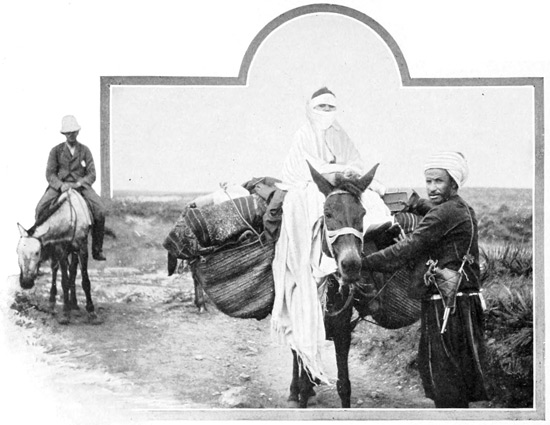
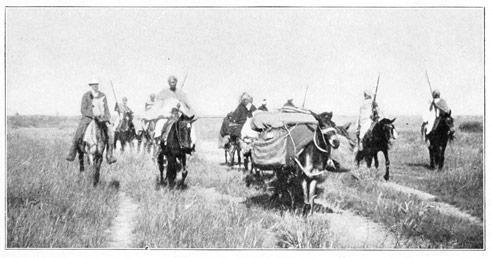
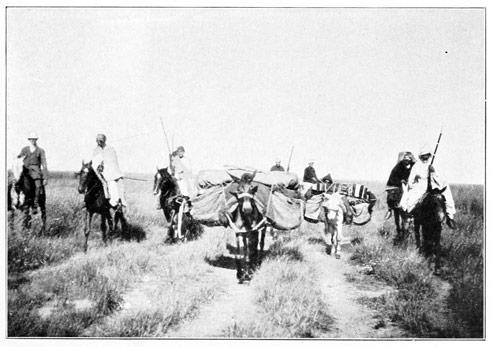
ACROSS THE ROADLESS PLAINS
"TWO HARD-WORKING HUMBLE SOULS"
"BOKHURMUR"
Less picturesquely mounted, less
self-important than Kaid Lharbi but
far more useful, diligent, and kindly
were the two hard-working humble
souls who rode on little burros in
the rear of the procession. On them devolved the hardest
labors of the journey—to load the mules; to drive or guide
them all day long, frequently running along for miles on
foot; to help or urge the struggling, overburdened animals
through the muddy ditches; to unpack everything at night,
set up the tents, build fires, tether and find forage for nine
animals, including their own patient little donkeys—this
formed their regular daily routine. Yet they are cheerful
with it all, although sun and rain, health and sickness, must
mean the same to them; they must not rest on pain of being
left behind. Their names, as near as it was possible for us to
grasp them, were respectively, Bokhurmur and Abuktayer,
but which was "Abuktayer," and which "Bokhurmur" is a
point upon which my friend and I could never quite agree.
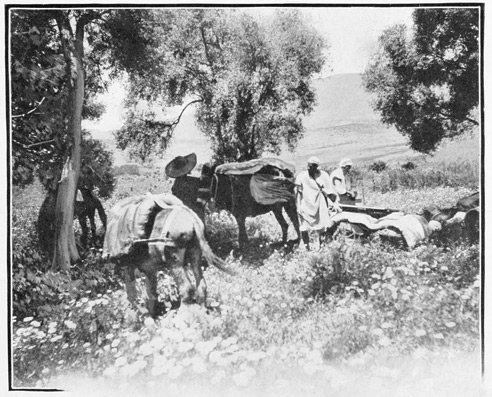
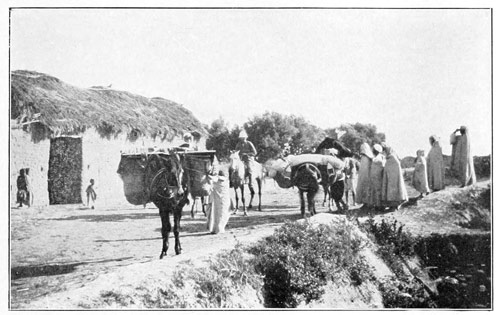
THE FIRST HALTING PLACE
DEVELOPING OUR CANVAS VILLAGE
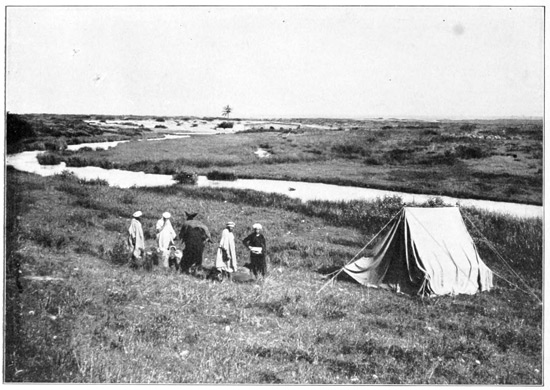
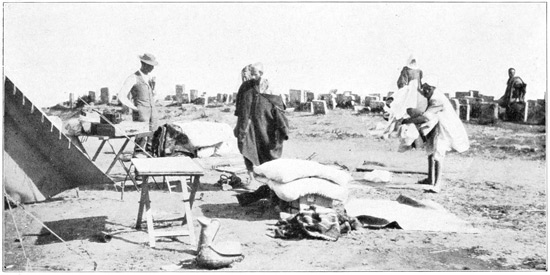
At a command from Haj, the caravan has halted. "We
have arrived," adds Haj; "unload! pitch camp! We are
where we should be at five o'clock."
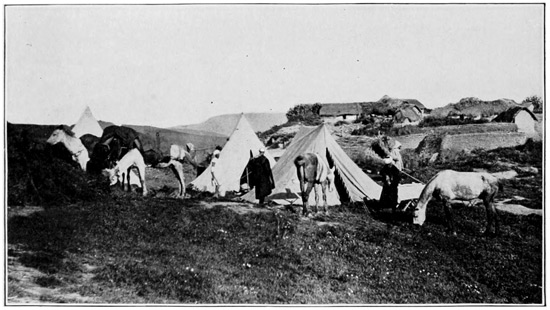
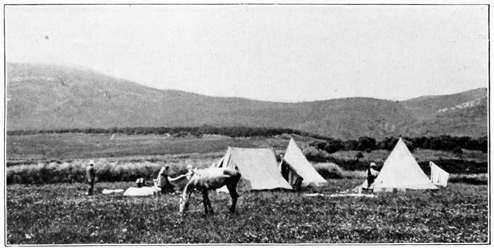
THE FIRST CAMP
Here, then, is to be our first camping-ground, here for the
first time we are to see our outfit set up in its entirety; here
we are, for the first time, to sleep in tents like the Bedouins;
to begin the new life that promises to be so strange and fascinating.
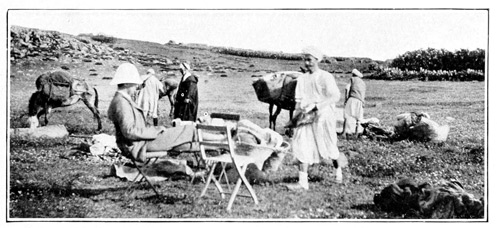
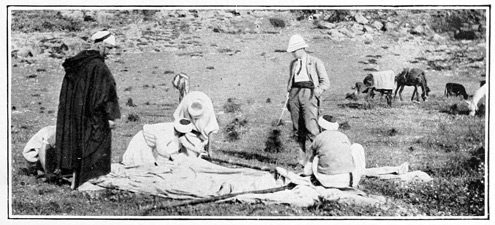
With keenest interest we watch our little canvas
village develop. At first we attempt to aid the men, but Haj
sternly prohibits all effort on our part. It is not consistent
with our dignity as great American seigneurs to stoop to
labor. A mattress is hastily unpacked and spread upon the
ground, and on it we repose in lordly laziness. Had we
driven a single tent-peg, we should have lost completely the
respect of our Oriental hirelings.
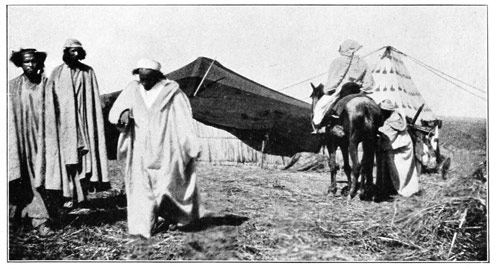
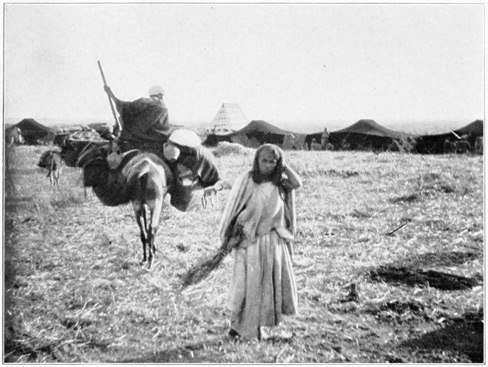
A SILENT, CURIOUS PYRAMID
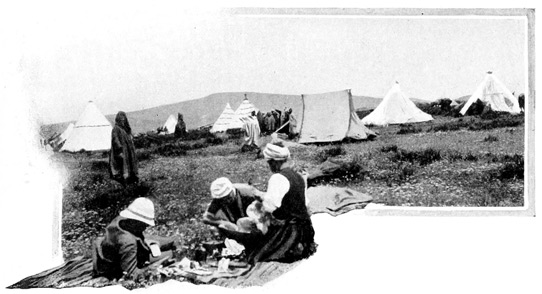
Three tents compose the camp: one large green tent of
English manufacture for the grand seigneurs, two Moorish
tents, for the accommodation of the faithful suite. One by
one the canvas houses rise. The animals are tethered close
at hand. From the neighboring village, ragged men bring
fodder for the animals, eggs and chickens for the foreign
lords. These things, of course, are paid for, because, our
expedition not being of a diplomatic or official nature, we do
not enjoy the right to be served with the traditional
"Mouna," that is, we cannot levy contributions upon the
tribes. Our letters of recommendation demand for us merely
the protection of the village chiefs. When a great man, be
he a native potentate or the ambassador of a foreign nation,
passes through the land in state, all things are by the Sultan's
command furnished him gratis by the people of each bashalik,
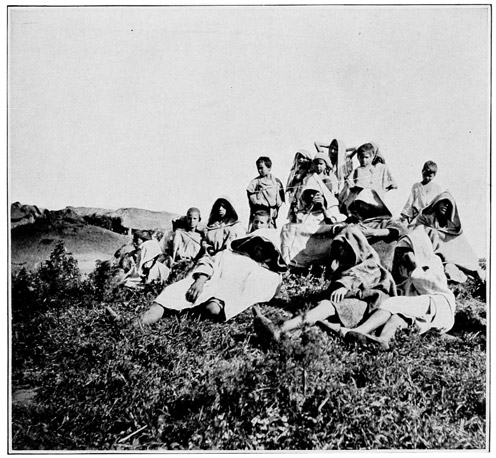
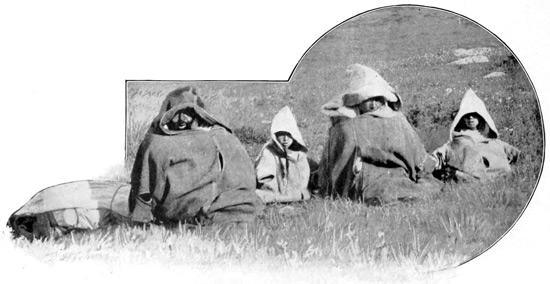
or province. As the villagers gather in a silent, curious
pyramid, to watch with deepest interest everything we do, to
examine with uncomprehending eyes our mysterious camp-beds,
our folding chairs and tables, let me describe another
custom that is observed during the progress of an official
expedition.
"WITH
UNCOMPREHENDING EYES"
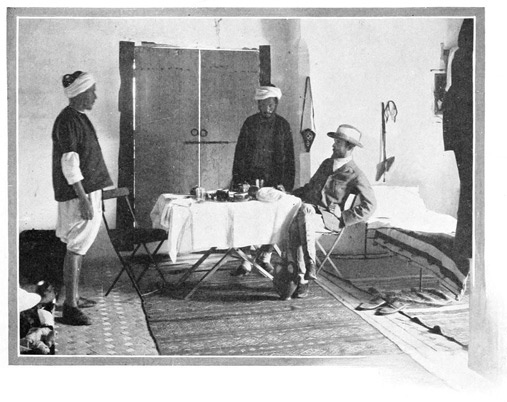
CHEZ NOUS
When the people of a village have a boon to ask or a
favor to entreat from the Sultan at Fez, such as the release
from prison of some fellow tribesman, or the recall of some
too cruel tax-extortioner, a deputation of villagers comes in
procession to the tent of the great man, and before the
entrance sacrifices a heifer or a sheep. If the chief or the
ambassador is inclined to grant the petition, or to further
the purposes of the suppliants, he accepts the gift of meat
and it is eaten by his escort. If he denies their request, he
averts his face; no man is permitted to touch the sacrifice,
and it is left as food for birds of prey.
"HAJ" IN DOUBT
"HAJ" IN JOY
"ACHMEDO"
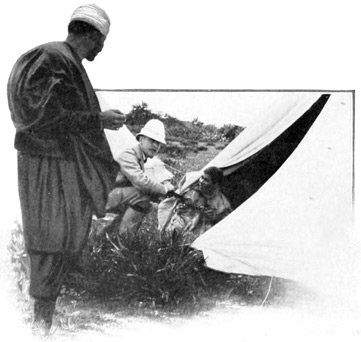
The camp arrangements being complete, and all things
made ready for our reception, Haj proudly but anxiously
invites our inspection of the interior arrangements of our
canvas home. "Well done, Haj Abd-er-Rahman Salama!"
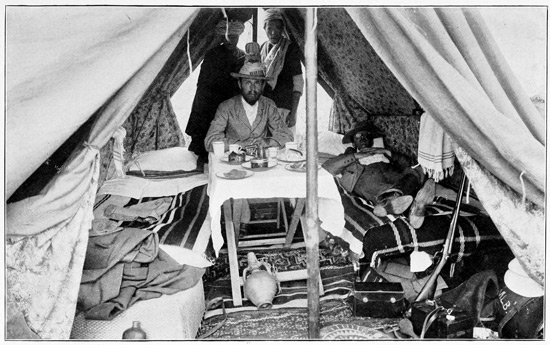
we exclaim, as a vision of coziness and comfort is revealed
to us. Well done, indeed! No wanderer in a barbarous
land could ask for more. We
behold soft beds with fresh
white sheets and pillow
cases, bright rugs upon
the turf, a table large enough for
two, well spread with tempting
food, and all this is protected
from heat and cold and rain
and wind by a fine triple tent,
green without, pink-lined within
like a luxurious boudoir. And
this is to be our home for forty
long delightful days. No
matter where our camp
may lie, on the barren hillside,
in the fertile plain, or
on the outskirts of a dirty
town, this cozy corner will
be always the same. No
matter how wild and hostile
the surrounding scenes, we have but to draw the tent-flaps
close to find ourselves delightfully chez nous. Moreover,
we are as well served as in an
excellent hotel, for although we lack the
electric-button, we have a perfect substitute
in the person of Achmedo al Hishu,
our valet, groom, and butler. Achmedo
is not handsome, but he is indispensable;
he is always at hand, answering
a call before it is made, satisfying a
want as soon as it is felt. He speaks
a kind of Tangerine servant language,
a mixture of Spanish, French, and
English, startling at times, but always
comprehensible. His one fault is a
fondness for the pipe, in which he
smokes—not comparatively innocent
tobacco—but the nerve-deadening weed called "keef."
Moreover, we observe him to be a great imbiber. As he
rides across the plain, proudly seated on the summit of a
baggage-pack (beneath which the poor mule is scarcely
visible), Achmedo may be seen to lift a bottle reverently
to his lips, three times to every mile. We marveled that he
could preserve his equilibrium day after day, until we discovered
the nature of the contents of that bottle—cold tea,
flavored with mint and sugar.
A MISTY MORNING
A word more about our invaluable Haj Abd-er-Rahman
Salama, whose dusky face reflects the anxiety that fills his
soul as he awaits our verdict upon the first meal prepared
by him. He claimed to be himself a skillful chef, and
insisted that he be allowed to manage the commissary
department without interference. We reluctantly intrusted
our gastronomic welfare to this homely heathen, and throughout
the day visions of hard-tack and rancid bacon haunted
our hungry souls. We scarcely dared to hope for better fare,
furnished, as it was to be, by this cunning caterer, who has
us completely in his power. He is free to starve or stuff us;
no power can touch him now. If he prove faithless, we
must suffer; we are his slaves for forty days; he is our
master, we must go whither he leads, for we are in an
unknown country; we must eat that which he provides, for
we are in an empty land.
OVER THE RED HILL
But when dinner is served, we enthusiastically declare
that Haj is the best cook south of Paris; and at this his
handsome features are convulsed into a smile of proud and
happy satisfaction. The dinner served on that first evening
in our camp was a culinary triumph; a perfect little table
d'hôte: consomme; fish, fresh from the basket of a Tangier
fisherman; sweetbread croquettes; broiled chicken; salad;
blancmange, cooled in a neighboring stream; a sip of Turkish
coffee, a little glass of benedictine, and then a cigarette. All
this prepared and served in a little tent pitched far from
town or city in the midst of the somber Moorish plain. How
it was possible for Haj to turn out from his tiny canvas
kitchen, and with his crude utensils, dishes so varied and
delicious, was an enduring mystery to us, but we fared sumptuously
throughout the journey. We lived in greater comfort
and were better served than in the French hotels of
Algeria or the big hotels of Spain, and we dined as well as
on the Paris boulevards; and for all this, we paid a price
ridiculously low. Haj provided the entire outfit,—two
horses, five mules, two donkeys, and three tents; paid wages
to three servants, baksheesh to the military escort, furnished
all provisions, cooked for us, schemed for us, guided us,—all
for twelve dollars daily and a present at the journey's end.
Beyond this small sum we spent not a penny, save for the
purchase of some little souvenirs.
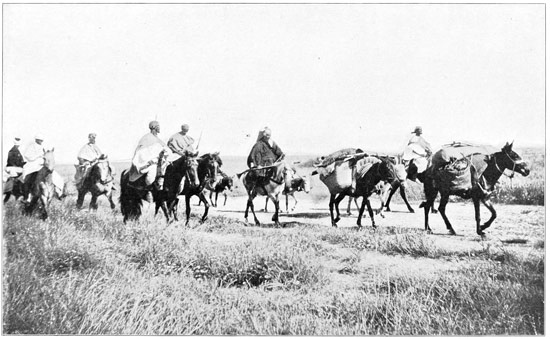
"NEVER MORE THAN TWENTY MILES A DAY"
THE CAMP OF THE GOVERNOR
On the second morning, dark, lowering clouds obscure the
heavens; yet, despite the threat of a stormy day we break
camp, a task requiring about two hours of hard labor for our
men. Our animals are loosed and roam at will, browsing
upon the fresh sweet clover. The men of the neighboring
village, who have been guarding the camp since evening,
return to their huts at daybreak; all night they sat in groups
around our tents, chanting or mumbling prayers to keep
themselves awake. We reward them with a present of silver
coins, which they accept with greedy eyes. At last, the
countless things pertaining to the camp being all stowed
securely in the broad packs, we bid farewell to our first
Morocco halting-place and begin what, we have been told,
will prove the most disagreeable stage of the entire journey—the
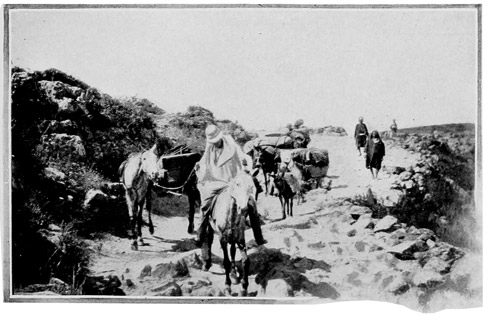
crossing of the Red Hill; an
experience dreaded by all
caravans, especially in
rainy weather. And
rightly unpopular is
it, this trail of
broken rock and slimy
reddish clay, where at
every step our horses stumble or slip, where every now
and then a pack mule, fixing the forefeet firmly, goes
glissading swiftly down the hill, until, over-balanced by its
enormous burden, it literally capsizes, and lies helpless
in the mire while the crew jettisons the cargo, rights
the poor hulk, re-ballasts it, and steers it down the
dangerous channel, using the tail as rudder and sharpened
sticks as inspiration. Frequent heavy downpours
of rain add to our discomfort, drenching us to the skin
and threatening to shipwreck our hopes of reaching camp
with tents and baggage dry. But suddenly, an hour after
we reach the plain, the sky is cleared and swept completely
clean, as if a great sponge had wiped away the rain
clouds; and then a beaming sun quickly dries men and animals
and burdens, causing us to give off clouds of vapor until
we can scarcely distinguish one another. And thus we journey
on, never faster than at a rapid walk, with frequent
delays caused by the breaking of a strap, the balky temper of
a mule, or by a deep ditch difficult to ford. We cover never
more than twenty miles a day. At midday we come upon
the camp of the Basha of Tangier, and near it we make a halt
for luncheon. Haj informs us that the Governor
has come up country to arrange a few official
robberies, and to administer
a little Moorish
justice—a peculiar
quality of justice.
SUBJECTS OF THE SULTAN
The collection of
taxes is, however, the
Basha's most important
business. The
taxpayers are assembled
around his tent,
and pay in money, in
produce, and in cattle. The assessment varies according
to the visible possessions and apparent prosperity of the
victim. No wise subject of the Moorish Sultan ever boasts
of his possessions. All feign poverty; for every man is
allowed to rob the man who is next in rank below him.
The poor man who can find no poorer man to rob that he
may pay his due, is the one who suffers most. We saw a
dozen such in the tent at the Basha's camp, chained together,
the neck of each locked in a metal collar; the whole procession
was to be marched with the music of that clanking
chain to the prison at Tangier, many miles away.
PRISONERS
There is no justice in
Morocco. The headman
of a village
squeezes all he can out
of the nothing that his
people have; the chief
man of the district
levies on the village
headman; the chief
pays tribute to the
Governor; the Governor cannot expect to hold his office
unless magnificent presents are annually sent to some grand
vizier of the court at Fez; and every now and then we hear
of the downfall of a grand vizier, who has waxed wealthy,
boasted of his possessions, excited the cupidity of his sacred
Sultan and paid the penalty, either by suffering the confiscation
of his fortune and then exile, or perhaps by drinking,
at the command of the all-holy Emperor, a little glass
of poisoned tea.
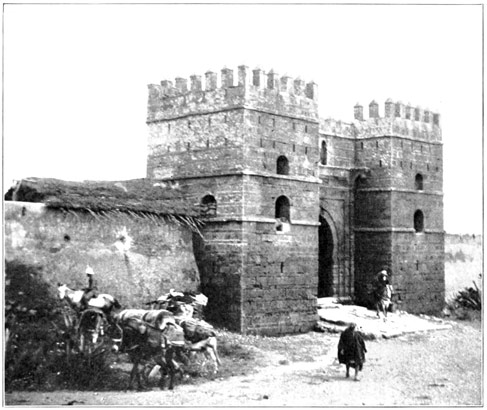
ALCAZAR-EL-KEBIR
We one day tendered in payment for provisions a Spanish
dollar somewhat dim and dark. It was refused. "Give me
bright shining money," said the man who had supplied us
with eggs and milk. "That dark coin looks as if it had been
buried; if I attempt to pass it, the chief will send his men to
dig around and underneath my house, to see if I have more
concealed beneath the floors or in the ground outside."
Next day after our meeting with the Basha, we reach the
first interior city of any considerable size, Alcazar-el-Kebir.
"Alcazar the Great," its inhabitants proudly entitle it, and
in its time it has been great. Here there were fitted out, in
the eighth century, the expeditions that went forth to conquer
Spain and Europe. Later it was taken and held by the
Portuguese until that fatal day in 1578, when, on the battlefield
not far from the city gates, the very flower of the
chivalry of Portugal fell before the fearful onslaught of the
Moorish foe. At Alcazar, Portugal received the death-blow
of her greatness. Before the loss of Alcazar Portugal was
one of the world's great powers. This terrible defeat was the
beginning of the end.
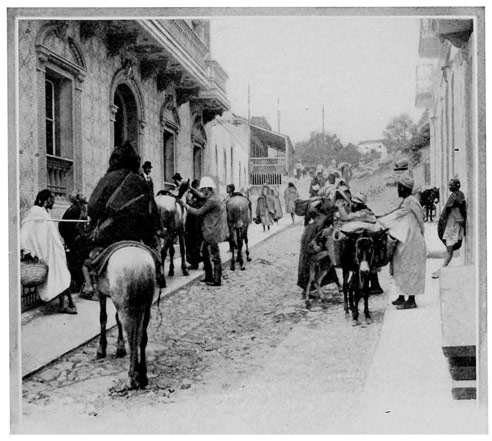
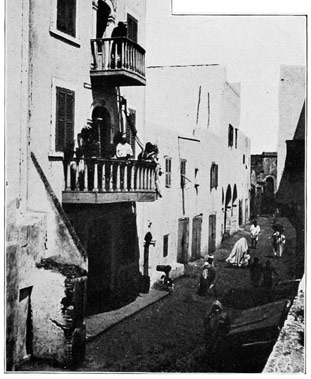
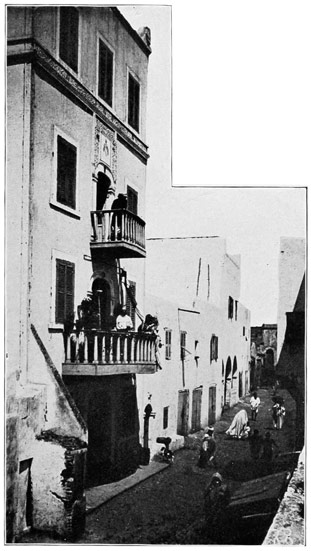
A THOROUGHFARE
THE SULTAN MULAI AL HASAN IN TANGIER
(Photographed by Molina)
WE PURCHASE MORE
MOORISH CLOTHING
The city is unlike all other cities of the interior, for it was
built by the Portuguese. It is not white, as are the Moorish
cities, but all in dull greys, browns, and soiled and dingy yellows.
In the bazaar we purchase more Moorish clothing—long
white garments, far cooler than our riding-suits, and
upon returning in our new attire to the camp, we are greeted
effusively by a dusky gentleman who introduces himself as the
Consular Agent of the United States. Unfortunately his
kindly words are all
Arabic, of which we do
not understand a word.
Nevertheless Mr. Hamman
Slawi convinces
us of his good-will by
presenting us with a
pair of yellow slippers,
and manifests his admiration
by sitting in
our tent and looking
at us intently for just
two hours and a
half. Long calls
are the custom in Morocco, and when Mr. Slawi finally
departed, he left his son, a fat
little chap, to continue
staring at us so that
we might not feel neglected.
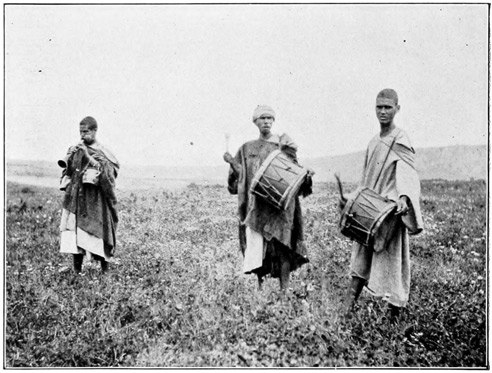
And when the
boy was finally induced
to go, the father
sent the local
symphony
orchestra to
serenade us
in the gloaming,
with two
insistent
drums and an
exasperating
flute.
MR. HAMMAN SLAWI, U. S. CONSULAR AGENT
MR. HAMMAN SLAWI, U. S. CONSULAR AGENT
We are
compelled to
give these
cacophonic tormentors a present to bring the concert to an
end. A present, by the way, is an important element in
every Moorish proposition. Presents are the lubricating
medium used in the social and political machinery of this
ancient empire. Acting upon the advice of former travelers,
we have brought with us many gifts for the Kaids or sheiks
or bashas who show us kindness, or from whom we may
desire to obtain favors. A dozen Waterbury watches are
reserved for the men who are very great; for lesser notabilities
we carry other presents, among them, strange to say,
all sorts of little toys, like jumping jacks, kaleidoscopes,
and automatic animals. These are not intended for the
children, but for full-grown men, hoary-headed chieftains
who have a passion for such novelties. The Moors are at
heart big children, with all the simplicity, deceitfulness, and
passion of real children.
THE SERENADE
And, like unfeeling children, these people are often
thoughtlessly cruel. They appear not to notice the wounds
caused by the heavy, ill-adjusted harness of the pack mules,
or the ugly cut made by the brutal bit in the mouth of Kaid
Lharbi's faithful horse. When we remonstrated with our
men about this useless cruelty, they answered that the animals
are "used to it;" that it is the custom of the country
for mules to have raw backs and horses bleeding jaws. The
Moslem firmly believes that "whatever is, is right;" and we
console ourselves with the assurance of the classic author
who asserts that "the souls of usurers are metempsychosed,
or translated, into the bodies of asses, and there
remain certain years for poor men to take their pennyworth
out of their bones."
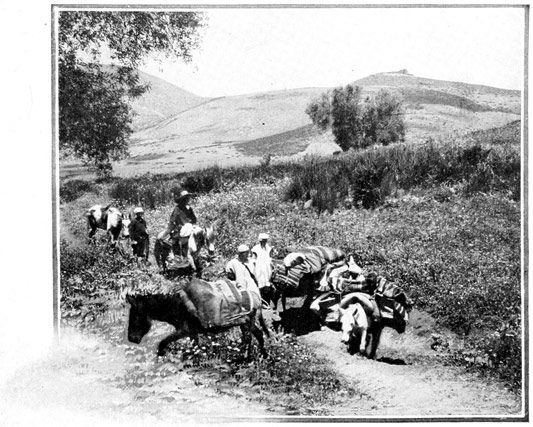
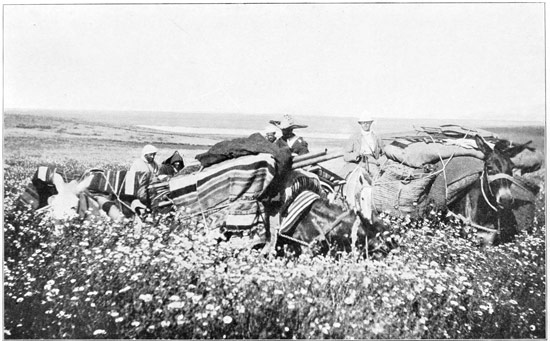
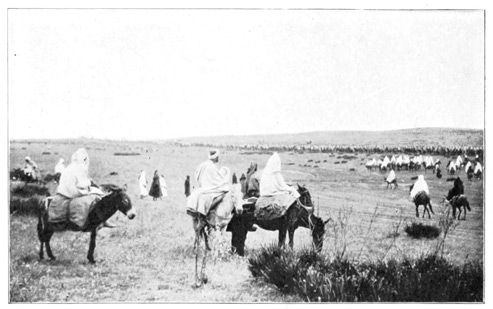
TRAVELING THUS EIGHT HOURS EVERY DAY
THE MOUNTAINS OF WAZZAN
THE MOUNTAINS OF WAZZAN
Later in the day we met with a curious experience. As we
began the descent into a broad valley, we saw approaching
us another caravan. When it
drew near, we discovered, with
pleased surprise, that the man
who rode in front was clothed
in coat and trowsers, evidently a European, a man from
our own world, perhaps the only other white-skinned traveler
in the land. We shook off the lethargy that results
from a long morning in the saddle, and prepared to greet
the stranger with smiles and questions, eager to give
news of the living world to one who must have been buried
for at least many days in this roadless land, eager to send
back by him messages to the consul in Tangier. Nearer he
comes and nearer, but as yet he makes no sign. Imagine,
then, our blank dismay when the caravans pass one another
on this narrow trail amid the yellow grain, and the stranger—a
German merchant, as we learned afterward—rides past
with his Teutonic nose high in air, without a side glance or a
nod, without the slightest sign of recognition in answer to
our smiles; for so astonished were we that we could not speak.
This exhibition of boorishness, I fear, gave our Moslem followers
a sad notion of the love and good-fellowship existing
between man and man in the world of unbelievers.
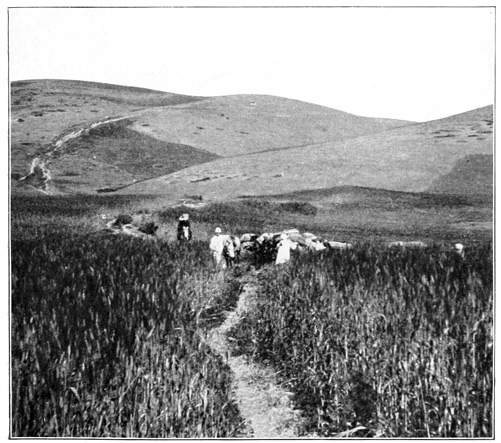
After receiving this cut-direct, we ride on across the grand
free landscape, its lines unbroken by trees or houses, where
grain grows wild and rots unharvested. In Roman times
Morocco was the granary of Europe; to-day the Moorish
authorities prohibit the exportation of all grain. "It is not
meet," they say, "that the unbeliever should be nourished
by the labor of the faithful."
"WHERE GRAIN GROWS WILD"
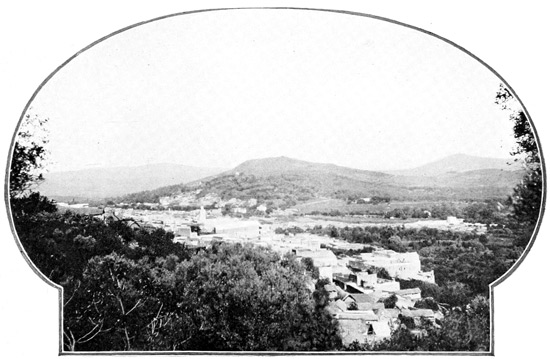
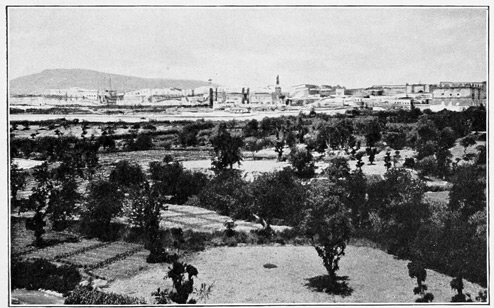
Thus our days pass until, on the fifth morning of the
journey, we halt in a delightful garden on the outskirts of the
city of Wazzan. The word "Wazzan" perhaps means
nothing to a stranger, but to a Moorish Moslem it is second
only to Mecca in sacred significance;
for as Mecca was the home of
Mohammed, the great prophet,
so Wazzan is the home of
the grand Shareef, the most
direct descendant of Mohammed,
the most revered
personage in all Morocco.
A connection, however remote,
with the prophet's line
is a relationship that insures the
respectful consideration of every
Mohammedan. To be the most
descendant, the grandson-many-times-removed
of Fatima, the prophet's daughter and Ali, his
favorite disciple, is to take precedence over Emperors and
Sultans in the sight of every true believer. And thus the
Shareef of Wazzan, upon whose holy city we now cast our
profane glance, is a greater, holier man than either the
Sultan of Turkey or the Sultan
of Morocco.
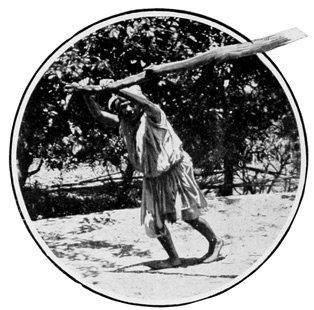
DRUDGERY
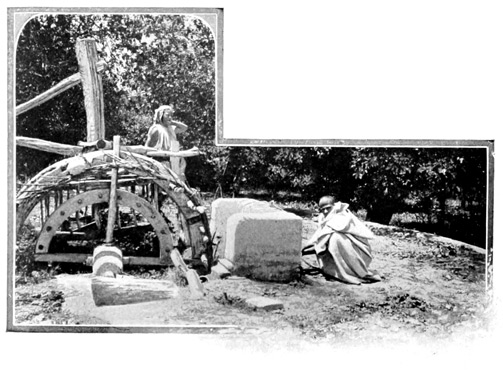
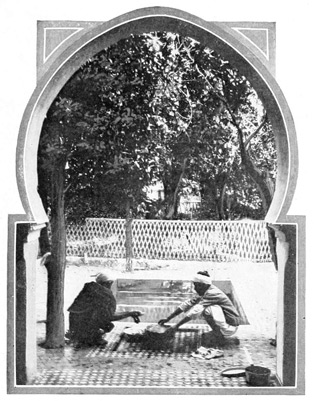
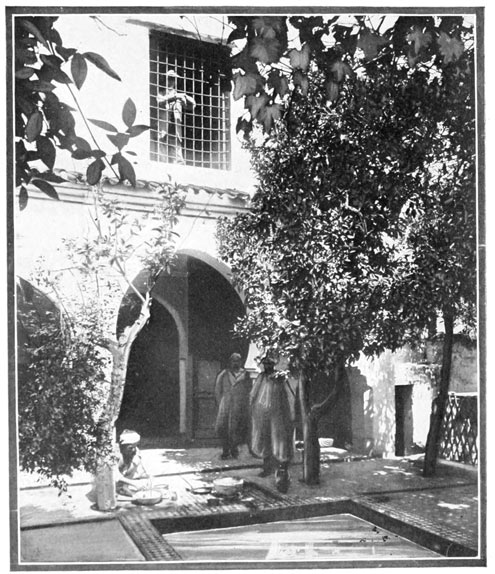
A WELL
IN THE GARDEN NEAR WAZZAN
THE SACRED CITY OF WAZZAN
True, these two emperors
trace their ancestry back to the
same sacred source; but many
true believers call his Turkish
majesty a renegade and backslider, while the family-tree of
the Moorish Sultan has been so bent and twisted, and its
branches have been so rudely hacked and broken by revolutions,
wars, and crimes that a majority of his subjects look
askance upon his pretensions as Commander of the Faithful.
Many of them secretly, some openly, acknowledge the
Shareef of Wazzan not only as the spiritual head of the
Empire, but also as
its rightful temporal lord. Fortunately for the internal peace
of the land the Shareefs have been content to exercise imperial
power by suggestion, to receive tithes in lieu of taxes, and to
leave to the Sultan and his ministers at Fez the vexatious
details of the government and the semblance of absolute
authority. So sacred is this city of Wazzan, so fanatical
are its inhabitants, that we dared not enter its gates until a
military escort sent by the Shareef came to conduct us to the
home assigned us as a residence by that sainted potentate.
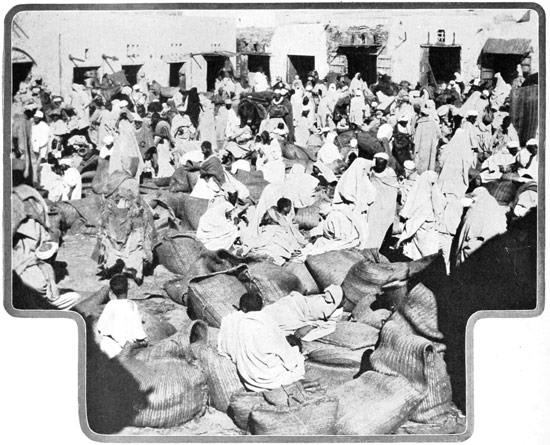
THE MARKET-PLACE
THE MARKET-PLACE
It cost our servants several hours' labor to clean the
mansion and make it habitable. In the meantime, with
Haj as interpreter and Kaid Lharbi to lend dignity to our
party, we were escorted by a half-dozen ragged soldiers to
the Shareef's palace, which gleams white in the midst of
green gardens. There we were received with high-bred
dignity and more than ordinary
cordiality by the man
who, as has been said, is
revered, from Morocco to Madras, as the holiest and greatest
representative of Islamism.
OUR "PALACE" IN WAZZAN
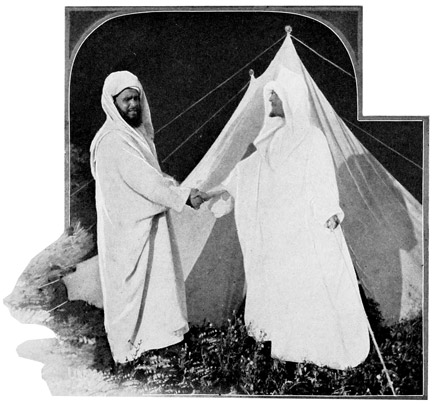
We found the Shareef seated on soft cushions beneath
a white pavilion in the midst of a luxuriant garden. Around
him courtiers were grouped; old men with long, white
beards, young men with fierce, hard faces—chiefs of the
neighboring tribes. The Shareef, a handsome man, black-bearded
and completely robed in simple veils of white, bore
his thirty-five years with dignity, despite a suggestion of
indolence, almost of lethargy in his manner. Haj approached
on hands and knees and kissed the Shareef's garments. We
bowed and took the chairs which had been placed for our
comfort just outside the pavilion.
The dialogue ensuing
between our host and
guide was deliberate,
cordial, and much embroidered
with compliments,
as is the custom
here in good society. We,
through our spokesman,
thanked his holiness for his
hospitality. He apologizes
for the condition of our
house.
"THE SHAREEF'S PALACE, WHITE IN THE MIDST OF GREEN GARDENS"
A HOME IN THE SHAREEF'S CITY
Haj is instructed to express
our complete satisfaction.
He translates our
crude reply with Moorish
tact and delicacy: "My
masters, O Shareef," he
says, "bid me declare that
to see thy face is so great
joy that they have no
thought of minor things;
illuminated by the light
of thy face, the house
becomes a palace, grander
than their own palaces
in foreign lands." And
this sort of thing is actually
taken seriously in
Morocco! Then, remembering
that the presentation
of gifts is now
in order, Haj continues:
"O Shareef, so grateful
are my masters for thy
kindness that they beg
thee to accept a humble
present. The youth
who wears no beard
gladly parts with his
precious timepiece, the
gift of his father, much prized by him, but still scarcely
worthy thine acceptance." Whereupon my friend, with
feigned reluctance, detaches from his watch-chain one of our
stock of Waterburys, and, as if it had been a gold chronometer,
an heirloom in the family, lays it at the feet of Holiness.
Holiness graciously accepts the gift, and although he
remarks upon the absence of a chain, is apparently well
pleased. We are glad that he does not know that we have
still nine "Waterbury heirlooms" left in stock.
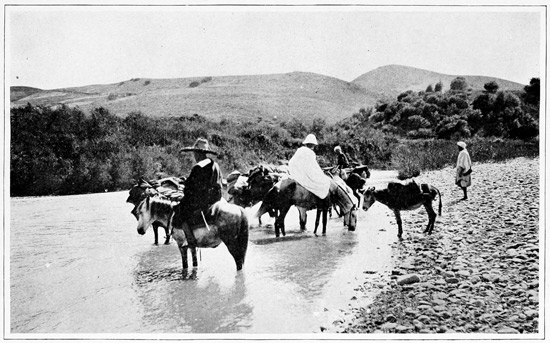
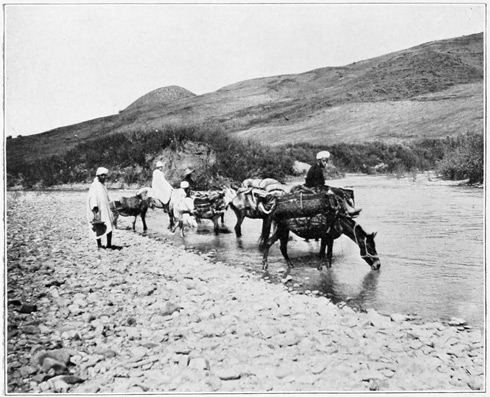
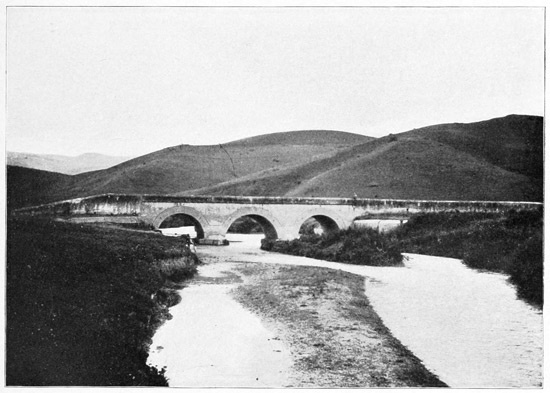
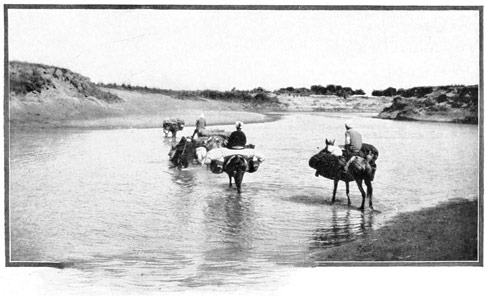
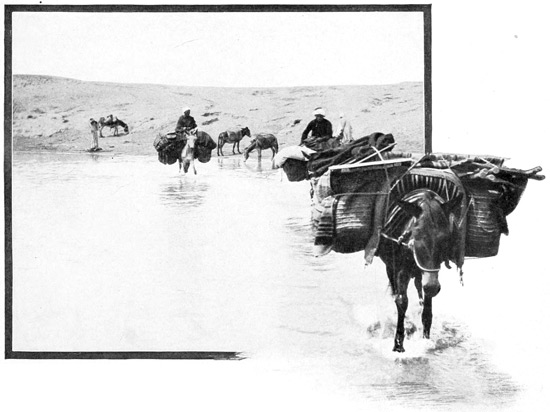
A FORD
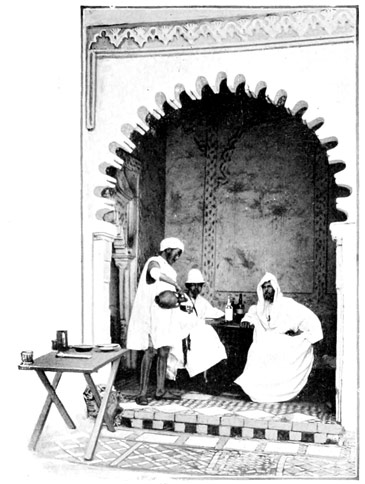
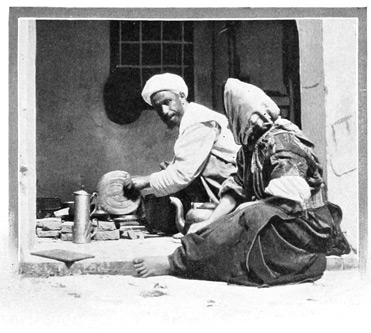
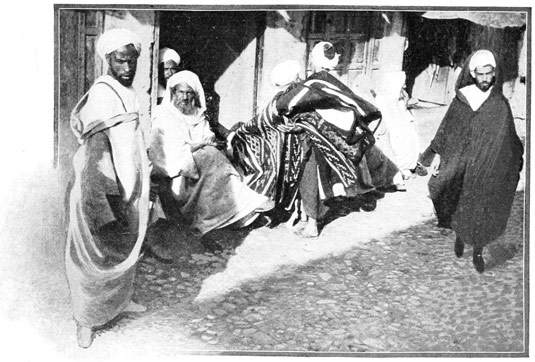
THEIR DAILY TIPPLE—"TEA"
The interview being over, we return to our residence to
find our men indulging in their daily tipple—tea. Kaid
Lharbi, sitting aloof as befits his higher rank, brews the tea,
and serves it with much ceremony to the rest. Meantime
Haj gives us some information regarding the Shareefs of
Wazzan. The present saint is, he assures us, a very proper
personage, but his late father who owed his title to a clever
ruse, was a scandal to the holy name. When his immediate
predecessor was upon his deathbed, his ministers implored
him to designate which of his many children should succeed
him. The old man answered: "In the garden you will find
a child playing with my staff. Him shall ye consider the one
chosen of God to become Shareef." At this, one of the
negresses, a slave, slipped secretly from the room, and finding
in the garden the favorite white child of the dying saint,
snatched away from the little one the staff, and placed it in
the hands of her own little boy, a jet-black imp, who also had
the right to call the Shareef father. When the ministers
appeared, they bowed low before the negro child, and upon
him the mantel of impeccability descended; but whoever has
gazed upon him as he appeared in later years will not wonder
that the mantle of impeccability was not worn gracefully, and
that it frequently slipped off. The charm of European life
appealed too strongly to
him. He forsook Wazzan,
and built for himself
a palace in Tangier,
where he wined and
dined the foreign diplomats, and ended by
falling in love with an English governess.
As to his liking for liquor, that sin was forgiven
him, since wine cannot enter the
mouth of a Shareef—it turns to water at
the merest touch of saintly lips. As to his
love-affair, that was more serious; for he
married his English sweetheart, to the
horror of his people and despite the protests
of the woman's friends. The marriage
was not performed, however, until he had been forced
to sign a contract, abolishing his harem, and making her
his wife in a Christian sense. Moreover, one clause provided
that should he, "the party of the first part," in spite
of all take to himself other wives in the future, a forfeit of
twenty thousand dollars
should be paid, per wife,
to "the party of the
second part." Alas,
how many thousands of
his great income went
to balance this account,
so rashly opened with
his Christian spouse!
After a brief spell of good
behavior, the husband
fell back into his old
ways; marriages occurred
with startling frequency,
and, finally worn
out by his excesses, the
"holiest man in all Morocco,"
revered by Moslems
from the east to
the west of Islam, died from the effects of too frequently
performing his favorite miracle—that of changing champagne
and brandy into water by pouring them between his
sacred lips.
THE LATE LAMENTED
SHAREEF OF WAZZAN
IN CONVERSATION WITH KAID LHARBI
The English wife of the wicked old Shareef bore him two
sons, now young men. They have been educated abroad,
speak English well, and are distinctly up to date. Yet when
they travel in Morocco they wear
the native dress, and
their journey is like
a triumphal progress;
all the
people worship
them. I have seen
large crowds in Tangier
fighting only for the opportunity
to kiss their garments as they
rode through the market-place. Neither, however, became
grand Shareef on their father's death, for he appointed
Sidi Mohammed, his son by a Moorish wife, the man to
whom we gave the Waterbury watch. The English widow
lives a very secluded life near Oran, in Algeria, but she
is loved and revered by the Moors; for while her influence
endured, she went about doing good, relieving distress,
bringing a little Anglo-Saxon light into the dark lives
of her people.
"BIDS US BEGONE"
And dark indeed must be the lives of the people in the
villages near which we pitch our camp. Perhaps a woman
would, with great vehemence, bid us begone, lamenting the
desolation that will surely come to her village if the strangers
camp under the protection of its chief. Her reason is that
should we meet with loss from the attack of some wandering
band of marauders, this village will be held responsible, and
punishment for offenses committed against us will be visited
upon those who, by the sacred laws of hospitality, are bound
to protect us.
"YET FLOWERS AND BABIES GROW IN THESE MOORISH VILLAGES"
But disregarding prayers and threats we make ourselves at
home; and finally the women, reconciled, come with their
babies to beg for aid and medical advice. Every white man
is supposed to possess the power to cure disease, and many
were the pitiful appeals made to us for relief and help. We
were asked to treat all kinds of maladies,
but we discovered one unique and hitherto
unknown ailment: "What is your trouble?"
was asked of a man who came with sadness
written on his face. "Oh!" he
replied, "I cannot eat as much as I
should like to." Poverty and ignorance
are the common lot, yet flowers and
babies grow in these Moorish villages.
"ON THE LOOKOUT FOR ADVENTURE"
We have now approached a portion
of the Beni Hassan territory, a
region inhabited by a tribe whose chief
pursuit is robbery, whose supreme joy is
murder; and the placing of a guard around
the tent is no longer a mere formality. As yet, however, we
have seen no roving bands; but next day as we file across
the flower-spotted plain, we observe on the horizon a
number of moving patches of bright color. With lightning-like
rapidity, these flashes of color sweep toward us, each
one resolving itself into a Moorish cavalier, well mounted,
fully armed, and seemingly upon the lookout for adventure.
These, then, are Beni Hassan men! What will they
do to us and how shall we greet them? is our anxious
thought, as they draw nearer, brandishing their rifles, shouting
as they ride. The first brief moment of alarm is, however,
quickly ended. The chief salutes us cordially; asks
Haj whence we come, whither we are going; and then,
desirous of showing honor to us (for foreign travelers are
always looked upon as men of great distinction), he offers to
perform for us a fantasia. The fantasia is an exhibition of
Arabian horsemanship, a sort of glorified cavalry-charge, a
spectacular manœuver, the favorite amusement of the Moorish
cavalier, the exercise in which he takes most pleasure and
most pride. It is called by him lab-el-baroud, "the powder
play." A dozen cavaliers, each
one a savage, long-haired son of
Hassan, advance across the
plain, their horses aligned,
breast with breast. They
twirl aloft their richly inlaid
guns; then, putting their
chargers to their fullest speed,
the riders rise in the stirrups,
seize the reins between their
teeth, and sweep toward us in
swift majesty. On go the horses at
full gallop, still accurately in line. Faster
and faster spin the guns above the riders' heads; now
muskets are tossed high in air, and descending are caught
by strong bronzed hands that never fail. On go the horses;
then the men, still standing in the stirrups, their loose
garments enveloping them like rapid-flying clouds, at a signal
discharge a rousing volley, and under cover of the smoke
check—almost instantaneously with the cruel bits—their
panting horses, bloody-mouthed and deeply scarred and
wounded by the spurs. This intensely thrilling and picturesque
performance is rehearsed before us several times, the
chief being proud of his little band of "rough riders."
A SON OF HASSAN
The men disdainfully examine our English saddles, our
horses with docked tails, and laugh at our tiny spurs, for their
spurs are sharp spikes three or four inches long. They mockingly
challenge us to join them in another fantasia, and to the
amazement of the chief my friend accepts the challenge. The
long muzzle-loading rifles are charged again, and the entire
troop, with an American in its midst, slowly canters away.
Facing about, the horsemen form in line and begin to twirl
their guns on high. Having no rifle, the stranger draws and
flourishes an American revolver. Then, suddenly, the horses
leap away, and like a whirlwind the fantasia is upon us. The
muskets are discharged; the revolver pops away, and then a
mad race begins. Strange to say, the Tangier horse outruns
the chargers of the plains, and we see the white helmet of the
American flash past, one length in advance of the line of
frenzied horsemen!
A NOONDAY
RESTING-PLACE
Chagrined at this defeat, the chief attempts to unseat the
victor, charging directly at my friend, who, by a skillful movement,
avoids a dangerous collision. Then, spurring after
that boasting Beni Hassan tribesman, the American overtakes
him, and throws an arm around his neck; and, as they dash
on, locked in this embrace, my friend, with a voice that was
trained in the Athletic Field at New Haven, shouts a rousing
"Rah, Rah, Rah!—Yale!" into the ear of the astonished
savage, and thus ends our adventure with the wild Beni
Hassan band.
HAPPY MOMENTS FOR THE MULES
Reassured by the amusing outcome of this first encounter,
we ride on toward our noonday halting-place. Our marches
are so timed that at midday we may find ourselves near some
patch of shade. Shade in Morocco is rare indeed, but as
every tree and bush between Tangier and Fez is marked on
Haj's mental map, we are usually assured of leafy shelter
during our noonday rest. Throughout the burning hours from
noon till three or four o'clock, we lie at full length amid the
flowers, carefully following the shadows as they slowly creep
around the trees. The animals, relieved of pack, though not
of saddle, browse dreamily, or roll in ecstasy amid the fragrant
grasses. Our men with Oriental resignation lunch frugally, sit
and smoke in silence, or indulge in semi-slumber, with one eye
open lest the mules escape. Then, after the sun's rays have
lost a little of their torrid sting, we jog on once more in the comparative
coolness of the afternoon across the Moorish prairies.
ROUGH RIDERS
Space in Morocco is still a stern reality. The city Fez,
to reach which we must travel thus during eleven days, could
be reached by rail (were there a railway leading thither) in a
half-dozen hours! Apropos of this, let me repeat a scrap of
wayside conversation.
"Morocco is indeed a spacious country," said I one day to
dignified Kaid Lharbi.
"It is the biggest country in the world," gravely replied
the Kaid. Then gently I endeavored to disabuse his mind of
this impression by telling of the vastness of the territory of the
United States.
"But how long does it take to cross your country?" he
inquired.
"We travel five days in fast trains to go from San Francisco
to New York," I answered.
"Bah! that is nothing," rejoined our military escort with
a sneer of triumph. "To go from Tafilet in the south to
Tangier in the north, the fastest caravan must travel forty
days. You see Morocco is the biggest country in the
world!"
"HAJ"
Nor can we blame him for his opinion, for the land looks
boundless. The grand, free lines of the Moorish landscape
are unbroken; no trees, no houses, no hedges, and no highways
are there to spoil the composition of the
picture drawn and painted by the master
artist, Nature. The country, although fertile,
is uncultivated. The horizon seems wider
than in other lands. Apparently
there is no end, no limit to the
landscape. We know that beyond
each range of hills there will be
revealed a replica of this primeval
picture. One scene
like this will succeed
another with scarce an interruption until the minarets
of Fez shall cut their square majestic outlines against the
southern sky.
"SPACE, IN MOROCCO, IS STILL A STERN REALITY"
Who can describe the floral beauty of these boundless
prairies?—who except Pierre Loti? It was his dainty volume,
"Au Maroc," that inspired me with a desire to follow
him into Morocco. When I was reading his beautiful descriptions
of the floral mosaic that covers both the plains and
hillsides of the land, I could not easily accept as true the
seemingly exaggerated assertions of the author; his glowing
word-pictures of an "empire carpeted with flowers." Yet he
spoke truly, and as I rode across these broad stretches of
pure white, where marguerites in all their modest loveliness
lie thick upon the greensward, I knew that I had seen it all
before—seen it upon his printed page, as real, as beautifully
vivid as it is to me to-day. To visit Morocco after reading
Pierre Loti is like returning to a land that is familiar, to a
land already seen, to a land the charm of which has been
revealed in the magic pages of his poetic prose.
"THE BIGGEST COUNTRY IN THE WORLD"
For miles and miles this bundle of narrow intersecting
trails, the only Imperial Highway of the Sultan of Morocco,
leads us on through a veritable garden—between interminable
flower-beds. Our foreground is at times pure white, at
others purple with a sea of iris flowers, at others scarlet with
the blood of anemones, at others yellow with the golden
glory of the buttercups and daisies. The mountain slopes
and hillsides meanwhile reflect the many colors of the spectrum.
It is as if some gorgeous rainbow, shattered in the
Moorish heaven, had fallen upon the deserted hills and valleys
of this savage, silent land. It is as if the divine Artist
had resolved to make this wilderness the palette from
which to take the colors for all future landscapes. It is
as if the sunset of the day before was lingering here to meet
the sunset of the morrow. It is as if Almighty Allah had
selected the Empire of Moghreb for his sanctuary, and had
spread out upon its sacred floor a prayer-rug of unutterable
beauty, woven by the divine looms—a carpet of heavenly
design to inspire man to fall upon his knees and pray.
AN EMPIRE CARPETED WITH FLOWERS
This is our life during ten delightful, never-to-be-forgotten
days. All day we journey southward, pausing at noon "midway
twixt here and there;" at night we arrive, as my friend
expressed it, at "nowhere in particular," and in the glow of
the sunset we pitch our little camp. Then, when the evening
fire is lighted, the encircling night grows blacker,
the surrounding
darkness
becomes a
protecting wall,
and we feel almost secure. Our animals are hobbled in a
row before the tent, each with a heap of fresh green grass or
clover. They eat all night; and when we wake, startled
by the cry of a jackal, or by a shout from one of the
men on guard, we are sure to hear that music of nine
munching mouths. It is our lullaby, and we fall asleep
again to dream of Fez, the mysterious city which we shall
enter on the morrow.
INTERMINABLE
FLOWER-BEDS
"NOWHERE IN PARTICULAR"
"A SEMBLANCE OF A HIGHWAY"
On the eleventh morning of our journey this semblance of
a highway comes straggling from the south to meet us. The
countless caravans, crawling toward the holy city, have created
this illusion of a road—a road that will lead us in a few
short hours to the gates of a great city, the fascination of
which, for him who has the slightest love of romance in his
soul, is irresistible. Fez is no banal, modernized, or tourist-ridden
city, nor is it a mere heap of ugliness and ruin of
which the only charm is a remoteness from the living world.
Fez is a city that has been in its time one of the proudest
and most splendid cities of the Moslem world. Its fall has
been so gradual that there has been no change, nothing but
a slow decay, so gentle that it has not scarred old Fez, but
beautified it. Fez, like Venice, requires but a touch of the
imagination, aided by the long shadows of the early morning,
the mystery of twilight, or the silvery magic of the moonlight,
to restore it to us as it stood in all its somber beauty eight
hundred years ago.
"MIDWAY TWIXT HERE AND THERE"
UN TRIBUNAL ARABE (J. LAURENT MADRID)
Therefore do we most eagerly await the moment that will
reveal to us this crumbling stronghold of a dying race, this
beautiful but fragile shell of Moorish civilization,—a civilization
that long ago ceased to progress, and, ceasing to progress,
has thereby ceased to live.
FEZ THE METROPOLIS OF THE MOORS
THROUGH THE HEART OF THE MOORISH EMPIRE — FOOTNOTE
FEZ THE METROPOLIS OF THE MOORS
To modern minds the word "metropolis"
suggests a city, great in extent,
in the heart of a thickly populated country;
a place of marvels and of wonderful contrivances;
a place where commerce has
worn mighty cañons between huge cliffs of masonry; a place
toward which all roads converge; a place whence radiate
interminable rails of steel, along which speed steaming
monsters, annihilating space and bringing vast regions under
the spell of urban supremacy; or else the suggestion is of a
mighty seaport, to which the great ships of the deep bring men
from far-off lands and cargoes from the far ends of the earth.
Metropolis, moreover, means a place where burn the beacon-lights
of intelligence and culture; where the latest word
of science is spoken; where every day a superstition dies;
where seekers after truth come nearest to their goal. A
metropolis is the essence of our New Century civilization,—the
creation of an irresistible modern impulse, an entity that
challenges our admiration and inspires us with awe.
THE METROPOLIS OF THE MOORS
APPROACHING FEZ
But there is in this world a great city, the metropolis of a
nation, which is not like the cities that we know.
In the midst of a fertile, smiling wilderness, it is a stranger
to all things that are new; its commerce ebbs and flows
through channels unknown to the world. At its gates are no
railways and no carriage-roads, but it holds infrequent communication
with a distant port by means of caravans of mules
and camels, and of messengers who run on foot. Its culture
is the culture of the Fifteenth Century,
its science of still earlier
date; and truth there is yet hid by clouds of superstition.
This city is the essence of the Middle Ages; it is the heart
of a nation that was mummified eight hundred years ago by
the religion of Mohammed. This city is called Fez; the
land of which it is the capital is Morocco.
"IN THE MIDST OF A SMILING WILDERNESS"
The first glimpse of Fez is an event in the life of a traveler.
Then, if ever, will be experienced one of those delicious little
thrills that make their way down the spinal column of a man
when he realizes that he has accomplished something of which
he has long been dreaming. And when we, who have long
been dreaming of a visit to the Moor's metropolis, actually
behold it, though it first appears as only a faint line of walls
and towers, almost undiscernible through the rough sea of
heated air-waves that surge between us and the city, now
that Fez at last has risen from this endless plain over which
we have been toiling southward for eleven days, we feel that
we must draw rein, and for a few minutes indulge in the
enjoyment of that creeping thrill. There are so few of them
in life; the traveler who can remember twenty of these delicious
moments in as many years is fortunate above his kind!
"A FAINT LINE OF WALLS AND TOWERS"
"AT ITS GATES, NO RAILWAYS—NO ROADS—"
Happy in the assurance that a new and thoroughly uncommon
experience is opening before us, we ride rapidly on.
Leaving our baggage caravan far in the rear, and halting at
a respectful distance from the walls, we snatch a hasty
luncheon before entering the gates of Fez; and this luncheon
is the last incident of our delightful journey into Morocco. We
have been eleven long days in the saddle. We recall the departure
from Tangier, the nights in camp near Berber villages,
the passing glimpse of the city of Alcazar-el-Kebir, and the
visit to Morocco's greatest saint, the Shareef of Wazzan; nor
can we forget the great sun-flooded land, bright with the colors
of a million-million flowers, across which our little caravan
has struggled at a snail-like pace, crawling scarce twenty
miles between the rising and the setting of the sun.
"THE SUN-FLOODED LAND"
"WHO CAN FORGET THE
SMILING FACE OF HAJ?"
KAID LHARBI
Still with us are the Faithful Five—the
five men who formed our escort,
the men to whom we looked for
comfort, willing service, and protection.
There is Kaid Lharbi,
the military guard, under his
broad-brimmed hat; and as for
the dragoman-in-chief, who can
forget the smiling face of Haj Abd-er-Rahman?
A marvel of tact and
cleverness was "Haj," but though he
has successfully piloted our fleet of mules
and horses, with their cargoes of tents,
furniture, provisions, cameras, and presents, across trackless
expanses where the only law is the Law of Might, he may well
assume an anxious expression as we approach the gates of
Fez; for there his task will be even more difficult. Instead
of the lawless, but simple-minded, easily-won people of the
plains, he will now have to deal with city men, men of strong
anti-Christian prejudices, with the proud, ignorant, fanatical,
and cunning population of this untaken
stronghold of Mohammed's faith. We
shall be met at every turn by a polite
resistance, and although our letters,
obtained in Tangier from the Moorish
Minister of Foreign Affairs, assure us
official protection, we shall be given
to understand that we are not welcome
visitors, and that our sojourn
must be made as short as possible.
THE WESTERNMOST STRONGHOLD OF MOHAMMED'S FAITH
THE WALLS OF FEZ
THE WALLS OF FEZ
The surroundings are so smiling
and peaceful that we can scarcely
realize that yonder city is one of the
most fanatical, one of the most rigidly
opposed to foreign intrusion of any
in the world. Our first impression
is that Fez lies on a level plain; but we find this is not true,
for it is spread out on the slopes of an irregular valley.
Another view than our first will tell us more of the situation
of the place. I must confess, however, that although my
bump of locality is fairly well developed, I found the situation
of Fez most difficult clearly to understand, and it was
only after repeated excursions to the surrounding eminences
that I was able to map out mentally the various quarters of
the town. That there are two great divisions, each almost
independent of the other, we very soon discover.
"FASS-EL-DJEDID"
First, there is the Imperial and official quarter, where
the palaces and gardens of the Sultan and the buildings of
the government are scattered over uncounted acres of high-walled
areas. In native speech, this quarter is called Fass-el-Djedid;
that is, "Fez, the new," for it is new when measured
by the age of Fass-Bali, or Old Fez, which soon reveals
itself to us, lying in a hollow to the left of Fass-el-Djedid.
This is the medina, or city proper, wherein are situated the
most sacred mosques, the busiest bazaars, the dwellings of
the poorer classes, and the modest Vice-Consulates of only
two or three European nations. Between the animated
Medina,—a mass of closely packed cubes of white, appearing
when viewed from a distance like a saucer filled with sugar
lumps,—and the spacious, stately governmental quarter, lies
what is called the garden region.
"FASS-BALI"
THE GATE OF NEW FEZ
This portion of the city in part resembles a well-cultivated
farming region, open and free of access; in part it is like a
labyrinth of narrow high-walled alleys, dividing, with their
double barriers of stone and plaster, one mysterious garden
from another, isolating the secret retreat of one aristocratic
Moor from the perfumed inclosure in which the harem of
another is confined. A veritable abode of mystery and beauty
is that distant portion of the garden region, a paradise to
which the stranger is not welcomed. Nor will the stranger
be persona grata in any part of Fez if the reports of other
travelers are true. Surely, it will be a luxury to be despised
by an entire population, and despised because we are that
which we are most proud to be, champions of progress, lovers
of civilization. And ready to meet the contempt of Allah's
people, we approach this city. Near the ruined walls we see
a multitude of whitish forms, now immobile, now swayed as by
emotion. It is an audience composed of men of Fez, gathered
in a sort of natural theater to listen to the dramatic tale of a
famous story-teller. In ages that are past the white-robed
Greeks came forth from Athens and sat thus in the shadow of
the old Acropolis to listen to the stories of dramatists and poets
whose fame the whole world now knows. And because of its
suggestion of those ancient gatherings, this assembly takes on
a dignity and an importance in our eyes. Our coming causes a
diversion; spectators drop the thread of the speaker's discourse,
and turn toward us with a scowling curiosity. There
are no greetings, not a smile, but we are not conscious of any
open rudeness, save that now and then as we ride through the
crowd, we notice that men clear their throats and spit; this,
however, we expected, for we knew that the presence of a
Christian so defiles the atmosphere
that good Mohammedans
must needs cleanse their mouths
and nostrils after he has passed.
A MULTITUDE OF SHROUDED FASSIS
THE ARSENAL
THE ARSENAL
And now one of the great gates of New Fez looms before
us. We enter. For a moment a dampness like that of a
tunnel wraps its cool refreshing blackness about us, and then
we emerge into a spacious age-worn court, which shows us
that the adjective "new" applied to this strange, almost
deserted quarter has only a comparative significance. There
is in the entire city nothing that is really new. And yet this
is not strictly true, for on our right we see a gateway freshly
plastered, freshly painted in pale blue, with piles of cannon
balls upon the top of its pilasters. It is the recently established
arsenal of the Sultan. For the Sultan, though averse
to progress and to civilization, has not hesitated to adopt that
which is most barbarous in our science,—the modern methods
of destruction; and here he manufactures death-dealing instruments
like those invented by the Christians. We traverse
the long, almost deserted square, and cross
the threshold of another gate. We find ourselves in a tortuous,
vaulted corridor, divided into gloomy sections by huge
horseshoe arches. These gates of Fez are surely not designed
to facilitate urban circulation, rather are they designed,
in case of need, to prevent or at least to impede the rapid
gathering of crowds in the great areas around the imperial
palace—to isolate the various precincts of the city in case
of revolution.
"FEZ—IN ALL ITS DILAPIDATED REALITY"
As we pass onward, veiled women observe us with a silent
wonder, a few men pause to clear their throats or sneer, a
holy beggar crouching in an angle howls after us his incoherent
curse. While my horse passes close to one of these ruined
pillars, I involuntarily extend my hand and touch the crumbling
brick, as if to be assured that all this is not an illusion;
that Fez, the city of our dream, does actually exist in all its
dilapidated reality; that at last the object of our journey into
Morocco has been attained; that our arrival in the Sultan's
city is an accomplished fact. Then, followed by our caravan,
we pass from under these ponderous arches and enter another
court, smaller but not less strange than the first. Here,
moving to and fro are a few white-robed beings; but so
silently do they stalk along, seemingly unconscious of our
presence, that we feel as if we had entered a city of the dead,
inhabited only by sheeted ghosts. Already we feel as if the
shroud of Islam were being slowly wrapped about us. To the
left rise the walls which hide from view the seraglios and
palaces of Mulai El-Hasan III, the Sultan; to the right are
other walls, concealing
we know not what
mysterious buildings—vast
abandoned
structures which the
stranger never sees.
IN THE GATES
The Sultans have
been reckless builders.
We are told that the
father of Mulai El-Hasan
began, long
years ago, a palace
which was designed
to be the largest in
the world. The walls
of one room only were
erected, and this room
was never even covered
by a roof. It forms to-day one of the most extensive public
squares of Fez, measuring three hundred by nine hundred
feet. How the old architects would have solved the problem
of arching this huge empty space, it is impossible to guess.
A STOLEN GLIMPSE OF THE IMPERIAL PALACE
"THE EMPTY SPACIOUSNESS OF NEW FEZ"
This is but one of the long series of abandoned squares
and public places
across which our escort
conducts us,
each separated from
another by crumbling
walls, pierced
by artistic Moorish
archways. Before
reaching the city
proper, we pass
through a dozen or
more of these arched
portals, so ruinous,
many of them, that
they appear about to
fall and crush us beneath
tons of century-old
masonry. I should but weary you were I to describe
our progress in detail; suffice it to repeat that before
we reach Old Fez we pass through many gates and traverse
interminable, broad, deserted alleys leading between high,
crumbling, battlemented walls, where we are stared at,
muttered at, scowled at, by the shaven-pated youth of Fez,
while more mature citizens
exhibit their contempt
by striding past
without so much as a
look. It argues an immense amount of
self-control to refrain from gazing on such an unusual spectacle
as our caravan presented, simply because we were not
true believers. Nevertheless, there were few among the
better dressed men whom we met, who did not march
severely by, nose in air, eyes front, denying themselves the
satisfaction of an interested stare, because an initial glance
had assured them that we were "unclean Christians."
Though I confess that this reproach, owing to our ten days'
travel overland, and to the scarcity of water in Morocco, was
only too well founded, yet we found it consoling to notice
convincing proofs that many of the true believers were also
without the virtue that is next to godliness. Moreover, we
intended to reform as soon as we could find a home, while no
such admirable intentions can be credited to those who
reviled us.
A PUBLIC SQUARE
A PUBLIC SQUARE
"STARED AT, MUTTERED AT, SCOWLED AT"
But as for the ladies we encountered—bless their feminine
souls!—with them, womanly curiosity proved stronger than
religious prejudice. They frankly halted, turned their pretty
faces toward us and gazed up smilingly at the arriving travelers.
We must admit, however, that they had the advantage of us;
we were compelled to take for granted both the prettiness and
smiles, and it was pleasanter to do so; moreover, there was
nothing else to do. Still, the features of her who paused on
the left, as vaguely molded by the masking haik, were not of
Grecian purity. She would
have charmed us more had
she not drawn her veil so
tight. On the right
an older woman was
more discreet; like
the wise Katisha she
believed that it is not
alone in the face that
beauty is to be
sought, so she
sparingly displayed
her
charms, revealing
only a left
heel which people
may have come many miles to see. The fair one in the
middle bares her face in most immodest fashion: through an
opening at least three quarters of an inch in width two
pretty eyes of black are flaming; and, indeed, it may be set
down as an almost invariable rule that the wider the
opening 'twixt veil and haik, the prettier the eyes that
flash between.
"WOMANLY CURIOSITY STRONGER THAN RELIGIOUS PREJUDICE"
With maledictions on the prevailing style of dress for
Moorish beauties, we ride on, passing finally from the empty
spaciousness of New Fez into the crowded compactness of the
old Medina. Here our pace, always slow, must be made
even slower; our caravan winds at a careful walk into a
labyrinth of narrow ways, so dark, so crowded, so redolent of
Oriental life, so saturated with the atmosphere of Islam and
the East, that we are thrilled with pleasure at the thought
that we are for a space to become dwellers in this strange
metropolis and to live its life—a life so utterly unrelated to
that of the cities whence we come.
"THE CROWDED COMPACTNESS OF THE OLD MEDINA"
First we must secure an abiding-place, for there are no
hotels in Fez—at least none in which foreigners could live
and remain in possession of their self-respect and sanity. The
only places of public entertainment are the Fondaks, where
men and mules are lodged and fed. A glance through the
door of the Fondak, where our own faithful animals were
later in the day entered as boarders for an indefinite period,
proved how utterly preposterous it would be for us to depend
upon the hotel resources of the capital. Although the packs
have been removed, the pack-saddles, each a burden in itself,
have not been taken off nor will they be until to-morrow for
fear the animals uncovered while heated from exertion might
catch cold, fall sick, and die. In fact, the mules have not
been free from these cruel weights at any time during the
journey of eleven days. Why the idea of suicide does not
appeal to the Morocco mule is but another of the unaccountable
problems of the land.
Convinced that hotel-life in Fez has no attraction for us,
we follow Haj toward the palace of the Governor, where,
thanks to our official
letters, we expect to
find that ample provisions
for our comfort
have been made.
We halt at last before
an unpromising door,
in a deep and narrow
street. The palace
of the Basha is not
extremely imposing in
its exterior, but we
know that in Morocco
bare outer walls often
hide undreamed-of
splendor, and that
dirty, dingy streets
may surround pavilions
and gardens of
unsuspected beauty.
Therefore it is with
confidence that we intrust
our letters,
long, beautifully
written documents
in Arabic, to the
attendant at the
door. He disappears;
we wait;
he remains out of
sight; we continue
to wait.
"A LABYRINTH
OF NARROW WAYS"
THE BEST "HOTEL" IN FEZ
For three long,
mortal hours this
endures. Evidently the Basha is deliberating deeply upon
the proper disposition of his unwelcome visitors. Now and
then an official comes out to look us over, but nothing is
done. Soldiers and servants are sent away on errands, and
seem never to return. We sit, meanwhile, mute protests at
the door. Knowing our helplessness, we curb our anger
and impatience, and endeavor to conceal our weariness from
the scornful citizens who pass with haughty sneers, happy
to see two Christians awaiting the Basha's pleasure.
AT THE BASHA'S DOOR
MECCA, THE HEART OF ISLAM From a unique photograph by an anonymous Algerian pilgrim
At last a servant comes with a reply. On receiving it,
Haj flies into a passion, and orders the caravan to follow him,
and away we file through the crowded streets, Haj gesticulating
wildly and shouting loud enough for all to hear that
the Basha has attempted to extort money from the foreign
visitors, who are great lords, whereas he is bound by instructions
from the Minister at Tangier to lodge them at the
expense of the city. And this is true; it is the policy
of the government to provide
gratis a house for foreign visitors
to Fez. This policy is prompted not by a generous
spirit of hospitality, but by a desire to control the movements
of the strangers. It is feared that if the foreigner is
permitted to pay rental for his house, he may in some way
establish a vague right to occupy it longer than is consistent
with the desires of the government. This might
prove awkward and lead to complications. It is much
simpler to make the foreigner a guest, who cannot refuse
to move on when politely notified that his abode is needed
for another visitor.
MYSTERY-PERVADED STREETS
In our case, however, the Basha has demanded payment
for the house, and Haj, knowing well how to deal with this
emergency, is leading us with ostentatious indignation toward
the city gates, breathing as he rides loud threats that he will
report our treatment to our friend, the Moorish Minister of
Foreign Affairs, and declaring that we will, meantime, pitch
our camp outside the walls, and hold the Governor responsible
by any injury suffered at the hands of prowling robbers.
His shrewd tactics prove effectual;
for as we are passing
through one of the
pretty alleys of the
Garden Region, we are
overtaken by servants
of the Governor. Repentant,
he has sent
them with the keys of
a villa that he has assigned
to us. We follow
the Governor's
retainers toward the
heart of the aristocratic
quarter, through
a perplexing labyrinth
of sun-flooded alleys,
where the redundant
vegetation of the
silent, surrounding gardens
overflows the sky-line,
or bursts through
cracks in the old masonry. We know not whither we
are being led; we scarcely dare hope that we shall be permitted
to abide in this delightful residential region, and we
fear that some abandoned house will be made to serve us as a
semi-prison. And soon it seems that our worst fears are to
be realized, for although the caravan is halted in the garden
region, it is in the dingiest and narrowest of its streets,
before the lowest and the darkest of its doors.
THE SUNNY ALLEYS OF THE GARDEN REGION
When Pierre Loti came to Fez and saw for the first
time the entrance to his house, he immediately exclaimed:
"But this is not a human habitation! One might be pardoned
for thinking it the entrance to a rabbit hutch; and
even then they must be very poor rabbits to live in such
a place."
"IN THE NARROWEST AND DINGIEST STREET"
"THE LOWEST, DARKEST DOOR"
The door of our
promised abode looks
like the outlet of a
sewer or the entrance
to a pig-sty. And
Haj, who has buoyed
up our hopes with
descriptions of the
palace we were soon
to occupy in Fez,
receives reproachful
glances. We fear
his "palaces" no
more deserve their
name than did his
"forests" and his
"lakes" and "rivers,"
for to him a
clump of half a
dozen trees was a "forêt magnifique!" a muddy pool
"un lac superbe,"
and a
slimy streamlet,
"une rivière
claire et belle."
And now
his "palais
splendide"
bids fair to be—a
dirty prison.
BETWEEN SILENT GARDENS
But the arrival
of our
pack-mules
leaves us no
time for reproaches or complaints. The caravan completely
blocks the circulation of the neighborhood. The pack-mules,
too broadly loaded, get stuck fast in the narrow street, and
we are compelled to back them out and discharge the cargoes
at a neighboring street-intersection. Our folding beds and
chairs, our gaily-colored rugs and cushions, our kitchen outfit,
and our photographic kit
are heaped up in the public
thoroughfare, pending the disappearance of the
animals. But happily, owing to the blockade, there are no
passers-by; else the major portion of our goods might also
disappear. A sound of rushing water fills the air, for one of
the rapid canals that irrigate the gardens and turn the flour-mills
of Fez, here flows beneath the street. It makes a music
very grateful to the ears of those who are new come from the
torrid prairies of the provinces. Truly, it will be pleasant to
rest for a few days and listen to that music, no matter how
distasteful our abode may prove to be. Let us, then, with
resignation crawl through our dingy door and make ourselves
at home.
"DISCHARGING CARGO"
PACK-MULES STUCK FAST BETWEEN THE WALLS
PACK-MULES STUCK FAST BETWEEN THE WALLS
OUR
FRONT DOOR
Accordingly, we stoopingly grope through a low dark
passage, then—stand erect and gasp with pleasure! Aladdin,
when for the first time he rubbed the magic lamp, could not
have been more thoroughly delighted or surprised. Before
us is a dainty villa, snowy white; around it a delicious garden,
more than an acre in extent. The fact that everything is
purely Moorish, that no hint of European occupation can be
seen, and the conviction that our home differs in no important
detail from the dwellings of our aristocratic neighbors, gives
added charm to our abode, added delight to the thought of
sojourn here in this exotic atmosphere. It is resolved that
we shall occupy the upper story, that our men shall find
lodgings in the lower rooms, while for the noonday nap, the
promenade, or a quiet hour with
a book, our pretty garden offers us
its shady depths.
It is redolent with
the perfume of orange-blossoms
and
jasmine. Beneath
the leafy branches
of the lemon and
pomegranate, fig-
and olive-trees,
there is even at
noon a coolness
as of evening.
The hum of insects,
the subdued
roar of tumbling
waters in the adjacent
garden, and
the trickling murmur
of tiny canals
fill the air with a
restful symphony.
OUR VILLA
OUR MOORISH GARDEN
AT HOME IN FEZ
We have forgotten
the rudeness of our
welcome; we have
shut out the grim,
hostile city; we are
at last at home in
Fez. We are as safe
as if shut up in jail.
In fact, like all foreign
visitors, we, too,
must record among
our sensations that
of being prisoners
while within the
walls of Fez; but
we are very willing
prisoners, and when
the hour of dinner is
announced, we cheerfully climb the tiny spiral stairway to our
roomy cell, and with this first meal begin the routine of our
daily home life in the Sultan's city.
WILLING PRISONERS
HAJ'S CUISINE
THE JEWISH MAID-OF-ALL-WORK
We have simply pitched camp in the great upper chamber
of the house, spread out the rugs, set up the beds, the chairs,
and tables, and made ourselves as comfortable as possible.
The windows are merely huge openings in the wall, unglazed,
with metal bars and heavy wooden shutters. The floor is
neatly tiled, the walls are whitewashed, and the ceiling is of
wood. Our
five attendants
have taken
possession of
the lower
floor. There
also Haj has
installed his
little cuisine,
and is
industriously
encouraging
a tiny
charcoal fire with a fan. Sitting near, intently observing his
culinary operations, is a young Jewish woman, who brought
a recommendation from the British Vice-Consul, and was
engaged to act as maid-of-all-work, to help five helpless men
to bring order and comfort
out of the chaos that
reigns here on the day
of our arrival. That she
does not lack for occupation
is proved by the aspect
presented by our
courtyard during
the painful
period of installation
in
our exquisite
Moorish
home. Pack-baskets,
bedding,
blankets, furniture, and dishes had been dumped there
in confusion; but through the efforts of our Hebrew housekeeper,
all things are quickly put to rights, the court resumes
its wonted air of Oriental languor, the little fountain sings
on its uninterrupted song, and the atmosphere of romance
once more envelopes house and court and garden. To fill
our cup of happiness, a messenger arrived, bringing a bulky
packet of letters from America; for a courier of the British
consul, who left Tangier one week after our departure, has
arrived in Fez the day of our arrival, having run on foot the
entire way, one hundred and seventy miles in four days' time;
while we, encumbered with a baggage caravan, have been
eleven days upon the way.
CHAOS IN THE COURTYARD
STREETS LIKE VAULTED TUNNELS
We remain a day and night in our new abode before venturing
out into the streets. We shall now cautiously commence
a series of expeditions—one cannot call them strolls or
promenades—across and round about the town. The objective-point
of our first expedition
is the office of
our banker. We descend
from the high-lying
Garden Region,
and enter the ruinous
streets of the Medina.
We are accompanied by
Haj, for without a guide
we should soon
go astray. We
are followed by
Kaid Lharbi,
our military escort,
it being
most imprudent
for the foreigner
to walk abroad
unaccompanied
by a guard. To
photograph in
the streets of
Fez is difficult
to the verge of impossibility. First, there is the Mohammedan
prejudice against picture-making, the reproduction of the
likeness of living things being prohibited by the Koran, which
says: "Every painter is in hell-fire, and Allah will appoint a
person at the day of resurrection for every picture he shall
have drawn, to punish him; and they will punish him in hell.
Then, if you must have pictures, make them of trees and
things without souls." Had the photographer existed in
Mohammed's day, he would undoubtedly have had a special
verse in Scripture devoted to his case; as it is, the faithful
call the camera a "painting-machine," and class its
manipulator with the
impious artists whose
instruments of crime
are brushes. Even
though this difficulty
may be overcome by
cunning, the very
streets and structures
conspire with the
people to foil the
eager camerist.
Many of these streets
are vaulted tunnels,
illuminated only here
and there by bands of
light; others are
roofed by vine-covered
trellises, that
give them the appearance
of interminable arbors, through which faint squares
of light flitter and fall upon the
unpaved ground; still others
are so narrow and
cut between such tall
dark walls, that never
by any chance
do rays of sunshine
illuminate
their depths.
Street life in Fez
is vividly suggestive
of subterranean
existence. There is
a dark-cellar-like coolness,
which, combined with the ghostly stride and costume of
the inhabitants, gives us the impression of being in the catacombs
among resuscitated men in their shrouds. Ghostly indeed
is the dress of the rich old men in Fez,—a dress that
gives its wearers the dignity of Roman senators. What a superb
figure for the ghost of Hamlet's father one well-remembered
old gentleman would make! He is, however, Haj's
uncle, and greets our guide, his nephew, very cordially. Haj,
rascal that he is, knowing that we care more for snap-shots
than for introductions, always arranges when he meets a friend
or relative to detain him in conversation, in the best illuminated
portion of the street, thus giving us invaluable opportunities
for secret portraiture. Then, after he has heard the
"click!" that
comes from what
appears to be an
innocent brown
paper parcel under
my right arm, Haj,
with many complimentary
phrases,
presents us to
our visitor, introducing
us as men of
great distinction
from America.
TRELLISED THOROUGHFARES
"AMONG RESUSCITATED
MEN IN THEIR SHROUDS"
AN EXCHANGE
Presently we
emerge from the
dim bazaars, and
find ourselves in a
small, deep, public
square. On
one side is a semi-ruinous
water
fountain, roofed with tiles
and decorated with mosaics.
Before us is a stately portal,
the entrance to a commercial
exchange, a headquarters
for the better class of
merchants. It dates from
the time when Fez was the
commercial center of a rich
and very prosperous empire,
when the merchandise of the
world found here a profitable
market. The building now
is sadly out of repair, like
almost every other building
in the city. To make repairs in Fez is sacrilegious. If a
structure crumbles
and decays, the
owner with resignation
folds his hands
and murmurs, "It
is the will of Allah;
it is written," and
forthwith, grateful
for this mark of divine
favor, hies him
to the mosque and
prays.
HAJ GREETS A GENTLEMAN OF FEZ
"REPAIRS ARE SELDOM MADE IN FEZ"
TRADERS "ON THE CURB"
THE OFFICE OF THE AMERICAN CONSULAR AGENT
The Mohammedan
strictly fulfils
his religious observances.
During the
hour of prayer the
quarter is deserted;
an hour later business is resumed, and the wheels of metropolitan
commerce, released for a short space from the religious
brake, again revolve with many a squeak and crunch, clogged
as they are by superstition and neglect. Yet for the artist or
lover of the picturesque, it would be difficult to find a more
attractive crowd of business men. And these Moorish archways,
fountains, tiled roofs, and age-eaten arabesques are
still most beautiful, even in dilapidation more beautiful,
perhaps, than when in all their freshness they were the pride
and admiration of generations of Fassis, long since gathered
into Paradise. We are informed that our banker, who is
also the consular agent for the United States, has offices
within a certain mediæval business block; and as we are in
need of funds, and also desirous of meeting our representative,
we push through the trading throng and enter the patio,
a spacious inner court four stories deep. Four tiers of
galleries rise about us, all richly finished in old woodwork,
elaborately carved, but sharing in the slow decay of the entire
building. Our consular agent, whose office door stands open
on the left, is (as we have been told) a native Jew, by name,
Benlezrah; by occupation, a merchant, broker, and money
lender; and by nationality, thanks to the "protection"
system prevalent in Morocco, an American citizen. Benlezrah
admits that his consular duties are not engrossing, nor
are they profitable; for he receives no pay except in the form
of infrequent fees; but he holds to his office most tenaciously
because the United States has power to naturalize all its
servants in Morocco, and to grant them what are called
"protection papers." Were he not thus protected by some
foreign power, the Sultan's assessor would, he assures us,
soon strip him of his comfortable fortune gained in commerce.
A few days later we visited Mr. Benlezrah at his
home in the Jewish quarter, where we find him surrounded
by his family. A high sepulchral bed, something between an
Oriental shrine and the proscenium of a Punch and Judy
theater, is the dominating feature of his drawing-room.
During our call our host tells us more about the protection
system. It appears
that all rich
men in Morocco
are subject to the
most barefaced
robbery by the
Sultan and his
ministers. When
in need of funds,
the government
notifies its chosen
victim that a large
contribution for
the coffers of the
sacred Sultan will
assure the giver
of the imperial
favor, and that a
refusal to obey
the hint will be
followed by imprisonment
or
confiscation, or both. But men protected by foreign powers
cannot be imprisoned or punished until tried for their
offenses before
the consular
court in Tangier,
and are therefore
practically
insured against
the cupidity of
corrupt imperial officials.
Thus every Moor or
Jew, possessed of wealth,
desires the protection of
a foreign nation. Protection
being such a boon,
abuses have naturally attached
themselves to the
granting of it.
JUST DIRT
MR. BENLEZRA AT HOME
ENIGMAS!
TWO OF THE SULTAN'S CABINET
The Moorish government
has complained that
consuls of the European
nations, yes, even of the
United States, have been
guilty of selling for cash
the protection of their respective
flags to wealthy
Moors and Jews. To the
Jew, protection is indeed
a special blessing, since it
gives him the right to ride on horseback or muleback through
these streets, where other Jews must walk. It permits him
to pass the doorways of the mosques without stopping to
remove his shoes, while other Jews must bare their feet each
time they near the sacred gates.
It must be remembered that the current calendar in Fez
is not that of A. D. 1901; but it is for the year 1319, after
the Hegira of Mohammed, and the Moors are just 582 years
behind the times!
THE FUEL MARKET
These Mohammedans of Fez not only do not permit the
Jew to pass the mosque with shoes upon his feet, but they do
not permit any infidel to enter their sacred places; they do
not permit Jew or Christian to pause to look in at the doors,
and there is one mosque, the Shrine of Mulai Idrees, the
founder of Fez, so holy that no unbeliever is permitted even
to approach it. Across the streets leading thither barriers are
placed; the Moors stoop and pass under them; the Christian
and the Jew, on pain of
death, must go no farther.
Then across other streets
bars are placed to mark the
point beyond which men are
not allowed to pass at certain
hours.
NEARING A PORTAL OF THE KARÛEEÏN
One portion of the cool
cellar-like bazaar is sacred
to the women, who, temporarily
embarrassed, bring
hither objects that they wish
to sell. Apparently they are
not eager to attract purchasers,
for they hide whatever
they may have beneath
their haiks; but now and
then a man approaches, and
an embroidered vest, a piece
of silk, a jewel or a ring is
reluctantly brought forth and
passed across the barrier in
exchange for silver coins; then one white, shrouded figure
rises and fades away amid the ghostly throng. To us, newcomers
to this land of mystery, it is as disconcerting to face
a crowd of these women, as for the soldier to stand unmoved
before masked batteries. We are conscious that two score
of bright, black eyes are leveled at us, but we cannot read
the message they project—the faces that would make the
message legible are veiled. Are the lips curled in scorn of
the infidel? Are smiles of ridicule excited by his strange
foreign dress, so pitifully convenient and unpicturesque, so
tight, so graceless, when compared to the splendid sweep of
the Moorish costume? Or, in some faces, is there written a
deep, bitter yearning for knowledge of the outside living
world,—the world of to-day, of which we stray moderns
come here as reminders? But as we wander ever through
the bazaars, meeting everywhere the same impassive, uncurious
expressions on the uncovered faces of the men, we
are inclined to believe that to the Moor, Morocco is the
world,—that for him, outside its borders, geographically or
intellectually, there is nothing worthy his consideration. A
few progressive Moors, so we were told, evince a shadowy
interest in the universe at large by subscribing for a daily
paper. This paper is not printed in Fez, where journalism
is unknown, it comes from far-off Cairo on the Nile, and
reaches its eager Moorish readers after a voyage of seven
days by sea and eight by land.
A COURTYARD OF THE INVIOLABLE KARÛEEÏN
A KIOSK OF THE KARÛEEÏN
Remembering these things, it is difficult to believe that
Fez is, in the eyes of the Mohammedans, an important seat
of learning, but so it is; for does not the famous university
and mosque, known as the Karûeeïn stand in the very heart
of Fez? The Karûeeïn, a sort of inner "holy city" is, next
to the mosque of
Mulai Idrees, the
most sacred inclosure
in Fez: As we
approach it, we are
warned by Haj that
Christians are not
permitted even to
pause and glance
into its courts when
passing any of its
many portals. The
imperfect pictures
that will reveal to
you vague glimpses
of its dark corridors
and sunlit patios are
the result of oft-repeated
efforts, risks,
and subterfuges.
The entrances are
jealously guarded by
the faithful; the Jew
or Christian who
lingers on the threshold
is rudely jostled
by the passers-by,
and if he does not
take the hint, a sudden
surging of the
crowd sweeps him
away. Three mornings
were devoted
to vain attempts to
bring the camera to
bear upon those
gates. But finally a
fourth attempt, aided by strategy, met with success. Opposite
every gate are groups of beggars, crouching in the narrow
street. Strolling with ostentatious carelessness, the camera,
wrapped like a paper parcel, under my arm, I pause before
the beggars, my back turned to the sacred entrances, and
fumble in my pocket for stray coppers. No one sees any
reason for interfering with the charitable stranger; but,
mingled with the chink of the coins dropped into the outstretched
palms, there might have been heard the clicks of a
photographic shutter, fired almost at random, and these
pictures here shown are the rewards of my charity, so hypocritically
bestowed. I had had faith in my ability finally to
accomplish my sinful task; I had been buoyed up for the
hope of success, but while I had not charity, my efforts did
not profit me.
WHERE MEN ARE TAUGHT BY "INTELLECTUAL MUMMIES"
The Karûeeïn is the greatest educational institution of
western Barbary. Nor must we smile to hear it called by so
proud a name. Its past entitles it to the respect of the
world. It ranked with the great colleges of Moorish Spain—with
Cordova itself—as a seat of learning, and hither came
not only Moslems, from all corners of Islam, but also noble
gentlemen from England, France, and Spain, to complete
their educations. Yes, as we glance into another patio,
where a green tiled kiosk recalls the Court of the Lions of the
Alhambra, we must
not forget that here
philosophy once
flourished, here astronomy,
mathematics,
and medicine
once were more fully
developed than at
any other place in
the contemporary
world. In the inaccessible
library of the
Karûeeïn, the lost
books of Euclid are
said to be moldering,
also many classics,
fragments for
which scholars have
been seeking. But
these things will not
be brought to light
until the death-knell
of Morocco's independence shall have sounded. The Karûeeïn
to-day stands here in the heart of Fez, as the center of resistance
to all progress, as the embodiment of slumber; yet
here are gathered even in our day more than a thousand
students, four hundred of them supported by an endowment
fund dating from the twelfth century. That is, their food is
provided for them gratis, their lodging costs them nothing,
for they sleep under the arcades of the Mosque or in its
spacious courts. They are taught by wise men—"Taleebs"—men
who are intellectual mummies. They learn to repeat
the Koran word for word; they learn to hate the unbeliever,
to scorn his science and inventions, to turn their backs upon
all things that are new; they are encouraged to cling to the
old dream of Islam, and to worship the God of their fathers
in this holy mosque. They are taught the forms and simple
ceremonials of the Moslem faith; to wash the feet at the
fountain before entering the sanctuary; to leave their yellow,
heel-less slippers in the court; to kneel, or rise, or prostrate
themselves at proper intervals; to pray five times each day;
to turn their faces while they pray toward the sacred city
Mecca in the East; to drink no wine, to eat no pork, to keep
with cruel rigor the long fast of the Ramadan, when for forty
days they may not touch food, drink, or tobacco between the
rising of the sun and the going down of the same. As for
their secular teaching, it is refreshingly original. A map of the
world, the use of which is sanctioned by the faculty,
throws much interesting light
upon the Moorish geographic
point of view. An
examination of the
map shows that Tangier,
although a Moorish port, is placed on
the north side of the Mediterranean, while Spain, apparently,
is next door to Morocco, on the coast of Africa. The results
of Stanley's explorations are outlined with remarkable angularity
and distinctness around the sources of the Nile and the
Mountains of the Moon. England, though not named, is
represented by one of the islands just north of India and
Thibet; moreover, the latest Moorish expedition to the north
pole has evidently reported that Gog and Magog abide amid
the frozen seas, for they figure on the map.
MAP OF THE WORLD AS USED BY THE UNIVERSITY OF FEZ A. D. 1892.
"AIR OF DESOLATION"
"FIRST COMES A SQUAD OF SOLDIERS"
THE THOLBA CAMP
Every spring the students
of the Karûeeïn, who are called "Tholbas," go forth from
Fez, and pitch a great camp in the plain. They elect one
of their number "Sultan of the Tholbas," and to him all
must pay reverence. Even the veritable Sultan himself
must ride out in state and call upon Student Sultan in the
Tholbas' camp, treating him as an Imperial brother.
The expenses of this scholastic picnic are paid by contributions
exacted by the Tholbas from the citizens of Fez.
MODERN MOORISH SOLDIERY
Returning from our visit to this camp, we make our way
once more into the official quarter of New Fez, through which
we passed so hurriedly the day of our arrival. The same grim
walls are there, the frowning towers, and the air of desolation.
To our great regret we have learned that the Imperial Master,
Mulai El Hasan, Sultan of Morocco, will not return to Fez
until long after our departure. He is at present on the march
across the southern deserts, returning from a journey of eighteen
months' duration to the rebellious province of Tabilet,
on the border of the Great Sahara. Small wonder that the
New Fez appears deserted; for when his Imperial Majesty
goes upon a journey, he is followed by no less than a quarter
of the population of Fez, 30,000 people,—officials, soldiers,
servants, and wives and slaves. But we are, nevertheless, to
see a remnant of his retinue, for suddenly a crowd appears
as if by magic, and the square takes on an air of life and
animation.
THE GATHERING AT THE GATE OF JUSTICE
WITH THE BRITISH VICE-CONSUL
CAPTURING A FORT WITH CAMERAS
First comes a squad of soldiers, marching to the beating
of a drum. They wear the hideous modern uniform of the
new Moorish army—an army that has been created within
the past few years by a foreign officer on the Imperial staff, a
Scotchman, Kaid Maclean, who has transformed the ragged
unkempt hordes of his Imperial Master into an army with some
pretensions to discipline and equipment, although to us it
appears almost grotesque. The uniform chosen gives the
private soldier the aspect of a simian pet of an organ-grinder,
a little overgrown. Judging by their appearance we are prepared
to see these warriors
doff their caps and
pass them around for
coppers; but this is less
the fault of the soldiers
than of the military
tailor; the same men
robed in long flowing
garments would, in all
probability, appear as
dignified as the civilians.
We had the curiosity
to examine their
weapons, and we were
rewarded by discovering
several muzzle-loading rifles, bearing the inscription,
"Springfield, Massachusetts, 1865."
"THERE ARE GARDENS AND ORCHARDS"
The first awkward squad is followed by another and
another, until the great square, bisected by a long procession
of those red-coated fighters, appears like a ravine through
which there flows a river of blood. Meantime, from the portal
of the palace there emerges with solemnity and slowness a
stately company of white-robed Moors, some mounted upon
superbly harnessed mules, followed by spotlessly arrayed dignitaries
and courtiers on foot; and in the midst of these rides
the Viceroy of Fez. We dared not raise our cameras as he
passed, for the crowds regarded us with hostility, and the
picture we secured shows only his retreating form, towering
above the heads of his attendants.
A DIPLOMATIC OUTING
The procession enters the huge "Gate of Justice." On
the left we discern a line of crouching figures, those who have
come to make or answer charges before the autocratic tribunal.
There is no appeal from the instantaneous decisions given by
the old Vizier of Justice. Happy the citizen who, thanks to
the protection afforded him by a foreign consul, is exempt
from being dragged to this bar of so-called justice!
"TRAILS THAT ARE ALMOST ROADS"
"TRAILS THAT ARE ALMOST ROADS"
The only Anglo-Saxon
representative
in Fez is His Britannic
Majesty's
Vice-Consul, Mr.
MacIver MacLeod.
For downright pertinacity
commend
me to this man, who,
in the face of an entire
nation's opposition,
planted himself
in Fez, established a
vice-consulate, and
stuck to his post until
the Moors gave up
the fight and resolved
to tolerate his permanent
presence in
their holy city. With Mr. MacLeod we enjoy frequent excursions
roundabout the city, to the nearer mountain crests,
and to the abandoned forts upon the hill-tops, whence
splendid views of Fez are to be had. One day, finding no
practicable doorway to one of those deserted strongholds, we
entered boldly through the embrasure where years ago the
noses of old cannon had breathed threatenings above the
once-rebellious city. Affrighted at our daring, my youthful
camera-bearer dropped the case and fled.
THE VICE-CONSULAR VILLA
There are orchards and gardens in the environs of Fez,
and there are trails that are almost roads, radiating in all
directions. We are invariably accompanied by an escort
when we ride forth from Fez; the country roundabout is not
safe. The British Vice-Consul always brings his followers,
and insists that we shall order out Kaid Lharbi, our picturesque
old soldier-chaperon, every time we venture beyond the
crumbling walls.
BRITISH SOCIETY IN FEZ
The Vice-Consulate is in the old Medina, in the heart of
Fez; but Mr. MacLeod lives in the garden region. A pretty
Moorish villa has been transformed into an English home,
presided over by the Vice-Consul's mother, who has exiled
herself from England to spend her days with her courageous
son in Fez.
"But I am not the only Christian woman in Fez," Mrs.
MacLeod assures us, in reply to our remark that she must
sorely miss the companionship of people of her own race and
religion. "If you will dine with us on Sunday, you will meet
the five Tabeebas." We accepted the invitation, and met
the "five Tabeebas," each one a study for a statue of Lot's
wife after she had so unwisely looked over her left shoulder.
Pillars of salt they look, and in truth they are the salt of this
cruel Moorish land. They are Christian women, angels of
mercy, missionaries,—but not ordinary missionaries,—theirs
is a medical mission,—a mission through which no energy is
wasted, against which no criticism can be urged.
Among them are three English women, members of the
Church of England; one Irishwoman, who is a Catholic, and
one Scotch lassie, who is a Presbyterian; and yet in perfect
harmony they work together. Their work is, of necessity,
with the bodies, not with the souls of those they seek to aid;
for they realize, as every sane-minded Christian must, that to
Christianize Moorish Mohammedans is an impossibility.
THE TABEEBAS
The dress of these women is but another expression of
their innate tact. If they insisted upon going abroad in the
streets with uncovered faces, they would immediately lose the
respect and confidence of the people who have learned to love
them for their numberless good works. They occupy a large
house in the densely populated quarter, a home which is by
turns a school or a hospital. Here they teach Moorish girls
many useful things; here every day they receive and treat,
free of charge, as many patients as present themselves. One
afternoon while we were taking tea with the Tabeebas, they
were repeatedly called from the room to dress a wound, apply
an ointment, or give advice to some poor sufferer. Of course
we were not permitted to see the Moorish girls who come to
the Tabeebas school. To secure a photograph of them my
camera was lent to one of the Tabeebas, who secretly made
an exposure from behind a door that stood ajar. Did the
parents of these young girls know of the making of the picture,
there would be no pupils here upon the morrow. The
faces in the group are faces on which no man may look, unless
he be the father, brother, or husband.
THE TABEEBAS TEACHING
Let us steal away through the mysterious, fascinating
streets and byways that lead us, with a hundred puzzling
turns, back to our peaceful villa.
It is needless to say that our neighbors have not called
upon us, nor indicated by any sign that they are conscious of
our presence in this aristocratic precinct. Walls from fifteen
to twenty feet in height surround our garden, cutting us off
completely from the public streets and from the garden of our
next-door neighbors. Our curiosity concerning that adjoining
garden and the family that dwelt therein increased from
day to day. Apparently an interminable picnic is in progress
there; for three days past we have been hearing the shouts of
children at play and the strange shrill cry peculiar to Moorish
women, a piercing tremolo, to which they give utterance in
token of joyfulness. It might be called the "college yell" of
these Oriental wives—pupils in the school of submission.
OUR VILLA FROM THE STREET
Finally we can resist no longer; we must learn what is
passing there on the other side of that high wall. But how?
We dare not show our heads for fear some jealous Moor may
smash them. We resolve to make a cat's-paw of the faithful
camera to snatch curiosity-satisfying chestnuts out of the
fire of Moslem exclusiveness. We climb a ladder, lift the
camera, upside-down, above the wall, take aim by looking up
into the inverted finder, fire, and withdraw precipitately. The
result was worth the risk and effort. The plate revealed a
scene from private family life in Fez,—the picture of a rich
Moor's wives and children attended by black slaves, taking
their ease in the absolute seclusion of their garden, brewing
and drinking Moorish tea, as they sit on a tiled platform that
surrounds a bathing tank. The foreshortening of the figures
may be at first a trifle puzzling; remember we are looking,
or, rather, the camera is looking down upon the group from
over a garden-wall that is not less than twenty feet in height.
A STOLEN PEEP OVER GARDEN WALL
DISCOVERED!
"GREETS US WITH
LOUD HOWLS"
Fortunately, the attention of the family had been attracted
by something occurring just out of our range of vision, though
we knew nothing of this at the time. The negative was not
developed till we reached America, so the camera recorded a
scene which we ourselves have never looked upon. Encouraged
by the silence following our first attempt, we chose
another section of the wall and repeated our manœuver. Unfortunately
a preliminary click was heard by our sitters, whose
startled expressions, faithfully registered, prove that they have
seen the guilty lens and shutter winking at them from the
summit of the wall. Some have already hid their faces,
others are apparently crying out in protest; even the dog, like
a good Mohammedan, turns his back to the "painting machine."
The unique picture tells us what manner of women
is concealed by the shroudlike garments, which are worn in
the streets and which make women, be they young, old, rich,
poor, beautiful, or ugly, appear as like, one to another, as are
bales of woolen cloth. Street life in Fez is for women a perpetual
masquerade, a lifelong domino party. But in these
high-walled gardens all the participants unmask, throw off
their haiks, and during the home hours regain an individuality
of visage, form, and dress. This revelation of the inner life
of Fez makes the city seem more
human to us, less like a city of specters,
ghosts, and animated mummies.
Nevertheless these people seem not
quite real to us, for
we did not actually
see them, nor did
they see us, face to face. Next
day two huge black men-slaves
came to notify us that if any
more mysterious boxes appeared
over the garden-wall their master,
now absent, should be informed,
and our departure hastened.
NEIGHBORS
We had one neighbor, however, who was more sociable;
in fact, he became painfully familiar. He lived at a street
corner where he enjoyed a squatter-right, for he had been
squatting there without intermission for five years or more.
The man is crazy. He invariably greets us with loud howls,
and insists upon it that we are "his mothers!" Then, like
a whining child, he teases for matches with which to light a
fire. He has a mania for collecting brushwood, building fires,
and then extinguishing them by calmly sitting down upon the
flames, much to the detriment of his cuticle and raiment.
When his clothes are burned completely off, he counts upon
his prudish neighbors for a new garb. Altogether, he is
decidedly eccentric even for a madman; and he must be very
mad, for he either refuses money, or, when it is thrust upon
him, tosses it away to other beggars who are always crouching
near.
THE PALACE OF A RICH OFFICIAL
Toward the close of our visit we managed to scrape
acquaintance with the servants of another neighbor. One
was a veiled woman, who would smile at us through her
mask, and another a fat negress slave, as unctuous and good-natured
as any Mississippi mammy. "And are there really
slaves in Fez?" some one may ask. There are; and every
day in a certain remote and cheerless market-place young
negresses are sold at auction. Seldom, however, does a
stranger witness this trafficking in human flesh. At his
approach, buyers and sellers, slaves and auctioneers, mysteriously
vanish. Thrice we found the market-place deserted.
Twice, owing to the skillful manœuvering of our guide, we surprised
the market in full swing, and saw six little negro girls,
fresh from the barbarous regions of the south, purchased by
solemn white-robed citizens at prices varying from eighty to
two hundred dollars.
AROUND THE MOORISH MAHOGANY
But do not think because our neighbors do not call upon
us that we receive no social courtesies whatever. On the
contrary, the Minister of Finance, the Moorish Secretary of
the Treasury, one of the highest and by a curious coincidence
one of the richest dignitaries in Morocco, one day, invited us
to dinner. The invitation was delivered through the British
vice-consul, who promised to accompany us and to see that we
made no faux pas. We were not rude enough to take a
camera with us, knowing the prejudices of the Moors, and
therefore I have no picture of the gorgeous palace into the
courtyard of which we were ushered by a group of slaves.
Our host resembled the rich men we see daily in the streets,
being princely in bearing, haughty and reserved. Contrary
to Moorish custom, we sat at a table and on chairs, instead
of on the floor. There were no other guests. As soon as we
were seated, Mr. MacLeod took from his pocket a paper
parcel and opened it, displaying three pairs of knives and
forks.
"I always carry these when I dine out with the Moorish
swells; they don't have any," he explained; "and they like
to have me bring them when they are entertaining foreign
guests."
"But how do they eat?" we asked.
"Watch his Excellency, and you'll soon understand."
CARRYING BAKED MEATS TO A FEAST
At this moment there appeared a huge round platter, three
feet in diameter, on which has been erected a pyramid of
chickens. To each of us an entire bird was given. Then our
host, with deft fingers, tore his portion very neatly into shreds,
picked out the choicest morsels of the chicken and passed
them to us. Then followed pyramids of pigeons, then huge
chunks of mutton, then sausages on spits; and that those
sausages were not less than two inches thick and one foot
long I am positively certain, because we each were compelled
to take a whole one, and I remember my vain efforts to get
it all upon my plate, three inches of protruding sausage
threatening the table-cloth on each side. And every course
was carved by our host, who used nothing sharper than his
finger-nails, and every time he came upon a morsel of especial
daintiness, he courteously offered it to one of us. We
were almost stuffed to death, for the consul warned us that to
refuse the proffered tidbits would be a great affront. There
were no sauces, no vegetables, nothing but meats roasted
underground by
slow fires that had
burned all night.
"LET ME BE AN AMERICAN FOR A MINUTE!"
We had nothing
with which to
wash down this
"all too solid"
food except sickly
lukewarm rosewater.
And not
content with stuffing
us and forcing
us to drink
that perfumed
liquid, our host
would every now
and then give a
signal, whereupon
the servants
would spray stronger rosewater down our backs and in our
ears. Never was anything more welcome than the tiny cups
of Turkish coffee that at last were brought to end our tortures.
I could not blame my friend, when, on our return to
our own house, he declared that he had had enough of
Oriental luxury, exclaiming as Haj brought the "antidotes,"
"Let me be an American for a minute!"
THE "MELLAH" OR "GHETTO" OF FEZ
The table was served by two slaves, and by a young man
whose bearing told us that he was no servant. He was, in
fact, the eldest son of our host. Custom commands that the
son should wait upon the father's guests. Imagine this custom
introduced at Washington, and picture the sons of a
cabinet-official passing huge finger-bowls around the banquet
table!
As for our conversation, it turned first upon the only modern
institution in the city, the Arsenal and Rifle Factory of
the Sultan. The secretary spoke of course in Arabic, the
vice-consul acting as interpreter. Then we were questioned
regarding the city whence we come, Chicago; and, being
native-born Chicagoans, no urging was required to wring
from us the story of the great phœnix city on the shore of the
American inland sea. We described "skyscrapers," elevators,
cable-cars, and trolleys. Then we told of the World's
Fair, visited in one day by seven times more people than
reside in Fez, and then with a keener interest the secretary
listened to the incredible figures relating to the movements of
wheat and corn and to the shipments of beef and mutton.
Next, as a climax, we launched enthusiastically into pork
statistics, but our spokesman checks us with the caution:
"Hush! Don't shock his Excellency; remember his religious
prejudices. Don't say a word about the pigs. You
know the Moslem eats no pork." Therefore we leave our
host unenlightened regarding the pet industry of our western
metropolis.
"A PLACE OF WHITED SEPULCHERS"
"AND DINGY HUTS"
POOR NEIGHBORS OF THE WEALTHY DEAD
The next day we devote to the Jewish quarter, a distinct
and separate city, called the "Mellah." We approach it
through the Hebrews' burial ground, a place of whited sepulchers,
dwellings for the dead, and dingy huts, temporary
abodes for living men and women; for there are two populations
in the Jewish cemetery, a fixed population of the wealthy
dead, a passing population of the living poor. You must
remember that in these Moorish cities the Jews are still compelled
to dwell apart from true believers. Their houses are
confined in the restricted Mellah, where no provision was
originally made for an increase of population. Therefore the
poorer and the weaker Jews have been squeezed out of its
gates and have found refuge here in the city of the dead,
where they have built crude huts and begun life anew. The
streets or passageways are, however, far cleaner than those
of the inner
Mellah,
and
we cannot
but agree
that residence
in
the freer atmosphere of this city of the dead is preferable
to living on the other side of yonder walls, where every inch
of space is occupied, where the atmosphere is heavy with bad
odors, and where sunshine and fresh air are things almost
unknown.
A HOME IN THE CEMETERY
THE WALLS OF THE "MELLAH"
A poor old Jew, a man with a large dependent family,
serves as our guide. He tells of the misery of his people,
begs me to repeat in my own land the story of their woe. It
is not the Sultan, he
says, who is most
cruel to them; it is
the rich men, the
elders and the rabbis
of his own tribe
whom he accuses of
injustice.
A FOURTEEN-YEAR-OLD MOTHER
The right to build
these shelters in the
cemetery was granted
by the Sultan to
the poor, when the
overcrowding of the
Mellah proper became
a menace to
the public health.
Nevertheless, no
poor man is permitted
to take up his
abode among these
cast-out members of the tribe until he has paid certain
fees to the headmen of the quarter. He says that the oppression
of Jew by Jew is harder to bear than the much-talked-of
oppression to which the children of Israel have
been subjected by the Sons of Ishmael. The statements of
our pauper guide surprised us, but what he said was confirmed
by every poor Jew with whom we talked. They all
declared that the rich elders and the rabbis of their own tribe
were their hardest masters. A wealthy man, with whom we
discussed the question later, assured us that his class had
almost impoverished itself with charities, that the cause of all
the evil lay in the decrease of commerce and the rapid
increase of the Jewish population. The poor, undoubtedly,
are very poor; and though the rich live in
apparent luxury and comfort, it cannot be
true that Fez is the only city in the world
where the rich Jews abandon their own
people to starvation and distress. The
noble Jewish charities throughout the world
argue the contrary, and even in Fez the
philanthropy of European Jews is manifest
in the excellent school established here in
this very Mellah by the French branch of
the Israelite Alliance.
IN THE MAZE OF REEKING ALLEYS
We can assure all those who have given
pecuniary support to the Alliance that the
money is here spent conscientiously, and
that the work now doing among the Moorish
Jews is nobly done and worthy the sympathy
and encouragement of every lover
of humanity. But in spite of the educational and civilizing
influences of the school, many reforms in customs remain
to be effected, and it is to be hoped that in the future,
a daughter of the Mellah will not be given in marriage at
the age of ten and, like one girl we saw, be mother of a
family at fourteen years of age, and become at twenty-five
a hideous old woman. Let us hope that in another generation
girl-children who at fourteen are still unmarried will
not be regarded, as they are to-day, in the light of hopeless
spinsters.
JEWISH COBBLERS
"OLD MEN WHO LOOK THE PART OF SHYLOCK"
AN ENGLISH HOME IN FEZ
AN ENGLISH HOME IN FEZ
As for the sanitary reforms demanded in the Mellah, you
have but to enter the crowded streets to be convinced that
they are numberless. Here Jews are packed like live sardines
in greasy boxes. Pierre Loti describes the Mellah as
"an airless huddle of houses squeezed together as if screwed
in a compress, and emitting all sorts of stifling odors."
Again he tells of finding here "moldy smells in varieties that
are not known elsewhere." But how is it possible to expect
cleanliness on the part of
people who are denied a
sufficiency of space and
air and light and water,
who are not permitted to
remove the refuse from
their streets, lest the
Moorish scavenger should lose his fee; people who are despised
by their Moslem fellow-citizens, called "dogs," and
forced to walk barefooted through the streets of Moorish Fez?
IN THE MIDST OF THE "MELLAH"
THE FAMILY OF BENSIMON
"IN TINY SHOPS SIT GOLD- AND SILVER-SMITHS"
As a crowning indignity, the Moors have decreed that the
place of deposit for dead animals, from cats to camels, shall
be at the gate of the Mellah; and every night the jackals
feast and sing their death chants beneath the walls of this
unhappy Jewish city. We are surprised, however, to find
here and there a touch of color in the dress of these unfortunate
inhabitants, for black has always been the uniform
imposed upon the Jew. Black is to Moorish minds the color
of disgrace; hence were the Jews compelled to wear black
caps and gaberdines. To-day, however, this regulation is
not so rigidly enforced, although the general tone of the
men's dress is very somber.
FIVE O'CLOCK TEA IN A HEBREW HOUSEHOLD
FIVE O'CLOCK TEA IN A HEBREW HOUSEHOLD
In every street we see old men, who could, without a
change of raiment, step on the theatrical stage and look the
part of Shylock to the life. In tiny shops, like niches
bordering these streets, sit the gold- and silver-smiths, the
lawyers, scribes, and money-changers; there are few idlers
here. Jewish industry and thrift here rise superior to the
discouraging surroundings. A few shops boast a supply of
foreign merchandise. The merchants greet us with a polite
"buenos dias," and
converse in fluent Spanish;
for besides Hebrew
and Arabic, these people
speak the language of the
land from which their
fathers were cruelly cast
out by Spanish kings.
A HEBREW HOME
The commerce
of the
land is largely
in the hands of
Moorish Jews,
who are forbidden
by law to
leave the country,
lest a general
exodus
occur, and the
trade of the entire
empire, deprived
of their
fostering care,
languish and
ultimately die.
Many large fortunes
have been
accumulated here, by usury and commerce. We made a
formal call one Sabbath afternoon at the home of one of the
richest Jews in Fez, old Mr. Bensimon. Magnificent, indeed,
is the interior of the house, with its carved, painted doors,
its stucco arabesques, immaculate tiled floors, and richly
furnished rooms. The Bensimons are of the old conservatives.
They speak no Spanish and have no knowledge of
anything away from their immediate surroundings. The
Mellah is their world; their house is one of the rare oases
of elegance in the midst of a wilderness of squalor. But
they are all very gracious to us; of the two pretty little girls,
eleven and thirteen years of age, respectively, the elder is
already married, the younger is a fiancée.
A curious incident gave us an insight into the reality of
their religion. To amuse our host we performed some tricks
of sleight-of-hand. Producing a silver dollar, I asked the
aged father to assure himself that it was a real dollar, not
tampered with in any way. He seemed reluctant to pick up
the coin.
AT THE SCHOOL OF THE ISRAELITE ALLIANCE
"You must not urge him," said our guide. "It is the
Jewish Sabbath; a Jew may not touch filthy lucre on the
holy day."
Before departing we were asked to take tea with the
family, and were forthwith ushered into an apartment, furnished
with that crude gaudiness that is the result of Oriental
imitation of Occidental fashions. Of their "European
Room" they are as proud as we are of our so-called
"Oriental dens." The mirrors, clocks, sofas, and chandeliers,
imported from the continent, are the envy of their
neighbors.
Tea-drinking in Morocco is a solemn ceremony, to the
stranger almost a sickening one. A handful of tea is put in
the teapot, and the pot is filled to the very top with sugar,
broken from a huge cone loaf; then boiling water is poured
on. Then a bouquet of mint is thrust into this saturated
solution of sugar and tea. Next, half a glassful is thrown
away to exorcise evil spirits, and then one glassful is boldly
swallowed by the host to reassure the guests by proving that
there is no intent to poison them. Extravagant as this may
sound, it is a necessary bit of etiquette in a land where tea-parties
are so often fatal to a rich man's enemies. Finally,
little painted glasses full of mint tea are served to all, and
the traditional three rounds of this abominable concoction—a
sort of warm and flat mint-julep, with the true soul of a
mint-julep lacking—must be drunk on pain of being thought
ill-bred. If the glasses are not completely emptied every
time, the residue is complacently turned back into the teapot,
to which more mint and water have meantime been added,
and the greater
noise we make in
drinking the tea,
the better are our
manners thought
to be. The resulting
sounds at
a really fashionable
tea-party
suggest the releasing
of the air-brakes
on a railway
train.
"KINDLY FACES SMILING DOWN"
During the
function, sticky
sweetmeats and
preserved fruits,
that are as revolting
as they are
adhesive, are
passed repeatedly, and every time we are expected to accept
and eat. I nearly ruined my digestion in an attempt to be
polite. My friend, more happily situated, is able to pour most
of his tea out of the window, and deftly to drop the sticky
abominations out upon the heads of the passers-by.
OUR GUESTS
THE PICNIC PARTY IN OUR GARDEN
Escaping finally, we make another call, this time upon
the little colony connected with the mission school of the
French Israelite Alliance. We find it most refreshing to
meet a group of educated people, with whom to talk of all
the strange things we have seen. Among them are the
teachers, sent from France, their wives and families, and also
a number of the most progressive Jews in Fez. The boys
are students of the school, and a fat one is presented as the
prize pupil of the institution, the pride and admiration of his
teachers who put him through his paces at a blackboard
to convince us of his cleverness. He certainly did gallop
through arithmetical puzzles with rapidity and ease, and
answered the questions that we propounded with a facility
that put us quite to shame, for we could think of nothing difficult
enough to stagger him for a moment.
ISRAELITE SOCIETY IN FEZ
Then, after another infliction of mint tea and some sweetmeats
that seemed like sugar-coated sausages, we take our
leave, descend the narrow stairway,
and pass out into the
dingy little street. An avalanche
of shouts and laughter
overwhelms us, and
looking up we see the sky-line of the house adorned with
a border of kindly faces, smiling down a cheery "au revoir."
For it has been arranged that we are all to meet again upon
the morrow. These new-found friends have been invited to
spend the day at our villa, to attend a picnic in our garden,
to forget there in the leafy spaciousness of our temporary
abode the cramped and airless houses of the Mellah.
There are no
private gardens in
the Mellah, lack
of space forbids;
nor are there public
gardens in the
Moorish city.
Therefore the
Jews must take
their air and sunshine
on the
housetops, where
level terraces,
surrounded by
low parapets, afford
them opportunities
to bake
themselves in the
torrid atmosphere
of Africa. Needless
to say, our invitation was accepted, and next morning,
shortly after breakfast, a caravan of white-robed guests makes
its appearance at our garden door. The women have ridden
on mule-back across the city, for they are all protégés of
France, and therefore are not compelled to go about on
foot, like nearly all their co-religionists.
"EVERYWHERE THE
SOUND OF RUNNING WATER"
Great preparations have been made by Haj for their
entertainment. He has adorned the house and court-yard
with objects borrowed from unsuspecting owners. Let me
explain that almost every evening when we return from
rambles in the city, we find awaiting us two or three dealers
in curios, rugs, old brocades, and Moorish weapons; their
goods spread out in a most artistic, tempting fashion. Haj
has induced the men who came the night before to leave
their goods on approval until the following evening; and thus
it is that we are able to give our picnic a rich Oriental setting
without incurring any great expense. In the picture of
the merrymakers it may be interesting to identify my friend,
who sits on the extreme left, robed in a white burnoose.
Then on the right is Haj, dressed in his best; near him there
sits an old gray-bearded man. He is our only Moorish guest,
one of the few Moors who is free from the prejudices of his
race, who does not fear to sit at meat with Jews and Christians;
moreover, he speaks Spanish fluently. But he is
more of a good fellow than a good Mohammedan; to our
knowledge he dares to disregard the rule of total abstinence
imposed upon the nation, for in his home there is a secret
cellar filled with wine. And, curiously, this old bon vivant,
who to-day makes merry with us in our Moorish garden,
bears the same name as he who sang the joys of the "jug in
a Persian Garden" long ago; his name, too, is Omar.
"NOTHING REMINISCENT OF THE CITIES OF OUR WORLD"
"NAUGHT IN COMMON WITH THE COMMERCE OF TO-DAY"
THE STREET THAT SKIRTS
OUR GARDEN WALL
Our guests remain with us from morning until evening,
departing just before the hour when the great wooden gates
of every district are closed securely for the night. In Fez,
the populace keeps early hours. After nine o'clock it is
impossible to enter or to leave the city or even to pass from
one quarter to another, be it adjacent or remote. The gates
once closed, each district is completely isolated, and all who
are shut in must wait till morning to escape; all who are
shut out must spend the night away from home, unless they
be men of influence, or carry written orders for the opening
of the barriers. There is, of course, nothing to do at night;
there are no theaters, clubs, or evening parties; the city life
dies out at sunset. The people go to their homes before the
gates are closed. There is by night no movement save the
flowing of the waters.
A river sings its way
through the heart of
Fez, and swift canals
are laughing in every
quarter. There is
everywhere in Fez
the sound of running
water, as in Rome,
as at Nikko in Japan,
as round the hill of
the Alhambra. The
sound is thus associated
in my mind
with four of the most
fascinating places in
the world. There is
not in the entire city
a building that is
reminiscent of the
cities of our world;
there is no smoke,
and there are no chimneys; there are no vehicles of any kind
in Fez, there is but one wheeled vehicle in the whole Empire;
it is the state-coach given by Queen Victoria to the
Sultan, a curiosity that is exhibited on state occasions, but a
turnout in which the Sultan never rides. There is no noise
in Fez—no noise as we understand the word; there are
sounds, pleasant and unpleasant, but the ceaseless roar of
western cities is not there. The struggle for existence is
almost a silent struggle. Moreover, I believe that Fez is
in a higher state of civilization, and that its people are less
given to crime than are the dwellers in the poorer quarters of
London, Paris, and New York. It is safe for a Moorish
citizen to walk these crowded streets by day; at night he
sleeps securely in his home. There is no flagrant immorality,
yet there is no regular police.
"ROOFLESS DUNGEONS THAT SERVE AS STREETS"
"THERE IS NO NOISE IN FEZ"
The streets of Fez can never cease to astonish men from
the modern world. We may have seen similar settings on
the stage, similar costumes in pictures or museums; so these
are not new to us. What astonishes us is that these things
should anywhere form a part of the actual daily life of men
and women of our own time. And this life does not even
touch our life; its points of contact with the outside world
are few. Commercial Fez communicates with the mysterious
regions of the south, with Senegambia and Timbuktoo, by
means of camel fleets that traverse seas of sand. This commerce
has naught in common with the commerce of our
world; its methods and its means of transport are totally
foreign to our own, and its itineraries are far beyond
our ken.
THE SACRED HOUR OF MOGHREB
OUR LAST EVENING IN FEZ
But this city that appears so dim and so mysterious as we
walk through the roofless dungeons that serve as streets,
reveals to us a brilliant, dazzling aspect, when, disregarding
the unwritten law forbidding men to go upon housetops, we
venture out upon the terrace of our villa. The roof terraces
are sacred to the women; there they may bare their faces in
the light of day, there they may lay aside their shrouds, and,
bathed in the soft evening light, appear for a brief space as
living women,—women with charms and personalities. The
men of Fez have tacitly agreed that on the housetops the
women shall be free from male observation, free to forget
that they are practically slaves. We could not bind ourselves
to keep this courteous law, the view from our roof
terrace was too tempting. All Fez was there spread out before
us, Fez with its snowy dwellings reflecting the golden rays of
the declining sun, Fez with its minarets, its mosques, its
palaces; Fez with its streets seldom trodden by the feet of unbelievers,
its sacred places never polluted by an alien glance.
WHERE UNBELIEVERS SELDOM TREAD
"THE FIERCE SURROUNDING COUNTRY"
Old Fez so long the city of our dreams now become
the city of our waking thoughts, is soon to become the
city of our reminiscences. For alas! this is to be our
last evening in the holy city. The limit of official tolerance
is reached; our passports have been suggestively returned,
and, knowing the futility of protest, we dine in regretful
silence close to the open window that we may not lose a
single phase of the ever-changing coloring and lighting of the
picture there revealed to us. For the last time we watch the
city grow dim in the twilight; although we have witnessed
ten times the dying of the day from this same window,
the spectacle has not lost its charm, the picture has not lost
its fascinating mystery. A sojourn of ten days in Fez has
not dissipated, it has but deepened the sense of mystery.
But we, to our surprise, have not yet suffered from that
strange mental disease, the "longing to get away" that
infallibly attacks ambassadors and representatives of foreign
powers and is a political force upon which Moorish diplomats
may count to rid them of annoying visitors who have come
to press vexing demands upon their government. At last a
sudden glow, like a great flood of fire, overspreads the city;
it is the glow of sunset, the last signal of the dying day, and
for a moment it suffuses the entire heavens, as if there were
a distant world in conflagration. Fez has assumed a shroud
of black; it is the sacred hour of Moghreb, and the lower
darkness is resounding with the cries of the Muezzin, those
cries of intense faith, those wailing laments that seem to
express the nothingness of all things earthly.
The Moors speak of their country as "Moghreb-al-Aksa,"
the "Country of the Setting Sun." How prophetic!—for
in very truth the sun of civilization has set forever upon this
land, and though its past be brilliant as the heavenly sunset
fires, its future is as dim as the soft-footed night that, stealing
in from the black, fierce surrounding country, broods like
a pall of death above the sleeping city of the Moors.
LES DERNIERS REBELLES
(BENJAMIN CONSTANT)
THROUGH THE HEART OF THE MOORISH EMPIRE
The spell of mystery is still upon Morocco. The Moors
are still the people of romance. Of the land we know
comparatively little; of the race as it exists to-day we know
still less. Christendom assumes that the Moorish Empire
expired with the last sigh of Boabdil, leaving the Alhambra
as its only legacy.
Almost novel is the thought that the Moors still live as a
nation; that Morocco is to-day what Spain would have
become had the forces of the Prophet prevailed in the Peninsula.
Who would not welcome as a precious privilege the
possibility of turning back the pages of history in Spain, to
revel in the actual Moorish life as it was lived before the
Christian victories of 1492? Who would not gladly leave, at
least for a short space, the familiar round of present-day
existence and the hackneyed paths of travel, to plunge into a
past so picturesque, to see a civilization so refined and yet so
utterly unlike our own? No reader of Washington Irving
but has longed to people with white-clad cavaliers the courts
on the Alhambra Hill, to hear the Arab accents in the streets
of old Granada, or the murmuring of the Moslem prayers in
the old mosques. But why persist in holding Spain to be
the sole stage on which the Moors appropriately can play
their parts?
ON THE ROAD TO MEQUINEZ
ON THE ROAD TO MEQUINEZ
Morocco was their home ere Spain was conquered for
them. When Andalusia ungratefully cast out the race that
brought it light and knowledge at a time when Europe groped
in the blackness of deep ignorance, back to Morocco went
the Empire of the Moors. Empires rise and fall. The
Moorish Empire rose but did not fall; it was shaken but not
shattered; it is still erect. It stands a living skeleton wrapt
in the shroud of Islam, its hollowness concealed by the vague
folds of ceremonial observances; its
government a pompous sham; its cities
empty imposing shells of former greatness;
its boundless plains the haunts
of savage Berber tribes to whom the
Emperor is but a name, the Empire a
free space in which
to ride broad-chested
chargers and do
battle with hereditary
enemies.
DIGNITARIES EN VOYAGE
In two preceding
lectures I have told
the story of a journey
into Morocco,
and of a sojourn in
Fez, the metropolis
of the Moors. There yet remains to tell a third, concluding
chapter of the tale—the narrative of the return from
Fez to the sea, from a remote yesterday back to the world of
to-day. "Out of Morocco" would serve as an appropriate
heading for this chapter,—a chapter rich in adventure and
in picturesque experiences. For ten days we have dwelt in
mediæval Moslem Fez—unwelcome visitors, objects of suspicion
to the jealous Moors.
BRIDGES COMPETE UNSUCCESSFULLY WITH FORDS
Two routes are open to us—the direct road to Tangier
and the less-frequented road to Rabat on the Atlantic Coast.
Despite the protest of the authorities, who warn us of many
dangers, we chose the road that leads westward to Mequinez,
the Beni-Hasan Plain, and the Atlantic. But the word
"road" must be regarded only in its Moroccan sense. As
has been said already, there are no roads in this wild land;
the slow caravans and the swift troops of Moorish horsemen
have followed the hoofmarks left by the caravans or troops
which have preceded them, until a system of narrow trails
meandering in uncertain parallels has been created between
the inland cities and the sea.
MIDWAY BETWEEN FEZ AND MEQUINEZ
These Moorish highways were never surveyed and never
tended; like Topsy—who, also, by the way, was an African
product—they were never born, "they just growed;" and
like Topsy they are wilfully unreasonable; they exasperate
us by their defiance of conventionality; amuse us with their
peculiar antics, and delight us with preposterous surprises.
As an example, take the highway that leads from Fez to
the neighboring city of Mequinez. As we approach a river,
the wandering trails converge and form a beaten track that
grows more and more like a real road as it winds down
toward a substantial bridge. But just as we are about to
compliment the road on its reform, it suddenly grows weary
of good behavior, becomes rebellious, and, like a balky mule,
refuses to cross the bridge. Incredible as it may seem to
those who do not know this land of contradictions, Moorish
roads will not cross Moorish rivers by means of Moorish
bridges. The old way is preferred. Fording was good
enough in the old days, and it is good enough to-day. The
roads turn sharply from the bridge abutments, scramble down
the muddy banks, and plunge into the yellow rivers to emerge
slimy and dripping on the opposite shore. The bridges, ponderously
useless, studiously neglected, are falling into decay,
and have become almost impassable.
MIDDAY REPOSE
We pitch our camp not far from one of those disdained
reminders of an attempt at progress. We are midway
between Fez and Mequinez in a region notorious because of
the thieving bands with which it is infested. It appears
wholly unpeopled; yet we are not without misgivings, for, of
our caravan, four mules and two men have gone astray.
With us are Haj, the dragoman, Achmedo, the valet, and
the muleteers, Abuktayer and Bokhurmur. The missing are
Kaid Lharbi, the military escort, and the new packer who
joined our force in Fez. We have our tent and Haj's
kitchen; the other tents and all the supplies and furniture
are in the packs of the missing mules somewhere on this
gloomy plain, possibly already become the loot of some lawless
sheik, or, as we hope, merely delayed because of broken
harness, or gone astray because of a mistaken trail. Our
groundless fears are set at rest an hour later by the safe
arrival of the precious convoy, and once more our palates are
delighted by the delicious dinner cooked by Haj, our thirst
quenched by cooled oranges, and our weary bodies laid to
rest upon our comfortable camp-cots.
WIFE, CHILD, AND SLAVE
After the confinement
incident
to our residence
in city quarters,
the free life of the
plains is doubly
exhilarating, and
we find intense
pleasure in the
satisfaction of
the simple, keen
desires to eat,
drink, and sleep.
All food is good,
all drink is better,
sleep the
sweetest gift of
the gods.
"YO SOY CHINO, SEÑOR"
The morning
finds us early in the saddle; four hours' westward progress
brings us at noon to one of those rare oases of
shadow in this bare land of sunshine. Here hunger, thirst,
and weariness are again assuaged by food and drink and
sleep. Sharp darts of brilliant, blinding sunshine burn
through the leafy masses of the two fig-trees, and with
almost malicious persistence pursue the would-be slumberer,
who, to avoid this, must every now and then crawl after the
receding shadows.
But we are not the only travelers who have sought midday
shelter in this forest. On our approach we were greeted
by a family group,—a man and woman with a little child,
and a black slave. To our surprise the man addressed us in
Spanish:—
"Buenos dias, Señor, habla usted Español?"
"Si, Señor, un poco," we reply, and then begins an
interesting conversation.
"Where are your animals?" we ask.
"Stolen with all my goods, last night," he answers.
"We must now go on foot to Fez to report our loss to the
authorities."
We learn that our unfortunate friend is a maker of sausage
cases, that he lives in Mequinez, and that he is hospitably
inclined; for in return for our sympathy, he begs us to make
use of his house in Mequinez, where another
of his wives will welcome us and
give us food and lodging.
OUR DUSKY CHARGE
This strange offer of hospitality, coupled with a something
in the man's expression leads me to say, "But, Señor,
you are not like a Moor."
WALLS THAT DO NOT KEEP EVEN THE SUNSHINE OUT
"Why should I be?" he smilingly asks. "Yo, yo soy
Chino." "I, I am a Chinese."
He is the happy father of a dainty little girl, a type of
Chinese beauty, and two lusty boys, who bear upon their
faces maps of Peking and Canton. The negress, his slave,
he is sending back to Mequinez with tidings of his loss. Haj,
with Occidental gallantry, offers the dusky damsel his place
on a pack-mule, and after the exchange of many kindnesses
our little company, made up of individuals so diverse in race,
in language, and in thought, breaks up.
MULAI ISMAIL'S WALL
Our Chinese Moor with wife and child go trudging off
toward Fez, while the American caravan with its Arab escort
and African passenger moves toward the other great interior
city, Mequinez. Long before we come in sight of Mequinez,
we find our progress barred by a huge wall forty feet or more
in height, stretching away in two directions as far as the eye
can reach. But there are ogive archways,
through which our caravan passes as freely as the sunshine or
the breeze. There are no gates, no guards, to hinder us.
On we file across vacant fields until we reach a second
wall as forbidding as the first and apparently as interminable.
"What are these walls?" we ask. "Why were they
built? what purpose can they serve?"
And Haj tells us that they were reared to protect the city
from the turbulent surrounding tribes, to cut off, if need be,
the approach of hostile bands.
A third wall, wide and high, beginning at the city gate
wanders away toward the south, its utility not easily divined.
As we trace its curving course over a distant ridge, we think
of the Roman aqueducts in the Campagna, and of the great
wall of China, for this unknown Moorish work vies with those
famous masses of masonry in impressiveness of aspect if not
in hugeness and in length of years. It was the creation of
the crazy Sultan, Mulai Ismail, a contemporary of Louis
XIV, of France, a Moorish emperor who suffered from a
mania for masonry, and made his people suffer that he might
satisfy his madness for works of colossal inutility.
WANDERING WALLS
One of his wildest projects was the building of an elevated
boulevard, two hundred miles in length, along which
he could ride from Mequinez to Morocco City, safe from the
attack of the rebellious tribesmen who hold the intervening
provinces.
"LIKE THE PORTAL TO A MYSTERIOUS NOWHERE"
The huge north gate of this his favored city appears to us
as we approach late in the afternoon like the entrance to
some "mysterious nowhere." It seems to be a portal to the
empty sky, a door through which the traveler might pass into
the infinity of space. It is, in fact, the gate of an almost
deserted metropolis, a city that was built for a population
of one hundred thousand and contains to-day less than six
thousand souls. Small wonder that we find it empty and
forsaken in aspect as we pass from court to court and
through gate after gate. There are in Mequinez more
houses vacant than occupied, more roofs fallen than intact,
more palaces in ruins than huts in good repair. The Sultan
is forced to maintain a palace here, for Mequinez ranks with
Fez and Morocco City as one of the three capitals of the
Moorish Empire, each city jealous of its dignity as the abode
of the Imperial master.
THE SULTAN'S PALACE—MEQUINEZ
"THROUGH GATE AFTER GATE"
The Sultan always dwells amid the wreck of ages. The
snow-white palace of the actual sovereign may be seen rising
above the crumbling walls of the Imperial Garden. Around
it are vague piles of age-worn masonry, the abandoned palaces
of emperors who ruled here in the past. Custom
demands that on the death of a Sultan his palace be abandoned
and a new one built for his successor. It is regarded
as a sacrilege for any one to occupy the abode of a departed
emperor. Thus, during the centuries, these imperial inclosures
in all the Moorish cities have become encumbered with
acres of decaying palaces in which bats and owls hold
carnival.
"BORN OF AN IMPERIAL MANIA FOR MASONRY"
AN ARTIFICIAL LAKE
In Mequinez everything speaks of Mulai Ismail, the tyrant
Sultan of the sixteenth century, that imperial monster whose
deeds surpass in horror those of Nero or Caligula, the ruins
of whose palaces and public works rival in magnitude the
Roman mountains of brick and stone upon the Palatine or
in the broad Campagna.
ENDLESS AISLES OF ARCHES
Mulai Ismail built three miles of stables for his twelve
thousand horses. We see, to-day, the endless aisles of arches
where his chargers were lodged in splendor, every ten horses
tended by a negro slave. As a horseman, he was superb.
It is said that he was able, in one graceful movement, to
mount his steed, draw his sword, and neatly decapitate the
slave who held his stirrup. He held that to die by his imperial
hand insured immediate entry into paradise, and throughout
the latter part of his life of eighty-one vigorous years he
went about his land dispensing, with his scimitar, passports to
a beatitudinous eternity. Twenty thousand of his subjects
were thus favored, Friday being the day chosen by the imperial
murderer for these executionary
exercises. His
pet lions were fed
upon the flesh of
slaves; his forty cats
were treated better than his
children, though one disobedient
cat was formally executed by his order. Workmen caught
idling on the walls, at which his myriad slaves and prisoners
were unceasingly engaged, were tumbled into the molds and
rammed down into the concrete.
OUR CAMP IN THE KASBAH
An incredibly atrocious deed crowned his career of crime.
A wife suspected of infidelity was filled with powder and
blown to pieces. The mere drowning of a wife in the small
artificial lake was but a gentle pastime. He had two
thousand wives. As to the number of his children we must
accept the word of an ambassador of Louis XIV, who visited
the court of Mulai Ismail in 1703. He asked the favorite
son how many brothers and sisters he possessed. After two
days spent in compiling a catalogue, the Prince submitted
the names of five hundred and twenty-five brothers and three
hundred and forty-two sisters. Later reports give the number
of sons who lived to mount horse the astounding total of
seven hundred. To create palaces and to people them was
the life-work of Mulai Ismail.
One incident that makes this impossible man seem real to
us is this: He actually sent ambassadors to France to demand
of Louis XIV the hand of Mlle. de Blois, the natural daughter
of the King and Louise de la Valliére! The honor was
declined in polite terms by the Grand Monarque.
HAJ BREAKS THE MOSLEM LAW
STUDYING THE STRANGERS
In Mulai's day Europeans were not
strangers to Morocco; but they came—not
as we come to-day, as travelers with
tents and guides to camp freely for a few
sunny days under the imperial walls—they
came as slaves and captives taken
from merchant-ships by pirates; they
came with chains and manacles, to toil
for dark, hopeless years in building these
same walls, in piling up these useless
miles of mud, brick, and cement. The
thought of the sufferings endured
by them makes doubly strange our
actual comfort; the dangers of the
living past throw into striking contrast
the security of the dead present.
We are not even annoyed by
crowds. Perhaps there are no crowds in Mequinez to-day.
The only citizen who deigns to take an interest in us is an old
man who rides up on a tiny donkey and sits studying the
strangers with a plainly puzzled look upon his wrinkled face.
That he may not depart without some mark of our appreciation
of his call, we display our modern arsenal, a shotgun and
a rifle, testing the latter by firing at an eagle that is soaring
overhead. By chance the shot is a successful one. Down
comes the big bird like a meteorite, grazing the donkey's ear,
and falling with a thud at his astonished nose; whereupon
our visitor having seen enough rides off in silence to tell of
our prowess in the half-deserted bazaars.
GOOD SHOOTING IN THE HEART OF THE CITY
From Mequinez we carry away impressions as enduring as
its walls and gates. We know that we shall never forget the
sadness of this empty city, its silence, and its forlorn magnificence.
In all Morocco there is no more artistic structure
than the Kasbah Gate of Mequinez. It is as it was; no
restoration has marred it. Time has but softened it, made it
more beautiful. Corinthian pillars, brought from the ruins of
the Roman city of Volubilis, add to its dignity and tell of a
civilization that long antedates that of the Arab conquerors.
It, too, like every gate and every palace in the city of Mulai
Ismail recounts its tragedy. The man whose mind conceived
its form, its intricate designs, its unsymmetrical perfections,
fell victim to his artist-pride. For, when the Sultan complimented
him on his achievements, he declared that he could
build a gate more beautiful, more imposing, did the imperial
master so desire; and this boast cost the architect his eyes,
for the Sultan was resolved that this, his favorite gate, should
have no rival and no peer. Less beautiful, but more imposing
is the great North Gate by which we enter and through
which we ride out into the black, treacherous country. Our
muleteers have halted at a fountain to drink and pray; for
the fountain marks the burial-place of a great Moslem saint,
the founder of the fraternity of the Hamdouchi, a kindred
society to that of the fanatical Aissaoua, a sect of self-torturers
and religious maniacs.
A THOROUGHFARE IN MEQUINEZ
THE BENI-HASAN PLAIN
THE NORTH GATE
OF MEQUINEZ
Devotions ended, the caravan
reforms, and we find ourselves
trailing across an
empty land, which we
have been warned on
no account to enter.
Two days of uneventful
travel over
the hills of a rolling
region brings us to
the brink of the interior
highland, from
which we look down
upon the level plain that
stretches westward to the wide
Atlantic, many miles away. Below us lies the country of the
famous Beni-Hasan tribe. The "Sons of Hasan" are famous
as horsemen, warriors, and pirates of the plain. Our
route lies westward across their territory to the seaport city
called Rabat, where we hope to embark in due time on one
of the infrequent coasting-steamers that ply up and down
the western coast of Africa.
A SOKO IN THE WILDERNESS
As we descend the steep trail winding down from the
hill region, we look in vain for any sign of town or village.
A few clumps of dark green trees and yellow streams are all
that break the dull monotony of the wide vista,—all, save a
patch of gray, which looks at first like a heap of rags spread
out for an airing and a sunning. But as we draw nearer to
it, we observe that the rag-pile is alive, that it swarms and
moves in slow confusion. Each rag enwraps a human-being;
there are at least a thousand of them come together
in this desert-place to buy and barter food and drink
and raiment.
A curious feature of commerce in Morocco are these fairs
held periodically in chosen localities, far from any settlement
or village. A few days later this spot, now the scene of picturesque
activity, will be brooded over by the silence and
desolation of the surrounding plain. It will remain unvisited
until, at the advent of another fair, the people of the broad
region roundabout will come again to this townless market-place,
with cattle, fruits and vegetables, woolen goods and
Manchester cotton, old flintlock muskets and inlaid Moorish
daggers, to meet their fellow-merchants, to haggle with crafty
customers, and to indulge that desire for social intercourse,
innate even in the forgotten people of this empty, lonely land.
A TOWNLESS MARKET-PLACE
We spend an hour or two at this Soko in the wilderness,
watching the ant-hill-like activity of the gray-clad sons of
Hasan. The water-sellers do a thriving business, for the sun
beats down relentlessly on this unsheltered mart. From
tented restaurants are wafted odors which may be appetizing
to the native epicure. The butchers are at their work out in
the full glare of the midday sun. There is
but little delay between the abattoir and
the pot or frying-pan. In fact, the fresh
meat might almost be broiled without
the aid of any fire whatever when the
sun is high and hot.
WATER BY THE CUPFUL
It is but natural that we should be
objects of curiosity, but so reserved and
proud are the Moslems that even in this
remote place they refrain from paying us
the compliment of popular attention.
We are neither courted nor insulted.
Indifferent glances are all that they vouchsafe
us. Whatever of hostility they feel toward
the "dog of a Christian" is vented upon our
servants. A man attempted to steal a knife
from Haj. Haj strikes at him, the crowd
sides with the would-be thief, and begins to
rain blows upon our guide and muleteers, but
they defend themselves until lazy Kaid Lharbi
can be induced to make haste slowly to the
rescue. The appearance of our soldier quells the tumult.
The dispute is referred to a young sheik of the tribe, who, as
one in authority, listens to our story and to the clamor of
the crowd, and like a righteous judge, orders Haj's assailant
put in chains. Before leaving, in order to propitiate the
crowd, we beg the sheik to release the culprit. This done,
we depart amid approving murmurs.
"AS ONE IN AUTHORITY"
APPETIZING ODORS
Just before sunset we reach a narrow, turbid river. There
is no bridge. Our pack-mules glissade down the slippery
bank and trudge unhesitatingly across the shallow ford. Fortunately,
we have crossed the many rivers without inconvenience;
but had we entered Morocco a month earlier, while
the rivers are swollen by the April rain, we should have
suffered tedious and dangerous delays at every ford. The yellow
flood respects not even the caravans of ambassadors and
ministers. Official pack-mules have been swept away, official
bedding soaked in Moorish rivers, and many a diplomat
traveling in state to Fez on some important mission has
been compelled to doff his uniform and dignity, and to breast
the turgid waters of the River Sebu or the Wad Makhazan.
Half regretting that we are deprived of similar experiences,
we ride on till we reach a place called Boghari, where we
apply for the protection of the Kaid of the village. The
traveler should lose no time in taking advantage of the laws
of hospitality. In them he finds his surest safeguard. The
person and property of a guest are sacred. A robber Kaid
becomes an ideal host, answering for your safety with his life,
guarding your property better than he guards his own. But
the very man who shelters you one night may, on the morrow,
after you have passed beyond the territory for the peace
of which he is held responsible, swoop down upon your caravan
with a cloud of gaily arrayed followers and seize such of
your possessions as may have attracted his fancy while you
were enjoying his protection. By so doing he also gets the
neighboring chieftain into hot water, for failing to protect
you. Our official letters from the Moorish authorities at
Tangier command all Kaids and bashas to give us hospitality
and protection and, when necessary, to provide an escort for
our safe-conduct across their respective territories.
FRESH MEAT
Kaid Absalam of Bogari is pleased to order our camp
pitched in his front-yard. We should have preferred an isolated
site beyond the village amid the freshness and the flowers
of the plain, but we feel more secure under the eaves of
the official residence, a mud-brick hut, with disheveled thatch.
Kaid Absalam grants us the use of his front-yard, including
the dirt, dust, and flies, imposing only one condition upon
us. He has been informed by men familiar with the ways of
Christians that they invariably travel with "picture-making
boxes," or "painting machines," with which they do sinfully
and wilfully break the Mosaic commandment, "Thou
shalt not make unto thyself the likeness of any living thing."
The Kaid's will is that if we possess such inventions of the
devil, we shall religiously refrain from using them in his
domain.
NEARING THE LAND OF
THE BENI-HASAN
In this emergency we turn to Haj Abd-er-Rahman Salama,
for we know him to be the most artistic prevaricator in
Morocco. He rises to the occasion. Never was a village
more thoroughly photographed than Bogari, never was a Kaid
and a community more blissfully unconscious that crime was
rampant under their very noses. Haj presents us formally as
two great American astronomers traveling in Morocco on a
scientific mission. The Moors of old prided themselves upon
their knowledge of the heavens. Astronomy is still in high
esteem. The Kaid begs us to display our astronomical instruments.
We promptly unpack and set up two photographic-cameras,
and arm ourselves with kodaks. One by one, or
rather three by three, the dignified villagers put their heads
beneath the focusing cloth, from the black folds of which
come smothered exclamations of delight as they behold upon
the glass inverted images of familiar forms and faces.
IN THE SHEIK'S "FRONT YARD"
Meantime we are "taking the altitude of the sun" with
kodaks. The result of our first attempt shows an African
"son" black as an eclipse; there are wooly prominences
on the disk, and several satellites are visible. A second
experiment reveals a young Phœbus Apollo, dark as Pluto,
and almost as naked as Eros. Later observations show the
constellation of Venus shedding the light of smiles upon this
land of darkness.
Meantime my friend wins popularity with the ladies of
the galaxy by performing a series of simple tricks of sleight-of-hand.
He catches money in the air, or pretends to find it
in their veils or sleeves.
"A PLACE CALLED BOGHARI"
FORDING
Encouraged by his success, I bring into play the skill
acquired in my schoolboy days, when Hermann, not Stoddard,
was the man whose career appeared most tempting to
me. I, too, win smiles of surprise and wonder-struck expressions
from the simple folk of Bogari by swallowing coins and
corks, performing card-tricks, or picking pennies from the
folds of ragged garments. The last trick is the most popular,
for the pennies are invariably claimed by those from
whom they have been plucked into visibility. Fond mothers
bring forward several lots of Berber babies, and present
them, one by one, to the magician, that he may deftly
extract the latent wealth from their scant clothing.
THE KAID AND THE CAMERA
But not only
did we succeed in
fooling the fledglings
and the female
birds, our
magic powers
won us the respect
and reverence
even of the
grim, hawk-like
cavaliers. We
gave a matinée
for the Kaid and
his chief men.
They were deeply
impressed and
murmured compliments
with
bated breath; for
that which he
cannot understand
the Moor
regards as supernatural. The man
with occult powers is to be feared,
respected, and propitiated. We
had not counted upon this;
but Haj, the clever rascal
who was under contract to
furnish all provisions for
our larder, encouraged us
thereafter to give daily performances,
for every performance
elicited substantial
tokens of respect in
the form of chickens, baskets
of eggs, haunches of
fine mutton, pails of goats'
milk, and plates of honey.
INSPECTING "ASTRONOMICAL" INSTRUMENTS
ALMOST A "COON"
Our reputation as conjurors
once established, Haj paid out
no more money to the villagers, exacting everywhere a
willing tribute or "mouna" from the Sheiks or Kaids.
But one more achievement crowned our perfidy to the
kind people of Bogari. The Kaid bade us take tea in his
mud-house the night before our departure. We donned our
Moorish jelabas, and at the appointed hour sat with the
Hasan tribemen around the steaming samovar—for the Russian
samovar is the "grande luxe" of even the pettiest of
chieftains. The situation was rich in its appeal to our love
of things remote and strange. Here were we, robed in white
garments made by the tailors of Fez, crouching on mats,
sipping sweetened mint-tea in company with men of Berber
blood, whose profession is plunder,
whose relaxation is battle. The
Kaid's brother lies prostrate, undergoing
a rough massage treatment
to allay the pain caused by bullet-wounds
received in a recent foray.
Grim visaged retainers peer in at
the door, keen eyes flash in the
outer darkness. The candle flickers,
the samovar sings softly, now
and then a word is spoken, and a
few seconds later a guttural reply
is heard, or a grunt of pain from
the wounded warrior breaks the
hush of the assembly.
A REAL AFRICAN
Resolved that this scene must
be pictured, I appeal to Haj to put
his powers of prevarication once
more to the test—to lie us into a
favorable opportunity for discharging
one of our flash-lights here
and now.
A FLASH OF "MIDNIGHT SUNSHINE"
POPULAR WITH THE LADIES
He hesitates. Dare he attempt another fabrication?
Success has made him bold. He speaks, "Oh, Kaid, my
masters the astronomers, to whose skill your village can bear
witness, ask of you one more favor. To-morrow they set
out across our unknown country. To lay their course across
this wide land without roads they must take observation of
the sun by night as well as by day. At their command the
sun will pierce the veil of night. Permit them once more to
set up their instruments, and they will cause the brightness of
the orb of day to flash for a brief instant even here between
the four walls, beneath thy roof."
Allured by the promise of this miracle, the Kaid consents.
The cameras are placed. The flash-powder is spread.
Then with impressive gestures I invoke the god of day, and
Haj ignites the fuse.
A great light fills the chamber, clouds form and roll out
into the night, the sons of Hasan gasp and murmur prayers.
The astronomers calmly sit down and figure out their reckoning,
and lay the course for the caravan voyage for the morrow.
LOTS OF BERBER BABIES
FOOLING THE FLEDGLINGS
No suspicion rested on us. Kaid Absalam next day escorted
us to the confines of his territory, and thanked us for having
kept our pledge not to paint pictures
of his people.
TIDINGS OF TROUBLE
THE IMPERIAL POST
Our caravan files westward
across the plain,
which is as peaceful as a
summer sea. We traverse
patches of color, bigger
than townships, where
the earth is steeped in the
crimson of anemones, or
the yellow of buttercups.
At midday, while the sun
hangs almost in the zenith,
and the mules trample on
their own shadows at
every step, an incident
breaks the
monotony
of our ever
silent progress. A solitary man appears
on the horizon, his hooded head
the only thing that rises above
the level of the weeds and flowers.
At last he comes within hailing distance,
and we exchange greetings.
He is a courier, bearing dispatches
to Mequinez. He speaks excitedly
to Haj, who listens to his words
with visible anxiety, for he conveys
tidings of trouble from the west.
It is the old story of inter-tribal
hostilities, of Beni-Zimour razzias
in the Beni-Hasan plain, of Beni-Hasan
retaliatory trips into the
hill-country of the Beni-Zimour.
The village of Twazit, where we
intend to spend the night, was attacked
early this very morning, the
Beni-Zimour troupe was driven off,
the Beni-Hasan horsemen have been
called out to defend their frontier.
We press on rapidly until we
meet a company of cavaliers
led by the young Kaid of
Twazit, who is scouring the
country to assemble all the
available fighting men.
He halts our caravan and
demands to know our destination
and the purpose
of our journey. He forbids
our advance into the
disturbed region, being responsible
to the central
government for our safety.
But seeing picturesque possibilities
in the adventure,
we insist upon our right to official protection, and Haj
demands an escort for us. The Kaid cannot refuse. Eight
men are detached from his troop and detailed for escort-duty.
With eagerness we ride on toward the seat of war,
if war be not too dignified a name for one of these periodic
inter-tribal squabbles.
THE KAID FROM TWAZIT
Peace is upon the plain, calm is in the air; yet danger
and suspicion ride with us, and point across the flowery
expanse toward the dark line far to the south,—a line that
indicates the wooded country of the Zimour tribe, which
holds the region between Mequinez and the southern capital
city, Marrakesh (or, as it appears on many maps, Morocco
City).
WESTWARD UNDER ESCORT
AN ANXIOUS MOMENT
"PEERING ACROSS THE PLAIN"
So successfully have the Beni-Zimour held the Sultan's
troops at bay that it has never been possible for the Imperial
master, even with the usual escort of thirty thousand men, to
march by the direct route from city to city. He has always
been forced to go around the very heart of his own empire,
to cross this plain to Rabat, thence travel down the coast,
and finally strike inland along the southern boundary of the
possessions of his rebellious subjects.
Thus every state-progress
from one of his capitals to the
other becomes a public humiliation
of Morocco's ruler,
whose boast is that his throne
is his horse's saddle, his
canopy the sky, his palace
the great tent in which he
spends more than half of
every year.
PICTURESQUE PROTECTORS
The Beni-Hasan, while
none too loyal to the Sultan
in the season when he sends
to them his Bashas to collect
the taxes, are hereditary
enemies of their rebellious neighbors, and therefore nominally
supporters of the Imperial cause.
TOWARD THE SETTING SUN
"EVEN STERNER THAN THE REST"
Our picturesque protectors pause every now and then,
peering anxiously toward the south, suspicious of every dot
on the horizon, of every patch that seems to move in the
distance upon that sea of heat-waves that rolls above the
plain. Most of our guards are young men under twenty-five,
one only is older. Even sterner than the rest in aspect, he
has a cruel face, thick lips, and
wears a gray skull-cap drawn
tightly above his furrowed
forehead. We might well
have some misgivings for
our safety were not our
guards also our hosts, and
answerable for us to their
chief, who is answerable
to the Sultan. Should
we suffer harm, the central
government must make
amends to the United States.
TENT OF THE WOUNDED TRIBESMAN
ATTENTIVE WATCHERS OF THE OPERATION
As if in preparation for the expected fray, the horsemen
are continually rehearsing sham battles, half the troop dashing
furiously ahead, then returning at full gallop to attack the
caravan, which is stoutly defended by the other half. At
first no shots are fired, but when
we agree to pay for all the
ammunition used by both
friends and mimic enemies,
blank charges are
rammed into the elaborate
old flintlocks, and
the roar and smoke of
harmless battle mark our
advance into a hostile
territory.
BERBER BELLES
SIMPLE AS CHILDREN
At sunset we arrive at Twazit.
We expected to find a village.
We find instead a circle of
thirty-six Bedouin tents pitched in
the open plain. The men of our escort are here at home,
and are greeted by their wives who ask for news of the chief
and the rest of the troop. The women wring their hands
and weep on learning that we are to camp with them. The
reason is that should we be robbed while under the protection
of their chief, the Sultan's government would
hold their husbands responsible for all damages, and bleed
even the poorest of them to repay us for our losses.
An atmosphere of anxiety pervades the village. One
man was killed in the morning's battle; he has just been
hastily buried. Another is lying wounded in his tent, and we
are urged to go to his relief; for every foreigner is supposed
to be skilled in surgery and medicine. We are conducted to
a low tent in which the wounded man is lying. He is surrounded
by a stupid crowd, which keeps away fresh air. We
strive to clear the tent, but curiosity is strong, and a score of
villagers insist on witnessing the doctor's visit. The man lies
on a rug groaning in fever, his garments stained with blood.
His wound is red with clotted blood. No one has thought to
wash him and give him water. My friend puts cooling bandages
upon his head, and to the best of his ability dresses the
wound. It is ugly, but not fatal; for the ball has glanced
along the ribs and passed out on the side.
"WE EVEN DO A LITTLE VETERINARY SURGERY"
SUSPICIOUS OF EVERY DOT ON THE HORIZON
While I am striving to keep the crowd away, two women,
smeared with slimy mud from head to foot, come running
from the river. They break into the tent, and throw themselves
upon the prostrate form, uttering loud cries; and it is
with the greatest difficulty that we prevent those miserable
mud-daubed wives from overwhelming the sufferer with their
conventional expressions of grief. They have put on mud
and slime as substitutes for sackcloth and ashes.
THE OLD KAID PREPARES TO SALLY FORTH
BEYOND THE REACH OF DANGER
It is insisted that some medicine should be administered
internally. "All doctors make sick people swallow medicine,"
they say; and to conform to custom, and yet do no
harm, we give our patient a cup of water in which a little
paregoric has been dropped. Then, with a "Trust in Allah!"
the foreign doctors retire amid the blessings of the crowd.
A PORTUGUESE PORTAL
Could we have cured but one tenth of the maladies, or in
any small way relieved the needless suffering which greets the
traveler in Morocco, we should have been happy; but we
were not prepared; we lacked both knowledge and medical
supplies. It grieved us to play the impostor, yet it was
kinder to the people, who in many things are simple as children.
To refuse them advice and treatment would have been
cruel, however worthless the advice and treatment. Our
willingness to serve our doses of paregoric, our injunctions to
trust in the one God, pleased and cheered them. That was
all that we could hope to accomplish.
"UP TO THE EYES IN DAISIES"
We even do a little veterinary surgery for a wounded
horse, a fine gray steed, lamed by a bullet in the leg. The
poor beast is held prostrate while the bullet is cut out with
my pocket-knife, and the wound is cauterized with red-hot
iron. The excitement keeps us from a realizing sense of our
situation, and it is only when in the gathering darkness
we have returned to our tent that we begin clearly to recognize
the fact that these little scenes of such a painful interest are
not prepared merely to amuse the curious traveler. There is
a stern reality in it all; and the Beni-Zimour who, this very
morning, attacked the village and laid low men and horses,
are not many miles away.
AN EMPTY TOWN
The night is clear. The few men in camp are constantly
on the alert. We see the chief mount and ride outside that
circle of flimsy tents, our only fortification. He goes to see
that the patrols are not neglecting duty, to scan with anxious
eyes the southern distance.
All is still till half-past nine. Then comes the most
uncomfortable quarter of an hour that I have ever passed.
A shrill, loud cry rings out; we think it is the call to prayer.
Not so; it is the call to arms. "Hayel!"—"to horse,"
the sentinels have shouted; and that cry of "Hayel" is
answered by pandemonium in the village. The tribesmen
rush to loose their shackled steeds, a hundred cowardly dogs
begin to bark, and from every tent women and children rush
out terror-stricken and weeping.
"WHERE THE SEBU MEETS THE SEA"
Their cries, the tramp of hoofs, the guttural shouts of
our wild-eyed protectors combine to wake us to a sense of
personal danger. The sentinels have seen a moving mass
upon the plain, supposedly a band of Zimour horsemen.
They are in expectation of a prompt attack. Our troop hurriedly
assembled, sallies out to meet the coming foe. A
troubled silence reigns.
SEAWARD FORTIFICATIONS—MEHEDIA
We wait and wait. No sound; no clash of arms; no
shots exchanged. Five, ten, twenty minutes pass, then
comes tramp of hoofs, a dark mass sweeps into the vague
circle of Bedouin tents, the dogs stop barking, and with
relief we recognize our faithful cavaliers as they dismount,
giving grunts of satisfaction.
The approaching enemy had been frightened off by the
unexpected appearance of our little army. Their force was
small, they had believed the village unprotected, and they did
not know that the bravest Beni-Hasan men had returned to
guard their women and their homes. The sentinels are
doubled, and after an hour more of watching, we fall asleep,
weary with the day's excitement.
And as, next day, our journey is peacefully resumed with
a smaller escort than before, we are inclined to laugh at the
terrors of the night, and to chaff one another on our respective
preparations for defense or flight. My warlike friend had
spent that anxious hour cleaning his shotgun, removing bird-shot
from his shells, and substituting crude lumps of lead obtained
from Kaid Lharbi's store of ammunition. I had quietly
packed my photographic films into the smallest possible bundle,
and went to bed, ready at a moment's notice to seize the
precious packet and escape—whither, I did not know.
ABANDONED PORTUGUESE PALACES
THE RIVER BU RAGREG NEAR RABAT
(Photograph by Cavilla)
By midday on the morrow we are beyond the reach of
harm. Making a small present to the Beni-Hasan guards,
we watched them disappear in the direction of the seat of
war, where they will continue their life of skirmish and pillage
until laid low by bullets from their hated Zimour neighbors.
THE WORTHLESS INHABITANTS
And as, some hours later, we approach the coast, our
caravan plunges into a veritable ocean of freshness, where
the wild daisies are so tall that our animals appear to be
lying down, while in reality they are toiling on as best they
may through a sea of flowers four feet deep. Our pet mule,
the little white one, is almost up to his eyes in daisies, while
the others revenge themselves for many days of dry, short,
withered grass by feasting upon the rich fare so unexpectedly
encountered. For several miles we slowly advance along
this curious road (for we are still upon a road, though one
little used) and at last, reaching a hilltop, we are greeted by
a glorious salt breeze, and looking westward we behold the
dim blue stretches of the broad Atlantic.
An hour more and we arrive at Mehedia, formerly a city
of the Portuguese, to-day a vast ruin in the midst of which a
miserable Arab hamlet is concealed. We camp near the
decaying walls, where storks and men, gifted with equal
intelligence, observe us with a silent curiosity. This Mehedia
was once a flourishing port, and the fortifications left by the
Portuguese are very stately and must have been at one time
thoroughly impregnable. To-day, however, everything is
dilapidated and forsaken.
THE BASHA PROVES HIS PROWESS
A PART OF THE IMPERIAL HAREM
THE GREAT WALL OF SALLI
We descend to the beach and enjoy a dip in the salty
waters where the River Sebu meets the sea. Above us loom
the imposing walls and bastions of Mehedia, silent and
abandoned, yet eloquent of the vanished glory of Portugal.
In the thought of this empty fortress, so formidable in aspect,
so monumentally defenseless in its desolation, there is something
almost awe-inspiring. Its few miserable human denizens
seem like dejected ghosts gliding through the crumbling
portals, haunting the roofless palaces. The stork population
on the wall-tops and the battlements seems more real. The
Moors declare, "Storks are men who
have come from islands far away to
the west upon the great ocean to see Morocco. Like
all the world they know there is no other land to compare
with it; they abandon their outward form of men, and
come hither to behold it. Therefore we give them hospitality
and do not harm them." Nay, the Moors do more
than this for the long-legged dwellers on their house-tops—they
maintain in Fez a hospital for invalid storks, founded, so
runs the legend, in this wise: Several hundred years ago a
stork came to the Kadi of Fez bringing a pearl necklace that
it had stolen. As the owner could not be found, with the proceeds
from the sale of the necklace, the Kadi bought a house
that is still in existence, called the Stork House, an institution
where storks are received and treated as human beings.[a]
BEFORE ENTERING SALLI
RABAT
The Moorish lover looks upon the stork with a peculiar reverence
and affection, for from its haunts on terrace or tower
the bird looks down upon the habitations of the women, and
daily beholds the beloved one. But storks of Mehedia take no
more heed of us than do the gray-robed human inhabitants.
ON THE BEACH AT SALLI
On the eve of our departure, the Kaid of the village
cannot resist exhibiting his skill with a recently acquired
Winchester rifle that, he tells us, has been taken from
smugglers in the performance of his official duties. Learning
that we are Americans and therefore compatriots of his
new gun, he deigns to look with favor upon us and invites us
to his dwelling. There he prepares to astonish us with his
marksmanship. An egg is placed upon a wall fifty feet distant.
The Kaid seats himself comfortably on a ledge, takes
leisurely aim, amid the respectful silence of his followers,
and then bangs away. The plaster on the wall was badly
damaged, but after the smoke had cleared away, the egg,
intact, looked down upon the humbled Moor, who proceeded
to examine and criticise the sights of the Winchester.
THE RIVER BU RAGREG
My friend, when his turn came to try the gun, was not
considerate enough to spare the egg. His pride in his marksmanship
overcame his politeness, as a yellow blotch on that
old wall may still attest.
From Mehedia it is one day's ride southward to the sister-cities
of Salli and Rabat, sister-cities which have never
been on the best of terms with one another. We follow a
sandy trail along the coast—the monotony of the journey
broken by but a single incident, an encounter with a gaily
furnished caravan. Six Moorish women robed in white, with
covered faces, attended by a dozen guards and servants,
come slowly along the dusty track. At their approach Kaid
Lharbi, evincing a sudden bashfulness, dashes off to the
right, points his horse's head toward the sea, and sits there
with his back turned to the veiled beauties until the gay
parade has passed. The other men of our escort follow his
example, galloping off to one side or the other, planting their
steeds with tails toward the trail, not venturing to look around
until the dust raised by the passing caravan has settled. We
naturally seize our cameras to record this strange proceeding,
whereupon they shout imperatively, "Turn your backs
quickly! These are the Sultan's wives. No man may look
upon them!" Accordingly we, too, conform to a custom
which seems to us rude rather than courteous and turn our
backs upon the mysterious beauties, a contingent of Imperial
wives whom Mulai El-Hasan is shipping in advance to await
his arrival at Mehedia or Mequinez.
A few hours later we pass beneath the aqueduct of Salli,
which serves also as an outer city-wall. Then, after watering
our animals, we ride on across vast vacant spaces until
the gates of Salli admit us to the famous city of the old-time
"Salli Rovers."
SWITCHING THE "BAGGAGE-CAR"
AT THE FERRY
So hostile is the populace that every attempt at picture-making
brings a volley of stones from howling urchins and
threatening murmurs from savage-looking citizens. All that
we remember of our visit to Salli is a rapid dash through
narrow thoroughfares amid a sprinkling of missiles and maledictions.
It is with a sense of relief that we find ourselves
on the broad sandy beach that stretches from the southern
walls down to the River Bu Ragreg, on the opposite shore of
which rises the city of Rabat, our destination. As we look
back toward the white line traced by Salli's gleaming house-tops,
our thoughts go back to the hero of our childhood,
Robinson Crusoe who, taken by the Salli Rovers, was there
held in slavery for many months, finally escaping in a small
boat belonging to his Moorish master. Another famous character,
Captain John Smith, came to Salli in 1604; but why
he came and what he did there we do not definitely know.
For years the Corsairs of this port were the scourge of Christian
merchant-ships. Piracy was then a recognized profession,
the title "pirate" an honorable one, in fact, the
highest naval title of to-day is but a corruption of that
assumed by the old pirate chiefs: "Lord of the Sea,"
"Ameer-el-Bahr,"—Admiral!
THE SALLI-RABAT FERRY
Salli and Rabat, although within gunshot of one another,
differ widely in character. Salli is rabidly anti-foreign.
Rabat is commercial and comparatively cordial to Christians,
sheltering a little colony of European merchants and
vice-consuls.
Between the cities flows the Bu Ragreg, "Father of Glittering,"
across which we must be ferried in crude flat-bottomed
barges. To switch our baggage-train on to the
ferry-boat is a task that calls for much hard work and not a
little Arabic profanity.
HIS FIRST EMBARKATION
We must wait our turn; for there are other caravans, with
camels, mules, and horses massed upon the sands. At last
our animals are all embarked with the exception of Bokhurmur's
burro, who, accustomed only to fording, requires much
persuasion before he will trust himself to this new-fangled
contrivance. During the brief period of calm that intervenes
between the embarkation and subsequent landing on
the Rabat beach, we look in admiration at the scene about
us. Above the palisade on the south bank rises a noble half-completed
tower. We have long since heard reports of it.
We know it as the Beni-Hasan tower, a sister to the famed
Giralda of Seville and to the Kutubiya of Morocco City.
The same Sultan, Yakub el Mansur, the great builder, reared
this trinity of towers about eight hundred years ago. To-day
they prove the vast extent of his dominion; to him
owed allegiance all the lands which lie between Andalusia in
the south of Spain, and Marrakesh, on the borders of the
Great Sahara. But the Beni-Hasan pile was never finished.
It stands to-day as the workmen left it in the year 1200.
RABAT—THE CITY AND THE CITADEL
Rabat owes its existence to the builder of the tower, who
late in the twelfth century founded on this promontory his
"Camp of Victory," "Rabat el Fatih." The frowning citadel
sits darkly on the crest between the harbor and the sea,
the smiling city lies gleaming just below. We follow the
broad, animated beach, enter at the water-gate, present our
credentials to the governor, and after some delay a camping-ground
is assigned us on the crest within the shadow of the
citadel, under the very walls of the powder magazine. It is
not until our outfit is here unpacked, that we remark the fact
that we are pitching our tents in a graveyard. All roundabout
us are neglected graves, tombstones inclined at most
distressing angles, with hollows where there should be
mounds, and weeds and rubbish in place of greens and
flowers.
Poor Abuktayer, sick from fatigue and bad water drunk
on the journey, is excused from work, and sits amid the
mossy mortuary tablets, a picture of weariness and woe,
watching the other servants as they wedge tent-pegs into the
cracks of tombstones.
OUR CAMP AT THE RABAT POWDER HOUSE
ABUKTAYER
Grewsome indeed our camping-ground, but good enough
for Christian dogs, the amiable Basha thinks, and the Christian
dogs have ceased to be fastidious. All that we ask is
that the sleeping Moors, buried only two feet underground,
will manifest toward us the same aloofness
as is shown by their living
co-religionists. But although
our foreground is not cheerful to contemplate, the views in
two directions are superb. Looking westward we see the snow-white
city with its "saint-houses" and minarets, and in the
distance the square, commanding tower, high above the winding
river. The seaward vista is not less attractive. The wide
ocean stretches peacefully westward to the new world; at our
feet the warlike pomp of the old world is displayed in the six
stately camps of Bashas from the interior provinces. These
Bashas have come to Rabat to greet the Sultan who, with his
mighty caravan, is expected within a fortnight. Four thousand
horsemen are assembled at Rabat to escort the Imperial
train from Rabat to Fez. Every evening, just before sunset,
fine old gentlemen in spotless robes of white toil up to
our hill-top, and, passing our camp without a side glance or
a salutation, spread small red rugs upon the tombs, seat
themselves thereon, and watch the slow sun sink into the
progressive west. Then in the twilight they rise, fold up
their rugs, and with a measured tread return to the white city
whence they came. Seven times we saw the same old
worthies come, watch, and depart, but never was there a
glance of recognition, never a sign they are conscious of our
presence amid the resting-places of their dead. Therefore
we were surprised, one evening, when three dignified personages
halted before our tents, spoke a few words to Haj, and
then sat down on tombstones and began a serenade with a
violin, a tambourine, and a peculiar form of Oriental guitar.
A glance at their dress tells us that these men are Jews; a
word of explanation from Haj tells us that they are sent to
play for us by the local Consular-Agent of the United States,
a native Jew, upon whom we had called the day before.
THE BENI-HASAN TOWER—RABAT
Photograph by Cavilla
THE CAMPS OF THE GOVERNOR
Among the European residents of this remote port is an
eccentric Englishman from Gibraltar who has built for himself
in Rabat the tallest dwelling in Morocco, a house of four
stories, its façade conspicuous because of its unusual height
and its coat of bright blue paint. On several occasions the
owner of this unique Moorish skyscraper entertained us at
dinner, and insisted that we should lodge under his aspiring
roof on stormy nights, when our camp was drenched with
rain. In view of this cordial treatment extended to entire
strangers, we are surprised
to learn that our host is
not on speaking terms with other members of the foreign
colony. That he lives practically alone, attended by an old
Spanish housekeeper. In every corner of the world the traveler
is sure to find the solitary Englishman dwelling in Anglo-Saxon
seclusion and independence amid strange peoples,
sufficient unto himself, his house his castle, his excuse for
self-banishment the remark, "Oh, I rather like the place,
you know; good air, fine climate."
MINSTRELS OF ISRAEL
Rabat is primarily a place of business; the markets and
bazaars are always thronged. Rug-making is the industry
for which the port is noted, and every day we see itinerant
auctioneers, weighted down with brilliant carpets trudging
through the streets, calling the latest bid, and offering the
fabric for the examination of would-be purchasers. Unfortunately,
modern Rabat carpets, like Navajo blankets, have
suffered from the introduction of aniline dyes. The colors
are crude, the designs less artistic than in earlier times.
The local industry, once carried to perfection, is fast degenerating,
and Rabat rugs are no longer things of worth and
beauty.
In all things the Moors have continually retrograded since
the conquest of Granada. From one of the foremost, they
have become almost the last of nations;
their arts, their sciences, their industries
forgotten, nothing remains to
them save their skill in horsemanship,
their bravery in battle, and their
fixed belief in the predestination of all
things, good or evil.
THE TALLEST HOUSE IN MOROCCO
THE TALLEST HOUSE IN MOROCCO
A crazy saint replied when we reproached
him for being
drunk with rum,
"It is no sin. It is
written." Those
fatalistic words, "It
is written—God has
willed it," have been
the cause of Moorish
retrogression. They
have robbed the people
of ambition and
energy; the Moor, in
time of disaster,
shifts the responsibility
upon Allah, and
murmurs resignedly,
"It is written." This philosophy helps him to bear the ills
of life, great and small. For example, if a Moor chances to
seat himself upon a tack, he does not curse nor swear nor
rail at fate, nor does he wince as he withdraws the offending
point. Far be it from him to protest. He simply murmurs,
"It is written," and carefully replaces the tack for some
other Moor to sit upon.
BUSINESS IN RABAT
On the fifth morning of our sojourn in Rabat, we note a
mighty stir in all the military camps within and roundabout
the city. Mysterious moving statues appear upon the house-tops
to watch the passing of armed men through the streets.
Troops of gorgeously arrayed horsemen gallop across the
town, filling the narrow lanes and covered bazaars with clatter
and confusion. We ask the cause of all this sudden animation.
The answer is, "The Prince arrives to-day. Our
future Sultan, Abd-el-Aziz, is approaching from the south to
herald the advance of his imperial father, Mulai El-Hasan III,
who returns victorious from Tafilet and Tadla where he has
chastised the revolted tribes and 'eaten up' rebellious provinces."
The Sultan had written to the waiting Bashas in
words like these: "To you do I confide my best beloved
son, my Mulai Abd-el-Aziz. Receive, protect, and honor
him as if he were myself and something more." That
"something more" bore a deep meaning, which was to be
revealed within six days.
ITINERANT AUCTIONEERS
RABAT RUGS
"IT IS WRITTEN"
Rabat turns itself wrong-side-out to welcome the young
prince. The Bashas and Kaids, who, with their retinues, have
been awaiting Imperial orders, now sally out from the south
gates, followed by the entire population in festival attire.
We mount our horses, and with Haj and Kaid Lharbi as
escort join in this picturesque exodus. An hour later we
find ourselves in the midst of an armed multitude, massed on
the hillsides stretching southward from the city walls and
overlooking the narrow plain along the sea-shore, which is to
be the avenue of approach for the princely caravan. We are
the only white men in that vast expectant throng, the only
"Christian dogs" who have ventured
beyond the gates. Haj
wears an anxious look; he
knows that we are acting
rashly in thus exposing
ourselves unguarded to
the whims of an army
of fanatics. But the
spectacle is worth the
risk. Four thousand
cavaliers are assembled
along the crests of the hills
or in the plain below, where battle seems to rage, for
thence rises the smoke of oft-repeated volleys and the roar
of musketry. Troop after troop is there performing the
"powder play," Lab-el-Baroud, that very thrilling cavalry-manœuver
peculiar to the "rough riders" of the Arab race.
GATE OF SHELLA
Photograph by Cavilla
MYSTERIOUS MOVING STATUES ON THE HOUSE-TOPS
A dozen cavaliers advance in a broad platoon, first at
canter, then full gallop, then at a furious run, ventre à terre,
the horses at their highest speed, the men erect in the stirrups,
spinning and tossing their glittering flintlocks, until, at
a word from the chief, triggers are drawn, and the troop vanishes
into a cloud of smoke. When the smoke rolls away,
there are the panting horses thrown back on their haunches,
motionless as statues; and then, before we can give vent to
our admiration, another troop comes thundering along,
another volley racks the ears and clouds the air, another
tableau forms, and dissolves in drifting smoke, until it seems
as if all the hosts of the Prophet were joining in a universal
fantasia in honor of the young prince who some day will be
Commander of the Faithful, successor to the Shareefian
throne founded by the grandson of Mohammed.
ALL HORSEMEN SALLY SOUTHWARD
A BASHA AND HIS TROOP AT REST
POWDER PLAY—READY!
THE START
FIRE
HALT!
Then, when the
troops are weary,
two horsemen more
energetic than the
rest dash furiously at
one another, and
without colliding
they exchange muskets;
deftly, instantaneously,
kiss each
other on the cheek.
MULAI ABD-EL-AZIZ APPROACHING RABAT
THE ENDLESS LINE OF HORSEMEN
Meantime a slow, silent, interminable caravan has been
creeping along the shore. As far as the eye can reach in
both directions, the shore is dotted with tiny moving spots,
some red, some white, some brown, as if a tribe of giant
ants were crawling northward toward Rabat. We see mules
and camels laden to death, urged on by cruel drivers; we see
the weary foot-soldiers dragging themselves along clad in a
ragged suit of red and blue; we see superb Moors in spotless
white, dignitaries of the imperial household, attended by
mounted guards and running servants.
A FRAGMENT OF THE LIVING WALL OF MEN AND HORSES
AS IN THE DAYS OF THE CRUSADES
UNIQUE PORTRAIT OF MULAI ABD-EL-AZIZ,
EMPEROR OF MOROCCO
Suddenly Haj exclaims, "There is the prince!" He
points to a white-robed boy, superbly mounted, with an
attendant walking at each stirrup. Behind him comes a
litter borne by two mules in which young Abd-el-Aziz may
repose when weary of the saddle. Then follows a broad
platoon of the Imperial Guards, fierce negro cavaliers, the
Bokharis, in whom alone, of all the army, the Sultan places
perfect trust. Slowly the prince's train nears the waiting
multitude. The four thousand horsemen on the hill-tops
form in one grand line, and, as the future ruler of Morocco
comes in view, that mighty rank of flesh and blood descends
majestically to the plain like a foamy wave receding from a
beach. No illustration can suggest the majesty of that
spectacle. The endless line of white, so faint and dim,
which undulates along the hillsides, is in
reality the Moorish army drawn up in
one unbroken rank, a living wall
along which the son of Mulai El-Hasan
is to pass, receiving homage
from the troop of every Kaid
and Basha. As far as we can
see, the line, though curved and
bent by the inequalities of the
ground, is perfect, unbroken,
the white, flowing garments of
the horsemen looking like a mere
thread lying along the slope and
stretching away over the summit of
a distant hill even to the city gates.
As soon as the prince's train has passed
us, we dash across its wake and ride
along behind that wall of horsemen,
peering through it at Abd-el-Aziz as he halts before each
governor to receive the homage of the tribes. My one
thought is to make a photograph of the prince during
one of his brief pauses. Three times do I just miss my
opportunity. But at last, riding on in advance, I take
position directly behind two horsemen who appear like men
of prominence, and there await the passing of the imperial
youth. As Abd-el-Aziz approaches, I am trembling with
excitement and anxiety; if I succeed, I shall have accomplished
what never before
has been done; if I
am detected in the act of
copying the features of
the sacred youth, the
consequences may be
serious—men have been
killed for lesser sacrilege.
The prince draws nearer;
to my joy he halts directly
before the men
who shield me from his
look. Just as he draws
rein, the horses prance
apart and leave an opening
in the line. Through
this gap the Prince looks
wonderingly at me as I make a profound
salute, and at the same time level my camera, and
with a trembling finger press the button. The click of the
shutter sends a cold chill through me. I raise my hat and
bow a second time. Abd-el-Aziz looks squarely at me, his
face impassive and expressionless. He slightly inclines his
head. Meantime the horsemen, with heads bent low, utter
in unison, with religious intonation, the words, "God bless
the days of our lord!" "God send our lord victorious!"
THE BASHA WITH HIS BANNERS AND BRIGADE
THE SPECTACLE IS NOT FOR UNBELIEVERS
AWAITING THE IMPERIAL ENTRY
THE EMPEROR ENTERS RABAT
These words should be spoken only to the Sultan; but
has not Mulai El-Hasan commanded the Faithful to receive
his son, as if he were "myself and something more"?
The Prince is in appearance older than his age, being in
his fifteenth year. In his mien there is a dignity beyond his
years. He looks the Sultan, and I recall the words of Haj:
"He may succeed his father before many months are past,
for rumor has it that El-Hasan III is hastening back to Fez to
die." Strange indeed that
this thought should have
come to me just then, for at
the very moment that my
eyes met those of Abd-el-Aziz,
he was already Sultan—he
was the Great Commander
of the Faithful. The
boy himself did not then know
it; the army and the people
were still ignorant of the
event; but that very morning
the old Emperor, Mulai
El-Hasan III, had "received
the visit of death," and had
closed his long career of military
journeyings. We therefore looked upon the face of one
who almost within the hour had been called to rule the
destinies of dark Moghreb, to sit on the Shareefian throne,
to become the feared and hated ruler of a semi-barbarous
land, to bear the Imperial burden of a direct descendant of
Mohammed.
A WOULD-BE CUSTOMER OF "WINCHESTER
BROS."
THE SULTAN'S BARGE AND THE
ENTIRE MOORISH NAVY OF
TO-DAY
THE EMPEROR RETURNING FROM SALLI
So absorbed are we in studying the face and manner of
Abd-el-Aziz, that we forget our whereabouts, forget the
thousands of horsemen who are chanting their welcome to the
son of their Emperor. But when, a moment later, the Prince
rides on, we are suddenly aroused to a sense of our perilous
situation. The troops which formed the left wing of the
host, and have already rendered their salute, have now
broken rank and come dashing northward behind the line of
cavaliers, that they may fall in at the upper end of the line
and be at hand to take part in the final powder play as the
Prince enters the city gate. A Basha, followed by his banner-bearers,
advances toward us, his brigade forming a phalanx
so broad that we cannot hope to avoid its onrush. To
the right escape is barred by the long file of white-robed
riders; to the left we dare not ride, for another troop is there
racing past at full gallop. We are hemmed in. There is
nothing for it but to join in the tumultuous rush of the wave
of horses and men which is thundering toward us. We
urge our horses to their utmost speed, and a moment later we
find ourselves engaged in a race for safety, a roaring torrent
of Moorish warriors surging roundabout us. Should our
horses stumble, we are lost. No power on earth can stem
that furious tide. Our only salvation is coolly to guide our
running steeds, avoiding obstacles and collisions; but how
easily an angered Moor, indignant at our having looked
squarely into the sacred countenance of his prince, could
ride us down, and attribute the accident to our rash attempt
to emulate the rough-riders of the Moroccan plains!
A PRINCELY RETINUE ON THE BEACH
SHIP AHOY! BREAKING CAMP
Thus we are swept onward as by the surge of a white-crested
wave, until the torrent breaks against the grim old
walls of Rabat, and the flood of horsemen recoils, divides,
and spreads itself on either side of the trail leading to a
massive mediæval gate.
The scene recalls the days of the Crusades. An armed
host are at the gate of a walled city, fantastic banners wave,
the clash and roar of battle and the tramp of many hoofs is
heard, and then a mighty shout rings from six thousand
throats as the gate swings open to admit an Emperor's son.
The spectacle is not for unbelievers,
but we have cautiously
drawn near enough
to witness the triumphal
entry and to hear the shrill
salutations of the thousand
closely veiled
Moorish women who are
massed on either side
of the imposing portal.
REGRETS!
Then follows a mad
rush cityward of soldiers and civilians. The tortuous passages
of the old gates are choked for hours with swirling
currents of humanity. By the time we have reached our
camp by a circuitous route, Abd-el-Aziz is safely housed in
the Imperial Palace of Rabat. The dying wish of Mulai
El-Hasan has been accomplished, his favorite son, and appointed
successor, has reached in safety a fortified city, and
has been joined by a large and loyal force under the command
of trusted chiefs. This has been done before the
elder son, or the ambitious uncle, has had time to learn of
Mulai El-Hasan's death, and to raise the standard of revolt.
Seldom it is that a Sultan mounts peacefully to his throne.
There are always many claimants, each supported by a
faction; and had Hasan's death been known in Fez while
Abd-el-Aziz was on the road, he never would have had
a chance at the succession despite the expression of his
father's will.
On the day of his proclamation the young Sultan makes
a triumphal progress through the streets. He rides a superb
horse, with rich green trappings. His form is hid in folds of
white. On either side walks the Mul-es-Shuash, a trusted
retainer charged with the task of waving a cloth to flick
imaginary flies from the Imperial Master. The Sultan lacks,
however, the most important insignia of Moorish Majesty,
the scarlet umbrella, which is now being carried across the
southern plains in the funeral cortege of his father. Companies
of red-clothed infantry guard the prince; he is followed
by a hundred dignified Moors magnificently mounted.
His passing is greeted with enthusiastic shouts from the men
in the streets, and shrill piercing cries, of "You, you, you!"
from hundreds of veiled women on the house-tops.
We follow the procession to the beach, and watch the
Emperor embark on the Imperial barge, which will bear him
to Salli to pray in one of the historic mosques. A short distance
up the river the entire Moorish Navy lies at anchor—a
solitary little steam-yacht, dressed with many flags, but too
poor even to fire a salute. An hour later his Majesty returns
and, joined by the princely retinue in waiting on the Rabat
side, re-enters the city to confer with the viziers of his late
father and make plans for a triumphal progress inland to
Fez, his capital.
THE FINAL "PACK-UP"
With intense interest we have followed these events; we
are conspicuously unwelcome to the Moors, being forced into
prominence in our efforts to attain effective
points of view for making photographic records
of these
historic incidents.
We
wonder why
we are not
molested—why
we are
able to escape the stonings to which many a rash Christian onlooker
has been subjected. Haj, the invaluable, makes clear
the reason of our immunity. Knowing that our actions would
make us objects of hostility, the ingenious Haj spent several
days, before the arrival of the Prince, in visiting the numerous
military camps and spreading among the Bashas, Kaids, and
Sheiks, certain reports concerning us and the object of our
presence, that would insure our safety and give us a high
place in the estimation of every warlike Moor.
THE CARAVAN ARRIVES AT SUNSET
INTERESTED
The Moors admire above all things a good gun. To them
the repeating Winchester is the noblest work of man.
The tribesman armed with one of those coveted American
weapons is worth a dozen enemies armed with the native
flintlock. Therefore did Haj conceive a fabrication that
worthily crowned the forty days of persistent perjury to
which we owed so many splendid opportunities. Discreetly,
confidentially, he informed the men of every tribe that we,
his Christian masters, were no less
personages than the "Winchester
Brothers," makers
of the famous rifles, proprietors
of the vast factories
in America. We
are come, he added,
to perfect plans for
arming the tribes faithful
to the Emperor,
that they may quickly
exterminate the rebellious
Beni-Zimour and the
other unsubdued clans which
defy the Imperial power. And
the chieftains said to Haj, "As
God is great, we shall protect your
noble masters! They may move as freely as they wish
amidst our troops, who will treat them with due respect."
During our last days in Rabat, obsequious warriors came
to our camp bringing broken Winchesters, begging us to
repair them. One morning a handsomely-mounted boy, the
son of a powerful Kaid, rode up attended by a small escort.
He asked for Mr. Winchester. My friend bowed low and
blushed. The little fellow kissed his own hand, my friend
did likewise. Then, through our interpreter, the boy placed
an order for a boy's-size Winchester, instructing us to make
the best rifle that money could buy, very light and small, but
large enough to kill sixteen rebels without reloading. We
entered the order on the seared and yellow pages of our
Christian consciences. Our fame as fabricants of arms
threatened to get us into trouble; inquiries and demands for
repairs increased each day. We were not sorry when, a few
days later, our summons to depart was given by the whistle
of a coasting merchant-ship which loomed up off the bar, as
the fog lifted shortly after sunrise.
The order to break camp is given; our men work with a
will, for should we fail to reach the ship in time, it will mean
a delay of at least two weeks or a long land-journey with the
animals, along the sandy coast road to Tangier. We bid
farewell to Achmedo, Kaid Lharbi, Abuktayer, and Bokhurmur,
to the horses, mules, and burros, which are to find their
way slowly back to Tangier by land, while we, with Haj and
remaining provisions, go cruising up the coast in comfort on
an English ship.
READY FOR THE BATTLE WITH THE BREAKERS
Embarkation at Rabat is easier to plan than to accomplish.
No ship can cross the bar; if the wind blows from
the west, the huge native lighters cannot climb over the
inrolling breakers, and the ship, after a courteous delay,
steams off, leaving the drenched, discomfited passengers to
return shoreward and possess their souls in patience until
there comes the happy conjunction of a passing steamer and
a calmer day.
FAREWELL!
Fortune, however, favored us in this as it did in all other
things during our wanderings in Morocco. True, the breakers
are rolling mountain-high across the bar, the forty-foot
lighter is tossed like an egg-shell on their crests, or dropped
with awful suddenness into abysses formed between cliffs of
green transparent water. But our sturdy crew of twenty
Salli men, descendants of the famous Rovers, attack the billows
with that dogged perseverance that made their fathers
the masters of the sea and all that sailed upon it. Wave
after wave sweeps past—green-robed, with draperies foaming
white, as if the cohorts of the sea were striving to surpass
the Moorish squadrons in a glorious lab-el-baroud—a
powder play where foam and spray and the roar of waters
supplant the flowing burnooses, rolling smoke, and din of
volley firing.
This is our last impression of Morocco, this overwhelming
"fantasia" of the billows. And as we look back
through clouds of flying spray at the grim Kasbah of Rabat,
at the white city, and the smiling hillsides roundabout, we
say with Pierre Loti, "Farewell, dark Moghreb, Empire of
the Moors, mayst thou remain, many years yet, immured,
impenetrable to the things that are new! Turn thy back
upon Europe! Let thy sleep be the sleep of centuries, and
so continue thine ancient dream. And may Allah preserve to
the Sultan his unsubdued territories and his waste places carpeted
with flowers, there to do battle as in old times the
Paladins, and gather in his harvest of rebel heads! May
Allah preserve to the Arab race its mystic dreams, its immutability
scornful of all things, and its gray rags; may he preserve
to the Moorish ruins their shrouds
of whitewash, and to the mosques
their inviolable mystery!"
[a] Budgett Meakin—"The Land of the Moors" Mr. Meakin's three volumes, "The
Moorish Empire," "The Land of the Moors," and "The Moors" are recommended to
readers who desire fuller information concerning Morocco and its people.