“I DO hear it,” said Clarence, as soon as he caught
the sound that had attracted Godfrey’s attention.
“There’s some one digging out there in the field.”
“That’s jest what it is,” said Godfrey, in a trembling
voice. “Don’t let’s go no further, Mr. Clarence.”
“What’s the use of being afraid?” returned the
boy. “It is a man, of course, for if it were anything
else it couldn’t use a shovel. You are not afraid of
a man, are you?”
No, there was no man in that part of the country
that Godfrey was afraid to meet on equal terms; and
to prove it he laid down his shovel, clenched his
hands and jumped up and knocked his heels together.
“I don’t know what you mean by that nonsense,”
said Clarence, impatiently. “If you are afraid, go
home; if you are not, come along with me!”
As the boy said this he placed his hands on the
top rail of the fence and vaulted lightly over it,
closely followed by Godfrey, who touched the ground
on the opposite side almost as soon as Clarence did.
Side by side they moved cautiously in the direction
from which the sound of the digging came, and after
advancing a short distance, Godfrey threw himself
flat on his face to make some investigations. The
night being very dark, of course all objects on the
ground were invisible to them; but by placing themselves
in such a position that they would have the
lighter sky for a background, any object they wished
to examine was rendered quite distinct to their gaze.
This they both proceeded to do, Clarence following
Godfrey’s example, and when they arose to their
feet again a few seconds later and compared notes,
they found that both had arrived at the same conclusion—that
there was a man in the field but a few
rods away from them, and that he was digging a hole
with a shovel. He had gone down so deep already
that his legs as far as his knees were concealed, and
that proved that he had not come there to steal
potatoes. Was he looking for the barrel? If so,
who was he, and how did he find out that there was
any barrel there?
“Come on,” whispered Clarence, as these thoughts
passed through his mind. “We’ll soon know all
about it. Be careful not to make the least noise.
If he starts to run go after him and bring him back.
We must find out who he is, and what he means by
this business.”
Guided by the strokes of the shovel, which fell
upon their ears at regular intervals, Clarence and
his companion slowly and cautiously drew nearer to
the workman, who, greatly to their surprise, never
paid the least attention to their approach. He must
have heard the squeaking of Clarence’s boots—they
would squeak, no matter how carefully he stepped—and
the rustle of the dry grass and vines that covered
the potato-hills, but he was not frightened from his
work. Finally Clarence was near enough to him to
lay hold of his arm. Even then the man never looked
up or ceased his work, and Clarence began to feel a
he had never felt before. His heart beat rapidly
and all his strength seemed to be leaving him, but
he managed to say, in a very steady voice:
“Look here, young fellow, this sort of game won’t
work with us, you know. Come up out of that hole
and let’s see who you are.”
“O, my soul!” exclaimed Godfrey, who had
stooped down to obtain a peep at the man’s face.
“Turn him loose, Mr. Clarence! That’s ole Jordan’s
haunt! I’d know that ole white coat anywhar.
O, my sakes alive!”
“Come back here!” said Clarence, in much the
same tone that he would have used had he been
addressing a disobedient hound. “Don’t you dare
run away, unless you want General Gordon to know
all about this.”
These words were spoken just in time. In a
moment more Godfrey would have been scudding
across the field at the top of his speed. Tremblingly
he approached Clarence, and had there been light
enough to enable him to distinguish his features, the
boy would have seen that they were as white as a
sheet.
“You gave me to understand that you are not
afraid of any man in the country,” continued the
latter. “Now prove it. Reach out your hand and
take hold of this fellow’s arm; and if you don’t feel
solid flesh in your grasp, you may take yourself off
as soon as you please!”
“Is it a man?” gasped Godfrey.
“Of course it is. Come here and see for yourself.”
“Why don’t he say somethin’, then?”
“I suppose it is because he don’t want to. Come
here and take hold of him, and we’ll soon find means
to make him use his tongue, if he has one!”
Very reluctantly Godfrey obeyed the command.
He extended his hand and made a grasp at the prisoner’s
arm, fully expecting that his fingers would
pass through it as they would pass through the air;
but to his surprise and intense relief his grasp closed
upon a small but very compact bunch of muscle. He
seized it firmly and held fast to it, and then his courage
all returned, and he was as brave as Clarence
himself.
“Now,” said the latter, “I want to take a good
look at this fellow.”
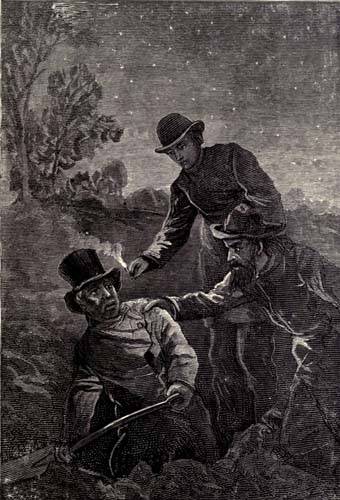
Striking a match on the sleeve of his coat as he
spoke, he examined the man by the aid of the light
it threw out, and saw that he was a coal-black negro,
and that he was dressed in a suit of something that
had once been white, but which was patched with
so many different kinds of cloth that it was hard to
find any of the original material in it.
“Are you old Jordan?” he demanded.
There was no answer returned by the negro, who
was as passive in the hands of his captors as if he
had been a lump of clay.
The Capture of “Ole Jordan.”
“This won’t do, old fellow,” said Clarence, angrily.
“You can’t play off on us in this way. You
had better open your mouth, or we’ll take you straight
to the general. Perhaps he can find means to make
you tell what you are doing in his potato-patch at
this time of night.”
“O, that ain’t no way to talk to a nigger, Mr.
Clarence,” said Godfrey. “I knows who he is, an’
I can soon make him speak,” he added, drawing back
his shovel preparatory to punching old Jordan in the
ribs with it.
“Hol’ on dar, boss!” cried the prisoner.
“Thar, now, what did I tell ye?” exclaimed Godfrey,
triumphantly. “Don’t sound much like ole
Jordan’s voice, though!”
“Now that you have found your tongue, I want
to talk to you,” said Clarence. “Would you like to
make a thousand dollars?”
“O, I’m goin’ to make a heap more’n dat, boss,”
replied the negro.
“You are? How are you going to do it?”
“Jordan,” said Godfrey, “did you come back to
dig up that thar bar’l you kivered up here in this
tater-patch on the day the Yanks cut the levee?”
“Dat’s tellin’,” replied the negro.
“Do you know where the barrel is?” asked Clarence.
“Course he does,” exclaimed Godfrey, “kase
he’s the one that kivered it up. Whar is it, Jordan?
Pint out the spot, an’ ye shall go free without no
harm bein’ done to ye; but if ye don’t tell——”
“Hol’ on dar, boss!” cried the old negro, as Godfrey
once more drew back his spade.
“Do you know where the barrel is?” asked Clarence.
“Answer that question!”
“I reckon I does, boss!”
“Well, where is it?”
“O, I didn’t say I’d tell dat, did I? It ’longs
to my ole marse, Gen’ral Gordon.”
“He’s got more’n his share already,” said Godfrey.
“Den I reckon I’se got jest as much right to dat
bar’l an’ what’s into it, as anybody,” said the negro;
“mebbe more, kase I’se the one that hid it!”
“Hold on a minute, Godfrey,” said Clarence, as
his companion raised the shovel threateningly. “Step
this way, a moment. Old man, you stay right where
you are. If you make any attempt to run, I’ll throw
this shovel at you!”
Clarence and Godfrey drew off on one side, just
out of ear-shot of the negro, and the former said, in
a suppressed whisper:
“Are you sure that’s old Jordan?”
“Just as sure as I can be,” replied Godfrey.
“’Tain’t his haunt—I can see that now—but ole
Jordan his own self.”
“I am glad you are so positive, for there is something
about this business that doesn’t look just right
to me. If it is he, he has come back to dig up that
barrel himself. I wonder if it is somewhere about
the spot where he was digging! How are we going
to make him tell?”
“Lick it outen him,” suggested Godfrey.
“O, that would never do in the world. He’d
raise the neighborhood with his howling.”
“Wal, mebbe goin’ without grub an’ water fur a
few hours will loosen up his tongue.”
“That’s the idea,” said Clarence, joyfully. “No
one will miss him, for those who have seen him since
he came back think he is a ghost. Where can we
take him and keep him safe until he tells us what we
want to know?”
“I reckon my tater-hole is as good a place as
any,” said Godfrey, after thinking a moment. “I
don’t have nothing to put in it now, an’ nobody ever
goes nigh it.”
“Can we lock him up there?”
“No, but we can tie him up, an’ that will do jest
as well. Howsomever, I don’t much keer to go into
any sich business as that, Mr. Clarence. S’pose it
should come out on us?”
“How in the world is it going to come out on us?”
asked Clarence, impatiently. “You’ll not tell, will
you?”
“No, sar,” answered Godfrey, with great emphasis.
“I couldn’t live here if I did.”
“Well, I shall not tell, either. You may be sure
of that; so I don’t see how it can become known.
We can starve old Jordan into opening his mouth,
and when he gets ready to tell us where the barrel
is, we’ll dig it up, divide the contents, and the first
boat that comes along will take me away from here.
I don’t care whether I go up or down the river, so
long as I have my pockets full of money.”
“An’ what’ll I do?” asked Godfrey.
“You can do as you please. You want to stay
here and spend your share, don’t you?”
“But what’ll I do with the nigger?”
“I don’t care what you do with him,” was the
boy’s mental reply. “So long as I get safely away
from here, you and the nigger can settle the business
between you in any way you see fit. That is a matter
in which I am not interested.” But aloud he said:
“O, we’ll get rid of him somehow. We’ll think about
that when the time comes. Now, we’ll give old Jordan
one more chance to earn his freedom, and if he
doesn’t see fit to improve it, it is no fault of ours. He
will have to go to the potato-hole and be tied up there.”
Godfrey was not at all pleased with this arrangement,
and he wondered why he had been foolish
enough to suggest it. As much as he wanted to be
rich, he would never have dared, had he been left to
himself, to resort to such desperate measures as these
to gain his object. The thought of it was enough to
make him tremble. He wished he had never seen
Clarence, or had anything to do with him. The boy
was so determined to go through with what he had
begun, and seemed to be so utterly reckless of consequences,
that Godfrey was really afraid of him.
“Say, Mr. Clarence,” said he, suddenly, “I ’most
done forgot it, but it’s the gospel truth, an’ I hope I
may be shot if it hain’t, that that tater-hole of mine
has done fell in, an’ ain’t no more account fur tyin’ up
niggers in. ’Sides, I hain’t got no ropes of no kind.”
“All right, Godfrey,” said Clarence, who saw
very plainly what his companion was trying to get at.
“We will find out about that when we get there.
But let me tell you one thing: If you think you are
going to back out and leave me in the lurch, you are
very much mistaken. If you will stick to me and
do as I say, we shall both of us come out all right;
but if you desert me, there’ll be a breeze raised here
in this neighborhood that will make you think that
war times have come back, sure enough. Now,
Jordan,” he added, addressing the negro, “will you
tell me where that barrel is?”
“No, sar!—no, sar!” said the old man, shaking
his head most decidedly. “Nobody gets dat bar’l
an’ what’s into it ’ceptin’ ole Jordan!”
“All right. Come with us, and we will see if
we can find means to make you think differently.”
Clarence seized the old negro by one arm, as he
spoke, Godfrey at a sign from him took hold of the
other, and together they led him across the field until
they reached the road, down which they conducted
him toward Godfrey’s cabin. But little was said
during the walk. The negro, who was evidently
becoming alarmed, would have talked fast enough,
but when his captors allowed him to use his tongue,
he pitched his voice in so high a key that Clarence,
alarmed lest he should arouse somebody, sternly
ordered him to hold his peace. The old negro
changed his tactics now, and most solemnly declared
that he didn’t know anything about any barrel; that
his name was not Jordan; and that he had gone into
the field simply for the purpose of stealing some
potatoes for his breakfast. But Clarence only laughed
at this, and assured him that he was not taking the
right course to gain his liberty. Potatoes didn’t
grow three feet under ground, he said, and neither
did prowlers, as a general thing, dig them with a
shovel. They could do better work with their hands.
If he would go back there and show them where the
barrel was hidden, they would dig for it, and the
moment they found it they would give him something
for pocket-money, and release him. This the
old negro protested he could not do, and Clarence
assured him that he should do it before he saw daylight
again.
Half an hour’s walk brought them within sight
of the cabin, and there Godfrey left Clarence and
the prisoner while he went forward to make sure that
none of his family were stirring, and to secure a
plough-line that hung up under the shed beside the
corn-crib, that being the article with which he had
decided to confine old Jordan. He returned in a
few minutes, and once more taking hold of the
negro’s arm, he and Clarence assisted him over two
or three fences, through a thick brier-patch which
covered the site of his former comfortable dwelling,
and finally halted in front of the potato-hole. It
was simply an out-door cellar, the peak of the roof
rising to the height of one’s shoulder, and the eaves
resting on the ground. The cellar was quite deep
enough to permit a tall man to stand upright in it,
as Clarence found when he descended the stairs that
led into it. It had successfully resisted the ravages
of time, and with the exception of the steps, which
were in a very dilapidated state, was as sound as it
was on the day it was built. The roof was four feet
thick, and Godfrey assured his companion that the
prisoner might shout for help as long and as loudly
as he pleased, but he could not make himself heard
as far as the cabin, unless he possessed lungs with as
much power as a steam-whistle.
Clarence now renewed his efforts to induce the
negro to tell where the barrel with the eighty thousand
dollars in it was hidden; but the latter declared
that he did not know; and Clarence, losing all
patience, assisted Godfrey in tying him fast to one
of the stanchions that supported the roof. When
this was done he felt his way out of the cellar—it
was as dark as Egypt in there—and Godfrey closed
and latched the door behind him. They both
breathed easier when the work was over.
“Well, Godfrey,” said Clarence, “your potato-hole
seems to be in pretty good condition yet; and
you did manage to find something to tie the old nigger
with after all, didn’t you? Now remember that
it will not be safe for us to go near him during the
daytime; some one might see us. We must give
this cellar a wide berth for twenty-four hours. If
the old fellow goes that length of time without anything
to eat or drink, perhaps he will begin to think
that we are in earnest.”
Godfrey made no reply. His heart was not in
the business, and he wished himself safely out of it.
Having gone so far, however, there was no way of
retreat. If old Jordan were released, he would be
certain to tell of the treatment he had received, and
that would bring him and Clarence into serious trouble.
He scarcely heard his companion’s cheerful
good-night, so engrossed was he with his own gloomy
thoughts.
Having taken leave of Godfrey, Clarence walked
rapidly toward his uncle’s house, little dreaming what
a commotion the events of this night were destined
to create there. He was not nearly so light-hearted
as he pretended to be. Now that he had time to
think calmly about what he had done, he was frightened,
and wondered how he had ever had the hardihood
to engage in so reckless a piece of business.
“No matter,” said he, trying his best to banish all
his dismal forebodings, “twenty-four hours in that
cellar will bring the old nigger to his senses; and
when I once get my hands on the money in that barrel,
I’ll bid good-by to America for a while. Forty
thousand dollars! Whew! This is the only chance I
shall ever have to make a fortune, and I am determined
to improve it.”
Arriving at his uncle’s house at last, he stopped
for a few minutes to compose himself and calm the
excitement which he knew must be plainly visible in
his face, and then with all the nonchalance of which
he was master, he opened the door and went in. He
stopped in the hall to hang up his cap, and would
have given anything he possessed, if he could have
found some plausible excuse for going at once to his
room. There was a merry family gathering in the
back parlor, and he did not want to go in there.
Some one was playing on the piano, and the rest
were engaged in most agreeable conversation, if one
might judge by the peals of laughter that now and
then rang through the house. Clarence was hardly
fit to go among them, he told himself as he glanced
at the little mirror in the hat-rack. His hair was
disheveled, his face flushed, and his boots and clothes
were covered with dust. While he was making some
hasty improvements in his appearance, his Aunt
Mary came into the hall. She had heard him enter
and came out to meet him.
“Come in here, truant, and give an account of
yourself,” said she, pleasantly. “What do you mean
by deserting us every night in this unceremonious
manner? Clarence,” said she, shaking her finger at
him, and sinking her voice almost to a whisper,
“you’ve been smoking again!”
“I know it,” said the boy.
“Do you find a cigar so much more agreeable
than the society of your friends?”
“No, ma’am; but I have been in the habit of it
so long, you know; and it is hard to give it up.”
“I suppose it is; but persevere and remember
that ‘he that ruleth his spirit is better than he that
taketh a city.’ Where’s Don? I thought he was
with you!”
“I am sure I don’t know. I haven’t seen him
since supper.”
“Why that is very strange,” said Mrs. Gordon.
“He has been out for the last two or three nights
until nine or ten o’clock, and I don’t know what to
think about it. Come in, now. Lucy has been
waiting to practise the Sharpshooter’s Waltz with
you.”
Much against his will Clarence was led into the
parlor, and the curious glances which all his relatives
directed toward him as he entered made him feel very
uncomfortable. His uncle thought he acted ill at
ease; Bert’s mental comment was that he had been
running a race with somebody; and Marshall told
himself that he must have been rolled in a dust heap.
Clarence could tell by the expression on their faces
pretty nearly what they were thinking about, and it
was with great effort that he aroused himself sufficiently
to take any interest in what was going on.
He played several tunes on his flute while his cousin
Lucy accompanied him on the piano, and as soon as
he could do so with any show of reason, he bade the
company good-night and went to bed.
“I’d like to know where in the world you have
spent your evenings since you have been here,” said
Marshall, when he joined him in his room half an
hour later. “Just as soon as it grows dark you’re
off, and that’s the last we see of you until ten o’clock.
Have you found a billiard saloon anywhere?”
“Perhaps you had better watch me, if you are so
very anxious to find out where I go,” growled
Clarence, in reply. “I am bored to death with this
everlasting music, and it is a great pity if I can’t
now and then take a quiet stroll and a cigar without
exciting astonishment and setting the whole family
to questioning me.”
Clarence slept but little that night, for his mind
was in a very unsettled state; and a dread of impending
evil, which he could not shake off, continually
haunted him. The first words he exchanged with
the first person he met the next morning, gave him
new cause for alarm. That person was Bert, whom
he encountered just as he stepped into the hall.
His cousin’s face was very pale, and Clarence saw
that he carried his whip in his hand and was dressed
for a ride.
“O, Clarence!” cried Bert. “What do you think
has become of Don?”
Clarence could only look the surprise which this
abrupt question occasioned him. At the same time
he felt a sinking at his heart for which he could not
account.
“He wasn’t at home at all last night,” continued
Bert. “We’ve made inquiries everywhere, and the
last person who saw him was the hostler, who says
that Don went into the barn about eight o’clock, but
he didn’t see him come out again. Father and I are
just about to start off to look for him!”
Clarence was too amazed to speak. He hurried
out of the house and to the barn, where he found his
uncle in the act of mounting his horse. There were
two other persons in the barn—the hostler and Godfrey
Evans. The hostler was putting the saddle on
Bert’s pony, and Godfrey stood around looking the
very picture of misery. He brightened up when he
saw Clarence approaching.
“Now, Godfrey,” said the general, “will you do
that much for me?”
“Yes, sar, an’ I’ll start now,” answered Godfrey,
who made a few rapid steps toward the gate, and
then suddenly stopped, faced about and came back
again.
“You know the woods like a book,” continued the
general, “and if Don is lost, you will be more likely
to find him than anybody else. Good-morning,
Clarence! I don’t suppose you can tell me anything
about Don, can you?”
“No, sir, I am sorry to say I cannot,” replied
Clarence, who felt that sinking at his heart again
when he looked at Godfrey.
“He has lately fallen into the habit of roaming
about of nights,” said the general, “and I don’t know
how to account for it. The boy is large enough to
take care of himself, but I don’t think he would stay
away so long unless he were in trouble. I am going
down the road to see if I can get any tidings of him;
Bert is going out into the country; Godfrey has promised
to search the woods; and if you feel like it, you
might jump on Don’s pony and ride down the river
road a few miles. Everybody down there knows Don,
and if he went that way before dark last night, some
one must have seen him.”
Clarence replied that he would willingly do all in
his power to find the missing boy, and then Bert and
his father mounted their horses and galloped out of
the gate. Godfrey slunk away behind the corn-crib,
and Clarence, after telling the hostler to put a
saddle on Don’s pony, followed him. He found
Godfrey sitting on the ground and rocking himself
back and forth as if he were in great pain.
“What’s the matter with you?” demanded Clarence,
and it was only by a great effort of will that he
could bring himself to speak at all.
“O, my soul!” cried Godfrey. “Does yer know
what we’ve been an’ done?”
“Do I know what we’ve done?” repeated the boy.
“What do you mean? Speak out!”
“O, my soul, how can I?” moaned Godfrey.
“Thar’s the gen’ral axin’ me would I s’arch the
woods to find that lost boy of his’n, an’ thar he is,
this blessed minute, tied up hard an’ fast in my own
tater-hole. O, laws! O, laws!”
Clarence reeled and fell heavily against the corn-crib,
as if some one had unexpectedly dealt him a
stunning blow.